Matthew 7:2
Matthew 7:3
Matthew 7:4
Matthew 7:5
Matthew 7:6
Matthew 7:7
Matthew 7:8
Matthew 7:9
Matthew 7:10
Matthew 7:11
Matthew 7:12
Matthew 7:13
Matthew 7:14
Matthew 7:15
Matthew 7:16
Matthew 7:17
Matthew 7:18
Matthew 7:19
Matthew 7:20
Matthew 7:21
Matthew 7:22
Matthew 7:23
Matthew 7:24
Matthew 7:25
Matthew 7:26
Matthew 7:27
Matthew 7:28
Matthew 7:29
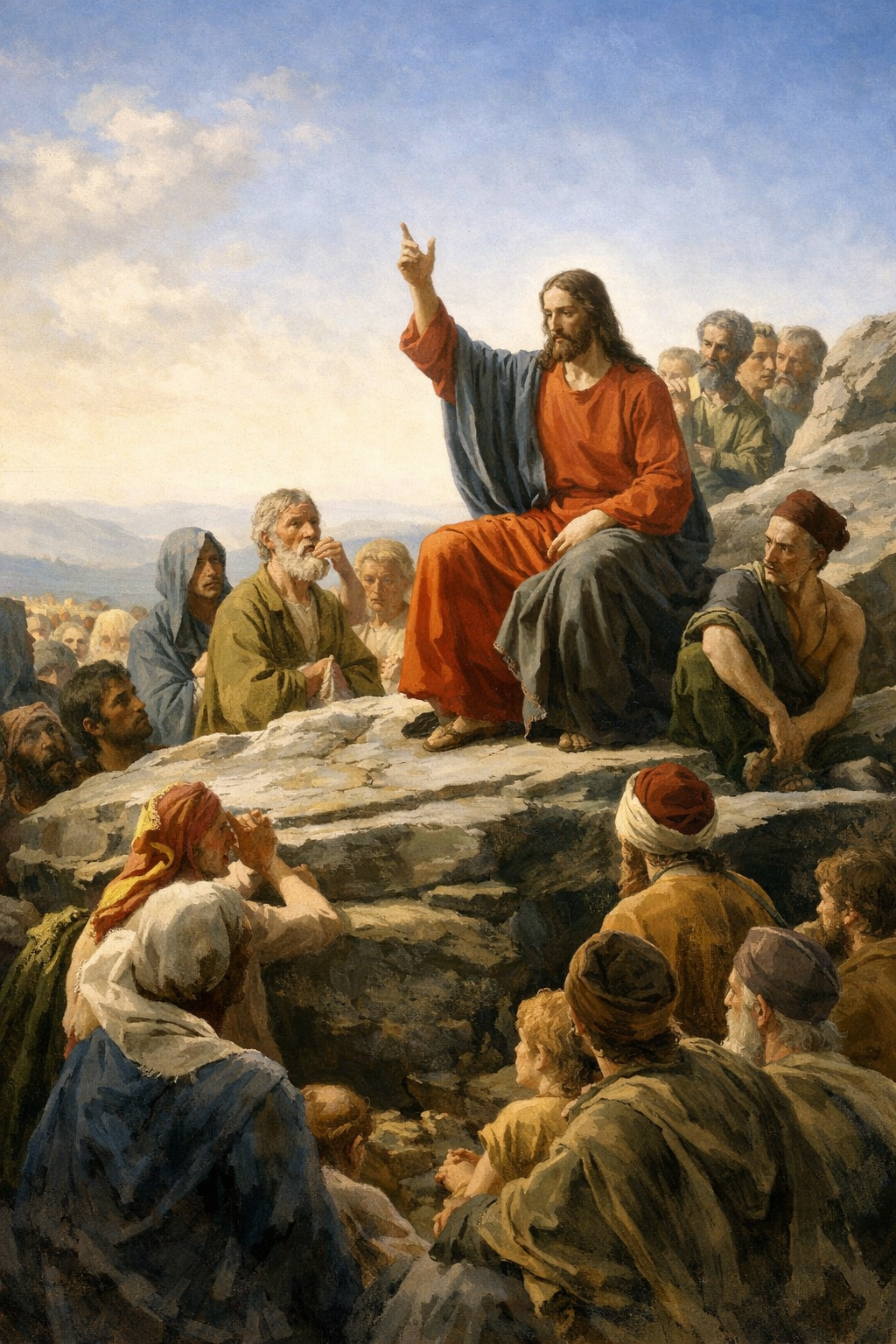
Sermon on the Mount
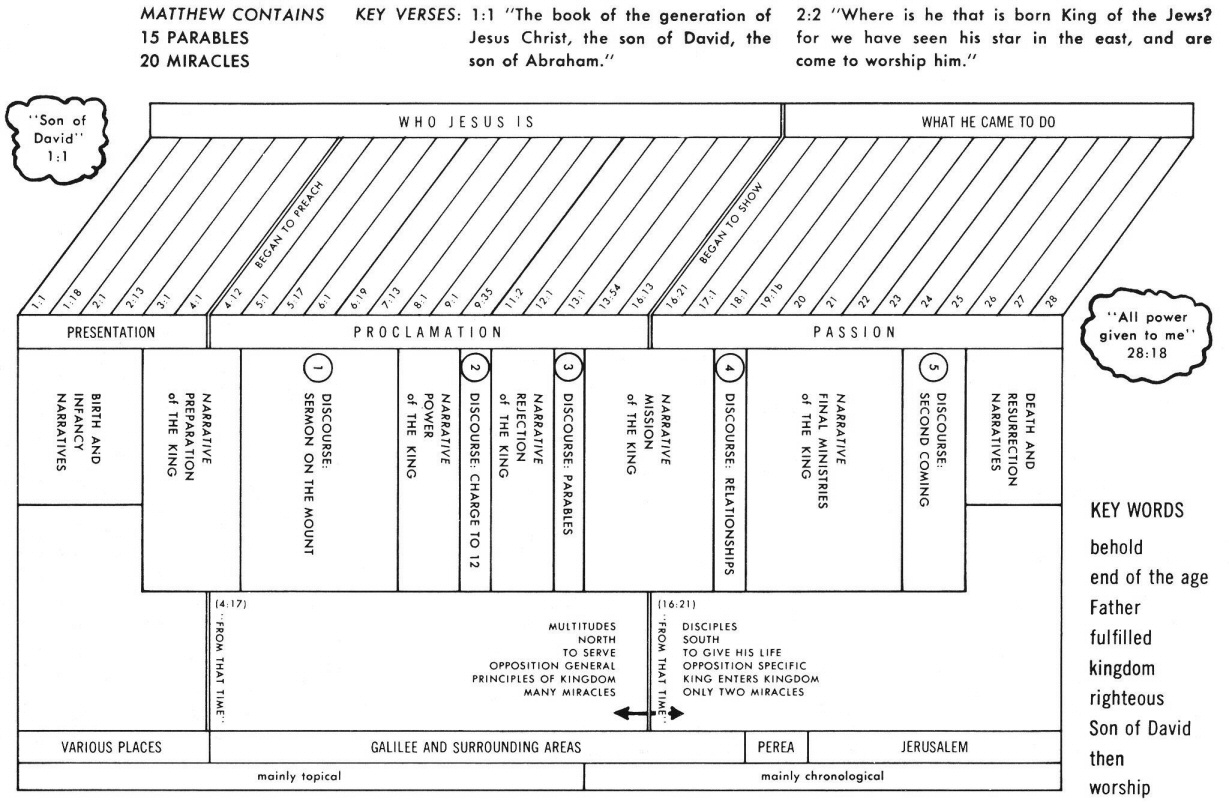
Click chart to enlarge
Charts from Jensen's Survey of the NT - used by permission
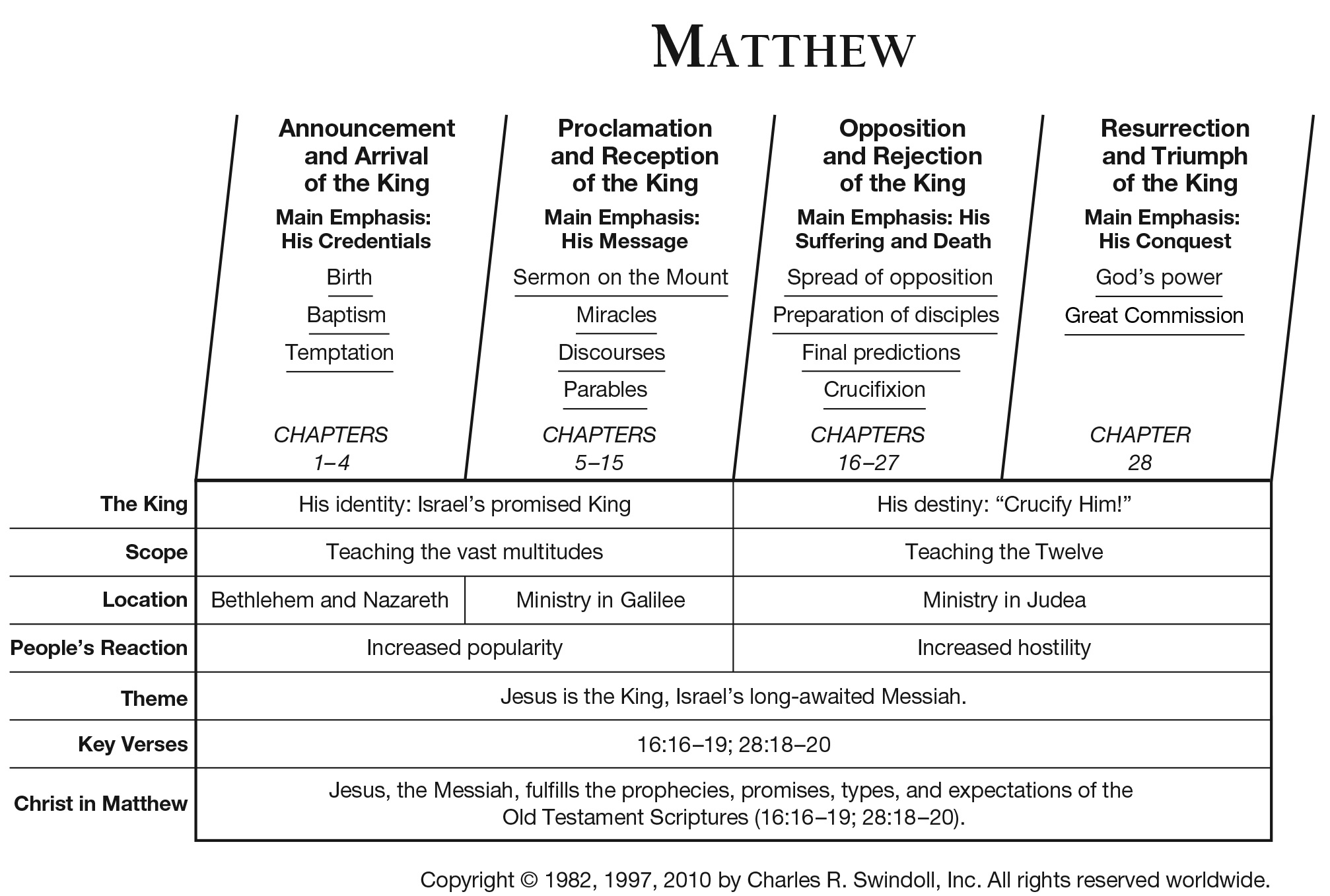
Another Chart from Charles Swindoll
THE LIFE OF JESUS AS COVERED
BY MATTHEW (shaded area)
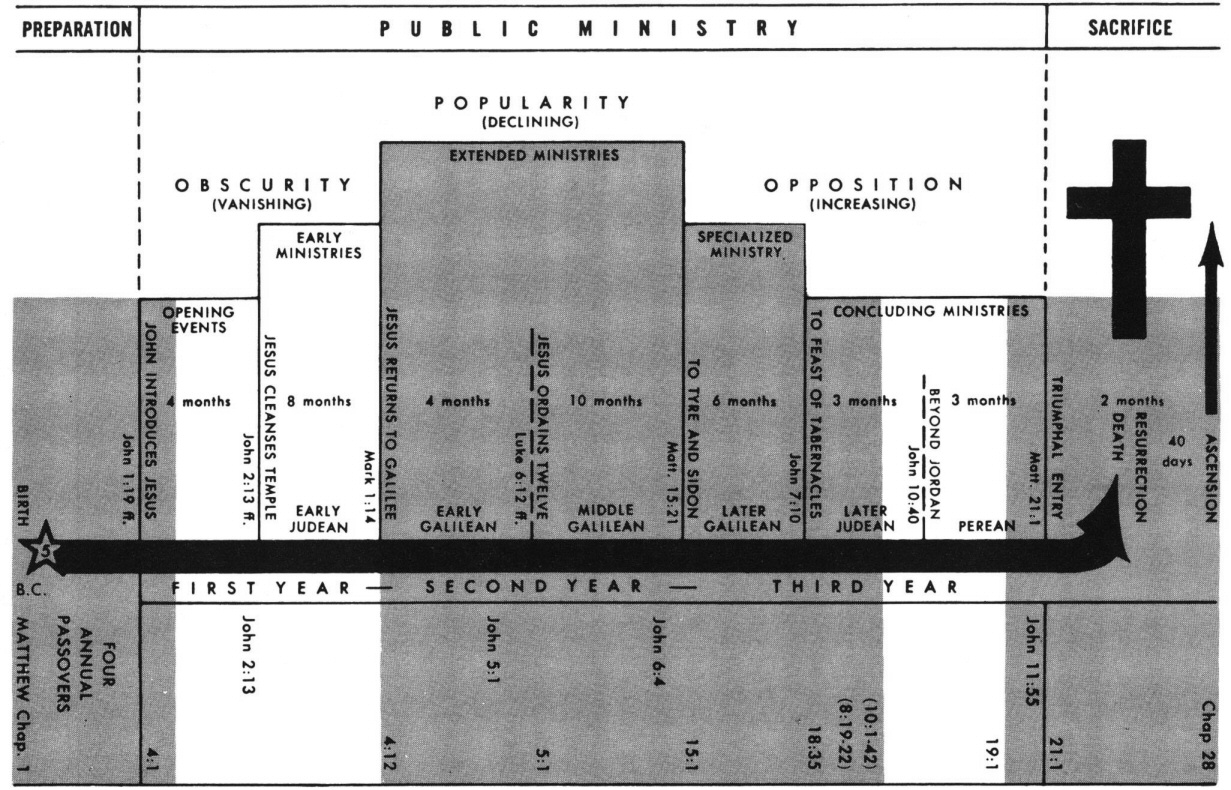
Click chart to enlarge
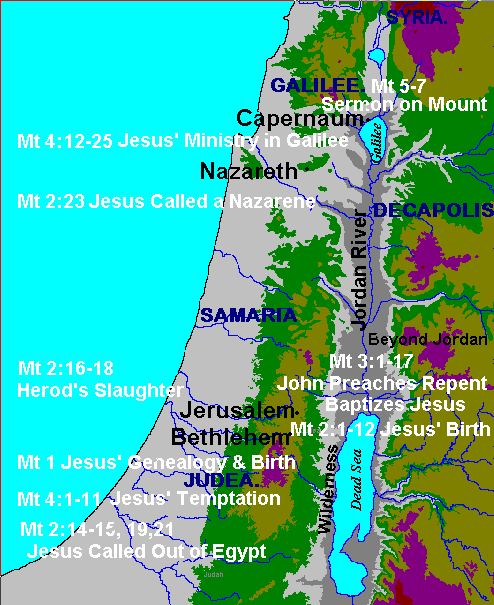
Jesus Birth and Early Years
Leading up to the Sermon on the Mount
Matthew 1-7

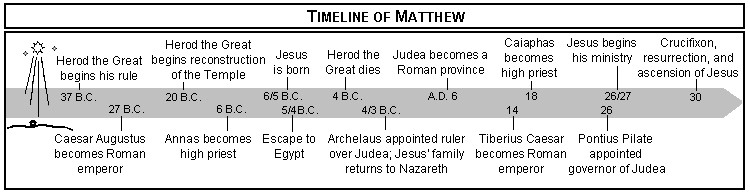
Source: Ryrie Study Bible
Matthew 7:9 "Or what man is there among you who, when his son asks for a loaf, will give him a stone? (NASB: Lockman)
Greek: e tis estin (3SPAI) ex humon anthropos, on aitesei (3SFAI) o huios autou arton me lithon epidosei (3SFAI) auto
Amplified: Or what man is there of you, if his son asks him for a loaf of bread, will hand him a stone? (Amplified Bible - Lockman)
KJV: Or what man is there of you, whom if his son ask bread, will he give him a stone?
NLT: You parents—if your children ask for a loaf of bread, do you give them a stone instead? (NLT - Tyndale House)
Phillips: "If any of you were asked by his son for bread would you be likely to give him a stone (New Testament in Modern English)
Wuest: Or, who is there of you, a man, who, should his son ask for a loaf of bread; he will not give him a stone, will he?
Young's: 'Or what man is of you, of whom, if his son may ask a loaf -- a stone will he present to him?
- Luke 11:11-13
- Matthew 7 Resources - Multiple Sermons and Commentaries
Related Passages:
Luke 11:11-13 “Now suppose one of you fathers is asked by his son for a fish; he will not give him a snake instead of a fish, will he? 12 “Or if he is asked for an egg, he will not give him a scorpion, will he? 13 “If you then, being evil, know how to give good gifts to your children, how much more will your heavenly Father give the Holy Spirit to those who ask Him?”
EARTHLY FATHERS, HEAVENLY GOODNESS
THE LOGIC OF OUR LOVING FATHER
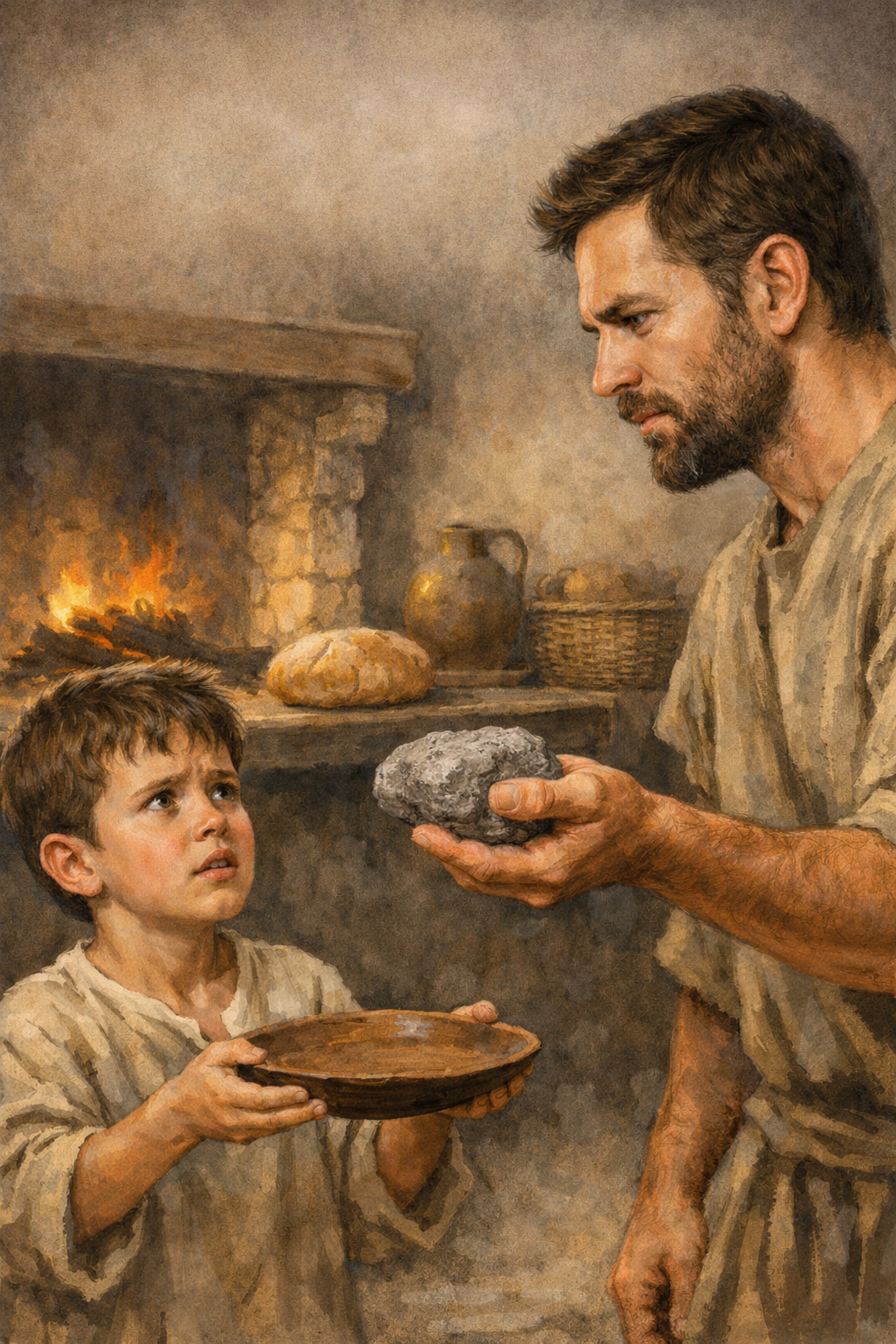
What man is there among you...will give him a stone? - Jesus uses a simple, everyday picture from family life to reveal the heart of God. The question assumes an obvious answer: no loving father would deceive his child by giving something useless or harmful when the child asks for something necessary. Bread was the staple food of the home, the symbol of daily provision. A stone might resemble a small loaf, but it would be cruel mockery to place it in a hungry child’s hands. By framing the statement as a question, Jesus appeals to the listeners’ own experience. Even imperfect human fathers, marked by sin and weakness, still possess a natural instinct to care for their children. If that is true on the human level, how much more reliable is the Father in heaven?
Obviously a father does not give that which is harmful to a child, but rather that which will be for good. Keep in mind that is this comparison, human parents are only a faint picture of the our Father's heart. He delights to give His children those things which are for their good and what will be for their lasting profit. Prayer is the appointed means whereby these mercies are received. Are you availing yourself of the good treasures your Father in Heaven longs to pour out on you? If not than begin to pray today, not to get, but to be more like Jesus, Who during His life continually sought His Father's provision. If Jesus the Perfect Man had to do it, how much more do we as redeemed sinners need to do it?!
Jesus is dismantling a false view of God as distant or reluctant. The Father is not waiting for us to beg long enough to deserve help; He is eager to provide what is truly good. Bread represents basic provision—daily needs, guidance, strength, forgiveness. When His children come honestly, God’s intention is to nourish, not to frustrate.
Spurgeon writes "Our Lord will give us the real thing. Sometimes we should be quite satisfied with the imitation of it. And sometimes we have to wait and be prepared for the reception of the real thing; it is infinitely better for us to wait for months than immediately to get ,a stone; better to wait for a fish than the next moment to have a scorpion. There were some in the wilderness who asked to be satisfied, and they were so, with the flesh of quails. They got their stones, they got their scorpions. But the Lord's people may sometimes find that they have to wait a while. ,God will not give to them that which is other than good for them."
Spurgeon adds this note on stone - "There were many stones in those days that were in appearance wonderfully like the bread which they used in the East; but would any father mock his son by giving him one of those stones to break his teeth on, instead of bread that he could eat? Never."
Bob Utley - 7:9-10 Jesus used the analogy of a father and son to describe the mystery of prayer. Matthew gives two examples while Luke gives three (cf. Luke 11:12). The whole point of the illustrations was that God will give believers the "good things." Luke defines this "good" as "the Holy Spirit" (cf. Luke 11:13). Often the worst thing our Father could do for us is answer our inappropriate, selfish prayers! All three examples are a play on things that look alike: stone as bread, fish as eel, and egg as a coiled, pale scorpion.
E M Bounds tells of an encouraging story of a praying son of the Most High who asked specifically "for a loaf" and did not receive "a stone"… "
Some years ago the record of a wonderful work of grace in connection with one of the stations of the China Inland Mission attracted a good deal of attention. Both the number and spiritual character of the converts had been far greater than at other stations where the consecration of the missionaries had been just as great.
This rich harvest of souls remained a mystery until Hudson Taylor, on a visit to England, discovered the secret. At the close of one of his addresses a gentleman came forward to make his acquaintance. In the conversation which followed, Mr. Taylor was surprised at the accurate knowledge the man possessed concerning this China Inland Mission station.
"But how is it," Mr. Taylor asked, "that you are so conversant with the conditions of that work?"
"Oh!" he replied, "the missionary there and I are old college mates; for years we have regularly corresponded; he has sent me names of enquirers and converts, and these I have daily taken to God in prayer."
At last the secret was found — a praying man, praying definitely, praying daily.& (E. M. Bounds, Purpose in Prayer) (You can join the company of men like him - add the following resource to your morning discipline and you will be eternally grateful - Global Prayer Digest - pray daily for the unreached peoples and one day you will meet the fruit of your "asking, seeking and knocking" labor in heaven even as has this old English saint!)
A Stone Or Bread?- No loving father would give a stone or a snake to his hungry son if he asked for a piece of bread or a fish. Jesus used the absurdity of that analogy in Matthew 7 to underscore the heavenly Father's readiness to give good things to His children when they ask Him. He wanted them to have complete confidence in the Father's provision for their spiritual needs. Sometimes, however, it may seem as if the Lord has given us "stones" instead of "bread." But in His wisdom, He actually is working through our circumstances to give us something far better than what we requested. An unknown author expressed it this way:
I asked for health that I might do greater things;
I was given infirmity that I might do better things.
I asked God for strength that I might achieve;
I was made weak that I might learn to obey.
I asked for riches that I might be happy;
I was given poverty that I might be wise.
I asked for power and the praise of men;
I was given weakness to sense my need of God.
I asked for all things that I might enjoy life;
I was given life that I might enjoy all things.
I got nothing I asked for but everything I hoped for;
In spite of myself, my prayers were answered—
I am among all men most richly blessed.
Yes, God always gives us what's best for us.R De Haan (Our Daily Bread, Copyright RBC Ministries, Grand Rapids, MI. Reprinted by permission. All rights reserved)
We may ask amiss,
but God answers aright.
Confident Prayer - As one of Africa's first explorers, David Livingstone loved its people and longed to see them evangelized. His journals reveal his spiritual concern and deep faith. In late March 1872, he wrote, "He will keep His word--the gracious One, full of grace and truth--no doubt of it. He said, 'Him that cometh unto Me, I will in no wise cast out' and 'Whatsoever ye shall ask in my name I will give it.' He will keep His word; then I can come and humbly present my petition, and it will be all right. Doubt is here inadmissible, surely." Livingstone had rock-like confidence in the Father's promises. In our praying we too can exercise the trust that God will not deny our requests when they are in keeping with His will. (By the way, are we reading His Word so that we know His will?) We can defeat doubt when we remind ourselves that no matter what happens in life, He cares deeply about us and longs to give us the wisdom to handle what comes our way (1 Pet. 5:7; Jas. 1:5). Our faith will grow stronger as we realize that our heavenly Father is gracious, delighting to give good gifts to His children (Mt. 7:11). Humbly but confidently, we can come to Him with our requests. --V C Grounds (Our Daily Bread, Copyright RBC Ministries, Grand Rapids, MI. Reprinted by permission. All rights reserved)
Thou art coming to a King,
Large petitions with thee bring,
For His grace and power are such,
None can ever ask too much.
--John NewtonWhen we love God as our Father,
we won't treat Him as our servant.
Listen to John Newton's words in his hymn Come, My Soul, Thy Suit Prepare music and vocals byby Matt Foreman
Come, my soul, thy suit prepare:
Jesus loves to answer prayer;
He Himself has bid thee pray,
Therefore will not say thee nay;
Therefore will not say thee nay.
Thou art coming to a King,
Large petitions with thee bring;
For His grace and power are such,
None can ever ask too much;
None can ever ask too much.
With my burden I begin:
Lord, remove this load of sin;
Let Thy blood, for sinners spilt,
Set my conscience free from guilt;
Set my conscience free from guilt.
Lord, I come to Thee for rest,
Take possession of my breast;
There Thy blood bought right maintain,
And without a rival reign;
And without a rival reign.
While I am a pilgrim here,
Let Thy love my spirit cheer;
As my Guide, my Guard, my Friend,
Lead me to my journey’s end;
Lead me to my journey’s end.
Show me what I have to do,
Every hour my strength renew:
Let me live a life of faith,
Let me die Thy people’s death;
Let me die Thy people’s death.
Keeping Track Of Prayers - Shortly before Margaret Koster died in 1997, I wrote an article about her, telling of her diligence in prayer. Despite her age, she set an example of faithfulness in prayer—continuing to spend hours each day speaking with the Lord she loved. Now she's reaping the rewards of that faithfulness. But there's another story about Margaret that needs to be told—a story of how seriously she took her prayer-life. When she was younger, Margaret would pray each day for missionaries she knew about. She also kept a journal of her prayers—complete with answers. One time when one of "her" missionaries was home from his overseas ministry, Margaret approached him, showed him her journal, and said, "I have recorded every prayer request you made as a missionary. And I have put down every answer that I know of. But I also have some prayers for which I don't know the answers. You need to sit down with me and tell me how God answered those prayers so I can write them down."
Now that's taking prayer seriously! We learn from Margaret not only the importance of prayer but also the reality of God's answers. Remember, "If we ask anything according to His will, He hears us" (1 John 5:14). —Dave Branon (Our Daily Bread, Copyright RBC Ministries, Grand Rapids, MI. Reprinted by permission. All rights reserved)
We must call on the Lord with reverence,
When we go to Him in prayer;
In His time He will send the answers
To show us His love and care. —Fitzhugh
If we take God seriously
we'll be serious about prayer.
The spiritual index - Oswald Chambers
Or what man is there of you, whom if his son ask bread, will he give him a stone? Matthew 7:9.
The illustration of prayer that Our Lord uses here is that of a good child asking for a good thing. We talk about prayer as if God heard us irrespective of the fact of our relationship to Him (cf. Matthew 5:45.) Never say it is not God’s will to give you what you ask, don’t sit down and faint, but find out the reason, turn up the index. Are you rightly related to your wife, to your husband, to your children, to your fellow-students—are you a ‘good child’ there? ‘Oh, Lord, I have been irritable and cross, but I do want spiritual blessing.’ You cannot have it, you will have to do without until you come into the attitude of a good child.
We mistake defiance for devotion; arguing with God for abandonment. We will not look at the index. Have I been asking God to give me money for something I want when there is something I have not paid for? Have I been asking God for liberty while I am withholding it from someone who belongs to me? I have not forgiven someone his trespasses; I have not been kind to him; I have not been living as God’s child among my relatives and friends (see v. 12).
I am a child of God only by regeneration, and as a child of God I am good only as I walk in the light. Prayer with most of us is turned into pious platitude, it is a matter of emotion, mystical communion with God. Spiritually we are all good at producing fogs. If we turn up the index, we will see very clearly what is wrong—that friendship, that debt, that temper of mind. It is no use praying unless we are living as children of God. Then, Jesus says—“Everyone that asketh receiveth.”
William MacDonald - “What man is there of you, whom if his son ask bread, will he give him a stone?” (Matt. 7:9)
The question calls for a negative answer. Ordinarily a father wouldn’t give his son a stone in place of bread. Certainly the Heavenly Father would never do it.
But the sad fact is that we sometimes do that very thing. People come to us in deep spiritual need. Perhaps we are insensitive to what is really troubling them. Or we put them off with some surface panacea instead of sharing the Lord Jesus with them.
E. Stanley Jones illustrates this with a story he tells on himself (it takes a great man to tell a story that discloses a personal failure). “When the (Indian) Congress members in their newly acquired powers were sometimes using these powers for themselves instead of the country’s good, it was proving too much for Jawaharlal Nehru to bear. He said he was thinking of resigning the Prime Ministership and going off to regain his inner spirit. I saw him at that time, and at the close of the interview I offered him a bottle of tablets of the cereal grasses, containing all the known vitamins. He took the bottle with thanks but added, ‘My problem is not physical/ implying that it was spiritual. Instead of offering him grace, I offered him grass. He asked for bread, and I gave him a stone… I knew I had the answer, but I didn’t know how to say it. I was afraid of offending the great man. I should have remembered the motto on the Sat Tal Ashram wall: ‘There is no place in which Jesus Christ is out of place.’ But I didn’t. I remembered my hesitations and they prevailed.
“I offered him grass tablets when he really wanted grace—the grace and power that would heal him at the heart. Then he could have said, ‘I am healed at the heart. Now let the world come on—the world of impossible problems. I’m ready.’”
I am afraid that the experience of Dr. Jones is all too familiar to many of us. We encounter people who have deep spiritual needs. They drop some word that provides a wide open door for us to minister Christ to them. But we fail to take advantage of it. We either suggest some band-aid remedy for a spiritual wound or we change the subject to something of trivial value.
Prayer: Lord, help me to seize every opportunity to witness for You, to enter every opened door. Help me to overcome my hesitations, giving bread and grace where they are needed.
QUESTION - Which of you, if your son asks for bread, will give him a stone?
ANSWER - In 2012, a family in our church almost lost their son to an IED (improvised explosive device) detonation in Afghanistan. Their son, a Marine, was on his first tour when, on a routine patrol, he triggered the explosion and was nearly killed. He lost both of his legs above the knee and most of the use of one of his hands. Now, several years later, after dozens of surgeries, he is living a reasonably normal life with his wife and two children. But, the physical, psychological, emotional, and spiritual wounds are still very much there.
In a small group meeting, I remember his parents commenting on his, and their own, continued difficulty in understanding and dealing with what happened and why God allowed it. The father commented, "We asked God for bread and He gave us a stone. We prayed fervently for God to protect our son, and yet God allowed him to be horribly wounded. God gave us the exact opposite of what we asked for."
I thought a lot about what he said. I can definitely empathize with the feeling that God gave you the opposite of what you asked for. My father died a slow, painful, and agonizing death from stomach cancer shortly after I came to faith in Christ despite my fervent pleas for God to heal him.
While I have come to trust God and accept what He allowed to happen, in no sense am I minimizing the ongoing pain, heartache, and doubt a painful event like this can cause. In no sense am I being critical of those who are still struggling with trusting God after an unanswered prayer request of this magnitude. Recovering from, and growing through, a tragedy like this is a process, often a marathon. But, what does the finish line look like (2 Timothy 4:7)?
How should Christians respond when we ask God for bread
and He appears to give us a stone?
While Romans 8:28 is much overused, it is still absolutely true. God causes all things to work together for good for those who love Him. It may look like a stone. It may feel like a stone. It may taste like a stone — but it is not a stone. God's Word never fails. God never reneges on His promises. Since God promises that if you ask for bread, He won't give you a stone, it is not a stone. It may not be what you asked for. It may not be what you wanted. But, ultimately, it is what is best. You will, at some point, be grateful for how God responded to your prayers.
Often, there is no way anyone can know why God allowed something terrible to happen. We can trust that it was God's will, but understanding how it is God's perfect plan is a different matter (Romans 12:1-2). There is no pain or suffering in heaven (Revelation 21:4). In heaven, we will all be in perfect agreement with what God's plan was for our earthly lives. However, it should be our goal to reach that level of trust in our pre-heaven walk with God. Easy? No. Possible? Likely no. Still our goal? Absolutely!
Just as Satan tempted Jesus to turn the stones into bread (Matthew 4:3), so does he tempt us to view the "bread" God gives us as stones. No matter how much it seems to be a stone, we must trust God's Word that it is, in fact, His good, pleasing, and perfect plan. S. Michael Houdmann
In John Piper's book Desiring God he explains why more Christians are not asking, seeking, knocking writing that…
Unless I'm badly mistaken, one of the main reasons so many of God's children don't have a significant life of prayer is not so much that we don't want to, but that we don't plan to. If you want to take a four-week vacation, you don't just get up one summer morning and say, "Hey, let's go today!" You won't have anything ready. You won't know where to go. Nothing has been planned.
But that is how many of us treat prayer. We get up day after day and realize that significant times of prayer should be part of our life, but nothing's ever ready. We don't know where to go. Nothing has been planned. No time. No place. No procedure. And we all know that the opposite of planning is not a wonderful flow of deep, spontaneous experiences in prayer. The opposite of planning is the rut. If you don't plan a vacation you will probably stay home and watch TV!
The natural unplanned flow of spiritual life
sinks to the lowest ebb of vitality.There is a race to be run and a fight to be fought. If you want renewal in your life of prayer you must plan to see it.
Therefore, my simple exhortation is this: Let us take time this very day to rethink our priorities and how prayer fits in. Make some new resolve. Try some new venture with God. Set a time. Set a place. Choose a portion of Scripture to guide you. Don't be tyrannized by the press of busy days. We all need mid-course corrections. Make this a day of turning to prayer — for the glory of God and for the fullness of your joy.& (Available online - Desiring God - Meditations of A Christian Hedonist) (Bolding added)
Other Resources Related to Prayer:
- Colossians 1:9 Commentary
- Colossians 4:12 Commentary
- Devotional on Prayer
- Guide to Praying for Missionaries
- Pithy Prayer Phrases
- Prayer - Greek Words for Prayer
- Prayer Devotionals and Illustrations
- Prayer Hymns and Poems
- Prayer Quotes
- Praying in the Spirit
- Spurgeon's Gems on Prayer
Matthew 7:10 "Or if he asks for a fish, he will not give him a snake, will he? (NASB: Lockman)
Greek: e kai ichthun aitesei (3SFAI) me ophin epidosei (3SFAI) auto?
Amplified: Or if he asks for a fish, will hand him a serpent? (Amplified Bible - Lockman)
KJV: Or if he ask a fish, will he give him a serpent?
NLT: Or if they ask for a fish, do you give them a snake? Of course not! (NLT - Tyndale House)
Phillips: or if he asks for a fish would you give him a snake? (New Testament in Modern English)
Wuest: Or, should he also ask for a fish; he will not give him a snake, will he? (Eerdmans)
Young's: 'and if a fish he may ask -- a serpent will he present to him?
See notes on Luke 11:11.
FATHERS GIVE WHAT IS GOOD!
ASK WITHOUT FEAR OF DECEPTION
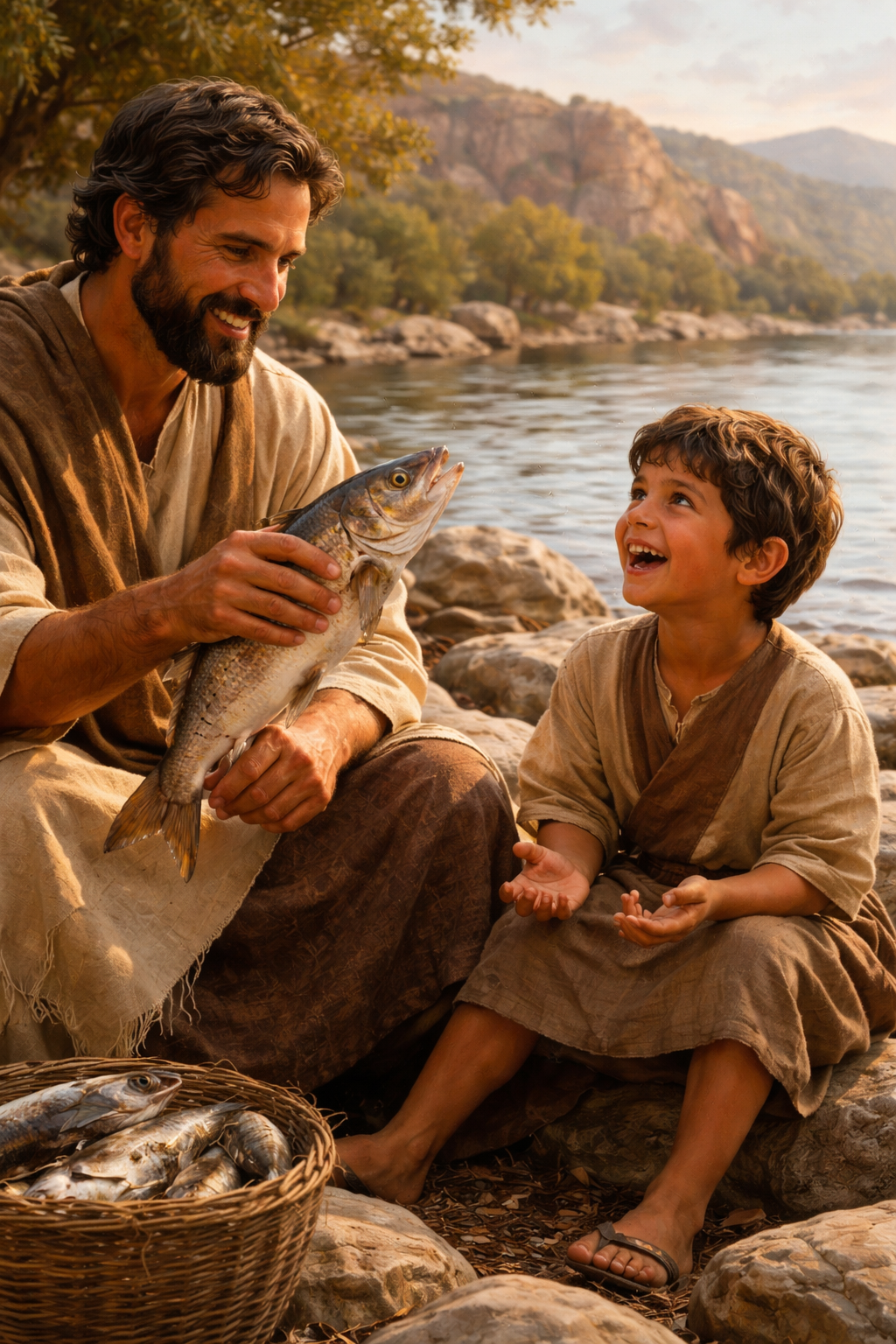
Or if he asks (aiteo) for a fish, he will not give him a snake, will he? - Jesus continues His argument from everyday family life. A child in a Galilean home might ask for fish, one of the most common foods around the Sea of Galilee. Fish was wholesome, nourishing, and familiar—something a father would gladly provide. A snake, however, was not only useless as food but dangerous. To place a serpent in a child’s hands would be an act of cruelty, not care. The question again expects an obvious answer: of course not. No normal father would respond to a legitimate need with something harmful. Jesus chooses this contrast deliberately to show how unthinkable it is to imagine God acting that way toward His children.
Jesus reasons from the lesser to the greater. If earthly fathers, who are flawed and limited, still know how to avoid giving harmful things, how much more can we trust the perfect wisdom of our heavenly Father? The very nature of God makes it impossible that He would respond to prayer with anything destructive.
We can deduce from this statement that
- God never answers prayer with deception.
- God’s gifts are suited to our real needs.
- Refusal can be protection.
When God withholds a fish, it is never
to hand us a snake; it is to keep us from one.
Spurgeon - The point is, not only that God gives, but that he knows how to give. If he were always to give according to our prayers, it might be very injurious to us. He might give us that with which we could do hurt, as when a father should put a stone into a boy's hand; or he might give us that which might do us hurt, as if a father were to give his child a serpent. He will do neither of these things; but be will answer us in discretion, and with prudence will he fulfill our desires. You know how to give to your children; bow much more shall your infinitely-wise Father, who from heaven sees all the surroundings of men, give good things to them that ask him? (Exposition)
If your child asks for a stone or a snake, will you give it to him? No, no matter how much he begs. Children often ask for foolish things, which are withheld. The same is true with our heavenly Father. As ignorant, willful children we often ask for things that to us seem like fish or bread but which God knows will have the effect (figuratively of course) of a stone or a snake in our lives. Our Heavenly Father says no, not because He hates us but because he loves us. God's "No" is a sure sign of His wisdom and His love for us. If a five-year-old asks to play with a sharp knife, most reasonable fathers would respond with a definitive "No" and even let him cry and pout. His tears only show his immaturity. And frankly, if the father does give him the knife, it shows he doesn't really love him at all. In the same way, as God's children, believers often ask for things that might bring us harm, including even things we think are good, like a new job, a better salary, a new house, etc. But God Who Alone knows the beginning from the end, sees through to the end and knows that what we have asked for would harm us more than help us. So in His omniscient, loving wisdom He says "No".
🙏 THOUGHT - Beloved, when we come to God with a request, we do not need to fear hidden danger in His answer. He may redirect, delay, or reshape what we ask, but He will never replace a “fish” with a “snake.” Every response flows from a Father’s heart that seeks your ultimate good. Prayer, therefore, can be offered with confidence rather than anxiety, knowing that the One who hears you is both able and kind.
The Wrapped Birthday Box - A little boy shook the brightly wrapped box and imagined what was inside—maybe a baseball glove or a model airplane. When he opened it, imagine if instead of a gift there was something dangerous, like broken glass. We instinctively recoil at that thought because love does not play cruel tricks. Jesus says God is not a Father who disguises harm as blessing. When He gives, the wrapping and the contents match His goodness. God’s answers may surprise us, but they will never sabotage us.
The Wrong Medicine - A child asks his mother for cough syrup because he is sick. She doesn’t hand him a bottle of bleach, even if the bottles might look similar on the shelf. She knows the difference between what heals and what harms. Often we ask God for things that look helpful but would actually poison our spirit—success that would feed pride, relationships that would draw us from Christ, or comfort that would weaken our character. God’s “no” is often the wisdom of a careful Physician, not the stinginess of an uncaring parent.
The Father at the Lake - A dad takes his son fishing. The boy asks, “Can I hold the fish?” The father gladly lets him. But when the boy reaches toward a water moccasin coiled on the bank, the father pulls him back and says, “Not that one.” From the child’s perspective both are long, shiny, and moving, but the father sees the danger the child cannot. God sees the serpents we mistake for fish.
The GPS Detour - You ask your phone’s GPS for the fastest route. Halfway there it reroutes you off the highway. You feel frustrated—until later you learn there was a massive accident ahead. The GPS didn’t ignore your request; it answered it better than you knew to ask. God’s answers are guided by knowledge we do not possess.
The Candy before Dinner - A child asks for candy at 5:30 p.m. The parent says no—not because candy is evil, but because dinner is coming. The refusal is not rejection; it is protection of something better. Delay is not denial; it can be preparation for a greater gift.
Real-Life Testimony - Many believers can look back and thank God for unanswered prayers:
• the job they wanted but didn’t get,
• the relationship that ended painfully,
• the move that fell through.
Years later they see that what they begged for would have become a “snake.” Time often reveals the mercy hidden inside God’s “no.”
Matthew 7:11 "If you then, being evil, know how to give good gifts to your children, how much more will your Father who is in heaven give what is good to those who ask Him! (NASB: Lockman)
Greek: ei oun humeis poneroi ontes (PAPMPN) oidate (2SRAI) domata agatha didonai (PAN) tois teknois humon, poso mallon o pater humon o en tois ouranois dosei (3SFAI) agatha tois aitousin (PAPMPD) auton.
Amplified: If you then, evil as you are, know how to give good and advantageous gifts to your children, how much more will your Father Who is in heaven [perfect as He is] give good and advantageous things to those who keep on asking Him! (Amplified Bible - Lockman)
KJV: If ye then, being evil, know how to give good gifts unto your children, how much more shall your Father which is in heaven give good things to them that ask him?
NLT: If you sinful people know how to give good gifts to your children, how much more will your heavenly Father give good gifts to those who ask him. (NLT - Tyndale House)
Phillips: If you then, for all your evil, quite naturally give good things to your children, how much more likely is it that your Heavenly Father will give good things to those who ask him?" (New Testament in Modern English)
Wuest: Therefore, as for you, in view of the fact that though being those who are evil, actively opposed to that which is good, you know how to be constantly giving good gifts to your children, how much more shall your Father who is in heaven give good things to those who ask Him for them?
Young's: if, therefore, ye being evil, have known good gifts to give to your children, how much more shall your Father who is in the heavens give good things to those asking him?
- Being evil Genesis 6:5; 8:21; Job 15:16; Jeremiah 17:9; Romans 3:9,19; Galatians 3:22; Ephesians 2:1, 2, 3; Titus 3:3
- How to give good gifts - Ex 34:6,7; 2 Sa 7:19; Ps 86:5,15; 103:11, 12, 13; Isa 49:15; 55:8,9; Hos 11:8,9; Mic 7:18; Mal 1:6; Lk 11:11, 12, 13; Jn 3:16; Ro 5:8, 9, 10; 8:32; Eph 2:4,5; 1 Jn 3:1; 4:10
- Give what is good - Ps 84:11; 85:12; Jeremiah 33:14; Hosea 14:2; Luke 2:10,11; 11:13; 2Corinthians 9:8-15; Titus 3:4, 5, 6, 7
- Matthew 7 Resources - Multiple Sermons and Commentaries
Related Passages:
Genesis 6:5 Then the LORD saw that the wickedness of man was great on the earth, and that every intent of the thoughts of his heart was only evil continually.
Luke 11:13 “If you then, being evil, know how to give good gifts to your children, how much more will your heavenly Father give the Holy Spirit to those who ask Him?”
Psalm 84:11 For the LORD God is a sun and shield; The LORD gives grace and glory; No good thing does He withhold from those who walk uprightly.
THOU ART COMING TO A KING
LARGE PETITIONS WITH THEE BRING!
This passage uses a logical argument from the lesser to the greater—a rhetorical technique that invites listeners to recognize God’s generosity by comparing it to human parental love.
If you then, being (present tense - continually) evil (poneros) - Jesus begins with a startlingly honest assessment of human nature. He is not saying parents are as bad as they could be, but that even the best of us are still affected by sin, selfishness, and limited understanding. Our love is real, yet imperfect. Our motives are often mixed. We grow tired, impatient, and sometimes fail those we love most. Against the blazing backdrop of God’s holiness, even our brightest goodness has shadows. And yet, in spite of this fallen condition, something beautiful remains—parents still long to bless their children.
Bob Utley - "If you then" This is a FIRST CLASS CONDITIONAL SENTENCE, which is assumed to be true from the author's perspective or for his literary purposes. In rather an oblique way this is an affirmation of the sinfulness of all men (cf. Rom. 3:9,23). The contrast is between evil human beings and a loving God. God shows His character by the analogy of the human family.
The questions of Matt. 7:9 and 10 expect a "no" answer (like Matt. 7:16).
This passage uses a logical argument from the lesser to the greater—a rhetorical technique that invites listeners to recognize God’s generosity by comparing it to human parental love. The preceding illustrations (bread versus stone, fish versus snake) establish that even flawed parents instinctively protect their children’s welfare—both physical and spiritual. A loving father won’t ignore either the physical or the spiritual needs of his son. The argument then pivots: if imperfect, sinful human parents possess this instinct toward generosity and protection, how much more abundantly would a perfect heavenly Father give? God’s divine, loving, merciful, and gracious nature has no limit on His treasure and no bounds to the goodness He is willing to bestow on His children who ask Him.
Spurgeon asks "Is there a connection between this conduct on our part and answers to our prayer? Undoubtedly it is so from the position of the text. If we will never grant the requests of those who need our help, in oases where we should expect to be ourselves helped, how can we go to God with any confidence, and ask him to help us? I doubt not that many a man has received no answer to his prayer because that prayer has come out of a heart hard and untender, which would not permit him to grant the requests of others. O child of God, do thou to others as thou wouldst that they should do to thee, then canst thou go to thy God in prayer with the confidence that he will hear and answer thee!"
Being (1510) (eimi) means to be and is the usual verb of existence. In this case the present tense indicates that evil is our nature! Evil is a stark description of our fundamental human condition.
Know (eido) how to give good (agathos) gifts (doma) to your children (teknon) - Even broken human hearts recognize what is beneficial. A mother instinctively feeds her hungry child; a father delights to provide what will help his son or daughter flourish. We don’t hand our children stones when they need bread. We labor, sacrifice, and plan for their future because love moves us to give what is helpful rather than harmful. If flawed parents can act with such tenderness, Jesus invites us to reason upward—from the lesser to the greater.
Even though human nature is deeply marked by weakness and sin, you still know how to give your children things that are truly good—what will nourish them, protect them, and help them grow. How much more, then, will your divine Heavenly Father, whose love is perfect and whose wisdom never fails, give good and wholesome gifts to His children? His generosity far exceeds the best intentions of any earthly parent. Don’t simply wonder about it—discover it for yourself. Come to Him with confidence. Ask—and experience His goodness firsthand.
How much more These three words open the door to wonder. Jesus argues from comparison: if limited, sinful people can show genuine generosity, imagine the overflowing kindness of a perfect God. How much more means God’s heart is not merely a little better than ours, but is infinitely better. His love has no selfish streak, His wisdom makes no mistakes, and His resources never run dry. The distance between human goodness and divine goodness is beyond measuring.
Will your Father who is in heaven - God is not presented as a distant ruler or reluctant judge, but as your Father, Who is personal, near, and attentive. He is omniscient and so He sees from heaven what we cannot see on earth. He understands the end from the beginning, so He knows what is best for us. Earthly parents sometimes give gifts that later prove unwise, but the Father in heaven never misjudges what His children truly need.
Give what is good to those who ask Him! - God defines good better than we do. We often ask for what makes us comfortable but He gives us good things that are transforming. We ask for relief but He may give strength. We ask for a shortcut, but He may give growth. Yet everything that comes from His hand is shaped by perfect love. No gift from God carries hidden harm. Even when His answers differ from our requests, they remain genuinely good. James says "Every good thing given and every perfect gift is from above, coming down from the Father of lights, with whom there is no variation or shifting shadow." (Jas 1:17) (SEE God is truly good)
Good gifts - Good fathers are eager to help their children and give good gifts to their children. In Luke's parallel description, Jesus substitutes "the Holy Spirit" for Matthew's "good gifts." (See explanatory note on Luke 11:13)
If you then...how much more - Jesus use of "much more" is what is referred to as an argument from the lesser to the greater (a fortiori argument = draws upon existing confidence in a proposition to argue in favor of a second proposition that is held to be implicit in the first), in this case from the human to the divine. If it is true of the lesser, how much more of the greater. God is our Father, our Abba, our Dear Father! Think of our earthly fathers at their very best and multiply that by infinity, and you have it (Dads, are you as convicted as I am?) As fathers, few of us are perfect, but even the most imperfect of us are usually able to love our children. But there is a perfect Father Who is perfect love and so is much greater than we are. His heart is pure and good and His love knows no bounds. Isaiah records our Father's words (He is speaking to Israel but the principle applies to believers)… :
"Can the mother forget the baby at her breast and have no compassion on the child she has borne? Though she may forget, I will not forget you! (Isaiah 49:15) (See post "Inscribed on His Hands")
And so our Heavenly Father bids us come to Him in prayer. He never errs and never makes mistakes as do even the best of earthly fathers. That is the real meaning of the phrase "how much more." God knows much more than we do. God cares much more than we care. He is much richer than we are and He is far more willing to answer our prayers than we are to have them answered. And we know that our Father loves us because He gave His own Son to die for us even when we were His enemies. If He has already given us the best gift He could possibly give to mankind, will He refuse us any good (agathos is a crucial modifier!) thing we ask of Him? The Cross proves that the heart of God is good and that He gives good gifts because He gave the best on Calvary. So it is our holy privilege to come to that same good heart every time we pray.
We should expect God to answer our prayers
and we can expect nothing without prayer.
Bob Utley - "give what is good to those who ask Him" The parallel in Luke 11:13 has "Holy Spirit" in place of "good." There is no ARTICLE in Luke; therefore, it could mean "the gifts" given by the Holy Spirit. This cannot be used as a proof text that one must ask God for the Holy Spirit, for the thrust of Scripture is that the Holy Spirit indwells (ALL) believers at salvation (cf. Ro 8:9 and Gal. 3:2,3,5,14). Yet there is a sense in which the filling of the Spirit is repeatable based on believers' volition (cf. Eph. 5:18).
To those who ask (aiteo - present tense = continually ask) Him - This final phrase to those who ask Him indicates the invitation is simple and open. The door to God’s generosity is not earned by merit but entered through prayer. Asking expresses dependence, trust, and relationship. A child who asks believes the father cares and is able to respond. Jesus assures us that heaven’s storehouse is unlocked by humble petitions. The only requirement is to come, and to keep coming, with expectant hearts. We should expect God to answer our prayers and we can expect nothing without prayer. In the deepest, most profound sense God's blessings are "limited" to those who ask for them. He will not give if we do not ask. The gates of heaven open to those who pray. Those same gates are closed to everyone else. In fact (and this truth surprises many people) only believers can call Him their Father (Jn 1:12, 1Jn 3:1). Unbelievers are not in the family of God because they are still in Adam (unredeemed sinners - see 1Co 15:22) and not by grace through faith in Christ (redeemed sinners).
D A Carson reasons that "What is fundamentally at stake is man's picture of God. God must not be thought of as a reluctant stranger who can be cajoled or bullied into bestowing his gifts (Mt 6:7-8), as a malicious tyrant who takes vicious glee in the tricks he plays (Mt 7:9-10), or even as an indulgent grandfather who provides everything requested of him. He is the heavenly Father, the God of the kingdom, Who graciously and willingly bestows the good gifts of the kingdom in answer to prayer." (BORROW Sermon on the Mount: An Evangelical Exposition of Matthew 5-7 - see also Matthew)
Now be sure that your reading of these comments issues in action (pray!) for as someone once said, "Any discussion of the doctrine of prayer that does not issue in the practice of prayer is not only not helpful, but harmful."
Evil (4190) (poneros from ponos = labor, sorrow, pain) means evil in active opposition to good. The point Jesus makes is striking. Even earthly parents who are evil in the sense of being actively opposed to good, are still predisposed to constantly be giving good gifts to their children. That being the case, how much more willing is the perfect Father give good gifts to those who keep asking Him!
Know (1492)(eido) means in general to know by perception and is distinguished from ginosko because ginosko generally refers to knowledge obtained by experience. Eido/oida is a perception, a being aware of, an understanding, an intuitive knowledge which in the case of believers can only be given by the Holy Spirit. However in this context Jesus refers to that knowledge is available to all men. And so all men have an "absolute knowledge" (that which is without a doubt) of how to give good gifts to their children.
Good (18)(agathos) means intrinsically good, inherently good in quality and also conveying the sense of good which is profitable, useful, beneficial or benevolent (marked by or disposed to doing good). As an aside, as father of 4 children, I wonder how often my gifts to them have truly been agathos? I fear too often I indulged them, which was not good!
Gifts (1390) doma is a Greek term meaning present or gift, yet it places greater emphasis on the concrete character of what is given rather than on the benefit that may result from it. In secular Greek usage, doma could refer simply to a thing bestowed—such as a medical “dose”—with the focus on the object itself rather than on the goodwill of the giver or the effect on the recipient. Unlike other Greek words for gift (such as dōrea, which highlights gracious generosity), doma can denote a gift without necessarily implying any personal advantage or spiritual blessing derived from it. As W. E. Vine observes, doma “lends greater stress to the concrete character of the gift than to its beneficent nature.” The word therefore directs attention to the tangible reality of what is given, not primarily to the kindness or purpose behind the giving.
The use of doma reminds us that God’s gifts are real, tangible provisions placed into our lives, not merely abstract ideas. Yet the word also warns us not to focus only on the object of the gift while overlooking the heart of the Giver. Every blessing—whether abilities, opportunities, or material provision—should draw us to gratitude and stewardship rather than entitlement. God does not give merely to impress us with things, but to shape us through them. The question is not only, “What have I received?” but also, “How will I honor the Giver with what He has placed in my hands?”
Ask (154) aiteo means to ask, request, or petition, often with a sense of earnestness and urgency, and at times even approaching a demand, as illustrated in 1 Corinthians 1:22 and Matthew 27:20. The word is frequently used in contexts of prayer, sometimes alongside proseuchomai, conveying the idea of asking God for something while praying (Mt 21:22; Col 1:9). It commonly describes the humble seeking of an inferior from a superior, such as a child from a parent (Mt 7:9), a beggar from a giver (Acts 3:2), or a believer from God (Mt 7:7; Jas 1:5; 1Jn 3:22). In Matthew 7:8–11 the present tense portrays continual asking, while the related noun aitēma refers to specific requests or petitions (Php 4:6; 1Jn 5:15), and can even denote a demand (Lk 23:24). Zodhiates notes that Jesus, when speaking of His own petitions to the Father, never used aiteō—a term implying dependence—but rather erōtaō, the language of one asking as an equal (Jn 14:16; 17:9). As Webster observes, “ask” differs from demand or claim; it implies no inherent right but appeals for a favor, reflecting the believer’s reverent dependence on God’s grace.
QUESTION - What does it mean that God gives good gifts (Matthew 7:11)?
ANSWER - Some people carry childhood emotional baggage that skews their perceptions about the goodness of God. One pastor observes,
“I have come across several people who have a deeply rooted impression of God as a trickster. They view him as a kind of cosmic killjoy with a warped sense of humor. These individuals often come from an abusive background, so their ability to trust a father figure has been severely damaged. To them, God lives only to bring them some kind of grief. . . . As a result, they withhold intimate trust from him” (Weber, S. K. SEE Holman New Testament Commentary - Matthew).
In His Sermon on the Mount, Jesus indirectly addressed these injured souls, stressing that God is an exceedingly loving Father who gives good gifts to His children: “You parents—if your children ask for a loaf of bread, do you give them a stone instead? Or if they ask for a fish, do you give them a snake? Of course not! So if you sinful people know how to give good gifts to your children, how much more will your heavenly Father give good gifts to those who ask him” (Matthew 7:9–11, NLT).
The heavenly Father desires every child of His to know that He can be trusted (Numbers 23:19; Romans 8:28). He is a good and loving “Abba Father” (see Mark 14:36; Galatians 4:6; Romans 8:15) who gives good gifts to His children. No matter how badly one has suffered at the hands of earthly parents, the Bible offers hope and comfort to broken adults who still carry the scars of childhood abuse and abandonment.
Jesus said, “God gives good gifts” within the context of His teaching about prayer (see Matthew 6:5–18; 7:7–11). He taught the disciples to seek the Father in prayer because this is the path to knowing His heart and trusting Him fully. Scripture promises that, if we ask God, He will give us what we need. If we seek Him, we will find what we need. If we knock, He will open the door for us. Instead of fretting over the cares of this life, God’s children can take everything to Him in prayer (Matthew 6:25–34). Since the Father already knows what we need (verse 32), we can entrust our lives to Him and seek His kingdom above everything else (verse 33).
The apostle Paul echoed Jesus’ message: “Do not be anxious about anything, but in every situation, by prayer and petition, with thanksgiving, present your requests to God. And the peace of God, which transcends all understanding, will guard your hearts and your minds in Christ Jesus” (Philippians 4:6–7).
In Luke’s account of Christ’s teaching, one of God’s good gifts is the Holy Spirit: “What father among you, if his son asks for a fish, will give him a snake instead of a fish? Or if he asks for an egg, will give him a scorpion? If you then, who are evil, know how to give good gifts to your children, how much more will the heavenly Father give the Holy Spirit to those who ask him?” (Luke 11:11–13, CSB). The Holy Spirit is God’s built-in gift to every believer to comfort, help, counsel, empower, guide, and so much more (John 7:37–39; 14:16; Romans 15:13; 1 Corinthians 2:10–11; 1 Peter 4:10; Titus 3:5). According to James, wisdom is another good gift of God: “If any of you lacks wisdom, you should ask God, who gives generously to all without finding fault, and it will be given to you” (James 1:5).
God wants His children to open their hearts in total dependence upon Him, trusting that they are safe and secure in His embrace. The Lord won’t trick us by giving us a stone instead of bread. Nor will He mock our prayers by presenting us with something harmful, like a snake instead of a fish. If we need food, He won’t abandon us or leave us begging for bread (Psalm 37:25). James writes, “So don’t be misled, my dear brothers and sisters. Whatever is good and perfect is a gift coming down to us from God our Father, who created all the lights in the heavens. He never changes or casts a shifting shadow. He chose to give birth to us by giving us his true word. And we, out of all creation, became his prized possession” (James 1:16–18, NLT).
God takes good care of His treasured children because He loves them perfectly. Human parents fall short (Psalm 14:3; Romans 3: 9–18, 23), but God’s love is perfect and eternal (1 John 4:7–21; Romans 8:31–39). The heavenly Father knows what’s best for His kids. He gives them what they need and not what harms them. Believers can trust God completely; because He is truly good, He cannot give anything but what is good.
David Jeremiah - FRIENDSHIP AND COMFORT MATTHEW 7:11 David Jeremiah Morning and Evening Devotions
Many people remain lonely because they fear rejection. They think rejection hurts worse than loneliness and spend much of their time and money trying to avoid it. But that is a wrong attitude. Those who expect to be rejected usually will feel that they are. Those who expect to receive friendship and comfort usually will.
When you need friendship and comfort, offer friendship and comfort, and don’t expect rejection. Accept yourself where you are, whatever your need, and remember that Christ will not reject you. When you reach out to Him, He will always respond with loving acceptance. He says in Matthew 7:11, “If you then, being evil, know how to give good gifts to your children [and your friends and all those around you], how much more will your Father who is in heaven give good gifts to those who ask Him!”
Your greatest source of comfort and hope is Christ Jesus.
Let me encourage you to take three and one half minutes to read (and sing or read along as Matt Foreman sings) John Newton's words, especially "Thou art coming to a King, Large petitions with thee bring."
Come, My Soul, Thy Suit Prepare
(Listen to a beautiful vocal by Matt Foreman - it will move you deeply!)
by John Newton
Come, my soul, thy suit prepare:
Jesus loves to answer prayer;
He Himself has bid thee pray,
Therefore will not say thee nay;
Therefore will not say thee nay.
Thou art coming to a King,
Large petitions with thee bring;
For His grace and power are such,
None can ever ask too much;
None can ever ask too much.
With my burden I begin:
Lord, remove this load of sin;
Let Thy blood, for sinners spilt,
Set my conscience free from guilt;
Set my conscience free from guilt.
Lord, I come to Thee for rest,
Take possession of my breast;
There Thy blood bought right maintain,
And without a rival reign;
And without a rival reign.
As the image in the glass
Answers the beholder's face;
Thus unto my heart appear,
Print Thine own resemblance there;
Print Thine own resemblance there.
While I am a pilgrim here,
Let Thy love my spirit cheer;
As my Guide, my Guard, my Friend,
Lead me to my journey's end;
Lead me to my journey's end.
Show me what I have to do,
Every hour my strength renew:
Let me live a life of faith,
Let me die Thy people's death;
Let me die Thy people's death.
J R Miller (Who Is He?) - Good Things from God
"If ye then, being evil, know how to give good gifts unto your children, how much more shall your Father which is in heaven give good things to them that ask him" Matthew 7:11
No father will answer his hungry child's cry for bread with a stone, or give the child a serpent if he asks for a fish. Even sinful parents have in their hearts something of the image of God's own fatherhood. The argument is from the less to the greater. If a true earthly father, with all his imperfection, will not mock a child's cry, but will respond lovingly, how much more will our Father in heaven do for us? "How much more?" is a question none can answer. We can only say as much more as the heavenly Father is more loving, and wiser, and more able to give, than is the earthly father. Yet we must explain this promise also by other scriptures. The gate of prayer is set very wide open in this verse, yet those who would enter must come in the right way and seek "good" things. While no one who asks for bread will receive a stone, neither will one who asks for a stone receive a stone. And many times do we come to God pleading with Him to let us have a stone. Of course we imagine it is bread, and that it will be food to us. It is some earthly thing, some gift of honor or pleasure, some achievement of ambition, some object of heart desire. It looks like bread to our deluded vision. But God knows it is only a cold stone, that it would leave us starving if we were to receive it; and He loves us too well to listen to our piteous cries for it, or to be moved by our earnestness or our tears to give it to us. When we ask for a stone He will give us bread. Thus it is that many requests for earthly things are not granted. Yet the prayers are not unanswered. Instead of the stone we wish, God gives us the bread we need. We do not always know what is bread and what is a stone, and we must leave to God the final decision in all our prayers.
TO argue from ourselves to the Deity, and to conclude that, because we should do, or forbear any particular thing, he would do the same, is, in many cases, extremely fallacious; because many things may be proper as a rule of our conduct towards others, which can in no respect be applied to the moral Governor of the universe. There are, however, some instances wherein such an argument may be urged, not only with propriety, but with great effect. Such an instance occurs in the passage we have now read; in considering which, we shall,
I. Point out the force of our Lord's appeal—
Our Lord addresses himself both to our feelings and our judgment—
[Men who cannot understand a logical deduction, may comprehend, without any difficulty, the argument before us. Every one, whether he be a parent or not, knows sufficiently the feelings of a parent, to answer the question here put to him. We can scarcely conceive that any father should so divest himself of all the sensibilities of his nature, as to refuse a piece of bread to his child. Much less can we imagine, that he should mock his child, by offering him a stone; or give him, instead of necessary food, a serpent or scorpion to destroy him. Who then would think of ascribing such a disposition to God? God is the common parent of all his creatures; and he well knows that his Spirit is as necessary for the imparting and maintaining of spiritual life, as bread is for the support of our natural life. Will he then refuse that blessing to us, when we ask it at his hands; and leave us to perish without affording us the needful succour? It may happen, that an earthly parent may be indisposed, by passion or caprice, to do what is right; or he may be disabled through poverty: but there are no such impediments on the part of God, since he is subject to no infirmities; nor is there any thing impossible with him. We may be sure therefore that he will at all times act worthy of the relation which He bears to his creatures.]
But the force of the appeal lies in the contrast between God and us—
[At first sight the appeal may seem inconclusive, since our children have a claim upon us, but we have none on God; and the gift of a piece of bread bears no proportion whatever to the unspeakable gift of God's Spirit. But it must be considered that we are "evil," so evil as to be capable of the greatest cruelties even towards our own children. Instances have occurred, wherein parents have not only murdered, but even eaten, their own offspring& and the treating of them with extreme harshness and severity is no uncommon failing. Yet, with all our proneness to evil, and our readiness, under the influence of passion or temptation, to commit the greatest enormities, there cannot be found a person on earth so depraved, as to act towards his children, in the general tenour of his conduct, in the manner stated by our Lord. But God, on the contrary, is good, supremely, and only good, and therefore incapable of doing any thing, which may in the smallest degree impeach his character. Besides, he has manifested his goodness in that most unparalleled act of mercy, the gift of his own Son; the gift of his own Son to die for us; and that too unasked; and at a time when we were in rebellion against him; and when he knew the treatment which his Son would meet with from an ungrateful world: will he then refuse us any thing? Will he not give us his holy Spirit, when we ask it at his hands& and when he knows that the bestowing of that gift will infallibly terminate in his own eternal glory? It is in this very light that an inspired Apostle states the same argument& and therefore we may be well assured, that it is unanswerably conclusive.]
That we may not however rest in a mere acknowledgment of this truth, we shall,
II. Suggest a suitable improvement of it—
Though the great scope of the text relates only to the prospect which we have of receiving answers to prayer,
We may learn from it,
1. In what light we are to regard God, when we come to a throne of grace—
[Men in general either think of God as a Being that has no concern about this lower world, or as a harsh master, and a severe judge. Accordingly their prayers are either a mere lip-service, in which they themselves feel no interest; or the supplications of a slave under the apprehension of the lash. But we should rather go to him as a Father; we should consider him as a Being able and willing to succour us, yea, infinitely more willing to give than we are to ask. How endearing is that address which we are taught to use, "Our Father, which art in heaven!" If we could approach him with the familiarity, and confidence, of dutiful and beloved children, how sweet would be our fellowship with him, and how successful our petitions! Then, nothing would appear too much to ask, nothing too trifling to lay before him. We should spread before him our every want; and experience, on all occasions, his condescension and grace.]
2. What we ought principally to desire in all our addresses to him—
[The leading subjects of men's petitions usually are; that their sins may be pardoned, and their ways reformed: and certainly these are important subjects for our supplications. But the offices of the Holy Spirit are very much overlooked even by the saints themselves: and though God will not altogether withhold his blessings, because we do not ask for them in the best manner, yet certainly it is of importance that we should feel our need of his Spirit, and express those feelings in our petitions to him. We cannot repent or pray, unless God, "pour out upon us a Spirit of grace and of supplication." We cannot know either our disease or our remedy, unless the Spirit be given to us "to convince us of our in-dwelling sin, and of the Saviour's righteousness." It is the Spirit's office "to glorify Christ, and to take of the things that are his, and shew them unto us." If we would "mortify the deeds of the body, it must be through the Spirit's" influence: if we would bring forth the fruits of righteousness, it must be through the operation of the same Spirit, whose fruits they are. Every act of the spiritual life must be performed by the intervention and agency of God's Spirit. As Christ is all in procuring salvation for us, so the Holy Spirit is all in imparting salvation to us. Our illumination and strength, our sanctification and comfort, are all his gifts; and therefore we should continually acknowledge our dependence upon him, and ask of God the communications we stand in need of. The importance of this is strongly marked by St. Matthew, who, relating the substance of our Lord's discourse, says, "How much more shall your heavenly Father give good things to them that ask him?" but St. Luke sums up all good things in this, the gift of the Holy Spirit; because, without that gift, all that we possess is of no value; and with it, we cannot want any thing that is good.]
3. The efficacy and importance of prayer—
[Since God has so strongly declared his readiness to give us his Spirit, we may be well assured, that he will not refuse us any thing else: "we may ask what we will, and it shall be done unto us." But, on the other hand, we can expect nothing without prayer: "God will be inquired of by us," even for those things which he has promised to give us; nor will he give, if we neglect to ask. This also is intimated in the text itself; his favours are limited to them that ask him. It is true indeed, that the first desire after what is good is inspired by him; and, as far as relates to that, "he is found of them that sought him not, and known to them that inquired not after him:" but when he has once communicated this desire, he expects that it should be cultivated and improved at a throne of grace; nor will he open the gate of heaven to any, who do not knock at it with importunate and believing prayer. And can we think hardly of this condition? What if we ourselves had invited a child to come and ask of us the richest gifts we could possibly bestow upon him, and had done every thing in our power to assure him of our unalterable determination to grant his request; could he reasonably blame us for suspending our grant upon his performance of so easy a condition? or is there a parent in the world who would not say, If you are too proud to ask for it, you shall not have it? Surely then if, through pride, or indolence, or unbelief, we will not make our supplications to God, we may well, yea, we must inevitably, be left to perish.
If this appear awful in one view, in another view it is most encouraging. Many are ready to say, 'Such an appeal as this affords no comfort to me: were I a child of God, I could not doubt, but that he would give me all that I could ask, with greater readiness than I would give a piece of bread to my beloved offspring: but am I his child? and, if not, what is this assurance to me?' But behold, as though he had intended to cut off all occasion for such a doubt, our Lord has here dropped the parallel, and says, "How much more will God give his Spirit, (not to his children, but) to them that ask him?" So then we have no occasion to inquire, Am I a child? We must go immediately to God and implore his best and choicest blessings, with a full assurance of success.
Some perhaps may reply, 'I have tried these means, and found them ineffectual.' But we are sure either that God has already answered in a way that was not expected, or that he will answer in due time. He is a God that cannot lie; and therefore we have nothing to do but to wait his time. Only let us "continue instant in prayer," and heaven, with all its glory, shall be ours.]