THE DAY
OF THE LORD
2 Peter 3:10-12 But the day of the Lord will come like a thief, in which the heavens will pass away with a roar and the elements will be destroyed with intense heat, and the earth and its works will be burned up. Since all these things are to be destroyed in this way, what sort of people ought you to be in holy conduct and godliness, looking for and hastening the coming of the day of God, because of which the heavens will be destroyed by burning, and the elements will melt with intense heat!
INTRODUCTION - The Day of the Lord is a major biblical theme describing the time when God decisively intervenes in human history to judge sin, overthrow human rebellion, vindicate His holiness, and establish His righteous rule. The Old Testament prophets repeatedly warned that this day was approaching, urging repentance with urgent language such as, “Wail, for the day of the LORD is near! It will come as destruction from the Almighty” (Isaiah 13:6), and “Blow a trumpet in Zion… for the day of the LORD is coming; surely it is near” (Joel 2:1). In the prophetic writings this phrase sometimes referred to historical acts of judgment against nations (e.g., Zeph 1:7,14 warning Judah of Jerusalem's destruction by Babylon in 586 BC), yet these events foreshadowed the final and climactic Day of the Lord when God will judge the whole world. Scripture describes that coming day as one of terrifying judgment for the unrepentant—“a day of darkness and gloom, a day of clouds and thick darkness” (Joel 2:2; Zeph 1:15 cf. Isaiah 13:9–11)—when every human motive will be exposed before the holy God whose “words are pure words” (Psalm 12:6). The New Testament expands this prophetic expectation, teaching that “the day of the Lord will come like a thief, in which the heavens will pass away with a roar and the elements will be destroyed with intense heat” (2 Peter 3:10) and warning that its sudden arrival will catch the unbelieving world unprepared (1Th 5:2–3). This period includes the outpouring of divine wrath during the tribulation and culminates in the glorious return of Jesus Christ, who defeats evil and establishes His millennial kingdom (Revelation 19–20). Because it brings judgment upon sin yet salvation for God’s people, the prophets described it as “the great and terrible day of the LORD” (Malachi 4:5): terrible for those who persist in rebellion, yet a day of deliverance and restoration for the faithful remnant. Ultimately the Day of the Lord reveals the full expression of God’s holiness, justice, and sovereignty, ensuring that evil will not prevail and that “the LORD alone will be exalted in that day” (Isaiah 2:17). Takeaway: the doctrine of the Day of the Lord reminds us that history is moving toward a divine reckoning, calling every person to repent, trust in Christ, and live in readiness for the day when God’s righteousness will finally triumph.
If you read no further, here are three takeaways regarding the Day of the LORD:
(1) The Day of the LORD is God’s recurring pattern of judgment in history, climaxing in His final end-time intervention against all sin before the full blessing of His kingdom appears.
(2) The prophets often saw near judgments and the final judgment together, so historical acts of wrath function as previews of the ultimate Day of the LORD, not as unrelated events.
(3) Because the Day of the LORD is certain and God will ultimately judge all things and set them right, we should seek the Lord today, turn from sin, and live with repentance, reverent obedience, holiness, and daily readiness for Christ’s imminent return (Isaiah 55:6; Eccl 12:13–14; 1Th 5:6; Titus 2:11-14, 2Pe 3:11–14).
The following notes represent a compilation of teaching on the incredible period in human history referred to as the Day of the Lord. The phrase day of the LORD (synonymous with "the day of the LORD's anger", "day of the wrath of the LORD" in Ezekiel 7:9 , "that day") is found in both the Old and New Testament verses (Click passages). To get a good sense of the character of this day study these Scriptures and make a simple list of all you learn about the day of the LORD.
Reginald E. Showers says that "The Day of the Lord refers to God's special interventions into the course of world events to judge His enemies, accomplish His purpose for history, and thereby demonstrate who He is--the sovereign God of the universe. (Maranatha, Our Lord Come. Bellmawr, NJ: The Friends of Israel Gospel Ministry, 1995, 38)
The IVP Pocket Dictionary of Theological Terms defines the Day of the LORD as "A biblical phrase prevalent among OT prophets who pointed to a future event or era (not necessarily a single twenty-four-hour day) during which God would visit judgment on Israel or the world. The NT authors interpreted the phrase in a futuristic sense but saw in Jesus Christ the beginning of the fulfillment of the Day of the Lord. For believers in Christ the Day of the Lord is an anticipation of hope; for unbelievers it holds only judgment leading to damnation. (Grenz, S., et al. Page 34. Downers Grove, Ill. IVP)
The Day of the Lord is so unique and significant that it is also referred to that day. As is often the case with Old Testament prophecy that day usually has a two fold fulfillment, near and future. For example in Isaiah that day is mentioned repeatedly, referring to a time of God's judgment, the near fulfillment usually (but read the context) predicting Babylon's coming conquest of Judah and the far future (but surely not far from where we are beloved, living in the 21st century!) similar to events before he second coming of Christ. If you are intrigued by "that day" I would encourage you to study the following 45 uses of the phrase that day in Isaiah, taking care to read the verse in context so that you might interpret the passage correctly as a few of the passages do not appear to refer directly to the day of the LORD. Enjoy! (Click here for the 45 uses of that day in Isaiah). Below is a "sampling" of uses of that day from Isaiah to encourage you to take some time and study this important time period of God's "calendar"… may this awesome truth not just inform you but transform your innermost being so that if you are not living expectantly, you might, like the saints of Thessalonica, begin to eagerly look forward to the return of God's Son from heaven, Whom He raised from the dead, that is Jesus, Who delivers us from the wrath to come. (in the "Day of the LORD")" (1Th 1:10)
Isaiah 2:11, 17, 20
11 The proud look of man will be abased, and the loftiness of man will be humbled, and the LORD alone will be exalted in that day. 12 For the LORD of hosts will have a day of reckoning against everyone who is proud and lofty, And against everyone who is lifted up, that he may be abased. 17 And the pride of man will be humbled, and the loftiness of men will be abased, and the LORD alone will be exalted in that day. 20 In that day men will cast away to the moles and the bats their idols of silver and their idols of gold, which they made for themselves to worship
Isaiah 4:2
In that day the Branch of the LORD (the Messiah) will be beautiful and glorious, and the fruit of the earth will be the pride and the adornment of the survivors of Israel (the believing remnant of Jews - see below).
Isaiah 10:20
Now it will come about in that day that the remnant of Israel (click discussion of remnant) ), and those of the house of Jacob who have escaped, will never again rely on the one who struck them, but will truly rely on the LORD, the Holy One of Israel. 21 A remnant will return, the remnant of Jacob, to the mighty God.
As an aside, it is worth noting that Isaiah provides more information on the future Day of the Lord and the Millennial Kingdom than any other OT prophet and many of his descriptions are not found anywhere else in Scripture (see note Millennium 3).
Note the "concentration" of occurrences of that "day" in Zechariah 14 (Zec 14:1, 3, 4, 6, 7, 8, 9, 13, 20, 21) (commentary), probably one of the more incredible chapters in the entire Word of God! In fact in 1526 in his second commentary on Zechariah Martin Luther wrote the following when he came to chapter 14 "Here, in this chapter, I give up. For I am not sure what the prophet is talking about!"
In fairness to Martin Luther, while some of the events in Zechariah 14 are obscure, enigmatic and/or problematic, most of the prophet's descriptions are comprehensible with the caveat (Latin, literally "let him beware") that one read Zechariah's words literally lest he or she end up totally confused. The confusion on this chapter is reflected by the fact that there are more than 14 major interpretations of chapter 14! If you do not read Zechariah 14 literally, you may come up with a fifteenth interpretation! So take a moment to first ask your Teacher, the Holy Spirit to lead you into all truth as you read the chapter yourself before looking at any commentary (cf Jn 16:13, 1 Jn 2:20, 1 Jn 2:27, see also Illumination in the Bible). Diligently seek to let the Word of God say what it plainly says without attempting to "imagine" (or speculate) what the prophet is saying (See related discussion on a Very Brief History of Biblical Interpretation). After you have done your own reading and study, then take a moment to read the Zechariah 14 notes (which approach the text from a literal perspective) to help you glean an understanding of some of the the truly earth shaking, mind boggling events that will surely occur on the "Day of the LORD," .
|
OLD TESTAMENT |
NEW TESTAMENT |
|
|
The day of the Lord is a familiar Old Testament image for the ultimate day of God’s judgment, His final day in court when He settles the injustices of the world. From the above Scriptural references (and others) one can piece together the following portrait of the Day of the Lord.
Descriptive Definition of the Day of Yahweh - The Day of Yahweh can describe a near historical fulfillment, but more often describes an eschatological fulfillment, specifically the time when Yahweh will judge the Gentile nation, and bring about divine deliverance for His chosen people Israel, in turn followed by a period of unprecedented blessing and prosperity in the Messianic Kingdom (the Millennium being a “component” of the Day of Yahweh)
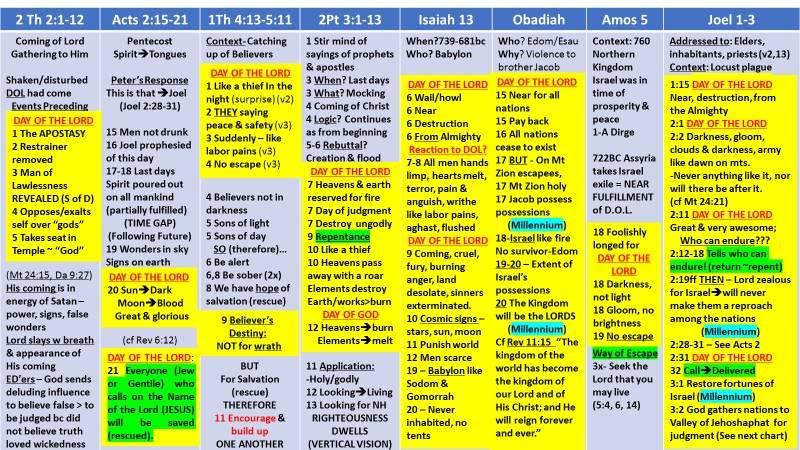
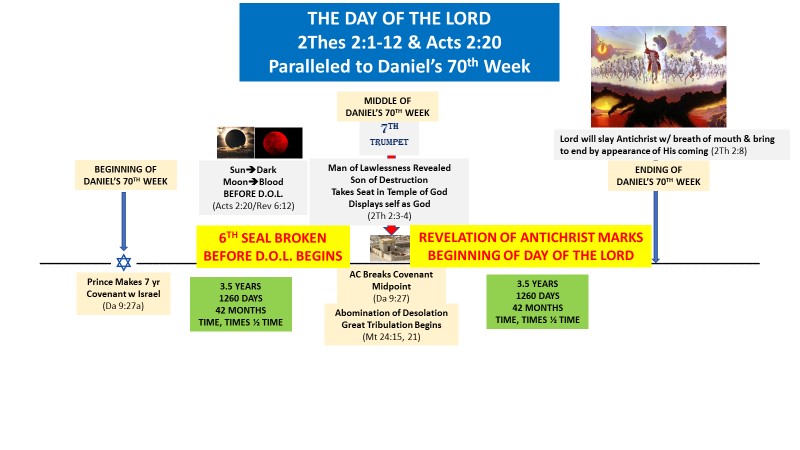
Even a cursory study indicates that this day is not a reference to a single 24 day but to an extended period of time as illustrated in the diagram which will be explained below (see also timeline at beginning of this page). Here is a partial listing of the truths about the Day of Yahweh from 8 books (4 NT, 4 OT) which is taken from a discussion I led on What the Bible Teaches about the Day of the LORD which can be found on my youtube channel -
CLICK TO ENLARGE
|
Heaven & earth |
||||
|
Pre-Tribulation |
The Seven Year "Tribulation" |
(2) Day of Lord extends through the Millennium 2 Pe 3:10 |
< Great White Throne Rev 21:1 |
|
|
(1a) Day of the Lord begins > |
Mid-Tribulation |
1000 Years |
New Heaven |
|
| 3.5 Years Synonymous times |
3.5 Years Synonymous times |
|||

You will read descriptions in some commentaries that state the Day of the Lord follows the rapture of the church (e.g., Dr John Walvoord, et al) (1a) ("pre-tribulation rapture"- see discussion of when the rapture occurs) (1Th 4:13-18-notes 1Th 4:13; 14; 15; 16; 17; 18), the event which most evangelicals feel immediately precedes the last seven years of Seventy Weeks of Daniel, these 7 years being popularly known as the Tribulation. It is notable that nowhere in Scripture is this 70th week of 7 years specifically designated "the Tribulation" (let me know if you find a passage that contradicts this conclusion - remember that "the Great Tribulation" only refers to the last 3.5 years of this seven year period). The alternative starting point for the Day of the Lord is in the Mid-Tribulation, at the time of the 7th Trumpet sounding (1b).
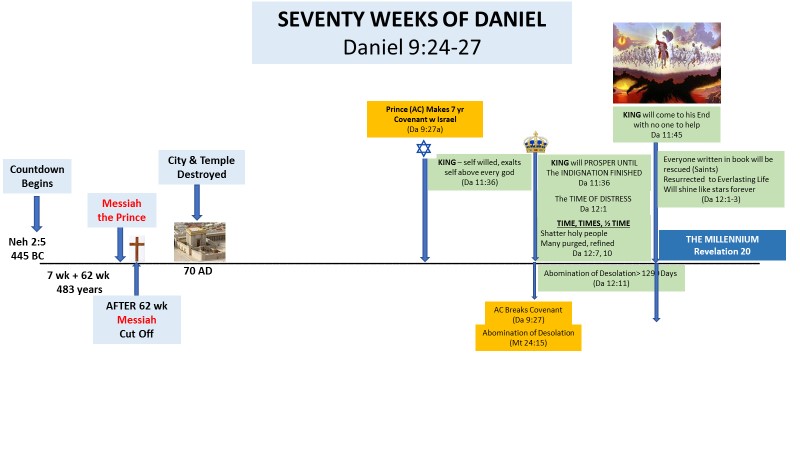
First, we must understand the basic timing of this last "Seven Year Period" (Daniel's Seventieth Week) which can be divided into two 3.5 year segments, a conclusion based upon study of Da 9:27 (see notes). Daniel records the following prophecy he received from the angel Gabriel in answer to fervent prayer…
And he (the Antichrist) will make a firm covenant with the many (the Jews/Israel) for one week (one seven year period), but in the middle of the week (after 3.5 years) he will put a stop to sacrifice and grain offering (in the rebuilt Jewish temple) and on the wing of abominations will come one who makes desolate, even until a complete destruction, one that is decreed, is poured out on the one who makes desolate." (Da 9:27)
The Lord Jesus quoted from Daniel 9 as He explained the timing of the events immediately preceding His triumphant return because He wanted the Jews (and all mankind) living during the tumultuous time of Daniel's Seventieth Week to have an easily identifiable event that would indubitably signal the beginning of the the Great Tribulation which represents the final outpouring of God's wrath during the last 3.5 years of the Seventieth Week of Daniel…
Therefore when you see the ABOMINATION OF DESOLATION (referring to the Antichrist or some desecrating action he makes) which was spoken of through Daniel the prophet (reference to Da 9:27, also in Daniel 11:31, Da 12:11 - see these depicted on the timeline below), standing in the holy place (this means the Jewish Temple will be rebuilt substantiated by Rev 11:1, 2 and 2 Th 2:3, 2 Th 2:4) (let the reader understand)…there will be a Great Tribulation, (Begins - Mt 24:15, and is named - Mt 24:21 and is a 3.5 year period synonymous with the Time of Jacob's Distress, described in Jeremiah 30:7, "a time of distress" - Da 12:1, "the indignation" - Da 11:36 - click synonyms describing the last 3.5 years of Daniel's 70th week) such as has not occurred since the beginning of the world until now, nor ever shall… but immediately after the tribulation (the Great Tribulation) of those days THE SUN WILL BE DARKENED, AND THE MOON WILL NOT GIVE ITS LIGHT, AND THE STARS WILL FALL from the sky, and the powers of the heavens will be shaken, and then the sign of the Son of Man will appear in the sky (Sign = the Lord returning on the clouds), and then all the tribes of the earth will mourn, and they will see the SON OF MAN COMING ON THE CLOUDS OF THE SKY with power and great glory. And He will send forth His angels with A GREAT TRUMPET and THEY WILL GATHER TOGETHER His elect from the four winds, from one end of the sky to the other." (Matthew 24:15-31-see in depth commentary)
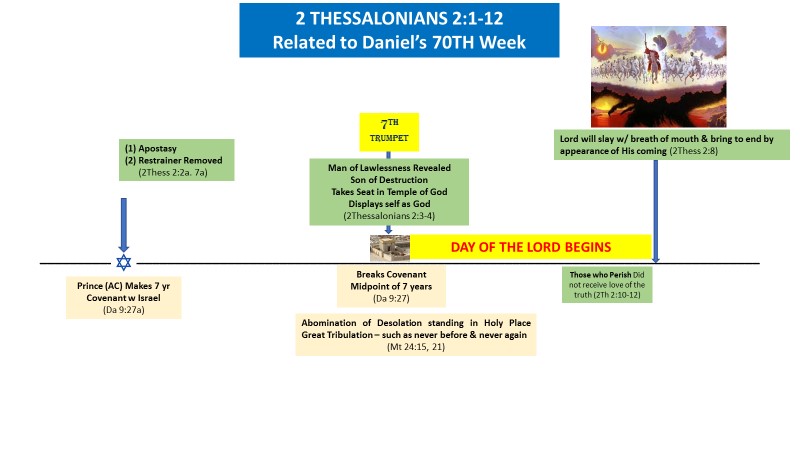
Now keeping in mind the timing of this dramatic event described by Daniel and Jesus, read Paul's second letter to the saints at Thessalonica where he addresses the false teaching that the persecution the Thessalonians were now experiencing was part of the great tribulation. He references the same crucial historical event as Daniel and Jesus in order to assure these fearful saints…
"Now we request (plead, implore, beg of) you, brethren, with regard to the coming (parousia) of our Lord Jesus Christ, and our gathering together to Him (Paul refers not to two events but one event - the rapture he had written about in 1 Th 4:13,14, 1Th 4:15,16; 1Th 4:17,18), that you may not be quickly shaken from your composure (literally "mind") or be disturbed (frightened) (false teaching about the Rapture and the Day of the Lord appears to have had a devastating impact on the Thessalonian saints) either by a spirit or a message or a letter as if from us, to the effect that the day of the Lord has come. Let no one in any way deceive you, for it will not come unless the apostasy (a very specific presumably identifiable time of rebellion against God) comes first, and the man of lawlessness (the Antichrist) is revealed (apokalupto = literally has the veil removed exposing to open view what he had before hidden regarding his evil character. The aorist tense points to a definite time, a specific historical event), the son of destruction (apoleia = ruin not annihilation), who opposes and exalts himself above every so-called god or object of worship, so that he takes his seat in the temple of God (which Jesus calls the "abomination of desolation" in Mt 24:15 as "standing in the holy place"), displaying himself as being God. Do you not remember that while I was still with you, I was telling you these things?" (2Th 2:1, 2 Th 2:2, 2 Th 2:3, 2 Th 2:4, 2 Th 2:5 - See timeline above)
When does Paul state that the Day of the Lord will begin? Here is the order
- The apostasy will occur - most take this as indicative of a spiritual falling away from the truth, but a few suggest this could refer to the "departure" at the rapture - interesting thought for sure.
- The "restrainer" will be removed (2Th 2:7)
- The man of lawlessness (the son of destruction) is revealed
- He takes his seat in the temple of God, displaying himself as being God.
In short all of these things must take place before the Day of the LORD. So, while many favor the Day of the Lord beginning at point (1a) in the above diagram (after a pre-tribulation rapture), when one compares Scripture with Scripture, there is more support for considering the beginning of the Day of the Lord at the midpoint of the 7 Year period of Daniel (1b), also corresponding to the time of the sounding of the 7th Trumpet. There is no definitive Scripture support (as far as I am aware) for stating the Day of the Lord begins after the Rapture. It sounds reasonable, but is it Scriptural? The other Scripture that would tend to support the mid-tribulation timing (1b) is Peter's quote from Joel's prophecy stating that ‘THE SUN WILL BE TURNED INTO DARKNESS AND THE MOON INTO BLOOD, BEFORE THE GREAT AND GLORIOUS DAY OF THE LORD SHALL COME." (Acts 2:20). On the second timeline below Joel's description correlates with John's description of the breaking of the 6th Seal in Revelation 6:12. Specifically, John records cosmic signs similar to those prophesied by Joel writing "I looked when He broke the sixth seal, and there was a great earthquake; and the sun became black as sackcloth made of hair, and the whole moon became like blood." If indeed John is describing similar cosmic signs as quoted by Peter in Acts, this supports that the beginning of the Day of the Lord is most likely after the revealing of the Antichrist at the midpoint of the 7 years.
- Summary taken from original 17 page article - THE PROPHET'S WATCHWORD: DAY OF THE LORD
Mayhue argues that the “Day of the Lord” (DOL) is one of the Bible’s major prophetic themes and that a right understanding of it is essential for interpreting both Old Testament prophecy and New Testament eschatology. Its main thesis is that the Day of the Lord is not a rigid technical term for one single event only, but a prophetic expression that can refer either to near historical acts of divine judgment or to the ultimate eschatological judgment at the end of the age. In other words, the prophets often saw God’s future interventions in history as belonging to one recurring pattern: a historical, partial, preliminary “day of the Lord” could foreshadow and guarantee the final, climactic Day of the Lord. The article therefore seeks to resolve major tensions in the biblical data: whether DOL is historical or future, brief or extended, judgment only or judgment followed by blessing, and whether it concerns Israel, the nations, or both.
Mayhue begins by showing why the subject is difficult. Some texts connect DOL with historical disasters already fulfilled in Israel’s history, while others plainly point to the end of the age. Some passages emphasize devastation and wrath, while others stand near promises of restoration, kingdom blessing, and peace. This has led interpreters to sharply different conclusions: some say DOL is always eschatological; others say context alone determines its meaning; some limit it to a single day; others stretch it over a long period; some make judgment its sole content, while others see blessing as intrinsic to it. The article’s burden is to show that these tensions are resolved once one recognizes that the prophets often speak of multiple divine judgments that share the same theological pattern, with the final eschatological Day of the Lord being the greatest and fullest expression of that pattern.
The Old Testament survey is the heart of the article. In Obadiah, the author argues that the prophecy begins with a near historical judgment on Edom but then broadens to include all nations and finally moves toward the establishment of God’s kingdom. Thus Obadiah presents a near/far structure: Edom’s fall is an initial embodiment of DOL, but the larger and ultimate fulfillment looks beyond Edom to worldwide judgment and the Lord’s reign. In Joel, the prophet starts with the locust plague as a real historical disaster, then uses that devastation as a picture of a more severe invading army and finally expands to an eschatological horizon involving cosmic signs, worldwide judgment, repentance, the outpouring of the Spirit, and restoration. Joel is especially important because it shows how a present calamity can be a preview, harbinger, and guarantee of the final day. In Amos, however, the emphasis is narrower: Israel wrongly expected DOL to mean prosperity and vindication, but Amos reverses that expectation and declares that for sinful Israel it will mean darkness, not light. Here DOL refers primarily to the coming Assyrian judgment on the northern kingdom, not directly to the end of the age.
In Isaiah, the pattern becomes more developed. Isaiah 2 looks beyond the present to the future universal humiliation of the proud and the manifestation of God’s majesty just before the establishment of His kingdom. Isaiah 13 similarly combines a near judgment on Babylon with language that seems too cosmic and universal to be exhausted by that historical event alone, suggesting again that the historical judgment is set against the backdrop of the final eschatological one. Zephaniah follows the same basic model: Judah’s near judgment is in view, yet the language also expands outward to a worldwide catastrophe in which the whole earth is swept in divine wrath, after which a redeemed remnant emerges and blessing follows. Ezekiel is somewhat different in that he is writing during the historical judgment itself, especially with reference to Jerusalem’s destruction and later Egypt’s downfall; thus his use of DOL is more anchored in the near, present, historical sense, though the principle of divine judgment on the nations remains. Zechariah, as a post-exilic prophet, is entirely future-looking in this respect, since the Assyrian and Babylonian judgments are already past. His DOL passage in Zechariah 14 points to the final intervention of God on behalf of Israel, the defeat of the nations, and the establishment of Messiah’s reign. Malachi likewise speaks of the “great and terrible day” as an eschatological day of fiery judgment.
judgment is the central and
defining feature of the Day of the Lord.
One of Mayhue's most important conclusions is that judgment is the central and defining feature of the Day of the Lord. The blessings often associated with DOL in the prophets are not, strictly speaking, part of the day itself but are chronologically consequent upon it. That is, DOL is the period when God acts as righteous Judge to punish sin, overthrow rebellion, and vindicate His holiness; the restoration, peace, and kingdom blessings come after that judicial intervention. The author pushes back against the idea that DOL is equally a “day of blessing.” Rather, it is a day of wrath whose aftermath leads to blessing. This distinction matters because it preserves the overwhelmingly judicial tone of the phrase across the prophetic literature. Even when salvation and restoration appear in the same context, they arise on the far side of judgment.
Another key point is that the prophets speak of DOL with a strong sense of imminence, even when the fulfillment may be historically distant from the prophet himself. “Nearness” does not always mean immediate fulfillment in a modern chronological sense; rather, it expresses the certainty and pressing reality of God’s coming intervention. Thus some DOL prophecies were fulfilled in judgments such as the fall of Samaria, the Assyrian invasion of Judah, the Babylonian exile, Egypt’s downfall, or Edom’s demise, while others await the final tribulational and end-time consummation. Mayhue therefore proposes that DOL is generic in prophetic usage: not generic in the sense of vague or empty, but in the sense that it describes a recurring divine pattern of judgment that appears in multiple historical acts and culminates in one final eschatological outpouring. Historical judgments are real “days of the Lord,” but they are partial anticipations of the climactic day.
Mayhue’s final theological payoff is its contribution to New Testament interpretation. Since the NT writers inherit their understanding of DOL from the OT prophets, the author argues that NT references should also be read against this near/far prophetic pattern. He suggests that there remain two future Day of the Lord judgments still to be fulfilled: first, the judgment that climaxes the tribulation, and second, the final cosmic destruction associated with the passing away of the present heavens and earth before the new creation. He rejects definitions that stretch DOL across the entire tribulation plus millennium, or from the second coming all the way through the millennium, and instead argues that DOL occurs as a climactic judgment point, not as a long blanket term covering all end-time events. In this way, the OT study is used to refine dispensational formulations and to strengthen a premillennial, pretribulational reading of the NT.
In sum, Mayhue presents the Day of the Lord as a prophetic pattern of divine intervention in judgment, seen first in historical acts against Israel and the nations and finally in the end-time outpouring of God’s wrath before His kingdom blessing is fully manifested. The prophets often speak in a way that blends near and far horizons, so that one event becomes a foreshadowing of another. Historical judgments are therefore not the full Day in its final sense, but they are genuine installments of the same divine reality. The article’s central insight is that the Day of the Lord is best understood neither as a single isolated event nor as a vague label for any disaster whatever, but as a theologically unified pattern of God’s judicial visitation in history that reaches its consummation in the eschatological future.
Peter using the same term as Paul, says that…
the day of the Lord will come like a thief, in which the heavens will pass away with a roar and the elements will be destroyed with intense heat, and the earth and its works will be burned up. (See point 2 on the timeline above)
The question naturally follows "When will the heavens pass away?" Clearly there is no indication that the heavens pass away during the "Great Tribulation" which follows the full revelation of the Antichrist in the Jewish Temple in Jerusalem. Again comparing Scripture with Scripture, we read that following the defeat of the Antichrist at the return of Christ (read Revelation 19:1ff) there is a 1000 year period (I believe John clearly meant a literal 1000 years when he was inspired by the Holy Spirit - if it doesn't mean 1000, one could make it mean almost anything he wanted and it would be "meaningless" and yet it is used 4 times in the passages that follow!) in which Christ reigns on earth, John testifying…
And I saw thrones, and they sat upon them, and judgment was given to them. And I saw the souls of those who had been beheaded because of the testimony of Jesus and because of the word of God, and those who had not worshiped the beast or his image, and had not received the mark upon their forehead and upon their hand; and they came to life and reigned with Christ for a thousand years. The rest of the dead did not come to life until the thousand years were completed. This is the first resurrection. Blessed and holy is the one who has a part in the first resurrection; over these the second death has no power, but they will be priests of God and of Christ and will reign with Him for a thousand years. And when the thousand years are completed, Satan will be released from his prison, and will come out to deceive the nations which are in the four corners of the earth (indicating that Christ and His saints are on earth for a specific 1000 year period), Gog and Magog, to gather them together for the war; the number of them is like the sand of the seashore. And they came up on the broad plain of the earth and surrounded the camp of the saints and the beloved city, and fire came down from heaven and devoured them. And the devil who deceived them was thrown into the lake of fire and brimstone, where the beast and the false prophet are also; and they will be tormented day and night forever and ever." (see notes Revelation 20:4; 20:5; 20:6; 20:7; 20:8; 20:9; 20:10)
In the next event which John describes we see a clear parallel with 2 Peter 3:10. John testifies…
And I saw a great white throne and Him who sat upon it, from whose presence earth and heaven fled away, and no place was found for them. (Revelation 20:11)
John MacArthur commenting on presence earth and heaven fled away writes…
That amazing, incredible statement describes the “uncreation” of the universe. The earth will have been reshaped by the devastating judgments of the Tribulation and restored during the millennial kingdom. Yet it will still be tainted with sin and subject to the effects of the Fall—decay and death; hence it must be destroyed, since nothing corrupted by sin will be permitted to exist in the eternal state ("But according to His promise we are looking for new heavens and a new earth, in which righteousness dwells" 2 Pe 3:13-see note). God will in its place create “a new heaven and a new earth; for the first heaven and the first earth passed away” (John writes "And I saw a new heaven and a new earth; for the first heaven and the first earth passed away, and there is no longer any sea." Re 21:1 ) The present earth and heaven will not merely be moved or reshaped, since John saw in his vision that no place was found for them. They will be uncreated and go totally out of existence. This is nothing less than the sudden, violent termination of the universe (Macarthur J. Revelation 1-11. and Revelation 12-22. Moody)
One can conclude that both Peter and John are describing the time period, the day which Peter refers to as the Day of the Lord. And yet we know that the Day of the Lord has already commenced at the beginning or the midpoint of the Seven Year Tribulation (as discussed above) following the revelation of the Antichrist, who is defeated by Christ at His return at which time He establishes His 1000 year Kingdom on an earth, after which Peter says the earth which will pass away in the Day of the Lord. It therefore is reasonable to conclude that the Day of the Lord is not a single day but is an extended period beginning at the middle of the Tribulation and including the Second Coming of Christ to set up His 1000 year earthly kingdom and terminating in the total destruction of the present heaven and earth as described by Peter and John. Others do not agree that the Millennium is a component of the Day of the Lord. (See also discussion below).
Related Resource:
- Millennium 2 - summary discussion of the sequential (chronological) events which lead up to the establishment of the Millennial Kingdom of God ruled by Christ, the King of kings.
Some writers (e.g., John MacArthur) feel the Day of the Lord described in 2 Peter 3:10 is a second stage of that Day and that the Day of the Lord does not include the Millennial reign of Christ. In other words these writers see the Day of the Lord as ONLY a time of doom and gloom. However even one writer, Richard Mayhue, who interprets the day of the Lord as 2 stages (Tribulation time and End of Millennium - BOTH days of doom and gloom), seems to contradict his own interpretation in writing the following description regarding the Day of the Lord
"Most passages speak of God's judgments, but some are tied closely to God's blessing (Zech 14:1-21)."
It seems that the glorious truths in Zechariah 14 force Mayhue to admit that there is a positive aspect to the Day of the Lord. And what does Zechariah 14 describe? Among other things Zechariah 14:20 says "In that DAY there will be inscribed on the bells of the horses, "HOLY TO THE LORD." It describes the blessed time of the Millennium, which would support the premise that the Day of the Lord is a prolonged period which includes the Millennium and ends with the final Day of the Lord in 2 Peter 3:10. The following discussion has numerous quotes that support the premise that the Day of the Lord is an extended period of time which includes the time of the Millennium.
Here is an excerpt from Gotquestions on What is the Day of the Lord? -
One key to understanding these phrases is to note that they always identify a span of time during which God personally intervenes in history, directly or indirectly, to accomplish some specific aspect of His plan. Most people associate the day of the Lord with a period of time or a special day that will occur when God’s will and purpose for His world and for mankind will be fulfilled. Some scholars believe that the day of the Lord will be a longer period of time than a single day—a period of time when Christ will reign throughout the world before He cleanses heaven and earth in preparation for the eternal state of all mankind. Other scholars believe the day of the Lord will be an instantaneous event when Christ returns to earth to redeem His faithful believers and send unbelievers to eternal damnation....
Besides being a time of judgment, it will also be a time of salvation as God will deliver the remnant of Israel, fulfilling His promise that “all of Israel will be saved” (Romans 11:26), forgiving their sins and restoring His chosen people to the land He promised to Abraham (Isaiah 10:27; Jeremiah 30:19-31, 40; Micah 4; Zechariah 13). The final outcome of the day of the Lord will be that “the arrogance of man will be brought low and the pride of men humbled; the Lord alone will be exalted in that day” (Isaiah 2:17). The ultimate or final fulfillment of the prophecies concerning the day of the Lord will come at the end of history when God, with wondrous power, will punish evil and fulfill all His promises (ED: ESPECIALLY THE BLESSINGS PROMISED TO THE NATION OF ISRAEL).
John MacArthur commenting on 2 Peter 3:10 says "In Scripture the day of the Lord signifies the extraordinary, miraculous interventions of God in human history for the purpose of judgment, culminating in His final judgment of the wicked on earth and the destruction of the present universe." However, in my humble opinion, I do not think this description is entirely accurate, because this day also has a glorious side to it as described below (and to which even MacArthur seems to agree as noted in the quote below).
John MacArthur in his sermon on Zechariah 14 seems to contradict his own belief that the Millennium is not part of the Day of the Lord writing (specifically regarding Zech 14:8) "And I think it’s a picture, too, of how blessing is going to flow. Jerusalem will become the center of the world and blessing will just flow in all directions. What an incredible time. So we see the coming of the DAY OF THE LORD. (ED: THIS DOES NOT SOUND LIKE THIS DAY IS SOLELY A DAY OF DOOM AND GLOOM!) Now very rapidly the rest of the chapter will flow. Are you ready?...Zech 14:9 begins the crowning of the Lord as King. We’ve seen the coming of the day of the Lord, now the crowning of the Lord as King. The first thing that happens when He arrives, He’s going to have a coronation. Verse 9, “And the LORD shall be King over all the earth. IN THAT DAY shall there be one LORD and His name one.” Listen, the Lord is not only going to be the King in heaven, but IN THAT DAY He’s going to be the King on earth. He will not be King de jure, that is by right, but He will be King de facto, that is in fact. This is a promised reality. The King is coming. And He is going to be King. And IN THAT DAY, it says, He’ll be King – now watch this – “And there will be one LORD and His name one.” Do you know how many religions there will be in the world in the kingdom? One – that’s all. Just one. Anybody who begins to start another one will be dealt with by the rod of iron with which Christ rules, read Revelation 19. The worldwide monotheism, one religion, all of the systems of Satan are over. And the absolutely unique and incomparable one God, the only wise God and our Savior, the Lord Jesus Christ, the Word made flesh, Him and Him alone will the world worship. And so IN THAT DAY there will be one Lord and His name will be one."
So in his sermon MacArthur certainly sounds like he sees the Day of the Lord as not just doom and gloom but blessing and glory.
Again John MacArthur alludes to a time of blessing associated with the Day of the Lord in his sermon "The Invisible Kingdom of God, Part 2" - Joel begins at the very outset of his prophecy with identifying this event, Jeol 1:15, “Alas for the day, for the day of the Lord is near and it will come as destruction from the Almighty.” The coming of the King was the day of the Lord. The day of the Lord is always associated with judgment, maximum judgment, a final kind of judgment. There are days of the Lord in the Old Testament, days when God stepped in with great judgment, BUT there is a culminating eschatological final day of the Lord which Joel has in view here. This will be destruction from the Almighty. He will come to destroy His enemies and the ungodly. At the same time, it will be a time of salvation, it will be a time of blessing for the righteous. If you go to the end of his prophecy, Joel 3:18, “It will come about in that day … that day of the Lord … the mountains will drip with sweet wine and the hills will flow with milk and all the brooks of Judah will flow with water and a spring will go out from the house of the Lord to water the valley of Shittim.” In other words, it’s going to be a time of immense blessing. (ED: SO THE QUESTION I WOULD ASK DR MACARTHUR IS "WHEN DID YOU SAY THAT TIME OF BLESSING WOULD OCCUR? AND IF I AM READING HIM CORRECTLY, HE STATES THAT IT IS IN THAT DAY OF THE LORD! WHEN IS THIS BLESSING REALIZED? THE MILLENNIUM. IT WOULD SEEM TO FOLLOW THAT THE TIME OF THE MILLENNIUM IS THE GLORIOUS ASPECT OF THE DAY OF THE LORD.)
Look at Isaiah's description of the Day of the Lord. Isaiah 13:9 certainly begins with doom and gloom writing "Behold, the day of the LORD is coming, Cruel, with fury and burning anger, To make the land a desolation; And He will exterminate its sinners from it." The description continues and seems at first to cease in Isaiah 13:22, as indicated by a chapter break (we know these breaks are not inspired) followed by the description in Isaiah 14:1 "When the LORD will have compassion on Jacob, and again choose Israel, and settle them in their own land, then strangers will join them and attach themselves to the house of Jacob." When is "when"? Clearly that is the Millennium and it flows in context from the preceding description of doom and gloom. So again we see the pattern of a day of doom and gloom progressing to a day of blessing and glory.
We see a similar pattern of doom and gloom morphing (so to speak) to blessing and glory in Joel. And so in Joel 3:14-18 we read "Multitudes, multitudes in the valley of decision! For the day of the LORD is near in the valley of decision. 15 The sun and moon grow dark and the stars lose their brightness. 16 The LORD roars from Zion And utters His voice from Jerusalem, And the heavens and the earth tremble. But the LORD is a refuge for His people and a stronghold to the sons of Israel. 17 Then you will know that I am the LORD your God, Dwelling in Zion, My holy mountain. So Jerusalem will be holy, And strangers will pass through it no more. 18 (NOTE THIS IS CLEARLY CONNECTED WITH THE PRECEDING "DAY") And in that day The mountains will drip with sweet wine, And the hills will flow with milk, And all the brooks of Judah will flow with water; And a spring will go out from the house of the LORD To water the valley of Shittim."
Joel 3:18 says "in that day" which begs the question what "day?" In context, Joel has been describing the Day of the LORD, the doom and gloom aspect of that DAY, but then he proceeds to describe the blessing and glory aspect of that DAY. This passage seems to clearly support the premise that the Day of the LORD includes the time of the blessings on Israel during the Millennium when water flows from the house of the LORD.
The Day of Yahweh is not only a day of judgment on the unrighteous
but is also a day of deliverance and blessing on the righteous.
Irwin Busenitz (who is associated with John MacArthur) on Joel 3:18 - The temporal phrase in that day introduces the final section of the prophecy, linking it with the preceding verses. The Day of Yahweh is not only a day of judgment on the unrighteous but is also a day of deliverance and blessing on the righteous. Both aspects of this theme are reiterated in these final verses. After the emphatic and universal judgment has been executed upon the heathen, the prophet summarizes the blessings which will flow from the throne of God and which will overflow the land of Israel (cf. Isa 4:2). (Mentor Commentary on Joel and Obadiah - recommended)
J Vernon McGee agrees writing (on Joel 3:18) "And it shall come to pass in that day" -- that is, the Day of the Lord. "The mountains shall drop down new wine" -- this is in the time of the Kingdom." (ED: That sounds like the blessing and glory component of the Day of the LORD!)
Thomas Constable commenting on Joel 3:18 writes "Joel continued to describe the future day of the Lord, but now he passed from the judgments of the Tribulation to the blessings of the Millennium."
Holman Study Bible: NKJV Edition on Joel 3:18-21 comments that "Joel summarized the result of the day of the Lord. The land of Israel will have miraculous fertility and fruitfulness. Traditional enemies will be punished. Yahweh will dwell with His people, and they will receive pardon for their sins."
ESV Study Bible on Joel 3:18 says "in that day. I.e., the day of the Lord." (ED: So clearly the implication is that the ESV note sees the description that follows in Joel 3:18 to be a component of the Day of the Lord.)
Michael Vlach - Joel 3:20 indicates that as a result of the day of the Lord (Joel 3:18) “Judah will be inhabited forever, and Jerusalem from generation to generation” (HCSB). In Zephaniah 3:20 God promises again to “restore” the “fortunes” of Israel (HCSB). (ED: THAT HARDLY SOUNDS LIKE JUST DOOM AND GLOOM WHICH IS THE PRIMARY DESCRIPTION OF THE DAY OF THE LORD OF A NUMBER OF WRITERS!) When examining these and other restoration texts in the Bible, certain truths emerge: (1) the restoration of Israel involves both spiritual salvation and physical blessings including possession of the land of promise; (2) the promise of restoration is not based on Israel’s greatness but on God’s choice and God’s character; and (3) the promise for restoration takes place after the period of Israel’s disobedience. As the passages above and many others indicate, the restoration of Israel is a major theme in the Old Testament. It is an explicit doctrine. (Christ's Prophetic Plans)
Steven Scherrer - The prophet Joel predicts the day of the Lord, a day of destruction and judgment, but afterward a time of salvation for the faithful remnant of his people. On that day “the sun and the moon are darkened, and the stars withdraw their shining” (Joel 3:15). “The sun shall be turn to darkness, and the moon to blood, before the great and terrible day of the Lord comes” (Joel 2:31). But finally God’s salvation shall appear, and there will be great blessings on earth, until “the mountains shall drip sweet wine, and the hills shall flow with milk” (Joel 3:18). This is what we are longing for now, the second and glorious coming of Jesus Christ on earth and the renewal of the world. (Daily Biblical Sermons)
Warren Wiersbe writes on Joel 3:18-21 - As Joel preached, the people could see the dry fields, the starving cattle, and the empty barns. They could see and hear the locusts as they ravaged the country. But Joel is picturing a time when wine, milk, and water shall flow in ceaseless measure in the land. This is, of course, the kingdom age when Jesus Christ shall sit on David's throne in Jerusalem, and when the land shall be healed and the blessing of God restored. The nation will be cleansed, and God shall dwell in Zion. This reminds us of Ezekiel's final words: "And the name of the city from that day shall be, THE LORD IS THERE." (Wiersbe's Expository Outlines on the Old Testament.)
Michael Bentley on Joel 3:18 - This verse starts with the phrase ‘In that day’. This is the same period of time that we find at Joel 3:1—‘In those days and at that time’. The prophet continued to outline the blessings of being restored to the Lord’s favour. Just as two lovers may suddenly experience a rekindling of the joy of their first love (but see Rev. 2:4), so God’s people would know the return of all past favour—except that, this time, these gifts would be ‘pressed down … and running over’ (see Luke 6:38). ‘In that day’, bountiful harvests would again be given; in fact, on the great day of the Lord there will be a triumphal time of harvest. We have already seen in Joel 3:13 that the harvest of the wicked will be all-encompassing so that no one will escape. (Opening Up Joel)
Trent Butler on Joel 3:18 - When this promise of the final Day of the Lord reaches fulfillment, the entire situation will be turned on its heels. The Day of the Lord will be a day of total reversal. No more complaints about locusts and droughts and armies destroying the crops. Vineyards on the mountainsides will drip new wine (Joel 1:10). Animals threatened with extinction by the drought and lack of pastures (Joel 1:18) will now produce so much milk that it will literally flow down the hills. Dried-up streams (cp. Joel 1:20, where the same word is used as ravines in Joel 3:18) will now run with water. (Hosea, Joel, Amos, Obadiah, Jonah, Micah)
Thomas J Finley on Joel 3:18 - The Hebrew prophets used the phrase וְהָיָה בַיּוֹם הַהוּא (wĕhāyâ bayyôm hahûʾ, “and it will happen in that day”) to mark off a new section, as here in Joel 3:18. As is so often the case in predictive portions of the OT, “that day” refers to the general events surrounding the day of the Lord. Judgment of the nations and deliverance for Israel do not exhaust God’s purposes. He has planned a new blessing for the land that will be unsurpassed, even beyond the splendor of the kingdom of David and Solomon. (Joel, Amos, Obadiah Commentary)
Hans Wolff on Joel 3:18 - The conception of the Day of Yahweh as a day of judgment on the nations and a day of deliverance for Israel (4:1–3*, 9–17*) is thus supplemented by the paradisal motif. (Joel and Amos: A Commentary)
Leander Keck - The day of the Lord will bring not only the destruction of God’s enemies and the rescue of repentant Jerusalem and Judah, but it will also usher in a paradisiacal existence for the faithful. Borrowing partially on the thought of Amos 9:13, Joel picks up themes from the first chapter of his book and portrays their reversal. Once the sweet wine was cut off (Joel 1:5); now the mountains with their vineyards will yield wine in abundance (Joel 3:18). Previously there was no milk from the cattle, because they had no pasture (Joel 1:18); now the rich grasslands on the hills will furnish an ample supply. During the drought, there was no water anywhere (Joel 1:17–20); in God’s future, the rivers and wadis of Judah will flow full all year round. Once again, borrowing an earlier prophetic theme, a fountain will flow forth from the Temple and water even the Valley of Shittim (Ezek 47:1–12; cf. Ps 46:4; Zech 14:8; Rev 22:1–2)—a symbol of the life-giving power of God’s presence (cf. Ps 36:8; Isa 33:21). (New Interpreter's Bible)
Walter Kaiser in a discussion entitled God’s Blessing as the Day of the Lord Climaxes—Joel 3:18–21 - The day of the Lord in this section is also called “in that day” (Joel 3:18). This is not unusual, for the Hebrew prophets often used the expression “in that day” instead of the full title “the day of the Lord.” In fact, this shortened form appeared so frequently, that no other modifiers were needed for the prophet’s audience, for the pointing to a particular day meant a time when God would act in judgment and blessing, depending on the state of the receiver. Just as there were four reasons for divine judgment on the nations in the previous section, so this final section of the prophet Joel describes four blessings God is to pour out on the covenant people (Joel 3:18–21). These are the blessings: 1. the healing of the land of Israel (3:18), 2. the punishment of all of Israel’s enemies (3:19), 3. the designation of the land to Israel for all times to come (3:20), and 4. the pardon of Israel and the dwelling of God in the land (3:21)....The prophet Zechariah predicts a time when all Israel will look on the One they had pierced, and the result will be a deep mourning for what they had missed (Zech. 12:10; Rev. 1:7). Yes, “on that day a fountain will be opened to the house of David and the inhabitants of Jerusalem, to cleanse them from sin and impurity” (Zech. 13:1). With this cleansing and repentance, the golden age of Messiah’s reign will arrive. And “the LORD [will dwell] in Zion” (Joel 3:21). (Preaching and Teaching the Last Things)
Cornerstone Bible Commentary on Joel 3:18 in that day - This is a familiar prophetic formula used to introduce details relative to the eschatological future (e.g., Isa 24:21; 26:1; 27:1; Jer 30:8; Amos 9:11; Mic 4:6; Zeph 3:16; Zech 14:4).....Joel ends his prophecy on a high note. He predicts that the environment where God’s future people will live will be marked by superabundant fertility. All that had been lost in the locust plague will, as God promised (2:18–27), be restored in effusive quantity. The landscape will flourish again; the streams and even the dry wadis will flow freely, bringing life and health to the land and all its inhabitants. Jerusalem’s underground water sources will also gush forth, bringing refreshing vitality to ground that has long been parched with aridity. Even the Dead Sea will come alive and be rejuvenated by the fresh waters of Jerusalem’s Temple Mount (see note on 3:18).
Duane Garrett writes on Joel 3:18 - “In that day” refers to the day of the Lord (cf. Hos 2:16,18,21; Amos 8:9,13; 9:11). As in Joel 1:5 “new wine” symbolizes not mere sufficiency but abundance. The promise that all the ravines would flow with water no doubt gave hope to a people who had seen their land parched with drought (Joel 1:12,17). (The New American Commentary)
The Open Bible on Joel - This brief book develops the crucial theme of the coming day of the Lord (Joel 1:15; 2:1, 2, 11, 31; 3:14, 18). It is a time of awesome judgment upon people and nations that have rebelled against God. But it is also a time of future blessing upon those who have trusted in Him.
See the discussion below by Dr Tony Garland who also favors the Day of the Lord as including the time of the millennial reign of Christ.
I could quote other conservative sources which make similar comments. The upshot is that while one might say there are 2 stages of the Day of the Lord (Tribulation and End of Millennium), it is just as reasonable and Scripturally supportable to say that the Day of the Lord is a prolonged period when God intervenes in human history and this includes His establishment of His glorious Millennial Kingdom.
Summarizing some of the descriptions in the OT/NT references (see the chart above which records many of these descriptions), we see that this Day is
coming, cruel, with fury and burning anger, to make the land a desolation; and He will exterminate its sinners from it" (Isaiah 13:9), "a day of vengeance, so as to avenge Himself on His foes… a slaughter for the Lord GOD of hosts" (Jeremiah 46:10), "a day of clouds, a time of doom for the nations" (Ezekiel 30:3), "near, and it will come as destruction from the Almighty" (Joel 1:15), "surely it is near" (Joel 2:1), "great and very awesome, and who can endure it?" (Joel 2:11), "the great and awesome day" (Joel 2:31), "near in the valley of decision" (Joel 3:14), "It will be darkness and not light" (Amos 5:18), "even gloom with no brightness in it" (Amos 5:20), "(a day when) your dealings will return on your own head" (Obadiah 1:15), "near and coming very quickly… in it the warrior cries out bitterly, a day of wrath is that day, a day of trouble and distress, a day of destruction and desolation, a day of darkness and gloom, a day of clouds and thick darkness" (Zephaniah 1:14,15), "the day of the LORD'S wrath and all the earth will be devoured In the fire of His jealousy, for He will make a complete end, Indeed a terrifying one, of all the inhabitants of the earth" (Zephaniah 1:18), "the day of the LORD'S anger" (Zephaniah 2:2), "His coming… is like a refiner's fire and like fullers' soap" (Malachi 3:2), "the great and terrible day" (Malachi 4:5), "will come just like a thief in the night" (1 Thessalonians 5:2, 2Pe 3:10).
Notice that the Day of the Lord is frequently associated with seismic disturbances (Joel 2:1, 2, 3, 4, 5, 6, 7, 8, 9, 10,11; 2:31; 3:16), violent weather (Ezekiel 13:5, 5, 7f), clouds and thick darkness (Joel 2:2; Zeph 1:7, 8, 9f.), cosmic upheaval (Joel 2:3,30) Joel tells us that as a result of the Day of the Lord there will also be physical blessings, fruitfulness, and prosperity (Joel 2:21, 22, 23f.; 3:16, 17, 18, 19, 20, 21). In short the Day of the Lord results in judgment poured out upon sinners that is following by blessings on the penitent, even as the night precedes the day in the first day in Genesis 1:19. Some of the blessings of the Day of the Lord for the nation of Israel include God's promise of the Land to Abraham, Isaac and Jacob, this fulfillment being consummated in the Millennial Kingdom on earth. To do away with the "millennium" as many do is to make it impossible for God to fulfill His Covenant with the remnant of believing Israel. Sadly this is the teaching that an appreciable number of evangelicals are espousing (While I cannot substantiate it Dave Guzik makes this incredible statement - "80%-85% of all Christians in the world belong to churches that teach Replacement Theology." Incredible!!!), proposing the false teaching that God is finished with the nation of Israel and replaced Israel with the Church (yes, I believe this is a false teaching - you can get angry with me if you want, but my literal reading of the Bible does not support this teaching and refutes it in many passages). If you are one who holds to the teaching that God has "jettisoned" the nation of Israel, you might want to take 3 hours and review some of the "rotten fruit" of replacement theology over the last 2000+ years. Below are 3 excellent presentations on this topic.
To motivate you to listen to the presentations below here is an excerpt from Wikipedia entitled Martin Luther and Anti-Semitism:
In a paragraph from his On the Jews and Their Lies he deplores Christendom's failure to expel them.[1] Moreover, he proposed "What shall we Christians do with this rejected and condemned people, the Jews (ED: THAT SOUNDS LIKE "REPLACEMENT THEOLOGY" TO ME!)":[1]
- "First, to set fire to their synagogues or schools ... This is to be done in honor of our Lord and of Christendom, so that God might see that we are Christians ..."
- "Second, I advise that their houses also be razed and destroyed."
- "Third, I advise that all their prayer books and Talmudic writings, in which such idolatry, lies, cursing, and blasphemy are taught, be taken from them."
- "Fourth, I advise that their rabbis be forbidden to teach henceforth on pain of loss of life and limb ..."
- "Fifth, I advise that safe-conduct on the highways be abolished completely for the Jews. For they have no business in the countryside ..."
- "Sixth, I advise that usury be prohibited to them, and that all cash and treasure of silver and gold be taken from them ..."
- "Seventh, I recommend putting a flail, an ax, a hoe, a spade, a distaff, or a spindle into the hands of young, strong Jews and Jewesses and letting them earn their bread in the sweat of their brow ... But if we are afraid that they might harm us or our wives, children, servants, cattle, etc., ... then let us emulate the common sense of other nations such as France, Spain, Bohemia, etc., ... then eject them forever from the country ..."
(ED: Here are a few MORE QUOTES FROM LUTHER'S WORK "The Jews & Their Lies". Did anyone listen to Luther's instructions? You be the judge. See what the Nazis did to the Jews on November 9-10, 1938, etched in infamy as Kristallnacht!)
Here are 3 presentations chronicling the history and legacy of Replacement Theology:
- https://slbc.org/sermon/
replacement-theology-what-we- should-know/ - Gabe Morris - https://slbc.org/sermon/
replacement-theology-what-we- should-know-part-2/ - Gabe Morris - https://slbc.org/sermon/evils-
of-replacement-theology/ - Dr David Reagan
The preceding Scriptures on the Day of the Lord are only a sampling of descriptions, beloved. This Day will be so awful that men's hands will hang limp, they will writhe like women in pain, their faces will be red hot because of what is happening. The final day of the Day of the Lord (2Pe 3:10) is the day when the wrath of God inextricably exterminates sinners and sin from the heavens and earth in preparation for the new heavens and new earth.
A frequently found phrase throughout Scripture related to this time of trouble is the Day of the Lord (Isa. 2:10-22; 13:6, 9; Jer. 46:2, 10; Eze. 13:5, 9, 14, 21, 23; 30:3-6, 8, 19, 25-26; Dan. 9:1-27; Joel 1:15; 2:1, 11, 31; 3:14; Amos 5:18, 20; Ob. 1:15; Zep. 1:7, 14; Zec. 14:1; Mal. 4:5; Acts 2:20; 1Th. 5:2; 2Pe. 3:10). This particular day is seen to be so unique and significant that it is also referred to as simply, that day (Isa. 2:11, 17; 2:20; 4:2; Joel 3:18; Mark 13:32; Luke 21:34; 2Ti. 1:12, 18; 4:8).
The Day of the Lord refers to God’s special interventions into the course of world events to judge His enemies, accomplish His purpose for history, and thereby demonstrate who He is—the sovereign God of the universe.11
There is some disagreement concerning whether the phrase “Day of the Lord” refers just to the time of tribulation, or whether it also includes the thousand-year reign of Christ on earth which follows.
The most common biblical term for the seven years of Tribulation in both testaments is the Day of Jehovah or Day of the Lord. There are many who use the term, the Day of the Lord, to apply to both the Tribulation and the Messianic Kingdom. This is generally based on the assumption that the phrases, the Day of the Lord and that day, are synonymous. While it is true that the expression, that day, has a wide meaning that includes both the Tribulation and the Messianic Kingdom, in those passages where the actual phrase, the Day of the Lord (Jehovah) is used, they never refer to the Millennium, but always to the Tribulation.12
We believe there are reasons to understand the phrase as including the millennial reign:
- Peter’s description of the Day of the Lord appears to include events following the Millennium (2Pe. 3:10-12 cf. Rev. 20:11; 21:1).13
- The phrases this day and that day are not disconnected terms, but involve demonstrative pronouns which make little sense in the absence of any antecedent. The antecedent is seen to be the Day of the Lord (Isa. 2:12 cf. 2:20; Joel 3:14 cf. Joel 3:18).
Nevertheless, the phrase Day of the Lord is uniformly connected with darkness and judgment, whereas the phrases this day and that day do appear to be associated with the positive era subsequent to the initial dark elements of the day.14The two-fold nature of the day is characterized by a time of intense darkness followed by incredible blessings:
The future Day of the Lord will have at least a twofold nature. First, it will be characterized by darkness and a tremendous outpouring of divine wrath upon the world (Joel 2:1-2; Amos 5:18-20; Zep. 1:14-15; 1Th. 5:1-11). Amos 5:18-20 emphasizes that this will be the total nature of the Day of the Lord for God’s enemies. It will bring no divine light or blessing to them. This will be the nature of the Day of the Lord during the 70th week of Daniel. Second, the Day of the Lord will also be characterized by light, an outpouring of divine blessing, and the administration of God’s rule. The Prophet Joel, after talking about the darkening of the sun, moon, and stars and God’s Day of the Lord judgment of the armies of the nations gathered in Israel (Joel 3:9-16), foretold great divine blessing “in that day” (Joel 3:17-21). In addition, the Prophet Zechariah, after discussing the future Day of the Lord, when all nations will war against Jerusalem and the Messiah will come to the earth to fight against the nations (Zec. 14:1-5), indicated that although the earlier part of “that day” will be characterized by darkness, the latter part will be characterized by light (Zec. 14:6-7), great blessing (Zec. 14:8), and God’s rule over the earth (Zec. 14:9). This will be the nature of the Day of the Lord in the Millennium. . . . Just as each day of creation and the Jewish day consisted of two phases—a time of darkness (“evening”) followed by a time of light (“day”) [Gen. 1:4-6]—so the future Day of the Lord will consist of two phases, a period of darkness (judgment) followed by a period of light (divine rule and blessing). . . . First, during the 70th week of Daniel it will be characterized by darkness and a tremendous outpouring of divine wrath upon the world. Second, during the Millennium it will be characterized by light, an outpouring of divine blessing, and the administration of God’s rule over the whole world.15
This dual nature results from both a sequential division (judgment bringing in the Kingdom of God on earth followed by the blessings of the millennial reign of Christ) and a spiritual division (the enemies of God will experience only the judgment whereas the people of God will experience the blessings of the millennial reign).
Since, . . . the present day of Satan and rebellious mankind involves their rule of the world system, the future Day of the Lord would not truly be His day if it did not involve His rule of the world system during the Millennium. How could the Day of the Lord fully demonstrate who He is—the sovereign God of the universe—without the sovereign exercise of His rule in visible form over the entire world?16
Day of the Lord passages can be difficult to interpret because of the close association of near-term (historic judgments of Israel’s enemies) and far-term aspects (astronomical signs). Interpretation in many of these passages is complicated somewhat by the Law of Double Reference (clearly evidenced in passages such as Zec. 9:9-10; Isa. 61:1-2 cf. Luke 4:18-21; Mic. 5:2-4):
This law observes the fact that often a passage or a block of Scripture is speaking of two different persons or two different events which are separated by a long period of time. In the passage itself they are blended into one picture, and the time gap between the two persons or two events is not presented by the text itself. The fact that a gap of time exists is known because of other Scriptures. . .17
This has led to some difference of opinion as to whether the phrase Day of the Lord applies strictly to the future time of God’s direct intervention to bring the rule of Messiah or whether it also includes other “days of the Lord” in past history—significant days when God intervened on behalf of Israel (e.g. Jer. 46:1-10).
The Bible indicates that there have been several Days of the Lord in the past in which God demonstrated His sovereign rule by raising up several nations to execute His judgement on other nations. He raised up Assyria to judge the northern kingdom of Israel during the 700s B.C. (Amos 5:18, 20), Babylon to judge the southern kingdom of Judah during the 600s and 500s B.C. (Lam. 1:12; 2:1, 21-22; Eze. 7:19; 13:5; Zep. 2:2-3), Babylon to judge Egypt and its allies during the 500s B.C. (Jer. 46:10; Eze. 30:3), and Medo-Persia to judge Babylon during the 500s B.C. (Isa. 13:6, 9).18
But among literal interpreters, there is no question that the Day of the Lord is yet future because it entails cataclysmic events and astronomical signs which are not to be taken as mere hyperbole (Isa. 2:19-21; Joel 2:2-10, 30-31; Zec. 14:12; Acts 2:20; 2Pe. 3:10).
Isaiah 34:1-8 and Obadiah 15 describe a Day of the Lord when God will judge all nations or Gentiles of the world. None of the past Days of the Lord involved divine judgement of all the nations. . . . In light of this, we can conclude that the Day of the Lord of Isaiah 34 and Obadiah must be future. . . . in 1 Thessalonians 5:1-11 the Apostle Paul referred to a Day of the Lord that was future beyond the time when he wrote his epistle and that would bring sudden, inescapable destruction upon the unsaved of the world.19
There appear to be many different titles employed within Scripture to designate this intense time of judgment coming upon the earth.
Following the translation found in the American Standard Version of the 1901 edition, these names include [in the Old Testament]: The Time of Jacob’s Trouble (Jer. 30:7); The Seventieth Week (a seven) of Daniel (Dan. 9:27); Jehovah’s Strange Work (Isa. 28:21); Jehovah’s Strange Act (Isa. 28:21); The Day of Israel’s Calamity (Deu. 32:35; Ob. 1:12-14); The Tribulation (Deu. 4:30); The Indignation (Isa. 26:20; Dan. 11:36); The Overflowing Scourge (Isa. 28:15, 18); The Day of Vengeance (Isa. 34:8; 35:4; 61:2); The Year of Recompense (Isa. 34:8); The Time of Trouble (Dan. 12:1; Zep. 1:15); The Day of Wrath (Zep. 1:15); The Day of Distress (Zep. 1:15); The Day of Wasteness (Zep. 1:15); The Day of Desolation (Zep. 1:15); The Day of Darkness (Zep. 1:15; Amos 5:18, 20; Joel 2:2); The Day of Gloominess (Zep. 1:15; Joel 2:2); The Day of Thick Darkness (Zep. 1:15; Joel 2:2); The Day of the Trumpet (Zep. 1:16); The Day of Alarm (Zep. 1:16). The New Testament names and designations include: The Day of the Lord (1Th. 5:2); The Wrath of God (Rev. 15:1, 7; 14:10, 19; 16:1); The Hour of Trial (Rev. 3:10); The Great Day of the Wrath of the Lamb of God (Rev. 6:16-17); The Wrath to Come (1Th. 1:10); The Wrath (1Th. 5:9; Rev. 11:18); The Great Tribulation (Mat. 24:21; Rev. 2:22; 7:14); The Tribulation (Mat. 24:29); The Hour of Judgment (Rev. 14:7).20
The Day of the Lord includes the judgments described within the book of Revelation which are poured out upon the earth, Israel, Babylon, and the earth dwellers. Passages such as Isaiah 2:10-22 appear to have a direct correlation to the sixth seal (Rev. 6:12-17)21whereas Joel 3:1-16 and Zechariah 14:1-3 describe God’s judgment of the armies of the world (Rev. 16:12-16; 19:11-21).22
When Does the Day of the Lord Dawn?
A point of confusion arises when determining when the Day of the Lord begins. Some of the passages concerning this period appear contradictory
- Paul indicates that the day comes unexpectedly during a time of relative peace and safety: “The day of the Lord so comes as a thief in the night. for when they say ‘peace and safety!’ then sudden destruction comes upon them” [emphasis added] (1Th. 5:2-3). Peter also indicates the unexpected and sudden arrival of the day: “But the day of the Lord will come as a thief in the night, in which the heavens will pass away with a great noise, and the elements will melt with fervent heat; both the earth and the works that are in it will be burned up” (2Pe. 3:10).
- The proclamation by the earth dwellers in response to the cosmic signs of the sixth seal indicate they understand the Day of the Lord has already begun. “Hide us . . . for the great day of His wrath has come and who is able to stand?” (Rev. 6:16-17).
- Jesus indicates that cosmic signs occur immediately after the tribulation of those days, (Mat. 24:29).
- Joel says dramatic cosmic signs precede the sixth seal: “And I will show wonders in the heavens and in the earth: blood and fire and pillars of smoke. The sun shall be turned into darkness and the moon into blood before the coming of the great and awesome day of the LORD” [emphasis added] (Joel 2:30-31).
- Zephaniah says silence in heaven will indicate that the Day of the Lord is “at hand” (Zep. 1:7). There is one-half hour of silence prior to opening the seventh seal (Rev. 8:1).
The first two passages imply that the Day of the Lord begins early in the judgment process—prior to the opening of the seventh seal (Rev. 8:1). The last three passages imply that the Day of the Lord must begin after the sixth seal, possible with the opening of the seventh seal.If Paul is correct, then the Day of the Lord cannot begin at a time when severe judgments have already been poured out and the earth is reeling from their effects. From Paul’s passage, it would appear that the Day of the Lord could not begin after some of the seals have been opened because the first four seals result in worldwide war, bloodshed, famine, disease, and death. One could hardly describe the situation on earth after the first six seals as being one of “peace and safety.” But how can we account for the statements of Joel and Zephaniah which seem to imply that the Day of the Lord would begin later—at the opening of the seventh seal or even later?Answering this question is more important than it might seem because understanding when the Day of the Lord begins is an important aspect of understanding the timing of the rapture. If God’s wrath is poured forth on the Day of the Lord, then the church is taken up prior to the day. If the day begins with the opening of the first four seals by the Lamb (Rev. 6:2-8), then the church is taken up prior to that point (a pretribulational rapture). If the day begins with the opening of the seventh seal (Rev. 8:1), then the church could be on earth during the first six seal judgments (a pre-wrath rapture).23 The pretribulation rapture view holds that God’s wrath begins with the opening of the first seal (Rev. 6:1), whereas the pre-wrath rapture view holds that none of the first six seals involve God’s wrath and that His wrath only begins with the opening of the seventh seal. Therefore, pre-wrath advocates argue that the Day of the Lord does not begin until the opening of the seventh seal. Both positions believe the church is spared from God’s wrath and will be taken up prior to the Day of the Lord, but differ in their understanding of when the Day of the Lord begins.Regarding the seemingly contradictory statements of Paul, Joel, Zephaniah, and John: how do we solve this “bible difficulty?” For one, we remember the Golden Rule of Interpretation: that Scripture interprets Scripture. The Word of God is given by the Holy Spirit and so is self-consistent. Whatever “contradiction” we see must be a result of our lack of understanding.So which is it? Does the day come as a thief, unexpectedly upon a relatively tranquil world? Or does it come after dramatic cosmic signs and the first six seals wreak worldwide havoc? The answer appears to be . . . both! In understanding the various uses of the phrase Day of the Lord, Showers identifies both a broad and a narrow sense:
The biblical expression “the Day of the Lord” has a double sense (broad and narrow) in relationship to the future. The broad sense refers to an extended period of time involving divine interventions related at least to the 70th week of Daniel and the thousand-year Millennium. . . . Concerning this broad sense, A. B. Davidson wrote: “Though the “Day of the Lord,” as the expression implies, was at first conceived as a definite and brief period of time, being an era of judgment and salvation, it many times broadened out to be an extended period. From being a day it became an epoch.” . . .in the narrow sense it refers to one specific day—the day on which Christ will return to the earth from heaven with His angels.24
Thus, the phrase, Day of the Lord, can denote the entire period from when the initial judgments of God are first manifested (at a time of relative peace and safety) through the end of the Millennium (the broad sense) or it can denote the specific day upon which Christ physically returns to earth to destroy the armies gathered against Him (Rev. 19:11-21).When Paul refers to the day coming “as a thief . . . when they say peace and safety,” he is referring to the Day of the Lord in its broad sense. There will be no warning—there is no prophetic precondition that warns of the coming of the Day of the Lord in its broad sense—it is imminent. When the earth dwellers react to the cosmic shaking of the sixth seal, they understand the Day of the Lord to already be in progress—the broad definition. Peace and safety are long gone—having been taken by the previous seals—and with these cosmic disturbances, it has become evident that it is God Himself who is behind the global disruption.When Joel indicates that cosmic signs occur “before” the Day of the Lord, he is speaking of the narrow sense—the precise 24-hour period in which Jesus Christ will return to earth physically in judgment (Rev. 19:11-21).25 When Zephaniah speaks of silence in heaven indicating that the Day of the Lord is “at hand” (Zep. 1:7 cf. Rev. 8:1), he too uses the phrase in its narrow sense:
Be silent in the presence of the Lord GOD; for the day of the LORD is at hand, for the LORD has prepared a sacrifice; He has invited His guests. And it shall be, in the day of the LORD’S sacrifice, that I will punish the princes and the king’s children, and all such as are clothed with foreign apparel. (Zep. 1:7-8)
Notice Zephaniah’s emphasis on a sacrifice attending the Day of the Lord. A sacrifice which involves kings and princes. This speaks, in an eschatological sense, of the very day on which Jesus returns physically to earth and defeats the armies gathered against Him (Rev. 19:17-19). This can also be seen in the statement made by John concerning the spirits of demons which gather the kings of the earth “to gather them to the battle of that great day of God Almighty” [emphasis added] (Rev. 16:14). This is long after the opening of the first seal, the sixth seal, and even the seventh seal.The Day of the Lord begins, in its broad sense, when peace and safety is taken from the earth (possibly during the opening of the first seal, certainly by the opening of the second). By the time of the sixth seal, the world is already in chaos, but the cosmic disturbances make plain even to the earth dwellers that God’s wrath is already in progress. The cosmic signs of the sixth seal and the silence before opening the seventh seal precede the Day of the Lord in its narrow sense—they occur before the final intervention of Jesus in the final destruction of His enemies prior to establishing the Millennial Kingdom.When these uses of the phrase are understood, we see that the day begins in the broadest sense when “peace and safety” are taken away when the day comes as a “thief in the night.” It is our belief that this occurs no later than the opening of the second seal. We disagree with the pre-wrath rapture position which holds that God’s wrath, and the Day of the Lord, does not begin until the opening of the seventh seal. We believe that God’s wrath is associated with all seven seals and that the church will be taken up before this time. See Rapture.
Jacob’s Trouble and the Great Tribulation
Two other titles which are related to the coming Day of the Lord are the Time of Jacob’s Trouble and the Great Tribulation.26Notice that all three involve the concept of an unparalleled time of trouble. Unparalleled implies two things concerning the time periods involved:
- Since there cannot be more than one unparalleled time of trouble, their time periods must overlap.27
- These events have not transpired in the past.28
Regarding the timing of the Great Tribulation, Jesus said
“Therefore when you see the ‘abomination of desolation,’ spoken of by Daniel the prophet, standing in the holy place” (whoever reads, let him understand), “then let those who are in Judea flee to the mountains. Let him who is on the housetop not go down to take anything out of his house. And let him who is in the field not go back to get his clothes. But woe to those who are pregnant and to those who are nursing babies in those days! And pray that your flight may not be in winter or on the Sabbath. For then there will be great tribulation, such as has not been since the beginning of the world until this time, no, nor ever shall be. And unless those days were shortened, no flesh would be saved; but for the elect’s sake those days will be shortened.” (Mat. 24:15-22)
Jesus referred to this Daniel 9:27 “overspreading of abominations” in Matthew 24:15. Then He said, “then shall be Great Tribulation, such as was not since the beginning of the world to this time, no, nor ever shall be” (Mat. 24:21), thereby indicating that the Great Tribulation will begin when the overspreading of abominations of Daniel 9:27 occurs. Since the Great Tribulation will begin when the overspreading of abominations occurs in the middle of the 70th week, we can conclude that the Great Tribulation will begin in the middle of the 70th week of Daniel, or after the first three and one-half years of that seven-year period have transpired.29
Notice Jesus says, “let those who are in Judea flee to the mountains” and “pray that your flight may not be . . . on the Sabbath.” There is an explicit Jewish element to this entire passage. This is because the events are related to the Time of Jacob’s Trouble described by Jeremiah:
‘For behold, the days are coming,’ says the LORD, ‘that I will bring back from captivity My people Israel and Judah,’ says the LORD. ‘And I will cause them to return to the land that I gave to their fathers, and they shall possess it.’ Now these are the words that the LORD spoke concerning Israel and Judah. For thus says the LORD: ‘We have heard a voice of trembling, of fear, and not of peace. Ask now, and see, whether a man is ever in labor with child? So why do I see every man with his hands on his loins like a woman in labor, and all faces turned pale? Alas! For that day is great, so that none is like it; and it is the time of Jacob’s trouble, but he shall be saved out of it.’ (Jer. 30:3-7)
Notice several important aspects within this passage:
- Jacob is Israel - Jacob fathered the 12 tribes and was given the name Israel by God (Gen. 32:28). Thus, this is describing a time of trouble specifically for the Jews.
- Gathering in the Land - This time of trouble occurs after Israel is gathered back in the Promised Land.
- Birth Pangs - The passage refers to every man acting “like a woman in labor.” How similar this is to the words of Jesus, “All these are the beginning of sorrows” (Mat. 24:8). Sorrows (ωδιν [ōdin]) indicates “a pang or throe, especially of childbirth.” [emphasis added]30
- A Unique Day - There is no other day like it.
- Results in Salvation - “But he shall be saved out of it.” Although the Jews undergo an extremely troubling time, salvation comes at the end.31
The Jewish aspect of this period can also be seen in the wider context of Micah’s well-known prophecy concerning the birthplace of Messiah:
Now gather yourself in troops, O daughter of troops; He has laid siege against us; they will strike the judge of Israel with a rod on the cheek. But you, Bethlehem Ephrathah, Though you are little among the thousands of Judah, yet out of you shall come forth to Me The One to be Ruler in Israel, Whose goings forth are from of old, from everlasting. Therefore He shall give them up, until the time that she who is in labor has given birth; then the remnant of His brethren shall return to the children of Israel. And He shall stand and feed His flock In the strength of the LORD, in the majesty of the name of the LORD His God; and they shall abide, for now He shall be great to the ends of the earth. (Mic. 5:1-4) [emphasis added]
Scripture record’s two pregnancies in relation to Messiah. The first labor terminates in the First Coming of Messiah (Rev. 12:2-4). The second labor terminates in the ushering in of the Millennial Kingdom. It is this second period of labor, subsequent to the going forth of Messiah from Bethlehem, which Micah sets forth. This second labor leads to the millennial age: “For now He shall be great to the ends of the earth.” The time of Jacob’s trouble describes the labor pains associated with the second pregnancy.
“She who travaileth” does not refer to Israel bringing forth (giving birth to) Messiah, but to her last-day Tribulation travail (Jer. 30:5-7) in bringing forth a believing remnant, . . . Israel’s greatest and most anguishing sufferings of all her long and checkered history of woe will take place during the coming Great Tribulation (Rev. 8:1-20:3). Her terrible travail pains that in God’s plan precede the joy of birth (cf. Mic. 4:9; cf. John 16:21), will bring forth a regenerated nation to enter the joy of the Kingdom, which will be as unparalleled as the agony that introduces it.32
This period is mentioned in the book of Revelation and also Daniel which provides additional details as to its duration:33
Revelation 12 states the length of time this persecution and hiding of the Jews in the wilderness will last . . . it will last 1,260 days (Rev. 12:6) . . . Revelation 12:14 states that Israel will hide in the wilderness from Satan for “a time, and times, and half a time.” Daniel 7:25 uses this identical time designation for the length of time that the Antichrist will persecute the saints of the 70th week. . . . Revelation 13:5-7, when referring to this same persecution of 70th-week saints by the Antichrist, declares that it will last for 42 months, which equal three and one-half years. . . . The Jews will be persecuted and will hide in a wilderness area for three and one-half years, exactly one-half of the seven-year 70th week. . . . the Great Tribulation will be finished when God has completely shattered the obstinate rebellion of the nation of Israel against Him [Dan. 9:24; 12:7]. In other words, the Great Tribulation will end when Israel’s rebellion against God’s rule ends.34
Scofield summarizes the character of this unique period:
The elements of the tribulation are: (1) The cruel reign of the “beast out of the sea” (Rev. 13:1), who, at the beginning of the three and a half years, will break his covenant with the Jews (by virtue of which they will have re-established the temple worship, Dan. 9:27), and show himself in the temple, demanding that he be worshipped as God (Mat. 24:15; 2Th. 2:4). (2) The active interposition of Satan “having great wrath” (Rev. 12:12), who gives his power to the Beast (Rev. 13:4, 5). (3) The unprecedented activity of demons (Rev. 9:2, 11); and (4) the terrible “bowl” judgments of Rev. 16.35
Although the book of Revelation indicates that all those living on the earth immediately prior to the return of Jesus will be involved in troublesome times, this is especially true for the Jews. This is because God applies judgment first and more fully to those who have greater revelation and responsibility (Amos 3:2; Luke 12:48).36
While it is true that all will suffer during that time, Israel will suffer more so. The basic reason for this lies in Israel’s relationship to God as God’s first born (Ex. 4:22) and, therefore, Israel receives double, both in blessing and cursing. The principle that Israel receives double for all her sins is stated in Isaiah 40:1-2 . . . It is also found in Jeremiah 16:16-18. The principle of Israel’s receiving double for all her sins is the reason why the Tribulation is uniquely the Time of Jacob’s Trouble.37
Stanton shows the Jewish character of the period by saying: “The tribulation is primarily Jewish. This fact is borne out by Old Testament Scriptures (Deu. 4:30; Jer. 30:7; Eze. 20:37; Dan. 12:1; Zec. 13:8-9), by the Olivet Discourse of Christ (Mat. 24:9-26), and by the book of Revelation itself (Rev. 7:4-8; 12:1-2, 17 etc.). It concerns ‘Daniel’s people,’ the coming of ‘false Messiah,’ the preaching of the ‘gospel of the kingdom,’ flight on the ‘sabbath,’ the temple and the ‘holy place,’ the land of Judea, the city of Jerusalem, the twelve ‘tribes of the children of Israel,’ the ‘son of Moses,’ ‘signs’ in the heavens, the ‘covenant’ with the Beast, the ‘sanctuary,’ the ‘sacrifice and the oblation’ of the temple ritual—these all speak of Israel and prove that the tribulation is largely a time when God deals with His ancient people prior to their entrance into the promised kingdom.”38
Our study of the book of Revelation will greatly benefit by keeping in mind the purposes God has for this period of time:
The first purpose is to make an end of wickedness and wicked ones (Isa. 13:9; Isa. 24:19-20) . . . The second purpose of the Tribulation is to bring about a worldwide revival (Rev. 7:1-7) . . . The Third purpose of the Tribulation is to break the power of the stubborn will of the Jewish nation (Dan. 12:5-7; Eze. 20:33-38).39
The Old Testament presents at least five purposes for the Tribulation. 1. The Tribulation will complete the decreed period of national Israel’s judicial hardening as punishment for its rejection of the messianic program, which the partial return from exile did not remove and which culminated in the national rejection of Jesus (Isa. 6:9-13; 24:1-6; cf. John 12:37-41; Rom. 11:7-10). 2. It will produce a messianic revival among Jewish people scattered throughout the world (Deu. 4:27-30; cf. Rev. 7:1-4; Mat. 24:14). 3. The Tribulation will convince the Jewish nation of their need for the Messiah in order to produce a national regeneration (Dan. 12:5-7; Jer. 31:31-34; Eze. 20:34-38; 36:25-27; 37:1-14; Zec. 12:9-13:2; Isa. 59:20-21). This will result in a massive return of Jews to the land of Israel (Zec. 8:7-8; Eze. 36:24; 37:21). 4. It will end the time of the Gentiles and effect the deliverance of the Jewish people from Gentile dominion (Isa. 24:21-23; 59:16-20; cf. Mat. 24:29-31; Mark 13:24-27; Rom. 11:25). 5. The Tribulation will purge the earth of wicked people in order to establish the Messianic Kingdom in righteousness (Isa. 13:9; 24:19-20; Eze. 37:23; Zec. 13:2; 14:9; Isa. 11:9). This violent reduction of the world’s unbelieving population will result from the divine judgments unleashed throughout the Tribulation (Rev. 6-18), climaxing with the Battle of Armageddon under King Messiah (Rev. 19) and His purge of rebel Jews and oppressive Gentiles at the end of the Tribulation (Eze. 20:33-38; Mat. 25:31-46).40
DAY OF THE LORD - 23x/21v - Isa. 13:6; Isa. 13:9; Isa. 58:13; Ezek. 13:5; Ezek. 30:3; Joel 1:15; Joel 2:1; Joel 2:11; Joel 2:31; Joel 3:14; Amos 5:18; Amos 5:20; Obad. 1:15; Zeph. 1:7; Zeph. 1:14; Mal. 4:5; Acts 2:20; 1 Co. 5:5; 1 Thess. 5:2; 2 Thess. 2:2; 2 Pet. 3:10
Isaiah 13:6 Wail, for the day of the LORD is near! It will come as destruction from the Almighty.
Isaiah 13:9 Behold, the day of the LORD is coming, Cruel, with fury and burning anger, To make the land a desolation; And He will exterminate its sinners from it.
Isaiah 58:13 “If because of the sabbath, you turn your foot From doing your own pleasure on My holy day, And call the sabbath a delight, the holy day of the LORD honorable, And honor it, desisting from your own ways, From seeking your own pleasure And speaking your own word,
Ezekiel 13:5 “You have not gone up into the breaches, nor did you build the wall around the house of Israel to stand in the battle on the day of the LORD.
Ezekiel 30:3 “For the day is near, Even the day of the LORD is near; It will be a day of clouds, A time of doom for the nations.
Joel 1:15 Alas for the day! For the day of the LORD is near, And it will come as destruction from the Almighty.
Joel 2:1 Blow a trumpet in Zion, And sound an alarm on My holy mountain! Let all the inhabitants of the land tremble, For the day of the LORD is coming; Surely it is near,
Joel 2:11 The LORD utters His voice before His army; Surely His camp is very great, For strong is he who carries out His word. The day of the LORD is indeed great and very awesome, And who can endure it?
Joel 2:31 “The sun will be turned into darkness And the moon into blood Before the great and awesome day of the LORD comes.
Joel 3:14 Multitudes, multitudes in the valley of decision! For the day of the LORD is near in the valley of decision.
Amos 5:18 Alas, you who are longing for the day of the LORD, For what purpose will the day of the LORD be to you? It will be darkness and not light;
Amos 5:20 Will not the day of the LORD be darkness instead of light, Even gloom with no brightness in it?
Obadiah 1:15 “For the day of the LORD draws near on all the nations. As you have done, it will be done to you. Your dealings will return on your own head.
Zephaniah 1:7 Be silent before the Lord GOD! For the day of the LORD is near, For the LORD has prepared a sacrifice, He has consecrated His guests.
Zephaniah 1:14 Near is the great day of the LORD, Near and coming very quickly; Listen, the day of the LORD! In it the warrior cries out bitterly.
Malachi 4:5 “Behold, I am going to send you Elijah the prophet before the coming of the great and terrible day of the LORD.
Acts 2:20 ‘THE SUN WILL BE TURNED INTO DARKNESS AND THE MOON INTO BLOOD, BEFORE THE GREAT AND GLORIOUS DAY OF THE LORD SHALL COME.
The Day of the Lord is coming, and it will come suddenly and will be an awesome and terrible day. It is a day of gloom and of destruction from the Almighty. It is a day which includes Christ's Second Coming to defeat the Antichrist (Re 17:14, 19:11, 12, 13, 14,1 5, 16, 17, 18, 19, 20, 21 - see notes Re 17:14, Re 19:11ff) and to reign and rule on earth for 1000 years (Millennial Reign) as King of kings and as Lord of lords (Re 20:4, 5, 6-see notes Re 20:4; 5; 6). And finally Peter tells us that it is the day in which the world as we know it will finally and irrevocably come to an end.
On the basis of these awesome events Peter exhorts us…
Since all these things are to be destroyed in this way, what sort of people ought you to be in holy conduct and godliness, looking for and hastening the coming of the day of God, on account of which the heavens will be destroyed by burning, and the elements will melt with intense heat! But according to His promise we are looking for new heavens and a new earth, in which righteousness dwells. Therefore, beloved, since you look for these things, be diligent to be found by Him in peace, spotless and blameless (See notes 2Peter 3:11; 12; 13; 14)
What does Peter emphasize by repetition? Obviously he emphasized looking to the future. And so his charge is to take care what you look for, because what you are looking for will determine what you are living for!
Dear reader, if you are not a believer, let Peter's teaching awaken in you a sense of urgency to
Seek the LORD while He may be found.
Call upon Him while He is near
(Isaiah 55:6).
And as Isaiah records elsewhere (in the King James translation):
Look unto me, and be ye saved,
All the ends of the earth
For I am God, and there is none else.
(Isaiah 45:22)
Seek Christ's righteousness through faith in His atoning sinless sacrifice. Believe in the Lord Jesus Christ and you shall be rescued from eternal loss and separation. There will be no excuses in the Day of the Lord. No second chances. No bribing the Righteous Judge.
The Day of the Lord Is at Hand
by Charles Kingsley)
The day of the Lord is at hand, at hand;
Its storms roll up the sky;
The nations sleep starving on heaps of gold;
All dreamers toss and sigh;
The night is darkest before the morn;
When the pain is sorest the child is born,
And the day of the Lord is at hand, at hand,
The day of the Lord is at hand.
Who would sit down and sigh for a lost age of gold,
While the Lord of all ages is here?
True hearts will leap at the trumpet of God,
And those who can suffer can dare.
Each old age of gold was an iron age, too,
And the meekest of saints may find stern work to do
In the day of the Lord at hand, at hand,
In the day of the Lord at hand.
Beloved, how should we who are redeemed by the blood of the Lamb respond to the truth about the great and awesome day of Jehovah? Fanny Crosby's hymn sounds the call to all who would be God's faithful watchmen and watchwomen. Let us sound the alarm to all those who the Spirit graciously sends into our life for the Day is nigh…
Sound the Alarm!
Fanny Crosby
Sound the alarm! Let the watchman cry!
“Up! for the day of the Lord is nigh;
Who will escape from the wrath to come?
Who have a place in the soul’s bright home?”
Refrain
Sound the alarm, watchman! Sound the alarm!
For the Lord will come with a conqu’ring arm;
And the hosts of sin, as their ranks advance,
Shall wither and fall at His glance.
Sound the alarm! Let the cry go forth,
Swift as the wind, o’er the realms of earth;
“Flee to the Rock where the soul may hide!
Flee to the Rock! in its cleft abide!”
Refrain
Sound the alarm on the mountain’s brow!
Plead with the lost by the wayside now:
Warn them to come and the truth embrace;
Urge them to come and be saved by grace.
Refrain
Sound the alarm in the youthful ear;
Sound it aloud that the old may hear;
Blow ye the trump while the day-beams last!
Blow ye the trump till the light is past!
Refrain
William Barclay has an interesting note: The Day of the Lord is a conception which runs all through the prophetic books of the Old Testament. The Jews saw time in terms of two ages— this present age , which is wholly bad and past remedy; and the age to come, which is the golden age of God. How was the one to turn into the other? The change could not come about by human effort or by a process of development, for the world was on the way to destruction. As the Jews saw it, there was only one way in which the change could happen; it must be by the direct intervention of God. The time of that intervention they called the Day of the Lord. It was to come without warning. It was to be a time when universe was shaken to its foundations. It was to be a time when the judgment and obliteration of sinners would come to pass and, therefore, it would be a time of terror.
Related Resources:
- What does the Bible say about the end of the world (eschaton)?
- What does it mean that heaven and earth will pass away?
- How can I overcome my fear of the end of days?
- Does Bible prophecy predict that there will be a World War 3 (III, three) before the end times?
- Are we living in the end times?
- Does the Bible prophesy a one-world government and a one-world currency in the end times?
- Is it possible to know when Jesus is coming back?
- How should a Christian react to all the doomsday predictions out there?
- What is the difference between the Rapture and the Second Coming?
- What is the (2nd) Second Coming of Jesus Christ?
- When is the Rapture going to occur in relation to the Tribulation?
- What are the strengths and weaknesses of the pretribulational view of the rapture (pretribulationism)?
- What is the end times timeline?
- What are the strengths and weaknesses of the posttribulational view of the rapture (posttribulationism)?
- What is the concept of a secret rapture?
- Related discussion in 1 Thessalonians - there is some overlap
- Diagram of the Day of the LORD in the Prophets - ESV Global Study Bible (Disclaimer - Interesting diagram but I do not agree with all of their descriptions of the Day of Yahweh in each of the books they list)
- More on the Day of the Lord
- The Day of the Lord - John F Walvoord
- The Rapture and the Day of the Lord in 1 Thessalonians 5 - John F Walvoord
- Preparing for The Day of The Lord (Malachi 3:13--4:6) - Allen Ross
- The Day of the LORD 1 Thessalonians 5:1-11 - Bob Deffinbaugh
- Basic Introduction To The Day Of The Lord In The Old Testament Prophets
- Diagram of the Day of the LORD in the Prophets
- Lecture on Revelation, part 4
- The Day of the Lord by Jeff Miller
- The Day of the Lord by A C Gaebelein (1907)
- What is the day of the Lord?
- What is the end times timeline?
- What are the signs of the end times?
- Have any aspects of end times prophecy been fulfilled?
- What is the end times timeline?
- What is the Tribulation? How do we know the Tribulation will last seven years?
- Surviving the end times - what do I need to know?
- What is the abomination of desolation?
- What is going to happen according to end times prophecy?
- What is the Apocalypse?
- What are Gog and Magog?
- What is the battle of Armageddon?
- What is the Great Tribulation?
- What are the seven seals and seven trumpets in the Book of Revelation?
- What are tribulation saints?
You may have seen the bumper sticker that says…
Jesus is coming back
and
He is on schedule!
Are you prepared to meet your Maker?
or
Are you a mocker of the Master?
If you are not prepared let Paul's words guide you into the way of truth and eternal life…
If you confess with your mouth Jesus as Lord, and believe in your heart that God raised Him from the dead, you shall be saved for with the heart man believes, resulting in righteousness, and with the mouth he confesses, resulting in salvation. (Ro 10:9, 10-See notes Ro 10:9; 10)
Since Peter teaches that material things are transient, believers should be reminded to continually…
Set your mind on the things above, not on the things that are on earth (Col 3:2).