2 Kings 25:2
2 Kings 25:3
2 Kings 25:4
2 Kings 25:5
2 Kings 25:6
2 Kings 25:7
2 Kings 25:8
2 Kings 25:9
2 Kings 25:10
2 Kings 25:11
2 Kings 25:12
2 Kings 25:13
2 Kings 25:14
2 Kings 25:15
2 Kings 25:16
2 Kings 25:17
2 Kings 25:18
2 Kings 25:19
2 Kings 25:20
2 Kings 25:21
2 Kings 25:22
2 Kings 25:23
2 Kings 25:24
2 Kings 25:25
2 Kings 25:26
2 Kings 25:27
2 Kings 25:28
2 Kings 25:29
2 Kings 25:30
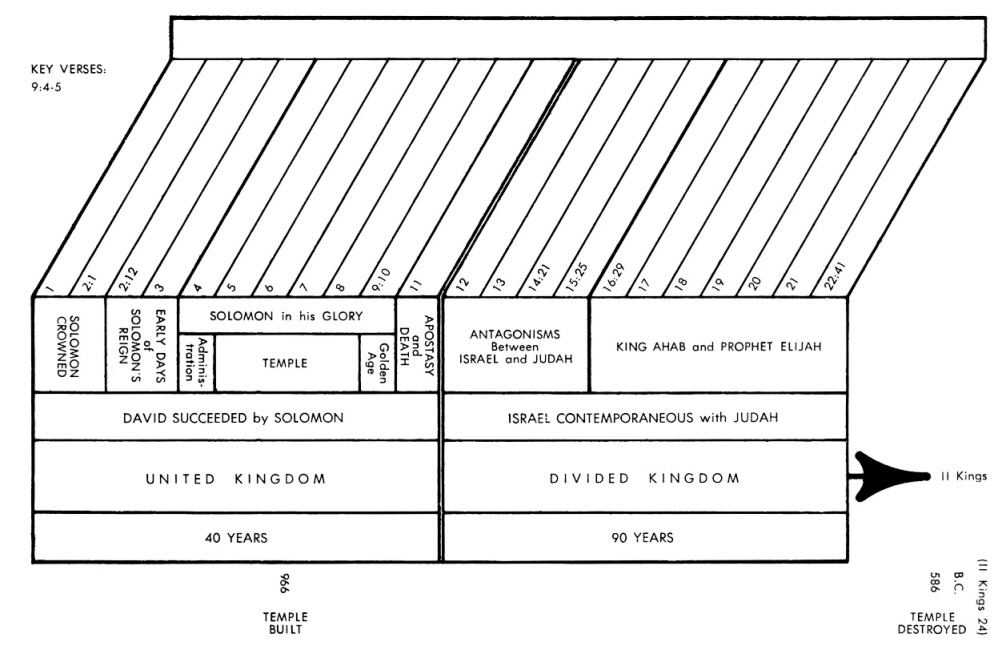
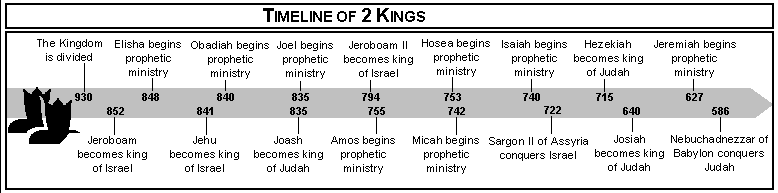
Chart from recommended resource Jensen's Survey of the OT - used by permission
1 Kings Chart from Charles Swindoll

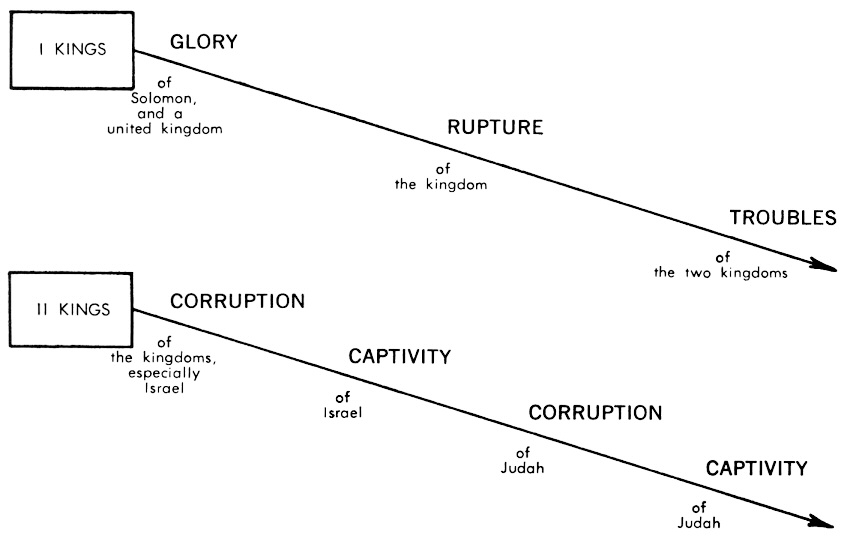
THE DOWNWARD SPIRAL
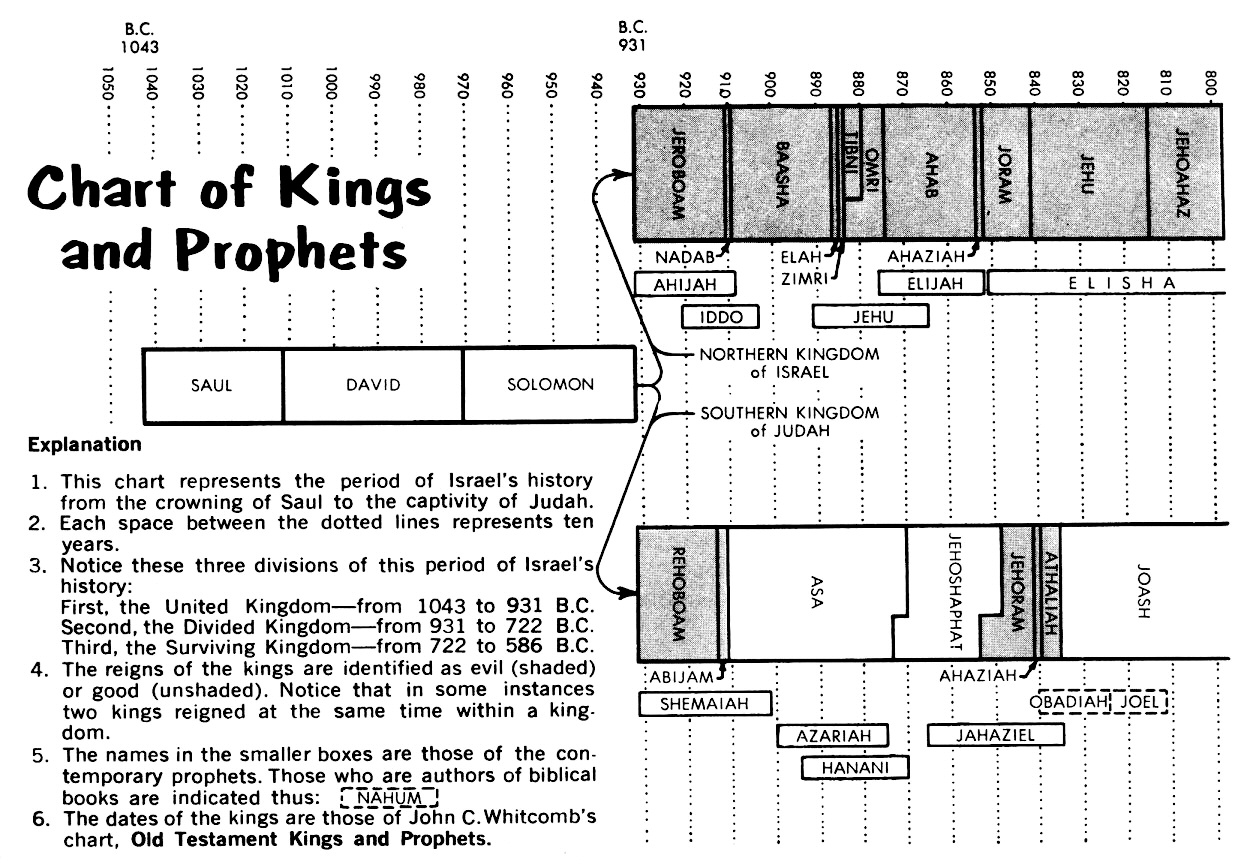
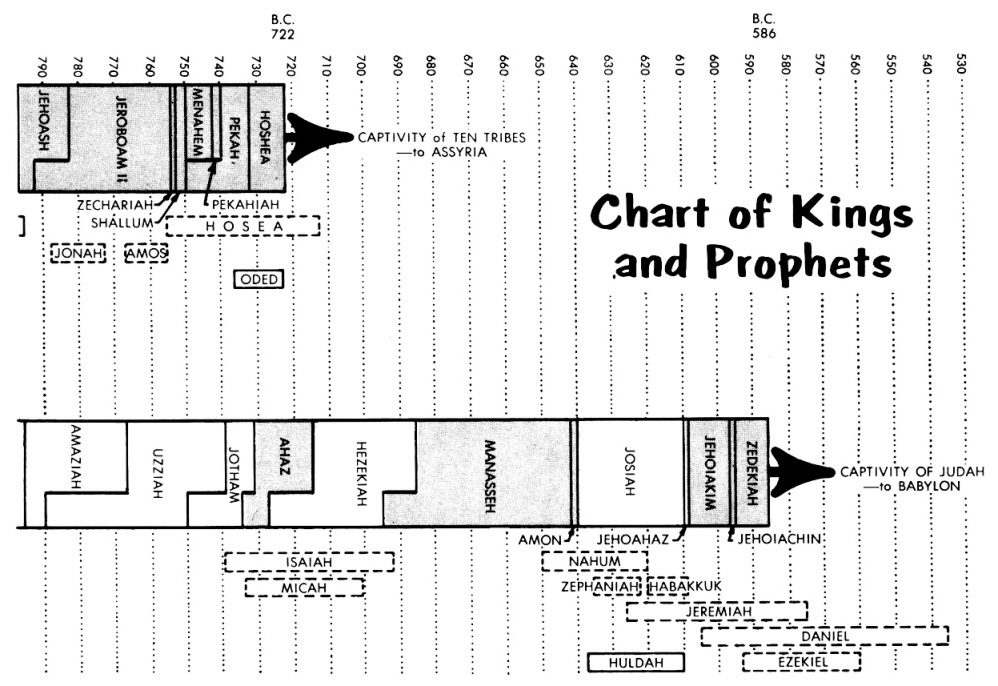
Click to Enlarge
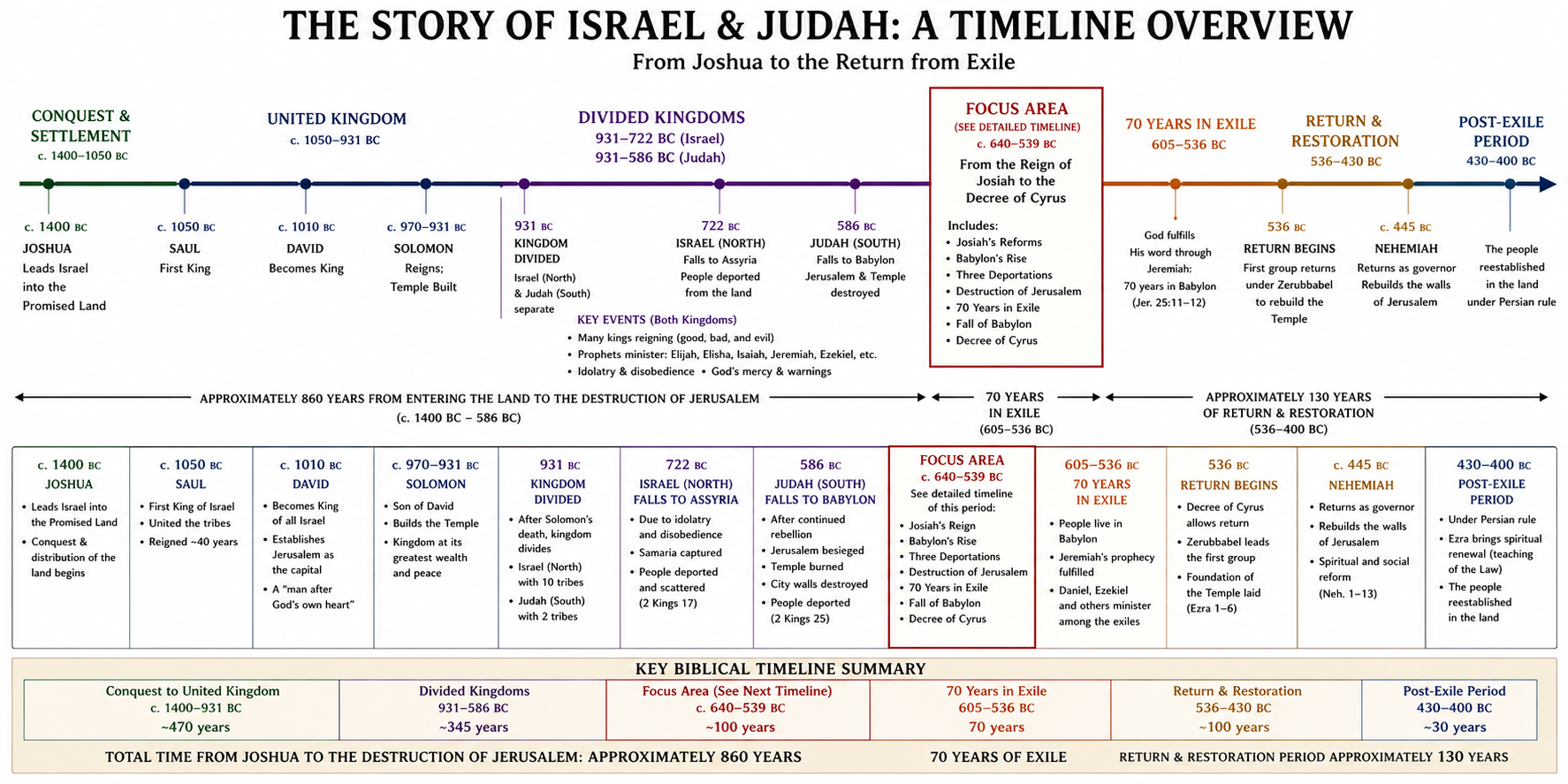
Ryrie Study Bible - Borrow
Click to Enlarge
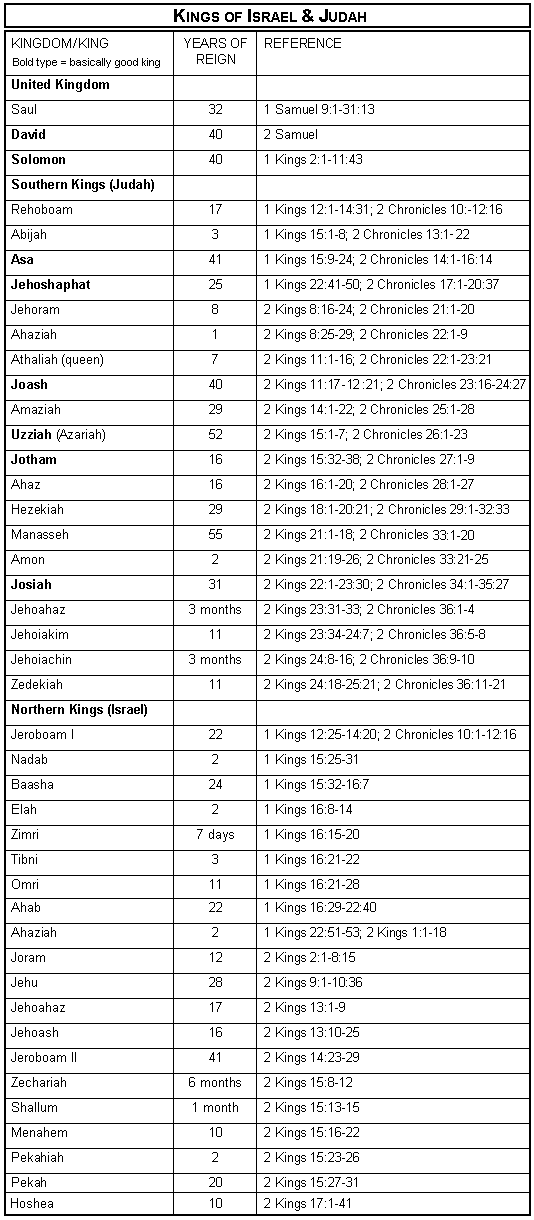
(NOTE: Many consider Amaziah and Hezekiah as "good" kings)
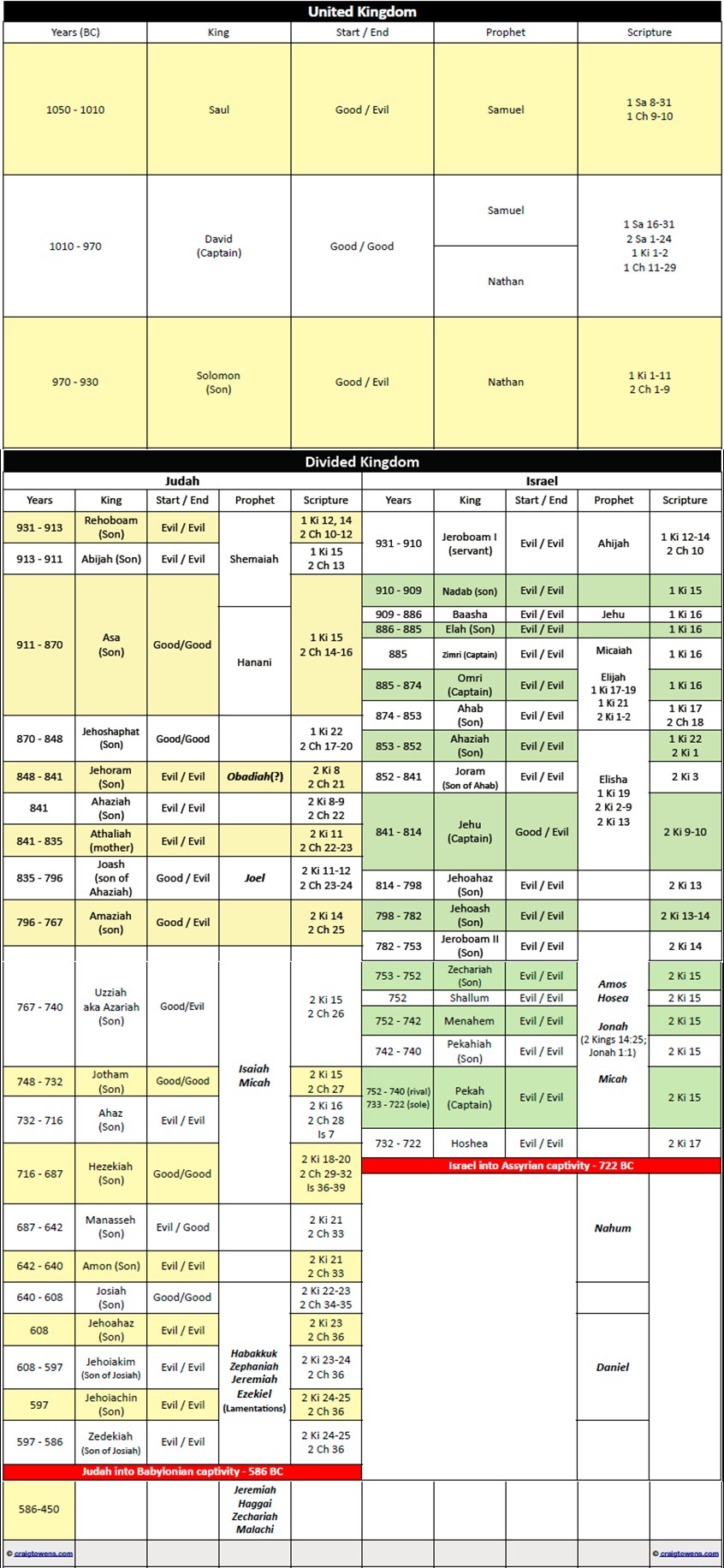
SEE ALSO:
ESV chart - kings of Israel - more information
ESV chart - kings of Judah - more information
Another Chart with Variable Dates for Reigns of King
2 Kings 25:1 Now in the ninth year of his reign, on the tenth day of the tenth month, Nebuchadnezzar king of Babylon came, he and all his army, against Jerusalem, camped against it and built a siege wall all around it.
- in the ninth: Jer 34:8-10 2Ch 36:17-21 Jer 34:2,3-6 39:1-10 52:4,5-11 Eze 24:1,2-14
- Nebuchadnezzar: 2Ki 24:1,10 1Ch 6:15 Jer 27:8 32:28 43:10 51:34 Eze 26:7, Da 4:1-18
- camped against: Isa 29:3 Jer 32:24 Eze 4:1-8 21:22-24 Lu 19:43,44
Related Passages:
Jeremiah 39:2 (DATE CORROBORATED) in the eleventh year of Zedekiah, in the fourth month, in the ninth day of the month, the city wall was breached.
Jeremiah 52:4 (DATE CORROBORATED) Now it came about in the ninth year of his reign, on the tenth day of the tenth month, that Nebuchadnezzar king of Babylon came, he and all his army, against Jerusalem, camped against it and built a siege wall all around it.
Ezekiel 24:1 (DATE CORROBORATED) And the word of the LORD came to me in the ninth year, in the tenth month, on the tenth of the month, saying,
Jeremiah 27:12-15 (GOD GIVES ZEDEKIAH 3 CLEAR COMMANDS) I spoke words like all these to Zedekiah king of Judah, saying, “Bring (COMMAND) your necks under the yoke of the king of Babylon and serve (COMMAND) him and his people, and live (COMMAND)! 13 “Why will you die, you and your people, by the sword, famine and pestilence, as the LORD has spoken to that nation which will not serve the king of Babylon? 14 “So do not listen to the words of the prophets who speak to you, saying, ‘You will not serve the king of Babylon,’ for they prophesy a lie to you; 15 for I have not sent them,” declares the LORD, “but they prophesy falsely in My name, in order that I may drive you out and that you may perish, you and the prophets who prophesy to you.”
Jeremiah 25:9 behold, I will send and take all the families of the north,’ declares the LORD, ‘and I will send to Nebuchadnezzar king of Babylon, My servant, and will bring them against this land and against its inhabitants and against all these nations round about; and I will utterly destroy them and make them a horror and a hissing, and an everlasting desolation.
Jeremiah 34:1 (IN ADDITION TO BABYLON OTHER ARMIES WERE PRESENT) The word which came to Jeremiah from the LORD, when Nebuchadnezzar king of Babylon and all his army, with all the kingdoms of the earth that were under his dominion and all the peoples, were fighting against Jerusalem and against all its cities, saying,
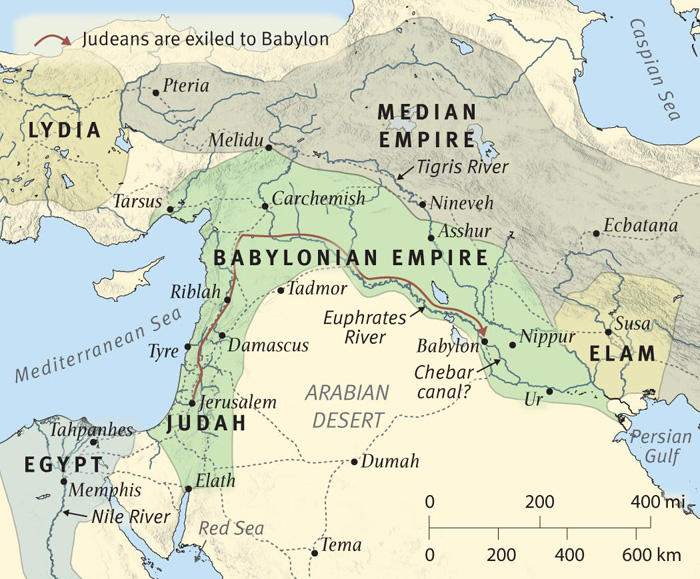
Babylon Comes from the North
Source: ESV Global Study Bible
NEBUCHADNEZZAR LAYS
SIEGE TO JERUSALEM
For an excellent brief summary of the history of this period, see online booik by John Bright entitled A History of Israel, p. 305ff.
Background on Zedekiah for context...
2Ki 24:12-19 Jehoiachin the king of Judah went out to the king of Babylon, he and his mother and his servants and his captains and his officials. So the king of Babylon took him captive in the eighth year of his reign. 13 He carried out from there all the treasures of the house of the LORD, and the treasures of the king’s house, and cut in pieces all the vessels of gold which Solomon king of Israel had made in the temple of the LORD, just as the LORD had said. 14 Then he led away into exile all Jerusalem and all the captains and all the mighty men of valor, ten thousand captives, and all the craftsmen and the smiths. None remained except the poorest people of the land. 15 So he led Jehoiachin away into exile to Babylon; also the king’s mother and the king’s wives and his officials and the leading men of the land, he led away into exile from Jerusalem to Babylon. 16 All the men of valor, seven thousand, and the craftsmen and the smiths, one thousand, all strong and fit for war, and these the king of Babylon brought into exile to Babylon.
17 Then the king of Babylon made his uncle Mattaniah king in his place, and changed his name to Zedekiah. 18 Zedekiah was twenty-one years old when he became king, and he reigned eleven years in Jerusalem; and his mother’s name was Hamutal the daughter of Jeremiah of Libnah. 19 He did evil in the sight of the LORD, according to all that Jehoiakim had done.
Now in the ninth year of his reign - It is significant to note that this verse gives the most specific date in Kings and is corroborated by Jer. 39:2; Jer 52:4; and Ezek. 24:1. GOD WANTS THIS DATE WRITTEN DOWN IN INFAMY! His reign refers to the reign of Zedekiah, aka Mattaniah. The dating underscores historical accuracy and accountability indicating that God’s judgment comes at a definite moment in real history (cf. Jer 1:3). Zedekiah had been warned repeatedly to submit to Babylon (Jer 27:12–15), but he rebelled against God's true prophet Jeremiah, chosing instead to listen to false, lying prophet and so triggering the invasion that he could have avoided it he had only obeyed.
Pulpit Commentary on the dating in this section - Extreme exactness with respect to a date indicates the extreme importance of the event dated. In the whole range of the history contained in the two Books of the Kings, there is no instance of the year, month, and day being all given excepting in the present chapter, where we find this extreme exactness three times (2Ki 25:1, 4, 8). The date in 2Ki 25:1 is confirmed by Jeremiah 52:4 and Ezekiel 24:1.
On the tenth day of the tenth month, This exact date (December/January of 588 BC - see ANE CALENDARS) marks the beginning of the siege. The precision shows this was no random event but in fact was the fulfillment of God’s prophetic word “Behold, I am going to send… Nebuchadnezzar king of Babylon… against this land” (Jer 25:9) It is interesting to note that this date later became a day of fasting and remembrance for Israel (cf. Zec 8:19).
Nebuchadnezzar king of Babylon came, he and all his army (cf "all his army" - Jer 34:1) - Nebuchadnezzar (aka Nebuchadnezzar) is presented as the human instrument, but Scripture makes it very clear that he is God’s servant for judgment. In Jer 25:9 Yahweh declared "I will send… Nebuchadnezzar… My servant." All his army indicates that this was not an expeditionary force but an all out, full scale invasion designed to completely overwhelm Judah’s resistance.
Bob Utley on Nebuchadnezzar king of Babylon - The name means "Nebo is protector of my offspring." This was the son of Nebopolassar. He was a very strong Babylonian monarch who reigned from 604/5 to 562 B.C. We know much of his personality from the book of Daniel. (See KINGS OF NEO-BABYLON)....he and all his army, against Jerusalem, camped against it We know from Jer. 34:1 that not only were the Babylonians present, but also contingents of other national armies that Nebuchadnezzar had previously defeated (cf. 2 Kgs. 24:2).
Pulpit Commentary - The march of the army was not direct upon Jerusalem; it at first spread itself over Judea, wasting the country and capturing the smaller fortified towns (Josephus, 'Ant. Jud.,' 10:7. §3) — among them Lachish, so famous in the war against Sennacherib (2 Kings 18:14, 17; 19:8), and Azekah (Jeremiah 34:7). The capture of these two places was important as intercepting Zedekiah's line of communication with Egypt. Having made himself master of them, Nebuchadnezzar proceeded to invest the capital.
Against Jerusalem - The city chosen by God (Ps 132:13,14) now stands under His judgment and fulfills divine warnings such as "I will make this city a curse to all the nations of the earth: (Jer 26:6)
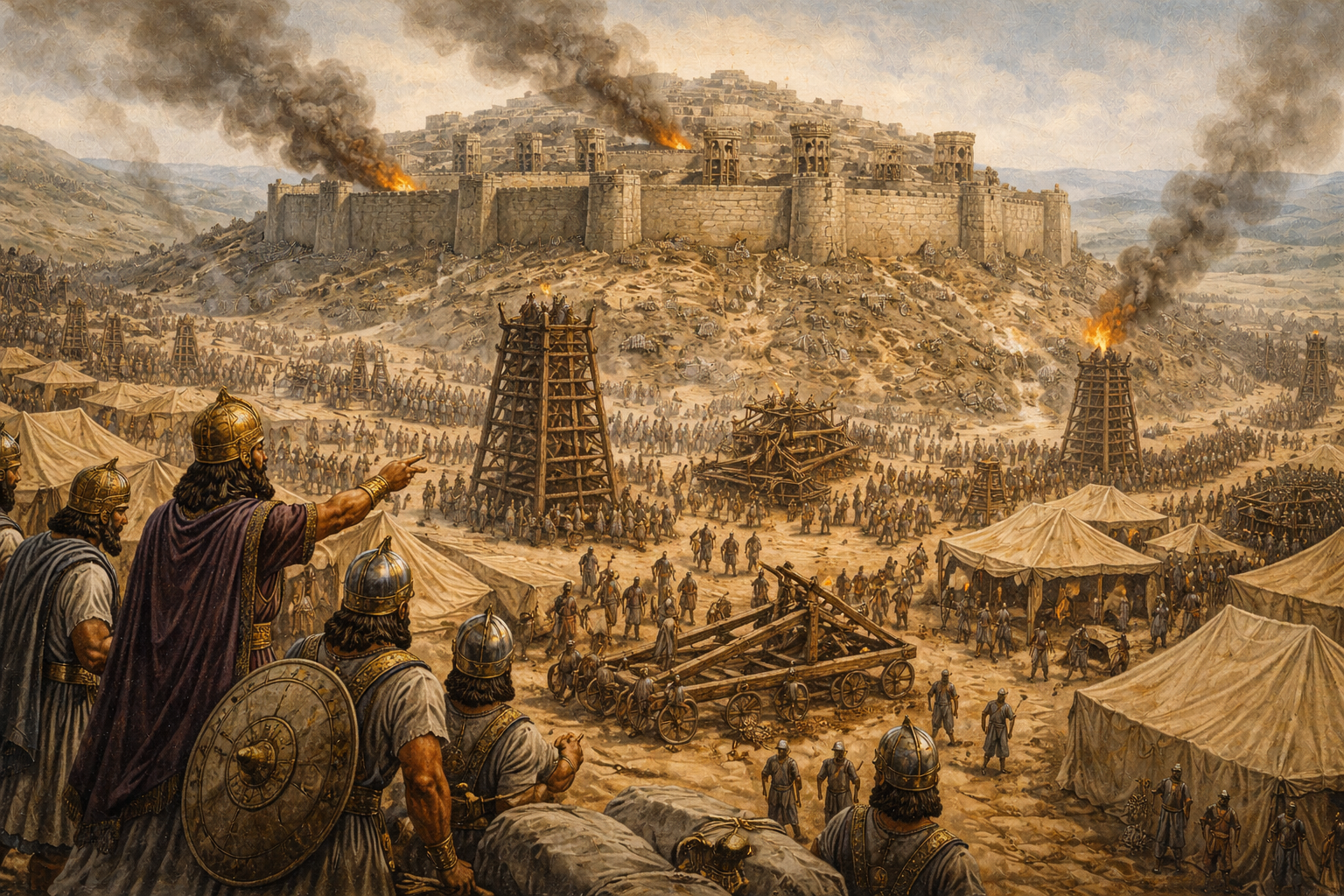
Camped against it The Babylonian army encircles Jerusalem cutting off escape and supply and began an 18 month crushing process rather than an immediate frontal attack, which would not have fulfilled God's prior prophecies. In the curses in De 28:52 Moses recorded “He shall besiege you in all your towns” (Dt 28:52)
And built a siege wall (dāyēq) all around it - A siege wall refers to a siege rampart (Hebrew: dayeq), a structure used to trap the inhabitants inside, to prevent entry of food or aid and to prepare for final assault. The result would be a devastating famine, Jer 52:6 recording “The famine was severe in the city”
Siege wall (01785) dāyēq is a masculine noun denoting a specialized military structure used in ancient siege warfare, referring to the system of constructed fortifications raised by an attacking army around a targeted city in order to secure its downfall. The term encompasses engineered features such as siege walls, ramparts, embankments, and bulwarks, all of which functioned together as instruments of containment and pressure. These were not defensive walls of the city itself, but offensive installations built by invaders at the site of attack, forming a tight encirclement that prevented escape, blocked reinforcements, and controlled access to resources. In practical terms, such works enabled an army to isolate a population, intensify famine conditions, and prepare the way for eventual breach or surrender.
Bob Utley - This rare term "siege wall" is an allusion to the moveable siege towers (Josephus, Antiq. 10.8.1) that were used by "Babylonians and the Assyrians (cf. Ezek. 21:22), an earthen ramp heaped up against the wall (AB, p. 316). For "seige wall" see IVP BIBLE BACKGROUND COMMENTARY (OT), p. 411 This siege seems to have lasted for one and a half years with a brief respite during a threatened Egyptian invasion (cf. Jer. 37:5; Ezek. 17:17).
In Scripture, dāyēq is closely associated with the systematic tactics of Near Eastern warfare, particularly in the campaigns of Nebuchadnezzar II. It describes the siege infrastructure erected around Jerusalem (2Ki 25:1; Jer 52:4), as well as prophetic portrayals of similar operations (Ezek 4:2; 17:17; 21:22; 26:8). The word conveys more than a single structure, but represents the entire strategic apparatus of siegecraft, emphasizing deliberate, methodical constriction rather than immediate assault. As such, it vividly illustrates how divine judgment was executed through sustained military pressure, fulfilling warnings like “he shall besiege you in all your towns” (Dt 28:52).
Pulpit Commentary adds that "Dāyēq (דָיֵק) seems to be properly a "watchtower," from דוּק, speculari, whence it passed into the meaning of a "tower" generally. The towers used in sieges by the Assyrians and Babylonians were movable ones, made of planks, which were pushed up to the walls, so that the assailants might attack their adversaries, on a level, with greater advantage. Sometimes they contained battering rams (see Layard, 'Monuments of Nineveh,' first series, pl. 19; and setup. Jeremiah 52:4; Ezekiel 4:2; 17:17; 26:8; Josephus, 'Ant. Jud.,' 10:8. § 1).
DAYEQ - 6V- siege wall(4), siege walls(2). 2 Ki. 25:1; Jer. 52:4; Ezek. 4:2; Ezek. 17:17; Ezek. 21:22; Ezek. 26:8
2 Kings 25:2 So the city was under siege until the eleventh year of King Zedekiah.
Related Passages:
Deuteronomy 28:49-52 The LORD will bring a nation against you from afar, from the end of the earth, as the eagle swoops down, a nation whose language you shall not understand, 50 a nation of fierce countenance who will have no respect for the old, nor show favor to the young. 51 “Moreover, it shall eat the offspring of your herd and the produce of your ground until you are destroyed, who also leaves you no grain, new wine, or oil, nor the increase of your herd or the young of your flock until they have caused you to perish. 52 “It shall besiege you in all your towns until your high and fortified walls in which you trusted come down throughout your land, and it shall besiege you in all your towns throughout your land which the LORD your God has given you.
THE LONG SIEGE OF
DIVINE JUDGMENT
So the city was under siege until the eleventh year of King Zedekiah - The siege began in Zedekiah’s 9th year, 10th month and lasted until his 11th year, 4th month. Notice the important time word until which shows that the siege continued uninterrupted up to this date and then it ceased with Jerusalem's capituation. This emphasizes that judgment was inescapable and complete.
Charles Dyer notes that "The siege was lifted briefly when Egypt attacked Nebuchadnezzar (Jer. 37:5) but the Babylonians defeated Judah's ally easily and resumed the siege." (See The Bible Knowledge Commentary- Page 29)
Donald Wiseman has an interesting note that "The Babylonians relied initially on tight control using ‘watch towers’ rather than siege works, allowing those who wished to leave to do so (cf. 2 Kings 25:11; Jeremiah 38:19; 39:9), but starving out the city (Jeremiah 38:2-9).” (See 1 and 2 Kings: An Introduction and Commentary - Page 333) Jeremiah mentions those who decided to leave the city...
Jeremiah 38:19 Then King Zedekiah said to Jeremiah, “I dread the Jews who have gone over to the Chaldeans, for they may give me over into their hand and they will abuse me.”
Jeremiah 39:9 As for the rest of the people who were left in the city, the deserters who had gone over to him and the rest of the people who remained, Nebuzaradan the captain of the bodyguard carried them into exile in Babylon.
Russell Dilday “This is the first time in Kings that an event in the history of Israel is dated by a foreign era.” (The Preacher's Commentary - 1 and 2 Kings)
The siege marked a prolonged and relentless period of divine judgment in which Jerusalem was gradually brought to ruin through famine, isolation, and despair. The extended duration of the siege highlights both the certainty and completeness of God’s decree, fulfilling earlier covenant warnings (Deut 28:52) and exposing the futility of trusting in human defenses or alliances, as the city endured an inescapable judgment that unfolded exactly as God had spoken (Jer 21:10; 25:3–4).
Pulpit Commentary - From Jeremiah and Ezekiel we learn that, after the siege had continued a certain time, the Egyptian monarch, Hophra or Apries, made an effort to carry out the terms of his agreement with Zedekiah, and marched an army into Southern Judaea, with the view of raising the siege (Jeremiah 37:5; Ezekiel 17:17). Nebuchadnezzar hastened to meet him. With the whole or the greater part of his host he marched southward and offered battle to the Egyptians. Whether an engagement took place or not is uncertain. Josephus affirms it, and says that Apries was "defeated and driven out of Syria" ('Ant. Jud.,' 10:7. § 3). The silence of Jeremiah is thought to throw doubt on his assertion. At any rate, the Egyptians retired (Jeremiah 37:7) and took no further part in the struggle. The Babylonians returned, and the siege recommenced.
Bob Utley adds "The pro-Egyptian counselors at court lured King Zedekiah, like his predecessor Jehoiakim, into rebellion against Neo-Babylon. This policy proved to be devastating. It was diametrically against the prophetic warnings of Jeremiah. In this chapter we see it come into full fruition. Although the Egyptians mounted a counter-attack, it was feeble and ineffective at best (cf. Jer. 37:5; Ezek. 17:17). Pharaoh Neco II was succeeded by his son, Psammetichus II. Psammetichus II and his son, known in the Bible as Hophra (Jer. 44:30) and also called Apries by the Greeks, were both actively involved in aggression against Neo-Babylon."
2 Kings 25:3 On the ninth day of the [fourth] month the famine was so severe in the city that there was no food for the people of the land.
- On the ninth day: Jer 39:2 Jer 52:6 Zec 8:19
- the famine: Lev 26:26 De 28:52-53 La 4:4-10 Eze 4:9-17 5:10,12 7:15 14:21
- there was no: Jer 37:21 38:2
Related Passages:
Jeremiah 52:6 "On the ninth day of the fourth month the famine was so severe in the city that there was no food for the people of the land."
Lamentations 2:20 (ALLUDING TO STARVATION AND CANNABALISM DURING FINAL 2 YEAR SIEGE IN 588-586 BC) See, O LORD, and look! With whom have You dealt thus? Should women eat their offspring, The little ones who were born healthy? Should priest and prophet be slain In the sanctuary of the Lord?
Lamentations 4:9-10 (ALLUDING TO STARVATION AND CANNABALISM DURING FINAL 2 YEAR SIEGE IN 588-586 BC) Better are those slain with the sword Than those slain with hunger; For they pine away, being stricken For lack of the fruits of the field. 10 The hands of compassionate women Boiled their own children; They became food for them Because of the destruction of the daughter of my people.
Deuteronomy 28:52-57 (PROPHECY OF CANNABALISM FOR DISOBEDIENCE) It shall besiege you in all your towns until your high and fortified walls in which you trusted come down throughout your land, and it shall besiege you in all your towns throughout your land which the LORD your God has given you. 53 “Then you shall eat the offspring of your own body, the flesh of your sons and of your daughters whom the LORD your God has given you, during the siege and the distress by which your enemy will oppress you. 54 “The man who is refined and very delicate among you shall be hostile toward his brother and toward the wife he cherishes and toward the rest of his children who remain, 55 so that he will not give even one of them any of the flesh of his children which he will eat, since he has nothing else left, during the siege and the distress by which your enemy will oppress you in all your towns. 56 “The refined and delicate woman among you, who would not venture to set the sole of her foot on the ground for delicateness and refinement, shall be hostile toward the husband she cherishes and toward her son and daughter, 57 and toward her afterbirth which issues from between her legs and toward her children whom she bears; for she will eat them secretly for lack of anything else, during the siege and the distress by which your enemy will oppress you in your towns.
Jeremiah 21:6; 7 “I will also strike down the inhabitants of this city, both man and beast; they will die of a great pestilence. 7 “Then afterwards,” declares the LORD, “I will give over Zedekiah king of Judah and his servants and the people, even those who survive in this city from the pestilence, the sword and the famine, into the hand of Nebuchadnezzar king of Babylon, and into the hand of their foes and into the hand of those who seek their lives; and he will strike them down with the edge of the sword. He will not spare them nor have pity nor compassion.”’
THE BREAKING POINT:
FAMINE AND FEAR!
On the ninth day of the fourth month - Note that "fourth" is added by the NASB but is substantiated by "fourth month" in Jer 52:6, which would be June/July, 586 BC. This precise date marks the climax of the siege. After many months of starvation, the city reached a point where supplies were completely exhausted and resistance could no longer continue. It marks the moment just before the walls are breached (2 Ki 25:4).
The famine (raab) was so severe in the city that there was no food for the people of the land - The achievement of famine was the goal of the siege. The famine was intense and led to slow suffering and gradual starvation because food had become completed depleted. This suffering was universal and no one was exempt regardless of whether they were rich or poor. The horror of this famine is expressed in Lam 2:20 and Lam 4:10 with mothers now eating their own offspring fulling the prophecy in (Dt 28:53)!
In Jer 38:9 even Jeremiah was at risk of starving, having been put in a cistern -- (Ebed-melech the Ethiopian, a eunuch said to King Zedekiah) "My lord the king, these men have acted wickedly in all that they have done to Jeremiah the prophet whom they have cast into the cistern; and he will die right where he is because of the famine, for there is no more bread in the city.” (Jer 38:9)
Bob Utley explains that "The phrase, "the people of the land" is used in this period of the OT to describe the landed aristocracy. By Jesus' day the term had changed in meaning to the poor people of the land.
Pulpit Commentary - Ere long, as so often happens in sieges, famine was followed by pestilence (Jeremiah 21:6, 7; Josephus, 'Ant. Jud.,' l.s.c.), and after a time the place was reduced to the last extremity (Lamentations 4:3-9). Bread was no longer to be had, and mothers devoured their children (Lamentations 4:10)....The intensity of the suffering endured may be gathered from Lamentations, Ezekiel, and Josephus. The complexions of the men grew black with famine (Lamentations 4:8; 5:10); their skin was shrunk and parched (Lamentations 4:8); the rich and noble women searched the dunghills for setups of offal (Lamentations 4:5); the children perished for want, or were even devoured by their parents (Lamentations 2:20; 4:3, 4, 10; Ezekiel 5:10); water was scarce, as well as food, and was sold at a price (Lamentations 5:4); third part of the inhabitants died of the famine, and the plague which grew out of it (Ezekiel 5:12).
Moses had given a dire prediction of these conditions writing...
“Then you shall eat the offspring of your own body, the flesh of your sons and of your daughters whom the LORD your God has given you, during the siege and the distress by which your enemy will oppress you. 54 “The man who is refined and very delicate among you shall be hostile toward his brother and toward the wife he cherishes and toward the rest of his children who remain, 55 so that he will not give even one of them any of the flesh of his children which he will eat, since he has nothing else left, during the siege and the distress by which your enemy will oppress you in all your towns. 56 “he refined and delicate woman among you, who would not venture to set the sole of her foot on the ground for delicateness and refinement, shall be hostile toward the husband she cherishes and toward her son and daughter, 57 and toward her afterbirth which issues from between her legs and toward her children whom she bears; for she will eat them secretly for lack of anything else, during the siege and the distress by which your enemy will oppress you in your towns." (Dt 28:53-57)
Famine (07458) raab means hunger, or famine which is a drastic, usually widespread food shortage, an extreme scarcity of food. Ra'ab means "hunger" as opposed to "thirst". In some areas the cause is overpopulation, but it is usually a failure of crops that results in a serious shortage of nutritional foods. The first famine is described in Genesis 12:10 "Now there was a famine in the land; so Abram went down to Egypt to sojourn there, for the famine was severe in the land." God allows or causes famines and clearly He was testing Abram's faith at this time. We see a repeat in Genesis 26:1 "Now there was a famine in the land, besides the previous famine that had occurred in the days of Abraham. So Isaac went to Gerar, to Abimelech king of the Philistines." Not only did famines occur in Canaan but Egypt also suffered cycles of famine (Ge 41:27, 30, 31). In Ps 105:16 "He called for a famine upon the land" and the result was that Jacob took his family to Egypt! (cf Ge 50:20) God is sovereign in History! Famine can be the discipline of God on His people (Isa. 5:13). Through His prophet Ezekiel God warned Judah (the 10 northern tribes having already been taken off into captivity by Assyria in 722BC) "Son of man (Ezekiel), if a country sins against Me by committing unfaithfulness, and I stretch out My hand against it, destroy its supply of bread, send famine against it, and cut off from it both man and beast even though these three men, Noah, Daniel and Job were in its midst, by their own righteousness they could only deliver themselves,” declares the Lord GOD." (Ezekiel 14:13-14) Famine is frequently mentioned in the terrible triad "sword, famine, and pestilence," (Jer. 14:13, 27:8, 13, 18, 32:24, 36, 34:17, 38:2, 42:17, 22, 44:13, Ezek 6:11), Famine is used figuratively of spiritual nourishment, God declaring "I will send a famine on the land, Not a famine for bread or a thirst for water, But rather for hearing the words of the LORD. sword, famine, and pestilence. Amos mentions a famine of the Word of God, not food, that the Lord will send!" (Amos 8:11). The line between famine and plenty in Palestine depends mainly on the rains coming at the right time and in the proper supply, famine was an ever-present threat.
In summary raab is a prolonged scarcity of food, accompanied by extreme hunger. It is listed as one of God’s ‘four sore acts of judgment’ along with the sword (war), evil beasts, and pestilence (Eze 14:21). It is also a divine judgment in Jeremiah, along with the sword (fourteen times), and with the sword and pestilence (fifteen times). In Dt 28:48, hunger is one of the many curses God will send for disobedience. Famine may lead to disease (Jer 14:18) and, most gruesome of all, cannibalism of one’s own offspring (Dt. 28:47-57). Other attendant judgments may be captivity (Jer 15:2), exile (Ezek 5:12), nakedness (Dt. 28:47)
2 Kings 25:4 Then the city was broken into, and all the men of war fled by night by way of the gate between the two walls beside the king’s garden, though the Chaldeans were all around the city. And they went by way of the Arabah.
- the city: Jer 5:10 39:2,3 52:6,7-11 Eze 33:21
- fled: Lev 26:17,36 De 28:25 32:24,25,30 Jer 39:4-7
- and the king: 2Ki 25:5 Eze 12:12
Related Passages:
Jeremiah 52:7 (THE GREAT ESCAPE) Then the city was broken into, and all the men of war fled and went forth from the city at night by way of the gate between the two walls which was by the king’s garden, though the Chaldeans were all around the city. And they went by way of the Arabah.
Jeremiah 21:7 “Then afterwards,” declares the LORD, “I will give over Zedekiah king of Judah and his servants and the people, even those who survive in this city from the pestilence, the sword and the famine, into the hand of Nebuchadnezzar king of Babylon, and into the hand of their foes and into the hand of those who seek their lives; and he will strike them down with the edge of the sword. He will not spare them nor have pity nor compassion.”’
Jeremiah 34:1-3 (GOD'S WARNING TO ZEDEKIAH) The word which came to Jeremiah from the LORD, when Nebuchadnezzar king of Babylon and all his army, with all the kingdoms of the earth that were under his dominion and all the peoples, were fighting against Jerusalem and against all its cities, saying, 2 “Thus says the LORD God of Israel, ‘Go and speak to Zedekiah king of Judah and say to him: “Thus says the LORD, ‘Behold, I am giving this city into the hand of the king of Babylon, and he will burn it with fire. You will not escape from his hand, for you will surely be captured and delivered into his hand; and you will see the king of Babylon eye to eye, and he will speak with you face to face, and you will go to Babylon.’”’
Proverbs 21:30 There is no wisdom and no understanding And no counsel against the LORD.
JERUSALEMS WALLS
BREACHED BY BABYLONIANS
Then - Then marks progression in the narrative. Always pause to ask questions like "When is 'then'?" "What happens 'then'?" "Why now?", etc.
The city was broken into - The moment of judgment has come and the holy city falls to the pagan king Nebuchadnezzar and the Babylonians who breach the walls as the Judah's defenses collapse.
Where did the initial breach take place? If you examine the topography of Jerusalem, it has 3 natural defenses, the Kidron Valley (steep drop) on the East, the Hinnom Valley (deep and difficult terrain) on the West & South, leaving the North as the main vulnerability because it was relatively flat and exposed. And so historically the north side was the weakest militarily and nearly all invading armies attacked from the north. Archaeology and siege patterns support this because the northern area (later called the “Broad Wall” region) shows heavy fortification, because it was vulnerable. Ancient Near Eastern siege warfare always targeted the least defensible terrain, thus Babylonian siege ramps and tactics would naturally focus on the north wall. Prophetically the invading armies are stated as coming from the north (Jer 1:14,15; Jer 4:6). Finally, Zedekiah and his soldier fled south/east toward the Arabah (Jordan Valley), which supports the premise that the Babyonians were in full control of the northern side.
And all the men of war fled by night - Instead of standing and fighting, Judah's soldiers flee under cover of darkness as leadership collapses and courage gives way to fear. This is a dramatic contrast to the promise in Lev 26:7–8 which promises if they obey Yahweh "you will chase your enemies and they will fall before you by the sword." Obedience is always the way to victory, and frankly that is an immutable principle in the Christian life beloved! While not stated in this 2 Kings passage, Jeremiah 39:4 does state that King Zedekiah was in this group that fled by night.
By way of the gate between the two walls beside the king’s garden - This refers to a hidden or less visible exit route, likely near the southeastern part of the city near the Kidron Valley. The king and his soldiers are attempting a secret nighttime escape.
Bob Utley onfled by night by way of the gate between the two walls beside the king's garden" Josephus (Antiq. 8.8.1) tells us that this was near the Pool of Siloam, close to where the Kidron and Hinnom valleys meet in the southern part of the city (cf. Jer. 39:4). "The two walls" may refer to the extra fortification built by Hezekiah to protect the Siloam Pool (cf. 2 Chr. 32:5; Isa. 22:11).
Though the Chaldeans were all around the city - One would think that this fact would preclude escape. However since there is no mention of a fight between the Babylonians and the Judean soldiers, apparently they were able to slip out under the cover of darkness.
Jeremiah had apparently spoken God's Word to Zedekiah warning him "You will not escape from his hand, for you will surely be captured and delivered into his hand." (Jer 34:7). Once again we see disobdience so that Zedekiah failed to heed God's clear warning. He should have know that no one escapes the "Long arm of the Lord."
And they went by way of the Arabah - The Arabah refers to the Jordan Valley region, and from there they headed east toward the wilderness and the plains of Jericho. Utley adds "The term "Arabah" refers to the Jordan Rift Valley. Usually the term is used for the area below the Dead Sea, but in this particular account it refers to the depression above the Dead Sea, close to the city of Jericho, as v. 5 makes plain. Probably Zedekiah and his honor guard were trying to reach Ammon for refuge."
CHALDEANS - The Chaldeans were originally a Semitic tribal people who lived in southern Mesopotamia near the mouth of the Tigris and Euphrates, with early connections even to Ur, the homeland of Abraham (Gen. 11:28; 15:7; Acts 7:4). Over time, especially between the 10th–9th centuries BC, they became more prominent as migrating Semitic groups settled in that region. In the prophets, the term can refer to both an ethnic people and later the Babylonian power they came to dominate (2 Kings 24:1–4).
Historically, the Chaldeans were involved in repeated struggles with Assyria. Leaders like Merodach-baladan opposed Assyrian control (2 Kings 20:12–21; Isaiah 39), but the decisive turning point came in 626 BC when Nabopolassar (a Chaldean) established the Neo-Babylonian Empire, leading to the fall of Assyria (Nineveh in 612 BC) and the rise of Babylon under Nebuchadnezzar II.
In Scripture, the term “Chaldeans” also developed a second meaning: a class of wise men, astrologers, and counselors in Babylon (Daniel 2:2; 4:7; 5:7,11). Thus, the word can describe either (1) an ethnic group / ruling power, or (2) a learned priestly or advisory class. This dual usage explains why figures like the “wise men” in Gospel of Matthew 2:1 (often called “magi”) are sometimes associated with Chaldean-type scholars—men known throughout the ancient Near East for wisdom, astronomy, and interpretation of signs.
2 Kings 25:5 But the army of the Chaldeans pursued the king and overtook him in the plains of Jericho and all his army was scattered from him.
- and overtook: Isa 30:16 Jer 24:8 39:5 52:8 Am 2:14-16
Related Passages:
Jeremiah 39:4-5 When Zedekiah the king of Judah and all the men of war saw them, they fled and went out of the city at night by way of the king’s garden through the gate between the two walls; and he went out toward the Arabah. 5 But the army of the Chaldeans pursued them and overtook Zedekiah in the plains of Jericho; and they seized him and brought him up to Nebuchadnezzar king of Babylon at Riblah in the land of Hamath, and he passed sentence on him.
Jeremiah 34:1-3 The word which came to Jeremiah from the LORD, when Nebuchadnezzar king of Babylon and all his army, with all the kingdoms of the earth that were under his dominion and all the peoples, were fighting against Jerusalem and against all its cities, saying, 2 “Thus says the LORD God of Israel, ‘Go and speak to Zedekiah king of Judah and say to him: “Thus says the LORD, ‘Behold, I am giving this city into the hand of the king of Babylon, and he will burn it with fire. 3 ‘You will not escape from his hand, for you will surely be captured and delivered into his hand; and you will see the king of Babylon eye to eye, and he will speak with you face to face, and you will go to Babylon.’”’
Hosea 3:4-5 (THE END OF MONARCHY AND BEGINNING OF GENTILE DOMINION UNTIL MESSIAH) For the sons of Israel will remain for many days without king or prince, without sacrifice or sacred pillar and without ephod or household idols. 5 Afterward the sons of Israel will return and seek the LORD their God and David their king; and they will come trembling to the LORD and to His goodness in the last days.
ZEDEKIAH'S FAILED GREAT
ESCAPE ATTEMPT
But the army of the Chaldeans pursued the king and overtook him in the plains of Jericho - This would be about 18 miles east of Jerusalem. If Zedekiah had heeded the prophecy of Jeremiah describing his judgment, he likely thought he had escaped God's prophesied judgment.
Bob Utley Originally the Babylonian army had split itself into two groups. One group attacked the southern two fortresses of Azakah and Lachish. When these two fortresses fell, communication was completely blocked off from Egypt and Nebuchadnezzar II reassembled his army around Jerusalem. It is possible this splitting of the Neo-Babylonian army is what caused the Egyptians to think that they could invade Palestine from the south at this time. Nebuchadnezzar II was not with his troops when they besieged Jerusalem. He was in Syria in a town called Riblah (cf. 2 Kgs. 23:33; 25:6,21; Jer. 39:5,6; 52:9,10,26,27). Therefore, his commanders were greatly concerned that the king of Judah had slipped through their hands.
Russell Dilday has an interesting point that "It seems ironic that here, at the very spot where Israel first set foot on the Promised Land, the last of the Davidic kings was captured and his monarchy shattered. Here, where Israel experienced her first victory as the walls of Jericho feel before unarmed men who trusted God, was the scene of her last defeat.” (See The Preacher's Commentary - 1 and 2 Kings - Page 23)
And all his army was scattered from him - Without his forces unified around him, Zedekiah stood defenseless and so it is no surprize that there is no record of a battle or skirmish before his capture.
2 Kings 25:6 Then they captured the king and brought him to the king of Babylon at Riblah, and he passed sentence on him.
- Then they captured: 2Ch 33:11 Jer 21:7 34:21,22 38:23 La 4:19,20 Eze 17:20,21 Eze 21:25-27
- Riblah: 2Ki 23:33 Jer 52:9
Related Passages:
Ezekiel 17:16-18 (PROPHECY OF ZEDEKIAH'S FATE FOR BREAKING HIS COVENANT WITH NEBUCHANEZZAR BY SEEKING ALLIANCE WITH EGYPT) ‘As I live,’ declares the Lord GOD, ‘Surely in the country of the king who put him on the throne, whose oath he despised and whose covenant he broke, in Babylon he shall die. 18 ‘Now he despised the oath by breaking the covenant, and behold, he pledged his allegiance, yet did all these things; he shall not escape.’”
Jeremiah 38:17-18 (JEREMIAH'S WORD TO ZEDEKIAH) Then Jeremiah said to Zedekiah, “Thus says the LORD God of hosts, the God of Israel, ‘If you will indeed go out to the officers of the king of Babylon, then you will live, this city will not be burned with fire, and you and your household will survive. 18 ‘But if you will not go out to the officers of the king of Babylon, then this city will be given over to the hand of the Chaldeans; and they will burn it with fire, and you yourself will not escape from their hand.’”
2 Chronicles 36:13 He also rebelled against King Nebuchadnezzar who had made him swear allegiance by God. (THUS ZEDEKIAH BROKE THE COVENANT WITH BOTH NEBUCHADNEZZAR AND GOD!) But he stiffened his neck and hardened his heart against turning to the LORD God of Israel (cf Acts 7:51).
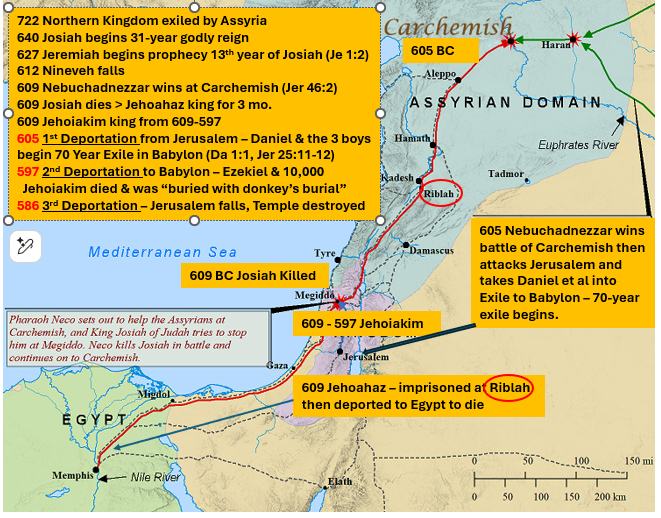
See Riblah circled in red - Nebuchadnezzar's Miliatary Headquaters
ZEDEKIAH SENTENCED
BY NEBUCHANEZZAR
Then they captured the king - This shows that escape from God’s decreed judgment was impossible. Jeremiah had clearly warned Zedekiah “you will not escape from his hand” (Jer 34:3)
And brought him to the king of Babylon at Riblah (75 miles north of Damascus), and he passed sentence on him - Riblah was a strategic military headquarters in Syria, located about 75 miles north of Damascus along the Orontes River. It served as the command center for Babylon’s western campaigns (cf. 2 Kings 23:33; 25:6).
John MacArthur on Riblah - Located on the Orontes River about 180 mi. N. of Jerusalem, Riblah was Nebuchadnezzar’s military headquarters for his invasion of Judah. This location was ideally situated as a field headquarters for military forces because ample provisions could be found nearby (cf. 2Ki 23:33). (See MacArthur Study Bible)
Bob Utley on Riblah - This was a fortified city on the major road between Egypt and the Fertile Crescent. It apparently was Nebuchadnezzar II's headquarters because, from this vantage point, he could control both the siege of Jerusalem and the siege of Tyre.
Pulpit Commentary - The presentation of rebel kings, when captured, to their suzerain, seated on his throne, is one of the most common subjects of Assyrian and Babylonian sculptures....As Nebuchadnezzar was engaged at one and the same time in directing the sieges both of Tyro and of Jerusalem, it was a most convenient position for him to occupy.
Charles Dyer notes that "Zedekiah fled the city with the soldiers (Jer. 39:4) and was also captured. He was taken to Nebuchadnezzar's field headquarters at Riblah (cf. 2 Kings 23:33) on the Orontes River north of Damascus. (Nebuchadnezzar was also conducting campaigns against Tyre and other Judean cities according to the Lachish Letters" (See The Bible Knowledge Commentary- Page 29)
And he passed sentence on him - This refers to a formal judgment by Nebuchadnezzar on Zedekiah, but ultimately it reflects God’s judgment carried out through Babylon (Jer 25:9). The sentence included the slaughter of Zedekiah’s sons before his eyes, the execution of Judah’s nobles, the blinding of Zedekiah and his imprisonment in Babylon.
Bob Utley on and he passed sentence on him - King Zedekiah was guilty of breaking two pledges to Nebuchadnezzar II (cf. Ezek. 17:16,18). This is one reason why Zedekiah did not surrender, as Jeremiah had counseled him to do (cf. Jer. 38:14-28). His death fits the prophecy of Ezek. 12:13.
Zedekiah broke his oath to Babylon (2Ch 36:13) and rejected God’s word through Jeremiah (Jer 38:17–18) Therefore, judgment came exactly as foretold.
Pulpit Commentary adds (speaking of Zedekiah) "As a rebel, who had broken his covenant and his oath (Ezekiel 17:16, 18), Zedekiah was brought to trial before Nebuchadnezzar and his great lords. The facts could not be denied, and sentence was therefore passed upon him, nominally by the court, practically by Nebuchadnezzar (Jeremiah 52:9). By an unusual act of clemency, his life was spared; but the judgment was still sufficiently severe (see the next verse)."
2 Kings 25:7 They slaughtered the sons of Zedekiah before his eyes, then put out the eyes of Zedekiah and bound him with bronze fetters and brought him to Babylon.
- They slaughtered: Ge 21:16 44:34 De 28:34 Jer 22:30 39:6,7 52:10,11
- then put out: Jer 32:4,5 34:3 Eze 12:13-16
- bound him: Judges 16:21 2Ch 33:11 36:6 Ps 107:10,11 149:8 Eze 7:27 17:16-20
Related Passages:
Jeremiah 32:2-5 (JEREMIAH'S PROPHECY THAT ZEDEKIAH WOULD SEE NEBUCHADNEZZAR) Now at that time the army of the king of Babylon was besieging Jerusalem, and Jeremiah the prophet was shut up in the court of the guard, which was in the house of the king of Judah, 3 because Zedekiah king of Judah had shut him up, saying, “Why do you prophesy, saying, ‘Thus says the LORD, “Behold, I am about to give this city into the hand of the king of Babylon, and he will take it; 4 and Zedekiah king of Judah will not escape out of the hand of the Chaldeans, but he will surely be given into the hand of the king of Babylon, and he will speak with him face to face and see him eye to eye; 5 and he will take Zedekiah to Babylon, and he will be there until I visit him,” declares the LORD. “If you fight against the Chaldeans, you will not succeed”’?”
Jeremiah 39:6-7 Then the king of Babylon slew the sons of Zedekiah before his eyes at Riblah; the king of Babylon also slew all the nobles of Judah. 7 He then blinded Zedekiah’s eyes and bound him in fetters of bronze to bring him to Babylon.
Ezekiel 12:13 (EZEKIEL'S PROPHECY ZEDEKIAH WILL NEVER SEE BABYLON) “I will also spread My net over him, and he will be caught in My snare. And I will bring him to Babylon in the land of the Chaldeans; yet he will not see it, though he will die there.
Jeremiah 52:10-11 The king of Babylon slaughtered the sons of Zedekiah before his eyes, and he also slaughtered all the princes of Judah in Riblah. 11 Then he blinded the eyes of Zedekiah; and the king of Babylon bound him with bronze fetters and brought him to Babylon and put him in prison until the day of his death.
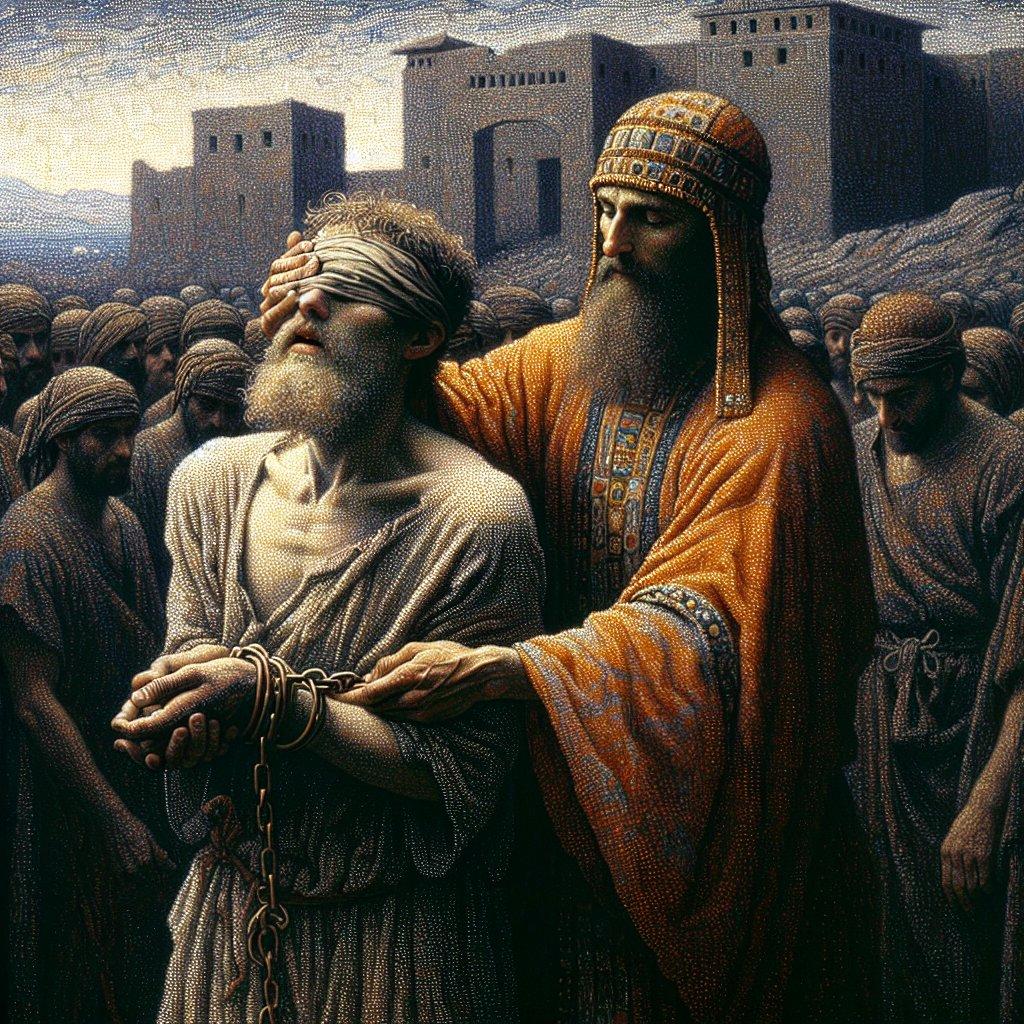
ZEDEKIAH'S END
FULFILLS PROPHECY
They slaughtered the sons of Zedekiah before his eyes - This was not random cruelty but it was intentional devastation for breaking covenant with Nebuchadnezzar. Zedekiah was forced to witness the execution of his heirs, ensuring the end of his royal line on the throne and that his last memory would be one of incomprehensible loss.
This fulfills the warning in Jeremiah 34:3 "You will not escape from his hand, for you will surely be captured and delivered into his hand; and you will see the king of Babylon eye to eye, and he will speak with you face to face, and you will go to Babylon.’”’ Zedekiah saw the king but never saw Babylon where he was taken to die.
Pulpit Commentary - As Zedekiah was no more than thirty-two years of age (2 Kings 24:18), his sons must have been minors, who could not justly be held responsible for their father's doings. It was usual, however, in the East, and even among the Jews, to punish children for the sins of their fathers (see Joshua 7:24, 25; 2 Kings 9:26; 14:6; Daniel 6:24).
Spiritual blindness
led to literal blindness
Then put out the eyes of Zedekiah - This fulfills what seemed like a paradox “He will bring him to Babylon… yet he will not see it” (Ezekiel 12:13) because his eyes were put out. This is a striking example of the perfect harmony of God’s Word. This also fulfills God's warning in Deuteronomy 28:28 “The LORD will smite you with madness and with blindness and with bewilderment of heart."
Pulpit Commentary on blinding Zedekiah - This, too, was a common Oriental practice. The Philistines blinded Samson (Judges 16:21). Sargon, in one of his sculptures, seems to be blinding a prisoner with a spear (Botta, 'Monumens de Ninive,' pl. 18). The ancient Persians often blinded criminals (Xen., 'Anab.,' 1:9. § 13; Ammian. Marc., 27:12; Procop., 'De Bell. Pers.,' 1:11. p. 80). In modern Persia, it was, until very lately, usual for a king, on his accession, to blind all his brothers, in order that they might be disqualified from reigning. The operation was commonly performed in Persia by means of a red-hot iron rod (see Herod., 7:18). Zedekiah's loss of eyesight reconciled the two apparently conflicting prophecies — that he would be carried captive to Babylon (Jeremiah 22:5, etc.), and that he would never see it (Ezekiel 12:13) — in a remarkable manner.
John Walton - Zedekiah’s treatment. Blinding was a common treatment of rebellious slaves (even subject kings) in the ancient Near East. The Assyrian vassal treaties mention blinding as a curse for a future violator of a loyalty oath. Other Assyrian sources mention the blinding of one eye of prisoners of war, in order that they could still be used as a work force but would have been rendered incapacitated in war. Zedekiah was put in a “house of punishment,” corresponding to an Assyrian word for prison. (IVP Background Commentary)
A man who hardens his neck after much reproof
Will suddenly be broken beyond remedy.
-- Proverbs 29:1
And bound him with bronze fetters and brought him to Babylon. Zedekiah, once a king, is now treated as a common prisoner. Bronze fetters symbolize humiliation, captivity, and total loss of authority. Both prophecies were accurately fulfilled. “You will go to Babylon” (Jeremiah 32:5) yet also “you will not see it” (Ezekiel 12:13) which was fulfilled because he would be blinded!.
TSK - Thus were fulfilled the apparently contradictory prophecies of Jeremiah and Ezekiel--that his eyes should see the king of Babylon, but Babylon he should not see, though he should die there.
2 Kings 25:8 Now on the seventh day of the fifth month, which was the nineteenth year of King Nebuchadnezzar, king of Babylon, Nebuzaradan the captain of the guard, a servant of the king of Babylon, came to Jerusalem.
- fifth month: Jer 52:12-14 Zec 8:19
- was the nineteenth: 2Ki 25:27 24:12
- King Nebuchadnezzar: Jer 39:9-14 40:1-4 52:12-16 La 4:12
Related Passages:
Jeremiah 52:12 Now on the tenth day of the fifth month, which was the nineteenth year of King Nebuchadnezzar, king of Babylon, Nebuzaradan the captain of the bodyguard, who was in the service of the king of Babylon, came to Jerusalem. 13 He burned the house of the LORD, the king’s house and all the houses of Jerusalem; even every large house he burned with fire. 1 So all the army of the Chaldeans who were with the captain of the guard broke down all the walls around Jerusalem.
Zechariah 7:3-5 speaking to the priests who belong to the house of the LORD of hosts, and to the prophets, saying, “Shall I weep in the fifth month and abstain, as I have done these many years?” 4Then the word of the LORD of hosts came to me, saying, 5 “Say to all the people of the land and to the priests, ‘When you fasted and mourned in the fifth and seventh months these seventy years, was it actually for Me that you fasted?
NEBUZARADAN COMES
TO JERUSALEM
Now on the seventh day of the fifth month This corresponds roughly to late July/early August (586 BC). The precision of the date shows this was a defining historical moment, one remembered in Israel’s history (cf. Zechariah 7:3, 5 – fasting in the fifth month to mourn the temple’s destruction).
R. D. Patterson: vv. 8-12 – About one month later, Nebuzaradan, the commander of Nebuchadnezzar’s own imperial guard, arrived in Jerusalem to oversee its despoliation and destruction (v. 8). Having set fire to all of Jerusalem’s permanent buildings, including the temple and palace (cf. Jer 52:13), the Chaldeans demolished the city’s walls (vv. 9-10). Then they deported certain valued elements of the citizenry of Jerusalem and the populace of the surrounding countryside, some of whom apparently willingly defected to the invaders (v. 11; cf. Jer 39:9; 52:15). Only the poorest of the people were left. These were to work the nearby fields and vineyards so that a stratum of inhabitants unlikely to cause further insurrection might be left to care for the basic needs of the remaining people of the land (v. 12; cf. Jer 39:10; 52:16). (See 1 and 2 Kings)
Bob Utley on the seventh day of the fifth month - Jeremiah 52:12 and Josephus (Antiq. 10.7.4) have "on the tenth day." These Hebrew letters are very similar. Jeremiah is the better text. The fifth month would be July/August.
Which was the nineteenth year of King Nebuchadnezzar, king of Babylon - This places the event firmly in history in 586 BC, the year Jerusalem fell.
Bob Utley on nineteenth year of King Nebuchadnezzar, king of Babylon" Jeremiah 52:29 has "the eighteenth year." It must be remembered that there were two reckonings of the dates of kings in the Bible. One follows an Egyptian and Palestine dating, where the first partial year of a king's coronation is not counted. The other reckoning, which is basically from the Fertile Crescent, does count the first partial year. This is the source of much of the number problems in the Old Testament. See Edwin Thiele, The Mysterious Numbers of the Hebrew Kings.
Nebuzaradan ("Nebo has given seed") the captain of the guard, a servant of the king of Babylon, came to Jerusalem - Nebuzaradan is one of the several leaders of the Neo-Babylonian army (cf. Jer. 39:3,13), a high-ranking Babylonian official, likely a commander of the royal bodyguard and execution forces and is the one entrusted to carry out the destruction of Jerusalem, acting as the human instrument of divine judgment. As servant of the king of Babylon emphasizes that Nebuzaradan was acting on behalf of orders from Nebuchadnezzar.
The captain of the guard (tabbach) in Young's Literal reads the "chief of the exectioners" which fits with the root "tbch" which means to slaughter and was used to mean deliberately "butcher" or "slaughter" an animal for food. However, this concept is also used metaphorically to indicate the killing of humans. He was employed to execute the king's commissions, and especially his death-sentences.
Came to Jerusalem - The siege had already broken the city (2 Kings 25:4) and now comes the systematic dismantling. It is interesting to note that it was almost a month after the fall of the city before it was burned and the Temple pilfered and burned. The remaining people will be exiled
This verse signals the execution phase of God’s long-declared judgment "For through the anger of the LORD this came about in Jerusalem and Judah until He cast them out from His presence." (2Ki 24:20)
Note the sobering progression of (1) Warning (prophets sent repeatedly), (2) rejection (people refuse to repent), (3) judgment decreed and (4) judgment executed.
John Walton - Nebuzaradan, the commander of the Babylonian armed forces, was the “chief cook” mentioned in a list of high officials of Nebuchadnezzar II. The title “chief cook,” like that of “chief cupbearer,” was an archaic term for those in high positions in Assyrian and Babylonian courts. They were often sent on military and diplomatic missions (e.g, the Rabshekah was the “chief cupbearer” to Sennacherib, 2 Kings 18:17). Nebuzaradan was responsible for the destruction of the city of Jerusalem, for sending Judahite high officials to be executed (vv. 8-12, 18-21) and for the deportation of a number of the Judahites a few years later (c. 582 B.C.; Jer 52:24-30). Typical of Assyrian and Babylonian practice, Nebuzaradan destroyed the major public centers in the city and the protective walls of the city to make it vulnerable to further attack. (IVP Background Commentary)
2 Kings 25:9 He burned the house of the LORD, the king’s house, and all the houses of Jerusalem; even every great house he burned with fire.
- He burned the house: 1Ki 9:8 2Ch 36:19 Ps 74:3-7 79:1 Isa 64:10,11 Jer 7:14 26:9 La 1:10 2:7 Mic 3:12 Lu 21:5,6 Ac 6:13,14
- the king’s house: Jer 34:22 37:8,10 39:8 52:13 Am 2:5
Related Verses:
2 Chronicles 36:19 Then they burned the house of God and broke down the wall of Jerusalem, and burned all its fortified buildings with fire and destroyed all its valuable articles.
FIRE, FIRE
EVERYWHERE
He burned the house of the LORD - This is the most devastating loss—not merely a building, but the center of worship, sacrifice, and covenant life. It signifies that Judah has been removed from the place of fellowship with God due to persistent sin. Just as Shiloh was abandoned (1 Samuel 4), so now the temple is destroyed.
Bob Utley "He burned the house of the Lord" Apparently the fire from the Temple and the king's palace and the other larger structures in the city caused all of the structures to be burned (cf. Jer. 21:10; 34:2; 38:18,23). Notice what was burned - the temple, the king's palace, the other large houses in the city and even the great house (the meaning is uncertain but the Targums have "house of nobles")
Pulpit Commentary - They (BABYLONIANS) everywhere burnt the temples, plundered the shrines, and carried off the images as trophies of victory. In the temple of Jerusalem they would find no images except those of the two cherubim (1 Kings 6:23-28), which they probably took away with them.
The king’s house - This refers to the royal palace, the seat of Davidic rule. Its destruction signals the collapse of the monarchy. The Davidic throne is now vacant (awaiting the future Messiah). It may have still housed Solomon's throne of ivory (1Ki 10:18), to which there was an ascent by six steps, with two sculptured lions on each step.
Ezekiel 21:26-27 thus says the Lord GOD, ‘Remove the turban and take off the crown; this will no longer be the same. Exalt that which is low and abase that which is high. 27 ‘A ruin, a ruin, a ruin, I will make it. This also will be no more UNTIL He (MESSIAH) comes whose right it is, and I will give it to Him.’
and all the houses of Jerusalem; even every great house he burned with fire - NET = "all the houses in Jerusalem, including every large house." This shows that judgment is comprehensive, affecting every level of society. This fulfills Jeremiah 19:8 where God says “I will also make this city a desolation and an object of hissing; everyone who passes by it will be astonished and hiss because of all its disasters."
even every great house he burned with fire - The “great houses” likely refer to residences of nobles, officials, and wealthy citizens, centers of influence and power. This fulfills Jeremiah 16:6 “Both great men and small will die in this land; they will not be buried, they will not be lamented, nor will anyone gash himself or shave his head for them.
The destruction of the Temple was the fulfillment of the warning King Solomon gave to Israel about 380–390 earlier in 1 Kings 9:6-9
“But if you or your sons indeed turn away from following Me, and do not keep My commandments and My statutes which I have set before you, and go and serve other gods and worship them, 7 THEN I will cut off Israel from the land which I have given them, and the house which I have consecrated for My name, I will cast out of My sight. So Israel will become a proverb and a byword among all peoples. 8 “And this house will become a heap of ruins; everyone who passes by will be astonished and hiss and say, ‘Why has the LORD done thus to this land and to this house?’ 9 “And they will say, ‘Because they forsook the LORD their God, who brought their fathers out of the land of Egypt, and adopted other gods and worshiped them and served them, therefore the LORD has brought all this adversity on them.’”
🙏 THOUGHT - Israel had been warned nearly four centuries earlier about the consequences of disobedience and idolatry, yet the warning did not take root. Still, God remained patient, sending His prophets again and again, until the time came when He allowed even His own house to be destroyed (2Ch 36:15,16). The lesson for all of us when we sin is to confess and repent without delay. Do not postpone obedience, and do not continue holding on to idols God has called you to remove (1Jn 1:9; Col 3:5). For those who teach, the warning of Christ is sobering, for He may come and remove the lampstand from its place if there is no repentance (Rev 2:4-5). (I speak especially to all who preach and teach and rest assured I am speaking to myself!).
2 Kings 25:10 So all the army of the Chaldeans who were with the captain of the guard broke down the walls around Jerusalem.
- captain of the guard broke down: Ne 1:3 Jer 5:10 39:8 52:14-23
Related Passages:
2 Kings 25:10 So all the army of the Chaldeans who were with the captain of the guard broke down the walls around Jerusalem.
Jeremiah 52:14 So all the army of the Chaldeans who were with the captain of the guard broke down all the walls around Jerusalem.
Jeremiah 5:15 “Behold, I am bringing a nation against you from afar, O house of Israel,” declares the LORD. “It is an enduring nation, It is an ancient nation, A nation whose language you do not know, Nor can you understand what they say.
Jeremiah 52:12-13 Now on the tenth day of the fifth month, which was the nineteenth year of King Nebuchadnezzar, king of Babylon, Nebuzaradan the captain of the bodyguard, who was in the service of the king of Babylon, came to Jerusalem. 13 He burned the house of the LORD, the king’s house and all the houses of Jerusalem; even every large house he burned with fire.
Lamentations 1:1 How lonely sits the city That was full of people! She has become like a widow Who was once great among the nations! She who was a princess among the provinces Has become a forced laborer!
WALLS OF JERUSALEM
BROKEN DOWN
So all the army of the Chaldeans who were with the captain of the guard broke down the walls around Jerusalem - This describes the final dismantling of Jerusalem’s defenses—the complete removal of what once gave the city strength, identity, and security. What God had warned through the prophets (Jer 5:15) is now visibly fulfilled.
Bob Utley Jerusalem was built on seven hills with its walls built from large white limestone blocks. The Babylonian army did two things to permanently make this city indefensible. When limestone is burned it becomes brittle and unusable for construction purposes. These large stones of the wall and foundation were pulled from the ridges into the low places around the city.
Broke down the walls around Jerusalem represents the final, decisive act because the walls represented security, identity, and protection. Their destruction means Jerusalem is now defenseless, exposed and in effect no longer a functioning city. In the ancient world, walls were everything for they symbolized safety and stability and without them, a city was vulnerable and disgraced. Spiritually, this shows that Judah’s false sense of security has been stripped away.
Pulpit Commentary on the walls around Jerusalem - A complete demolition is not intended. When the exiles returned, and even in the time of Nehemiah 2:13, 15, much of the wall was still standing, and the circuit was easily traced.
Jeremiah had warned them "Do not trust in deceptive words, saying, ‘This is the temple of the LORD, the temple of the LORD, the temple of the LORD." (Jeremiah 7:4) They trusted in the temple, the city and their heritage…but not in obedience to the LORD.
The breaking down of Jerusalem’s walls shows that when God’s people trust in outward security instead of obedience, He can remove every defense—leaving them exposed so they might ultimately return to Him.
2 Kings 25:11 Then the rest of the people who were left in the city and the deserters who had deserted to the king of Babylon and the rest of the people, Nebuzaradan the captain of the guard carried away into exile.
- Then the rest: Jer 15:1,2 39:9 52:12 Eze 5:2 12:15,16 22:15,16
Related Passages:
Jeremiah 52:15 Then Nebuzaradan the captain of the guard carried away into exile some of the poorest of the people, the rest of the people who were left in the city, the deserters who had deserted to the king of Babylon and the rest of the artisans.
FATE OF THE SEIGE SURVIVORS
AND DEFECTORS
Then the rest of the people who were left in the city and the deserters who had deserted to the king of Babylon and the rest of the people - The deserters were Jews who had already defected to the Babylonians during the siege, fulfilling the prophecy that "he who goes out and falls away to the Chaldeans who are besieging you will live, and he will have his own life as booty." The deserters were not traitors politically, but they were those who obeyed God’s prophetic warning. The rest of the people likely includes people outside the main city (villages, outskirts). The main point is that no segment of Judean society was left untouched.
Bob Utley This verse makes it seem that every single person was exiled, but we know that Gedaliah had some people to administrate over. Apparently most of the people under Gedaliah were people who had fled Jerusalem earlier and Judean soldiers who were not in the city when it fell.
Nebuzaradan the captain of the guard carried away into exile - Nebuzaradan acted as the instrument of God’s judgment, fulfilling what had long been prophesied, forcibly removing the Jews from the Promised Land God had given them, fulfilling passages like Jer 25:11 which predicted "This whole land will be a desolation and a horror" and Dt 28:36 which predicted "The LORD will bring you and your king, whom you set over you, to a nation which neither you nor your fathers have known, and there you shall serve other gods, wood and stone." The exile for the Babylonians was political, but for Yahweh it was judgment for their continued disobedience to the Mosaic Covenant.
2 Kings 25:12 But the captain of the guard left some of the poorest of the land to be vinedressers and plowmen.
- left some of the poorest: 2Ki 24:14 Jer 39:10 40:7 52:16 Eze 33:24
Related Passages:
Jeremiah 39:10 But some of the poorest people who had nothing, Nebuzaradan the captain of the bodyguard left behind in the land of Judah, and gave them vineyards and fields at that time.
Jeremiah 40:10 “Now as for me, behold, I am going to stay at Mizpah to stand for you before the Chaldeans who come to us; but as for you, gather in wine and summer fruit and oil and put them in your storage vessels, and live in your cities that you have taken over.”
Jeremiah 40:12 Then all the Jews returned from all the places to which they had been driven away and came to the land of Judah, to Gedaliah at Mizpah, and gathered in wine and summer fruit in great abundance.
Jeremiah 52:16 But Nebuzaradan the captain of the guard left some of the poorest of the land to be vinedressers and plowmen.
A REMNANT REMAINED
IN THE PROMISED LAND
But - Term of contrast. The exile while extensive was not the total population of Judah.
The captain of the guard (Nebuzadan) left some of the poorest of the land to be vinedressers and plowmen - The ones left were the lowest class who had no political influence, no wealth or power and were no threat to Babylon. They were left to work the vineyards and cultivate the fields thus keeping the land productive and presumably provide food and tribute for Babylon (see Jer 40:10,12)
Dilday: In Hebrew, the first twelve verses of the chapter are one long sentence, each verse beginning with ‘and.’ Clause is heaped upon clause in a kind of cadence, as if each one were another tick of the clock counting down Jerusalem’s final hours. I have to admit that having studied 1 and 2 Kings for this writing project, having been caught up in the story from the exciting days of the building of Jerusalem, chapter by chapter through the vivid action of each monarchy, coming to this final chapter was a profound emotional experience. On many occasions previously, I have studied and preached from these passages in a fragmentary fashion, but never have I tried to master the books in one concentrated and intense period of time. Over these past months, I have become very much a part of the drama. So, to read this final chapter, after all that involvement, is to be gripped in an unusual way by the emotion of the tragedy. (See The Preacher's Commentary - Vol. 09: 1 and 2 Kings - Page 24
2 Kings 25:13 Now the bronze pillars which were in the house of the LORD, and the stands and the bronze sea which were in the house of the LORD, the Chaldeans broke in pieces and carried the bronze to Babylon.
- Now the: 2Ki 20:17 2Ch 36:18 Jer 27:19-22 Jer 52:17-20 La 1:10
- pillars: Ex 27:3 1Ki 7:15,27 2Ch 4:12,13
- stands: 1Ki 7:23-45 2Ch 4:2-6,14-16
Related Passages:
Jeremiah 52:17-20 Now the bronze pillars which belonged to the house of the LORD and the stands and the bronze sea, which were in the house of the LORD, the Chaldeans broke in pieces and carried all their bronze to Babylon. 18 They also took away the pots, the shovels, the snuffers, the basins, the pans and all the bronze vessels which were used in temple service. 19 The captain of the guard also took away the bowls, the firepans, the basins, the pots, the lampstands, the pans and the drink offering bowls, what was fine gold and what was fine silver. 20 The two pillars, the one sea, and the twelve bronze bulls that were under the sea, and the stands, which King Solomon had made for the house of the LORD–the bronze of all these vessels was beyond weight. 21 (PILLARS DESCRIBED IN DETAIL) As for the pillars, the height of each pillar was eighteen cubits, and it was twelve cubits in circumference and four fingers in thickness, and hollow. 22 Now a capital of bronze was on it; and the height of each capital was five cubits, with network and pomegranates upon the capital all around, all of bronze. And the second pillar was like these, including pomegranates. 23 There were ninety-six exposed pomegranates; all the pomegranates numbered a hundred on the network all around.
Jeremiah 52:20 The two pillars, the one sea, and the twelve bronze bulls that were under the sea, and the stands, which King Solomon had made for the house of the LORD–the bronze of all these vessels was beyond weight.
Jeremiah 7:14 therefore, I will do to the house which is called by My name, in which you trust, and to the place which I gave you and your fathers, as I did to Shiloh ( = A symbol of what happens when God’s people turn away from Him, His presence departs, and judgment follows).
2 Kings 20:17 (FULFILLMENT OF THIS PROPHECY TO HEZEKIAH ABOUT 100 YEARS PRIOR) ‘Behold, the days are coming when all that is in your house, and all that your fathers have laid up in store to this day will be carried to Babylon; nothing shall be left,’ says the LORD.
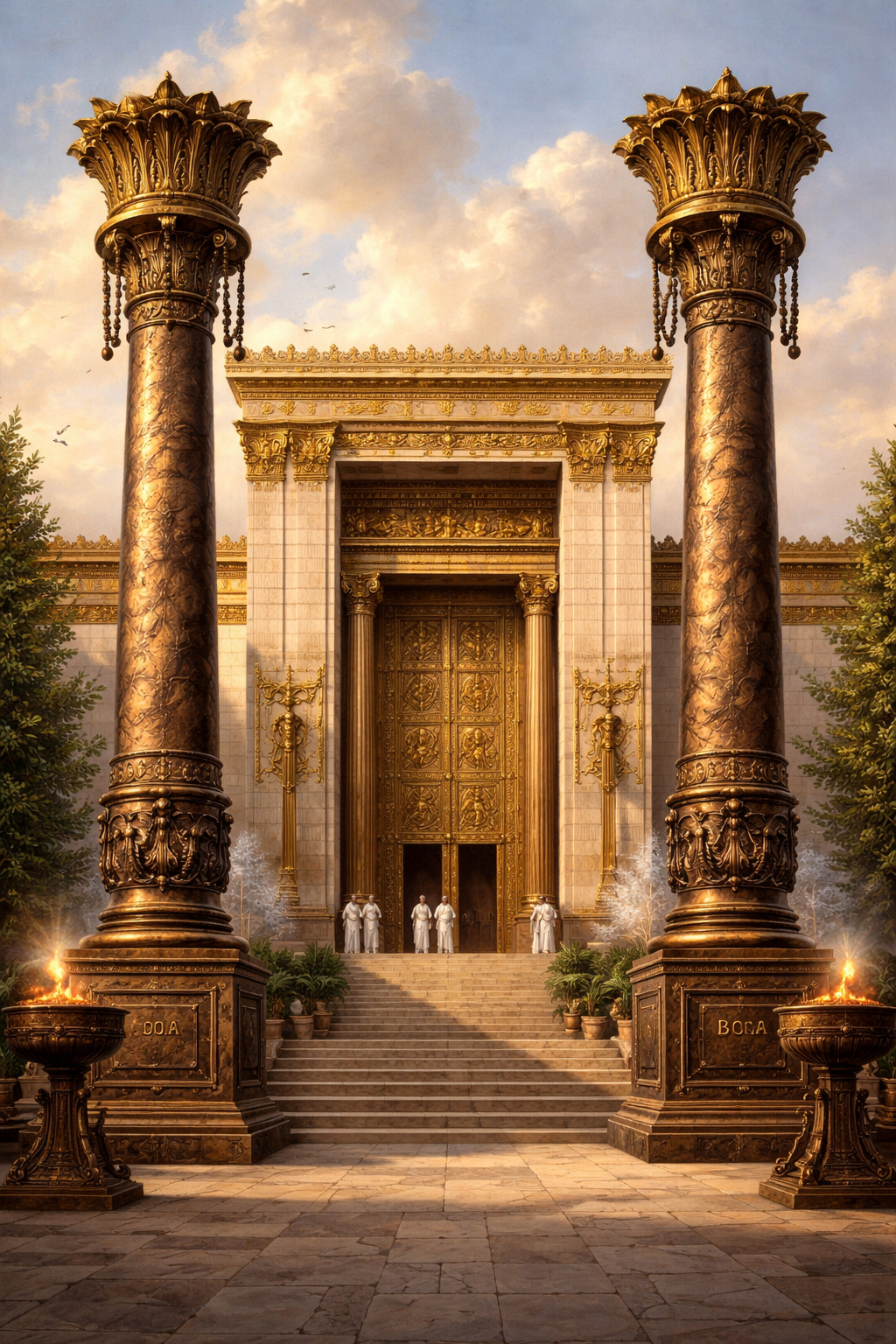
DISMANTLING OF THE TEMPLE'S
MASSIVE, SYMBOLIC PILLARS
Now the bronze pillars which were in the house of the LORD - These were the famous pillars made in Solomon’s Temple described in 1 Kings 7:21 "Thus he set up the pillars at the porch of the nave; and he set up the right pillar and named it Jachin ("He establishes”), and he set up the left pillar and named it Boaz (“In Him is strength”) (for full descriptions see 1Ki 7:15-22) These names were not chosen at random but carried deep theological significance for together, they proclaimed that God Himself would establish His temple and that His strength would sustain it. They were visible reminders of God’s faithfulness and covenant promises. The bronze pillars were not structural supports but stood as free-standing symbols at the temple’s entrance, representing the spiritual truths that undergirded Israel’s worship. They reminded the people that their stability and security did not come from human craftsmanship or royal power but from the Lord who establishes His people in strength.
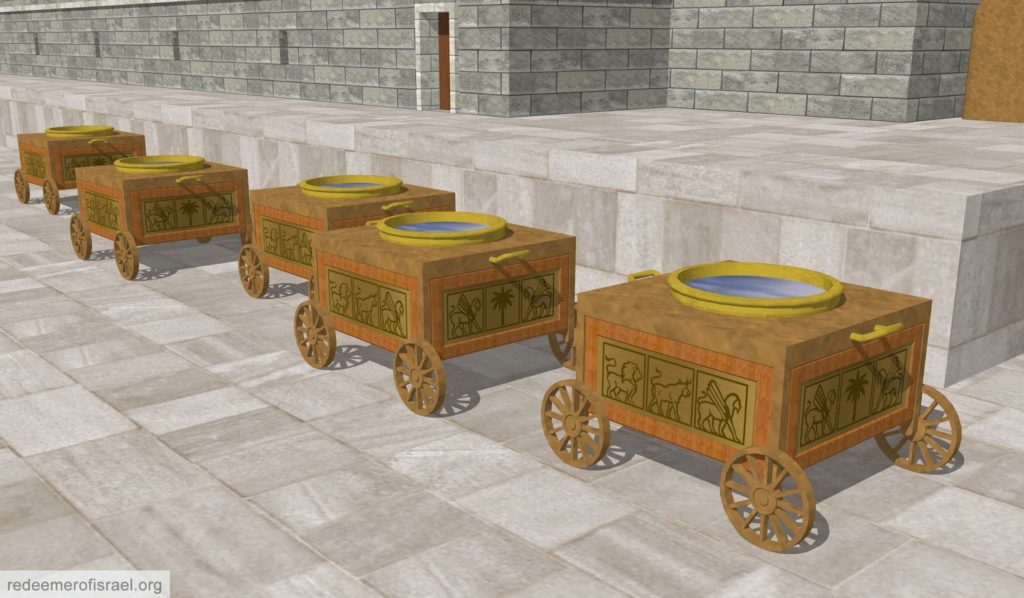
And the stands - These were the bronze stands (carts) that held the lavers (basins used for washing in temple service) (see description of these stands 1Ki 7:27–39). They were part of the daily cleansing system for priests, symbolizing purification.

Molten Sea, illustration in the Holman Bible, 1890

And the bronze sea which were in the house of the LORD - The bronze sea (1Ki 7:23) was a massive basin used by priests which replaced the smaller bronze laver that had been used in the tabernacle during Israel’s wilderness wanderings. It measured about fifteen feet in diameter, seven and a half feet deep, and forty-five feet in circumference. It was set upon twelve bronze oxen, three facing each direction of the compass, and held thousands of gallons of water. Its purpose was for the ceremonial washing of the priests before they entered the temple or approached the altar, symbolizing the need for purity before coming into the presence of a holy God. Recall that King Ahaz had taken the bronze sea down from off the oxen (2Ki 16:17) and "put upon a pavement of stone" but which Hezekiah had probably restored. The 12 oxen are mentioned in Jer 52:20 among the objects which Nebuzar-adan carried off.
When holiness is replaced by hypocrisy
even sacred structures are not spared
The Chaldeans broke in pieces and carried the bronze to Babylon - There were no freight trains to Babylon so these large structures sadly had to be smashed into small pieces for transport. This symbolized the complete dismantling of Israel’s worship system! Bronze was extremely valuable and would have been reused for Babylon’s pagan purposes including vessels, arms, armor, etc.
Sadly, what had been holy, set apart and consecrated to the glory of the Most High God was now destroyed and reused for a profane pagan purposes, all because the people of Israel had abandoned the reality which those symbols had pointed to!
John Walton - plunder of Jerusalem. The writer of 2 Kings is probably reciting this list of items from nonextant official temple records of Judah. It can be compared to 2 Kings 17:15-20, where the original manufacture of the items was recorded. The large list of bronze objects may be a booty count. The items in 2 Kings 17 that were omitted here had been sent to Assyria in previous years (e.g., twelve bronze bulls were sent by Ahaz to Tiglath-Pileser III; 2 Kings 16:17). No Babylonian sources describe the inventory taken from Jerusalem. (IVP Background Commentary)
QUESTION - What are Jachin and Boaz? GOTQUESTIONS.ORG
ANSWER - Jachin and Boaz are the names of two bronze pillars erected at the entrance to the vestibule of Solomon’s temple, according to 1 Kings 7:21. Construction of the temple in Jerusalem began in 966 BC and was finished seven years later. The story of the building of the temple is found in 1 Kings 7 and 2 Chronicles 3.
In order to have the best possible fittings for the temple, Solomon hired a man named Hiram (or Huram) from Tyre to do the bronze work. Hiram was known for his wisdom, understanding, and skill in bronze working (1 Kings 7:13–14). Scripture gives much detail concerning the pillars Jachin and Boaz: “A network of interwoven chains adorned the capitals on top of the pillars, seven for each capital. [Hiram] made pomegranates in two rows encircling each network to decorate the capitals on top of the pillars. He did the same for each capital. The capitals on top of the pillars in the portico were in the shape of lilies . . . . On the capitals of both pillars, above the bowl-shaped part next to the network, were the two hundred pomegranates in rows all around” (1 Kings 7:17–20).
Jachin and Boaz stood at the entrance to the temple’s vestibule or portico. Their dimensions indicate the extent of the work involved in creating them. Including the decorative tops of the pillars, Jachin and Boaz stood approximately thirty-five feet tall, with a circumference of eighteen feet (1 Kings 7:15–20). The brass used to make the twin pillars had been taken by King David from the king of Zobah as part of the spoils of war (1 Chronicles 18:8–9).
The pillar on the south of the entrance was called Jachin, and one on the north named Boaz. Both 2 Chronicles and 1 Kings say that “he” set up the pillars and “he” named them Jachin and Boaz. Commentators are divided as to whether “he” refers to Hiram or Solomon. Whoever named them, their names are significant. Jachin (pronounced yaw-keen) means “he will establish,” and Boaz signifies “in him is strength.” Taken together, the names were a reminder that God would establish the temple and the worship of His name in strength.
The pillars Jachin and Boaz were destroyed along with the rest of the temple by the Chaldeans (Jeremiah 52:17), but the names’ meaning lives on in the spiritual kingdom of God. The names of the pillars represent the strength and stability of God’s promises of a kingdom that will last forever (Daniel 6:26; Luke 1:33; Hebrews 1:8; Revelation 11:15).
2 Kings 25:14 They took away the pots, the shovels, the snuffers, the spoons, and all the bronze vessels which were used in temple service.
- They took away the pots: Ex 27:3 38:3 1Ki 7:47-50 2Ch 4:20-22 24:14
Related Passages:
Jeremiah 52:18 They also took away the pots, the shovels, the snuffers, the basins, the pans and all the bronze vessels which were used in temple service.
DESECRATION OF
TEMPLE VESSELS
They took away the pots, the shovels - These were vessels and utensils used to collect ashes from the altar (Ex 27:3)
Bob Utley - "They took away the pots" It must be remembered that there were several deportations by Nebuchadnezzar II of the Judean population and Temple implements. The first occurred in 605 B.C. and the second in 597 B.C. Therefore, there was not much left to be taken away in 587/586 B.C. Jeremiah even records a later deportation in 582 B.C., which was connected with the death of Gedaliah.
The snuffers, the spoons - The snuffers were associated with the lampstand, which was essential for maintaining the light in the holy place. The spoons where most likely associated with incense offerings (Nu 7:14KJV)
and all the bronze vessels which were used in temple service - The point is that nothing remained to continue the daily service of the Temple.
2 Kings 25:15 The captain of the guard also took away the firepans and the basins, what was fine gold and what was fine silver.
- and such things: Ex 37:23 Nu 7:13,14 1Ki 7:48-51 2Ch 24:14 Ezr 1:9-11 Da 5:2,3
Related Passages:
Jeremiah 52:19 The captain of the guard also took away the bowls, the firepans, the basins, the pots, the lampstands, the pans and the drink offering bowls, what was fine gold and what was fine silver.
CONTINUED STRIPPING
OF THE TEMPLE
The captain of the guard (Nebuzaradan) also took away the firepans and the basins, what was fine gold and what was fine silver - Having already burned the Temple (2Ki 25:9), he strips what remains of the sacred contents. Firepans (censers) were used for burning incense before the LORD (Lev 16:12) and basins were used in sacrificial rituals, often for handling blood or drink offerings (Ex 27:3). These items were set apart for holy use and part of the daily worship system God had established, symbolizing the end of Temple worship in Jerusalem and the departure of God's blessing and presence. The upshot is that Judah had defiled the temple with idols (2Ki 21:4–7), trusted in the temple falsely (Jer 7:4) so that now the Temple was emptied and desecrated, pointing to the seriousness of treating what is holy with impunity! Of note is that these vessels will later be returned after exile (Ezra 1:7–11).
2 Kings 25:16 The two pillars, the one sea, and the stands which Solomon had made for the house of the LORD–the bronze of all these vessels was beyond weight.
- the bronze of all: 1Ki 7:47
The two pillars, the one sea, and the stands which Solomon had made for the house of the LORD–the bronze of all these vessels was beyond weight - This highlights both the immense scale of Solomon’s Temple furnishings and the totality of their loss when Jerusalem fell.
2 Kings 25:17 The height of the one pillar was eighteen cubits, and a bronze capital was on it; the height of the capital was three cubits, with a network and pomegranates on the capital all around, all of bronze. And the second pillar was like these with network.
- one pillar: 1Ki 7:15,16 Jer 52:21-23
Related Passages:
Jeremiah 52:21-22 As for the pillars, the height of each pillar was eighteen cubits, and it was twelve cubits in circumference and four fingers in thickness, and hollow. 22Now a capital of bronze was on it; and the height of each capital was five cubits, with network and pomegranates upon the capital all around, all of bronze. And the second pillar was like these, including pomegranates.
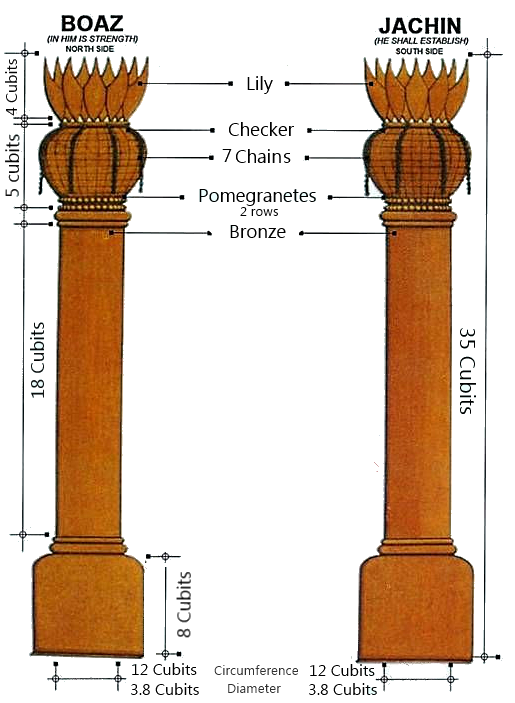
THE MASSIVE
BRONZE PILLARS
The height of the one pillar was eighteen cubits, and a bronze capital was on it; the height of the capital was three cubits, with a network and pomegranates on the capital all around, all of bronze. And the second pillar was like these with network This description highlights the remarkable size, beauty, and symbolism of the bronze pillars that once stood at the entrance of the Temple. Each pillar was eighteen cubits high,about twenty-seven feet, with an additional capital of three cubits (about four and a half feet), making the total height over thirty feet (1 Kings 7:15). These towering structures, known as Jachin and Boaz, represented God’s establishing power and strength. The capitals were adorned with intricate network designs and surrounded by rows of pomegranates (1 Kings 7:17–18), symbols of fruitfulness, blessing, and life in the land God had given. Made entirely of bronze, they conveyed durability and strength, yet even these massive and beautifully crafted objects were ultimately broken apart and carried away by the Babylonians (2 Kings 25:13), demonstrating that no outward symbol, no matter how impressive, can stand when a people turn from God. What once displayed the glory, order, and richness of Israel’s worship became a testimony to its loss, reminding us that external beauty and religious structure cannot substitute for true obedience, for “to obey is better than sacrifice” (1 Samuel 15:22).
2 Kings 25:18 Then the captain of the guard took Seraiah the chief priest and Zephaniah the second priest, with the three officers of the temple.
- Then the captain: 2Ki 25:24,25,26
- Seraiah: 1Ch 6:14 Ezr 7:1 Jer 52:24
- Zephaniah the second priest: Jer 21:1 29:25,29
Related Passages:
Jeremiah 52:24 Then the captain of the guard took Seraiah the chief priest and Zephaniah the second priest, with the three officers of the temple.
Then the captain of the guard took Seraiah the chief priest and Zephaniah the second priest, with the three officers of the temple. These men had probably been leaders in the revolt against Nebuchadnezzar or leaders in defending the city.
Peter Pett: The prominent people in Jerusalem were now to be called to account, and the first were the five ‘chief priests’. They would be seen as important supporters of the revolt.
2 Kings 25:19 From the city he took one official who was overseer of the men of war, and five of the king’s advisers who were found in the city; and the scribe of the captain of the army who mustered the people of the land; and sixty men of the people of the land who were found in the city.
- five of the king’s advisers: Heb. saw the king's face, Es 1:14
Related Passages:
Jeremiah 52:25 He also took from the city one official who was overseer of the men of war, and seven of the king’s advisers who were found in the city, and the scribe of the commander of the army who mustered the people of the land, and sixty men of the people of the land who were found in the midst of the city.
From the city he took one official who was overseer of the men of war, and five of the king’s advisers who were found in the city; and the scribe of the captain of the army who mustered the people of the land; and sixty men of the people of the land who were found in the city. - The Babylonians deliberately removed and executed every layer of leadership in Judah, ensuring the complete collapse of the nation. God removed Judah’s leaders, leaving the nation stripped of all human strength and structure.
Bob Utley- "the captain of the guard took" Apparently Nebuzaradan picked those who were involved in leadership positions during the rebellion to take to Nebuchadnezzar II at Riblah to be killed. This seems to be very cruel to us but we must remember for his day, Nebuchadnezzar II was acting with uncharacteristic compassion to a conquered people. We have accounts of many thousands being killed in other military campaigns and here, only about 60 or 70. It is also interesting that Nebuzaradan targeted certain people, not indiscriminate slaughter. "five of the king's advisers" This is literally "those seeing the king's face." Jeremiah 52:29 says seven of the king's advisers. These kinds of number problems are common in the Old Testament because of copyists' errors.
2 Kings 25:20 Nebuzaradan the captain of the guard took them and brought them to the king of Babylon at Riblah.
- and brought them: Jer 52:26,27 La 4:16
Related Passages:
Jeremiah 52:26 Nebuzaradan the captain of the guard took them and brought them to the king of Babylon at Riblah.

Riblah North of Damscus
Source: ESV Global Study Bible
STAGING THE EXECUTION
AT RIBLAH
Nebuzaradan the captain of the guard took them and brought them to the king of Babylon at Riblah - Riblah was a strategically important, fortified city located on the Orontes River about 180 miles north of Jerusalem (would take about 1 week to travel), along the major military route connecting Egypt with the Fertile Crescent. Because of its location (close enough for control, far enough to be secure headquarters), it served as the field headquarters of Nebuchadnezzar II during his campaigns against Judah. From Riblah, he could effectively direct military operations, including the sieges of Jerusalem and Tyre, while maintaining control over key trade and invasion routes. Its fertile surroundings also provided abundant supplies, making it an ideal base for sustaining large բանակ forces (cf. 2 Kings 23:33; 25:6).
2 Kings 25:21 Then the king of Babylon struck them down and put them to death at Riblah in the land of Hamath. So Judah was led away into exile from its land.
- So Judah was led away: 2Ki 17:20 23:27 Lev 26:33-35 De 4:26 28:36,64 Jer 24:9,10 25:9-11 Eze 12:25-28 24:14 Am 5:27
Related Passages:
Jeremiah 52:27 Then the king of Babylon struck them down and put them to death at Riblah in the land of Hamath. So Judah was led away into exile from its land. 28 These are the people whom Nebuchadnezzar carried away into exile: in the seventh year 3,023 Jews; 29 in the eighteenth year of Nebuchadnezzar 832 persons from Jerusalem; 30 in the twenty-third year of Nebuchadnezzar, Nebuzaradan the captain of the guard carried into exile 745 Jewish people; there were 4,600 persons in all.
Leviticus 26:33 ‘You, however, I will scatter among the nations and will draw out a sword after you, as your land becomes desolate and your cities become waste.
Deuteronomy 28:36 “The LORD will bring you and your king, whom you set over you, to a nation which neither you nor your fathers have known, and there you shall serve other gods, wood and stone.
Deuteronomy 28:64 “Moreover, the LORD will scatter you among all peoples, from one end of the earth to the other end of the earth; and there you shall serve other gods, wood and stone, which you or your fathers have not known.
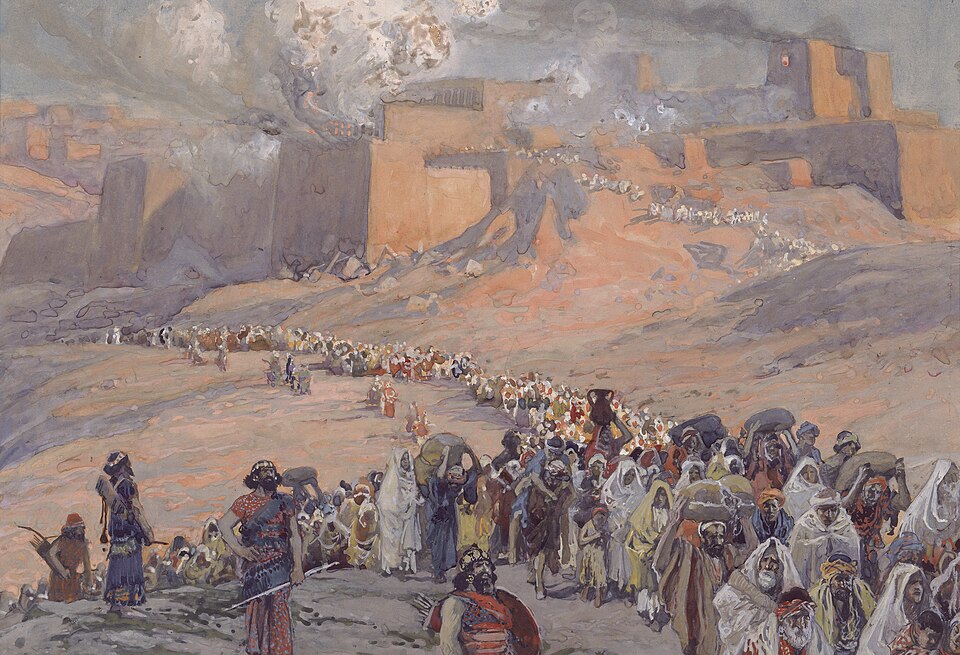
EXECUTION O LEADERS
EXILE OF JUDAH
Then the king of Babylon struck them down and put them to death at Riblah in the land of Hamath (northern Syria) - Nebuchadnezzar II is God's servant and instrument of judgment and here strikes down key leaders of Judah. This was a targeted removal of leadership, ensuring there would be no organized resistance and no quick national recovery.
This next phrase marks the end
of an era in biblical history
So (term of conclusion) Judah was led away into exile from its land - This is a simple brief summary of everything that had just happened, declaring the final outcome of Jerusalem’s fall and the end of Judah as an independent nation. Led away into exile describes forced deportation.
From its land is the sadest part because the land was a gift from God (Ge 12:7) and a central part of the covenant. To be removed from the land meant loss of blessing, identity and stabiltiy (among other things). In Lev 18:28 Yahweh had warned Israel that land will spew them "out, should you defile it, as it has spewed out the nation which has been before you." The exile shows that the people had violated the covenant and the land itself “expelled” them under God’s judgment. This represents the culmination of centuries of warning from Yahweh and centuries of disobedience by Israel!
It is important to note that the exile was divine discipline and not divine abandonment, for God had made a promise in Jer 29:10 that “When seventy years have been completed for Babylon, I will visit you and fulfill My good word to you, to bring you back to this place." In Lamentations Jeremiah added that "the Lord will not reject forever, For if He causes grief, Then He will have compassion According to His abundant lovingkindness." (Lam 3:31-32)
John Whitcomb: the starved survivors in Jerusalem, reduced in some case to cannibalism by the prolonged siege (Lam. 4:8-10; cf. Jer. 37:21; 38:9; 52:6), were brutally mistreated by Babylonian soldiers (Lam. 5:11-13; II Chron. 36:17; Jer. 38:22-23), and then herded together and chained like wild animals for deportation to Babylon (Jer. 39:9; 40:1). The only ones that were not deported were poor country people who were left to care for vineyards and orchards (Jer. 39:10); Gedaliah to serve as the governor of this pitiful remnant; certain guerilla fighters who had been hiding in the hills (Jer. 40:7-8); and a few other Jews who had fled to surrounding countries and were now returning (Jer. 40:11-12). (BORROW Israel : from Conquest to Exile : a Commentary on Joshua-2 Kings)
John Whitcomb goes on to address the question - Why did God permit Judah to suffer the horrors of Babylonia captivity? The Chronicler lists three reasons. - First, Zedekiah refused God’s Word through Jeremiah and broke his oath to Nebuchadnezzar (2Ch 36:12-13). - Second, the priests and the people adopted heathen customs, polluted the Temple, and scoffed at God’s prophets (2Ch 36:14-16), - And third, God’s provision for the sabbatical year (cf. Lev 25:4; 26:34) had been neglected for centuries; therefore, “as long as it lay desolate it kept sabbath, to fulfill threescore and ten years” (2Ch 36:21). (ED: Whitcomb leaves out a fourth reason - the sin of Manasseh - 2Ki 23:26 says "However, the LORD did not turn from the fierceness of His great wrath with which His anger burned against Judah, because of all the provocations with which Manasseh had provoked Him." The history of Israel from Solomon to the Babylonian Exile is a four-hundred-year demonstration of God’s faithfulness to His Word in both promise and warning. He is a God Who never changes (Mal. 3:6). He can be depended upon from generation to generation. And what He proved Himself to be for Israel, He proves Himself to be for us, as we heed His warnings and put our complete trust in His gracious promises. “Now these things happened unto them by way of example; and they were written for our admonition, upon whom the ends of the ages are come. Wherefore let him that thinketh he standeth take heed lest he fall … but God is faithful …” (1Co 10:11–13).(BORROW Israel : from Conquest to Exile : a Commentary on Joshua-2 Kings)
A. E. Kitteridge, D. D - Now let us consider what sins Zedekiah had committed, which brought down upon him and his family and the people of God this terrible punishment.
1. We know from 2Ki 24:19 that he did not seek the glory of God in his reign. “He did that which was evil in the sight of the Lord, according to all which Jehoiakim had done.” By studying the history of the reign of his brother Jehoiakim we know that this “evil” consisted in the fact that he did not oppose and overthrow idolatry in the kingdom. We have no evidence that Zedekiah was himself an idolater, but we are responsible to God not only for what we say and do, but for our influence over others.
2. Another sin of Zedekiah’s was his revolt from the King of Babylon, and we learn from the punishment visited upon Judah’s king the sacredness of an oath in God’s sight.
3. Zedekiah broke a solemn covenant which he had made with the people, that all Jews held in bondage should be set free. In accordance with the king’s command, this degree of emancipation was carried out, and no Jew throughout Judah was a slave. But when it was known that the Egyptian army was coming to help them, then Zedekiah thought that he would not need the assistance of these freedmen in the battle with the enemy, and so the order of emancipation was revoked, and slavery was re-established in the land (Jer 34:16-17).
4. Zedekiah’s treatment of the prophet was another cause which led to his overthrow. Although in the beginning of the national peril he had sent to Jeremiah with the urgent message, “Pray now unto the Lord our God for us,” yet we read (Jer 37:2), “Neither he, nor his servants, nor the people of the land, did hearken unto the words of the Lord, which he spake by the prophet Jeremiah.” And not only did he refuse to follow the prophet’s advice, but he yielded to the enemies of this fearless man of God, and suffered them to imprison and maltreat him.
There are some very solemn lessons which we learn from the sad life and tragic end of this last king of Judah. They are--
1. The first and indispensable requisite to success is for one to gain the victory over his own lower nature. So long as we are slaves to sin, we cannot be great in any path of life, but he who keeps self under, who has conquered passions and appetites for the sake of God and His cause, is sure to live a royal life, though he may never sit on a throne.
2. The fact that any one is our enemy does not relieve us from the obligation to keep faith with him (Jos 9:19). Perjury is always a terrible sin.
3. If our trust is in God, we need never fear what our enemies may do, for with God on our side all must be well. Zedekiah feared his nobles because he had no faith in God.
4. The Christian is the only one who can be absolutely fearless of the future, for around him are the everlasting arms. Zedekiah put his trust in the fortifications around Jerusalem; if he had trusted in Jehovah and believed the words of Jeremiah, his life would have been safe and his kingdom would have been preserved. David sang: “In God is my salvation and my glory; the rock of my strength and my refuge is in God.”
5. We never gain by doing wrong. When we do evil that good may come, we are always disappointed.
6. God is not mocked. If He determines to punish, no walls or weapons can defeat His purpose. When He says to us that all other paths but the one which he has marked out lead to destruction, we may be sure that our disobedience will in the end prove His words to be true (Jer 2:17; Hos 13:9).)
2 Kings 25:22 Now as for the people who were left in the land of Judah, whom Nebuchadnezzar king of Babylon had left, he appointed Gedaliah the son of Ahikam, the son of Shaphan over them.
- Now as for the people: Jer 40:5-12
- Gedaliah: 2Ki 25:25 Jer 39:14 41:2
- son of Ahikam: 2Ki 22:12 2Ch 34:20 Jer 26:24
Related Passages:
Jeremiah 40:7 (NEBUCHADNESSAR APPOINTED GEDALIAH OVER JUDAH) Now all the commanders `of the forces that were in the field, they and their men, heard that the king of Babylon had appointed Gedaliah the son of Ahikam over the land and that he had put him in charge of the men, women and children, those of the poorest of the land who had not been exiled to Babylon.
Jeremiah 43:6 (JEREMIAH AND BARUCH CAME TO GEDALIAH IN MIZPAH) the men, the women, the children, the king’s daughters and every person that Nebuzaradan the captain of the bodyguard had left with Gedaliah the son of Ahikam and grandson of Shaphan, together with Jeremiah the prophet and Baruch the son of Neriah–
GEDALIAH APPOINTED
GOVERNER OVER JUDAH
Now as for the people who were left in the land of Judah, whom Nebuchadnezzar king of Babylon had left, he appointed Gedaliah (note) the son of Ahikam, the son of Shaphan over them Gedaliah was a friend of Jeremiah (Jer. 39:14) and was a worthy governor but was assassinated because he placed trust in unworthy men (Jer. 40:14).
John MacArthur: In an attempt to maintain political stability, Nebuchadnezzar appointed a governor from an important Judean family. A more detailed account of Gedaliah’s activities is found in Jer 40:7 – 41:18. Gedaliah’s grandfather, Shaphan, was Josiah’s secretary, who had implemented that king’s reforms (Jer 22:3). His father, Ahikam, was part of Josiah’s delegation sent to Huldah (Jer 22:14) and a supporter of the prophet Jeremiah (Jer 26:24). (See MacArthur Study Bible)
Pulpit Commentary on the people who were left in the land - These consisted of Gedaliah and his court, which included Jeremiah, Baruch, and some princesses of the royal house (Jeremiah 43:6); the poor of the land, whom Nebuzar-adan had intentionally left behind; and a considerable number of Jewish refugees of a better class, who came in from the neighboring nations, and from places in Judaea where they had been hiding themselves (Jeremiah 40:7-12). For about two months all went well with this "remnant," who applied themselves to agricultural pursuits, in which they prospered greatly....Ahikam had protected Jeremiah in his earlier days (Jeremiah 26:24); Gedaliah protected him in the latter part of the siege (Jeremiah 39:14).
Bob Utley - "Gedaliah" His name means "YHWH is great". This man's family had shown great spiritual integrity (cf. 2 Kgs. 22:3,8,12; Jer. 26:24). Josephus Antiq. 10.9.1 calls him "a gentle and righteous disposition." Possibly even Jeremiah made the recommendation that he be made governor (i.e., Jer. 39:14; 40:1-6). He was not of the royal family but he was a Judean. See fuller account in Jer. 40:7-41:9. Ahikam was a trusted advisor of Josiah (cf. 2 Kgs. 22:12) and apparently helped Jeremiah (cf. Jer. 26:24).
See Josephus 10.9.1 1. [An. 588.] Now the general of the army, Nebuzaradan, when he had carried the people of the Jews into captivity, left the poor, and those that had deserted, in the countrey; and made one, whose name was Gedaliah the son of Ahikam, a person of a noble family, their governour. Which Gedaliah was of a gentle and righteous disposition. He also commanded them that they should cultivate the ground, and pay an appointed tribute to the King. He also took Jeremiah the Prophet out of prison; and would have persuaded him to go along with him to Babylon: for that he had been enjoined by the King to supply him with whatsoever he wanted. And if he did not like to do so, he desired him to inform him where he resolved to dwell; that he might signify the same to the King. But the Prophet had no mind to follow him, nor to dwell any where else; but would gladly live in the ruins of his countrey, and in the miserable remains of it. When the general understood what his purpose was, he enjoined Gedaliah, whom he left behind, to take all possible care of him, and to supply him with whatsoever he wanted. So when he had given him rich presents, he dismissed him. Accordingly Jeremiah abode in a city of that countrey which was called Mispah; and desired of Nebuzaradan that he would set at liberty his disciple Baruch, the son of Neriah; one of a very eminent family; and exceeding skilful in the language of his countrey. (22)
Believer's Study Bible - Judah was now a province of Babylon. She no longer had her own king, but was ruled by an appointed governor. The first governor was Gedaliah, the son of Ahikam, who had once saved Jeremiah from death (Jer. 26:24). Gedaliah was also the grandson of Shaphan, who was probably Josiah's scribe and who was active in the reformation movement of Josiah's time (22:3).
LaMar Eugene Cooper - A large group of bullae or clay seals affixed to official documents have been unearthed in Jerusalem in the Shiloh Excavations of the City of David, on the Hill Ophel just below the temple mount. Among the 255 seals found are those of Baruch, the son of Neriah, the scribe of Jeremiah, and Gedeliah, the son of Ahikam, appointed governor by Nebuchadnezzar. See N. Avigad, Hebrew Bullae from the Time of Jeremiah, 24-25, 28-29; T. Schneider, Six Biblical Signatures, BAR 17.4 (1991): 26-33. (See Ezekiel: An Exegetical and Theological Exposition)
John Walton - It is possible that Gedaliah had previously been in the service of King Zedekiah, based upon a seal impression of the late seventh century B.C. from Lachish that reads, “belonging to Gedaliah, the Royal Steward.” Alternatively, however, that bulla may refer to another Gedaliah of this period (see Jer 38:1). The name Gedaliah is also found on an ostraca from Arad. He was probably a ranking member of the “pro-Babylonian” party in Jerusalem. Similar to the Assyrians, the Babylonians desired to found an administrative core with a strong Babylonian presence in Judah. Contrary to Assyrian practice, however, the Babylonians did not repopulate Judah with people from other parts of the empire. (IVP Background Commentary)
QUESTION - Who was Gedaliah in the Bible? GOTQUESTIONS.ORG
ANSWER - Five men named Gedaliah appear in the Bible. The most famous of those is the Jewish leader whom King Nebuchadnezzar assigned to serve as governor over Judah after the destruction of the temple.....
The best-known Gedaliah also lived during the time of the Babylonian siege and defeat of Jerusalem, when Nebuchadnezzar looted and destroyed the temple in 587 BC. Judah’s King Zedekiah and most of the Jews who survived were taken in exile to Babylon. The Babylonian soldiers (referred to as Chaldeans) pulled the walls down and burned the buildings. Jerusalem was leveled.
Only the poorest Jews were left behind in Judah to grow crops and tend the land. Babylon’s King Nebuchadnezzar appointed Gedaliah to serve as his Jewish tributary or governor over the region. It was common for a conquered people to be given a governor from among their own to serve as a representative between Babylon and the locals. Some Chaldean soldiers also remained in the land to keep order and ensure no rebellion took place. Gedaliah served in this capacity as governor from the town of Mizpah, north of Jerusalem.
When those who had fled from the invaders heard that Gedaliah had been established as governor, they returned to Judah. Among those who returned were several groups of soldiers who had not been in Jerusalem during the siege and had not been captured. As they arrived, Gedaliah wisely urged everyone to accept their fate and live at peace in the land under the rule of the Babylonians. They had nothing left to fear. The Chaldeans would not harm them as long as they remained peaceful. “Settle down in the land and serve the king of Babylon, and it will go well with you” (2 Kings 25:24). The prophet Jeremiah, too, came to Mizpah to be near Governor Gedaliah.
After such terrible death and destruction, Judah enjoyed a brief season of peace and even prosperity. The people who remained in the land “harvested an abundance of wine and summer fruit” (Jeremiah 40:12). That peace did not last, however.
Johanan, one of the captains who had escaped the Babylonian exile, told Gedaliah about a plot against him. Another of the remaining captains, Ishmael, was working in league with the king of the Ammonites to kill Gedaliah. Johanan requested permission to kill Ishmael quietly to preserve Gedaliah’s life and maintain the fragile peace in the land. Gedaliah, however, refused to believe that Ishmael would actually kill him.
Why did the king of Ammon want Gedaliah dead? The Ammonites had been allies with the previous king of Judah against the Babylonians. Governor Gedaliah, however, was cooperating with the Babylonians. In addition, if the Babylonians were forced to deal with a new rebellion in Judah, it would delay their impending attacks against Ammon. It’s possible that the Ammonites simply wanted to cause turmoil in Judah to save their own necks. In any case, Ishmael had indeed been sent to betray and kill Gedaliah.
Gedaliah was so convinced of Ishmael’s loyalty that he welcomed Ishmael and ten men to sit and eat with him (Jeremiah 41:1). Ishmael and his men killed Gedaliah and those who were with him, including the Chaldean soldiers present. Gedaliah had only been the governor for two months. The following day, Ishmael slaughtered 70 pilgrims from the north who had come to worship at the temple. Finally, Ishmael took captive everyone in Mizpah and headed toward Ammon. Before he could get away, however, Johanan—the one who had warned Gedaliah about the plot—chased Ishmael down and rescued all of the captives. Ishmael escaped with eight men and returned to the Ammonites.
You can read what happened next in Jeremiah 41:1-18.
Much later, Jewish leaders established a fast in remembrance of these events and the loss of Jewish self-governance. The Fast of Gedaliah falls on the third day of the Hebrew month of Tishri and is still recognized in Judaism.
2 Kings 25:23 When all the captains of the forces, they and their men, heard that the king of Babylon had appointed Gedaliah governor, they came to Gedaliah to Mizpah, namely, Ishmael the son of Nethaniah, and Johanan the son of Kareah, and Seraiah the son of Tanhumeth the Netophathite, and Jaazaniah the son of the Maacathite, they and their men.
- When all the captains: Jer 40:7-9,11,12
Related Passages:
Jeremiah 40:1-6 (JEREMIAH RELEASED FROM PRISON AND GOES TO MIZPAH TO STAY WITH GEDALIAH) The word which came to Jeremiah from the LORD after Nebuzaradan captain of the bodyguard had released him from Ramah, when he had taken him bound in chains among all the exiles of Jerusalem and Judah who were being exiled to Babylon. 2 Now the captain of the bodyguard had taken Jeremiah and said to him, “The LORD your God promised this calamity against this place; 3 and the LORD has brought it on and done just as He promised. Because you people sinned against the LORD and did not listen to His voice, therefore this thing has happened to you. 4 “But now, behold, I am freeing you today from the chains which are on your hands. If you would prefer to come with me to Babylon, come along, and I will look after you; but if you would prefer not to come with me to Babylon, never mind. Look, the whole land is before you; go wherever it seems good and right for you to go.” 5 As Jeremiah was still not going back, he said, “Go on back then to Gedaliah the son of Ahikam, the son of Shaphan, whom the king of Babylon has appointed over the cities of Judah, and stay with him among the people; or else go anywhere it seems right for you to go.” So the captain of the bodyguard gave him a ration and a gift and let him go. 6 Then Jeremiah went to Mizpah to Gedaliah the son of Ahikam and stayed with him among the people who were left in the land.
CAPTAINS COME TO
MIZPAH TO MEET GEDALIAH
When all the captains of the forces (officers in command of the Judean troops which had defended Jerusalem who had escaped from the city), they and their men (captains had kept men under their command), heard that the king of Babylon had appointed Gedaliah governor, they came to Gedaliah to Mizpah (8 mi. N of Jerusalem), namely, Ishmael the son of Nethaniah (see note), and Johanan the son of Kareah, and Seraiah the son of Tanhumeth the Netophathite (city near Bethlehem), and Jaazaniah the son of the Maacathite, they and their men Gedaliah established his residence and appartenly a new capital at Mizpah. Jeremiah, who had been left in the land at his own request, took up residence at Mizpah where he could counsel the new governor (Jer. 40:1-6; 42:1-43:3). When Ishmael and others returned to Judah, after fleeing from the Babylonians, they professed loyalty to Gedaliah. Johanan, military aide to Gedaliah, warned him that this profession was false, but Gedaliah refused to believe him.
Jeremiah 40:13-14 Now Johanan the son of Kareah and all the commanders of the forces that were in the field came to Gedaliah at Mizpah 14 and said to him, “Are you well aware that Baalis the king of the sons of Ammon has sent Ishmael the son of Nethaniah to take your life?” But Gedaliah the son of Ahikam did not believe them.
Peter Pett: The ‘captains of the forces’ were commando leaders, either of bands who had hidden in the mountains when Nebuchadnezzar first invaded, or of remnants of the army who had escaped from Jerusalem at the same time as Zedekiah had tried to make his escape, and had taken to the mountains. When they heard that Gedaliah had been appointed governor they came to him in Mizpah, probably hoping for a new beginning. With Jerusalem in ruins and their kings exiled in Babylon there was little left to fight for.
Bob Utley - Mizpah" Apparently Jerusalem was so badly destroyed that the seat of Judean government had to be moved to Mizpah (cf. Jer. 40:7ff). Ishmael Josephus (Antiq. 10.9.2) tells us that this was a wicked and crafty man who had deserted the Judean army and had fled to the king of Ammon for assistance. Jonathan had warned Gedaliah of Ishmael's intent in Jer. 40:13-15, but Gedaliah did not listen and Ishmael and ten of his men killed him. Josephus tells us that it was during a drunken party, but this is uncertain (cf. Antiq. 10.9.2).
John Walton - Mizpah. This was the capital of what was left of Judah. Mizpah is an eight-acre site located about eight miles north of Jerusalem.....Recent reassessment of excavation reports have identified an occupation level from this period. One of the artifacts found at the site was a seal belonging to “Jaazaniah, the servant of the king”—likely the same individual mentioned in verse 23. (IVP Background Commentary)
2 Kings 25:24 Gedaliah swore to them and their men and said to them, “Do not be afraid of the servants of the Chaldeans; live in the land and serve the king of Babylon, and it will be well with you.”
- Gedaliah swore to them: 2Sa 14:11 19:23 Jer 40:9,10 Eze 33:24-29
- and it shall be: Jer 40:9 43:6
GEDALIAH'S INSTRUCTIONS
FOR PROSPERITY IN THE LAND
Gedaliah swore to them and their men and said to them, “Do not be afraid of the servants of the Chaldeans - These men were rebels and yet in effect Gedaliah was granting them amnesty.
Live in the land and serve the king of Babylon, and it will be well with you - Gedaliah assured them of life and relative prosperity. Jeremiah adds (Jeremiah 40:10) that he urged them to apply themselves diligently to agricultural pursuits. All they had to do was obey two commands (Live...and serve) and things would go well with them!
Gotquestions.org - After Nebuchadnezzar appointed Gedaliah as governor in Mizpah (Jeremiah 40:7, Jer 25:22), Ishmael visited Gedaliah along with other officers (ED: DESCRIBED IN 2Ki 25:23,24). Later, Baalis, king of Ammon, commissioned Ishmael to murder Gedaliah. The governor was warned of the plot, but he disbelieved it (Jer 40:14). In fact, Johanan son of Kareah offered to intercept Ishmael and kill him before he could harm Gedaliah, but the governor would not agree to that: “Do not do this thing, for you are telling a lie about Ishmael” he said (Jer 40:16).
Donald Wiseman: Gedaliah swore an oath as part of his undertaking official duties as governor, or gave his word in God’s name that loyalty would ensure safety. He urged acceptance of the judgment God had inflicted on Judah by maintaining a pro-Babylonian policy. Settle down in the land peaceably was also Jeremiah’s message to the exiles (Jer 29:4–7). When it is recognized that a foreign ruler has been the divine agent for punishment, such passive resistance is all the more powerful.
William Barnes: The remarkable naivete of Gedaliah is illustrated in more detail in Jer 40:13–16. Josephus (Antiquities 10.9.1.155) notes that Gedaliah had a reputation for being both gentle and generous (See 1-2 Kings - Page 384)
Joseph Benson: Assured them by Gedaliah's promise and oath, that if they would be patient and peaceable under the government of the king of Babylon, and would conduct themselves properly, they should be kept from the evils which they feared. This he might safely swear, because he had not only Nebuchadnezzar’s promise, and interest too, but also God’s promise, delivered by Jeremiah. And it might seem that a fair prospect was now again opening for them. But, alas! This hopeful settlement was soon dashed to pieces, not by the Chaldeans, but by themselves. The things of their peace were so hid from their eyes that they neither knew when they were well, nor would believe when they were told so even by God himself.
Bob Utley - Notice Gedaliah's promises/commands to the Judean remnant. Do not be afraid of the servants of the Chaldeans (BDB 431, KB 432, Qal IMPERFECT used in a JUSSIVE sense). Live in the land (BDB 442, KB 444, Qal IMPERATIVE). Serve the king of Babylon (BDB 712, KB 773, Qal IMPERATIVE). It will be well with you (BDB 405, KB 408, Qal IMPERFECT) or it could be "settle down in the land" (Qal IMPERFECT used in a JUSSIVE sense).
2 Kings 25:25 But it came about in the seventh month, that Ishmael the son of Nethaniah, the son of Elishama, of the royal family, came with ten men and struck Gedaliah down so that he died along with the Jews and the Chaldeans who were with him at Mizpah.
- Gedaliah swore to them: Zec 7:5 8:19
- Ishmael: Jer 40:15,16 Jer 41:1-15
- royal family, 2Ki 11:1
Related Passages:
Jeremiah 40:13-16 (GEDALIAH WARNED THAT ISHMAEL WAS COMING TO KILL HIM) Now Johanan the son of Kareah and all the commanders of the forces that were in the field came to Gedaliah at Mizpah 14 and said to him, “Are you well aware that Baalis the king of the sons of Ammon has sent Ishmael the son of Nethaniah to take your life?” But Gedaliah the son of Ahikam did not believe them. Then Johanan the son of Kareah spoke secretly to Gedaliah in Mizpah, saying, “Let me go and kill Ishmael the son of Nethaniah, and not a man will know! Why should he take your life, so that all the Jews who are gathered to you would be scattered and the remnant of Judah would perish?” 16 But Gedaliah the son of Ahikam said to Johanan the son of Kareah, “Do not do this thing, for you are telling a lie about Ishmael.”
Jeremiah 41:1-15 (ISHMAEL AND THE TEN MEN MURDER GEDALIAH) In the seventh month Ishmael the son of Nethaniah, the son of Elishama, of the royal family and one of the chief officers of the king, along with ten men, came to Mizpah to Gedaliah the son of Ahikam. (TREACHERCY WHILE BREAKING BREAD!) While they were eating bread together there in Mizpah, 2 Ishmael the son of Nethaniah and the ten men who were with him arose and struck down Gedaliah the son of Ahikam, the son of Shaphan, with the sword and put to death the one whom the king of Babylon had appointed over the land. 3 Ishmael also struck down all the Jews who were with him, that is with Gedaliah at Mizpah, and the Chaldeans who were found there, the men of war. 4 (ISHMAEL KILLS MORE MEN COMING TO WORSHIP) Now it happened on the next day after the killing of Gedaliah, when no one knew about it, 5 that eighty men came from Shechem, from Shiloh, and from Samaria with their beards shaved off and their clothes torn and their bodies gashed, having grain offerings and incense in their hands to bring to the house of the LORD. 6 Then Ishmael the son of Nethaniah went out from Mizpah to meet them, weeping as he went (TREACHERY); and as he met them, he said to them, “Come to Gedaliah the son of Ahikam!” 7 Yet it turned out that as soon as they came inside the city, Ishmael the son of Nethaniah and the men that were with him slaughtered them and cast them into the cistern. 8 But ten men who were found among them said to Ishmael, “Do not put us to death; for we have stores of wheat, barley, oil and honey hidden in the field.” So he refrained and did not put them to death along with their companions. 9 Now as for the cistern where Ishmael had cast all the corpses of the men whom he had struck down because of Gedaliah, it was the one that King Asa had made on account of Baasha, king of Israel; Ishmael the son of Nethaniah filled it with the slain. 10 Then Ishmael took captive all the remnant of the people who were in Mizpah, the king’s daughters and all the people who were left in Mizpah, whom Nebuzaradan the captain of the bodyguard had put under the charge of Gedaliah the son of Ahikam; thus Ishmael the son of Nethaniah took them captive and proceeded to cross over to the sons of Ammon. 11 But Johanan the son of Kareah and all the commanders of the forces that were with him heard of all the evil that Ishmael the son of Nethaniah had done. 12 So they took all the men and went to fight with Ishmael the son of Nethaniah and they found him by the great pool that is in Gibeon. 13 Now as soon as all the people who were with Ishmael saw Johanan the son of Kareah and the commanders of the forces that were with him, they were glad. 14 So all the people whom Ishmael had taken captive from Mizpah turned around and came back, and went to Johanan the son of Kareah. 15 But Ishmael the son of Nethaniah escaped from Johanan with eight men and went to the sons of Ammon.
GEDALIAH AND ASSOCIATES
ASSASSINATED AT MIZPAH
But - Term of contast. The men who had come to submit to Gedaliah and heard him make an oath to them now take an "about face" so to speak. As noted in Jer 40:14 Ishmael was encouraged to take action by Baalis the king of the sons of Ammon who sent him to assassinate Gedaliah.
It came about in the seventh month - This tragic event occurred only two months after Gedaliah received his appointment as governor in the fifth month (assuming he was appointed after the fall of Jerusalem in the fifth month in 2Ki 25:8).
That Ishmael (note) the son of Nethaniah, the son of Elishama, of the royal family - Ishmael was a Judean nobleman mentioned in Jeremiah 40–41, identified as “of the royal family,” meaning he was connected to the Davidic line or at least to Judah’s ruling house. His lineage is given as son of Nethaniah, son of Elishama, which likely ties him to a prominent court family, possibly even a descendant of King David. He appears during the chaotic period after the fall of Jerusalem in 586 BC, when the Babylonians appointed Gedaliah as governor over the remaining people in the land (Jer 40:5–6).
Josephus adds that he (Ishmael the son of Nethaniah) was a wicked and most crafty man, who, during the siege of Jerusalem, had made his escape from the place, and fled for shelter to Baalim (Baalis, Jer 40:14), King of Ammon, with whom he remained till the siege was over.
Ishmael...was a turncoat who took payment
from the Ammonites to assassinate Gedaliah.
-- Gotquestions.org
Came with ten men and struck Gedaliah down so that he died along with the Jews and the Chaldeans who were with him at Mizpah - Read about this is the passage above in Jeremiah 41. Ishmael was a treaherous and evil man who actually killed Gedaliah after breaking break with him! And then he kill others including men who came to worship in the house of God (presumably a temporary above in Mizpah) (Jer 41:5-7).
Bob Utley - "Elishama" This was the scribe of Jehoiakim (cf. Jer. 36:12,30). of the royal family Possibly Ishmael's motive was jealousy because he was of the royal family and Gedaliah was not. However, Josephus says that he was aligned with the king of Ammon. with ten men. . .struck Gedaliah down" He not only killed Gedaliah, but also the Judean sevants at court and the Chaldean guards (cf. Jer. 41:15). Because of this indiscriminate slaughter of all of the court officials, the rest of the Judeans were afraid of the reprisals of Nebuchadnezzar II and fled to Egypt against the advice of Jeremiah. Jews This is literally "Judeans" (BDB 397), an ADJECTIVE form that is often used as a NOUN to describe the populace of the southern tribes. In later years it comes to be the common designation, "Jews."
Warren Wiersbe: Several factors were involved in this vicious assassination plot. To begin with, Ishmael had designs on the throne and resented Gedaliah’s appointment as governor and his submission to the Babylonians (See James 4:1-6) The army officers told Gedaliah that the king of the Ammonites had sent Ishmael to take over the land (Jer. 40:13-16), but Gedaliah refused to believe them. Had Gedaliah listened to this sound advice and dealt sternly with Ishmael, things would have been different for the remnant in Judah, but he was too naïve to face facts. A third factor was the arrival in Judah of a large group of Jews who had fled to neighboring lands (Jer. 40:11-12). Their allegiance was questionable and perhaps they were too easily influenced by Ishmael. All the neighboring nations had suffered from Babylon’s expansion and would have been happy to be set free.
Believer's Study Bible has a good summary note on this section - As a result of this final treachery (ISHMAEL), there was another deportation in 582 B.C., a number of Jews fled to Egypt (ED: BECAUSE THEY FAILED TO BELIEVE JEREMIAH'S PROPHECY IN Jer 42:1-22 THEY WOULD BE SAFE IN JUDAH. THEY ALSO TOOK JEREMIAH WITH THEM TO EGYPT = SEE WIERSBE'S NOTE BELOW), and Judah may have become part of the province of Samaria (cf. Jer. 39:11-44:30). Both literary and archaeological evidence point to severe devastation and depopulation in Judah in the sixth century (cf. Lam. 2:2, 5, 11, 12, 20-22; 4:9-20; 5:1-18). According to Ezra-Nehemiah the number returning was 42,360, though many remained in Babylon. In addition to those deported, thousands certainly died of starvation and disease or in battle, many were executed, and many fled. All this occurred because God's people refused to trust and obey Him (cf. 1 Kin. 14:15). Yet even then Yahweh had not forgotten His promises (1 Kin. 8:46-53).
Wiersbe - Jeremiah’s message to the remnant (Jer. 42:7-22) was in three parts. - First, he gave them God’s promise that He would protect them and provide for them in their own land (Jer 42:7-12). - Then he warned them that it was fatal to go to Egypt (Jer 42:13-18). The sword of the Lord could reach them in Egypt as well as in their own land. There could be no temporary residence in Egypt and then a return to Judah, for none of them would return. - Finally, Jeremiah revealed the wickedness in their hearts that led them to lie to him and pretend to be seeking God’s will (Jer 42:19-22). These leaders were like many people today who “seek the will of God” from various pastors and friends, always hoping that they will be told to do what they have already decided to do. The Jews rejected God’s message and went to Egypt, taking the Prophet Jeremiah with them (Jer. 43:1-7).
Constable: It is ironic that the Judahites who rebelled against the Babylonians and God's will in an attempt to secure their independence ended up fleeing back to Egypt. Their forefathers had been slaves there, and God had liberated them from Egypt 850 years earlier (v. 26; cf. Deut. 28:68).
QUESTION - Who was Ishmael son of Nethaniah? GOTQUESTIONS.ORG
ANSWER - Ishmael the son of Nethaniah was an officer of the army in Judah. He is first mentioned in Jeremiah 40:8:
“They came to Gedaliah at Mizpah—Ishmael son of Nethaniah, Johanan, and Jonathan the sons of Kareah, Seraiah son of Tanhumeth, the sons of Ephai the Netophathite, and Jaazaniah the son of the Maakathite, and their men.”
This Ishmael should not be confused with Abraham’s first son, who lived centuries earlier. Ishmael son of Nethaniah lived during the period of the Babylonian captivity, while Gedaliah was the Babylonian-appointed governor of Judah. Ishmael son of Nethaniah, who was of royal blood (Jeremiah 41:1), was a turncoat who took payment from the Ammonites to assassinate Gedaliah.
Ishmael son of Nethaniah was an officer of Judah who remained in the land after Babylon’s attack and deportation of all but “a remnant in Judah” (Jeremiah 40:11). After Nebuchadnezzar appointed Gedaliah as governor in Mizpah (Jeremiah 40:7), Ishmael visited Gedaliah along with other officers. Later, Baalis, king of Ammon, commissioned Ishmael to murder Gedaliah. The governor was warned of the plot, but he disbelieved it (verse 14). In fact, Johanan son of Kareah offered to intercept Ishmael and kill him before he could harm Gedaliah, but the governor would not agree to that: “Don’t do such a thing! What you are saying about Ishmael is not true,” he said (verse 16).
So, Ishmael son of Nethaniah came to Gedaliah in Mizpah with ten men. While they feasted with the governor, “Ishmael son of Nethaniah and the ten men who were with him got up and struck down Gedaliah . . . with the sword, killing the one whom the king of Babylon had appointed as governor over the land. Ishmael also killed all the men of Judah who were with Gedaliah at Mizpah, as well as the Babylonian soldiers who were there” (Jeremiah 41:2–3).
But the bloodshed did not stop there. Soon after the massacre, “eighty men . . . came from Shechem, Shiloh and Samaria, bringing grain offerings and incense with them to the house of the Lord” (Jeremiah 41:5). Full of treachery, Ishmael son of Nethaniah went out to meet the men, “weeping as he went” (verse 6), and accompanied them into the city. “When they went into the city, Ishmael son of Nethaniah and the men who were with him slaughtered them and threw them into a cistern” (verse 7). Ishmael then captured the rest of the people in Mizpah and began a journey to Ammon with his captives in tow (verse 10). Alerted to what Ishmael had done, Johanan and other officers gave chase and caught up with him in Gibeon. The hostages were rescued, but Ishmael and eight of his men escaped into Ammon (verses 11–15).
There are several theories regarding Ishmael’s motives for his wicked deed. Some commentators propose that Ishmael was offended at being snubbed for the position of governor, since he himself was of royal blood. Others suggest that Ishmael was acting in rebellion against the Babylonian authorities. What seems most likely is that he was motivated by personal gain, especially given his Ammonite alliance.
Whatever his motives were, Ishmael portrayed the depth of human rebellion, even in the face of judgment. His wicked actions occurred in the wake of Babylon’s attack, proving how stubborn the unrepentant can be—much like the Israelites at Sinai after seeing God’s power on display (Exodus 19:16–19; 32:1).
We don’t know the end of Ishmael’s story. Scripture says he escaped retribution at the hands of Johanan and fled into Ammon (Jeremiah 41:15). Other than that, the fate of Ishmael son of Nethaniah remains a mystery. Cut off from God’s covenant people, and having chosen the path of murder and treachery, did he live the rest of his life in peace and happiness? We think not.
2 Kings 25:26 Then all the people, both small and great, and the captains of the forces arose and went to Egypt; for they were afraid of the Chaldeans.
Related Passages:
Jeremiah 42:1-22 (THIS ENTIRE CHAPTER IS INCLUDED TO HELP UNDERSTAND HOW THIS GROUP ENDED UP IN EGYPT. IN SHORT, THEY FAILED TO BELIEVE JEREMIAH'S PROPHECY! READ ON...) Then all the commanders of the forces, Johanan the son of Kareah, Jezaniah the son of Hoshaiah, and all the people both small and great approached 2 (THEY SEEK A PROPHECY FROM JEREMIAH) and said to Jeremiah the prophet, “Please let our petition come before you, and pray for us to the LORD your God, that is for all this remnant; because we are left but a few out of many, as your own eyes now see us, 3 that the LORD your God may tell us the way in which we should walk and the thing that we should do.” 4 Then Jeremiah the prophet said to them, “I have heard you. Behold, I am going to pray to the LORD your God in accordance with your words; and I will tell you the whole message which the LORD will answer you. I will not keep back a word from you.” 5 Then they said to Jeremiah, “May the LORD be a true and faithful witness against us if we do not act in accordance with the whole message with which the LORD your God will send you to us. 6 “Whether it is pleasant or unpleasant, we will listen to the voice of the LORD our God to whom we are sending you ("LIAR, LIAR. PANTS ON FIRE!"), so that it may go well with us when we listen to the voice of the LORD our God.” 7 Now at the end of ten days the word of the LORD came to Jeremiah. 8 Then he called for Johanan the son of Kareah and all the commanders of the forces that were with him, and for all the people both small and great, 9 (JEREMIAH GIVES THEM YAHWEH'S PROMISE AND WARNING) and said to them, “Thus says the LORD the God of Israel, to whom you sent me to present your petition before Him: 10 ‘If you will indeed stay in this land, then I will build you up and not tear you down, and I will plant you and not uproot you; for I will relent concerning the calamity that I have inflicted on you. 11 ‘Do not be afraid of the king of Babylon, whom you are now fearing; do not be afraid of him,’ declares the LORD, ‘for I am with you to save you and deliver you from his hand. 12 ‘I will also show you compassion, so that he will have compassion on you and restore you to your own soil. 13 ‘But if you are going to say, “We will not stay in this land,” so as not to listen to the voice of the LORD your God, 14 saying, “No, but we will go to the land of Egypt, where we will not see war or hear the sound of a trumpet or hunger for bread, and we will stay there”; 15 then in that case listen to the word of the LORD, O remnant of Judah. Thus says the LORD of hosts, the God of Israel, “If you really set your mind to enter Egypt and go in to reside there, 16 then the sword, which you are afraid of, will overtake you there in the land of Egypt; and the famine, about which you are anxious, will follow closely after you there in Egypt, and you will die there. 17 “So all the men who set their mind to go to Egypt to reside there will die by the sword, by famine and by pestilence; and they will have no survivors or refugees from the calamity that I am going to bring on them.”’” 18 For thus says the LORD of hosts, the God of Israel, “As My anger and wrath have been poured out on the inhabitants of Jerusalem, so My wrath will be poured out on you when you enter Egypt. And you will become a curse, an object of horror, an imprecation and a reproach; and you will see this place no more.” 19 The LORD has spoken to you, O remnant of Judah, “Do not go into Egypt!” You should clearly understand that today I have testified against you. 20 For you have only deceived yourselves; for it is you who sent me to the LORD your God, saying, “Pray for us to the LORD our God; and whatever the LORD our God says, tell us so, and we will do it.” 21 So I have told you today, but you have not obeyed the LORD your God (THE JEWS STUBBORNLY REFUSED TO BELIEVE JEREMIAH), even in whatever He has sent me to tell you. 22 Therefore you should now clearly understand that you will die by the sword, by famine and by pestilence, in the place where you wish to go to reside.
Jeremiah 43:1-7 (DESCRIPTION OF THEIR DISOBEDIENCE TO GOD'S WORD) But as soon as Jeremiah, whom the LORD their God had sent, had finished telling all the people all the words of the LORD their God–that is, all these words– 2 Azariah the son of Hoshaiah, and Johanan the son of Kareah, and all the arrogant men said to Jeremiah, “You are telling a lie! The LORD our God has not sent you to say, ‘You are not to enter Egypt to reside there’; 3 but Baruch the son of Neriah is inciting you against us to give us over into the hand of the Chaldeans, so they will put us to death or exile us to Babylon.” 4 So Johanan the son of Kareah and all the commanders of the forces, and all the people, did not obey the voice of the LORD to stay in the land of Judah. 5 But Johanan the son of Kareah and all the commanders of the forces took the entire remnant of Judah who had returned from all the nations to which they had been driven away, in order to reside in the land of Judah– 6 the men, the women, the children, the king’s daughters and every person that Nebuzaradan the captain of the bodyguard had left with Gedaliah the son of Ahikam and grandson of Shaphan, (JEREMIAH AND BARUCH TAKEN TO EGYPT) together with Jeremiah the prophet and Baruch the son of Neriah– 7and they entered the land of Egypt (for they did not obey the voice of the LORD) and went in as far as Tahpanhes.
Then all the people, both small and great, and the captains of the forces arose and went to Egypt; for they were afraid of the Chaldeans - Read the Scriptures above to see the details of how they ended up going to Egypt. For is a term of explanation and says they went to Egypt because they feared man when they should have feared God and trusted His promises described in Jer 42:9-22. This recalls the truth of Proverbs 29:25 "The fear of man brings a snare, But he who trusts in the LORD will be exalted." While they might not have been truly "exalted," they would have lived and God would have protected them from Chaldean reprisals!
Wiseman: The story of Gedaliah’s assassination here is brief compared with that in Jeremiah 40:13–41:15 which shows that men from Shechem, Shiloh and Samaria were also killed. Such anti-Babylonian direct action inevitably produced reprisals and the people were justly fearful of the Babylonians. The prophet Jeremiah was forced reluctantly into exile in Egypt where Apries (Hophra) was king (24:20). He argued that they were acting against God’s word by leaving (Jer. 42:7–43:7). The Babylonian reaction came in 582/1 bc when Nebuzaradan took away a further 745 Judeans into Babylonian exile and Judah was temporarily made part of the province of Samaria (Jer. 52:30; Josephus, Ant. Jud. x.9.7). The story ends with Judah under Samaria, the old Northern Kingdom which had been the first of God’s people to be taken into exile. The Samaritans were to be constant opponents of the Jews.
Bob Utley - the forces arose and went to Egypt They did not believe Gedaliah's words. For a fuller discussion see Jer. 41:11-18.
2 Kings 25:27 Now it came about in the thirty-seventh year of the exile of Jehoiachin king of Judah, in the twelfth month, on the twenty-seventh day of the month, that Evil-merodach king of Babylon, in the year that he became king, released Jehoiachin king of Judah from prison;
- Now it came about Jer 24:5,6 52:31-34
- Now it came about: Pr 21:1
- lift up the head: Ge 40:13,20
Related Passages:
Jeremiah 52:31 Now it came about in the thirty-seventh year of the exile of Jehoiachin king of Judah, in the twelfth month, on the twenty-fifth of the month, that Evil-merodach king of Babylon, in the first year of his reign, showed favor to Jehoiachin king of Judah and brought him out of prison.
Proverbs 21:1 The king’s heart is like channels of water in the hand of the LORD; He turns it wherever He wishes.
JEHOIACHIN RELEASED
FROM BABYLONIAN PRISON
Now it came about in the thirty-seventh year of the exile of Jehoiachin king of Judah, in the twelfth month, on the twenty-seventh day of the month, that Evil-merodach (also known as Amel-Marduk) king of Babylon, in the year that he became king, released Jehoiachin king of Judah from prison - After 37 years of exile, God turns captivity into favor, preserving the Davidic line and signaling that His covenant purposes are still alive. And there is little doubt that what appeared to be a political gesture was ultimately under God’s sovereign control, demonstrating His mercy and faithfulness even in judgment.
Proverbs 21:1 The king’s heart is like channels of water in the hand of the LORD; He turns it wherever He wishes.
John MacArthur: The son and successor of Nebuchadnezzar, Evil-merodach ruled as king of Babylon from 562-560 B.C To gain favor with the Jews, the king released Jehoiachin from his imprisonment and gave him special privileges. (See MacArthur Study Bible)
Bob Utley - Jehoiachin king of Judah" One of the problems that Zedekiah had was that he was never considered to be the rightful king, by either the Neo-Babylonians or the Judeans. Jehoiachin, who had been in prison for thirty-six years (i.e., 597-561 B.C.), is released by Nebuchadnezzar II's successor, Evil-merodach (cf. 2 Kgs. 24:6-17). This young king had reigned only three months before he was deported to Babylon by Nebuchadnezzar. These last four verses are placed by the author of 2 Kings to end the book on a positive note and to encourage the Jews that God was still involved in preserving the Davidic line (cf. 2 Samuel 7; 1 Chronicles 17).
Matthew Henry: Jehoiachin was released out of prison, where he had been kept 37 years. Let none say that they shall never see good again, because they have long seen little but evil: the most miserable know not what turn Providence may yet give to their affairs, nor what comforts they are reserved for, according to the days wherein they have been afflicted. Even in this world the Saviour brings a release from bondage to the distressed sinner who seeks him, bestowing foretastes of the pleasures which are at his right hand for evermore. Sin alone can hurt us; Jesus alone can do good to sinners.
Caleb Nelson: We see first of all the fate of the Judean state. But then we fast forward twenty-five years and see the 55-year-old Jehoiachin released from a Babylonian dungeon and given a seat at the table. What does this mean? Well, we already know that the fate of God’s people depends on the fate of David’s line. And we see very clearly, in history, even in the midst of exile, that David’s line has its head lifted up.
Pulpit Commentary: The writer of Kings, whose general narrative, since the time of Hezekiah, has been gloomy and dispiriting, seems to have desired to terminate his history in a more cheerful strain. He therefore mentions, as his last incident, the fate of Jehoiachin, who, after thirty-six years of a cruel and seemingly hopeless imprisonment, experienced a happy change of circumstances. The king who succeeded Nebuchadnezzar, his son, Evil-Merodach, in the first year of his sovereignty had compassion upon the miserable captive, and releasing him from prison, changed his garments (ver. 29), and gave him a place at his table, among other dethroned monarchs, even exalting him above the rest (ver. 28), and making him an allowance for his support (ver. 30). This alleviation of their king's condition could not but be felt by the captive Jews as a happy omen - a portent of the time when their lot too would be alleviated, and the Almighty Disposer of events, having punished them sufficiently for their sins, would relent at last, and put an end to their banishment, and give them rest and peace in their native country.
Evil-Merodach (Amel-Marduk), the son of Nebuchadnezzar, ruled Babylon only two years (562-560 B.C.). He released Jehoiachin from prison in Babylon and gave the deposed king of Judah a place of privilege in the Babylonian court.
Babylonian tablets confirm that Jehoiachin, his sons, and others received rations from Nebuchadnezzar's stores. After the death of Nebuchadnezzar, Evil-Merodach, attempting to gain favor with the captive Jews, released Jehoiachin from prison and treated him well.
2 Kings 25:28 and he spoke kindly to him and set his throne above the throne of the kings who were with him in Babylon.
- the throne: Jer 27:6-11 Da 2:37 5:18,19
Related Passages:
Jeremiah 52:32 Then he spoke kindly to him and set his throne above the thrones of the kings who were with him in Babylon.
THE BLESSING OF
JECONIAH
and he spoke kindly to him and set his throne above the throne of the kings who were with him in Babylon - Babylon often kept captive kings from conquered nations at court. “Set his throne above” means Jehoiachin was given a higher rank and status than other captive rulers and was elevated to a place of distinction and privilege. Of course Jeconiah did not have literal rule over Babylon, but honor in the royal court.
Though Judah had been judged for its sin and rebellion against God, the Lord had not forgotten His covenant promises to David. By elevating Jehoiachin, a descendant of David, God was preserving the royal line through which the Messiah would eventually come. Though Judah had been judged for its sin and rebellion against God, the Lord had not forgotten His covenant promises to David. By elevating Jehoiachin, a descendant of David, God was preserving the royal line through which the Messiah would eventually come.
Indeed, Jeconiah had sons and it appears they were born in Babylon, thus the Messianic line continued not in Jerusalem, but in exile. Read...
1 Chronicles 3:17-18 The sons of Jeconiah, the prisoner, were Shealtiel his son, 18 and Malchiram, Pedaiah, Shenazzar, Jekamiah, Hoshama and Nedabiah.
That Shealtiel was born in exile in corroborated by Mt 1:12 where we read that "After the deportation to Babylon: Jeconiah became the father of Shealtiel, and Shealtiel the father of Zerubbabel." There is no evidence that Shealtiel ever returned to Judah, but his son Zerubbabel did return with the exiles. In short, once again we see the sovereign God providentially orchestrating human events to assure that one day Messiah would be born from David's line. To reiterate, this is remarkable because Jeconiah had been judged (Jer 22:24–30) and yet God preserved the Davidic line anyway
Even in exile, God’s promises
to His people remained intact
This event illustrates that God’s discipline is never meant to destroy His people but to bring them to repentance and restoration. As Lamentations 3:31–32 says, “For the Lord will not reject forever, for if He causes grief, then He will have compassion according to His abundant lovingkindness.” Jehoiachin’s elevation in Babylon was a small but powerful sign that God’s covenant love had not failed.
2 Kings 25:29 Jehoiachin changed his prison clothes and had his meals in the king’s presence regularly all the days of his life;
- Jehoiachin changed: 2Ki 24:12 Ge 41:14,42 Es 4:4 8:15 Isa 61:3 Zec 3:4 Lu 15:22
- had his meals: 2Sa 9:7
Related Passages:
Jeremiah 52:33 So Jehoiachin changed his prison clothes, and had his meals in the king’s presence regularly all the days of his life.
NEW CLOTHES
NEW POSITION
Jehoiachin changed his prison clothes and had his meals in the king’s presence regularly all the days of his life
Caleb Nelson: The new clothes symbolize a changed condition. Like Joseph, Jehoiachin no longer belongs in prison. Isaiah had used this clothing symbolism a century before, speaking of the garments of salvation with which God would clothe His people during the second exodus. Brothers and sisters, each additional detail only highlights the deeper reality that God will act to lift His people’s head. Jehoiachin is also given a place at the table, eating before the king. He is not an equal with the king of Babylon, of course, but he is recognized as dwelling in the same social orbit. No longer is he scum beneath the boot heels of the Babylonian monarch.
2 Kings 25:30 and for his allowance, a regular allowance was given him by the king, a portion for each day, all the days of his life.
- for his allowance: Ne 11:23 12:47 Da 1:5 Mt 6:11 Lu 11:3 Ac 6:1
- all the days of his life: Ge 48:15,16
Related Passages:
Jeremiah 52:34 For his allowance, a regular allowance was given him by the king of Babylon, a daily portion all the days of his life until the day of his death.
JEHOIACHIN GIVEN AN
ALLOWANCE ALL HIS LIFE
and for his allowance, a regular allowance was given him by the king, a portion for each day, all the days of his life - What a contrast with Zedekiah's treatment! Zedekiah did not surrender as Jeremiah had instructed him to do and paid a dear price. In contrast Jeconiah did surrender to Nebuchadnezzar and eventually was blessed.
2 Kings 24:12 Jehoiachin the king of Judah went out (SURRENDERED) to the king of Babylon, he and his mother and his servants and his captains and his officials. So the king of Babylon took him captive in the eighth year of his reign.
Bob Utley - a regular allowance We have found archaeological documents at the Ishtar Gate in the city of Babylon dated around 595-570 B.C. that specifically confirm Jehoiachin's allowance.
August Konkel: There are also a number of comparisons that can be made with Mephibosheth (see comments). Both have a place at the king’s table (cf. 2 Sam. 9:7, 11, 13) and both suffer a disability (cf. 2Sa 4:4; 9:3, 13). The fate of Saul’s house seems to be recalled at the end of the Davidic dynasty in the tearing apart of the kingdom (1Sa 15:28; 28:17; 1Ki 14:8; 2Ki 17:21). Both Mephibosheth and Jehoiachin seem to represent a dynasty that survives, though incapable of functioning as a royal order. The parallels to Mephibosheth suggest that Jehoiachin is testimony to the survival of Israel, even in exile. . . Faith and promise are preserved among the exiles in Babylon, where the temple vessels, the king, the priests, and other leaders are located. Hope is found among those whose trust is in the God of the covenant; the One who redeemed them from Egypt can also bring them back from Babylon. (See 1 and 2 Kings - Page 666)
John MacArthur: This good word from the king of Babylon to the surviving representative of the house of David served as a concluding reminder of God’s good Word to David. Through the curse of exile, the dynasty of David had survived. There was still hope that God’s good Word to David concerning the seed who will build God’s temple and establish God’s eternal kingdom would be fulfilled (cf. 2Sa 7:12-16). The book of 2 Kings opened with Elijah being carried away to heaven, the destination of all those faithful to God. The book ends with Israel, and then Judah, being carried away to pagan lands as a result of failing to be faithful to God. (See MacArthur Study Bible)
Dale Ralph Davis: I think verses 27–30 point not merely to a general hope about the survival of the people but to a focused hope about the line of David. More ‘nuanced’ scholars will raise eyebrows. But I think the writer probably had a reason for twice dubbing Jehoiachin ‘king of Judah’ in verse 27. And even when Yahweh was ready to rip the Davidic kingdom apart, he clearly told Jeroboam, ‘I will afflict the seed of David on account of this—only not all the days’ (1 Kings 11:39). It seems to me a text like that stands behind a passage like this. Or one could simply say that Yahweh’s 2 Samuel 7 word is not something either Babylon or apostate Judah can falsify. It seems to me then that biblical theology would lead us to see a ray of hope in this kindness done to the exiled Davidic king.
Peter Pett: There can be no question that the purpose of this final narrative is to indicate that YHWH’s hand was still on the house of David. It is demonstrating that He had not forgotten His promise of the continuation of David’s seed, and that Judah and Israel had therefore hope for the future. Though history had consigned Jerusalem to destruction, God still had His hand on history and was preparing for the fulfilment of His purposes in the coming of Jesus Christ. This comes out especially in that he was ‘set above the kings who were in Babylon’. The author probably had in mind the Psalm which speaks of the son of David as ‘the highest of the kings of the earth’ (Psalms 89:27; compare Psalms 2). It was a portent of what was coming.
R. D. Patterson: The account of the fortunes of the Judeans is brought to a close with a postscript concerning the later lot of Jehoiachin, son of Jehoiakim. Since he was seemingly considered by the Judeans the last legitimate king, news of his later condition would be of great significance. After the death of Nebuchadnezzar in 561 B.C., his son and successor, Evil-Merodach (561-560), released the Judean king from prison and accorded him due royal recognition. This included a place at the king’s table and regular allowance for the rest of his life (cf. Jer 52:31-34). Thus the final curtain falls on the drama of the divided monarchy. What had been a note of dark despair is illuminated by the light of God’s gracious concern for his own. Although God’s people had been judged as they must, yet God would be with them even in the midst of their sentence. Jehoiachin’s release and renewed enjoyment of life thus stands as a harbinger of the further release and return of all the nation, in accordance with God’s promises (cf. Jer 31:18; Lam 5:21). The spiritually minded believers perhaps would see in this incident an assurance of God’s greater redemption form bondage of those who looked forward to him who gives release and eternal refreshment to all who love his appearing. (See The Expositor's Bible Commentary - Abridged Edition- Page 50)