Hosea 1:2
Hosea 1:3
Hosea 1:4
Hosea 1:5
Hosea 1:6
Hosea 1:7
Hosea 1:8
Hosea 1:9
Hosea 1:10
Hosea 1:11
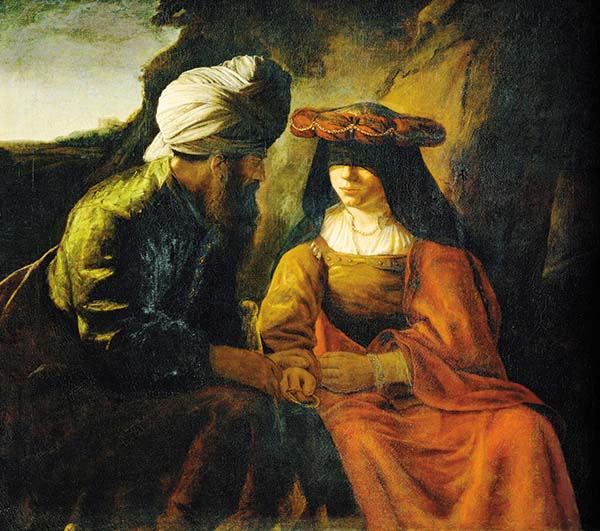
Hosea's Unconditional Love for Gomer
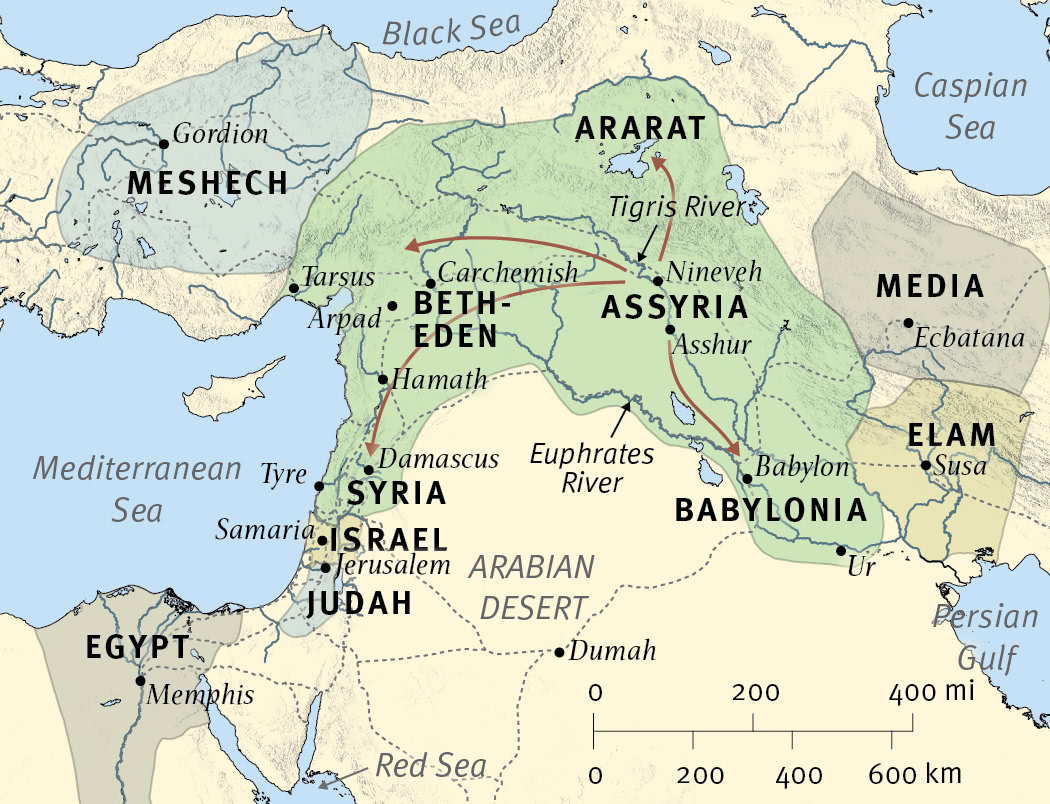
Source: ESV Global Study Bible
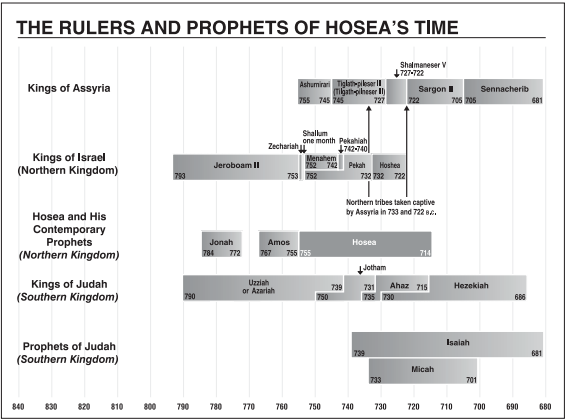
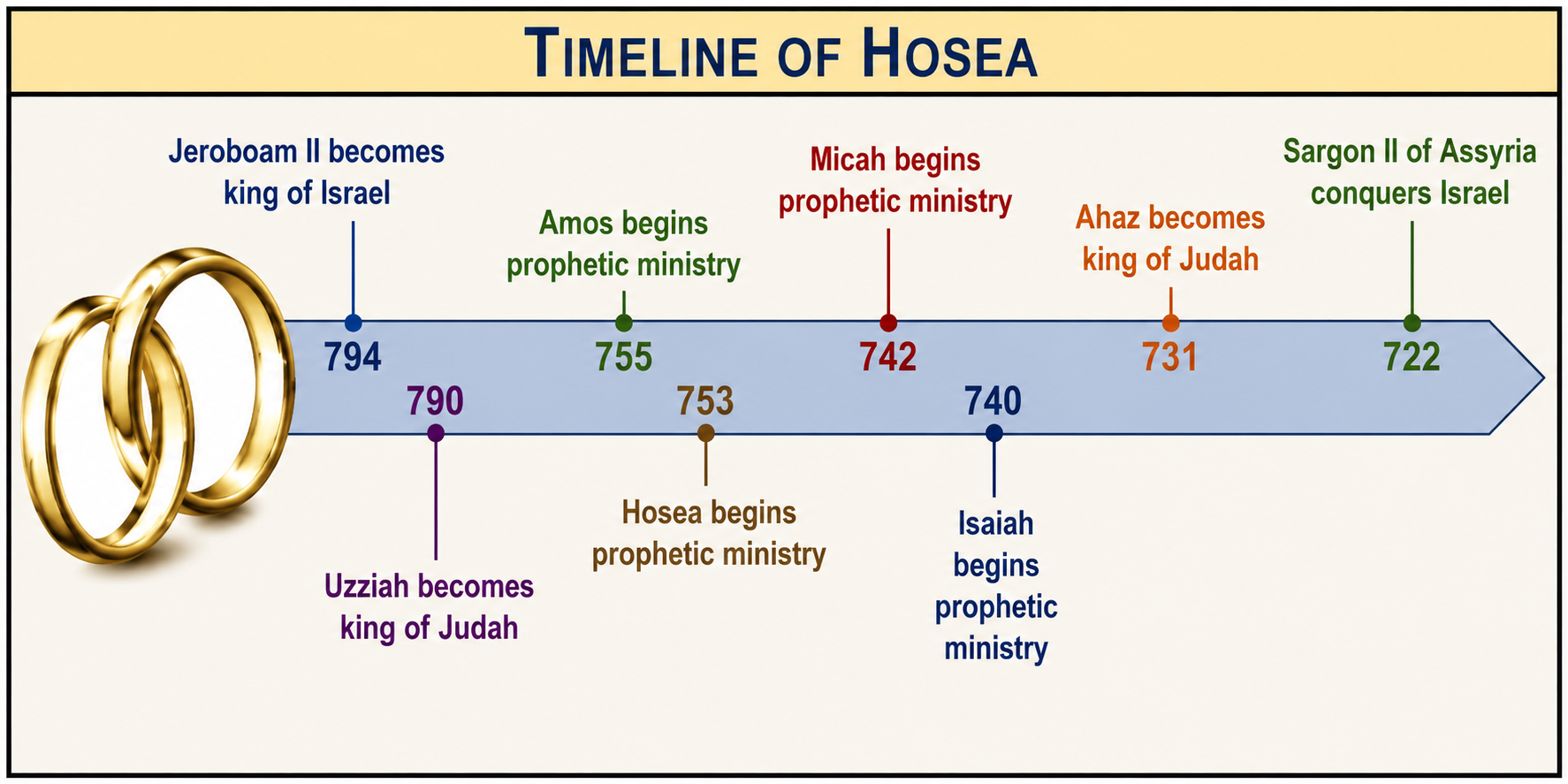
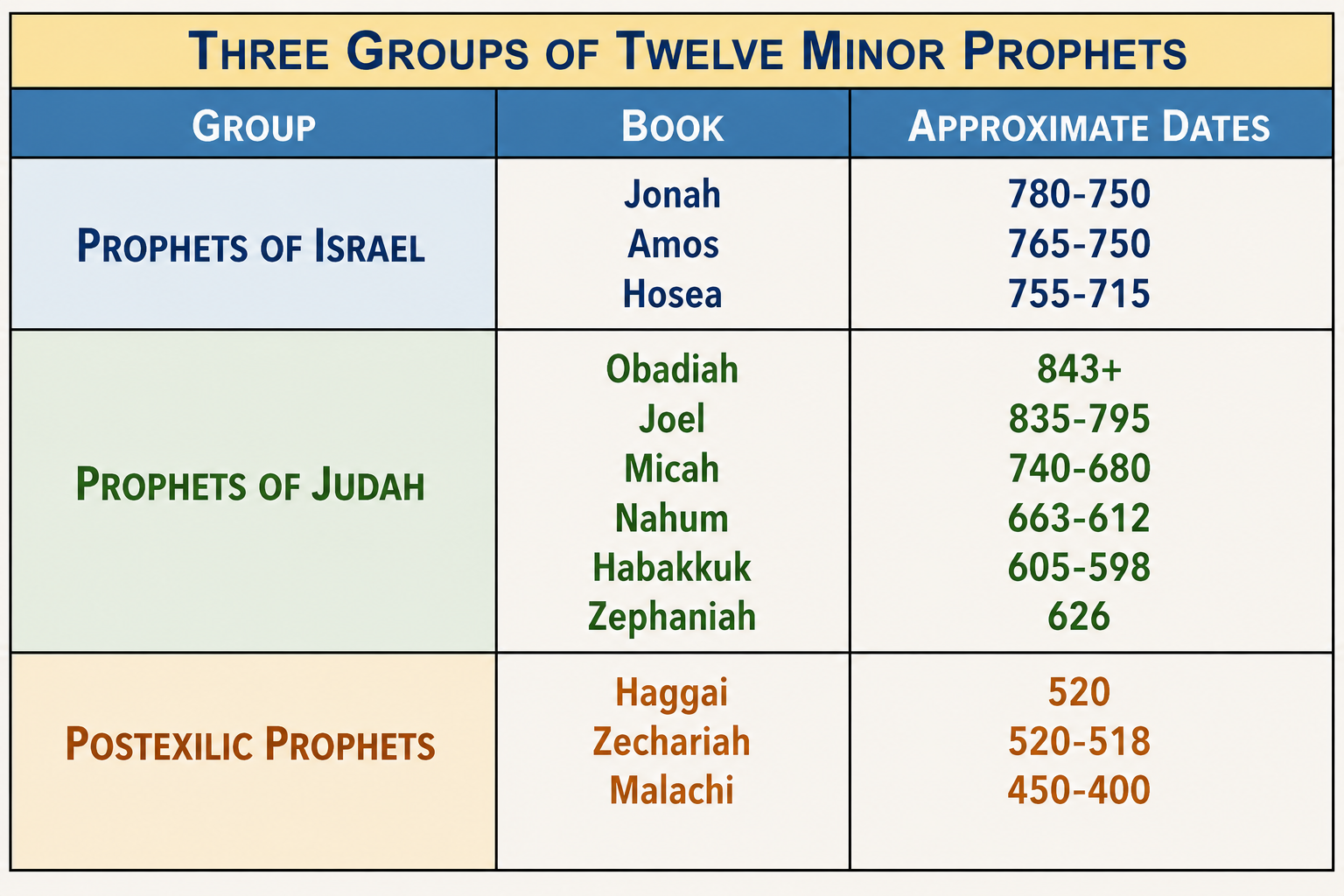
Hosea is the first in the list of "minor prophets," so-called mainly because their inspired books are shorter than those of the "major prophets." The period of Hosea's prophetic activity is dated according to the reigns of 4 kings in Judah mentioned in Ho1:1 --
- Uzziah (792-740 B.C.),
- Jotham (750-731 B.C.),
- Ahaz (735-715 B.C.),
- Hezekiah (729-686 B.C.)
- Jeroboam II (793-753 B.C.) in Israel.
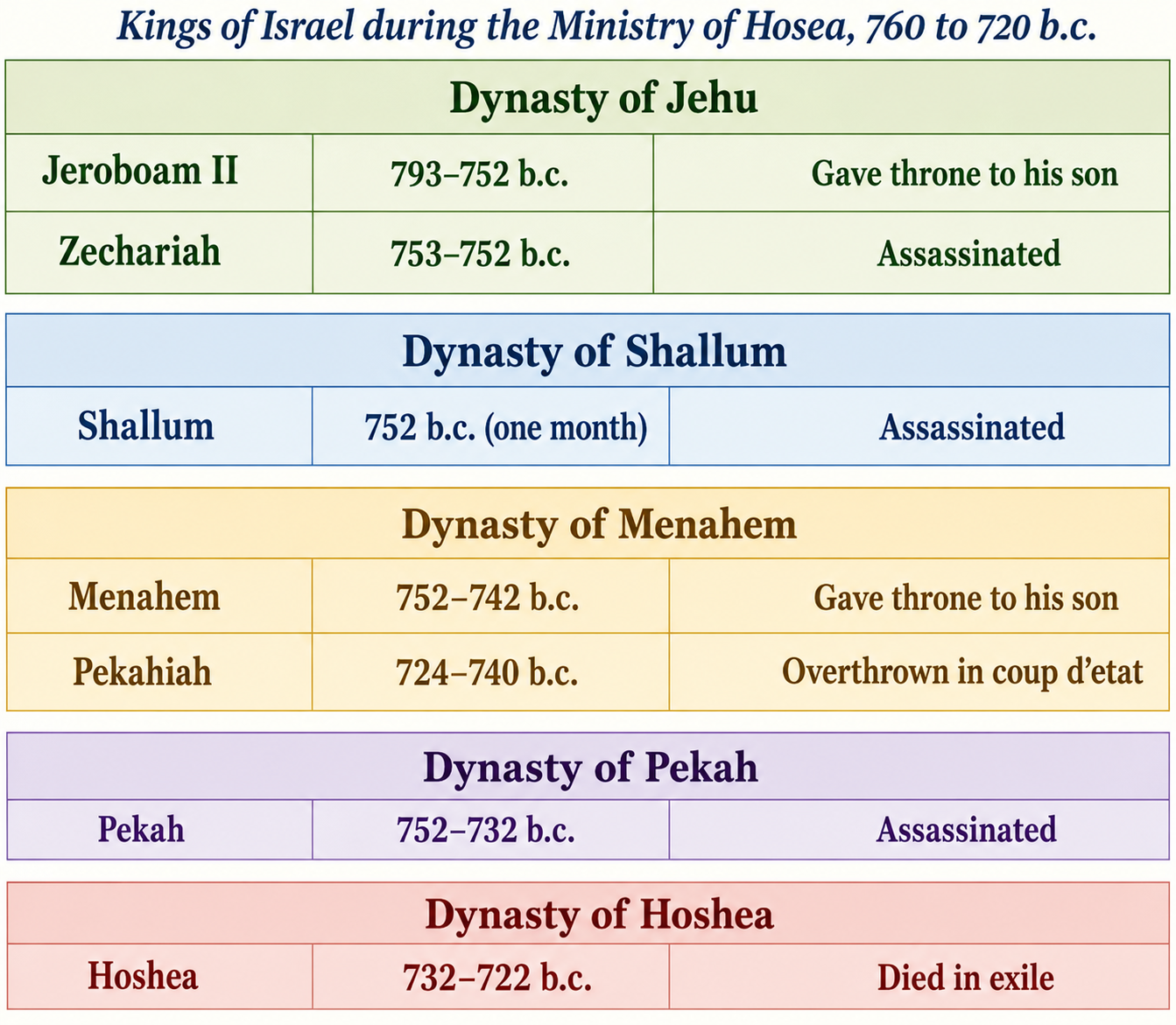
Also on the throne during Hosea's ministry were the last six kings of Israel following Jeroboam II -- Zechariah, Shallum, Menahem, Pekahiah, Pekah, and Hoshea -- although they are not listed in Ho1:1. A dating which satisfies all the demands of the historical notation in Ho1:1 is 755-725 B.C., the darkest period of Israel's history.
Following the death of Jeroboam II, the nation was in a state of political anarchy. Of the last six kings of Israel, four (Zechariah, Shallum, Pekahiah, and Pekah) were assassinated, and the other two (Menahem and Hoshea) ascended the throne via assassinations. Morally speaking, Israel was bankrupt. Blatant immoralities were practiced openly and unashamedly. The religious life of the people was idolatrous and degenerate. Hosea was an eyewitness to the inward deterioration which eventually led to the collapse of the nation in 722 B.C., at which time Samaria, the capital, fell to the Assyrians. Hosea's ministry overlapped those of Isaiah and Micah in Judah and of Amos in Israel (cf. Isa. 1:1; Amos 1:1; Mic. 1:1). These four prophets of the eighth century constituted the high mark of Hebrew prophecy.
THEME: God's Redeeming Love: The theme of the Book of Hosea is God's redeeming love for Israel, which is uniquely expressed by the Hebrew word hesed (Hos 2:19; Hos 4:1; Hos 6:4, 6; Hos 10:12; Hos 12:6), meaning loyal love, steadfastness, and faithfulness. When used with respect to God's relationship to Israel, the word denotes a binding "covenant love." Hosea's demonstration of faithful love toward Gomer becomes a visible symbol of God's steadfast love for Israel, in spite of Israel's unfaithfulness to that love. When Hosea stated that God would cease to love them (Hos 9:15), he was speaking of a different Hebrew word for love, ^ahav, which conveys the idea of affection, tenderness or even passionate love. When God judges He is not showing ^ahav, but He is still faithful in His covenant love toward His people. Perhaps no other Old Testament figure gained as clear a picture of the love of God as did Hosea.
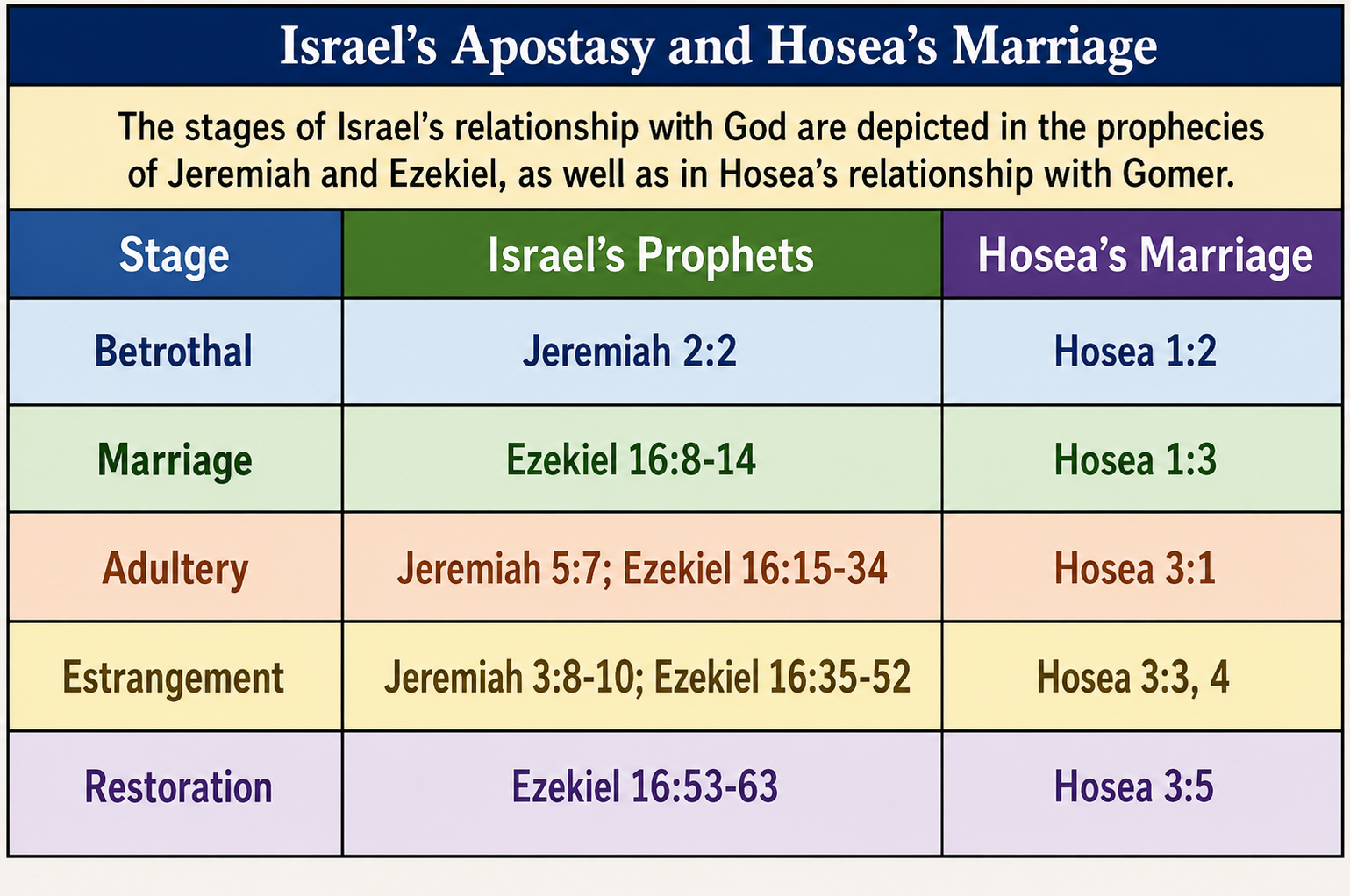
HOSEA'S MARRIAGE: God commands Hosea to take a "wife of harlotry" to illustrate Israel's unfaithfulness toward God (1:2). Four basic points should be made regarding Hosea's marriage: (1) Hosea's marriage is to be taken literally; there is nothing in the text to indicate that his experience was a vision, dream, parable, or allegory. (2) Gomer was chaste at the time of marriage; the command in 1:2 to marry a "wife of harlotry" is to be interpreted proleptically (cf. Hos 1:2). The text indicates that the first child was Hosea's (1:3); whereas regarding the second (1:6) and third (1:8), no specification is made. (3) The woman in Hos 3:1 is to be identified as Gomer; insuperable interpretative difficulties arise if the woman is identified as anyone else. (4) Hosea's marriage played an important part in his prophetic ministry; through the crucible of his own marital tragedy, Hosea came to understand the steadfast, faithful love of God for Israel.
All that we know about the prophet we discover from the autobiographical sections of the book itself. Like his contemporary, Amos, he prophesied to the Northern Kingdom (Israel; sometimes called Ephraim, after the largest tribe), while Isaiah and Micah were ministering to the Southern Kingdom (Judah). Material prosperity and spiritual bankruptcy characterized the time under Jeroboam II (782-753), when Hosea began his ministry (2 Ki 14:23-17:41). Judgment seemed remote, but by 732 B.C. Damascus had fallen to the Assyrians and by 722 Samaria, the capital of Israel, fell and the people were deported. Some of the specific sins Hosea denounces are listed in 4:2, 4, 11-13; 5:2; 6:8-9; 7:1, 5; 8:14; 10:1, 4; 13:2.
Three views have been proposed concerning Hosea's marriage: (1) merely an allegory, the book contains no factual history of an actual marriage; (2) Hosea married a woman who was already a harlot, perhaps a temple prostitute; (3) Gomer became a harlot after her marriage. Though Hosea's tragic experience illustrates God's love for His wayward people, there are no legitimate grounds for rejecting the historicity of the marriage. Whether (2) or (3) is correct is difficult to determine.
Contents Chap1-3 detail the prophet's domestic life, whereas the remainder of the book records excerpts of his messages delivered during his 50-year career as a prophet. In the prophetic section three themes dominate: the sins of the people, the certainty of judgment, and the assurance of God's loyal love.
Interpretive Challenges from John MacArthur's Introduction to Hosea
That the faithless wife, Gomer, is symbolic of faithless Israel is without doubt; but questions remain. First, some suggest that the marital scenes in chaps. 1–3 should be taken only as allegory. However, there is nothing in the narrative, presented in simple prose, which would even question its literal occurrence. Much of its impact would be lost if not literal. When non-literal elements within the book are introduced, they are prefaced with “saw” (Hos 5:13; Hos 9:10,13), the normal Hebraic means of introducing non-literal scenes. Furthermore, there is no account of a prophet ever making himself the subject of an allegory or parable.
Second, what are the moral implications of God’s command for Hosea to marry a prostitute? It appears best to see Gomer as chaste at the time of marriage to Hosea, only later having become an immoral woman. The words “take yourself a wife of harlotry” are to be understood proleptically, i.e., looking to the future. An immoral woman could not serve as a picture of Israel coming out of Egypt (2:15; 9:10), who then later wandered away from God (Hos 11:1). Chapter 3 describes Hosea taking back his wife, who had been rejected because of adultery, a rejection that was unjustifiable if Hosea had married a prostitute with full knowledge of her character.
A third question arises concerning the relationship between chap. 1 and chap. 3 and whether the woman of chap. 3 is Gomer or another woman. There are a number of factors which suggest that the woman of chap. 3 is Gomer. In Hos 1:2, God’s command is to “Go, take;” in HOs 3:1, however, His command is to “Go again, love,” suggesting that Hosea’s love was to be renewed to the same woman. Furthermore, within the analogy of chap. 1, Gomer represents Israel. As God renews His love toward faithless Israel, so Hosea is to renew his love toward faithless Gomer. For Hos. 3 to denote a different woman would confuse the analogy.
Hosea 1-3 forms a distinct section giving the prophet’s own domestic experiences while Hosea 4-14 has the prophetic discourses proper.
Charles Feinberg - Amos had preached repentance to lead Israel back to God; Hosea preaches love. Amos had told forth the unapproachable righteousness of God; Hosea, the unfailing love of God. Our prophet presents the Lord as the God of the loving heart. Someone has well said, “He is the first prophet of Grace, Israel’s earliest Evangelist.” Just as Luke presents the prodigal son, so Hosea portrays the prodigal wife. Nowhere in the whole range of God’s revelation do we find more beautiful words of love than in Hosea 2:14-16; Hosea 6:1-4; Hosea 11:1-4, 8, 9; Hosea 14:4-8.Every prophet’s message, in order to be understood properly, must be studied against the background of his times. Hosea lived in a time of outward prosperity. In spite of the prospering of God, the people substituted outward forms (see Is 1 and 58) for the inward reality; they were committing all manner of sin; and they were in great moral and spiritual decline. Jeshurun had waxed fat and kicked (Deu 32:15). Against this low spiritual state the prophet Hosea, as well as his contemporaries, inveighed. (See The Minor Prophets - Page 2 or borrow)
OUTLINE OF HOSEA
I. The Prodigal Wife, Hosea 1:1-3:5
A. Her Unfaithfulness, Hosea 1:1-11
B. Her Punishment, Hosea 2:1-13
C. Her Restoration and Israel's, Hosea 2:14-23
D. Her Redemption, Hosea 3:1-5
II. The Prodigal People, Hosea 4:1-14:9
A. The Message of Judgment, Hosea 4:1-10:15
1. The indictment, Hosea 4:1-19
2. The verdict, Hosea 5:1-15
3. The plea of Israel, Hosea 6:1-3
4. The reply of the Lord, Hosea 6:4-11
5. The crimes of Israel, Hosea 7:1-16
6. The prophecy of judgment, Hosea 8:1-10:15
B. The Message of Restoration, Hosea 11:1-14:9
1. God's love for the prodigal people, Hosea 11:1-11
2. God's chastisement of the prodigal people, Hosea 11:12-13:16
3. God's restoration of the prodigal people, Hosea 14:1-9
Borrow Ryrie Study Bible - page 1292
Hosea 1:1 The word of the LORD which came to Hosea the son of Beeri, during the days of Uzziah, Jotham, Ahaz and Hezekiah, kings of Judah, and during the days of Jeroboam the son of Joash, king of Israel.
- word (KJV): Jer 1:2,4 Eze 1:3 Joe 1:1 Jon 1:1 Zec 1:1 Joh 10:35 2Pe 1:21
- Hosea (KJV): Ro 9:25, Osee
- in (KJV): Isa 1:1 Mic 1:1
- Uzziah (KJV): 2Ki 14:16-29 2Ki 15:1,2,32 2Ki 16:1-20 2Ki 18:1-37 2Ch 26:1-32:33
Related Passages:
Jeremiah 1:2; 4 to whom the word of the LORD came in the days of Josiah the son of Amon, king of Judah, in the thirteenth year of his reign. (1:4) Now the word of the LORD came to me saying,
Ezekiel 1:3 the word of the LORD came expressly to Ezekiel the priest, son of Buzi, in the land of the Chaldeans by the river Chebar; and there the hand of the LORD came upon him.)
Joel 1:1 The word of the LORD that came to Joel, the son of Pethuel:
2 Peter 1:20-21 But know this first of all, that no prophecy of Scripture is a matter of one’s own interpretation, 21 for no prophecy was ever made by an act of human will, but men moved by the Holy Spirit spoke from God.
THE GOD OF REVELATION
SPEAKS TO HOSEA
The word of the LORD which came to Hosea the son of Beeri - The word of the LORD speaks of the source of the message and the prophet's divine authority. Hosea was a prophet which meant he spoke for the LORD, but first he had to receive the word fo the LORD to speak. OT prophets functioned as both forth tellers (of God's Word) and foretellers (prophesying future events). See in depth discussion of Israel the Wife of Jehovah. It is notable that Hosea's name is the same as Israel's last king Hoshea (2Ki 17:1), which was Joshua's original name (Nu 13:8, 16).
James Montgomery Boice calls Hosea "the second greatest story in the Bible." No Christian can doubt that the greatest story in the Bible is the story of the incarnation, life, suffering, death, and resurrection of the Lord Jesus Christ. But the story of Hosea is second precisely because it is an anticipation in pageant form of Christ's story. (The Minor Prophets: Hosea-Jonah)
During the days of Uzziah, Jotham, Ahaz and Hezekiah, kings of Judah, and during the days of Jeroboam the son of Joash, king of Israel - The fact that the word of the LORD came during reigns of different kings indicates repeated messages from the LORD to Hosea. Israel denotes the northern kingdom of 10 tribes, and Judah is the southern kingdom, a division that occurred at the death of Solomon, c. 930 B.C. thus fulfilling Yahweh's prophecy. (cf. 1Ki 12:1-20). Another name for the northern kingdom was Ephraim (the largest of the 10 northern tribes) and its capital was Samaria was also used to speak of the entire northern kingdom (Hos 7:1) .
Charles Feinberg - Though a prophet of Israel, he marks his message by the names of Judean kings for the most part, because the promises of God were centered in the line of David. (See The Minor Prophets - Page 2 or borrow)
G Campbell Morgan on the ministry of Hosea - It was the darkest period in all Israel’s history. The prophet spoke to that nation as it passed down the swift decline to captivity. The story is that of tragedy in the prophet’s domestic life, which coloured all his messages.
Warren Wiersbe quips "What a time to be serving the Lord! Murder, idolatry, and immorality were rampant in the land, and nobody seemed to be interested in hearing the Word of the Lord! On top of that, God told His prophet to get married and raise a family!" (Bible Exposition Commentary - Old Testament )
J Vernon McGee points out that "that the messages of nearly all the writing prophets belong to the period of the divided kingdom. When the kings failed, God then raised up prophets to speak to the nation." (See Thru the Bible Vol. 27: The Prophets Hosea/Joel)
Bob Utley - "The word of the Lord" This is a common opening phrase (used over 250 times in the OT) of the prophets (e.g. Hosea, Joel, Micah, Zephaniah, Haggai, Zechariah, and Malachi). It shows that the prophets did not speak out of their own understanding, but from YHWH's initiating revelation. The term "word" (BDB 182) relates to the Hebrew concept of the independent power of the spoken word (cf. Gen. 1; Isa. 55:11; John 1:1,14; Rev. 19:13). ▣ "Hosea" The name means "salvation" (BDB 448). When one adds the covenant name for God, "YHWH," to the Hebrew root "salvation," the word "Joshua" (Hebrew root, cf. Num. 13:8,16) or "Jesus" (Aramaic root, cf. Matt. 1:21) results. ▣ "the son of Beeri" The name means "my well" (BDB 92). We know nothing about him. The only other occurrence of the name is Esau's Hittite father-in-law (cf. Gen. 26:34).
Bob Utley on the kings during Hosea's lifetime - "during the days of Uzziah, Jotham, Ahaz, and Hezekiah, Kings of Judah" It seems rather unusual that a prophet from the Northern Kingdom would list the Judean kings in such detail. This list of kings covers a long period of time (see SPECIAL TOPIC: KINGS OF THE DIVIDED KINGDOM).This list of Judean kings is identical to the introduction to Isaiah, therefore,
- many scholars have asserted that Hosea is trying to show that he is a contempaorary of this southern prophet. Also, it possibly shows that
- Hosea was against the division of the kingdoms and saw Judah as the only legitimate covenant hope
- this verse was added by later Judean scribes
- The Jewish Study Bible, p. 1114, suggests the intended readers were not the people of Israel, but the people of Judah (much like Ezekiel did in chapters 16 and 33).
With so many theories it is obvious that moderns do not know!
"During the days of Jeroboam the son of Joash, king of Israel" It is surprising that no other Israelite kings are listed (e.g. Zechariah, Shallum, Menahem, Pekahiah, Pekah, Hoshea). There have been several theories concerning this:
- there was political confusion after Jeroboam II's death and several kings only reigned for a short period of time
- the prophet spoke to both kingdoms
- Judah is the legitimate Davidic line (cf. Amos 9:11-15)
Brian Bell - Hosea 1:1-11
- Intro:
- Minor Prophets: Less pages, not less important; small in size, big in truth; These are minor prophets preaching a major message!
- Yet, Hosea is actually larger than Daniel.
- Hosea:
- Book Overview: Ch.’s 1-3 Adulterous wife yet a faithful husband; Ch.’s 4-14 Adulterous nation yet a faithful God.
- Main Theme: God’s faithful love toward His unfaithful people.
- Story in a nut shell: Hosea married a woman who bore him 3 kids, & then deserted him & became a prostitute. - He finally buys her back from the slave market. - This was a sermon to the nation ofIsrael, for committing “spiritual adultery”.
- The state of Israel: Prospering outwardly, but decaying inwardly.
- Hosea: His name = Salvation.
- He’s the only prophet to come from the Northern kingdom.
- Not mentioned anywhere else in scripture.
- His ministry lasted around 40 years.
- Master of imagery: “Like a….” (24 x’s) {see Hos 2:3}
- Like a: calf, moth, lion, morning cloud, flaming fire, silly dove, treacherous bow.
- The Times? – These are the last few swirls before the kingdom (NORTHERN KINGDOM) goes down the drain.
- This book represents God’s last gracious effort to “plug the drain”! (Wilkinson & Boa; Talk Thru the O.T.; pg.236)
- Contemporaries? - Jonah(who went to the Assyrians); Amos(No. Kingdom also); Isaiah & Micah(So. Kingdom).
- Outline: Hosea!(Hos 1:1-9); Future Hope!(Hos 1:10-2:1); Harlotry!(Hos 2:2-13); The Door of Hope!(Hos 2:14-23)
- Minor Prophets: Less pages, not less important; small in size, big in truth; These are minor prophets preaching a major message!
- HOSEA! (Hos 1:1-9)
- Q: Have you ever wanted to know what someone was thinking?
- In the 1st 3 chapters of this book we have “exactly” what God is thinking regarding “sin” & “love”!
- (1) Q: Have you ever felt the heart-break of a child walking away from the Lord? Q: Have you ever had someone be “unfaithful” to you? Then you’ve sensed a smidgen…of the hurting heart of God!
- Hosea had to live out 1st hand…loving one who was unfaithful.
- Marital unfaithfulness is unfortunately “nothing new”!
- Some of you have also have suffered through the same in your marriage or in a past relationship. There must be no deeper wound!
- You truly have known the “fellowship of His sufferings!”
- You have forgiven as God forgives! “And be kind to one another, tenderhearted, forgiving one another, just as God in Christ forgave you.” (Eph.4:32)
- Hosea was going to feel on the temporal scale, what God was feeling on the eternal scale.
- Hosea had to live out 1st hand…loving one who was unfaithful.
- (2) Q: Has anyone had a stranger start to their ministry?
- “So you want to be in ministry ey?”
- Isaiah had to walk the streets dressed like a prisoner of war for 3 yrs. – Jeremiah walked around for 3 months w/a yoke around his neck. – Ezekiel even turned the painful loss of his wife into a sermon.
- “Expect to pay a price if you want to have a ministry to others!”
- 2 Cor.1:4,6 “(the God of all comfort)who comforts us in all our tribulation, that we may be able to comfort those who are in any trouble,”…“Now if we are afflicted, it is for your consolation and salvation.”
- A problem: Q: Did God violate the moral standard of His own laws by asking Hosea to marry a prostitute?
- A wife of harlotry - Some have maintained that she was a common prostitute.{but would God call her to violate His standard?} - Others have maintained that she was a cultic prostitute in the service of Baal. – Some have suggested she symbolized Israel’s worship of many gods. - Still others have believed she was an ordinary woman who became unfaithful after her marriage to Hosea.
- (i.e.) “Go, take to yourself a wife who will prove to be unfaithful.”
- I think the last view is the best one/accept seems to weaken what God is calling him to do!
- (Hos 1:4,5) Jezreel – God sows (Hos 2:22). Here God scatters!
- Jehu – This refers to Jehu’s slaughter of his enemies in Jezreel.
- Wait! This was Prophesied by Elijah, commanded by Elisha, commended by the Lord Himself(2 Kings 9,10).
- Jehu went too far in his zeal.
- The prophesy was to take out Ahab’s household which he did
- Read 2 Kings 10:7,11,17. (& Jezebel 9:30-37)
- But he also took out Jehoram(king o Is./rt. between the shoulders & thru the heart); Ahaziah(king o Judah/shot also in his chariot); + his household(42 of them); + the servants of Baal in Samaria(massacre/80 guys outside the temple).
- Poetic Justice – Israel’s bow would be broken at the very site of Jehu’s sin.
- (Hos 1:6) Lo-Ruhamah! (No-Mercy)
- “Mercy” is a girl’s name, but “No-mercy”? (Imagine naming your girl that!)
- This is the situation of Israel today! God is providentially guiding the Jewish nation, yet they are not enjoying God’s mercies as before.
- (Hos 1:6) Lo-Ammi! (Not-my-people)
- Q: What mixed feelings might Hosea have about his 3 children? (Are they mine?)
- This speaks of God’s temporary rejection of the nation because of their sins.
- Q: Ever meet someone whose name did or didn’t match their character or characteristics?
- Q: Ever meet a “Mercy” who didn’t show Mercy? (Grace; Joy; Patience, Hope)
- That’s ok, God’s into name changes! – No matter what your birth-name is, He can give you a new one!
- Name some?
- Other times people wanted to change there own name: Naomi
- Q: Have you ever wanted to know what someone was thinking?
- A FUTURE HOPE! (Hosea 1:10-2:1)
- Here we have a great affirmation of Hope!
Hosea 1:2 When the LORD first spoke through Hosea, the LORD said to Hosea, “Go, take to yourself a wife of harlotry and have children of harlotry; for the land commits flagrant harlotry, forsaking the LORD.”
- beginning (KJV): Mk 1:1
- Go (KJV): Ho 3:1 Isa 20:2,3 Jer 13:1-11 Eze 4:1-5:17
- a wife (KJV): That is, says Apb. Newcome, a wife from among the Israelites, who were a people remarkable for spiritual fornication or idolatry.
- children (KJV): Ho 2:4 2Pe 2:14 *marg:
- for (KJV): Ex 34:15,16 De 31:16 2Ch 21:13 Ps 73:27 Ps 106:39 Jer 2:13 Jer 3:1-4,9 Eze 6:9 Eze 16:1-63 Eze 23:1-49 Rev 17:1,2,5
YAHWEH'S SHOCKING
COMMAND TO HOSEA
When the LORD first spoke through Hosea, the LORD said to Hosea, “Go, take to yourself a wife of harlotry (zenunim; Lxx - porneia) and have children of harlotry (zenunim; Lxx - porneia); for the land commits flagrant harlotry, forsaking the LORD - The first words were commands and would have been difficult for any man to hear, to say the least. See THE MARRIAGE OF HOSEA' BY H. H. ROWLEY - download 34 page article in pdf . Wife of harlotry is in the plural ("wife of harlotries") in Hebrew emphasizing how repeated and characteristic such infidelity was of Israel.
J M Boice - It would seem that on one occasion, no doubt early in his life, God came to Hosea to ask him to do a very difficult thing. God said, “Hosea, I want you to marry a woman who is going to prove unfaithful to you but to whom you are nevertheless going to be faithful. You will love her, but she will disgrace your love. I am asking you to do this because we are to present a pageant to Israel by your marriage. It is going to be symbolic, an object lesson. You are going to play the part of God. The woman is going to play the part of my people. The reason she is going to run away and be unfaithful is that this is the way my people act in the spiritual marriage that I have established with them. You are going to be faithful, because I am faithful to Israel even though she dishonors my name.”
For is a term of explantion which explains that Gomer and the 3 children are illustrations of the spiritual adultery of the land which like Gomer were wantonly engrossed in spiritual fornication! Notice that to commit flagrant harloty is tantamount to forsaking the LORD.
The land commits flagrant harlotry - This would hold all in Northern Kingdom accountable. The expression "the land commits flagrant harlotry" is a vivid personification in which "the land" represents the inhabitants of the land of Israel. Throughout the Old Testament, the nation is often described in terms of its land because the people and the land were inseparably linked in the Mosaic Covenant. Thus, when the people abandoned the Lord for idols, the land itself was said to be defiled or to "commit harlotry" (cf. Lev. 18:24-28; Jer. 3:1-2, 9; Ezek. 36:17). The essence of Israel's harlotry was not merely the worship of idols but the deliberate abandonment of Yahweh Himself. Every act of idolatry was, in effect, an act of spiritual adultery against the God who had redeemed Israel, entered into covenant with her, and remained faithful despite her repeated unfaithfulness. Hosea's marriage to Gomer was therefore a living parable: Hosea represented the faithful Lord. Gomer represented unfaithful Israel. Her harlotry pictured Israel's spiritual adultery. Their marriage illustrated God's covenant relationship with His people. Thus, the phrase "the land commits flagrant harlotry" summarizes the entire message of Hosea: Israel had broken her marriage covenant with the Lord by persistently pursuing other gods, yet the God whom she forsook would ultimately seek to restore her by His sovereign grace (Hos. 2:14-23; Hos 3:1-5).
David Allan Hubbard points out that "Verse 2 introduces us to the double meaning carried by the word harlotry, a meaning that sets the theme for chapters 1–3 and, indeed, for the entire book: (1) harlotry may describe literal acts of illicit lust, often with financial or material gain involved (cf. 2:5 for the mention of lovers who provided compensation to the wanton one); (2) harlotry may also describe religious acts of infidelity, the abandoning of worship of the one true God for the idols and myths of paganism, notably in Hosea’s day the worship of the Baals; it is this religious meaning that is obviously intended (cf. Hosea 4:12, 18; Hosea 5:3–4). The relationship between these two meanings, literal and religious, should not be missed. Much of the message of Hosea turns on it: (1) the wife’s literal harlotry is a persistent illustration of Israel’s religious fornication; indeed in the flow of the judgment oracle in Hosea 2:2–13, what begins literally with a call for the wife’s repentance (Hosea 2:2) ends figuratively with descriptions of Israel’s religious lewdness (Hosea 2:10–13); (2) in those festivals literal fornication was moreover a part of the religious liturgy, aimed to move the Baals to engender the fertility of the land upon which Israel was dependent (Hosea 2:12; see Commentary at Hosea 4:12–15). (See Hosea: An Introduction and Commentary - Page 67)
The New Jerusalem Bible translation holds nothing back giving this strongly worded rendering -- "The beginning of what Yahweh said through Hosea: Yahweh said to Hosea, 'Go, marry a whore, and get children with a whore; for the country itself has become nothing but a whore by abandoning Yahweh." (Hos 1:2NJB) The English of the Septuagint is not much different - "The beginning of the word of the Lord by Osee. And the Lord said to Osee, Go, take to thyself a wife of fornication, and children of fornication: for the land will surely go a-whoring in departing from the Lord." (Hos 1:2 LXE)
Many commentators argue that Gomer was not a prostitute when Hosea first met and married her, but that she became sexually unfaithful only after their marriage. According to this view, the Lord revealed beforehand that she would eventually abandon her husband, making her future adultery a vivid picture of Israel's coming spiritual unfaithfulness. This interpretation has much to commend it, particularly since it preserves the normal meaning of marriage and highlights Gomer's later betrayal of Hosea's love. However, the text itself never explicitly states that Gomer was initially chaste and only later became a prostitute. Nor does it unequivocally say that she was already living as a prostitute when Hosea married her. Consequently, the evidence is not decisive, and either interpretation is possible. While interpreters may prefer one view over the other, it is wise not to be dogmatic where Scripture itself is silent. The central point of the narrative is not Gomer's precise moral condition at the time of the marriage but the powerful object lesson that her unfaithfulness (regardless of the time it began) would portray Israel's persistent spiritual adultery against the Lord.
Robert Chisholm points out that "The message of the first three chapters (and of the entire book) oscillates between judgment and salvation. Hosea's marital experiences, which included the heartbreak caused by his wife's unfaithfulness and the joy of their renewed relationship, provide the framework for this message.....The expression "adulterous wife" (lit., "wife of adultery") does not describe her condition at the time of marriage, but anticipates what she proved to be, a wife characterized by unfaithfulness....(Chisholm feels this should be translated "Go, take to yourself a wife who will prove to be unfaithful.") (See The Bible Knowledge Commentary Minor Prophets or Borrow The Bible Knowledge Commentary)
Derek Kidner - The harsher view, that Gomer was a whore already, seems to me the right one; but whichever view we take, we should not soften it by making her a cult-prostitute, merely deluded and misused; for the Hebrew has a word for this (Hos 4:14), and it is not the word used here. What Hosea had to do was, in miniature, what God had done in giving His love to a partner with a history and with a roving eye. Hosea was not to leave the matter there, any more than God would; but that belongs to a later part of the story, told in chapter 3. (See The Message of Hosea or Borrow The Bible Speaks Today – The Message of Hosea: Love to the Loveless)
G Campbell Morgan The result of the tragedy in his life was that he, Hosea, came to understand the heart of God, and what God suffered when His people sinned. He was admitted, through the mystery of his own tragedy, into an apprehension of what the sin of the nation meant against the heart of God. Hosea has been described as the prophet of the broken heart. The pain and agony of the man’s heart is everywhere apparent, but it had become to him an interpretation of the agony of the heart of God. In his own experience he discovered what infidelity means to love ; and so, that the infidelity of Israel roused, not the wrath of God, though He was compelled by it to act in judgment, but the heart-break of God....There was a theologian in England some years ago who wrote a book of which the title was, The Impassive God, in which he sought to prove that God is incapable of real suffering. Well, that God is not my God. That is not the God revealed here. Sin breaks in upon the Divine order, ruins the rhythmic nature of the universe. Yes, but that is not its chief heinousness. Get into Hosea’s soul when Gomer played him false and left him. That is how God feels, and that is what Hosea learned. (ED: Compare Ezekiel 6:9 “Then those of you who escape will remember Me among the nations to which they will be carried captive, how I have been hurt by their adulterous hearts which turned away from Me, and by their eyes which played the harlot after their idols; and they will loathe themselves in their own sight for the evils which they have committed, for all their abominations.")
Bob Utley - G. Campbell Morgan, Hosea, pp. 9-11, asserts that the ASV, "When Jehovah spoke at first by Hosea," is the temporal key to see that Hosea, looking back over his life, writes Hosea 1:2 from the advantage of hindsight. Therefore, Morgan asserts that Gomer was faithful when he married her, but that she became unfaithful. Therefore, from YHWH's foreknowledge, He knew what would happen and now from Hosea's later years he, too, knows well the tragic marriage (also see Gleason Archer, Encyclopedia of Bible Difficulties, pp. 294-295 and Hard Sayings of the Bible, pp. 322-324).
Believer's Study Bible - The command to marry a "wife of harlotry" is to be interpreted proleptically (ED: Proleptically means describing someone or something in terms of what it will become in the future, even though that condition does not yet exist. It comes from the Greek word prolēpsis, meaning "anticipation."). Hosea is permitted to carry out his desire to marry Gomer, only to learn later of her bent toward adultery. If Hosea had been forced into a marriage which he disdained, it would be difficult to conceive of his affection as being genuine.
Charles Ryrie adds "If anticipatory (ED: AKA PROLEPTIC), the phrase indicates that Gomer became a harlot after her marriage to Hosea. If not, he married a known prostitute. In either case the marriage was providentially ordained in order to illustrate vividly the infidelity of the people of Israel."
Henry Morris - Hosea (meaning "salvation," essentially the same name as that of Joshua, or Jesus) is, in his prophetic actions, to be made essentially a living type of Christ, especially in His nature as Jehovah, the spiritual "husband" of Israel. Hosea's prophecy was directed especially toward unfaithful Israel, the ten-tribe northern kingdom, but it continued even after Israel was carried into captivity, warning Judah as well. a wife of harlotry (KJV off whoredoms). In his real-life portrayal of the relation of Jehovah to Israel, Hosea was led by God to love and marry Gomer, who was a harlot both before and after the marriage. Gomer thus typifies the spiritual harlotry of Israel, serving other gods instead of the true God. As always, spiritual adultery first countenances, then promotes, physical immorality. God's chosen people had descended into the same moral morass as the pagan nations whose gods they had begun to follow.
KJV Bible Commentary on the LORD's command Go, take to yourself a wife of harlotry - This command has been the occasion of much investigation and speculation on the part of biblical scholars. Their conclusions generally fall into two camps: (1) Gomer was a harlot prior to her marriage with Hosea, and Hosea married her while she was in that moral state; and (2) Gomer was morally pure prior to her marriage to Hosea, but subsequently became discontented and went into harlotry, from which Hosea by his love reclaimed her. The main support for the first view is what seems to be the natural sense of the command take unto thee a wife of whoredoms and children of whoredoms. Against the first view, five objections can be raised: (1) this view is not required by the text; for the Hebrew language could have stated it more precisely, “take unto thee a woman who is a harlot;" (2) this view does not fit the spirit of chapter Hos 2 in which Gomer becomes dissatisfied and leaves Hosea’s home to enter harlotry; (3) this view does not fit the history of Israel who was pure before her unfaithfulness to God; (4) this view is contrary to biblical morality; and (5) chapter Ho 1 does not describe any immoral conduct on the part of Gomer—her overt immoral conduct is not made known (except prophetically, vs. Hos 1:2) until chapter Hos 2. It seems best, then, to hold the second view, that Gomer was a morally pure woman at the time Hosea married her and that for some reason she became discontent with her life with Hosea and went off into harlotry. It is best to regard Gomer and the events surrounding her relationship with Hosea as literal and historical. They are sovereignly superintended and used by God to portray His relationship to His people Israel. Just as Gomer has sinned, so Israel has sinned. Just as Hosea loves Gomer and will restore her in spite of her sin, so God loves Israel and will restore her in spite of her sin. As unenviable as the parallel may be from the prophet’s point of view, it beautifully and graphically suits God’s purpose in confronting His people with their sin, His wrath, His love, His judgment, and their ultimate restoration. Hosea certainly is an Old Testament illustration of a servant of God who presented himself as a “… living sacrifice …” to God and ultimately proved that the will of God is “… good, and acceptable, and perfect …” (cf. Ro 12:1-2). In a way in which few would care to exchange places with Hosea, he is a graphic Old Testament illustration of the truth that “… all things work together for good to them that love God, to them who are the called according to his purpose” (Ro 8:28). (See also THE MARRIAGE OF HOSEA' BY H. H. ROWLEY - download 34 page article in pdf)
Richard Patterson - Several positions are held as to whether God actually told his prophet to marry an unholy woman: (1) The marriage was merely hypothetical, the account itself being a literary parable or allegory (Calvin). (2) The account is a dream or vision (Ibn Ezra, Maimonides). (3) The whole narrative is simply a stage play (Kaufman). (4) Hosea married a woman with promiscuous tendencies who later committed adultery (Hubbard, Wood), perhaps as a cult prostitute (Andersen and Freedman, Craigie, Mays). (5) Hosea’s wife was only guilty of spiritual adultery (i.e., of idol worship—Stuart). (6) Hosea married an already adulterous woman (Garrett, McComiskey).....God’s primary charge against apostate Israel was its failure to worship him alone (cf. Exod 20:3-5; Deut 5:7-9; Deut 6:4, 14-15; Matt 4:10). This theme surfaces repeatedly among the various oracles and undergirds God’s final rhetorical question (represented as an exclamation in the nlt) to his wayward people in Hos 14:8 (SEE Minor Prophets: Hosea through Malachi - Page 12)
Harlotry (02183) zenunim is a Hebrew noun derived from zānâh (זָנָה) denotes fornication or harlotry, but its significance extends far beyond physical immorality into the realm of covenant theology and spiritual allegiance. At its most basic, the term refers to sexual unfaithfulness that violates the exclusivity of the marriage relationship (Hos. 4:11). In this literal sense, it describes acts that break the one-flesh union established by God, highlighting the betrayal of intimacy, trust, and covenant loyalty. However, the dominant usage in Scripture is figurative, where the word becomes a powerful theological metaphor. It depicts Israel’s breach of her covenant relationship with Yahweh, who is portrayed as her Husband (cf. Jer. 2:2; Isa. 54:5). Thus, “fornication” comes to mean spiritual infidelity—giving to others the devotion, trust, and worship that belong to God alone.
ZENUNIM - 13X.11V - harlotries(5), harlotry(8). Gen. 38:24; 2 Ki. 9:22; Jer. 3:2; Ezek. 23:11; Ezek. 23:29; Hos. 1:2; Hos. 2:2; Hos. 2:4; Hos. 4:12; Hos. 5:4; Nah. 3:4
Spiritual harlotry manifests in several interrelated ways:
- Idolatry – The primary sense: Israel “prostitutes” herself by worshiping false gods, often at high places or through images (“stones and stocks,” Jer. 3:9). This is not merely religious error but covenant betrayal, exchanging the living God for lifeless substitutes.
- Covenant rebellion – The term also encompasses a broader posture of disobedience and refusal to submit to God (Num. 14:33). It reflects a heart that has turned away, not just in worship but in will.
- Moral corruption – Because idolatry reshapes behavior, this “fornication” includes the ethical decay that flows from abandoning God (Hos. 6:10). Spiritual unfaithfulness inevitably produces social and personal sin.
- Misplaced trust and alliances – In passages like Ezekiel 23, the imagery includes reliance on foreign nations. Such alliances often involved invoking foreign deities and trusting human power instead of Yahweh. Thus, political compromise becomes another form of spiritual adultery.
- Defilement of the land – This sin is not isolated to individuals; it spreads and contaminates the entire community and even the land itself (Jer. 3:2). The imagery conveys pervasive, public, and normalized unfaithfulness.
Hosea ("salvation," essentially the same name as that of Joshua, or Jesus) is, in his prophetic actions, to be made essentially a living type of Christ, especially in His nature as Jehovah, the spiritual "husband" of Israel. Hosea's prophecy was directed especially toward unfaithful Israel, the ten-tribe northern kingdom, but it continued even after Israel was carried into captivity, warning Judah as well.
In his real-life portrayal of the relation of Jehovah to Israel, Hosea was led by God to love and marry Gomer, who was a harlot both before and after the marriage. Gomer thus typifies the spiritual harlotry of Israel, serving other gods instead of the true God. As always, spiritual adultery first countenances, then promotes, physical immorality. God's chosen people had descended into the same moral morass as the pagan nations whose gods they had begun to follow.
Sex filled a central spot in Canaanite worship of Baal. The worship place employed prostitutes, so men could participate in sinful rites supposed to ensure good harvests. This made harlotry a powerful word to describe Israel's rejection of God for Baal or their mixture of Baal and Yahweh worship. To worship another god is as shameful and disgusting as breaking the trust of the marriage relationship through adultery. (1Ki 12:26-33).
The prophet became totally identified with God and His word. His marriage relationship and his children's names were living sermons. Every time a member of Hosea's family appeared on the street, God's judgment of Israel was proclaimed. (Jer 32:6-15).
Hosea 1:1-5
TODAY IN THE WORD
Italian restorers are using modern technology to refurbish two magnificent bronze, Greek sculptures found more than twenty years ago off Italy's shore. The two classical masterpieces were cleaned when they were first discovered. But inside, ocean salt had infiltrated the clay casting, resulting in corrosion. Using a miniature TV camera and relying on video images, restoration specialists used dental-like instruments to remove more than 200 pounds of clay.
The northern kingdom of Israel in the days of the prophet Hosea was very much like those Greek statues. Outwardly, things looked pretty solid. The nation was enjoying a time of material prosperity under ""Jeroboam son of Jehoash"" (v. 1) when Hosea began his prophetic ministry in the middle of the eighth century B.C.
Likewise, the military situation was stable, since the Assyrian empire to the east of Israel had given up its western expansion plans--for the time being.
But beneath the surface the nation's core was corroding. God lowered the ""camera"" of His holiness into the soul of Israel and exposed the spiritual adultery of His people. They had departed from Him (v. 2) and broken His covenant. Judgment was due--yet God would also remember His promises to Abraham and to David: restoring His people in a glorious future age.
Hosea was to deliver this message in a very unusual way. God ordered him to marry Gomer, a woman who would prove unfaithful. This was to be an object lesson of God's anger with Israel, yet also a lesson of His promise to restore.
Hosea's firstborn, Jezreel, was a reminder of judgment. Many years earlier, God's judgment was incurred by Jehu's killing Ahaziah, a descendant of David, at a town called Jezreel. In attacking the house of David, Jehu went too far--the judgment of God was then fulfilled when Jehu's descendant Zechariah was assassinated (2 Kings 15:8-12).
TODAY ALONG THE WAY
Like many of the Old Testament prophets, Hosea's message was firm. (Copyright Moody Bible Institute. Used by permission. All rights reserved)
God Can Use Us - There are many reasons why God shouldn’t have called you. But don’t worry. You’re in good company. Moses stuttered. David’s armor didn’t fit. John Mark was rejected by Paul. Timothy had ulcers. Hosea’s wife was a prostitute. Amos’ only training was in the school of fig-tree pruning. Jacob was a liar. David had an affair. Solomon was too rich. Jesus was too poor. Abraham was too old. David was too young. Peter was afraid of death. Lazarus was dead. John was self-righteous. Naomi was a widow. Paul was a murderer. So was Moses. Jonah ran from God. Miriam was a gossip. Gideon and Thomas both doubted. Jeremiah was depressed and suicidal. Elijah was burned out. John the Baptist was a loudmouth. Martha was a worry-wart. Mary was lazy. Samson had long hair. Noah got drunk. Did I mention that Moses had a short fuse? So did Peter, Paul—well, lots of folks did.
But God doesn’t require a job interview. He doesn’t hire and fire like most bosses, because He’s more our Dad than our Boss. He doesn’t look at financial gain or loss. He’s not prejudiced or partial, not judging, grudging, sassy, or brassy, not deaf to our cry, not blind to our need.
As much as we try, God’s gifts are free. We could do wonderful things for wonderful people and still not be...Wonderful.
Satan says, “You’re not worthy.”
Jesus says, “So what? I AM.”
Satan looks back and sees our mistakes.
God looks back and sees the cross
The Fourth Dimension, November 1998, p. 5— 10,000 Sermon Illustrations
QUESTION - Why did God tell Hosea to marry a prostitute (Hosea 1:2)? WATCH VIDEO
ANSWER - In Hosea 1:2 we read, “The LORD said to Hosea, ‘Go, take to yourself a wife of whoredom and have children of whoredom’” (ESV). Hosea obeyed, marrying a woman named Gomer, who was unfaithful to him. Why did God tell Hosea to marry a prostitute?
To begin with, it is important to realize this command could be understood two different ways. First, and more likely, this command could be one of anticipation. In other words, God may have instructed Hosea to marry a woman who would later become unfaithful to him. The other possibility is that the command was for Hosea to marry someone already known as a prostitute.
In either case, the reason for this unusual directive is specified in the latter half of the same verse: “For the land commits great whoredom by forsaking the LORD” (ESV). God wanted to provide an illustration of His relationship with the people of Israel, who had been unfaithful to Him by practicing idolatry. This theme is carried through the remainder of the prophecies in chapter 1 and the discussion of Israel’s unfaithfulness in chapter 2.
In Hosea 3:1, after Gomer had left Hosea and was living in immorality, the Lord commanded Hosea to find her and buy her back. God was continuing His illustration, except now He wanted to show the greatness of His grace: “Even as the LORD loves the children of Israel, though they turn to other gods” (ESV). Hosea’s faithful love of Gomer was an illustration of God’s faithfulness to wayward Israel. Just as Gomer had been unfaithful to her husband and had to be redeemed, Israel needed God’s initiative to restore their relationship.
The prophet Hosea was commanded to marry an unfaithful wife, and this set up a model of Israel’s broken relationship with God. Israel had been chosen and loved by God yet had been unfaithful to Him by way of idolatry. Just as Hosea redeemed his estranged wife and sought to continue his relationship with her, God promised to redeem Israel and renew their relationship with Him. The story of Hosea and Gomer is an unforgettable picture of God’s strong, unending love for His covenant people.
Related Resource:
Today in the Word
The land is guilty of the vilest adultery in departing from the Lord. Hosea 1:2
Israel was divided. The southern kingdom of Judah was ruled by the descendants of David, according to God’s covenant with him (2 Sam. 7:16). But the northern kingdom of Israel was characterized by assassinations and vicious takeovers, each king more wicked than the last. The house of Jehu, mentioned in verse 4 of today’s passage, was actually the northern kingdom’s longest reigning family. After eradicating the descendants of Ahab, Jehu received a promise from the Lord that four generations of his descendants would take the throne (2 Kings 10:30).
In this time of relative peace and prosperity (and rampant wickedness) Hosea ministered as a prophet to Israel (v. 1). But as the rule of Jeroboam II came to a close, the house of Jehu and the northern kingdom of Israel met a rapid and bloody decline (v. 5, cf. 2 Kings 15:10–12). Five of Israel’s last six kings were assassinated or killed, a string of violence that culminated in Assyrian captivity. Hosea was the last prophet this nation would ever hear. It would take a shocking wake-up call to move this wayward nation to repentance. God delivered the shock through Hosea and his marriage to a prostitute named Gomer. Scholars aren’t sure whether Gomer was a prostitute when Hosea married her, but the text clearly states that his marriage to an unfaithful wife was divinely appointed (v. 2). The Bible also points to the likelihood that the second and third children born to Gomer were not Hosea’s children at all (vv. 2, 6, 8). Only verse 3 specifically mentions Hosea as the father of Gomer’s first child.
Gomer’s adultery and the names of her children (“not loved” and “not my people”) reveal the depth of Israel’s apostasy. Hosea’s steadfast faithfulness and obedience depict the depth of God’s love; despite His just anger, God did not abandon Israel, as we’ll see tomorrow. But His love is not soft or sentimental, for the overriding message of Hosea is extreme judgment for extreme disobedience. Israel’s wickedness was despicable in God’s eyes.
Apply the Word
In light of today’s passage, we need to ask an important question: do we worship anyone or anything other than the one true God? Think in terms of the marriage illustration. Is your heart dedicated to God alone? Does money, control, entertainment, or pleasure compete for your affection? This month we will explore Israel’s past. We’ll also see that idols like theirs still tempt us to divert our worship away from God. Affirm your commitment to God today and be prepared to surrender anything that draws you away from Him.
G Campbell Morgan - When the Lord spoke at the first by Hosea, the Lord Jehovah said unto Hosea . . . Hosea 1.2
These words are important, and must be rightly interpreted if we are to understand their significance. I think we are helped by adopting Ewald's rendering, "At the first, when Jehovah spoke with Hosea." The word with is unquestionably preferable to by. The reference is not to a message which Jehovah delivered through His servant; but to something which He spoke in communion with him. Again, the phrase at the first is important, as showing us that when this was written, the writer was looking back, and interpreting events in the light of the experience' which those events produced. In these first three chapters we have an account of the tragedy which came to Hosea in his domestic life; of how through it all he lived in communion with God; and of how through that tragedy and that communion he was brought to a new under-standing of the sin of Israel as it was felt by Jehovah Himself. In this chapter the tragedy itself does not appear, save as it is referred to in these opening sentences. Hosea was married to Gomer, and children were born; and as they came, they Were named in such wise as to show the prophet's sense of the national outlook. There is no reason to think that Gomer had fallen into sin before Marriage, nor in the early days of marriage. Hosea did not know that she was capable of infidelity. But God did, and He permitted His servant to pass through the suffering that he might understand the Divine heart. And the whole story proves how well worth while it was; for at last even Gomer was restored, as we shall see. How constantly the back-ward look reveals Divine guidance where it seemed most unlikely. - Life Applications
National statistics say that 50–70% of men and 30–50% of women will commit adultery. In 80% of all marriages, one spouse will be unfaithful. While those are numbers from the world, without question adultery is far too common among Christians. We all know of its presence and the havoc it wreaks.....As Gomer illustrates, some men and some women are incorrigibly unfaithful. They’ve had many affairs over many years. They ought to be put away. But, I want to stress this point: permission to divorce is not a command to divorce. I’m afraid that in our quest to figure out who can remarry, we’ve forgotten that God desires reconciliation. Hosea took Gomer back, and God took Israel back. Many people use adultery (that they may have helped produce) as an excuse to get a new mate rather than work out the problem. Divorce almost always costs somebody heaven.Whatever you do, if you ever contemplate adultery against your mate, step back from the brink and think about Hosea and the God he represented. - Michael J. Schmidt - Christianity Today (Vol 12, 1995)
Hosea 1:2-9; Hosea 3:1-5
The land is guilty of the vilest adultery in departing from the Lord. - Hosea 1:2
TODAY IN THE WORD
Let’s begin today with a hypothetical question: If you found out that you were a victim of adultery, could you forgive your spouse? Imagine that the unfaithfulness was not a one-night stand, but a long affair. Imagine further that your spouse wasn’t very repentant and was even rather open about what he or she was doing. Would you still love your spouse? Would you want him or her back?
We have asked this question to highlight the incredible love of God. When we–His people–are unfaithful, spurning the love of our true Husband, He continues to love us. He pursues us, wooing us back and disciplining us. That’s the picture we see in the lives of Hosea and his wife Gomer.
Hosea 1:2 records God’s command to Hosea to take an “adulterous wife.” We don’t know if Gomer was unfaithful only after the marriage or before it as well. Probably her second and third child were conceived with other partners, because Hosea was not listed as the father. He was instructed to continue loving her unconditionally, but also to discipline her for her own good–for example, by driving her out of the house (Hosea 2).
Hosea’s marriage and family were a living symbol of God’s message of judgment. In front of the nation, they acted out the relationship between God and Israel. Just as Gomer chased after other men, Israel chased after other gods. Just as she dishonored the marriage covenant, so the nation dishonored its covenant with God (cf. Jer. 3:8-9; Ezek. 16:32-34). Punishment was imminent.
God commanded Hosea: “Go, show your love to your wife again, though she is … an adulteress. Love her as the Lord loves the Israelites” (Hosea 3:1). Hosea even had to pay to take Gomer back, perhaps because she had debts, was a shrine prostitute, or was a slave. He gave her love she had in no way earned--the very definition of grace or mercy. In the same way, God would restore Israel (cf. Isa. 54:6-8).
TODAY ALONG THE WAY
In light of the faithful love of God on display in the narrative of Hosea and Gomer, we suggest you take another look at “Today Along the Way” for January 15. If you skipped this application, please consider doing it. (Copyright Moody Bible Institute. Used by permission. All rights reserved)
Hosea 1:2
Dave Roever Story
Dave Roever Story– Vietnam war vet who had a white phosphorous grenade go off in his hand. He watched his skin fall off his face. His clothes were on fire, even caught his stretcher on fire (phosphorous chunks were still burning inside of him 12 days later in a Texas hospital). He was grossly disfigured w/3rd degree burns. How would his wife react to her husband-“monster”? Would she reject Dave?… W/o any expression of shock, Brenda kissed him & said, “Welcome home, Davey.” (book out with this title) Brenda demonstrated unquitting, unfailing, unrelenting Hoseanic kind of love!!! (Brian Bell, Calvary Chapel, Murietta)
Gleason Archer - How could a holy God command Hosea to marry a harlot?
From the standpoint of Hosea himself, looking back on his domestic tragedy, it was quite clear that when God had encouraged him to marry Gomer, the daughter of Diblaim, who He foreknew would be unfaithful to Hosea after he had married her, this amounted to a divine directive to marry a harlot. This does not necessarily mean that she had already shown a tendency to sexual promiscuity when he was courting her or that she was already a woman of ill fame when he married her. It is clearly implied in Hosea 1:3–4 that the prophet himself was the father of their firstborn child, Jezreel. We cannot be sure about the paternity of the next two children, Lo-ruhamah and Lo-ammi, though there is no clear indication that Hosea had not also begotten them as well. All that we can be sure of is that after their birth Hosea was given a message from God (Hosea 2:2–13) in which the names are related to the religious harlotry of the northern kingdom of Israel. Since Hosea’s marriage relationship is intended to serve as a type of Yahweh’s relationship to Israel, it could legitimately be inferred that Gomer had become pregnant by some paramour rather than by her lawful husband. Chapter 3 strongly suggests that Gomer had deserted Hosea’s home and had run off with some lover, ultimately ending up as a slave (perhaps as a prostitute in a house of ill fame) who had to be purchased from the person to whom she had sold herself.
To sum up, then, Hosea’s unhappy marriage was intended by God to serve as a heartrending illustration of the apostasy of the northern kingdom, whose citizens had turned from the worship of Yahweh to the worship of the various Baals of the degenerate religions of Canaan and Phoenicia. God, of course, foreknew that Israel would prove false to Him in later centuries, even when He first took her as His covenant wife in the solemn marriage that took place in the days of Moses at Mount Sinai. Yet in His marvelous grace He bore with her infidelities, welcomed her back in her times of repentance and revival, and kept faithful to her even though she repeatedly betrayed His love. Even so was it to be with Hosea. Gomer would be unblemished in the beginning of their marriage, but would stray from him later on.
In retrospect, therefore, Hosea interpreted God’s encouragement to him to enter into this unhappy match as: directive at the very start: “Go, take to yourself a wife of harlotry” (Hosea 1:2, NASB), even though the Lord may not have used such shocking terms in His original response to Hosea’s prayer concerning this attractive girl with whom he had fallen in love. God knew very well what was in her heart; yet He said nothing to warn or dissuade Hosea before he married her. This amounted to the language of Hosea 1:2 in the light of God’s foreknowledge and His overriding purpose in allowing this unhappy marriage to take place. The tragedy of Hosea was to serve as a parable of the tragedy of God’s marriage to Israel. No more eloquent illustration of this could be found than that of the infidelity of Gomer to her godly husband. (Page 212 Encyclopedia of Difficult Sayings)
Walter Kaiser - Marry an Adulteress?
If we were to take this narrative at face value, we would assume God was commanding something he had forbidden. Exodus 20:14 had clearly prohibited adultery. Moreover, God had forbidden priests to marry harlots in Leviticus 21:7. If that was God’s will for priests, his will for prophets could hardly be less demanding.
So we are shocked to hear the Almighty commanding Hosea to “go, take to yourself an adulterous wife.” Was this meant literally?
Several matters must be carefully observed. First is the matter of Hosea’s writing style, which was very pointed, concise and laconic. In fact, Hosea is so brief and elliptical at times that he borders on obscuring several points, since many allusions escape readers unfamiliar with the ancient context.
In the second place, Hosea obviously wrote this text many years after the fact. The phrase “In the beginning when Yahweh spoke” or, as the NIV has it, “When the Lord began to speak through Hosea,” refers back to the time when the prophet began his work. This cryptic notice suggests the story has been foreshortened and the author may leap ahead to tell us what this woman would become, a fact unknown to Hosea but which God, in his foreknowledge and omniscience, could see. This assertion is not as arbitrary as it may first appear, as we will attempt to show.
Let me emphasize that the events described here really took place and are not merely an internal vision or an allegory, as a long list of interpreters have argued. Placing these events in a dream world or making them purely illustrative would not overcome the implied moral problem on God’s part.
I assert that Hosea was told by God to marry Gomer, but that she was not a harlot at that time. The telltale signal of this is the figure of speech known as zeugma, which occurs whenever one verb is joined to two objects but grammatically refers only to one of them. In this case the zeugma involves the double verbs Go, take to yourself, a Hebrew idiom for “get married” (Gen 4:19; Gen 6:2; Gen 19:14; Ex 21:10; Ex 34:16; 1 Sam 25:43). However, though these verbs apply only to Gomer, the text links them to the children as well. There is an ellipsis (that is to say, a dropping out) of a third verb which normally would have been inserted before the noun to read “and beget children.” Thus the children are given the same odious name (that is, “children of harlotry”—“children of unfaithfulness” [NIV]), even though two were males—apparently being stigmatized because of their mother’s unsavory reputation.
The very fact that Gomer “bore to him a son” proves that the eldest child was not born out of wedlock of an unknown father through Gomer’s loose living (Hos 1:3). It is not stated, as it was of the first child, that Gomer bore her next two children “to him.” However, since Hosea named them, a function normally left for the father, there is a strong implication that these children are his as well. Thus the evidence would show that the secondary label “children of adulteries” or “unfaithfulness” is given to the children not because they are products of adultery but because of their mother’s subsequent activity.
But what about the label put on Gomer? Must we regard her as a soliciting prostitute? No, the term used in the Hebrew text is too restricted to mean that. The Hebrew text does not say zônâh, as if it were the intensive form. Instead it uses the plural abstract form of the same word, zenûnîm, thus referring to a personal quality and not to an activity.
So distinctive is this abstract plural that it could describe a personal trait that might have been recognizable prior to the marriage, even though it had not shown itself in actual acts of unfaithfulness. According to this interpretation, the Lord directed Hosea to marry a woman who was imbued with a propensity for sexual liaisons. Gomer, of course, represented Israel, who was frequently depicted as being pure when God first met her, though filled with a desire to go off into spiritual whoredoms. This interpretation would explain the “children of whoredoms” as well. The term would refer to Israel’s apostasy, not her sexual activity.
This type of construction, where the result is put for what appears to be the purpose, is common in other writings from Israel. For example, in Isaiah 6:9–12, it first appears that Isaiah must preach in order to blind the eyes of the people and to stop their ears, but this is actually the result rather than the purpose of his preaching, as Jesus and the apostles later clarified.
I conclude, then, that Hosea’s children were not born out of wedlock from adulterous unions and that Hosea was initially unaware of what God discerned in the heart of Gomer, that she had an adulterous predisposition and a bent toward sexual promiscuity.
Speaking of this same woman, the Lord told Hosea to “go, show your love to your wife again” (in Hebrew the word again goes with the verb go, according to the ancient suggested punctuation of the Hebrew Masoretes, and not with the verb The Lord said) in Hosea 3:1. It is for this reason that the book of Hosea has been called the Gospel of John of the Old Testament and the book that shows the heart and holiness of God. The apostatizing Israelites were just as undeserving as Gomer was.
In conclusion, this hard saying must be understood to be a combination statement. It contains both the original command and additions reflecting a later perspective. To sort out the two parts of the verse, I will place square brackets around the additions to show they were not technically part of the original command but were later revealed as the divine reason God chose this wife for Hosea and allowed him to go through such a trying experience. The verse then reads: “Go, take to yourself a[n adulterous] wife and (beget) children [of unfaithfulness, because the land is guilty of the vilest adultery in departing from the LORD.]” Thus the earlier divine command was combined with the subsequent realization of his wife’s moral lapses. When fitted together, both word and deed, they constituted the total claim and call of God on Hosea’s life. (Page 291 Hard Sayings of the Bible)
Hosea 1:3 So he went and took Gomer the daughter of Diblaim, and she conceived and bore him a son.
- Isa 8:1-3
So he went and took Gomer the daughter of Diblaim, and she conceived and bore him a son The text explicitly states that Gomer "bore him a son", clearly identifying Hosea as the child's father. By contrast, the births of the next two children, Lo-Ruhamah (Hos. 1:6) and Lo-Ammi (Hos. 1:8), simply state that Gomer "conceived and gave birth" without adding "to him." Many interpreters view this change in wording as deliberate and suggest that these two children may have been conceived through Gomer's adulterous relationships, thus illustrating Israel's spiritual adultery against the Lord. Others, however, understand Hosea to have been the father of all three children, arguing that the omission of the phrase "to him" is not intended to raise questions about their paternity. While the text does not allow dogmatism, the literary shift is striking and may well reinforce the central message of the book, that Israel had become an unfaithful wife, bearing the bitter fruit of covenant infidelity. (See discussion of THE MARRIAGE OF HOSEA' BY H. H. ROWLEY - download 34 page article in pdf)
Bob Utley - "she conceived and bore him a son" It is clearly stated that Hosea is the father of the first child, but not the other two.
QUESTION - Who was Gomer in the Bible? | GotQuestions.org
ANSWER - Gomer in the Bible was the unfaithful wife of Hosea the prophet. The Lord used Hosea and Gomer’s relationship as an object lesson to show how Israel had sinned against Him by following other gods and how God remains faithful even when His people don’t.
God gave Hosea an unusual command: “Go, marry a promiscuous woman and have children with her, for like an adulterous wife this land is guilty of unfaithfulness to the Lord” (Hosea 1:2). Hosea obeyed by marrying Gomer, and the couple had two sons and a daughter (verses 3–8). Some commentators believe that Gomer was a prostitute or that she had been guilty of repeated sexual sin before she married Hosea. Others believe that God’s description of Gomer as “promiscuous” is prophetic—that is, God’s command anticipated her infidelity, and only later did she become an adulteress.
We do know that, after bearing three children, Gomer left Hosea to live with another man (or, if she was originally a prostitute, to return to her former lifestyle). God then gave Hosea another, even more amazing, command: “Go, show your love to your wife again, though she is loved by another man and is an adulteress. Love her as the Lord loves the Israelites, though they turn to other gods” (Hosea 3:1). Hosea obeyed, buying his wife back with fifteen shekels of silver and some barley (verse 2). This loyal love, undeterred by Gomer’s unfaithfulness, God meant as a picture of His own love for His wayward, idolatrous people.
Hosea prophesied during the reigns of Uzziah, Jotham, Ahaz, and Hezkiah in Judah and the last six kings in Israel. Isaiah was a contemporary prophet, and he used some very strong language to describe Judah’s unfaithfulness. Through Isaiah, God calls Jerusalem “a whore” (Isaiah 1:21, ESV) because of her spiritual unfaithfulness. The people were interested only in pleasure (Isaiah 5:11–12) and had forgotten things like justice and righteousness in favor of violence and chaos (Isaiah 5:7). Through Isaiah, God speaks passionately about His love for Judah, calling them a vineyard that should have yielded a beautiful crop but instead yielded only “wild grapes” (Isaiah 5:1–2), nothing of value.
God says through Hosea that Israel had left Him to cherish “prostitution, wine and new wine” (Hosea 4:11), and He makes it clear that both the men and the women were committing adultery with cultic prostitutes in worship of false gods (verse 12). Gomer was a fitting symbol of Israel because of the sexual nature of the idolatry that the people were practicing. Their spiritual adultery was resulting in actual, physical adultery. Such ritual prostitution was a common method of worshiping Baal.
Hosea says that God will remove the names of the Baals from Israel’s mouth and betroth her to Him forever, in righteousness and justice, in steadfast love and mercy (Hosea 2:17, 19). God will heal them by His own power (Hosea 14:4–7). These passages foreshadow the indwelling of the Holy Spirit. The Spirit dwelling in us is who keeps us from following Israel’s bad example and straying from the Lord.
The metaphors of prostitution and adultery are used repeatedly throughout Scripture to describe unfaithfulness to the Lord. Many of the prophets used sexual immorality as a picture of spiritual unfaithfulness to the Lord to whom the people belonged (Ezekiel 16:32; Ezekiel 23:27; Jeremiah 13:27). In the New Testament, similar language is employed in James 4:4 and Revelation 17:2.
Gomer’s infidelity was a symbol of Israel’s spiritual unfaithfulness, but Hosea’s marriage to and redemption of Gomer is an enduring symbol of God’s faithfulness and provisional redemption of His unfaithful people, then and now, through Jesus Christ. God’s words to ancient Israel should fill us with hope today: “I will betroth you to me forever; / I will betroth you in righteousness and justice, / in love and compassion. / I will betroth you in faithfulness, / and you will acknowledge the Lord” (Hosea 2:19–20).
F B Meyer Our Daily Homily Hosea 1:3 He went and took Gomer, the daughter of Diblaim.
Under the glorious reign of Jeroboam, Israel had become very prosperous; but this period of wealth was one of shameless idolatry, self-indulgence, and oppression of the poor. The people were unfaithful to their marriage covenant with Jehovah; yet He loved them still. With the love that a husband may bear to the woman who is mother of his children, but who has shown herself worthless or abandoned, so God still loved, and wooed, and sought to reclaim. All this was set forth in Hosea’s sad personal history.
He married one who was probably well known at the court for her infidelities. Her children’s names were all significant. The first was called Jezreel, to indicate their prophetic import; the daughter, “Unpitied”; the third child, “Not My People”; and these children were accustomed, in after years, to go between the prophet and his wife and plead with her. “Plead with your mother, plead.”
What a living picture this is of God’s relations to ourselves! He has loved us, not because we were pure, and holy, and lovely; for, in fact, He knew that we were the very reverse. But with the clear prevision of our native sin and unfaithfulness, He took us into covenant relationship with Himself. Not because we were good, but to make us so; not because we were faithful, but to lead us to be so. He has given us all kinds of blessings. But, alas, how ill we have requited Him! We have departed from Him, and grossly betrayed His trust; till He has been reluctantly obliged to leave us to ourselves. But He waits to be gracious; and if we repent and turn to Him, He will say to us, Ammi, my people; and Ruhamah, thou hast obtained mercy.
Hosea 1:4 And the LORD said to him, “Name him Jezreel; for yet a little while, and I will punish the house of Jehu for the bloodshed of Jezreel, and I will put an end to the kingdom of the house of Israel.
- Call (KJV): Ho 1:6,9 Isa 7:14 Isa 9:6 Mt 1:21 Lu 1:13,31,63 Joh 1:42
- Jezreel (KJV): God will disperse, as seed is when sown; probably intimating also the speedy dispersion of Israel by Shalmaneser.
- and I (KJV): 2Ki 9:24,25 2Ki 10:7,8,10,11,17,29-31 2Ki 15:10-12
- avenge (KJV): Heb. visit, Ho 2:13 Ho 9:17 Jer 23:2
- will cause (KJV): 2Ki 15:29 2Ki 17:6-23 2Ki 18:9-12 1Ch 5:25,26 Jer 3:8 Eze 23:10,31
Related Passages:
2 Kings 17:5-6 Then the king of Assyria invaded the whole land and went up to Samaria and besieged it three years. 6In the ninth year of Hoshea, the king of Assyria captured Samaria and carried Israel away into exile to Assyria, and settled them in Halah and Habor, on the river of Gozan, and in the cities of the Medes.
HOSEA'S SON TO BE
NAMED JEZREEL
And the LORD said to him, “Name (God's command) him Jezreel; for yet a little while, and I will punish the house of Jehu for the bloodshed of Jezreel (see note), and I will put an end to the kingdom of the house of Israel - Notice that Yahweh Himself commanded Hosea to name his first son Jezreel, a name meaning "God scatters" (or "God sows"). In context the emphasis of this name is on God's scattering of His covenant people in judgment. The child's name was therefore a prophetic sign, announcing what the Lord would soon do to the northern kingdom of Israel ("scatter" them - see Hos 2:23) by dispersing its inhabitants among the nations as a result of the Assyrian conquest in 722 BC.
The conjunction "for" (Heb. ki) is a term of explanation which introduces the reason this symbolic name Jezreel was chosen. The Lord declares, "for yet a little while," indicating that although judgment was not immediate, it was imminent. From the beginning of Hosea's ministry (ca. 753 B.C.) to the fall of Samaria in 722 B.C. was only about thirty years, a relatively short period in God's redemptive timetable. During that time the people continued in their rebellion until the Assyrians conquered the northern kingdom, destroyed Samaria, and carried the Israelites into exile, thereby literally "scattering" them among the nations (2 Ki. 17:5-6). Thus, the name Jezreel was not merely symbolic but a divinely inspired prophecy of the judgment that would soon overtake Israel.` (See comment on 2Ki 9:6–10 on page 208 answering the question - Is Jehu Punished for Doing as He Was Commanded?)
Bob Utley - "for yet a little while" This temporal phrase (the two ADVERBS BDB 728 plus BDB 589) is used seven times, six of them are in judgment passages (cf. Ps. 37:10; Isa. 10:25; Jer. 51:33; Hosea 1:4; Hag. 2:6). The one positive usage is Isa. 29:17. Punish - The Masoretic Text has the VERB "visit" (Qal PERFECT with waw), which can denote YHWH coming for (1) blessing ‒ Gen. 21:1; Gen 50:24,25; Ruth 1:6; Isa. 23:17; Jer. 15:15; Jer 27:22; Jer 29:10; Jer 32:6 (2) judgment ‒ Hosea 1:4; Hosea 2:15; Exod. 20:5; Exod 34:7; Deut. 5:9; Isa. 10:12; Jer. 9:25; Jer 11:22; Amos 3:2,14
I will put an end to the kingdom of the house of Israel - God is sovereign over every kingdom on earth. This is essentially a description of the meaning of Jezreel in context, describing a prophecy against Israel that was fulfilled in 722 BC when Assyria defeated Israel and took them into exile.
Derek Kidner - The first portent: the boy Jezreel. The three portents are a crescendo—first of judgment, but in the end a crescendo of grace to round off each of the first two chapters. Grace has a way of interrupting oracles of doom (like the ‘cheerfulness’ which ‘was always breaking in’ when Dr Johnson’s friend began philosophizing ); but for the moment there is no break in the clouds, and the darkness will get deeper with each successive birth. (See The Message of Hosea or Borrow The Bible Speaks Today – The Message of Hosea: Love to the Loveless)
Believer's Study Bible - The "bloodshed of Jezreel" refers to the bloodthirsty acts of Jehu recorded in 2 Kings 9; 10. The prophecy has two stages of fulfillment: (1) the demise of the house of Jehu with the murder of Zechariah (2Ki 15:10) and (2) the fall of Samaria and the scattering of Israel into exile (2Ki 17:5, 6).
Ryrie adds that Jezreel "refers to a valley in northern Israel, the scene of Jehu's ill-advised and wrongly motivated murder of the sons of Ahab in order to seize the throne (2Ki 10:1-11). put an end to. . . . Fulfilled by the Assyrian captivity in 722 B.C. and prophesied to Jehu (2 Kings 10:30).
James Montgomery Boice applies this passage - When we read prophecy, we have a tendency to apply it only to others, but we need to apply it to ourselves as well. The principle involved here is that when you reject God, you get into trouble. Hosea is a story of God’s faithfulness and love, but one expression of his love is chatisement, just as the love of a father for a son will cause him to discipline that son when he is disobedient. I think of Jonah in this connection. Jonah ran away from God. But he never got to where he was going, and he did not get a refund on his ticket though he had paid in full for it. When you run away from God you never get to where you are going and you always pay your own bills. But when you go God’s way you always get to where you are going and he pays the bills. God is faithful, but one expression of his faithfulness is that when we run away from him, things will not go well. God guarantees that they will not go well. He will scatter our dreams in our faces. You may think that you are going to satisfy yourself by seizing the world and its pleasures, but God will cause them to turn to dust in your mouth, even as you devour them greedily. (The Minor Prophets: Hosea-Jonah)
JEZREEL - Jezreel was both the name of an important city and the broad fertile valley surrounding it in northern Israel. The city was first allotted to the tribe of Issachar (Josh. 19:18), while the valley became one of the most strategic and fertile regions in the land (Josh. 17:16). Throughout Israel's history, Jezreel served as the setting for numerous significant events. Gideon defeated the Midianites in the Valley of Jezreel (Jdg. 6:33), while Saul and Jonathan suffered their tragic defeat nearby at Mount Gilboa (1Sa. 29:1, 11; 1Sa 31:1-6; 2Sa 4:4). During the period of the divided kingdom, King Ahab established a royal residence at Jezreel (1 Ki. 18:45-46), where Naboth owned the vineyard that Ahab wickedly coveted and Jezebel seized through murder (1Ki. 21:1-16). It was also at Jezreel that Jehu executed God's judgment on the house of Ahab by killing King Joram, Jezebel, and Ahab's remaining descendants (2 Ki. 9:15-37; 2 Ki 10:11).
Because of these events, Jezreel became a powerful symbol of both judgment and restoration. Through Hosea, God commanded that Hosea's first son be named Jezreel ("God scatters"), signifying that just as Jehu's bloody judgment had occurred at Jezreel, so the Lord would soon scatter the northern kingdom among the nations through the Assyrian exile because of Israel's covenant unfaithfulness (Hos. 1:4-5). Yet Hosea's prophecy does not end with judgment. In the future, God will reverse Israel's scattering, reunite Judah and Israel under one Head, and transform Jezreel from a place associated with judgment into a symbol of blessing, fruitfulness, and restoration in the Messianic Kingdom (Hos. 1:11; cf. Hos. 2:22-23). Thus, Jezreel beautifully illustrates the twin themes that run throughout Hosea: God's righteous judgment upon sin and His unfailing promise of covenant restoration through His grace.
QUESTION - What is the meaning of Jezreel? - GotQuestions.org
ANSWER - Jezreel was a city in the plain, or valley, of Esdraelon. The area surrounding the city was also called the Valley of Jezreel. The word Jezreel comes from two Hebrew root words meaning “to sow” and “almighty.” Put together, the two root words mean “God will sow.”
The Valley of Jezreel is a beautiful, broad plain, stretching from west to east from Mount Carmel and the sea to the Jordan, which it reaches through two arms between the mountains of Gilboa, Little Hermon, and Tabor; and from south to north from the mountains of Ephraim to those of Galilee. Nazareth lies in the hills on the northern side of the valley. Jezreel is also called the Great Plain and the Valley of Esdraelon.
The city of Jezreel has a long and varied history and figures prominently in many Bible events, most of them violent. King Jehu ordered that the heads of King Ahab’s 70 sons be placed in heaps at the gate of Jezreel (2 Kings 10:1–11). Ahab’s queen, Jezebel, met her death by being thrown from a window of the palace of Jezreel, and it was there that her body was eaten by dogs (2 Kings 9:30–35). Jezreel was the scene of the phony trial of Naboth, who owned a vineyard near Ahab’s palace and who was murdered by Jezebel for his refusal to give his land to Ahab (1 Kings 21:1–23). The Valley of Jezreel was the scene of some important battles as well: the victory of Barak over Sisera (Judges 4); a victory of Gideon over the Midianites, the Amalekites, and their allies from the east (Judges 6 – 8); the victory of the Philistines over Saul and his sons (1 Samuel 31); and the Egyptians’ victory over King Josiah (2 Kings 23:29).
Jezreel is also the name of a son of the prophet Hosea, so named because God had declared that He would avenge the blood of Jezreel on the house of Jehu (Hosea 1:4–5).
Today, the Jezreel Valley is a green, fertile plain, covered with fields of wheat, cotton, sunflowers, and corn, as well as grazing tracts for multitudes of sheep and cattle. Because of its location in the same valley as Megiddo, Jezreel is considered to be a likely spot for the future battle of Armageddon (Revelation 16:16–21). In fact, the Valley of Megiddo is also called the Valley of Jezreel.
Gleason Archer - How could God commission Jehu to destroy the house of Ahab (2 Kings 9:6–10; 2 Kings 10:30) and then later condemn him for the bloodshed (Hos. 1:4)?
There can be no question that Jehu fully carried out the commission he received from the Lord: “You shall strike the house of Ahab your master, that I may avenge the blood of My servants the prophets, and the blood of all the servants of the LORD, at the hand of Jezebel. For the whole house of Ahab shall perish” (2 Kings 9:7–8, NASB). After Jehu, racing back from Ramoth Gilead to Jezreel, shot King Jehoram dead, and Ahaziah of Judah as well (for he was the grandson of Jezebel), he then proceeded to the city of Samaria and intimidated the elders of that city into decapitating all seventy of Ahab’s sons who were living in the palace (2 Kings 10:1–10). Not long after that he managed to lure all the Baal-worshiping leaders of Israel into the temple of Baal on the pretext of leading them in a great celebration of worship there. Once they were locked up inside the temple itself, he had them all massacred by his troops and destroyed the entire building, desecrating it in such a way that it could never be used for worship again (vv. 18–27).
It was after Jehu had carried out all these stern measures for the suppression of idolatry in Israel that the commendation came to him from the Lord: “Because you have done well in executing what is right in My eyes, and have done to the house of Ahab according to all that was in My heart, your sons of the fourth generation shall sit on the throne of Israel” (2 Kings 10:30, NASB). Jehu had served as God’s executioner on behalf of the many hundreds of prophets of the Lord whom Jezebel and Ahab put to death (1 Kings 18:4,13), and he had taken the most thorough means of suppressing the soul-destroying curse of idolatry. Therefore he would be granted security on his throne, and his descendants after him unto “the fourth generation” (i.e., Jehoahaz 814–798, Jehoash 798–782, Jeroboam II 793–753, and Zechariah, who was assassinated within a few months of his accession in 752).
In the course of his own career, however, Jehu did not enjoy a great deal of success as a ruler or defender of his country. The Black Obelisk of Shalmaneser III of Assyria depicts Jehu “the son of Omri [sic!]” prostrate before the invader and paying him tribute as his vassal (cf. Pritchard, ANET, p. 281), in connection with an expedition against Benhadad of Damascus and the Phoenician cities of Byblos, Sidon, and Tyre. But 2 Kings 10:33 indicates that even before that invasion by Assyria (in the twenty-first year of Shalmaneser, which would have been about 832 B.C.), Jehu had lost all Transjordanian Manasseh, Gad, and Reuben (which later had for the most part been conquered by Moab under King Mesha) to King Hazael of Damascus. His son Jehoahaz (814–798) was reduced to complete vassalage by Hazael and his son Benhadad II (2 Kings 13:1–3). But Jehoash (798–782) was allowed by the Lord to expel the Syrians in three decisive engagements (v.19) and also to crush the pretensions of King Amaziah of Judah in the Battle of Bethshemesh (14:13), with a resultant spoliation of Jerusalem itself. But it was Jehu’s great-grandson Jeroboam II who achieved very great success on the battlefield, for he regained possession of the Transjordanian tribal territory and all the area formerly ruled over by Jeroboam I—just as the prophet Jonah had predicted (vv. 25–27).
On what basis, then, did the prophet Hosea proclaim the judgment of the Lord on the dynasty of Jehu (Hos. 1:4–5)? It was because of the impure motive with which Jehu himself had carried out his commission from Yahweh to blot out the race of Ahab. Although Jehu had only done what God had commanded, he did so out of a carnal zeal that was tainted with protective self-interest. 2 Kings 10:29 says of him: “However, as for the sins of Jeroboam the son of Nebat, [by] which he made Israel sin, from these Jehu did not depart, even the golden calves that were at Bethel and … Dan” (NASB). But v.31 goes on to say: “But Jehu was not careful to walk in the law of the LORD, the God of Israel, with all his heart; he did not depart from the sins of Jeroboam, [by] which he made Israel sin” (NASB). This same mixture of motives showed up in Jehu’s descendants as well, for Jehoahaz “did evil in the sight of the LORD, and followed the sins of Jeroboam.… So the anger of the LORD was kindled against Israel, and He gave them continually into the hand of Hazael king of Syria, and into the hand of Benhadad the son of Hazael. Then Jehoahaz entreated the favor of the LORD, and the LORD listened to him” (2 Kings 13:1–4, NASB).
Jehoash, Jehoahaz’s son, did not do much better; for he followed his father’s evil example (2 Kings 13:11), even though he did retain a respectful relationship with the prophet Elisha (vv. 14–19). And even though Jeroboam II enjoyed such remarkable success in war (14:25) and had a long reign of forty-one years (v.23)—i.e., from 793–782 as viceroy under his father, and 782–753 as sole king—yet his relationship toward the LORD was no better than his father’s. “He did evil in the sight of the Lord; he did not depart from all the sins of Jeroboam the son of Nebat, [with] which he made Israel sin” (v.24; NASB). The whole prophecy of Amos, especially Amos 2:6–16; Amos 4:1; Amos 5:5–13; Amos 6:1–8, is a commentary on the corruption of government, society, and personal morality that prevailed in the Northern Kingdom during Jeroboam’s reign. (Amos’s ministry came “two years before the earthquake” [Amos 1:1], in the reign of Uzziah of Judah. This must have been some time between 760 and 755.)
The important principle set forth in Hosea 1:4 was that when blood is shed, even in the service of God and in obedience to His command, blood-guiltiness attaches to God’s agent himself if his motive was tainted with carnal self-interest rather than by a sincere concern for the purity of the faith and the preservation of God’s truth (such as, for example, animated Elijah when he had the 450 prophets of Baal put to death after the contest with them on Mount Carmel). The “bloodshed of Jezreel” was finally visited on the house of Jehu when his great-great-grandson Zechariah was murdered at his own birthday party by his trusted chariot captain Shallum (2 Kings 15:10). (Page 212 Encyclopedia of Difficult Sayings)
Hosea 1:5 “On that day I will break the bow of Israel in the valley of Jezreel.”
- I will (KJV): Ho 2:18 Ps 37:15 Ps 46:9 Jer 49:34,35 Jer 51:56
- in (KJV): Jos 17:16 Judges 6:33
Related Passages:
Psalm 46:9 He makes wars to cease to the end of the earth; He breaks the bow and cuts the spear in two; He burns the chariots with fire.
Jeremiah 49:35 “Thus says the LORD of hosts, ‘Behold, I am going to break the bow of Elam, The finest of their might.
Ezekiel 39:3 “I will strike your bow from your left hand and dash down your arrows from your right hand.
GOD'S STRONG ARM
WILL DEFEAT ISRAEL
On that day I will break the bow ("the military power") of Israel in the valley of Jezreel - This prophetic expression, on that day, points to the specific time when God would execute His judgment on the northern kingdom, specifically bringing the Assyrian army on Israel culminating in the fall of Samaria in 722 B.C. What God announced through Hosea would certainly come to pass. IT ALWAYS DOES, for God is a Promise Keeping God! The bow was the principal weapon of warfare in the ancient Near East and therefore became a symbol of military strength, power, and national security. This was a figurative expression for decisive military defeat. Thus to "break the bow" means Yahweh would shatter Israel's military might, to strip away the ability for Israel to defend itself.
Bob Utley - "I will break the bow of Israel" The bow is a symbol of military power and stability. This occurred during the reign of the Assyrian king, Shalmanesar V, who invaded Israel in 724 B.C. but the naturally fortified capital of Samaria did not fall until 722 B.C. in the reign of Sargon II.
God is teaching that Israel's greatest enemy was not Assyria but God Himself. Because the nation had abandoned the Lord, He withdrew His protecting hand and delivered Israel into the hands of its enemies. Their bows, armies, fortified cities, and political alliances could not save them once the Lord determined to judge them. Ironically, only two verses later God says the opposite concerning Judah "I will have compassion on the house of Judah and deliver them by the LORD their God, and will not deliver them by bow, sword, battle, horses, or horsemen" (Hos. 1:7). The contrast is striking: Israel's bow is broken because she trusted in her own strength. Judah is delivered without a bow because God Himself fights for her.
THOUGHT - The lesson is timeless: human strength cannot preserve those who forsake God, but God's power is more than sufficient to preserve those who trust in Him. As Psalm 20:7 reminds us: "Some boast in chariots and some in horses, but we will boast in the name of the LORD our God." (Ps. 20:7) WHAT ARE YOU TRUSTING IN?
Henry Morris - Jezreel (meaning "God scatters") was of the tribe of Judah (1 Chronicles 4:3). However, there was more than one region called Jezreel in Israel. This particular prophecy was fulfilled first when Jehu slew the sons of Ahab in Jezreel (2 Kings 10:1-14), and then when Shallum slew Zachariah, the descendant of Jehu, eliminating the dynasty of Jehu after four generations (2 Kings 10:30; 2 Kings 15:10-12), thus finally "aveng[ing] the blood of Jezreel upon the house of Jehu" (Hosea 1:4)
Hosea 1:6 Then she conceived again and gave birth to a daughter. And the LORD said to him, “Name her Lo-ruhamah, for I will no longer have compassion on the house of Israel, that I would ever forgive them.
- Loruhamah (KJV): that is, Not having obtained mercy, Ho 2:23 1Pe 2:10
- for (KJV): 2Ki 17:6,23-41 Isa 27:11
- no more have (KJV): Heb. not add any more to have. but I will utterly take them away. or, that I should altogether pardon them. Ho 9:15-17
LO-RUHAMAH SYMBOLIZED
PLIGHT OF ISRAEL - UNPITIED
Then she conceived again and gave birth to a daughter. And the LORD said to him, “Name her Lo-ruhamah, for I will no longer have compassion on the house of Israel, that I would ever forgive them - Lo-ruhamah means "not pitied," "not shown compassion," or "not having obtained mercy." Her name was a solemn prophetic sign that the time of God's longsuffering toward the northern kingdom of Israel had come to an end. Because of the nation's persistent idolatry, covenant unfaithfulness, and refusal to repent, the Lord declared that He would no longer extend the mercy that had repeatedly spared them from judgment. When the long-foretold Assyrian invasion finally came, Israel would not escape by divine intervention but would experience the full consequences of her rebellion. Thus, Lo-ruhamah vividly symbolizes the withdrawal of God's compassionate forbearance and the certainty that His righteous judgment would now fall upon the nation (Hos. 1:6).
Boice - God was saying, “We are going to call this child Not-Loved, because the time is coming when the sin of the people will cause me to have no pity on them.... In Psalm 136 we are told twenty-six times that the love or mercy of God “endures forever.” Is this a contradiction? Not at all! God is merciful. He is long-suffering. His love does endure forever. But when we insist on our own way and persevere in our sin, the time comes when the daily mercies of the Lord are withdrawn from us and we are abandoned to our folly so that we might learn to turn back to him. During such periods God will not be actively showing mercy, save in the judgment itself, and we will be conscious of great spiritual darkness. (The Minor Prophets: Hosea-Jonah)
Rowley - The second child of Gomer was named Lo-ruhamah,6 or Unpitied, signifying that God would no longer have compassion on the house of Israel, or forgive their sins. 7 The third child was called Lo-ammi,8 or Not-my-people, signifying God's rejection of Israel from being His people.9
Bob Utley - "Name her Lo-ruhaman" Again the VERB is a Qal IMPERATIVE. The name means "not pitied" (cf. Hosea 2:4,23). The term "pity" (or "mercy" NKJV note; "compassion" BDB) is used for YHWH's deep and tender feelings (cf. Ps. 103:13). It will be used in a positive sense in Hosea 2:19,23. God's judgment does not imply a lack of love, just the opposite (cf. Hosea 11:8-9; Heb. 12:6-13). ▣ "that I would ever forgive them" What a startling statement of the purposeful, unrelenting judgment of God (cf. Amos 8:7; Amos 9:4). Yet, in the prophets this note of finality is always balanced with salvation oracles (cf. Hos 1:10-11). Grammatically this is a Qal INFINITIVE ABSOLUTE followed by a Qal IMPERFECT, the same form as in Hosea 1:2c. This form intensifes the VERB (e.g. "that I would ever forgive them").
Henry Morris - Lo-ruhamah. Hosea's first son by his "wife of whoredoms" was Jezreel, named after the bloody slaughter at Jezreel which had initiated the dynasty of Jehu, soon to be ended. His daughter then was named Lo-ruhamah, meaning "Not to be pitied," symbolizing God's imminent judgment on unfaithful Israel.
Derek Kidner - The second and third are not said to have been his: the ‘him’ of chapter 3 is missing in chapters 6 and 8. So the joy of fatherhood was deeply clouded, and the children were living proofs of the invasion of the marriage. (See The Message of Hosea or Borrow The Bible Speaks Today – The Message of Hosea: Love to the Loveless)
QUESTION - Who was Lo-ruhamah in the Bible? | GotQuestions.org
ANSWER - Lo-ruhamah was the name given to the daughter of the prophet Hosea. In Hebrew, Lo-ruhamah means “she has not received mercy” or “no pity.” The prophetic name was assigned by God to indicate that He had withdrawn His compassion and mercy from Israel because of His people’s great sins.
Hosea was a prophet to the northern kingdom during its final years of existence. God appointed Hosea to expose Israel’s widespread corruption and apostasy and call the Israelites to repent and return to God. In a unique form of symbolism, the Lord used Hosea’s family to illustrate the enduring covenant and redeeming love God has for the nation of Israel.
The prophets were often called to go above and beyond preaching. Hosea’s prophetic ministry launched when God gave him the puzzling assignment to find a wife among the unfaithful, immoral young women of Israel: “When the LORD began to speak through Hosea, the LORD said to him, ‘Go, marry a promiscuous woman and have children with her, for like an adulterous wife this land is guilty of unfaithfulness to the LORD’” (Hosea 1:2).
Hosea was a picture of the Lord, a loving husband. Hosea’s prostitute wife, Gomer, was a portrait of unfaithful Israel: “The LORD said to me [Hosea], ‘Go, show your love to your wife again, though she is loved by another man and is an adulteress. Love her as the LORD loves the Israelites, though they turn to other gods and love the sacred raisin cakes’” (Hosea 3:1).
Gomer gave birth to three children; their names were symbolic of God’s divine messages of judgment upon Israel. Hosea’s first child was Jezreel, a son, named after the Valley of Jezreel, a beautiful area in Israel where many bloody battles were fought. The name was a reminder of Israel’s bloodguilt as a nation. The beauty of the valley had been disfigured by violence and bloodshed.
Lo-ruhamah, the name of Hosea’s second child, a daughter, has a lovely ring in Hebrew. The root of the word, Ruhamah, describes God’s tender mercy and compassion. However, the negative prefix, Lo-, reverses the meaning and signals the withdrawal of God’s love, mercy, and compassion from Israel.
Hosea’s third child, another son, was called Lo-Ammi, which means “not my people.” The devastating message of judgment in his name meant that Israel would no longer be the people of God.
Hosea, like the Lord, was heartbroken by his wife’s unfaithfulness. More than anything, God longs for relationship with His people. Even when they have been grossly unfaithful, the Lord draws them back. Ultimately, God used the three names of Hosea’s children to demonstrate the renewal of His covenant with the people of Israel (Hosea 1:10 – 2:1; 2:14 – 3:5).
Like no other prophet, Hosea’s portrayal of Israel as a cheating wife reveals the heart of God—both broken and abounding in love—for His people.
Hosea 1:6-2:1
TODAY IN THE WORD
The name of the sea that separates Korea from Japan has been the source of much contention over the years. Official geographic records identify it as the Sea of Japan. But a map from the early 19th century labels this body of water as the Sea of Korea. Koreans themselves prefer the name East Sea, saying that Japan's expansionism and annexation of Korea in 1910 allowed Japan to exert undue influence in the region. But so far, Korea's appeals to change the sea's name have been refused by international geographical authorities.
So what's in a name? Quite a lot, depending on who is doing the naming. Through the prophet Hosea and his family, God hung several well-deserved but painful names on the northern kingdom of Israel: ""not loved"" and ""not my people."" He also said, ""I am not [their] God"" (Hos. 1:9).
God's people had drifted so far from Him that through the birth of Hosea's daughter, Lo-Ruhamah, God made his announcement of judgment.
However, even God's judgment would not obscure His mercy and grace. The ""birth announcement"" of Lo-Ruhamah was followed by a promise of deliverance for Israel's sister kingdom, Judah. Although Israel would fall to the Assyrians, Judah was to be delivered from the conqueror's hand (v. 7).
This deliverance is described in 2 Kings 19:32-36. It was accomplished by the power of God alone rather than any military might on Judah's part: King Sennacherib of Assyria besieged Jerusalem, but God sent an angel to destroy the king's army and send him home in defeat.
Through this, God gave a glimpse of His grace in the midst of declaring severe discipline. As another forewarning of judgment, God gave Hosea and Gomer a third child, named Lo-Ammi, meaning ""not my people"" (Hos. 1:9).
What a vivid object lesson of God's intention! The people could no longer claim immunity from judgment.
TODAY ALONG THE WAY
All Christians experience the disciplining hand of God.
The writer of Hebrews reminds us that discipline is a sign, not that God has rejected us, but that we are His children. The author does admit, however, ""No discipline seems pleasant at the time, but painful"" (Heb. 12:11a). (Copyright Moody Bible Institute. Used by permission. All rights reserved)
Hosea 1:7 “But I will have compassion on the house of Judah and deliver them by the LORD their God, and will not deliver them by bow, sword, battle, horses or horsemen.”
- I will (KJV): Ho 11:12 2Ki 19:35 Isa 36:1-37:38
- will save (KJV): Isa 7:14 Isa 12:2 Isa 49:6 Jer 23:5,6 Zec 2:6-11 Zec 4:6 Zec 9:9,10 Mt 1:21-23 Tit 3:4-6
- by bow (KJV): Ps 33:16 Ps 44:3-6
SALVATION BELONGS
TO THE LORD
But - Term of contrast. Strong contrast between Yahweh's treatment of the Northern and Souther kingdoms.
I will have compassion on the house of Judah and deliver (yasha'; Lxx - sozo) them by the LORD their God, and will not deliver (yasha'; Lxx - sozo) them by bow, sword, battle, horses or horsemen - In striking contrast to Israel's coming judgment, God promised to show mercy to Judah by delivering her "not by bow, sword, battle, horses, or horsemen" (Hos. 1:7). This prophecy was fulfilled in 701 B.C. when Sennacherib and the mighty Assyrian army surrounded Jerusalem. Rather than saving Judah through military power, God Himself intervened, sending the Angel of the LORD to destroy 185,000 Assyrian soldiers in a single night. Sennacherib retreated in disgrace, and Jerusalem was spared without Judah winning a single battle (2Ki 19:34-36; Isa. 37:36-37). The event stands as a powerful testimony that "salvation belongs to the LORD" and that He is fully able to deliver His people apart from human strength or resources.
Bob Utley - "on the house of Judah" Hosea, like Amos, speaks to both kingdoms (cf. Hosea 1:7, 11; Hosea 4:15; Hosea 5:5, 8-15; Hosea 6:4, 11; Hosea 8:14; Hosea 10:11; Hosea 11:12; Hosea 12:2). Here, YHWH promises to spare Judah from the Assyrian invasion. He did this several different times. The exact number of Assyrian invasions of Palestine during this period is uncertain. Because this statement is so shocking in a book written to Israel, many scholars have assumed it is a later Judean scribal addition. However, it may have been a way to condemn the formation of the northern tribes at the split in 922 B.C. All of the prophets condemned the northern kingdom, especially because of the rival worship sites (the two golden calves) of Bethel and Dan. It may also have been a way of warning Judah not to follow Israel's path, but they did (cf. Jer. 3:6-10; Ezek. 16; 33).
▣ "I will not deliver them by bow, sword, battle, horses, or horseman" YHWH will deliver (BDB 446, KB 448, Hiphil PERFECT with waw) Judah from the same military power to which Israel will fall, but not by natural means, rather supernatural means (cf. 2 Kgs. 18:13-19:37; 2 Chr. 32:1-23; Isa. 36-37).
Compassion (have compassion, mercy)(07355) racham from rechem = womb ~ suggesting a connection between the place of the developing child and the strong feelings of love a mother has toward her child) speaks a deep love of one for another rooted in some "natural" bond (cp rechem = womb). Racham manifests itself as an "emotional" response to one's needs. Racham means to feel another's pain so deeply that you are moved to do something about it. Racham means to have compassion, to have mercy, to find mercy. "The word pictures a deep, kindly sympathy and sorrow felt for another who has been struck with affliction or misfortune, accompanied with a desire to relieve the suffering." (Baker) Racham is only used one time of a person saying he loves God (Ps. 18:1). More often racham is used of God saying He will or will not have compassion on people. Ps 103:13 compares God's compassion for those who fear Him to a father's compassion for his children. In Proverbs "He who conceals his transgressions will not prosper, but he who confesses and forsakes [them] will find compassion." (Pr 28:13)
RACHAM - 45V and 5x in HOSEA - Exod. 33:19; Deut. 13:17; Deut. 30:3; 1 Ki. 8:50; 2 Ki. 13:23; 2 Ki. 13:25; 2 Ki. 14:3; Ps. 18:1; Ps. 102:13; Ps. 103:13; Ps. 116:5; Prov. 28:13; Isa. 9:17; Isa. 13:18; Isa. 14:1; Isa. 27:11; Isa. 30:18; Isa. 49:10; Isa. 49:13; Isa. 49:15; Isa. 54:8; Isa. 54:10; Isa. 55:7; Isa. 60:10; Jer. 6:23; Jer. 12:15; Jer. 13:14; Jer. 21:7; Jer. 30:18; Jer. 31:20; Jer. 33:26; Jer. 42:12; Jer. 50:42; Lam. 3:32; Ezek. 39:25; Hos. 1:6; Hos. 1:7; Hos. 2:1; Hos. 2:4; Hos. 2:23; Hos. 14:3; Mic. 7:19; Hab. 3:2; Zech. 1:12; Zech. 10:6
Deliver (save, help) (03467) (yasha') (See also yeshua from which we get our word "Jesus") is an important Hebrew verb which means to help, to save, to deliver. The root in Arabic is "make wide" which underscores the main thought of yasha' as to bring to a place of safety or broad pasture in contrast to a narrow strait which symbolizes distress or danger. Yasha' connotes protection that produces freedom from a present danger (2Sa 22:3, Job 5:4), salvation or deliverance in a religious sense (Ps 51:12), a title of God (Savior - 2Sa 22:47; 1Chr 16:35; Ps 18:46; Ps 24:5; Ps 25:5; Ps 27:9; Ps 65:5; Ps 79:9; Ps 85:4; Isa 17:10; Isa 62:11; Mic 7:7 Hab 3:18), victory as an act or a result of conquering (2Sa 22:36; Ps 18:35) It is notable that almost 20% of the uses of yasha' are found during the dark days of Judges (dominated by the heart attitude of Jdg 21:25), which surely speaks of the undeserved lovingkindness of God!
Spurgeon - Hos 1:7 “But I will have compassion on the house of Judah, and I will deliver them by the LORD their God. I will not deliver them by bow, sword, or war, or by horses and cavalry.” This text suggests God’s patience has a limit. He made Hosea say in the previous verse, “I will no longer have compassion on the house of Israel.” He had long borne with that guilty people and overlooked their daring crimes. But he would do so no longer; he would give them over to the enemy who would carry them far away so that Israel as a distinct monarchy should cease to be. This is a reminder that God is gracious, but his Spirit will not always put up with us. A little more sin and we may be over the boundary, and God may give us up. The Lord also makes distinctions among guilty people according to the sovereignty of his grace. “I will no longer have compassion on the house of Israel.… But I will have compassion on the house of Judah.” Had not Judah sinned too? Might not the Lord have given up Judah also? Indeed he might justly have done so, but he delights in mercy. Many sin and righteously bring on themselves the punishment due to sin; they reject Christ and die in their sins. But God has mercy, according to the greatness of his heart, on multitudes who could not be saved on any other footing but that of undeserved mercy. Claiming his royal right, he says, “I will show mercy to whom I will show mercy, and I will have compassion on whom I will have compassion” (Rm 9:15).
Victory Without Battle Faith's Checkbook C H Spurgeon
“But I will have mercy upon the house of Judah, and will save them by the Lord their God, and will not save them by bow, nor by sword, nor by battle,by horses, nor by horsemen.”—Hosea 1:7
PRECIOUS word! Jehovah Himself will deliver His people in the greatness of His mercy, but He will not do it by the ordinary means. Men are slow to render to God the glory due unto His name. If they go to battle with sword and bow, and win the victory, they ought to praise their God; yet they do not, but begin to magnify their own right arm and glory in their horses and horsemen. For this reason our Jehovah often determines to save His people without second means, that all the honor may be to Himself alone.
Look, then, my heart, to the Lord alone, and not to man. Expect to see God all the more clearly when there is no one else to look to. If I have no friend, no adviser, no one at my back, let me be none the less confident if I can feel that the Lord Himself is on my side; yea, let me be glad if He gives victory without battle, as the text seems to imply. Why do I ask for horses and horsemen if Jehovah Himself has mercy upon me, and lifts up His arm for my defense? Why need I bow or sword if God will save? Let me trust and not be afraid, from this day forth and forevermore. Amen.
Hosea 1:8 When she had weaned Lo-ruhamah, she conceived and gave birth to a son.
GOMER BEARS
A SON TO HOSEA
When she had weaned Lo-ruhamah, she conceived and gave birth to a son - The mention of weaning provides a natural chronological marker, indicating that some time (typically two to three years in the ancient Near East) had elapsed since the birth of Lo-ruhamah. It also underscores the steady progression of Hosea's family and the unfolding of God's prophetic message through the names of his children. With each successive birth, Yahweh revealed another stage in His indictment of the northern kingdom. The first child, Jezreel, announced impending judgment; the second, Lo-ruhamah, declared the withdrawal of God's compassion; and now the third child, Lo-Ammi ("Not My People"), signified the temporary suspension of Israel's covenant relationship with the Lord. Thus, the birth of each child marked a further escalation in God's warnings, demonstrating that Israel's persistent rebellion was bringing the nation ever closer to the certainty of divine judgment and exile.
Matthew Henry - The calling of the Gentiles, and the uniting Israel and Judah under the Messiah - Hosea 10:8-11 The rejection of Israel for a time, is signified by the name of another child: call him Lo-ammi, "not my people." The Lord disowns all relation to them. We love him, because he first loved us; but our being cast out of covenant, is owing to ourselves and our folly. Mercy is remembered in the midst of wrath; the rejection, as it shall not be total, so it shall not be final. The same hand that wounded, is stretched forth to heal. Very precious promises are here given concerning the Israel of God, and they may be of use to us now. Some think that these promises will not have accomplishment in full, till the general conversion of the Jews in the latter days. Also this promise is applied to the gospel, and the bringing in both the Jews and Gentiles to it, by St. Paul, Romans 9:25,26, and by St. Peter, 1 Peter 2:10. To believe in Christ, is to have him for our Head, and willingly to commit ourselves to his guidance and government. And let us pray for the coming of the glorious day, when there shall be one Lord through all the earth.
Hosea 1:9 And the LORD said, “Name him Lo-ammi, for you are not My people and I am not your God.”
- Loammi (KJV): that is, Not my people, Jer 15:1
A SOBERING PROPHECY
IN NAME LO-AMMI
And the LORD said, “Name him Lo-ammi, for you are not My people and I am not your God - Gomer's second son was named Lo-Ammi, meaning "Not My People." His name served as a sobering prophetic sign that, because of Israel's persistent covenant unfaithfulness, the Lord would temporarily sever His covenant relationship with the northern kingdom. Although Israel had solemnly pledged at Mount Sinai to be God's covenant people (Ex 19:1-8, they vowed to keep covenant in Ex 24:3, 7), their continued idolatry and rebellion would result in the loss of their covenant privileges. The name Lo-ammi foreshadowed Israel's exile by Assyria in 722 B.C. and the subsequent dispersion of the nation among the peoples of the world, signifying that God would no longer acknowledge the northern kingdom as His covenant people until the day of their future restoration (Hos. 1:9).
Bob Utley - "Name him Lo-ammi" The VERB is again a Qal IMPERATIVE. This term means "not my people" (cf. Hosea 2:23). It reflects the broken covenant (cf. Josh. 24:19-28; Jer. 31:32).
For - Term of explanation explains why Yahweh commanded Hosea to name the third child Lo-ammi. Note Yahweh is speaking directly to the people for the first time (Hos 1:2-9a was addressed to Hosea about Israel, but here "you" is plural and addresses Israel).
Derek Kidner - This son, Lo-ammilike his sister (see on chapter 6 ), seems to have been a product of Gomer’s ‘harlotry’, as chapter 2 puts it. Whether spoken or unspoken, the words ‘you are not my child’ must have formed themselves in the mind many times as Hosea contemplated the boy. To him as to us, the pathos of his situation could hardly fail to sensitize him to the profound sadness of the words to Israel: ‘You are not my people and I am not your God’ —words which might otherwise have sounded only unfeeling and dismissive. (See The Message of Hosea or Borrow The Bible Speaks Today – The Message of Hosea: Love to the Loveless)
QUESTION - Who was Lo-ammi in the Bible? - GotQuestions.org
ANSWER - Lo-ammi was the second son and third child of the prophet Hosea and his wife, Gomer. In Hebrew, Lo-ammi means “not my people.” By God’s command, the prophetic name was given to the boy to signify that the Lord was rejecting the people of Israel in their sinful state. God gives the reason for the name: “Because these people are not mine, and I am not their God” (Hosea 1:9, CEV).
During the reigns of Uzziah in Judah and Jeroboam II in Israel, God called Hosea to minister as a prophet to the northern kingdom of Israel. The Lord commissioned Hosea to lay bare Israel’s widespread sins of idolatry and abandonment of God and to call his fellow countrymen to repent and return. In a perplexing analogy involving the prophet’s marriage and family, the book of Hosea portrays Israel’s broken and later restored covenant with God.
Many of God’s prophets were called to do far more than preach a message. In Hosea’s case, God commanded the prophet to find a wife among the immoral young women of Israel: “When the LORD began to speak through Hosea, the LORD said to him, ‘Go, marry a promiscuous woman and have children with her, for like an adulterous wife this land is guilty of unfaithfulness to the LORD’” (Hosea 1:2).
Hosea, a loving husband, represented the Lord God. His adulterous wife, Gomer, portrayed the wayward nation of Israel: “The LORD said to me [Hosea], ‘Go, show your love to your wife again, though she is loved by another man and is an adulteress. Love her as the LORD loves the Israelites, though they turn to other gods and love the sacred raisin cakes’” (Hosea 3:1).
Hosea’s three children were assigned names by the Lord to symbolize God’s divine judgments against the nation of Israel. His first child, a boy, was named Jezreel after the Valley of Jezreel. This beautiful area was the scene of many significant and violent battles in Israel’s history. The boy’s name is a reminder of Israel’s bloodguilt as a nation. Overzealous violence and bloodshed had disfigured the nation’s beauty.
Lo-ruhamah, a daughter, was Hosea’s second child. The root of her name, Ruhamah, describes God’s tender mercy and compassion. However, by adding the negative prefix Lo-, the meaning is reversed to “no mercy,” signaling the withdrawal of God’s love, mercy, and compassion from Israel.
The name of Hosea’s last child, Lo-ammi, conveys the most severe message of judgment. The Lord’s statement, “I will take you as my own people, and I will be your God” (Exodus 6:7), lies at the heart of God’s covenant with Israel. More than any other expression, it defines Israel’s identity (Leviticus 26:12; 2 Samuel 7:24; Jeremiah 30:22; Ezekiel 36:28). The devastating message in Lo-ammi’s name (“not my people”) was that Israel had utterly broken its covenant with the Lord, and the Lord disowned them. Because of Israel’s rebellion, the nation would be treated as any other pagan nation. Within a few years of Hosea’s prophecy, the Assyrians destroyed Israel and took most of its inhabitants captive.
The Lord’s heart, like Hosea’s, was shattered by His “wife’s” unfaithfulness. Behaving as an adulterous woman, God’s people had been grossly unfaithful. But the Lord still longed to restore the broken relationship. After announcing His renunciation of them, God assured His people that He would redeem and restore them (Hosea 2:14–23). Immediately after the curse of Lo-ammi, the Lord shows mercy: “Yet the Israelites will be like the sand on the seashore, which cannot be measured or counted. In the place where it was said to them, ‘You are not my people,’ they will be called ‘children of the living God’” (Hosea 1:10). Using a reversal in the meanings of the children’s names, God demonstrated the retraction of His judgments and promised the renewal of His covenant with Israel (Hosea 1:10 – 2:1; 2:14 – 3:5).
Once again, through Hosea, God expressed His undying love and compassion for His people, despite their ongoing rebellion. Like no other prophetic book, Hosea vividly paints a picture of the heart of God—both broken and abounding in love—for His people.
Hosea 1:10 Yet the number of the sons of Israel Will be like the sand of the sea, Which cannot be measured or numbered; And in the place Where it is said to them, “You are not My people,” It will be said to them, “You are the sons of the living God.”
- the number (KJV): Ge 13:16 Ge 32:12 Isa 48:19 Ro 9:27,28 Heb 11:12
- and it (KJV): Ro 9:25,26
- in the (KJV): or, instead of that
- it was said (KJV): Ho 2:23 Isa 43:6 Isa 49:17-22 Isa 54:1-3 Isa 60:4-22 Isa 66:20 1Pe 2:9,10
- Ye are the sons (KJV): Joh 1:12 Ro 8:14-17 Ro 9:26 2Co 6:18 Ga 4:6,7 1Jn 3:1,2
Related Passages:
Romans 9:24-26 even us, whom He also called, not from among Jews only, but also from among Gentiles. 25 As He says also in Hosea, “I WILL CALL THOSE WHO WERE NOT MY PEOPLE, ‘MY PEOPLE,’ AND HER WHO WAS NOT BELOVED, ‘BELOVED.’” 26 “AND IT SHALL BE THAT IN THE PLACE WHERE IT WAS SAID TO THEM, ‘YOU ARE NOT MY PEOPLE,’ THERE THEY SHALL BE CALLED SONS OF THE LIVING GOD.”
1 Peter 2:10 for you once were NOT A PEOPLE, but now you are THE PEOPLE OF GOD; you had NOT RECEIVED MERCY, but now you have RECEIVED MERCY.
Genesis 22:17 indeed I will greatly bless you, and I will greatly multiply your seed as the stars of the heavens and as the sand which is on the seashore; and your seed shall possess the gate of their enemies.
Genesis 32:12 “For You said, ‘I will surely prosper you and make your descendants as the sand of the sea, which is too great to be numbered.’”
YAHWEH REITERATES
PROMISE TO ISRAEL
Yet - Term of contrast. This term marks a dramatic a "change of direction," which is striking in this context of three named children that spoke of destruction to the Northern Kingdom. After the ominous names of Hosea's three children (Jezreel - "God scatters", Lo-Ruhamah - "No Mercy", and Lo-Ammi - "Not My People") all three announcing judgment on the Northern Kingdom (Israel), Hosea now interjects a message of hope. Although Israel would experience scattering, the withdrawal of God's compassion, and the temporary loss of covenant privileges, these judgments would not be God's final word. Instead, yet signals a transition from judgment to grace, from exile to restoration, and from rejection to renewed covenant blessing. The God Who disciplines His people also promises to restore them. Thus, Hosea 1:10 begins one of the Bible's great reversals, demonstrating that divine judgment, though severe, will ultimately give way to God's faithful covenant mercy (Hos. 1:10–2:1).
The number of the sons of Israel Will be like the sand of the sea, Which cannot be measured or numbered; And in the place Where it is said to them, “You are not My people,” It will be said to them, “You are the sons of the living God - Having pronounced judgment upon the northern kingdom, Hosea immediately turns to a message of Israel's ultimate restoration, both numerically and spiritually. The coming Assyrian exile in 722 BC would not nullify God's unconditional covenant promises to Abraham, including the promise that his descendants would become as innumerable as the sand of the sea (Gen. 12:1-3; Ge 22:17; Ge 26:3-4; Ge 28:13-14). Although Israel ("the northern kingdom", "Ephraim") would be temporarily set aside because of her rebellion, she would one day again experience God's covenant blessings (see comments on verse 11).
Robin Routledge says like the sand of the sea "indicates a measureless amount (e.g. Gen. 41:49; Josh. 11:4; Judg. 7:12; 1 Sam. 13:5; 1 Kgs 4:29). In particular, when linked with the number of Israelites, it recalls God’s promises to the patriarchs about the future size of the nation (Gen. 22:17; Gen 32:12; cf. Isa. 10:22; Jer. 33:22). The expression here is most similar to the promise to Jacob: ‘I . . . will make your descendants like the sand of the sea, which cannot be counted’ (Gen. 32:12). This suggests a further link with the Jacob narrative, and points to the future revival of the nation’s fortunes. Despite their present unfaithfulness, and in the face of its current historical improbability, they will become what God intended them to be.: (See Hosea: An Introduction and Commentary - Page 48)
Duane Garrett: Having stated that Israel has forfeited their status as the people of God, the text turns around without warning or transition and reaffirms the ancient covenant promise to Abraham (Gen 22:17). To recall this promise is to reaffirm their status as God's people. It is pointless to resist Hosea's style as incongruous or his text as in need of repair. The sin of the people and the faithfulness of God are two realities he simply treats as equally true. The affirmation that they would become as numerous as the sand on the seashore was almost laughable in Hosea's day. Wolff observes that in 738 b.c., according to 2 Kgs 15:19–20, Israel had about sixty thousand free landholders and that the nation was puny compared to the expanding Assyrian Empire. Only faith in God could foresee a reversal of this reality. (See Hosea, Joel: An Exegetical and Theological Exposition)
Robert Chisholm writes that "Judah and Israel "will be reunited under one Leader (cf. Ezek. 37:22), the ideal Davidic Ruler of the Kingdom Age (cf. Hosea 3:5; Isa. 9:6-7; Amos 9:11; Micah 5:2). The promise to David of an everlasting throne will be fulfilled (cf. 2 Sam. 7:11b-16).....The day of Jezreel probably alludes to this time when God will plant His people in the land. If so, the literal meaning of the name Jezreel ("God sows") takes on significance at this point. It is also likely that it alludes to Gideon's victory over the Midianites in the Valley of Jezreel (Judges 7). The future day of restoration will be ushered in by a great military triumph like that of Gideon (cf. Isa. 9:4-7; see also Isa. 41:8-16; Amos 9:11-12; Joel 3:9-17). Those who oppose the Lord's theocratic rule through the messianic King will be defeated (cf. Rev. 19:11-21). The greatness of this eschatological "day of Jezreel" will reverse the shame and defeat which Israel experienced there at the hands of the Assyrians (cf. Hosea 1:5). (See Bible Knowledge Commentary: Old Testament - Page 1381)
Allen Guenther: Hosea 1:10-11 assures us that the purposes of God remain intact. God is not hamstrung by the unfaithfulness of his people. He can take even a nonpeople and recreate Israel from its scattered remnants. It is a people’s sin that triggers judgment. Cause and effect in this process are readily understood. But what motivates such promises as those found in verses 10-11? Nothing of merit within a people is sufficient cause for an act of restoration. The only possible and sufficient cause lies in the character of this Deity: God is gracious. The sharp side-by-side presentation of judgment speech and salvation oracle poignantly emphasize God’s grace as the wellspring of restoration. (See Hosea, Amos: Believers Church Bible Commentary)
You are not My people and You are the sons of the living God speaks of the restoration of the covenant relationship between Yahweh and Israel/Judah.
David Guzik has an interesting note that "one way this promise is fulfilled is in the church, where God brings together Israel, Judah – and even Gentiles – into one body (Ephesians 2:14-16)."
Bob Utley - "You are the sons of the living God" This reflects the OT background for YHWH as Father. This fatherhood of God is not based on Genesis 1-2, but on His choice of Abraham and his descendants. See SPECIAL TOPIC: THE FATHERHOOD OF GOD and SPECIAL TOPIC: CHILDREN OF GOD It is a covenant relationship. It is seen in two ways: (1) the title "father" or its analogy used, Deut. 32:6; Ps. 103:13; Isa. 63:16; Isa 64:8; Jer. 3:4,19; Jer 31:9; Mal. 1:6; Mal 2:10; Mal 3:17 (2) the use of "son" or "child," Exod. 4:22; Deut. 14:1; Deut 32:5,19; Isa. 1:2; Jer. 3:22; Jer 31:20; Hosea 1:10; Hosea 11:1. The phrase "the living God," is the root meaning of the name YHWH (see SPECIAL TOPIC: NAMES FOR DEITY, D. YHWH is alive; idols are not! This verse is quoted in the NT as a promise to the Gentiles being included in the covenant people (cf. Rom. 9:24-26 and 1 Pet. 2:10).
Derek Kidner - Isaiah would have to strike a warning note about this multitude, to show that something more than simple population-growth was meant: that first there must be a sifting that would leave the merest remnant of true converts (Is. 10:20-23). (See The Message of Hosea or Borrow The Bible Speaks Today – The Message of Hosea: Love to the Loveless)
It is notable that three subsections conclude with a promise of restoration - Hosea 1:10-11, Hosea 2:14-23, Hosea 3:5.
Hubbard comments on sons of the living God - The phrase, which catches us off guard when we expected to hear ‘my people’, carries two points: (1) the living God is the one who will effect the miracle; and (2) it anticipates the defeat of the Baals announced in Hosea 2:11–12, 16–17, by attributing a self-sustaining, life-giving character to Israel’s God that exposes the impotence of the fertility cult to which Israel was so fatally attracted (See Hosea: An Introduction and Commentary - Page 67)
Robin Routledge on sons of the living God - The expression living God frequently occurs in contexts which emphasize the reality of Israel’s God: acting on behalf of his people (Josh. 3:10), challenging those who underestimate his power (1 Sam. 17:36; 2 Kgs 19:4, 16) or contrasting him with other gods (Jer. 10:10; cf. Dan. 6:20, 26). The term may also point to God as the one who brings life to his people (Mays 1969: 32; Garrett 1997: 72). (See Hosea: An Introduction and Commentary - Page 48)
The Reach of Almighty Grace - Faith's Checkbook - C H Spurgeon
“It shall come to pass, that in the place where it was said unto them, Ye are not my people, there it shallbe said unto them, Ye are the sons of the living God.”—Hosea 1:10
SOVEREIGN grace can make strangers into sons, and the Lord here declares His purpose to deal thus with rebels and make them know what he has done. Beloved reader, the Lord has done this in my case; has He done the like for you? Then let us join hands and hearts in praising His adorable name.
Some of us were so decidedly ungodly that the Lord’s Word most truly said to our conscience and heart, “Ye are not my people.” In the house of God, and in our own homes, when we read the Bible, this was the voice of God’s Spirit in our soul, “Ye are not my people.” Truly a sad, condemning voice it was. But now, in the same places from the same ministry and Scripture, we hear a voice, which saith, “Ye are the sons of the living God.” Can we be grateful enough for this? Is it not wonderful? Does it not give us hope for others? Who is beyond the reach of almighty grace? How can we despair of any, since the Lord has wrought so marvelous a change in us?
He who has kept this one great promise will keep every other; wherefore, let us go forward with songs of adoration and confidence.
H. Ronald Vandermey: Between verses 9 and 10 lie volumes of Jewish history that fulfill the judgment of Jezreel. To the anguished cry of the ages God will in that day answer: “I have surely heard Ephraim grieving, ‘Thou hast chastised me . . . bring me back that I may be restored, for Thou art the LORD my God’” (Jer. 31:18). Through the inspiration of the Holy Spirit, Hosea is permitted to give his countrymen an outline of the events of that restoration, which he terms “the day of Jezreel.” Six specific blessings may be seen in these three verses:
1. national increase (v. 10a),
2. spiritual awakening (v. 10b),
3. national reunion (v. 11a),
4. Messianic leadership (v. 11b),
5. victory over foes (v. 11c),
6. and a complete restoration of the covenant relationship (2:1) (See Hosea & Amos- Everyman's Bible Commentary - Page 23)
Hosea 1:11 And the sons of Judah and the sons of Israel will be gathered together, And they will appoint for themselves one leader, And they will go up from the land, For great will be the day of Jezreel.
- Then shall (KJV): This seems to refer to the future conversion and restoration of the Jews and Israelites, under on head, Jesus Christ; so that there shall be one flock and one shepherd.
- the children of Judah (KJV): Ho 3:5, Isa 11:12,13 Jer 3:18,19 Jer 23:5-8 Jer 30:3 Jer 31:1-9, Jer 33:15-26 Jer 50:4,5,19 Eze 16:60-63 Eze 34:23,24 Eze 37:16-25 Mic 2:12,13 Zec 10:6-9 Ro 11:25,26
- for (KJV): An allusion to the word Jezreel. God who sowed them among the nations in His wrath, shall reap and gather them in His mercy: see ch. Ho 2:22,23 Ps 22:27-30 Ps 110:3 Ro 11:15
ISRAEL AND JUDAH
REUNITED
And the sons of Judah and the sons of Israel will be gathered together, And they will appoint for themselves one leader, And they will go up from the land, For great will be the day of Jezreel -- In the last days, "the sons of Judah" and "the sons of Israel" will be reunited under one Head, the Messiah, and restored to the land (Hos. 1:10-11). Significantly, Jezreel, which in Hosea 1:4 symbolized God's judgment and scattering, becomes in Hosea 1:11 a symbol of restoration, blessing, and fruitfulness in the coming Messianic Kingdom (cf. Isa. 11:11, 12). The New Testament further reveals that Hosea's prophecy extends beyond ethnic Israel, for both Paul (Ro 9:24-26) and Peter (1Pe 2:10) apply the language of those once "not My people" becoming "sons of the living God" to include believing Gentiles, who together with believing Jews share in God's saving grace while Israel's national restoration still awaits its future fulfillment.
Allen Guenther on one leader - Just as David drew together the North and South and welded them into one great nation under God, so the fourth promise marks their reunion under the new Davidic ruler (Hos. 3:5). While the term for head does not commonly refer to kings, it represents a king in Psalm 18:43 and Job 29:25, and probably here. (See Hosea, Amos: Believers Church Bible Commentary)
For great will be the day of Jezreel - God in His great compassion and faithfulness to His covenant promises to Abrahm will one day turn Israel's judgment into greatness! (See The Theocratic Kingdom)
Bob Utley - "the sons of Judah and the sons of Israel will be gathered together" The VERB (Niphal PERFECT with waw) is used of YHWH's eschatological gathering of His people (e.g. Dt. 30:1-10; Isa. 54:7; Isa 56:8; Jer. 31:10-14; Micah 2:12; Micah 4:6). This verse speaks of a restoration of the united monarchy under a Davidic king (Hos 3:5; Ezek. 34:23; Ezek 37:15-28; Amos 9:11), which makes it Messianic. Many have seen this phrase as a promise reversal of Hosea 1:4. The term Jezreel has the connotation "fruitful" in this verse!
David Allan Hubbard - Jezreel (v. 11) begins, then, the sequence in which the name of each child is transformed from a sign of judgment to a sign of grace. The names were coined with this reversal in mind: (1) Jezreel is deliberately ambiguous—God will both scatter in judgment and sow in restoration (see Hos 2:4); and (2) beginning the other two names with ‘not’ meant that their negative force could be removed with the stroke of a pen—which is precisely what happens in Hosea 2:1. (See Hosea: An Introduction and Commentary - Page 67)
Gary Smith: The second promise relates to the unification of Judah and Israel (Hos 1:11). This rejuvenated people will be made up of two peoples who will join themselves together as one united nation, thus ending the suspicion and hatred that extended back to the original division of the nations by Jeroboam I (1 Kings 12) and even earlier (2 Sam. 2:3–11; 2 Sam 5:1–5). (See NIVAC: Minor Prophets)
Derek Kidner on reunion of Judah and Israel - There was some degree of fulfilment of these things at the literal level—but only some. The northern kingdom (‘Israel’ or ‘Ephraim’, as distinct from Judah) never regained its cohesion after 722 bc when it was crushed and scattered. But remnants of it took refuge with Judah, and although King Hezekiah’s overtures to the northern tribes were scorned at first, we read of elements from at least five of them which joined him at Jerusalem for his great Passover (2 Ch. 30:11, 18). The concept of a single people of God was far from dead. In the next century King Josiah of Judah reckoned to include the whole land of Israel in his reforms (2 Ch. 34:6-7, 9; cf. 35:18); and after the exile we read of people from Ephraim and Manasseh (1 Ch. 9:3)—which may be a term for the northern tribes in general—settling in Jerusalem with the men of Judah, Benjamin and Levi, the tribes which from then on formed the main body of Israel. Although ‘Judah’ and ‘Jews’ became their national name, the title that still meant most to them was ‘Israel’, whose tradition of twelve tribes now stood for the chosen nation in its completeness rather than its diversity. So Ezra and his band of pilgrims from Babylonia offered ‘twelve bulls for all Israel’ when they reached Jerusalem (Ezr. 8:35); and Paul, long after, spoke to Agrippa of ‘our twelve tribes’ waiting for the hope of Israel (Acts 26:7)—to take just one New Testament example. At this level, then, the old breach between south and north had long been healed by New Testament times, though hardly in the way that might have been foreseen, and not without new roots of bitterness in the hatred between Jews and Samaritans. (See The Message of Hosea or Borrow The Bible Speaks Today – The Message of Hosea: Love to the Loveless)
James Montgomery Boice applies these truths to believers - There are lessons for Christians, first of all. You may not have run so far from God as Gomer ran from Hosea. You may not have been so unfaithful as to deny him and seek other gods, committing spiritual adultery with them. But you have certainly flirted with other gods. You have taken the overpowering love of your great bridegroom and lover Jesus Christ with less obedience and respect than he deserves. You have been halfhearted in your love. You have given God a tip in the offering plate on Sunday mornings, and you have allowed his name to pass your lips lightly—“Oh, yes, I’m a Christian”—while actually living for yourself in this materialistic and self-serving age. You have had a chance to show what it really means and what an honor it is to be the bride of Christ. But you have disgraced that name, in small ways if not in large ones, and you know that you are scarcely the stainless, wrinkle-free, holy and blameless bride he merits (Eph. 5:27). If this is the case, learn what it means to be Christ’s bride. Learn what a horror spiritual adultery is, and flee from it to Christ. Lie in his arms. Tell him of your love. Do not continue in disobedience, allowing little infidelities to become those great spiritual adulteries that bring chastisement.....That is the story of all who have ever been saved: Scattered! Not-Pitied! Not-My-people! But now: Planted! Pitied! The People of God!