Amos 7:2
Amos 7:3
Amos 7:4
Amos 7:5
Amos 7:6
Amos 7:7
Amos 7:8
Amos 7:9
Amos 7:10
Amos 7:11
Amos 7:12
Amos 7:13
Amos 7:14
Amos 7:15
Amos 7:16
Amos 7:17
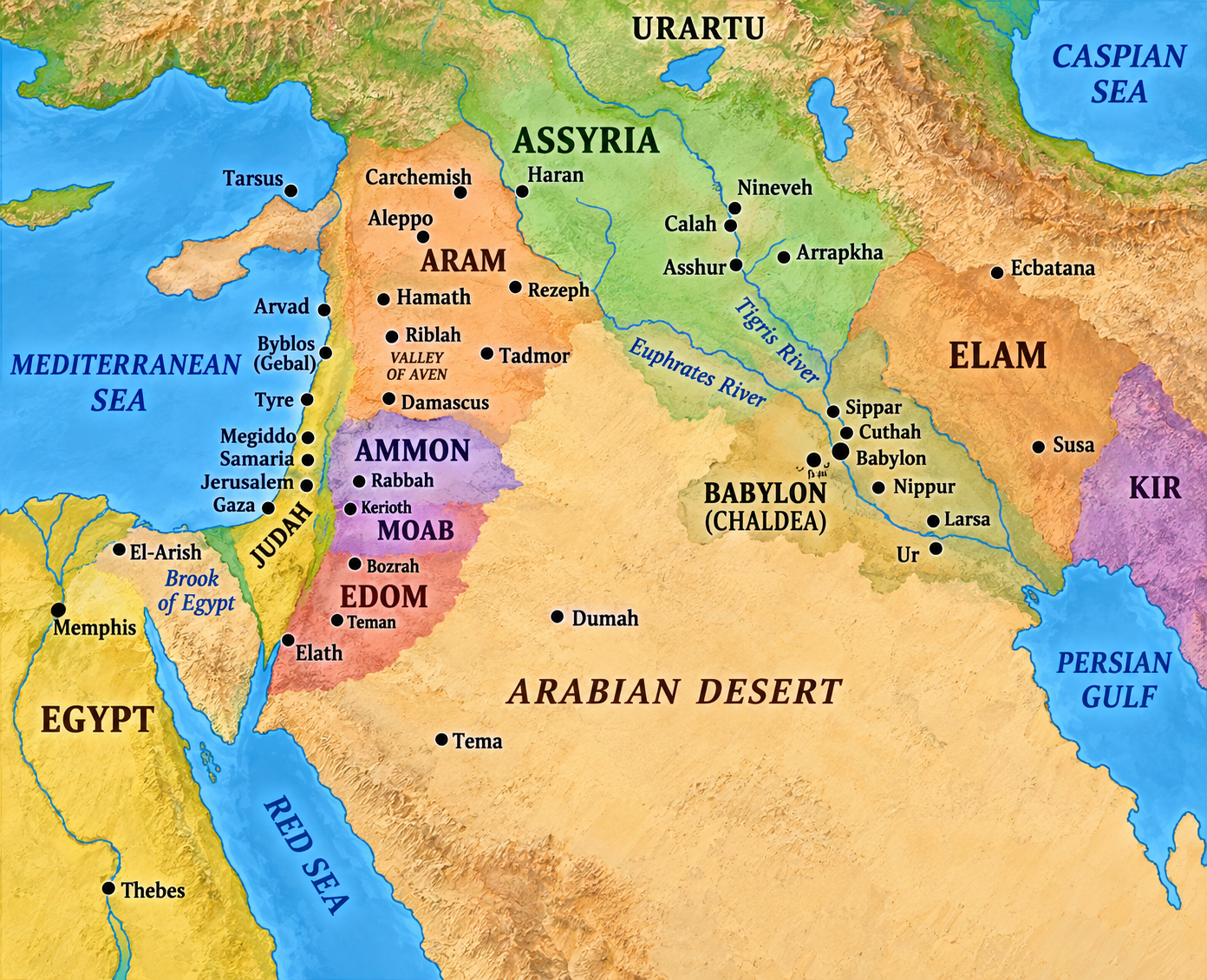

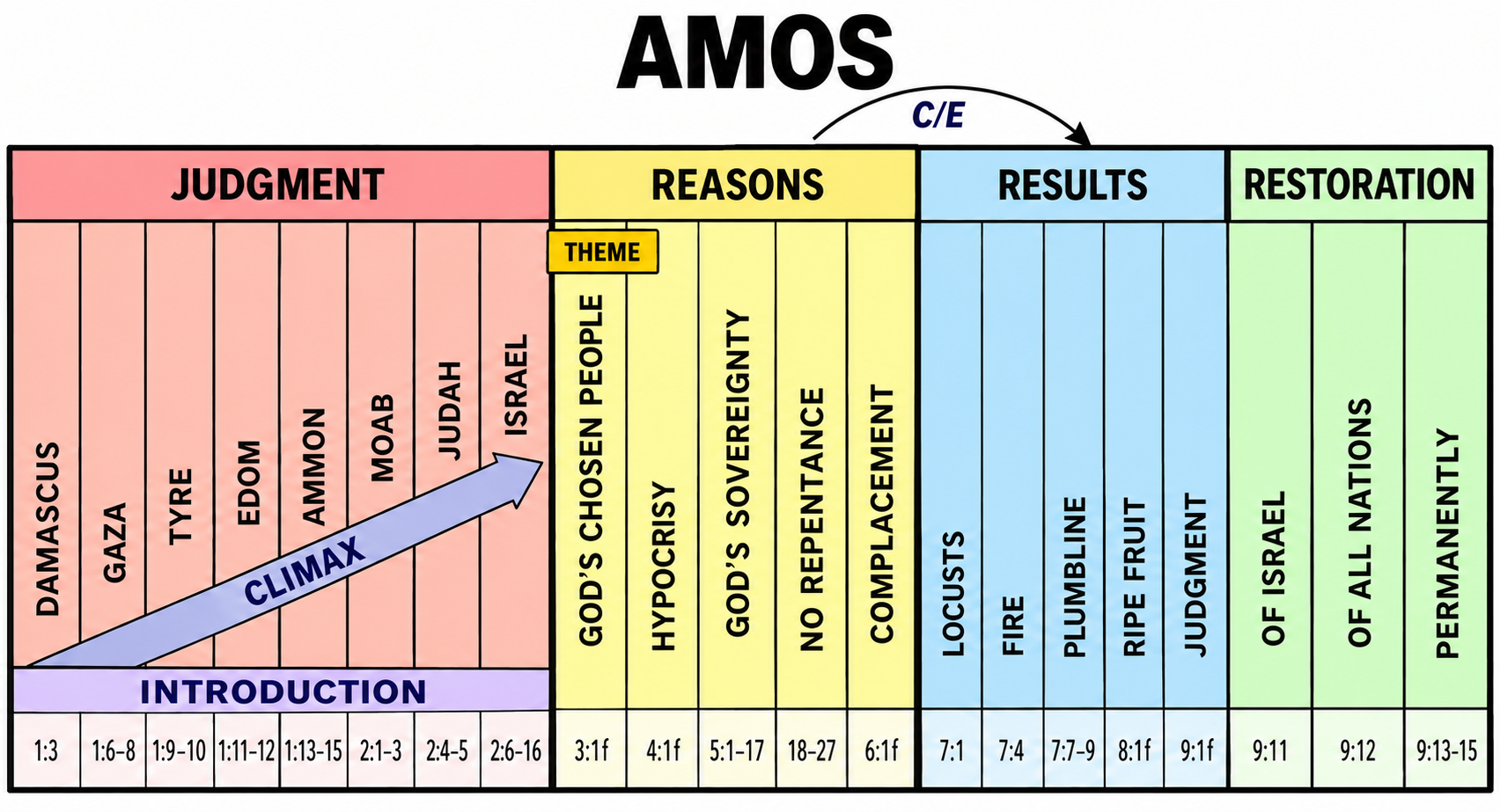
Click chart to enlarge
From Hampton Keathley IV
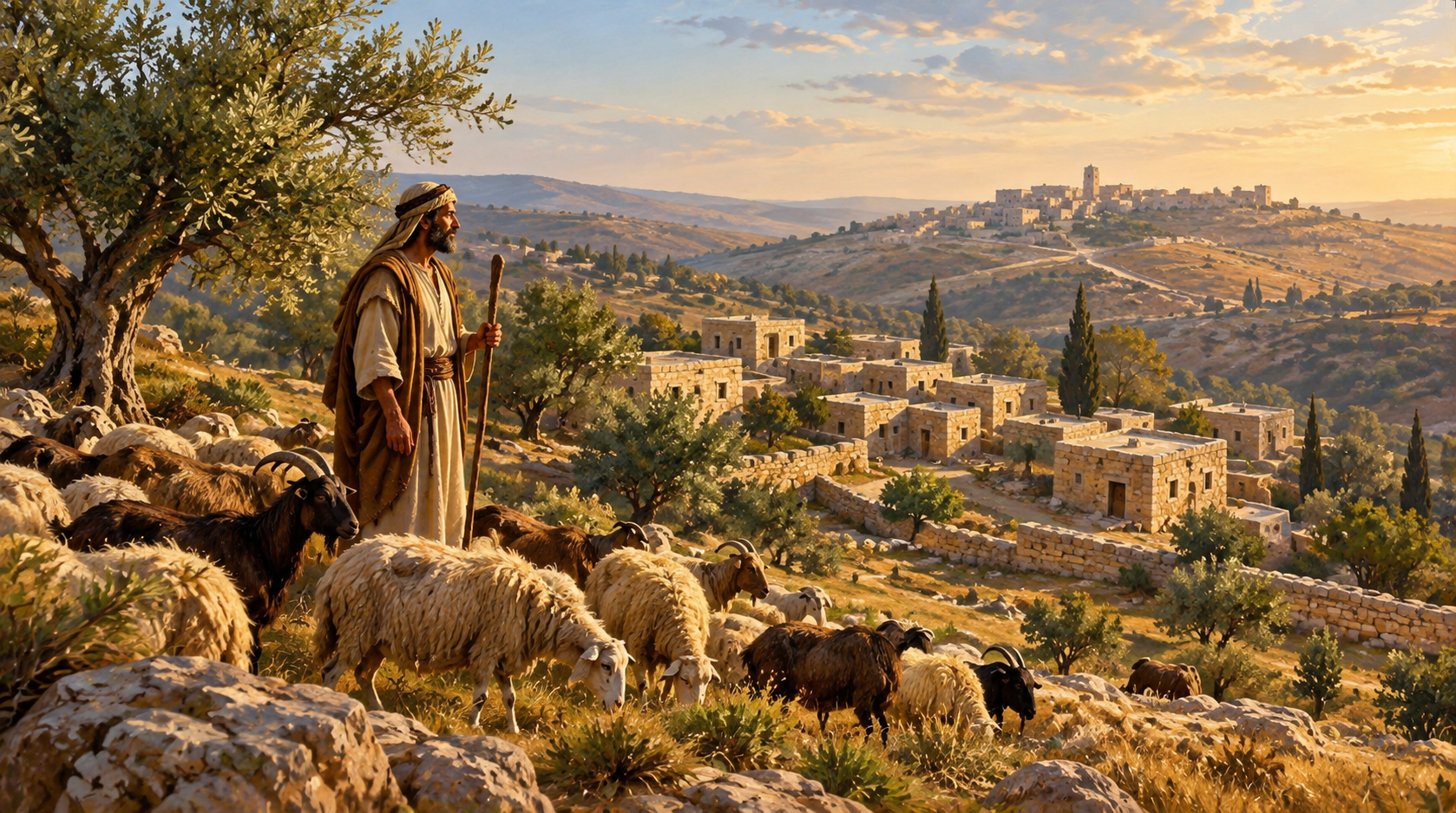
Amos 7:1 Thus the Lord GOD showed me, and behold, He was forming a locust-swarm when the spring crop began to sprout. And behold, the spring crop was after the king’s mowing.
KJV Thus hath the Lord GOD shewed unto me; and, behold, he formed grasshoppers in the beginning of the shooting up of the latter growth; and, lo, it was the latter growth after the king's mowings.
NET The sovereign LORD showed me this: I saw him making locusts just as the crops planted late were beginning to sprout. (The crops planted late sprout after the royal harvest.)
NLT The Sovereign LORD showed me a vision. I saw him preparing to send a vast swarm of locusts over the land. This was after the king's share had been harvested from the fields and as the main crop was coming up.
ESV This is what the Lord GOD showed me: behold, he was forming locusts when the latter growth was just beginning to sprout, and behold, it was the latter growth after the king's mowings.
BGT οὕτως ἔδειξέν μοι κύριος καὶ ἰδοὺ ἐπιγονὴ ἀκρίδων ἐρχομένη ἑωθινή καὶ ἰδοὺ βροῦχος εἷς Γωγ ὁ βασιλεύς
LXE Thus has the Lord God shewed me; and, behold, a swarm of locusts coming from the east; and, behold, one caterpillar, king Gog.
CSB The Lord GOD showed me this: He was forming a swarm of locusts at the time the spring crop first began to sprout-- after the cutting of the king's hay.
NIV This is what the Sovereign LORD showed me: He was preparing swarms of locusts after the king's share had been harvested and just as the second crop was coming up.
YLT Thus hath the Lord Jehovah shewed me, and lo, He is forming locusts at the beginning of the ascending of the latter growth, and lo, the latter growth is after the mowings of the king;
- showed (KJV): Am 7:4,7 8:1 Jer 1:11-16 24:1 Eze 11:25 Zec 1:20
- he (KJV): Am 4:9 Ex 10:12-16 Isa 33:4 Joe 1:4 2:25 Na 3:15-17
- locust-swarm: probably in their caterpillar state, in which they are most destructive. This is supposed to have been an emblem of the first invasion of the Assyrians.
- mowings (KJV): Or rather, feedings or grazings, as the people of the East make no hay. This was probably in the month of March, which is the only time of the year that the Arabs to this day feed their horses with grass.
Related Passages:
Amos 7:4; 7 Thus the Lord GOD showed me, and behold, the Lord GOD was calling to contend with them by fire, and it consumed the great deep and began to consume the farm land. 7:7 Thus He showed me, and behold, the Lord was standing by a vertical wall with a plumb line in His hand.
Amos 4:9 “I smote you with scorching wind and mildew; And the caterpillar was devouring Your many gardens and vineyards, fig trees and olive trees; Yet you have not returned to Me,” declares the LORD.
Exodus 10:12 (8th Plague) Then the LORD said to Moses, “Stretch out your hand over the land of Egypt for the locusts, that they may come up on the land of Egypt and eat every plant of the land, even all that the hail has left.”
1 Kings 4:7 (KING'S SHARE OF CROPS) Solomon had twelve deputies over all Israel, who provided for the king and his household; each man had to provide for a month in the year.
Genesis 2:7 Then the LORD God formed man of dust from the ground, and breathed into his nostrils the breath of life; and man became a living being.
Amos 4:13 For behold, He who forms mountains and creates the wind And declares to man what are His thoughts, He who makes dawn into darkness And treads on the high places of the earth, The LORD God of hosts is His name.
Amos 4:9 “I smote you with scorching wind and mildew; And the caterpillar was devouring Your many gardens and vineyards, fig trees and olive trees; Yet you have not returned to Me,” declares the LORD.
Joel 1:4 What the gnawing locust has left, the swarming locust has eaten; And what the swarming locust has left, the creeping locust has eaten; And what the creeping locust has left, the stripping locust has eaten.

LOCUSTS LOOSED
ON THE LAND AS JUDGMENT
Thus the Lord GOD (adonay Jehovah/yahweh) showed me - This is the first of 5 visions “Thus the Lord GOD caused me to see.” Adonay Jehovah/yahweh NIV = Sovereign Lord which is used eleven times in chapters 7-9. The verb rāʾâ (“to see”) appears here in the causative (Hiphil) form, meaning that God made Amos see something. This was not an ordinary observation of a locust infestation but a prophetic vision. God Himself initiated the revelation. The same formula introduces the first four of Amos’s five visions: the locusts (7:1), the fire (7:4), the plumb line (7:7), and the basket of summer fruit (8:1). Amos did not learn the future through political analysis, agricultural observation, or human reasoning. The Lord disclosed it to him. This illustrates the principle Amos stated earlier: “Surely the Lord GOD does nothing unless He reveals His secret counsel to His servants the prophets” (Amos 3:7). Peter affirms the same truth about all genuine prophecy: “for no prophecy was ever made by an act of human will, but men moved by the Holy Spirit spoke from God” (2 Peter 1:21).
Bob Utley - This introduction shows the relatedness of the visions (cf. Amos 7:1,4,7; 8:1, but not Amos 9:1-10).
There are over twelve different words in the Hebrew language translated "locusts," which show the fear and commonness of this plague. It is uncertain if these words refer to types of locust or stages of their growth (see my exegetical notes on Joel 1:4; 2:25). See UBS, Fauna and Flora of the Bible, pp. 53-54. This is a helpful resource!
Notice also the divine title ʾădōnāy YHWH, “the Lord GOD.” ʾĂdōnāy emphasizes the Lord’s sovereign authority as Master, while YHWH is the personal covenant name of Israel’s God. The One revealing the vision is both the sovereign Ruler over His people and the covenant God who remains faithful to His own character and promises. The God who controls the future graciously reveals His purposes so that His people may hear His warnings and repent. The prophet’s authority did not come from his ability to predict events, but from the God who revealed them.
And behold (hinneh; LXX - idou = Look!) - Behold draws attention to something significant which means this verse must be very significant because Amos uses it twice in this verse. The repetition invites the reader to picture the unfolding scene. First, behold the Lord forming the locust swarm. Then, behold the vulnerable spring growth appearing after the king's mowing. The two details together create a sense of impending disaster. The crops are beginning to recover but the locusts are being prepared. The people may be anticipating a harvest, but Amos sees danger approaching. While Israel looked upon the emerging crops with hope, Amos was shown a judgment that threatened to consume that hope.
He was forming (yatsar) a locust-swarm (govay/gobay) - NET = " I saw him making locusts" Forming (yatsar) means to fashion, or shape and is the same verb used to describe God's formation of man from the dust of the ground (Ge 2:7). Yatsar is also used in Amos 4:13, where God is described as the One Who forms mountains and creates the wind. Here the Creator is portrayed as forming a locust swarm against His own people. What an astonishing contrast it is between the God Who forms mountains and God Who forms tiny creatures that can devastate an entire harvest. The Creator Who gives life to the fields also possesses authority over the creatures that can consume them!
KJV Bible Commentary - As is true in most places in the world, Israel annually had two mowings of grass (hay). The first was paid to the king as tribute, and the second was kept by the people to sustain them throughout the coming year. This plague is pictured as occurring between the two mowings and, hence, would rob the people of their sustenance for the year to come
Bob Utley - "a locust-swarm" This type of plague is mentioned in Ex 10:12ff. It was specifically one of the curses mentioned in Deut. 28:38-42, if YHWH's people did not keep his commandments. There are over twelve different words in the Hebrew language translated "locusts," which show the fear and commonness of this plague. It is uncertain if these words refer to types of locust or stages of their growth (see my exegetical notes on Joel 1:4; 2:25). See UBS, Fauna and Flora of the Bible, pp. 53-54. This is a helpful resource! ▣ "the spring crop began to sprout" This is literally "the latter growth". It is uncertain if this refers to grass or grain. It is also uncertain if it is a second growth or a replanting. This would have been sometime after April. The later rain had to occur before the seeds would sprout. If this crop was lost there would be no crop until the next year! ▣ "after the king's mowing" This is literally "shearings" (BDB 159, KB 186). This phrase is not meant to teach that the king received the first mowing as a tax on the land (ED: OTHER COMMENTATORS DISAGREE). This allotment for the king is mentioned only here in the entire OT. The phrase was meant to be a way to date this event in the spring.
Locusts were among the most feared agricultural disasters in the ancient Near East. A large swarm could consume vegetation over an enormous area, stripping fields of grain, wiping out pastures, and damaging vineyards and orchards. The results were famine, economic ruin, and widespread suffering. For an agricultural society, locusts threatened the very means of survival. The word Amos uses here (gōbay) refers to a swarm of locusts, probably in the larval stage just as they hatch and begin to devour.
Israel had seen this kind of judgment before. In the eighth plague on Egypt, the locusts “covered the surface of the whole land, so that the land was darkened; and they ate every plant of the land and all the fruit of the trees that the hail had left. Thus nothing green was left on tree or plant of the field through all the land of Egypt” (Exodus 10:15). Moses warned that the same could happen to Israel if it disobeyed: “You shall bring out much seed to the field but you will gather in little, for the locust will consume it” (Deuteronomy 28:38; compare 28:42). Joel described a devastating invasion as a call to repentance: “What the gnawing locust has left, the swarming locust has eaten; and what the swarming locust has left, the creeping locust has eaten; and what the creeping locust has left, the stripping locust has eaten” (Joel 1:4). Amos himself had reminded Israel of an earlier disaster: “‘I smote you with scorching wind and mildew; and the caterpillar was devouring your many gardens and vineyards, fig trees and olive trees; yet you have not returned to Me,’ declares the LORD” (Amos 4:9).
So the locust vision was not an unfamiliar warning. It recalled both Israel’s history and the covenant consequences of persistent disobedience. The God who once used locusts to judge Egypt now showed Amos a locust judgment threatening His own covenant people.
When the spring crop began to sprout - This was Israel's most vulnerable time of the year, because the spring was crucial for providing food for the rest of the year. And now God's timing forms the locusts when the spring growth begins to appear. Began to sprout refers to the beginning of the later growth, apparently a second crop or regrowth following an earlier cutting. This growth was a particularly critical stage in the cycle when the vegetation had begun to recover, but it had not yet matured. The farmers were looking forward to renewed growth as the pastures were beginning to replenish themselves. But in come the locusts which threatened to destroy the crop before it could even develop. God's timing is always perfect and here His judgment was timed to strike when the land was beginning to recover, making the devastation especially severe. The summer heat was on its way, and there would be no more crops to feed them.
As Chisholm says Israel's "misery was intensified in Israel, for locusts were recognized as God’s instrument of punishment for covenant violations (Deut. 28:38, 42; cf. Amos 4:9; Joel 1:1–7)." (SEE The Bible Knowledge Commentary Minor Prophets - Page 43)
NET NOTE - The crops planted late (consisting of vegetables) were planted in late January-early March and sprouted in conjunction with the spring rains of March–April. For a discussion of the ancient Israelite agricultural calendar, see O. Borowski, borrow - Agriculture in Iron Age Israel, 31–44.
And behold (hinneh; LXX - idou = Look!), the spring crop was after the king’s mowing - This is one of the more intriguing expressions in Amos. Spring crop (leqeš) refers to the late growth that sprang up after the “latter rains” of March and April. Mowing (gēz) means a cutting of grass or hay, and is the same word the psalmist uses in his picture of the king’s blessing “May he come down like rain upon the mown grass, like showers that water the earth” (Ps 72:6). The exact nature of the king’s mowing is not explained, but a common interpretation is that the first cutting of grass was reserved for the king, perhaps to feed the royal horses and livestock. Kings certainly needed large supplies of fodder, as Ahab’s desperate search during the drought shows “Then Ahab said to Obadiah, ‘Go through the land to all the springs of water and to all the valleys; perhaps we will find grass and keep the horses and mules alive, and not have to kill some of the cattle’” (1Ki 18:5). Samuel had also warned that a king would claim a share of the people’s produce (1Sa 8:15). Still, the text does not describe the practice directly, so this reconstruction should be regarded as plausible rather than absolutely certain.
J Vernon McGee - There were two crops that could be harvested from the land in that day, and the first crop went to the king as taxes. Actually, the people paid more than one-tenth as a tithe. It is estimated that they paid out about three-tenths of what they took from the land, and here we can see an example of that. However, this time, after the king had gotten his due, a plague of grasshoppers or locusts came in and took their share so that there was nothing left for the people who had really done the work. This was a judgment that should have shaken the people and should have awakened them. (SEE Thru the Bible Vol. 28: The Prophets Amos/Obadiah)
David Hubbard - If the first cutting went to the court and the second crop to the locusts, Israel would be left destitute indeed. The April rains would have passed and the long drought of summer, usually six months, would make further growth impossible. (SEE Joel and Amos - Page 219)
NET NOTE - The crops planted late (consisting of vegetables) were planted in late January-early March and sprouted in conjunction with the spring rains of March–April. For a discussion of the ancient Israelite agricultural calendar, see O. Borowski, borrow - Agriculture in Iron Age Israel, 31–44. king's mowing - This royal harvest may refer to an initial mowing of crops collected as taxes by the royal authorities.
Whatever the arrangement, the timing is clear and makes the threat especially severe. The king’s mowing had already been taken, and the later growth on which everyone else depended was just beginning to appear. Since the latter rains had ended and no more rain would fall until autumn, there would be no further growth that season. If the locusts consumed this crop, ordinary farmers and their animals would face months of shortage. Some interpreters also see a social implication: the king had already received his share, so the most vulnerable would bear the greatest burden of the disaster. That fits Amos’s repeated concern for the poor, though Amos does not directly condemn the royal cutting itself. The primary emphasis is on the timing and severity of the threatened judgment. The locusts threatened not merely the beauty of the fields, but the livelihood of the people who depended on them.
Behold (02009) hinneh is an interjection meaning behold, look, now; if. "It is used often and expresses strong feelings, surprise, hope, expectation, certainty, thus giving vividness depending on its surrounding context." (Baker) Hinneh generally directs our mind to the text, imploring the reader to give it special attention. In short, the Spirit is trying to arrest our attention! And so hinneh is used as an exclamation of vivid immediacy (e.g., read Ge 6:13)! Hinneh is a marker used to enliven a narrative, to express a change a scene, to emphasize an idea, to call attention to a detail or an important fact or action that follows (Isa 65:17, Ge 17:20, 41:17). The first use of hinneh in Ge 1:29 and second in Ge 1:31 - "And God saw all that He had made, and behold, it was very good. And there was evening and there was morning, the sixth day." Hinneh is oftn used in the idiom "Here I am" in Ge 22:1, 7,11 Ge 27:1,18, Ge 31:11, Ge 46:2 Ex 3:4 1Sa 3:4, 3:16, 12:3, 2Sa 1:7, Isa 52:6, Isa 58:9. Hinneh is used most often to point out people but also to point out things (Ge 31:41, 17:4). God uses hinneh to grab man's attention before He brings destruction (Ge 6:13, 17). God uses hinneh when He establishes covenants (Ge 9:9, 15:12, 17 [when Jehovah cut the Abrahamic covenant], Ge 17:4, cp Ge 28:13, 15), when He provided a sacrificial substitute for Isaac (foreshadowing His giving us His only Son!) (Ge 22:13). Hinneh marks the "chance (The Providence of God)" arrival of Boaz at the field where Ruth was gleaning (Ru 2:4-read about this "chance romance" - Indeed, "Behold!"). Hinneh is used to announce the Lord’s sending of a child as a sign and a prophecy of Immanuel-Emmanuel, the Messiah (Isa. 7:14). In fact W E Vine says that it is notable that when behold (hinneh) is used in Isaiah, it always introduces something relating to future circumstances.
HINNEH IN AMOS - Amos 2:13; Amos 4:2; Amos 4:13; Amos 6:11; Amos 6:14; Amos 7:1; Amos 7:4; Amos 7:7; Amos 7:8; Amos 8:1; Amos 8:11; Amos 9:8; Amos 9:9; Amos 9:13
Spurgeon reminds us that "Behold is a word of wonder; it is intended to excite admiration. Wherever you see it hung out in Scripture, it is like an ancient sign-board, signifying that there are rich wares within, or like the hands which solid readers have observed in the margin of the older Puritanic books, drawing attention to something particularly worthy of observation." I would add, behold is like a divine highlighter, a divine underlining of an especially striking or important text. It says in effect "Listen up, all ye who would be wise in the ways of Jehovah!"
Hinneh is translated in the Septuagint with the interjection idou (strictly speaking a command in the second person aorist imperative, middle voice) a demonstrative particle (used 1377 times in the Septuagint and NT) which is found especially in the Gospels of Matthew and Luke "and giving a peculiar vivacity to the style by bidding the reader or hearer to attend to what is said: "Behold! See! Lo!" (Thayer) The command is calling for urgent attention. Do this now! Don't delay! It could be loosely paraphrased "Pay attention!" or "Listen up!" to arouse attention and introdu
Locust-swarm (01373) govay/gobay is considered by most to be derived from the verb gabah, "to be loud," attested in Old Aramaic, Egyptian Aramaic and Targumic Aramaic. The Targumic and Mishnaic cognate appears as well. Gōvay is used in two places in the OT. In Amos 7:1, Amos uses the word in his prophecy against the Northern Kingdom. These locusts would be sent by God to destroy the food close to the time of harvest. In Nah. 3:17, Nahum is prophesying against the city of Ninevah. This is the same city which repented to God only 150 years earlier under the ministry of Jonah. Nahum writes, "Your captains are like locusts." The implication of the passage is that those responsible for alerting the city are inactive and will flee rapidly when they become aware of the impending doom.
Bob Utley gives a good summary of Amos 7-9
- Amos 7-9 forms the last literary unit. The book can be broken into three divisions: (1) judgments against the nations; (2) judgments against Judah and Israel; and (3) the visions of Amos.
- The visions of Amos can be outlined.:
- Amos 7, three visions
- Amos 8, one vision
- Amos 9, one vision.
- Judgment Visions
- Locust, Amos 7:1-3
- Fire (possibly famine, cf. Amos 4:6-8; 8:11-13), Amos 7:4-6
- Plumb line (possibly weak fortifications), Amos 7:7-9
- Summer fruit, Amos 8:1-3
- Earthquake, Amos 9:1-2 (also possibly Amos 8:7-10)
- The visions of Amos can be outlined.:
- Amos 7:10-17 is unique because
- it gives biographical information about Amos (notice how many of the visions are related to agriculture)
- it is written in the THIRD PERSON while other sections of the book are in the FIRST PERSON (i.e. evidence of a compiler or later editor)
RAIN -In the Bible, the “early rain” refers to the rain of autumn and the “latter rain” to the rain of spring: “that He will give the rain for your land in its season, the early and late rain, that you may gather in your grain and your new wine and your oil” (Dt 11:14). For six months of the year, from May to October, no rain falls, and the whole land becomes dry, parched, and brown. The autumn rains were eagerly awaited to prepare the earth for sowing. These “early” or “former” rains begin in late October or early November and fall heavily through November and December (compare Jer 3:3). The heavy winter rains then continue from mid-December into March. January and February are the coldest months, and snow sometimes falls at Jerusalem to a depth of a foot or more, though it does not last long and is rarely seen along the coast or in the low plains. The “latter” or spring rains fall in March and occasionally in April, swelling the grain as it comes to maturity. After that, there is ordinarily no rain, and the sky remains bright and cloudless until October or November.
The traveler Edward Robinson observed that in his day there were no distinct rainy seasons within this period: “The whole period from October to March now constitutes only one continued season of rain, without any regularly-intervening term of prolonged fine weather. Unless therefore, there has been some change in the climate, the early and the latter rains, for which the husbandman waited with longing, seem rather to have implied the first showers of autumn—which revived the parched and thirsty soil and prepared it for the seed—and the later showers of spring, which continued to refresh and forward both the ripening crops and the vernal products of the fields.” James draws on this image of the farmer’s patient waiting: “Therefore be patient, brethren, until the coming of the Lord. The farmer waits for the precious produce of the soil, being patient about it, until it gets the early and late rains” (James 5:7).
Three Hebrew words describe the rains of the different seasons. (1) Yôreh (Hosea 6:3), or môreh (Joel 2:23), denotes the former or early rain: “So rejoice, O sons of Zion, and be glad in the LORD your God; for He has given you the early rain for your vindication. And He has poured down for you the rain, the early and latter rain as before” (Joel 2:23). (2) Malqôš is the “latter” or spring rain: “In the light of a king’s face is life, and his favor is like a cloud with the spring rain” (Proverbs 16:15). This word is closely related to leqeš, the “spring crop” of Amos 7:1, the late growth that sprang up after these final rains. (3) Gešem is the general word for rain, often used of the heavy winter rains (Genesis 7:12; Ezra 10:9; Song of Solomon 2:11).
Rain is also used symbolically in Scripture of God’s word, blessing, and Spirit (Dt 32:2; Ps 72:6; Isa 44:3–4; Hos 10:12). Hosea pictures the LORD Himself coming like the life-giving rain: “So let us know, let us press on to know the LORD. His going forth is as certain as the dawn; and He will come to us like the rain, like the spring rain watering the earth” (Hos 6:3). (from Smith and Easton's Bible Dictionaries)
F B Meyer - Amos 7:1 The latter growth after the king’s mowings.
Our King has often to mow the grass of the inner life—the daisies and buttercups of experience of which we are so proud, the tall stalks, the flowering grasses. Were He to leave them, the entire growth would become altogether too coarse and rank for use. The lawn on which He loves to walk, with its velvet pile of grass, would become coarse and rough.
Mowing implies death. All the pretty flowers and myriads of blades lie in long swathes of death, presently to be carried away to the rubbish-heap. From myriads of dying flowers the last expiring sigh is being breathed out on the soft spring breeze. We must be prepared to die to our complacent self-content; to our blissful frames and feelings; to our complaints and consolations—if any of them come between us and our King.
But after the King’s mowings there is the aftermath. It is said that the tenderest, juiciest shoots appear on lawns which are repeatedly mown. This is what the young lambs love, if they may taste it. And surely there is no such piety as that which follows on the repeated application of God’s scythe. When repeated strokes have robbed us of health, friends, money, and favorable circumstances; then we put forth our tenderest shoots of love, and prayer, and consecration. Oh, do not be afraid of the scythe! The King loves thee too well to hurt thee. Be of good heart; thou shalt yet bear an aftermath!
“What do you think of your God now?” asked a well-known skeptic of Silwood of Keswick, who for twenty years suffered agonies. “Since He is able to keep me in perfect peace,” was the reply, “amid sufferings like mine, I think of Him more than ever.” Here was aftermath indeed!
Amos 7:1-9 TODAY IN THE WORD
Look, I am setting a plumb line among my people Israel; I will spare them no longer. - Amos 7:8b
Writer Calvin Miller once noted, “Great communication is based on liking our audience rather than fearing them.” One of the secrets to being an effective evangelist is to empathize with those you hope to reach. We may not like everything that they do but we must care about them.
This was true of Amos. The compassion he felt for those to whom he had been sent infuses today’s passage. When the Lord showed him a series of visions foretelling the destruction of Israel, Amos pleaded with God on Israel’s behalf.
In the first vision he saw a swarm of locusts ready to destroy the harvest. This was after the first harvest had been gathered and just as the second crop was starting to come up (Amos 7:1).
In our culture today we may miss the significance of this timing. The second crop was planted late in the season in order to benefit from the spring rains. A swarm of locusts then would mean that there would be no time left to plant another crop. Anything planted would die, since there was no rain to sustain it. Since the first crop was “the king’s share,” people depended upon the second crop for their survival.
In Amos’s vision, the locusts “stripped the land clean.” Instead of rejoicing because God’s sinful people were getting what they deserved, Amos cried out in anguish and begged God to forgive (Amos 7:2). The Lord granted the prophet’s request and relented.
Sometime after this Amos saw another vision. This time the Lord called for “judgment by fire” to destroy the crops and dry up the underground water supply (Amos 7:4). Many Bible scholars believe this referred to a possible drought. Once again, Amos pleaded with God to relent and judgment was delayed (Amos 7:5–6).
TODAY ALONG THE WAY
Amos felt compassion that compelled him to pray as well as preach. The people of Israel did not appreciate his ministry, but they were spared because he cared enough to pray.
Amos 7:1–9 Today in the Word
A bad golf shot accidentally started a brush fire that consumed 20 acres. On a golf course near Reno, Nevada, the golfer had hit his ball into the grass. Trying to get back to the fairway on his next shot, he started a fire when his metal club struck something that created a spark. It took 50 firefighters and several fire engines from two cities hours to subdue the blaze. Talk about a poor round of golf!
Fire is at the center of one of the three visions seen by Amos in today’s reading. This marks a shift in the book’s content. Amos 1 and Amos 2 feature a series of prophetic judgments against the nations, beginning with Israel’s enemies, then stunningly announcing that Israel herself is the chief offender. Amos 3 through Amos 6 contain three sermons or oracles, directed mainly at the northern kingdom of Israel, which emphasize the severity of the nation’s sins and the certainty of God’s righteous judgment if they did not repent. Amos 7 through Amos 9 are built around five visions—three short ones (today’s reading) and two longer ones.
The themes and meanings of these visions are the same as the messages in the earlier chapters, but God now uses Amos to communicate them in a different way.
In the first three visions, a pattern repeats: God shows Amos a form of judgment, the prophet cries out or intercedes for the people as unable to bear His wrath, then God relents—but notice, He does not forgive because the people haven’t repented. In the first vision, it’s a swarm of locusts, a kind of natural disaster (Amos 7:1–3). In the second vision, it’s fire, with the imagery more supernatural and apocalyptic (Amos 7:4–6). In the third vision, it’s a plumb line (Amos 7:7–9). This picture is less dramatic but more chilling. The message is that the standard is holiness and that Israel was failing miserably. A time of accountability and judgment had arrived. The idolaters and their high places would be destroyed. God had measured correctly—they’re the ones who were so off course, and they would reap the results.
Apply the Word
Amos is one among a great tradition of biblical characters interceding for their nation. Moses prayed to the Lord on behalf of the Israelites when God responded to their complaints with fire (Num. 11:1–3). We can join this great tradition by praying for communities, our nation, and for the world. Interceding for country and four our elected leaders and asking God to continue to call sinners to Himself should be a regular part of our prayer lives.
Amos 7–9 contains five major prophetic visions.
|
Passage |
Vision |
Central emphasis |
|
Am 7:1–3 |
Locust swarm |
Threatened judgment withheld after intercession |
|
Am 7:4–6 |
Consuming fire |
Threatened judgment again withheld |
|
Am 7:7–9 |
Plumb line |
God announces that He will no longer spare Israel |
|
Am 8:1–3 |
Basket of summer fruit |
Israel's end has arrived |
|
Am 9:1–4 |
The Lord beside the altar |
No escape from the announced judgment |
Amos 7:2 And it came about, when it had finished eating the vegetation of the land, that I said, “Lord GOD, please pardon! How can Jacob stand, For he is small?”
KJV And it came to pass, that when they had made an end of eating the grass of the land, then I said, O Lord GOD, forgive, I beseech thee: by whom shall Jacob arise? for he is small.
NET When they had completely consumed the earth's vegetation, I said, "Sovereign LORD, forgive Israel! How can Jacob survive? He is too weak!"
NLT In my vision the locusts ate every green plant in sight. Then I said, "O Sovereign LORD, please forgive us or we will not survive, for Israel is so small."
ESV When they had finished eating the grass of the land, I said, "O Lord GOD, please forgive! How can Jacob stand? He is so small!"
BGT καὶ ἔσται ἐὰν συντελέσῃ τοῦ καταφαγεῖν τὸν χόρτον τῆς γῆς καὶ εἶπα κύριε κύριε ἵλεως γενοῦ τίς ἀναστήσει τὸν Ιακωβ ὅτι ὀλιγοστός ἐστιν
LXE And it came to pass when he had finished devouring the grass of the land, that I said, Lord God, be merciful; who shall raise up Jacob? for he is small in number.
CSB When the locusts finished eating the vegetation of the land, I said, "Lord GOD, please forgive! How will Jacob survive since he is so small?"
NIV When they had stripped the land clean, I cried out, "Sovereign LORD, forgive! How can Jacob survive? He is so small!"
- when (KJV): Ex 10:15 Rev 9:4
- O Lord (KJV): Am 7:5 Ex 32:11,12 34:9 Nu 14:17-19 Jer 14:7,20,21 Da 9:19 Jas 5:15,16
- by whom shall Jacob arise (KJV): or, who of (or for) Jacob shall stand, Isa 51:19 Eze 9:8 11:13
- for (KJV): Ps 12:1 44:24-26 Isa 37:4 Jer 42:2 Zec 4:10
Related Passages:
Exodus 32:11-14; 11Then Moses entreated the LORD his God, and said, “O LORD, why does Your anger burn against Your people whom You have brought out from the land of Egypt with great power and with a mighty hand? 12“Why should the Egyptians speak, saying, ‘With evil intent He brought them out to kill them in the mountains and to destroy them from the face of the earth’? Turn from Your burning anger and change Your mind about doing harm to Your people. 13“Remember Abraham, Isaac, and Israel, Your servants to whom You swore by Yourself, and said to them, ‘I will multiply your descendants as the stars of the heavens, and all this land of which I have spoken I will give to your descendants, and they shall inherit it forever.’” 14So the LORD changed His mind about the harm which He said He would do to His people.
Exodus 32:30-32 On the next day Moses said to the people, “You yourselves have committed a great sin; and now I am going up to the LORD, perhaps I can make atonement for your sin.” 31 Then Moses returned to the LORD, and said, “Alas, this people has committed a great sin, and they have made a god of gold for themselves. 32 “But now, if You will, forgive their sin–and if not, please blot me out from Your book which You have written!”
Numbers 14:13-20 3But Moses said to the LORD, “Then the Egyptians will hear of it, for by Your strength You brought up this people from their midst, 14 and they will tell it to the inhabitants of this land. They have heard that You, O LORD, are in the midst of this people, for You, O LORD, are seen eye to eye, while Your cloud stands over them; and You go before them in a pillar of cloud by day and in a pillar of fire by night. 15 “Now if You slay this people as one man, then the nations who have heard of Your fame will say, 16 ‘Because the LORD could not bring this people into the land which He promised them by oath, therefore He slaughtered them in the wilderness.’ 17 “But now, I pray, let the power of the Lord be great, just as You have declared, 18 ‘The LORD is slow to anger and abundant in lovingkindness, forgiving iniquity and transgression; but He will by no means clear the guilty, visiting the iniquity of the fathers on the children to the third and the fourth generations.’ 19 “Pardon, I pray, the iniquity of this people according to the greatness of Your lovingkindness, just as You also have forgiven this people, from Egypt even until now.” 20 So the LORD said, “I have pardoned them according to your word;
1 Samuel 12:23 “Moreover, as for me, far be it from me that I should sin against the LORD by ceasing to pray for you; but I will instruct you in the good and right way.
Psalm 106:23 Therefore He said that He would destroy them, Had not Moses His chosen one stood in the breach before Him, To turn away His wrath from destroying them.
Jeremiah 14:7-9 “Although our iniquities testify against us, O LORD, act for Your name’s sake! Truly our apostasies have been many, We have sinned against You. 8 “O Hope of Israel, Its Savior in time of distress, Why are You like a stranger in the land Or like a traveler who has pitched his tent for the night? 9 “Why are You like a man dismayed, Like a mighty man who cannot save? Yet You are in our midst, O LORD, And we are called by Your name; Do not forsake us!”
Ezekiel 22:30 “I searched for a man among them who would build up the wall and stand in the gap before Me for the land, so that I would not destroy it; but I found no one.
Luke 23:34 But Jesus was saying, “Father, forgive them; for they do not know what they are doing.” And they cast lots, dividing up His garments among themselves.
Romans 9:1-3 I am telling the truth in Christ, I am not lying, my conscience testifies with me in the Holy Spirit, 2that I have great sorrow and unceasing grief in my heart. 3For I could wish that I myself were accursed, separated from Christ for the sake of my brethren, my kinsmen according to the flesh,
Amos 6:13 You who rejoice in Lodebar, And say, “Have we not by our own strength taken Karnaim for ourselves?”
JUDGMENT MOVES AMOS TO
STAND IN THE GAP
And it came about, when it had finished (kalah) eating the vegetation of the land - The previous verse described God forming a locust swarm just as the spring crop began to sprout after the king’s mowing (Amos 7:1). Now Amos sees the locusts devouring the vegetation (ʿēśeb, broadly refers to the green, non-woody plants of the field). Finished (kalah) means to complete or bring to an end, and stresses how complete the locust destruction was. The new growth has vanished, and the land’s food supply has been stripped bare. For an agricultural society, this meant widespread hunger, economic ruin, and suffering. The scene deliberately recalls the eighth plague on Egypt, when the locusts “ate every plant [ʿēśeb] of the land... thus nothing green was left” (Ex 10:15).
Bob Utley - "finished" This VERB (kalah Piel PERFECT) has the connotation of "to complete" or "destroy" (NIDOTTE, vol. 2, p. 641). Here it functions in both senses.
Now remember that what Amos is describing is what he saw in a prophetic vision, not necessarily a locust invasion that had taken place. This helps understand when God announces that the threatened judgment will not happen in Amos 7:3. The point of the vision is that it was to warn Israel of how severe God’s judgment could be, while the following verses reveal His mercy in response to Amos' intercession. What Amos saw moved him at once to prayer, echoing Habakkuk’s later plea: “LORD, I have heard the report about You and I fear. O LORD, revive Your work in the midst of the years, in the midst of the years make it known; in wrath remember mercy” (Habakkuk 3:2). The sight of impending judgment did not harden Amos’s heart, but drove him to the throne of mercy.
That I said - Until now, Amos has largely been speaking to Israel on behalf of God. Now he will speak to God on behalf of Israel. On one hand Amos stood before the people of Israel as God's messenger, but on the other hand he stood before God as the people's intercessor. What a beautiful example for pastors, teachers, parents, and all believers! It is possible to proclaim truth accurately while lacking genuine compassion for those who need to hear it.
Bob Utley - "that I said" The Prophets often serve as intercessors (cf. Exod. 32:11; Jer. 15:1; 18:20; Ezek. 9:8; Dan. 9:15-19), although usually they speak to the covenant people on YHWH's behalf. ▣ "Lord God" This is Adon and YHWH, used so often in Amos (cf. Jer. 14:7,20,21; Ezek. 9:8; 11:13).
Lord GOD (adonay Jehovah/yahweh) - Adonai emphasizes God's sovereign lordship and authority. Yahweh is the covenant name of the LORD, recalling His relationship with Israel.
Please (Heb = na) pardon! (salach; LXX - hileos genou = be merciful) - NET = "Sovereign LORD, forgive Israel!" Amos’s cry is literally sĕlacḥ-nāʾ, “pardon, please!” The particle (Heb = na) is attached to a request or command (in this case a command) to soften it into a humble yet still urgent plea.
Amos he knew the "agricultural problem" in their land
was really a spiritual problem in their heart.
Pardon (salach) is a request to forgive, so that Amos is specifically asking for God to forgive their sin. The man who was fearless before sinners became a humble intercessor before God! Amos is appealing directly to the mercy of Yahweh for he knows Israel is guilty, but he also knows the LORD is merciful ("mercy full"). Amos could have prayed, “Lord, stop the locusts” or asked God to restore the crops, but instead asks for pardon for he knew the "agricultural problem" in their land was really a spiritual problem in their heart. Amos sought more than relief from the consequences of sin, pleading for mercy concerning the sin itself. In a similar way Moses interceded for Israel after the rebellion at Kadesh-barnea, praying “Pardon, I pray, the iniquity of this people according to the greatness of Your lovingkindness, just as You also have forgiven this people, from Egypt even until now.” (Nu 14:19) Both Moses and Amos stood in the gap, not because Israel deserved forgiveness, but because they knew the LORD was merciful.
David Hubbard - Stunned by the ravaging sight, Amos forcefully begs God to forgive; the grammatical form is an imperative strengthened by a Hebrew particle (nā’) which conveys urgency: ‘please’ or ‘now’. (SEE Joel and Amos - Page 219)
Amos was bold enough to confront Israel's sins and
compassionate enough to plead for Israel's forgiveness.
Bob Utley - "please pardon" This (sĕlacḥ-nā) is a Qal IMPERATIVE. This word is always used for YHWH's forgiveness of humans (see Robert B. Girdlestone, Synonyms of the Old Testament, pp. 135-136).
How can Jacob stand, for he is small - NET = "He is too weak!" NLT - "for Israel is so small" - Amos' question is how can Jacob (Israel) endure or survive the devastation he has seen in his vision. Amos presents a compassionate appeal based upon the nation's vulnerability. Amos explains (for) his question reasoning that Jacob was small, not in the sense of geographic size (or prosperity) but in the sense that they were small when viewed in the light of God's great judgment. Recall how Israel had boasted in Amos 6:13. So while the military leaders may have felt confident that they strength guaranteed securty, Amos knows they were not strong enough to survive God's judgment. Pride measures strength by what we can accomplish; humility measures our need by what only God can do.
NLT Note on Jacob - The names "Jacob" and "Israel" are often interchanged throughout the Old Testament, referring sometimes to the individual patriarch and sometimes to the nation.
David Hubbard - The ground for Amos’ request is Israel’s (here called Jacob; cf. Amos 3:13; 6:8; 9:8) frailty and vulnerability. The people would never be able to stand up under such an onslaught. Amos’ pity is so keen that he does not wait for Yahweh to answer his rhetorical question but supplies the answer himself, an answer in sharp contrast to all the boasting of invulnerability and military prowess which dominated the previous chapter (Amos 6:1–2, 13): Jacob is little (small). The argument is noteworthy. No direct appeal is made to God’s reputation (cf. Exod. 32:11–13) or to the covenant between Yahweh and Israel (cf. Ps. 74:20) or to their historic relationship which elsewhere looms large in Amos 2:9–11; 3:2.....So in the face of the locusts’ terror he appeals to God’s compassion for a feeble people and to that compassion alone. (SEE Joel and Amos - Page 219)
Hadjiev adds "Moses’ prayer for divine forgiveness in Numbers 14:13-19 is based on a concern for God’s name and on recognition of God’s gracious character. Amos focuses on the second of those with his rhetorical question How can Jacob stand? / He is so small! (Amos 7:2, 5). He accepts that the punishment is deserved but appeals to the Lord’s pity by pointing out the vulnerability of the people. (SEE Joel and Amos: An Introduction and Commentary - Page 163)
It is possible to be absolutely right about another person’s sin
and tragically wrong in our attitude toward that person!
🙏 THOUGHT: Do You Have the Heart of an Intercessor? When Amos saw the locusts devouring Israel’s vegetation, he cried, “Lord GOD, please pardon!” (Amos 7:2). The prophet who boldly confronted Israel’s sin also compassionately pleaded for its forgiveness! He did not excuse their rebellion or question God’s justice but appealed to God’s mercy. When we see others wandering from God, do we merely criticize them, or do we fall to our knees and plead for their restoration? (I am convicted!) Jesus wept over Jerusalem (Lk 19:41–44), and Paul wrote, “Brethren, my heart’s desire and my prayer to God for them is for their salvation” (Ro 10:1). It is possible to be absolutely right about another person’s sin and tragically wrong in our attitude toward that person! May God give us hearts uncompromising toward sin but overflowing with compassion toward sinners, remembering that our risen Savior “always lives to make intercession” for us (Hebrews 7:25). The heart that truly knows God’s mercy will never tire of pleading for others to experience it! (1 Timothy 2:1–4; James 5:16)
Pardon (forgive) (05545) salach (See another study) means to free from or release from something and so to pardon, to forgive, to spare. God's offer of pardon and forgiveness to sinners. Salach is never used of people forgiving each other but used of God forgiving. Jehovah Himself announces, in response to Moses' prayers for Israel, that He has forgiven Israel at two of their darkest moments, the golden calf incident and the murmuring at Kadesh Barnea (Ex 34:9; Nu 14:19-20). Salach is used exclusively of God’s pardon (cf. Nu 14:20; 1 Kgs 8:30, 39; Isa. 55:7; Lam. 3:42). The verb sālacḥ (meaning originally ‘to sprinkle’) derives from the cult and describes divine forgiveness resulting in purification and removal of sin and of its consequences. In Psalm 103:3 ‘forgives all your iniquity’ stands in parallel to ‘heals all your diseases’ and in 1 Kings 8:34, 36 forgiveness comes with reversal of the adverse effects of human rebellion.
W E Vine adds that "The basic meaning (of salach) undergoes no change throughout the Old Testament. God is always the subject of “forgiveness.” No other Old Testament verb means “to forgive,” although several verbs include “forgiveness” in the range of meanings given a particular context (e.g., naca and awon in Ex. 32:32; kapar in Ezek. 16:63)… Most occurrences of calach are in the sacrificial laws of Leviticus and Numbers. In the typology of the Old Testament, sacrifices foreshadowed the accomplished work of Jesus Christ, and the Old Testament believer was assured of “forgiveness” based on sacrifice (see Nu 15:25, 28)… he mediators of the atonement were the priests who offered the sacrifice. The sacrifice was ordained by God to promise ultimate “forgiveness” in God’s sacrifice of His own Son. Moreover, sacrifice was appropriately connected to atonement, as there is no forgiveness without the shedding of blood (Lev. 4:20; cf. Heb. 9:22). Out of His grace, God alone “forgives” sin. The Israelites experienced God’s “forgiveness” in the wilderness and in the Promised Land. As long as the temple stood, sacrificial atonement continued and the Israelites were assured of God’s “forgiveness.” When the temple was destroyed and sacrifices ceased, God sent the prophetic word that He graciously would restore Israel out of exile and “forgive” its sins (Jer. 31:34).
SALACH - 46V - forgive(19), forgiven(13), pardon(12), pardoned(2), pardons(1). Exod. 34:9; Lev. 4:20; Lev. 4:26; Lev. 4:31; Lev. 4:35; Lev. 5:10; Lev. 5:13; Lev. 5:16; Lev. 5:18; Lev. 6:7; Lev. 19:22; Num. 14:19; Num. 14:20; Num. 15:25; Num. 15:26; Num. 15:28; Num. 30:5; Num. 30:8; Num. 30:12; Deut. 29:20; 1 Sam. 15:25; 1 Ki. 8:30; 1 Ki. 8:34; 1 Ki. 8:36; 1 Ki. 8:39; 1 Ki. 8:50; 2 Ki. 5:18; 2 Ki. 24:4; 2 Chr. 6:21; 2 Chr. 6:25; 2 Chr. 6:27; 2 Chr. 6:30; 2 Chr. 6:39; 2 Chr. 7:14; Ps. 25:11; Ps. 103:3; Isa. 55:7; Jer. 5:1; Jer. 5:7; Jer. 31:34; Jer. 33:8; Jer. 36:3; Jer. 50:20; Lam. 3:42; Dan. 9:19; Amos 7:2
Amos 7:3 The LORD changed His mind about this. “It shall not be,” said the LORD.
KJV The LORD repented for this: It shall not be, saith the LORD.
NET The LORD decided not to do this. "It will not happen," the LORD said.
NLT So the LORD relented from this plan. "I will not do it," he said.
ESV The LORD relented concerning this: "It shall not be," said the LORD.
BGT μετανόησον κύριε ἐπὶ τούτῳ καὶ τοῦτο οὐκ ἔσται λέγει κύριος
LXE Repent, O Lord, for this. And this shall not be, saith the Lord.
CSB The LORD relented concerning this. "It will not happen," He said.
NIV So the LORD relented. "This will not happen," the LORD said.
- Am 7:6 De 32:36 1Ch 21:15 Ps 106:45 Ho 11:8 Joe 2:14 Jon 3:10 Jas 5:16
Related Passages:
Malachi 3:6 “For I, the LORD, do not change; therefore you, O sons of Jacob, are not consumed.
James 1:17 Every good thing given and every perfect gift is from above, coming down from the Father of lights, with whom there is no variation or shifting shadow.
Numbers 23:19 “God is not a man, that He should lie, Nor a son of man, that He should repent; Has He said, and will He not do it? Or has He spoken, and will He not make it good?
1 Samuel 15:29 “Also the Glory of Israel will not lie or change His mind; for He is not a man that He should change His mind.”
Jonah 3:10 When God saw their deeds, that they turned from their wicked way, then God relented concerning the calamity which He had declared He would bring upon them. And He did not do it.
Exodus 32:14 So the LORD changed His mind about the harm which He said He would do to His people.
Jeremiah 18:7-10 “At one moment I might speak concerning a nation or concerning a kingdom to uproot, to pull down, or to destroy it; 8 if that nation against which I have spoken turns from its evil, I will relent concerning the calamity I planned to bring on it. 9 “Or at another moment I might speak concerning a nation or concerning a kingdom to build up or to plant it; 10 if it does evil in My sight by not obeying My voice, then I will think better of the good with which I had promised to bless it.
Matthew 6:7-8 “And when you are praying, do not use meaningless repetition as the Gentiles do, for they suppose that they will be heard for their many words. 8 “So do not be like them; for your Father knows what you need before you ask Him.
Luke 18:13-14 “But the tax collector, standing some distance away, was even unwilling to lift up his eyes to heaven, but was beating his breast, saying, ‘God, be merciful to me, the sinner!’ 14 “I tell you, this man went to his house justified rather than the other; for everyone who exalts himself will be humbled, but he who humbles himself will be exalted.”
Matthew 14:30 But seeing the wind, he (PETER) became frightened, and beginning to sink, he cried out, “Lord, save me!”
MERCY TRIUMPHS OVER
DESERVED JUDGMENT!
The LORD changed (nacham; LXX - metanoeo) His mind about this - NET = "The LORD decided not to do this" The LORD relented concerning the threatened judgment. God had revealed a vision of devastating locusts. Amos interceded and God declared that the threatened judgment would not take place. The verse describes a genuine change in God's announced course of action, not a change in His eternal character or moral standards. God did not become more merciful than He had previously been; He demonstrated the mercy that had always belonged to His character. Or stated another way God's mercy did not begin when Amos prayed, but His mercy was revealed in His response to Amos' prayer.
David Hubbard - The prophet almost gained his desired result, but not quite. Amos had begged for forgiveness of sin; Yahweh granted only withdrawal of judgment: It shall not be. (SEE Joel and Amos - Page 219)
About this indicates that God is relenting concerning this particular threatened judgment, the locust devastation shown to Amos. Israel remains guilty and will still face judgment if it continues in rebellion. In other words, divine mercy postponed the threatened devastation, but it did not make Israel's unrepentant sins harmless.
God is unchanging in His character, but His dealings with people are genuinely responsive to their actions and prayers. The God Who judges persistent rebellion is the same God Who shows mercy when He chooses to withhold threatened judgment. His justice and mercy are not competing characteristics. They are expressions of His perfectly consistent nature. God never changes in Who He is, even when He changes what He does in response to human circumstances.
Consider an illustration. A righteous judge may sentence a guilty person according to the law. The same judge may also extend mercy when the law permits it. The judge's commitment to justice has not changed. His treatment of the person has changed because the circumstances or grounds for his action have changed. Similarly, God may announce judgment against sin and then withhold that judgment. This does not imply that His holiness has diminished. Nor does it imply that He has discovered information previously unknown to Him. Rather, He is acting consistently with His own righteousness, mercy, and sovereign purposes.
A short prayer rising from a burdened heart can be more meaningful
than a thousand impressive words spoken without faith.
It shall not be,” said the LORD - The bottom line is that the locust judgment in Amos' vision would not take place. Amos' prayer was remarkably brief with just a simple, earnest appeal for mercy and God responded. This is an encouraging reminder that the effectiveness of prayer does not depend upon its length or rhetorical beauty. Jesus warned against the mistaken belief that people will be heard because of their many words (Mt 6:7,8). The tax collector in Jesus' parable prayed a brief plea for mercy and went home justified (Lk 18:13,14). Peter, sinking beneath the waves, cried out, “Lord, save me!” (Mt 14:30).
.God's sovereignty does not make prayer unnecessary. Scripture presents prayer as one of the means through which His sovereign purposes are accomplished.
Do you thank God for the judgments
you deserved but never experienced?
🙏 THOUGHT: Are You Taking God’s Mercy for Granted? What an encouraging declaration: “The LORD changed His mind about this. ‘It shall not be,’ said the LORD” (Amos 7:3). Amos pleaded for a guilty nation, and God withheld the threatened judgment. Our God is perfectly holy and just, yet abundantly merciful and responsive to prayer! But there is a danger in receiving mercy without recognizing its purpose. Israel could have taken the absence of judgment as proof that its sins were insignificant. Yet God’s patience was meant to give opportunity for repentance, not permission to keep rebelling, for “the kindness of God leads you to repentance” (Ro 2:4). Do you thank God for the judgments you deserved but never experienced? Let God’s mercy never make us careless about sin, but ever more grateful for His grace and earnest in our prayers for others! (Lam 3:22, 23; Hebrews 7:25; James 5:16)
Changed (repented, relented, was sorry) (05162) naham/nacham means to be sorry, to regret, to relent, to have compassion; to comfort or console; in the reflexive stem, also to console oneself (sometimes by taking revenge). The root of nāḥam seems originally to have pictured “breathing deeply,” and therefore the physical expression of deep feeling: a sigh of sorrow, the heaving breath of compassion, or the relief of being comforted. The root also occurs in Ugaritic with the meaning “to console,” and it appears in several Old Testament names. Nahum means “comfort,” Nehemiah means “the LORD comforts,” and Menahem means “comforter.” The Septuagint translates the word with both metanoeō (“to change one’s mind”) and metamelomai (“to regret”).
The verb has two main families of meaning. In the Niphal stem, it usually means to be sorry, regret, or relent. In the Piel stem, it means to comfort or console. Other stems express being comforted (passive) or consoling oneself (reflexive). The two families are closely related, since both describe a deep inward movement of feeling: grief or compassion that leads to a change of action, or consolation that brings relief from grief. This note will deal only with the Niphal stem meaning.
“To be sorry, to relent” - The King James Version translates the Niphal of nāḥam “repent” thirty-eight times, and most of those instances describe God, not man. The first is in the days before the Flood: “The LORD was sorry that He had made man on the earth, and He was grieved in His heart” (Genesis 6:6). The word also describes God’s compassion on His suffering people. In the days of the judges, “the LORD was moved to pity by their groaning because of those who oppressed and afflicted them” (Judges 2:18). It is used of human regret as well. When Israel left Egypt, God led them away from the Philistine road, “for God said, ‘The people might change their minds when they see war, and return to Egypt’” (Exodus 13:17).
It is important to note that nāḥam is not the usual Old Testament word for human repentance. The word most often used for man’s repentance is šûb, “to turn” (from sin to God). Nāḥam emphasizes the inward feeling of sorrow or compassion, while šûb emphasizes the outward turning of one’s life.
How can God “repent”? At first glance, Scripture seems to say two opposite things. On one hand, God “changes His mind.” After Israel’s sin with the golden calf, Moses interceded, and “So the LORD changed His mind about the harm which He said He would do to His people” (Exodus 32:14). The LORD said of Saul, “I regret that I have made Saul king, for he has turned back from following Me and has not carried out My commands” (1 Samuel 15:11). On the other hand, just a few verses later in the same chapter, Samuel declares, “Also the Glory of Israel will not lie or change His mind; for He is not a man that He should change His mind” (1 Samuel 15:29). And the psalmist says of the Messiah’s priesthood, “The LORD has sworn and will not change His mind, ‘You are a priest forever according to the order of Melchizedek’” (Psalm 110:4).
The resolution is that God never sins and therefore never needs to repent in the human sense of turning away from evil. When nāḥam is used of God, the language is anthropopathic, describing God’s actions in terms of human feelings. As one lexicon explains, “From man’s limited, earthly, finite perspective it only appears that God’s purposes have changed.” God’s character and ultimate purposes never change. What changes is His dealing with people, in keeping with His unchanging character, when their response changes. That is why many translations prefer “relent” to “repent” when God is the subject, since it better reflects God’s compassion.
The key to understanding this is that most of God’s announced judgments are conditional. God Himself stated the principle through Jeremiah: “At one moment I might speak concerning a nation or concerning a kingdom to uproot, to pull down, or to destroy it; if that nation against which I have spoken turns from its evil, I will relent concerning the calamity I planned to bring on it” (Jeremiah 18:7–8). Nineveh is the classic example: “When God saw their deeds, that they turned from their wicked way, then God relented concerning the calamity which He had declared He would do to them. And He did not do it” (Jonah 3:10). Abraham Heschel summarized it this way: “No word is God’s final word. Judgment, far from being absolute, is conditional. A change in man’s conduct brings about a change in God’s judgment.” That principle applies to conditional warnings, not to God’s unconditional promises and messianic predictions, which He has sworn to fulfill.
This is exactly what happens in Amos 7:3 and 7:6. In response to Amos’s intercession, “The LORD changed His mind about this. ‘It shall not be,’ said the LORD.” God’s unchanging mercy responded to prayer by withholding a judgment that was richly deserved, giving Israel more time to repent.
Bob Utley on changed His mind - This Arabic root means "to breathe heavy" (BDB 636, KB 688, Niphal PERFECT). This is anthropomorphic imagery for divine repentance. The root of this word expresses deep feelings (see Robert B. Girdlestone, Synonyms of the Old Testament, pp. 87-88). The prophet Nahum carries this term in his name.
YHWH is often spoken of in the Bible in two ways.
- as changing His mind or relenting (cf. Ps. 106:45; Jer. 18:8; 26:3,13,19; Amos 7:3,6; Joel 2:13-14; Jonah 3:10; 4:2)
- not changing (cf. 1 Sam. 15:29; Jer. 4:28; Zech. 8:14)
He is affected by
- our prayers
- His unchanging character of compassion and love (cf. Exod. 3:7; Jdg. 2:18; Hosea 11:8-9; Joel 2:13-14; Amos 5:15)
However, this should not be understood in the sense that His nature or purpose vacillates. It does not change (cf. Nu. 23:19; 1 Sa. 15:29; Mal. 3:6; Heb. 13:8; James 1:17).
Does God change His mind? The answer is "no" and the answer is "yes." In His character, the answer is "no," for He is holy and just and unchangeable. In His mercy, the answer is "yes," for He turns His face to any seeking sinner saying, "Draw nigh to Me and I will draw nigh to you." God repented of the punishment He said He would bring to Nineveh when they repented of the evil they had done. God didn't change His mind; the people changed their ways. F. B. Meyer explains what happens by using an illustration of the wind. He said that if you are walking against a strong wind, the wind opposes you and holds you back. But if you reversed your direction, the same wind would help you. The wind did not change. You changed your relation to the wind. Likewise, God doesn't change, but if we reverse our direction in regard to Him, He is no longer against us, but He is with us and for us.
ROBERT CHISHOLM - DOES GOD CHANGE HIS MIND? - the following is a summary - click here for original 13 page article
DOES GOD “CHANGE HIS MIND”?
At first glance, Scripture appears to present a tension concerning whether God “changes His mind.” Numbers 23:19, 1 Samuel 15:29, and Psalm 110:4 declare that God does not change His mind, while passages such as Exodus 32:14, Amos 7:3, 6, and Jonah 3:10 describe God as relenting from an announced course of action. The same Hebrew verb, nacham (נָחַם), is used in these contexts. The solution is not that Scripture contradicts itself, but that not every divine statement about the future functions in the same way.
The Hebrew verb nacham has a range of meanings depending on context. It can describe experiencing sorrow or emotional pain, being comforted, relenting from an action already underway, or retracting or relenting concerning an announced course of action. Thus the meaning must be determined by its particular context rather than assigning exactly the same sense to every occurrence.
DIVINE DECREES VERSUS DIVINE ANNOUNCEMENTS
A helpful distinction is between a divine decree
and a divine announcement.
A helpful distinction is between a divine decree and a divine announcement. A decree or oath is an unconditional declaration of what God has determined to do. Once God has decreed something, He will accomplish it. An announcement, however, may express God's intention in response to existing circumstances and may contain an explicit or implicit condition. The response of those receiving the warning may therefore affect whether the announced judgment is carried out.
This distinction helps explain passages such as Numbers 23:19 and 1 Samuel 15:29. In Numbers 23, God had determined to bless Israel, and Balaam could not reverse that blessing. In 1 Samuel 15, God's rejection of Saul had become a settled decree. Thus when Scripture says in these contexts that God does not “change His mind,” the point is that God does not retract what He has unconditionally decreed.
By contrast, God sometimes announces judgment precisely in order to produce repentance. Jeremiah 18:7-10 gives the principle clearly: if God announces judgment against a nation and that nation turns from its evil, God may relent concerning the calamity He announced. Conversely, if God announces blessing and the nation turns to evil, He may withhold the announced blessing.....
JONAH AND NINEVEH
This distinction is especially important for understanding Jonah 3. Jonah's proclamation sounded absolute: “Yet forty days and Nineveh will be overthrown.” (Jonah 3:4)
Yet the announcement was not accompanied by the formal features of an unconditional decree. The Ninevites therefore responded appropriately by repenting in the hope that God might withhold the threatened judgment. The king expressed this hope when he said: “Who knows, God may turn and relent and withdraw His burning anger so that we will not perish.” (Jonah 3:9)
And that is exactly what occurred. When God saw that the Ninevites had turned from their wicked ways, He did not bring upon them the calamity He had announced.
Thus Jonah's prophecy was not a failed prophecy. The warning accomplished the very purpose for which God sent it. The announced judgment produced repentance, and repentance resulted in the withholding of judgment.
Jeremiah 18 provides the theological principle behind Jonah 3: announced judgment may be implicitly conditional upon the response of those being warned.
AMOS 7 RECORDS A SIMILAR CASE OF PROPHETIC INTERCESSION.
The Lord showed Amos two visions of judgment He was planning for Israel (Amos 1-6). After seeing the visions, Amos begged the Lord to be merciful. In both cases the Lord relented from the planned course of action and announced that judgment would not fall. He had simply shown Amos two visions, but had not yet decreed a course of action. However, God’s patience can run out. He showed Amos yet a third vision, which, instead of picturing the nation’s destruction and rousing Amos’s emotions, invited the prophet to reflect on Israel’s moral condition from God’s perspective. Having convinced His prophet of the necessity of judgment, God declared that He would “no longer” spare Israel (Amos 3:8). Understanding God’s words as a decree, Amos offered no objection this time.
GOD'S RELENTING DOES NOT MEAN GOD IS CHANGEABLE
When Scripture says that God “relented,” it does not mean that God discovered He had made a mistake, acquired information He previously lacked, or underwent a change in His holy character. Rather, there was a genuine change in God's dealings with people because there had been a genuine change in the people themselves.
Nineveh changed from wickedness to repentance, and God's response changed from announced judgment to mercy.
God's character remained perfectly consistent throughout.
The God Who opposes unrepentant wickedness is the same God Who shows mercy when sinners repent.
Indeed, Jonah himself knew this about God's character. He later confessed:
“I knew that You are a gracious and compassionate God, slow to anger and abundant in lovingkindness, and one who relents concerning calamity.” (Jonah 4:2)
God's willingness to relent from announced judgment is therefore not evidence of instability in His character. It is an expression of His grace, compassion, patience, and lovingkindness. The article connects this truth with the great revelation of God's character in Exodus 34:6-7.
THOUGHT
God's warnings of judgment are themselves expressions of mercy because they give sinners opportunity to repent before judgment falls.
Nineveh beautifully illustrates this truth. God could have destroyed the city without warning, but instead He sent Jonah with forty days of warning. The warning produced repentance, and repentance was met with mercy.
Therefore, when Jonah declared, “Yet forty days and Nineveh will be overthrown,” the announcement of judgment contained within it an opportunity for mercy.
The threatened judgment was real, the repentance was real, and the mercy was real.
God did not change His holy character. The Ninevites changed their conduct, and the unchanging God responded consistently with His character.
Prayer Changes Things - Before the Face of God - R C Sproul
So the LORD relented. “This will not happen,” the LORD said. [Amos 7:3]
How can prayer change things? God, we know, is absolutely sovereign. He has predestined everything that comes to pass. Since God is sovereign, why pray?
First of all, God’s sovereignty does not interfere with our prayers of praise and adoration. God does not need our praise, but it is good for us to praise him. Moreover, God does not need to hear us confess our sins, but it is needful for us to do it. In these areas of adoration and confession there is clearly no conflict between prayer and the sovereignty of God.
The question arises in connection with prayers of intercession and petition. If God predestines all things, why ask him to change things? This is a question that only arises in a context of abstract philosophy because anyone who knows the Bible knows God commands us to pray for things to change. Thus, our speculation is somewhat idle because God demands and requests our petitions.
Remember, for instance, the time Peter was thrown into prison. We read that “the church was earnestly praying to God for him” (Acts 12:5). The next verses tell us an angel of the Lord delivered Peter from prison.
Or consider what James counsels when he writes that if anyone is sick or in trouble, he should call for the elders to pray over him (5:13–15). He then illustrates with the prophet Elijah, who he says was just like you or me. Elijah prayed, and God heard his prayer (vv. 17–18). James concludes that the prayer of a righteous man is powerful and effective (v. 16).
When God came to judge Israel, he gave Amos a vision of locusts stripping the land. Amos cried, “Sovereign LORD, forgive! How can Jacob survive? He is so small!” Then we are told in Amos 7:1–6 that God mercifully relented from the judgment due to Israel.
The God of providence responds to our prayers. How God’s interaction with us relates to his sovereign decree, I don’t know. That is a mystery having to do with the being of God himself, and it is not for us to know.
Coram Deo - If it is unsettling for you to know that God is sovereign and you ask, “Why pray?” begin to keep a prayer journal of answers to specific prayers. Analyze your entries occasionally and ask yourself whether these answers are coincidence or divine intervention. If you aren’t seeing specific answers to your petitions, analyze your prayers. Are you asking specific requests that God can answer?
D A Carson - For the Love of God
IN AMOS 7:1–9 THE PROPHET intercedes with God to avert two catastrophic judgments. In both cases, the Lord relents (7:3, 6). But then God deploys a plumb line to show just how crooked Israel is, and promises that he will spare the people no longer (7:6–9). Two reflections:
(1) If God were endlessly forbearing, there would be no judgment.
A lot of people think of God in these terms. God is good, so he is bound to forgive us: that’s his job. So argued Catherine the Great. The Bible insists that such a picture of God is hopelessly flawed. On the other hand, if God executed instantaneous justice, there would be no place for either compassion or forbearing delay. This sort of tension is bound up with many virtues. Genuine courage presupposes fear that is overcome. If there is no fear at all, there can be no courage. Similarly, if there is no wrath, forbearance is no longer a virtue; it dissolves into some strange alchemy of niceness and moral indifference. Thus a large part of what these scenes are saying to the ancient Israelites is that God’s patience is running out. The reason God has not destroyed them already is that he is forbearing. But genuine forbearance presupposes that justice must sooner or later prevail: it is a call for repentance before it is too late.
(2) God here answers the intercessory prayer of Amos and relents—as in a number of other moving passages where God responds to fervent intercession (Gen. 18:23–33; 20:7; Ex. 32:9–14; Job 42:8–9).
How does this square with a passage like 1 Samuel 15:29? “He who is the Glory of Israel does not lie or change his mind; for he is not a man, that he should change his mind.” Indeed, if I were certain I could change God’s mind in some absolute sense, I would be terrified of trying, for I know far, far less than he. Yet the “prayer of a righteous man is powerful and effective,” we are told (James 5:16–18). The point, surely, is that this God is not some cold, deterministic, mechanical, force. He is a personal God who has ordained means as much as ends—means that include our intercession. If we are to pray according to God’s will (1 John 5:14), then Luther was right: “Prayer is not overcoming God’s reluctance. Prayer is laying hold of God’s willingness.” It is not so much a means of talking God into a position repugnant to him, as a God-ordained means of obtaining the blessings that God in the perfection of his virtues is willing to bestow. But that perfection of virtues also means that there may come a point when the collision of holiness and sin issues in implacable wrath that will not be diverted.
Amos 7:4 Thus the Lord GOD showed me, and behold, the Lord GOD was calling to contend with them by fire, and it consumed the great deep and began to consume the farm land.
KJV Thus hath the Lord GOD shewed unto me: and, behold, the Lord GOD called to contend by fire, and it devoured the great deep, and did eat up a part.
NET The sovereign LORD showed me this: I saw the sovereign LORD summoning a shower of fire. It consumed the great deep and devoured the fields.
NLT Then the Sovereign LORD showed me another vision. I saw him preparing to punish his people with a great fire. The fire had burned up the depths of the sea and was devouring the entire land.
ESV This is what the Lord GOD showed me: behold, the Lord GOD was calling for a judgment by fire, and it devoured the great deep and was eating up the land.
BGT οὕτως ἔδειξέν μοι κύριος καὶ ἰδοὺ ἐκάλεσεν τὴν δίκην ἐν πυρὶ κύριος καὶ κατέφαγε τὴν ἄβυσσον τὴν πολλὴν καὶ κατέφαγεν τὴν μερίδα
LXE Thus has the Lord shewed me; and, behold, the Lord called for judgment by fire, and it devoured the great deep, and devoured the Lord's portion.
CSB The Lord GOD showed me this: The Lord GOD was calling for a judgment by fire. It consumed the great deep and devoured the land.
NIV This is what the Sovereign LORD showed me: The Sovereign LORD was calling for judgment by fire; it dried up the great deep and devoured the land.
- showed (KJV): Am 7:1,7 Rev 4:1
- called (KJV): Am 1:4,7 4:11 5:6 Ex 9:23,24 Lev 10:2 Nu 16:35 Isa 27:4 66:15,16 Jer 4:4 21:12 Joe 2:30 Mic 1:4 Na 1:6 Heb 1:7
Related Passages:
Amos 7:1; 7 Thus the Lord GOD showed me, and behold, He was forming a locust-swarm when the spring crop began to sprout. And behold, the spring crop was after the king’s mowing. ...7 Thus He showed me, and behold, the Lord was standing by a vertical wall with a plumb line in His hand.
Amos 5:6 “Seek the LORD that you may live, Or He will break forth like a fire, O house of Joseph, And it will consume with none to quench it for Bethel,
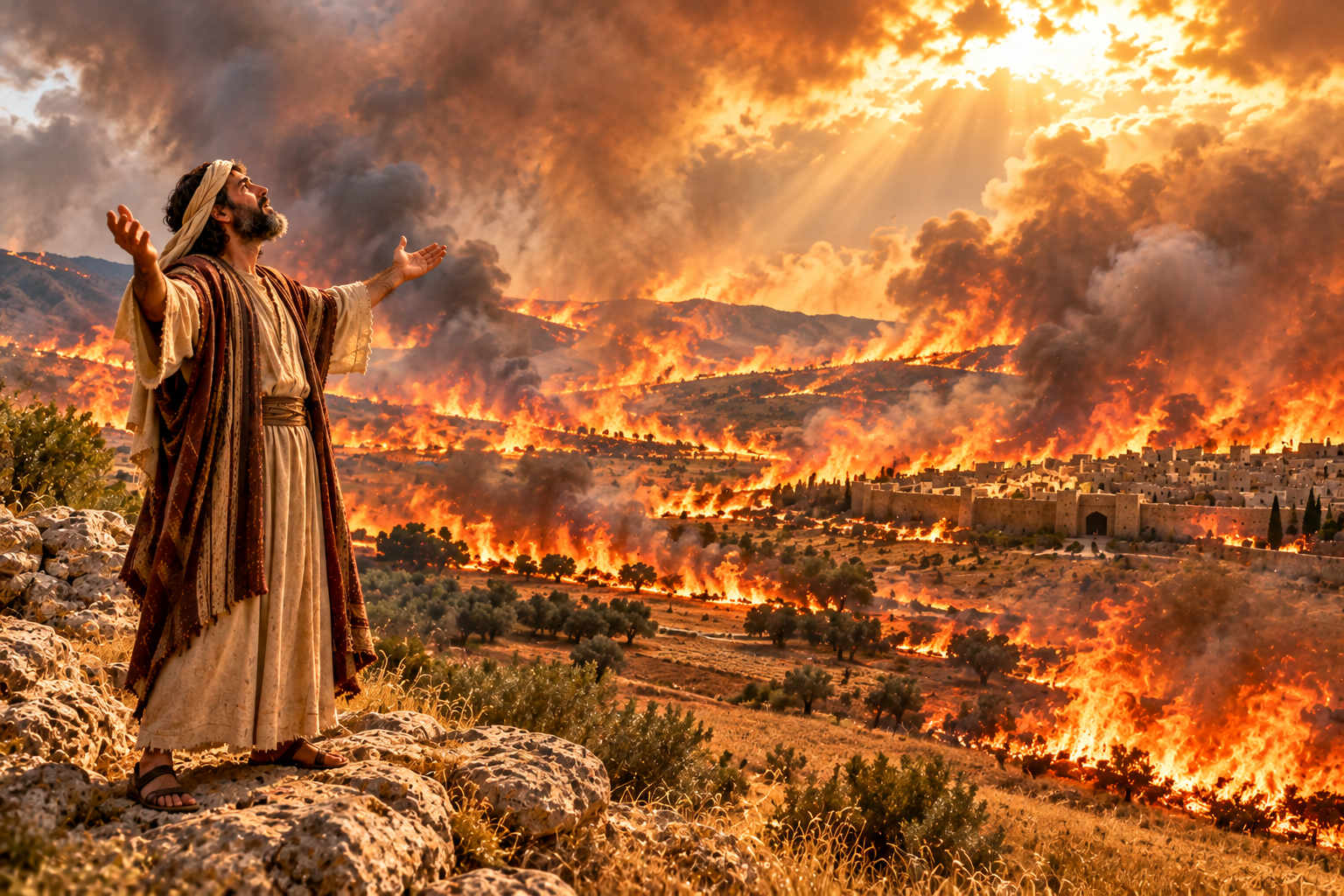
VISION #2: WHEN GOD
CONTENDS BY FIRE
Thus the Lord GOD (adonay Jehovah/yahweh) showed me - This expression introduces the second of Amos’s five visions (Amos 7:1–3; 7:4–6; 7:7–9; 8:1–3; 9:1–4). As in the first vision, the Hebrew reads kōh hirʾanî ʾădōnāy YHWH, “Thus the Lord GOD caused me to see.” God Himself initiates the revelation. Amos is not describing a natural disaster he happened to witness, but reporting a vision. The repetition of the formula emphasizes that the coming judgment is not the product of the prophet’s imagination. It is another illustration of the principle Amos stated earlier, that God reveals His secret counsel to His servants the prophets (Amos 3:7). The God who controls the future reveals the danger so that His people may understand how serious their spiritual condition is.
And behold (hinneh; LXX - idou = Look!) - Again he is calling attention to another judgment, something he does not want the hearers to miss. Unfortunately they heard the warning but failed to heed the warning. They are like those James commands to be " doers of the word, and not merely hearers who delude themselves." (Jas 1:21) Clearly, most of the people in Israel which was experiencing prosperity were deluded thinking such judgments could never occur.
The Lord GOD was calling to contend (riyb; LXX - dike = punishment meted out as legal penalty) with them by fire - The Lord summons fire as the instrument of His judgment, giving us the picture of creation responding to its Creator. Amos uses the same verb earlier to describe the Creator’s power over the sea. The LORD is the One “who calls for the waters of the sea and pours them out on the surface of the earth, the LORD is His name” (Amos 5:8; compare Amos 9:6). The God who calls for water can just as easily call for fire.
Bob Utley on contend - This term (riyb) in this context, refers to a legal case against Israel (i.e. a divorce case, e.g. Hosea 4:1; 12:2; Micah 6:1-2) and its consequences.
The description Lord GOD was calling to contend with them by fire is consistent with Scripture’s picture of God’s sovereignty over the natural world. God asked Job, “Can you send forth lightnings that they may go and say to you, ‘Here we are’?” (Job 38:35). The psalmist declares, “He sends forth His command to the earth; His word runs very swiftly” (Ps 147:15), and “He sends forth His word and melts them; He causes His wind to blow and the waters to flow” (Ps 147:18). All creation is summoned to praise Him: “Fire and hail, snow and clouds; stormy wind, fulfilling His word” (Ps 148:8). The Lord does not need to assemble an army to carry out His judgment, since all the forces of creation are subject to His command. What men struggle to control, God can summon with a word (fire from heaven on Sodom - Ge 19:24, wind and locusts in Egypt - Ex 10:13; Red Sea destroying Pharaoh's army - Ex 14:27; earth swallowing Korah’s rebels - Nu 16:32; the LORD threw large stones from heaven at Beth-horon - Josh 10:11; thunder against the Philistines - 1Sa 7:10; drought on Ahab - 1Ki 17:1; worms against proud Herod - Acts 12:23; hail in the final bowl judgments - Rev 16:21). As an aside several commentaries feel that fire metaphorically represents drought (e.g., Wiersbe - "The image is that of a great drought." cf Am 4:7,8)
Contend (riyb) means to dispute, or bring a legal accusation and is translated in Greek with dike which describes the punishment God would pour out as legal penalty against Israel. The prophets use riyb for God’s covenant lawsuit against His people (Hos 4:1; cp Mic 6:2). Here in Amos the Lord summons fire to prosecute His case against Israel. The fire is not merely destructive but judicial, with the Lord acting as righteous Judge. Israel had refused to listen when God contended with words, and now God would "contend" with fire. Throughout Scripture, fire signifies God’s presence, holiness, purification, and judgment (Ex 3:2; 19:18; Lev 10:1–2; 1Ki 18:38). In Amos the emphasis of fire is as a form of judgment and had been God’s repeated sentence on the nations (Amos 1:4–2:5). Amos had warned Israel that the LORD would “break forth like a fire” with none to quench it (Amos 5:6). Indeed the writer of Hebrews issued a sobering warning that "our God is a consuming fire” (Heb 12:29). The God who is a consuming fire is not indifferent to the sin His holiness condemns.
NET NOTE - calling to contend with them by fire - The Hebrew appears to read, "summoning to contend with fire," or "summoning fire to contend," but both are problematic syntactically (H. W. Wolff, Joel and Amos [Hermeneia], 292; S. M. Paul, Amos [Hermeneia], 230–31). Many emend the text to va bbrl, "(calling) for a shower of fire," though this interpretation is also problematic (see F. I. Andersen and D. N. Freedman, Amos [AB], 746-47).
Bob Utley- Fire is often used as a symbol of judgment (e.g. Amos 2:5; Deut. 32:22; Isa. 66:15-16). In this agricultural context the fire may refer to the scorching heat of the sun or the plants being defoliated by the locusts. If so, "the great deep" may be a reference to available water (i.e. springs, rivers, rain, etc., cf. Amos 1:2; 4:6-8).
Many commentators agree (cf Chisholm) with Utley and understand the fire as an intense, burning heat from the sun that dried up the springs and underground waters (“the great deep”) and then scorched the land (producing a scorching drought). This fits the sequence well: the locusts destroyed the crops in the first vision, and now a drought would destroy even the water sources. Because God relented and said, “This too shall not be” (Amos 7:6), the judgment never happened, so history cannot settle the question. The drought view probably fits the context best, since both of the first two visions describe natural disasters that strike the land’s food and water supply, and both are halted by Amos’s prayer. Either way, the point is clear: the fire came at God’s summons and consumed what no ordinary fire could.
And it consumed ('akal) the great deep - Great deep (tĕhôm rabbâ) refers to the vast waters of the sea or the subterranean waters thought to feed the springs and rivers. It is the same phrase used of the Flood, when “all the fountains of the great deep burst open” (Ge 7:11). Water ordinarily puts out fire, but Amos sees fire consuming the great deep itself. The very source of life and protection is swallowed up, and the fire then turns to the “farm land” (ḥēleq, “portion”), Israel’s allotted inheritance. When God summons judgment, even the waters that ordinarily conquer fire cannot resist His command.
Chisholm explains God's fire this way - God intensified the blazing summer heat till all grasslands and trees became tinder dry. Then fires broke out and spread in every direction with incredible speed (cf. Joel 1:19–20). Attempts to combat the sweeping inferno were futile, for the great deep, the subterranean waters that fed all springs (Gen. 7:11; 49:25; Deut. 33:13), had dried up. With the source of all waters consumed, the rivers and streams disappeared, and the flames raged unchecked until they had devoured the land (cf. Deut. 32:22). (SEE The Bible Knowledge Commentary Minor Prophets - Page 43)
Hadjiev - The first vision takes place in the spring; the second, during the hot summer. The earthly reality of drought is conveyed with the help of mythological imagery. The great deep is the primal water beneath the earth (Gen. 1:2; 7:11), a source of fertility and blessing (Gen. 49:25; Deut. 33:13). Once this is consumed the fire crawls up and begins to devour the land. In both visions the actions of the Lord’s agents are reported with the verb 'akal (‘eat, devour, consume’; vv. 2, 4). The eating locusts and fire mean no eating for the people of Israel. (Joel and Amos: An Introduction and Commentary - Page 163)
And began to consume ('akal) the farm land (cheleq; LXX - meris - part of a whole that has been divided up, an assigned portion) - Farm land (cheleq) means a portion, share, or allotted tract, and here refers to the land God had given Israel as its inheritance. The vision moves from the great deep to the land itself, and nothing seems able to stop the advancing fire. The land was never merely real estate. God promised it to Abraham (Ge 12:7), and reminded Israel that they held it as His tenants (Lev 25:23). Yet Israel had filled God’s land with idolatry, injustice, and oppression, living as though the Giver had no claim on their conduct. Fittingly, the same word expresses the believer’s truest inheritance: “The LORD is the portion of my inheritance (ḥēleq) and my cup; You support my lot” (Ps 16:5). Israel valued its portion of land more than the LORD who was meant to be its portion, and now that land was threatened by fire.
🙏 THOUGHT: Are You Listening Before the Fire Comes? Amos saw the Lord GOD summon fire that consumed the great deep and began devouring the land (Amos 7:4). How do you respond when God’s Word confronts disobedience in your life? Do you listen humbly, or excuse yourself and continue unchanged? Our God is “a consuming fire,” to be worshiped “with reverence and awe” (Heb 12:28,29), yet He has also provided salvation through His Son (Ro 5:8-11). His warnings are not invitations to despair, but summonses to repentance. Do not wait for painful consequences to awaken your conscience when His Word is calling you home! (Ps 95:7,8; Heb 3:12–15) And lastly, if you are a skeptic reading this note, be aware that all who reject salvation in Christ will experience an eternal fire as wages for their unforgiven sins.
Farm land (portion, share, reward)(02506) cheleq from chalaq = to divide, share) commonly refers to a share in an inheritance, share, lot. Early in OT is used with a technical nuance of share of land given to all the tribes when they entered the land. Cheleq may refer to a "portion" or "share" of booty divided among competitors (Gen. 14:24; 1 Sam. 30:24), or it may be a share of property or possession. "A share, a piece of territory in many ways: a part of booty or spoil (Gen. 14:24; Num. 31:36); of food (Lev. 6:17[10]); a tract or portion of land (Josh. 19:9; Hos. 5:7; Mic. 2:4); of Israel as a possession of the Lord (Deut. 32:9). It is used metaphorically of a person's doing his or her part in something (Job 32:17); of one's association or part or sharing in another group or way of life (Ps. 50:18; Isa. 57:6); or of the portion or share of fortune that the Lord gives to persons (Job 31:2). The portion or proper share for the wicked is punishment or calamity (Isa. 17:14)." (Baker - Complete Word Study Dictionary OT)
FIRE (imagery). Fire carries both positive and negative meanings in Scripture, and its sense depends on the context. In everyday life, fire warms (Isaiah 44:15; John 18:18; Acts 28:2), gives light (Isaiah 50:11; Matthew 25:1–13), and cooks food (Exodus 12:8; John 21:9). Spiritually, it often pictures purification, as metal is refined by removing its dross (Numbers 31:22–23; Proverbs 17:3; Isaiah 1:25; 6:6–7). Malachi describes the Lord’s coming in these terms: “But who can endure the day of His coming? And who can stand when He appears? For He is like a refiner’s fire and like fullers’ soap. He will sit as a smelter and purifier of silver, and he will purify the sons of Levi and refine them like gold and silver, so that they may present to the LORD offerings in righteousness” (Malachi 3:2–3). Fire also signifies God’s guidance, as in the pillar of fire that led Israel (Exodus 13:21; Numbers 14:14), His acceptance of sacrifice (Judges 6:21; 1 Kings 18:38; 2 Chronicles 7:1), His protection, as when He promised to be “a wall of fire around” Jerusalem (Zechariah 2:5), and the empowering presence of the Holy Spirit (Matthew 3:11; Acts 2:3).
Fire is also closely associated with God’s self-revelation. He appeared to Abraham as “a flaming torch” (Genesis 15:17), to Moses in a burning bush (Exodus 3:2; Acts 7:30), and to Israel in fire on Mount Sinai (Exodus 19:18; 24:17), where He spoke “from the midst of the fire” (Deuteronomy 4:12, 33, 36; 5:4, 22–26). His appearing is often accompanied by lightning and devouring flame (Psalm 50:3; Isaiah 29:6; 30:27, 30; 66:15–16). These theophanies teach that God’s holiness is both glorious and dangerous, as Moses warned: “For the LORD your God is a consuming fire, a jealous God” (Deuteronomy 4:24; compare Hebrews 12:29).
Negatively, fire burns and destroys, and it is one of Scripture’s most frequent images of God’s anger against sin. It fell on Sodom and Gomorrah (Genesis 19:24; Luke 17:29), consumed Nadab and Abihu (Leviticus 10:1–2), and broke out against Israel’s grumbling in the wilderness (Numbers 11:1–3). The prophets describe God’s wrath as burning (Hosea 8:5; Zephaniah 3:8) and poured out like fire (Nahum 1:6), and Amos repeatedly announces, “So I will send fire” (Amos 1:4–2:5). Fire also tests the quality of believers’ works (1 Corinthians 3:13–15), and it describes final judgment and eternal punishment (Matthew 3:12; 13:42, 50; 25:41; 2 Thessalonians 1:7–8; 2 Peter 3:7–10; Revelation 20:10, 14–15). Like many biblical images, such as the lion or leaven, fire can be either a blessing or a curse. For those who belong to God, His fire purifies; for those who persist in rebellion, it consumes.
C H Spurgeon - Amos 7:4–6 “The Lord GOD showed me this: The Lord GOD was calling for a judgment by fire. It consumed the great deep and devoured the land. Then I said, ‘Lord GOD, please stop! How will Jacob survive since he is so small?’ The LORD relented concerning this. ‘This will not happen either,’ said the Lord GOD.” Having prayed concerning the locusts and God relented, this time the prophet saw the fire devouring the land—perhaps the fire of war that casts its blazing brand on peaceful dwellings. This fire, however, was something worse than that, for the deep itself seemed to be licked up by tongues of flame. So the prophet, in hearty sympathy with the afflicted people, cried again as he had done before, and the answer came, “This will not happen either, said the Lord GOD.” This ought to encourage us to make use of the position in which his grace has placed us and to cry earnestly to him to turn away his wrathful hand and have pity on us sinners. God grant that many of us may have such an intercessory spirit as that of Amos the herdsman-prophet.
Amos 7:5 Then I said, “Lord GOD, please stop! How can Jacob stand, for he is small?”
- cease (KJV): Am 7:2 Ps 85:4 Isa 10:25
- for (KJV): Am 7:2,3 Isa 1:9 Jer 30:19
AMOS STANDS IN THE GAP
A SECOND TIME
Then I said, “Lord GOD (Adonai YHWH), please stop (chadal/hadal)! What a remarkable glimpse into the compassionate heart of Amos! The prophet has just witnessed a terrifying vision of divine judgment in which fire consumes the great deep and begins to devour the land (Am 7:4). Yet his response is not satisfaction that Israel is finally receiving the punishment it deserves. Instead, he immediately cries out, with a direct prayer pleading for the destruction he had just envisioned to stop. Amos was uncompromising in his condemnation of sin, yet compassionate in his concern for sinners.
In his first intercession, dealing with the locusts, Amos had asked God to “pardon” (sālacḥ). Now, regarding the fire Amos asks God to “cease” (chadal/hadal-nāʾ), simply to stop the judgment in progress. Amos no longer pleads for Israel’s forgiveness, but only that God hold back His hand. And God did: “This too shall not be” (Amos 7:6). The word that Isaiah used to call Israel to “cease (chadal/hadal) to do evil” (Isaiah 1:16) is the word Amos used to beg God to cease His judgment. The tragedy was that Israel would not cease from its sin, even after God ceased from His judgment in answer to prayer. God was willing to stop the fire but Israel was unwilling to stop the sin that kindled it!!!
David Hubbard adds "Amos’ second plea (v. 5) deliberately contains a different word from his first (v. 2). There he had begged for forgiveness, but God did not grant it but only a stay of execution. Now he seeks merely a further stay with his urgent ‘cease, please!’ (Cf. Ex. 9:29, 33–34, for another instance of the cessation of judgment-curses where the same Hebrew root ḥdl is used.) Forgiveness seems out of the question. The Lord’s response notes that he has granted Amos’ petition for a second time: ‘This also shall not be’.(SEE Joel and Amos - Page 219)
Bob Utley - "please stop" This is another Qal IMPERATIVE with waw. However, notice this time the prophet did not appeal for forgiveness, but for the cessation of judgment. YHWH is merciful, but there is an end to His patience (cf. Amos 7:8; 8:1).
How can Jacob stand, for he is small - Amos recognizes Israel's utter helplessness in the face of divine judgment. Though prosperous and powerful under Jeroboam II, Israel was powerless before Almighty God. The nation that appeared mighty before men was helpless before God! Israel's only hope was not in her strength but in God's mercy! (Ps 130:3,4; Da 9:18,19).
Stop (02308) chadal/hadal means to cease, stop, come to an end; to refrain, forbear, or hold back; to leave alone or forsake; to fail or neglect
CHADAL - 53V - cease(10), ceased(8), ceasing(1), deserted(1), fail(1), failed(1), gave(1), hold back(1), leave(5), let my alone(1), neglects(1), never mind(2), no(1), past(1), quit(1), refrain(6), refrained(1), refuse(1), regarding*(1), rest(1), stop(4), stopped(4), stops(1), unavoidable*(1). Gen. 11:8; Gen. 18:11; Gen. 41:49; Exod. 9:29; Exod. 9:33; Exod. 9:34; Exod. 14:12; Exod. 23:5; Num. 9:13; Deut. 15:11; Deut. 23:22; Jdg. 5:6; Jdg. 5:7; Jdg. 9:9; Jdg. 9:11; Jdg. 9:13; Jdg. 15:7; Jdg. 20:28; Ruth 1:18; 1 Sam. 2:5; 1 Sam. 9:5; 1 Sam. 12:23; 1 Sam. 23:13; 1 Ki. 15:21; 1 Ki. 22:6; 1 Ki. 22:15; 2 Chr. 16:5; 2 Chr. 18:5; 2 Chr. 18:14; 2 Chr. 25:16; 2 Chr. 35:21; Job 3:17; Job 7:16; Job 10:20; Job 14:6; Job 14:7; Job 16:6; Job 19:14; Ps. 36:3; Ps. 49:8; Prov. 10:19; Prov. 19:27; Prov. 23:4; Isa. 1:16; Isa. 2:22; Isa. 24:8; Jer. 40:4; Jer. 41:8; Jer. 44:18; Jer. 51:30; Ezek. 3:27; Amos 7:5; Zech. 11:12
Root and background - Ḥādal occurs about fifty-five times in the Old Testament, always in the simple (Qal) stem. It has an Akkadian cognate meaning “to cease” and an Arabic cognate meaning “to leave, forsake” or “remain behind.” The basic idea is “coming to an end,” and every use of the word grows out of that core meaning: an action stops, an intention is abandoned, a presence is withdrawn, or something stops being what it was. The verb can be transitive (“they ceased building”) or intransitive (“the thunder will cease”). It is often followed by an infinitive (“ceased to do”) or by the preposition min, “from” (“cease from”).
“To cease” an action already in progress
The first occurrence describes the end of humanity’s proud project at Babel: “So the LORD scattered them abroad from there over the face of the whole earth; and they stopped building the city” (Genesis 11:8). The word describes the ending of many things. The thunder and hail over Egypt ceased at Moses’s prayer: “Moses said to him, ‘As soon as I go out of the city, I will spread out my hands to the LORD; the thunder will cease and there will be hail no longer, that you may know that the earth is the LORD’s’” (Exodus 9:29; compare 9:33–34). Sarah’s natural ability to bear children had long since ceased (Genesis 18:11), and Saul’s father had stopped worrying about the lost donkeys (1 Samuel 9:5). In the grave, Job says, “There the wicked cease from raging, and there the weary are at rest” (Job 3:17).
Most importantly, God calls His people to ḥādal from sin: “Wash yourselves, make yourselves clean; remove the evil of your deeds from My sight. Cease to do evil” (Isaiah 1:16). Tragically, the word could also describe ceasing from what was right. Samuel declared, “Moreover, as for me, far be it from me that I should sin against the LORD by ceasing to pray for you; but I will instruct you in the good and right way” (1 Samuel 12:23). The exiles in Egypt even blamed their troubles on ceasing their idolatry: “But since we stopped burning sacrifices to the queen of heaven and pouring out drink offerings to her, we have lacked everything and have met our end by the sword and by famine” (Jeremiah 44:18).
“To refrain, forbear” before beginning
The word can also describe ceasing to intend an action, that is, holding back from something not yet begun. Before going to war, Ahab asked his prophets, “Shall I go against Ramoth-gilead to battle or shall I refrain?” (1 Kings 22:6). When ten men offered Ishmael hidden food supplies, “he refrained and did not put them to death along with their companions” (Jeremiah 41:8). Pharaoh Neco told King Josiah to “stop” opposing God (2 Chronicles 35:21), and Amaziah ordered a prophet to “stop” speaking (2 Chronicles 25:16).
“To cease being present,” to forsake or leave alone
From the idea of ceasing comes the sense of ceasing to be present. Moses taught, “For the poor will never cease to be in the land; therefore I command you, saying, ‘You shall freely open your hand to your brother, to your needy and poor in your land’” (Deuteronomy 15:11), a truth Jesus echoed: “For you always have the poor with you” (Matthew 26:11). Ceasing to be present can mean abandoning someone. In his suffering, Job laments, “My relatives have failed, and my intimate friends have forgotten me” (Job 19:14). It can also mean leaving someone alone, sometimes in desperation: “I waste away; I will not live forever. Leave me alone, for my days are but a breath” (Job 7:16; compare 10:20). At the Red Sea, the frightened Israelites complained to Moses, “Is this not the word that we spoke to you in Egypt, saying, ‘Leave us alone that we may serve the Egyptians’?” (Exodus 14:12). Literally, they said, “Cease from us.” Armies “withdrew” from battle (1 Samuel 23:13; Jeremiah 51:30), and Isaiah urged God’s people to stop trusting in man: “Stop regarding man, whose breath of life is in his nostrils; for why should he be esteemed?” (Isaiah 2:22). Solomon applies the same word to the pursuit of riches: “Do not weary yourself to gain wealth, cease from your consideration of it” (Proverbs 23:4).
“To cease to be what it is”
Finally, ḥādal can describe something ceasing to function as it normally does. In Deborah’s song, during the days of oppression, “the highways were deserted, and travelers went by roundabout ways. The peasantry ceased, they ceased in Israel, until I, Deborah, arose, until I arose, a mother in Israel” (Judges 5:6–7). The roads stopped being roads because no one dared travel them, and the villages were abandoned. In Jotham’s parable, the trees refuse to give up what makes them valuable: “But the olive tree said to them, ‘Shall I leave my fatness with which God and men are honored, and go to wave over the trees?’” (Judges 9:9; compare 9:11, 13). The word can also describe neglecting a duty. The man who “neglects to observe the Passover” would be cut off from his people (Numbers 9:13).
A possible second root
Some scholars identify a second, unrelated Hebrew root ḥādal meaning “to be fat” or “to prosper,” attested by an Arabic cognate. The two roots were originally spelled with different consonants but merged in written Hebrew. On this view, Hannah’s song may say that “those who were hungry grew fat” rather than “ceased to hunger” (1 Samuel 2:5), and the word may carry this meaning in a few other verses (Job 14:6; Proverbs 19:27). This suggestion is debated, and most translations follow the meaning “cease.”
Amos 7:6 The LORD changed His mind about this. “This too shall not be,” said the Lord GOD.
- Judges 2:18 10:16 Ps 90:13 135:14 Jer 26:19 Jon 4:2
DIVINE MERCY
ANSWERS AGAIN
The LORD changed His mind (nacham; LXX - metanoeo) about this - See comments on Amos 7:3.
“This too shall not be,” said the Lord GOD (adonay Jehovah/yahweh) - For the second time, God withholds the judgment revealed to Amos. His response repeats verse 3 almost word for word, with one significant addition: “This too shall not be.” Just as the locusts were restrained, so the consuming fire would be withheld.
Amos 7:7 Thus He showed me, and behold, the Lord was standing by a vertical wall with a plumb line in His hand.
AMP Thus He showed me [a vision], and behold, the Lord was standing by a vertical wall with a plumb line in His hand [to determine if the wall was straight or if it needed to be destroyed].
KJV Thus he shewed me: and, behold, the Lord stood upon a wall made by a plumbline, with a plumbline in his hand.
NET He showed me this: I saw the sovereign One standing by a tin wall holding tin in his hand.
NLT Then he showed me another vision. I saw the Lord standing beside a wall that had been built using a plumb line. He was using a plumb line to see if it was still straight.
ESV This is what he showed me: behold, the Lord was standing beside a wall built with a plumb line, with a plumb line in his hand.
BGT οὕτως ἔδειξέν μοι κύριος καὶ ἰδοὺ ἀνὴρ ἑστηκὼς ἐπὶ τείχους ἀδαμαντίνου καὶ ἐν τῇ χειρὶ αὐτοῦ ἀδάμας
LXE Thus the Lord shewed me; and behold, he stood upon a wall of adamant, and in his hand was an adamant.
CSB He showed me this: The Lord was standing there by a vertical wall with a plumb line in His hand.
NIV This is what he showed me: The Lord was standing by a wall that had been built true to plumb, with a plumb line in his hand.
SEE ALL 58 VERSIONS OF AMOS 7:7 -- WHAT YOU WILL NOTE IS THAT 49 USE THE WORDS "PLUMB LINE." ANOTHER 6 EXPRESS THE SAME IDEA IN DIFFERENT WORDS (e.g., plummet) AND 3 GIVE A DIFFERENT MEANING ALTOGETHER -- “Mason’s trowel”: DRA (Douay-Rheims) and WYC (Wycliffe). Both are translated from the Latin Vulgate, which rendered the word trulla caementarii, “a mason’s trowel.” The modern bracketed paraphrase in WYC does offer “plumb line” as an alternative. “Tin”: NET, based on the Akkadian cognate annaku
- a wall (KJV): 2Sa 8:2 2Ki 21:13 Isa 28:17 Isa 34:11 La 2:8 Eze 40:3 Zec 2:1,2 Rev 11:1 21:15
Related Passages:
Amos 3:7 Surely the Lord GOD does nothing Unless He reveals His secret counsel To His servants the prophets.
2 Samuel 8:2 He defeated Moab, and measured them with the line, making them lie down on the ground; and he measured two lines to put to death and one full line to keep alive. And the Moabites became servants to David, bringing tribute.
2 Kings 21:13 ‘I will stretch over Jerusalem the line of Samaria and the plummet of the house of Ahab, and I will wipe Jerusalem as one wipes a dish, wiping it and turning it upside down.
Isaiah 28:17 “I will make justice the measuring line And righteousness the level; Then hail will sweep away the refuge of lies And the waters will overflow the secret place.
Ezekiel 40:3 So He brought me there; and behold, there was a man whose appearance was like the appearance of bronze, with a line of flax and a measuring rod in his hand; and he was standing in the gateway.
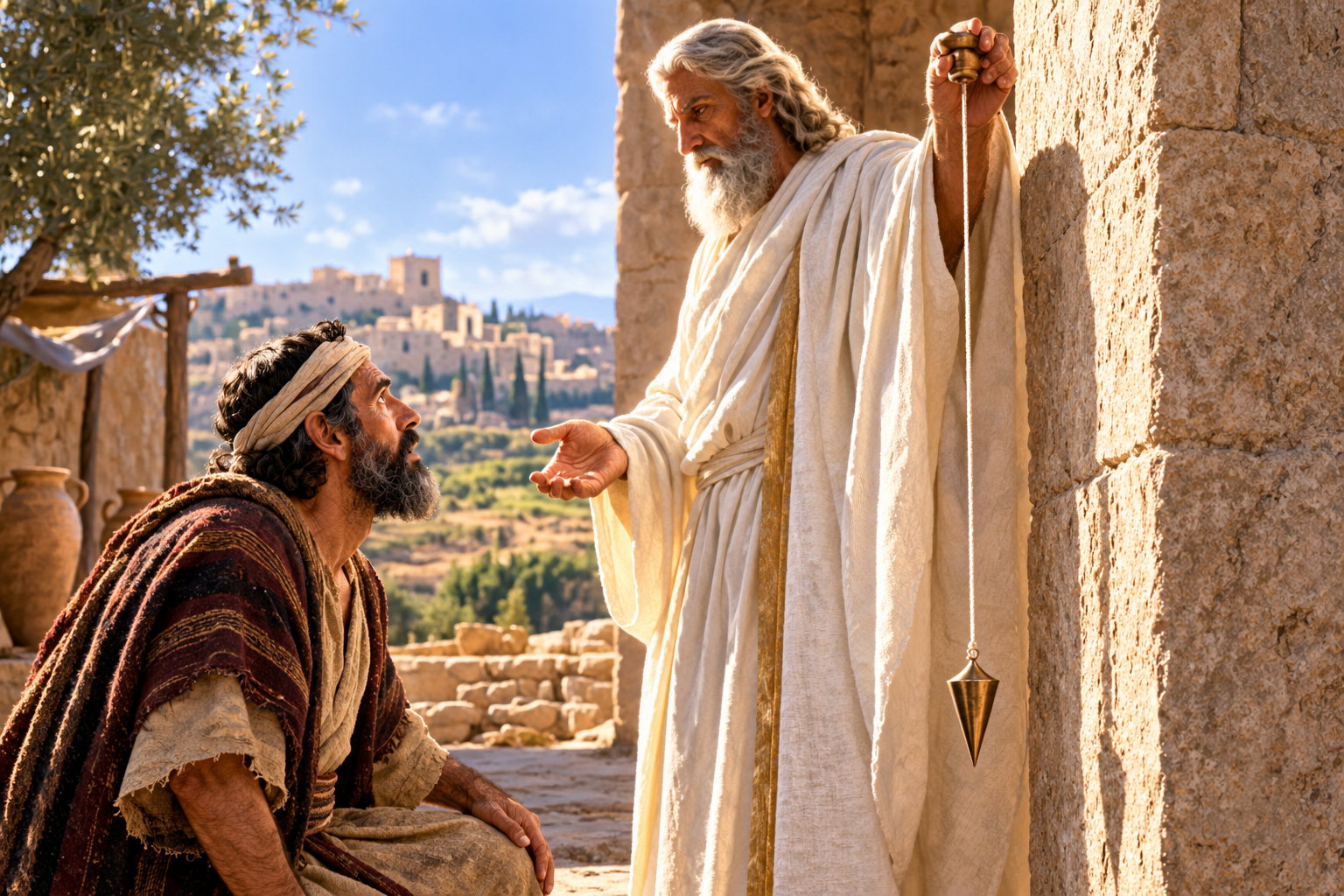
VISION #3:
THE DIVINE PLUMBLINE
Thus He showed me - This is the third vision in this chapter in which God is showing something that will come to pass (cf Amos 3:7). The emphasis shifts from threatened calamity to divine examination.
And behold (hinneh; LXX - idou = Look!), the Lord was standing (natsab) by a vertical (’anakh) wall with a plumb line (’anakh) in His hand - NET (see note below) has considerably different translation (SEE NOTE ABOVE) = "I saw the sovereign One standing by a tin wall holding tin in his hand." The third vision marks a dramatic turning point in Amos' prophecy. now the imagery changes. Instead of instruments of destruction, Amos sees the Lord standing beside a wall with a plumb line in His hand. Vertical wall (anakh) the same word translated “plumb line” in this verse. The precise meaning and etymology of anakh are debated, but the traditional interpretation understands the scene as a wall constructed or evaluated with a plumb line. A plumb line is a simple but remarkably effective construction instrument. It consists of a weight suspended from a cord. Gravity causes the cord to hang vertically, providing an objective standard against which a builder can test whether a wall is straight. Although the text does not explicitly identify the plumb line with the Mosaic Law, the wider context strongly supports understanding it as a symbol of God's righteous requirements for His covenant people.
The Lord was standing with a plumb line (’anakh) in His hand - The Hebrew verb for standing (nātṣab) in Niphal reflexive meaning Yahweh “stationed himself”, took a firm stand, or stood in an official position, all of which conveys a posture of God's firmness and determination! It is the posture of an inspector or judge who has arrived to examine and render a verdict. God had taken His stand as Inspector, ready to measure Israel against His standard. Amos will use it again in his fifth and final vision: “I saw the Lord standing beside the altar...." (Amos 9:1). In both visions, the Lord’s standing presence means judgment is at hand. The God Who once “stood above” the ladder at Bethel to confirm His covenant promises to Jacob (Ge 28:13) now “stood” beside the altar at Bethel to judge those who had corrupted His worship with Jeroboam's golden calf. Mark it down that when the Lord takes His stand, no one can stand against Him.
J Vernon McGee - When God begins to measure either in length or in weight, you can be sure that the people have not measured up to God’s requirements, and judgment is the thing which He has in mind. Amos does not intercede for the people again, realizing that God’s judgment is just. (SEE Thru the Bible Vol. 28: The Prophets - Amos/Obadiah)
NET NOTE on plumb line - ( The Hebrew word אֲנָךְ (’anakh, “tin”) occurs only in this passage (twice in this verse and twice in the following verse). (Its proposed meaning is based on an Akkadian cognate annaku.) The tin wall of the vision, if it symbolizes Israel, may suggest weakness and vulnerability to judgment. See S. M. Paul, Amos (Hermeneia), 233–35. The symbolic significance of God holding tin in his hand and then placing tin among the people is unclear. Possibly the term אֲנָךְ in v. 8b is a homonym meaning “grief” (this term is attested in postbiblical Hebrew). In this case there is a wordplay, the אֲנָךְ (“tin”) of the vision suggesting the אֲנָךְ (“grief”) that judgment will bring upon the land. See F. I. Andersen and D. N. Freedman, Amos (AB), 759. Another option is to maintain the meaning “tin” and understand that the Lord has ripped off a piece of the tin wall and placed it in front of all to see. Their citadels, of which the nation was so proud and confident, are nothing more than tin fortresses. The traditional interpretation of these verses (reflected in many English versions) understands the term אֲנָךְ to mean “lead,” and by extension, “plumb line.” In this case, one may translate: “I saw the sovereign one standing by a wall built true to plumb holding a plumb line in his hand. The LORD said to me, ‘What do you see, Amos?’ I said, ‘A plumb line.’ The sovereign one then said, ‘Look, I am about to place a plumb line among my people …’ ” According to this view, the plumb line symbolizes God’s moral standards by which he will measure Israel to see if they are a straight or crooked wall.
Bob Utley - the Lord was standing by a vertical wall - This seems to imply a wall of loose stones removed from the fields. With time these stones shifted their positions and became unstable and unsafe. ▣ a plumb line - This is the only use of this particular term in the OT (Amos 7:7,8). It was a construction tool (cord with metal weight at the end) used to test the perpendicular alignment of buildings or walls. It is used figuratively here to express judgment because mankind has deviated from the standard of God (cf. 2Ki 21:13; Isa 28:17; 34:11; Lam 2:8). Although most English translations (NASB, NKJV, NRSV, TEV, NJB, REB) accept "plumb line" as the implied contextual meaning, it is possible to argue for "tin" (NET) as the proper translation of this Akkadian loan word. The UBS Text Project, p. 292, gives "on a wall of tin" an "A" rating. If so, then the imagery would be that of a tin wall, thereby, imagery for "apparent protection" (i.e. a wall of weak metal, tin). Several prophets used metal imagery (cf. Jer. 15:20; Ezek. 4:3). Whichever it is, this is a vision of judgment (i.e. possibly "grief," similar post biblical root, NET Bible footnote). Israel thinks she is militarily secure and spiritually orthodox, but she is not!
🙏 THOUGHT — What Does God’s Plumb Line Reveal About Your Life? Dear believer, Amos saw the Lord standing beside a wall with a plumb line in His hand (Amos 7:7). A wall may look perfectly straight until the plumb line exposes its lean. Likewise, we may look spiritually healthy by human standards yet fall short when measured by God’s Word. Have familiar habits or the world’s shifting standards bent your sense of right and wrong? Pray with David, “Search me, O God, and know my heart” (Ps 139:23–24), and remember that the God who exposes our crookedness also transforms us by His Spirit (2Co 3:18). Don’t ask God to adjust His standard to fit your life. Ask Him to adjust your life to fit His standard!
Standing (05324) natsab/nasab means to stand, take one’s stand, be stationed; to set up, erect, establish, fix. Related words: niṣṣāb (05325), “deputy, overseer”; maṣṣēbâ (04676), “pillar, standing stone”; and the closely related verb yāṣab, “to station oneself, present oneself”
NATSAB - 73V - arises(1), attending(1), best(1), charge(2), deputies(4), deputy(1), erected(2), establish(2), established(1), fix(1), fixed(1), officers(1), pillar(1), present yourself(1), presiding(1), set(15), settled(1), stand(5), standing(14), stands(1), station myself(1), station yourself(1), stationed(1), stood(9), stood erect(1), takes stand(2), waiting(1). Gen. 18:2; Gen. 21:28; Gen. 21:29; Gen. 24:13; Gen. 24:43; Gen. 28:12; Gen. 28:13; Gen. 33:20; Gen. 35:14; Gen. 35:20; Gen. 37:7; Gen. 45:1; Exod. 5:20; Exod. 7:15; Exod. 15:8; Exod. 17:9; Exod. 18:14; Exod. 33:8; Exod. 33:21; Exod. 34:2; Num. 16:27; Num. 22:23; Num. 22:31; Num. 22:34; Num. 23:6; Num. 23:17; Deut. 29:10; Deut. 32:8; Jos. 6:26; Jdg. 9:6; Jdg. 18:16; Jdg. 18:17; Ruth 2:5; Ruth 2:6; 1 Sam. 1:26; 1 Sam. 4:20; 1 Sam. 13:21; 1 Sam. 15:12; 1 Sam. 19:20; 1 Sam. 22:6; 1 Sam. 22:7; 1 Sam. 22:9; 1 Sam. 22:17; 2 Sam. 13:31; 2 Sam. 18:17; 2 Sam. 18:18; 1 Ki. 4:5; 1 Ki. 4:7; 1 Ki. 4:27; 1 Ki. 5:16; 1 Ki. 9:23; 1 Ki. 16:34; 1 Ki. 22:47; 2 Ki. 17:10; 1 Chr. 18:3; Ps. 39:5; Ps. 41:12; Ps. 45:9; Ps. 74:17; Ps. 78:13; Ps. 82:1; Ps. 119:89; Prov. 8:2; Prov. 15:25; Isa. 3:13; Isa. 21:8; Jer. 31:21; Lam. 2:4; Lam. 3:12; Amos 7:7; Amos 9:1; Nah. 2:7; Zech. 11:16
Root and stems
Nāṣab goes back at least to ancient Ugaritic and appears about seventy-five times in the Old Testament. It never occurs in the simple (Qal) stem. Its broadest meanings occur in the Niphal, “to take one’s stand, be stationed, stand firm.” In the Hiphil it has a transitive sense, “to set, station, erect, fix, establish,” and in the Hophal a passive sense, “to be set up, be fixed.” Compared with its common synonym ʿāmad (“to stand”), nāṣab carries a more specific connotation: standing with purpose, often by appointment or in an official position. The first occurrence is when Abraham looked up “and behold, three men were standing opposite him” (Genesis 18:2).
Taking a stand for a definite purpose
When nāṣab is used in the Niphal, a definite purpose is usually implied. Abraham’s servant stationed himself beside the well to find a bride for Isaac (Genesis 24:13, 43). God told Moses to station himself by the Nile to meet Pharaoh (Exodus 7:15), and to take his place on the rock as God’s glory passed by: “Then the LORD said, ‘Behold, there is a place by Me, and you shall stand there on the rock’” (Exodus 33:21). He also commanded, “So be ready by morning, and come up in the morning to Mount Sinai, and present yourself there to Me on the top of the mountain” (Exodus 34:2). When Israel fought Amalek, Moses said, “Tomorrow I will station myself on the top of the hill with the staff of God in my hand” (Exodus 17:9), and there he interceded with uplifted hands. Even Balaam took his station beside his sacrifices when he tried to curse Israel (Numbers 23:6, 17).
The word is used of God Himself taking His stand. In Jacob’s dream, “And behold, the LORD stood above it and said, ‘I am the LORD, the God of your grandfather Abraham and the God of Isaac; the land on which you lie, I will give it to you and to your descendants’” (Genesis 28:13). God also takes His stand as Judge: “God takes His stand in His own congregation; He judges in the midst of the rulers” (Psalm 82:1).
Stationed by appointment or duty
Nāṣab can also describe someone stationed for a duty or appointed over others. Joseph’s attendants “stood by him” (Genesis 45:1), midwives “stood by” at a birth (1 Samuel 4:20), and Saul’s servants stood around him (1 Samuel 22:6–7, 17). Boaz asked “his servant who was in charge of the reapers,” literally “the one stationed over” them (Ruth 2:5–6), and Samuel stood “as head over” the company of prophets (1 Samuel 19:20). The word even describes a queen in her royal station: “At Your right hand stands the queen in gold from Ophir” (Psalm 45:9). The participle niṣṣāb came to be used as a noun for an official, a “deputy” or “governor” appointed over a district (1 Kings 4:5, 7, 27; 5:16; 9:23; 2 Chronicles 8:10).
Standing upright and firm
At times the emphasis is on standing upright. In Joseph’s dream, “my sheaf rose up and also stood erect” (Genesis 37:7). At the Red Sea, the water stood like a wall: “At the blast of Your nostrils the waters were piled up, the flowing waters stood up like a heap; the deeps were congealed in the heart of the sea” (Exodus 15:8). Standing upright can also suggest health and strength. Zechariah contrasts sound, healthy sheep with those injured or cut off (Zechariah 11:16). Yet even a man at his strongest is fleeting: “Behold, You have made my days as handbreadths, and my lifetime as nothing in Your sight; surely every man at his best is a mere breath. Selah” (Psalm 39:5). “At his best” is literally “standing firm.” In beautiful contrast, God’s Word stands firm forever: “Forever, O LORD, Your word is settled in heaven” (Psalm 119:89).
To set up, erect, establish (Hiphil)
In the causative stem, nāṣab means to set something in place, erect it, or establish it. Abraham set apart seven lambs (Genesis 21:28–29). Jacob erected an altar at Shechem (Genesis 33:20) and a stone pillar at Bethel: “Jacob set up a pillar in the place where He had spoken with him, a pillar of stone, and he poured out a drink offering on it; he also poured oil on it” (Genesis 35:14). Absalom set up a monument to himself (2 Sam. 18:18). God made the sea stand: “He divided the sea and caused them to pass through, and He made the waters stand up like a heap” (Psalm 78:13). He established the boundaries of the nations: “When the Most High gave the nations their inheritance, when He separated the sons of man, He set the boundaries of the peoples according to the number of the sons of Israel” (Deuteronomy 32:8; compare Psalm 74:17). He also protects the vulnerable: “The LORD will tear down the house of the proud, but He will establish the boundary of the widow” (Proverbs 15:25). Negatively, the wicked “set a trap” for the righteous (Jeremiah 5:26). David thanked God, “You set me in Your presence forever” (Psalm 41:12). In the passive Hophal, Jacob’s ladder was “set on the earth” (Genesis 28:12), and in Nahum 2:7 the word may be a title of Nineveh’s queen (“Huzzab”) or mean “it is fixed.”
A related noun: maṣṣēbâ
From this root comes maṣṣēbâ, a “pillar” or “standing stone.” Jacob set up such a pillar at Bethel to commemorate God’s appearance (Genesis 28:18). But Canaanite religion used these pillars in idol worship, so God later commanded, “You shall not set up for yourself a sacred pillar which the LORD your God hates” (Deuteronomy 16:22). The same root that described faithful remembrance at Bethel came to describe the idolatry that later filled it.
C H Spurgeon - Sermon Notes - Amos 7:7
Amos 7:7—“Thus he shewed me: and, behold, the Lord stood upon a wall made by a plumbline, with a plumbline in his hand.”
The metaphors of Amos are very forcible, though homely and simple.
He was God-taught; or, as men say, self-taught.
Let his vision come before us, as though we saw it ourselves.
What the Lord had done was according to rule: “he stood upon a wall made by a plumbline.” His past dealings are just and true.
The Lord continues to use the same infallible rule: wherever he is, he has a plumbline in his hand.
The plumb of lead falls in a straight line, and therefore the line is the best test as to whether a wall is truly perpendicular. The plumbline shows whether it bows outward, or inclines inward. It never flatters, but by its own certainty of truth it reveals and condemns all deviations from uprightness: such is the judgment of the Most High.
We shall treat the plumbline as the emblem of truth and right.
I. A PLUMBLINE IS USED IN BUILDING.
In all that we build up, we must act by the sure rule of righteousness.
1. In God’s building it is so.
He removes the old walls when tested by the plumbline, and found faulty. Truth requires the removal of falsehood.
He builds in truth and reality. Sincerity is his essential.
He builds in holiness and purity.
He builds to perfection according to the rule of right.
2. In our own life-building it should be so.
Not haste, but truth should be our object.
Not according to the eye of man, but according to fact.
We should build by the Word; in God’s sight; after Christ’s example; by the Spirit; unto holiness. Only thus shall we be using the plumbline.
3. In our building of the church it should be so.
Teaching the Scriptures only in all things.
Preaching nothing but the gospel.
Laying sinners low by the law, and exalting the grace of God.
Leading men to holiness and peace by the doctrines of truth.
Exercising discipline that the church may be pure.
II. A PLUMBLINE IS USED FOR TESTING.
That which is out of the upright is detected by the plumbline, and so are men tested by the truth.
1. We may use it—
On the wall of self-righteousness, conceit, boasting, etc.
On the wall of careless living.
On the wall of trust in ceremonials.
On the wall of reliance upon merely hearing the gospel.
On the wall of every outward profession.
2. God uses it in this life. He tests the hearts of men, and tries their doings. They are often detected in the act of deception. Time also proves them, and trials test them.
3. He will use it at the last.
4. Let us use it on ourselves.
Are we born again? Are we without faith, &c.? Are we without holiness? Or is the work of the Spirit to be seen in us?
III. A PLUMBLINE WILL BE USED FOR DESTROYING.
Strict justice is the rule of God’s dealing on the judgment-seat.
The same rule will apply to all.
1. Even the saved will be saved justly through our Lord Jesus, and in their case every sin will be destroyed, and every trace of evil will be removed before they enter heaven.
2. No one will be condemned who does not deserve it. There will be a trial, with witnesses, and pleadings, and an infallible Judge. The righteous are saved by sovereignty, but the wicked are condemned by righteousness alone.
3. Not a pain will be inflicted unjustly.
Differences will be made in the cases of the condemned.
There will be the strictest justice in each award.
Every circumstance will be taken into account.
Knowledge or ignorance will increase or abate the number of stripes. Luke 12:47, 48.
4. Rejectors of Christ will find their doom intolerable, because they, themselves, will be unable to deny its justice. Luke 19:27. The lost know their misery to be deserved.
5. Since every sentence will be infallible, there will be no revision. So impartial and just will be each verdict that it shall stand for ever. Matt. 25:46.
Are we able to endure the test of the plumbline of perfect truth?
Suppose it to be used of God at this moment.
Will it not be wisest to look to Jesus, that we may have him for a foundation, and be built up in him?
SAYINGS AND SENTENCES
The question, “What is truth?” was proposed at a Deaf and Dumb Institution, when one of the boys drew a straight line. “And what is falsehood?” The answer was a crooked line.—G. S. Bowes.
That will be a wretched day for the church of God when she begins to think any aberration from the truth of little consequence.—J. H. Evans.
Whitefield often affirmed that he would rather have a church with ten men in it right with God, than one with five hundred at whom the world would laugh in its sleeve.—Joseph Cook.
Livingstone, as a missionary, was anxious to avoid a large church of nominal adherents. “Nothing”, he wrote, “will induce me to form an impure church. ‘Fifty added to the church’ sounds well at home, but if only five of these are genuine, what will it profit in the Great Day?”—Blaikie.
Set thine heart upright, if thou wouldst rejoice,
And please thyself in thine heart’s pleasing choice:
But then be sure thy plumb and level be
Rightly applied to that which pleaseth me.—Christopher Harvey.
Sinners on earth are always punished less, and in hell never more, than their iniquities deserve.—Benjamin Beddome.
It is said of the Areopagites, in Athens, that their sentence was so upright that none could ever say he was unjustly condemned of them. How much more true is this of the righteous judgment of God, who must needs therefore be justified, and every mouth stopped!—Trapp.
When a building is noticed to bulge a little, our builders hasten to shore it up with timbers; and before long the surveyor bids them take it down. Should we not see great changes in our churches if all the bowing walls were removed? Yet this would be no real loss, but in the Lord’s sight an actual gain to the City of God.
When a man is afraid of self-examination, his fear is suspicious. He who does not dare to apply the plumbline to his wall may rest assured that it is out of perpendicular. A sincere man will pray, “Lord, let me know the worst of my case.” It is far better to suffer needless distress than to be at ease in Zion, and then perish of the dry-rot of self-deceit.
James Smith - FAITHFUL WITNESSING AMOS 7:7–17
The Lord hath never left Himself without a witness (Heb. 11). The very “Heavens declare His glory.” The personal testimony of Amos, as here recorded, leads us to meditate on some characteristics of true witness-bearing.
I. He Had a Message from God. “Thus He showed me … the Lord with a plumbline in His hand,” who said unto him, “What seest thou? and I said, A plumbline” (vv. 7–9). A “plumbline” is an instrument for testing. Being in the hand of the Lord, it was the symbol of His righteousness and judgment. He had come, through His prophet, to measure the “high places” and the “sanctuaries of Israel,” and to expose their delinquency. But the point is, Amos had a message; something definite to say, in the Name of the Lord; something that was not manufactured to please the people, or to show forth his own gifts, but something that burned in his own heart like a tongue of fire (Jer. 20:9). The early apostles, after the Resurrection, had such a vision of the power of Christ and of the blessed Gospel, associated with it, that their hearts became inflamed as with a Divine passion to speak out the “Good News.” As Peter and John testified: “We cannot but speak the things which we have seen and heard” (Acts 4:20). Truly they had a message. A message that came to them with such commanding authority that their whole “spirit, soul and body” were brought into subjection to it. Have we lost the vision? Are our ears dull of hearing or our hearts become hardened through the familiarity of words that we have so largely lost the spiritual thrill of this holy compulsion? We have the same message, the same promise of power, but, alas, where is our faith?
II. He Suffered Opposition. “Amaziah the priest of Bethel” misrepresented both Amos and his message to the king, and then hypocritically asked him to “Go, flee into the land of Judah” (vv. 10–13). Even modern priests of Bethels often misunderstand and misrepresent the man of God who boldly “declares the whole counsel of God.” Opposition may be expected in the ministry of God’s Word, when we remember the enmity of the human heart to spiritual things. “If any man will live godly, he must suffer persecution.” “Beloved, think it not strange concerning the fiery trials which is to try you; but rejoice, inasmuch as ye are partakers of Christ’s sufferings. If ye be reproached for the Name of Christ, happy are ye, for the Spirit of glory and of God resteth upon you” (1 Peter 4:12–14). “I will glory in my affliction that the favour of Christ may rest upon me.” If we are speaking God’s Word, in God’s Name, then leave it to God to care for His own.
III. He Gave his Personal Experience. “Then Amos said, I was no prophet, neither a prophet’s son, but I was an herdman and a gatherer of wild figs” (v. 11, margin), “and the Lord took me as I followed the flock, and said unto me, Go” (vv. 14, 15). There is no reference made of his inexperience or “lack of education.” One need not depend on the help of “the schools” to receive the call of God. We are not chosen because we are wise and strong, but because we are fit instruments for the exhibition of His wisdom and power. “God hath chosen the foolish things of the world to confound the wise; and weak things to confound the mighty; and base and despised things to bring to naught things that are: that no flesh should glory in His Presence” (1 Cor. 1:25–28). Paul’s bodily presence was “weak, and his speech contemptible, but his letters were weighty and powerful” (2 Cor. 10:10). It is of vital importance for the success of our ministry that we should be able to give a personal testimony as to what God hath done for us. Out of the heart are issues of life. Apart from this there may be plenty of “sound and fury,” but the significance of it in His sight is “nothing.” We are to speak what we do know, and testify what we have seen. It is little honour to Him that we should prophesy beyond the measure of our own faith. Isaiah saw the Lord seated on a Throne, before he heard Him say, “Go” (Isa. 6:1–9). The apostles were “eyewitnesses of His Majesty” before they were sent to preach.
Amos 7:8 The LORD said to me, “What do you see, Amos?” And I said, “A plumb line.” Then the Lord said, “Behold I am about to put a plumb line In the midst of My people Israel. I will spare them no longer.
- Amos (KJV): Jer 1:11-13 Zec 5:2
- a plumbline (KJV): This was an emblem of strict justice; and intimated that God would now visit them according to their iniquities.
- I will set (KJV): La 2:8
- I will not (KJV): Am 8:2 Jer 15:6 Eze 7:2-9 Mic 7:18 Na 1:8,9
Related Passages:
Proverbs 19:11 A man’s discretion makes him slow to anger, And it is his glory to overlook (abar) a transgression.
Micah 7:18 Who is a God like You, who pardons iniquity And passes over (abar) the rebellious act of the remnant of His possession? He does not retain His anger forever, Because He delights in unchanging love.
Jeremiah 7:16 “As for you, do not pray for this people, and do not lift up cry or prayer for them, and do not intercede with Me; for I do not hear you.
Jeremiah 11:14 “Therefore do not pray for this people, nor lift up a cry or prayer for them; for I will not listen when they call to Me because of their disaster.
Jeremiah 14:11 So the LORD said to me, “Do not pray for the welfare of this people.

ISRAEL MEASURED WITH A
DIVINE PLUMB LINE
The LORD said to me, “What do you see, Amos?” And I said, “A plumb line.” - The omniscient God already knew what Amos was seeing! The question was not intended to obtain information but to focus the prophet's attention on the significance of the vision.
Then the Lord said, “Behold (hinneh; LXX - idou = Look!) I am about to put a plumb line (’anakh) In the midst of My people Israel - The plumb line would be set not at the edges but in the very center of the nation. No part of national life would escape God’s examination, not the king’s court, not the courts of justice, and not the sanctuaries at Bethel and Gilgal. And God still calls them “My people Israel.” Israel's covenant relationship and privileges did not exempt her from judgment but in fact was the very basis for it (Amos 3:2)
Warren Wiersbe - plumb line (Amos 7:7–9), an instrument used to test whether a wall was straight and true. A man stood on top of the wall and dropped a line with a weight on it. By matching the line to the wall, the workers could tell if the wall was upright. God’s Law is His plumb line, and He measures His people to see how true they are to the pattern in His Word, and if they are of upright character and conduct. “Also I will make justice the measuring line, and righteousness the plummet” (Isa. 28:17NKJV) Alas, in Amos’ time, He found that Israel was “out of plumb” and therefore had to be destroyed. This would include Israel’s high places and sanctuaries, where they worshiped contrary to God’s law, for the only place the Jews were to bring their sacrifices was to the temple in Jerusalem (Lev. 17:1–7). (Bible Exposition Commentary)
I will spare (abar) them no longer - This literally reads, “I will no longer again pass by them” (lōʾ-ʾôsîp ʿôd ʿăbôr lô). Pass by here has the sense of Proverbs 19:11 and Micah 7:18 where it means to overlook, to let the sin go unpunished. Twice God had passed by Israel’s guilt in answer to Amos’s prayers (Amos 7:3, 6). Now, after measuring the nation with His plumb line, He declares that He will do so no more. The plumb line represents God's examination of Israel, and the verdict is devastating. The people who possessed God's standard (TORAH) had persistently refused to live according to it. The same words are repeated after the fourth vision: “He said, ‘What do you see, Amos?’ And I said, ‘A basket of summer fruit.’ Then the LORD said to me, ‘The end has come for My people Israel. I will spare (abar) them no longer’” (Amos 8:2). God’s patience had been real, but the measuring had shown how far Israel had leaned, and judgment could no longer be delayed. Amos understood and so did not intercede a third time. Israel had crossed the Rubricon so to speak! In not praying for them Amos was like Jeremiah (Jer. 7:16; 11:14; 14:11).
Bob Utley - "I will spare them no longer" Literally "I will never (Hiphil IMPERFECT) again pass by (BDB 716, KB 778, Qal INFINITIVE) them." Amos realizes the depth of Israel's rebellion and ceases to intercede on her behalf.
This time Amos does not intercede, and there is no relenting. God had already warned, “And in all the vineyards there is wailing, because I will pass through the midst of you,” says the LORD (Amos 5:17). In Egypt, the LORD passed over Israel’s houses in mercy. Now He would pass through them in judgment. The same declaration is repeated after the fourth vision (8:2). God’s patience had been real, but the measuring had shown how far Israel had leaned, and judgment could no longer be delayed.
Spare (pass) (05674)(abar) - qal. pass through; niphal be forded; piel. cause to pass through or over; hiphil. make pass through. The main idea of this verb is that of movement; as a rule it is the movement of one thing in relation to some other object which is stationary, moving, or motivating. Some have said that the simplest translation of ʿābar is “to pass,” but this does not really cover the various nuances that ʿâbar may carry with it. It is used about 550 times.
ABAR IN AMOS - Amos 5:5, Amos 5:17, Amos 6:2, Amos 7:8, Amos 8:2, Amos 8:5
Root and basic meaning
ʿĀbar occurs in all the Semitic languages, in every period of their history, including biblical Hebrew and Aramaic. With about 550 occurrences, it is one of the most common verbs in the Old Testament. Its root idea is spatial movement: moving over, through, beyond, or away from something. From this simple idea comes a remarkable range of meanings, literal, metaphorical, and spiritual. The first occurrence is in the account of the Flood: “But God remembered Noah and all the beasts and all the cattle that were with him in the ark; and God caused a wind to pass over the earth, and the water subsided” (Genesis 8:1).
1. Simple movement: to go on, pass along
In its simplest sense, ʿābar means to go on or move forward. Abraham invited his heavenly visitors to rest and eat, “and after that you may go on” (Genesis 18:5). He also begged them, “My Lord, if now I have found favor in your sight, please do not pass your servant by” (Genesis 18:3). Abram “passed through the land as far as the site of Shechem” (Genesis 12:6), and the psalmist speaks of “whatever passes through the paths of the seas” (Psalm 8:8).
2. Crossing from one place to another
Very often, ʿābar describes crossing a barrier to reach the other side. Jacob “arose and crossed the Euphrates River” as he fled from Laban (Genesis 31:21). The word is used again and again of Israel crossing the Jordan into the Promised Land, the great barrier that had to be overcome to receive the covenant promise: “Moses My servant is dead; now therefore arise, cross this Jordan, you and all this people, to the land which I am giving to them, to the sons of Israel” (Joshua 1:2). It can also mean passing through a territory, as when Moses asked Sihon, “Let me pass through your land” (Numbers 21:22), or when Micah pictures the remnant of Jacob moving among the nations “like a lion among the beasts of the forest... which, if he passes through, tramples down and tears” (Micah 5:8). Amos used the word when he warned Israel not to “cross over to Beersheba,” one of the shrines of corrupt worship (Amos 5:5).
In the causative (Hiphil) stem, ʿābar means to cause someone or something to pass over, as when God caused the wind to pass over the waters (Genesis 8:1). It is also used of the abomination of making a child “pass through the fire” in pagan sacrifice (Deuteronomy 18:10), and, in a holy sense, of devoting the firstborn to the LORD (Exodus 13:12).
3. Metaphorical uses
The idea of movement extends naturally into metaphor. To “pass beyond” can mean to exceed. Jeremiah charged Judah’s wicked, “They also excel in deeds of wickedness” (Jeremiah 5:28), literally “pass beyond” in evil. Time and life “pass away”: “When the days of mourning for him were past” (Genesis 50:4). The naive “go on” heedlessly into danger (Proverbs 22:3). Money that “passes” is current currency, as when Abraham paid “four hundred shekels of silver, commercial standard” (Genesis 23:16). Merchants “passing over” the sea are seafarers (Isaiah 23:2), and “flowing” myrrh is literally myrrh that “passes” like liquid (Song of Solomon 5:5). In the intensive stem, the verb is used of overlaying with gold (1 Kings 6:21). In the causative stem, God can “transfer” a kingdom from one ruler to another (2 Samuel 3:10), a king can “put away” idolatry (1 Kings 15:12), and the psalmist prays, “Turn away my eyes from looking at vanity” (Psalm 119:37).
4. Spiritual uses: transgressing, and passing by sin
To transgress. Spiritually, ʿābar describes stepping across the boundary of God’s law, moving outside or beyond what the covenant allows. When Israel tried to enter Canaan after God had forbidden it, Moses asked, “Why then are you transgressing the commandment of the LORD, when it will not succeed?” (Numbers 14:41). Idolatry is described as “transgressing His covenant” (Deuteronomy 17:2). Hosea, Amos’s contemporary, wrote of Israel: “But like Adam they have transgressed the covenant; there they have dealt treacherously against Me” (Hosea 6:7). Positively, Israel could also “enter into” (literally “pass into”) the covenant (Deuteronomy 29:12), and Balaam confessed he could not “go beyond” the word of the LORD (Numbers 22:18).
To pass by sin, to overlook it. Most important for Amos is a related sense: to “pass by” a sin, meaning to overlook it or let it go unpunished. Solomon writes, “A man’s discretion makes him slow to anger, and it is his glory to overlook a transgression” (Proverbs 19:11). Micah celebrates God’s mercy in exactly these terms: “Who is a God like You, who pardons iniquity and passes over the rebellious act of the remnant of His possession? He does not retain His anger forever, because He delights in unchanging love” (Micah 7:18). In the causative stem, God makes sin “pass away.” When David confessed his sin, “Then David said to Nathan, ‘I have sinned against the LORD.’ And Nathan said to David, ‘The LORD also has taken away your sin; you shall not die’” (2 Samuel 12:13). Literally, the LORD “caused your sin to pass over.”
God passing by in mercy, and passing through in judgment
Two great scenes in the Exodus use ʿābar in contrasting ways. On the night of the Passover, God said, “For I will go through the land of Egypt on that night, and will strike down all the firstborn in the land of Egypt, both man and beast; and against all the gods of Egypt I will execute judgments—I am the LORD” (Exodus 12:12). Later, at Sinai, God passed by Moses, not in judgment but in self-revelation and mercy: “Then the LORD passed by in front of him and proclaimed, ‘The LORD, the LORD God, compassionate and gracious, slow to anger, and abounding in lovingkindness and truth’” (Exodus 34:6). The same verb can describe God passing through in judgment or passing by in mercy.
Walking Like Jesus
Look, I am setting a plumb line among my people. Amos 7:8
TODAY'S SCRIPTURE Amos 7:1-9
Ben had bought pirated computer software for years, simply because it was cheaper. Even though it was illegal and broke copyright laws, he didn’t feel that it was morally wrong. After all, everyone did it, and why should he buy expensive original software? Who would check?
After hearing a talk on daily examples of living by God’s standards, however, Ben, a new believer growing in the faith, began to wonder, What does it mean to do the right thing?
Ben decided to replace all his software with original versions. It cost a lot more, but, as he explained to his friends, “God knows. And He calls us to do what’s right, right?”
In Amos 7, God reminded the Israelites that His standards were impartial and absolute and applied to all, including His favored nation. His laws and moral standards were like “a plumb line” (v. 8)—a weighted line used by builders to ensure structural integrity by showing if a wall wasn’t being built perfectly vertical.
While He may extend mercy, God can’t compromise His justice—which is why He sent His Son Jesus to die in our place as payment for our sin. The Bible shows us whether we’re walking in His way or not. By His grace, God helps those who believe in Jesus to live in a way that pleases Him and brings honor to Him—to do what’s right. - Leslie Koh (Reprinted by permission from Our Daily Bread Ministries. Please do not repost the full devotional without their permission.)
Reflect & Pray
What aspects of our lives can we apply God’s plumb line to? What would “living rightly” look like in your life?
Dear Father, You’ve called me to be holy like Your Son, Jesus. Please teach and help me to honor You in all things great and small.
Today's Insights - Observing how the writers of the Bible arranged their material aids us in our understanding of Scripture. In Amos 1-6, the prophet’s messages are prefaced with “this is what the Lord says” (see Amos 1:3, 6, 9, 11, 13) or some other call to “hear” what God has to say (see Amos 3:1; 4:1). In Amos 7, there’s a noticeable shift from “words” spoken by God Himself to “visions” God “showed” the prophet (v. 1). This pattern continues for the remainder of the book (see Amos 8:1; 9:1). The visions of chapter 7 include a plumbline used to see if a wall was straight (vv. 7-8). It represented a standard for correctness. The standard for correct living for believers in Jesus is Christ Himself. The apostle John says, “Whoever says he abides in him ought to walk in the same way in which he walked” (1 John 2:6 esv).
Amos 7:8 A Straight Wall
READ: Amos 7:1-9
Behold, I am setting a plumb line in the midst of My people Israel; I will not pass by them anymore. —Amos 7:8
When I was a young boy, the kids in my neighborhood built a clubhouse. We were able to get the floor level, but we were having trouble making the sideboards fit because we didn't use a plumb line. The finished product looked like the Leaning Tower of Pisa.
Carpenters often use a plumb line to make sure walls are square with the floor. It is a string with a weight on it that hangs straight down to guide the builder when he puts up a wall.
In Amos 7, we read about another kind of plumb line. The Lord first told Amos about a swarm of locusts and a great fire, which were pictures foretelling the destruction of the northern kingdom of Israel. After the prophet prayed and the Lord agreed to delay His judgment, Amos was given a vision of a straight wall. The Lord was standing by it with a plumb line. Because Israel's conduct didn't "square" with God's laws, they experienced God's wrath (vv.8-9).
As followers of Jesus Christ, we have a plumb line by which we can evaluate our lives. It is the Word of God with its principles and commands. When faced with moral choices, we must see what the Scriptures teach. When we follow the Lord's directives, we need not fear what His plumb line will reveal in our lives.—David C. Egner (Reprinted by permission from Our Daily Bread Ministries. Please do not repost the full devotional without their permission.)
For Further Study
Why did God give the Bible to us? (2 Timothy 3:16-17).
Read the online version of Right & Wrong: A Case For Moral Absolutes.
You can measure your love for God by your obedience to His Word
--John 14:15
Amos 7:9 “The high places of Isaac will be desolated And the sanctuaries of Israel laid waste. Then I will rise up against the house of Jeroboam with the sword.”
KJV And the high places of Isaac shall be desolate, and the sanctuaries of Israel shall be laid waste; and I will rise against the house of Jeroboam with the sword.
NET Isaac's centers of worship will become desolate; Israel's holy places will be in ruins. I will attack Jeroboam's dynasty with the sword."
NLT The pagan shrines of your ancestors will be ruined, and the temples of Israel will be destroyed; I will bring the dynasty of King Jeroboam to a sudden end."
ESV the high places of Isaac shall be made desolate, and the sanctuaries of Israel shall be laid waste, and I will rise against the house of Jeroboam with the sword."
BGT καὶ ἀφανισθήσονται βωμοὶ τοῦ γέλωτος καὶ αἱ τελεταὶ τοῦ Ισραηλ ἐξερημωθήσονται καὶ ἀναστήσομαι ἐπὶ τὸν οἶκον Ιεροβοαμ ἐν ῥομφαίᾳ
LXE And the joyful altars shall be abolished, and the sacrifices of Israel shall be set aside; and I will rise up against the house of Jeroboam with the sword.
CSB Isaac's high places will be deserted, and Israel's sanctuaries will be in ruins; I will rise up against the house of Jeroboam with a sword."
NIV "The high places of Isaac will be destroyed and the sanctuaries of Israel will be ruined; with my sword I will rise against the house of Jeroboam."
- the high (KJV): Am 3:14 5:5 8:14, Beer-sheba, Ge 26:23-25 46:1 Lev 26:30,31
- I will (KJV): "Fulfilled, ", 2Ki 15:8-10
Related Passages:
Amos 4:13 For behold, He who forms mountains and creates the wind And declares to man what are His thoughts, He who makes dawn into darkness And treads on the high places (bamah) of the earth, The LORD God of hosts is His name.
Amos 6:14 “For behold, I am going to raise up a nation against you, O house of Israel,” declares the LORD God of hosts, “And they will afflict you from the entrance of Hamath To the brook of the Arabah.”
Amos 3:14; “For on the day that I punish Israel’s transgressions, I will also punish the altars of Bethel; The horns of the altar will be cut off And they will fall to the ground.
Amos 4:4 “Enter Bethel and transgress; In Gilgal multiply transgression! Bring your sacrifices every morning, Your tithes every three days.
Amos 5:5-6 “But do not resort to Bethel And do not come to Gilgal, Nor cross over to Beersheba; For Gilgal will certainly go into captivity And Bethel will come to trouble. 6 “Seek the LORD that you may live, Or He will break forth like a fire, O house of Joseph, And it will consume with none to quench it for Bethel,
Amos 7:13 (WHERE AMOS WAS PROPHESYING) “But no longer prophesy at Bethel, for it is a sanctuary of the king and a royal residence.”
1 Kings 12:31 And he (Jeroboam I) made houses on high places, and made priests from among all the people who were not of the sons of Levi.
Hosea 10:8 (HOSEA PRONOUNCED SAME SENTENCE ON HIGH PLACES) Also the high places of Aven, the sin of Israel, will be destroyed; Thorn and thistle will grow on their altars; Then they will say to the mountains, “Cover us!” And to the hills, “Fall on us!”
2 Kings 23:15 (JOSIAH) Furthermore, the altar that was at Bethel and the high place which Jeroboam the son of Nebat, who made Israel sin, had made, even that altar and the high place he broke down. Then he demolished its stones, ground them to dust, and burned the Asherah.
2 Kings 14:29 And Jeroboam slept with his fathers, even with the kings of Israel, and Zechariah his son became king in his place.
2 Kings 15:10 (FULFILLMENT OF AMOS' PROPHECY OF STRIKING JEROBOAM'S DYNASTY) Then Shallum the son of Jabesh conspired against him (ZECHARIAH SON OF JEROBOAM II) and struck him before the people and killed him, and reigned in his place.
HIGH PLACES
WHEN FALSE WORSHIP
MEETS DIVINE JUDGMENT
The high places (bamah) of Isaac will be desolated (shamen/samen) - Immediately after announcing that He would set a plumb line in the midst of His people and spare them no longer (7:8), the LORD names the first targets of His judgment: Israel’s high places and sanctuaries. These were the very centers of the nation’s religious life, and they would be the first to fall. Notice the unusual name “Isaac.” Amos is the only prophet to use it for the northern kingdom (Amos 7:9, 16)
Chisholm explains Isaac this way - Like “Jacob” (see comments on 3:13) and “Joseph” (cf. 5:6, 15; 6:6) “Isaac” was a name for the Northern Kingdom. (SEE The Bible Knowledge Commentary Minor Prophets - Page 43)
High places (bamah) refers to elevated sites or shrines associated with religious worship. Such places often included altars and other structures used for sacrifices and religious ceremonies. Although some high places had been associated with worship of the LORD, they became centers of unauthorized worship and idolatrous practices (1 Ki 12:28–33; 2 Ki 17:9–12). By Amos’s day the high places had multiplied throughout the land: “The sons of Israel did things secretly which were not right against the LORD their God. Moreover, they built for themselves high places in all their towns, from watchtower to fortified city” (2 Kings 17:9)
And the sanctuaries (miqdash) of Israel laid waste (chareb) - The sanctuaries that Israel regarded as sacred had become objects of God's judgment. Their buildings, ceremonies, priests, and sacrifices could not compensate for their rejection of His commandments. The reference to “Isaac” is unusual. Isaac's name is used here as a designation for Israel, the descendants of the patriarch. The Hebrew form used in this verse differs from the usual spelling of Isaac, but the reference is generally understood to identify the covenant nation.
Bob Utley - high places. . .sanctuaries" The "high places" (BDB 119, cf. Jer. 7:31; 19:5) refer to the local fertility worship sites ("will be desolated," BDB 1030, KB 1053, Niphal PERFECT with waw, cf. Hosea 10:8), while "the sanctuaries" (BDB 874) refer to the national shrines ("will be laid waste," BDB 351, KB 349, Qal IMPERFECT with waw) at the cities of Dan and Bethel, started by Jeroboam I (922 B.C.) Because of Isa. 16:12, these two terms may refer to the same worship site (possibly "open air," not a building).
The fulfillment of this prophecy in Amos 7:9 came in stages: Assyria destroyed the northern kingdom in 722 B.C., and about a century later King Josiah tore down the altar and high place at Bethel itself (2 Kings 23:15).
Amos uses bamah in a magnificent description of the LORD Himself: “For behold, He who forms mountains and creates the wind and declares to man what are His thoughts, He who makes dawn into darkness and treads on the high places of the earth, the LORD God of hosts is His name” (Amos 4:13; compare Micah 1:3). What a contrast! Israel built high places for its idols, but the LORD treads on the high places of the earth. In Amos 7:9, He announces that He will do exactly that to the high places of Isaac. The God who walks on the heights of the earth will not share them with idols.
Then I will rise up against the house of Jeroboam with the sword - Here God Himself announces that He will rise up against the royal house of Jeroboam II and bring the sword against it. The verb “rise up” (qûm, followed by ʿal, “against”) pictures someone standing up to take hostile action, as a warrior rising for battle. This is significant because Jeroboam II’s reign was one of Israel’s strongest periods since the division of the kingdom (2 Kings 14:25–28). The dynasty that seemed most secure would be cut off by the God who had raised it up.
Jeroboam II's house/dynasty will not experience peace for “There is no peace for the wicked,” says the LORD.(Isa. 48:22)
Notice carefully that God says “the house of Jeroboam,” meaning the royal dynasty, rather than declaring that Jeroboam himself would die by the sword. The distinction is historically important, because Jeroboam II died a natural death and was succeeded by his son Zechariah (2 Kings 14:29). Zechariah reigned only six months before Shallum assassinated him and seized the throne (2 Kings 15:8–10). Thus the dynasty of Jeroboam II came to a violent end, exactly as Amos had announced. It is also why Amaziah’s report that “Jeroboam will die by the sword” (Amos 7:11) was a distortion of the prophet’s words.
Zechariah’s death also fulfilled an earlier promise God had made to Jehu, the founder of this dynasty: “The LORD said to Jehu, ‘Because you have done well in executing what is right in My eyes, and have done to the house of Ahab according to all that was in My heart, your sons of the fourth generation shall sit on the throne of Israel’” (2 Kings 10:30). Zechariah was that fourth generation, and the writer of Kings notes the fulfillment: “This is the word of the LORD which He spoke to Jehu, saying, ‘Your sons to the fourth generation shall sit on the throne of Israel.’ And so it was” (2 Kings 15:12). Hosea, Amos’s contemporary, announced the same judgment on Jehu’s dynasty: “And the LORD said to him, ‘Name him Jezreel; for yet a little while, and I will punish the house of Jehu for the bloodshed of Jezreel, and I will put an end to the kingdom of the house of Israel’” (Hosea 1:4). God’s word through two prophets and a century-old promise converged on a single six-month reign, showing that every word God speaks comes to pass exactly as He said.
High places (01116) bamah Six activities seem to be related to high places -- burning of incense, sacrificing, eating of sacrificial meals, praying, prostitution, child sacrifice (cf. bama in the valley, Je7:31). The first use in Lev 26:30 is God's declaration to Israel "I will destroy your high places." In Dt 32:13 speaking of Jacob (Israel) He declared "He made him ride on the high places of the earth," so clearly some uses of bamah are not negative. In a similar use God says Israel "you will tread upon their (Israel's enemies') high places." Another positive use is Psalm 18:33 where David declared Jehovah "makes my feet like hinds' feet, And sets me upon my high places." (cp Hab 3:19 - NET Note = David "compares his agility in battle to the ability of a deer to negotiate rugged, high terrain without falling or being injured.", cp Isa 58:14) We see he effect of Israel's high places on Jehovah in Ps 78:58 = "For they provoked Him with their high places and aroused His jealousy with their graven images."
A sad phrase that is repeated again and again (speaking of Israel) is "the high places were not taken away" (1Ki 15:14, 2Chr 15:17 = King Asa but notice he did remove some of them - 2Chr 14:3, 5, 1Ki 22:43, 2Chr 20:33 = King Jehoshaphat, 2Ki 12:3 = King Jehoash, 2Ki 14:4 = King Amaziah, 2Ki 15:4 = King Azariah, 2Ki 15:35 = King Jotham son of Uzziah and look what his son did in 2Ki 16:1-4!, 2Chr 20:33). In many of these passages the context was of a king doing "spiritual house cleaning" so to speak and yet still failing to remove the high places. Isn't sin that way? We confess one or two sins but we have a little pet sin (better a "venomous viper") that we just don't have the heart to kill! God grant us spiritual eyes and hearts to learn from Israel's mistakes. Amen! Some kings like Hezekiah (1Ki 18:4, 2Chr 31:1, Isa 36:7) and Josiah (2Ki 23:4,8, 13, 15, 19-20, 2Chr 34:3 cp prophecy about Josiah 300 years earlier = 1Ki 13:2) did destroy the high places, but in Hezekiah's case his own son Manasseh rebuilt them (2Ki 21:1-2, 3, 2Chr 33:3) and in Josiah's case the people rebuilt them!
We see the spiritual effect of high places on the people when King Jehoram (2Chr 21:5-10) "made high places in the mountains of Judah, and caused the inhabitants of Jerusalem to play the harlot and led Judah astray." (2Chr 21:11)
One of the most incredible (and saddest) verses in the OT (in my opinion) is "Then Solomon built a high place for Chemosh the detestable idol of Moab, on the mountain which is east of Jerusalem, and for Molech the detestable idol of the sons of Ammon." (1Ki 11:7, cp 1Ki 3:3 = Solomon had "half a heart" for God!) This was too much for Jehovah and He declared that the 12 tribes would be split as a result of Solomon's sin! Sin is costly. You may think you are getting away with it, but you are not! You may think you are the wisest man in the world (like Solomon) but you are really the most foolish (as Solomon was)! There was one high place that was not idolatrous (at least not at the outset) - "Then Solomon, and all the assembly with him, went to the high place which was at Gibeon; for God's tent of meeting was there, which Moses the servant of the LORD had made in the wilderness." (2Chr 1:3, cp 1Chr 16:39-40, 21:29).
In Amos we see bamah is used in a description of Jehovah - For behold, He who forms mountains and creates the wind And declares to man what are His thoughts, He who makes dawn into darkness And treads on the high places of the earth, The LORD God of hosts is His name. (Amos 4:13, cp Micah 1:3)
Amos 7:10 Then Amaziah, the priest of Bethel, sent word to Jeroboam king of Israel, saying, “Amos has conspired against you in the midst of the house of Israel; the land is unable to endure all his words.
KJV Then Amaziah the priest of Bethel sent to Jeroboam king of Israel, saying, Amos hath conspired against thee in the midst of the house of Israel: the land is not able to bear all his words.
NET Amaziah the priest of Bethel sent this message to King Jeroboam of Israel: "Amos is conspiring against you in the very heart of the kingdom of Israel! The land cannot endure all his prophecies.
NLT Then Amaziah, the priest of Bethel, sent a message to Jeroboam, king of Israel: "Amos is hatching a plot against you right here on your very doorstep! What he is saying is intolerable.
ESV Then Amaziah the priest of Bethel sent to Jeroboam king of Israel, saying, "Amos has conspired against you in the midst of the house of Israel. The land is not able to bear all his words.
BGT καὶ ἐξαπέστειλεν Αμασιας ὁ ἱερεὺς Βαιθηλ πρὸς Ιεροβοαμ βασιλέα Ισραηλ λέγων συστροφὰς ποιεῖται κατὰ σοῦ Αμως ἐν μέσῳ οἴκου Ισραηλ οὐ μὴ δύνηται ἡ γῆ ὑπενεγκεῖν ἅπαντας τοὺς λόγους αὐτοῦ
LXE Then Amasias the priest of Bethel sent to Jeroboam king of Israel, saying, Amos is forming conspiracies against thee in the midst of the house of Israel: the land will be utterly unable to bear all his words.
CSB Amaziah the priest of Bethel sent word to Jeroboam king of Israel, saying, "Amos has conspired against you right here in the house of Israel. The land cannot endure all his words,
NIV Then Amaziah the priest of Bethel sent a message to Jeroboam king of Israel: "Amos is raising a conspiracy against you in the very heart of Israel. The land cannot bear all his words.
- the priest (KJV): 1Ki 12:31,32 13:33 2Ki 14:23,24 2Ch 13:8,9 Jer 20:1-3 Jer 29:26,27 Mt 21:23 This was truly a lying prophet; there was not one word of truth in his message to Jeroboam.
- hath (KJV): 1Ki 18:17 Jer 26:8-11 37:13-15 38:4 Lu 23:2 Ac 5:28 24:5
- not (KJV): Ge 37:8 Jer 18:18 Ac 7:54
Related Passages:
2 Kings 9:14 So Jehu the son of Jehoshaphat the son of Nimshi conspired against Joram. Now Joram with all Israel was defending Ramoth-gilead against Hazael king of Aram,
2 Kings 15:10, 15 Then Shallum the son of Jabesh conspired against him (ZECHARIAH WHO REPLACED JEROBOAM II) and struck him before the people and killed him, and reigned in his place. 15 Now the rest of the acts of Shallum and his conspiracy which he made, behold they are written in the Book of the Chronicles of the Kings of Israel.
WHEN TRUTH
BECOMES TREASON
Note that Amos 7:10-17 is a historical interlude which interrupts the visions of Amos to give information about Amos himself.
Then Amaziah, the priest of Bethel (site of main pagan shrine in Israel - Amos 3:14; 4:4; 5:5,, 6) - Amaziah served at Bethel (“house of God”), where Jacob once met the LORD (Ge 28:10–22), but which Jeroboam I had turned into a center of golden-calf worship to keep the northern tribes from Jerusalem (1Ki 12:25-33). Amaziah was thus a priest in a corrupt religious system God had already condemned. His title gave him religious authority but not spiritual faithfulness. The contrast with Amos is striking. Amaziah held an established position at a prominent sanctuary, while Amos was a shepherd and grower of sycamore figs whom God called to prophesy (Amos 7:14,15). Yet it was the shepherd, not the priest, who faithfully proclaimed God’s Word. Amaziah possessed the office, but Amos possessed the message. Religious position does not guarantee spiritual perception, and a lack of credentials does not disqualify someone God has called.
Amaziah's office could not make him faithful to God. In fact, his position in Jeroboam’s counterfeit system put him in direct opposition to God’s true messenger. Scripture shows that religious office and genuine knowledge of God do not always go together. Eli’s sons served as priests at Shiloh, yet “the sons of Eli were worthless men; they did not know the LORD” (1Sa 2:12). Malachi describes what a priest was meant to be, and how far some had fallen: “For the lips of a priest should preserve knowledge, and men should seek instruction from his mouth; for he is the messenger of the LORD of hosts. But as for you, you have turned aside from the way; you have caused many to stumble by the instruction; you have corrupted the covenant of Levi,” says the LORD of hosts (Mal 2:7,8). Hosea, preaching in the same generation as Amos, charged Israel’s priests: “My people are destroyed for lack of knowledge. Because you have rejected knowledge, I also will reject you from being My priest. Since you have forgotten the law of your God, I also will forget your children” (Hosea 4:6). Paul warns of the same danger in the last days, describing people “holding to a form of godliness, although they have denied its power” (2Ti 3:5). A religious title can give a person a platform, but only a surrendered heart can give him faithfulness.
Bob Utley - "Amaziah the priest" This was the chief priest (i.e. from the Aramaic Targums) of the national golden calf shrine at Bethel. Here we see the dilemma of the people when confronted by two representatives of YHWH. The Priest and the Prophet (Amos) both claim to speak for God, both claim to have His authority.
J Vernon McGee - Amaziah was the priest of the golden calf, and you can imagine the type of individual he was. He was a hired preacher—he said what the king wanted him to say. And I suppose that he was very cultured and used very flowery language. I’m sure he was a good backslapper; he wasn’t a pulpit-pounder but a backslapper. And he could, of course, entertain. He had charisma, and he was very attractive in many ways. Amaziah went in and deliberately lied to the king about Amos. (SEE Thru the Bible Vol. 28: The Prophets - Amos/Obadiah)
Sent word to Jeroboam king of Israel (Jeroboam II) - Amaziah immediately appeals to political authority. Rather than examining Amos' message in light of God's covenant requirements, he sends a report to Jeroboam II, the reigning king of Israel. This action reveals how closely the religious establishment at Bethel was connected with the monarchy. Indeed, Amaziah later describes Bethel as the king's sanctuary and a royal residence (Am 7:13). The priest appears more concerned with protecting the king's interests than with considering whether Amos is speaking the truth.
Saying, “Amos has conspired against you in the midst of the house of Israel - NLT = "Amos is hatching a plot against you right here on your very doorstep!." Conspired (qāšar) means to bind together, form a conspiracy, or plot against someone, and it is often used of political conspiracies and assassinations (2 Kings 9:14; 15:10, 15). This was a serious charge. Amaziah was not merely reporting that Amos had criticized the king. He was painting Amos as a political subversive whose words threatened the throne. But Amos had organized no rebellion, gathered no armed followers, and plotted no overthrow. He had simply announced God’s judgment against the royal house (Amos 7:9). Amos was not conspiring against the king but was speaking on behalf of the King of kings.
Bob Utley - "Amos has conspired against you" Amaziah accused Amos of political treason ("conspired,"Qal PERFECT, for examples of the use of this term see 2Sa 15:12; 2 Kgs. 11:14; 15:15). Near Eastern kings were very conscious of their prophet's words and popularity among the populace and feared any negative prediction (e.g. Herod Antipas and John the Baptist). ▣ "the land is unable to endure all his words" Amos is speaking at Bethel. All the geographical directions of the book are given from the position of Bethel. However, this phrase implies that Amos spoke in many locations in the north, not just Bethel. The VERB "endure" (Hiphil INFINITIVE CONSTRUCT) is used of enduring YHWH's wrath (cf. Joel 2:11; Jer. 10:10). The Israelites were listening to Amos!
There is a sad irony here. Amaziah falsely accused Amos of conspiracy, yet a real conspiracy later ended Jeroboam’s dynasty, just as Amos had prophesied. As discussed above Jeroboam’s son Zechariah reigned only six months “Then Shallum the son of Jabesh conspired against him and struck him before the people and killed him, and reigned in his place” (2 Kings 15:10). God’s faithful messengers have often faced the same accusation. Jeremiah was charged with weakening the nation (Jeremiah 38:4), and our Lord Himself was accused of sedition: “And they began to accuse Him, saying, ‘We found this man misleading our nation and forbidding to pay taxes to Caesar, and saying that He Himself is Christ, a King’” (Luke 23:2). Amaziah called it conspiracy because he refused to recognize it as prophecy.
The land is unable to endure all his words - NET = "The land cannot endure all his prophecies." NLT = "What he is saying is intolerable." Amaziah claims that the entire land cannot bear Amos' words. This is probably deliberate exaggeration intended to persuade the king that Amos represents a serious threat. He does not demonstrate that Amos' prophecy is false. He does not refute the prophet's accusations of injustice, idolatry, or oppression. He does not appeal to God's Law. Israel's problem was not that Amos' words were too difficult to endure, but that God's judgment would be too terrible to escape. Amaziah tried to solve the problem by silencing the messenger, rather than by heeding the message. When people find God’s Word unbearable, the solution is not to silence the Word but to change the life it confronts.
Chisholm explains land is unable to endure all his words - He (AMAZIAH) warned Jeroboam that the land could not bear such repeated messages of catastrophe: the people would be demoralized or sooner or later some dissident rebel would be prompted to fulfill the predictions. On previous occasions a prophet’s words against a king had been followed by internal revolt and by a change in dynasties (1 Kings 11:29–12:24; 16:1–13; 2 Kings 8:7–15; 9). (SEE The Bible Knowledge Commentary Minor Prophets - Page 43)
🙏 THOUGHT: How Do You Respond When God’s Word Confronts You? Dear believer, when Amaziah heard God’s judgment, he tried to silence the prophet instead of examining his own heart. When God’s Word exposes something wrong in our lives, do we humbly receive its correction or resist the messenger? It is easy to welcome preaching that encourages us while resisting teaching that confronts our sin, yet all Scripture is profitable “for reproof, for correction” (2 Timothy 3:16), and “whoever loves discipline loves knowledge, but he who hates reproof is stupid” (Proverbs 12:1). Amaziah held a religious position yet resisted the very Word he should have honored. The question is not whether God’s Word makes us uncomfortable, but whether we will let it make us holy! (Hebrews 4:12; James 1:22–25)
Amos 7:10-17 TODAY IN THE WORD
The LORD took me from tending the flock and said to me, “Go, prophesy to my people Israel.” - Amos 7:15
Radio humorist Garrison Keillor once complained that the preaching he heard was too soft. “I’ve heard a lot of sermons in the past 10 years or so that make me want to get up and walk out,” he said. “They’re secular, psychological, self-help sermons. Friendly, but of no use. They didn’t make you straighten up. They didn’t give you anything hard.” Keillor seems to agree with the person who observed that the true task of the preacher is to comfort the disturbed and to disturb the comfortable.
Amaziah, the priest who officiated at Bethel, subscribed to the view of tickling the ears of the powerful. In an effort to sabotage Amos’s ministry, Amaziah sent word to Jeroboam II accusing Amos of attempting to overthrow him. He warned Jeroboam that the things Amos prophesied threatened the king personally and placed the political stability of the northern kingdom at risk (Amos 7:10).
What Amaziah said was half true. Amos had spoken against the king and the sanctuary at Bethel. Amos, however, was not driven by a political agenda but by his calling as a prophet of God and his commitment to the truth. His preaching had not caused the calamities he foretold--they were the result of Israel’s sin.
Amaziah’s own values became clear when he told Amos, “Get out, you seer! Go back to the land of Judah. Earn your bread there and do your prophesying there” (Amos 7:12). Amaziah was familiar with priests and prophets who sold their services to the highest bidder. Like Balaam, these “prophets” were motivated primarily by personal gain (cf. Num. 22–24).
TODAY ALONG THE WAY
Money or power may not be the factors that affect us when we share the gospel with others–it may be the approval or disapproval of others. Whatever the circumstance, it is important to “obey God rather than men” (Acts 5:29).
Amos 7:10–17 Today in the Word
Leaving home in order to preserve his life, Jacob spent a night camping out with a rock for a pillow. While sleeping, he saw a stairway to heaven, with angels ascending and descending. In the dream, God reaffirmed the covenant and told Jacob, “I am with you and will watch over you wherever you go, and I will bring you back to this land.” When Jacob woke up, he said, “Surely the LORD is in this place,” and called it “Bethel,” or “house of God” (Gen. 28:10–22).
In the days of Amos, the people of Israel had turned the sacred site of Bethel into a place of idolatry. When Amos challenged their sins, the leaders lashed out. Today’s reading is a brief narrative interlude showing the hostility and hardheartedness faced by the prophet during his ministry. Thematically, we can see the truth of the plumb line judgment in yesterday’s reading, as well as the vast difference between true and false followers of God.
Amaziah’s response to Amos’s prophecy demonstrated a false heart (Amos 7:10–13). When Amaziah, a priest and religious leader, heard Amos’s message, he sent word to Jeroboam II, presumably seeking the king’s political support for opposing Amos. He must have received confirmation of such support, because he condemned Amos and accused him of being a mercenary “seer,” that is, a false prophet who delivered messages for pay. He saw Amos’s prophecies as a political ploy to rouse opposition and conspire against the king. He also identified Bethel as the spiritual center of the kingdom, indicating that Amos had brought his message to the right place.
Amos’s response to Amaziah’s challenge demonstrated true faith (Amos 7:14–17). He had no prophetic lineage or political aspirations. He had been taking care of his own business, staying occupied with sheep and orchards. But God had seen fit to call him to prophesy, and when God calls, we dare not refuse! His call trumped all other considerations. At great personal risk, Amos affirmed the message of judgment and exile and added a word of warning for Amaziah’s family as well.
Apply the Word
Amos answered Amaziah’s accusations by sharing his personal testimony, the story of his call to ministry. A book by professor Alan Jacobs, Looking Before and After: Testimony and the Christian Life, discusses the importance of personal spiritual testimony. Seeing how God has worked in your life will encourage you, and sharing it can encourage someone else. These testimonies, like Jacob’s stone of remembrance at Bethel, remind us of what God has done for us.
Amos 7:11 “For thus Amos says, ‘Jeroboam will die by the sword and Israel will certainly go from its land into exile.’”
- thus (KJV): Jer 26:9 28:10,11 Ac 6:14
- Jeroboam (KJV): Am 7:9 Ps 56:5 Mt 26:61
- and Israel (KJV): Am 6:7,8 2Ki 17:6
Related Passages:
Amos 4:2 The Lord GOD has sworn by His holiness, “Behold, the days are coming upon you When they will take you away with meat hooks, And the last of you with fish hooks
Amos 5:5 “But do not resort to Bethel And do not come to Gilgal, Nor cross over to Beersheba; For Gilgal will certainly go into captivity And Bethel will come to trouble.
Amos 5:27 “Therefore, I will make you go into exile beyond Damascus,” says the LORD, whose name is the God of hosts.
Amos 6:7 Therefore, they will now go into exile at the head of the exiles, And the sprawlers’ banqueting will pass away.
Amos 7:17 “Therefore, thus says the LORD, ‘Your wife will become a harlot in the city, your sons and your daughters will fall by the sword, your land will be parceled up by a measuring line and you yourself will die upon unclean soil. Moreover, Israel will certainly go from its land into exile.’”
Amos 9:4 “And though they go into captivity before their enemies, From there I will command the sword that it slay them, And I will set My eyes against them for evil and not for good.”
AMAZIAH'S
DISTORTED REPORT
For thus Amos says, ‘Jeroboam will die by the sword - Thus Amos says NOT "thus Yahweh says" which indicates Amaziah refused to acknowledge Amos as God's "mouthpiece." Amaziah's report is interesting because it contains both a distortion of what Amos had said and a faithful representation of an earlier prophecy. Notice how Amaziah makes a significant alteration or distortion of the truth (aka a lie). Amos had stated the judgment would be against the house of Jeroboam (see Amos 7:9). He did not say it would be against King Jeroboam II. Amaziah's lie makes Amos appear to be threatening the king personally.
Bob Utley - "For thus Amos says, ‘Jeroboam will die by the sword'" This refers to Jeroboam II. Amaziah slightly (ED: MORE THAN SLIGHTLY! BUT PURPOSELY!) misquoted Amos, but in reality it was the essence of his message. ▣ "Israel will certainly go from its land into exile" This was a staggering judgment pronouncement. The Promised Land is no longer under YHWH's protection! No, quite the opposite; it is under YHWH's attack. Israel had allowed the confiscation of the land allotments (by the wealthy, powerful, and influential) of her farmers and now YHWH revoked His covenant promise!
Chisholm - In quoting Amos, the priest deliberately omitted the prophet’s words about God’s claim of personal action, “with My sword I will rise against … Jeroboam” (Amos 7:9). Amaziah substituted the simple fact, Jeroboam will die. He reported Amos’ words in a form designed to incite the king, twisting the prediction of the dynasty’s fall (v. 9) into a threat against Jeroboam himself (Amos 7:11), and highlighting the announcements of national exile (Amos 7:11; cf. Amos 4:3; 5:5, 27; 6:7; cf. Amos 7:17). Amaziah chose to see Amos as a menace to the status quo rather than as a messenger from the God of Israel. (SEE The Bible Knowledge Commentary Minor Prophets - Page 43)
and Israel will certainly go from its land into exile (galah) - Unlike his misquotation about Jeroboam, this part of Amaziah’s report accurately reflected a major theme of Amos’s prophecy. God repeatedly declared that Israel would be carried into exile, which is mentioned several times by Amos (cf. Amos 4:2-3; Amos 5:5,27; Amos 6:7; 7:17; 9:4,14)
The verb “go into exile” (galah) basically means “to uncover” or “to lay bare,” and it came to describe the stripping away of a population from its land, leaving the land empty. Here it is doubled for emphasis (gālōh yigleh, literally “going into exile, it will go into exile”), meaning Israel would certainly be exiled. Amos used the same emphatic construction of Gilgal (Amos 5:5), and he will use it again in his reply to Amaziah (Amos 7:17).
Amos' prophecy was fulfilled in 722 B.C., and the writer of Kings explicitly connects the event to the warnings of the prophets: “until the LORD removed Israel from His sight, as He spoke through all His servants the prophets. So Israel was carried away into exile from their own land to Assyria until this day” (2 Kings 17:23). Yet Amos does not end with exile. The final verses of the book promise a future reversal: “Also I will restore the captivity of My people Israel, and they will rebuild the ruined cities and live in them; they will also plant vineyards and drink their wine, and make gardens and eat their fruit. I will also plant them on their land, and they will not again be rooted out from their land which I have given them,” says the LORD your God (Amos 9:14,15). The God who would uproot Israel for its sin has also promised to plant it again, never to be uprooted.
Amos 7:12 Then Amaziah said to Amos, “Go, you seer, flee away to the land of Judah and there eat bread and there do your prophesying!
KJV Also Amaziah said unto Amos, O thou seer, go, flee thee away into the land of Judah, and there eat bread, and prophesy there:
NET Amaziah then said to Amos, "Leave, you visionary! Run away to the land of Judah! Earn your living and prophesy there!
NLT Then Amaziah sent orders to Amos: "Get out of here, you prophet! Go on back to the land of Judah, and earn your living by prophesying there!
ESV And Amaziah said to Amos, "O seer, go, flee away to the land of Judah, and eat bread there, and prophesy there,
BGT καὶ εἶπεν Αμασιας πρὸς Αμως ὁ ὁρῶν βάδιζε ἐκχώρησον εἰς γῆν Ιουδα καὶ ἐκεῖ καταβίου καὶ ἐκεῖ προφητεύσεις
LXE And Amasias said to Amos, Go, seer, remove thou into the land of Juda, and live there, and thou shalt prophesy there:
CSB Then Amaziah said to Amos, "Go away, you seer! Flee to the land of Judah. Earn your living and give your prophecies there,
NIV Then Amaziah said to Amos, "Get out, you seer! Go back to the land of Judah. Earn your bread there and do your prophesying there.
- O thou (KJV): 1Sa 9:9 2Ch 16:10 Isa 30:10
- go (KJV): Am 2:12 Mt 8:34 Lu 8:37,38 13:31 Ac 16:39
- eat (KJV): 1Sa 2:36 Isa 56:11 Eze 13:19 Mal 1:10 Ro 16:18 1Co 2:14 1Pe 5:2
Related Passages:
2 Samuel 24:11 When David arose in the morning, the word of the LORD came to the prophet Gad, David’s seer, saying,
2 Chronicles 29:25 He then stationed the Levites in the house of the LORD with cymbals, with harps and with lyres, according to the command of David and of Gad the king’s seer, and of Nathan the prophet; for the command was from the LORD through His prophets.
THE PRIEST WHO TRIED
TO SILENCE GOD
Then - Marks progression in the narrative. How long after Amos made this prophecy we do not know.
Amaziah said to Amos, “Go, you seer (chozeh) - Amaziah commands Amos to leave Israel, return to Judah, and do his preaching there! The priest of Bethel does not challenge the truth of Amos' message or his calling of the nation to repentance. Amaziah simply attempts to remove the messenger. Amaziah regarded Amos as an unwelcome intruder whose preaching threatened the religious and political establishment. But he failed to understand one crucial truth that Amos was not in Israel because he had chosen a convenient place to preach. He was there because God had sent him! (Am 7:15).
Seer (chozeh) is derived from chazah, meaning to see or behold, especially in connection with prophetic visions. The term itself is not necessarily derogatory. It is used elsewhere as a legitimate designation for a prophet (2Sa 24:11; 2Ch 29:25). However, in this context, Amaziah's dismissive command gives the address a contemptuous tone.
It is interesting that Amaziah acknowledges Amos as a seer but refuses to recognize the divine authority behind his message. Note the irony in this chapter of the title seer because Amos had just seen three visions from God (Am 7:1-9). He truly was a seer, but Amaziah was spiritually blind to the significance of what Amos had seen. Isaiah later described people with exactly Amaziah’s attitude: “Who say to the seers, ‘You must not see visions’; and to the prophets, ‘You must not prophesy to us what is right, speak to us pleasant words, prophesy illusions’” (Isaiah 30:10). Amaziah could identify a seer, but he could not see the truth the seer saw and proclaimed.
Bob Utley - "Go. . .flee away" These are both Qal IMPERATIVES ("go", "flee"). There is a third Qal IMPERATIVE later in the verse, "eat". Amaziah wants Amos to get out of the sanctuary, the city, and the country! ▣ "you seer" Amaziah called Amos a seer possibly because of his public proclamation of his visions. It was a synonym for "prophet." (See HEBREW TERMS FOR PROPHET).
Flee away to the land of Judah - The command “flee away” translates the Hebrew expression berach-lekha, literally conveying the sense of fleeing for oneself. It is stronger than a polite request to leave. Amaziah orders Amos to depart, possibly implying that remaining in Israel would endanger him. Amos was from Tekoa in Judah (Am 1:1), approximately ten miles south of Jerusalem. He was therefore a southerner preaching in the northern kingdom. Amaziah exploits this geographical distinction. In effect, he tells Amos, “You do not belong here. Go back where you came from!” The priest viewed Amos as an outsider interfering in northern affairs.
Bob Utley - "flee away to the land of Judah" Possibly Amaziah was charging Amos with being prejudiced against Israel or a meddling foreigner (i.e. from Judah, see Introduction to Amos, IV).
And there eat bread - NLT = "earn your living by prophesying there!" In its immediate context, “eat bread” probably refers to earning one's livelihood. Amaziah appears to assume that Amos is a professional prophet who earns his living by delivering prophetic messages. His implication is that Amos should return to Judah, where he can support himself through his preaching without disturbing the northern kingdom. The accusation may also carry a note of contempt like "Go make your living somewhere else!"
Bob Utley - "there eat bread and there do your prophesying (naba) - Apparently, some prophets were supported by the state, while others lived on the freewill offerings of the people to whom they preached. Amaziah was accusing Amos of preaching for money. Amos seems to answer in Amos 7:14 that he already had a source of income.
Chisholm - His (AMAZIAH'S) scornful advice to earn your bread in Judah implied that Amos was a professional predictor who made his living selling prophecies (Micah 3:5, 11; cf. the women of Ezek. 13:17–20 who prophesied “out of their own imagination for a few handfuls of barley and scraps of bread”). (SEE The Bible Knowledge Commentary Minor Prophets - Page 43)
And there do your prophesying - His message is clear: You may preach, but not here! Amaziah apparently did not necessarily object to Amos engaging in prophetic activity somewhere else. But he did object to Amos proclaiming God's judgment in Israel, particularly at Bethel. What Amaziah did not understand is that you can order a prophet to leave, but you cannot dismiss the God Who sent him.
🙏 THOUGHT: Are You Willing to Speak God’s Truth When It Is Unwelcome? Dear believer, Amaziah ordered Amos to leave because his message threatened the religious establishment, yet Amos had not chosen his assignment but God had (Amos 7:12–15). When obedience brings opposition, we are tempted to soften the truth, avoid hard subjects, or stay silent. But our responsibility is to please God rather than men (Gal 1:10). We must speak the truth in love (Eph 4:15), but love must never become an excuse for withholding what God has clearly revealed. May God give us the Spirit enabled courage of Amos, so that we refuse to let human opposition silence our message! In Jesus' Name. Amen
Seer (02374) chozeh from chazah = to see, behold) is an authoritative person who receives and communicates a message from God, possibly with an emphasis on the visual nature of the message. This is a prophet, who sees or perceives. In Isaiah a rebellious people sought to curb the functions of these seers (Isa. 30:10). In 1 Samuel 9:9, the author parenthetically states that the word for prophet in his day, nāḇiyʾ (5030), was formerly called a seer. However, for seer, he did not use ḥôzeh but a present participle of the verb rāʾāh (7200), meaning to see, to perceive. It appears that the participles of ḥôzeh and of rāʾāh function synonymously. But, terminology aside, a seer functioned the same as a prophet, who was moved by God and had divinely given insight. This Hebrew word is also used in parallel with the word prophet (2 Kgs. 17:13; Amos 7:12, 14); hence, its meaning overlaps with that term as well (cf. 2 Chr. 33:18; Isa. 29:10). Seers sometimes served a specific person: Gad served as King David’s seer and did not hesitate to declare the words the Lord gave him for the king (2 Sam. 24:11). David had more than one seer (cf. 1 Chr. 25:5; 2 Chr. 29:25). The functions of a seer as indicated by this term included, besides receiving and reporting the word of the Lord, writing about David’s reign (1 Chr. 29:29); receiving and writing down visions (2 Chr. 9:29); writing genealogical records under Reho-boam’s reign (2 Chr. 12:15). In general, the Lord forewarned His people through His prophets and seers (2 Kgs. 17:13; 2 Chr. 33:18). In many cases, these warnings were recorded in writing (2 Chr. 33:19).
QUESTION - What was a seer in the Bible? | GotQuestions.org
ANSWER - A seer is a person who “sees.” In the Bible, a seer is another name for a prophet (see 1 Samuel 9:9). But, more specifically, a seer was a prophet who saw visions—pictures or scenes seen in the mind’s eye, in dreams, or even with one’s natural eye. God spoke to His people through prophets in different ways, and one way was through visions. Accompanying the ability to see visions, a seer was given insight into what God was saying by these visions.
There are a few different Hebrew words translated “seer.” Roeh (1 Samuel 9:11) and chozeh (2 Samuel 24:11) are the two most common. 2 Chronicles 9:29 might differentiate between prophet and seer: “Now the rest of the acts of Solomon, from first to last, are they not written in the records of Nathan the prophet, and in the prophecy of Ahijah the Shilonite, and in the visions of Iddo the seer concerning Jeroboam the son of Nebat?” The distinction is probably that Nathan was God’s spokesman in the world (whether or not he had visions), while Iddo was specifically associated with “visions.” Another prophet, Jeremiah, also operated as a seer (see Jeremiah 1:11–13). Notice that God doesn’t ask Jeremiah what he “feels” or “thinks,” but rather what he “sees.” After Jeremiah sees the vision, God gives him insight into what the vision meant (Jeremiah 1:14–18).
The term seer isn’t used in the New Testament, but there were still prophets who had visions. Paul had a vision of heaven (2 Corinthians 12:2), as did Stephen (Acts 7:55–56) and John (Revelation 1:12–16).
Seers in the Bible possessed a unique gift as God vividly communicated with and through them. Their faithfulness in writing down what they saw helped to complete the Word of God as we have it today.
Amos 7:13 “But no longer prophesy at Bethel, for it is a sanctuary of the king and a royal residence.”
KJV But prophesy not again any more at Bethel: for it is the king's chapel, and it is the king's court.
NET Don't prophesy at Bethel any longer, for a royal temple and palace are here!"
NLT Don't bother us with your prophecies here in Bethel. This is the king's sanctuary and the national place of worship!"
ESV but never again prophesy at Bethel, for it is the king's sanctuary, and it is a temple of the kingdom."
BGT εἰς δὲ Βαιθηλ οὐκέτι μὴ προσθῇς τοῦ προφητεῦσαι ὅτι ἁγίασμα βασιλέως ἐστὶν καὶ οἶκος βασιλείας ἐστίν
LXE but thou shalt no longer prophesy at Bethel: for it is the king's sanctuary, and it is the royal house.
CSB but don't ever prophesy at Bethel again, for it is the king's sanctuary and a royal temple."
NIV Don't prophesy anymore at Bethel, because this is the king's sanctuary and the temple of the kingdom."
- prophesy (KJV): Am 2:12 Ac 4:17,18 5:28,40
- for (KJV): 1Ki 12:29,32 13:1
- chapel (KJV): or, sanctuary
- king's court (KJV): Heb. house of the kingdom
Related Passages:
1 Kings 12:32-33 Jeroboam instituted a feast in the eighth month on the fifteenth day of the month, like the feast which is in Judah, and he went up to the altar; thus he did in Bethel, sacrificing to the calves which he had made. And he stationed in Bethel the priests of the high places which he had made. 33 Then he went up to the altar which he had made in Bethel on the fifteenth day in the eighth month, even in the month which he had devised in his own heart; and he instituted a feast for the sons of Israel and went up to the altar to burn incense.
WHEN RELIGION
SERVES THE THRONE
But no longer prophesy at Bethel, for it is a sanctuary (miqdash) of the king and a royal residence - NLT = “This is the king’s sanctuary and the national place of worship!” Here Amaziah reveals the real reason he wants Amos silenced. His objection is not that Amos has misinterpreted Scripture or spoken falsely, but that his message threatens the royal establishment.
for it is a sanctuary (miqdash) of the king and a royal residence - Bethel, he says, is a “sanctuary of the king” (miqdaš-melek) and a “royal residence,” literally “a house of the kingdom” (bêt mamlākâ), meaning the official state temple. What a revealing confession! Bethel, a place whose very name means “house of God” had become identified with the interests of an earthly king. That was how the sanctuary began. Jeroboam I designed Bethel’s worship to serve his political purposes: “Then he went up to the altar which he had made in Bethel on the fifteenth day in the eighth month, even in the month which he had devised in his own heart; and he instituted a feast for the sons of Israel and went up to the altar to burn incense” (1Ki 12:33). It was a sanctuary built by a king, for a king, according to a calendar “devised in his own heart.”
Notice two ironies. First, Amaziah calls Bethel the king’s sanctuary (miqdash), the very word God had just used when He declared, “the sanctuaries (miqdash) of Israel [will be] laid waste” (Amos 7:9). The king’s sanctuary was already under God’s sentence. Second, Amaziah tells Amos to “no longer” prophesy (lōʾ-tôsîp ʿôd), echoing almost exactly God’s words to Amos, “I will spare them no longer” (lōʾ-ʾôsîp ʿôd, Amos 7:8). Amaziah could command the prophet to stop speaking, but he could not stop God from carrying out what the prophet had spoken. The sanctuary (miqdash) that should have upheld God’s authority had become an institution devoted to protecting royal authority. The priest defended the king’s authority while rejecting the authority of the prophet of the King of kings.
Amos 7:14 Then Amos replied to Amaziah, “I am not a prophet, nor am I the son of a prophet; for I am a herdsman and a grower of sycamore figs.
KJV Then answered Amos, and said to Amaziah, I was no prophet, neither was I a prophet's son; but I was an herdman, and a gatherer of sycomore fruit:
NET Amos replied to Amaziah, "I was not a prophet by profession. No, I was a herdsman who also took care of sycamore fig trees.
NLT But Amos replied, "I'm not a professional prophet, and I was never trained to be one. I'm just a shepherd, and I take care of sycamore-fig trees.
ESV Then Amos answered and said to Amaziah, "I was no prophet, nor a prophet's son, but I was a herdsman and a dresser of sycamore figs.
BGT καὶ ἀπεκρίθη Αμως καὶ εἶπεν πρὸς Αμασιαν οὐκ ἤμην προφήτης ἐγὼ οὐδὲ υἱὸς προφήτου ἀλλ᾽ ἢ αἰπόλος ἤμην καὶ κνίζων συκάμινα
LXE And Amos answered, and said to Amasias, I was not a prophet, nor the son of a prophet; but I was a herdman, and a gatherer of sycamore fruits.
CSB So Amos answered Amaziah, "I was not a prophet or the son of a prophet; rather, I was a herdsman, and I took care of sycamore figs.
NIV Amos answered Amaziah, "I was neither a prophet nor a prophet's son, but I was a shepherd, and I also took care of sycamore-fig trees.
- neither (KJV): 1Ki 20:35 2Ki 2:3,5,7 4:38 6:1 2Ch 16:7 19:2 20:34
- an herdman (KJV): Am 1:1 Zec 13:5 1Co 1:27
- a gatherer (KJV): Rather, as {bolais} is rendered by the LXX. and Vulgate, [knizon,] {vellicans,} "a scraping," or a scraper of sycamores; for the fruit does not ripen till it is rubbed with iron combs.
- sycamore fruit (KJV): or, wild figs
Related Passages:
Amos 1:1 The words of Amos, who was among the sheepherders from Tekoa, which he envisioned in visions concerning Israel in the days of Uzziah king of Judah, and in the days of Jeroboam son of Joash, king of Israel, two years before the earthquake.
GOD'S UNLIKELY
MESSENGER
Then Amos replied to Amaziah, “I am not a prophet, nor am I the son of a prophet; - Amos now answers Amaziah's contemptuous command to return to Judah, earn his bread, and prophesy there (Am 7:12,13). His response is remarkable for its simplicity and humility. Amos was not a professional prophet seeking employment, nor had he inherited a prophetic position. He was a working man whom God had unexpectedly called into His service. Amaziah apparently assumed that Amos prophesied for financial support, but Amos corrects that misunderstanding. His authority did not come from religious training, family connections, or institutional recognition. It came from the LORD Who had called him. Amos did not choose prophecy as a profession; God chose Amos as His prophet!
Bob Utley - "I am not a prophet, nor am I the son of a prophet" Amos was asserting YHWH's call to speak not to a profession (cf. Amos 7:15), a VERB must be supplied in this statement. The PRESENT TENSE fits this context, but not Amos 7:15. It could be translated, "I was not a prophet." Implication, but now I am. This statement by Amos seems to contrast "prophet" with "son of a prophet." If so, the distinction would be between a person called to speak for God as an individual versus a person called by God to be a part of a group of prophets (i.e. Samuel, 1 Sam. 10:5,6,10; 19:20; 1 Kgs. 20:35; 2 Kgs. 2:3-7; 4:38; 6:1). In the latter case "son" would refer to a member of a group, not a family.
NET NOTE on son of prophet - The phrase “son of a prophet” refers to one who was trained in a prophetic guild (ED: nor was he a “son of the prophets,” that is, a student in one of the prophetic schools - 1Ki 2:35; 2Ki 2:3, 5, 7, 15). Since there is no equative verb present in the Hebrew text, another option is to translate with the present tense, “I am not a prophet by profession.” In this case Amos, though now carrying out a prophetic ministry (v. 15), denies any official or professional prophetic status. Modern English versions are divided about whether to understand the past (JB, NIV, NKJV) or present tense (NASB, NEB, NRSV, NJPS) here.
for I am a herdsman and a grower of sycamore figs - Amos answers Amaziah’s accusation by humbly describing his ordinary occupation. He was not a professional prophet earning his living by prophesying (cp Amaziah’s implication “there eat bread and there do your prophesying,” Amos 7:12). He was a working man whom God had called.
Herdsman (bôqēr) occurs only here in the Old Testament and derives from bāqār, “cattle,” describing one who tends livestock. Earlier, Amos is described with a different word sheepherder "from Tekoa" (Amos 1:1). Sheepherder (nōqēd) is used elsewhere only of the king of Moab (2Ki 3:4). This suggests that Amos may have been more than a hired shepherd. He may have been a breeder or owner of flocks. Either way, his livelihood came from the land and its animals, not from the religious establishment.
A grower of sycamore figs - Grower (bôlēs) is found only here and probably refers to the practice of nicking or piercing the fruit of the sycamore fig. This process caused the fruit to ripen within a few days and made it sweeter and edible. The sycamore fig (šiqmâ, Ficus sycomorus) was not the same as the American sycamore. It was a fig-bearing tree whose inexpensive fruit was eaten mainly by the poor. It grew in warm lowland regions, not in the high hill country around Tekoa “The king made silver as common as stones in Jerusalem, and he made cedars as plentiful as sycamore trees that are in the lowland” (1 Kings 10:27). Amos apparently traveled to the lower regions, perhaps the Shephelah or the area near the Dead Sea, as part of his seasonal work. It was a sycamore tree that Zacchaeus later climbed to see Jesus (Lk 19:4).
NET NOTE It is possible that herdsmen agreed to care for sycamore fig trees in exchange for grazing rights. See P. King, Amos, Hosea, Micah, 116–17. Since these trees do not grow around Tekoa but rather in the lowlands, another option is that Amos owned other property outside his hometown. In this case, this verse demonstrates his relative wealth and is his response to Amaziah; he did not depend on prophecy as a profession (v. 13).
So what is Amos' point? Amos is clearly stating that he did not choose prophecy as a career. His authority came not from training, office, or a prophetic guild, but from God’s call (Amos 7:15). The pattern recalls David for God "chose David His servant and took him from the sheepfolds; from the care of the ewes with suckling lambs He brought him to shepherd Jacob His people, and Israel His inheritance” (Ps 78:70,71). Centuries later, the religious leaders marveled at Peter and John, “uneducated and untrained men,” and “began to recognize them as having been with Jesus” (Acts 4:13). Amaziah had the title but not the call. Amos had the call but not the title, and in God’s service, it is the call that counts!
Bob Utley - "for I am a herdsman and a grower of sycamore figs" See full notes in Introduction IV. In this context it may function as a way of showing Amos' wealth or occupation. He did not need to prophesy to eat! The VERB "grower" (Qal ACTIVE PARTICIPLE means "to pierce with the finger nail or tool, to cause fruit to rippen." The "sycamore figs" are the fruit of this common tree in Palestine. Its fruit resembles "figs," but must be hand pierced to ripen. It was a common food source for the poor. See UBS, Fauna and Flora of the Bible, pp. 179-182.
God called Amos away from tending sheep to
confront shepherds who had failed to care for God's people.
Vance Havner - Amos 7:14-15 - The Troubler From Tekoa
... I was no prophet, neither was I a prophet's son... And the Lord took me as I followed the flock, and the Lord said unto me, Go, prophesy unto my people Israel (Amos 7:14, 15)
SUMMARY - In this sermon, Vance Havner presents Amos as God’s model of the faithful prophet. Amos was a herdsman and a gatherer of sycamore fruit, a prophet “not by profession” or “by parentage” but by providence (Am 7:14–15). He had no school, sponsor, or council of men behind him, and he walked into Bethel unannounced to preach a message the religious establishment did not want to hear. Amos named sins specifically, beginning with the surrounding nations but refusing to stop at Israel’s borders. He called the days evil at a time when business was booming and religion flourished under Jeroboam II, and he offended “Dr. Amaziah,” the court preacher, who wanted positive thinking instead of judgment. Havner draws parallels to Elijah, Micaiah, Paul, and the Lord Jesus, all of whom were hated for exposing evil. He argues that the true prophet is not a troublemaker but a “troubleshooter.” Like Elijah before Ahab (1 Ki 18:18), he does not create the trouble; he reveals it. Such preaching will not fill the pews, because “the business of the prophet is to fill the pulpit,” to make the message available rather than acceptable, and to leave his generation without excuse even if it refuses to listen. Havner closes by lamenting that today’s church, with its polite rules for successful preaching, has no room for such disturbers of the peace, and he prays that God will raise up a new prophet in the succession of the “Troubler from Tekoa.”
Many years ago I attended a week of meetings in a small North Carolina mountain town. The preacher gave a message each morning from the Book of Amos. I had never heard anyone preach all week from one book of the Bible. It was expository preaching and it fascinated me. Moreover, it introduced me to Amos, the colorful country prophet who went up to Bethel and gave that religious and political center a brand of preaching they were not accustomed to hearing.
In later years, after a barren period in my own ministry, the Lord woke me up and led me into plain old-fashioned preaching. One of my first sermons was about Amos. I preached it almost everywhere I went. Homer Rodeheaver used to speak of it almost every time we were on the platform together. I believe he thought it was my best sermon. It became a sort of pattern for my preaching.
Amos was trained in none of the schools of men. He got his message from God as he meditated outdoors in his humble work. He said, "I was no prophet, neither was I a prophet's son; but I was an herdman, and a gatherer of sycomore fruit: And the Lord took me as I followed the flock, and the Lord said unto me, Go, prophesy unto my people Israel" (7:14-15). He was not a prophet by profession: "I was no prophet." He was not a prophet by parentage: "... neither was I a prophet's son"; his father had not made a preacher of him. He was a prophet by providence: "And the Lord took me...." What better credentials does any man need?
Amos was not angling for return engagements. He was a nonconformist, unregimented, unclassified. He had no sponsor but Almighty God. He was definitely "out of order" at Bethel; he should have made an appointment through the regular channels instead of simply walking into town and opening up unannounced. He would not likely be invited to many big churches today. He might be invited to leave town, but not to come to town.
When he was called to preach, Amos, like Paul, conferred not with flesh and blood. His orders were direct. No council of men validated his commission. It is doubtful whether he could have found one that would have approved him. (It would certainly be impossible today!) Nobody in the school of prophets would do that kind of preaching, so God picked an outsider who had never learned the trick of talking out of both sides of his mouth. Here was a plain countryman who knew no better than to say bluntly what others covered up by the alibi. Singlehanded, and with no promoter or "project," Amos was a lone voice in the wilderness of his day. Probably he was a little lean, a little hungry, and a little angry; indeed, Amos has been called "God's Angry Man." Amos had no "foundation" behind him, no expense account, and he had not even heard of Social Security! Like Elijah and John the Baptist, he was, under God, "on his own."
His theology came to him like Paul's in Arabia. His sermons were not slanted to avoid giving offense to the godless times in which he lived. He did not take the teeth out of his message in Tekoa or "gum it" at Bethel. He offended almost everybody, including Dr. Amaziah, the court preacher, who was horrified at this rustic nuisance. "Go back to the backwoods," he said, in effect; "you have no business on the boulevards. You are not good for national morale. This boorish preaching of wrath and judgment—have you never heard of the power of positive thinking?"
Amos had not learned that it is really not nice to name things. He did not generalize; he particularized. He began with the sins of other nations, the neighbors as it were, but he did not stop at the borders of Israel. He was not one who could denounce evil at a distance while seeing none close at hand. His bifocals took in both the far and the near.
It was an evil time and Amos called it just that. He could not have picked a time when his views would have seemed more out-of-step with the age. Business was booming. Everything was on the up-up-up. People never had it so good! Under Jeroboam II there was plenty of everything, including religion. Amos made light of that: "Come to Bethel, and transgress; at Gilgal multiply transgression..." (4:4). A country preacher speaking with such irony must have horrified the religious Bethelites, but within fifty years the judgment Amos prophesied came to pass.
Centuries later another preacher wrote, "... the days are evil" (Ephesians 5:16). This time it was a little Jew whose bodily presence, they said, was weak and his speech contemptible. If you had looked around at the grandeur and glory that was Rome, you might have said, "Paul, what do you mean? Look at this worldwide empire with its armies and art, its language and laws, its cities and culture. You should join the clubs and broaden your interests and widen your contacts. You are too provincial, too exclusive. And it is such poor psychology to say that the days are evil. Put on your rose-colored glasses and paint the clouds with sunshine! You will catch more flies with honey than with vinegar." But Paul was not in the fly-catching business. He looked like a nobody before Nero, but someone has said, "Now we call our dogs Nero and our boys Paul."
The days are evil now, what with abounding lawlessness and abating love. "... when the Son of man cometh, shall he find faith on the earth?" (Luke 18:8). Perilous times are upon us and men will not endure sound doctrine. Our age bears all the characteristics of the days of Amos. People hated him for calling the days evil; Ahab despised Micaiah for prophesying evil concerning him, instead of good; and our Lord said the world hated Him because He testified of it that its works were evil. Plenty of sermons and magazine articles bewail the hour, and they say we need an Amos. But how far would Amos get in the First Church of any modern Bethel? Where is there a wilderness prophet now who will be quiet enough to get a message from God and brave enough to preach it?
All kinds of arguments are advanced against such preaching today. Some ask, "What good will it do?" That is not the test. Isaiah and Amos and our Lord Himself preached to God's people, but they refused the message. The prophet who tries to arouse the church today need not be surprised if he gets the same treatment. Amos did not change the situation, but he gave God's message to his generation and left it without excuse.
Such preaching will not build up a crowd, but the business of the prophet is to fill the pulpit, not the pews. Nowhere in the New Testament is the size of the crowd the criterion of good preaching. Our Lord sometimes preached His crowd away. It is not our business to make the message acceptable, but to make it available. We are not out to make them like it, but to see that they get it.
Ahab accused Elijah of troubling Israel. Elijah promptly set the matter straight: "I have not troubled Israel; but thou, and thy father's house, in that ye have forsaken the commandments of the Lord, and thou hast followed Baalim" (I Kings 18:18). Elijah did not create the trouble; he revealed it. Amos belongs in the same category. We have a word for it nowadays—"troubleshooter." Big business employs men to look out for possible "bugs" and breakdowns, to locate and correct problems in the machinery. God calls such men in the church; they are New Testament prophets with an instinct for locating trouble and a genius for exposing it. Naturally they are not popular. It is much more pleasant to be a Gamaliel, keeping everything quiet in Jerusalem. Such men are called troublemakers, but they do not create the situation; they reveal it. They do not put delinquent Christians on the spot; such people are already on the spot. The prophet merely reveals the spot.
We need some sanctified troubleshooters today, for we have trouble aplenty. We are beset without and within. The atheists who hammer on the outside of the church make a lot of noise, but the pests who bore from within are doubly dangerous because they are so quiet about their work. Today the idea seems to have gotten around that we should never disturb the status quo, but should go along with it, termites and all. The church has a right and a duty to screen out all varieties of bugs.
Amos was a troubleshooter and yet there is a sense in which he was a troubler of Israel because he sought to arouse the conscience of the nation. A prophet is always disturbing; he is a cause of general uneasiness. He makes Ahab and Herod uneasy and keeps Darius awake all night. He plays havoc with the serenity school and irritates the tranquilizers. He has never learned to talk so that one half of what he says cancels the other half and he can finish without having said anything. Just when false prophets of peaceful coexistence have almost lulled everybody into a stupor, the true prophet blasts the neighborhood with a siren that cries aloud and spares not. He locates the trouble and proposes the remedy. He does not write a treatise on the subject; he calls to repentance. While scholars write wordy volumes that few people read, the prophet says it in one colorful paragraph. Joseph Parker said, "The man whose sermon is 'Repent' sets himself against his age and will for the time being be battered mercilessly by the age whose moral tone he challenges. There is but one end for such a man—'off with his head.' You had better not preach repentance until you have pledged your head to heaven."
It is not easy to be an Amos at Bethel, and the new polite little rules for successful preaching leave no room for such disturbers of the peace. No school can produce them and no school can stop them; they are odd numbers in a regimented day. May there be even now in the backwoods somewhere a solitary lad who will walk in prophetic succession to the "Troubler from Tekoa"!
Amos 7:15 “But the LORD took me from following the flock and the LORD said to me, ‘Go prophesy to My people Israel.’
KJV And the LORD took me as I followed the flock, and the LORD said unto me, Go, prophesy unto my people Israel.
NET Then the LORD took me from tending flocks and gave me this commission, 'Go! Prophesy to my people Israel!'
NLT But the LORD called me away from my flock and told me, 'Go and prophesy to my people in Israel.'
ESV But the LORD took me from following the flock, and the LORD said to me, 'Go, prophesy to my people Israel.'
BGT καὶ ἀνέλαβέν με κύριος ἐκ τῶν προβάτων καὶ εἶπεν κύριος πρός με βάδιζε προφήτευσον ἐπὶ τὸν λαόν μου Ισραηλ
LXE And the Lord took me from the sheep, and the Lord said to me, Go, and prophesy to my people Israel.
CSB But the LORD took me from following the flock and said to me, 'Go, prophesy to My people Israel.'"
NIV But the LORD took me from tending the flock and said to me, 'Go, prophesy to my people Israel.'
- took (KJV): 2Sa 7:8 Ps 78:70-72 Mt 4:18,19 9:9
- Go (KJV): Jer 1:7 Eze 2:3,4 Lu 24:46-48 Ac 1:8 4:20 5:20,29-32
A SHEPHERD CALLED
FROM THE FLOCK
But the LORD took me from following the flock - With these words, Amos reveals the secret of his prophetic ministry. He had not sought a religious career, attended a prophetic school, or volunteered to become a national spokesman. He was simply following the flock when the LORD intervened, took him from his ordinary work, and commanded him to prophesy to Israel.
Amaziah had ordered Amos to leave Bethel and return to Judah (Am 7:12, 13), but Amos now explains why he cannot simply abandon his assignment. The verb “took” (lāqaḥ) means to take, seize, or lay hold of, and it emphasizes God’s initiative. The LORD laid hold of Amos. In fact, Amos’s words “from following the flock” (mēʾaḥărê haṣṣōʾn) are exactly the words God used of His call to David: “Now therefore, thus you shall say to My servant David, ‘Thus says the LORD of hosts, “I took you from the pasture, from following the sheep, to be ruler over My people Israel”’” (2Sa 7:8). The God who took a shepherd boy to rule His people had now taken a shepherd from Tekoa to warn them.
Bob Utley - "took me from following the flock" This VERB ( Qal IMPERFECT) has a strong theological connotation of YHWH's sovereign choice and action (e.g. Exod. 6:7; Deut. 4:20,34; 2 Sam. 7:8; 1 Kgs. 11:37; Jer. 43:10). (ED: TOOK is the same verb is used for God’s calling the Levites in Nu 18:6) and David in 2Sa 7:8 and Ps. 78:70) God called Amos to speak for Him! This is a play on the word "shepherd," used as imagery for God Himself, Israel's leaders and by implication, the nation. Israel and Judah as a whole were YHWH's sheep (i.e. Psalm 23).
and the LORD said to me, ‘Go prophesy (naba) to My people Israel - Notice the contrast between two commands that both begin with “Go.” Amaziah said, “Go, you seer, flee away to the land of Judah” (Amos 7:12). But the LORD had said, “Go prophesy to My people Israel.” Amos could not obey the priest without disobeying God (cf Acts 5:27-29). Amaziah gave his command in authority as the king’s priest, but Amos responded with a greater Authority as the King of kings' prophet! Guess who wins!
And notice whose people they are, not “the king’s” people at “the king’s sanctuary” (Amos 7:13), but “My people Israel.” In addition, Amos had already explained why he could not stay silent: “A lion has roared! Who will not fear? The Lord GOD has spoken! Who can but prophesy?” (Amos 3:8). His ministry did not come from human ambition or institutional appointment. The LORD had called him, and the LORD had sent him, so no priest or king could send him away.
Bob Utley - "Go prophesy to My people Israel" There are several IMPERATIVES in this context. "Go," , Qal IMPERATIVE "Prophesy," BDB 612, KB 659, Niphal IMPERATIVE and "Hear," Amos 7:16,Qal IMPERATIVE ▣ "My people Israel" This is a Covenant phrase (cf. Amos 7:8,15; 8:2) using Jacob's new name (cf. Gen. 32:28).
G Campbell Morgan - And the Lord took me ... and the Lord said unto me, Go, prophesy.—Amos 7.15
In the last three chapters we have the third phase in the ministry of Amos. It consisted of five visions of the process of the Divine judgment against Israel. The first four are introduced by words in which the prophet claimed that the visions were given to him by God; the first, the second, and the fourth, "Thus the Lord Jehovah showed me"; and the third, "Thus He shewed me." The fifth was a vision of Jehovah, and opens with the words, "I saw the Lord." The first two, those of the locusts and the fire, revealed judgment threatened and re-strained. The third, that of the plumb-line, revealed the hopeless failure of the nation, and the consequent inevitability of punishment. When Amos uttered that note, Amaziah interfered. He reported Amos to Jeroboam, and charged the prophet to return to Judah. The words we have selected are those in which Amos declared to Amaziah the authority for his mission. This herdman from Tekoa was what in the speech of to-day would be called an "irregular" because technically an untrained man. This is what he meant when he said, "I was no prophet, neither was I a prophet's son." But he had the only prophetic qualification; he was called and sent by God. When this is so, the technicalities of regularity are of no moment; and when it is not so, they are of no value. Let a man know himself called and sent by God, then there will be no hesitancy or fear in his heart. Only, let him be indeed sure of this, or ,in spite of all "training" he will lack authority and power.
God Sees Us
The Lord took me from tending the flock and said to me, “Go, prophesy.” Amos 7:15
TODAY'S SCRIPTURE Amos 7:10-17
There are fourteen billion trees in the state of Michigan, most of them quite ordinary by most standards. Yet the state hosts an annual “Big Tree Hunt,” a contest to identify those trees that are oldest and biggest, trees that can be honored as a living landmark. The contest elevates ordinary trees to another level: inside any forest could be an award-winner, just waiting to be noticed.
Unlike most people, God always notices the ordinary. He cares about the what and whom that others overlook. God sent a common man named Amos to Israel during the reign of King Jeroboam. Amos exhorted his people to turn from evil and seek justice but was ostracized and told to be quiet. “Get out, you seer!” they said with scorn. “Go back to the land of Judah . . . and do your prophesying there” (Amos 7:12). Amos responded, “I was neither a prophet nor the son of a prophet, but I was a shepherd, and I also took care of sycamore-fig trees. But the Lord took me from tending the flock and said to me, ‘Go, prophesy to my people Israel’ ” (vv. 14-15).
God knew and noticed Amos when he was just a common shepherd, tending to flocks and trees. Hundreds of years later, Jesus noticed and called out the ordinary Nathanael (John 1:48) and Zacchaeus (Luke 19:4-5) near the fig and sycamore trees. No matter how obscure we feel, He sees us, loves us, and uses us for His purposes. - Karen Pimpo (Reprinted by permission from Our Daily Bread Ministries. Please do not repost the full devotional without their permission.)
Reflect & Pray
Why is it sometimes difficult to believe that God sees you as an individual? How does His awareness communicate His love?
Dear God, thank You for loving me, even when I feel overlooked.
Today's Insights - Amos (760-750 bc) and Hosea (760-722 bc) were two of the twelve minor prophets sent to minister to the Northern Kingdom of Israel during its final forty years. Denying that he’s a professional prophet, Amos says he’s merely “a shepherd” and “took care of sycamore-fig trees” (Amos 7:14). A citizen of the Southern Kingdom of Judah, Amos was sent as a missionary (vv. 12-13) to warn Israel of God’s judgment for her covenantal unfaithfulness (2:6-9:15). Amos is just a layman God used to deliver His message to His people.
Amos 7:15 Handling Criticism
READ: Amos 7:7-15
The Lord took me as I followed the flock, and the Lord said to me, "Go, prophesy to My people Israel." —Amos 7:15
As we grow older, we sometimes become set in our ways and unwilling to admit when we are wrong. Worse yet, if we don't see eye-to-eye with others, we become critical of them and try to discredit their views.
Some people, for example, when they disagree with a pastor, seem to be quick to judge motives. They may even suggest that the preacher is only looking for a paycheck.
This type of criticism happened to Amos about 750 BC. The prophet had been preaching a tough message about God's judgment of Israel. Understandably, his message was unpopular. Amaziah, the priest of Bethel, was irritated and told Amos to go back to Judah. Amaziah accused Amos of being a prophet-for-hire, preaching just to make a living (7:12). Amos responded by saying that he was prophesying only because God had told him to speak (v.15).
If we are preaching or leading, we must faithfully serve the Lord as Amos did, even if the task is unpleasant, unpopular, or rejected by our audience. And if we're in the congregation, we need to be sure that when we hear something we don't agree with, we're not actually resisting what the Lord wants us to hear and do.
That's how to handle criticism. —Albert Lee (Reprinted by permission from Our Daily Bread Ministries. Please do not repost the full devotional without their permission.)
Lord, we can't see each wrong we do,
So send us help from Christians who
Will notice faults we do not see
And tell us of them tactfully.
—Branon
Never fear criticism when you're right; never ignore it when you're wrong.
Amos 7:16 “Now hear the word of the LORD: you are saying, ‘You shall not prophesy against Israel nor shall you speak against the house of Isaac.’
KJV Now therefore hear thou the word of the LORD: Thou sayest, Prophesy not against Israel, and drop not thy word against the house of Isaac.
NET So now listen to the LORD's message! You say, 'Don't prophesy against Israel! Don't preach against the family of Isaac!'
NLT Now then, listen to this message from the LORD: "You say, 'Don't prophesy against Israel. Stop preaching against my people. '
ESV Now therefore hear the word of the LORD. "You say, 'Do not prophesy against Israel, and do not preach against the house of Isaac.'
BGT καὶ νῦν ἄκουε λόγον κυρίου σὺ λέγεις μὴ προφήτευε ἐπὶ τὸν Ισραηλ καὶ οὐ μὴ ὀχλαγωγήσῃς ἐπὶ τὸν οἶκον Ιακωβ
LXE And now hear the word of the Lord: Thou sayest, Prophesy not to Israel, and raise not a tumult against the house of Jacob.
CSB Now hear the word of the LORD. You say: Do not prophesy against Israel; do not preach against the house of Isaac.
NIV Now then, hear the word of the LORD. You say, " 'Do not prophesy against Israel, and stop preaching against the house of Isaac.'
- hear (KJV): 1Sa 15:16 1Ki 22:19 Jer 28:15-17
- Prophesy (KJV): Am 7:13 Isa 30:10 Mic 2:6
- and drop (KJV): De 32:2 Eze 20:46 21:2
Related Passages:
Ezekiel 21:2 “Son of man, set your face toward Jerusalem, and speak (nāṭaph) against the sanctuaries and prophesy against the land of Israel;
Micah 2:6 ‘Do not speak (nāṭaph) out,’ so they speak (nāṭaph) out. But if they do not speak (nāṭaph) out concerning these things, Reproaches will not be turned back.
Micah 2:11 “If a man walking after wind and falsehood Had told lies and said, ‘I will speak (nāṭaph) out to you concerning wine and liquor,’ He would be spokesman (nāṭaph) to this people.
Amos 9:13 “Behold, days are coming,” declares the LORD, “When the plowman will overtake the reaper And the treader of grapes him who sows seed; When the mountains will drip (nāṭaph) sweet wine And all the hills will be dissolved.
WHEN HUMAN AUTHORITY
DEFIES DIVINE AUTHORITY
Now hear (shama) the word of the LORD - This is a fascinating statement by Amos, for Amaziah said "Do not speak," but God said "Hear!" So in effect Amos now turns the tables on Amaziah. Amaziah had tried to silence God’s messenger, but Amos commands Amaziah to listen to God’s message.
You are saying, ‘You shall not prophesy against Israel nor shall you speak (nāṭaph) against the house of Isaac - Notice the contrast between two speakers. Amos quotes Amaziah, “You are saying” (literally, “you, saying”), and in the next verse answers with “Therefore, thus says the LORD” (Amos 7:17). Amaziah’s word stands against the LORD’s word. The verb “speak” (nāṭaph) is parallel with prophesy in Amaziah’s command and literally means “to drip” or “let drop” but was used figuratively of prophetic preaching, words that fall steadily like drops of rain (cp Ezekiel 21:2). It was as if Amaziah was saying "Stop your preaching! Quit dripping your words on us!”
Micah, a few decades later, faced the same command from the people of Judah: “‘Do not speak out,’ so they speak out. But if they do not speak out concerning these things, reproaches will not be turned back” (Micah 2:6). Amos had already exposed this very sin “But you made the Nazirites drink wine, and you commanded the prophets saying, ‘You shall not prophesy!’” (Amos 2:12). Amaziah now became living proof of the charge. Like Micah’s opponents, he wanted the prophet’s words to stop falling on Israel. But God’s Word was meant to fall like rain on a dry land, bringing life to those who would receive it.
There is a beautiful irony at the end of the book. Amaziah forbade Amos to let God’s words drip on Israel, yet God promised that one day “the mountains will drip [nāṭap] sweet wine” for His restored people (Amos 9:13). Men may try to stop God’s Word from falling, but they cannot stop God from pouring out the blessing He has promised.
NET NOTE The verb SPEAK (nāṭap), which literally means “to drip,” appears to be a synonym of “to prophesy,” but it might carry a derogatory tone here, perhaps alluding to the impassioned, frenzied way in which prophets sometimes delivered their messages. If so, one could translate, “to drivel; to foam at the mouth” (see HALOT 694 s.v. נטף).
The contrast could hardly be sharper. Amaziah said, “You shall not prophesy,” but Amos declared, “Hear the word of the LORD!” The priest who presumed to control God’s prophet was about to hear God’s judgment on himself.
Speak (05197) nataph : to drip, drop, flow; figuratively, to let words drop, to preach or prophesy
NATAPH - 14V - drip(4), dripped(3), dripping(1), dropped(2), speak(7), spokesman(1). Jdg. 5:4; Job 29:22; Ps. 68:8; Prov. 5:3; Cant. 4:11; Cant. 5:5; Cant. 5:13; Ezek. 20:46; Ezek. 21:2; Joel 3:18; Amos 7:16; Amos 9:13; Mic. 2:6; Mic. 2:11
Root and background
Nāṭap is attested in later Hebrew, Aramaic dialects, Arabic, and in the inscription from Deir Allah, always with the basic meaning “to drip” or “to drop.” In the dry climate of Israel, where rain fell only during part of the year, dripping water was a picture of life and refreshment. That background shapes most of the word’s uses. Only a few occurrences are literal; most are metaphorical, and many of those concern speech.
Literal use: rain from the heavens
In two ancient poems, nāṭap describes the heavens dropping rain as the LORD appears in power. Deborah sang, “LORD, when You went out from Seir, when You marched from the field of Edom, the earth quaked, the heavens also dripped, even the clouds dripped water” (Judges 5:4). The psalmist echoes the same scene: “The earth quaked; the heavens also dropped rain at the presence of God; Sinai itself quaked at the presence of God, the God of Israel” (Psalm 68:8). In a land where the Canaanites credited Baal with sending rain, these texts proclaim that the LORD alone controls the heavens and alone deserves Israel’s praise.
Words that drop like rain
From the picture of rain comes the image of words that fall on listeners and refresh them. Job, recalling the respect he once enjoyed, said, “After my words they did not speak again, and my speech dropped on them” (Job 29:22), and continued, “They waited for me as for the rain, and opened their mouth as for the spring rain” (29:23). The “spring rain” there is malqôš, the latter rain discussed in connection with Amos 7:1. Good counsel was as eagerly awaited as the last showers before harvest.
Dripping sweetness: honey and myrrh
In the wisdom and love poetry, nāṭap describes sweetness or fragrance flowing from the lips or hands. The groom tells his bride, “Your lips, my bride, drip honey; honey and milk are under your tongue, and the fragrance of your garments is like the fragrance of Lebanon” (Song of Solomon 4:11). The bride describes her beloved: “His lips are lilies dripping with liquid myrrh” (5:13), and recalls her own excitement: “I arose to open to my beloved; and my hands dripped with myrrh, and my fingers with liquid myrrh, on the handles of the bolt” (5:5). In the Song, these images may refer to kisses rather than words.
The same image is used as a warning in Proverbs: “For the lips of an adulteress drip honey and smoother than oil is her speech” (Proverbs 5:3). Her words are sweet at first but lead to bitterness “as wormwood” (5:4). In Proverbs, the “strange woman” may be any woman who is not a man’s wife, not necessarily a prostitute.
Prophetic preaching: “to drop” words
In the prophets, the causative (Hiphil) stem of nāṭap means “to cause words to drop,” that is, to preach or prophesy. No direct object is expressed, which is why the KJV adds “thy word” in italics in Amos 7:16. The Lord twice commanded Ezekiel to “drop” his message: “Son of man, set your face toward Teman, and speak out against the south and prophesy against the forest land of the Negev” (Ezekiel 20:46; compare 21:2, against the sanctuaries). In these verses the verb stands parallel to the ordinary word for “prophesy.”
In other contexts, the word takes on a note of contempt, something like “rant,” “prate,” or “drivel on.” Micah’s opponents used it to silence true prophets: “‘Do not speak out,’ so they speak out. But if they do not speak out concerning these things, reproaches will not be turned back” (Micah 2:6). Micah then turned the word against them, describing the kind of preacher they really wanted: “If a man walking after wind and falsehood had told lies and said, ‘I will speak out to you concerning wine and liquor,’ he would be spokesman to this people” (Micah 2:11). The participle maṭṭîp (“spokesman,” KJV “prophet”) there is a synonym for nābîʾ, the usual word for prophet.
Future blessing: mountains dripping wine
In the prophets’ visions of Israel’s future restoration, nāṭap pictures overflowing abundance. “And in that day the mountains will drip with sweet wine, and the hills will flow with milk, and all the brooks of Judah will flow with water; and a spring will go out from the house of the LORD to water the valley of Shittim” (Joel 3:18). Amos closes his book with the same promise: “‘Behold, days are coming,’ declares the LORD, ‘when the plowman will overtake the reaper and the treader of grapes him who sows seed; when the mountains will drip sweet wine and all the hills will be dissolved’” (Amos 9:13).
Related noun
A related noun, nāṭāp, means a “drop.” Elihu says of God, “For He draws up the drops of water, they distill rain from the mist” (Job 36:27). The same noun names “stacte,” a fragrant resin that oozes in drops and was one of the ingredients of the holy incense: “Then the LORD said to Moses, ‘Take for yourself spices, stacte and onycha and galbanum, spices with pure frankincense; there shall be an equal part of each’” (Exodus 30:34).
Amos 7:17 “Therefore, thus says the LORD, ‘Your wife will become a harlot in the city, your sons and your daughters will fall by the sword, your land will be parceled up by a measuring line and you yourself will die upon unclean soil. Moreover, Israel will certainly go from its land into exile.’”
KJV Therefore thus saith the LORD; Thy wife shall be an harlot in the city, and thy sons and thy daughters shall fall by the sword, and thy land shall be divided by line; and thou shalt die in a polluted land: and Israel shall surely go into captivity forth of his land.
NET "Therefore this is what the LORD says: 'Your wife will become a prostitute in the streets and your sons and daughters will die violently. Your land will be given to others and you will die in a foreign land. Israel will certainly be carried into exile away from its land.'"
NLT But this is what the LORD says: 'Your wife will become a prostitute in this city, and your sons and daughters will be killed. Your land will be divided up, and you yourself will die in a foreign land. And the people of Israel will certainly become captives in exile, far from their homeland.'"
ESV Therefore thus says the LORD: "'Your wife shall be a prostitute in the city, and your sons and your daughters shall fall by the sword, and your land shall be divided up with a measuring line; you yourself shall die in an unclean land, and Israel shall surely go into exile away from its land.'"
BGT διὰ τοῦτο τάδε λέγει κύριος ἡ γυνή σου ἐν τῇ πόλει πορνεύσει καὶ οἱ υἱοί σου καὶ αἱ θυγατέρες σου ἐν ῥομφαίᾳ πεσοῦνται καὶ ἡ γῆ σου ἐν σχοινίῳ καταμετρηθήσεται καὶ σὺ ἐν γῇ ἀκαθάρτῳ τελευτήσεις ὁ δὲ Ισραηλ αἰχμάλωτος ἀχθήσεται ἀπὸ τῆς γῆς αὐτοῦ
LXE Therefore thus saith the Lord; Thy wife shall be a harlot in the city, and thy sons and thy daughters shall fall by the sword, and thy land shall be measured with the line; and thou shalt die in an unclean land; and Israel shall be led captive out of his land. Thus has the Lord God shewed me.
CSB Therefore, this is what the LORD says: Your wife will be a prostitute in the city, your sons and daughters will fall by the sword, and your land will be divided up with a measuring line. You yourself will die on pagan soil, and Israel will certainly go into exile from its homeland.
NIV "Therefore this is what the LORD says: " 'Your wife will become a prostitute in the city, and your sons and daughters will fall by the sword. Your land will be measured and divided up, and you yourself will die in a pagan country. And Israel will certainly go into exile, away from their native land.' "
- Thy wife (KJV): Isa 13:16 Jer 20:6 Jer 28:12,16 Jer 29:21,25,31,32 La 5:11 Ho 4:13,14 Zec 14:2
- thy land (KJV): Ps 78:55
- die (KJV): 2Ki 17:6 Eze 4:13 Ho 9:3
- and Israel (KJV): Am 7:11 Lev 26:33-39 Jer 36:27-32
Related Passages:
Amos 7:11 “For thus Amos says, ‘Jeroboam will die by the sword and Israel will certainly go from its land into exile.’”
2 Kings 17:24 The king of Assyria brought men from Babylon and from Cuthah and from Avva and from Hamath and Sepharvaim, and settled them in the cities of Samaria in place of the sons of Israel. So they possessed Samaria and lived in its cities.
Jeremiah 28:15-17 Then (Jer 28:12) Jeremiah the prophet said to Hananiah the prophet, “Listen now, Hananiah, the LORD has not sent you, and you have made this people trust in a lie. 16 “Therefore thus says the LORD, ‘Behold, I am about to remove you from the face of the earth. This year you are going to die, because you have counseled rebellion against the LORD.’” 17 So Hananiah the prophet died in the same year in the seventh month.
Ezekiel 4:13 Then the LORD said, “Thus will the sons of Israel eat their bread unclean among the nations where I will banish them.”
Hosea 9:3-4 They will not remain in the LORD’S land, But Ephraim will return to Egypt, And in Assyria they will eat unclean food. 4 They will not pour out drink offerings of wine to the LORD, Their sacrifices will not please Him. Their bread will be like mourners’ bread; All who eat of it will be defiled, For their bread will be for themselves alone; It will not enter the house of the LORD.
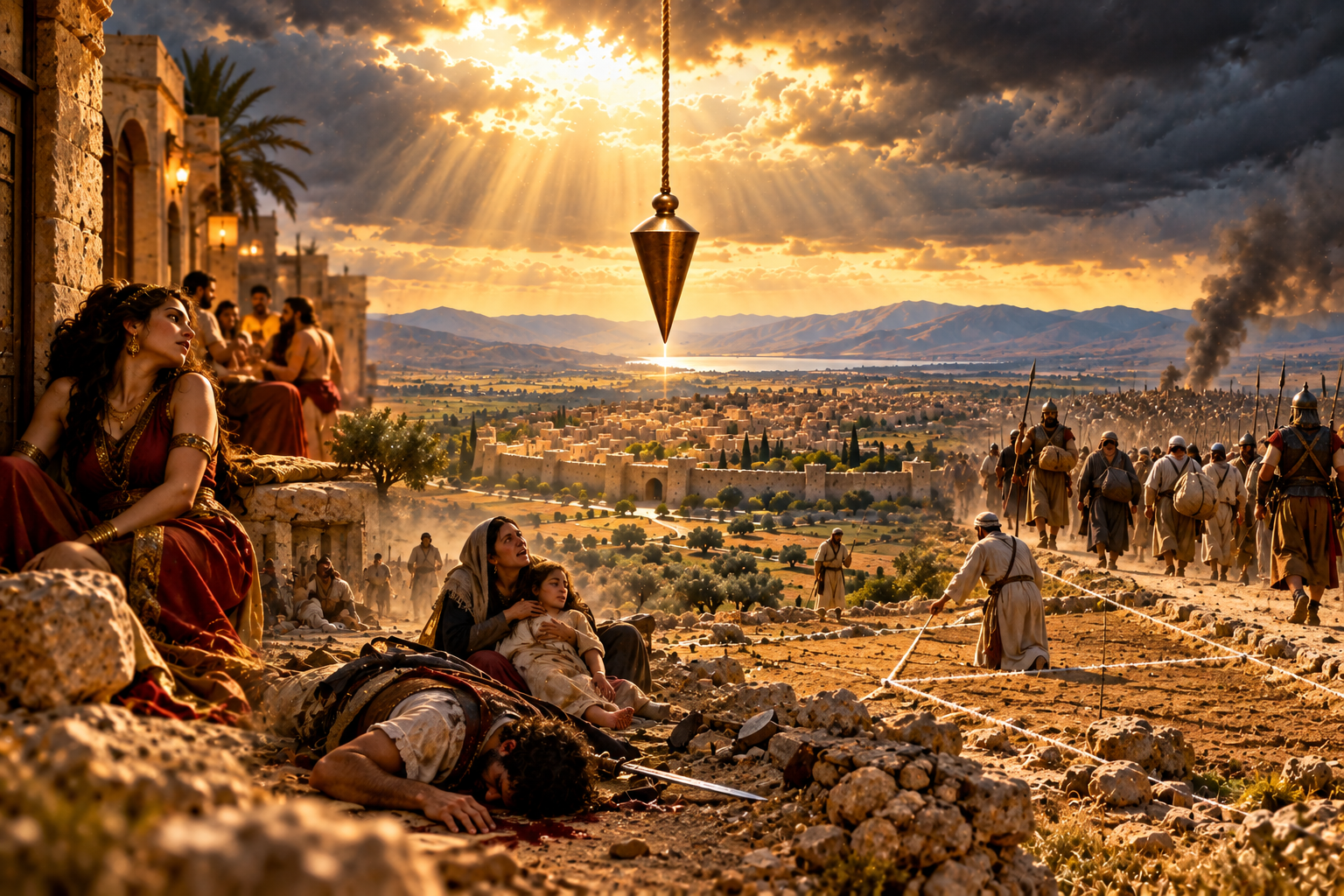
WHEN THE WARNING
BECOMES PERSONAL
Therefore, thus says the LORD - This is one of the most severe personal judgments pronounced against an individual in the book of Amos. Amaziah, the priest of Bethel, had attempted to silence God's prophet, accusing him of conspiracy and commanding him to leave Israel (Am 7:10–16). Now Amos announces God's judgment against the priest himself. It is notable that a similar type of personal judgment was leveled by Jeremiah against the false prophet Hananiah (Jer 28:15–17).
‘Your wife will become a harlot in the city, your sons and your daughters will fall by the sword - The man who tried to prevent God's Word from being proclaimed must now hear God's Word pronounced against his own household. His wife would suffer humiliation and his children would perish. The irony is that the priest who tried to protect the royal establishment from God's warning could not protect his own household from the judgment God announced.
Bob Utley - Amos says this priest's wife will be publicly raped (and become a common prostitute), his children killed, his property divided among others, and he, himself, will go into exile for life in Assyria. He will be an example of what will happen to all of Israel's leaders. In a real sense these judgments on Amaziah meant that neither he nor his descendants would be priests. (1) Wife will be unfit for marriage to a priest (cf. Dt. 22:23,24). (2) No children will survive him. (3) He dies in a foreign land unable to pass on his priestly credentials.
Your land will be parceled up by a measuring line - NIV - "Your land will be measured and divided up." (cf. 2Ki 17:24; Jer 6:12) The prophecy returns to the imagery of measurement. In Amos 7:7,8, the Lord held a plumb line to symbolize His examination of Israel. Now Amaziah’s own property would be measured out and divided. Measuring line (ḥebel) is a cord used to survey land and mark out boundaries. It was the same tool used when Israel’s inheritance was first allotted to the tribes (Joshua 17:5), and David used the image to celebrate God’s goodness: “The lines have fallen to me in pleasant places; indeed, my heritage is beautiful to me” (Ps 16:6). Parceled up (ḥālaq) means “to divide” or “apportion,” the root of cheleq, the “portion” or “farm land” consumed in the vision of fire (Amos 7:4). The cord that had once marked out Israel’s inheritance would now mark it out for someone else.
The picture is of conquerors dividing confiscated land. After the fall of Samaria, the Assyrians resettled the region with foreign peoples (2Ki 17:24). Micah, a few decades later, used the same image of judgment on Judah: “Therefore you will have no one stretching a measuring line for you by lot in the assembly of the LORD” (Micah 2:5). God’s plumb line exposed Israel’s spiritual failure; the measuring line would mark the loss of Amaziah’s inheritance to others.
Bob Utley - "by a measuring line" The "line" refers to a measuring cord for judgment ‒ 2 Sam. 8:2; Micah 2:5, for inheritance ‒ Ps. 16:5; 78:55 or for restoration ‒ Zech. 1:16; 2:1 In Revelation, John uses this imagery for the new heaven and earth, Rev. 11:1,2; Rev 21:15-17.
The priest who ordered God's prophet to leave the land
would himself be driven from the land.
And you yourself will die upon unclean soil (cf. Ezek. 4:13; Hos 9:3, 4) - Amaziah told Amos to leave Israel, but God declared that Amaziah himself would leave Israel and never return. The expression “unclean soil” (ʾădāmâ ṭĕmēʾâ) refers to land outside Israel, which Israelites regarded as ritually impure because it was the realm of foreign gods and idol worship, far from the place where the LORD had set His name. The idea appears as early as the days of Joshua: “If, however, the land of your possession is unclean, then cross into the land of the possession of the LORD, where the LORD’s tabernacle stands, and take possession among us. Only do not rebel against the LORD, or rebel against us by building an altar for yourselves, besides the altar of the LORD our God” (Joshua 22:19). Hosea, prophesying in the same generation as Amos, used the same language of the coming exile: “They will not remain in the LORD’s land, but Ephraim will return to Egypt, and in Assyria they will eat unclean food” (Hosea 9:3).
The irony is sharp. A priest’s duty was “to make a distinction between the holy and the profane, and between the unclean and the clean” (Leviticus 10:10), and Amaziah had spent his life handling what he considered sacred things at Bethel. Yet he would die in an unclean land, separated from every altar and sanctuary he had defended. He had told Amos to go and “eat bread” in Judah (Amos 7:12), but he himself would end his days as a captive in Assyria. The priest who tried to drive God’s prophet out of Israel would himself be driven out, never to return.
Chisholm - Had Amaziah responded differently, had he repented at Amos’ word, he might have been spared (Amos 5:4–6, 14–15). But instead he chose to align with an earthly monarch, to embrace the national mood of pride and security, and to assert his authority against God’s messenger. So the Lord quietly withdrew the plumb line. He would spare Amaziah no longer. (SEE The Bible Knowledge Commentary Minor Prophets - Page 43)
Moreover, Israel will certainly go from its land into exile (Amos 5:5, 27; 6:7; 7:11; 9:4) - The prophecy concludes by repeating the very warning Amaziah had attempted to suppress that Israel would certainly go into exile (Amos 7:11). Amos confirms that Amaziah was partially correct that Israel's exile was indeed God's Word. Amaziah could reject God's messenger, but he could not revoke God's message.
Bob Marcaurelle - The Visions of Judgment Amos 7:1-17
We come now to the second general section of Amos. The first six chapters are his messages (oracles) and the last three (Ch. 7-9) are his visions. We have no idea why they are divided this way. But this we know. Only the prophet Zechariah wrote of more visions. And these five visions are all remarkable reports of life changing encounters between Amos and God. Using simple, everyday events God showed Amos the terrible truth of what sin was going to do to his nation. Such a message was unwanted and unwelcomed.
I. The Visions of Destruction (Amos 7:1-6)
In the first two visions we have
1. The Calamities That Pictured Judgment. Locust (Amos 7:1-3) plagues were unbelievably destructive to the crops. If they came during the "latter growth" e.g. after the King had harvested his share, then the people would have no crops. Amos said in essence, this is a picture in agriculture of what God is going to do to you in history. Doing similar damage was a wildfire burning out of control (Amos 7:4-6). The fire Amos saw burned all the way down to the subterranean waters the ancients believed flowed beneath the earth's surface "the great deep." Both calamities picture utter devastation and ruin. The worst part was their meaning. They meant that God had left Israel, that He had lifted the hand of protection they had known ever since Abraham had been called out of Ur (Gen. 12).
We have here, second,
2. The Concern that Prayed Against Judgment (Amos 7:2, 5). All of this broke Amos' heart. The prophet who spoke to me for God was also a priest who spoke to God for men in the noble tradition of Moses (Ex. 32:30-34) and Samuel (1 Sam. 12:23). The true preacher must care. He must have a shepherd's heart. He must not preach on hell joyfully and be glad people will "get what they deserve." He must, in his tears and prayers, reflect the merciful heart of God who sends judgment only as a last resort and only after forgiveness has been rejected.
The prayer was heard. We see
3. The Change That Postponed Judgment (Amos 7:3, 6). Twice we read that God "repented" and said, "It shall not be." How can God repent? The idea is found many times in scripture (Gen. 6:7; 1 Sam. 15:29, 35; Jonah 3:9; Joel 2:14). The basic idea is not repenting of sin for God has no sin. It is to change one's mind (TEV) and relent (e.g. soften, be less severe) regarding punishment. God never changes His basic character. He is holy and righteous. But, in keeping with His character, He can and does change His methods. He was showing here that if Israel would only repent and turn from her sins to Him He would stop the awful judgments. If we do nothing about sin a righteous God will let us go to hall. If we turn from sin and accept Christ that same righteous God will let us into heaven.
II. The Vision of Inspection (Amos 7:7-9)
The third vision is that of
1. The Plumb Line. God is the carpenter who is building His people Israel. To see if they are straight or right morally and ethically He has a line. He has a standard. It was expressed in succinct form in the Ten Commandments. It was expanded and expounded in His laws and duties. It reached its zenith in His own character. His word was, "You shall be holy for I am holy" (Lev. 11:44).
Israel failed the inspection. They missed the mark! They were anything but straight. They were crooked and perverse. The two areas singled out for punishment were politics and religion. The "high places" (e.g. of worship) and the "sanctuaries" will be "laid waste ... made desolate." This was not a condemnation for worshipping in the wrong place or even for worshipping the wrong God, in the right place, in the wrong spirit. They had the wrong picture of God and His relation to sin. They thought He would condone it because they were "saved." The "house" or dynasty of Jeroboam, who let his indulgence and selfishness and dishonesty go on, would also fall.
In this vision there is
2. the punishment (Amos 7:8-9). In words that are sad and severe God says, "I will never pass by them." God had "passed over" her in the great judgment that fell on Egypt (Ex. 12:23). Now God was reversing all this. No longer would He pass by as her protector. He would allow the enemy in. No longer would he, when moving in judgment, pass over her. He would fall upon her. He was turning His people over to sin (Rom. 1:24) and Satan (1 Cor. 5:5).
III. The Voice of Objection (Amos 7:10-17)
When Amos said "Jeroboam," he said the magic word. He opened up a ten gallon can of worms in the politics and religion of Israel. He had just predicted the downfall of a King and of a nation's churches. This was a first in Israel. No prophet had ever dared say such words to a King and his priest.
Amaziah, the priest of Bethel, reported to the king (Amos 7:10-11). He charged Amos with conspiracy, misquoted him as saying that Jeroboam would die, and admitted, "The land is not able to bear all his words" (Amos 7:10). With the king's authority he ordered Amos to go home and preach where the people would pay him (Amos 7:12). He wasn't wanted or welcomed in the First Baptist Church of Bethel.
Amos' response is "one of the great scenes of history" (G. A. Smith). The rugged preacher stood nose to nose against the institutional religion of his day and showed all that is best in experimental religion. He had
1. Capacity For the Work. He was evidently equipped by God. His words were heavy (Amos 7:10). He could not be ignored or endured. Neither a church, a denomination, nor a seminary can make a preacher.
He had2. Audacity About the Work (Amos 7:14-15). He was not one of Amaziah's professional preachers. He was no church's hired hand, paid to say what they wanted to hear. He was a farmer who had been called to preach by God. He had the audacity to believe and to claim and to live by the conviction that he was personally called.
Because of all this he had a3. Tenacity in the Work (Amos 7:16-17). Like Nehemiah he would not run (Neh. 6:11). He just preached harder. He got specific and told Amaziah of his fate. His wife, in the aftermath of war, would sell her body as a harlot to survive. His children would die. His land would be sold. He would die in exile.
When this happened, whose fault was it? Was it God's? No! He wanted to stop the fire, to stay the locusts! Was it Amos'? No! He prayed for all those like Amaziah to be saved and spared. The fault was with Amaziah. He had heard the message. He had been warned. What he did with it was up to him. The same is true with you and me.