1 Peter 1:2
1 Peter 1:3
1 Peter 1:4
1 Peter 1:5
1 Peter 1:6
1 Peter 1:7
1 Peter 1:8
1 Peter 1:9
1 Peter 1:10
1 Peter 1:11
1 Peter 1:12
1 Peter 1:13
1 Peter 1:14
1 Peter 1:15
1 Peter 1:16
1 Peter 1:17
1 Peter 1:18
1 Peter 1:19
1 Peter 1:20
1 Peter 1:21
1 Peter 1:22
1 Peter 1:23
1 Peter 1:24
1 Peter 1:25
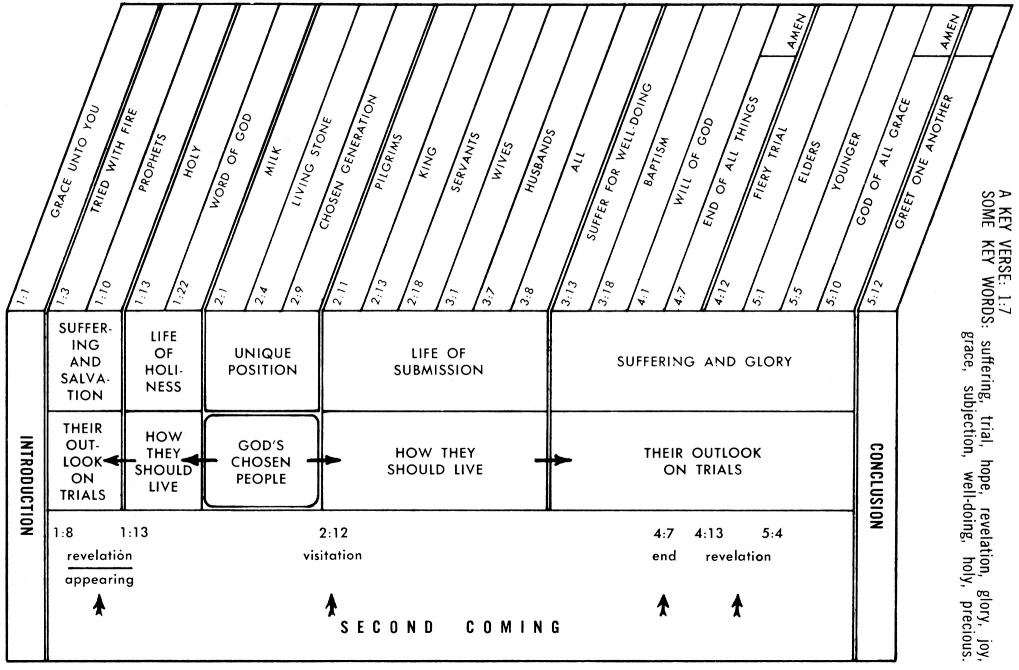
1 Peter: Trials, Holy Living & The Lord's Coming
Click chart to enlarge
Chart from Jensen's Survey of the NT - used by permission
See Another Chart from Charles Swindoll
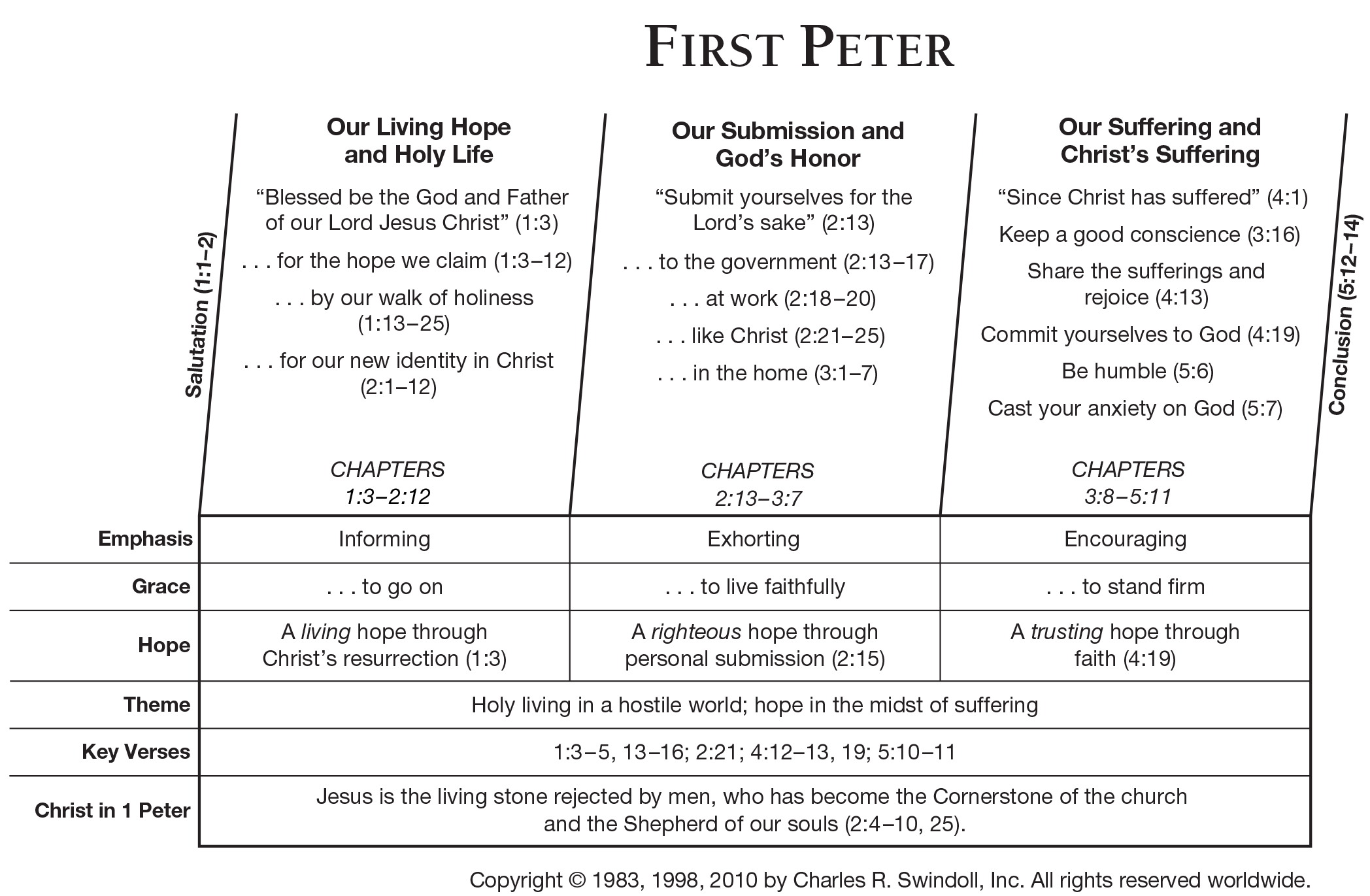
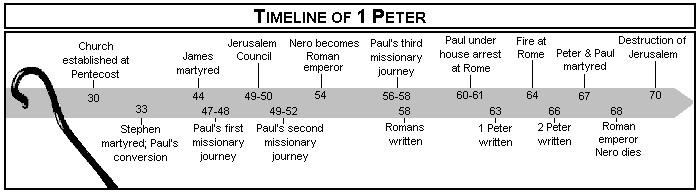
Source: Borrow Ryrie Study Bible
Click to enlarge
PART I: DOCTRINAL FOUNDATION
I. The Opening Salutation (1Pe 1:1-2)
A. The Writer (1Pe 1:1a)
B. The Readers (1Pe 1:1b-2a)
1. True character of the readers (1Pe 1:1b)
2. Geographical location of the readers (1Pe 1:1c)
3. Spiritual supports for the readers (1Pe 1:2a)
C. The Greeting (1Pe 1:2b)
II. The Thanksgiving for Our Salvation (1Pe 1:3-12)
A. The Description of Salvation (1Pe 1:3-5)
1. The author of salvation (1Pe 1:3a-b)
a. His relation to the Savior (1Pe 1:3a)
b. His act of mercy to the saved (1Pe 1:3b)
2. The nature of salvation (1Pe 1:3c-4a)
a. The living hope grounded in Christ's resurrection (1Pe 1:3c)
b. The glorious inheritance awaiting believers (1Pe 1:4a)
3. The certainty of salvation (1Pe 1:4b-5)
a. The safekeeping of the inheritance (1Pe 1:4b)
b. The preservation of the heirs (1Pe 1:5)
B. The Experiences Relating to Salvation (1Pe 1:6-9)
1. The paradoxical nature of the experiences (1Pe 1:6-7)
a. The experience of exultation (1Pe 1:6a)
b. The experience of distress (1Pe 1:66-7)
1. The nature of the distress (1Pe 1:6b)
2. The purpose behind the trials (1Pe 1:7)
a. The testing of faith (1Pe 1:7a)
b. The outcome of the testing (1Pe 1:7b)
2. The sustaining relations of believers (1Pe 1:8-9)
a. Their dual relation to Jesus Christ (1Pe 1:8)
b. Their experiential relation to their salvation (1Pe 1:9)
C. The Magnification of Salvation (1Pe 1:10-12)
1. The magnification through prophetic research (1Pe 1:10-12a)
a. Their intensive search (1Pe 1:10a)
b. Their prophetic function (1Pe 1:10b)
c. Their personal perplexity (1Pe 1:11)
1. The time and circumstances (1Pe 1:11a)
2. The sufferings and the glories (1Pe 1:11b)
d. Their restricted ministry (1Pe 1:12a)
2. The magnification through Christian proclamation (1Pe 1:12b)
3. The magnification through angelic inquiry (1Pe 1:12c)
PART 2: PRACTICAL EXHORTATION
I. Exhortations in View of Our Salvation (1Pe 1:13-2:10)
A. The Life Arising from Salvation (1Pe 1:13-2:3)
1. The Christian life in relation to God (1Pe 1:13-21)
a. A life of steadfast hope (1Pe 1:13)
1. The supports of hope (1Pe 1:13a)
2. The call to hope (1Pe 1:13b)
b. A life of personal holiness (1Pe 1:14-16)
1. The foundation for personal holiness (1Pe 1:14a)
2. The call to personal holiness (1Pe 1:14b-15)
a. The negative demand of holiness (1Pe 1:14b)
b. The positive call to holiness (1Pe 1:15)
3. The justification of the call to holiness (1Pe 1:16)
c. A life of motivated reverence (1Pe 1:17-21)
1. The basis for reverent living (1Pe 1:17a)
2. The call for reverent living (1Pe 1:17b)
3. The knowledge that motivates reverence (1Pe 1:18-21)
a. The means of our redemption (1Pe 1:18-19)
b. The nature of the Redeemer (1Pe 1:20)
c. The characteristics of the redeemed (1Pe 1:21)
2. The Christian life in relation to the brethren (1Pe 1:22-25)
a. The experience of inner purification (1Pe 1:22a)
b. The duty of mutual love (1Pe 1:22b)
c. The foundation in personal regeneration (1Pe 1:23-25)
1. The fact of their regeneration (1Pe 1:23a)
2. The nature of their regeneration (1Pe 1:23b-25a)
3. The evangelization leading to their regeneration (1Pe 1:25b) (D Edmond Hiebert)
1 Peter 1:2 according to the foreknowledge of God the Father, by the sanctifying work of the Spirit, to obey Jesus Christ and be sprinkled with His blood: May grace & peace be yours in the fullest measure (APO).. (NASB: Lockman)
Greek: kata prognosin theou patros, en hagiasmo pneumatos, eis hupakoen kai rantismon haimatos Iesou Christou; charis humin kai eirene plehtuntheie. (APO)
Amplified: Who were chosen and foreknown by God the Father and consecrated (sanctified, made holy) by the Spirit to be obedient to Jesus Christ (the Messiah) and to be sprinkled with [His] blood: May grace (spiritual blessing) and peace be given you in increasing abundance [that spiritual peace to be realized in and through Christ, freedom from fears, agitating passions, and moral conflicts]. (Amplified Bible - Lockman)
GWT: God the Father knew you long ago and chose you to live holy lives with the Spirit's help so that you are obedient to Jesus Christ and are sprinkled with his blood. May good will and peace fill your lives!
NLT: God the Father chose you long ago, and the Spirit has made you holy. As a result, you have obeyed Jesus Christ and are cleansed by his blood. May you have more and more of God's special favor and wonderful peace. (NLT - Tyndale House)
Phillips: whom God the Father knew and chose long ago to be made holy by his Spirit, that they might obey Jesus Christ and be cleansed by his blood: may you know more and more of God's grace and peace." (Phillips: Touchstone)
Wuest: chosen-out ones, this choice having been determined by the foreordination of God the Father, those chosen out to be recipients of the setting-apart work of the Spirit resulting in obedience (of faith) and (thus) in the sprinkling of the blood of Jesus Christ. Grace (be) to you, and (heart) peace be multiplied. (Eerdmans)
Young's Literal: according to a foreknowledge of God the Father, in sanctification of the Spirit, to obedience and sprinkling of the blood of Jesus Christ: Grace to you and peace be multiplied!
(CHOSEN) ACCORDING TO THE FOREKNOWLEDGE OF GOD THE FATHER: kata prognosin theou patros:
- Acts 2:23; 15:18; Ro 8:29,30; 9:23,24; 11:2) (Torrey's Topic Counsels and Purposes of God)
- 1 Peter 1 Resources - Multiple Sermons and Commentaries
God planned long ago to choose you by making you His holy people."
You were chosen according to the purpose of God the Father" (TEV),
God the Father chose you according to His Own purpose”
In just a few strokes of his pen, Peter paints the grand picture of our salvation as orchestrated from start to finish by God the Father, God the Son and God the Holy Spirit...
THE MYSTERY OF THE TRINITY
and
THE MARVEL OF SALVATION
Foreknown by the Father
Sanctified of the Spirit
Sprinkled with the blood of the Son
All members of the Trinity work to bring about our salvation and provide a threefold assurance to believers.
Vincent agrees that this section speaks of "The foreknowledge of the Father, the sanctification of the Spirit, the obedience and sprinkling of the blood of Jesus Christ the Son. The Father foreknowing, the Son atoning, the Spirit applying the Son’s work in sanctifying.
God the Father elects the sinner to salvation (Ep 1:4), God the Spirit brings him to the act of faith (2Th 2:13), and God the Son cleanses him from sin (Ro 5:6, 7, 8, 9, 10 - see notes 5:6; 5:7; 5:8; 5:9; 5:10) having given
Himself for our sins, that He might deliver us out of this present evil age, according to the will of our God and Father to Whom be the glory forevermore. Amen. (Gal 1:4, 5)
C. E. B. Cranfield comments on chosen according to the foreknowledge of God writing that "
If all our attention is concentrated on the hostility or indifference of the world or the exiguousness (excessive scantiness) of our own progress in the Christian life, we may well be discouraged. At such times we need to be reminded that our election is according to the foreknowledge of God the Father. The Church is not just a human organization—though, of course, it is that. Its origin lies, not in the will of the flesh, in the idealism of men, in human aspirations and plans, but in the eternal purpose of God.
In this section Peter presents truth to undergird the faith of the "elect sojourners" by emphasizing that the entire Godhead is active in their salvation experience (Click and scroll down to MacArthur's excellent summary of six "Advantages of God's Election"). (See J C Philpot - Meditations on First Peter Chapter One)
Peter begins by explaining to his readers how they became "the chosen". Remember that the "chosen" are those individuals who have been picked out of all mankind by and for God Himself. God's choosing anyone for salvation is a reflection of His sovereign unmerited favor (grace). Furthermore, God chose us in Christ even before the foundation of the world (Ep 1:4). In eternity, before the universe came into existence, God had the elect in His heart for salvation! Believers are not an afterthought, but a forethought of God. Dearly beloved, be greatly encouraged by this incomprehensible, profound truth.
Next Peter explains that this salvation is according to the Father's foreknowledge. According to is the Greek word katá which means "down" and in the context of this verse conveys the idea of domination. In other words God's choice was "dominated" (or controlled or determined) by the foreknowledge of the Father.
What does the "foreknowledge of God the Father" imply? Some mistakenly reason that the elect are chosen because God knew beforehand that they would receive Him. The reasoning is that God looked down through the ages and in His omniscience saw what each person would do in regard to His Son, and then He chose or didn't choose individuals based on whether or not they believed. This might sound plausible but it is not how Scripture defines God's election and foreknowledge. So let's do a "simple" (actually somewhat technical) word study of foreknowledge to help understand.
Foreknowledge (4268) (prognosis from verb proginosko from pro = before + ginosko = to know) literally means to know in advance or beforehand. In the classic use foreknowledge (prognosis) simply indicated a previous knowledge of someone or some event, as in Acts 26:5 where Paul says "they have known about me...previously" and in 2Peter 3:1 (note) where Peter reminds the saints that they "know beforehand" that there are those who will distort the Scriptures. As discussed below God's foreknowledge means not only that He knew beforehand but that He also planned beforehand (cf. similar idea in Ex 33:17; Jer 1:5; Amos 3:2; Matthew 7:22; 7:23 [notes]). And thus the simple meaning of prognosis takes on an additional sense when it is applied to God's foreknowledge as discussed in more detail below (see also preceding above).
John MacArthur comments on foreknowledge as it relates to election noting that
A common explanation of election is that the elect are chosen because God knew beforehand what they would do. That defines foreknowledge as foresight. I've heard it explained that God looked down through the eons of history, saw by virtue of His omniscience what you and I would do, and then chose or didn't choose us based on whether we did or didn't believe. That at first sounds like a good explanation--but it's not the truth.....
There are several reasons for wanting to believe that God's foreknowledge means foresight. Our fallen nature desperately want some responsibility for our salvation. Likewise our fallen perspective makes God's sovereign choice appear unfair. But because our minds are polluted by sin, we are in no position to exalt our pride and call ourselves virtuous, or pull down the justice of God and call Him unfair." (Click to read Dr MacArthur's interesting explanation of why many men want to believe that foreknowledge is simply foresight. Note that this quote is from "Chosen by God, Part 2". Scroll down to the section entitled Man's Decline) (Bolding added)
In other NT uses both prognosis and the verb root proginosko are used in relationship to God and acquire an additional meaning as explained in the next section.
Theologian Louis Berkhof has this to say about foreknow (proginosko) and foreknowledge (prognosis), noting that in the New Testament these terms
do not denote simple intellectual foresight or prescience, the mere taking knowledge of something beforehand, but rather a selective knowledge which regards one with favor and makes one an object of love, and thus approaches the idea of foreordination, Acts 2:23 (Comp. 4:28); Rom. 8:29; 11:2; 1 Peter 1:2. These passages simply lose their meaning, if the words be taken in the sense of simply taking knowledge of one in advance, for God foreknows all men in that sense. Even Arminians feel constrained to give the words a more determinative meaning, namely, to foreknow one with absolute assurance in a certain state or condition. This includes the absolute certainty of that future state, and for that very reason comes very close to the idea of predestination. (L. Berkhof, Systematic Theology Grand Rapids: Eerdmans, 1976, 112)
Acts 2:23 is the first occurrence of either prognosis or proginosko related to God and provides a pattern for the meaning of both words in other places in the New Testament. In Acts 2:23 Peter is preaching to the unsaved Jewish audience and declares
this Man (Jesus), delivered over (betrayed by Judas, to the power and will of His enemies) by the (definite article "te" in Greek placed before both the following nouns connected by "and" = kai) predetermined plan and (Greek = kai) foreknowledge of God, you nailed to a cross by the hands of godless men and put Him to death." (Acts 2:23)
Comment: The words "the predetermined plan and foreknowledge of God" (Acts 2:23), are a Greek construction governed by the Granville-Sharp rule. This grammatical rule simply states that when two nouns are joined by the word “and” (the Greek kai) and the first noun has the article (article = "the") in front of it and the second does not, both nouns refer to the same thing. In Acts 2:23, this rule shows that the word foreknowledge refers to the same act as does the phrase predetermined plan and is an additional description. The Greek word “plan” (Greek = boule [word study]), means to have an interchange of opinions, a mutual advising or the exchange of deliberative judgment. Plan refers to the results of a consultation between individuals.
Predetermined (perfect tense - past completed act with ongoing effect) refers to the past act of putting limits upon something with the present result that some certain thing has been appointed or decreed. It describes this consultation as one that had as its purpose the fixing of limits upon, thus determining the destiny of someone, in this case of the Lord Jesus Christ. In other words, in eternity (2Ti 1:9; Re 13:8), the Trinity, determined that the Lord Jesus Christ should be given over into the hands of godless men to be crucified. The word foreknowledge (prognosis) refers to the same act, and therefore includes in it the truth indicated by the predetermined plan. Foreknowledge, however, adds the idea of the foreordination or appointment in advance of the Person whose destiny was decided upon in the plan referred to. Stated succinctly the Granville Sharp rule in Acts 2:23 equates foreknowledge to a predetermined plan. According to Peter, God's foreknowledge is a deliberate choice. God foreknew not by prior observation, but by bringing into reality His predetermined plan.
Spurgeon writes that "with God there are no contingencies. The mighty charioteer of Providence has gathered up all the reins of all the horses, and He guides them all according to His infallible wisdom. There is a foreknowledge and predestination which concerns all things, from the motion of a grain of dust on the threshing-floor to that of the flaming comet which blazes athwart the sky. Nothing can happen but what God ordains; and therefore, why should we fear? (Barbed Arrows from the Quiver of C. H. Spurgeon)
Prognosis is used again by Peter explaining that Christ "...was foreknown (prognosis) before the foundation of the world, but has appeared in these last times for the sake of you." (1Pe 1:20) In eternity past, before Adam and Eve sinned, God did not just know it would happen but also planned the redemption of sinners through Jesus Christ. In this verse as in 1 Peter 1:2, "foreknown" does not simply refer to awareness of what is going to happen, but conveys the added nuance of a predetermined relationship in the knowledge of God. In other words, God brought the salvation relationship into existence by decreeing it into existence ahead of time and believers are foreknown for salvation in the same way Christ was predetermined (or foreordained) before the foundation of the world to be a sacrifice for sins (see discussion of Granville-Sharp rule above in reference to Acts 2:23)
Nelson's New Illustrated Bible Dictionary says "God’s foreknowledge is much more than foresight. God does not know future events and human actions because He foresees them; He knows them because He wills them to happen. Thus God’s foreknowledge is an act of His will." (Nelson's New Illustrated Bible Dictionary)
John Piper warns of "An increasingly popular movement afoot today is called "open theism," which denies that God has exhaustive, definite foreknowledge of the. entire future. (Desiring God) (See Piper's online book Beyond the Bounds - in which he confronts the unsound doctrine of Open Theism) (See also: John Piper's Resources on The Foreknowledge of God)
Wiersbe - Foreknowledge does not suggest that God merely knew ahead of time that we would believe, and therefore He chose us. This would raise the question, “Who or what made us decide for Christ?” and would take our salvation completely out of God’s hands. (Ed note: To say that God made a decision based on His prevision would mean that there was a time of indecision!) In the Bible, to foreknow means “to set one’s love on a person or persons in a personal way. (Bible Exposition Commentary)
Regarding foreknowledge, John MacArthur writes that "God pre-thought and pre-determined or predestined each Christian’s salvation...God predetermined to set His love upon certain people. If you are a Christian, you were foreknown by God as a part of that plan. God's foreknowledge of Christ serves as a model of God's foreknowledge of you. Christ is the elect stone--chosen and precious (1Pe 2:6)."
William MacDonald writes that foreknowledge is "knowledge with a purpose that could never be frustrated. It is not enough to say that God foreknew those whom He realized would one day repent and believe. Actually it is His foreknowledge that insures eventual repentance and belief! (Believer's Bible Commentary)
J I Packer said it this way God "knows, and foreknows, all things, and His foreknowledge is foreordination; He, therefore, will have the last word, both in world history and in the destiny of every man.
D. Edmond Hiebert writes that proginosko (foreknowledge) "does not imply mere intellectual apprehension; it also indicates an active and affectionate desire to bless."
Kenneth Wuest writes that foreknowledge "is to be understood less as a passive ‘knowing in advance’ than as an active ‘taking note of’ or an eternal intention to bless."
William Kelly writes that God's "foreknowledge is of persons, not of their state or conduct; it is not what, but whom He foreknew.
The discerning believer like all good Bereans needs to be aware that not all well known Christian scholars agree with the preceding interpretation of foreknowledge. Although this website follows no particular school of interpretation (other than the natural, literal approach), you should be aware that those who hold to the "Calvinist" school insist that God knows all events precisely because He sovereignly determines what is to happen in human history. Therefore in the Calvinist mindset, foreknowledge is closely related to foreordination (or predestination). Most Calvinists assert that men are still responsible for their choices and are not merely victims of "blind fate".
Those known as Arminian distinguish foreknowledge from the foreordination. While salvation and human history are predetermined by God, Arminians argue that individual response to God is not so predetermined. Hence, God can foreknow an event without directly decreeing that event to take place. There are other differences between these two schools of theology but you will need to consult other resources for more in depth discussion.
Scripture teaches both God’s foreknowledge of all things and the man's responsibility and these truth are like two parallel train tracks that never intersect. Both are true even if they cannot be resolved by our finite minds. To alter either of these truths is to not rightly handle the interpretation of the Word of Truth.
The verb proginosko is used 5x in the NT, two of those uses (Acts 26:5, 2Peter 3:17) simply referring to previous knowledge that anyone might have.
Below are the other three of uses of proginosko that convey the meaning not just that God knew before, but that He also foreordained or appointed in advance.
Romans 8:29 (note) For whom He foreknew (proginosko), He also predestined to become conformed to the image of His Son, that He might be the first-born among many brethren."
Comment: As discussed above "foreknew" is not just a reference to God’s omniscience—that in eternity past He knew who would come to Christ but has the added notion of His predetermined choice to set His love on us and established an intimate relationship.
Romans 11:2 (note) "God has not rejected His people whom He foreknew (proginosko) (Amplified adds " [whose destiny] He had marked out and appointed and foreknown from the beginning). Or do you not know what the Scripture says in the passage about Elijah, how he pleads with God against Israel?"
Comment: The situation was similar to that which existed in the time of Elijah when most of the nation had turned away from God to idols. Conditions were so bad that Elijah prayed against Israel instead of for it! Paul's point is that even Israel's gross disobedience and turning away of most of the nation did not nullify God’s predetermined love relationship with her!
1 Peter 1:20 (note) "For He was foreknown (proginosko) before the foundation of the world, but has appeared in these last times for the sake of you 21 who through Him are believers in God, who raised Him from the dead and gave Him glory, so that your faith and hope are in God."
Comment: The Fall of man in the Garden of Eden did not take God by surprise. Christ’s work for us was no afterthought on God’s part. The Redeemer was destined to die for us before the creation of the world. Christ's sacrificial death was a set appointment not a serendipitous accident and began to be worked out in Ge 3:7 vs. Ge 3:21, when God killed animals that He might clothe Adam and Eve. The ram dying as a substitute for Isaac (Ge 22:13), the Passover lamb being slain for each Jewish household (Ex 12), and the One "like a lamb...led to slaughter" (Isaiah 53:6, 7), all pictured the predetermined and foreknown plan which culminated in John the Baptist's presentation of the Messiah as "the Lamb of God, Who takes away the sin of the world” (Jn 1:29).
C. H. Spurgeon in his inimitable style described God's actions in salvation - "Before Salvation came into this world, Election marched in the very forefront, and it had for its work the billeting [assigning of lodging especially to soldiers] of Salvation. Election went through the world and marked the houses to which Salvation should come and the hearts in which the treasure should be deposited. Election looked through all the race of man, from Adam down to the last, and marked with sacred stamp those for whom Salvation was designed. 'He must needs go through Samaria,' said Election; and Salvation must go there. Then came Predestination. Predestination did not merely mark the house, but it mapped the road in which Salvation should travel to that house; Predestination ordained every step of the great army of Salvation; it ordained the time when the sinner should be brought to Christ, the manner how he should be saved, the means that should be employed; it marked the exact hour and moment, when God the Spirit should quicken the dead in sin, and when peace and pardon should be spoken through the blood of Jesus. Predestination marked the way so completely that Salvation doth never overstep the bounds, and it is never at a loss for the road. In the everlasting decree of the Sovereign God, the footsteps of Mercy were every one of them ordained" from the sermon "The Things that Accompany Salvation"
Related Resources:
- Foreknowledge as God's Attribute
- How are predestination and election connected with foreknowledge?
- What is predestination? Is predestination biblical?
- Calvinism vs. Arminianism - which view is correct?
- How can I know if I am one of the elect?
- Bridgeway Bible Dictionary Foreknowledge
- Baker Evangelical Dictionary Foreknowledge
- Charles Buck Dictionary Foreknowledge of God
- Easton's Bible Dictionary Foreknowledge of God
- Holman Bible Dictionary Foreknowledge
- Hastings' Dictionary of the Bible Foreknowledge
- Hastings' Dictionary of the NT Foreknowledge
BY THE SANCTIFYING WORK OF THE SPIRIT: en hagiasmo pneumatos :
- 1Th 5:23, Acts 26:18, Heb 10:14, 1Co 1:30, 6:11
- 1 Peter 1 Resources - Multiple Sermons and Commentaries
THE HOLY SPIRIT
SANCTIFIES US
As explained in more detail below (See hagiasmos), sanctification sometimes refers to the work of the Spirit in a person AFTER we are saved (and is synonymous with a walk of holiness or "present tense salvation") but below are verses which use sanctification to refer to the initial born again experience (as used in this passage by Peter)...
He 10:10 By this will we have been sanctified (perfect tense = set apart at the time of initial salvation with ongoing effects or results - this also speaks of the permanence of salvation or "eternal security" of the believer) through the offering of the body of Jesus Christ once for all.
Comment: By contrast Heb 10:14 says "those who are (being) sanctified" which is present tense and passive voice ("divine passive" = work of Spirit) indicating an ongoing process of progressive sanctification.
Acts 26:18 to open their (in context of Ac 26:17, the Gentiles) eyes (by proclaiming the Gospel) so that they may turn from darkness (cp Col 1:13) to light and from the dominion (exousia = the "right" and the "might") of Satan (He 2:14, 15) to God, that they may receive forgiveness (aphesis) of sins and an inheritance among those who have been sanctified (perfect tense = see He 10:10 above) by faith in Me.’
1 Corinthians 6:11 Such were some of you; but you were washed, but you were sanctified, but you were justified in the name of the Lord Jesus Christ and in the Spirit of our God
2Th 2:13 But we should always give thanks to God for you, brethren beloved by the Lord, because God has chosen you from the beginning for salvation through sanctification by the Spirit and faith in the truth. 14 It was for this He called you through our gospel, that you may gain the glory of our Lord Jesus Christ.
Comment: By contrast 1 Thes 5:23 is a prayer for progressive, ongoing (not past tense) sanctification - "Now may the God of peace Himself sanctify you entirely; and may your spirit and soul and body be preserved complete, without blame at the coming of our Lord Jesus Christ."
The Greek sentence has no word for "work" so that Young's Literal version accurately reads...
in sanctification of the Spirit (As explained below the idea is "made a holy people by God's Spirit"), to obedience and sprinkling of the blood of Jesus Christ
Wuest expands the verse paraphrasing it as "those chosen out to be recipients of the setting-apart work of the Spirit resulting in obedience [of faith] and [this resulting] in the sprinkling of the blood of Jesus Christ. [Sanctifying] grace to you, and [tranquilizing] peace be multiplied."
What is Peter saying? The phrase sanctifying work of the Spirit means that a person cannot be saved anytime they "decide" and any way they "want" (cp Jesus' words in Jn 3:7,8 and Jn 1:12, 13, especially the phrases "nor the will of the flesh, nor the will of man, but of God"!). A person must be sanctified by the Holy Spirit of God the evidence of this sanctifying work being that the person now chooses to obey God (cp the Divine enablement of one who has been born again in Php 2:13, He 8:10, 11 and the "new" responsibility of this regenerate individual in Php 2:12). This is not an exaltation of works in which we could ever boast, but instead is exaltation of the Holy Spirit. Salvation is the work of God -- God chooses and the Holy Spirit sanctifies, even as taught in Peter's opening "doxology"...
Blessed be the God and Father of our Lord Jesus Christ, Who (on what basis did He choose to save us?) according to His great mercy (Wuest = "who impelled by His abundant mercy") has caused us to be born again (NIV = "In His great mercy He has given us new birth") to a living hope through the resurrection of Jesus Christ from the dead, 4 to obtain an inheritance which is imperishable and undefiled and will not fade away, reserved in heaven for you,5 who are protected by the power of God through faith for a salvation (future tense salvation) ready to be revealed in the last time.
Fallen mankind have always sought a way to "earn" salvation as evidenced by this question to Jesus...
They said therefore to Him, "What shall we do, that we may work the works of God?" Jesus answered and said to them, "This is the work of God, that you believe in Him whom He has sent." (Jn 6:28, 29)
Comment: He is not referring to a "meritorious" work by man. Man cannot do any works that please God. So this is not referring to "work" in the sense of something man conjures up and wills himself to do to earn God's salvation. As Ryrie says "The only "work" that a man can do that is acceptable to God is to believe in Christ (cf. 1Jn 3:23)." This is the picture of a drowning man going under but raising his hand out for help. The point is he can do nothing to save himself except cry out. That is not a work on his part that earns any favor with God. The "works of God" (Jn 6:28) are impossible to attain, requiring absolute obedience to God's law (Dt 27:26; Jas 2:10) to be acceptable to God. Only Jesus, in His perfect humanity, was able to accomplish this, but His righteousness is imputed to all those who believe on Him apart from works (Ro 4:5). This is possible only because He, perfectly righteous Himself, could then voluntarily and in love bear "our sins in his own body on the tree" (1Pe 2:24). Jesus had just cautioned His audience (and all men of all ages) to work "not for the food which perishes, but for that meat which endures" (Jn 6:27). He was not trying to "trap" them but to get them to understand that the only "work" acceptable to God is belief in His Son.
By - This preposition is actually the Greek preposition "en" which is literally "in" which in this verse is used as what is referred to as the "locative of sphere". Wuest explains that in this verse the locative of sphere means that it was in the sphere of the sanctifying or...
setting apart work of the Spirit that the sinner was chosen. That is, God the Father chose the sinner out from among mankind to be the recipient of the setting-apart work of the Spirit, in which work the Holy Spirit sets the sinner apart from his unbelief to the act of faith in the Lord Jesus. The act of faith is spoken of here by the word “obedience,” which is not the obedience of the saint, but that of the sinner to the Faith, for this act is answered by his being cleansed in the precious blood of Jesus. In Acts 6:7 we read that “a great company of the priests were obedient to the faith.” Thus, the second step in the salvation of a sinner is taken by the Holy Spirit who brings the one chosen to the act of faith in the Lord Jesus as Saviour. (Wuest's Word Studies from the Greek New Testament: Eerdmans) (Bolding added)
Barclay elaborates on the Spirit's "sanctifying work" writing that
"It is the Holy Spirit Who awakens within us the first faint longings for God and His goodness. It is the Holy Spirit Who convicts us of our sin and leads us to the Cross where that sin is forgiven. It is the Holy Spirit Who enables us to be freed from the sins which have us in their grip and to gain the virtues which are the fruit of the Spirit. It is the Holy Spirit Who gives us the assurance that our sins are forgiven and that Jesus Christ is Lord. The beginning, the middle and the end of the Christian life are the work of the Holy Spirit." (Daily Study Bible Series - 1 Peter 1)
Marvin Vincent notes Peter's interesting use of prepositions in close proximity "Note the three prepositions: according to (kata) the foreknowledge; in (en) sanctification; unto (eis) obedience. The ground, sphere, and end of spiritual sanctification."
Wiersbe sums up salvation in this section as follows "We have been chosen by the Father, purchased by the Son, and set apart by the Spirit. It takes all three if there is to be a true experience of salvation."
Sanctifying (38) (hagiasmos from hagiazo = sanctify from hagios [word study] = holy, set apart, consecrated) is a word used "only by Biblical and ecclesiastical writings" (Thayer) and which literally means sanctification which includes the ideas of consecration, purification, dedication ("personal dedication to the interests of the deity" BDAG) and holiness.
Hagiasmos was used in the Greek pagan religions to describe buildings, altars or offerings set apart for religious purposes. The object set apart was thus declared sacred, holy, devoted to religious purposes. It applied also to the worshippers. They were set apart persons, thus religious devotees of the temple.
The dominant idea of sanctification (dictionary discussion) is separation from the secular and sinful and set apart for the sacred, (specifically in the NT) for God’s special use (cp 2Ti 2:21, 22), all made possible by the atoning work of Christ and the provision of His Spirit.
In position all believers are in Christ, and practically speaking sanctification describes the Spirit enabled process by which the one in Whom we live and Who lives in us (i.e., Christ, the Spirit of Christ - cp Jn 14:20, Col 1:27-note, Ro 8:9-note) progressively becomes more and more manifest in our daily conduct (cp 2Co 4:10, 11, 2:14, 15,16, Ro 8:29-note)
Bradford Mullen writes that...
The generic meaning of sanctification is "the state of proper functioning." To sanctify someone or something is to set that person or thing apart for the use intended by its designer. A pen is "sanctified" when used to write. Eyeglasses are "sanctified" when used to improve sight. In the theological sense, things are sanctified when they are used for the purpose God intends. A human being is sanctified, therefore, when he or she lives according to God's design and purpose...
Human beings ultimately cannot sanctify themselves. The Triune God sanctifies. The Father sanctifies (1Co 1:30) by the Spirit (2Th 2:13; 1Pe 1:2) and in the name of Christ (1Co 6:11). Yet Christian faith is not merely passive. Paul calls for active trust and obedience when he says, "Since we have these promises, dear friends, let us purify ourselves from everything that contaminates body and spirit, perfecting (Active voice = our responsibility, but even this being enabled by the Spirit!) holiness out of reverence for God" (2Co 7:1). No one may presume on God's grace in sanctification. Peter reminds believers to be diligent in making their calling and election sure (2Pe 1:10). (See Mullen's well done lengthy "treatise" on Sanctification in Baker's Evangelical Dictionary of Biblical Theology - Recommended!) (Bolding Added)
BDAG says hagiasmos is used...
in a moral sense for a process or, more often, its result (the state of being made holy)
Wuest puts it this way - The word “sanctify” in the Greek means “to set apart,” and the word “sanctification” refers to the setting apart process.
As explained more below, hagiasmos can refer either to a state of being set apart from sin and the world unto God (equating with our initial salvation) or secondly can refer to the process by which a saint becomes progressively more set apart to God. Thus sanctification in one use takes place at a moment in time (salvation and synonymous with justification - See relationship of Justified, Sanctified, Glorified) but in the other use sanctification is a continuous process which is lifelong and terminates only when believers are glorified. Peter uses hagiasmos primarily with the former meaning. The Holy Spirit is the agent in effecting both aspects of sanctification.
Hagiasmos is used twice in the Septuagint (LXX) (Ezekiel 45:4, Amos 2:11) and 10 times in the NT...
Romans 6:19 (note) I am speaking in human terms because of the weakness of your flesh. For just as you presented your members as slaves to impurity and to lawlessness, resulting in further lawlessness, so now present your members as slaves to righteousness, resulting in sanctification.
Romans 6:22 (note) But now having been freed from sin and enslaved to God, you derive your benefit, resulting in sanctification, and the outcome, eternal life.
1 Corinthians 1:30 But by His doing you are in Christ Jesus, who became to us wisdom from God, and righteousness and sanctification, and redemption,
1Thessalonians 4:3 (note) For this is the will of God, your sanctification; that is, that you abstain from sexual immorality;
1Thessalonians 4:4 (note) that each of you know how to possess his own vessel in sanctification and honor
1Thessalonians 4:7 (note) For God has not called us for the purpose of impurity, but in sanctification.
2Thessalonians 2:13 But we should always give thanks to God for you, brethren beloved by the Lord, because God has chosen you from the beginning for salvation through sanctification by the Spirit and faith in the truth.
1Timothy 2:15 But women shall be preserved through the bearing of children if they continue in faith and love and sanctity with self-restraint.
Hebrews 12:14 (note) Pursue peace with all men, and the sanctification without which no one will see the Lord.
1Peter 1:2 according to the foreknowledge of God the Father, by the sanctifying work of the Spirit, that you may obey Jesus Christ and be sprinkled with His blood: May grace and peace be yours in fullest measure.
Wuest - This pre-salvation work of the Spirit is spoken of in Scripture as the sanctification of the Spirit. It is the setting-apart work of the Spirit in that He sets the unsaved person apart from his unbelief to the act of faith, from his standing in the first Adam which brought him sin and death, to a new standing in the Last Adam which brings him righteousness and life. This we call positional sanctification."
The College Press NIV Commentary states that "The concept of sanctification can be understood by comparing the sanctification of people to the sanctification of the temple or its utensils. A sanctified building, lampstand, or pot is designated to be used only in service to God. A sanctified person has also been set apart for service. The Holy Spirit both marks us for God’s service and empowers us to render that service. (1 & 2 Peter: The College Press NIV Commentary. Joplin, MO: College Press Publishing).
As discussed, Peter uses hagiasmos to describe the work of the Holy Spirit in regeneration or the new birth, by which a sinner is taken out of Adam and placed into Christ (cp 1Co 15:22), thus equating sanctification in this context with salvation (or justification).
Writing to the Thessalonian believers (whose faith had been shaken by false teachers cf 2Th 2:1, 2, 3, 4) Paul reminds them of the source and security of their salvation, explaining that they are
brethren beloved (perfect tense = their permanent state) by the Lord, because God has chosen you (election -- middle voice = for Himself) from the beginning for salvation through sanctification (hagiasmos) by the Spirit (God's part) and faith (man's part, realizing that even faith is a gift) in the truth (believers need to stay "in the truth" for faith comes by hearing and hearing by the Word of Christ). (2Th 2:13)
The Spirit (Jn 3:5, 6, 7, 8) uses the Word of Truth (the Gospel - see Ep 1:13, Col 1:5) to convict men of sin, righteousness and the judgment to come (Jn 16:8), to point them to safety in the "Ark" of Christ and to set them apart from the world.
Using the verbal root of hagiasmos (hagiazo), Paul declared to the Ephesian elders
And now I commend you to God and to the word of His grace, which is able to build you up and to give you the inheritance ("imperishable and undefiled and will not fade away reserved in heaven" - 1Pe 1:4) among all those who are sanctified (hagiazo - perfect tense pictures their having been set apart occurring at a definite point of time in the past -- the moment they were born again by faith -- with the present result that they are still set apart, that blessed condition continuing throughout this life and the one to come!). (Acts 20:32)
John Macarthur comments on 1 Peter 1:2 explaining that "Election becomes a reality for the elect in the sphere of the sanctifying work of the Holy Spirit...While the elect are elect from eternity, they are saved in time..."Sanctifying" refers to the new birth--salvation, regeneration, faith, repentance-- that the Spirit produces in the life of a believer. It includes the concepts of being hallowed, consecrated, and separated from the world. As Christians we are all elect from eternity. But we were once part of the mass of unredeemed humanity. We existed in that unredeemed condition until the Holy Spirit set us apart ("sanctified us") for salvation...the Spirit sets a believer apart ("sanctifies") from sin to God, from darkness to light, and from unbelief to faith...The Father planned our salvation and Christ purchased it for us, but it is the Spirit Who applies it. (parentheses and bolding added) (See Chosen by God - Part 2 - scroll down)
EXPLANATORY NOTE ON
SANCTIFICATION
The reader needs to be aware that sanctification can be a confusing term because some uses of "sanctification" (sanctify, sanctified) in Scripture refer primarily to our initial salvation ("positional sanctification" = "Past tense salvation" = Justification) whereas other uses refer to an ongoing process in the believer's life (progressive sanctification = "Present tense salvation = growth in holiness = growth in Christlikeness) See Three Tenses of Salvation.
John Macarthur explains it this way - "Sanctification includes all aspects of the life of a believer. It is a synonym for salvation, the critical work of the Holy Spirit at conversion whereby we are set apart--born of the Spirit. Once that has taken place, the Holy Spirit continues to work in us to make us more holy. That is the process of sanctification, and it continues throughout our lives.
SANCTIFICATION:
USED TWO WAYS IN THE NEW TESTAMENT
(1) Our initial salvation experience:
A POINT IN TIME EVENT
OUR POSSESSION
OUR ETERNAL POSITION IN CHRIST
(2) Our daily growth in Christ-likeness:
A PROCESS
OUR DAILY PRACTICE
PROGRESSIVE
When we are initially saved, the Bible sometimes refers to this as sanctified and so we Paul writes that "we were sanctified (hagiazo - aorist tense = past action completed the moment we believed!) (1Co 6:11. cp Acts 20:32 where here the speaks of our being set apart at a specific point in time in the past [the moment we believed in the gospel of Jesus Christ Mk 1:1, Ro 1:9, Ro 15:19, 1Co 9:12, 2Co 2:12, 9:13, 10:14, Gal 1:7, Php 1:27, 1Th 3:2, 2Th 1:8] and with the results continuing into the present = we remain positionally set apart.)
At the moment we confessed "with (our) mouth Jesus as Lord, and (believed) in (our) heart that God raised Him from the dead" (Ro 10:9) we were saved, sanctified or set apart from Sin, Satan and this present evil age (world) (Gal 1:4) and unto God for His good pleasure (2Cor 5:9, Ep 5:8, Ep 5:9, 10, 1Th 2:4, He 13:20, 21) and use (2Co 4:7, 2Ti 2:20, 21).
The epistle to the Hebrews records that "By this will we have been sanctified (hagiazo) through the offering of the body of Jesus Christ once for all. (He 10:10)
In Hebrews 10:10, sanctified is in the perfect tense which indicates a past completed action (the moment of salvation, a one time event when we taken out of Adam and were placed in Christ 1Co 15:22, transferred from the kingdom of darkness to the Kingdom of light - Col 1:13, 14) with present ongoing effects or results (i.e., holiness as a saint's permanent possession -- once made holy in Christ you will always be "holy" whether you feel holy or not.)
The writer of Hebrews then goes on to explain that "by one offering (of His Own Body on the Cross) He (Christ, our Great High Priest) has perfected (perfect tense = speaks of the permanence or eternality of this perfection) for all time those who are sanctified (present tense, passive voice {"divine passive" = God enables this progressive setting apart in believers} = more literally = "are continuously being sanctified" = speaks of the process of sanctification as discussed below). (He 10:14)
W E Vine says that "Sanctification is the state predetermined by God for believers, into which in grace He calls them, and in which they begin their Christian course and so pursue it. Hence they are called “saints” (hagioi)
Having been saved, sanctified or set apart in the past, now daily we are being saved, sanctified or set apart from the world and unto God. (See topic Three Tenses of Salvation - see also the lengthy discussion by Lehman Strauss re Regeneration, Justification and Sanctification) The first sanctification is a one time event, never to be repeated. The second sanctification is a daily event and represents an ongoing process by which the Spirit is continually conforming us into the image of God's Son by producing internal transformation.
Paul says that "we all, with unveiled face (perfect tense = The veil was taken off the day the Spirit gave birthed us into the Kingdom of God and we received new life in Christ and the effects continue. The perfect tense speaks of permanence of the "unveiling" which occurred when we first received Christ - Jn 1:12, 13. The Spirit opened the eyes of our heart - Acts 26:18, Acts 16:14, 2Co 3:5, 6. In Jesus the veil is "rent" - Heb 10:19, 20 Mt 27:50,51 Mk 15:38 Lk 23:45! Believers now under the New Covenant do not lose the glory as did Moses under the Old Covenant - 2Co 3:7, 8, 9, 10, 11, 12, 13) beholding (present tense = continually contemplating without interruption. As one's lifestyle.) as in a mirror (the Word of Truth - same phrase in Ps 119:43, 2Co 6:7, Col 1:5, 2Ti 2:15, Jas 1:18) the glory of the Lord, are being transformed (present tense = this is a process, not an arrival in this present life! The = passive voice = so called "divine passive" = God is the Energizer of our transformation. However note it is not "Let go and Let God" for believers have a responsibility of "beholding") into the same image from glory to glory, just as from the Lord, the Spirit. (2Cor 3:18).
Jesus prayed for the sanctification of saints, asking His Father to "Sanctify (aorist imperative) them in the Truth. Thy Word is Truth.... “For their sakes I sanctify Myself, that they themselves also may be sanctified in truth. (Jn 17:17, 19)
THOUGHT - Note the intimate connection between TRUTH (the Holy Word) and SANCTIFICATION (Holy People)! This begs the question dear reader - Are you daily in the Word? Better yet, the the living and active Word daily IN you, percolating through you, renewing your mind, transforming you from glory to glory? Sanctification is not like treading water -- you can't expect to remain at the same stage of spiritual maturity (sanctification) if you are not regularly imbibing the pure milk of the Word (1 Peter 2:2) - No Word. No growth. Know Word. Know growth! Dearly beloved, if you are not in the Word daily (cf Mt 4:4), and the Word is not in you and/or you are not obeying the Word (not legalistically but enabled by the Spirit - Ezekiel 36:27, cp obedience of faith), you will not experience significant progressive sanctification (This brings to mind Rich Mullins great song Step by Step). Peter charges believers (after exhorting them to lay aside "appetite suppressing", growth stunting sins in 1 Peter 2:1) to be "like newborn babes (and) long for (aorist imperative = a command demanding urgent attention. Do this now! Don't delay! Do it effectively! Develop an appetite for, have an insatiable craving for) the pure milk of the word (unadulterated, no additives, not devotionals or books about the Word but the "pure Word"), that by it (they) may grow in respect to salvation (i.e., the process of sanctification or present tense salvation.") (1Pe 2:2; cp Jer 15:16, Job 23:12)
THE BELIEVER'S
"POWER SOURCE"
ENABLING
PROGRESSIVE
SANCTIFICATION
The process of sanctification is dependent not only on the intake of the Word, but on our response to the Word. Is the Word "in one ear and out the other" (Jas 1:22) or does it truly impact your walk, beloved (or do we walk away from it and forget it? - Jas 1:23, 24)?
Paul explains that our daily growth in Christ-likeness is a "cooperative effort" writing that
if you are living (present tense = that is if the direction of your life is continually) according to the flesh, you must die; but if by the Spirit (this is God's part - His power in us to will and to work for His good pleasure) you are putting (this part is our responsibility, it is present tense - habitually, daily - the process of sanctification; cp same "pattern" of God's part, our part in Ezek 36:27) to death the deeds of the body (prompted by sin still resident in the physical body), you will live. (Ro 8:13).
He reiterates this vitally important spiritual dynamic in Philippians exhorting the saints to...
work out (present imperative = As the general direction of your life, not perfection and only possible as you depend on the Spirit) your salvation (equates with progressive, stepwise sanctification = increasing in holiness = growth in Christ-likeness) with fear (1Pe 1:17, 2Co 7:1) and trembling for it is God who is at work (energeo in the present tense = continually "energizing") in you, both to will (His indwelling Spirit gives us the "want to" [cp He 13:20, 21] - our fallen flesh does not "want to" obey God's word! Never!) and to work (energeo in the present tense = continually) for His good pleasure. (Php 2:12, Php 2:13NLT = "desire and the power").
In other words, the indwelling Holy Spirit is the believer's Source of supernatural power (just try obeying continually in your own natural strength!) continually enabling us to not "walk according to the flesh" (Ro 8:4) but to "walk (present imperative) by the Spirit (for then) you will (be empowered to) not carry out the desire of the flesh." (Gal 5:16; NB: The Spirit first! In other words, don't "invert" Gal 5:16 and try to keep a set of rules concocted to blunt the desires of your old flesh nature! It won't work. It's called legalism [beware - legalism can assume very subtle forms!] and the old flesh loves it! [see Ro 7:5. Surrender your will to the Spirit's will [cp our Lord's perfect example - Lk 22:42, 1Pe 2:21]. Each morning awaken with an "Ephesians 5:16 mindset" (cf Moses' prayer in Ps 90:12 - note - not "years" but "days!") and begin your day with the spiritual "breakfast of champions" and a holy presentation [Ro 12:1, Ro 12:2]. Then throughout the day, moment by moment, trial by trial, yield to Him. As the "tests" come at you, learn to depend on His power, not your own power to "weather the storm", whatever the "storm" is in your life! There is no other way to be happy in Jesus, than to Trust and Obey in the Spirit!)
Note that the process of sanctification although enabled by the Spirit is the believer's responsibility and that holiness is not produced by personal passivity or just letting go and letting God as some have erroneously taught. We need to learn to trust the Holy Spirit to make us holy...His sanctifying work alone saved us the first time and His sanctifying work alone saves us every day and both are activated by faith, a faith that obeys His still small voice without hesitation. That's "walking in the Spirit". Walking is just learning to place one foot in front of the other and then repeating that process. That's what it means to be continually "filled with the Spirit". That's what it means to continually be under the control of the Holy Spirit. (see related resources Walking in the Spirit ; Filled with Spirit - Ephesians 5:18 or see exposition of Ephesians 5:18)
As believers, we daily must remember who we are (in Christ) and Whose we are (Christ's bride)
for God has not called (note calling is part of the salvation process) us for the purpose of impurity (an unnatural pollution, context is speaking of sexual uncleanness or filthiness), but in (in the sphere of) sanctification (hagiasmos) (1Th 4:7).
Writing to the church at Corinth which was surrounded by pagan society literally saturated with idolatry and immorality, Paul wrote
Therefore, having these promises (Read [meditate on] them in 2Cor 6:16,17,18 and also the three commands to Come out from their midst and be separate....and do not touch what is unclean), beloved, let us cleanse ourselves (katharizo) (our part in daily sanctification) from all (even the "closets" of your heart - don't leave any "secret" places that make provision for your flesh - Ro 13:14) defilement of flesh and spirit, (continually, habitually [present tense]) perfecting holiness (hagiosune) in the fear (phobos) of God (which is practically reflected in a self-distrust, a serious caution, a tenderness of conscience, a watchfulness against temptation and shrinking from whatever might offend God and discredit the name of our Father 1Pe 1:17 and Christ our bridegroom - cp Re 19:7, Re 19:8). (2Cor 7:1)
Comment: Why do so few individuals in modern American evangelicalism pursue holiness? Paul would say it is because they have no fear of God, either as a Father or Judge {1Pe 1:17, He 12:28}
Hagiasmos is used to the process of sanctification in Romans 6:19 Paul writing to the Romans saints...
I am speaking in human terms because of the weakness of your flesh (because of their intellectual difficulty in grasping divine truth which often needs to be illustrated to be fully intelligible). For just as you presented (paristemi = yielded, surrendered) your members as slaves to impurity and to lawlessness, resulting in further lawlessness, so now present (paristemi in the aorist imperative = once for all, yield - this necessitates a deliberate decision on the believer's part) your members (your faculties, the parts of your physical body, the headquarters from which and through which sin operates, members might also include mental faculties) as slaves to righteousness (right being and doing right), resulting in sanctification (hagiasmos). (Ro 6:19)
In Romans 6:22 Paul goes on to explain
but now having been freed from sin (because of our union with Christ [= "in Christ"] Who broke the tyranny, dominion and controlling power of sin, Ro 6:2, Ro 6:11 - not referring to the believer’s daily struggle with sin but to a one-time, past completed event - now we are “in Christ” and He died in our place and we are counted dead with Him) and enslaved to God, you derive your benefit (reward, fruit - if you present yourselves as slaves to God voluntarily, you can anticipate the sweet fruit of progressive sanctification - holiness - and fullness of eternal life cf. Jn 10:10; 17:3), resulting in sanctification (hagiasmos - here referring to progressive , daily setting apart from the world and unto God = a process which is not automatic but requires a daily, moment by moment, decision of our will to live for God, not the world, this process being enabled by the Holy Spirit), and the outcome, eternal life. (Ro 6:22)
In his first epistle to the Corinthians Paul reminds us that our salvation is all of God for it is by His
doing (Praise God, from Whom All Blessings Flow - the Initiator, Sustainer and Completer of our salvation!) you are in Christ Jesus (see in Christ and in Christ Jesus), Who became to us wisdom from God (Ro 11:36), and righteousness (2Pe 1:1, Therefore, let us proclaim with the Psalmist - Ps 71:15, Ps 71:16) and sanctification (hagiasmos - set apart to belong to God and to serve Him - this reference is to positional sanctification = "in Christ" our eternally secure position!) and redemption." (1Cor 1:30)
Christ is our Sanctification. In ourselves we have no personal holiness, but in Christ we are positionally sanctified and by the Spirit of Christ's power we will be transformed (being progressively sanctified) from one degree of sanctification or holiness to another as discussed above.
Another example of Paul's use of sanctified in reference to the initial salvation experience is in his description of the "before" and "after" picture of some of the Corinthian saints --
Such were some of you (see 1Cor 6:9; 6:10); but you were washed, but you were sanctified (hagiazo, aorist tense = at a definite point in time in the past = moment of salvation), but you were justified in the name of the Lord Jesus Christ and in the Spirit of our God." (1Cor 6:11)
Hagiasmos is used in Hebrews to describe progressive sanctification, the author charging saints to
Pursue (present imperative - command to continually seek after) peace with all men, and the sanctification (holiness and consecration) without which no one will see the Lord." (He 12:14)
Comment: Don't misunderstand this command to pursue holiness -- the writer is not saying that we can work our way to heaven. To the contrary those who have been sanctified by the Spirit {genuinely saved} will be enabled and empowered by the same Spirit to daily pursue holiness with the result that the lost will see the Lord in their holy lives. Mt 5:16) (See also J C Ryle's sermon on Hebrews 12:14.) If an individual exhibits no tendency to pursue a holy (set apart) lifestyle, then one can hardly claim to have Someone called the HOLY Spirit living within them! Now realize that when we say pursue sanctification or holiness, we are not speaking of PERFECTION (there is a false teaching referred to as )
Ray Stedman explains that "f we truly practice a continual reckoning of ourselves as already righteous within by a gracious act of God on the basis of the death and resurrection of Jesus (Ed: That was Paul's command in Ro 6:11), we will find ourselves strongly motivated to live righteously and inwardly distressed (Ed: cp Ep 4:30, 1Th 5:19) at any failure to do so. This inward distress will bring us again and again to the throne of grace (He 4:16) for forgiveness and recovery. (See Stedman's commentary - scroll down to section on "The Dangers to Watch For - Hebrews 12:14-17 )
Easton's Bible Dictionary writes that "Sanctification involves more than a mere moral reformation of character, brought about by the power of the truth: it is the work of the Holy Spirit bringing the whole nature more and more under the influences of the new gracious principles implanted in the soul in regeneration. In other words, sanctification is the carrying on to perfection the work begun in regeneration, and it extends to the whole man (Ro 6:13 [note]; Col 3:10 [note]; 1Jn 4:7; 1Cor 6:19). It is the special office of the Holy Spirit in the plan of redemption to carry on this work (1Cor 6:11; 2Th 2:13). Faith is instrumental in securing sanctification, inasmuch as it (1) secures union to Christ (Gal 2:20) and (2) brings the believer into living contact with the truth, whereby he is led to yield obedience "to the commands, trembling at the threatenings, and embracing the promises of God for this life and that which is to come.
Wuest summarizes sanctification, positional and progressive, beginning with the "initial act of faith (that) brought ... justification, the removal of the guilt and penalty of sin and the impartation of a positive righteousness, Jesus Christ Himself, an act which occurs at the moment of believing, and a position that remains static for time and eternity; sanctification, positional, the act of the Holy Spirit taking the believing sinner out of the first Adam with his (Adam’s) sin and death, and placing him in the Last Adam (Jesus Christ, cp 1Co 15:22) with His righteousness (2Co 5:21) and life (Jn 14:19, 20:31, 1Jn 5:11, 12, Col 3:4), an act that occurs at the moment of believing. Sanctification progressive, the process by which the Holy Spirit eliminates sin from the experience of the believer and produces His fruit, gradually conforming him into the image of the Lord Jesus, a process that goes on all through the life of a Christian...In progressive sanctification, the work of the Holy Spirit producing in the lives of believers, a set apart life consistent with their new position.
Hodge writes that "The more holy a man is, the more humble, self-renouncing, self-abhorring, and the more sensitive to every sin he becomes, and the more closely he clings to Christ. The moral imperfections which cling to him he feels to be sins, which he laments and strives to overcome. Believers find that their life is a constant warfare, and they need to take the kingdom of heaven by storm, and watch while they pray. They are always subject to the constant chastisement of their Father's loving hand, which can only be designed to correct their imperfections and to confirm their graces. And it has been notoriously the fact that the best Christians have been those who have been the least prone to claim the attainment of perfection for themselves." (Outlines of Theology - Archibald Alexander Hodge)
Luther said "I believe that I cannot by my own reason or strength believe in Jesus Christ my Lord, or come to him." (Theological quarterly)
It is the Holy Spirit who awakens within us the first faint longings for God and goodness. It is the Holy Spirit who convicts us of our sin and leads us to the Cross where that sin is forgiven. It is the Holy Spirit who enables us to be freed from the sins which have us in their grip and to gain the virtues which are the fruit of the Spirit. It is the Holy Spirit who gives us the assurance that our sins are forgiven and that Jesus Christ is Lord. The beginning, the middle and the end of the Christian life are the work of the Holy Spirit.
As the Christian yields to the Lord and attempts to be set apart for Him, the Holy Spirit empowers and helps him to grow in grace and make him more like Christ.
Resources on Sanctification:
- What is sanctification? What is the definition of Christian sanctification?
- What is progressive sanctification?
- What is positional sanctification?
- What is entire sanctification?
- What is sanctifying grace?
- Sanctification - Torrey's Topical Textbook
- American Tract Society Sanctify
- International Standard Bible Encyclopedia Sanctification
- Bridgeway Bible Dictionary Sanctification
- Baker Evangelical Dictionary Sanctification
- Easton's Bible Dictionary Sanctification
- Holman Bible Dictionary Sanctification
- Hastings' Dictionary of the Bible Sanctification, Sanctify
- Hastings' Dictionary of the NT Sanctification Sanctify, Sanctification
- Vines' Expository Dictionary Sanctification, Sanctify
- Watson's Theological Dictionary Sanctification
TO OBEY JESUS CHRIST: eis hupakoen:
- See "obey" in 2Th 1:8, 9
- Torrey's Topic Obedience to God
- 1 Peter 1 Resources - Multiple Sermons and Commentaries
THE IMPORTANCE
OF OBEDIENCE
Paul emphasizes the crucial importance of obedience in his vivid description of the return of Jesus Christ written to encourage the persecuted saints at Thessalonica...
For after all it is only just for God to repay with affliction (thlipsis) those who afflict (thlibo) you, and to give relief to you who are afflicted (thlibo) and to us as well when the Lord Jesus shall be revealed (apokalupsis - see table on Second Coming) from heaven with His mighty angels in flaming fire, dealing out retribution to those who do not know God (cp Jesus' haunting declaration that He did not know them in Mt 7:21, Mt 7:22, 23) - Vincent - "To know God is to know Him as the One, true God as distinguished from false gods; to know His will, His holiness, His hatred of sin, and His saving intent toward mankind. Two words are used of such knowledge, eido [used here] and ginosko... Eido [is used elsewhere], of heathen, Jn 16:3, 8:55, Ga 4:8;1Th 4:5") and to those who do not obey (hupakouo - present tense = as their general lifestyle. Speaks of direction [of one's life], not perfection! cp Jn 3:36,1Pe 4:17, Acts 6:7 Ro 1:5, Ro 2:8, Ro 15:18,19, Ro 16:26 Ga 5:7, Heb 5:9, He 11:8) the gospel (euaggelion) of our Lord Jesus (Note Paul's link between knowledge and obedience. The Pharisees knew but did not obey and the same is true of modern day "Pharisees"!). And these will pay the penalty of eternal destruction (They owed a debt - Ro 3:23, Ro 6:23), away from the presence of the Lord and from the glory (doxa) of His power (ischus), when He comes to be glorified in His saints on that day, and to be marveled at among all who have believed (pisteuo)-- for our testimony to you was believed. (2Th 1:6, 7, 8, 9, 10)
Comment: Obedience does not save us. Only faith in Christ saves us. But faith that is genuine produces obedience. In other words, faith alone saves, but the faith that saves is not alone! (See Jas 2:14-16-see notes )
Related Resource:
- See notes on the relationship of obedience and faith in 1 Peter 1:14; 1 Peter 1:22; Romans 1:5 Romans 15:18; Romans 16:19, Romans 16:26
- to be obedient to Jesus Christ (Amp)
- unto obedience and sprinkling of the blood of Jesus Christ (ASV, KJV)
- with a view to their obedience and to their being sprinkled with the blood of Jesus Christ (Weymouth)
- for obedience to Jesus Christ and for sprinkling with his blood (ESV),
- resulting in obedience [of faith] and [this resulting] in the sprinkling of the blood of Jesus Christ (Wuest)
Marvin Vincent insightfully observes Peter's successive use of "three prepositions: according to (kata) the foreknowledge; in (en) sanctification; unto (eis) obedience. The ground, sphere, and end of spiritual sanctification."
To (eis) is a preposition which depicts motion or direction toward or into some thing or some place, in context into or toward obedience. Even from this simple understanding you can glean that a faith that is not manifesting a tendency toward obedience to Jesus Christ, is a faith that is at best suspect and at worst a counterfeit.
Kenneth Wuest conveys the sense of the Greek preposition eis (in this context) = resulting in obedience [of faith].
The interpretation relates back to the fact that Christians are chosen...to be obedient. The people whom God chose and set apart are to be obedient.
Obedience from a new heart, motivated by love (not cowering fear) is the by-product of the sanctifying work of the Spirit. Immediately after explaining to the Ephesians that they were saved by grace through faith apart from works (Ep 2:8, 9-notes) Paul declares that believers "are (God's) workmanship, created in Christ Jesus for good works (see study of Good Deeds), which God prepared beforehand, that we should walk in them. (Eph 2:10)
Salvation calls us to a life of obedience. Because we are elect, we have been set apart by the work of the Spirit to obey Jesus Christ. No believer always obey as he should, but nevertheless obedience is to be the general direction (cf., eis = toward) of our life.
Obey (5218) (hupakoe from hupó = under + akouo = hear) (Click study of related verb hupakouo) literally means "hearing under", that is, listening from a subordinate position in which compliance with what is said is expected and intended.
Hupakoe is used only once in the Lxx (2Sa 22:36) and 15 times in the NT ...
Romans 1:5 (note) through whom we have received grace and apostleship to bring about the obedience of faith (see study of Obedience of faith) among all the Gentiles, for His name's sake,
Romans 5:19 (note) For as through the one man's disobedience the many were made sinners, even so through the obedience of the One the many will be made righteous.
Romans 6:16 (note) Do you not know that when you present yourselves to someone as slaves for obedience, you are slaves of the one whom you obey (present tense = habitually), either of sin resulting in death, or of obedience resulting in righteousness?
Romans 15:18 (note) For I will not presume to speak of anything except what Christ has accomplished through me, resulting in the obedience of the Gentiles by word and deed,
Romans 16:19 (note) For the report of your obedience has reached to all; therefore I am rejoicing over you, but I want you to be wise in what is good, and innocent in what is evil.
Romans 16:26 (note) but now is manifested, and by the Scriptures of the prophets, according to the commandment of the eternal God, has been made known to all the nations, leading to obedience of faith;
2 Corinthians 7:15 And his affection abounds all the more toward you, as he remembers the obedience of you all, how you received him with fear and trembling.
2 Corinthians 10:5 We are destroying speculations and every lofty thing raised up against the knowledge of God, and we are taking every thought captive to the obedience of Christ,
2 Corinthians 10:6 and we are ready to punish all disobedience, whenever your obedience is complete.
Philemon 1:21 Having confidence in your obedience, I write to you, since I know that you will do even more than what I say.
Hebrews 5:8 (note) Although He was a Son, He learned obedience from the things which He suffered.
1 Peter 1:2 (note) according to the foreknowledge of God the Father, by the sanctifying work of the Spirit, that you may obey Jesus Christ and be sprinkled with His blood: May grace and peace be yours in fullest measure.
1 Peter 1:14 (note) As obedient children, do not be conformed to the former lusts which were yours in your ignorance,
1 Peter 1:22 (note) Since you have in obedience to the truth purified your souls for a sincere love of the brethren, fervently love one another from the heart,
Hupakoe speaks of the one hearing as being under the authority of some one else. Thus, hupakoe comes to mean compliance (disposition to yield to another) with the demands or requests of someone over us. Obedience is submission or hearkening to a command. Obedience is the carrying out the word and will of another person, especially the will of God.
Illustration - A missionary translator was endeavoring to find a word for “obedience” in the native language. This was a virtue seldom practiced among the people into whose language he wanted to translate the New Testament. As he returned home from the village one day, he whistled for his dog and it came running at full speed. An old man, seeing this, said, admiringly in the native tongue, “Your dog is all ear.” Immediately the missionary knew he had his word for obedience. (Encyclopedia of 7700 Illustrations by Paul Lee Tan)
Hupakoe conveys the picture of one listening and following instructions. Submitting to that which is heard involves a change of attitude, forsaking the tendency of the fallen nature to rebel against Divine instructions and commands and seeking God's will, not self will. Someone has said that a "proof" that we are of the elect is not an empty prating about how secure we are once we believed, but rather how sensitive we are to the principle and practice of obedience to Jesus.
Paul uses hupakoe to describe the goal of his apostleship which was "to bring about the obedience of faith ("the obedience that comes from faith" NIV) among all the Gentiles for His name’s sake." (Ro 1:5-see notes for discussion of the phrase obedience of faith ; see related topic Relationship of faith and obedience)
A similar truth is expressed by Luke describing "the word of God kept on spreading; and the number of the disciples continued to increase greatly in Jerusalem, and a great many of the priests were becoming obedient (verb form - hupakouo) to the faith (here meaning "the gospel"). (Acts 6:7)
To become obedient to the faith, is to obey the requirements of the gospel. The point is that genuine, saving faith always produces obedience and submission to the gospel of Christ. A person who claims faith in Jesus Christ but whose pattern of life is utter disobedience to God’s Word has never been redeemed and is living a lie. Faith that does not manifest itself in obedient living is spurious and worthless (Jas 2:14, 15, 16, 17, 18, 19, 20 , 21, 22, 23 ,24, 25, 26-see notes ).
In the closing lines of Romans Paul again emphasized that the purpose of the gospel was to lead men "to the obedience of faith (the obedience which springs from faith)" (Ro 16:26).
Faith and obedience are inseparable. There is no true faith that does not produce obedience (Ro 15:18; Ro 16:19; 2Co 7:15). (See related study Obedience of faith)
In sum, Peter is saying that the purpose of our election is obedience to Jesus Christ. Peter then goes on to use hupakoe two more times in this same chapter to help his readers understand what this obedience looks like in our daily walk --
(1) As obedient children, do not be conformed to the former lusts which were yours in your ignorance (1Pe 1:14)
(2) Since you have in obedience to the truth (referring to their conversion upon believing the Gospel) purified your souls for a sincere love of the brethren, fervently love one another from the heart (1Pe 1:22)
AND BE SPRINKLED WITH HIS BLOOD: kai rantismon haimatos Iesou Christou:
- 1 Peter 1 Resources - Multiple Sermons and Commentaries
SPRINKLED WITH THE
BLOOD OF THE LAMB OF GOD
Sprinkled (4473) (rhantismos from rhaino = to sprinkle) means a scattering of drops of some liquid (usually blood, oil or water in Scripture) The corresponding Hebrew word (nazah) stresses the purpose whereas rhantismos stresses the process of sprinkling.
The only other NT use of rhantismos is in Hebrews where the author writes that the readers who have accepted Messiah as Savior have come to "Jesus the mediator of a new covenant, and to the sprinkled blood, which speaks better than the blood of Abel." (Heb 12:24 [cf. Heb 9:13, 14-notes])
Rhantismos is found four times in the Greek translation of the Hebrew (Septuagint) to describe the "water of sprinkling" (Nu 19:9). Over Israel's almost 40 year period of wilderness wandering, approximately 1.2 million people died because of God’s judgment. The Israelites were continually coming into contact with dead bodies, which led to ceremonial uncleanness. Therefore, the Lord provided a means of purification ("water for impurity...sprinkled" Nu 19, 13, 20, 21) so that those who came into contact with dead bodies might be cleansed.
In addition to the sprinkling of water for impurity, the Old Testament frequently speaks of sprinkling blood around the altar as a ritual purification or as an act of consecration (e.g., click for 20 uses of sprinkled blood in Leviticus). In the present context Peter clearly is not speaking of a literal sprinkling of blood but is using the term figuratively. However, it must be stated at the outset of this discussion that a definitive interpretation of Peter's original intent is difficult and it is best to avoid being too dogmatic.
Here the blood of Jesus speaks of His atoning sacrifice for "in Him we have redemption through His blood, the forgiveness of our trespasses, according to the riches of His grace. (Ep 1:7)
Similarly Paul says that "through Him (Christ)...all things (are reconciled) to Himself, having made peace through the blood of His cross; through Him, I say, whether things on earth or things in heaven. (Col 1:20)
Scripture is the best commentary on Scripture, so in order to try to accurately interpret Peter's figure of the sprinkled blood of Jesus, we first note that although there are other sprinklings in the Old Testament, there are only three situations in which men were sprinkled with blood (see below).
Sprinkling of Individuals with Blood in the Old Testament
(1). Ratifying the Mosaic covenant (Ex 24:8; Heb 9:19, 20)
(2). Consecration of family of Aaron to priesthood (Ex 29:21)
(3). Cleansing from leprosy (Lev 14:2, 3, 4, 5, 6, 7)
Peter's statement rendered literally from the Greek reads
"to obedience and sprinkling of the blood of Jesus Christ".
As discussed above, obedience speaks of human response and clearly the blood of Jesus Christ pictures the divine provision. Although there is no clear consensus, looking at the three possible OT situations to which Peter may have been alluding, the most reasonable appears to be Moses’ sprinkling of sacrificial blood on the people of Israel symbolically sealing their covenant to obey God. In Exodus we read that as Moses
took the book of the covenant and read it in the hearing of the people; and they said, “All that the Lord has spoken we will do, and we will be obedient!” So Moses took the blood and sprinkled it on the people, and said, “Behold the blood of the covenant, which the Lord has made with you in accordance with all these words.” (Ex 24:7,8).
Notice that in this text the people declare their commitment to obedience and then Moses sprinkles sacrificial blood on them to ratify their covenant. Peter also refers to obedience and the sprinkling of blood in the same order.
The Nelson Study Bible comments that "Any of these three cases could be the one that Peter has in mind here. (Radmacher, E. D., Allen, R. B., & House, H. W. The Nelson Study Bible: NKJV. Nashville: Thomas Nelson)
Charles Ryrie writes that "sprinkled with His blood signifies the personal application of the sacrifice of Christ. (The Ryrie Study Bible: New American Standard Translation: 1995. Moody Publishers)
The Geneva Study Bible has an interesting note writing that "In the worship of the Old Testament, the death of the victim establishes a covenant, and the sprinkling incorporates the worshipers as participants, making them publicly liable for the covenant’s benefits and responsibilities (Ex 24:8)." (New Geneva Study Bible. Nashville: Thomas Nelson)
William MacDonald writes regarding the interpretation of the sprinkled blood that "We must not take this with absolute literalness and insist that when a person is saved, he is actually sprinkled with the blood of Jesus. This is figurative language. What it does say is that as soon as a person obeys the gospel, he receives all the benefits which flow from the shedding of Christ’s blood on Calvary. The Savior’s blood was shed once for all over 1900 years ago; it will never be shed again. But we receive forgiveness, redemption, and the other innumerable blessings that flow from that crimson tide as soon as we believe on Him." (MacDonald, W & Farstad, A. Believer's Bible Commentary: Thomas Nelson)
John Macarthur says that "This phrase (sprinkled with His blood) is based on Moses’ sprinkling sacrificial blood on the people of Israel as a symbol sealing their covenant as they promised to obey God’s Word. Likewise, in the New Covenant, faith in the shedding of Christ’s blood on the cross not only activates God’s promise to give the believer perfect atonement for sin, but also brings the believer into the covenant by one’s promise of obedience to the Lord and His Word." (The MacArthur Study Bible. Nashville: Word Pub)
Stated another way, one could say that the new covenant is established by the blood of Christ (Mt 26:28) and evokes the obedience of faith.
In his interpretation David Guzik incorporates all three OT uses where blood was sprinkled on men writing that "since all the elect fall short of perfect sanctification and obedience, there is cleansing from sin provided for them through the sprinkling of the blood of Jesus Christ. There were only three circumstances in the Old Testament where blood was sprinkled on people. First, at the establishment of a covenant (Ex 24:5, 6, 7, 8). Second, at the ordination of Aaron and his sons (Ex 29:21). Finally, in the purification ceremony for a cleansed leper (Lev 14:2, 3, 4, 5, 6, 7). The sprinkling of the blood of Jesus on us accomplishes the same things. First, a covenant is formed, then we are ordained as priests to Him, and finally we are cleansed from our corruption and sin. Each one of these things is ours through the work of Jesus on the cross." (See Commentary)
William Barclay (1 Peter 1 commmentary) is similar to Guzik (Note Barclay has definite liberal tendencies but his comments on culture, history, Greek words, etc are often valuable...just be a Berean and read critique on Barclay)
(a) When a leper had been healed, he was sprinkled with the blood of a bird (Lev 14:2–7). Sprinkling with blood is, therefore, the symbol of cleansing. By the sacrifice of Christ, the Christian is cleansed from sin. (Ed note: compare "how much more will the blood of Christ, who through the eternal Spirit offered Himself without blemish to God, cleanse your conscience from dead works to serve the living God?" Heb 9:14)
(b) Sprinkling with blood was part of the ritual of the setting apart of Aaron and the priests (Ex 29:21; Lev 8:30). It was the sign of setting apart for the service of God. The Christian is specially set apart for the service of God, not only within the Temple, but also within the world. (Ed note: Believers are a royal priesthood [1Pe 2:9] "not redeemed with perishable things... but with precious blood, as of a lamb unblemished and spotless, the blood of Christ." - 1Pe 1:18, 19-notes)
(c) The great picture of the sprinkling comes from the covenant relationship between Israel and God. In the covenant, God, of his own gracious will, approached Israel that they might be his people and that he might be their God. But that relationship depended on the Israelites accepting the conditions of the covenant and obeying the law. Obedience was a necessary condition of the covenant, and failure in obedience meant failure of the covenant relationship between God and Israel. In (Ex 24:1, 2, 3,4, 5,6 , 7, 8)
Moses "took the book of the covenant and read it in the hearing of the people; and they said, "All that the LORD has spoken we will do, and we will be obedient!" So Moses took the blood and sprinkled it on the people, and said, "Behold the blood of the covenant, which the LORD has made with you in accordance with all these words."
Believers have entered into a New Covenant through the blood of Jesus Christ (Mt 26:28 = Mk 14:24), the Mediator of a "better covenant (than that described in Ex 24) which has been enacted on better promises." (He 8:6).
The writer of Hebrews also reminded his persecuted potentially wavering readers, that as believers they had
"come to Mount Zion and to the city of the living God, the heavenly Jerusalem, and to myriads of angels...and to Jesus, the Mediator of a new covenant, and to the sprinkled blood, which speaks better than the blood of Abel." (Heb 12:22, 23, 24)
A T Robertson writes that "sprinkled blood" is a "Reference to the death of Christ on the Cross and to the ratification of the New Covenant by the blood of Christ as given in Heb. 9:19f.; 12:24 with allusion to Ex 24:3, 4, 5, 6, 7, 8. Paul does not mention this ritual use of the blood of Christ, but Jesus does (Mt 26:28 = Mk 14:24). (Word Pictures in the New Testament)
Finally, just as the "holy place and the tent of meeting and the altar" were symbolically purified by sprinkling of blood sevenfold on the day of atonement (Lev 16:19) the Savior's blood today provides daily cleansing from personal impurities
The apostle John amplifies the eternal efficacy of the Blood of Christ writing that...
If we walk in the light as He Himself is in the light, we have fellowship with one another, and the blood of Jesus His Son (continually) cleanses us from all sin." (1Jn 1:7) for "if we confess our sins, He is faithful and righteous to forgive us our sins and to cleanse us from all unrighteousness." (1Jn 1:9)
In summary, from the above discussion one can see that "sprinkled with His blood" has several possible interpretations and it is best to avoid being too dogmatic.
Here is an excerpt from an ISBE Article giving more background on the practice of sprinkling in the OT…
Sprinkling (blood, water, oil) formed an important--if not the essential--part of the act of sacrifice. A consideration of the chief passages in the Old Testament will reveal the prominence and the significance of sprinkling as a feature of the sacrificial act. The significance of the sprinkling of blood is seen in the account of the establishment of the covenant between Yahweh and Israel (Ex 24:6-8). Half the blood was sprinkled on the altar as representing the Deity, while the remainder was put into a basin and then sprinkled on the people. This ceremony is a survival in a modified form of the communal meal in which the tribal god and his worshippers sat together and participated in the same food, and in this way came to possess the same life. The two-fold sprinkling of blood resulted in the establishment of an inviolable bond (Nu 18:17; 2 Ki 16:15).
In the account of the consecration of Aaron and his sons (Ex 29:16,20,21) the blood of the ram of the burnt offering was sprinkled on the altar, while the blood of the ram of consecration was put on the altar and sprinkled on Aaron and his sons and on their garments. Water of purifying was sprinkled on the Levites at their ordination (Nu 8:7).
Leviticus gives detailed information in regard to sacrificial sprinkling. In the case of burnt offering the blood was sprinkled round about upon the altar (Lev 1:5,11). The same practice obtained in the case of peace offerings, whether ox, lamb or goat (Lev 3:2,8,13). When a sin offering for sins inadvertently committed was made, the priest dipped his fingers in the blood and sprinkled it seven times before Yahweh, before the veil of the Holy Place (Lev 4:6). Elsewhere (Lev 16:11,15) we read that Aaron took the blood of the sin offering and sprinkled it with his finger upon the mercy-seat, eastward, 7 times (see also Nu 19:4).
Sprinkling constituted part of the process of purification. But it is obvious that the sprinkling, even in this case, was a religious act, and not part of the actual physical cleaning. A simple kind of sprinkler was made by fastening a bunch of hyssop to a cedar rod by a piece of scarlet thread or wool and then the patient was besprinkled 7 times (Lev 14:7), while oil was sprinkled with the finger, also 7 times, before Yahweh (Lev 14:16; see also Ex 12:22; Nu 19:18; Ps 51:7). The house in which the leper lived was disinfected in the same thorough manner (Lev 16:51).
In the case of persons who had contracted uncleanness through contact with a corpse, sprinkling with the "water of separation" was part of the process of cleansing. The water of separation consisted of the ashes of a red heifer (slain for the purpose) mixed with running water (Nu 19). A sprinkler was used as in the case of the leper (Nu 19:18). The final sprinkling--on the 7th day--was followed by a bath (Nu 19:19). The "tent" in which the corpse lay, together with all the contents, were thoroughly disinfected.
David Brooks on the OT word for Sprinkle (hizza) as used in Numbers 19:4—Two words are used in Hebrew for sprinkling, nazah and zaraq. Water (Nu 8:7), blood (Lev. 14:6-7), anointing oil (Lev. 8:11), other oil (Lev. 14:10, 16), and a mixture of blood and anointing oil (Ex 29:20) were sprinkled in rituals. In the Law, the word nzh is used for sprinkling blood of the sin (Lev. 4:6, 17; 5:9; 16:14-15), ordination (Exod. 29:19-22), and leper's purification offerings (Lev. 14:7). The word zaraq describes the sprinkling of the blood of burnt (Exod. 29:16-18; Lev. 1:5), fellowship (Lev. 3:1-2, 8), ordination (Lev. 8:24), guilt (Lev. 7:2), and firstborn animal offerings (Num. 18:17), but not of sin offerings. Sprinkling cleansed (lepers by blood [Lev. 14:7]), purified (Levites by water [Num. 8:7]), consecrated (priests by blood [Ex 29:21] and altar by oil [Lev. 8:11]), and atoned (for the Most Holy Place by blood [Lev. 16:15-16]). The sacrificial altar was routinely sprinkled with the blood of the burnt (Lev. 1:5), fellowship (Lev. 3:2), and guilt offerings (Lev. 7:2). It was sprinkled with blood of the sin offering only on the Day of Atonement (Lev. 16:19) and on behalf of the very poor Israelite who offered birds for a sin offering (Lev. 5:9). Milgrom and Wright suggest that smearing blood on the altar purified it, but sprinkling blood consecrated it; however, sprinkling appears to do both in Lev. 16:19. They seem to be right that sprinkling the oil in Lev. 14:15-18, 26-29 consecrated the oil so that it could be used for purification, but this was for oil, not blood (J. Milgrom and D. Wright, TDOT, 9:301). [nazah] (Bible Knowledge Key Word Study)
MAY GRACE AND PEACE BE YOURS IN FULLEST MEASURE: charis humin kai eirene plehtuntheie (APO):
- Torrey's Topic Spiritual Peace & Peace
- 1 Peter 1 Resources - Multiple Sermons and Commentaries
A SIMPLE BUT
GREAT PRAYER
C H Spurgeon well says that "Blessed men scatter blessings. When the benediction of God rests upon us, we pour out benedictions upon others. (The Second Coming)
Guy King (in his expositional commentary on Philippians, Joy Way,1952 - online version) writes that...
"Grace and peace" - just the customary greeting:
"grace", the Western (or Greek)
"peace", the Eastern (or Hebrew)
but when the HOLY SPIRIT led Paul to combine them here, we may be sure that He intended their use to be something so much more than formal and usual; both writer and readers would be led to see in them very deep and rich meaning.
Wilson Cash makes the interesting suggestion that
"Paul combines both Jewish 'peace' and Gentile 'grace' in one salutation as a pledge of unity between East and West, between Jew and Gentile, in the one Saviour, who unites all in the one fellowship of His Body".
Dr. Hugh Michael, in the Moffatt Commentary, speaks of
"the enrichment of the commonplace by the new faith of CHRIST, which elevates a salutation into a benediction".
How arrestingly that is seen in the transmutation of everything, however lowly, that He touched - a common Name, a despised City, a humble workshop, even a felon's Cross.
Dr. Johnson said of Oliver Goldsmith,
"He touched nothing that he did not adorn: how infinitely truer of the Master. So here the common greeting is invested with uncommon beauty."
What are these things that the apostle desires for his friends, and which are no less desirable for ourselves?
(a) Grace - a quality which is, at once
(i) an Attitude, which He adopts towards us, as in Ep 2:8 (note);
(ii) an Activity, which He exerts for our help, as in 1Corinthians 15:10; and
(iii) an Accomplishment, which He works in, and out from, us, as in Acts 4:33.
Paul ardently, and prayerfully, desires for his converts everywhere - for he uses the words in all his church letters - that they may experience to the full this "grace", which the late Bishop Handley Moule describes as "love in action".
Then comes:
(b) Peace - the "God of all grace" is the "God of peace", 1Pe 5:10 (note); Ro 15:33 (note); and it is only by, and after, His grace that we can enjoy His peace.
- Peace of heart - no condemnation before GOD
- Peace of conscience - no controversy with GOD
- Peace of mind - no anxiety about life
- Peace of action - no grit in the machinery
This gift is an immensely precious boon; and it may be the possession, should be the possession, of every believer. Paul will have some deep things to say about this later.
These two joys come, says Php 1:1, "from God our Father, and from the Lord Jesus Christ" - the Father is the Source, from whom they come; the Saviour is the Medium, through whom they come. Not from the world arise such blessings, nor from our circumstances, however affluent and pleasant, nor from our own inner being, however much we strive, but only from Him, through Him, and "all the fulness of the Godhead . . . and ye are complete in Him" (Col 2:9, 10-notes) (King, Guy, Joy Way,1952 - online version)
Wuest sees this grace not so much as that associated with our salvation (see notes Ephesians 2:8; 2:9) but that grace necessary for day to day living this supernatural life called Christianity (see note 2 Peter 3:18)...
[Sanctifying] grace to you, and [tranquilizing] peace be multiplied (Wuest)
Spurgeon comments...
So may it be to all of you who are gathered here; grace first, and peace next; but may both grace and peace be multiplied unto you! Much grace, and much peace, may you have, brethren and sisters in Christ Jesus!
How sweetly the apostle is obeying his Master’s command, “When thou art converted, strengthen thy brethren.” This is the same Peter who once began to sink beneath the waves, yet now he is helping others to stand. This is the very Peter who denied his plaster, but he begins his Epistle by owning himself to be “an apostle of Jesus Christ.” What wonders the Lord Jesus had wrought for Peter by his grace! It is no marvel, therefore, that he should say to others, “Grace unto you, and peace, be multiplied.
We not only need grace, but we need much grace, and also peace, and we need a greatly increased measure of both those blessings. Do not be satisfied, dear brethren and sisters in Christ, with the grace that you already have. Be thankful for it, but ask for the divine multiplication of it; regard the grace which you have already received as being like the boy’s loaves and fishes, and expect that Christ will continue to multiply it for you and for thousands of others round about you: “Grace unto you, and peace, be multiplied. (1 Peter 1- Commentary )
Be in fullest measure (4129) (plethuno [word study]) means to cause to greatly increase.
Be in fullest measure is in the optative mood (optative of wish) which expresses a wish and in the NT almost always indicates a prayer. The passive voice indicates that the multiplication of the grace and peace comes from an outside source, clearly from God's throne of grace. The passive voice is the divine passive (the grace and peace are from God).
Plethuno - 12 times in the NT - Matt. 24:12; Acts 6:1, 7; 7:17; 9:31; 12:24; 2 Co. 9:10; Heb. 6:14; 1 Pet. 1:2; 2 Pet. 1:2; Jude 1:2. NAS = fullest measure(1), increase(2), increased(1), increasing(1), multiplied(4), multiply(1), surely multiply(1).
Peter prays for the multiplication of grace and peace so that the trials through which these saints are about to pass may be accompanied by manifold grace and peace from God. Peter's salutation is peculiar by the addition of be multiplied, which occurs (2Pe 1:2; Jude 1:2).
Paul normally began His epistles with "grace and peace" (Ro 1:7), but Peter begins with grace times peace. Stop for a moment and ponder the glorious implication of infinite grace (2Cor 8:9) multiplied by infinite peace (Php 4:7). The product surely includes eternal fulness of joy (Jn 15:11), abundant life (Jn 10:10) and an ever flowing river of "living water" (Jn 7:38).
Grace (5485) (charis) in simple terms is God's unmerited favor and supernatural enablement and empowerment for salvation and for daily sanctification. Grace is everything for nothing to those who don't deserve anything. It is what every man needs, what none can earn and what God Alone can and does freely give. Grace addresses man's sin while mercy addresses man's misery. The gift of grace makes men fit for salvation, making strangers into God's sons.
Grace is used in every chapter of 1 Peter (10 times - 1Pe 1:2, 10, 13; 2:19, 20; 3:7; 4:10; 5:5, 10, 12, cp 2Pe. 1:2; 3:18).
Grace is God’s generous favor to undeserving sinners and needy saints. When we depend on God’s grace, we can endure suffering and turn trials into triumphs. It is grace alone that saves us (Ep 2:8, 9, Ep 2:10).
God’s grace can give us strength in times of trial (2 Cor 12:1-8, see especially 2 Cor 12:9, 10, cp 2 Ti 2:1).
Grace enables us to serve God in spite of difficulties (study 1 Cor 15:9,10).
D L Moody said "The law tells me how crooked I am. Grace comes along and straightens me out.
John Flavel's offers a picturesque description of grace "Grace is to corruption as water is to fire."
Jowett defined grace as "holy love on the move".
Grace first inscribed my name
In God's eternal book:
'Twas grace that gave me to the Lamb,
Who all my sorrows took.
-Philip Doddridge
Grace is free but it is not cheap for as Martyn Lloyd-Jones reminds us "If the race you have received does not help you to keep the law, you have not received grace!
Trench wrote that "it is hardly too much to say that the Greek mind has in no word uttered itself and all that was at its heart more distinctly than in this.
Whatever begins with God’s grace will always lead to glory (Ps 84:11 [Spurgeon's note]; 1Pe 5:10). First Peter shows how the three themes of suffering, grace, and glory unite to form an encouraging message for believers experiencing times of trial and persecution. These themes are summarized in 1Pe 5:10 (note) a verse we would do well to memorize.
Grace is not license to do as we please, but power to do as we should. God’s grace insures that those who have been truly regenerated will persevere until the end of life. This entire work is called sanctification, (See Torrey's Topic "Sanctification") a work of God “whereby we are renewed in the whole man and are enabled more and more to die daily unto sin and to live unto righteousness” as stated by the Westminster Shorter Catechism (Ro 12:2 note; Ep 4:23; Col 3:10; 2Cor 4:16).
Saving grace is God's provision for the believer's sinful past and enabling grace His portion for daily Christian living. The result of receiving God's grace is peace with God or the state of well being that flows from the experience of the sinful creature being reconciled and forgiven.
Wuest characterizes "grace" as follows: "In its use among the pagan Greeks it referred to a favor done by one Greek to another out of the pure generosity of his heart, and with no hope of reward. When it is used in the New Testament, it refers to that favor which God did at Calvary when He stepped down from His judgment throne to take upon Himself the guilt and penalty of human sin. In the case of the Greek, the favor was done to a friend, never an enemy. In the case of God it was an enemy, the sinner, bitter in his hatred of God, for whom the favor was done. God has no strings tied to the salvation He procured for man at the Cross. Salvation is given the believing sinner out of the pure generosity of God’s heart. The Greek word referred to an action that was beyond the ordinary course of what might be expected, and was therefore commendable. What a description of that which took place at the Cross! The grace spoken of here is sanctifying grace [Ed note: Grace is the Spirit of Christ indwelling me & enabling me to overcome sin. I cannot overcome it...it will overcome me if I try. All attempts to defeat the flesh in my own power will fail ] that part of salvation given the saint in which God causes him to grow in Christ-likeness through the ministry of the Holy Spirit.
Wuest explains that the grace which Peter prays would be multiplied is not justifying grace (the grace by which we were initially saved through faith) but is "sanctifying grace" which he defines as "the enabling grace for daily Christian living which is given to the saint yielded to and dependent upon the Holy Spirit." He adds that sanctifying grace is "that part of salvation given the saint in which God causes him to grow in Christ-likeness through the ministry of the Holy Spirit. Sanctifying grace (is) the work of the Holy Spirit producing in the yielded believer His own fruit."
Denney said that “grace is the first and last word of the Gospel; and peace—perfect spiritual soundness—is the finished work of grace.”
Without the grace of God, we could never know peace with God or the peace of God as explained below.
The godly Puritan writer Thomas Watson has the following on the meaning of grace...
This word "grace" has various acceptable uses in Scripture:
Grace is sometimes taken for the favor of God. Genesis 6:8: "Noah found grace in the eyes of the Lord." God cast a gracious aspect upon him.
Grace is taken for beauty, as when we say something is graceful. James 1:11, "The flower fails—and the grace of the fashion of it perishes."
Grace is taken figuratively—and improperly, for the show of grace; as we call that a face in a looking-glass which is but the idea and resemblance of a face. So John 2:23: "Many believed in His name." That believing was but a show of faith.
Grace is taken in a genuine and proper sense, as in our text: "May grace be multiplied to you." It may admit this description: grace is the infusion of a new and holy principle into the heart, whereby it is changed from what it was—and is made after God's own heart. Grace does not make a moral change only—but a sacred one; it biases the soul heavenward—and stamps upon it the image and superscription of God....
I shall show you twelve rare excellencies in grace. I shall set this fair virgin of grace before you, hoping that you will be enticed to fall in love with it. (Click the following link to read these "twelve rare excellencies in grace - The Beauty of Grace)
Peace (1515)(eirene from verb eiro = to join or bind together that which has been separated) literally pictures the binding or joining together again of that which had been separated or divided and thus setting at one again, a meaning convey by the common expression of one “having it all together”. It follows that peace is the opposite of division or dissension. Peace as a state of concord and harmony is the opposite of war. Peace was used as a greeting or farewell corresponding to the Hebrew word shalom - "peace to you".
Eirene can convey the sense of an inner rest, well being and harmony. The ultimate peace is the state of reconciliation with God, effected by placing one's faith in the gospel. In eschatology, peace is prophesied to be an essential characteristic of the Messianic kingdom (Acts 10:36).
Lenski adds that eirene "is both the condition of peace, when our sins are gone, salvation is ours, and God is our friend, and the feeling of peace that results from this condition. The feeling may fluctuate and even be absent at times, but the condition abides unchanged as long as faith and salvation abide. The feeling will blossom again and again out of the condition and grow in intensity." (Borrow Interpretation of St. Luke's Gospel)
Lenski commenting on "Peace...My peace" in John 14:27 adds 'What friends at parting wish each other in their poor human way, that Jesus actually gives and leaves at his parting from the disciples like a sweet, rich treasure for their comfort. "Peace" is at once defined by "my own peace," one which in a peculiar way belongs to Jesus, which he also can "leave" (like a legacy) and "give" (like a treasure). The very words indicate that this "peace" is objective: the condition and the situation of peace when nothing disturbs our relation to God. This must be distinguished from the subjective feeling of peace. The latter is to flow from the former, yet the feeling may be slight, even altogether absent at times, while the condition itself still obtains. On the other hand, one may feel quite undisturbed, unconscious of any danger while his actual condition should fill him with dismay. "My peace" must mean, "the peace I establish for you." This objective blessed condition Jesus leaves to his disciples, leaves it to them as a precious gift from his own hand. Whether they at once enter into the full consciousness and enjoyment of this peace is a minor matter. The subjective feeling will come in due time where the objective condition prevails." (The Interpretation of St. John's Gospel)
Peace is a condition of freedom from disturbance, whether outwardly, as of a nation from war or enemies or inwardly, as in the current context, within the soul.
Peace implies health, well-being, and prosperity. Here are several notes from Barclay:
(1) Note on Galatians 5:22 - "Peace in contemporary colloquial Greek...had two interesting usages. It was used of the serenity which a county enjoyed under the just and beneficent government of a good emperor; and it was used of the good order of a town or village. Villages had an official who was called the superintendent of the village’s eirene, the keeper of the public peace. Usually in the New Testament eirene stands for the Hebrew Shalom and means not just freedom from trouble but everything that makes for a man’s highest good. It is interesting to note that Chara (Grace) and Eirene (Peace ~ "Irene") both became very common Christian names in the Church." (Galatians 5 )
(2) Note on Galatians 1 - Peace is "everything which will make his mind pure, his will resolute and his heart glad. It is that sense of the love and care of God, which, even if his body is tortured, can keep a man's heart serene." (Galatians 1)
(3) Note on Ephesians 1 - "In the Bible peace is never a purely negative word; it never describes simply the absence of trouble. Shalom means everything which makes for a man's highest good. Christian peace is something quite independent of outward circumstances. A man might live in ease and luxury and on the fat of the land, he might have the finest of houses and the biggest of bank accounts, and yet not have peace; on the other hand, a man might be starving in prison, or dying at the stake, or living a life from which all comfort had fled, and be at perfect peace. The explanation is that there is only one source of peace in all the world, and that is doing the will of God. When we are doing something which we know we ought not to do or are evading something that we know we ought to do, there is always a haunting dispeace at the back of our minds; but if we are doing something very difficult, even something we do not want to do, so long as we know that it is the right thing there is a certain contentment in our hearts. "In his will is our peace." (Ephesians 1)
(4) Note in Matthew 5 - "In Hebrew peace is never only a negative state; it never means only the absence of trouble; in Hebrew peace always means everything which makes for a man's highest good. In the east when one man says to another, Salaam--which is the same word--he does not mean that he wishes for the other man only the absence of evil things; he wishes for him tile presence of all good things. In the Bible peace means not only freedom from all trouble; it means enjoyment of all good." (Matthew 5)
(5) Note on grace and peace in Philippians 1:2 - "When Paul put together these two great words, grace and peace, (charis and eirene), he was doing something very wonderful. He was taking the normal greeting phrases of two great nations and molding them into one. Charis is the greeting with which Greek letters always began and eirene the greeting with which Jews met each other. Each of these words had its own flavor and each was deepened by the new meaning which Christianity poured into it. Charis is a lovely word; the basic ideas in it are joy and pleasure, brightness and beauty; it is, in fact, connected with the English word charm. But with Jesus Christ there comes a new beauty to add to the beauty that was there. And that beauty is born of a new relationship to God. With Christ life becomes lovely because man is no longer the victim of God's law but the child of his love. Eirene is a comprehensive word. We translate it peace; but it never means a negative peace, never simply the absence of trouble. It means total well-being, everything that makes for a man's highest good. It may well be connected with the Greek word eirein, which means to join, to weave together. And this peace has always got to do with personal relationships, a man's relationship to himself, to his fellow-men, and to God. It is always the peace that is born of reconciliation. So, when Paul prays for grace and peace on his people he is praying that they should have the joy of knowing God as Father and the peace of being reconciled to God, to men, and to themselves--and that grace and peace can come only through Jesus Christ. (Philippians 1)
(6) Note on "wisdom from above is first pure, then peaceable" in James 3:17 - "The true wisdom is eirenikos (1516). We have translated this peaceable but it has a very special meaning. Eirene means peace, and when it is used of men its basic meaning is right relationships between man and man, and between man and God The true wisdom produces right relationships. There is a kind of clever and arrogant wisdom which separates man from man, and which makes a man look with superior contempt on his fellows. There is a kind of cruel wisdom which takes a delight in hurting others with clever, but cutting, words. There is a kind of depraved wisdom which seduces men away from their loyalty to God. But the true wisdom at all times brings men closer to one another and to God. (James 3)
Adrian Rogers on peace - Bible peace is not the subtraction of problems from life; it's the addition of power to meet those problems. You don't keep this peace; this peace keeps you. It's peace that passes understanding. You can't get it from a bottle; you can't get it from a syringe; you can't get it from a psychiatrist, a psychologist, a well-meaning friend or a book; you can't even get it from a principle. You get it from God. Jesus said, "My peace I leave with you" (John 14:27). That's your legacy. It's peace that the world cannot give, and it's peace the world cannot take away. Find your peace in Him. "Thou wilt keep him in perfect peace, whose mind is stayed on thee: because he trusteth in thee" (Isaiah 26:3).
Eirene - 92x in 85v -
Mt. 10:13, 34; Mk. 5:34; Lk. 1:79; 2:14, 29; 7:50; 8:48; 10:5, 6; 11:21; 12:51; 14:32; 19:38, 42; 24:36; Jn 14:27; 16:33; 20:19, 21, 26; Ac 7:26; 9:31; 10:36; 12:20; 15:33; 16:36; 24:2; Ro 1:7; 2:10; 3:17; 5:1; 8:6; 10:15; 14:17, 19; 15:13, 33; 16:20; 1Co 1:3; 7:15; 14:33; 16:11; 2Co 1:2; 13:11; Gal 1:3; 5:22; 6:16; Ep 1:2; 2:14, 15, 17; 4:3; 6:15, 23; Php 1:2; 4:7, 9; Col 1:2; 3:15; 1Th 1:1; 5:3, 23; 2Th 1:2; 3:16; 1Ti 1:2; 2Ti 1:2; 2:22; Titus 1:4; Philemon 1:3; He 7:2; 11:31; 12:14; 13:20; Jas 2:16; 3:18; 1Pe 1:2; 3:11; 5:14; 2Pe 1:2; 3:14; 2Jn 1:3; 3Jn 1:14; Jude 1:2; Re 1:4; 6:4. All uses are translated "peace" except one - "undisturbed".
Eirene - Some 192x in the non-apocryphal Septuagint (LXX) -
Ge 15:15; 26:29; Ex 18:23; Lv. 26:6; Nu 6:26; 25:12; Dt 20:10; Jos. 9:15; Jdg. 4:17; 6:23, 24; 8:9; 11:13, 31; 18:6, 15; 19:20; 21:13; 1Sa 1:17; 7:14; 10:4; 16:4, 5; 20:7, 13, 21, 42; 25:5, 35; 29:7; 30:21; 2Sa 3:21, 22, 23; 8:10; 11:7; 15:9, 27; 17:3; 18:28, 29, 32; 19:24, 30; 1Ki 2:5,6, 13, 33; 4:20, 24; 5:12; 20:18; 22:17, 27, 28; 2Ki. 4:23, 26; 5:19, 22; 9:11, 17, 18, 19, 22, 31; 10:13; 20:19; 22:20; 1Chr 4:40; 12:17, 18; 18:10; 22:9; 2Chr. 15:5; 18:16, 26, 27; 19:1; 34:28; Ezra 4:7, 16, 17; 5:7; 9:12; Esther 3:13; 8:12; Job 11:18; Ps. 4:8; 14:3; 28:3; 29:11; 34:14; 35:27; 37:11; 38:3; 41:9; 55:18; 72:3, 7; 73:3; 76:2; 85:8, 10; 119:165; 120:6; 122:6, 7, 8, 125:5; 128:6; 147:14; Pr 3:2, 17, 23; 4:27; 12:20; 16:7; 17:1; Eccl 3:8; Song 8:10; Isa. 9:6, 7; 14:30; 26:3, 12; 27:5; 29:24; 32:4, 17, 18; 33:7; 39:8; 41:3; 45:7; 48:18; 52:7; 53:5; 54:10, 13; 57:2, 19; 59:8; 60:17; 66:12; Je 4:10; 6:14; 8:15; 12:5, 12; 14:13, 19; 15:5; 16:5; 23:17; 25:37; 28:9; 29:7, 11; 30:5; 33:6, 9; 34:5; 38:4; 43:12; La 3:17; Ezek 7:25; 13:10, 16; 34:25, 27, 29; 37:26; 38:8, 11, 14; 39:6, 26; Da 4:1; 6:25; 10:19; Mic 2:8; 3:5; 5:5; Nah 1:15; Hag 2:9; Zec 8:10, 12, 19; 9:10; Mal. 2:5, 6).
Here is the first use of eirene in the LXX...
Genesis 15:15 "And as for you, you shall go to your fathers in peace; you shall be buried at a good old age.
Eirene is the root the English "serene" (= clear and free of storms or unpleasant change, stressing an unclouded and lofty tranquility!) and "serenity".
I rest beneath the Almighty's shade,
My griefs expire, my troubles cease;
Thou, Lord, on whom my soul is stayed,
Wilt keep me still in perfect peace.
---Charles Wesley.
The picture of eirene is reflected in our modern expression "having it all together." Everything is in place and as it ought to be. When things are disjointed, there is lack of harmony and well being. When they are joined together, there is both. Thus Hamlet cried,
“The times are out of joint. O, cursed spite that I was ever born to set them right.”
John Eadie explains that...
Peace, is the Greek equivalent of the Hebrew Shalom—a term of familiar and beautiful significance. It includes every blessing—being and well-being. It was the formula of ordinary courtesy at meeting and parting. “Peace I leave with you,” said our Lord; but the term was no symbol of cold and formal politeness—“not as the world giveth, give I unto you.” (John 14:27). The word in this connection denotes that form of spiritual blessing which keeps the heart in a state of happy repose. It is therefore but another phase, or rather it is the result, of the previous charis...
A conscious possession of the divine favour (grace)
can alone create and sustain mental tranquility.To use an impressive figure of Scripture, the unsanctified heart resembles “the troubled sea,” (Is 57:20KJV) in constant uproar and agitation—dark, muddy, and tempestuous; but the storm subsides, for a voice of power has cried, “Peace, be still,” and there is “a great calm” (Mk 4:39KJV, cp Mt 8:26KJV) -- the lowering clouds are dispelled, and the azure sky smiles on its own reflection in the bosom of the quiet and glassy deep. The favour of God and the felt enjoyment of it, the apostle (Ed: in the present context Peter) wishes to the (recipients of this letter). ( Ephesians Commentary)
Peace is the opposite of war or disturbance (), a term which accurate describes man's relationship with the Almighty prior to salvation
for if while we were enemies, we were reconciled to God through the death of His Son (Ro 5:10).
Comment: Since the beginning of recorded history, the entire world has been at peace less than eight percent of the time! In its study, the periodical discovered that of 3530 years of recorded history, only 286 years saw peace. Moreover, in excess of 8000 peace treaties were made--and broken.
If grace defines our "resources", peace is the conscious possession of those more than adequate resources.
Peace is defined by Cremer as
"a state of untroubled, undisturbed wellbeing.”
Peace contrasts with strife and thus denotes the absence or end of strife. Peace for a believer is not the absence of danger but is the presence of God (cp Psalm 27:1 - See Spurgeon's note). Peace is not a hallowed feeling that comes over us in church but is the supernatural fruit of a heart set deep in God and His trustworthy Word. And so peace is the conscious possession of adequate resources for God's Name is "I Am ____________." (Fill in the blank with your need... not your greed, but your need!) Peace rules your day when Christ (and His Word) rules your mind, because peace comes not from the absence of trouble, but from the presence of God.
I hear the words of love,
I gaze upon the blood,
I see the mighty sacrifice,
And I have peace with God.
Horatius Bonar
Eirene includes both the concept of an agreement, pact, treaty or bond and of an attitude of rest or security.
Webster defines peace as a state of tranquility or quiet, freedom from disquieting or oppressive thoughts or emotions, harmony in personal relations, a pact or agreement to end hostilities between those who have been at war or in a state of enmity, state of repose in contrast with or following strife or turmoil.
Five great enemies to peace: greed, ambition, envy, anger and pride. - Petrarch
Hampton Keathley has an interesting discussion of various aspects of peace:
The Peace of Reconciliation, Peace with God - Peace with God refers to the peace of salvation wherein the barriers, like man’s sin and God’s holiness, which separate man from God are removed through faith in God’s gracious work in Christ. (Ep 2:14, 15-notes; Ro 5:1)
The Peace of Fellowship, the Peace of a Conscience Void of Offense - This is the personal peace which God gives to the individual through fellowship with the Lord, or through walking in concord with God with all known sin confessed and turned over to God’s grace. (1John 1:9; 3:21; 3:21; 1Ti 1:5; Acts 24:16; 2Ti 1:3)
The Peace of Assurance, the Peace of God - This is the peace or rest of soul that comes from being confident of God’s supply and that God is in control of all the affairs of life. This is the peace that settles our nerves, fills our minds, and allows us to relax even in the midst of the uproar around us. (Php 4:6, 7, 8, 9-notes; Ps119:165; Pr 3:13, 14, 15, 16, 17) [Ed: Peace rules the day when Christ rules the mind.]
The Peace of Harmony, Peace with Others - This is the peace of unity and oneness in the body of Christ; oneness of mind and purpose (Ep 4:3; 1Th 5:13)
The Peace of State, Public Peace - This is the peace of righteous rule and comes through good rulers or governments acting in accord with the principles of the Word and through a strong nucleus of godly citizens who apply and live by the truth of Scripture (cf. the early chapters of Isaiah). (Ro 13:1, 2, 3, 4-notes)
Global or World Peace - This is the peace of a world without war and disharmony which can only occur with the return and reign of the Lord (cf. Re 20:4, 5, 6-notes). Until then, there will be wars and rumors of wars (Mt 24:1,2, 3, 4, 5, 6, 7, 8, 9, 10, 11, 12, 13, 14, 15).
The Peace of Orderliness - This is the peace or tranquility that we experience when we do things decently and in order. (1Co 14:40)
The Peace of Blessing - The wish expressed to others in a greeting for spiritual and physical prosperity, security, and safety as seen in the expression, “Peace, friend” or “Shalom.”
Do you lack peace in some area of your life?
Do you have peace with God with Christ as your Savior?
Do you have the peace of God so you are resting in God’s supply?
Do you have the peace of fellowship with a conscience that is void of offense (void of known sins, sins that have not been confessed)?
Do you have peace in your home, with your fellow believers?
When we do not have peace, it is because somewhere we are not appropriating or resting in God’s grace.
Remember, peace does not mean the absence of pain or hurt. It means that in our pain our hurt, we have peace because we know the Lord and we know He is in control.
Again let’s remember Peter’s words, “but grow in the grace” and Paul’s words, “be strong in the grace that is in Christ Jesus. (2Pe 3:18)
We are never told to pursue happiness, but the author of Hebrews does tell us to pursue peace and warns us against the danger of coming short of God’s grace. (He 12:14, 15; 15) (see the complete article - Grace and Peace By: J. Hampton Keathley, III , Th.M)
Peace in the Hebrew mindset (especially as implied in the Hebrew word shalom - click discussion of "Jehovah Shalom" the LORD our Peace) implies health, wholeness, soundness, welfare, health, well-being, prosperity and peace as opposed to war. For example in the Greek translation of the Hebrew (Septuagint = Lxx) of (2 Ki 5:22) the phrase "All is well (shalom)" is translated by eirene. In (Jdg 18:15) we have the phrase "asked him of his welfare (shalom)" where "welfare" is translated by eirene.
Eirene is used in the famous Aaronic blessing
Jehovah lift up His countenance on you, and give you peace (shalom > eirene in Lxx). (Nu 6:26)
Peace floods the soul
when Christ rules the heart
Alexander Maclaren adds that "Peace comes not from the absence of trouble, but from the presence of God. (Ed: In other words peace is not just a truth [which it is] but is ultimately a Person, Christ Jesus - [cp Jn 14:27, note especially the phrase "in Me" in Jn 16:33!, cp Ro 1:7, Ro 5:1])
Eirene not surprisingly is associated closely with the Messiah, the Source of all peace, the One Who is Himself Peace. In that sense, there will be no universal peace until the Prince of peace appears.
The psalmist prays...
May peace (shalom = eirene in Lxx) be within your walls, and prosperity within your palaces. (Ps 122:7- See Spurgeon's Note)
Comment: This is a most appropriate prayer for Jerusalem ["city of peace"], whose name means peace and is to be the future residence of the God of peace, the Messiah.
Isaiah prophesied of this future "Prince of Peace" declaring...
For a child will be born to us, a son will be given to us; And the government will rest on His shoulders; And His name will be called Wonderful Counselor, Mighty God, Eternal Father, Prince of Peace. (Isa 9:6)
Isaiah later prophesied that Messiah would become the substitutionary sacrifice so that men by faith in this "good news" could find eternal peace...
(The Messiah, the Lamb of God) "was pierced through (note how he speaks as if it had already happened!) for our transgressions. He was crushed for our iniquities. The chastening for our well-being (shalom = eirene in Lxx) fell upon Him ("the punishment that brought us peace" NIV) and by His scourging we are healed. (Isa 53:5)
The birth of the Prince of Peace, the Messiah, was announced by the angelic hosts...
"Glory to God in the highest, and on earth peace among men with whom He is pleased." (Lk 2:14)
Psalm118:26 (note) prophesied Messiah's triumphal entry into Jerusalem at the beginning of the week in which He was crucified. This psalm was quoted and sung as the Jewish pilgrims made their way into Jerusalem in Luke 19...
saying, "BLESSED IS THE KING WHO COMES IN THE NAME OF THE LORD; Peace in heaven and glory in the highest!" (Luke 19:38)
Although the Jews sang of their Messianic King, their actions showed that most rejected His rule in their lives and thus Jesus pronounced a judgment on the unbelieving Jews...
saying, "If you had known in this day, even you, the things which make for peace! But now they have been hidden from your eyes. (Lk 19:42)
Speaking to His disciples just before He went to the Cross, Jesus promised that they would have peace declaring...
Peace I leave with you; My peace I give to you; not as the world gives, do I give to you. Let not your heart be troubled, nor let it be fearful. (Jn 14:27).
These things (Jn 14-16) I have spoken to you, that in Me you may have peace. In the world you have tribulation, but take courage; I have overcome the world. (Jn 16:33)
Comment: Peace that Jesus gives is not the absence of trouble, but is rather the confidence that He is always with us.
In Adam all men are dead in their trespasses and sins, hostile toward and at war with God so that our peace with Him is disturbed. Paul explained that
just as through one man sin entered into the world, and death through sin, and so death spread to all men, because all sinned (Ro 5:12)
For as in Adam all die, so also in Christ all shall be made alive. (1Co 15:22)
Isaiah put it bluntly...
"There is no peace (shalom) for the wicked," says the LORD. (Isaiah 48:22)
Matthew Henry rightly asked "What peace can they have who are not at peace with God?"
Spurgeon adds that...
A genuine Christian dreads sin. He will not say, “Is it not a little one?” for he knows that a little sin is like a small dose of a very potent poison. It is sufficient to destroy our peace and comfort....(Sin) injures your faith, destroys your enjoyment, withers up your peace, weakens you in prayer, and prevents your example being beneficial to others.
The Christian’s heart is like Noah’s dove. It flies over the wide waste, and cannot rest the sole of its foot until it comes back to Christ. He is the true Noah, who puts out his hand and takes in the weary, fluttering dove, and gives it rest. There is no peace the whole world over but with Christ.
D L Moody - A great many people are trying to make peace, but that has already been done. God has not left it for us to do; all we have to do is to enter into it.
Spurgeon on Ezekiel 16:63KJV (pacified ~ peace-ified)
When I am peace-ified; when I am made peace toward thee. God thinks of nothing but peace toward his children. “Peace, peace,” says he. He is the God of peace (Php 4:9), the fruit of his Spirit is peace (Gal 5:22), the very name of his Son is peace (Is 9:6). The heaven to which he is bringing us is everlasting peace. And even now the peace of God which passeth all understanding keeps our hearts and minds through Jesus Christ (Php 4:7).
Paul summed up the state of all men in Adam writing...
AND THE PATH OF PEACE HAVE THEY NOT KNOWN." (Ro 3:17)
Paul then went on to explain the path of peace with God writing that all who believe in the gospel have...
"been justified by faith (and) have peace (eirene) with God through our Lord Jesus." Christ." (Ro 5:1)
having shod YOUR FEET WITH THE PREPARATION (foundation) OF THE GOSPEL OF PEACE (Ep 6:15)
In Colossians, Paul explained how this peace was made possible for all men (all of whom are born into Adam), writing that
it was the Father's good pleasure for all the fulness to dwell in Him (Christ), and through Him (Christ) to reconcile all things to Himself (God the Father), having made peace through the blood of His (Messiah's) cross... (Col 1:19, 20)
Wuest - by His (Messiah's) death, (Jesus) satisfied the just demands of the law which we broke, thus making it possible for a righteous and holy God to bestow mercy upon a believing sinner and do so without violating His justice. Our Lord thus bound together again the believing sinner and God (in an indissoluble, living union), thus making peace. There is therefore a state of untroubled, undisturbed wellbeing for the sinner who places his faith in the Saviour. The law of God has nothing against him, and he can look up into the Father’s face unafraid and unashamed. This is justifying peace."
The peace Paul describes here is not a subjective, internal sense of calm and serenity, but an eternal, objective reality. So the first great result of justification is that the sinner’s war with God is ended forever, Paul explaining that
although you were formerly alienated and hostile in mind, engaged in evil deeds, yet He has now reconciled you in His fleshly body through death, in order to present you before Him holy and blameless and beyond reproach (Col 1:21).
Justification by faith brings reconciliation and restoration of peace with God just as Adam experienced in walking in the Garden with God before the Fall!
Here in first Peter, the peace that Peter is asking God to "multiply" refers to that subjective, internal sense of calm and serenity, the peace of God, for through their election, the sanctifying work of the Spirit and the sprinkling of the blood of Christ (and their justification by faith as described above by Paul) the born again readers have a permanent possession of peace with God. As Horatius Bonar said "I hear the words of love, I gaze upon the blood, I see the mighty sacrifice, And I have peace with God."
Wuest further explains that the peace of God which Peter prays for is "sanctifying peace, that state of untroubled, undisturbed tranquility and well being produced in the heart of the yielded saint by the Holy Spirit (Gal 5:22). We have this peace to the extent that we are yielded to the Spirit and are intelligently conscious of and dependent upon His ministry for us."
Erwin Lutzer rightly says that "Emotional peace and calm come after doing God’s will and not before."
Peace with God flows from purity of heart. This peace is inexplicable and undeniable as Spurgeon illustrates "A martyr was fastened to the stake, and the sheriff who was to execute him expressed his sorrow that he should persevere in his opinions and compel him to set fire to the pile. The martyr answered, “Come and lay your hand on my heart, and see if it does not beat quietly.” His request was complied with, and he was found to be quite calm. “Now,” said he, “lay your hand on your own heart, and see if you are not more troubled than I am. Then go your way, and instead of pitying me, pity yourself.” (Comment: As an aside, any so-called "peace" that an unredeemed sinner "feels" is not from knowledge of his happiness ["depends on what happens"] but the ignorance of his danger.)
Spurgeon was right when he said that...
Awe of God’s Word is a main element in that love of God’s law which brings great peace...
I find myself frequently depressed—perhaps more so than any other person here. And I find no better cure for that depression than to trust in the Lord with all my heart, and seek to realize afresh the power of the peace-speaking blood of Jesus, and his infinite love in dying upon the cross to put away all my transgressions...
Beware of the peace which is drawn from the stagnant pool of superstition. It will carry death into your soul.
In Romans 8 Paul describes this peace associated with our daily sanctification, as believers, controlled by the Spirit, walk in the Spirit and habitually make choices that "hit God's mark" (sin being the missing of His mark which good and acceptable and perfect) and thus please God...
for the mind set on the flesh (the mind inherited from Adam which is controlled or dominated by the evil nature opposed to God) is death, but the mind set on (possessed by, controlled by, dominated by, yielded to) the Spirit is life and peace, ("if the Holy Spirit controls your mind, there is life and peace" NLT) (See notes Romans 8:6)
In his unveiling of the mystery of the Church Paul explains that
"now in Christ Jesus you who formerly were far off (Gentiles) have been brought near by the blood of Christ. For He Himself is our peace, Who made both groups (Jews and Gentiles) into one, and broke down the barrier of the dividing wall, by abolishing in His flesh the enmity, which is the Law of commandments contained in ordinances, that in Himself He might make the two into one new (qualitatively - one that never existed before) man, thus establishing peace, and might reconcile them both in one body (the church) to God through the cross, by it having put to death the enmity. And He came and preached peace to you who were far away (Gentiles) and peace to those who were near (Jews) for through Him we both have our access in one Spirit to the Father." (see notes Ep 2:13; 14; 15; 16; 17; 18)
Paul explains the nature of Messiah's Kingdom writing that...
the kingdom of God is not eating and drinking, but righteousness and peace and joy in the Holy Spirit. (See note Romans 14:17)
Five times in the New Testament we encounter the beautiful name the God of Peace, the Source of true peace (which parallels the OT name Jehovah Shalom) -- (See Ro 15:33; Ro 16:20; Php 4:9; 1Th 5:23; He 13:20)
Stayed upon Jehovah,
Hearts are fully blessed;
Finding, as He promised,
Perfect peace and rest.
--Frances Ridley Havergal
In 1555, Nicholas Ridley was burned at the stake because of his witness for Christ. On the night before Ridley's execution, his brother offered to remain with him in the prison chamber to be of assistance and comfort. Nicholas declined the offer and replied that he meant to go to bed and sleep as quietly as ever he did in his life. Because he knew the peace of God, he could rest in the strength of the everlasting arms of his Lord to meet his need. So can we!
The peace of God will keep us from sinning under our troubles and from sinking under them. - Matthew Henry
The peace of God is that eternal calm which lies far too deep in the praying, trusting soul to be reached by any external disturbances. (A. T. Pierson)
The Peace of God “is not a pretense of peace but a divine reality that the world can neither create nor destroy.” “If we lose inward peace, we lose more than a fortune can buy.” (C H Spurgeon)
Do you know the God of Peace as your Lord and Savior? If not consider reading Billy Graham's online book entitled how to have Peace With God.
See also James Hastings excellent 332 page book entitled The Christian doctrine of peace (1922)
Outside of Christ there is no peace
Only those in Christ know peace
Objectively saints in Christ Jesus are at peace with God (Ro 5:1). The war between the believer and God is over and the peace treaty was "signed" in blood, the precious blood of Christ. Because of this great transaction, believers can be at rest and secure in experience or practice as well as in position. Speaking of the experiential peace now available to all believers, Paul writes
Be anxious for nothing, but in everything by prayer and supplication with thanksgiving let your requests be made known to God. And the peace of God, which surpasses all comprehension, shall guard your hearts and your minds in Christ Jesus. (see note Philippians 4:7)
Paul prays for experiential peace (peace of sanctification, sanctifying peace, peace of God on a moment by moment basis) for the saints at Rome, asking
"the God of hope (to) fill you with all joy and peace in believing (i.e., peace experienced in the sphere of habitually believing and which [enabled by the Spirit] is demonstrated in one's obedient thoughts, words, and deeds), that you may abound in hope by the power of the Holy Spirit." (see note Romans 15:13)
Paul intercedes on behalf of the believers at Thessalonica to experience God's peace associated with sanctification (peace of God)...
Now may the God of peace Himself sanctify you entirely; and may your spirit and soul and body be preserved complete, without blame at the coming of our Lord Jesus Christ. Faithful is He who calls you, and He also will bring it to pass. (see notes 1Thessalonians 5:23; 24)
Now may the Lord of peace Himself continually grant you peace in every circumstance. The Lord [be] with you all!" (2Th 3:16)
Comment: Have you ever prayed Pauline prayers like those above for other believers? If not why not? Remember that Paul never prayed for physical needs for believers but for the deeper needs of the soul and spirit. The church must return to these types of prayers and can do so in full confidence that God is "obligated" to answer them according to His good and acceptable and perfect will. Pray this prayer for your pastor, your elders, your church members, your family. It will take about 5 seconds to pray it each day for the next year or less than 30 minutes for the entire year! And of course pray it in faith with a pure heart and clean hands and not as a rote, mechanical act. God will answer it although you may not always see His answers. Walk by faith, not sight!
The peace Paul is praying for is not that resulting from cessation of tribulations and distresses, but is the calmness of heart that is independent of circumstances because it arises out of a belief that the sovereign God is with you and in control of the circumstances.
John Macarthur adds that "At the individual level this (experiential) peace, unknown to the unsaved, secures composure in difficult trouble (cf. Jn 14:1), dissolves fear (Php 4:7) and rules in the hearts of God’s people to maintain harmony (Col 3:15). (MacArthur, J.: The MacArthur Study Bible Nashville: Word Pub)
The greatest reality of this peace will be in the messianic kingdom (Ezek 37:26; Hag. 2:9) when the Prince of peace, Who is the Lord of Peace and the God of Peace reigns in the City of Peace.
As noted above, peace flows out of grace and both together flow forth from God our Father and were made effective and attainable through the Lord Jesus Christ.
If we lose inward peace, we lose more than a fortune can buy. - C. H. Spurgeon
It is in the way of truth that real peace is found. - C. H. Spurgeon
We must not be so in love with the golden crown of peace as to pluck off the jewels of truth. - Thomas Watson
Peace is a free gift and flows from the pure mercy of God. - John Calvin
Few things more adorn and beautify a Christian profession than exercising and manifesting the spirit of peace. - A. W. Pink
Barclay explains that eirene or peace "in contemporary colloquial Greek...had two interesting usages. It was used of the serenity which a county enjoyed under the just and beneficent government of a good emperor; and it was used of the good order of a town or village. Villages had an official who was called the superintendent of the village’s eirene, the keeper of the public peace. Usually in the New Testament eirene stands for the Hebrew shalom and means not just freedom from trouble but everything that makes for a man’s highest good. It is interesting to note that Chara (Grace) and Eirene (Peace ~ "Irene") both became very common Christian names in the Church." (Galatians 5 Commentary - William Barclay's Daily Study Bible)
Ray Ortlund encourages us to "Set no limits where God himself sets no limits. It is not possible to have too much grace and peace. We have not exhausted the possibilities. Most of us don’t even think in terms of the possibilities of what God can do for us. But the Word of God greets us here with this open-ended encouragement: “Grace and peace be yours in abundance! May they be multiplied to you!”
A REAL LIFE ILLUSTRATION OF "PEACE" - Jim Walton was translating the NT for the Muinane people of La Sabana in the jungles of Colombia. But he was having trouble with the word peace. During this time, Fernando, the village chief, was promised a 20-minute plane ride to a location that would have taken him 3 days to travel by walking. The plane was delayed in arriving at La Sabana, so Fernando departed on foot. When the plane finally came, a runner took off to bring Fernando back. But by the time he had returned, the plane had left. Fernando was livid because of the mix-up. He went to Jim and launched into an angry tirade. Fortunately, Walton had taped the chief's diatribe. When he later translated it, he discovered that the chief kept repeating the phrase, "I don't have one heart." Jim asked other villagers what having "one heart" meant, and he found that it was like saying, "There is nothing between you and the other person." That, Walton realized, was just what he needed to translate the word peace. To have peace with God means that there is nothing--no sin, no guilt, no condemnation--that separates us. And that peace with God is possible only through Christ (Ro 5:1). Do you have "one heart" with God today?
Other Illustrations of the Peace of God...
(1) In 1555, Nicholas Ridley was martyred by burning at the stake because of his witness for Christ. On the night before Ridley’s execution, his brother offered to remain with him in the prison chamber to be of assistance and comfort. Nicholas declined the offer and replied that he meant to go to bed and sleep as quietly as ever he did in his life. Because he knew the PEACE OF GOD, he could rest in the strength of the everlasting arms of his Lord to meet his need. So can we!
(2) Horatio Spafford had just been ruined financially by the great Chicago Fire of October, 1871. Shortly thereafter, while crossing the Atlantic, all four of Spafford’s daughters died in a collision with another ship. Spafford’s wife Anna survived and sent him the now famous telegram, “Saved alone.” Several weeks later, as Spafford’s own ship passed near the spot where his daughters died, the Holy Spirit suddenly overwhelmed him with what can only be described as an inrush of SUPERNATURAL PEACE (the peace of God). With tears streaming down his face, he picked up a pen to record his feelings & from his heart filled with the peace of God flowed the timeless words that speak of that peace God provides even though our world is falling apart.
When peace, like a river, attendeth my way,
When sorrows like sea billows roll;
Whatever my lot, Thou has taught me to say,
It is well, it is well, with my soul.
Refrain
It is well, with my soul,
It is well, with my soul,
It is well, it is well, with my soul.
(Play Hymn)
(3) The Compass on a Steamboat - The compass on board an iron steamboat is placed aloft (at great height in the air), so that it may not be influenced by the metal of the ship. Though the compass is surrounded by that which would put it out of place, the needle faithfully adheres to the pole, because it is set above misleading influence. So it is with the child of God when the Lord has given him/her peace: he/she is lifted beyond the supremacy of his sorrowful surroundings, and his heart is delivered from its sad surroundings. (Spurgeon)
(4) When Australian pastor H. B. Macartney visited Hudson Taylor in China, he was amazed at the missionary's serenity in spite of his many burdens and busy schedule. Macartney finally mustered up the courage to say, "You are occupied with millions, I with tens. Your letters are pressingly important, mine of comparatively little value. Yet I am worried and distressed while you are always calm. Tell me, what makes the difference?" Taylor replied, "I could not possibly get through the work I have to do without the PEACE OF GOD which passes all understanding keeping my heart and mind." Macartney later wrote, "He was (abiding) in God all the time, and God was in him. It was the true abiding spoken of in John 15:5." Peace floods the soul when Christ rules the heart (Our Daily Bread)
(5) A contest was held in which artists were invited to paint a picture of PERFECT PEACE. The judges eventually narrowed the number of competitors to two. The first had created a scene of a quiet mountain lake. The second depicted a thundering waterfall with the branch of a birch tree bending over the foam. On the fork of that limb, wet with spray, a robin sat undisturbed on her nest. The first picture spoke of tranquility, but the second won the prize because it showed in dramatic detail that absolute calmness can be found in the midst of turbulent surroundings. Yes, it is easy to remain unruffled when everything is quiet and serene. But to rest while the storm is raging—that is "perfect peace." (Our Daily Bread)
(6) During World War II in London there was a blitz bombing at night. The people stayed each night in underground protection. But one Christian lady just stayed at home and slept through all the bombing. When asked about it, she said, “Well, my God neither slumbers nor sleeps, and there’s no need for both of us to stay awake!”
(7) One night an unexpected storm swept over a passenger ship sailing from England to New York, tossing the ship violently and awakening everyone on board, including the captain's eight-year-old daughter. "What's the matter?" the frightened child cried. After her mother explained about the storm, she asked, "Is Father on deck?" Assured that he was, the little girl snuggled back into her bed and in a few moments was sound asleep. Although the winds still blew and the waves still rolled, she had peace because her father was at the helm. Although the squalls of life strike us, we are assured of our Father's presence. He controls our lives and upholds us with His right hand. We may not dodge the storm, and the winds may still blow, but the Master of wind and wave is on board. And if we trust Him, He will either calm the waves or quiet our hearts. We need not nervously pace the deck if the Captain of our salvation is at the helm. Christ calls the restless ones to find their rest in Him. (Our Daily Bread)
(8) PEACE WITH GOD is “JUDICIAL” which means that for the believer the “war with God” is over forever. PEACE OF GOD is “EXPERIENTIAL” for it describes the believer’s day by day experience of peace which can be forfeited. This truth was tragically illustrated by the story of the post-WWII Japanese soldier who failed to experience peace, because he had not received news of the end of the war & as a result had hidden in the jungle, more than 20 years after peace had been declared between the United States and Japan.
(9) There is what is called "the cushion of the sea." Down beneath the surface that is agitated with storms, and driven about with winds, there is a part of the sea that is never stirred. When we dredge the bottom and bring up the remains of animal and vegetable life, we find that they give evidence of not having been disturbed in the least for hundreds and thousands of years. The peace of God is that eternal calm which, like the cushion of the sea, lies far too deep down to be reached by any external trouble and disturbance, and he who enters into the peace of God, and has the peace of God enter into him, becomes partaker of that undisturbed and undisturbable calm. (James Hastings, Editor - The Christian Doctrine of Peace)
(10) There is a story about a submarine that was being tested and as part of its test, it had to remain submerged beneath the surface for a long time. While the submarine was submerged, a powerful storm passed through the area, causing a great deal of damage. When the submarine returned to the harbor, the head of the team that was evaluating the submarine asked the captain, “How did that terrible storm affect you?” The captain looked at the man in surprise and exclaimed, “Storm? We didn’t even know there was one!” The reason for the captain’s surprise was that his submarine had been so far beneath the ocean’s surface that it reached this area known to sailors as “the cushion of the sea.” Although a storm’s high winds may whip the surface into huge waves, the waters in the “cushion” are not even stirred. So while vessels up above were being subjected to turmoil and damage, the submarine down below was not affected. It remained "at peace" so to speak safely set on the “cushion.” This illustration pictures the supernatural peace of God which guards the believer's heart, in response to thankful prayer (Php 4:6).
J H Jowett Devotional MY INHERITANCE IN THE RISEN LORD
1 Peter 1:1-9.
IN my risen Lord I am born into “a living hope,” a hope not only vital, but vitalizing, sending its mystic, vivifying influences through every highway and by-way of my soul.
In my risen Lord mine is “an inheritance incorruptible.” It is not exposed to the gnawing tooth of time. Moth and rust can not impair the treasure. It will not grow less as I grow old. Its glories are as invulnerable as my Lord.
In my risen Lord mine is “an inheritance ... undefiled.” There is no alloy in the fine gold. The King will give me of His best. “Bring forth the best robe, and put it on him.” The holiest ideal proclaims my possibility, and foretells my ultimate attainment. Heaven’s wine is not to be mixed with water. I am to awake “in His likeness.”
And mine is “an inheritance ... that fadeth not away.” It shall not be as the garlands offered by men—green to-day and to-morrow sere and yellow. “Its leaf also shall not wither.” It shall always retain its freshness, and shall offer me a continually fresh delight. And these are all mine in Him!
“Thou, O Christ, art all I want.”
PEACE OF PARDON—Not a Mere Forgetfulness - I have spilled the ink over a bill and so have blotted it till it can hardly be read, but this is quite another thing from having the debt blotted out, for that cannot be till payment is made. So a man may blot his sins from his memory, and quiet his mind with false hopes, but the peace which this will bring him is widely different from that which arises from God's forgiveness of sin through the satisfaction which Jesus made in his atonement. Our blotting is one thing, God's blotting out is something far higher.— Spurgeon in Feathers for Arrows
Augustine, after years of tossing to and fro, found peace with God by hearing a little child say, "Take up, and read." I suppose that the child was singing to itself, and hardly knew what it was saying as it repeated to itself the two words—"Tolle, lege; tolle, lege; tolle, lege." "Take up, and read." That voice struck the ear of the perplexed thinker as though it were the voice of God, and he took the Scripture, and read the Scripture, and no sooner had he read it than he found Christ. I would entreat each one of you to do this, in order that you may find rest for your soul. Believe what is revealed in Holy Scripture. — Barbed Arrows from the Quiver of C. H. Spurgeon
Peace—uplifting. The compass on board an iron steam-vessel is placed aloft, so that it may not be so much influenced by the metal of the ship: though surrounded by that which would put it out of place, the needle faithfully adheres to the pole, because it is set above misleading influence. So with the child of God when the Lord has given him peace: he is lifted beyond the supremacy of his sorrowful surroundings, and his heart is delivered from its sad surroundings.— Barbed Arrows from the Quiver of C. H. Spurgeon