1 Peter 2:2
1 Peter 2:3
1 Peter 2:4
1 Peter 2:5
1 Peter 2:6
1 Peter 2:7
1 Peter 2:8
1 Peter 2:9
1 Peter 2:10
1 Peter 2:11
1 Peter 2:12
1 Peter 2:13
1 Peter 2:14
1 Peter 2:15
1 Peter 2:16
1 Peter 2:17
1 Peter 2:18
1 Peter 2:19
1 Peter 2:20
1 Peter 2:21
1 Peter 2:22
1 Peter 2:23
1 Peter 2:24
1 Peter 2:25
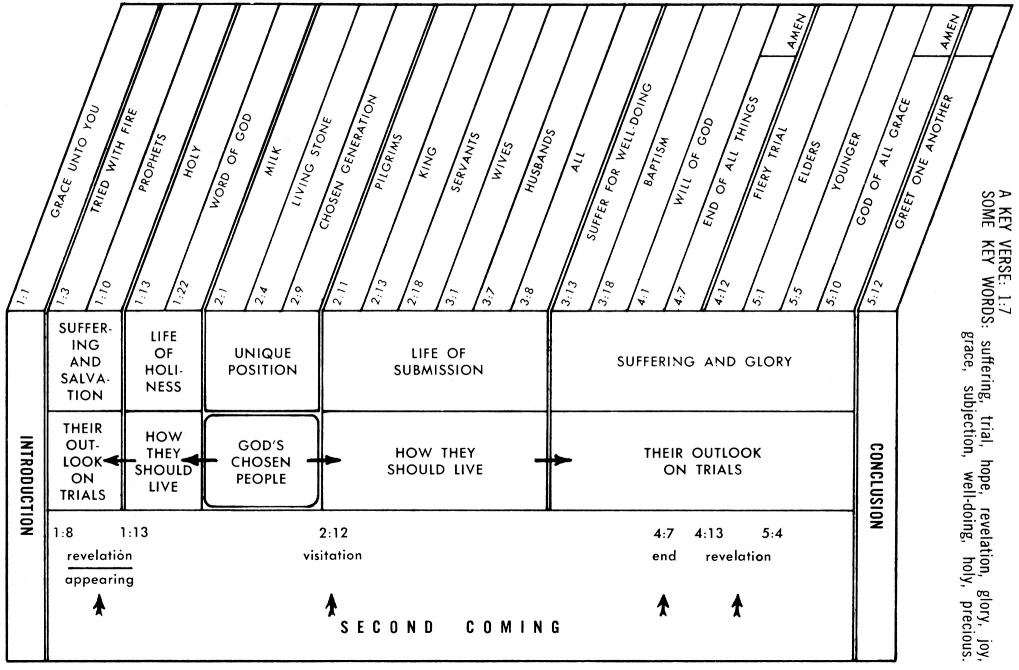
1 Peter: Trials, Holy Living & The Lord's Coming
Click chart to enlarge
Chart from Jensen's Survey of the NT - used by permission
See Another Chart from Charles Swindoll
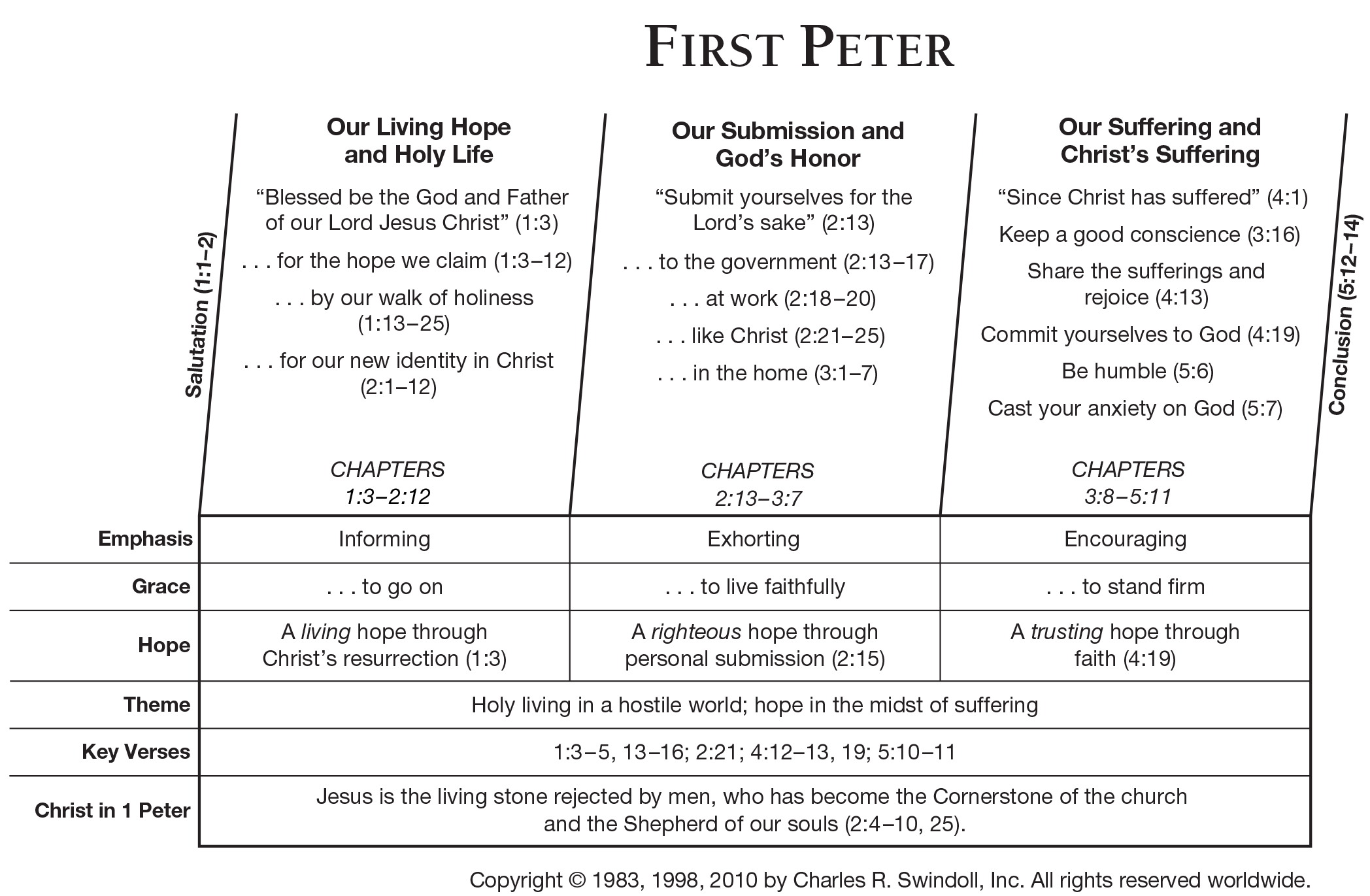
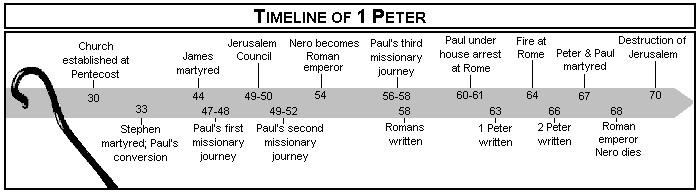
Source: Borrow Ryrie Study Bible
Click to enlarge
1 Peter 2:4 And coming (PMPMPN) to Him as to a living (PAPMSA) stone which has been rejected (RPPMSA) by men, but is choice and precious in the sight of God (NASB: Lockman)
Greek: pros on proserchomenoi, (PMPMPN) lithon zonta, (PAPMSA) hupo anthropon men apodedokimasmenon (RPPMSA) para de theo eklekton entimon, (NASB: Lockman)
ESV As you come to him, a living stone rejected by men but in the sight of God chosen and precious,
KJV To whom coming, as unto a living stone, disallowed indeed of men, but chosen of God, and precious,
NET So as you come to him, a living stone rejected by men but chosen and priceless in God's sight,
NLT You are coming to Christ, who is the living cornerstone of God's temple. He was rejected by people, but he was chosen by God for great honor.
Phillips: To change the metaphor, you come to him, as living stones to the immensely valuable living stone (which men rejected but God chose), to be built up into a spiritual House of God, in which you, like holy priests, can offer those spiritual sacrifices which are acceptable to God by Jesus Christ. (Phillips: Touchstone)
Wuest: toward whom we are constantly drawing near, himself in character a Living Stone, indeed by men repudiated after they had tested Him for the purpose of approving Him, in which investigation they found Him to be that which did not meet their specifications, but in the sight of God a chosen-out One and highly honored and precious.
Young's Literal: to whom coming -- a living stone -- by men, indeed, having been disapproved of, but with God choice, precious,
AND COMING TO (toward, facing) HIM AS TO A LIVING STONE: pros on proserchomenoi (PMPMPN) lithon zonta (PAPMSA):
- Isa 55:3; Jer 3:22; Mt 11:28; Jn 5:40; 6:37) (Living Stone - Jn 5:26; 6:57; 11:25,26; 14:6,19; Ro 5:10; Col 3:4
- Isa 28:16; Da 2:34,45; Zech 3:9; 4:7
- 1 Peter 2 Resources - Multiple sermons and commentaries
Related Resource: Christ the Stone
Spurgeon comments that...
The Christian life is begun, continued, and perfected altogether in connection with the Lord Jesus Christ....He is the author and He is the finisher of our faith. We have not to seek a fresh physician, to find a new friend or to discover a novel hope, but we are to look for everything to Jesus Christ, "the same yesterday, and today, and forever." "Ye are complete in Him." Here is a complete description of the Christian life. It is a continuous "coming" to Jesus.
We should be always coming to Christ; we have come to Him, and we-are coming to Him, and we will keep on coming to Him
Sinking down, settling, resting on that stone,-always pressing closely upon Christ: “To Whom coming, as unto a living Stone"
Christ always was disallowed of men, and He always will be, until the great consummation of all things. Some disown Him in one way, some in another. Some boldly blaspheme Him with something like honesty; others pretend to be His ministers, yet all the while are undermining the Gospel which He lived and died to preach. It matters little that Christ is “disallowed indeed of men,” for He is “chosen of God, and precious.” (1 Peter 2 Commentary)
Now to answer the question, what is the rest way of coming to Christ at first?
1. The very best way to come to Christ is to come with all your needs about you. If you could get rid of half your needs apart from Christ, you would not come to Jesus half so well, for your need furnishes you with motives for coming, and gives you pleas to urge. Suppose a physician should come into a town with motives of pure benevolence to exercise the healing art. What he wants is not to make money, but to bless the townsmen. He has a love to his fellow men, and he wants to cure them, and therefore he gives notice that the poorest will be welcome, and the most diseased will be best received. Is there a deeply sin-sick soul anywhere? Is there man or woman who is bad altogether? Come along, you are just in a right condition to come to Jesus Christ. Come just as you are, that is the best style of "coming."
2. If you want to know how to come aright the first time, I should answer, Come to find everything you want in Christ. I heard of a shop some time ago in a country town where they sold everything, and the man said that he did not believe that there was anything a human being wanted but what he could rig him out from top to toe. Well, I do not know whether that promise would have been carried out to the letter if it had been tried, but I know it is so with Jesus Christ; He can supply you with all you need, for "Christ is all."
3. The best way to come to Christ is to come meaning to get everything, and to obtain all the plenitude of grace which He has laid up in store and promised freely to give.
What is the best way to come afterwards? The answer is—Come just as you used to come. The text does not say that you have come to Christ, though that is true, but that you are coming; and you are to be always coming. The way to continue coming is to come just in the same way as you came at first. (Biblical Illustrator)
In another place Spurgeon wrote on "coming to Him" - Everywhere throughout Scripture the connection between the saints and their Head is perpetually mentioned. "In Christ" is the very symbol of New Testament writers. Whatever choice and good things are mentioned concerning the saints, their privileges and honors, we are always reminded that they are only enjoyed in connection with the Lord Jesus, according as the Father has blessed us in Him and made us to be accepted in the Beloved. Coming unto Him as a foundation we become a temple, coming to Him as the Holy One of Israel we become a holy priesthood, and resting in His sacrifice we also offer spiritual sacrifices. Coming close to Him—for such is the force of the word (proserchomai)—coming closer and closer, we grow up in all things into Him and become perfect in Christ Jesus. The way to be coming to Christ as long as ever you live is to lean more on Christ, press more heavily on Christ, and depend more upon Christ than ever you did. In this way, you know, some stones seem, by long abiding and pressing, to cleave to one another, and unite together till they appear to be no longer distinct, but one mass. Have you not often noticed in an old Roman wall that you cannot distinguish the mortar from the stone? You cannot tell where the stones were joined; they have grown to be one piece. And blessed is that Christian who, like a living stone, has continued so to come to the foundation till Christ and he have become one, as it were—indeed, one in conscious fact, so that nothing can divide them. Thus we continue still to come to Jesus, and draw nearer to Him; nearer and yet nearer still, built up into Him, perfectly joined in one spirit. Then, only then, shall Christian life be perfected. I remember seeing a somewhat famous portrait of our Lord in which the artist never lifted his pencil from the paper from beginning to end, but drew the whole of it with one continuous series of circles. So here I may say the whole Christian life is drawn in one line—coming unto Christ. “To whom you are drawing near.”
Coming (4334) (proserchomai from prós = facing + érchomai = come) means literally to come facing toward and so to approach or come near. To come to visit or associate with. It describes the approach to or entry into a deity’s presence. Proserchomai conveys not just drawing close to Christ for salvation, but drawing near to Christ in intimate, abiding, personal fellowship. The idea in this context is movement of the entire inner person of the believer into the experience of intimate and ongoing communion with Jesus Christ.
In the Septuagint (LXX) proserchomai was the verb used to describe the approach of the priests to Jehovah for worship and to perform of their priestly (Levitical) functions. But under the New covenant, all seven uses of proserchomai refer to believers possessing the privilege of access to God the Father through Christ the Great High Priest.
To (4314) (pros) means facing or toward and with the verb in the present tense pictures a habitual or continual drawing near to Christ, and thus describes an intimate association with Jesus the Living Stone.
If we are going to be a spiritual temple for God's presence, and if we are going to be a holy priesthood and if we are going to offer spiritual sacrifices acceptable to God, then we must day by day, hour by hour come to Christ. It is by coming to Christ that believers enter the realm of spiritual privilege.
The Savior's invitation has always been to come to Him...
Come to Me, all who are weary and heavy-laden, and I will give you rest. "Take My yoke upon you, and learn from Me, for I am gentle and humble in heart; and YOU SHALL FIND REST FOR YOUR SOULS. "For My yoke is easy, and My load is light." (Mt 11:28-30)
Christ Alone is the the Stone in Whom all spiritual blessings abound as Paul writes in a beatitude to God...
Blessed be the God and Father of our Lord Jesus Christ, who has blessed us with every spiritual blessing in the heavenly places in Christ (See note Ephesians 1:3)
A living stone - A stone that gives life (see Col 3:4) and sustenance, Christ is the fulfillment of the rock smitten in the wilderness which brought life-sustaining water to God's people (Ex 17:6; Nu 20:8; 1Cor 10:4).
Wuest notes that...
The article is not used with the expression (living stone), showing that emphasis is placed upon character or quality (the living quality and divine character of Jesus Christ). He is in character a Living Stone.
Living (2198) (zao) is the verb describing natural physical life and thus having and exhibiting life, the quality that distinguishes a vital and functional being from one that is dead. Present tense means continuously living - Christ lives forever as the Eternal God. And as the living God, He is the Source of life to all who place their faith in His perfect, once for all, substitutionary sacrifice...
Blessed be the God and Father of our Lord Jesus Christ, who according to His great mercy has caused us to be born again to a living hope through the resurrection of Jesus Christ from the dead (See 1Pe 1:3 - 1 Timothy 1:1 teaches that Christ is our Hope, our Living Hope.)
for you have been born again not of seed which is perishable but imperishable, that is, through the living and abiding word of God. (1Pe 1:23 - John 1:1 teaches that Christ is the Living Word of God).
Jesus as the Living One and the Source of life declared...
For just as the Father raises the dead and gives them life, even so the Son also gives life to whom He wishes. (John 5:21)
"I am the living bread that came down out of heaven; if anyone eats of this bread, he shall live forever; and the bread also which I shall give for the life of the world is My flesh."
The Jews therefore began to argue with one another, saying, "How can this man give us His flesh to eat?"
Jesus therefore said to them, "Truly, truly, I say to you, unless you eat the flesh of the Son of Man and drink His blood, you have no life in yourselves. He who eats My flesh and drinks My blood has eternal life, and I will raise him up on the last day. (John 6:51-54)
Paul contrasting the first Adam by whom sin and death entered with the last Adam, Christ, through Whom life is made available to all who would come to Him...
So also it is written, "The first MAN, Adam, BECAME A LIVING SOUL." The last Adam became a life-giving spirit. (1Cor 15:45)
In Colossians Paul declared
Christ...is our life (See note Colossians 3:4)
John explained how believers can experience abundant life writing...
By this the love of God was manifested in us, that God has sent His only begotten Son into the world so that we might live through Him. (1John 4:9)
Stone (3037) (lithos) literally refers to a concretion of earthy or mineral matter and in Scripture sometimes refers to a carved precious stone, but also means building stone, which is the metaphorical meaning that best fits Peter's later description of Christ as the Corner Stone.
In the Old Testament Moses describes God (Christ, for He is Jehovah in the OT) as the only rock
"For I proclaim the name of Jehovah; Ascribe greatness to our God! "The Rock! His work is perfect, For all His ways are just; A God of faithfulness and without injustice, Righteous and upright is He...Indeed their rock is not like our Rock, Even our enemies themselves judge this. (Deut 32:3-4, 31)
Paul explains who Israel in the OT was drinking from writing that...
all drank the same spiritual drink, for they were drinking from a spiritual rock which followed them; and the rock was Christ. (1 Cor 10:4) (Comment: This again substantiates that the Jehovah of the OT is Jesus of the NT, the same yesterday, today and forever. Amen!)
Jehovah was the foundation and the strength of His people Israel in the OT and of believers in the NT. Do you know Him as your Rock?
Rock of Ages, cleft for me,
Let me hide myself in Thee;
Let the water and the blood,
From Thy wounded side which flowed,
Be of sin the double cure;
Save from wrath and make me pure. (Play)
Anecdote on Living Stone - When missionary David Livingstone, died alone in the heart of Africa, his native porters found him kneeling beside his bed. They cut out his heart and buried it in his beloved Africa. Then they took his body and handed it over to the British authorities. It was transported back to England and laid to rest in Westminster Abbey amid the mourning nation. A brass plate in the floor marks the spot, and a text tells the tale: "Other sheep have I which are not of this fold, them also I must bring." Such was his noble epitaph. However, he had another one. one of Britain's periodicals said it best. Across its front page in banner headlines, it carried the legend: Granite may crumble, but this is LIVINGSTONE!
Peter is picturing the believer's continual drawing near to Christ as their Rock, the strong, living One, Who David's learned through trials and afflictions was His eternal, steadfast Rock, prompting this beautiful description in Psalm 18...
The LORD is my rock and my fortress and my deliverer, My God, my rock, in whom I take refuge; My shield and the horn of my salvation, my stronghold.
For who is God, but the LORD? And who is a rock, except our God,
The LORD lives, and blessed be my rock; And exalted be the God of my salvation, (Psalms 18:2, 31, 46)
Spurgeon's comments on the Rock in Psalm 18...Dwelling among the crags and mountain fastnesses of Judea David had escaped the malice of Saul, and here he compares his God to such a place of concealment and security. Believers are often hidden in their God from the strife of tongues and the fury of the storm of trouble. The clefts of the Rock of Ages are safe abodes. [Note v2]... Who is a rock save our God? Where can lasting hopes be fixed? Where can the soul find rest? Where is stability to be found? Where is strength to be discovered? Surely in the Lord Jehovah alone can we find rest and refuge. [Verse 31]... And blessed be my rock. He is the ground of our hope, and let him be the subject of our praise. Our hearts bless the Lord, with holy love extolling him. Jehovah lives, my rock be blessed! Praised be the God who gives me rest! [Verse 46] The LORD lives, and blessed be my rock; And exalted be the God of my salvation,)
See Related Resources:
REJECTED BY MEN BUT CHOICE AND PRECIOUS IN ("by the side of") THE SIGHT OF GOD: hupo anthropon men apodedokimasmenon (RPPMSA) para de theo eklekton entimon:
- Ps 118:22,23; Isa 8:14,15; Mt 21:42; Mk 12:10,11; Lk 20:17,18; Acts 4:11,12
- Isa 42:1; Mt 12:18, 7; 1:7,19; 2Pet 1:1,4
- 1 Peter 2 Resources - Multiple sermons and commentaries
REJECTED BY MEN
CHOICE BEFORE GOD!
Peter identifies the Messiah, the Christ, as the Living Stone (see note 1 Peter 2:4), the Corner Stone (see note 1 Peter 2:6), the Rejected Stone (see note 1 Peter 2:7), and the Stumbling Stone (see note 1 Peter 2:8).
Spurgeon - When men disallow Christ, it is a matter of small account to us, as for what they have to say, it is less than nothing and vanity. Like the wild bluster of the winds, let it bluster until it has blown itself out. Christ is “disallowed indeed of men, but chosen of God, and precious,” 1 Peter 2 Commentary)
Rejected by men - This refers first to Messiah's rejection by the Jewish leaders and Jews who demanded Christ’s crucifixion and then to all who have rejected Christ over all the ages.
Rejected (593) (apodokimazo from apo = off, away from, pictures separation of one thing from another + dokimazo = to test, examine, scrutinize to see whether a thing is genuine or not) means to reject or refuse to accept something or someone after testing, scrutiny or examination.
The preposition apo- speaks of separation and thus conveys the picture of rejecting completely.
It means to examine and deem as useless.
It means to judge something or someone as not being fit, worthy or genuine and thus something or someone to be rejected.
It means to throw out as the result of a test, to put out of office, to repudiate, to disapprove or to declare useless.
Eight of the nine NT uses of apodokimazo refer to men's (primarily Israel and her leaders who should have known better) rejection of the Messiah as genuine, worthy, qualified!
The perfect tense speaks of the permanent nature of this rejection. Jesus was rejected by men and their rejection remained in effect.
Moulton and Milligan record this secular use of apodokimazo "a girdle-dagger suitable for the present purpose has not been found, and I have not thought it right to buy one that might be rejected.
Richards - Apodokimazo indicates putting something or someone to the test and rejecting that object or person as unfit or not genuine. (Richards, L O: Expository Dictionary of Bible Words: Regency)
Wuest writes that apodokimazo...
refers to the act of putting someone or something to the test for the purpose of putting one’s approval upon that person and thus receiving him, this act of testing being carried to the point where no further testing is needed, with the result that one comes to the settled conclusion that the one tested does not meet the requirements of the test and is therefore disapproved, repudiated.
This Living Stone in the Person of God the Son became incarnate, lived for thirty-three years in the midst of Israel, offered Himself as its Messiah, was examined by official Israel for the purpose of approving Him as its Messiah, and then repudiated because He was not what official Israel wanted in a Messiah. What a commentary on the totally depraved condition of man’s heart. (Wuest, K. S. Wuest's Word Studies from the Greek New Testament: Eerdmans)
The paradoxical picture is that the perfect Lamb of God, the Creator of the Universe, was rejected by His creation, men who had carefully evaluated the perfect God Man and found Him not "passing their test"! What a striking contrast with scene John witnessed in heaven...
And I looked, and I heard the voice of many angels around the throne and the living creatures and the elders; and the number of them was myriads of myriads, and thousands of thousands, saying with a loud voice, "Worthy is the Lamb that was slain to receive power and riches and wisdom and might and honor and glory and blessing." (See notes on Revelation 5:11, 5:12)! And all God's people say "Amen!"
When the Jewish leaders looked at the Stone (Christ) Who "invaded" their religious world, He was not wanted, did not fit in with their theological plans and was useless and unfit for what they were building.
Men by their Adamic nature are rebels to the core and thus continue to reject Jesus for much the same reason -- they want to build their own "castles" the way they want (Pr 14:12, 16:25) doing what is right in their own eyes, living unrestrained by His call to holiness and godliness made available through His indwelling Spirit: (cp Judges 21:25 note, Pr 29:18).
John MacArthur explains that...
Because the Jewish leaders were looking for the Messiah, when Jesus claimed to be the Christ (Matt. 26:63, 64; John 1:49, 50, 51; 4:25, 26; cf. Matt. 16:13-20; Luke 4:14-21) they examined His claim. Based on their blind hearts and false standards (Matt. 12:2, 10, 38; 15:1, 2; 16:1; Mark 12:13–34; John 8:12–27), they concluded that He did not measure up, so they rejected Him (John 19:7, 12, 15; cf. 7:41–52; 12:37, 38).
Contempt and hatred characterized their rejection (Matt. 26:57–68; 27:20, 21, 22, 23, 24, 25, 39, 40, 41, 42, 43; Mark 12:12; Luke 6:11; 13:14; John 8:59; 10:31, 39; cf. Luke 4:28, 29, 30); it was unthinkable to them that Jesus could possibly be the cornerstone of God’s kingdom (cf. Ps 118:22).
They viewed Him as one who foolishly denounced their religious system (cf. Matt. 23:1–36; Mark 8:13–21), was too weak and humble to overthrow the occupying Romans and secure the Jews’ national freedom, and was willing to die ignominiously on a cross (Mt. 17:22, 23; 20:17, 18, 19; Mark 9:30, 31, 32; Luke 18:31, 32, 33, 34). He simply did not measure up to any of the Jewish establishment’s expectations. (MacArthur, J. 1 Peter. Chicago: Moody Press)
Apodokimazo is used 9 times in the NT...
Matthew 21:42 Jesus said to them, "Did you never read in the Scriptures, 'The stone which the builders rejected, This became the chief corner stone; This came about from the Lord, And it is marvelous in our eyes '?
Mark 8:31 And He began to teach them that the Son of Man must suffer many things and be rejected by the elders and the chief priests and the scribes, and be killed, and after three days rise again.
Mark 12:10 "Have you not even read this Scripture: 'The stone which the builders rejected, This became the chief corner stone;
Luke 9:22 saying, "The Son of Man must suffer many things, and be rejected by the elders and chief priests and scribes, and be killed, and be raised up on the third day."
Luke 17:25 "But first He must suffer many things and be rejected by this generation.
Luke 20:17 But He looked at them and said, "What then is this that is written, 'The stone which the builders rejected, This became the chief corner stone'?
Hebrews 12:17 For you know that even afterwards, when he desired to inherit the blessing, he was rejected, for he found no place for repentance, though he sought for it with tears.
1 Peter 2:4 And coming to Him as to a living stone, rejected by men, but choice and precious in the sight of God,
1 Peter 2:7 This precious value, then, is for you who believe. But for those who disbelieve, "The stone which the builders rejected, This became the very corner stone,"
Apodokimazo is found 6 times in the LXX (Ps 118:22; Jer 6:30; 7:29; 8:9; 14:19; 31:37) Here is a representative use in Jeremiah...
Jeremiah 6:30 They call them rejected (Lxx = apodokimazo) silver, because the LORD has rejected (Lxx = apodokimazo) them. (Comment: In this verse God says Judah has been tested as one assays metals for impurities and that their sin has prevented them from being pure silver. Thus they have failed God's test are rejected as one would a precious metal that failed the test of purity! Here God is using a word picture describing the siege of Jerusalem. When God turned on the furnace [the Babylonian siege], it would reveal the people as rejected silver, nothing but dross to be thrown away. He wasn’t purifying them. He was punishing them. They weren’t being refined. They were being rejected. They were too cheap to preserve!)
But (de) - Always pause to ponder this important term of contrast which marks a change "direction" so to speak. Ask what is the change?
Choice (1588) (eklektos from eklegomai = choose, select; pick out for one's self ) means one chosen for one's self, one who is select, excellent. This word indicates that God elected and ordained Christ.
Precious (1784) (entimos from en = in + time = honor, esteem, price) means honored, estimable, dear, costly, spoken here of Christ as a rare, highly prized stone.
The Psalmist writing of the Messiah declares...
Thou art fairer (Hebrew = bright, beautiful; LXX - kallos = beauty) than the sons of men; Grace is poured upon Thy lips; Therefore God has blessed Thee forever. (Psalm 45:2 - Spurgeon's comment)
In the sight of God - Sight is para (3844) which means beside, near, nearby and expressing the idea of immediate vicinity or proximity. This literally reads "but beside or near God" which is a picture of the eternal, incomprehensible, intimate fellowship in the Godhead (Triune God).
Matthew describes the Father's approval of His Son...
And after being baptized, Jesus went up immediately from the water; and behold, the heavens were opened, and he saw the Spirit of God descending as a dove, and coming upon Him, and behold, a voice out of the heavens, saying, "This is My beloved Son, in whom I am well-pleased (take delight or pleasure in)." (Matthew 3:16-17)
John Henry Jowett...
Here, then, is the threefold preparation of the individual for a family life of intimate and fruitful fellowship—a personal experience of grace, the expulsion from the life of all uncleanness, and the adoption of a rigorous and uncompromising ideal. The whole preparatory process is begun, continued, and ended in Christ. In Christ the individual is lodged, and in His grace, which is all-sufficient, he finds an abundant equipment for the spacious purpose of his perfected redemption.
Now, let us assume that the individual is ready for the fellowship. We have got the unit of the family. We have got the “living stone.” cleansed, shaped, dressed, ready to be built into the “spiritual house.” How, now, shall the society be formed? What shall be its cement? What shall be its binding medium, and the secret of its consistency? Here are the “living stones”; what shall we do with them? “Unto whom coming . . . as living stones ye are built up a spiritual house.” [1Pe 2:4, 5]
“Unto whom coming!” The living stones are to find their bond of union in the living Christ. The alpha of all enduring communion is Christ. We cannot prepare the individual stones without Christ. We cannot build the individual stones into a house without Christ. He is the “corner stone,” and the pervading strength of every enduring structure. What is the implication of all this? It is this. We cannot have society without piety. We may have juxtapositions, connections, clubs, fleeting and superficial relationships, but the only enduring brotherhood is the brotherhood which is built upon faith. Apart from the Christ there can be no social cohesion. The “Word of God proclaims it, and history confirms it. Every preposition seems to have been exhausted by the Word of God in emphasizing the necessity of a fundamental relationship with Christ—“in Christ,” “through Christ,” “by Christ,” “with Christ,” “unto Christ.” In every conceivable way Christ is proclaimed as the all-essential. In seeking to create societies we have therefore got to reckon with the Christ. We cannot ignore Him. He will not be ignored. We either use Him or we fall over Him. We use Him and rise into strength, or we neglect Him and stumble into ruin. We either make Him the “head of the corner,” [1Pe 2:7, 8] or He becomes our “stone of stumbling, and a rock of offence.” Societies and families and nations, which are not built upon the Christ, fall to pieces, thrown into ruin by the very “law of the spirit of life.” But have not societies been built upon the Christ, and yet been far from manifesting the glory of a radiant, family communion? Look at the sects! Is not Christ the corner stone, and yet where is the sweet communion? Ah! it is when the different communities have got away from the Christ that their communion has been destroyed. It is when the sects get away from the spirit of the Christ, when they become wranglers about a letter, when they are heated by the fever of personal vanity, and lust for the spoils of sectarian triumph—it is then that the spiritual house collapses, and lies scattered in a heap of inhospitable fragments. But when we build upon Him, when He, and He only, is “the preciousness,” when all our personal aims are merged in line with His, when we have the Spirit of Christ, then are we bound into a gracious communion, into a vital and fundamental unity. And into what is He prepared to build us? This chapter is overflowing in the wealth of the figures by which it seeks to express the glorious mission. He will build us into a “spiritual house,” [1Pe 2:5] a spacious home, enclosing but one tenant, the gracious Spirit of God. He will distinguish us as “an elect race,” [1Pe 2:9] moving in the world, yet not of it, standing out in strong relief from the discordant and fragmentary life by which it is surrounded. He will endow us with all the dignities of “a royal priesthood,” having kingly and priestly prerogatives, reigning with Christ in the realm of the spirit and exercising a powerful ministry of intercession in the most holy presence of God. He will constitute us “a holy nation,” a people whose policies shall be purities, and whose state craft shall just be the enlightened administration of large and unselfish minds. This is what our God is prepared to make of us. It is a great ideal, but then we have a great Father and a great Saviour and a mighty Spirit, and vast ideals are native to the very spirit of our redemption. It is a grand house which the Lord would build, and if only He had the stones the majestic edifice would speedily be reared. (Epistles of St. Peter)
1 Peter 2:5 you also, as living (PAPMPN) stones, are being built up (2PPPI) as a spiritual house for a holy priesthood, to offer up (AAN) spiritual sacrifices acceptable to God through Jesus Christ
Greek: kai autoi os lithoi zontes (PAPMPN) oikodomeisthe (2PPPI) oikos pneumatikos eis hierateuma hagion, anenegkai (AAN) pneumatikas thusiav euprosdektous [to] theo dia Iesou Christou.
Amplified: [Come] and, like living stones, be yourselves built [into] a spiritual house, for a holy (dedicated, consecrated) priesthood, to offer up [those] spiritual sacrifices [that are] acceptable and pleasing to God through Jesus Christ. (Amplified Bible - Lockman)
Phillips: To change the metaphor, you come to him, as living stones to the immensely valuable living stone (which men rejected but God chose), to be built up into a spiritual House of God, in which you, like holy priests, can offer those spiritual sacrifices which are acceptable to God by Jesus Christ. (Phillips: Touchstone)
Wuest: And you yourselves also as living stones are being built up a spiritual house to be a priesthood that is holy, bringing up to God’s altars spiritual sacrifices which are acceptable to God through the mediatorship of Jesus Christ.
Young's Literal: and ye yourselves, as living stones, are built up, a spiritual house, a holy priesthood, to offer up spiritual sacrifices acceptable to God through Jesus Christ.
YOU ALSO, AS LIVING STONES: kai autoi os lithoi zontes (PAPMPN):
- 1Co 3:16; 6:19; 2Co 6:16; Eph 2:20, 21, 22; Heb 3:6; Rev 3:12) (1Cor 3:16, 6:19, 2Cor 6:16
- 1 Peter 2 Resources - Multiple sermons and commentaries
Believers are not only living stones, but they are also temples! Beloved, when was the last time you paused to ponder the privileges bestowed to us in Christ? Take a moment now to praise and thank God for so great a salvation!
1Cor 3:16 Do you not know that you are a temple of God, and that the Spirit of God dwells in you?
1Cor 6:19 Or do you not know that your body is a temple of the Holy Spirit who is in you, whom you have from God, and that you are not your own?
2Cor 6:16 Or what agreement has the temple of God with idols? For we are the temple of the living God; just as God said, “I WILL DWELL IN THEM AND WALK AMONG THEM; AND I WILL BE THEIR GOD, AND THEY SHALL BE MY PEOPLE.
The King James has "lively stones!" One wonders how many churches would appear to outsiders as composed of "lively" saints! Not busy saints, but alive, abiding to the Vine, bearing fruit with endurance as the Spirit enables. Which best describes your church: Lively or Busy. There is a difference!
Phillips paraphrase:
To change the metaphor, you come to Him, as living stones to the immensely valuable living Stone (Phillips)
John describes the future destiny of every living stone - they will have an eternal purpose (O, the wonder of amazing grace, which gives saved sinners such an undeserved, high and holy purpose! Hallelujah!)...
Rev 3:12 ‘He who overcomes (not a special class, but the description of a true believer - compare 1Jn 5:4,5), I (Jesus is the Architect/Builder promising that He) will make him a pillar in the temple of My God, and he will not go out from it anymore; and I will write upon him the name of My God, and the name of the city of My God, the new Jerusalem, which comes down out of heaven from My God, and My new name.
The Psalmist speaking primarily of OT saints alludes to the privilege that NT believers possess...
How blessed is the one whom Thou dost choose, and bring near to Thee, to dwell in Thy courts. We will be satisfied with the goodness of Thy house, Thy holy temple. (Psalm 65:4)
Spurgeon's comments on Psalm 65:4 represent his rich meditations to help us consider the incomprehensible reality that we who were once lost and dead in our trespasses and sins are now living stones in the house of the Living God.
Spurgeon writes:
After cleansing comes benediction, and truly this is a very rich one. It comprehends both election, effectual calling, access, acceptance, and sonship.
First, we are chosen of God, according to the good pleasure of His will, and this alone is blessedness.
Then, since we cannot and will not come to God of ourselves, He works graciously in us, and attracts us powerfully; He subdues our unwillingness, and removes our inability by the almighty workings of His transforming grace. This also is no slight blessedness.
Furthermore, we, by His divine drawings, are made nigh by the blood of His Son, and brought near by His spirit, into intimate fellowship; so that we have access with boldness, and are no longer as those who are afar off by wicked works: here also is unrivalled blessedness.
To crown all, we do not come nigh in peril of dire destruction, as Nadab and Abihu did, but we approach as chosen and accepted ones, to become dwellers in the divine household: this is heaped up blessedness, vast beyond conception. But dwelling in the house we are treated as sons, for the servant abideth not in the house for ever, but the Son abideth ever.
Behold what manner of love and blessedness the Father has bestowed upon us that we may dwell in His house, and go no more out forever. Happy men who dwell at home with God. May both writer and reader be such men.
That he may dwell in thy courts. Acceptance leads to abiding: God does not make a temporary choice, or give and take; His gifts and calling are without repentance. He who is once admitted to God's courts shall inhabit them for ever; he shall be
No more a stranger or a guest,
But like a child at home.
Permanence gives preciousness. Terminating blessings are but half blessings. To dwell in the courts of the Great King is to be ennobled; to dwell there forever is to be emparadised: yet such is the portion of every man whom God has chosen and caused to approach unto Him, though once his iniquities prevailed against him. (Spurgeon's Note)
You...living stones - Peter's readers became living stones by grace through faith which resulted their union with the eternal life of Christ and on the basis of this unbreakable union with Christ, have spiritual resources to meet their every need. In his second epistle Peter further explains their (our) privileged position writing that...
For by these (Christ's own glory and excellence) He has granted to us His precious and magnificent promises, in order that by them you might become partakers (sharers) of the divine nature, having escaped the corruption that is in the world by lust. (See note 2 Peter 1:4)
Comment: Believers as living stones like their Lord have continual privileged access His presence and power. Are you "taking advantage" of your privileged position as a living stone?
Paul explains to living stones, those who are aliens (in spiritual terms) in their relationship to this evil world system, that they...
are no longer strangers and aliens (in the spiritual sense), but you are fellow citizens with the saints, and are of God's household, having been built upon the foundation of the apostles and prophets, Christ Jesus Himself being the corner stone, in whom the whole building, being fitted together is growing into a holy temple in the Lord; in whom you also are being built together into a dwelling of God in the Spirit. (Eph 2:19-22-notes 2:19; 2:20; 2:21; 2:22)
Each time someone trusts Christ, another "stone" is quarried out of the rock pit of sin and cemented (eternally) by (new covenant) grace into the building, the Church, the Body of Christ. It may look to us that the Church on earth is a pile of rubble and ruins (and too often lacking unity between the component stones), but God sees the total structure as it grows
Living (2198) (zao) speaks of natural physical life but here speaks of spiritual life (in Christ alone! cp Jn 20:31). The present tense signifies we are continually living stones. Death will not bring an end to this truth. We are immutably, irrevocably united by the new covenant (an eternal covenant - Heb 13:20 -note - this means God will NEVER break it. We cannot lose our salvation. We are eternally secure in this everlasting covenant.) to our Life, Christ Jesus (Col 3:4-note).
Spurgeon - All of you, who are in Christ Jesus, are the living stones in this spiritual temple; and you are also priests, who offer up spiritual sacrifices. You need no material temple, for you are yourselves the temple. You need no other priest save the great High Priest who has gone into the heavenly, for you are yourselves priests unto the Most High God. (1 Peter 2 Commentary)
How can a stone be living? A literal stone of course is not what Peter means. This is obviously a metaphor (term of comparison = metaphor) or picture of how God looks at Christ and at those who are identified or in union with Him. (cp "protected by the power of God" see1Pe 1:5-note). Spurgeon adds that "True believers are stones full of life, so joined to Christ as to be part of the live rock, instinct with spiritual vitality. God has quickened them from the dead. The Holy Spirit has come to take possession of them. Whereas once they were dead in trespasses (Eph 2:1-note) and sins they now live by the living seed that God has put into them, and the life that they live in the flesh is the life of Christ within them. “I no longer live,” said the apostle, “but Christ lives in me” (Gal 2:20-note). Can your eye of faith see that temple of God made up of living men and women, not alive through the life of the First Adam but alive through that Second Adam, of whom it is said, “The last Adam became a life-giving spirit” (1Cor 15:45)."
ILLUSTRATION: There is a famous story from Sparta. A Spartan king boasted to a visiting monarch about the walls of Sparta. The visiting monarch looked around and could see no walls. He said to the Spartan king, "Where are these walls about which you boast so much?" His host pointed at his bodyguard of magnificent troops. "These," he said, "are the walls of Sparta, every man a brick." The point is clear. So long as a brick lies by itself it is useless; it becomes of use only when it is incorporated into a building. So it is with the individual Christian. To realize his destiny he must not remain alone, but must be built into the fabric of the Church.
ARE BEING BUILT UP AS A SPIRITUAL HOUSE: oikodomeisthe (2PPPI) oikos pneumatikos:
BELIEVERS ARE
A SPIRITUAL HOUSE
So then you are no longer strangers and aliens, but you are fellow citizens with the saints, and are of God’s household, having been built on the foundation of the apostles and prophets, Christ Jesus Himself being the corner stone, in whom the whole building, being fitted together, is growing into a holy temple in the Lord, in whom you also are being built together into a dwelling of God in the Spirit. (Eph 2:19-22-notes Ep 2:19; 20; 21; 22).
Are being built (2026) (epoikodomeo from epi = upon, as placing one layer upon another + oikos = house + domeo = to build) literally means to build upon something that already exists or is already built. It pictures adding to the foundation or "building further." The present tense signifies this building up is a process and passive voice signifies it is not our power but the Spirit's power which builds the spiritual house (a good description of progressive sanctification).
A parallel use of epoikodomeo is found in...
Col 2:7 having been firmly rooted and now being built up (present tense = continual ~ a process; Passive Voice = force exerted from without, not "self" generated!) in Him and established in your faith, just as you were instructed, and overflowing with gratitude.
Jude 1:20 But you, beloved, building yourselves up (present tense but this time active voice - describes the process of daily sanctification, growth in Christlikeness) on your most holy faith; praying in the Holy Spirit;
We as a church are to be a corporate dwelling of God in the Spirit (The Spirit of UNITY! Church, how are you doing! Are you nursing unforgiveness, bitterness, etc, toward other "living stones?" Then confess and repent, for this the the Devil's Delight and his Disruption/destruction of the local body. His motto "Divide and conquer!"). It's true that each of us is the temple of the Holy Spirit (1Cor 6:19). But there is more of God to be known and enjoyed than any one can know in isolation. We are being fitted together, Paul says, for a temple and for a dwelling of God by his Spirit. There is a presence and power and manifestation of the Spirit of God meant to be known in this gathering of worship that we do not know at any other time in isolation.
Spurgeon - All those who are coming to Christ, daily coming nearer and nearer to Him, are as living stones built up into a temple. The saints in their corporate capacity are a holy temple unto the Lord. They are called a spiritual house in opposition to the old material house in which the emblem of the divine presence shone forth in the midst of Israel, that temple in which the Jew delighted, counting it to be beautiful for situation and the joy of the whole earth. We have nothing to do with material temples now. We are quite clear of that, for the typical has given way to the real and spiritual. Solomon’s temple itself is ever to be spoken of with honor, seeing that God did for a time make it the center of His worship. Yet it must not be too highly honored, for God never had any very great delight in its magnificence and wrought but few mighty deeds amid its splendors. We are a spiritual temple, but not the less real. That which is spiritual is sometimes supposed to be mythical and imaginary, but indeed it is not so. The things that are seen are the shadowy and the dreamy; the things that are not seen are the substantial and the eternal. Our Lord Jesus called His body the temple of God. He said, “Destroy this temple, and in three days I will raise it up” (John 2:19). As a temple of God, the body of Christ was most real. There was no fiction about His humanity. The Word was made flesh and tabernacled among us, so that the apostle John says, “We saw his glory, glory as of the one and only from the Father, full of grace and truth” (John 1:14). His perfect body was a true temple that God had pitched and not men, and just as true and real is the spiritual temple of which the text speaks.We are a spiritual house, and therefore spiritually built up. Peter says, “You are being built up”—built up by spiritual means. You cannot force men and women under rule and call them a church, nor even if they come together willingly will they be a temple for the Lord unless the divine Spirit shall fitly frame them together. God’s temple does not build itself, neither does man build it, but it is the sole work of God. The Spirit of God quarries out of the pit of nature the stones that are as yet dead, separating them from the mass to which they adhered. He gives them life and then He fashions, squares, polishes them. And they, without sound of axe or hammer, are brought each one to its appointed place and built up into Christ Jesus.
FOR A HOLY PRIESTHOOD: eis hierateuma hagion:
- Ex 19:6 Rev 1:6; 5:10, 20:6
- 1 Peter 2 Resources - Multiple sermons and commentaries
(Rev 1:6) and He has made us to be a kingdom, priests to His God and Father–to Him be the glory and the dominion forever and ever. Amen.
(Rev 5:10) “You have made them to be a kingdom and priests to our God; and they will reign upon the earth.”
For (eis) - literally into. We are priests but we are "works in progress" (being built).
Holy (40)(hagios = set apart ones, separated ones, sanctified ones, holy ones) is literally a holy one and depending on the context refers to whoever or whatever is set apart (sanctified) for a special purpose. Earlier Peter exhorted us to reject unholy desires that characterize our old life in Adam (1Pe 1:14-note) and pursue holy behavior (1Pe 1:15-16-note) which should characterize our new life in Christ. Beloved, if there is not obvious difference in your behavior after your profession of Christ as your Redeemer, then you need to soberly, sincerely ask whether you were ever truly saved by grace through faith. Holy behavior should be the general direction of your life if you are truly in Christ. And note that "direction" does not equate with "perfection." We all "blow it," some days worse than others. But when the Spirit convicts us and enables us to get back on our feet spiritually speaking, we again walk toward that which is holy, not unholy! Take a "spiritual inventory" of your life since your "conversion." You can't afford not to do this!!!
Paul uses hagios by itself (translated as "saints") as his favorite term for believers. The essence of hagios and the chief attribute of a saint is not a special pronouncement by an ecclesiastical body, but is the description of one who is set apart from that which is secular, profane, and evil and dedicated unto God, His worship and His service (note order - worship before service, cp Mary and Martha - Lk 10:38, 39, 40, 41, 42).
Priesthood (2406) (hierateuma from the verb hierateúo = to officiate as a priest) refers to the body of believers all of whom are priests to God. The only other use is in 1Peter 2:9-note. Living stones are a "holy" (set apart) and a "royal" priesthood.
Spurgeon - We hear of certain persons being “ordained” first deacons and then priests, but all who are truly in Christ, whether they are men, or women, or children, are priests. We are “a holy priesthood” if we are in Christ. See what Jesus Christ has made of you who believe in him; by the incorruptible blood and the incorruptible seed, he has brought you into a heavenly priesthood, and you are to-day to stand at the spiritual altar, and “to offer up spiritual sacrifices, acceptable to God by Jesus Christ.” Will you not pray, will you not praise, will you not love? These are sacrifices with which God is well pleased...You might have noticed, in reading the New Testament, that you never find the officers of a church called priests. Whenever that term is used by way of illustration, it is applied to all the people of God. They are all priests but, under the Christian dispensation, there is no set of men who have any right to take that title above their fellow-believers. All those who believe in Jesus Christ are priests, every one of them as much as all the others; and the assumption of priesthood under the Christian dispensation is most truly the repetition of the sin of Korah, Dathan, and Abirain, though the men who commit it usually try to lay the guilt of that sin at the doors of other people. We ministers are no more priests than all of you who believe in the Lord Jesus Christ are; we shake our skirts at the very thought of such wickedness; and cry, “God forbid that we should, with unhallowed hands, try to steal away from God’s people what is the right and prerogative of them all!” (1 Peter 2 Commentary)
In another place Spurgeon says - Each one is a priest, but all standing together they are a priesthood by virtue of their being one with Christ. “We who are many are one body in Christ” (Ro 12:5-note). Never let us cease to walk in unity and love, for we are all one in Christ Jesus, and what God has joined together let no man put asunder. Priesthood meant in Israel that these men were set apart to speak with God on behalf of the rest of the congregation. They had to offer the daily sacrifice and kindle the fire of the incense. Now, you who believe in Christ are all priests—priests for mankind, to speak for them to God. As man is spokesman for a dumb world, so are you intercessor for a sinful race. The priest, in addition to being the instructor of the people, was also their intercessor. So must you be. Do not cease, day nor night, to pray for men till God shall send forth His light into the darkest parts of the earth. You who make mention of the Lord, do not keep silence till the time to favor Zion has come. For you the chamber, and the parlor, and the workshop, and the open field, and the street are to be a place for the exercise of your priestly functions. Do you not see that it must be so, for you carry your temple with you? You yourselves make the temple, for you are the temple of God. You are always in your temple, for your body is your temple.
Believers are not merely passive buildings where God dwells but are active participants in the worship service. And not just participants, but a special kind of participant - set apart as His priests! Just the pastor or the elders? No. Peter says all of us. This is the great teaching about the "priesthood of all believers."
As priests of the Living God we have unfettered access to God through our Great High Priest Jesus Christ. The pastors do not take the sacrifice to the priest and watch while he takes it to the altar or to the tent of meeting with God. We all are called by God to approach the altar and the throne (draw near with confidence -- He 4:16, 10:19, 20, 22-see notes He 4:16, 10:19; 10:20, 10:22) and make our own personal sacrifice in our personal life and in corporate worship.
As priests we are called to be holy (1Pe 1:15-note), which by its very nature necessitates our continual dependence of the life giving Holy Spirit (Jn 6:63), taking care not to trust in our empty works to make us holy! (In the spirit of Paul's warning to the Corinthians in 1Cor 10:6,11, as holy priests of God we do well to recall the story of Nadab and Abihu in Lev 10:1-2-note!) We have been set apart for God, cleansed by the blood of the Lamb (cp the ordination ceremony of the Levitical Priesthood of Aaron and his sons where Moses applied blood of the sacrificial ram on the lobe of the right ear, thumb of the right hand, and big toe of the right foot - Lev 8:23-24-note See also Spurgeon's note below )through faith and enabled by the Spirit (Ro 8:13-note) we are to be dedicated to relentless and ruthless opposition to sin in our life, for the lusts of the flesh continually wage (Gk = strateuomai = strategic) war against our souls (1Pe 2:11-note). If our hand causes us to sin, Jesus instructs us to cut it off (figuratively but still calling for serious action - Mt 5:30-note). If our eye causes you to sin, gouge it out (again figuratively speaking - for example if you are being in bondage to pornography, get Covenant Eyes and a godly individual who will hold you accountable...under grace not law! - Mt 5:29-note). We are holy priest to the Most Holy God. We are a part of worship team, called "the holy priesthood." Without Spirit-wrought holiness we cannot offer spiritual sacrifices acceptable to God through Jesus Christ.
In the Old Testament period, God’s people had a priesthood composed of members only from the tribe of Levi, but today, all of God’s people are part of His holy priesthood. Each individual believer-priest has the privilege of (truly) coming into the presence of the Holy God (Heb 10:19-23-note). We do not come to God through any person on earth, but only through the one Mediator Jesus Christ (1Ti 2:5) our Great High Priest (Heb 4:14-note). Because He is alive in glory, interceding for us, we can minister as holy priests. This means that our lives should be lived as though we were priests in a temple.
Spurgeon speaks to holiness of God's priests - By the Holy Spirit’s application of our Lord’s merits believers are completely cleansed, and there remains neither spot nor wrinkle on their acceptance with Him. But though a man may be perfectly clean who leaves his bath, yet his feet may be soiled as he goes to his room and he needs again to wash them. So you and I need to pray, “Forgive us our sins,” (Ed: Beloved, if we are to ask daily for bread, is it to much to deduce that we are to ask daily for our Father's forgiveness? [Mt 6:9-10-note, Mt 6:11-12-note] Notice also that in 1Jn 1:9-note "confess" is present tense depicting confession as an ongoing process! cp Pr 28:13-note) though they have all been forgiven. We are washed, but daily defiling calls for constant cleansing.
As an aside note that the Latin word for priest is pontifex (See Pontifex Maximus in Roman times), which means bridge-builder which is not a bad theological picture, for the priest is the man who builds a bridge for others to come to God, and the Christian has the duty and the privilege of bringing others to the Corner Stone. And one way is by proclaiming (with our life and our lips) the excellencies of Him Who called us out of darkness and into His marvelous light (1Pe 2:9-note).
TO OFFER UP SPIRITUAL SACRIFICES: anenegkai (AAN) pneumatikas thusias:
- Ps 50:14,23; 141:2; Hos 14:2; Mal 1:11; Jn 4:22, 23, 24; Ro 12:1; Php 2:17; 4:18; Heb 13:15-16
- Hebrews 12:28,29 Ps 50:14,23 51:16,17, 141:2, Hosea 14:2 Mal 1:11
- 1 Peter 2 Resources - Multiple sermons and commentaries
Here is a great prayer for living stones to offer to God...
May my prayer be counted as incense before Thee; The lifting up of my hands as the evening offering. (Ps 141:3)
Here is a great attitude/action for living stones...
I urge you therefore, brethren, by the mercies of God, to present your bodies a living and holy sacrifice, acceptable to God, which is your spiritual service of worship. (Ro 12:1)
How is it possible for saved sinners to approach the thrice holy God with anything He would find acceptable or pleasing? The writer of Hebrews says...
Through Him (Christ, our Great High Priest, the one Mediator between God and man 1Ti 2:5) then, let us continually offer up (same verb Peter uses - anaphero - see below) a sacrifice of praise to God, that is, the fruit of lips that give thanks to His name. And do not neglect doing good and sharing (Note that worship and an attitude of gratitude precede the action. Worship of God before Work for God!); for with such sacrifices God is pleased (They "flow" through His Son - cp Jn 15:5). (Heb 13:15-16)
Spurgeon - We hear of certain persons being “ordained” first deacons and then priests, but all who are truly in Christ, whether they are men, or women, or children, are priests. We are “a holy priesthood” if we are in Christ. All the sacrifices that can now be offered are spiritual sacrifices, which are to be offered, not by a few special persons set apart for that work, but by the whole company of God’s chosen people, and so they are “acceptable to God by Jesus Christ.” (1 Peter 2 Commentary)
Offer up (399) (anaphero from ana = up, again, back + phero = bear, carry) literally means to carry, bring or bear up and so to to cause to move from a lower position to a higher position. It serves as a technical term for offering sacrifices offer up (to an altar).
Because Christ offered up His body (bore our sins = anaphero in 1Pe 2:24), we can now offer up (anaphero) spiritual sacrifices (including offering up OUR body!)
Anaphero- 9x -Mt 17:1; Mark 9:2; Luke 24:51; Heb 7:27; 9:28; 13:15; Jas 2:21; 1 Pet 2:5, 1Pe 2:24. NAS = bear, 1; bore, 1; brought, 1; led, 1; offer, 3; offered, 2.
Figuratively anaphero means to take up and bear sins by imputation (act of laying the responsibility or blame for) as typified by the ancient sacrifices.
Jesus our Great High Priest bore our sins as our substitutionary sacrifice, dying in our place, in order to bring about atonement for our sins. The priests in the Old Covenant could not bear our sins.
Wuest's paraphrase conveys Peter's allusion to the Old Testament sacrificial system -- Jesus
Himself carried up to (anaphero) the Cross our sins in His body and offered Himself there as on an altar. (1Pe 2:24)
It is notable that anaphero is used 25 times in the Septuagint translation of Leviticus regarding offerings! For example, Moses records that
Aaron's sons shall offer it up (anaphero = bear, carry) in smoke on the altar on the burnt offering, which is on the wood that is on the fire; it is an offering by fire of a soothing aroma to the LORD. (Lev 3:5)
Jesus, as our Great High Priest , offered up the sacrifice of Himself by bringing His body up to the Cross. Anaphero is used in Hebrews which records that Jesus
does not need daily, like those (Jewish) high priests, to offer up sacrifices, first for His own sins, and then for the sins of the people, because this He did once for all when He offered up Himself. (Heb 7:27)
Exodus discusses the parallel role of the OT high priests recording that
Aaron shall take away (to lift, to carry) the iniquity of the holy things which the sons of Israel consecrate, with regard to all their holy gifts; and (the turban) shall always be on his forehead, that they may be accepted before the Lord. (Ex 28:38)
This was but a shadow of which Jesus was the Substance.
Isaiah in his famous prophecy of the suffering Servant (the Messiah) records that
Surely our griefs He Himself bore, and our sorrows He carried. Yet we ourselves esteemed Him stricken, smitten of God, and afflicted. But He was pierced through for our transgressions, He was crushed for our iniquities. The chastening for our well-being fell upon Him, and by His scourging we are healed. All of us like sheep have gone astray, each of us has turned to his own way, but the Lord has caused the iniquity of us all to fall on Him." (Isa 53:4, 5, 6)
Isaiah adds that
"As a result of the anguish of His soul, He will see it and be satisfied; By His knowledge the Righteous One, My Servant, will justify the many, as He will bear (LXX also uses anaphero) their iniquities. Therefore, I will allot Him a portion with the great, and He will divide the booty with the strong, because He poured out Himself to death, and was numbered with the transgressors. Yet He Himself bore (LXX also uses anaphero) the sin of many, and interceded for the transgressors." (Isa 53:11, 12)
When John the Baptist saw "Jesus coming to him" he declared the fulfillment of Isaiah's prophecy (and all the OT Messianic prophecies for that matter) saying
"Behold, the Lamb of God who takes away (different verb = airo = literally lifting something up, figuratively here meaning to bear up and away like the scapegoat in Lev 16 on the Day of Atonement) the sin of the world!" (Jn 1:29)
The writer of Hebrews utilizing anaphero with a similar meaning as Peter (to refer to Christ's propitiatory or satisfactory sacrifice) records that
"Christ also, having been offered once to bear (anaphero) the sins of many, shall appear a second time for salvation without reference to sin, to those who eagerly await Him." (see note Hebrews 9:28)
Hebrews describes one role of NT believer priests: "Through Him (Jesus our Great High Priest) then, let us continually offer up (anaphero) a sacrifice of praise to God, that is, the fruit of lips that give thanks to His name." (Heb 13:15)
It is interesting to note that the Jewish people did not crucify criminals. They stoned them to death. But if the victim was especially evil, his dead body was hung on a tree until evening, as a mark of shame (Dt 21:23). Jesus died on a tree—a cross—and bore the curse of the Law (Gal 3:13). The force of ana = up, appears in the fact of the altar was in fact elevated.
Anaphero is often used of carrying from a lower to a higher place (Mt 17:1; Lk 24:51)
Anaphero is the term used most often in the Septuagint (LXX - Greek translation of the Hebrew OT) for the offering of sacrifice. The picture is literally of bringing up to the altar, keeping in mind that the altar was usually elevated (ana = up).
What are we to "offer up"? Spiritual sacrifices. What do these consist of? Our bodies (Ro 12:1), prayers of praise, thanksgiving and intercession (Heb 13:15,16), and material gifts for the full-time servants of God (Php 4:18 2:17 Ro 15:16).
Spiritual sacrifices are sacrifices from Christ and through Christ and for Christ. They get their power from the Spirit of Christ, they get their content from the Word of Christ, and they have their goal in the glory of Christ. And they flow only from a heart devoted to His power and His word and His glory. And that is the only kind of worship God accepts! (cp Jn 15:5)
Spurgeon on spiritual sacrifices - We offer spiritual sacrifices as opposed to the literal. There were sacrifices of bulls and goats under the law, as you know right well, yet the Lord never cared much for them, for the Holy Spirit when He spoke by men of old frequently set these things in the place of small esteem. In an evangelical frame of mind, deeply penitent for sin, the patriarch David was able to see the inefficiency of the legal offerings, and he wrote, “You do not delight in sacrifice or I would give it. With a burnt offering you are not pleased” (Ps 51:16). And again he says concerning thanksgiving, “it will be better than an ox or bull, horned and hoofed” (Ps 69:31). To the same effect and even more comprehensive is that expression in Ps 40, “Sacrifice and offering you do not desire … burnt offering and sin offering you have not demanded” (Ps 40:6). And what follows, “Then I said, ‘Look, I come. In the scroll of the book it is written concerning me, “I delight to do your will, O my God, and your law is deep within me” ’ ” (Ps 40:7).You and I bring no lambs or bulls, but we present a real sacrifice that is far more pleasing in His sight, for it is written, “The sacrifices of God are a broken spirit; a broken and a contrite heart, O God, you will not despise” (Psa51:17). The text that I have just quoted shows what our sacrifices are, for we imitate our Lord and say, “I delight to do your will, O my God.” This is the true sacrifice. Had not the Lord aforetime spoken by Samuel and said, “To obey is better than sacrifice; to give heed than the fat of rams” (1Sa 15:22)? So this day, when you do the will of God from your heart, when you studiously strive to find out what God’s will is and then conscientiously endeavor to attend to it, you are as priests offering spiritual sacrifices acceptable to God by Jesus Christ.
Spurgeon in Morning and Evening - "Spiritual Sacrifices" - Joshua the high priest standing before the angel of the Lord.—Zechariah 3:1 In Joshua the high priest we see a picture of each and every child of God, who has been made nigh by the blood of Christ, and has been taught to minister in holy things, and enter into that which is within the veil. Jesus has made us priests and kings unto God, and even here upon earth we exercise the priesthood of consecrated living and hallowed service. But this high priest is said to be “standing before the angel of the Lord,” that is, standing to minister. This should be the perpetual position of every true believer. Every place is now God’s temple, and His people can as truly serve Him in their daily employments as in His house. They are to be always “ministering,” offering the spiritual sacrifice of prayer and praise, and presenting themselves a living sacrifice. But notice where it is that Joshua stands to minister, it is before the angel of Jehovah. It is only through a mediator that we poor defiled ones can ever become priests unto God. I present what I have before the messenger, the angel of the covenant, the Lord Jesus; and through Him my prayers find acceptance wrapped up in His prayers; my praises become sweet as they are bound up with bundles of myrrh, and aloes, and cassia from Christ’s own garden. If I can bring him nothing but my tears, He will put them with His own tears in His own bottle for He once wept; if I can bring Him nothing but my groans and sighs, He will accept these as an acceptable sacrifice, for He once was broken in heart, and sighed heavily in spirit. I myself, standing in Him, am accepted in the Beloved; and all my polluted works, though in themselves only objects of divine abhorrence, are so received, that God smelleth a sweet savour (Ed: See commentary on Leviticus 1 - "A Soothing Aroma To Yahweh"). He is content and I am blessed. See, then, the position of the Christian—“a priest— standing—before the angel of the Lord.”
The following are some other links to devotionals related in some way to "spiritual sacrifice" -The Offering of the Natural by Oswald Chambers (he writes that "Abraham had to offer up Ishmael before he offered up Isaac (Ge 21:8-14). Some of us are trying to offer up spiritual sacrifices to God before we have sacrificed the natural. The only way we can offer a spiritual sacrifice to God is to "present [our] bodies a living sacrifice" (Ro 12:1)
John Piper asks "What Are These Spiritual Sacrifices?"
Now let's walk backward through some of these six steps and take another look at them.
What are these spiritual sacrifices that we offer to God through Jesus Christ (1Pe 2:5b). If that's the goal of everything else, it must be very important. What is it?
Bodies - In Romans 12:1 Paul says that we are to present our bodies as living sacrifices holy and acceptable to God which is your spiritual service of worship. That means, I think, that everything you do with your body is to be done as an act of worship to God. Whether you eat or drink or hammer nails or drive a car or make a meal or program a computer or read a book or shoot a basketball or mend a shirt—whatever you do with your body, do to the glory of God (1 Corinthians 10:31). Then it is your spiritual service of worship.
Praise and Thanks - It might include singing or speaking words of praise as in Hebrews 13:15, "Continually offer up a sacrifice of praise to God, that is, the fruit of lips that give thanks to his name." So the spiritual sacrifices are the praises and thanks of God's people alone and in group worship.
Acts of Love - Or it might include acts of love like giving and sharing. For example, in Philippians 4:18 Paul receives gifts of support from the Philippian church and says, "I received from Epaphroditus what you have sent, a fragrant aroma, an acceptable sacrifice, well-pleasing to God." And in Hebrews 13:16 it says, "Do not neglect doing good and sharing, for with such sacrifices God is pleased."
What We Do From, Through, and For Christ - What then are spiritual sacrifices acceptable to God through Jesus Christ? They are the deeds you do, the words you speak, the songs you sing—when you do them spiritually. That is, when you do them in reliance on the power of the Spirit, according to the will of the Spirit, and for a manifestation of the Spirit—which is a manifestation of Christ.
What We Should Ask About Our Worship - This is clearly a word to us about our worship here at Bethlehem. Is it spiritual? Are the sacrifices we offer spiritual sacrifices? Are we leaders in worship spiritual people? Do we sing in the power of the Spirit, and according to the will of the Spirit, and as a manifestation of the Spirit of Christ? Do our instrumentalists play their instruments in the power of the Spirit, according to the will of the Spirit, and as a manifestation of the Spirit of Christ? Do I preach in reliance on the power of the Spirit, according to the will of the Spirit, and as a manifestation of the Spirit of Christ?
Is our worship spiritual? If it is not, it is not acceptable to God. If it is, he will accept it, not because it's perfect—it never will be in this age—much less because it's refined or well-crafted, but because it comes "through Jesus Christ." Spiritual sacrifices are sacrifices from Christ and through Christ and for Christ. They get their power from the Spirit of Christ, they get their content from the Word of Christ, and they have their goal in the glory of Christ. And they flow only from a heart devoted to his power and his Word and his glory. And that is the only kind of worship God accepts.
Spiritual Sacrifices Offered by a Holy Priesthood - The second step in moving backward through the six steps is that these spiritual sacrifices are offered by a holy priesthood. That's not the pastoral staff, that's not the elders, that's not the choir; it's you the people. Look at verse 9: "You are a chosen race, a royal priesthood." This means that you all have access to God through Jesus Christ. You do not take your sacrifice to the priest and watch while he takes it to the altar or to the tent of meeting with God. You all are called by God to approach the altar and the throne, and to make your own personal sacrifice in personal life and in corporate worship.
And therefore you must be holy (1Pe 1:15). You must be set apart for God. Cleansed by the blood of Christ through faith, and dedicated to relentless and ruthless opposition to sin in your life. If your hand causes you to sin, cut it off. If your eye causes you to sin, gouge it out. You are a priest to God. You are a part of a worship team, called "the holy priesthood." Without this God-wrought holiness we do not offer spiritual sacrifices acceptable to God through Jesus Christ. (Becoming a Spiritual House and Holy Priesthood - Desiring God)
Warren Wiersbe in "Real Worship"...
"Spiritual sacrifices" aren't necessarily nonmaterial sacrifices, although some of them are. The word means "of a spiritual quality, related to the Spirit." If what we offer is given sincerely to God, in the Spirit, through Jesus Christ, then our gifts are acceptable as spiritual sacrifices. It's the character and attitude of the giver that give value to the offering. The poor widow's copper coins brought more joy to the Lord than did the rich worshipers' expensive gifts (Mark 12:41-44). When the church is at worship, giving witness to God, what are the spiritual sacrifices that we should bring? Perhaps the first and the most important sacrifice is ourselves as living sacrifices. (Ro 12:1)...the characteristics of a person who is a living sacrifice: obedient to the Father; willing to yield everything; no arguing or complaining; no explanations needed; raised to enter into a new kind of life; ministering to others....How does this apply to corporate worship? If my body belongs to the Lord, then I ought to be present when God's people gather to worship. All of the faculties of my body should be open to His blessing and available for His service. I should see to it that I am at my best on Sunday morning—and this might mean saying no to late-night activities on Saturday evening. If worship is important to me, then I will take care of my body and present it to God as a living sacrifice for His glory. I'll also be careful to fill my mind with God's truth and not the world's trash (Phil. 4:8). Taking a worldly mind and a disobedient will to a worship service is an insult to the Lord and grieves the Holy Spirit. Not only will we miss out on the blessings God wants to share, but we may hinder others from receiving the blessing. If I have presented my body to God in worship, then I must use that body to glorify Him. And this is where prayer and praise come in....If my praise is to be an acceptable spiritual sacrifice, it must come from my heart; and it must be voluntary, not forced. It must be a "freewill offering." I have a tendency to resist the efforts of worship leaders to get me to "sing louder." In fact, there are times when we may not want to sing and when we must depend on God's grace to enable us to sing (Col. 3:16). It's one thing to praise God in heaven and quite something else to praise Him in prison (Acts 16:25) or before going out to die on a cross (Matt. 26:30). That takes grace!
It has been my experience that sacrifice and true praise usually go together. Many of David's choicest psalms grew out of difficult situations, as did some of the great hymns of the church. True praise isn't cheap; it is costly. "And when the burnt offering began, the song of the LORD also began" (2Chr 29:27). Sacrifice and song really belong together because true praise is costly.
And true praise ought to be continual: "let us continually offer the sacrifice of praise to God" (Heb. 13:15); "I will bless the LORD at all times; His praise shall continually be in my mouth" (Ps. 34:1). The person who doesn't find beauty in his or her own backyard is not likely to find it in some distant place; and the Christian who cannot praise God anywhere, at any time, is not likely to praise Him enthusiastically in a church worship service. We don't go to church to praise God: we bring our praise with us. The worship service isn't an interruption of our praise, it's a continuation and augmentation of our praise, as we join hearts and voices with other believers.
Spurgeon on what we must do as God's priests - See now your responsibility, and walk circumspectly, because whatever you do will be a part of the acts of “the holy priesthood.” The priests of God must be pure. “Keep clean, you who carry the vessels of Yahweh” (Isa 52:11). The temple of the Lord must not have buyers and sellers and thieves and robbers to defile it; Christ would have it purged. This puts you into such a responsible position that I would earnestly implore you, “Be perfect as your heavenly Father is perfect” (Mt 5:48-note). Set apart to such an office as this, everything about you should be marked with “Holy to Yahweh” (Zech 14:20). And now see once more what grace has been bestowed upon you, that you should become priests, who in times past were enemies to God. You were not a people, but are now the people of God; who had not obtained mercy, but have now obtained mercy. You were sometimes in darkness, but now you are light in the Lord. You were once the servants of Satan, but now are you priests unto God. Go, and so live that men shall say of you, “They are the priests of the Lord.” May you show the virtues of your God and declare His praises. You have received the office; honor it, live up to it, ask for grace to fulfill it.
><>><>><>
THE WONDER OF GRACE: When I was a young boy, a few of my friends had fathers who led their families in daily Bible reading and never missed a church service. But I also knew that some of them were proud, tyrants at home, ruthless in their business dealings, and heartless toward people in need. Although I was young, I knew this kind of hypocrisy did not please God.
I was grateful that my father and several other men I knew modeled true faith and humility. They were quick to admit their wrongs and treated others with compassion. They obviously saw themselves as unworthy recipients of God’s wonderful grace.
In Psalm 51, David expressed his deep sense of guilt and his desperate need for God’s forgiveness and cleansing. As he grieved over his sin, he came to the Lord with the sacrifice of “a broken and a contrite heart” (Ps 51:17). When David thought about God’s love, mercy, and grace, he was filled with gratitude and praise.
If we recognize the seriousness of our sin, we too will come to the Lord with the sacrifice of “a broken and a contrite heart.” As we consider what Jesus did for us on the cross, taking the full punishment for all our sins, then we will be overwhelmed with the wonder of grace. —H V L
The Lord is drawn to broken hearts
And saves each sin-sick, contrite soul.
With healing touch His grace applies,
And makes the wounded spirit whole.
—Bosch
Spiritual wholeness begins with a broken heart.
><>><>><>
Spend Less, Give More - Michelle Singletary and her husband decided to reduce their Christmas spending. They made some presents themselves and thought of creative ways to give their time and service to others.
In her newspaper column on personal finance, Michelle summarized her purpose in taking a hard look at her spending: “Building and maintaining relationships—what really matters over the holidays and throughout the year—are priorities that shouldn’t get crowded out by our conspicuous consumption.”
Deciding to spend less money at Christmas is a personal choice. But if relationships are high on our list of priorities, we could resolve to give more by giving ourselves away. Isaiah described the kind of spiritual sacrifice that pleases God as one of serving others. “If you extend your soul to the hungry and satisfy the afflicted soul, then your light shall dawn in the darkness, and your darkness shall be as the noonday” (Isaiah 58:10).
Jesus our Savior, whose birth we celebrate, said of Himself, “The Son of Man did not come to be served, but to serve, and to give His life a ransom for many” (Mark 10:45).
As we observe Christmas this year, let’s give more by giving ourselves away.
Putting It Into Practice
Is your holiday spending out of control?
How could you give more of yourself this year and invest in your relationships?
Spend yourself for others this Christmas.
><>><>><>
Spurgeon on ear, thumb, big toe - Eager to Hear, Eager to Serve, Eager to Go - We find that blood was taken and that Moses touched the priests with it first “on their right ear lobe and on their right hand’s thumb and on their right foot’s big toe, and Moses sprinkled the blood on the altar all round” (Lev 8:24-note). This description is very full and suggestive.
Every Christian is to be consecrated to God by blood as to his ear. That is, we are to be eager to hear God’s voice, whether in His Word printed or preached. “Blessed are the people who know the joyful shout” (Ps 89:15). They only recognize it because the blood is on the ear. We are to hear God’s voice in providence. When there is a sound of going in the tops of the mulberry trees (2Sa 5:24), like David we are to stir ourselves. We are to be willing to hear even the rod and Him that has appointed it. There are many voices that the sanctified ear detects that the carnal ear has never listened to. The godly man has monitions from the Most High when the natural man catches no whisper. To hear the “still, small voice” always (1Ki 19:12), is the listening we should desire. So too, with regard to man, we should hear his misery and feel for it: hear his sin and pray to God for its full forgiveness as Jesus did. Yet on the other hand, there are some sounds that the ear so consecrated must not hear. We are to be deaf to the insinuations of suspicion, slander, to many an intended insult that else might have provoked and angered us. May we ever feel that as there was blood on the priest’s ear, so all our receptive powers are to be consecrated to God. If so, I shall feel that there are some books I cannot read, for I have blood on my ear; some songs I dare not listen to, some talk I dare not share in, for I have a consecrated ear. I am to use that for Him, for I am His priest.
Next in order was the thumb. This consecrated the hand. And as the ear stands for our receptive faculties, so the hand represents our active powers. There are some things we must not touch nor handle—some things we cannot do, in which we can have no hand. Since our hand is sanctified by the blood, all it does must be pleasing to God. I know that a common mistake is to think that you cannot serve God unless you get into a pulpit or attend a prayer meeting. Nonsense! You can truly serve God behind the counter, in the workroom—serve God by digging a ditch or clipping a hedge. I believe that God is often served by the tailor or shoemaker who is conscientious in his calling quite as well as by bishops and archbishops, or by men of any church in the world. At any rate, if you cannot serve God in all that you do, you need to ask to be taught the secret of the Christian life, for that secret is the consecration of everything to Jesus Christ. You are to make your garments vestments, your meals sacraments, your every day a holy day, your every hour a consecrated season unto God. Our hand, with all its manifold activities, is to be consecrated—blood-marked—to Him.
After this came the foot. The blood was put on the great toe of the right foot, so the feet were set apart for God. If anybody says to you, “Can you come with me to such and such a place?” You must answer, “No! I cannot. I have a foot that won’t go, and I cannot go without that!” And if any should say, “What is the matter with your foot?” say, “I have a foot that has blood upon it!” They will say, “Strange!” They will not understand you. But if you attempt to explain to them that the blood of your Lord Jesus Christ bought you and so your foot, then they will understand that it cannot go anywhere except where Christ would have it go. It may mean that you will have to change your position in life—you have to move and have a choice as to where you shall go. Make that choice on the principle of having a consecrated foot. Do not go where you cannot hear the pure Word of God.
Gathering up all, it surely teaches that a Christian is always and everywhere and altogether not his own, but consecrated to Christ. Not merely to be baptized, to come once a month to the Lord’s Table, to take a pew, and sit and look so heavenly minded. Any hypocrite can do that. But it is the mark of a Christian to be so honest, upright, charitable, kind, Christlike, holy, that all who see may be compelled to say, “That man differs from other men.” The secret, though they may not discover it, is that while other men are but common men, where father Adam left them in the fall, this man has been found and made anew in Jesus Christ. Ear, thumb, and foot, all consecrated to Christ’s service!
ACCEPTABLE TO GOD THROUGH JESUS CHRIST: euprosdektous (to) theo dia Iesou Christou:
- Hebrews 4:11; Phil 1:11; 4:18; Col 3:17
- 1 Peter 2 Resources - Multiple sermons and commentaries
Colossians 3:17 And whatever you do in word or deed, do all in the name of the Lord Jesus, giving thanks through Him to God the Father.
What are spiritual sacrifices acceptable to God through Jesus Christ? They are the deeds you do, the words you speak, the songs you sing -- when you do them spiritually, initiated by the Spirit, empowered by the Spirit, to the glory of God. In sum, when you do them in reliance on the power of the Spirit, according to the will of the Spirit, and for a manifestation of the Spirit -- which is a manifestation of Christ (Spirit's role is to bear witness of Jesus - Jn 15:26 and to glorify Jesus - Jn 16:14).
We offer these sacrifices through Jesus Christ, for only then are they acceptable with God. If we do any of this for our own pleasure or glory, then it will not be accepted as a spiritual sacrifice. It is important that we, as God’s priests, maintain our separated position in this world. We must not be isolated, because the world needs our influence and witness; but we must not permit the world to infect us or change us. Separation is not isolation; it is contact without contamination.
A Simple Study...
"Through Him"
Consider the following simple study - observe and record the wonderful truths that accrue through Him - this would make an edifying, easy to prepare Sunday School lesson - then take some time to give thanks for these great truths by offering up a sacrifice of praise...through Him.
Jn 1:3 [NIV reads "through Him"], Jn 1:7, John 1:10, Jn 3:17, Jn 14:6, Acts 2:22, 3:16, Acts 7:25, Acts 10:43, Acts 13:38, 39, Ro 5:9 [note], Ro 8:37 [note], Ro 11:36 [note]; 1Co 8:6, Ep 2:18 [note], Php 4:13 [note], Col 1:20 [note], Col 2:15 [note], Col 3:17 [note], Heb 7:25 [note], Heb 13:15 [note], 1Pe 1:21[note], 1John 4:9
Would you like more study on the wonderful topic of through Him? Study also the NT uses of the parallel phrase through Jesus (or similar phrases - "through Whom", "through our Lord", etc) - John 1:17, Acts 10:36, Ro 1:4, 5; Ro 1:8, Ro 2:16, Ro 5:1; Ro 5:2 Ro 5:11, Ro 5:21, Ro 7:25, Ro 16:27, 1Cor 15:57, 2Cor 1:5, 3:4, 5:18, Gal 1:1, Eph 1:5, Php 1:11, 1Th 5:9; Titus 3:6, He 1:2; He 2:10, Heb 13:21, 1Pe 2:5, 1Pe 4:11, Jude 1:25)
All things are from Him, through Him and to Him. To Him be the glory forever. Amen.
Through Jesus Christ is a picture of His present mediatorial work on behalf of every believer. Every prayer, every praise, every good work, etc, ascends to the Father through our Great High Priest, the Lord Jesus Christ.
This should cause us to love Jesus with all our hearts. He is the only way to God. He is the only way to be alive for ever. He is the only way to be a dwelling for God. He is the only way we can do anything acceptable to God. This is why v7 says that he is precious, costly to us who believe. Yes, infinitely precious. There is no greater value in the universe than Jesus. He means more to us than anything or anybody. That's why Paul said in Romans 15:18...
For I will not presume to speak of anything except what Christ has accomplished through me... (See notes Romans 15:18)
A man touring a rural area of the Far East saw a boy pulling a crude plow while an old man held the handles and guided it through the rice paddy. The visitor commented, "I suppose they are poor."
"Yes," said his guide. "When their church was built, they wanted to give something to help but they had no money. So they sold their only ox. This spring they are pulling the plow themselves." The tourist was deeply challenged by their sacrificial gift.
Under Old Testament law, God required animal sacrifices, which pointed to Christ dying for our sins. His death brought them to an end, but the Lord still desires to receive spiritual sacrifices from His people.
God puts no merit in any attempts to earn His favor or call attention to oneself. But He delights in deeds that spring from faith that works through love (Gal. 5:6). They are spiritual sacrifices that come from giving ourselves completely to Him (Rom. 12:1-2). He is pleased when we continually give thanks in Jesus' name, do good, and share with others (Heb. 13:15-16).
Some spiritual sacrifices will be costly. But what is gained--His praise--is always greater than what is given up. --D J De Haan (Our Daily Bread, Copyright RBC Ministries, Grand Rapids, MI. Reprinted by permission. All rights reserved)
The gifts that we may give,
The deeds that we may do
Most truly honor Christ
When self is given too. --DJD
When Christ's love fills your heart, the more you give, the more you gain.
1 Peter 2:6 For this is contained (3SPAI) in Scripture: "BEHOLD, (AMM) I LAY (1SPAI) IN ZION A CHOICE STONE, A PRECIOUS CORNER stone, AND HE WHO BELIEVES (PAPMSN) IN HIM WILL NOT BE DISAPPOINTED (3SAPS) (NASB: Lockman)
Greek: dioti periechei (3SPAI) en graphe, Idou (AMM) tithemi (1SPAI) en Sion lithon akrothoniaion eklekton entimon, kai o pisteuon (PAPMSN) ep' auto ou me (note double negative = absolutely no way) kataischunthe. (3SAPS)
Amplified: For thus it stands in Scripture: Behold, I am laying in Zion a chosen (honored), precious chief Cornerstone, and he who believes in Him [who adheres to, trusts in, and relies on Him] shall never be disappointed or put to shame. [Isa. 28:16.]
Phillips: There is a passage to this effect in scripture, and it runs like this: 'Behold, I lay in Zion a chief cornerstone, elect, precious, and he who believes on him will by no means be put to shame'. (Phillips: Touchstone)
Wuest: Because of this it is contained in scripture, Behold, I lay in Zion a Stone, one chosen out, a Cornerstone, highly honored and precious, and the one who rests his faith on Him shall positively not be disappointed.
Young's Literal: Wherefore, also, it is contained in the Writing: 'Lo, I lay in Zion a chief corner-stone, choice, precious, and he who is believing on him may not be put to shame;'
FOR THIS IS CONTAINED IN SCRIPTURE: dioti periechei (3SPAI) en graphe:
- Da 10:21; Mk 12:10; Jn 7:38; Acts 1:16; 2Ti 3:16; 2Pe 1:20; 3:16
- 1 Peter 2 Resources - Multiple sermons and commentaries
For (dioti) - always pause to ponder this strategic term of explanation.
Scriptures (1124) (graphe [word study] from grapho = to write; English = graphite - the lead in a pencil!) (see in depth study of graphe) means first a writing or thing written, a document. The majority of the NT uses refer to the Old Testament writings, in a general sense of the whole collection when the plural (= Scriptures - Matt. 21:42; 22:29; 26:54; Mk. 12:24; 14:49; Lk. 24:27, 32, 45; Jn. 5:39; Acts 17:2, 11; 18:24, 28; Ro 15:4; 2Pe 3:16) is used and other times of a particular passage when the singular is used (= the Scripture - Mk. 12:10; 15:28; Lk. 4:21; Jn. 13:18; 19:24, 36f; Acts 1:16; 8:35; Ro 11:2; Ja 2:8, 23) and is used in such a way that quoting Scripture is understood to be the same as quoting God!
Peter interprets Isaiah 28:16 as fulfilled in the Man Christ Jesus.
Isaiah 28:16 Therefore thus says the Lord GOD, "Behold, I am laying in Zion a stone, a tested stone, A costly cornerstone for the foundation, firmly placed. He who believes in it will not be disturbed. (Comment: Targum Jonathan interprets the ‘cornerstone’ of this text as a king, which is "close" for it ultimately is a reference to the King of kings - see note Revelation 19:16)
Zechariah has a parallel Messianic prophecy regarding the cornerstone declaring that ...
From them (the house of Judah whom Jehovah will make majestic) will come the cornerstone, from them the tent peg, from them the bow of battle, from them every ruler, all of them together. (Zechariah 10:4) (Comment: Cornerstone in context is a reference to the Messiah, as is most likely the "tent peg" [the place where valuables were hung, Messiah being the One on Whom will "hang" all the glory of His coming Kingdom], the bow of battle and "every ruler").
Walter Elwell explains that "In Isaiah 28:16 the prophet speaks God’s words directly to the rulers in Jerusalem who boasted that they were immune to the scourges of life because they were secure in themselves. God said their security was false because He would lay a stone in Zion, a precious cornerstone, which really was secure—and it was not those present rulers. Zechariah expands this promise by saying that the cornerstone will come from the tribe of Judah (Zech 10:4). (The Evangelical Dictionary of Biblical Theology)
BEHOLD I LAY IN ZION A CHOICE STONE A PRECIOUS CORNER STONE: idou tithemi (1SPAI) en Sion lithon akrogoniaion eklekton entimon:
- 1Pe 2:4; Isa 28:16; Zec 10:4; Ro 9:32,33; Eph 2:20) (Ps 89:19; Isa 42:1; Mt 12:18; Lk 23:35; Eph 1:4
- 1 Peter 2 Resources - Multiple sermons and commentaries
Behold (idou) is the second-person singular aorist middle imperative of eidon = see, perceive, look at. And so it is a command to "Pay attention!" Listen carefully to what he is going to say! Are you listening?
Note that Peter here recognizes that Christ not himself as the Foundation stone of the church (as some have misinterpreted Mt 16:18). As Paul says, it is "Christ Jesus Himself being the Corner [stone]" (Ep 2:20) This would refute the teaching of "apostolic succession" based on misinterpretation of Mt 16:18.
He quotes Isa 28:16 showing this Messianic prophecy was fulfilled in Christ. The Lord Jesus also called His words the true foundation (Mt 7:24, 25, Mt 7:26, 27), and Paul confirmed that there is no other foundation (1Cor 3:11). Isaiah also said that "in God the LORD we have an everlasting Rock" ("Rock of Ages") (Isaiah 26:4).
Corner Stone (204) (akrogoniaios from akron = end, extremity + gonia = corner) means literally lying at the extreme corner and thus describes the capstone (top stone in a building or wall sometimes used to tie two intersecting walls together but as the top stone it was the crowning point! Amen! If it capped an arch it was called a keystone) or cornerstone.
In context akrogoniaios figuratively speaks of the exalted Jesus as the chief foundation stone of the church, the cornerstone on which all the building depends.
Cornerstone in its literal usage most often referred to the large stone placed in the foundation at the main corner of a building but occasionally referred to the top or final stone of a building (capstone). Jesus is both the foundation stone and the capstone!
Friberg writes that it is "the final stone placed at the top of a building structure to integrate it; figuratively, of the place of Christ in the believing community (Analytical Lexicon of the Greek New Testament. Baker Academic)
The only other use is by Paul in Ephesians 2 "(God's household composed of believing Jews and Gentiles) having been built upon the foundation of the apostles and prophets, Christ Jesus Himself being the corner stone, (see note Ephesians 2:20)
Thayer adds that "as the cornerstone holds together two walls, so Christ joins together as Christians, into one body dedicated to God, those who were formerly Jews and Gentiles...And as a cornerstone contributes to sustain the edifice, but nevertheless some fall in going around the corner carelessly; so some are built up by the aid of Christ, while others stumbling at Christ perish
Cornerstone in its literal usage most often referred to the large stone placed in the foundation at the main corner of a building. In biblical times, buildings were often made of cut, squared stone. By uniting two intersecting walls, a cornerstone helped align the whole building and tie it together. In addition the cornerstone occasionally referred to the top or final stone of a building (capstone). Regardless of which meaning one prefers, the important point is that Jesus is both the Foundation Stone and the Capstone! Anyone who believes in Jesus will come to experience that He is the Solid Rock on which they can build their life in this present age and the one to come and forever. Amen!
Unger writes that "The term “cornerstone” is sometimes used to denote any principal person, such as the princes of Egypt (Isa. 19:13). Christ is called the “corner stone” in reference to His being the foundation of the Christian faith (Eph. 2:20) and the importance and conspicuousness of the place He occupies (Matt. 21:42; 1 Pet. 2:6). (The New Unger's Bible Dictionary. Chicago: Moody Press)
The Septuagint (LXX) uses akrogoniaios in Isaiah 28:16, the verse Peter quotes "Isaiah 28:16 Therefore thus says the Lord God, "Behold, I am laying in Zion a stone, a tested stone, A costly cornerstone for the foundation, firmly placed. He who believes in it will not be disturbed.
Walter Elwell - The metaphor (of a Corner Stone) seems obvious: the cornerstone is either a source of blessing or judgment, depending on a person’s attitude toward it. Some modern interpreters, beginning with J. Jeremias in 1925, take a different tack, separating the two stones and making the cornerstone one thing and the stone at the “head of the corner” another, that is, a capstone or keystone. It is hard to visualize one stumbling over a capstone, but metaphors can be stretched. In any case, the point is that the very foundation of the church is Jesus Christ. This was prophesied by the prophets of old and fulfilled through the incarnation. Those who believe are blessed and those who stumble over that rock chosen by God are condemned. (The Evangelical Dictionary of Biblical Theology . Baker Book House)
See Related Resources:
- Cornerstone - Baker's Evangelical Dictionary of Biblical Theology
- Cornerstone - Holman Bible Dictionary
- See Illustration below
- Discussion of the image of a stone - from The Dictionary of Biblical Imagery
Precious (1784) (entimos from en = in + time = honor, esteem, price) means honored, dear, precious (in reputation), costly. That which is respected or esteemed (Lxx - Name of God = Dt 28:58). That which is highly prized or highly valued and esteemed to be of considerable worth. In the Lxx of Neh 2:16, 4:14,19, 5:7, 6:17, 7:5 entimos refers to the "nobles," (persons of rank above commoners).
Entimos - 5x in NAS -
Luke 7:2 And a certain centurion’s slave, who was highly regarded (highly prized) by him, was sick and about to die.
Luke 7:14 And He came up and touched the coffin; and the bearers came to a halt. And He said, “Young man, I say to you, arise!”
Phil 2:29 Therefore receive him in the Lord with all joy, and hold men like him in high regard (Paul values him highly).;
1Pet 2:4 And coming to Him as to a living stone, rejected by men, but choice and precious in the sight of God,
1Pet 2:6 For (term of explanation - see 1Pe 2:5) this is contained in Scripture: “BEHOLD I LAY IN ZION A CHOICE STONE, A PRECIOUS CORNER stone, AND HE WHO BELIEVES IN HIM SHALL NOT BE DISAPPOINTED.”
Entimos - 18x in Lxx - Num 22:15; Deut 28:58; 1 Sam 26:21 (Saul says David considered Saul's life as "precious"); Neh 2:16; 4:14, 19; 5:5, 7; 6:17; 7:5; Job 28:10; 34:19; Ps 72:14; Isa 3:5; 13:12; 16:14; 28:16; 43:4;
Psalm 72:14 He will rescue their life (the needy - Ps 72:13) from oppression and violence, And their blood will be precious (Heb = yaqar = costly; Lxx = entimos) in his sight;
Isaiah 28:16 Therefore thus says the Lord GOD, "Behold, I am laying in Zion a stone, a tested (Traditionally "tested," but the implication is it has passed the test and stands approved) stone, A costly (Heb = yaqar = costly; Lxx = entimos) cornerstone for the foundation, firmly placed. He who believes in it will not be disturbed.
Isaiah 43:4 "Since you (Israel - see Isa 43:1) are precious (Heb = yaqar = costly; Lxx = entimos) in My sight, Since you are honored and I love you, I will give other men in your place and other peoples in exchange for your life.
AND HE WHO BELIEVES IN HIM SHALL NOT BE DISAPPOINTED: kai o pisteuon (PAPMSN) ep auto ou me kataischunthe (3SAPS):
- Ps 40:14; Isaiah 41:11; Isa 45:16,17; Isa 50:7; Isa 54:4
- 1 Peter 2 Resources - Multiple sermons and commentaries
Isaiah 45:16 They will be put to shame and even humiliated, all of them; The manufacturers of idols will go away together in humiliation.
Isaiah 50:7 For the Lord GOD helps Me, Therefore, I am not disgraced; Therefore, I have set My face like flint, And I know that I shall not be ashamed.
Isaiah 54:4 (Addressed to Israel but applicable in principle to all believers) “Fear not, for you will not be put to shame; Neither feel humiliated, for you will not be disgraced; But you will forget the shame of your youth, And the reproach of your widowhood you will remember no more.
Spurgeon comments - Those who believe on Him are built upon Him; they rest upon Him, they are cemented to Him; and being living stones they grow into Him, and He grows into them; they participate in His life, and so the living temple becomes one, the chosen men and women who are the spiritual temple in which God dwells upon earth. We need not wonder if, like the Chief Corner Stone, we are disallowed of men, but we may rejoice that, like our Lord and Savior, we are “chosen of God, and precious.” (1 Peter 2 Commentary)
Believes (4100)(pisteuo [word study] from pistis; pistos; related studies the faith, the obedience of faith) means to consider something to be true and therefore worthy of one’s trust. To accept as true, genuine, or real. To have a firm conviction as to the goodness, efficacy, or ability of something or someone. To consider to be true. To accept the word or evidence of. Pisteuo represents an intellectual apprehension of truth, surrender to that truth and exhibiting a lifestyle concordant with that surrender. It is more than simply saying "I believe in Jesus" and then going on about your life never exhibiting a change in attitude or actions.
Vincent notes that pisteuo "means to persuade, to cause belief, to induce one to do something by persuading, and so runs into the meaning of to obey, properly as the result of persuasion."
In secular Greek literature, as well as in the New Testament, pisteuo (pistis, pistos) has a basic meaning of an intellectual assent or a belief that something is true. Michel says that this use arose during the Hellenistic period. During the struggle with skepticism and atheism, it acquired the sense of conviction concerning the existence and activity of the Greek gods. Thayer calls this the intransitive use of the word which conveys the idea of to be sure or be persuaded that something is a fact. This kind of faith does not require any action on the part of the believer but only an intellectual acceptance. As discussed below, James used this type of faith as an example of a dead faith stating that "The devils also believe, and tremble" (Ja 2:19).
The other secular Greek meaning that is the more common use in the New Testament is the transitive or active use which means to "put faith in" or "rely upon" someone or something. Sometimes it has even stronger meaning: "To entrust something to another." In classical usage it denoted conduct that honored a previous agreement, such as the honoring of a truce between opposing armies (Iliad 2.124). The meaning of entrusting something to someone is found in Xenophon (Memorabilia 4.4.17). An example of this use in the New Testament is 2 Timothy 1:12. Paul said
I know whom I have believed, and am persuaded that he is able to keep that which I have committed unto him against that day (see note 2 Timothy 1:12)
Comment: Here pisteuo means to trust in or rely upon Christ to save us
Pisteuo means to entrust oneself to an entity in complete confidence. To believe in with the implication of total commitment to the one who is trusted. As discussed below Christ is the object of this type of faith that relies on His power and nearness to help, in addition to being convinced that His revelations or disclosures are true.
Shall not be disappointed - What a wonderful promise from the "non-lying" God, about Whom Joshua was able to give personal testimony just before he passed off into eternity "not one word of all the good words which the LORD your God spoke concerning you has failed; all have been fulfilled for you, not one of them has failed!" (Joshua 23:14) Believe me, when we see Jesus' face to face (1 John 3:2), not only will we not be disappointed but Paul says in 2 Thessalonians
And these ("those who do not know God and to those who do not obey the gospel of our Lord Jesus." = 2 Thes 1:8) will pay the penalty of eternal destruction (BELOVED THIS IS THE ESSENCE OF HELL! = SEPARATION FROM THEIR CREATOR! Oh, how this truth should energize us to be filled with Holy Spirit boldness to share the Gospel with our lost neighbors, relatives, co-workers, etc), away from the presence of the Lord and from the glory of His power, when He comes to be glorified in His saints on that day, and to be marveled at among all who have believed-- for our testimony to you was believed. (2 Thes 1:9-10)
Disappoint ed (disgraced, put to shame) (2617)(Kataischuno from kata = down but here intensifies meaning of verb aischuno = to shame) means primarily to put to shame, to humiliate, to disgrace
Spurgeon - Put all your trust in Jesus, for you will never have cause to regret doing so. The text, in the Old Testament, from which Peter quoted, says, “He that believeth shall not make haste;” he shall not need to be in a hurry, he shall enjoy the holy leisure which springs from a quiet confidence where confidence ought to he placed. O beloved, stay yourselves on Christ! Rest your whole weight on him, for then, “you shall not be confounded.” (1 Peter 2 Commentary)
My Hope Is Built
My hope is built on nothing less
Than Jesus’ blood and righteousness.
I dare not trust the sweetest frame,
But wholly trust in Jesus’ Name.
Refrain
On Christ the Solid Rock I stand,
All other ground is sinking sand;
All other ground is sinking sand
When darkness seems to hide His face,
I rest on His unchanging grace.
In every high and stormy gale,
My anchor holds within the veil.
Refrain
His oath, His covenant, His blood,
Support me in the whelming flood.
When all around my soul gives way,
He then is all my Hope and Stay.
Refrain
When He shall come with trumpet sound,
Oh may I then in Him be found.
Dressed in His righteousness alone,
Faultless to stand before the throne.
Refrain
-- Edward Mote
Shall not is "ou me" a double negative representing a strong denial of the possibility that a true believer would ever be disappointed, disgraced or ashamed. Wuest paraphrases it accurately " shall positively not be disappointed" (disgraced, made to blush, be ashamed)
(See also Christ Our Rock)
Genesis 49:24 But his bow remained firm, And his arms were agile, From the hands of the Mighty One of Jacob (From there is the Shepherd, the Stone of Israel),
Exodus 17:6 "Behold, I will stand before you there on the rock at Horeb; and you shall strike the rock, and water will come out of it, that the people may drink." And Moses did so in the sight of the elders of Israel. (NT Commentary = 1Cor 10:4 and all drank the same spiritual drink, for they were drinking from a spiritual rock which followed them; and the rock was Christ.)
Exodus 33:21-22 Then the LORD said, "Behold, there is a place by Me, and you shall stand there on the rock; 22 and it will come about, while My glory is passing by, that I will put you in the cleft of the rock and cover you with My hand until I have passed by.
Nu 20:8-11 8 "Take the rod; and you and your brother Aaron assemble the congregation and speak to the rock before their eyes, that it may yield its water. You shall thus bring forth water for them out of the rock and let the congregation and their beasts drink." 9 So Moses took the rod from before the LORD, just as He had commanded him; 10 and Moses and Aaron gathered the assembly before the rock. And he said to them, "Listen now, you rebels; shall we bring forth water for you out of this rock?" 11 Then Moses lifted up his hand and struck the rock twice with his rod; and water came forth abundantly, and the congregation and their beasts drank.
Dt 32:4 "The Rock! His work is perfect, For all His ways are just; A God of faithfulness and without injustice, Righteous and upright is He.
Dt 32:15 "But Jeshurun grew fat and kicked-- You are grown fat, thick, and sleek-- Then he forsook God who made him, And scorned the Rock of his salvation.
Dt 32:30 "How could one chase a thousand, And two put ten thousand to flight, Unless their Rock had sold them, And the LORD had given them up?
Dt 32:31 "Indeed their rock is not like our Rock, Even our enemies themselves judge this.
2Sa 23:3 "The God of Israel said, The Rock of Israel spoke to me, 'He who rules over men righteously, Who rules in the fear of God,
Ps 18:2 The LORD is my rock and my fortress and my deliverer, My God, my rock, in whom I take refuge; My shield and the horn of my salvation, my stronghold.
Ps 18:31 For who is God, but the LORD? And who is a rock, except our God,
Ps 18:46 The LORD lives, and blessed be my rock; And exalted be the God of my salvation,
Ps 19:14 Let the words of my mouth and the meditation of my heart Be acceptable in Thy sight, O LORD, my rock and my Redeemer.
Ps 27:5 For in the day of trouble He will conceal me in His tabernacle; In the secret place of His tent He will hide me; He will lift me up on a rock.
Ps 28:1 To Thee, O LORD, I call; My rock, do not be deaf to me, Lest, if Thou be silent to me, I become like those who go down to the pit.
Ps 31:2 Incline Thine ear to me, rescue me quickly; Be Thou to me a rock of strength, A stronghold to save me. 3 For Thou art my rock and my fortress; For Thy name's sake Thou wilt lead me and guide me.
Ps 40:2 He brought me up out of the pit of destruction, out of the miry clay; And He set my feet upon a rock making my footsteps firm.
Ps 42:9 I will say to God my rock, "Why hast Thou forgotten me? Why do I go mourning because of the oppression of the enemy?"
Ps 61:2 From the end of the earth I call to Thee, when my heart is faint; Lead me to the rock that is higher than I. 2 He only is my rock and my salvation, My stronghold; I shall not be greatly shaken...6 He only is my rock and my salvation, My stronghold; I shall not be shaken.7 On God my salvation and my glory rest; The rock of my strength, my refuge is in God.
Ps 71:3 Be Thou to me a rock of habitation, to which I may continually come; Thou hast given commandment to save me, For Thou art my rock and my fortress.
Ps 78:16 He brought forth streams also from the rock, And caused waters to run down like rivers...20 "Behold, He struck the rock, so that waters gushed out, And streams were overflowing; Can He give bread also? Will He provide meat for His people?...35 And they remembered that God was their rock, And the Most High God their Redeemer.
Ps 81:16 "But I would feed you with the finest of the wheat; And with honey from the rock I would satisfy you."
Ps 89:26 "He will cry to Me, 'Thou art my Father, My God, and the rock of my salvation.'
Ps 92:15 To declare that the LORD is upright; He is my rock, and there is no unrighteousness in Him.
Ps 94:22 But the LORD has been my stronghold, And my God the rock of my refuge.
Ps 95:1 O come, let us sing for joy to the LORD; Let us shout joyfully to the rock of our salvation.
Ps 105:41 He opened the rock, and water flowed out; It ran in the dry places like a river.
Ps 114:8 Who turned the rock into a pool of water, The flint into a fountain of water.
Ps 118:22 The stone which the builders rejected Has become the chief corner stone.
Ps 144:1 (A Psalm of David.) Blessed be the LORD, my rock, Who trains my hands for war, And my fingers for battle
Isaiah 8:14 "Then He shall become a sanctuary; But to both the houses of Israel, a stone to strike and a rock to stumble over, And a snare and a trap for the inhabitants of Jerusalem. 15 "And many will stumble over them, Then they will fall and be broken; They will even be snared and caught."
Isaiah 17:10 For you have forgotten the God of your salvation And have not remembered the rock of your refuge. Therefore you plant delightful plants And set them with vine slips of a strange god.
Isaiah 26:4 "Trust in the LORD forever, For in GOD the LORD, we have an everlasting Rock.
Isaiah 28:16 Therefore thus says the Lord GOD, "Behold, I am laying in Zion a stone, a tested stone, A costly cornerstone for the foundation, firmly placed. He who believes in it will not be disturbed.
Isaiah 30:29 You will have songs as in the night when you keep the festival; And gladness of heart as when one marches to the sound of the flute, To go to the mountain of the LORD, to the Rock of Israel.
Isaiah 32:2 And each will be like a refuge from the wind, And a shelter from the storm, Like streams of water in a dry country, Like the shade of a huge rock in a parched land.
Isaiah 33:16 He will dwell on the heights; His refuge will be the impregnable rock; His bread will be given him; His water will be sure.
Isaiah 44:8 'Do not tremble and do not be afraid; Have I not long since announced it to you and declared it? And you are My witnesses. Is there any God besides Me, Or is there any other Rock? I know of none.'"
Isaiah 48:21 And they did not thirst when He led them through the deserts. He made the water flow out of the rock for them; He split the rock, and the water gushed forth.
Isaiah 51:1 "Listen to me, you who pursue righteousness, Who seek the LORD: Look to the rock from which you were hewn, And to the quarry from which you were dug.
Daniel 2:34 "You continued looking until a stone was cut out without hands, and it struck the statue on its feet of iron and clay, and crushed them....35 "Then the iron, the clay, the bronze, the silver and the gold were crushed all at the same time, and became like chaff from the summer threshing floors; and the wind carried them away so that not a trace of them was found. But the stone that struck the statue became a great mountain and filled the whole earth....44 "And in the days of those kings the God of heaven will set up a kingdom which will never be destroyed, and that kingdom will not be left for another people; it will crush and put an end to all these kingdoms, but it will itself endure forever. 45 "Inasmuch as you saw that a stone was cut out of the mountain without hands and that it crushed the iron, the bronze, the clay, the silver, and the gold, the great God has made known to the king what will take place in the future; so the dream is true, and its interpretation is trustworthy."
Hab 1:12 Art Thou not from everlasting, O LORD, my God, my Holy One? We will not die. Thou, O LORD, hast appointed them to judge; And Thou, O Rock, hast established them to correct.
Zech 4:7 'What are you, O great mountain? Before Zerubbabel you will become a plain; and he will bring forth the top stone with shouts of "Grace, grace to it!"'"
Mt 7:24 "Therefore everyone who hears these words of Mine, and acts upon them, may be compared to a wise man, who built his house upon the rock. 25 "And the rain descended, and the floods came, and the winds blew, and burst against that house; and yet it did not fall, for it had been founded upon the rock.
Mt 16:18 "And I also say to you that you are Peter, and upon this rock I will build My church; and the gates of Hades shall not overpower it.
Mt 21:42 Jesus said^ to them, "Did you never read in the Scriptures, 'THE STONE WHICH THE BUILDERS REJECTED, THIS BECAME THE CHIEF CORNER stone; THIS CAME ABOUT FROM THE LORD, AND IT IS MARVELOUS IN OUR EYES'?...44 "And he who falls on this stone will be broken to pieces; but on whomever it falls, it will scatter him like dust."
Mark 12:10 "Have you not even read this Scripture: 'THE STONE WHICH THE BUILDERS REJECTED, THIS BECAME THE CHIEF CORNER stone; 11 THIS CAME ABOUT FROM THE LORD, AND IT IS MARVELOUS IN OUR EYES'?"
Luke 20:17 But He looked at them and said, "What then is this that is written, 'THE STONE WHICH THE BUILDERS REJECTED, THIS BECAME THE CHIEF CORNER stone'? 18 "Everyone who falls on that stone will be broken to pieces; but on whomever it falls, it will scatter him like dust."
John 7:37 Now on the last day, the great day of the feast, Jesus stood and cried out, saying, "If any man is thirsty, let him come to Me and drink. (compare drinking from the Rock in the OT)
Acts 4:11 "He is the STONE WHICH WAS REJECTED by you, THE BUILDERS, but WHICH BECAME THE VERY CORNER stone.
Romans 9:32 Why? Because they did not pursue it by faith, but as though it were by works. They stumbled over the stumbling stone, 33 just as it is written, "BEHOLD, I LAY IN ZION A STONE OF STUMBLING AND A ROCK OF OFFENSE, AND HE WHO BELIEVES IN HIM WILL NOT BE DISAPPOINTED."
1Cor 1:23 but we preach Christ crucified, to Jews a stumbling block, and to Gentiles foolishness,
1Cor 10:4 and all drank the same spiritual drink, for they were drinking from a spiritual rock which followed them; and the rock was Christ.
Ephesians 2:20 having been built upon the foundation of the apostles and prophets, Christ Jesus Himself being the corner stone, 21 in whom the whole building, being fitted together is growing into a holy temple in the Lord;
1 Peter 2:4 And coming to Him as to a living stone, rejected by men, but choice and precious in the sight of God,
5 you also, as living stones, are being built up as a spiritual house for a holy priesthood, to offer up spiritual sacrifices acceptable to God through Jesus Christ.
6 For this is contained in Scripture: "BEHOLD I LAY IN ZION A CHOICE STONE, A PRECIOUS CORNER stone, AND HE WHO BELIEVES IN HIM SHALL NOT BE DISAPPOINTED."
7 This precious value, then, is for you who believe. But for those who disbelieve, "THE STONE WHICH THE BUILDERS REJECTED, THIS BECAME THE VERY CORNER stone,"
8 and, "A STONE OF STUMBLING AND A ROCK OF OFFENSE"; for they stumble because they are disobedient to the word, and to this doom they were also appoint
All of us who are pastors and preachers have certain heroes in the ministry, and for most of us, Charles Haddon Spurgeon is near the top of the list. He is called “The Prince of Preachers,” and the story of his life and ministry in Victorian London is incredible. I’d like to take a moment this morning to tell you how he began preaching. When he was sixteen years old, he and a friend were invited to participate in a Sunday night cottage service in a village called Taversham, about four miles outside of Cambridge. As they walked along, Charlie turned to his friend and wished him God’s blessings on the sermon. The friend turned in alarm, saying something to this effect, “I’m not preaching! I thought you were. I have never preached before, can not do it, and will not. If you don’t preach, there will be no sermon.”
Charlie’s heart skipped a beat, and his mind raced to find a solution. He had never before preached a sermon and was unprepared to do so now. All the while, they were drawing closer to the cottage, and the hour of the service was at hand. The boys ducked into the low, thatched cottage where a few farming families had gathered. The proceedings began. All too soon, it came time for the sermon. Charlie stood up and “got the text on his feet”—1 Peter 2:7: “Therefore, to you who believe, He is precious.”
To everyone’s surprise—most of all, his own—it was a marvelous sermon. The words came unabated. He didn’t break down, did not stop in the middle, did not flounder for words. The thoughts flowed like water over a dam. His listeners were amazed and afterward crowded around him, asking his age.
“Never mind my age,” Charlie said (he was 16), “think of the Lord Jesus Christ and His preciousness.”
Well, that’s what I’d like for us to do this morning. I can’t preach like Spurgeon, but we can study the same text that he used on that long-ago Sunday night; and the Lord can speak to us from it. It is this passage—1 Peter 2:4-12
Therefore, rid yourselves of all malice and all deceit, hypocrisy, envy, and slander of every kind. Like newborn babies, crave pure spiritual milk, so that by it you may grow up in your salvation, now that you have tasted that the Lord is good. As you come to him, the living Stone, rejected by men but chosen by God and precious to him—you also, like living stones, are being built into a spiritual house to be a holy priesthood, offering spiritual sacrifices acceptable to God through Jesus Christ. For in Scripture, it says: “See, I lay a stone in Zion, a chosen and precious cornerstone, and the one who trusts in Him will never be put to shame.” Now to you who believe, this stone is precious. But to those who do not believe, “The stone the builders rejected has become the capstone,” and “a stone that causes men to stumble and a rock that makes them fall.” They stumble because they disobey the message—which is also what they are destined for. But you are a chosen people, a royal priesthood, a holy nation, a people belonging to God, that you may declare the praises of him who called you out of darkness and into His wonderful light. Once you were not a people, but now you are the people of God; once you had not received mercy, but now you have received mercy. Dear friends, I urge you, as aliens and strangers in the world, to abstain from sinful desires which war against your soul. Live such good lives among the pagans that, though they accuse you of doing wrong, they may see your good deeds and glorify God on the day He visits us.
Today we’re coming to the end of our series of messages entitled, “Undervalued Assets: The Precious Things of God,” and we’ve saved the best for last—to you who believe, He is precious.
Three times in this passage, Peter uses that word “precious” to describe our Lord Jesus Christ.
- Verse 4 says: As you come to Him, the living Stone—rejected by men but chosen by God and precious to Him… Christ is precious to God the Father.
- Verse 6, quoting from Isaiah 28, says: See, I lay a stone in Zion, a chosen and precious cornerstone. Christ is precious in His role as cornerstone.
- Verse 7 says: To you who believe He is precious. Christ is precious in His relationship with you and me.
If We Come To Christ, He Becomes Our Cornerstone
The apostle Peter begins this paragraph with an assumption, that we have come to Christ for salvation. Look at verse 4: As you come to Him, the living Stone—rejected by God and precious to Him.
The word “come” is a word of obedience. In dog training school, for example, this is one of the first and most important commands to be taught and learned. We used to have a Great Dane named Samson who knew very well what the word “come” meant, but every time he heard it he stopped and deliberated about whether or not he wanted to obey it. It just about drove us craze. He’d be headed toward the road and I’d shout, “Samson, Come!” Sometimes I would say it pleasingly and sometimes I’d say it with the tone of a command. It didn’t matter. He would stop, look at me, cock his head, and think about it. Half the time he would come, and half the time he’d deliberately turn and run away from me.
Well, the word “come” appears in the Bible 1,706 times. Jesus Christ says to every one of us, “Come!” It’s an invitation, but it’s also a command. We can turn toward Him and run into His embrace, or we can shake our heads, turn on our heels, and run in the other direction. It says about Jesus that He came unto His own and His own received Him not (John 1:11). Isaiah 53 says, “He was despised and rejected by men, a man of sorrows, and acquainted with grief.” But millions have come to Him.
I mentioned Charles Spurgeon, the British preacher, a few minutes ago. Let me tell you another preacher in the UK, a Scottish preacher named James Durham. He was born nearly 400 years ago into a very wealthy family, and as a young man he inherited his family estate and lived an aristocratic life. He wasn’t a Christian, and had no interest in becoming one. He married, and one Saturday he and his wife were visiting her mother, who was a devout Christian. There was a special service at the older woman’s church that evening, and she persuaded them both to attend. James was deeply impressed by the sermon and seriousness of the preacher, a Mr. Melvill. The next morning, to everyone’s surprise, he rose and went to Sunday services. Mr. Melvill preached that day from 2 Peter 2:7—to you who believe, He is precious. That very day, James Durham heard the Lord Jesus saying to him, “Come!” And he came. Almost instantly he developed a hunger and thirst for Bible study. He had a special chamber built for himself on his estate where he could study the Bible without disturbance or interruption, and he became a powerful preacher from that time on, until his early death at age 36.
Jesus doesn’t call us all to be preachers and pastors, but He does bid us all come to Him. He has been saying, “Come!” to men and women of every generation of human history, and He calls the same out to you and me today. Now, Peter is telling us here that when we come to Christ, He becomes our Cornerstone.
1 Peter 2:4 says: As you come to him, the living Stone, rejected by men but chosen by God and precious to Him….
And he continues in verse 6 saying: See, I lay a stone in Zion; a chosen and precious cornerstone, and the one who trusts in Him will never be put to shame.” Now to you who believe, this stone is precious. But to those who do not believe, “The stone the builders rejected as become the capstone.”
The 18th century German theologian, Johann David Michaelis, felt that this was referring to an event that, according to Jewish tradition, took place during the building of Solomon’s temple on Jerusalem’s Temple Mount. There was reportedly no sound of hammers or saws or pounding of any kind, and the temple was erected in relative silence. The plans were so exact that each stone was shaped perfectly before it ever left the quarry, and, arriving at the temple site, each fit perfectly into its proper place. But as the stones arrived for the foundation, there was one huge stone, shaped to exacting dimensions, which didn’t seem to fit. The builders couldn’t find it in their blueprints, so they placed it over to the side. By and by as more stones arrived, it got in the way of the others, and some workmen pushed it over the bank and it rolled into the Kidron Valley. After the temple’s foundation had been laid, the time came to hoist the cornerstone into place. Word was sent to the quarry, but the masons sent back word that it had already been delivered. It was that extra stone which had been rejected and pushed into the valley. It was retrieved and it slid perfectly into place, serving as the stone which held all the others in position.
Now look at this passage in Psalm 118: 22
The stone the builders rejected has become the capstone; 23 the LORD has done this, and it is marvelous in our eyes. 24 This is the day the LORD has made; let us rejoice and be glad in it.
This verse is repeated five times – five times! – in the New Testament as referring to Christ. Jesus Himself used it to refer to Himself in Matthew 21:42, Mark 12:10, and Luke 20:17. Peter preached from this verse at the beginning of his ministry in Acts 4:11, and he quoted this verse near the end of his ministry in 1 Peter 2:7. So we have six times in the Bible in which Jesus is referred to as the rejected cornerstone. But when we come to Him, He becomes the cornerstone for our lives and for our church. And that leads to the second part of the equation:
If He Is Our Cornerstone, We Are His Construction Project
Look at 1 Peter 2:4-5: As you come to Him, the living Stone—rejected by men but chosen by God and precious to Him—you also, like living stones, are being built into a spiritual house to be a holy priesthood, offering spiritual sacrifices acceptable to God through Jesus Christ.
Several years ago, my wife and I visited the museum in Florence, Italy, which houses Michelangelo’s famous statute of David. It’s an enormous work of art, carved from a block of marble eighteen feet high. But what I didn’t know is that Michelangelo wasn’t the first person to attempt a to craft a statute from that marble. There was an earlier artist named Agostino di Duccio who selected that block of marble forty years earlier and had begun working on a statute of either David or an Old Testament prophet. But it was a difficult piece of marble with which to work, quite thin and misshapen. Di Duccio gave up, reportedly saying, “I can do nothing with it.” In 1501, when Michelangelo was commissioned to create the David by authorities at the Cathedral in Florence, he used it and with his superior skill carved the David which has thrilled the world for 500 years.
You and I are difficult, misshapen blocks of marble, but Jesus Christ is a master sculptor, and He is chipping away, carving, polishing, and making us into His own image.
Years ago I attended a conference in which we were all given buttons that read: “Please be patient. God is not finished with me yet.”
But, of course, the emphasis here isn’t just on God’s work on us as individuals, but on His building of His church. Notice the phrases Peter uses here to describe the church:
• Living stones being built into a spiritual house – verse 5
• A holy priesthood – verse 5
• A chosen people – verse 9
• A royal priesthood – verse 9
• A holy nation – verse 9
• A people belonging to God – verse 9
• Aliens and strangers in the world – verse 11
When I look back over my years in this church, I can see so much growth—not only in numbers and statistics, but in spirit and in maturity and in ministry. Jesus said, “I will build my church and the gates of hell shall not prevail against it.”
We come to Him, and if we come to Him, He is our Cornerstone. And if He is our Cornerstone, we are His construction project. That leads us to the third part of the equation:
If We Are His Construction Project, We Have Divine Purpose
No one has ever constructed a great temple or cathedral or church building without having a vision for it, of what it could do or be for the glory of God. What does God intend for us to do and to be? What function and what role has He designed for us?
Look at 1 Peter 2:9: But you are a chosen people, a royal priesthood, a holy nation, a people belonging to God, that you may declare the praises of Him who called you out of darkness into His wonderful light.
Earlier this year I was in the lovely town of Winona Lake, Indiana, and toured the home of the famous major league baseball player and evangelist Billy Sunday and his wife Nell, affectionately known as “Ma” Sunday. One evening “Ma” was working on some correspondence when she heard Billy’s voice. He said, “I’m getting dizzy, Ma!” She turned at looked at him, and he slumped over and was gone. She screamed and called the doctor who pronounced Billy dead from a heart attack.
As soon as the doctor had left the house, “Ma” Sunday went into the bedroom, closed the door, turned the key, and knelt at the foot of the bed. She put her head on Billy’s forearm as he lay there dead, and she said, “Lord, if there’s anything left in the world for me to do, if you’ll let me know about it, I want to promise you that I’ll try to do it the best I know how.”
In her grief, she couldn’t imagine that there was anything left for her to do. She and Billy had always been a team. For 47 years they had lived together, and for 39 nine years they had traveled the world together in a ministry of preaching and evangelism. She felt her usefulness for the kingdom was over.
But at the end of the week two men from New York State, who had come to Winona Lake for the funeral, asked to see her. They wanted to know if she would come and speak in their area. Her first reaction was resentment. She almost said, “No! You’ve no business asking me now. Billy isn’t even buried yet.” But before she could speak, a message flashed into her mind that God was answering her prayer, “Lord, if there’s anything left in the world for me to do, if you’ll let me know about it, I promise you I’ll do it.”
So she accepted. As she traveled to Buffalo the next week she thought about what she would say, and she titled her message, “Things I’m Thankful For.” And that was the beginning of a long life, as a single and as a widow, of declaring the praises of Him who called her out of darkness and into His marvelous light.
I think we should all make that prayer: “Lord, if there’s anything in this world you want me to do, if you’ll show me what it is, I’ll do it.” If we come to Christ, He becomes our Cornerstone. And if He becomes our Cornerstone, we are His construction project. And if we’re His construction project, we have divine purpose. And finally…
If We Have Divine Purpose, We Should Live Accordingly
Look at verses 11-12: Dear friends, I urge you, as aliens and strangers in the world, to abstain from sinful desires which war against your soul. Live such good lives among the pagans that, though they accuse you of doing wrong, they may see your good deeds and glorify God on the day He visits us.
The word “abstain” means to refrain from doing certain things, going certain places, indulging in certain habits. The Christian life is in some ways a restrictive life. Jesus talked about self-denial, and the Bible frequently uses the words “discipline” and “self-control.” There are many things that may be fun to do for the moment, but only at the expense of our welfare and our testimony. Jesus said, “Enter through the narrow gate, for wide is the gate and broad is the way that leads to destruction, and many there by that find it.” And so Peter tells us to abstain from those lusts which war against our souls, and to live such good lives—hopeful, honest, holy lives—among the pagans that they will see our good works and glorify our Father who is in heaven.
Is that the way you’re living?
• If we come to Christ, He becomes our Cornerstone.
• If He becomes our Cornerstone, we become His construction project.
• If we become His construction project, our lives have divine purpose.
• And if our lives have divine purpose, we should live accordingly.
For to us who believe, He is precious.