1 Peter 2:2
1 Peter 2:3
1 Peter 2:4
1 Peter 2:5
1 Peter 2:6
1 Peter 2:7
1 Peter 2:8
1 Peter 2:9
1 Peter 2:10
1 Peter 2:11
1 Peter 2:12
1 Peter 2:13
1 Peter 2:14
1 Peter 2:15
1 Peter 2:16
1 Peter 2:17
1 Peter 2:18
1 Peter 2:19
1 Peter 2:20
1 Peter 2:21
1 Peter 2:22
1 Peter 2:23
1 Peter 2:24
1 Peter 2:25
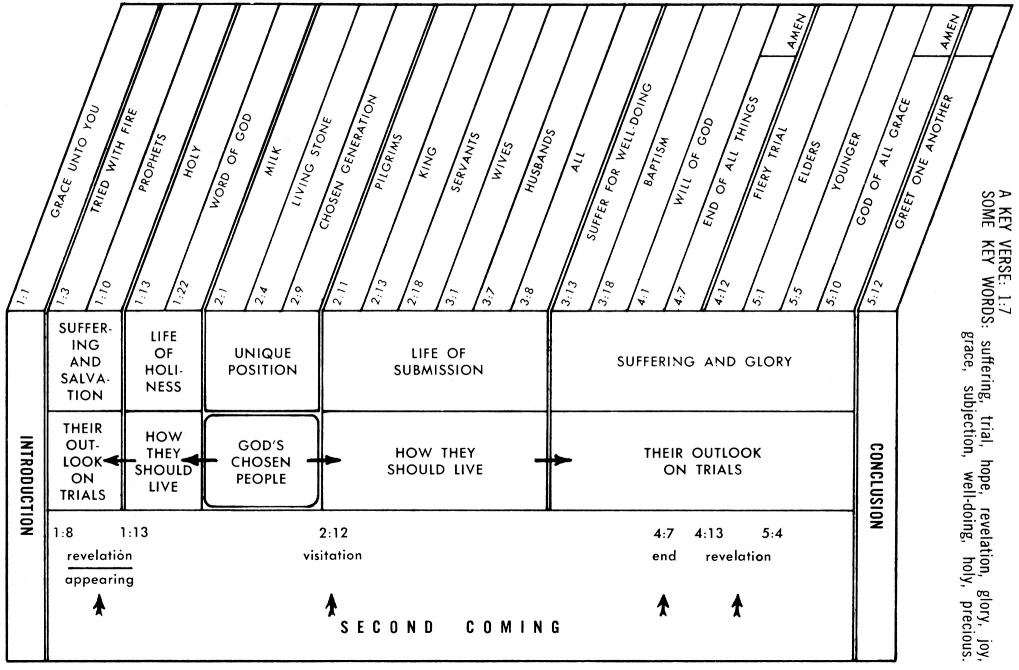
1 Peter: Trials, Holy Living & The Lord's Coming
Click chart to enlarge
Chart from Jensen's Survey of the NT - used by permission
See Another Chart from Charles Swindoll
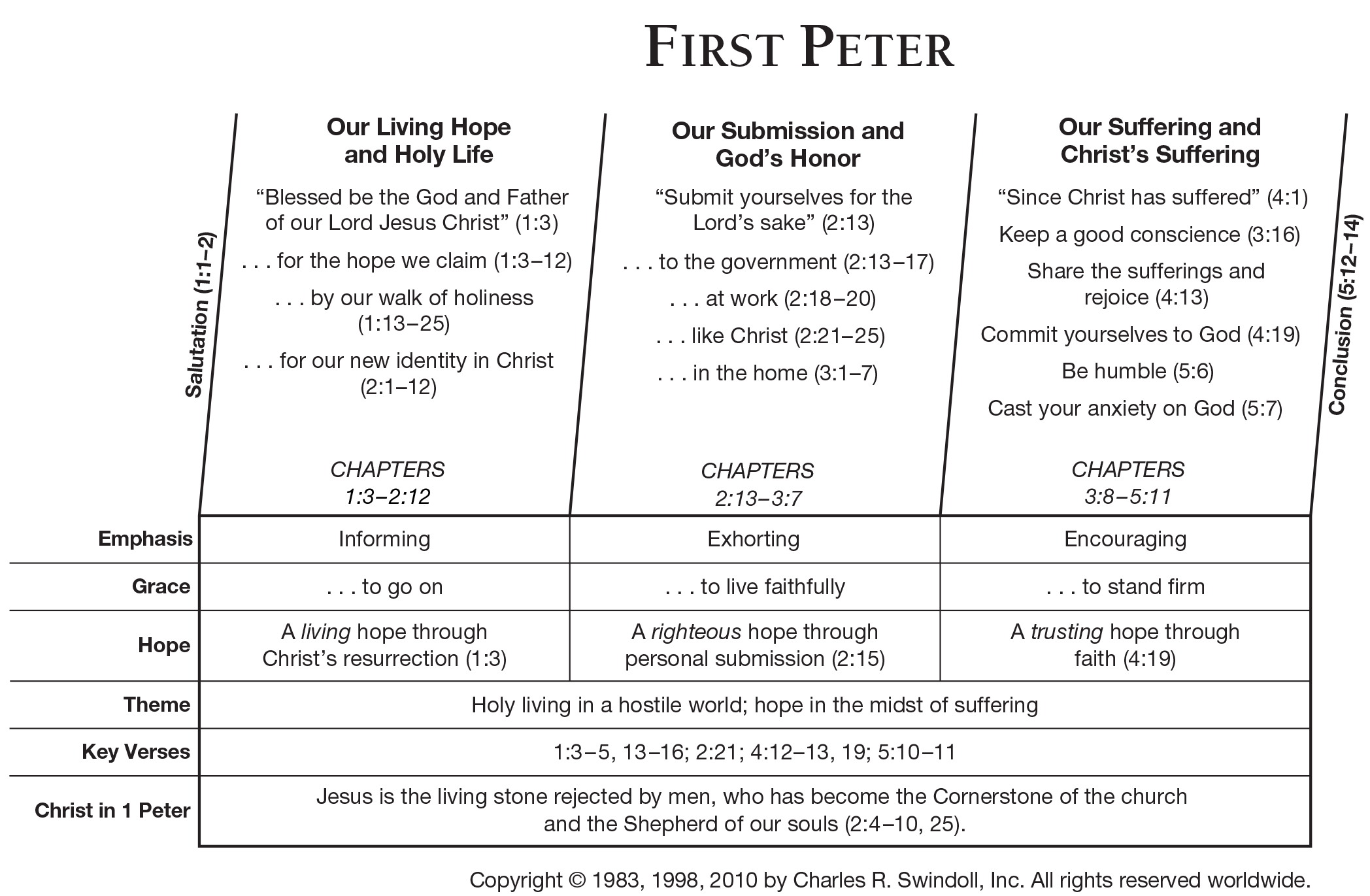
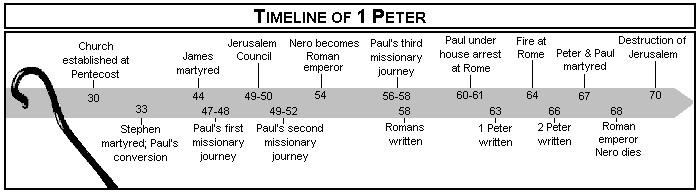
Source: Borrow Ryrie Study Bible
Click to enlarge
1 Peter 2:9 But you are A CHOSEN RACE, a royal PRIESTHOOD, A HOLY NATION, A PEOPLE FOR God's OWN POSSESSION, so that you may proclaim the excellencies of Him who has called you out of darkness into His marvelous light (NASB: Lockman)
Greek: humeis de genos eklekton, basileion hierateuma, ethnos hagion, laos eis peripoiesin, opos tas aretas exaggeilete tou ek skotous humas kalesantos (AAPMSG) eis to thaumaston autou phos
Amplified: But you are a chosen race, a royal priesthood, a dedicated nation, [God's] own purchased, special people, that you may set forth the wonderful deeds and display the virtues and perfections of Him Who called you out of darkness into His marvelous light. (Amplified Bible - Lockman)
Barclay: But you are a chosen race, a royal priesthood, a people dedicated to God, a nation for him specially to possess that you might tell forth the excellencies of him who called you out of darkness into his glorious light (Westminster Press)
Phillips: But you are God's "chosen generation", his "royal priesthood", his "holy nation", his "peculiar people" - all the old titles of God's people now belong to you. It is for you now to demonstrate the goodness of him who has called you out of darkness into his amazing light. (Phillips: Touchstone)
Wuest: But as for you, you are a race chosen out, king-priests, a set-apart nation, a people formed for [God’s own] possession, in order that you might proclaim abroad the excellencies of the One who out of darkness called you into participation in His marvelous light, (Eerdmans Publishing - used by permission)
Young's Literal: and ye are a choice race, a royal priesthood, a holy nation, a people acquired, that the excellences ye may shew forth of Him who out of darkness did call you to His wondrous light;
BUT YOU ARE A CHOSEN RACE: humeis de genos eklekton:
- 1Peter 1:2; ; Ps 22:30; 33:12; 73:15; Isa 41:8; 44:1
- 1 Peter 2 Resources - Multiple Sermons and Commentaries
- What Does God Think Of Me Now? - Understanding our position in Christ
CHOSEN BY
GRACE
But you (see discussion of the importance of terms of contrast) - You is emphatic in the Greek which sets up a dramatic contrast with those Peter has just described who stumble over the Corner Stone into a Christless eternity.
Spurgeon…
These are wonderful epithets that are here heaped upon believers. May we have the grace to be able to appropriate them, and to expound them in our lives!
Oh, the dignity which Christ has put upon the meanest believer! What a high office, and, consequently, what a solemn responsibility is ours!
Ye are a chosen generation - Hear this, ye believers, drink in this precious truth. See God’s election, making you to be a people born of the Holy Ghost: “a chosen generation,”-
There is the contrast between the disobedient and all true believer. “Ye” have the chosen Savior to be the chief corner-stone, upon whom “ye” who are living stones are to be built up into “a spiritual house,” which is to be the abiding place of the Most High God. (1 Peter 2 Commentary)
Chosen (1588) (eklektos) is a word which ultimately speaks of the grace of God. It should be emphasized that the proper conclusion (interpretation of the meaning) of "chosen" (eklektos) in each NT use depends on the context.
Eklektos means those selected or picked out and in the Scripture usually defines one who is the object of choice or of divine favor. Although it is difficult to understand with finite minds, it is important to note that the fact that some are chosen does not imply the rejection of those not chosen. God does not predestine some to eternal death.
In the Old Testament God did not choose Israel because they were a great people, but because He loved them. Moses instructed Israel to separate from and even destroy the pagan influences around them when they entered the promised land, the reason being that…
you are a holy people to the LORD your God; the LORD your God has chosen you to be a people for His own possession ("a peculiar people" - Lxx uses periousios, same word used in Titus 2:14 click for that discussion) out of all the peoples who are on the face of the earth. The LORD did not set His love on you nor choose you because you were more in number than any of the peoples, for you were the fewest of all peoples, but because the LORD loved you and kept the oath which He swore to your forefathers, the LORD brought you out by a mighty hand, and redeemed you from the house of slavery, from the hand of Pharaoh king of Egypt. (Deuteronomy 7:6-8)
The concept of God's choosing a "race" is seen again when Moses addressing Israel explaining that…
on your fathers did the LORD set His affection to love them, and He chose their descendants after them, even you above all peoples, as it is this day. (Deuteronomy 10:15)
The Psalmist writes
Blessed is the nation whose God is the LORD, the people whom He has chosen for His own (whose?) inheritance. (Psalm 33:12). Spurgeon's Comment on Psalm 33:12
Israel was happy in the worship of the only true God. It was the blessedness of the chosen nation to have received a revelation from Jehovah. While others grovelled before their idols, the chosen people were elevated by a spiritual religion which introduced them to the invisible God, and led them to trust in Him. All who confide in the Lord are blessed in the largest and deepest sense, and none can reverse the blessing.
And the people whom He hath chosen for His own inheritance. Election is at the bottom of it all. The divine choice rules the day; none take Jehovah to be their God till He takes them to be His people. What an ennobling choice this is! We are selected to no mean estate, and for no ignoble purpose: we are made the peculiar domain and delight of the Lord our God. Being so blessed, let us rejoice in our portion, and show the world by our lives that we serve a glorious Master.
Jesus declared
You did not choose Me, but I chose you, and appointed you (our privilege), that you should go and bear fruit (our purpose, our responsibility), and that your fruit should remain, that whatever you ask of the Father in My name, He may give to you. (Jn 15:16).
Christians are not "better" people than any other man or woman but they are "blessed" people. As such they are a distinct "kind" of human being, almost like a separate "genetic variety". They have been specially "chosen" by God for His own very specific purposes. Their privilege as the chosen also brings responsibility. A child of the King of kings should bear a family likeness, so that others will come to know Him as the King of kings.
Race (1085) (genos from gínomai = become) refers to offspring, posterity, "kin", family or lineage, stock. The NT frequently uses genos (as in the present verse) to refer to a race or division of mankind possessing traits that are transmissible by descent (Who's line do you belong to - Adam's or Christ's?) and sufficient to characterize it as a distinct human type. Believers should be recognizable as "a distinct human type". Race defines a class or kind of people unified by community of interests, habits, or characteristics.
Matthew Henry writes that…
All true Christians are a chosen generation; they all make one family, a sort and species of people distinct from the common world, of another spirit, principle, and practice, which they could never be if they were not chosen in Christ to be such, and sanctified by His Spirit.
A ROYAL PRIESTHOOD: basileion hierateuma:
- Ex 19:5,6; Isa 66:21
- 1 Peter 2 Resources - Multiple Sermons and Commentaries
APPOINTED TO A
PRIVILEGED POSITION
Peter's concept of a royal priesthood originates from Exodus 19 Jehovah declared to Moses His message for Israel…
Now then, if you will indeed obey My voice and keep My covenant, then you shall be My own possession (peculiar treasure - KJV) among all the peoples, for all the earth is Mine; and you shall be to Me a kingdom of priests and a holy nation.' These are the words that you shall speak to the sons of Israel." (Ex 19:5,6)
Royal Priesthood - Guzik writes that "The offices of royalty and priesthood were jealously separated in Israel, but Jesus, who is our King and Priest, has brought them together for His people."
Spurgeon - “Ye” are to be like Melchisedec, in whom the two offices of priest and king were combined in one person. More then that, “ye” are to be like your Lord, in respect to his royal priesthood. That he should have “loved us, and washed us from our sins in his own blood, and made us kings and priests unto God and his Father,” seems to be an honor which is far too high for us. It appears to bring us almost too near our Lord, yet it is not So, for Peter wrote, under divine inspiration, “Ye are a chosen generation, a royal priesthood,” (1 Peter 2 Commentary)
Royal (934) (basileios) is used only here and refers to that which belongs to, is appointed to or is suitable for a king. The idea is "fit for a king". It describes one of of kingly ancestry or that which is relating to, or befitting a king, queen, or other monarch. This verse is the only NT use of basileios, which is found in the Septuagint (LXX) translation of Exodus 19:6 (quoted in part by Peter) and Exodus 23:22.
MacArthur writes that basileios "generally describes a royal residence or palace (cf. Luke 7:25), but it can also refer to a sovereignty or monarchy
Moulton and Milligan have found it used in the phrase "the palace of the satrap Saitaphernes.
What an incredible privilege NT believers possess in Christ. In the OT, even the kings of Israel did not serve as a priest, and the one who tried was judged by God (read about it in 2 Chronicles 26:16-21). No so for NT believers who are of royal lineage in Christ the King of kings.
Priesthood (2406) (hierateuma from hierateúo = to officiate as a priest; used only here and in 1Peter 2:5) describes the priesthood as a fraternity or as a body of priests. The spiritual house he mentioned in 1 Peter 2:5 turns out to be a royal house, the dominion of a royal family.
Peter says all Christians are priests to God "a holy priesthood (who can now) offer up spiritual sacrifices acceptable to God through Jesus Christ. (see notes 1 Peter 2:4-6)
Our holy priesthood is made possible by our “great High Priest who has passed through the heavens, Jesus the Son of God” (Hebrews 4:14), therefore we have complete and full access to the Father. "Let us therefore come boldly to the throne of grace, that we may obtain mercy and find grace to help in time of need. (Heb 4:16).
Later in his epistle the writer of Hebrews adds this exhortation - Since therefore, brethren, we have confidence to enter the holy place by the blood of Jesus, by a new and living way which He inaugurated for us through the veil, that is, His flesh, and since we have a great priest over the house of God, let us draw near with a sincere heart in full assurance of faith, having our hearts sprinkled clean from an evil conscience and our bodies washed with pure water. (Heb 10:19-22- notes Heb 10:19; 20; 21; 22) (Comment: NT believers are not to go to God through any other human, but only through the one Mediator, Jesus Christ [see 1 Ti 2:1-8] Who is forever seated at the right hand of God in glory, interceding for us.)
You may be saying "It's wonderful to be a royal priest." but this truth has little impact on your life. Although believers look like everyone else, our speech and actions should cause others to ask, "What's different about her, about him?"
Although speaking to the remnant of Israel who would be saved by faith in Messiah, Gentile believers are now included in Jehovah's promise that…
you will be called the priests of the LORD. You will be spoken of as ministers of our God. You will eat the wealth of nations, and in their riches you will boast. (Isaiah 61:6)
In the NT John writes that Christ…
has made us to be a kingdom, priests to His God and Father; to Him be the glory and the dominion forever and ever. Amen. (Rev 1:6)
Thou hast made them (men from every tribe and tongue and people and nation) to be a kingdom and priests to our God; and they will reign upon the earth (THAT IS, ON THE EARTH IN THE MILLENNIUM KINGDOM OF CHRIST). (Revelation 5:10)
And not only are we priests today with access to the King, but one day soon in the coming kingdom of Christ we will reign with Him for 1000 years (see Millennium) John exclaiming…
Blessed and holy is the one who has a part in the first resurrection; over these the second death has no power, but they will be priests of God and of Christ and will reign with Him for a thousand years. (Rev 20:6)
In God's eyes we are royalty!
Have you pondered the privilege you have
to be counted as a member of God's royal family?
This is a far greater privilege than even belonging to the British royal line, although we often lose this eternal perspective. Indeed, what a privilege but also what a responsibility! Every day we represent "the King of kings" Who is the "ruler over the kings of the earth" (Rev 1:6). Let us determine that our conduct demonstrates our "royal bloodline" and gives a proper opinion to the "commoners" of our King Who desires to also be their king!
A child of the King of kings
should bear a family likeness.
THE CHOICE OF GRACE - James Smith
"According as He hath chosen us in Him" (Eph. 1:4).
1. Who? "He hath," 2 Thess. 2:13.
2. What? "Chosen us."
3. How? "In Him."
4. When? "Before the foundation of the world."
5. What for? "That we should be holy" (1 Peter 2:9; Phil. 2:15).
EVIDENCES OF SALVATION. - James Smith
"That ye may know that ye have" (1 John 5:13).
Those who are in the enjoyment of salvation show it—
1. By praising God for it, 1 Peter 2:9.
2. By abhorring themselves, Job 42:5, 6.
3. By delighting in prayer, Acts 9:11.
4. By thirsting for the Word of God, Psa. 19:10.
5. By seeking to please the Lord, Col. 1:10.
6. By bringing others to Him, John 1:40-42.
Living Like Royalty - In the fall of 1997, I had my first closeup look at royalty. Zeeland, Michigan, the small Dutch town where I was born, was celebrating its 150th anniversary, and Princess Margriet and her husband honored the city with an official visit from the Netherlands.
Her Highness looked regal in her crisp red suit as she walked behind the wooden-shoed Klompen dancers and smiled and waved to the crowd. She moved with a quiet gracefulness and dignity. But without her entourage and a police escort, she could have passed for just another Zeelander blending into the crowd.
Believers in Jesus Christ are also royalty. We have been spiritually reborn into the family of the King of the universe. Peter called us a “royal priesthood” (1 Pet. 2:9). John declared that through Christ’s sacrifice on the cross we are “kings and priests to His God and Father” (Rev. 1:6).
We may look like everyone else, but as Christians our speech and our actions should cause others to ask, “What’s different about her, about him?” We’re royalty, of course! What a privilege to be members of God’s royal family. What a responsibility! Every day we represent One who is the “ruler over the kings of the earth” (Rev. 1:5). Let’s make sure our conduct shows it. - Dennis J. De Haan (Reprinted by permission from Our Daily Bread Ministries. Please do not repost the full devotional without their permission.)
For Further Study
If we are to live like God's royal priesthood,
what behavior should we put aside? (1Pet. 2:1,11).
What things should we do? (1Pe 2:2,12).
A child of the King of kings should bear a family likeness.
A HOLY NATION: ethnos hagion:
- Ps 106:5; Isa 26:2; Jn 17:19; 1Cor 3:17; 2Ti 1:9
- Torrey's Topic Titles and names of saints
- 1 Peter 2 Resources - Multiple Sermons and Commentaries
SET APART
FOR GOD
Peter is quoting from Exodus 19:6 where God says to Israel " you shall be to Me a kingdom of priests and a holy nation.’ These are the words that you shall speak to the sons of Israel.” God had commanded Israel to "to make a distinction between the holy and the profane, and between the unclean and the clean" (Lev 10:10) but they refused to be different and thus disobeyed God. Israel forgot that she was holy unto the LORD, and that her holy privilege conveyed responsibility to be holy as God was holy. She began to make profane choices that broke down the walls of separation that made her special and distinct. By using this phrase HOLY NATION Peter is reminding the believers that they are to be separate from the world. While he does not continue the analogy with the nation of Israel, we know that because Israel did not maintain her separateness from the profane, godless world, it cost her dearly with national defeats by foreign nations (722 BC Assyrians and 586 BC Babylonians). Israel proceeded to become like all the corrupt idolatrous pagan nations around them and this profaning ultimately led to their loss of usefulness to God and to their destruction (but not to their annihilation). So Peter's emphasis is for the church to be holy. As someone has well said "The body of Christ, the church, is of most value to God when it is least like the world in which it exists to be an ambassador of reconciliation."
"More holiness give me,
More strivings within;
More patience in suff'ring,
More sorrow for sin;
More faith in my Saviour,
More sense of His care;
More joy in His service,
More purpose in prayer."
—P. P. Bliss.
John MacArthur on HOLY NATION - "Peter continued to refer to the Old Testament in support of the privileges God has granted believers. Here he alludes to Exodus 19:6 (“you shall be to Me … a holy nation”) when he declares that believers are separated to Christ as a holy nation. The word nation translates ethnos, which means “people,” as an ethnic group (Luke 7:5; 23:2; John 11:48, 50–52; Acts 2:5; 10:22; Rev. 5:9). Holy (hagios) means “separate” or “set apart.” It was common in the Old Testament to call God’s covenant people a holy nation (cf. Lev. 19:2; 20:26; Deut. 7:6; Isa. 62:12). However, because of sin and unbelief Israel forfeited (Deut. 4:27; 28:64; Ezek. 16:59; Hos. 9:17; Zech. 7:14; Rom. 11:17, 20) her great privilege (Gen. 12:2–3; Deut. 33:29; Rom. 3:1–2; 9:4–5) of being God’s unique people. But what was a tragedy for Israel became a blessing for believing Gentiles (cf. Rom. 9–11). Israel will not enjoy again the privilege of being God’s holy people until the nation finally turns in faith to the Messiah (cf. Ezek. 36:25–31; Rom. 11:24, 26). God sets apart believers primarily to have a relationship with Him, and service to Him flows out of that relationship. (1 Peter Commentary) (See also MacArthur's sermon - 1 Peter 2:9 The Believer's Privileges = Separation, etc Pt 6 - Sermon)
Hiebert - Peter’s third designation, “a holy nation” (ethnos hagion), is also drawn directly from Exodus 19:6. “Nation” (ethnos, cf. the English “ethnic”) means a community of people held together by the same laws, customs, and mutual interests. The term, as Morgan notes, involves “two ideas, those of government and mutual interrelationship.” It is a common biblical term, especially in the plural, “for the Gentiles as distinct from the Jews or Christians.” At times the term was also used of Israel as the people of God united by their covenantal relation to Him, making them distinctly His nation. It is in that latter sense that Peter applied the term to the church, which forms a unique international nation having a common spiritual life from God and committed to His rule. “Holy” indicates its separation from the nations of the world and consecration to God and His service. Its position of separation demands that the members must not, like Israel of old, stoop to the sinful practices of the world (1 Peter 1:15–17). (1 Peter Commentary)
J Vernon McGee on HOLY NATION - We are “an holy nation.” The nation Israel was never holy in conduct, and the same can be said of the church. Israel’s failure is glaring; the church’s failure is appalling. Yet we are holy in our relationship with Him because Christ is our righteousness. If you have any standing before God, it is not in yourself; it is in Christ. I can’t think of anything more wonderful than that today I stand complete in Him. What a joy it is to be a member of a holy nation, which is a new nation in the world today. (Thru the Bible)
Jack Arnold - “A HOLY NATION” - This is a quote from Exodus 19:6. “Nation” refers to a multitude of people of the same nature. “Holy” means “to set apart” or “to consecrate.” Christians form a spiritual nation of people set apart to God. “Therefore I say to you, the kingdom of God will be taken away from you (Israel) and be given to a nation (Church) producing the fruit of it” (Matt 21:43). Christians are in every physical nation on earth and spiritually they now form a distinct, holy, superior nation. The universal Church is a supernatural people because it was brought into existence by supernatural acts of God. Because Christians are a supernatural people belonging to God, they are pilgrims and strangers among the earthly nations. The universal Church of Christ is also supra-national. It transcends all political, economic, military and cultural differences. The Church has a King to rule over them, Jesus Christ. It has laws to govern them, the Bible. It has a national purpose—to glorify God. It also has a national anthem, “Saved, saved by the blood of the Lamb.” (1 Peter 2:9-12 Duties of Aliens and Strangers)
Spurgeon - An holy nation, a peculiar people - You have national privileges. God reckons you not as a mob or a herd of men, but as a nation, and a nation with this peculiar hall-mark upon you, that you are “a holy nation.” This is the true token of your nationality that you are “holiness unto the Lord,” “a peculiar people” belonging to God alone, marked off from the rest of mankind as peculiarly his. You are not, and you are not to be as other men are, you are “a peculiar people.” Your road is not the broad one where the many go, it is the narrow one which the few find, your happiness is not worldly pleasure, but pleasures at the right hand of God which are for evermore, You are “a peculiar people” (1 Peter 2 Commentary)
Regarding the words nation (ethnos) and people (laos) Vincent remarks that "The distinction between these three words cannot be closely pressed. Race emphasizes the idea of descent; nation, of community. Laos, people, occurring very often in the Septuagint, is used there mostly of the Israelites, the chosen people. The same use is also frequent in the New Testament; but it is employed in a more general sense, as by Luke 2:10. (Vincent, M. R. Word Studies in the New Testament)
Peter H Davids on HOLY NATION - Furthermore, they are a “holy nation.” The idea is not their moral holiness (although it is a call to that; cf. 1 Peter 1:15–16), but their separation to God. God has set Christians apart to be his people just as Israel was in the OT. This is underlined in the final phrase, “God’s own people” or “the people of his possession,” which indicates that they belong particularly to him (indeed, he has bought them, 1 Peter 1:18; cf. Acts 20:28, which uses the same Greek verb). (NICNT-1 Peter)
David Walls - A holy nation emphasizes that God has set apart the church for his use and that individual believers have a valuable contribution to make to his church.
Norman Hillyer - As members of a holy nation, all believers are set apart for God (the sense of holy), but without geographic boundaries or without being limited to particular cultures, ages, or ethnic groups.
Thomas Schreiner - Peter also replicated the exact words of Exod 19:6 in identifying the church as a “holy nation” (ethnos hagion; cf. Exod 23:22, LXX). The church of Jesus is a people now set apart for the Lord, enjoying his special presence and favor. (NAC - 1 Peter)
Holy (40) (hagios = set apart ones, separated ones, sanctified ones, holy ones) is literally a holy one and depending on the context refers to whoever or whatever is set apart (sanctified) for a special purpose.
New Testament believers are holy ones both in character and conduct having been set apart by God to be exclusively His, to be dedicated to Him and to manifest holiness of heart and conduct in contrast to the impurity of pagan unbelievers.
Jesus declared…
And for their sakes I sanctify (set Myself apart unto God) Myself, that they themselves also may be sanctified (may be set apart for holy service to God) in truth. (Jn 17:19) (NLT renders it "And I give myself entirely to you so they also might be entirely yours.")
Paul writes…
To the church of God that is in Corinth, to those sanctified (set apart) in Christ Jesus, called (with a purpose) to be saints (hagios - holy ones) together with all those who in every place call upon the name of our Lord Jesus Christ, both their Lord and ours: (1Cor 1:2)
Hebrews explains that…
By this will (the Father's will) we have been sanctified (set apart, made holy) through the offering of the body of Jesus Christ once for all. (see note Hebrews 10:10)
Comment: Sanctified is in the perfect tense which speaks of a past completed action -- the moment of our salvation -- with permanent or lasting effect --we are forever set apart). As an aside, the permanence of this tense undergirds the NT teaching that the believer once saved is eternally secure. Believers will never need to be justified again. Their position in Christ is forever righteous, forever secure and forever holy.
In the Old Testament many things and people were divinely set apart by God for His own purposes. The Tabernacle and Temple and all their furnishings-supremely the Ark of the Covenant and the holy of holies-were set apart to Him. The tribe of Levi was set apart for His priesthood, and the entire nation of Israel was set apart as His people. The tithes and offerings of the people of Israel consisted of money and other gifts specifically set apart for God. Under the New Covenant, however, such holy things as the Temple, priesthood, Ark, and tithes no longer exist. God’s only truly holy things on earth today are His people, those whom He has sovereignly and graciously set apart for Himself through Jesus Christ. The new temple of God and the new priesthood of God are His church, which Peter here refers to figuratively as a holy nation.
Hagios is used throughout the New Testament to speak of anyone or anything that represents God’s holiness: Christ as the Holy One of God, the Holy Spirit, the Holy Father, holy Scriptures, holy angels, holy brethren, and so on. The secular and pagan use pictured a person separated and dedicated to the idolatrous "gods" and carried no idea of moral or spiritual purity. The manmade gods were as sinful and degraded as the men who made them and there simply was no need for a word that represented righteousness! The worshipper of the pagan god acquired the character of that pagan god and the religious ceremonies connected with its worship. The Greek temple at Corinth housed a large number of harlots who were connected with the "worship" of the Greek god. Thus, the set-apartness or holiness of the Greek worshipper was in character licentious, totally depraved, and sinful.
The Bible writers could not coin new terms since they would not be understood, and were therefore forced to use those already in use. However, while the technical and root meanings of this pagan religious term was taken over by the writers, yet by the use in the NT, the moral and spiritual character was changed and elevated by the gospel.
Kenneth Wuest writes that "The believer in the Lord Jesus is set apart for God by the Holy Spirit, out of the First Adam with the latter’s sin and condemnation, into the Last Adam (Christ) with the latter’s righteousness and life. Thus, the worshipper of the God of the Bible partakes of the character of the God for Whom he is set apart. This is positional sanctification, an act of God performed at the moment a sinner puts his faith in the Lord Jesus (1Co 1:2). The work of the Holy Spirit in the yielded saint, in which He sets the believer apart for God in his experience, by eliminating sin from his life and producing His fruit, a process which goes on constantly throughout the believer’s life, is called progressive sanctification (see 1Thessalonians 5:23). When our Lord sanctifies Himself, He sets Himself apart for God as the Sacrifice for sin (Jn 17:19 see He 10:7)." (Wuest Word Studies - Eerdman Publishing Company Volume 1, Volume 2, Volume 3 - used by permission)
The idea inherent in hagios is the taking something filthy, washing it and setting it apart as something brand new, useful for a different purpose, which is a picture of salvation for we who were filthy with sin were washed in the blood of Christ, the Lamb of God, and set apart to now be God's own possession.
Believers are now a holy nation who have been set apart from the world…
- delivered (rescued)… from the domain of darkness (Colossians 1:11, 12, 13)…
- by the sanctifying work of the Spirit (1 Peter 1:2)…
- unto God Who "transferred us to the kingdom of His beloved Son" (Colossians 1:13-see note Col 1:13)
The fundamental ideas of a saint include…
- One who is separated from sin (Romans 6:11; 12; 13; 14-see notes Ro 6:11; 12; 13; 14)
- One who then has the responsibility to choose to consecrate themselves daily to God as "living sacrifices" (Romans 12:1-see note Romans 12:1)
- One who is devoted to His service
- One who is a partaker of the divine nature (2Pe 1:4)
- One who continually chooses to abstain from worldly defilement (1Th 4:3, 1Th 5:22, 2Ti 2:19, 1Pe 2:11)
Although the saint lives in the world, he or she must always in one sense be different from the world and continually choose to separate himself or herself from the world. His standards are not the world's standards. (click note on Romans 12:2 regarding not being squeezed into world's mold) He is "in the world" but not "of the world".
A saint is like a boat -- the boat's purpose is fulfilled when it is in the water, but it's function and usefulness deteriorates when water gets in the boat. So too for saints when too much of the world gets into them. Saints must keep their "vessels" in the water of this word but not let the water of the world get into their "vessel"! Paul has a parallel thought writing to young Timothy to take of the truth that
if a man cleanses himself from these (things, people that have an unholy influence), he will be a vessel for honor, sanctified (hagiazo - verb form of saint), useful to the Master, prepared for every good work. (see note 2 Timothy 2:21)
The term saints does it refer to a condition after death, for these "saints" were very much alive at Philippi. Although you may have been taught that saints are a special, higher order of Christians who accomplished extraordinary good deeds and lived an exemplary life, the Bible teaches that sainthood is not an attainment but a state into which God by grace through faith calls men and women of all stations of life, whether under the Old or New Covenant. So now next time you meet a believer, address then as "Saint so-and-so" and watch the reaction! It goes without saying however that we often do not think or act like saints, in the popular sense. But hagios speaks of our identity (or our position) in Christ. We are holy ones in our Lord, even when we are unfaithful and act unsaintly. Being a saint has nothing at all to do with one’s degree of spiritual maturity or rank. It refers to any person who is saved, who is set apart by God for Himself in His Son Jesus Christ. Because God sees us as He sees His Son, as "those who have been sanctified (consecrated, purified, made holy) in Christ Jesus, saints by calling." (1Co 1:2) Like all other believers, the Christians at Corinth were not saints because of their spiritual maturity (cf. 1Co 3:1–3), but because they were “saints by calling,” a reference to their call to salvation.
Wuest adds that "The word "saint" is the translation of a Greek word meaning "to set apart," in its verb, and "set apart ones," in its noun form. The pagan Greeks set apart buildings as temples, consecrating them for non-secular, and therefore, religious purposes. These became the objects of veneration and reverence. Thus, saints are believing sinners set apart from sin to holiness, set apart from Satan to God, thus being consecrated for Gods’ sacred fellowship and service. The word "saint" as a designation of a Christian, brings at once to our attention the duty of every believer, that of living a separated life. The words, "saint, sanctify, holy," are all translations of this same Greek root. They all speak of the absolute separation from evil and dedication to God, that must always be true of the Christian believer." (Wuest Word Studies - Eerdman Publishing Company Volume 1, Volume 2, Volume 3 - used by permission)
Nation (1484)(ethnos gives us our word "ethnic") in general refers to a multitude (especially persons) associated with one another, living together, united in kinship, culture or traditions and summed up by the words nation, Gentiles (especially when ethnos is plural), people (much like "people groups" in our modern missionary vernacular). In somewhat of a negative sense ethnos conveys the meaning of godless (generally idol worshipping) pagans (heathens, cp Eph 4:17, Mt 6:32), foreign nations not worshipping the true God (Mt 4:15). Often ethnos stands in clear contradistinction to Jew (Ioudaios) (Gal 2:14). Ethnos sometimes refers to Gentile Christians (Ro 11:13, Ro 15:27, 16:4, Gal 2:12). Ethnos is used in the singular of the Jewish Nation (Lk 7:5; 23:2; Jn 11:48, 50-53; Jn 18:35; Acts 10:22; 24:2, 10; Acts 26:4; 28:19). Plato used ethnos of a special class of men, a caste, tribe. In the Septuagint ethnos was used for nation, people Ge 10:5; non-Jews, Gentiles Ps 2:1.
UBS Handbook on HOLY NATION - Holy nation is also from Exodus 19:6. As in 1:15 and 2:4, holy characterizes the church’s unique relationship to God: it is holy because it is consecrated to God and set apart for his service. (Compare NEB “a dedicated nation”; JB “a consecrated nation”; also Mft, Knox.) In Exodus 19:6, the TEV translates the same expression as “a people dedicated to me alone.” Holy nation may be rendered as “the nation dedicated to God” or “the nation dedicated to serve God.”
What the Bible Teaches on Holy Nation - This expression is also from Exod 19:6 and other Scriptures such as Lev 19:2; 20:26; Deut 7:6; Isa 62:12. Aaron and his sons were separated from the people for the ministry of priesthood. As a mark of that separation they were given special garments to wear. Before they could function in the holy office they must be separated to God for it. The NT believer-priest does not wear special garments nor bear special titles as a mark of office. Instead, he is to be marked by his separation to God, an "holy" nation. The nations of earth are separated by boundaries, and borders. Language and culture and often physical distinctions divide them. This holy nation however knows no such barriers; it overflows all borders; it overlooks mere physical differences; it overcomes culture and language. This glorious unifying victory of grace will be the theme of the new song of praise to the Lamb in glory, "Thou art worthy to take the book, and to open the seals thereof: for thou wast slain, and hast redeemed us to God by thy blood out of every kindred, and tongue, and people, and nation; and hast made us unto our God kings and priests: and we shall reign on the earth" (Rev 5:9-10). No doubt, such Scriptures will bear a special significance and provide a singular authority to the remnant of Israel brought out of the great tribulation into millennial blessing and service among the nations of the earth (Isa 60; Zech 14:16-19). (What the Bible Teaches – 1 Peter through Jude)
Some like amillennialist A T Robertson comment that HOLY NATION is "from Ex. 19:6, but here applied, not to the national Israel, but to the spiritual Israel of believers." This type of comment leads one to the say that God is finished with the nation of Israel, which is absolutely not true (see replacement theology). The nation of Israel is in 2019 the nation of Israel and it will continue to be a nation until the Second Coming of Christ. The Church has not replaced Israel, which is a teaching that has gained momentum in the church in recent years.
John Piper on HOLY NATION - You have been chosen and pitied and possessed by God; and therefore you are not merely part of the world anymore. You are set apart for God. You exist for God. And since God is holy, you are holy. You share His character, because He chose you, pitied you, possessed you. You are holy. If you do not act in a holy way, you act out of character. You contradict your essence as a Christian. For your identity is holiness to the Lord: you are holy. (1 Peter 2:9-10 Christian Identity and Christian Destiny)
Thomas Constable comments that "All the figures of the church that Peter chose here (1 Peter 2:9) originally referred to Israel. However with Israel's rejection of Jesus Christ (1 Peter 2:7) God created a new body of people through whom He now seeks to accomplish the same purposes He sought to achieve through Israel but by different means. This verse that at first might seem to equate the church and Israel on careful examination shows as many differences between these groups as similarities." (Constable's Notes on the Bible"
Blum comments that Peter's description in 1 Peter 2:9 "does not mean that the church is Israel or even that the church replaces Israel in the plan of God. Romans 11 should help us guard against that misinterpretation. . . . The functions that Israel was called into existence to perform in its day of grace the church now performs in a similar way. In the future, according to Paul, God will once again use Israel to bless the world (cf. Ro 11:13-16, 23-24)."
Related Resources:
- The Jewish People, Jesus Christ and World History - S Lewis Johnson
- Are Israel and the church the same thing? Does God still have a plan for Israel?
- Are Jews saved because they are God's chosen people? Will Jews go to Heaven even if they do not trust in Jesus?
- What is dispensationalism and is it biblical?
- What does it mean that the church has been grafted in Israel’s place?
- What is Israelology?
- Who are the seed of Abraham?
- Interpretation of Scripture - includes discussion of the rise of Allegorical interpretation
- What is replacement theology / supersessionism?
- Replacement Theology - What we should know - part 1 - Gabe Morris
- Replacement Theology - What we should know-part 2 - Gabe Morris
- Replacement Theology - The Evils of - Dr David Reagan
- What is spiritual Israel?
- What is New Israel?
PEOPLE FOR GOD'S OWN POSSESSION: laos eis peripoissin:
- 1 Peter 2 Resources - Multiple Sermons and Commentaries
This phrase is variously rendered as…
literally a people for possession, acquisition or purchase (i.e. "a peculiar property")
[God's] own purchased, special people (Amplified)
a special people (BBE)
people who belong to God (GWT)
that belongs to God alone (ICB)
a people God means to have for Himself (Knox )
a purchased people (Montgomery)
the people who belong to Him (Moffat)
a people to be a personal possession (NJB)
His own special people (NKJV)
peculiar people (KJV, Phillips, Macent)
you are God's very own (TLB)
a people belonging specially to God (Weymouth)
a people acquired (Young's Literal)
Compare the OT passages which teach a similar truth about Israel…
Exodus 19.5 “my own possession among all peoples” (RSV)
Deut 26:18 The LORD has today declared you to be His people, a treasured possession,
Malachi 3.17 “my special possession” (RSV)
Isaiah 43.21“The people whom I formed for myself” (RSV)
UBS Handbook emphasizes that "The word for people here is laos, a term used for Israel in the Old Testament to describe its intimate relationship with God; this term is now used of the Christian community. What is being emphasized here is that the Christians now have a relationship to God which is different from that of non-Christians: they are God’s people and are completely dedicated to him. (The United Bible Societies' New Testament Handbook Series)
Possession (4047) (peripoiesis from peripoieomai = literally means to make around oneself and then to acquire or purchase) means that which is acquired by purchase with the corresponding idea of preservation of that which is purchased.
In Hebrews 10:39 the meaning of peripoiesis is that of experiencing of security, keeping safe or preserving.
In 1 Thes 5:9 and 2 Thes 2:14 the thrust of peripoiesis is to describe a gaining or obtaining of something, respectively salvation and glory.
The root verb peripoieomai is used by Paul in his charge to the Ephesian elders exhorting them to…
Be on guard (command to continually be holding one's mind towards something, giving heed, paying close attention, watching out - present imperative) for yourselves and for all the flock, among which the Holy Spirit has made you overseers, to shepherd the church of God which He purchased [peripoieomai - acquired, gained, paid the price for, gained possession of] with His own blood. (Acts 20:28)
Vincent explains that the phrase eis peripoiesin literally means
a people for acquisition. Revised Version = a people for God’s own possession. Wycliffe = a people of purchasing. Cranmer = a people which are won. See Isaiah 43:21 (Septuagint - LXX), where the kindred verb (peripoieomai) occurs: “This people have I formed for myself (English of the LXX = My people whom I have preserved [peripoieomai] to tell forth My praises.)
Peripoiesis is used 5 times in the NT…
Ephesians 1:14 (note) who is given as a pledge of our inheritance, with a view to the redemption of God's own possession, to the praise of His glory.
1Thessalonians 5:9 (note) For God has not destined us for wrath, but for obtaining salvation through our Lord Jesus Christ,
2 Thessalonians 2:14 And it was for this He called you through our gospel, that you may gain the glory of our Lord Jesus Christ.
Hebrews 10:39 (note) But we are not of those who shrink back to destruction, but of those who have faith to the preserving of the soul.
1 Peter 2:9 (note) But you are a chosen race, a royal priesthood, a holy nation, a people for God's own possession, that you may proclaim the excellencies of Him who has called you out of darkness into His marvelous light;
Peripoiesis is used 3 times in the Septuagint (LXX) (Greek translation of the Hebrew OT), Malachi's use paralleling the use by Peter. Jehovah speaking through His prophet Malachi describes the Jews who will be His own possession declaring…
And they shall be Mine, says the Lord of hosts, in that day (What day? In context most likely at the beginning of the 1000 year reign when the remnant of Jews who had believed in their Messiah are finally ushered into His earthly, millennial kingdom for which they were looking even in the first century AD - cf Acts 1:6) when I publicly recognize and openly declare them to be My jewels (My special possession, My peculiar treasure) (LXX = peripoiesis). And I will spare them, as a man spares his own son who serves him. (Amplified Version Malachi 3:17)
Comment: Here peripoiesis translates the Hebrew word segullah/cegullah and means a treasured possession, (so translated in Dt 26:18) a valued personal property, that which is owned by someone or that for which the owner has special affection or holds to be of special value. Here in Malachi 3:17 segullah/cegullah is a technical expression describing the people of Jehovah as His treasure or property, those who are rightly His by virtue of redemption.
The immediate context (the preceding verse) explains that God's treasured possession are "those (Malachi is speaking primarily to the Jewish remnant who believe in Messiah) who feared the LORD (and who) spoke to one another, and the LORD gave attention and heard it, and a book of remembrance was written before Him for those who fear the LORD and who esteem His name." (NASB, Malachi 3:16)
Christians are a special people because God has preserved them for Himself. we are His possession now:
Marvin Vincent writes that "peculiar" (KJV) is literally "a people for acquisition. Wycliffe = a people of purchasing. Cranmer = a people which are won. The word occurs 1Th 5:9, rendered obtaining (Rev.); Eph 1:14, God's own possession (Rev.). See Isaiah 43:21 (Sept.), where the kindred verb occurs: “This people have I formed for myself (Vincent's Word Studies)
Vance Havner on "a peculiar people"…
God's people are "a peculiar people" (I Peter 2:9) which means "a purchased people." The Greek word here carries the idea of making a ring around something to mark it as one's own. Christ has made a ring around us and claimed us for Himself. We hear these days about "cheap grace" and how it doesn't mean much to be a Christian. But salvation is the costliest item on earth. It cost our Lord everything to provide it and it costs us everything to possess it.
We are a generation of cheap Christians going to heaven as inexpensively as possible; religious hobos and spiritual deadbeats living on milk instead of meat, crusts of bread instead of manna, as though we were on a cut‑rate excursion.
In a day when tragedy has become comedy, we play fast and loose with eternal issues. The pearl of great price is not cheap! I have read that years ago in that part of Africa where diamonds in the rough were plentiful, a traveler chanced on boys playing. Closer investigation revealed that they were playing marbles with diamonds! God forgive us today that we handle His treasures as though they were trifles and the coinage of the eternal as though it were play money. It is no time to play marbles with diamonds!
AFRAID OF THE DARK
At the turn of the century there was a city worker whose youth had been spent in evil ways. But one night during a revival meeting he was spiritually born anew. Soon after, he ran into one of his old drinking pals. Knowing his friend needed Jesus, he attempted to witness to him about his newly found peace. His friend rebuffed him rudely and made fun of him for “turning pious.”
“I’ll tell you what,” said the new Christian. “You know that I am the city lamplighter. When I go ’round turning out the lights, I look back, and all the road over which I’ve been walking is blackness. That’s what my past is like.”
He went on, “I look on in front, and there’s a long row of twinkling lights to guide me, and that’s what the future is like since I found Jesus.”
“Yes,” said the friend, “but by-and-by you get to the last lamp and turn it out, and where are you then?”
“Then,” said the Christian, “why, when the last lamp goes out it’s dawn, and there ain’t no need for lamps when the morning comes.”
Many children carry their fear of the dark into adulthood in the form of other kinds of fears—fear of failure, rejection, loss, pain, loneliness, or disappointment. Each of these fears seems to grow in darkness. Darkness is a metaphor for many things: death, night, uncertainty, evil—but in all of them, Jesus is the Light that brings illumination and comfort.
When light shines, not only is darkness eliminated, but fears are relieved. Indeed, not only does Jesus give you as much light as you need to proceed in faith, but because of His sacrifice at Calvary, you can be assured of His eternal dawn when the last lamp goes out! Like the lamplighter said, “There ain’t no need for lamps when the morning comes.”
Chosen And Cherished - Frank Ray
1 Peter 2:9 But ye are a chosen generation, a royal priesthood, an holy nation, a peculiar people; that ye should show forth the praises of him who has called you out of darkness into his marvelous light.
Who are the people of the Bible? The people of the book are the chosen people. Many people think that the Bible runs references on every person on planet earth. Not so. I hear this question over and over again, “When Cain left Adam and Eve and went down to the land of Nod and knew his wife, where did she come from?” Don’t be confused. God is keeping a record of the chosen race; that’s what this book is about. It is not about every person. People living from the time of Abraham to the time of Christ are part of the chosen generation. From Christ on is the church. As believers, we are part of that royal priesthood. We are a peculiar people. You did not choose him; he chose you.
Ephesians 1:4 According as he has chosen us in him before the foundation of the world, that we should be holy and without blame before him in love: as he has chosen us. The word chosen is in aorist tense indicating that God acted by himself. He didn’t go before a board of directors to make his selection; He chose us. To tell you the truth I wasn’t worthy to be chosen. I should have been one left on the outside, because I was alone and idle. I was a sinner, too. But I heard the voice of Jesus saying there is work to do. He came looking for me. I didn’t know the shape I was in until I met him. Do you know that you’ve been chosen by God? You don’t have to walk anywhere with a hung down head thinking you are nothing and that nobody loves you There is one that loves you so much that he chose you. Your voice, your strength, your home, your job, and your knowledge are all gifts from Him. What you have, God gave you. What you know God taught you. Where you are God brought you. Thank God, I am chosen by Him.
‘A peculiar people’ William Wilberforce
‘But ye are a chosen generation, a royal priesthood, an holy nation, a peculiar people; that ye should shew forth the praises of him who hath called you out of darkness into his marvellous light.’ 1 Peter 2:9
In his memoir, Recollections of William Wilberforce (1864), John Harford recalled: ‘Touching on the purity and elevation of heart which should mark the Christian character, Mr Wilberforce said: “The thing we are all of us—you and I and all—too much disposed to forget is, that Christians are to be a peculiar people. We are too much inclined to appear to be what other persons are. One thing I often accuse myself of is the not seeking more diligently occasions of attempting to promote the spiritual improvement of others. It is a difficult point, but we should make it the subject of prayer.” ’
FOR MEDITATION: When the apostle Peter writes of the need for us as Christians to be a peculiar people, he is not suggesting that we act strangely. Rather in concert with the words of Jesus in the Gospel of Matthew, he is saying that we ought to let our light—that is character of our lives and Christian testimony—‘so shine before men, that they may see your good works, and glorify your Father which is in heaven.’
Jesus used a wonderful metaphor to convey the picture of how we ought to let our light shine. When men light a candle, he said, they do not put it under a bushel, but rather on a candlestick. When this is done, he concluded, the candle ‘giveth light unto all that are in the house.’ All of us, wherever we are in the world, are part of a community. Our relationships with our neighbours, as well as with our fellow Christians, ought to be marked by the elements of Christian character—good works born of faith and also the fruits of the spirit (see Galatians 5:22–23) ‘love, joy, peace, longsuffering, gentleness, goodness, faith, meekness, and temperance.’ When this is done we are, as has been often said, salt and light in our communities and our culture.
REFERENCE: Recollections of William Wilberforce (1864)
‘We are to be created anew’ William Wilberforce
‘But ye are a chosen generation, a royal priesthood, an holy nation, a peculiar people; that ye should shew forth the praises of him who hath called you out of darkness into his marvellous light.’ 1 Peter 2:9
In the language of Scripture, Christianity is not a geographical, but a moral term. It is not the being a native of a Christian country: it is a condition, a state; the possession of a peculiar nature, with the qualities and properties which belong to it.
Farther than this; it is a state into which we are not born, but into which we must be translated; a nature which we do not inherit, but into which we are to be created anew. To the undeserved grace of God, which is promised on our use of the appointed means, we must be indebted for the attainment of this nature; and, to acquire and make sure of it, is that great ‘work of our salvation’ which we are commanded to ‘work out with fear and trembling.’ We are everywhere reminded, that this is a matter of labour and difficulty, requiring continual watchfulness, and unceasing effort, and unwearied patience. Even to the very last, towards the close of a long life consumed in active service, or in cheerful suffering, we find Paul himself declaring that he conceived bodily self-denial and mental discipline to be indispensably necessary to his very safety. Christians, who are really worthy of the name, are represented as being ‘made meet for the inheritance of the saints in light’; as ‘waiting for the coming of our Lord Jesus Christ,’ as ‘looking for and hasting unto the coming of the day of God.’ It is stated as being enough to make them happy, that ‘Christ should receive them to himself’; and the songs of the blessed spirits in Heaven are described to be the same as those in which the servants of God on earth pour forth their gratitude and adoration.
FOR MEDITATION: The seventeenth-century divine Thomas Fuller described the traits that ought to distinguish a Christian: ‘Christians are called saints, for their holiness; believers, for their faith; brethren, for their love; disciples, for their knowledge.’ It is by the pursuit of such that we become, to use Wilberforce’s phrase, ‘Christians who are really worthy of the name.’
REFERENCE: A Practical View of Christianity (1797)
How to Describe God’s People - Russell Spray
“But ye are a chosen generation, a royal priesthood, an holy nation, a peculiar people; that ye should shew forth the praises of him who hath called you out of darkness into his marvelous light” (1 Peter 2:9).
I. A Chosen People
“But ye are a chosen generation …” (1 Peter 2:9).
A. Chosen—“Selected from a number; picked out; choice; elect” (Webster).
B. We are not chosen because of race, creed, talent, money, or our works (Titus 3:5).
C. We are chosen because God loves and had mercy on us (John 3:16).
II. A Royal People
“Ye are a … royal priesthood …” (1 Peter 2:9).
A. Royal—“Characteristic of or befitting a king; magnificent; kingly; majestic” (Webster).
B. God’s people are royal because of their adoption into the family of God (Rom. 8:14–15).
C. God’s people are royal because of their relationship to the triune God (Rom. 8:16–17).
III. A Holy People
“Ye are a … holy nation …” (1 Peter 2:9).
A. Holy—“Set apart to the worship of God; spiritually whole—unimpaired innocence or proved virtue; godly” (Webster).
B. We should willingly set ourselves apart to the worship of God by giving ourselves to Him in surrender and consecration. (Rom. 12:1).
C. The Holy Spirit cleanses the heart of the surrendered Christian and gives him power for service.
IV. A Peculiar People
“Ye are a … peculiar people” (1 Peter 2:9).
A. Peculiar—“Belonging to an individual; privately owned; not common—private property” (Webster).
B. The Christian who completely belongs to God is not his own. This sets him apart and makes him different from the world.
C. We should glorify God by giving Him first place in our lives.
The ministry of the interior - Oswald Chambers
But ye are … a royal priesthood. 1 Peter 2:9.
By what right do we become “a royal priesthood”? By the right of the Atonement. Are we prepared to leave ourselves resolutely alone and to launch out into the priestly work of prayer? The continual grubbing on the inside to see whether we are what we ought to be, generates a self-centred, morbid type of Christianity, not the robust, simple life of the child of God. Until we get into a right relationship to God, it is a case of hanging on by the skin of our teeth, and we say—‘What a wonderful victory I have got!’ There is nothing indicative of the miracle of Redemption in that. Launch out in reckless belief that the Redemption is complete, and then bother no more about yourself, but begin to do as Jesus Christ said—pray for the friend who comes to you at midnight, pray for the saints, pray for all men. Pray on the realization that you are only perfect in Christ Jesus, not on this plea—‘O Lord, I have done my best, please hear me.’
How long is it going to take God to free us from the morbid habit of thinking about ourselves? We must get sick unto death of ourselves, until there is no longer any surprise at anything God can tell us about ourselves. We cannot touch the depths of meanness in ourselves. There is only one place where we are right, and that is in Christ Jesus. When we are there, we have to pour out for all we are worth in the ministry of the interior.
Exodus 19:1–8 A PECULIAR TREASURE - John Bennett
No servant of the Lord worked harder than Paul, but he confessed to the believers at Corinth, ‘by the grace of God I am what I am … I laboured more abundantly than they all: yet not I, but the grace of God which was with me’, 1 Cor. 15:10. All that he was and all that he did could be traced to God’s grace. It is good to remember the distance that grace has brought us. JOHN NEWTON expressed his appreciation in one of his hymns,
‘Tis grace that brought me safe thus far,
And grace will lead me home’.
The distance the grace of God had brought His people is encapsulated in His words, ‘Say to the house of Jacob, and tell the children of Israel’, v. 3. Their links with Jacob had led them into Egypt, but by grace Jacob became Israel, ‘prince with God’; therefore they bore the name, ‘the children of Israel’.
The display of the grace of God was seen in what He had done to the Egyptians, but it was also captured in the graphic description of what He did for them, ‘I bare you on eagles’ wings, and brought you unto myself’, v. 4. They had experienced the speed, strength and tenderness of His deliverance. All that had happened to them since that time had displayed His grace. They had been in the wilderness only for a short time, but had they been left to their own devices they would have perished. They had murmured, complained and lacked faith, whereas the Lord had guided, delivered and provided for them. It was grace that had brought them ‘safe thus far’. His great desire was to make them ‘a peculiar treasure (special jewel) unto me … a kingdom of priests, and an holy nation’, vv. 5–6.
Their disregard for the grace of God proved to be a life-changing moment in Israel’s history. Against the backdrop of Sinai the Lord tested them by promising the blessings, ‘If ye will obey my voice indeed, and keep my covenant’, v. 5. Foolishly, instead of casting themselves upon His grace, they boasted, All that the Lord hath spoken we will do’, v. 8. At that point the law was brought in; that could not save them.
It is divine grace that has made us ‘a chosen generation, a royal priesthood, an holy nation, a peculiar people’, 1 Pet. 2:9.
Vance Havner - The Only Christian Nation
But ye are a chosen generation, a royal priesthood, AN HOLY NATION, a peculiar people; that ye should shew forth the praises of him who hath called you out of darkness into his marvellous light (1 Peter 2:9).
ONE OF THE institutions fast disappearing from American life is the old-fashioned Fourth of July celebration, with its speeches about our national heritage extolling the heroes of bur illustrious past. The greatest Fourth of July celebration is now held in Denmark, three thousand five hundred miles away. For years our national heroes have been debunked and their reputations riddled by muckrakers, until our children regard them, not with admiration, but with cynicism. Subtle international influences have encouraged reducing these giants to insignificance. They had their faults, of course, but any generation that has failed as miserably as we have today, has no business ridiculing its forefathers. We need a good dose of old-fashioned Americanism.
Recently I visited the home of Theodore Roosevelt. It took me back to a period now strangely remote. If there is such a thing as turning over in one's grave, the Colonel must be in a constant whirl! I remembered his words: "The professed internationalist usually sneers at nationalism, patriotism, what we call Americanism. He bids us forswear our love of country in the name of the world at large. We nationalists answer, he has begun at the wrong end. As the world now is, it is only the man who ardently loves his country first who in actual practice can help any country at all." Certainly, a man is a better member of the human family if his first loyalty is to his own, and a better member of the family of nations, if he is true first to his native land.
I heard General Douglas MacArthur say on his seventy-fifth birthday: "Seductive murmurs are arising that we are provincial and immature, or reactionary and stupid, when we idealize our own country; that there is a higher destiny for us under another more general flag. Repudiate them in the marketplace, from the platform, and the pulpit." We need to recover American nationalism. I do not mean isolationism. We should always be ready to cooperate with fellow nations for the common good, but not amalgamate at the cost of the characteristics that made us great.
Our text sets forth another kind of nationalism. America is not a Christian nation. There is only one Christian nation—God's people, the church of Jesus Christ. There are Christians in all nations, but only one Christian nation: the fellowship of believers, a nation within the nations. The world is not being converted, and never will be. God is taking out a people for His name. Christians are colonials for our citizenship is in heaven; we are a colony of heaven on earth (Philippians 3:20). We are also nationals for we belong to the "holy nation" of our text. We are also "a peculiar people," which does not mean that we are queer (although some are!) but that we are God's purchased people, bought with the blood of our Lord. We should not be queer, but we ought to be different. And yet Phillips puts it this way: "Indeed your former companions may think it very queer that you will no longer join with them in their riotous excesses, and accordingly say all sorts of unpleasant things about you" (1 Peter 4:4).
Today, we face the same dangers in the church that we confront as a nation. Just as America is in danger of losing her national identity in a world state, so Christians may lose their spiritual identity in a world church. There are those who would down grade America, and whittle away the Constitution. Some of us are still satisfied with this country. It is the only one people are trying to get into! They are trying to get out of Cuba, East Germany, Hungary, China, and many another land. I would be glad to embark all beatniks who like some other system better, and wave them goodbye out of New York (or any other port) as far as I could see them. By the same token, there are those who down grade Christianity and deny the Scriptures. Some even affirm that God is dead and the church defunct, and that we ought to close the churches and get out into the world speaking a new language—the lingo of the times.
This is not the America I knew as a boy, nor is this merely old-age nostalgia, for younger Americans like Paul Harvey lament, "I never left the old country, the old country left me." Nor is the church today, the church I used to know. Nations run their courses and so do churches. America still has within her the possibility of renewal, and the church, by the grace of God, still holds the possibility of revival. What the country needs is a new breed of Americans, and what the church needs is a new breed of Christians to counteract phony Americans and counterfeit Christians, who are a disgrace to both nation and church.
I am an American by birth and by choice. I was born an American, but some who were born here seem to prefer some other heritage. I choose America: the Declaration of Independence and the Constitution of the United States in their original forms, before we started tampering with them. I choose America: her rocks and rills, her woods and templed hills. My heart still skips a beat when the flag goes by. If that is provincial, I am glad to be a "back number." I am a Christian by birth and by choice: by birth, because I was born a second time, into the kingdom of God; by choice, because I choose Jesus. I know that God chose me before I chose Him, but still He says, "... choose you this day whom ye will serve" (Joshua 24:15). Patrick Henry said: "As for me, give me liberty or give me death." Joshua said, "As for me and my house, we will serve the Lord." I choose to stand with that red headed Virginian as an American, and with that gallant old soldier as a servant of God. I choose the Bible, the Constitution of the holy nation, in its original form, before the demythologizers started tampering with it. What they call myth, I call miracle; what they call fable, I call fact. I can still endure sound doctrine. I do not have itching ears, and need no false teacher to tickle them!
But why are Christians "an holy nation"? Certainly not to sit in self-righteous isolation. That was the curse of Pharisaism. Our text tells us: "That ye should shew forth the praises of him who hath called you out of darkness into his marvellous light." Communism shows forth the praises of Karl Marx. Communism does not say that some other way is just as good. Christians are ambassadors for Christ. Every citizen of this holy nation is an ambassador. An American ambassador is not out to make Americans of everybody, but a Christian ought to be out to make Christians of everybody. It has been said that Communism is out to win the world, but that Americans are out to enjoy it. Communism is not out to win more territory, but to capture the souls of men. The greatest soul-winners today are Communists winning men for the devil. Dr. Malik said: "The Russians are utterly devoted to their cause. That is not true of most Americans I know. Why do you in America not pay the price? Why do you not press the battle to victory with the weapon God has given you, the heritage of the Christian faith?" Whitaker Chambers said: "Communism is no stronger than the failure of other faiths."
We need to be what we are as Christians—an holy nation, Christian colonials, heavenly nationals, a Master's minority in a pagan world, a spearhead of expendables willing to spend and be spent—showing forth the excellencies of our Lord. This is the only Christian nation. We belong to it only by being born into it through faith in Jesus Christ. We cannot take out naturalization papers! And every citizen of this nation is an ambassador. If we are not ambassadors we are traitors. Which are you?
Royal Priests—1 Peter 2:9 - Henry Blackaby
If you are a Christian, you are a priest, chosen by God. As a member of the royal priesthood you have constant access to the King. If there is ever a need in your life, you don't have to find an intermediary or enlist another priest in order to gain a hearing from the King. Your position as a royal priest allows you direct access. This privilege describes your position as a priest.
However, priests also have a function. It is the responsibility of a priest to work within a priesthood. Scripture does not promote the practice of individual priests, each with a separate ministry. Rather, priests function together (Lev. 9:1). An unbiblical sense of individualism can isolate you from functioning within God's royal priesthood as He intended.
The priest represents God to the people, but he also takes the people's concerns to God. Is there someone around you who desperately needs the intercession of one of God's priests? Perhaps someone will only come to know God by seeing Him in your life. Our world hungers for an expression of Christ as He really is, living out His life through His people. It is dangerous to put our job above our calling by God. We are called to be priests first, and to hold a job second. When we get these out of order, everyone around us is denied access to the Father through us. God may have called you into a secular job as a vocation, but more importantly He has appointed you to be one of His royal priests.
J C Philpot - A peculiar people
"But you are . . .
- a chosen generation,
- a royal priesthood,
- a holy nation,
- a peculiar people." 1 Peter 2:9
May we never forget that the suffering Son of God gave Himself to purify unto Himself a peculiar people—a people whose thoughts are peculiar, for their thoughts are the thoughts of God, as having the mind of Christ—a people whose affections are peculiar, for they are fixed on things above—a people whose prayers are peculiar, for they are wrought in their heart by the Spirit of grace and supplication—a people whose sorrows are peculiar, because they spring from a spiritual source—a people whose joys are peculiar, for they are joys which the stranger cannot understand—a people whose hopes are peculiar, as anchoring within the veil—a people whose expectations are peculiar, as not expecting to reap a crop of happiness in this marred world—but are looking for happiness in the kingdom of rest and peace in the bosom of God. They make it manifest that they are a peculiar people by walking in the footsteps of the Lord the Lamb—taking up the cross—denying themselves—and living to the honor, praise, and glory of God.
A W Tozer - SAVED TO WORSHIP
But ye are a chosen generation, a royal priesthood, an holy nation, a peculiar people; that ye should shew forth the praises of him who hath called you out of darkness into his marvellous light. 1 Peter 2:9
I believe a local church exists to do corporately what each Christian believer should be doing individually—and that is to worship God. It is to show forth the excellencies of Him who has “called [us] out of darkness into his marvellous light” (1 Peter 2:9). It is to reflect the glories of Christ ever shining upon us through the ministries of the Holy Spirit.
I am going to say something to you which will sound strange. It even sounds strange to me as I say it, because we are not used to hearing it within our Christian fellowships. We are saved to worship God. All that Christ has done for us in the past and all that He is doing now leads to this one end….
If we are willing to confess that we have been called out of darkness to show forth the glory of Him who called us, we should also be willing to take whatever steps are necessary to fulfill our high design and calling as the New Testament Church. WHT093-094, 097
Lord, I acknowledge today that my highest calling and my purpose for existence is to worship You. May I and my church glorify You through our worship. Amen.
Charles Stanley - The Cure for a Heavy Heart
KEY VERSE: 1 PETER 2:9 You are a chosen generation, a royal priesthood, a holy nation, His own special people, that you may proclaim the praises of Him who called you out of darkness into His marvelous light.
Praise seems to be a natural part of what we want to do when things are going our way. But on the days when the dishwasher breaks or the children are sick or the mechanic gives you bad news about the car, it is much more difficult to be effusive with thanksgiving.
God understands how your emotions are built; He made them. He also knows the cure for a heart weighed down by concerns and irritations—praise.
Praise focuses your attention upon God. When you take a long and deliberate look at the character and ways of the Lord who loved you enough to die for you, your eyes are naturally shifted away from the difficulty and onto His ability to care for you.
Praise increases your faith. Telling God what you love about Him always involves reciting His past actions of might and power on your behalf. You can look back at the times He sent special provision at just the right moment and thank Him for them. This process results in a heart that expands with joy and security in Him.
Praise gives you a sense of identity. When you praise God, you act as one who belongs to Him. According to 1 Peter 2:9, you are a member of “A PEOPLE FOR God’s OWN POSSESSION, so that you may proclaim the excellencies of Him who has called you out of darkness into His marvelous light” (NASB). That is reason enough to praise Him forever.
Lord, on difficult days—when I don’t feel like it—I still want to praise You. Thank You for delivering me from darkness into light. That is reason enough to praise You forever.
Chosen for a Reason - Chris Tiegreen
1 Peter 2:9 - You are a chosen people . . . that you may declare the praises of him who called you.
IN WORD This is a remarkably encouraging passage of Scripture. It tells us of our chosenness, our royal role in this world, and our inheritance as children of the most high God. We read verses like this and are amazed at the high and holy nature of our calling. We realize that mercy has been lavished upon us and we’re in a privileged place. We are the ultimate rags-to-riches story.
But the amazing story doesn’t end there. God hasn’t just saved us and then written “the end.” There’s more to the plot than that. We are chosen so that we might declare His praises. As verse 9 continues, we have been transferred from a kingdom of darkness to a kingdom of light. We were blind, but now we see. We were hidden and then revealed. We were lost in a dark, murky wilderness, then plucked out of it and placed on streets of gold glimmering under the perpetual radiance of the Son. And according to this verse, there’s a more ultimate purpose to our salvation than ourselves. We are bestowed with the honor of chosenness with the specific purpose of declaring His praises.
If you’ve never seen your worship as the ultimate purpose of your salvation, you’re missing the best part of salvation. The place of glad worship is the place of greatest blessing, of richest fellowship, and of true fulfillment. Salvation isn’t complete until we praise Him for His mercy—daily, passionately, honestly. We were bought with a price for a reason.
IN DEED Many believers get caught up in getting the most out of their salvation. Few move on to giving the most out of their salvation. But those who do will realize one of the many paradoxes of the Kingdom: Giving it all results in getting it all. A heart poured out in praise results in a heart filled with purpose. The way of sacrifice leads to great gain. Losing your life in worship ends with fulfilling your life in God. And that’s exactly the reason for which you were redeemed.
We are saved to worship God. All that Christ has done for us in the past and all that He is doing now leads to this one end. —A. W. TOZER
PROCLAIMING THE EXCELLENCIES OF GOD - John MacArthur in Drawing Near (1 Peter 2:9).
You are an ambassador of the living God.
The privilege of proclaiming the excellencies of God takes us back to 1 Peter 2:9, but we consider it here because it summarizes the purpose of all our Christian privileges.
The Greek word translated “proclaim” is an unusual word used only here in the New Testament. It means “to advertise” or “to publish” and refers to making something known that would otherwise be unknown. “Excellencies” speak of powerful and heroic deeds. You are an ambassador of Christ, having the great privilege of proclaiming what God has done for His people.
That was an intrinsic part of Hebrew worship. For example, Psalm 103 says, “Bless the Lord, O my soul, and forget none of His benefits; who pardons all your iniquities; who heals all your diseases; who redeems your life from the pit; who crowns you with lovingkindness and compassion; who satisfies your years with good things, so that your youth is renewed like the eagle. The Lord performs righteous deeds, and judgments for all who are oppressed. He made known His ways to Moses, His acts to the sons of Israel. The Lord is compassionate and gracious, slow to anger and abounding in lovingkindness” (vv. 2–8).
It would be an honor to be an ambassador of the United States, representing this country’s power and capabilities to other countries. But you have an even greater honor—to represent the power and capabilities of the living God. When you have an opportunity to speak for Him, you can rightly say, “I have the privilege of announcing the mighty and heroic deeds of the living God, who has called me into His service.”
Because you are in Christ, you have glorious privileges that include union with God, access to the Father, spiritual sacrifices, security, affection, dominion, possession, holiness, illumination, and compassion. What greater honor can there be than to proclaim the excellencies of the One who has granted you such marvelous privileges?
Suggestions for Prayer:
- Thank God for calling you to be His ambassador.
- Ask Him for the courage and integrity to represent Him well always.
For Further Study: Read Psalm 147, noting all the mighty deeds of God proclaimed there.
SET APART FOR GOD - John MacArthur in Drawing Near (1 Peter 2:9).
“You are … a holy nation” (1 Peter 2:9).
Holiness involves the decreasing frequency of sin and the increasing frequency of righteousness.
Christians are a holy nation—a people set apart from sin and Hell to an intimate relationship with God. Originally Israel was God’s holy nation, but by unbelief she forfeited that privilege. Now the church, which consists of both Jews and Gentiles, is His unique people and will remain so until the nation of Israel repents and receives her Messiah at His return (Zech. 12:10).
Biblical holiness (sanctification) is often misunderstood, but it needn’t be. When the Holy Spirit delivered you from the domain of darkness and transferred you into the Kingdom of Christ, you became His special possession. That doesn’t mean you’re sinlessly perfect, but it does mean you’re no longer a slave to sin, the Devil, and death. That’s positional sanctification. Practical sanctification is the decreasing frequency of sin and the increasing frequency of righteousness as you progress in your Christian walk.
Sanctification should not be confused with false standards of holiness, adopted by those who, like the Pharisees, attempt to be holy through external means, or who, like the Stoics, have a passionless devotion to duty, or who, like monks, isolate themselves from the world, or who, like quasi-Christian psychologists, replace sanctification with introspection, self-analysis, and improvement of one’s self-image.
True holiness begins with a love for Christ Himself. That’s what compels you toward greater sanctification.
Peter said that you were “chosen according to the foreknowledge of God the Father, by the sanctifying work of the Spirit, that you may obey Jesus Christ” (1 Peter 1:1–2). Christ Himself became to you “wisdom from God, and righteousness and sanctification, and redemption” (1 Cor. 1:30). In Him you were saved, which is the beginning of sanctification, and in Him you have every resource necessary for progressing in holiness.
Suggestions for Prayer:
- Thank God for your positional holiness in Christ, for by it you are perfect in His sight.
- Thank Him for the Spirit’s power in your life, which enables you to live in a manner pleasing to Him.
For Further Study:
- What do the following passages say about sanctification? Acts 15:7–9; 1 Thessalonians 4:3; Hebrews 10:14; 1 Peter 1:15–16.
POSSESSED BY GOD - John MacArthur in Drawing Near (1 Peter 2:9).
“You are … a people for God’s own possession” (1 Peter 2:9).
Since God paid the price to redeem you, you belong to Him.
When Jesus said, “I am the good shepherd; and I know My own, and My own know Me” (John 10:14), He stated a truth that has been especially dear to me since the early years of my theological education. One of the pleasant memories from my seminary days is sitting in chapel and singing the hymn by the nineteenth-century lyricist Wade Robinson—“I Am His and He Is Mine.” I may never fully comprehend the depths of what it means to belong to Christ, but I will forever glory in it.
The Greek word translated “possession” in 1 Peter 2:9 means “to purchase” or “to acquire for a price.” Paul used it in Ephesians 1:14 to speak of “the redemption of God’s own possession.” Everyone is His by creation, but we as Christians are uniquely His because He paid the price to redeem us from the bondage of sin and death.
God’s ownership of believers is emphasized throughout Scripture. Paul admonished elders to “shepherd the church of God which He purchased with His own blood” (Acts 20:28). He said to the Corinthians, “Do you not know that your body is a temple of the Holy Spirit who is in you, whom you have from God, and that you are not your own? For you have been bought with a price: therefore glorify God in your body” (1 Cor. 6:19–20). Titus 2:14 says that Christ “gave Himself for us, that He might redeem [or purchase] us from every lawless deed and purify for Himself a people for His own possession.”
Isaiah 43:21 says, “The people whom I formed for Myself, will declare My praise.” That was to be Israel’s purpose, and it is yours as well. God chose you as His own possession and gave His Son to purchase your salvation. You are His eternally; so live accordingly, and rejoice in such a glorious privilege!
Suggestions for Prayer:
- Make it your practice to praise God abundantly for the privilege of belonging to Him.
For Further Study: Read John 10:1–33.
- What characterizes the Good Shepherd?
- What did Jesus claim about His relationship with God the Father?
- How did the Jewish leaders react to His teaching?
SHARING CHRIST’S DOMINION
“You are … a royal priesthood” (1 Peter 2:9).
Christians serve the King and will someday reign with Him in His Kingdom.
In Exodus 19:5–6 God says to Israel, “If you will indeed obey My voice and keep My covenant, then you shall be My own possession among all the peoples … and you shall be to Me a kingdom of priests and a holy nation.” They were to be both priests and royalty, but they violated the covenant and forfeited those privileges. Now, according to Peter, Christians are the royal priesthood of God.
The Greek word translated “royal” in 1 Peter 2:9 was used of a royal palace, sovereignty, crown, or monarchy. In this context it refers to royalty in general. We speak of the royal house of England or France, meaning not a building but a sphere of dominion. So it is with God’s “spiritual house” (v. 5). Believers serve the King and will also reign with Him in His sphere of dominion.
That is affirmed elsewhere in Scripture. In the book of Revelation we read, “Thou hast made them to be a kingdom and priests to our God; and they will reign upon the earth” (Rev. 5:10); and, “Blessed and holy is the one who has a part in the first resurrection; over these the second death has no power, but they will be priests of God and of Christ and will reign with Him” (Rev. 20:6).
Your royal position has some practical implications for the way you live each day. For example, when dealing with the problem of litigation among Christians, Paul said: “Does any one of you, when he has a case against his neighbor, dare to go to law before the unrighteous, and not before the saints? Or do you not know that the saints will judge the world? And if the world is judged by you, are you not competent to constitute the smallest law courts? Do you not know that we shall judge angels? How much more, matters of this life?” (1 Cor. 6:1–3).
Never forget who you are in Christ, and don’t let sin or the world distract you from your priestly role.
Suggestions for Prayer:
- Memorize 1 Timothy 4:12. Ask God to make you a better example of one who represents His royal priesthood.
For Further Study:
- Read Genesis 14:18–20 and Hebrews 7:1–17. Who was Melchizedek, and what was unique about his priesthood?
ILLUMINATED BY THE SPIRIT - John MacArthur in Drawing Near (1 Peter 2:9).
“… that you may proclaim the excellencies of Him who has called you out of darkness into His marvelous light” (1 Peter 2:9).
God has granted you the ability to understand the truth and live accordingly.
In the natural realm, darkness can be a debilitating and frightening thing. The story is told of a missionary who was on board ship one dark night when suddenly he was awakened by the frantic cry of “Man overboard!” Immediately he arose from his bunk, grabbed the portable lamp from its bracket, and held it at the window of his cabin.
He couldn’t see anything, but the next morning he was told that the flash of his lamp through the porthole emitted just enough light to enable those on deck to see the missing man clinging to a rope. They rescued him seconds before his strength would have given out. The light had shone just in time to save the man’s life.
In the spiritual realm, darkness is even more devastating because it represents sin with all its disastrous consequences. First John 1:5–6 says, “God is light, and in Him there is no darkness at all. If we say that we have fellowship with Him and yet walk in the darkness, we lie and do not practice the truth.”
Unbelievers are characterized as children of darkness. They are enslaved to Satan, the prince of darkness, who blinds their minds so they don’t see the light of Christ’s glorious gospel (2 Cor. 4:4). They love darkness and reject light because they don’t want their evil deeds to be exposed (John 3:19–20).
Christians, however, have been called “out of darkness into [God’s] marvelous light” (1 Peter 2:9). That refers to God’s taking the initiative to save us. As an unredeemed sinner, you could never have turned from darkness on your own because you had neither the ability nor the desire to do so. God had to grant you saving grace and the illumination of His Spirit so you could recognize truth and respond accordingly.
That blessed privilege is known only to Christians. What a joy it is to not only recognize God’s truth but also to walk in it daily!
Suggestions for Prayer:
- Thank God for illuminating your mind and enabling you to see spiritual truth.
- Pray diligently for others to be so illuminated.
For Further Study: Read 1 John 1:5–2:11. Contrast the children of darkness with the children of light.
A Blinding, Wonderful Light - Joni Eareckson Tada
You are a chosen people, a royal priesthood, a holy nation, a people belonging to God, that you may declare the praises of him who called you out of darkness into his wonderful light. —1 Peter 2:9
The other day I was telling my friend Doug Vinez how, on Saturday mornings when I was a kid, my neighborhood friends and I would hop on the streetcar and head to the Ambassador Theatre. We would load up on Peanut Chews and stake out seats midway up the aisle.
Doug told me about an old theater he used to visit. This one had no lobby. You walked through the glass doors, and within a few feet you would pass through a curtain and bump up against the back row. When the movie was over, there was no vestibule to ease you out of darkness and back into daylight. He described how kids would walk outside, rub their eyes, and almost bump into lampposts—the light was a jolt to their senses.
Doug added, “I almost forgot about that theater until I read 1 Peter 2:9.” When I asked him to explain the connection, he said, “As a Christian, I forget what a blinding jolt it was to be taken out of darkness and placed in light.”
He’s right. We Christians can hardly recall the blinding reality of being translated from the kingdom of darkness to the kingdom of God’s dear Son. One minute we were heading to hell; the next, heaven. One minute we were dead in our sins; the next, alive unto God. If we really thought about it, we would be overwhelmed, rubbing our eyes and exclaiming, “What a jolt this is!”
May your heart never become so familiar with darkness that you forget the night-become-day reality of life in the Lord. The Lord Jesus has saved you, and it’s a change about which you must never become complacent.
Lord of light, thank you for giving sight to me when I was blind to my own sin, and for removing me from the darkness of my lost state.
1 Peter 2:1-10 TODAY IN THE WORD
You are a chosen people, a royal priesthood, a holy nation, a people belonging to God. - 1 Peter 2:9
Dr. Joseph Stowell remembers seeing railroad crossing signs from his childhood that said, “Look, Listen, and Yield.” Dr. Stowell says this combination of alertness and submission is not only a good formula at railroad crossings, but also an excellent pattern for Christians to follow in their relationship with God.
The apostle Peter would say amen to this formula. The apostle was writing to Christians living as aliens in the world, to encourage them in the face of suffering and to urge them to respond as Jesus Christ would. To do this successfully, these believers needed to be alert (see 1 Peter 5: and to yield to God’s will for them. God calls us to follow the same example.
We learned that God’s will for us is our holiness (1 Peter 1:15-16). Holiness is a big concept, so Peter clarified its meaning. Holiness means living with a reverence for God that takes into account the high price He paid to save us. It also involves loving other Christians with a pure love that avoids hypocrisy.
Living in this way is possible because we have been given new life through the gospel (1:12) that Peter and the other apostles preached to the church. Part of Peter’s Spirit-inspired preaching urged believers to grow spiritually the way a baby grows naturally--by taking in solid nourishment.
Peter changed metaphors in verse 4 and used a word picture that we might expect from someone whose name means “stone.” As a student of the Old Testament, Peter knew that the prophets had likened the coming Redeemer to a stone. The apostle had seen the Stone, Jesus Christ, with his own eyes and had heard Jesus refer to Himself as such (compare v. 7 with Matt. 21:42).
TODAY ALONG THE WAY
Today we don’t have to bring an animal sacrifice to a priest, so that he might offer the animal’s blood as a temporary covering for sin.
A Special People…
As newsman Clarence W. Hall followed American troops through Okinawa in 1945, he and his jeep driver came upon a small town that stood out as a beautiful example of a Christian community. He wrote, "We had seen other Okinawan villages, … down at the heels and despairing; by contrast, this one shone like a diamond in a dung heap. Everywhere we were greeted by smiles and dignified bows. Proudly the old men showed us their spotless homes, their terraced fields, … their storehouses and granaries, their prized sugar mill."
Hall saw no jails and no drunkenness, and divorce was unknown. He learned an American missionary had come there thirty years earlier. While he was in the village, he had led two elderly townspeople to Christ and left them with a Japanese Bible. These new believers studied the Scriptures and started leading their fellow villagers to Jesus. Hall's jeep driver said he was amazed at the difference between this village and the others around it. He remarked, "So this is what comes out of only a Bible and a couple of old guys who wanted to live like Jesus."
The great power of God's Word leads to salvation through faith in Christ, creating a "special people," a community of believers who love one another, exhort one another, and serve God together. We need to pray that our churches will be an example of God's power to a watching world. —H. V. Lugt (Our Daily Bread, Copyright RBC Ministries, Grand Rapids, MI. Reprinted by permission. All rights reserved)
The world at its worst needs the church at its best.
Roddy Roderique had served 17 years of a life sentence and was appealing for an early release before the high court in Montreal. His pastor, Charles Seidenspinner, was testifying on his behalf. "Why should this man be released?" asked the Crown Attorney. "Because God has come into his life, and changed him, and will hold him steady," replied the pastor. "What do you mean 'God has come into his life?'" asked the judge. He listened thoughtfully as the pastor shared in detail how Christ transforms a life. The judge then asked a loaded question: "Suppose this man is released. Would you want him for a neighbor?" "Your Honor," said the pastor, "that would be wonderful! Some of my neighbors need to hear the same message that changed his life." Roddy was released, and today he's living for the Lord and is active in his church.
As forgiven sinners, all Christians are "ex-cons" who praise the One who has called us out of darkness (1 Pet. 2:9). When our lives are characterized by honorable conduct and good works, they are strong evidence for truth to those who speak against us (v.12).
Lord, may my words and actions convince people in my neighborhood of their need for Jesus. --DJD (Our Daily Bread, Copyright RBC Ministries, Grand Rapids, MI. Reprinted by permission. All rights reserved)
You are called with a holy calling
The light of the world to be;
To lift up the lamp of the gospel
That others the light may see.
--Anon.
Jesus can change the foulest sinners into the finest saints.
The Declaration of Independence of the United States speaks of all people being" created equal "and that we are endowed with certain" unalienable rights. "The Constitution guarantees that the government will protect those rights for all its citizens. These two documents clearly reveal that the nation’s freedom depends largely on a strong constitution.
The Bible is a more far-reaching "bill of rights "than either of these documents. It originated with God, who backs it with His justice, His concern for all people, and His sovereignty. And it is the only charter that guarantees freedom from sin’s penalty and power.
A man went to a clergyman to get some advice about religious virtue and the freedom it brings. "What must I do to attain holiness? "he asked. The pastor replied, "Follow your heart. "Then he added, "To follow your heart you are going to need a strong constitution. "Which constitution? "asked the man. "The Bible!" said the pastor.
Peter said that Christians, as "a holy nation, "are to“ proclaim the praises of Him who called [us] out of darkness into His marvelous light”(1 Peter 2:9). There we find true freedom. When we live by our“ constitution, "we will be able to enjoy our rights and fulfill our calling. — Dennis J. De Haan (Our Daily Bread, Copyright RBC Ministries, Grand Rapids, MI. Reprinted by permission. All rights reserved)
God’s changeless Word will change our lives,
But we must do our part;
When we live out its principles,
We’ll keep it in our heart. —SperThe best constitution in the world is the Bible.
THAT YOU MAY PROCLAIM THE EXCELLENCIES OF HIM WHO HAS CALLED YOU OUT OF DARKNESS: hopos tas aretas exaggeilete (2PAAS) tou ek skotous humas kalesantos (AAPMSG):
- 1Pe 4:11; Isa 43:21; 60:1, 2, 3; Mt 5:16; Eph 1:6; 3:21; Phil 2:15,16
- 1 Peter 2 Resources - Multiple Sermons and Commentaries
That - see discussion of importance of observing terms of purpose or result (so that, in order that, that, as a result).
Spurgeon…
See where you once were, and see also to what you have been called by God’s grace: “out of darkness into light.” That is not all: into His light. Even that is not all: “into his marvellous light.” The light of the gospel is full of wonders. As common light is made up of many colors, so the light of God’s grace is made up of many marvellous colors, — the colors of all the attributes of God.
God’s grace has been bestowed upon you in order that you may show forth his praises, or, as the marginal reading puts it, his “virtues.” Note what the Lord has done for you he has called you “out of darkness” into light, into his light, “into this marvelous light.” There are three thoughts there that are beautifully blended into one. What marvelous light that is into which God calls us! Try to measure it by the darkness in which you were; try to measure it by the deeper darkness into which you were going; try to measure it by the eternal darkness which would have fallen upon you if you had died in the dark. God has graciously brought you into his marvelous light.
You are to be advertisers of the praises or virtues of Christ, not only to know them, and to be glad to know them, but to make them known to others. Beloved, how far are you doing this? I put the question personally to each one of you, for you were chosen by God on purpose that you “should shew forth the praises of him who hath called you out of darkness into his marvelous light”. (1 Peter 2 Commentary)
Proclaim (1804) (exaggello from ek = out + aggéllo = messenger… who speaks and acts in place of one who has sent him) describes a complete proclamation, for as Vines says those verbs (like exaggello) which are compounded with ek often suggest what is to be done fully. Exaggello therefore means to tell forth, to tell something not otherwise known, to make widely know, to report widely, to proclaim throughout and to tell everywhere.
Exaggello can even mean "to advertise". Therefore because the world is “in darkness” people do not know the “excellencies” of God; but since we have "Christ in us the hope of glory", they should see Him in and through our attitudes, actions and conversation. Each citizen of heaven is a living “advertisement” for the excellencies or virtues of God and the promises and blessings He bestows on believers now and throughout eternity. Our lives should radiate His “marvelous light” which now even indwells us as the Spirit of Christ.
The only NT use of exaggello is here in 1 Peter 2:9 but exaggello is used 10 times in the OT in the LXX (the Septuagint = Greek translation of the Hebrew OT) (Ps 9:14; 56:8; 71:15; 73:28; 79:13; 107:22; 119:13, 26; Prov 12:16). The following examples parallel and amplify Peter's charge to all saints of all ages… (click links to read context of these great verses describing the proclamation of God's excellencies)
Ps 9:14 That I may tell (exaggello) of all Thy praises, that in the gates of the daughter of Zion I may rejoice in Thy salvation. (See comments by Spurgeon)
Ps 71:15 My mouth shall tell (exaggello) of Thy righteousness, and of Thy salvation all day long; For I do not know the sum of them. (See comments by Spurgeon)
Ps 73:28 But as for me, the nearness of God is my good; I have made the Lord God my refuge, that I may tell (exaggello) of all Thy works. (See comments by Spurgeon)
Ps 79:13 So we Thy people and the sheep of Thy pasture Will give thanks to Thee forever; To all generations we will tell (exaggello) of Thy praise (See comments by Spurgeon)
Ps 107:22 Let them also offer sacrifices of thanksgiving, And tell (exaggello) of His works with joyful singing. (See comments by Spurgeon)
Ps 119:13 With my lips I have told (exaggello) of All the ordinances of Thy mouth. (See comments by Spurgeon)
Ps 119:26 I have told of my ways, and Thou hast answered me; Teach me Thy statutes. (See comments by Spurgeon)
In this verse Peter clearly leans heavily on OT truths to emphasize the position and privilege of NT believers.
Get on your knees and talk to God about men and then go out on your feet and talk to men about the excellencies of God.
Excellencies (plural) (703) (arete) describe any preeminence (moral, intellectual, military) or quality by which one stands out as excellent. Arete is a term denoting consummate ‘excellence’ or ‘merit’ within a social context. In classical Greek, arete spoke of "god" given ability to perform heroic deeds. To the Greek philosophers, it meant “the fulfillment of a thing.”
Arete describes that quality makes someone, in this case God Almighty, stand out as excellent. For example you might consider studying and proclaiming the excellencies of the Attributes of God or the majestic, wonderfully rich Names of the LORD.
Arete never meant cloistered virtue or virtue of attitude, but virtue which is demonstrated in life. (Let His life shine forth through your earthly body, His temple!)
MacArthur writes that arete…can imply the ability to perform powerful, heroic deeds. Contrary to what it might indicate in English, the term refers more to those kinds of actions than to some intrinsic royal attributes or qualities. Christians have the distinct privilege of telling the world that Christ has the power to accomplish the extraordinary work of redemption (Acts 1:8; 2:22; 4:20; 5:31, 32; Rev. 15:3; cf. Ps 66:3, 5, 16; 71:17; 73:28; 77:12, 14; 104:24; 107:22; 111:6, 7; 118:17; 119:46; 145:4; John 5:36; 10:25 regarding God’s amazing acts). (MacArthur, J. 1 Peter. Chicago: Moody Press)
When anything in nature properly fulfills its purpose, that fulfillment was referred to as “virtue' or "moral excellence.” Land that produces crops is “excellent” because it is fulfilling its purpose. The tool that works correctly is “excellent” because it is doing what a tool is supposed to do. A believer demonstrates moral excellence or virtue by living the way He now has the potential to live (possessing everything necessary for life and godliness, His precious and magnificent promises, partaker of His divine nature).
Vine adds that arete"properly denotes whatever procures preeminent estimation for a person or thing; hence, “intrinsic eminence, moral goodness, virtue,” (Vine's Expository Dictionary of Old Testament and New Testament Words)
In Moody's Today in the Word we read…
When the secular world tries to define what is "Christian," the result is often a bad case of confusion. Two recent surveys verify that fact. In one study, people suggested that the most widely read "Christian" magazine is the Reader's Digest! In another survey, the respondents said the most listened-to "Christian" radio programs were a popular newscast and a well-known conservative political talk show. We should not be surprised by such thinking from the secular world. But the sad reality is that the Christian world often seems to be similarly confused about what makes believers distinctive…
There's nothing like a brightly shining light to drive away the darkness and dispel confusion. The unsaved people around you may not have their theology straight, but it's hard to overlook or deny the witness of your life as it's lived for Christ.
Is there something about your life that cannot be explained
apart from the power of God working in you?
Maclaren comments that…
THE Revised Version, instead of ‘praises,’ reads excellencies — and even that is but a feeble translation of the remarkable word here employed. For it is that usually rendered ‘virtues’; and by the word, of course, when applied to God, we mean the radiant excellencies and glories of His character, of which our earthly qualifies, designated by the same name, are but as shadows.
It is, indeed, true that this same expression is employed in the Greek version of the Old Testament in Isaiah 43:21 in a verse which evidently was floating before Peter’s mind. ‘This people have I formed for Myself; they shall show forth My praise.’
But even while that is admitted, it is to be observed that the expression here does not merely mean that the audible praise of God should be upon the lips of Christian people, but that their whole lives should, in a far deeper sense than that, be the manifestation of what the Apostle here calls ‘excellencies of God.’
Note the preceding words, in which the writer describes all God’s mercies to His people, making them ‘a chosen generation, a royal priesthood, a holy nation’; a people ‘His own possession.’
All that is done for one specific purpose — ‘that ye should show forth the praises of Him who hath called you out of darkness.’
That is to say, the very aim of all God’s gracious manifestations of Himself is that the men who apprehend them should go forth into the world and show Him for what He is…
… Just as when you put a bit of leaven into a lump of dough, each grain of the lump, as it is leavened and transformed, becomes the medium for passing on the mysterious transforming influence to the particle beyond, so every one of us, if we have been brought out of darkness into marvellous light, have been so brought, not only that we may recreate and bathe our own eyes in the flooding sunshine, but that we may turn to our brothers and ask them to come too out of the doleful night into the cheerful, gladsome day. Every man that Jesus Christ conquers on the field He sends behind Him, and says, ‘Take rank in My army. Be My soldier.’ Every yard of line in a new railway when laid down is used to carry materials to make the next yard; and so the terminus is reached. Even so, Christian people were formed for Christ that they might show forth His praise.
Look what a notion that gives us of the dignity of the Christian life, and of the special manifestation of God which is afforded to the world in it. You, if you love as you ought to do, are a witness of something far nobler in God than all the stars in the sky.’ You, if you set forth as becomes you His glorious character, have crowned the whole manifestation that He makes of Himself in Nature and in Providence. What people learn about God from a true Christian is a better revelation than has ever been made or can be made elsewhere.
All that I have been saying thus far refers to the way in which the very fact of a man’s being saved from his sin is a revelation of God’s mercy, love, and restoring power. But there are two sides to the thought of my text; and the one is that the very existence of Christian people in the world is a standing witness to the highest glory of God’s name; and the other is that there are characteristics which, as Christian men, we are bound to put forth, and which manifest in another fashion the excellencies of our redeeming God.
The world takes its notions of God, most of all, from the people who say that they belong to God’s family. They read us a great deal more than they read the Bible. They see us; they only hear about Jesus Christ. ‘Thou shalt not make unto thee any graven image’ nor any likeness of the Divine, but thou shalt make thyself an image of Him, that men looking at it may learn a little more of what He is. If we have any right to say that we are a royal priesthood, a chosen nation, God’s ‘possession,’ then there will be in us some likeness of Him to whom we belong stamped more or less perfectly upon our characters; and just as people cannot look at the sun, but may get some notion of its power when they gaze upon the rare beauty of the tinted clouds that lie round about it, if, in the poor, wet, cold mistiness of our lives there be caught, as it were, and tangled some stray beams of the sunshine, there will be colour and beauty there. A bit of worthless tallow maybe saturated with a perfume which will make it worth its weight in gold. So our poor natures may be drenched with God and give Him forth fragrant and precious, and men may be drawn thereby. The witness of the life which is Godlike is the duty of Christian men and women in the world, and it is mainly what we are here for.
Nor does that exclude the other kind of showing forth the praises, by word and utterance, at fit times and to the right people. We are not all capable of that, in any public fashion; we are all capable of it in some fashion. There is no Christian that has not somebody to whom their words — they may be very simple and very feeble — will come as nobody else’s words can. Let us use these talents and these opportunities for the Master.
But, above all, let us remember that none of these works — either the involuntary and unconscious exhibition of light and beauty and excellencies caught from Him; or the voluntary and vocal proclamations of the name of Him from whom we have caught them — can be done to any good purpose if any taint of self mingles with it. ‘Let your light so shine before men that they may behold your good works and glorify’ — whom? you? — ‘your Father which is in heaven.’
The harp-string gives out its note only on condition that, being touched, it vibrates, and ceases to be visible. Be you unseen, transparent, and the glory of the Lord shall shine through you. (See Maclaren's sermon on 1 Peter 2:9 - Mirrors of God)
Called (2564) (kaleo from kal from which derives our English words “call”, “clamor”) (see discussion of "the called" kletos in Romans 1:6) first means to speak to another in order to bring them nearer, either physically or in a personal relationship. Call is used occasionally in the NT in the sense of to invite, particularly to a banquet such as the wedding feast (eg, Jesus told the parable of a king who
sent out his slaves to call (kaleo) those who had been invited (kaleo) to the wedding feast, and they were unwilling to come" Matt 22:3)
In the present context, kaleo means to call into the kingdom of God and to the duties, privileges, and bliss of the Kingdom life here and hereafter. With Peter and also with Paul, the calling referred to is more than a mere invitation. It is an invitation responded to and accepted.
The called are those who have been summoned by God… called…
- by grace (Kaleo - Gal 1:6)
- through the "gospel" that we "may gain the glory of our Lord Jesus Christ" (Kaleo - 2Th 2:14)
- to salvation (Kaleo - Ro 8:30)
- saints by calling (Kletos - 1Co 1:2)
- brought "into fellowship with His Son, Jesus Christ our Lord" (Kaleo - 1Co 1:9)
- both Jews and Greeks (Kletos - 1Co 1:24)
- not from among Jews only, but also from among Gentiles (Kaleo - Ro 9:24)
- according to His purpose (Kletos - Ro 8:28)
- to walk worthy (Kaleo - Ep 4:1)
- (to proclaim His excellencies) out of darkness into His marvelous light (Kaleo - 1Pe 2:9)
- for this purpose (to suffer… follow in His steps) - (Kaleo - 1Pe 2:21)
- heavenly calling (klesis) (Heb 3:1)
- (a holy calling) having been called (kaleo) "with a holy" calling (klesis) (2Ti 1:9)
- to be holy yourselves in all your behavior - (Kaleo - 1Pe 1:15)
- to inherit a blessing (following Christ's example) - (Kaleo -1Pe 3:9)
- to His eternal glory in Christ (Kaleo - 1Pe 5:10)
- and return in triumph "with Him" at the end of this age (Kletos - Re 17:14).
These magnificent truths on "called" should cause all the "called of Jesus Christ" to cry out "Glory!"
Darkness (4655) (skotos from skia = shadow) can refer to physical darkness (as when Christ was crucified - "Now from the sixth hour darkness fell upon all the land until the ninth hour." Mt 27:45), but more often is used by the NT writers figuratively to refer to moral or spiritual darkness. Skotos is the essence of darkness or of darkness itself and therefore as applied to sin is the essence of sin. Skotia, the related word for darkness, describes the consequence of darkness.
As an example of the figurative use of skotos, Jesus declared
"And this is the judgment, that the light is come into the world, and men loved the darkness (skotos) rather than the light; for their deeds were evil." (Jn 3:19)
Darkness refers to the time when Peter's readers were in unbelief, ignorant of God’s provision of salvation, blinded to the truth in Christ, shrouded in darkness
Isaiah prophesying of Messiah's coming wrote that…
"But there will be no more gloom for her who was in anguish; in earlier times He treated the land of Zebulun and the land of Naphtali with contempt, but later on He shall make it glorious, by the way of the sea, on the other side of Jordan, Galilee of the Gentiles. The people who walk in darkness will see a great light. Those who live in a dark land. The light will shine on them." (Isaiah 9:1-2 quoted by Matthew and fulfilled by Jesus in Mt 4:16)
"Arise, shine; for your light has come, and the glory of the LORD has risen upon you. For behold, darkness will cover the earth, and deep darkness the peoples; but the LORD will rise upon you, and His glory will appear upon you." (Isaiah 60:1-2)
Jesus instructed Paul concerning his privilege and purpose of…
delivering you from the Jewish people and from the Gentiles, to whom I am sending you, 18 to open their eyes so that they may turn from darkness (skotos) to light and from the dominion of Satan to God, in order that they may receive forgiveness of sins and an inheritance among those who have been sanctified by faith in Me. (Acts 26:17-18)
Paul writing to the saints at Ephesus instructed them to not become partakers with the "sons of disobedience"
for you were formerly darkness (skotos), but now you are light in the Lord; walk as children of light 9 (for the fruit of the light consists in all goodness and righteousness and truth), 10 trying to learn what is pleasing to the Lord. 11 And do not participate in the unfruitful deeds of darkness (skotos), but instead even expose them; 12 for it is disgraceful even to speak of the things which are done by them in secret." (see notes Ephesians 5:8; 5:9; 5:10; 5:11; 5:12)
As Paul taught the saints at Colossae, God…
delivered us from the domain (right and the might) of darkness (skotos), and transferred us to the kingdom of His beloved Son, in Whom we have redemption, the forgiveness of sins. (see notes Colossians 1:13; Colossians 1:14)
Again using the metaphor of darkness Paul wrote to the saints at Thessalonica
But you, brethren, are not in darkness (skotos) that the day should overtake you like a thief; 5 for you are all sons of light and sons of day. We are not of night nor of darkness (skotos); 6 so then let us not sleep as others do, but let us be alert and sober. 7 For those who sleep do their sleeping at night, and those who get drunk get drunk at night. 8 But since we are of the day, let us be sober, having put on the breastplate of faith and love, and as a helmet, the hope of salvation. 9 For God has not destined us for wrath, but for obtaining salvation through our Lord Jesus Christ, 10 who died for us, that whether we are awake or asleep, we may live together with Him. 11 Therefore encourage one another, and build up one another, just as you also are doing. (see notes 1Thessalonians 5:4;5:5; 5:6; 5:7; 5:8; 5:9; 5:10; 5:11)
Believer-priests should live so that their heavenly Father’s qualities are evident in them, as they surrender to His Spirit and allow Christ Who is their life and the Light of the world to shine forth through them into the spiritual darkness of this present evil age. Then as we "proclaim" with our lives, God will give us open doors to proclaim with our lips to those who sit in darkness.
Believers should live like lighthouses that make no noise yet warn of danger by radiating a bright beacon of light to those in darkness!
Each of the four descriptions of NT believers in 1 Peter 2:9 emphasizes the importance of unity and harmony. We belong to one family of God and share the same divine nature. We are living stones in one building and priests serving in one temple. We are citizens of the same heavenly homeland.
Jesus Christ is the source and center of this unity. If we center our attention and affection on Him, we will walk and work together. On the other hand, if we focus on ourselves, we will only cause division. Unity does not eliminate diversity. Not all children in a family are alike, nor are all the stones in a building identical. In fact, it is diversity that gives beauty and richness to a family or building. The absence of diversity is not unity; it is uniformity, and uniformity is dull. It is fine when the choir sings in unison, but it is far more beautiful when they sing in harmony. As Augustine once said…
In essentials, unity. In nonessentials, liberty. In all things, charity.
It is indeed sad that in spite of this beautiful quotation, Augustine unfortunately misinterpreted Scripture, "spiritualizing" Israel as the New Testament Church! The church is not Israel and Israel is not the church. See the related discussion on the interpretation of the phrase Israel of God in Galatians 6:16.
As Ryrie notes "The church possesses blessings similar to those Israel had, though it has not become the new Israel. Similarity does not per se mean "identity." (Ryrie Study Bible)
James Scudder - Devotional on 1 Peter 2:9 from Living Water
What does it mean when the Bible speaks of being a peculiar people? Does it mean we should adopt weird practices? Does it mean we should be hostile to the world? No. God just wants us to be different. He wants us to be set apart for Him.
As Christians, it is easy to try to make Christianity the norm. We want to be mainstream. In doing so, we often sacrifice our convictions. We toss out Scripture in search of significance.
God never promised that Christianity would be popular. In fact, He promised that we would be ridiculed for our beliefs. He promised that we would be harassed and persecuted.
There's nothing wrong with promoting God. In fact, that is our mission. God, however, doesn't want to be promoted at the expense of His holiness. A watered-down faith is of no use to Him. He wants us to fully follow Him.
The lack of popularity discourages many Christians to the point of compromise. We can't let that happen. We must realize that we might never be famous. We might never achieve stardom. We are supposed to be different.
What kind of Christian are you? Are you mainstream or peculiar? Are you just godly enough to satisfy your conscience or are you willing to fully serve Christ? Do your co-workers notice a difference in you or do you blend in like everyone else? Examine yourself today. Be a peculiar Christian, one who is willing to stand... alone if necessary.
The man who walks with God always gets to his destination.
Warren Wiersbe - Hope (from Pause for Power)
Scripture: Read 1 Peter 2:9-10
"You are a chosen people, a royal priesthood, a holy nation, a people belonging to God, that you may declare the praises of him. who called you out of darkness into his wonderful light" (1 Peter 2:9).
FAMILY, STONES, PRIESTS, CITIZENS
We belong to one family of God and share the same divine nature. We are living stones in one building and priests serving in one temple. We are citizens of the same heavenly homeland. It is Jesus Christ who is the source and center of this unity. If we center our attention and affection on Him, we will walk and work together; if we focus on ourselves, we will only cause division.
Unity does not eliminate diversity. Not all children in a family are alike, nor are all the stones in a building identical. In fact, it is diversity that gives beauty and richness to a family or building. The absence of diversity is not unity; it is uniformity, and uniformity is dull. It is fine when the choir sings in unison, but I prefer that they sing in harmony.
Christians can differ and still get along. All who cherish the "one faith" and who seek to honor the "one Lord" can love each other and walk together (Eph. 4:1-6). God may call us into different ministries, or to use different methods, but we can still love each other and seek to present a united witness to the world.
St. Augustine said it perfectly: "In essentials, unity. In nonessentials, liberty. In all things, charity."
Applying God's Truth:
1. Which of Peter's analogies (family, stones, priests, citizens) do you think best describes God's people? Why?
2. What are some examples where people try to substitute uniformity for unity, and only end up making things worse?
3. Can you think of a personal example where diversity of individuals combined for the unity of a group and resulted in the glory of God?
CHRISTIANITY APPLIED - by Joseph Stowell
YOU ARE A CHOSEN RACE . . . THAT YOU MAY PROCLAIM THE EXCELLENCIES OF HIM WHO HAS CALLED YOU OUT OF DARKNESS.
—1 Peter 2:9 NASB
God is rarely embraced simply because the evidence weighs in His favor. Many refuse to admit His reality simply because they don’t want Him interfering in their lives. Why do otherwise well-educated people deny that there is a Creator when all the evidence points to an intelligent design? Why do we cling to theories that depend on the unlikely prospect of random chance producing highly sophisticated systems more intricate than anything our technology has been able to produce?
If we accept the Bible as true and the God of the Bible as real, then we must also affirm what He says about us: that we are sinners hopelessly and helplessly guilty before Him. Most of all, we must accept that we need a Savior and that we must humbly repent and gratefully restructure our lives to conform to His ways instead of our own.
What kind of evidence does it take to turn the hearts of sinners to the reality of their need for a Savior? It is here that we can take a page out of the experience of the first-century church. The early church made an impact on its world of unbelief by remaining unintimidated in the face of ridicule and persecution (Philippians 1:27–28). They loved their God more than their world (Matthew 22:37). They were unified in their love for each other (John 13:34–35) and they kept their behavior excellent so that regardless of what people said about them they were above reproach (1 Peter 2:12). The rewarding outcomes of their applied Christianity stood in sharp contrast to the emptiness and despair produced by pagan permissiveness. Christians preached volumes by their willingness to die agonizing deaths for what they had found to be true and by their unshakable belief in a better world to come.
Today we live in similar times. Our world needs to see similar Christians.
Are you impacting your world with observable, rewarding outcomes in your life as a result of applied faith?
Proclaiming His Excellencies - Roddy Roderique had served 17 years of a life sentence and was appealing for an early release before the high court in Montreal. His pastor, Charles Seidenspinner, was testifying on his behalf.
"Why should this man be released?" asked the Crown Attorney.
"Because God has come into his life, and changed him, and will hold him steady," replied the pastor.
"What do you mean 'God has come into his life?'" asked the judge. He listened thoughtfully as the pastor shared in detail how Christ transforms a life. The judge then asked a loaded question: "Suppose this man is released. Would you want him for a neighbor?"
"Your Honor," said the pastor, "that would be wonderful! Some of my neighbors need to hear the same message that changed his life." Roddy was released, and today he's living for the Lord and is active in his church.
As forgiven sinners, all Christians are "ex-cons" who praise the One who has called us out of darkness (1Pet. 2:9). When our lives are characterized by honorable conduct and good works, they are strong evidence for truth to those who speak against us (v.12).
Lord, may my words and actions convince people in my neighborhood of their need for Jesus. --D J De Haan (Our Daily Bread, Copyright RBC Ministries, Grand Rapids, MI. Reprinted by permission. All rights reserved)
You are called with a holy calling
The light of the world to be;
To lift up the lamp of the gospel
That others the light may see. --Anon.
Jesus can change the foulest sinners
into the finest saints.
INTO HIS MARVELOUS LIGHT: eis to thaumaston autou phos:
- Isaiah 9:2; 60:1,2; Matthew 4:16; Luke 1:79; Acts 26:28; Romans 9:24; Ephesians 5:8, 9, 10, 11; Philippians 3:14; Colossians 1:13; 1Thessalonians 5:4, 5, 6, 7, 8
- 1 Peter 2 Resources - Multiple Sermons and Commentaries
See Spurgeon's sermon on Marvellous Light.
Marvelous (2298) (thaumastos from thaumazo = to marvel, to wonder at) describes that which causes one to marvel.
Synonyms include wonderful (that which excites the feeling of wonder), extraordinary (very unusual or remarkable, outside the normal course of events, going beyond what is usual, regular, or customary), astonishing.
Marvelous speaks of the highest kind or quality (splendid), of that which is notably superior or of that which causes or excites great wonder or surprise.
Thaumastos is used to describe God and/or things relating to God and thus which are beyond human comprehension (See some of the representative uses in the Lxx below)
Thaumastos refers to what is unexpected and worthy of notice the amazing thing
pertaining to being a cause of wonder or worthy of amazement, wonderful, marvelous, remarkable
Thaumastos is used 6 times in the NT
Matthew 21:42 Jesus said to them, "Did you never read in the Scriptures, 'The stone which the builders rejected, This became the chief corner stone; This came about from the Lord, and it is marvelous in our eyes '?
Mark 12:11 This came about from the Lord, and it is marvelous in our eyes?
John 9:30 The man answered and said to them, "Well, here is an amazing thing, that you do not know where He is from, and yet He opened my eyes.
1 Peter 2:9 (note) But you are a chosen race, a royal priesthood, a holy nation, a people for God's own possession, that you may proclaim the excellencies of Him who has called you out of darkness into His marvelous light
Revelation 15:1 (note) And I saw another sign in heaven, great and marvelous, seven angels who had seven plagues, which are the last, because in them the wrath of God is finished.
Revelation 15:3 (note) And they sang the song of Moses the bond-servant of God and the song of the Lamb, saying, "Great and marvelous are Thy works, O Lord God, the Almighty; Righteous and true are Thy ways, Thou King of the nations.
Thaumastos is used 26 times in the Septuagint (LXX) (Ex 15:11; 34:10; Deut. 28:58-59; Joshua 3:5; Jdg 13:18; Est. 5:2; Job 42:3; Ps. 8:1, 9; 42:4; 65:4; 68:35; 93:4; 98:1; 106:22; 118:23; 119:129; Pr 6:30; Isa. 3:3; 25:1; Dan. 8:24; 9:4; 12:6; Amos 3:9; Mic. 7:15)
Exodus 15:11 "Who is like Thee among the gods, O LORD? Who is like Thee, majestic in holiness, Awesome (Hebrew = yare' = fearful, dreadful; Lxx = thaumastos) in praises, working wonders?
Deuteronomy 28:58 "If you are not careful to observe all the words of this law which are written in this book, to fear this honored and awesome (Hebrew = yare' = fearful, dreadful; Lxx = thaumastos) name, the LORD your God,
Joshua 3:5 Then Joshua said to the people, "Consecrate yourselves, for tomorrow the LORD will do wonders (Hebrew = pala = surpassing, extraordinary, marvellous, wonderful; Lxx = thaumastos) among you."
Psalm 68:35 O God, Thou art awesome (Hebrew = yare' = fearful, dreadful; Lxx = thaumastos) from Thy sanctuary. The God of Israel Himself gives strength and power to the people. Blessed be God! (Spurgeon's Comment)
Psalm 98:1 A Psalm. O Sing to the LORD a new song, For He has done wonderful (Hebrew = pala = surpassing, extraordinary, marvellous, wonderful; Lxx = thaumastos) things, His right hand and His holy arm have gained the victory for Him. (Spurgeon's Comment)
Psalm 118:23 This is the LORD's doing; It is marvelous (Hebrew = pala = surpassing, extraordinary, marvellous, wonderful; Lxx = thaumastos) in our eyes. (Spurgeon's Comment)
In his pithy introductory remarks in his sermon Marvellous Light, Spurgeon says that…
Everything about a true Christian is marvelous. He is a marvel to himself, and a marvel to all who are round about him. Mere professors-men-made Christians-people who have made themselves Christians by their own free will apart from the Spirit of God, have nothing marvelous about them. You can make professors of that sort by the score, and you can see them dissolve by the score, for what man made, man can unmake, and what is merely natural has its season, like the leaves on the trees; and, by-and-by, it withers away because its time to fade has come.
But a true Christian is a God-made man, a twice-born man; and he is a partaker of the divine nature. He is a mass of marvels, for he is dead, and yet he is alive; he is one who lives here, and yet his life has gone away up yonder; he is one who is a citizen of earth, and yet his citizenship is in heaven. He is a true man, but he is more than a man, for God has lifted him up above the level of other men, given him a life which other men do not possess, revealed to him secrets which others do not know, and prepared for him a place into which the ungodly can never enter. The longer he looks at himself, the more he wonders at God’s grace, and at what God’s grace has done, is doing, and will yet do for him.
He is a riddle to himself,-an enigma made up of a thousand enigmas. Probably, he does not fully understand all that has happened in any single day of his life, and there are certain days in which God’s dealings with him quite stagger him; and though faith seeth all things to be plain, yet, to mere human reason, things often appear to be in a snarl, and intertwisted, and he knows not what to make of them.
Everything about a true Christian is marvelous, as angels know, who often desire to look into the things which concern them., and as he knows who is our Leader and Commander,-who was a Man wondered at, and whose faithful followers are all wondered at still He himself is the greatest marvel of all; and among the many marvels that surround him is the marvelous light in which he dwells. Those of us, who are now in Christ, lived at. one time in the gross darkness of ignorance. I mean even those of us who were brought up in Christian families, and knew the letter of the gospel well. We did not know its inner meaning, and we never felt its power. We were in darkness; though, indeed, there was a certain measure of light which had come to us, which made us responsible for our wrongdoing; yet, still, our heart remained in gross darkness.
And, by-and-by, this darkness was attended with much misery. There came to us a little light, just sufficient to make our darkness visible; so that we perceived the darkness in which we dwelt, and we began to sigh and cry, like prisoners shut up in an underground dungeon, to whom light and fresh air cannot come. Then everything about us seemed to blacken, and the gloom around us deepened. We were in the dark as to our apprehensions of the future. We knew that we must die, yet we feared to die. We clung to life; yet, sometimes, we did not desire even life itself, but said, with Job, “My soul chooseth strangling, and death rather than my life.” The prospect of annihilation would have seemed almost like heaven to us, if we could, thereby, have got rid of our sinful, sorrowful being, clouded with apprehensions of the wrath of God, and of judgments yet to come upon us. I know that I am talking about something, which many of you understand. It was a thick Egyptian night in which you were then enveloped, a darkness that might be felt; and you tried your utmost to escape from it, but you could not, for it was in you. Your soul was in darkness, the light within your spirit was quenched, and all around you seemed to darken, and darken, and darken, as though an eternal midnight were surely descending upon you.
Well, at that time, it happened unto me, and I know that it also happened unto some of you, as it did to Peter, that the angel of the Lord suddenly smote us on our side, and a light shone into our prison-house, and we arose, scarcely knowing what we were doing, but we girded our garments about us, and followed our angelic leader, while the prison gates, which had formerly shut us in, opened before us of their own accord, and we found ourselves to be free, and in broad daylight, too; although, for a time, we. could scarcely realize those blessed facts. We saw what we had never seen before; we enjoyed what we had never even hoped to enjoy. Ay, as in an instant, we possessed what we thought must for ever be denied to us, and we scarcely knew how to contain our joy; but we made our way, as fast as we could, to the house of Christ’s disciples who had prayed for us aforetime. And how we gladdened them as we told them the story of God’s delivering and enlightening grace, and so showed forth the praises of him who had called us out of darkness into his marvelous light. Truly, it was marvelous light to us at that time. Many day have passed since then with some of us, but it is marvelous light still; and as we look upon it now, it is not any less marvelous than it was at the very first. It is of that marvelous light that I am going to speak; and as I tell of my own experience of it, I pray God to grant that some of you, who have never known its power in your own souls, may be made to rejoice in it.
Spurgeon then goes on to explain why the God's light is marvelous…
I have already touched upon the first point., of which I want now to speak somewhat more fully; that is, This Light Appears Marvelous Because Of Our Former Darkness. Out of darkness, light comes not. Out of our dark nature no marvelous light ever shone. This light came from above; but how marvelous it was! Imagine, if you can, the condition of a man who has lived all his lifetime in a coal mine. Suppose him never to have had a brighter light than his flickering candle; and then, after a while, to be brought up the shaft, and to see the brightness of the sun at mid-day. I can scarcely picture his amazement; you may fancy what it would be like, but you can hardly realize it. Or suppose a worse case still, that of one born blind, who had heard of a thing called light, but who could never imagine what it was like till a skillful oculist took away the film that was blinding him, and his eye was opened so that he could perceive the light. It would be very difficult to describe all the emotions of one who had never enjoyed the light before; but, certainly, such a person would be full of wonder and amazement. It would be, indeed, marvelous light to him…
Secondly, we perceive that it is marvelous light When We Consider Its Origin. Our text tells us that it is God’s light: “who hath called you out of darkness into his marvelous light.” What is God’s light? Can you imagine how that light existed before he made the sun or the moon?…
Thirdly, this is marvelous light, Because Of Its Excellence Over All Other Light, this light, which God gives to his people, is far superior to the light which comes of education, or of meditation, or which can be produced by any human effort…
Fourthly, this is marvelous light Because Of What It Reveals, for that man, who has the light of God shining in his soul sees that which is invisible…
Fifthly, this light is marvelous, Because Of What It Produces. I have already shown you its marvelous character in that it reveals a new world to a man, a world he once despised,-and it makes him value it, and live worthy of it. Thus it produces a great change in that man, for it makes him love the things he once hated, and hate the things he once loved…
Lastly, it is marvelous light, Because It Will Never Go Out. As it is the light of God, the devil cannot blow it out. If all the devils in hell were to try to blow out one single spark that is in a true believer’s heart, they might puff till they died of puffing, but they would never put that spark out. God has lit it, and they cannot quench it…
(I encourage you to read Spurgeon's discussion of each of these four points in Marvellous Light - then you will indeed marvel beloved!)
Pastor Steven Cole
Life can be hectic. I thought you might enjoy this story: “It all began when the dental hygienist, who was scraping tartar off my teeth, asked, “Do you spend about four minutes each time you brush your teeth?” With a gurgling tube hanging from my lip, I responded, “A liddle lessth than that.”
“You really should,” she said, “or you will lose your teeth.” I vowed to myself that I would floss, pick, brush and rinse as instructed.
“At my annual physical examination the doctor asked, ”How often do you exercise?” “Do you limit your salt intake?” and “Does your diet contain much cholesterol?” I thus began an intensive fitness program, which I checked off on the daily “Personal Maintenance Schedule” on the refrigerator door. “I then made an appointment for a beauty makeover. “When is the last time you had a facial?” the cosmetologist asked. “Never” didn’t seem like the right answer so I hedged with,
“It’s been a while.”
“You should have a facial more often. You’ve already got some wrinkles around your eyes,” she warned. Mentally I added “Get facial!” to my personal maintenance schedule.
“I soon learned personal maintenance was not all that I had to worry about. At the appliance-repair shop, the clerk examining my coffee maker asked, “Do you run white vinegar through it each month?” This began my “Home Maintenance Schedule,” which took its place next to my personal maintenance schedule.
“Several other appliances, too, began demanding my attention. When I discovered that the tape deck in my car, the VCR and the disk could keep up this rigorous program. I was sleeping four hours a night, had lost touch with my husband and children, and had no social life, not to mention no room left on the refrigerator door.
“It all came crashing down one night when I was reading an article entitled: “Are You Endangering the Lives of Your Loved Ones by Failing to Dust Your Smoke Alarms Regularly?”
“I ran to the refrigerator and tore the schedules to shreds. In their place I have established a policy in which I respond to all questions about my behavior by taking the Fifth Amendment.” (Lynne F. McGee, Reader’s Digest [2/89], p. 198.)
In the rush of modern life, it’s easy to lose sight of our priorities. Under pressure, we tend to focus on the urgent, but not always on the important. So it’s good to be reminded occasionally of our priorities as God’s people.
The believers to whom Peter wrote were under pressure-- probably not from being busy--but pressure from persecution. Scattered as aliens in a pagan world (1Pe 1:1), it would have been easy for them to lose sight of their priorities as God’s people. The pressure easily could have
driven a wedge between the Jewish and Gentile members of the church, leading to church splits. Peter wanted them to see their priorities clearly so that they could fulfill the glorious purpose to which God had called them. Thus he closes this first major section of his letter by showing that our salvation must be lived out by being built upon Christ, in Christian community, with witness to the world: God’s people must keep God central, be built together as His people, and proclaim His excellencies to others. You will hear me emphasize these three priorities often. They sum up the Great Commandment (to love God and neighbor) and the Great Commission (to win and disciple the lost). They help keep us in focus when pressures build.
1. God’s people must keep God central.
Our relationship to God must be at the center of all we do, both individually and corporately. If God is not central, we are off track.
If our devotion for Him is lacking, we’re just playing church. You will recall how the Lord rebuked the church at Ephesus (Rev 2:1-7). They worked hard for the Lord. They had persevered through trials and had not grown weary. They had stood for the truth against some false teachers in their midst. They were doctrinally sound. And yet the Lord said, “But I have this against you, that you have left your first love.”
Love for Christ must be central! Peter mentions two ways to do this:
A. We keep God central by continually coming to Christ and building upon Him.
“And coming to Him” (1Pe 2:4). Of course we come to Him in salvation when we first put our trust in Him. But that is not what Peter has in mind here. The present tense participle means coming to Christ repeatedly. It does not refer to our conversion, but to our daily communion with Him. We must come to Christ repeatedly and build our lives on Him.
Peter calls Him a “living stone.” That is an oxymoron, a seeming contradiction in terms (like “efficient bureaucracy”). But the dissonance of the term should grab our attention. That Christ is a stone means that He is a solid foundation on which to build our lives. As Peter goes on to state, He is the cornerstone of the church. Just as when you build a house or building, you want to make sure the foundation is solid, since everything else rests on it, so with our lives. Jesus Christ is the only solid foundation for time and eternity. Thus you can put your trust in Him and know that you will not be disappointed or “put to shame” (1:6).
But Christ is not just the stone on which you can build everything in life. He is a living stone. He is living in that He died for our sins, but was raised from the dead, triumphant over sin, death, and hell. He is the author and giver of life, able to impart spiritual life to all who believe in Him. That He is living means that Christianity is not a religion of going through dead rituals. It is a relationship with the living Lord of the universe! We come to Him and commune with Him daily,
building everything in our lives on who He is and on what He has provided for us in His death and resurrection.
Verse 6 (a quote from Isa. 28:16) shows that we build on Christ by believing in Him. To believe in Christ, I must let go of my own works as the means of my salvation. I must not trust in myself or what I do as the way to approach God. Rather, I rest completely on who Christ is and on what He did for me when He died on the cross in my place. Once you’ve trusted Christ as Savior, the entire Christian life is a process of discovering all that He is to you. As Peter puts it (2Pe 1:3), God “has granted to us everything pertaining to life and godliness.” Christ is our sufficiency. As we commune continually with Him by faith, we learn that our primary need in life is to “know Him” (Phil. 3:10). Because I love you I’m going to tell it to you straight: If you are not consistently taking time to come to Christ in personal devotion to build your life on Him as revealed in His Word, then your priorities are wrong. You’re building your life on the sand. If we as a church do not keep God central by continually coming to Christ in all we do, then our priorities are wrong. We’re building a work on the sand. Christ is choice and precious in God’s sight. He must be choice and precious in our sight as well.
B. We keep God central by offering spiritual sacrifices to Him through Christ.
As we come to Christ, we also, “as living stones, are being built up as a spiritual house for a holy priesthood, to offer up spiritual sacrifices acceptable to God through Jesus Christ” (1Pe 2:5). This is the central text on the great doctrine of the priesthood of every believer.
There is no such thing as a Christian priesthood of just a few who are ordained to ministry. In the Old Testament, only the priests could draw near to God by offering sacrifices and incense on His altar. Only the High Priest, and that only once a year, could enter the Holy of Holies to make atonement for the people. But now, Christ our High Priest has offered Himself once for all as the perfect sacrifice for our sins. As believer priests, we all have direct access into God’s presence through Christ, our mediator (1Ti 2:5). We need not go through any human priest. We need not bring a bloody sacrifice, since Christ’s offering of Himself once for all is sufficient. But we offer up to God other spiritual sacrifices as priests.
What are these sacrifices? Romans 12:1 tells us to offer our bodies as living sacrifices to God. This means that everything we do can be done to God’s glory (1Cor. 10:31). In Romans 15:16, Paul says that he was “ministering as a priest the gospel of God, that [his] offering of the Gentiles might become acceptable.” Thus sharing the good news of Christ is a sacrifice we can offer to God. The Philippian church took up a collection and sent it to Paul to meet his needs. He calls their service “an acceptable sacrifice, well-pleasing to God” (Phil. 4:18; also Phil 2:17). Hebrews 13:15-16 instructs us, through Christ, to “continually offer up a sacrifice of praise to God, that is, the fruit of lips that give thanks to His name. And do not neglect doing good and sharing; for with such sacrifices God is pleased.”
This relates to all you do in your Christian life. Everything you do should be a thank offering to Christ. Do you work with our young people? Help with socials? Help at a church work day? Usher? Call on or take a meal to the sick? Give money? Sing? Pray? Lead a Bible study? Counsel? Whatever you do should be done as a sacrifice to Christ. It ought to be done by asking yourself the question, “Lord, does this please You?” Your motive is not human recognition, but gratitude to the Lord.
Our first priority is to keep God central by continually coming to Christ and by offering spiritual sacrifices to God through Him.
2. We must be built together as His people.
When I do weddings, I usually explain that marriage is like a triangle, with God at the apex and the partners at the other two points. As the partners each grow closer to God, they grow closer to one another. What is true in marriage is also true in the local church. As the members grow closer to God, they grow closer to one another. Our text has a distinctively corporate flavor. Peter wants his readers to see that Christianity is not an individualistic thing, where we each have a relationship with God, but not with each other. We are being built together into a spiritual house or temple in the Lord.
This truth is especially important in our increasingly fragmented, mobile, impersonal society. If you’re like me, you’ve got relatives that you haven’t seen in years. I probably wouldn’t know some of my cousins if I saw them on the street. It’s not uncommon for grown children to move thousands of miles from parents. With the high divorce rate, some children rarely see their own fathers or mothers. Since God made us to be connected with other people, there’s a high felt need for community. God designed the church to meet that need. Much could be said, but I must limit myself to two observations:
A. We are built together to the extent that every believer exercises his priesthood under the headship of Christ.
The church isn’t a building; the church is God’s people. The church may meet in a church building or in homes or outdoors. But Peter pictures God’s people, the church, as a building (or temple) in which each member is a living stone, being fitted and built together upon and by the living corner stone, Jesus Christ. How do you think this church building would look if the builder had left out a few stones here and there? I wouldn’t want to stand under the roof! And God’s church, which is His people, will only be complete and strong as every member fits in and functions in the way that the Builder designs. There ought to be no such thing as a believer just “attending church.” We don’t go to church; we are the church! We must minister one to another in the church.
It’s a mistake to think of ministry in exclusively formal terms: teaching Sunday School or serving on a church committee, etc. These are ministries. But ministry is the overflow of a life that is full of Jesus Christ. If He is central in your life (Priority One), then you will be ministering to people when you have contact with them. Ministry takes place through relationships. Thus we should gather as believer priests, looking to build up one another because Christ is filling our hearts to the brim. Ministry is Christ slopping over from you to me and from me to you.
B. We are built together to the extent that we live in line with our identity as a distinct people.
Note the terms that Peter piles up to paint a corporate identity for his readers as the people of God. All these terms come from the Old Testament: A chosen race (Isa. 43:20); a royal priesthood (Exod. 19:6); a holy nation (Exod. 19:6); a people for God’s possession (Exod. 19:5). In verse 10 Peter draws from Hosea 1:10 & 2:23 to remind his scattered readers that formerly they were not God’s people, but now they are. Formerly they had not received mercy, but now they had. Peter wrote this because his readers were scattered fledgling churches under persecution. To keep from falling apart, they needed to see their identity as God’s people. Since they had come to the Living Stone who, though choice and precious in God’s sight, was rejected by men (2:4), they could expect that they, too, though chosen and precious in God’s sight, would be rejected by men. But in the long run, they would not be put to shame, but rather would share the honor with Christ (1:6b-7a). Thus the way to endure rejection by men is to see our new identity as the chosen people of God. God never intended that we live as Lone Ranger Christians. (Even he had Tonto!) I was in a gathering of Christians from different churches. We were going around the room telling what church we were from. One woman described herself as “a Christian at large.” I thought, “What a violation of biblical truth!” There’s no such thing! We all must be connected with a local church where we are being built together with other believers.
Thus, we must keep God central and be built together as His people. Finally,
3. We must proclaim the excellencies of God to others.
God has called us out of the world as His people so that we can go back into the world and proclaim the excellencies of Him who called us out of darkness into His marvelous light (2:9). Gathered as the church, we worship our great God by proclaiming His excellencies to one another and we build up one another. Scattered into the world, we proclaim God’s mercy and light to those who are still in the darkness. It would be great to think that everyone who doesn’t know God would be responsive--just waiting to hear and believe. Some are; but the Bible is clear that we can expect some to reject not only the message, but also us. The temptation is to tone down the message so that people will not reject it (or us). In fact, evangelicals are going out of their way to present an unoffensive Christ to the world. Often Jesus is marketed as a nice, non-judgmental man who wouldn’t upset anyone, who will meet a person’s every need and desire. He makes them feel good about themselves. He helps them to be successful in whatever they choose. I’m not suggesting that we be rude and insensitive in presenting Christ to people. We shouldn’t blast people with God’s judgment. Our Savior was kind to sinners and yet He spoke plainly about sin and judgment. We should always be gracious (Col. 4:6). But having said that, we must remember that the biblical Christ is going to offend many people, for at least two reasons: First, the cross of Christ is offensive (1 Cor. 1:23). The cross humbles human pride. It tells people that their own good works will not get them into heaven. It tells them that they are sinners who have offended a holy God. People don’t like that. Second, Christ’s lordship offends people. Everyone likes the idea of an Aladdin’s genie-Jesus, who will fulfill their desires. But a Christ who is Lord, who confronts sin and demands obedience--that’s another story! If you proclaim Christ crucified and Christ as Lord, some will believe and be saved. But others will reject Him and you. Be prepared!
Note that the dividing line is belief versus unbelief (1Pe 2:7).
Believing or not believing in Jesus Christ separates people into two distinct camps. Believers are joined to God and His people and one day will be exalted with Christ in heaven. Unbelievers who do not repent are in the darkness, headed for God’s judgment. Jesus Christ is the central issue in belief or unbelief. Either He is the corner stone on whom a person puts his faith and builds his life; or, He is a stone of stumbling and rock of offense over which a person falls.
What does Peter mean when he says that unbelievers “stumble because they are disobedient to the word, and to this they were also appointed” (2:8)? Are some appointed to perish? Peter’s purpose here is to encourage believers under persecution. Thus his point is that the raging of the wicked is under God’s sovereign control, so that believers need not fear (Ps 2:1-6). Those who disobey God will not somehow thwart His eternal purpose. He will someday be glorified in His saving His elect and in justly condemning the reprobate. We are assured that
the wicked will be punished.
And yet, those who are disobedient are responsible for their sin, even if it is in line with God’s predestined plan (Acts 2:23)! But, they need not remain in disobedience and rebellion. God offers them mercy and forgiveness if they will turn to Christ. He has “shut all up in disobedience that He might show mercy to all” (Rom. 11:32). No one has piled up more sin than God’s mercy can cover. Christ’s death is sufficient for the chief of sinners. All may come and receive mercy at the cross.
Conclusion
I would ask each of you to examine your priorities. First and foremost, have you truly believed in Christ as Savior and Lord? Is He and His death on the cross precious to you? If so, is He central in your life? Are you coming continually to Him and building your life on Him? Are you offering your life as a spiritual sacrifice to Him? Second, are you seeking to be built together with His people or do you just attend church? You may need to commit yourself to this local church. Third, are you seeking to proclaim His excellencies to those in darkness, that they, too, may come to know the Savior? Those are our priorities as God’s people who have received His mercy.
DISCUSSION QUESTIONS
1. What has helped you most to make God central in your daily life?
2. How can a Christian know where he/she is supposed to serve in the church?
3. Why are we more comfortable with “formal” rather than “relational” ministries? How can we change this?
4. Is it wrong to “sell” Jesus to lost people? How confrontational must we be to remain true to the gospel?
(Used by permissions - see Pastor Cole's sermons by Book)
The Word of God speaks of believers as saints. The idea that we become saints after death is not Scriptural. I Corinthians 1:2 addresses the Corinthians thus: "Unto the Church of God which is at Corinth * * sanctified in Christ Jesus, called saints." Some versions have the verb "to be," but the words are supplied. Christians are now saints.
The purpose of this study is to discover four characteristics, and to set forth four objectives of sainthood. The verse upon which the lesson is builded is I Peter 2:9: "But ye are a chosen generation, a royal priesthood, an holy nation, a peculiar people, that ye should shew forth the praises of Him Who hath called you out of darkness into His marvellous light." The verse has two striking expressions, "ye are" and "ye may." The one speaks of character and position; the other speaks of walk and of service. We trust that the study will prove truly helpful.
Some one has suggested that the believer's "titles" or "degrees," are given in this passage. We go to college and finally we are honored by such titles as B.S., or A.B., or M.A. Here are the "degrees" God bestows on saints.
1. Christians are given the title "C.G." because they are "a chosen generation."
2. Christians are given the title "R.P." because they are "a royal priesthood."
3. Christians are given the title "H.N." because they are "an holy nation."
4. Christians are given the title "S.P." because they are "a special people."
Ye Are a Chosen Generation
"Therefore if any man be in Christ, he is a new creature: old things are passed away; behold, all things are become new" (II Cor. 5:17).
1. Ye Are a Generation
(1) AN OLD TESTAMENT QUERY. When the Holy Spirit was writing the story of Christ's early death, the cry was made, "And who shall declare His generation? for He was cut off out of the land of the living: for the transgression of My people was He stricken" (Isa. 53:8).
It was a matter of more than disappointment for the Jewish home to be childless; it was a matter almost of shame. Thus as Christ was described as "cut off" "crucified," the question above became a keen one.
The reply is seen in verse 10, "When Thou shalt make His soul an offering for sin, He shall see His seed."
(2) A NEW TESTAMENT REPLY. "Ye are a generation." Saints are the sons of God born of the Spirit, but born through the death pangs of the Lord Jesus Christ.
The word "generation" carries with it the thought of birth. We are children of God, because we have been born of God.
The word "generation" carries with it the thought of a new creation. We are new creatures because we have been created in Christ Jesus.
The word "generation" carries with it the thought of something being generated which did not before exist. Generation is commonly called regeneration, because it is a second birth. But the word "regeneration" is improperly used when it is made to teach that, in the new life, generated by the Spirit of God, the old life is generated over again.
We are born again, because we are born twice, but the two births are not at all related. That which is born of the flesh is flesh; that which is born of the Spirit is spirit.
Some have defined "regeneration as a change of heart;" this is wholly incorrect. Regeneration is not a change of anything which the sinner already possesses, it is a new thing. "If any man be in Christ Jesus he is a new creature," not a changed creature.
(3) A MARVELOUS SEQUENCE. Being born again we become partakers of the Divine nature. We have a being created after God, in righteousness and true holiness. We are sons, and as sons we are recipients of the nature of the Father. "That which is born of God sinneth not."
2. Ye are a Chosen Generation. Christians not only are a generation, but they are a chosen generation. The adjective is worthy of consideration. Jesus Christ said, "I have chosen you."
In Ephesians 1:4 we read, "According as He hath chosen us in Him before the foundation of the world." The 5th verse says, "In love having predestinated us unto the adoption of children!"
Jesus Christ gives eternal life to as many as the Father has given Him. Where is there a truth more comforting? Those who, in the eternal past, were ordained unto eternal life, will surely believe unto salvation in the times present.
Election and predestination usually, has to do with things additional to salvation, to the sonship of children; to the conforming us to the image of His Son: to the gathering together in one, all things in Christ; to one standing holy and without blame before Him in love.
Election and predestination, however, also enters the realm of regeneration — "As many as were chosen unto eternal life, believed."
Some cavil at the word "chosen" because it seems to their finite minds to conflict with that precious Scriptural truth: "Whosoever will may come." This is an imaginary difficulty.
The word "chosen" holds no more maze to the mind, than the word "generation." Both words are past human research. We can neither understand the why of the adjective "chosen," nor the how of the substantive "generation," but both words are exceedingly precious and comforting.
What joy to know we are chosen and held in the hand of a God who is able to work all things after the counsel of His will; and that we are generated and made partakers of the nature of One who is holy and separate from sinners.
3. Ye are a chosen generation that ye may show forth the glories of sonship. Three things may be said.
(1) SONS MAY GLORIFY THEIR FATHER BY CARRYING HIS IMAGE IN THEIR FACE. Sons should interpret their father, tell him out. This is just what the Lord Jesus Christ did. He was the very image of the Father's character; He gave glory unto God because He declared God.
How carefully Christians should walk! We need to guard well our words and works, that we may give glory to God.
(2) SONS MAY GLORIFY THEIR FATHER BY A CLOSE WALK WITH HIM. Thus they may show forth the glory of fellowship. When Christians run riot after the flesh pots of Egypt, they plainly dishonor the Father. They seem to say to the world, "There is no fullness of joy, no pleasures for evermore for me in the Father's presence. I must leave Him and go to the pastimes of this world to satisfy my heart longings."
The elder son, living at home, was almost as much of a disgrace to the father as the younger son lusting away from home. The elder son was with the father, but he plainly showed by his words that he was interested in having a feast with his friends, far more than he was interested in any heart-to-heart fellowship with his father.
(3) SONS MAY GLORIFY THEIR FATHER BY DELIGHTING IN HIS PLANS AND PURPOSES FOR THEIR FUTURE. Thus they show forth the glory of their inheritance as sons.
How wonderful it is that sons are heirs of God, and joint-heirs with Jesus Christ! All the riches of God are included in this heirship. How shameful then it is for sons to forget their stranger and pilgrim calling down here!
When believers, sons, are forever adding house to house and land to land; when they are set on laying up treasures down here, upon looking at the things that are seen, and loving the world, they are more of a disgrace than a glory to God.
Let us glorify God by minimizing the things of earth, the temporal things, and by magnifying the things of Heaven, the eternal things.
Ye Are a Royal Priesthood
"And hath made us kings and priests unto God and His Father; to Him be glory and dominion for ever and ever. Amen" (Rev. 1:6).
1. Ye are a priesthood. The word suggests a new service. Formerly we yielded ourselves as servants of unrighteousness; now we have become the priests of God.
In olden days the priests came from one tribe alone — the tribe of Levi. Today, in Christ Jesus, all saints are priests. Let us examine the ministry of our priesthood.
(1) PRIESTS OFFER UP SACRIFICES. The Old Testament priest knew what it was to shed the blood of lambs and of goats, typifying the Blood of Jesus Christ.
Jesus Christ Himself, however, our model High Priest, offered neither the blood of bulls, nor of goats, but He offered His own Blood. Every priest must have something to offer, so Christ offered Himself a ransom for many.
Have we nothing to offer vicariously? No. Yet, we may present our bodies a living sacrifice unto God, which is our rational service.
The Apostle Paul said, "I am now ready to be offered up" (poured out as a drink offering). Are we likewise ready?
Many a disciple has given up his all, his home, his health, his very lifeblood in behalf of Jesus Christ. Are we willing to offer up such a sacrifice?
(2) PRIESTS MADE INTERCESSIONS. They went before the Father to pray in behalf of the people. Once again we look at Jesus Christ as the model High Priest. He sits at the right hand of the Father and ever liveth to intercede for us. He pleads our cause, and represents our needs.
As saints we should carry on a similar priestly work down here. We should make intercessions along with the Spirit. We should carry upon our hearts the burden of others, and bring them to God. Frequently we underestimate the power and possibilities of prayer. We forget that even those who have been refused the privilege of going to some foreign missionary field may become an intercessory missionary. We can represent peoples near at hand, and peoples afar to God, even though we cannot always go in person to the people themselves.
(3) PRIESTS REPRESENT GOD TO THE PEOPLE. This was a large part of the Old Testament priesthood. The prophets and the priests both brought messages to men concerning the will and purpose of God.
Jesus Christ, our Heavenly High Priest has delegated the Holy Spirit to fulfil in men this phase of priestly work. Christ is our "Paraclete" representing us to God; the Holy Spirit is our "Paraclete" representing God to us.
Saints should fulfil this same ministry. God has given us sufficient commandment: "Go ye into all the world and preach the Gospel to every creature."
Let us not be negligent of this great work. It is vital to carry the people to God, it is quite as vital to carry God to the people. We must not become lop-sided in our priestly work, placing all of our stress on preaching and none on prayer. We need an equality of both of these blessed ministries.
2. Ye are a royal priesthood. Priests are not only in service, but they are in royal service. Saints represent a Heavenly court.
(1) ARE SAINTS BOLSHEVISTS, OR ROYALISTS? We are living in a day of the people's rule. The predominant clay in the toes of Nebuchadnezzar's image has been verified in history. Even those nations which still hold to the monarchial form of government have greatly lessened the power and supremacy of the ruler, and have greatly increased the power of the people.
In England the terms of royalty are still heard. It is "royal" this, and "royal" that. In this country the word is almost out of use. Firms do not employ the word to advertise, nor governments the word to specialize.
Shall we then, in the midst of such a generation; and in the heart of such a country, the greatest republic on earth, shall we speak of royalty? Yes — for we are all royalists, so far as Heavenly service is concerned.
(2) WHAT ROYALTY MEANS. Briefly the words "royal priesthood" mean this:
(a) THAT JESUS CHRIST IS A MONARCH OF ABSOLUTE SWAY. He is Lord, and He is destined to be King of kings. We need not fear His rule, for our King will reign in righteousness. His rule is always right: Jesus Christ holds undisputed sway among saints.
(b) THAT SAINTS ARE SERVANTS REPRESENTING A ROYAL COURT. Saints are taught to be vessels sanctified, and meet for the Master's use. The word "master" in II Timothy 2:21, is the Greek, "despote," despot. Christ then is a theocrat with autocratic powers and we are His bondslaves.
We need not fear, for His yoke is easy and His burden is light. We need not dread, for He calls us not servants, but friends. Yet, we love to fall at His feet and call Him "Master," "Lord."
3. Ye are a royal priesthood, that ye may show forth the glories of holy, royal service.
(1) SERVICE SHOULD BE DONE GLADLY, NOT IRKSOMELY. It is willing, whole-hearted work that magnifies the name of the Lord. Did the Apostle endure hardness as a good soldier of Jesus Christ? Yes. Did he endure hardness, gladly? Yes. No suffering, no pain, no privation ever dampened his spirit of praise and song. Thus Paul glorified God.
(2) SERVICE SHOULD BE DONE FAITHFULLY. A task half completed is a work that bears shame. A task well done is a task of glory. It is required in a steward that he be faithful. Let us finish the work which God has given us to do.
The other day we saw a church building started before the war, standing roofed over, with its bare walls, its unfinished windows, rotting and wasting. It spoke forth nothing but shame.
(3) Service should be done according to the plan. No service, be it ever so gladly done, or ever so arduously done, can glorify God, unless it is done according to specifications. The builder must follow the blue-print; the sailor must follow the chart; the wrestler must strive according to the laws of the game.
If saints would glorify God in their priestly work they must be obedient to every detail of God's commands.
"See thou make it according to the pattern shown thee in the mount," was the command to Moses. And seven times we read, "As the Lord commanded Moses, so did he." We must obey orders, if we would bring glory to God.
Ye Are a Holy Nation
"For our conversation is in Heaven; from whence also we look for the Saviour, the Lord Jesus Christ" (Phil. 3:20).
1. Ye are a nation.
(1) A NATION IS A PEOPLE WITH A COMMON HEADSHIP. The world governments have kings, czars, monarchs, presidents or some other designated head.
The Church also has a Head — the Lord Jesus Christ. We never speak of Him, Scripturally, as King. He is Lord, for God hath made Him both Lord and Christ. He is Head, for God hath proclaimed Him to be the Head of the Church, the fullness of Him that filleth all in all.
(2) A NATION IS A PEOPLE OF COMMON TIES, bound together under a common flag.
There is a great word that is going the rounds to-day; it is the word "brotherhood." In the lodge room there is a brotherhood; men are bound together with secret signs and passwords; they speak of unity, fraternity and equality. However, all of these bodies of men lack the one great tie which binds us to Christ. The only real brotherhood is a brotherhood based upon Fatherhood and the nation known as the holy nation is thus bound.
(3) A NATION IS A PEOPLE OF A COMMON COUNTRY. "Our citizenship is in Heaven," whence also "we wait for * * the Lord Jesus Christ" (A. S. V.). So far as the place of our present habitation is concerned we are no more than "strangers and pilgrims," passing through a foreign land.
"Here in this body pent,
Absent from Him we roam,
Yet daily pitch our moving tent,
A day's march nearer Home."
While we are in a strange country and in a foreign land, and while we are strangers and pilgrims, yet we are looking for a city whose Builder and Maker is God.
"I saw a way-worn traveler,
In tattered garments clad,
And wandering up the mountains,
It seemed that he was sad;
His back was heavy laden,
His strength was almost gone,
But he shouted as he journeyed,
'Deliverance will come.'"
Thus do we journey toward the country of our future habitation.
2. Ye are a holy nation. The adjective which describes the kind of nation which believers are said to compose.
(1) THE HOLINESS OF SAINTS MARKS THEM AS A NATION DISTINCT FROM ALL OTHER. All Other nations lie in the lap of the wicked one. Some speak of Christian nations, but there is no such thing. There are many nations wherein Christians have freedom and liberty, but there are no Christian nations. The United States stands as a leader among the nations of the world and yet the United States purposefully left the name of Jesus Christ out of her constitution.
The saints of God compose a nation which is distinctively holy, because it is distinctively Christian.
Scattered among all the nations of the earth there are those who have been separated unto God, called out by Him to be a holy nation. They are in the world but not of the world. They are sent into the world but hated by the world. They run not with the world to the same excess of riot. They walk not as the Gentiles walk, "In the lusts of their flesh, fulfilling the desires of the flesh and the mind." They are a people made righteous through the Blood of Christ, and empowered to live righteously by the Spirit of Christ.
(2) THE DISTINCTIONS BETWEEN GOD'S HOLY NATION, AND THE NATIONS OF THE WORLD ARE SET FORTH IN THE EPISTLE TO THE GALATIANS. The nations of this world are made up of men of the flesh; they walk in the lusts of the flesh, and their works are manifest: "Adultery, fornication, uncleanness, lasciviousness, idolatry, witchcraft, hatred, variance, emulations, wrath, strife, seditions, heresies, envyings, murders, drunkenness, revellings, and such like."
We know that the nations of this world will not appreciate this picture of their works. However, God's statement may be easily corroborated by perusing any daily newspaper. World nations have sought strenuously but unsuccessfully to overcome the works of the flesh; but they are still a cage of unclean things.
We know that the people of God are a holy nation, bringing forth the fruit thereof. Their chief mark is "love, joy, peace, longsuffering, gentleness, goodness, faith, meekness, and self-control."
There may be many church-members who are daily fulfilling the lusts of the flesh and of the mind. The great percentage of these, however, have never been born again. It is true, moreover, that saints may walk, for a time, in their "old man," and thereby disown and dishonor God. However, the stream is not to be judged by the eddies. The current of the Christian's life is Godward and saints are a holy nation.
3. Ye are a holy nation, that ye may show forth the glories of holy citizenship.
(1) OVER AGAINST THE CITIES OF THIS WORLD, GOD WOULD THROW HIS NEW JERUSALEM.
The story of city life began with Cain. He "builded a city, and called the name of the city after the name of his son, Enoch." Among early post-flood cities were Babel and Nineveh. The greatest of all world cities is the Babylon of Revelation 18. Babylon will be a city of merchandise and merchant ships; a city clothed in fine linen, purple and scarlet, and decked with gold and precious stones and pearls.
The merchandise of Babylon is thus described in Revelation: "The merchandise of gold, and silver, and precious stones, and pearls, and fine linen, and purple, and silk, and scarlet, and all thyine-wood, and every article of ivory, and every article of most precious wood, and of brass, and iron, and marble; and cinnamon, and perfumes, and ointments, and frankincense, and wine, and oil, and fine flour, and wheat, and cattle, and sheep, and horses, and chariots, and bodies and souls of men" (1911 Bible). Such is the city of man's glory.
Over against this city, God places both the earthly and the Heavenly Jerusalem; the latter is the inheritance of saints; the city in which His holy nation will abide.
God's Heavenly City lies foursquare. It is a city which needs neither the moon, nor the stars to lighten it, for the Lord God is the light thereof. It is a city which needs no temple, for the Lord God the Almighty and the Lamb are the Temple of it. It is a city with a wall great and high — a wall made of precious stone. It is a city with twelve gates, and every several gate a pearl. It is a city with streets of gold, and with a river of Water of Life, clear as crystal. It is a city inhabited only by the holy. "There shall in no wise enter into it any thing that * * worketh abomination, or maketh a lie." God's city will show forth the glories of Him Who called us as "an holy nation."
(2) OVER AGAINST THE DEEDS OF THE NATIONS ENERGIZED BY SATAN, GOD WOULD PUT THE DEEDS OF THE SAINTS WHO COMPOSE THIS HOLY NATION. By these deeds God would bring glory to His name.
When David slew Goliath, he said: "This day will the Lord deliver thee into mine hand, * * that all the earth may know that there is a God in Israel" (I Sam. 17:46).
When Daniel was in the lions' den and Darius called unto him: "Is thy God, Whom thou servest continually, able to deliver thee from the lions?" then Daniel replied, "My God has sent His angel and hath shut the lions' mouths." Then King Darius wrote unto all people and languages, that dwell in all the earth: "I make a decree, That in every dominion of my kingdom men tremble and fear before the God of Daniel: for He is the Living God."
When the three Hebrew children came forth from the fiery furnace, untouched, King Nebuchadnezzar cried: "There is no god that can deliver after this sort."
What our God wants us to do, as a holy nation, is to show forth His glory as these men of old showed it forth. He wants us to show before the world nations His Divine grace and glory.
Ye Are a Special People
"And what agreement hath the temple of God with idols? for ye are the temple of the Living God; as God hath said, I will dwell in them, and walk in them; and I will be their God, and they shall be My people.
"Wherefore come out from among them, and be ye separate, saith the Lord, and touch not the unclean thing; and I will receive you" (II Cor. 6:16, 17).
1. "Ye are a people."
(1) THE YEARNING OF GOD'S HEART WAS FOR A PEOPLE FOR HIS OWN POSSESSION. God had created worlds but they did not satisfy Him. The heavens, with the sun, and the moon, and the stars, all manifested His glory, He doubtless delighted in these things, the works of His fingers, but God's heart wanted something more than worlds.
God created angels multitudinous in number, and various in rank. There were the cherubim, and seraphim; there were angels, and arch-angels; there were the angels "about the throne" and the angels who were sent forth as "ministering spirits." God greatly delighted in His angels, for they praised Him day and night, and they were faithful to do His will. The angels shouted for joy when God's fingers wrought their handiwork; when sun and moon and stars were created.
However, Father, Son and Holy Ghost yearned for more than worlds and for more than angels. God wanted a people for His own possession. Men redeemed by grace, and born of the Spirit, are above the angels; they are more to God than angels. God wanted a people.
(2) ISRAEL WAS A PEOPLE CHOSEN OF GOD. God says of Israel, "The Lord did not set His love upon you, nor choose you, because ye were more in number than any people; for ye were the fewest of all people: but because the Lord loved you." "For thou art an holy people unto the Lord thy God: the Lord thy God hath chosen thee to be a special people unto Himself, above all the people that are upon the face of the earth" (Deut. 7:7, 6).
Thus Israel was loved and chosen, and set aside unto God as a people. But Israel betrayed Jehovah; she played the harlot, she scattered her ways unto every green tree; then, the Lord God temporarily set Israel aside.
(3) THE CHURCH WAS A PEOPLE CHOSEN OF GOD. When Israel was set aside God called out of the nations another people, the Church. He loved the Church and He bought it with His precious Blood. He washed the Church from all her sins, and He robed her in the robes of His righteousness. The true Church contains a people called out from all the nations of the earth; she will one day be presented to Christ, without spot or wrinkle, or any such thing.
2. Ye are a special people.
The Church is not only a people, but a special people. There are four things that may be suggested by the word "special."
(1) A "SPECIAL PEOPLE" SUGGESTS A SEPARATED PEOPLE. God has called the saints to come out from the world. He says, "What fellowship hath righteousness with unrighteousness? and what communion hath light with darkness? and what concord hath Christ with Belial? or, what part hath he that believeth with an infidel?" (II Cor. 6:14, 15). Thus God enforced the command: "Be ye not unequally yoked together with unbelievers." If God is to be our God, and if we are to be His people, we must obey His voice and come out and be separate.
(2) THE WORD "SPECIAL PEOPLE" SUGGESTS A BELOVED PEOPLE. God loves His own people more than He loves any other people. Of course, "God so loved the world," and, "God commendeth His love towards us while we were yet sinners;" but God does not love the world in that holy sense of fellowship with which He loves His own people. A parent may love children in general, but a parent loves his own children the best.
Saints hold a place in the love of Christ that none others hold.
(3) THE WORD "SPECIAL PEOPLE" SUGGESTS A YIELDED PEOPLE. We are peculiarly the Lord's, because we have presented ourselves to the Lord. The wicked have turned, "every one to his own way," but saints have turned to God. The wicked are "servants of sin," and, "servants of unrighteousness," but saints delight in designating themselves as "servants of God."
To saints alone there comes the call of God: "I beseech you therefore, brethren, by the mercies of God, that ye present your bodies a living sacrifice, holy, acceptable unto God."
If we are not our own, if we have been bought by a price, if we are a special people, a people for God's own possession, we should present ourselves in loving bondage to a loving Lord — we should take His yoke upon us and learn of Him.
(4) THE WORD "SPECIAL PEOPLE" SUGGESTS A POSSESSED PEOPLE. One version indeed translates the Scripture "a people for His own possession." Not only do we come and present ourselves to God but He accepts us and claims us as His own — He possesses us.
When satan possesses his house, he protects it, and shields it, and guards it — "his goods are at peace."
When Christ possesses His house, His people, He shields them, and guards them, and protects them; they too are kept in peace, perfect peace.
3. We are a special people that we may show forth the glories of separation and of dedication.
(1) THERE IS A SAD STORY IN JEREMIAH 13. It reveals God's call to Israel to glorify Him as a special people. The story concludes: "For, as the girdle cleaveth to the loins of a man, so have I caused to cleave unto Me the whole House of Israel and the whole House of Judah, saith the Lord; that they might be unto Me for a people, and for a name, and for a praise, and for a glory; but they would not hear" (Jer. 13:11).
Poor Israel! How she grieved the One Who loved her, and chose her to be His special people. Instead of bringing glory to God, and becoming unto Him a praise, and a glory, she caused the name of her Lord to be blasphemed among the Gentiles.
(2) WILL THE CHURCH BE A GLAD STORY FOR GOD? During the time of Israel's rejection she has been chosen as a special people to show forth the glories of Christ. Shall she fail?
Christ has said unto the Church, "Go ye into all the world and preach My Gospel." Have we gone, bearing His glorious name, and the story of redeeming grace?
Christ has said unto His Church, "As the Father hath sent Me even so send I you." Christ glorified the Father in every word, and act, and deed, as He went about doing good. Have we glorified the Father?
Christ said unto His Church, "Whatsoever ye do, do all to the glory of God." Have we honored Him as we should?
Illustration: It is said that Queen Victoria, as a girl, lived in ignorance of the fact that she was the heir to the throne. When the royal family deemed that it was time for her to be acquainted with this fact, the story is told of how they prepared a paper with the kingly line, and with her name written as the successor in that line, to the throne. This paper was placed upon a table in Victoria's bedroom. She entered the room, alone, and when her eye caught the record of kings and of queens, and her own name as the successor to the throne, she fell upon her knees and wept. The responsibility and the glory of her position overwhelmed her.
Surely saints who are as a special people, the representatives of the Heavenly Father, sent forth to show the glory of their Lord, should realize the responsibility of their position.
Others may go to places of sin, to places of questionable amusements, but we may not.
Others may use improper language, and harbor unclean thoughts, but we may not.
Others may mix and mingle with the world and run riot in the desires of the flesh and of the mind, but we may not.
We are a special people, and we must show forth the glories of Him Who has called us out of darkness into His marvelous light.
1 Peter 2:10 for you once were NOT A PEOPLE, but now you are THE PEOPLE OF GOD; you had NOT RECEIVED MERCY, but now you have RECEIVED MERCY. (NASB: Lockman)
Greek: hoi pote ou laos nun de laos theou, hoi ouk elehmenoi (RPPMPN) nun de eleethentes. (APPMPN)
Amplified: Once you were not a people [at all], but now you are God's people; once you were unpitied, but now you are pitied and have received mercy (Amplified Bible - Lockman)
Barclay: you, who were once not a people and are now the people of the Lord, you who were once without mercy and have now found mercy. (Westminster Press)
Phillips: In the past you were not "a people" at all: now you are the people of God. In the past you had no experience of his mercy, but now it is intimately yours. (Phillips: Touchstone)
Wuest: who at one time were not a people but now are God’s people; who were not subjects of mercy, but now have become objects of mercy (Eerdmans Publishing - used by permission)
Young's Literal: who were once not a people, and are now the people of God; who had not found kindness, and now have found kindness.
FOR YOU ONCE WERE NOT A PEOPLE: oi pote ou laos:
- 1 Peter 2 Resources - Multiple Sermons and Commentaries
Spurgeon…
Who were you, and what were your ancestors when the apostle wrote these words Our forefathers were, in Peter’s day, uncivilized and barbarous tribes at the utmost end of Rome’s dominions. We “were not a people,”
Look back to what you were before your conversion. Whenever you are tempted to be proud of your present standing, remember the horrible it and the miry clay out of which sovereign grace alone has plucked you. When you are on the throne, recollect the dungeon from which the grace of God uplifted you. When you are in full possession of your spiritual faculties, and are rejoicing in the Lord, do not forget the time when you lay sick, even unto death, until the Great Physician passed that way, and healed you.
What a great change conversion is! And how great a change conversion Works! HOW wonderful is the effect of regeneration! We had not obtained mercy, but now we have obtained mercy; we were not a people, but now we are the people of God.
How the apostle delights to set forth these contrasts between the past and the present of the Lord’s chosen people! By remembering what we were, we are made to appreciate and enjoy more what we now are. We may well praise him who has wrought this wondrous change in us. We were not his people, we were sinners of the Gentiles, not the chosen Hebrew race. In times past, we were not worthy to be called a people, but we are now the people of God. We had not obtained mercy, we had not even asked for it; some of us were so blinded by our self-righteousness that we did not know what we needed God’s mercy, or did not want it; but now we have obtained mercy.
We may well leap for joy, we who once had not obtained mercy. We sinned against the Lord, but he was long-suffering, and now we have obtained mercy. (1 Peter 2 Commentary)
In Hosea we read of God's temporary rejection of Israel for…
"the LORD said, "Name him Lo-ammi, for you are not My people and I am not your God. (Literally "I will not be ‘I am’ to you") Yet (this judgment on Israel was only temporary for) the number of the sons of Israel will be like the sand of the sea, which cannot be measured or numbered; and it will come about that, in the place where it is said to them (this will take place at the Second Coming of Christ), "You are not My people," It will be said to them, "You are the sons of the living God." (Hosea 1:9,10)
If Hosea 1:9 were the only verse in the Bible, one would be force to agree with the amillennial teaching that says that God is through dealing with the nation Israel. But Hosea 1:10 makes it very clear that God is not through with Israel. God applies this truth to the Gentiles. So while in Hosea it is Israel who is not God's people; in (see notes Romans 9:25; 9:26) Paul applies Hosea's words to the Gentiles. Here in 1 Peter Hosea's words could apply to either unsaved Jews before they met their Messiah or pagan Gentiles before the sanctifying work of the Holy Spirit.
What an incredible salvation Peter is unfolding. Before we were saved, we live a "futile way of life inherited from our forefathers" (see note 1 Peter 1:18) and without any eternal significance, for as Peter says here we once were absolutely not people (ou laos = literally "absolutely not people"). But once again the Holy Spirit again mercifully inspires one of those great soteriological but now's that takes us from the brink of the pit of utter, eternal destruction to the bright day and delight of those now recognized as citizens of God's glorious kingdom.
To paraphrase Jim Elliot we are just a bunch of nobodies who can now praise and magnify the only One Who is Somebody.
This truth also would have been germane to Peter’s initial addressees, for many of his readers were "second class citizens" in the Roman Empire, but now they had a "citizenship is in heaven, from which also we eagerly wait for a Savior, the Lord Jesus Christ" (see note Philippians 3:20) and this new found citizenship infinitely transcended the Roman citizenship that had been their highest aspiration before the Spirit drew them to salvation.
Directing similar comments to the Gentile believers at Ephesus, Paul explained…
"Therefore remember, that formerly you, the Gentiles in the flesh, who are called "Uncircumcision" by the so-called "Circumcision," which is performed in the flesh by human hands--remember that you were at that time separate from Christ, excluded from the commonwealth of Israel, and strangers to the covenants of promise, having no hope and without God in the world. But now in Christ Jesus you who formerly were far off have been brought near by the blood of Christ. For He Himself is our peace, who made both groups into one, and broke down the barrier of the dividing wall, by abolishing in His flesh the enmity, which is the Law of commandments contained in ordinances, that in Himself He might make the two into one new man, thus establishing peace, and might reconcile them both in one body to God through the cross, by it having put to death the enmity." (see notes Ephesians 2:11; 2:12; 2:13; 2:14; 2:15; 2:16)
BUT NOW YOU ARE THE PEOPLE OF GOD: nun de laos theou:
- 1 Peter 2 Resources - Multiple Sermons and Commentaries
But (de) - Always pause to ponder this important term of contrast (and this one also has an expression of time = "now") which marks a change "direction" so to speak. Ask what is the change?
Because of their unfaithfulness to Him, He said He would no longer have pity on them and that they would no more be His people (Hosea 1:6,10). But the casting aside of Israel was not final, for the Lord also promised that in a future day, Israel would be restored in Hosea recording Jehovah's promise that…
I will sow her for Myself in the land. I will also have compassion on her who had not obtained compassion, and I will say to those who were not My people, 'You are My people!' And they will say, 'Thou art my God!' (Hosea 2:23)
No one should conclude from this passage in Peter that because the church is now God’s people, He is through with Israel as a nation.
Neither should one assume that the church is now the so-called "Israel of God".
Nor should one falsely conclude that the promises made to Israel have been "forfeited" and now apply to the church.
Israel and the church are separate and distinct entities, and an understanding of this distinction is one of the most important keys to accurately interpret prophecy.
Israel was God’s chosen earthly people from the time of the call of Abraham (Ge12:1) to the coming of the Messiah. The nation’s rebellion and faithlessness reached its awesome climax when Christ was nailed to the cross. Because of this crowning sin, God temporarily set aside Israel as described for example in Hosea. And so during the present age, God has a people represented by the true believing church, the body of Christ. The Church age forms a "parenthesis" in God’s dealings with Israel (as shown from study of Hosea 2:23 where church is not described - see study of Daniel's Seventieth Week). Most conservative commentators feel the church age will culminate with the rapture of the Church, at which time God finalizes His dealings with Israel during the seven year period known as Daniel's Seventieth Week. The last three and one-half year of this seven years Jesus referred to as "the Great Tribulation" ("then [when antichrist is revealed - see Matthew 24:15] there will be a great tribulation, such as has not occurred since the beginning of the world until now, nor ever shall." Matthew 24:21 ) or as described in the OT, as the time of "Jacob's distress" ("'Alas! for that day is great. There is none like it; And it is the time of Jacob's distress, But he will be saved from it" Jeremiah 30:7). Then one-third of Israel (alive at that time and who put their faith in Messiah) will become God’s people again and enter into the Messianic Age, the Millennial reign of Christ.
The final fulfillment of Hosea’s prophecy is therefore still future and will take place at the return of Christ to earth. Israel that rejected the Messiah will
“look on Me whom they pierced. Yes, they will mourn for Him as one mourns for his only son, and grieve for Him as one grieves for a firstborn” (Zechariah 12:10).
Then repentant, believing Israel will receive mercy and will become God’s people once more. The complete and final fulfillment will take place when
“the Deliverer will come from Zion” and “remove ungodliness from Jacob” (see note Romans 11:26).
YOU HAD NOT RECEIVED MERCY BUT NOW YOU HAVE RECEIVED MERCY: oi ouk eleemenoi (RPPMPN) nun de eleethentes (APPMPN):
- Hosea 2:23; Romans 11:6,7,30; 1 Corinthians 7:25; 1 Timothy 1:13; Hebrews 4:16
- 1 Peter 2 Resources - Multiple Sermons and Commentaries
RECIPIENTS OF
DIVINE MERCY
The Greek text has a subtle nuance, for in its fullest sense the last clause reads, "You had not permanently received mercy, but now you have started receiving continuing mercy."
Received mercy (1653) (eleeo from eleos = ) actively means to help someone because of pity or great concern for their condition of need. Passively it means to receive the outward manifestation of pity and be shown mercy.
Mercy refers to the outward manifestation of pity and assumes need on the part of those who receive it and sufficient resources to meet the need on the part of those who show it.
MacArthur (ref) writes that "Mercy is synonymous with compassion and essentially involves God’s sympathy with sinners’ misery and His withholding from them the just punishment for their sins… The words of one writer appropriately express how all Christians should feel toward such divine compassion:
When all Thy mercies, O my God,
My rising soul surveys,
Transported with the view I’m lost,
In wonder, love, and praise.
See related resources: Commentary notes on "Blessed are the merciful" Matthew 5:7; Lesson notes on study from Sermon on the Mount: Blessed are the Merciful: Matthew 5:7; The Mercy of God by A. W. Pink, notes on God's Attribute of Mercy.
Eleeo is passive voice in both uses in this verse and thus emphasizes the fact that believers make no contribution towards this mercy. Note the negative aspect (not receiving mercy) is in the perfect tense which describes our permanent condition outside of Christ. And then comes the Cross, the dividing line for this verse. The positive aspect (receiving mercy) is aorist tense which describes a past completed action at the time of our salvation.
Robertson comments on the tense change "Change to first aorist passive participle from “the long antecedent state” to “the single event of conversion which ended it” (Hort).
Guzik is probably correct writing that "In our culture, with its Christian foundations, we don’t understand the tremendous sense of privilege and relief that came to Gentiles as they were able to share in the New Covenant with the God of Israel. Peter’s message is nonetheless wonderful: “You didn’t used to belong, but now you belong to God and among God’s people.” (Commentary)