1 Peter 5:2
1 Peter 5:3
1 Peter 5:4
1 Peter 5:5
1 Peter 5:6
1 Peter 5:7
1 Peter 5:8
1 Peter 5:9
1 Peter 5:10
1 Peter 5:11
1 Peter 5:12
1 Peter 5:13
1 Peter 5: 14
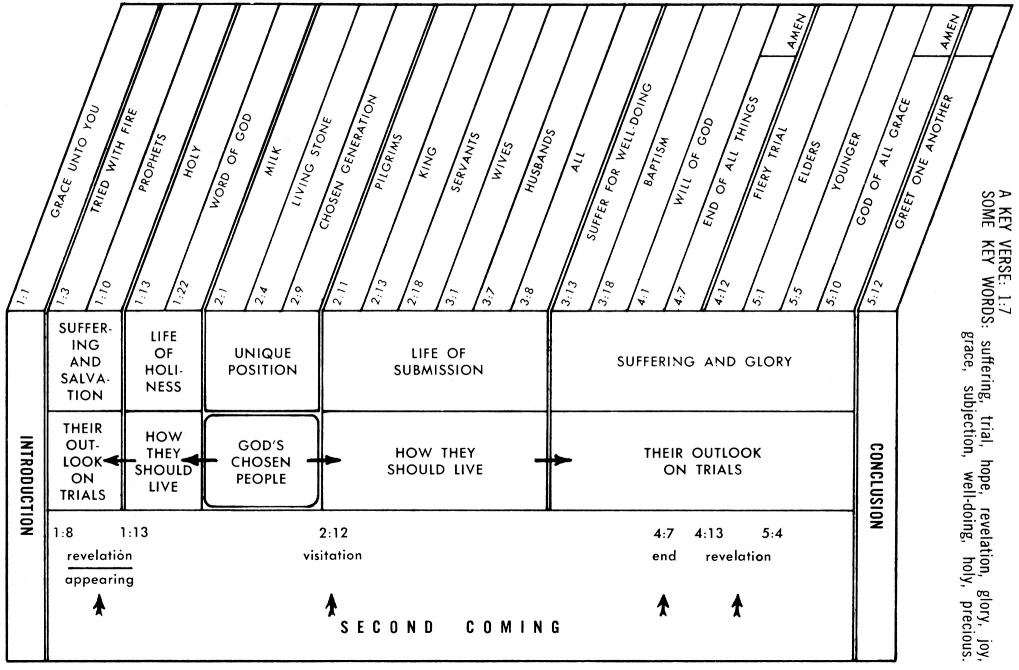
1 Peter: Trials, Holy Living & The Lord's Coming
Click chart to enlarge
Chart from Jensen's Survey of the NT - used by permission
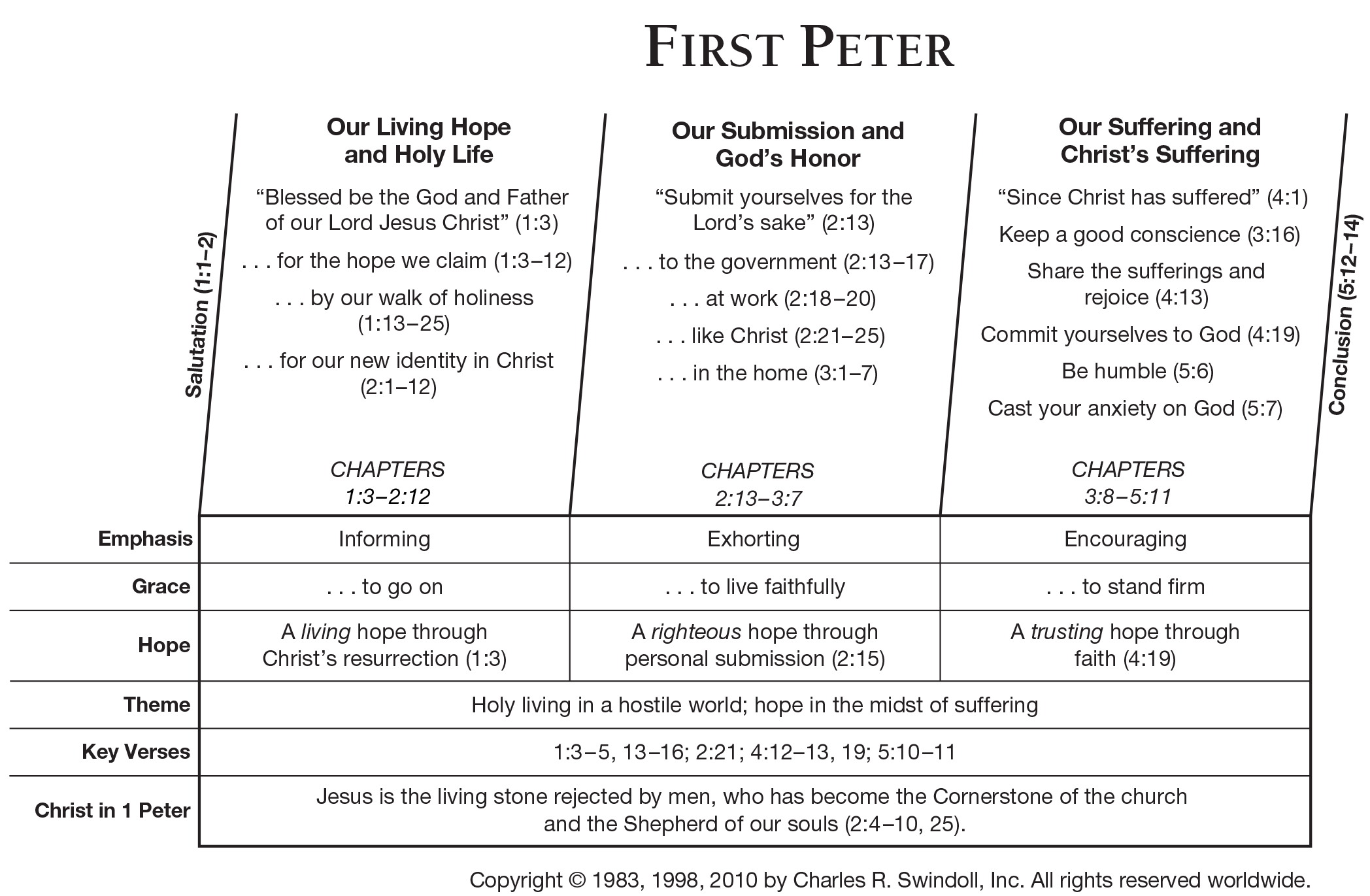
See Another Chart from Charles Swindoll
Source: Borrow Ryrie Study Bible
Click to enlarge
| Salvation of the Believer 1 Pe 1:1-2:12 |
Submission of the Believer 1 Pe 2:13-3:12 |
Suffering of the Believer 1 Pe 3:13-5:14 |
||||||||
| Salvation 1Pe 1:1-1:12 |
Sanctification 1Pe 1:13-2:12 |
Submit to Government 1Pe 2:13-17 |
Submit in Business 1Pe 2:18-25 |
Submit in Marriage 1Pe 3:1-8 |
Submit in all of life 1Pe 3:9-12 |
Conduct in Suffering 1Pe 3:13-17 |
Christ's Example of Suffering 1Pe 3:18-4:6 |
Commands in Suffering 1Pe 4:7-19 |
Minister in Suffering 1Pe 5:1-14 |
|
| Belief of Christians | Behavior of Christians | Buffeting of Christians | ||||||||
| Holiness | Harmony | Humility | ||||||||
|
Adapted from Bruce Wilkinson and Kenneth Boa's Talk Thru the Bible (borrow) |
||||||||||
1 Peter 5:9 But resist him, firm in your faith, knowing that the same experiences of suffering are being accomplished by your brethren who are in the world. (NASB: Lockman)
Greek: o antistete (2PAAM) stereoi te pistei, eidotes (RAPMPN) ta auta ton pathematon te en [to] kosmo| humon adelphoteti epiteleisthai. (PPN)
Amplified: Withstand him; be firm in faith [against his onset—rooted, established, strong, immovable, and determined], knowing that the same (identical) sufferings are appointed to your brotherhood (the whole body of Christians) throughout the world. (Amplified Bible - Lockman)
Barclay: Stand up to him, staunch in the faith, knowing how to pay the same tax of suffering as your brethren in the world. (Westminster Press)
NLT: Take a firm stand against him, and be strong in your faith. Remember that your Christian brothers and sisters all over the world are going through the same kind of suffering you are. (NLT - Tyndale House)
Phillips: Resist him, standing firm in your faith and remember that the strain is the same for all your fellow-Christians in other parts of the world. (Phillips: Touchstone)
Wuest: Stand immovable against his onset, solid as a rock in your faith, knowing that the same kind of sufferings are being accomplished in your brotherhood which is in the world. (Eerdmans Publishing)
Young's Literal: whom resist, stedfast in the faith, having known the same sufferings to your brotherhood in the world to be accomplished.
RESIST HIM: o antistete (2PAAM):
- Lk 4:3, 4, 5, 6, 7, 8, 9, 10, 11, 12; Ep 4:27; 6:11, 12, 13; Jas 4:7
SPIRITUAL WARFARE 101
Charles Simeon - The timid Christian falls into a thousand snares (Pr 29:25). The only way to obtain a victory is, to fight manfully; and this is the duty of every follower of Christ (Ep 6:10, Ep 6:13). We must never give way to Satan (Ep 4:27). We are called to wrestle and contend with him (Ep 6:12); nor shall our resistance be in vain (Jas 4:7. Satan is not only checked but terrified, and vanquished, by the resistance of the weakest Christian.). (1 Peter 5:8, 9 The Means of Defeating Satan's Malice)
Resist (436) (anthistemi from anti = against + histemi = to cause to stand) is literally to stand or set against. To set one's self against. To withstand.
Anthistemi means to arrange in battle against and so pictures a face to face confrontation. It means to set one's self against, to stand firm against someone else's onset, to oppose (place opposite or against), to resist by actively opposing pressure or power, to withstand (oppose with firm determination). It involves not only a psychological attitude but also a corresponding behavior. It was used to refer to an army arranging in battle against the enemy force and so to array against.
The aorist imperative is a command for the readers to resist now, to resist effectively! It is urgent!
There are the 14 NT uses of anthistemi translated: cope with(1), oppose(1), opposed(5), opposing(1), resist(5), resists(2)…
Matthew 5:39 (note) "But I say to you, do not resist him who is evil; but whoever slaps you on your right cheek, turn to him the other also.
Luke 21:15 for I will give you utterance and wisdom which none of your opponents will be able to resist or refute.
Acts 6:10 And yet they were unable to cope with the wisdom and the Spirit with which he was speaking.
Acts 13:8 But Elymas the magician (for thus his name is translated) was opposing them, seeking to turn the proconsul away from the faith.
Romans 9:19 (note) You will say to me then, "Why does He still find fault? For who resists His will?"
Romans 13:2 (note) Therefore he who resists authority has opposed the ordinance of God; and they who have opposed will receive condemnation upon themselves.
Galatians 2:11 But when Cephas came to Antioch, I opposed him to his face, because he stood condemned.
Ephesians 6:13 (note) Therefore, take up the full armor of God, that you may be able to resist in the evil day, and having done everything, to stand firm.
2 Timothy 3:8 (note) And just as Jannes and Jambres opposed Moses, so these men also oppose the truth, men of depraved mind, rejected as regards the faith.
2 Timothy 4:15 (note) Be on guard against him yourself, for he vigorously opposed our teaching.
James 4:7 Submit therefore to God. Resist the devil and he will flee from you.
1 Peter 5:9 (note) But resist him, firm in your faith, knowing that the same experiences of suffering are being accomplished by your brethren who are in the world.
Wuest comments that "resist" (anthistemi) means “to withstand, to be firm against someone else’s onset” rather than “to strive against that one.” The Christian would do well to remember that he cannot fight the devil. The latter was originally the most powerful and wise angel God created. He still retains much of that power and wisdom as a glance down the pages of history and a look about one today will easily show. While the Christian cannot take the offensive against Satan, yet he can stand his ground in the face of his attacks. Cowardice never wins against Satan, only courage. (Bolding added) (Word Studies - Eerdman Publishing Company Volume 1, Volume 2, Volume 3)
Richison writes that anthistemi "is a term of defense, not offense. The Christian must build fortifications against the Devil. The Christian is at war. We should establish bulwarks of faith against our enemy. We resist by obeying the commands of verse eight. We would do well to remember that we cannot fight the Devil in ourselves. (Richison, G: Today's Word)
God commands us to forsake the world, deny the lusts of the flesh and resist the devil. Satan’s desire is to tempt believers to doubt, to deny, to disregard, and to disobey God.
Resist means to defend oneself against the devil not to attack him. On the other hand to cower before the devil is to invite sure defeat. Clothed with the garment of a righteous lifestyle and strengthened in the inner man by the Spirit ensures effective resistance to diabolical attacks and procures his flight. On the other hand the believer is instructed (commanded) to flee from various evils…
Flee immorality 1Cor 6:18, 19, 20
F lee from idolatry 1Cor 10:14, 15
Flee from these things [love of money], you man of God 1Ti 6:11
Flee from youthful lusts 2Ti 2:22 (note)
Notice that every use of flee in these passages is in the present imperative and thus is a command to continuously flee. The believer is never instructed to flee from the Devil but to resist him!
Constable - "Whereas God commands us to forsake the world and deny the lusts of the flesh we should resist the devil. Satan’s desire is to get the Christian to doubt, to deny, to disregard, and to disobey what God has said." (Tom Constable's Expository Notes on the Bible)
In a parallel passage James also uses verb anthistemi calling on believers to…
Submit (line up under - do it now! It is urgent! = aorist imperative) therefore (because God opposes the proud who refuse to submit but gives grace to the humble who willingly, lovingly yield to Him) to God. Resist (anthistemi - aorist imperative) = take your stand against) the devil and he will flee from you. (Comment: What a paradox - it is the humble man or woman that Satan will flee from, not the one who is filled with pride! People who believe that the Devil is red believe a religious fairy tale. This passage makes it very clear that the Devil is yellow! The Devil is not afraid of us but of our faith. By depending on the Lord the weakest Christian can not only check the Devil but he can vanquish him. It is amazing that God has given Christians the power to resist the greatest creature ever made! The Devil is mighty but not invincible. Some people act as if the Devil is almighty. This is a sad mistake because it defers to him too much. Furthermore, an attitude of indecision and doubt when facing the devil makes him bold and aggressive in his attacks but confronting him with a resolute will and firm confidence in God's promise (that the enemy must flee) unmasks him as a coward. The devil cannot lead a man or woman into sin without the consent of that person's will. As long as the individual's will is submissive to the control and guidance of the Holy Spirit, that person can stand victorious against any deception and seduction the devil might cast his or her way.
Peter uses anthistemi calling on believers to
Humble (aorist imperative - be willing to bow down to Him, an attitude that is enabled not by our fallen flesh but by the indwelling Spirit - learn to depend on His power!) yourselves, therefore, under the mighty hand of God, that He may exalt you at the proper time 7 casting all your anxiety upon Him, because He cares for you. 8 Be of sober spirit (aorist imperative), be on the alert (aorist imperative). Your adversary (see word study antídikos), the devil, prowls about like a roaring lion, seeking someone to devour. 9 But resist (anthistemi - aorist imperative) him, firm in your faith, knowing that the same experiences of suffering are being accomplished by your brethren who are in the world. (See notes 1 Peter 5:6; 5:7; 5:8; 5:9 )
Comment - Notice there are 4 commands and we cannot keep even one in our own natural strength. There is only ONE WAY to keep the commands of God and that is not by relying on self but by continually relying on the Spirit's power to enable us to do supernaturally what we simply cannot accomplish naturally! If you have experienced frustration and repeated failure in keeping God's commands (there are over 1600 in the NT!), then this truth is for you! It is the Spirit Who sets you free to obey God's Word. This begs several questions: Are you continually being filled with the Spirit? Eph 5:18) Are you walking by the Spirit? (Gal 5:16) Have you grieved the Spirit (Eph 4:30) or quenched the Spirit (1 Th 5:19) by harboring unconfessed sins and thus in effect cutting off the Spirit's power? If so, then confess your sins (1 John 1:9) and walk in the light (1 John 1:7), filled with and empowered by the Spirit of Christ! This is the way to abundant life and victory over the sin that so easily entangles you! See also the discussion of commands and need for the Spirit
Warren Wiersbe makes a great point writing that…
Before we can stand before Satan, we must bow before God. Peter resisted the Lord and ended up submitting to Satan!" (Bible Exposition Commentary)
Despite the devil's deceptions, accusations, power, hatred and ferocity, we can successfully resist because God commands us to do so and His commands always include His enablement. Be aware that although the devil is a defeated foe, he is also a persistent foe (prowls in 1 Pe 5:8 is = continually on the prowl!). For example, Luke records that
when the devil had finished every temptation (of Jesus), he departed from Him until an opportune time. (Lk 4:13).
In his first epistle John has several passages that reinforce the truth that the believer can resist the devil
I have written to you, fathers, because you know Him who has been from the beginning. I have written to you, young men, because you are strong, and the word of God abides in you, and you have overcome (nikao - come off victorious over) the evil one (the devil and his evil angels). (1Jn 2:14)
Comment: These young men know sound doctrine and so are strong against sin and error because they have His Word in them and are enable to overcome the wiles of the devil, who makes havoc of spiritual children - Ephesians 4:14
You are from God, little children, and have overcome (be victorious over) them; because greater is He who is in you (the Spirit of Christ) than he who is in the world. (the spirit of the devil and his henchmen) (1Jn 4:4).
Comment: The context speaks especially of false doctrine, which the Spirit of God will help the believer discern as error.
We know that no one who is born of God sins; but He who was born of God keeps him and the evil one does not touch him. (1Jn 5:18, cp 1Jn 5:19)
Comment: The word for touch means to lay hold of or to grasp in order to harm. Because the believer belongs to God, Satan must operate within God’s sovereignty and cannot function beyond what God allows, as taught for example in Job 2:5 (cp Job 1:6, 7, 8, 9, 10, 11, 12, 13). God protects His children and places definite limits on Satan’s influence or power!
A word of caution is in order. A believer should never "discuss" things with the Devil or his minions. Eve made this mistake, and paid for it dearly.
Take your stand on the Word and then you will be able to withstand his attack. Resist the temptation to try special formulas or words directed at the devil or his henchmen. Simply purpose to remain steadfast in the faith, continuing to live in accord with the truth of God’s Word . As the believer feeds on sound doctrine and obeys God’s truth, Satan is "resisted". Satan is the father of lies and the prince of darkness but God's Truth exposes the enemy's lies and His Light overpowers darkness.
John records that
"the light shines in the darkness, and the darkness did not comprehend it (did not overpower it)." (Jn 1:5)
The devil is far more intelligent and powerful than we are, so we cannot resist him in the strength of the flesh (cp 2Co 10:3, 4, 5, Eph 6:11, 12, 13, 14, see note). Our example in combating Satan is the Lord Jesus who defeated the devil's temptations by citing appropriate passages from God's Word. For example when
the tempter came and said to Him, "If You are the Son of God, command that these stones become bread." Jesus "answered and said, "It is written, 'MAN SHALL NOT LIVE ON BREAD ALONE, BUT ON EVERY WORD THAT PROCEEDS OUT OF THE MOUTH OF GOD (from Deut 8:3).'" (Mt 4:3-4, cp Lk 4:4)
The devil in fact is already a defeated foe for Jesus
"partook of (flesh and blood), that through death He might render powerless him who had the power of death, that is, the devil" (See note Hebrews 2:14).
However, for personal victory "against the schemes of the devil" in our present circumstances, we must "put on the whole armor of God" (See notes Ephesians 6:11).
- Is not after the flesh -2 Corinthians 10:3
- Is a good warfare -1 Timothy 1:18,19
- Called the good fight of faith -1 Timothy 6:12
IS AGAINST
- The devil -Ge 3:15; 2Co 2:11; Ep 6:12; James 4:7; 1Pe 5:8; Re 12:17
- The flesh -Ro 7:23; 1Co 9:25, 26, 27; 2Co 12:7; Ga 5:17; 1Pe 2:11
- Enemies -Ps 38:19; 56:2; 59:3
- The world -Jn 16:33; 1Jn 5:4,5
- Death -1Co 15:26; Heb 2:14,15
- Often arises from the opposition of friends or relatives -Mic 7:6; Mt 10:35,36
TO BE CARRIED ON
- Under Christ, as our captain -Hebrews 2:10
- Under the Lord’s banner -Psalms 60:4
- With faith -1 Timothy 1:18,19
- With a good conscience -1 Timothy 1:18,19
- With steadfastness in the faith -1Co 16:13; 1Pe 5:9; Heb10:23
- With earnestness -Jude 1:3
- With watchfulness -1 Cor 16:13; 1 Peter 5:8
- With sobriety -1 Thessalonians 5:6; 1 Peter 5:8
- With endurance or hardness -2 Timothy 2:3,10
- With self-denial -1 Corinthians 9:25-27
- With confidence in God -Psalms 27:1-3
- With prayer -Psalms 35:1-3; Ephesians 6:18
- Without earthly entanglements -2 Timothy 2:4
- Mere professors do not maintain -Jeremiah 9:3
SAINTS
- Are all engaged in -Philippians 1:30
- Must stand firm in -Ephesians 6:13,14
- Exhorted to diligence -1 Timothy 6:12; Jude 1:3
- Encouraged in -Isaiah 41:11,12; 51:12; Micah 7:8; 1 John 4:4
- Helped by God in -Psalms 118:13; Isaiah 41:13,14
- Protected by God in -Psalms 140:7
- Comforted by God in 2 Corinthians 7:5,6
- Strengthened by God in Psalms 20:2; 27:14; Isaiah 41:10
- Strengthened by Christ in -2 Corinthians 12:9; 2 Timothy 4:17
- Delivered by Christ in -2 Timothy 4:18
- Thank God for victory in Romans 7:25; 1 Corinthians 15:57
ARMOUR FOR
- Girdle of truth -Ephesians 6:14
- Breastplate of righteousness -Ephesians 6:14
- Preparation of the gospel -Ephesians 6:15
- Shield of faith -Ephesians 6:16
- Helmet of salvation -Ephesians 6:17; 1 Thessalonians 5:8
- Sword of the Spirit -Ephesians 6:17
- Called armour of God Ephesians 6:11
- Called armour of righteousness -2 Corinthians 6:7
- Called armour of light -Romans 13:12
- Not carnal -2 Corinthians 10:4
- Mighty through God -2 Corinthians 10:4,5
- The whole, is required -Ephesians 6:13
- Must be put on -Romans 13:12; Ephesians 6:11
- To be on right hand and left -2 Corinthians 6:7
VICTORY IN, IS
- From God -1 Corinthians 15:57; 2 Corinthians 2:14
- Through Christ -Ro 7:25; 1Co 15:27; 2Co 12:9; Re 12:11
- By faith -Hebrews 11:33-37; 1 John 5:4,5
- Over the devil -Romans 16:20; 1 John 2:14
- Over the flesh -Romans 7:24,25; Galatians 5:24
- Over the world -1 John 5:4,5
- Over all that exalts itself -2 Corinthians 10:5
- Over death and the grave -Is 25:8; 26:19; Ho 13:14; 1Co 15:54,55
- Triumphant -Romans 8:37; 2 Corinthians 10:5
THEY WHO OVERCOME IN, SHALL
- Eat of the hidden manna -Revelation 2:17
- Eat of the tree of life -Revelation 2:7
- Be clothed in white raiment -Revelation 3:5
- Be pillars in the temple of God Revelation 3:12
- Sit with Christ in his throne -Revelation 3:21
- Have a white stone, and, in it a new name written -Re 2:17
- Have power over the nations -Revelation 2:26
- Have the name of God written upon them by Christ -Re 3:12
- Have God as their God -Revelation 21:7
- Have the morning-star Revelation 2:28
- Inherit all things -Revelation 21:7
- Be confessed by Christ before God the Father -Re 3:5
- Be sons of God -Revelation 21:7
- Not be hurt by the second death -Revelation 2:11
- Not have their names blotted out of the book of life -Re 3:5
- Illustrated -Isaiah 9:5; Zechariah 10:5
FIRM IN [IN YOUR] FAITH: stereoi te pistei:
- Lk 22:32; Eph 6:16; 1Ti 6:12; 2Ti 4:7; Heb 11:33)
Firm (4731) (stereos) means stable (firmly established), steadfast or solid like a foundation. In a physical sense this word describes something as firm, hard, solid and compact like a rock. It is used of food adults eat (solid) rather than milk, the former referring to advanced or deeper doctrine.
Stereós is used 4x in NT (1x 2Ti; 2x Heb; 1x 1Pe) and is translated as (firm, 2; solid, 2). There are 14 uses in the LXX (Exod. 37:17, 20; Num. 8:4; Deut. 32:13; 1Sa 4:8; Ps. 35:10; Is. 2:21; 5:28; 17:5; 50:7; 51:1; Jer. 15:18; 30:14; 31:11)
2 Timothy 2:19 (note) Nevertheless, the firm (figuratively = solid, rigid, strong) foundation of God stands, having this seal, "The Lord knows those who are His," and, "Let everyone who names the name of the Lord abstain from wickedness."
Hebrews 5:12 (note) For though by this time you ought to be teachers, you have need again for someone to teach you the elementary principles of the oracles of God, and you have come to need milk and not solid food… 5:14 But solid food is for the mature, who because of practice have their senses trained to discern good and evil.
1 Peter 5:9 But resist him, firm (figuratively = steadfast or immovable in one's beliefs) in your faith, knowing that the same experiences of suffering are being accomplished by your brethren who are in the world.
The idea Peter is conveying is that they are to be steadfast (firmly fixed in place, not subject to change) immovable (not moving or not intended to be moved) in their faith.
Christians are to stand firm and unyielding, resisting the devil.
Wuest adds that steadfast ("firm") is
"a military term. Paul uses it in Colossians 2:3 (see note) when he says “beholding your order,” that is, “beholding your solid front or close phalanx.” The Greek phalanx was a body of heavy-armed infantry formed in ranks and files close and deep. Pope has a line, “The Grecian phalanx, moveless (without movement thus picturing their stability and immovability against enemy assaults) as a tower.” The word speaks of solidity in the very mass and body of the thing itself." (Word Studies - Eerdman Publishing Company Volume 1, Volume 2, Volume 3)
J Vernon McGee adds that
The picture here is of an army standing against an enemy. We should stand with other believers. I do not think you can resist the Devil by yourself. You not only need the armor of God, but you will also need other believers to stand with you. That is the reason that whenever I have need, I let all the listeners to my radio broadcast know about it. I want them to stand with me in prayer—we need to do that. (McGee, J V: Thru the Bible Commentary: Thomas Nelson)
Soldiers had to maintain their ranks and formation or the enemy would attack them from the side or from behind.
Using a word related to the adjective stereós, Paul writes to the Colossians that
"even though I am absent in body, nevertheless I am with you in spirit, rejoicing to see your good discipline (standing shoulder to shoulder in such orderly array) and the stability (the firmness and the solid front) of your faith in Christ." (See note Colossians 2:5) .
Paul actually uses two military terms in this verse, the first "good discipline" (taxis) picturing the Colossian saints arranged like an army in ranks, with each soldier in his proper place prepared for attack. "Stability" (stereoma from stereós) describes a solid front of soldiers.
As Vincent says their
"Faith is represented as a host solidly drawn up: your solid front, close phalanx”.
Their faith in Christ was like the solid part of a military line which can and does stand the attack of the enemy, in this case false teachers.
As Eadie notes their faith
reposed on Christ—as unshaken as its object. His love never wavers, His power never fails, His fidelity never resiles (retracts, recoils) from its pledge. And those unseen blessings which faith surveys are unchanging in their certainty and glory. The portals of heaven are never barred—its living stream is never dried up; the pearls of its gates are unsoiled, nor is the gold of its pavement ever worn through. Surely, then, faith ought to be as stedfast as the foundation on which it rests, and the object which it contemplates and secures.
Paul used stereós in his letter to Timothy writing that even though their were some men who had
"gone astray from the truth saying that the resurrection has already taken place, and they upset the faith of some, nevertheless the firm (stereós - solid, sure, unshaken) foundation of God stands, having this seal, "The Lord knows those who are His," and, "Everyone who names the name of the Lord is to abstain from wickedness." (See notes 2 Timothy 2:18; 2:19)
Faith (4102) (pistis) in this context describes the Christian's personal confidence in God, Christ, His Word and His promises. Christians will be enabled to stand fearlessly firm against the roaring lion only if they lean wholly (which is what faith does) on Jesus' name, standing on the promises of God.
The noun "Faith" is in the locative case, the idea being that the stability to stand against the adversary is found in the sphere of one's personal faith.
Wuest adds that
"The words “in the faith” refer to the believer’s own faith, the definite article here pointing to ownership. That is, the Christian is to stand firm against the onset of the devil, not in himself, but in the exercise of a faith that depends upon the strengthening and protecting power of God." (Word Studies - Eerdman Publishing Company Volume 1, Volume 2, Volume 3)
Remember that faith is not a feeling but "is the assurance of things hoped for, the conviction of things not seen" (Heb 11:1) and that believers are called to "walk by faith, not by sight." (2Cor 5:7)
The basic nature of faith is confidence that things yet future and unseen will happen as God has revealed they will. Peter is saying that if this is our attitude, we will be enabled to stand firm.
Your faith will be firm if your trust is in the Solid Rock. Victory is not assured by the personal tenacity or intensity with which we cling to our personal beliefs. Victory is found in adhering to the finished work of Christ on the Cross, where Christ forever defeated our adversary the devil. Prior to His crucifixion Jesus declared
"Now judgment is upon this world (sentence is now being passed on this world); now the ruler of this world shall be cast out." (Jn 12:31).
Although the Cross might have appeared to signal Satan’s victory over God, in reality it marked Satan’s defeat. The sentence has not yet been carried out on the devil, but his doom has been sealed. He is still going through the world carrying on his evil business, but at the end of Messiah's 1000 year reign (See Millennium) John records that
the devil who deceived (the unbelievers in the 1000 year reign) was thrown into the lake of fire and brimstone, where the beast and the false prophet are also; and they will be tormented day and night forever and ever. (Rev 20:10)
The purpose of trials is not to weaken our faith but to strengthen it. Trials are not allowed by God to make us "bitter" but "better". The outcome depends on our attitude - receptive versus resentful.
Thomas Watson…
Faith is the grace which does Satan most harm; it makes the most resistance against him. "Be careful! Watch out for attacks from the Devil, your great enemy. He prowls around like a roaring lion, looking for some victim to devour! Resist him, standing firm in the faith." 1Peter 5:8, 9. No grace more bruises the serpent's head—than faith. It is both a shield and a sword, defensive and offensive. It is a shield to guard the head and defend the vitals. The shield of faith prevents the fiery darts of temptation from piercing us through. Faith is a sword which wounds the red dragon.
Charles Simeon warns that…
Unbelief is a powerful instrument in the hands of Satan. He excites it in us that he may turn us from the faith: we must therefore hold fast the doctrines of faith. We should not suffer ourselves to be moved from the hope of the Gospel: this is our anchor whereby we must outride the storm (He 6:19). We must also steadfastly exercise the grace of faith. This is the weapon whereby we overcome the world (1Jn 5:4, cp Gal 6:14); and by this shall we triumph over Satan himself (Ep 6:16).
Let not the ungodly despise this adversary; but let them seek deliverance from him through the Gospel (Acts 26:18); and let the godly be continually on their guard against him (2Co 11:3), so shall they experience that promised blessing (Ro 16:20) (1 Peter 5:8, 9 The Means of Defeating Satan's Malice)
Spurgeon in his sermon The Roaring Lion (click for full text) comments on Steadfast in the faith writing that we should
Seek to obtain a clear knowledge of the doctrines of the gospel, and then get a good grip of them. Be ready to die, sooner than give up a particle of God’s revealed truth. This will make you strong. Then take hold of the promises of God, which are yea and amen in Christ Jesus. Know that to every doctrine there is serve opposite promise. Have ready for every attack some strong word commencing with “Is it written?” Answer Satan with “Thus saith the Lord.” — “Steadfast in the faith.” Remember, all the water outside of a ship cannot sink it. It is the water inside that perils its safety. So, if your faith can keep its hold, and you can still say, “Though he slay me yet will I trust in him,” (Job 13:!5) Satan may batter your shield; but he has not wounded your flesh."
In Acts we read that
the churches were being (passive voice = church acted upon by outside force, the Spirit of the Living God) strengthened (stereoo - verb form of stereós) (imperfect tense = over and over the church was being made firm and solidified like muscles) in the faith, and were increasing in number daily. (Acts 16:5)
Comment: This passage clearly shows the healthy effect of sound biblical evangelism and discipleship which produces a faith based on "sound doctrine" and "solid food".
Would Dr. Luke write such a description about your church, beloved? Or are you simply "increasing in number", yet not being "strengthened in the faith"?
Just as David took his stand against Goliath, and trusted in the name of Jehovah, so we take our stand against Satan in the victorious name of Jesus Christ. (Wiersbe, W. The Bible exposition commentary)
David "said to the Philistine, "You come to me with a sword, a spear, and a javelin, but I come to you in the name of the LORD of hosts, the God of the armies of Israel, whom you have taunted. (1Sa 17:45)
John MacArthur writes that
The way to resist the devil is not with special formulas, or words directed at him and his demons, but by remaining firm in the Christian faith. This means to continue to live in accord with the truth of God’s Word. As the believer knows sound doctrine and obeys God’s truth, Satan is withstood. (MacArthur, J.: The MacArthur Study Bible Nashville: Word Pub)
Trust and Obey
by John H Sammis
When we walk with the Lord in the light of His Word,
What a glory He sheds on our way!
While we do His good will, He abides with us still,
And with all who will trust and obey.Refrain
Trust and obey, for there’s no other way
To be happy in Jesus, but to trust and obey.Not a shadow can rise, not a cloud in the skies,
But His smile quickly drives it away;
Not a doubt or a fear, not a sigh or a tear,
Can abide while we trust and obey.
RefrainNot a burden we bear, not a sorrow we share,
But our toil He doth richly repay;
Not a grief or a loss, not a frown or a cross,
But is blessed if we trust and obey.
RefrainBut we never can prove the delights of His love
Until all on the altar we lay;
For the favor He shows, for the joy He bestows,
Are for them who will trust and obey.
RefrainThen in fellowship sweet we will sit at His feet.
Or we’ll walk by His side in the way.
What He says we will do, where He sends we will go;
Never fear, only trust and obey.
Refrain
We take our stand on the Word of God and refuse to be moved, for unless we stand on the truth we cannot withstand our enemy who traffics in untruths.
We are to stand in our position, "hidden with Christ in God,” (Colossians 3:3 ), that we may be “strong in the Lord, and in the strength of His might” (Ephesians 6:10).
We do not have to wage war with the devil to obtain our position ("in Him [Christ] you have been made complete and He is the head over all rule and authority" Colossians 2:10 - see note), nor do we have to fight him either to maintain it or to retain it
for though we walk in the flesh, we do not war according to the flesh, for the weapons of our warfare are not of the flesh, but divinely powerful for the destruction of fortresses. We are destroying speculations and every lofty thing raised up against the knowledge of God, and we are taking every thought captive to the obedience of Christ" (2Cor 10:3, 4, 5).
Now we are simply to stand where we have been placed, abiding above ("seated… with Him in the heavenly places, in Christ Jesus" Ephesians 2:6 - see note), and "taking up the shield of faith with which you will be able to extinguish all the flaming missiles of the evil one." (Ephesians 6:16 ).
At the Cross the Lord Jesus
“disarmed (stripped them, divesting them of their power and authority) the rulers and authorities (the principalities and powers), He made a public display of them, having triumphed over them through Him." (See note Colossians 2:15).
Believers now can humbly walk in the triumph of our Victorious Captain. The war has been won at Calvary. Now, His good soldiers are called to fight the good fight of faith, fighting individual battles, knowing that that ultimate outcome has been determined by the Cross, "Paid in Full"! (Jn 19:30, 1Co 15:55, 57, Pr 21:31, Jn 16:33, Ga 6:14, Ro 8:37, 1Jn 5:4,5, Re 12:11-noyr)
Our Daily Bread writes… Twinkle, Tinkle, Tattle…
A man was repeatedly robbed by burglars who entered his house through a window while he was asleep. He finally solved his problem by using three things. He called them a twinkler, a tinkler, and a tattler. The twinkler was a candle that he kept burning in the window all night. The tinkler was a bell attached to the window. And the tattler was a small, noisy dog. Because of these, the burglars were kept away.
Every Christian lives in a house that Satan seeks to burglarize. We too need a twinkler, a tinkler, and a tattler. The twinkler is the candle of God's Word. Its truths provide light that exposes Satan's lies. Daily attention to the Word keeps the lamp bright. The tinkler is the bell of our testimony. Keep it ringing as you tell others of the Savior, and Satan will be frustrated. The tattler is the life of prayer. When the enemy comes, send up the warning that you are telling Jesus about it all. Yes, twinkle your light, tinkle your testimony, and bark the enemy away by prayer.
A godly woman, when asked the secret of her victory, replied, "Whenever the devil raps at my door, I just say, 'Jesus, You go to the door and take care of him.'"
Twinkle, tinkle, and tattle! --M. R. De Haan, M.D. (founder of RBC Ministries)
The only way to overcome
Temptations that we face
Is to be focused on the Lord,
Who strengthens by His grace. --Sper
If you would master temptation, let Christ master you
- Is the substance of things hoped for -Hebrews 11:1
- Is the evidence of things not seen -Hebrews 11:1
- Commanded -Matthew 11:22; 1 John 3:23
THE OBJECTS OF, ARE
- God -John 14:1
- Christ -John 6:29; Acts 20:21
- Writings of Moses -John 5:46; Acts 24:14
- Writings of the prophets 2 Chronicles 20:20; Acts 26:27
- The gospel -Mark 1:15
- Promises of God -Romans 4:21; Hebrews 11:13
IN CHRIST IS
- The gift of God -Romans 12:3; Ephesians 2:8; 6:23; Philippians 1:29
- The work of God -Acts 11:21; 1 Corinthians 2:5
- Precious -2 Peter 1:1
- Most holy -Jude 1:20
- Fruitful -1 Thessalonians 1:3
- Accompanied by repentance -Mark 1:15; Luke 24:47
- Followed by conversion -Acts 11:21
- Christ is the Author and Finisher of -Hebrews 12:2
- Is a gift of the Holy Spirit -1 Corinthians 12:9
- The Scriptures designed to produce -John 20:31; 2 Timothy 3:15
- Preaching designed to produce -John 17:20; Acts 8:12; Romans 10:14,15,17; 1 Corinthians 3:5
THROUGH IT IS
- Remission of sins -Acts 10:43; Romans 3:25
- Justification -Acts 13:39; Romans 3:21,22,28,30; 5:1; Galatians 2:16
- Salvation -Mark 16:16; Acts 16:31
- Sanctification -Acts 15:9; 26:18
- Spiritual light -John 12:36,46
- Spiritual life -John 20:31; Galatians 2:20
- Eternal life -John 3:15,16; 6:40,47
- Rest in heaven -Hebrews 4:3
- Edification -1 Timothy 1:4; Jude 1:20
- Preservation 1 Peter 1:5
- Adoption -John 1:12; Galatians 3:26
- Access to God -Romans 5:2; Ephesians 3:12
- Inheritance of the promises -Galatians 3:22; Hebrews 6:12
- The gift of the Holy Spirit -Acts 11:15-17; Galatians 3:14; Ephesians 1:13
- Impossible to please God without Hebrews 11:6
- Justification is by, to be of grace -Romans 4:16
- Essential to the profitable reception of the gospel -Hebrews 4:2
- Necessary in the Christian warfare -1 Timothy 1:18,19; 6:12
- The gospel effectual in those who have -1 Thessalonians 2:13
- Excludes self-justification Romans 10:3,4
- Excludes boasting -Romans 3:27
- Works by love -Galatians 5:6; 1 Timothy 1:5; Philemon 1:5
PRODUCES
- Hope -Romans 5:2
- Joy -Acts 16:34; 1 Peter 1:8
- Peace -Romans 15:13
- Confidence -Isaiah 28:16; 1 Peter 2:6
- Boldness in preaching -Psalms 116:10; 2 Corinthians 4:13
- Christ is precious to those having -1 Peter 2:7
- Christ dwells in the heart by -Ephesians 3:17
- Necessary in prayer -Matthew 21:22; James 1:6
- Those who are not Christ’s have not -John 10:26,27
- An evidence of the new birth -1 John 5:1
BY IT SAINTS
- Live -Galatians 2:20
- Stand -Romans 11:20; 2 Corinthians 1:24
- Walk -Romans 4:12; 2 Corinthians 5:7
- Obtain a good report -Hebrews 11:2
- Overcome the world -1 John 5:4,5
- Resist the devil -1 Peter 5:9
- Overcome the devil Ephesians 6:16
- Are supported Psalms 27:13; 1 Timothy 4:10
- Saints die in -Hebrews 11:13
SAINTS SHOULD
- Be sincere in -1 Timothy 1:5; 2 Timothy 1:5
- Abound in -2 Corinthians 8:7
- Continue in -Acts 14:22; Colossians 1:23
- Be strong in -Romans 4:20-24
- Stand fast in -1 Corinthians 16:13
- Be grounded and settled in -Colossians 1:23
- Hold, with a good conscience -1 Timothy 1:19
- Pray for the increase of Luke 17:5
- Have full assurance of -2 Timothy 1:12; Hebrews 10:22
- True, evidenced by its fruits -James 2:21-25
- Without fruits, is dead -James 2:17,20,26
- Examine whether you be in 2 Corinthians 13:5
- All difficulties overcome by -Matthew 17:20; 21:21; Mark 9:23
- All things should be done in Romans 14:22
- Whatever is not of, is sin -Romans 14:23
- Often tried by affliction -1 Peter 1:6,7
- Trial of, works patience -James 1:3
- The wicked often profess -Acts 8:13,21
- The wicked destitute of -John 10:25; 12:37; Acts 19:9; 2 Thessalonians 3:2
Protection of, illustrated
- A shield -Ephesians 6:16
- A breastplate -1 Thessalonians 5:8
Exemplified
- Caleb -Numbers 13:30
- Job -Job 19:25
- Shadrach, etc -Daniel 3:17
- Daniel -Daniel 6:10,23
- Peter -Matthew 16:16
- Woman who was a sinner -Luke 7:50
- Nathanael -John 1:49
- Samaritans -John 4:39
- Martha -John 11:27
- The Disciples -John 16:30
- Thomas -John 20:28
- Stephen -Acts 6:5
- Priests -Acts 6:7
- Ethiopian Acts 8:37
- Barnabas -Acts 11:24
- Sergius Paulus Acts 13:12
- Philippian jailor -Acts 16:31,34
- Romans -Romans 1:8
- Colossians -Colossians 1:4
- Thessalonians -1 Thessalonians 1:3
- Lois -2 Timothy 1:5
- Paul -2 Timothy 4:7
- Abel -Hebrews 11:4
- Enoch -Hebrews 11:5
- Noah -Hebrews 11:7
- Abraham -Hebrews 11:8,17
- Isaac -Hebrews 11:20
- Jacob -Hebrews 11:21
- Joseph -Hebrews 11:22
- Moses -Hebrews 11:24,27
- Rahab -Hebrews 11:31
- Gideon &c -Hebrews 11:32,33,39
KNOWING THAT THE SAME EXPERIENCES OF SUFFERING ARE BEING ACCOMPLISHED BY YOUR BRETHREN WHO ARE IN THE WORLD: eidotes (RAPMPN) ta auta ton pathematon te en (to) kosmo humon adelphoteti epiteleisthai (PPN):
- 1Pe 1:6; 2:21; 3:14; 4:13; Jn 16:33; Acts 14:22; 1Co 10:13; Phil 1:29, 1Th 2:15,16; 1Th 3:3; 2Ti 3:12; Rev 1:9; 6:11; 7:14
Peter now adds a strong incentive to stand firm in their faith. Satan wants believers to believe their trial is unique and they are alone in their struggle. Don't believe his lie says Peter.
Knowing (1492) (eido) is the verb that describes absolute, positive, beyond a chance of a doubt type of knowing something. The perfect tense speaks of the permanence of their knowing. Thus their knowledge of the truth which follows ("same experiences of suffering… ") is permanently settled in their soul and can be called into use "in the nick of time" or as physicians say "PRN" (as needed for relief"). So be encouraged to endure your trials because you know beyond a shadow of doubt that your fellow-Christians are suffering the same things around the world. Suffering is the common lot for believers - you are not alone (cf Heb 13:4-5). Others have survived, therefore so can you (read Hebrews 11)
Why and how should Peter's readers have known beyond a shadow of a doubt? Peter has been writing about suffering for the preceding four chapters. In chapter 1 Peter said "In this you greatly rejoice, even though now for a little while, if necessary, you have been distressed by various trials." (see note 1 Peter 1:6)
In chapter 2 he said "For you have been called for this purpose, since Christ also suffered for you, leaving you an example for you to follow in His steps." (See note 1 Peter 2:21).
In chapter 3 he wrote that "even if you should suffer for the sake of righteousness, you are blessed. And do not fear their intimidation, and do not be troubled." (See note 1 Peter 3:14).
In chapter 4 he warned the saints not to "be surprised at the fiery ordeal among you, which comes upon you for your testing, as though some strange thing were happening to you but to the degree that you share the sufferings of Christ, keep on rejoicing; so that also at the revelation of His glory, you may rejoice with exultation." (See note 1 Peter 4:12; 4:13)
Paul warned Timothy that "indeed, all who desire to live godly in Christ Jesus will be persecuted" (See note 2 Timothy 3:12)
Faithful believers must expect persecution and suffering at the hands of the Christ-rejecting world and if you know this truth beyond a shadow of a doubt you won't be surprised when you suffer for the sake of the gospel.
"And after (Paul and Barnabas) had preached the gospel to that city (Derbe) and had made many disciples, they returned to Lystra and to Iconium and to Antioch, strengthening the souls of the disciples, encouraging them to continue in the faith, and saying, ”Through many tribulations we must (it is necessary, inevitable and not optional) enter the kingdom of God.” (Acts 14:22)
All believers need to be reminded to expect hardships and persecution so that they will not be dismayed and overwhelmed by them. Perseverance in the Christian life is a ceaseless warfare against the forces of evil.
Paul reminded the Corinthians that
"No temptation has overtaken you but such as is common to man; and God is faithful, who will not allow you to be tempted beyond what you are able, but with the temptation will provide the way of escape also, that you may be able to endure it." (1Cor 10:13)
Calvin writes that
It is another consolation, that we have a contest in common with all the children of God; for Satan dangerously tries us, when he separates us from the body of Christ." (Commentaries)
Suffering (3804) (pathema describes what happens to a person and must be endured. Pathema is talking about the actual suffering itself (not suffering in general) - it refers to the very pain that we are experiencing right now - those very things that we can "see, touch & feel" - those things that are causing us anguish and emotional trauma.
The sufferings of this life are the lot of all believers but keep in mind that for believers suffering takes on a different meaning and purpose then suffering in general - as believers we suffer for our faith in Christ (and Christ in us Who the world hates) and we suffer that we might be conformed to His image. Furthermore, any suffering and shame we experience in this life for the sake of the Christ "are not worthy to be compared with the glory that is to be revealed to us" (see Romans 8:18 below)
Pathema is used 16 times in the NT - Ro. 7:5; Ro 8:18; 2Co. 1:5, 6, 7; Gal. 5:24; Phil. 3:10; Col 1:24; 2Ti 3:11; Heb. 2:9 ; Heb 2:10; Heb 10:32; 1Pe 1:11; 1Pe 4:13; 1Pe 5:1, 1Pe 5:9. The NAS renders it most often in the plural as - passions, 2; suffering, 2; sufferings, 12.
Paul writes that
I (continually judge after calculation) consider (process of reasoning which results in arriving at a conclusion) that the sufferings (pathema) of this present time are not worthy to be compared with the glory that is to be revealed to us." (See note Romans 8:18)
Paul reminds the Corinthians that
just as the sufferings (pathema) of Christ are ours in abundance, so also our comfort is abundant through Christ. (2Co 1:5)
Again Paul writes that
"Now I rejoice in my sufferings (pathema) for your sake, and in my flesh I do my share on behalf of His body (which is the church) in filling up that which is lacking in Christ’s afflictions." (See note Colossians 1:24)
As a servant of the Lord, he was called upon to endure untold hardships, persecutions, and afflictions (see similar use of pathema in 2 Timothy 3:11- see note). These to Paul were a privilege. "Filling up that which is lacking" does not refer to the atoning sufferings of the Jesus on the Cross for they are finished once and for all and no man could ever share in them. On the other hand there is a sense in which the Lord Jesus still suffers, for when believers are persecuted, the Head feels the sufferings of His Body.
In a similar vein, Peter encourages the saints:
"Beloved, do not be surprised at the fiery ordeal among you, which comes upon you for your testing, as though some strange thing were happening to you, but to the degree that you share the sufferings (pathema) of Christ, keep on rejoicing; so that also at the revelation of His glory, you may rejoice with exultation." (See notes 1 Peter 4:12; 4:13)
Sufferings are the universal mark of all true Christians. Realizing that other Christians suffer in other places of the world, encourages us to move on in the faith. This also unites us in the same experiences. We can handle anything that life may bring us if we know the principles of the Word. And remember that we are not to be ignorant of Satan's schemes, one of which is to use our suffering to discourage us. He shoots fiery missiles like "You're the only one suffering like this." And this is a soul withering thought if not taken captive to Christ, for in the midst of the fire of affliction, it is easy to grow weary and want to give up under the mistaken impression that no one else has as much trouble as we do. In this verse Peter speaks God's truth which deflates Satan's lie.
Accomplished (2005) (epiteleo from epí = intensifies meaning, in the sense of meaning "fully" + teleo = to complete, bring not just to the end but to the destined goal from télos = end, goal) means to bring something to the place where it is complete. Epiteleo conveys the intensified meaning to fully reach the intended goal in the sense of successfully completing what has been begun (Gal 3:3, Ro 15:28, Php 1:6).
Note that root word télos originally meant the turning point, hinge, the culminating point at which one stage ends and another begins; later the goal, the end. Marriage and death are in this sense both a telos
In one NT use the idea is to erect or build (Hebrews 8:5)
Here in 1 Peter the idea is to bring about or cause something to happen as fulfillment of an objective or purpose.
Epiteleo is used 10 times in the NT and is translated in as (accomplished, 1; complete, 1; completion, 1; erect, 1; finish, 1; finished, 1; perfect, 1; perfected, 1; perfecting, 1; performing, 1).
Romans 15:28 (note) Therefore, when I have finished this, and have put my seal on this fruit of theirs, I will go on by way of you to Spain.
2 Corinthians 7:1 Therefore, having these promises, beloved, let us cleanse ourselves from all defilement of flesh and spirit, perfecting holiness in the fear of God.
2 Corinthians 8:6 Consequently we urged Titus that as he had previously made a beginning, so he would also complete in you this gracious work as well.
2 Corinthians 8:11 But now finish doing it also; that just as there was the readiness to desire it, so there may be also the completion of it by your ability.
Galatians 3:3 Are you so foolish? Having begun by the Spirit, are you now being perfected by the flesh?
Philippians 1:6 (note) For I am confident of this very thing, that He who began a good work in you will perfect it until the day of Christ Jesus.
Hebrews 8:5 (note) who serve a copy and shadow of the heavenly things, just as Moses was warned by God when he was about to erect the tabernacle; for, "See," He says, "that you make all things according to the pattern which was shown you on the mountain."
Hebrews 9:6 (note) Now when these things have been thus prepared, the priests are continually entering the outer tabernacle, performing the divine worship,
1 Peter 5:9 (note) But resist him, firm in your faith, knowing that the same experiences of suffering are being accomplished by your brethren who are in the world.
There are 7 uses of epiteleo in the Septuagint - Lev. 6:22 (speaking of the offering as to be "entirely offered"); Nu 23:23 (speaking of "what God has done" or accomplished); 1Sa 3:12; Esther 8:14; 9:27; Da 11:16; Zech 4:9 (Zerubbabel laid the foundation of the Temple [Ezra 3:8,9, 10, 11, 5:16]] and would "finish" it.)
In 1 Peter 5:9 epiteleo is in the present tense which means that the sufferings are continually being (being = passive voice) completely fulfilled. The meaning is not that the sufferings would be brought to an end (although every trial certainly has a beginning and an end), but that these sufferings would completely fulfill their intended goal and purpose in the life of each saint. In chapter 1 Peter had explained to the saints that their sufferings were neither purposeless nor fruitless but had a divinely intended goal. What goal? When they had come through the sufferings still trusting the Lord, they would be assured that their faith was real. The point is that the sufferings that were divinely appointed/allowed in the lives of God's children are not purposeless. Instead believers can look forward to the ultimate outcome. The Christian awaits not the end of suffering but its goal. A diamond develops into a diamond under great pressure. A smooth sea never made a skilful sailor. A believer stagnates in still waters.
Epiteleo can also mean to fully finish something begun, to bring it to a successful finish or to bring it to an end as illustrated in Ro 15:28 where Paul makes reference to a project he was eager to complete, writing
"Therefore, when I have finished (epiteleo - thoroughly completed) this (delivering the contributions of the Christians in Achaia and Macedonia) and have put my seal on this fruit (their financial gift for the Jerusalem church = fruit of their genuine love, in turn a product of gospel seed-sowing) of theirs, I will go on by way of you to Spain." (see note Romans 15:28)
Paul was anxious to fully complete this project of the collection of money for the Jerusalem poor. As soon as Paul had completed, executed or accomplished (epiteleo) this mission, he would visit Rome on his way to Spain.
In a similar use of epiteleo Paul encourages the saints at Philippi (and believers everywhere) that he was
"confident (having come to a settled persuasion concerning) of this very thing, that He who began a good work in you (past tense salvation = justification) will perfect (Vincent says "will carry it on towards completion, and finally complete" ) it until the day of Christ Jesus (future tense salvation = glorification)." (See notes Philippians 1:6)
Paul was absolutely certain that God would fully complete His work of salvation in the Philippians. There is no possibility of failure or of partial fulfillment. When God begins a work of salvation in a person, He finishes and perfects that work, bringing the saint to the intended goal of glorification and fully conformed to the image of His Son, Jesus Christ. Fully complete also points to the eternal security of the Christian. For completeness it should be noted that in context "good work" could refer to their active financial participation in the furtherance of the gospel, but without a doubt can also be applied to a believer's salvation, for what God begins, He completes and perfects. Amen!
Completed and Perfected
from "A Debtor to Mercy Alone" Click to play
(A Debtor to Mercy ~ Kevin Inafuku)
The work which His goodness began,
The arm of His strength will complete;
His promise is Yea and Amen,
And never was forfeited yet.
—Augustus M. Toplady
Paul uses epiteleo in reference to daily sanctification writing
"Therefore having these promises (OT promises quoted in 2Cor 6:16, 17, 18 = Scripture often encourages action based on promises), beloved, let us cleanse (in context implies separation = aorist tense here calls for a complete break to be made) ourselves (each believer must do this in his or her own life) from (apó = indicates the separation of a person or an object from another person or an object with which it was formerly united) all (no exceptions) defilement (that which pollutes or stains, the Greek OT, LXX, uses it of religious defilement or unholy alliances with idols, etc) of flesh and spirit (a figure for the whole person), (present tense = continually = speaks of a daily process = sanctification) perfecting (epiteleo - present tense calling for continual action = make this the habit of your life, progressively accomplishing) holiness in the fear of God." (See notes 2Co 7:1)
The NLT translates it
"Because we have these promises, dear friends, let us cleanse ourselves from everything that can defile our body or spirit. And let us work toward complete purity because we fear God."
In other words, as saints ("holy ones", set apart ones), believers are in Christ and have His perfect positional holiness (1Cor 1:30, NIV) but it is the duty of each saint to daily, continually choose to cleanse oneself and as we are doing this (controlled by the Holy Spirit, not legalistic constraints), we will are becoming in effect a more and more like Jesus (conformed to His image) and less and less like the world.
MacDonald notes that Paul
"does not suggest that it is ever possible to become perfectly holy while still here on earth. Practical sanctification is a process that goes on through our lifetime. We grow in likeness to the Lord Jesus Christ until the day when we see Him face to face, and then we shall be like Him (cf 1Jn 3:2-3, cp 1Jn 2:28) throughout all eternity. It is as we have a reverential fear or awe of God that we have a desire in our hearts to become holy. May we all learn to say with the godly McCheyne, “Lord, make me as holy as it is possible for a man to be on this side of heaven.”" (Believer's Bible Commentary: Thomas Nelson)
Paul uses epiteleo with a similar meaning in Galatians asking
"Are you so foolish (literally without comprehension)? Having begun (the moment you were justified by faith) by the Spirit, are you now being (present tense = continually equates with sanctification) perfected (epiteleo - present tense = continually perfecting) by the flesh (sinful human nature, the seat and vehicle of sinful desires)?" (Gal 3:3)
As noted above, the present tense of epiteleo is continuous, so the idea is that while a beginning was made at a definite point (the moment you believed), perfecting (as used in this versed) is a process and specifically a process that is synonymous with the process of daily sanctification. In other words if the Galatian Christians could not obtain salvation by works but only by faith, could they expect to grow spiritually or continually progress in holiness by keeping the law? The idea that keeping the Mosaic Law will somehow help the Holy Spirit is a fallacy that sadly persists to our day. If the power of the Spirit was necessary to save them, could they complete the process by fleshly efforts? Clearly the answer likewise is "no". Now Christians "keep the Law" out of love, not legalistic constraint.
Epiteleo is used 7 times in the Septuagint (LXX = Greek of Hebrew OT). In a sad passage Samuel records God's judgment on the house of Eli stating that
"In that day I will carry out against Eli all that I have spoken concerning his house, from beginning to end (LXX translates this with epiteleo as "I will make an end")." (1Sa 3:12)
The prophet Zechariah records that
"The hands of Zerubbabel have laid the foundation of this house, and his hands will finish (epiteleo ) it. Then you will know that the LORD of hosts has sent me to you." (Zech 4:9)
The oracle promises that as Zerubbabel had laid the foundation of the temple, so he would also complete it. In other words no obstacle will be able to stop the completion of the temple.
Brethren (81) (adelphotes from adelphós = brother) is more literally "the brotherhood" which in Greek is a so-called collective singular, which indicates more strongly than the word "brothers" the oneness of those subjected to these sufferings. The only other use of adelphotes is found in 1Pe 2:17.
Adelphos is derived from the copulative prefix (one that joins together words and expressing addition of their meaning) "a" and delphus “the womb” which gives the meaning of “one born from the same womb.” Brotherhood is the quality or state of being brothers, sharing a common bond, and in this context a common "birth", the new birth, all of one family ("children of God" Jn 1:12, 1Jn 3:1, 1Jn 3:2).
BDAG - (1) a group of fellow-believers, a fellowship… of the Christian community, whose members are adelphoi and adelphai 1 Pt 5:9; 1 Clemen 2:4… 1 Pt 2:17… (2) mutual affection such as brothers or sisters have for one another, familial affection
Norman Hilyer - Peter’s choice of the collective term emphasizes the common bond of experience shared by all Christian believers, even those unknown to the readers. (New International Biblical Commentary)
The Anchor Yale Bible Dictionary - Adelphos and the feminine form, adelphē, are used first to speak of physical relationships, but approximately half of the occurrences in the NT use the figuratively/spiritually, primarily to speak of relationships between the people of Israel or between Christians.
World (2889) (kosmos) could refer to the inhabited world per se or to the world of men who are alienated and apart from God.
Jesus used this same word kosmos in the latter sense explaining to His disciples
these things (Jn 14-16) I have spoken to you, that in Me (Ed: As we abide in Him) you may have peace. In the world (kosmos) you have tribulation (thlipsis), but take courage (present tense = continually be of good cheer. This is possible as we learn to abide in Him and His Spirit enables us); I have overcome (nikao - become victorious, prevailed over - perfect tense speaks of permanence) the world (kosmos). (Jn 16:33, cp Paul's affirmation in Gal 6:14)
The fundamental ground for endurance in persecution is the victory of Jesus over the world.
- God appoints -2 Ki 6:33; Job 5:6,17; Ps 66:11; Amos 3:6; Micah 6:9
- God dispenses, as He will -Job 11:10; Is 10:15; 45:7
- God regulates the measure of -Ps 80:5; Is 9:1; Je 46:28
- God determines the continuance of -Ge 15:13,14; Nu 14:33; Is 10:25; Je 29:10
- God does not willingly send -Lam 3:33
- Man is born to -Job 5:6,7; 14:1
- Saints appointed to -1Th 3:3
- Consequent upon the fall -Ge 3:16-19
- Sin produces -Job 4:8; 20:11; Pr 1:31
- Sin visited with -2Sa 12:14; Ps 89:30-32; Is 57:17; Acts 13:10,11
- Often severe -Job 16:7-16; Ps 42:7; 66:12; Jonah 2:3; Re 7:14
- Always less than we deserve -Ezra 9:13; Ps 103:10
- Frequently terminate in good -Ge 50:20; Ex 1:11,12; Deut 8:15,16; Jer 24:5,6; Ezekl 20:37
- Tempered with mercy -Ps 78:38,39; 106:43, 44, 45, 46; Is 30:18, 19, 20, 21; Lam 3:32; Micah 7:7, 8, 9; Nah1:12
- Saints are to expect -John 16:33; Acts 14:22
- Of saints, are comparatively light -Acts 20:23,24; Ro 8:18; 2Cor 4:17
- Of saints, are but temporary -Ps30:5; 103:9; Is 54:7,8; Jn 16:20; 1Pe 1:6; 5:10
- Saints have joy under -Job 5:17; James 5:11
- Of saints, end in joy and blessedness -Ps 126:5,6; Is 61:2,3; Mt 5:4; 1Pe 4:13,14
- Often arise from the profession of the gospel -Mt 24:9; Jn 15:21; 2Ti 3:11,12
- Exhibit the love and faithfulness of God -Deut 8:5; Ps 119:75; Pr 3:12; 1Co 11:32; Heb 12:6,7; Re 3:19
- In promoting the glory of God -John 9:1-3; 11:3,4; 21:18,19
- In exhibiting the power and faithfulness of God -Ps 34:19,20; 2Co 4:8, 9, 10, 11
- In teaching us the will of God -Psalms 119:71; Isaiah 26:9; Micah 6:9
- In turning us to God -Deut 4:30,31; Neh 1:8,9; Ps 78:34; Is 10:20,21; Ho 2:6,7
- In keeping us from again departing from God -Job 34:31,32; Is 10:20; Ezek 14:10,11
- In leading us to seek God in prayer -Jdg 4:3; Je 31:18; Lam 2:17, 18, 19; Ho 5:14,15; Jonah 2:1
- In convincing us of sin -Job 36:8,9; Ps 119:67; Lk 15:16-18
- In leading us to confession of sin -Nu 21:7; Ps 32:5; 51:3,5
- In testing and exhibiting our sincerity -Job 23:10; Ps 66:10; Pr 17:3
- In trying our faith and obedience -Ge 22:1,2; Heb 11:17; Ex 15:23-25; Deut 8:2,16; 1Pe 1:7; Re 2:10
- In humbling us -Deut 8:3,16; 2Chr 7:13,14; Lam 3:19,20; 2Co 12:7
- In purifying us -Eccl 7:2,3; Is 1:25,26; 48:10; Je 9:6,7; Zech 13:9; Mal 3:2,3
- In exercising our patience -Ps 40:1; Ro 5:3; James 1:3; 1Pe 2:20
- In rendering us fruitful in good works -Jn 15:2; Heb 12:10,11
- In furthering the gospel -Acts 8:3,4; 11:19-21; Php 1:12; 2Ti 2:9,10; 4:16,17
Exemplified
- Joseph’s brethren -Genesis 42:21
- Joseph -Genesis 45:5,7,8
- Israel -Deuteronomy 8:3,5
- Josiah -2 Kings 22:19
- Hezekiah -2 Chronicles 32:25,26
- Manasseh -2 Chronicles 33:12
- Jonah -Jonah 2:7
- Prodigal’s son -Luke 15:21