2 Peter 2:2
2 Peter 2:3
2 Peter 2:4
2 Peter 2:5
2 Peter 2:6
2 Peter 2:7
2 Peter 2:8
2 Peter 2:9
2 Peter 2:10
2 Peter 2:11
2 Peter 2:12
2 Peter 2:13
2 Peter 2:14
2 Peter 2:15
2 Peter 2:16
2 Peter 2:17
2 Peter 2:18
2 Peter 2:19
2 Peter 2:20
2 Peter 2:21
2 Peter 2:22
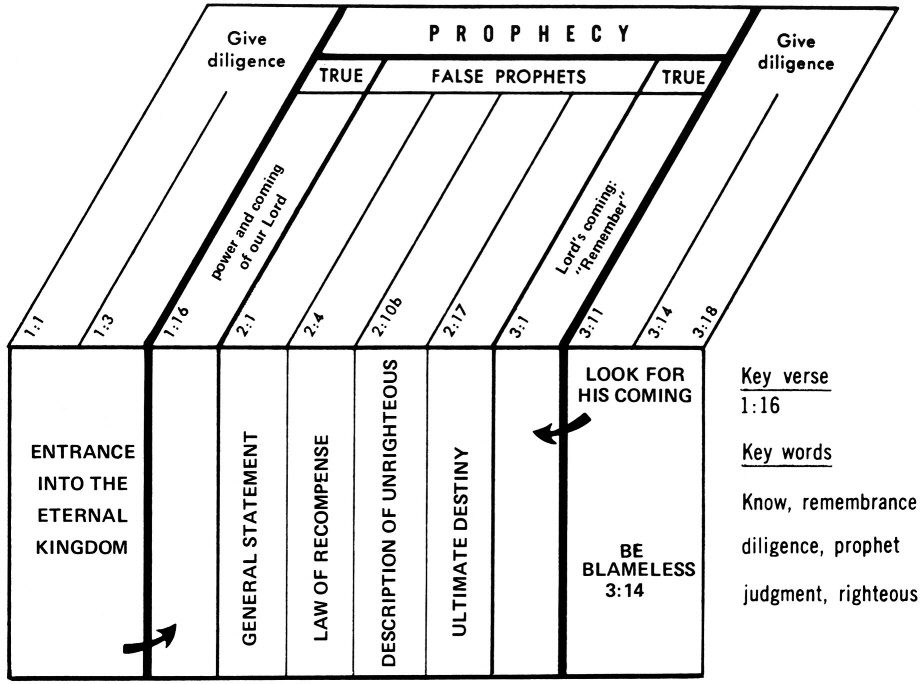
2 Peter: True and False Prophecy
Click chart to enlarge
Chart from Jensen's Survey of the NT - used by permission
|
2 PETER |
||||||||
| Cultivation of Christlike Character |
Condemnation of False Teachers |
Confidence in the Return of Christ |
||||||
| Greeting to Saints 2Pe 1:1-2 |
Growth in Christ 2Pe 1:3-14 |
Grounds |
Danger of |
Demise of |
"Decor" of |
Mockers in |
Manifest |
Maturity in light of that |
| Know Your Salvation |
Know |
Know Your Adversaries |
Know |
|||||
| True Prophecy (True Knowledge) |
False Prophets (False Teachers) |
Final Prophecy (Day of the Lord) |
||||||
| Holiness | Heresy | Hope | ||||||
| Development of Faith |
Denunciation of False Teachers |
Design of The Future |
||||||
2 Peter 2:14 having (PAPMPN) eyes full of adultery that never cease from sin, enticing (PAPMPN) unstable souls, having (PAPMPN) a heart trained (RPPFSA) in greed, accursed children; (NASB: Lockman)
Greek: ophthalmous echontes (PAPMPN) mestous moichalidos kai akatapaustous hamartias, deleazontes (PAPMPN) psuchas asteriktoue, kardian gegumnasmenen (RPPFSA) pleonexias echontes, (PAPMPN) kataras tekna,
Amplified: They have eyes full of harlotry, insatiable for sin. They beguile and bait and lure away unstable souls. Their hearts are trained in covetousness (lust, greed), [they are] children of a curse [exposed to cursing]! (Amplified Bible - Lockman)
NET: Their eyes are full of adultery that do not stop sinning; they entice unstable people. They have trained their hearts for greed, these cursed children! (NET Bible)
New Jerusalem Bible: with their eyes always looking for adultery, people with an insatiable capacity for sinning, they will seduce any but the most stable soul. Where greed is concerned they are at their peak of fitness. They are under a curse. (NJB)
NLT: They commit adultery with their eyes, and their lust is never satisfied. They make a game of luring unstable people into sin. They train themselves to be greedy; they are doomed and cursed. (NLT - Tyndale House)
Phillips: Their eyes cannot look at a woman without lust, they captivate the unstable ones, and their techniques of getting what they want is, through long practice, highly developed. They are born under a curse (Phillips: Touchstone)
Wuest: having eyes full of an adulteress and which are unable to cease from sin, catching unstable souls with bait, having a heart completely exercised in covetousness, children of a curse.
Young's Literal: having eyes full of adultery, and unable to cease from sin, enticing unstable souls, having an heart exercised in covetousnesses, children of a curse
HAVING EYES FULL OF ADULTERY AND THAT NEVER CEASE FROM SIN: ophthalmous echontes (PAPMPN) mestous moichalidos kai akatapaustous hamartias:
- 2 Sa 11:2-4; Job 31:7,9; Pr 6:25; Mt 5:28; 1 Jn 2:16
- Isa 1:16; Jer 13:23; Mt 12:34; Jn 5:44
- Torrey's excellent topic Sin
- Torrey's Topic Covetousness
- 2 Peter 2 Resources - Multiple Sermons and Commentaries
Phillips put it this way "Their eyes cannot look at a woman without lust."
New Jerusalem Bible says "with their eyes always looking for adultery, people with an insatiable capacity for sinning."
ALL THEY CAN SEE
IS ADULTERY
Having eyes - The literal Greek is continually having eyes full of an adulteress which of course means that these false teachers desire every woman they see, viewing every female as a potential adulteress. Their thus eyes serve as constant instruments of lust and Jesus explained the importance of the eye --
The lamp of the body is the eye; if therefore your eye is clear, your whole body will be full of light. But if your eye is bad, your whole body will be full of darkness. If therefore the light that is in you is darkness, how great is the darkness!" (Mt 6:23)
Having (2192) (echo) means possessing or having and is present tense which pictures these men walking around continually possessing lascivious thoughts whenever they see a woman (Mt 5:28).
Eyes (3788) (ophthalmos) is the same word which is transliterated to give us our English word ophthalmic, etc. Their thirst for lechery, disguised perhaps under the ministerial “cloth,” seems to be limitless. Paul warned about similar men who would "enter into households and captivate weak women weighed down with sins, led on by various impulses, always learning and never able to come to the knowledge of the truth." (2Ti 3:6).
More than one “minister” has used religion as a cloak to cover his own lusts. Some women, in particular, are vulnerable in “counseling sessions,” and these men are skilled at taking advantage of them. (See tragic article of abuse in the church)
John warns his readers in his first epistle against the danger of love of the world
Do not love (present imperative with a negative - stop it or do not let it begin) the world nor the things in the world (cf Mt 6:24). If anyone loves (present tense - as the habit of their life, the continual direction of their life) the world, the love of the Father is not in him. For (term of explanation) all that is in the world, the lust of the flesh and the lust of the eyes and the boastful pride of life, is not from the Father, but is from the world. The world is passing away, and also its lusts; but the one who does (present tense - as the habit of their life, the continual direction of their life) the will of God lives forever. (1 John 2:15-17).
See James Smith's frightening note on An almost Christian
Full of (3324) (mestos) refers to a quantity beyond what could or should be expected and so literally these men are "very full" of licentious looks so to speak.
Here mestos is used figuratively describing these men as constantly preoccupied with or full of adulterous eyes, similar to Jesus' description of the Pharisees (in a sense also false teachers) who "outwardly appear righteous to men, but inwardly you are FULL OF (mestos) hypocrisy and lawlessness" (Mt 23.28)
The false teachers described here by Peter are also hypocrites, not living out the Truth they profess to teach (albeit falsely).
Mestos then indicates just how completely their corrupt passions have come to occupy their minds.
As a general rule what fills a person controls them! They were literally controlled by their lusts.
Adultery (3428) (moichalis from moichos = an adulteress) describes one unfaithful to marriage vows. BDAG says eyes full of adultery is one "ever on the lookout for an adulterous woman." Depicts one who is lustful. We all look, but what we do when we see an object of desire, determines whether it is a glance or a gaze, the former is temptation, the latter is falling for the temptation, giving in to the eyes and imagination.
Rienecker adds that the "connotation is probably more general, meaning loose women."
What's an adulteress? She's never committed or faithful to the person she is betrothed to. She's always looking beyond that individual to see if the grass is "greener" somewhere else, to see if there's pleasure outside of her intended, committed relationships. These false teachers are not faithful or committed to either the Lordship of Christ or to those who follow them.
Jesus used moichalis two times to characterize the Jews who did not receive Him as those who were
"An evil and adulterous generation (which) craves for a sign & yet no sign will be given to it but the sign of Jonah the prophet." (Mt 12:39, 16:4).
James use of moichalis in his epistle gives us a practical definition of spiritual adultery --
You adulteresses, do you not know that friendship with the world is hostility toward God? Therefore whoever wishes to be a friend of the world makes himself an enemy of God. (Jas 4:4)
Who are we as believers to be faithful to...to the world or to Jesus?
Let us rejoice and be glad and give the glory to Him, for the marriage of the Lamb has come and His bride has made herself ready. It was given to her to clothe herself in fine linen, bright and clean; for the fine linen is the righteous acts of the saints. (see notes Revelation 19:7; 19:8)
What a contrast with the false teachers who are "stains & blemishes."
Never cease (180) (akatapaustos - "a" = negates the root katapauo - see katapausis) means without cessation, not pausing, unable to stop. These brute beasts never stop sinning and and in fact their eyes cannot even be restrained from looking lustfully. You know what Peter means here. Just watch a man's eyes when a beautiful woman walks by. Notice where his eyes move? (cf Job 31:1)
Sin (266) (hamartia) originally had the idea of missing mark as when hunting with a bow and arrow. Later it came to mean missing or falling short of any goal, standard, or purpose. Hamartia in the Bible means to miss God's mark as an archer misses the “bull’s eye” and ultimately to miss the true purpose and end of our lives which is God Himself. Sin is any violation of God’s righteous character. It is anything we say or do or think or imagine or plan that does not meet God’s standard of perfection.
These men are Insatiable for sin (NRSV, Amp) and are never having enough of sin (BBE) being even unable to cease from sin.
Peter is sparing no "punches" to expose these evil men! By the way this pattern of "never cease from sin" marks them as those who are not born of God
"no one who is born of God (present tense = continually) practices sin, because His seed abides in him; and he cannot (present tense = continually) sin, because he is born of God." (see 1Jn 3:9).
Furthermore Peter taught in that "he who has suffered in the flesh has ceased from sin." (1 Pe 4:1)
These men see every woman as an object with whom they might satisfy their craving, their eyes being unable to be separated from the power of sin (the old nature inherited from Adam and which was made ineffective in "born again ones" when our old self -- the unsaved person dominated by the totally depraved nature & representing all we were in Adam before we were saved -- was crucified with Christ - Ro 6:6) which enslaves and controls them as Peter describes in (2 Pe 2:18-19). They don't have the power because they have not escaped the corruption which is in the world by lust (2 Pe 1:4) and so they do not possess the divine nature (Holy Spirit - cf Ro 8:13) within. Beloved we may sin and we may have a ''favorite'' sin and even a season of that sin, but if we are NEVER able to desist from that sin then we need to take the apostle Paul's advice to "Test yourselves to see if you are in the faith; examine yourselves! Or do you not recognize this about yourselves, that Jesus Christ is in you--unless indeed you fail the test?" (2Cor 13:5)
ENTICING UNSTABLE SOULS: deleazontes (PAPMPN) psuchas asteriktous:
- 2Peter 2;18; 3:16; Mk 13:22; Ro 16:18; 1Cor 11:19; Eph 4:14; Col 2:18; James 1:8; Rev 12:9
- 2 Peter 2 Resources - Multiple Sermons and Commentaries
SEDUCERS OF
UNSTEADY SOULS
New Jerusalem Bible says "they will seduce any but the most stable soul."
Paul has several somewhat similar descriptions of men in the church of which we are to be very wary...
For (term of explanation - What's Paul explaining? See Ro 16:17) such men are slaves, not of our Lord Christ but of their own appetites; and by their smooth and flattering speech they deceive the hearts of the unsuspecting. (Ro 16:18)
As a result (cf Eph 4:11-13), we are no longer to be children, tossed here and there by waves and carried about by every wind of doctrine (cf Peter's phrase "unstable souls"), by the trickery of men, by craftiness in deceitful scheming; (Eph 4:14)
I say this (What? Check context - Col 2:2-3) so that no one will delude (paralogizomai) you with persuasive argument. (Col 2:4)
Let no one keep defrauding (present imperative with a negative) you of your prize by delighting in self-abasement and the worship of the angels, taking his stand on visions he has seen, inflated without cause by his fleshly mind, (Col 2:18)
Enticing (1185)(deleazo from delear = to bait, entrap) means to trap by using bait, and so to entice, ensnare, lure and beguile. It pictures a fisherman baiting a hook or a hunter baiting a trap. Note the present tense pictures continual enticement of these unstable souls.
James uses this same word to teach how a man's own lust entices him and tempts him with bait (James 1:14) and Peter uses deleazo one other time in this way (2Pe 2:18). The image of bait to catch the unwary victim is an image that might readily come to the mind of Peter given his background as a fisherman. The picture is men who are skilled at attracting the unstable souls by artfully or adroitly setting the trap with sensual bait that arouses the desires, making "provision for the flesh in regard to its lusts." (cf Ro 13:14).
Remember that the "enticement" always has a bait. And so these false teachers dangle the "baited lure" in front of their unsteady victims causing them to look away from the Lord Jesus and His Word.
Wiersbe comments on the "bait" "Satan knows that he could never trap us unless there is some fine bait to attract us in the first place. Satan promised Eve that she and Adam would become “like gods” if they ate of the forbidden tree (Ge 3:4–5), and they “took the bait” and were trapped. What kind of “bait” do the apostates use to catch people? For one thing, they offer them “liberty” (2Pe 2:19). This probably means a perversion of the grace of God, “turning the grace of our God into lasciviousness” (Jude 4). “Since you are saved by grace,” they argued, “then you have the freedom to sin. The more you sin, the more of God’s grace you will experience!” Paul answered their false arguments in Romans 6, a portion of Scripture that every believer ought to master. Along with “freedom” they also bait the trap with “fulfillment.” This is one of the “buzz words” of our generation, and it goes right along with “doing your own thing” and “having it your way.” They say, “The Christian life that the church offers is old-fashioned and outdated. We have a new lifestyle that makes you feel fulfilled and helps you find your true self!” Alas, like the prodigal son, these unstable souls try to find themselves, but they end up losing themselves (Luke 15:11–24). In their search for fulfillment they become very self-centered and lose the opportunities for growth that come from serving others. There can be no freedom or fulfillment apart from submission to Jesus Christ. “The purpose of life,” said P. T. Forsyth, “is not to find your freedom, but to find your master.” Just as a gifted musician finds freedom and fulfillment putting himself or herself under the discipline of a great artist, or an athlete under the discipline of a great coach, so the believer finds true freedom and fulfillment under the authority of Jesus Christ." (Wiersbe, W: Bible Exposition Commentary. 1989. Victor) (bolding added)
Unstable (793) (asteriktos from "a" = without + "sterizo" = to confirm or establish) means unsettled, unsteady, unstable (Webster UNSTABLE = wavering in purpose or intent & implies an incapacity for remaining in a fixed position or steady course and applies especially to a lack of emotional balance).
The unstable are those with no foundation. They lack a firm foundation in the faith and discipline necessary for godliness (1Ti 4:7) and so are a "set up" to be unsettled by the erroneous teaching and scandalous conduct of these crafty deceivers. They are unable to resist the allurements and are toppled into sin because they not planted their feet firmly in Christ (Compare to Paul's defense against "empty deception" in Col 2:7-8; 2:8 [note]).
In (2Pe 1:12) Peter assures those who are believers that they "have been established (sterizo) in the truth which is present with" them, and yet note that he still warns them of the danger in this verse. Peter undoubtedly knew the warning that Paul had given the church at Corinth "let him who thinks he stands take heed that he does not fall." (1Cor 10:12).
Stability is an important factor in a successful Christian life. Just as a child must learn to stand before he can walk or run, so the Christian must learn to “stand firm in the Lord.” Paul and the other Apostles sought to establish their converts in the faith (Ro 1:11; Ro 16:25; 1 Th 3:2, 13-1Th 3:2 note; 3:13 notes; 2Th2:17, 2Th3:3).
In (1Pe 5:10) Peter fully conscious of own instability in times past (probably never forgetting Jesus' command -- "when once you have turned again, strengthen your brothers." Lk 22:32) uses sterizo again to encourage all God's saints who are suffering (and we all are either in the valley, have just come out of the valley or are getting ready to pass into the valley) that after we have
suffered for a little while, the God of all grace, Who called (us) to His eternal glory in Christ, will Himself perfect, CONFIRM (sterizo), strengthen and establish (us). (1Pet 5:10)
In 2 Peter 3:16 the only other NT use of asterizo, Peter instructs us that
the untaught and unstable distort (Paul's writings) as they do also the rest of the Scriptures, to their own destruction (see note 2 Peter 3:16)
Paul contrasts unstable souls in (Ephesians 4:14) where he describes those who are being equipped with the stabilizing Truth of the Word as those who
are no longer to be children, tossed here and there by waves and carried about by every wind of doctrine, by the trickery of men, by craftiness in deceitful scheming. (see note)
Souls (5590) (psuche or psyche from psucho = to breathe, blow, English = psychology, "study of the soul") is the breath, then that which breathes, the individual, animated creature. Here it means a person as in (1 Peter 3:20, cf Acts 2:41).
Wuest says they are skilled at "catching unstable souls with bait".
Hiebert feels that unstable souls is a reference to "potential converts...who have shown an interest in the gospel message and have taken their first step toward Christ but are not yet grounded in Him." (ref)
HAVING A HEART TRAINED IN GREED: kardian gegumnasmenen (RPPFSA) pleonexias echontes (PAPMPN):
- Torrey's Topics: Characteristics of an Unregenerate Heart; Covetousness
- 2 Peter 2 Resources - Multiple Sermons and Commentaries
their techniques of getting what they want is, through long practice, highly developed (Phillips)
Where greed is concerned they are at their peak of fitness (New Jerusalem Bible)
LIKE ATHLETES
TRAINED IN GREED
What a lurid picture Peter paints sparing no word picture to expose these charlatans! The Greek word trained (see below) conveys the idea of rigorous, strenuous training that Olympic hopefuls were willing to endure in order to qualify to compete for the coveted prize! Woe!
Having (2192) (echo) means possessing or having and is in the present tense indicating that this was not occasional attitude but reflected their habitual attitude, a lifestyle dominated by greed.
Heart (2588) (kardia) is not the physical organ but has the much broader figurative sense of the center of a person's thoughts, emotions, actions, etc. Scripturally the heart of man is analogous to the cockpit of a jumbo jet, receiving and monitoring input (contrast Pr 6:25 Pr 4:23) and responding accordingly. So their problem was not only with their eyes, which are the channel, but with the heart being the fountain head of lust as taught in (Job 31:7) who denied that his "heart followed (his) eyes". Their "control center" was corrupt!
If you have time and desire a greater understanding of "heart" I would suggest studying the Scriptural cross references in R. A. Torrey's excellent topic called simply The Heart, a critically important concept that literally permeates the Scriptures from Genesis to Revelation.
Barclay - These people have actually trained their minds to concentrate on nothing but the forbidden desire. They have deliberately fought with conscience until they have destroyed it; they have deliberately struggled with their finer feelings until they have strangled them. (2 Peter 2 Commentary)
Trained (1128) (gumnazo or gymnazo from gumnós = "naked" or minimally clothed and descriptive of the common practice of males in the Greco Roman "gymnasia" source of English "gymnasium", "gymnastics") literally meant to exercise naked in the palaestra (a school in ancient Greece or Rome for sports). Vine says it means to “to strive with the body stripped,” i.e., strenuously."
Gumnazo (gymnazo) is used 4 times in the NT (1 Tim 4:7; Heb 5:14; 12:11; 2 Pet 2:14) and is translated: discipline, 1; trained, 3. All 4 uses in the KJV are translated "exercise". There are no uses in the non-apocryphal Septuagint.
Gumnazo means to exercise bodily and described an athlete exercising in the gym. Figuratively gumnazo means to exercise so as to discipline oneself (in the moral or ethical "gym") or to exercise vigorously, in any way, either the body or the mind. It describes the rigorous, strenuous, self-sacrificing training an athlete undergoes.
These false teachers have taken their wicked unredeemed hearts (their standing for the reason, the will, and the emotions) to the "gym of evil thoughts and deeds" and like dedicated athletes have exercised themselves diligently to achieve their goal, in this case to be professionals in the arena of greed! (contrast "godliness" the "prize" believers are to be "training" for 1Ti 4:7[note])
The NIV says these men are "they are experts in greed." Their motive was not to serve others but to procure more and more for themselves through others.
Trained is in the perfect tense indicating a past completed action with ongoing effect and thus clearly speaks of the permanence of their state of greed! These false teachers had lived in a heart atmosphere of covetousness for so long that their heart condition was one of a permanent state.
The Jewish historian Josephus uses gymnazo in his description of the Roman soldier writing that...
their military exercises differ not at all from the real use of their arms, but every soldier is every day exercised (gymnazo), and that with great diligence, as if it were in time of war which is the reason why they bear the fatigue of battles so easily. (Josephus, F. The Works of Josephus. Wars 3.73)
The writer of Hebrews uses the "gumnazo" calling saints to train themselves not for greed but for growth in discernment writing that
solid food is for the mature, who because of practice have their senses trained (gymnazo) to discern good and evil. (see note Hebrews 5:14)
The vitality of your spiritual life depends on your "diet". Are you taking in solid food so that you will be able to recognize these false teachers and not "be carried away by varied and strange teachings" (Heb 13:9) remembering that Peter has already warned us that these "snakes" will not walk in the fellowship and declare "I am a false teacher" but will "slither" in and "secretly introduce destructive heresies. (2Pe 2:1)
Paul uses gymnazo in his first epistle to Timothy drawing on the athletic metaphor to exhort his young disciple to...
"have nothing to do with (continually refuse, shun, reject) worldly (profane in contrast to sacred, void of piety, opposite of holy that which is set apart to God) fables (myths) fit only for old women. On the other hand, discipline (gymnazo = present tense calls for rigorous, strenuous, self-sacrificing training like an athlete) yourself for the purpose of godliness (NIV = "train yourself to be godly") for bodily discipline is only of little profit, but godliness is profitable for all things, since it holds promise for the present life and also for the life to come." (see notes 1Timothy 4:7; 1Timothy 4:8)
The last use of gymnazo is found in Hebrews where we find the encouraging truth that...
"All discipline for the moment seems not to be joyful, but sorrowful; yet to those who have been trained (gymnazo) by it, afterwards it yields the peaceful fruit of righteousness." (see note Hebrews 12:11)
Kenneth Wuest comments on the use of gymnazo in relation to discipline explaining that "Here (gymnazo) refers to the spiritual exercise which the recipients went through as a result of the persecutions which in the last analysis were the chastening hand of God. That spiritual exercise consisted of the struggles of the soul, the battle between the determination to go back to the (Jewish) temple sacrifices and thus escape the persecutions, or to go on to faith in the High Priest of the New Testament in spite of them.
There is one use of gymnazo in the apocrypha (2 Maccabees 10:15) in which which is used to mean harass, wear out or distress
Besides this, the Idumeans, who had control of important strongholds, were harassing the Jews; they received those who were banished from Jerusalem, and endeavored to keep up the war.
Greed (4124) (pleonexia from pleíon = more + écho = have) (2Pe 2:3) means literally to have more and describes a strong desire to acquire more and more material possessions, especially that which is forbidden (in this context someone else's wife!). It is a desire to have more irrespective of one's need and is always used in bad sense. It describes an insatiable selfishness.
Note that immorality is very commonly associated with idolatry, which is putting anything first in place of God and as (Col 3:5) teaches is "greed" which is the heart and soul of these men. Therefore don't be surprised when the televangelists fall from immorality, because when they don't preach the Gospel of Jesus Christ (sin, denial of self, taking up of one's cross, and the coming judgment in the lake of fire), they are idolaters to begin with and once a person is in idolatry he's always immoral. (excerpted and paraphrased from Dr Wayne Barber).
We all train our hearts in something, either training them in covetousness and lust or in godliness (1Ti 4:7, Pr 4:23). In which "gym" are you receiving your training?
ACCURSED CHILDREN: kataras tekna:
- Isa 34:5; 65:20; Mt 25:41; Eph 2:3
- 2 Peter 2 Resources - Multiple Sermons and Commentaries
THEIR ETERNAL REWARD
FOR TEMPORAL CORRUPTION
The are accursed children - "That’s a Hebrew way of saying, “they are under God’s curse, bound for hell.”" (Steven Cole)
Related Resource:
Accursed (2671) (katara from katá = down, against [intensifies meaning of following verb] + ara = a curse, Ara originally = wish,” “petition,” but came to be used for curse from the time of Homer's, in the NT found only in Ro 3:14) means a malediction (literally to speak evil), imprecation (uttering evil) on these men. Katara can be used in the sense of a legal action, of a curse by God because of sin (Gal 3.10). Katara can describe human utterance which desires evil on someone (imprecation) (Jas 3.10). Finally katara can represent the object of a curse, in other words the thing accursed (Gal 3.13)
Vine - Katara denotes an “execration, imprecation, curse,” uttered out of malevolence, Jas. 3:10; 2 Pet. 2:14; or pronounced by God in His righteous judgment, as upon a land doomed to barrenness, Heb. 6:8; upon those who seek for justification by obedience, in part or completely, to the Law, Gal. 3:10, 13; in this 13th verse it is used concretely of Christ, as having “become a curse” for us, i.e., by voluntarily undergoing on the cross the appointed penalty of the “curse.” He thus was identified, on our behalf, with the doom of sin. Here, not the verb (kataraomai) as is used in the Septuagint of Dt. 21:23 is used, but the concrete noun (katara).
Paul used katara twice in Galatians ("as many as are of the works of the Law are under a curse" Gal 3:10 and in Gal 3:13 describing the solution for the curse "Christ redeemed us from the curse of the Law, having become a curse for us--for it is written, "CURSED IS EVERYONE WHO HANGS ON A TREE" )
Katara - 6x in 5v - Usage: accursed(1), curse(3), cursed(1), cursing(1).
Galatians 3:10 For as many as are of the works of the Law are under a curse; for it is written, "CURSED IS EVERYONE WHO DOES NOT ABIDE BY ALL THINGS WRITTEN IN THE BOOK OF THE LAW, TO PERFORM THEM."
Galatians 3:13 Christ redeemed us from the curse of the Law, having become a curse for us-- for it is written, "CURSED IS EVERYONE WHO HANGS ON A TREE "--
Hebrews 6:8 but if it ("ground that drinks the rain which often falls on it" Heb 6:7) yields thorns and thistles, it is worthless and close to being cursed, and it ends up being burned.
Comment: The writer gives us an illustration to help understand a difficult to understand preceding passage (Heb 6:4-6). The ground is a metaphorical description of the men who hear the truth of the Gospel. The falling rain is a picture of the hearing of the Gospel. Just as rain fell on the ground, so too the Gospel "rained" on these men. They had clearly heard the Truth. So the seed of the Gospel falls on men, and some of the men are fruitful because the seed takes root (cp the parable of the soils, especially the good soil in Lk 8:15). But ground that yields worthless produce, like men who yield no good fruit, fails to benefit from the Gospel seed. The "thorns and thistles" give evidence that the Gospel seed did not have its intended effect (new birth).
James 3:10 from the same mouth come both blessing and cursing. My brethren, these things ought not to be this way.
2 Peter 2:14 having eyes full of adultery that never cease from sin, enticing unstable souls, having a heart trained in greed, accursed children;
Katara - 39v -
Ge 27:12, 13; Nu 23:25; Deut 11:26, 28f; 23:5; 27:13; 28:15, 45; 29:27; 30:1, 19; Josh 8:30; Jdg 9:57; 2Sa 16:12; 1Kgs 2:8, 35; 2Kgs 22:19; Neh 13:2; Job 31:30; Ps 109:17, 18; Pr 3:33; Isa 64:10; 65:23; Jer 24:9; 26:6; 29:22; 44:8, 12; Dan 9:11; Zech 8:13; Mal 2:2
(Nu 23:25) Then Balak said to Balaam, “Do not curse them at all nor bless them at all!”
(Pr 3:33) The curse of the LORD is on the house of the wicked, But He blesses the dwelling of the righteous.
Children (5043) (teknon) is literally a "born one" and so refers to a child as viewed in relation to his or her parents or family. Teknon takes on special theological significance when the Bible calls believers the "children (teknon) of God" (cf Jn 1:11-13). These false teachers are literally children of a curse (Young's Literal) who live under a curse (TCNT) because God's curse is on them (NEB).
Peter does not yet himself pronounce a curse on them but does appeal to this Hebrew idiom which means that they are worthy of the curse of God (cf Isa 57:4).
Peter uses the opposite "Hebraism" in (1 Peter 1:14) calling believers obedient children (tekna hupakoes literally children of obedience a radical contrast to accursed children). In Ephesians 2:3 Paul also uses a similar Hebraism to describe those dead in their trespasses and sins (i.e., not born a second time to eternal life, Eph 2:1) as "children of wrath" (tekna...orges).
There are only 2 spiritual families on earth for all are either still "in Adam" (and your father is the devil Jn 8:44) or have been transferred by grace through faith and placed "in Christ" for as Paul teaches "in Adam all die, so also in Christ all will be made alive." (1Cor 15:22, cf 1Jn 3:4-10)
THOUGHT - Dear reader ask yourself the most important question in all eternity..."Am I still under the curse or am I in the "Ark" of Christ Jesus & under His blood? (Some excellent Scripture on this vital subject are at the following links Part 1, Part 2, Part 3)