2 Peter 3:2
2 Peter 3:3
2 Peter 3:4
2 Peter 3:5
2 Peter 3:6
2 Peter 3:7
2 Peter 3:8
2 Peter 3:9
2 Peter 3:10
2 Peter 3:11
2 Peter 3:12
2 Peter 3:13
2 Peter 3:14
2 Peter 3:15
2 Peter 3:16
2 Peter 3:17
2 Peter 3:18
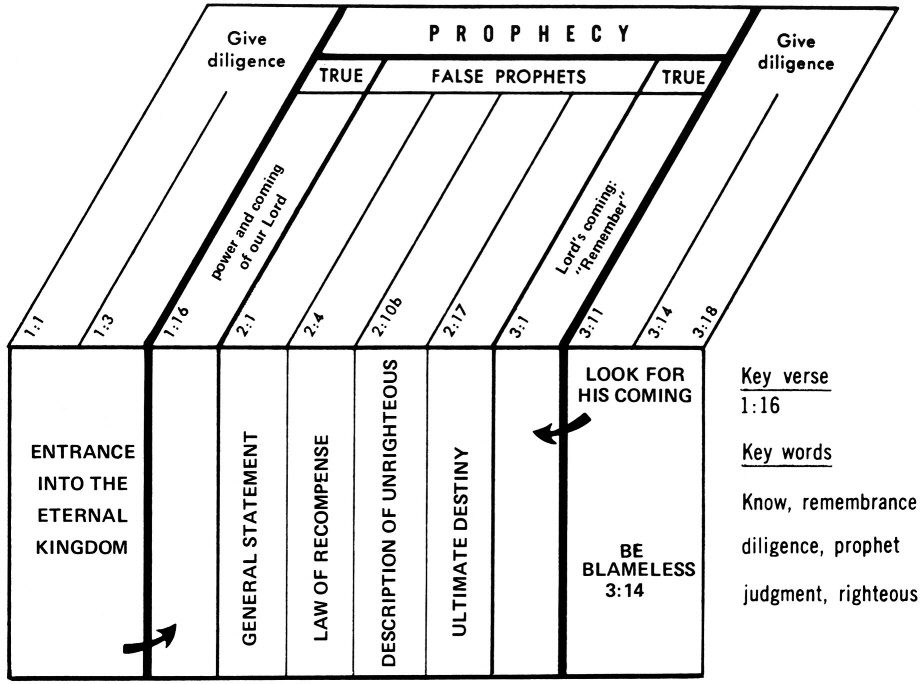
2 Peter: True and False Prophecy
Click chart to enlarge
Chart from Jensen's Survey of the NT - used by permission
|
2 PETER |
||||||||
| Cultivation of Christlike Character |
Condemnation of False Teachers |
Confidence in the Return of Christ |
||||||
| Greeting to Saints 2Pe 1:1-2 |
Growth in Christ 2Pe 1:3-14 |
Grounds |
Danger of |
Demise of |
"Decor" of |
Mockers in |
Manifest |
Maturity in light of that |
| Know Your Salvation |
Know |
Know Your Adversaries |
Know |
|||||
| True Prophecy (True Knowledge) |
False Prophets (False Teachers) |
Final Prophecy (Day of the Lord) |
||||||
| Holiness | Heresy | Hope | ||||||
| Development of Faith |
Denunciation of False Teachers |
Design of The Future |
||||||
2 Peter 3:1 This is now, beloved, the second letter I am writing to you in which I am stirring up your sincere mind by way of reminder, (NASB: Lockman)
Greek: Tauten ede agapetoi, deuteran humin grapho (1SPAI) epistolen, en hais diegeiro (1SPAI) humon en hupomnesei ten eilikrine dianoian,
Amplified: BELOVED, I am now writing you this second letter. In [both of] them I have stirred up your unsullied (sincere) mind by way of remembrance, (Amplified Bible - Lockman)
NET: Dear friends, this is already the second letter I have written you, in which I am trying to stir up your pure mind by way of reminder: (NET Bible)
NJB: My dear friends, this is the second letter I have written to you, trying to awaken in you by my reminders an unclouded understanding. (NJB)
NLT: This is my second letter to you, dear friends, and in both of them I have tried to stimulate your wholesome thinking and refresh your memory. (NLT - Tyndale House)
Phillips: This is the second letter I have written to you, dear friends of mine, and in both of them I have tried to stimulate you, as men with minds uncontaminated by error, by simply reminding you of what you really know already. (Phillips: Touchstone)
Wuest: This already, divinely loved ones, is a second letter I am writing to you, in which I am stirring up your unsullied mind by way of remembrance
Young's Literal: This, now, beloved, a second letter to you I write, in both which I stir up your pure mind in reminding you,
THIS IS NOW BELOVED: Tauten ede, agapetoi:
- 2 Peter 3 Resources - Multiple Sermons and Commentaries
- 2 Peter 3:1-7 Mockers and the Coming Judgment - Steven Cole
- 2 Peter 3:1-4 The End of the Universe, Part 1 - John MacArthur
- 2 Peter 3:1-4 The End of the Universe, Part 2 - John MacArthur
- 2 Peter 3:1-4 The Certainty of the Second Coming Pt 1 - John MacArthur
- 2 Peter 3:1-9 The Certainty of the Second Coming Pt 2 - John MacArthur
Hiebert reminds us that this book naturally divides into three parts clearly marked by the chapter divisions…
The first chapter portrays the nature of the Christian life with its challenge to continuing growth and maturity, built on the sure foundation of God’s revelation. The spiritual growth and maturity of the readers will be their best safeguard against the moral and doctrinal perversions which will confront them in the dangerous days ahead.
Chapter 2 is a ringing polemic against the depraved false teachers who will seek to mislead God’s people, while chapter 3 deals with the denial of the return of Christ by immoral mockers.
In the third chapter Peter refutes the mockers’ denial of Christ’s return (2 Peter 3:1-7), presents the correct view concerning Christ’s return (2 Peter 3:8-13), and concludes with timely exhortation to his readers in view of the dark and dangerous days facing them (2 Peter 3:14-18). These concluding exhortations readily fall into two parts. The two exhortations in 2 Peter 3:14-16 are linked to the thought of the eschatological future prominent in this chapter, while the two final exhortations in 2 Peter 3:17-18a gather up the themes of chapters 2 and 1, respectively.
As Mayor observes Peter Peter “turns away from the Libertines and their victims” in the second chapter to those who Wuest terms "divinely-loved ones."
Beloved (27) (agapetos) (See related word agape) means dear, dear friend, dear to one's heart or very much loved and expresses strong love for and affection toward his readers (cf first use in Scripture describing Abraham's love for Isaac in the Septuagint - LXX, the Greek translation of the Hebrew OT = Gen 22:2).
Agapetos was used by our Heavenly Father describing His Son (Mt 3:17, 12:18, 17:5, Mk 1:11, 9:7, Lk 3:22, 9:35, cp Mk 12:6, Lk 20:13) and so clearly agapetos conveys the thought of one who is in a very special relationship with another. And so Peter reminds his readers that he prized and valued them. He lets his heart go out to them and draws their hearts to him. People don't care how much you know until they know how much you care! Six of the 61 NT uses of agapetos (click 2Peter including 3:8, 3:14 and 3:17) are in this brief epistle.
Agapetos is used only to believers as united with God or with each other in the bonds of holy love and is never descriptive of non-believers.
Agapetos declares Peter's pastoral concern toward his "flock" which was manifest by a lofty, even sacrificial love, a love that desires and seeks their highest good. What a contrast is the tender and moving term "beloved" in the context of the resounding denunciation of false teachers in the preceding chapter. The NIV translation as “friends” is not strong enough.
Matthew Henry adds that Peter's opening statement in this chapter…
Expresses his special affection and tenderness for them, by calling them beloved, hereby evidencing that he added to godliness brotherly-kindness, as he had exhorted them to do. Ministers must be examples of love and affection, as well as life and conversation.
THE SECOND LETTER I AM WRITING TO YOU: deuteran humin grapho (1SPAI) epistolen:
- 2Co 13:2 1Pe 1:1,2
- 2 Peter 3 Resources - Multiple Sermons and Commentaries
- 2 Peter 3:1-7 Mockers and the Coming Judgment - Steven Cole
- 2 Peter 3:1-4 The End of the Universe, Part 1 - John MacArthur
- 2 Peter 3:1-4 The End of the Universe, Part 2 - John MacArthur
- 2 Peter 3:1-4 The Certainty of the Second Coming Pt 1 - John MacArthur
- 2 Peter 3:1-9 The Certainty of the Second Coming Pt 2 - John MacArthur
The second letter - The most natural conclusion is that the first letter he wrote is a reference to First Peter. However Stedman points out that…
First Peter is not really a letter of reminder as he suggests here, and it is sent to a wide range of readers living in five different provinces of the Empire (see 1Peter 1:1) while this letter seems addressed to a single church (or closely situated churches) whose people and circumstances Peter knows well. For these reasons many take the first letter to be a letter written to the same readers but which is now lost to us. It would be similar to the reference Paul makes in 1Corinthians. 5:9 to a previous letter which is also lost.
Letter (1992)(epistole from epi = upon + stello = send) means a transmitted message, the Greek giving us the English word epistle and here signifying a letter with apostolic authority. If you read the commentaries, you may note that some interpreters feel that "second" suggests that there is lost "first" epistle. Although one cannot exclude that conjectural possibility, it certainly seems more natural and probable that the first epistle is Peter's first letter in the NT canon.
Calvin - Lest they should be wearied with the Second Epistle as though the first was sufficient, he says that it was not written in vain, because they stood in need of being often stirred up. To make this more evident, he shews that they could not be beyond danger, except they were well fortified, because they would have to contend with desperate men, who would not only corrupt the purity of the faith, by false opinions, but do what they could to subvert entirely the whole faith.
IN WHICH I AM STIRRING UP: en hais diegeiro (1SPAI):
- 2Peter 1:13, 14, 15; 2Ti 1:6
- 2 Peter 3 Resources - Multiple Sermons and Commentaries
- 2 Peter 3:1-7 Mockers and the Coming Judgment - Steven Cole
- 2 Peter 3:1-4 The End of the Universe, Part 1 - John MacArthur
- 2 Peter 3:1-4 The End of the Universe, Part 2 - John MacArthur
- 2 Peter 3:1-4 The Certainty of the Second Coming Pt 1 - John MacArthur
- 2 Peter 3:1-9 The Certainty of the Second Coming Pt 2 - John MacArthur
Calvin comments on stirring up writing that…
the minds of the godly become dim, and as it were contract rust, when admonitions cease. But we also hence learn, that men even endued with learning, become, in a manner, drowsy, except they are stirred up by constant warnings.
It now appears what is the use of admonitions, and how necessary they are; for the sloth of the flesh smothers the truth once received, and renders it inefficient, except the goads of warnings come to its aid. It is not then enough, that men should be taught to know what they ought to be, but there is need of godly teachers, to do this second part, deeply to impress the truth on the memory of their hearers.
And as men are, by nature, for the most part, fond of novelty and thus inclined to be fastidious, it is useful for us to bear in mind what Peter says, so that we may not only willingly suffer ourselves to be admonished by others, but that every one may also exercise himself in calling to mind continually the truth, so that our minds may become resplendent with the pure and clear knowledge of it.
Stirring up (1326) (diegeiro from diá = intensifies verb + egeíro = raise, rouse) means to wake up fully, arouse (lit. or fig.) as from sleep (literal or spiritual).
Mt1:24 Mk 4:38,39 Lk 8:24 Jn 6:18 2Pe1:13 2Pe 3:1
wake up fully, arouse (lit. or fig.) as from sleep (literal or spiritual) Mt1:24; Mk4:38, 39; Lu8:24
Present tense indicates Peter's desire was to continually awaken his readers and
to simulate (their) wholesome thinking. (NLT)
It makes one think that ringing through his mind must have been the words of Jesus to Peter
when once you have turned again, strengthen your brothers" (Lk 22:32)
So Peter seeks to fully arouse his brethren from their spiritual sluggishness. He is saying don't let the delay of our Lord's return cause you to "nod of" spiritually. He is saying that the Lord's return is ever nigh and that such a mindset affects one's conduct.
Martin Luther (1483-1546) was looking for His return and this stimulated him to write…
The darkness grows thicker around us, and godly servants of the Most High become rarer and more rare. Impiety and licentiousness are rampant throughout the world, and we live like pigs, like wild beasts, devoid of all reason. But a voice will soon be heard thundering forth: ‘Behold, the bridegroom cometh!’ God will not be able to bear this wicked world much longer, but will come, with the dreadful day, and chastise the scorners of his Word.”
If Martin Luther felt that the Lord’s return was near almost 500 years ago, what should we think today who are that much closer to His second advent!
Later in this chapter Peter reminds the readers that…
according to His promise we are looking for new heavens and a new earth, in which righteousness dwells. Therefore, beloved, since you look for these things, be diligent to be found by Him in peace, spotless and blameless (see notes 2 Peter 3:13; 14)
Observe the verbs that are underlined in this passage - looking, look, be diligent. Do you see the relationship between how what you are looking for will (or should) influence how you then live (or what/who you are living for)?
Peter's point is that if we keep these precious promises at the forefront of our mind and truly believe them, the Spirit will sanctify us in the truth, God's Word (cf John 17:17) (here the precious promise of Christ's return and consummation of all events in Christ). What you truly believe will determine how you behave. Creed should always impact conduct. Belief and behavior go hand in hand. Peter is very practical in this section and says that if we are confident and expectant regarding the certainty the real "brave new world" of righteousness (that which God demands and which ultimately only He can provide, which is exactly what Peter says will happen one day when "righteousness dwells". What a glorious day that will be! Hallelujah!). As we contemplate the promise of this future righteousness, we should be strongly motivated and inspired to live in peace, spotless and blameless. No, we won't carry out these goals perfectly in this life, if our minds are stirred up by such truth, we will be far more likely to work our our salvation in fear and trembling (Philippians 2:12)
If you have been a believer for any length of time, you are all too painfully aware of how easy it is to become accustomed to God’s truth and to take it for granted to the point that we are lulled to sleep by it rather than stimulated to love and good deeds by it!
Do you remember Eutychus who fell sleep listening to surely one of the most erudite, anointed preachers who ever lived? Luke records the episode in Acts 20…
And on the first day of the week, when we were gathered together to break bread, Paul began talking to them, intending to depart the next day, and he prolonged his message until midnight. 8 And there were many lamps in the upper room where we were gathered together. 9 And there was a certain young man named Eutychus sitting on the window sill, sinking into a deep sleep; and as Paul kept on talking, he was overcome by sleep and fell down from the third floor, and was picked up dead. 10 But Paul went down and fell upon him and after embracing him, he said, "Do not be troubled, for his life is in him." (Acts 20:7-10)
Peter does not want for his readers to suffer the fate of Eutychus! And so here we see his purpose for writing this epistle -- to arouse his readers (cf 2Pe 1:12; 13; 14; 15-notes 2Pe 1:12; 13; 14; 15). He arouses them that they might be protected from false teachers. One of the best defenses against false doctrine is a recall and appropriation of the truths we already know. In other words, we don't need "new" or "deeper" truths to stand against the lies of the darkness. There is a parallel thought in Jeremiah's admonishment of faithless Judah:
Stand by the ways and see and ask for the ancient paths, where the good way is, and walk in it and you shall find rest for your souls. But they said, 'We will not walk in it. (Jer 6:16)
THE FOUL FRUIT
OF SPECIOUS SPIRITUALITY
The modern evangelical church in the new millennium (2000 and counting), is in grave danger of stepping off of the ancient paths (Je 6:16, cp Is 35:8) especially as it seeks to "emerge" from the tried and true old paths (cp Jehovah's words to Israel in Jer 18:15 - things have not changed much because man's heart is still as deceitful as ever Jer 17:9). Bob DeWaay discusses one of many examples of modern deceptive bypaths in his critique of the slippery slope of specious (superficially plausible, but actually wrong. Deceptively attractive and alluring having a false look of truth or genuineness!) spirituality known as Theophostic Ministry. I am aware of a well known church that sowed the seeds of this false teaching and reaped the corrupting, destructive fruit for years thereafter (Ga 6:7, 8). Beloved, we need to hold fast to the old military cry "Take no prisoners!" (cp 2Co 10:3, 4, 5; Col 2:8, 9, 10) in regard to questionable teaching and hold it up to the plumbline of God's Word (Acts 17:11, 1Th 5:21, 22, 1Jn 4:1, Mt 10:16). In the example I mentioned above, the tragedy is that several members of that local body began to feel "uneasy" about the "mystical" prayer practices almost 3 years before the exodus of a significant number of leading families. To add to the tragedy is the fact that the elders of the church were clearly and directly alerted to this potential danger and were even provided with Scriptural documentation from another respected church that had seen fit to "jettison" theophostic practices from their body. Unfortunately the elders literally turned the proverbial deaf ear to the warnings, most likely because some of the wives of the elders were involved in this practice! (cp Paul's repeated warning below - "from among your own selves") And as a result no action was taken (those who expressed their discernment were never again contacted!) and the reaping of rotten fruit became the inevitable result, a result which could have been avoided if the shepherds had been guarding the sheep! (Mt 7:15, 16, Mt 7:17, 18, 19, 20, cp Jn 21:15, 16, 17 - tend… shepherd… tend - all present imperative commands calling for continual attention including the feeding [KJV translates the command to "feed" all 3x] His Word of Truth, 2Ti 2:15). Elders are called to guard the flock and when they do not, the flock will surely suffer. Paul knew the vital importance of this principle and exhorted the elders at Ephesus in his last personal contact with them…
"Be on guard (present imperative = continual command - Why? There will be continual infiltration by subtle "insurgents"!) for yourselves and for all the flock, among which the Holy Spirit has made you overseers (episkopos [word study]), to shepherd the church of God which He purchased with His own blood. 29 "I know that after my departure (Why didn't they come when Paul was present?) savage wolves will come in among you (Where do they come from?! What do they do?), not sparing the flock; 30 and from among your own selves men will arise (Why does he repeat himself?), speaking perverse (twisting or distorting the meaning or sense of) things, to draw away the disciples (the learners) after them. 31 "Therefore (Because the wolves leaving their lair and on the prowl for stragglers!) be on the alert present imperative = continual command - Why? False teachers will continue to attempt to infiltrate and influence the flock!), remembering (present tense = continually remembering. Why? If you're like me, you are prone to forget, especially warning passages because they make us uncomfortable and we'd rather not talk about them!) that night and day for a period of three years I did not cease to admonish each one with tears (How passionate was Paul about the integrity of Christ's Body?! Am I likewise?). 32 "And now I commend (paratithemi = literally set near = a banking term for depositing something safely!) you (note who is being set near and what they are being set near??) to God and to the word of His grace (Not meetings, not conferences, not great theological works or the newest church fad for church growth, but THE LIVING AND ABIDING WORD by which [and only by which] shepherds and sheep are both daily sanctified in answer to Jesus' prayer - Jn 17:17, cp 1Pe 2:1, [Note verse 1 must be invoked before verse 2 can take effect!] 1Pe 2:2 note- Observe verse 2 especially - no Word, no growth in respect to salvation = "present tense salvation" or sanctification), which is able (dunamai = has the inherent power [present tense = continuously] - the Word is like a living and abiding seed - plant it and know that it always has the inherent power) to build you up and to give you the inheritance among all those who are sanctified. (Acts 20:28, 29, 30, 31, 32-see notes) (compare how important it is to have elders who have a good grasp of God's Word - Titus 1:9)
Peter's point is that the genuine church comprised of born again men and women needs to be aroused regularly lest the enemy find us asleep and take advantage of our spiritual lethargy (and laziness).
As an aside two good tests to enable you to exercise spiritual discernment include: (1). Will it make you or others stumble? (Mk 9:42, 43, 45, 47; Lk 17:2) (2) Will I be ashamed if Jesus should return? (1Jn 2:28, 1Jn 3:2, 1Jn 3:3, 1Jn 3:21; 4:17).
Illustration you've probably heard - "The American Banking Association once sponsored a two-week training program to help tellers detect counterfeit bills. The program was unique--never during the two-week training did the tellers even look at a counterfeit bill, not did they listen to any lectures concerning the characteristics of counterfeit bills… All they did for two weeks was handle authentic currency, hour after hour and day after day, until they were so familiar with the true that they could not possibly be fooled by the false." (Ben Patterson, Waiting Downers Grove: InterVarsity Press, 1989, p. 153.)
Wayne Barber explains what it means to stir up…
Note first that the same verb "stirring up" (diegeiro) used in 2 Peter 3:1 is used twice in the following verses and helps give us a picture Peter is conveying by using this verb
Mk 4:38 Jesus Himself was in the stern, asleep on the cushion; and they WOKE (diegeiro) Him and said to Him, "Teacher, do You not care that we are perishing?" 39 And He BEING AROUSED (STIRRED UP) (diegeiro) rebuked the wind and said to the sea, "Hush, be still." And the wind died down and it became perfectly calm.
So what is the picture of that is being stirred up? First, you have to awaken and secondly you don't just wake up, but you also "put it in gear" so to speak so that the appropriate action follows. Peter is saying "I want to wake you up, get you off the world's "soft rock AM band" (this is a terminology Dr Wayne Barber frequently uses to depict "worldly, secular, humanistic, fleshly, self centered" thinking & thoughts) and onto God's classic FM band". With your mind now "renewed" by a true knowledge, you are able to get back on the "highway of holiness" walking in a manner worthy of your Lord, not being drawn away by false & deceptive ("AM") doctrine. But there are times when the circumstances in our life simply seem to sweep in & overwhelm us and we lose heart (Lk 18:1, 2Co 4:16, Gal 6:9, Heb 12:3) and we are tempted to "turn to the AM band" (the world's way of handling trying circumstances). What are we to do in those times when we are walking in darkness & seem to have no light? (Isa 50:10,11) God through the prophet Isaiah says if we get in darkness and have no light, don't go out and build your own fires ("AM band"). No, Isaiah says "Let him trust in the name of the Jehovah and rely on his God." (cf Pr 18:10) remaining on the "FM" band even though there may be some "static" from our circumstances.
How's Peter going to "STIR THEM UP"? By reminding them. HOW MANY TIMES DO WE NEED TO BE REMINDED OF THE THINGS GOD HAS ALREADY TAUGHT US! The principle is that we don't ever really "possess" this knowledge. This knowledge "possesses" us! The moment we think we've got "IT", we have lost it and the truths we're having the hardest time with right now in our walk are the ones possibly we thought we already knew. Are you living on God's "FM" band? True spiritual knowledge (genuine gnosis) is going to effect and govern the way you live. It this gnosis does not affect your lifestyle you are playing church, pretending to do Bible study & in some ways more deceived then the individual who totally rejects the gospel. Genuine gnosis is going to keep your conscience pure. From a clean conscience will flow your convictions and out of your convictions will flow your lifestyle. Peter is reminding us that we already "know" something and that we need to get back on that FM band that we know and start living like we ought to live. True spiritual knowledge will give us the means of growth (2Pe 1:3, 4, 2Pe 3:18), the means of discernment and an urgency that will constrain our behavior and cause us to discipline ourselves for godly living.
Remember how easy it is to "switch channels". You can be on the "spiritual FM band" in church or in Precept Bible study and you can switch over to the "AM fleshly band" the moment you arrive home. Knowledge has got to be something you are learning out of obedience and then that knowledge will stabilize you and stir you up when you remember what God has already taught you.
YOUR SINCERE MIND: humon en hupomnesei ten eilikrine dianoian:
- Ps 24:4; 73:1; Mt 5:8; 1Ti 5:22; 1Pe 1:22
- 2 Peter 3 Resources - Multiple Sermons and Commentaries
- 2 Peter 3:1-7 Mockers and the Coming Judgment - Steven Cole
- 2 Peter 3:1-4 The End of the Universe, Part 1 - John MacArthur
- 2 Peter 3:1-4 The End of the Universe, Part 2 - John MacArthur
- 2 Peter 3:1-4 The Certainty of the Second Coming Pt 1 - John MacArthur
- 2 Peter 3:1-9 The Certainty of the Second Coming Pt 2 - John MacArthur
minds uncontaminated by error (Phillips)
trying to awaken in you by my reminders an unclouded understanding (New Jerusalem Bible)
I seek to revive in your sincere minds certain memories (Weymouth0
reminders to stimulate you to wholesome thinking (NIV )
Your sincere mind - Peter credits his readers as possessing the quality of mind which signifies that he considers them to be genuine believers.
Your sincere mind is also a dramatic contrast to the deceived minds of the false teachers who as Barclay says
would refuse to be stirred up, would scorn any reminding that Peter could offer, and would only the more strenuously cling to its false ideas."
Sincere (1506) (eilikrines from heíle = shining or splendor of the sun + kríno = judge, discern = but see possible alternative derivation below) literally means that which is judged by sunlight' (compare the "Son's light" as when we all ''appear before the bema of Christ'' in 2 Co 5:10) Being tested by sunlight something is shown to genuine, pure, sincere, uncontaminated, unmixed by seductive influences of the world, the flesh, and the devil. Eilikrines describes that which is free from spot or blemish such a degree as to bear examination in full splendor of sun.
Alternatively, some say that eilikrines may be derived from eilein which means to whirl round and round as in a sieve and so to sift until every impurity is extracted. On that basis the Christian character is cleansed of all evil until it is altogether pure. The picture is like a winnowing process that removes chaff which leaves that which is unalloyed or unmixed, figuratively here referring to moral and ethical purity.
Sincere mind was a secular phrase used by Plato referring to ethical purity or pure reason, uncontaminated by the seductive influence of the senses.
Here Peter describes a mind that is unmixed and unadulterated. It conveys the thought of a mind characterized by moral and ethical purity, unsullied by vices and heresies. Peter tells his readers, that they have a pure mind, which is uncontaminated and unmixed by the seductive influences of the world, the flesh, and the devil. How different the true believers were from the corrupt and apostate false teachers in chapter 2.
Eilikrines is rarely used in secular Greek but one use describes fire, the purest thing of all and another use describes a 'total' eclipse of the sun.
Moffatt translates eilikrines as "transparent" in Phil 1:10 and as pure here in 2Peter 3:1.
Vine writes that eilikrines
expresses that moral quality by which all that is said and done is consistent with convictions. (Vine, W. Collected writings of W. E. Vine. Nashville: Thomas Nelson )
As stated above although there is not complete agreement on the etymology of eilikrines, the word does appear to be derived from the combination of heile indicating the sun's rays plus krino meaning to judge. So literally eilikrines means "sun judged". What does this practice refer to?
James Montgomery Boice explains eilikrines…
The second prerequisite of a fruitful life is that the life must be pure or free of obstructions. The word Paul uses means “oven tested.” This does not mean that we must be perfect, for none of us is. But it does mean that our lives must be open before God and before others. There must be no hypocrisy. In ancient times the biggest industry in the world was the pottery industry. And pottery varied in quality just as cars, office supplies, or household goods vary today. The cheapest pottery was thick and solid and did not require much skill to make. It is found everywhere at archaeological sites. The finest pottery was thin. It had a clear color, and it brought a high price. Fine pottery was very fragile both before and after firing, and it would often crack in the oven. Cracked pottery should have been thrown away. But dishonest dealers were in the habit of filling in the cracks with a hard pearly wax that would blend in with the color of the pottery. This made the cracks practically undetectable in the shops, especially when painted or glazed; but the wax was immediately detectable when the pottery was held up to light, especially the sun (Ed note: cracks would show up as darker lines). It was said that the artificial element was detected by “sun-testing.” (Ed note: "sun-judged") Honest dealers marked their finer product by the caption sine cera—“without wax.”
(Peter) is saying that the flaws in the lives of believers must not be covered up with wax. Our lives are not perfect. In this life we will always have flaws, but we must not disguise them artificially. We must be sincere. God’s love will not flow through a Christian whose life is a sham. Hypocrisy will stop the flow. Fortunately, however, we may also say that God’s love will flow through an honest Christian, no matter how marred the vessel. Paul says, “We have this treasure in jars of clay to show that this all-surpassing power is from God and not from us” (2Cor 4:7). Moreover, we look forward to the day when what is begun on earth, with all its imperfections, will be made perfect in heaven. There we will be sterling examples of God’s fine workmanship. (Philippians An Expositional Commentary)
Webster's 1828 American Dictionary of the English Language (also cited in Collins English Dictionary) records that the English word sincere is "from Latin sincerus, which is said to be composed of sine, without, and cera, wax; as if applied originally to pure honey."
Indeed, God wants His people to have "sun-judged minds" (cp "Son judged!"), not those in which their "sin spots" have been covered over but which have been specifically confessed and fully forsaken.
John MacArthur - Even as it was wise for customers in the ancient marketplaces to give all pieces of pottery the “sunlight test” by holding it up to the sun, our lives need to be tested for the "wax of hypocrisy". (The Power of Integrity Building a Life Without Compromise)
In the church are those who appear as "fine pottery" but are not. There are cracks of sin in their lives filled with the wax of religious ceremony and activity. When held up to the light of God’s Word, the presence or absence of sinful cracks will be apparent. That’s why it is so important for us to feed daily on Scripture (Ps 119:9, 10, 11) and to allow our lives to be shaped by its power (Heb 5:14).
As followers of Christ who desire to be honorable vessels used by Him (2Ti 2:20), we need to cleanse ourselves, so that we might indeed "be a vessel for honor, sanctified, useful to the Master, prepared for every good work." (2Ti 2:21)
Beloved "vessel" of the Lord, how would your life stand up to the "sun judged" ("Son judged") test?
Barclay adds several piercing questions regarding eilikrines…
The question that this word asks is, Could our inmost thoughts stand being brought out into the full light of day? Could our inmost motives stand being dragged out into the full glare of revealing light? To put the matter at its highest, could the inmost thoughts of our minds and motions of our heart stand the scrutiny of the light of God's eye? The Christian purity is a purity which is sifted until the last admixture of evil is gone, a purity which has nothing to conceal and whose inmost thoughts and desires will bear the full glare of the light of day. (Daily Study Bible Series)
Mind (1271)(dianoia from dianoéomai = to agitate in mind in turn from dia = separation + noeo = to think over) means thinking through something, meditating, reflecting. It refers to the intellect, moral understanding or the way of thinking. It is the faculty of thinking, comprehending, and reasoning. Dianoia is the seat of perception and thinking, the faculty of understanding, feeling, desiring.
TDNT writes that dianoia is the "common word for “thought” has such varied senses as (1) thought as a function, (2) the power of thought, the thinking consciousness, (3) the way of thought, (4) the result of thought, e.g., thought, idea, opinion, or judgment, (5) resolve of intention, and (6) the meaning of words or statements. The LXX uses it as an equivalent of kardia, and the usage is much the same in other Jewish works. (Kittel, G., Friedrich, G., & Bromiley, G. W. Theological Dictionary of the New Testament. Eerdmans)
Dianoia refers to the mind that takes time to think through a matter, meditatively and reflectively. As the Lutheran commentator Lenski says…
The thinking mind receives the reminding and does the remembering but the adjective (sincere) is important.
This is a mind that is disposed to received Peter's reminder and to ponder its significance. As a sincere mind it is free from wrong considerations and thus dramatically contrasts with the mind of the false teachers in Chapter 2 and the mockers in Chapter 3 who refuse to be stirred up instead scorning any reminder of coming judgment.
Believers of all people are to have "sun (Son) tested" minds that are morally and ethically pure and free of sensual thoughts and passions. To the saints at Philippi Paul wrote…
Finally, brethren, whatever is true, whatever is honorable, whatever is right, whatever is pure, whatever is lovely, whatever is of good repute, if there is any excellence and if anything worthy of praise, let your mind dwell (present imperative = command to seek to make this your habitual practice) on these things. (see note Philippians 4:8).
Child of God, how is your mind? What thoughts, images, and other input have traversed your mind this past week? The information overload that so characterizes this present evil age, especially in the form of visual input from television, movies, and the internet is typically godless and degrading, and thus calls for all believers to be diligent to guard the "eye gate" of their minds.
Lenski says Peter's "own pure mind contacts their (his reader's) pure mind, (and) his reminder thus produces their effective remembering. All of the apostles were somehow masterful psychologists!"
Spurgeon - The purest minds need stirring up at times. It would be a great pity to stir up impure minds. That would only be to do mischief; but pure minds may be stirred as much as you please, and the more the better. There are hallowed memories in the minds of all Christians; but those memories are apt to lie asleep, and it is well to ring the alarm bell, and wake up all the memories within the believer’s heart, even as Peter did when he wrote, “I stir up your pure minds by way of remembrance.”
BY WAY OF REMINDER: en hupomnesei:
- Heb 13:6
- 2 Peter 3 Resources - Multiple Sermons and Commentaries
- 2 Peter 3:1-7 Mockers and the Coming Judgment - Steven Cole
- 2 Peter 3:1-4 The End of the Universe, Part 1 - John MacArthur
- 2 Peter 3:1-4 The End of the Universe, Part 2 - John MacArthur
- 2 Peter 3:1-4 The Certainty of the Second Coming Pt 1 - John MacArthur
- 2 Peter 3:1-9 The Certainty of the Second Coming Pt 2 - John MacArthur
Net Bible says that Peter desired "to stimulate (their) wholesome thinking and refresh (their) memory."
By way of translates the Greek preposition "en" or in English "in" which more literally reads in reminder or in reminding.
Reminder (5280)(hupomnesis from hupó = under + mimnesko = to remind) means a reminding or recollection, a remembrance.
Hupomnesis - 3x in 3v - 2Ti1:5; 2Pe 1:13; 3:1
Peter sought to impress on his readers the truth they already knew so that their sanctified reason and spiritual discernment would be able to detect and refute the purveyors of false doctrine. As someone has well said, men more frequently require to be reminded than informed! Note the prefix "hupo" which means "under". The idea then is that once they were awakened, everything that they had previously learned gets up under them, continues to keep them stirred and continues to keep them stable.
Application - It isn’t enough just to quote a verse of Scripture. It must be memorized, meditated on, or repeated, until it captivates our minds and grips our souls. We win the battle of joy in your mind by focusing on the Holy, wholesome Scriptures.
J. Vernon McGee comments on our tendency to forget: A man said to me, “I have a good memory. My problem is that my forgettery is even better.” Well, many of us have that same problem, and Simon Peter could tell you about it from his own experience. On that night when he denied our Lord while he was warming his hands by the enemy’s fire, he forgot all about the fact that the Lord Jesus had said that he would deny Him. The record tells us, “And the Lord turned, and looked upon Peter. And Peter remembered the word of the Lord, how he had said unto him, Before the cock crow, thou shalt deny me thrice” (Lk 22:61). Peter had forgotten all about it, you see. He had the same frailties that we have, and so he wants to stir up their (and our) sincere minds by way of remembrance." (Listen to Dr McGee's Mp3 on 2 Peter 3:1)
William Barclay - In this passage we see clearly displayed the principles of preaching which Peter observed.
(i) He believed in the value of repetition. He knows that it is necessary for a thing to be said over and over again if it is to penetrate the mind. When Paul was writing to the Philippians, he said that to repeat the same thing over and over again was not a weariness to him, and for them it was the only safe way (Philippians 3:1). It is by continued repetition that the rudiments of knowledge are settled in the mind of the child. There is something of significance here. It may well be that often we are too desirous of novelty, too eager to say new things, when what is needed is a repetition of the eternal truths which men so quickly forget and whose significance they so often refuse to see. There are certain foods of which a man does not get tired, necessary for his daily sustenance they are set before him every day. We speak about a man's daily bread And there are certain great Christian truths which have to be repeated again and again and which must never be pushed into the background in the desire for novelty.
(ii) He believed in the need for reminder. Again and again the New Testament makes it clear that preaching and teaching are so often not the introducing of new truth but the reminding of a man of what he already knows. Moffatt quotes a saying of Dr. Johnson: "It is not sufficiently considered that men more frequently require to be reminded than informed." The Greeks spoke of "time which wipes all things out," as if the human mind were a slate and time a sponge which passes across it with a certain erasing quality. We are so often in the position of men whose need is not so much to be taught as to be reminded of what we already know.
(iii) He believed in the value of a compliment. It is his intention to rouse their pure mind. The word he uses for pure is eilikrines, which may have either of two meanings. It may mean that which is sifted until there is no admixture of chaff left; or it may mean that which is so flawless that it may be held up to the light of the sun. Plato uses this same phrase--eilikrines dianoia--in the sense of pure reason, reason which is unaffected by the seductive influence of the senses. By using this phrase Peter appeals to his people as having minds uncontaminated by heresy. It is as if he said to them: "You really are fine people--if you would only remember it." The approach of the preacher should so often be that his hearers are not wretched creatures who deserve to be damned but splendid creatures who must be saved. They are not so much like rubbish fit to be burned as like jewels to be rescued from the mud into which they have fallen. Donald Hankey tells of "the beloved captain" whose men would follow him anywhere. He looked at them and they looked at him, and they were filled with the determination to be what he believed them to be. We always get further with people when we believe in them than when we despise them.
(iv) He believed in the unity of Scripture. As he saw it there was a pattern in Scripture; and the Bible was a book centred in Christ. The Old Testament foretells Christ; the gospels tell of Jesus the Christ; and the apostles bring the message of that Christ to men. (2 Peter 3 - William Barclay's Daily Study Bible)
All below are Reprinted by permission from Our Daily Bread Ministries. Please do not repost the full devotional without their permission.)
Scoffers will come in the last days, . . . saying, "Where is the promise of His coming?. —2 Peter 3:3-4
Today's Scripture : 2 Peter 3:1-13
When I was a child, I was taught that the earth is whirling on its axis. Teachers and textbooks told me that a person standing on the equator is rotating with the earth at 1,000 miles per hour. I believed it then, and I do today. But honestly, it doesn’t seem that we are moving at all. Appearances can be deceiving.
In my childhood I was also taught that God rules over all things, and that Jesus, who died and rose from the grave and ascended to heaven, will come back to earth someday. I believed that then, and I still do today.
Yet when bad things keep happening in the world and wicked people seem to be in control, I must admit that I can understand why some unbelievers would scoff at those of us who say that Jesus will return as He promised (2 Pet. 3:3-4). But, once again, appearances can be deceiving.
Because of the spiritual vision that God gives us when we believe in Jesus, we can see the bigger picture. We read in the Bible about His awesome deeds and all that He said and did. We sense the Lord’s presence when we pray, and we experience His grace and peace in our trials. Each of us can therefore say, “Even though it may not look like it now, I believe Jesus is coming again.” By: Herbert Vander Lugt
Though people may scoff and say that I'm wrong,
Lord, help me to witness with patience and love;
I know that You're coming, it may be today,
To execute justice from Your throne above.
—K. De Haan
Jesus' second coming is as certain as His first coming.
Be ready, for the Son of Man is coming at an hour you do not expect. — Matthew 24:44
Today's Scripture: Matthew 24:36-44
Rising 2,900 meters (9,600 ft.) above the rainforest in Indonesia’s southern Java, Mount Merapi (the Fire Mountain) is one of the world’s most dangerous volcanoes.
As the Fire Mountain showed signs of renewed activity, authorities tried to evacuate local residents. Then, on May 13, 2006, Merapi spewed a gray plume of sulfurous smoke that resembled a flock of sheep leaving the crater. Amazingly, villagers ignored the signs and returned to tending their livestock, apparently forgetting that in 1994 Merapi had killed 60 people. It’s our human tendency to ignore signs.
When Jesus left the temple at Jerusalem for the last time, His disciples asked what would signal His return to earth (Matt. 24:3). He told them many things to watch for, but warned that people would still be unprepared.
The apostle Peter told us that in the last days scoffers would say of Jesus’ return: “Where is the promise of His coming? For since the fathers fell asleep, all things continue as they were from the beginning of creation” (2 Peter 3:4).
Scoffers are with us today, just as Peter warned. Are you among them? Or are you ready for the Lord Jesus to return? Ignoring these signs is even more dangerous than living in the shadow of the Fire Mountain. By: C. P. Hia
2 Peter 3:4 Fun-Loving Audience
The Danish philosopher, Kierkegaard, tells a parable of a theater where a variety show is proceeding. Each show is more fantastic than the last, and is applauded by the audience. Suddenly the manager comes forward. He apologizes for the interruption, but the theater is on fire, and he begs his patrons to leave in an orderly fashion. The audience think this is the most amusing turn of the evening, and cheer thunderously. The manager again implores them to leave the burning building, and he is again applauded vigorously. At last he can do no more. The fire raced through the whole building and the fun-loving audience with it.
“And so,” concluded Kierkegaard, “will our age, I sometimes think, go down in fiery destruction to the applause of a crowded house of cheering spectators.”
The Lord is not slack concerning His promise. —2 Peter 3:9
Today's Scripture : 2 Peter 3:1-13
Many will remember the fall season of 2008 as the beginning of the worst financial crisis since the Great Depression of 1929. In the months to follow, many lost their jobs, homes, and investments. In a BBC interview a year later, Alan Greenspan, former head of the US Federal Reserve, indicated that the average person doesn’t believe it will happen again. He said, “That is the unquenchable capability of human beings when confronted with long periods of prosperity to presume that it will continue.”
Assuming that things will continue as they always have is not just 21st-century-type thinking. In the first century, Peter wrote of people who thought that life would continue as it was and that Jesus would not return. He said, “Since the fathers fell asleep, all things continue as they were from the beginning of creation” (2 Peter 3:4). Jesus said He would come back, but the people continued to live in disobedience as though He would never return. But His delay is only because of God’s patience with us, for He is “not willing that any should perish but that all should come to repentance” (v.9).
Paul tells us that Christians ought to live “soberly, righteously, and godly” in the light of Christ’s certain return. (Titus 2:12). Are you ready to meet Him? By: C. P. Hia
Faithful and true would He find us here
If He should come today?
Watching in gladness and not in fear,
If He should come today?
—Morris
Jesus may come any time, so we should be ready all the time.
The longsuffering of our Lord is salvation. —2 Peter 3:15
Today's Scripture : 2 Peter 3:3-15
On March 20, 1980, Mount St. Helens in Washington, a supposedly dormant volcano, began to quake and rumble. The local population was evacuated to a “safe” distance 8 miles away. Later, the side of the mountain began to bulge. Scientists were not alarmed because past research of volcanoes indicated that they never blew sideways.
Then on May 18 the side of Mount St. Helens exploded, shooting tons of debris downhill at the speed of 150 miles per hour. A minute later, the volcano exploded upward with the equivalent power of 500 atomic bombs! Two hundred thirty square miles of forest were devastated and 57 people lost their lives. The scientists had assumed that natural events would continue as before. But they were wrong.
The book of 2 Peter tells us of a future time when a similar misplaced confidence will be destroyed by the fiery end of our world (3:4-7). But the good news is that God will build “new heavens and a new earth” (v.13). He is “not willing that any should perish,” and He is patiently waiting so that more people will find true safety in His Son Jesus (v.9). They need only accept the salvation He offers.
Have you trusted Christ for your safety? By: Dennis Fisher
Are you unsure where you stand with God? Please read Safe And Secure: The Permanence Of Salvation
God’s people must point the way if others are to escape God’s judgment.
2 Peter 3:2 that you should remember the words spoken beforehand by the holy prophets and the commandment of the Lord and Savior spoken by your apostles. (NASB: Lockman)
Greek: mnesthenai (APN) ton proeiremenon (RPPNPG) rhematon hupo ton hagion propheton kai tes ton apostolon humon entoles tou kuriou kai soteros
Amplified: That you should recall the predictions of the holy (consecrated, dedicated) prophets and the commandment of the Lord and Savior [given] through your apostles (His special messengers). (Amplified Bible - Lockman)
NET: I want you to recall both the predictions foretold by the holy prophets and the commandment of the Lord and Savior through your apostles. (NET Bible)
NLT: I want you to remember and understand what the holy prophets said long ago and what our Lord and Savior commanded through your apostles. (NLT - Tyndale House)
Phillips: For I want you to remember the words spoken of old by the holy prophets as well as the commands of our Lord and saviour given to you through his messengers. (Phillips: Touchstone)
Wuest: that you should remember the words spoken previously by the holy prophets and the commandment of the Lord and Saviour spoken by your apostles
Young's Literal: to be mindful of the sayings said before by the holy prophets, and of the command of us the apostles of the Lord and Saviour,
THAT YOU SHOULD REMEMBER: mnesthenai (APN):
- 2Pe 1:19, 20, 21; Lk 1:70; 24:27; 24:44 Acts 3:18; 3:24, 25, 26, 10:43; 28:23; 1Pe 1:10, 11, 12; Rev 19:10
- 2 Peter 3 Resources - Multiple Sermons and Commentaries
- 2 Peter 3:1-7 Mockers and the Coming Judgment - Steven Cole
- 2 Peter 3:1-4 The End of the Universe, Part 1 - John MacArthur
- 2 Peter 3:1-4 The End of the Universe, Part 2 - John MacArthur
- 2 Peter 3:1-4 The Certainty of the Second Coming Pt 1 - John MacArthur
- 2 Peter 3:1-9 The Certainty of the Second Coming Pt 2 - John MacArthur
Remember (3403)(mimnesko) means to bring to mind, recall information from memory, recollect, or think of again.
Mimnesko - 23x in 23v - Matt 5:23; 26:75; 27:63; Luke 1:54, 72; 16:25; 23:42; 24:6, 8; John 2:17, 22; 12:16; Acts 10:31; 11:16; 1 Cor 11:2; 2 Tim 1:4; Heb 2:6; 8:12; 10:17; 13:3; 2 Pet 3:2; Jude 1:17; Rev 16:19. NAS = recall(1), remember(13), remembered(8), remembrance(1).
The aorist tense signifies effective action and the infinitive mood expresses purpose. What is the purpose? Peter desires his readers to hold fast to their first beliefs for he had just warned them that false teachers would bring in destructive doctrines that were sinister, sensual and seductive.
Lenski says that "Reminding causes effective remembering in those who are reminded."
Christians must be reminded of the importance of sound doctrine and especially the truths that relate to the return of Christ. Prophetic teaching must not lull us to sleep but instead should awaken us to live godly lives and to seek to win the lost (Ro 13:11, Ro 13:12, Ro 13:13, 14).
John Piper summarizes this section writing that "In 2Peter 1:16 Peter had already taken the offensive against the denial of the second coming. He said, "We did not follow cleverly devised myths when we made known to you the power and coming of our Lord Jesus Christ, but we were eyewitnesses of his majesty." That is, Christ certified to us that he was indeed going to return in bodily glory, by revealing to us the glory of his transformed body in a preview on the mount of transfiguration. Therefore we have the prophetic word of the second coming made more sure and we should keep it before us like a lamp shining in a dark place until the day of his coming dawns, and the day star of glory rises in your hearts." (Read the complete sermon Where Is the Promise of His Appearing?)
THE WORDS SPOKEN BEFOREHAND: ton proeiremenon (RPPNPG) rhematon:
- 2 Peter 3 Resources - Multiple Sermons and Commentaries
- 2 Peter 3:1-7 Mockers and the Coming Judgment - Steven Cole
- 2 Peter 3:1-4 The End of the Universe, Part 1 - John MacArthur
- 2 Peter 3:1-4 The End of the Universe, Part 2 - John MacArthur
- 2 Peter 3:1-4 The Certainty of the Second Coming Pt 1 - John MacArthur
- 2 Peter 3:1-9 The Certainty of the Second Coming Pt 2 - John MacArthur
Literally "the before spoken utterances"
The first things Peter wants his readers to effectively remember are the Old Testament prophecies.
Spurgeon comments on the words writing that - Peter believed in the inspiration of the very “words” of Scripture; he was not one of those precious “advanced thinkers” who would, if they could, tear the very soul out of the Book, and leave us nothing at all; but he wrote, “That ye may be mindful of the words” — the very words — “which were spoken before by the holy prophets.” “Oh!” says one, “but words do not signify; it is the inward sense that is really important.” Exactly so; that is just what the feel said about egg-shells. Me said that they did not signify; it was only the inward life-germ of the chick within that was important; so he broke all the shells, and thereby destroyed the life that was within. We contend for every word of the Bible, and believe in the verbal and plenary inspiration of Holy Scripture, believing indeed that there can be no other inspiration but that. If the words could be taken from us, the sense itself would be gone.
Calvin - By these words he intimates that we have enough in the writings of the prophets, and in the gospel, to stir us up, provided we be as diligent as it behooves us, in meditating on them; and that our minds sometimes contract a rust, or become bedimmed through darkness, is owing to our sloth. That God may then continually shine upon us, we must devote ourselves to that study: let our faith at the same time acquiesce in witnesses so certain and credible (referring to the Old and New Testament writings). For when we have the prophets and apostles agreeing with us, nay, as the ministers of our faith, and God as the author, and angels as approvers, there is no reason that the ungodly, all united, should move us from our position. By the commandment of the apostles he means the whole doctrine in which they had instructed the faithful (this is certainly a possible interpretation which is discussed more in the following section).
Words (4487) (rhema from verb rheo = to speak - to say, speak or utter definite words) refers to the spoken word, especially a word as uttered by a living voice. Laleo is another word translated speak but it refers only to uttering a sound whereas rheo refers to uttering a definite intelligible word. Rhema refers to any sound produced by the voice which has a definite meaning. It focuses upon the content of the communication.
For example in Luke we read…
And they understood none of these things, and this saying (rhema) was hidden from them, and they did not comprehend the things that were said. (Luke 18:34)
In the plural rhema ("words"), means saying, speech or discourse.
The significance of rhema (as distinct from logos) is exemplified in the injunction to take the sword of the Spirit, which is the word of God, Eph 6:17
And take THE HELMET OF SALVATION, and the sword of the Spirit, which is the word (rhema) of God. (See note Ephesians 6:17)
In Hebrews 11 we see rhema is a creating word…
By faith we understand that the worlds were prepared by the word of God, so that what is seen was not made out of things which are visible. (see note Hebrews 11:3)
In Hebrews 1 rhema is a upholding word, a word associated with Jesus' power…
And He is the radiance of His glory and the exact representation of His nature, and upholds all things by the word of His power. When He had made purification of sins, He sat down at the right hand of the Majesty on high (see note Hebrews 1:3)
Spoken beforehand (foretell) (4280)(proereo from pró = before + eréo = to say, declare) means to say before, foretell, speak of in advance.
The perfect tense emphasizes the permanence of the prophetic utterances and indicates that the inspired Holy writings of old are still speaking loud and clear! The point is that God is neither silent nor dead unlike one famous mocking atheistic philosopher Nietzsche who is both silent and dead!
BY THE HOLY PROPHETS: hupo ton hagion propheton:
- 2 Peter 3 Resources - Multiple Sermons and Commentaries
- 2 Peter 3:1-7 Mockers and the Coming Judgment - Steven Cole
- 2 Peter 3:1-4 The End of the Universe, Part 1 - John MacArthur
- 2 Peter 3:1-4 The End of the Universe, Part 2 - John MacArthur
- 2 Peter 3:1-4 The Certainty of the Second Coming Pt 1 - John MacArthur
- 2 Peter 3:1-9 The Certainty of the Second Coming Pt 2 - John MacArthur
By (hupo) means through and speaks of the agency or means through which something is done.
The holy prophets and the… apostles - Notice that Peter places the OT prophets and the NT apostles on an equal footing. Holy prophets are in direct contrast to the unholy false prophets of chapter 2.
Holy (40) (hagios) means set apart, sanctified, consecrated. The fundamental idea is that of separation from sin, consecration to God, devotion to service of Deity, sharing in God’s purity, abstaining from earth’s defilement.
These men of the Old Testament were set apart from the secular, profane and evil in this world and dedicated to the service of God. Their setting apart was in in marked contrast to the "unholy" false teachers who instead of being set apart for God were in fact set against Him and His truth.
Prophets (4396) prophetes from próphemi - tell beforehand in turn from pró = before or forth + phemí = tell; see study of related word propheteia) is literally one who tells forth or tells before hand. Prophetes defines an individual in the OT who spoke under divine influence and inspiration and foretold future events (spoke beforehand). He also exhorted, reproved, and even threatened individuals or nations (spoke forth) as the ambassador of God and the interpreter of His will to men for as Peter earlier explained…
no prophecy was ever made by an act of human will, but men moved by the Holy Spirit spoke from God. (see note 2 Peter 1:21)
The prophet spoke not his own thoughts but what he received from God, doing so while yet retaining his own consciousness and personality.
Considering that in this section Peter is referring to Messiah's return and the time of the end of the age, his allusion to the Old Testament prophets would undoubtedly include prophets like Malachi who wrote sobering and at the same time hopeful prophecies such as…
Behold, the day is coming, burning like a furnace; and all the arrogant and every evildoer will be chaff; and the day that is coming will set them ablaze," says the LORD of hosts, "so that it will leave them neither root nor branch (ED: picturing the totality of the Lord's judgment for fire usually spares the roots buried beneath the ground). But for you who fear My name (ED: in context the believing remnant ; by way of application a reference to all believers) the sun of righteousness (ED: KJV in my opinion rightly capitalizes "Sun" in this phrase that refers to the Messiah, the "righteous Branch" in Jer 23:5,6) will rise with healing in its wings (especially healing from sin); and you will go forth and skip about like calves from the stall (ED: calves that have been confined "leap for joy" when set free -- so too will genuine believers at our Lord's return when we are finally glorified and forever free of even the presence of sin! Hallelujah!). (Malachi 4:1, 2)
AND THE COMMANDMENT OF THE LORD AND SAVIOR SPOKEN BY YOUR APOSTLES: kai tes ton apostolon humon entoles ton kurion kai soteroskai tes ton apostolon:
- 2Pet 3:15; 2:21; Ep 2:20; 1Jn 4:6; Jude 1:17
- 2 Peter 3 Resources - Multiple Sermons and Commentaries
- 2 Peter 3:1-7 Mockers and the Coming Judgment - Steven Cole
- 2 Peter 3:1-4 The End of the Universe, Part 1 - John MacArthur
- 2 Peter 3:1-4 The End of the Universe, Part 2 - John MacArthur
- 2 Peter 3:1-4 The Certainty of the Second Coming Pt 1 - John MacArthur
- 2 Peter 3:1-9 The Certainty of the Second Coming Pt 2 - John MacArthur
Commandment (entole) is the most commonly used of several words meaning commandment and stresses the authority of the one commanding.
What commandment? One cannot be dogmatic but the context suggests that the commandment Peter refers to here is to look for and to be ever ready for His parousia. Several times in Jesus' last words to His disciples (the apostles) our Lord commanded them to
be on the alert (present imperative - this is to be a disciple's habitual practice and lifestyle), (why be on the alert?) for you do not know which day your Lord is coming. (Mt 24:42) (Literally, the verb be alert means to keep awake and figuratively to be watchful and vigilant in light of the imminent return of the Lord.)
Be on the alert (present imperative - this is to be a disciple's habitual practice and lifestyle) then, for you do not know the day nor the hour. (Mt 25:13)
Take heed (present imperative - continually pay close attention, watching and aware), keep on the alert (present imperative - literally be sleepless or lie awake conveying the idea of vigilance); for you do not know when the appointed time is.
Both the OT prophets and NT apostles made clear and unmistakable utterances regarding the blessed hope (certainty) of our Lord's return. In fact 25 of 27 NT books directly or indirectly refer to the Second Coming. Someone has observed that roughly one in every 25 NT verses speaks in some way of the Second Coming. (See The Blessed Hope especially the hope of Messiah)
Lord and Savior - Peter's double designation emphasizes that Jesus is both Lord and Savior (4 of 7 NT uses of this combined name are in this epistle click here)
Lord (master, owner)(2962) (kurios) from kuros = might or power) has a variety of meanings/uses in the NT and therefore one must carefully examine the context in order to discern which sense is intended by the NT author. For example, some passages use kurios only as a common form of polite address with no religious/spiritual meaning. The reader should also be aware that in view of the fact that kurios is used over 9000 times in the Septuagint (LXX) and over 700 times in the NT, this discussion of kurios at best only "skims the surface" of this prodigious, precious word.
At the outset should be noted that in the NT Jesus is referred to as Lord (Kurios) more frequently than by any other title. Therefore it behooves us to understand the truth concerning Jesus as Lord and not allow ourselves to become side tracked in debate over so-called "Lordship salvation". The indisputable Biblical facts are that faith in Jesus saves and Jesus is Lord. The confession of "Jesus is Lord" became a direct affront to the practice of emperor worship. Certain cities even built temples for Caesar-worship as was the case in Smyrna where the command was to honor the emperor by confessing "Caesar is Lord". To declare "Jesus is Lord" became a crime punishable by death, resulting in the martyrdom. I think the first century believers understood "Lordship" in a way modern believers would find it difficult to comprehend! (cp Jesus' "prophetic" warning in Mt 10:22, 23, 24, 25 where "master" is kurios)
Lord is not merely a name that composes a title, but signifies a call to action so that every saint should willingly, reverently bow down to Jesus Christ. If Christ is our Lord, we are to live under Him, consciously, continually submitting our wills to him as His loyal, loving bondservants ("love slaves"), always seeking first His Kingdom and His righteousness (Mt 6:33). According to this practical working "definition" beloved we all need to ask ourselves "Is Jesus Christ my Lord?". "Do I arise each day, acknowledges this is the day the Lord hath made?" (Ps 118:24) "Do I surrender my will to His will as I begin each day?" (cp Ro 12:1, Ro 12:2) Beloved, don't misunderstand. None of us have "arrived" in this area of Jesus as Lord of our lives. And it is precisely for that reason that Peter commands us to continually "grow (present imperative) in the grace (unmerited favor, power to live the supernatural, abundant life in Christ) and knowledge (not just intellectual but transformational) of our Lord and Savior Jesus Christ. To Him be the glory, both now and to the day of eternity. Amen." (2Pe 3:18) So do not be discouraged. Don't "throw in the towel" as they say. Keep on keeping on, pressing (continually = present tense) "on toward the goal for the prize of the upward call of God in Christ Jesus." (Php 3:14)
Spurgeon in his sermon on Jesus our Lord writes that…
you will always find that, in proportion as faith grows, reverence grows. Unbelief is presumptuous, but faith is always humble. The more you know of Jesus as your Savior, saving you from sin, the more will you recognize Him also as your Lord. No one rebels against Christ because he believes in Him; but, because we believe in Him, He becomes our Lord, and we learn to obey Him. That is the spirit I long to have reigning in all our hearts, the spirit of devout, worshipful reverence towards “Jesus our Lord.”… Oh, that we might suck the sweetness out of these words, “Jesus our Lord”! George Herbert wrote,-
“How sweetly doth ’My Master’ sound!
My Master!’”
I may alter the words a little, and say,-
“How sweetly doth Jesus our Lord’ sound! ’Jesus our Lord!’
As ambergris leaves a rich scent unto the taster.
So do these words a sweet content,
An oriental fragrancy, ’Jesus our Lord.’”
Savior (4990) (soter from sozo = rescue from peril, to protect, keep alive, the action involving preservation of life both physical or spiritual) refers to the agent of salvation or deliverance, the one who rescues, delivers, saves and preserves. Anyone who saves or delivers can be called a deliverer or rescuer (a soter).
Peter says Jesus is our Savior, Deliverer, Preserver, Protector, Healer, Who rescues us from danger, suffering and destruction and brings us into a state of spiritual prosperity.
Spoken by - These words are added by the translators. The Greek text is more literally translated
and of the command of us the apostles of the Lord and Saviour.
The point is that the Lord is the Author of the commandment of the apostles.
Apostles (652) (apostolos from apo = from, denotes separation + stello = send forth) literally means one sent forth from by another, often with a special commission to represent another and to accomplish his work. It can be a delegate, commissioner, ambassador sent out on a mission or orders or commission and with the authority of the one who sent him.
Apostolos referred to someone who was officially commissioned to a position or task, such as an envoy. Cargo ships were sometimes called apostolic, because they were dispatched with a specific shipment for a specific destination. In secular Greek apostolos was used of an admiral of a fleet sent out by the king on special assignment.
In the ancient world a apostle was the personal representatives of the king, functioning as an ambassador with the king’s authority and provided with credentials to prove he was the king's envoy.
Peter and the other NT apostles were the Lord's envoys and missionaries. As Henry Martyn pioneer missionary to India said
The Spirit of Christ is the spirit of missions and the nearer we get to Him the more intensely missionary we must become.
In this section Peter points his readers to both the OT prophets and the NT apostles, in essence pointing them to the entire Word of God. The "whole counsel" of God's Word is the only true safeguard for saints in these latter days characterized by spiritual and moral declension.
Peter had previously explained why these "words" were deserving of their full attention writing that…
we have the prophetic word made more sure ("we have the word of prophecy as a surer confirmation of God’s truth than what we ourselves saw, i.e., Old-Testament testimony is more convincing than even the voice heard at the transfiguration"), to which you do well to pay attention as to a lamp shining in a dark place, until the day dawns and the morning star arises in your hearts. But know this first of all, that no prophecy of Scripture is a matter of one's own interpretation, for no prophecy was ever made by an act of human will, but men moved by the Holy Spirit spoke from God. (see notes 2 Peter 1:19; 20; 21)
When our enemy cannot deceive us with lies, he resorts to sending scoffers who ridicule God's Word, seeking to cause us to "abandon ship" and to forgo and forget the very Word they mock, the Word which prophesies of their ultimate defeat and eternal destruction. Let us hold fast to this faithful Word, for the only way we can recognize the errors of the mockers is by comparing their teaching with the teaching of the holy prophets and apostles, i.e. the scriptures of the Old and New Testaments. As Stedman wisely writes Scripture is
always the test of error and the ground of confidence for believers.
2 Peter 3:3 Know this first of all, that in the last days mockers will come with their mocking , following after their own lusts, (NASB: Lockman)
Greek: touto proton ginoskontes, (PAPMPN) hoti eleusontai (3PFMI) ep' eschaton ton hemeron [en] empaigmone empaiktai kata tas idias epithumias auton poreuomenoi (PMPMPN)
Amplified: To begin with, you must know and understand this, that scoffers (mockers) will come in the last days with scoffing, [people who] walk after their own fleshly desires (Amplified Bible - Lockman)
NET: Above all, understand this: in the last days blatant scoffers will come, being propelled by their own evil urges (NET Bible)
NLT: First, I want to remind you that in the last days there will be scoffers who will laugh at the truth and do every evil thing they desire. (NLT - Tyndale House)
Phillips: First of all you must realise that in the last days mockers will undoubtedly come - men whose only guide in life is what they want for themselves (Phillips: Touchstone)
Wuest: knowing this first, that there shall come in the last of the days mockers with mockery, ordering their manner of life according to their own personal desires
Young's Literal: this first knowing, that there shall come in the latter end of the days scoffers, according to their own desires going on,
KNOW THIS FIRST OF ALL: Touto proton ginoskontes (PAPMPN):
- 2 Peter 3 Resources - Multiple Sermons and Commentaries
- 2 Peter 3:1-7 Mockers and the Coming Judgment - Steven Cole
- 2 Peter 3:1-4 The End of the Universe, Part 1 - John MacArthur
- 2 Peter 3:1-4 The End of the Universe, Part 2 - John MacArthur
- 2 Peter 3:1-4 The Certainty of the Second Coming Pt 1 - John MacArthur
- 2 Peter 3:1-9 The Certainty of the Second Coming Pt 2 - John MacArthur
Literally "This first knowing"
Moffatt translates it - To begin with you know that mockers will come with their mockeries in the last days.
The libertinism of the false teachers in Chapter 2 is following in Chapter 3 by the denial of Christ's Parousia (Second Coming). Notice how the latter denial "validates" and facilitates the former lifestyle in their warped thinking. In other words, they act the way they act because they believe the way they believe. In this case it is more accurate to state the act the way they do because they disbelief the truth of God's Word concerning the imminent return of Christ.
Remember that "loose" morals are a reflection of "loose" doctrine in a Biblical sense. Aberrant creed issues forth in aberrant conduct. Wrong belief produces wrong behavior.
Peter is about to "shatter" their denial of truth by using divine inspiration in the form of a prophesy. Peter's words are reminiscent of Jehovah's rhetorical question to his prophet Jeremiah who was surrounded by nay saying false prophets…
Is not My word like fire?" declares the LORD, "and like a hammer which shatters a rock?" (Jer 23:29)
Know (1097) (ginosko) means to keep knowing (present tense) by experience. The NASB makes this verb sound like it is a command and some think it may well have this force. Certainly Peter wants the facts about last day's mockers to be a truth we are well acquainted with. As Wayne Barber reminds us the word "ginosko" speaks of a process of getting spiritual knowledge and primarily involves obedience to the Word of God. As I obey, (chose to deny my fleshly way of thinking & chose God's thinking regardless of what He says) I began to learn truth and as this truth sinks down into my life, the final product is gnosis. The process of getting the finished product, gnosis, is called ginosko.
Peter used a similar phrase in 2Peter 1:20
know this first of all, that no prophecy of Scripture is a matter of one's own interpretation. (see notes)
First of all (proton) can mean the first thing in a list, but in this context means foremost in importance or "above all". Peter uses this "prioritization" to warn his readers of the great importance of the arrival of mockers. He is about to state the preeminent matter in the form of a warning to all believers.
The Amplified Version nicely conveys this sense of priority translating it as
To begin with, you must know.
God's Word Translation similarly conveys the urgency of the exhortation
First, you must understand this
It is vitally important both to understand this key characteristic of the last days ("mocking"). Peter did not want his readers to be surprised, unarmed and confused by these mockers. The "sameness'' of daily life in the universe may lull one into the deceptive reasoning that we live in an eternal universe without a Creator. Christians should be alert to these reactions and not be bowled over by the arrogant and blasphemous denials of these men but instead should see in them a definite indication that the end of the age is nearing, and specifically in context that the Parousia shall come after the mockers have appeared. Don't be surprised by the coming of the mockers. Forewarned is forearmed!
THAT IN THE LAST DAYS MOCKERS WILL COME WITH THEIR MOCKING: ep eschaton ton hemeron [en] empaigmone eupaiktai:
- 1Ti 4:1,2; 2Ti 3:1; 1Jn 2:18; Jude 1:18
- Torrey's Topic Scorning & Mocking
- Pr 1:22; 3:34; 14:6; Isa 5:19; 28:14; 29:20; Hos 7:5
- 2 Peter 3 Resources - Multiple Sermons and Commentaries
- 2 Peter 3:1-7 Mockers and the Coming Judgment - Steven Cole
- 2 Peter 3:1-4 The End of the Universe, Part 1 - John MacArthur
- 2 Peter 3:1-4 The End of the Universe, Part 2 - John MacArthur
- 2 Peter 3:1-4 The Certainty of the Second Coming Pt 1 - John MacArthur
- 2 Peter 3:1-9 The Certainty of the Second Coming Pt 2 - John MacArthur
Paul warned Timothy to "realize this, that in the last days difficult times will come." (2Ti 3:1) and to be alert to the fact that "the Spirit explicitly says that in later times some will fall away from the faith, paying attention to deceitful spirits and doctrines of demons, 2 by means of the hypocrisy of liars seared in their own conscience as with a branding iron, 3 men who forbid marriage and advocate abstaining from foods, which God has created to be gratefully shared (1Timothy 4:1-3)
In a parallel passage Jude exhorts believers…
But you, beloved, ought to remember (aorist imperative = command given with a sense of urgency) the words that were spoken beforehand by the apostles of our Lord Jesus Christ, that they were saying to you, "In the last time there shall be mockers, following after their own ungodly lusts." (Jude 1:17, 18-note)
The context is the last days, but Scripture teaches that this scoffing attitude toward God is nothing new (Isa 5:18,19, Mal 2:17, La 3:14) and Jesus had warned His disciples (Mt 24:48, Lk 12:45). We are in "the last days", that time between the first and second coming of Christ.
When are the last days? The first coming of Christ ushered in the last days.
Peter writes that Christ
has appeared in these last times for the sake of you” (2Peter 1:20 cf 1Jn 2:18)
The writer of Hebrews amplifies this truth instructing us that God
in these last days has spoken to us in His Son” (Hebrews 1:2)
Peter refers to the beginning of the last days at Pentecost declaring that…
It shall be in the last days, God says "that I will pour forth of my Spirit upon all mankind"… (Acts 2:17) (The messianic era was inaugurated, although its complete fulfillment must await the time of the end).
The last days have thus lasted nearly two thousand years and are called last because nothing more is in prospect except the return of Christ in His Parousia. We are closer to the "last" of the last days than anyone has even been before.
THOUGHT- Does our lifestyle as "set apart ones" (saints) truly reveal our understanding of the lateness of the hour? (Ro 13:11;12;13;14-notes Ro 13:11; 12; 13;14) How you spend your time, money and treasures will help you answer this question! Are you setting "your mind on the things above, not on the things that are on earth?" (Col 3:2)
Mockers will come - Literally "scoffers in their scoffing” or "mockers with mockery". Blatant scoffers (NET). The somewhat redundant wording ("mockers in mockery") is a Greek way of adding emphasis to the mocking.
Spurgeon observed that this is = A prophecy which has been abundantly fulfilled. You need not go far to find them; they come in the form of living men, and they swarm in the form of their books. They are to be met with almost everywhere; like the locusts, they fill the air, and hide the light of the sun: “There shall come in the last days scoffers” Every time a blasphemer opens his mouth to deny the truth of revelation, he will help to confirm us in our conviction of the very truth which he denies. The Holy Ghost told us by the pen of Peter that it would be so
Calvin adds that Peter "calls those scoffers, according to what is usual in Scripture, who seek to appear witty by showing contempt to God, and by a blasphemous presumption. It is, moreover, the very extremity of evil, when men allow themselves to treat the awful name of God with scoffs. Thus, Ps 1:1 (note) speaks of the seat of scoffers. So David, in Ps 119:51, complains that he was derided by the proud, because he attended to God’s law. So Isaiah, in Isa 28:14, 15, having referred to them, describes their supine security and insensibility. Let us therefore bear in mind, that there is nothing to be feared more than a contest with scoffers. On this subject we said something while explaining the third chapter of the Epistle to the Galatians. As, however, the Holy Scripture has foretold that they would come, and has also given us a shield by which we may defend ourselves, there is no excuse why we should not boldly resist them whatever devices they may employ.
Mockers (1703)(empaiktes from empaizo = to play with, trifle with, deride, mock, scoff <> from en = in + paizo = to play as a child; cf synonym = mukterizo) describes those who make fun of another. They scorn and scoff. They "play like children" (Thayer). One who trifles (here trifling with solemn truth!) and therefore derides (the certainty of the fulfillment of the prophetic promises). To deride means to laugh at contemptuously or to subject to usually bitter contemptuous ridicule.
The verb to mock is empaizo (1702) is used 13 times in the NT (Mt 2:16 = Herod "tricked" = empaizo; Mt 20:19; 27:29, 31, 41; Mk 10:34; 15:20, 31; Lk 14:29; 18:32; 22:63; 23:11, 36). Most of the NT uses of empaizo describe the mocking of our Lord Jesus Christ, to make fun of by pretending that He is not what He is or by imitating Him in a distorted manner. It is therefore little surprise that if evil men mocked Him at His first coming, they would mock the sure promise of His Second Coming (Jn 14:3)! These individuals "trifle" with the things of God dealing with them as if they are of no temporal or eternal import. They show their contempt for Christ's return by ridiculing and deriding that certainty, their derision motivated by their insolence, disrespect, incredulity and desire to justify their ungodly behavior. If you are not looking for Him, you will hardly be motivated to be living for Him!
Empaizo - to ridicule, to make fun of, to mock, to deceive, to trick, to taunt, to treat outrageously, to treat someone contemptuously in an insolent and arrogant way, to treat abusively. To to play a game with.
Friberg - (1) as expressing verbal mockery and derision ridicule, make fun of, mock someone (MT 27.29); absolutely (MT 20.19); (2) as outwitting someone make a fool of, trick, deceive (MT 2.16)
Vine - empaizo — emp-aheed'-zo - a compound of paizo, "to play like a child" (pais), "to sport, jest," prefixed by en, "in" or "at," is used only in the Synoptists, and, in every instance, of the "mockery" of Christ, except in Matthew 2:16 (there in the sense of deluding, or deceiving, of Herod by the wise men) and in Luke 14:29 , of ridicule cast upon the one who after laying a foundation of a tower is unable to finish it. The word is used (a) prophetically by the Lord, of His impending sufferings, Matthew 20:19 ; Mark 10:34 ; Luke 18:32 ; (b) of the actual insults inflicted upon Him by the men who had taken Him from Gethsemane, Luke 22:63 ; by Herod and his soldiers, Luke 23:11 ; by the soldiers of the governor, Matthew 27:29,31 ; Mark 15:20 ; Luke 23:36 ; by the chief priests, Matthew 27:41 ; Mark 15:31 .
Empaizo - 19v in non-apocryphal Septuagint - Ge 39:14, 17 (= make sport); Ex 10:2 (Use of God mocking the Egyptians); Nu 22:29; Jdg 19:25; 1Sa 6:6; 31:4; 1Chr 10:4; 2Chr 36:16; Ps 104:26; Pr 23:35; 27:7; Isa 33:4; Jer 10:15; Ezek 22:5; Nah 2:3; Hab 1:10; Zech 12:3
1 Samuel 31:4 (1Chr 10:4) Then Saul said to his armor bearer, "Draw your sword and pierce me through with it, otherwise these uncircumcised will come and pierce me through and make sport of (Lxx = empaizo) me." But his armor bearer would not, for he was greatly afraid. So Saul took his sword and fell on it.
2 Chronicles 36:16 but they continually mocked the messengers of God, despised His words and scoffed at His prophets, until the wrath of the LORD arose against His people, until there was no remedy.
Empaizo in Classic Greek - Homer uses the group for games and dancing. Lack of seriousness is sometimes meant, e.g., when it is asked whether Socrates is speaking in jest. Ships are seen to be playthings of the winds, and humans of fate or the gods. Mockery may be suggested, or the thought of what is frivolous or futile. (TDNT)
Mocking implies an underlying unyielding pride and a hardness toward God and His holy word. The scoffer refuses to submit to God's Word and stirs up trouble wherever he goes. Proverbs instructs us to…
Drive out the scoffer, and contention will go out, even strife and dishonor will cease. (Pr 22:10)
Scoffers treat lightly and with profanity that which ought to be taken seriously and with holy awe. They have no desire to find out truth but take up the Bible merely with the design of ridiculing it. Woe to this brood of vipers!
It is interesting that when the scoffers denied “the power and coming” (2Peter 1:16) of Jesus Christ, they were denying the truth of the both the Old and New Testament for His coming is amply foretold in both testaments!
The people in Noah’s day scoffed at the idea of a judgment, and the citizens of Sodom scoffed at the possibility of fire and brimstone destroying their sinful city. If you have tried to witness for Jesus, you have no doubt met people who scoff at the idea of hell or a future day of judgment.
Spurgeon expounds on scoffers (scorners) in Psalm 1:1 where we read "blessed is the man who does not… sit in the seat of scoffers"…
The seat of the scorner may be very lofty, but it is very near to the gate of hell; let us flee from it, for it shall soon be empty, and destruction shall swallow up the man who sits therein. Mark the gradation in the first verse:
He walketh not in the counsel of the ungodly,
Nor standeth in the way of sinners,
Nor SITTETH in the SEAT of SCORNFUL.
When men are living in sin they go from bad to worse. At first they merely walk in the counsel of the careless and ungodly, who forget God -- the evil is rather practical than habitual -- but after that, they become habituated to evil, and they stand in the way of open sinners who wilfully violate God's commandments; and if let alone, they go one step further, and become themselves pestilent teachers and tempters of others, and thus they sit in the seat of the scornful. They have taken their degree in vice, and as true Doctors of Damnation they are installed, and are looked up to by others as Masters in Belial. But the blessed man, the man to whom all the blessings of God belong, can hold no communion with such characters as these. He keeps himself pure from these lepers; he puts away evil things from him as garments spotted by the flesh; he comes out from among the wicked, and goes without the camp, bearing the reproach of Christ. O for grace to be thus separate from sinners.
Adam Clarke - The scorner (mocker, scoffer) has brought, in reference to himself, all religion and moral feeling to an end. He has sat down -- is utterly confirmed in impiety, and makes a mock at sin. His conscience is seared, and he is a believer in all unbelief. Now, blessed is the man who sits not down in his SEAT.
Martin Luther had this to say of scoffers…
With respect to the term "seat," to sit in the seat, is to teach, to act the instructor and teacher; as in Matthew 23:2, "The scribes sit in Moses' chair."
They sit in the seat of pestilence, who fill the church with the opinions of philosophers, with the traditions of men, and with the counsels of their own brain, and oppress miserable consciences, setting aside, all the while, the word of God, by which alone the soul is fed, lives, and is preserved.
Quotes and Illustrations related to Scoffers & Mockers…
Dead devotion is a living mockery.
Mocking God is life’s great impossibility. W. T. Purkiser
The one concern of the devil is to keep the saints from praying. He fears nothing from prayerless studies, prayerless work, prayerless religion. He laughs at our toil, he mocks at our wisdom, but he trembles when we pray. Samuel Chadwick
God is not mocked. He does not answer prayers if he has already given us the answer and we are not willing to use it. William Macdonald
FOLLOWING AFTER THEIR OWN LUSTS: kata tas idias epithumias auton poreuomenoi (PMPMPN):
- 2 Pet 2:10; 2Co 4:2; Jude 1:16 Jude 1:18
- 2 Peter 3 Resources - Multiple Sermons and Commentaries
- 2 Peter 3:1-7 Mockers and the Coming Judgment - Steven Cole
- 2 Peter 3:1-4 The End of the Universe, Part 1 - John MacArthur
- 2 Peter 3:1-4 The End of the Universe, Part 2 - John MacArthur
- 2 Peter 3:1-4 The Certainty of the Second Coming Pt 1 - John MacArthur
- 2 Peter 3:1-9 The Certainty of the Second Coming Pt 2 - John MacArthur
Related Passages:
Jude 1:16 These are grumblers, finding fault, following after their own lusts; they speak arrogantly, flattering people for the sake of gaining an advantage.
Jude 1:18 that they were saying to you, “In the last time there will be mockers, following after their own ungodly lusts.”
Other translations - These are "men whose only guide in life is what they want for themselves" (Phillips), "sarcastic scoffers whose life is ruled by their passions" (New Jerusalem Bible), "being propelled by their own evil urges" (NET), "going where their own passions lead" (Goodspeed), "behaving in line with their own lusts" (Berkley), for they are "men governed by their own passions." (Weymouth). What a miserable description.
Spurgeon rightly notes that "Errors of doctrine are almost always attended with errors of practice, and certainly’ they legitimately lead that way. Those who scoff according to the lusts of their intellect are very likely to live according to the lusts of their flesh. The two things are congruous; they are born from the same cause, they flourish for the same reasons, and they tend to the same ends: “Walking after their own lusts,”
As alluded to earlier, what a person believes is intimately related to how he or she lives. If one refuses to follow Christ, the only other option is to follow self. And so Peter explains why they "mock" -- they want to continue living in their sins. Mockery and lust will go together. Peter says that these things are a sign of the last days, days when men's and women's own pleasure is the sole "law" governing their behavior.
They follow after their own lusts because they are unrestrained by a reverential, holy fear of God. Paul's description of unbelievers in Romans 3 depicts the essence of these mockers…
THERE IS NO FEAR OF GOD BEFORE THEIR EYES. (Ro 3:18).
If one's lifestyle contradicts the Word of God, he or she must either change their lifestyle or "change" the Word of God and these mockers choose the latter path. They scoffed at the doctrine of God's righteous judgment especially the judgment that is associated with the return of the Lord Jesus Christ. John vividly describes this event writing…
And I saw heaven opened; and behold, a white horse, and He who sat upon it is called Faithful and True; and in righteousness He judges and wages war. And His eyes are a flame of fire, and upon His head are many diadems; and He has a name written upon Him which no one knows except Himself. And He is clothed with a robe dipped in blood; and His name is called The Word of God. And the armies which are in heaven, clothed in fine linen, white and clean, were following Him on white horses. And from His mouth comes a sharp sword, so that with it He may smite the nations; and He will rule them with a rod of iron; and He treads the wine press of the fierce wrath of God, the Almighty. And on His robe and on His thigh He has a name written, "KING OF KINGS, AND LORD OF LORDS." (see notes Revelation 19:11;12; 13; 14; 15; 16)
A primary motivation for righteous living is the expectation of the return of the Righteous One, as John explained…
Beloved, now we are children of God, and it has not appeared as yet what we shall be. We know that, when He appears, we shall be like Him, because we shall see Him just as He is. And everyone who has this hope fixed on Him purifies himself, just as He is pure. (1John 3:2, 1Jn 3:3)
The delay in the Lord's return produced (and still produces) scoffers who mocked His coming, because they desired to live in ways that fulfilled their self-indulgent desires. Times have not changed much, except that we are one day closer to His return!
It is interesting to note that this section in the Greek text is introduced by the preposition kata which means down, down upon, down in. This preposition thus pictures the lusts of these mockers as marking out the downward course along which they wantonly proceed. In short, mockers are on a broad road of destruction, the "highway to hell" instead of the narrow way, the "highway of holiness" which Peter describes towards the end of chapter 3.
Following (poreuomai) means literally going from one place to another, in this case from one passion to another (chasing, journeying). It speaks of their predominant way of conduct, the prevalent course of their life. What a vivid picture of their blatant disregard of God's holy word and His righteous judgment.
Present tense marks their action as habitual (as their lifestyle) and middle voice conveys a reflexive sense (they themselves following after). Having rejected the knowledge of God (and right fear of God), they fearlessly seek to indulge their fleshly appetites, advocating permissiveness with total disregard of any impending judgment. Peter says that the ungodly in the last days, will be almost entirely motivated by self-interest (2Timothy 3:1, Torrey's Topic Selfishness) and will be unconcerned about God's purposes (which is a good working definition of "ungodliness").
Lusts (1939) (epithumia [word study] from epi = at, toward {the preposition "epi-" in the compound is directive conveying the picture of "having one’s passion toward" } + thumos = passion; epithumeo = set heart upon) is a neutral term denoting the presence of strong desires or impulses, longings or passionate craving (whether it is good or evil is determined by the context) directed toward an object. (Click article in ISBE) Most NT uses of epithumia describe strong desires which are perverted and unrestrained and which originate from our SIN (flesh) nature, which is corrupt and fallen.
Hiebert has an interesting note on epithumia writing that the "degeneration in the meaning of the term (epithumia from God given desires to perverted desires) is a revealing commentary on human nature. Left to himself, instead of gaining mastery over his base desires and steadfastly adhering to the good, the individual is characteristically overcome by his evil cravings, so that they become the dominating force of his life." (Hiebert, D. Edmond: 1 Peter. Page 94. Moody)
Their own - (idias… auton) The adjective idios pertains to self.
Hiebert observes that the phrase their own
emphatically indicates their self-identification with these lusts and brings out the self will and opposition of these men to the law of God and the God of the law. (Borrow 2 Peter Commentary - excellent resource)
The tragic saga of Judges exhibits a similar principle of belief (more accurately of unbelief) working itself out in aberrant behavior…
In those days there was no king in Israel; everyone did what was right in his own eyes. (see note Judges 21:25)
As Solomon said
when their is no prophetic vision (word), the people are unrestrained (run wild) (Pr 29:18)
Adam Clarke adds that this section brings out…
the true source of all infidelity. The Gospel of Jesus is pure and holy , and requires a holy heart and holy life . They wish to follow their own lusts , and consequently cannot brook the restraints of the Gospel: therefore they labor to prove that it is not true, that they may get rid of its injunctions, and at last succeed in persuading themselves that it is a forgery; and then throw the reins on the neck of their evil propensities. Thus their opposition to revealed truth began and ended in their own lusts.
Quotes and Illustrations related to Scoffers & Mockers…
William Culbertson… In the last days mockers will come - Sometimes those of us who hold that the Lord Jesus Christ is coming again are spoken of as pessimists. I think it can be truly said that we are really the only ones who have any right to be optimistic. (William Culbertson)
Scoffers… A recent cartoon depicts a man at his desk looking at a computer screen, while outside his open office window another man is flying past, having just jumped from the top of the building. The man at the desk says to the jumper, “Tough luck, Conners. The market has gone up 1,200 points since you jumped.” So much for assuming that things will always be the way they are right now. As the saying goes, the only constant in life is change, and you would think that people would know better than to risk their eternal future on the assumption that nothing is going to change. But that’s exactly what doubters and skeptics have been doing since the earliest days of Christianity. “Scoffers” choose to forget or ignore the fact that God has kept His word in history and will do so again. God judged the world in the flood of Noah, and the world is scheduled for judgment again when Christ returns.
2 Peter 3:4 and saying, "Where is the promise of His coming? For ever since * the fathers fell asleep, all continues just as it was from the beginning of creation (NASB: Lockman)
Greek: kai legontes, (PAPMPN) Pou estin (3SPAI) e epaggelia tes parousias autou aph hes gar hoi pateres ekoimethesan, (3PAPI) panta outos diamenei (3SPAI) ap' arches ktiseos.
Amplified: And say, Where is the promise of His coming? For since the forefathers fell asleep, all things have continued exactly as they did from the beginning of creation. (Amplified Bible - Lockman)
NET: and saying, "Where is his promised coming? For ever since our ancestors fell asleep, all things have continued as they were from the beginning of creation." (NET Bible)
NJB: What has happened to the promise of His coming?' they will say, 'Since our Fathers died everything has gone on just as it has since the beginning of creation!' (NJB)
NLT: This will be their argument: "Jesus promised to come back, did he? Then where is he? Why, as far back as anyone can remember, everything has remained exactly the same since the world was first created." (NLT - Tyndale House)
Phillips: and they will say, "What has happened to his promised coming? Since the first Christians fell asleep, everything remains exactly as it was since the beginning of creation!" (Phillips: Touchstone)
Wuest: and saying, Where is the promise of His coming? For since the fathers fell asleep, all things are remaining permanently in that state in which they were since the beginning of the creation.
Young's Literal: and saying, 'Where is the promise of his presence? for since the fathers did fall asleep, all things so remain from the beginning of the creation;'
AND SAYING "WHERE IS THE PROMISE OF HIS COMING"?: Kai legontes (PAPMPN) pou estin (3SPAI) te eppagelia tes parousias autou:
- Torrey's Topics Promises of God
- Ge 19:14; Eccl 1:9; 8:11; Isa 5:18,19; Jer 5:12,13; 17:15; Ezek 12:22, 23, 24, 25, 26, 27; Mal 2:17; Mt 24:28; Mt 24:38, Lk 12:45
- 2 Peter 3 Resources - Multiple Sermons and Commentaries
- 2 Peter 3:1-7 Mockers and the Coming Judgment - Steven Cole
- 2 Peter 3:1-4 The End of the Universe, Part 1 - John MacArthur
- 2 Peter 3:1-4 The End of the Universe, Part 2 - John MacArthur
- 2 Peter 3:1-4 The Certainty of the Second Coming Pt 1 - John MacArthur
- 2 Peter 3:1-9 The Certainty of the Second Coming Pt 2 - John MacArthur
Related Resource:
C H Spurgeon
Every time a blasphemer opens his mouth to deny the truth of revelation, he will help to confirm us in our conviction of the very truth which he denies. The Holy Ghost told us by the pen of Peter that it would be so.
Here we see Peter quoting the mockers who we might paraphrase as asking…
You say that Jesus promised a great Parousia. Well, show it to us. Where is it?
Can you not hear their condescending tone and envision their smug sneer? Rest assured, dear tried and tested saint, when the Parousia does occur, their sneers will turn to fears!
As John writes
BEHOLD, HE IS COMING WITH THE CLOUDS, and every eye will see Him, even those who pierced Him and all the tribes of the earth will mourn over Him. Even so. Amen. (see note Revelation 1:7)
And saying - Note that the conjunction and marks the intimate connection between the scoffer's self indulgent lifestyle and their blatant cynicism.
Men and women who give themselves over to the lust of their own flesh obviously will always mock at any suggestion of godly living. Do not be deceived beloved. Their rhetorical question about the return of Christ is not a desire to know truth but a attempt to challenge the truth of God. Why? Because the Second Coming of Christ will bring swift, certain judgment as Paul solemnly instructed Timothy
I solemnly charge you in the presence of God and of Christ Jesus, Who is to judge the living (believers) and the dead (spiritually dead - see Ep 2:1), and by His appearing and His kingdom. (see note 2 Timothy 4:1)
The ridiculous implication of scoffers question in this verse is that there is no Second Coming and thus we can live any way we want. God will never judge us. But they are wrong… "dead" wrong! (Torrey's Topic Spiritual Death)!
PROPHECY
AND CONDUCT
As an aside this section of 2 Peter illustrates what should be a major motivations for studying eschatology (eschatos = last things + -ology = study) or prophecy. Prophecy should never be studied simply to satisfy our curiosity about the future, but such knowledge should radically impact our conduct in the present! If our study of prophecy does not have this impact, we need to do a "motive check"!
Hiebert makes the point that "where?" (pou) "asks for evidence of its fulfillment (the return of Christ) and implies that such evidence is non-existent. Their use of the question constitutes a more contemptuous form of rejection than a categorical denial. They formulated their challenge in the language of orthodox believers, but instead of expressing a pious yearning for Christ's return, it mocks at the very idea. (Borrow 2 Peter Commentary - excellent resource)
Saying (lego) is present tense which indicates that they were continuously belittling the truth about Christ's Second Coming ("coming" is the Greek word parousia [see word study] which literally means “a being beside” and refers primarily to Christ's presence and secondarily to His coming or arrival). The apostles clearly did not want this foundational truth to be missed or misunderstood as attested to by about 300 NT references (out of 260 NT chapters) to the "Second Coming".
Jesus gave His "promise" (epaggelia = His pronouncement providing assurance of what He intended to do) to return "in power and great glory" (Mt 24:30, cf Mt 10:23,Mt 16:28, the angels likewise promised His return Acts 1:11). Peter affirmed the certainty of Christ's coming earlier in (see note 2Pe 1:6, cf "promise" in 2Pe1:4, 2Pe).
Paul promised that at His return, Christ would deal
out retribution to those who do not know God and to those who do not obey the gospel of our Lord Jesus and these will pay the penalty of eternal destruction, away from the presence of the Lord and from the glory of His power. (2Th 1:7-10)
Little wonder that the ungodly would rather this event be the figment of an active imagination then a certain to be fulfilled promise!
The wicked man says to himself, "God has forgotten; He has hidden His face; He will never see it. (Ps 10:11) Spurgeon comments that…
As upon the former count, so upon this one; a witness is forthcoming, who has been listening at the keyhole of the heart. Speak up, friend, and let us hear your story. He hath said in his heart, God hath forgotten: he hideth his face; he will never see it. This cruel man comforts himself with the idea that God is blind, or, at least, forgetful: a fond and foolish fancy, indeed. Men doubt Omniscience when they persecute the saints. If we had a sense of God's presence with us, it would be impossible for us to ill treat his children. In fact, there can scarcely be a greater preservation from sin than the constant thought of "Thou, God, seest me."
How does God know? And is there knowledge with the Most High? (Ps 73:11) (Spurgeon's note)
Rienecker adds that "where?" was a traditional formula for expressing skepticism and was a form of Hebrew expression which implied that the thing asked about did not exist at all. For example the wicked generation in Judah prior to their exile into Babylon had similar mocking comments concerning Jeremiah's prophesy of coming judgment, saying
Where is the word of the LORD? Let it come now! (Jer 17:15).
Where is your God?” the heathen demanded of the Psalmist (Ps 42:3; 79:10 ).
Similarly in Malachi the unrighteous Jews were asking tauntingly
Where is the God of justice? (Mal 2:17)
In each of these examples the implication of the question is that the thing or the person asked about does not exist. The heretics of Peter’s day were denying that Jesus Christ would ever come again.
Barclay - The characteristic of the heretics which worried Peter most of all was their denial of the Second Coming of Jesus. Literally, their question was: "Where is the promise of his Coming?" That was a form of Hebrew expression which implied that the thing asked about did not exist at all. "Where is the God of justice?" asked the evil men of Malachi's day (Malachi 2:17). "Where is your God?" the heathen demanded of the Psalmist (Psalms 42:3; Psalms 79:10). "Where is the word of the Lord?" his enemies asked Jeremiah (Jeremiah 17:15). In every case the implication of the question is that the thing or the person asked about does not exist. The heretics of Peter's day were denying that Jesus Christ would ever come again. It will be best here at the beginning to summarize their argument and Peter's answer to it. (2 Peter 3-1 - William Barclay's Daily Study Bible)
BELIEF OF THE
FIRST CENTURY CHURCH
The early church believed that Jesus was coming back and that His return was imminent (cf. 1Cor 15:51 [Notice that Paul says "we" as if he has this expectancy that he would not "sleep" [die]!]; 1Th 1:10; 2:19, 4:15; 16; 17 [Notice again Paul uses "we" - "we… will be caught up" expressing the possibility of his experiencing this great event, the Rapture]; 1Th 4:18; 5:1; 5:2-see notes 1Th 1:10; 2:19 4:15; 16; 17; 18; 5:1; 5:2)
Related Resources:
- Imminency, Imminent - Christ's Second Coming
- Another discussion on imminency
- What is the difference between the Rapture and the Second Coming?
- What is the (2nd) Second Coming of Jesus Christ?
- Is it possible to know when Jesus is coming back?
- Does the Old Testament truly predict a second advent of the Messiah?
- Can the return of Christ truly be said to be imminent?
- Is Jesus coming soon?
- How are we to live our lives in light of Christ's return?
- What is the blessed hope?
Coming (3952)(parousia) is a combination of two Greek words para = with, alongside + ousia = being (ousia is the participial form of the verb eimi = to be) which together literally mean to be alongside. Parousia then literally means a being beside or a presence. The word denotes both an arrival and a consequent presence with.
Parousia conveys the thought of an arrival (advent or coming) of a person to a place plus the idea of their presence at that place until a certain event transpires. The word parousia has no English equivalent and therefore is often transliterated in writings.
John MacArthur - Parousia refers to more than just coming; it includes the idea of “presence.” Perhaps the best English translation would be “arrival.” The church’s great hope is the arrival of Jesus Christ when He comes to bless His people with His presence. That glorious truth appears in more than 500 verses throughout the Bible. (Macarthur J. James. Moody) (Bolding added)
Since the first century there have been sporadic periods of prophetic interest, but sadly most of the world has remained utterly indifferent (even defiant) to the blessed hope (Titus 2:13) of believers.
In fact most of the world does not even believe in a personal Creator God, let alone His divine incarnation in Christ and His great plan of salvation. They are too busy "following after their own lusts" and so they create a "delusional eschatology" (study of "last things", i.e., prophecy) that fits with and panders to their depraved misconduct. (See Torrey's Topic "Self delusion"). The irony is that their scoffing is evidence of the fulfillment of Peter's prophetic warning and undergirds the fact that the last days are indeed present. They adopt the doctrine of laissez faire or let’s continue with the status quo.
Matthew Henry has this to say about the Second Coming "Without this, all the other articles of the Christian faith will signify very little. This is that which fills up and gives the finishing stroke to all the rest."
John Calvin echoes this thought - It was a dangerous scoff when they insinuated a doubt as to the last resurrection (Calvin's synonym for the Second Coming - Calvin did not believe in the Millennium but he did believe the Lord would come again); for when that is taken away, there is no Gospel any longer, the power of Christ is brought to nothing, the whole of religion is gone. Then Satan aims directly at the throat of the Church, when he destroys faith in the coming of Christ.
Barclay - The argument of Peter's opponents was twofold (2 Peter 3:4). "What has happened," they demanded, "to the promise of the Second Coming?" Their first argument was that the promise had been so long delayed that it was safe to take it that it would never be fulfilled. Their second assertion was that their fathers had died and the world was going on precisely as it always did. Their argument was that this was characteristically a stable universe and convulsive upheavals like the Second Coming did not happen in such a universe. (2 Peter 3-1 - William Barclay's Daily Study Bible)
FOR EVER SINCE THE FATHERS FELL ASLEEP ALL CONTINUES JUST AS IT WAS FROM THE BEGINNING OF CREATION: apo hes gar hoi pateres ekoimethesan (3PAPI) panta outos diamenei (3SPAI) ap arches ktiseos:
- 2 Peter 3 Resources - Multiple Sermons and Commentaries
- 2 Peter 3:1-7 Mockers and the Coming Judgment - Steven Cole
- 2 Peter 3:1-4 The End of the Universe, Part 1 - John MacArthur
- 2 Peter 3:1-4 The End of the Universe, Part 2 - John MacArthur
- 2 Peter 3:1-4 The Certainty of the Second Coming Pt 1 - John MacArthur
- 2 Peter 3:1-9 The Certainty of the Second Coming Pt 2 - John MacArthur
For (always pause and ponder this strategic term of explanation)- Introduces the reasoning the scoffers feel justified in asking the question about His coming.
Spurgeon - Only the modern scoffers have tried to improve upon their predecessors, for they say, “All things have developed by evolution from the beginning, which never had a beginning, but which somehow or other has always existed.” Thus the scoffers change their strain, but they never alter their spirit; it is always an attack upon revealed truth. Indeed, they scarcely seem to believe that there is any revealed truth, and they will only accept that which they might themselves have invented. Notwithstanding what these men say, all things have not continued as they were since the beginning of the creation, for there have been great interposition’s of divine power in the past, as Peter goes on to show.
These mockers are even bold (and foolish) enough to present an argument to substantiate their scoffing. The tragic aspect of this argument is that it can upset those who fail to see what the mockers purposely ignored. The crushing answer to their argument is to show what they have ignored.
Lenski has this interesting comment…
This is the logic involved. All conclusions that are based on some facts but omit other, contrary facts are false in toto. (they say) It is a fact that all things have gone on in their accustomed way for ages and ages, in particular since Jesus lived on earth. The time since these arguments were used has now been extended to almost 2000 years. Ergo, quit talking about this Parousia of Jesus!"
The longer the world stands as it is, the surer the mockers are that their fallacy is sound.
Who are the fathers? Examination of the 9 NT uses (See Luke 1:17 John 6:58, 7:22 Acts 13:32 Ro 9:5, Ro 11:28 Rom 15:8 Heb 1:1 2 Pet 3:4) show that the fathers is used predominantly to refer to the Old Testament fathers.
Fall asleep (2837) (koimao) is a NT euphemism for death and is a pleasant way of speaking of something that in itself is not considered pleasant (cf Jn 11:11). As an aside beware of using the NT's metaphorical description of death as "sleep" to justify the false teaching of "soul sleep." (What is soul sleep?)
Vincent adds that koimao was
used in classical Greek to denote death. The difference between the pagan and the Christian usage lies in the fact that, in the latter, it was defined by the hope of the resurrection…
The related word koimeterion was used by the Greeks to describe a place of rest and was adopted by the Christians to describe the place of interment of the bodies of their departed and which is the root word of our English word “cemetery” or “the sleeping place”.
Continues (diameno from dia = intensifies meaning of the verb meno = remain) means to remain permanently and not to change.
The things that continue today, the scoffers contend, are the things that have always been and, therefore, always will be. Thus the scoffers assert a continuous, uniform duration for the material universe and their use of all leaves no room for cataclysmic exceptions in their argument. Their false reasoning is known as the theory of uniformity or Uniformitarianism, a geological theory propagated and popularized in the 1800's by geologist Sir Charles Lyell and directly refuting the geological doctrine of Catastrophism (the doctrine that at intervals in the earth’s history all living things have been destroyed by cataclysms, e.g., floods & earthquakes, and replaced by an entirely different population.)
Related Resources:
Wikipedia's description is eerily almost "Biblical" - The dominant paradigm of modern geology is uniformitarianism (sometimes described as gradualism), in which slow incremental changes, such as erosion, create the Earth's appearance. This view holds that the present is the key to the past, and that all things continue as they were from the beginning of the world. (Ref)
According to the "futile speculation" of Uniformitarianism, it is assumed that the processes that govern nature today have always been the same in the past so that the present is the key to the past. These fools claim that everything seen on earth can be explained by natural laws and processes presently in operation. This notion is reflected in the modern view that evolution can explain the origin of earth, of vegetable and animal life, and of human life as well. These scoffers take a so-called “scientific approach” by examining evidence (but as Peter shows in the next verse they are dishonest observers with "selective" memory loss), applying reason, and drawing a conclusion. They reason that since no creation is occurring today, it never happened in the past either! The false teachers were implying that God is absent from the affairs of this planet. They express an incipient deism which rules out divine intervention in the universal order (by the way a number of America's founding fathers were deists). The mockers argue that in a universe governed by natural laws, supernatural occurrences such as miracles (e.g., a literal Creation out of nothing [ex nihilo] or a universal flood) simply cannot occur. Therefore they "reason" that Jesus Christ could not come (again). In effect, they were teaching that,
There will not be a great cataclysmic judgmental event at the end of history, because that is not how the universe works. There never has been such a judgment, so why should we expect one in the future. Instead, everything in the universe is stable, closed, fixed, and governed by never varying patterns and principles of evolution. Nothing catastrophic has ever happened in the past, so nothing catastrophic ever will happen in the future."
And so the mockers blatantly deny the truth of both the Creation and the Flood in Genesis. Paul had an excellent description of their aberrant, arrogant "logic":
For even though they knew God, they did not honor Him as God, or give thanks; but they became futile in their speculations, and their foolish heart was darkened. Professing to be wise, they became fools." (Ro 1:21; 22-see notes Ro 1:21; 22) (See Torrey's Topic "Spiritual Blindness" "Self delusion")
C H Spurgeon observed that…
Men have frequently inferred liberty to sin from the apparent absence of God from the world. Because the Lord, in His infinite long-suffering, has suffered transgression to go for awhile unpunished, therefore they have wickedly said, “How doth God know? The Almighty doth not regard us. He will neither interfere to punish men nor to reward them, whether they break or keep his commandments.”
When for a long time no great changes have occurred in the world, no remarkable judgments, no visitations of famine, pestilence, or war, men are very apt to grow carnally secure, and to take license to sin from the merciful respite which ought to halve led them to gratitude, and through gratitude to obedience.
At certain periods it has seemed to the Most High to be imperatively necessary to send great calamities upon mankind lest pride oppression, and profanity should cause society utterly to rot. The fall of dynasties, the overthrow of empires, devastating wars, and dire famines have been necessities of God’s moral government, bits in men’s mouths, bridles for their arrogance, checks to their licentiousness.
The Lord is slow to smite the wicked, for His tender mercy is great, and He delights not in the sufferings of men, and therefore He keeps His arrows in his quiver, and hangs up His bow; but, alas, men take advantage of His love to grow grossly sinful, and to blaspheme His name.
Against this spirit the apostle is arguing in this chapter. The profanely secure had said,
“Since the fathers fell asleep all things continue as they were; where then is the evidence of God’s existence? The world goes on like a clock, needing no hand to move its wheels or guide its action. There is no God,” say they, “to interfere, and we may live as we list.”
“Nay,” says apostle, “but God has interfered;” and though he might have quoted a thousand lesser instances which I have already hinted at, he preferred to forego them for the present, and to put his finger upon the great event of the flood, and say, “Here at least God did interfere.” He could no longer bear the transgressions of mankind, and therefore he pulled up the sluices of the great deep, and opened the floodgates of heaven. He bade the angry floods leap forth from their lairs, and they swallowed up the earth right speedily.
Thus it is plain that all things have not continued in one course, there have been interpositions of divine justice.
The apostle then tells the scoffer that there will be another interposition ere long; instead of water, fire shall be the instrument of destruction.
God’s mill grinds slowly, but it grinds to powder.
Justice loiters to commune with mercy, but it speedily makes up for its lingering.
Long is the blow withheld, but when it falls it cuts to the soul.
God’s wrath is long in kindling, but in the end it shall burn as an oven. (from 2 Peter 3:10-11 The World on Fire)
John Piper emphasizes just how modern this heretical reasoning is: This is an amazingly modern argument for rejecting the supernatural, bodily Second Coming. It simply says, the laws of nature are constant and unchanging. The sun has come up and gone down, the seasons have followed each other, the tides have risen and fallen for thousands of years in perfect order. Therefore we must expect this constancy for the future, and any thought that the sky might be rolled up like a scroll and the earth purged with global, fiery judgment by the returning Christ is unimaginable and unwarranted. This is exactly the position of much modern science and there are hundreds of pastors and theologians in the churches and seminaries today who reject a physical second coming and future judgment for the same reason. (Read the full sermon "Where Is the Promise of His Appearing?")
Ron Ritchie echoes Piper's thoughts: This attitude has intensified in our scientific age, spurred on by TV series such as Cosmos, which preaches that we are all alone on this earth, that nothing exists except the cosmos, that everything will remain the same. They maintain, "The sun rises, the sun sets. The tide comes in, the tide goes out. Nothing ever changes. Here is an excerpt from a National Geographic article on the Mt. St. Helens' volcano that illustrates the futility of this kind of thinking "Old man Harry Truman (83) built a cabin by Spirit Lake on the slopes of Mt. St. Helens some 53 years ago. All those years nature remained consistent. But then the mountain started to awaken. Residents were asked to leave. Warnings were given. Park guards came to the cabin to tell him it wasn't safe. TV and newspaper folks interviewed him. He said he could not live anywhere else. He was part of the mountain and the mountain was part of him. He laughed at and cursed all his visitors. Then on May 18, 1980 the mountain exploded and Harry Truman perished under hundreds of feet of volcanic ash." This man did not heed the warnings of those who tried to save his life. The mockers do not heed the warnings of Scripture which seek to bring men to repentance. Make no mistake about it, Jesus Christ is coming again. (See the full sermon How Should We Answer the Mockers?)
Solomon has a parallel thought:
Because the sentence against an evil deed is not executed quickly, therefore the hearts of the sons of men among them are given fully to do evil. (Eccl 8:11)
Jameison & Fausset have an excellent, albeit scathing comment on this attitude of the ungodly:
Presumptuous skepticism and lawless lust, setting nature and its so-called laws above the God of nature and revelation, and arguing from the past continuity of nature’s phenomena that there can be no future interruption to them, was the sin of the antediluvians, and shall be that of the scoffers in the last days.
J. Vernon McGee gives us some modern application regarding the question
Where is the promise of his coming?”: "In other words, they will say something like this, “Some of you pre-millennial folk have been saying for years that the Lord Jesus is going to come back and take the church out of the world, and then after a seven-year period of tribulation, He will come to the earth to establish His kingdom. Well, where is He? Why hasn’t He come?” They are going to scoff at it (AND at you). The second coming of Christ will be denied—not only by the atheist or Communist standing out yonder on a soap box, but it will also be denied by those who stand in the pulpit and profess to be believers.
2 Peter 3:5 For when they maintain this, it escapes their notice that by the word of God the heavens existed long ago and the earth was formed out of water and by water, (NASB: Lockman)
Greek: anthanei (3SPAI) gar autous touto thelontas, (PAPMPA) hoti ouranoi esan (3PIAI) ekpalai kai ge ex hudatos kai di' hudatos sunestosa (RAPFSN) to tou theou logo,
Amplified: For they willfully overlook and forget this [fact], that the heavens [came into] existence long ago by the word of God, and the earth also which was formed out of water and by means of water (Amplified Bible - Lockman)
NET: For they deliberately suppress this fact, that by the word of God heavens existed long ago and an earth was formed from water and by water. (NET Bible)
NLT: They deliberately forget that God made the heavens by the word of his command, and he brought the earth up from the water and surrounded it with water. (NLT - Tyndale House)
Phillips: They are deliberately shutting their eyes to a fact that they know very well, that there were, by God's command, heavens in the old days and an earth formed out of the water and surrounded by water. (Phillips: Touchstone)
Wuest: For concerning this they willfully forget that heavens existed from ancient times, and land [standing] out of water, and by means of water cohering by the word of God
Young's Literal: for this is unobserved by them willingly, that the heavens were of old, and the earth out of water and through water standing together by the word of God,
FOR WHEN THEY MAINTAIN THIS IT ESCAPES THEIR NOTICE: Lamthanei (3SPAI) gar autos touto thelontes (PAPMPA):
- Jn 3:19,20; Ro 1:28; 2Th 2:10, 11, 2:12
- 2 Peter 3 Resources - Multiple Sermons and Commentaries
- 2 Peter 3:1-7 Mockers and the Coming Judgment - Steven Cole
- 2 Peter 3:1-4 The End of the Universe, Part 1 - John MacArthur
- 2 Peter 3:1-4 The End of the Universe, Part 2 - John MacArthur
- 2 Peter 3:1-4 The Certainty of the Second Coming Pt 1 - John MacArthur
- 2 Peter 3:1-9 The Certainty of the Second Coming Pt 2 - John MacArthur
Please note -The NAS is probably not the best translation of the Greek in this passage. It is one thing to have something escape one's notice but quite another to willfully overlook a matter. The KJV gives a better sense of the heart of these unbelieving scoffers stating that
they willingly are ignorant of…
The NET Bible Note says…
The Greek is difficult at this point. An alternative is "Even though they maintain this, it escapes them that…" Literally the idea seems to be: "For this escapes these [men] who wish [it to be so]."
Here are several other renderings…
they deliberately suppress this fact (NET)
they willfully overlook and forget this [fact] (Amplified)
they deliberately forget (NIV)
they willfully forget (NKJV)
For (gar) is a marker of cause or reason and follows one or more words in a preceding clause (Always pause and ponder terms of explanation - this practice will facilitate Biblical Meditation which is linked to untold blessings! See Ps 1:2, Ps 1:3; Joshua 1:8). The reason that they ascribed to the false teaching of "uniformatarianism" (there have been no significant physical changes or interventions on planet earth) is now explained --- For they deliberately chose to suppress, disregard, overlook (cp Paul's statement that they continually, actively, volitionally, on purpose "suppress [hold down, quash, restrain] the truth in unrighteousness" Ro 1;18) and forget the truths that Peter now reminds us of.
Wuest - The literal Greek is, “for this escapes them being willing” (Robertson); Vincent translates, “this escapes them of their own will,” and quotes the Revision, “this they willfully forget.” Alford suggests: “for (i.e., they speak thus because) this (namely, this fact which follows) escapes them (passes unnoticed by them) of their own will (i.e., they shut their eyes to this fact).” All of which means that the denial of the second Advent by these false teachers is due to a culpable ignorance on their part.
As McGee quips - My, this puts a great many scientists and Ph.D.’s in a pretty bad light!
It is amazing how so-called “thinkers” (scientists, liberal theologians, philosophers) will be selective and deliberately refuse to consider certain data.
Escapes… notice (lanthano cf use in Acts 26:26) means to ignore (discount, disregard, refuse to take notice of), to succeed in avoiding attention or awareness or to not recall information and thus to lose sight of its significance. Their bold assertion that our world has continued without any great convulsion from the beginning of creation rests on their deliberate exclusion. And so we see that their ignoring of the flood as a divine intervention was not an oversight but was deliberate. They did not want to face up to the fallacy in their argument.
Willingly (thelo) (See notes above) is a word which expresses a desire that comes from an active decision of one's will and clearly implies choice and purpose. Webster says that willful implies an obstinate, often perverse determination to have one's way.
Thelo is in the present tense (which indicates they are habitually willful) and the active voice indicates that they made a personal choice. They persistently ignore the obvious facts.
Thelo therefore describes a conscious willing and denotes a more active resolution which urges one on to action. This understanding of the meaning of thelo helps us get a sense of how blatant and deep-seated was the mockers' hatred and rebellion toward God. The mockers pride themselves on being knowledgeable, objective, and scientific, and yet willfully ignore the indisputable knowledge, objective data and scientific discoveries that strongly support a worldwide flood. They have a made a determination not to know.
These last days mockers are similar to the rich man's brothers in Luke 16. As "father Abraham" (in the cool side of Sheol) told the rich man (in the hot side of Sheol)
If they do not listen to Moses and the Prophets, neither will they be persuaded if someone rises from the dead. (Lk 16:31)
In John's Gospel Jesus speaking of salvation described men's willful determination to reject the good news regarding our Lord Who was the light of the world (Jn 8:12)…
And this is the judgment, that the light is come into the world, and men loved the darkness rather than the light (Ed: Therein lies the "root" or their rejection of truth-their love of sin, not righteousness!); for (term of explanation = explains their "love" = their lifestyle backs up their lips so to speak) their deeds were evil. For everyone who does evil hates the light, and does not come to the light, (Why don't they come to the light?) lest his deeds should be exposed. (John 3:19,20, cp Eph 5:13, Compare what speakers of God's Word should be doing - Lam 2:14)
Spurgeon comments that these individuals are…
Ignorant that there has been one great interposition of God to avenge the insults to his holy law, and to overturn the rule of sin: “For this they willingly are ignorant of,”
Jamieson & Fausset - They obstinately shut their eyes to the Scripture record of the creation and the deluge
Dr. Henry Morris - It is remarkable that evolutionism (Darwinianism) which is currently such dominant theory of the origin and meaning of life is based on absolutely no verifiable evidence. There is simply no scientific or historical evidence that evolution has taken place. In fact the most basic laws of science (laws of probability and thermodynamics) prove that genuine macro-evolution could not happen at all. As Peter prophesied, this belief would be based on "willful ignorance"… which is why Paul categorically stated that such "suppressers of the truth" (the 2 major previous divine cataclysmic events—creation and the flood) are "without excuse" (Ro 1:20).
THAT BY THE WORD OF GOD THE HEAVENS EXISTED LONG AGO AND THE EARTH: hoti ouranoi esan (3PIAI) ekpalai:
- Ge 1:6,9; Ps 24:2; 33:6; 102:25, 136:6; Is 44:24, Jn 1:3 Col 1:16,17 Heb 11:3
- Torrey's Topic Creation
- 2 Peter 3 Resources - Multiple Sermons and Commentaries
- 2 Peter 3:1-7 Mockers and the Coming Judgment - Steven Cole
- 2 Peter 3:1-4 The End of the Universe, Part 1 - John MacArthur
- 2 Peter 3:1-4 The End of the Universe, Part 2 - John MacArthur
- 2 Peter 3:1-4 The Certainty of the Second Coming Pt 1 - John MacArthur
- 2 Peter 3:1-9 The Certainty of the Second Coming Pt 2 - John MacArthur
By the word of God - God created the heavens and the earth by His spoken word.
Related Resources:
The writer explains that in order to accept Peter's statement we need genuine belief, something the scoffers lack (sure they know "about" God or "of" God, but they do not intimately "know" Him in terms of possessing a personal relationship)…
By faith we understand that the worlds were prepared by the word of God, so that what is seen was not made out of things which are visible. (Heb 11:3)
Jeremiah…
Thus you shall say to them, "The gods that did not make the heavens and the earth shall perish from the earth and from under the heavens." It is He who made the earth by His power, Who established the world by His wisdom; And by His understanding He has stretched out the heavens. (Jeremiah 10:11,12)
Through His prophet Isaiah, Jehovah charges all peoples to…
Lift up your eyes on high and see Who has created these stars. The One who leads forth their host by number, He calls them all by name; because of the greatness of His might and the strength of His power not one of them is missing. (Isaiah 40:26) (Ed: Who would not reverentially fear such an awesome God?)
The phrase God said (the word of God) occurs nine times in Genesis 1 beginning in verse 6…
Then God said (= "by the word of the Lord"), "Let there be an expanse in the midst of the waters, and let it separate the waters from the waters."… Then God said, "Let the waters below the heavens be gathered into one place, and let the dry land appear"; and it was so. (Ge 1:6,9)
The Psalmist also testified to the creative power of God's Word crying out…
Let all the earth fear the LORD. Let all the inhabitants of the world stand in awe of Him. For He spoke, and it was done; He commanded, and it stood fast. (Ps 33:8-9)
C H Spurgeon comments that… Creation was the fruit of a word. Jehovah said, "Light be," and light was. The Lord's acts are sublime in their ease and instantaneousness. "What a word is this?" This was the wondering enquiry of old, and it may be ours to this day. He commanded, and it stood fast. Out of nothing creation stood forth, and was confirmed in existence. The same power which first uplifted, now makes the universe to abide; although we may not observe it, there is as great a display of sublime power in confirming as in creating. Happy is the man who has learned to lean his all upon the sure word of Him who built the skies!
Spurgeon calls us to "Admire the power of God’s Word., It was by the Word of God that the heavens were made, by the Word of God that the earth was drowned, by the Word of God that it has been preserved ever since, and will be preserved until, by that same Word, fire shall come to devour all the works of men. As surely as Noah’s flood came, so surely shall there be a burning up at the appointed season: “The heavens and the earth, which are now, by the same word are kept in store, reserved unto fire?
Paul leaves all men without excuse (this includes the natives in the deepest darkest jungles of Africa - they are without excuse!)…
because that which is known about God is evident within them; for God made it evident to them. For since the creation of the world His invisible attributes, His eternal power and divine nature, have been clearly seen, being understood through what has been made, so that (term of explanation) they are without excuse. For even though they knew God, they did not honor Him as God, or give thanks; but they became futile in their speculations (Ed: And their mocking!), and their foolish heart was darkened. (Ro 1:19, Ro 1:20, 21)
Comment: Paul demolishes the common statement I hear when sharing the Gospel with an unbeliever -- "But what about those who never heard!" Paul's answer is they have "No excuse!" If there are those natives who respond to the evidence of Creation, God will send men and women with "beautiful feet" who will proclaim the Good News of Jesus Christ. If you are skeptical, let me encourage you to read Don Richardson's book "Eternity in Their Hearts Startling Evidence of Belief in the One True God in Hundreds of Cultures Throughout the World" or at least scan through some of the predominantly positive Reviews of this fascinating book.)
THREE PROOFS:
Creation, Flood and Fire
In this passage and those that follow, Peter cites three events in history (creation and the flood in the past, fire in the future) to answer the assumption of the mockers and their reasoning that there will never be a Second Coming of Christ.
Peter reminds them of what God had done in the past to substantiate that His work is consistent throughout the ages. Peter simply presented evidence that the false teachers and scoffers willfully choose to forget or ignore. As an aside, in so doing Peter gives a good example to follow when confronted with the specious soliloquies of skeptical scoffers. We are to refute their arguments with the unchanging Word of God.
Paul alluded to this same approach in his advice to Timothy instructing him to
Refuse (present imperative = continually, never caving in to the temptation to fight spiritual battles with fleshly means) foolish and ignorant speculations, knowing that they produce quarrels. And the Lord's bond-servant must not be quarrelsome, but be kind to all, able to teach, patient when wronged, with gentleness correcting those who are in opposition, if perhaps God may grant them repentance leading to the knowledge of the truth and they may come to their senses and escape from the snare of the devil, having been held captive by him to do his will. (see notes 2 Timothy 2:23; 24; 25; 26)
Creationist Dr. Henry Morris explains the heavens existed long ago this way…
Evolutionists, whether they are atheistic, pantheistic, deistic, or theistic evolutionists, willingly ignore God's testimony that the heavens and the earth did not evolve by continuing natural processes but were called into existence by God's omnipotent Word, fully complete and functioning from the beginning (Ge 1:1-2:3; Ex 20:8-11; Ps 33:6-9; Heb 4:3,10; Hebrews 11:3). The only reason God took as long as six natural days to finish the whole creation was to serve as a pattern for man's six-day work week (Ex 20:8, 9, 11). The various theories of cosmic evolution, stellar evolution and planetary evolution are all unproven and internally destructive, as are the various theories of chemical evolution, organic evolution, human evolution and cultural evolution. There are now thousands of fully qualified scientists, some from every field of science, who have studied the scientific evidence, pro and con, who have come to the conviction that the Biblical record of earth history is precisely correct and that evolutionary theory is totally false (Defenders Study Bible. World Publishing)
AND THE EARTH WAS FORMED OUT OUT OF WATER AND BY WATER: kai ge ek hudatos kai di hudatos sunestosa (RAPFSN):
- 2 Peter 3 Resources - Multiple Sermons and Commentaries
- 2 Peter 3:1-7 Mockers and the Coming Judgment - Steven Cole
- 2 Peter 3:1-4 The End of the Universe, Part 1 - John MacArthur
- 2 Peter 3:1-4 The End of the Universe, Part 2 - John MacArthur
- 2 Peter 3:1-4 The Certainty of the Second Coming Pt 1 - John MacArthur
- 2 Peter 3:1-9 The Certainty of the Second Coming Pt 2 - John MacArthur
Formed (4921)(sunistemi/sunistao from sún = together with + hístemi = set, place, stand) means literally to put together and then to bring into existence in an organized manner or to join together the parts into a whole.
God caused the earth to be placed together with His spoken word! Mockers must deny this or else they are faced with a God Who is indeed sovereignly in control and Who has the power and the right to judge the earth for sin, the sin in which they enjoy participating. Peter's point is the same God Who created the world by His Word can also intervene in His world and do whatever He wishes to do!
MacArthur understands this description to mean that. - The earth was formed between two realms of watery mass. During the early part of the creation week, God collected the upper waters into a canopy around the whole earth, and the lower waters into underground reservoirs, rivers, lakes, and seas."
Dr. Henry Morris comments on out of water and by water - In the 1st stage of creation, after the 2nd day, the primeval earth material was surrounded by vast "waters above the firmament" and suspended in other "waters under the firmament" (Gen 1:7 --- "… separated the waters which were below the expanse from the waters which were above the expanse… " This could possibly have been a canopy of water vapor which acted to make the earth like a hothouse, provided uniform temperature, inhibited mass air movements, caused mist to fall, and filtered out ultraviolet rays, thus extending life.). The waters beneath the "firmament" (the "expanse" of the troposphere) later were either formed into seas or confined in a great deep beneath the earth's crust. This regime apparently continued until the time of the great Flood when they all came together again. Until then the earth was "standing" (Greek sunistemi--that is, being "sustained" in and by the waters). The earth is, in fact, uniquely, the "water planet." (Morris, Henry: Defenders Study Bible. World Publishing)
David Guzik makes an interesting application of these truths to believers writing that "A literal belief in Creation, in Adam and Eve, and in Noah’s Flood are essential for a true understanding of God’s working both then and now. To deny these things undermines the very foundations of our faith. Sadly, today it is many Christians who willfully forget these things, putting themselves in the place of scoffers.
2 Peter 3:6 through which the world at that time was destroyed, being flooded with water. (NASB: Lockman)
Greek: di' on o tote kosmos hudati kataklustheis (AAPMSN) apoleto; (3SAMI)
Amplified: Through which the world that then [existed] was deluged with water and perished. (Amplified Bible - Lockman)
NET: Through these things the world existing at that time was destroyed when it was deluged with water. (NET Bible)
NLT: Then he used the water to destroy the world with a mighty flood. (NLT - Tyndale House)
Phillips: It was by water that the world of those days was deluged and destroyed (Phillips: Touchstone)
Wuest: through which the ordered world of that time, having been deluged by water, was ruined.
Young's Literal: through which the then world, by water having been deluged, was destroyed;
THROUGH WHICH THE WORLD AT THAT TIME WAS DESTROYED: Di hon ho tote kosmos… apoleto (3SAMI):
- 2 Peter 3 Resources - Multiple Sermons and Commentaries
- 2 Peter 3:1-7 Mockers and the Coming Judgment - Steven Cole
- 2 Peter 3:1-4 The End of the Universe, Part 1 - John MacArthur
- 2 Peter 3:1-4 The End of the Universe, Part 2 - John MacArthur
- 2 Peter 3:1-4 The Certainty of the Second Coming Pt 1 - John MacArthur
- 2 Peter 3:1-9 The Certainty of the Second Coming Pt 2 - John MacArthur
Through (dia) is a marker of instrumentality by which something is accomplished. In this case the instrument through which the world was destroyed was the water (and some commentators add "and the Word").
It is interesting that God, by creating water above and below, built into His creation the means of its destruction. From its inception, the earth was formed with the means of its own destruction for it had water in its subterranean depths, in the seas, and in the clouds. In His perfect timing, God released the waters from below and above (see Gen 7:11ff), inundating the land and destroying all life outside of the ark.
John Calvin notes that Peter
confutes the scoff of the ungodly, even by this, that the world once perished by a deluge of waters, when yet it consisted of waters.
At that time (tote) means then and so the Greek phrase (ho tote kosmos) literally means the then world. When is then? In context Peter is describing the world as it was at the time the cataclysmic flood in Genesis 6-9. This time phrase directly addresses the statement of the ungodly regarding the beginning of creation in (3:3)
World (2889) (kosmos) refers to an orderly arrangement and thus gives us our English word "cosmetics" which keep one's face "orderly"!
Most conservative Biblical scholars feel that the "world order" at that time was substantially different than the "world order" after the flood. Extrapolating from the Biblical account the world of Noah's day seems to have possessed a unique physical environment often referred to as the canopy, representing a collection of water above the land and sheltering the earth from the sun’s destructive ultraviolet rays, producing a gentle climate that was devoid of rain, storms, and winds. Further this pre-flood orderly arrangement was characterized by incredible human longevity (cf Ge 5) and remarkable fruitfulness as the canopy acted much like a green house.
Related Resources:
- What is the canopy theory?
- Why did the people in Genesis live such long lives?
- Was Noah's flood global or local?
- Had it ever rained before the Flood in Noah's day?
- What was the purpose of the flood in the time of Noah?
- Can the flood mentioned in Genesis be proven?
- Would the discovery of Noah's Ark be important?
- What does the Bible say about uniformitarianism vs. catastrophism?
- How long did it take Noah to build the ark? How long was Noah on the ark?
Now whether you accept the so called "canopy theory" or not does not negate Peter's main point which is that a cataclysmic flood destroyed the kosmos. It is also notable that world in this context includes the inhabitants of the earth at the time of the flood. As Peter has just explained in chapter 2, God…
did not spare the ancient world, but preserved Noah, a preacher of righteousness, with seven others, when He brought a flood upon the world of the ungodly (2Peter 2:5)
The ungodly heard Noah proclaim the righteousness which God demanded and provided, but refused to acknowledge their need and consequently refused to enter the ark (a prefiguring of our rescue in Christ).
Destroyed (622)(apollumi) pertains to destruction without annihilation. It basically has to do with that which is ruined and is no longer usable for its intended purpose. The thing ruined can no longer fulfill the use for which it was designed. All people are created by God for His glory, but when they refuse to come to Him for salvation they lose their opportunity for redemption, for becoming what God intends for them to be. They are then fit only for condemnation and destruction.
Destroyed is in the historical aorist tense which indicates a past completed action. The indicative mood speaks of a definite event.
Peter is refuting what is commonly referred to as the uniformatarianism of the mockers, which is an "-ism" that postulates things have always been the same since the beginning of time. Peter says this theory is not valid for God has in fact “broken into” human history in the past in Creation and in the Flood. And just as He has supernaturally intervened in the past to create and destroy, so too He will intervene the future to destroy with fire.
The psalmist glories in God's sovereignty declaring
Our God is in the heavens: He does whatever He pleases (Ps 115:3) (See Spurgeon's note)
Creationist Dr. Henry Morris has some interesting comments on the "world… destroyed" writing that…
The "perishing" of the world that then was is especially evidenced by the vast beds of fossils of plants and animals that have been preserved in the sedimentary rocks of the earth's crust. These fossil beds have been misinterpreted by evolutionary scientists as a record of the evolution of life over many ages (despite the ubiquitous absence of any true transitional forms in these billions of fossils). What they really represent is the cataclysmic destruction of life in one age, at the time of the great Flood. Both sedimentary rocks and unhardened sediments have mostly been deposited under water, and they now cover most of the earth's land surface as well as ocean bottom surface. Furthermore, flood traditions somewhat similar to the Flood record in Genesis have been found among almost all nations and tribes of the earth. The genuine facts of science and history thoroughly support the Biblical account of the Flood, while only willful ignorance can warrant the evolutionary interpretation of these evidences, and Peter said it would be so in the last days. Most important of all, of course, is the divinely inspired record in the Bible itself (Ge 6:1-9:1ff), confirmed by Christ (Lk 17:26;27), Peter and others that the Flood, indeed, was a worldwide cataclysm. That being the case, the fossil record (which is the main hope of the evolutionist) is mostly a record of the Flood, not of evolution." (Morris, Henry: Defenders Study Bible. World Publishing) (bolding added)
The Columbia Encyclopedia, a secular source has this entry under deluge
Flood stories resembling the biblical story are found in the folklore of many races—Native Americans, Fiji Islanders, and Australian aborigines. The earliest known of these stories is Sumerian, one form being found in the record of Berossus (3rd century BC), another on a tablet of the Gilgamesh epic of at least 2000 BC.
BEING FLOODED WITH WATER: hudati kataklustheis (AAPMSN) apoleto (3SAMI):
- 2Pet 2:5; Ge 7:10-23; 9:15; Job 12:15; Mt 24:38; 39 Lk 17:27
- Torrey's Topic The Deluge
- 2 Peter 3 Resources - Multiple Sermons and Commentaries
- 2 Peter 3:1-7 Mockers and the Coming Judgment - Steven Cole
- 2 Peter 3:1-4 The End of the Universe, Part 1 - John MacArthur
- 2 Peter 3:1-4 The End of the Universe, Part 2 - John MacArthur
- 2 Peter 3:1-4 The Certainty of the Second Coming Pt 1 - John MacArthur
- 2 Peter 3:1-9 The Certainty of the Second Coming Pt 2 - John MacArthur
Being flooded with water - Peter specifies the means of the earth's destruction.
Being flooded (2626) (katakluzo from kata = intensifies meaning + kludon = dashing or surging wave, a surge, a violent agitation of the sea from kluzo = to billow, dash over) means to surge over completely, to inundate (cover with a flood, figuratively to overwhelm), to deluge, to overflow or to submerge. The word pictures a large flood with destructive force (and implies complete, destructive overflow) and is used in its literal sense by Peter. Katakluzo is used metaphorically in several OT passages (see Septuagint uses below), which picture an enemy force as "overflowing" (Jer 47:2) or a manifestation of God's anger (Ezek 13:13)
In 2Peter 2:5 Peter the related noun kataklusmos which means “an inundation, deluge.” (Used only of Noah's flood in Mt 24:38, 39; Lk 17:27; 2Pe2:5)
In the Greek NT katakluzo is only used to refer to Noah’s Flood (cf. Mt 24:38,39; Luke 17:27; 2Peter 2:5) for other words were used for other, lesser, local floods (cf. Luke 6:48 [plemmúra = tide, floodtide inundation], Rev 12:15 [potamophoretos]).
Note the use of the historical aorist tense which signifies a past completed action. It has been well said that those who cannot remember (or refuse to acknowledge the reality of) the past are condemned to repeat it (cp "condemned" in 2Pe 2:6; "condemnation" of ungodly in Jude 1:4, Heb 11:7 = Noah's obedient faith "condemned the world"! [Corollary: a "faith" that does not obey is suspect! We are not speaking of "perfection" for none of achieve perfect obedience, but of general "direction" of our lives as manifest by our choices, our lifestyle - are we journeying "heavenward" or "hell-ward"?]).
Katakluzo gives us our English word cataclysm (from Latin "cataclysmos" - deluge) which Webster defines as a
momentous and violent event marked by overwhelming upheaval and demolition, an event that brings great changes, a violent upheaval; a disastrous flood; a deluge; calamity, woe, disaster.
In Geology cataclysm is "another name for catastrophe… any sudden and violent change in the earth's surface caused by flooding, earthquake or some other rapid process". (Collins Dictionary)
Comment: Webster's 1828 version says "cataclysm is used "particularly (of) the flood in Noah's day." It is interesting that the modern version has "jettisoned" this description in its more "enlightened" definition!
The Concise Oxford English Dictionary has an interesting note on the origin of cataclysm, explaining that it originated in the seventeenth century, "originally denoting the biblical Flood".
Katakluzo is used 9x in the Septuagint (Lxx) and is used literally as in 2Peter but is also used metaphorically to describe enemy forces who will overflow the land of Israel (Jer 47:2).
Job 14:19 Water wears away stones, Its torrents wash away the dust of the earth; So You destroy man's hope.
Psalm 78:20 "Behold, He struck the rock so that waters gushed out, And streams were overflowing; Can He give bread also? Will He provide meat for His people?"
Jeremiah 47:2 Thus says the LORD: "Behold, waters are going to rise from the north And become an overflowing torrent, And overflow the land and all its fullness, The city and those who live in it; And the men will cry out, And every inhabitant of the land will wail.
Comment: Metaphor for Babylon coming out of the North - Jer 1:14, 4:6, Jer 25:1, 9, 11, 12. The NET Bible paraphrases the passage to help the reader understand Jeremiah is using a term of comparison, specifically a simile (use of "as" or "like") = ""Look! Enemies are gathering in the north like water rising in a river. They will be like an overflowing stream."
Ezekiel 13:11 so tell those who plaster it over with whitewash, that it will fall. A flooding rain will come, and you, O hailstones, will fall; and a violent wind will break out… 13 Therefore, thus says the Lord GOD, "I will make a violent wind break out in My wrath. There will also be in My anger a flooding rain and hailstones to consume it in wrath.
Comment: False prophets had lulled the people into false security. Phony “peace” promises (while sin continued on the brink of God’s judgment) was a way, so to speak, of erecting a defective “wall” and whitewashing it to make it look good. Such an unsafe “wall” was doomed to collapse when God would bring His storm, picturing the invaders’ assault (v11) (Ed: The enemy assault was depicted as a flood. Have you ever been in a devastating flood? We have all seen the pictures of the destruction and relative helplessness of men in the face of sudden, overwhelming floodwaters.) .The ”whitewash“ was their false prophecies; and when Jerusalem was destroyed, this would be revealed. (MacArthur, J.: The MacArthur Study Bible Nashville: Word)
Ezekiel 38:22 "With pestilence and with blood I will enter into judgment with him; and I will rain on him and on his troops, and on the many peoples who are with him, a torrential rain, with hailstones, fire and brimstone.
Daniel 11:10 "His sons will mobilize and assemble a multitude of great forces; and one of them will keep on coming and overflow and pass through, that he may again wage war up to his very fortress… 22 "The overflowing forces will be flooded away before him and shattered, and also the prince of the covenant… 26 "Those who eat his choice food will destroy him, and his army will overflow, but many will fall down slain.
The universal flood which drowned the whole earth and altered the originally created world order is the second great divine cataclysm (the first being the "cataclysm" of creation, the Divine "Big Bang"!) that soundly refutes the idea of uniformatarianism. The people living on earth had never seen rain or the fountains of the deep broken up, but these events happened just the same (Gen 7:11ff). The ancient “scientists” could have argued as the scoffers of the last days will argue,
Everything goes on as it did from the beginning. Life is uniform so nothing unusual can happen. But it did in fact happen!
GENESIS EMPHASIZES
THE FLOOD!
It is worth noting that Moses took two chapters to describe the creation of the world, one chapter to portray the Fall, but devoted four chapters to the Flood. In so doing we clearly see the nature of God's dealings with mankind both in regard to His judgment of sin and His mercy toward sinners.