2 Timothy 2:2
2 Timothy 2:3
2 Timothy 2:4
2 Timothy 2:5
2 Timothy 2:6
2 Timothy 2:7
2 Timothy 2:8
2 Timothy 2:9
2 Timothy 2:10
2 Timothy 2:11
2 Timothy 2:12
2 Timothy 2:13
2 Timothy 2:14
2 Timothy 2:15
2 Timothy 2:16
2 Timothy 2:17
2 Timothy 2:18
2 Timothy 2:19
2 Timothy 2:20
2 Timothy 2:21
2 Timothy 2:22
2 Timothy 2:23
2 Timothy 2:24
2 Timothy 2:25
2 Timothy 2:26
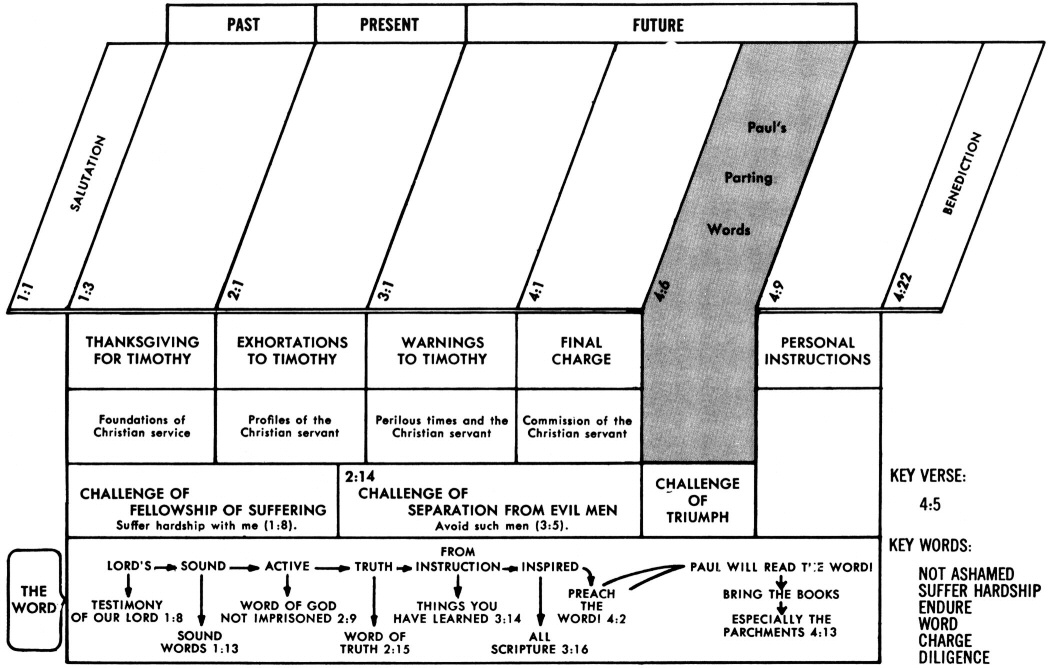
ENDURANCE AND SEPARATION IN THE MINISTRY
Click chart to enlarge
Charts from Jensen's Survey of the NT - used by permission
Second Timothy - Swindoll
| 2 TIMOTHY | |||
| 2 Timothy 1:1-18 | 2 Timothy 2:1-26 | 2 Timothy 3:1-17 | 2 Timothy 4:1-22 |
| Retain the Standard |
Rightly Divide the Word |
Difficult Times Will Come |
Preach the Word |
| PAST | PRESENT | FUTURE | |
| Foundation of Christian Service |
Pictures of Christian Servant |
Dangerous Times for Christian Servant |
Commission of Christian Servant |
| Unashamed as a Witness: Guard the Gospel |
Unashamed as a Workman: Suffer for the Gospel |
Adequate as a Workman: Continue in the Gospel |
Awarded as a Workman: Preach the Gospel |
| Power of the Gospel |
Perseverance of the Gospel Message | Protection of the Gospel |
Proclamation of the Gospel |
| Reminder | Requirements | Resistance | Requests |
| Encouragement in Ministry |
Examples in Ministry |
Exhortations in Ministry |
Exhortations to Fulfill Ministry |
| Commendation & Charge |
Commission to Fulfill |
Conflict to Face |
Course to Finish |
|
Compiled from Jensen's Survey of the NT and Wilkinson's Talk Thru the Bible |
|||
2 Timothy 2:15 Be diligent to present yourself approved to God as a workman who does not need to be ashamed, accurately handling the word of truth. (NASB: Lockman)
Greek: spoudason (2SAAM) seauton dokimon parastesai (AAN) to theo, ergaten anepaischunton, orthotomounta (PAPMSA) ton logon tes aletheias.
Amplified: Study and be eager and do your utmost to present yourself to God approved (tested by trial), a workman who has no cause to be ashamed, correctly analyzing and accurately dividing [rightly handling and skillfully teaching] the Word of Truth. (Amplified Bible - Lockman)
Darby: Strive diligently to present thyself approved to God, a workman that has not to be ashamed, cutting in a straight line the word of truth.
Wuest: Bend your every effort to present yourself to God, approved, a workman unashamed, expounding soundly the word of the truth. (Eerdmans Publishing - used by permission)
Young's Literal: be diligent to present thyself approved to God--a workman irreproachable, rightly dividing the word of the truth;
BE DILIGENT: spoudason (2SAAM):
- Heb 4:11; 2Pe 1:10,15; 3:14
- 2 Timothy 2 Resources - Multiple Sermons and Commentaries
- 2 Timothy 2:14-19 Using the Word Properly - Steven Cole
- 2 Timothy 2:14-19: The Danger of False Teaching
- 2 Timothy 2:14-26 Characteristics of a Useful Vessel
Related Passages:
Ezra 7:9-10 For on the first of the first month he began to go up from Babylon; and on the first of the fifth month he came to Jerusalem, because the good hand of his God was upon him. 10 For Ezra had (1) set his heart (2) to study the law of the LORD and (3) to practice it, and (4) to teach His statutes and ordinances in Israel.
A COMMAND TO
DO YOUR UTMOST
Be diligent (spoudazo) - "Study and be eager and do your utmost" (Amp). "Study to shew thyself" (KJV) "Bend your every effort". (Wuest) "Do your best" (ESV) "Spare no effort" (MIT). "Work hard" (NLT) Spoudazo conveys the idea of exertion. It means to be conscientious, zealous and earnest in discharging a duty or obligation. Be diligent is a command to do this now (aorist imperative see our need to depend on the Holy Spirit to obey). Don't delay. Do it effectively. Demonstrate a zealous persistence to accomplish an objective. ''Do your utmost for His highest'! It is vitally important that we understand Paul's charge to "Just Do It!" Paul is not seeking to put us under the burden of the law but quite to the contrary he expects us to submit to the Spirit of Grace (Heb 10:29), the only One Who can enable us to keep this command. Stated another way ,God's commandments always come "pre-packaged" with His enablement (His "Enabler" the indwelling Spirit)! This command can only be obeyed as we are yield to the indwelling Spirit Who continually "energizes" us Php 2:13NLT! Therefore it is imperative (pun intended) that we stay filled! (Eph 5:18! - even the desire to stay filled is "paradoxically possible" only by the Spirit! Oh, what a divine delightful mystery!) Daily filled we must daily walk by the Spirit (Gal 5:16) not grieving Him (Eph 4:30) or quenching Him (1Th 5:19). Then we can be diligent! Spoudazo is used in the papyri in such senses as “do your best, take care, hurry on the doing of something.”
To be diligent is to exert steady, earnest, and energetic effort and suggests earnest application to some specific object or pursuit. The idea is careful and persevering in carrying out tasks or duties. It means to be assiduous (marked by careful unremitting attention or persistent application).
Study of God's Word takes effort! Inductive Bible study is the most difficult Bible study I have have ever done has also been by far the most rewarding and edifying.
The supreme purpose of the diligent and selfless teacher is to please God. - For am I now seeking the favor of men, or of God?” Paul asked Galatian believers. “Or am I striving to please men? If I were still trying to please men, I would not be a bondservant of Christ (Galatians 1:10)
His greatest desire is to hear his Master say, "Well done, good and faithful servant (Mt 25:21)." This begs the question of each of beloved, will you...
Give your utmost for His highest!
Every Christian teacher and preacher should be able to say, "Just as we have been approved by God to be entrusted with the gospel, so we speak, not as pleasing men but God, who examines our hearts (1Th 2:4).
The Christian life demands continual diligence in every area...
Ephesians 4:3 being diligent to preserve the unity of the Spirit in the bond of peace.
Hebrews 4:11 Therefore let us be diligent to enter that rest, so that no one will fall, through following the same example of disobedience.
2 Peter 1:10 Therefore, brethren, be all the more diligent (aorist imperative see our need to depend on the Holy Spirit to obey) to make certain about His calling and choosing you; for as long as you practice these things, you will never stumble;
2 Peter 1:15 And I will also be diligent that at any time after my departure you will be able to call these things to mind.
2 Peter 3:14 Therefore, beloved, since you look for these things, be diligent (aorist imperative see our need to depend on the Holy Spirit to obey) to be found by Him in peace, spotless and blameless,
The most beneficial study of God’s Word requires diligence and perseverance, but the results are worth the effort. A. B. Simpson said "God has hidden every precious thing in such a way that it is a reward to the diligent, a prize to the earnest, but a disappointment to the slothful soul. All nature is arrayed against the lounger and the idler. The nut is hidden in its thorny case; the pearl is buried beneath the ocean waves; the gold is imprisoned in the rocky bosom of the mountains; the gem is found only after you crush the rock which encloses it; the very soil gives its harvest as a reward to the laboring farmer. So truth and God must be earnestly sought."
Steven Cole says the key is for a saint to be diligent to rightly divide the Word...
So many Christians are haphazard and lazy rather than diligent in their approach to God’s Word. They don’t systematically read, study, or memorize it. If they read it at all, they jump from passage to passage, pulling verses out of context. They aren’t seeking to know God and how He wants them to think, to believe, and to relate to others. Their lives and relationships are falling apart, but they don’t search diligently to discover what God’s Word tells them to do about these problems.
The key to being diligent in God’s Word is to be motivated. Motivation is the key to learning. Have you ever been on an airplane and watched the passengers as the stewardess gives the instructions on how to use the emergency breathing apparatus? They’re reading their newspapers or impatiently thinking, “Hurry up so we can get going!” They’re not motivated to hear her boring instructions. But suppose they’re airborne and the pilot comes on the intercom and says, “Ladies and gentlemen, we’re experiencing some severe trouble with our engines. We’re going to have to depressurize the cabin and make an emergency landing. The stewardess is going to explain how to use the emergency breathing apparatus.” Do you think he would have to add, “Please give her your full attention”? People would be motivated!
So the key to being motivated to be diligent in God’s Word is to recognize, “I live in the presence of God! Someday soon I will give an account to Him. His Word alone contains His wisdom on how to live in a way that pleases Him, which is the only way to true happiness for me. So I’ve got to be diligent to search out what the Scriptures say about knowing God and His wisdom for living.” (Using the Word Properly)
Be diligent (4704) (spoudazo from spoude = earnestness, diligence) conveys the idea hastening to do something with the implication of associated energy or with intense effort and motivation. It suggest zealous concentration and diligent effort. Spoudazo speaks of intensity of purpose followed by intensity of effort toward the realization of that purpose.The verb speaks of intensity of purpose followed by intensity of effort toward the realization of that purpose. Spoudazo is marked by careful unremitting attention or persistent application. The idea is give maximum effort, do your best, spare no effort, hurry on, be eager! Hasten to do a thing, exert yourself, endeavour to do it. It means not only to be willing to do with eagerness, but to follow through and make diligent effort. Give your utmost for His highest! In other words spoudazo does not stop with affecting one's state of mind, but also affects one's activity. Spoudazo basically means to make haste, and from that come the meanings of zeal and diligence. One commentator describes it as a holy zeal that demands full dedication.
Wuest says that spoudazo means "to make haste, do one’s best, take care, desire. The idea of making haste, being eager, giving diligence, and putting forth effort are in the word. The word speaks of intense effort and determination." (Wuest Word Studies - Eerdman Publishing Company)
Spoudazo - 11v in NT - Gal 2:10; Ep 4:3; 1Th. 2:17; 2Ti 2:15; 2Ti 4:9, 2Ti 4:21; Titus 3:12; He 4:11; 2Pe 1:10, 2Pe 1:15; 3:14. NAS renders as - diligent(6), eager(2), make every effort(3).
TO PRESENT YOURSELF: parastesai (AAN):
- 2 Timothy 2 Resources - Multiple Sermons and Commentaries
- 2 Timothy 2:14-19 Using the Word Properly - Steven Cole
- 2 Timothy 2:14-19: The Danger of False Teaching
- 2 Timothy 2:14-26 Characteristics of a Useful Vessel
A PRESENTATION
BEFORE GOD!
Present (3936) (paristemi from pará = near + hístemi = place, stand) literally means to stand beside or near, to present and includes idea of yielding, to place at the disposal of another and so to lay oneself out for the use of another. In the Septuagint (LXX) paristemi was used as a technical term for priest’s placing offering on altar. This word conveys the general idea of surrendering or yielding up. Josephus (Ant., 4, 113) writes "He then slew the sacrifices, and offered (paristemi) them as burnt offerings, that he might observe some signal of the flight of the Hebrews." The aorist tense here indicates a decisive, wholehearted act, yet in this case it is one requiring the diligence of repetition.
Paristemi - 40v in NT (study the uses especially in Romans) - Matt. 26:53; Mk. 4:29; 14:47, 69, 70; 15:35, 39; Lk. 1:19; 2:22; 19:24; Jn. 18:22; 19:26; Acts 1:3, 10; 4:10, 26; 9:39, 41; 23:2, 4, 24, 33; 24:13; 27:23f; Rom. 6:13, 16, 19; 12:1; 14:10; 16:2; 1 Co. 8:8; 2 Co. 4:14; 11:2; Eph. 5:27; Col. 1:22, 28; 2 Tim. 2:15; 4:17, 22. NAS renders paristemi as -bystanders(5), come(1), commend(1), help(1), present(11), presented(4), presenting(1),prove(1), provide(1), put at My disposal(1), stand before(2), standing(2), standing beside(1), standing nearby(1), stands(1),stands here(1), stood(2), stood before(1), stood beside(2), took their stand(1).
It is a standing alongside of or before God, of presenting oneself for inspection, as it were, in order to be approved by Him.
The verb paristemi is used in a similar manner by Paul in his letter to the Romans where he writes "why do you judge your brother? Or you again, why do you regard your brother with contempt? For we shall all stand before (paristemi) the judgment seat of God." (Ro 14:10)
Note that this judgment has to do with a believer’s service, not his sins (1Co 3:11, 12, 13, 14, 15). It is a time of review and reward, and is not to be confused with the Judgment of the Gentile nations (Mt 25:31, 32, 33, 34, 35, 36, 37, 38, 39, 40, 41, 42, 43, 44, 45, 46) or the Judgment of the Great White Throne (Rev 20:11, 12, 13, 14, 15-notes). The latter is the final judgment of all the wicked dead.
Be diligent that you might receive your degree...
A.U.G.
Approved Unto God
Steven Cole points out that...
Present is used (2 Cor 11:2; Ep 5:27 [note]) to speak of a bride being presented to her bridegroom. It’s a very personal, loving act when a young woman gives herself to a young man in marriage. In that culture (pre-women’s lib) it meant that she was giving herself completely to him: her devotion, her time, her body, her complete focus was now toward her husband because of his love for her and her love for him. That’s how we should come to the Bible. It’s not just a book of principles for how to live. It tells us of Christ’s enduring love for His bride. As His bride, we should seek to please Him and be available to do His will. As such, our focus should not be on what others think of us, but on what God thinks. Too many pastors fall into the trap of pleasing people, rather than pleasing God. While it’s nice to be liked, my main focus is to be, “approved to God.” Our goal is to please our heavenly Bridegroom who loved us and gave Himself for us.
When Jim Elliot, who was later martyred in the jungles of Ecuador, was a student at Wheaton College, he wrote in his diary, “My grades came through this week, and were, as expected, lower than last semester. However, I make no apologies, and admit I’ve let them drag a bit for study of the Bible, in which I seek the degree A.U.G., ‘approved unto God’” (Shadow of the Almighty [Zondervan], p. 43).
Come to the Bible to deepen your love life with the Lord, to learn how you can please Him more. (Using the Word Properly)
APPROVED TO GOD: dokimon parastesai (AAN) to theo:
- Acts 2:22; Ro 14:18; 16:10; 2Co 5:9; 10:18; Gal 1:10; 1Th 2:4
- 2 Timothy 2 Resources - Multiple Sermons and Commentaries
- 2 Timothy 2:14-19 Using the Word Properly - Steven Cole
- 2 Timothy 2:14-19: The Danger of False Teaching
- 2 Timothy 2:14-26 Characteristics of a Useful Vessel
Therefore also we have as our ambition, whether at home or absent, to be pleasing to Him. (2Co 5:9)
The Steps of Those Whom He Approves
Wait on the Lord and keep His way,
And then, by Him approved,
Thy heritage shall still remain
When sinners are removed.
Donald Barnhouse has the following interesting explanation of dokimos writing that "In the ancient world there was no banking system as we know it today, and no paper money. All money was made from metal, heated until liquid, poured into moulds and allowed to cool. When the coins were cooled, it was necessary to smooth off the uneven edges. The coins were comparatively soft and of course many people shaved them closely. In one century, more than eighty laws were passed in Athens, to stop the practice of shaving down the coins then in circulation. But some money changers were men of integrity, who would accept no counterfeit money. They were men of honour who put only genuine full weighted money into circulation. Such men were called "dokimos" or "approved"
Approved (1384) (dokimos from dokime = test, proof, trial = idea is that when you put metal through a fiery testing and it comes out on the other side enduring it "proven", "authentic" or "genuine" Click discussion of related word dokimazo and the antonym = adokimos) describes one who has stood the test.
Vine writes that dokimos signifies "that which is approved by being proved, that which stands the test (Vine, W. Collected writings of W. E. Vine. Nashville: Thomas Nelson)
Wuest adds this description that dokimos means to "put to the test for the purpose of being approved, and having met specifications, having the stamp of approval placed upon one. (Wuest Word Studies - Eerdman Publishing Company)
A dokimos man or dokimos character is like metal which has been cleansed of all alloy and impurity. In James 1:12 (see below) the weaknesses of such a one have been eradicated and he emerges strong and pure. That which is dokimos is shown to be trustworthy and genuine.
Approved describes anything tested and fit for service. As alluded to above, this term was used of gold and silver which has been purified by fire of all alloy.
Dokimos is the word describing money which is genuine or as we would say sterling (silver) [sterling = conforming to the highest standard]. In other words, a persons must first be "proved" before being "approved". One so approved is assayed by the One Who has eyes like flames of fire (Rev 1:14) yet passes this scrutiny and is counted as worthy.
Dokimos is a word which motivates one to have a "God consciousness" (cp "Coram Deo" - before the face of God!), a consciousness of His presence and of living and acting in His sight, so as to please Him in all things. (e.g., see the use by James below)
Sometimes it is helpful to get a sense of the meaning of a word by observing uses of its antonym and here Isaiah 1:22 presents us with a clear picture, where God is speaking to faithless Israel declaring "Your silver has become dross (Hebrew = siyg = literally that which is turned away or skimmed off in the refining process, the waste or impurity, the refuse after smelting precious metal and figuratively that which is base or worthless), Your drink diluted with water. (Comment: The Septuagint -LXX translates siyg with the Greek word adokimos)
Richards writes that dokimos "is used in the NT in the sense of recognition, of being officially approved and accepted.
Barclay - The Greek for one who has stood the test is dokimos, which describes anything which has been tested and is fit for service. For instance, it describes gold or silver which has been purified of all alloy in the fire. It is therefore the word for money which is genuine, or, as we would say, sterling. It is the word used for a stone which is fit to be fitted into its place in a building. A stone with a flaw in it was marked with a capital A, standing for adokimastos, which means tested and found wanting. Timothy was to be tested that he might be a fit weapon for the work of Christ, and therefore a workman who had no need to be ashamed. (Barclay, W: The Daily Study Bible)
The root dek-, dechomai, accept, gives two verbal derivatives dokeo and dokao. The former means (intrans.) to appear, have the appearance, (trans.) to think, believe, consider right; the latter means expect. Derivatives of the former are: (a) dokimos, trustworthy, reliable, tested, recognized, used as a technical term for genuine, current coinage, but also applied to persons enjoying general esteem; (b) adokimos, untested, not respected; (c) indirectly also dokimion, test, probation; (d) from dokimos are also derived dokimazo, test, pronounce good, establish by trial, recognize, and apodokimazo, disapprove of, reject, blame; dokimasis and dokimasia, investigation, testing (preparatory to installing in an office); dokime, approved character, trial. (Brown, Colin, Editor. New International Dictionary of NT Theology. 1986. Zondervan)
Dokimos is used 7 times in the NT...
Romans 14:18 (note) For he who in this way serves Christ is acceptable to God and approved by men.
John MacArthur comments: Dokimos (approved) refers to acceptance after careful examination, as when a jeweler carefully inspects a gem under a magnifying glass to determine its genuineness and value. When we serve Christ selflessly, we prove ourselves “to be blameless and innocent, children of God above reproach in the midst of a crooked and perverse generation, among whom you appear as lights in the world” (see note Philippians 2:15). (MacArthur, J: Romans 9-16. Chicago: Moody Press)
Romans 16:10 (note) Greet Apelles, the approved in Christ. Greet those who are of the household of Aristobulus.
Comment: O, that the "tribe" of Apelles might increase for whatever it was he did in the way of ministry and service, it was done in the sphere of [sufficiency of, power of, grace of] Christ, allowing Christ to live out His supernatural life through him. Apelles understood the vital principle Jesus taught in John 15:5 that "if you abide in Me and I abide in you shall bear much fruit for apart from Me you can do absolutely nothing that will pass the test." The "works" of Apelles will be tried by fire in 1 Corinthians 3:13-14 and even as pure gold will be found to pass the test of purity in the eyes of the Refiner. May God be pleased to raise up many Apelles in the modern church in America. Amen.
1 Corinthians 11:19 For there must also be factions among you, in order that those who are approved may have become evident among you.
2 Corinthians 10:18 For not he who commends himself is approved, but whom the Lord commends.
2 Corinthians 13:7 Now we pray to God that you do no wrong; not that we ourselves may appear approved, but that you may do what is right, even though we should appear unapproved.
2 Timothy 2:15 Be diligent to present yourself approved to God as a workman who does not need to be ashamed, handling accurately the word of truth.
James 1:12 Blessed is a man who perseveres under trial (the test is not designed to destroy us but to display the genuineness of our faith); for once he has been approved (dokimos - in the context he has passed the test and his faith is intact), he will receive the crown of life, which the Lord has promised to those who love Him. (Comment: The principle is simple and clear that perseverance brings God’s approval, and His approval brings the crown of life)
There are 6 uses of dokimos in the Septuagint (LXX) (Gen 23:16; 1 Ki 10:18; 1 Chr 28:18; 29:4; 2 Chr 9:17; Zech 11:13) and here are some representative uses...
Genesis 23:16 And Abraham listened to Ephron; and Abraham weighed out for Ephron the silver which he had named in the hearing of the sons of Heth, four hundred shekels of silver, commercial standard (Lxx = "approved [dokimos] with merchants".
1 Kings 10:18 Moreover, the king made a great throne of ivory and overlaid it with refined (Hebrew = pazaz = refined; Lxx = dokimos) gold.
1 Chronicles 29:4 namely, 3,000 talents of gold, of the gold of Ophir, and 7,000 talents of refined (Hebrew = zaqaq = purified, refined, purged; Lxx = dokimos) silver, to overlay the walls of the buildings;
2 Chronicles 9:17 Moreover, the king made a great throne of ivory and overlaid it with pure (Hebrew = tahor = pure, clean, genuine - used ninety times in the Old Testament, primarily to distinguish things that were culturally pure, capable of being used in, or taking part in the religious rituals of Israel; Lxx = dokimos) gold.
AS A WORKMAN: ergaten:
- Mt 13:52; 2Cor 3:6; 6:3,4; 1Ti 4:6,12, 13, 14, 15, 16
- 2 Timothy 2:14-19 Using the Word Properly - Steven Cole
- 2 Timothy 2:14-19: The Danger of False Teaching
- 2 Timothy 2:14-26 Characteristics of a Useful Vessel
- 2 Timothy 2 Resources - Multiple Sermons and Commentaries
GOD'S WORKMAN
A PRIVILEGED POSITION
This was Paul's warp and woof, to be God's man, God's workman who expressed his earnest expectation and hope this way "that I shall not be put to shame in anything, but that with all boldness, Christ shall even now, as always, be exalted in my body, whether by life or by death. (Php 1:20-see note) (And we should each seek to be imitators of Paul, just as he was of Christ)
Have thy tools ready;
God will find thee work
-- Charles Kingsley
Workman (2040) (ergates from ergazomai = meaning to engage in an activity involving considerable expenditure of effort. It is the root of English words like ergs, ergonomics, etc) literally describes a worker (workman) or laborer, someone who is engaged in labor (Mt 10:10, Mt 20:1-2, 8, etc). An ergates is one who effects something or brings about an effect through exertion of effort, whether mental or physical. In the spiritual realm, some of the workers are good (believers - Mt 9:37, 38, 1Ti 5:18, 2Ti 2:15) and some are evil (unbelievers = deceitful workers in 2Cor 11:13, evil workers - Php 3:2, workers of evil literally in Lk 13:27)
Liddell-Scott - (I) a workman: esp. one who works the soil, a husbandman, Herodotus, the country-folk. 2. as Adj. hard-working, strenuous, Xenophon (II). one who practices an art, c. gen., Id. (II) a doer, worker, Sophocles, Xenophon.
Ergates - 16x in 15v - not found in non-apocryphal Septuagint ("evildoer" in 1Macc 3:6).
Matthew 9:37 Then He said to His disciples, "The harvest is plentiful, but the workers are few. 38 "Therefore beseech the Lord of the harvest to send out workers into His harvest."
Matthew 10:10 or a bag for your journey, or even two coats, or sandals, or a staff; for the worker is worthy of his support.
Matthew 20:1 "For the kingdom of heaven is like a landowner who went out early in the morning to hire laborers for his vineyard. 2 "When he had agreed with the laborers for a denarius for the day, he sent them into his vineyard.
8 "When evening came, the owner of the vineyard said to his foreman, 'Call the laborers and pay them their wages, beginning with the last group to the first.'
Luke 10:2 And He was saying to them, "The harvest is plentiful, but the laborers are few; therefore beseech the Lord of the harvest to send out laborers into His harvest.
7 "Stay in that house, eating and drinking what they give you; for the laborer is worthy of his wages. Do not keep moving from house to house.
Luke 13:27 and He will say, 'I tell you, I do not know where you are from; DEPART FROM ME, ALL YOU EVILDOERS.' (Literally workers of unrighteousness)
Comment: Jesus is just - these individuals just don't accidentally (or unintentionally) fall into sin, but actually "work at" committing sin. Their punishment (eternal damnation) fits their crime ("tireless" evil workers).
Acts 19:25 these he gathered together with the workmen of similar trades, and said, "Men, you know that our prosperity depends upon this business.
2 Corinthians 11:13 For such men are false apostles, deceitful workers, disguising themselves as apostles of Christ.
Philippians 3:2 Beware (3 separate present imperatives - commanding continual vigilance) of the dogs, beware of the evil workers, beware of the false circumcision;
1 Timothy 5:18 For the Scripture says, "YOU SHALL NOT MUZZLE THE OX WHILE HE IS THRESHING," and "The laborer is worthy of his wages."
2 Timothy 2:15 Be diligent to present yourself approved to God as a workman who does not need to be ashamed, accurately handling the word of truth.
James 5:4 Behold, the pay of the laborers who mowed your fields, and which has been withheld by you, cries out against you; and the outcry of those who did the harvesting has reached the ears of the Lord of Sabaoth.
There are also a number of metaphorical uses in the NT (as here in 2Ti 2:15) describing one who is engaged in the work of some spiritual activity, whether good or bad (study the uses below, noting the repeated association that the ergates is "worthy of his wages" - beloved the hard working farmer should be the first to receive his share of the "wages" even now [2Ti 2:6] and yet even better he is storing up wages in the "bank of heaven" (cp 1Ti 4:8, Mt 6:20, cp Mt 19:21, 1Ti 6:17, 18, 19, He 10:34, He 11:26; 1Pe 1:4). Are you working for this life or the life to come? Do not lose heart as you labor [Gal 6:9, 10], striving according to His power which mightily works within you [Col 1:28, Col 1:29; He 13:20, 21], for your "payday" awaits eternity and the bema seat [word study] of Christ [2Cor 5:10, 1Co 3:11, 12, 13, 14, 15], the Lord of the harvest. Redeem the work days you have [Ep 5:16, Ro 13:11, Ro 13:12] for the days are evil and our life is but a vapor - cp Ps 90:12, Jas 1:10, 11, Jas 4:14, Ps 102:3, Ps 102:11, Ps 103:15, 16, Ps 144:4, Isa 40:6, 7, 1Pe1:24, 25, Job 7:6)
Only one life
Twill soon pass
Only what's done for (in) Christ will last
So teach us to number our days,
That we may present to Thee a heart of wisdom.
-- Moses - Ps 90:12
Lost, yesterday, somewhere between sunrise and sunset,
two golden hours, each set with sixty diamond minutes.
No reward offered, for they are gone for ever.
Redeem the time! God only knows
How soon our little life may close,
With all its pleasures and its woes,
Redeem the time!
— Anonymous
God set a goal, yet gave the choice
To mortals how time may be spent,
Admonishing that worth, not length,
Values time's accomplishment.
— Mortenson
There is a tide in the affairs of men,
Which, taken at the flood, leads on to fortune;
Omitted, all the voyage of their life
Is bound in shallows and in miseries.
(Julius Caesar, 4.3.217)
Whatever your hand finds to do,
verily, do it with all your might;
for there is no activity or planning or knowledge or wisdom in Sheol
where you are going. (Eccl 9:10)
Life is too short for us to do everything we want to do; but it is long enough for us to do everything God wants us to do. - Anon.
Spend your time in nothing which you know must be repented of; in nothing on which you might not pray for the blessing of God; in nothing which you could not review with a quiet conscience on your dying bed; in nothing which you might not safely and properly be found doing if death should surprise you in the act. - Richard Baxter
Time should not be spent, it should be invested in the kingdom of God. -John Blanchard (Blanchard, John: Complete Gathered Gold: A Treasury of Quotations for Christians)
Time is not yours to dispose of as you please; it is a glorious talent that men must be accountable for as well as any other talent. - Thomas Brooks
There is nothing puts a more serious frame into a man's spirit than to know the worth of his time. -Thomas Brooks
We are to redeem the time because we ourselves are redeemed.-Richard Chester
Half our life is spent trying to find something to do with the time we have rushed through life to save. -Will Rogers
Too busy for all that is holy on earth beneath the sky,
Too busy to serve the Master, but—not too busy to die!—Anon.
ETERNITY will be appreciated only in the measure that we have rightly handled TIME! - F. King
Adoniram Judson alluded to making the most of your opportunities when he wrote that...A life once spent is irrevocable. It will remain to be contemplated through eternity...the same may be said of each day. When it is once past, it is gone forever. All the marks which we put upon it, it will exhibit forever...each day will not only be a witness of our conduct, but will affect our everlasting destiny....How shall we then wish to see each day marked with usefulness...! It is too late to mend the days that are past. The future is in our power. Let us, then, each morning, resolve to send the day into eternity in such a garb as we shall wish it to wear forever. And at night let us reflect that one more day is irrevocably gone, indelibly marked.
Many years ago when the great missionary Adoniram Judson was home on furlough, he passed through the city of Stonington, Connecticut. A young boy playing about the wharves at the time of Judson’s arrival was struck by the man’s appearance. Never before had he seen such a light on any human face. He ran up the street to a minister to ask if he knew who the stranger was. The minister hurried back with him, but became so absorbed in conversation with Judson that he forgot all about the impatient youngster standing near him. Many years afterward that boy—who could never get away from the influence of that wonderful face—became the famous preacher Henry Clay Trumbull. In a book of memoirs he penned a chapter entitled: "What a Boy Saw in the Face of Adoniram Judson." That lighted countenance had changed his life. Even as flowers thrive when they bend to the light, so shining, radiant faces come to those who constantly turn toward Christ! Over 3000 years ago Moses prayed a prayer that is reflected in the life of Adoniram Judson and might well be an appropriate prayer of every saint who loves "His (Christ's) appearing" (2Ti 4:8) (Spurgeon's devotional)...
So teach us to number our days,
that we may present to Thee a heart of wisdom
(Psalm 90:12) (Spurgeon's note)
RELATED RESOURCE:
Ergates in the ancient world was used especially of one who works the soil. Xenophon uses ergates to describe one who practices an art.
Ergates is used 15 times in the NT (no uses in the non-apocryphal Septuagint) and is rendered in the NAS as laborer(2), laborers(6), worker(1), workers(4), workman(1), workmen(1).
Matthew 9:37 Then He said to His disciples, "The harvest is plentiful, but the workers are few. 38 "Therefore beseech the Lord of the harvest to send out workers into His harvest."
Matthew 10:10 or a bag for your journey, or even two tunics, or sandals, or a staff; for the worker is worthy of his support.
Matthew 20:1 "For the kingdom of heaven is like a landowner who went out early in the morning to hire laborers for his vineyard.
Matthew 20:2 "And when he had agreed with the laborers for a denarius for the day, he sent them into his vineyard.
Matthew 20:8 "And when evening had come, the owner of the vineyard said to his foreman, 'Call the laborers and pay them their wages, beginning with the last group to the first.'
Luke 10:2 And He was saying to them, "The harvest is plentiful, but the laborers are few; therefore beseech the Lord of the harvest to send out laborers into His harvest.
Luke 10:7 "And stay in that house, eating and drinking what they give you; for the laborer is worthy of his wages. Do not keep moving from house to house.
Luke 13:27 and He will say, 'I tell you, I do not know where you are from; depart from Me, all you evildoers (literally "doers of unrighteousness" = ergates adikia).'
Acts 19:25 these he gathered together with the workmen of similar trades, and said, "Men, you know that our prosperity depends upon this business.
2 Corinthians 11:13 For such men are false apostles, deceitful workers, disguising themselves as apostles of Christ.
Philippians 3:2 Beware of the dogs, beware of the evil workers, beware of the false circumcision;
1 Timothy 5:18 For the Scripture says, "You shall not muzzle the ox while he is threshing," and "The laborer is worthy of his wages."
2 Timothy 2:15 Be diligent to present yourself approved to God as a workman who does not need to be ashamed, handling accurately the word of truth.
James 5:4 Behold, the pay of the laborers who mowed your fields, and which has been withheld by you, cries out against you; and the outcry of those who did the harvesting has reached the ears of the Lord of Sabaoth.
The Word of Truth is the workman’s tool for building, measuring, and repairing God’s people. Carriers of the truth of God are to represent that truth and the God of truth well enough that we need never apologize for ourselves. God wants His people to be well prepared in the interpretation of God's truth. The messenger who interprets God's truth for others is an agent of His revelation.
It is clear from both the OT and NT, as well as from church history and our own time, that many of the worst false teachers claim to be servants of God (2Co 11:13). The majority of scribes, Pharisees, and other Jewish leaders of Jesus’ day considered themselves to be the godliest of the godly, as well as the only reliable interpreters of Scripture. Jesus called these men "blind guides of the blind" (Mt 15:14, Mt 23:16, 24)
Wuest writes that "A workman approved is a workman who has been put to the test, and meeting the specifications, has won the approval of the one who has subjected him to the test. (Wuest Word Studies - Eerdman Publishing Company)
Steven Cole illustrates the approval every workman should strive for "A young man once studied violin under a world-renowned master. When his first big recital came, the crowd cheered after each number, but the young performer seemed dissatisfied. Even after the final number, despite the applause, the musician seemed unhappy. As he took his bows, he was watching an elderly man in the balcony. Finally, the elderly one smiled and nodded in approval. Immediately, the young man beamed with joy. He was not looking for the approval of the crowd. He was waiting for the approval of his master. Christians should be living for God’s approval. We will be approved unto Him as we use the Bible to grow in godliness. Are you growing as a craftsman who uses God’s Word of truth accurately and skillfully to grow in godliness? The misuse of the Bible will lead you to ruin. The proper use will lead you to godliness. (Using the Word Properly)
Paid loafers and social parasites! - "Do your best to present yourself to God as one approved, a workman who does not need to be ashamed and who correctly handles the word of truth." 2 Timothy 2:15 It is easy for preachers to become paid loafers and social parasites, wasting their days in pleasure, recreation, and bumming around with open palms and an expectant look. Sadly, the religious hucksters and hirelings of the world have earned their reputation. Let no gospel preacher do so! The pastor has no boss within sight. He is not required to keep regular office hours. And no one checks up on him, to be sure he is working. That is as it should be. Yet, the very fact that a church treats her pastor as she should, makes it possible for the pastor to abuse his office, neglect his work, give himself to idleness, or to providing luxuries for himself and his family; when he should give himself relentlessly to study, and prayer, and preaching. If we devote ourselves to this labor, there will be little time or energy for other things. "Be diligent in these matters; give yourself wholly to them, so that everyone may see your progress. Watch your life and doctrine closely." 1 Timothy 4:15-16
WHO DOES NOT NEED TO BE ASHAMED: anepaischunton:
- 2 Timothy 2 Resources - Multiple Sermons and Commentaries
- 2 Timothy 2:14-19 Using the Word Properly - Steven Cole
- 2 Timothy 2:14-19: The Danger of False Teaching
- 2 Timothy 2:14-26 Characteristics of a Useful Vessel
Related Passages:
2 Timothy 1:8 Therefore do not be ashamed of the testimony of our Lord or of me His prisoner, but join with me in suffering for the gospel according to the power of God
1 John 2:28 Now, little children, abide in Him, so that when He appears, we may have confidence and not shrink away from Him in shame at His coming.
FELLOWSHIP OF THE
UNASHAMED
A workman who does not need to be ashamed - What would bring shame? Not handling the Holy Word reverently and accurately would bring shame. The diligent workman who handles the Word rightly is irreprehensible (blameless) Diligence in handling the Word now prevents one from one day having to stand before God and experience the painful feeling arising from the consciousness of having done something dishonorable with the Word of Truth. Let us always seek to be Bereans - Acts 17:11. The diligent workman has no cause for shame and is not liable to be put to shame when his work is inspected.
THOUGHT - Could I challenge you (myself) to consider measuring all your thoughts, words and deeds by the phrase..."A workman who does not need to be ashamed."
I want among the victor throng
Someday to have my name confessed;
And hear my Master say at last,
"You stand approved, you did your best!"
—Simpson
Not...ashamed (422) (anepaischuntos from a = without + epaischúnomai = be ashamed) describes the absence of a painful emotion caused by consciousness of guilt, shortcoming, or impropriety. Gilbrant adds "This rare word occurs only very seldom in the ancient world. It does not appear in classical Greek at all. Josephus, a Hellenistic-Jewish historian, used it once (Antiquities 18.7.1). The term was probably an improvised word; the writer probably simply added an “an” (alpha + nu for vocalization) prefix to epaischuntos. The definition of anepaischuntos is “not having need to be ashamed.” The word is found only once in the New Testament at 2 Timothy 2:15, where Paul admonished his young coworker to present himself to God as one approved, a worker who has “nothing to be ashamed of” and who is “rightly dividing the word of truth.” Timothy, threatened by false teaching in his community, was responsible before God to correctly interpret God’s Word. Correct handling of the Word will help offset insidious false teaching. (Complete Biblical Library )
HANDLING ACCURATELY: orthotomounta (PAPMSA):
- Mt 13:52; Mk 4:33; Lk 12:42; Jn 21:15, 16, 17; Acts 20:27; 1Co 2:6; 3:1,2; 2Co 4:2; 1Th 5:14; Heb 5:11-14
- 2 Timothy 2 Resources - Multiple Sermons and Commentaries
- 2 Timothy 2:14-19 Using the Word Properly - Steven Cole
- 2 Timothy 2:14-19: The Danger of False Teaching
- 2 Timothy 2:14-26 Characteristics of a Useful Vessel
- C H Spurgeon Rightly Dividing the Word of Truth
Related Passages:
Matthew 13:52 And Jesus said to them, “Therefore every scribe who has become a disciple of the kingdom of heaven is like a head of a household, who brings out of his treasure things new and old.”
Luke 12:42 And the Lord said, “Who then is the faithful and sensible steward, whom his master will put in charge of his servants, to give them their rations at the proper time?
Acts 20:27 “For I did not shrink from declaring to you the whole purpose of God.
2 Corinthians 4:2 but we have renounced the things hidden because of shame, not walking in craftiness or adulterating the word of God, but by the manifestation of truth commending ourselves to every man’s conscience in the sight of God.
Hebrews 5:11-14 Concerning him we have much to say, and it is hard to explain, since you have become dull of hearing. 12 For though by this time you ought to be teachers, you have need again for someone to teach you the elementary principles of the oracles of God, and you have come to need milk and not solid food. 13 For everyone who partakes only of milk is not accustomed to the word of righteousness, for he is an infant. 14 But solid food is for the mature, who because of practice have their senses trained to discern good and evil.
Handling accurately (3718) (orthotomeo from orthós = right, standing upright, continuing in a straight direction, figuratively = right, true, of ethically correct behavior + témno = cut or divide) means to make a straight cut, cut straight (of a craftsman cutting a straight line, farmer plowing a straight furrow, mason setting a straight line of bricks, workmen building a straight road.
Metaphorically as used here it speaks of carefully performing a task.
The present tense calls for us to continually rightly divide the Word of Truth. We are to take no short cuts or vacations when it comes to handling God's Worth in a trustworthy manner. Every time you teach or preach God's Word of truth you must seek by the Spirit's illumination and the enabling grace of Christ to cut the Word of Truth straight. In marked contrast are the false teachers who twist the Scriptures to their temporal benefit and their and their hearers eternal detriment!
John MacArthur explains that "Because Paul is a tentmaker, he may have been using an expression that tied in with his trade. When Paul made tents, he used certain patterns. In those days tents were made from the skins of animals in a patchwork sort of design. Every piece would have to be cut and fit together properly. Paul was simply saying, "If one doesn't cut the pieces right, the whole won't fit together properly." It's the same thing with Scripture. If one doesn't interpret correctly the different parts, the whole message won't come through correctly. In Bible study and interpretation the Christian should cut it straight. He should be precise... and accurate. (MacArthur, J: The Charismatics. Zondervan)
BDAG writes that orthotomeo is " found elsewhere independently of the NT only Pr 3:6; 11:5, where it is used with hodos and plainly means ‘cut a path in a straight direction’ or ‘cut a road across country (that is forested or otherwise difficult to pass through) in a straight direction’, so that the traveler may go directly to his destination. (Arndt, W., Danker, F. W., & Bauer, W. A Greek-English Lexicon of the New Testament and Other Early Christian Literature)
NIDNTT adds that "orthotomeo is found elsewhere only at Prov. 3:6 (In all your ways acknowledge Him, And He will make your paths straight.) and Pr 11:5 (Lxx = Righteousness traces out blameless paths: but ungodliness encounters unjust dealing.), where it is used in connexion with (hodos = way, path) cutting a path in a straight direction. It is connected with temno, cut. The idea is that of cutting a path through a forest or difficult terrain so that the traveller may go directly to his destination (Arndt, 584). The vb. occurs only at 2 Tim. 2:15 where the RSV has: “Do your best to present yourself to God as one approved, a workman who has no need to be ashamed, rightly handling [orthotomounta] the word of truth.” The phrase may be compared with Plato, Laws 7, 801E: “to proceed along the way of legislation which has been cleared [tetmemenen hodon] by our present discourse.” Arndt suggests that the meaning in 2 Tim. is to guide the word of truth along a straight path, like a road that goes straight to its goal. Other interpretations are to teach the word aright, expound it soundly, shape rightly, and preach fearlessly (cf. Moulton-Milligan, 456 f.). (Brown, Colin, Editor. New International Dictionary of NT Theology. 1986. Zondervan)
The careful exegete and expositor of God’s word of truth must be meticulous in the way he interprets and pieces together the many individual truths found in Scripture. The first and most important principle is that of basing doctrine and standards of living on Scripture alone (Sola Scriptura), a key watchword of the Protestant Reformation.
The image of orthotomeo is that of laying out a road. The teacher is to lay out a clearly marked pathway for others to walk. This effort requires study. Teachers are those who have been gifted by the Spirit and have devoted their minds to God so that they might impart His wisdom to His people. The Word of God however can be abused as well as used. It is always in danger of being distorted by teachers who handle it casually. The only effective way to prevent distortion of the Word of truth is diligent preparation at the study desk.
Where teachers and learners are lax in their study of the Scriptures, Bible classes are often filled with godless chatter and vain babblings. Instead of becoming mature in the faith, members and teachers become ungodly. Yet they claim success because their teaching becomes so popular, spreading "like gangrene.''
Spurgeon commenting on "handling accurately" writes "“Rightly dividing, or Straight Cutting. A ploughman stands here with his plough, and he ploughs right along from this end of the field to the other, making a straight furrow. And so Paul would have Timothy make a straight furrow right through the word of truth. I believe there is no preaching that God will ever accept but that which goes decidedly through the whole line of truth from end to end, and is always thorough, honest, and downright. As truth is a straight line, so must our handling of the truth be straightforward and honest, without shifts or tricks. There are two or three furrows which I have labored hard to plough. One is the furrow of free grace. “Salvation is of the Lord,” — he begins it, he carries it on, he completes it. Salvation is not of man, neither by man, but of grace alone. Grace in election, grace in redemption, grace in effectual calling, grace in final perseverance, grace in conferring the perfection of glory; it is all grace from beginning to end. If we say at any time anything which is really contrary to this distinct testimony that salvation is of grace, believe us not. This furrow must be ploughed fairly, plainly, and beyond all mistake. Sinner, you cannot be saved by any merit, penance, preparation, or feeling of your own. The Lord alone must save you as a work of gratis mercy, not because you deserve it, but because he wills to no it to magnify his abundant love. That is the straight furrow of the Word. (click full sermon "Rightly Dividing the Word of Truth")
Barclay comments that orthotomeo "literally means to cut rightly. It has many pictures in it. Calvin connected it with a father dividing out the food at a meal and cutting it up so that each member of the family received the right portion. Beza connected it with the cutting up of sacrificial victims so that each part was correctly apportioned to the altar or to the priest. The Greeks themselves used the word in three different connections. They used it for driving a straight road across country, for ploughing a straight furrow across a field, and for the work of a mason in cutting and squaring a stone so that it fitted into its correct place in the structure of the building. So the man who rightly divides the word of truth, drives a straight road through the truth and refuses to be lured down pleasant but irrelevant bypaths; he ploughs a straight furrow across the field of truth; he takes each section of the truth, and fits it into its correct position, as a mason does a stone, allowing no part to usurp an undue place and so knock the whole structure out of balance. (Barclay, W: The Daily Study Bible)
Let us continually seek to be like the Psalmist who wrote...
Thy word is very pure,
Therefore Thy servant loves it.
Psalm 119:140
Spurgeon (note) commenting on this verse writes...
Thy word is very pure. It is truth distilled, holiness in its quintessence. In the word of God there is no admixture of error or sin. It is pure in its sense, pure in its language, pure in its spirit, pure in its influence, and all this to the very highest degree -- "very pure."
"Therefore thy servant loveth it," which is a proof that he himself was pure in heart, for only those who are pure love God's word because of its purity. His heart was knit to the word because of its glorious holiness and truth. He admired it, delighted in it, sought to practise it, and longed to come under its purifying power.
George Horne - Thy word is very pure. In the original, "tried, purified, like gold in the furnace," absolutely perfect, without the dross vanity and fallibility, which runs through human writings. The more we try the promises, the surer we shall find them. Pure gold is so fixed, Boerhaave, informs us of an ounce of it set in the eye of a glass furnace for two months, without losing a single grain.
John Morison - Thy word is very pure; therefore, etc. The word of God is not only "pure," free from all base admixture, but it is a purifier; it cleanses from sin and guilt every heart with which into comes into contact. "Now ye are clean," said Jesus Christ to his disciples, "by the word which I have spoken unto you": John 15:3. It is this its pure quality combined with its tendency to purify every nature that yields to its holy influence, that endears it to every child of God. Here it is that he finds those views of the divine character, those promises, those precepts, those representations of the deformity of sin, of the beauty of holiness, which lead him, above all things, to seek conformity to the divine image. A child of God in his best moments does not wish the word of God brought down to a level with his own imperfect character, but desires rather that his character may be gradually raised to a conformity to that blessed word. Because it is altogether pure, and because it tends to convey to those who make it their constant study a measure of its own purity, the child of God loves it, and delights to meditate in it day and night.
Sir William Jones (1746-1794) wrote...
Thy word is very pure. Before I knew the word of God in spirit and in truth, for its great antiquity, its interesting narratives, its impartial biography, its pure morality, its sublime poetry, in a word, for its beautiful and wonderful variety, I preferred it to all other books; but since I have entered into its spirit, like the Psalmist, I love it above all things for its purity; and desire, whatever else I read, it may tend to increase my knowledge of the Bible, and strengthen my affection for its divine and holy truths.
Graham writes the following concerning "Thy word"...
Let us refresh our minds and our memories with some of the Scripture adjuncts connected with "the word," and realize, in some degree at least, the manifold relations which it bears both to God and our souls. It is called "the word of Christ," because much of it was given by him, and it all bears testimony to him...It is called "the word of his grace," because the glorious theme on which it loves to expatiate is grace, and especially grace as it is seen in Christ's dying love for sinful men. It is called ololoj tou staurou, "the word of the cross" (1 Corinthians 1:18), because in the crucifixion of the divine Redeemer we see eternal mercy in its brightest lustre. It is called "the word of the gospel," because it brings glad tidings of great joy to all nations. It is called "the word of the kingdom," because it holds out to all believers the hope of an everlasting kingdom of righteousness and peace. It is called "the word of salvation," because the purpose for which it was given is the salvation of sinners. It is called "the word of truth," because, as Chillingworth says, it has God for its author, salvation for its end, and truth without mixture of error for its contents. And we will only add, it is called "the word of life," because it reveals to a sinful, perishing world the doctrines of life and immortality. -- IV. Graham, in "A Commentary on the First Epistle of John," 1857.
Rightly Dividing The Word - In 1879, James Murray was hired as the editor of The Oxford English Dictionary. He had little advanced education, but he was a gifted linguist. Murray enlisted a large number of volunteers around the world to read widely and send him usages of assigned words. At Oxford, he and a small staff of scholars cataloged and edited the definitions they received.
During his lifetime, Murray was knighted and awarded an honorary doctorate from Oxford. Today, the 20-volume Oxford English Dictionary is still recognized as one of the most accurate and comprehensive dictionaries in the world.
Murray’s legacy of precision and accuracy with words reminds me of what the apostle Paul wrote to Timothy, a young pastor of the Ephesian church: “Be diligent to present yourself approved to God, a worker who does not need to be ashamed, rightly dividing the Word of truth” (2Ti 2:15). The phrase “rightly dividing” is a metaphor derived from the stonemason’s craft of cutting stones straight to fit into their proper place in a building.
(Ed comment: If a man like James Murray would be willing to invest such zeal and passion for that which is passing, how much more invigorated and motivated should believers be to purely divide and passionately proclaim the living and active, eternal, life changing Word of Truth!)
Precision with words is essential to an accurate interpretation of God’s Word. Let’s be people who care deeply about what the Bible says and what it means. -- Dennis Fisher (Our Daily Bread, Copyright RBC Ministries, Grand Rapids, MI. Reprinted by permission. All rights reserved)
Correctly handling the Word of truth
Takes diligence and care;
So make the time to study it
And then that truth declare. —HessRightly dividing the Word
multiplies our understanding.
Imagine That! - My friends and I were anticipating a contemplative time looking at a collection of artwork about the prodigal son who returned home to a forgiving father (Luke 15). When we arrived at the information table, we noticed the brochures, books, and a sign pointing to the artwork.
Also on the table was a dinner plate with bread, a napkin, and a glass. Each of us privately pondered what the significance of the plate could be. We wondered if it represented communion fellowship between the prodigal son and his father when he returned home. But as we examined it more closely, we realized simultaneously: Someone had left a dirty plate on the display table. And it wasn’t bread, but leftover cookie bars! Our imaginations had been wrong.
We had a good laugh, but then it made me think about how sometimes we imagine more than what’s really there while reading the Bible. Rather than assuming that our speculation is correct, however, we need to be sure our interpretation fits with the whole of Scripture. Peter said that “no prophecy of Scripture is of any private interpretation” (2 Peter 1:20). As we depend on the Spirit’s instruction, a careful study of the context, and the wisdom of respected Bible teachers, we’ll avoid seeing things in the Word that aren’t really there. (Anne Cetas)
We must correctly hear God’s Word,
Or we will be misled;
We must give careful thought and prayer
To what the Author said.
—Hess
A text out of context is often a dangerous pretext.
THE WORD OF TRUTH: ton logon tes aletheias:
- 2 Timothy 2 Resources - Multiple Sermons and Commentaries
- 2 Timothy 2:14-19 Using the Word Properly - Steven Cole
- 2 Timothy 2:14-19: The Danger of False Teaching
- 2 Timothy 2:14-26 Characteristics of a Useful Vessel
THE WORD OF GOD
IS THE WORD OF TRUTH
Word of Truth - What a beautiful name for the Bible, especially in a world which is becoming more and more the opposite, where men's words are no longer binding. How we need to remember that Satan is a liar, the father of lies and has no truth in him, which emphasizes our great need to be totally dependent on the Word of Truth to counter his evil but very deceptive lies! Take a moment and ponder each of the 5 Biblical uses of this great phrase Word of Truth (Ps. 119:43; 2Co. 6:7; Col. 1:5; 2Ti 2:15; Jas 1:18)
Think of God's Word of Truth as the "sun" (Son) and then consider how the planets function in such order as they rotate around the sun. In a similar way believers should live their entire Christian life within the orbit of God's Word of Truth, ultimately manifest in the Logos, His precious Son, Our Lord and King. Amen.
The following "outlines" on the Word of Truth are adapted from Spurgeon's notes on Psalm 119:140 (see notes directly preceding)
The crystal stream (of the Word of Truth)
(a) Flows from under the throne.
(b) Mirrors heaven.
(c) Undefiled through the ages.
(d) Nourishes holiness as it flows.
The enraptured pilgrim.
(a) Keeping by its brink.
(b) Delighted with its lucid depths.
Pleased with its mirrored revelations -- self, heaven, God.
Cleansed and refreshed by its waters. --W.B.H
><> ><> ><>
The purity of God's Word (of Truth)
(a) It proceeds from a perfectly pure source: "Thy word."
(b) It reveals a purity otherwise unknown.
(c) It treats impure subjects with absolute purity.
(d) It inculcates the most perfect purity.
(e) It produces such purity in those who are subject to its power. --
The love which its purity inspires in gracious souls.
(a) They love it because, while it reveals their natural impurity, it shows them how to escape from it.
(b) They love it because it conforms them to its own purity.
(c) They love it because to a pure heart the purity of the word is one of its chief commendations. --
The evidences of this love to the pure word.
(a) Desire to possess it in its purity.
(b) Subjection to its spirit and teachings.
(c) Zeal for its honour and diffusion. --W.H.J.P.
Word (3056) (logos from légō = to speak with words; English = logic, logical) means something said and describes a communication whereby the mind finds expression in words. Although Lógos is most often translated word which Webster defines as "something that is said, a statement, an utterance", the Greek understanding of lógos is somewhat more complex.
Cremer explains that lógos is used of the living, spoken word,
the word not in its outward form, but with reference to the thought connected with the form,… in short, not the word of language, but of conversation, of discourse; not the word as a part of speech, but the word as part of what is uttered.
Barclay adds that
the Greek term for word is lógos; but lógos does not only mean word; it also means reason. For John, and for all the great thinkers who made use of this idea, these two meanings were always closely intertwined. Whenever they used lógos the twin ideas of the Word of God and the Reason of God were in their minds. (Barclay, W: The Daily Study Bible Series. The Westminster Press)
In the Greek mind and as used by secular and philosophical Greek writers, lógos did not mean merely the name of an object but was an expression of the thought behind that object's name. Let me illustrate this somewhat subtle nuance in the meaning of lógos with an example from the Septuagint (LXX) (Greek of the Hebrew OT) in which lógos is used in the well known phrase the Ten Commandments.
The Septuagint translates this phrase using the word lógos as “the ten (deka) words (logoi)” (Ex 34:28), this phrase giving us the familiar term Decalogue. Clearly each of the "Ten Commandments" is not just words but words which express a thought or concept behind those words.
That which corresponds to or adequately expresses what is real (Pocket Dictionary of Apologetics and Philosophy of Religion).
This then is the essence of the meaning of lógos and so it should not be surprising that depending on the context lógos is translated with words such as "saying, instruction, message, news, preaching, question, statement, teaching, etc". This understanding of lógos also helps understand John's repeated usage of this Greek word as a synonym for the second Person of the Godhead, the Lord Jesus Christ.
Truth (225) (aletheia from a = indicates following word has the opposite meaning ~ without + lanthano = to be hidden or concealed, to escape notice, cp our English "latent" from Latin = to lie hidden) has the literal sense of that which contains nothing hidden. Aletheia is that which is not concealed. Aletheia is that which that is seen or expressed as it really is (this idea is discussed more below).
The basic understanding of aletheia is that it is the manifestation of a hidden reality (eg, click discussion of Jesus as "the Truth"). For example, when you are a witness in a trial, the court attendant says "Raise your right hand. Do you swear that you will tell the truth and nothing but the truth so help you God?" And you say, "I do" and you sit down. The question the court attendant is asking is "Are you willing to come into this courtroom and manifest something that is hidden to us that only you know so that you will bear evidence to that?" Therefore when you speak the truth, you are manifesting a "hidden reality". Does that make sense? An parallel example in Scripture is the case of the woman in the crowd who had touched Jesus (Read context = Mk 5:24-25, 26-27, 28-29, 30, 31-32), but when she became "aware of what had happened to her, came and fell down before Him, and told Him the whole truth " (Mk 5:33) and nothing but the truth. She did not lie. She spoke no falsehoods.
Truth then is the correspondence between a reality and a declaration which professes to set forth or describe the reality. To say it another way, words spoken or written are true when they correspond with objective reality. Persons and things are true when they correspond with their profession (which we describe with words like integrity, sincerity, non-hypocritical, etc). In other words, "what you see is what you get". Hence a truth is a declaration which has corresponding reality, or a reality which is correctly set forth. Since God is Himself the great reality, that which correctly sets forth His nature is pre-eminently the Truth of Creation (Natural Revelation) and the Truth of Scripture (Special Revelation). Thus it is not surprising that rebellious, sinful men actively hold down or suppress the Truth of Creation (and the glorious Creator) (Ro 1:18) and even exchange the truth, the clearly manifested (and objective) reality (Creation) for the lie (Ro 1:25).
Gilbrant on aletheia - One of the principal terms for expressing the concept of “truth” in the Greek language is alētheia. Originally the word denoted something which was not hidden or a disclosure of something which was hidden. In Greek philosophy the word often carries the sense of that which really exists, “the reality behind all apparent reality.” Therefore, it has been customary to conclude from this that there is a marked contrast between the Greek and Hebrew view of the nature of “truth.” According to this view, in classical Greek alētheia stands in opposition to that which is only apparent or perceived to be real. The Hebrew notion of truth points to that which is sure and reliable as the “truth.” No doubt this is substantially correct. But it would be erroneous to assume that alētheia should solely or principally imply a philosophic concept of reality. Obviously Greeks as well as Hebrews needed a word which decisively expressed truth as over against falsehood and deceit. Such a concrete sense can also be discovered in the Greek alētheia just as it can in the Hebrew ’ĕmeth. Both of these terms have distinct shades of meaning which are worthwhile to investigate. Alētheia functions in various contexts. To the philosophers it expressed “being” in the absolute sense of the word, i.e., “existence.” Historians used the term to signify real events as distinct from myths. In forensic language (legal) the term characterizes an accurate assessment of a fact, in contrast to an incorrect observation or assertion. Alētheia not only stands for irrefutable facts, but it also expresses the truth itself, that which is unattainable to the human mind and which can only be perceived in ecstasy or through divine revelation. (Complete Biblical Library)
THE GOD OF
TRUTH
One of the attributes of God is Truth. God is the definition of truth; He is absolutely true, and all truth accords with God’s actions. God is all that He as God should be and that His word and revelation are completely reliable. He is absolutely dependable, without falseness of any kind. God’s plan, principles, and promises are completely reliable, accurate, real, and factual. God is real not imaginary, vain and empty like the idols of the pagans, who represent a so-called god of their own vain imagination. Truth can be depended upon and does not fail, change, or disappoint and so practically God's promises are all yea and amen in Christ Jesus and His word cannot fail or disappoint. The practical aspect of God's unchanging truthfulness is that we can stand on His promises with full assurance of faith no matter how we feel, no matter how dire our circumstances. We can trust and rest on this great attribute of God, forever and forever. Amen. And since God is truth, He desires that those who would give a proper opinion of Him also be truthful in the words and deeds. (Ro 12:9). Scripture on God is truth: Ex 34:6; Nu 23:19; Ps 19:9; 91:4; 100:5; 146:6; Isa 25:1; 65:16 Da 4:37; Mic7:20; Jn 17:17; 2 Cor 1:20; Rev 16:7. Jesus proclaimed, “I am the truth” (Jn 14:6). His word to mankind is absolutely reliable and can be trusted implicitly. It means He will never renege on any promise He has made. (See also Truthful by C H Spurgeon; The Truth of God by Bob Deffinbaugh; The Truth of God by Thomas Watson - Scroll down; Of the Veracity of God by John Gill; Let God Be True! by Richard Strauss)
Lewis Sperry Chafer writes that "Truth" is "the character of God is in view when He is called the God of Truth. He not only advances and confirms that which is true, but in faithfulness abides by His promise, and executes every threat or warning He has made. Apart from the element of truth in God there would be no certainty whatsoever in this life, and men would wander on in comfortless perplexity not knowing whence they came or whither they are going. Without truth in God, a revelation is only a mockery. On the contrary, as asserted in the Bible, “Let God be true, but every man a liar” (Ro3:4). Though men deceive, the veracity of God can never be questioned to the slightest degree. Truth in God is surety that what He has disclosed is according to the nature of things and that His disclosures may be depended upon with plenary certainty. This certainty characterizes alike every revelation from God by whatever means."(Biblical Theism Pt 3/4 The Attributes of God - Bibliotheca Sacra: Vol. 96, Page 14-16, 1939)
Charles Simeon wrote that "truth is a conformity of our feelings and actions to our professions and this God requires of us in the whole of our spirit and conduct.
Noah Webster defined truth as "Conformity to fact or reality; exact accordance with that which is, or has been, or shall be. (1828 Dictionary)
Nelson's New Illustrated Dictionary says truths is "conformity to fact or actuality; faithfulness to an original or to a standard. In the Old and New Testaments, truth is a fundamental moral and personal quality of God. (Ex 34:6, Dt 32:4, Ps 25:10)
Friberg gives one of the best summaries of aletheia (the following is modified slightly) and includes the Greek word that is the antonym...
(1) Truth speaks of what has certainty and validity (Ep 4.21), The opposite = plane [word study] = going astray from the path of truth, thus error
(2) Truth describes the real state of affairs, especially as divinely disclosed truth (Ro 1.18). The opposite = muthos [word study] = fiction, myth
(3) Truth speaks of the concept of the Gospel message as being absolute truth (2Th 2.12)
(4) Truth can describe the true-to-fact statements (Lk 4.25). The opposite = pseudos [word study] (lie, falsehood); (See devotional related to lying - Which Tire Was It - Our Daily Bread)
(5) Truth speak of what is characterized by love of truth (truthfulness, uprightness, fidelity - in one's words or conduct = thus equates with sincerity, veracity) (1Co 5.8; 13.6). The opposite = adikia [word study] = wrong, evil
(6) Truth describes reality as opposed to pretense or mere appearance (Phil 1.18). The opposite = prophasis [word study] =pretext, excuse.
(a) Idiomatically "in truth" = really, truly, indeed (Mt 22:16)
(b) Idiomatically "according to truth" =. rightly (Ro 2.2)
(c) Idiomatically "upon or on truth" = of a truth, as the fact or event shows, really, actually (Acts 4:27, 10:34 [lit. = "of a truth"], Lk 4:25, Job 9:2, Is 37:18KJV) (Analytical Lexicon of the Greek New Testament )
Aletheia is a reality which is firm, solid, binding. When aletheia is used of individuals, it characterizes their action, their words or their thoughts and conveys the general sense of integrity (integer = one) (See Integrity - A Few Thoughts)
Truth is the correspondence between a reality and a declaration which professes to set it forth. Words are true when they correspond with objective reality: Persons and things are true when they correspond with their profession. Hence a truth is a declaration which has corresponding reality, or a reality which is correctly set forth. Since God is Himself the great reality, that which correctly sets forth His nature is pre-eminently the Truth. Ultimately Jesus is "the Truth" and He is "the Word".
Aletheia speaks of veracity, reality, sincerity, accuracy, integrity ("what you see is what you get").
Vine - Aletheia, truth "expresses that which is consistent with reality."
Aletheia is the opposite of fictitious, feigned, false.
TRUTH or CONSEQUENCES
THE BATTLE:
TRUTH vs UNTRUTH
Charles Spurgeon once said that "The spotless purity of truth must always be at war with the blackness of heresy and lies."
God deals in truth, but Satan traffics in untruth (lies) (Jn 8:44). As a corollary God deals in faith, while Satan traffics in fear (What then is the "antidote" for fear? See Fear, How to Handle It). It follows that spiritual warfare is not a power struggle as much as it is a truth struggle and the battlefield is our mind. The only way to defeat the lie of the devil is with the truth of God and His Word. It therefore behooves all believers to make it their continual practice to take in the Word of Truth that we might be able to wage war with the deceiving Devil. Jesus is our model in this spiritual war with unseen forces of darkness, fending off the enemies fiery missiles of temptation and lies with the Word of truth in Deuteronomy (Mt 4:3-4 quoting Dt 8:3, Mt 4:5,6, 7 quoting Dt 6:16, Mt 4:8-9, 10 quoting Dt 6:13, 10:20). Beloved, if Jesus memorized the truth of Scripture to counter to lies of Satan, how can we do less? (See Memorizing His Word and Memory Verses by Topic) The only antidote for the poison of Satan's lies is the Truth of God's Word. "God’s truth stops the spin of Satan’s lies." (See Breaking The Spin Cycle - Our Daily Bread)
Beloved, if you need some motivation to be a good soldier of Christ Jesus in this war (2Ti 2:3,4) take a moment and let this grand old hymn stir the passions in your heart...
Mine eyes have seen the glory of the coming of the Lord;
He is trampling out the vintage where the grapes of wrath are stored;
He hath loosed the fateful lightning of His terrible swift sword;
His truth is marching on.
Glory! Glory! Hallelujah! Glory! Glory! Hallelujah!
Glory! Glory! Hallelujah! His truth is marching on.
In the beauty of the lilies Christ was born across the sea,
With a glory in His bosom that transfigures you and me:
As He died to make men holy, let us live to make men free;
While God is marching on.
Glory! Glory! Hallelujah! Glory! Glory! Hallelujah!
Glory! Glory! Hallelujah! His truth is marching on.
(Play - Battle Hymn of the Republic)
And if that doesn't make your pulse quicken listen to Martin Luther's great hymn...
And though this world, with devils filled, should threaten to undo us,
We will not fear, for God hath willed His truth to triumph through us:
The Prince of Darkness grim, we tremble not for him;
His rage we can endure, for lo, his doom is sure,
One little (truth) word shall fell him.
That word (truth) above all earthly powers, no thanks to them, abideth;
The Spirit and the gifts are ours through Him who with us sideth:
Let goods and kindred go, this mortal life also;
The body they may kill: God’s truth abideth still,
His kingdom is forever.
(Play - A Mighty Fortress Is Our God)
Truth is like a "bluegill" fish in our continual "war of terror"
San Francisco and New York City are using bluegill fish to check for the presence of toxins in their water supply, which could be a possible target for a terrorist attack. A small number of bluegills are kept in a tank at the bottom of some water treatment plants because the fish are sensitive to chemical imbalances in their environment. When a disturbance is present in the water, the bluegills react against it.
Like these bluegills, Paul wanted the Galatians to beware of and react against any toxic disturbance in the “true gospel” that was being preached. The toxin was defined as the false principle that God grants acceptance to people and considers them righteous on the basis of their obedience to a set of rules (especially circumcision and dietary laws). In short, obedience to the law was needed, apart from faith in Jesus. This false teaching was a toxic disturbance of the truth and the Galatians were told to react strongly against it. Paul said that anyone preaching a gospel that is not based on grace through faith in Christ alone should be accursed (Gal. 1:8, 9).
Let’s faithfully study the Scriptures so we can detect the toxins of false teaching and proclaim the truth of God’s wonderful salvation through faith in Jesus. (Our Daily Bread, Copyright RBC Ministries, Grand Rapids, MI. Reprinted by permission. All rights reserved)
Lord, teach us from Your holy Word
All error to discern,
And by Your Spirit’s light help us
From Satan’s snares to turn. —Bosch
If you know the truth,
you can discern what’s false.
Alvin Plantinga adds that
The contemporary intellectual world is a battle or arena in which rages a battle for our souls.
James Dobson concurs noting that
The heated dispute over values in Western nations is simply a continuation of the age-old struggle between the principles of righteousness and the kingdom of darkness.
Blaise Pascal (1623-1662) describing his own day
Truth is so obscure in these times and falsehood so established, that unless we love the truth, we can not know it.
J. C. Ryle
Let us never forget that truth, distorted and exaggerated, can become the mother of the most dangerous heresies.
The Theological Lexicon of the NT says
To speak the whole truth is to conceal nothing, and alētheia is the opposite of lying or forgetfulness. An event is true (alēthēs) when it is unveiled; a hidden reality becomes explicit. A person who is true or sincere is one who conceals nothing and does not try to deceive.
Greek philosophy and religious strivings were dominated by the search for truth (Thucydides 1.20.3), as Plato explicates it: “By searching for truth I strive to make myself as perfect as possible in life and, when the time comes to die, in death.” The truth not only gives life; it gives the good life (Epictetus 1.4.31; 3.24.40), because it orients action: “If you knew the truth, you would necessarily act rightly.” (Spicq, C., & Ernest, J. D. Theological Lexicon of the New Testament. 1:66. Peabody, MA.: Hendrickson. 1994)
Comment: How fascinating that the pagans had within them (surely placed there by God) a sense of the importance of truth in order to assure a genuine appreciation of this present life. So close but yet so far for they did not know "the Truth" (Jn 14:6)!
Whatever God says is truth and so is to be regarded as the standard of all truth. In Christ's high priestly prayer, He declares that the Word of God is truth (John 17:17). In other words, the Word of God does not just contain truth (which of course it does), but is truth in its very essence.
The Holy Spirit is the Spirit of Truth, the One Who leads Christians into all spiritual truth (Jn 16:13). And because the Holy Spirit is truth, the world cannot comprehend Him and His ministry (John 14:17).
Wayne Detzler adds that aletheia
was seen mainly as a contrast with a lie. Homer wrote that a lie is either the absence of truth or a partial truth. If one deceived another by telling only part of the truth, this was a lie. In writing his Odyssey, Homer mentioned the role of a judge in a race. His job was to tell the truth about the winners and losers of a race.
Thucydides contrasted truth with exaggeration. Anyone who expanded or embellished the truth was really telling a lie. Thus truth is contrasted with boasting or flattery.
Plato contrasted truth with appearance. Some things may appear to be real, but actually are an illusion.
Truth is seen mainly by contrast. It contrasts with a lie of statement or understatement. Another contrast is seen between truth and exaggeration. Finally, truth stands out in contrast with appearance....
Truth in the Scripture is tied inextricably to the person of our God. He is the 380 Source of all truth, and the Trinity emphasizes this aspect of God's character. No Christian can either know or practice truth, apart from constant reliance on the One who is Truth. He is Truth, because He conforms to and indeed creates ultimate reality. (Wayne A Detzler. New Testament Words in Today's Language)
Mounce...
Perhaps the most common use of the noun alētheia and the two corresponding adjectives is to refer to something that is accurate. For example, Paul claims before Festus and Agrippa that what he said regarding Jesus and the resurrection is “the truth” and reasonable (Acts 26:25). Jesus’ testimony is true and valid because the Father testifies about him (Jn 5:31, 32; cf. Rev 21:5; 22:6); our testimony about Jesus is also true (Titus 1:13; 3 Jn. 12). But truth is not only in statements. Paul uses that adjective alēthinos to describe God Himself. The Thessalonians turned from idols in order to “serve the living and true God” (1Th. 1:9). And because God is true, what God speaks is also truth; “your word is truth” (Jn 17:17). Not only is God true, but Jesus is “True” as well (Rev 19:11). He is “full of grace and truth” (Jn 1:14, 17). In fact, Jesus Himself is “truth” (Jn 14:6), and if we are His disciples, we will “know the truth” (Jn 8:32). Jesus is “the true vine,” through which his followers draw nourishment. John uses the adjective alēthēs to denote a spiritual reality about Jesus that is beyond the observable world. Jesus proclaims that his flesh is “true food” and his blood is “true drink” (Jn 6:55). Furthermore, especially in John’s writings, the Holy Spirit is referred to as the “Spirit of truth” (Jn 14:17; 15:26; 16:13; cf. 1Jn. 4:6; 5:6). The Holy Spirit recalls to our minds the words of Jesus and certifies to our hearts that they are true (Jn 15:26). (Mounce's Complete Expository Dictionary of Old & New Testament Words. Grand Rapids, MI: Zondervan)
Aletheia is a key word in the Gospel of John (24x or almost 1 in 4 NT uses - also 28x in John's epistles - 1Jn =16, 2Jn=5, 3Jn=7) but is much less common in the synoptic Gospels (7x in all 3 Synoptics).
Horatio Bonar wrote that...
Truth is not the feeble thing which men often think they can afford to disparage. Truth is power; let it be treated and trusted as such.
Note the association of aletheia with the Gospel (Col 1:5, Gal 2:5, Ep 1:13). The Gospel is the expression of truth, ultimately the truth about God, the truth about man in sin and the truth about the provision of redemption from our sinful state. Although 1Ti 2:4 and 2Ti 2:25 do not use the word "Gospel", clearly the context of both passages associates salvation (which comes only through the Gospel) and the knowledge of the truth. Sadly, truth can be turned aside from (2Ti 2:18) or resisted (2Ti 3:8). To turn from the truth of the Gospel does not make it any less true!
Everett Harrison - In Homer (truth) aletheia denotes veracity as opposed to falsehood. Later classical times witness an enlargement of usage, since it comes to express what is real or factual as opposed to appearance or opinion. That which is true corresponds with the nature of things. In this sense the truth is eternal and divine, for the Greek recognized no distinction between the natural and the supernatural. These values are continued in the Septuagint use of aletheia, but because of the circumstance that it was often used to translate 'emeth, a Hebrew word for truth which stresses the elements of reliability and trustworthiness, a new content becomes added. Often the word is used to describe God and also His Word. On these one may rest with confidence, for they will not fail. So, whereas the classical aletheia largely serves as an intellectual term, the same word in its Septuagint setting has often a decidedly moral connotation, especially when used with reference to the divine. New Testament writers draw from both streams of meaning, so that the exegete must be constantly on the alert to detect, if he can, whether aletheia means reality or trustworthiness. John and Paul make largest use of the term. The Greek sense seems clearly present in passages like Romans 1:25, whereas a comparison of Romans 3:3 and 3:4 shows with equal clearness that here the Hebraic background is powerfully operative. Paul is especially fond of linking the word truth with the gospel. Here the two strains may be said to unite, for the gospel message corresponds to reality (that is, it is ultimate truth, much in the same way that the writer to the Hebrews argues the finality of the Christian dispensation with the aid of the related word alethinos, as John does likewise), and for that very reason is reliable, but even more so because the gospel originates with God and possesses His own guarantee. For John the acme of the concept lies in its application to Jesus Christ. To be set free by the truth and to be set free by the Son are two ways of saying the same thing (John 8:32, 36). Dodd observes that whereas the Jewish conception was to the effect that the divine truth ('emeth) was expressed in the Torah, John places it in the person of Christ (see the discussion in Kittel, op. cit., pp. 88-90). Paul comes close to doing the same thing (Eph 4:21). The New Testament, then, has arrived at a synthesis of the two approaches to truth, and this synthesis is thoroughly defensible in the court of reason, for only that which possesses reality is worthy of confidence. But the daring step taken here is in the identification of truth in all its finality with the man Christ Jesus. (The Importance of the Septuagint for Biblical Studies )
Ralph Martin - Whereas truth in Western cultures often concerns facts that can be proven logically or scientifically, truth in the NT may deal with genuine, dependable, faithful behavior or “things as they really are” in contrast to something that has been hidden or concealed... . A matter of truth is rarely defended with logical arguments, but instead the author often appeals to the source of revealed truth or assumes the veracity of the claims. Furthermore, whereas today it is commonplace to question the truth of God’s existence, this existence was typically assumed in NT contexts. (Martin, R. P., & Davids, P. H. Dictionary of the later New Testament and its developments. Downers Grove, IL: InterVarsity Press)
Wayne Detzler quotes the famous British expositor ...
Alexander Maclaren (1826-1910), commented concerning truth: "If a man will not think about Christian truth he will not have the blessedness of Christian possession of God." (Then Detzler adds) The secret to Christ's presence is meditation on the truths of the Scriptures.
THE NT OCCURRENCES
OF ALETHEIA
Aletheia - 109x in 98v in NAS. Translated = certainly*(2), most(1), rightly*(1), truly*(2), truth(104).
Matthew 22:16 And they (Pharisees) sent their disciples (learners) to Him, along with the Herodians, saying, "Teacher, we know that You are truthful and teach the way of God in truth, and defer to no one; for You are not partial to any.
Mark 5:33 But the woman fearing and trembling, aware of what had happened to her, came and fell down before Him and told Him the whole truth.
Comment: Truth that is not "whole" is a "partial" truth, which by any other name is a lie.
Mark 12:14 They came and said to Him, "Teacher, we know that You are truthful (alethes = adjective) and defer to no one; for You are not partial to any, but teach the way of God in truth. Is it lawful to pay a poll-tax to Caesar, or not?
Mark 12:32 The scribe said to Him, "Right, Teacher; You have truly stated that HE IS ONE, AND THERE IS NO ONE ELSE BESIDES HIM;
Luke 4:25 "But I say to you in truth, there were many widows in Israel in the days of Elijah, when the sky was shut up for three years and six months, when a great famine came over all the land;
Luke 20:21 They questioned Him, saying, "Teacher, we know that You speak and teach correctly, and You are not partial to any, but teach the way of God in truth.
Luke 22:59 After about an hour had passed, another man began to insist, saying, "Certainly (more literally = "of a truth") this man also was with Him, for he is a Galilean too."
John 1:14 And the Word became flesh, and dwelt among us, and we saw His glory, glory as of the only begotten from the Father, full of grace and truth.
Thou art the bread of life, O Lord, to me,
Thy holy Word the truth that saveth me;
Give me to eat and live with Thee above;
Teach me to love Thy truth, for Thou art love.
(Play - Break Thou the Bread of Life)John 1:17 For the Law was given through Moses; grace and truth were realized through Jesus Christ.
Youngblood: Jesus and the revelation the Spirit of truth gave through His apostles are the final, ultimate revelation and definition of truth about God, people, redemption, history, and the world. “The law was given through Moses, but grace and truth came through Jesus Christ” (John 1:17). (See devotional - Faith Rooted In History)
John 3:21 "But he who practices (present tense = as his lifestyle, the "general direction" of his life) the truth comes to the Light, so that his deeds may be manifested as having been wrought in God." (See contrast Jn 3:20 where "does" = prasso = practices and the tense is present = as his lifestyle).
Comment: The point is that truth is not just something we are to believe is something we are to do! One who truly desires light and truth will not only believe the truth, but do what is true (contrast 1Jn 1:6). As a corollary, the very doing of truth by a person is one of the indicators that he or she is a genuine believer.
One of the believer's purposes on earth is not to get used to the dark but to walk in the light!
As Spurgeon said "The practice of truth is the most profitable reading of it."
John 4:23 But an hour is coming, and now is, when the true (alethinos) worshipers will worship the Father in spirit and truth; for such people the Father seeks to be His worshipers. 24 God is spirit, and those who worship Him must worship in spirit and truth.
John 5:33 "You have sent to John, and he has testified to the truth.
Comment: John was a "witness" who spoke the whole truth and nothing but the truth about Jesus, the incarnate Truth.
John 8:32 (Context = Jn 8:31, cp Jn 8:34, 36) and you will know the truth, and the truth will make you free." (Truth Is Liberating - Our Daily Bread)
Comment: In essence Jesus is saying that one's future loyalty to His teaching will prove the reality of one's present profession. How potentially deceptive it is in the modern church where we accept church members on profession of trust in Christ. The critical principle Jesus teaches is that continuance in the Word proves the sincerity or insincerity of one's profession. This is the acid test of legitimate spiritual rebirth/regeneration. He who endures to the end will be saved. One's endurance does not save anyone but does prove that one is truly born from above. Practically speaking if one says they believe in Christ and yet has no significant change in their lifestyle and has no desire for the Word, either to study it or obey it, then they must seriously consider that they may have deceived themselves into believing they possess a "ticket to heaven" when in fact they may be on the broad road to destruction (Cp the somber words of Jesus Who teaches that many will say "Lord, Lord" in that future judgment day - Mt 7:21,22).
When Harvard University was founded, its motto was Veritas Christo et Ecclesiae--"Truth for Christ and the Church." Its crest showed three books, one face down to symbolize the limitation of human knowledge. But in recent decades that book has been turned face up to represent the unlimited capacity of the human mind. And the motto has been changed to Veritas--"Truth."
John 8:40 "But as it is, you are seeking to kill Me, a man who has told you the truth, which I heard from God; this Abraham did not do.
John 8:44 "You are of your father the devil, and you want to do the desires of your father. He was a murderer from the beginning, and does not stand in the truth because there is no (ou = absolute negation) truth in him. Whenever he speaks a lie, he speaks from his own nature, for he is a liar and the father of lies. 45 "But because I speak the truth, you do not believe Me. 46 "Which one of you convicts Me of sin? If I speak truth, why do you not believe Me?
Comment: The essence of Satan is untruth (no truth, lies). Notice that those who don't believe Jesus are the same who "believed" in Jn 8:31! They had made a "profession" ("I believe in Jesus") but they did not continue to abide in His Word (cp 2Jn 1:9, Mt 24:13 - but don't be confused - one can continue to abide/endure only by His power - thus abiding/enduring is not a meritorious work [does not save a person], but it is evidence of genuine salvation [abiding simply proves what a person truly is]) and therefore did not truly know the truth and therefore were not truly free from enslavement to sin and Satan. Compare those who professed belief in Titus 1:16.
See Related Devotional: Breaking The Spin Cycle
John 14:6 Jesus said to him, "I am the way, and the truth, and the life; no one comes to the Father but through Me.
O Word of God incarnate, O Wisdom from on high,
O Truth unchanged, unchanging, O Light of our dark sky:
We praise You for the radiance that from the hallowed page,
A Lantern to our footsteps, shines on from age to age.
(Play - O Word of God Incarnate)Comment: Jesus did not say He was "a" way, "a" truth, "a" life. The definite article is present in the Greek indicating the specific, definitive (way, truth, life). Some cults (eg, Jehovah's Witnesses) mistranslate it with an "a" which removes the clear exclusivity of Jesus' declaration. The implication is that their is no other way to God but through Him (a truth explicitly stated elsewhere - eg, Acts 4:12).
Charles Simeon: As the Disciples might not be able to reconcile this with the ceremonial law, which appeared to prescribe other means of access to God (Keep context in mind = Jn 14:3, 4, 5), our Lord informed them that the legal sacrifices were only shadows, of which he was the substance (Col 2:17, He 10:1); and figurative representations, of which He was the truth. There had been many persons raised up as saviors and deliverers (Eg, Boaz the Kinsman Redeemer, Gideon in Judges, etc). Many different things also were intended to point out the way of salvation: the manna from heaven; the water from the rock; the brazen serpent; the daily sacrifices, with innumerable others; but they all pointed at Him as the one true source of reconciliation, of healing, of spiritual vigour, and of eternal salvation (In other words He was The Truth, the final manifestation of the hidden reality, the One to whom all the OT pointed). (Simeon, C. Horae Homileticae Vol. 14: John XIII to Acts 27)
John 14:17 that is the Spirit of truth, whom the world cannot receive, because it does not see Him or know Him, but you know Him because He abides with you and will be in you. (See devotional - Sweet Company)
John 15:26 "When the Helper comes, whom I will send to you from the Father, that is the Spirit of truth who proceeds from the Father, He will testify about Me,
O send Thy Spirit, Lord, now unto me
That He may touch my eyes and make me see;
Show me the truth concealed within Thy Word,
And in Thy Book revealed I see Thee, Lord.
—LathburyJohn 16:7 "But I tell you the truth, it is to your advantage that I go away; for if I do not go away, the Helper will not come to you; but if I go, I will send Him to you.
Holy Spirit, Truth divine,
Dawn upon this soul of mine;
Word of God and inward light
Wake my spirit, clear my sight.
(Play - Holy Spirit, Truth Divine)John 16:13 "But when He, the Spirit of truth, comes, He will guide you into all the truth; for He will not speak on His own initiative, but whatever He hears, He will speak; and He will disclose to you what is to come.
The Spirit breathes upon the Word
And brings the truth to sight;
Precepts and promises afford
A sanctifying light.
(Play - A Glory Gilds the Sacred Page)John 17:17 "Sanctify (aorist imperative = in the form of a command) them in the truth; Your word is truth.
Comment: In this foundational verse Jesus asks the Father (in the form of a command which is interesting) to set apart His disciples from the common, profane, unholy things of this sinful world and unto the holy things of God and for His use as He pleases, with the ultimate purpose being to glorify God. The vehicle is truth and the source of truth is the holy Word. The practical implications of this are "radical" for not only are believers set apart (sanctified) at the time of regeneration (by grace through faith) when they receive the Gospel "implanted" (justification, a one time, never to be repeated event) but they are set apart thereafter daily, progressively (progressive sanctification) by truth (and the supernatural interaction of the Spirit of Truth) which counters the lies and falsehoods that come at us like a flood from the fallen anti-God world system which lies in the hands of the evil one, the devil, the liar, the purveyor of all that is not truth (1Jn 5:19, Jn 8:44)
Charles Haddon Spurgeon offers a needed warning to modern pulpiteers who use significant portions of the precious (and often shrinking) sermon time to tell funny stories and/or lengthy personal illustrations. To these men, Spurgeon would suggest the following exercise -- "Look up all the passages of Scripture that prove that the instrument of our sanctification is the Word of God. You will find that there are very many. It is the Word of God that sanctifies the soul. The Spirit of God brings to our minds the commands and precepts and doctrines of truth (Jn 14:26), and applies them with power. These are heard in the ear, and, being received in the heart, they work in us to will and to do of God’s good pleasure (Php 2:13). How important, then, that the truth should be preached! How necessary that you never tolerate a ministry that leaves out the great doctrines or the great precepts of the Gospel! The truth is the sanctifier, and if we do not hear the truth, we will certainly not grow in sanctification." (The Key to Holiness by C. H. Spurgeon- 3 Chapters [1] Perfection in Faith [2] Threefold Sanctification [3] Perfect Sanctification)
Spurgeon adds that "The Spirit of God brings to our minds the precepts and doctrines of truth, and applies them with power. These are heard in the ear, and being received in the heart, they work in us to will and to do of God’s good pleasure. The truth is the sanctifier, and if we do not hear or read the truth, we shall not grow in sanctification. We only progress in sound living as we progress in sound understanding. “Thy word is a lamp unto my feet and a light unto my path.” Do not say of any error, “It is a mere matter of opinion.” No man indulges an error of judgment, without sooner or later tolerating an error in practice. Hold fast the truth, for by so holding the truth shall you be sanctified by the Spirit of God. (Excerpt from the last half of the devotional - to read the full devotional click (Morning and evening : Daily readings July 4 AM)
Phil Newton writes that "The heart of this section of our Lord's high priestly prayer involves our sanctification. Each mark of the church describes an aspect of sanctification. Here we see the joining of sanctification and truth. The whole issue of truth is shown to be much more than affecting mental apprehension. Truth is stated as the great means of sanctification. (John17:17 Marks of the Church: Truth - Beloved if you don't fully understand "sanctification" then read this sermon! Excellent explanation!) (Read Newton's follow-up sermon John 17:17-19 Marks of the Church: Truth, Part 2)
Related Resource:
- J C Ryle = John 17:17 Are We Sanctified?
John 17:19 "For their sakes I sanctify Myself, that they themselves also may be sanctified in truth.
John 18:37 Therefore Pilate said to Him, "So You are a king?" Jesus answered, "You say correctly that I am a king. For this I have been born, and for this I have come into the world, to testify to the truth. Everyone who is of the truth hears (Ed: Includes the idea of obeys) My voice." 38 Pilate said to Him, "What is truth?" (Ed: Truth incarnate stood before him! - Jn 14:6) And when he had said this, he went out again to the Jews and said to them, "I find no guilt in Him.
MacArthur: Like skeptics of all ages, including contemporary postmodernists, Pilate despaired of finding universal truth. This is the tragedy of fallen man’s rejection of God. Without God, there cannot be any absolutes; without absolutes, there can be no objective, universal, normative truths. Truth becomes subjective, relative, pragmatic; objectivity gives way to subjectivity; timeless universal principles become mere personal or cultural preferences...Pilate’s flippant retort proved that he was not one of those given by the Father to the Son, who hear and obey Christ’s voice.
Charles Simeon: Truth is of various kinds, physical, moral, and religious. By physical truth, we mean that which comprehends all the phenomena of nature: and by moral truth, that which relates to the whole system of morals, independent of religion. That an inquiry into these is important, appears from its having been the employment of all wise men from the beginning of the world; and from the value that has been set even on the smallest measures of truth which have, by means of the most patient and laborious investigations, been at any time brought to light. But religious truth, and that especially of which our Lord came to testify, is, beyond all comparison, more important than any other. What that truth is, we will state in few words. The point upon which our blessed Lord was examined before the Jewish council, was, “Art thou the Christ?” and that before Pilate, was, “Art thou the King of the Jews?” To both of these he answered in the affirmative, “I am.” Now these two points comprise all that truth, respecting which our blessed Lord came to testify: first, He is the anointed Saviour of the world; and, secondly, He is the King and Governor of all whom he saves. This is truth: this is the sum and substance of the Gospel: there is nothing connected with the justification, the sanctification, or the complete and everlasting salvation of mankind, which is not comprehended in this...
As Pilate asked of Jesus, “What is truth?” so you are come hither professedly to make the same inquiry. Behold then, in Christ’s stead we answer your inquiry: This is truth; that Jesus is the Christ; and that his people look unto him as the Saviour of the world. This is truth; that Jesus is also the King of Israel; and that all who are his, submit to his government — — — Now go not away, as Pilate did, regardless of your own question; but reflect upon it; consider its importance; meditate on the answer given to it; and examine your own hearts, how far you understand it — — — how far you feel it — — — and how far your lives are conformed to it — — — “If you know the truth, it will make you free:” (Jn 8:32) but if it does not “sanctify you” in this world, it can never profit you in the world to come.” (Simeon, C. Horae Homileticae Vol. 14: John XIII to Acts. page 163)
Acts 4:27 "For truly in this city there were gathered together against Your holy servant Jesus, whom You anointed, both Herod and Pontius Pilate, along with the Gentiles and the peoples of Israel,
Acts 10:34 Opening his mouth, Peter said: "I most certainly understand now that God is not one to show partiality,
Acts 26:25 But Paul said, "I am not out of my mind, most excellent Festus, but I utter words of sober truth.
Truth = purity from all error or falsehood. If you always tell the truth, you will never be trapped in a lie.
Romans 1:18 For the wrath of God is revealed from heaven against all ungodliness and unrighteousness of men who suppress the truth in unrighteousness,
Comment: In context of Romans 1, the truth they willfully "hold down" is the truth about God as revealed in His creation (cp Ro 1:19, Ro 1:20, 21, Ro 1:22, 23, Ro 1:24)
A T Robertson: Truth (from a = privative... + lanthano = to conceal) is out in the open, but wicked men, so to speak, put it in a box and sit on the lid and “hold it down in unrighteousness.” Their evil deeds conceal the open truth of God from men.
Romans 1:25 For they exchanged the truth of God for a lie, and worshiped and served the creature rather than the Creator, who is blessed forever. Amen.
Comment: Note the contrast between truth and lie and between worship of God or worship of idols. John MacArthur adds that "Isaiah described a pagan who held an idol in his hand but was too spiritually blind to ask what should have been an obvious question: “Is there not a lie in my right hand?” (Is 44:20)....To forsake God is to forsake truth and become a slave to falsehood. To reject God, the Father of truth, is to become vulnerable to Satan, the father of lies (Jn 8:44)."
Romans 2:2 And we know that the judgment of God rightly falls upon those who practice such things.
Romans 2:8 but to those who are selfishly ambitious and do not obey the truth, but obey unrighteousness, wrath and indignation.
Romans 2:20 a corrector of the foolish, a teacher of the immature, having in the Law the embodiment of knowledge and of the truth,
Romans 3:7 But if through my lie the truth of God abounded to His glory, why am I also still being judged as a sinner?
Romans 9:1 I am telling the truth in Christ, I am not lying, my conscience testifies with me in the Holy Spirit,
Romans 15:8 For I say that Christ has become a servant to the circumcision on behalf of the truth of God to confirm the promises given to the fathers,
1Corinthians 5:8 Therefore let us celebrate the feast, not with old leaven, nor with the leaven of malice and wickedness, but with the unleavened bread of sincerity and truth.
1Corinthians 13:6 does not rejoice in unrighteousness, but rejoices with the truth
2Corinthians 4:2 but we have renounced the things hidden because of shame, not walking in craftiness or adulterating the word of God, but by the manifestation of truth commending ourselves to every man's conscience in the sight of God.
Comment: See note below
2Corinthians 6:7 in the word of truth, in the power of God; by the weapons of righteousness for the right hand and the left
Comment: Although some say "word of truth" is subjective (eg, in speaking or teaching the truth), the objective sense is the better understanding and refers to the Gospel, which Paul calls "the word of truth" in Col 1:5. In either event (whether spoken or in the Scripture) the old truth of God’s Word is ever new!
2Corinthians 7:14 For if in anything I have boasted to him about you, I was not put to shame; but as we spoke all things to you in truth, so also our boasting before Titus proved to be the truth.
Comment: Paul could justifiably claim that his dealings with other Christians had been marked by truth. Can you?
2Corinthians 11:10 As the truth of Christ is in me, this boasting of mine will not be stopped in the regions of Achaia.
2Corinthians 12:6 For if I do wish to boast I will not be foolish, for I will be speaking the truth; but I refrain from this, so that no one will credit me with more than he sees in me or hears from me.
Mounce: Truth is not only something that we believe; it is also something that we are called upon to speak and to practice. This connection between truth and action is found throughout the NT. It is implied in Paul’s distinctive use of aletheia to refer to the gospel he preached (“the truth”), which is in contrast to the preaching of Paul’s opponents who sought to repress the truth (2Co 12:6; Gal 2:5, 14; 1Ti 2:7). Paul commends himself and his fellow workers to the scrutiny of his readers in contrast to the false teachers (2Co 4:2) and implies that his challengers will not endure such a test (Ed: Error they speak and/or live versus the truth Paul speaks and lives out). He has suffered for the gospel, and that suffering testifies to its truth (2Co 6:4-12). Christians are expected to be truthful in this way, being honest (Ed: Speaking truth) and having actions (Ed: Living out truth) that reflect the commitment to truth (1Co 5:8; Ep 4:24, 25). (Mounce's Complete Expository Dictionary of Old & New Testament Words. Grand Rapids, MI: Zondervan)
2Corinthians 13:8 For we can do nothing against the truth, but only for the truth.
John MacArthur explains that "Aletheia (truth) refers here to the whole of God’s revelation in Scripture (cf. 2Co 6:7; Jn 17:17; Col 1:5; 2Ti 2:15; Jas 1:18). If the Corinthians were living in obedience to the truth, Paul could not and would not discipline them. On the other hand, he would not hesitate to act decisively for the truth if some of the Corinthians persisted in disobedience. Loving the truth means honoring it, and Paul would not hesitate to confront those who strayed from it. (MacArthur, J: 2Corinthians. Chicago: Moody Press)
Galatians 2:5 But we did not yield in subjection to them for even an hour, so that the truth of the gospel would remain with you.
The life that counts must toil and fight,
Must hate the wrong and love the right;
Must stand for truth, by day, by night—
This is the life that counts.
—Anon.Galatians 2:14 But when I saw that they were not straightforward about the truth of the gospel, I said to Cephas in the presence of all, "If you, being a Jew, live like the Gentiles and not like the Jews, how is it that you compel the Gentiles to live like Jews?
Galatians 5:7 You were running well; who hindered you from obeying the truth?
Comment: In the context of Galatians (eg, see Gal 2:5, 14), obeying the truth equates with obeying the Gospel (cp repeated associations of "Gospel" and "Truth" - Ep 1:13, Col 1:5) The truth of the Gospel does not merely call for intellectual assent (it does do that, but it requires a heart response), but is to be obeyed (in the power of the Spirit and all sufficient grace) and should characterize one's new life in Christ.
Ephesians 1:13 In Him, you also, after listening to the message of truth, the gospel of your salvation-- having also believed, you were sealed in Him with the Holy Spirit of promise,
Comment: Implications? (1) Message of truth must be communicated without compromise (Are you doing this?) (2) Message of truth must be listened to (3) Message of truth must be "received" (cp Jn 1:11, 12) and believed (not just in one's head but one's heart, cp Ro 10:9, 10) (4) Message of truth is used by the Spirit to bring about salvation. In short, clearly the effect of speaking the Truth of the Gospel is to bring about regeneration in those who hear and believe the "message of truth". It follows that we must strive according to His power which might works within us to live out the reality of this message of truth, for then we may receive opportunities to speak forth the life giving gospel of salvation (cp 2Co 2:14, 15, 16).
Ephesians 4:21 if indeed you have heard Him and have been taught in Him, just as truth is in Jesus,
Comment: Not only is truth "in" Jesus. Jesus is "the truth". (Jn 1:14, 17, 14:6). Jesus is the very essence of truth. Implication? This truth should generate in each heart an ever increasing passion and desire to fix our eyes on Him (He 12:2).
Ephesians 4:24 and put on the new self (cp 2Co 5:17), which in the likeness of God has been created in righteousness and holiness of the truth. 25 Therefore, laying aside falsehood, SPEAK TRUTH EACH ONE of you WITH HIS NEIGHBOR, for we are members of one another. (See devotional - Good Communicators - Our Daily Bread)
Comment: Truth is the opposite of falsehood and is clearly what those who are new creatures ("new self") in Christ are now to speak to one another. Is your speech filled with truth or is it laced with falsehood?
Righteousness follows when truth springs into action.
Ephesians 5:9 (for the fruit of the Light consists in all goodness and righteousness and truth)
Barclay comments: Truth (aletheia) is not in New Testament thought simply an intellectual thing to be grasped with the mind; it is moral truth, not only something to be known but something to be done. The light which Christ brings makes us useful citizens of this world; it makes us men and women who never fail in duty, human or divine; it makes us strong to do that which we know is true.
A Skevington Wood: Among a wide range of meanings (cf. TDNT, 1:241) “truth” (alētheia) stands for genuineness and honesty. It is not only something to be said but something to be done (Gaebelein, F, Editor: Expositor's Bible Commentary 6-Volume New Testament. Zondervan Publishing)
Ephesians 6:14 Stand firm therefore, HAVING GIRDED YOUR LOINS WITH TRUTH, and HAVING PUT ON THE BREASTPLATE OF RIGHTEOUSNESS,
Comment: Clearly truth is closely linked with righteousness (a state that is in keeping with what God is in His holy character). Righteousness is rightness of character before God and rightness of actions before men. Both of these qualities are based on truth, which is conformity to the Word and will of God. (See righteousness and truth also linked in Eph 5:9)
Notice the importance of truth in the Christian's armor - it is first in the list for good reason. Truth is like the fountain and foundation for the other elements. Righteousness follows when truth springs into action.
MacArthur: Aletheia (truth) basically refers to the content of that which is true. The content of God’s truth is absolutely essential for the believer in his battle against the schemes of Satan. Without knowledge of biblical teaching, he is, as the apostle has already pointed out, subject to being “carried about by every wind of doctrine, by the trickery of men, by craftiness in deceitful scheming” (4:14)....But alētheia (truth) can also refer to the attitude of truthfulness. It represents not only the accuracy of specific truths but the quality of truthfulness. That seems to be the primary meaning Paul has in mind here. The Christian is to gird himself in an attitude of total truthfulness. To be girded … with truth therefore shows an attitude of readiness and of genuine commitment. It is the mark of the sincere believer who forsakes hypocrisy and sham. (MacArthur, J: Ephesians. Chicago: Moody Press)
Henry Alford: Truth--not truth objective, which is rather the "word of God" below, Ep 6:17, but "truthfulness," subjective truth: to be understood however as based upon the faith and standing of a Christian, necessarily his truthfulness in his place in Christ. As the girdle...kept all together, so that an ungirded soldier would be a contradiction in terms,—just so Truth is the band and expediter of the Christian’s work in the conflict, without which all his armour would be but encumbrance. (The New Testament for English Readers Online)
The Critical NT: Truth -- Not truth as known or believed, but as innermost character of the man; truthfulness...Truth and righteousness are often joined (Ep 5:9). The enemy must be conquered by all those things which are contrary to him. (online)
Ryrie: Truth holds everything together and refers to the believer's integrity.
Henry Morris: The "whole armour of God" (Ep 6:11, Ep 6:13) involves seven units, all of which are vital if we are to prevail lastingly in the spiritual conflict with the great enemy of our souls. We must, first of all, be strongly girded about with truth--the Word of God, and all its counsel (John 17:17; Acts 20:27)--if we hope to stand against the father of lies (John 8:44). (Defender's Study Bible online)
Barnes: Truth preserves a man from those lax views of morals, of duty, and of religion, which leave him exposed to every assault. It makes the soul sincere, firm, constant, and always on its guard. A man who has no consistent views of truth, is just the man for the adversary successfully to assail. (Barnes' Notes)
A Skevington Wood: Here truth (alētheia) is said to be the soldier’s belt. Is it to be interpreted objectively as the truth of the gospel (Ep 1:13; Ep 4:15), or is it what the psalmist describes as “truth in the inward being” (Ps 51:6RSV)? Something of both elements may be combined, if we regard it as “the truth that is in Jesus” (Ep 4:21) and “the fruit of the light” (Ep 5:9). Because the Christian has accepted the truth of revelation and is now indwelt by the risen Lord, who is Himself the truth, his life has truth (or reality) as its basis and he displays the consistency of character that springs from it. Certainly alētheia in this verse is closely linked with dikaiosune [word study] (righteousness) as elsewhere in Ephesians (Ep 4:24; 5:9). (Gaebelein, F, Editor: Expositor's Bible Commentary 6-Volume New Testament. Zondervan Publishing)
Philippians 1:18 What then? Only that in every way, whether in pretense or in truth, Christ is proclaimed; and in this I rejoice. Yes, and I will rejoice,
Colossians 1:5 because of the hope laid up for you in heaven, of which you previously heard in the word of truth, the gospel 6 which has come to you, just as in all the world also it (the word of truth, the gospel) is constantly bearing fruit and increasing, even as it has been doing in you also since the day you heard of it and understood the grace of God in truth;
Comment: So here the word of truth equates with the Gospel. Note the importance of the word of truth in bearing fruit and growth. Beloved, if you want sound, healthy saints who are continually growing in Christlikeness, the only "bowl of Wheaties" that will make them "spiritual champions" in Christ is the word of truth, the gospel! Are you preaching the Word of truth whether it is convenient or not? Are you discipling with the Word of truth? I fear too many have set the pure milk of the word of truth on the sideline. We must return to the ancient paths which was the same warning Jehovah spoke to Judah...
Stand by the ways and see and ask for the ancient paths, where the good way is, and walk in it; and you shall find rest for your souls. But they said, 'We will not walk in it.' (Wow!) (Jer 6:16) (See Devotionals related to Jeremiah 6:16: Horsepower, Expert Repair, The Old Paths, Where the Good Way Is)
2Thessalonians 2:10 and with all the deception of wickedness for those who perish, because they did not receive the love of the truth so as to be saved.
2Thessalonians 2:12 in order that they all may be judged who did not believe the truth, but took pleasure in wickedness. 13 But we should always give thanks to God for you, brethren beloved by the Lord, because God has chosen you from the beginning for salvation through sanctification by the Spirit and faith in the truth.
Comment: The context is the day of deception of the Antichrist (2Th 2:10), at which time God will send a deluding influence (Read 2Th 2:11) on all who refused to believe the truth. Note the order is first they disbelieve and then God sends delusion so that they believe the deceiving signs and wonders of the Antichrist.
NOTE CONCENTRATION OF
ALETHEIA IN PASTORAL EPISTLES!
WHAT COULD BE THE SIGNIFICANCE?1Timothy 2:4 who desires all men to be saved and to come to the knowledge (epignosis = full knowledge) of the truth.
Marvin Vincent comments that aletheia "appears 14 times in the Pastorals, and always without a defining genitive....The logical relation in the writer’s mind between salvation and the knowledge of the truth is not quite clear. Knowledge of the truth may be regarded as the means of salvation, or it may be the ideal goal of the whole saving work. See 1Co 13:12; Php. 3:8; John 17:3. The latter is more in accord with the general drift of teaching in these Epistles.
1Timothy 2:7 For this I was appointed a preacher and an apostle (I am telling the truth, I am not lying) as a teacher of the Gentiles in faith and truth.
Wuest: The words, “in faith and verity (truth),” are explanatory of the sphere in which the apostle discharges his apostolic function. (Wuest Word Studies - Eerdman Publishing Company)
1 Timothy 3:15 but in case I am delayed, I write so that you will know how one ought to conduct himself in the household of God, which is the church of the living God, the pillar and support of the truth.
Comment: The idea is that the church is the prop (that which sustains something to keep it from falling - pun intended! Although in the grand scheme of things, the Word of truth will endure forever) of the truth.
John MacArthur has a description of truth which is so vital to the integrity of the message of the Gospel that it should serve as a "plumbline" for every local body not just in America but throughout the world. He writes that...
The truth is the divine revelation, including the truth of the gospel, the content of the Christian faith. It is the solemn responsibility of every church to solidly, immovably, unshakably uphold the truth of God’s Word. The church does not invent the truth, and alters it only at the cost of judgment. It is to support and safeguard it. It is the sacred, saving treasure given to sinners for their forgiveness, and to believers for their sanctification and edification, that they might live for the glory of God. The church has the stewardship of Scripture, the duty to guard it as the most precious possession on earth (Ed: Dear pastor, elders, read that sentence again!). Churches that tamper with, misrepresent, depreciate, relegate to secondary place, or abandon biblical truth destroy their only reason for existing and experience impotence and judgment. (MacArthur, John: 1Timothy Moody Press)
Editorial comment: The English definition of "support" is worth pondering considering the vital role it plays in regards to divine truth - Support = "That which upholds, sustains or keeps from falling, as a prop, a pillar, a foundation of any kind. That which maintains life; as, food is the support of life, of the body, of strength. Oxygen or vital air has been supposed to be the support of respiration and of heat in the blood." (cp Jesus' words Mt 4:4, Lk 4:4, Dt 8:3) (Noah Webster's 1828 edition) Brethren does this describe your church? What is the focus of your church - the programs or the Person of Jesus, the Truth?
1 Timothy 4:3 men who forbid marriage and advocate abstaining from foods which God has created to be gratefully shared in by those who believe and know the truth.
Comment: Those who know the truth are true disciples of Christ. Contrast the picture of the men in the following verse.
1 Timothy 6:5 and constant friction between men of depraved (utterly corrupt) mind and deprived (destitute) of the truth, who suppose that godliness is a means of gain.
Comment: Here deprived of the truth is a picture of an unbeliever.
2 Timothy 2:15 Be diligent to present yourself approved to God as a workman who does not need to be ashamed, accurately handling the word of truth. (See devotional - The Shooting Panda)
2 Timothy 2:18 men who have gone astray from the truth saying that the resurrection has already taken place, and they upset the faith of some.
Comment: What happens when the church of Jesus Christ goes astray from the truth? How can this be rectified?
2 Timothy 2:25 with gentleness correcting those who are in opposition, if perhaps God may grant them repentance leading to the knowledge of the truth,
2 Timothy 3:7 always learning and never able to come to the knowledge of the truth. 8 Just as Jannes and Jambres opposed Moses, so these men also oppose the truth, men of depraved mind, rejected in regard to the faith.
Comment: What (from the previous passage) will be your lot if you take a firm, unshakeable stand on and for God's truth? Do not be surprised when the opposition comes! And do not be surprised when it comes from within your own local body! (cp Acts 20:29, 30, 31, 32)
2 Timothy 4:4 and will turn away their ears from the truth and will turn aside to myths.
Comment: This is a prophecy. Has it begun to be fulfilled in America in our generation? Read the fascinating devotional on disastrous effects of "the magnetic influence (of ships) on compasses." (A Wrong Reading - Our Daily Bread)
Titus 1:1 Paul, a bond-servant of God and an apostle of Jesus Christ, for the faith of those chosen of God and the knowledge of the truth which is according to godliness,
Comment: What manner of lifestyle should truth produce? (See a different translation Titus 1:1NIV).
Titus 1:14 not paying attention to Jewish myths and commandments of men who turn away from the truth. (cp 2Ti 4:4).
Comment: The truth of the Word of God in general and especially the Gospel of grace.
Hebrews 10:26 For if we go on sinning willfully after receiving the knowledge of the truth, there no longer remains a sacrifice for sins,
Comment: What is it that these individuals had heard? Is it not the gospel of Jesus Christ, that unfolds a new covenant of grace by which the old covenant has become obsolete?
James 1:18 In the exercise of His will He brought us forth by the word of truth, so that we would be a kind of first fruits among His creatures.
Comment: What is the word of truth in this context? What is the power of God for bringing forth men from the spiritual dead? It is the gospel proclaimed, heard, believed and lived out which brings forth men and women as new creatures in Christ.
James 3:14 But if you have bitter jealousy and selfish ambition in your heart, do not be arrogant and so lie against the truth.
James 5:19 My brethren, if any among you strays from the truth and one turns him back,
1 Peter 1:22 Since you have in obedience to the truth purified your souls for a sincere love of the brethren, fervently love one another from the heart,
Comment: What is truth in this context? Clearly this use of aletheia refers to the gospel of truth, that by which a man or woman is born again (regenerated, given a new heart for the heart of stone, becomes a new creature in Christ) and is even able to sincerely love others. (See devotional Knowing + Obeying = Joy)
2 Peter 1:12 Therefore, I will always be ready to remind you of these things, even though you already know them, and have been established (sterizo [word study] where the perfect tense speaks of permanence) in the truth which is present with you.
Comment: What a great picture of the value of truth to establish one's spiritual footing firmly in a world that "has gone crazy" morally and ethically. In such a crooked and perverse generation, the saint can stand firm because he or she has been established in the truth. Hallelujah!
2 Peter 2:2 Many will follow their sensuality (the false teachers of 2Pe 2:1), and because of them the way of the truth will be maligned (blasphemed, slandered);
TRUTH: KEYWORD
IN 1, 2 & 3 JOHN1 John 1:6 If we say that we have fellowship with Him and yet walk in the darkness, we lie and do not practice the truth;
Mounce: John reminds his readers that those who claim to have fellowship with Christ but continue to walk in darkness “do not live by the truth” (1Jn. 1:6). Thus, there is a close connection between one’s knowledge of truth and godly activity; the two cannot be separated. In an age where truth is all too often shaded to obscure falsehood, there is no group of people who should be more dedicated to speaking the truth forthrightly and living by its holy standards than the followers of Jesus (cf. Phil 4:8).(Mounce's Complete Expository Dictionary of Old & New Testament Words. Grand Rapids, MI: Zondervan)
1 John 1:8 If we say that we have no sin, we are deceiving ourselves and the truth is not in us.
1 John 2:4 The one who says, "I have come to know (~ believe in) Him," and does not keep (present tense =as his general lifestyle = "direction" not perfection!) His commandments, is a liar (pseustes), and the truth is (present tense = continually) not (ouk = absolute negation!) in him;
Comment: Could John have been any more blunt and "politically incorrect" about the importance of obedience as an indicator of genuine salvation? Be wary of and assiduously avoid teachers who add to or take away from this vitally important truth and turn the grace of God into licentiousness (Jude 1:4, Pr 30:5, 6, Re 22:19, Re 22:20)
1 John 2:21 I have not written to you because you do not know the truth, but because you do know it, and because no lie is of the truth.
Comment: A clear contrast between truth and lies. A truth which is 99.99% truth and 0.01% lie is not "of the truth"!
1 John 3:18 Little children, let us not love with word or with tongue, but in deed and truth. 19 We will know by this that we are of the truth, and will assure our heart before Him
1 John 4:6 We are from God; he who knows God listens to us; he who is not from God does not listen to us. By this we know the spirit of truth and the spirit of error.
1 John 5:6 This is the One who came by water and blood, Jesus Christ; not with the water only, but with the water and with the blood. It is the Spirit who testifies, because the Spirit is the truth.
2 John 1:1 The elder to the chosen lady and her children, whom I love in truth; and not only I, but also all who know the truth, (i.e., another way John describes believers) 2 for the sake of the truth which abides in us (Jn 8:32 we are to abide in Truth, but here truth abides in the believer) and will be with us forever: 3 Grace, mercy and peace will be with us, from God the Father and from Jesus Christ, the Son of the Father, in truth and love. 4 I was very glad to find some of your children (this could be physical children but surely includes spiritual children - converts, those who are now being discipled - Does your church actively, intentionally, zealously disciple young converts? Where are the older men and women in the body who are actively discipling younger saints? Sixty is not an age to retire but to renew one's commitment to make disciples!) walking in truth, just as we have received commandment to do from the Father.
Comment: Why such emphasis on aletheia in this short epistle? One needs to read the entire letter for proper context and in so doing will observe the antithesis of truth in 2Jn 1:7 What is truth the "antidote" for in this passage? The antithesis of truth is deception and this forms the basis of a general principle throughout Scripture, and indeed is a most vital principle to keep in mind considering that the first sin slipped entered the world vis a vis deception (2Co 11:3) What's the initial description of Satan? See Ge 3:1 where the Hebrew word for "crafty" = 'arum = cunning, deceitful, which emphasizes the saint's continual ("desperate") need to abide in the truth (2Jn 1:2 - what does this verse say about "eternal security"?) and humbly, willingly allow the truth to abide in his/her heart! There are no shortcuts, beloved of God (1Th 1:4). Christian books are okay and devotionals are alright, but neither can substitute for the truth of the living and active Word of God (He 4:12), the living, abiding (enduring) seed, the word of God (1Pe 1:23), the pure milk of the Word (1Pe 2:2), the solid food by which the Spirit enables disciples to discern good from evil (He 5:14). Question - How's is your daily intake of aletheia? If it is "hit or miss", the odds are great that you will miss more than you hit when it comes to walking in a manner worthy of the Lord, to please Him in all respects! (Ep 4:1, Col 1:10, 1Th 2:12, 1Th 4:1 cp Ge 5:22, 24, 17:1) (See devotional on loving the truth = The Light—Enemy Or Friend)
Daniel Akin writes that in 2Jn 1:1: “I love in truth” is emphatic (“I myself love”). John expresses his love for this local body of believers in the context of truth, a truth that abides or remains both (1) in us and (2) with us forever. Truth in the biblical sense is:
• essential, not optional
• eternal, not relative
• consistent, not changing
• permanent, not perspectival (See Akin's excellent article on Truth in 2John - Daniel Akin-Faith and Mission 23:1 Fall 2005 - page 4-11 Annual $50 fee [click] is required to view the entire article but will give you access to literally thousands of conservative articles)
3 John 1:1 The elder to the beloved Gaius, whom I love in truth.
3 John 1:3 For I was very glad when brethren came and testified to your truth, that is, how you are walking in truth.
3 John 1:4 I have no greater joy than this, to hear of my (spiritual) children walking in the truth.
Matthew Henry: The best evidence of our having the truth is our walking in the truth.
3 John 1:8 Therefore we ought to support such men, so that we may be fellow workers with the truth.
3 John 1:12 Demetrius has received a good testimony from everyone, and from the truth itself; and we add our testimony, and you know that our testimony is true.
Aletheia - 119 verses in the non-apocryphal Septuagint (LXX) (Note concentration in the Psalms - all of these uses are worth taking a moment to ponder [write down what you learn about "truth". And as you read through the verses, note that many times the Septuagint uses aletheia/truth to translate "Faithfulness" = Hebrew = emunah = firmness, steadfastness, fidelity.)...
Ge 24:27, 48; 32:10; 47:29; Ex 28:30; Lev 8:8; Dt 22:20; 33:8; Josh 2:14; Jdg 9:15f, 19; 1Sa 12:24; 2Sa 2:6; 15:20; 1Kgs 2:4; 3:6; 22:16; 2Kgs 19:17; 20:3; 1Chr 12:17; 2Chr 18:15; 19:9; 32:1; Neh 9:13, 33; Esth 8:12; Job 9:2; 19:4; 23:7; 36:4;
Ps 5:9; 12:1; 15:2; 25:5, 10; 26:3; 30:9; 31:5, 23; 36:5; 40:10, 11; 43:3; 45:4; 51:6; 54:5; 57:3, 10; 61:7; 69:13; 71:22; 84:11; 85:10f; 86:11; 88:11; 89:1f, Ps 89:5, 8, 14, 24, 33, 49; 91:4; 92:2; 96:13; 98:3; 100:5; 108:4; 111:7; 115:1; 117:2 (What is true of truth in Ps 117:2? Does this not encourage us to abide in it?); Ps 119:30 (faithful way = way of truth), Ps 119:43, 75, 86, 90, 138, 142, 151, 160; 132:11; 138:2; 143:1; 145:18; 146:6; (Note especially Ps 15:2, Note the prayers in Ps 25:5, 86:11, 119:43. See also Ps 25:20, 26:3, 40:10, 11 [What is the effect of truth in Ps 40:11, 43:3, 69:13?], Ps 51:6 [What pleases God?],
Pr 8:7; 11:18; 14:22; 20:28; 22:21; 26:28; 28:6; 29:14; Eccl 12:10; Isa 10:20; 11:5; 16:5; 26:2f, 10; 37:18; 38:3; 42:3; 45:19; 48:1; 59:14, 15; Jer 4:2; 9:5; 14:13; 23:28; 26:15; Da 2:5, 8, 9, 47; 8:26; 10:21; 11:2; Hos 4:1; Mic 7:20; Zech 8:8, 16, 19; Mal 2:6.
Below are some of my favorite Septuagint uses of aletheia...
Not to us, O LORD, not to us, but to Your name give glory because of Your lovingkindness, because of Your truth (Heb = emeth = firmness, faithfulness; Lxx = aletheia). (Ps115:1)
The LORD is near to all who call upon Him, To all who call upon Him in truth. (Psalm 145:18)
And the psalmist sums up the essence of the most important meaning of truth writing...
The sum of Your word is truth, and every one of Your righteous ordinances is everlasting. Shin. (Psalm 119:160)
Other Devotionals Related to Truth:
Truth: Friend Or Foe? Read: 2 Chronicles 18:1-7
Have I therefore become your enemy because I tell you the truth? —Galatians 4:16
“Truth was my biggest enemy until it became my only friend,” said Thelma, a former prostitute and drug addict.
People whose sin has pulled them down aren’t the only ones who need to hear Thelma’s testimony. Those whose sin has taken them to the heights of wealth and power also need to hear it. After the truth came out about corruption in several major US corporations, a reporter said, “This isn’t about executive salaries and perks; it’s about truth.” Like corrupt executives, Israel’s King Ahab was a rich and powerful person who got in trouble because he surrounded himself with advisers who told him the lies he wanted to hear rather than the truth he needed to know (2 Chronicles 18:4-7). His friends led him to a tragic dead end (2Chr 18:33-34). Unlike Ahab, Thelma came to the point of realizing that lies were phony friends. In that moment, she turned and faced her biggest fear—truth—and found that what she was running from was actually what she was looking for: God. All her attempts to save herself with lies led to the brink of self-destruction; but when she turned to the God of all truth, He made her a new creation (2 Corinthians 5:17). Have you made truth your friend or your foe? - Julie Ackerman Link
QUESTIONS TO PONDER - Have you surrounded yourself with friends who tell you the truth or lies? Is there a truth you're refusing to face? Have you turned to Christ, who is the truth?
Those who listen to lies
lose the ability to hear the truth.
Illusionary Living - Read: Malachi 2:17
You say, "Everyone who does evil is good in the sight of the Lord." —Malachi 2:17
An illusion is defined as “an erroneous perception of reality.” Magicians depend on it to trick their audiences. But some illusions can be fatal. If I chase a mirage in the desert, thinking it’s water, I could die of thirst. The most dangerous illusions of all are spiritual. In Malachi’s time, men no longer saw the seriousness of the marriage covenant and were divorcing their wives without just cause. God’s people said, “Everyone who does evil is good in the sight of the Lord, and He delights in them” (Mal 2:17). They were not seeing things as God sees them. We are all prone to this kind of self-deception. Sin clouds our ability to see right and wrong. “The heart is deceitful above all things, . . . who can know it?” (Jeremiah 17:9). Living under such illusions must be replaced by reality. And this can happen through hard times. Adversity and pain have a way of ridding our lives of falseness. We are then better able to fill the emptiness with truth. As we depend on God’s Spirit to help us learn and obey the Bible’s teachings, illusions are replaced by the truth of God’s love and forgiveness in Christ. This is the only reality that truly satisfies the deepest longings of our hearts and leads us to a desire to be like Him. - Dennis J. De Haan
If we would love what's good and right,
We must be pure within;
But if we compromise the truth,
We lose our sense of sin.
—D. De Haan
To avoid being drawn into error,
keep a firm grip on the truth.
A W Tozer has some pithy but practical words for us to keep in mind as we study the truth about truth...
The Bible is, among other things, a book of revealed truth. That is, certain facts are revealed that could not be discovered by the most brilliant mind. These facts are of such a nature as to be past finding out. These are facts that were hidden behind a veil, and until certain men who spoke as they were moved by the Holy Ghost took away that veil no mortal man could know them. The lifting of the veil of unknowing from undiscoverable things we call divine revelation.
What is generally overlooked among humankind is that truth as set forth in the Christian Scriptures is a moral thing; it is not addressed to the intellect only, but to the will also (Ed: Biblical truth is given to us not to make us "smarter sinners" but more like the Savior - cp Ro 8:29!). It addresses itself to the total man, and its obligations cannot be discharged by grasping it mentally.
Truth engages the citadel of the human heart
and is not satisfied until it has conquered everything there.The will must come forth and surrender its sword. It must stand at attention to receive orders, and those orders it must joyfully obeyed. Short of this any knowledge of Christian truth is inadequate and unavailing (Ed: Not to self-deluding - Jas 1:22).
Bible exposition without moral application raises no opposition (Ed: Truth confronts lies, half truths, falsehoods we are all tempted to believe, usually on a daily basis. A good sermon will comfort the afflicted and afflict the comfortable. Is that the effect of the sermon you preached on Sunday? ...or the sermon you heard on Sunday?). It is only when the hearer is made to understand that truth is in conflict with his heart (Ed: The lies we have believed, etc) that resistance sets in. As long as people can hear orthodox truth divorced from life they will attend and support churches and institutions without objection! (Ed: As someone once said "Preach the Truth and Duck!") (Renewed Day by Day : A Daily Devotional. Camp Hill, PA.: WingSpread)
Pastor Cole emphasizes that the description of God's Holy Word as the word of truth is important because...
Truth is accurate, objective and knowable, not subjective and fluid. If a carpenter showed up at your house and didn’t have a level, square, tape measure or set of plans, you’d be a bit concerned. If you asked him about his methods and he said, “We all have different ways of seeing things and no way is absolutely right. Who’s to say that your house has to be plumb and square?”—you’d be even more concerned! You want your house built carefully and accurately according to the plans. God’s Word is not the sort of thing where one person can see it one way and another person can see it another way and it really doesn’t matter because no one can know what it means. Every biblical text has a fixed meaning that is true and never changes. Based on and stemming from that meaning, it may have a different significance or application for different people and at different times for the same person. But we need to use the tools of Bible study and interpretation to discover the meaning of each text in its biblical context. Otherwise, we’re being sloppy workmen with God’s Word of truth. (Using the Word Properly)
Detzler writes that "Adolph Hitler took an expectedly cavalier attitude toward the truth. He said, "The victor will never be asked if he told the truth." An American leader expressed the opposite attitude: "Let us begin by committing ourselves to the truth—to see it like it is, and tell it like it is." This strong defender of truth was none other than President Richard M. Nixon. His life later gave the lie to his assertion." (Ibid)
Click the following resources which present some guidelines to help you accurately handle the Word of truth - Inductive Bible study (observation) (Interpretation) (Application) (Meditate) (Primer on Biblical Meditation)
God’s word of truth in Scripture is the source and measure not only of all spiritual and moral truth but of all truth of any sort on which it speaks. As discussed above in the NT, the phrase word of truth refers specifically to the gospel. Every aspect of God’s truth is to be handled accurately, as a sacred trust by those who teach it and by those who hear it.
It is clear from both the OT and NT, as well as church history and our own time, that many of the worst false teachers claim to be servants of God. The majority of scribes, Pharisees, and other Jewish leaders of Jesus’ day considered themselves to be the godliest of the godly, as well as the only reliable interpreters of Scripture. Yet Jesus described them in (Jn 8:44). Even apart from those extremes, anyone who ignores, misrepresents, misinterprets, or detracts from God’s truth by adding to it or taking away from it (Re 22:18, 19-see notes Rev 22:18; 22:19) has reason to be ashamed as well as fearful. Whether consciously or not, those who corrupt and denigrate God’s truth are the spiritual children of Satan. They are purveyors of his abominable lies and are under God’s sovereign and certain judgment.
Remember the wise words of Richard Baxter to the people of Kidderminster: Were you but as willing to get the knowledge of God and heavenly things as you are to know how to work in your trade, you would have set yourself to it before this day, and you would have spared no cost or pains till you had got it. But you account seven years little enough to learn your trade and will not bestow one day in seven in diligent learning the matters of your salvation.
Matthew Henry writes that we are to "Study to show thyself such a one, a workman that needs not be ashamed. Ministers (Ed note: all believers are priests of the Lord and all have a spiritual gift and hence all have a ministry to and for the Lord) must be workmen; they have work to do (see note Ephesians 2:10), and they must take pains in it. Workmen that are unskillful, or unfaithful, or lazy, have need to be ashamed; but those who mind their business, and keep to their work, are workmen that need not be ashamed. And what is their work? It is rightly to divide the word of truth. Not to invent a new gospel, but rightly to divide the gospel that is committed to their trust. To speak terror to those to whom terror belongs, comfort to whom comfort; to give every one his portion in due season, Mt. 24:45. Observe here, 1. The word which ministers preach is the word of truth, for the author of it is the God of truth. 2. It requires great wisdom, study, and care, to divide this word of truth rightly; Timothy must study in order to do this well.
Oswald Chambers - Approved unto God - Study to shew thyself approved unto God, a workman that needeth not to be ashamed, rightly dividing the word of truth. 2 Tim. 2:15. = If you cannot express yourself on any subject, struggle until you can. If you do not, someone will be the poorer all the days of his life. Struggle to re-express some truth of God to yourself, and God will use that expression to someone else. Go through the winepress of God where the grapes are crushed. You must struggle to get expression experimentally, then there will come a time when that expression will become the very wine of strengthening to someone else; but if you say lazily—‘I am not going to struggle to express this thing for myself, I will borrow what I say,’ the expression will not only be of no use to you, but of no use to anyone. Try to re-state to yourself what you implicitly feel to be God’s truth, and you give God a chance to pass it on to someone else through you. Always make a practice of provoking your own mind to think out what it accepts easily. Our position is not ours until we make it ours by suffering. The author who benefits you is not the one who tells you something you did not know before, but the one who gives expression to the truth that has been struggling for utterance in you.
Rob Morgan - The Prince of Gospel Singers - Charles M. Alexander (1867–1920), “Prince of Gospel Singers,” exhibited incredible ability to make people sing. He teamed up with evangelist Reuben A. Torrey, and the two became the first men to completely circle the globe in a quest for souls. He and his wife Helen Cadbury (of chocolate fame) helped organize the Pocket Testament League, and everywhere they went they pointed people to this verse. 2 Timothy 2:15 became Alexander’s text in this way. He once had a friend, French Oliver, who had drifted away from Christ. Alexander, who led him back to the Lord and into Christian service, later wrote: Oliver and I agreed to spend our next Christmas together. Those were two of the most profitable weeks I have ever spent. We sang and composed music, read the Bible, and talked over Christian work. On New Year’s Eve we decided we would take a year-text, and the year-text was 2 Timothy 2:15. Instead of saying “Good night” to each other, one would call out “2 Timothy 2:15, ” and the other would answer, “2 Timothy 2:15.” Finally the time came to part. I went to the depot to see him off. Many people were on the platform. My friend was standing at the back of the train, and instead of saying “Good-bye,” I called out “2 Timothy 2:15!” “2 Timothy 2:15!” he replied. A year later, Alexander, teaching a class of young men, referred to this verse. One of them spoke up. “Twelve months ago,” he said, “I was down at the depot when I heard a fellow shouting for all he was worth, ‘2 Timothy 2:15!’ to a man on the end of the outgoing train, who was shouting back, ‘2 Timothy 2:15!’ I thought, what is this? I made a beeline home and looked it up in my Bible. I wasn’t a Christian then, but the words of that text hit me fairly between the eyes. I asked God to forgive my sins and help me to show myself approved, and thank God He has done it.” (From This Verse)
William Kelly gives us some practical application of this passage writing that...
there is also a more positive and personal call in verse 15:
"Be diligent to present thyself approved to God a workman not to be ashamed, cutting straightly the word of truth."
Example sways more than precept, and those who teach others have especial reason to dread failure or carelessness in themselves. Further, every pious man knows that the first of all obligations is to stand right with God. Timothy therefore was to use diligence to present himself approved to God in the first instance. Where this was not true, his words might be right enough in themselves, but his work would lack blessing, and himself be ever liable to shame. In fact his course would be more or less hypocritical. There could be no courage before the enemy, where the conscience was not good before God. One must seek to be approved alike in conduct and service, approved to God if shame is to be avoided even now. Again, what confidence can there be in drawing out and applying the word of truth with an unwavering heart and hand? The scripture needed might otherwise condemn oneself. A man without conscience might speak out boldly; he that feared God must tremble in blaming another for a wrong which he knew in himself. It is of all importance therefore! that the workman should present himself approved to God: otherwise his testimony cannot but be timid, feeble, and uncertain. (2 Timothy Commentary)
Ray Pritchard has these words regarding the importance of all believers rightly dividing the word of truth...
Verse 15 is the key to this whole section. If we are going to be used of God to reach others, we must be “approved workers” who are not ashamed because we correctly handle the word of truth. The phrase “approved workers” speaks of craftsmen who are gifted and dedicated to doing excellent work. Let me illustrate. A friend asked me to recommend a good auto body shop because his car had been in a wreck. I didn’t hesitate but was glad to mention a certain establishment in Oak Park. A quick check of the phone book shows that there are many auto body shops in our area. I don’t know about all of them, but I do know about some of them, and there is only one that I would recommend. It’s a shop that our family has used on numerous occasions, starting with the time eight or nine years ago when our van was totally wrecked all the way to this summer when we’ve had both our cars in the shop. The owner is a good friend of mine and I have gotten to know him well over the years. But I do not use his shop because of our friendship. We keep going back because of the high quality of service. I know from experience that his people take great pride in what they do. They are totally dedicated to doing the job and doing it right. And (though I can’t say this for certain) I have the feeling that my friend can be pretty tough on his own people if he thinks they aren’t giving a full effort. As far as I am concerned, he is an “approved worker” who does not need to be ashamed because he correctly handles the cars that come into his shop.
Those who serve the Lord must take care in the way they handle the Word of God. In the King James Version, the phrase reads “rightly divide.” The Greek word means something like cutting a straight furrow or making a straight path. We must not use the Word of God to support a pet theory or our own ideas, but must follow the true teaching of the Word of God, making it the straight pattern for life. This involves knowing the Word and being able to explain it accurately to others.
First, I must know the Word.
Second, I must apply it to my own life.
Third, I must diligently study it in order to teach it.
Fourth, I must teach it correctly so that others will understand it.This command applies not only to pastors and missionaries, but also to every Christian. It certainly applies to Sunday School teachers and to small group leaders. It applies to everyone involved in personal discipleship. It applies to parents who must teach their children. It applies to believers who want to win their friends to Christ.
If you are grounded in the Word, you will avoid quarrels (v. 14) because they produce spiritual catastrophe in those who listen. You will avoid “godless chatter” (v. 16) because it is a kind of spiritual gangrene that destroys the soul. You will be aware of false teachers (vv. 17-18) who have wandered away from the truth. Paul even names two false teachers who had once been leaders in the church, but had drifted into serious doctrinal error that was corrupting other believers. They denied the truth of the bodily resurrection of the dead, thus robbing believers of the hope of seeing again their departed loved ones who died in the Lord.
All Christians are either “approved workers” or “ashamed believers.” To be approved means that we have built our lives on the Word of God and therefore, our ministry to others can stand the test of time. Because we know the truth, we can teach the truth to others and make them strong.
An “ashamed” believer is one who is weak because he does not know the Word and therefore is tossed back and forth, always following the latest fad. Such a person is gullible, easily deceived, easy prey for false teachers, unstable, unsteady in the time of crisis, and prone to follow bad advice. Such a person will always have a negative influence on others.
How do you become an “approved worker?” The King James Version says “study to show yourself approved.” Other translations use phrases like “be diligent” or “make every effort” or “do your best.” The point is, it doesn’t happen by accident. My friend who runs the auto body shop sets high standards and holds himself to those standards. When he hires a new worker, he takes the time to show them how to produce high-quality work and he won’t accept less than that. If we were as serious as that in our walk with the Lord, we would soon be “approved workers” who correctly handle the word of truth.
Knowing the Bible is absolutely crucial for your spiritual growth. Years ago our church was called the Madison Street Bible Church. We put the word Bible right in our name to show that we want to be biblical in all we say and do. That’s why the Bible is the basis for every sermon, every program, and every class we offer. We want to grow a congregation that is Bible-based and Bible-saturated.
So how are you doing in your knowledge of the Word? Do you read the Bible on a daily basis? What steps have you taken to grow deeper in the Word? If you want to be an “approved worker” whom God can use, you must be grounded in the Word. And remember, it doesn’t happen by accident. Make it your aim to know God’s Word deeply so God can use you greatly. (Read Dr Pritchard's full message 2 Timothy 2:14-16: The Life God Blesses) (Bolding and color added for emphasis)
WHY BE SELF–DISCIPLINED? Be diligent to present yourself approved to God.2 TIMOTHY 2:15
Concerning disciplined living, Richard Shelley Taylor writes, “Disciplined character belongs to the person who achieves balance by bringing all his faculties and powers under control…. He resolutely faces his duty. He is governed by a sense of responsibility. He has inward resources and personal reserves which are the wonder of weaker souls. He brings adversity under tribute, and compels it to serve him.”
The Lord uses only the disciplined mind to think clearly, understand His Word, and present its truth effectively to the world. Only the disciplined mind consistently discerns truth from error. And only the disciplined Christian is a good testimony, within the church and before the world.
Simply stated, self–discipline is obedience to God’s Word and willingness to submit everything in life to His will, for His ultimate glory. (Truth for Today)
‘The one thing needful’
‘Study to shew thyself approved unto God, a workman that needeth not to be ashamed, rightly dividing the word of truth.’ 2 Timothy 2:15
SUGGESTED FURTHER READING: Psalm 1; Luke 10:38–42
Above all remember the one thing needful. I had far rather that you should be a true Christian than a learned man, but I wish you to become the latter through the influence of the former.
FOR MEDITATION: ‘When Mr Wilberforce aimed at giving peculiar force to a sentiment or a maxim,’ wrote his friend John Harford, ‘the point and terseness of his language could not be surpassed. As an instance of this, the topic of conversation one day being the misery to which Cowper, the poet, was exposed by his extreme sensibility at a public school, “Yes,” he exclaimed, “it was a sensitive plant grasped by a hand of iron.” ’
Wilberforce once observed that ‘Pascal is an author who has many “pregnant propositions”, as Lord Bacon calls them.’ Readers of Pascal’s Pensées (Thoughts on Religion), of whom Wilberforce was one, know that Pascal had a gift for framing concise phrases about matters of faith that left an indelible impression. At times Wilberforce showed a similar gift.
And so it is with the passage above about the ‘one thing needful’—taken from a letter Wilberforce wrote to his third son Samuel. It is a terse, or succinct phrase, but one full of meaning. The Lord Jesus should be the cherished object of our first love. When the integrity of that relationship is as it should be, all else—the pursuit of scholarship or any of the many worthy goals God may give us to pursue—will be conducted aright. (365 Days with Wilberforce)
A Sound Workman - God's Workmanship - Oswald Chambers
Do your utmost to let God see that you at least are a sound workman, with no need to be ashamed of the way you handle the word of the Truth. 2 Timotheus 2:15 (moffatt)
This advice of the Apostle’s puts a sacredness on work that nothing else does.
As workers, remember that we have to be “approved unto God,” not logical in our interpretation of the facts of revelation or the facts of life. Revelation transcends reason and confuses logic.
There is no royal road to becoming a worker for God. The only way is to let God in His mighty providence lift the life by a great tide, or break it from its moorings in some storm, and in one way or another get the life out to sea in reckless abandon to God. When once God’s purpose is begun He seems to put His hand on the life and uproot and detach it in every way, and there is darkness and mystery and very often kicking. We can be impertinent to God’s providence the moment we choose; there is no punishment, we have simply chosen not to be workers for God in that particular. We say, “Let me get back to the ‘duck pond,’ to its limitations, where all is so simple and placid and easy to understand.” We may go back to our “duck pond” and be a success there, but God wants to launch us out into the ocean. Numbers have come within sight of an understanding of the great doctrines and have stopped short. There is no pioneer but God into the meaning of His great doctrines.
Never make an experience produced by your faithfulness to God the ground of your Christian teaching, but find in your personal experience the assurance of your relation to the Christian doctrine you have to teach. It is always easier to be a hand-to-mouth evangelist than to be a worker for God rightly expounding the evangel to the saints.
The value to God of one man or woman right out in supreme sanctification is incalculable. The value of a life can only be estimated by its spiritual relationship to God. “Every branch that beareth fruit, He cleanseth it, that it may bear more fruit” (rv). Do you feel the knife? If so, that is a sign that you are bearing fruit. The greatest service we can render God is to fulfil our spiritual destiny. It is the despised crowd God is counting on, insignificant but holy.
The Voice of the Lord: Messianic Jewish Daily Devotional
Present yourself to God as someone worthy of his approval (2 Tim. 2:15).
No believer is called to ignorance. Every believer is called to study. If we are ignorant, for example, about answers to rabbinic objections regarding Messianic prophecy, then we are responsible to take the time to dig for those answers. The answers are there, but it’s up to us to study and find them. Then we need never be ashamed.
Centuries ago, there was a rabbi who traveled from town to town with his nahag (horse boy). The nahag observed as the rabbi answered questions in each village. He thought to himself, “That’s an easy job. I can do that.” When he mentioned this to the rabbi, his wise master said, “Tomorrow we are traveling to a new town. You’ll be the rabbi and I’ll be the nahag.” This pleased the nahag.
The next day, the rabbi watered the horses, and the nahag sat in the cart. As soon as they arrived in the town, a man ran up to the cart and asked the rabbi (really the nahag) the most difficult question he had ever heard. The nahag thought for a long time. Finally, he began to laugh. “That question is so easy, it’s not worthy to be answered by a rabbi; I’m going to let my nahag answer it!”
Unfortunately, we don’t have a rabbi standing by the horse. We’d better study!
Today I Will
… choose a portion of the Scriptures about which I am ignorant, and I will study it until I am no longer ignorant.
Henry Blackaby - Paul’s Advice
Timothy was a young man from the city of Lystra, a province in Galatia. His father was Greek and probably not a Christian. Timothy’s grandmother, Lois, and his mother, Eunice, were devout Christians. They had taught Timothy much about Christ. The apostle Paul had traveled through Lystra on his first two missionary journeys, helping to start a church there.
Paul saw lots of promise in young Timothy, and he spiritually adopted him as a son. This must have brought great comfort to Eunice and Lois. Since Timothy’s father was not a believer, Timothy needed a good role model of how the Christian life should be lived. Paul took Timothy along on his journeys and wrote at least two letters to him that we find in the Bible.
Timothy faced many challenges to his ministry. He was eager to serve God and was gifted to do so, but some people felt he was too young to be a pastor (1Ti 4:12). His health was weak (1Ti 5:23), and he was shy (2Ti 1:7). Nevertheless, Timothy followed Paul’s advice and became one of the great saints of the Bible. As you read Paul’s wise counsel to this young man, let the apostle Paul advise you as well. You might be surprised to find advice that speaks directly to the problems you face as a young person. (The Experience)
Oswald Chambers - The God-Approved Worker
Give diligence to present thyself approved unto God, a workman that needeth not to be ashamed, handling aright the word of truth. 2 Timothy 2:15 (rv)
We have been dealing with the worker for the cure of souls, now I want to deal with the prevention which is better than cure. How can a man or woman become a workman approved unto God? Read 1 Timothy 4:16—“Take heed to thyself, and to thy teaching” (rv). If you forget everything else, do not forget that verse. The word “heed” occurs again in Acts 3:5 and 20:28. It means to concentrate, to screw your mind down, fix it, limit it, curb it, confine it, rivet it on yourself and on your teaching. It is a strong word, a powerful word, a word that grips, a rousing word. That is what we have to do if we are going to be workmen approved unto God.
But I want you to notice first of all who is talking and who he is talking to. It is the Apostle Paul talking to Timothy, or writing to Timothy, or sending a message to Timothy. Paul’s method was that of apprenticeship, that is always God’s method of training workers. In the old days when artists used to have apprentices, they used to put the boy in charge of mixing paints and in between doing this he would watch the artist paint, and slowly bit by bit, doing the hard work and watching the master work, he would learn to “take heed.” That was Paul’s method. Timothy had a good mother and a godly grandmother, and he was trained spiritually in this apprentice style. If you are going to be a worker for the cure of souls, God will bring you under masters and teachers. That is the method God always uses. He does not use anyone who is undisciplined. Thank God for every worker who was ever placed under apprenticeship!
“Take heed to thyself” (rv). That is not self-realisation; it is self-preparation, and the first thing I want to notice about self-preparation is in chapter 4:13, “Give attendance to reading.” The word “reading” does not mean what we understand by reading—opening a book and looking at it; it means what we understand in Scotland by expository preaching. “Listen to that kind of discourse, Timothy, read that kind of manuscript, and when you open your mouth, follow that specimen.” What is expository preaching? It is not taking a text out of its setting and using it as a title; it means that the verse is taken in its setting and applied where it is meant to apply. I wonder how many workers are taking heed to their reading in this expository way. I wonder what kind of preacher you delight to listen to? What kind of book you like to read, what kind of instruction you delight to listen to? Paul tells Timothy to take heed, first of all, to this important thing. “Give attendance to reading.”
In order to get this more crystallised in our minds, read Nehemiah 8:4-5: “And Ezra the scribe stood upon a pulpit of wood, which they had made for the purpose. . . . And Ezra opened the book in the sight of all the people; (for he was above all the people;) and when he opened it, all the people stood up.” That is the God-ordained method of expounding God’s Word, and it is as if Paul said to Timothy, “When you read, when you listen and when you teach, remember God’s time-honoured method—get upon your pulpit of wood as an official.” There are two kinds of official worker—the one who may become a castaway; that is what the Apostle Paul dreaded—“I keep under my body, and bring it into subjection: lest that by any means, when I have preached to others, I myself should be a castaway.” The other kind of worker is the one who is an example of what he teaches. But the point to notice here is that the person who expounds God’s Word has to be seen of all the people; if his sermons are written, let the people see they are written; if he is reading from the Bible, let the people see that he is; if he is reading someone else’s sermon, let him say so. These are not trifling things, they are tremendously important things, and the word “reading” covers them all. “Search after that kind of preacher, Timothy, and listen to him.”
Worker for God—and I speak this to myself as well as to you—what do you fasten your mind on when you listen to a preacher, when you read a book? When Jesus Christ said “Thou shalt love the Lord thy God with all thy heart,” He did not stop there, He went on to say, “and with all thy soul, and with all thy mind, and with all thy strength.”††† Oh, I wish I had time, I would kindle you by telling you of some folks I know who have lifted themselves out of the very gutter of ignominy and ignorance by sheer grind in the secular callings of life. Would to God we had the same stick-to-it energy in God’s line! Many a lad have I known in Scotland who has worked hard day and night to attain a scholarship in secular callings, and are we to be behind them? This word of the Apostle Paul’s is used in that connection—“take heed,” concentrate, stick at it, fix the mind on it. Give heed to reading, be careful of your self-preparation. God grant that we may be approved unto God by what we build in. When Paul mentions the matter of conversation, he says, “See that your speech is edifying”—good building-up stuff, not sanctimonious talk, but real solid stuff that makes people stronger in the Word of God, stronger in character, stronger in practical life.
Paul says to Timothy another thing, “of these things put them in remembrance, charging them in the sight of the Lord, that they strive not about words, to no profit, to the subverting of them that hear” (rv). And again, “Shun profane babblings: for they will proceed further in ungodliness, and their word will eat as doth a gangrene” (rv). And again, “But foolish and ignorant questionings refuse, knowing that they gender strifes” (rv). “Don’t argue! don’t enter into controversy at any price.” Paul told Timothy not to enter into controversy at any price, and Paul was the arch-controversialist himself! Paul spent most of his days in controversy, and yet he tells Timothy not to argue! But have you read Paul’s method of controversy? Paul put himself with amazing courtesy and amazing insight and amazing tenderness into the place of the man he was disputing with. The reason Paul tells Timothy not to argue, and the reason he tells me not to argue, and the reason he tells you not to argue, is that we argue from our own point of view. We argue not for the truth’s sake, we argue to prove we are right. God grant that we may learn to take heed lest we get switched off on arguing. Is there some worker for God likely to be twisted and turned aside by battling for the faith? Let me read you some words I have jotted down in my Bible:
Oh, the unmitigated curse of controversy! Oh, the detestable passions that corrections and contradictions kindle up to fury in the proud heart of man! Eschew controversy, my brethren, as you would eschew the entrance to hell itself. Let them have it their way; let them talk; let them write; let them correct you; let them traduce you; let them judge and condemn you; let them slay you. Rather let the truth of God suffer itself, than that love suffer. You have not enough of the divine nature in you to be a controversialist.
Dr. Alexander Whyte
“Heal me,” prays St. Augustine, again and again, “of this lust of mine of always vindicating myself.”
Take heed, fix your mind, never be wheedled into controversy. Let the Spirit of God controvert. One of my greatest snares ever since I became a Christian is this very thing. I know what it means, I know the galling humiliation and agony in days that have gone by of wanting to argue the point out, and I know, possibly better than any of you, the inwardness of the point that the Apostle Paul is driving at with Timothy—“Don’t do it, Timothy; stop, you will damage your own soul, you will hinder the truth of God, you will bruise the souls you talk to.” God grant we may fix and concentrate our minds and take heed to this! Take heed to yourself, take heed how you read, and above all don’t argue. Have you learned this, Christian worker, that when any soul begins to discuss the baptism with the Holy Spirit, it is time you got out of the way? they have a controversy with the Holy Ghost, not with you. “Sanctification” is not a man’s term; it is God’s: “the baptism with the Holy Ghost” is not man’s conception, it is God’s, and when a soul begins to argue on these matters, remember, worker for God, it is the Holy Spirit they are arguing with, the Word of God they are haggling about. God grant we may not hinder those who are battling their way slowly into the light.
One more thing: Paul tells Timothy to “preach the word; be instant in season, out of season” (2 Timothy 4:2). Watch the setting of that. Timothy was fragile in body physically, Paul is frequently telling him how to take care of his body, and yet here is the Apostle telling this young man who is feeble in body to preach the word in season and out of season, what does he mean? To take every opportunity of preaching the word? He does not mean any such thing; he means “preach the word in season or out of season with regard to yourself, never let your bodily condition hinder your preaching.” The Apostle Paul is driving at laziness, heart-sloth. God grant we may learn how to be instant in season and out of season, always at it, night and day, whether we feel like it or not. When you come to read deeper down between the lines in the Bible, you will find running all through it the awful curse on laziness and spiritual sloth. Has it come on you mentally, Christian worker? Then may God rouse you up to get to reading, to get to work with your pencil and notebook, in cars and out of cars, behind the counter, anywhere. God grant we may be roused up in the spiritual domain to put energy and vim into our work and never say, “I can’t”; “I have no time.” Of course you have not, no man worthy of the name ought to have time to give to God, he has to take it from other things until he knows how God values time. Take heed to yourself, and never allow anything to produce laziness and sloth.
And lastly, “Continue in these things; for in doing this thou shalt save both thyself and them that hear thee” (1 Timothy 4:16 rv). There is the charter for the worker, he is to be a pattern. “Let no man despise thy youth” (v. 12). Was Paul telling Timothy to stand up and say, “I know I am only a youngster, but I defy any man to contradict me”? Paul is saying, “Do not let youth be despised in you,” and then he tells him to be “an ensample to them that believe, in word, in manner of life, in love, in faith, in purity” (rv). The only way youth can save itself from being despised is by the life being in keeping with the profession, the teaching backed by it, the conversation, the manner of life, the purity, the clean, vigorous, upright manhood; not only a worker sent from God, but an ensample of what God can do. The baptism with the Holy Ghost and fire†††† made the disciples the incarnation of what they taught. God grant that we may be the pattern of what we preach, that we may be workmen approved unto God, rightly dividing the word of truth.
THE STUDY OF GOD’S WORD 2 Timothy 2:15
The paramount aim of the Bible student should be to learn the will of God, not merely as a matter of academic interest, but as the sole and supreme guide for his life. He may do that which is highly displeasing to the Lord through sheer ignorance. It behooves every Christian to make a serious effort to master the contents of the sacred Scriptures, and this is how he should approach that effort.
I. God’s Word should be studied with reverence.
“Wherefore we receiving a kingdom which cannot be moved, let us have grace, whereby we may serve God acceptably with reverence and godly fear: For our God is a consuming fire” (Heb. 12:28, 29).
II. God’s Word should be studied with prayerfulness.
“Open thou mine eyes, that I may behold wondrous things out of thy law” (Ps. 119:18; cf. 1 John 2:20).
III. God’s Word should be studied with diligence.
“And ye shall seek me, and find me, when ye shall search for me with all your heart” (Jer. 29:13).
IV. God’s Word should be studied with meekness.
“Wherefore lay apart all filthiness and superfluity of naughtiness, and receive with meekness the engrafted word, which is able to save your souls. But be ye doers of the word, and not hearers only, deceiving your own selves” (James 1:21, 22; cf. 1 Peter 2:2).
V. God’s Word should be studied with carefulness.
“But grow in grace, and in the knowledge of our Lord and Saviour Jesus Christ. To him be glory both now and for ever. Amen” (2 Peter 3:18; cf. 2 Tim. 2:15).
VI. God’s Word should be studied with trustfulness.
“Through faith we understand that the worlds were framed by the word of God, so that things which are seen were not made of things which do appear” (Heb. 11:3; cf. Isa. 7:9b).
VII. God’s Word should be studied with obedience.
“If any man will do his will, he shall know of the doctrine, whether it be God, or whether I speak of myself” (John 7:19; cf. John 13:17; Matt. 7:24, 25).
In conclusion, we quote Colossians 3:16: “Let the word of Christ dwell in you richly in all wisdom; teaching and admonishing one another in psalms and hymns and spiritual songs, singing with grace in your hearts to the Lord.”
Adapted from A. G. Clarke
A MAN FOR OUR TIMES
“Study to shew thyself approved unto God, a workman that needeth not to be ashamed, rightly dividing the word of truth.” 2 Timothy 2:15
- The Man Who Is Not Afraid to Study
- The Man Who Is Not Afraid to Love
- The Man Who Is Not Afraid to Suffer
- The Man Who Is Not Afraid to Trust (From John Mayshack)
John Butler - A NEEDED FERVENCY 2 Timothy 2:15
“Study to show yourself approved unto God, a workmen that needeth not to be ashamed, rightly dividing the word of truth.” (2 Timothy 2:15).
This is a good verse for dedication and zeal in the Lord’s work and in living the Christian life.
FIRST—THE DEFINING OF THE STUDY
“Study” This term has been frequently misinterpreted because of the translation and our use of the term “study.” We associate “study” with books, learning, etc. But the word “study” does not refer to learning but to earnestness and dedication. The last words of the verse lend themselves to interpreting the word study to learning, and that doubtless has helped to promote a wrong interpretation of the text. Charles Alexander, the great song leader of a past generation, took this text as his life text and I believe it was put on his tombstone in Birmingham, England where he was buried (he was from Tennessee but married Helen Cadbury, an heiress of the famous Cadbury candy company of England). He used the text to solicit Bible readers all over the world. While we cannot criticize his Bible-reading solicitations, it is unfortunate that the text was wrongly interpreted and applied and misused. So the text is not so much an emphasis on learning the Scriptures as it is an exhortation to be earnest to show yourself “approved” by God.
SECOND—THE DESIGN OF STUDY
“Study to show yourself approved unto God, a workmen that needeth not to be ashamed, rightly dividing the word of truth.” Paul makes a threefold application of the word study (zeal, fervency, earnestness). It is by no means an exclusive application but needs to be made in every area of our spiritual life. A spiritual life without earnestness will soon by a worldly life. We note the threefold application as follows:
• Attaining sanction. “Approved unto God.” We should be very earnest and zealous to be sanctioned by God. Generally, most men are zealous to be approved by their fellow man and who cares whether God approves or not. Thankfully everyone is not of that attitude but most people are.
• Avoiding shame. “That needeth not to be ashamed.” This is shame before God obviously. The finest, most godly life will often be shamed by men. Satan will see to that. He will shame every thing about Christianity that he can. Therefore do not look to the world for much approval of your Christian life.
• Analyzing Scripture. “Rightly dividing the word of truth.” Our preaching, teaching and study of the Scriptures must be done with zeal or we will not learn much. And this zeal should be to analyze the Bible correctly. Many are the strange and illogical interpretations and applications of the Scripture because those who study, preach and teach the Word do not do so with a fervency to be correct. (Sermon Starters)
Bob Gass - Get Into the Word - A Fresh Word for Today
Study to show thyself approved unto God, a workman that needeth not to be ashamed, rightly dividing the word of truth.
(2 Timothy 2:15)
Don’t “surf the net” of God’s Word, study it! Always come to it like you are coming to it for the first time. Meditate on it! Memorize it! Discuss it! Ask yourself, “What is God saying to me in this?” If there is a promise, what are the conditions? Have I obeyed them? Do the words I speak agree with what God has said? Don’t read words of life and then speak words of death. Remember, faith cometh by “hearing,” not “having heard,” or you’d have to hear it only once. (See Romans 10:17.) If there’s no faith present, it is usually because there’s no Word proclaimed. Many of us cannot believe that God will heal us or meet our needs, because we have not heard enough of the Word!
Jesus said, “Take heed what you hear” (Mark 4:24). No matter how good they may be, the people in your life can’t give you faith if they don’t have any of their own. In Ephesians 6, Paul says, “Take the sword of the Spirit, which is the Word of God.” If you’re going to win this battle, you’d better know your weapon, its range, its penetrating power, and how to use and maintain it. The devil came at Jesus three different ways, and each time He answered, “It is written.” He had the Word in His Spirit! When you’re sick, you can’t say, “He took my sickness and bore my infirmities” (Matthew 8:17) if you don’t have it in your spirit!
SO TODAY GET INTO THE WORD, AND GET THE WORD INTO YOU!
WHY STUDY THE BIBLE?
“Be diligent to present yourself approved to God as a workman who does not need to be ashamed, handling accurately the word of truth” (2 Tim. 2:15).
The Holy Spirit protects you from false doctrine, but that doesn’t eliminate the need for diligent Bible study.
For the next few days we’ll consider several benefits of Bible study. Today we’ll address the broader question of why Bible study is necessary at all.
Perhaps you know believers who think Bible study is unnecessary. Bible reading, they say, is sufficient because we have the Holy Spirit, who teaches us all things. Often they cite 1 John 2:27 in support of their view: “As for you, the anointing [the Holy Spirit] which you received from [God] abides in you, and you have no need for anyone to teach you; but as His anointing teaches you about all things, and is true and is not a lie, and just as it has taught you, you abide in Him.”
That passage, however, isn’t implying that Bible study or Bible teachers aren’t necessary. On the contrary, John was exhorting his readers to abide in what they’d already learned (v. 24) and to shun only those teachers who deny Christ and try to deceive believers.
The Holy Spirit is the believer’s resident lie detector, granting discernment to shield him or her from false doctrine. Although a Christian may be temporarily confused by false teachers, ultimately he can never drift into apostasy or deny Christ. If anyone does depart from the faith, his departure is proof that he was never a true believer in the first place (v. 19).
The Spirit protects you from error, but you must fulfill your responsibility as a student of the Word. Even a man of Timothy’s spiritual stature needed to study the Word diligently and to handle it accurately (2 Tim. 2:15).
I pray that the psalmist’s attitude toward Scripture will be yours as well: “O how I love Thy law! It is my meditation all the day” (Ps. 119:97).
Suggestions for Prayer: Thank God for His precious Word. ✧ Ask Him to give you a deeper love for its truths.
For Further Study: Read Titus 1:7–16 and 2 Timothy 2:2. ✧ What skills must an overseer have regarding God’s Word? ✧ Why are those skills necessary? ✧ Do those skills apply to church leaders only? Explain. ✧ Are you skilled in handling God’s Word? (Drawing Near: Daily Readings for a Deeper Faith - John MacArthur)
WATCHING THE SIGNS (rightly dividing the word of truth. 2 Timothy 2:15) How thankful we should be for the wonderful highways which crisscross our nation. This is truly a far cry from the early days of the automobile when paved roads were a rarity, and when the best of highways could be transformed within minutes from a ribbon of dust into a river of mud. Yet there are times when those primitive roadways seem good to me, especially when I arrive in a strange city on one of our superhighways and find myself surrounded by lanes of "speeding steel" and barraged by numerous signs indicating different routes and directions. It can be confusing! But I've found a way to overcome this frustration : know where you are going, and the number of the route that will take you there. Then watch for that alone! The other signs will tend to mix you up if they are not kept in proper relationship with that which really applies to you.
Many folks today are similarly perplexed and confused in their study of the Scriptures, simply because they don't know how to read the "road signs" of the Bible. They have never appreciated the admonition of Paul to Timothy about "rightly dividing the word of truth." If we would fully understand the Scriptures, we must know which passages are directed primarily to us. It is true that all of Scripture is for us, for we read: "All scripture is given by inspiration of God, and is profitable for doctrine, for reproof, for correction, for instruction in righteousness" (2 Tim. 3:16); yet every verse was not written specifically to us. We have no right to claim for ourselves God's special promises to Israel, nor would we foolishly appropriate their curses.
Even as in traveling along a freeway we must determine which signs apply to us, so, too, in the study of the Word we must always consider to whom it was written and for what purpose. As we do this, the entire Book will become much more meaningful to us. (Our Daily Bread, Copyright RBC Ministries, Grand Rapids, MI. Reprinted by permission. All rights reserved)
Ever present, truest Friend,
Ever near Thine aid to lend,
Guide us as we search the Word,
Make it both our shield and sword!
—M. M. Wells, alt.
When you study the Bible "hit or miss,"
you MISS more than you HIT!
HANDLE WITH CARE - In an excavation at Jerusalem, archeologist Gabriel Barkay uncovered a small copper scroll with writing on it from the Bible. This fragment of Scripture was brittle and tarnished with age. Barkay took it to his laboratory and worked with unbelievable patience and delicate care to unroll it without destroying it. Dated around 400 BC, the scroll was a very important find because it contained the earliest written Hebrew name for God, Yahweh (or Jehovah). Apparently the scribe who copied it had broken with the practice of never writing that sacred name. Always before, because of their reverence for its holiness, Jewish scribes had felt unworthy to pen that special name. The Bible is God's holy, inspired, infallible Word, and we must handle its truths with the same care Barkay gave to his discovery and the same reverence the copyists gave to God's name. Scripture comes to us from God's heart. Therefore, we must guard its message with integrity by "rightly dividing the word of truth" (2Ti 2:15). We must respect its every word. To take Scripture out of context or twist its meaning to serve our purposes or justify our own opinions is to dishonor God's Word and His name. Let's always handle the Word of God with care. --D C Egner (Our Daily Bread, Copyright RBC Ministries, Grand Rapids, MI. Reprinted by permission. All rights reserved)
The Bible stands, and it will forever
When the world has passed away;
By inspiration it has been given--
All its precepts I will obey. --Lillenas
Open your Bible prayerfully,
read it carefully,
and obey it joyfully.
THE VALUE OF READING IN CONTEXT - A father was telling his son the Bible story about Lot. He said,
"God was going to destroy the city of Sodom, so He warned Lot to take his wife and flee. But when Lot's wife looked back, she turned into a pillar of salt."
Puzzled, the boy asked,
"What happened to the flea?"
This humorous misunderstanding points out a deeper problem some of us have with the words of the Bible. Although we believe that every word of Scripture is inspired (2Ti 3:16), this doesn't mean we should take every word literally regardless of its context. Some people seem to do this and thereby miss the true meaning of many Bible passages. The Bible is filled with images-word pictures we call similes and metaphors (see terms of comparison). The book of James gives us a classic example, calling the tongue "a fire" (Jas 3:6). We know it doesn't mean that we have a literal flame in our mouth. Jesus used figurative language too. He said, "If your right eye causes you to sin, pluck it out" (Mt 5:29). What He meant, of course, is that we should take strong measures to keep ourselves from sin. We need to listen carefully to what God is saying in His Word so we can put it into practice. His Word is a "lamp" for our feet and a "light" for our path (Ps 119:105 - Spurgeon's note).-D J De Haan (Our Daily Bread, Copyright RBC Ministries, Grand Rapids, MI. Reprinted by permission. All rights reserved)
HOW TO STUDY THE BIBLE
OBSERVATION: What does the context say?
INTERPRETATION: What does the text mean?
APPLICATION: What does it mean to your life?
A text taken out of context becomes a pretext.
(Pretext = a purpose or motive alleged or an appearance assumed in order to cloak the real intention or state of affairs)
By the time D. L. Moody arrived on the evangelistic scene the biblical literacy rate in America had plummeted. There was a time in American history when more than 90% of the population read the Bible regularly. Sermons were full of illustrations taken directly from the Bible. Unlike the other evangelists before and after him, Moody devoted several sermons to the topic of Bible study. According to him, the important tools for effective study are a large-print Bible, concordance, and a Bible dictionary. Moody studied entire books, special biblical topics, as well as important Bible characters. Intensive Bible study contributed a lasting influence to his own life. He realized that a sermon would eventually be forgotten, but if his audience could be stimulated into the habitual study of God’s Word, they would experience greater spiritual maturity.
Guy King writes the following notes on this verse...
THE PRECIOUS WORD
It is seen in verse 15, "the word of truth." Those who remember the great Torrey and Alexander missions in this country, will recall how that this verse was a kind of watchword, what we should now call a "slogan" of their campaigns. In sending letters people would put on the envelopes "2 Timothy 2:15"; they would dispatch telegraphs bearing the message "Two Timothy Two Fifteen"; they would greet one another in the street with the same words; there were placards on the boardings, posters at the houses - everywhere was "Timothy 2:15."
Well, here it is again: we might very profitably adopt it as the slogan, the motto, of our own life. It seems to me to be a most delightful summing-up of a satisfactory Christian life, with a revelation of its secret, "the word of truth."
See here, then...
(a) The work well done - "a workman that needeth not to be ashamed."
This is just another illustration of the strenuousness of the Christian life, which this Second Chapter has so urgently underlined. We have already learnt that the believer is intended to be a soldier, an athlete, and a farmer - now he is an artisan: he is expected to be a worker. Evidently, the Christian life is no picnic; How will this workman become ashamed?
(i) If he do his work badly - we ought all, and always, to put our very best into it; but do we?
How often we go to it very ill prepared. A Sunday-school teacher, for instance, puts hardly anything into the task of getting his Lesson ready, scarcely looks at it until Saturday evening, has got so into the habit of slackness that he has come to feel almost that anything will do for the children. In the day when our Christian work is judged (1Corinthians 3:11, 12, 13, 14, 15), such a man would stand dreadfully ashamed. He had better be thoroughly ashamed of himself now. Look at Jeremiah 48:10,
"Cursed be he that doeth the work of the Lord deceitfully [negligently]."
(ii) If he do it easily - with little cost to himself, and with no sort of sacrifice.
I have heard of Christian people refusing to take up spiritual work offered to them because it would mean giving up some bit of selfish enjoyment, or because they are so shy and would feel so dreadfully nervous, or because they fear they would get very tired. Make no mistake about it that a service without sacrifice is a shame worthy thing. The service that counts is the service that costs. So then, how much does your Christian work cost you?
(iii) If he do it fitfully - doing something if he feels like it, dropping it (and leaving the church!) if anyone dares to criticise at all, taking it up again if the inducement is powerful enough, or if the flattery is sufficiently agreeable. What a terrible way to treat what is one of the highest privileges of mankind.
(iv) If he do nothing at all - a drone in the hive.
A stranger was talking with one of the monks at the St. Bernard Hospice when one of the grand, magnificent dogs came home. It just slinked by, its tail down, its head dejected, its whole bearing the picture of misery. "What's the matter with that dog?" asked the visitor. "Oh, it has found nobody to help, and it is feeling so ashamed."
My friends, we could never have that brave animal's excuse - lost on the bleak mountains is a multitude of souls, needing desperately the help that we Christians alone can give: when we come Home at the End of the Day, how terribly ashamed we shall be, if we have never attempted to do a thing to help them. Some of us Christians are content to remain in our arm chairs, never moving a foot, never stirring a finger, to serve. Any such will have painful cause to hang their heads with shame when we meet the Lord. How grand, though, to be one of those faithful servants of His who have no need to be ashamed.
That leads us to the thought of
(b) The Master well pleased - "study to shew thyself approved unto God."
"Present thyself," it means...
(i) As one He can use.
Like a workman who comes each morning to his governor's office, to present himself for duty, ready for orders - GOD approves of that attitude. May we thus present ourselves every day -
"present your bodies a living sacrifice, holy, acceptable unto God, which is your reasonable (logical) service," Ro 12:1-see note Ro 12:1.
(ii) As one He can trust.
Alas. He cannot always trust all His servants. In all the exquisite reality of His Humanity, we hear of His leaning upon the sympathy and fellowship of His friends, in a time of direst need - "tarry ye here, and watch with Me" (Matthew 26:38); but He found He could not rely on them, they went to sleep and let Him down.
On the other side of the matter, we shall recall that word He spoke to Elijah, in 1Kings 17:9.
"Behold, I have commanded a widow woman there to sustain thee"
Having commanded, He knew He could rely on her to do it. Mind you, if ever a person would have been justified in saying that she couldn't do it, it was she. There was nothing left in the larder, the last little scraps were about to be used in the last bit of food, before she and her boy must give themselves over, in that time of drought and famine, to death from starvation. How could she possibly feed the prophet besides? Was she willing? That was the crux of the matter; for, if she were willing, GOD would arrange for the doing of it - however impossible it appeared.
In all questions of GOD's service, He asks only for willing obedience - he will see to the means for doing it. How He "approved" of that woman of Zarephath that day, seeing she proved He could absolutely rely on her. And, on us?
A poor, ragged little fellow, who had no one to care for him, and who had recently been converted, was asked, "If GOD loves you, why doesn't He tell somebody to look after you?" To which he rather sadly replied, "I expect He does tell somebody, but somebody forgets", Is that somebody you? Has some poor, sin-stained, needy soul crossed your path, whom GOD expected you to help, and did you forget - or fail?
Oh, to be so in touch with GOD, day by day, that we may almost instinctively know His mind, and do His will, and so be "approved unto GOD."
(iii) As one He can reward.
When Life's Day is ended, and we go into His presence on finishing our Job, may we be able to present ourselves "approved - not ashamed," and to receive the supernal recompense of His
"Well done, good and faithful servant, . . enter thou into the joy of thy Lord," Matthew 25:21.
To enjoy His approval, and to share His joy: what a rich reward for any pains and sacrifices that our work may have involved. But such an approval will probably mean a considerable curtailment of others-pleasing, and certainly a complete end of self-pleasing. So we come to a last thought, which will supply the secret of this satisfactory Christian life, which has, all this while, been on our minds - the precious word:
(c) The Book well used -
"rightly dividing the word of truth."
This word is placed in every "workman's" hand: it is his Tool, which he must, by much study and practice, learn how to use skillfully, and which he must, on no account, allow to become blunted by misuse, or rusty from disuse. He must be, in every sense, a Man of the Book.
What is this "rightly dividing"? It is one word in the Greek, and means "cutting straight." All sorts of suggestions have been made by the commentators.
Some refer it to Straight Furrows: the Book is a very fruitful field, to receive whose full harvest the ploughman cuts his straight furrows.
Or, may be, it is Straight Roads: the Book is a great domain, to gain access to whose many benefits the engineer cuts his straight roads through.
John Calvin has a delightful suggestion. He thinks of Straight Slices: the Book is a wondrous loaf, a Bread of Life, to enjoy whose, nourishing strength the steward cuts his straight slices, for his own use, and for that of the whole household.
Straight furrows, shall we say, of painstaking Study; straight roads, perhaps, of Dispensational Study; straight slices, of Regular Study - not just lumps pulled off the loaf from any part, not isolated texts and bits, torn from their context, to feed some favoured theory, but the straight slices of orderly system, the Scripture Union, perhaps, or the International Bible Reading Association, or the Bible Reading Fellowship, or the Chapter a Day method, or the regular Church Calendar; something like Jehoiachin's "allowance" from Evil-merodach, in 2Kings 25:30, "a daily rate for every day, all the days . . ."
But, perhaps, what we are especially taught here is, not so much the importance of the "cutting", as the value of the "straight" - to deal in a straightforward way with the Bible, to the exclusion of all fanciful deviations and all "private interpretation," (1Pe1:20)
To be "approved unto GOD" we must "study" - or, be diligent; above all we must "study . . . the word of truth" - "the scripture of truth," to borrow the phrase of Daniel 10:21. Both in our personal life, and in our spiritual work, the Bible must have prime place; and we shall soon discover that it is not enough merely to read our daily portion, admirable though that laudable custom is, but we must give ourselves to diligent study making time, and taking pains. (2 Timothy 2:14-19 Three Words)
Crisis of the Word: A Message To Pastors and Would-Be Pastors (2 Timothy 2:15)
Daniel B. Wallace Associate Professor of New Testament Studies Dallas Theological Seminary, Dallas, TX
Introduction
It is said that the last words of a dying man are often his most significant. The imminent prospect of death has a way of galvanizing a man’s thoughts and of sharpening his focus.
Even verbose folks—those with the gift of gab—can hone in on the key issues and can state succinctly what really matters to them. In this respect, my wife has intimated that she looks forward to the day I die! For I will, finally, irrevocably, and quickly get to the bottom line. After all, someone who writes an 800-page book and calls it an intermediate anything does not have the gift of brevity!
One of my favorite stories of dying words involves one Thomas Bilney. Bilney was an early sixteenth-century Englishman, a graduate (like our beloved Dr. Harold Hoehner) of Cambridge University who—in spite of this—fell in love with his Lord and marveled at the face of Jesus in the Scriptures. Like Luther was doing in Germany, Bilney was speaking out against indulgences, Mariolatry, and the worship of saints. The exaltation of God and not that of saints was his Credo (Lat. “I believe,” from which we derive our English “creed”). He was instrumental in bringing Hugh Latimer, the great English Reformer, to a saving knowledge of Christ. But let Latimer tell the story:
… Bilney was the instrument whereby God called me to knowledge. For I may thank him, next to God, for that knowledge that I have in the word of God. I was as obstinate a Papist as any in England; insomuch that when I should be made bachelor of divinity, my whole oration went against Philip Melancthon, and against his opinions. Bilney heard me at that time, and perceived that I was zealous without knowledge, and came to me afterwards in my study, and desired me, for God’s sake, to hear his confession. I did so: and, to tell the truth, by his confession I learned more than I had in all my years of study. So from that time forward I began to smell [the sweet savor of] the word of God …”
Years later, Bilney was burned at the stake, as Latimer put it, “for God’s word’s sake.” As the flames were rising around him, licking his flesh and disfiguring his appearance, Thomas Bilney could be heard crying out but two words: “Jesus! Credo! Jesus! Credo!”
At his death, he was a man of few words. Those two summed up his life well.
The New Testament does not record what the apostle Paul said in his last moments on earth. But we do have what is probably his last written communication, a letter to a friend and confidant. Paul’s second letter to Timothy is the apostle’s swan song, the final instructions of a man who knew he was about to die. In the context of a theological seminary, it is hard to overestimate the importance of such a book. Timothy was Paul’s delegate, an ambassador of the gospel. That sacred deposit of truth was passed on to him. And Timothy, in turn, was to pass it on to faithful stewards, among whom we wish to be counted. In a very real sense, what Paul says to Timothy, Paul says to us.
Overview of Instructions in 2 Timothy: Focus on Word and Scripture
By my count, there are twenty-seven explicit commands given in the body of this letter. In 27 words Paul tells pastors what to focus on. You have to be blind to miss the thrust of Paul’s instructions here, because eighteen of those commands—fully two-thirds—have to do with the ministry of the Word.
Listen, for a moment, to some of Paul’s instructions:
“Follow the pattern of the sound words which you have heard from me, in the faith and love which are in Christ Jesus; guard the truth that has been entrusted to you by the Holy Spirit who dwells within us” (2Ti 1:13–14).
“be strong in the grace that is in Christ Jesus, and what you have heard from me in the presence of many witnesses entrust to faithful people who will be able to teach others also” (2Ti 2:1–2).
“All scripture is inspired by God and profitable for teaching, for reproof, for correction, and for training in righteousness, that the man of God may be complete, equipped for every good work” (2Ti 3:16–17). And, of course:
“Preach the word. Be urgent in season and out of season, convince, rebuke, and exhort, be unfailing in patience and in teaching” (2Ti 4:2).
We would do well simply to read and reflect on the texts above. But I want to focus on one passage, 2 Timothy 2:15:
“Be diligent to present yourself approved to God, a workman who has no need to be ashamed, rightly handling the word of truth.”
This command is set against the backdrop of false teachers. In v 14 Paul tells Timothy to avoid “word-battles” that only ruin the hearers. In vv 16–18, false teachers had said that the resurrection of believers had already come. And their godless chatter was eating away at their audience like gangrene! Make no mistake: 2 Timothy 2:15 is a crucial text for those who would be ministers of the gospel. It pays big dividends for us to look at it in some depth.
“Be diligent”
Paul begins with the aorist imperative σπουδασον, variously translated “be diligent,” “be eager,” “make every effort.” The term usually implies both sustained effort and deep-rooted, serious, ethical motivation. We could almost translate it, “Make this your highest priority,” or “Pour yourself into this task.”
The King James here reads “Study to show [yourself] approved.” This gloss has been criticized as an inaccurate translation of the verb σπουδαζω. For one thing, σπουδαζω is not restricted to mere study. It involves the whole person—heart, soul, and mind. Secondly, to translate this verb as “study” implies that the “word of truth” is a synonym for Scripture. Most likely, however, “word of truth” refers to the good news of Jesus Christ that Paul had passed on to Timothy in oral instruction.
Nevertheless, the King James Version should not be condemned here, for the word “study” in 1611 English meant very much what our idiomatic “pour yourself into this task” suggests. Only in later English usage did “study” take on a strictly cognitive sense. But since the word has changed in its meaning, it communicates something quite different from what Paul intended.
Ironically, just as the meaning of “study” has changed, so has the application of this text. Thus, the King James rendering as “study” affords a pretty decent application of σπουδαζω. That’s because the good news has been passed on to us in written form. We can’t call up Paul and say, “Paul, what do you mean by this expression?” Timothy could do that, but we can’t. Further, Timothy spoke the same language as Paul; we only pretend to. Timothy was Paul’s traveling companion; they shared the same Jewish background, had invaded the same Gentile culture, and witnessed the same miracles.
We have none of this in common with Paul. We are removed by twenty centuries, we speak a different language, do not live in the same culture or continent; we do not come from the same background. For us to grasp the full intent of Paul’s message, that sacred deposit, requires—absolutely requires—diligent study. Even Peter had a difficult time with Paul; in 2 Peter 3:16 he complained, “There are some things in [Paul’s letters] that are hard to understand.” If this was so with Peter, then it’s also so with us. We neglect the study of the Word not only to our own peril, but also to that of our hearers.
“to present yourself approved to God”
Paul goes on with the focus of this diligence: “present yourself approved to God.” The adjective “approved” is the Greek word δοκιμος. It has the connotation both of being tested and of passing the test. In other words, this process takes time. When used of silver, the phrase means “legal tender”—i.e., genuine silver with no filler. It is sometimes used of the refining of gold through fire. The fire burns off the dross so that only the pure gold remains. If we truly present ourselves to God, we can be assured that he will slowly, but surely, burn the dross away. All that remains is the authentic person that God has been fashioning in Christ.
Paul constantly harps on this theme in all his letters: Our primary objective in life is to live for an audience of One. It is very easy to miss this. We tend to fail in one of two ways. First, we may present just our minds to God. But that’s not what the Scripture says; we must present ourselves. Our finest seminaries have a long history of men and women who have come through their hallowed halls only to know the Word better and to feel terribly distant from God himself when they graduate. In short, a large element in the history of these schools is that they have prided themselves on presenting their minds—and nothing else—to God. Holiness has become optional as long as their graduates know the Word.
This caricature is, of course, not true of everyone. But it has been true of a lot of graduates, too countless to name. And it has been true of me. Five years ago, God in his grace sent me a wake-up call when one of my children was inflicted with cancer. I shall be forever grateful to my sovereign Lord, not just for saving Andy’s life, but mine as well.
In the last few years, a different trend has been taking place. There is a sense of God’s presence on these campuses that was long overdue. Students and faculty alike are grappling with the tough issues of life, not just the tough issues of exegesis and theology. We have even put the Holy Spirit back into the Trinity! All this is healthy.
But there’s an unhealthy component, too. For a variety of reasons—overreaction to the intellectual caricature of yesterday, the influence of postmodernism, whatever—the Scriptures are increasingly becoming marginalized in our thinking. It’s as if we have decided that exegesis must be a bad thing because we know too many good exegetes who are spiritual casualties. But the antidote is not to take back our minds and give God only our hearts!
We know God through his Word. If we marginalize the Word, we marginalize God. And this is the second way in which we may fail Paul’s command here, for he says, “Present yourself approved to God.” The single most disturbing trend that is observed among students today is the rampant anthropocentrism. It manifests itself in various ways. Let me offer you some of the tests. Ask yourself these questions:
- What was my goal in coming to seminary? Is it to get through here as fast as I can because I think God needs me in ministry?
- What courses do I take while here? Those that will prepare me best, or those that will enhance my GPA?
- What is my motivation when I study? Is it as an act of worship to my God, or is it to impress my professor?
- When I teach or preach, am I more concerned that what I say preaches well, or that it is true? Am I afraid to speak my convictions because I seek the approval of people more than of God?
- Am I more concerned about how fast my church will grow, or about how it will grow?
A major key to spiritual maturity is this: I must make the progressively Copernican discovery that I am not the center of the universe. The fundamental component in sanctification must be a doxological and Christocentric focus. If we don’t begin to make that adjustment now, the Church of the twenty-first century will reap the harvest of our narcissism.
Paul tells us that we are to present ourselves, our whole selves, to God. We must long for his approval and no one else’s.
“a workman who has no need to be ashamed”
The apostle continues on with a description of the person approved by God. He is a workman who has no need to be ashamed. He is unashamed because he knows that God approves of his work, regardless of what anyone else thinks of it. The imagery of a workman is not particularly flattering. Paul is not speaking here of a craftsman, an eloquent speaker, or high-paid professional. Indeed, the word “workman” (ἐργατης) is most often used of an agricultural laborer, a grape-picker. The imagery here is not that of great skill, but of deep integrity. The workman does not need to be ashamed because he’s put in an honest day’s work. This is what God requires of us: our greatest ability is our availability.
“rightly handling the word of truth”
The apostle concludes his description of the diligent pastor with the adjectival participial construction, ὀρθοτομοῦντα τον λογον τῆς ἀληθειας: “rightly handling the word of truth.” There has been a long debate over the meaning of the participle. By its etymology, we could say that it means “cutting true,” or “cutting straight.” The word is a New Testament hapax legomenon (lit. “once spoken”; it is a word which is only used once in the New Testament). Further, we have only two instances of it before the New Testament, both in the LXX (Septuagint). In both places it refers to cutting a straight path, but, unlike 2 Timothy 2:15, the word “path” (ὁδος) is used each time.
When you have such a rare word, you can count on no end to the speculation in the commentaries! Parry says it refers to a mason cutting the bricks according to an accurate template. Now this can preach! Our message should be faithful to the original. The problem is, there is no shred of evidence to support this view. Calvin suggested that the word referred to a father cutting pieces of bread to give to his children. This, too, preaches well, but is based on thin air. I’ve looked at a dozen commentaries on this verse and found 17 different opinions!
However we want to slice this word up [pardon the pun!], two things should be noted about ὀρθοτομεω: (1) At bottom, Paul is saying, “Handle the word properly,” “take care in handling the word.” (2) If our debates get too heated over the meaning of this term (or any term or theological concept that is not clearly articulated) or if we get overly dogmatic when we have insufficient evidence, then we become the very persons that Paul criticizes in the previous verse, those who argue endlessly about words!
The last phrase in this verse is much easier to understand. What the diligent and faithful workman is to handle is the word of truth. This is the gospel message. Paul here speaks of the message as truth because this verse is set against the backdrop of false teachers. These false teachers are those who peddle the word for profit. They lack courage because they are living for the wrong audience. They tickle the ears with entertaining and flattering speech. They are more interested in making people laugh than in showing people their sins. Courage and truth go hand in glove. If you lack courage, you will not pursue the truth.
Quite frankly, the Church today is filled with workmen who have every reason to be ashamed. They have not grappled with the meaning of the text and hence they have not grappled with God’s revealed will. They come to the Bible with their own prejudices and never adjust their life because they never see the truth.
You might think that I’m not speaking to you. You say, “I’m insulated from that error. After all, I know Greek and Hebrew.” In reality, those who know the biblical languages are in the greatest danger of abusing Scripture. Such knowledge is a profound trust. By the time you finish three years of Hebrew and Greek, you will know enough Greek and Hebrew to manipulate the text and justify your preconceived notions. And if you don’t log serious time in God’s word, in a breathless pursuit of truth, submitting your life to what you learn before you speak to others, your congregation will pay the price, and it will be a very dear price indeed.
Concluding Principles
We can summarize by stating four principles seen in this passage.
First is the principle of intellectual diligence. The pastorate is no picnic! It takes hard work. Yet every Sunday, throughout this country, thousands of ill-prepared sermons are delivered in evangelical churches. Dr. Howard Hendricks used to say, “If there’s a mist in the pulpit, there’s a fog in the pew.” I wonder what he would say now? Today, there’s a fog in the pulpit! And in the pew? Biblical illiteracy in epidemic proportions and down-right anti-Christian thinking.
Why is that? Why is the Word of God treated so cavalierly today in most churches? And why is our engagement with culture so equally superficial? Our sermons rarely rise above the issues of suburbia and soccer moms. As Frankie Schaeffer put it, Christians are addicted to mediocrity. Why? Part of the answer surely is our lack of willingness to engage our minds in the service of Christ. Because thinking is hard work. But we dare not neglect it. Seventeen years ago, an eastern Orthodox man, Charles Malick, put it succinctly:
The greatest danger besetting American Evangelical Christianity is the danger of anti-intellectualism. The mind as to its greatest and deepest reaches is not cared for enough.… People are in a hurry to get out of the university and start earning money or serving the church or preaching the Gospel. They have no idea of the infinite value of spending years … in conversing with the greatest minds and souls of the past, and thereby ripening and sharpening and enlarging their powers of thinking. The result is that the arena of creative thinking is abdicated to the enemy.
… For the sake of greater effectiveness in witnessing to Jesus Christ Himself, as well as for [your] own sakes, … Evangelicals cannot afford to keep on living on the periphery of responsible intellectual existence.
Second is the principle of a theocentric focus. We should come to the task of our studies with a sense of delight, of awe. Eighty years ago, Benjamin Breckinridge Warfield gave a memorable chapel message at Princeton Seminary. He reminded his students to make each day count, for they would not long be in this place. He reminded them that all of their studies must be offered up as an act of worship to God, that the place they were standing on was holy ground.
Any time we take our eyes off Christ, any time we do less than study for the glory of Christ and Christ alone, we will drown in the task. You take your eyes off Christ and the waves of yiqtols and tiqtols and pluperfects and supralapsarianism and exegetical papers will simply bury you! But if you delight in him, and believe that the sovereign God knew full well what you were getting into when you where called to a theological education, then your work will be a joyful offering of praise, and in due time it will yield a harvest.
Third, there is no intrinsic dichotomy between our hearts and minds. We are to offer to God the whole person. For the minister of the Word, holiness is not an option. But neither is knowledge. I heard just this weekend, at church, someone say, “I’d rather know a dozen verses and obey them than the whole Bible and do nothing with it.” My question is, “Why do we have to choose?” We should neither put a premium on ignorance nor on disobedience. Further, the Bible is not just about behavior modification; it is also about belief modification. And what I believe—if I truly believe it—will affect my behavior.
A couple of things are significant along these lines. First, Jesus never condemned the religious leaders of his day for knowing the Bible too well, but for not believing it enough. Indeed, there were occasions when he chided them for not knowing the Scriptures well enough (cf., e.g., John 3:10: “You are the teacher of Israel and yet you do not know these things?”). Second, the great martyrs of the faith died, by and large, for their beliefs, not for their behavior. To be sure, their behavior conformed to their beliefs (for the most part), but they suffered martyrdom because of their convictions.
Fourth and finally, the minister of the Word must be engaged in the breathless pursuit of truth. Whatever else “rightly handling the word of truth” means, it involves a commitment to the gospel message. Christ must be central in our teaching and our thinking. Quite frankly, if our study of Scripture does not make us uncomfortable on a fairly regular basis, then we are not really, wholeheartedly, pursuing truth.
Conclusion
What will be your dying words? Will they be the gasping confession of a workman who is ashamed? Or will they be like Thomas Bilney’s swan song, “Jesus! Credo!”