

2 CORINTHIANS - PAUL'S MINISTRY IN THE LIGHT OF THE INDESCRIBABLE GIFT
Click chart to enlarge
Charts from Jensen's Survey of the NT - used by permission
Another Chart from Charles Swindoll
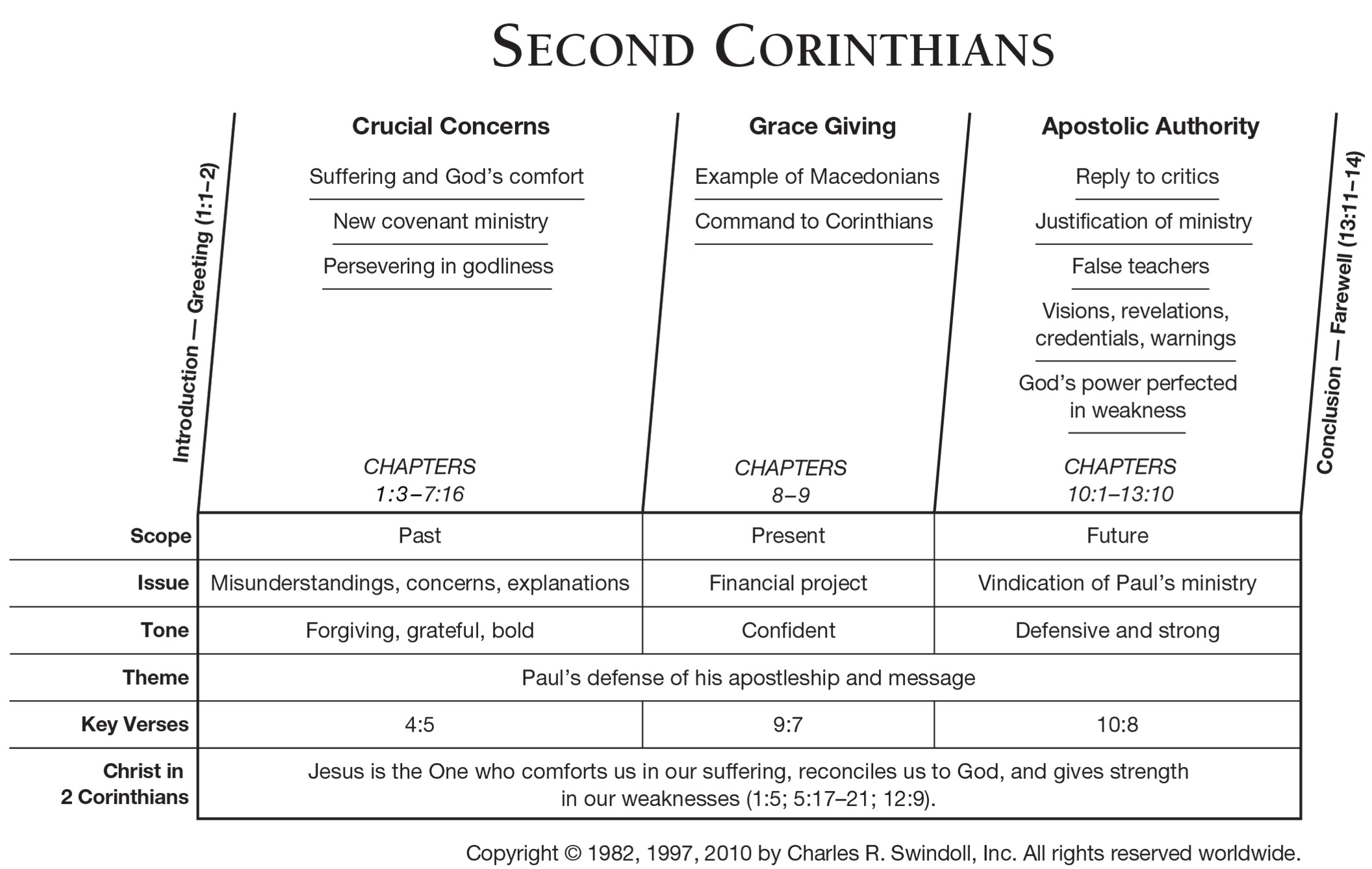
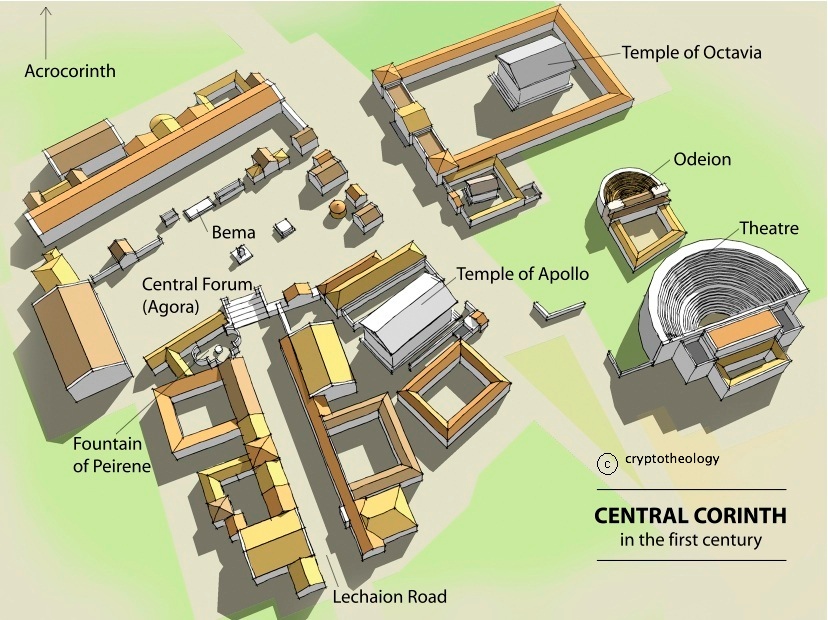
Click to Enlarge
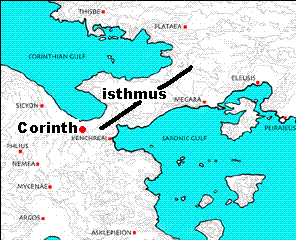
Click to enlarge
Overview of
|
||
| 2Co 1:1-7:16 Character of Paul |
2Co 8:1-9:15 Collection for the Saints |
2Co 10:1-12:21 Credentials of Paul |
| Testimonial & Didactic | Practical | Apologetic |
| Past: Misunderstanding & Explanation |
Present: Practical Project |
Future: Anxieties |
| Apostle's Conciliation, Ministry & Exhortations | Apostle's Solicitation for Judean Saints | Apostle's Vindication of Himself |
| Forgiveness, Reconciliation Gratitude |
Confidence | Vindication |
|
Ephesus to Macedonia: |
Macedonia: Preparation for Visit to Corinth |
To Corinth: |
|
2Co 1:1-7:16 |
2Co 8:1-9:15 |
2Co 10:1-12:21 |
|
2Corinthians written ~ 56-57AD - see Chronological Table of Paul's Life and Ministry |
||
|
Adapted & modified from Jensen's Survey of the New Testament (Highly Recommended Resource) & Wilkinson's Talk Thru the Bible |
||
2 Corinthians 7:1 Therefore, having these promises, beloved, let us cleanse ourselves from all defilement of flesh and spirit, perfecting holiness in the fear of God. (NASB: Lockman)
Greek: tautas oun echontes (PAPMPN) tas epaggelias, agapetoi, katharisomen (1PAAS) heautous apo pantos molusmou sarkos kai pneumatos, epitelountes (PAPMPN) hagiosunen en phobo theou.
Amplified: THEREFORE, SINCE these [great] promises are ours, beloved, let us cleanse ourselves from everything that contaminates and defiles body and spirit, and bring [our] consecration to completeness in the [reverential] fear of God. (Lockman)
ESV: Since we have these promises, beloved, let us cleanse ourselves from every defilement of body and spirit, bringing holiness to completion in the fear of God
NLT: Because we have these promises, dear friends, let us cleanse ourselves from everything that can defile our body or spirit. And let us work toward complete holiness because we fear God. (NLT - Tyndale House)
Phillips: With these promises ringing in our ears, dear friends, let us keep clear of anything that smirches body or soul. Let us prove reverence for God by consecrating ourselves to him completely. (Phillips: Touchstone)
Wuest: Having therefore these promises, beloved ones, let us cleanse ourselves from all contamination which may defile the flesh [the human body] and the [human] spirit, progressively accomplishing holiness in the fear of the Lord.
Young's Literal: Having, then, these promises, beloved, may we cleanse ourselves from every pollution of flesh and spirit, perfecting sanctification in the fear of God;
THEREFORE, HAVING THESE PROMISES, BELOVED: tautas oun echontes (PAPMPN) tas epaggelias, agapetoi:
- 2Cor 1:20; 6:16, 17,18; Ro 5:20-, Ro 5:21-; Ro 6:1-2-, Ro 6:3-4-, Ro 6:5-10-, Ro 6:11-; Hebrews 4:1-; 2Pe 1:4-, 2Pe 1:5-, 2Pe 1:6-, 2Pe 1:7-, 2Pe 1:8-)
MOTIVATION FOR
HOLY LIVING
This verse most naturally goes with the preceding passages and therefore is an example of a less optimal chapter break (Verse numbers and chapters of course were added by men, not inspired by God!)
Note that cleansing from defilement and perfecting holiness (the two sides of sanctification) are motivated (1) by God's promises and (2) by a reverential, filial fear of God. As S Lewis Johnson says "“Conduct and calling are to agree.”
Privilege and promise go hand in hand.
Therefore (3767) (oun) is a term of conclusion indicating that the statement it introduces is an inference drawn from the context, usually the preceding context. Always stop and ask the question "What is the therefore there for?"
Spurgeon - KINDLING with strong emotion, constrained by the love of Christ, and animated by the fellowship of all spiritual blessings, the apostle here strikes out an exhortation. He appeals to the noblest passions of the children of God, to their possession of divine lineage, a present endowment, and their expectation of an exalted destiny. These he uses as incentives to holiness of life. To stir up in us this godly ambition, he sets before us the Christian in various lights (1) As possessed of most glorious privileges. Having these promises." Not promises in reversion merely, but in actual possession, received, embraced, enjoyed… (2) As laboring to be rid of obnoxious evils… (3) As aiming at a most exalted position… Perfecting holiness (4) As prompted by the most sacred of motives… in the fear of God. (Sermon Notes)
Therefore - This conjunction clearly refers to the seven promises just mentioned at the end of 2Corinthians 6…
Or what agreement has the temple of God with idols? For we are the temple of the living God; just as God said, (Promise #1) "I WILL DWELL IN THEM AND (Promise #2) WALK AMONG THEM; AND (Promise #3) I WILL BE THEIR GOD, AND (Promise #4)THEY SHALL BE MY PEOPLE. 17 "Therefore, COME OUT FROM THEIR MIDST AND BE SEPARATE," says the Lord. "AND DO NOT TOUCH WHAT IS UNCLEAN; And (Promise #5) I will welcome you. 18 "And (Promise #6) I will be a father to you, And (Promise #7) you shall be sons and daughters to Me," Says the Lord Almighty. (2Cor 6:16-18)
Spurgeon comments on these promises:
The promises referred to are mentioned in the previous chapter.
1. Divine indwelling: "I will dwell in them" (2 Cor. 6:16).
2. Divine manifestation: "I will walk in them."
3. Divine covenanting: "I will be their God, and they shall be my people."
4. Divine acceptance: "I will receive you" (6:17).
5. Divine adoption: "I… will be a Father unto you, and ye shall be my sons and daughters, saith the Lord Almighty" (6:18).
These promises are already fulfilled in our experience. (Sermon Notes)
Elisabeth Elliot -"God has never promised to solve our problems. He has not promised to answer our questions… He has promised to go with us."
Hudson Taylor - "There is a living God. He has spoken in the Bible. He means what he says and will do all He has promised."
A little saint may enjoy a great promise.
Praise the LORD Who shows no impartiality! Amen
John MacArthur astutely observes that the conjunction therefore serves another function in this (and similar contexts) writing that "Paul’s use of the word therefore is a call for action based on what he has previously written (cf. Ro 12:1-, 2; 2Pe 1:3-, 2Pe 1:4-, "for this very reason" [cp "therefore"] 2Pe 1:5, 6, 7, 8). (MacArthur, J: 2Corinthians. Chicago: Moody Press)
Having (2192) (echo) means hold, possess or have and is present tense calls for believers to continually hold these precious and magnificent promises (2Pet 1:4-) in their mind, for as a man believes, in such a way will he behave. If one really believes these promises are true, this belief will serve to motivate and empower one's choices and ultimately one's overall conduct and lifestyle.
In short, possessing God's potential promises is a precious privilege but we must act upon them by faith and enabled by grace for them to become reality. As Gurnall wrote "Oh, it is sad for a poor Christian to stand at the door of the promise in the dark night of affliction afraid to draw the latch!"
These (3778) (houtos, touto) is a a reference therefore to that which is comparatively near at hand in the discourse. Here as is often the case with this pronoun, these serves to draw attention to something in the preceding discourse (i.e., the seven promises).
How important are God's promises to the believer's life of faith? Calvin put it well when he said that "Distrust is cured by meditating upon the promises of God."
F B Hole writes that "WE HAVE THEN these striking promises from the lips of God. If we are separate from the world, and face whatever loss that may involve, we shall find God acting as Father toward us, and we shall enter consciously into the good and sweetness of the relationship in which we are set. (2 Corinthians)
MacArthur has an interesting note on these promises writing that "Those promises should elicit love, gratitude, and thankfulness for His overwhelming generosity. In fact, one of the things that characterizes unrepentant sinners is ingratitude (Lk 6:35; Ro 1:21-; 2Ti 3:2-) (MacArthur, J: 2Corinthians. Chicago: Moody Press)
Promises (1860) (epaggelia/epangelia from epí = intensifies verbal meaning + aggéllo = to tell, declare) originally referred to an announcement or declaration (especially of a favorable message) but in later Greek came to mean a declaration to do something with the implication of obligation to carry out what is stated (thus a promise or pledge). Epaggelia was used in secular Greek as a legal term denoting summons, and then came to mean a promise to do or give something. In the NT epaggelia is used primarily of the promises of God and represent His solemn pledge to perform or grant a specified thing. Promise thus speaks of the assurance that God will do something…
For as many as may be the promises of God, in Him (Christ) they are yes; wherefore also by Him (Christ) is our Amen to the glory of God through us. (2Cor 1:20) (In other words, the promises of God find their certain fulfillment, their "Yes", in Christ and we give our concurrence by saying "Amen". Or as John Boys has written "The resurrection of Christ is the Amen of all his promises." Meyer adds this exhortation "Learn to put your hand on all spiritual blessings in Christ and say 'Mine'." And all God's people said "Amen"!)
As R C H Lenski says "God's promise is better than any bond or note on any bank, financial institution, or most stable government, for all these may have to repudiate their bond; God never does so."
His every word of grace is strong
As that which built the skies;
The voice that rolls the stars along
Speaks all the promises.
Isaac Watts
(Play, read out loud and ponder all 9 wonderful stanzas!)
Unger has a nice summation of the meaning of promise writing that it is "A solemn assertion, by which one pledges his veracity that he will perform, or cause to be performed, that which he mentions. (The New Unger's Bible Dictionary)
The 1828 Webster's English dictionary defines promise as "a declaration, written or verbal made by one person to another, which binds the person who makes it, either in honor, conscience or law, to do or forbear a certain act specified. It is a declaration which gives to the person to whom it is made, a right to expect or to claim the performance or forbearance of the act. The promise of a visit to my neighbor, gives him a right to expect it, and I am bound in honor and civility to perform the promise. Of such a promise human laws have no cognizance; but the fulfillment of it is one of the minor moralities, which civility kindness and Strict integrity require to be observed.
Nelson's New Illustrated Bible Dictionary rightly adds that "God did not have to promise anything to sinful people. But the fact that almost all biblical promises are those made by God to human beings indicates that His nature is characterized chiefly by grace and faithfulness. (Youngblood, R. F., Bruce, F. F., Harrison, R. K., & Thomas Nelson Publishers. Nelson's New Illustrated Bible Dictionary)
Beloved (27) (agapetos from agapao = love; agape) means beloved, dear, very much loved. Agapetos is love called out of one’s heart by preciousness of the object loved. In Scripture agapetos is used only of Christians as united with God or with each other in love. God the Father uses this same word describing Jesus declaring that
This is My beloved Son, in whom I am well-pleased. (Mt 3:17)
In fact the first 9 uses in the NT are of God the Father speaking of Christ, His beloved Son. This gives you some idea of the preciousness of the word beloved! This truth makes it even more incredible that Paul described the saints at troubled church at Corinth as beloved. (see all of Paul's uses of agapetos - Ro 1:7; 11:28; 12:19; 16:5, 8,9, 12; 1Co 4:14, 17; 10:14; 15:58; 2Co 7:1; 12:19; Eph. 5:1; 6:21; Phil 2:12; 4:1; Col 1:7; 4:7, 9, 14; 1Th 2:8; 1Ti 6:2; 2Ti 1:2; Philemon 1:1, 1:16) In short, by addressing the saints at Corinth as beloved, Paul is conveying the deep feeling he has in his heart towards them. And recall that the Corinthian church was far from problem free! Grace is truly an amazing thing!
Related Resources:
- What are the promises of God? | GotQuestions.org
- What are the greatest promises in the Bible? | GotQuestions.org
- How do I know which of God’s promises are for me? | GotQuestions.org
- What are some of the exceedingly great and precious promises mentioned in 2 Peter 1:4? | GotQuestions.org
LET US CLEANSE OURSELVES FROM ALL DEFILEMENT OF FLESH AND SPIRIT: katharisomen (1PAAS) heautous apo pantos molusmou sarkos kai pneumatos:
- Ps 51:10; 119:9; Proverbs 20:9; 30:12; Isaiah 1:16; Jeremiah 13:27; Ezekiel 18:30, 31, 32; Ezekiel 36:25,26; Matthew 5:8-; Mt 12:33; Mt 23:25,26; Luke 11:39,40; Titus 2:11-, Titus 2:12-, Titus 2:13-; Titus 2:14-Titus 2:14;Titus 2:15-Titus 2:15; James 4:8; 1Peter 1:22-; 1Pe 2:11-; 1John 1:7,9; 3:3)
EXHORTATION
BASED ON REVELATION
Spurgeon comments that let us cleanse ourselves speaks to…
1. Personality: "Let us cleanse ourselves."
2. Activity. We must continue vigorously to cleanse both body and mind.
3. Universality: "From all filthiness."
4. Thoroughness: "Of the flesh and spirit."
If God dwells in us, let us make the house clean for so pure a God.
Has the Lord entered into covenant with us that we should be his people? Does not this involve a call upon us to live as becometh godliness?
Are we his children? Let us not grieve our Father, but imitate him as dear children (Sermon Notes)
Martin Luther wrote "What greater rebellion, impiety, or insult to God can there be than not to believe His promises?" And if we truly believe His promises, we will strive in to obey through His power working in us.
Spurgeon - The sight of the promises themselves is good for the eye of faith: the more we study the words of grace, the more grace shall we derive from the words.
Adam Clarke-Let us apply to him for the requisite grace of purification; and avoid every thing in spirit and practice which is opposite to the doctrine of God, and which has a tendency to pollute the soul.
F B Hole writes that "Now having such promises we are exhorted to purify ourselves, and thus perfect holiness in the fear of God. Notice that it says, "from all filthiness of the flesh and spirit." This is a very important word, and very sweeping. Our attention has just been directed to the necessity of a purification from all fellowship with the world in outward things. Yet if we merely practiced separation in outward things, confining ourselves to that, we should just become Pharisees; a most undesirable thing. The separation we are to practice goes much deeper. All filthiness or pollution of the flesh is to be avoided, and all filthiness of the spirit too. Both forms of separation are called for; the inward and the outward too. The outward without the inward is just hypocrisy. The inward without the outward is at best a very defective thing. At the worst it descends to the plight in which Lot was found in Sodom, though not himself descending to the shocking morals of that city. Abraham was in the happy path of God's will; clean outside the place as well as free from the evil. There are the pollutions of the world: the pollutions of the flesh: the pollutions of the spirit: the last of the three the most subtle of all, because the most refined form of sin. May God awaken us to great carefulness as to it. Holiness when carried to its perfection covers all three. But we are to be carrying it on towards its perfection even now. May God help us to do so. (2 Corinthians)
Richard Sibbes (Puritan writer) says that "The promises, as they have a quickening, so they have a purging power; and that upon sound reasoning. Doth God promise that he will be my Father and I shall be his son? and doth he promise me life everlasting? and doth that estate require purity? and no unclean thing shall come there? Certainly, these promises being apprehended by faith, as they have a quickening power to comfort, so they purge with holiness. We may not think to carry our filthiness to heaven. Doth the swearer think to carry his blasphemies thither? Filthy persons and liars are banished thence; there is "no unclean thing." He that hath these promises purgeth himself and "perfecteth holiness in the fear of God." "He that hath this hope purifieth himself, as he is pure" (1 John 3:3).
King David prayed to God pleading with the Holy One of Israel…
Purify (Hebrew = chata' = purify from sin; Lxx = rhantizo = to sprinkle, cleanse, cp use in Heb 10:22-) me with hyssop, and I shall be clean (Hebrew = taher = clean ceremonially, morally; Lxx = katharizo = be cleansed). Wash me, and I shall be whiter than snow. (Ps 51:7, cp Ps. 51:2; Isaiah 1:16)
Spurgeon's Comment: Purge me with hyssop. Sprinkle the atoning blood upon me with the appointed means. Give me the reality which legal ceremonies symbolize. Nothing but blood can take away my blood stains (cp 1Pe 1:18-, 1Pe 1:19-) nothing but the strongest purification can avail to cleanse me. Let the sin offering purge my sin (cp 1Pe 1:22-). Let him who was appointed to atone, execute his sacred office on me; for none can need it more than me (cp Rev 22:14-).
The passage may be read as the voice of faith as well as a prayer, and so it runs --
"Thou wilt purge me with hyssop, and I shall be clean."
Foul as I am, there is such power in the divine propitiation, that my sin shall vanish quite away (cp 1Jn 1:9). Like the leper upon whom the priest has performed the cleansing rites, I shall again be admitted into the assembly of thy people and allowed to share in the privileges of the true Israel; while in thy sight also, through Jesus my Lord, I shall be accepted.
Wash me. Let it not merely be in type that I am clean, but by a real spiritual purification (cp Eph 5:26-), which shall remove the pollution of my nature. Let the sanctifying (cp 1Pe 1:2-) as well as the pardoning process (cp Lk 5:20, Col 2:13-, James 5:15) be perfected (Ed: brought to its intended goal) in me. Save me from the evils which my sin has created and nourished in me.
And I shall be whiter than snow. None but Thyself can whiten me, but Thou canst in grace outdo nature itself in its purest state. Snow soon gathers smoke and dust, it melts and disappears; Thou canst give me an enduring purity. Though snow is white below as well as on the outer surface, thou canst work the like inward purity in me, and make me so clean that only a hyperbole can set forth my immaculate condition. Lord, do this; my faith believes thou wilt, and well knows Thou canst.
Scarcely does Holy Scripture contain a verse more full of faith than this. Considering the nature of the sin, and the deep sense the psalmist had of it, it is a glorious faith to be able to see in the blood sufficient, nay, all sufficient merit entirely to purge it away. Considering also the deep natural inbred corruption which David saw and experienced within, it is a miracle of faith that he could rejoice in the hope of perfect purity in his inward parts (cp Ps 19:8). Yet, be it added, the faith is no more than the word warrants, than the blood of atonement encourages, than the promise of God deserves (cp Isaiah 45:22).
O that some reader may take heart, even now while smarting under sin, to do the Lord the honour to rely thus confidently on the finished sacrifice of Calvary (cp 1Pe 2:24-, 1Pe 2:25-) and the infinite mercy there revealed. (cp Lam 3:19, 20-21, 22-23, 24-25, 26, Mt 11:28, 29-30)
Archbishop Leighton comments on "Cleanse ourselves." It is the Lord that is the sanctifier of his people; he purges away their dross and tin. He pours clean water, according to his promises, yet doth he call us to cleanse ourselves; having such promises, let us cleanse ourselves. He puts a new life into us and causes us to act, and excites us to excite it, and call it up to act in the progress of sanctification. Men are strangely inclined to a perverse construction of things Tell them that we are to act and work and give diligence; then they would fancy a doing in their own strength and be their own saviors. Again, tell them that God works all our works in us and for us, then they would take the ease of doing nothing. If they cannot have the praise of doing all, they will sit still with folded hands and use no diligence at all. But this is the corrupt logic of the flesh, its base sophistry. The apostle reasons just contrary, Philippians 2:13: "It is God that worketh in us both to will and to do." Therefore, would a carnal heart say, we need not work, or at least, may work very carelessly. But he infers, "Therefore, let us work out our salvation with fear and trembling," i.e., in the more humble obedience to God and dependence on him, not obstructing the influences of his grace, and, by sloth and negligence, provoking him to withdraw or abate it. Certainly, many in whom there is truth of grace are kept low in the growth of it by their own slothfulness, sitting still, and not bestirring themselves and exercising the proper actions of that spiritual life by which it is entertained and advanced.
Ourselves - This is a reflexive pronoun (heatous) which signifies that although the cleansing work is God’s (cf. Acts 15:9; Eph 5:26; Titus 3:5), the cleansing does not happen without volitional effort on the believers’ part.
A SPIRITUAL
CATHARSIS!
Let us cleanse (2511) (katharizo from katharos = pure, clean, without stain or spot; English words - catharsis = emotional or physical purging, cathartic = substance used to induce a purging, Cathar = member of a medieval sect which sought the purging of evil from its members) means to make clean by taking away an undesirable part. To cleanse from filth or impurity. Click here (and here) for more background on the important Biblical concept of clean and cleansing. In secular Greek katharizo occurs in inscriptions for ceremonial cleansing.
Figuratively katharizo is used in the NT to describe cleansing from ritual contamination or impurity (Acts 10:15) as well as the cleansing lepers from ceremonial uncleanness (Mt 8:2-3, et al). Another figurative use in 1John 1:9 (cf James 4:8, Hebrews 10:2-) describes the purifying or cleansing from sin and a guilty conscience thus making one acceptable to God and reestablishing fellowship.
In short this word group (katharizo, katharos = pure, kathairô = prune) conveys the idea of physical, religious, and moral cleanness or purity in such senses as clean, free from stains or shame, and free from adulteration.
For a good sense of the meaning of katharizo, study the NT uses in context (or do the quick study by holding pointer over each reference) noting who does the cleansing and from what. Observe for God's sovereignty and man's responsibility (Mt 8:2,3; 10:8; 11:5; 23:25,26; Mk 1:40, 41, 42; 7:19; Lk 4:27; 5:12,13; 7:22; Lk 11:39; 17:14,17 Acts 10:15; 11:9; 15:9; 2Co 7:1 Eph 5:26; Titus 2:14; Heb 9:14, 22, 23; James 4:8; 1Jn 1:7, 9 )
Here in 2Corinthians Paul uses the aorist tense for katharizo which is very decisive, and calls for sudden, decisive action on the part of the Corinthian believers. Paul says in essence "Make a clean and complete break from defilement!"
Webster's 1828 Dictionary has the following thoughts on to purify and to cleanse…
Purify
From Latin = purifico; purus, pure, and facio, to make.
1. To make pure or clear; to free from extraneous admixture; as, to purify liquors or metals; to purify the blood; to purify the air.
2. To free from pollution ceremonially; to remove whatever renders unclean and unfit for sacred services. (Purify yourselves and your captives on the third day, and on the seventh day purify all your raiment. Num. 31:19).
3. To free from guilt or the defilement of sin; as, to purify the heart. (Who gave himself for us, that he might redeem us from all iniquity, and purify to himself a peculiar people, zealous of good works. Titus 2:14).
Cleanse
1. To purify; to make clean; to remove filth, or foul matter of any kind, or by any process whatever, as by washing, rubbing, scouring, scraping, purging, ventilation, etc.; as, to cleanse the hands or face; to cleanse a garment; to cleanse the bowels; to cleanse a ship; to cleanse an infected house.
2. To free from a foul or infectious disease; to heal. (Lev. 14:4, 8, Mark 1:42)
3. To free from ceremonial pollution, and consecrate to a holy use. (Nu 8:15. Ezek. 43:20)
4. To purify from guilt. (1John 1:7)
5. To remove; as, to cleanse a crime.
Barnes - While it is true that all purifying influence and all holiness proceed from God, it is also true that the effect of all the influences of the Holy Spirit is to excite us to diligence, to purify our own hearts, and to urge us to make strenuous efforts to overcome our own sins. He who expects to be made pure without any effort of his own, will never become pure; and he who ever becomes holy, will become so in consequence of strenuous efforts to resist the evil of his own heart, and to become like God. The argument here is, that we have the promises of God to aid us. We do not go about the work in our own strength. It is not a work in which we are to have no aid. But it is a work which God desires, and where he will give us all the aid which we need. (Barnes' Notes on the NT)
Sin is pictured by many images in the Bible, such as disease (Isaiah 1:4-6), darkness (1John 1:5-10), drowning (Ps 130:1-4), and even death (Eph 2:1, 5; Jn 5:24), but frequently it is pictured as dirt and defilement (Isaiah 1:16, 18; Jer 4:14).
In the Old Testament, an innocent animal had to die to provide ritual cleansing for the Jews, but the innocent Lamb of God had to die to provide cleansing for us (John 1:29, 1Jn 1:7, 9; 1 Peter 1:18, 19, 20, 21, 22, 23).
McGee - When I receive the Word in faith and I act upon that Word, I am cleansed from all the filthiness of the flesh and spirit. This is what the Lord Jesus meant when He said, "Sanctify them through thy truth: thy word is truth" (John 17:17). The best bar of soap in the world is the Word of God. It will really clean us up. The Holy Spirit enables us to deal with the sin in our lives. (McGee, J V: Thru the Bible Commentary: Thomas Nelson)
Paul gives a command to Timothy which parallels the exhortation in this verse - Nevertheless, the firm foundation of God stands, having this seal, "The Lord knows those who are His," and, "Let everyone who names the name of the Lord abstain (aorist imperative) from wickedness." (see note 2 Timothy 2:19)
Peter - Beloved, I urge you as aliens and strangers to abstain from fleshly lusts which wage war against the soul. (see note 1 Peter 2:11)
Spurgeon asks…
What then? Do they need purified? Are they naturally impure, that they must be purified? They are God’s blood-bought, redeemed people, and yet they need purifying? Ah, yes, brothers and sisters, every one of them, even the apostle Paul himself! Where will you find a warmer spirit, a more zealous heart, a more consecrated man than the apostle Paul? And yet he says, “Let us purify ourselves.”
It surely wouldn’t be presumptuous, on my part, if there is in this church some esteemed saint who has for many years kept the faith in an unblemished way, and has been engaged in the service of the Master, far above others, in winning souls—it wouldn’t be presumptuous if I should say to him, “Let us purify ourselves.” I suppose that, the nearer we get to heaven, the more conscious we shall be of our imperfections (cp Paul in 1Ti 1:15, near the end of his life of pursuing holiness!). The more light we obtain, the more we discover our own darkness. That which is scarcely considered sin by some, will be a grievous defilement to a tender conscience. It is not that we are greater sinners as we grow older, but that we have a more acute sensitivity to sin, and see that to be sin which we winked at in the days of our ignorance. Yes, we may say to those whose grey hairs show that they are getting near home, “Let us purify ourselves.” And if it is this way to the holiest and most prominent of the people of God, then it should be all the more to us, beloved, common saints, who are barely worthy to be called saints at all, only that we trust we are washed in the precious blood, and are saved through the righteousness of Jesus Christ. “Let us purify ourselves.”
Notice how clearly the apostle puts it! I want you to notice his points.
1. The work is personal: “Let us purify ourselves.”
It is always easier for us to want to purify other people, and attempt a moral reformation among our neighbors. Oh! It is easy to point out other people’s faults, and to make every effort to protest against them. It seems natural for us to expose sin and ridicule the foolishness of this age, or to preach virtue. It highly gratifies some people when they can find a fault in some highly-respected brother; they just tear him to pieces with about the same zest that might be displayed by an ape. That is their forte, the strength of their genius—tearing to pieces what they could not put together, and attempting to raise themselves by lowering others. But notice the apostle says, “Let us purify ourselves.” Oh, that we would all look at ourselves! Oh, that we examined our own hearts more! Yes, certainly it is our business to tell our brother or sister of their faults, but certainly we ought not to have left the other undone, for that is our first business, “Let us purify ourselves.” It all seems well and good to drag the Church of the Living God up to the altar, like some bleeding victim, and there to stab her with the sharpest knife of our criticism, and to say of the modern church that she is not this and she is not that. But the obvious question we need to ask ourselves is, “How much have I helped to make her what she is? If she is degenerate, how far is that degeneracy a result of my having fallen from the high standing which I ought to have occupied?” We will all have contributed our quota to the reform of the church when we are ourselves are reformed. There can be no better way of promoting holiness in our churches than by increasing in personal holiness. “Let us purify ourselves.”
2. There is activity needed in discharging this personal duty. “Let us purify ourselves.”
It seems to imply that the Christian, while they are acted upon by divine influence, and are cleansed by the Holy Spirit is also an active agent of their own sanctification. They are not like the vessels and the pots of which the apostle speaks, that were cleansed under the law; but they are a free agent, and the holiness which God works in them, is not the pretended holiness of candlesticks and altars, but it is the holiness of a responsible person—a holiness which is not forced upon them, but which their whole soul gives consent to. They purge themselves. Depend on it, you and I do not grow holy by going to sleep. People are not made to grow in grace as plants grow, of which it is said, “Night and day, whether he sleeps or gets up, the seed sprouts and grows, though he does not know how” [Mark 4:27]. The Christian is developed by actively seeking growth, by earnestly striving after holiness, and resolutely endeavoring to obtain it.
The utmost of our activity ought to be put forth in purifying ourselves. You will not overcome your bad temper by saying, “Well, you know I am quick-tempered; I cannot help it.” But you must help it; you must, if you are a Christian. You have no more right to shake hands with a bad temper than you have to fraternize with the devil. You have got to overcome it, and in the name of God you must.
Likewise, if you happen to have a lazy disposition, you must not say, “Ah, well! you know, I am naturally that way.” Yes, you are naturally lazy—we know that; you are naturally as bad as you can be; but surely that is not the point we are concerned with—we are concerned with what you are to become by divine grace. Although sanctification is the work of the Holy Spirit yet it is equally true, and this we must always bear in mind, that the Holy Spirit makes us active agents in our own sanctification. In the first work of regeneration, we know that the soul is passive, because it is dead, and the dead cannot contribute to their own stimulation and awakening, but, being awakened, he “works in us to will and to act according to his good purpose” [Philippians 2:13].
God does not work in us to sleep and to slumber; his good purpose is answered by us when we are constrained to will and to do; therefore the apostle’s argument, “Work out your salvation with fear and trembling, for it is God who works in you” [Philippians 2:12-13]. He works it in, you work it out; you have to bring out in, the outward life is what he works in the inner springs of your spiritual being. You are to work it out because he works it in. Sin is to be driven out of us as the Canaanites were driven out of Canaan by the edge of the sword. Jericho’s walls will come down, but not without walking around it for seven days. You may be weary from marching, but march you must if you would conquer. How did the apostle put it? “Our struggle is not against flesh and blood” [Ephesians 6:12], and so on; but he represented the conquest as being a conquest gained by struggling. He declares that he had to fight with his old nature, and the conflict was severe. Although saved by grace, redeemed souls make remarkable efforts—efforts beyond their natural powers—to overcome sin in their lives.
3. That we must not stop short of perfection in our purifying: “Let us purify ourselves from everything that contaminates.”
Your eye must not spare, your heart must not pity, one pet sin. Most men and women would gladly be holy if it were not for that one sin that they vainly flatter themselves to be safe and harmless. “Let us purify ourselves from everything.” O Christian, you should doubt your right to that name unless all sin is obnoxious to you! You have no right to say, “I will give up pride and arrogance,” if you excuse yourself for being greedy. If greed is the leak in your boat, it will sink it quite as surely as pride. If neither pride nor greed is there, yet if you have an unforgiving heart, and cannot forgive those who offend you, you shall just as soon prove yourself to be reprobate that way as by any other. We must be like the father of a Jewish family purging out the leaven before the Passover. He lights a candle, you know, and goes to the cupboard under the stairs, or wherever the bread may be kept, and is careful that every bit is removed. He then has every cupboard unlocked, and rummages with a brush in his hand, himself personally, and with a candle, too, to see if there is even a crumb of leaven, for he cannot keep the Passover if there is a crumb of leaven in the house. In the same way we should be earnestly searching after everything that contaminates, to get it all out. Search as best as we can, I am afraid something will still be left. There will be some beloved idol hidden away somewhere in the recesses of the mind. The heart will cling to its idols in such a way that we cannot find them all at once; there is an absolute need to search again and again; they must be searched after, and we must, each one of us, be prepared to say,
“The dearest idol I have known,
Whatever that idol be,
Help me to tear it from thy throne,
And worship only thee.”
4. The apostle shows the thoroughness of this work by saying, “Let us purify ourselves from everything that contaminates body and spirit.”
“Contamination of the body and spirit.” We may think this includes only the outward sins so well known and so easily distinguishable, those degrading sins which even morality condemns. Possibly, Christian, although you may guard yourself against these, yet you will be in danger from the next class, namely, sins of the spirit. These are the mothers of the sins of the flesh. Someone killed a wasp in the early spring, and it was said that he had killed a thousand wasps, for that wasp was full of eggs. Sins of the spirit are full of that seed which, when matured, issues in shameful wickedness. If you can cleanse yourself from these you will save yourself from the outward appalling sins. The outward life will be right when the inward life is right. I wish we were more concerned about purifying ourselves from everything that contaminates the spirit. I am inclined to think that some Christians thoughtlessly contaminate their spirits, I mean that they do it willfully. I am not sure that, when there is a divorce case in the newspapers, I have any business to read it; yet a great many good Christian people, who often pray to be delivered from temptation, are careful to read all the details. When there is a bad story in the papers or being spread around about anybody, I know that I should not listen to it; yet that curiosity of ours often tempts the devil to tempt us. If there is any dirty puddle of water or some polluted water, I know that I am not obligated to drink out of it. True, I may be an officer appointed to taste the water; if I am not, I would rather avoid the harmful sip; it would be better to leave it alone. We may all do a great deal of that kind of thing; and, nowadays, when the press exposes everything, and it is published all over the world, I am sure that Christians do pollute their spirits a great deal more than they have any occasion to do; and besides that, we can turn over a sin, you know, in our mind, till we become so accustomed to it that we do not think it to be a sin. I know that some Christians have managed to convince their conscience of the idea that what they do is not sin in them, but would be sin in other people; that their personality and makeup is such that the particular sin can be tolerated in them, and generally speaking, although it would be very, very wrong for other people to do the same, they have got a sort of spiritual indulgence, such as used to be issued by the Roman Catholic Church, and they never doubt that they can, sin with impunity. Ah, dear friends, this will not do! “Let us purify ourselves from everything that contaminates body and spirit.”
The drift of the argument is this—if God lives in us, let us make our house clean for such a pure God. What! indwelling Deity and unclean lusts? Indwelling Godhead, and yet a spirit defiled with evil thoughts? God forbid! Let us cry aloud to the Most High, that in this thing we may be purified, that the temple may be fit for the habitation of the Master. What! does God walk in us, and hold communion with us, and shall we let the devil come in too? What agreement can we have with Christ? Shall we give ourselves up to be the servants of money, when God has become our Friend, our Companion? It must not be! Divine indwelling and divine communion both require from us personal holiness. Has the Lord entered into a covenant with us that we shall be his people? Then doesn’t this involve a call upon us to live like his people, in all godliness? Favored and privileged above other men and women to be a special people, separated to God, shall there be nothing special about our lives? Shall we not be zealous for good works?
Divinely adopted into the family of the Most High, and made heirs of God, and joint-heirs with Jesus Christ, what other arguments do we need to compel us to holiness? You see the word, “Since” in our text? It simply means this, because we have attained to such choice and special promises, “Since”—for this reason, “let us purify ourselves from everything that contaminates body and spirit.” (Our Position and Our Purpose)
From (apo) is a preposition which primarily expresses the idea found in the English word "from", which in turn pictures the idea of putting some distance between or removing to a distance. Apo is a marker of dissociation, implying a rupture from a former association. Apo indicates the separation of a person or an object from another person or an object with which it was formerly united. This preposition therefore pointedly describes any separation of one thing from another by which the union or fellowship of the two is destroyed. In the present context clearly the meaning is figurative and refers to breaking from all defilement. This same idea was commanded by God in the immediately preceding context where Paul wrote…
Therefore (because of truths in 2Cor 6:14, 15, 16), COME OUT (aorist imperative - command calling for hearers to make an immediate, definite choice to get out, to escape with their life so to speak, quoted primarily from Isaiah 52:11, with echoes from Ezek 20:34, 41, cp Jer 51:45, Rev 18:4, 1Jn 2:15-17 cp Ge 39:12, Nu 16:21, 26, 45, Pr 6:5, 9:6, 1Cor 6:18, 10:14, 1Ti 6:11, 2Ti 2:22) FROM THEIR MIDST (Remember Lot's wife - Lk 17:32, 33, Ge 19:17, 26) AND BE SEPARATE (apohorizo [apo = away from + horizo = mark by a limit] - set off a boundary, aorist imperative - cf Nu 33:51-56 cp Ex 23:24,33; 34:13; Dt 7:2,5; 12:3; Josh 11:12; Judges 2:2, Ezra 6:21, 10:11, ISBE)," says the Lord. "AND DO NOT TOUCH (present imperative - with a negative means "Stop touching what is unclean" - Implication? They were touching that which is unclean - this could be literal but you can "touch" things unclean with your mind and will! Do not be deceived!) WHAT IS UNCLEAN (akathartos = impure, defiled. We must not associate with that which will compromise our testimony or lead us into disobedience); and I (the Living God) will welcome you. (2Co 6:17).
Comment: It has been well remarked that the very essence of the history of Israel is in the words, "Get thee out!" That was the word of God that came to Abraham as in Authorized Version: "Get thee out of thy country and from thy kindred and from thy father's house" (Ge 12:1). That was the warning that came to Lot before the destruction of Sodom and Gomorrah (Ge 19:12, 13, 14). Beloved of God, there are things in the world with which the Christian cannot and dare not associate himself or herself!
All (pas) means all without exception. Don't be like the man who "buried the hatchet" in his backyard to symbolize his forgiveness of a wrong committed, but left the hatchet handle remain visible in case he needed to use it again! All defiling influences need to put away with no "handles" remaining visible!
Wiersbe makes a good point writing that "Whenever we sin, we must pray, "Wash me" (Ps 51:2, 7); but sometimes God says to us, "Wash yourselves, make yourselves clean" (Isa 1:16). When we seek forgiveness, God washes the record clean (1Jn 1:9); but God will not do for us what we must do for ourselves. Only we can put out of our lives those things that defile us, and we know what they are. It might mean cleaning out our library (Acts 19:18, 19, 20), our cassette and CD collection, the magazine rack, or perhaps the TV viewing schedule. We must separate ourselves from whatever defiles us and grieves the Father (2Cor. 6:14-7:1; James 4:7, 8). (Bible Exposition Commentary on OT)
Defilement (3436) (molusmos from moluno = stain or soil/smear as with with mud ~ defile in a religious or cultic sense - see uses of moluno in 1Co 8:7, Rev 3:4, 14:4) describes that which stains, defiles or soils and thus produces foulness; dirtiness; uncleanness. Synonyms would include contamination, corruption, pollution.
Defilement is the corruption of morals, principles or character; impurity; pollution by sin.
Barnes writes that molusmos… means a soiling, hence defilement, pollution, and refers to the defiling and corrupting influence of fleshly desires and carnal appetites. (Ibid)
Rob Salvato says defilement speaks of "mud on our wedding garment" and recalls to mind the Bride of Christ cleansing herself in the Revelation ""Let us rejoice and be glad and give the glory to Him, for the marriage of the Lamb has come and His bride has made herself ready (the verb hetoimazo here carries idea of willingness and eagerness as well as of readiness)" And it was given to her to clothe herself in fine linen, bright and clean; for the fine linen is the righteous acts of the saints. (see notes Revelation 19:7; 19:8)
IVP Commentary - The noun (molusmos) is found only here in the New Testament, although the verb moluno is used twice in Revelation 3:4; 14:4) and once in 1Corinthians 8:7 of defiling the conscience through the indiscriminate eating of meat sacrificed to idols (compare Jer 23:15). This brings us back full circle to Paul's opening injunction to stop entering into unequal partnerships with unbelievers (2Cor 6:14). The close association of molusmos with idolatry suggests that Paul is thinking especially of defilement that comes from dining in the local temples, membership in the pagan cults, ritual prostitution, active engagement in pagan worship and the like.
John MacArthur comments that molusmos "appears only here in the New Testament. In all three of its uses in the Septuagint (Ed: only on in the non-apocryphal), however, it refers to religious defilement. Paul calls believers not only to cleanse themselves from sin and immorality but especially, in this context, from all associations with false religion. (2 Corinthians)
Robertson writes that "In LXX, Plutarch, Josephus molusmos includes all sorts of filthiness, physical, moral, mental, ceremonial, "of flesh and spirit." Missionaries in China and India can appreciate the atmosphere of pollution in Corinth
The only other use of molusmos in Scripture is in the non-apocryphal Septuagint (LXX) of Jeremiah…
Jeremiah 23:15 "Therefore thus says the LORD of hosts concerning the prophets, 'Behold, I am going to feed them wormwood and make them drink poisonous water, for from the prophets of Jerusalem pollution (Hebrew = chanuppah = pollution; Lxx = molusmos) has gone forth into all the land.'"
Flesh and spirit - This could be a figure symbolizing the whole person. The flesh would seem to symbolize the external and the spirit the internal aspect and thus the entire man is to be cleansed!
Maclaren explains flesh and spirit this way - The former (flesh), of course, refers primarily to sins of impurity which in the eyes of the Greeks of Corinth were scarcely sins at all, and the latter (spirit) to a state of mind when fancy, imagination, and memory were enlisted in the service of evil. Both are rampant in our day as they were in Corinth. (read entire excellent message)
S Lewis Johnson - It’s possible to be cleansed of defilement of flesh and not of the spirit. Take the prodigal and his elder brother, the prodigal was possessed of defilement of the flesh, but his brother, his proud brother who stayed with the father, had defilement of the spirit. So let’s cleanse ourselves beloved of all defilement of flesh and spirit. (2 Corinthians 6:11-7:4 Puritanism in the New Testament)
Wiersbe -David's sin with Bathsheba was a sin of the flesh, a yielding to lust after an afternoon of laziness (2Sa 11:2; Gal 5:19), but the census was a sin of the spirit (2Cor. 7:1), a willful act of rebellion against God. It was motivated by pride, and pride is number one on the list of the sins that God hates (Prov. 6:16-17). "Pride is the ground in which all the other sins grow," wrote William Barclay, "and the parent from which all the other sins come."
Harry Ironside asks "What is the difference between filthiness of the flesh and filthiness of the spirit? There are two classes of sin, and all sin is filthy in the sight of God. Filthiness of the flesh refers to sins of the body, and there are so many of them, unholy lusts, unbridled appetites. Drunkenness, gluttony, licentiousness, inordinate affection, are all sins of the flesh, and though at the present time our abominable philosophies throw a glamour over these things they are utterly vile in God's sight… What about filthiness of the spirit? Vanity, pride, conceit, haughtiness, and unbelief are just as evil as these other things in the sight of God. Take this dainty girl who stands in front of her mirror trying to make a work of art out of her face in order to attract the attention of the opposite sex, that vanity that is so characteristic of her is as truly filthy in the sight of God as the other sins I have been mentioning. Take that man who is so haughty and proud, and is seeking power and authority over his fellows, constantly looking for admiration on the part of men who like himself are going on to the grave, that haughtiness, that pride, is in God's sight absolutely filthy.
James in the context of grace given to the humble, commands an external and an internal cleansing
Draw (aorist imperative) near to God and He will draw near to you. Cleanse (katharizo - the same verb used by Paul - aorist imperative) your hands, you sinners; and purify (aorist imperative) your hearts, you double-minded. (James 4:8)
David mentions the need for external and internal cleansing in those who would seek to approach the holy God…
Who may ascend into the hill of the LORD? And who may stand in His holy place? He who has clean hands and a pure heart, who has not lifted up his soul to falsehood, and has not sworn deceitfully. (Ps 24:4,5)
Spurgeon comments: Outward, practical holiness is a very precious mark of grace. To wash in water with Pilate is nothing (Mt 27:24), but to wash in innocency is all important. It is to be feared that many professors have perverted the doctrine of justification by faith in such a way as to treat good works with contempt (Titus 1:16-); if so, they will receive everlasting contempt at the last great day (Jn 5:28, 29, Rev 20:12, 13). It is vain to prate of inward experience unless the daily life is free from impurity, dishonesty, violence, and oppression.
Those who draw near to God must have clean hands. What monarch would have servants with filthy hands to wait at his table? They who were ceremonially unclean could not enter into the Lord's house which was made with hands, much less shall the morally defiled be allowed to enjoy spiritual fellowship with a holy God. If our hands are now unclean, let us wash them in Jesu's precious blood, and so let us pray unto God, lifting up pure hands.
But "clean hands" would not suffice, unless they were connected with a pure heart (Mt 5:8-). True religion is heart work. We may wash the outside of the cup and the platter as long as we please; but if the inward parts be filthy, we are filthy altogether in the sight of God, for our hearts are more truly ourselves than our hands are. We may lose our hands and yet live, but we could not lose our heart and still live; the very life of our being lies in the inner nature, and hence the imperative need of purity within. There must be a work of grace (1Cor 15:10, et al) in the core of the heart as well as in the palm of the hand, or our religion is a delusion (James 1:26, 27-see notes). May God grant that our inward powers may be cleansed by the sanctifying Spirit, so that we may love holiness and abhor all sin. The pure in heart shall see God (Heb 12:14), all others are but blind bats; stone blindness in the eyes arises from stone in the heart. Dirt in the heart throws dust in the eyes.
Flesh (4561) (sarx) is used 147 times in the NT and a simple definition of sarx is somewhat difficult because sarx has many nuances (some Greek lexicons list up to 11 definitions for sarx!). The diligent disciple must carefully observe the context of sarx in order to discern which nuance is intended. The range of meaning extends from the substance flesh (both human and animal), to the human body, to the entire person, and to all humankind.
Spirit (4151)(pneuma from pnéo = to breathe) refers to the immaterial part of the human personality in contrast to the outward and visible aspects of flesh and body.
Wiersbe - Too often Christians deal with symptoms and not causes. We keep confessing the same sins because we have not gotten to the root of the trouble and "cleansed ourselves." Perhaps there is "filthiness of the flesh," some pet sin that "feeds" the old nature (Ro 13:14-see note on make provision for the flesh). Or it may be "filthiness of the spirit," an attitude that is sinful. (Bible Exposition Commentary)
PERFECTING HOLINESS IN THE FEAR OF GOD: epitelountes (PAPMPN) hagiosunen en phobo theou:
- Matthew 5:48; Ephesians 4:12, Eph 4:13; Philippians 3:12, Phil 3:13, Phil 3:14, Phil 3:15; 1Th 3:13; 1Th 4:7; Hebrews 12:23; 1Peter 5:10)
Related Resources:
- Puritan Thomas Watson on- Sanctification - Real, Counterfeit, Necessity, Signs, Inducements, How Attained?
- See article below on Cultivating Holiness
- See list of 43 Hymns Related to Holiness
William D Longstaff
Take time to be holy, speak oft with thy Lord;
Abide in Him always, and feed on His Word.
Make friends of God’s children, help those who are weak,
Forgetting in nothing His blessing to seek.
Take time to be holy, the world rushes on;
Spend much time in secret, with Jesus alone.
By looking to Jesus, like Him thou shalt be;
Thy friends in thy conduct His likeness shall see.
Take time to be holy, let Him be thy Guide;
And run not before Him, whatever betide.
In joy or in sorrow, still follow the Lord,
And, looking to Jesus, still trust in His Word.
Take time to be holy, be calm in thy soul,
Each thought and each motive beneath His control.
Thus led by His Spirit to fountains of love,
Thou soon shalt be fitted for service above.
Warren Wiersbe has an humorous quip on the preceding hymn…
We will stand and sing hymn 325," announced the worship leader, " Take Time to Be Holy.' We will sing verses one and four." If I had been sitting with the congregation instead of on the platform, I might have laughed out loud. Imagine a Christian congregation singing "Take Time to Be Holy" and not even taking time to sing the entire song! If we can't take the time (less than four minutes) to sing a song about holiness, we're not likely to take time to devote ourselves to "perfecting holiness in the fear of God" (2Cor 7:1).
The pattern for holiness in this passage is first dispose of the "negative" and then pursue the "positive". Don't try to accomplish this charge in your own strength for you will fail miserably. A desire for and power for holiness must by it's very nature come from the Holy One. In short holiness in believers is clearly a work of God (see 1Th 5:23-, Heb 10:14-, 1Pe 1:2-). And yet holiness is not simply "Let go and let God", but requires the believer's cooperation (especially engagement of our mind and will) so that we work out what God has worked in us (Phil 2:12-, Phil 2:13-)
Spurgeon comments that let us cleanse ourselves speaks to…
1. We must set before us perfect holiness as a thing to be reached.
2. We must blame ourselves if we fall short of it.
3. We must continue in any degree of holiness which we have reached.
4. We must agonize after the perfecting of our character. (Sermon Notes)
As A T Robertson says, Paul is calling for…
Not merely negative goodness (cleansing), but aggressive and progressive (present tense of epiteleo) holiness, not a sudden attainment of complete holiness, but a continuous process (1Thes 3:13-; Ro 1:4-; Ro 1:6-). (Word Pictures in the New Testament)
In his letter to Titus, Paul teaches a similar pattern of holiness…
For the grace (charis) of God has appeared (epiphaino), bringing salvation to all men, instructing (paideuo = disciplining - present tense = continually) us to deny (arneomai = to say "no" to) ungodliness (asebeia) and worldly desires (the negative aspect of holiness) and to live sensibly, righteously and godly (the positive aspect of holiness) in the present age, looking (prosdechomai = expectant looking as if His return is imminent [which it is!] - looking is in the present tense = continually, as one's lifestyle -- expectant looking one of the best antidotes for apathetic living!) for the blessed hope and the appearing of the glory of our great God and Savior, Christ Jesus (See notes Titus 2:11; 12; 13)
Perfecting (2005)(epiteleo from epí = intensifies meaning, in the sense of meaning "fully" + teleo = to complete, bring not just to the end but to the destined goal from télos = end, goal. Note: télos originally meant the turning point, hinge, the culminating point at which one stage ends and another begins; later the goal, the end. Marriage and death are is in this sense both a telos) conveys the intensified meaning to fully complete or to fully reach the intended goal in the sense of successfully completing what has been begun (Gal 3:3, Ro 15:28-), to fully finish this "race of grace", to press on to a successful finish.
In 2Cor 7:1 epiteleo is in the present tense which means that the perfecting is to be a continual (active voice = calls for a personal, volitional choice) process (speaks of a daily process = progressive sanctification). In other words, saints are to be about the divine business of perfecting holiness, until the Lord returns (Rapture vs Second Coming) or we are called home to Him. There is no "graduation" from the school of holiness in this life! Graduation day is our glorification day! This verse also obliterates the teaching of "entire sanctification" for the battle for holiness is never complete in this present life. The work of redemption is not complete until we are glorified.
In other words, as saints ("holy ones", set apart ones), believers are in Christ and have His perfect positional holiness (1Cor 1:30, NIV) but it is the duty of each saint to daily, continually choose to cleanse oneself and as we are doing this (controlled by the Holy Spirit, not legalistic constraints), we will are becoming in effect a more and more like Jesus (conformed to His image) and less and less like the world.
Barnes explains that…
The idea here is, that of carrying it out to the completion. Holiness had been commenced in the heart; and the exhortation of the apostle is, that they should make every effort that it might be complete in all its parts…
No man can be a Christian who does not sincerely desire it, and who does not constantly aim at it. No man is a friend of God who can acquiesce in a state of sin, and who is satisfied and contented that he is not as holy as God is holy. And any man who has no desire to be perfect as God is, and who does not make it his daily and constant aim to be as perfect as God, may set it down as demonstrably certain that he has no true religion, How can a man be a Christian who is willing to acquiesce in a state of sin, and who does not desire to be just like his Master and Lord?
Wiersbe makes a very important distinction commenting that "The Pharisees were keen on putting away sin (Mt 23:23, 25), but they neglected to perfect holiness. But it is foolish to try to perfect holiness if there is known sin in our lives. (Bible Exposition Commentary)
Paul uses epiteleo with a similar meaning in Galatians asking
Are you so foolish (literally without comprehension)? Having begun (the moment you were justified by faith) by the Spirit, are you now being perfected (epiteleo - present tense = continually = progressive sanctification) by the flesh (sinful human nature, the seat and vehicle of sinful desires)? (Gal 3:3)
Comment: As noted above, the present tense of epiteleo is continuous, so the idea is that while a beginning was made at a definite point (the moment you believed), perfecting (as used in this versed) is a process and specifically a process that is synonymous with the process of daily sanctification. In other words if the Galatian Christians could not obtain salvation by works but only by faith, could they expect to grow spiritually or continually progress in holiness by keeping the law? The idea that keeping the Mosaic Law will somehow help the Holy Spirit is a fallacy that sadly persists to our day. If the power of the Spirit was necessary to save them, could they complete the process by fleshly efforts? Clearly the answer likewise is "no". Now Christians "keep the Law" out of love, not legalistic constraint.
In another parallel use of epiteleo Paul encourages the saints at Philippi (and believers everywhere) that he was
confident (having come to a settled persuasion concerning) of this very thing, that He who began a good work in you (past tense salvation = justification) will perfect (epiteleo - will carry it on towards completion until it reaches the intended goal) it until the day of Christ Jesus (future tense salvation = glorification)." (See notes Philippians 1:6)
Completed and Perfected
"A Debtor to Mercy Alone" Click to play
The work which His goodness began,
The arm of His strength will complete;
His promise is Yea and Amen,
And never was forfeited yet.
—Augustus M. Toplady
Holiness - Not happiness, but holiness. This is God's great goal and design for fallen men who have experienced the miracle of redemption and regeneration. And why is this so critical in Corinth (and post-Christian America)? Because the church has the greatest impact on the world when it is least like the world.
The desire of the Holy One has always been for His people to be holy in all their behavior. Moses records Jehovah's command to Israel…
'For I am the LORD your God. Consecrate (Hebrew verb qadash signifies an act or a state in which people or things are set aside for use in the worship of God) yourselves (Hebrew = nephesh = literally "your souls") therefore, and be holy; for I am holy. And you shall not make yourselves unclean with any of the swarming things that swarm on the earth. 'For I am the LORD, who brought you up from the land of Egypt, to be your God; thus you shall be holy for I am holy.'" (Lev 11:44-45, cp Lev 19:2, 20:26)
Peter echoes Jehovah's charge in his epistle to believers…
Therefore, gird your minds for action, keep sober in spirit, fix your hope (aorist imperative) completely on the grace to be brought to you at the revelation of Jesus Christ. 14 As obedient children, do not be conformed to the former lusts which were yours in your ignorance, 15 but like the Holy One who called you, be (aorist imperative) holy yourselves also in all (no exception clause here!) your behavior; 16 because it is written, "YOU SHALL BE HOLY, FOR I AM HOLY." 17 And if you address as Father the One who impartially judges according to each man's work, conduct (aorist imperative) yourselves in fear during the time of your stay upon earth. (See notes 1 Peter 1:13; 14; 15; 16; 17)
On Sunday morning, January 24, 1861, Charles Haddon Spurgeon closed his sermon at the Metropolitan Tabernacle with these words…
An unholy Church! It is of no use to the world, and of no esteem among men. Oh, it is an abomination, hell's laughter, heaven's abhorrence. And the larger the Church, the more influential, the worst nuisance does it become, when it becomes dead and unholy. The worst evils which have ever come upon the world, have been brought upon her by an unholy Church.
Holiness (42) (hagiosune from hagios = holy - from "a" = privative signifies the absence of a quality + "ge" = earth and thus hagios = literally that which is separated from the earth!) basically refers to separation from what is common or unclean, and consecration unto God (Lev 20:24-26 Acts 6:13; 21:28). Hagiosune refers to holiness not in the sense of describing the process of becoming "holy" but rather the quality, state or condition of exhibiting an ethical quality that reveals itself in purity or integrity of one's character and conduct. Holiness is a state of spiritual soundness and unimpaired virtue. Hagiosune refers to a quality of life expressed in careful obedience to God. In fact holiness is a chief attribute of God and a quality to be developed in His people.
Holy is from the Saxon word “halig” which means “whole” or “sound”. Holiness then is a general term used to indicate moral wholeness. Tyndale Bible Dictionary adds that "The primary OT word for holiness means “to cut” or “to separate.” Fundamentally, holiness is a cutting off or separation from what is unclean and a consecration to what is pure."
Separation from the world involves more than keeping our distance from sinners but also means staying close to God. More than avoiding entertainment that leads to sin, holiness extends into how we spend our time and money. There is no way to separate ourselves totally from all sinful influences. Nevertheless, we are to resist the sin around us, without either giving up or giving in. When you know what God wants you to do, make a clean break with sinful practices. But beware of the trap of falling prey to keeping a list of do's and don't's or you will fall into the bondage of legalism.
Hiebert explains that "The demand for holiness is rooted in the fact that by virtue of his acceptance of the atoning work of Christ, the believer has been separated from the world and set apart as belonging unto God. That which is devoted to God must he separated from sin. Genuine holiness is motivated by the obligations love imposes. (1Thessalonians)
Douglas Wilson in a treatise on the Doctrine of Holiness writes…
An old Puritan tells us that a “blurred finger is unfit to wipe away a blot.” This is something we need to hear; we live in a generation that has blurred virtually everything. When this blurring happens, everything about true religion suffers, but nothing suffers more than the concept of the holy. That which is holy is distinct, clear, separate, and other—it is in no way blurred…
One of the central duties of the church’s teaching and preaching ministry is, therefore, to keep the blinding holiness of God constantly in front of those who have “heard it all” before. We must teach and emphasize the doctrine of God’s holiness.
It is quite true that we may mouth the correct words concerning God’s holiness, and yet have our hearts far away from the ramifications of such words. John Newton once commented,
Self-righteousness can feed upon doctrines, as well as upon works; and a man may have the heart of a Pharisee, while his head is stored with orthodox notions of the unworthiness of the creature and the riches of free grace.
Glorious hymns on the holiness of God can be sung as if they were dirges (Ed: A song or tune intended to express grief, sorrow and mourning) commissioned for the funeral of a very nice person indeed. The common reaction to this hypocrisy too easily proclaims that the solution to a lifeless and dry orthodoxy is to mouth incorrect words about the holiness of God. But the solution to dead orthodoxy is not to be found in dead heresy. The grace of God (Ed: cp Titus 2:11-, Titus 2:12-, where grace manifest in the incarnation of Christ [Jn 1:14, 17] initially saves us [justification = declares us righteous by grace through faith] and then instead of leaving us to our own methods remains continuously in our life as our "instructor" [even as many today use "personal trainers" to get and stay physically fit, believers have a trainer for holiness that they might stay spiritually fit!] as we strive against sin in our daily daily walk of [progressive, practical] sanctification ["holiness]) must enable us to speak of God’s holiness in a way that is anointed and applied by Him. The holy God is the living God. (Reformation and Revival Ministries. Volume 4:2 Spring, 1995 Page 60) (Theological Journal Subscription info) (List of 22 journals - 500 yrs of articles searchable by topic or verse! Incredible Online Resource!) (Bolding added for emphasis)
As someone has well said…
If God gives Himself to us in promises, we must give ourselves to Him in duties. (Stated another way, divine revelation calls for a divinely empowered response on our part!)
A W Pink rightly remarked that…
It is a blessed fact that God's promises are as large as His exhortations, and for each of the latter there is one of the former exactly meeting it.
VTP writes that…
In a world so full of distractions and temptations, purity is difficult. Even more than difficult, the call to purity often goes forgotten and ignored. "Cheap grace" (Jude 1:4) is substituted for a call to passionate living. While we never want to give in to a works righteousness, we also must remember that impurity through laziness or lack of commitment or simple rebellion are contaminating to those claiming to be Christians and ruin our influence before the watching world.
In (1722) (en) means in the sphere of, the "atmosphere" of and thus the influence of. In this case the believer's perfecting of holiness is to be motivated by a reverential fear of God (coupled with an apprehension of the promises of God as discussed above).
A spiritual mind has something of the nature of the sensitive plant: a holy shrinking from the touch of evil. — Richard Cecil
Fear of God - 10 occurrences of this phrase in ESV - Ge 20:11; 2Sa 23:3; 2Chr 20:29; 26:5; Ne 5:15; Job 4:6; 15:4; Ps 36:1; Ro 3:18; 2Co. 7:1.
Listen to Mp3's by Jerry Bridges on "Fear of God"
IVP Commentary adds that "Purifying ourselves is to be done out of reverence for God--that is, in deference and devotion toward him to whom we owe everything (Hughes 1962:258). That we would strive to live a holy life is a wholly appropriate response to the promises of God's presence (v. 16), his welcome (v. 17) and his fatherhood (v. 18; since we have these promises).
Fear (5401) (phobos from the verb phébomai = to flee from or to be startled) refers first to flight, to alarm, to fright or to terror (of the shaking type) (cf. Mt 14:26; Luke 21:26; 1Co 2:3). This type of fear is connected with fear of the unknown, fear of the future, and fear of authorities. It speaks of the terror which seizes one when danger appears. On the other hand phobos as used in the present context refers to reverence, respect and honor or in short the attitude believers should have toward a holy God (cf. Acts 2:43; 9:31; 2Co 5:11).
Spurgeon comments that let us cleanse ourselves speaks to…
1. The fear of God casts out the fear of man and thus saves us from one prolific cause of sin.
2. The fear of God casts out the love of sin, and with the root, the fruit is sure to go.
3. The fear of God works in and through love to him, and this is a great factor of holiness.
4. The fear of God is the root of faith, worship, obedience, and so it produces all manner of holy service.
See how promises supply arguments for precepts.
See how precepts naturally grow out of promises. (Sermon Notes)
In the fear of God - Maclaren explains this phrase…
It is in the fear of God that holiness is to be perfected There is a fear which has no torment. Yet more, there is no love in sons or daughters without fear. The reverential awe with which God’s children draw near to God has in it nothing slavish and no terror. Their love is not only joyful but lowly. The worshipping gaze upon His Divine majesty, the reverential and adoring contemplation of His ineffable holiness, and the poignant consciousness, after all effort, of the distance between us and Him will bow the hearts that love Him most in lowliest prostration before Him. These two, hope (in God's promises just mentioned in the previous chapter) and fear, confidence and awe, are like the poles on which the whole round world turns and are united here in one result. They who ‘set their hope in God’ must ‘not forget the works of God but keep His commandments’ (Ps 78:7-); they who ‘call Him Father,’ ‘who without respect of persons judgeth’ must ‘pass the time of their sojourning here in fear,’ (1Pe 1:17-; cp Pr 3:7-8; 8:13; 14:16, 27; 16:6, Neh 5:15, Job 1:1, 1:8; 28:28, Ps 34:11-12, 13-14; Eccl 12:13, 14; Eph 5:21-) and their hopes and their fears must drive the wheels of life, purify them from all filthiness and perfect them in all holiness. (read entire excellent message)
Barnes remarks that the idea of the fear of the Lord..
seems to be, that we are always in the presence of God; we are professedly under his law; and we should be awed and restrained by a sense of his presence from the commission of sin, and from indulgence in the pollutions of the flesh and spirit. There are many sins that the presence of a child will restrain a man from committing; and how should the conscious presence of a holy God keep us from sin! If the fear of a man or of a child will restrain us, and make us attempt to be holy and pure, how should the fear of the all-present and the all-seeing God keep us, not only from outward sins, but from polluted thoughts and unholy desires!
MacArthur adds that…
Motivating believers’ pursuit of holiness is the reverential fear of God, which is foundational to godly living (Job 28:28; Ps 19:9; 34:11; Ps 111:10; Pr. 1:7; 8:13; 9:10; 15:33; 16:6; 23:17; Acts 9:31). The church must confront the world to fulfill the Great Commission given to us by our Lord (Matt. 28:19, 20). Yet we must not compromise with false religion to do so. To disobey God’s explicit command to separate from unbelievers is foolish, blasphemous, ungrateful, and forfeits God’s blessing. (MacArthur, J: 2Corinthians. Chicago: Moody Press)
The Psalmist links fear of the LORD with holy conduct declaring…
How blessed is everyone who fears (In the LXX the verb phobeo is present tense = speaks of habitual practice or lifestyle) the LORD, who walks (In the LXX the verb poreuo is present tense = speaks of habitual practice or lifestyle) in His ways. (Ps 128:1, cp Ps 112:1)
Spurgeon comments: Blessed is every one that feareth the Lord. The last Psalm (Ps 127:5) ended with a blessing, -- for the word there translated "happy" is the same as that which is here rendered "blessed": thus the two songs are joined by a catch word. There is also in them a close community of subject. The fear of God is the corner stone of all blessedness. We must reverence the ever blessed God before we can be blessed ourselves. Some think that this life is an evil, an infliction, a thing upon which rests a curse; but it is not so; the God fearing man has a present blessing resting upon him. It is not true that it would be to him "something better not to be." He is happy now, for he is the child of the happy God, the ever living Jehovah; and he is even here a joint heir with Jesus Christ, whose heritage is not misery, but joy. This is true of every one of the God fearing, of all conditions, in all ages: each one and every one is blessed. Their blessedness may not always be; seen by carnal reason, but it is always a fact, for God himself declares that it is so; and we know that those whom he blesses are blessed indeed. Let us cultivate that holy filial fear of Jehovah which is the essence of all true religion; -- the fear of reverence, of dread to offend, of anxiety to please, and of entire submission and obedience.
This fear of the Lord is the fit fountain of holy living: we look in vain for holiness apart from it: none but those who fear the Lord will ever walk in His ways.
That walketh in His ways. The religious life, which God declares to be blessed, must be practical as well as emotional. It is idle to talk of fearing the Lord if we act like those who have no care whether there be a God or no, God's ways will be our ways if we have a sincere reverence for Him: if the heart is joined unto God, the feet will follow hard after Him. A man's heart will be seen in his walk, and the blessing will come where heart and walk are both with God. Note that the first Psalm links the benediction with the walk in a negative way, "Blessed is the man that walketh not", etc. (Ps 1:1-); but here we find it in connection with the positive form of our conversation.
To enjoy the divine blessing we must be active, and walk; we must be methodical, and walk in certain ways; and we must be godly, and walk in the Lord's ways. God's ways are blessed ways; they were cast up by the Blessed One, they were trodden by Him in Whom we are blessed, they are frequented by the blessed, they are provided with means of blessing, they are paved with present blessings, and they lead to eternal blessedness: who would not desire to walk in them?
In Psalm 119:38 the psalmist presents the perfect "formula" for reverential fear as the stimulus for a holy walk…
Establish (Lxx = aorist imperative - Actually a command [!] - "Do this now Lord!") Thy word (Hebrew = 'imrah = utterance as in Ps 12:6, 17:6) to Thy servant, as that which produces reverence (holy awe and fear) for Thee. (Ps 119:38)
Spurgeon's comment: Who is devoted to thy fear, or simply -- "to thy fear." That is, make good thy word to godly fear: wherever it exists; strengthen the whole body of reverent men. Stablish thy word, not only to me, but to all the godly ones under the sun. Or, again, it may mean -- "Stablish thy word to thy fear," namely, that men may be led to fear thee; since a sure faith in the divine promise is the fountain and foundation of godly fear. Men will never worship a God in whom they do not believe. More faith will lead to more godly fear. We cannot look for the fulfilment of promises in our experience unless we live under the influence of the fear of the Lord:
Establishment in grace
is the result of holy watchfulness
and prayerful energy.
We shall never be rooted and grounded in our belief unless we daily practise what we profess to believe. Full assurance is the reward of obedience. Answers to prayer are given to those whose hearts answer to the Lord's command. If we are devoted to God's fear we shall be delivered from all other fear.
He has no fear as to the truth of the Word
who is filled with fear of the Author of the Word.
Skepticism is both the parent and the child of impiety; but strong faith both begets piety and is begotten of it. We commend this whole verse to any devout man whose tendency is to skepticism: it will be an admirable prayer for use in seasons of unusually strong misgivings. (And all God's people said "Amen!")
And in Psalm 119:133 we read a passage which nicely "dovetails" with Psalm 119:38…
Establish (Lxx = aorist imperative - Actually a command [!] - "Do this now Lord!") my footsteps in Thy word ('imrah), and do not let any iniquity have dominion over me.
Comment: The psalmist is in essence making a request of the Almighty. We are all prone to wonder and Lord we feel it. Here's my heart take and seal it. Seal it for Thy courts above (Play Come Thou Fount of Every Blessing). Where you "walk" (walk used as a picture of one's general conduct of life in the NT [Col 1:10-, Eph 4:1-; Eph 5:2-] and probably also appropriate here) reflects what you truly believe, especially where you walk when no one but God sees you. It's interesting that the psalmist did not say establish my eyes in Thy word… how easy it is to look at Thy word and then go away forgetting what kind of person you were (James 1:22-, James 1:23-, James 1:24-). We must prove ourselves doers and not merely hearers lest we deceive ourselves (and sin is deceptive Heb 3:13- and entangling Jn 8:34). Do not walk in the counsel of the wicked because before long you will be standing in the path of sinners and eventually even seated with the scoffers (Ps 1:1-). Oh, the downward, destructive pull of our old sin nature (Ro 7:15-), even yet resident (albeit crucified) in those born from above. Wage war valiant soldiers of the cross. The night is almost gone and the day of His glorious return is at hand (Ro 13:12-). So fix your hope (1Pe 1:13-; Heb 12:2-) on the One above and the things above (Col 3:1-; Col 3:2-) lest you become entangled in the affairs of everyday life (2Ti 2:4-).
Spurgeon comments: Order my steps in thy word. This is one of the Lord's customary mercies to his chosen, -- "He keepeth the feet of his saints." By his grace he enables us to put our feet step by step in the very place which his word ordains. This prayer seeks a very choice favour, namely, that every distinct act, every step, might be arranged and governed by the will of God. This does not stop short of perfect holiness, neither will the believer's desires be satisfied with anything beneath that blessed consummation.
And let not any iniquity have dominion over me. This is the negative side of the blessing. We ask to do all that is right, and to fall under the power of nothing that is wrong. God is our sovereign, and we would have every thought in subjection to his sway. Believers have no choice, darling sins to which they would be willing to bow. They pant for perfect liberty from the power of evil, and being conscious that they cannot obtain it of themselves, they cry unto God for it
Luke records that the fear of the Lord was a powerful motivating influence on the first century church…
So the church throughout all Judea and Galilee and Samaria enjoyed peace, being built up; and, going on in the fear of the Lord and in the comfort of the Holy Spirit, it continued to increase. (Acts 9:31)
Comment: Clearly , the “fear of the Lord” does not refer to dread or terror, since that type of fear would hardly result in peace and comfort!)
F B Meyer (Our Daily Homily) - The closing paragraph of the previous chapter tells us what this defilement stands for; and in the enumeration note the increasing bonds of approximation which each word indicates. An unequal yoke in ill-matched intercourse with unbelievers leads to fellowship, and this to communion, and this again to concord, and this to partnership; whilst the culmination of the entire series is agreement, and the yielding up of the body for the possession and indwelling of idols (cp 1Co 10:14, 1Jn 5:21). Let us beware of the beginning of this awful approximation. It is impossible to stand still; and they who think lightly of marrying an unbeliever may in the end hear words like those which watchers heard spoken in the doomed temple on the night before it fell into the hands of Titus (Ed: Roman General before whom Jerusalem and the Temple fell in 70AD).
There was, as it were, the rushing of wings, and voices were heard saying, Let us depart.
There is not only defilement of the flesh, but of the spirit. It is not enough to avoid the gross sins of the outward life. Those of the inner temple and disposition are equally abhorrent to the holiness of God (cp Mt 5:27-28, 29, 30-notes). We must come out and be separate from the latter as well as the former, or we shall never realize what God means when He promises to receive us, and to be a Father to us (cp Jesus' words in John 14:21)
The word cleanse (katharizo) is very decisive in the Greek. It calls for sudden, decisive action; and if you answer that sin is too closely interwoven with your nature to be thus summarily disposed of, remember that God demands our will only. Directly we are perfectly willing and eager, He steps in and does all the rest (cp Ro 8:13-, Col 3:5-). At unknown depths the Spirit of God is at work within us (cp Phil 2:12-; Phil 2:13-; Ezek 36:27) to let us work out what He works in, that we may be welcomed to God's heart. (Cross references added)
A Matter Of Taste - Two cockroaches decided to visit their favorite restau
rant. While the larger of the two was enjoying his meal, the smaller one said,
You wouldn’t believe the house I just left. It was spotless. The lady had to be a cleanaholic. Everything was immaculate—the sink, the counter, the floors. You couldn’t find a crumb anywhere.
The other cockroach stopped his munching, looked with some annoyance at his companion, and said,
Do you have to talk like that while I’m eating?
This story about roaches can apply to human nature as well. The second letter to the Corinthians shows that Paul’s readers had much to learn about clean living. They needed to develop a stronger hunger and thirst for righteousness (Mt 5:6-). So the apostle pleaded with them to turn away from all filthiness (2Cor 7:1). He reminded them that God wants His people to separate themselves from spiritual garbage.
If “cleanness”of heart sounds unappealing, perhaps we’ve been satisfied with the crumbs of our earthly desires (cp James 4:4). We need to learn to savor the flavor of godliness. (cp Ps 51:12, 19:8)
Father, forgive us for feeding the cravings of our sinful flesh. Help us to cultivate instead the tastes (Ps 34:8, 119:103) that Your Holy Spirit wants to produce in us. — Mart De Haan (Our Daily Bread, Copyright RBC Ministries, Grand Rapids, MI. Reprinted by permission. All rights reserved) (Cross references added)
If we desire to taste what’s good
And lose our taste for sin,
We must with ruthless honesty
Expose the dirt within. (cp Pr 28:13)
—D. De Haan
Sin cannot flourish where godliness is cultivated.
Perfecting Holiness - I had not worked in my yard for several weeks, and I was amazed at how quickly weeds had sprung up and taken over. Weeds don't need tending; they seem to love to sprout up for anyone who just lets things go. A bed of beautiful flowers, however, takes watering, feeding, and of course, weeding. Flowers thrive under the care of one who is not afraid to get dirt under his fingernails.
The Christian life takes work too. It requires the commitment of one's whole being to Jesus—body, mind, emotions, and will—to have a life that is wholesome, attractive, uplifting to others, and fulfilling to oneself. Even then, weeds of selfishness and sinful attitudes can quickly spring up and overrun the fruit of the Spirit (Galatians 5:22-, Gal 5:23-).
That was the problem with many believers at Corinth. They had become overgrown with envy and divisiveness (1 Corinthians 3:1-3). So Paul told them to cleanse themselves from all "filthiness of the flesh and spirit, perfecting holiness in the fear of God" (2 Corinthians 7:1). By "holiness" he didn't mean they could be sinless, but blameless.
Lord, help us uproot any weeds of the flesh and the spirit before they become ugly habits (cp Pr 24:30, 31, 32-33, 34). May the beauty of Jesus' character be what others see in us (Col 1:27, 2Cor 2:14, 15, 16, 1Pe 3:15).— Dennis J. De Haan (Our Daily Bread, Copyright RBC Ministries, Grand Rapids, MI. Reprinted by permission. All rights reserved) (Cross references added)
The Weeding Process
1. Identify sins of the flesh or the spirit (Gal. 5:17-, Gal 5:18-, Gal 5:19-, Gal 5:20-, Gal 5:21-).
2. Call them sin and confess them (1John 1:9).
3. Stand firm in your position in Christ (Gal 2:20-).
If you yield to God, you won't give in to sin.
(Gal 5:16-)
The Last Sins To Go - The apostle Paul said that we are to "cleanse ourselves from all filthiness of the flesh and spirit" (2 Corinthians 7:1). Even though it may seem to people around us that we are living a clean, moral life, in our spirit we may be harboring an attitude that displeases the Lord. Because sins of the spirit are unseen, hidden in the heart, we tend to ignore them until they lead to some outward behavior that reveals their presence.
King David's life illustrates these two aspects of sin. His lust for Bathsheba led to adultery and murder (2 Sa 11:1, 2, 3, 4, 5, 15ff; 2Sa 12:1-2, 3, 4, 5, 6, 7ff; Ps 32:5), and brought great pain to his own life and reproach to the nation of Israel. Then, late in his life, he succumbed to Satan's prompting to take a census (1Chronicles 21:1-2, 3, 4, 5, 6). This seemingly innocent act displeased God (1Chr 21:7, 8) because David was taking pride in his military might. There seems to have been a subtle shift from completely relying on God, who had often miraculously delivered him, to trusting in his own power and strength.
On the outside, it may appear to others that we are winning the battle against sin. But we must stay alert to the sins of the spirit, especially pride. They can cause us to stumble and fall, even at the end of life's journey. — Dennis J. De Haan (Our Daily Bread, Copyright RBC Ministries, Grand Rapids, MI. Reprinted by permission. All rights reserved)
We may confess our outward sins
Because they're difficult to hide,
But we must also guard against
Our inner sins, like lust and pride. —Sper
Pride is the stone over which many people stumble.
Having therefore these promises.., let us cleanse ourselves from an filthiness the flesh and spirit, perfecting holiness in the fear of God. - 2 Corinthians 7:1
It is often made a charge against professing Christians that their religion has very little to do with common morality. The taunt has sharpened multitudes of gibes and been echoed in all sorts of tones: it is very often too true and perfectly just, but if ever it is, let it be distinctly understood that it is not so because of Christian men’s religion but in spite of it. Their bitterest enemy does not condemn them half so emphatically as their own religion does: the sharpest censure of others is not so sharp as the rebukes of the New Testament. If there is one thing which it insists upon more than another, it is that
Religion Without Morality is Nothing
— that the one test to which, after all, every man must submit is, what sort of character has he and how has he behaved — is he pure or foul? All high-flown pretension, all fervid emotion has at last to face the question which little children ask,’ Was he a good man?’
The Apostle has been speaking about very high and mystical truths, about all Christians being the temple of God, about God dwelling in men (2Co 6:16), about men and women being His sons and daughters (2Co 6:18); these are the very truths on which so often fervid imaginations have built up a mystical piety that had little to do with the common rules of right and wrong. But Paul keeps true to the intensely practical purpose of his preaching and brings his heroes down to the prosaic earth with the homely common sense of this far-reaching exhortation, which he gives as the fitting conclusion for such celestial visions.
I. A Christian life should be a life of constant self-purifying.
This epistle is addressed to the church of God which is at Corinth with all the saints which are in all Achaia.
Looking out over that wide region, Paul saw scattered over godless masses a little dispersed company to each of whom the sacred name of saint applied. They had been deeply stained with the vices of their age and place, and after a black list of criminals he had had to say to them ‘such were some of you,’ (1Cor 6:9,10,11) and he lays his finger on the miracle that had changed them and hesitates not to say of them all, ‘But ye are washed, but ye are sanctified, but ye are justified in the name of the Lord Jesus and by the Spirit of our God.’ (1Co 6:11)
The first thing, then, that every Christian has is a cleansing which accompanies forgiveness, and however his garment-may have been ‘spotted by the flesh,’ it is ‘washed and made white in the blood of the Lamb.’ (Rev 7:14). Strange cleansing by which black stains melt out of garments plunged in red blood! With the cleansing of forgiveness and justification comes, wherever they come, the gift of the Holy Spirit (Jn 7:37, 38, 39, 14:16, 17-18, 15:26, 16:7ff, Lk 24:49, prophesied in the OT Isaiah 44:3) — a new life springing up within the old life (Jn 4:13, 14, cp Jn 6:63), and untouched by any contact with its evils. These gifts belong universally to the initial stage of the Christian life and require for their possession only the receptiveness of faith. They admit of no co-operation of human effort, and to possess them men have only to ‘take the things that are freely given to them of God.’ (1Co 2:12)
But of the subsequent stages of the Christian life, the laborious and constant effort to develop and apply that free gift is as essential as, in the earliest stage, it is worse than useless. The gift received has to be wrought into the very substance of the soul, and to be wrought out in all the endless varieties of life and conduct (Phil 2:12-, Phil 2:13-). Christians are cleansed to begin with, but they have still daily to cleanse themselves (cp 1Co 5:7, 8): the leaven is hid in the three measures of meal, but ‘tis a life-long task till the lump be leavened,’ and no man, even though he has the life that was in Jesus within him (Col 3:4-), will grow up ‘ into the measure of the stature of the fulness of Christ’ (Eph 4:13-) unless, by patient and persistent effort, he is ever pressing on to’ the things that are before’ and daily striving to draw nearer to the prize of his high calling (Phil 3:12-, Phil 3:14-).
We are cleansed,
but we have still to cleanse ourselves.
Yet another paradox attaches to the Christian life, inasmuch as God cleanses us, but we have to cleanse ourselves. The great truth that the Spirit of God in a man is the fontal source of all His goodness (Gal 5:22-), and that Christ’s righteousness is given to us (1Co 1:30, cp Jer 23:6, Jer 33:16, Ro 3:22-, 2Co 5:21 Php 3:9-), is no pillow on which to rest an idle head, but should rather be a trumpet-call to effort which is thereby made certain of success.
If we were left to the task of self-purifying by our own efforts we might well fling it up as impossible (cp 2Cor 3:5, 6). It is as easy for a man to lift himself from the ground by gripping his own shoulders as it is for us to rise to greater heights of moral conduct by our own efforts; but if we can believe that God gives the impulse after purity, and the vision of what purity is, and imparts the power of attaining it, strengthening at once our dim sight and stirring our feeble desires and energizing our crippled limbs, then we can ‘run with patience the race that is set before us.’ (Heb 12:1- )
The Thoroughness of the Cleansing
We must note the thoroughness of the cleansing which the Apostle here enjoins. What is to be got rid of is not this or that defect or vice, but ‘all filthiness of flesh and spirit.’ (cp James 1:21-;1Pe 2:1-)
The former (flesh), of course, refers primarily to sins of impurity which in the eyes of the Greeks of Corinth were scarcely sins at all, and the latter (spirit) to a state of mind when fancy, imagination, and memory were enlisted in the service of evil. Both are rampant in our day as they were in Corinth. Much modern literature and the new gospel of ‘Art for Art’s sake’ minister to both, and every man carries in himself inclinations to either.
It is no partial cleansing with which Paul would have us to be satisfied: ‘all’ filthiness is to be cast out. Like careful housewives who are never content to cease their scrubbing while a speck remains upon furniture, Christian men are to regard their work as unfinished as long as the least trace of the unclean thing remains in their flesh or in their spirit. The ideal may be far from being realised at any moment, but it is at the peril of the whole sincerity and peacefulness of their lives if they, in the smallest degree, lower the perfection of their ideal in deference to the imperfection of their realisation of it. (Ed: Read that sentence again!)
It must be abundantly clear from our own experience that any such cleansing is a very long process. No character is made, whether it be good or bad, but by a slow building up: no man becomes most wicked all at once, and no man is sanctified by a wish or at a jump. As long as men are in a world so abounding with temptation, ‘he that is washed’ will need daily to ‘wash his feet’ (Jn 13:10) that have been stained in the foul ways of life, if he is to be ‘clean every whit (Ed: the smallest part or particle imaginable)’.
As long as the spirit is imprisoned in the body (cp Ro 8:23-, 2Co 5:2-3, 4) and has it for its instrument there will be need for much effort at purifying. We must be content to overcome one foe at a time (cp Ex 23:30, Dt 7:22, Judges 3:1, 2, cp 2Co 3:18), and however strong may be the pilgrim’s spirit in us, we must be content to take one step at a time, and to advance by very slow degrees. Nor is it to be forgotten that as we get nearer what we ought to be, we should be more conscious of the things in which we are not what we ought to be (cp Paul's increasing awareness of what he was not that accompanied his progressive sanctification - 1Co 15:9 [55AD] Eph 3:8 [61AD] 1Ti 1:15 [63-66AD] cp Ro 7:24). The nearer we get to Jesus Christ, the more will our consciences be enlightened as to the particulars in which we are still distant from Him. A speck on a polished shield will show plain that would never have been seen on a rusty one. The saint who is nearest God will think more of his sins than the man who is furthest from him. So new work of purifying will open before us as we grow more pure, and this will last as long as life itself.
II. The Christian life is to be not merely a continual getting rid of evil, but a continual becoming good.
Paul here draws a distinction between cleansing ourselves from filthiness and perfecting holiness, and these two, though closely connected and capable of being regarded as being but the positive and negative sides of one process, are in reality different, though in practice the former is never achieved without the latter, nor the latter accomplished without the former. Holiness is more than purity; it is consecration. That is holy which is devoted to God, and a saint is one whose daily effort is to devote his whole self, in all his faculties and nature, thoughts, heart, and will more and more, to God, and to receive into himself more and more of God. (cp Ro 12:1-; Ro 12:2-)
The purifying which Paul has been enjoining will only be successful in the measure of our consecration, and the consecration will only be genuine in the measure of our purifying. Herein lies the broad and blessed distinction between the world’s morality and Christian ethics. The former fails just because it lacks the attitude towards a Person Who is the very foundation of Christian morality, and changes a hard and impossible law into love (cp 2Co 8:9, 2Co 5:14, Ro 13:8- Ro 13:9- Ro 13:10-; James 1:25-, Gal 5:1, 14). There is no more futile waste of breath than that of teachers of morality who have no message but "Be good! Be good!" and no motive by which to urge it but the pleasures of virtue and the disadvantages of vice, but when the vagueness of the abstract thought of goodness solidifies into a living Person and that Person makes His appeal first to our hearts and bids us love Him, and then opens before us the unstained light of His own character and beseeches us to be like Him, the repellent becomes attractive: the impossible becomes possible, and ‘if ye love Me keep My commandments’ (Jn 14:15, cp 1Jn 4:10, 11, 19, Lk 7:47) becomes a constraining power and a victorious impulse in our lives.
III. The Christian life of purifying and consecration is to be animated by hope and fear.
The Apostle seems to connect hope more immediately with the cleansing, and holiness with the fear of God, but probably both hope and fear are in his mind as the double foundation on which both purity and consecration are to rest, or the double emotion which is to produce them both. These promises refer directly to the immediately preceding words, ‘I will be a Father unto you and ye shall be My sons and daughters,’ (2Cor 6:18) in which all the blessings which God can give or men can receive are fused together in one lustrous and all-comprehensive whole. So all the great truths of the Gospel and all the blessed emotions of sonship which can spring up in a human heart (cp Ro 8:15-, Gal 4:6) are intended to find their practical result in holy and pure living. For this end God has spoken to us out of the thick darkness; for this end Christ has come into our darkness (cp Ex 20:21); for this end He has lived; for this end He died; for this end He rose again; for this end He sends His Spirit and administers the providence of the world.
The purpose of all the Divine activity as regards us men is not merely to make us happy (Ed: In the Biblical sense of blessed - see makarios), but to make us happy in order that we may be good. He whom what he calls his religion has only saved from the wrath of God and the fear of hell has not learned the alphabet of religion. Unless God’s promises evoke men’s goodness it will be of little avail that they seem to quicken their hope. Joyful confidence in our sonship is only warranted in the measure in which we are like our Father (Mt 5:48-).
Hope often deludes and makes men dreamy and unpractical. It generally paints pictures far lovelier than the realities, and without any of their shadows; it is too often the stimulus ‘and ally of ignoble lives, and seldom stirs to heroism or endurance, but its many defects are not due to itself hut to its false choice of objects on which to fix. The hope which is lifted from trailing along the earth and twining round creatures and which rises to grasp these promises (2Cor 7:1 "having these promises") ought to be, and in the measure of its reality is the ally of all patient endurance and noble self-sacrifice. Its vision of coming good is all directed to the coming Christ, and ‘every man that hath this hope in Him, purifieth himself even as He is pure.’ (1Jn 3:2, 3)
The Fear of God
In Paul’s experience there was no contrariety between hope set on Jesus and fear directed towards God. It is in the fear of God that holiness is to be perfected. There is a fear which has no torment. Yet more, there is no love in sons or daughters without fear. The reverential awe with which God’s children draw near to God has in it nothing slavish and no terror. Their love is not only joyful but lowly. The worshipping gaze upon His Divine majesty, the reverential and adoring contemplation of His ineffable holiness, and the poignant consciousness, after all effort, of the distance between us and Him will bow the hearts that love Him most in lowliest prostration before Him. These two, hope and fear, confidence and awe, are like the poles on which the whole round world turns and are united here in one result. They who ‘set their hope in God’ must ‘not forget the works of God but keep His commandments’ (Ps 78:7-); they who ‘call Him Father,’ ‘who without respect of persons judgeth’ must ‘pass the time of their sojourning here in fear,’ (1Pe 1:17-; cp Pr 3:7-8; 8:13; 14:16, 27; 16:6, Neh 5:15, Job 1:1, 1:8; 28:28, Ps 34:11-12, 13-14; Eccl 12:13, 14; Eph 5:21-) and their hopes and their fears must drive the wheels of life, purify them from all filthiness and perfect them in all holiness.
The godly farmer who plows his field, sows seed, fertilizes and cultivates, is acutely aware that in the final analysis he is utterly dependent for an assured crop on forces outside of himself. He knows he cannot cause the seed to germinate, the rain to fall, the sun to shine. But he pursues his task with diligence anyhow, both looking to God for blessing and knowing that if he does not fertilize and cultivate the sown seed his crop will be meager at best.
Similarly, the Christian life must be like a cultivated garden in order to produce the fruits of holy living unto God. “Theology,” William Ames wrote in the opening words of his classic, The Marrow of Theology, “is the doctrine or teaching of living to God.” God Himself exhorts His children, “You shall be holy for I am holy” (1Pe 1:16-). Paul instructs the Thessalonians, “For God has not called us for the purpose of impurity, but in sanctification” (1Thes 4:7-). And the author of Hebrews writes, “Pursue peace with all men, and the sanctification without which no one will see the Lord” (Heb 12:14-). The believer who does not cultivate holiness diligently will neither have much genuine assurance of his own salvation nor be obeying Peter’s call to seek it (2Pe 1:10-). In this article I will focus on the Christian’s scriptural call to cultivate Spirit-worked holiness by using diligently the means God has provided to assist him.
For the Christian, to be set apart means, negatively, to be separate from sin, and positively, to be consecrated (i.e., dedicated) to God and conformed to Christ. There is no disparity between Old Testament and New Testament concepts of holiness, though there is a change in emphasis on what holiness involves. The Old Testament stresses ritual and moral holiness; the New Testament stresses inward and transforming holiness (Lev 10:10,11; 19:2; Heb 10:10-; 1Thes 5:23-)…
In the first place, personal holiness demands personal wholeness. God never calls us to give Him a piece of our hearts. The call to holiness is a call for our entire heart: “Give me your heart, my son” (Pr 23:26).
Second, holiness of heart must be cultivated in every sphere of life: in privacy with God, in the confidentiality of our homes, in the competitiveness of our occupation, in the pleasures of social friendship, in relation with our unevangelized neighbors and the world’s hungry and unemployed, as well as in Sunday worship. Horatius Bonar writes:
Holiness … extends to every part of our persons, fills up our being, spreads over our life, influences everything we are, or do, or think, or speak, or plan, small or great, outward or inward, negative or positive, our loving, our hating, our sorrowing, our rejoicing, our recreations, our business, our friendships, our relationships, our silence, our speech, our reading, our writing, our going out and our coming in—our whole man in every movement of spirit, soul, and body.
The call to holiness is a daily task. It is an absolute, radical call, involving the core of religious faith and practice. John Calvin put it this way:
Because they have been called to holiness, the entire life of all Christians must be an exercise in piety.
In short, the call to holiness is a whole-life commitment to live “toward God” (2Cor 3:4), to be set apart to the lordship of Jesus Christ.
Thus, holiness is an inward thing that must fill our entire heart and an outward thing that must cover all of life. “Now may the God of peace Himself sanctify you entirely; and may your spirit and soul and body be preserved complete, without blame at the coming of our Lord Jesus Christ” (1Thes 5:23-).
“Holiness,” Thomas Boston maintained, “is a constellation of graces.” In gratitude to God, a believer cultivates the fruits of holiness, such as love, joy, peace, patience, kindness, goodness, faithfulness, gentleness, self-control (Gal 5:22, 23-).
This call to holiness is not a call to merit acceptance with God. The NT declares that every believer is sanctified in principle by the sacrifice of Christ: “By this will we have been sanctified through the offering of the body of Jesus Christ once for all” (Heb 10:10). Christ is our Sanctification (1Cor 1:30); therefore the church as the bride of Christ is sanctified (Eph. 5:25, 26-notes). The believer’s status before God is one of sanctity in Christ, on account of His perfect obedience which has fully satisfied the justice of God for all sin.
The believer’s status, however, does not infer that he has arrived at a wholly sanctified condition (1Cor 1:2). Several attempts have been made to express the relationship between the believer’s status and condition before God, foremost among them being Luther’s well-known simul justus et peccator (“at once righteous and a sinner”). That is to say, the believer is both righteous in God’s sight because of Christ, and remains a sinner as measured according to his own merits. Though the believer’s status makes an impact on his condition from the onset of Christian experience (which coincides with Regeneration), he is never in a perfectly sanctified condition in this life. Paul prays that the Thessalonians may be sanctified wholly as something still to be accomplished (1Thes 5:23-). Sanctification received is Sanctification begun, though not yet perfected.
This explains the NT’s emphasis on holiness as something to be cultivated and pursued. NT language stresses vital, progressive Sanctification. The believer must strive for Sanctification (Heb 12:14-). Growth in holiness must and will follow Regeneration (Eph 1:4-; Phil 3:12-).
Thus, true believer, holiness is both something you have in Christ before God and something you must cultivate in the strength of Christ. Your status in holiness is conferred; your condition in holiness must be pursued. Through Christ you are made holy in your standing before God, and through Christ you are called to reflect that standing by being holy in daily life. Your context of holiness is Justification through Christ, and your route of holiness is to be crucified and resurrected with Him, which involves the continual “mortification of the old, and the quickening of the new man” (Heidelberg Catechism, Question 88). You are called to be in life what you already are in principle by grace.
The Cultivation of Holiness
Concretely, then, what must you cultivate? Three things.
1) Imitation of the character of Jehovah. God says, “You shall be holy, for I am holy” (1Pe 1:16). The holiness of God Himself ought to be our foremost stimulus to cultivate holy living. Seek to be like your Father in heaven in righteousness, holiness, and integrity. In the Spirit, strive to think God’s thoughts after Him via His Word, to be of one mind with Him, to live and act as God Himself would have you do. As Stephen Charnock concludes:
This is the prime way of honoring God. We do not so glorify God by elevated admirations, or eloquent expressions, or pompous services for him, as when we aspire to a conversing with Him with unstained spirits, and live to him in living like him.
2) Conformity to the image of Christ. This is a favorite Pauline theme, of which one example must suffice (Phil 2:5, 6, 7, 8-notes)
Christ was humble, willing to give up His rights in order to obey God and serve sinners. If you would be holy, Paul is saying, be like-minded.
Do not aim for conformity to Christ as a condition of Salvation, however, but as a fruit of Salvation received by faith. We must look to Christ for holiness, for He is the fount and path of holiness. Seek no other path. Follow the advice of Augustine who contended that it is better to limp on the path than to run outside of it. Do as Calvin taught: Set Christ before you as the mirror of Sanctification, and seek grace to mirror Him in His image. Ask in each situation encountered: “What would Christ think, say, and do?” And then trust Him for holiness. He will not disappoint you (James 1:2-, Jas 1:3, 4-, Jas 1:5, 6-, Jas 1:7-).
There is room for unending growth in holiness because Jesus is the bottomless well of Salvation. You cannot go to Him too much for holiness, for He is holiness par excellence. He lived holiness; He merited holiness; He sends His Spirit to apply holiness. “Christ is all, and in all” (Col 3:11- :11)—holiness inclusive. As Luther profoundly set forth
We in Christ = justification
Christ in us = sanctification
3) Submission to the mind of the Holy Spirit. In Romans 8:6 Paul divides people into two categories—those who let themselves be controlled by their sinful natures (i.e., the carnally minded who follow fleshly desires), and those who follow after the Spirit (i.e., those who mind “the things of the Spirit” [Ro 8:5-]).
The Holy Spirit was sent to bring the believer’s mind into submission to His mind (1Cor 2). He was given to make sinners holy; the most holy increasingly bow as willing servants under His control. Let us beg for grace to be willing servants more fully and more consistently.
How does the Spirit work this holy grace of submission to His mind, thereby making us holy? (1) He shows us our need for holiness through conviction of sin, righteousness, and judgment (Jn 16:8). (2) He implants desire for holiness. His saving work never leads to despair but always to Sanctification in Christ. (3) He grants Christlikeness in holiness. He works upon our whole nature, molding us after Christ’s image. (4) He provides strength to live a holy life by His indwelling in and influencing of our soul. If we live by the Spirit, we will not gratify the desires of our sinful nature (Gal 5:16-). To live by the Spirit means to live in obedience to and dependence on that Spirit. (5) Through humble feeding of Scripture and the exercise of prayer, the Spirit teaches us His mind and establishes an ongoing realization that holiness remains essential as being worthy of God and His kingdom (1Thes 2:12-; Eph 4:1-) and for fitness for service (1Co 9:24, 25; Phil. 3:13-). “Do not get drunk with wine, for that is dissipation, but be filled with the Spirit” (Eph. 5:18-). Thomas Watson writes:
The Spirit stamps the impression of his own sanctity upon the heart, as the seal prints its likeness upon the wax. The Spirit of God in a man perfumes him with holiness, and makes his heart a map of heaven.
How to Cultivate Holiness
That believers are called to holiness is indisputably clear. But the cardinal question remains: How does the believer cultivate holiness? Here are seven directions to assist us.
1) Know and love Scripture. This is God’s primary road to holiness and to spiritual growth—the Spirit as Master Teacher blessing the reading and searching of God’s Word. Jesus prayed, “Sanctify them in the truth. Thy word is truth” (John 17:17). And Peter advised, “Long for the pure milk of the word, that by it you may grow” (1Peter 2:2-).
If you would not remain spiritually ignorant and impoverished, read through the Bible at least annually. Even more importantly, memorize the Scriptures (Ps 119:11), search (Jn 5:39) and meditate upon them (Ps 1:2-), live and love them (Ps 119; 19:10). Compare Scripture with Scripture; take time to study the Word. Proverbs 2:1, 2, 3, 4, 5 sets before us several principles involved in serious personal Bible study: teachability (receiving God’s words), obedience (storing God’s commandments), discipline (applying the heart), dependence (crying for knowledge), and perseverance (searching for hidden treasure). Do not expect growth in holiness if you spend little time alone with God and fail to take His Word seriously. Plagued with a heart prone to be tempted away from holiness, let Scripture teach you how to live a holy life in an unholy world.
Develop a scriptural formula for holy living. Here is one possibility drawn from 1 Corinthians. When hesitant over a course of action, ask yourself:
Does this glorify God? (1Cor 10:31)
Is this consistent with the lordship of Christ? (1Cor. 7:23)
Is this consistent with biblical examples? (1Cor 11:1)
Is this lawful and beneficial for me—spiritually, mentally, physically? (1Co 6:9, 10, 11, 12)
Does this help others positively and not hurt others unnecessarily? (1Co 10:33; 8:13)
Does this bring me under any enslaving power? (1Co 6:12)
Let Scripture be your compass to guide you in cultivating holiness, in making life’s decisions, and in encountering the high waves of personal affliction.
2) Use the sacraments of baptism and the Lord’s Supper diligently as means of grace to strengthen your faith in Christ. God’s sacraments complement His Word. They point us away from ourselves. Each sign—water, bread, and wine—directs us to believe in Christ and His sacrifice on the cross. The sacraments are visible means through which He invisibly communes with us and we with Him. They are spurs to Christlikeness and therefore to holiness.
Grace received through the sacraments is not different from that received through the Word. Both convey the same Christ. But as Robert Bruce put it, “While we do not get a better Christ in the sacraments than we do in the Word, there are times when we get Christ better.”
Flee often to Christ by Word and sacrament. Faith in Christ is a powerful motivator for holiness; for faith and the love of sin cannot mix. Be careful, however, not to seek your holiness in your experiences of Christ, but in Christ Himself. As William Gurnall admonishes:
When thou trustest in Christ within thee, instead of Christ without thee, thou settest Christ against Christ. The bride does well to esteem her husband’s picture, but it were ridiculous if she should love it better than himself, much more if she should go to it rather than to him to supply her wants. Yet thou actest thus when thou art more fond of Christ’s image in thy soul than of him who painted it there.
3) Regard yourself as dead to the dominion of sin and as alive to God in Christ (Ro 6:11-).
“To realize this,” writes Dr. Martyn Lloyd-Jones, "takes away from us that old sense of hopelessness which we have all known and felt because of the terrible power of sin… I can say to myself that not only am I no longer under the dominion of sin, but I am under the dominion of another power that nothing can frustrate."
That is not to imply that because sin no longer reigns over us as believers, we have license to forego our duty to fight against sin. Bridges rightly admonishes us,
“To confuse the potential for resisting sin (which God provided) with the responsibility for resisting (which is ours) is to court disaster in our pursuit of holiness.”
Westminster’s Shorter Catechism balances God’s gift and our responsibility when stating,
“Sanctification is the work of God’s free grace, whereby we are renewed in the whole man after the image of God, and are enabled more and more to die unto sin, and live unto righteousness” (Question 35).
Seek to cultivate a growing hatred of sin as sin, for that is the kind of hatred against sin which God possesses. Recognize that God is worthy of obedience not only as the Judge, but especially as a loving Father. Say with Joseph in temptation, “How then can I do this great evil, and sin against God?” (Ge 39:9).
Believe that Christ is mighty to preserve you alive by His Spirit. You live through union with Christ. Live unto His righteousness. His righteousness is greater than your unrighteousness. His Saviorhood is greater than your sinfulness. His Spirit is within you: “You are from God, little children, and have overcome them because greater is He who is in you than he who is in the world” (1Jn 4:4). Do not despair; you are strong in Him, alive in Him, victorious in Him. Satan may win many skirmishes, but the war is yours, the victory is yours (1Cor 15:57; Ro 8:37-). In Christ, the optimism of divine grace reigns over the pessimism of human nature.
4) Pray and work in dependence upon God for holiness. No one is sufficient to bring a clean thing out of an unclean thing but God (Job 14:4). Hence, pray with David, “Create in me a clean heart, O God” (Ps. 51:10-Spurgeon's note). And as you pray, work. John Owen wrote, “God works in us and with us, not against us or without us; so that his assistance is an encouragement as to the facilitating of the work, and no occasion of neglect as to the work itself.”
The Heidelberg Catechism (Question 116) points out that prayer and work belong together. They are like two oars, which, when both utilized, will keep a rowboat moving forward. If you use only one oar—if you pray without working or you work without praying—you will row in circles.
Holiness and prayer have much in common. Both are central to the Christian life and faith; they are obligatory, not optional. Both originate with God and center upon Him. Both are activated, often mutually, by the Spirit of God. Neither can survive without the other. Both are learned by experience and through spiritual battles. Neither is perfected in this life, but must be cultivated lifelong. Both are easier to talk and write about than to exercise. The most prayerful often feel themselves to be prayerless; the most holy often regard themselves as unholy.
Holiness and work are also closely related, especially the work of nurturing and persevering in personal discipline. Discipline takes time and effort. Paul exhorted Timothy, “Discipline yourself for the purpose of godliness” (1Ti 4:7-).
Holiness is not achieved sloppily or instantaneously. Holiness is a call to a disciplined life; it cannot live out of what Dietrich Bonhoeffer called cheap grace—that is, grace which forgives without demanding repentance and obedience. Holiness is costly grace—grace that cost God the blood of His Son, cost the Son His own life, and costs the believer daily mortification in exercising holiness, such that with Paul he dies daily (1Cor 15:31). Gracious holiness calls for continual commitment, continual diligence, continual practice and continual repentance. If you “sometimes through weakness fall into sin, you must not therefore despair of God’s mercy, nor continue in sin, since … we have an eternal covenant of grace with God” (Baptism Form). Resolve with Jonathan Edwards:
Never to give over, nor in the least to slacken, my fight with my corruptions, however unsuccessful I may be.
These two things, fighting against sin and lack of success, appear contradictory, but are not. Failing and becoming a failure are two different matters. The believer recognizes he will often fail. Luther said that the righteous man more often feels himself to be “a loser than a victor” in the trial of and struggle against sin, “for the Lord lets him be tested and assailed to his utmost limits as gold is tested in a furnace.” This too is an important component of discipleship. Nevertheless, the godly man will persevere even through his failures. Failure does not make him quit; it makes him repent the more earnestly and press on in the Spirit’s strength.
“For a righteous man falls seven times, and rises again, but the wicked stumble in time of calamity” (Pr. 24:16)
Let us never forget that the God we love, loves holiness. Hence the intensity of His fatherly, chastising discipline (Heb 12:5,6-notes, He 12:10-)! Perhaps William Gurnall says it best: “God would not rub so hard if it were not to fetch out the dirt that is ingrained in our natures. God loves purity so well He had rather see a hole than a spot in his child’s garments.”
5) Flee worldliness. We must strike out against the first appearance of the pride of life, the lusts of the flesh and eye, and all forms of sinful worldliness as they knock on the door of our hearts and minds. If we open the door and allow them to roam about in our minds and take foothold in our lives, we are already their prey.
“But Daniel made up his mind that he would not defile himself with the king’s choice food or with the wine which he drank; so he sought permission from the commander of the officials that he might not defile himself” (Da 1:8).
The material we read, the recreation and entertainment we engage in, the music we listen to, and the conversations we have affect our minds and ought to be judged in the context of Philippians 4:8:
“Whatever is true, whatever is honorable, whatever is right, whatever is pure, whatever is lovely, whatever is of good repute, if there is any excellence and if anything worthy of praise, let your mind dwell on these things.”
We must live above the world and not be of the world while yet in the world (Ro 12:1-, Ro 12:2-).
6) Seek fellowship in the church; associate with mentors in holiness (Eph 4:12,13-notes; 1Cor 11:1). The church ought to be a fellowship of mutual care and a community of prayer (1Cor 12:7; Acts 2:42). Converse and pray with fellow believers whose godly walk you admire (Col 3:16-).
“He who walks with wise men will be wise” (Pr 13:20)
Association promotes assimilation. A Christian life lived in isolation from other believers will be defective; usually such a believer will remain spiritually immature.
Such fellowship, however, ought not exclude the reading of godly treatises of former ages which promote holiness. Luther said that some of his best friends were dead ones. For example, he questioned if anyone could possess spiritual life who did not feel kinship with David pouring out his heart in the Psalms. Read classics that speak out vehemently against sin.
Let Thomas Watson be your mentor in The Mischief of Sin (choice excerpts); John Owen, in Temptation and Sin; Jeremiah Burroughs, in The Evil of Evils; Ralph Venning, in The Plague of Plagues (click here).
But also read J. C. Ryle’s Holiness (Click here for what is considered by many as the best book on the Christian life ever written other than The Book!), Octavius Winslow’s Personal Declension and Revival of Religion in the Soul (click here), and John Flavel’s Keeping the Heart (click here).
Let these divines of former ages be your spiritual mentors and friends.
7) Live “present-tense,” total commitment to God.
Don’t fall prey to the “one-more-time” syndrome. Postponed obedience is disobedience. Tomorrow’s holiness is impurity now. Tomorrow’s faith is unbelief now. Aim not to sin at all (1Jn 2:1), asking for divine strength to bring every thought into captivity to Christ (2Cor 10:5-see notes), for Scripture indicates that thought-life ultimately determines our character: “For as he thinks within himself, so he is” (Pr 23:7a). An old proverb says it this way:
Sow a thought, reap an act;
Sow an act, reap a habit;
Sow a habit, reap a character.
Encouragements for Cultivating Holiness
The cultivation of holiness is demanding. Thomas Watson called it “sweating work.” Happily, God provides us with several motives to holiness in His Word. To encourage us in the pursuit of holiness, we need to keep our eyes focused on the following biblical truths.
1) God has called you to holiness for your good and His glory. “For God has not called us for the purpose of impurity, but in Sanctification” (1Thes 4:7-). Whatever God calls us to, is necessary. His call itself, as well as the benefits which we experience from holy living as described below, should induce us to seek and practice holiness.
Holiness benefits us by augmenting our spiritual well-being. God assures us that “no good thing does He withhold from those who walk uprightly” (Ps 84:10, 11).
“What health is to the heart,” John Flavel noted, “that holiness is to the soul.”
In Richard Baxter’s scarce work on holiness, the very chapter titles are enlightening: Holiness Is the Only Way of Safety, Holiness Is the Only Honest Way, Holiness Is the Most Gainful Way, Holiness Is the Most Honourable Way, Holiness is the Most Pleasant Way (see entire Google book "The Practical Works of Richard Baxter" ).
But most importantly, holiness glorifies the God you love (Isaiah 43:21). As Thomas Brooks affirmed, “Holiness makes most for God’s honor.”
2) Holiness makes you resemble God and preserves your integrity. As Watson notes: “We must endeavour to be like God in sanctity. It is a clear glass in which we can see a face; it is a holy heart in which something of God can be seen.” Christ serves here as a pattern of holiness for us—a pattern of holy humility (Phil 2:5-see notes, Phil 2:6, 7, 8, 9, 10, 11, 12, 13), of holy compassion (Mark 1:41), of holy forgiveness (Col 3:13-), of holy unselfishness (Ro 15:3-), of holy indignation against sin (Mt 23:1ff), and of holy prayer (Heb 5:7-). Cultivated holiness which resembles God and is patterned after Christ saves us from much hypocrisy, from resorting to a “Sunday only” Christianity. It gives vitality, purpose, meaning, and direction to daily living.
3) Holiness gives evidence of your Justification and Election, and fosters assurance. Sanctification is the inevitable fruit of Justification (1Cor 6:11). The two may be distinguished, but never separated; God Himself has married them. Justification is organically linked to Sanctification; new birth infallibly issues in new life. The justified will walk in “the King’s highway of holiness.” In and through Christ, Justification gives God’s child the title for heaven and the boldness to enter; Sanctification gives him the fitness for heaven and the preparation necessary to enjoy it. Sanctification is the personal appropriation of the fruits of Justification. B. B. Warfield notes,
Sanctification is but the execution of the justifying decree. For it to fail would be for the acquitted person not to be released in accordance with his acquittal.
Consequently, the justifying decree of Christ, “Neither do I condemn you,” is immediately followed by the call to holiness, “Sin no more” (Jn 8:11).
Election too is inseparable from holiness:
“God has chosen you from the beginning for Salvation through Sanctification by the Spirit” (2Thes 2:13).
Sanctification is the earmark of Christ’s elect sheep. That is why Election is always a comforting doctrine for the believer, for it is the sure foundation that explains the grace of God working within him. No wonder our Reformed forebears deemed election to be one of the believer’s greatest comforts.
Calvin insisted that Election should discourage none, for the believer receives comfort from it, and the unbeliever is not called to consider it; rather, he is called to Repentance. Whoever is discouraged by Election or relies upon Election without living a holy life is falling prey to a satanic misuse of this precious, encouraging doctrine (cf. Deut 29:29). As Ryle asserts,
It is not given to us in this world to study the pages of the book of life, and see if our names are there. But if there is one thing clearly and plainly laid down about election, it is this,—that elect men and women may be known and distinguished by holy lives.
Holiness is the visible side of their Salvation.
“You will know them by their fruits” (Mt 7:16-).
Consequently, holiness fosters assurance (1Jn 2:3; 3:19). “Everyone may be assured in himself of his faith by the fruits thereof” (Heidelberg Catechism, Question 86). Reformed divines are agreed that most of the forms and degrees of assurance experienced by true believers—especially daily assurance—are reached gradually in the path of Sanctification through careful cultivation of God’s Word, the means of grace, and corresponding obedience. An increasing hatred of sin by means of mortification and a growing love to obey God by means of vivification accompany the progress of faith as it grows into assurance. Christ-centered, Spirit-worked holiness is the best and most sound evidence of divine sonship (Ro 8:1-see notes, Ro 8:2, 3-notes, Ro 8:4, 5, 6, 7, 8, 9, 10, 11, 12, 13, 14, 15, 16).
The way to lose a daily sense of assurance is to forego the daily pursuit of holiness. Some believers live too carelessly. They treat sin lightly or neglect daily devotions and study of the Word. Others live too inactively. They do not cultivate holiness, but assume the posture that nothing can be done to foster Sanctification, as if holiness were something outside of us except on rare occasions when something very special “happens” inside. To live carelessly or inactively is to ask for daily spiritual darkness, deadness, and fruitlessness.
4) As a believer, holiness alone can purify you.
Conversely, “To those who are defiled and unbelieving, nothing is pure” (Titus 1:15-). Holiness cannot be exercised where the heart has not been fundamentally transformed through divine Regeneration. Through the new birth, Satan is deposed, the law of God is written upon the heart of the believer, Christ is crowned Lord and King, and the believer made “desirous to obey God and live holy for Christ’s sake.” Christ in us (Christus in nobis) is an essential complement of Christ for us (Christus pro nobis). The Spirit of God not only teaches the believer what Christ has done, but actualizes the holiness and work of Christ in his personal life. Through Christ, God sanctifies His child and makes his prayers and thanksgivings acceptable. As Thomas Watson has noted: “A holy heart is the altar which sanctifies the offering; if not to satisfaction, to acceptation.”
5) Holiness is essential for your effective service to God.
Paul joins Sanctification and usefulness together: “If a man cleanses himself from these things, he will be a vessel for honor, sanctified, useful to the Master, prepared for every good work” (2Ti 2:21-). Holiness is used by God to assist the preaching of the Gospel, to build up the credit of the Christian faith which is dishonored by the carelessness of Christians and hypocrites who often serve as Satan’s best allies. Our lives are always doing good or harm; they are open epistles for all to read (2Cor 3:2). Holy living preaches reality. It influences and impresses like nothing else can; no argument can match it. It displays the beauty of religion; it gives credibility to witness and to evangelism (Phil 2:15-). “Holiness,” writes Hugh Morgan, “is the most effective way of influencing unconverted people and creating within them a willingness to listen to the preaching of the gospel” (Mt 5:16-; 1Pe 3:1-, 1Pe 3:2-).
Holiness manifests itself in humility and reverence for God. Such are those whom God looks to and uses (Isaiah 66:2). As Andrew Murray notes:
The great test of whether the holiness we profess to seek or to attain is truth and life will be whether it be manifest in the increasing humility it produces. In the creature, humility is the one thing needed to allow God’s holiness to dwell in him and shine through him. In Jesus, the holy one of God who makes us holy, a divine humility was the secret of his life and his death and his exaltation; the one infallible test of our holiness will be the humility before God and men which marks us. Humility is the bloom and the beauty of holiness.
6) Holiness fits you for heaven (Rev 21:27-). “Pursue … Sanctification without which no one will see the Lord” (Heb 12:14-).
As John Owen wrote:
There is no imagination wherewith man is besotted, more foolish, none so pernicious, as this—that persons not purified, not sanctified, not made holy in their life, should afterwards be taken into that state of blessedness which consists in the enjoyment of God. Neither can such persons enjoy God, nor would God be a reward to them. Holiness indeed is perfected in heaven: but the beginning of it is invariably confined to this world. God leads none to heaven but whom He sanctifies on the earth. This living Head will not admit to dead members.
Obstacles to Cultivating Holiness
The cultivation of holiness will inevitably meet with numerous obstacles. Much impedes holiness. Five common problems against which we need to be on guard are these:
1) Our attitude to sin and life is prone to be more self-centered than God-centered.
We are often more concerned about the consequences of sin or victory over sin than about how our sins grieve God. Positive consequences and victory then wrongly become by-products of obedience and holiness. The cultivation of holiness necessitates hating sin as God hates sin. Holiness is not merely loving God and our neighbor; it also involves hatred. The hatred of sin is the essence of holiness. Those who love God hate sin (Prov. 8:36). We must cultivate an attitude of viewing sin as always being preeminently against God (Ps. 51:4).
Low and distorted views of sin reap low and distorted views of holiness. “Wrong views about holiness are generally traceable to wrong views about human corruption,” J. C. Ryle asserted. “If a man does not realize the dangerous nature of his soul’s diseases, you cannot wonder if he is content with false or imperfect remedies.” Cultivating holiness demands a rejection of the pride of life and the lusts of the flesh as well as the prayer, “Give me the single eye, Thy Name to glorify” (Psalter 236, stanza 2).
We fail when we do not consciously live with our priorities centered on God’s Word, will, and glory. In the words of the Scottish theologian, John Brown,
“Holiness does not consist in mystic speculations, enthusiastic fervours, or uncommanded austerities; it consists in thinking as God thinks, and willing as God wills.”
2) Our progress is hindered when we misunderstand “living by faith” (Gal. 2:20) to imply that no effort towards holiness is commanded of us.
Sometimes we are even prone to consider human effort sinful or “fleshly.” Bishop Ryle provides us with a corrective here:
Is it wise to proclaim in so bald, naked, and unqualified a way as many do, that the holiness of converted people is by faith only, and not at all by personal exertion? Is this according to the proportion of God’s Word? I doubt it. That faith in Christ is the root of all holiness no well-instructed Christian will ever think of denying. But surely the Scriptures teach us that in following holiness the true Christian needs personal exertion and work as well as faith.
We are responsible for holiness. Whose fault is it but our own if we are not holy? As Ralph Erskine counsels, we need to implement the fight-or-flight attitude with regard to sinful temptations. And sometimes we simply need to heed Peter’s plain injunction, “Beloved, I urge you as aliens and strangers to abstain from fleshly lusts, which wage war against the soul” (1Pe 2:11-). Abstain—often it is that simple.
If you have put off the old man and put on the new (Eph 4:22-see notes, Eph 4:23, 24, 25, 26, 26, 27, 28, 29, 30, 31, 32), live accordingly (Col 3:9-, Col 3:10-). “Consider the members of your earthly body as dead,” and seek those things which are above (Col 3:1-see notes, Col 3:2, 3, 4, 5), not as a form of legalism, but as a repercussion of divine blessing (Col 2:9-see notes, Col 2:10, 11, 12, 13, 14, 15, 16, 17, 18, 19, 20, 21, 22, 23). Make a covenant with your eyes and feet and hands to turn from iniquity (Job 31:1). Look the other way; walk the opposite way. Put away uncontrolled anger, gossip, and bitterness. Put sin to death (Ro 8:13-) by the blood of Christ. “Set faith at work on Christ for the killing of thy sin,” wrote Owen, “and thou wilt … live to see thy lust dead at thy feet.”
3) On the other hand, we fail miserably when we take pride in our holiness and think that our exertions can somehow produce holiness apart from faith.
From beginning to end holiness is the work of God and His free grace (Westminster Confession of Faith, Chapter 13). As Richard Sibbes maintained, “By grace we are what we are in Justification, and work what we work in Sanctification.” Holiness is not partially God’s work and partially our work. Holiness manufactured by our heart is not holiness after God’s heart. All working out of the Christian life on our part is the fruit of God working in us and through us: “Work out your Salvation with fear and trembling; for it is God who is at work in you, both to will and to work for His good pleasure” (Phil. 2:12-, Phil 2:13-).
“The regenerate have a spiritual nature within that fits them for holy action, otherwise there would be no difference between them and the unregenerate,” wrote A. W. Pink.
Nevertheless, self-Sanctification, strictly speaking, is nonexistent. “We do good works, but not to merit by them (for what can we merit?), nay, we are beholden to God for the good works we do, and not he to us” (Belgic Confession of Faith, Article 24).
As Calvin explained,
“Holiness is not a merit by which we can attain communion with God, but a gift of Christ which enables us to cling to him and to follow him.”
John Murray put it this way:
God’s working in us is not suspended because we work, nor our working suspended because God works. Neither is the relation strictly one of cooperation as if God did his part and we did ours… God works in us and we also work. But the relation is that because God works we work.
And every virtue we possess,
And every conquest won,
And every thought of holiness,
Are His alone.
Kenneth Prior warns:
There is a subtle danger of speaking of Sanctification as essentially coming from our own effort or initiative. We can unconsciously do this even while acknowledging our need for the power of the Holy Spirit, by making the operation of that power dependent upon our surrender and consecration.
Our dependence on God for holiness ought to humble us. Holiness and humility are inseparable. Not least of what they have in common is that neither one recognizes itself. The most holy complain of their impurity; the most humble, of their pride. Those of us who are called to be teachers and examples of holiness must beware of subtle and insidious pride working its way into our supposed holiness.
Holiness is greatly impeded by any number of wrong views of holiness in its relation to humility. For example:
(1) As soon as we think, speak, or act as if our own holiness will somehow suffice us, without being clothed upon with Christ’s humility, we are already enveloped by spiritual pride.
(2) When we begin to feel complacent with our holiness, we may be sure we are far from both holiness and humility.
(3) When self-abasement is lacking, holiness is lacking.
(4) When self-abasement does not make us to flee to Christ and His holiness for refuge, holiness is lacking.
(5) Without a dependent life on Christ, we shall possess no holiness.
4) Embracing unscriptural, erroneous views about holiness can greatly impede our holiness.
The need to experience “the second blessing,” an earnest search for our own special gift of the Spirit or to exercise various charismatic gifts such as speaking in tongues or faith healing, and the acceptance of Jesus as Savior but not as Lord—these are but a few of the many erroneous interpretations of Scripture which can skew a proper understanding of biblical holiness in our lives. Though addressing these issues lies beyond the scope of this article, allow me to quote three summary statements. Concerning the first error mentioned above, H. A. Ironside quips:
Far from being ‘the second blessing,’ subsequent to justification, [holiness] is a work apart from which none ever would be saved.
Or, to put it another way: It is not just the second blessing that the believer needs, but he needs a second blessing, as well as a third and fourth and fifth—yes, he needs the continual blessing of the Holy Spirit in order to progress in holiness so that Christ may increase and he may decrease (Jn 3:30).
Concerning the second error mentioned above, John Stott wisely comments that
when Paul wrote to the Corinthians that they were not lacking in spiritual gifts (1Cor 1:7), he makes it clear that the evidence of the Spirit’s fullness is not the exercise of His gifts (of which they had plenty), but the ripening of His fruit (of which they had little).
And with regard to the third error of separating the Savior from His lordship, the Heidelberg Catechism provides a summary corrective in Question 30:
One of these two things must be true, that either Jesus is not a complete Savior or that they, who by a true faith receive this Savior, must find all things in Him necessary to their salvation.
5) We are prone to shirk the battle of daily spiritual warfare.
No one likes war. The believer is often blind to his real enemies—to a subtle Satan, to a tempting world, and especially to the reality of his own ongoing pollution which Paul so poignantly expresses in Romans 7:14-see notes, Ro 7:15, 16, 17, 18, 19, 20, 21, 22, 23, 24, 25.
To be holy among the holy takes grace; to be holy among the unholy is great grace. Maintaining personal holiness in an unholy world with a heart prone to backslide necessitates a perpetual fight. It will involve conflict, holy warfare, struggle against Satan, a battle between the flesh and the spirit (Gal 5:17). A believer not only has peace of conscience, but also war within (Ro 7:24-, Ro 7:25-, Ro 8:1-).
As Samuel Rutherford asserts,
“The devil’s war is better than the devil’s peace.”
Hence the remedies of Christ’s holiness (Heb 7:25, 26, 27,28-see notes) and of His Spirit-supplied Christian armor (Eph 6:10-see notes, Eph 6:11, 12, 13, 14, 15, 16, 17, 18, 19, 20) are ignored at our peril. True holiness must be pursued against the backdrop of an acute awareness of indwelling sin which continues to live in our hearts and to deceive our understanding. The holy man, unlike others, is never at peace with indwelling sin. Though he may backslide far, he will again be humbled and ashamed because of his sin.
The Joy of Holiness Cultivated
A holy life ought to be one of joy in the Lord, not negative drudgery (Neh. 8:10). The idea that holiness requires a gloomy disposition is a tragic distortion of Scripture. On the contrary, Scripture asserts that those who cultivate holiness experience true joy. Jesus said,
If you keep My commandments, you will abide in My love; just as I have kept My Father’s command, and abide in His love. These things I have spoken to you that your joy may be in you, and that your joy may be made full (John 15:10,11).
Those who are obedient—who are pursuing holiness as a way of life—will know the joy that flows from communion with God: a supreme joy, an ongoing joy, an anticipated joy.
1) The supreme joy: fellowship with God.
No greater joy can be had than communion with God. “In Thy presence is fulness of joy” (Ps 16:11). True joy springs from God as we are enabled to walk in fellowship with Him. When we disfellowship ourselves from God by sin, we need to return with penitential prayer to Him as did David: “Restore to me the joy of Thy salvation” (Ps 51:12-see notes). The words Jesus spoke to the thief on the cross represent the chief delight of every child of God: “Today you shall be with Me in Paradise” (Luke 23:43).
2) The ongoing joy: abiding assurance.
True holiness obeys God, and obedience always trusts God. It believes, “And we know that God causes all things to work together for good to those who love God” (Ro 8:28-)—even when it cannot be seen. Like faithful workers on a Persian carpet, who blindly hand up all colors of strand to the overseer who works out the pattern above them, God’s intimate saints are those who hand Him even the black strands He calls for, knowing that His pattern will be perfect from above, notwithstanding the gnarled mess underneath. Do you too know this profound, childlike trust in believing the words of Jesus: “What I do you do not realize now, but you shall understand hereafter” (Jn 13:7)? That is ongoing, stabilizing joy which surpasses understanding. Holiness reaps joyous contentment; “godliness actually is a means of great gain” (1Ti 6:6).
3) The anticipated joy: eternal, gracious reward.
Jesus was motivated to endure His sufferings by anticipating the joy of His reward (Heb 12:1-, Heb 12:2-). Believers too may look forward to entering into the joy of their Lord as they pursue holiness throughout their lives in the strength of Christ. By grace, they may joyously anticipate their eternal reward: “Well done, good and faithful slave… Enter into the joy of your master” (Mt 25:21, 23). As John Whitlock noted:
Here is the Christian’s way and his end—his way is holiness, his end, happiness.
Holiness is its own reward, for everlasting glory is holiness perfected.
The souls of believers are at their death made perfect in holiness” (Westminster Shorter Catechism, Question 37).
But also their bodies shall be raised immortal and incorruptible, perfect in holiness, complete in Glorification (1Co 15:49, 53).
Finally, the believer shall be what he has desired to be ever since his Regeneration—perfectly holy in a triune God. He shall enter into the eternal glory of Jesus Christ as a son of God and fellow heir with Him (Phil 3:20,21; Ro 8:17-). He shall finally be like Christ, holy and without spot or wrinkle” (Eph 5:25-, Eph 5:26-, Eph 5:27-), eternally magnifying and exalting the unfathomable bounties of God’s sovereign grace.
Truly, as Calvin stated,
the thought of the great nobility God has conferred upon us ought to whet our desire for holiness.
Concluding Application
I once read of a missionary who had in his garden a shrub that bore poisonous leaves. At that time he had a child who was prone to put anything within reach into his mouth. Naturally he dug the shrub out and threw it away. The shrub’s roots, however, were very deep. Soon the shrub sprouted again. Repeatedly the missionary had to dig it out. There was no solution but to inspect the ground every day, and to dig up the shrub every time it surfaced. Indwelling sin is like that shrub. It needs constant uprooting. Our hearts need continual mortification.
As John Owen warns us:
We must be exercising [mortification] every day, and in every duty. Sin will not die, unless it be constantly weakened. Spare it, and it will heal its wounds, and recover its strength.
We must continually watch against the operations of this principle of sin: in our duties, in our calling, in conversation, in retirement, in our straits, in our enjoyments, and in all that we do. If we are negligent on any occasion, we shall suffer by it; every mistake, every neglect is perilous.
Press on, true believer, in the uprooting of sin and the cultivation of holiness. Continue to fight the good fight of faith under the best of generals—Jesus Christ, with the best of internal advocates—the Holy Spirit, by the best of assurances—the promises of God; for the best of results—everlasting glory.
Have you been persuaded that cultivating holiness is worth the price of saying “no” to sin and “yes” to God? Do you know the joy of walking in God’s ways? The joy of experiencing Jesus’ easy yoke and light burden? The joy of not belonging to yourself, but belonging to your “faithful Savior Jesus Christ,” who makes you “sincerely willing and ready, henceforth, to live unto Him” (Heidelberg Catechism, Question 1)? Are you holy? Thomas Brooks gives us sixteen marks on “how we shall know whether we have real holiness.” The list includes these: The holy believer “admires the holiness of God; possesses diffusive holiness that spreads itself over head and heart, lip and life, inside and outside; stretches himself after higher degrees of holiness; hates and detests all ungodliness and wickedness; grieves over his own vileness and unholiness.”
It is a daunting list, yet a biblical one. No doubt we all fall far short, but the question remains: Are we striving for these marks of holiness?
Perhaps you respond, “Who is adequate for these things” (2Co 2:16)? Paul’s ready answer is, “Not that we are adequate in ourselves to consider anything as coming from ourselves but our adequacy is from God” (2Co 3:5). “Would you be holy? … Then you must begin with Christ… Would you continue holy? Then abide in Christ.”
“Holiness is not the way to Christ;
Christ is the way of holiness.”
Outside of Christ there is no holiness. Then every list of marks of holiness must condemn us to hell. Ultimately, of course, holiness is not a list; it is more than a list—it is a life, a life in Jesus Christ. Holiness in believers proves that they are joined to Christ, for sanctified obedience is impossible without Him. But in Christ, the call to holiness is within the context of sola gratia (grace alone) and sola fide (faith alone). “If Thou, Lord, shouldst mark iniquities, O Lord, who could stand? But there is forgiveness with Thee, that Thou mayest be feared” (Ps 130:3-, Ps 130:4-).
“Since Christ cannot be known apart from the Sanctification of the Spirit,” Calvin writes, “it follows that faith can in no wise be separated from a devout disposition.”
Christ, the Holy Spirit, the Word of God, holiness, grace, and faith are inseparable. Make it your prayer:
“Lord, grant that I will cultivate holiness today—not out of merit, but out of gratitude, by Thy grace through faith in Christ Jesus. Sanctify me by the blood of Christ, the Spirit of Christ, and the Word of God.”
Pray with Robert Murray M’Cheyne,
“Lord, make me as Holy as a pardoned sinner can be.”
(Reformation and Revival Ministries. Volume 4:2 Spring, 1995 Page 82)