Judges 8:2
Judges 8:3
Judges 8:4
Judges 8:5
Judges 8:6
Judges 8:7
Judges 8:8
Judges 8:9
Judges 8:10
Judges 8:11
Judges 8:12
Judges 8:13
Judges 8:14
Judges 8:15
Judges 8:16
Judges 8:17
Judges 8:18
Judges 8:19
Judges 8:20
Judges 8:21
Judges 8:22
Judges 8:23
Judges 8:24
Judges 8:25
Judges 8:26
Judges 8:27
Judges 8:28
Judges 8:29
Judges 8:30
Judges 8:31
Judges 8:32
Judges 8:33
Judges 8:34
Judges 8:35
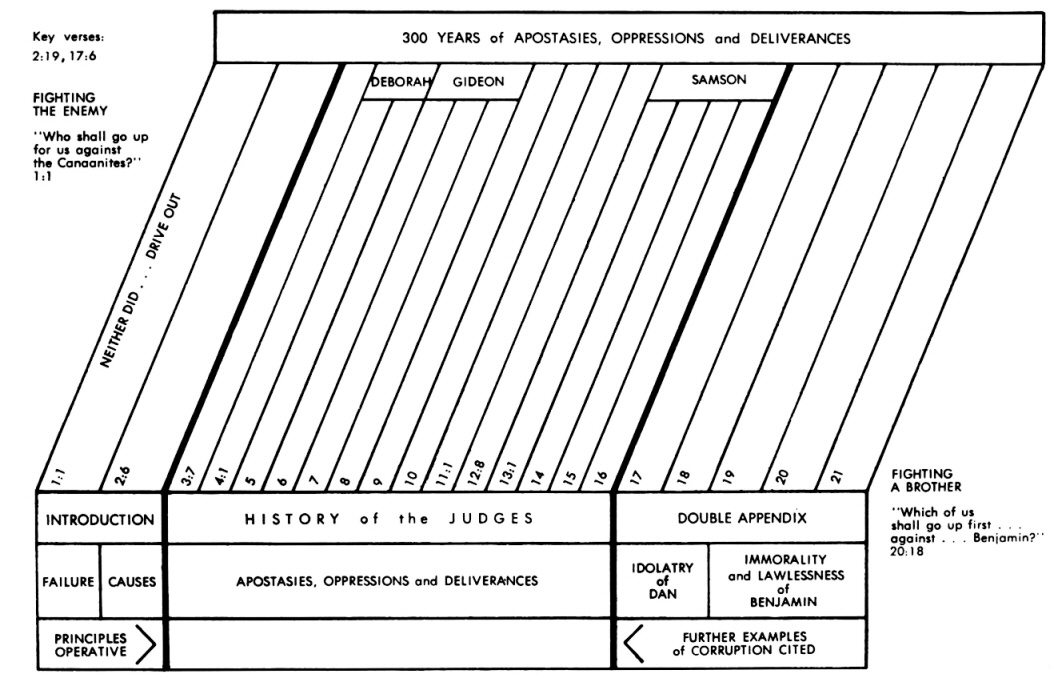
Chart from recommended resource Jensen's Survey of the OT - used by permission
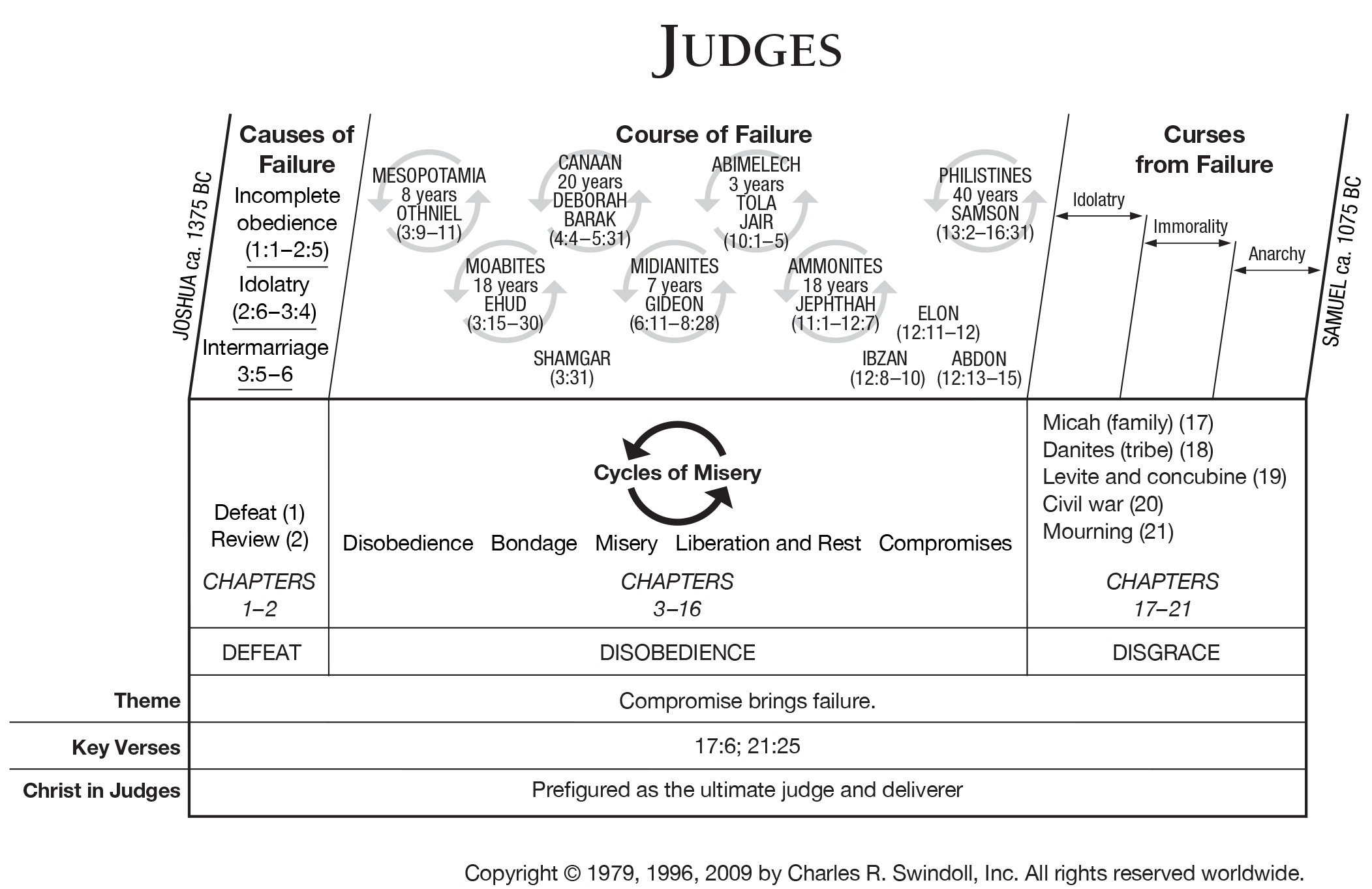
Chart on Judges - Charles Swindoll
|
RECYCLING SIN |
|||||
| Jdg 1:1-3:6 | Jdg 3:7-16:31 | Jdg 17:1-21:25 | |||
| Introduction | History of the Judges | Appendix | |||
| Causes of the Cycles THE REASON |
Curse of the Cycles THE RECORD |
Conditions in the Cycles THE RESULTS |
|||
| Failure to Complete Conquest Jdg 1:1-36 God's Judgment for Failure Jdg 2:1-3:6 |
Curse of the Cycles |
Conditions in the Cycles |
|||
| Living with Canaanites |
War with the Canaanites |
Living Like the Canaanites |
|||
| Religious Laxity |
Political Uncertainty |
Moral Anarchy |
|||
| About 350 Years of Israel's History - Almost 25%! From Compromise to Confusion! |
|||||

Another Timeline of Israel's History
Click to Enlarge
from Jensen's Survey of the OT
Click to Enlarge
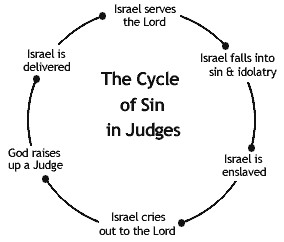
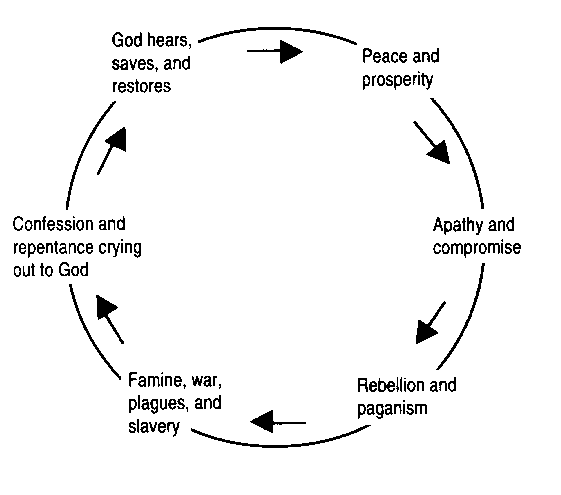
Other ways to describe Israel's cycle…
- Rest > Rebellion > Retribution > Repentance (?) > Restoration
- Sin > Suffering/Servitude > Supplication > Salvation
- Apathy > Apostasy > Affliction > Answered Prayer
- Disobedience > Desperation > Deliverance
- Disobedience > Bondage >Misery > Liberation and Rest > Compromises
FOLLOWING NOTES ARE COMPLETELY REVISED SPRING, 2022
Hannah's Bible Outline
- Gideon (Judges 6:1-8:32)
- Gideon's death (Judges 8:29-32)
- Israel's rest (Judges 8:28)
- Israel's deliverance (Judges 6:7-8:27)
- The promise of deliverance (Judges 6:7-10)
- The summons of the deliverer (Judges 6:11-32)
- The angelic visit (Judges 6:11-18)
- The worship by Gideon (Judges 6:19-24)
- The destruction of the pagan altars (Judges 6:25-32)
- The conflict for deliverance (Judges 6:33-8:27)
- The army gathered (Judges 6:33-35)
- The assurance of victory (Judges 6:36-40)
- The army reduced (Judges 7:1-8)
- The dream of the Midianite (Judges 7:9-14)
- The defeat of the Midianites (Judges 7:15-8:21)
- The strategy (Judges 7:15-18)
- The confusion (Judges 7:19-23)
- The scattering (Judges 7:24-25)
- The jealousy of Ephraim (Judges 8:1-3)
- The search for the Midian kings (Judges 8:4-21)
- The refusal of Succoth and Penuel (Judges 8:4-9)
- The capture of the kings (Judges 8:10-12)
- The punishment of Succoth and Penuel (Judges 8:13-18)
- The death of the Midian kings (Judges 8:19-21)
- Gideon's failure (Judges 8:22-27)
- Israel's servitude (Judges 6:2-6)
- Israel's sin (Judges 6:1)
- Parenthesis: the tyranny of Abimelech (Judges 8:33-16:31)
- Israel's idolatry (Judges 8:33-35)
- Shechem's submission to Abimelech (Judges 9:1-5)
Judges 8:1 Then the men of Ephraim said to him, "What is this thing you have done to us, not calling us when you went to fight against Midian?" And they contended with him vigorously.
- Then the men of Ephraim said to him: Jdg 12:1-6 2Sa 19:41 Job 5:2 Ec 4:4 Jas 4:5,6
- Why: etc. Heb. What thing is this thou hast done unto us, sharply. Heb. strongly.
- Judges 8 Resources
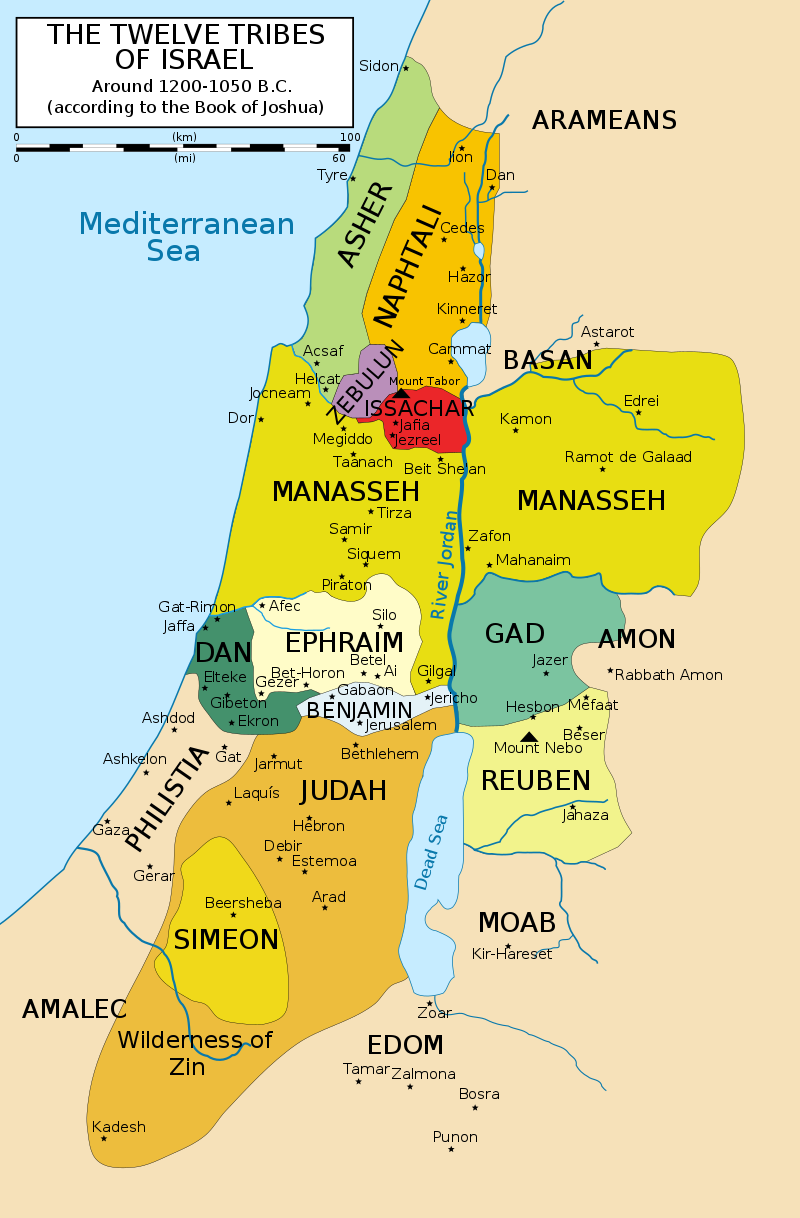
Location of Ephraim
THE PRIDE &/or JEALOUSY
OF THE EPHRAIMITES SURFACES
W Gary Phillips prefaces Judges 8 - This chapter records Gideon's reactions to five confrontations. In four out of the five, he behaves abominably; in the first episode, he seems to behave appropriately. However, it comes as no surprise to see that victory over God's enemies may be followed by squabbling among God's people (see Acts 5:12-42 with Acts 6:1-7). Misplaced self-reliance over foiling an external attack made the Israelites vulnerable to internal disputes. (See Holman Old Testament Commentary)
Daniel Block - Postscript (8:1–3). 8:1 The reader of the Gideon story might have expected the narrative to move quickly to the summary statement in 8:28,[636]but the plot is complicated by two persistent problems: the fractious nature of the Ephraimites (8:1–3) and character flaws in Gideon (8:4–27). After the energetic participation of the latter in 7:24–25, once again the narrator catches the reader by surprise in 8:1–3. (Borrow this top rated commentary for one hour Judges, Ruth. Vol. 6: New American Commentary)
Arthur Cundall gives some helpful background on Ephraim (Jdg 8:1-3) - Resentment and appeasement. The tribe of Ephraim appears to have enjoyed a supremacy over the other tribes during the earlier period of the settlement. Its territory in the central highlands was one of the few areas where the Conquest was in any way complete and the Ephraimites, preserved by their central position from many of the incursions of Israel’s hostile neighbours, experienced a far greater freedom to consolidate themselves than did the other tribes. The two most prominent sanctuaries of the judges’ period, Bethel and Shiloh, which functioned as the rallying-point of the tribes, were situated within its boundaries and this fact undoubtedly further increased its prestige. (Borrow Judges & Ruth: Tyndale Old Testament Commentary for one hour)
Then - The chronology in chapter 8 seems to be as follows: Gideon’s pursuit of the two kings (Jdg 8:4-12); his disciplining of the defiant Jews on his journey home (Jdg 8:13-17); the protest of the Ephraimites after he arrived home (Jdg 8:1-3); the slaying of the kings (Jdg 8:18-21); and Gideon’s “retirement” (Jdg 8:22-35). Each of these events presented a new challenge to Gideon, and he responded differently to each one.
The men of Ephraim - The tribe of Ephraim had a proud heritage (Jdg 1:22+), but it was fleshly pride that led them to feel snubbed and insulted by Gideon's failure to call on them earlier. They had cooperated honorably with Ehud (Jdg 3:26-29+) and even with Barak (Jdg 5:13, 14+) and thus may have wondered why they were left out this time. Another motive for their contention would be jealousy (or greed), out of their desire for some of the rich Midianite plunder that went to the victor.
Ephraim clearly missed out on acquiring some valuable spoils of war from over 120,000 slain soldiers, and this may have been what irritated them. When the men of Ephraim should have been thanking Gideon for delivering the nation, they were criticizing him and adding to his burdens.. Usually when people criticize something you’ve done, there’s a personal reason behind their criticism; and you may never find out what the real reason was. Since David’s unselfish law governing the dividing of the spoils of war had not yet been established yet (1Sa 30:21-25), the men who did not participate in the battle would share in the prized plunder.
Keil and Delitzsch suggest that "The leaders of this tribe (EPHRAIM) protested Gideon's action, "less from any dissatisfied longing for booty, than from injured pride or jealousy, because Gideon had made war upon the enemy and defeated them without the cooperation of this tribe, which was striving for the leadership [OF ISRAEL]." (Judges 8 Commentary)
Spurgeon - We have some friends, like these men of Ephraim, who do not like being left out of the battle for the Lord. They say, “Why are we not asked for our help? Why are we not allowed to take our share?” These are very good people; but we have known some of them who have made these enquiries rather late in the day. These Ephraimites knew all about the war, and they might have volunteered to help Gideon, and we should have been glad of the earlier help of some who tarried till the victory was won.
Said to him, "What is this thing you have done to us, not calling us when you went to fight against Midian?" - The Ephraimites had not been "invited to the party" with the tribes from Manasseh, Asher, Zebulon, and Naphtali (Jdg 6:35).
This story is an excellent illustration of the truth found in (Pr 15:1) instructing us that a gentle or soft answer is always in order when we sense thunderclouds of wrath rising in the other person.
George Bush rightly states that "nothing is more common than for those who will not attempt or venture anything in the cause of God, to be ready to censure those who show more zeal and enterprise than themselves." (Judges 8 Commentary)
Gary Inrig - Suddenly, with the reaction of the Ephraimites, the entire tone of the passage changes. God had given His people an astounding victory that should have produced a festival of praise. Instead, they allow petty tribal disputes to rob God of His rightful glory and the people of their joy. At this time in history, Ephraim was the largest, the most important, and apparently the most arrogant of the tribes. They would be the first to tell you how important they were. After all, the tabernacle was located in their territory at Shiloh, and they could claim the great Joshua as an Ephraimite. They had been allowed a part in God’s great deliverance. But rather than rejoicing, they came to Gideon with a smoldering complaint: “Why have you treated us like this? Why didn’t you call us when you went to fight Midian?” On the surface, it may seem like a valid, albeit petty, question. Ephraim had not been one of the tribes summoned by Gideon in Jdg 6:34–35; he had gone to the tribes more directly affected by the Midianite invasion. The bad attitude they show here may also have contributed to his decision! (Hearts of Iron, Feet of Clay - borrow for an hour)
And they contended (riyb) with him vigorously : Contended is a strong word even conveying the sense in some contexts of conducting a legal case (think "lawsuit"), but it is made even stronger by adding the word "vigorously" (chozqah), signifying they contended with him with force! ESV = "accused him fiercely" and NET has "argued vehemently" but the NIV is too mild - "criticised." Don't miss this -- given Ephraim's strong reaction to Gideon, this had the seeds that could have grown into a potentially violent and tragic outcome! (cf Ephraim in Jdg 12:1-4+) It is interesting that here they contend with the one who was named "let Baal CONTEND" (and now Ephraim is contending!) Gideon called Ephraim to capture the two famous princes, which they did. But they were provoked! How easy it is for the flesh to act even when God has given a great victory (Lesson - Be alert after great victories!). Gideon could have “told them off” but instead he practiced Pr 15:1 which says "A gentle answer turns away wrath, but a harsh word stirs up anger." It is better to control our feelings than to conquer a city for Pr 16:32 says "He who is slow to anger is better than the mighty, And he who rules his spirit, than he who captures a city.". If Gideon had offended his brethren, he might never win them back because Pr 18:19 says "A brother offended is harder to be won than a strong city, And contentions are like the bars of a castle." Godly leaders must know how to control their emotions feelings.
Block observes that "the facts are clear: (1) the Ephraimites had not been summoned initially (6:35); (2) they were not involved in the primary rout of Midian (7:24); (3) they were called upon only at the last minute when it appeared the enemy might escape through their territory. All these are interpreted as more than a snub; it is action directed against the Ephraimites." (Borrow this top rated commentary for one hour Judges, Ruth. Vol. 6: New American Commentary)
Phillips quips "Some people (EPHRAIMITES) simply cannot stand not being involved in other people's victories; rather than rejoice with those who rejoice, they become embittered (See Holman Old Testament Commentary)
Contrast Gideon, who placates the wrath of this tribe (Jdg 8:2-3), with Jephthah, who brings humiliation and defeat to it (Jdg 12:1-6+).
Daniel Block - Something seems to have happened to the character of the hero. In chaps. 6-7 we have witnessed his transformation from a fearful private citizen to a fearless agent of God, willing to take on the enemy against all odds, not to mention a sensitive diplomat. But the portrait of the man the author paints in this chapter creates a radically different impression in the reader's mind. If Judges 8:1-32 had been handed down without the literary context in which it is embedded, modern readers would reject Gideon as a tyrant, arbitrary in his treatment of the enemy and ruthless in his handling of his own countrymen. Instead of 'hacking' and 'contending' with the enemy, Gideon/Jerubbaal 'contends' and 'hacks' his own people." (Borrow his top rated commentary Judges, Ruth. Vol. 6: New American Commentary)
Contend (plead case) (07378)(riyb) means to strive, plead, contend, conduct a lawsuit, make a charge. The range of meanings of the verb rîv, "to conduct a lawsuit," "to dispute," "to strive," "to contend," denote some kind of argument or conflict between people, such as between herdsmen over wells (Ge. 26:20f) or a quarrel that leads to a physical fight (Ex 21:18). Jacob contends with Labin Ge 31:36. Israel quarreled (riyb) with Moses (Ex 17:2, contended Nu 20:3). Israel contended with the Lord (Nu 20:13)! Men of Ephraim contended vigorously with Gideon (Jdg 8:1). Those who contend with the LORD will be shattered (1Sa 2:10). "Plead for the widow" (Isa 1:17) The word means to contend or to strive for some reason in a non-legal setting as well. Riyb is found in both biblical and modern Hebrew. Riyb means to conduct a lawsuit or legal case and all that this involves. And so we see the Lord conduct His case against the leaders of Israel (Isa 3:13). He relents in His case from accusing humankind, knowing how weak they are (Isa. 57:16). David pleaded with the Lord to give him vindication in his case (1Sa 24:15) as did Israel when God contended for them (Mic. 7:9+).
Riyb in Judges - Jdg. 6:31; Jdg. 6:32; Jdg. 8:1; Jdg. 11:25; Jdg. 21:22;
Vigorously (02394)(chozqah from chazaq = to be firm or strong) means strength, force, violence and always with the preposition "be" (Heb) meaning with or by.
Baker - It can be used to modify oppression (Jdg. 4:3); rebuke (Jdg. 8:1); capture (1 Sam. 2:16); ruling (Ezek. 34:4); crying to God (Jon. 3:8). Only the last of these references has a positive connotation. All the others connote a harsh, cruel, and self-serving connotation of the use of one's strength and power. (The Complete Word Study Dictionary: Old Testament )
Gilbrant - This infinitive form of the verb chāzaq is used in much the same way as other derivatives of this verb. In Isa. 8:11, it is used in construct with the noun "hand" to yield "the strength of his hand." The noun is preceded by the preposition ke, meaning "according to the strength of his hand." Manuscripts, differ, however, containing the preposition be which translates "in the strength of his hand" or "by the strength of his hand." Neither preposition, however, presents an appreciable difference in this context, which basically underscores the importance of the hand of the Lord in prophetic communication.The same term is used of Rehoboam's rule (2 Chr. 12:1) and that of Uzziah (2 Chr. 12:16). Both these instances use this word to denote the negative attitude of these two kings after they had achieved a position of strength. A further instance of this noun occurs in Deut. 11:2, which again refers to a gradual and eventual accumulation of strength. (Complete Biblical Library)
Chozqah - earnestly(1), force(2), severely(1), vigorously(1). Jdg. 4:3; Jdg. 8:1; 1 Sam. 2:16; Ezek. 34:4; Jon. 3:8
The Strengths and Weaknesses of an Inconsistent Life, Judges 8:1-35
Introduction: many people live inconsistent lives. And inconsistency causes all kinds of problems, problems both for the inconsistent person and for those who observe his inconsistency. All kinds of guilt and problems arise for the person who lives an up and down, contradictory life. If a person is up one day and down the next day, achieving one week and failing the next week, feeling pleased one moment and displeased the next moment—the person faces a miserable life and causes misery for others. The sense of failure and guilt, of coming short, is always within the heart of an inconsistent person. And tragically, while the inconsistent person is living in failure or sin and evil, he is influencing others to fail or commit sin and evil. Inconsistency—a life of strengths and weaknesses—was one of the major traits of Gideon. A picture of his fluctuating life, of both his strengths and weaknesses, is painted in the present passage of Scripture. This passage stands as a warning to us against living an inconsistent life. - Preacher's Outline and Sermon Bible - Commentary
1. Gideon was a man who sought peace—to avoid controversy—among God's people (Judges 8:1-3).
2. Gideon was a man who warned scoffers and unbelievers (Judges 8:4-9).
3. Gideon was a man who endured, persevered until he conquered the enemy (Judges 8:10-12).
4. Gideon was a man who executed justice (Judges 8:13-21).
5. Gideon was a man who acknowledged the Lord and His right to rule over His people (Judges 8:22-23).
6. Gideon was a man who had an inconsistent testimony and witness (Judges 8:24-32).
7. Gideon was a man who had a tragic, inconsistent legacy: his rule was soon followed by apostasy and rebellion against God (Judges 8:33-35).
(Source: Judges, Ruth - The Preacher's Outline & Sermon Bible)
Gary Inrig on Ephraim's complaint and the practical application - Their complaint was petty and self-serving, motivated almost entirely by personal jealousy and injured pride. Gideon had won an astonishing victory, one from which Ephraim would greatly profit. But there was no joy at what God had done through Gideon, no enthusiasm for the wonderful victory God had given His people, no gladness and thanksgiving before God, no spontaneous hymns of praise to their good and gracious God. There was only bitterness of heart and petty jealousy. There may also have been greed, with Ephraim wanting to make their claim on the war booty. To put it bluntly, Ephraim was totally selfish. They put a priority on their own perceived problems, and they wanted Gideon to stop the battle until their little need was met. I wish this were a strange and unique response. It isn’t. It is sadly true that in a time of victory the greatest danger often comes from within the circle of God’s professing people. They don’t see what God is doing; all they can see is their own cause or convenience, and they view everything from how it impacts their own interests. Gideon had every right to be absolutely furious with those people. After all, it is easy to sit back and criticize after the battle has been fought, to be brave when the victory is won, to be a spectator who points out all the mistakes of others. There is nothing Satan loves more than to see Christians fighting with one another. In the book of Acts, after Satan had completely failed with various attacks on the church from the outside, what did he do? He tried to destroy the unity of believers over the actions of Ananias and Sapphira. When that did not work, he stirred up a fuss over the language tensions between Greek-speaking and Hebrew-speaking Christians and the way widows were being looked after. If we are fighting with each other, we are not pursuing the enemy. Satan can cause us to be so confused that we believe fellow believers are our enemies. This is not a tired tactic from the past. Satan uses it time and again. When people are trusting Christ, young Christians are being discipled, and established believers are growing and maturing, Satan will bend every effort to sow disunity. He does not care why we are divided, he just cares that we are. It may be division because of pride or hurt feelings or over our differences economically, socially, or educationally. It could be over personalities or differences in minor doctrines. But Satan loves to see us divided. (Hearts of Iron, Feet of Clay - borrow for an hour)
Warren Wiersbe provides an interesting analysis of Judges 8:
It takes all kinds to make a nation (or a church), and a leader must know how to handle each one, especially after a great victory.
The critical (Jdg 8:1-3)
They were angry with Gideon because they were left out and did not share in the glory. Gideon tactfully gave them the “soft answer” that healed the wounds and prevented division (Pr 15:1; Ep 4:1, 2, 3-note, Ep 4:29-note). Better to do that than to start another war.
The cynical (Jdg 8:4-9)
They said, “You have not yet won the battle, so why should we help you?” The men of Succoth had no faith in God or appreciation for Gideon and his men, and their lack of love cost them dearly.
The cowardly (Jdg 8:10-21)
Executing two famous kings would be a great way to start a military career, but the lad was too immature to carry it out. We wonder if Gideon remembered his own fears and God’s patience with him.
The compromising (Jdg 8:22-35)
Unlike Abraham, Gideon became covetous and asked for a generous share of the loot (Ge14:18, 19, 20, 21, 22, 23, 24). This led to idolatry and apostasy because the heart of man is ever ready to indulge in sin. (See note or borrow With the Word for one hour )
"Ephraim shall say, What have I to do any more with idols? I have heard him, and observed him: I am like a green fir tree. From me is thy fruit found." Hosea 14:8
THE history of the Children of Israel forms one of the principal themes of the Old Testament. It is the theme of God's dealings with a chosen group of men and women, through whom He wished to make Himself known to the rest of mankind.
That being the case, have you ever wondered why the Bible dwells at such length upon the fact that, although there was only one people of Israel, there were twelve tribes? About some of these tribes -- Judah, for example -- we know a great deal, but of others very little. For all twelve of them we have a most detailed listing of their borders, their territory and their cities. We also know -- though what to make of it would be hard to say! -- that two and a half tribes decided not to enter the land of promise, but to settle east of the River Jordan. Nothing in their subsequent history shows them to have suffered by this decision, in which case we are left to wonder about their choice.
That the tribes were different from one another early emerges from the story. The point is made by Jacob's thumbnail sketches of his twelve sons in Genesis 49. The successive censuses of the people (e.g. Numbers 2 and 26) show that some tribes became much more numerous than others as time went by, and we can read of the rivalries and conflicts between them which help to explain some of these differences (e.g. Judges 20:35). We know of the special priestly role to which the tribe of Levi was called. And we know that the birthright due to Jacob's oldest son, Reuben ("unstable as water, thou shalt not excel", Genesis 49:4), was forfeited and transferred to Joseph (1 Chronicles 5:1-2).
What all this suggests is that, if we can but trace them, we have here twelve histories rather than just one. To pick out these histories in some cases may well prove difficult, for we know so little of the tribe concerned. But it is my guess that, if we could do so, we should be led to the conclusion that the twelve tribes were intended by God to portray through their experiences different aspects of His work and character in human lives. Together, the twelve would then make up a united testimony that "blessed is the nation whose God is the Lord" (Psalm 33:12).
Some of the tribes never really began to fulfil this role; their testimony never "got off the ground". In one or two cases we can see, I believe, what the lesson was supposed to be, and we can also see where the tribe failed. If any reader can do this for all twelve tribes, then I hope that the editor will afford him or her space in these pages for an appropriate series of articles! For myself, I am taking the easy course of dealing here with only one tribe, the one which seems to me most clearly to exemplify the ideas I have so far suggested. That is the tribe of Ephraim.
The History of Ephraim
Let me start by recalling to you some incidents from the tribe's history in the land of promise, incidents which seem to fit a pattern. In the first place, we find the tribe complaining to Joshua (who was, of course, an Ephraimite himself), that he had not allocated them a large enough territory for a tribe of their size and importance (Joshua 17:14-18). But Joshua knew how to handle his relatives. He said to them, in effect, "Certainly: take all the space you want! All you have to do is to drive out the people in your way!" [110/111] But the natives had chariots of iron, and Ephraim complained that this made the task too difficult; in fact, they never did drive out those inhabitants. The implication was that it was up to Joshua to send along someone to help them: they were a great tribe, but not that great! "The children of Ephraim, being armed, and carrying bows, turned back in the day of battle" (Psalm 78:9).
Then there are two incidents in Judges, both of which reveal a common character trait. When Gideon had defeated the Midianites, he sent word to the tribe of Ephraim to block the fords of Jordan and cut off the enemy's retreat. This they did, apparently very effectively; it was a manoeuvre of which any general might be proud (Judges 7:24-25), but notice the reaction of Ephraim: "Why hast thou served us thus, that thou calledst us not, when thou wentest out to fight with the Midianites? And they did chide him sharply" (Judges 8:1). To be used just to block a retreat, rather than to be first-choice troops to fight the battle, was not good enough for Ephraim, the super-tribe!
Almost unbelievably, they did the same thing again, a few years later. This time, the Israelite leader was Jephthah, but the treatment he received was even worse than that meted out to Gideon: "Wherefore passedst thou over to fight against the children of Ammon, and didst not call us to go with thee? We will burn thy house upon thee with fire" (Judges 12:1). But Jephthah did not take this lying down; he pointed out that before the event, when actual danger threatened, they had been deaf and blind to his need for help. It was only after he had won the victory that they came accusing him of acting without reference to them.
We get the impression that, as a tribe, Ephraim was touchy in the extreme: status-conscious is a modern word which we might use. Nobody was supposed to do anything without giving Ephraim first refusal!
In this respect, if there was one tribe more than another which worried proud Ephraim, it was Judah. The birthright of Reuben, as we are told in 1 Chronicles 5:1-2, might have been transferred to Joseph, Ephraim's father, but "Judah prevailed above his brethren, and of him came the chief ruler" -- the royal house. On this basis, any priority, any preeminence among the tribes of Israel that Ephraim might claim had to be shared with Judah. This so worried Ephraim that the prophet Isaiah, in that wonderful eleventh chapter which begins, "there shall come forth a rod out of the stem of Jesse" (a man of Judah!), can foresee no greater bliss, in that great and coming day, than that "the envy also of Ephraim shall depart ... Ephraim shall not envy Judah, and Judah shall not vex Ephraim" (Isaiah 11:13).
The Role of Ephraim
Now all of these characteristics are, you may feel, simply indicative of human weakness: we all know "me-too" people like Ephraim and, indeed, there is a bit of Ephraim in all of us. However, if we bear in mind God's often-declared purpose that His people should represent Him and, by their quality, should testify to His power and greatness, then we are entitled to enquire a little further into this matter and ask: what was it that this tribe, in particular, might have been expected to exhibit in its character, and how does its actual conduct contrast with this intention?
Well, Ephraim, far from being the super-tribe it evidently considered itself to be, was the tribe that had no right to be there at all. Ephraim was not one of the twelve sons of Jacob, but one of Jacob's grandsons. Ephraim and Manasseh were just there to make up the numbers! Levi, as the priestly tribe, was not to be counted as one of the twelve, and Joseph was to be counted twice, because his descendants had become so numerous (Joshua 17:17).
But this was only the last in a long series of events that brought Ephraim to a position of power -- a sequence of divine choices which no human logic could justify. Consider: Ephraim was where he was because Jacob had blessed him ahead of his elder brother, Manasseh (Genesis 48:10-20). Ephraim's father Joseph was where he was, the ruler of Egypt and holder of the family birthright, because he had been blessed ahead of all his brothers: God had made him "to be fruitful in the land of my affliction" (Genesis 41:52), which was how and why Ephraim (-- fruitful) had received his name. [111/112]
But then we go on: Jacob was where he was because he had been preferred, in his turn, to his elder brother Esau (Genesis 25:23), and that quite independently of his own strenuous efforts at self-advancement. And Jacob's father, Isaac, was where he was because he, in turn, had been preferred to his elder brother, Ishmael (Genesis 17:18-19).
What an extraordinary series of events! Four times over, at least, God allowed the natural sequence to be overturned and, at the end of the sequence, there was Ephraim, the product of God's successive interventions. Perhaps we can visualise a modern parallel of someone who joined a firm as an office-boy and then, without ever going near the office in question, was promoted to departmental head, to managing director and, a few days later, to chairman of the board!
Now when we are thinking of God and His actions towards men and women we have a name for this kind of unmerited preferment that Ephraim received. We call it Sovereign Grace. Of the twelve tribes of Israel, Ephraim was the one which, more than all the others, ought to have been aware of God's amazing grace, and lived in the light of it -- of a four-times-over promotion, at the end of which the tribe enjoyed a status that, by nature, it could never for a moment claim.
Here, then, was a tribe whose true destiny was, surely, to be a prime exemplar of God's grace at work in human lives. If anybody could appreciate the meaning and extent of that grace it should have been Ephraim. But, as we have seen, the reverse was the case: touchy, status-conscious, this tribe saw an entitlement where it should have seen the gift of God's grace.
Grace is, I think, the hardest of God's gifts for men and women to appreciate. Indeed, in the whole of the Scriptures, how many men -- and, especially, women -- can you think of who accepted it, humbly and immediately? Ruth and Mary the mother of Jesus would certainly head my list; after them perhaps Hannah; perhaps David in 2 Samuel 7. But the list cannot be much longer than that: for all the others, let alone for ourselves, the acceptance of grace caused, and causes, awful problems!
Think of Joseph, Ephraim's father, who when he was young, sounded exactly as his son was later to sound: "Behold, I have dreamed a dream ... the sun and the moon and the eleven stars made obeisance to me" (Genesis 37:9). What a long and weary way Joseph had to go, through hatred, injustice and neglect, before he came to accept that "God meant it unto good" (Genesis 50:20)!
Think, too, of Jacob, Ephraim's grandfather who, before he learned the meaning of grace, had cheated and been cheated halfway across the Middle East. What travels and trials before the startling realisation came: "God hath dealt graciously with me and ... I have enough" (Genesis 33:11)! It is a lesson which most of us will finally learn only in the glory of another Day -- to be recipients of the grace of God and to recognise that we have nothing to do but to accept it. And the most difficult "status" of all to maintain is that of the recipient who says, "I have done nothing. I deserve nothing. I am where I am because of God's grace and nothing else."
Ephraim and Israel
Let me, if I may, add another dimension to this story of grace unappreciated. One has only to spend a few minutes with a concordance to realise that the name Ephraim is not used in the Bible for this one tribe alone. It is also frequently used to cover all those ten tribes which broke away from the rule of Judah's royal house and formed the northern kingdom of Israel. This is probably true, for example, of the passage I have already quoted in Isaiah 11, and is certainly true of such other references as Isaiah 7:8 and 17. Most of all, however, it is true of the prophecies of Hosea.
Now it is evident that this use of the name Ephraim to cover the whole kingdom of the ten tribes is a habit of particular prophets. But I want to suggest that it is also largely confined to passages, or prophetic messages, of a particular kind. If you read the words of Isaiah or Hosea, I think you will find that where the name Ephraim is used in this way, it is nearly always in relation to the love of God for Israel. It is a message to Israel of God's love and grace and their failure to appreciate them; a message of endearment for the undeserving. [112/113]
Families and friends commonly have what we call pet names for each other. They are used in private messages of love or friendship, but almost never when, say, a husband and wife are angry with one another, or when a parent is rebuking a child. A friend of mine told me that he always knew when his father was angry with him; ordinarily, he was known as "Glennie", but if his father called out "Glenn", he knew he was in for trouble!
I hope that it is neither improper nor irreverent to suggest that "Ephraim" was, in a way, God's pet name for His people. Simply by using it, He was identifying Himself as a God of love and grace, no matter how serious were the charges against Israel. And so we turn to the prophecies of Hosea, and read those remarkable phrases in which the pet name appears:
O Ephraim, what shall I do unto thee?
I taught Ephraim also to go, taking them by their arms.
How shall I give thee up, Ephraim? ...
Mine heart is turned within me, my repentings are kindled together.
I will not return to destroy Ephraim: for I am God, and not man.
The "Ephraim theme" of Hosea is a message of love betrayed. There is a note of incredulity in God's words to His people, as when we say to someone who we thought was our friend, "I don't understand: how could you do this to me?" If it were just a matter of sin, law and punishment, there would be no feeling, no emotion involved. It would be like a traffic warden writing out parking tickets for offenders, dispassionately, without emotion. But this time it is Ephraim that is the culprit: God's special Ephraim. Of course He feels involved: He faces the dilemma of love betrayed:
"Is Ephraim my dear son? is he a pleasant child? for since I spake against him, I do earnestly remember him still: therefore my bowels are troubled for him: I will surely have mercy upon him, saith the Lord" (Jeremiah 31:20).
What lesson is there for us in this brief Bible study? This, perhaps: firstly, that it is perilously easy to presume upon grace; to start out feeling grateful for a gift and, in no time at all, to convince ourselves that what at first looked like grace was, in reality, no more than our entitlement. Secondly, that there is a difference in quality between sin as a legal concept and sin as lack of appreciation: that is, between a relationship covered by law and a relationship created by grace. Ephraim was intended in God's purpose to demonstrate how a relationship with Himself can be created by grace alone. Let their failure alert us to the perils of presuming upon that grace.
"For ye know the grace of our Lord Jesus Christ, that, though he was rich, yet for your sakes he became poor, that ye through his poverty might be rich" (2 Corinthians 8:9).
Judges 8:2 But he said to them, "What have I done now in comparison with you? Is not the gleaning of the grapes of Ephraim better than the vintage of Abiezer?
- What: 1Co 13:4-7 Ga 5:14,15 Php 2:2,3 Jas 1:19,20 3:13-18
- Abiezer: Jdg 6:11,34
- Judges 8 Resources
A GENTLE ANSWER
TURNS AWAY WRATH
The next two verses might be subtitled Gideon the Consummate Diplomat.
But he said to them, "What have I done now in comparison with you? : Perhaps Gideon’s immediate feelings to Ephraim being "in his face" weren’t that cordial, but he controlled himself and treated his brothers with kindness and his reply (Pr 15:1, 16:32, cf Pr 25:15) stands in marked contrast to that of Jephthah (Jdg 12:1-6+). Gideon might have questioned the Ephraimites' motives by asking them why they had not taken action on their own during the long seven-year oppression.
Spurgeon - Gideon answered them very kindly and very wisely. He flattered them he attached great importance to what they had done, and took little credit to himself for his valiant service. In this he showed his self-command and his discretion. When persons chide sharply, it is a pity to chide back again; the best way of dealing with them is with a soft answer to turn away their wrath.
Is not the gleaning of the grapes of Ephraim better than the vintage of Abiezer (“My Father is helper”) - "Gleaning" is used here figuratively by Gideon of Ephraim's military achievements. The phrase "of the grapes" has been added by NASB translators but is not in original Hebrew. Gideon is minimizing his achievement and saying the Ephraimites have performed a more important services than Gideon and his men had achieved.
Block has an excellent comment observing how Gideon "offers a four-dimensional response. First, with a rhetorical question he minimizes his own role in comparison with theirs. Second, he flatters the tribe of Ephraim with a proverb, also cast as a rhetorical question but expecting a positive answer. The vintage of Abiezer (the clan to which Gideon belongs, Jdg 6:11) is insignificant compared to the gleaning of Ephraim. To change the metaphor, the best the Abiezrites can produce is less than the scraps off the Ephraimite's table. The proverb has the ring of a clever political slogan. Third, he acknowledges that God has rewarded their contribution by giving them the real trophies—the Midianite commanders Oreb and Zeeb. Fourth, he minimizes his personal role a second time, though with greater intensity. (cf Jdg 8:2,3)(Borrow his top rated commentary Judges, Ruth. Vol. 6: New American Commentary)
NET Note - Ephraim’s leftover grapes are better quality than Abiezer’s harvest. Gideon employs an agricultural metaphor. He argues that Ephraim’s mopping up operations, though seemingly like the inferior grapes which are missed initially by the harvesters or left for the poor, are actually more noteworthy than the military efforts of Gideon’s family.
In a sense Ephraim received the "leftovers" (NIV, "gleanings"). These, however, were more substantial than the initial victory ("harvest") won by his little Abiezrite clan. Gideon calmed their anger and avoided the civil war that later flared up between Ephraim and Manasseh (Jdg 12:4-6+).
Judges 8:3 "God has given the leaders of Midian, Oreb and Zeeb into your hands; and what was I able to do in comparison with you?" Then their anger toward him subsided when he said that.
- God: Jdg 7:24,25 Ps 44:3 115:1 118:14-16 Jn 4:37 Ro 12:3,6 15:18,19 Php 2:3
- Then: Pr 15:1 16:32 25:11,15
- Judges 8 Resources
EPHRAIM'S RESENTMENT
APPEASED
God has given the leaders of Midian, Oreb (raven) and Zeeb (wolf) into your hands: Gideon uses Elohim for God rather than Yahweh, but the reason is not clear. Jealousy is a hindrance to the work of God, fostering disunity and distracting attention from the main task of the people of God. With Gideon's gentle answer (Pr 15:1), he averted conflict and set a noble example for every Christian leader.
Although Gideon sadly begins to "backslide" in his spiritual condition (especially after Jdg 8:24ff), at this time he still has a proper perspective of Who enabled Ephraim to capture the Midianite leaders ("God has given..." cf similar affirmation in Jdg 8:7, 23). This is the perspective we should all have each new day, for we cannot live the supernatural Christ life without daily dependence on the supernatural empowerment of the Spirit of Christ. The following passages (amon many that could have been mentioned) express this proper mindset...
"Not to us, O LORD, not to us, but to Thy name give glory because of Thy lovingkindness, because of Thy truth." (Ps 115:1+)
"The LORD is my strength and song, And He has become my salvation. The sound of joyful shouting and salvation is in the tents of the righteous; The right hand of the LORD does valiantly. The right hand of the LORD is exalted; The right hand of the LORD does valiantly. (Psalms 118:14-16+)
"For through the grace given to me I say to every man among you not to think more highly of himself than he ought to think; but to think so as to have sound judgment, as God has allotted to each a measure of faith. (Romans 12:3-+)
Do nothing from selfishness or empty conceit, but with humility of mind let each of you regard one another as more important than himself do not merely look out for your own personal interests, but also for the interests of others. Have this attitude in yourselves which was also in Christ Jesus (Philippians 2:3+)
What was I able to do in comparison with you?" Then their anger toward him subsided when he said that - NET = "when he said this, their feeling about him became kinder." Gideon's words were successful and averted the anger of Ephraim. The Hebrew says literally “Then their spirits relaxed from against him, when he spoke this word.” The Septuagint says "they loosened (aniemi used of unfastening chains - Acts 16:26) their spirits." It didn’t cost Gideon much to swallow his pride and compliment the men of Ephraim. He told them that their capturing Oreb and Zeeb was a greater feat than anything the men had done from his hometown of Abiezer. Peace was restored and Gideon was able to focus on tasks necessary to complete the defeat of the Midianites and that was to kill their kings.
Arthur Cundall - Mollified by this flattery the Ephraimites calmed down, Gideon’s tactful action having averted a potentially dangerous situation. This is in marked contrast to the response of Jephthah in a similar crisis. (Borrow Judges & Ruth: Tyndale Old Testament Commentary for one hour)
Phillips has an interesting thought on Gideon's "diplomatic two-step" - Given Gideon's responses in the next four cases, one may wonder if his reaction to the Ephraimites was more a matter of political expediency than a passion for truth. Minimizing the role of his army of three hundred soldiers seems tantamount to minimizing God's powerful miracle. Was killing two kings truly a greater feat than routing an army at odds of four hundred fifty to one? Surely not! The Lord had given Gideon the victory, yet Gideon said nothing about God's role in the battle. He dealt with the Ephraimites entirely at a horizontal level. (See Holman Old Testament Commentary - Judges, Ruth)
In any event it is sad when brothers declare war on each other after they’ve stood together to defeat the enemy. As the psalmist records “Behold, how good and how pleasant it is for brethren to dwell together in unity!” (Ps 133:1+)
In Poor Richard’s Almanack (1734), Benjamin Franklin wrote:
Take this remark from Richard, poor and lame,
Whate’er’s begun in anger ends in shame.
And King Solomon wrote,“The beginning of strife is like releasing water; therefore stop contention before a quarrel starts” (Pr 17:14NKJV).
Gary Inrig - Gideon’s response is both admirable and sad. He could have chosen to put those Ephraimites in their place with a few choice words or to defend himself by a blistering attack on their sinful, selfish attitudes. But he utterly refused to do that. Instead, he shrewdly minimizes his role and maximizes theirs: “What have I accomplished compared to you? Aren’t the gleanings of Ephraim’s grapes better than the full grape harvest of Abiezer? God gave Oreb and Zeeb, the Midianite leaders, into your hands. What was I able to do compared to you?” Do you think that really makes sense? Was it really greater for Ephraim to capture and kill two military commanders than for Gideon to attack 135,000 men with only 300, to bring about a massive slaughter of the enemy and to cause the invaders to flee the land? Of course not. Gideon is obviously trying to keep this smoldering resentment from exploding into full fire, and so his words display a careful and shrewd diplomacy. But we learn two great lessons from Gideon.
1. The unity of God’s people is more important than personal pride. So what if he was wronged, mistreated, and criticized? It was more important for God’s people to be one than for Gideon to be vindicated. What a great lesson for us to learn. None of us likes to be wronged or misrepresented the way Gideon was. But how much better is it to take that hurt to the Lord and let Him deal with it than to insist on my rights at the expense of dividing God’s people?
2. We must not take our eyes off the enemy. Quite frankly, Gideon did not have time to fight with Ephraim. He had his eyes on the Midianites. Gideon refused to be deflected from God’s call for his life. That really was Ephraim’s problem. They had a lot of time to discuss their feelings because they had no burden to do God’s work. They had no sense of God’s purpose for them, so naturally they were out of step with Gideon. Often those who find much to criticize in the lives of other people are those who have no sense of urgency about God’s call for their lives.
Someone once told of a conversation he had with Dr. Charles Fuller, a man greatly used by God in radio evangelism. During the conversation, a man who had been publicly attacking Dr. Fuller was mentioned. Fuller said, “Yes, God bless him.” Another man said, “You don’t seem too upset, Dr. Fuller.” And Fuller replied, “Why should I let someone else decide how I’m going to act?” What a great attitude for every believer to cultivate! Yet that is not all that must be said. Gideon’s diplomacy was successful, but in the process, he focused entirely on the horizontal. He doesn’t insist on the credit for himself, but neither does he give it to the Lord, where it truly belonged. He doesn’t direct the Ephraimites to God as the source of victory, nor does he make it clear that he had been acting under a divine commission. This is not nitpicking. Disunity will always occur when our perspective is horizontal, not vertical. The major task of a leader is to make sure God is appropriately honored for all that He has done. Gideon’s failure to do that here reflects an issue that will grow far more serious. With that attack met, Gideon crossed the Jordan and continued his pursuit of Midian. Satan had not given up yet. He often tries to draw us into division where there ought to be unity; he also loves to draw us into misplaced priorities, where we subtly substitute our cause for God’s cause and pursue the wrong objectives or do the right thing for the wrong reasons. (Hearts of Iron, Feet of Clay - borrow for an hour)
Judges 8:4 Then Gideon and the 300 men who were with him came to the Jordan and crossed over, weary yet pursuing.
- weary yet pursuing: 1Sa 14:28,29,31,32 30:10 2Co 4:8,9,16 Ga 6:9 Heb 12:1-4
- Judges 8 Resources
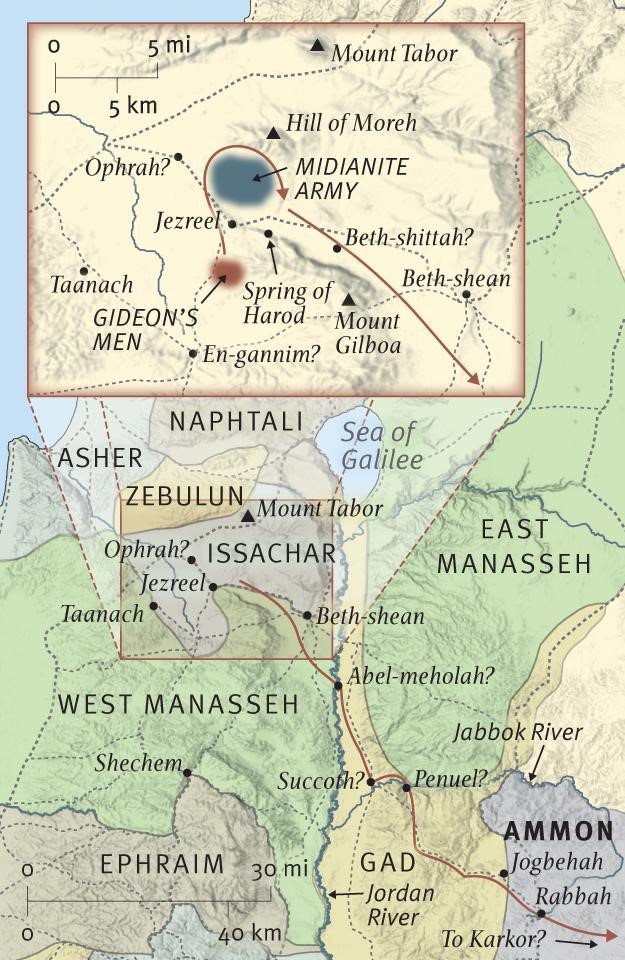
Gideon Pursues Midianites Zebah and Zalmunna & 15,000
(Source: ESV Global Study Bible)
MORE TROUBLE IN THE
TRANSJORDAN TERRITORY
ESV Study Bible note - Following the Lord’s great victory on the Israelites’ behalf, Gideon pursued a second military engagement. But the narrative here takes on a different tone. Whereas the Lord is prominently mentioned as the one who orchestrates the victory in the preceding chapter (Judges 7), the presence of the Lord is noticeably absent in this chapter. Even though Gideon was finishing off the action against the Midianites, the portrayal of Gideon in Jdg 8:13-21 is far from attractive. (Borrow ESV study Bible for an hour)
Lawson G Stone offers an interesting perspective on interpreting Gideon's actions in Judges 8 - "Commentators have a field day excoriating Gideon in Jdg 8:4-21, psychoanalyzing his every move and employing pejorative language ("glib," "rage") with scant textual basis to impugn Gideon's motives (Block, Schneider, Younger). Such eisegesis typically betrays the middle-class western perspective of the interpreters rather than illuminating the Iron Age culture and behavior of Gideon....Too easily modern readers, with our comfortable lives protected by police, ambulance, and civil legal structures, instructed by a whole Bible and 2,000 years of Christian tradition, pass judgment on Gideon. But Gideon's historical and literary world more resembled that of Achilles or Beowulf. Canaan in the midst of Iron Age I remained dark and bloody ground. A civilization of 2,000 years standing, the Bronze Age culture of the eastern Mediterranean had collapsed in flames in a generation, accompanied by invasions, wars, earthquakes, famine, and epidemic. Men like Gideon, called and empowered by Yahweh, provided the only "law" there was.....We may debate whether that context justifies Gideon's actions, but the wise interpreter will not lightly charge Gideon with pursuing merely personal vendettas, or following "self versus the Spirit" as though he had not had devotions that morning. Where the text does not condemn him, neither should we, unless the context provides clear markers.... Interpreters making a facile connection between Gideon "in the Spirit" (7:1-8:3) and Gideon "motivated by self" (8:4-21) perpetrate anachronistic eisegesis. The narrator offers no critique of Gideon in 8:4-21....God does not annihilate the "self" but energizes and animates it. A "sword for Yahweh" need not rule out "a sword for Gideon."(Cornerstone Biblical Commentary: Joshua, Judges, Ruth )
Then Gideon and the 300 men who were with him came to the Jordan and crossed over, weary (ayeph) yet pursuing (radaph; dioko in present tense - continually) - CSB = "They were exhausted but still in pursuit." Look at the map above to get your bearings. After settling the "ruffled feathers" of the Ephraimites on the west side of the Jordan, Gideon encountered another confrontation with the Israelites (Gadites) on the east side of the Jordan in the territory of Gad (see map above). Note that there are still 300 men. What does that say? It says two things - (1) God is a promise keeping God for He promised to deliver the enemy using only 300 men (Jdg 7:7) and (2) not one man had died in the route of the 120,000!
It is interesting to note that in the first battle against the Midianites where 120,000 died, Gideon's 300 men stood in place around the camp. God had sent such confusion with the lamps and trumpets that they apparently did not need to swing a sword. God won the victory. Now we see Gideon actively pursuing the remaining 15,000 and their 2 kings. Clearly the Lord still was empowering Gideon and his men for there would be no way 300 men could hope to defeat 15,000 men unless the Lord enabled them.
NET Note - Literally “And Gideon arrived at the Jordan, crossing over, he and the three hundred men who were with him, exhausted and chasing.” The English past perfect (“had crossed”) is used because this verse flashes back chronologically to an event that preceded the hostile encounter described in Jdg 8:1–3. (Note that Jdg 7:25 assumes Gideon had already crossed the Jordan.)
Weary yet pursuing The tiny army was now some 40 miles from the hill of Moreh when they came to Succoth, just north of the Jabbok River (map). Worn out from the long chase, Gideon asked these residents of Gad for some provisions. The men of Succoth must have reasoned that the fleeing Midianites would soon regroup and easily defeat the tiny band of 300 exhausted men. Any assistance given to Gideon would implicate Succoth and bring certain retaliation from the feared nomads. And so fear of man brought a snare to Succoth (and Penuel) for which they paid dearly. Compare the Angel of the Lord cursing Meroz (Jdg 5:23+) because they did not come to the help of the LORD. In a sense Succoth and Penuel are not coming to the "help of the LORD" because Gideon is the LORD's emissary and deliverer to accomplish the LORD's work (Jdg 6:14,16). So even as Saul's persecution of believers was tantamount to persecution of Jesus (Acts 9:4,5), Succoth and Penuel's refusal to help and taunting was an affront to the Most High God of Israel. Having said all this it seems that there is some justification for Gideon's subsequent seemingly harsh punishment of these "traitors" but not every writer agrees with this.
THOUGHT- “If you, dear brethren and sisters, will give yourselves wholly to God’s work, although you will never get tired of it, you will often get tired in it. If a man has never tired himself with working for God, I should think he never has done any work that was worth doing.”....“Let us also serve the Lord when every movement is painful, when even to think is wearisome. These men were faint. You know what it is for a soldier to be faint; it is no nonsense, no presence, it is real fainting. Yet to go running on when you are ready to faint, to keep right on when you are ready to drop, this is very trying work; yet let us do it, brethren, by God’s grace. Some people only pray when they feel like praying; but we need most to pray when we feel that we cannot pray. If we were only to preach, – some of us, – when we felt like preaching, we should not often preach.” (Spurgeon)
Gary Inrig observes that "Midian had been completely removed as a threat. They had lost more than one hundred thousand warriors. Their fighting capacity had been destroyed. In the light of what follows, it seems that Gideon has begun to pursue a personal vendetta. It is notable that the Lord plays no part in these events, and on the east side of the Jordan a very different Gideon begins to emerge." (Hearts of Iron, Feet of Clay - borrow for an hour)
Comment - I am not sure I agree with Inrig. Midian had lost huge numbers but still had two vital chess pieces (two kings) and therefore theoretically could have regrouped and again become a thorn in Israel's side.
Weary (05889)(ayeph for iph = to be exhausted) means faint, physically tired, usually used of people. Esau was famished from working in the fields that he sold his birthright to Jacob for some lentils (Ge. 25:29, 30). Because the people of Israel were faint from travel in the wilderness (Deut. 25:18), the Amalekites were able to attack their rear ranks. Gideon's 300 men were exhausted, but still pursued their Midianite enemies (Judg. 8:4f). When King David fled from Absalom, he and his men became weary and stopped to refresh themselves (2 Sam. 16:14; 17:29). Eliphaz accused Job of refusing to give aid to those who were weary (Job 22:7). In Proverbs 25:25, a weary soul is refreshed by cold water. The adjective also may refer to a weary animal (Isa. 46:1). Figuratively, when the adjective modifies the word "land," it refers to its dry condition. David likened his longing for the Lord to one being thirsty in the desert (Ps. 63:1); "My soul longs for You like a parched land" (Ps. 143:6). A godly man will be like "the shadow of a great rock in a weary land" (Isa. 32:2, NKJV). Prophetically, when the Lord regathers his people in the kingdom, "No one will be weary or stumble among them" (Isa. 5:27, NKJV); also, the Lord will satisfy the weary soul (Jer. 31:25). In the meanwhile, the Lord had promised his people rest for the weary, but they refused it (Isa. 28:12), and those who fight against Israel will be weary (Isa. 29:8).
Ayeph - 17v - faint(2), famished(2), parched(2), weary(11). Gen. 25:29; Gen. 25:30; Deut. 25:18; Jdg. 8:4; Jdg. 8:5; 2 Sam. 16:14; 2 Sam. 17:29; Job 22:7; Ps. 63:1; Ps. 143:6; Prov. 25:25; Isa. 5:27; Isa. 28:12; Isa. 29:8; Isa. 32:2; Isa. 46:1; Jer. 31:25
Pursuing (chasing) (07291) radaph means to pursue, chase, persecute. The first use describes Abram's pursuit of Lot's captors (Ge 14:14-15). In Ex 14 God hardened Pharaoh's heart so that he would chase after the Israelites (Ex 14:4, 8, 9, 23, Josh 24:6). God's promise if Israel obeys is that they will "chase your enemies." (Lev 26:7-8, cp similar promise in Josh 23:10), but if they disobeyed they would even "flee when no one is pursuing" them (Lev 26:17, cp three uses in Lev 26:36-37). Radaph describes Saul pursuing David to kill him (1Sa 23:25, 28, 24:14, 26:18, thus David prayed Ps 7:1). In fact many of the uses of radaph in Psalms speak of pursuit by an enemy. Radaph refers to hunting, chasing after animals (1 Sam. 26:20). Figuratively, radaph describes chasing rewards (Isa 1:23) or strong drink (Isa. 5:11). To pursue one’s enemies into to darkness means to utterly wipe them out (Nah. 1:8). Radaph is translated in the Lxx with the verb dioko, which means to pursue or chase after and even to persecute.
Radaph in Judges - Jdg. 1:6; Jdg. 3:28; Jdg. 4:16; Jdg. 4:22; Jdg. 7:23; Jdg. 7:25; Jdg. 8:4; Jdg. 8:5; Jdg. 8:12; Jdg. 9:40; Jdg. 20:43;
Block observes that "Although the plot takes an unexpected turn, Jdg 8:4–27 parallel the preceding account in several significant respects. Again Gideon and his band of three hundred men play key roles. Again they take the enemy camp by surprise. Again two Midianite leaders are captured and executed. But the differences between this chapter and the preceding are even more striking than the links. The following is a list of some of the similarities:
1. Yahweh is not involved in this phase of the plot at all (except in Gideon's own glib comments).
2. The two captured Midianite leaders have strange names and are called “kings” (mĕlākîm) rather than “commanders” (śārîm).
3. The campaign takes Gideon and his men far afield to Karkor east of the Dead Sea.
4. Gideon runs into serious conflict with his Transjordanian countrymen.
5. Gideon is personally involved in the capture and execution of the enemy kings.
6. Personal blood vengeance replaces national deliverance as a motive for Gideon's action.
7. Gideon, the fearful young man, has become a brutal aggressor. (When the plot resumes, something seems to have happened to the character of the hero.)(Borrow this top rated commentary for one hour Judges, Ruth. Vol. 6: New American Commentary)
Judges 8:5 And he said to the men of Succoth, "Please give loaves of bread to the people who are following me, for they are weary, and I am pursuing Zebah and Zalmunna, the kings of Midian."
- Succoth: Ge 33:17 Ps 60:6
- loaves: Ge 14:18 Dt 23:4 1Sa 25:18 2Sa 17:28,29 3Jn 1:6-8
- Judges 8 Resources
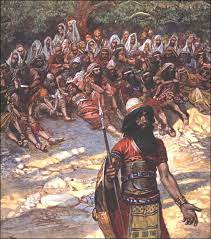
James Tissot's painting of Gideon begging bread at Succoth
SUPPLICATION TO SUCCOTH
WHO FEARED MEN NOT GOD
And he said to the men of Succoth: Succoth (means "booths" - see map) was east of the Jordan (called "transjordan") and north of the Jabbok River (map) and had come under Israelite control with the defeat of Sihon, king of Heshbon (Dt 1:4+). Succoth is in the territory of the tribe of Gad (map) (cf Josh 13:24-28+) so these were Gideon's "brethren" not his enemies. Their response (and that of Penuel below) shows how sin had begun to corrupt and destroy the tribal unity, sense of brotherhood and national loyalty, to the point that every man was doing what was right in his own eyes, which of course is the "theme song" of the book of Judges! (Jdg 21:25?+).
Constable makes an excellent point regarding the degradation of national unity - "Their lack of cooperation illustrates what both Moses and Joshua feared would happen to the Israelites who lived east of the Jordan River (Nu 32:6-15, 20-27+; Josh. 22:13-20+). The seeds of national disintegration had germinated."
Gary Inrig - The people of Succoth should have been delighted by Gideon’s achievements. Even though they had not fallen under the direct control of the enemy, the Midianites had been removed as a threat from the region, and at least the people of Succoth could have delighted to support the band that had brought freedom to their fellow Israelites. Although these were people who claimed to belong to a larger family, they had no loyalty to the larger community of faith at all. They should have been excited about what God had done through Gideon. Instead, there was no thankfulness to God, no trust in God, no mention of God. Even the lowest level of human kindness required that they help Gideon, their fellow Israelite. (Hearts of Iron, Feet of Clay - borrow for an hour)
Please (I beg you = marker of emphasis) give loaves of bread to the people who are following me: In theory as a conquering army leader Gideon could have confiscated food, but chose the "diplomatic route" as he had in Jdg 8:1-3. In the recent past however we saw that the Ammonites and Moabites, relatives of the Jews through Lot, failed to help Israel with food with the result that God declared war on them (Dt 23:3-6+). Hospitality is one of the basic laws of the East, and custom demands that the people meet the needs of strangers as well as relatives. Hospitality was also an important ministry in the early church, for there were no hotels where guests might stay; and in times of persecution, many visitors were fleeing. (Ro12:13+; 1Ti 5:10; Heb 13:2+; 1Pe 4:9+.)
Spurgeon - This was a very natural and a very reasonable request. Gideon did not ask the men of Succoth to come with him, nor even to give a lodging to his soldiers. The fear of Midian was upon Israel, and the people were afraid to do anything against their oppressor, but surely they might have relieved the hunger of their fellow countrymen. Instead of doing so, they answered Gideon with arrogant and cruel words.
For they are weary (ayeph), and I am pursuing Zebah ("sacrifice") and Zalmunna ("deprived of protection"), the kings of Midian: These two kings are to be differentiated from the commanders Oreb and Zeeb in Jdg 7:24-25+. They had been up all night and even though they were weary, they continued to press on. Clearly they were in need of nourishment for energy. The refusal to give food to the weary men makes their continued pursuit of the two fleeing kings and even more of a challenge (and seeming impossibility), remembering that Gideon had 300 pursuing 15,000, 1 to 50 odds! The point is that God's promise in Jdg 7:9 ("I have given" = past tense indicated how certain was the future outcome!) was sure and would be fulfilled.
THOUGHT - "Weary and pursuing" could describe many of God's saints over the centuries striving according to His power which mightily works within them. Gideon had been delivered from the depths of a winepress and was a man on mission to accomplish the will of God to utterly destroy the enemy. He kept his eyes on the real enemy and we believers today need to do the same.
ZEBAH (man-killer, or sacrifice),and Zalmunna (deprived of protection) the two "kings" of Midian who commanded the great invasion of Palestine, and who finally fell by the hand of Gideon himself. (Judges 8:5-21; Psalm 83:11) (B.C. 1250.) While Oreb and Zeeb, two of the inferior leaders of the incursion, had been slain, with a vast number of their people, by the Ephraimites, at the central fords of the Jordan the two kings had succeeded in making their escape by a passage farther to the north (probably the ford near Bethshean), and thence by the Wady Yabis , through Gilead, to Kurkor, high up on the Hauran. Here they sere reposing their with 15,000 men, a mere remnant of their huge horde, when Gideon overtook them. The people fled in dismay, and Gideon captured the two kings and brought them to his native village, Ophrah where he slew them because they had killed his brothers.
Judges 8:6 And the leaders of Succoth said, "Are the hands of Zebah and Zalmunna already in your hands, that we should give bread to your army?"
- Jdg 5:23 Ge 25:13 37:25,28 1Sa 25:10,11 1Ki 20:11 2Ki 14:9 Pr 18:23 Php 2:21
- Judges 8 Resources
SUCCOTH'S RUDE
REPLY TO GIDEON
And the leaders of Succoth (see map) said, "Are the hands of Zebah and Zalmunna already in your hands: There are two different words for hand, the first (kaph) denoting the hollow portion of the hand, i.e., the palm of the hand. The second is yad and in this context "in your hands" signifies under the power and authority of another, in this case Gideon. In other words the Succothites were saying you have not caught these kings yet and implying that they feared Midianite reprisals more than they feared disappointing Gideon!
It is interesting to note that their first reference to hands (kaph) may allude to the practice at that time of conquerors cutting off the hands of their dead victims to provide a convenient body count! Even in Jdg 7:24-25+ we see the Ephraimites capture, kill and decapitate Oreb and Zeeb, their heads being presented to Gideon! Remember these were the dark days of the Judges! A parallel is seen in Saul's charge to David to bring him one hundred Philistine foreskins to prove he had killed them! (1Sa 18:25). Also recall the Israelites' treatment of Adoni-bezek when he "fled; and they pursued him and caught him (they) cut off his thumbs and big toes." (Jdg 1:6-7+). It does not appear that God condoned such barbaric practices, but such is the degrading effect of sin on fallen men.
Guzik - When we set out to do the Lord’s work, often the resistance we face is from our friends. We can’t allow this to hinder or discourage our work. (Judges 8 Commentary)
NET Note - Hebrew literally is “Are the palms of Zebah and Zalmunna now in your hand, that we should give to your army bread?” Perhaps the reference to the kings’ “palms” should be taken literally. The officials of Succoth may be alluding to the practice of mutilating prisoners or enemy corpses
Spurgeon - As much as to say, “What have you done, after all? There are fifteen thousand men with Zebah and Zalmunna, and there are only three hundred of you. You have not even captured the leaders yet.” They forgot that Gideon’s band had slain a hundred and twenty thousand already; they underrated and mocked him, and would not give him the help he asked.
Already in your hands: These were Gadite brethren and should have been helpers not hinders. How often are good soldiers of Christ Jesus (2Ti 2:4,5+) jeered and taunted and derided and not supported in their quest for that word which they have heard from God (e.g., think of how the father of modern missions William Carey received such discouragement from those who should have been on his team!).
THOUGHT - The goal He has promised to believers may to doubters seem impossible and so they refuse to throw in their lot with us. But we must set our faces like flint toward Jerusalem and press on toward the goal. In eternity future, the shallow tauntings of doubters and naysayers will be long forgotten as we bask in the presence of the Captain of the hosts and hear "Well done, My weary warrior". So be not detracted good soldier but fight on in His strength and for His glory, completely the good work He has prepared for you before the foundation of the world (Eph 2:10+). And so Gideon pressed onward in the face of "discouraging words" and "obstacles". If God had called him to defeat the Midianites as if they were one man (Jdg 6:16+) then God would provide the necessary strength to complete the task.
ILLUSTRATION OF WILLIAM CAREY - The Missionary Idea Unfolding. Carey in his missionary ideas was far in advance of his age. When he began to reveal them some said, "How Utopian!" while others declared he was interfering with God's work. Once at a meeting Carey suggested as topic for discussion, "The conversion of the heathen." Quickly a minister said, "Young man, sit down! When God pleases to convert the heathen, he will do it without your help or mine!" Such rebuffs did not dishearten him.
That we should give bread to your army? - Note that this is a rhetorical question which in effect was a long-winded way of saying NO bread for your men Gideon! The lack of faith of the Succothites in Gideon and Gideon's God (they must have been told how 300 had already defeated more than 100,000. What more proof did they need?) To reiterate they feared men, not God, and so lived in an even greater fear of reprisal from the Midianites. In a rhyming comment we might say they were protecting their own skin, not providing for their own kin!
The fear of man brings a snare,
But he who trusts in the LORD will be exalted.
-- Pr 29:25
NET Note - The officials of Succoth are hesitant to give (or sell) food to Gideon’s forces because they are not sure of the outcome of the battle. Perhaps they had made an alliance with the Midianites which demanded their loyalty.
Gary Inrig - Whatever the reason—whether selfishness, regionalism, or self-protection— these people were utterly disloyal to the larger cause. This is incredibly discouraging—to pour yourself out into God’s work, to do something that really matters, to take a huge risk, only to be treated with contempt or apathy from those who profess what you profess and who should rally to your side. This kind of disloyalty cuts deeply, and Gideon does not respond well. The diplomacy and tact he showed with the Ephraimites is notably absent, as he declares his intention to return and take his revenge upon these people by publicly scourging them with thorns. To make things worse, a few miles down the road, the same pattern is repeated in another Israelite town in Transjordan, the city of Peniel. (Hearts of Iron, Feet of Clay - borrow for an hour)
Judges 8:7 And Gideon said, "All right, when the LORD has given Zebah and Zalmunna into my hand, then I will thrash your bodies with the thorns of the wilderness and with briers."
- I will thrash your bodies, Jdg 8:16
- Judges 8 Resources
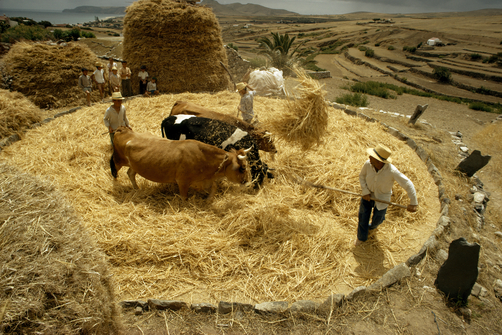
Unmuzzled Oxen Threshing Grain
A PREDICTION OF
A THRASHING
Block asks an interesting question at this point in the narrative - Has the Spirit of Yahweh, so evident in the earlier context, left him? 8:7–9 Judging by the narrator's silence on the role of Yahweh in the following sequence of events and Gideon's reaction to the Succothites’ impertinence, the question may be answered in the affirmative. Instead of answering impudence with a gentle word (cf. v. 2), he throws diplomacy to the wind and responds in kind. Glibly invoking the name of Yahweh, he threatens to take the law into his own hands and beat (rather than NIV, “tear”) their bodies with a switch of desert thorns (qôṣîm) and briars (barqānîm), like a man beats grain on the threshing floor.
And Gideon said, "All right, when the LORD has given Zebah and Zalmunna into my hand: Gideon sadly gives a prophecy of future vindication. Note he does not say "IF he captures the kings, but "WHEN" he captured them, so sure is was that this will happen, likely because he was trusting God's promise that the Midianites would be defeated as if they were only one man! (Jdg 6:16+). Perhaps the tribes of Transjordan could be excused for failing to aid Deborah and Barak (Jdg 5:17+), but neutrality was impossible when the conflict was in their "own backyard!" (cp Jdg 5:23+).
Then I will thrash (dush) your bodies with the thorns of the wilderness and with briers: The Hebrew verb Thrash (dush) usually means "thresh," (cf Dt 25:4, 1Chr 21:20) so Gideon could be picturing them as being dragged over thorns (threshing was done with sledges or carts fitted with metal spikes pulled by draft animals)! At this point you have to believe they are hoping that the Midianites with kill Gideon lest he make good on his harsh vindication. This reminds me of the torture inflicted on our Lord when he was flailed with a whip that torn into His holy flesh! (Mt 27:26 cf phagellion)
NET Note - I will thresh. The metaphor is agricultural. Threshing was usually done on a hard threshing floor. As farm animals walked over the stalks (SEE PICTURE ABOVE), pulling behind them a board embedded with sharp stones, the stalks and grain would be separated.
MacArthur - Gideon's threatened discipline of Succoth's leaders for refusing to help their brothers came due. He had them dragged under heavy weights over thorns and briers, which painfully tore their bodies. This was a cruel torture to which ancient captives were often subjected. He did it on his return, not wanting to delay the pursuit (v. 16). (See MacArthur Study Bible or borrow a copy of The MacArthur study Bible)
Spurgeon defends Gideon's threats and subsequent actions - Some have said that this showed resentment and harshness, but when a man is at war, he is not in the habit of sprinkling his adversaries with rosewater. War is in itself so great an evil that there are many other evils necessarily connected with it. It seems to me that if, when Gideon was trying to deliver his own countrymen, they scoffed at him, and refused him bread for his soldiers in the day of their hunger, they deserved to be punished with great severity.
Thrash (01758)(dush) means to tread, thresh out, trample, the first OT referring to threshing grain (Dt 25:4, cf 1Chr 21:20, Isa 28:27, 28, Hos 10:11), of a man trampled by a wild beast (Job 39:15). Dush is used with a figurative meaning of Israel's threshing the mountains (her enemies) (Isa. 41:15, Isa 25:10); of the Arameans' devastation of Israel's army and chariots under Jehoahaz, as if they were the dust left over after threshing grain (2Ki. 13:7); of the Lord's devastation and trampling of Moab like straw in a manure pile (Isa. 25:10; cf. Amos 1:3; Hab. 3:12).
Gilbrant - Basic to the meaning of this verb is the idea of trampling. It is most commonly translated "to thresh." It has a number of cognates in the Semitic world. The threshing floors of ancient Israel were usually in an elevated location near the village in order to catch the west wind for winnowing. They were usually communally owned, except in the case of some wealthy people. According to Isa. 28:27, different threshing methods were used for different kinds of grain: "Caraway is not threshed with a sledge, nor is a cartwheel rolled over cummin; caraway is beaten out with a rod, and cummin with a stick" (NIV). Several instruments were used in threshing. The threshing sledge was used to separate the grain from the husk and consisted of a wooden frame with sharp teeth of stone or metal (Isa. 41:15; Amos 1:3). The cart wheel was probably similar to the sledge except that it had wheels (Isa. 28:28). Oxen were often driven over the piles of grain (Deut. 25:4). The sieve was used to separate out the dirt (Amos 9:9; Isa. 30:28; Luke 22:31). The winnowing fork was used to throw the grain in the air to allow the wind to separate the chaff from the grain (Isa. 30:24). Workers and grain owners often slept on the threshing floor in order to protect their grain against theft (Ruth 3:7; 1 Sam. 23:1). Sometimes the verb "to thresh" is used figuratively in the OT. The Bible records that Jehoahaz and the army of Israel had been beaten down so badly by the king of Aram that they were like dust at threshing time (2 Ki. 13:7). The Lord described the treatment of Gilead by Damascus as having "threshed Gilead with threshing instruments of iron" (Amos 1:3). The Lord is said to thresh the nations in his anger (Hab. 3:12). This and other similar occurrences are better understood by the more basic meaning of "to trample" (cf. Isa. 25:10; Job 39:15). (Complete Biblical Library)
Harold Stigers - Isaiah 28:27 mentions that different methods were used for different size grains, threshing for larger sizes, and the rod for tapping out the cummin. The instruments of threshing are seldom mentioned, although Isaiah speaks of the cart wheel (Isaiah 28:28) and the threshing sledge with teeth (Isaiah 41:15). Grain was separated from chaff by winnowing, when the wind was favorable. The fan (Isaiah 30:24) or the whisk broom was used to sweep away the dust as it settled out or blew away. Finally the grain was passed through a sieve to separate the dirt (cf. Amos 9:9; Isaiah 30:28; Luke 22:31). dûsh is also used figuratively. The breaking action of threshing speaks of the defeat of the adversaries of Hazael of Damascus (2 Kings 13:7). dûsh is used in Gideon's threat against the elders of Succoth (Judges 8:7), and of the subjugation of Gilead by Syria (Amos 1:3). It is also used of Israel's victory over her enemies (Micah 4:13; Isaiah 41:15). On the latter verse, see E. J. Hamlin, JNES 13: 185-90. Hamlin argues that in Isaiah 41:15ff. the mountains and hills are mentioned because they were the sites of pagan worship. (Here is link to online TWOT)
Dush - 14x - continue to thresh(1), thrash(1), thresh(3), threshed(2), threshing(4), trample(1), trampled(1), trodden down(2). Deut. 25:4; Jdg. 8:7; 2 Ki. 13:7; 1 Chr. 21:20; Job 39:15; Isa. 25:10; Isa. 28:27; Isa. 28:28; Isa. 41:15; Jer. 50:11; Hos. 10:11; Amos 1:3; Mic. 4:13; Hab. 3:12
Judges 8:8 And he went up from there to Penuel, and spoke similarly to them; and the men of Penuel answered him just as the men of Succoth had answered.
- Ge 32:30-31 1Ki 12:25
- Judges 8 Resources
Related Passage:
Genesis 32:30-31 So Jacob named the place Peniel, for he said, “I have seen God face to face, yet my life has been preserved.” 31 Now the sun rose upon him just as he crossed over Penuel, and he was limping on his thigh.
NO BREAD
AT PENUEL
And he went up from there to Penuel: Penuel (wikipedia) is modern day Tulul adh-Dhahab. See this map and note that Gideon has now moved about 6 miles east of Succoth (pursuing the kings who were fleeing east and south back to Midian), where he received the same cold (cruel) response from the people of Peniel. In this very place (Penuel or Peniel = "face of God") Jacob had wrestled with God and God had changed his name to Israel (Ge 32:28-30 - cf Gideon's name change - Jdg 6:32+). These fellow Israelites (all descended from Jacob/Israel) in effect refused to believe that God could or would give victory to Gideon and his pathetic band of 300 weary men! Gideon vowed that he would return (note "WHEN" not "IF" again in Jdg 8:9) demolish the fortified tower that had made Peniel an important city (Jdg 8:9).
ISBE Penuel or Peniel (Face of God) - This is the form of the name in Genesis 32:30 . In the next verse and elsewhere it appears as "Penuel." The name is said to have been given to the place by Jacob after his night of wrestling by the Jabbok, because, as he said, "I have seen God face to face, and my life is preserved." It was a height evidently close by the stream over which Jacob passed in the morning. Some have thought it might be a prominent cliff, the contour of which resembled a human face. Such a cliff on the seashore to the South of Tripoli was called theoú prósōpon , "face of God" (Strabo xvi. 2, 15 f). In later times a city with a strong tower stood upon it. This lay in the line of Gideon's pursuit of the Midianites. When he returned victorious, he beat down the place because of the churlishness of the inhabitants (Judges 8:8 , Judges 8:9 , Judges 8:17 ). It was one of the towns "built" or fortified by Jeroboam (1 Kings 12:25 ).
And the men of Penuel answered him just as the men of Succoth had answered.- Similar to Succoth, their words were cruel and without compassion. No bread for Gideon and his men.
Spurgeon comments that "They took liberty to speak rudely because theirs was a fortified city, guarded by a strong tower, and Gideon, not doubting that he would come back that way (confident that God had given him the victory), said, “When I come again in peace, I will break down this tower.”
Related Resource:
Judges 8:9 So he spoke also to the men of Penuel, saying, "When I return safely, I will tear down this tower."
- When I return safely: 1Ki 22:27,28
- I will tear down this tower.: Jdg 8:17
- Judges 8 Resources
GIDEON'S RETRIBUTION
FOR REFUSING SUPPLIES
So he spoke also to the men of Penuel, saying, "When I return safely (literally "in peace"), I will tear down this tower (migdal) - Note Gideon's faith appears to have grown to the point that once again he says not "IF" but "WHEN" I return. He knew God would give him victory despite again being out numbered 50:1 (cf earlier odds of over 400 to 1!). KJV renders it "when I come again in peace (shalom)." Of course the peace speaks of Gideon's sure victory over the Midianites, not of his treatment of Penuel! They would not experience peace but destruction when he returned.
The disloyalty (and discouragement) of Penuel and Succoth was inexcusable (see Spurgeon above), but many think that did not justify Gideon's reaction out of anger (although it may seem just or justified at first glance). James reminds of the problem with anger that is not controlled is that "the anger of man does not achieve the righteousness of God." (James 1:20+). It looks as if Gideon is beginning to decline spiritually! Why now? Could the success be inflating his pride a little (just wondering)? To tear down their city’s watchtower, would in effect remove a critical component of their city's defense system. Some reason that Gideon's vow or promise to punish Penuel in retribution for their hostile treatment of his band of 300 men reminds one of the curse on Meroz in Judges 5:23+ for not helping in the battle against Sisera.
Migdal in Judges - Jdg. 8:9; Jdg. 8:17; Jdg. 9:46; Jdg. 9:47; Jdg. 9:49; Jdg. 9:51; Jdg. 9:52
Tower (04026)(migdal) is a masculine noun that refers to a tower such as watchtower (as in a vineyard = Isa 5:2) or a strong place ("Tower of Babel" = Ge 11:4, tower for defense = Jdg 9:51). Erdman's Dictionary defines "tower" as "A defensive structure either built into a city wall or located on a hill as a watchtower. Towers (Heb. migdāl) were built into city walls at strategic positions such as corners, city gates, and vulnerable locations. Massive towers built as part of the city gate structure (e.g., Megiddo, Samaria, Hazor, Dan, Beer-sheba, Timnah) increased defense capabilities at a city’s most vulnerable location. Towers, built into the walls at intervals to increase defense capabilities, usually jutted out beyond the city wall giving defenders a clear view of the wall’s foundation and anyone attempting to breech the wall. This type of tower is typically taller than the adjoining city wall."
Judges 8:10 Now Zebah and Zalmunna were in Karkor, and their armies with them, about 15,000 men, all who were left of the entire army of the sons of the east; for the fallen were 120,000 swordsmen.
- sons' of the east: Jdg 7:12
- the fallen were 120,000 swordsmen, Jdg 7:22 20:2,15,17,25,35,46 2Ki 3:26 2Ch 13:17 2Chr 28:6,8 Isa 37:36
- Judges 8 Resources
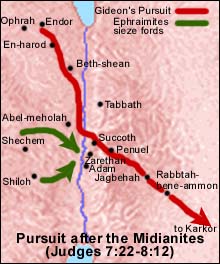
Gideon Goes East to Karkor
KINGS AND 15K
AT KARKOR
While we do not know the exact location of Karkor, clearly it was east of Succoth and Penuel and probably well into "enemy territory." This would have given the fleeing Midianites a sense of peace and security, so that they would have been more inclined to let their guard down. (Here is another map)
Now Zebah and Zalmunna were in Karkor, and their armies with them, about 15,000 men, all who were left of the entire army of the sons of the east for the fallen were 120,000 swordsmen - Literally "The fallen ones were a hundred and twenty thousand [in number], men drawing the sword" and in this case they drew their swords against each other! The Lord had disposed of 120,000 Midianites with no casualties among Gideon's band of 300 (contrast the casualties when Israel was disobedient to God - 2Ch 13:17 2Chr 28:6)!
THOUGHT - In toto Gideon (with God's enablement) eventually destroyed an enemy force of 135, 000 Midianites. What spiritual forces of wickedness are arrayed against you (Eph 6:12+), such that you are beginning to doubt that your Covenant Defender can truly defeat them? You (I) need to remember the three words "GOD IS ABLE"!
The Disciple's Study Bible has an interesting note writing that "Today's readers are often surprised how many murders are described in the Old Testament. Accounts such as this one are more descriptive than prescriptive in nature. They major on the "what'' and "how'' of an incident but do not develop the "why'' of an incident beyond the matter of revenge. In a world dominated by cause and effect values, little time was given to reconciliation or rehabilitation. Thus, often the murders associated with political intrigue, war, and interpersonal conflict do not reflect normative, timeless principles for dealing with injustice. Caution must be applied before making quick jumps of application to contemporary time based on such incidents. Such caution asks from where the initiative comes for any acts of killing. For example, to say even "but God is on our side'' must bear the proof when matters of life and death are raised. In Gideon's case the biblical emphasis is on punishment of murderers rather than justifying Gideon's attitude of vengeance. A helpful consideration is to read these passages through the light of Jesus' actions, words, and attitudes." (Borrow Disciple's study Bible for one hour)
Judges 8:11 And Gideon went up by the way of those who lived in tents on the east of Nobah and Jogbehah, and attacked the camp, when the camp was unsuspecting.
- Nobah: Nobah took its name from an Israelite who conquered it; and is said by Eusebius to have been, in his time, a forsaken place eight miles south from Heshbon. Jogbehah was probably near it. Nu 32:35,42
- when the camp was unsuspecting: Jdg 18:27 1Sa 15:32 30:16 1Th 5:3
- Judges 8 Resources

Approximate locations of Nobah and Jogbehah
(Click to Enlarge)
GIDEON'S SECOND
SURPRISE ATTACK
And Gideon went up by the way of those who lived in tents on the east of Nobah and Jogbehah: The phrase went up by the way of those who lived in tents would suggest the route used by nomadic travelers of the day. Gideon pressed farther into Transjordan, following the caravan trail taken by the Midianites. By this time the remnants of the Midianite army were in Karkor (v10), located perhaps in the Wadi Sirhan, east of the Dead Sea (but this is only speculation). The location of Nobah and Jogbehah can be located at Jubeihat, fifteen miles southeast of Penuel. Gideon passed Jogbehah, about fifteen miles southeast of Penuel and seven miles northwest of modern Amman.
Spurgeon - He went by an unusual route, and took them at night again unawares when they felt perfectly safe, and were sound asleep: “for the host was secure.” As I read these words, I think, what a pity it is ever to fancy ourselves secure while we are really in peril! Carnal security is a great danger. To be “safe in the arms of Jesus,” is a most blessed condition; but to be secure in self-confidence, is a thing that hath a curse upon it.
And attacked the camp, when the camp was unsuspecting (betach; Lxx - peitho - convinced, persuaded, trusting in) - NET = "and ambushed the surprised army." ESV = "and attacked the army, for the army felt secure." Unsuspecting conveys the thought of trust so that the Midianite army thought they were dwelling in safety, with a sense that they were now in a secure place of refuge! Little did they know that the Gideon's would soon launch a surprise attack!
NET NOTE - Hebrew literally reads “and attacked the army, while the army was secure.” The Hebrew term בֶטַח (betach, “secure”) probably means the army was undefended (see R. G. Boling, Judges [borrow 1 hour], 156), not suspecting an attack at that time and place.
THOUGHT - Sinners may think they are safe but in due time their foot will slip to paraphrase Deut 32:35+ the verse Jonathan Edwards used for his famous sermon Sinners in the Hands of an Angry God.
Block - Gideon seems to have caught up with the Midianite kings east of Nobah and Jogbehah. The exact location of Nobah is unknown, but Jogbehah is commonly identified with Rugm ’al-Gubēḥah, on an ancient caravan route northwest of Amman. Gideon came upon them suddenly, when the camp was relaxing. He routed the entire army and eventually captured the prize he was after—Zebah and Zalmunna, the kings of Midian.
Unsuspecting (0983)(betach from batach = to trust) means security, confidence (belief that one is safe and secure - Isa 32:17, Job 24:23, Mic 2:8). In its first occurrence betach emphasizes the status of a city which was certain of not being attacked (Ge 34:25). All three uses in Psalms speak of God enabling us to dwell securely (Ps. 4:8; 16:9; 78:53)
Judges 8:12 When Zebah and Zalmunna fled, he pursued them and captured the two kings of Midian, Zebah and Zalmunna, and routed the whole army.
- captured the two kings of Midian: Jos 10:16-18,22-25 Job 12:16-21 34:19 Ps 83:11 Am 2:14 Rev 6:15,16 Rev 19:19-21
- Judges 8 Resources
MIDIANITE KINGS CAPTURED
ARMY ROUTED
When Zebah and Zalmunna fled, he pursued them and captured (lakad) the two kings of Midian, Zebah and Zalmunna: Gideon's main goal was the capture of Midian's two kings, for without leadership the eastern hordes were not likely to resume their raids to the west. The two kings probably belonged to different tribal groups. Multiple rule in Midian was also the practice earlier, for Moses killed five Midianite kings (Nu 31:7, 8+).
While some think the Spirit may have departed Gideon because of his harsh response to the men of Succoth and Penuel, the fact that he was willing to attack a force of 15,000, supports the premise that he had courage, which in turn suggests that the Spirit enabled this holy boldness, to complete the "holy war (jihad)" against Israel's foes. And recall that Gideon clearly believed he would achieve the victory over the 15,000 because he had stated not "IF" he returned, but "WHEN" he returned to Succoth and Penuel.
And routed (charad) the whole army - Young's Literal = "all the camp he hath caused to tremble." NRS, ESV = "threw all the army into a panic." Routed (charad) means that Gideon's little band caused the 15,000 to panic. The Septuagint translates charad with the verb existemi which means to cause to be amazed or astonished. Another version of the Septuagint uses a different very (ektribo) which means to obliterate, to ruin or to destroy. Whether the 15,000 were killed or just ran in panic is unclear. The NLT seems to take a little liberty in their paraphrase - "chased them down and captured all their warriors." (Jdg 8:12NLT) The text does not actually say this is what happened. It just says they "threw all the army into a panic." (ESV). The NLT is a good paraphrase but occasionally can be too interpretative.
While one might say some of this effect was due to the element of surprise, surely there is a supernatural element which explains the whole army (15,000) being routed! Moses helps us understand by asking a rhetorical question "How could one chase a thousand, and two put ten thousand to flight, unless their Rock had sold them, and the LORD had given them up?" (Dt 32:30+) So 300 chasing fifteen thousand reflects the supernatural work of Israel's Rock!
There is a whole lot of shaking going on in Judges 7 and Judges 8! The conflict began at "the spring of Harod (means "trembling")" (Judges 7:1+), where Gideon's 22,000 men "trembled with fear" (Harod is derived from charad, as is the related Hebrew word chared translated "trembling" in Judges 7:3+). So in Harod, it was the Israelites who trembled, but here in the end, it was the Midianites who were terror-stricken and trembling (charad)! God always gets the last word!
Routed (startled, frightened, made afraid, terrified) (02729) charad means to tremble, quake or shudder and describes human trembling before some strange or fearsome event. In Exodus the people trembled (charad) (Ex 19:16+) and Mt Sinai quaked (charad) violently (Ex 19:18). It conveys the the idea of movement resulting from agitation, usually trembling coming from emotional trauma as when Isaac realized Jacob had deceived him and received Esau's blessing (Ge 27:33) or when Joseph's brothers who had abandoned him in a pit met him in Egypt (Ge 42:28). In the future Millennium Israel will forget her disgrace and treachery against Yahweh and will live securely in the promised land "with no one to make them afraid." (Ezek 39:26+, cf Micah 4:4+, cf Mic 4:1-3, also Zeph 3:13+) After Jonathan and his armor bearer had slaughtered about 20 Philistines, "there was a trembling (noun form charadah) in the camp, in the field, and among all the people. Even the garrison and the raiders trembled (verb - charad), and the earth quaked so that it became a great trembling (noun form charadah)" (1Sa 14:15, cf Da 10:7).
Judges 8:13 Then Gideon the son of Joash returned from the battle by the ascent of Heres.
Then Gideon the son of Joash returned from the battle by the ascent of Heres - The author reverts from Jerubbaal to Gideon. The location of the ascent (pass) of Heres is not known. This Heres is not the same as either Mount Heres in Jdg 1:35 or Timnath Heres in Jdg 2:9.
HERES [ISBE] - he'-rez, he'-res:
(1) har-cherec, "Mount Heres" (Jdg 1:34 f), a district from which the Amorites were not expelled; it is mentioned along with Aijalon and Shallbim. In Josh 19:41 f we have then two towns in association with Ir-shemesh and many authorities consider that as cherec = shemesh, i.e. the sun, and har, being perhaps a copyist's error for `ir, "city," we have in Jdg 1:34 a reference to Beth-shemesh, the modern `Ain Shems. Conder thinks that Batn Harasheh, Northeast of Aijalon, a prominent hill, may be the place referred to. Budde thinks Har-heres may be identified with the Bit-Ninib (Ninib being the fierce morning sun) of the Tell el-Amarna Letters; this place was in the district of Jerusalem.
(2) ma`aleh he-charec, "the ascent of Heres" (Jdg 8:13, the King James Version "before the sun was up"), the place from which Gideon returned to Succoth after his defeat of Zebah and Zalmunna. the Revised Version (British and American) is probably a great improvement on the King James Version, but both the text and the topography are uncertain.
(3) `ir ha-cherec, "City of Heres" "City of Destruction" (cherem) English Versions of the Bible, or "City of the sun" cherec) English Versions, margin. This is the name of one of the "five cities in the land of Egypt that speak the language of Canaan, and swear to Yahweh of hosts" (Isa 19:18).
See IR-HA-HERES.
E. W. G. Masterman
Judges 8:14 And he captured a youth from Succoth and questioned him. Then the youth wrote down for him the princes of Succoth and its elders, seventy-seven men.
- he captured a youth from Succoth: Jdg 1:24,25 1Sa 30:11-15
- Judges 8 Resources
PREPARATION FOR PUNISHING
SUCCOTH ELDERS
And he captured (lakad) a youth from Succoth and questioned him: Demsky and M. Kochavi argue that the "youth" was probably a local official familiar with the names of the taxpayers ("An Alphabet From the Days of the Judges," Biblical Archaeology Review, 1978).
Then the youth wrote down for him the princes of Succoth and its elders, seventy-seven men : This clearly implies Gideon could read. Writing was widely known by the time of the Judges. Our first written documents antedate 3000 B.C. Documents from Ras Shamra (ancient Ugarit) in Canaan date from the fifteenth century B.C. 16.
Block - This is the first time elders are mentioned in the book. In the absence of a king, towns were governed by a body of senior members of the community, usually heads of the clans, who conducted the community's business in the city gate.
Believer's Study Bible on youth wrote down for him - This statement indicates that literacy was not uncommon in Palestine at that time (cf. Ex. 17:14; Josh. 18:9).
Henry Morris agrees noting that "That this randomly encountered young man was literate strongly suggests that the Israelites in general were literate at this time, despite their previous decades of desert life and warfare."
Captured (caught) (03920) lakad means to capture, seize, catch, as in a net, trap or pit (Ps 9:15). Most of the 121 uses of lākad deal with men capturing or seizing towns, men, spoils, and even a kingdom (1Sa 14:47). It is used figuratively of the entrapment of men who are caught in snares of all sorts laid by their enemies (Jer 5:26; 18:22; Ps 35:8). A poignant figuratively use is illustrated in Pr 5:22 where Solomon notes that the wicked is captured with the cords of his own sins (Josh 6:20, cf 1Sa 14:41-42). Captured (defeated) cities (Dt 2:34, 35; 3:4, Jericho = Josh 6:20; Jdg 1:8, 12-13, 18). Speaks of tribes providentially "taken" to discern who committed the sin that caused Israel to lose the battle at Ai (Josh 7:14-16) To be "immoveable, frozen, i.e., make a collection or mass hard and immoveable, as an extension of capturing or binding up and object (Job 38:30)." (Swanson)
Lakad in Judges - Jdg. 1:8; Jdg. 1:12; Jdg. 1:13; Jdg. 1:18; Jdg. 3:28; Jdg. 7:24; Jdg. 7:25; Jdg. 8:12; Jdg. 8:14; Jdg. 9:45; Jdg. 9:50; Jdg. 12:5; Jdg. 15:4
Judges 8:15 And he came to the men of Succoth and said, "Behold Zebah and Zalmunna, concerning whom you taunted me, saying, 'Are the hands of Zebah and Zalmunna already in your hand, that we should give bread to your men who are weary?'"
- taunted: Jdg 8:6,7
- Judges 8 Resources
HERE'S YOUR TAUNT
"IN YOUR FACE"
"In your face" is physically in front of one's face (as the two kings now were before the 70) and figuratively means aggressively unavoidable because it is thrust upon one's attention. On meaning of this idiom in English is as an aggressive exclamation of triumph said after the speaker has defeated one or proven one wrong.
And he came to the men of Succoth and said, "Behold ("Look!" - hinneh - attention getting exclamation) Zebah and Zalmunna, concerning whom you taunted (charaph) me saying, 'Are the hands of Zebah and Zalmunna already in your hand, that we should give bread to your men who are weary": Taunt in English means to reproach in a mocking, insulting, or contemptuous manner. In this scene Gideon throws their taunt back in their face! One can only imagine the expressions on their faces! The seventy-seven men who were registered on this death list heard Gideon repeat their earlier taunt before carrying out the extreme punishment. It is possible that like their neighbors in Penuel, the men of Succoth died from this severe punishment.
"Weary" (yaep) means faint or exhausted. Gideon adds this detail ("weary") to the men of Succoth's earlier taunt when they had refused to help him, asking: "Why should we give bread to your troops?" (Jdg 8:6). They showed no sympathy for Gideon's exhausted, worn-out troops (Jdg 8:4, 5). By altering their words he highlighted the extreme situation of his men at the time of his request, as well as the gross insensitivity of the men of Succoth and thus made a solid case for punishing them.
NET Note - Gideon changes their actual statement (see v. 6) by saying exhausted men rather than “army.” In this way he emphasizes the crisis his men were facing and highlights the insensitivity of the men of Succoth.
Lawson G Stone - In an "honor-shame" culture (See note) such as that of ancient Israel, to leave such a taunt unanswered amounts to an abdication of leadership, surrendering the community's order to defiant covenant breakers. Gideon's actions are not a "high-handed" reprisal (contra Block 1999:292), but an admittedly stern upholding of a wartime social order. (Cornerstone Biblical Commentary: Joshua, Judges, Ruth )
Life Application Study Bible - It is difficult to determine whether this act of revenge was justified or whether he should have left the punishment up to God. Gideon was God's appointed leader, but the officials of Succoth and Peniel refused to help him in any way because they feared the enemy. They showed neither faith nor respect for God or the man God had chosen to save them. (Borrow Life application study Bible for one hour)
Taunted (02778)(charaph) means to reproach or to agitate someone about something, especially to cast blame or scorn on them. It refers to sarcastic challenge in a mocking or insulting manner. It suggests a jeeringly provoking insult or challenge. As explained below this word actually as 3 senses. Vine says the idea "to say sharp things, reproach." The root with the meaning "to be sharp" is found in Northwest and South Semitic languages. In Hebrew the verb refers to a manner of speech, i.e., to reproach someone. The word appears about 50 times in the Old Testament, once in Psa. 42:10: "As with a sword in my bones, mine enemies reproach me; while they say daily unto me, Where is thy God?"" Charaph is more than mere rude talk, this strong verb denotes demeaning something or someone by complete devaluation, defiance, or despising
Baker explains that charaph has 3 different meanings - (1). (ED: BY FAR THE MOST COMMON MEANING) A verb meaning to reproach. It means to taunt or agitate someone about something (Ps. 119:42), e.g., the psalmist was the object of taunting from his enemies. Nehemiah is the object of reproaches from his enemies (Neh. 6:13). Israel as a whole was taunted and reproached by the Philistine, Goliath. God is the object of His enemies' reproaches or revilings (2 Ki 19:4, 16, 22, 23; Ps. 79:12) and by the enemies of His people. To reproach one's own life (soul) is to stake one's faith or trust in something and support it (Jdg. 5:18; 1Sa 17:10, 25, 26; Ps. 89:51). (2). A verb meaning to remain to winter or to remain in harvest time. It is used in a context that refers to spending the winter at something, e.g., the wild animals spending the winter eating the remains of the Cushites (Isa. 18:6) after the Lord's judgments. (3) A verb meaning to engage, to acquire, to betroth. In context it refers to a slave woman acquired legally for a man to marry (Lev. 19:20). (The Complete Word Study Dictionary: Old Testament)
Charaph - 38v - defied(2), defy(2), despised(1), insult(1), reproach(7), reproached(8), reproaches(5), revile(2), reviled(1), scorned(1), taunt(1), taunted(6), taunts(2). - Jdg. 5:18 = NET = "men of Zebulun were not concerned (NAS - "despised") about their lives"; Jdg. 8:15; 1Sa 17:10; 1Sa 17:25; 1Sa 17:26; 1Sa 17:36; 1Sa 17:45; 2Sa 21:21; 2Sa 23:9; 2Ki. 19:4; 2Ki. 19:16; 2Ki. 19:22; 2Ki. 19:23; 1Chr. 20:7; 2Chr. 32:17; Neh. 6:13; Job 27:6; Ps. 42:10; Ps. 44:16; Ps. 55:12; Ps. 57:3; Ps. 69:9; Ps. 74:10; Ps. 74:18; Ps. 79:12; Ps. 89:51; Ps. 102:8; Ps. 119:42; Pr 14:31; Pr 17:5; Pr 27:11; Isa. 37:4; Isa. 37:17; Isa. 37:23; Isa. 37:24; Isa. 65:7; Zeph. 2:8; Zeph. 2:10
Judges 8:16 And he took the elders of the city, and thorns of the wilderness and briers, and he disciplined the men of Succoth with them.
NET He seized the leaders of the city, along with some desert thorns and briers; he then "threshed" the men of Succoth with them.
BBE Then he took the responsible men of the town and had them crushed on a bed of thorns and sharp stems.
ESV And he took the elders of the city, and he took thorns of the wilderness and briers and with them taught the men of Succoth a lesson.
NKJ And he took the elders of the city, and thorns of the wilderness and briers, and with them he taught the men of Succoth.
NAB He took the elders of the city, and thorns and briers of the desert, and ground these men of Succoth into them.
NIV He took the elders of the town and taught the men of Succoth a lesson by punishing them with desert thorns and briers.
NJB He then seized the elders of the town and, taking desert-thorn and thistles, tore the men of Succoth to pieces.
NRS So he took the elders of the city and he took thorns of the wilderness and briers and with them he trampled the people of Succoth.
YLT And he taketh the elders of the city, and the thorns of the wilderness, and the threshing instruments, and teacheth by them the men of Succoth,
- the elders of the city,: Jdg 8:7 Pr 10:13 19:29 Ezr 2:6
- and thorns of the wilderness and briers: Mic 7:4
- Judges 8 Resources
THRESHING MEN
NOT WHEAT
And he took the elders of the city, and thorns of the wilderness and briers, and he disciplined the men of Succoth with them: The form yada`, translated "disciplined" (NASB) or "taught… a lesson" (NIV) is disputed. Some ancient versions favor yadhash (yadash) which means "thresh" and which would agree with the earlier description in Jdg 8:7 (See Technical Notes below)In either event Gideon had the leaders of Succoth dragged over thorns, which may have taught them a lesson if indeed they lived! This was a cruel torture to which ancient captives were often subjected. Gideon’s made good on his threatened punishment of Succoth’s leaders for refusing to help their brothers.
MacDonald quotes Cohen who says "This form of punishment "is described in Plato's Republic as one inflicted upon the worst offenders." (Borrow Believer's Bible Commentary).
Constable has an interesting note - Gideon's severe punishment of the men of these towns was just. They had selfishly refused to assist God's appointed judge in His holy war for Yahweh's glory and His people's good. They had also shown contempt for the soldiers God had signally honored with supernatural victory. It was Gideon's duty as a judge in Israel to punish these compromising and selfish cities. The severity of his punishment doubtless impressed the other Israelites with the seriousness of their offense. However, one cannot miss the contrast between Gideon's impatience and ruthlessness with the Israelites and Yahweh's patience and grace with His people.
Daniel Block - "Gideon's behavior could be justified if Penuel were a Canaanite city, but these were fellow Israelites! His character has been transformed again-he acted like a general out of control, no longer bound by rules of civility, let alone national loyalty." (Borrow this top rated commentary Judges, Ruth. Vol. 6: New American Commentary)
NET Translation - He seized the leaders of the city, along with some desert thorns and briers; he then "threshed" the men of Succoth with them. (Jdg 8:16NET)
NET Note - The translation follows the reading of several ancient versions (LXX [ED COMMENT - one version of Lxx has "kataxaino" = tear to shreds, literally comb, card - see Lawson G Stone below], the Syriac Peshitta, and Vulgate) in assuming the form וַיָּדָשׁ (vayyadash) from the verb דּוֹשׁ (dosh, “thresh”) as in Jdg 8:7. The Massoretic Text reads instead the form וַיֹּדַע (vayyoda’, “make known”), a Hiphil form of יָדַע (yadah). In this case one could translate, “he used them [i.e., the thorns and briers] to teach the men of Succoth a lesson.”
Lawson G Stone has an interesting note on this discipline/threshing incident - The torture in view is known as "carding," (Wikipedia) and involves ripping the victims' flesh with a sharp instrument, in this case, thorns of the wilderness. Traditional carding was performed with the combs used for preparing wool for spinning, which had rows of metal teeth several inches long (Oxford English Dictionary, s.v. "card"; Moore 1895:224-226). That Gideon used thorns, not metal combs, suggests he intended reproof, not execution, and befits the verb rendered by the NLT's "taught them a lesson," which could be translated lit. "made them know." The LXX has the excruciating katexanen autous (he shredded them). The NLT adds "punishing them" for clarity. The citizens of Succoth and Peniel, as Israelites, had an obligation of solidarity with Gideon and his band in resisting the Midianites (contra Soggin 1981:156). As a responsible wartime leader, Gideon could not allow Israelite towns to break covenant with impunity and stand with Israel's enemies. (Cornerstone Biblical Commentary: Joshua, Judges, Ruth )
Judges 8:17 And he tore down the tower of Penuel and killed the men of the city.
- Jdg 8:9 1Ki 12:25
- Judges 8 Resources
PENUEL'S PUNISHMENT
EXCEEDS ORIGINAL THREAT
And he tore down the tower of Penuel and killed the men of the city - This punishment is actually more than he had promised in Jdg 8:9. The word nathats is same one used when Gideon "broke down" the altar of Baal (Jdg 6:31, 32+). Some (like Spurgeon below) think he did not literally kill all the men but just the leading men or elders (those who would have been more likely to refuse him food), but we cannot be certain. In any event this is a severe treatment.
Spurgeon - He probably slew the most public revilers, the leading men of Penuel, even as he had chastised the princes and elders of Succoth with thorns and briers. I have often observed that you and I have been taught a great many things “with the thorns of the wilderness and with briers.” If we refuse to help God’s weary and tried people, it is highly probable that, one of these days, we may have to learn a great deal from the thorns of the wilderness and from the briers. Do we ever learn much apart from the thorns of the wilderness? Surely, trials and troubles have been our great instructors from the first day even until now.
MacDonald writes that "A soft answer turns away wrath, but a harsh word stirs up anger" (Pr 15:1). The first truth is illustrated in Jdg 8:1-3 by Gideon's answer to the Ephraimites. The second truth is illustrated in Jdg 8:4-17 by the words of the men of Succoth and Penuel. (Borrow Believer's Bible Commentary).
Lawson G Stone addresses whether Gideon may have been too harsh - Succoth and Penuel appear to have permitted the unmolested passage of the murderous, pillaging Midianites whose violence and atrocities had driven their fellow Israelites into the hills. How many Israelites starved or died because Succoth and Penuel looked the other way when camel-mounted raiders crossed the Jordan? Attributing Gideon's actions to "rage" (Daniel Block 1999:293) does not take seven years of suffering abetted by treason quite seriously enough. (Cornerstone Biblical Commentary: Joshua, Judges, Ruth )
Warren Wiersbe raises the question "Why didn’t Gideon show to the people of Succoth and Peniel the same kindness that he showed to the Ephraimites and simply forgive them their offenses? For one thing, their offenses were not alike. The pride of Ephraim was nothing compared to the rebellion of Succoth and Peniel. Ephraim was protecting their tribal pride, a sin but not a costly one; but Succoth and Peniel were rebelling against God’s chosen leader and assisting the enemy at the same time. Theirs was the sin of hardness of heart toward their brethren and treason against the God of heaven. Of what good was it for Gideon and his men to risk their lives to deliver Israel if they had traitors right in their own nation? Leaders must have discernment or they will make wrong decisions as they deal with different situations. Personal insults are one thing, but rebellion against the Lord and His people is quite something else." (See Wiersbe Bible Commentary)
Judges 8:18 Then he said to Zebah and Zalmunna, "What kind of men were they whom you killed at Tabor?" And they said, "They were like you, each one resembling the son of a king."
- Tabor: Jdg 4:6 Ps 89:12
- They were like you: Ps 12:2 Jude 1:16
- Judges 8 Resources
FAILURE OF FLATTERY
TO ASSUAGE THE AVENGER
Then: The scene by now had probably shifted back eastward across the Jordan River into the homeland of the tribe of Manasseh, so that Gideon could display his captives to the main body of Israelites. The presence of his young son, Jether (Jdg 8:20), who likely did not accompany his father in the pursuit of the Midianites, also points to a location nearer his home. So when Gideon arrived at Ophrah, leading Zebah and Zalmunna captive, the procession must have been as exciting as a ticker-tape parade. Gideon was a true hero in the same city in which he had almost been killed (Jdg 6:30).
He said to Zebah and Zalmunna, "What kind of men were they whom you killed at Tabor: He does not identify the men in this question, but in the next verse explains they were his brothers. Geographically Tabor would have been about 10 miles from Gideon's home town of Ophrah (this map shows Ophrah and Mt Tabor to the north). The question implies that Gideon knew that Zebah and Zalmunna had killed his brothers.
And they said, "They were like you, each one resembling the son of a king: Their reply was in the form of arrogant flattery: “They were just such men as you, men of kingly figure” Someone has said that flattery is a good thing to taste but a bad thing to swallow, and Gideon didn’t swallow it! "Resembling the son of a king" (NIV renders it "the bearing of a prince”) is a description which sets the stage for Gideon's subsequent actions. These enemies acknowledge, he was beginning to look like a king and as the scene unfolds the grateful Israelites were ready to enthrone him as their king (Jdg 8:22).
Judges 8:18 F B Meyer Our Daily Homily
As thou art, do were they; each one resembled the children of a king.
It was a magnificent tribute to the royal bearing of this illustrious family. All the children had the stamp of kingliness on them, which had impressed even these barbaric princes. Would that a similar confession could be extorted from those who behold the members of the royal house of Jesus!
The children of a king! It is within the reach of any who aspire to it. By the second birth we become the children of God, joint-heirs with Christ, and the Spirit witnesses to our sonship, teaching us to cry, Abba, Father. As children of the great King we should bear the sign of our high lineage in our bearing and walk.
Royalty of Demeanor. — There is an aristocratic bearing in the scions of noble houses among men. The head is lifted high, the mien is proud, the manner distant and reserved. But in the family of God, meekness and lowliness, humility and contriteness, are marks of family likeness. We walk as Jesus walked, of whom the Baptist said, “Behold the Lamb of God!”
Royalty of Dress. — The king is marked by the brilliant orders glittering on his breast. Purple and ermine become those who date their descent from a line of kings. But the emblem of our family is the cross; our color is scarlet; our insignia is the towel and basin that speak of lowly service.
Royalty of Occupation. — The earthly king does nothing servile. He is waited on with lowly obeisance. But they who are of the same family as Jesus are found performing the lowliest acts of service, in jails, hospitals, and slums. In this they follow closely on the steps of Him who went about doing good.
Judges 8:19 And he said, "They were my brothers, the sons of my mother. As the LORD lives, if only you had let them live, I would not kill you."
GIDEON FUNCTIONS LIKE
AN AVENGER OF BLOOD
And he said, "They were my brothers, the sons of my mother: Note the description as the sons of my mother. This was a polygamous society, so one could have brothers who had the same father but different mothers. In other words at a time when men often had several wives it was necessary to distinguish between full brothers and half brothers. In this case Gideon explained that they were his full brethren, not only of the same father but of the same mother. Gideon had considered sparing the kings' lives, but the additional element of personal revenge made their death certain. Moreover, the death of enemy leaders almost always accompanied total military victory (Jdg 3:21-25+; Jdg 4:21, 22+, Jdg 9:55+; Jos 10:26+).
Spurgeon adds that "In the East, there is much greater affection between those who are the sons of one mother than between those who are only sons of one father."
As the LORD lives, if only you had let them live, I would not kill you.": Did he really mean this? We cannot be certain. Note he begins this sentence with an oath "As the LORD lives" or "by the life of the LORD." It seems that Gideon felt obligated to carry out the duty of the Blood Avenger (Dt 19:6,12+) According to Mosaic Law, the family was to avenge crimes like this by killing those responsible for the murder. There was no police system in the land, and each family was expected to track down and punish those who had murdered their relatives, provided the culprit was guilty (Nu 35:9-34+). In the case of Zebah and Zalmunna, the culprits were not only murderers but also enemies of Israel.
Spurgeon - But now it devolved upon him to be an avenger of blood according to Oriental law, and to put to death those who had slain his brothers.
Lindsay - Since Gideon felt obligated by the duty of blood revenge (cf. Deut. 19:6, 12), probably his brothers were murdered in their homes or fields, not in battle. (See The Bible Knowledge Commentary: Old Testament)
Lawson G Stone adds "The charge that here Gideon violates Yahweh's prerogatives and acts wrongly (Boling 1975:157; Block 1999:293-294), or is on a personal vendetta (Schneider 2000:123), ignores these social realities. The text expresses no negative judgments on Gideon, and Yahweh's "silence" (Schneider 2000:121-122) proves nothing, since the narrator or Yahweh could have as easily expressed disapproval as approval. The characters adhere to classic heroic expectations (Soggin 1981:156-157). In fact, the report of his brothers' murders shows that Gideon was not boiling over with rage for revenge. He did not take action without divine prodding, investiture with the Spirit, and repeated signs. Moreover, he waited until after ensuring his people's victory before leading his loyal posse to fulfill his obligation as the "avenger/redeemer of blood" (Num 35:9-34). Far from taking Yahweh's name in vain in his oath (Boling 1975:157; Block 1999:295), Gideon's vengeance obligation served both the need of his people and the purpose of Yahweh. (Cornerstone Biblical Commentary: Joshua, Judges, Ruth )
Judges 8:20 So he said to Jether his first-born, "Rise, kill them." But the youth did not draw his sword, for he was afraid, because he was still a youth.
- Jos 10:24 1Sa 15:33 Ps 149:9
- Judges 8 Resources
KILL 'EM SON!
So he said to Jether his first-born, "Rise, kill them." But the youth did not draw his sword, for he was afraid, because he was still a youth - Gideon issues two commands to his first-born, the NET renders "Come on! Kill them!" Youth can mean anything from a boy to a young man (even one of warrior age), but the fact that he had a sword suggests he was not just a boy, but older. The NET adds "Jether was too afraid to draw his sword, because he was still young." Gideon may have been seeking some added humiliation for these kings, because in those days, how a soldier died was important to his reputation (Which seems a bit foolish, since they are dead and gone, but such is the foolishness of human pride!). Abimelech didn’t want to die at the hand of a woman (Jdg 9:53, 54+), and King Saul didn’t want to fall into the hands of the Philistines (1Sa 31:1-6). For a child to kill a king would be the ultimate in humiliation thus Gideon told his young son Jether to execute the two criminals. By doing so, Jether would not only uphold the law of the land and humiliate the two kings, but he would also bring honor to himself. For the rest of his life, he would be known as the boy who executed Zebah and Zalmunna.
Lawson G Stone - The execution of prisoners figured routinely in military practice, as graphically portrayed on the bronze gates from the Assyrian city of Balawat (Parrot 1961:122-123). However much we moderns squirm before such scenes, in many cultures through history, young men have worn the sword as Jether did. We cannot demand that Gideon act like a modern youth pastor rather than a war leader. (Cornerstone Biblical Commentary: Joshua, Judges, Ruth )
Constable has an interesting thought - Gideon probably would not have applied the lex talionis as he did here if his brothers had died in battle. The Midianite kings had evidently murdered them.
It is interesting to read other "softer" comments like the ESV Study note which says "Holy war, which is to be fought at God’s command for the protection of the whole people, gives no warrant for this kind of personal vengeance." (Borrow ESV study Bible for an hour)
John MacArthur on the other hand writes "Gideon desired to place a great honor on his son by killing the enemies of Israel and of God." (See MacArthur Study Bible or borrow a copy of The MacArthur study Bible)
Judges 8:21 Then Zebah and Zalmunna said, "Rise up yourself, and fall on us; for as the man, so is his strength." So Gideon arose and killed Zebah and Zalmunna, and took the crescent ornaments which were on their camels' necks.
- Rise up yourself Jdg 9:54 1Sa 31:3,5 Rev 9:6
- So Gideon arose and killed Zebah and Zalmunna: Ps 83:11
- ornaments: or, ornaments like the moon, Isa 3:18
- Judges 8 Resources
Related Passage:
Psalms 83:11 Make their nobles like Oreb and Zeeb And all their princes like Zebah and Zalmunna,
Isaiah 3:18 In that day the Lord will take away the beauty of their anklets, headbands, crescent ornaments,
Then Zebah and Zalmunna said, "Rise up yourself, and fall on us; for as the man, so is his strength." So Gideon arose and killed Zebah and Zalmunna: Since Jether shunned this gruesome task, the kings quickly pointed out that this was a man's job which in that culture would be more honorable and less painful way to die because of Gideon's renown as a warrior. The charge to Gideon by the kings to rise up and fall on us (two commands) implies they knew they were guilty of killing his brothers. Another consideration is that in the honor-shame culture of the middle east, death at the hands of a boy or even worse a woman was considered a disgrace (thus Sisera's disgrace in Jdg 5:24-27+; see Jdg 9:54+). One final thought is these kings would rather have an experienced swordsman carry out the quick execution and avoid the even more agonizing death that might result from an inexperienced swordsman. Gideon complied with their final request and slew the kings much like Samuel slew King Agag since King Saul had refused to obey that order (1Sa 15:33). One recalls the umbrage taken by Goliath at having a mere boy sent out to fight him (1Sa 17:41-43).
And took the crescent ornaments which were on their camels' necks: The crescent ornaments were presumably moon shaped and the moon in its first quarter was a religious symbol from earliest times and even in the worship of Astarte. Years later the women of Zion engaged in idolatrous veneration of moon gods, which Isaiah prophesied would cause their fine jewelry, including crescent-shaped ornaments, to be snatched away by the Lord (Isa. 3:18). It is interesting that Gideon chose the the royal ornaments of the two kings. Since this was not herem (all spoils devoted to God) warfare, spoils were fair game, but one still wonders about Gideon's choice. Could this have been a sign of the beginning to erode Gideon's character? Since these were the king's ornaments, they undoubtedly were precious metals like gold or silver. Gideon would not be the first leader brought down by the lust of the flesh, the lust of the eyes and the boastful pride of life (1Jn 2:15-17)!
Arthur Cundall comments that "Such crescents are mentioned in the Bible only in this chapter and Isaiah 3:18, but crescent-moon-shaped ornaments have been found at many excavated sites in Palestine. They are widely used by Arab peoples up to the present day." (Borrow Judges & Ruth: Tyndale Old Testament Commentary)
Judges 8:22 Then the men of Israel said to Gideon, "Rule over us, both you and your son, also your son's son, for you have delivered us from the hand of Midian."
- Rule: Jdg 9:8-15 1Sa 8:5 1Sa 12:12 Jn 6:15
- Judges 8 Resources
Related Passage:
1 Samuel 12:12 “When you saw that Nahash the king of the sons of Ammon came against you, you said to me, ‘No, but a king shall reign over us,’ although the LORD your God was your king.
Deuteronomy 33:5+ “And He (YAHWEH) was king in Jeshurun (ISRAEL), When the heads of the people were gathered, The tribes of Israel together.
ISRAELITES SEEK GIDEON
TO BE THEIR KING
Then the men of Israel said to Gideon, "Rule over us, both you and your son, also your son's son: The fact that this is the men of Israel calling for a Gideon to rule suggests that to some degree Gideon's sword had brought some degree of unity to the nation of Israel. And what a change from the friction in Jdg 8:1-3 and the defiance in Jdg 8:4-9! Their desire for a king would persist and surface again when the prophet Samuel was aging the people of Israel saying to him, “Behold, you have grown old, and your sons do not walk in your ways. Now appoint a king for us to judge us like all the nations.”(1Sa 8:5)
After winning a great victory, we must always beware of the temptation to sin, for Satan attacks us subtly when we least expect it. The nation asked Gideon to become their Ruler and to establish a dynasty (your son, also your son's son) but he refused. This is the first recorded attempt to establish a hereditary monarchy in Israel.
I agree with Arthur Cundall's assessment of Gideon's refusal - "Gideon’s reply was a model of noble unselfishness which recognized the essential fact that the nation had a king if they would only acknowledge him. Their king was Yahweh, who was all to them and more than the kings of other nations were to their subjects (cf. 1 Sam. 10:19). The government in Israel was essentially a theocracy, not a monarchy, and even when the monarchy was introduced it was qualified by this consideration. Gideon’s action in resolutely thrusting from him the prospect of personal advancement was exemplary and merits the highest praise.However, not all scholars have accepted the transparent meaning of verse 23 that Gideon refused the monarchy. (Borrow Judges & Ruth: Tyndale Old Testament Commentary)
Lawson G Stone argues against this call to rule over us as a call for a king "The standard Hebrew root expressing kingship, malak (04427) (reign), does not appear, but some commentators simply force the translation "reign over us" on the text (Boling 1975:159; Block 1999:297). Instead, the writer uses mashal, a word covering a semantic range far broader than the reigning of kings, and not especially characteristic of royal rule. If the writer wanted to zero in on kingship as his main interest, he chose the wrong word. Inherited rule does not imply monarchy. (Cornerstone Biblical Commentary: Joshua, Judges, Ruth )
Spurgeon - There was always an itching among the Israelites to have a king, an earthly monarch to rule over them; but God did not so design it. It was want of loyalty and love to God that led them to make this request.
For (term of explanation) you have delivered (yasha'; Lxx - sozo,- rescued, saved) us from the hand of Midian - The Lord had reduced Gideon's army to a handful of men so that the people would not attribute victory to men but to God alone (Jdg 7:2-4+). In spite of the Lord's clear purpose, the people maintain that their Gideon was their deliverer not Yahweh! To Gideon's credit, he did correct them in the next verse (Jdg 8:23), but the point remains that the people's perspective on the source of their victory was proof of their spiritual insensitivity and their man-centered focus, which ultimately culminated in their request for a king in the days of Samuel (1Sa 8:4-11).
Who had really delivered them? God had used Gideon to deliver Israel but ultimately He was the deliverer and Gideon should have emphasized this great and might deed of Jehovah so that Israel might have come to fear Him and not the false gods. But Gideon missed this golden opportunity (pun intended as we see him ask for gold earrings in Jdg 8:24). He then seems to realize that since you go through life only once that he had better grab for all the gusto he could! As we read the description in the remainder of Judges 8 we see the "gusto" for which Gideon grabbed and in Judges 9 we see the legacy his greedy gusto produced (cf Gal 6:6-7+). O valiant warrior (Jdg 6:12+), you were running so well. Who hindered you from obeying the truth? (Gal 5:7+).
Gideon's response seems to show his awareness that such an action would amount to refusing to trust the Lord (cf. Nu 14:9-12; 1Sa 8:4- 9; 12:12). Although the Book of Judges demonstrates Israel's need for a king to lead them in covenant faithfulness, they did not need the kind of military king familiar to them from the surrounding nations. As long as they were faithful to the Lord, they could rely on Him for security.
As shown in the next verse Gideon refused to let them crown him king. But this action by the people may have either planted a seed or his refusal was shallow. It seems in some ways he goes on to live like a king with a royal harem for Jdg 8:30 says "had many wives." Gideon also named his son "Abimelech" in Jdg 8:31 which means "my father is king." Gideon's actions set a bad example for his son Abimelech, who soon decided to grasp the royal position his father had turned down.
Delivered (03467) yasha' (See also yeshua from which we get our word "Jesus") is an important Hebrew verb which means to help, to save, to deliver. The root in Arabic is "make wide" which underscores the main thought of yasha' as to bring to a place of safety or broad pasture in contrast to a narrow strait which symbolizes distress or danger. TWOT adds that the concept of "wide" "connotes freedom from distress and the ability to pursue one’s own objectives. To move from distress to safety requires deliverance. Generally the deliverance must come from somewhere outside the party oppressed. In the OT the kinds of distress, both national and individual, include enemies, natural catastrophes, such as plague or famine, and sickness. The one who brings deliverance is known as the “savior.” (THINK OF GIDEON IN THE PRESENT PASSAGE). It is notable that almost 20% of the uses of yasha' are found during the dark days of Judges (dominated by the heart attitude of Jdg 21:25), which surely speaks of the undeserved mercy of God!
Yasha' in Judges - Jdg. 2:16; Jdg. 2:18; Jdg. 3:9; Jdg. 3:15; Jdg. 3:31; Jdg. 6:14; Jdg. 6:15; Jdg. 6:31; Jdg. 6:36; Jdg. 6:37; Jdg. 7:2; Jdg. 7:7; Jdg. 8:22; Jdg. 10:1; Jdg. 10:12; Jdg. 10:13; Jdg. 10:14; Jdg. 12:2; Jdg. 12:3; Jdg. 13:5
Judges 8:23 But Gideon said to them, "I will not rule over you, nor shall my son rule over you; the LORD shall rule over you."
- I will: Jdg 2:18 10:18 11:9-11 Lk 22:24-27 2Co 1:24 1Pe 5:3
- the Lord: 1Sa 8:6,7 10:19 12:12 Isa 33:22 63:19
- Judges 8 Resources
GIDEON GETS
IT RIGHT HERE
But Gideon said to them, "I will not rule (mashal) over you, nor shall my son rule over you: What Gideon said was commendable, but what he did later on was puzzling. After rejecting the throne, he lived like a king as Jdg 8:29-32 attests! Nobody would deny that this courageous soldier-judge deserved honor and rewards, but his “retirement plan” seemed a bit extravagant.
The LORD shall rule over you - "It is Yahweh and no other" Block thinks this remark is a sham, but I think that is not a fair interpretation. Certainly Gideon's theology was accurate - Jehovah was their true king. Unfortunately his "ephod detour" did not reflect this theology! But that never happens in lives of believers today does it?! One might give Gideon a "pass" so to speak in light of the fact that the ephod was a priestly instrument to facilitate communication with God, and we cannot exclude that this was a motivation for him producing an ephod.
In their song of praise after passing through the Red Sea at the Exodus, Israel acknowledged Jehovah’s kingship when they sang, “The Lord shall reign forever and ever” (Ex 15:18). Moses warned that Israel would one day want a king like the other nations and forget that they were a unique nation, unlike the Gentiles (Dt 4:5-8; 14:2; 17:14-20; Ex.19:4, 5). What other nation had the Creator, the Lord of heaven and earth, as their King?
Contra Block's critical comment, Gideon seems to acknowledge his awareness that he was only an instrument in God's hands and he knew God meant Israel to be a theocracy, a nation ruled by God Himself. They already had a King if only they would acknowledge Him. Their request for a king was later fulfilled when one of Gideon's sons, Abimelech would later set himself up as king and a subsequent generation of Israelites would again seek a king, wanting ultimately to be like all the surrounding nations (1Sa 8:6, 7, 10:19).
Unfortunately Gideon's insight, modesty and humility at this moment in history are in sharp contrast to the events that follow. Ponder the wisdom of (Pr 27:21) for possible insights into his imminent demise, for there Solomon records that "The crucible is for silver and the furnace for gold, And a man is tested by the praise accorded him." In the following passages, Gideon seems to have failed the test!
Morgan - “That is the true attitude of all those whom God raised up to lead and deliver His people. Their leadership must ever stop short of sovereignty. Their business is never that of superseding the Divine rule; but of interpreting it, and of leading the people to recognition of it, and submission to it. This is true, not only of kings, but also of priests, prophets, and preachers.”
Guzik quips that "Gideon definitely gave the right answer when he said he didn’t want to be a king; yet in the rest of the chapter he acted like one. His words were humble but his actions were not. It is easier to talk about humility and service to God than it is to actually live it."
Success is not always so easy to handle. Thomas Carlyle wrote that “only one in a hundred passes the test of prosperity.”
Spurgeon’s spiritual presence of mind when he was approached by an over-effusive admirer, following a particularly brilliant sermon is reflected in the following response…“Mr. Spurgeon, you were wonderful,” she crooned.
To which the reply came, “Madam, the devil whispered those same words in my ear, as I left the pulpit.”
I will not rule over you, neither shall my son rule over you; the Lord shall rule over you. Judges 8.23
Here was clearly manifested the decline of the people from the high ideal and central glory of their national life. They were a Theocracy, needing (and so far having) no king other than Jehovah. Their creation as a nation by God was in order that this true conception of life should have its manifestation among other nations. Their peculiarity was their distinctive feature, and their secret of power among the nations surrounding them. All the recurring discipline through which they passed resulted from their rebellion against the rule of God, and constituted His method of restoring them to that rule. They found relief in the judges who were raised up of God, and began to hanker after some ruler, visible, and of their own number. They thought that, by securing this, they would preserve themselves from the recurrence of these troubles. So they proposed establishing an hereditary ruler-ship, that is, kingship, and they asked Gideon to accept the position. He declined in these words, and by. so doing revealed his clear understanding of the truth about the nation. That is the true attitude of all those whom God raised up to lead and deliver His people. Their leadership must ever stop short of sovereignty. Their business is never that of superseding the Divine rule; but of interpreting it, and of leading the people to recognition of it, and submission to it. This is true, not only of kings, but also of priests, prophets, and preachers. (Borrow Life applications from every chapter of the Bible).
Lawson G Stone - Gideon, who exhibited such a preoccupation at the beginning of his career with finding and confirming Yahweh's will, climaxed his career by creating a cult object he (mistakenly) hoped would provide enhanced access to the divine will (Moore 1895:232-233; Crüsemann 1978:47-50). He likely did not consider it an actual idol or image (Burney 1920:236-243), but clearly the people soon treated it so. In contrast to this ephod, Gideon had begun his career by himself becoming the glorious garment of the Spirit of Yahweh and the living proof of Yahweh's will to save his people (see note on 6:34). Gideon's rejection of the offer of permanent rule and establishment of the ephod exchanged a living "garment" of Yahweh for a dead one made of gold. (Cornerstone Biblical Commentary: Joshua, Judges, Ruth )
Judges 8:24 Yet Gideon said to them, "I would request of you, that each of you give me an earring from his spoil." (For they had gold earrings, because they were Ishmaelites.)
- give me: Ge 24:22,53 Ex 12:35 32:3 1Pe 3:3-5
- For they had gold earrings: Ge 16:10,11 25:13 37:25,28 1Sa 25:11 1Ki 20:11
- Judges 8 Resources
GIDEON GETS IT
WRONG HERE!
Yet Gideon said to them - The Hebrew conjunction here is translated in most translations as "and," but the NAS has "yet" which is acceptable and in context is actually a more accurate reflection of the events that transpired. In other words "yet" (like "but") generally marks a contrast or a change of direction (so to speak) and in this context marks a striking change of direction from the "right way" (Jdg 8:23) to the "wrong way!" The strong contrast in this verse is like a great ocean separating two continents, one good and the other evil. The human heart is truly more deceitful than all else (Jer 17:9). The man who had just given such a magnificent lead to his fellow Israelites, now sets a deplorable example of self-indulgence. Perhaps this speaks to the fact that it is easier to honor God in some courageous action in the limelight of a time of national emergency than it is to honor Him consistently in the ordinary, everyday life, which requires a different kind of courage. Gideon who came thru the test of adversity with flying colors was not the first nor the last to be less successful in the test of prosperity!
THOUGHT - Andrew Bonar's counsel would have been good for Gideon to have heard & heeded and it is good counsel for all believers today - “Let us be as watchful after the victory as before the battle.”
Judges 8 gives some interesting insights into how Gideon handled some difficult situations (remember 1Cor 10:6,11)
I would request of you, that each of you give me an earring from his spoil (shalal) - The people requested Gideon rule, but he requested some earrings from their spoil. The actual wording could just as easily refer to nose rings. Piercings were common in the 12 century BC, much like they are in 21st century. However, Gideon used this opportunity to ask for “a lesser thing”—all their earrings and ornaments. This was in essence a form of virtual taxation. And although this seemed like a fitting gift for a great deliverer, keep in mind that these golden trinkets were associated with idol worship. Crescents in [Jdg 8:21] were connected with moon-worship (goddess Astarte). See Ge 35:1-4] for association between earrings and idolatry. (cp Ex 32:2-4 = fashioned a molten calf). Beware of the "little foxes" (Song 2:15) because over time they can become a spiritual "Tyranosaurus Rex"!
THOUGHT - Gideon ran the race with endurance for a time (that's why he is in Heb 11:32+) but he did not finish his course, and he did not keep the faith as the apostle Paul did and as do all who have loved His appearing (2Ti 4:7,8+). Lord, give us a holy fear of the ever present danger that we might stumble off Thy highway of holiness and not finish our race as Paul did. Amen.
For they had gold earrings, because they were Ishmaelites: nomadic traders which the Midianites were. The term Ishmaelites originally referred to another nomadic tribe descended from Hagar (Ge 16:15) but the term apparently took on a broader usage so that it is here applied to the Midianites (cf Ge 37:25, 28).
Arthur Cundall - These Midianites are described as Ishmaelites, an unusual reference since the Midianites traced their descent through Keturah (Gen. 25:2), the Ishmaelites through Hagar (Gen. 16:15). The probable explanation is that the term Ishmaelites had come to be used very loosely to describe any trading nomadic group (cf. Gen. 37:25, 27, 28; 39:1). (Borrow Judges & Ruth: Tyndale Old Testament Commentary)
EARRING [ISBE] - er'-ring: An ornamental pendant of some kind hanging from the ears has been worn by both sexes in oriental lands from the earliest times. Among the Greeks and Romans, as with western peoples in general, its use was confined to females. The ears in the statue of the Medicean Venus are pierced and probably were originally ornamented with earrings. It is clear, however, that among the Hebrews and related oriental peoples earrings were worn by both sexes. Abraham's servant "put the earring upon (Rebekah's) face, and the bracelets upon her hands" (Gen 24:47 the King James Version), in accordance with custom, evidently, but it is implied that it was customary for men also to wear earrings, in that the relatives and friends of Job "every one (gave him) an earring of gold" (Job 42:11 the King James Version). Such ornaments were usually made of gold, finely wrought, and often set with precious stones, as archaeology has shown. Such jewels were worn in ancient times for protective as well as for decorative purposes. the Revised Version (British and American) renders "amulets" for the King James Version "earrings" in Isa 3:20, the Hebrew word (lechashim) being elsewhere associated with serpent-charming; but the earrings of Gen 35:4, also, were more than mere ornaments, so the King James Version and the Revised Version (British and American) may both be right in their renderings here (Kennedy). The influence of Egypt, where amulets of various kinds were worn by men and gods, by the living and the dead, is shown by recent excavations at Gezer, Taanach and Megiddo. Drr AMULET; ORNAMENT. George. B. Eager
ISHMAELITES [ISBE] - ish'-ma-el-its (yishme`e'lim): The supposed descendants of Ishmael, the son of Abraham and Hagar, whom Abraham sent away from him after the birth of Isaac (Gen 21:14-21). The sons of Ishmael are given in Gen 25:13,14; they were twelve in number and gave rise to as many tribes, but the term Ishmaelite has a broader signification, as appears from Gen 37:28. 36, where it is identified with Midianite. From Gen 16:12 it may be inferred that it was applied to the Bedouin of the desert region East of the Jordan generally, for the character there assigned to Ishmael, "His hand shall be against every man, and every man's hand against him," fits the habits of Bedouin in all ages. Such was the character of the Midianites as described in Jdg 7, who are again identified with the Ishmaelites (Jdg 8:24). These references show that the Ishmaelites were not confined to the descendants of the son of Abraham and Hagar, but refer to the desert tribes in general, like "the children of the east" (Jdg 7:12). H. Porter
Judges 8:25 And they said, "We will surely give them." So they spread out a garment, and every one of them threw an earring there from his spoil.
GOLD FOR
GIDEON
And they said, "We will surely give them." So they spread out a garment, and every one of them threw an earring there from his spoil (shalal): The Israelites did not hesitate to contribute from their spoil, for to the victor go the spoils. Most of the items given to Gideon often were worn by women in Israel. The "earrings" (nezem) were sometimes rather "nose rings" for brides (Ge 24:47; Ezek 16:12). The word for "chains" (`anaqoth) is rendered "necklace" in Song 4:9.
Guzik remarks that "The people were happy to give this, and it is hard to say that Gideon did not deserve this huge fortune. At the same time it was inappropriate, because it lifted him far above the level of the people he would lead, and it was at their expense. A general rule of thumb is that Christian leaders who make their living from the gifts of God’s people should live at the level of their own people – not below or above.
Spoil (07998) shalal is a masculine noun which means spoils, plunder, booty, all referring to what is taken by force or violence usually in the context of war and taking spoils was sometimes one of the principle motivations for going to war. Military raids were sometimes ill-disguised plundering expeditions, such as the ill-fated Amalekite raid against Ziklag described in 1 Samuel 30:16, 19, 20, 22, 26. Sometimes shalal was seized as an act of political aggression (Esther 3:13; 8:11). Taking plunder or spoil was an act of aggression by the wicked on the weak or righteous (Pr 1:13). The Septuagint has skulon which means booty or spoil, including armor and weapons stripped from slain soldiers.
Judges 8:26 And the weight of the gold earrings that he requested was 1,700 shekels of gold, besides the crescent ornaments and the pendants and the purple robes which were on the kings of Midian, and besides the neck bands that were on their camels' necks.
- purple: Es 8:15 Jer 10:9 Eze 27:7 Lk 16:19 Jn 19:2,5 Rev 17:4 Rev 18:12,16
- chains: Jdg 8:21
- Judges 8 Resources
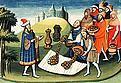
Gideon Collects the Gold Earrings
GOLD & GARMENTS
FIT FOR A KING
And the weight of the gold earrings that he requested was 1,700 shekels of gold: While Gideon refused the request to rule, he certainly did not refuse the "goodies" that are "fit for a king." How much gold was this - estimates are in the range of 42-43 pounds (one source says between 40-75 pounds depending on whether the light or heavy shekel is intended), which in 2022 would be about 964,270 in U.S. dollars, 914,914 in Euros or 772,235 British pounds.
Besides the crescent ornaments and the pendants and the purple robes which were on the kings of Midian, and besides the neck bands that were on their camels' necks: The men gave even more than Gideon's request. "Pendants" (netipoth) occurs in the same list of women's ornaments with regard to v. 21 (Is 3:19, "earrings").
So although Gideon refused to be king, Gideon retains the king's symbols of royalty: the crescent ornaments worn by the camels (Jdg 8:21), the pendants, the purple robes formerly worn by the Midianite kings, the neckbands worn by the camels around their necks! Were his words earlier truly the "high point" of his spiritual life as some interpret? Or were his words a sham humility and external bowing to the Lordship of Jehovah? Or did the coveting virus infect him about this time and spread so rapidly that he quickly forgot his noble defense of the Most High God? We probably won't know until glory but obviously somewhere in this time, in the midst of the "applause" and "adoration" (cp Pr 27:21), Gideon began to get a glimmer in his eye for the finer things of life… and why not? After all he had become the valiant warrior the Angel of the LORD had predicted and valiant warriors were compensated royally.
THOUGHT - Gideon's final lap of the race is food for thought as we all put our pants on the same way Gideon did (cp 1Co 10:12). And our flesh is just as vulnerable to the "viruses" of coveting and pride today as it was in Gideon's day. Jesus warned us to "Keep watching and praying, (present imperative = both verbs are commands to make this one's habitual practice. Why? Because we are continually at risk of falling into the snares of temptation! And see our need to depend on the Holy Spirit to obey) that you may not enter into temptation; the spirit is willing, but the flesh is weak." (Mt 26:41+)
Judges 8:27 And Gideon made it into an ephod, and placed it in his city, Ophrah, and all Israel played the harlot with it there, so that it became a snare to Gideon and his household.
- an ephod: Jdg 17:5 18:14,17 Ex 28:6-12 1Sa 23:9,10 Isa 8:20
- Ophrah: Jdg 8:32 6:11,24 Dt 12:5
- all Israel played the harlot: Ex 23:33 Ps 73:27 106:39 Ho 2:2 4:12-14
- a snare (moqesh): Jdg 8:33 Dt 7:16
- Judges 8 Resources
Related Passage:
Deuteronomy 7:16+ “You shall consume all the peoples whom the LORD your God will deliver to you; your eye shall not pity them, nor shall you serve their gods, for that would be a snare to you.
Judges 2:3+ - “Therefore I also said, ‘I will not drive them out before you; but they will become as thorns in your sides and their gods will be a snare (moqesh) to you.’”
Playing the harlot with the gold Ephod
IDOLATRY LEADS TO
SPIRITUAL IMMORALITY
And Gideon made it into an ephod (ephod), and placed it in his city, Ophrah (map): What a contrast with (Jdg 6:24,27,28) where Gideon built 2 altars to Jehovah and destroyed one idolatrous altar to Baal! Elsewhere in the OT “ephod” denotes the priest’s special breast piece (cf. Ex 28:15-30+). In Jdg 17:5+; Jdg 18:14-20+ the same word refers to the priestly vestments of Micah. But because this object is erected in Gideon’s city and becomes an object of pagan worship the meaning uncertain here.
Gideon may have had good intentions (but I have my doubts about that!) for he may have wanted to consult the Lord's will or to give the people something tangible to remind them of the Lord's intervention. If if we "cut him some slack" his intentions were unbiblical and ultimately destructive! And so we should not be surprised that the idol-prone Israelites made the ephod into an object of worship. Can we not see the incredible irony from the beginning of Gideon's life when he boldly broke up his father's altar to Baal, but now was in effect setting a trap for his own family and the entire nation!
John MacArthur on the ephod - Gideon intended nothing more than to make a breastpiece as David did (1Ch 15:27) to indicate civil, not priestly rule. It was never intended to set up idolatrous worship, but to be a symbol of civil power. That no evil was intended can be noted from the subduing of Midian (v. 28), quietness from wars (v. 28), and the fact that idolatry came after Gideon's death (v. 33) as well as the commendation of Gideon (v. 35). (See MacArthur Study Bible or borrow The MacArthur Study Bible)
Guzik Gideon was remarkably obedient and filled with faith in the extreme moment of battle. The routine of daily living seems to have been a greater test of his character. This is true for many, and the challenges of daily living are more difficult than those of the extreme moment.
Arthur Cundall agrees that "Perhaps it is easier to honour God in some courageous action in the limelight of a time of national emergency than it is to honour Him consistently in the ordinary, everyday life, which requires a different kind of courage. Gideon, who came through the test of adversity with flying colours, was not the first nor the last to be less successful in the test of prosperity.”
(Borrow Judges & Ruth: Tyndale Old Testament Commentary)
Lawson G Stone - The story that began with a divine revelation and the destruction of idols in the Ophrah sanctuary culminates sadly in the erection of a new cultic image in that very place. Gideon's image might not violate the first commandment, since presumably this ephod was dedicated to Yahweh. It did put the second commandment at risk: the worship of the right God in the wrong manner, rejecting divinely revealed truth for images of God of one's own manufacture. (Cornerstone Biblical Commentary: Joshua, Judges, Ruth )
Spurgeon - He did not set up an idol, but he made an ephod, an imitation of that wonderful vestment worn by the high priest. Perhaps he made it of solid gold, not to be worn, but to he looked at, simply to remind the people of the worship of God, and not to be itself worshipped. But ah, dear friends, you see here that, if we go half an inch beyond what God’s Word warrants we always get into mischief! You hear people say, “We have such and such symbols, not to worship, but to help us in worship.” Ah, yes; but the tendency of the symbol is to act as a dam to the stream of devotion, and to make it end there! God forbid that we should ever violate the rules that Christ has laid down for us! The slightest deviation from the simplicity of the gospel may lead us away into sheer apostasy? Whence have come all the errors of Rome but from little accretions and alterations? A little ornament here, a little symbol there, and a little variation of truth yonder and the gigantic system of Romanism has thus been created. Gideon probably meant well, and we may do wrong even though we mean well. May the Lord preserve us from the smallest departure from the way that he has marked out for us in his Holy Word! Amen.
And all Israel played the harlot (zanah; Lxx = ekporneuo - indulge in gross immorality) with it there: Don't miss the impact of this local idol! How many of Israel played the harlot? ALL! Manasseh was centrally enough located that Israelites could come from all directions. They should have been coming to worship Yahweh at the Sanctuary but as explained below they came to worship Baal! Gideon may have made the ephod as a representation of Jehovah, to “help the people” in their worship, but a good motive can never compensate for a bad action. He knew (or should have known) that it was wrong to make an idol (Ex 20:4-6+). And as we so often see in Scripture where there is idolatry, there is often immorality! (cp Eph 5:5+, Col 3:5+, Rev 2:14+, Rev 2:20+, Rev 21:8+, Rev 22:15+)
Related Resource
This image was a seismic shift downward in Israel's relationship with Yahweh.
-- Lawson Stone
So that (purpose clause) it became a snare (moqesh) to Gideon and his household -- Snare (moqesh) is something (often something deceptively seductively attractive) that catches your eye and then entangles you. Gideon was unwary and was deceived by the attractiveness of the ephod to which he basically became a slave! This is the same man on whom the Spirit had come to "clothe him!" Gideon's household suffered as a result of his idolatry, for in Jdg 9:5 we read of the death of all but one of Gideon’s 70 sons because one named Abimelech wanted to be king.
ESV Study note - According to the Mosaic law, there was to be only one ephod in Israel, and it was to have a “breastpiece of judgment” (Ex. 28:15-30). The ephod was used to inquire of God (cf. 1Sa 14:3; 23:9; 30:7). By setting up another ephod in his own city, Gideon may have been making it his own to use, at his own whim. Ultimately, it became a snare to Gideon and his family, echoing Jdg. 2:3. (Borrow the ESV Study Bible)
The danger of idolatry ensnaring one's heart was a repeated warning to Israel (and no less of a warning to us today!)...
Judges 2:3+ “Therefore I also said, ‘I will not drive them out before you; but they shall become as thorns in your sides, and their gods shall be a snare to you.’”
Joshua 23:13+ know with certainty that the LORD your God will not continue to drive these nations out from before you; but they shall be a snare and a trap to you, and a whip on your sides and thorns in your eyes, until you perish from off this good land which the LORD your God has given you.
THOUGHT - Mark this principle down! When we insist on having what God has not given us, we are always ensnared. God does not usually prevent our gratification of our sinful longings. He will often allow us to have what we have been determined to get, but the fruit is bitter and the emotion is vexed.
Whatever Gideon's purpose was, one thing appears certain -- it represented an intrusion into the divinely prescribed ministry of the high priest, probably relating to the proper use of the Urim (urim) and Thummin (tummiym) (Ex 28:30+). Its use by Gideon (who was not a Levite) was contrary to God's Word. Furthermore at that time in Israel's history, the only divinely decreed worship center was Shiloh, not Ophrah. It is always a mistake to substitute a man's plans for the commandments of God. And so the ephod would prove to be like bait that lures a bird into the fowler's net and it would be the beginning of a sad decline in Gideon's life. It is sad to see the man who overthrew Baal’s altar now setting up an idol of his own. Unfortunately, the whole nation forsook God and worshiped the new god
THOUGHT - And so beloved here is the question: Do you have an ephod? What is your "ephod"? On what or whom do you set your heart? On God or on your "ephod"? Beware for the corrupting effect of the "ephod" can be most subtle and deceptive. Remember that Colossians 3:5+ gives us an expansive definition of idolatry, Paul writing that "greed....amounts to idolatry" and a "covetous man...is (present tense) an idolater" and such a man who continually indulges in such a practice has no inheritance in the kingdom of Christ and God! (Eph 5:5+). Anything you desire more than God is your idol! Paul says we have to mortify these idols (Col 3:5KJV+). Or as Puritan John Owen said "Be killing sin, lest it be killing you!"
John Hunter writes: "In some ways we can be like this. Great men and women can be used of the Lord. They can then start organizations, societies, or denominations, to commemorate and extend the glory of God in their work. These can function wonderfully as planned -- to begin with. But then as the vision goes, so does the response of those who follow those leaders. (cp Pr 29:18) This can deteriorate until the purpose of the organization, society, or denomination becomes simply to maintain its own entity. So we find people dedicated to keep a certain movement in existence, regardless of whether the Lord is purposing to use it or not. Their "ephod" takes their allegiance and true effort away from the living Lord to a dead society."
Ephod (0646) (epod) is a masculine noun referring to the sacred vestment worn over the chest and heart area by the high priest (see above). "A garment worn around the high priest’s upper body that featured twelve semi-precious and precious stones on the front, each one bearing the name of one of the tribes of Israel (Ex. 28:4, 6, 12, 15, 25–28+). The breastplate bearing the stones was on the front of the ephod itself. The ephod was made by a skilled workman and had two shoulder pieces which were fastened together to hold it securely. It also bore two stones, one on each of its shoulders that represented the tribes of Israel. Each stone had six of the tribes of Israel engraved on it." (Baker) The Hebrew word ephod also described a vestment worn by David (2Sa 6:14, 1Ch 15:27) and the boy Samuel (1Sa 2:18). Gideon made an ephod which was an idolatrous cultic object (Jdg 8:27) In Hos 3:4 it is one of the sacred items the sons of Israel will lose access to for a period of time (because of disobedience).
R K Harrison - The term ephod was also used occasionally to describe an ‘idol’ (cf. Jdg. 8:27; 17:5) which was employed in family worship, but precisely why such an image was described by a name used for a well-attested object in Israelite tabernacle worship is unknown. (Tyndale Old Testament Commentaries - Leviticus)
NET Note - The ephod was an apron like garment suspended from shoulder straps. It draped over the robe and extended from the chest down to the thighs (Ex 28:4, 6–14, 25–28; 29:5; 39:2–7).
Vine - The “ephod” of the high priest was fastened with a beautifully woven girdle (Ex 28:27-28) and had shoulder straps set in onyx stones, on which were engraved the names of the twelve tribes.
The Lxx translates ephod most often using the Greek noun epomis which means a shoulder piece.
Ephod - 49x in 39v- Exod. 25:7; Exod. 28:4; Exod. 28:6; Exod. 28:12; Exod. 28:15; Exod. 28:25; Exod. 28:26; Exod. 28:27; Exod. 28:28; Exod. 28:31; Exod. 29:5; Exod. 35:9; Exod. 35:27; Exod. 39:2; Exod. 39:7; Exod. 39:8; Exod. 39:18; Exod. 39:19; Exod. 39:20; Exod. 39:21; Exod. 39:22; Lev. 8:7; Jdg. 8:27; Jdg. 17:5; Jdg. 18:14; Jdg. 18:17; Jdg. 18:18; Jdg. 18:20; 1 Sam. 2:18; 1 Sam. 2:28; 1 Sam. 14:3; 1 Sam. 21:9; 1 Sam. 22:18; 1 Sam. 23:6; 1 Sam. 23:9; 1 Sam. 30:7; 2 Sam. 6:14; 1 Chr. 15:27; Hos. 3:4
Good Intentions - Have you ever had one of those "I was just trying to help" moments? Maybe you offered to carry the cake to the table and you dropped it. Or perhaps you offered to dog-sit your neighbor's pooch and the little guy ran away.
In Judges 8, it appears that Gideon tried to do a good thing. But the result was tragic. Impressed by his military exploits, the men of Israel asked Gideon to be their king. To his credit, he refused (Judges 8:22, 23). But then he asked them to donate gold earrings, which he made into an "ephod" (Jdg 8:27). This was either a sacred garment worn by the high priest or some type of image. Why did he do this? We don't know for sure, but Gideon may have been trying to provide spiritual leadership. Whatever his motive was, God hadn't told him to do this.
When Gideon set up the ephod in Ophrah, it drew the people's attention away from worship of the Lord and led them into idolatry (Jdg 8:27). And as soon as Gideon died, the people found it easy to go back to worshiping the Baals (Jdg 8:33).
Gideon may have had good intentions, but he made the mistake of acting without consulting the Lord. Let's be careful not to allow anything to take our eyes off our loving, holy God—or it will lead us and others astray. — Dave Branon (Our Daily Bread, Copyright RBC Ministries, Grand Rapids, MI. Reprinted by permission. All rights reserved)
The Word of God provides the light
We need to see the way;
If we obey what God has said,
We'll not be led astray. —Sper
Good intentions are no substitute for obedience.
Played the harlot (02181)(zanah) is a verb meaning to fornicate, to prostitute and refers to marital infidelity or unfaithfulness. It was word used elsewhere in the OT to describe prostitution (Lev 21:7, Pr 7:10). Many of the uses of zanah are figurative describing Israel 's (Jehovah's "wife") commission of "spiritual prostitution" by having "intercourse" so to speak with other gods (cp 1 Co 6:16). Indeed, idolatry is looked upon as prostitution (Isa 50:1-3; 54:6, 7, 8; Jer 2:1-3; 3:1ff; Hos 2:1ff; Jas 4:4+; Rev 2:4+). In addition zanah describes Israel’s improper relationships with other nations (Isa. 23:17; Ezek. 23:30; Nah. 3:4). "The thought seems to be of having relations with these nations for the sake of political and monetary benefit, although in the case of Nineveh the added element of alluring, deceitful tactics leading on to oppressive dominance is implied. A third figurative meaning is found in Isa 1:21, where the Israelites’ departure from God’s approved moral standards is called harlotry." (link to TWOT online) CLICK HERE TO SEE THE REMAINDER OF THIS LENGTHY DEFINITION BELOW
Snare (04170)(moqesh from yaqosh) is a masculine noun meaning a snare, a trap, bait. The picture is of the lure or bait being placed in the hunter’s trap, which gives rise to moqesh referring to the snare itself. Traps were used to capture birds or beasts (Amos 3:5). As used in Judges 8:27 moqesh refers to a moral pitfall (Pr. 18:7; 20:25). Moqesh can be anything that lures one to ruin and disaster (Jdg. 2:3; Pr 29:6).
The Septuagint translates moqesh in Jdg 8:27 (Jdg 2:3, 1 Sa 18:21, Ps 106:36) with the Greek word skandalon (see word study), which is literally, that part of a trap on which the bait was laid, when touched caused the trap to close on its prey and came to mean any entanglement of the foot. That's a picture of sin which looks alluring, but if touched, will surely captivate and capture its foolish prey. I
Septuagint also translates moqesh with proskomma (Ex 23:33, 34:12) which refers to that which causes one to stumble (figuratively) as in Ro 14:13, 20, 1 Pe 2:8, etc. Other passages translate moqesh with pagis (Josh 23:13) which refers literally to anything that catches and holds fast (1 Ti 6:9, 2 Ti 2:26).
Holman Bible Dictionary - Trap to catch birds and animals. There were basically two kinds of snares. One used rope or cord. Either the animal stepped in the trap and was snared by the feet, or the rope fell from above and caught the animal by the neck. The most common was a trap with a net. The animal would be attracted by the bait. When the baited trigger was released, the net covered the animal and captured it. Also the opening of a pit would be camouflaged with cover. The animal would fall into the pit and be captured. Figuratively, snares spoke of peril or death and the destruction of persons (Job 22:10 ; Psalm 18:5 ; compare 1 Samuel 28:9).
Brown-Driver-Briggs Expanded Definition - [ מוֺקֵשׁ noun masculine Pr 12:13 properly a bait or lure in a fowler's net; then figurative snare — absolute מוֺקֵשׁ Exodus 10:7 15t.; construct Proverbs 18:7; Proverbs 20:25; plural מוֺקְשִׁים Psalm 64:6; Job 40:24; מֹקְשִׁים Psalm 140:6; construct מוֺקְשֵי Psalm 18:6 3t.; מֹקְשֵׁי 2 Samuel 22:6; f. מֹקְשׁוֺתPsalm 141:9; bait or lure, in a net for birds Amos 3:5; will not pierce nostril of hippopotamus Job 40:24; elsewhere figurative of what allures and entraps any one to disaster or ruin; Moses a snare to Egyptians Exodus 10:7 (J); מוֺקְשֵׁי עָם Job 34:30, of men who are the ruin of their people; idols and idol-worship a pernicious lure to Israel Exodus 23:33 (JE), Deuteronomy 7:16; Judges 2:3; Judges 8:27; Psalm 106:36; so alliances with Canaanites Exodus 34:12 (JE), Joshua 23:13 (D); Michal, to David 1 Samuel 18:21; of ׳י as cause of ruin to evildoers Isaiah 8:14; of plots of wicked Psalm 64:6; Psalm 140:6 (verb שִׁית; "" מַּח, חֲבָלִים, רֶשֶׁת), Psalm 141:9 (מַּח); a lure or snare for wicked in their transgressions Proverbs 29:6; Psalm 69:23 ("" מַּח); consisting in transgressions of lips Proverbs 12:13, compare Proverbs 18:7; Proverbs 20:25; in wrathfulness Proverbs 22:25; in fear of man Proverbs 29:25; מָוֶת׳מ Psalm 18:6 = 2 Samuel 22:6 ("" חֶבְלֵי שְׁאוֺל), Proverbs 13:14; Proverbs 14:27.
Moqesh - 27 verses - Usage: bait(1), barbs(1), ensnared(2), snare(12), snares(8), trap(4). Ex 10:7; Ex 23:33; Ex 34:12; Dt 7:16; Jos 23:13; Jdg 2:3; Jdg 8:27; 1Sa 18:21; 2Sa 22:6; Job 34:30; Job 40:24; Ps 18:5; Ps 64:5; Ps 69:22; Ps 106:36; Ps 140:5; Ps. 141:9; Pr 12:13; Pr 13:14; Pr 14:27; Pr 18:7; Pr 20:25; Pr 22:25; Pr 29:6; Pr 29:25; Isa. 8:14; Amos 3:5
QUESTION - What was the significance of the ephod? (See also Bible Dictionary discussions)
ANSWER - In the Old Testament, the ephod has two meanings. In one group of passages, it signifies a garment; in another, very probably an image. As a garment the ephod is referred to in the priestly ordinances as a part of the official dress of the high priest. It was to be made of threads “of blue and of purple, of scarlet, and fine twined linen” and embroidered in gold thread “with cunning work” (Ex 28:4; 29:5; 39:2; Lev 8:7).
The ephod was held together by a girdle of similar workmanship sewed on to it. It had two shoulder pieces, which, as the name implies, crossed the shoulders, and were apparently fastened or sewed to the ephod in front. In dressing, the shoulder pieces were joined in the back to the two ends of the ephod. Nothing is said of the length of the garment. At the point where the shoulder pieces were joined together in the front “above the girdle,” two golden rings were sewed on, to which the breastplate was attached.
The word ephod has an entirely different meaning in the second group of passages, all of which belong to the historical books. It is certain that the word cannot here refer to a garment. This is evident in Judges 8:26–27, where it is recorded that Gideon took from the Ishmaelites, who were Midianite allies, golden earrings, weighing 1,700 shekels of gold, and made an “ephod thereof, and put it in his city, even in Ophrah,” where it was worshiped by all Israel. In Judges 17:5, Micah made an ephod and teraphim, or idol, for his sanctuary. The most natural inference from all these passages is that “ephod” here signifies an image that was set up in the sanctuary, especially since the word is cited with teraphim, which undoubtedly refers to graven images (Hosea 3:4). The conclusion is that ephod, in these cases, refers to a portable idol. Some scholars have suggested that the connection between the idol and the garment is that the idol was originally clothed in a linen garment, and the term ephod gradually came to describe the idol as a whole. (GotQuestions.org)
QUESTION - What were the Urim and Thummim?
ANSWER - The Urim ("lights") and Thummim ("perfections") were gemstones that were carried by the high priest of Israel on the ephod / priestly garments. They were used by the high priest to determine God’s will in some situations. Some propose that God would cause the Urim and Thummim to light up in varying patterns to reveal His decision. Others propose that the Urim and Thummim were kept in a pouch and were engraved with symbols identifying yes / no and true / false.
It is unclear whether the Urim and Thummim were on, by, or in the high priest’s ephod. No one knows the precise nature of the Urim and Thummim or exactly how they were used. The Bible simply does not give us enough information. References to the Urim and Thummim are rare in the Bible. They are first mentioned in the description of the breastplate of judgment (Ex 28:30; Lev 8:8). When Joshua succeeded Moses as leader over Israel, he was to receive answers from God by means of the Urim through Eleazar the high priest (Numbers 27:21). The Urim and Thummim are next mentioned in Moses’ dying blessing upon Levi (Dt 33:8). The following Scriptures likely also speak of the Urim and Thummim: Josh 7:14-18; 1Sa 14:37-45; and 2Sa 21:1. (GotQuestions.org)
QUESTION - Why was the worship of Baal and Asherah a constant struggle for the Israelites?
ANSWER - Throughout the Old Testament in the Bible, we find what seems a confusing trend of idol worship among the Israelites, who especially struggled with the worship of Baal and Asherah (or Ashtoreth). God had commanded Israel not to worship idols (Exodus 20:3; Deuteronomy 5:7)—indeed, they were to avoid even mentioning a false god’s name (Exodus 23:13). They were warned not to intermarry with the pagan nations and to avoid practices that might be construed as pagan worship rites (Leviticus 20:23; 2 Kings 17:15; Ezekiel 11:12). Israel was a nation chosen by God to one day bear the Savior of the world, Jesus Christ. Yet, even with so much riding on their heritage and future, Israel continued to struggle with idol worship.
After the death of Joshua, the worship of Baal and Asherah became a plague upon the Israelites and was a perennial problem. Baal, also known as the sun god or the storm god, is the name of the supreme male deity worshiped by ancient Phoenicians and Canaanites. Asherah, the moon goddess, was the principal female deity worshiped by ancient Syrians, Phoenicians, and Canaanites. The Israelites neglected to heed the Lord’s warning not to compromise with idolaters. The ensuing generations forgot the God who had rescued them from Egypt (Judges 2:10–12).
Of course, the period of the judges wasn’t the first time Israel had been tempted by idol worship. In Exodus 32, we see how quickly the Israelites gave up on Moses’ return from Mount Sinai and created an idol of gold for themselves. Ezekiel 20 reveals a summary of the Israelites’ affairs with idols and God’s relentless mercy on His children (also see 1 & 2 Samuel, 1 & 2 Kings, 1 & 2 Chronicles).
As for why the worship of Baal and Asherah specifically was such a problem for Israel, there are several reasons we can cite: first, the worship of Baal and Asherah held the allure of illicit sex, since the religion involved ritual prostitution. This is exactly what we see in the incident of Baal of Peor, as “the men began to indulge in sexual immorality with Moabite women, who invited them to the sacrifices to their gods” (Numbers 25:1–2). It was during this episode that an Israelite named Zimri brazenly brought a Midianite woman into the camp and went straight to his tent, where the two began having sex (verses 6–8, 14).
Another reason that the worship of Baal and Asherah was a perennial problem for Israel is due to what we could call national peer pressure. Israel wanted to be like the other nations (see 1 Samuel 8:5, 20). The other nations worshiped Baal and Asherah, and so many Israelites felt a pull to do the same.
Of course, we cannot overlook the fact of Satan’s temptations and mankind’s basic sinfulness. The enemy of our souls tempted Israel to worship idols; the sacrifices made to Baal and Asherah were really sacrifices to demons (1 Corinthians 10:20). The stubborn willfulness of humanity works in tandem with Satan’s seductions and causes us to jump at any chance to rebel against God. Thus Israel repeatedly forsook God’s commands, despite losing God’s blessings, and chased after the Baals and Asherahs to their own destruction.
The book of Hosea aptly uses adultery as a metaphor in describing Israel’s problem with idol worship. The Israelites were trapped in a vicious cycle of idol worship, punishment, restoration, then forgiveness, after which they went back to their idols once more. God’s patience with Israel is unfathomable by human standards; God’s nature is the essence of love, and He gives His sons and daughters chances to repent (1 John 4:8; Romans 8:38–39; 2 Peter 3:9).
The problem of Baal and Asherah worship was finally solved after God removed Israel from the Promised Land. Due to the Israelites’ idolatry and disregard of the Law, God brought the nations of Assyria and Babylon against them in an act of judgment. After the exile, Israel was restored to the land, and the people did not dally again with idols.
While Christians today may be quick to judge the Israelites for their idolatry, we must remember that idols take many forms. Idolatrous sins still lure and tempt the modern-day believer (Romans 3:23; 1 John 1:8–10), though perhaps they have taken new shapes. Instead of ancient forms of Baal and Asherah, we today sometimes honor possessions, success, physical pleasure, and religious perfection to the dishonoring of God. Just as God disciplined the Israelites for their idolatry and forgave them when they repented, He will graciously discipline us and extend the offer of forgiveness in Christ (Hebrews 12:7–11; 1 John 1:9; 2 Peter 3:9).GotQuestions.org
Related Resources:
- What is the definition of idolatry? | GotQuestions.org
- What are some modern forms of idolatry? | GotQuestions.org
- Is religious iconography considered idolatry? What is an icon? | GotQuestions.org
Judges 8:28 So Midian was subdued before the sons of Israel, and they did not lift up their heads anymore. And the land was undisturbed for forty years in the days of Gideon.
- Midian: Ps 83:9-12 Isa 9:4 10:26
- forty years: Jdg 3:11,30 5:31
- Judges 8 Resources
MIDIAN FINALLY
FULLY SUBDUED
So Midian was subdued (kana) before the sons of Israel, and they did not lift up their heads anymore: Like an animal no longer able to toss its horns and charge against the foe, Midian could not "raise its head." As He always does, God fulfilled His promise to Gideon first given in Judges 6:14 that He would use Gideon to "deliver Israel from the hand of Midian."
And the land was undisturbed (shaqat) for forty years in the days of Gideon: The length of 40 years here and Jdg 5:31-+ seems to equate with a "generation". Thus one might reason that when the generation that knew God and His mighty deeds died out (Jdg 2:7-11+), evil crept back in and took control of their hearts. It is interesting but sad that this verse marks the last reference to peace in the book of Judges (Jdg 3:11, 30; 5:31). No subsequent judge will receive this commendation about the land being undisturbed (the length the judged judged is mentioned but no mention of "rest" - Jdg 12:9, 11), which is another thought to support the general degradation in the spiritual and moral climate over the last 100 to 150 years (estimate). From now on, oppression will dominate over leadership, and the land will have no rest. One might even propose that Gideon was the last of the "good" judges (just a thought to ponder).
It is tough to end well. Any believer knows that.
-- Ralph Davis
Ralph Davis adds that "after this the land will no longer recover its rest. Judges will show you. that Yahweh’s mercy is deep but not easygoing; it is tender but will not be trampled. The word it preaches is not “though it makes him sad to see the way we live, he’ll always say, ‘I forgive’ “ (a la the sentimental song of the fifties) but “do you despise the riches of his kindness and forbearance and long suffering, ignorant of the fact that the kindness of God leads you to repentance?” (Ro 2:4+). It is tough to end well. Any believer knows that. “He will keep you strong to the end” (1Cor. 1:8NIV) — that is one’s only assurance. (Focus on the Bible: Judges)
Subdued (03665) kana is a verb which has the basic meaning of being lowly, meek. In the OT there are two main senses in the OT, the most common meaning to subdue (akin to "political humiliation") and the second meaning to humble oneself (Lev 26:41, 1 Ki 21:29 twice, 2 Ki 22:19, 2 Chr 7:14, 2 Chr 12:5-7, 12:12, 30:11, 32:26, 33:12, 19, 23, 34:27, 36:12). In regard to nations being subdued Judges 3:30+ says "So Moab was subdued that day under the hand of Israel. And the land was undisturbed for eighty years." But then we see that they power to subdue is from God for Judges 4:23+ says "So God subdued on that day Jabin the king of Canaan before the sons of Israel." This is a wonderful truth and comforting thought for all God's people living in a world where evil seems to be out of control, but it is not out of control because God is sovereign and in control and as Paul says "And the God of peace will soon crush Satan under your feet. The grace of our Lord Jesus be with you." (Ro 16:20+)!
Undisturbed (08252) shaqat means to be still, to be quiet, to be undisturbed thus describing the state or condition of tranquility. Basically the meaning of shaqat is a state of tranquility, as when the land has absence of war (2Chr 20:30). The first use in Joshua is used figuratively to describe that "the land had rest (Lxx = katapauo = to cause something to cease, to cause to be at rest - Heb 4:4, 8, 10) from war." (Josh 11:23, cp similar uses in Josh 14:15, Jdg 3:11, 30; 5:31; 8:28) In Ruth 3:18-+ Naomi tells Ruth that Boaz "will not rest (Lxx = hesuchazo = to be at rest)" until he resolves the matter of who is to be the kinsman redeemer
Shaqat in Judges - Jdg. 3:11; Jdg. 3:30; Jdg. 5:31; Jdg. 8:28; Jdg. 18:7; Jdg. 18:27;
Related Resource:
Judges 8:29 Then Jerubbaal the son of Joash went and lived in his own house.
- Jerubbaal: Jdg 6:32 1Sa 12:11
- in his own house: Ne 5:14,15
Then - This usually marks progression in a narrative.
Jerubbaal the son of Joash went and lived in his own house - The writer again returns to the name Jerubbaal, the last use having been in Judges 7:1. The text adds that he lived in his own house, not that he lived in a palace like a king. Nevertheless, as discussed, he had many of the advantages of a king.
Judges 8:30 Now Gideon had seventy sons who were his direct descendants, for he had many wives.
- Now Gideon had seventy son: Jdg 9:2,5 10:4 12:9,14 Ge 46:26 Ex 1:5 2Ki 10:1
- he had many wives: Ge 2:24 7:7 Dt 17:17 2Sa 3:2-5 5:13-16 1Ki 11:3 Mal 2:15 Mt 19:5-8 Eph 5:31-33
- Judges 8 Resources
Now Gideon had seventy sons who were his direct descendants, for he had many wives: With his vast wealth and his great national reputation, Gideon probably thought that his children were well provided for, but just the opposite proved true. Sixty-nine of his seventy sons were killed by their half-brother who himself was slain by a woman dropping a stone on his head. There is no security apart from the will of God. Had Gideon practiced Mt 6:33+, subsequent events might have been radically different.
Many wives is proof of Gideon's great prosperity and also indicates his slide into depravity because polygamy is a sin and was never God's plan for marriage (cf Ge 2:24). Sin is deceitful (Heb 3:13+) and slowly seeps into one's life unless diligently guarded against! As wealth and prestige increased in the ancient world, so did one's harem. King Ahab for example had seventy sons (2Ki 10:1), and even some of Gideon's successors had many sons - thirty (Jdg 10:4+; Jdg 12:9+) forty (Jdg 12:14+). And so it is not surprising that the hatred and murder that plagued Gideon's family were the rotten fruit of his polygamous practices. Clearly Gideon either had not read the words of Moses (or he simply refused to comply) which said (referring to a king) "He shall not multiply wives for himself, or else his heart will turn away; nor shall he greatly increase silver and gold for himself." (Dt 17:17), Gideon was guilty on both accounts! And while Gideon refused to take be crowned king (Jdg 8:22,23), his lifestyle was essentially that of self-indulgent royalty, and it set the stage for the next chapter of Israel's sordid apostasy and anarchy.
Guzik A harem was not only a reflection of a man’s inability to control his sexual lust, it was also a way for him to proudly express his wealth, by saying “Look at all the wives and children I can support.”The Old Testament never directly condemns polygamy (though the New Testament does in Matthew 19:4-6 and 1 Timothy 3:2). Yet the Old Testament shows the bitter fruit of polygamy. The stories of polygamous families in the Old Testament (such as with Jacob or David) are the stories of conflict and crisis.
J. Vernon McGee - "Gideon had many wives and a concubine besides. He had a total of seventy-one sons. That is a real blot on this man’s life. Now someone will say, as they did about Solomon, “How could God use a man like this and why did He use him?” Well, Gideon took these many wives and had all these children after the battle. And the fact of the matter is that God used him in spite of this. God did not approve of what he did. The record makes it clear that his actions brought tragedy to the nation of Israel. The next chapter brings that out. God had forbidden intermarriage outside the nation. He had forbidden the Israelites to have more than one wife. God did not create several Eves for Adam. He created only one. God did not remove all of Adam’s ribs. God took out only one rib. Abraham, you remember, took a concubine, that little Egyptian maid named Hagar and, believe me, it caused trouble. God never sanctioned it." (Thru the Bible)
Related Resources:
- Why did God allow polygamy / bigamy in the Bible? | GotQuestions.org
- Bible Dictionary Articles on Polygamy
Judges 8:31 And his concubine who was in Shechem also bore him a son, and he named him Abimelech.
- concubine: Jdg 9:1-5 Ge 16:15 22:24
- Abimelech: Jdg 9:18 Ge 20:2
- Judges 8 Resources
THE CONSEQUENCES OF
COHABITING WITH A CONCUBINE
And his concubine who was in Shechem also bore him a son, and he named him Abimelech Gideon fell severely into the sin of polygamy, an iniquity tolerated in the OT but a clear perversion of God’s will for marriage. Even the name Gideon gave this son conceived in sin with the concubine is telling for Abimelech means "My father the king." What was Gideon thinking? In a word, he wasn't! Or perhaps he was thinking this son will be the future leader of Israel. Oh, how wrong he proved to be!
Gideon handled adversity better than success.
-- David Guzik
Arthur Cundall - There is a marked contrast between the seventy sons and Abimelech. The former ‘came out of his loins’ (so the meaning of the Hebrew), the seat of procreative power, the meaning being that they were reckoned by male descent to his own tribe. Abimelech, on the other hand, was the son of a concubine who probably remained with her own family group in Shechem, being visited by her husband from time to time. A similar situation may be observed in the case of Samson (Jdg 15:1; 16:4ff.). It is important to observe that any offspring of such a union belonged to the wife’s family. Thus the seventy legitimate sons traced their descent through Gideon and Abiezer, but Abimelech’s lineage was reckoned through his Shechemite mother. (Borrow Judges & Ruth: Tyndale Old Testament Commentary)
Gary Inrig - In grace, the Holy Spirit does not dwell upon this part of Gideon’s biography. However, enough is said for us to realize what happened. The man who refused the throne adopted a very kingly lifestyle.
1. His royal harem. Occasionally, an ordinary Israelite might have more than one wife, but large-scale polygamy was practiced only by rulers because they were the only ones who could afford it. Gideon adopted not only the Canaanite’s idea of having a harem but apparently their moral standards as well, because he had a concubine in Shechem.
2. His royal luxury. Gideon lived in royal prosperity. He began his career by describing himself as “weakest in Manasseh” (6:15), but he ended his life enjoying great luxury. This is exactly what God warned against in Deuteronomy 17:17: “[A king] must not take many wives, or his heart will be led astray. He must not accumulate large amounts of silver and gold.
3. His royal title. The final evidence of Gideon’s backsliding is found in the name he gave his son. Gideon chose his name very deliberately. Abimelech—“My father is king.” Every time that boy gave his name, he claimed for his father what Gideon had apparently renounced in Jdg 8:23. More than that, chapter 9 reveals that his family received the impression that the next king would come from among Gideon’s sons. How far away his great victory was now! (Hearts of Iron, Feet of Clay - borrow for an hour)
Related Resources:
- What is a concubine? Why did God allow men to have concubines in the Bible? | GotQuestions.org
- Bible Dictionary articles on Concubine
- Wikipedia - Concubinage
Judges 8:32 And Gideon the son of Joash died at a ripe old age and was buried in the tomb of his father Joash, in Ophrah of the Abiezrites.
- died: Ge 15:15 25:8 Jos 24:29,30 Job 5:26 42:17
- Ophrah: Jdg 8:27 6:24
- Judges 8 Resources
DEATH AT A RIPE
OLD AGE
And Gideon the son of Joash died at a ripe old age (lit = "gray-headed"): It is interesting that the writer does not record the exact age of death of any of the judges. The account of Gideon's life in one sense ends here but really does not end until with chap. 9, not chap. 8. This chapter provides us with the real legacy of Gideon. Gideon's death notice further attests his importance, for only he and Samson are said to have been buried in the tomb of his father.
To die "at a ripe old age" implies a long and full life. Elsewhere in the OT the expression is used only of Abraham (Ge 15:15; 25:8) and David (1Ch 29:28)!
And was buried in the tomb of his father Joash, in Ophrah of the Abiezrites: Before the battle against Midian, Gideon humbly depended on the Lord. During the “mopping up” operations, however, he became authoritative and even vindictive. After his victory over Midian we don’t find Gideon honoring the Lord or calling the people together to renew their covenant to obey the Lord (Like King Josiah did - 2Ki 22:8, 11-20). Gideon started out as a servant, but ended up like a celebrity and the result was decline for him, his family, and his nation.
It’s interesting and instructive to contrast Abraham and Gideon in the decisions they made after their respective victories (Ge 14). Abraham took nothing for himself but made sure that others received their share of the spoils (Ge 14:22, 23, 24). He especially refused to take anything from the heathen king of Sodom (Ge 14:17, 21). Instead, Abraham fellowshipped with Melchizedek, King of Salem, a type of our Lord Jesus Christ (Heb 7-8); and in all that he said and did, Abraham gave glory to the Lord of heaven and earth.
After winning a great victory, we must always beware of the temptation to sin,
for Satan attacks us subtly when we least expect it.
Andrew Bonar warned regarding "mountain top" experiences “Let us be as watchful after the victory as before the battle.”
Lawson Stone - Gideon presents a mixed legacy. None of this should surprise the reader. The history of the Christian church includes many "great servants of God" who accomplished fine things for the Kingdom, but whose legacy was tarnished or corrupted by their refusal to accept responsibility for their achievements and for the next generation. One could name founders of worldwide mission organizations, great evangelists and pastors, prolific and profound authors, who all did powerful work for the gospel in the world. But the tales told by wives, children, friends, and colleagues often reveal a tarnished legacy. Gideon stands as a reminder that not only must we answer the call and fight the battles, winning the war; we must also win the peace. The responsibility of leadership, continuity, and wholeness in our relationships is as much a part of our legacy as souls won, books written, or kingdoms built. (See Joshua, Judges, Ruth)
In another note Stone adds "Few statements epitomize the story of Abimelech's father, Gideon, better than that associated with the founder of the modern missionary movement, William Carey, who said, "Expect great things from God; attempt great things for God." Such should have been Gideon's legacy. But just as the church founded to honor Carey's legacy in Lester, England, has become a Hindu temple, so the legacy of Gideon dissolved in the events that followed his death. (See context Joshua, Judges, Ruth)
Judges 8:33 Then it came about, as soon as Gideon was dead, that the sons of Israel again played the harlot with the Baals, and made Baal-berith their god.
- as soon as Gideon was dead Jdg 2:7-10,17,19 Jos 24:31 2Ki 12:2 2Ch 24:17,18
- that the sons of Israel again played the harlot with the Baals: Jdg 8:27 2:17 Ex 34:15,16 Jer 3:9
- Baalberith: Jdg 9:4,46
- Judges 8 Resources
ISRAEL'S IMMEDIATE
APOSTASY!
Then - Marks a sad progression is the "Gideon narrative." The "restrainter" (Gideon) is removed and Israel immediately reverts to idolatry!
It came about, as soon as Gideon was dead: What an incredible time phrase (then...as soon as)… it is almost as if the people were waiting for Gideon to die so that they could carry on with business as usual. A judge's death seemed to be like a "signal" to the Israelites to begin a new plunge into apostasy (and after 40 years of rest many would have been the next generation -- it is like this "idol virus" was transferred from one generation to another!).
As soon as Gideon was dead the spiritual and moral condition of the people reverted back to its previous state. This is one reason I contend that none of the cycles of restoration really reflected genuine repentance. When one is revived, he desires the Word, and I don't see that desire manifest anywhere dure the 300-350 years of the period of the Judges. Proverbs records the problem that "Where there is no vision (divine revelation, oracle, vision or word from God), the people are unrestrained (run wild, are uncontrolled), but happy (blessed, spiritually prosperous) is he who keeps the law." (Proverbs 29:18+) Similarly there is no mention of worship of Yahweh, except for Jdg 7:15+. And finally there is no mention of the Passover, which was to have been celebrated annually as a memorial. It almost seems like the people of Israel were waiting for the old hero to go.
Lawson Stone on As soon as Gideon was dead - The Hebrew implies an immediate, even concurrent, event. The death of a judge is stated in 2:16-19 to signal a new plunge into apostasy. Othniel's (3:11-12) and Gideon's (8:33-35) deaths follow this pattern. There is no such pattern for the intervening judges. (See Joshua, Judges, Ruth)
That the sons of Israel again played the harlot (zanah; Lxx = ekporneuo - indulge in gross immorality) with the Baals (plural), and made Baal-berith their god: They "prostituted themselves" (NLT)! Israel had Jehovah Who had cut a covenant with them at Mount Sinai, but in the hardness of their hearts, they stubbornly rebelled against God's lordship and in place of the true God they made a false god Baalberith which means "the lord of the covenant." Israel broke their "marriage covenant" with Yahweh so that they could enter into a deadly "marriage covenant" with Baal-berith. How tragically ironic that this apostate act of spiritual harlotry "reverses" the first acts Gideon performed in destroying the altar to Baal and renewing offerings to Yahweh at Ophrah! Note that Baal means not only "lord" but also "husband." The point is that Israel did not just worship Baal but in effect made Baal-berith their national god, thus abrogating the covenant with the true and living God. This full court press into idolatry sets the stage for some of the ugliest chapters in Israel's history!
Stone has an interesting comment - Gideon's refusal of a position of leadership and the construction of the ephod (Jdg 8:22-27) dramatized an important principle: When legitimate human leadership abdicates, effectual divine leadership evaporates. Thinking he was assuring God's continued rule over Israel, Gideon actually ensured that the people would "play the harlot" and abandon Yahweh. With Yahweh abandoned, the legacy and family of his servant Gideon was doomed. Not only had Gideon's repudiation of human rule ended up perverting divine rule, it had actually recoiled on his own career, spoiling his legacy. The prologue to the Abimelech story (Jdg 8:33-35), coming on the heels of the ephod debacle, shows that when divine rule is rejected, as in Israel's apostasy, human rule is threatened as well. So divine rule and human rule, far from being antagonists, would stand as joint victims of spiritual harlotry. (See context Joshua, Judges, Ruth)
All uses of zanah in Judges - Jdg. 2:17; Jdg. 8:27; Jdg. 8:33; Jdg. 11:1; Jdg. 16:1; Jdg. 19:2 (the last 3 uses speak of literal harlotry or harlot).
"If we are not willing to be governed by God, we shall be ruled by tyrants."
-- William Penn
ILLUSTRATION - BLACK TUESDAY - What happens when a "Gideon" dies, when they is no one to restrain the people. Well on October 7, 1969 the city of Montreal, Canada found out because on that day the police force went on strike. Because of what resulted, the day has been called Black Tuesday. A burglar and a policeman were slain. Forty-nine persons were wounded or injured in rioting. Nine bank holdups were committed, almost a tenth of the total number of holdups the previous year along with 17 robberies at gunpoint. Usually disciplined, peaceful citizens joined the riffraff and went wild, smashing some 1,000 plate glass windows in a stretch of 21 business blocks in the heart of the city, hauling away stereo units, radios, TVs and wearing apparel. While looters stripped windows of valuable merchandise, professional burglars entered stores by doors and made off with truckloads of goods. A smartly dressed man scampered down a street with a fur coat over each arm with no police around. In short, with no "king" in Montreal, anarchy assumed the throne!
Baals (01168). בַּעַל bāʿal: A. A masculine proper noun naming the Canaanite god Baal; lord. Used with the definite article, it means the god Baal served by the Canaanites and Philistines, but Israel was caught up in worshiping this pagan god, too (Jdg 2:11, 13; 6:25; 28, 30; 1 Ki 18:18, 19, 21; 19:18; 2 Ki 3:2; 10:18–23; Hos. 2:8). The word occurs in the plural, indicating the many manifestations of pagan polytheism (Jdg. 2:11; 1 Sa 7:4; 12:10; 1 Ki 18:18; Jer. 2:23; Hos. 11:2). It is used without the definite article as a name indicating, e.g., high places of Baal (Num. 22:41; NIV renders as Bamoth Baal). In construct with a following word, baʿal berı̄yṯ, it means lord of the covenant (Jdg. 8:33; 9:4). B. A proper noun naming a city, Baal. It denoted a border city of the tribe of Simeon (NIV renders as Baalath with a note; 1 Chr. 4:33). C. A masculine proper name, Baal. The name describes the immediate son of Reaiah but a descendant of Reuben, the firstborn of Jacob (1 Chr. 5:5). D. A masculine proper name found as a descendant of Benjamin (1 Chr. 8:30) from the line that produced King Saul (1 Chr. 9:36).
All uses of baal in Judges - Jdg. 2:11; Jdg. 2:13; Jdg. 3:7; Jdg. 6:25; Jdg. 6:28; Jdg. 6:30; Jdg. 6:31; Jdg. 6:32; Jdg. 8:33; Jdg. 10:6; Jdg. 10:10;
Judges 8:34 Thus the sons of Israel did not remember the LORD their God, who had delivered them from the hands of all their enemies on every side;
- Thus the sons of Israel did not remember the LORD their God: Ps 78:11,42 106:18,21 Ec 12:1 Jer 2:32
- Judges 8 Resources
A SAD REFRAIN:
"DID NOT… "
Thus the sons of Israel did not remember (zakar; Lxx = mimnesko) the LORD their God, who had delivered (natsal; Lxx = rhuomai - rescued bringing our of severe, acute danger) them from the hands of all their enemies on every side: Did not - This is a sad refrain in the book of Judges (and I fear too often in our lives [including mine!] as believers! Given that Gideon's son's were now grown, many years had passed since his magnificent exploits, so their loss of memory is not surprising.
Did not drive out = Jdg 1:21, 28, 30, 31, 32, 33+
did not know the LORD = Jdg 2:10+
did not listen to their judges = Jdg 2:17a+
did not do as their fathers = Jdg 2:17b+
did not abandon their practices or their stubborn ways = Jdg 2:19+
did not remember the LORD their God Jdg 8:34+
did not serve Him = Jdg 10:6+
Did not remember - Memory is a bad thing to lose, especially if it is in the context of truths related to God! This is just another way to say they forgot. Israel forgot Jehovah and so they neglected His covenant demands, which was a reflection of ingratitude for His blessings, and a self-sufficient attitude, which in turn opened the door to idolatry which constantly surrounding them for they had not obeyed God's order to annihilate the pagans and their seductive idolatrous influence!
Lawson G Stone Remembrance in the OT goes far beyond the mere retention of facts or persons in one's mind (NIDOTTE s.v. zakar). The activities described by the word in OT usage include the active maintenance of the ongoing effects of an event or relationship, typically by public, communal commemoration such as we see in ch 5. Failing to remember Yahweh goes together with not "knowing" Yahweh (see note on Judges 2:10). To forget Yahweh is to live so that Yahweh's deeds, and Israel's relationship with him, have no effect, no visible sign or trace. Yahweh and his actions have become a dead past. (See Joshua, Judges, Ruth)
Stone adds this note on delivered - Typically, Israel is said to have forgotten, or is commanded to remember, Yahweh's deliverance of his people from Egypt (Exod 13:3; Deut 5:15; 6:12; 7:18; 15:15; 16:12; 24:22). Here, however, Israel's amnesia was concerning the acts of deliverance performed since entering the land. Victory over the remaining nations in the land constituted Yahweh's education plan for Israel (cf. Jdg 3:1-4) as well as his means of demonstrating openly, via testing, the faithfulness of Israel. Israel flunked. (See Joshua, Judges, Ruth)
Ralph Davis notes that "When the text condemns Israel for not remembering Yahweh, it is not suggesting that Israel forgot the identity of Yahweh nor even that they could no longer list the enemies from whom Yahweh has rescued them. It means that what they knew of Yahweh exercised no control over them, held no grip on their loyalties. They could still answer catechism questions about Yahweh but that knowledge did not determine their commitment. Whatever factual, intellectual information about Yahweh they retained did not keep them from adopting Baal––berith as their god. In the latter months of 1947, sometime before the British mandate in Palestine expired, Jamil Mardam, the prime minister of Syria, joined other Arab leaders in planning a coordinated military attack on Israel as soon as the new Jewish state was born. Ironically, all that winter Mardam’s wife made her regular visits to Jerusalem, where she received treatment from her Jewish doctor.1 Apparently, the benefit Mardam’s wife received from a Jewish source had no impact on how he himself planned to deal with the Jews. There was no connection; that is, he “did not remember” in the biblical sense of the phrase. (Focus on the Bible: Judges)
Israel deserved cursing for her disobedience but instead in Judges, God intervenes on Israel’s behalf—and He does repeatedly—it is consistently in spite of rather than because of what the nation deserves. In this book we observe the mercy of God at work in as sharp relief as anywhere else in Scripture. The greatest threats to Israel’s existence do not come from outside enemies who may occasionally oppress them. Israel’s most serious enemy is within. She is a nation that appears determined to destroy herself. Only the gracious intervention of God prevents this from happening. With hindsight we can recognize His motivation. He had made an eternal covenant (See Covenant: Abrahamic versus Mosaic) with His people (Ge 12:1, 3). He could not let them destroy themselves or let others destroy them. The mission for which He had called them could not abort. If anything positive happens to Israel in the period of the judges in general or through the agency of Gideon in particular, it has much less to do with the character of the human agents that God has at His disposal than with the character of Him who would say in another time and in another place, “I will build My church, and the gates of hell shall not prevail against it.”
Remember (record, mention) (02142) zakar means to recall, call to mind or to be brought to remembrance. The first use of zakar is wonderful for it says "God remembered Noah" remembering His covenant (Ge 6:18), declaring later "I will remember My covenant, which is between Me and you and every living creature of all flesh; and never again shall the water become a flood to destroy all flesh. 16 “When the bow is in the cloud, then I will look upon it, to remember the everlasting covenant between God and every living creature of all flesh that is on the earth.” (Ge 9:15-16) Similarly we see "that God remembered Abraham" and for that reason (based on covenant), He spared Lot from the destruction of Sodom and Gomorrah (Ge 19:29). When Israel was in bondage in Egypt "God heard their groaning; and God remembered His covenant with Abraham, Isaac, and Jacob." (Ex 2:24, 6:5, cp Lev 26:42, 45, Ps 98:3 [lovingkindness = covenant term] Ps 105:5, 106:45, 109:16, Ezek 16:60) Moses interceded for Israel asking God to "remember" the Abrahamic covenant and pass over their stubbornness, wickedness and sin (Dt 9:27) Thus we see these many of the early uses of zakar speak of God's good memory (so to speak - for His memory is perfect) is based on the fact that He is in covenant with those He recalls to mind. If you are like me and from time to time think God has forgotten you, recall to mind that you are in covenant with Him (New Covenant) and on that basis He will (forever) remember you! I love Hezekiah's prayer "Remember now, O LORD, I beseech You, how I have walked before You in truth and with a whole heart and have done what is good in Your sight." And Hezekiah wept bitterly." (2Ki 20:3) King David called on the people - "Remember His wonderful deeds which He has done, His marvels and the judgments from His mouth...Remember His covenant forever, The word which He commanded to a thousand generations." (1Chr 16:12, 15) Nehemiah repeatedly called on God to remember in his prayers (Neh 1:8, 4:14, 5:19, 6:14, 13:14, 13:22, 29, 31). I think Nehemiah gives us a good "template" to imitate when we make petition to the Most High God! I love David's prayer to God not to remember and then to remember (Ps 25:6-7). Korah gives us a great pattern to imitate when we are downcast in Ps 42:4, 6. Many of the psalms (see 49 uses below) speak of either men remembering God (often in form of a prayer) or of God remembering men (e.g., Ps 78:35, 39) Ps 78:42 is a warning to all believers = "They did not remember His power, The day when He redeemed them from the adversary." Have you been saved? Then you have experienced His power! And doubtless there are countless other instances we could all remember (if we chose to!) in which His great power has been palpably present to enable or deliver us! Lord, give us ready recall of Your past power in our life that we might apply it to our present circumstances. Amen
Delivered (05337) natsal means primarily to deliver, often by the power of one entity overcoming another. Deliverance from the hand or power (Ge 32:11, Hos 2:10). Idols and human might cannot deliver (1 Sa 12:21, Ps 33:16). Vine says "Essentially the word means "to remove or seek to remove someone from a burden, oppression, or danger." In Exod. 2:17 (the first appearance of this verb) yāṣāʾ signifies to remove someone from a burden or job: "… Moses stood up and helped them, and watered their flock." The word is frequently used of removing or seeking to remove someone from the danger of defeat: "And the men of Gibeon sent unto Joshua … saying, slack not thy hand from thy servants; come up to us quickly, and save us, and help us …" (Josh. 10:6). This is a request to preserve them from possible death. The real danger is not yet upon them but soon will be. The Gibeonites see in Israel their only help.
Judges 8:35 nor did they show kindness to the household of Jerubbaal (that is, Gideon), in accord with all the good that he had done to Israel.
- show kindness: Jdg 9:5,16-19 Ec 9:14,15
- Jerubbaal: Rather, Jerubbaal Gideon; as we say, Simon Peter; or call a person by his Christian and surname. Gideon was a mighty man of valour, a true patriot, evidently disinterested and void of ambition. He loved his country, and hazarded his life for it; but refused the kingdom, when offered to him and his heirs. The act of making the ephod was totally wrong; yet, probably it was done with no reprehensible design.
- Judges 8 Resources
THE FICKLENESS
OF ISRAEL
Fickle means characterized by erratic changeableness or instability, especially with regard to affections or attachments
Nor did they show kindness (hesed) to the household of Jerubbaal (that is, Gideon), in accord with all the good that he had done to Israel: Show kindness (hesed) means loyalty, devotion, commitment. In the present context hesed refers to fair and benevolent treatment as a reward for good deeds rendered, usually as an act of allegiance. How soon the sinful hearts of humans forget both the Lord and the people who have served them faithfully. They left "loyalty" in a lurch!
This is the last time the name "Gideon" is used in Judges. Judges 9 uses "Jerubbaal" 8x's. There must be a message.
Kindness (02617)(hesed/chesed/heced) is the idea of faithful love in action and often in the OT refers to God's lovingkindness expressed in His covenant relationship with Israel (His "loyal love" to His "Wife" Israel [cp Hos 2:18, 19, 20-see note, Is 54:5, Je 31:32] = His "loyalty to covenant"). God's hesed His denotes persistent and unconditional tenderness, kindness, and mercy, a relationship in which He seeks after man with love and mercy (cp God immediately seeking man Ge 3:9, who was immediately hiding Ge 3:8 trying to cover their shame Ge 3:7 - contrast God's lovingkindness manifest by spilling blood to provide skins to cover their shame! Ge 3:21). Hesed expresses both God’s loyalty to His covenant and His love for His people along with a faithfulness to keep His promises.
Gary Inrig summarizes The Lessons of Gideon’s Failure
The ending of Gideon’s story is a sad one, but it has some important lessons that we must not overlook.
1. We cannot compromise our obedience to the Word of God. The path of partial obedience is the pathway of spiritual defeat, and the path of compromise means that the Lord will not be able to use our lives to make a permanent impact for Jesus Christ. We cannot alter God’s Word, and we cannot choose to obey what we deem appropriate. His Word must be supreme.
2. The most glorious profession of the lordship of Jesus Christ must be followed by the consistent practice of that lordship. Over the story of Gideon we can write the words of 1 Corinthians 10:12, “So, if you think you are standing firm, be careful that you don’t fall!” I am always delighted when people share how they have come to a new understanding of the lordship of Jesus Christ in their lives. Often, following a camp or a conference or a stirring message, people will announce that they have dedicated their life in a new and deeper way to the Savior. The testimony is tremendous, but the evidence must be worked out in life over a course of time. Gideon professed the kingship of God in Israel in clear, unequivocal terms, but then he felt free to alter the King’s clear commands. How has your dedication to the Lord altered your life? Is it only a glorious profession, or is it a habit of life? There is no substitute for hard-nosed, consistent obedience.
3. The only safe place to keep our spiritual eyes is on the Lord Jesus. Even Gideons may backslide. The most spiritual Christian may fail. Gideon’s defection must have had a traumatic effect on sincere believers who were patterning their lives on his. So God the Holy Spirit calls us to run the race before us, looking away from all else to Jesus, the Source and Protector of faith (Hebrews 12:1, 2). He, and He alone, is our unfailing example. (Hearts of Iron, Feet of Clay - borrow for an hour)
WE are apt to admire great military exploits, and to account men honourable in proportion to the victories they have gained: but there is a victory over ourselves that far more dignifies a man, than the most extended conquests over others. We certainly regard Gideon as one highly renowned in the feats of war: but his defeat of all the Midianitish hosts with only three hundred men, armed with pitchers, lamps, and trumpets, is less worthy of admiration, than the self-possession he exercised towards the offended and objurgatory Ephraimites. Solomon has weighed as in a balance the different characters, and has decided in favour of him whose victory is over his own spirit: “He that is slow to anger is better than the mighty; and he that ruleth his spirit, than he that taketh a city.” (Pr. 16:32)
In the transaction before us we see,
I. Whence it is that unreasonable men take offence—
There is scarcely a society or even a single family to be found, where the different members walk in perfect harmony together: in most circles there are frequent disagreements: one or other of the members is unreasonable in his expectations, and by the unquietness of his own dispositions spreads dissatisfaction and disquietude all around him. The inquiry, “Whence come wars and fightings among you?” St. James answers by an appeal to our own experience; “Come they not hence, even from the lusts that war in your members?” (Jas 4:1) The chief sources of offence are discernible in the conduct of the Ephraimites. It arises,
1. From the pride of our own hearts—
[The Ephraimites had evidently a high conceit of their own dignity, and were offended that Gideon had not paid as much deference to them, as they supposed themselves entitled to. And from this root of bitterness it is that so many disputes arise. “Only by pride cometh contention,” is the testimony of God himself. See the proud man, swelling with a sense of his own importance: if you differ from him in judgment, or act contrary to his will, yea, if you do not comply with his humour in every thing, he is quite indignant, and bursts forth into a rage. Even the best-meant endeavours cannot always please him: as an inferior, he cannot brook the least restraint: as a superior, he never thinks that sufficient homage is paid him: and as an equal, he cannot endure that others should exercise the liberty which he arrogates to himself. To what an extent this domineering principle will prevail, we may see in the instance of Nebuchadnezzar; who, because of the conscientious refusal of the Hebrew youths to bow down to his idol, “was full of fury; and the form of his visage was changed against them; and he ordered the furnace to be made seven times hotter than usual,” in order to destroy them. Truly there is no principle in the heart more adverse to the peace and happiness of mankind than this.]
2. From envy at others—
[Great honour accrued to Gideon and the Abi-ezrites from the victory that had been gained: and the Ephraimites were grieved that others should possess a glory, in which themselves had no share. Hence they broke forth into revilings against Gideon. The same principle also prevails more or less in all: “The spirit that dwelleth in us lusteth to envy:” and how nearly it is allied with wrath, we see from those words of Eliphaz, “Wrath killeth the foolish man; and envy slayeth the silly one.” The examples of Cain, and Joseph’s brethren, and Saul, sufficiently mark the murderous tendency of this malignant passion. One evil peculiar to it is, that it makes excellence itself the object of its attack; as Solomon has observed, “For every right work a man is envied of his neighbour.” Hence that pointed question, “Who can stand before envy?” Not the benevolence of the Apostles, nor the blameless conduct of our Lord himself, could ward off its malignant shafts: and wherever it exists, it will be attended with “strife, railings, evil surmisings, and perverse disputings.”]
3. From impetuosity of spirit—
[The Ephraimites would not give themselves any time for reflection or inquiry, but instantly began with violent invectives. It should seem that they were a hasty people, full of pride and wrath: and on another occasion precisely similar to this, they suffered for it in no slight degree; for no less than two and forty thousand of them were slain in consequence of it. Had they been at the pains of making inquiry, they would have found that Gideon had committed no offence at all: he had acted altogether by the direction of God: and so far was he from being at liberty to increase his army by the accession of the Ephraimites, that he was necessitated to reduce the thirty-two thousand troops which he had raised to three hundred. Thus it is that innumerable quarrels arise, when a moment’s inquiry would shew, that no reason for them exists, or at least no reason for such resentment as is felt by the offended person. Behold David, when Nabal had refused him the refreshments which he desired: nothing short of the death of Nabal and all his adherents was deemed a sufficient atonement for his offence. But when Abigail had brought David to reflection, he found that his vindictive purposes were highly criminal; and that, if his anger was not groundless, it far exceeded that which the occasion called for. In a word, this hastiness of temper prevents men from listening to the dictates of reason, and makes them deaf to every consideration of truth and equity.]
The readiness with which unreasonable men take offence, makes it important to inquire,
II. How judicious men may pacify it—
Truly admirable was the conduct of Gideon on this occasion: and his success may well recommend it to our imitation. Indeed the general rules deducible from it are as good as any that can be suggested. When a person is offended at us without a cause, we should endeavour, as far as circumstances will admit of it, to calm his mind,
1. By patience and forbearance—
[Not a word of recrimination dropped from the mouth of Gideon. He might perhaps have justly said, that when the Ephraimites knew his determination to oppose the Midianites, they had never offered their services, or come forward to assist him in the undertaking: but, when the danger was over, they were ready to impute evil to him for omissions which were chargeable only on themselves. But he did not so much as glance at any thing that might either betray irritation in his own mind, or strengthen it in theirs. Though “they did chide sharply with him,” he bore it with a meekness that was truly amiable and praiseworthy. Now this was an excellent way to conciliate their minds, even if he had deserved all the blame that they imputed to him: Solomon justly observes, that “yielding pacifieth great offences.” It is recrimination that fans the flame, and causes it to burst forth into destructive quarrels. The common progress of disputes may be seen in the case of Israel and Judah after the death of Absalom; where, each of them justifying his own cause, the result was, that the dispute on both sides grew, till the accused were more incensed than even the accusers; and “the words of the men of Judah were fiercer than the words of the men of Israel.” Silence therefore is the best remedy, at least till the offended person is so far calmed as to listen readily to the voice of reason: and though the advice of Solomon appears at first sight as paradoxical and absurd, yet it is the best that can be offered; “Leave off contention before it be meddled with:” for it will be difficult enough to leave it off when once it is begun.]
2. By humility and self-denial—
[Gideon might justly have said, “If God has been pleased to honour me, why should that give any umbrage to you?” But he forbore to take to himself the credit that was his due, or to claim from them the approbation he had merited at their hands. Thus he hid from them the light which had pained their eyes, and cast a veil over the actions which had provoked their jealousy. This was a striking instance of that “charity which vaunteth not itself, and seeketh not her own.” This is a disposition which tends no less to the preservation of our own happiness than it does to the conciliating of those who are offended at us: for when once we are willing to forego the honour to which we are entitled, it will appear a small thing to us to be censured without a cause; seeing that such censures only reduce us to the place which we were previously in our own minds prepared to occupy. And it will almost invariably be found true, that, as men are ready to hate those who arrogate honour to themselves, so will they be more easily reconciled to those who are humble and unassuming.]
3. By commendation and love—
[Gideon, instead of loading his adversaries with blame, was glad to search out causes for commending them. The Ephraimites, though they offered not themselves in the first instance, were of great service in pursuing and destroying the routed foe. They took the two hostile princes, Oreb and Zeeb: and though this was only the gleaning of Gideon’s vintage, yet does Gideon speak of it as incomparably greater than any thing that had been done by him. And it is particularly deserving of notice, that this was the word which produced the desired effect; “Then their anger was abated, when he had said that.” Thus it appears, that “a soft answer turneth away wrath;” and that, if we would blunt the edge of other men’s displeasure, we should study to conform ourselves to that sublime precept; “Let nothing be done through strife and vain-glory; but in lowliness of mind let each esteem other better than themselves.”]
On this subject we would found a word or two of advice—
1. Be cautious not too hastily to take offence—
[Innumerable circumstances may exist, which, if known to us, would, make us form a very different judgment of men and things, from that which at first sight we have entertained. To weigh, and consider, and inquire, is the part of true wisdom: but to be precipitate is a certain indication of folly — — —]
2. If offence be taken at you, labour to the uttermost to pacify it—
[This was a leading feature in the character of Jesus; and it must be so in that of all his followers — — — “To feed our enemies, and heap coals of fire on their heads,” is the Christian’s duty: therefore, “Be not overcome of evil, but overcome evil with good.”] (Simeon, C. 1832-63. Horae Homileticae)
THERE are those who speak of Gideon as a type of Christ. But, excepting as a deliverer raised up in an extraordinary manner to Israel, there is scarcely sufficient correspondence between him and our blessed Lord to justify such a representation of him. As an example to the Church in all ages, and especially as illustrating for our benefit the power and efficacy of faith, we can have no hesitation in commending him to your most particular attention: for he is not only set forth in Scripture under that character in common with many other eminent men, but, together with David and Samuel, he is proposed to us as a pattern which we are bound to follow: “Seeing that we are encompassed with such a cloud of witnesses, let us lay aside every weight, and the sin that doth so easily beset us, and let us run with patience the race that is set before us.” I would notice him, therefore, under the two-fold character of A deliverer to Israel, and A model to us: or, rather, instead of separating the two, I will combine them; that so the whole subject may come before us in a more luminous and useful point of view.
Let us, then, notice respecting Gideon,
I. His ready obedience to the divine call—
When convinced that God had called him to fight for Israel, he delayed not to execute his commission—
[The Midianites had grievously oppressed Israel. By a kind of predatory warfare, they annually desolated the whole land. Gideon was threshing out some corn, in order to hide it from the Midianites: and God sent an angel to inform him, that, through his instrumentality, the country should be delivered from its invaders. This seemed to be an hopeless and almost impossible event: but when God had shewn him, by repeated signs, that the office of delivering Israel was committed to him, he cheerfully obeyed the call, and addressed himself to the work assigned him — — —]
The same promptitude, Brethren, is expected at your hands—
[You are called to war against the enemies of God and his people. Satan has exercised a most tyrannic sway over the whole world, “leading them captive at his will.” But the Lord Jesus Christ has commanded the trumpet to be sounded throughout all your coasts, that you may flock to his standard, and arm yourselves for the combat. Let none say, The enemy is too powerful for me; I cannot venture to oppose him. The command is absolute; and every one of you must gird on his armour, and prepare to “war a good warfare.” Let there be no reluctance, Brethren, no timidity, no “conferring with flesh and blood.” It is a disgraceful bondage to which you have been subjected: and the time is come for you to free yourselves from it. I call on all of you, therefore, to obey the summons, and in every possible way to approve yourselves “good soldiers of Jesus Christ.”]
But be sure to follow in this,
II. His simple dependence on divine aid—
Admirably did Gideon’s faith display itself on this occasion—
[Most particularly is this noticed in the Epistle to the Hebrews: “By faith Gideon and the others subdued kingdoms.” There came, in obedience to his summons, two-and-thirty thousand men. But God directed him to dismiss from amongst them all who were timid: and instantly was his army reduced to ten thousand men. But even these were more than God chose to employ: and therefore Gideon was ordered to bring them down to a stream, and to separate those who lapped like a dog, from those who bowed down to drink like cattle; and to reserve the former only for his companions in arms. Of those who lapped, there were only three hundred; and these were all who were left him to go against the Midianites, who amounted in all to one hundred and thirty-five thousand men. But not even these were to be employed in one compact body: no: scarcely two of them were to be together: they were to occupy an immense tract of ground, surrounding the whole camp of Midian. Nor were they to make a simultaneous attack: but to take, every one of them, a pitcher and a lamp and a trumpet, and to break their pitchers and blow their trumpets, and to stand in their place, crying, “The sword of the Lord and of Gideon.” What an armament, and what a disposal of the troops, according to the judgment of sense, was this! It was the direct way to have every soul amongst them slain in an instant: for not one of them could escape through darkness; since every one held his lamp, as it were, for the express purpose of making himself a mark for the spear or sword of his enemy. But Gideon presumed not to sit in judgment on the directions given him. It was sufficient for him to know what God’s appointment was; and to that he submitted, without hesitation or delay.]
It is also the good fight of faith which you are now called to fight—
[There must be no dependence on an arm of flesh. You must “go forth in the strength of the Lord,” and of him only. To overcome through the simple exercise of faith, may appear strange; but it is the way appointed by God himself, who will have all the honour of your success, and will suffer “no flesh to glory in his presence.” “To stand still, and see the salvation of God” with you, may appear to savour of presumption: but it is infinitely greater presumption to invade the prerogative of God, and to take on ourselves the work that belongs to him alone. The proclamation of his name, and the exhibition of his light, are doubtless proper, as his appointed means for advancing his own glory; but of themselves they can effect no more for the subjugation of our enemies, than could the blowing of trumpets to destroy the walls of Jericho, or the breaking of pitchers to subdue the armies of Midian and of Amalek. It is “by faith you are to walk, and not by sight:” and “according to your faith it shall be done unto you.”]
You must further imitate,
III. His full determination never to relax his efforts—
Gideon, “though faint” from the excess of his exertions, “yet pursued” his enemies—
[A panic having struck the Midianites, they, by mistake, slew one another, so that not less than one-hundred-and-twenty thousand of them fell that night. The remaining fifteen thousand fled. Now Gideon might well have said, The enemy is so weakened, that they cannot invade us any more: I will now, therefore, with my little band of soldiers, take my rest. But he would not on any account act thus. As long as there were any of his enemies remaining, he would pursue them. Though he was quite “faint” with fatigue, he would not cease from his exertions; but followed them, and fell upon them, and slew them, and took captive both their kings, both Zebah and Zalmunna.]
What a bright example is here for us!
[There must, of necessity, be times and seasons when we are ready to faint in our great warfare, and to wish, as it were, for some relaxation from our labour. Who has not experienced both weariness in duties, and dejection of mind, too, in the conflicts which he has had to sustain? But it must be time enough for us to rest when we get to heaven. St. Paul was “troubled on every side, yet not distressed; perplexed, but not in despair; persecuted, but not forsaken; cast down, but not destroyed:” “for which cause he fainted not.” So must it be with us: whatever progress we have made, we must “forget the things which are behind, and press forward to that which is before.” “We must never be weary in well-doing,” or, if weary in it, we must never be weary of it. Whoever sees us, must see us still “pursuing,” and determining never to rest, till every enemy be subdued, and “Satan himself be for ever bruised under our feet.”]
Above all, we must follow him in,
IV. His assured expectation of ultimate success—
This was very conspicuous—
[His own countrymen, both of Succoth and Penuel, refused even to administer food to his weary soldiers, lest the Midianites should visit it with signal judgments, after having recovered from their present panic. They even ridiculed the sanguine expectations of Gideon, saying, “Are Zebah and Zalmunna yet fallen into thy hands, that I should incense them by giving relief to thee?” But, notwithstanding the Midianites were fifty times as numerous as he, he expresses no doubt of final victory over them, and declares to his ungrateful countrymen how he will punish their ingratitude on his return from the expedition.]
Thus should we also “hold fast our confidence firm unto the end”—
[Whatever victories we may have gained, our enemies would soon vanquish us, if we were left to ourselves. But we should never for a moment give way to unbelieving fears. We should neither consider our own weakness, nor the strength of our enemies; but should regard the mightiest foes merely “as bread for us;” as bread, which we shall devour, even “as the ox licketh up the grass of the field.” We should “know in whom we have believed;” and “be confident of this very thing, that He who hath begun the good work in us will carry it on, and perfect it until the day of Christ.” However powerful our adversaries may appear, we should say to them, “Who art thou, O great mountain? Before Zerubbabel thou shalt become a plain.” Has God said, “No weapon that is formed against us shall prosper?” We should go on in full anticipation of victory, and in a certain assurance, that, whatever conflicts we may have to maintain, we shall be “more than conquerors, through Him that loved us.”]
Application—
[Are any of you faint, my beloved Brethren? I will not act the part of the men of Penuel or Succoth, but will most gladly set before you all the richest provisions which we possess. Here is bread of the finest quality, “the very bread that came down from heaven,” that will not only strengthen and refresh your souls, but actually give life to the dead: and, if you eat to the full of that, you shall go on in the strength of it to the latest hour of your lives. Consider under whose banners you fight; even under the banners of the Lord Jesus Christ himself — — — Consider with whom you are contending: they are vanquished enemies; as our Lord himself has told us: “Be of good cheer, I have overcome the world” — — — Consider where your strength lies: not in yourselves, but in the Captain of your salvation, who has said, that “his grace shall be sufficient for you,” and “his strength be perfected in your weakness” — — — Consider, finally, what will be the fruits of victory; even glory and honour and immortality, in the presence, and in the bosom, of your God — — — Will you, then, draw back? God forbid! Let me rather urge you to proceed: for, faint as ye are, ye shall surely overcome. Of Gideon’s army, so far as we know, there died not one; whilst the entire host of his enemies were slain. So shall all the powers of darkness fall before you, and not so much as a hair of your head shall perish. “It is not the will of your Father that one of his little ones should perish.” In a word, “Be not weary in well-doing: for in due season you shall reap, if you faint not.”]
CONSISTENCY is essential to the character of a child of God. But pious persons are very apt to err in judging of the consistency of others: they would have been ready to condemn the conduct of Paul in relation to many things which he did at one time and forbore to do at another. We do not in general make sufficient allowance for a change of circumstances, which may not only warrant, but demand, a change of conduct. All would admire the gentleness and forbearance of Gideon, when the Ephraimites blamed him so vehemently for not summoning them to the battle against the Midianites (Jdg 8:1, 2,3); but probably they would accuse him of severity and injustice towards the men of Succoth and of Penuel: whereas his firmness in chastising these was no less proper under his peculiar circumstances, than his kindness in forgiving them. The two cases were not at all parallel: the Ephraimites at least thought honourably of the cause in which Gideon was embarked; but the men of Succoth and of Penuel treated it with contempt. Now the cause was that of God himself: and for despising it, the men of Succoth and of Penuel deserved all that they suffered.
Let us consider,
I. The punishment inflicted on them—
The provocation they gave was exceeding great—
[Gideon had already destroyed one-hundred-and-twenty thousand of the Midianitish army; and was now pursuing with his three hundred men the remnant, who had escaped the general carnage. He had crossed over Jordan, and was following them with all possible ardour; but his men having been engaged all the preceding night and day without any intermission or any refreshment, were faint: Gideon therefore, in passing through Succoth, a city of the tribe of Gad, requested in the kindest manner some provisions for his men: but the elders of the city only insulted him, and endeavoured to weaken his hands by deriding the vanity of his attempts. Gideon would not lose any time in debating the matter with them, but warned them, that when God should have delivered the Midianites into his hand, he would scourge them all with briers and thorns. (Jdg 8:7) He then went forward to Penuel, a neighbouring city; but was insulted by its elders precisely as he had been by the men of Succoth. It should seem that the men of Penuel confided in a tower which they had, and thought themselves safer in that, than they could be by any efforts of Gideon, or of God himself in their behalf. Gideon therefore threatened them with heavier vengeance, when God should have delivered Zebah and Zalmunna into his hands: for, though their ingratitude was the same with that of the men of Succoth, there was in their answer somewhat more of atheistical impiety, which was the ground of a severer sentence against them. (Jdg 8:9)]
The punishment he inflicted on them was just—
[Gideon pressed forward, weak and faint as he was, and came upon the Midianites, when they conceived themselves to be perfectly secure: and God blessed his efforts, so that the fifteen thousand Midianites were destroyed, and their two kings, Zebah and Zalmunna, taken, without the loss of a man belonging to the host of Gideon. Instantly did Gideon return, with his royal captives, to the two ungrateful cities which had refused him sustenance; and executed on their elders the vengeance he had threatened: he punished those of Succoth with briers and thorns; and those of Penuel with death, and the destruction of their boasted tower.
Now we say that this was just. Had the injury which he had sustained been purely personal, it would have become him to pass it by, and to leave the punishment of it to a righteous God, who says, “Vengeance is mine; I will repay.” But he acted as a magistrate who was authorized to punish the treason of which these persons had been guilty. Considered as an act of ingratitude only, it was exceeding sinful; for what could be more base than to refuse a meal to those who had at the peril of their own lives delivered the whole nation from the yoke of Midian; and were now, though only three hundred in number, following the remaining fugitives, fifty times as numerous as themselves, in order to extirpate them entirely? But it was treason, both against the state, and against God: it was the very way to prevent the execution of Gideon’s designs against the enemies of God and his people: and, if God had not miraculously renewed the strength of the victors, this refusal of food to them would have done more to vanquish them than all the hosts of Midian had been able to effect. If Gideon had demanded that the men of Succoth and of Penuel should join in the pursuit, he would have required no more than he was authorized to do: and he might justly, considering whose cause he was engaged in, have punished them severely for a refusal (Jdg. 5:23-note): but when his request was so moderate, and his necessity so urgent, and the probable consequences of their refusal so injurious to the whole nation, he did right in making an example of such wicked traitors.]
Having vindicated this act of justice, let us proceed to notice,
II. The lessons it suggests to us—
It is very instructive to us both,
1. In a civil view—
[The men of Succoth and of Penuel well illustrate the character and conduct of many amongst ourselves. The burthens of war must of necessity be borne by all the nation: and methinks they should be cheerfully borne by every member of the community: for, to whom do we owe our security, but to those who are standing forth in our defence, and, under God, are combating our enemies with success? It is true, we feel the pressure of the taxes as a burthen; and by means of them we are deprived of comforts which we might otherwise enjoy: but what are our privations in comparison of those which are experienced by our fleets and armies? Little do we think what they have to bear; or what obligations we owe to them for exposing themselves to so many fatigues and dangers in our defence. Shall we then grudge to the state whatever is necessary for their support? Is not the murmuring on account of our burthens, and the striving to elude them, highly criminal? The men of Succoth and of Penuel had some excuse for their ungenerous conduct: for they intimated, that, by contributing to aid Gideon in the pursuit, they should only bring on themselves the heavier vengeance from the Midianites, as soon as ever they should have recovered from their panic. But what excuse have we? Their interest seemed to lie on the side of neutrality; but ours is altogether on the side of energy and exertion. Let us only consider what our enemies would exact of us, if they were to reduce us under their power: truly “their little finger would be heavier than the loins” of our own governors: instead therefore of grudging what is necessary for the support of our government, we should rejoice and bless God for the security that we enjoy under their watchful care.]
2. In a religious view—
[The whole of that astonishing transaction tends to inspire us with confidence in God, and to encourage our exertions in his cause. But there are two lessons in particular which we shall do well to learn from it: the one is, To prosecute the spiritual warfare under all discouragements ourselves; and the other is, To put no discouragements in the way of others.
That we shall find discouragements in our warfare is certain; sometimes from the number and power of our enemies; sometimes from the fewness and weakness of our friends; sometimes from the inefficacy of our past exertions; and sometimes from the protracted continuance of a struggle which we had fondly hoped to have seen terminated long before. But we must go forth, like Gideon, in the strength of the Lord, and, though “faint, must yet be pursuing;” (Jdg 8:4) nor must we ever look for rest, till we have gotten the final victory over all our enemies. We must remember, Whose cause it is; Under whose banners we are enlisted; Whom we have for our Guide and Protector; and, Whose word is pledged for our final success. What though he reduce the number of our friends to ever so low an ebb? What though he send us forth with no better armour than a trumpet and a lamp? What though our enemies be so great and numerous, that, after having been vanquished by us a thousand times, they still appear, according to human apprehension, invincible by such an arm as ours? What though we be so feeble that we seem incapable of continuing the contest any longer? Shall we give over? No: we must still fight on, assured of victory; knowing, that “when we are weak, then are we strong;” that “God will perfect his own strength in our weakness;” and that, “if God be for us, none can” possibly succeed “against us.”
At the same time that other lesson must be attended to, Not to put any discouragement in the way of others. Almost all people are ready to obstruct, rather than to aid, the Christian in his spiritual progress. Those of the same family and kindred will discountenance his zeal; and even some who profess to be of the true Israel, will represent his duties as impracticable, and his efforts as hopeless. But God is indignant with those who would weaken the hands of his people. He would have us rather encourage one another to the utmost of our power. His command is, “Strengthen ye the weak hands, and confirm the feeble knees; say unto them that are of a fearful heart, Be strong, fear not; your God will come and help you.” (Is. 35:3, 4 and He 12:13-note) It is said of our Lord, that “he will not break the bruised reed, nor quench the smoking flax, but will bring forth judgment unto victory:” let us, like him, “carry the lambs in our bosom, and gently lead those that are with young;” yea, let us so unite our efforts with theirs, that we may be sharers in their triumphs, and partakers of their glory.] (Simeon, C. 1832-63. Horae Homileticae)
Judges 8:1-3 The benefit of a soft answer is well illustrated in the opening verses. Those who are most reluctant to undertake difficult services are quickest to find fault with such as carry them through to success. When we are doing God's work, and especially if we are successful in doing it, there will always be plenty of critics. Answer them kindly, or do not answer them at all. Gideon ruled his spirit, and behaved with true magnanimity and meekness (Pr. 13:10; 15:1).
Judges 8:4-12 The pursuit of noble ends amid discouragement. --How little does the world understand the faintness which overtakes the Christian warrior, never losing sight of his high purpose, yet often sorely in need of sympathy and help, which is not always given. We, however, are not at liberty to imitate Gideon in his threats of vengeance, which he terribly realized (Judges 8:13, 14, 15, 16, 17).
Judges 8:18-21 The infliction of deserved punishment. -- Gideon constituted himself the avenger of the blood of his brethren. Those were two striking sentences uttered by the captive kings, which we do well to ponder (Judges 8:18-21). We, who belong to the family of God, should see to it that we resemble the children of a king, that there is a royalty in our bearing worthy of our origin. A notable sentence is that which repeats an old proverb that a man's strength is the outcome of his inner self (Judges 8:21). Force proportioned to character!
Judges 8:22-23 The refusal of a generous request. -- "Rule, because thou hast delivered:' As the men of Israel spake to Gideon, we should speak to our Lord: Rule Thou over us, for Thou hast saved us. "Thou art worthy to take the book, for Thou wast slain, and hast redeemed us" My soul, thou hast been saved out of the hand of thy foes, now enthrone the Lord, who has saved thee. When shall the love of Jesus so inspire and melt our hearts, that we shall gladly give to Him all the jewels of life?
Judges 8:24-27 The ephod was a rich priestly garment. Gideon's may have been made in good faith, but it was turned to very evil uses. Thus evil is often wrought for want of thought, as well as from want of heart. What we do innocently may become a terrible snare to others, and it behooves us to consider each act, not only as it is in itself, but as it may affect others (2Cor. 6:3).
The closing words of the chapter (Judges 8:33-35) are bitter. They remind us of the way in which the butler treated Joseph and our own treatment of the Lord. (F. B. Meyer. CHOICE NOTES ON JOSHUA THROUGH 2 KINGS)
Played the harlot (02181)(zanah) is a verb meaning to fornicate, to prostitute and refers to marital infidelity or unfaithfulness. It was word used elsewhere in the OT to describe prostitution (Lev 21:7, Pr 7:10). Many of the uses of zanah are figurative describing Israel 's (Jehovah's "wife") commission of "spiritual prostitution" by having "intercourse" so to speak with other gods (cp 1 Co 6:16). Indeed, idolatry is looked upon as prostitution (Isa 50:1, 2, 3; 54:6, 7, 8; Jer 2:1, 2, 3; 3:1ff; Hos 2:1ff; Jas 4:4-note; Rev 2:4-note). In addition zanah describes Israel’s improper relationships with other nations (Isa. 23:17; Ezek. 23:30; Nah. 3:4). "The thought seems to be of having relations with these nations for the sake of political and monetary benefit, although in the case of Nineveh the added element of alluring, deceitful tactics leading on to oppressive dominance is implied." (TWOT) "A third figurative meaning is found in Isa 1:21, where the Israelites’ departure from God’s approved moral standards is called harlotry." (TWOT)
In Exodus 34 God warns Israel using zanah as a metaphor describing Israel’s breach of the Lord’s covenant relationship ("make a covenant...play the harlot" in Ex 34:16+) -
“But rather, you are to tear down their altars and smash their sacred pillars and cut down their Asherim 14–for you shall not worship any other god, for the LORD, whose name is Jealous, is a jealous God– 15 lest you make a covenant with the inhabitants of the land and they play the harlot with their gods, and sacrifice to their gods, and someone invite you to eat of his sacrifice; 16 and you take some of his daughters for your sons, and his daughters play the harlot with their gods, and cause your sons also to play the harlot with their gods. (Ex 34:13-16)
Zanah is most often used for women and only twice in reference to men (Nu 25:1-note)
The Septuagint frequently translates zanah with the Greek verb ekporneuo used once in Jude 1:7 "Indulged in gross immorality."
Swanson summarizes zanah -
1. (qal) prostitute, i.e., have sex with partner(sing.) to whom one is not married, for bribes, favors, or other kinds of payment (Ge 38:24); (hif) make a prostitute (Lev 19:29);
2. (qal) be unfaithful, formally, act. as a prostitute, i.e., not be faithful to a person or principle, and so be unreliable in behavior, as a figurative extension of sexual promiscuity on the part of a spouse that is in covenanted relationship (Hos 4:12); (hif) act. unfaithful (Ex 34:16; 2Ch 21:11, 13; Hos 4:10, 18, 18; 5:3+);
3. (pual) solicit a prostitute, i.e., give an offer to pay or give a “gift” for sexual favors (Eze 16:34+), (Dictionary of Semantic Domains: Hebrew)
Vine's discussion of zanah - TO GO A WHORING, BE A HARLOT
zanah (זָנָה, 2181), “to go a whoring, commit fornication, be a harlot, serve other gods.” This is the regular term denoting prostitution throughout the history of Hebrew, with special nuances coming out of the religious experience of ancient Israel. The word occurs approximately 90 times in the Hebrew Old Testament. It is used for the first time in the text at the conclusion of the story of the rape of Dinah by Shechem, as her brothers excuse their revenge by asking: “Should he deal with our sister as with a harlot?” (Gen. 34:31).
While the term means “to commit fornication,” whether by male or by female, it is to be noted that it is almost never used to describe sexual misconduct on the part of a male in the Old Testament. Part of the reason lies in the differing attitude in ancient Israel concerning sexual activity by men and women. The main reason, however, is the fact that this term is used most frequently to describe “spiritual prostitution” in which Israel turned from God to strange gods. Deut. 31:16 illustrates this meaning: “And the Lord said unto Moses, Behold, thou shalt sleep with thy fathers; and this people will rise up, and go a whoring after the gods of the strangers of the land, whither they go to be among them, and will forsake me, and break my covenant which I have made with them.”
Zanah became, then, the common term for spiritual backsliding. The act of harloting after strange gods was more than changing gods, however. This was especially true when Israel went after the Canaanite gods, for the worship of these pagan deities involved actual prostitution with cult prostitutes connected with the Canaanite shrines. In the Old Testament sometimes the use of the phrase “go a whoring after” gods implies an individual’s involvement with cult prostitutes. An example might be in Exod. 34:15-16: “Lest thou make a covenant with the inhabitants of the land, and they go a whoring after their gods, and do sacrifice unto their gods.… And thou take of their daughters unto thy sons,and their daughters go a whoring after their gods, and make thy sons go a whoring after their gods.”
The religious theory behind such activity at the Canaanite shrine was that such sexual activity with cult prostitutes, both male and female, who represented the gods and goddesses of the Canaanite fertility cult, would stimulate fertility in their crops and flocks. Such cult prostitutes were not designated as prostitutes but rather “holy ones” or “set-apart ones,” since the Semitic term for “holy” means, first of all, to be set apart for a special use. This is illustrated in Deut. 23:17: “There shall be no cult prostitute [set-apart one] of the daughters of Israel, neither shall there be a cult prostitute of the sons of Israel” (RSV; KJV, “whore of the daughters of Israel” and “sodomite of the sons of Israel”). This theme of religious harlotry looms large in the prophets who denounce this backsliding in no uncertain terms. Ezekiel minces no words as he openly calls both Judah and Israel “harlots” and vividly describes their backsliding in sexual terms (Ezek. 16:6-63; 23).
The Book of Hosea, in which Hosea’s wife Gomer became unfaithful and most likely was involved in such cult prostitution, again illustrates not only Hosea’s heartbreak but also God’s own heartbreak because of the unfaithfulness of his wife, Israel. Israel’s unfaithfulness appears in Hos. 9:1: “Rejoice not, O Israel, for joy, as other people: for thou hast gone a whoring from thy God, thou hast loved a reward upon every cornfloor.” (Online Reference)
Brown-Driver-Briggs Expanded Definition [ זָנָה verb commit fornication, be a harlot (Arabic  commit fornication, Aramaic
  , זנא; compare Ethiopic
  effusio seminis virilis, seman effusum, Di1055; on this and
  (compare by Ges and others) see Prät BAS i. 32, Anm.) —
Qal Perfect ׳ז Deuteronomy 31:16, זָָֽנְתָה Genesis 38:34 3t., etc.; Imperfect יִזְנֶ֯ה (Kt) Ezekiel 23:43; תִּזְנֶה Leviticus 19:29 4t.; וַתִּ֫זֶן Jeremiah 3:8; Ezekiel 23:5; תִּזְנִי Hosea 3:3; וַתִּזְנִי Jeremiah 3:6 (but read probably וַתִּזְנִי ׃וַתִּזֶן is not Aramaic form of 3 feminine singular, see Kö i. 540 Kau§ 47 g b) Ezekiel 16:15 4t.; וַתִּזְנִים Ezekiel 16:28; יִזְנוּ (Qr) Ezekiel 23:43; וַיִּזְנוּ Judges 8:27 4t.; תִּזְנֶינָה Hosea 4:13,14; וַתִּזְנֶינָה Ezekiel 23:3; Infinitive absolute זָנֹה Hosea 1:2; construct לִזְנוֺת Leviticus 20:5 3t.; לִזְנֹתLeviticus 20:6; suffix בִּזְנוֺתֵךְ Ezekiel 23:30; Participle זוֺנֶה Psalm 73:27; Ezekiel 6:9; זֹנֶה Hosea 4:15; plural זֹנִים Leviticus 17:7 3t.; זוֺנָה Deuteronomy 23:19 25t.; זֹנָה Leviticus 21:7 2t.; זוֺנוֺת Proverbs 29:3; זֹנוֺת Hosea 4:14 4t. —
1 be or act as a harlot, absolute Genesis 38:24 (J), Deuteronomy 22:21 (D), Leviticus 21:9 (H), Hosea 4:13,14; Amos 7:17; זונה + (ה)אשׁה Joshua 2:1; Joshua 6:22 (J), Leviticus 21:7 (H), Judges 11:1; Judges 16:1; Proverbs 6:26; Jeremiah 3:3; Ezekiel 16:30; Ezekiel 23:44; זוֺנָה Genesis 34:31; Genesis 38:15; Joshua 6:17,25 (all J), Deuteronomy 23:19; Leviticus 21:14 (H), Proverbs 7:10; Proverbs 23:27; Isaiah 23:15,16; Joel 4:3; Micah 1:7 (twice in verse); Ezekiel 16:31; נָשִׁים זֹנוֺת 1 Kings 3:16; ז(ו)נות 1 Kings 22:38; Proverbs 29:3; Hosea 3:3; Hosea 4:14; Ezekiel 16:33; בית זונה Jeremiah 5:7; commit fornication, man's act אל׳ז Numbers 25:1 (J); of woman's act Judges 19:2; of land given to harlotry Leviticus 19:29.
2 figurative of improper intercourse with foreign nations (religious reference sometimes involved) את׳זIsaiah 23:17; אחרי Ezekiel 23:30; אל Ezekiel 16:26,28 (twice in verse); תַזְנוּתיה׳ז Ezekiel 23:43; Nahum 3:4; וַתִּזֶן אָהֳלָה תַחְתָּ֑י and Ohola committed fornication (whilst) under me Ezekiel 23:5 (compare Numbers 5:19).
3 of intercourse with other deities, considered as harlotry, sometimes involving actual prostitution, אחרי׳זExodus 34:15,16; Deuteronomy 31:16 (all J), Leviticus 17:7; Leviticus 20:5 (twice in verse) (all H), Judges 2:17; Judges 8:27,33; 1 Chronicles 5:25; Ezekiel 6:9; Ezekiel 20:30; after אֹבֹת, etc. Leviticus 20:6 (H), one's own heart & eyes Numbers 15:39 (H); especially of Israel, Judah, and Jerusalem under figure of lewd woman Ezekiel 16:15 (absolute) Ezekiel 16:16 (על במית), Ezekiel 16:17 (בְ׳ז), Ezekiel 23:3 (twice in verse); Ezekiel 23:19 (absolute), Jeremiah 3:1 (with accusative); Jeremiah 3:6; Jeremiah 3:8 (absolute); absolute elsewhere Hosea 2:7; Hosea 4:15; Isaiah 57:3; Psalm 106:39; as leaving ׳י, followed by מֵעַל Hosea 9:1; מאחרי Hosea 1:2 (twice in verse); מתחת Hosea 4:12; followed by מן alone Psalm 73:27; ז(ו)נה Jeremiah 2:20; Ezekiel 16:35,41; בית זונה Jeremiah 5:7; לִבָּם הַזּוֺנֶה their whorish heart Ezekiel 6:9.
4זונה of moral defection Isaiah 1:21.
Pu`al Perfect 3 masculine singular אַהֲרַיִךְ לֹא זוּנָּה fornication was not done (in going) after theeEzekiel 16:34 (but strike out Co).
Hiph`il Perfect 2 masculine singular הִזְנֵיתָ Hosea 5:3; 3 plural חִזְנוּ Hosea 4:10,18; Exodus 34:16; Imperfect וַיֶּ֫זֶן 2 Chronicles 21:11; וַתַּזְנֶה 2 Chronicles 21:13; Infinitive absolute הַזְנֵה Hosea 4:18; construct הַזְנוֺת 2 Chronicles 21:13; suffix לְהַזְנוֺתָהּ Leviticus 19:29.
1 cause to commit fornication:
a. sexual Leviticus 19:29 (H).
b. religious Exodus 34:16 (J), 2 Chronicles 21:11,13 (twice in verse).
2 commit fornication:
a. sexual Hosea 4:10.
b. religious Hosea 4:18 (twice in verse); Hosea 5:3.
Gesenius Definition - זָנָה fut. יִזְנֶח apoc. וַיִּזֶן
(1) to commit fornication. (Arab. زنى coivit, to commit fornication; Syr. ܙܢܳܐ id.; Eth. ዘመወ፡, although Nun is retained in ዝኔት፡ semen coitus.) Attributed properly and chiefly to a woman; whether married (when it may be rendered, to commit adultery) or unmarried, Genesis 38:24; Leviticus 19:29; Hosea 3:3 and it is construed with an accusative following of the fornicator or adulterer, Jeremiah 3:1; Ezekiel 16:28; Isaiah 23:17 (unless אֶת in this place is with); also followed by בְּ (to commit fornication with), Ezekiel 16:17 אֶל Ezekiel 16:26, 28 Ezekiel 16:28 very often followed by אַחֲרֵי, prop. to go a whoring after, to follow a paramour, Ezekiel 16:34 Levit. 17:7 20:5, Leviticus 20:6; Deuteronomy 31:16, etc. On the other hand, מִן is put before the husband from whom the adulteress departs in committing whoredom, against whom she transgresses, Psalms 73:27 מֵאַחֲרֵי Hosea 1:2 מִתַּחַת Hosea 4:12, and תַּחַת Ezekiel 23:5 (comp. Numbers 5:19, 29 ); מֵעַל Hosea 9:1, and עַל Judges 19:2 (where, however, the reading is doubtful); Ezekiel 16:15 (she committed adultery with a husband; i.e. whilst she had a husband, she thus transgressed against him). Part. זוֹנָה a harlot, whore, prostitute, Genesis 38:15; Deuteronomy 23:19, and more fully אִשָּׁה זוֹנָה Leviticus 21:7; Joshua 2:1; Judges 11:1 nor are those to be listened to, who, in some passages, for instance in that cited from Joshua, understand a hostess, a keeper of a house of entertainment, from זוּן to feed. This word is rarely used of a male paramour, as Numbers 25:1, followed by אֶל (comp. Arab. زَان for زَانىُ a whoremonger).
(2) It is very often used figuratively
(a) of idolatry, [to go a whoring after strange gods, ] (the prophets shadowing forth the relation in which God stood to the people of Israel by the marriage union, see Hosea 1:2; Ezekiel 16:23 so that the people worshipping strange gods is compared to an adulterous woman). For the prepositions which follow, see above, No. 1. A very common expression is זָנָה אַחֲרֵי אֱלֹהִים אֲחֵרִים to go a whoring after strange gods, Leviticus 17:7, 20:5, Leviticus 20:6; Deuteronomy 31:16; Judges 2:17 also, זָנָה מִתַּחַת אֱלֹהָיו to go a whoring, departing from one’s own God, see above. The expression also is used זָנָה אַחֲרֵי הַגּוֹיִם to go a whoring after (i.e. imitating) the gentiles, Ezekiel 23:30.
(b) of superstitions connected with idolatry: זָנָה אַחֲרֵי הָאֹבוֹת to go a whoring after (following) necromancers, Levit. 20:6.
(c) of the commerce of gentile nations amongst themselves. Spoken of Tyre, Isaiah 23:17, “she committed fornication with all the peoples of the earth;” compare Nahum 3:4 and אֶתְנָן.
Pual זוּנָּה pass. Ezekiel 16:34.
Hiphil הִזְנָה fut. apoc. יֶזֶן
(1) to seduce to fornication, Exodus 34:16 to cause to commit fornication, Leviticus 19:29.
(2) intrans. like Kal, properly to commit fornication, Hosea 4:10, 18 5:3.
Derivatives, זְנוּנִים, זְנוּת, תַּזְנוּת.
Zanah - 83 verses in the OT - Usage: adulterous(1), become a harlot(1), commit adultery(1), commits flagrant harlotry(1), fall to harlotry(1), harlot(22), harlot continually(1), harlot's(2), harlot's*(2), harlot*(3), harlotry(3), harlots(5), making her a harlot(1), play the harlot(18), play the harlot continually(1), played the harlot(24), playing the harlot(3), plays the harlot(1), prostitute(1), unfaithful(1).
Genesis 34:31 But they said, "Should he treat our sister as a harlot?"
Genesis 38:15 When Judah saw her, he thought she was a harlot, for she had covered her face.
24 Now it was about three months later that Judah was informed, "Your daughter-in-law Tamar has played the harlot, and behold, she is also with child by harlotry." Then Judah said, "Bring her out and let her be burned!"
Exodus 34:15 otherwise you might make a covenant with the inhabitants of the land and they would play the harlot with their gods and sacrifice to their gods, and someone might invite you to eat of his sacrifice,
16 and you might take some of his daughters for your sons, and his daughters might play the harlot with their gods and cause your sons also to play the harlot with their gods.
Leviticus 17:7 "They shall no longer sacrifice their sacrifices to the goat demons with which they play the harlot. This shall be a permanent statute to them throughout their generations."'
Leviticus 19:29 'Do not profane your daughter by making her a harlot, so that the land will not fall to harlotry and the land become full of lewdness.
Leviticus 20:5 then I Myself will set My face against that man and against his family, and I will cut off from among their people both him and all those who play the harlot after him, by playing the harlot after Molech.
6 'As for the person who turns to mediums and to spiritists, to play the harlot after them, I will also set My face against that person and will cut him off from among his people.
Leviticus 21:7 'They shall not take a woman who is profaned by harlotry, nor shall they take a woman divorced from her husband; for he is holy to his God.
9 'Also the daughter of any priest, if she profanes herself by harlotry, she profanes her father; she shall be burned with fire.
14 'A widow, or a divorced woman, or one who is profaned by harlotry, these he may not take; but rather he is to marry a virgin of his own people,
Numbers 15:39 "It shall be a tassel for you to look at and remember all the commandments of the LORD, so as to do them and not follow after your own heart and your own eyes, after which you played the harlot,
Numbers 25:1 While Israel remained at Shittim, the people began to play the harlot with the daughters of Moab.
Deuteronomy 22:21 then they shall bring out the girl to the doorway of her father's house, and the men of her city shall stone her to death because she has committed an act of folly in Israel by playing the harlot in her father's house; thus you shall purge the evil from among you.
Deuteronomy 23:18 "You shall not bring the hire of a harlot or the wages of a dog into the house of the LORD your God for any votive offering, for both of these are an abomination to the LORD your God.
Deuteronomy 31:16 The LORD said to Moses, "Behold, you are about to lie down with your fathers; and this people will arise and play the harlot with the strange gods of the land, into the midst of which they are going, and will forsake Me and break My covenant which I have made with them.
Joshua 2:1 Then Joshua the son of Nun sent two men as spies secretly from Shittim, saying, "Go, view the land, especially Jericho." So they went and came into the house of a harlot whose name was Rahab, and lodged there.
Joshua 6:17 "The city shall be under the ban, it and all that is in it belongs to the LORD; only Rahab the harlot and all who are with her in the house shall live, because she hid the messengers whom we sent.
22 Joshua said to the two men who had spied out the land, "Go into the harlot's house and bring the woman and all she has out of there, as you have sworn to her."
25 However, Rahab the harlot and her father's household and all she had, Joshua spared; and she has lived in the midst of Israel to this day, for she hid the messengers whom Joshua sent to spy out Jericho.
Judges 2:17 Yet they did not listen to their judges, for they played the harlot after other gods and bowed themselves down to them. They turned aside quickly from the way in which their fathers had walked in obeying the commandments of the LORD; they did not do as their fathers.
Judges 8:27 Gideon made it into an ephod, and placed it in his city, Ophrah, and all Israel played the harlot with it there, so that it became a snare to Gideon and his household.
33 Then it came about, as soon as Gideon was dead, that the sons of Israel again played the harlot with the Baals, and made Baal-berith their god.
Judges 11:1 Now Jephthah the Gileadite was a valiant warrior, but he was the son of a harlot. And Gilead was the father of Jephthah.
Judges 16:1 Now Samson went to Gaza and saw a harlot there, and went in to her.
Judges 19:2 But his concubine played the harlot against him, and she went away from him to her father's house in Bethlehem in Judah, and was there for a period of four months.
1 Kings 3:16 Then two women who were harlots came to the king and stood before him.
1 Kings 22:38 They washed the chariot by the pool of Samaria, and the dogs licked up his blood (now the harlots bathed themselves there), according to the word of the LORD which He spoke.
1 Chronicles 5:25 But they acted treacherously against the God of their fathers and played the harlot after the gods of the peoples of the land, whom God had destroyed before them.
2 Chronicles 21:11 Moreover, he made high places in the mountains of Judah, and caused the inhabitants of Jerusalem to play the harlot and led Judah astray.
13 but have walked in the way of the kings of Israel, and have caused Judah and the inhabitants of Jerusalem to play the harlot as the house of Ahab played the harlot, and you have also killed your brothers, your own family, who were better than you,
Psalm 73:27 For, behold, those who are far from You will perish; You have destroyed all those who are unfaithful to You.
Psalm 106:39 Thus they became unclean in their practices, And played the harlot in their deeds.
Proverbs 6:26 For on account of a harlot one is reduced to a loaf of bread, And an adulteress hunts for the precious life.
Proverbs 7:10 And behold, a woman comes to meet him, Dressed as a harlot and cunning of heart.
Proverbs 23:27 For a harlot is a deep pit And an adulterous woman is a narrow well.
Proverbs 29:3 A man who loves wisdom makes his father glad, But he who keeps company with harlots wastes his wealth.
Isaiah 1:21 How the faithful city has become a harlot, She who was full of justice! Righteousness once lodged in her, But now murderers.
Isaiah 23:15 Now in that day Tyre will be forgotten for seventy years like the days of one king. At the end of seventy years it will happen to Tyre as in the song of the harlot:
16 Take your harp, walk about the city, O forgotten harlot; Pluck the strings skillfully, sing many songs, That you may be remembered.
17 It will come about at the end of seventy years that the LORD will visit Tyre. Then she will go back to her harlot's wages and will play the harlot with all the kingdoms on the face of the earth.
Isaiah 57:3 "But come here, you sons of a sorceress, Offspring of an adulterer and a prostitute.
Jeremiah 2:20 "For long ago I broke your yoke And tore off your bonds; But you said, 'I will not serve!' For on every high hill And under every green tree You have lain down as a harlot.
Jeremiah 3:1 God says, "If a husband divorces his wife And she goes from him And belongs to another man, Will he still return to her? Will not that land be completely polluted? But you are a harlot with many lovers; Yet you turn to Me," declares the LORD.
3 "Therefore the showers have been withheld, And there has been no spring rain. Yet you had a harlot's forehead; You refused to be ashamed.
6 Then the LORD said to me in the days of Josiah the king, "Have you seen what faithless Israel did? She went up on every high hill and under every green tree, and she was a harlot there.
8 "And I saw that for all the adulteries of faithless Israel, I had sent her away and given her a writ of divorce, yet her treacherous sister Judah did not fear; but she went and was a harlot also.
Jeremiah 5:7 "Why should I pardon you? Your sons have forsaken Me And sworn by those who are not gods. When I had fed them to the full, They committed adultery And trooped to the harlot's house.
Ezekiel 6:9 "Then those of you who escape will remember Me among the nations to which they will be carried captive, how I have been hurt by their adulterous hearts which turned away from Me, and by their eyes which played the harlot after their idols; and they will loathe themselves in their own sight for the evils which they have committed, for all their abominations.
Ezekiel 16:15 "But you trusted in your beauty and played the harlot because of your fame, and you poured out your harlotries on every passer-by who might be willing.
16 "You took some of your clothes, made for yourself high places of various colors and played the harlot on them, which should never come about nor happen.
17 "You also took your beautiful jewels made of My gold and of My silver, which I had given you, and made for yourself male images that you might play the harlot with them.
26 "You also played the harlot with the Egyptians, your lustful neighbors, and multiplied your harlotry to make Me angry.
28 "Moreover, you played the harlot with the Assyrians because you were not satisfied; you played the harlot with them and still were not satisfied.
30 "How languishing is your heart," declares the Lord GOD, "while you do all these things, the actions of a bold-faced harlot.
31 "When you built your shrine at the beginning of every street and made your high place in every square, in disdaining money, you were not like a harlot.
33 "Men give gifts to all harlots, but you give your gifts to all your lovers to bribe them to come to you from every direction for your harlotries.
34 "Thus you are different from those women in your harlotries, in that no one plays the harlot as you do, because you give money and no money is given you; thus you are different."
35 Therefore, O harlot, hear the word of the LORD.
41 "They will burn your houses with fire and execute judgments on you in the sight of many women. Then I will stop you from playing the harlot, and you will also no longer pay your lovers.
Ezekiel 20:30 "Therefore, say to the house of Israel, 'Thus says the Lord GOD, "Will you defile yourselves after the manner of your fathers and play the harlot after their detestable things?
Ezekiel 23:3 and they played the harlot in Egypt. They played the harlot in their youth; there their breasts were pressed and there their virgin bosom was handled.
5 "Oholah played the harlot while she was Mine; and she lusted after her lovers, after the Assyrians, her neighbors,
19 "Yet she multiplied her harlotries, remembering the days of her youth, when she played the harlot in the land of Egypt.
30 'These things will be done to you because you have played the harlot with the nations, because you have defiled yourself with their idols.
43 "Then I said concerning her who was worn out by adulteries, 'Will they now commit adultery with her when she is thus?'
44 "But they went in to her as they would go in to a harlot. Thus they went in to Oholah and to Oholibah, the lewd women.
Hosea 1:2 When the LORD first spoke through Hosea, the LORD said to Hosea, "Go, take to yourself a wife of harlotry and have children of harlotry; for the land commits flagrant harlotry, forsaking the LORD."
Hosea 2:5 "For their mother has played the harlot; She who conceived them has acted shamefully. For she said, 'I will go after my lovers, Who give me my bread and my water, My wool and my flax, my oil and my drink.'
Hosea 3:3 Then I said to her, "You shall stay with me for many days. You shall not play the harlot, nor shall you have a man; so I will also be toward you."
Hosea 4:10 They will eat, but not have enough; They will play the harlot, but not increase, Because they have stopped giving heed to the LORD.
12 My people consult their wooden idol, and their diviner's wand informs them; For a spirit of harlotry has led them astray, And they have played the harlot, departing from their God.
13 They offer sacrifices on the tops of the mountains And burn incense on the hills, Under oak, poplar and terebinth, Because their shade is pleasant. Therefore your daughters play the harlot And your brides commit adultery.
14 I will not punish your daughters when they play the harlot Or your brides when they commit adultery, For the men themselves go apart with harlots And offer sacrifices with temple prostitutes; So the people without understanding are ruined.
15 Though you, Israel, play the harlot, Do not let Judah become guilty; Also do not go to Gilgal, Or go up to Beth-aven And take the oath: "As the LORD lives!"
18 Their liquor gone, They play the harlot continually; Their rulers dearly love shame.
Hosea 5:3 I know Ephraim, and Israel is not hidden from Me; For now, O Ephraim, you have played the harlot, Israel has defiled itself.
Hosea 9:1 Do not rejoice, O Israel, with exultation like the nations! For you have played the harlot, forsaking your God. You have loved harlots' earnings on every threshing floor.
Joel 3:3 "They have also cast lots for My people, Traded a boy for a harlot And sold a girl for wine that they may drink.
Amos 7:17 "Therefore, thus says the LORD, 'Your wife will become a harlot in the city, your sons and your daughters will fall by the sword, your land will be parceled up by a measuring line and you yourself will die upon unclean soil. Moreover, Israel will certainly go from its land into exile.'"
Micah 1:7 All of her idols will be smashed, All of her earnings will be burned with fire And all of her images I will make desolate, For she collected them from a harlot's earnings, And to the earnings of a harlot they will return.
Nahum 3:4 All because of the many harlotries of the harlot, The charming one, the mistress of sorceries, Who sells nations by her harlotries And families by her sorceries.