Colossians 3:2
Colossians 3:3
Colossians 3:4
Colossians 3:5
Colossians 3:6
Colossians 3:7
Colossians 3:8
Colossians 3:9
Colossians 3:10
Colossians 3:11
Colossians 3:12
Colossians 3:13
Colossians 3:14
Colossians 3:15
Colossians 3:16
Colossians 3:17
Colossians 3:18
Colossians 3:19
Colossians 3:20
Colossians 3:21
Colossians 3:22
Colossians 3:23
Colossians 3:24
Colossians 3:25
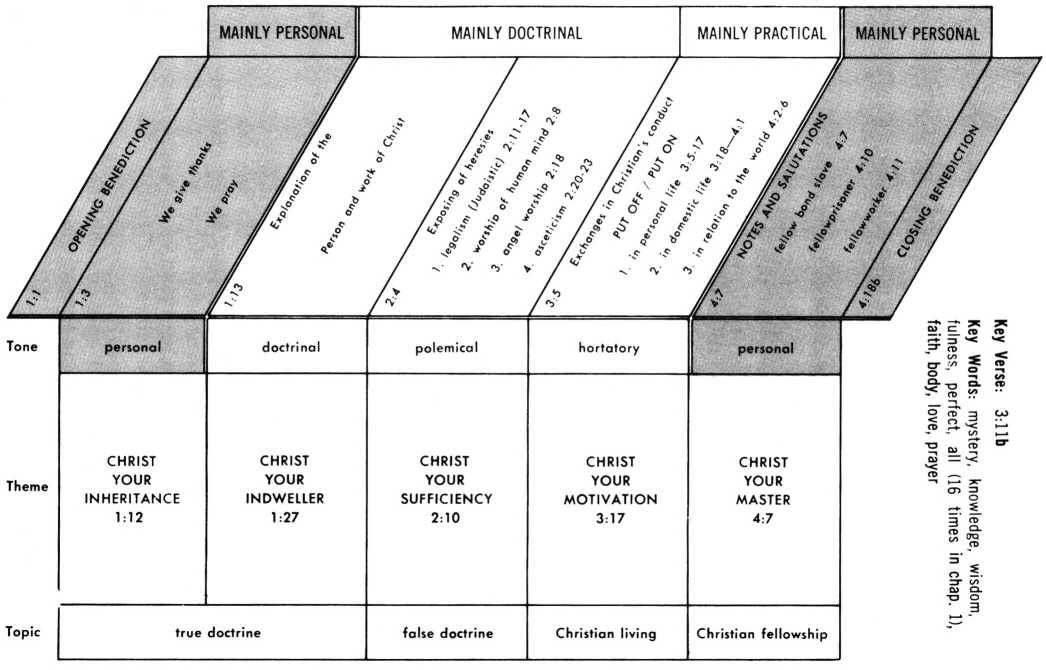
CHRIST IS ALL IN ALL
Click chart to enlarge
Charts from Jensen's Survey of the NT - used by permission
Colossians Overview - Click Chart on right side
| Christ Preeminent in All Things Supreme Lord - Sufficient Savior |
|||
| Colossians 1 | Colossians 2 | Colossians 3 | Colossians 4 |
| Supremacy of Christ |
Submission to Christ |
||
| Doctrinal and Corrective |
Practical and Reassuring |
||
| What Christ Did For Us |
What Christ Does Through Us |
||
| Christ Our Lord |
Christ Our Life |
Christ our Love |
|
| Christ the Head of the Body |
Christ the Lord of the Universe |
Christ the Head of the Home |
|
| Instruction | Warnings | Exhortations | Reminders |
| Reconciliation | Creation | Submission | Conversation |
| His Person and Word |
His Peace and Presence |
||
Colossians 3:10 and have put on (AMPMPN) the new self who is being renewed (PPPMSA) to a true knowledge according to the image of the One Who created (AAPMSG) him-- (NASB: Lockman)
Greek: kai endusamenoi (AMPMPN) ton neon ton anakainoumenon (PPPMSA) eis epignosin kat' eikona tou ktisantos (AAPMSG) auton
Amplified: And have clothed yourselves with the new [spiritual self], which is [ever in the process of being] renewed and remolded into [fuller and more perfect knowledge upon] knowledge after the image (the likeness) of Him Who created it. [Ge1:26] (Amplified Bible - Lockman)
Lightfoot: and put on the new, who is renewed from day to day, growing to perfect knowledge and refashioned after the image of his Creator.
NLT: In its place you have clothed yourselves with a brand-new nature that is continually being renewed as you learn more and more about Christ, who created this new nature within you. (NLT - Tyndale House)
Phillips: and have begun life as the new man, who is out to learn what he ought to be, according to the plan of God. (Phillips: Touchstone)
Wuest: and having clothed yourselves with the new man [the person you are after you are saved] who is constantly being renewed, with a resulting advanced and perfect experiential knowledge which is according to the image of the One who created him; (Eerdmans Publishing - used by permission)
Young's Literal: and having put on the new, which is renewed in regard to knowledge, after the image of Him who did create him;
AND HAVE PUT ON THE NEW SELF : kai endusamenoi (AMPMPN) ton neon :
- Chart of 78 Put off's and Put on's
- Colossians 3 Resources - Multiple Sermons and Commentaries
More literally "and having put on the new" (self is not in the Greek but is added in the NAS).
This verse shifts from the negative (laid aside) to the positive (put on). With the stripping off of the old nature there has come a new nature, the new man. We have laid aside the old garment, the "hand me down" rags from Adam and have put on the new garment, the new man in Christ.
Eadie - As the old man is thrown off the new man is assumed.
Have put on (1746) (enduo from en = in + dúo = to sink, go in or under, to put on) means literally to clothe or dress someone and to put on as a garment, to cause to get into a garment (eg, Lk 15:22 where the father says "quickly bring out the best robe and put it on him… ").
In the middle voice (as here in Col 3:10) it means to clothe oneself with something, in this case the "new man", who is clothed in the robes of Christ's righteousness and now needs to practice what this privileged position entails, i.e., to manifest His righteousness each day toward God and toward men in everyday life.
Aorist tense indicates this putting on is a past completed action and includes the idea that this action was decisive.
When did we put on the new? This "putting on" occurred the moment the old self (old man) died with Christ, at the time of regeneration by grace through faith. In verse 9 above, the "laying aside" is also aorist tense, and one can deduce that the action of both verbs took place at the same time in the past, corresponding to the moment we believed in Christ."
S. Lewis Johnson explains enduo as used in Colossians 3:10 writing that "The believer, having been severed from his connection with Adam the first, has now been clothed with and joined to Adam the last in all His fragrance and beauty. (Bibliotheca Sacra: Volume 121, Issue 481, 1964).
And so what is true about every believer is that they have put on the new self, which describes their new position as children of God, His new creations. We now are secure in an inseparable union with Christ and are fully identified with His life. Our old self has been laid aside. Because of our new position, we now are in possession of divine, supernatural power which gives every believer the potential to walk in newness of life (Ro 6:4-note).
The NLT says it this way
In… place (of the old, evil nature) you have clothed yourselves (this happens at a moment in time) with a brand-new nature that is continually being renewed (this describes the ongoing process known as sanctification) as you learn more and more about Christ, Who created this new nature within you.
Enduo is used 29 times in NT - NAS = clothed(6), dressed(1), enter(1), put(21).
Mt 6:25; 22:11; 27:31; Mk 1:6; 6:9; 15:20; Lk 8:27; 12:22; 15:22; 24:49; Acts 12:21; Ro 13:12, 14; 1Co 15:53f; Gal 3:27; Ep 4:24; 6:11, 14; Col 3:10, 12; 1Th 5:8; Rev 1:13; 15:6; 19:14.
Enduo - Is used about 86 times in the Septuagint (LXX) Ge 3:21; 27:15; 38:19; 41:42; Exod. 28:41; 29:5, 8, 30; 40:13f; Lev. 6:10f; 8:7, 13; 16:4, 23f, 32; 21:10; Num. 20:26, 28; Deut. 22:5, 11; 1 Sam. 17:5, 38; 2 Sam. 6:14; 14:2; 1 Ki. 22:30; 1 Chr. 12:18; 2 Chr. 5:12; 6:41; 18:9, 29; 24:20; 28:15; Est. 4:1, 17; 5:1; Job 8:22; 10:11; 29:14; 39:19; Ps. 35:13, Ps 35:26 (= figurative use = "Let those be clothed with shame and dishonor"); Ps 65:13 (= figurative use = "The meadows are clothed with flocks") Ps 93:1 (= 2 figurative uses = "The LORD reigns, He is clothed with majesty; The LORD has clothed and girded Himself with strength.") Ps 104:1 (= figurative use = "You are clothed with splendor and majesty") Ps 109:18 (= figurative use = "But he clothed himself with cursing as with his garment"), Ps 109:29 (= figurative use = "Let my accusers be clothed with dishonor"); Ps 132:9 (= figurative use = "Let Your priests be clothed with righteousness"), Ps 132:16, 18; Pr. 23:21; 31:25; Song. 5:3; Isa. 22:21; 49:18; 50:3; 51:9; 52:1; 59:17; 61:10; Jer. 10:9; 46:4; Ezek. 7:27; 9:2f, 11; 10:2, 6f; 16:10; 23:6, 12; 38:4; 42:14; 44:17, 19; Da 5:7, 16, 29; 6:3; 10:5; 12:6f; Jon. 3:5; Zeph. 1:8; Zech. 3:3f; 13:4
Here are some interesting uses of enduo in the Septuagint
Genesis 3:21-note The LORD God made garments of skin for Adam and his wife, and clothed them.
Comment: God literally clothed Adam and Eve, but in comparison NT figurative uses of enduo (e.g., Gal 3:27-note "have clothed yourselves with Christ") seems to represent a foreshadowing of God's provision of the covering (atonement) of Christ for any of Adam's sinful spiritual children (which is all mankind) who by grace express a personal belief in Christ Jesus, trusting wholly in Him as their propitiatory sacrifice. (cp the OT Mercy Seat in the Holy of holies)
Psalm 132:9 Let Your priests be clothed with righteousness, And let Your godly ones sing for joy.
Comment: What a beautiful description foreshadowing the "clothing" of every NT priest of God (1 Peter 2:9-note), each one having been forever "clothed with righteousness" of Christ Jesus (1 Cor 1:30, cp Isa 61:10, Ro 13:14, cp our future attire in Rev 19:8-note)! Glory!
In the Gospels, enduo is used primarily in a literal sense e.g.
Matthew 6:25 "For this reason I say to you, do not be anxious for your life, as to what you shall eat, or what you shall drink; nor for your body, as to what you shall put on. Is not life more than food, and the body than clothing?
Matthew 22:11 "But when the king came in to look over the dinner guests, he saw there a man not dressed in wedding clothes,
Matthew 27:31 And after they had mocked Him, they took His robe off and put His garments on Him, and led Him away to crucify Him.
Mark 1:6 And John was clothed with camel's hair and wore a leather belt around his waist, and his diet was locusts and wild honey.
Mark 6:9 but to wear sandals; and He added, "Do not put on two tunics."
Mark 15:17 And they dressed Him up in purple, and after weaving a crown of thorns, they put it on Him… 20 And after they had mocked Him, they took the purple off Him, and put His garments on Him. And they led Him out to crucify Him.
Luke 12:22 And He said to His disciples, "For this reason I say to you, do not be anxious for your life, as to what you shall eat; nor for your body, as to what you shall put on.
Luke 15:22 "But the father said to his slaves, 'Quickly bring out the best robe and put it on him, and put a ring on his hand and sandals on his feet
Jesus uses enduo once in a figurative sense in the Gospels declaring to His disciples…
Luke 24:49-note "And behold, I am sending forth the Promise of My Father upon you; but you are to stay in the city until you are clothed with power (dunamis) from on high."
Comment: Luke uses enduo figuratively describing clothing with spiritual power fulfilled by the coming of the Holy Spirit in Acts 2:1-4. The Power is the Promised Spirit, Who God had promised in the description of the New Covenant in the Old Testament, [Ezekiel 36:27 "I will put My Spirit within you"], promised again in Acts 1:8-note and realized in Acts 2:4 at Pentecost and then in every believer thereafter as described in Ro 8:9-note, Ep 1:13, 14-note]
Comment: Here the indirect middle voice conveys the sense "put on yourselves power from on high as a garment". They are to wait until this experience comes to them, which equates with “the promise of the Father.” Enduo used in this figurative sense is seen in classic Greek writing by Aristophanes who describes an individual as "clothed with audacity," by Homer who describes one as "clothed with strength" and by Plutarch who describes one as "clothed with nobility and wealth".
Paul uses of enduo are all figurative describing the putting on of "ethical, moral or spiritual" garments. And what a "wardrobe" he lays out for believers in his epistles…
THE ARMOR OF LIGHT
Romans 13:12 The night is almost gone, and the day is at hand. Let us therefore lay aside (cast off, drop, fling away, renounce) the deeds of darkness (all the filthy garments of worldliness—that is, everything associated with unrighteousness and evil -- in the context of Col 3:10 this would include lying) and put on the armor of light. (See notes)
CHRIST HIMSELF AS OUR GARMENT
Galatians 3:27 For all of you who were baptized into Christ have clothed yourselves with Christ.
Comment: This putting on refers to salvation, at which time the Spirit replaced our filthy rags of sin with the righteousness of Christ - this is now and forever our new position before God. He sees us in Christ's righteousness - the theologians refer to this as positional truth = past tense salvation = justification.
Romans 13:14 But put on (our practice = present tense salvation = progressive sanctification - put Him on each morning and every moment of the day - aorist imperative [middle voice = you initiate the action and participate in the result = put Him yourself] ) the Lord Jesus Christ, and make no provision for the flesh in regard to its lusts. (See notes)
THE NEW SELF
Ephesians 4:24 and put on (not a command - aorist tense) the new self, which in the likeness of God has been created in righteousness and holiness of the truth.
Comment: As discussed in the notes there is debate between excellent commentators, some favoring this putting on as indicative of positional truth and others favoring it as calling for this to be our practice - progressive sanctification or present tense salvation.
Colossians 3:10 and have put on (past tense salvation = positional sanctification = our position now and forever in Christ - see our practice in Col 3:12) the new self who is being renewed to a true knowledge according to the image of the One Who created him (See notes)
Colossians 3:12 And so, as those who have been chosen of God (cf notes Eph 1:5), holy and beloved, put on (present tense salvation = progressive sanctification = our practice - a command be clothed [middle voice = clothe yourself] now = aorist imperative) a heart of compassion, kindness, humility, gentleness and patience (See notes)
THE BREASTPLATE OF FAITH AND LOVE
1Thessalonians 5:8 (note) But since we are of the day, let us be sober, having put on (at the time of our new birth = justification = our position = past tense salvation) the breastplate of faith and love, and as a helmet, the hope of salvation.
IMPERISHABLE, IMMORTAL GARMENTS
1Corinthians 15:53 For this perishable must put on (glorification = future tense salvation) the imperishable, and this mortal must put on immortality. 54 But when this perishable will have put on the imperishable, and this mortal will have put on immortality, then will come about the saying that is written, "Death is swallowed up in victory.
What a "wardrobe" God has made available for believers! We're the "best dressed" folks in the world and most of us don't even know it! And the best is yet to come for John writes…
GARMENTS OF FINE LINEN, WHITE AND CLEAN…
Revelation 19:14 (note) And the armies (this is us, those redeemed by the blood of the Lamb) which are in heaven, clothed (enduo) in fine linen, white and clean, were following Him (the Lamb = Faithful and True = the Word of God) on white horses. (Comment: This incredible historical event will occur at the end of the 7 year period, Daniel's Seventieth Week, and marks the defeat of the antichrist and his armies and the inception of Messiah's Millennial Reign)
The garments believers are now wearing (figuratively, spiritually) are a picture of every believer's vital mystical spiritual union with Christ which began at the time of regeneration (the new birth). All believers have been irrevocably, intimately united with Christ at the moment of salvation (past tense salvation = positional sanctification = justification = the new birth). Every believer now stands (our position) before God clothed with Christ's righteousness, complete in Christ.
Thus in Romans 13 Paul writes that
The night (of man's depravity, of this present evil age) is almost gone, and the day (of Christ's return and reign) is at hand. Let us therefore lay aside (cast off, drop, fling away, renounce) the deeds of darkness and put on (enduo) the armor of light (which equates with the protection that practical righteousness and holy living imparts) (Ro 13:12-note)
Paul adds that they are to
Put on (enduo - aorist imperative - do it now! The Spirit will give us the desire and power to obey! cp Php 2:13NLT-note) the Lord Jesus Christ, and make no provision (forethought, thought in advance) for the flesh in regard to its lusts ("don’t think of ways to indulge your evil desires", NLT)." (Ro 13:14-note)
In short, if we are Christians we have already put on the Lord Jesus Christ as stated in (Gal 3:27) Just as a garment which one puts on envelops the person wearing it and defines his appearance, so the person baptized in Christ is entirely taken up in Christ and in the salvation brought by Him. But this passage in Romans has reference to practical day-to-day, repeated putting on of Christ.
Ray Stedman gives the following illustration: "When I get up in the morning I put on my clothes, intending them to be part of me all day, to go where I go and do what I do. They cover me and make me presentable to others. That is the purpose of clothes. In the same way, the apostle is saying to us (Ro 13:12, 13; 14-see note Ro 13:12, 13; 14), “Put on Jesus Christ when you get up in the morning. Make Him a part of your life that day. Intend that He go with you everywhere you go, and that He act through you in everything you do. Call upon His resources. Live your life IN CHRIST.” (Stedman, Ray C. From Guilt to Glory. Vol 2. p136. Waco, TX: Word, 1978) (Bolding added)
Kent Hughes interprets the putting on of the new self in Eph 4:24 (see note) as follows - "The fact is, we have this new self if we are Christians. We received the old man at birth, and we were given the new man in our heavenly birth. The new man is not our work — it is God’s creation and gift. Our task is not to weave it, but to wear it. Paul is commanding a daily appropriation of that which we already possess… We have our part to do in dressing ourselves with the divine wardrobe, for here clothes do make the man — and the woman! We must daily set aside the rotting garments of the old man. We must formally reject sensuality and selfish pride and materialism and bitterness. We must read the Word and ask God to to renew our minds through the Spirit. We must work out our salvation by doing those things that will develop a Biblical mind. We must put on our new, shining garments of light. We must put on what we are!" (Hughes, R. K.: Ephesians: The Mystery of the Body of Christ. Crossway Books)
Because of their privileged position "as those who have been chosen of God, holy and beloved" Paul calls on the Colossian saints to put this truth into practice and to
put on (enduo - aorist imperative - do it now) a heart of compassion, kindness, humility, gentleness and patience… (Col 3:12-note)
In Col 3:10 (note) Paul explained that believers have put on the new man and here in Col 3:12ff he shows them practically how this new man is to live.
Thayer says that put on here in (Col 3:12 [note]) means
to become so possessed of the mind of Christ as in thought, feeling, and action to resemble Him and, as it were, reproduce the life He lived.
And truly, how else is it possible to live out the "put on's" which reflect the lifestyle of the "new self"?
- Note there is some duplication of truths discussed in the previous section
Enduo means to put on as a garment, to cause to get into a garment. In the passive it means to be clothed. In the middle voice as used in Colossians 3:10 enduo means to clothe oneself.
In the realm of spiritual warfare, believers are to
Put on (enduo - aorist imperative - do it now - do it decisively - it is urgent! The only way to accomplish this is by rejecting self reliance and relying wholly on the Holy Spirit) the full (not just part of the) armor of God, that you may be able to stand firm against the schemes (orderly, methodical, cunning, deceptive strategies - he knows our weak points) of the devil (Ep 6:11-note)
Later in this same section on spiritual warfare, Paul uses enduo a second time exhorting the saints to
Stand firm (aorist imperative = Calls for immediate attention! Do this now! See above for our need for the Spirit's enabling power.) therefore, having girded your loins with truth, and having put on the breastplate of righteousness. (Eph 6:14- note)
Every believer has put on the breastplate of righteousness when by faith they received Christ and were reckoned righteousness before God. God
made (Christ Jesus) Who knew no sin to be sin on our behalf, that we might become the righteousness of God in Him. (2 Co 5:21).
The righteousness of Christ was imputed or placed on our spiritual account so to speak. Having put on this righteousness Paul tells us to stand firm. In other words because we possess this righteousness from God, we can begin to develop and manifest a righteous character in righteous living and such a lifestyle is one piece of our armor in spiritual warfare.
John MacArthur explains that "as believers faithfully live in obedience to and communion with Jesus Christ, His own righteousness produces in them the practical, daily righteousness that becomes their spiritual breastplate. Lack of holiness, on the other hand, leaves them vulnerable to the great enemy of their souls. (MacArthur, J.: The MacArthur Study Bible Nashville: Word)
Even though every believer is clothed with the righteousness of Christ, we must still live so as to manifest integrity and uprightness in our personal life. As has been well said "When a man is clothed in practical righteousness, he is impregnable. Words are no defense against accusation, but a good life is." So if our conscience is void of offense toward God and man, we are less vulnerable to the devil who has no target to shoot at.
Paul applies a military metaphor (breastplate, helmet) to exhort the saints at Thessalonica to be like soldiers who get up each morning with the right attitude (sober–minded, watchful, well-balanced, circumspect, clear-headed) and the right attire that provides proper protection writing that
since we are of the day, let us be sober (marked by sedate, earnestly thoughtful character and demeanor, seriousness of purpose), having put on (enduo) the breastplate of faith and love and as a helmet, the hope of salvation. (see note 1Thessalonians 5:8)
Although the NASB makes this "putting on" sound like past tense event, it is better understood as something each believer is to do.
Young's Literal has "let us be sober, putting on the breastplate of faith and love…
In other words, we as believers need to be like sentries on guard against a relentless, persistent, deadly foe, making certain that we are armed with all the accoutrements God has made (potentially) available for the spiritual war we will face every day. We need to daily manifest the behavior which is consistent with our position in Christ. Have you put on your breastplate of faith and love this morning? “Faith” is an essential protection against temptations, because it is trust in God’s promises, plans, and truth. Faith is unwavering belief in God’s Word that protects us when the arrows of temptation begin to fly. Love for God is essential and ultimately is manifest in obedience (cf Jn 14:15), which equates with upright behavior which itself is a supernatural shield against spiritual attacks
Paul uses enduo four times in his description of the future hope of glory of believers writing that
this perishable (physical, natural, earthly body which is subject to decay) must put on (enduo) the imperishable, and this mortal must put on (enduo) immortality. But when this perishable will have put on (enduo) the imperishable, and this mortal [part of us, this nature that is capable of dying] will have put on (enduo) immortality, then will come about the saying that is written, "DEATH IS SWALLOWED UP in victory. (1Cor 15:53-54)
Paul uses enduo to picture our redeemed spirits being dressed in glorious redeemed bodies because it is impossible for corruption to inherit incorruption.
Enduo is used 86 times in the Septuagint (abbreviated LXX, Greek translation of Hebrew OT), the first use being in Genesis after the fall, where
Jehovah Elohim made garments of skin for Adam and his wife, and clothed them. (Ge 3:21)
This is but a shadow of the reality that God would someday kill a substitute to redeem sinners, the redemption price being the shed blood of the sinless Lamb of God, Who made available to guilty, unrighteous sinners a garment of righteousness for those who would place their faith in Him. In Exodus, one of many allusions to putting garments on priests, God says
you shall put the holy garments on (enduo in LXX) Aaron and anoint him and consecrate him, that he may minister as a priest to Me. (Ex 40:13)
In a figurative use we read that
the Spirit came upon (enduo in LXX > "the Spirit clothed Amasai") Amasai (1Chr 12:18)
The Spirit's "clothing" certain people in the OT was temporary empowerment and in this specific case was given to assure David that the Benjamites and Judahites were loyal to him and that the cause was blessed by God. In another interesting figurative use of enduo Solomon prayed
Now therefore arise, O LORD God, to Thy resting place, Thou and the ark of Thy might; let Thy priests, O LORD God, be clothed (enduo in LXX) with salvation and let Thy godly ones rejoice in what is good. (2Chr 6:41)
The Psalmist declares
Bless the LORD, O my soul! O LORD my God, Thou art very great. Thou art clothed (enduo in LXX) with splendor and majesty, covering Thyself with light as with a cloak (Ps 104:1-2)
Let Thy priests be clothed (enduo in LXX) with righteousness and let Thy godly ones sing for joy. (Ps 132:9)
The psalmist is asking God for a godly line of OT priests. How blessed are we in the NT to be the Lord's priests clothed with the robes of righteousness of Christ. May we live it out in His power and for His glory. Amen. In one of the most famous uses of enduo Isaiah records the prophetic description of Messiah writing that
He put on (enduo in LXX) righteousness like a breastplate and a helmet of salvation on His head and He put on garments of vengeance for clothing and wrapped Himself with zeal as a mantle. (Isa 59:17)
Paul drew on this terminology in describing a believer’s spiritual preparation for warding off the attacks of Satan.
I will rejoice greatly in the LORD, My soul will exult in my God for He has clothed (enduo in LXX) me with garments of salvation. He has wrapped me with a robe of righteousness, as a bridegroom decks himself with a garland, and as a bride adorns herself with her jewels. (Isa 61:10)
This verse pictures imputed (credited to one's account) righteousness, which is the central teaching of the gospel. When a sinner recognizes he can’t achieve righteousness by works and repents and calls on God, the Lord clothes him with His own righteousness by grace through faith.
Jesus declared to His disciples
behold, I am sending forth the promise of My Father (promised in the OT cf Joel 2:28, Isa 44:3) upon you; but you are to stay in the city until you are clothed (enduo) with power from on high (referring to the Spirit at Pentecost cf Acts 1:8) (Lu 24:49).
To review this section, the verbs translated put off and put on both are aorist tense and indicate a completed past event. When any sinner trusts Christ, at that moment they put off the old self and put on the new. At that moment, the old self has been rendered powerless and the new self is now to be in control (read especially Romans 6 - see notes Romans 6). In Christ the believer has been set free from the dominion and power of "sin". Because of our permanent identification and union with Christ, we now have the power of His Spirit and the responsibility to conduct ourselves as a new man in Christ (this is called sanctification and is alluded to in the next part of this verse). We are not told to feel that these things are true or even to fully understand them. But we are told to live them out by grace through faith. That is what Colossians 3 is all about -- walking the talk. Living out the life that is in us - Christ is us the hope of glory. As we walk in a manner worthy we will grow in the knowledge of God (Col 1:10-note) and in so doing we will come to understand more and more the depth of the truth that we are now in Christ. (see also in Christ)
Guy King…
That poor deformed savage Cali ban, in Shakespeare's Tempest, spoke better than he knew when he said -
"'Ban, 'Ban, Ca-Caliban
Has a new master; get a new man."When CHRIST is our Saviour and Master we have to put on the new man. May I remind you that "if any man be in Christ he is a new creature," 2Corinthians 5:17?
Being a Christian, he is to dress the part. "The garment of praise," says Isaiah 61:3; "He hath clothed me with the garments of salvation, He hath covered me with the robe of righteousness," Isa 61:10.
Some sightseers, wandering about the grounds of a famous castle on an "open" day, came across an old man, evidently, by his old clothes, one of the gardeners, and they asked him, "Is the Duke in residence?" - it was the Duke! Just then he wasn't dressing the part. So far as the Christian uniform is concerned, the Christian soldier must never be in mufti.
The story is told of the thorough-going conversion of an old disreputable blackguard, whose wife and children had been miserably beaten and bruised in his drunken brawls. Everyone in the town knew of old drunken John, unsavoury character that he was. On his conversion, he knew that everything must now be different - he thought of the way he had treated his family; he decided that he must leave his wretched hovel of a house, and find a decent home for them.
On going to the agents, they made it plain to him that they were not going to entrust one of their respectable dwellings to an old reprobate like him. They knew old John. But his answer was, "I think you're making a mistake. I fancy you're confusing me with somebody else. Old John is dead; I'm new John".
Well done! And now he is going to dress the part. It is so with all new-born people of GOD. Whether they are Greek folk, or Jewish, Barbarian, Scythian, slave or free (verse 11), they all dress alike. "Christ is all, and in all." This spiritual suiting is the height of fashion in the circles of Heaven, and the old clothes look so drab beside them. No wonder that Christians are exhorted, "As obedient children, not fashioning yourselves according to the former lusts in your ignorance," 1Pe 1:14, when, not knowing any better, you thought yourselves looking very smart. (Guy King. Colossians - Crossing the Border)
The new [self, man] - Regarding this phrase Moule writes that it refers to
the new position of acceptance and the new spiritual power of the regenerated self; with a reference in the phrase to the believer's connexion with "the Second Man," Christ. By union with Him His members become (be it said with reverence and caution) repetitions of Him the glorious Archetype. To come to be "in Him" is thus to "put on (Him as) the New Man," in sharing His acceptance and His life and power. (Epistles to the Colossians and to Philemon)
New (3501) (neos) signifies new in respect to time (contrast kainos = new in respect to quality) and describes that which has recently come into existence but for a relatively short time (eg, "new wine" Mt 9:17).
Neos - 23x in 20v in the NT -
Matt 9:17; Mark 2:22; Luke 5:37ff; 15:12f; 22:26; John 21:18; Acts 5:6; 1 Cor 5:7; Col 3:10; 1 Tim 5:1f, 11, 14; Titus 2:4, 6; Heb 12:24; 1 Pet 5:5
Neos can also refer to one who is in the early stages of life (i.e., young) and this use accounts for many of the NT occurrences.
"New [self]" ("self" is added by translators) describes who believers are by virtue of their union with Christ.
The new self continually being renewed describes the process of sanctification. (Click here to compare the "three tenses of salvation")
Vine says that the use of neos "stresses… the fact of the believer’s new experience, recently begun and still proceeding. ( Collected writings of W. E. Vine. Nashville: Thomas Nelson)
MacDonald explains that "Just as the old man refers to all that we were as sons of Adam, with an unregenerate nature, so the new man refers to our new position as children of God. There has been a new creation, and we are new creatures. God’s purpose is that this new man should always be growing more and more like the Lord Jesus Christ (Ed note: Practical sanctificaition). We should never be satisfied with our present attainments, but should always press on to the goal of increasing conformity to the Savior. He is our example and the rule of our lives. In a coming day, when we stand before the Judgment Seat of Christ, we will be judged not by how much better our lives were than others but rather by how our life measured up to the life of the Lord Jesus Himself. (Believer's Bible Commentary: Thomas Nelson)
MacDonald goes on to quote the "Daily Notes of the Scripture Union" which records that "The image of God is not seen in the shape of our bodies, but in the beauty of the renewed mind and heart. Holiness, love, humility, meekness, kindness, and forgiveness—these make up the divine character."
Paul Apple (quoting Morgan) writes that…
Morgan: Spiritual clothing is an important figure in the Bible. You must always take off the old dirty clothes before putting on the new clean clothes.
a) Adam and Eve – made for themselves coverings of fig leaves
b) God clothed them with skins (animals were killed to get these skins) – picture of the righteousness of God
c) Ezekiel 16:10 – speaking of the nation of Israel; Zech. 3:3, 4
d) Prodigal Son
e) Parable of the wedding banquet (Mt. 22) – the king can recognize inappropriate clothing
f) Isaiah 64:6; Rev 7:14
g) Clothing for the Christian walk and service: the armor of God – Eph 6) Importance of putting on Christ
Illustration of Weeding – you don’t just cut off the tips of the weeds; you dig them out by their roots so they don’t keep popping up (Colossians)
NEOS
Neos signifies new in respect to time (contrast kainos = new in respect to quality) and describes that which has recently come into existence but for a relatively short time (eg, "new wine" Mt 9:17). New in contrast to that which was of long duration.
Note that there are two closely related Greek words for "new", neos and kainos.
The distinction between neos and kainos is difficult to perceive in our English translations because the same English word is usually used to translate both Greek words. Furthermore, neos and kainos are used several times in the NT to modify the same word (new self, new man, new covenant, new wine), but there is often a difference in the author's intended meaning.
Trench in his discussion of neos and kainos says that although some would say these two words have little difference in the NT, this statement
"by no means follows, and in fact is not the case. The same covenant may be qualified as neos, or kainos (see discussion in next section), as it is contemplated from one point of view or another. So too the same man, or the same wine, may be neos or kainos, or may be both; but a different notion is predominant according as the one epithet is applied or the other. Contemplate the new under aspects of time, as that which has recently come into existence, and this is neos… but contemplate the new, not now under aspects of time, but of quality, the new, as set over against that which has seen service, the outworn, the effete or marred through age, and this is kainos." (Trench, R. C. Synonyms of the New Testament. page 219ff)
NEW SELF
NEOS vs KAINOS
For example, neos is used in for "new" in the phrase new self in Colossians 3:10. In (see note Ephesians 4:24) in contrast kainos is used for "new" in the same phrase "new self".
What's the difference? Are there two self's? Let's look further at the new self or new man. In Ephesians Paul uses kainos twice to describe the new man (self)
In (see note Ephesians 4:24) Paul exhorts the Ephesians to
put on the new (kainos) self, which in the likeness of God has been created in righteousness and holiness of the truth. (see note Ephesians 4:24)
So in this verse Paul uses kainos (not neos) which does not describe a renovated self but a self who is entirely new, new in species or character. The new self is new because it has been created in the likeness of God. The Greek reads literally, “according to what God is”—a staggering truth expressing the glorious truth of salvation that those who confess Jesus Christ as Lord are made like God! Peter says believers have become qualitatively different for now they are “partakers of the divine nature” (see note on 2 Peter 1:4).
Vine commenting on new self in Col 3:10 writes that "there are two words for “new,” kainos and neos; neos, which is used here (in Col 3:10), is new in time, new in contrast to that which was of long duration; it stresses here the fact of the believer’s new experience, recently begun and still proceeding; kainos is new in quality and character, this is the word used in the corresponding passage in Ephesians 4:24, i.e., a new character of manhood, spiritual and moral, after the pattern of Christ." (Collected writings of W. E. Vine. Nashville: Thomas Nelson)
Trench in explaining the nuance of meaning of neos in the phrase new self in Col 3:10 has the following note (although it is not easy to understand if you read it too quickly):
Contemplate under aspects of time that mighty transformation which has found and is still finding place in the man who has become obedient to the truth, and you will call him subsequently to this change, neos anthropos. The old man in him, and it well deserves this name, for it dates as far back as Adam, has died; a new (neos) man has been born, who therefore is fitly so called. BUT contemplate again, and not now under aspects of time, but of quality and condition, the same mighty transformation; behold the man who, through long commerce with the world, inveterate habits of sinning, had grown outworn and old, casting off the former conversation (Ed note: not our modern significance but a reference to one's behavior or conduct), as the snake its shriveled skin, coming forth a new (kainos) creature (2Cor 5:17), from his heavenly Maker’s hands." (Trench, R. C. Synonyms of the New Testament).
In fairness, it should be noted that respected Greek scholar Marvin Vincent states regarding neos and kainos that "the distinction cannot be pressed in all cases".
Vincent goes on to flatly state that "Put on the new (neos) man" plainly (carries) the sense of quality
Vine and Trench who likewise are respected Greek scholars would seem to disagree and press the idea of "time" over "quality".
Earlier in this same letter, in explaining how Jesus makes peace between Jew and Gentile, Paul wrote that this transaction is made possible "by abolishing in His flesh the enmity, which is the Law of commandments contained in ordinances, that in Himself He might make the two into one new (kainos) man, thus establishing peace" (see note Ephesians 2:15)
Kainos does not refer to "something recently completed (Ed note: he would have used neos if that was his intended meaning), such as a new car rolling off the assembly line—one of many other cars just like it. This new refers to a difference in kind and quality, to a completely new model, unlike anything that existed before. The new person in Christ is not simply a Jew or Gentile who now happens to be a Christian. He is no longer a Jew or Gentile but only a Christian. (MacArthur, J: Ephesians. Chicago: Moody Press)
NEW COVENANT
NEOS vs KAINOS
Both neos and kainos are used by the writer of Hebrews. For, example, he uses neos to describe the new Covenant in Hebrews 12:24 (note) writing that
Jesus (is) the mediator of a new (neos) covenant
What the writer is saying by using "neos" is that the New Covenant is new in respect to time and specifically is new when compared with the Mosaic or Old Covenant, which was originally given by God over 1500 years earlier. In other verses, the writer of Hebrews uses kainos to describe the New Covenant, writing for example,
Behold, days are coming, says the Lord, when I will effect a new (kainos) covenant with the house of Israel and with the house of Judah. (see note Hebrews 8:8).
Several verses later the writer added that
When He said, "A new (kainos) covenant," He has made the first (referring to the Mosaic) obsolete (old). But whatever is becoming obsolete and growing old is ready to disappear. (see note Hebrews 8:13) (see notes on Covenant: Why the New is Better)
Wuest translates (Hebrews 8:13)
In the fact that He says, new in quality, He has permanently antiquated the first. Now, that which is being antiquated and is waning in strength, is near to the point of vanishing away. (Eerdmans Publishing - used by permission)
NEW WINE:
NEOS vs KAINOS
The new wine in the synoptic gospels is neos, describing that which was of recent production, fresh. "New wine" was a set phrase referring to newly pressed grape juice, unfermented, or in the initial stages of fermentation. Jesus said that men do not
put new (neos) wine into old wineskins; otherwise the wineskins burst, and the wine pours out, and the wineskins are ruined; but they put new (neos) wine into fresh wineskins, and both are preserved.” (Mt 9:17).
After celebrating the Last Supper with His disciples, Jesus declared
But I say to you, I will not drink of this fruit of the vine from now on until that day when I drink it new (kainos) with you in My Father’s kingdom. (Mt 26:29).
Here Jesus refers to
the new [in quality] wine" of the Kingdom, which will be of a different character from that of this world (it will be "out of this world"!)
Vincent adds that
In our Lord’s expression, “drink it new, ” the idea of quality is dominant. All the elements of festivity in the heavenly kingdom will be of a new and higher quality." (Word Studies in the New Testament)
Wiersbe has this note on "new" writing that
"The Greeks had two different words for new. The word neos meant “new in time.” We use this word as an English prefix in such words as “neoorthodoxy” and “neoclassicism.” The word kainos meant “new in quality” … there is still a fundamental difference. The believer has once and for all put on the “new man” (neos), and, as a consequence, he is being renewed (kainos). There is a change in quality, for he is becoming like Jesus Christ. The “new Man” is Jesus Christ, the last Adam (1Cor 15:45), the Head of the new (in quality - kainos) creation (2Cor 5:17-note). (Wiersbe, W: Bible Exposition Commentary. 1989. Victor)
WHO IS BEING RENEWED: ton anakainoumenon: [PPP]:
- Ps 51:10; Ro 12:2; Ep 4:23; Heb 6:6
- Chart of 78 Put off's and Put on's
- Colossians 3 Resources - Multiple Sermons and Commentaries
When we receive Christ,
God's work isn't over--
It has just begun.
The believer's new self is a progressively growing (spiritually maturing) entity…
who is constantly being renewed, with a resulting advanced and perfect experiential knowledge which is according to the image of the One who created him (Eerdmans Publishing - used by permission)
Eadie - This man is new not only in point of time, but of quality or character, for he is (being) renewed… Man must be brought back to his original purity, but the process of renovation is continuous, as the use of the present participle indicates.
Renewed (341) (anakainoo from aná = back or again + kainóō = to make new > from kainos = not recent but qualitatively new and different) is used only here and in (2 Co 4:16-note) and means literally to make new (in quality) again. It is to cause something to become new and better or superior. In the present context Paul uses anakainoo to signify that the believer is to continually be changed into a new quality or kind of life (that heretofore never existed), which is in opposition to the corrupt, depraved state of the unregenerate man or woman, a state which is continually "decaying" (in a spiritual sense).
The present tense indicates that we are "constantly being renewed” to a new quality of life, which describes a process that will continue the rest of our earthly lives and is essentially synonymous with sanctification, growth in holiness, gradual being conformed to the image of God's Son, growing in the grace and knowledge of our Lord and Savior Jesus Christ.
Moule notes that in the parallel passage in Ephesians 4:24…
the new man was created as a definite fact; here he is continuously being renewed, maintained as it were by a continuous creative act… Practically, the thought is of the believer's maintained union with His Lord, and his realization in that union of continued peace and spiritual power.
Paul prays that this sanctification process would occur in the lives of the believers in Thessalonica and gives them the assurance that God would complete this good work in them (cp Php 1:6-note)…
Now may the God of peace Himself sanctify (hagiazo) you entirely; and may your spirit and soul and body be preserved complete, without blame at the coming of our Lord Jesus Christ. Faithful is He who calls you, and He also will bring it to pass. (1Th 5:23, 24-note).
In Hebrews we read that we (1) have been sanctified and (2) are continually being sanctified…
By this will we have been sanctified (perfect tense = past completed action with continuation of this state of sanctification = our permanent position) through the offering of the body of Jesus Christ once for all. (Heb 10:10-note)
For by one offering He has perfected for all time those who are (being) sanctified (present passive like "renewed" in Col 3:10 = continually being sanctified = our present practice). (Heb 10:14-note)
Vine adds that renewed…
is in the continuous present tense, in contrast to the act done once for all in putting on the new man, which is now maintained continually in vigor and growth. The contrast to the worn out garment, the old man, is vividly set forth. (Collected writings of W. E. Vine. Nashville: Thomas Nelson)
The passive voice indicates we are being acted upon by an outside power, the context indicating that it is the supernatural power of God, the Holy Spirit Who sanctifies us. Of course, the Word is that entity by which we are renewed and progressively set apart (cp Jn 17:17). And thus once again we see the vitally important role the pure milk of the Word has in the believer's renewal and overall spiritual growth. In short - no intake of God's Word, no growth spiritually (see 1Pe 2:2-note).
I like the way the ancient sage Charles Simeon (see a fascinating biographical summary of Simeon by Dr John Piper) describes the believer's continual renewal stating that…
our light will be progressive, advancing like that of the sun, from its earliest dawn to its meridian height (cp Pr 4:18). This is the change which the Gospel has wrought on millions of the human race: and that Gospel shall yet be found, by every true Believer, “the power of God to the salvation of his soul.” (Ro 1:16-note and 1Pe 1:9-note) (MAN’S ORIGINAL AND PRESENT STATE Eccl 7:29)
The new self has a new nature analogous to a growing plant. This growth is the result of being constantly renewed by the Holy Spirit, the result being that the "plant" increases in vigor with a definite goal in mind. The new man is not the end but in a sense the beginning of a life-long process. In other words salvation is a process that calls for progress. Beloved, the question for each of us to ask is "Are we growing in grace and the knowledge of our Lord and Savior Jesus Christ?" If not, why not? If yes, than praise God!
Phil Newton writes that…
Notice how the believer is assured that he is being sanctified by the Lord:
and put on the new self who is being renewed to a true knowledge according to the image of the One who created him-a renewal in which there is no distinction between Greek and Jew, circumcised and uncircumcised, barbarian Scythian, slave and freeman, but Christ is all, and in all.
He is not speaking of something that might take place in the Christian. Instead, he refers to the certainty and constancy of being renewed. This is the same term that is used in Ro 12:2-note when were are told to
be transformed by the renewing of your mind, so that you may prove what the will of God is, that which is good and acceptable and perfect.
It implies a newness in quality that keeps growing and changing and improving in the believer.
When you come to faith in Christ, you still have the same body with the same brain. All the patterns of the past are etched in your mind. But as you grow in the grace and knowledge of Christ (cp 2Pe 3:18-note), a renewing process takes place. Those old patterns are gradually culled and the newness of life in Christ fills your mind. This is the glory of sanctification: that the Lord will work His grace in us, reproducing us in the image of Jesus Christ.
The renewing affects the way you think and what you understand about the Lord, his will, and his working in your life. Our translation calls it "a true knowledge." It could be translated as "a thorough knowledge." It is intensive, life-changing knowledge that shapes the way you live your life according to the pattern found in Christ. It is knowledge of him, which is why Paul declares that his whole passion is to proclaim Christ (Col 1:29-note).
How does this renewal take place? We must recall the words of our Lord in his high priestly prayer:
"Sanctify them in the truth; Thy word is truth" (John 17:17).
As we partake of God's Word, hearing it, reading it, thinking upon it, meditating on it, digesting it and applying it, then the gradual work of sanctification occurs. Certainly the Lord uses other things in the sanctification process as in our trials, testing, needs, relationships, etc. But foremost of all is the Word. That is why the renewing that takes place is to a "true knowledge according to the image of the One who created" us.
If you are born of God, a sure evidence of it is the sanctifying work of the Spirit in your life. You have the assurance that the One who began his work in you will complete it (Php 1:6-note).
Conclusion - This is radical living. We must never be satisfied with simply going to church each week but not living radically for Christ in the balance of the week. Your union with Christ demands a different lifestyle. May the Lord do his transforming work in each of us. (Sermons from the Epistle to the Colossians) (Bolding added)
Matthew Henry writes that…
The new man is said to be renewed in knowledge, because an ignorant soul cannot be a good soul. Without knowledge the heart cannot be good, Pr 19:2 (Also it is not good for a person to be without knowledge, And he who makes haste with his feet errs.). The grace of God works upon the will and affections by renewing the understanding. Light is the first thing in the new creation, as it was in the first: after the image of Him who created him. It was the honour of man in innocence that he was made after the image of God; but that image was defaced and lost by sin, and is renewed by sanctifying grace: so that a renewed soul is something like what Adam was in the day he was created.
Moule comments that the KJV "in knowledge" is…
unto knowledge. The daily "renewal" is such as to result continually in the regenerate man's spiritual vision of Christ, intimacy with Him, insight into His will.
Adam Clarke has an interesting perspective on being renewed to a true knowledge observing that…
Ignorance was the grand characteristic of the heathen state; knowledge, of the Christian. The utmost to which heathenism could pretend was a certain knowledge of nature. How far this went, and how much it fell short of the truth, may be seen in the writings of Aristotle and Pliny. Christianity reveals God himself, the author of nature; or, rather, God has revealed himself, in the Christian system with which he has blessed mankind. Christianity teaches a man the true knowledge both of himself and of God; but it is impossible to know one’s self but in the light of God; the famous know thyself, was practicable only under the Christian religion.
As alluded to above, this section clearly describes the process known as sanctification (or present tense salvation > Click here for discussion of the three Tenses of Salvation) Sanctification is a process that results in increasing likeness to Christ. Possession of the new self brings the believer new life, but not instant spiritual maturity.
Just like a baby is born complete but immature, the new man is complete, but has the capacity to grow. Sanctification is a continual growth in Christ-likeness which is not accidental but associated intimately with our intake of and obedience to the Word of Truth. God's way to sanctify His saints is not to take us out of the world, but to progressively take the world out of us. This is a continuous process; the new man has not yet matured and is ever in the state of development. Christians are not sinless, although they should sin less and less!
Paul used anakainoo one other time writing that
we do not lose heart, but though our outer man is (progressively) decaying (diaphtheiro [our English = "diphtheria"]- wasting away like moths destroying clothing Lk 12:33), yet our inner man (the new creation—the eternal part of the believer) is being (continually) renewed (anakainizô - into a new kind of life fit for the new spiritual existence into which we have been ushered in salvation, and constantly being conformed to the image of the Lord Jesus) day by day. (2Co 4:16)
Paul was not discouraged for even though physically he was decaying, he knew that the inner self of the believer continues to grow and mature in Christ-likeness. Michelangelo put it this way:
"The more the marble wastes, the more the statue grows.”
Warren Wiersbe (commenting on 2Cor 4:16, 17, 18) cautions that
We must not misunderstand this principle and think that a Christian can live any way he pleases and expect everything to turn into glory in the end. Paul was writing about trials experienced in the will of God as he was doing the work of God. God can and does turn suffering into glory, but He cannot turn sin into glory. Sin must be judged, because there is no glory in sin. (Wiersbe, W: Bible Exposition Commentary. 1989. Victor)
The noun form of (anakainoo) is used by Paul in Romans to exhort the believers not to be continually
conformed to this world, but be transformed by the renewing (anakainosis - qualitatively and so a renewal which makes one's mind different than it was in the past) of your mind, that you may prove what the will of God is, that which is good and acceptable and perfect. (Ro 12:2-note)
Believers must be constantly alert to the ever present danger of their unredeemed fallen flesh which will continually dangle the garments of the old self in front of the new self , alluring and tempting us to put them on (i.e., to commit sins). Do not be deceived! (see Jas 1:14, 15-note; Jas 1:16-note). The battle against the flesh and the Spirit is continuous in this life (see Gal 5:17-note). While new self in regard to our position, is complete in Christ (cp Col 2:10-note) the moment of salvation and regeneration, this new self still maintains (and should manifest) the capacity for spiritual growth. So even as a baby is born a complete human being in one sense, it still manifests the capacity for continual growth, even as newborn believers manifest the innate God given capacity (and need) for spiritual growth (cp 1Pe 2:2-note = the new birth creates a new appetite and requires a new diet to renew our mind!)
Harry Ironside comments on the New Man as
the man in Christ , just as the Old Man was the man in Adam (1Co 15:22, (Ro 5:12-note, Ro 5:14, 15-note, Ro 5:17-note, Ro 5:21-note). The new man has a new, divinely-imparted nature (2Pe 1:4-note), and it is to this new nature that God, by the Spirit, appeals; only the new nature is capable of receiving divine instruction. As such instruction is imparted and the truths thus received control the life, the believer increasingly displays the image of Him who is the Head of the new creation (1Co 15:49), the image of the One Who Himself is “the image of the invisible God” (Col 1:15-note). Man was created in the image and likeness of God in the beginning, but that image became terribly marred through sin. In the new man this image again becomes visible and the characteristics of Christ are seen in His people. This is true regardless of who or what they were before they received the new life—whether they were cultured Greeks or religious Jews; whether they were within the circle of the Abrahamic covenant (see Abrahamic versus Mosaic or Abrahamic vs Old vs New), marked off from the rest of humanity by the ordinance of circumcision, or outside the circle and strangers to the covenants of promise (Ep 2:12-note vs Ep 2:19-note); whether they were barbarian or Scythian (that is, of the wild tribes outside the boundaries of civilization); whether they were slaves or free citizens. All alike were sinners; all alike were included in the old man.
In an OT passage David alludes to spiritual renewal asking God to
Create (Hebrew verb bara' used of creation in Genesis) in me a clean (pure, "unalloyed") heart (seat of intellect, motives, moral character - trouble begins in our thought life - evil thoughts precede evil deeds), O God, and renew (restore - place in a state or condition identical or nearly the same as a prior state) a steadfast (idea of inwardly determined, persevering in guarding against future outbreaks of sin and unyielding to temptation) spirit within (Hebrew denotes internal, in the midst, the center - David desires not just external but internal renewal) me." (Ps 51:10- Spurgeon's note)
FOCUS- As it relates to renewing out mind
Missionary pilot Bernie May writes,
One of the most difficult lessons to teach new pilots about landing on short, hazardous airstrips is to keep their eyes on the good part of the strip rather than on the hazard. The natural tendency is to concentrate on the obstacle, the danger, the thing he is trying to avoid. But experience teaches us that a pilot who keeps his eye on the hazard will sooner or later hit it dead center.
This makes me think of a spiritual principle in the Bible. Instead of concentrating on the sins we want to avoid, we are told to focus on the positive actions Christ desires for us. Paul told the Christians at Colosse: "Set your mind on things above, not on things on the earth" (Col 3:2-note). We are to discard old ways of thinking and acting (Col 3:5, 6, 7, 8, 9-note) and "put on" new ways of living (Col 3:10, 11, 12,13, 14, 15,16, 17-note).
Bernie May sums it up by saying that experienced pilots focus their attention solidly on the track they want the plane to follow, keeping the hazards in their peripheral vision only.
When Christ and His interests are the focus of our lives, the lure of the old life remains in the corner of our eye, while we aim to land squarely in the center of God's will. —David C. McCasland
THINKING IT OVER - What "hazards" sometimes divert your attention from Jesus? What positive, God-honoring actions can you concentrate on doing instead?
Those who fix their eyes on heaven
will not be distracted by the things of earth.
IS MY UNIFORM ON?
Ken Robinson, who is now a pastor, at one time served as a police officer. He said people treated him differently when he was in uniform than when he was off duty and wearing plain clothes. Something about the badge and "blues" gained him instant respect and authority.
He was often addressed as "Sir." When he told people something, they believed him. And when he gave an order, they were quick to obey. Robinson concluded, "I guess the clothes made the difference. And in uniform, I acted with more confidence."
In Colossians 3, the apostle Paul told followers of Christ to put on a new uniform. First he described the clothes we are to "put off" (Col 3:8, 9-note). Then he told us what kind of uniform we are to "put on" (Col 3:12, 13, 14-note). In place of anger, wrath, slander, dirty language, and lies, we are to put on mercy, kindness, humility, gentleness, patience, forgiveness, and love.
Most people respond positively to someone with these virtues. Their respect grows, They talk and act differently toward such a person. They listen to his words, acknowledge his authority, and are drawn to the God he represents.
What you wear makes a big difference. So ask yourself this question: Do I have my spiritual uniform on?
Lord, may I live that all may see
The love of Christ revealed in me,
And help me flee all sin and shame
Lest others scoff at Your dear name. --DJD
Can people tell that Christ is in you before you tell them?
WHAT SHOULD I WEAR TODAY? -
THE alarm goes off. It's morning already. You lie in bed, thinking. You ask yourself the same question you ask every morning,
"What shall I wear today?"
You brush away the mental cobwebs and think through the day. There's nothing really important—just the routine. You listen to the clock radio for the weather report. Then you decide: the comfortable blue outfit with red accents.
What we wear is important. We all want to dress appropriately and look our best. Besides, when we believe that we look good, we go through the day with more energy and confidence.
The Lord Jesus cares about what we wear, too, but His concern is our spiritual apparel. Colossians 3 lists some of the virtues with which we should clothe ourselves every morning: compassion, kindness, humility, gentleness, and patience. When we are wearing these, we will deal properly with situations that arise, our friendships will be strengthened, and we will have the satisfaction that comes from knowing that we are pleasing the Lord.
When our days are characterized by trouble, anger, hurt, or bad feelings, it's time to invest in a new wardrobe.—D C Egner
TO A TRUE KNOWLEDGE: eis epignôsin:
- Jn 17:3; 2 Cor3:18; 4:6; 1 Jn 2:3,5
- Chart of 78 Put off's and Put on's
- Colossians 3 Resources - Multiple Sermons and Commentaries
in order to cause you to know him completely
Spurgeon rightly says that…
There is nothing false or untrue in God. God is true, and in Him is no falsehood at all; and if you and I have really been renewed, as we profess to have been, we shall hate the very semblance of a lie, and our word will be as good as our bond.
True knowledge (epignosis [word study]) is one of the key words (see note) in Colossians. The true knowledge in Christ is in contrast to the false knowledge of the heretical teachers, a critical distinction only the former edifies and spiritually nourishes the believer.
The preposition (epi in epignosis) indicates a knowledge directed toward a particular object which can imply a more detailed or fuller knowledge (thorough knowledge). Though epignosis could refer merely to “knowledge about God,” it can also imply an “experiencing of” God or a “coming into more intimate experiential relationship with” God.
Epignosis - 20x in 20v - NAS = acknowledge*(1), knowledge(14), real knowledge(1), true knowledge(4).
Rom 1:28; 3:20; 10:2; Eph 1:17; 4:13; Phil 1:9; Col 1:9f; 2:2; 3:10; 1 Tim 2:4; 2 Tim 2:25; 3:7; Titus 1:1; Philemon 1:6; Heb 10:26; 2 Pet 1:2f, 8; 2:20.
Hendricksen addresses both aspects of the two possible meanings of epignosis commenting that
The new man is being renewed “for full knowledge”… This knowledge excels by far any so-called knowledge in which the false teachers who disturbed the churches of the Lycus Valley were glorying… It pertains to both heart and mind, is experiential, and has God’s holy will as its object (Ro 12:2-note). A true discernment of that will, particularly with reference to its “good pleasure” (Ep 1:5-note), is very rewarding. It is a means toward a fuller, richer measure of salvation’s joy and peace. A contrast will make this clear. While it is true that here on earth a person’s experience with his neighbor will at times cause him to say, “The better I know him and understand his intentions, the less I trust him,” in the kingdom of heaven the very opposite truth prevails, namely, “The more we know him — that is, the triune God or our Savior Jesus Christ —, and his purposes of grace, the more we trust and love him." (Hendriksen, W., & Kistemaker, S. J. NT Commentary Set. Baker Book)
Eadie in his commentary on Eph 1:17 has these thoughts on epignosis…
The preposition epi, in epignosis, contains probably the idea of the “additional” as the image of intensive. Such a preposition sometimes loses its full original force in composition, but it would be wrong to say with Olshausen, that here such a meaning is wholly obliterated. Epignosis is not ascribed to God in the New Testament, neither could it with propriety. His knowledge admits of no improvement either in accuracy or extent… That knowledge of God in which the Spirit of revelation works, and which He thereby imparts, is a fuller and juster comprehension of the Divine Being than they had already enjoyed.
Wuest writes that Paul is describing the new man, the
person they were now in Christ Jesus, this new person being constantly renewed with respect to a complete and perfect knowledge which is according to the image of the One who created him." He quotes Lightfoot as saying "Which is ever being renewed unto perfect knowledge, the true knowledge in Christ, as opposed to the false knowledge of the heretical teachers." (Wuest Word Studies - Eerdman Publishing Company Volume 1, Volume 2, Volume 3 - used by permission)
Vincent says this section is correctly translated
unto knowledge, the end to which the renewal tended. (Word studies in the New Testament. Vol. 3, Page 1-503)
Robertson says they are being renewed
Unto full (additional) knowledge. (Word Pictures)
Eadie agrees, writing that
In the phrase eis epignosin, the preposition cannot signify the instrumental cause of the renewal, but it denotes the final purpose. The new man is renewed unto knowledge.
Pulpit Commentary says that
Full knowledge was one purpose of this renewal, the purpose most necessary to be set before the Colossians.
ACCORDING TO THE IMAGE OF THE ONE WHO CREATED HIM: kat' eikona tou ktisantos (AAPMADG) auton:
- Ge 1:26,27; Ep 2:10; 4:23,24; 1Pe 1:14,15
- Chart of 78 Put off's and Put on's
- Colossians 3 Resources - Multiple Sermons and Commentaries
According to - This prepositional phrase means according to the standard. God's standard is Jesus Christ. God's purpose is to make us like His Son. The new man was created to be like God. God holds up Jesus Christ as the standard to which He wants us to be conformed. The practical question for each of us to ask ourselves "Are my words, actions and deeds daily becoming more like the Lord Jesus Christ?" Am I more like Christ this year than I was at the same time a year ago?
Image involves the two ideas of representation and manifestation. An image is the resemblance of something to a prototype from which it is derived and in whose essence it shares. In Greek thought an image shares in reality what it represents. God made man originally in his own image before Adam sinned (Ge 1:27). Man defaced that image by sin (Ge 9:6). However, God renews that image by Christ's work on the cross. The descendants of Adam bear his image, Paul explaining that
just as we have borne the image of the earthy, we shall also bear the image of the heavenly. (1Co 15:49)
God's desire for believers now is that they
become conformed to the image of His Son (the One Who created us) (Romans 8:29-note)
Wuest has a picturesque translation of this section
Regarding the reference to “the image of Him that created him,” the (Lightfoot) offers this explanation: This reference however does not imply an identity of the creation here mentioned with the creation of Genesis, but only an analogy between the two. The spiritual man in each believer’s heart, like the primal man in the beginning of the world, was created after God’s image. The new creation in this respect resembles the first creation. The pronoun ‘him’ cannot refer to anything else than the new man, the regenerate man … The new birth was a recreation in God’s image; the subsequent life must be a deepening of this image thus stamped upon the man.” This putting off of the Old Man and this putting on of the New Man took place at the moment the Colossian sinner put his faith in Christ. (Wuest Word Studies - Eerdman Publishing Company Volume 1, Volume 2, Volume 3 - used by permission)
MacArthur - It is God’s plan that believers become progressively more like Jesus Christ, the One Who made them (MacArthur, J.: The MacArthur Study Bible Nashville: Word)
Thomas Constable - Only by sanctification can people attain to the full image of God and Christ that God created them to bear (Ge 1:26,27). (Tom Constable's Expository Notes on the Bible)
S. Lewis Johnson - The constant renewal of the new man (the participle is present) is according to the image of Christ, and wrought by the God Who created the new man. Christ is the image of God (cf. Col 1:15), and the new man is undergoing a constant renewal in the likeness of Christ. He is the great pattern for all spiritual life, and God engages Himself to recreate us in His likeness. (Bibliotheca Sacra: volume 121, issue 481, 1964)
The renovation or restoration of the image of God in us is gradual and progressive, Paul explaining that
we all (believers), with unveiled face beholding as in a mirror the glory of the Lord, are being transformed into the same image from glory to glory, just as from the Lord, the Spirit. (2Cor 3:18).
This restoration will be fully completed when we see Christ face to face. John writes
Beloved, now we are children of God, and it has not appeared as yet what we shall be. We know that, when He appears, we shall be like Him, because we shall see Him just as He is. And everyone who has this hope fixed on Him purifies himself, just as He is pure. (1Jn 3:2-note, 1Jn 3:3-note)
William Hendriksen - "The standard or yardstick and the aim of the renewal is God’s image, the likeness of the very One who created this new man in the hearts and lives of believers, just as He once created the first Adam as His own image (Ge 1:26, 27). Nevertheless, the new man is not simply the restoration of whatever pertained to the first Adam before the fall. (To mention only one point of difference between the original creation and the new creation: in the state of rectitude Adam had no inkling of knowledge concerning God’s redemptive love.) Rather, “Just as we have borne the image of the earthly one, so we shall also bear the image of the heavenly One” (1Cor 15:49), in Whom redemptive love is wholly centralized." (Hendriksen, W., & Kistemaker, S. J. NT Commentary Set. Baker Book)
We were formed in God’s image, and deformed from God’s image by sin. But through Jesus Christ, we are being transformed into His image! We are not being made into "little gods" as some teach but are being made like Him, to act as He acts.
Bratcher and Nida write that "the renewal process has as its goal the complete restoration in the creature of the likeness of the Creator. The Creator is, at the same time, the One Who renews, and this process restores the divine image which had been effaced by sin. (The United Bible Societies' New Testament Handbook Series)
Christ "is the image of the invisible God" (Col 1:15-note), and the new man is undergoing a constant renewal in the likeness of Christ. He is the great pattern for all spiritual life, and God engages Himself to recreate us in His likeness
For whom He foreknew, He also predestined to become conformed to the image of His Son, that He might be the first-born among many brethren. (Ro 8:29-note)
Vine, commenting on this verse, explains that Paul is not referring "to the creation of man as such, the creation of Adam, but to the new and spiritual creation. The “him” is the “new man,” who is created by God at the new birth. “If any man is in Christ, he is a new creature” and “all things are of God” (2Cor 5:17, 18-note). God, again, is the Creator (other commentators say this refers to Jesus), and He creates the new man according to His own image (cp. Ep 4:24-note]), yet that image as it is revealed in Christ Jesus (Col 1:5-note; 2 Cor 4:4). Thus the knowledge is not mere acquaintance with doctrine nor with facts about Christ, but a knowledge which produces a character and manner of life in conformity to the One who is Himself the personal expression and representation of God. (Vine, W. Collected writings of W. E. Vine. Nashville: Thomas Nelson)
Octavius Winslow's devotional on Col 3:10…
One important witness which the eternal Spirit bears for Christ is, when He impresses upon the believer the image of Christ. It is the peculiar work of the Spirit to glorify Christ; and this He does in various blessed ways, but none more strikingly than in drawing out the likeness of Christ upon the soul. He glorifies Christ in the believer. He witnesses to the power of the grace of Christ in its influence upon the principles, the temper, the daily walk, the whole life of a man of God.
The image of Christ-what is it? In one word, it is Holiness. Jesus was the holiness of the law embodied. He was a living commentary on the majesty and purity of the Divine law. The life He lived, the doctrines He proclaimed, the precepts He enjoined, the announcements He made, the revelations He disclosed, all, all were the very inspiration of holiness. Holiness was the vital air He breathed. Although in a world of impurity, all whose influences were hostile to a life of holiness, He yet moved amid the mass of corruption, not only untouched and untainted, but reflecting so vividly the luster of His own purity, as compelled the forms of evil that everywhere thronged His path, either to acknowledge His holiness and submit to His authority, or to shrink away in their native darkness. And this is the image the Holy Spirit seems to draw, though it be but an outline of the lineaments upon the believing soul. What a testimony He bears for Christ when He causes the image of Jesus to be reflected from every faculty of the soul, to beam in every glance of the eye, to speak in every word of the tongue, and to invest with its beauty every action of the life!
Oh that every child of God did but more deeply and solemnly feel that he is to be a witness for Jesus!-a witness for a cross-bearing Savior-a witness to the spotless purity of His life, the lowliness of His mind, His deep humility, self-denial, self-annihilation, consuming zeal for God's glory, and yearning compassion for the salvation of souls-a witness to the sanctifying tendency of His truth, the holiness of His commands, the purifying influence of His precepts, the elevating power of His example. It may not be that all these Divine characteristics center in one person, or that all these lovely features are reflected in a single character. All believers are not alike eminent for the same peculiar and exalted graces of the Spirit. It was not so in the early and palmy days of the gospel, when Jesus Himself was known in the flesh, and the Holy Spirit descended in an extraordinary degree of sanctifying influence upon the church: it would therefore be wrong to expect it now. (Evening Thoughts or Daily Walking With God December - Octavius Winslow)