Colossians 3:2
Colossians 3:3
Colossians 3:4
Colossians 3:5
Colossians 3:6
Colossians 3:7
Colossians 3:8
Colossians 3:9
Colossians 3:10
Colossians 3:11
Colossians 3:12
Colossians 3:13
Colossians 3:14
Colossians 3:15
Colossians 3:16
Colossians 3:17
Colossians 3:18
Colossians 3:19
Colossians 3:20
Colossians 3:21
Colossians 3:22
Colossians 3:23
Colossians 3:24
Colossians 3:25

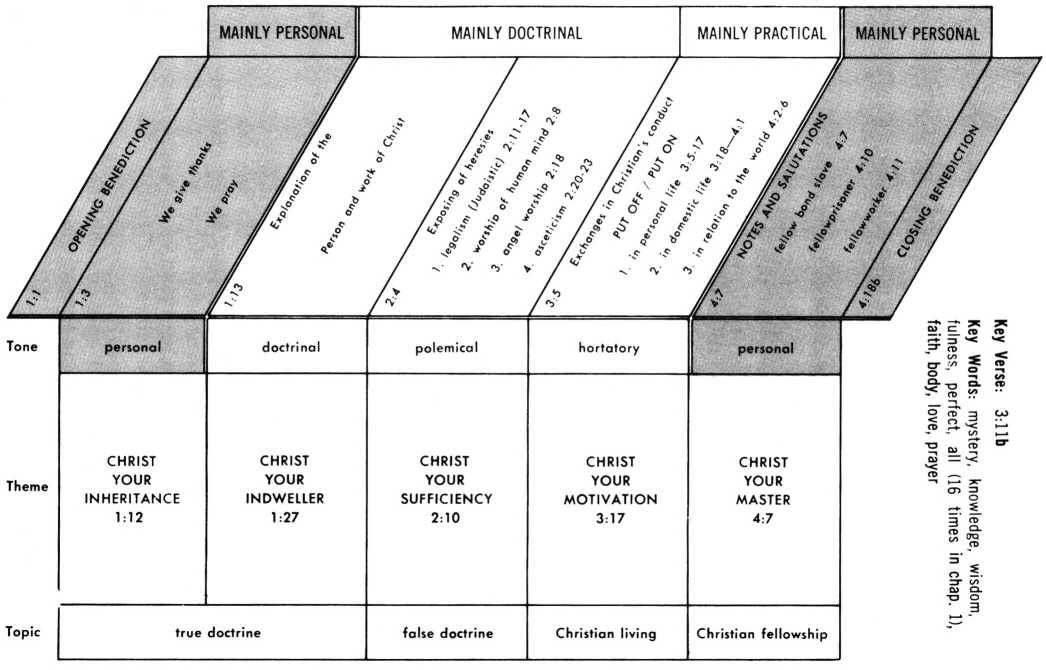
CHRIST IS ALL IN ALL
Click chart to enlarge
Charts from Jensen's Survey of the NT - used by permission
Colossians Overview - Click Chart on right side
| Christ Preeminent in All Things Supreme Lord - Sufficient Savior |
|||
| Colossians 1 | Colossians 2 | Colossians 3 | Colossians 4 |
| Supremacy of Christ |
Submission to Christ |
||
| Doctrinal and Corrective |
Practical and Reassuring |
||
| What Christ Did For Us |
What Christ Does Through Us |
||
| Christ Our Lord |
Christ Our Life |
Christ our Love |
|
| Christ the Head of the Body |
Christ the Lord of the Universe |
Christ the Head of the Home |
|
| Instruction | Warnings | Exhortations | Reminders |
| Reconciliation | Creation | Submission | Conversation |
| His Person and Word |
His Peace and Presence |
||
Colossians 3:9 Do not lie (2PPMM) to one another, since you laid aside (AMPMPN) the old self with its evil practices, (NASB: Lockman)
Greek: me pseudesthe (2PPMM) eis allelous, apekdusamenoi (AMPMPN) ton palaion anthropon (Lit = man) sun tais praxesin autou
Amplified: Do not lie to one another, for you have stripped off the old (unregenerate) self with its evil practices, (Amplified Bible - Lockman)
Lightfoot: Be not false to each other in word or deed; but throw off forever the old man with his actions,
NLT: Don’t lie to each other, for you have stripped off your old evil nature and all its wicked deeds. (NLT - Tyndale House)
Phillips: Don't tell each other lies any more, for you have finished with the old man and all he did (Phillips: Touchstone)
Wuest: Stop lying to one another, having stripped off and away from yourselves and for your own advantage the old, antiquated, outworn, decrepit, useless man [that person you were before you were saved] with his evil practices
DO NOT LIE TO ONE ANOTHER: me pseudesthe (2PPMM) eis allêlous:
- Lev 19:11; Isa 63:8; Jer 9:3, 4, 5; Zeph 3:13; Zech 8:16; Jn 8:44; Eph 4:25; 1Ti 1:10; Titus 1:12,13; Rev 21:8,27; 22:15
- Torrey's Topic Lying serious study of this sin which led to the fall of man - cp Jn 8:44
- Colossians 3 Resources - Multiple Sermons and Commentaries
Wuest has a picturesque translation of this section "Stop lying to one another, having stripped off and away from yourselves and for your own advantage the old, antiquated, outworn, decrepit, useless man [that person you were before you were saved] with his evil practices, and having clothed yourselves with the new man [the person you are after you are saved] who is constantly being renewed, with a resulting advanced and perfect experiential knowledge which is according to the image of the One who created him"
Wuest goes on to explain that "Lie is present imperative in a prohibition, forbidding the continuance of an action already going on. It is, “Stop lying to one another.” These Colossian saints had carried over into the new life, the sin of lying. They should stop lying because they had put off the Old Man with his practices, that person they were before they were saved, and had put on the New Man, that person they were now in Christ Jesus, this new person being constantly renewed with respect to a complete and perfect knowledge which is according to the image of the One who created him. Lightfoot says: Which is ever being renewed unto perfect knowledge, the true knowledge in Christ, as opposed to the false knowledge of the heretical teachers. (Wuest, K. S. Wuest's Word Studies from the Greek New Testament: Eerdmans)
Spurgeon comments…
No lies. Such communications are filthy. But you put these things away through your union with Christ in his risen life. Therefore, abhor them. Avoid the very appearance of them, and cry for grace to be kept from them, for you have been “renewed in knowledge after the image of him that created him.”
In Paul’s day, lying was thought to be a virtue unless the liar happened to be found out; in that case, it was considered wrong; but to lie through thick and thin, and to lie so dexterously as to deceive, was looked upon by an Oriental as an accomplishment of which he might be proud. So the apostle might well write, “Lie not one to another,”
Matthew Henry adds that lying "is contrary both to the law of truth and the law of love, it is both unjust and unkind, and naturally tends to destroy all faith and friendship among mankind. Lying makes us like the devil (who is the father of lies - see John 8:44), and is a prime part of the devil's image upon our souls; and therefore we are cautioned against this sin by this general reason: Seeing you have put off the old man with his deeds, and have put on the new man."
John Eadie - As one of the Greek Fathers says, falsehood ill became them who avowed themselves disciples of Him Who said "I am the Truth." (Jn 14:6) The apostle, in writing to the Ephesians, adds as a reason why they should adhere to the truth—“we are members one of another.” (Ep 4:25) He does not here say, as some suppose, lie not against or about one another, that is, to the damage of one another; but his meaning is, in all your communications among yourselves, never depart from the truth. (Colossians 3 Commentary)
Moule - Entire truthfulness is an essential Christian characteristic, for Christ is "the Truth." In the light of His words and deeds it is certain that nothing untruthful, not even the most "pious" of "frauds," can possibly be holy. The uniform emphasis on truthfulness in the precepts of Scripture is the more significant of the origin of Scripture when we remember the proverbial Oriental laxity about truth. (Epistles to the Colossians and to Philemon)
Do not lie (5574) (pseudomai from pseudo = to cheat, defraud, falsify) means to communicate what is false, with the evident purpose of misleading. The Greek term and the English equivalent ‘to lie’ involve more than simply telling what is not true, for this could occur without an intent to deceive or mislead. It means means to tell a falsehood, attempt to deceive by lying, to speak falsely or deceitfully. Pseúdomai therefore involves not only the communication of a falsehood but also the intent to deceive.
Pseúdomai is uses 12x in NT:
Matthew 5:11 (note) Blessed are you when men cast insults at you, and persecute you, and say all kinds of evil against you falsely, on account of Me.
Acts 5:3 But Peter said, "Ananias, why has Satan filled your heart to lie to the Holy Spirit, and to keep back some of the price of the land? 4 "While it remained unsold, did it not remain your own? And after it was sold, was it not under your control? Why is it that you have conceived this deed in your heart? You have not lied to men, but to God."
Comment: The next time we ask "What's so wrong with a little 'white' lie?" we need to think about this scene in Acts!
Romans 9:11 (note) am telling the truth in Christ, I am not lying, my conscience bearing me witness in the Holy Spirit,
2 Corinthians 11:31 The God and Father of the Lord Jesus, He who is blessed forever, knows that I am not lying.
Galatians 1:20 (Now in what I am writing to you, I assure you before God that I am not lying.)
Colossians 3:9 Do not lie to one another, since you laid aside the old self with its evil practices,
1 Timothy 2:7 And for this I was appointed a preacher and an apostle (I am telling the truth, I am not lying) as a teacher of the Gentiles in faith and truth.
Hebrews 6:18 (note) in order that by two unchangeable things, in which it is impossible for God to lie, we may have strong encouragement, we who have fled for refuge in laying hold of the hope set before us.
James 3:14 But if you have bitter jealousy and selfish ambition in your heart, do not be arrogant and so lie against the truth.
1 John 1:6 If we say that we have fellowship with Him and yet walk in the darkness, we lie and do not practice the truth;
Revelation 3:9 (note) 'Behold, I will cause those of the synagogue of Satan, who say that they are Jews, and are not, but lie-- behold, I will make them to come and bow down at your feet, and to know that I have loved you.
Pseudomai - 34x in the non-apocryphal Septuagint (LXX) -- Lev. 6:2f; 19:11; Deut. 33:29; Jos. 24:27; 2 Sam. 22:45; 1Ki. 13:18; Neh. 6:8; Job 6:10, 28; 8:18; 27:11; 31:28; 34:6; Ps. 18:44; 27:12; 66:3; 78:36; 81:15; 89:35; Prov. 14:5; Isa. 57:11; 59:13; Jer. 5:12; Hos. 9:2; Hab. 3:17; Zech. 13:4
The command is stop lying or "do not have the habit of lying." The negative preceding the present tense imperative command (present imperative) also implies the practice was already ongoing among the Colossians saints.
Vine writes that "the tense (do not lie) now is not the aorist, expressing an act complete and decisive, but present, expressing a continued practice. The exhortation therefore was against lying as still existing among the believers. (Vine, W. Collected writings of W. E. Vine. Nashville: Thomas Nelson )
Notice specifically who Paul tells the Colossians to not lie to! In a parallel passage, Paul exhorts the Ephesians that after
laying aside falsehood, SPEAK TRUTH, EACH ONE of you, WITH HIS NEIGHBOR, for we are members of one another. (Eph 4:25)
Thus we see that one reason why they should adhere to the truth is that they are all "members of of another." How dysfunctional would it be for one part of the human body to lie to another! (And yet isn't that what we do in essence when we commit a sin with one of our members full well knowing that it is against God's will but believing the lie that it will give us some degree of "gratification"!) The lying in question is uttered within the Church (“to one another”), and is fatal to unity of the body of Christ. The lie led to the fall of man and undoubtedly has led to the fall of many a church body or church leadership! Beware brethren. Don't buy the lie that "It's just a little white lie!" That's a lie in itself!)
Grant Richison asks "How can we reconcile untruth with the Truth himself? If we operate in untruth we misunderstand the relationship between the God of truth and the Christian life. Lying destroys trust. It violates truth and love. A lie misleads causing distrust; the cross restores broken relationships. The profound change at our new birth changed the nature of the Christian's life. This is more than some surface change; it is a radical change of orientation to life. Conversion should change our relationships with people. People should learn to trust us better because we know Christ." (Today's Word)
Is lying in the body serious? If you think it's not then read Peter's confrontation of this sin in the newly born church, as he declared…
Ananias, why has Satan (cp Jn 8:44) filled your heart to lie to (pseúdomai) the Holy Spirit, and to keep back some of the price of the land? While it remained unsold, did it not remain your own? And after it was sold, was it not under your control? Why is it that you have conceived this deed in your heart? You have not lied to (pseúdomai) men, but to God. (Acts 5:3, 4)
The sin was in professing to give all, while only giving some. No one had asked Ananias and his wife Sapphira to sell the property. After it was sold, they were not obligated to give all. But they pretended a total dedication, while actually they held some back and in so doing they lied to the body of Christ.
Thomas Constable adds that "Rather than allowing the Holy Spirit to fill him, Ananias had allowed Satan to control his heart. Ananias’ sin was lying. He sought to deceive the Christians by trying to gain a reputation for greater generosity than he deserved. By deceiving the church, Ananias was also trying to deceive the Holy Spirit who indwelt the church. In attempting to deceive the Holy Spirit, he was trying to deceive God. Note the important identification of the Holy Spirit as God. (Expository Notes)
Ananias and his wife Sapphira were guilty of the lie of hypocrisy in the church, faking their spirituality in an attempt to impress others. And it cost them dearly! God is "very hard" on religious hypocrites! (cp Mt 23:13, 14, 15, 23, 24, 25, 26, 27, 28, 29) (Read Acts 5)
Lying began when
The serpent said to the woman "You surely will not die! For God knows that in the day you eat from it your eyes will be opened, and you will be like God, knowing good and evil." (Ge 3:1, 2, 3, 4)
Satan
was a murderer from the beginning & does not stand in the truth because there is no truth in him. Whenever he speaks a lie, he speaks from his own nature, for he is a liar and the father of lies. (Jn 8:44)
God "cannot lie" (see note on the "non-lying God" in Titus 1:2).
The writer of Hebrews says "it is impossible for God to lie" (Heb 6:8). Jesus Christ is the Truth (Jn 1:14, 17, 8:32, 14:6, 15:1). The upshot is that when believers lie, they mimic Satan and fail to give a proper opinion of their true Father Who is in heaven. Genuine followers of Christ should not lie and especially not to one another.
John says that
If we say that we have fellowship with (God) and yet walk (present tense = habitually) in the darkness, we lie (pseúdomai) (present tense = habitually) and do not practice the truth; but if we walk (present tense = habitually) in the light as He Himself is in the light, we (present tense = continually) have fellowship with one another, and the blood of Jesus His Son cleanses us from all sin. (1Jn 1:6, 7)
The venerable pastor and expositor Harry Ironside writes that "If there were any truth in the unscriptural theory held by some that the old nature is eradicated when a believer is sanctified, there would be no need for this injunction. Lying is one of the first evidences of the carnal nature. (Ps 58:3 says "The wicked are estranged from the womb; These who speak lies go astray from birth") and untruthfulness is one of the hardest habits for anyone to overcome. It is so natural for these vain hearts of ours to try to make things appear better than they really are (Ed: Did you realize known exaggerations, even ever so slight are lies! "I spent 10 hours reading the Scripture yesterday". Why do we say things like that when we really spent only 6 hours? We want to impress others, to make ourselves "look good", etc. Oh, the deceptive nature of exaggeration! Beware. This writer [B. Hurt, not H A Ironside] truly has frequently had to confess this sin.), to cover up our own failures and accentuate the sins of others. But these are just different forms of lying and we are called on to judge all guile—every kind of untruthfulness—in the light of the cross of Christ. There the old man was crucified in the person of our Substitute, and now his deeds are to be renounced and his habits put off as discarded garments, which are in no sense fit for the new man."
THE CHRISTIAN LIFE
ACCORDING TO COLOSSIANS
Wayne House has a well done summary of our new life in Christ as portrayed in Colossians. The following is an excerpt from his 15 page paper…
A muscle will not function properly if the bone to which it is attached is broken or is in a state of degeneration. The same is true of the Christian life. Orthodoxy serves as the skeletal framework for the saint of God. If that framework is faulty and does not affirm truth, the result will be a defective lifestyle. In the Epistle to the Colossians Paul demonstrated this point. The Colossian congregation was under attack by syncretistic Jewish mysticism, which promoted “legal ordinances, circumcision, food regulations, the Sabbath, new moon, and other prescriptions of the Jewish calendar.” In response to this heterodoxy, the Apostle Paul sought to make clear how the infection of false doctrine would affect their Christian living. This article examines the union between doctrine and practice by noting four themes in the Book of Colossians: walking in divine wisdom, living in Christ, putting off sinful works, and putting on Christ…
Putting Off Sinful Works (Col 3:1-11)
The Believer’s Position in Christ (Col 3:1, Col 3:2, Col 3:3, 4) Because of the believer’s participation in the death and resurrection of Christ and his victory over “the elements of the world,” he is to “keep seeking the things above” (Col 3:1). This continual, ongoing process of seeking, suggested by the present imperative, is to be the consequence of having “been raised up with Christ.” For Paul there was no reason for anyone to be “seeking the things above” if he had not been raised with Christ. The road to the heavenly realm was through Christ, not through asceticism or mysticism.
The believer’s position in Christ is his only hope of glory. There should be no boasting of a meeting with God apart from Christ. The believer is to “set” his “mind on the things above” (Col 3:2), that is, to seek spiritual wisdom and guidance from the One who sits “at the right hand of God” (Col 3:1). This wisdom from above is superior to the traditions of men and “the elementary principles of the world” (Col 2:8). The contrast is striking. From Christ, the Source above, there is wisdom. On the other hand the world and all that is a part of it (“the things that are on earth,” Col 3:2), are under a curse and doomed for destruction. Believers are to have a mindset that avoids all that is at enmity toward God (cf. Ro 8:6).
The believer’s death in Christ terminated his relationship with the old self and the things of the earth. To ensure its safety, the new life is protected and vouchsafed in Christ. As Paul wrote, “your life is hidden with Christ in God” (Col 3:3).
The verb ‘hidden’ is a perfect tense, in contrast to the preceding aorist (‘you died,’ drawing attention to the specific occasion of their death with Christ), and stresses the ongoing and permanent effects: your life has been hidden with Christ in God and it remains that way. (O’Brien, Colossians and Philemon, 165)
When Christ will return (“when Christ, who is our life, is revealed” Col 3:4), the believers’ glory will be disclosed as well. Meanwhile they can live life to the fullest because of Jesus’ power sustaining them.
The Believer’s Response to His Position in Christ (Col 3:5, Col 3:6, 7, 8, Col 3:9, Col 3:10, Col 3:11) In light of their security, believers pursue righteousness while putting to death (nekrosate) “the members of [their] earthly body” (literally, “the members that are on the earth”). This command means to “put to death whatever in your nature belongs to the earth” (cf. Ro 6:11; Ro 8:10).
Man cannot distance himself from his actions; he is so intimately bound up with them that his actions are a part of himself. Only through the death in which the old self dies, can the way to new life be opened. (Lohse, Colossians and Philemon, 137)
With the aorist imperative nekrosate ("mortify" Col 3:5KJV, "consider… dead" Col 3:5NAS), Paul moved from the theological to the practical, into the realm where the believer is responsible for his actions. Five things Christians should exclude are fornication (porneia), impurity (akatharsia), lust (pathos), evil desire (epithumia kakia), and greed or covetousness (pleonexia). The order of these terms in Colossians 3:5 moves
from the outward manifestations of sin to the inward cravings of the heart, the acts of immorality and uncleanness to their inner springs. (O’Brien, Colossians and Philemon, 179)
These sins emerge from a heart that feeds on earthly philosophies of living. Because of such filth God’s wrath will come on those who willfully disobey Him (Col 3:6). This includes not only flagrant unbelievers, but also those in the Colossian congregation who said they believed in Christ but who actually were unbelievers as their evil actions revealed (Ed: Many in the modern church need to re-read that last fearful sentence!). As already noted, Paul wrote this epistle to dissuade some who might delude themselves with alleged visions of glory through mystic encounters. Though false teaching may be enticing, it is bankrupt with respect to life-sustaining principles and as a result, the heresy leads to moral turpitude (inherent baseness, depravity, shameful wickedness).
The apostle reminded the Colossian believers that moral misconduct was part of their former demeanor: “in them you also once walked” (Col 3:7). The words “but now” which begin Col 3:8, introduce temporal contrast, pointing to the fact that the Christian life must contrast with the person’s former life (cf. Col 1:21, 22). (Lohse, Colossians and Philemon, 140)
Paul commanded the Colossians to “put…aside” (“rid themselves”) of other vices, including wrath (orge), anger (thumos), malice (kakia), slander (blasphemia), and foul talk (aischrologia). The aorist imperative apothesthe emphasizes that
the process and repeated efforts which lead to a transformed daily walk are all incorporated into the imagery of ‘putting off the old life with its deeds’ and ‘putting on the new life’ of righteousness and Christ-likeness. (Buist M. Fanning, Verbal Aspect in New Testament Greek Oxford: Clarendon, 1990, 363)
Believers are to discard their old repulsive habits like a set of worn-out clothes. Apotithemi, meaning to “put away,” was used literally with reference to clothes at Acts 7:58 (cf. 2Macc 8:35; Josephus Antiquities of the Jews 8, 266) and in a metaphorical and ethical sense at Ro 13:12; Ep 4:22, Ep 4:25; He 12:1; Jas 1:21; and 1Pe 2:1. (O’Brien, Colossians and Philemon, 186.)
Believers also are not to lie to each other. The present tense in the prohibitive imperative (present imperative + negative = me) me pseudesthe (“do not lie,” Col 3:9) connotes an action that is to be habitual. In Ep 4:15 the present participle aletheuontes (“being truthful”) demonstrates this same idea. Dishonesty characterized the former life, the “old self,” which was crucified and buried with Christ, but now honest speech and conduct are to characterize believers.
Since the “old self” (literally “old man”) and his proclivities are to be purged, a new and invigorating “self” or lifestyle must fill the void left by the absence of the old (Col 3:10). The new life is to be lived in conformity to the image of the One who created it. Thus Christ alone starts as the Christian’s paradigm.
This newness also implies that former distinctions of race or social caste bear no significance on the status of saints as image-bearers of God.
In Col 3:11 Paul emphatically denounced the notion that one group had any greater advantage in Christ than any other. Greeks and Jews were adversaries. Greeks viewed Jews as unsophisticated and lacking wisdom, and Jews viewed the Greeks as uncircumcised aliens estranged from “the covenants of promise” (Eph 2:12). Barbarians and Scythicans were viewed as crass and repulsive peoples, the scorn of Greco-Roman society. Slaves and masters in general bore mistrust and animosity toward one another. Yet the enmity between these groups departs when these individuals come to Christ. An unregenerate life gives birth to racism and classism, attitudes stemming from the heart. By contrast, it is improper for believers to harbor disdain for races and classes of people different from their own (cf. Ro 3:22; Ro10:12). Being renewed at salvation to a new perspective and knowledge (Col 3:10), the believer’s conduct is to be in conformity with the Creator’s will. ( Ibid., 192.) Skin color and socioeconomic status, being merely aspects of external appearance and circumstance, are inadequate barometers of character. (Wayne House - The Christian Life According to Colossians -Bibliotheca Sacra Volume 151. 1994 (vnp.151.604.449-151.604.452). Dallas, TX: Dallas Theological Seminary- Good Summary Article)
To one another - Believer to believer. Of course this phrase does give license to be less truthful to unbelievers.
One another (240) (allelon) means each other and speaks of a mutuality or sharing of sentiments between two persons or groups of persons. Allelon is a reciprocal pronoun which denotes that the encouragement and edification is to be a mutual beneficial activity. As each submits, encourages, loves, etc, the other members benefit. This is the God's description and prescription for a body of believers.
One another is a common NT phrase (especially in Paul's letters) with most uses relating to the building up of the body of Christ. As such the "one anothers" in the NT would make an excellent Sunday School study (or topical sermon series), taking time to meditate on each occurrence, asking whether it is being practiced (in the Spirit) in your local church and seeking to excel still more (cp Php 1:9, 10, 11-notes; 1Th 3:12, 1Th 4:1, 1Th 4:10). Below is a list of the NT uses of one another (be sure to check the context for the most accurate interpretation).
Ro 12:10, 16; 13:8; 14:13, 19; 15:5, 7, 14; 16:16; 1Co 6:7; 7:5; 11:33; 12:25; 16:20; 2Co 13:12; Ga 5:13, 15, 26; Ep 4:2, 25, 32; 5:19, 21; Php 2:3; Col 3:9, 13, 16; 1Th 3:12; 4:9, 18; 5:11, 13, 15; 2Th 1:3; Heb 3:13; 10:24, 25; Jas 4:11; 5:9, 16; 1Pe 1:22; 4:8, 9, 10; 5:5, 14; 1Jn 1:7; 3:11, 23; 4:7, 11, 12; 2Jn 1:5
SINCE YOU LAID ASIDE: apekdusamenoi (AMPMPN):
- Col 3:8; Ro 6:6; Eph 4:22
- Colossians 3 Resources - Multiple Sermons and Commentaries
Since - This word is not in the Greek text but is added by the NAS translators. More literally it reads having put off, the aorist tense speaking of a completed past action. The basis of putting off the old life is the cross. When you were saved, you in effect stripped off the old unregenerate self with its evil practices. This is why the habitual practice of lying doesn't reflect the new you.
A change of nature precedes a change of dress! In fact P. T. Forsyth wrote that "A conversion which is but a wave of spiritual experience is not the passage from death to life." (P. T. Forsyth, The Person and Place of Jesus Christ) (Ed: In fact as an infectious disease expert, I would say this is like a vaccination, to keep one from getting the real disease! In this case it is not a passage from death to life" but in fact a passage from "death (spiritual) to death (eternal in Hell)!" Do not be deceived! cf 2 Cor 13:5).
Laid aside (554) (apekduomai from apo = marker of dissociation > away from + ekduo = to go or come out of, strip one of clothing - the antithesis of enduo) means to take off or strip off from one's self, the apo denoting separation from what is put off. There are only 2 uses of apekduomai in the NT - Col 2:15 Col 3:9. Apekdúomai is an intensive double compound, a stronger word than apotithemi ("put… aside"), which occurs in (Col 3:8). The idea of complete separation is conveyed by this verb apekdúomai because it is derived from the preposition apo which conveys the idea of separation of one thing from another by which the union or fellowship of the two is destroyed. Vincent adds that "By the addition… of apo from, there is added to the idea of getting out of one’s clothes that of getting away from them; so that the word is a strong expression for wholly putting away from one’s self." (Vincent, M. R. Word studies in the New Testament. Vol. 3, Page 1-488)
The Colossian believers are to remember that because of the new birth, they have wholly put off the old self. They have "stripped him clean off" like a dirty garment and figuratively have gotten away from these filthy rags. It is important however to note that the evil nature of the old self is not (yet) eradicated, but that it remains in the believer until death (when in glory we will be completely free of the taint of sin). However the great news is that its power is broken and it has no more power over the believer than he allows it to have. It is the physical body as dominated by the evil nature that is put away in favor of a physical body now dominated by the divine nature.
A B Simpson writes that…
By a very fine metaphor the Apostle describes the Christian life under the figure of disrobing and robing a person. Our garments are frequently used to denote our character. And so the word habit has come to mean both our dress and manner of living. There is first the process of disrobing. It begins with the putting off of our old habits and dispositions, our old clothes… Next, however, we strip not only to the skin, but to the bone, and to the very heart. For we put off our very selves. "Ye have put off the old man with his deeds" (Col. 3:8, 9). This is the entire renunciation and crucifixion of our old self and our whole natural life. Next comes the process of robing. This begins inside. There must be a new man first before he can wear his new clothes. You would not put clean and beautiful garments on an unbathed person… Next comes the process of robing. This begins inside. There must be a new man first before he can wear his new clothes. You would not put clean and beautiful garments on an unbathed person. (Christ in the Bible)
As John MacArthur reminds us
You can tell a lot about people in our society by the way they dress. From baseball players to bus drivers, from postal carriers to policemen, people wear the uniform of their profession. Who we are determines what we wear, and failing to “dress the part” can sometimes have embarrassing consequences. Many years ago a very wealthy man in a Southern California town was found wandering around the local country club wearing shabby clothes. He was promptly seized by security guards and charged with vagrancy—even though he owned the country club. He had failed to dress consistent with who he was…
Christians must dress themselves spiritually in accordance with their new identity. They have died with Christ and risen to new life. Salvation thus produces a two-sided obligation for believers.
Negatively, they must throw off the garment of the old, sinful lifestyle, as Paul pointed out in Col 3:5, 6, 7, 8, 9a.
Positively, they must put on the lifestyle of the new man." (MacArthur, J. Colossians. Chicago: Moody Press) (Bolding added)
In short, Paul is saying that if the old man (see note) really has been put off (which it has for a believer), the believer must not at a critical moment revert to the way he acted before his conversion. How we all need to hear and heed Paul's exhortation!
The aorist tense pictures a completed action in the past when they were
"circumcised with a circumcision made without hands, in the removal (apekdusis [noun form of apekduomai] = a putting off or laying aside) of the body of the flesh" (Col 2:12).
Eadie writes that the…
the literal meaning of the participle (is) “having put off the old man with his deeds.”… The putting off of the old man, as described by the aorist, cannot be contemporary with the foregoing imperatives, but it precedes them (eg, do not lie). It is a process consummated… These participles (eg "having put off… ") are not to be taken in the sense of imperatives, as the first class of expositors virtually regards them, but they unfold a reason why the sins condemned should be uniformly abstained from. Lie not one to another, as being persons who have put off the old man; or, as the participle has often a causal sense (See Johnson's note below)—since ye have put off the old man with his deeds. De Wette says that such an argument is superfluous, but surely the paragraph may conclude as it began, with an argument. The first argument is, ye are dead; and the second contains one of the results of that spiritual death with Christ.
“Since ye have put off the old man with his deeds” The expressive personality—“old man”—has been explained under Eph 4:22. It is a bold personification of our first nature as derived from Adam, the source and seat of original and actual transgression, and called “old,” as existing prior to our converted state. This ethical person is to be put off from us as one puts off clothes, and with all his deeds—all the practices which characterized him, and the sins to which he excited. This was a change deeper by far than asceticism could ever reach. For it was a total revolution. Self-denial in meats and drinks, while it prunes the excrescence, really helps the growth of the plant, but this uproots it. (Colossians 3 Commentary)
S. Lewis Johnson writes that "laid aside" in the aorist tense
"refers to the events of the cross (cf. Eph 4:21, 22, Ep 4:23, 24). There the great change took place. This past fact is the ground of all apostolic exhortation and true spiritual life. As Nicholson says: “This is the great secret of the believer’s power, not a realization of it. We are never exhorted to crucify ourselves.” … the fact that the participle ("laid aside" = aorist middle participle) is causal marks this stripping off of the old man as the reason for the admonition to resist the habit of lying. A new position obligates the believer to new life and action." (Bibliotheca Sacra: volume 121, issue 481, 1964).
In the only other NT use of apekdúomai we read that Christ divested Himself at the cross of the evil powers which had struggled with Him so strongly during His ministry in attempts to force Him to abandon the pathway of the cross, Paul recording that
When He had disarmed (apekdúomai) the rulers and authorities (evil supernatural, demonic forces), He made a public display of them, having triumphed over them through Him. (Col 2:15)
It should be noted that some commentators take the disarming as active voice which indicates that Christ stripped Satan and his demons, depriving them of their power by His victory at the Cross (which is certainly true).
The related noun apékdusis is also found in Colossians 2, again in connection with the effects of the work of the Cross, Paul instructing the Colossian saints that in Christ
you were also circumcised with a circumcision made without hands, in the removal (apékdusis - the stripping or putting off) of the body of the flesh (the sinful, fallen human nature totally dominating believers before salvation > now it we no longer having the sinful self telling us what we must do) by the circumcision of Christ (Christians have been cleansed of that sinful dominance and been given a new nature). (Col 2:11)
This same idea of dissociation from who we were in Adam to who we now are in Christ is brought out in other passages such as Paul's reminder to the saints at Ephesus that we
were formerly darkness, BUT NOW (we) are Light in the Lord" and consequently we are now to "walk as children of Light (e.g., we are to stop lying, and doing the other things that characterized our former life in darkness) (Ep 5:4).
Paul is not commanding the Colossians to lay aside the old self but is explaining that this is their present condition. This is who they are in Christ. Paul is however telling them this great truth so that now they might live in the light and power of this transaction. He is explaining that they are to stop lying since they have taken off the old man (see note and here for more discussion of the old man/old self) who had the habit of lying. Because they are now new creatures in Christ (2Cor 5:17-note), they have the power not to act the way they did before their new birth.
In essence, Paul is telling them now to apply the truth he had taught earlier that in Christ the saints at Colossae
"were also circumcised with a circumcision (circumcision symbolized man’s need for cleansing of the heart and was the outward sign of that cleansing of sin that comes by faith) made without hands (at salvation believers undergo a spiritual “circumcision” = new birth, new creation at time of regeneration = it involves God {through Christ's death and our co-crucifixion with Him} "cutting off" the dominion or power of our sinful nature or flesh, a power to which we were formerly enslaved), in the removal (stripping off) of the body of the flesh ("the sinful nature" = the whole evil, corrupt, carnal, unregenerate nature of man with its passions and lusts inherited from Adam, which causes us, for example, to naturally have the habit of lying, cf Gal 5:24 [see note]) by the circumcision of Christ (His death on the cross of Calvary) having been buried with Him in baptism (when the Lord Jesus died, the believer died also = we died to the controlling power of sin, cf Ro 6:11), in which you were also raised up with Him through faith in the working of God, who raised Him from the dead." (Col 2:11, 12)
Therefore since we who have died with Christ, have died to the power sin formerly had over us to make us habitual liars (for example), we now have the power in Christ to stop lying to one another. These truths now need to be practiced in our lives. Keep pressing on. Sure you will fall occasionally. But don't give up. Discipline yourself for godliness for we shall all soon see our Lord and be completely free of the presence and pleasure of sin. In the meantime Paul is telling us to "occupy" until He comes.
In Colossians 2, Paul reminds the saints at Colossae that they have
have died (aorist tense = a decisive, completed action in the past; a historical event) with Christ (speaks of the believer's inseparable union with Christ) to the elementary principles of the world. (Col 2:20)
What does death signify? It means that one is set free from practices (like asceticism, rituals, ordinances -- all of which are man-made and not God-decreed) that some were saying one must perform in order to be "spiritual". Paul says we are already "spiritual" because of our death with Christ. Now live out that spirituality in practice by not lying to one another.
In Colossians 3 Paul reminds the saints that
you have died (aorist tense = a decisive, completed action in the past - so far as your spiritual being is concerned, you died to or were separated from the former life and everything of an evil nature that pertained to it) and your (new, real, "raised to walk in newness", cf Ro 6:4) life is hidden (perfect tense speaks of permanence, Robertson says "No hellish burglar can break that combination") with Christ in God. (Col 3:3)
Your new spiritual life is no longer in the sphere of the earthly and sensual, but is with the life of the risen Christ, Who is unseen with God.
In a similar statement Paul declared "may it never be that I should boast, except in the cross of our Lord Jesus Christ, through which the world has been crucified to me, and I to the world." (Gal 6:14) Because of the Cross the world system had lost its appeal to Paul, and he had lost his appeal to the world. Now circumcision was unimportant. Only being a new creation in Christ mattered. The world is spiritually dead to believers, and they are dead to the world.
MacDonald adds that
On that cross the world died to Paul and Paul to the world. When a man is saved, the world says goodbye to him, and he says goodbye to the world. He is spoiled as far as the world is concerned because he is no longer interested in its fleeting pleasures; the world has lost its attraction for him, because he has found One who completely satisfies. Findlay says: “He can never believe in it, never take pride in it, nor do homage to it any more. It is stripped of its glory and robbed of its power to charm or govern him.” Thus the cross is a great barrier or dividing line between the world and the child of God. (MacDonald, W & Farstad, A. Believer's Bible Commentary: Thomas Nelson)
WALK THE TALK!
Remember that Colossians 3 and 4 is the "shoe leather" in which we are to live out the great doctrinal truths found in the first chapters 1 and 2. We now need to
prove (present imperative = command not a suggestion to make this your lifestyle or habitual practice) ourselves doers of the word, and not merely hearers who delude themselves. (Jas 1:22)
Paul is reminding the saints that they really do possess the power to walk the talk.
This great change that made this power over lying a possibility took place at the Cross. Christ's finished work at Calvary and our identification with Him now is the ground of all apostolic exhortation and true spiritual life. Based on what is true about us, now we have a responsibility as new creatures with new clothes -- the believer is now obligated to live out his or her new life in thought, word and deed by the power of the Spirit, in the grace in which we stand and to the glory of God the Father.
Christian living depends on Christian learning; duty is always founded on doctrine. If Satan can keep a Christian ignorant, he can keep him impotent. (Wiersbe, W: Bible Exposition Commentary. 1989. Victor)(Ed: I would add that Christian living also depends on Christian "leaning." What do I mean? I mean leaning on the everlasting arms of the Lord, yielding to Him and specifically learning to depend on His Spirit Who Alone can provide the power for supernatural Christian living! Learning helps but without leaning, we quickly "fall" into the trap of self-effort, rather than trusting wholly in Holy Spirit enablement!)
The NET Bible Commentary has a lengthy note on put off and old/new self (man)…
The commands in Col 3:8, Col 3:9 are based on two reasons given in Col 3:9, 10 – reasons which are expressed in terms of a metaphor about clothing oneself. Paul says that they have put off the old man and have put on the new man. Two things need to be discussed in reference to Paul’s statement.
(1) What is the meaning of the clothing imagery (i.e., the “have put off” and “have been clothed”)?
(2) What is the meaning of the old man and the new man?
Though some commentators understand the participles “have put off” (Col 3:9) and “have been clothed” (Col 3:10) as imperatives (i.e., “put off!” and “put on!”), this use of participles is extremely rare in the NT and thus unlikely here. It is better to take them as having the semantic force of indicatives, and thus they give an explanation of what had happened to the Colossians at the time of their conversion – they had taken off the old man and put on the new when they trusted in Christ (cf. Col 1:4).
While it is difficult to say for certain what the background to Paul’s “clothing” metaphor might be (whether it is primarily Jewish and comes from the OT, or primarily Gentile and comes from some facet of the Greco-Roman religious milieu), it is nonetheless clear, on the basis of Paul’s usage of the expression, that the old man refers to man as he is in Adam and dominated by sin (cf. Ro 6:6; Eph 4:22), while the new man refers to the Christian whose new sphere of existence is in Christ.
Though the metaphor of clothing oneself primarily reflects outward actions, there is a distinct inward aspect to it, as the rest of Col 3:10 indicates: being renewed in knowledge according to the image of the one who created it. Paul’s point, then, is that Christians should take off their dirty clothing (inappropriate behavior) and put on clean clothing (behavior consistent with knowing Christ) because this has already been accomplished in a positional sense at the time of their conversion (cf. Gal 3:27 with Ro 13:14). (NETBible Colossians 3 - Footnote #7)
THE OLD SELF: ton palaion anthrôpon:
- Colossians 3 Resources - Multiple Sermons and Commentaries
Related Resource:
This section reads more literally "Having put off or having laid aside completely the old man."
Old (3820) (palaios which gives us words like paleontology - study of life of past geologic periods based on fossil remains) refers to that which has been in existence for a long time. Palaios suggests that which belongs to a past period and is worn out. Figuratively palaios refers to our previous unregenerate behavior that is now obsolete or inferior. The believer’s former self before his conversion, his “old man,” (see note and here) belongs to the past and is old because it has been superseded by that which is new.
Jesus used palaios in his explanation that He came to introduce the new, not to patch up the old. Speaking to John's disciples and the Pharisees, Jesus declared
"No one sews a patch of unshrunk (by implication "new") cloth on an old (palaios) garment; otherwise the patch pulls away from it, the new from the old (palaios), and a worse tear results." (Mk 2:21).
What Jesus was doing here was illustrating that the gospel of repentance from and forgiveness of sin could not be connected to or contained in the old, external traditions of Judaism with its emphasis on self-righteousness and ritual (like fasting). Jesus' teaching rendered the old traditional forms of Judaism obsolete. Judaism had become old, and Jesus was going to set up a new form of God’s kingdom on earth that would be similar to a new garment. God never intended Christianity to patch up the old, obsolete "wineskin" of Judaism based on the Law, for Christianity was a new (in quality) way to relate to God, based on the New Covenant in Christ's blood. Salvation is not a partial patching up of one’s life; it is a whole new robe of righteousness. The Christian life is not a mixing of the old and the new; rather, it is a fulfillment of the old in the new.
Self (444)(anthropos) is literally man.
The identity of the old man has caused considerable discussion in the commentaries. (see related discussion and here - there is some overlap/duplication in the discussion)
Who is the old self or old man? He is the whole unregenerate man who was born into Adam's line (conceived of as a member of the first federal man, Adam) and thus inherited the "sin virus" from Adam.
The Old Self or Old Man is the worn out, useless, and unconverted sinful nature.
John Piper says…
The Old Self is the me that was rebellious against God, and insubordinate to God's law, and blind to God's glory, and unbelieving toward His promises…
“Our old self was crucified with Him, in order that our body of sin might be done away with, so that we would no longer be slaves to sin.”
Here the effect of being crucified with Christ is that we are not “slaves to sin.” It is possible to fall into sinful attitudes and actions without sin being your overarching slave master. As verse 14 says,
“For sin shall not be master over you, for you are not under law but under grace.”
Being freed from the mastery or enslavement or dominion of sin is not the same as being sinlessly perfect. (See his full message United with Christ in Death and Life, Part 1)
The Old Self describes all that a person is before conversion or all that he is as a child of Adam. The Old Self is the unregenerate person that was in Adam and was spiritually dead. The Old Self is continually being corrupted in accordance with the lusts of deceit. The corruption occurs as a result of giving in to deceitful, evil cravings which are pleasant and promising in prospect but painful and passing when practiced.
Using the garment or robe analogy, the Old Self is all I was in Adam's clothes. Paul explains that
as in Adam (in "Adam's clothes") all die, so also in Christ (in "Christ's new covenant attire") all shall be made alive" (1Cor 15:22).
Stated another way, if the Old Self hasn't been crucified, conversion has not occurred. When we entered the New Covenant with Christ by grace through faith, our Old Self was crucified with Christ…
knowing this, that our old self was crucified with Him, that our body of sin might be done away with, that we should no longer be slaves to sin (Ro 6:6),
As a result of this crucifixion with Christ, our body of sin (does not mean that the physical body is itself sinful but that our body can be the instrument which the power of Sin uses to carry out its deeds of darkness) was rendered inoperative (deprived of its force, influence and power over us - see study of this Greek verb katargeo - word study).
Eadie writes that the phrase old man is "a bold personification of our first nature as derived from Adam (Ro 5:12, 1 Cor 15:22), the source and seat of original and actual transgression, and called "old," as existing prior to our converted state… (the old man includes) all his deeds—all the practices which characterized him, and the sins to which he excited. This was a change deeper by far than asceticism could ever reach (Col 2:23). For it was a total revolution. Self-denial in meats and drinks, while it prunes the excrescence, really helps the growth of the plant (Ro 7:5 - law, rules, regulations, lists of do's and don'ts arouse the sinful passions), but this uproots it." (Colossians 3 Commentary)
Charles Ryrie has a brief but pithy description of the old man writing that it is "the old nature, the predisposition to leave God out of one's life and actions, which characterized the unregenerate state. (The Ryrie Study Bible: New American Standard Translation: 1995. Moody Publishers)
John Calvin - The old man is whatever we bring from our mother’s womb, and whatever we are by nature. It is called the old man because we are first born from Adam, and afterward are born again through Christ.
Thomas Goodwin - There are but two men that are seen standing before God, Adam and Jesus Christ; and these two men have all other men hanging at their girdles.
Vine explains that the old man is "that is the believer’s former self before his conversion, old because it has been superseded by that which is new (Ro 6:6). There are two words for “old,” archaios, which refers especially to that which had a beginning (arche), suggesting an original character (e.g., of Satan, Re 12:9; Re 20:2), and palaios, which suggests that which belongs to a past period and is worn out. This latter is the word here and is a fitting description of that which should not be worn by those who have been born of God. The “man” (anthropos, not a male, like anēr, but a term applying to every person) here signifies rather a character than a personality." (Vine, W. Collected writings of W. E. Vine. Nashville: Thomas Nelson or Logos)
The old self is the person the Christian was before God permanently and eternally united him or her with Christ. Paul instructed the Romans that
our old (palaios - not old in years but worn out and useless) self (anthropos = man = the believer’s unregenerate self = all that we were as children of Adam—our old, evil, unregenerate selves, with all our old habits and appetites) was crucified with (Christ) in order that our body of sin might be done away with (rendered inoperative, made ineffective and inactive), so that we would no longer be slaves to (the power of) sin" (Ro 6:6).
The truth about our old man being done away with describes the believer’s identification with Christ in death, burial, and resurrection. At conversion we put off the old man and put on the new man, as if exchanging filthy rags for spotless clothing. Just as we were identified with Adam in sin and condemnation, now believers are identified with Christ and His righteousness.
H C G Moule explains that the old man "In Romans 6:6 is a thing which "was crucified with Christ." It may be explained as "the old state," the state of the unregenerate son of Adam, guilty under the sentence of the eternal law, and morally the slave of sin. To "take off" the old man is to quit that position, stepping, in Christ, into the position of acceptance and of spiritual power and liberty. The old man is thus not identical with the flesh, which is an abiding element (Gal 5:16, Gal 5:17) in the regenerate, though it need never be the ruling element. (Epistles to the Colossians and to Philemon)
Done away with in Ro 6:6 (note) emphasizes that there is not a power struggle (at least not one on equal terms) because the power of the old self has been inactivated or made ineffective. Who we used to be is not who we are now that Christ is our life (Col 3:4). When we died with Christ, the old self died. Prior to our death with Christ we were in Adam but now we are in Christ. We are not half in Adam and half in Christ. (1Cor 15:22 says that "in Adam all die, so also in Christ all shall be made alive.") Now in Christ we have the divine enablement to say "no" to sin (eg, Ro 8:13). We don't have to go on lying to one another like we did when we were in Adam. The old self (man) no longer rules our physical body, although it does still inhabit it. You may still be a bit confused. Just remember (and keep reckoning) that you are now dead to the power of sin in your life and alive to God in Christ Jesus (Ro 6:11) and daily continue to work out the truth your great salvation in fear and trembling, knowing that it is God Who is at work in you to give you the will power (the inner desire to say "yes" to Him and "no" to sin) and the effectual spiritual energy to allow you to follow through on your will. (Php 2:12, 13-see notes Php 2:12; 13, cf Ezek 36:27) This is practical sanctification. Beloved, in light of these glorious, liberating truths, let us discipline ourselves for godliness (1Ti 4:7, 8, 9, 10, 11, 12-see notes 1Ti 4:7; 4:8; 4:9; 10; 11, 12).
Paul is saying that the old self , the "worn out man", we used to be in Adam belongs to the past and is useless, exhausted and used up.
You have stripped off the old evil nature. So far so good. Paul has been saying in the preceding verses that habitual lying is a behavior which you yourself have laid aside (by grace through faith) when you came to know the Lord Jesus Christ. If you didn't experience this "new creation" then the possibility exists that you "received" Jesus like an "insurance policy" to protect you from the fires of hell but you were never truly born of His Spirit. Now remember that the old self or old man was under an old master, the right and the might or dominion of Satan (God "delivered [drew us to Himself] us from the domain of darkness and transferred us to the kingdom of His beloved Son" Col 1:13, cp Acts 26:18 where the gospel opens an unregenerate person's eyes "so that they may turn from darkness to light and from the dominion of Satan to God, in order that they may receive forgiveness of sins and an inheritance among those who have been sanctified by faith in" Christ. See He 2:14, 15-notes).
In contrast the new man has a new master, the Spirit of Christ living within his mortal body. Does this make sense so far?
Now for the difficult part. What about the old self? How is it related to the new self? I know that I still sin and can be tempted to sin. How can that be explained if I've stripped off the old self? Well it would be unfair to not note that the relation of the old self and the new self has been much disputed. Many hold that at salvation believers receive a new self but also keep the old self.
As John MacArthur succinctly puts it "Salvation thus becomes addition, not transformation. (Ed note: He does not espouse "addition" but "transformation" as discussed below)
Those who favor "addition" argue that the struggle in the Christian life comes from the battle between the two.
John MacArthur argues against the teaching of "addition" explaining that "Such a view, however, is not precisely consistent with biblical teaching. At salvation the old self was done away with. ("knowing this, that our old self was crucified with Him in order that our body of sin might be done away with, so that we would no longer be slaves to sin" Ro 6:6). Paul told the Corinthians, “Therefore if anyone is in Christ, he is a new [of a new kind, unprecedented] creature; the old things passed away; behold, new things have come” (2Co 5:17).
Our new relationship to Christ has brought about a new relationship to the world and the people around us. We no longer look at life the way we used to and we should no longer participate in sins like lying to one another.
To review, what is the old self? It is the unregenerate self, the former manner of existence in Adam. The old, wretched, depraved, sinful self is "being corrupted in accordance with the lusts of deceit (Ep 4:22).
It is that which was replaced by the regenerate self. To argue that believers have both an old and a new self is to argue in effect that the believer’s soul is half regenerate and half unregenerate. There is no support for such a spiritual half-breed in Scripture. But you are still probably asking "Then why do I still commit sins?"
As MacArthur explains "Paul gives the contrast between Adam and Christ in Ro 5:12–21, one of the richest, most profound theological passages in the New Testament. Through Adam came sin and death (Ro 5:12–14); through Christ comes grace and righteousness (Ro 5:15-18). Through Adam’s disobedience all people were made sinners; through Christ’s obedience, people are made righteous (Ro 5:19). Just as it is impossible to be in Adam and in Christ at the same time, so also is it impossible to be or to have an old and new self…The question then arises as to why believers sin if the old self is gone. They do so because the new self lives in the old body and must contend with the flesh… The flesh includes all the sinful desires, drives, and passions associated with our humanness." (MNTC-Col)
So it is necessary for Paul to urge those who are complete in Christ (Col 2:10), and partakers of His risen life, to "kill" sin (the sin of lying here but of immorality, etc in Col 3:5- [note]).
In the poem Maud, one of Tennyson’s characters yearns,
Ah for a new man to arise in me,
That the man I am may cease to be!
The Christian can say that a New Self (eg, cp 2Cor 5:17) has already arisen in him, but like Tennyson's character, he also must confess that the sinful part his Old Self (i.e., the flesh) has not yet ceased to be.
I realize this subject is somewhat confusing and you may still not be completely clear on the meaning of the old self or old man. When you have time you might want to review the related notes in Galatians 5 which discuss the relation between the flesh and the Spirit (see notes on walking in the Spirit, led by the Spirit, keeping in step with the Spirit - Gal 5:16, 17, 18, 19, 20, 21, 22, 23, 24, 25, 26-Gal 5:16; 17; 18; 19; 20; 21; 22; 23; 24; 25; 26).
WITH ITS EVIL PRACTICES: sun tais praxesin autou:
- Colossians 3 Resources - Multiple Sermons and Commentaries
the way in which you used to behave
what you customarily did
all the activities which belong to the old nature, the former self
With (4862) (sun/syn) speaks of intimacy in contrast to meta the other Greek preposition for "with". Meta speaks of nearness without the idea of intimacy. An excellent illustration of this difference is the two thieves on the Cross. The believing thief was crucified (physically but more importantly spiritually) with (sun) Christ (see study on crucified with = sustauroo) while the other thief was crucified (physically next to) with (meta) Christ. The first thief experienced intimate union with Christ, while the second experienced only close proximity to Christ, but ultimately eternal separation from Christ! In the present context Paul pictures the old self as intimately, integrally associated with these evil practices. They were a vital part of who we all were in Adam. Clearly they should no longer be a vital part of one who claims to be in Christ.
Evil - This word is not in the original Greek but is added by the NASB translators as it is implied by the context. (NIV, KJV, NKJV do not add evil)
Practices (4234) (praxis) refers to deeds or conduct. The practices, machination of the body. This word pictures the sum of one’s conduct. The plural of praxis describes all the individual deeds which characterized our former unregenerate life in Adam. The root verb prásso stresses the process which leads to the accomplishment of something.
The old self conducted itself in a way which led to the accomplishment of evil deeds (sin). But now we are new creations in Christ and need to remember that our practice must square with our profession. Creed should always affect conduct.
See related resources -
- John Piper's message Put on the New Person - see especially the section beginning with "Change Your Clothes")
William Dyer (Read all 20 truths in The Strait Way to Heaven - Twenty precious directions for your souls) writes…
2. Put off the old man—and put on the new man.
"You have put off the old man with his deeds—and have put on the new man, which is renewed in knowledge, after the image of him who created him," Col. 3:9 , Col 3:10 .
"Put on the new man, which after God is created in righteousness and true holiness,'' Eph 4:24 .
"For, in Christ Jesus, neither circumcision avails anything, nor uncircumcision—but a new creature," Gal 6:15.
"As new born babes, desire the sincere milk of the Word, that you may grow thereby," 1Pe 2:2 .
"Therefore, if any man is in Christ, he is a new creature. Old things are past away, behold all things are become new!" 2Co 5:17
The "new man" is not what he was before; he has new understanding, a new will, new desires, new love, new delights, new thoughts, new words, new company, and a new life.
Oh, dear friends, be new creatures—that you may be glorious creatures. We can call nothing in heaven ours, until Christ is ours. Without regeneration, there is no salvation, "Truly, truly, I say unto you, unless you are converted, and become as little children, you cannot enter into the kingdom of heaven." "Truly, truly, I say unto you: Unless a man is born again, he cannot see the kingdom of God.'' You have heard much of God, Christ, and heaven, with your ears—but this will not bring you to heaven, unless you have much of God, Christ, and heaven in your hearts! You must be able to say, "I was once a slave of Satan—but now am a son of God! Once I was dead—but now I am alive! Once I was darkness—but now I am light in the Lord! Once I was a child of wrath, an heir of hell—but now I am an heir of heaven! Once I was under the spirit of bondage—but now I am under the spirit of adoption. A true believer lives:
IN the Lord, 1Th 1:1
ON the Lord, Ro 1:17 , Luke 20:8
FROM the Lord, Jn 6:57
TO the Lord, Ro 14:8
WITH the Lord, 2Co 13:4
I GOT A TICKET - When I arrived home from a trip, I announced to my wife, "I got a ticket when I was driving through Indiana." She was about to give me a good scolding, but then I said, "Wait a minute! I can explain everything."
I told her that I had been traveling on the Indiana Toll Road. Everyone who enters it receives a "ticket." It's not handed out because of a traffic violation, but it's used to determine the amount of toll to be paid on the basis of the distance traveled.
This incident reminded me that it's possible to tell a lie while making a true statement. It's done by using words that have a double meaning, or by making incomplete statements to leave an erroneous impression.
People often tell half-truths and use certain terms that are intended to mislead others. When selling a used TV, for example, the seller may emphasize the great picture quality but neglect to tell the buyer that the volume control doesn't work properly. Then, he can later rationalize and say, "I told the truth. I told him the picture was great. He didn't ask me about the sound." This is just another form of lying.
Instead of stretching or bending the truth to serve our own agenda, let's heed the words of Scripture: "Do not lie to one another" (Colossians 3:9). —Richard De Haan (Our Daily Bread, Copyright RBC Ministries, Grand Rapids, MI. — Reprinted by permission. All rights reserved)
With our minds we can conceive
Of truthful words that can deceive;
Although we claim the truth was meant,
In truth, a lie was our intent. —D. De Haan
The most deceptive liars are those who live on the edge of truth.
NO LIE - A college football coach resigns after admitting he falsified his academic and athletic credentials. A career military officer confesses to wearing combat decorations he did not earn. A job applicant acknowledges that her stated experience in "food and beverage oversight" was actually making coffee each morning at the office.
Within each of us is a tendency to embellish the truth in order to impress others. Whether on a job résumé or in casual conversation, exaggeration comes naturally—but we pay a price. Small lies usually grow larger as we try to avoid discovery. Then we wonder how we ever got ourselves into such a predicament.
The Bible says, "Do not lie to one another, since you have put off the old man with his deeds, and have put on the new man who is renewed in knowledge according to the image of Him who created him" (Colossians 3:9, 10). In other words, if we've placed our faith in Jesus as our Savior, lying is inconsistent with what God expects us to be. The antidote to the poison of self-promotion is a growing Christlikeness—a spirit of mercy, kindness, humility, patience, forgiveness, and love (Colossians 3:12, 13, 14).
If we genuinely care about people, we won't need to try to impress them at any cost. —David C. McCasland (Our Daily Bread, Copyright RBC Ministries, Grand Rapids, MI. — Reprinted by permission. All rights reserved)
Lord, help me to please You by telling the truth,
Being honest in words and in deeds;
And help me to conquer my selfish desires,
To love others and care for their needs. —Fitzhugh
Honesty means never having to look over your shoulder.
In his book According to Promise C H Spurgeon alludes to the Old Man and the New Man in his discussion of Ishmael, the son of the flesh, and Isaac, the son of promise.
Spurgeon writes in the the chapter entitled The Two Seeds…
It is written,; that Abraham had two sons, the one by a bondmaid, the other by a free woman. But he who was of the bondwoman was born after the flesh; But he of the free woman was by promise.—Galatians 4:22,23
Abraham had two sons, Ishmael and Isaac, who were beyond all dispute veritable sons of Abraham. Yet, one of them inherited the covenant blessing, and the other was simply a prosperous man of the world. See how similar these two were to each other. They were born in the same society, called the same great patriarch “father,” and sojourned in the same encampment with him. Yet, Ishmael was a stranger to the covenant, while Isaac was the heir of the promise. How little is there in blood and birth!
A more remarkable instance than this happened a little afterwards. Esau and Jacob were both born to the same mother, at the same birth, yet is it written, “Jacob have I loved, and Esau have I hated” (Ro 9:13). One became gracious, and the other profane. So closely may two come together, and yet so widely may they be separated. Verily, it is not only true that these two shall be in one bed and that one shall be taken and the other left, but they shall come into the world at the same moment. Yet one of them will take up his inheritance with God, and the other will sell his birthright for a morsel of meat. We may be in the same church, baptized in the same water, seated at the same communion table, singing the same psalm, and offering the same prayer, and yet we may be of two races as opposed as the seed of the woman and the seed of the serpent.
Abraham’s two sons are declared by Paul to be the types of two races of men who are much alike and yet widely different. They are unlike in their origin. They were both sons of Abraham, but Ishmael, the child of Hagar, was the offspring of Abraham upon ordinary conditions. He was born after the flesh. Isaac, the son of Sarah, was not born by the strength of nature. His father was more than a hundred years old, and his mother was long past age. He was given to his parents by the Lord, and was born according to the promise through faith. This is a grave distinction, and it marks off the true child of God from him who is only so by profession. The promise lies at the bottom of the distinction, and the power which goes to accomplish the promise creates and maintains the difference. Hence, the promise which is our inheritance is also our test and touchstone.
Let us use the test at once by seeing whether we have been formed by the power which fulfills the promise. Let me ask a few questions: How were you converted? Was it by yourself, by the persuasion of men, by carnal excitement, or was it by the operation of the Spirit of God? You profess to have been born again. Where did that new birth come from? Did it come from God in consequence of His eternal purpose and promise, or did it come out of yourself? Was it your old nature trying to do better, and working itself up to its best form? If so, you are Ishmael. Or was it that you, being spiritually dead and having no strength whatever to rise out of your lost estate, were visited by the Spirit of God? Did God put forth His divine energy and cause life from heaven to enter into you? Then you are Isaac. All will depend upon the commencement of your spiritual life and the source from which that life at first proceeded. If you began in the flesh, you have gone on in the flesh, and in the flesh you will die.
Have you never read, “That which is born of the flesh is flesh” (John 3:6)? Before long the flesh will perish, and from it you will reap corruption. Only “that which is born of the Spirit is spirit” (John 3:6). The joy is that the spirit will live, and of it you will reap life everlasting. Whether you are a professor of religion or not, I beseech you, ask yourself, Have I felt the power of the Spirit of God?
Is the life that is within you the result of the fermentation of your own natural desires? Or is it a new element, infused, imparted, implanted from above? Is your spiritual life a heavenly creation? Have you been created anew in Christ Jesus? Have you been born again by divine power?
Ordinary religion is nature gilded over with a thin layer of what is thought to be grace. Sinners have polished themselves up and brushed off the worst of the rust and the filth, and they think their old nature is as good as new. This touching–up and repairing of the old man is all very well, but it falls short of what is needed. You may wash the face and hands of Ishmael as much as you please, but you cannot make him into Isaac. You may improve nature, and the more you do so the better for certain temporary purposes, but you cannot raise it into grace. There is a distinction at the very fountain–head between the stream which rises in the bog of fallen humanity and the river which proceeds from the throne of God.
Do not forget that our Lord himself said, “Ye must be born again” (John 3:7). If you have not been born again from above, all your church–going or your chapel–going stands for nothing. Your prayers and your tears, your Bible–readings, and all that have come from only yourself, can only lead to yourself. Water will naturally rise as high as its source but no higher. That which begins with human nature will rise to human nature, but it cannot reach to the divine nature. Was your new birth natural or supernatural? Was it of the will of man or of God? Much will depend upon your answer to that question.
Between the child of God and the mere professor there is a distinction as to origin of the most serious sort. Isaac was born according to promise. Ishmael was not of promise but of the course of nature. Where nature’s strength suffices there is no promise, but when human energy fails, the word of the Lord comes in. God had said that Abraham should have a son of Sarah. Abraham believed it and rejoiced therein, and Isaac was born as the result of the divine promise, by the power of God. There could have been no Isaac if there had been no promise. There can be no true believer apart from the promise of grace and the grace of the promise.
Gentle reader, here let me inquire as to your salvation. Are you saved by what you have done? Is your religion the product of your own natural strength? Do you feel equal to all that salvation may require? Do you conclude yourself to be in a safe and happy condition because of your natural excellence and moral ability? Then you are after the manner of Ishmael, and to you the inheritance will not come. It is not an inheritance according to the flesh but according to promise.
On the other hand, you may say: My hope lies only in the promise of God. He has set forth that promise in the person of His Son, Jesus, to every sinner that believes in Him. I do believe in Him; therefore, I trust and believe that the Lord will fulfill His promise and bless me. I look for heavenly blessedness not as the result of my own efforts but as the gift of God’s free favor. My hope is fixed alone upon the free and gratuitous love of God to guilty men. He has given His Son Jesus Christ to put away sin and to bring in everlasting righteousness for those who deserve it not.
This thinking is another sort of language from that of the Ishmaelites who say “We have Abraham to our father” (Matt. 3:9). You have now learned to speak as Isaac speaks. The difference may seem small to the careless, but it is great indeed. Hagar, the slave–mother, is a very different person from Sarah, the princess. To the one there is no covenant promise, to the other the blessing belongs forevermore. Salvation by works is one thing; salvation by grace is another. Salvation by human strength is far removed from salvation by divine power. Salvation by our own resolve is the opposite of salvation by the promise of God.
Put yourself under this inquiry and see to which family you belong. Are you of Ishmael or of Isaac?
If you find that you are like Isaac, born according to the promise, remember that your name is “Laughter” for that is the interpretation of the Hebrew name Isaac. Take care that you rejoice with joy, unspeakable and full of glory. Your new birth is a wonderful thing. If both Abraham and Sarah laughed at the thought of Isaac, you may certainly do so concerning yourself. There are times when, if I sit alone and think of the grace of God to me, the most undeserving of all His creatures, I am ready to laugh and cry at the same time. I become joyous that ever the Lord should have looked in love and favor upon me. And every child of God must have felt the working of that Isaac nature within his soul, filling his mouth with laughter, because the Lord has done great things for him.
Mark well the difference between the two seeds from their very beginning. Ishmael comes from man and by man. Isaac comes by God’s promise. Ishmael is the child of Abraham’s flesh. Isaac is Abraham’s child, too. Then the power of God comes in, and from the weakness of his parents it is made clear that he is of the Lord—a gift according to promise. True faith is assuredly the act of the man who believes. True repentance is the act of the man who repents. Yet both faith and repentance may with unquestionable correctness be described as the work of God. Isaac is the son of Abraham and Sarah, and yet he is still more the gift of God. The Lord our God, who bids us believe, also enables us to believe. All that we do acceptably the Lord works in us. The very will to do it is of His working. No religion is worth a farthing which is not essentially the outflow of the man’s own heart. Yet, it must beyond question be the work of the Holy Ghost who dwells within him.
O friend, if what you have within you is natural, and only natural, it will not save you! The inward work must be supernatural. It must come from God or it will miss the covenant blessing. A gracious life will be your own even as Isaac was truly the child of Abraham. Most importantly this life will be from God, for “Salvation is of the Lord” (Jonah 2:9). We must be born from above. Concerning all of our religious feelings and actions, we must be able to say, “Lord, you have formed all our works in us.