Daniel 8:2
Daniel 8:3
Daniel 8:4
Daniel 8:5
Daniel 8:6
Daniel 8:7
Daniel 8:8
Daniel 8:9
Daniel 8:10
Daniel 8:11
Daniel 8:12
Daniel 8:13
Daniel 8:14
Daniel 8:15
Daniel 8:16
Daniel 8:17
Daniel 8:18
Daniel 8:19
Daniel 8:20
Daniel 8:21
Daniel 8:22
Daniel 8:23
Daniel 8:24
Daniel 8:25
Daniel 8:26
Daniel 8:27
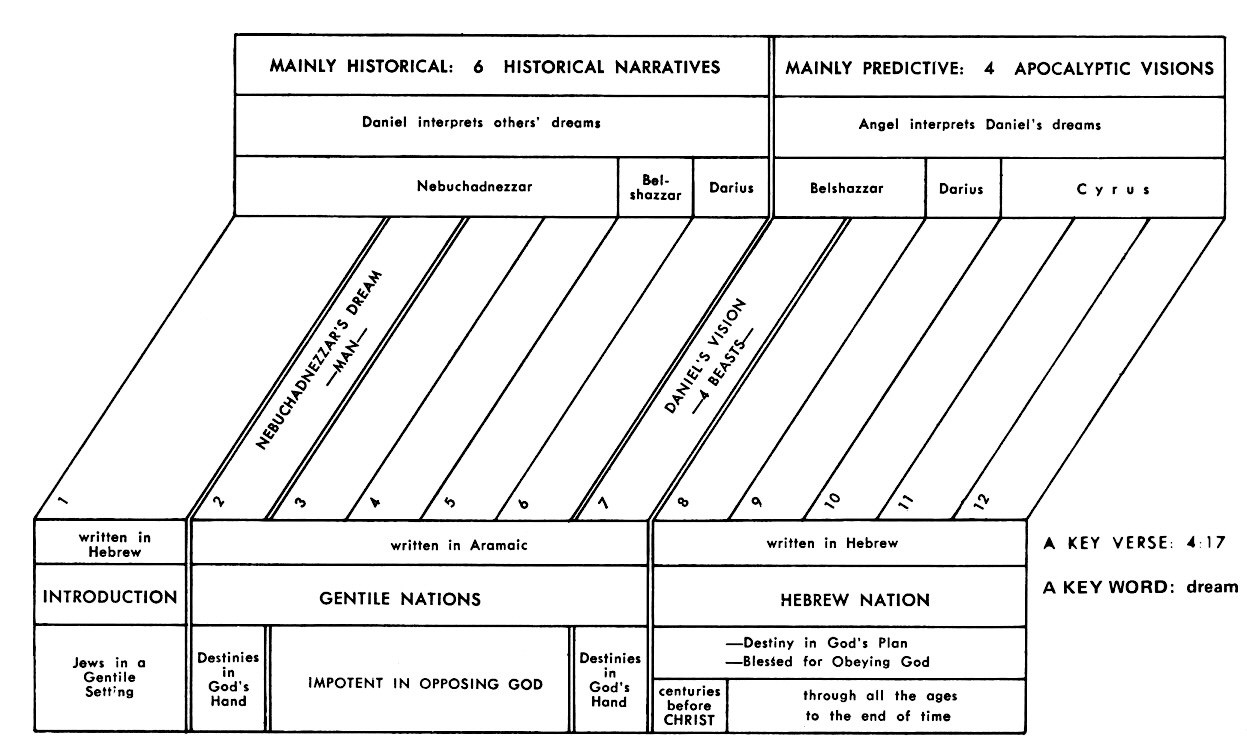 Click chart to enlarge
Charts from recommended resource Jensen's Survey of the OT - used by permission
Daniel 8:1 IN THE THIRD YEAR OF THE REIGN OF BELSHAZZAR THE KING A VISION APPEARED TO ME, DANIEL, SUBSEQUENT TO THE ONE WHICH APPEARED TO ME PREVIOUSLY:
BGT Daniel 8:1 ἔτους τρίτου βασιλεύοντος Βαλτασαρ ὅρασις ἣν εἶδον ἐγὼ Δανιηλ μετὰ τὸ ἰδεῖν με τὴν πρώτην
--- Daniel (TH) 8:1 ἐν ἔτει τρίτῳ τῆς βασιλείας Βαλτασαρ τοῦ βασιλέως ὅρασις ὤφθη πρός με ἐγὼ Δανιηλ μετὰ τὴν ὀφθεῖσάν μοι τὴν ἀρχήνLXE Daniel 8:1 In the third year of the reign of king Baltasar a vision appeared to me, even to me Daniel, after that which appeared to me at the first.
KJV Daniel 8:1 In the third year of the reign of king Belshazzar a vision appeared unto me, even unto me Daniel, after that which appeared unto me at the first.
NET Daniel 8:1 In the third year of King Belshazzar's reign, a vision appeared to me, Daniel, after the one that had appeared to me previously.
CSB Daniel 8:1 In the third year of King Belshazzar's reign, a vision appeared to me, Daniel, after the one that had appeared to me earlier.
ESV Daniel 8:1 In the third year of the reign of King Belshazzar a vision appeared to me, Daniel, after that which appeared to me at the first.
NIV Daniel 8:1 In the third year of King Belshazzar's reign, I, Daniel, had a vision, after the one that had already appeared to me.
NLT Daniel 8:1 During the third year of King Belshazzar's reign, I, Daniel, saw another vision, following the one that had already appeared to me.
NRS Daniel 8:1 In the third year of the reign of King Belshazzar a vision appeared to me, Daniel, after the one that had appeared to me at first.
NJB Daniel 8:1 In the third year of King Belshazzar a vision appeared to me, Daniel, after the one that had originally appeared to me.
NAB Daniel 8:1 After this first vision, I, Daniel, had another, in the third year of the reign of King Belshazzar.
YLT Daniel 8:1 'In the third year of the reign of Belshazzar the king, a vision hath appeared unto me -- I Daniel -- after that which had appeared unto me at the beginning.
GWN Daniel 8:1 In Belshazzar's third year as king, I, Daniel, saw a vision. This vision came after the one I saw earlier.
BBE Daniel 8:1 In the third year of the rule of Belshazzar the king, a vision was seen by me, Daniel, after the one I saw at first.
RSV Daniel 8:1 In the third year of the reign of King Belshazzar a vision appeared to me, Daniel, after that which appeared to me at the first.
NKJ Daniel 8:1 In the third year of the reign of King Belshazzar a vision appeared to me-- to me, Daniel-- after the one that appeared to me the first time.
ASV Daniel 8:1 In the third year of the reign of king Belshazzar a vision appeared unto me, even unto me, Daniel, after that which appeared unto me at the first.
DBY Daniel 8:1 In the third year of the reign of Belshazzar the king, a vision appeared unto me, even to me Daniel, after that which appeared unto me at the first.
BHT Daniel 8:1 Bišnat šälôš lümalkût Bël´šaccar hammeºlek Häzôn nir´â ´ëlay ´ánî däniyyë´l ´aHárê hannir´â ´ëlay BaTTüHillâ
NIRV Daniel 8:1 It was the third year of King Belshazzar's rule. After the vision that had already appeared to me, I had another one.
RWB Daniel 8:1 In the third year of the reign of king Belshazzar a vision appeared to me, even to me Daniel, after that which appeared to me at the first.
- Third year: Da 7:1
- Me, Daniel - Da 8:15 7:15,28 9:2 10:2,7 11:4
- I Daniel - phrase occurs in Da 8:15 8:27 9:2 10:2 10:7 12:5
- Daniel 8 Resources - multiple sermons and commentaries
Daniel introduces a new section switching from Aramaic at the end of Da 7:28 (Da 2:4b to Da 7:28 = Aramaic) to Hebrew in Da 8:1 through the end of the book (Da 8:1-12:13). While one cannot be dogmatic, it seems reasonable that since this last section focuses primarily on what will happen to Israel in the end-times that the language be Hebrew.
NET Note - The third year of King Belshazzar’s reign would have been ca. 551 B.C. Daniel would have been approximately 69 years old at the time of this vision. Previously = Heb “in the beginning.” This refers to the vision described in chapter seven.
Donald Campbell - The earlier chapters (Da 2:4-7:28) are in Aramaic, the language of the Gentile world of the day, because the material emphasizes the destinies of the Gentile nations-their rise, progress, decline, and collapse. Beginning with Daniel 8 and continuing through the remainder of the book, the emphasis is on the destiny of the people of Israel. The plight and fortunes of Israel are now traced through the period already discussed from a Gentile perspective. Now we are to study human history as it relates to Israel, and the original language of the text is appropriately Hebrew. (Borrow Daniel, decoder of dreams - well written, practical, recommended)
Daniel Whitcomb adds that "The introduction to the book of Daniel (Da 1:1-2:4) and the final chapters of the book beginning at this verse (Da 8:1-12:13) were written in Hebrew with the people of Israel primarily in perspective. Daniel 2:4-7:28 was written in Aramaic, the common commercial language of the Fertile Crescent, to reach an ever wider audience for the sake of witness to the true God of Israel (see comments at 2:4). It is fascinating that the Aramaic section begins and ends with the two perspectives of the four great Gentile kingdoms (Daniel 2 and Daniel 7). Similarly, the book Jeremiah was written mainly to Israel, but the one verse in the book that aims at the wider audience is written in Aramaic and contains a powerful challenge to the false gods of the Gentile world: "Thus you shall say to them, 'The gods that did not make the heavens and the earth shall perish from the earth and from under the heavens' " (Jer. 10:11). (Bolding added)
John Walvoord makes the point that "although many expositors divide the book of Daniel into two halves (1–6 and 7–12), there are also good reasons for dividing Daniel into three sections (Da 1, Da 2–7, Da 8–12). The first of Daniel’s own visions recorded in Daniel 7 is a broad summary of the times of the Gentiles, with emphasis on the climactic events culminating in the second coming of Christ to the earth. Beginning in Daniel 8, Daniel’s second vision concerns the empires of Persia and Greece as they relate to Israel. Under Persian government, Israelites went back to rebuild their land and their city, Jerusalem. Under Grecian domination, in particular under Antiochus Epiphanes, the city and the temple were again desolated. Daniel 9 presents Israel’s history from the time of Ezra and Nehemiah to the inauguration of the kingdom from heaven at the second coming of Christ immediately preceded by the time of great trouble for Israel. Daniel 10–11 reveal the events relating the Persian and Greek Empires to Israel, with emphasis on the Gentile oppression of Israel. The final section, Da 11:36—12:13, deals with the end of the age, the period of the revived Roman Empire, and the deliverance of Israel. It is fitting that the last five chapters of Daniel should be written in Hebrew, the language of Israel. (Daniel 8 The Vision Of The Ram And The Goat)
Appeared to me, Daniel - Daniel is clearly claiming that he is the writer of this book. He is speaking in the first all through chapter 8 (The first person singular pronoun "I" is used in Da 8:2, 8:3, 8:4, 8:5, 8:6, 8:7, 8:13, 8:15, 8:16, 8:17, 8:18, 8:19 8:27)
Outline of Daniel 8 - The Vision of the Ram, the Goat and the Rather Small Horn
- Daniel 8:1,2 - The Time and Place of the Vision
- Daniel 8:3-14 The Contents of the Vision
- Daniel 8:15-26 The Interpretation of the Vision
- Daniel 8:27 The Impact of the Vision
Daniel now is inspired to switch from writing in Aramaic (Da 2:4b through Da 7:28) back to Hebrew, the language in which he had written in Da 1:1 through Da 2:4a. While one cannot be dogmatic as to why the switch occurs at this juncture, close observation of the subject matter in these last 4 chapters indicates a clear focus on the land of Israel and the fate of the Jews, in both the near future (from Daniel's perspective) and the distant future, yea, even to "the end of the age" (Daniel 12:13, cp repetition of the phrase "the end" in the NAS = Da 8:17, 19, Da 9:26, Da 11:27, Da 11:35, Da 11:40, Da 12:4, Da 12:6, Da 12:9)
Subsequent to the one which appeared to me previously - Daniel is alluding to his first vision described in Daniel 7 (Da 7:1 "Daniel saw a dream and visions in his mind").
Campbell - In the first (Daniel 7), Daniel saw four world empires to which his people would be subject for long centuries -- Babylon, Medo-Persia, Greece, and Rome. He now receives more knowledge concerning the second and third of these empires, Persia and Greece. The reason for this is clear: In the latter period of Grecian domination of Israel, a ruler would arise who would unleash terrible hatred against the Jews. (Borrow Daniel, decoder of dreams - well written, practical, recommended)
In the third year of the reign of Belshazzar - This was two years after Daniel's first vision in Daniel 7:1ff and as shown in the chart below chronologically Daniel 7 and Daniel 8 occur before Daniel 5 (the night of Belshazzar’s feast) which marks the end of the Belshazzar's reign and the end of the Kingdom of Babylon. You will read some commentaries that place Daniel 8 near the downfall of Babylon, but with the discovery of the Babylonian Chronicles (allowing more accurate dating of Belshazzar's reign), it is clear that the vision of Daniel 8 occurred at least 12 years prior to the night of Belshazzar's blasphemous party in Babylon.
The third year is 551 BC and Daniel is a "mature" older saint (~69yo - my age as I write these notes - as an aside young readers remember that God wants to use you fully, every day of your life, so don't "retire" from Christianity when you grow older!) when he received vision #2 of 4 visions. To help keep one's perspective in this great prophetic section of Daniel, recall that Daniel 7-12 describes Daniel's four separate visions which are summarized in the chart below. Notice that the first and second visions are actually given to Daniel during the reign of Belshazzar, and thus chronologically fall between chapters 4 and 5 (are you confused now? See table below). Daniel 5 (Da 5:26-31) marks the fall of the Babylonian kingdom and the rise of the Medo-Persian kingdom, during which the prophet received his third (Da 9:1, Da 9:23) and fourth (Da 10:1) visions. The fourth and final vision begins in Daniel 10:1 and extends through the end of the book, Daniel 12:13.
| CHRONOLOGY OF DANIEL'S FOUR VISIONS |
|||||
| FIRST VISION |
SECOND VISION |
THIRD VISION |
FOURTH VISION |
||
| Daniel 4 | Daniel 7 | Daniel 8 | Daniel 5 | Daniel 9 | Daniel 10 |
| King: Nebuchadnezzar | King: Belshazzar's First Year |
King: Belshazzar's Third Year |
Fall of Babylon Last Year of Belshazzar |
King Darius (Mede) 1st Year of Reign |
King Cyrus (Persian) 3rd Year of Reign |
| ~553BC | ~551BC | 539BC | 539BC | ~534BC | |
| -- | Daniel 7:1 | Daniel 8:1 | -- | Da 9:1 Da 9:23 |
Daniel 10:1 |
| Daniel ~47-51yo |
Daniel ~67yo |
Daniel ~69yo |
Daniel ~81yo |
Daniel ~81yo |
Daniel ~86yo |
|
|||||
Or looked at from another vantage point…
AFTER DANIEL 4 BUT BEFORE DANIEL 5
Vision #1 - Daniel 7:1 - First year of King Belshazzar (~553 BC) - Daniel ~ 67 yo
Vision #2 - Daniel 8:1 - Third year of King Belshazzar (~551 BC) - Daniel ~ 69 yo
AFTER THE FALL OF BABYLON 539BC
Vision #3 - Daniel 9:2, 23 - First year of Darius the Mede (~539 BC) - Daniel ~ 81 yo
Vision #4 - Daniel 10:1 - Third year of Cyrus the Persian (~534 BC) - Daniel ~ 86 yo
Daniel 8:2 I LOOKED IN THE VISION, AND WHILE I WAS LOOKING I WAS IN THE CITADEL OF SUSA, WHICH IS IN THE PROVINCE OF ELAM; AND I LOOKED IN THE VISION AND I MYSELF WAS BESIDE THE ULAI CANAL:
BGT Daniel 8:2 καὶ εἶδον ἐν τῷ ὁράματι τοῦ ἐνυπνίου μου ἐμοῦ ὄντος ἐν Σούσοις τῇ πόλει ἥτις ἐστὶν ἐν Ἐλυμαΐδι χώρᾳ ἔτι ὄντος μου πρὸς τῇ πύλῃ Αιλαμ
--- Daniel (TH) 8:2 καὶ ἤμην ἐν Σούσοις τῇ βάρει ἥ ἐστιν ἐν χώρᾳ Αιλαμ καὶ εἶδον ἐν ὁράματι καὶ ἤμην ἐπὶ τοῦ ΟυβαλLXE Daniel 8:2 And I was in Susa the palace, which is in the land of Aelam, and I was on the bank of Ubal.
KJV Daniel 8:2 And I saw in a vision; and it came to pass, when I saw, that I was at Shushan in the palace, which is in the province of Elam; and I saw in a vision, and I was by the river of Ulai.
NET Daniel 8:2 In this vision I saw myself in Susa the citadel, which is located in the province of Elam. In the vision I saw myself at the Ulai Canal.
CSB Daniel 8:2 I saw the vision, and as I watched, I was in the fortress city of Susa, in the province of Elam. I saw in the vision that I was beside the Ulai Canal.
ESV Daniel 8:2 And I saw in the vision; and when I saw, I was in Susa the citadel, which is in the province of Elam. And I saw in the vision, and I was at the Ulai canal.
NIV Daniel 8:2 In my vision I saw myself in the citadel of Susa in the province of Elam; in the vision I was beside the Ulai Canal.
NLT Daniel 8:2 In this vision I was at the fortress of Susa, in the province of Elam, standing beside the Ulai River.
NRS Daniel 8:2 In the vision I was looking and saw myself in Susa the capital, in the province of Elam, and I was by the river Ulai.
NJB Daniel 8:2 I gazed at the vision, and as I gazed I found myself in Susa, the citadel in the province of Elam; gazing at the vision, I found myself at the Ulai Gate.
NAB Daniel 8:2 In my vision I saw myself in the fortress of Susa in the province of Elam; I was beside the river Ulai.
YLT Daniel 8:2 And I see in a vision, and it cometh to pass, in my seeing, and I am in Shushan the palace that is in Elam the province, and I see in a vision, and I have been by the stream Ulai.
GWN Daniel 8:2 In my vision I saw myself in the fortress of Susa in the province of Elam. In my vision I saw myself at Ulai Gate.
BBE Daniel 8:2 And I saw in the vision; and when I saw it, I was in the strong town Shushan, which is in the country of Elam; and in the vision I was by the water-door of the Ulai.
RSV Daniel 8:2 And I saw in the vision; and when I saw, I was in Susa the capital, which is in the province of Elam; and I saw in the vision, and I was at the river Ulai.
NKJ Daniel 8:2 I saw in the vision, and it so happened while I was looking, that I was in Shushan, the citadel, which is in the province of Elam; and I saw in the vision that I was by the River Ulai.
ASV Daniel 8:2 And I saw in the vision; now it was so, that when I saw, I was in Shushan the palace, which is in the province of Elam; and I saw in the vision, and I was by the river Ulai.
DBY Daniel 8:2 And I saw in the vision; and it came to pass, when I saw, that I was in the fortress of Shushan, which is in the province of Elam. And I saw in the vision, and I was by the river Ulai.
BHT Daniel 8:2 wä|´er´è BeHäzôn wayühî Bir´ötî wa´ánî Büšûšan haBBîrâ ´ášer Bü`êläm hammüdînâ wä´er´è Be|Häzôn wa´ánî häyîºtî `al-´ûbal ´ûläy
NIRV Daniel 8:2 In my vision I saw myself in the city of Susa. It has high walls around it. It is in the land of Elam. In the vision I was beside the Ulai Waterway.
- I looked in: Da 8:3 7:2,15 Nu 12:6 Heb 1:1
- Susa [Shushan]: Neh 1:1 Esther 1:2 2:8 3:15 7:6 8:15 9:11,15
- Province: Ge 10:22 14:1 Isa 21:2 Jer 25:25 49:34, 35, 36, 37, 38, 39 Ezek 32:24
- Ulai Canal: Da 8:16
- Daniel 8 Resources - multiple sermons and commentaries
KJV Daniel 8:2 And I saw in a vision; and it came to pass, when I saw, that I was at Shushan in the palace, which is in the province of Elam; and I saw in a vision, and I was by the river of Ulai.
NET Daniel 8:2 In this vision I saw myself in Susa the citadel, which is located in the province of Elam. In the vision I saw myself at the Ulai Canal.
CSB Daniel 8:2 I saw the vision, and as I watched, I was in the fortress city of Susa, in the province of Elam. I saw in the vision that I was beside the Ulai Canal.
ESV Daniel 8:2 And I saw in the vision; and when I saw, I was in Susa the capital, which is in the province of Elam. And I saw in the vision, and I was at the Ulai canal.
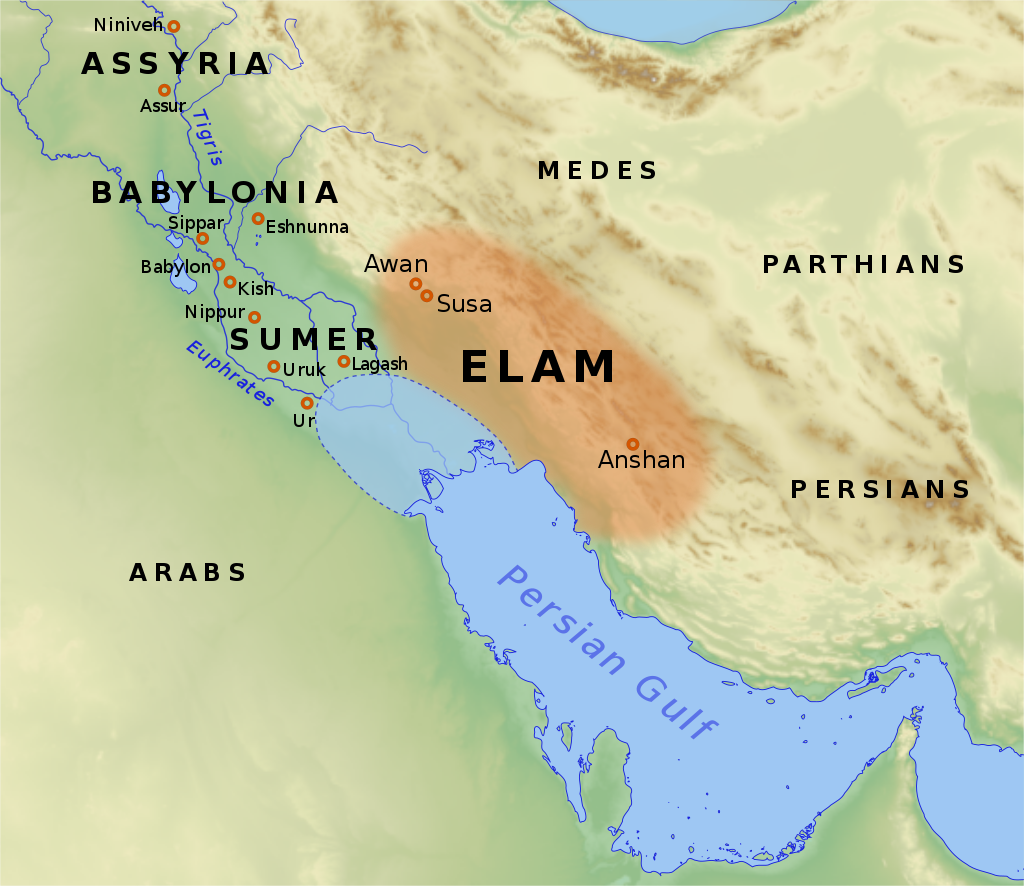
Citadel of Susa (Shushan = means "lily") (Dictionary Descriptions) - Susa - Wikipedia
Susa (Shushan) (See map below - Susa is ~250 miles east of Babylon in modern day Iran) - This place name is found in 19 verses in the OT - Neh 1:1; Esther 1:2, 5; 2:3, 5, 8; 3:15; 4:8, 16; 8:14-15; 9:6, 11-13, 18; Da 8:2. Susa eventually became one of the capitals of the Persian empire almost 100 years after Daniel's time, when the emperor Xerxes built his royal palace there. Susa is also the site of the main events of the book of Esther (Esther Verse by Verse Commentary on site). Finally, God's man Nehemiah lived in Susa as the king's cupbearer. Nehemiah (in about 445BC, over 100 years after Daniel's vision in Da 8:1) wrote "The words of Nehemiah the son of Hacaliah. Now it happened in the month Chislev, in the twentieth year, while I was in Susa the capitol (Heb = biyrah/bira = same word in Da 8:1 for "citadel"), (Neh 1:1)
Citadel (01002) (biyrah/bira) - 16x - 1Chr 29:1, 19; Neh 1:1; 2:8; 7:2; Esther 1:2, 5; 2:3, 5, 8; 3:15; 8:14; 9:6, 11, 12; Da 8:2. NAS = capitol(1), citadel(11), fortress(2), temple(2).
Brown-Driver-Briggs Expanded Definition - בִּירָה noun feminine castle, palace (late & probably loan-word; compare Assyrian bîrtu, fortress Dl HA 22; Persian bâru = Sanskrit bura, bari, see Ry Nehemiah 2:8) — (1) of temple at Jerusalem 1Chr 29:1,19 הַבִּירָה; of fortress near temple Neh 2:8; Neh 7:2 Neh 1:1; Neh 2:8; Neh 7:2 — B aβιρά, βειρά — and later βaρις Jos Ant.xiv.11,4). (2) בְּשׁוּשַׁן הַבִּירָה Nehemiah 1:1; Esther 1:2,5; Esther 2:3,5,8; Esther 3:15; Esther 8:14; Esther 9:6,11,12; Daniel 8:2; in these passages it apparently means a fortress in the city bearing the same name (compare especially Esther 3:15; Esther 8:14,15; Esther 9:6,12,15,18).
Susa + biyrah = 12x) - Neh 1:1 Esther 1:2, 1:5, 2:3, 2:5, 2:8, 3:15, 8:14, 9:6, 9:11, 9:12 Dan 8:2
NET Note - Susa (Heb. שׁוּשַׁן, shushan), located some 230 miles (380 km) east of Babylon, was a winter residence for Persian kings during the Achaemenid period. The language of v. 2 seems to suggest that Daniel may not have been physically present at Susa, but only saw himself there in the vision. However, the Hebrew is difficult, and some have concluded that the first four words of v. 2 in the Masoretic Text are a later addition (cf. Theodotion).
Walvoord on Citadel of Susa - (It) was destined in the Persian Empire to become the capital rather than Babylon. This was unknown at the time that this vision was given to Daniel, although Susa had served as the capital of the Elamites in antiquity; and conservative scholars find a genuine prophetic prediction in this reference to Susa… In a word, Daniel finds himself projected in vision to a town little known at that time and unsuspected for future grandeur, but yet destined to be the important capital of Persia, the home of Esther, and the city from which Nehemiah came to Jerusalem. Beginning in 1884, the site of ancient Susa, then a large mound, has been explored and has divulged many archeological treasures. The code of Hammurabi was found there in 1901. The famous palace referred to by Daniel, Esther and Nehemiah was begun by Darius I and enlarged by later kings. Remains of its magnificence can still be seen near the modern village of Shush. This unusual setting described in detail by Daniel in the opening verses of the eighth chapter now becomes the stage on which a great drama is portrayed in symbol describing the conquests of the second and third empires. (Daniel 8 The Vision Of The Ram And The Goat)
NET Note - The Hebrew word בִּירָה (birah, “castle, palace”) usually refers to a fortified structure within a city, but here it is in apposition to the city name Susa and therefore has a broader reference to the entire city (against this view, however, see BDB 108 s.v. 2). Cf. NAB “the fortress of Susa”; TEV “the walled city of Susa.”
Related Resources on Susa:
- Ancient archeological site of Susa - YouTube
- Shushan Palace Book of Esther and Daniel. Bible Archaeology and the History of Israel
Elam - A well-known tract, partly mountainous, whose western boundary, starting on the Northeast side of the Persian Gulf, practically followed the course of the lower Tigris. It was bounded on the North by Media, on the East by Persia and on the West by Babylonia. The great capital of the tract was Susa (Shushan). Elam consisted of a plain occupying a depression in the mountains of Iran or Persia. (Adapted from Dictionary Article)
And I looked in the vision - Compare "dream and visions" in Da 7:1. This statement suggests (1) that Daniel was awake (contrast "dream" in Da 7:1) and (2) that Daniel was not actually in Susa but more likely was transported there in a vision much like the other exilic prophet Ezekiel was transported from Babylon to Jerusalem in his vision of the Temple (cp Ezek 8:3, 11:24, Ezekiel 40:1ff). Some commentators interpret Daniel as actually present physically in Susa but the majority favor his being in Babylon physically and transported in the vision to Susa. In short Daniel is transported supernaturally in both space (Babylon to Susa) and time (into the prophetic future regarding Medo-Persia and Greece).
Henry Morris - Daniel was translated in his vision to the capital of Persia even before the Persians had conquered Babylon. Furthermore, his vision then prophesied the eventual defeat of Persia by Greece, as well as the still more distant break-up of the Grecian empire. It is not surprising that those who deny supernatural divine inspiration must try to assign the book of Daniel to a later period. (Daniel 8 Defender's Study Bible Notes)
NET Note on Ulai Canal - The term אוּבַל (’uval = “stream, river”) is a relatively rare word in biblical Hebrew, found only here and in vv. 3 and 6. The Ulai was apparently a sizable artificial canal in Susa (cf. NASB, NIV, NCV), and not a river in the ordinary sense of that word.
Daniel 8:3 THEN I LIFTED MY EYES AND LOOKED, AND BEHOLD, A RAM WHICH HAD TWO HORNS WAS STANDING IN FRONT OF THE CANAL. NOW THE TWO HORNS WERE LONG, BUT ONE WAS LONGER THAN THE OTHER, WITH THE LONGER ONE COMING UP LAST:
BGT Daniel 8:3 ἀναβλέψας εἶδον κριὸν ἕνα μέγαν ἑστῶτα ἀπέναντι τῆς πύλης καὶ εἶχε κέρατα καὶ τὸ ἓν ὑψηλότερον τοῦ ἑτέρου καὶ τὸ ὑψηλότερον ἀνέβαινε
--- Daniel (TH) 8:3 καὶ ἦρα τοὺς ὀφθαλμούς μου καὶ εἶδον καὶ ἰδοὺ κριὸς εἷς ἑστηκὼς πρὸ τοῦ Ουβαλ καὶ αὐτῷ κέρατα καὶ τὰ κέρατα ὑψηλά καὶ τὸ ἓν ὑψηλότερον τοῦ ἑτέρου καὶ τὸ ὑψηλὸν ἀνέβαινεν ἐπ᾽ ἐσχάτωνLXE Daniel 8:3 And I lifted up mine eyes, and saw, and, behold, a ram standing in front of the Ubal; and he had high horns; and one was higher than the other, and the high one came up last.
KJV Daniel 8:3 Then I lifted up mine eyes, and saw, and, behold, there stood before the river a ram which had two horns: and the two horns were high; but one was higher than the other, and the higher came up last.
NET Daniel 8:3 I looked up and saw a ram with two horns standing at the canal. Its two horns were both long, but one was longer than the other. The longer one was coming up after the shorter one.
CSB Daniel 8:3 I looked up, and there was a ram standing beside the canal. He had two horns. The two horns were long, but one was longer than the other, and the longer one came up last.
ESV Daniel 8:3 I raised my eyes and saw, and behold, a ram standing on the bank of the canal. It had two horns, and both horns were high, but one was higher than the other, and the higher one came up last.
NIV Daniel 8:3 I looked up, and there before me was a ram with two horns, standing beside the canal, and the horns were long. One of the horns was longer than the other but grew up later.
NLT Daniel 8:3 As I looked up, I saw a ram with two long horns standing beside the river. One of the horns was longer than the other, even though it had grown later than the other one.
NRS Daniel 8:3 I looked up and saw a ram standing beside the river. It had two horns. Both horns were long, but one was longer than the other, and the longer one came up second.
NJB Daniel 8:3 I raised my eyes to look, and I saw a ram standing in front of the gate. It had two horns; both were tall, but one taller than the other, and the one that rose the higher was the second.
NAB Daniel 8:3 I looked up and saw standing by the river a ram with two great horns, the one larger and newer than the other.
YLT Daniel 8:3 And I lift up mine eyes, and look, and lo, a certain ram is standing before the stream, and it hath two horns, and the two horns are high; and the one is higher than the other, and the high one is coming up last.
GWN Daniel 8:3 I looked up and saw a single ram standing beside the gate. The ram had two long horns, one longer than the other, though the longer one had grown up later.
BBE Daniel 8:3 And lifting up my eyes, I saw, there before the stream, a male sheep with two horns: and the two horns were high, but one was higher than the other, the higher one coming up last.
RSV Daniel 8:3 I raised my eyes and saw, and behold, a ram standing on the bank of the river. It had two horns; and both horns were high, but one was higher than the other, and the higher one came up last.
NKJ Daniel 8:3 Then I lifted my eyes and saw, and there, standing beside the river, was a ram which had two horns, and the two horns were high; but one was higher than the other, and the higher one came up last.
ASV Daniel 8:3 Then I lifted up mine eyes, and saw, and, behold, there stood before the river a ram which had two horns: and the two horns were high; but one was higher than the other, and the higher came up last.
DBY Daniel 8:3 And I lifted up mine eyes and saw, and behold, there stood before the river a ram which had two horns; and the two horns were high; and one was higher than the other, and the higher came up last.
BHT Daniel 8:3 wä´eSSä´ `ênay wä´er´è wühinnË ´aºyil ´eHäd `ömëd lipnê hä´ùbäl wülô qüränäºyim wühaqqüränaºyim Güböhôt wühä´aHat Güböhâ min-haššënît wühaºGGüböhâ `ölâ Bä´aHárönâ
NIRV Daniel 8:3 I looked up and saw a ram that had two horns. He was standing beside the waterway. His horns were long. One of them was longer than the other. But it grew up later.
- I lifted: Da 10:5 Nu 24:2 Josh 5:13 1Ch 21:16 Zec 1:18 2:1 5:1,5,9 6:1
- Ram: Da 8:20 Da 2:39 Da 7:5
- One [horn]: Media was the more ancient kingdom; but Persia, after Cyrus, was the most considerable. Da 5:31 6:28 Ezra 1:2 4:5 Es 1:3 Isa 13:17, 21:2, 44:28, Jer 51:11
- Daniel 8 Resources - multiple sermons and commentaries
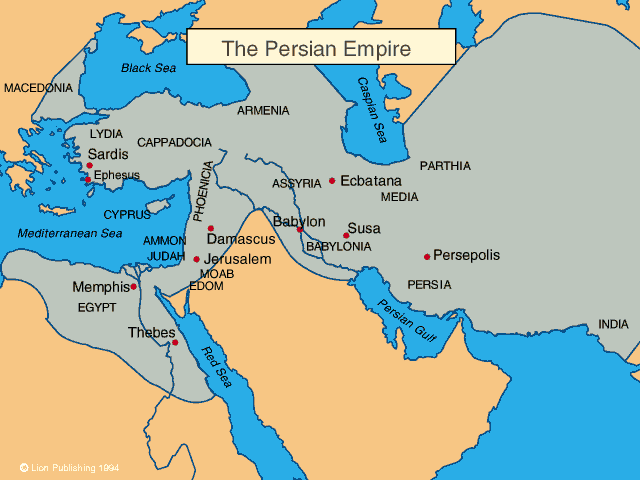
Click to Enlarge
Then I lifted my eyes and looked - This appears to be his vision. One is reminded of John's apocalyptic visions in the Revelation, where he repeatedly uses the words "I saw." God Almighty showed these two great prophets what was soon to come to pass (Yes, John was a prophet!)
Behold ( 02009 ) (hinneh) is used to call attention to something and thus in this context directs the reader to give special attention to what follows. When you encounter a "behold" in Scripture, realize that God is trying to "get your attention" regarding what follows. Hinneh is used 11x in this last section of Daniel - Dan 8:3, 5, 15, 19; 10:5, 10, 13, 16, 20; 11:2; 12:5. Spurgeon reminds us that "Behold is a word of wonder; it is intended to excite admiration. Wherever you see it hung out in Scripture, it is like an ancient sign-board, signifying that there are rich wares within, or like the hands which solid readers have observed in the margin of the older Puritanic books, drawing attention to something particularly worthy of observation." I would add, behold is like a divine highlighter, a divine underlining of an especially striking or important text. It says in effect "Listen up, all ye who would be wise in the ways of Jehovah!"
Regarding the figure of a ram, the Treasury of Scripture Knowledge has an interesting note - "The Medo-Persian empire, of which a ram was the ensign; and a ram's head with horns, one higher than the other, is still to be seen on the ruins of Persepolis."
The Ram - From Daniel 8:20-note this figure clearly symbolizes Medo-Persia ("the kings of Media and Persia"), the kingdom which followed Babylon (which was still the leading world power at the time Daniel received this prophecy) although it would be inferior to Babylon according to Nebuchadnezzar's dream (Da 2:39-note, cp Da 7:5-note). In a separate prophecy given over 150 years earlier (circa 740-680BC), Isaiah had foretold of the Persian King Cyrus (Cyrus the Great) (see note) conquest of nations (see Isa 44:28, 45:1-7, cp Cyrus' decree to allow the Jews to rebuild the Temple - Ezra 1:1, 2, Ezra 6:3).
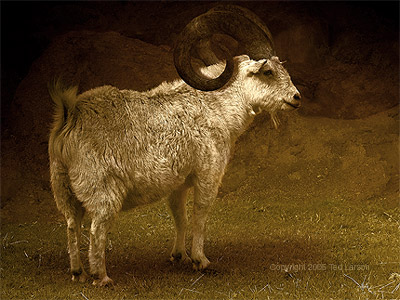
Vision of the Ram
Used by Permission of Ted Larson
Horns - Recall that where horn is used figuratively in Scripture, it usually conveys one of three meanings appear - (1) strength in general (Dt 33:17) (2) arrogant pride (Ps 75:4, Ps 75:5) or (3) political and military power (Da 8:3-4). The figure of a horn is even used in the NT as a description of the powerful ministry of the Messiah (Lk 1:68-69 - Ryrie says "horn of salvation" in essence means "a powerful Savior")
Two horns… one longer… coming up last - The accuracy of God's Word is indisputable, not only describing Medo-Persia but the dominance of Persia over Media and the rise of Persia after Media. God's Word is inerrant as substantiated by this historically precise prophetic description. One is reminded of Peter's words that we as New Testament believers…
have the prophetic word (referring to the OT Scriptures) made more sure, to which you do well to pay attention as to a lamp shining in a dark place, until the day dawns and the morning star arises in your hearts. (2Peter 1:19)
This description of the uneven horns corresponds to the bear in Daniel 7 where we read…
And behold, another beast, a second one, resembling a bear. And it was raised up on one side, and three ribs were in its mouth between its teeth; and thus they said to it, 'Arise, devour much meat!' (Daniel 7:5)
In fact, the truths revealed in Daniel 8 help us to understand the otherwise somewhat enigmatic phrase of "raised up on one side", which most assuredly refers to Persia's subsequent ascendancy to a position of greater power over the more ancient Median counterpart.
Daniel 8:4 I SAW THE RAM BUTTING WESTWARD, NORTHWARD, AND SOUTHWARD, AND NO OTHER BEASTS COULD STAND BEFORE HIM NOR WAS THERE ANYONE TO RESCUE FROM HIS POWER, BUT HE DID AS HE PLEASED AND MAGNIFIED HIMSELF:
LXE Daniel 8:4 And I saw the ram butting westward, and northward, and southward; and no beast could stand before him, and there was none that could deliver out of his hand; and he did according to his will, and became great.
KJV Daniel 8:4 I saw the ram pushing westward, and northward, and southward; so that no beasts might stand before him, neither was there any that could deliver out of his hand; but he did according to his will, and became great.
NET Daniel 8:4 I saw that the ram was butting westward, northward, and southward. No animal was able to stand before it, and there was none who could deliver from its power. It did as it pleased and acted arrogantly.
CSB Daniel 8:4 I saw the ram charging to the west, the north, and the south. No animal could stand against him, and there was no rescue from his power. He did whatever he wanted and became great.
ESV Daniel 8:4 I saw the ram charging westward and northward and southward. No beast could stand before him, and there was no one who could rescue from his power. He did as he pleased and became great.
NIV Daniel 8:4 I watched the ram as he charged toward the west and the north and the south. No animal could stand against him, and none could rescue from his power. He did as he pleased and became great.
NLT Daniel 8:4 The ram butted everything out of his way to the west, to the north, and to the south, and no one could stand against him or help his victims. He did as he pleased and became very great.
NRS Daniel 8:4 I saw the ram charging westward and northward and southward. All beasts were powerless to withstand it, and no one could rescue from its power; it did as it pleased and became strong.
NJB Daniel 8:4 I saw the ram butting westwards, northwards and southwards. No animal could stand up to it, nothing could escape its power. It did as it pleased and became strong.
NAB Daniel 8:4 I saw the ram butting toward the west, north, and south. No beast could withstand it or be rescued from its power; it did what it pleased and became very powerful.
YLT Daniel 8:4 I have seen the ram pushing westward, and northward, and southward, and no living creatures do stand before it, and there is none delivering out of its hand, and it hath done according to its pleasure, and hath exerted itself.
- Butting: Da 5:30 7:5 11:2 Isa 45:1-5 Jer 50:1-51:64
- No other: Da 8:7 Job 10:7 Ps 7:2 50:22 Mic 5:8
- But he did: Da 5:19 11:3,16,36 Isa 10:13,14
- Daniel 8 Resources - multiple sermons and commentaries
THE POWERFUL RAM
MAGNIFIES HIMSELF
Westward, northward, and southward - With Persia as the starting point for the 3 directions, historically Medo-Persia defeated Babylon (and other countries) toward the west, Armenia and Scythia toward the north and Egypt and Ethiopia toward the South. Once again we see the historical fulfillment testifies to the accuracy and faithfulness of God's Word. Beloved, you can stake your life on His Word of Truth, which is like unto none other! Are you ingesting the Word of Life daily (Php 2:16, 1Jn 1:1, cp Dt 32:46-47 the Word which "is your life"? Compare Mt 4:4, 1Pe 2:2 - no intake of "pure milk" = no spiritual growth!)? If you are not daily reading the Word, then is it any wonder that you feel so "spiritually malnourished?" Let the accurate fulfillment of these OT prophecies spur you on to began a serious, systematic study of God's Word, not words about His Word (devotionals, commentaries, etc, but His living and active Word, which will not pass away) (If you're not sure where to begin here is a suggestion - See notes on the incredible adventure known as inductive Bible study).
No other beasts - Similar to the symbolism in Daniel 7, we see God's assessment of the great kingdoms of men - they are "beastly"! This description (could not stand, none to rescue, did as he pleased, magnified himself) clearly accentuates the power of the Medo-Persian Kingdom.
NET Note on magnified - In the Hiphil the Hebrew verb גָּדַל (gadal, “to make great; to magnify”) can have either a positive or a negative sense. For the former, used especially of God, see Ps 126:2, 3; Joel 2:21. In this chapter (8:4, 8, 11, 25) the word has a pejorative sense, describing the self-glorification of this king. The sense seems to be that of vainly assuming one’s own superiority through deliberate hubris.
Daniel 8:5 WHILE I WAS OBSERVING, BEHOLD, A MALE GOAT WAS COMING FROM THE WEST OVER THE SURFACE OF THE WHOLE EARTH WITHOUT TOUCHING THE GROUND; AND THE GOAT HAD A CONSPICUOUS HORN BETWEEN HIS EYES:
BGT Daniel 8:5 καὶ ἐγὼ διενοούμην καὶ ἰδοὺ τράγος αἰγῶν ἤρχετο ἀπὸ δυσμῶν ἐπὶ προσώπου τῆς γῆς καὶ οὐχ ἥπτετο τῆς γῆς καὶ ἦν τοῦ τράγου κέρας ἓν ἀνὰ μέσον τῶν ὀφθαλμῶν αὐτοῦ
--- Daniel (TH) 8:5 καὶ ἐγὼ ἤμην συνίων καὶ ἰδοὺ τράγος αἰγῶν ἤρχετο ἀπὸ λιβὸς ἐπὶ πρόσωπον πάσης τῆς γῆς καὶ οὐκ ἦν ἁπτόμενος τῆς γῆς καὶ τῷ τράγῳ κέρας θεωρητὸν ἀνὰ μέσον τῶν ὀφθαλμῶν αὐτοῦLXE Daniel 8:5 And I was considering, and, behold, a he-goat came from the south-west on the face of the whole earth, and touched not the earth: and the goat had a horn between his eyes.
KJV Daniel 8:5 And as I was considering, behold, an he goat came from the west on the face of the whole earth, and touched not the ground: and the goat had a notable horn between his eyes.
NET Daniel 8:5 While I was contemplating all this, a male goat was coming from the west over the surface of all the land without touching the ground. This goat had a conspicuous horn between its eyes.
CSB Daniel 8:5 As I was observing, a male goat appeared, coming from the west across the surface of the entire earth without touching the ground. The goat had a conspicuous horn between his eyes.
ESV Daniel 8:5 As I was considering, behold, a male goat came from the west across the face of the whole earth, without touching the ground. And the goat had a conspicuous horn between his eyes.
NIV Daniel 8:5 As I was thinking about this, suddenly a goat with a prominent horn between his eyes came from the west, crossing the whole earth without touching the ground.
NLT Daniel 8:5 While I was watching, suddenly a male goat appeared from the west, crossing the land so swiftly that he didn't even touch the ground. This goat, which had one very large horn between its eyes,
NRS Daniel 8:5 As I was watching, a male goat appeared from the west, coming across the face of the whole earth without touching the ground. The goat had a horn between its eyes.
NJB Daniel 8:5 This is what I observed: a he-goat from the west, encroaching over the entire surface of the world though never touching the ground, and between its eyes the goat had one majestic horn.
NAB Daniel 8:5 As I was reflecting, a he-goat with a prominent horn on its forehead suddenly came from the west across the whole earth without touching the ground.
YLT Daniel 8:5 'And I have been considering, and lo, a young he-goat hath come from the west, over the face of the whole earth, whom none is touching in the earth; as to the young he-goat, a conspicuous horn is between its eyes.
GWN Daniel 8:5 As I was watching closely, I saw a male goat coming from the west. It crossed the whole earth without touching it. This goat had a prominent horn between its eyes.
BBE Daniel 8:5 And while I was giving thought to this, I saw a he-goat coming from the west over the face of all the earth without touching the earth: and the he-goat had a great horn between his eyes.
RSV Daniel 8:5 As I was considering, behold, a he-goat came from the west across the face of the whole earth, without touching the ground; and the goat had a conspicuous horn between his eyes.
NKJ Daniel 8:5 And as I was considering, suddenly a male goat came from the west, across the surface of the whole earth, without touching the ground; and the goat had a notable horn between his eyes.
ASV Daniel 8:5 And as I was considering, behold, a he-goat came from the west over the face of the whole earth, and touched not the ground: and the goat had a notable horn between his eyes.
DBY Daniel 8:5 And as I was considering, behold, a he-goat came from the west over the face of the whole earth, and touched not the ground: and the goat had a notable horn between his eyes.
BHT Daniel 8:5 wa´ánî häyîºtî mëbîn wühinnË cüpîr-hä|`izzîm Bä´ min-ha|mma`áräb `al-Pünê kol-hä´äºrec wü´ên nôgëª` Bä´äºrec wühaºccäpîºr qeºren Häzût Bên `ênäyw
NIRV Daniel 8:5 I was thinking about all of that. Then a goat suddenly came from the west. He had a large horn between his eyes. He raced across the whole earth without even touching the ground.
- Male goat: Da 8:21 2:32,39 7:6
- A conspicuous horn: Da 8:8,21, Da 11:3 = Alexander the Great
- Daniel 8 Resources - multiple sermons and commentaries

Vision of the Goat
Used by Permission of Ted Larson
Behold (hinneh) - Another attention getter!
A male goat (he goat, KJV) - Remember that when we encounter symbolic language in Scripture, we must attempt to discover the literal meaning (and not let our imagination run wild as to the possible meanings, an all too common tactic among interpreters of Bible prophecy). Two ways to achieve our desired end of an accurate (literal) meaning (Symbolic or figurative language is always meant to convey a literal meaning) are (1) examination of the context for "clues" and (2) comparison with related or parallel passages (e.g., passages that use similar symbols but offer a literal interpretation - a good example is comparing the "the sun, and the moon… and… twelve stars in Rev 12:1 with an almost identical description in Ge 37:9, 10). In the case of the male goat we do not have to guess at the interpretation, for comparison with Da 8:21 explicitly identifies the shaggy goat as the kingdom of Greece.
NET Note on male goat - Heb “and behold, a he-goat of the goats.”
John Phillips writes that…
The goat was a symbol of Macedonia. According to tradition, Caremus, the first Macedonian king, was directed by an oracle to take a goat for a guide and build a city. This he did, following a herd of goats to Edessa, which he made his capital, changing its name to Egaea (the goat city).
When Alexander was thirteen, his father, Philip of Macedon, decided that the boy needed a first-class teacher, and he chose Aristotle. Aristotle believed that slavery was natural, that all barbarians (non-Greeks) were slaves by nature, and, consequently, that it was only right that Greeks should rule over barbarians. These view were heady stuff for the already ambitious Alexander.
After the death of his father, Alexander's first task was to thrash into submission the independent Greek city-states—something he did with characteristic speed and thoroughness. Very early, he displayed an uncanny trait of always being able to discern the enemy's tactics in advance. His treatment of the recalcitrant city of Thebes warned others of his ruthlessness. When he finally took the city, he handed it over to wholesale butchery and debauchery and sold the survivors as slaves. The other Greek states rushed to make their peace with the terrible new king. (Exploring the Book of Daniel: An Expository Commentary)
Coming from the west - While this direction might seem like an insignificant detail (no detail in Scripture is insignificant!), it once again demonstrates the inerrancy of God's fully inspired (plenary inspiration) Word, for the kingdom of Greece indeed lay directly to the west of Medo-Persia.
Without touching the ground - Comparing this figurative description with the parallel description in Daniel 7:6 (like a leopard, which had on its back four wings of a bird), first indicates that the leopard symbolized Greece and second that they conquests of the ram by the goat would be rapid. Historically, Alexander the Great's Greek forces (much smaller in number than their Medo-Persian counterpart) was know for speed of their conquest (see note below by Miller)
A conspicuous horn between his eyes - Again Daniel 8:21 states this is the first king of Greece, which historically was "Alexander the Great."
NET Note on conspicuous horn - Heb “a horn of vision” [or “conspicuousness”], i.e., “a conspicuous horn,” one easily seen.
Miller explains that…Alexander was one of the great military strategists of history. He was born in 356BC, the son of a great conqueror in his own right, Philip of Macedon. Philip had united Greece with Macedonia and was planning to attack Persia when he was murdered. Alexander, educated under the famed Aristotle, was only twenty in 336BC when he succeeded his father as king. A year and a half later (334BC), he launched his attack against the Persians. In that same year Alexander won the Battle of the Granicus in Asia Minor, thereby bringing to an end the dominance of the Medo-Persian Empire. With his subsequent victories at Issus (333BC - see Battle of Issus) and Arbela (331BC - see Battle of Gaugamela or Arbela) the conquest of Medo-Persia was complete. Incredibly within only three years Alexander had conquered the entire Near East. (Miller, S. R. Vol. 18: Daniel. The New American Commentary Page 223. Nashville: Broadman & Holman Publishers - Borrow Miller's Shepherd's Notes on Daniel)
Daniel 8:6 HE CAME UP TO THE RAM THAT HAD THE TWO HORNS, WHICH I HAD SEEN STANDING IN FRONT OF THE CANAL, AND RUSHED AT HIM IN HIS MIGHTY WRATH:
BGT Daniel 8:6 καὶ ἦλθεν ἐπὶ τὸν κριὸν τὸν τὰ κέρατα ἔχοντα ὃν εἶδον ἑστῶτα πρὸς τῇ πύλῃ καὶ ἔδραμε πρὸς αὐτὸν ἐν θυμῷ ὀργῆς
--- Daniel (TH) 8:6 καὶ ἦλθεν ἕως τοῦ κριοῦ τοῦ τὰ κέρατα ἔχοντος οὗ εἶδον ἑστῶτος ἐνώπιον τοῦ Ουβαλ καὶ ἔδραμεν πρὸς αὐτὸν ἐν ὁρμῇ τῆς ἰσχύος αὐτοῦLXE Daniel 8:6 And he came to the ram that had the horns, which I had seen standing in front of the Ubal, and he ran at him with the violence of his strength.
KJV Daniel 8:6 And he came to the ram that had two horns, which I had seen standing before the river, and ran unto him in the fury of his power.
NET Daniel 8:6 It came to the two-horned ram that I had seen standing beside the canal and rushed against it with raging strength.
CSB Daniel 8:6 He came toward the two-horned ram I had seen standing beside the canal and rushed at him with savage fury.
ESV Daniel 8:6 He came to the ram with the two horns, which I had seen standing on the bank of the canal, and he ran at him in his powerful wrath.
NIV Daniel 8:6 He came toward the two-horned ram I had seen standing beside the canal and charged at him in great rage.
NLT Daniel 8:6 headed toward the two-horned ram that I had seen standing beside the river, rushing at him in a rage.
NRS Daniel 8:6 It came toward the ram with the two horns that I had seen standing beside the river, and it ran at it with savage force.
NJB Daniel 8:6 It advanced on the two-horned ram, which I had seen standing in front of the gate, and charged at it in the full force of its fury.
NAB Daniel 8:6 It approached the two-horned ram I had seen standing by the river, and rushed toward it with savage force.
YLT Daniel 8:6 And it cometh unto the ram possessing the two horns, that I had seen standing before the stream, and runneth unto it in the fury of its power.
GWN Daniel 8:6 The goat was coming toward the two-horned ram that I had seen standing beside the gate. It furiously ran at the ram.
BBE Daniel 8:6 And he came to the two-horned sheep which I saw before the stream, rushing at him in the heat of his power.
RSV Daniel 8:6 He came to the ram with the two horns, which I had seen standing on the bank of the river, and he ran at him in his mighty wrath.
NKJ Daniel 8:6 Then he came to the ram that had two horns, which I had seen standing beside the river, and ran at him with furious power.
ASV Daniel 8:6 And he came to the ram that had the two horns, which I saw standing before the river, and ran upon him in the fury of his power.
DBY Daniel 8:6 And he came to the ram that had the two horns, which I had seen standing before the river, and ran upon him in the fury of his power.
BHT Daniel 8:6 wayyäbö´ `ad-hä´aºyil Baº`al haqqüränaºyim ´ášer rä´îºtî `ömëd lipnê hä´ùbäl wayyäºroc ´ëläyw BaHámat KöHô
NIRV Daniel 8:6 He came toward the ram that had the two horns. It was the ram I had seen standing beside the waterway. The goat was burning with anger. He charged at the ram.
- Da 8:3
- Daniel 8 Resources - multiple sermons and commentaries
ALEXANDER RUSHES IN
A RAGE AT MEDO-PERSIANS
The ram that had the two horns - Medo-Persia
Mighty wrath - NJB - "charged at it in the full force of its fury." NRSV = "it ran at it with savage force." NLT = "rushing at him in a rage." Notice that Da 8:7 adds that the goat was enraged at the ram. While this might not be easily interpreted in context, when one studies the historical relation between Greece and Medo-Persia, the meaning becomes clear. Alexander was enraged at the Medo-Persians for having attacked the Greeks at the Battle of Marathon (490 BC) (see also the Battle of Salamis in 480/481 BC).
Daniel 8:7 I SAW HIM COME BESIDE THE RAM, AND HE WAS ENRAGED AT HIM; AND HE STRUCK THE RAM AND SHATTERED HIS TWO HORNS, AND THE RAM HAD NO STRENGTH TO WITHSTAND HIM. SO HE HURLED HIM TO THE GROUND AND TRAMPLED ON HIM, AND THERE WAS NONE TO RESCUE THE RAM FROM HIS POWER:
BGT Daniel 8:7 καὶ εἶδον αὐτὸν προσάγοντα πρὸς τὸν κριόν καὶ ἐθυμώθη ἐπ᾽ αὐτὸν καὶ ἐπάταξε καὶ συνέτριψε τὰ δύο κέρατα αὐτοῦ καὶ οὐκέτι ἦν ἰσχὺς ἐν τῷ κριῷ στῆναι κατέναντι τοῦ τράγου καὶ ἐσπάραξεν αὐτὸν ἐπὶ τὴν γῆν καὶ συνέτριψεν αὐτόν καὶ οὐκ ἦν ὁ ῥυόμενος τὸν κριὸν ἀπὸ τοῦ τράγου
--- Daniel (TH) 8:7 καὶ εἶδον αὐτὸν φθάνοντα ἕως τοῦ κριοῦ καὶ ἐξηγριάνθη πρὸς αὐτὸν καὶ ἔπαισεν τὸν κριὸν καὶ συνέτριψεν ἀμφότερα τὰ κέρατα αὐτοῦ καὶ οὐκ ἦν ἰσχὺς τῷ κριῷ τοῦ στῆναι ἐνώπιον αὐτοῦ καὶ ἔρριψεν αὐτὸν ἐπὶ τὴν γῆν καὶ συνεπάτησεν αὐτόν καὶ οὐκ ἦν ὁ ἐξαιρούμενος τὸν κριὸν ἐκ χειρὸς αὐτοῦLXE Daniel 8:7 And I saw him coming up close to the ram, and he was furiously enraged against him, and he smote the ram, and broke both his horns: and there was no strength in the ram to stand before him, but he cast him on the ground, and trampled on him; and there was none that could deliver the ram out of his hand.
KJV Daniel 8:7 And I saw him come close unto the ram, and he was moved with choler against him, and smote the ram, and brake his two horns: and there was no power in the ram to stand before him, but he cast him down to the ground, and stamped upon him: and there was none that could deliver the ram out of his hand.
NET Daniel 8:7 I saw it approaching the ram. It went into a fit of rage against the ram and struck it and broke off its two horns. The ram had no ability to resist it. The goat hurled the ram to the ground and trampled it. No one could deliver the ram from its power.
CSB Daniel 8:7 I saw him approaching the ram, and infuriated with him, he struck the ram, shattering his two horns, and the ram was not strong enough to stand against him. The goat threw him to the ground and trampled him, and there was no one to rescue the ram from his power.
ESV Daniel 8:7 I saw him come close to the ram, and he was enraged against him and struck the ram and broke his two horns. And the ram had no power to stand before him, but he cast him down to the ground and trampled on him. And there was no one who could rescue the ram from his power.
NIV Daniel 8:7 I saw him attack the ram furiously, striking the ram and shattering his two horns. The ram was powerless to stand against him; the goat knocked him to the ground and trampled on him, and none could rescue the ram from his power.
NLT Daniel 8:7 The goat charged furiously at the ram and struck him, breaking off both his horns. Now the ram was helpless, and the goat knocked him down and trampled him. No one could rescue the ram from the goat's power.
NRS Daniel 8:7 I saw it approaching the ram. It was enraged against it and struck the ram, breaking its two horns. The ram did not have power to withstand it; it threw the ram down to the ground and trampled upon it, and there was no one who could rescue the ram from its power.
NJB Daniel 8:7 I saw it reach the ram; it was enraged with the ram and struck it, breaking both its horns, so that the ram was not strong enough to hold its ground; it threw it to the ground and trampled it underfoot; no one was there to rescue the ram.
NAB Daniel 8:7 I saw it attack the ram with furious blows when they met, and break both its horns. It threw the ram, which had not the force to withstand it, to the ground, and trampled upon it; and no one could rescue it from its power.
YLT Daniel 8:7 And I have seen it coming near the ram, and it becometh embittered at it, and smiteth the ram, and breaketh its two horns, and there hath been no power in the ram to stand before it, and it casteth it to the earth, and trampleth it down, and there hath been no deliverer to the ram out of its power.
GWN Daniel 8:7 I saw it come closer to the ram. The goat was extremely angry with the ram, so it attacked the ram. It broke both of the ram's horns. The ram didn't have the strength to stand up against the goat. So the ram was thrown down on the ground and trampled. No one could rescue the ram from the goat's power.
BBE Daniel 8:7 And I saw him come right up to the sheep, and he was moved with wrath against him, attacking the sheep so that his two horns were broken; and the sheep had not strength to keep his place before him, but was pushed down on the earth and crushed under his feet: and there was no one to get the sheep out of his power.
RSV Daniel 8:7 I saw him come close to the ram, and he was enraged against him and struck the ram and broke his two horns; and the ram had no power to stand before him, but he cast him down to the ground and trampled upon him; and there was no one who could rescue the ram from his power.
NKJ Daniel 8:7 And I saw him confronting the ram; he was moved with rage against him, attacked the ram, and broke his two horns. There was no power in the ram to withstand him, but he cast him down to the ground and trampled him; and there was no one that could deliver the ram from his hand.
ASV Daniel 8:7 And I saw him come close unto the ram, and he was moved with anger against him, and smote the ram, and brake his two horns; and there was no power in the ram to stand before him; but he cast him down to the ground, and trampled upon him; and there was none that could deliver the ram out of his hand.
DBY Daniel 8:7 And I saw him come close to the ram, and he was enraged with him, and smote the ram, and broke his two horns; and there was no power in the ram to stand before him; and he cast him down to the ground, and trampled upon him; and there was none that could deliver the ram out of his hand.
BHT Daniel 8:7 ûrü´îtîw maGGîª` ´ëºcel hä´aºyil wayyitmarmar ´ëläyw wayyak ´et-hä´aºyil wayüšaBBër ´et-šTê qüränäyw wülö´-häºyâ köªH Bä´aºyil la`ámöd lüpänäyw wayyašlîkëºhû ´aºrcâ wa|yyirmüsëºhû wülö´-häyâ maccîl lä´aºyil miyyädô
NIRV Daniel 8:7 I saw him attack the ram with mighty force. He struck the ram and broke his two horns. The ram didn't have the power to stand up against him. The goat knocked him to the ground and stomped on him. No one could save the ram from his power.
RWB Daniel 8:7 And I saw him come close to the ram, and he was moved with anger against him, and smote the ram, and broke his two horns: and there was no power in the ram to stand before him, but he cast him down to the ground, and stamped upon him: and there was none that could deliver the ram out of his hand.
- Enraged: Da 11:11
- Had no strength: Lev 26:37 Jos 8:20
- So he hurled: Da 7:7
- there was none: Da 8:4
- Daniel 8 Resources - multiple sermons and commentaries
THE GOAT SHATTERS THE RAM
Was enraged - I like the KJV rendering "moved with choler against him". Webster's 1828 gives us a picturesque definition of choler -
By the superabundance of this fluid, anger was formerly supposed to be produced; or perhaps the opinion was that the bile caused the inflamed appearance of the face in anger. Hence, anger; wrath; irritation of the passions.
In other words, Alexander's aggression toward Medo-Persia was more than just a power play. It was also strongly motivated by a sense of indignation that sought vindication over a hated foe.
The ram had no strength to withstand him- Clearly the sovereign God had ordained that Greece was to supersede Medo-Persia at this time and no amount of human strength (size of armies, etc) could resist His sovereign will (cp God's decree against rebellious Israel in Lev 26:37)
NET Note - The goat of Daniel’s vision represents Greece; the large horn represents Alexander the Great. The ram stands for Media-Persia. Alexander’s rapid conquest of the Persians involved three battles of major significance which he won against overwhelming odds: Granicus (334 B.C.), Isus (333 B.C.), and Gaugemela (331 B.C.).
There was none to rescue from his power - Same phrase in Daniel 8:4 (nor was there anyone to rescue from his power). Remember that when Daniel was given this vision in about 551BC, the third year of Belshazzar's rule (Da 8:1), Babylon was still the leading power in the world and Greece was only a coalition of city states, not even a unified country. If we allow ourselves to read this from Daniel's (time) perspective, we will not be "bored" by the "history" but excited by the God of history Who fulfills His prophetic word. In turn, we will grow in our assurance and trust that He will fulfill His word in our lives, for example the promise that…
He who began a good work in you will perfect it until the day of Christ Jesus. (Php 1:6)
Daniel 8:8 THEN THE MALE GOAT MAGNIFIED HIMSELF EXCEEDINGLY. BUT AS SOON AS HE WAS MIGHTY, THE LARGE HORN WAS BROKEN; AND IN ITS PLACE THERE CAME UP FOUR CONSPICUOUS HORNS TOWARD THE FOUR WINDS OF HEAVEN:
BGT Daniel 8:8 καὶ ὁ τράγος τῶν αἰγῶν κατίσχυσε σφόδρα καὶ ὅτε κατίσχυσε συνετρίβη αὐτοῦ τὸ κέρας τὸ μέγα καὶ ἀνέβη ἕτερα τέσσαρα κέρατα κατόπισθεν αὐτοῦ εἰς τοὺς τέσσαρας ἀνέμους τοῦ οὐρανοῦ
--- Daniel (TH) 8:8 καὶ ὁ τράγος τῶν αἰγῶν ἐμεγαλύνθη ἕως σφόδρα καὶ ἐν τῷ ἰσχῦσαι αὐτὸν συνετρίβη τὸ κέρας αὐτοῦ τὸ μέγα καὶ ἀνέβη κέρατα τέσσαρα ὑποκάτω αὐτοῦ εἰς τοὺς τέσσαρας ἀνέμους τοῦ οὐρανοῦLXE Daniel 8:8 And the he-goat grew exceedingly great: and when he was strong, his great horn was broken; and four other horns rose up in its place toward the four winds of heaven.
KJV Daniel 8:8 Therefore the he goat waxed very great: and when he was strong, the great horn was broken; and for it came up four notable ones toward the four winds of heaven.
NET Daniel 8:8 The male goat acted even more arrogantly. But no sooner had the large horn become strong than it was broken, and there arose four conspicuous horns in its place, extending toward the four winds of the sky.
CSB Daniel 8:8 Then the male goat became very great, but when he became powerful, the large horn was shattered. Four conspicuous horns came up in its place, pointing toward the four winds of heaven.
ESV Daniel 8:8 Then the goat became exceedingly great, but when he was strong, the great horn was broken, and instead of it there came up four conspicuous horns toward the four winds of heaven.
NIV Daniel 8:8 The goat became very great, but at the height of his power his large horn was broken off, and in its place four prominent horns grew up toward the four winds of heaven.
NLT Daniel 8:8 The goat became very powerful. But at the height of his power, his large horn was broken off. In the large horn's place grew four prominent horns pointing in the four directions of the earth.
NRS Daniel 8:8 Then the male goat grew exceedingly great; but at the height of its power, the great horn was broken, and in its place there came up four prominent horns toward the four winds of heaven.
NJB Daniel 8:8 The he-goat then grew more powerful than ever; but at the height of its strength the great horn snapped, and in its place sprouted four majestic horns, pointing to the four winds of heaven.
NAB Daniel 8:8 The he-goat became very powerful, but at the height of its power the great horn was shattered, and in its place came up four others, facing the four winds of heaven.
YLT Daniel 8:8 'And the young he-goat hath exerted itself very much, and when it is strong, broken hath been the great horn; and come up doth a vision of four in its place, at the four winds of the heavens.
GWN Daniel 8:8 The male goat became very important. But when the goat became powerful, his large horn broke off. In its place grew four horns. They corresponded to the four winds of heaven.
BBE Daniel 8:8 And the he-goat became very great: and when he was strong, the great horn was broken, and in its place came up four other horns turned to the four winds of heaven.
RSV Daniel 8:8 Then the he-goat magnified himself exceedingly; but when he was strong, the great horn was broken, and instead of it there came up four conspicuous horns toward the four winds of heaven.
NKJ Daniel 8:8 Therefore the male goat grew very great; but when he became strong, the large horn was broken, and in place of it four notable ones came up toward the four winds of heaven.
ASV Daniel 8:8 And the he-goat magnified himself exceedingly: and when he was strong, the great horn was broken; and instead of it there came up four notable horns toward the four winds of heaven.
DBY Daniel 8:8 And the he-goat became exceeding great; but when he was become strong, the great horn was broken; and in its stead came up four notable ones toward the four winds of the heavens.
- Magnified: Dt 31:20 Esther 9:4 Jer 5:27 Eze 16:7
- As soon as: Da 4:31 5:20 2Ch 26:16 Ps 82:6,7 Eze 28:9
- The large horn: Da 8:22 7:6 11:4
- toward: Da 7:2 Mt 24:31 Mk 13:27 Rev 7:1
- Daniel 8 Resources - multiple sermons and commentaries
NET Daniel 8:8 The male goat acted even more arrogantly. But no sooner had the large horn become strong than it was broken, and there arose four conspicuous horns in its place, extending toward the four winds of the sky.
Then - While "then" can mean "at that time" it also means immediately, soon afterward, next in order of time or place. Always be alert to this expression of time, especially in prophetic writings as it helps one establish the sequence of events.
The male goat - Alexander the Great, the first king of Greece (Alexander the Great - Another brief Biography)
Magnified himself (NET = acted even more arrogantly) - While one might interpret this as Alexander enlarging his kingdom by his rapid conquest, another interpretation is that he grew exceedingly in arrogance. In other words, he really began to believe he was "the Great" as he is so often referred to by secular historians. He forgot (or never even understood) the truth expressed in Daniel 7:6 that "dominion was given to" him by God. For example, he was known to boast of his exploits and once complained that there were no more worlds to conquer. History records Alexander's assumption of the essence of "divinity", claiming to be a descendant of Zeus. His self magnification even caused him to require his troops to prostrate themselves before him in an act of obeisance (a movement of the body [bow] made as an act of reverence, respect or submission). It is little wonder that the next phrase states as soon as he was mighty, the large horn was broken. God is opposed to proud and "will tear down the house of the proud" (Pr 15:25) for "Everyone who is proud in heart is an abomination to the LORD. Assuredly, he will not be unpunished." (Pr 16:5) Indeed, as soon as he was mighty, the large horn was broken.
Magnified (01431)(Hebrew gadal) generally means to become great or to grow. Thus gadal can refer to physical growth (as of people or living things) or of a "growth" of inanimate things (feelings = Job 2:13, authority). Gadal does not refer to being numerous, but to being great in size, importance etc. This verb frequently refers to divine greatness (2Sa 7:22, Ps 104:1, God's works = Ps 92:5, Messiah = Micah 5:4).
In Ezekiel 38:23 the verb gadal is used of God Who declares
I shall magnify (gadal) Myself, sanctify Myself (set Myself apart from the profane to the sacred), and make Myself known in the sight of many nations (~speaks of the Gentiles primarily); and they (the Gentiles) will know that I am the LORD."' (Ezekiel 38:23, cp Ps 35:27, Ps 40:16, Ps 70:4, 2Sa 7:26 = God's Name)
By means of God's intervention in the future, at the time when Gog comes against the land of Israel (Ezek 38:18), the Holy One of Israel (This great name of God occurs 31x in NAS = 2 Ki 19:22 Ps 71:22 78:41 89:18 Isa 1:4 5:19 5:24 10:20 12:6 17:7 29:19 30:11 30:12 30:15 31:1 37:23 41:14 41:16 41:20 43:3 43:14 45:11 47:4 48:17 49:7 54:5 55:5 60:9 60:14 Jer 50:29 51:5) will clearly demonstrate to the Gentile nations that He is God and that there is no other.
In another use gadal speaks of man exalting himself over God, Isaiah asking…
Is the axe to boast itself over the one who chops with it? Is the saw to exalt (magnify = gadal) itself over the one who wields it? (Figuratively referring to a man who would seek to magnify himself) That would be like a club wielding those who lift it, Or like a rod lifting him who is not wood. (Isaiah 10:15)
Finally, and most relevant to the future of Israel, gadal is used to describe the actions of the Antichrist at the time of the end, as he seeks to show himself omnipotent.
Then the king (in context = the Antichrist) will do as he pleases, and he will exalt and magnify (gadal) himself above every god, and will speak monstrous things against the God of gods; and he will prosper until the indignation ( = Great Tribulation) is finished, for that which is decreed will be done (I.e., God is in control! God is sovereign! He says it, that settles it!). And he will show no regard for the gods of his fathers or for the desire of women, nor will he show regard for any other god; for he will magnify (gadal) himself above them all. (Daniel 11:36, 37)
So when Daniel records that Alexander magnified himself, it appears to speak most directly to his self magnification. To be sure his genius as one of the world's greatest military strategists garnered a considerable "magnification" from both his friends and his foes, but this verse suggests an additional magnification, a selfish innate arrogance. In a sense, Alexander (as alluded to above), much like the Antichrist will do, attempted to put himself in the position of highest esteem among men, a position that ultimately belongs to God alone (cp 2Th 2:3, 4). And so we are not surprised that Alexander was quickly "cut down" in the prime of his power. God is steadfastly and forever arrayed against those who would be proud and seek the glory that belongs to Him alone (cp a "good prayer" for each of us = Ps 115:1). As believers, we do well to be reminded of this important truth, lest we stop up the supernatural life giving flow of His grace in our lives, even as described by James who states that God…
gives a greater grace. Therefore it says, "GOD IS OPPOSED (antitasso in the present tense = God's continual attitude toward the self-sufficient individual. He continually sets Himself in array against our pride, even as an army goes out to array itself against a host in preparation for a battle! Woe!) TO THE PROUD (huperephanos from huper = over, above, + phaíno = shine = one who shines above or shows himself above his fellows. Pride is that basic sin from which all others issue), BUT GIVES (the present tense signifies God's giving is not just a one time gift but is a continual bestowal from an infinite Source, Christ Jesus = Jn 1:14 grace and truth, Jn 1:16 grace "piled upon" grace!) GRACE (charis = God’s generous favor to undeserving sinners and needy saints) TO THE HUMBLE (tapeinos = low, not high, not rising far from the ground and speaks of the creature's attitude of a "freedom from pride and arrogance" and maintenance of a proper "low" view of one's own importance = a lowliness of mind [in comparison to the Creator]. In Scripture, the humble are those who readily recognize their insufficiency and depend wholly on His sufficiency)." (James 4:6)
Comment: So even as Alexander magnified himself, in effect setting himself against God Almighty (El Shaddai), God repaid his sin of pride "with the same coin", suddenly breaking "the Great" at the height of his power! A powerful lesson from history, to keep us all wary of the ever present danger of pride in its various disguises, sometimes subtle, sometimes readily apparent!
Indeed we have previously encountered a prime example of God's steadfast opposition to the pride of the "great" Nebuchadnezzar, the "head of gold" (Da 2:38), Daniel recording that at the apex of his power…
The king (Nebuchadnezzar) reflected and said,
'Is this not Babylon the great, which I myself (cp Alexander who "magnified himself") have built as a royal residence by the might of my power (look again at Da 2:38!) and for the glory of my majesty?' (Da 4:30)
While the word was in the king's mouth, a voice came from heaven, saying
King Nebuchadnezzar, to you it is declared: sovereignty has been removed from you (cp the removal of Alexander's sovereignty), and you will be driven away from mankind, and your dwelling place will be with the beasts of the field. You will be given grass to eat like cattle, and seven periods of time will pass over you, until you recognize that the Most High is ruler over the realm of mankind, and bestows it on whomever He wishes.
Immediately the word concerning Nebuchadnezzar was fulfilled; and he was driven away from mankind and began eating grass like cattle, and his body was drenched with the dew of heaven, until his hair had grown like eagles' feathers and his nails like birds' claws. (Da 4:30, 31, 32, 33)
Four conspicuous horns - This is an incredibly specific and, from the world's viewpoint, very unusual prophecy. When most rulers die, they have prepared an heir, but not so with Alexander (in vain he designated a future son by the Persian princess Roxana as his successor), whose untimely death at age 33 (some commentaries record age 32) accounts for his failure to prepare a proper heir.
NET Note - The four conspicuous horns refer to Alexander’s successors. After his death, Alexander’s empire was divided up among four of his generals: Cassander, who took Macedonia and Greece; Lysimachus, who took Thrace and parts of Asia Minor; Seleucus, who took Syria and territory to its east; and Ptolemy, who took control of Egypt.
Instead, just as God had predicted through Daniel in 551BC, four of Alexander's generals (called the Diadochi which is the Greek word = "successors") eventually divided up his kingdom after an initial period of (some 20 years) of infighting.
And so again we see how Scripture helps us interpret Scripture (See one Key to Accurate Interpretation - Comparing Scripture with Scripture) and explain the earlier vision of…
one, like a leopard, which had on its back four wings of a bird; the beast also had four heads, and dominion was given to it. (Daniel 7:6)
Comment: The four wings is a picture of the speed with which the "leopard" (Alexander's forces) was able to move and conquer, while the four heads clearly correspond to the four conspicuous horns, the four successors to Alexander's divided empire.
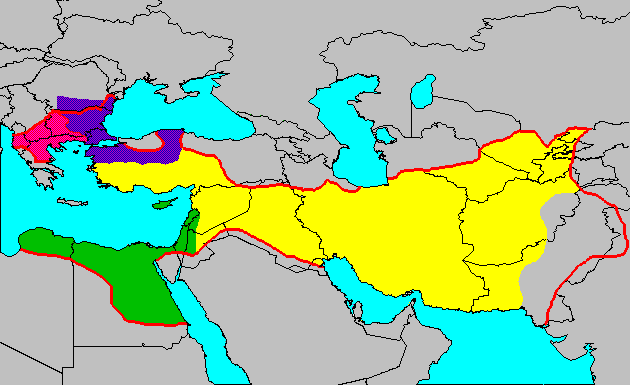
Grecian Empire: Four divisions
The map above (click to enlarge) shows Alexander's empire demarcated by the red lines. After Alexander died abruptly at age 32, the kingdom was eventually divided between 4 of his generals as follows:
(1) South - Ptolemy (green portion south of Israel - Egypt)
(2) East - Seleucus (yellow portion north of Israel -Syria, Babylonia, East toward India)
(3) North - Lysimachus (purple - Thrace, Bithynia)
(4) West - Cassander (pink - Macedonia)
As the scene unfolds in exquisite detail in the parallel passages in Daniel 11 (see notes), the kingdoms of Ptolemy and Seleucus take center stage in the drama, while the kingdoms of Lysimachus and Cassander vanish off the scene of history. Why the focus on only two of the four divisions? Because the Biblical drama centers on the two kingdoms which most directly affect/impact Israel, the "apple of God's eye" (Dt 32:10KJV) which was situated geographically between the the Ptolemaic and Seleucid kingdoms.
W A Criswell makes this comment on Daniel 8:8…
No more remarkable or accurate prediction could ever be imagined than this detailed analysis of the Grecian Empire.
John Walvoord sums up this great passage noting that "Expositors, both liberal and conservative, have interpreted this verse as representing the untimely death of Alexander and the division of his empire into four major sections. Alexander, who had conquered more of the world than any previous ruler, was not able to conquer himself. Partly due to a strenuous exertion, his dissipated life, and a raging fever, Alexander died in a drunken debauch at Babylon, not yet thirty-three years of age. His death left a great conquest without an effective single leader, and it took about twenty years for the empire to be successfully divided." (Daniel 8 The Vision Of The Ram And The Goat)
KOINE GREEK AND THE FULNESS OF TIME
As an aside, one of the effects of Alexander's conquest of the "whole earth" (Da 8:5) was that God used him to spread the Greek culture to all the lands he conquered. One of the most important elements was the spread of the Koine Greek language, or the common dialect of the Greeks, which became the commercial "lingua franca" (the common language) of the whole earth. Even more importantly from a theological perspective, Koine Greek became the language which the Hebrew scholars used to translate the Hebrew text of the Old Testament into Greek, thus making it accessible to all the known world, but especially to the Jews who had become more proficient in Greek than in the ancient Hebrew. The Koine Greek continued to be the important language in the time of Jesus and in fact was the language in which the New Testament was written. In short, the sovereign God of the universe had made certain that Koine Greek was the leading language of the entire known world so that all the world could potentially read about His redemptive plan for mankind, which helps one understand Paul's phrase in Galatians 4…
But when the fulness of the time came (God's appointed time = the "perfect time" in history), God sent forth His Son, born of a woman, born under the Law, in order that He might redeem those who were under the Law, that we might receive the adoption as sons. (Gal 4:4,5)
Comment: When God had prepared the language (Koine Greek) in which the Gospel of Jesus Christ would be recorded and had also prepared the roads (Roman system of roads interconnected major metropolitan areas) on which His missionaries would travel to spread the Gospel, then He had brought about the fulness of time and it was then time to send His Son Who would live out the plan of redemption that would be written down in Koine Greek. What an awesome, loving God we are privileged to know and serve. He desires that all come to know Him and He saw to it that the infrastructure was in place to at least make that possible for both kings and paupers throughout the ancient world.
John MacArthur has these additional comments on the "fulness of time" - The fulness of time refers to the completion of the period of preparation in God’s sovereign timetable of redemption. When the law had fully accomplished its purpose of showing man his utter sinfulness and inability to live up to God’s perfect standard of righteousness, God ushered in a new era of redemption. When He sent forth His Son, He provided the righteousness for man that man could not provide for himself. When Jesus was born, everything was right for the coming of the Messiah.
First of all, the time was right religiously. During the Babylonian captivity, Israel once and for all forsook the idolatry into which she had so often fallen. Despite their many other sins and failures, including the national rejection of their own Messiah, no significant number of Jews has ever again turned to idolatry. Also during the Exile, Jews developed synagogues, which they used as places of worship, as schools, and as courts. In addition to that, they at last had the completed Old Testament, assembled by Ezra and others after the return from Babylon. Those features facilitated the proclaiming of the Messiah’s gospel among the people of Israel.
Second, the time was right culturally. Christians who propagated the Gospel during the first several centuries had a common language (Ed: Koine Greek) with those to whom they witnessed and with whom they worshiped. Alexander the Great had thoroughly established Greek culture and language throughout the known world, and these continued their dominating influence long after Rome succeeded Greece as world ruler.
Third, the time was right politically. Rome had instituted the Pax Romana (Roman peace), which provided economic and political stability. The apostles and other early preachers and teachers could travel freely and safely throughout the empire and could do so on the magnificent system of roads built by the Romans.
Each of those factors was in some unique way a key to the spread of the gospel. God’s timing was perfect (Ed: Beloved, isn't it always!). (MacArthur, J. Galatians. Chicago: Moody Press)
Daniel 8:9 OUT OF ONE OF THEM CAME FORTH A RATHER SMALL HORN WHICH GREW EXCEEDINGLY GREAT TOWARD THE SOUTH, TOWARD THE EAST, AND TOWARD THE BEAUTIFUL LAND:
BGT Daniel 8:9 καὶ ἐξ ἑνὸς αὐτῶν ἀνεφύη κέρας ἰσχυρὸν ἓν καὶ κατίσχυσε καὶ ἐπάταξεν ἐπὶ μεσημβρίαν καὶ ἐπ᾽ ἀνατολὰς καὶ ἐπὶ βορρᾶν
--- Daniel (TH) 8:9 καὶ ἐκ τοῦ ἑνὸς αὐτῶν ἐξῆλθεν κέρας ἓν ἰσχυρὸν καὶ ἐμεγαλύνθη περισσῶς πρὸς τὸν νότον καὶ πρὸς ἀνατολὴν καὶ πρὸς τὴν δύναμινLXE Daniel 8:9 And out of one of them came forth one strong horn, and it grew very great toward the south, and toward the host:
KJV Daniel 8:9 And out of one of them came forth a little horn, which waxed exceeding great, toward the south, and toward the east, and toward the pleasant land.
NET Daniel 8:9 From one of them came a small horn. But it grew to be very big, toward the south and the east and toward the beautiful land.
CSB Daniel 8:9 From one of them a little horn emerged and grew extensively toward the south and the east and toward the beautiful land.
ESV Daniel 8:9 Out of one of them came a little horn, which grew exceedingly great toward the south, toward the east, and toward the glorious land.
NIV Daniel 8:9 Out of one of them came another horn, which started small but grew in power to the south and to the east and toward the Beautiful Land.
NLT Daniel 8:9 Then from one of the prominent horns came a small horn whose power grew very great. It extended toward the south and the east and toward the glorious land of Israel.
NRS Daniel 8:9 Out of one of them came another horn, a little one, which grew exceedingly great toward the south, toward the east, and toward the beautiful land.
NJB Daniel 8:9 From one of these, the small one, sprang a horn which grew to great size towards south and east and towards the Land of Splendour.
NAB Daniel 8:9 Out of one of them came a little horn which kept growing toward the south, the east, and the glorious country.
YLT Daniel 8:9 And from the one of them come forth hath a little horn, and it exerteth itself greatly toward the south, and toward the east, and toward the beauteous land;
GWN Daniel 8:9 Out of one of the horns came a small horn. It gained power over the south, the east, and the beautiful land.
BBE Daniel 8:9 And out of one of them came another horn, a little one, which became very great, stretching to the south and to the east and to the beautiful land.
RSV Daniel 8:9 Out of one of them came forth a little horn, which grew exceedingly great toward the south, toward the east, and toward the glorious land.
NKJ Daniel 8:9 And out of one of them came a little horn which grew exceedingly great toward the south, toward the east, and toward the Glorious Land.
ASV Daniel 8:9 And out of one of them came forth a little horn, which waxed exceeding great, toward the south, and toward the east, and toward the glorious land.
DBY Daniel 8:9 And out of one of them came forth a little horn, which became exceeding great, toward the south, and toward the east, and toward the beauty of the earth.
BHT Daniel 8:9 ûmin-hä´aHat mëhem yäcä´ qe|ren-´aHat miccü`îrâ waTTigDal-yeºter ´el-hanneºgeb wü´el-hammizräH wü´el-hacceºbî
NIRV Daniel 8:9 Out of one of the four horns came another horn. It started small but became more and more powerful. It grew to the south and to the east and toward the beautiful land of Israel.
- Came: Da 8:23,24 7:8,20, 21, 22, 23, 24, 25, 26 Da 11:21,25, 26, 27, 28, 29, 30, 31, 32, 33, 34, 35
- Beautiful: Da 11:16,41,45 Ps 48:2 105:24 Jer 3:19 Eze 20:6,15 Zec 7:14
- Daniel 8 Resources - multiple sermons and commentaries
KJV - And out of one of them came forth a little horn, which waxed exceeding great, toward the south, and toward the east, and toward the pleasant land.
Out of one of them - Comparing the contextual description of the rather small horn (Da 8:10-14, 23-25) with the historical record, the one of them is a reference to the Seleucid kingdom centered in Syria (Aram in the OT).
The ESV and KJV translations of "a little horn" could easily lead one to misinterpret this passage.
A rather small horn (Literally = "a horn from a small one") (hereafter abbreviated "RSH") ("Small horn" = NET) - Remembering that horn when used figuratively (as here) usually symbolizes the exercise of power or might, who is the small horn? While not mentioned by name in Daniel 8, the historical record leaves little doubt that this person is the eighth ruler of the Seleucid dynasty, Map of Seleucid Empire)

He assumed divine epithets, which no other Hellenistic king had done, such as Theos Epiphanes (Greek = God Manifest) and after his defeat of Egypt, Nikephoros (Greek = mean "Bearer of Victory"). But his often eccentric behavior, capricious actions and even insanity led some of his contemporaries to call him Epimanes ("The Mad One"), a word play off of his title Epiphanes. (Wikipedia)
Small - It is interesting that the Hebrew word for small (tsaiyr) not only means "little" but also conveys the sense of that which is insignificant (cp 1Sa 9:21 = Saul's claim to be "the least" - Would it be that he had remained humble! Cp the use in Ps 119:141 where the psalmist describes himself as "small [insignificant] and despised"). Not surprising this noun tsaiyr was used to describe the last born ("small" in age - e.g., "younger" in Ge 19:31, Ge 29:26, Ge 43:33), for this birth order in the Hebrew culture was the least significant in terms of privilege. Bethlehem was described as too "little (~insignificant) to be among the clans of Judah" (Micah 5:2).
And so the use of small (tsaiyr) in the description of Antiochus indicates that he would have an insignificant beginning.
The RSH is clearly not the Little Horn (LH) (aka, the future Antichrist) of Daniel 7:8 as indicated by comparing the two entities in the following table. In view of these clear distinctions between the RSH and the LH, it is very surprising to see some generally excellent (literal, conservative) commentators like Henry Morris make statements like
This "little horn" is evidently the same as the "little horn" of Daniel 7:8, the Beast of the end-times, also known as the Antichrist. (Morris, Henry: Defenders Study Bible. World Publishing).
Once again, the reader can see the importance of doing his or her own observations of the text (see also inductive Bible study) so that they will be able to accurately comment on the commentaries!
| CHAPTER | Daniel 7 | Daniel 8 |
| KINGDOM OF ORIGIN |
Fourth Kingdom DT Beast "Revived" Rome |
Third Kingdom Greece Divided Stage |
| HORN "NUMBER" |
From and After 10 Thus = "11th" Da 7:7, 20, 24 |
From One of the 4 Horns = "5th" Da 8:9 |
| TIME OF PERSECUTION OF ISRAEL | Time, times, half a time 3.5 Years Da 7:25 |
2300 Mornings & Evenings 6+ Years Da 8:14 |
| MESSIANIC KINGDOM FOLLOWS DESTRUCTION |
Yes Da 7:14, 18, 22, 26, 27 |
No |
Gleason Archer offers an insightful comment that helps understand why there is so much detail concerning the RSH noting that his origin…
from the third kingdom serves as a prototype of the little horn of the fourth kingdom. The crisis destined to confront God’s people in the time of the earlier little horn, Antiochus Epiphanes, will bear a strong similarity to the crisis that will befall them in the eschatological or final phase of the fourth kingdom in the last days (as Christ himself foresaw in the Olivet Discourse - Mt 24:15).
Grew exceeding great - This speaks of the increasing power and conquests of other land by the RSH, Antiochus IV Epiphanes.
Toward the south… east… the Beautiful - From historical records we know that the RSH (Antiochus IV Epiphanes) made conquests in each of these directions (if we take Syria as his base of operations then the directions make perfect sense): South - Egypt, East - Persia, Parthia, Armenia; The Beautiful Land - Israel. If you look at a map of this region, you will note that "the Beautiful Land" is also South of Syria, and it is singled out because of the significant (evil) impact Antiochus would have on God's land and God's people.
The Beautiful land (tsebiy/sebiy) - Signifies the land of Israel here and in the other two uses in Daniel (Da 11:16, Da 11:41). In Da 11:45 tsebiy/sebiy refers "to the beautiful Holy Mountain", Jerusalem. The beauty was not so much that it was physically beautiful but spoke of the spiritual beauty. God had chosen this tiny plot of otherwise non-descript land to be the center stage for His "beautiful" drama of redemption (Christ Crucifixion at Calvary) and the throne of the Beautiful One, Christ the King in the Millennium (In the Temple at Jerusalem).
This Hebrew noun (tsebiy/sebiy) is the superlative of splendor. Depending on the context this noun can describe a gazelle or (as in this verse) something beautiful or glorious, such as the glorious land which God gave Israel, a land that flowed with milk and honey (Ezek 20:6, 15 = "glory") or "a delightful land" (Mal 3:12). It is notable that occasionally this noun is used to refer to God Himself (Isa 4:2 = referring to the "Branch", the Messiah at the time of His reign in the Millennium; Isa 28:5).
Miller explains why God gave Daniel this vision in Daniel 8 noting that…
In the previous chapter God (Daniel 7) had given a preview of (Gentile) world history with emphasis on the end times, particularly the evil activities of the Antichrist (the "Little Horn", (cp "time, times and half a time" Da 7:25). God’s people (Jews) also needed to be warned of another crisis that would come in less than four hundred years after Daniel’s lifetime—the persecutions of a madman named Antiochus IV Epiphanes (175-164BC). It would be one of the most horrible periods in history for believers (Ed: Referring to believing Jews, also known as the believing remnant), a time when the very existence of the true religion (Judaism) and its adherents was threatened. God knew that for those brief—only a few years (Ed: 2300 days)—but extremely dark days His people would need a supernatural revelation to encourage them as they faced their “great tribulation.” (Ed: As horrible as this time was for Israel, it was but a foretaste of the endtimes Great Tribulation about which Jesus had warned His disciples in the Olivet Discourse in Mt 24-25) (Ibid) (Bolding and links added)
Antiochus IV Epiphanes (AE) (compiled from various sources)…
His name Epiphanes means Manifest, Conspicuous, Illustrious. The Jews mocked his name, calling him Antiochus Epimanes ("Madman")
Of Grecian descent, and specifically a Syrian. He was born about 215 BC and died 164BC.
He ruled the Seleucid Empire (East Division of Alexander the Great's empire) from 175-164 BC.
Antiochus IV Epiphanes was singled out for a detailed description in Daniel 8 (also described in Da 11:21-35) because of his evil treatment of the Jews of Palestine, his opposition to God's Temple in Jerusalem and his attempts to get rid of God's Word of Truth, the Scriptures.
AE was anti-Semitic to the core. He assaulted Jerusalem, murdering over 40,000 in three days, and selling an equal number into cruel slavery. It is thought that on September 6, 171 B.C., he began his evil actions toward the Temple.
Notable events during the reign of Antiochus IV include his near-conquest of Egypt, which led to a confrontation that became an origin of the metaphorical phrase, "line in the sand" and the rebellion of the Jewish Maccabees.
He assumed divine epithets, which no other Hellenistic king had done, such as Theos Epiphanes ("God Manifest") and after his defeat of Egypt, Nikephoros ("Bearer of Victory"). But his often eccentric behavior, capricious actions and possible insanity led some to call him Epimanes ("The Mad One").
He was the Son of Antiochus III who became king after his brother, Seleucus IV, was murdered. As a boy Antiochus lived at Rome as a hostage. The Pergamene monarchs, Eumenes and Attalus, succeeded in placing upon the throne the brother of Seleucus, although Heliodorus had wished to ascend the throne himself. The young king was even more enterprising than his father. He was called in to settle a quarrel between Onias III and his brother, Jason, the leader of the Hellenizing faction in Jerusalem, and Onias was driven out (2Macc 4:4, 5, 6). Jason became high priest in his stead (2Macc 4:9, 10, 11, 12, 13, 14, 15, 16; 1Macc 1:10, 11, 12, 13, 14, 15). Antiochus himself afterward visited Jerusalem and was signally honored (2Macc 4:22).
On the death of Ptolemy VI in 173, Antiochus laid claim to Coelesyria, Palestine and Phoenicia; whereupon war broke out between Syria and Egypt. In this war Antiochus was victorious. Ptolemy Philometor was taken prisoner, and Antiochus had himself crowned king of Egypt (171-167 BC) at Memphis; whereupon Alexandria revolted and chose Ptolemy's brother as their king. The Roman ambassador, Popilius Laenas, demanded the surrender of Egypt and the immediate withdrawal of its self-constituted king. Antiochus yielded; gave up Pelusium and withdrew his fleet from Cyprus, but retained Coelesyria, Palestine and Phoenicia.
While Antiochus was on a second campaign in Egypt, he heard of the siege of Jerusalem. He returned immediately, slew many thousands of the inhabitants and robbed the temple of its treasures (1Macc 1:20, 21, 22, 23, 24; 2Macc 5:11, 12, 13, 14, 15, 16, 17, 18, 19, 20, 21). By his prohibition of the Jewish worship and his introduction or substitution of the worship of the false "god" Zeus (1Macc 1:54; 2Macc 6:2) he brought about a revolt among the faithful remnant of Jews under the leadership of Judas Maccabees who fought against Antiochus IV Epiphanes during the years 167-164 BC. After this war Antiochus retired to the eastern provinces and died, after having failed in an attack on the temple of the Sun in Elymais, in Persia.
All through Palestine altars to Jupiter were set up and the Jews were forced to sacrifice on them. But at a little Jewish town called Modin (seventeen miles northwest of Jerusalem) there lived a Jewish priest named Mattathias, of the House of Hasmon. He had five sons and this brave old man not only refused to worship Antiochus' idols, but boldly slew the king's religious ambassador. The Jewish revolt was on. One of his sons was named Judas and he was called the Maccabee, which means "the hammer''.
For the next few years Judas successfully led an army of Jews against the Syrians. Their brave exploits are described in two Apocrypha books, first and second Maccabees. On December 25, 164/165BC, the Jewish patriots cleansed and rededicated the Temple Antiochus had defiled. One day’s supply of oil miraculously kept the golden lampstand burning for eight days. This cleansing has been celebrated by the Jews as the Feast of Dedication (Jn 10:22).
Daniel 8:10 IT GREW UP TO THE HOST OF HEAVEN AND CAUSED SOME OF THE HOST AND SOME OF THE STARS TO FALL TO THE EARTH, AND IT TRAMPLED THEM DOWN:
BGT Daniel 8:10 καὶ ὑψώθη ἕως τῶν ἀστέρων τοῦ οὐρανοῦ καὶ ἐρράχθη ἐπὶ τὴν γῆν ἀπὸ τῶν ἀστέρων καὶ ἀπὸ αὐτῶν κατεπατήθη
--- Daniel (TH) 8:10 ἐμεγαλύνθη ἕως τῆς δυνάμεως τοῦ οὐρανοῦ καὶ ἔπεσεν ἐπὶ τὴν γῆν ἀπὸ τῆς δυνάμεως τοῦ οὐρανοῦ καὶ ἀπὸ τῶν ἄστρων καὶ συνεπάτησεν αὐτάLXE Daniel 8:10 and it magnified itself to the host of heaven; and there fell to the earth some of the host of heaven and of the stars, and they trampled on them.
KJV Daniel 8:10 And it waxed great, even to the host of heaven; and it cast down some of the host and of the stars to the ground, and stamped upon them.
NET Daniel 8:10 It grew so big it reached the army of heaven, and it brought about the fall of some of the army and some of the stars to the ground, where it trampled them.
CSB Daniel 8:10 It grew as high as the heavenly host, made some of the stars and some of the host fall to the earth, and trampled them.
ESV Daniel 8:10 It grew great, even to the host of heaven. And some of the host and some of the stars it threw down to the ground and trampled on them.
NIV Daniel 8:10 It grew until it reached the host of the heavens, and it threw some of the starry host down to the earth and trampled on them.
NLT Daniel 8:10 Its power reached to the heavens, where it attacked the heavenly army, throwing some of the heavenly beings and some of the stars to the ground and trampling them.
NRS Daniel 8:10 It grew as high as the host of heaven. It threw down to the earth some of the host and some of the stars, and trampled on them.
NJB Daniel 8:10 It grew right up to the armies of heaven and flung armies and stars to the ground, and trampled them underfoot.
NAB Daniel 8:10 Its power extended to the host of heaven, so that it cast down to earth some of the host and some of the stars and trampled on them.
YLT Daniel 8:10 yea, it exerteth unto the host of the heavens, and causeth to fall to the earth of the host, and of the stars, and trampleth them down.
GWN Daniel 8:10 It continued to gain power until it reached the army of heaven. It threw some of the army of heaven, the stars, down on the ground and trampled them.
BBE Daniel 8:10 And it became great, even as high as the army of heaven, pulling down some of the army, even of the stars, to the earth and crushing them under its feet.
RSV Daniel 8:10 It grew great, even to the host of heaven; and some of the host of the stars it cast down to the ground, and trampled upon them.
NKJ Daniel 8:10 And it grew up to the host of heaven; and it cast down some of the host and some of the stars to the ground, and trampled them.
ASV Daniel 8:10 And it waxed great, even to the host of heaven; and some of the host and of the stars it cast down to the ground, and trampled upon them.
DBY Daniel 8:10 And it became great, even to the host of heaven; and it cast down some of the host and of the stars to the ground, and trampled upon them.
BHT Daniel 8:10 waTTigDal `ad-cübä´ haššämäºyim waTTaPPël ´aºrcâ min-haccäbä´ ûmin-haKKôkäbîm wa|TTirmüsëm
NIRV Daniel 8:10 It grew until it reached the stars in the sky. It threw some of them down to the earth. And it stomped on them.
- to the host: or, against the host, Da 8:24,25 11:28,30,33, 34, 35, 36
- Trampled: Da 8:7 7:7
- Daniel 8 Resources - multiple sermons and commentaries
This is a difficult verse to interpret for it is filled with figurative language. The question clearly is what is the literal interpretation of host and stars? Are these angelic beings as some commentators maintain? Or are they human beings, and specifically are they Jews?
Host (tsaba') primarily describes military service (and so an army, a military congregation to serve as a fighting unit) and came to mean service or labor (Nu 4:3, 23). Tsaba' was used to describe the heavenly realm of angels and stars (Ge 2:1 Ps 33:6 Isa 40:26) and part of one of the great names of God Jehovah Sabaoth, LORD of hosts (of armies).
NET Note - Traditionally, “host.” The term refers to God’s heavenly angelic assembly, which he sometimes leads into battle as an army.
Keeping the context in mind and noting specifically "It" refers to the RSH (Antiochus IV Epiphanes), it makes little sense to ascribe the meaning of angelic beings to either host and /or stars. Further, if one compares the use of host in Da 8:12 and Da 8:13, the reasonable interpretation is that host refers to the Jews. Constable agrees writing that Da 8:12 "… makes identification of the host as the Jews rather than angels almost certain." (Bolding added) In addition, the premise that host represents the Jews is substantiated by the fact that Israel is occasionally referred to elsewhere in Scripture as God's hosts (Ex 7:4, cp Ex 12:17, 41, Nu 33:1 where "armies" is same Hebrew word tsaba' translated "hosts").
If one examines the historical records of time of Antiochus IV Epiphanes, there is clear documentation of the facts that (1) many of Jews transgressed the covenant motivated/coerced by the evil influence of Antiochus Epiphanes (which would be compatible with the phrase "the transgression of the host" in Da 8:12) and (2) many "non-compliant" Jews (probably either "orthodox" or actually genuine believers) were mercilessly slaughtered by Antiochus (compare this historical record with the phrase "host… trampled" in Da 8:13).
Leupold - That stars should signify God’s holy people (the Jews) is not strange when one considers as a background the words that were spoken to Abraham concerning the numerical increase of the people of God, Ge 15:5; Ge 22:17. To this may be added Da 12:3, where a star like glory is held out to those who “turn many to righteousness.” (cp Mt 13:43)… (He adds) If the world calls those men and women stars who excel in one or another department of human activity, why should not a similar statement be still more appropriate with reference to God’s people?
The stars - In addition to Leupold's insightful comment above, when we compare Revelation 12:1, we observe that the "great sign" had "twelve stars" which in context most clearly describes the 12 sons of Jacob as described in Joseph's dream in Genesis 37:9 (Click for more detailed discussion of this point)
NET Note - In prescientific Israelite thinking the stars were associated with the angelic members of God’s heavenly assembly. See Judg 5:20; Job 38:7; Isa 40:26. In west Semitic mythology the stars were members of the high god’s divine assembly (see Isa 14:13).
Phillips comments that the "host of heaven" is a poetical description of God's chosen people; "the stars" are prominent individuals among them. (Ibid)
Trampled - This Hebrew word means to tread upon, as when one presses on object (or person) with the foot upon an object, which gives the picture that the object stamped on is conquered, harmed or even killed, all of which were historically fulfilled in Antiochus Epiphanes' treatment of the Jews in God's Beautiful land!
Daniel 8:11 IT EVEN MAGNIFIED ITSELF TO BE EQUAL WITH THE COMMANDER OF THE HOST; AND IT REMOVED THE REGULAR SACRIFICE FROM HIM, AND THE PLACE OF HIS SANCTUARY WAS THROWN DOWN:
BGT Daniel 8:11 ἕως ὁ ἀρχιστράτηγος ῥύσεται τὴν αἰχμαλωσίαν καὶ δι᾽ αὐτὸν τὰ ὄρη τὰ ἀπ᾽ αἰῶνος ἐρράχθη καὶ ἐξήρθη ὁ τόπος αὐτῶν καὶ θυσία καὶ ἔθηκεν αὐτὴν ἕως χαμαὶ ἐπὶ τὴν γῆν καὶ εὐωδώθη καὶ ἐγενήθη καὶ τὸ ἅγιον ἐρημωθήσεται
--- Daniel (TH) 8:11 καὶ ἕως οὗ ὁ ἀρχιστράτηγος ῥύσηται τὴν αἰχμαλωσίαν καὶ δι᾽ αὐτὸν θυσία ἐρράχθη καὶ ἐγενήθη καὶ κατευοδώθη αὐτῷ καὶ τὸ ἅγιον ἐρημωθήσεταιLXE Daniel 8:11 And this shall be until the chief captain shall have delivered the captivity: and by reason of him the sacrifice was disturbed, and he prospered; and the holy place shall be made desolate.
KJV Daniel 8:11 Yea, he magnified himself even to the prince of the host, and by him the daily sacrifice was taken away, and the place of his sanctuary was cast down.
NET Daniel 8:11 It also acted arrogantly against the Prince of the army, from whom the daily sacrifice was removed and whose sanctuary was thrown down.
CSB Daniel 8:11 It made itself great, even up to the Prince of the host; it removed His daily sacrifice and overthrew the place of His sanctuary.
ESV Daniel 8:11 It became great, even as great as the Prince of the host. And the regular burnt offering was taken away from him, and the place of his sanctuary was overthrown.
NIV Daniel 8:11 It set itself up to be as great as the Prince of the host; it took away the daily sacrifice from him, and the place of his sanctuary was brought low.
NLT Daniel 8:11 It even challenged the Commander of heaven's army by canceling the daily sacrifices offered to him and by destroying his Temple.
NRS Daniel 8:11 Even against the prince of the host it acted arrogantly; it took the regular burnt offering away from him and overthrew the place of his sanctuary.
NJB Daniel 8:11 It even challenged the power of the Prince of the army; it abolished the perpetual sacrifice and overthrew the foundation of his sanctuary,
NAB Daniel 8:11 It boasted even against the prince of the host, from whom it removed the daily sacrifice, and whose sanctuary it cast down,
YLT Daniel 8:11 And unto the prince of the host it exerteth itself, and by it taken away hath been the continual sacrifice, and thrown down the base of his sanctuary.
GWN Daniel 8:11 Then it attacked the commander of the army so that it took the daily burnt offering from him and wrecked his holy place.
BBE Daniel 8:11 It made itself great, even as great as the lord of the army; and by it the regular burned offering was taken away, and the place overturned and the holy place made waste.
RSV Daniel 8:11 It magnified itself, even up to the Prince of the host; and the continual burnt offering was taken away from him, and the place of his sanctuary was overthrown.
NKJ Daniel 8:11 He even exalted himself as high as the Prince of the host; and by him the daily sacrifices were taken away, and the place of His sanctuary was cast down.
ASV Daniel 8:11 Yea, it magnified itself, even to the prince of the host; and it took away from him the continual burnt-offering, and the place of his sanctuary was cast down.
DBY Daniel 8:11 (And he magnified himself even to the prince of the host, and from him the continual sacrifice was taken away, and the place of his sanctuary was cast down.
BHT Daniel 8:11 wü`ad Sa|r-haccäbä´ higDîl ûmimmeºnnû (hërîm) [hûram] haTTämîd wühušlak mükôn miqDäšô
NIRV Daniel 8:11 It set itself up to be as great as God. He is the Prince of the heavenly army. It took the daily sacrifices away from him. And his temple in Jerusalem was brought low.
- Magnified: Da 8:25 5:23 2Ki 19:22,23 2Ch 32:15-22 Isa 37:23,29 Jer 48:26,42, Compare the Antichrist - Da 7:25, 11:36, 2Th 2:4 Rev 13:5, 6, 7
- Commander of the host: Jos 5:14,15 Heb 2:10 Rev 17:14 19:13-16
- Regular sacrifice: Da 8:12 11:31 12:11 Ex 29:38-42 Nu 28:3 Eze 46:14
- Daniel 8 Resources - multiple sermons and commentaries
Magnified… equal with the Commander - In essence Antiochus made himself equal with God, a pre-figuring of the even more evil future persecutor of the Jews, the Little Horn (the Antichrist - see Da 7:21, Da 7:25, Rev 12:6, Rev 12:14, Rev 13:7) who will oppose and exalt "himself above every so-called god or object of worship… displaying himself as being God." (2Thes 2:3, 4).
The Disciple's Study Bible note on God's sovereignty as related to this verse reminds us that "Human monarchs may establish famous empires through treachery, intrigue, and evil; but their success will be temporary. No one can oppose God and escape punishment. Only God rules forever.
Commander of the host (KJV = Prince) - While one could use this passage to support the premise that host signifies angels (host can also mean armies - as the angelic armies of heaven), it could also indicate the God of the Jews, an interpretation I feel fits better with the immediate context. Although some notes suggest this might be an angel (like Michael - see NET notes), the fact that the regular sacrifice is removed from Him, leaves little doubt that this is clearly a divine title.
NET Note - The prince of the army may refer to God (cf. “whose sanctuary” later in the verse) or to the angel Michael (cf. Da 12:1)
Notice that some versions like the NLT render this phrase in such a way as to clearly favor the interpretation of hosts as heavenly rather than earthly ("Commander of heaven's army"). This is another reason the serious student of Scripture should assiduously avoid paraphrased versions!
Removed the regular sacrifice from Him - In context this refers to the cessation of the sacrifices that were offered to God in the Temple in Jerusalem. As discussed below, Antiochus replaced the Biblical sacrifices to God with sacrifices to idols, including sacrifice of an unclean animal a pig in God's Sanctuary!
The apocryphal book First Maccabees records a number of acts during the ruthless reign of the Rather Small Horn and focuses especially on his evil actions against the Jews…
Then the king (the RSH, Antiochus IV Epiphanes) wrote to his whole kingdom that all should be one people, each abandoning his particular customs. All the Gentiles conformed to the command of the king, and many Israelites were in favor of his religion (Ed: Idolatry); they sacrificed to idols and profaned the Sabbath (Ed: Cp "the transgression of the hosts" Da 8:12 referring to faithless Jews). The king sent messengers with letters to Jerusalem and to the cities of Judah, ordering them to follow customs foreign to their land; to prohibit holocausts (Ed: hol = whole + kaustos = burnt > whole burnt offerings - makes one ponder the horrible Nazi holocaust!), sacrifices, and libations in the sanctuary, to profane the Sabbaths and feast days, to desecrate the sanctuary and the sacred ministers, to build pagan altars and temples and shrines, to sacrifice swine and unclean animals, to leave their sons uncircumcised, and to let themselves be defiled with every kind of impurity and abomination, so that they might forget the law and change all their observances. Whoever refused to act according to the command of the king should be put to death. Such were the orders he published throughout his kingdom. He appointed inspectors over all the people, and he ordered the cities of Judah to offer sacrifices, each city in turn (Ed: Sacrifices to idols not to the Living God). Many of the people, those who abandoned the law (Ed: Jews who abandoned the Law of God), joined them and committed evil in the land. Israel (Ed: Those who would not capitulate to Antiochus' godless decrees) was driven into hiding, wherever places of refuge could be found.
On the fifteenth day of the month Chislev, in the year one hundred and forty-five, the king (Antiochus) erected the horrible abomination upon the altar of holocausts, and in the surrounding cities of Judah they built pagan altars. They also burnt incense at the doors of houses and in the streets. Any scrolls of the law which they found they tore up and burnt. (Ed: Antiochus tried to rid the land of Israel of the Word of God!) Whoever was found with a scroll of the covenant, and whoever observed the law, was condemned to death by royal decree.
So they used their power against Israel, against those who were caught, each month, in the cities. On the twenty-fifth day of each month they sacrificed on the altar erected over the altar of holocausts. Women who had had their children circumcised were put to death, in keeping with the decree, with the babies hung from their necks; their families also and those who had circumcised them were killed.
But many in Israel were determined and resolved in their hearts not to eat anything unclean; they preferred to die rather than to be defiled with unclean food or to profane the holy covenant; and they did die. Terrible affliction was upon Israel. (1 Mac 1:41-63)
The place of His sanctuary - The Temple of God in Jerusalem.
Was thrown down - "Thrown down" does not mean that the temple was destroyed but that it was defiled by the abominations of Antiochus Epiphanes. The Septuagint (LXX) translation supports this interpretation rendering this verse "the holy place shall be made desolate."
On December 15, 168 BC, the desecration of the Temple reached an ultimate low, when Antiochus apparently sacrificed a pig on an altar in the Temple. He then forced the Jewish priests to swallow its flesh, made a broth of it, and sprinkled the entire Temple with the abominable broth. He carried off the golden candlesticks, table of shewbread, altar of incense, various other vessels, and destroyed the sacred books of the Law. A large image of the Roman "god" Jupiter (Greek counterpart = Zeus), the so-called "king of the gods", was erected in the Holy of Holies. The horrified Jews referred to these despicable actions as "the abomination of desolation" (see description of Antiochus abomination in Da 11:31). In carrying out these despicable acts against God's Temple and God's people, he gave a "preview of coming attractions" to be fulfilled in the end of time when the Antichrist commits the ultimate abomination of desolation (cp Da 9:27, Mt 24:15, 2Th 2:3,4).
First Maccabees records that after his first conquest in Egypt, Antiochus IV Epiphanes…
returned and went up to Israel and to Jerusalem with a strong force. He insolently invaded the sanctuary and took away the golden altar, the lampstand for the light with all its fixtures, the offering table, the cups and the bowls, the golden censers, the curtain, the crowns, and the golden ornament on the facade of the temple. He stripped off everything, and took away the gold and silver and the precious vessels; he also took all the hidden treasures he could find. (1Macc 1:20, 21, 22, 23, cp 1 Macc 4:48)
Daniel 8:12 AND ON ACCOUNT OF TRANSGRESSION THE HOST WILL BE GIVEN OVER TO THE HORN ALONG WITH THE REGULAR SACRIFICE; AND IT WILL FLING TRUTH TO THE GROUND AND PERFORM ITS WILL AND PROSPER:
BGT Daniel 8:12 καὶ ἐγενήθησαν ἐπὶ τῇ θυσίᾳ αἱ ἁμαρτίαι καὶ ἐρρίφη χαμαὶ ἡ δικαιοσύνη καὶ ἐποίησε καὶ εὐωδώθη
--- Daniel (TH) 8:12 καὶ ἐδόθη ἐπὶ τὴν θυσίαν ἁμαρτία καὶ ἐρρίφη χαμαὶ ἡ δικαιοσύνη καὶ ἐποίησεν καὶ εὐοδώθηLXE Daniel 8:12 And a sin-offering was given for the sacrifice, and righteousness was cast down to the ground; and it practised, and prospered.
KJV Daniel 8:12 And an host was given him against the daily sacrifice by reason of transgression, and it cast down the truth to the ground; and it practised, and prospered.
NET Daniel 8:12 The army was given over, along with the daily sacrifice, in the course of his sinful rebellion. It hurled truth to the ground and enjoyed success.
CSB Daniel 8:12 Because of rebellion, a host, together with the daily sacrifice, will be given over. The horn will throw truth to the ground and will be successful in whatever it does.
ESV Daniel 8:12 And a host will be given over to it together with the regular burnt offering because of transgression, and it will throw truth to the ground, and it will act and prosper.
NIV Daniel 8:12 Because of rebellion, the host of the saints and the daily sacrifice were given over to it. It prospered in everything it did, and truth was thrown to the ground.
NLT Daniel 8:12 The army of heaven was restrained from responding to this rebellion. So the daily sacrifice was halted, and truth was overthrown. The horn succeeded in everything it did.
NRS Daniel 8:12 Because of wickedness, the host was given over to it together with the regular burnt offering; it cast truth to the ground, and kept prospering in what it did.
NJB Daniel 8:12 and the army too; over the sacrifice it installed iniquity and flung truth to the ground; the horn was active and successful.
NAB Daniel 8:12 as well as the host, while sin replaced the daily sacrifice. It cast truth to the ground, and was succeeding in its undertaking.
YLT Daniel 8:12 And the host is given up, with the continual sacrifice, through transgression, and it throweth down truth to the earth, and it hath worked, and prospered.
GWN Daniel 8:12 In its rebelliousness it was given an army to put a stop to the daily burnt offering. It threw truth on the ground. The horn was successful in everything it did.
BBE Daniel 8:12 ... against the regular burned offering; and ... crushed down to the earth, and it did its pleasure and things went well for it.
RSV Daniel 8:12 And the host was given over to it together with the continual burnt offering through transgression; and truth was cast down to the ground, and the horn acted and prospered.
NKJ Daniel 8:12 Because of transgression, an army was given over to the horn to oppose the daily sacrifices; and he cast truth down to the ground. He did all this and prospered.
ASV Daniel 8:12 And the host was given over to it together with the continual burnt-offering through transgression; and it cast down truth to the ground, and it did its pleasure and prospered.
DBY Daniel 8:12 And a time of trial was appointed unto the continual sacrifice by reason of transgression.) And it cast down the truth to the ground; and it practised and prospered.
BHT Daniel 8:12 wücäbä´ Tinnätën `al-haTTämîd Büp亚a` wütašlëk ´émet ´aºrcâ wü`äStâ wühiclîºHâ
NIRV Daniel 8:12 Because many of God's people refused to obey him, they were handed over to the horn. The daily sacrifices were also given over to it. It was successful no matter what it did. And the true worship of God was thrown down to the ground.
RWB Daniel 8:12 And an host was given him against the daily sacrifice by reason of transgression, and it cast down the truth to the ground; and it continued, and prospered.
WEB Daniel 8:12 And a host was given {him} against the daily {sacrifice} by reason of transgression, and it cast down the truth to the ground; and it practiced, and prospered.
- Fling truth: Ps 119:43,142 Isa 59:14 2Th 2:10-12
- Perform its will: Da 8:4 11:28,36 1Sa 23:9 Job 12:6 Jer 12:1 Rev 13:11-17
- Daniel 8 Resources - multiple sermons and commentaries
Transgression the host - NET - in the course of his sinful rebellion." The sins of the Jews against God and His covenant would result in God giving them over to the RSH, Antiochus IV Epiphanes. First Maccabees records events that are very compatible with the transgression of the Jews…
In those days there appeared in Israel men who were breakers of the law (see note above), and they seduced many people, saying: “Let us go and make an alliance with the Gentiles all around us; since we separated from them, many evils have come upon us.” The proposal was agreeable; some from among the people promptly went to the king (Antiochus IV Epiphanes), and he authorized them to introduce the way of living of the Gentiles. Thereupon they built a gymnasium in Jerusalem according to the Gentile custom. They covered over the mark of their circumcision and abandoned the holy covenant; they allied themselves with the Gentiles and sold themselves to wrongdoing… 43 and many Israelites were in favor of his religion; they sacrificed to idols and profaned the Sabbath. (1 Mac 1:11, 12, 13, 14, 15, 43).
NET Note - Heb “in (the course of) rebellion.” The meaning of the phrase is difficult to determine. It could mean “due to rebellion,” referring to the failures of the Jews, but this is not likely since it is not a point made elsewhere in the book. The phrase more probably refers to the rebellion against God and the atrocities against the Jews epitomized by Antiochus.
It (RSH) will fling truth to the ground - Antiochus forbade the reading of the Old Testament scriptures, going so far as to execute those who broke his decree (see preceding quotation from 1Maccabees 1:44, 45, 46, 47, 48, 49).
NET Note - Truth here probably refers to the Torah. According to 1 Macc 1:56, Antiochus initiated destruction of the sacred books of the Jews.
Will prosper (06743)(see salah below) is from a root which means to accomplish satisfactorily what is intended. ) is from a root which means to accomplish satisfactorily what is intended. (salach/salah - also used in Da 8:24, 25) The idea is that Antiochus IV Epiphanes will accomplish satisfactorily what he intends (evil!). Generally this word expresses the idea of a successful venture, as contrasted with failure. Note however that just as with the Antichrist (who has only 1260 days to "prosper" - see Rev 13:5), God allows Antiochus Epiphanes only 2300 days. His "dark" day in the sun will come to an end because God is in control and has set limits on his evil actions against the Jews.
As alluded to earlier many of the aspects of the evil reign of Antiochus IV Epiphanes are but a foreshadowing of similar aspects of the reign of terror of the Antichrist. And so we note that Daniel 11 describes the fact that the Antichrist will prosper…
Then the king (Antichrist) will do as he pleases, and he will exalt and magnify himself above every god (2Th 2:4), and will speak monstrous things against the God of gods (Rev 13:6, Da 7:7, Da 7:25); and he will prosper (salach/salah) until the indignation is finished, for that which is decreed will be done. (Da 11:36)
Comment: The indignation in this context refers to the 3.5 year period of the Great Tribulation. The Antichrist will be allowed by the Most High God (and empowered by Satan - Rev 13:2, 2Thes 2:9) to "prosper" for 1260 days and no more, for then he will come to destruction (Da 7:11, Da 7:26, Da 11:45, 2Thes 2:8, 9, Rev 17:8, Rev 17:11) (even as Antiochus Epiphanes comes to destruction without human agency - Da 8:25).
Daniel 8:13 THEN I HEARD A HOLY ONE SPEAKING, AND ANOTHER HOLY ONE SAID TO THAT PARTICULAR ONE WHO WAS SPEAKING, "HOW LONG WILL THE VISION ABOUT THE REGULAR SACRIFICE APPLY, WHILE THE TRANSGRESSION CAUSES HORROR, SO AS TO ALLOW BOTH THE HOLY PLACE AND THE HOST TO BE TRAMPLED?:
BGT Daniel 8:13 καὶ ἤκουον ἑτέρου ἁγίου λαλοῦντος καὶ εἶπεν ὁ ἕτερος τῷ φελμουνι τῷ λαλοῦντι ἕως τίνος τὸ ὅραμα στήσεται καὶ ἡ θυσία ἡ ἀρθεῖσα καὶ ἡ ἁμαρτία ἐρημώσεως ἡ δοθεῖσα καὶ τὰ ἅγια ἐρημωθήσεται εἰς καταπάτημα
--- Daniel (TH) 8:13 καὶ ἤκουσα ἑνὸς ἁγίου λαλοῦντος καὶ εἶπεν εἷς ἅγιος τῷ φελμουνι τῷ λαλοῦντι ἕως πότε ἡ ὅρασις στήσεται ἡ θυσία ἡ ἀρθεῖσα καὶ ἡ ἁμαρτία ἐρημώσεως ἡ δοθεῖσα καὶ τὸ ἅγιον καὶ ἡ δύναμις συμπατηθήσεταιLXE Daniel 8:13 And I heard one saint speaking, and a saint said to a certain one speaking, How long shall the vision continue, even the removal of the sacrifice, and the bringing in of the sin of desolation; and how long shall the sanctuary and host be trampled?
KJV Daniel 8:13 Then I heard one saint speaking, and another saint said unto that certain saint which spake, How long shall be the vision concerning the daily sacrifice, and the transgression of desolation, to give both the sanctuary and the host to be trodden under foot?
NET Daniel 8:13 Then I heard a holy one speaking. Another holy one said to the one who was speaking, "To what period of time does the vision pertain– this vision concerning the daily sacrifice and the destructive act of rebellion and the giving over of both the sanctuary and army to be trampled?"
CSB Daniel 8:13 Then I heard a holy one speaking, and another holy one said to the speaker, "How long will the events of this vision last-- the daily sacrifice, the rebellion that makes desolate, and the giving over of the sanctuary and of the host to be trampled?"
ESV Daniel 8:13 Then I heard a holy one speaking, and another holy one said to the one who spoke, "For how long is the vision concerning the regular burnt offering, the transgression that makes desolate, and the giving over of the sanctuary and host to be trampled underfoot?"
NIV Daniel 8:13 Then I heard a holy one speaking, and another holy one said to him, "How long will it take for the vision to be fulfilled--the vision concerning the daily sacrifice, the rebellion that causes desolation, and the surrender of the sanctuary and of the host that will be trampled underfoot?"
NLT Daniel 8:13 Then I heard two holy ones talking to each other. One of them asked, "How long will the events of this vision last? How long will the rebellion that causes desecration stop the daily sacrifices? How long will the Temple and heaven's army be trampled on?"
NRS Daniel 8:13 Then I heard a holy one speaking, and another holy one said to the one that spoke, "For how long is this vision concerning the regular burnt offering, the transgression that makes desolate, and the giving over of the sanctuary and host to be trampled?"
NJB Daniel 8:13 I heard a holy one speaking, and another holy one say to the speaker, 'How long is this vision to be -- of perpetual sacrifice, of horrifying iniquity, of sanctuary and army trampled underfoot?'
NAB Daniel 8:13 I heard a holy one speaking, and another said to whichever one it was that spoke, "How long shall the events of this vision last concerning the daily sacrifice, the desolating sin which is placed there, the sanctuary, and the trampled host?"
YLT Daniel 8:13 'And I hear a certain holy one speaking, and a certain holy one saith to the wonderful numberer who is speaking: Till when is the vision of the continual sacrifice, and of the transgression, an astonishment, to make both sanctuary and host a treading down?
GWN Daniel 8:13 Then I heard a holy one speaking. Another holy one said to the one who was speaking, "How long will the things in this vision-the daily burnt offering, the destructive rebellion, the surrender of the holy place, and the trampling of the army-take place?"
BBE Daniel 8:13 Then there came to my ears the voice of a holy one talking; and another holy one said to that certain one who was talking, How long will the vision be while the regular burned offering is taken away, and the unclean thing causing fear is put up, and the holy place crushed under foot?
RSV Daniel 8:13 Then I heard a holy one speaking; and another holy one said to the one that spoke, "For how long is the vision concerning the continual burnt offering, the transgression that makes desolate, and the giving over of the sanctuary and host to be trampled under foot?"
NKJ Daniel 8:13 Then I heard a holy one speaking; and another holy one said to that certain one who was speaking, "How long will the vision be, concerning the daily sacrifices and the transgression of desolation, the giving of both the sanctuary and the host to be trampled under foot?"
ASV Daniel 8:13 Then I heard a holy one speaking; and another holy one said unto that certain one who spake, How long shall be the vision concerning the continual burnt-offering, and the transgression that maketh desolate, to give both the sanctuary and the host to be trodden under foot?
DBY Daniel 8:13 And I heard one saint speaking, and another saint said unto that one who spoke, How long shall be the vision of the continual sacrifice and of the transgression that maketh desolate, to give both the sanctuary and the host to be trodden down under foot?
BHT Daniel 8:13 wä´ešmü`â ´e|Häd-qädôš müdaBBër wayyö´mer ´eHäd qädôš laPPa|lmônî ha|müdaBBër `ad-mätay heHäzôn haTTämîd wühaPPeºša` šömëm Tët wüqöºdeš wücäbä´ mirmäs
- Holy one: Da 4:13 7:16 12:5,6 De 33:2 Zec 1:9-12,19 2:3,4 14:5 1Th 3:13 1Pe 1:12 Jude 1:14
- How long: Da 12:6 Ps 74:9 79:5 Isa 6:11 Rev 6:10
- Daniel 8 Resources - multiple sermons and commentaries
TRANSGRESSION
THAT MAKES DESOLATE
Then - Marker of sequence.
I heard a holy one (cp Da 4:13) - While the text does not define the identity of the holy ones who are speaking with one another, most interpreters agree that these probably are angelic beings. What is amazing is that the angels are interested in human events, seeking to know when the desecration of God's Temple (the holy place) and His saints, the Jews, would be freed from the evil effects of Antiochus IV Epiphanes.
How long will the vision about the regular sacrifice apply - This question refers to the sacrifices in the Holy Temple which were not occurring because the Temple would be defiled by Antiochus. Daniel 11:31 is a parallel passage - "“And forces from him (Antiochus IV Epiphanes) will arise, desecrate the sanctuary fortress, and do away with the regular sacrifice. And they will set up the abomination of desolation."
The transgression causes horror (transgression that makes desolate = ESV, rebellion that causes desolation = NIV) - Here the transgression appear to refer to the desecration of the holy place brought about by Antiochus.
Antiochus IV Epiphanes, who has been labeled the "Antichrist of the Old Testament", caused an altar to be set up in the Jewish Temple and on this altar he placed an idolatrous image of Zeus (cf 2Macc 6:2). In addition, he turned the priest's chambers into brothels, creating the "abomination that causes desolation". In other words, the Temple was desolate to pious Jews because of the desecration of the altar which destroyed its true purpose. They had no desire to worship in such a polluted environment and thus the Temple was deprived of Jewish worshippers. Just so will the Antichrist establish an abomination in the sanctuary, a demonic counterfeit worship (Da 9:27; Da 12:11). Even more blatantly defiant of God, the Antichrist will command worship of himself and his image! (2Th 2:3,4, Rev 13:14, Rev 13:15) God will allow this gross evil because He is using this devilish man to fulfill His purging and purifying purpose in the nation of Israel. While the infinitely good and holy God does not cause evil, in His infinite wisdom and omnipotence is able to bring good out of what others mean for evil. (cf Ge 50:20, Ro 8:28)
Transgression (06588)(pesha') means rebellion or revolt against authority (rising up in clear defiance of authority), guilt (incurred by transgressing). Pesha' is derived from a root describing the breach of relationship between two parties (civil or religious). The idea of this noun is that the individual makes a willful choice to reject God's authority and hence to deviate from the path of godly living. Defection from God's standard. Pesha' is “a stepping aside from the (correct) path" and speaks of commission of willful sin. Which of us has not been guilty of pesha'?
What was the transgression? Whatever it was it allowed the Temple and the Jews to be trampled down.
Horror (desolation)(08074) (shamen/samen) describes desolation caused by some great disaster, usually a result of divine judgment. In the present context the judgment is being meted out by Antiochus Epiphanes but God is sovereign even over the desolation of judgment.
Shamem/samem - Used 7v in Daniel - Da 8:13, 27; Da 9:18, 26, Da 9:27; Da 11:31; Da 12:11
The host - The Jews.
Trampled (04823)(mirmas) is a masculine noun which describes something that is tread upon, trampled down, stepped on, destroyed: a vineyard (Isa. 5:5); a field (Isa. 7:25; Ezek. 34:19 used figuratively to refer to what God's flock [Israel] has trampled on); the Jewish people are "trampled" with acts of judgments (Isa. 10:6; 28:18; Mic. 7:10, Da 8:13 where Septuagint -Lxx uses Greek noun katapatema = trampling).
Mirmas translated - trample(1), trample down(1), trampled(1), trampled down(1), trampled ground(1), trampling(1), tread down(1), what you tread down(1).
Mirmas - 7v - Isa 5:5; 7:25; 10:6; 28:18; Ezek 34:19; Dan 8:13; Mic 7:10
Daniel 8:14 HE SAID TO ME, "FOR 2,300 EVENINGS AND MORNINGS; THEN THE HOLY PLACE WILL BE PROPERLY RESTORED:
BGT Daniel 8:14 καὶ εἶπεν αὐτῷ ἕως ἑσπέρας καὶ πρωὶ ἡμέραι δισχίλιαι τριακόσιαι καὶ καθαρισθήσεται τὸ ἅγιον
--- Daniel (TH) 8:14 καὶ εἶπεν αὐτῷ ἕως ἑσπέρας καὶ πρωὶ ἡμέραι δισχίλιαι καὶ τριακόσιαι καὶ καθαρισθήσεται τὸ ἅγιονLXE Daniel 8:14 And he said to him, Evening and morning there shall be two thousand and four hundred days; and then the sanctuary shall be cleansed.
KJV Daniel 8:14 And he said unto me, Unto two thousand and three hundred days; then shall the sanctuary be cleansed.
NET Daniel 8:14 He said to me, "To 2,300 evenings and mornings; then the sanctuary will be put right again."
CSB Daniel 8:14 He said to me, "For 2,300 evenings and mornings; then the sanctuary will be restored."
ESV Daniel 8:14 And he said to me, "For 2,300 evenings and mornings. Then the sanctuary shall be restored to its rightful state."
NIV Daniel 8:14 He said to me, "It will take 2,300 evenings and mornings; then the sanctuary will be reconsecrated."
NLT Daniel 8:14 The other replied, "It will take 2,300 evenings and mornings; then the Temple will be made right again."
NRS Daniel 8:14 And he answered him, "For two thousand three hundred evenings and mornings; then the sanctuary shall be restored to its rightful state."
NJB Daniel 8:14 The first replied, 'Until two thousand three hundred evenings and mornings have gone by: then the sanctuary will have its rights restored.'
NAB Daniel 8:14 He answered him, "For two thousand three hundred evenings and mornings; then the sanctuary shall be purified."
YLT Daniel 8:14 And he saith unto me, Till evening -- morning two thousand and three hundred, then is the holy place declared right.
GWN Daniel 8:14 He told me, "For 2,300 evenings and mornings. Then the holy place will be made acceptable to God."
BBE Daniel 8:14 And he said to him, For two thousand, three hundred evenings and mornings; then the holy place will be made clean.
RSV Daniel 8:14 And he said to him, "For two thousand and three hundred evenings and mornings; then the sanctuary shall be restored to its rightful state."
NKJ Daniel 8:14 And he said to me, "For two thousand three hundred days; then the sanctuary shall be cleansed."
ASV Daniel 8:14 And he said unto me, Unto two thousand and three hundred evenings and mornings; then shall the sanctuary be cleansed.
DBY Daniel 8:14 And he said unto me, Until two thousand and three hundred evenings and mornings: then shall the sanctuary be vindicated.
BHT Daniel 8:14 wayyöº´mer ´ëlay `ad `eºreb Böºqer ´alPaºyim ûšülöš më´ôt wünicDaq qöºdeš
NIRV Daniel 8:14 One of the holy angels said to me, "It will take 2,300 evenings and mornings. Then the temple will be made holy again."
- Other prophetic time phrases but all referring to different events than the present verse: Da 7:25 12:7,11 Rev 11:2,3 12:14 13:5 = all relate in some way to Daniel's Seventieth Week)
- Daniel 8 Resources - multiple sermons and commentaries
He said to me - The holy one turns to Daniel and gives the pronouncement.
2,300 evenings and mornings (See similar time phrase in Ge 1:5) - Daniel could take some comfort from knowing that there would be an end to the desecration of the holy place. If these are 2300 literal days as most commentators interpret this phrase, these horrid events would persists for over 6 years (6 years and 20 days)! This could hardly be a reference to the Great Tribulation which will last for 1260 days, 42 months, 3.5 years or "time, times, half a time." However the event Daniel describes in the past history of Israel certainly could foreshadow the future time of horrible persecution of Israel by the Antichrist (Rev 12:6, Rev 12:14).
NET Note - The language of evenings and mornings is reminiscent of the creation account in Genesis 1. Since “evening and morning” is the equivalent of a day, the reference here would be to 2,300 days. However, some interpreters understand the reference to be to the evening sacrifice and the morning sacrifice, in which case the reference would be to only 1,150 days. Either way, the event that marked the commencement of this period is unclear. The event that marked the conclusion of the period is the rededication of the temple in Jerusalem following the atrocious and sacrilegious acts that Antiochus implemented. This took place on December 25, 165 B.C. The Jewish celebration of Hanukkah each year commemorates this victory.
Rich Cathers notes that "William Miller thought this meant 2300 years, and starting from 457BC figured that Christ would return in 1843. When it didn't happen, he recalculated and said it would happen in 1844. When that didn't happen, a lady named Ellen G. White came along and said that Jesus really did come in 1844 but only those on the inside knew about it and this was the start of the Seventh Day Adventists.
Will be properly restored - The Hebrew verb here is tsadaq which in the Niphal (passive) literally means to be made righteous. Young's Literal renders it "then is the holy place declared right". The idea seems to be that the Temple that had been defiled by the actions of Antiochus was made ceremonially right (righteous). The Septuagint uses the verb katharizo (word study) which can be translated "the sanctuary shall be cleansed" (cp the statement in 1 Macc 4:48).
The Jews celebrate the cleansing of the Temple in December 25, 164BC with the Feast of Hanukkah, also known as the Feast of the Dedication (John 10:22) or the Festival of Lights (see 1Macc 4:56).
Donald Campbell records the following interesting quote - A persecutor of the Jews in Russia asked a Jew what he thought the outcome would be if the wave of persecutions continued. The Jew answered, ‘The result will be a feast! Pharaoh tried to destroy the Jews, but the result was the Passover (Ex 12:11, 21, 26, 27, Lev 23:5). Haman attempted to destroy the Jews, but the result was the Feast of Purim (Wikipedia) (Esther 9:26, 27, 28, 29, 30, 31, 32). Antiochus Epiphanes tried to destroy the Jews, but the result was the Feast of Dedication (Jn 10:22). (Borrow Daniel, decoder of dreams - well written, practical, recommended)
Daniel 8:15 WHEN I, DANIEL, HAD SEEN THE VISION, I SOUGHT TO UNDERSTAND IT; AND BEHOLD, STANDING BEFORE ME WAS ONE WHO LOOKED LIKE A MAN:
BGT Daniel 8:15 καὶ ἐγένετο ἐν τῷ θεωρεῖν με ἐγὼ Δανιηλ τὸ ὅραμα ἐζήτουν διανοηθῆναι καὶ ἰδοὺ ἔστη κατεναντίον μου ὡς ὅρασις ἀνθρώπου
--- Daniel (TH) 8:15 καὶ ἐγένετο ἐν τῷ ἰδεῖν με ἐγὼ Δανιηλ τὴν ὅρασιν καὶ ἐζήτουν σύνεσιν καὶ ἰδοὺ ἔστη ἐνώπιον ἐμοῦ ὡς ὅρασις ἀνδρόςLXE Daniel 8:15 And it came to pass, as I, even I Daniel, saw the vision, and sought to understand it, that, behold, there stood before me as the appearance of a man.
KJV Daniel 8:15 And it came to pass, when I, even I Daniel, had seen the vision, and sought for the meaning, then, behold, there stood before me as the appearance of a man.
NET Daniel 8:15 While I, Daniel, was watching the vision, I sought to understand it. Now one who appeared to be a man was standing before me.
CSB Daniel 8:15 While I, Daniel, was watching the vision and trying to understand it, there stood before me someone who appeared to be a man.
ESV Daniel 8:15 When I, Daniel, had seen the vision, I sought to understand it. And behold, there stood before me one having the appearance of a man.
NIV Daniel 8:15 While I, Daniel, was watching the vision and trying to understand it, there before me stood one who looked like a man.
NLT Daniel 8:15 As I, Daniel, was trying to understand the meaning of this vision, someone who looked like a man stood in front of me.
NRS Daniel 8:15 When I, Daniel, had seen the vision, I tried to understand it. Then someone appeared standing before me, having the appearance of a man,
NJB Daniel 8:15 As I, Daniel, gazed at the vision and tried to understand it, I saw someone standing in front of me who looked like a man.
NAB Daniel 8:15 While I, Daniel, sought the meaning of the vision I had seen, a manlike figure stood before me,
YLT Daniel 8:15 'And it cometh to pass in my seeing -- I, Daniel -- the vision, that I require understanding, and lo, standing over-against me is as the appearance of a mighty one.
GWN Daniel 8:15 Now as I, Daniel, watched the vision and tried to understand it, I saw someone who looked like a man standing in front of me.
BBE Daniel 8:15 And it came about that when I, Daniel, had seen this vision, I had a desire for the sense of it to be unfolded; and I saw one before me in the form of a man.
RSV Daniel 8:15 When I, Daniel, had seen the vision, I sought to understand it; and behold, there stood before me one having the appearance of a man.
NKJ Daniel 8:15 Then it happened, when I, Daniel, had seen the vision and was seeking the meaning, that suddenly there stood before me one having the appearance of a man.
ASV Daniel 8:15 And it came to pass, when I, even I Daniel, had seen the vision, that I sought to understand it; and, behold, there stood before me as the appearance of a man.
DBY Daniel 8:15 And it came to pass, when I Daniel had seen the vision, I sought for the understanding of it, and behold, there stood before me as the appearance of a man.
BHT Daniel 8:15 wayühî Bir´ötî ´ánî däniyyë´l ´et-heHäzôn wä´ábaqšâ bînâ wühinnË `ömëd lünegDî Kümar´Ë-gäºber
NIRV Daniel 8:15 I was watching the vision. And I was trying to understand it. Then I saw someone who looked like a man.
- Da 7:28
- Understand: Da 7:16-19 12:8 Mt 13:36 24:15 Mk 4:12 13:14 1Pe 1:10,11 Rev 13:18
- Like a man: Da 10:5,16 Jos 5:14 Isa 9:6 Eze 1:26-28 Mt 24:30 Rev 1:13
- Daniel 8 Resources - multiple sermons and commentaries
DANIEL SEEKS AN INTERPRETATION
One who looked like a man - The angel Gabriel (Da 8:16), the first angel named in Scripture and one of only two named (good) angels (Satan a fallen angel is of course named), the other being the archangel Michael (cp Da 10:13, 21)
Daniel 8:16 AND I HEARD THE VOICE OF A MAN BETWEEN THE BANKS OF ULAI, AND HE CALLED OUT AND SAID, "GABRIEL, GIVE THIS MAN AN UNDERSTANDING OF THE VISION:
BGT Daniel 8:16 καὶ ἤκουσα φωνὴν ἀνθρώπου ἀνὰ μέσον τοῦ Ουλαι καὶ ἐκάλεσε καὶ εἶπεν Γαβριηλ συνέτισον ἐκεῖνον τὴν ὅρασιν καὶ ἀναβοήσας εἶπεν ὁ ἄνθρωπος ἐπὶ τὸ πρόσταγμα ἐκεῖνο ἡ ὅρασις
--- Daniel (TH) 8:16 καὶ ἤκουσα φωνὴν ἀνδρὸς ἀνὰ μέσον τοῦ Ουβαλ καὶ ἐκάλεσεν καὶ εἶπεν Γαβριηλ συνέτισον ἐκεῖνον τὴν ὅρασινLXE Daniel 8:16 And I heard the voice of a man between the banks of the Ubal; and he called, and said, Gabriel, cause that man to understand the vision.
KJV Daniel 8:16 And I heard a man's voice between the banks of Ulai, which called, and said, Gabriel, make this man to understand the vision.
NET Daniel 8:16 Then I heard a human voice coming from between the banks of the Ulai. It called out, "Gabriel, enable this person to understand the vision."
CSB Daniel 8:16 I heard a human voice calling from the middle of the Ulai: "Gabriel, explain the vision to this man."
ESV Daniel 8:16 And I heard a man's voice between the banks of the Ulai, and it called, "Gabriel, make this man understand the vision."
NIV Daniel 8:16 And I heard a man's voice from the Ulai calling, "Gabriel, tell this man the meaning of the vision."
NLT Daniel 8:16 And I heard a human voice calling out from the Ulai River, "Gabriel, tell this man the meaning of his vision."
NRS Daniel 8:16 and I heard a human voice by the Ulai, calling, "Gabriel, help this man understand the vision."
NJB Daniel 8:16 I heard a human voice cry over the Ulai, 'Gabriel, tell him the meaning of the vision!'
NAB Daniel 8:16 and on the Ulai I heard a human voice that cried out, "Gabriel, explain the vision to this man."
YLT Daniel 8:16 And I hear a voice of man between the banks of Ulai, and he calleth and saith: Gabriel, cause this one to understand the appearance.
GWN Daniel 8:16 I heard a man in Ulai Gate call loudly, "Gabriel, explain the vision to this man."
BBE Daniel 8:16 And the voice of a man came to my ears between the sides of the Ulai, crying out and saying, Gabriel, make the vision clear to this man.
RSV Daniel 8:16 And I heard a man's voice between the banks of the Ulai, and it called, "Gabriel, make this man understand the vision."
NKJ Daniel 8:16 And I heard a man's voice between the banks of the Ulai, who called, and said, "Gabriel, make this man understand the vision."
ASV Daniel 8:16 And I heard a man's voice between the banks of the Ulai, which called, and said, Gabriel, make this man to understand the vision.
DBY Daniel 8:16 And I heard a man's voice between the banks of the Ulai; and he called and said, Gabriel, make this man to understand the vision.
BHT Daniel 8:16 wä´ešma` qôl-´ädäm Bên ´ûläy wayyiqrä´ wayyö´mar Gabrî´ël häbën lühalläz ´et-hammar´è
NIRV Daniel 8:16 I heard a voice from the Ulai Waterway. It called out, "Gabriel, tell Daniel what his vision means."
- I heard: Da 10:11,12 Ac 9:7 10:13 Rev 1:12
- Give this man: Da 9:22 10:14,21 12:7 Zec 1:9 2:4 Heb 1:14 Rev 22:16
- Daniel 8 Resources - multiple sermons and commentaries
The voice of a man - Surely this is God. Notice here He speaks with a human voice. Some think the voice could be that of Michael the Archangel, but it is not identified in the text. Calvin believes that the man speaking is Christ.
Gabriel ("hero of God", "warrior of God") - 4x in 4v - Da 8:16 9:21 Lk 1:19, 26
NET Note - The only angels whose names are given in the OT are Gabriel (Dan 8:16; 9:21; cf. Luke 1:19, 26) and Michael (Dan 10:13, 21; 12:1; cf. Jude 9; Rev 12:7). The name Gabriel means in Hebrew “man of God,” and Michael means “who is like God?”
The writer of Hebrews explains one of the ministries of God's angels asking "Are they not all ministering spirits, sent out to render service for the sake of those who will inherit salvation?" (Hebrews 1:14)
Understanding (0995)(bin/biyn) means to understand or perceive. Bin/biyn conveys the same idea as our word discrimination. It entails the idea of making a distinction as in 1Ki 3:9 where Solomon ask God for the ability "to discern (bin/biyn) between good and evil". Many of the OT uses of bin/biyn are translated "understanding," an understanding which is the result of comparative "study" or "mental separation".
Daniel 8:17 SO HE CAME NEAR TO WHERE I WAS STANDING, AND WHEN HE CAME I WAS FRIGHTENED AND FELL ON MY FACE; BUT HE SAID TO ME, "SON OF MAN, UNDERSTAND THAT THE VISION PERTAINS TO THE TIME OF THE END:
γὰρ εἰς ὥραν καιροῦ τοῦτο τὸ ὅραμα
--- Daniel (TH) 8:17 καὶ ἦλθεν καὶ ἔστη ἐχόμενος τῆς στάσεώς μου καὶ ἐν τῷ ἐλθεῖν αὐτὸν ἐθαμβήθην καὶ πίπτω ἐπὶ πρόσωπόν μου καὶ εἶπεν πρός με σύνες υἱὲ ἀνθρώπου ἔτι γὰρ εἰς καιροῦ πέρας ἡ ὅρασιςLXE Daniel 8:17 And he came and stood near where I stood: and when he came, I was struck with awe, and fell upon my face: but he said to me, Understand, son of man: for yet the vision is for an appointed time.
KJV Daniel 8:17 So he came near where I stood: and when he came, I was afraid, and fell upon my face: but he said unto me, Understand, O son of man: for at the time of the end shall be the vision.
NET Daniel 8:17 So he approached the place where I was standing. As he came, I felt terrified and fell flat on the ground. Then he said to me, "Understand, son of man, that the vision pertains to the time of the end."
CSB Daniel 8:17 So he approached where I was standing; when he came near, I was terrified and fell facedown. "Son of man," he said to me, "understand that the vision refers to the time of the end."
ESV Daniel 8:17 So he came near where I stood. And when he came, I was frightened and fell on my face. But he said to me, "Understand, O son of man, that the vision is for the time of the end."
NIV Daniel 8:17 As he came near the place where I was standing, I was terrified and fell prostrate. "Son of man," he said to me, "understand that the vision concerns the time of the end."
NLT Daniel 8:17 As Gabriel approached the place where I was standing, I became so terrified that I fell with my face to the ground. "Son of man," he said, "you must understand that the events you have seen in your vision relate to the time of the end."
NRS Daniel 8:17 So he came near where I stood; and when he came, I became frightened and fell prostrate. But he said to me, "Understand, O mortal, that the vision is for the time of the end."
NJB Daniel 8:17 He approached the place where I was standing; as he approached, I was seized with terror and fell prostrate on the ground. 'Son of man,' he said to me, 'understand this: the vision shows the time of the End.'
NAB Daniel 8:17 When he came near where I was standing, I fell prostrate in terror. But he said to me, "Understand, son of man, that the vision refers to the end time."
YLT Daniel 8:17 And he cometh in near my station, and at his coming in I have been afraid, and I fall on my face, and he saith unto me: Understand, son of man, for at the time of the end is the vision.
GWN Daniel 8:17 Gabriel came up beside me, and when he came, I was terrified and immediately knelt down. He said to me, "Son of man, understand that the vision is about the end times."
BBE Daniel 8:17 So he came and took his place near where I was; and when he came, I was full of fear and went down on my face: but he said to me, Let it be clear to you, O son of man; for the vision has to do with the time of the end.
RSV Daniel 8:17 So he came near where I stood; and when he came, I was frightened and fell upon my face. But he said to me, "Understand, O son of man, that the vision is for the time of the end."
NKJ Daniel 8:17 So he came near where I stood, and when he came I was afraid and fell on my face; but he said to me, "Understand, son of man, that the vision refers to the time of the end."
ASV Daniel 8:17 So he came near where I stood; and when he came, I was affrighted, and fell upon my face: but he said unto me, Understand, O son of man; for the vision belongeth to the time of the end.
DBY Daniel 8:17 And he came near where I stood; and when he came, I was afraid, and fell on my face; and he said unto me, Understand, son of man; for the vision is for the time of the end.
BHT Daniel 8:17 wayyäbö´ ´ëºcel `omdî ûbübö´ô nib`aºTTî wä´ePPülâ `al-Pänäy wayyöº´mer ´ëlay häbën Ben-´ädäm Kî lü`et-qëc heHäzôn
NIRV Daniel 8:17 Gabriel came close to where I was standing. I was terrified and fell down flat with my face toward the ground. He said to me, "Son of man, I want you to understand that the vision tells about the time of the end."
- I was: Da 10:7,8,16 Ge 17:3 Eze 1:28 Mt 17:8 Mk 9:4,5 Rev 1:17 19:9,10 Rev 22:8
- Understand: Da 8:15 9:23 10:11
- Son of man: Ezek 2:1 6:2
- The time of the end: Da 8:19, 9:27, 11:35,36, 12:4,13 Hab 2:3
- Daniel 8 Resources - multiple sermons and commentaries
Fell on my face - This is a frequent posture when natural men encounter the supernatural - Abram in Genesis 17:3; The people of Israel when they saw the first from before Jehovah consume the burnt offering - Lev 9:24. Moses and Aaron when Jehovah told them to separate themselves - Nu 16:21-22. Joshua before one I interpret as an appearance of the pre-incarnate Christ - Josh 5:14-15. Ezekiel in Ezek 1:28. John on Patmos before the gloried Christ - Rev 1:17. John before an angel - Rev 22:8, where the angel instructed him "“Do not do that; I am a fellow servant of yours and of your brethren the prophets and of those who heed the words of this book; worship God.” (Rev 22:9)
Son of man - Title given to the prophet Daniel and repeatedly given to the other exilic prophet Ezekiel (Ezek 2:1, 3, 6, 8, 3:1,etc - 93x total) and once to Jesus in the OT (Da 7:13). In the NT this is one of Jesus' favorite ways to refer to Himself (85x in 81v - Mt 8:20, 9:6, 10:23, 11:19, etc)
Time of the end (or "end time") - These two Hebrew words (time = 'eth and end = qets) occur together in 5 OT passages - Da 8:17, Da 11:35, Da 11:40, Da 12:4, Da 12:9. In context the last 4 uses all seem to describe the end time of this present evil age, with Da 11:40 referring specifically to the time when the Antichrist will exert his "Antiochus" like persecution of the Jews.
The time of the end - There is some disagreement about what "time period" this phrase (and the two that follow in Da 8:19) refers. Walvoord summarizes the four major views (See Dr. Walvoord's lengthy discussion of the various interpretations of these time phrase - Daniel 8 The Vision Of The Ram And The Goat)…
View #1 the historical view that all of Daniel 8 has been fulfilled;
View #2 the futuristic view, the idea that it is entirely future;
View #3 the view based upon the principle of dual fulfillment of prophecy, that Daniel 8 is intentionally a prophetic reference both to Antiochus Epiphanes, now fulfilled, and to the end of the age and the final world ruler who persecutes Israel before the second advent;
View #4 the view that the passage is prophecy, historically fulfilled but intentionally typical of similar events and personages at the end of the age.
Examination of ancient secular writings and the historical record of the apocryphal book of First Maccabees (providing information about persons and events in Jewish history during the Second century BC) strongly support the fact that the description of the rise and fall of the Rather Small Horn (RSH) in Daniel 8 has been fulfilled in the person of Antiochus IV Epiphanes (View #1).
Based on the fact that the RSH emerges from the kingdom of Greece in its "four horn stage" and the Little Horn (Antichrist) emerges from the "revived" stage of the "DT Beast" ("Revived" Rome) in its ten horn/ten king stage, the events of Daniel 8 cannot readily be explained as solely a future fulfillment (View #2). Another distinction between Antiochus and the Antichrist is the former persecuted the Jews 2300 days while the latter will persecute them for 1260 days (time, times, half a time
On the other hand, the time phrases (see following explanation) in Daniel 8:17 (pertains to the time of the end) and Daniel 8:19 (the final period of the indignation… the appointed time of the end) strongly suggest that God's intention is to use the character and actions of Antiochus Epiphanes to presage (provide a forewarning of) the coming world dictator, the Antichrist. Whether one choose to refer to this as a double fulfillment (near future = Antiochus, far future = Antichrist) or classifies Antiochus as a historical type of the future Antichrist is a moot point (View #3 and View #4), in my opinion. In either case the historical person Antiochus Epiphanes is "descriptively" predictive of the future Antichrist. This is the view which this writer espouses.
The same phrase end time (using the same 2 Hebrew nouns as Da 8:17) is used in Daniel 11 to describe events future not only to Daniel but also future to the modern reader.
For example, in Daniel 11 we read that…
And at the end time ("time of the end" = NET, ESV, NIV) the king of the South will collide with him (in context this is the Antichrist), and the king of the North will storm against him with chariots, with horsemen, and with many ships; and he will enter countries, overflow them, and pass through. He (Antichrist) will also enter the Beautiful Land (Israel), and many countries will fall; but these will be rescued out of his hand: Edom, Moab and the foremost of the sons of Ammon. (Da 11:40, 41-note)
This phrase "the end of time" (again the same 2 Hebrew nouns as Da 8:17) is used in Daniel 12
But as for you, Daniel, conceal these words and seal up the book until the end of time ("time of the end" = NET, ESV, NIV); many will go back and forth, and knowledge will increase. (Da 12:3)
These parallel phrases support the view that the present passages that were fulfilled in the person of the Rather Small Horn, Antiochus IV Epiphanes, were actually a foreshadowing of the future Antichrist (some commentators use the phrase that Antiochus is "typical" of the Antichrist and others such as Donald Campbell state that the description in Daniel 8 has a "double fulfillment", historically in the events of 175-164BC and in the future in the reign of terror of the Antichrist). In fact, study of the following passages suggest many points of similarity between these two enemies of God and Israel. (Borrow Daniel, decoder of dreams - well written, practical, recommended)
Leupold comments that "King Antiochus is seen to be a kind of Old Testament antichrist like unto the great Antichrist; the overthrow and the defilement of the sanctuary shall correspond to similar experiences of the church (Ed: I disagree here with Leupold and feel the church is not in view during the Great Tribulation and the persecution by the Antichrist-in fact just as with Antiochus, the hatred of Antichrist will be anti-Semitic! Of course Gentiles who are alive during this horrible time and refuse the mark of the Beast will also be persecuted!); the suffering of the holy people corresponds to suffering in the last Great Tribulation. When this is borne in mind, the chapter loses its isolation from present-day events and is seen to be typical in a very definite sense."
The Expositor's Bible Commentary notes that "the little horn arising from the third kingdom (Da 8:9) serves as a prototype (Ed: an individual that exhibits the essential features of a later type) of the little horn of the fourth kingdom (Ed: Revived stage of Rome). The crisis destined to confront God's people in the time of the earlier little horn, Antiochus Epiphanes, will bear a strong similarity to the crisis that will befall them in the eschatological or final phase of the fourth kingdom in the last days (as Christ himself foresaw in the Olivet Discourse - Mt 24:15). In each case a determined effort will be made by a ruthless dictator to suppress completely the biblical faith and the worship of the one true God. Rather than concluding, as the Maccabean date hypothesis insists, that the little horn of chapter 7 is also intended as a prophecy of Antiochus IV Epiphanes (with a resultant identification of the fourth kingdom as the Greek or Seleucid Empire), we are to understand the relationship between the little horn of the Greek Empire (third kingdom) and that of the latter-day fourth kingdom to be that of type and antitype similar to that between Joshua and Jesus (Heb 4:8) and Melchizedek and Christ (He 6:20, Heb 7:1). In Daniel 11… both the typical little horn (Antiochus) and the antitypical little horn (Ed: Antichrist) appear in succession (Ed: Actions of Antiochus are described in detail in Da 11:21-35), the transition from the one to the other taking place at 11:40 (Ed: I disagree - There is a earlier definitive "break" in Da 11:36, the subsequent passages describing more facts which could only be fulfilled by the future Antichrist - See Da 11:36-45), after which are predicted the circumstances of the destined death of the antitype that were not at all true of Antiochus Epiphanes himself. Therefore, the two figures cannot be identical, nor can the Greek Empire be equated with the fourth kingdom of Daniel's prophetic scheme. (Gaebelein, F, Editor: Expositor's Bible Commentary)
There are a number of relatively similar time phrases in the eschatological section of Daniel 8-12…
- Da 8:17 = the time of the end
- Da 8:19 = the appointed time of the end
- Da 8:26 = pertains to many days in the future
- Da 9:26 = even to the end there will be war
- Da 10:14 = in the latter days… pertains to the days yet future
- Da 11:27 = the end is still to come at the appointed time
- Da 11:35 = until the end time; because it is still to come at the appointed time
- Da 11:40 = at the end time
- Da 12:4 = until the end of time
- Da 12:6 = until the end of these wonders
- Da 12:9 = until the end time
Daniel 8:18 NOW WHILE HE WAS TALKING WITH ME, I SANK INTO A DEEP SLEEP WITH MY FACE TO THE GROUND; BUT HE TOUCHED ME AND MADE ME STAND UPRIGHT:
BGT Daniel 8:18 καὶ λαλοῦντος αὐτοῦ μετ᾽ ἐμοῦ ἐκοιμήθην ἐπὶ πρόσωπον χαμαί καὶ ἁψάμενός μου ἤγειρέ με ἐπὶ τοῦ τόπου
--- Daniel (TH) 8:18 καὶ ἐν τῷ λαλεῖν αὐτὸν μετ᾽ ἐμοῦ πίπτω ἐπὶ πρόσωπόν μου ἐπὶ τὴν γῆν καὶ ἥψατό μου καὶ ἔστησέν με ἐπὶ πόδαςLXE Daniel 8:18 And while he spoke with me, I fell upon my face to the earth: and he touched me, and set me on my feet.
KJV Daniel 8:18 Now as he was speaking with me, I was in a deep sleep on my face toward the ground: but he touched me, and set me upright.
NET Daniel 8:18 As he spoke with me, I fell into a trance with my face to the ground. But he touched me and stood me upright.
CSB Daniel 8:18 While he was speaking to me, I fell into a deep sleep, with my face to the ground. Then he touched me, made me stand up,
ESV Daniel 8:18 And when he had spoken to me, I fell into a deep sleep with my face to the ground. But he touched me and made me stand up.
NIV Daniel 8:18 While he was speaking to me, I was in a deep sleep, with my face to the ground. Then he touched me and raised me to my feet.
NLT Daniel 8:18 While he was speaking, I fainted and lay there with my face to the ground. But Gabriel roused me with a touch and helped me to my feet.
NRS Daniel 8:18 As he was speaking to me, I fell into a trance, face to the ground; then he touched me and set me on my feet.
NJB Daniel 8:18 He was still speaking, when I fainted, face downwards on the ground. He touched me, however, and raised me to my feet.
NAB Daniel 8:18 As he spoke to me, I fell forward in a faint; he touched me and made me stand up.
YLT Daniel 8:18 And in his speaking with me, I have been in a trance on my face, on the earth; and he cometh against me, and causeth me to stand on my station,
GWN Daniel 8:18 As he spoke to me, I fainted facedown on the ground, but he touched me and made me stand up.
BBE Daniel 8:18 Now while he was talking to me, I went into a deep sleep with my face to the earth: but touching me, he put me on my feet where I had been.
RSV Daniel 8:18 As he was speaking to me, I fell into a deep sleep with my face to the ground; but he touched me and set me on my feet.
NKJ Daniel 8:18 Now, as he was speaking with me, I was in a deep sleep with my face to the ground; but he touched me, and stood me upright.
ASV Daniel 8:18 Now as he was speaking with me, I fell into a deep sleep with my face toward the ground; but he touched me, and set me upright.
DBY Daniel 8:18 Now, as he was speaking with me, I was in a deep stupor, with my face toward the ground. And he touched me, and set me up where I had stood.
BHT Daniel 8:18 ûbüdaBBürô `immî nirDaºmTî `al-Pänay ´äºrcâ wayyiºGGa`-Bî wayya|`ámîdëºnî `al-`omdî
NIRV Daniel 8:18 While he was speaking to me, I was sound asleep. I lay with my face toward the ground. Then he touched me. He raised me to my feet.
- I was: Da 8:17,27 10:8,9 Lk 9:32 22:45
- he touched me: Da 10:10,16,18 Ge 15:12 Job 4:13 Eze 2:2 Zec 4:1 Ac 26:6
- Daniel 8 Resources - multiple sermons and commentaries
While he was talking with me I sank into a deep sleep - Clearly Daniel was neither bored or sleepy in the normal sense. In fact such a divine encounter would have quite the opposite effect - a very sobering experience to put it mildly!
Sank into a deep sleep (A single Hebrew verb = radam) can refer to literal sleep (usually a deep, sound sleep) as in Jonah 1:5,6 or with Sisera before Jael put the peg through his head (Jdg 4:21). There are 2 uses in Daniel and both are associated with divine encounters. While one cannot be definitive, it seems that the awesome character of this (presumed) angelic communication caused him to "faint", much like we see when someone receives incredible unexpected news (good or bad). It would be difficult to say much more about Daniel's two unique experiences (Da 8:18, Da 10:9).
Radam - 7 uses in the OT - Jdg 4:21 (Sisera "was sound asleep"); Ps 76:6 ("were cast into a dead sleep" = context refers to the "sleep" of death ); Pr 10:5 ("sleeps in harvest" - conveys the picture of inactivity as might be seen with laziness or apathy); Da 8:18; 10:9; Jonah 1:5f
Daniel 10:9 But I heard the sound of his words; and as soon as I heard the sound of his words, I fell into a deep sleep on my face, with my face to the ground. (Comment: And just as in Da 8:18 a supernatural hand touched and aroused Daniel - Da 10:10).
Jonah 1:5 Then the sailors became afraid and every man cried to his god, and they threw the cargo which was in the ship into the sea to lighten it for them. But Jonah had gone below into the hold of the ship, lain down and fallen sound asleep.
Made me stand upright - The Hebrew is more literally "made me stand upon my standing"
He touched me - The "holy one" presumably an angel. Interesting, that one from the "unseen" world can physically touch one in the visible world.
Daniel's reaction to these divine encounters (Da 8:18, Da 10:9) is reminiscent of John's encounter with the Risen Christ in Revelation where the apostle records…
And when I saw Him, I fell at His feet as a dead man. And He laid His right hand upon me, saying, "Do not be afraid; I am the first and the last, and the living One; and I was dead, and behold, I am alive forevermore, and I have the keys of death and of Hades. (Rev 1:17, Rev 1:18)
Daniel 8:19 HE SAID, "BEHOLD, I AM GOING TO LET YOU KNOW WHAT WILL OCCUR AT THE FINAL PERIOD OF THE INDIGNATION, FOR IT PERTAINS TO THE APPOINTED TIME OF THE END:
BGT Daniel 8:19 καὶ εἶπέ μοι ἰδοὺ ἐγὼ ἀπαγγέλλω σοι ἃ ἔσται ἐπ᾽ ἐσχάτου τῆς ὀργῆς τοῖς υἱοῖς τοῦ λαοῦ σου ἔτι γὰρ εἰς ὥρας καιροῦ συντελείας μενεῖ
--- Daniel (TH) 8:19 καὶ εἶπεν ἰδοὺ ἐγὼ γνωρίζω σοι τὰ ἐσόμενα ἐπ᾽ ἐσχάτων τῆς ὀργῆς ἔτι γὰρ εἰς καιροῦ πέρας ἡ ὅρασιςLXE Daniel 8:19 And he said, Behold, I make thee know the things that shall come to pass at the end of the wrath: for the vision is yet for an appointed time.
KJV Daniel 8:19 And he said, Behold, I will make thee know what shall be in the last end of the indignation: for at the time appointed the end shall be.
NET Daniel 8:19 Then he said, "I am going to inform you about what will happen in the latter time of wrath, for the vision pertains to the appointed time of the end.
CSB Daniel 8:19 and said, "I am here to tell you what will happen at the conclusion of the time of wrath, because it refers to the appointed time of the end.
ESV Daniel 8:19 He said, "Behold, I will make known to you what shall be at the latter end of the indignation, for it refers to the appointed time of the end.
NIV Daniel 8:19 He said: "I am going to tell you what will happen later in the time of wrath, because the vision concerns the appointed time of the end.
NLT Daniel 8:19 Then he said, "I am here to tell you what will happen later in the time of wrath. What you have seen pertains to the very end of time.
NRS Daniel 8:19 He said, "Listen, and I will tell you what will take place later in the period of wrath; for it refers to the appointed time of the end.
NJB Daniel 8:19 'Come,' he said, 'I shall tell you what is going to happen when the Retribution is over, about the final times.
NAB Daniel 8:19 "I will show you," he said, "what is to happen later in the period of wrath; for at the appointed time, there will be an end.
YLT Daniel 8:19 and saith: Lo, I -- I am causing thee to know that which is in the latter end of the indignation; for, at the appointed time is the end.
GWN Daniel 8:19 He said, "I will tell you what will happen in the last days, the time of God's anger, because the end time has been determined.
BBE Daniel 8:19 And he said, See, I will make clear to you what is to come in the later time of the wrath: for it has to do with the fixed time of the end.
RSV Daniel 8:19 He said, "Behold, I will make known to you what shall be at the latter end of the indignation; for it pertains to the appointed time of the end.
NKJ Daniel 8:19 And he said, "Look, I am making known to you what shall happen in the latter time of the indignation; for at the appointed time the end shall be.
ASV Daniel 8:19 And he said, Behold, I will make thee know what shall be in the latter time of the indignation; for it belongeth to the appointed time of the end.
DBY Daniel 8:19 And he said, Behold, I will make thee know what shall be at the end of the indignation: for at the set time the end shall be.
BHT Daniel 8:19 wayyöº´mer hinnî môdî|`ákä ´ët ´ášer-yihyè Bü´aHárît hazzäº`am Kî lümô`ëd qëc
NIRV Daniel 8:19 He said, "I am going to tell you what will happen later. It will take place when God is angry. The vision tells about the appointed time of the end.
- I am going to: Da 8:15, 16, 17 Rev 1:1
- The final period of indignation: Da 8:17,23 Da 9:26,27 11:27,35,36 12:7,8 Hab 2:3 Rev 10:7 11:18 Rev 15:1 17:17
- Daniel 8 Resources - multiple sermons and commentaries
THE FINAL PERIOD
OF INDIGNATION
Behold (see study of hinneh) - Remember this is always calculated to get the hearer's (or reader's) attention. The idea is "Listen up. Pay very careful attention to what follows."
Final period (0319) (acharith from achar = to remain behind, tarry) means the end of a period of time, the last time, the latter time. I would propose that the use of this specific noun in Daniel 8:19 is meant transport the reader from the historical prophecy (future to Daniel, but fulfilled from our perspective) of the character and conduct of Antiochus IV Epiphanes (and the tribulation he invokes on the Jews) into the far future in which the Antichrist carries out a similar, albeit of far greater magnitude, anti-Semitic attack on the chosen people in the end times. I do not however agree with some who interpret that Daniel 8 is describing the future Antichrist, but only that the events "foreshadow" that future evil Satanically inspired personage. In other words, God gave Daniel a glimpse of the final period of the indignation through the portrait of Antiochus Epiphanes but God was saying in essence that there is a worse time yet to come.
Acharith - 60v - Gen 49:1; Num 23:10; 24:14, 20; Deut 4:30; 8:16; 11:12; 31:29; 32:20, 29; Job 8:7; 42:12; Ps 37:37f; 73:17; 109:13; 139:9; Prov 5:4, 11; 14:12f; 16:25; 19:20; 20:21; 23:18, 32; 24:14, 20; 25:8; 29:21; Eccl 7:8; 10:13; Isa 2:2; 41:22; 46:10; 47:7; Jer 5:31; 12:4; 17:11; 23:20; 29:11; 30:24; 31:17; 48:47; 49:39; 50:12; Lam 1:9; Ezek 23:25; 38:8, 16; Dan 8:19, 23; 10:14; 11:4; 12:8; Hos 3:5; Amos 4:2; 8:10; 9:1; Mic 4:1
NAS Usage: come(2), descendants(1), end(20), final end(1), final period(1), future(7), last(8), latter(7), latter ending(1), latter period(1), least(1), outcome(3), posterity(3), remotest part(1), rest(2), survivors(2).
Here are some other uses of acharith that are clearly used in the context of end times events that impact Israel.
This word acharith is used by Moses to describe what will happen to rebellious Israel at the end of time (during the time of the Great Tribulation) declaring…
When you are in distress (tribulation) and all these things have come upon you, in the latter days you will return to the Lord your God and listen to His voice. (Dt 4:30)
Comment: Compare the use in Isaiah 2:2-note [Micah 4:1] where acharith is translated "last" and as in Dt 4:30 clearly refers to the inauguration of the Messianic Kingdom when the King of kings returns and Jews repent and return and listen to their Messiah - a glorious day to anticipate! See a parallel description of "the last (acharith) days" in Hosea 3:5.
Here are some uses of acharith in a distinctly futuristic, end times context…
The anger of the LORD will not turn back until He has performed and carried out the purposes of His heart; In the last days you will clearly understand it. (Jer 23:20, cp Jer 30:24, Jer 48:47, 49:39, Da 2:28)
Comment: Here last refers to the final act of this present age during the Great Tribulation with the inauguration of the New Age of the Messiah when the terms of the New Covenant will be fully and finally fulfilled for the believing Jews who God had promised through Jeremiah 31:31, 32, 33, 34 - note especially the phrase in verse 34 "they shall all know me", cp Hebrews 8:11. Zech 12:10 also alludes to the eyes of the Jews being opened by grace so that they come to understand what their forefathers had done to the Messiah - compare "in the last days you [Jews] will clearly understand it".
Now I have come to give you an understanding of what will happen to your people in the latter days, for the vision pertains to the days yet future. (Da 10:14)
Comment: Here latter clearly refers to the end time events in which Israel will be a central player on the world stage. This vision in fact extends from Daniel 10 through Daniel 12 and describes the final evil anti-Semitic world ruler, the Antichrist and a time of distress for the Jews of unprecedented proportions (cp Da 12:1)
Indignation (02195) (za'am) literally means frothing at the mouth and speaks of fury and in the Scriptures is often a dramatic picture of God's great displeasure with sin (Isa 26:20; Isa 30:27; Hab 3:12).
Za'am - 22 verses - Ps 38:3; 69:24; 78:49; 102:10; Isa 10:5, 25; 13:5; 26:20; 30:27; Jer 10:10; 15:17; 50:25; Lam 2:6; Ezek 21:31; 22:24, 31; Da 8:19; 11:36; Hos 7:16; Nah 1:6; Hab 3:12; Zeph 3:8. NAS = indignation(21), insolence(1).
Indignation is defined as (extreme) anger (mingled with contempt, disgust, abhorrence) aroused by something unjust, unworthy, or mean. The 1828 Webster's defines indignation as " The anger of a superior; extreme anger; particularly, the wrath of God against sinful men for their ingratitude and rebellion. The effects of anger; the dreadful effects of God’s wrath; terrible judgments."
Final period of the indignation - If one postulates that Daniel 8 is historically fulfilled in Antiochus Epiphanes and has no future "foreshadowing" of the Antichrist, this time phrase would not make good sense considering the Biblical prediction of the future history of Israel, for the time of Antiochus was not in fact the literal final period of the indignation. The final period of indignation will only be fulfilled during the time of Jacob's distress (Jer 30:7), the time of the Great Tribulation.
In support of this phrase foreshadowing a future event, note that the identical phrase, the indignation, is used only one other time in Daniel 11 where it clearly describes a time period which is most compatible with the actions of the Antichrist during the Great Tribulation…
Then the king (in context this is almost certainly the Antichrist - notice how his actions in the remainder of the verse describe his "anti" or against Christ actions leaving little doubt as to his identity) will do as he pleases, and he will exalt and magnify himself above every god and will speak monstrous things against the God of gods (cp the actions of the Antichrist in 2Th 2:3,4; Rev 13:6, Da 7:25); and he will prosper until the indignation (za'am) is finished (Rev 13:5, "time, times and half a time" - Da 7:25), for that which is decreed will be done. (Daniel 11:36)
Comment: In context the king in Da 11:36 is clearly the "Little Horn", the Antichrist, the Man of Sin, the final world dictator who God will allow to exert power for 3.5 years in the final period of divine or discipline of His people Israel, a refining fire which will result in one-third of the nation repenting and turning in faith to the Messiah (Zech 12:10, Zech 13:7, 8). In short, indignation in this verse clearly refers to the time of the Great Tribulation (click to see chart for synonyms), in short the final period of indignation.
In a parallel passage that uses the word "indignation" Isaiah records…
Come (All verbs in red are commands), my people, enter into your rooms, and close your doors behind you; hide for a little while, until indignation (za'am) runs its course ("has passed by" - NIV, ESV). For behold (interjection to arrest the reader's attention - Listen up!), the LORD (Jehovah) is about to come out from His place to punish the inhabitants of the earth (When will Jesus return to punish the earth? Has this happened yet? This must speak of His Second Coming - see chart comparing the Rapture versus the Second Coming) for their iniquity (cp Rev 19:11-21); and the earth will reveal her bloodshed and will no longer cover her slain. (Isaiah 26:20, 21)
Thomas Constable: Before the restoration of Israel, however, God’s people would experience hard times (in the Tribulation, cf. Rev. 12)… Yahweh would come out of His heavenly place of quiet to punish Earth Dwellers for their secret sins in the Tribulation. The earth itself, the forces of nature, would assist the Lord, metaphorically, by exposing sins that lay hidden (cf. Isa 26:12). (Daniel Expository Commentary Notes)
KJV Bible commentary on Isaiah 26:20: The passing over of the indignation (za'am, indignant denunciation) may refer to the survival of the Jewish remnant during the Tribulation Period. (Dobson, E G, Charles Feinberg, E Hindson, Woodrow Kroll, H L. Wilmington: KJV Bible Commentary: Nelson)
Bible Knowledge Commentary: Isaiah wrote that the future remnant should hide during the time of distress (God’s wrath in the Tribulation) (Ed note: See same phrase Da 12:1), knowing that deliverance from the Lord will come. (Walvoord, J. F., Zuck, R)
The appointed time of the end - This phrase would amplify and explain that the final period of indignation is truly at the end of time and as such would be descriptive of events yet to occur. To be sure the Jews suffered indignation under Antiochus Epiphanes, but it was not meant to convey the message that there would be no further indignation. In fact, history gives ample proof that the Jews have continued to suffer for the last 2000 plus years. This indignation will come to its appointed time of the end only when Christ returns to terminate the rule of the Antichrist in the last 3.5 year period of this present age.
The Hebrew Word (qets) for end is used 13 times in Daniel (Da 8:17, 19; 9:26; 11:6, 13, 27, 35, 40, 45; 12:4, 6, 9, 13) and several times the context leaves little doubt that the reference is to a time in the far future…
Daniel 11:35 "Some of those who have insight will fall, in order to refine, purge and make them pure until the end time; because it is still to come at the appointed time.
Daniel 11:40 "And at the end time the king of the South will collide with him (the Antichrist), and the king of the North will storm against him with chariots, with horsemen, and with many ships; and he will enter countries, overflow them, and pass through.
Daniel 12:4 "But as for you, Daniel, conceal these words and seal up the book until the end of time (Context: Da 12:1 describing the last 3.5 years of the Great Tribulation); many will go back and forth, and knowledge will increase."
Daniel 12:6 And one said to the man dressed in linen, who was above the waters of the river, "How long will it be until the end of these wonders?"
Daniel 12:9 And he said, "Go your way, Daniel, for these words are concealed and sealed up until the end time.
Daniel 12:13 "But as for you, go your way to the end; then you will enter into rest and rise again for your allotted portion at the end of the age (The present age which will come to an abrupt close when the Lord returns to put an end to the Great Tribulation)."
It is also noteworthy that in most of the preceding "futuristic" passages (Da 11:35, 40, 12:4, 12:6, 12:13) the Septuagint translates end (Hebrew - qets) with the noun sunteleia which describes a point in time marking the consummation, end or close of an age. In the NT sunteleia is repeatedly used to describe the end of this present age!
And He answered and said, "The one who sows the good seed is the Son of Man, and the field is the world; and as for the good seed, these are the sons of the kingdom; and the tares are the sons of the evil one; and the enemy who sowed them (the tares) is the devil, and the harvest is the end of the age; and the reapers are angels. "Therefore just as the tares are gathered up and burned with fire, so shall it be at the end (sunteleia) of the age… 49 "So it will be at the end of the age; the angels shall come forth, and take out the wicked from among the righteous, (Mt 13:39, 40, 49; 24:3; 28:20).
And as He was sitting on the Mount of Olives, the disciples came to Him privately, saying, "Tell us, when will these things be, and what will be the sign of Your coming, and of the end (sunteleia) of the age?" (Mt 24:3)
Go therefore and make disciples (aorist imperative = Command [the only actual command in the great commission] to do this now! Don't delay. It is vitally important! Even urgent!) of all the nations, baptizing them in the name of the Father and the Son and the Holy Spirit, teaching them to observe all that I commanded you; and lo, I am with you always, even to the end (sunteleia) of the age. (Mt 28:19,20)
Daniel 8:20 THE RAM WHICH YOU SAW WITH THE TWO HORNS REPRESENTS THE KINGS OF MEDIA AND PERSIA:
--- Daniel (TH) 8:20 ὁ κριός ὃν εἶδες ὁ ἔχων τὰ κέρατα βασιλεὺς Μήδων καὶ Περσῶν
LXE Daniel 8:20 The ram which thou sawest that had the horns is the king of the Medes and Persians.
KJV Daniel 8:20 The ram which thou sawest having two horns are the kings of Media and Persia.
NET Daniel 8:20 The ram that you saw with the two horns stands for the kings of Media and Persia.
CSB Daniel 8:20 The two-horned ram that you saw represents the kings of Media and Persia.
ESV Daniel 8:20 As for the ram that you saw with the two horns, these are the kings of Media and Persia.
NIV Daniel 8:20 The two-horned ram that you saw represents the kings of Media and Persia.
NLT Daniel 8:20 The two-horned ram represents the kings of Media and Persia.
NRS Daniel 8:20 As for the ram that you saw with the two horns, these are the kings of Media and Persia.
NJB Daniel 8:20 As for the ram which you saw, its two horns are the kings of Media and of Persia.
NAB Daniel 8:20 "The two-horned ram you saw represents the kings of the Medes and Persians.
YLT Daniel 8:20 'The ram that thou hast seen possessing two horns, are the kings of Media and Persia.
GWN Daniel 8:20 "The two-horned ram that you saw represents the kingdoms of Media and Persia.
BBE Daniel 8:20 The sheep which you saw with two horns, they are the kings of Media and Persia.
RSV Daniel 8:20 As for the ram which you saw with the two horns, these are the kings of Media and Persia.
NKJ Daniel 8:20 "The ram which you saw, having the two horns-- they are the kings of Media and Persia.
ASV Daniel 8:20 The ram which thou sawest, that had the two horns, they are the kings of Media and Persia.
DBY Daniel 8:20 The ram that thou sawest having the two horns: they are the kings of Media and Persia.
BHT Daniel 8:20 hä´aºyil ´ášer-rä´îºtä Baº`al haqqüränäºyim malkê mäday ûpäräs
NIRV Daniel 8:20 You saw a ram that had two horns. It stands for the kings of Media and Persia.
- Da 8:3 Da 11:1-2
- Media… Persia: Da 6:12
- Daniel 8 Resources - multiple sermons and commentaries
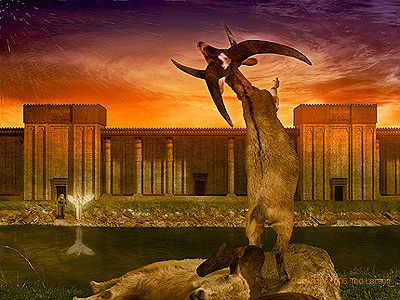
Vision Upon the Ulai
Used by Permission of Ted Larson
The ram - see Da 8:3
The angel interprets the details of the vision in Daniel 8:3, Media coming up first as the actual conqueror of Babylon's King Belshazzar (Da 5:30, 31), and was followed by Persia which eventually became the dominant power of these two divisions.
Two horns… Media and Persia (cp Da 11:1-2) - First mentioned in Da 6:12.
Daniel 8:21 THE SHAGGY GOAT REPRESENTS THE KINGDOM OF GREECE, AND THE LARGE HORN THAT IS BETWEEN HIS EYES IS THE FIRST KING:
BGT Daniel 8:21 καὶ ὁ τράγος τῶν αἰγῶν βασιλεὺς τῶν Ἑλλήνων ἐστί καὶ τὸ κέρας τὸ μέγα τὸ ἀνὰ μέσον τῶν ὀφθαλμῶν αὐτοῦ αὐτὸς ὁ βασιλεὺς ὁ πρῶτος
--- Daniel (TH) 8:21 καὶ ὁ τράγος τῶν αἰγῶν βασιλεὺς Ἑλλήνων καὶ τὸ κέρας τὸ μέγα ὃ ἦν ἀνὰ μέσον τῶν ὀφθαλμῶν αὐτοῦ αὐτός ἐστιν ὁ βασιλεὺς ὁ πρῶτοςLXE Daniel 8:21 The he-goat is the King of the Greeks: and the great horn which was between his eyes, he is the first king.
KJV Daniel 8:21 And the rough goat is the king of Grecia: and the great horn that is between his eyes is the first king.
NET Daniel 8:21 The male goat is the king of Greece, and the large horn between its eyes is the first king.
CSB Daniel 8:21 The shaggy goat represents the king of Greece, and the large horn between his eyes represents the first king.
ESV Daniel 8:21 And the goat is the king of Greece. And the great horn between his eyes is the first king.
NIV Daniel 8:21 The shaggy goat is the king of Greece, and the large horn between his eyes is the first king.
NLT Daniel 8:21 The shaggy male goat represents the king of Greece, and the large horn between his eyes represents the first king of the Greek Empire.
NRS Daniel 8:21 The male goat is the king of Greece, and the great horn between its eyes is the first king.
NJB Daniel 8:21 The hairy he-goat is the king of Greece, the large horn between its eyes is the first king.
NAB Daniel 8:21 The he-goat is the king of the Greeks, and the great horn on its forehead is the first king.
YLT Daniel 8:21 And the young he-goat, the hairy one, is the king of Javan; and the great horn that is between its eyes is the first king;
GWN Daniel 8:21 The hairy male goat is the kingdom of Greece, and the large horn between its eyes is its first king.
BBE Daniel 8:21 And the he-goat is the king of Greece: and the great horn between his eyes is the first king.
RSV Daniel 8:21 And the he-goat is the king of Greece; and the great horn between his eyes is the first king.
NKJ Daniel 8:21 "And the male goat is the kingdom of Greece. The large horn that is between its eyes is the first king.
ASV Daniel 8:21 And the rough he-goat is the king of Greece: and the great horn that is between his eyes is the first king.
DBY Daniel 8:21 And the rough goat is the king of Greece; and the great horn that was between his eyes is the first king.
BHT Daniel 8:21 wühaccäpîr haSSä`îr meºlek yäwän wühaqqeºren haGGüdôlâ ´ášer Bên-`ênäyw hû´ hammeºlek häri´šôn
NIRV Daniel 8:21 The goat stands for the king of Greece. The large horn between his eyes is the first king.
- Shaggy goat - Da 8:5-7 Da 10:20
- Large horn - Da 8:8 Da 11:3
- Daniel 8 Resources - multiple sermons and commentaries
Shaggy goat (there are two similar words in Hebrew both of which can mean goat) - The NET in says the phrase literally is "the he-goat, the buck" and adds that "The expression is odd, and the second word may be an explanatory gloss."
The large horn… the first king - History leaves no doubt as to his identity as Alexander the Great. (cp Da 8:8, Da 11:3)
Daniel 8:22 THE BROKEN HORN AND THE FOUR HORNS THAT AROSE IN ITS PLACE REPRESENT FOUR KINGDOMS WHICH WILL ARISE FROM HIS NATION, ALTHOUGH NOT WITH HIS POWER:
BGT Daniel 8:22 καὶ τὰ συντριβέντα καὶ ἀναβάντα ὀπίσω αὐτοῦ τέσσαρα κέρατα τέσσαρες βασιλεῖς τοῦ ἔθνους αὐτοῦ ἀναστήσονται οὐ κατὰ τὴν ἰσχὺν αὐτοῦ
--- Daniel (TH) 8:22 καὶ τοῦ συντριβέντος οὗ ἔστησαν τέσσαρα ὑποκάτω κέρατα τέσσαρες βασιλεῖς ἐκ τοῦ ἔθνους αὐτοῦ ἀναστήσονται καὶ οὐκ ἐν τῇ ἰσχύι αὐτοῦLXE Daniel 8:22 And as for the one that was broken, in whose place there stood up four horns, four kings shall arise out of his nation, but not in their own strength.
KJV Daniel 8:22 Now that being broken, whereas four stood up for it, four kingdoms shall stand up out of the nation, but not in his power.
NET Daniel 8:22 The horn that was broken and in whose place there arose four others stands for four kingdoms that will arise from his nation, though they will not have his strength.
CSB Daniel 8:22 The four horns that took the place of the shattered horn represent four kingdoms. They will rise from that nation, but without its power.
ESV Daniel 8:22 As for the horn that was broken, in place of which four others arose, four kingdoms shall arise from his nation, but not with his power.
NIV Daniel 8:22 The four horns that replaced the one that was broken off represent four kingdoms that will emerge from his nation but will not have the same power.
NLT Daniel 8:22 The four prominent horns that replaced the one large horn show that the Greek Empire will break into four kingdoms, but none as great as the first.
NRS Daniel 8:22 As for the horn that was broken, in place of which four others arose, four kingdoms shall arise from his nation, but not with his power.
NJB Daniel 8:22 The horn which snapped and the four horns which sprouted in its place are four kingdoms rising from his nation but not having his strength.
NAB Daniel 8:22 The four that rose in its place when it was broken are four kingdoms that will issue from his nation, but without his strength.
YLT Daniel 8:22 and that being broken, stand up do four in its place, four kingdoms from the nation do stand up, and not in its power.
GWN Daniel 8:22 The horn broke off, and four horns replaced it. Four kingdoms will come out of that nation, but they won't be as strong as the first king was.
BBE Daniel 8:22 And as for that which was broken, in place of which four came up, four kingdoms will come up from his nation, but not with his power.
RSV Daniel 8:22 As for the horn that was broken, in place of which four others arose, four kingdoms shall arise from his nation, but not with his power.
NKJ Daniel 8:22 "As for the broken horn and the four that stood up in its place, four kingdoms shall arise out of that nation, but not with its power.
ASV Daniel 8:22 And as for that which was broken, in the place whereof four stood up, four kingdoms shall stand up out of the nation, but not with his power.
DBY Daniel 8:22 Now that being broken, whereas four stood up in its stead, four kingdoms shall stand up out of the nation, but not with his power.
BHT Daniel 8:22 wühaºnnišBeºret waTTa|`ámöºdnâ ´arBa` TaHTʺhä ´arBa` malkùyôt miGGôy ya`ámöºdnâ wülö´ büköHô
NIRV Daniel 8:22 Four horns took its place when it was broken off. They stand for four kingdoms that will come from his nation. But those kingdoms will not be as powerful as his.
- Daniel 8 Resources - multiple sermons and commentaries
In Daniel's fourth vision the fact of the four horns is alluded to again - "But as soon as he has arisen, his (Alexander the Great's) kingdom will be broken up and parceled out toward the four points of the compass (Da 8:8), though not to his own descendants, nor according to his authority which he wielded; for his sovereignty will be uprooted and given to others besides them. (Da 11:4)
The Treasury of Scripture Knowledge comments that "After Alexander's death, in the prime of life and in the height of his conquests, his brother and two sons were all murdered; and the kingdom was divided among four of his generals. 1. Seleucus, who had Syria and Babylon; 2. Lysimachus, who had Asia Minor; 3. Ptolemy, who had Egypt; and, 4. Cassander, who had Greece, etc."
Daniel 8:23 IN THE LATTER PERIOD OF THEIR RULE, WHEN THE TRANSGRESSORS HAVE RUN THEIR COURSE, A KING WILL ARISE, INSOLENT AND SKILLED IN INTRIGUE:
BGT Daniel 8:23 καὶ ἐπ᾽ ἐσχάτου τῆς βασιλείας αὐτῶν πληρουμένων τῶν ἁμαρτιῶν αὐτῶν ἀναστήσεται βασιλεὺς ἀναιδὴς προσώπῳ διανοούμενος αἰνίγματα
--- Daniel (TH) 8:23 καὶ ἐπ᾽ ἐσχάτων τῆς βασιλείας αὐτῶν πληρουμένων τῶν ἁμαρτιῶν αὐτῶν ἀναστήσεται βασιλεὺς ἀναιδὴς προσώπῳ καὶ συνίων προβλήματαLXE Daniel 8:23 And at the latter time of their kingdom, when their sins are coming to the full, there shall arise a king bold in countenance, and understanding riddles.
KJV Daniel 8:23 And in the latter time of their kingdom, when the transgressors are come to the full, a king of fierce countenance, and understanding dark sentences, shall stand up.
NET Daniel 8:23 Toward the end of their rule, when rebellious acts are complete, a rash and deceitful king will arise.
CSB Daniel 8:23 Near the end of their kingdoms, when the rebels have reached the full measure of their sin, an insolent king, skilled in intrigue, will come to the throne.
ESV Daniel 8:23 And at the latter end of their kingdom, when the transgressors have reached their limit, a king of bold face, one who understands riddles, shall arise.
NIV Daniel 8:23 "In the latter part of their reign, when rebels have become completely wicked, a stern-faced king, a master of intrigue, will arise.
NLT Daniel 8:23 "At the end of their rule, when their sin is at its height, a fierce king, a master of intrigue, will rise to power.
NRS Daniel 8:23 At the end of their rule, when the transgressions have reached their full measure, a king of bold countenance shall arise, skilled in intrigue.
NJB Daniel 8:23 'And at the end of their reign, when the measure of their sins is full, a king will arise, a proud-faced, ingenious-minded man.
NAB Daniel 8:23 "After their reign, when sinners have reached their measure, There shall arise a king, impudent and skilled in intrigue.
YLT Daniel 8:23 'And in the latter end of their kingdom, about the perfecting of the transgressors, stand up doth a king, fierce of face, and understanding hidden things;
GWN Daniel 8:23 "In the last days of those kingdoms, when rebellions are finished, a stern-looking king who understands mysterious things will rise to power.
BBE Daniel 8:23 And in the later years of their kingdom, when their evil doings have become complete, there will come up a king full of pride and expert in dark sayings.
RSV Daniel 8:23 And at the latter end of their rule, when the transgressors have reached their full measure, a king of bold countenance, one who understands riddles, shall arise.
NKJ Daniel 8:23 "And in the latter time of their kingdom, When the transgressors have reached their fullness, A king shall arise, Having fierce features, Who understands sinister schemes.
ASV Daniel 8:23 And in the latter time of their kingdom, when the transgressors are come to the full, a king of fierce countenance, and understanding dark sentences, shall stand up.
DBY Daniel 8:23 And at the latter time of their kingdom, when the transgressors shall have come to the full, a king of bold countenance, and understanding riddles, shall stand up.
BHT Daniel 8:23 û|bü´aHárît malkûtäm Kühätëm haPPöš`îm ya`ámöd meºlek `az-Pänîm ûmëbîn Hîdôt
NIRV Daniel 8:23 "Toward the end of their rule, those who refuse to obey God will become completely evil. Then another king will appear. He will have a mean-looking face. He will be a master at making clever plans.
- In the: Da 10:14 Nu 24:24 Eze 38:8,16 1Ti 4:1
- When: Ge 15:16 Mt 23:32 1Th 2:16
- Daniel 8 Resources - multiple sermons and commentaries
ESV Daniel 8:23 And at the latter end of their kingdom, when the transgressors have reached their limit, a king of bold face, one who understands riddles, shall arise.
KJV Daniel 8:23 And in the latter time of their kingdom, when the transgressors are come to the full, a king of fierce countenance, and understanding dark sentences, shall stand up.
And - The original Hebrew text and the Greek Septuagint both begin this verse with a connecting conjunction which is deleted from the 1995 version of the NAS (1977 retains the "and"), the NET and the NIV. I think this word is important as it serves to link this description even closer to the previous passage.
As Miller says Da 8:23-26 represent "the heart of the vision" and presents important truths that the people of Israel would need to know in order to prepare them for the evil reign of Antiochus Epiphanes. So herein we see that one of the great values of prophecy is to comfort and to strengthen faithfulness in those who are destined to experience the times of tribulation which the prophecy speaks. And it strikes me that the book of the Revelation of Jesus Christ will have a similar value to those who are destined to endure the unspeakably evil times of the "greater Antiochus", the Satanically energized Antichrist in the Daniel's Seventieth Week and especially during the last 3.5 years of the Great Tribulation (the "time of Jacob's Trouble" or "Distress"- Jer 30:7) when this evil anti-Semitic king seeks to eradicate the Jews and the nation of Israel, a goal that Satan has continually sought to accomplish from the moment he was made aware that redemption would come through Israel and her Messiah (cp God addressing Satan and issuing the clear prophecy of His future and final "victory" over Evil - Ge 3:15).
Latter period - The text again uses the word acharith (see discussion in Da 8:19), but here the context clearly demonstrates that this is referring to the latter period (about 175BC) of the rule of the 4 divisions of Alexander's kingdom (Division followed his death in 323BC - so 175BC would be in the latter period of the divided kingdoms). The king that will arise is Antiochus Epiphanes who begins his reign in about 175BC.
When the transgressors have run their course (KJV = come to the full, NET = when rebellious acts are complete; ESV = when the transgressors have reached their limit; NLT paraphrases it = when their sin is at its height) - The transgressors or rebels are those Jews who have rebelled against God's law (see Da 8:12 notes) and this phrase seems to indicate that their "iniquity… is… complete" and "ripe" for the disciplining/refining hand of God (see this principle in Ge 15:16; Mt 23:32; 1Th 2:16).
The Septuagint is interesting as it translates "run their course" with the verb pleroo which means to make full or fill up to the brim (in this case with their sins).
A king will arise - One has to examine extra-biblical documents to arrive at the identity of this king. The description fits with the attitude and actions of Antiochus Epiphanes. Notice that God's Spirit gives us additional details of his evil character and conduct in Daniel 11 (Da 11:21-35-note). Note that in Daniel 11:36-note the description abruptly leaps forward into the future to the end times of the Antichrist and his description continues through Da 11:45-note.
Insolent (NET = rash, NIV = stern faced, YLT = fierce of face, KJV = of fierce countenance, ESV = of bold face) is actually two words in the Hebrew (05794) ('az) an adjective meaning strong and when referring to a person's attitude of wrath means insolent, excessive, fierce (cp Ge 49:7) and the second Hebrew word is (06440)(paniym) which means face. Taken together this phrase is an idiom meaning "strong of faces" picturing one as determined or defiant (cp Dt 28:50).
The Septuagint (LXX) translates the Hebrew with a Greek adjective (anaides - often used with a description of one's countenance - see LXX of Dt 28:50 for "fierce" countenance, Pr 7:13 for "brazen" face, Pr 25:23 "angry" countenance, Eccl 8:1 "stern" face) meaning shameless, bold, ruthless, reckless. Clearly Antiochus fit such a description, for a man's face often conveys what is in a man's heart.
Skilled in intrigue (literally = "understanding hidden things", "understanding riddles") (NET - He will be "crafty", a veritable "master of intrigue" (NIV) who "understands riddles" (ESV) and difficult problems. The Hebrew word for intrigue (hiydah - 02420) is used to describe King Solomon's ability to handle "difficult questions" (hiydah) a reputation about which even the Queen of Sheba had heard (1Ki 10:1).
Daniel 8:24 HIS POWER WILL BE MIGHTY, BUT NOT BY HIS OWN POWER, AND HE WILL DESTROY TO AN EXTRAORDINARY DEGREE AND PROSPER AND PERFORM HIS WILL; HE WILL DESTROY MIGHTY MEN AND THE HOLY PEOPLE:
BGT Daniel 8:24 καὶ στερεωθήσεται ἡ ἰσχὺς αὐτοῦ καὶ οὐκ ἐν τῇ ἰσχύι αὐτοῦ καὶ θαυμαστῶς φθερεῖ καὶ εὐοδωθήσεται καὶ ποιήσει καὶ φθερεῖ δυνάστας καὶ δῆμον ἁγίων
--- Daniel (TH) 8:24 καὶ κραταιὰ ἡ ἰσχὺς αὐτοῦ καὶ οὐκ ἐν τῇ ἰσχύι αὐτοῦ καὶ θαυμαστὰ διαφθερεῖ καὶ κατευθυνεῖ καὶ ποιήσει καὶ διαφθερεῖ ἰσχυροὺς καὶ λαὸν ἅγιονLXE Daniel 8:24 And his power shall be great, and he shall destroy wonderfully, and prosper, and practise, and shall destroy mighty men, and the holy people.
KJV Daniel 8:24 And his power shall be mighty, but not by his own power: and he shall destroy wonderfully, and shall prosper, and practise, and shall destroy the mighty and the holy people.
NET Daniel 8:24 His power will be great, but it will not be by his strength alone. He will cause terrible destruction. He will be successful in what he undertakes. He will destroy powerful people and the people of the holy ones.
CSB Daniel 8:24 His power will be great, but it will not be his own. He will cause terrible destruction and succeed in whatever he does. He will destroy the powerful along with the holy people.
ESV Daniel 8:24 His power shall be great-- but not by his own power; and he shall cause fearful destruction and shall succeed in what he does, and destroy mighty men and the people who are the saints.
NIV Daniel 8:24 He will become very strong, but not by his own power. He will cause astounding devastation and will succeed in whatever he does. He will destroy the mighty men and the holy people.
NLT Daniel 8:24 He will become very strong, but not by his own power. He will cause a shocking amount of destruction and succeed in everything he does. He will destroy powerful leaders and devastate the holy people.
NRS Daniel 8:24 He shall grow strong in power, shall cause fearful destruction, and shall succeed in what he does. He shall destroy the powerful and the people of the holy ones.
NJB Daniel 8:24 His power will grow greater and greater, though not through any power of his own; he will plot incredible schemes, he will succeed in whatever he undertakes, he will destroy powerful men and the holy ones, God's people.
NAB Daniel 8:24 He shall be strong and powerful, bring about fearful ruin, and succeed in his undertaking. He shall destroy powerful peoples;
YLT Daniel 8:24 and his power hath been mighty, and not by his own power; and wonderful things he destroyeth, and he hath prospered, and wrought, and destroyed mighty ones, and the people of the Holy Ones.
GWN Daniel 8:24 He will become very strong, but not by his own strength. He will cause astounding destruction and will be successful in everything he does. He will destroy those who are powerful along with some holy people.
BBE Daniel 8:24 And his power will be great, and he will be purposing strange things. And all will go well for him and he will do his pleasure; and he will send destruction on the strong ones.
RSV Daniel 8:24 His power shall be great, and he shall cause fearful destruction, and shall succeed in what he does, and destroy mighty men and the people of the saints.
NKJ Daniel 8:24 His power shall be mighty, but not by his own power; He shall destroy fearfully, And shall prosper and thrive; He shall destroy the mighty, and also the holy people.
ASV Daniel 8:24 And his power shall be mighty, but not by his own power; and he shall destroy wonderfully, and shall prosper and do his pleasure; and he shall destroy the mighty ones and the holy people.
DBY Daniel 8:24 And his power shall be mighty, but not by his own power; and he shall destroy marvellously, and shall prosper, and shall practise, and shall destroy the mighty ones, and the people of the saints.
BHT Daniel 8:24 wü`äcam KöHô wülö´ büköHô wüniplä´ôt yašHît wühiclîªH wü`äSâ wühišHît `ácûmîm wü`am-qüdöšîm
NIRV Daniel 8:24 He will become very strong. But he will not get that way by his own power. People will be amazed at the way he destroys everything. He will be successful no matter what he does. He will destroy the mighty men and the holy people.
- but: Rev 13:3-9 17:12,13,17
- prosper: Da 8:12 11:36
- destroy: Da 8:10,12 7:25 11:31, 32, 33, 34, 35, 36 Rev 13:10 16:6 17:6 19:2
- Daniel 8 Resources - multiple sermons and commentaries
His power will be mighty - When Antiochus became king, the Seleucid dynasty was not strong politically, but Antiochus was ruthless and skilled in leadership so that his power "grew exceedingly great toward the south, toward the east, and toward the Beautiful Land." (Da 8:9-note) So even in this small detail describing the increase in power in a relatively weak dynasty is another indication of God's sovereign power to bring about every jot and tittle about which He prophesies! We can trust His Word!
But not by his own power (See parallel truths regarding the future Antichrist - Rev 13:2-note, Rev 17:12,13,17-note) - This means Antiochus' power derived from an external source. Given his incredibly evil conduct, his source surely would be none other than evil spirits, possibly even Satan himself.
As noted this specific fact closely parallels John's statement that "the dragon (Satan) gave him (the Antichrist) his power and his throne and great authority." (Rev 13:2b-note). Once again we must remember that even though God allows evil to manifest itself through evil angels and evil men, He is sovereign and in control and orders all the events of history (read Da 2:21-note as you ponder Antiochus' and Antichrist's rise to power and subsequent fall) toward their final consummation, at which time He finally, once and for all time and eternity, replaces unrighteousness with the rule and reign of His Righteous Branch (the Messiah - Is 4:2-note, Is 11:1-note, Is 53:2, Jer 23:5, Jer 33:15, Zech 3:8, Zech 6:12)
He will… prosper (06743)(tsalach/salah) is from a root which means to accomplish satisfactorily what is intended. It generally expresses idea of a successful venture, as contrasted with failure. See comments on Daniel 8:12. Antiochus IV Epiphanes will succeed in his evil enterprise and activity, becoming strong and flourishing (which is also stated in essence in the prophecy in Da 8:9).
Salah - 54x in NAS - advanced(1), give us success(1), made his successful(1), make his successful(1), make your prosperous(1), make your successful(1), prosper(16), prospered(7), prosperous(1), prospers(2), send prosperity(1), succeed(10), succeeding(1), successful(4), successfully completed(1), thrive(2), useful(1), victoriously(1), worthless*(2). Ge24:21, 40, 42, 56; 39:2f, 23; Num 14:41; Deut 28:29; Josh 1:8; Jdg 18:5; 1Kgs 22:12, 15; 1Chr 22:11, 13; 29:23; 2 Chr 7:11; 13:12; 14:7; 18:11, 14; 20:20; 24:20; 26:5; 31:21; 32:30; Neh 1:11; 2:20; Ps 1:3; 37:7; 45:4; 118:25; Prov 28:13; Isa 48:15; 53:10; 54:17; 55:11; Jer 2:37; 5:28; 12:1; 13:7, 10; 22:30; 32:5; Ezek 15:4; 16:13; 17:9f, 15; Dan 8:12, 24-25; 11:27, 36
Expositor's Bible Commentary - While we are not definitely told whether Antiochus made a formal claim to deity while enthroned in splendor in the court of the Jerusalem temple, he certainly did assume the right to determine what gods his subjects should worship, feeling that he was the earthly embodiment of the powers of heaven and that all rule and authority was given him. Like Nebuchadnezzar, he expected all his subjects to bow down to the great image he had set up. But he went even beyond Nebuchadnezzar in trying to abolish the ancestral religion of the Jews, forbidding them on pain of death to circumcise their children and making the possession of the Hebrew Scriptures a capital offense. By erecting the statue of Zeus Olympius (or Capitolinus) in the temple of Yahweh and sacrificing swine on the altar, he committed the greatest possible sacrilege and affront to the Jewish people.
He will destroy… the holy people - The holy people in context is not the church but the Jews (cp Dt 7:6, 14:2, 21, Dt 28:9). This might refer to genuine believers (part of the remnant) but one cannot be dogmatic. In Daniel 12 we read of a destruction of the Jews at the end of this age - "that it would be for a time, times, and half a time; and as soon as they finish shattering the power of the holy people, all these events will be completed." (Da 12:7-note, cp Da 7:25-note, "the woman" is a description of Israel in Revelation 12 - Rev 12:6-note, Rev 12:14-note)
Destroy (corrupt)(07843)(shachath) means to decay, to go to ruin, to corrupt, to destroy (Sodom and Gomorrah = Ge 13:10, Ge 18:28, 31-32), to lay waste (Egypt from swarms of flies -Ex 8:24). Shachath is used of Israelites who worshiped the golden calf (Ex 32:7; Dt 9:12; 32:5, Hos 9:9). God warned He would destroy Israel if they were turned away from following Him (Nu 32:15). Shachath describes Israel's behavior as more corrupt after a judge died (Jdg 2:19).
Daniel 8:25 AND THROUGH HIS SHREWDNESS HE WILL CAUSE DECEIT TO SUCCEED BY HIS INFLUENCE; AND HE WILL MAGNIFY HIMSELF IN HIS HEART, AND HE WILL DESTROY MANY WHILE THEY ARE AT EASE. HE WILL EVEN OPPOSE THE PRINCE OF PRINCES, BUT HE WILL BE BROKEN WITHOUT HUMAN AGENCY:
BGT Daniel 8:25 καὶ ἐπὶ τοὺς ἁγίους τὸ διανόημα αὐτοῦ καὶ εὐοδωθήσεται τὸ ψεῦδος ἐν ταῖς χερσὶν αὐτοῦ καὶ ἡ καρδία αὐτοῦ ὑψωθήσεται καὶ δόλῳ ἀφανιεῖ πολλοὺς καὶ ἐπὶ ἀπωλείας ἀνδρῶν στήσεται καὶ ποιήσει συναγωγὴν χειρὸς καὶ ἀποδώσεται
--- Daniel (TH) 8:25 καὶ ὁ ζυγὸς τοῦ κλοιοῦ αὐτοῦ κατευθυνεῖ δόλος ἐν τῇ χειρὶ αὐτοῦ καὶ ἐν καρδίᾳ αὐτοῦ μεγαλυνθήσεται καὶ δόλῳ διαφθερεῖ πολλοὺς καὶ ἐπὶ ἀπωλείας πολλῶν στήσεται καὶ ὡς ᾠὰ χειρὶ συντρίψειLXE Daniel 8:25 And the yoke of his chain shall prosper: there is craft in his hand; and he shall magnify himself in his heart, and by craft shall destroy many, and he shall stand up for the destruction of many, and shall crush them as eggs in his hand.
KJV Daniel 8:25 And through his policy also he shall cause craft to prosper in his hand; and he shall magnify himself in his heart, and by peace shall destroy many: he shall also stand up against the Prince of princes; but he shall be broken without hand.
NET Daniel 8:25 By his treachery he will succeed through deceit. He will have an arrogant attitude, and he will destroy many who are unaware of his schemes. He will rise up against the Prince of princes, yet he will be broken apart– but not by human agency.
CSB Daniel 8:25 He will cause deceit to prosper through his cunning and by his influence, and in his own mind he will make himself great. He will destroy many in a time of peace; he will even stand against the Prince of princes. Yet he will be shattered-- not by human hands.
ESV Daniel 8:25 By his cunning he shall make deceit prosper under his hand, and in his own mind he shall become great. Without warning he shall destroy many. And he shall even rise up against the Prince of princes, and he shall be broken-- but by no human hand.
NIV Daniel 8:25 He will cause deceit to prosper, and he will consider himself superior. When they feel secure, he will destroy many and take his stand against the Prince of princes. Yet he will be destroyed, but not by human power.
NLT Daniel 8:25 He will be a master of deception and will become arrogant; he will destroy many without warning. He will even take on the Prince of princes in battle, but he will be broken, though not by human power.
NRS Daniel 8:25 By his cunning he shall make deceit prosper under his hand, and in his own mind he shall be great. Without warning he shall destroy many and shall even rise up against the Prince of princes. But he shall be broken, and not by human hands.
NJB Daniel 8:25 Such will be his resourcefulness of mind that all his treacherous activities will succeed. He will grow arrogant of heart and destroy many people by taking them unawares. He will challenge the power of the Prince of princes but, without any human intervention, he will be broken.
NAB Daniel 8:25 his cunning shall be against the holy ones, his treacherous conduct shall succeed. He shall be proud of heart and destroy many by stealth. But when he rises against the prince of princes, he shall be broken without a hand being raised.
YLT Daniel 8:25 'And by his understanding he hath also caused deceit to prosper in his hand, and in his heart he exerteth himself, and by ease he destroyeth many; and against the prince of princes he standeth -- and without hand he is broken.
GWN Daniel 8:25 He will cleverly use his power to deceive others successfully. He will consider himself to be great and destroy many people when they don't expect it. He will oppose the Commander of Commanders, but he will be defeated, though not by any human power.
BBE Daniel 8:25 And his designs will be turned against the holy people, causing deceit to do well in his hand; in his heart he will make himself great, and send destruction on numbers who are living unconscious of their danger; and he will put himself up against the prince of princes; but he will be broken, though not by men's hands.
RSV Daniel 8:25 By his cunning he shall make deceit prosper under his hand, and in his own mind he shall magnify himself. Without warning he shall destroy many; and he shall even rise up against the Prince of princes; but, by no human hand, he shall be broken.
NKJ Daniel 8:25 "Through his cunning He shall cause deceit to prosper under his rule; And he shall exalt himself in his heart. He shall destroy many in their prosperity. He shall even rise against the Prince of princes; But he shall be broken without human means.
ASV Daniel 8:25 And through his policy he shall cause craft to prosper in his hand; and he shall magnify himself in his heart, and in their security shall he destroy many: he shall also stand up against the prince of princes; but he shall be broken without hand.
DBY Daniel 8:25 And through his cunning shall he cause craft to prosper in his hand; and he will magnify himself in his heart, and by prosperity will corrupt many; and he will stand up against the Prince of princes: but he shall be broken without hand.
BHT Daniel 8:25 wü`al-Siklô wühiclîªH mirmâ Büyädô ûbilbäbô yagDîl ûbüšalwâ yašHît raBBîm wü`al-Sar-Särîm ya`ámöd ûbü´eºpes yäd yiššäbër
NIRV Daniel 8:25 "He will tell lies in order to succeed. He will think he is more important than anyone else. When people feel safe, he will destroy many of them. He will stand up against the greatest Prince of all. Then he will be destroyed. But he will not be killed by human beings.
- through: Da 8:23,24 7:8 11:21-25,32,33
- magnify: Da 8:11 11:36,37 Jer 48:26
- At ease: Da 11:21
- Oppose:: Da 8:11 11:36 Rev 17:14 19:16
- But: Da 2:34,35,44,45 7:26 11:45 Job 34:20 La 4:6 Ac 12:23 Rev 19:19-21
- Daniel 8 Resources - multiple sermons and commentaries
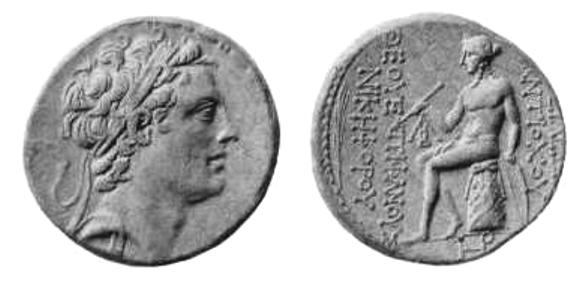
Coins with Antiochus' Image
NLT Daniel 8:25 He will be a master of deception and will become arrogant; he will destroy many without warning. He will even take on the Prince of princes in battle, but he will be broken, though not by human power.
NET Daniel 8:25 By his treachery he will succeed through deceit. He will have an arrogant attitude, and he will destroy many who are unaware of his schemes. He will rise up against the Prince of princes, yet he will be broken apart– but not by human agency.
MacArthur - Many believe that the description here transcends that of Antiochus alone, and uses him as a type of the Antichrist who will oppose Christ during the Great Tribulation. Certainly the devious work of Antiochus and of the Antichrist is of the same heinous character.
Shrewdness (07922)(sekel from sakal = to be prudent) can convey the ideas of prudence, good sense, insight, understanding but clearly here speaks of these traits in a bad sense which could be summed up as cunning, treachery (only such negative use). Sekel speaks of intelligence that is more than just mere book knowledge or learning about a particular subject. It has a greater significance and means insight or understanding.
Sekel - 16v - 1 Sam 25:3; 1 Chr 22:12; 26:14; 2 Chr 2:12; 30:22; Ezra 8:18; Neh 8:8; Job 17:4; Ps 111:10; Prov 3:4; 12:8; 13:15; 16:22; 19:11; 23:9; Dan 8:25. NAS Usage: discretion(3), insight(4), intelligent*(1), repute(1), sense(1), shrewdness(1), understanding(4), wisdom(1).
Deceit (04820)(mirmah) is a feminine noun meaning fraud, deceit and describes intentional misleading of someone through distorting or withholding the truth. Jacob stole Esau’s blessing through deceit (Ge 27:35; cf. Ge 34:13). Deceit fills the heart of those who plan evil (Pr. 12:20; cf. Ps. 36:3; Pr 12:5, 17; 14:8).
The Septuagint (Lxx) translates mirmah with dolos which is the word of bait for fish and then spoke of any cunning contrivance for deceiving or catching (think o the Trojan horse). Dolos was used of a mouse trap. This word includes any trick or stratagem.
Mirmah - 38v - Gen 27:35; 34:13; 2 Kgs 9:23; Job 15:35; 31:5; Ps 5:6; 10:7; 17:1; 24:4; 34:13; 35:20; 36:3; 38:12; 43:1; 50:19; 52:4; 55:11, 23; 109:2; Prov 11:1; 12:5, 17, 20; 14:8, 25; 20:23; 26:24; Isa 53:9; Jer 5:27; 9:6, 8; Dan 8:25; 11:23; Hos 11:12; 12:7; Amos 8:5; Mic 6:11; Zeph 1:9.
Mirmah in NAS Usage: deceit(21), deceitful(6), deceitfully(2), deception(2), deceptive(1), dishonest(1), false(3), treacherous(1), treachery(2).
To succeed (06743)(see salah above) is from a root which means to accomplish satisfactorily what is intended. ) is from a root which means to accomplish satisfactorily what is intended.
Magnify himself in his heart (Literally = "in his heart he will act arrogantly") - Obviously this speaks of Antiochus' pride, arrogance, and self-exaltation. In fact, Antiochus Epiphanes even had coins minted which bore his image on one side and an inscription on the other (see above) which said "Antiochus, image of God, bearer of victory".
He will destroy many while they are at ease (ESV = Without warning he shall destroy many; NIV = When they feel secure, he will destroy many)
Destroy (corrupt)(07843)(shachath) means to decay, to go to ruin, to corrupt, to destroy (Sodom and Gomorrah = Ge 13:10, Ge 18:28, 31-32), to lay waste (Egypt from swarms of flies -Ex 8:24).
At ease (KJV = by peace) - The NET note states that "The Hebrew word used here is difficult. It may refer to the security felt by those who did not realize the danger of imminent attack, or it may refer to the condition of being unaware of the impending danger."
The Prince of princes - This could be a reference to God. Or possibly it is a specific reference to Messiah (cp "Messiah the Prince" in Da 9:25) Some interpreters see this as a piece of evidence that the description in Da 8:23-25 applies to someone else other than Antiochus, specifically to the end-times Antichrist. However simply observing the text Da 8:23 clearly states that a king will arise "in the latter period of their rule." This time phrase begs the question whose rule? The nearest antecedent is the "four kingdoms" that arose after Alexander died and his kingdom of Greece was divided into "four conspicuous horns." (Da 8:22, Da 8:4) So clearly the king of Da 8:23 arises from the third great world kingdom (in its divided stage). In other words this king earlier referred to as the "rather small horn" (Da 8:9) arises from 4 horns and would be essentially the "fifth" horn. In contrast the Little Horn of Da 7:7-8-note arises from the fourth kingdom (Rome) in its "10 horn" stage and would essentially be the "eleventh" horn. Notice how the subsequent description of the king (in Da 8:23) is linked by "and" (5 times) in Da 8:23-25. Given that this description applies to the king that originates from the third world kingdom, it is highly unlikely that the statement "He will even oppose the Prince of princes" now should be interpreted as describing the actions of the future Antichrist.
On the other hand, there is no doubt that the future Antichrist will manifest a similar character and conduct as that ascribed to this king (Antiochus Epiphanes). And so Paul warned the saints at Thessalonica exhorting them to…
Let no one in any way deceive you (implying such would be the case), for it (Day of the Lord in 2Thes 2:2) will not come unless (1) the apostasy comes first, and (2) the man of lawlessness (Antichrist) is revealed (apokalupto), the son of destruction (cp description of Antiochus - Da 8:24, 25), who opposes and exalts himself above every so-called god or object of worship (cp Da 8:25), so that he takes his seat in the temple of God, displaying himself as being God. (2Thes 2:3,4)
Walvoord on prince of princes - Another problem is the statement that the king “shall also stand up against the Prince of princes.” H. A. Ironside expresses a common viewpoint that the “Prince of princes can be none other than the Messiah; consequently, these words were not fulfilled in the life and death of Antiochus.” However, this objection is not unanswerable, because opposition to God, to Israel, and to the Messianic hope in general, which characterized blasphemers of the Old Testament, can well be interpreted as standing up against “the Prince of princes.” After all, Christ existed in Old Testament times as God and as the Angel of Jehovah and as the defender of Israel.
Broken without human agency - Was Antiochus "broken without human agency?" The phrase means that he would not be killed by another human, but (by implication) ultimately terminated by God the Righteous Judge (cp what happened to King Herod - Acts 12:21-23 = "immediately an angel of the Lord struck him because he did not give God the glory, and he was eaten by worms and died."). Similarly the Antichrist will be defeated and destroyed by God, specifically at the return of the King of kings (see Rev 19:11-16, Rev 19:20)
First Maccabees records the events surrounding the death of Antiochus…
As King Antiochus (Epiphanes) was traversing the inland provinces, he heard that in Persia there was a city called Elymais (Note in New American Bible = Elymais: the mountainous region of Elam, north of the Persian Gulf. This section continues the story from 1 Macc 3:37 and pertains to events preceding those in 1 Macc 4:37, 38, 39), famous for its wealth in silver and gold, 2 and that its temple was very rich, containing gold helmets, breastplates, and weapons left there by Alexander, son of Philip, king of Macedon, the first king of the Greeks. 3 He went therefore and tried to capture and pillage the city. But he could not do so, because his plan became known to the people of the city 4 who rose up in battle against him. So he retreated and in great dismay withdrew from there to return to Babylon. 5 While he was in Persia, a messenger brought him news that the armies sent into the land of Judah had been put to flight; 6 that Lysias had gone at first with a strong army and been driven back by the Israelites; that they had grown strong by reason of the arms, men, and abundant possessions taken from the armies they had destroyed; 7 that they had pulled down the Abomination (cp Abomination of desolation Antiochus set up in Da 11:31 - a foreshadowing of the future "Abomination of Desolation" described by Jesus in Mt 24:15 [cp Da 9:27, 2Th 2:3,4] which would mark the beginning of the horrible "indignation" [Da 8:19, Is 26:20], the "time of Jacob's distress" [Jer 30:7], Great Tribulation) which he had built upon the altar in Jerusalem; and that they had surrounded with high walls both the sanctuary, as it had been before, and his city of Beth-zur.
8 When the king heard this news, he was struck with fear and very much shaken. Sick with grief because his designs had failed, he took to his bed. 9 There he remained many days, overwhelmed with sorrow, for he knew he was going to die. 10 So he called in all his Friends and said to them:
“Sleep has departed from my eyes, for my heart is sinking with anxiety. 11 I said to myself: ‘Into what tribulation have I come, and in what floods of sorrow am I now! 12 Yet I was kindly and beloved in my rule.’ But I now recall the evils I did in Jerusalem, when I carried away all the vessels of gold and silver that were in it, and for no cause gave orders that the inhabitants of Judah be destroyed. 13 I know that this is why these evils have overtaken me; and now I am dying, in bitter grief, in a foreign land.”
14 Then he summoned Philip, one of his Friends, and put him in charge of his whole kingdom. 15 He gave him his crown, his robe, and his signet ring, so that he might guide the king’s son Antiochus and bring him up to be king. 16 King Antiochus died in Persia in the year one hundred and forty-nine. (Note in the New American Bible on this verse = The year one hundred and forty-nine: September 22, 164, to October 9, 163 B.C. A Babylonian list of the Seleucid kings indicates that Antiochus died in November or early December of 164)
Daniel 8:26 THE VISION OF THE EVENINGS AND MORNINGS WHICH HAS BEEN TOLD IS TRUE; BUT KEEP THE VISION SECRET, FOR IT PERTAINS TO MANY DAYS IN THE FUTURE:
BGT Daniel 8:26 τὸ ὅραμα τὸ ἑσπέρας καὶ πρωὶ ηὑρέθη ἐπ᾽ ἀληθείας καὶ νῦν πεφραγμένον τὸ ὅραμα ἔτι γὰρ εἰς ἡμέρας πολλάς
--- Daniel (TH) 8:26 καὶ ἡ ὅρασις τῆς ἑσπέρας καὶ τῆς πρωίας τῆς ῥηθείσης ἀληθής ἐστιν καὶ σὺ σφράγισον τὴν ὅρασιν ὅτι εἰς ἡμέρας πολλάςLXE Daniel 8:26 And the vision of the evening and morning that was mentioned is true: and do thou seal the vision; for it is for many days.
KJV Daniel 8:26 And the vision of the evening and the morning which was told is true: wherefore shut thou up the vision; for it shall be for many days.
NET Daniel 8:26 The vision of the evenings and mornings that was told to you is correct. But you should seal up the vision, for it refers to a time many days from now."
CSB Daniel 8:26 The vision of the evenings and the mornings that has been told is true. Now you must seal up the vision because it refers to many days in the future."
ESV Daniel 8:26 The vision of the evenings and the mornings that has been told is true, but seal up the vision, for it refers to many days from now."
NIV Daniel 8:26 "The vision of the evenings and mornings that has been given you is true, but seal up the vision, for it concerns the distant future."
NLT Daniel 8:26 "This vision about the 2,300 evenings and mornings is true. But none of these things will happen for a long time, so keep this vision a secret."
NRS Daniel 8:26 The vision of the evenings and the mornings that has been told is true. As for you, seal up the vision, for it refers to many days from now."
NJB Daniel 8:26 The vision of the evenings and the mornings which has been revealed is true, but you must keep the vision secret, for there are still many days to go.'
NAB Daniel 8:26 The vision of the evenings and the mornings is true, as spoken; Do you, however, keep this vision undisclosed, because the days are to be many."
YLT Daniel 8:26 And the appearance of the evening and of the morning, that is told, is true; and thou, hide thou the vision, for it is after many days.'
GWN Daniel 8:26 The vision about the evenings and mornings that was explained to you is true. Seal the vision, because it is about things that will happen in the distant future."
BBE Daniel 8:26 And the vision of evenings and mornings which has been talked of is true: and keep the vision secret; for it has to do with the far-off future.
RSV Daniel 8:26 The vision of the evenings and the mornings which has been told is true; but seal up the vision, for it pertains to many days hence."
NKJ Daniel 8:26 "And the vision of the evenings and mornings Which was told is true; Therefore seal up the vision, For it refers to many days in the future."
ASV Daniel 8:26 And the vision of the evenings and mornings which hath been told is true: but shut thou up the vision; for it belongeth to many days to come.
DBY Daniel 8:26 And the vision of the evening and the morning which hath been told is true; but close thou up the vision, for it is for many days to come.
BHT Daniel 8:26 ûmar´Ë hä`eºreb wühaBBöºqer ´ášer ne´émar ´émet hû´ wü´aTTâ sütöm he|Häzôn Kî lüyämîm raBBîm
NIRV Daniel 8:26 "The vision of the evenings and mornings that has been given to you is true. But seal up the vision. It tells about a time far off."
- vision: Da 8:11-15 10:1
- But: Da 12:4,9 Eze 12:27 Rev 10:4 22:10
- For it pertains: Da 10:1,14 Isa 24:22 Ho 3:3,4
- Daniel 8 Resources - multiple sermons and commentaries
Keep the vision of secret (ESV, NIV, NET = "seal up the vision") in some passages can mean to authenticate or certify, but in the present passage is more compatible with shutting the vision for safekeeping and preservation. This verb could allude to the ancient practice of making a scroll secure and preserving it by "shutting" it with a wax seal. Certainly this vision was given so that the Jews of a later generation would be able to refer to it and thereby clearly recognize Antiochus Epiphanes and resist him (knowing that he would have only 2300 days in order to carry out his evil persecution of the Jews).
John MacArthur on keeping the vision secret - Since he told it here (Ed: That is it was clearly not kept a total secret in the strict sense of the word!), this did not mean to shut it up to secrecy but to preserve it as truth even if not to be fulfilled for a long time.
Keep… secret (shut...up - KJV) (05640)(satam) is a verb which means "to stop, to stop up. It means to plug up, to stop the function of a well by filling the well cylinder with dirt and debris (Ge. 26:15, 18). It describes the filling in of springs as well (2Kgs. 3:19, 25); or gaps in a broken wall (Neh. 4:7). It is used, with be on the front, as an adverb to mean secretly, in secret (Ps. 51:6). It means to hide or to keep something hidden, secret (Dan. 8:26; 12:4)." (Baker)
Brown-Driver-Briggs Expanded Definition - Satam - סָתַם verb stop up, shut up, keep close
1 stop up springs of water 2 Kings 3:19,25; 2 Chronicles 32:3,4, compare 2 Chronicles 32:30.
2 shut up, keep close, prophetic words Daniel 8:26; Daniel 12:4,9; בְּסָתֻם Psalm 51:8 in (the) closed (chamber of the breast; "" טֻחוֺת). — כָּלסָֿתוּם Ezekiel 28:3 usually no secret is too dark for thee, but doubtful (see II. עמם); ᵐ5 σοφοί, Co חַרְטֻמִּים < Toy חֲכָמִים, or Berthol. קֹסְמִים.
Niph`al Infinitive construct לְהִסָּתֵם Nehemiah 4:1 the breaches [in the walls] had begun to be stopped up.
Pi`el Perfect 3 plural suffix סִתְּמוּם Genesis 26:16; Imperfect 3 masculine plural suffix וַיְסַתְּמוּם Genesis 26:18, both of stopping wells quite up (R JE).
Complete Biblical Library Hebrew-English Dictionary says satam means - "to stop up," "to block" or "to keep secret," sātham occurs thirteen times in the Bible, ten times in the Qal stem, one time in the Niphal stem and two times in the Piel stem. The verb is widely attested in Semitic. In the Qal stem, sātham refers to stopping up a spring of water belonging to an enemy (2 Ki. 3:19, 25) and to stopping up one's own springs of water to prevent enemy forces from obtaining water to sustain them during a siege (2 Chr. 32:3f). King Hezekiah stopped the water outlet of Upper Gihon in order to reroute the water by tunnel to the west side of Jerusalem (2 Chr. 32:30). Sātham is also used to refer to shutting up or sealing a book of prophecy (Dan. 12:4), to figuratively shutting up or keeping secret the words of a prophecy (v. 9) or to shutting up or sealing a vision (Dan. 8:26). The Qal passive participle is used as a noun to refer to the hidden parts of one's inner being (Ps. 51:6). Used in parallel with "inward parts," it refers to a secret, that is, something closed up in one's inner being (Ezek. 28:3). The Niphal stem is used to refer to closing up the gaps in broken city walls (Neh. 4:7). The Piel stem, with a more intensive sense, refers to stopping up a well by filling it with dirt (Gen. 26:15, 18).
Satam - 13v - NAS Usage: closed(1), conceal(1), concealed(1), cut off(1), hidden part(1), keep the secret(1), secret(1), stop(1), stopped(5).
Genesis 26:15 Now all the wells which his father's servants had dug in the days of Abraham his father, the Philistines stopped up by filling them with earth.
18 Then Isaac dug again the wells of water which had been dug in the days of his father Abraham, for the Philistines had stopped them up after the death of Abraham; and he gave them the same names which his father had given them.
2 Kings 3:19 'Then you shall strike every fortified city and every choice city, and fell every good tree and stop all springs of water, and mar every good piece of land with stones.'"
25 Thus they destroyed the cities; and each one threw a stone on every piece of good land and filled it. So they stopped all the springs of water and felled all the good trees, until in Kir-hareseth only they left its stones; however, the slingers went about it and struck it.
2 Chronicles 32:3 he decided with his officers and his warriors to cut off the supply of water from the springs which were outside the city, and they helped him.
4 So many people assembled and stopped up all the springs and the stream which flowed through the region, saying, "Why should the kings of Assyria come and find abundant water?"
30 It was Hezekiah who stopped the upper outlet of the waters of Gihon and directed them to the west side of the city of David. And Hezekiah prospered in all that he did.
Nehemiah 4:7 ¶ Now when Sanballat, Tobiah, the Arabs, the Ammonites and the Ashdodites heard that the repair of the walls of Jerusalem went on, and that the breaches began to be closed, they were very angry.
Psalm 51:6 Behold, You desire truth in the innermost being, And in the hidden part You will make me know wisdom.
Ezekiel 28:3 Behold, you are wiser than Daniel; There is no secret that is a match for you.
Daniel 8:26 "The vision of the evenings and mornings Which has been told is true; But keep the vision secret, For it pertains to many days in the future."
Daniel 12:4 "But as for you, Daniel, conceal these words and seal up the book until the end of time; many will go back and forth, and knowledge will increase."
9 He said, "Go your way, Daniel, for these words are concealed and sealed up until the end time.
Bible Knowledge Commentary - Daniel was told to seal up the vision in the sense of concluding it, not in the sense of keeping it secret, because it needed to be preserved for the future. He kept it in his mind and later preserved it in writing when he wrote it down under the Holy Spirit’s inspiration. (Walvoord, J. F., Zuck, R. B., et al)
It pertains to many days - First note that "in the future" is added by the NAS translators. Nevertheless the context does support that this time phrase is a reference to "many days" in the future. If Daniel received this vision in about 551BC and Antiochus Epiphanes did not come on the scene until 175BC, the fulfillment of this vision would not be for "many days" (in fact about ~376 years). This time phrase could also be an allusion to the fact that this historical fulfillment in Antiochus is also a foreshadowing of the Antichrist.
In his fourth vision Daniel receives a similar message…
Now I have come to give you an understanding of what will happen to your people in the latter days, for the vision pertains to the days yet future.
Comment: This passage identifies this vision as a reference to the future culminating in the events surrounding the second coming of Christ.
As an aside note that there are a number of closely related time phrases used in the OT which are eschatological (refer to future events):
Latter days = Dt 4:30 31:29 Jer 30:24 48:47 Da 2:28 10:14
Last days = Isa 2:2 Je 23:20 49:39 Ho 3:5 Mic 4:1
Days to come = Ge 49:1 Isa 27:6 Nu 24:14
Related Resources:
- Genesis 49:1 Commentary
- The Great Tribulation
- Deuteronomy 4:30 Commentary
- Last-Eschatos (Greek Word Study)
Daniel 8:27 THEN I, DANIEL, WAS EXHAUSTED AND SICK FOR DAYS. THEN I GOT UP AGAIN AND CARRIED ON THE KING'S BUSINESS; BUT I WAS ASTOUNDED AT THE VISION, AND THERE WAS NONE TO EXPLAIN IT:
BGT Daniel 8:27 ἐγὼ Δανιηλ ἀσθενήσας ἡμέρας πολλὰς καὶ ἀναστὰς ἐπραγματευόμην πάλιν βασιλικά καὶ ἐξελυόμην ἐπὶ τῷ ὁράματι καὶ οὐδεὶς ἦν ὁ διανοούμενος
--- Daniel (TH) 8:27 καὶ ἐγὼ Δανιηλ ἐκοιμήθην καὶ ἐμαλακίσθην ἡμέρας καὶ ἀνέστην καὶ ἐποίουν τὰ ἔργα τοῦ βασιλέως καὶ ἐθαύμαζον τὴν ὅρασιν καὶ οὐκ ἦν ὁ συνίωνLXE Daniel 8:27 And I Daniel fell asleep, and was sick: then I arose, and did the king's business; and I wondered at the vision, and there was none that understood it.
KJV Daniel 8:27 And I Daniel fainted, and was sick certain days; afterward I rose up, and did the king's business; and I was astonished at the vision, but none understood it.
NET Daniel 8:27 I, Daniel, was exhausted and sick for days. Then I got up and again carried out the king's business. But I was astonished at the vision, and there was no one to explain it.
CSB Daniel 8:27 I, Daniel, was overcome and lay sick for days. Then I got up and went about the king's business. I was greatly disturbed by the vision and could not understand it.
ESV Daniel 8:27 And I, Daniel, was overcome and lay sick for some days. Then I rose and went about the king's business, but I was appalled by the vision and did not understand it.
NIV Daniel 8:27 I, Daniel, was exhausted and lay ill for several days. Then I got up and went about the king's business. I was appalled by the vision; it was beyond understanding.
NLT Daniel 8:27 Then I, Daniel, was overcome and lay sick for several days. Afterward I got up and performed my duties for the king, but I was greatly troubled by the vision and could not understand it.
NRS Daniel 8:27 So I, Daniel, was overcome and lay sick for some days; then I arose and went about the king's business. But I was dismayed by the vision and did not understand it.
NJB Daniel 8:27 At this I, Daniel, lost consciousness; I was ill for several days. Then I got up to discharge my duties in the king's service, keeping the vision a secret and still not understanding what it meant.
NAB Daniel 8:27 I, Daniel, was weak and ill for some days; then I arose and took care of the king's affairs. But I was appalled at the vision, which I could not understand.
YLT Daniel 8:27 And I, Daniel, have been, yea, I became sick for days, and I rise, and do the king's work, and am astonished at the appearance, and there is none understanding.
GWN Daniel 8:27 I, Daniel, was exhausted and sick for days. Then I got up and worked for the king. The vision horrified me because I couldn't understand it.
BBE Daniel 8:27 And I, Daniel, was ill for some days; then I got up and did the king's business: and I was full of wonder at the vision, but no one was able to give the sense of it.
RSV Daniel 8:27 And I, Daniel, was overcome and lay sick for some days; then I rose and went about the king's business; but I was appalled by the vision and did not understand it.
NKJ Daniel 8:27 And I, Daniel, fainted and was sick for days; afterward I arose and went about the king's business. I was astonished by the vision, but no one understood it.
ASV Daniel 8:27 And I, Daniel, fainted, and was sick certain days; then I rose up, and did the king's business: and I wondered at the vision, but none understood it.
DBY Daniel 8:27 And I Daniel fainted, and was sick certain days: then I rose up, and did the king's business. And I was astonished at the vision, but none understood it.
BHT Daniel 8:27 wa´ánî däniyyë´l nihyêºtî wüne|Hélêºtî yämîm wä´äqûm wä´e|`éSè ´et-müleº´ket hammeºlek wä´ešTômëm `al-hammar´è wü´ên mëbîn P
NIRV Daniel 8:27 I was worn out. I lay sick for several days. Then I got up and returned to my work for the king. The vision bewildered me. I couldn't understand it.
- exhausted: Da 8:7 7:28 10:8,16 Hab 3:16
- Carried on: Da 8:2 2:48,49 5:14 6:2,3 1Sa 3:15
- but: Da 8:15-17
- Daniel 8 Resources - multiple sermons and commentaries
Then I Daniel was exhausted and sick for days - Donald Campbell writes - Daniel is shaken as he sees in prophetic vision a coming conflict between two great powers. Clouds of doom are gathering, which portend deep trials for his own people, the Jews… A retired United States Army colonel introduced himself after I had concluded a prophetic message at a church in a southwestern city. He seemed eager to tell his story. Having been retired from the army for only a short time, he said that the last thing he did while still in the military was to participate in a mock staging of World War III. Joining other officers from the Pentagon, he left Washington, D.C., and went to a remote underground retreat, established to carry on the affairs of government in the event of a nuclear attack. There these military men staged the "final conflict" between the nations. They projected that it would begin with a nuclear exchange between Israel and the Arab nations. The great superpowers, the U.S.A. and Russia, would next be drawn in and, finally, the European nations would join the conflict. The ensuing worldwide nuclear warfare would result in the loss of 55 million lives in the U.S.A. alone. So shaken at the prospect was this Christian army officer that he resigned his commission and now spends his time trying to reach people, especially children, with the gospel before the end comes.(Borrow Daniel, decoder of dreams - well written, practical, recommended)
Related Resource:
- Sermon notes by Chuck Smith Doing the King's Business
Guzik - Daniel didn't let either spiritual mysteries or physical weakness keep him from doing his duty. This shows us that our interest in prophecy should make us more about our king's business, not less about it.
Then I got up again and carried on the king's business - Once again Daniel gives us an example of faithfulness to imitate (cp Heb 6:11, 12). And what an example - despite the miraculous nature of the vision, Daniel faithfully went back to the mundane task which God had provided for him on earth. This is all the more remarkable because King Belshazzar was not even aware of Daniel's efforts in his behalf (cp Da 5:10, 11, 12, 13). We are all "faithful" in the spotlight, but what about when we're in the limelight like Daniel? Beloved, as children of the King are we not also to carry on His business, "for we are His workmanship, created in Christ Jesus for good works, which God prepared beforehand, that we should walk in them." (Ephesians 2:10)
Therefore, my beloved brethren, (my prayer for each of us is to) be (present imperative - See discussion of the Need for the Holy Spirit to obey NT commands) steadfast, immovable, always abounding in the work of the Lord, knowing that your toil is not in vain in the Lord. (1Cor 15:58) Amen
Few men have been favored with such visions and revelations as fell to the lot of Daniel. The future, in so many different aspects, was repeatedly unfolded before him, and he saw much that elated and that depressed him. But through it all he steadily did the king’s business; so far as he knew, nothing was allowed to suffer or get behind. He would have counted it a great slur on his religious life if it could have been said that his visions and exercises interfered with his service to the king. Probably he did better work because his life was hid with God.
In all this there is much of suggestion and warning. We too must have our secret mount of vision. We too must look across the valley for that blessed hope—the glorious appearing of our great God and Savior Jesus Christ. We too must have the vision of the evenings and mornings. But that is not enough. We must do our business in the world. Not star-gazing, but following the Star; not always standing at the window, but going to and fro in the King’s household, seeing that every one is at his post, and that the Royal household is properly fed; not always on the mount of transfiguration, but hastening whithersoever the uplifted hand of human need beckons us.
At the same time, it will quicken us to do our business better if we have had a vision. Nothing makes so good a workman as thorough comprehension of his master’s purposes. And when Jesus calls us not servants only, but friends, we serve Him with deep appreciation of his thoughts and plans. Our service is more refined, diligent, and intelligent. Get your plan in the mount, and then build.