Ephesians 4:2
Ephesians 4:3
Ephesians 4:4
Ephesians 4:5
Ephesians 4:6
Ephesians 4:7
Ephesians 4:8
Ephesians 4:9
Ephesians 4:10
Ephesians 4:11
Ephesians 4:12
Ephesians 4:13
Ephesians 4:14
Ephesians 4:15
Ephesians 4:16
Ephesians 4:17
Ephesians 4:18
Ephesians 4:19
Ephesians 4:20
Ephesians 4:21
Ephesians 4:22
Ephesians 4:23
Ephesians 4:24
Ephesians 4:25
Ephesians 4:26
Ephesians 4:27
Ephesians 4:28
Ephesians 4:29
Ephesians 4:30
Ephesians 4:31
Ephesians 4:32

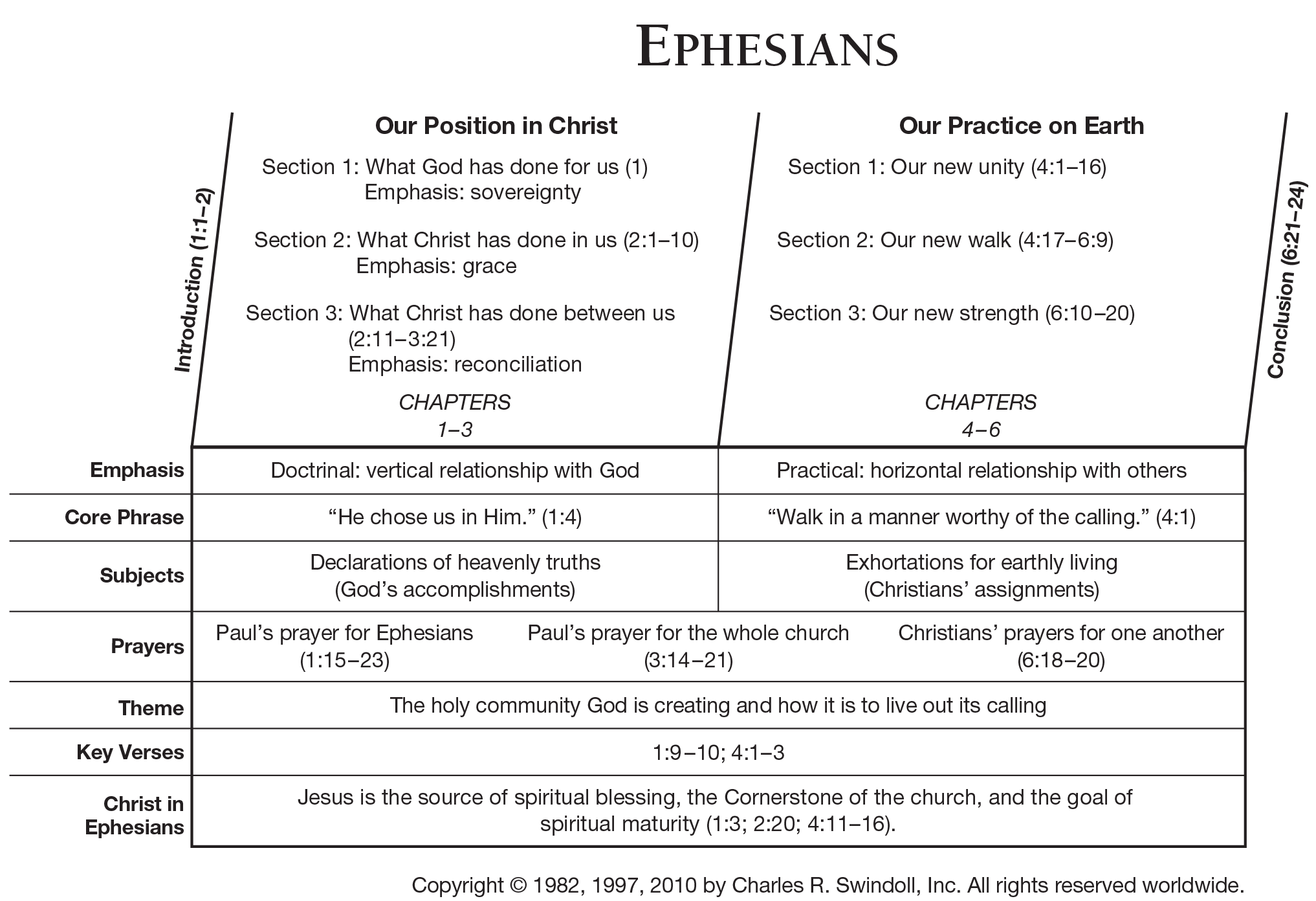
EPHESIANS - CHRIST AND THE CHURCH
Click chart to enlarge
Charts from Jensen's Survey of the NT - used by permission
Click chart by Charles Swindoll -Note "EMPHASIS" --
Ephesians 1-3 = Doctrinal: vertical relationship with God
Ephesians 4-6 = Practical: horizontal relationship with others
Ephesians 4:11 And He gave some as apostles, and some as prophets, and some as evangelists, and some as pastors and teachers, (NASB: Lockman)
Greek: kai autos edoken (3SAAI) tous men apostolous, tous de prophetas, tous de euaggelistas, tous de poimenas kai didaskalous,
Amplified: And His gifts were [varied; He Himself appointed and gave men to us] some to be apostles (special messengers), some prophets (inspired preachers and expounders), some evangelists (preachers of the Gospel, traveling missionaries), some pastors (shepherds of His flock) and teachers. (Amplified Bible - Lockman)
NLT: He is the one who gave these gifts to the church: the apostles, the prophets, the evangelists, and the pastors and teachers. (NLT - Tyndale House)
Phillips: His "gifts to men" were varied. Some he made his messengers, some prophets, some preachers of the Gospel; to some he gave the power to guide and teach his people. (Phillips: Touchstone)
Wuest: And He himself gave some, on the one hand, as apostles, and, on the other hand, as prophets, and still again some as bringers of good news, and finally, some as pastors who are also teachers,
Young's Literal: And He Himself appointed some to be Apostles, some to be Prophets, some to be evangelists, some to be pastors and teachers,
AND HE GAVE SOME AS APOSTLES: kai autos edoken (3SAAI) tous men apostolous:
- And He gave some as apostles - Eph 4:8; 2:20; 3:5; Ro 10:14,15; 1Co 12:28; Jude 1:17; Rev 18:20; 21:14
- Ephesians 4 Resources - Multiple Sermons and Commentaries
- Ephesians 4:11-13 Growing into a Mature Church - Steven Cole
- Ephesians 4:7-12 - Wayne Barber
- Ephesians 4:7-11 The Gifts of Christ to His Church - John MacArthur
Related Passages:
1 Corinthians 12:28 And God has appointed in the church, first apostles, second prophets, third teachers, then miracles, then gifts of healings, helps, administrations, various kinds of tongues.
JESUS' GIFT OF
GIFTED MEN
To preserve the unity of the body (Eph 4:3), Christ gave gifted men with diverse gifts. Thus we see the paradox of the Body of Christ, the Church, manifesting supernatural diversity in the setting of supernatural unity.
In this passage Paul lists the five kinds of ministers which have been given by Christ to His Church (see aberration of this truth) with first three of these being itinerant ministers - apostles, prophets and evangelists - who were preaching wherever they found an opportunity, while pastors and teachers were attached to a specific location. For example, Philip was a missionary (an "evangelist") who traveled from Jerusalem to preach in Samaria and was on the road to Gaza when he met the eunuch whom he baptized (Acts 8:5ff, 8:26ff) then arriving at Azotus (modern Ashdod), passing through, preaching the gospel to all the cities until he came to Caesarea (Acts 8:40). One can only conjecture that perhaps prophets preached to believers and evangelists to unbelievers, while apostles addressed either. An apostle was in a sense a prophet and an evangelist, but a prophet or an evangelist was not necessarily an apostle if we take the word “apostle” with the narrow sense of the "primary" apostles who had seen Jesus Christ in His resurrection (1Cor 9:1).
And He gave some - Literally this reads "He Himself" which is emphatic. Paul is saying that it is the Lord Jesus Himself who gives gifted men to perfect the church. The Lord Jesus is the One who has the authority and is the One who bestows gifts. Paul has just explained how Jesus received this authority in Eph 4:8-10. Now Paul explains how Christ sets about to attain the goal of filling all things by giving His body gifted men to foster and further growth. Paul is picking up his main thought from Eph 4:7. Read verse 7 leaving out verses 8-10 which shows his continued thought "But to each one of us grace was given according to the measure of Christ's gift....and He gave some as apostles..." Here Paul focuses not on individual spiritual gifts but on gifted persons who Christ has given to the church. Notice that each of these designations is involved in some way with the proclamation of the Word of God (through some it is revealed, through all it is declared and taught), which speaks to the critical importance of the "pure milk of the Word" (1Pe 2:2) in growth in respect to salvation (cf 2Ti 3:16-17). It's as simple as "No Word, no growth". Don't accept substitutes as they say in the advertising world!
Gave some as apostles - Paul himself was a gift from Jesus writing "Paul, an apostle of Christ Jesus by the will of God, To the saints who are at Ephesus" (Eph 1:1) Paul opens Romans writing "Paul, a bondservant of Christ Jesus, called as an apostle, set apart for the gospel of God," (Ro 1:1) Paul received a divine call from His Lord and that call was to serve Him as His apostle, especially to the Gentiles. Note that Paul did not seek this job but Christ sought him (Acts 9:4-6, 15, 16) and gave him the job (2Ti 1:1).
THOUGHT- That's what Christ did with all of us of course - He sought us even though we were not seeking Him!
Ray Stedman writes that these gifted men "constitute what we shall call "support gifts" (as contrasted with the "service" and "sign" gifts previously considered, as found in 1 Corinthians 12 and Romans 12). These four gifts relate to the whole body of Christ, much as the major body systems relate to the physical body...Note that each of the four support ministries we are discussing have to do with the Word of God. The first two--apostles and prophets--are concerned with originating and expounding the Word, while the last two--evangelists and pastor-teachers--are concerned with applying the Word to individual lives. The evangelist deals with the beginning of Christian life while the teaching pastor is involved with the development and growth of that life. Evangelists are much like obstetricians, helping to bring new Christians into the world. Teaching pastors are like pediatricians, seeing that these Christians have a healthy spiritual "diet," that their "diseases" receive proper attention, and that they get plenty of spiritual "fresh air" and "exercise." To return to the word picture of the church as a building, the evangelist is the quarryman who digs out the rock, cuts it loose from quarry stone, and hews it to a rough approximation of its ultimate size. The pastor-teacher is the stone mason who shapes the rock, fitting it into the building in its proper place according to the blueprint of the great architect. ((Ray Stedman's book Body Life specifically the chapter entitled How the Body Works) (Bolding added)
Like several other passages in Ephesians (Ep 1:3-14, 15-23; 2:1-7; 3:1-13, 14-19; 4:1-7; 6:14-20), Eph 4:11-16 is one long sentence in Greek.
Gave (1325) (didomi) means He granted this based on decision of His will and not on the merit of the recipients.
THOUGHT - Let us not seek our work for Him but instead let us seek first His Kingdom (the King) and He will give us each our assignment in His Kingdom that we might carry out His work to expand His Kingdom in His power and for His glory (cp Jn 15:5, 8, 16, 1Co 3:11-15, 2Co 5:10)
Apostles (652) (apostolos from apo = from + stello = send forth)) signifies one sent forth by another, often with a special commission to represent another and to accomplish his work. It can be a delegate, commissioner, ambassador sent out on a mission or orders or commission and with the authority of the one who sent him. The apostolos was officially commissioned for the position or task. "Primary" apostles were those who had seen Jesus and received His commission and authority. "Secondary" apostles were men associated with the primary apostles, men like Barnabas (cf Acts 14:14). Then in another more general sense apostles are "sent ones" and so they can be referred to all believers, but never in the sense of the use of the term in the early church. So in one passage apostolos is used of individuals Jesus declaring "Truly, truly, I say to you, a slave is not greater than his master, nor is one who is sent (apostolos) greater than the one who sent him.." (John 13:16) So in a sense every Christian is both a servant and an apostle.
Apostolos is primarily used as a specific and unique title for the thirteen men (the Twelve, with Matthias replacing Judas, and Paul) whom Christ personally chose and commissioned to authoritatively proclaim the gospel and lead the early church. The thirteen apostles not only were all called directly by Jesus but all were witnesses of His resurrection, Paul having encountered Him on the Damascus Road after His ascension. Those thirteen apostles were given direct revelation of God’s Word to proclaim authoritatively, the gift of healing, and the power to cast out demons (Mt 10:1). They were even impressed with this authority themselves, on one occasion returning back to Jesus and telling Him how they rejoiced to discover that the demons were subject to them. When these gifted men spoke the Word, they had authority and that word of authority especially marked them as apostles. Andy by signs that accompanied their ministry, their teaching authority was verified (cf. 2Co 12:12). Thus the apostolic teachings and writings became the foundation of the church (see below), and their authority extended beyond local bodies of believers to the entire believing world.
Apostolos - 80x in 79v - - apostle(18), Apostle(1), apostles(52), apostles'(5), messenger(1), messengers(1),one who is sent(1). Matt 10:2; Mark 3:14; 6:30; Luke 6:13; 9:10; 11:49; 17:5; 22:14; 24:10; John 13:16; Acts 1:2, 26; 2:37, 42f; 4:33, 35ff; 5:2, 12, 18, 29, 40; 6:6; 8:1, 14, 18; 9:27; 11:1; 14:4, 14; 15:2, 4, 6, 22f; 16:4; Rom 1:1; 11:13; 16:7; 1 Cor 1:1; 4:9; 9:1f, 5; 12:28f; 15:7, 9; 2 Cor 1:1; 8:23; 11:5, 13; 12:11f; Gal 1:1, 17, 19; Eph 1:1; 2:20; 3:5; 4:11; Phil 2:25; Col 1:1; 1 Thess 2:7; 1 Tim 1:1; 2:7; 2 Tim 1:1, 11; Titus 1:1; Heb 3:1; 1 Pet 1:1; 2 Pet 1:1; 3:2; Jude 1:17; Rev 2:2; 18:20; 21:14.
Earlier in Ephesians Paul described the importance of apostles and prophets writing about God's building (composed of believing Jews and Gentiles)
So then you (GENTILES) are no longer strangers and aliens, but you are fellow citizens with the saints, and are of God’s household, built upon the foundation of the apostles and prophets, Christ Jesus Himself being the corner stone (Eph 2:19-20)
Comment: These first apostles and prophets were foundational, and once that foundation had been laid in the form of the NT books, there was no longer a need for this function. And so there is are no apostles in the sense that Paul or Peter were apostles. Some used the term "apostle" in a secondary sense to describe those men who go out and plant churches, but this "apostolic gift" as some have called it should in no way be confused with the gift given to the original 13 apostles whose function was unique and is not to be repeated. In other words there is no so-called apostolic succession as some have mistakenly taught. To reiterate there is no other line of truth about Jesus Christ and no new revelation which can come to us about Him other than what the original apostles have given.
Ray Stedman has an explanatory note writing that "The foundation of the church is Jesus Christ, as Paul declared to the Corinthians, "For no other foundation can anyone lay than that which is laid, which is Jesus Christ" (1Cor. 3:11), and the primary work of an apostle was to declare the whole body of truth concerning Jesus Christ. That is the foundation. What the apostles say about Jesus Christ is the foundation of the church, and what they said about Jesus Christ is recorded for us in the New Testament. That book is written by the apostles and prophets, and the church rests squarely upon that foundation. How does one get into the church? By believing the truth about Jesus Christ (and believing means more than intellectual assent--it is a commitment of the will as well). It is only as the church rests upon this foundation of the faith, as taught by the apostles, that there is any certainty or strength. Today many are straying from the foundation and as a result they have lost any note of authority or assurance. Merely human view-points or opinions do not change the foundation. Modern knowledge and the discoveries of science will never alter it. Our ultimate concern is what the apostles taught. That is the greatest revelation of reality we possess, "the truth [as it] is in Jesus" (Eph. 4:21). People in the construction business know that a foundation is of the utmost importance. You do not take risks or shortcuts with a foundation. You lay it squarely, securely, and strongly, for the whole building is going to rest on that foundation and will derive its strength from the character of the foundation. The same is true of the church. The Lord Jesus made very clear that if a man builds on the wrong foundation, he is in trouble. One man may build his house on the sand and the house may look very beautiful and impressive, but when the storms come, it falls. Another man may build on the rock and his house will stand in the storm. It is the foundation which makes all the difference." (Ray Stedman's book Body Life [recommended], specifically the chapter entitled How the Body Works)
In Ephesians 3 these gifted men known, both apostles and prophets were the recipients of God's revelation which formed the firm foundation of the early church, Paul writing...
By referring to this, when you read you can understand my insight into the mystery of Christ, which in other generations was not made known to the sons of men, as it (THE MYSTERY) has now been revealed (MYSTERY EXPLAINED) to His holy apostles and prophets in the Spirit (Ep 3:4-5)
As alluded to above, at times in the NT apostle carried the broad meaning of one sent as a messenger or delegate with instructions from a group or an individual (cf 2Cor 8:23 - "messengers" = apostolos, Php 2:25 - "messenger" = apostolos), but the messengers or "apostles" referred to in these passages mean only those who were apostles after the Ascension of Christ (that is they were "secondary" apostles if you will). Apostles was at times used as the official title of the Twelve, including Paul but to reiterate it was a temporary office. Nowhere in the Word of God do we see the teaching of "apostolic succession." To the contrary, Jesus the Head of the Church indicts those who lay claim to the title of apostle as deceivers...
'I know your deeds and your toil and perseverance, and that you cannot endure evil men, and you put to the test those who call themselves apostles, and they are not, and you found them to be false (Rev 2:2)
QUESTION - What is the five (5) fold ministry?
ANSWER - The concept of the five-fold ministry comes from Ephesians 4:11, "It was he who gave some to be (1) apostles, some to be (2) prophets, some to be (3) evangelists, and some to be (4) pastors and (5) teachers." Primarily as a result of this verse, some believe God has restored, or is restoring, the offices of apostle and prophet in the church today. Ephesians 4:12-13 tells us that the purpose of the five-fold ministry is, "to prepare God’s people for works of service, so that the body of Christ may be built up until we all reach unity in the faith and in the knowledge of the Son of God and become mature, attaining to the whole measure of the fullness of Christ." So, since the body of Christ definitely is not built up to unity in the faith and has not attained to the whole measure of the fullness of Christ, the thinking goes, the offices of apostle and prophet must still be in effect.
However, Ephesians 2:20 informs us that the church is "built on the foundation of the apostles and prophets, with Christ Jesus Himself as the chief cornerstone." If the apostles and prophets were the foundation of the church, are we still building the foundation? Although Jesus Christ is most definitely active in the church today, His role as the cornerstone of the church was completed with His death, burial, resurrection, and ascension. If the work of the cornerstone is, in that sense, complete, so must the work of the apostles and prophets, who were the foundation, be complete.
What was the role of the apostles and prophets? It was to proclaim God’s revelation, to teach the new truth the church would need to grow and thrive. The apostles and prophets completed this mission. How? By giving us the Word of God. The Word of God is the completed revelation of God. The Bible contains everything the church needs to know to grow, thrive, and fulfill God’s mission (2 Timothy 3:15-16). The cornerstone work of the apostles and prophets is complete. The ongoing work of the apostles and prophets is manifested in the Holy Spirit speaking through and teaching us God’s Word. In that sense, the five-fold ministry is still active.GotQuestions.org
Related Resources:
- What is an apostle? | GotQuestions.org
- What are the biblical qualifications for apostleship? | GotQuestions.org
- Is apostolic succession biblical? | GotQuestions.org
- Is God restoring the offices of apostle and prophet in the church today? | GotQuestions.org
- What is the difference between a disciple and apostle? | GotQuestions.org
- What is continuationism? What is a continuationist? | GotQuestions.org
- What is apostolic doctrine? | GotQuestions.org
- What is the New Apostolic Reformation? | GotQuestions.org
AND SOME AS PROPHETS: tous de prophetas:
- Ephesians 4 Resources - Multiple Sermons and Commentaries
- Ephesians 4:11-13 Growing into a Mature Church - Steven Cole
- Ephesians 4:7-12 - Wayne Barber
- Ephesians 4:7-11 The Gifts of Christ to His Church - John MacArthur
Related Passages:
Ephesians 2:19-20 So then you are no longer strangers and aliens, but you are fellow citizens with the saints, and are of God’s household, 20 having been built on the foundation of the apostles and prophets, Christ Jesus Himself being the corner stone,
Ephesians 3:4-5 By referring to this, when you read you can understand my insight into the mystery of Christ, 5 which in other generations was not made known to the sons of men, as it has now been revealed to His holy apostles and prophets in the Spirit;
JESUS' GIFT OF
FORTH TELLERS
And some as prophets - These gifted men were primarily "forth tellers" and only occasionally "fore tellers" (Acts 11:28 Acts 21:10) during the formative stages of the church. These men along with apostles were the foundation of the church (Eph 2:20) and "dispensed" divine revelation to the early church at a time when there were not yet copies of the written Word of God. Prophets in the sense of men who received new revelation from God ceased in the first century (see discussions below).
Prophets (4396) (prophetes from pró = before or forth + phemí = to tell, to speak, to show, to make known one's thoughts, to bring to light by one's speech <> Phemí is derived from pháo = to shine) means one who speaks forth or before (beforehand) is literally one who speaks forth (speaks openly) or speaks before (in the sense of foretelling or predicting future events). (See Vincent below). In the Bible prophetes generally describes one who proclaims inspired utterances on behalf of God. (See all uses of prophetes below) Sometimes the NT prophet was a foreteller (declaring future events, teaching eschatology = study of future events) but more often in the NT he was a forthteller speaking forth divinely revealed truth for the purpose of sound doctrinal instruction (1Ti 4:6, 2Ti 4:3, Titus 1:9, Titus 2:1) with the goal to lay a foundation (Ep 2:20) and build up (edify) the body (cp 1Co 14:3, 2Co 13:10, Ep 4:12, Ep 4:16).
In the NT prophetes corresponds to the person who in the OT spoke under divine influence and inspiration. This included the foretelling future events or the exhorting, reproving, and threatening of individuals or nations as the ambassador of God and the interpreter of His will to men. In the case of the OT, the prophets’ preaching was a foretelling of the salvation yet to be accomplished in the Messiah. In the NT, prophecy was a publication of the salvation already accomplished, insofar as it did not concern itself with realities still future.
New Unger's Bible Dictionary says a prophet is "One who is divinely inspired to communicate God’s will to His people and to disclose the future to them."
W E Vine says a prophet is "A proclaimer of a divine message, denoted among the Greeks an interpreter of the oracles of the gods."
Vine (modified) summarizes the uses of prophetes in the NT...
(a) of the OT prophets, e.g., Mt. 5:12; Mark 6:15; Lk 4:27; Jn 8:52; Ro 11:3;
(b) of prophets in general, e.g., Mt. 10:41; 21:46; Mk 6:4;
(c) of John the Baptist, Mt. 21:26; Lk 1:76;
(d) of prophets in the churches, e.g., Acts 13:1; 15:32; 21:10; 1Cor 12:28, 29; 14:29, 32, 37; Eph. 2:20; 3:5; 4:11
(e) of Christ, as the afore–promised Prophet, e.g., Jn 1:21; 6:14; 7:40; Acts 3:22; 7:37, or, without the article, and, without reference to the Old Testament, Mark 6:15, Luke 7:16; in Luke 24:19 it is used with anēr, a man; John 4:19; 9:17;
(f) of two witnesses yet to be raised up for special purposes, Rev. 11:10, 18;
(g) of the Cretan poet Epimenides, Titus 1:12;
(h) By metonymy (use of the name of one thing [prophetes] for that of another of which it is an attribute [eg, the book of the prophet]) prophetes signified the writings of prophets (Acts 8:28 where "prophet" stands for what the prophet Isaiah wrote, i.e., the prophet's book = a metonym). Prophetes metonymically referred to the prophets as a division of Scripture (Mt 11:13. Lk 16:16; Acts 13:15; 24:14; Ro 3:21; Lk 16:29, 31. 24:27; Acts 28:23) Finally prophetes metonymically was used by itself (i.e., not in phrases like "the Law and the Prophets" or "Moses and the Prophets") as an allusion to all of the OT Scriptures (Lk 24:25; Jn 6:45) (Vine's online)
BDAG says that a prophetes is :A proclaimer or expounder of divine matters or concerns that could not ordinarily be known except by special revelation...a person inspired to proclaim or reveal divine will or purpose....Christians, who are endowed with the gift of prophecy Acts 15:32; 1Cor 14:29, 32, 37." Comment: Beware! Be Alert! Regarding the gift of prophecy, it is vital to emphasize that the canon of Scripture has been completed with John's great prayer in Revelation 22:21! There is no new revelation! Anyone today who claims to be a prophet and to speak "new revelation" from God is a false prophet and should be assiduously and expeditiously avoided! In short, there are no "new" prophecies, contrary to what some spuriously teach. (See related resource - False Prophet in Baker's Evangelical Dictionary; False Prophet by John MacArthur)
Thayer's Lexicon (modified) discusses prophetes as it was used to translate the Hebrew word for prophet "Prophetes is related to prophemi = to speak forth, speak out; hence ‘one who speaks forth’; Prophetes is used in the Septuagint (Lxx) for נָבִיא (Transliterated "nabiy" = Strong's #05030 (Nabiy' is used 85x by Jeremiah!) = meaning spokesman, speaker, prophet - Moses was the greatest OT "nabiy" or prophet = Moses’ prophetic message spoke to Israel of the past (Deut 1:1-3:29), the present (Dt. 4:1; 26:18), and the future (Dt. 31:20–22) (as would every major prophet after him). ( Nabiy is derived from the same root as نَبَأَ, meaning to divulge, make known, announce’, therefore prophetes is equivalent to interpreter (cp Ex. 7:1, 4:16) and hence is a spokesman for God or one through whom God speaks or one who speaks forth by divine inspiration. The prophetes (especially in the OT) was one raised up by God and whose charge was to proclaim only the Word which was given to him by the Lord. A prophet could neither contradict the Law of the Lord or speak from his own mind, for if he did, he was functioning as a false prophet (Jer. 14:14; 23:16, 26, 30). Furthermore, when the prophet made a predictive pronouncement, that Word had to come true, for if it did not he was a false prophet (Dt. 18:22; Jer. 23:9). In summary, in the OT, the prophetes was either (1) an interpreter of oracles or of other hidden things or (2) a foreteller (the related word "seer" stressed the visionary role of the prophet - see 1Sa 9:9, 2Sa 24:11)
Vine has an additional note on the OT use of prophetes for "seer" "In the Septuagint (Lxx) it is the translation of the word rôeh, a seer; 1 Sam. 9:9, indicating that the prophet was one who had immediate intercourse with God. It also translates the word nābhî, meaning either one in whom the message from God springs forth or one to whom anything is secretly communicated. Hence, in general, the prophet was one upon whom the Spirit of God rested, Numb. 11:17-29, one, to whom and through whom God speaks, Numb. 12:2; Amos 3:7, 8. In the case of the O.T. prophets their messages were very largely the proclamation of the Divine purposes of salvation and glory to be accomplished in the future; the prophesying of the N.T. prophets was both a preaching of the Divine counsels of grace already accomplished and the fore–telling of the purposes of God in the future. (Vine's online)
Vincent commenting on prophetes in 1Cor 12:10 and Luke 7:26 explains that the role of prophetes was not restricted to "foretelling of the future. Quite probably very little of this element is contemplated; but utterance under immediate divine inspiration: delivering inspired exhortations, instructions, or warnings.....(Ed: See next paragraph for Vincent's more detailed discussion of prophetes). The fact of direct inspiration distinguished prophecy from “teaching.”
(Vincent's note on prophetes in Lk 7:26) The popular conception of a prophet is limited to his foretelling future events. This is indeed included in the term, but does not cover its meaning entirely. The word is from phemi, to speak, and pro, before, in front of. This meaning of the preposition may have reference to time, viz., before, beforehand; or to place, viz., in front of, and so, publicly; and this latter meaning, in turn, easily runs into that of in behalf of; for. The prophet is, therefore, primarily, one who speaks standing before another, and thus forming a medium between him and the hearer. This sense runs naturally into that of instead of. Hence it is the technical term for the interpreter of a divine message. So Plato: For this reason it is customary to appoint diviners or interpreters to be judges of the true inspiration. Some persons call them diviners, seers (mantes); they do not know that they are only repeaters of dark sayings and visions, and are not to be called diviners at all, but interpreters (propphetai) of things divine” (“Timaeus,” 72). Similarly of an advocate to speak for, or instead of one. The central idea of the word (prophetes) is, one to whom God reveals Himself and through whom He speaks. The revelation may or may not relate to the future. The prophet is a forth-teller, not necessarily a foreteller. The essence of the prophetic character is immediate intercourse with God. One of the Hebrew names for “prophet,” and, as some maintain, the earlier name, signified a shower or seer. See 1Sa 9:10; and in 1Cor. 14:26-30, Paul shows that revelation stands in necessary connection with prophesying.
Ray Stedman has the following note regarding prophets - A prophet is essentially a man who speaks for God, who unfolds the mind of God. In the early church, before the New Testament was written down, prophets spoke directly by the inspiration of the Holy Spirit, uttering the truths that are now recorded in the New Testament. They unfolded what God taught, and thus the body was motivated, galvanized into activity. Men such as Mark, Luke, James, and Jude were not themselves apostles but they were associated with the apostles in the writing of the New Testament. The gift of a prophet differs from that of an apostle: The apostle gives an authoritative declaration of the whole body of truth concerning Jesus Christ; but the prophet interprets that authoritative word and explains the truth so that it becomes very clear, vital, and compelling. The very word "prophet" suggests this. It derives from a Greek root (pháo) which means "to cause to shine," and is linked with the prefix "pro" which means "before." Thus a prophet is one who stands before and causes the word of the apostle to "shine." (Comment: This picture of "to shine forth or before" begs the question "Who gets the credit?" The inspired, authoritative Word! Are you as convicted as I am?) This meaning of the word "prophet" is fully reflected in Peter's second letter when he says, "We have the prophetic word made more sure. You will do well to pay attention to this as to a lamp shining in a dark place" (2Pe 1:19). Paul also says, "He who prophesies speaks to men for their upbuilding (edification) and encouragement and consolation" (1Cor 14:3). The church owes much to the ministry of prophets. Not only were parts of the Scriptures given to us by prophets but the great theologians and preachers of the church have been men with prophetic gifts. Men such as Martin Luther, John Calvin, John Wesley, and the founders of other denominations have been prophets, and many pastors and Bible teachers today have prophetic gifts. Usually men who speak at conferences are speaking as prophets, making the truth clear, shining, and gripping. They differ from teachers in that the prophet tends more to deal with the great sweeping principles of Scripture and reality, leaving the development of more specific areas to the teacher. (from Pastor Stedman's book Body Life [recommended], specifically the chapter entitled How the Body Works - see under "2. The Nervous System-the gift of prophets") (Bolding added)
The following is a list of the OT prophets who are mentioned by name in the NT (Note: not all of these passages use the word prophetes)
- Moses = Acts 3:22 quoting Dt 18:15 (Moses is mentioned some 80 times altogether in the NT, most often in the context of the Law not as a prophet).
- Jeremiah = Mt 2:17; 16:14, 27:9.
- Isaiah = Mt 3:3; 4:14; 8:17; Lk 3:4; Jn 1:23; 12:38, 39, 40, 41 Acts 8:28, 30, 28:25, Ro 9:27, 29, 10:16, 20, 15:12)
- Joel = Acts 2:16.
- Jonah = Mt 12:39, 40, 41, 16:4, Lk 11:29, 30, 32.
- Daniel = Mt 24:15.
- Elisha = Lk 4:27;
- Samuel = Act 13:20; 3:24.
- David = Acts 2:30.
- Balaam = 2 Pt 2:16.
Approximately 25% of the uses of prophetes are in Matthew's Gospel primarily with the sense of foretelling which is not surprising as this Gospel places great emphasis on OT prophecies that pointed to Jesus as the expected Messiah. The first NT use of prophetes in Mt 1:22 is a reference to Isaiah's foretelling of the Messiah's birth Isa 7:14. Mt 2:5 refers to the prophet Micah's foretelling (Mt 2:6) of Messiah's birth in Bethlehem in Micah 5:2. Mt 2:15 refers to the prophet Hosea's foretelling of Messiah's calling out of Egypt (Hos 11:1) Mt 2:17 refers to Jeremiah's foretelling of the slaying of all the male children in Bethlehem who were less than 2 years old (Mt 2:16).
In John 1:21 after John the Baptist denied he was Elijah, the Jews asked him “Are you the Prophet?” where the definite article ("the", Greek = to prophetes) is in the Greek modifying "prophetes" which signifies that this is not just any prophet but "the specific Prophet". In context this is an allusion to the Messianic prophecy of Moses that "God will raise up for you a prophet like" from among the Jews (Deut 18:15, cp Dt 18:19). Clearly the Jewish questioners understood this as a prophecy that would be fulfilled in the Messiah (See related resource - Christ as Prophet). John 6:14 refers to the "Expected One" (Mt 11:31), Messiah the Prophet Who would come into the world (an allusion to His incarnation).
The prophets received direct revelations from the Lord and passed them on to the church for the purpose of edification not popularity. What they spoke by the Holy Spirit was the word of God. The prophets spoke not their own thought but what they received from God, retaining, however, their own consciousness and self–possession (c 2Pe 1:21)
KJV Bible Commentary writes that "these men were both foretellers and forthtellers. They received their message from God and delivered it for God and to man. They had deep insight into spiritual truths as they interpreted God’s message under the power of the Holy Spirit.
Related Resources:
- Prophet (Parts 1 & 2) International Standard Bible Encyclopedia (scroll down the page)
- Prophet in Easton's and Smith's dictionaries
- Prophet in Baker's Evangelical Dictionary of Biblical Theology
- Prophet in Holman
- Prophet in Hastings
- Prophet in Nave's Topic -(Eg, Called Seers...Schools of...Kept the chronicles...Counselors to kings...persecutions, etc
- What is a prophet in the Bible?
- What was a prophet in the Old Testament?
- How many prophets are in the Bible?
J R Miller Devotional...
"To each one his work." Some are apostles, some evangelists, some pastors, some teachers, and some helpers only in small ways. But every Christian has something to do.
If the smallest wheel in a watch fails to do its part, the watch stops. If the least Christian in a church neglects his duty, the whole church suffers. No one should ever say, "My little work will not be missed, I am so small and weak." No one is unimportant.
The purpose of the Church is the perfecting of the saints. We all begin as little children - only babies - but we are not to continue infants.
It is a sad home in which the baby never grows, and at four or five years of age is a baby still. Yet there are Christians four or five years old who are no farther on than when they were born. The work of the Church is to stimulate the growth of each Christian and develop and train him so that he will attain "unto a full-grown man, unto the measure of the stature of the fullness of Christ."
QUESTION - What is the spiritual gift of prophecy?
ANSWER - The spiritual gift of prophecy is listed among the gifts of the Spirit in 1 Corinthians 12:10 and Romans 12:6. The Greek word translated “prophesying” or “prophecy” in both passages properly means to “speak forth” or declare the divine will, to interpret the purposes of God, or to make known in any way the truth of God which is designed to influence people. Many people misunderstand the gift of prophecy to be the ability to predict the future. While knowing something about the future may sometimes have been an aspect of the gift of prophecy, it was primarily a gift of proclamation (“forth-telling”), not prediction (“fore-telling”).
A pastor/preacher who declares the Bible can be considered a “prophesier” in that he is speaking forth the counsel of God. With the completion of the New Testament canon, prophesying changed from declaring new revelation to declaring the completed revelation God has already given. Jude 3 speaks of “the faith which was once delivered unto the saints” (emphasis added). In other words, the faith to which we hold has been settled forever, and it does not need the addition or refinement that comes from extra-biblical revelations.
Also, note the transition from prophet to teacher in 2 Peter 2:1: “There were false prophets among the people, even as there shall be false teachers among you” (emphasis added). Peter indicates that the Old Testament age had prophets, whereas the church will have teachers. The spiritual gift of prophecy, in the sense of receiving new revelations from God to be proclaimed to others, ceased with the completion of the Bible. During the time that prophecy was a revelatory gift, it was to be used for the edification, exhortation, and comfort of men (1 Corinthians 14:3). The modern gift of prophecy, which is really more akin to teaching, still declares the truth of God. What has changed is that the truth of God today has already been fully revealed in His Word, while, in the early church, it had not yet been fully revealed.
Christians are to be very wary of those who claim to have a “new” message from God. It is one thing to say, “I had an interesting dream last night.” However, it is quite another matter to say, “God gave me a dream last night, and you must obey it.” No utterance of man should be considered equal to or above the written Word. We must hold to the Word that God has already given and commit ourselves to sola scriptura—Scripture alone.GotQuestions.org (Bolding added)
QUESTION - Are there prophets in the church today?
ANSWER - The gift of prophet (Ephesians 4:11) seems to have been a temporary gift given by Christ for the laying of the foundation of the church. Prophets were foundational to the church (Ephesians 2:20)(ED: see also Ep 3:5). The prophet proclaimed a message from the Lord to the early believers. Sometimes a prophet’s message was revelatory (new revelation and truth from God) and sometimes a prophet’s message was predictive (see Acts 11:28 and Acts 21:10). The early Christians did not have the complete Bible. Some early Christians did not have access to any of the books of the New Testament. The New Testament prophets “filled the gap” by proclaiming God’s message to the people who would not have access to it otherwise. The last book of the New Testament (Revelation) was not completed until late in the first century. So, the Lord sent prophets to proclaim God’s Word to His people.
Are there true prophets today? If the purpose of a prophet was to reveal truth from God, why would we need prophets if we have the completed revelation from God in the Bible? If prophets were the “foundation” of the early church, are we still building the “foundation” today? Can God give someone a message to deliver to someone else? Absolutely! Does God reveal truth to someone in a supernatural way and enable that person to deliver that message to others? Absolutely! But is this the biblical gift of prophecy? No.
Whatever the case, whenever a person claims to be speaking for God (the essence of prophecy) the key is to compare what is said with what the Bible says. If God were to speak through a person today, it would be in 100% complete agreement with what God has already said in the Bible. God does not contradict Himself. 1 John 4:1 instructs us, “Dear friends, do not believe every spirit, but test the spirits to see whether they are from God, because many false prophets have gone out into the world.” 1 Thessalonians 5:20-21 declares, “Do not treat prophecies with contempt. Test everything. Hold on to the good.” So, whether it is a “word from the Lord” or a supposed prophecy, our response should be the same. Compare what is said to what the Word of God says. If it contradicts the Bible, throw it out. If it agrees with the Bible, pray for wisdom and discernment as to how to apply the message (2Ti 3:16-17; James 1:5).GotQuestions.org (Bolding added)
Related Resources:
- Is the concept of personal prophecy biblical? | GotQuestions.org
- Someone gave me a prophetic word/prophesied over me. What is the interpretation? | GotQuestions.org
- What is continuationism? What is a continuationist? | GotQuestions.org
- Is there a biblical spiritual gifts list? | GotQuestions.org
- What is prophetic prayer? | GotQuestions.org
AND SOME AS EVANGELISTS: tous de euaggelistas, tous de poimenas kai didaskalous:
- Evangelists - Acts 21:8; 2Ti 4:5
- Ephesians 4 Resources - Multiple Sermons and Commentaries
- Ephesians 4:11-13 Growing into a Mature Church - Steven Cole
- Ephesians 4:7-12 - Wayne Barber
- Ephesians 4:7-11 The Gifts of Christ to His Church - John MacArthur
JESUS GIVES THE CHURCH
GIFTED "OBSTETRICIANS"
And some as evangelists - These men are gifted in boldly, plainly and powerfully speaking forth the Gospel by which the Spirit brings about new birth in the hearts of the unsaved hearers. In this sense these men function much like obstetricians who bring a new baby into the world. God's Spirit creates the "newborn," but the evangelist has the privilege of seeing him or her birthed into the Kingdom of God. These men in essences function as missionaries, taking the good news far and wide, planting churches, but turning the church over to the edifying work of pastor-teachers and moving on to other fields that are white unto harvest.
Evangelists (2099) (euaggelistes from euaggelizo = to evangelize) (See related word euaggelion = gospel) (Evangelist) are those possessed a special gift of communicating the Gospel in relevant terms to those who are not yet Christians. The evangelist was (and is) primarily responsible for the numerical growth of the body of Christ (the "obstetrician" who birthed saints through the gospel). He was the bringer of good tidings. An evangelist knew the gospel narrative thoroughly and was capable of explaining it. They were traveling or itinerant missionaries preaching the gospel to the unconverted and calling them to repentance. It is important to note that the purpose of evangelization is to carefully but simply help unbelievers become aware of their sinfulness and lostness and through the proclamation of the Gospel to proclaim Jesus Christ as the only Savior and Lord. Any human manipulation in that process, no matter how well intentioned, always becomes a barrier to genuine belief.
Luke (the second of three NT uses) describes a NT evangelist writing "And on the next day we departed and came to Caesarea; and entering the house of Philip the evangelist, who was one of the seven, we stayed with him. (Acts 21:8) Philip was best known for his missionary work in Samaria and with the Ethiopian eunuch [Acts 8:5-40].
Pastors can also do the work of evangelists, for we see Paul exhorting his young protégée Timothy (in the face of men turning away their ears from the truth, and turning aside to myths) to "be sober in all things, endure hardship, do the work of an evangelist, fulfill your ministry. (2Ti 4:5) (This is the third and final NT use)
Ray Stedman has an interesting description of the work of evangelists writing that "The evangelist's task is not to go about denouncing sin, but to point the way out of sin. The evangelist may call people's attention to that which is creating so much misery and heartache in their lives, but his work is not to denounce and condemn sinners. Evangelists are not to thunder away at people, telling them what miserable creatures they are and how God is waiting to strike them with thunderbolts of judgment. He is not to expose the horrors of hellfire and dangle sinners over those fires until they writhe and tremble. That is not the calling of the evangelist! (ED: WHILE I AGREE "FEAR TACTICS" ARE NOT CALLED FOR KEEP IN MIND THAT BOTH JESUS AND PAUL WARNED OF THE DANGER OF PERISHING - cf Jn 8:24, et al, Ro 2:12, Ro 6:23 in Paul's description of the "Gospel.") If the preaching of "fire and brimstone" is ever called for, it is the task of a prophet, not the task of an evangelist. The evangelist's role is to tell people about the overpowering grace of God and the overpowering love of a heavenly Father--a Father who calls men and women back to Himself, offering to set their twisted lives straight through the redeeming work of Jesus Christ. Many Christians today possess the gift of an evangelist, both men and women. Evangelism can be done anywhere. It is not restricted to mass meetings, such as in the great Billy Graham crusades, though Dr. Graham's ministry is also true evangelism (ED: BUT I DO THINK HE MENTIONED THE FURY OF THE FIRE OF HELL FROM TIME TO TIME!). The gift of an evangelist can he exercised toward a single individual, as is clear in the book of Acts when Philip the evangelist spoke to the Ethiopian eunuch as he was riding along in a chariot and told him of the saving grace of Jesus Christ. (Ray Stedman's book Body Life - This quote from How the Body Works - see point # 3 Evangelists)
QUESTION - What is an evangelist?
ANSWER - An evangelist is someone who proclaims good news; in other words, a preacher of the gospel or a missionary. A person with the gift of evangelism is often someone who travels from place to place to preach the gospel and call for repentance. The human authors of the four Gospels—Matthew, Mark, Luke, and John—are sometimes called “the Evangelists” because they recorded the ministry of Jesus Christ—“good news,” indeed.
Ephesians 4:11–13 states, “Christ himself gave the apostles, the prophets, the evangelists, the pastors and teachers, to equip his people for works of service, so that the body of Christ may be built up until we all reach unity in the faith and in the knowledge of the Son of God and become mature, attaining to the whole measure of the fullness of Christ.” In Acts 21:8 Philip is named as an evangelist, and in 2 Timothy 4:5 Paul exhorts Timothy to do the work of an evangelist. These are the only three uses of the word evangelist in the entire Bible. Other people could be considered “evangelists” in that they preached the good news, including Jesus Himself (Luke 20:1) and Paul (Romans 1:15), but Philip is the one person specifically called an evangelist in Scripture.
Philip had been one of the seven deacons chosen so that the apostles could do their work of teaching and prayer (Acts 6:3). Evidently, Philip had settled in Caesarea and had lived there for some 20 years before Paul arrived in Acts 21. Philip’s previous evangelistic work was in Samaria (Acts 8:4–8). He “proclaimed the Messiah” to the Samaritans (verse 5) and performed miracles, including casting out demons and healing paralytics. It is noteworthy that Philip performed water baptism in the name of Jesus, but the baptism of the Holy Spirit did not occur until the apostles came to Samaria.
Peter and John’s presence in Samaria and the Spirit’s indwelling of the believing Samaritans (Acts 8:17) confirmed Philip’s ministry there. As an evangelist, Philip had preached the gospel, and, when the Samaritans believed it and received the Spirit, they were welcomed into the church. Where there had previously been division and animosity between Jews and Samaritans, there now existed the spiritual bond of love (Colossians 3:14). Philip’s trailblazing efforts laid the foundation for his hearers to receive the Holy Spirit by faith. The evangelist’s pre-work unto salvation is what those called evangelists have done ever since.
Philip’s ministry as an evangelist continues in Acts 8 as he is led by an angel to go the desert road to Gaza. On the road he meets an Ethiopian eunuch—a court official to the queen of Ethiopia. Philip opens the man’s understanding of the Word of God, and the eunuch is saved. Philip baptizes the man, and the Holy Spirit snatches Philip away (Acts 8:39). Philip later “appeared at Azotus and traveled about, preaching the gospel in all the towns until he reached Caesarea” (verse 40). Everywhere he went, Philip shared the gospel. That’s what evangelists do.
Timothy was told to do the pre-salvation preaching that is the “work of an evangelist” (2 Timothy 4:5). This same preaching of the good news is the general call to the disciples in the Great Commission and to all of us to the end of the age (Matthew 28:16–20). In Jude 1:3, all saints are to contend earnestly for the faith delivered to them, and, in verse 23 we are to “save others by snatching them from the fire.”
The office of evangelist will be needed until the church reaches the maturity of Christ Himself (Ephesians 4:13). Good news is meant to be shared. And we have the best news of all—Jesus died and rose again and saves all who will call on Him (Romans 10:9–13). GotQuestions.org
AND SOME AS PASTORS AND TEACHERS: tous de poimenas kai didaskalous:
- 2Chronicles 15:3; Jeremiah 3:15; Matthew 28:20; Acts 13:1; Romans 12:7; 1Corinthians 12:29; Hebrews 5:12; 1Pe 5:1, 2, 3
- Ephesians 4 Resources - Multiple Sermons and Commentaries
- Ephesians 4:11-13 Growing into a Mature Church - Steven Cole
- Ephesians 4:7-12 - Wayne Barber
- Ephesians 4:7-11 The Gifts of Christ to His Church - John MacArthur
Pastors and teachers - The two nouns are connected in Greek by kai which often has the meaning "that is" or "in particular" and thus many feel this conjunction connects the pastors (shepherds) and teachers in a way that speaks of a single entity of teaching shepherds ("Pastor-Teachers"). An additional piece of evidence supporting this distinction is that the and (kai) differs from the other “and’s” (de) in this verse. All pastors teach (since teaching is an essential part of pastoral ministry), but not all teachers are pastors. The latter exercise their leadership role by feeding God’s flock with His word.
NET Note - Some interpreters have understood the phrase pastors and teachers to refer to one and the same group. This would mean that all pastors are teachers and that all teachers are pastors. This position is often taken because it is recognized that both nouns (i.e., pastors and teachers) are governed by one article in Greek. But because the nouns are plural, it is extremely unlikely that they refer to the same group, but only that the author is linking them closely together. It is better to regard the pastors as a subset of teachers. In other words, all pastors are teachers, but not all teachers are pastors.
Vincent - The omission of the article from teachers seems to indicate that pastors and teachers are included under one class.
Ray Stedman has an interesting comment on pastors writing "The pastors of the churches are not to exercise their authority as bosses but as examples. When they themselves obey the Word, others will be motivated to follow. But if the teaching pastors do not practice what they preach, they have no other authority. Their authority derives from their spirituality, and if they lose their spirituality they also lose their authority. It is not the office that gives a pastor the right to rule--it is the individual and his gift before God. (from Pastor Stedman's book Body Life and the chapter entitled How the Body Works)
Pastors ("Sheepherders"!) (4166) (poimen) (Pastor) is related to the word poimne, a flock of sheep, and literally is one who herds sheep and tends flocks as a shepherd. Metaphorically poimen refers to one who performs functions including feeding, oversight, protection, leading, and guiding.
John MacArthur - Pastors translates poimen, whose normal meaning is shepherd, It emphasizes the care, protection and leadership of the man of God for the flock. Teachers (didaskaloi) has to do with the primary function of pastors.
Eadie - The image of a shepherd with his flock pictures the relation of a spiritual leader to those committed to his charge.
Poimen - 18x in 17v - Matt 9:36; 25:32; 26:31; Mark 6:34; 14:27; Luke 2:8, 15, 18, 20; John 10:2, 11f, 14, 16; Eph 4:11; Heb 13:20; 1Pet 2:25. NAS translates as pastors(1), shepherd(11), Shepherd(2), shepherds(4).
Matthew's use of poimen is instructive recording that Jesus...
seeing the multitudes, He felt compassion for them, because they were distressed and downcast like sheep without a shepherd. (Matthew 9:36)
It is interesting to observe in the parallel passage in Mark how Jesus responded to the distressed, downcast flock...
And when He went ashore, He saw a great multitude, and He felt compassion for them because they were like sheep without a shepherd; and He began to teach them many things. (Mark 6:34)
Comment: The antidote for distressed, downcast sheep is the word of God.
What does this verse imply was the flock's greatest need? Is there a message for pastors today? Remember Jesus' words to the one on whom He stated He would build His church...
He said to him the third time, "Simon, son of John, do you love (phileo) Me?" Peter was grieved because He said to him the third time, "Do you love (phileo) Me?" And he said to Him, "Lord, You know all things; You know that I love (phileo) You." Jesus said to him, "Tend (bosko = feed; present imperative - Command to continually feed, graze, tend, herd) My sheep. (John 21:17KJV)
The parallel passages in KJV read "Feed (bosko = feed; present imperative - Command to continually feed, graze, tend, herd) My lambs" John 21:15KJV and "Feed My sheep" (poimaino - present imperative - Command calling for continual feeding - no food = "shabby sheep", easy prey for the "wolves"!) in John 21:16KJV.
Ron Mattoon (Treasures from First Peter) in his comments on pastor in 1Peter 5 emphasizes that...
The church needs the preaching of God's Word if it is to be nourished and strengthened. Most men fail to do this today because preaching the Word demands preparation, and that is hard work. It takes time to study but many men are too lazy to do this. The story is told of one pastor who never prepared during the week, and on Sunday morning he'd sit on the platform while the church was singing the hymns desperately praying, "Lord, give your message, Lord give me your message." One Sunday, while desperately praying for God's message, he heard the Lord say, "Ralph, here's my message. You're lazy!" Beloved, the Bible repeatedly urges us to study God's Word and preach its truths. (2Ti 2:15, 1Ti 4:6 1Ti 4:12 Act 20:27)
In his book Be Free, Warren W. Wiersbe mentioned the fact that young ministers often visited the great British preacher G. Campbell Morgan to ask him the secret of his success. When someone inquired of him what he told these aspiring pastors, Morgan replied, "I always say to them the same thing—work; hard work; and again, work!" And Morgan lived up to his own advice. He would be in his study every morning at 6 o'clock, finding rich treasures out of his Bible to pass on to God's people. May we learn from his example!
Caring for a church family involves a balance of "ruling" the church with "serving" it. The pastor is the leader, but also a servant. This balancing act is not easy and requires help from the Lord for sure. You have to have wisdom on knowing when to be firm and when to yield to the ideas or needs of others. It is the same situation that you have with your wife and children, at least it is for me. There are times to be firm as a father and husband, and there are times I yield to the desires of my wife or children. It depends on the issue and how much money I have left in the bank. Ha!
Staying in the Word of God so that you can nourish your people and yourself will help you to have the wisdom you need to pastor your people and to maintain a Christlike attitude in your life. It's when we lose that Christ-like attitude that we get ourselves into trouble by creating problems of our own making....
Howard Hendricks said, "If you can't stand the smell of sheep, you shouldn't be a shepherd." The pastor also needs to be "over" his people so he can lead them and help them solve their problems....
All of these reasons, and many others, are why Martyn Lloyd-Jones said, "A man should only enter the Christian ministry if he cannot stay out of it."....
Consider the following sobering survey results of the personal and professional lives of pastors as recorded in the 1991 Survey of Pastors, Fuller Institute of Church Growth.
• * 90% of pastors work more than 46 hours a week.
• * 75% reported a significant stress-related crisis at least once in their ministry.
• * 50% felt unable to meet the needs of the job.
• * 90% felt they were inadequately trained to cope with ministry demands.
• * 70% say they have a lower self-esteem now than when they started out.
• * 40% reported a serious conflict with a parishioner at least once a month.
• * 37% confessed having been involved in inappropriate sexual behavior with someone in the church.
• * 70% do not have someone they consider a close friend.
• * 80% believed that pastoral ministry affected their families negatively.
• * 33% said that being in ministry was an outright hazard to their family.
Luke records Paul's warning to the Ephesian elders...
Be on guard (present imperative - Command calling for continual alertness - note order = [1] your own heart [!] dear pastor/elder and [2] then you are prepared to tend the "flock") for yourselves (watch over you own heart with all diligence for from it flow the springs of life cp Pr 4:23) and for all the flock, (the local church is like a flock of sheep) among which the Holy Spirit has made you overseers, to shepherd (tend flocks like a shepherd) the church of God which He purchased with His own blood. 29 "I know that after my departure savage wolves will come in among you, not sparing the flock; 30 and from among your own selves men will arise, speaking perverse things, to draw away the disciples after them." (Acts 20:28, 29, 30)
Sheep need to graze continually in the pasture of the Word of God, the pure Word, the Word of Truth and nothing but the Truth, sound doctrine, solid food. Anything else is chaff. The Word of God is the local church’s protection and provision, and no amount of entertainment, good fellowship, or other religious substitutes can take its place. Pastors, I think Jesus is saying to shepherds of the modern church in America "Feed My sheep!" How will He one day assess the quality of the spiritual food you have fed to His sheep?
Jesus is the Great Shepherd Who vigilantly watches over and provides for the welfare of His flock.
Now the God of peace, who brought up from the dead the great Shepherd of the sheep through the blood of the eternal covenant, even Jesus our Lord, equip you in every good thing to do His will, working in us that which is pleasing in His sight, through Jesus Christ, to whom be the glory forever and ever. Amen. (Hebrews 13:20, 21)
You were continually straying like sheep, but now you have returned to the Shepherd and Guardian of your souls. (1Pe 2:25)
Barclay - Pastor is the Latin word for a shepherd. At this time the Christian Church was no more than a little island in a sea of paganism. The people who came into it were only one remove from their heathen lives; they were in constant danger of relapsing into heathenism; and the duty of the pastor was to shepherd his flock and keep them safe. (Barclay, W: The Daily Study Bible Series, Rev. ed. Philadelphia: The Westminster Press)
Teachers (1320) (didaskalos from didasko [word study] = teach to shape will of one being taught by content of what is taught) is an instructor, master, teacher, the one who provides instruction and is used 41 (out of 58 NT uses) of Jesus! Teachers are are divinely empowered to explain what the Bible says, interpret what it means, and apply it to the hearts and consciences of the saints. Teachers did not simply impart information or open up new ways of thought. They also urged their hearers to live by what they taught.
So vital is the ministry of teaching to make disciples that Paul exhorted his young disciple Timothy...
the things which you have heard from me in the presence of many witnesses, these entrust (paratithemi) to faithful (trustworthy = pistos) men, who will be able (hikanos) to teach (didasko) others also. (2Ti 2:2)
Jesus' final command to His followers, His disciples, was to...
Go therefore and make disciples (matheteuo in the aorist imperative = "Just do it!" It is urgent! This is a "wartime" command from the Captain of the Hosts!) of all the nations (Mt 28:19a)
In 2 Timothy 2:2 Paul presents God's pattern for fulfilling Jesus' Great Commission in Mt 28:19. How many "generations" do you observe in this single verse. (Stop and re-read 2Ti 2:2)? Paul to Timothy to faithful (trustworthy) men to "others also". Four generations!
Dear runner in this "once in a lifetime" race,
please don't drop the baton!
PASS IT ON!
THOUGHT - Dear mature believer, this verse begs the serious question - Who are you discipling? With all gentleness, let me remind you that you will be held accountable (See Lk 12:42-44, 1Cor 4:1-2, 2Co 5:10).
For mothers this certainly would include their children as one of the most important discipling ministries they will ever carry out. Witness the impact of Susannah Wesley's (you must read her brief bio!) disciples! One was named John. Another named Charles! Point made!.
I am in my late 60's now (November, 2011 - I am revising Ephesians notes at age 75, Feb, 2022) and don't have that many years left to make disciples (I am now using Zoom to disciple men in other states and other countries), but that is the clarion call on my life and on all who call themselves Christ followers (Remember that Mt 28:19 is our Lord's command to all of us and it not a suggestion!) If you are a man or woman who has walked with Christ for 10 or 20 years and you are in your later years, are you wasting your walk? (See John Piper's excellent exhortative online book Don't Waste Your Life) That is, are you failing to intentionally pass on what you have learned through the "blood, sweat and tears" of your growth in godliness (1Ti 4:7-8) and Christ-likeness? I want to challenge any mature man (and woman) reading these notes to prayerfully consider praying for younger men (mature women praying for younger women) whom you can disciple. When I say disciple, I am not talking about reading a popular Christian book and going through the study guide of the book (not that that is wrong), but that you maximize your efforts by taking a small group of faithful men through a book of the Bible, verse by verse, seeking to teach them how to study the Bible for themselves (See Inductive Bible study or work through this short powerpoint on the essentials of inductive Bible study), teaching them "how to fish" rather than just giving them fish! And then challenge them to pray for one or two men who they could pass on what they have learned. Remember Paul qualifies his charge with the phrase "faithful" (pistos) men, men who are trustworthy, men who are serious about commitment, men who will agree to study during the week, men who will be willing to memorize Scriptures with you, and finally men who agree to find other faithful men to disciple. This is the the Jesus' Way of making disciples. Where are the mature believing men and women in their 50's and 60's (and older) who are willing to count the cost and disciple the next generation of men and women in their 20's, 30's and 40's (who are in desperate need of discipling!)? For the most part they don't exist, a "void" which I often refer to as "a great evangelical disaster!" May God's Spirit stir your heart and enable you will to obey Jesus' command to "Make disciples" (Mt 28:19) for the sake of His Kingdom and the glory of His Name. Amen.
A suggestion to help you begin discipling - Here is resource you can use to "make disciples" (but I will warn you it will challenge you in a way you likely have never been challenged) - Being a Disciple Counting the Real Cost (40-Minute Bible Study) The 40 minute studies (there are now more than 20 topics available - here is a great one for men which I have personally seen God use mightily in men's lives - A Man's Strategy for Conquering Temptations) are self contained resources which are based predominantly on the "pure milk of the Word" because the only "vehicle" the Spirit uses to grow us (progressive sanctification) is pure milk (1Pe 2:2). You can even do the lessons together (thus there are no excuses for not doing the lesson). I usually supplement the material with additional verses, so that it takes longer than 40 minutes, but it can be done in that allotted time. Challenge the men to be diligent to take notes as you discuss the questions, so that when they finish the 6 week study they will have a built in resource that they can then take and use to disciple other faithful men. I can assure you that this pattern works as I have used it for some time now.
Related Resources on Making Disciples of all the Nations:
(1) The Training of the Twelve by A B Bruce (read some of the reviews!) (Read the Foreword to this Classic Work on Discipleship)
(2) BORROW The Master Plan of Evangelism by Robert E. Coleman (read some of the reviews!) - This modern classic discusses "Jesus' Master Plan of Discipleship" (See online article The Master Plan of Evangelism)
(3) Multi-part series on site studies on Discipleship - Make Disciples 1
Didaskalos - 59x in 58v - Always translated teacher. Mt 8:19; 9:11; 10:24, 25; 12:38; 17:24; 19:16; 22:16, 24, 36; 23:8; 26:18; Mark 4:38; 5:35; 9:17, 38; 10:17, 20, 35; 12:14, 19, 32; 13:1; 14:14; Luke 2:46; 3:12; 6:40; 7:40; 8:49; 9:38; 10:25; 11:45; 12:13; 18:18; 19:39; 20:21, 28, 39; 21:7; 22:11; John 1:38; 3:2, 10; 8:4; 11:28; 13:13f; 20:16; Acts 13:1; Ro 2:20; 1Cor 12:28f; Eph 4:11; 1Tim 2:7; 2Ti 1:11; 4:3; Heb 5:12; Jas 3:1.
MacDonald adds this caution - One final word. We should be careful to distinguish between divine gifts and natural talents. No unsaved person, however talented, could be an evangelist, pastor, or teacher in the NT sense. Neither could a Christian, for that matter, unless he has received that particular gift. The gifts of the Spirit are supernatural. They enable a man to do what would be humanly impossible for him. (MacDonald, W & Farstad, A. Believer's Bible Commentary: Thomas Nelson)
John Stott has written that “Nothing is more necessary for the building up of God’s church in every age than an ample supply of God-gifted teachers. … It is teaching which builds up the church. It is teachers who are needed most.” (John R. W. Stott, God’s New Society: The Message of Ephesians)
A new student once asked a College president if he didn't have a shorter course to offer. The man of learning replied: "That depends upon what you want to make of yourself. When God makes an oak, He takes a century. When he makes a squash, three months will do." One reason why the Churches of our country have so many squashes and so few oaks in their pulpits and in the mission fields, lies right here. In this pell-mell, hurry-up-and-get-there age in which we are living, few young men and women have the grit to resist the spirit of the age. Few have the determination and perseverance necessary to send them to the top. In their impatience, they make squashes out of themselves-and, O, how the Church needs oaks! (Note when this was written -- Jan, 1935!)
Vance Havner in his pithy, penetrating style comments on Ephesians 4:11-12...
"Every Christian is commissioned, for every Christian is a missionary. It has been said that the Gospel is not merely something to come to church to hear but something to go from the church to tell—and we are all appointed to tell it. It has also been said, ‘Christianity began as a company of lay witnesses; it has become a professional pulpitism, financed by lay spectators!’ Nowadays we hire a church staff to do ‘full-time Christian work,’ and we sit in church on Sunday to watch them do it. Every Christian is meant to be in full-time Christian service ... There is indeed a special ministry of pastors, teachers and evangelists—but for what? ... For the perfecting of the saints for their ministry."
Handyman Genius -Ephesians 4:11-16 - My father-in-law Pete is a genius. No, he didn't develop any scientific theories like Einstein did. His genius is that of a handyman. Just ask him about an ailing furnace or a clogged garbage disposal. He can intuitively diagnose the problem and come up with a solution. When my in-laws visit, it looks like a home repair TV show. I often take notes. In many ways, as I watch Pete, I am equipped to do the repairs on my own.
In the church, there are spiritual leaders whose job it is to equip us for ministry. In Paul's letter to the church at Ephesus, he wrote about equipping the people for service (Ep 4:11,12). The word used here for "equip" is the same one used to describe the disciples' mending of their nets when Jesus called them into service (Mark 1:16, 17, 18, 19, 20). For 3 years, Jesus "mended holes" in their "ministry nets" so they could be effective fishers of men (Mk 1:17).
If you don't know how to get started in finding and participating in a ministry, watch for people who can show you how it's done. Observe the way they use the Bible, pray, and work with people. Soon you will find that the Lord is using you more effectively in the lives of others. All you need is to be equipped. —Dennis Fisher (Our Daily Bread, Copyright RBC Ministries, Grand Rapids, MI. Reprinted by permission. All rights reserved)
By God's design, there lies in wait for you
Important work that no one else can do.
Just as the planets find their paths through space,
You too must grow to fill your proper place. —Thayer
Are you following the right leader?
Carefully Crafted
Christ himself gave the apostles, the prophets, the evangelists, the pastors and teachers, to equip his people. Ephesians 4:11–12
Today's Scripture & Insight: Ephesians 4:11–14
In a YouTube video, Alan Glustoff, a cheese farmer in Goshen, New York, described his process for aging cheese, a process that adds to a cheese’s flavor and texture. Before it can be sent out to a market, each block of cheese remains on a shelf in an underground cave for six to twelve months. In this humid environment the cheese is carefully tended. “We do our best to give it the right environment to thrive . . . [and] to develop to its truest potential,” Glustoff explained.
Glustoff’s passion for developing the potential of the cheese he produces reminded me of God’s passion for developing the “truest potential” of His children so they will become fruitful and mature. In Ephesians 4, the apostle Paul describes the people involved in this process: apostles, prophets, evangelists, pastors, and teachers (v. 11). People with these gifts help to stimulate the growth of each believer as well as to encourage acts of service (the “works” mentioned in verse 12). The goal is that we “become mature, attaining to the whole measure of the fullness of Christ” (v. 13).
Spiritual growth comes about through the power of the Holy Spirit as we submit to His maturing process. As we follow the guidance of the people He places in our lives, we become more effective as He sends us out to serve. By: Linda Washington (Our Daily Bread, Copyright RBC Ministries, Grand Rapids, MI. — Reprinted by permission. All rights reserved)
Who has been most influential to your spiritual growth? In what ways have you been challenged to grow? How can you encourage the growth of someone else?
Loving God, I’m grateful for the tender way You help me to grow.
Sitting in the Stands - Ephesians 4:11-16
A well-known coach was once asked,
“How much does college football contribute to the national physical-fitness picture?”
“Nothing,” the coach replied abruptly.
“Why not?” the startled interviewer asked.
“Well,” said the coach, “the way I see it, you have 22 men down on the field desperately needing a rest and 40,000 people in the stands, desperately needing some exercise.”
A similar situation exists in many churches today. When you compare the members who actively participate, you often find a rather pathetic situation. It’s not unusual to have a small group of diligent Christian workers struggling “down on the field” while others in the congregation are acting like spectators, “sitting on the sidelines, eating hot dogs and popcorn.”
God’s strategy for the accomplishment of His program is not like a sports event. It does not call for the job to be done only by the “professionals.” In the game of life, all believers have their own positions and spiritual gifts that they must exercise “for the profit of all” (1Co 12:7).
My friend, if you’ve been sitting in the stands, you’re badly needed down on the field! - M R De Haan II (Our Daily Bread, Copyright RBC Ministries, Grand Rapids, MI. Reprinted by permission. All rights reserved)
God calls into action today
All those who are children of light;
Whatever our hand finds to do,
Let’s do it with all of our might. - Hess
Christians should be on the frontlines,Not the sidelines!
Prophetes - 144x in 138v - Always translated prophet (63x) or prophets (81x). Click for the 252 uses in the non-apocryphal Septuagint. Note that the word "fulfill" occurs 16x in the same verse as prophetes...interesting!
Below are all the NT uses of prophetes for your observation and meditation, to give you a sense of this great Biblical word. Remember to check the context of the passage for the most accurate interpretation! Note also that words in bold red (exception is verbs that are commands) highlight the association of the Law and the Prophets which is a "short hand" description of the Old Testament.
Matthew 1:22 Now all this took place to fulfill what was spoken by the Lord through the prophet: 23 “BEHOLD, THE VIRGIN SHALL BE WITH CHILD, AND SHALL BEAR A SON, AND THEY SHALL CALL HIS NAME IMMANUEL,” which translated means, “GOD WITH US.”
Comment: It is quite fascinating and no accident that 13/17 uses of the combination "prophet" or "prophecy" and "fulfill*" in the NT are used by Matthew. Indeed, this is another affirmation that this specific Gospel is directed to the Jews, to those who would most familiar with the OT Scriptures concerning the Messiah...in fact the scribes, et al knew what the Word said for they even interpreted the prophecy in Micah 5:2 to King Herod in Mt 2:5. It is possible (even likely?) that because the Jewish leaders knew the OT prophecies, it follows that they knew that Jesus was the prophesied Messiah but they did not want to give up their positions of power and submit to the King.
John MacArthur: That phrase gives a simple, straightforward definition of biblical inspiration as the Word of the Lord coming through human instruments. God does the saying; the human instrument is only a means to bring the divine Word to men. Based on these words of the Lord given through Matthew, the Old Testament text of Isaiah must be interpreted as predicting the virgin birth of Jesus Christ.
The phrase might be fulfilled (18x in NAS): Mat 1:22, 2:15, 2:23, 8:17, 12:17, 13:35, 21:4, Mk 14:49, John 12:38, 17:12, 18:9, 18:32, 19:24, 19:28, 19:36, Ro 8:4. This phrase describes "The basic truths and happenings of the New Testament were culminations, completions, or fulfillments of revelation God had already made-though often the revelation had been in veiled and partial form." (MacArthur)
Matthew 2:5 They said to him, "In Bethlehem of Judea; for this is what has been written by the prophet: 2:6‘AND YOU, BETHLEHEM, LAND OF JUDAH, ARE BY NO MEANS LEAST AMONG THE LEADERS OF JUDAH; FOR OUT OF YOU SHALL COME FORTH A RULER, WHO WILL SHEPHERD MY PEOPLE ISRAEL.’” (Micah 5:2)
Matthew 2:15 He remained there until the death of Herod. This was to fulfill what had been spoken (exact phrase 5x = Mt 2:15, 2:17 Lk 1:45 Ro 4:18 Heb 9:19) by the Lord through the prophet: "OUT OF EGYPT I CALLED MY SON."
Comment: This prophecy is found in Hosea 11:1 where the context clearly indicates that it was the whole nation of Israel which had been called out of Egypt as God's young "son." Matthew, under the direction of the Holy Spirit, applies it to Christ. The children of Israel had been born in the land promised to them by God, but nevertheless had to leave it and sojourn in the pagan land of Egypt for a while before being brought back home by their Father. Christ lived through the same experience--born in Judea, then sojourned in Egypt for a time before He was called back home.
Matthew 2:17 Then what had been spoken through Jeremiah the prophet was fulfilled: 18 18 “A VOICE WAS HEARD IN RAMAH, WEEPING AND GREAT MOURNING, RACHEL WEEPING FOR HER CHILDREN; AND SHE REFUSED TO BE COMFORTED, BECAUSE THEY WERE NO MORE.” (Jer 31:15)
Ryrie: A quotation of Jer 31:15, which depicts the wailing at the time of Israel's exile. That calamity and Herod's new atrocity are viewed as part of the same broad picture. Since Matthew was writing to those with a Jewish background, he used more quotations from the OT than the other gospel writers. There are 93 such quotations in Matthew, 49 in Mark, 80 in Luke, and 33 in John.
Matthew 2:23 and came and lived in a city called Nazareth. This was to fulfill what was spoken through the prophets: "He shall be called a Nazarene."
Vincent: "Nazarene = A term of contempt (compare Jn 1:46, 7:52). The very name of Nazareth suggested insignificance. In Hebrew it meant sprout or shoot. The name is prophetically given to the Messiah (Isaiah 11:1). In Isa 10:33, 34, the fate of Assyria is described under the figure of the felling of a cedar forest. The figure of the tree is continued at the opening of Isaiah 11 concerning the Jewish state. The cedar throws out no fresh suckers, but the oak is a tree “in which, after the felling, a stock remaineth” (Isa 6:13; compare Job14:9). There is a future then for Israel, represented by the oak. “There shall come forth a shoot from the stock of Jesse, and a twig from his roots shall bear fruit.” As David sprang from the humble family of Jesse, so the Messiah, the second David, shall arise out of great humiliation. The fact that Jesus grew up at Nazareth was sufficient reason for his being despised. He was not a lofty branch on the summit of a stately tree; not a recognized and honored son of the royal house of David, now fallen, but an insignificant sprout from the roots of Jesse; a Nazarene, of an upstart "sprout-town".
The word "prophetes": No one prophet is mentioned, but rather "the prophets" (plural) which is probably Matthew's way of alerting us to the fact that he does not have a single OT text in mind.
Matthew 3:3 For this is the one referred to by Isaiah the prophet when he said, "THE VOICE OF ONE CRYING IN THE WILDERNESS, 'MAKE READY THE WAY OF THE LORD, MAKE HIS PATHS STRAIGHT!'" (Isa 40:3)
Comment: This is a prophecy of John the Baptist's coming as predicted by the prophet in Isaiah 40:3 which parallels a similar OT prophecy of the his coming in Malachi 3:1.
A T Robertson: This is Matthew’s way of interpreting the mission and message of the Baptist. He quotes Isa. 40:3 where “the prophet refers to the return of Israel from the exile, accompanied by their God” (McNeile). He applies it to the work of John as “a voice crying in the wilderness” for the people to make ready the way of the Lord who is now near. He was only a voice, but what a voice he was. He can be heard yet across the centuries.
Matthew 4:14 This was to fulfill what was spoken through Isaiah the prophet: (referring to Mt 4:15, 16 quoted from Isaiah 9:1,2)
Henry Morris: (This quote from Isaiah 9) provides the prophetic background for the name of Emmanuel "Wonderful, Counselor, The mighty God, The everlasting Father, The Prince of Peace" (Isaiah 9:6). Much of Jesus' early teaching ministry was carried out in Galilee, especially Capernaum, and at least His first six disciples came from there (Matthew 4:18-22; John 1:35-51).
Matthew 5:12 "Rejoice (present imperative = Jesus' command to continually do this) and be glad (also present imperative), for your reward in heaven is great; for in the same way they persecuted the prophets who were before you.
Comment: Note the command be glad is the Greek verb agalliao derived from agan = much and hallomai = to jump; leap, spring up, and so literally means to "jump for joy". Beloved, next time you are persecuted for the Lord or His Word, "jump for joy" for you have not seen the "rest of the story!"
Matthew 5:17 "Do not think that I came to abolish the Law or the Prophets; I did not come to abolish but to fulfill.
Comment: "The Law or the Prophets" or similar designations are in bold red here and in the following passages to help see the repetition of this truth in the NT.
MacArthur: The Law and the Prophets represent what we now call the Old Testament, the only written Scripture at the time Jesus preached (see Matt. 7:12; 11:13; 22:40; Luke 16:16; John 1:45; Acts 13:15; 28:23). It is therefore about the Old Testament that Jesus speaks in Matthew 5:17–20. Everything He taught directly in His own ministry, as well as everything He taught through the apostles, is based on the Old Testament. It is therefore impossible to understand or accept the New Testament apart from the Old....The phrase the Law and the Prophets, however, was always understood to refer to the Jewish Scriptures themselves, not the rabbinical interpretations. The phrase is used in that sense some fifteen times in the New Testament (see Matt. 11:13; Luke 16:16; cf. 24:27, 44; etc.), reflecting the common Jewish understanding. (MacArthur, J: Matthew 1-7 Chicago: Moody Press) (Matthew 8-15, Matthew 16-23, Matthew 24-28)
Matthew 7:12 "In everything, therefore, treat people the same way you want them to treat you, for this is the Law and the Prophets.
MacArthur: The implication of Mt 7:7–11 is made explicit in verse 12. The perfect love of the heavenly Father is most reflected in His children when they treat others as they themselves wish to be treated. There is no capacity within an unbeliever to love in the way that Jesus commands here. Unbelievers can do many ethical things, and every once in a while they might even approach the level of this highest of ethical standards. But they cannot sustain such selflessness, because they do not have the divine resource necessary for regular, habitual living on that plane. (Ibid)
Matthew 8:17 This was to fulfill what was spoken through Isaiah the prophet: "HE HIMSELF TOOK OUR INFIRMITIES AND CARRIED AWAY OUR DISEASES."
MacArthur: Those who claim that Christians should never be sick because there is healing in the atonement should also claim that Christians should never die, because Jesus also conquered death in the atonement. The central message of the gospel is deliverance from sin. It is the good news about forgiveness, not health. Christ was made sin, not disease, and He died on the cross for our sin, not our sickness. As Peter makes clear. Christ’s wounds heal us from sin, not from disease. “He Himself bore our sins in His body on the cross, that we might die to sin and live to righteousness” (1Pet 2:24). (Ibid)
Matthew 10:41 "He who receives a prophet in the name of a prophet shall receive a prophet's reward; and he who receives a righteous man in the name of a righteous man shall receive a righteous man's reward.
Matthew 11:9 "But what did you go out to see? A prophet? Yes, I tell you, and one who is more than a prophet.
Comment: John had all the great qualities of the true prophet: "Vigorous moral conviction, integrity, strength of will, fearless zeal for truth and righteousness" (Bruce).
MacArthur: John the Baptist had developed a large and dedicated following in addition to his disciples, and most of the people did indeed consider him to be a prophet (Matt. 14:5; 21:26). The prophetic office began with Moses and extended until the Babylonian captivity, after which for 400 years Israel had no prophet until John the Baptist. He was the valedictorian of the prophets, the most dynamic, articulate, confrontational, and powerful spokesman God had ever called. As the last prophet, he would not only announce that the Messiah was coming but that He had arrived. (Ibid)
Matthew 11:13 "For all the prophets and the Law prophesied until John.
MacArthur: Everything from Genesis to Malachi to John pointed to and moved toward Christ, the Messiah. Their common theme-sometimes explicit and sometimes implicit-was, “The Messiah is coming!” (Ibid)
Matthew 12:17 This was to fulfill what was spoken through Isaiah the prophet:
Morris: Matthew confirms in Matthew 12:17-20 that the remarkable prophecy of Isaiah 42:1-3 was fulfilled in Christ.
SOME WORDS
SPOKEN THROUGH
ISAIAH THE PROPHET
Comment: Beloved, read the OT prophets like Isaiah to strengthen your faith as you observe how their prophecies have been perfectly fulfilled in the past and will be perfectly fulfilled in the future. Prophecy is not given to make us smarter sinners but to make us more like the Savior! Yes study prophecy, but let it "study" you (your heart) and then go forth and live in the light of 100% accurate fulfillment in the past which assures 100% accuracy in the future! Hallelujah! Thank You LORD!
What an awesome God we are privileged to worship and serve...Dear saint, if your heart needs some encouragement today, then turn off your cell phone, your television, your computer, etc, and slowly, prayerfully read the Word from your Father, written words yes, but GOD'S ACTUAL WORDS, "spoken through Isaiah the prophet" and worship the LORD in spirit and in truth. Amen...
"Remember the former things long past, for I am God, and there is no other; I am God, and there is no one like Me, declaring the end from the beginning and from ancient times things which have not been done, Saying, 'My purpose will be established, and I will accomplish all My good pleasure'..."I, even I, am the LORD; and there is no Savior besides Me....Thus says the LORD, the King of Israel and his Redeemer, the LORD of hosts: 'I am the first and I am the last, and there is no God besides Me....I am the LORD, and there is no other; besides Me there is no God. I will gird you, though you have not known Me that men may know from the rising to the setting of the sun that there is no one besides Me. I am the LORD, and there is no other...'Surely, God is with you, and there is none else, No other God.'"...For thus says the LORD, who created the heavens (He is the God Who formed the earth and made it, He established it and did not create it a waste place, but formed it to be inhabited), "I am the LORD, and there is none else...."Declare and set forth your case; Indeed, let them consult together. Who has announced this from of old? Who has long since declared it? Is it not I, the LORD? And there is no other God besides Me, a righteous God and a Savior; There is none except Me. Turn to Me, and be saved, all the ends of the earth; for I am God, and there is no other.... Who has measured the waters in the hollow of His hand, and marked off the heavens by the span, and calculated the dust of the earth by the measure, and weighed the mountains in a balance, and the hills in a pair of scales? Who has directed the Spirit of the LORD, or as His counselor has informed Him?... Behold, the nations are like a drop from a bucket, and are regarded as a speck of dust on the scales. Behold, He lifts up the islands like fine dust....To whom then will you liken God? Or what likeness will you compare with Him?... To whom would you liken Me, and make Me equal and compare Me, that we should be alike?..."To whom then will you liken Me That I should be his equal?" says the Holy One....Lift up your eyes on high and see Who has created these stars, the One Who leads forth their host by number, He calls them all by name; Because of the greatness of His might and the strength of His power not one of them is missing....Do you not know? Have you not heard? The Everlasting God, the LORD, the Creator of the ends of the earth does not become weary or tired. His understanding is inscrutable. He gives strength to the weary, and to him who lacks might He increases power. Though youths grow weary and tired, and vigorous young men stumble badly, yet those who wait for the LORD will gain new strength; They will mount up with wings like eagles, They will run and not get tired, They will walk and not become weary....Behold, the Lord GOD will come with might, with His arm ruling for Him. Behold, His reward is with Him, and His recompense before Him....I declared the former things long ago And they went forth from My mouth, and I proclaimed them. Suddenly I acted, and they came to pass....Behold, the former things have come to pass, Now I declare new things; before they spring forth I proclaim them to you."....'And who is like Me? Let him proclaim and declare it; Yes, let him recount it to Me in order, from the time that I established the ancient nation. And let them declare to them the things that are coming and the events that are going to take place.....Remember the former things long past, for I am God, and there is no other; I am God, and there is no one like Me, declaring the end from the beginning And from ancient times things which have not been done, saying, 'My purpose will be established, and I will accomplish all My good pleasure'...Declare and set forth your case; Indeed, let them consult together. Who has announced this from of old? Who has long since declared it? Is it not I, the LORD? And there is no other God besides Me, a righteous God and a Savior; There is none except Me....Therefore I declared them to you long ago, Before they took place I proclaimed them to you. I proclaim to you new things from this time, even hidden things which you have not known....I am He, I am the first, I am also the last. Surely My hand founded the earth, and My right hand spread out the heavens; When I call to them, they stand together. Shout for joy, O heavens! And rejoice, O earth! Break forth into joyful shouting, O mountains! For the LORD has comforted His people, and will have compassion on His afflicted....Behold, I have inscribed you on the palms of My hands....I am the LORD your God, who stirs up the sea and its waves roar (the LORD of hosts is His name)....The LORD has bared His holy arm in the sight of all the nations, that all the ends of the earth may see the salvation of our God. Depart, depart, go out from there, touch nothing unclean; Go out of the midst of her, purify yourselves, you who carry the vessels of the LORD....As a result of the anguish of His soul, He will see it and be satisfied; By His knowledge the Righteous One, My Servant, will justify the many, as He will bear their iniquities...."No weapon that is formed against you shall prosper; and every tongue that accuses you in judgment you will condemn. This is the heritage of the servants of the LORD, and their vindication is from Me," declares the LORD. "Ho! Every one who thirsts, come to the waters; And you who have no money come, buy and eat. Come, buy wine and milk without money and without cost....My thoughts are not your thoughts, neither are your ways My ways," declares the LORD. For as the heavens are higher than the earth, so are My ways higher than your ways, and My thoughts than your thoughts....Behold, the LORD'S hand is not so short that it cannot save; Neither is His ear so dull that it cannot hear....Arise, shine; for your light has come, and the glory of the LORD has risen upon you...Who is this Who comes from Edom, with garments of glowing colors from Bozrah, This One Who is majestic in His apparel, marching in the greatness of His strength? "It is I who speak in righteousness, mighty to save....For thus says the high and exalted One Who lives forever, Whose name is Holy, "I dwell on a high and holy place, and also with the contrite and lowly of spirit In order to revive the spirit of the lowly and to revive the heart of the contrite....Oh, that Thou wouldst rend the heavens and come down, that the mountains might quake at Thy presence..."I permitted Myself to be sought by those who did not ask for Me; I permitted Myself to be found by those who did not seek Me. I said, 'Here am I, here am I,' To a nation which did not call on My name...."For behold, I create new heavens and a new earth; and the former things shall not be remembered or come to mind....Thus says the LORD, "Heaven is My throne, and the earth is My footstool. Where then is a house you could build for Me? And where is a place that I may rest?"...Hear the word of the LORD, you who tremble at His word. (Amen!) (Isaiah 46:9-10, 43:11, 44:6, 45:5-6, 45:14, 45:18, 45:21-22, 40:12, 13, 40:15, 40:18, 46:5 40:25, 26, 40:28-31, 40:10, 48:3, 42:9, 44:7, 46:9-10, 45:21, 48:5-6, 12, 13, 49:13, 16, 51:15, 52:10, 11, 53:11, 54:17, 55:1, 55:8, 9, 59:1, 60:1, 63:1, 57:15, 64:1, 65:1, 17, 66:1, 66:5) (Now take a moment to worship our indescribably majestic Lord God with Robin Mark's wonderful song Days of Elijah)
Behold He comes riding on the clouds
Shining like the Sun at the trumpet call;
Lift your voice, it's the Year of Jubilee
And out of Zion's hill Salvation comes.
Matthew 12:39 But He answered and said to them, "An evil and adulterous generation craves for a sign; and yet no sign will be given to it but the sign of Jonah the prophet;
Ryrie: In 16:4 and Luke 11:29-32 the sign is the warning of judgment to come (cf. Jonah 1:2; 3:4). Here the sign is related to the death and resurrection of the Son of Man.
Matthew 13:17 "For truly I say to you that many prophets and righteous men desired to see what you see, and did not see it, and to hear what you hear, and did not hear it.
Matthew 13:35 This was to fulfill what was spoken through the prophet: "I WILL OPEN MY MOUTH IN PARABLES; I WILL UTTER THINGS HIDDEN SINCE THE FOUNDATION OF THE WORLD."
Morris: The reference is to Psalm 78:2, which equates "parables" with "dark sayings of old." That is, things previously kept secret from men, are to be revealed only in Christ (Deuteronomy 29:29), and even then only to those whose hearts were open (Matthew 13:10-17).
Matthew 13:57 And they took offense at Him. But Jesus said to them, "A prophet is not without honor except in his hometown and in his own household."
Comment: A proverb Jesus applied to Himself as the Prophet ( Mt 13:57; Mk 6:4; Lk 4:24; J 4:44).
Matthew 14:5 Although Herod wanted to put him to death, he feared the crowd, because they regarded John as a prophet.
Matthew 16:14 And they said, "Some say John the Baptist; and others, Elijah; but still others, Jeremiah, or one of the prophets."
Comment: Many of the Jews took Jesus be one of the ancient prophets come to life again (cp Mk 8:28.Lk 9:8, 19 Act 3:22, 7:37)
Matthew 21:4 This took place to fulfill what was spoken through the prophet: (Mt 21:5)
Comment: Here, for the first time publicly, Christ presented Himself to the Jews as their promised Messiah and King (Zechariah 9:9).
Scofield: Here was the King's final and official offer of Himself, in accord with the prophecy of Zech 9:9. Acclaimed by an unthinking multitude whose real belief is expressed in Mt 21:11, but with no welcome from the official representatives of the nation, He was soon to hear the multitude shout: "Crucify him!" (Mt 27:22,23; cp. Mark 15:13,14; Luke 23:21).
A T Robertson: The first line is from Isa. 62:11, the rest from Zech. 9:9. John (12:14f.) makes it clear that Jesus did not quote the passage himself. In Matthew it is not so plain, but probably it is his own comment about the incident. It is not Christ’s intention to fulfil the prophecy, simply that his conduct did fulfil it.
Matthew 21:11 And the crowds were saying, "This is the prophet Jesus, from Nazareth in Galilee."
Matthew 21:26 "But if we say, 'From men,' we fear the people; for they all regard John as a prophet."
Comment: This reference to John is specifically John the Baptist, the herald of Jesus the Messiah (Mt. 21:26; Mk. 6:15; 11:32; Lk. 1:76; 20:6), about whom Jesus declared to be greater than the O T prophets, because in him the Hope of the Jews respecting Elijah as the forerunner of the Messiah was fulfilled (Mt. 11:9-11, 14).
Criswell: John, the greatest of the prophets, brought the age of the Law and Prophets to an end, but, belonging to that age, he did not participate in the personal fellowship with the Messiah, nor in the realization of the blessings of the present age, which Christ's kingdom has brought. Reference is not made to the final manifestation of the glorious kingdom. This explains why "he who is least in the kingdom of heaven is greater than he."
Matthew 21:46 When they sought to seize Him, they feared the people, because they considered Him to be a prophet.
Matthew 22:40 "On these two commandments depend the whole Law and the Prophets."
Matthew 23:29 "Woe to you, scribes and Pharisees, hypocrites! For you build the tombs of the prophets and adorn the monuments of the righteous,
Matthew 23:30 and say, 'If we had been living in the days of our fathers, we would not have been partners with them in shedding the blood of the prophets.' 31 "So you testify against yourselves, that you are sons of those who murdered the prophets.
Matthew 23:34 "Therefore, behold, I am sending you prophets and wise men and scribes; some of them you will kill and crucify, and some of them you will scourge in your synagogues, and persecute from city to city,
Matthew 23:37 "Jerusalem, Jerusalem, who kills the prophets and stones those who are sent to her! How often I wanted to gather your children together, the way a hen gathers her chicks under her wings, and you were unwilling.
Matthew 24:15 "Therefore when you see the ABOMINATION OF DESOLATION which was spoken of through Daniel the prophet, standing in the holy place (let the reader understand),
Comment: This verse alone from the lips of Jesus substantiates the authorship and the prophetic accuracy of the book of Daniel, contrary to what all the "higher critics" say! This key event in the history of Israel in particular and the world in general marks the beginning of the last 3.5 years of Daniel's Seventieth Week (timeline chart the last 7 years of this present age) (Da 9:27), the casting down of Satan from heaven (Rev 12:9), the beginning of God's bowl judgments (Rev 16:2), the beginning of the great day, "time of Jacob's distress" (Jer 30:7, 8), the beginning of the "time of distress such as never occurred since there was a nation until that time" (Daniel 12:1), the beginning of the Great Tribulation (Mt 24:21, 29, Mk 13:19, 24, Rev 7:14) the beginning of the evil rule of the Antichrist, whose Satanically inspired character is now fully and finally revealed (2Th 2:3-4, 8, cp Rev 13:5), the beginning of the end of this present age (cp Da 2:44, 45, cp Mt 24:3, 28:20) and the heralding of the new age to come, the One Thousand Year Millennial Reign of Messiah on earth.
Matthew 26:56 "But all this has taken place to fulfill the Scriptures of the prophets." Then all the disciples left Him and fled.
Matthew 27:9 Then that which was spoken through Jeremiah the prophet was fulfilled: "AND THEY TOOK THE THIRTY PIECES OF SILVER, THE PRICE OF THE ONE WHOSE PRICE HAD BEEN SET by the sons of Israel;
Mark 1:2 As it is written in Isaiah the prophet: "BEHOLD, I SEND MY MESSENGER AHEAD OF YOU, WHO WILL PREPARE YOUR WAY;
Comment: Mark here quotes Malachi 3:1 and Isaiah 40:3, both of which were prophesied many centuries before the coming of John the Baptist as the forerunner of the Messiah.
Morris: No other book ever written contains specifically fulfilled prophesies such as this, yet the Bible contains hundreds. Divine inspiration is the only reasonable explanation.
Mark 6:4 Jesus said to them, "A prophet is not without honor except in his hometown and among his own relatives and in his own household."
Mark 6:15 But others were saying, "He is Elijah." And others were saying, "He is a prophet, like one of the prophets of old."
Mark 8:28 They told Him, saying, "John the Baptist; and others say Elijah; but others, one of the prophets."
Mark 11:32 "But shall we say, 'From men '?"-- they were afraid of the people, for everyone considered John to have been a real prophet.
Luke 1:70 As He spoke by the mouth of His holy prophets from of old--
Morris: Zacharias, prophesying under divine inspiration (Luke 1:67), said that God's holy prophets have been predicting the coming of the Savior, not just since man has been on the earth, but "since the world began."
Luke 1:76 "And you, child, will be called the prophet of the Most High; For you will go on BEFORE THE LORD TO PREPARE HIS WAYS;
Luke 3:4 as it is written in the book of the words of Isaiah the prophet, "THE VOICE OF ONE CRYING IN THE WILDERNESS, 'MAKE READY THE WAY OF THE LORD, MAKE HIS PATHS STRAIGHT.
Luke 4:17 And the book of the prophet Isaiah was handed to Him. And He opened the book and found the place where it was written, (See Lk 4:18, 19, 20, 21)
Luke 4:24 And He said, "Truly I say to you, no prophet is welcome in his hometown.
Luke 4:27 "And there were many lepers in Israel in the time of Elisha the prophet; and none of them was cleansed, but only Naaman the Syrian."
Luke 6:23 "Be glad in that day and leap for joy, for behold, your reward is great in heaven. For in the same way their fathers used to treat the prophets.
Luke 7:16 Fear gripped them all, and they began glorifying God, saying, "A great prophet has arisen among us!" and, "God has visited His people!"
Luke 7:26 "But what did you go out to see? A prophet? Yes, I say to you, and one who is more than a prophet.
Luke 7:39 Now when the Pharisee who had invited Him saw this, he said to himself, "If this man were a prophet He would know who and what sort of person this woman is who is touching Him, that she is a sinner."
Luke 9:8 and by some that Elijah had appeared, and by others that one of the prophets of old had risen again.
Luke 9:19 They answered and said, "John the Baptist, and others say Elijah; but others, that one of the prophets of old has risen again."
Luke 10:24 for I say to you, that many prophets and kings wished to see the things which you see, and did not see them, and to hear the things which you hear, and did not hear them."
Luke 11:47 "Woe to you! For you build the tombs of the prophets, and it was your fathers who killed them.
Luke 11:49 "For this reason also the wisdom of God said, 'I will send to them prophets and apostles, and some of them they will kill and some they will persecute, 50 so that the blood of all the prophets, shed since the foundation of the world, may be charged against this generation,
Luke 13:28 "In that place there will be weeping and gnashing of teeth when you see Abraham and Isaac and Jacob and all the prophets in the kingdom of God, but yourselves being thrown out.
Luke 13:33 "Nevertheless I must journey on today and tomorrow and the next day; for it cannot be that a prophet would perish outside of Jerusalem. 34 "O Jerusalem, Jerusalem, the city that kills the prophets and stones those sent to her! How often I wanted to gather your children together, just as a hen gathers her brood under her wings, and you would not have it!
Luke 16:16 "The Law and the Prophets were proclaimed until John; since that time the gospel of the kingdom of God has been preached, and everyone is forcing his way into it.
Luke 16:29 "But Abraham said, 'They have Moses and the Prophets; let them hear them.'
Luke 16:31 "But he said to him, 'If they do not listen to Moses and the Prophets, they will not be persuaded even if someone rises from the dead.'"
Luke 18:31 Then He took the twelve aside and said to them, "Behold, we are going up to Jerusalem, and all things which are written through the prophets about the Son of Man will be accomplished.
Luke 20:6 "But if we say, 'From men,' all the people will stone us to death, for they are convinced that John was a prophet."
Luke 24:19 And He said to them, "What things?" And they said to Him, "The things about Jesus the Nazarene, who was a prophet mighty in deed and word in the sight of God and all the people,
Luke 24:25 And He said to them, "O foolish men and slow of heart to believe in all that the prophets have spoken!
Luke 24:27 Then beginning with Moses and with all the prophets, He explained to them the things concerning Himself in all the Scriptures.
Luke 24:44 Now He said to them, "These are My words which I spoke to you while I was still with you, that all things which are written about Me in the Law of Moses and the Prophets and the Psalms must be fulfilled."
John 1:21 They asked him, "What then? Are you Elijah?" And he said, "I am not." "Are you the Prophet?" And he answered, "No."
John 1:23 He said, "I am A VOICE OF ONE CRYING IN THE WILDERNESS, 'MAKE STRAIGHT THE WAY OF THE LORD,' as Isaiah the prophet said."
John 1:25 They asked him, and said to him, "Why then are you baptizing, if you are not the Christ, nor Elijah, nor the Prophet?"
John 1:45 Philip found Nathanael and said to him, "We have found Him of whom Moses in the Law and also the Prophets wrote-- Jesus of Nazareth, the son of Joseph."
John 4:19 The woman said to Him, "Sir, I perceive that You are a prophet.
John 4:44 For Jesus Himself testified that a prophet has no honor in his own country.
John 6:14 Therefore when the people saw the sign which He had performed, they said, "This is truly the Prophet who is to come into the world."
John 6:45 "It is written in the prophets, 'AND THEY SHALL ALL BE TAUGHT OF GOD.' Everyone who has heard and learned from the Father, comes to Me.
John 7:40 Some of the people therefore, when they heard these words, were saying, "This certainly is the Prophet."
John 7:52 They answered him, "You are not also from Galilee, are you? Search, and see that no prophet arises out of Galilee."
John 8:52 The Jews said to Him, "Now we know that You have a demon. Abraham died, and the prophets also; and You say, 'If anyone keeps My word, he will never taste of death.' 53 "Surely You are not greater than our father Abraham, who died? The prophets died too; whom do You make Yourself out to be?"
John 9:17 So they said to the blind man again, "What do you say about Him, since He opened your eyes?" And he said, "He is a prophet."
John 12:38 This was to fulfill the word of Isaiah the prophet which he spoke: "LORD, WHO HAS BELIEVED OUR REPORT? AND TO WHOM HAS THE ARM OF THE LORD BEEN REVEALED?"
Acts 2:16 but this is what was spoken of through the prophet Joel:
Acts 2:30 "And so, because he was a prophet and knew that GOD HAD SWORN TO HIM WITH AN OATH TO SEAT one OF HIS DESCENDANTS ON HIS THRONE,
Acts 3:18 "But the things which God announced beforehand by the mouth of all the prophets, that His Christ would suffer, He has thus fulfilled.
Acts 3:21 whom heaven must receive until the period of restoration of all things about which God spoke by the mouth of His holy prophets from ancient time. 22 "Moses said, 'THE LORD GOD WILL RAISE UP FOR YOU A PROPHET LIKE ME FROM YOUR BRETHREN; TO HIM YOU SHALL GIVE HEED to everything He says to you. 23 'And it will be that every soul that does not heed that prophet shall be utterly destroyed from among the people.' 24 "And likewise, all the prophets who have spoken, from Samuel and his successors onward, also announced these days. 25 "It is you who are the sons of the prophets and of the covenant which God made with your fathers, saying to Abraham, 'AND IN YOUR SEED ALL THE FAMILIES OF THE EARTH SHALL BE BLESSED.'
Acts 7:37 "This is the Moses who said to the sons of Israel, 'GOD WILL RAISE UP FOR YOU A PROPHET LIKE ME FROM YOUR BRETHREN.'
Acts 7:42 "But God turned away and delivered them up to serve the host of heaven; as it is written in the book of the prophets, 'IT WAS NOT TO ME THAT YOU OFFERED VICTIMS AND SACRIFICES FORTY YEARS IN THE WILDERNESS, WAS IT, O HOUSE OF ISRAEL?
Acts 7:48 "However, the Most High does not dwell in houses made by human hands; as the prophet says:
Acts 7:52 "Which one of the prophets did your fathers not persecute? They killed those who had previously announced the coming of the Righteous One, whose betrayers and murderers you have now become;
Acts 8:28 and he was returning and sitting in his chariot, and was reading the prophet Isaiah.
Acts 8:30 Philip ran up and heard him reading Isaiah the prophet, and said, "Do you understand what you are reading?"
Acts 8:34 The eunuch answered Philip and said, "Please tell me, of whom does the prophet say this? Of himself or of someone else?"
Acts 10:43 "Of Him all the prophets bear witness that through His name everyone who believes in Him receives forgiveness of sins."
Acts 11:27 Now at this time some prophets came down from Jerusalem to Antioch.
Acts 13:1 Now there were at Antioch, in the church that was there, prophets and teachers: Barnabas, and Simeon who was called Niger, and Lucius of Cyrene, and Manaen who had been brought up with Herod the tetrarch, and Saul.
Acts 13:15 After the reading of the Law and the Prophets the synagogue officials sent to them, saying, "Brethren, if you have any word of exhortation for the people, say it."
Acts 13:20 "After these things He gave them judges until Samuel the prophet.
Acts 13:27 "For those who live in Jerusalem, and their rulers, recognizing neither Him nor the utterances of the prophets which are read every Sabbath, fulfilled these by condemning Him.
Acts 13:40 "Therefore take heed, so that the thing spoken of in the Prophets may not come upon you:
Acts 15:15 "With this the words of the Prophets agree, just as it is written,
Acts 15:32 Judas and Silas, also being prophets themselves, encouraged and strengthened the brethren with a lengthy message.
Acts 21:10 As we were staying there for some days, a prophet named Agabus came down from Judea.
Acts 24:14 "But this I admit to you, that according to the Way which they call a sect I do serve the God of our fathers, believing everything that is in accordance with the Law and that is written in the Prophets;
Acts 26:22 "So, having obtained help from God, I stand to this day testifying both to small and great, stating nothing but what the Prophets and Moses said was going to take place;
Acts 26:27 "King Agrippa, do you believe the Prophets? I know that you do."
Acts 28:23 When they had set a day for Paul, they came to him at his lodging in large numbers; and he was explaining to them by solemnly testifying about the kingdom of God and trying to persuade them concerning Jesus, from both the Law of Moses and from the Prophets, from morning until evening.
Acts 28:25 And when they did not agree with one another, they began leaving after Paul had spoken one parting word, "The Holy Spirit rightly spoke through Isaiah the prophet to your fathers
Comment: Notice that this passage clearly teaches the Divine origin (inspiration) of the Scriptures and that the prophets were God's "vessels of honor, set apart, useful to the Master, prepared for every good work." (cp 2Ti 2:21). Dear follower of Christ, you may not be a "prophet" per se, but practically you are "speaking forth" the Gospel of Jesus Christ with you life. As Paul said you are "adorning" the doctrine of God our Savior" (See detailed discussion of what it means to "Adorn the doctrine of God" and then let your "little light" shine!)
Romans 1:2 which He promised beforehand through His prophets in the holy Scriptures
Comment: Observe that this is clearly a reference to the Old Testament Scriptures and again emphasizes how important it is for all of us as saints to saturate ourselves with the Old Testament writings and not restrict their intake to the New Testament.
Researchers studying eye movement during normal conversation have found that sustaining eye contact for any length of time is difficult, if not impossible. Special cameras reveal that what appears to be a steady gaze at someone is actually a series of rapid scans of the face. Eye movement is essential because the nerves in the eye need a constant change of stimulation if we are to see properly. Studies show that if we look at the same spot continuously, the rest of our visual field will go blank. We can experience a similar problem in our study of the Word of God. If we "stare" exclusively at certain biblical truths while excluding other important doctrines, our spiritual vision will begin to blur out. Some people, for instance, tend to look only at the love of God, or the wrath of God, or evangelism, or church growth, or the end times, or the devil, or sin. No matter what particular truth we are interested in, we need to be careful lest we lose our perspective. The Bible tells us that "all Scripture (Old and New) is given by inspiration of God" (2Ti 3:16) and is profitable for our spiritual development. Only as we see the big picture—how the many biblical doctrines fit together—will we avoid staring at some truths and becoming blind to others. You can't enjoy the harmony of Scripture if you play just one note of truth. (M R De Haan II)
God's Word was given for our good
And we are to obey;
Not choose the parts that we like best,
Then live in our own way.
—Hess
Romans 3:21 But now apart from the Law the righteousness of God has been manifested, being witnessed by the Law and the Prophets,
Romans 11:3 "Lord, THEY HAVE KILLED YOUR PROPHETS, THEY HAVE TORN DOWN YOUR ALTARS, AND I ALONE AM LEFT, AND THEY ARE SEEKING MY LIFE."
1 Corinthians 12:28 And God has appointed in the church, first apostles, second prophets, third teachers, then miracles, then gifts of healings, helps, administrations, various kinds of tongues. 29 All are not apostles, are they? All are not prophets, are they? All are not teachers, are they? All are not workers of miracles, are they?
1 Corinthians 14:29 Let two or three prophets speak, and let the others pass judgment.
1 Corinthians 14:32 and the spirits of prophets are subject to prophets;
1 Corinthians 14:37 If anyone thinks he is a prophet or spiritual, let him recognize that the things which I write to you are the Lord's commandment.
Ephesians 2:20 having been built on the foundation of the apostles and prophets, Christ Jesus Himself being the corner stone,
Ephesians 3:5 which in other generations was not made known to the sons of men, as it has now been revealed to His holy apostles and prophets in the Spirit;
Ephesians 4:11 And He gave some as apostles, and some as prophets, and some as evangelists, and some as pastors and teachers,
1 Thessalonians 2:15 who both killed the Lord Jesus and the prophets, and drove us out. They are not pleasing to God, but hostile to all men,
Titus 1:12 One of themselves, a prophet of their own, said, "Cretans are always liars, evil beasts, lazy gluttons."
Comment: This is the NT only use of prophetes to describe a polytheistic or pagan prophet.
MacArthur: Epimenides the highly esteemed sixth century B.C. Greek poet and native of Crete, had characterized his own people as the dregs of Greek culture. Elsewhere, Paul also quoted pagan sayings (cf. Act 17:28; 1Co 15:33). This quote is directed at the false teachers’ character.
Hebrews 1:1 God, after He spoke long ago to the fathers in the prophets in many portions and in many ways,
Hebrews 11:32 And what more shall I say? For time will fail me if I tell of Gideon, Barak, Samson, Jephthah, of David and Samuel and the prophets,
James 5:10 As an example, brethren, of suffering and patience, take the prophets who spoke in the name of the Lord.
1 Peter 1:10 As to this salvation, the prophets who prophesied of the grace that would come to you made careful searches and inquiries,
2 Peter 2:16 but he received a rebuke for his own transgression, for a mute donkey, speaking with a voice of a man, restrained the madness of the prophet.
2 Peter 3:2 that you should remember the words spoken beforehand by the holy prophets and the commandment of the Lord and Savior spoken by your apostles.
Revelation 10:7 but in the days of the voice of the seventh angel, when he is about to sound, then the mystery of God is finished, as He preached to His servants the prophets.
Revelation 11:10 And those who dwell on the earth will rejoice over them and celebrate; and they will send gifts to one another, because these two prophets tormented those who dwell on the earth.
Revelation 11:18 "And the nations were enraged, and Your wrath came, and the time came for the dead to be judged, and the time to reward Your bond-servants the prophets and the saints and those who fear Your name, the small and the great, and to destroy those who destroy the earth."
Revelation 16:6 for they poured out the blood of saints and prophets, and You have given them blood to drink. They deserve it."
Revelation 18:20 "Rejoice over her, O heaven, and you saints and apostles and prophets, because God has pronounced judgment for you against her."
Revelation 18:24 "And in her was found the blood of prophets and of saints and of all who have been slain on the earth."
Revelation 22:6 And he said to me, "These words are faithful and true"; and the Lord, the God of the spirits of the prophets, sent His angel to show to His bond-servants the things which must soon take place.
Revelation 22:9 But he said to me, "Do not do that. I am a fellow servant of yours and of your brethren the prophets and of those who heed the words of this book. Worship God."
Prophetes - 252 verses in the non-apocryphal Septuagint (Lxx) -
Gen 20:7; Ex 7:1; Nu 11:29; 12:6; Deut 13:1, 3, 5; 18:15, 18ff, 22; 34:10; Jdg 6:8; 1 Sam 3:20f; 9:9; 10:5, 10ff; 19:20, 24; 22:5; 28:6, 15; 2 Sam 7:2; 12:1, 25; 24:11; 1Kgs 1:8, 10, 22f, 32, 34, 38, 44f; 11:29; 13:11, 18, 20, 25, 29; 16:12; 17:1; 18:4, 13, 19f, 22, 25, 29, 40; 19:1, 10, 14, 16; 20:13, 22, 35, 38, 41; 22:6f, 10, 12f, 22f; 2 Kgs 2:3, 5, 7, 15; 3:11, 13; 4:1, 38; 5:3, 8, 13, 22; 6:1, 12; 9:1, 4, 7; 10:19, 21; 14:25; 17:13, 23; 19:2; 20:1, 11, 14; 21:10; 23:2, 18; 24:2; 1Chr 10:13; 16:22; 17:1; 25:2; 26:28; 29:29; 2 Chr 9:29; 12:5, 15; 13:22; 15:8; 16:7, 10; 18:5f, 9, 11f, 21f; 19:2; 20:20; 21:12; 24:19; 25:15f; 26:22; 28:9; 29:25, 30; 32:20, 32; 35:15, 18; 36:5, 12, 15f; Ezra 5:1f; 6:14; 9:11; Neh 6:7, 14; 9:26, 30, 32; Ps 51:1; 74:9; 105:15; Isa 3:2; 9:15; 28:7; 29:10; 30:10; 37:2; 38:1; 39:3; Jer 1:5; 2:8, 26, 30; 4:9; 5:13, 31; 7:25; 8:1; 13:13; 14:13ff, 18; 18:18; 23:9, 11, 13ff, 21, 25f, 28, 30ff; 25:4; 26:5; 27:15f, 18; 28:8f; 29:15; 32:32; 35:15; 37:19; 42:2; 43:6; 44:4; 45:1; 51:59; Lam 2:9, 14, 20; 4:13; Ezek 2:5; 7:26; 13:2, 4, 9, 16; 14:4, 7, 9f; 22:28; 33:33; 38:17; Dan 9:2, 6, 10, 24; Hos 4:5; 6:5; 9:7f; 12:10, 13; Amos 2:11f; 3:7; 7:14; Mic 3:5f, 11; Hab 1:1; 3:1; Zeph 3:4; Hag 1:1, 3, 12; 2:1, 10, 20; Zech 1:1, 4ff; 7:3, 7, 12; 8:9; 13:4f;