Ephesians 5:2
Ephesians 5:3
Ephesians 5:4
Ephesians 5:5
Ephesians 5:6
Ephesians 5:7
Ephesians 5:8
Ephesians 5:9
Ephesians 5:10
Ephesians 5:11
Ephesians 5:12
Ephesians 5:13
Ephesians 5:14
Ephesians 5:15
Ephesians 5:16
Ephesians 5:17
Ephesians 5:18
Ephesians 5:19
Ephesians 5:20
Ephesians 5:21
Ephesians 5:22
Ephesians 5:23
Ephesians 5:24
Ephesians 5:25
Ephesians 5:26
Ephesians 5:27
Ephesians 5:28
Ephesians 5:29
Ephesians 5:30
Ephesians 5:31
Ephesians 5:32
Ephesians 5:33

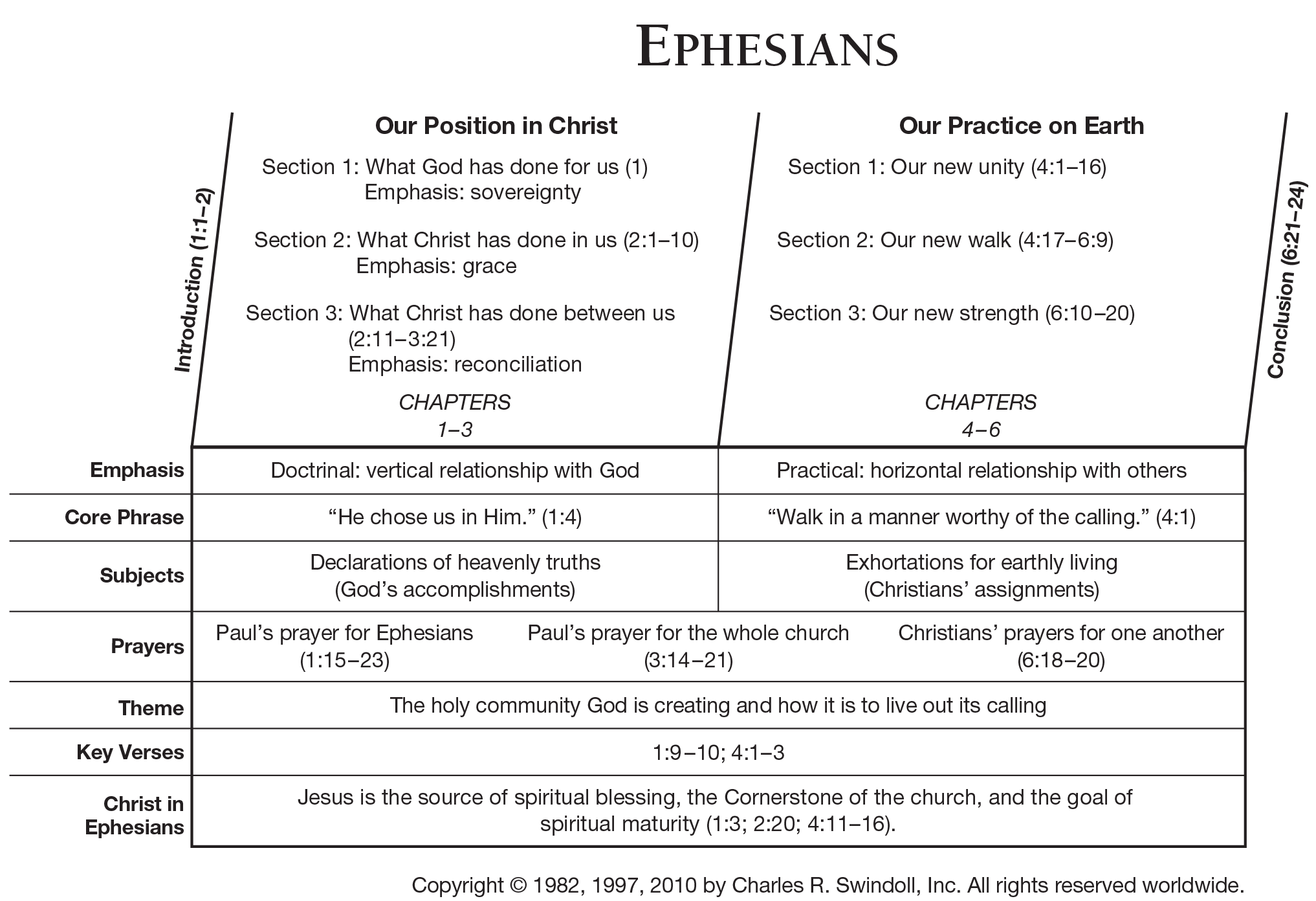
EPHESIANS - CHRIST AND THE CHURCH
Click chart to enlarge
Charts from Jensen's Survey of the NT - used by permission
Click chart by Charles Swindoll -Note "EMPHASIS" --
Ephesians 1-3 = Doctrinal: vertical relationship with God
Ephesians 4-6 = Practical: horizontal relationship with others
Ephesians 5:3 But immorality or any impurity or greed must not even be named among you, as is proper among saints; (NASB: Lockman)
Greek: porneia de kai akatharsia pasa e pleonexia mede onomazestho (3SPPM) en humin, kathos prepei (3SPAI) hagiois,
Amplified: But immorality (sexual vice) and all impurity [of lustful, rich, wasteful living] or greediness must not even be named among you, as is fitting and proper among saints (God’s consecrated people). (Amplified Bible - Lockman)
NLT: Let there be no sexual immorality, impurity, or greed among you. Such sins have no place among God's people. (NLT - Tyndale House)
Phillips: But as for sexual immorality in all its forms, and the itch to get your hands on what belongs to other people - (Phillips: Touchstone)
Wuest: But fornication and uncleanness, every kind of it, or covetousness, let it not be even named among you, just as it is befitting to saints,
Young's Literal: and whoredom, and all uncleanness, or covetousness, let it not even be named among you, as becometh saints;
BUT IMMORALITY: porneia de:
- Immorality (fornication - KJV) - Eph 5:5; 4:19,20; Nu 25:1; Dt 23:17,18; Mt 15:19; Mk 7:21; Lk 12:15, Acts 15:20; Ro 1:18, 19, 20, 21, 22, 23, 24, 25, 26, 27, 28, 29, 30, 31, 32 Ro 6:13; 1 Cor 5:10,11; 6:9,13,18; 10:8; 2Cor 12:21; Galatians 5:19, 20, 21; Colossians 3:5, 6, 7; 1Th 4:3,7; Heb 12:16; 13:4; 2 Pe 2:10; Revelation 2:14,21; 9:21; 21:8; Revelation 22:15
- THOUGHT - From Paul's divinely inspired "pattern of moral devolution" in Romans 1, notice how suppression and rejection of the knowledge of the true God naturally "devolves" into worship of false gods and how this false worship in turn is intimately associated with the practice of sexual immorality in all forms! Upshot? Knowledge of the one true and living God and growing intimacy with the Lord Jesus Christ and His Spirit [Gal 5:16-see notes] in daily quiet times of worshipful fellowship are the BEST preventative measure (and cure) for those bound with the cords of the sin (Pr 5:22) of sexual immorality and better than any of the Christian books or programs that are flooding the marketplace! Let us return to the "ancient paths", the "highway of holiness" and as Christian men begin to experience a freedom in this area that heretofore we never even thought was possible in light of the pervasive permeation of American culture by sensuality and sexual seduction.;
- Ephesians 5:1-4 - Wayne Barber
- Ephesians 5:3-4: Be Imitators of God's Love - 2 - Wayne Barber
- Ephesians 5:3-6 Clean Up Your Act! - Steven Cole
- Ephesians 5:3-7: Walking in Love-2 - John MacArthur
- Ephesians 5:3-7: Walking in Love-2 Study Guide (see dropdown menu) - John MacArthur
- Ephesians 5 Resources - Multiple Sermons and Commentaries
Note: All verbs in bold red indicate commands, not suggestions! Now before you get too reactive or too worried, take a moment an read discussion of the Need for the Holy Spirit to obey NT commands (which could also be titled "How to Keep All 1642 Commandments in the New Testament!")
In his summarization of this chapter Charles Hodge writes...
It becomes saints to avoid not only the sins of uncleanness and covetousness, but also all impropriety of conduct and frivolity of language, Ephesians 5:3, 4. Because uncleanness and covetousness not only exclude from heaven, but, whatever errorists may say, bring down the wrath of God, Eph 5:5,6. Christians, therefore, should not participate in those sins, seeing they have been divinely enlightened and made the recipients of that light whose fruits are goodness, righteousness and truth. They are bound to exemplify this in their conduct, avoiding and reproving the deeds of darkness, Eph 5:7, 8, 9, 10. Those deeds are too shameful to be named; still they may be corrected by the power of that light which it is the prerogative of believers to disseminate. Therefore the Scriptures speak of the light which flows from Christ as reaching even to the dead, Eph 5:12, 13, 14. Christians therefore should be wise, making the most of every occasion for good, in the midst of the evils by which they are surrounded, Eph 5:13, 14, 15, 16. They should seek exhilaration not from wine, but from the Holy Spirit, and give expression to their gladness in psalms and hymns, praising and thanking God through Jesus Christ, Eph 5:17, 18, 19, 20.
In the preceding section the apostle had spoken of sins against our neighbor; here from Eph 5:3 to Eph 5:20 he dwells principally on sins against ourselves. Not only fornication, but everything of the same nature, or that leads to it, is to be avoided—and not only avoided, but not even named among believers. The inconsistency of all such sins with the character of Christians, as saints, men selected from the world and consecrated to God, is such as should forbid the very mention of them in a Christian society. With the sins of uncleanness the apostle here, as in the preceding chapter, Eph 4:19, connects pleonexia, covetousness. The word is to be taken in its ordinary sense, as there is nothing in the context to justify any departure from it. The assumption that sins of sensuality are alone mentioned in this and the following verse, leads to very forced interpretations of several of the terms employed. (Ephesians 5:3-20)
PRESENTATION TO GOD
A POWERFUL PRESERVATIVE
But (1161) (de) is a term of contrast which conveys a very strong contrast with that which produces a fragrant aroma before God. It is probably not too far fetched to take from this contrast the implication that the following vices are a "stench" in God's nostrils rather than a fragrant aroma! Thus Paul carries the exhortation (command) to be imitators of God (Eph 5:1,2+) over to a prohibition expressed in the strongest terms and which is leveled against one of the deadliest and most inveterate temptations to which Gentile Christians were (are) exposed - porneia! (As an aside, take a moment and hold your pointer over the cross references listed above in order to get a sense of the seriousness and pervasiveness of this sin throughout the ages!)
Alford on but - not transitional merely: there is a contrast brought out by the very mention of πορνεία after what has just been said
Hoehner - The self-centered vices in conduct and speech (Eph 5:3-4) are the opposite of the self-sacrificing love spoken of in Eph 5:1,2+. Since these vices portray selfishness and unconcern for others, a believer should not have even a hint of these sins in his life. (See context in Bible Knowledge Commentary).
As in most competitive sports, the best defense is usually a good offense. And similarly the best defense against porneia is a good offense! Paul had just described the "offense" in Eph 5:1-2 in which he issued two commands - be imitators, walk in love both of which we are enabled to obey by depending on the power of the indwelling Spirit (Eph 3:16note). When we are obeying these commands, we are practicing a Christ centered walk which produces a life pleasing to the Father. In other words, when we are imitating Christ (1Cor 11:1, 1Pe 2:21, 1Jn 2:6), dying to self (Mk 8:34-35), presenting ourselves as living sacrifices to God (note note), we are in effect presenting ourselves to the god of self and the idol of immorality. Jesus made it very clear that to whom we present ourselves will determine whom we serve, either Savior or self (Mt 6:24-note). We see a similar pattern in the parallel passages in Col 3:1-4 note, where Paul is calling for us to focus on the things above, on our death, burial and resurrection with Him (the Gospel in a nutshell, (Col 3:1), on the things above, not on the things on the earth (Col 3:2 note), on God's protection of our souls (Col 3:3 note) and on our future glory (Col 3:4 note), and only after we have done that does he command us to "kill' immorality (Col 3:5 note). The trap we can easily fall into is first trying to kill the sin by doing this or not doing that, and in so doing we in effect place ourselves back up under the law, from which Christ set us free. Instead, we need to focus on God, His Word, His Son, His Gospel, His Spirit, etc, and when we do that it will difficult for porneia to get a foothold in our soul. The same pattern is seen in Gal 5:16 where Paul commands the believers to walk by the (power of) Holy Spirit Who indwells each of them and when we are walking by the Spirit, we "will not carry out the desire of the flesh." (Gal 5:16 note) Observe that Paul did not say we would not have the desires of the flesh! We still have the residua of the fallen flesh in our mortal bodies, but because of what Christ had done for us on the Cross and because He has sent us His Spirit to live within us and empower us to live a supernatural life, now we can fight the lusts of the flesh which continually wage war against our souls (1Pe 2:11 note, Gal 5:17 note).
As Eadie says porneia was "a sin which had eaten deep into the Gentile world (Acts 15:20, 29) (Ephesians 5 Commentary)
Comment: We might paraphrase Eadie's words in terms of our modern culture -- "Pornography on the Internet is a sin which has eaten deeply into the culture of America and has seriously "infected" American Christianity and Christian men." [Covenant Eyes is strongly and highly recommended as it is not a "filter" but a "tracker" of every website visited, with a report to your accountability partner of those sites, taking special note of those "highly suggestive of 'mature' content".) (See also verse by verse studies on Proverbs 5-7 = Proverbs 5:1-14; Proverbs 5:15-23; Proverbs 6:20-35; Proverbs 7:1-27])
Among you - ''you'' is plural. There is not to be one loose cannon on the deck. Not one guy cheating on his wife. Not one church staff member hooked on internet pornography. We are saints, holy ones of God. We have laid aside these old filthy garments and are wearing the robes of Christ's righteousness. We need to live like it, and in context love like Christ. In this verse Paul shows what love does not look like!
John Piper warns - Fornication should be eliminated from your life if you are a Christian. It should be shunned like a dangerous disease. For it is far more dangerous than AIDS. AIDS can only kill your body. Fornication can kill your soul as we will see from Eph 5:6 (cp Mt 10:28, Lk 12:4, 5). (Ephesians 5:3-6: The Enthronement of Desire)
Immorality (4202) (porneia from porneúo = commit fornication or any sexual sin) originally referred to any excessive behavior or lack of restraint, but eventually became associated with sexual excess and indulgence. Porneia originally was used especially to describe the practice of consorting with prostitutes (porneis = “prostitute”) and eventually came to mean “habitual immorality.”
Porneia as used in the Scriptures describes any illicit sexual activity outside of the divine bounds established by marriage and thus includes the ideas of unlawful sexual intercourse, unchastity and fornication. Porneia includes (but is not limited to) adultery, premarital sex, homosexuality, bestiality, incest, and prostitution.
Porneia is the opposite of the Greek word enkrateia/ egkrateia (literally means "holding oneself in"), which usually referred to sexual self-control (see Acts 24:25)
There are 25 uses of porneia in the NT - Mt. 5:32; 15:19; 19:9; Mark. 7:21; Jn. 8:41; Acts 15:20, 29; 21:25; 1Co. 5:1; 6:13, 18; 7:2; 2Co. 12:21; Gal. 5:19; Eph. 5:3; Col. 3:5; 1Th 4:3; Rev 2:21; 9:21; 14:8; 17:2, 4; 18:3; 19:2
There are 36 uses of porneia in the Septuagint (LXX) - Ge 38:24; Nu 14:33; 2Ki. 9:22; Is 47:10; 57:9; Jer 2:20; 3:2, 9; 13:27; Ezek 16:15, 22, 25, 33, 34, 36, 41; 23:7, 8, 11, 14, 17, 18, 19, 27, 29, 35; 43:7, 9; Ho 1:2; 2:2, 4; 4:11, 12; 5:4; 6:10; Micah 1:7; Nah 3:4
Cole writes that porneia "includes premarital sex, extramarital sex, incest, homosexuality, bestiality, and the use of pornography. Any sex outside of the lifelong commitment of marriage is not rooted in love (as I defined it in our last study [Reference], “a self-sacrificing, caring commitment that shows itself in seeking the highest good of the one loved”), but in lust. Outside of marriage, sex devolves into using the other person for your own gratification. (Clean Up Your Act! (Ephesians 5:3-6)
As an aside, porneia refers primarily to sins of the flesh, but those sins can never be divorced from the sins of the mind or heart, because all sin is related. Sin in one area always makes us more susceptible to sin in other areas (don't be deceived). No where does Scripture sanction the commitment of any form of extramarital sexual activity...a far cry from our modern American culture!
Our English word pornography is from porneia (illicit sexual activity) + graph (a writing). Thus pornography ("porn") is a writing (picture) related to illicit sexual activity of some variety.
Expositors Greek Testament writes that "The term porneia (fornication) is to be taken in its proper sense and is not to be restricted to any one particular form—the license practiced at heathen festivals, concubinage, marriage within prohibited degrees, or the like. The moral life of the Greco-Roman world had sunk so low that, while protests against the prevailing corruption were never entirely wanting, fornication had long come to be regarded as a matter of moral indifference, and was indulged in without shame or scruple, not only by the mass, but by philosophers and men of distinction who in other respects led exemplary lives.” (The Expositor's Greek Testament)
THOUGHT- Does this comment remind you of any modern day society?
Christianity brought chastity, a virtue that was foreign to the Greco-Roman world. Into this world of pagan idolatry where sexual immorality was not only condoned, but regarded as normal, the Christian faith came as a purifying fire. Twentieth-century America has reverted back to the “normality of sexual immorality” and the revival fire of the Christian faith is desperately needed.
Remember the context of the society Paul was addressing. In the Greek culture of that day, prostitution and fornication were considered permissible activities. A married man in Greece cold engage in extramarital sexual intercourse as much as he wished, but this practice was forbidden for the wife! Athenaeus, a writer in the second century AD, quotes from a speech of Demosthenes,
“We keep mistresses for pleasure, concubines for daily concubinage, but wives we have in order to produce children legitimately and to have a trustworthy guardian of our domestic property.”
Kenneth Wuest - The moral life of the Greco-Roman world had sunk so low that, while protests against the prevailing corruption were never entirely wanting, fornication had long come to be regarded as a matter of moral indifference, and was indulged in without shame or scruple, not only by the mass, but by philosophers and men of distinction who in other respects led exemplary lives.
In the book of Acts the early church condemned all sexual experimentation outside of marriage James declaring that the Gentiles who were turning to God from idols be instructive
that they abstain from things contaminated by idols and from fornication (porneia - in this context the reference is to sexual sins in general but orgies that were associated with the worship of the pagan idols) and from what is strangled and from blood." (Acts 15:20)
The association of idolatry and sexual immorality as alluded to in Acts is frequently seen in many other passages of Scripture (Ex 32:4, 5, 6, 28, Nu 25:1-4, 1Cor 10:7-8, Rev 2:14, 21:8).
In Romans 1 Paul clearly links idolatry with immorality writing...
"Professing to be wise, they became fools, 23 and exchanged the glory of the incorruptible God for an image in the form of corruptible man and of birds and four-footed animals and crawling creatures (idolatry). 24 Therefore God gave them over (a judicial term in Gr., used for handing over a prisoner to his sentence. When men consistently abandon God, He will abandon them) in the lusts of their hearts to impurity (a general term describing decaying matter, like the contents of a grave and in context speaks of sexual immorality), that their bodies might be dishonored among them. 25 For they exchanged the truth of God for a lie (an idol is a lie, a false representation of God), and worshiped and served the creature (idolatry) rather than the Creator, who is blessed forever. Amen. 26 For this reason God gave them over (God's judicial sentence because of their idolatry was to deliverer them over to the power of) to degrading (dishonoring, disgracing, shameful) passions (which resulted in erotic activity with members of their own sex); for their women exchanged the natural function for that which is unnatural, 27 and in the same way also the men abandoned the natural function of the woman and burned in their desire toward one another, men with men committing indecent acts and receiving in their own persons the due penalty of their error." (Romans 1:22-27)(see notes beginning with Ro 1:22)
Comment: When men suppress the truth about God and fail to give thanks to Him and honor Him (Ro 1:18, 19+, Ro 1:20, 21+), they move away from one of the greatest "protections" against sexual immorality. Notice the same relation in 1Th 4:5+ where the Gentiles are "defined" as those who do not know God and this failure to know God is linked by Paul with their practice of "lustful passions". It follows that the way to defeat lustful passions is to know God. In 2Cor 11:3+ the deception by the devil is to draw men's thoughts (the battle is in our mind) away from the simplicity and purity of devotion to Christ. Again it follows that the best defense from being deceived (by the devil or the lust of our flesh, James 1:14, 15+) is to maintain a single hearted (sincere), pure devotion to Christ (i.e., know God!)
Sheep are always safest
when they remain close to the Chief Shepherd!
In summary, the best defense in our life long fight against the pull of our fallen flesh to gratify ourselves through illicit sexual activity, is to cultivate our relationship with the Chief Shepherd. Compare a similar "pattern" in Galatians 5:16+ where first we choose to continually obey Paul's command (even that choice being enabled by the Spirit - Php 2:13+ = He gives us the desire!), and moment by moment to surrender to the control and empowerment by the Spirit, Who then enables us to not gratify the lusts of the flesh. This description is nothing short of the "victorious Christian life."
So let me get practical. How is your quiet time? That is, are you sitting at the feet of the Shepherd like Mary or are you too busy like Martha (Lk 10:39, 40+)? Remember as our Lord said, really only one thing is necessary (Lk 10:41, 42+). When we are doing the "good part" (Lk 10:42+), daily seated at our Lord's feet, we will be filled with His Word, which the Spirit of Christ uses to renew our mind, control our thoughts and empower our walk (cp the effects in Col 3:16+ with those in Eph 5:18, 19, 20+). (See FILLED WITH THE SPIRIT -- RICHLY INDWELT BY THE WORD)
Are you daily taking in the living word of God (cp Mt 4:4+, 1Pe 2:2+, Acts 20:32+) and obeying the word (James 1:22+; James 1:25+), so that you are growing in grace and the knowledge of our Lord and Savior Jesus Christ (2Pe 3:18+)? If you are, then the things of this world, including the lusts of the passing pleasures (Heb 11:25+, 1Jn 2:17+) of this world will be increasingly growing "strangely dim in the light of His glory and grace" (Hymn)." (Watch and listen to the poignant video by Casting Crowns as they sing Slow Fade)
Remember that in Paul’s day the ancient pagan world in general and Corinth in particular was like much of modern day post-Christian, anti-God, relative values ruled America is today, for people were strongly intent on having their own ways and doing what was right in their own eyes (Jdg 21:25-note). And what they did that seemed "right" to them was particularly manifest in fulfilling their lust in illicit sexual activities, even under the guise of "religious worship.". Corinth in fact was so conspicuous for its practice of sexual immorality that to corinthianize meant to participate in reckless debauchery. Given this culture of rampant sexual permissiveness the body of Christ was sorely affected (pun intended). And so Paul writing to the Corinthian church declares that
It is actually reported that there is immorality (porneia) among you, and immorality (porneia) of such a kind as does not exist even among the Gentiles, that someone has (present tense = an ongoing, habitual activity) his father's wife." (1Cor 5:1 read the entire chapter [1Co 5:2, 3, 4, 5, 6, 7, 8, 9, 10, 11, 12, 13] which describes immorality in the church - and as you read be sure to observe that the admonition and rebuke in this chapter is directed not so much to those committing immorality but to the church who stood silently aloof, in fact arrogantly refusing to do anything about this horrible blemish on their local body!)
Later in this same letter Paul gives his instruction to individual believers who were being tempted to play in the sewers of sexual immorality that was so prevalent. Paul's advice was crystal clear...
Flee immorality (porneia) (Flee is in the present imperative = flee and keep fleeing until the danger is past - when the seductive commercial comes on the television, change channels or excuse yourself from the room immediately! You have less than 5 seconds! Don't stay and let a glance turn into a gaze rationalizing "I can handle this one!" -- In your own strength you cannot! Remember that you won't fall into an illicit sexual sin in a moment, but over time, as the little "cracks" in the dam build up and erode so that one day you "suddenly" [all at once] commit an illicit act like the young man in Pr 7:22! Do not be deceived!) . Every other sin that a man commits is outside the body, but the immoral man sins against his own body (Porneia is more destructive to the sinner than other sins because the one who engages in it cannot undo their act. In the Screwtape Letters C. S. Lewis says that each time a man and a woman enter into a sexual relationship a spiritual bond is established between them which must be eternally enjoyed or eternally endured! Woe! cp Paul's teaching 1Co 6:16, 17) Or do you not know that your body is a temple of the Holy Spirit who is in you (1Co 3:16), whom you have from God, and that you are not your own (Titus 2:14-note, 2Co 5:15, Ro 14:7, 8-note)? For you have been bought with a price: therefore glorify God in your body." (1Cor 6:18, 19, 20, 7:23, 1Pe 2:9-note, Acts 20:28, Gal 3:13, Heb 9:12-note, 1Pe 1:18, 19-note, 2Pe 2:1-note, Rev 5:9-note)
What Paul is saying in the preceding passage is that sexual sin not only is against God (Ge 39:9, Ps 51:4) and other persons (1Thes 4:6-note), it is also against ourselves. Part of our moral responsibility to ourselves is to be sexually pure. When Christians are immoral, the testimony of the gospel is polluted and the holy Name of God is blasphemed. Furthermore, we can know all the truth in the world, and yet by our falling into illicit sexual activity, we are showing by that activity that we despise not only God (2Sa 12:10) but also His Word (2Sa 12:14)!
Don't dabble with porneia ("pornography"), trifle with it (there is no such thing as "soft porn" - it is a lie!), argue about it, debate it, explain it and certainly don't try to rationalize it as a "spiritual challenge" to be met but as a "spiritual trap" to be escaped. Get away as fast as you can! God gives such a clear and strong command because porneia is so serious, so seductive, so corrupting and so shattering to spiritual relationships, both human and divine! So flee for your life.
An excellent well known illustration of "fleeing immorality" is found in the account of Joseph when he was tempted to sin by Potiphar’s wife Joseph addressing her advances declared
“There is no one greater in this house than I, and he has withheld nothing from me except you, because you are his wife. How then could I do this great evil, and sin against God? [Joseph feared Jehovah and so turned away from evil, cf Job 1:1, Ps 119:104, 128, 168, Pr 8:13, 16:6]” 10 And it came about as she spoke to Joseph day after day, that he did not listen to her to lie beside her, or be with her.11 Now it happened one day (God allowed this test - in every test of our hearts there is the potential that it will turn into a temptation and we will succumb to the lust of our flesh, James 1:14) that he went into the house to do his work, and none of the men of the household was there inside.12 And she caught him by his garment, saying, “Lie with me!” And he left his garment in her hand and fled, and went outside.) (Genesis 39:9-12)
While there may be safety in numbers, sometimes there is more safety in flight! It is like the pastor who cautioned his handsome new assistant about the dangers of immorality in the ministry. The assistant said that he always did his socializing in a group setting and concluded that “there is safety in numbers.” The wise pastor replied, “Yes, that is so, but there is more safety in Exodus!”
How serious is immorality? Paul's rhetorical question indicates the consequences can be eternally serious asking...
Or do you not know that the unrighteous shall not inherit the kingdom of God? Do not be deceived; neither fornicators, nor idolaters, nor adulterers, nor effeminate, nor homosexuals, nor thieves, nor the covetous, nor drunkards, nor revilers, nor swindlers, shall inherit the kingdom of God. (1Cor 6:9-10+)
William MacDonald commenting on the passage in first Corinthians adds that Paul "does not mean to imply that Christians can practice such sins and be lost, but rather he is saying that people who practice such sins are not Christians.: (See context in Believer's Bible Commentary)
Comment: Don't misinterpret what MacDonald is saying -- he does not say Christians can never fall into this trap of sexual sin. When a Christian commits sexual sin, he or she is one of the more miserable individuals you will ever meet. And although they may be trapped by the cords of sin as in Pr 5:22+, their heart's desire to not to commit the sin but to come out of that sin. If they have no desire and make no efforts whatsoever to be extirpated from that sin, that is when one has to begin to wonder whether they are truly regenerate.)
Paul goes on to explain that a healthy sexual relationship within the bond of marriage is one of the main (if not the main) defense against sexual immorality...
1Corinthians 7:2+ But because of immoralities (porneia - we might paraphrase this in terms appropriate to our modern culture and say "because of the seductive danger, prevalence and supposed privacy [cp Pr 5:21, 15:3] of internet pornography"), let each man have (command, not a suggestion) his own wife, and let each woman have her own husband.
1Corinthians 7:5+ Stop depriving one another (present imperative + a negative = command to stop doing this, implying some were see our need to depend on the Holy Spirit to obey), except by agreement for a time that you may devote yourselves to prayer, and come together again lest Satan tempt you because of your lack of self-control.
Solomon echoes this truth in Proverbs 5 calling on married men to...
Proverbs 5:15 Drink water from your own cistern, And fresh water from your own well.
16 Should your springs be dispersed abroad, Streams of water in the streets?
17 Let them be yours alone, And not for strangers with you.
18 Let your fountain be blessed, And rejoice in the wife of your youth.
19 As a loving hind and a graceful doe, Let her breasts satisfy you at all times; Be exhilarated always with her love.
20 For why should you, my son, be exhilarated with an adulteress, And embrace the bosom of a foreigner? (See notes Proverbs 5:15-23)
Porneia is the more general term for all kinds of sexual sins and encompasses the more specific sin of adultery (moichea [3430]) which describes sexual sin in at least one person who is married. Jesus used porneia to describe adultery in marriage, declaring
that everyone who divorces his wife, except for the cause of unchastity (porneia - fornication), makes her commit adultery (moichao = verb related to moichea); and whoever marries a divorced woman commits adultery (moichao = verb related to moichea) (see note Matthew 5:32)
Porneia as used in this verse in the context of marriage always constituted adultery, which, by definition, is illicit sex by a married person.
In the ancient world sexual activity (physical unfaithfulness) was often connected with the idolatrous worship of false gods (spiritual unfaithfulness) (cf Nu 25:1, 2, 3+, Rev 2:14+, Rev 2:20+).
The verb form of porneia is used by Paul to describe the immorality for which 23,000 (of the total of 24,000) Israelites were killed by a plague in one day ("Nor let us act immorally [porneuo], as some of them did, and twenty-three thousand fell in one day.1Cor 10:8+; cf. Nu 25:9+). Because the majority, if not all, of those slain were probably married, porneia clearly includes adultery.
Porneia is used most often with its lurid literal meaning but some NT uses (as well as uses in the Septuagint) utilize porneia in a figurative sense to picture idolatry or the forsaking of the true and living God to worship dead idols. Scripture describes God as married to His Church through Christ, so that any idolatry is unfaithfulness toward God and is often depicted as analogous to sexual unfaithfulness to one’s marriage partner! As alluded to earlier, this association between "spiritual adultery" and idolatry is not at all surprising in view of the fact that literal adultery was closely associated with the Gentiles, which by definition did not know God (they knew about Him but did not really know Him) and so lived in lustful passions (1Th 4:5-note). To repeat one of the best "defenses" against falling into sexual immorality is to know God.
In the OT God's relationship to Israel was pictured as that of a Husband to His wife (cf Isaiah 54:5). And so in Jeremiah we see Jehovah describe His punishment of the adulterous northern kingdom of Israel by allowing her to be defeated and exiled into Assyria (He gave "her a writ of divorce"). In spite of God's clear warning, the southern kingdom described as Israel's
treacherous sister Judah did not fear; but she went and was a harlot (Lxx = porneuo verbal root of porneia) also (why did she play the harlot? no reverential fear of the holy God). And it came about because of the lightness of her harlotry (Hebrew = zenut refers to sexual sin that violates the marriage covenant; and is used most often figuratively to describe the wickedness of the nation of Israel, this wickedness usually being associated with the worship of idols, and occasionally even descriptive of outright rebellion Nu 14:33; Lxx = porneia), that she polluted the land and committed adultery (Lxx = moicheuo [word study] verbal form of moicheia) with stones and trees." (Jer 3:8, 9)
Addressing Jerusalem, Jehovah declares to her that
you trusted in your beauty and played the harlot (Hebrew = zanah = fornicate, prostitute, figuratively of Israel's illicit relationship with other so-called gods; Lxx = porneuo verbal root of porneia) because of your fame, and you poured out your harlotries (Lxx = porneia), that she polluted the land and committed adultery (Lxx = moicheuo verbal form of moicheia) on every passer-by who might be willing...and besides all your abominations and harlotries (Lxx = porneia) you did not remember the days of your youth, when you were naked and bare and squirming in your blood." 23 "Then it came about after all your wickedness ('Woe, woe to you!' declares the Lord GOD), 24 that you built yourself a shrine (Lxx says "a house of fornication" or for harlots) and made yourself a high place in every square. 25 "You built yourself a high place at the top of every street (Lxx has "on the head of every way thou didst set up thy fornications [porneia]") and made your beauty abominable; and you spread your legs to every passer-by to multiply your harlotry (Lxx = porneia). 26 "You also played the harlot ("go a whoring" Lxx = related verb ekporneuo = to be utterly unchaste, to give self over to fornication; to indulge in flagrant immorality) with the Egyptians, your lustful neighbors, and multiplied your harlotry (Lxx = related verb ekporneuo) to make Me angry....32 "You adulteress (Lxx = moichao) wife, who takes strangers instead of her husband!" (Ezekiel 16:15,22-26, 32 read all of chapter 16 to see how God feels about porneia!)
SEX IS LIKE
A RIVER
Sex is a gift of God which is like a great river flowing through life which, kept within its banks, is a source of pleasure and power. However when a river overflows its banks it becomes destructive and disaster ensues. In an analogous way, the water contained within bounds and channeled through the great Hoover Dam is the source of tremendous electrical power. However, if cracks were allowed to develop in the dam and allow to grow, eventually the dam would burst. Sexual impurity, is similar to a river overflowing its banks or the cracks in a dam. It begins with just a few thoughts (that come from a few "innocent" images) and grows and festers and is fed more thoughts (images) until one day it suddenly breaks down. Sexual immorality is like that. No believer commits sexual immorality in a moment. It is a gradual erosion of the believer's core values, a continual ignoring of one's conscience and a repeated repression of the indwelling Spirit's urgings to refrain, to flee, etc. As godly men and women, we must recognize the deceitfulness of any sin (Heb 3:13+) but especially the particularly pleasurable (passing Heb 11:25+) sin of illicit sexual activity. When the tempting thoughts come, we must take them captive by grace and the power of the indwelling Spirit and hand them over to the Captain of the hosts, our Lord Jesus Christ. (see 2Cor 10:5ff+). We flee from anything, anyone or anywhere, that improper sensual suggestive images are portrayed (1Cor 6:18+, cp Joseph in Ge 39:12)
Within marriage, sex is beautiful, fulfilling, creative and has protective effect against immorality (1Co 7:2, 5+). Outside marriage, sex is ugly, destructive, and like fire. In a fireplace, fire is warm and comforting. Outside the hearth, fire is destructive and uncontrollable.
Solomon presented a similar fiery metaphor in asking the rhetorical questions...
Can a man take fire in his bosom (Ans? Yes if he is a fool!) and his clothes not be burned? (Ans? No) Or can a man walk on hot coals, and his feet not be scorched? (See notes Pr 6:27,28)
As Billy Graham has observed "Satan fails to speak of the remorse, the futility, the loneliness, and the spiritual devastation which go hand in hand with immorality.
Jesus explained porneia declaring that "the things that proceed out of the mouth come from the heart, and those defile the man. For out of the heart come evil thoughts, murders, adulteries, fornications (porneia), thefts, false witness, slanders. (Mt 15:18-19+)
Jesus' point is that the basis of all sin is the heart which would include our thought life, the thoughts preceding the sinful outward act. Porneia begins in the heart (cp Mt 5:28+; Job 31:9, cp what Job did "before" he saw a virgin, not after! Job 31:1; Pr 6:25+; James 1:14+- where lust comes from within, from our fallen flesh; 2Pe 2:14+- eyes full of adultery because of a heart trained in greed causing them to covet something someone else has -- e.g., their wife!). When a person is defiled on the inside, what he does on the outside is also defiled. And so beloved, "Watch (command) over your heart with all diligence, for from it flow the springs of life. (Pr 4:23+)
John records that in the last years just prior to our Lord's return indescribable sexual perversions will be running rampant. He writes that those who dwell upon the earth "did not repent of their murders nor of their sorceries nor of their immorality (porneia) nor of their thefts. (Rev 9:21+)
Porneia is an all-encompassing sensual or sexual immorality, a perfect description of modern day America. Let's be honest. Most men (even Christian men!) have problems with this area that they would not even dare tell anyone! When you realize that you are complete in Christ and can now say "no" to this sin, from that point on you are responsible what kind of mess you get yourself into by not saying "Yes" to Jesus and "No" to immorality. Remember that "victory" is not so much me overcoming the problem but it's me having been overcome by Christ and it's now Christ in me who can overcome. You don't have to live the way you did when you were dead in your trespasses and sin. Your body is now dead to sin (the power of sin) and alive to God in Christ Jesus.
Immorality is evidence of turning your back on God as (Ro 1:25+; Ro 1:26, 27+) teaches. God will judge illicit sexual sin (Heb 13:4+) whether one in a believer or an unbeliever and Peter adds that but judgment begins at the household of God (1Pe 4:17+) because believers are even more accountable in view of the fact that they have the power (Ro 6:11+, Ro 8:13+, Ga 5:24+) to flee youthful lusts and to abstain from fleshly lusts (1Pet 2:11+). As Paul explained to believers who thought that now that they were "covered" by grace and could sin with impunity since grace abounded where sin increased, he countered this deceptive teaching with horror
May it never be! How shall we who died (dead men are positionally uninfluenced and unaffected pleasures of this life) to (the) sin (the power of sin inherited from Adam is broken along with the previous powerlessness to say "no" to it's reign and demands to be gratified) still live in it? (Ro 6:2+)
When we surrendered to Christ and took him as Lord and Saviour, not as our "fire insurance" policy!
The biblical view of immorality is summarized in (1Th 4:3+) where Paul records that
this is the will of God, your sanctification (State of being set apart from sin and the world to deity God); that is, that you abstain (literally continually or as the habit of your life - present tense- to hold oneself away) from sexual immorality (porneia).
Vine comments that Paul "puts at the beginning of the list the sins which set at defiance the primal laws of God which govern the continuation of the human race and are essential to its well-being, physical and moral...The first in this list is a specific sin; from this there is a transition to the moral general. (Collected Writings of W. E. Vine)
William Barclay has an interesting historical note to put Paul's teaching in the proper cultural context writing that "Chastity was the one completely new virtue which Christianity brought into the world. In the ancient world sexual relationships before marriage and outside marriage were the normal and accepted practice. The sexual appetite was regarded as a thing to be gratified, not to be controlled. That is an attitude which is not unfamiliar today, although often it is supported by specious arguments. The Christian ethic insists on chastity, regarding the physical relationship between the sexes as something so precious that indiscriminate use of it in the end spoils it..... It is certainly true that the ancient world regarded sexual immorality so lightly that it was no sin at all. It was the expected thing that a man should have a mistress. In places like Corinth the great temples were staffed by hundreds of priestesses who were sacred prostitutes and whose earnings went to the upkeep of the Temple. In his speech Pro Caelio Cicero pleads: "If there is anyone who thinks that young men should be absolutely forbidden the love of courtesans, he is indeed extremely severe. I am not able to deny the principle that he states. But he is at variance not only with the licence of what our own age allows but also with the customs and concessions of our ancestors. When indeed was this not done? When did anyone ever find fault with it? When was such permission denied? When was it that that which is now lawful was not lawful?" The Greeks said that Solon was the first person to allow the introduction of prostitutes into Athens and then the building of brothels; and with the profits of the new trade a new Temple was built to Aphrodite, the goddess of love. Nothing could show the Greek point of view better than the fact that they saw nothing wrong in building a temple to the gods with the proceeds of prostitution. When Paul set this stress on moral purity, he was erecting a standard which the ordinary heathen had never dreamed of. That is why he pleads with them so earnestly and lays down his laws of purity with such stringency. We must remember the kind of society from which these Christian converts had come and the kind of society with which they were encompassed. There is nothing in all history like the moral miracle which Christianity wrought. (Daily Study Bible Series)
Paul has another "vice" list in Galatians writing that "the deeds of the flesh are evident, which are: immorality (porneia), impurity, sensuality, idolatry, sorcery, enmities, strife, jealousy, outbursts of anger, disputes, dissensions, factions, envying, drunkenness, carousing, and things like these, of which I forewarn you just as I have forewarned you that those who practice such things shall not inherit the kingdom of God. (see notes Galatians 5:19; 20; 21).
John records a similar warning writing that
for the cowardly and unbelieving and abominable and murderers and immoral persons (related noun pornos) and sorcerers and idolaters and all liars, their part will be in the lake that burns with fire and brimstone, which is the second death. (see note Revelation 21:8)
Neither Paul nor John is not saying that you won't go to heaven if you slip up and commit these sins from time to time. But they do indicate that if these sins are your lifestyle (and if there has never been a time in your life when you experienced a degree of freedom from them) then you will inherit not the kingdom of God but the lake of fire.
The Bible Knowledge Commentary adds this insight on Revelation 21:8 - "It should be obvious that this passage is not affirming salvation by works, but rather is referring to works as indicative of whether one is saved or not. Obviously many will be in heaven who before their conversions were indeed guilty of these sins but who turned from them in the day of grace in trusting Christ as their Savior. Though works are the evidence of salvation or lack of it, they are never the basis or ground of it." (See context in The Bible Knowledge Commentary)
Someone has written that immorality is like a cat’s paw. When lightly stroked, it is quite soft and pleasurable, but increased pressure brings out the claws of sin that will shred your very life.
Pastor Ray Stedman writes that "Words like immorality do not seem to register with many people. Let us put it plainly: Immorality means no sexual wrongdoing; no pre-marital sex (no fornication); no extra-marital sex (no messing around with someone else's wife or being faithless to your own husband or wife); No homosexual sex (that is very clear in Scripture in many places); No pornography (no standing in the news section at the airport and flipping through Penthouse or Playboy magazine and getting yourself turned on by looking at the pictures; that is sexual fantasy and that is wrong, too, as Jesus pointed out). So to "flee immorality" means to have none of those things going on in your life. (from Handling your Sex Drive)
If you know someone "wrestling" and being continually defeated by Internet Immorality (and they want to be set free) have them check Covenant Eyes and then agree to be their accountability partner. Under grace and with the Holy Spirit's enablement (Gal 5:15, Ro 8:13), I have heard a number of men give testimony of the efficacy of this tool. The difference between Covenant Eyes and other "porneia" blocking software is that Covenant Eyes logs every place you visit and keeps that record on a separate computer at their headquarters. Your site visits are scored as to likelihood that they have porneia and your accountability partner receives a periodic report. Men need accountability in this day of widespread, seemingly "anonymous" access to internet pornography. Remember though my beloved brethren in Christ that "The eyes of the LORD are in every place, watching the evil and the good." (Pr 15:3+, cp 2 Chr 16:9)
Thus although there may be so called this "secret sin" in one's thought life, these "hidden" sins are open scandal in the courts of heaven when carried out by believers! Moses warned that our sin would find us out (Nu 32:23). In Proverbs Solomon warned that the one who chooses to cover over and conceal their sin will not prosper, but the one who confesses and repents will find compassion from the Lord (Pr 28:13, 1Jn 1:9).
Listen to the words of Solomon, who clearly knew this truth but sadly did not practice it (at least in 1Ki 11:1, 2, 3, 4, 5, 6, 7, 8, 9, 10, 11 and it cost him his kingdom)
For why should you, my son, be exhilarated with an adulteress, and embrace the bosom of a foreigner? 21 For the ways of a man are before the eyes of the LORD, and He watches all his paths. 22 His own iniquities will capture the wicked, and he will be held with the cords of his sin. 23 He will die for lack of instruction, and in the greatness of his folly he will go astray. (See notes Pr 5:20-23)
Thomas Jefferson although by all accounts not a born again believer recognized the destructive nature of immorality and advised one to "Give up money, give up fame, give up science, give up the earth itself and all it contains, rather than do an immoral act.
Lawrence Richards writes that "Because sexual relationships between a man and a woman are intended to reflect the intimate relationship between God and his people, a covenant of faithfulness between marriage partners is essential. Adultery and other sex relations outside of marriage violate something basic to the very nature of God and to our own nature as beings created in his image. (See SEX) (See MARRIAGE) Marriage, as an exclusive commitment, is the necessary context for sexual expression for God's people. Our faithfulness to that relationship is critical." (See context in New International Encyclopedia of Bible Words)
William Jenkyn in describing immorality said that "The unclean person makes himself a stigmatic (having or conveying a social stigma); he brands his body, and leaves upon it a loathsome stain. Other sins comparatively are without the body, by it, not in it; this is both.
Henrietta Mears (author of the famous work Understanding the Bible) quipped that "Savonarola appealed to feelings and transformed Florence into a model of righteousness. But Robespierre appealed to feelings and turned Paris into a pandemonium of immorality. Feelings cannot be made moral absolutes."
A poem on the dangers of immorality/fornication...
Vice is a monster of such terrible mien**
That to be hated needs but to be seen.
Yet seen too often, familiar her face
We first endure, then sanction, then embrace.
**Mien = air or bearing especially as expressive of attitude or personality
David Burnham (in Discoveries, Volume 3, Number 1) lists immorality as one of the major "Character Killers"
1. Self-centeredness.
2. Distorting the gospel to serve your agenda .
3. Using your verbal skills to control others.
4. Appetite for power and possessions.
5. Immorality.
QUESTION - What does the Bible say about pornography? (See also related video)
ANSWER - By far, the most searched for terms on the internet are related to pornography. Pornography is rampant in the world today. Perhaps more than anything else, Satan has succeeded in twisting and perverting sex. He has taken what is good and right (loving sex between a husband and wife) and replaced it with lust, pornography, adultery, rape, and homosexuality. Pornography can be the first step on a very slippery slope of ever-increasing wickedness and immorality (Romans 6:19). The addictive nature of pornography is well documented. Just as a drug user must consume greater quantities of drugs or more powerful drugs to achieve the same “high,” pornography drags a person deeper and deeper into hard-core sexual addictions and ungodly desires.
The three main categories of sin are the lust of the flesh, the lust of the eyes, and the pride of life (1 John 2:16). Pornography definitely causes us to lust after flesh, and it is undeniably a lust of the eyes. Pornography definitely does not qualify as one of the things we are to think about, according to Philippians 4:8. Pornography is addictive (1 Corinthians 6:12; 2 Peter 2:19) and destructive (Proverbs 6:25-28; Ezekiel 20:30; Ephesians 4:19). Lusting after other people in our minds, which is the essence of pornography, is offensive to God (Matthew 5:28). When habitual devotion to pornography characterizes a person’s life and he/she continues in sin without seeking help, making no attempt to stop or feeling no desire to change his/her behavior, it demonstrates the person may not be saved (1 Corinthians 6:9-12).
For those involved in pornography, God can and will give the victory. Are you involved with pornography and desire freedom from it? Here are some steps to victory:
1) Confess your sin to God (1 John 1:9).
2) Ask God to cleanse, renew, and transform your mind (Romans 12:2).
3) Ask God to fill your mind with things that are true, honorable, just, pure, lovely, and commendable (Philippians 4:8).
4) Learn to possess your body in holiness (1 Thessalonians 4:3-4).
5) Understand the proper meaning of sex and rely on your spouse alone to meet that need (1 Corinthians 7:1-5).
6) Realize that if you walk in the Spirit, you will not fulfill the lusts of the flesh (Galatians 5:16).
7) Take practical steps to reduce your exposure to graphic images. Install pornography blockers on your computer, limit television and video usage, and find another Christian who will pray for you and help keep you accountable. (Covenant Eyes: Screen Accountability) GotQuestions.org
QUESTION - Is pornography addiction an acceptable reason for divorce?
ANSWER - Pornography is a pandemic sweeping our world, destroying hearts, lives, and families. The damage porn does to marriages is incalculable, as it creates unrealistic and selfish expectations for marital intimacy and leads to frustration and heartache for both spouses. Because addiction to porn, or even its frequent use, is so destructive to relationships, many wonder if it justifies divorce. They cite Jesus’ words in Matthew 5:28 as evidence that lust in the heart equals adultery. Of course, adultery is a biblical reason for divorce (verse 32); does a pornography addiction qualify as well?
The answer may be both yes and no, and we will look at both possibilities. In our world it is virtually impossible to avoid seeing sexual images. While porn use is rapidly growing among women, it is primarily the husband’s use that threatens a marriage. Sadly, most boys are first exposed to pornography at a very young age. According to research conducted by the University of Nebraska, “the average age of first exposure was 13.37 years of age with the youngest exposure as early as 5” (www.apa.org/news/press/releases/2017/08/pornography-exposure, accessed 10/6/20). The same study showed that any kind of childhood exposure to pornography directly affected later attitudes and behavior toward women.
For many husbands, pornography use is a dark secret; shame keeps it hidden, and wives don’t know. For others, the first time a wife is aware of her husband’s porn use is on the honeymoon when he asks her to do things she feels uncomfortable with. Then it all comes to light. But at what point is a wife justified in divorcing her porn-addicted husband?
There are two ways to look at this issue. The first is that, since adultery and abandonment are the only explicitly biblical grounds for divorce, porn use does not qualify. The husband is guilty of lust and self-pleasuring, but he did not physically commit sexual immorality with someone else. Many porn-addicted husbands use this reasoning to shield themselves from more severe repercussions. But as long as a husband hides behind excuses instead of seeking help to overcome the addiction, he is in danger of digging a deeper pit for himself, and the marriage will not thrive.
Even if the above reasoning is accepted, wives committed to God’s standards for marriage are not helpless. While divorce may not be an option, separation can be. Addicts of all kinds are wrapped in deep denial. They refuse to see how their addiction is harming those in their lives. Immediately upon learning of her husband’s porn use, a wife usually blames herself: “I’m not pretty enough, thin enough, fun enough, etc.” A husband’s ongoing porn addiction creates tremendous insecurity in a wife. She sees his porn use as cheating, while the husband may not. However, if he is going to overcome it, he will need her support and encouragement. A wise wife will walk with him through this, realizing his addiction has nothing to do with her value or attractiveness. And if he is willing to get help, she should seek help, too.
Most Christian therapists recommend a 30- to 60-day period of total abstinence from sex as the husband learns new ways of meeting his deep heart needs in Christ rather than through porn. The wife will need to cooperate with this as a way of helping heal what is broken in their marriage. Rather than pursue a divorce, a wife may give her husband an ultimatum: “It’s either porn, or me and the kids.” She does not have to tolerate an unrepentant addiction that is violating the sanctity of the marriage bed (Hebrews 13:4). She may choose to move out for a season, deny him sex as long as he continues with porn, or, if he refuses to stop, bring the matter before their church leadership. These are temporary measures with the goal of reuniting the couple when accountability and safeguards are in place.
But there is another way of looking at this issue, and that is to see porn use as tantamount to adultery. Some wives believe they have prayed, appealed, fought, waited, pleaded, and sought counsel until there is nothing left to do. An unrepentant husband who refuses to seek help and accountability may, in fact, be providing his wife with biblical grounds for divorce. He is no longer stumbling into lust as everyone does from time to time; he has created an immoral lifestyle. He is forcing his wife to live with an adulterous man and, in some ways, to participate in his sin. When they have sex, he is not making love to her. He is acting out his lust for other women on his wife’s body. That is mental adultery, and she can tell.
While divorce should never be the first response to marriage problems, it may be necessary when living together in peace is not possible (1 Corinthians 7:15). Jesus’ words in Matthew 19:8 may apply to unrepentant addicts who are abandoning their families in favor of a substance or behavior. To the Pharisees who questioned Him about divorce, Jesus replied, “Moses permitted you to divorce your wives because your hearts were hard. But it was not this way from the beginning.” Addicts who refuse to change have hardened their hearts. So if a spouse can honestly say he/she did everything possible to save the marriage, but the addiction is destroying everything marriage means, then divorce may be an allowable decision.GotQuestions.org
Related Resources:
- Is it a sin to watch pornography with my spouse? | GotQuestions.org
- Should I tell my spouse about my pornography addiction? | GotQuestions.org
- How can I overcome an addiction to internet porn? Can addiction to pornography be defeated? | GotQuestions.org
- What is wrong with viewing pornography, if I don’t lust after the person? | GotQuestions.org
- Is looking at pornography a sin? | GotQuestions.org
- Masturbation - is it a sin according to the Bible? | GotQuestions.org
Our Daily Bread - The Bible is up-to-date on sexual matters. Long ago, God warned against adultery and fornication. In effect, He said, "Say no!" Now, in the 20th century with the awful threat of AIDS, many lawmakers, educators, and doctors are agreeing with the Almighty.
The Grand Rapids Press carried an article titled "Abstinence: The New Emphasis in Sex Education." It told of 16-year-old Will Heiss, a "peer educator" who challenges younger kids to say no to sexual activity--and they are listening.
Author and campus lecturer Josh McDowell reminded a college audience that the seventh commandment is a gracious provision by God, given for our protection. Josh told of a man who had several sexual relationships. The man later received Christ and met a wonderful woman whom he married. "She's precious," confided the man, "but in the intimacy of our marriage I'm haunted by the 'ghosts' of those previous affairs."
Abstinence until marriage is a sure safeguard. It protects the gift of sexual intimacy that is to be enjoyed within a lifelong relationship of commitment and trust. God hates sexual immorality because He has the highest good of men and women at heart. --D J De Haan (Our Daily Bread, Copyright RBC Ministries, Grand Rapids, MI. Reprinted by permission. All rights reserved)
Lord, grant me strength from day to day--
How prone I am to go astray!
The passions of my flesh are strong;
Be Thou, my God, a shield from wrong. --DJD
God's commandments were not given to frustrate us but to fulfill us.
- How to Deal with the Guilt of Sexual Failure for the Glory of Christ and His Global Cause
- Six Steps to Defeating Sexual Sin
- Two Strategies to Win the War on Lust
- Sexual Purity
- Avoid: The First Step to Defeating Lust
- Avoiding Sexual Sin
- How Not to Fight Pornography
- Free at Last: My Surprising Liberation from Porn
- Move: How Laziness Feeds Lust
- This Is the Will of God for You: That You Abstain from Sexual
- The Morning Before a Sexual Fall: How the Battle for Purity Is Lost
- The Real Battle for Sexual Purity
- Visualizing Christ to Battle Lust?
- Two Underused Strategies for Addiction
- Lust Defined
- Winning the War Against Lust
- Resources on Killing Sin
- Strategies for Fighting Sexual Sin
- Battling the Unbelief of Lust
- Two Strategies to Win the War on Lust
- Satan Uses Sexual Desire
- A Safe Place for Sexual Sinners
- Sexual Sin in the Ministry
- Sexual Sin Is a Corporate Affair
- Making All Things New: Restoring Pure Joy to the Sexually Broken
- Sex and the Single Person
- Sexual Relations in Marriage
- Sex and the Supremacy of Christ, Part 1
- Sex and the Supremacy of Christ, Part 2
- ANTHEM - Strategies for Fighting Lusts
- Avoiding Sexual Sin, Part 1
- Avoiding Sexual Sin, Part 2
- Avoiding Sexual Sin
- How to Deal with the Guilt of Sexual Failure for the Glory of Christ
- Christian Hedonists or Religious Prudes? The Puritans on Sex
- This Is the Will of God for You: That You Abstain from Sexual Immorality
- Missions and Masturbation
- If Your Right Hand Causes You to Sin
OR ANY IMPURITY: kai akatharsia pasa
- Eph 5:5; Ex 18:21; 20:17; Josh 7:21; 1Sa 8:3; Ps 10:3; 119:36; Pr 28:16; Jer 6:13; 8:10; 22:17; Ezek 33:31; Mic 2:2; Mk 7:22; Lk 12:15; 16:14; Acts 20:33; 1Co 6:10; Col 3:5; 1Ti 3:3; 6:10; 2Ti 3:2; Titus 1:7,11; Heb 13:5; 1Pe 5:2; 2Pe 2:3,14
- Ephesians 5:1-4 - Wayne Barber
- Ephesians 5:3-4: Be Imitators of God's Love - 2 - Wayne Barber
- Ephesians 5:3-6 Clean Up Your Act! - Steven Cole
- Ephesians 5:3-7: Walking in Love-2 - John MacArthur
- Ephesians 5:3-7: Walking in Love-2 Study Guide (see dropdown menu) - John MacArthur
- Ephesians 5 Resources - Multiple Sermons and Commentaries
Or any impurity - is more literally "and all impurity"! Paul demolishes the belief by some that God's standard for moral purity is relative. To the contrary God's immutable, eternal standard of righteousness is that of all moral purity. As the famous Christian pollster, George Barna, has pointed out, sadly even many professing Christians deny God's absolute standard, so that in one study in 1991 only 23% of (so called) “born again” or “evangelical” Christians expressed a strong belief in absolute truth. One wonders how they can even read the Holy Bible and not cringe with conviction and a sense of reproof regarding their false belief regarding God's standards. And that perhaps is the problem -- they don't read the Word of God (which reproves us - 2Ti 3:16-note, 2Ti 4:2-note)! The situation is naturally even worse in the general secular population where some polls show that 47% approve of homosexuality (83% of liberals, 23% of conservatives hold this view). Furthermore, among liberals, 89% approve of sex between an unmarried man and woman and sadly 33% of conservatives agree. Having a baby out of wedlock is acceptable to 83% of liberals and 33% of conservatives (The Washington Times [6/5/2007], p. A6).
As Steven Cole rightly reminds us that "God’s standards for moral purity are not up for popular vote! He designed the sexual relationship for a man and a woman in a lifelong committed marriage. When practiced within these boundaries, it is a good gift from God, not something dirty. He gave us His commandments for our good. When we violate His standards, it results in short term pleasure (that’s why we’re tempted to do it), but long term pain and problems. Keeping God’s commandments is often difficult in the short term, but deeply fulfilling in the long term. (Ephesians 5:3-6 Clean Up Your Act!)
Impurity (167) (akatharsia from a = without + kathairo = cleanse) literally describes any substance that is filthy or dirty and cold refer to refuse, to purulent (pus) around an open, infected wound or to the contents of graves, causing ceremonial impurity. In castigating the hypocritical Pharisees Jesus used this word declaring
Woe to you, scribes and Pharisees, hypocrites! For you are like whitewashed tombs which on the outside appear beautiful, but inside they are full of dead men's bones and all uncleanness (akatharsia). (Mt 23:27)
Figuratively akatharsia refers to a state of moral impurity (especially sexual sin).
There are 10 uses of akatharsia in the NT Mt. 23:27; Ro 1:24; 6:19; 2Co 12:21; Gal 5:19; Ep 4:19; 5:3; Col 3:5; 1Th 2:3; 4:7)
Aout 42 in the non-apocryphal Septuagint (LXX) Lev. 5:3; 7:20f; 15:3, 24, 25, 26, 30, 31; 16:16, 19; 18:19; 19:23; 20:21, 25; 22:3, 4, 5; Nu 19:13; 2Sa 11:4; 2Chr 29:5, 16; Ezra 6:21; 9:11; Pr 6:16; 24:9; Je 19:13; 32:34; La 1:9; Ezek 4:14; 7:20; 9:9; 22:10, 15; 24:11; 36:17, 25, 29; 39:24; Ho 2:10; Mic 2:10; Nah 3:6;
In Romans when men exchange the glory of the incorruptible God for an image in the form of corruptible man, etc,
God gave them over in the lusts of their hearts to impurity (akatharsia), that their bodies might be dishonored among them. For they exchanged the truth of God for a lie, and worshiped and served the creature rather than the Creator, who is blessed forever. Amen. (see notes Romans 1:23; 24-25)
In the NT akatharsia was also used in reference to unclean or demonic spirits. Akatharsia describes a filthiness of heart and mind that makes the person defiled. The unclean person sees dirt in everything. What a word picture one gets from the secular medical use where akatharsia described an infected, oozing wound. Akatharsia was also the general term often used of decaying matter, like the contents of a grave. As used in its moral or ethical sense, the word speaks more of an internal disposition. An immoral filthiness on the inside. Acts of ''immorality'' are on the outside. A "good" illustration is what transpires within the soul of one who looks at internet pornography. Do not be deceived! Do not be partakers with them! Do not participate in their unfruitful deeds of darkness!
In a parallel passage in Romans Paul declares to the Roman saints that
just as you presented your members as slaves to impurity (akatharsia) and to lawlessness, resulting in further lawlessness, so now present your members as slaves to righteousness, resulting in sanctification (to live holy lives). (see note Romans 6:19)
Finally, Paul uses akatharsia in his letter to the Thessalonians reminding them that
God has not called us for the purpose of impurity (akatharsia), but in sanctification. (see note 1Thessalonians 4:3)
Why do we evangelicals try to put on these airs that we don't deal with these problems? The key is that you can overcome these types of things, because you've understood the truths about your high calling in Christ. The problem is so severe that many true believers complete in Jesus, made alive in Him, have walked away from Him and are not walking worthy of Him, having fallen back into the trap of the sins Paul lists in Colossians 3:5 (see note). And after a while you fall even further into the trap so that you think you can no longer even get out of the particular behavior! Remember: When Christ died and you believed, you identified with His death and these sins no longer have any power over you, unless you allow play with them.
While driving along a highway, we often see vultures soaring high overhead, swooping down, and then rising up again with the air currents. Every so often, a small group of them can be seen sitting right on the roadway, tearing apart and gobbling up the carcass of some unfortunate creature. One gets the impression that these ugly birds are on the lookout continually for what is loathsome and repulsive! Does that describe the desires of your heart? What kind of "food" do you prefer? Don't be like the vulture. Rather, "as newborn babes, desire the pure milk of the word, that you may grow thereby" (see note 1 Peter 2:2). The new birth creates a new appetite and requires a new diet. Put off the old and put on the new garments of created in righteousness and holiness of the truth.
O child of God, guard well your eyes
From anything that stains the heart;
Forsake those things that soil the mind--
Your Father wants you set apart.
-Fasick
OR GREED MUST NOT EVEN BE NAMED AMONG YOU, AS IS PROPER AMONG SAINTS: e pleonexia mede onomazestho (3SPPM) en humin:
- Eph 5:12; Exodus 23:13; Lk 12:15; 1Co 5:1
- Ephesians 5 Resources - Multiple Sermons and Commentaries
- Ephesians 5:1-4 - Wayne Barber
- Ephesians 5:3-4: Be Imitators of God's Love - 2 - Wayne Barber
- Ephesians 5:3-6 Clean Up Your Act! - Steven Cole
- Ephesians 5:3-7: Walking in Love-2 - John MacArthur
- Ephesians 5:3-7: Walking in Love-2 Study Guide (see dropdown menu) - John MacArthur
REMEMBER THE
TENTH COMMANDMENT!
I am from Texas and there is a famous saying "Remember the Alamo!" Well now that I am in the land of the Bible, the saying in the context of the present passage might be "Remember the Tenth Commandment!" And what is that commandment? It is "You shall not covet!" (Ex 20:17) regarding which Criswell says "The term "covet" is used here of a strong desire for personal benefit at the expense of others. (ED: AND WHAT IS THE "ANTIDOTE" FOR COVETING?) Man is to be content with God and with what God provides. (ED: SEE Christian Contentment) This was the only commandment whose violation was purely internal (READ THAT AGAIN SO YOU FULLY COMPREHEND WHAT HE IS SAYING!). This fact, together with the commentaries on the Law by Jesus (Mt. 5:17-32) and Paul (Ro 7:7), shows that God's true intent was not just to limit unrighteousness, nor to encourage external righteousness. His desire was for the true righteousness that is produced by a heart committed to Him. This was only to be made possible, however, through Christ (Ro 13:8-14)." (The Believer's Study Bible)
Not even (3366) (mede from me = not + dé = but, and) means what it says "not even" = an emphatic negative.
Phillips has a vivid paraphrase of greed as "the itch to get your hands on what belongs to other people." Interesting thought in light of the other words in this list like "immorality" (someone else's property!)
Expositor's Greek Testament - The strong negative mede gives it this force—‘Not to speak of doing such a thing, let it not be even so much as mentioned among you.’ “ Commenting on “as becometh saints (The Expositor's Greek Testament)
Or greed must not even be named among you - The same word pleonexia was used in the preceding chapter in Paul's description of the Old Man or Old Self who was described as practicing "every kind of impurity with greediness" (Eph 4:19+)
There is a parallel instruction by Paul in Romans 16 where he writes "I want you to be wise in what is good and innocent in what is evil. (Ro 16:19+)
Greed (4124) (pleonexia from pleíon = more + écho = have) literally means to have more. Pleonexia is a strong desire to acquire more and more possessions (forgetting that possessions almost always end up "paradoxically possessing" the owner!), especially that which is forbidden. It is a desire to have more irrespective of one's need and is always used in bad sense. It describes an insatiable selfishness. Is describes the attitude of heart in which one desires to have more than one's due. (See also Covetousness) In short, pleonexia describes an insatiable craving greed, consuming ambition and/or giving rein to the appetites and desires which are against the laws of God and man.
Pleonexia - 10x in 10v - covetousness(1), deeds of coveting(1), greed(7), greediness(1). Mk. 7:22; Lk. 12:15; Rom. 1:29; 2 Co. 9:5; Eph. 4:19; Eph. 5:3; Col. 3:5; 1 Thess. 2:5; 2 Pet. 2:3; 2 Pet. 2:14 - 5 uses in the Septuagint - Ps 119:36; Isa 28:8; Jer 22:17; Ezek 22:27; Hab 2:9
John Eadie writes "The apostle uses the noun in Col. 3:5, and in all other passages it denotes avaricious greed. Luke 12:15; Ro 1:29; 2Co 9:5. And it is joined to these preceding words, as it springs from the same selfishness, and is but a different form of development from the same unholy root. It is a dreadful scourge—saeva cupido, as the Latin satirist names it. More and more yet, as the word denotes; more may be possessed, but more is still desired, without limit or termination...It is greed, avarice, unconquerable love of appropriation, morbid lust of acquisition, carrying in itself a violation of almost every precept of the Decalogue (10 Commandments). (Ephesians 5 Commentary)
Pleonexia describes covetousness, a trait marked by inordinate desire for wealth or possessions or for another’s possessions (including another person's spouse!). Contentment is the opposite of covetousness. Attacking covetousness lays the ax to a root cause of sin because pleonexia is the root of the other sins listed in this verse. When contentment (and especially contentment in the supremacy of God and the experience of intimacy and fellowship with Him) replaces covetousness, the latter is impeded from giving rise to the process that culminates in commission of sins. This vitally important principle (which makes victorious Christian living not just a possibility but a reality) is seen in Galatians 5:16 (see notes) in which believers are first (don't reverse the order!) commanded to (continually) walk (live, conduct oneself) by the Spirit. Then when they submit and yield to the Spirit's authority and power over their lives including their thought life and their bodies, the promise of the second part of the verse supernaturally comes into effect and the believer is enabled to carry out or gratify the evil desires (which are still present and trying to usurp the Spirit's control of our mind and body) of the fallen, evil flesh nature (inherited from Adam - Ro 5:12)
Greed is what you desire and what you desire more of becomes your ''god'' and you end up serving (latreuo) that ''god.' (aka IDOLATRY - YOU BECOME AN IDOLATOR JUST LIKE THE ANCIENT HEATHEN!)' In God's sight, greed is worshipping the god mammon, and "you cannot serve God and mammon" (Mt 6:24+)
As noted in Colossians 3:5, Paul equates greed with idolatry writing...
Therefore (on basis of the truth in Col 3:1-4 as well as Col 1-2 - remember you cannot hold 2 affections at the same time - cf Mt 6:24 - the purpose of Col 3:1-4 is to focus you affection on CHRIST, which is an effective "antidote" to motivate expulsion of these vile affections - see Expulsive Power of a New Affection) consider ((aorist imperative see our need to depend on the Holy Spirit to obey) the members of your earthly body as dead to immorality (porneia), impurity, passion, evil desire, and greed, which amounts to idolatry. (see note Col 3:5)
Paul's point is that greed feeds one's lust or strong desires for more and more gratification (sex, money, possessions, etc). This greed is motivated by a desire for selfish pleasure apart from marriage, the absolute standard dictated by God. In turn, when one seeks pleasure in anything other than the Almighty God, they are practicing idolatry (having replaced God with the "idol" of sex). Sexual activity outside of the bounds of the marriage bed is always based on greed because the goal is to exploit the other person for one's personal advantage (or "needs") rather than to meet the other person's needs.
Wiersbe comments that "Covetousness may seem out of place next to fornication, but the two sins are but different expressions of the same basic weakness of fallen nature—uncontrolled appetite. The fornicator and the covetous person each desire to satisfy the appetite by taking what does not belong to them. (See context in The Wiersbe Bible Commentary)
Vincent notes that pleonexia is...
Covetousness Lit., the desire of having more. It is to be distinguished from philarguria rendered love of money, 1Ti 6:10, and its kindred adjective, philarguros which AV renders covetous, Luke 16:14; 2Ti 3:2; (see note); properly changed by Rev. into lovers of money. The distinction is expressed by covetousness and avarice. The one is the desire of getting, the other of keeping.
Covetousness has a wider and deeper sense, as designating the sinful desire which goes out after things of time and sense of every form and kind. Hence it is defined by Paul (see note Colossians 3:5) as idolatry, the worship of another object than God, and is so often associated with fleshly sins, as 1Cor. 5:11; Ep 5:3-note; Col 3:5-note.
Lightfoot says: “Impurity and covetousness may be said to divide between them nearly the whole domain of selfishness and vice.”
Socrates quotes an anonymous author who compares the region of the desires in the wicked to a vessel full of holes, and says that, of all the souls in Hades, these uninitiated or leaky persons are the most miserable, and that they carry water to a vessel which is full of holes in a similarly holey colander. The colander is the soul of the ignorant (Plato, “Gorgias,” 493). Compare, also, the description of covetousness and avarice by Chaucer, “Romaunt of the Rose,” 183–246. (Vincent's Word Studies) (Bolding added)
- Comes from the heart -Mark 7:21, 22,23, Mt 15:17, 18, 19, 20
- Engrosses the heart -Ezekiel 33:31; 2 Peter 2:14
- Is idolatry -Ephesians 5:5; Colossians 3:5
- Is the root of all evil -1 Timothy 6:10
- Is never satisfied -Ecclesiastes 5:10; Habakkuk 2:5
- Is vanity -Psalms 39:6; Ecclesiastes 4:8
IS INCONSISTENT
- In saints -Ephesians 5:3; Hebrews 13:5
- Specially in ministers -1 Timothy 3:3
LEADS TO
- Adultery (coveting another's wife Ex 20:17, 14) - 2Sa 12:1,2, 3, 4, 5
- Injustice and oppression -Proverbs 28:20; Micah 2:2
- Foolish and hurtful lusts -1 Timothy 6:9
- Departure from the faith -1 Timothy 6:10
- Lying -2 Kings 5:22, 23, 24, 25
- Murder -Proverbs 1:18,19; Ezekiel 22:12
- Theft -Joshua 7:21
- Poverty -Proverbs 28:22
- Misery -1 Timothy 6:10
- Domestic affliction -Proverbs 15:27
- Abhorred by God -Psalms 10:3
- Forbidden -Exodus 20:17
- A characteristic of the wicked -Romans 1:29
- A characteristic of the slothful -Proverbs 21:26
- Commended by the wicked alone -Psalms 10:3
- Hated by saints -Exodus 18:21; Acts 20:33
- To be mortified by saints -Colossians 3:5
- Woe denounced against -Isaiah 5:8; Habakkuk 2:9
- Punishment of -Job 20:15; Isaiah 57:17; Jeremiah 22:17-19; Micah 2:2,3
- Excludes from heaven -1 Corinthians 6:10; Ephesians 5:5
- Beware of -Luke 12:15
- Avoid those guilty of -1 Corinthians 5:11
- Pray against -Psalms 119:36
- Reward of those who hate -Proverbs 28:16
- Shall abound in the last days -2 Timothy 3:2; 2 Peter 2:1, 2, 3
EXEMPLIFIED
- Eve, in desiring the forbidden fruit, Ge 3:6.
- Lot, in choosing the plain of the Jordan, Ge 13:10, 11, 13.
- Laban -Genesis 31:41
- Laban, in giving Rebekah to be Isaac's wife, Ge 24:29-51;
- Laban deceiving Jacob when he served him 7 yrs for Rachel, Ge. 29:15-30;
- Laban deceiving Jacob in wages, Gen. 31:7, 15, 41, 42.
- Jacob defrauding Esau of his father's blessing, Ge 27:6-29
- Jacob defrauding Laban of his flocks and herds, Ge 30:35-43
- Jacob buying Esau's birthright, Ge 25:31.
- Balaam in loving the wages of unrighteousness, 2Pe 2:15 with Nu 22.
- Achan -Joshua 7:21
- Eli’s sons -1 Samuel 2:12, 13, 14, 15, 16, 17
- Samuel’s sons -1Samuel 8:3
- Saul -1Samuel 15:8, 9,19
- David, of Bath-sheba, 2Sa 11:1, 2, 3, 4, 5.
- Ahab -1 Kings 21:2, 3, 4, 5, 6, 7, 8, 9, 10, 11, 12, 13, 14, 15, 16
- Gehazi -2 Kings 5:20, 21, 22, 23, 24, 25, 26, 27
- Nobles of the Jews -Nehemiah 5:7; Isaiah 1:23
- Jewish people -Isaiah 56:11; Jeremiah 6:13
- Jews, in exacting usury of their brethren, Neh. 5:1, 2, 3, 4,5,6,7, 8, 9, 10, 11;
- Jews, in keeping back the portion of the Levites, Neh. 13:10;
- Jews, in building fine houses while the house of the Lord lay waste, Hag. 1:4, 5, 6, 7, 8, 9
- Jews, in following Jesus for the loaves and fishes, John 6:26.
- Babylon -Jeremiah 51:13
- Money changers in the temple, Mt. 21:12, 13; Lk 19:45, 46; Jn 2:14, 15, 16.
- Young man -Matthew 19:16, 17, 18, 19, 20, 21, 22
- The rich fool, Luke 12:15, 16, 17, 18, 19, 20, 21.
- Judas -Mt. 26:14, 15, 16; Mark 14:10, 11; Lk 22:3, 4, 5, 6; Jn 12:6.
- The unjust steward, Luke 16:1, 2, 3, 4, 5, 6, 7, 8.
- Pharisees -Luke 16:14
- Ananias and Sapphira -Acts 5:1, 2, 3, 4, 5, 6, 7, 8, 9, 10
- Simon Magus, in trying to buy gift of Holy Spirit, Acts 8:18, 19, 20, 21, 22, 23
- The sorceress filing complaint against Paul and Silas, Acts 16:19
- Demetrius raising a riot against Paul and Silas, Acts 19:24, 27.
- Felix in hoping for a bribe from Paul, -Acts 24:26
- Demas, in forsaking Paul for love of the world, 2 Ti 4:10.
- Balaam -2 Peter 2:15; Jude 1:11
Naves General Cross References on Greed (Some Repetition with above).
- Ex. 18:21; Ex. 20:17 Deut. 5:21. Neh. 5:7; Job 20:15; Job 31:24, 25, 28; Ps 10:3; 119:36; Pr. 1:19; 11:24, 26; 15:27; 21:25, 26; 22:16; 23:4, 5; 30:8, 9; Eccl 1:2, 3, 4, 5, 6, 7, 8; 4:7, 8; 5:10, 11; Is 1:23; 5:8; 56:11; 57:17; Je 6:13; 8:10; 17:11; 22:17; 51:13; Ezek 22:12, 13; 33:31; Ho 4:18;10:1; Mic. 2:2; 3:11; 7:3; Hab 1:15, 16; 2:5, 6, 7, 8, 9; Hag 1:6; Mal 1:10; Mt 6:19, 20, 21, 24, 25, 31, 32,33; 13:22 Mark 4:19; Luke 7:14. Mt 16:26; 19:23, 24; Lk 18:24, 25. Mt 22:5, Mt 22:1-14.; Mark 7:21, 22, 23; Lk 12:15, 12:16, 17, 18, 19, 20, 21; Lk 12:33, 34 Mt. 6:21. Lk 14:18, Lk 14:16-24.; Jn 6:26, 27; Ro 1:29; Ro 13:9; 1Cor. 5:11; Ep 5:3, 5 1Co 6:10. Col 3:2, 5, 6; Phil. 3:18, 19; 1Th. 2:5; 1Ti 3:2, 3; 6:5, 6, 7, 8, 9, 10,11, 17; 2Ti 3:2; Titus 1:7; Heb 13:5; James 4:2,4, 13, 14, 15, 16, 17; 1Pe 5:2; 2Pe 2:3, 14, 15,16.; 1Jn 2:15, 16,17; Jude 11
Regarding Paul's statement "not even be named" William Barclay offers this interesting comment...
He says that these shameful sins are not even to be talked about. The Persians had a rule, so Herodotus tells us, by which "it was not even allowed to speak such things as it was not allowed to do." To jest about a thing or to make it a frequent subject of conversation is to introduce it into the mind and to bring nearer the actual doing of it. Paul warns that some things are not safe even to talk or to jest about. It is a grim commentary on human nature that many a book and many a play and many a film has had success simply because it dealt with forbidden and ugly things.
Named (3687) (onomazo from onoma = name) means to name or call by name. The verb is in the present imperative commanding this to be their habitual practice (not to even pronounce the name). It is not even to be mentioned among you which of course means that it certainly is not to actually even be practiced.
Barnes explains that lit it not be named means "let it not exist; let there be no occasion for mentioning such a thing among you; let it be wholly unknown. This cannot mean that it is wrong to mention these vices for the purpose of rebuking them, or cautioning those in danger of committing them--for Paul himself in this manner mentions them here, and frequently elsewhere--but that they should not exist among them.
William MacDonald - It goes without saying that they should never have to be named as having been committed by believers. They should not even be discussed in any way that might lessen their sinful and shameful character. There is always the greatest danger in speaking lightly of them, making excuses for them, or even discussing them familiarly and continually. Paul accents his exhortation with the phrase, as is fitting for saints. Believers have been separated from the corruption that is in the world; now they should live in practical separation from dark passion, both in deed and word. (MacDonald, W & Farstad, A. Believer's Bible Commentary: Thomas Nelson)
The KJV Bible Commentary - These sins must be dreaded and detested. Christians are saints and are to live like saints. They are separated unto God, and therefore separated from sin. These sins are not to be mentioned, much less permitted. Such terms taint the imagination, soil the lips, and cultivate sensual lusts. Such conversation is unbecoming saints and incompatible with Christianity. (See context in King James Version Bible Commentary )
Jon Courson has a strong warning explaining that "According to Proverbs 6:32, he who is involved in fornication or adultery destroys his soul, his inner person. The world doesn’t understand this. The world thinks fornication is nothing more than two bodies coming together in a moment of ecstasy. But the Bible says it’s actually two souls being joined as one. Thus, a person who engages in fornication or lives in adultery will become only a shell of a person, as layer after layer of his inner person is stripped off with each different encounter. That’s the tragedy of sexual sin. The issue is not AIDS, sexually transmitted disease, or unwanted pregnancy. The issue is that of losing part of one’s soul. (Courson's Application Commentary)
Some like John Eadie take Paul more literally (although I think his primary intent was as discussed above) - Not only were these sins to be avoided in fact, but to be shunned in their very name. Their absence should be so universal, that there should be no occasion to refer to them, or make any mention of them. Indelicate allusion to such sins should not soil Christian lips.(Ephesians 5 Commentary)
AS IS PROPER AMONG SAINTS: kathos prepei (3SPAI) hagiois:
- Ro 16:2; Philippians 1:27; 1Timothy 2:10; Titus 2:3
- Ephesians 5 Resources - Multiple Sermons and Commentaries
- Ephesians 5:1-4 - Wayne Barber
- Ephesians 5:3-4: Be Imitators of God's Love - 2 - Wayne Barber
- Ephesians 5:3-6 Clean Up Your Act! - Steven Cole
- Ephesians 5:3-7: Walking in Love-2 - John MacArthur
- Ephesians 5:3-7: Walking in Love-2 Study Guide (see dropdown menu) - John MacArthur
As is proper among saints - The appeal for separation from all sin such covetousness, etc, is based upon the character of the saints; not upon fear of the law. Is it difficult to cleanse ourselves? Sure it is because sin is pleasurable. At least for the moment. But the consequences NEVER are! And as God's people we need to keep a holy focus (Col 3:1, 2, 1Jn 3:2, 3), that we have a holy love for God and this love fired by the indwelling Spirit will motivate us to make those moment by moment choices which are proper among the saints.
Proper (4241) (prepo) has the basic meaning to be prominent or conspicuous. It came to be used of a distinguishing characteristic, that which conspicuously stands out, and then especially what is suitable. Thus a "distinguishing characteristic" of saints should be a lifestyle of love and absence of these vices so common and "beloved" to the Gentiles. This is the standard of that which is fitting to their position as those set apart from the profane things of the world and to the pure and holy things of God and His high and holy purpose for their lives. (Eph 2:10-note)
Prepō refers to acting appropriately in a particular situation, i.e. as it is seemly to God – and therefore "conspicuous amongst others; hence eminent, distinguished. . . seemly fit". With believers, prépō ("be comely, fitting") means to do what the Lord persuades them of – hence it is directly connected with pístis ("faith," see Titus 2:1,2). In sum, prépō means exhibiting "comely behavior" as it "morally matches" faith-decisions – i.e. what is proper to God. This acts out outstanding behavior which is "conspicuously (undeniably) fitting" (LS). Prepō) shows forth unmistakable integrity because conformed to God (His power, standards) – and hence conspicuously glorifies Him (see 1 Cor 11:13; Eph 5:3; Titus 2:1). (from The Discovery Bible)
Prepo - 7x - fitting(4), proper(3). Matt. 3:15; 1 Co. 11:13; Eph. 5:3; 1 Tim. 2:10; Titus 2:1; Heb. 2:10; Heb. 7:26. Three times in the Septuagint - Ps 33:1, 65:1, 93:5 - Ps 33:1 Sing for joy in the LORD, O you righteous ones; Praise is becoming (prepo in the present tense) to the upright.
As do many other Scriptures, this verse shows the close connection between sexual sin and other forms of impurity and greed. An immoral person is inevitably greedy. Such sins are so godless that the world should never have reason even to suspect their presence in Christians.
Expositor's Greek Testament - "The position of sainthood or separation to God, in which the gospel places the Christian, is so far apart from the license of the world as to make it utterly incongruous even to speak of the inveterate sins of a corrupt heathenism.”
Saints (40) (hagios) (Click word study on hagios) are literally holy ones and refers to those who have been supernaturally set apart (sanctified by the Holy Spirit, 1Pe 1:2-note; 2Th 2:13, Ro 15:16-note, Acts 20:32, 26:18, 1Co 1:30, 6:11) for a special purpose, in our case set apart from the world (Gal 6:14), the flesh (Ro 6:6) and the devil (Col 1:13, Acts 26:18, Heb 2:14, 15-note) and unto God (Mt 5:16-note, Is 43:7, Php 2:15-note, Titus 2:14-note). Hagios is Paul's favorite description of believers and specifies our position in Christ (see discussion of in Christ & in Christ Jesus) as set apart from that which is secular, profane, and evil and dedicated to worship and service (note order - worship always precedes service) of God. We are now to live in this present evil age like what we are "re-created" (redeemed) to be (cp 2Co 7:1 - note), holy ones in character (character is what God knows we are; reputation is who other people think we are) and conduct, set apart by God to be exclusively His, dedicated to Him and manifesting holiness of heart and all conduct. As an aside, contrary to some religious teachings, the Holy Bible itself never uses the word hagios or saint to refer to a special class of believers who are a "notch above" the rest. We are all equal at the foot of His Cross! (cp 2Cor 3:5,6)
If you are a believer, you are sanctified or set apart as holy unto the Lord and are to live a holy life before unholy men so that they might see the holiness of the Lord in your holy lifestyle!
Hagios was used throughout the NT to speak of anyone or anything that represents God’s holiness: Christ as the Holy One of God, the Holy Spirit, the Holy Father, holy Scriptures, holy angels, holy brethren, and so on.
The Gentiles understood this term because among the pagans, hagios signified separated and dedicated to the idolatrous gods and carried no idea of moral or spiritual purity. The manmade gods were as sinful and degraded as the men who made them and there simply was no need for a word that represented righteousness! The worshipper of the pagan god acquired the character of that pagan god and the religious ceremonies connected with its worship. The Greek temple at Corinth housed a large number of harlots who were connected with the "worship" of the Greek god. Thus, the set-apartness or holiness of the Greek worshipper was in character licentious, totally depraved, and sinful.
John Eadie - Were the apostle to say, Let despondency be banished, he might add, as becometh believers, or, Let enmity be suppressed, he might subjoin, as becometh brethren; but he pointedly says in this place, “as becometh saints.” “Saints” are not a higher class of Christians who possess a rare and transcendental morality—all genuine believers are “saints.” The inconsistency is marked and degrading between the purity and self-consecration of the Christian life and indulgence in or the naming of those sensual and selfish gratifications. “Let their memorial perish with them.” (Ephesians 5 Commentary)
Wayne Barber comments on this verse reminding us that...
the devil is after us to put on the old garment. Why? Because when we give him opportunity and we grieve the Spirit of God, as we have already seen, then we become one who destroys instead of one who builds up. So now Paul is going to show you the immoral kind of relationships. He is going to show you what happens when you put on the old garment.
Ephesians 5:3, 4, 5 read,
But do not let immorality or any impurity or greed even be named among you, as is proper among saints; and there must be no filthiness and silly talk, or coarse jesting, which are not fitting, but rather giving of thanks. For this you know with certainty, that no immoral or impure person or covetous man, who is an idolater, has an inheritance in the kingdom of Christ and God.
You have to agree with me that the context here is immoral people, people who are not living on a divine, moral level. When I put on the old garment, I am living in the dregs of what the old life used to be. But when I put on that new garment, it raises me up to a much higher standard, particularly in my morality and in the way I relate to people around me.
Let’s take it apart and see what we’ve got to look at. First of all he says,
"But do not let immorality or any impurity or greed even be named among you."
The word immorality there is the word porneia. That is an important word because that word encompasses every immoral, sexual act with another person that you can possibly name. Let me give you some examples.
In 1Corinthians 5:1 the first thing we look at is the sin of incest. The word "immorality" is associated with the sin of incest. Why is it that so much of this garbage has gotten into the church? Because people evidently don’t know or have not chosen to put on the new garment. We have to choose it every day of our life. Whenever we choose the old garment, it is an immoral garment. It’s a garment that will drag us down and flush us down that old drain of the cesspool of self. I Corinthians 5:1 says,
"It is actually reported that there is immorality [porneia] among you, and immorality of such a kind as does not exist even among the Gentiles."
Paul is saying,
"Listen, you actually have reported that there are people in your midst who are doing things more vile than what is going on in the Gentile world."
He goes on in verse 1:
"that someone has his father’s wife."
There is a relationship here that is illicit. It is an incestuous relationship. Folks, I want to tell you straight out, if you are involved in any kind of sin that would be qualified in the area of incest, you need to repent of that and make it right as quickly as you possibly can. This is a serious matter.
Let me show you the verse again in Ephesians.
"But do not let immorality or any impurity or greed even be named among you."
The word means don’t even let people hint that this kind of sin is among you. Paul is saying on one side, walk in love which is the kind of relationship you want with people. On the other side, if you put on that old garment, it’s going to end up in this kind of awful, awful immorality.
Look at 1Corinthians 6:13, 14. Here "immorality" refers to having sexual intercourse with a person outside the bonds of marriage. Here Paul is talking about the importance of the body. He says,
"Food is for the stomach, and the stomach is for food; but God will do away with both of them. Yet the body is not for immorality, but for the Lord; and the Lord is for the body. Now God has not only raised the Lord, but will also raise us up through His power."
What he is saying here is,
"Listen, any kind of immorality that is illicit, that is outside the bonds of marriage, then that particular sin is outside the body."
God has redeemed the body. That is very, very important to understand. When we put on the new garment of Christ, then He gives us a morality that is divine and we are not going to have illicit sex with other people. It is a sin against the body as well as against the Lord.
Look in Matthew 19:9. We find, not only incest and illicit sex, we find adultery which is illicit sex in a category really by itself. This involves married people who have sexual intercourse with somebody outside of that marriage bond. The Lord Jesus is answering some of the badgering of the Pharisees. They said,
"Moses commanded to give a certificate of divorce."
He said, "Oh, no." It says in verse 9,
"‘And I say to you, whoever divorces his wife, except for immorality [porneia], and marries another woman commits adultery."
That word "immorality" is not just a man with a woman. It is any kind of illicit sex outside of what God has outlined in Scripture. It is incest, it is illicit sex or adultery, but it goes beyond that. It is homosexuality.
In Romans 1 it talks about God giving the people up to depraved minds. It said these depraved minds cause men to go after men and women to go after women, unnatural desires for one another. God said homosexuality is a sin. God says incest is a sin. God says anything outside the bond of marriage is sin, adultery, illicit sex, wherever you are. Your body is important to God and is one day going to be redeemed. Illicit sex is a sin not only against God, it is a sin against the body that He died for. We have to realize this.
Let me show you another place it is used. 1 Thessalonians 4:3-6 says,
"For this is the will of God, your sanctification; that is, that you abstain from sexual immorality; that each of you know how to possess his own vessel in sanctification and honor, not in lustful passion, like the Gentiles who do not know God; and that no man transgress and defraud his brother in the matter because the Lord is the avenger of all these things, just as we also told you before and solemnly warned you."
Now this leads up to that immorality. This is defrauding. It means to take advantage of somebody.
Secondly, he mentions impurity which is difficult to define putting it right alongside immorality. Every time I found the word immorality it had to do with relationships with somebody else, the actual act. But it seems like when I found the word impurity, it covers all the other bases. You see, there may be somebody saying,
"Alright, I have never done anything with anybody else. I must be pretty good. I am okay. I am clean. I am pure. I can keep on justifying certain things in my life because I have never had an actual relationship with anybody else."
Jesus told the Pharisees,
"You say that you shall not commit adultery. I say unto you if you have lusted in your heart, you are already guilty of that sin."
In other words, it is not necessarily even the relationship. Yes, that is immorality, the actual act, the actual thing that took place. But he covers al the other bases by this word when he uses the word "impurity."
Go back to Ephesians 4:19. He has already used it and shown us the context where it comes from:
"and they, having become callous, have given themselves over to sensuality, for the practice of every kind of impurity with greediness."
Now who are the "they"? That is the Gentile world. That is the people who have darkened minds. That is the people who don’t know the Word of God. These are people who have given their bodies over to pleasure. He calls it impurity.
Romans 1:24 gives a perfect definition of impurity:
"Therefore God gave them over in the lusts of their hearts to impurity, that their bodies might be dishonored among them."
Anything that dishonors the body qualifies as impurity. The word means to be without cleansing, that which is unclean, that which has never been cleansed by God’s blood.
The word impurity is always associated with two other words, immorality and sensuality. It is like an unholy trinity. When you find one, you’ll find the other two. So you not only have the thought processes, you not only have the personal type of situation to where you think you can do something, but you also have the acts involved of one with another. Paul says none of these things are a part of the new garment we put on, which is Jesus Christ.
Then he throws in another one, which to me is sort of surprising. In the midst of all of this, he throws in the word greed.
"But do not let immorality or any impurity or greed even be named among you, as is proper among saints."
Now why in the world would he mention greed? The context in verse 5 is certainly immorality. It is talking about relationships that tear down instead of relationships that build up. Why would he put greed in there? Because a person that is immoral is a person who is greedy and he never gets enough. Greed is one of the basic motivations of his life.
This is especially true of individuals who have not found what they are looking for in Jesus Christ, who don’t realize all the acceptance and all the love is found in Him. You don’t have to find that in a relationship. They want people to want to be close to them and they want a relationship so when a person comes along and says the right words, immediately they give in. Usually, behind what he is saying, he wants something from you that you don’t want to give him and don’t ever do it. You see, that is a part of the old life. It is never to be named among us.
The word greed, pleonexia, means basically to never be able to get enough. You always want more and more and more. If you will look over in Colossians 3:5 it tells you pretty clearly what greed is:
"Therefore consider the members of your earthly body as dead to immorality, impurity, passion, evil desire, and greed, which amounts to idolatry." (See note Colossians 3:5)
I want you to see something here. There are two strange bed fellows here. You’ve got immorality and you’ve got idolatry. You will always find them together. Now what is idolatry? It is worshiping anything but God. When an individual begins to worship himself and serve another master, immediately he becomes immoral. Why? Because he can no longer relate on a divine level. Now he is caught in the trap of wanting more and more and never being satisfied.
I talked to a man one day who had been effected by pornography for years. He said,
"When I first got started, it seemed that anything would excite me. But after a while, I had to have more and more and more. It got worse and worse."
He lost his family over it. Why? Because when you are an idolater, nothing but Jesus will ever satisfy you. You go after self or anything else in that immoral tailspin, but you will never find what you are looking for. Don’t even let it be named among you. Don’t let there be a hint that you permit that kind of garbage in your midst. Greedy persons are idolaters. They do not love God. They do not serve God. They serve themselves.
Remember in Matthew 6:24 it says that no man can serve two masters.
"No one can serve two masters; for either he will hate the one and love the other, or he will hold to one and despise the other. You cannot serve God and mammon.
He will love one and hate the other. Someone may say,
"No, no, no. I love one and maybe I will kind of like the other."
No way! You will love one and hate the other. You cannot wear the old garment and love the new garment. You cannot do it. You have to make up your mind which garment you are going to put on. That is the key, if you have the garment to put on.
Then Paul moves on. He says,
"None of this is proper among the saints."
The word proper means becoming. In other words, you have a garment now that fits you. It is a becoming garment. That garment that is so becoming on you is the garment of the Lord Jesus Christ. Don’t put any other garment on because it won’t be fitting, it won’t be becoming to you. (Ephesians 5:3-4: Be Imitators of God's Love - 2)
Enslaved - The story is told that a friend of Augustine named Alypius was often urged by his neighbors to watch the gladiators in combat. He refused to do so because he abhorred the brutality of those barbaric contests. One day, however, he was forced into the amphitheater against his will. Determined not to witness the gory spectacle, Alypius kept his eyes tightly closed. But a piercing cry aroused his curiosity so much that he peeked just as one of the fighters received a fatal wound.
J. N. Norton says of the incident, “No sooner had Alypius discovered the bloody stream issuing from the victim’s side, than his finer sensibilities were blunted, and he joined in the shouts and exclamations of the noisy mob about him. From that moment he was a changed man—changed for the worse; not only attending such sports himself, but urging others to do likewise.” Even though Alypius had entered the arena against his will, his exposure to evil and eventual addiction suggests what can happen to the best of people when they get one small taste of lustful pleasures. Their appetite is whetted. They develop a liking for what they once abhorred. And without realizing it they become enslaved. (Original source unknown from 10000 Sermon Illustrations. Dallas: Biblical Studies Press)
Wholesome Humor - Abraham Lincoln faced enormous pressures as president during the US Civil War. Without humor, it's doubtful he would have been able to bear the strain. When emotions ran high in cabinet meetings, he often told a funny story to break the tension. Laughing at himself kept him from becoming defensive. And a good story with a strong point sometimes won over an opponent.
The spontaneity of humor reflects the way God created man. It is both physically and emotionally beneficial. Laughter can keep a tense situation from ending in bitter words or hard feelings.
Although Jesus was a "Man of sorrows and acquainted with grief" (Isaiah 53:3), I believe He laughed often. Sometimes Jesus used humor to make a point. Imagine a camel trying to squeeze through the eye of a needle! (Matthew 19:24).
But there's also a dark side to humor. Paul called it "coarse jesting" and said that it should have no place in the believer's life (Ephesians 5:4). It demeans, degrades, and defiles those who use it and those who hear it.
So what do we laugh at? What kinds of stories do we tell each other? Would Jesus laugh with us? I believe He would—if it were wholesome humor. —Dennis J. De Haan (Our Daily Bread, Copyright RBC Ministries, Grand Rapids, MI. Reprinted by permission. All rights reserved)
Give us a sense of humor, Lord,
Give us the grace to laugh and smile;
But check our lips from needless jest
That what we speak may be worthwhile. —Anon.
To laugh is to be fully human.
Steven Cole has a poignant introduction to his message on this section of Ephesians...
The way that God designed our five senses so that they adjust to minimize harsh stimuli is amazing! Your eyes adjust to bright sunlight so that it doesn’t seem so bright or to a dark room so that it isn’t so dark. Your ears filter out certain noises so that you don’t even think about them. In Dallas, our apartment was on a busy freeway. We got so used to the noise that it seemed weird to wake up in the middle of the night when it was quiet. Then a car would go by and we’d realize that the usual freeway noise was missing. Your sense of smell works the same way. When I used to paint houses, the customers would come home and complain about the terrible smell of the paint. I honestly couldn’t smell anything, because I had grown used to the smell. The same thing happens with your sense of taste. Not many people like the taste of coffee at first. It’s too bitter. But after you develop a taste for it, the bitter tastes good. And, your sense of touch develops calluses so that what at first felt rough no longer bothers you. Our spiritual senses also work like our physical senses, but with a crucial difference. While it is to our advantage in most cases to adjust to harsh physical stimuli, it is to our disadvantage spiritually.
When we first hear of some terrible sin, we shrink back in horror and disgust. But if we are exposed to this sin repeatedly, so that it becomes commonplace, we tend to accept it or at least shrug it off. Alexander Pope (1688-1744) saw this when he wrote (“Essay on Man,” in Familiar Quotations, by John Bartlett [Little, Brown, and Company], 13th ed., p. 317),
Vice is a monster of so frightful mien [appearance]
As to be hated needs but to be seen;
Yet seen too oft, familiar with her face,
We first endure, then pity, then embrace.
I fear that the American church is in grave danger of pitying or embracing the sexual immorality that has engulfed our nation. (From here on, this message is probably rated PG-13, although I’ll try to keep it to a PG rating!) Twenty years ago, Leadership journal did a survey on sex and the American clergy. Of the pastors responding to the survey, 20 percent said that they looked at sexually oriented media (print, video, or movies) at least once a month (Winter, 1988, p. 24). This was before the Internet made such material easily available in your own home or on your laptop computer when you travel! And 38 percent of these pastors said they find themselves fantasizing about sex with someone other than their spouse at least once a month.
The same survey asked these pastors, “Since you’ve been in local church ministry, have you ever done anything with someone (not your spouse) that you feel was sexually inappropriate?” Twenty-three percent answered yes. The inappropriate behavior was left undefined and could have ranged from unguarded words to flirtation to adultery. When asked specifically about adultery, 12 percent of pastors answered yes (since entering local church ministry)! Leadership asked the same questions of readers of Christianity Today magazine who were not pastors. The incidences of immorality were nearly double, with 45 percent indicating that they had done something inappropriate, and 23 percent admitting to extramarital sex (p. 12)!
Again, this survey is now 20 years old. I’m sure that the increases in the availability of pornography, along with the increasingly degrading content of movies and television, have not improved those statistics! Several years ago, Al Mohler wrote...
The statistics are truly frightening. According to industry studies, 70% percent of 18-24 year old men visit pornographic sites in a typical month. These young men represent something like one-fourth of all visitors to pornographic sites on the internet. The next largest group of users are young men in their 20’s and 30’s, 66% of whom report being regular users of pornography….
Today the average teenage boy is likely to have seen thousands of explicit sexual images, ranging across the spectrum of sexualities and perversions. Many of these boys and young men are driven by sexual fantasies that previous generations of young men would not have even known existed….Today Americans rent more than 800 million pornographic videos and DVD’s every year. About 20% of all video rentals are pornographic. At least 11,000 pornographic videos are produced annually, amounting to revenue for the adult film industry estimated at between 5 and 10 billion dollars a year….
Mohler also cites a November, 2003, “60 Minutes” report that many of the largest hotel chains, including Hilton, Marriott, Hyatt, Sheraton, and Holiday Inn, make most of their in-room profits from the sale of pay-per-view porn—with half of all guests purchasing erotic video products
Since we’re all swimming in this filthy cesspool, the apostle Paul’s commands in our text become even more urgent, that as God’s saints, we eliminate sexual impurity from our thoughts, words, and deeds. The reasons that he gives for his commands are not so that you will have a happy marriage (although eliminating this filth is an essential part of a happy marriage). Rather, he tells us that those who practice such things will not be in heaven, but will come under God’s wrath! Thus is it to your eternal advantage to understand and apply Paul’s words here. (Ephesians 5:3-6 Clean Up Your Act!)
Ephesians 5:4 and there must be no filthiness and silly talk, or coarse jesting, which are not fitting, but rather giving of thanks. (NASB: Lockman)
Greek: kai aischrotes kai morologia e eutrapelia, a ouk aneken, (3SIAI) alla mallon eucharistia.
Amplified: Let there be no filthiness (obscenity, indecency) nor foolish and sinful (silly and corrupt) talk, nor coarse jesting, which are not fitting or becoming; but instead voice your thankfulness [to God]. (Amplified Bible - Lockman)
NLT: Obscene stories, foolish talk, and coarse jokes—these are not for you. Instead, let there be thankfulness to God. (NLT - Tyndale House)
Phillips: don't even talk about such things; they are not fit subjects for Christians to talk about. The key-note of your conversation should not be nastiness or silliness or flippancy, but a sense of all that we owe to God. (Phillips: Touchstone)
Wuest: and obscenity and foolish talking or ribaldry, which things have not been seemly or fitting, but rather giving of thanks,
Young's Literal: also filthiness, and foolish talking, or jesting, --the things not fit--but rather thanksgiving;
AND THERE MUST BE NO FILTHINESS AND SILLY TALK, OR COARSE JESTING: kai aischrotes kai morologia e eutrapelia:
- Eph 4:29; Pr 12:23; 15:2; Eccl 10:13; Mt 12:34-37; Mark 7:22; Col 3:8; Jas 3:4-8; 2Pe 2:7,18; Jude 1:10,13
- Ephesians 5 Resources - Multiple Sermons and Commentaries
- Ephesians 5:1-4 - Wayne Barber
- Ephesians 5:3-4: Be Imitators of God's Love - 2 - Wayne Barber
- Ephesians 5:3-6 Clean Up Your Act! - Steven Cole
- Ephesians 5:3-7: Walking in Love-2 - John MacArthur
- Ephesians 5:3-7: Walking in Love-2 Study Guide (see dropdown menu) - John MacArthur
Related Passages:
Ephesians 4:29+ Let no unwholesome word proceed (present imperative with a negative see our need to depend on the Holy Spirit to obey) from your mouth, but only such a word as is good for edification according to the need of the moment, so that it will give grace to those who hear.
Proverbs 12:23 A prudent man conceals knowledge, But the heart of fools proclaims folly.
Proverbs 15:2 The tongue of the wise makes knowledge acceptable, But the mouth of fools spouts folly.
Matthew 12:34-37+ “You brood of vipers, how can you, being evil, speak what is good? For the mouth speaks out of that which fills the heart. 35 “The good man brings out of his good treasure what is good; and the evil man brings out of his evil treasure what is evil. 36 “But I tell you that every careless word that people speak, they shall give an accounting for it in the day of judgment. 37 “For by your words you will be justified, and by your words you will be condemned.”
James 3:4-8+ Look at the ships also, though they are so great and are driven by strong winds, are still directed by a very small rudder wherever the inclination of the pilot desires. 5 So also the tongue is a small part of the body, and yet it boasts of great things. See how great a forest is set aflame by such a small fire! 6 And the tongue is a fire, the very world of iniquity; the tongue is set among our members as that which defiles the entire body, and sets on fire the course of our life, and is set on fire by hell. 7 For every species of beasts and birds, of reptiles and creatures of the sea, is tamed and has been tamed by the human race. 8But no one can tame the tongue; it is a restless evil and full of deadly poison.
THE "BAD BREATH"
CONTINUES
And - The "vice list" continues!
Filthiness (151) (aischrotes from aischrós = indecent, indecorous, dishonorable, inappropriate conduct, ugly, shameful, base, disgraceful) describes impropriety or improper conduct whether in action or word or even thought and intent. It means indecorum of any kind. Aischrotes is an "ugly" sounding word which describes ugly, shameful conduct of any kind, specifically conduct which is contrary to a person who is inhabited by the Spirit of Christ and is called to follow after his Father in heaven.
Eadie writes that aischrotes "denotes indecency, obscenity, or wantonness; whatever, not merely in speech but in anything, is opposed to purity. (Ephesians 5 Commentary)
Attachment and conformity to God requires a conduct of which God is not ashamed and which could not bring shame to the person when it is brought to light. Are you as convicted as I am (remember thought, word or deed)?
Silly talk, coarse jesting - "unclean speech" often veiled in innuendo or double meaning. (just turn on your television in 2006 for one sexual innuendo after another. Guard your heart...and your ears!) Among the heathen it is considered an "art" to take a simple statement and make it dirty! Don't even laugh at it! Certainly don't watch most of the comics on television (even "regular" channels!) Note that filthiness, silly talk and coarse jesting are all in the context of immorality, so clearly they have some relationship to that sin. Filthiness is talking openly in mixed company about things that are filthy, things that are unclean, things that God says are immoral and impure.
Silly Talk (3473)(morologia from morológos = speaking foolishly in turn from morós = foolish + légo = to speak) is speech which betrays a person as foolish. Note that there is another Greek word that also shows the sins of the tongue - aischrología (148), foul speech. "Silly talk" means that you take something that is shameful and you make it appear acceptable by the humor that you put into it.
Eadie writes that morologia is "Not mere gossip or tattle, but speech wretched in itself and offensive to Christian decency and sobriety is condemned. (Ephesians 5 Commentary)
Cole writes that "fool is not someone who is mentally deficient, but rather someone who is morally deficient because he ignores God’s Word. In this context, Paul is referring to speech that disregards or makes light of God’s moral commandments. (Ephesians 5:3-6 Clean Up Your Act!)
Vincent writes that morologia is found "Only here in the New Testament. Talk which is both foolish and sinful. Compare corrupt communication, Ephesians 4:2 (see note). It is more than random or idle talk. “Words obtain a new earnestness when assumed into the ethical terminology of Christ’s school. Nor, in seeking to enter fully into the meaning of this one, ought we to leave out of sight the greater emphasis which the words fool, foolish, folly obtain in Scripture than elsewhere they have or can have” (Trench).
Barnes adds that morologia "means that kind of talk which is insipid, senseless, stupid, foolish; which is not fitted to instruct, edify, profit--the idle chit-chat which is so common in the world. The meaning is, that Christians should aim to have their conversation sensible, serious, sincere remembering the words of the Lord Jesus, "that every idle word that men shall speak, they shall give account thereof in the day of judgment," Mt 12:36.
Coarse Jesting (2160) (eutrapelia from eú = easily + trépo = to turn = well-turned, i.e. ready at repartee, jocose) literally means to turn easily and describes witticisms in a vulgar sense.
The idea is that the person "turns easily", making quick comebacks with clever words having for example double meaning. This includes facetiousness, course wittiness, ribaldry. It refers to the "turning" of one’s speech for the purpose of exciting wit or humor that ends in deceptive speech, so formed that the speaker easily contrives to wriggle out of its meaning or engagement (John Eadie Ephesians Commentary). Since such persons can easily manipulate circumstances, they are apt to deteriorate into mischief–makers and clowns. Therefore, the noun form eutrápelos which can mean a witty person, is also used in a bad sense meaning a scoffer, one who sneers, or one who offers coarse jokes.
Eadie calls eutrapelia "dexterity of turning a discourse...then wit or humour; and lastly deceptive speech, so formed that the speaker easily contrives to wriggle out of its meaning or engagements...Chrysostom's amplified definition is..."the man called eutrapelia is the man who is versatile, of all complexions, the restless one, the fickle one, the man who is everything or anything."... (eutrapelia) denotes that ribaldry, studied artifice, and polite equivoque (double meaning), which are worse in many cases than open foulness of tongue...Pleasantry of every sort is not condemned by the apostle. He seems to refer to wit in connection with lewdness—double entendre. (Ephesians 5 Commentary)
Barber says that "coarse jesting means to be talking to somebody, usually of another sex in this context, and you have a hidden agenda. You are baiting the person with what you are saying. You have a double meaning. You are seeing if they are going to listen to you so you can move to the silly talk and then to the filthiness which leads you to the greed which says, "I want something. I want to feel good." (Ephesians 5:6-7: Don't Be Deceived)
Vincent comments that eutrapelia is found "Only here in the New Testament. From eu =well or easily, trepho = to turn. That which easily turns and adapts itself to the moods and conditions of those with whom it may be dealing at the moment. From this original sense of versatility it came to be applied to morals, as time-serving, and to speech with the accompanying notion of dissimulation. Aristotle calls it chastened insolence. The sense of the word here is polished and witty speech as the instrument of sin; refinement and versatility without the flavor of Christian grace. “Sometimes it is lodged in a sly question, in a smart answer, in a quirkish reason, in shrewd intimation, in cunningly diverting or cleverly retorting an objection: sometimes it is couched in a bold scheme of speech, in a tart irony, in a lusty hyperbole, in a startling metaphor, in a plausible reconciling of contradictions, or in acute nonsense.… Sometimes an affected simplicity, sometimes a presumptuous bluntness giveth it being.… Its ways are unaccountable and inexplicable, being answerable to the numberless rovings of fancy and windings of language” (Barrow, Sermon XIV., “Against Foolish Talking and Jesting.” The whole passage is well worth reading). (Word Studies in the NT)
Morris has a pithy comment "It seems surprising at first glance that "foolish talking" and "jesting" would be condemned as in the same category of sins as fornication and filthiness. Nevertheless, there are many Biblical warnings against "every idle word" (Matthew 12:36), and it may be significant that the only Biblical reference to "jesting" is a warning against it. There are also many such Biblical commands as: "Let your speech be always with grace" (see note Colossians 4:6). It seems that the popularity of many Christian speakers today is measured by the amount of humorous anecdotes and witticisms that they can inject into their messages, but one never finds this element in the sermons of Christ, the letters of Paul or anywhere in the Bible. Sin and salvation are sober, serious issues. (Commentary)
Wiersbe adds that here Paul "warned against sins of the tongue, which, of course, are really sins of the heart. It is not difficult to see the relationship between the sins named in Ephesians 5:3 and those in Ephesians 5:4. People who have base appetites usually cultivate a base kind of speech and humor, and often people who want to commit sexual sins, or have committed them, enjoy jesting about them. Two indications of a person’s character are what makes him laugh and what makes him weep. The saint of God sees nothing humorous in obscene language or jests. (See context in The Wiersbe Bible Commentary)
WHICH ARE NOT FITTING: a ouk aneken, (3SIAI):
- Romans 1:28; Philemon 1:8
- Ephesians 5 Resources - Multiple Sermons and Commentaries
- Ephesians 5:1-4 - Wayne Barber
- Ephesians 5:3-4: Be Imitators of God's Love - 2 - Wayne Barber
- Ephesians 5:3-6 Clean Up Your Act! - Steven Cole
- Ephesians 5:3-7: Walking in Love-2 - John MacArthur
- Ephesians 5:3-7: Walking in Love-2 Study Guide (see dropdown menu) - John MacArthur
SUCH THINGS ARE NOT PROPER
FOR GOD'S PEOPLE
It is notable that sexual purity/impurity is a frequent theme in Paul’s letters. He mentions purity or warns about immorality in Romans (Ro 1:25-14); 1Co (1Co 5:1-13; 6:12-20, 7:1-5, 10:6-9); 2 Co (2Co 6:14-18, 7:1); Galatians (Gal 5:19-21); Ephesians (Eph 4:17-19, 5:3-12); Colossians (Col 3:5); 1 Thessalonians (1Th 4:1-8); 1 Timothy (1Ti 1:8-10, 3:2, 5; 6:13), 2 Timothy (2Ti 3:3); and Titus (Titus 1:15, 3:3). Since all of these letters are addressed to professing Christians in the church, God intends that you as a Christian be reminded of and be on guard against the sexual temptation that tempts us all.
Charles Hodge writes that "Clearly foolish talk and coarse joking are not the ways in which Christian cheerfulness should express itself, but rather thanksgiving. Religion is the source of joy and gladness, but its joy is expressed in a religious way, in thanksgiving and praise.
Cole - To be morally pure, you’ve got to commit yourself to God’s standard and fight to maintain it. To fight for purity, you must guard your thought life and restrict the kinds of media that you expose yourself to. You must be accountable in your use of the computer. Guys, you must make a covenant with your eyes (Job 31:1), so that you stop checking out every attractive girl who walks by. It is a battle and it won’t happen automatically. You must actively fight against it. Cut off your hand! Pluck out your eye if you need to (Mt 5:27, 28, 29, 30)! (Ephesians 5:3-6 Clean Up Your Act! )
Fitting (433) (aneko from aná = up, again + heko = to come) means that which is is fitting or right, what is proper or what is one's duty, with the implication of possible moral judgment involved. Aneko is used to describe actions that are due someone and thus which are suitable or proper. Here this verb is modified by "not" (ou) which indicates absolute negation. Aneko properly means to come up to a particular standard or expectation and so describes that which is is proper (fit, becoming). Aneko i sdoing what is appropriately acceptable (fulfilling the required process or expectation).
In Classical Greek the verb anēkō reflects a variety of meanings. It can be interpreted as “to come up to” (a point), or “to reach up to” (used of a person, such as, “up to a man’s middle”). Other connotations include “to rise to,” “to go as far as,” or “to involve” (Liddell-Scott).
Gilbrant - Anēkō, a uniquely Pauline term in the New Testament, occurs only three times: Ephesians 5:4; Colossians 3:18; and Philemon 8. In each instance it is used in the impersonal sense (“it is fitting or proper”). In Philemon its use in conjunction with epitassō may include more than simple obligation; it may imply an almost legal obligation (Schlier, “anēkei,” Kittel, 1:360). The Ephesian passage speaks of appropriate or proper behavior among God’s people (cf. Eph 5:3, en humin). There it occurs in apposition to prepei hagiois (Eph 5:3), which literally means “it is fitting for holy ones” (cf. NIV), which because of the negative (“do not let [those] be named”) translates kathōs prepei hagiois as “these are improper for God’s holy people.” The NIV has probably been influenced by the negative construction of ouk anēken of verse 4 (see variant in Interlinear). Thus, anēkō in Ephesians refers to improper behavior. Schlier (ibid.) notes that the behavior is not only inappropriate, it contradicts the judgment of the world. In Colossians 3:18 the phrase “as is fitting in the Lord,” (NIV) is not in contradiction to the world’s standards of behavior. The phrase does not refer to the extent or limit that a wife should place herself (hupotassō) under her husband; rather, hōs anēken en kuriō speaks of the manner or basis for that behavior (cf. Eph 5:21). (Complete Biblical Library Greek-English Dictionary)
Here are all the uses of aneko in the NT - Eph 5:4; Col. 3:18; Philemon 1:8. There are 2 uses in the Septuagint - Joshua 23:14; 1Sa 27:8
The three perversions of language described above are not to be part of the character of believers, for they are part of that old man which was cast aside when we were born again. Things which absolutely are not proper to saints!
Barnes has some good advice writing that "Christians should be grave and serious, though cheerful and pleasant. They should feel that they have great interests at stake, and that the world has too. They are redeemed--not to make sport; purchased with precious blood--for other purposes than to make men laugh. They are soon to be in heaven--and a man who has any impressive sense of that will habitually feel that he has muck else to do than to make men laugh. The true course of life is midway between moroseness and levity; sourness and lightness; harshness and jesting. Be benevolent, kind, cheerful, bland, courteous, but serious. Be solemn, thoughtful, deeply impressed with the presence of God and with eternal things, but pleasant, affable, and benignant. Think not a smile sinful; but think not levity and jesting harmless. (Albert Barnes. Barnes NT Commentary)
BUT RATHER GIVING OF THANKS: alla mallon eucharistia:
- Eph 5:19,20; 1:16; Ps 33:1; 92:1; 107:21,22; Daniel 6:10; John 6:23; 2Cor 1:11; 2Cor 9:15; Php 4:6; Col 3:15, 16, 17; 1Th 3:9; 5:18; Heb 13:15
- Ephesians 5 Resources - Multiple Sermons and Commentaries
- Ephesians 5:1-4 - Wayne Barber
- Ephesians 5:3-4: Be Imitators of God's Love - 2 - Wayne Barber
- Ephesians 5:3-6 Clean Up Your Act! - Steven Cole
- Ephesians 5:3-7: Walking in Love-2 - John MacArthur
- Ephesians 5:3-7: Walking in Love-2 Study Guide (see dropdown menu) - John MacArthur
THE ANTIDOTE FOR THESE VICES:
REPLACING IMPURITY WITH GRATITUDE
But rather (alla mallon) - This is a strong term of contrast. Paul makes a 180 degree turn from the negative to the positive, from fleshly energized sinful words and deeds to a righteous attitude energized by the Spirit.
John Piper uses the image of putting off and putting on (see Eph 4:22-24+) describing how impurity is replaced with gratitude - "We are to take off the old self of fornication and homosexuality and covetousness and filthiness and silly talk and levity. And what are we to put on? Thanksgiving! Would you have chosen gratitude or thankfulness as the opposite of all these sexual and verbal sins? Why does Paul? Here’s what I would suggest is the reason. Why He Replaces Them with Gratitude If fornication and impurity are driven by covetousness, and covetousness is a deep discontented craving that dominates your life and even leads you to go against the will of God, then it is clear that the opposite experience would be thanksgiving. If you are overflowing with thanksgiving to God, then you are not dominated and driven by discontentment at what you have been denied. Gratitude is what you feel when you believe God is for you and not against you. It’s what you feel when you believe that he gives you only what is good for you and withholds no good thing (single or married!). It’s what you feel when you trust him, that the tragedies of your life are not evidences of his meanness or his incompetence; but rather that they are the discipline of a loving Father who values your holiness above your fleeting worldly happiness. That’s why Eph 5:20+ goes so far as to say, “Always and for everything give thanks in the name of our Lord Jesus Christ to God the Father.” So you can see how thanksgiving is the alternative to a life driven by cravings for what you don’t have (whether sex or money). Thanksgiving says, in God I have all that is good for me, and I will not be driven to dishonor the worth of his name just to get a few sexual sensations or a few new toys. And you can see easily how thanksgiving is also the opposite of treating God’s gifts as filthy or as trivial. When you are truly grateful for something, you don’t despise it and you don’t trivialize it. Just test yourself: When your heart is overflowing with gratitude to God, do you use filthy language or make light of things? No. Gratitude is what you feel when you have been given eyes to see that all of life is the work of a sovereign and gracious God. It is not for trifling and it’s not for defiling. So we should strip off the old garment of fornication and impurity and covetousness and filthiness and silly talk and levity and in its place put on the garment of gratitude. (The Enthronement of Desire) (Bold added)
Eadie adds that "For the apostolic idea of the duty of thanksgiving, the reader may compare Eph 5:20+; Col 2:7+, 4:2; 1Th 5:18+. The Christian life is one of continuous reception, which should prompt to continuous praise. Were this the ruling emotion, an effectual check should be given to such sins of the tongue as are here condemned." (Ephesians 5 Commentary)
Giving thanks literally reads "but more thankfulness" (gratitude) or as NET renders it "but rather thanksgiving." Thanks is a noun and there is no verb "giving." Of course it is implied that thanks is something we give. In this case the gratitude should be to God! Now why is this "antidote" effective? Think about the principle of the expulsive power of a new affection (Click for discussion of Thomas Chalmers' sermon and related quotes). The new affection is gratitude toward God, not greed for self. In a manner of speaking, it is the shift of one's focus on the gifts to a focus on the Giver of all good gifts (James 1:17+). And like the old leaves that are pushed off of the tree when sap flows through the branch and the new leaves begin to bud, the covetousness (and the ugly things that traffic with this sinful desire) are like old dead (pun intended - cf dead works Heb 6:1+, cf sin brings death Jas 1:15+) leaves that the new "leaf" of gratitude to God "pushes" off the branch! Of course ultimately, in order to manifest genuine gratitude to God, we must lean on the enabling power of the Spirit (Paul will talk more about the effect of being filled with and controlled by the Spirit in Eph 5:18+ with one of the results being "always giving thanks for all things in the name of our Lord Jesus Christ to God, even the Father." = Eph 5:20+). The indwelling Spirit is ever at work in our hearts, energizing, and stimulating in us the desire and then giving the necessary power to say "Thank you Father." We see this pattern in Php 2:13NLT+ which speaks of the Source of power while the accompanying command in Php 2:12+ calls for working out from our heart this supernatural of attitude of gratitude regardless of our circumstances (cf the command in 1 Th 5:18+).
C. H. Spurgeon rightly quipped that "The heart must be alive with gracious gratitude, or the leaf cannot long be green with living holiness."
Giving thanks (2169) (eucharistia from eucháristos = grateful from eu = well + charizomai = to grant which ultimately comes from charis, so that the granting is grace based!) describes grateful language (striking contrast to the language saints are not to exhibit). Language and speech are good gifts of God. Rather than foolish use of these gifts or using our speech to injure others, Christians are admonished to use their speech as a means of communicating their gratitude to God for His gifts of life to us. We never have reason to use obscene language or jokes. Being righteous is much more important than being coarsely funny.
THOUGHT - Remember that the thanksgiving Paul is calling for is not circumstance-dependent, but is always circumstance independent, which is another way of saying it is not our natural response but is a supernatural response, which by definition requires a supernatural Source (the indwelling Spirit - see preceding discussion. And note also that the root word eucharistia is a reflection of the Spirit's giving us grace (See derivation of eucharistia above. Think of it this way - eucharistia has at its core eu = good + charis = grace which gives us the sense of acknowledging how good grace is! ).
Eucharista 15x in the NT - Acts 24:3; 1Co. 14:16; 2 Co. 4:15; 9:11, 12; Eph. 5:4; Phil. 4:6; Col. 2:7; 4:2; 1Th 3:9; 1Ti 2:1; 4:3, 4; Rev. 4:9; 7:12
Christians should consider carefully the content of their talk. Thanksgiving credits God and is a proper topic for conversation. Instead of talking like the world, we are to give thanks to the Lord. Christians who have God’s Word in their hearts (Col 3:16+) will always season their speech with salt (Col 4:6+); for grace in the heart means grace on the lips.
Thanksgiving expresses what ought never to be absent from any of our devotions. We should always be ready to express our grateful acknowledgement of past mercies as distinguished form the earnest seeking of future mercies.
Thanksgiving implies that the grateful person submits to the will of God, however His will is manifest. Why? Because it is only when we are fully convinced that God is working all things together for good (Ro 8:28, 29+) that we can really give God thanks.
James Montgomery Boice adds that "Shakespeare wrote in King Lear, "How sharper than a serpent's tooth it is to have a thankless child!" True! Ingratitude in children wounds and sometimes kills. But how much more unnatural and repugnant is ingratitude in those who have become sons and daughters of the living God (living God = Mt 16:16, 26:63, Acts 14:15, Ro 9:26, 2Co 3:3, 6:16, 1Ti 3:15, 4:10, Heb 3:12, 9:14, 10:31,12:22, Re 7:2). It is so unnatural that a person may wonder if such a one has actually become a Christian in the first place. (Ephesians Commentary)
Matthew Henry adds that "We must continue it throughout the whole course of our lives; and we should give thanks for all things; not only for spiritual blessings enjoyed, and eternal ones expected (for what of the former we have in hand, and for what of the other we have in hope), but for temporal mercies too; not only for our comforts, but also for our sanctified afflictions; not only for what immediately concerns ourselves, but for the instances of God's kindness and favor to others also. It is our duty in every thing to give thanks unto God and the Father, to God as the Father of our Lord Jesus Christ and our Father in him, in whose name we are to offer up all our prayers, and praises, and spiritual services, that they may be acceptable to God." (MHC)
Michael Green records the following story from the life of the fourteenth-century German Johann Tauler, which aptly demonstrates something of the attitude Spirit filled disciples of Jesus should manifest…
One day Tauler met a beggar. ‘God give you a good day, my friend,’ he said.
The beggar answered, ‘I thank God I never had a bad one.’
Then Tauler said, ‘God give you a happy life, my friend.’
‘I thank God’, said the beggar, ‘that I am never unhappy.’
In amazement Tauler asked, ‘What do you mean?’
‘Well,’ said the beggar, ‘when it is fine I thank God. When it rains I thank God. When I have plenty I thank God. When I am hungry I thank God. And, since God’s will is my will, and whatever pleases him pleases me, why should I say I am unhappy when I am not?
Tauler looked at the man in astonishment. ‘Who are you?’ he asked.
‘I am a king,’ said the beggar.
‘Where, then, is your kingdom?’ asked Tauler.
The beggar replied quietly, ‘In my heart.’
Spurgeon admits that in regard to giving thanks "I have not always found it easy to practice this duty; this I confess to my shame. When suffering extreme pain some time ago, a brother in Christ said to me, "Have you thanked God for this?" I replied that I desired to be patient, and would be thankful to recover. "But," said he, "in everything give thanks, not after it is over, but while you are still in it, and perhaps when you are enabled to give thanks for the severe pain, it will cease." I believe that there was much force in that good advice." (Ed note: I agree but would add that even if the pain doesn't cease, one's heart assumes a proper perspective to pain).
As John Piper asks "How can we not be thankful when we owe everything to God?" (A Godward Life)
These three inappropriate sins of the tongue include any speech that is obscene and degrading or foolish and dirty, as well as suggestive and immoral wit. All such are destructive of holy living and godly testimony and should be confessed, forsaken, and replaced by open expressions of thankfulness to God (cf. Col 3:8 +).
THOUGHT - I realize that as our culture slowly slides into a moral abyss, it is becoming more and more difficult to find shows what one can watch that are free of blasphemy, obscene language and sex. If you find the acceptable choices on NETFlix and Amazon Prime are dwindling in lieu of a veritable explosion of MA (Mature Audience) Rated shows, you might want to give Vidangel a try as it allows you to effectively "expel" the majority of the sinful content and surprisingly still retain the story line and/or plot. I admit that sometimes you need to be careful not to lip read, but generally this resource has been excellent.
Barnes - Thanks to God, or praises, are more becoming Christians than jesting. The idea here seems to be, that such employment would be far more appropriate to the character of Christians, than idle, trifling, and indelicate conversation. Instead, therefore, of meeting together for low wit and jesting; for singing songs, and for the vulgar discourse which often attends such "gatherings" of friends, Paul would have them come together for the purpose of praising God, and engaging in his service. Men are social in their nature; and if they do not assemble for good purposes, they will for bad ones. It is much more appropriate to the character of Christians to come together to sing praises to God, than to sing songs; to pray, than to jest; to converse of the things of redemption, than to tell anecdotes; and to devote the time to a contemplation of the world to come, than to trifles and nonsense. (Albert Barnes. Barnes NT Commentary)
Trench puts in perspective what the believer's speech is now to be like "Words obtain a new earnestness when assumed into the ethical terminology of Christ’s school. Nor, in seeking to enter fully into the meaning of this one, ought we to leave out of sight the greater emphasis which the words fool, foolish, folly obtain in Scripture than elsewhere they have or can have (Ephesians 5 Vincent's Word Studies)