Hebrews 1:2
Hebrews 1:3
Hebrews 1:4
Hebrews 1:5
Hebrews 1:6
Hebrews 1:7
Hebrews 1:8
Hebrews 1:9
Hebrews 1:10
Hebrews 1:11
Hebrews 1:12
Hebrews 1:13
Hebrews 1:14
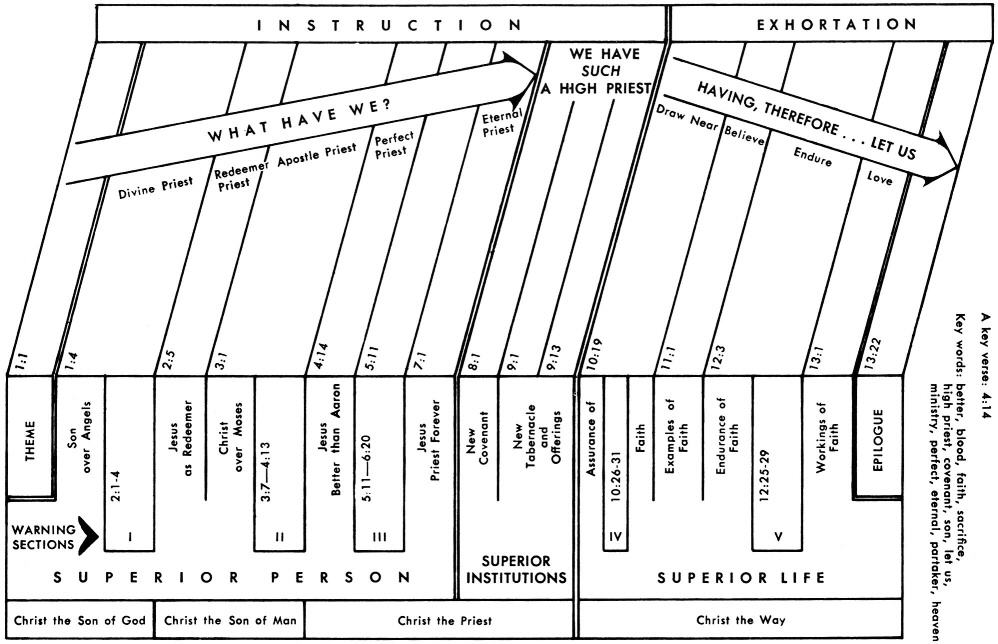
CONSIDER JESUS OUR GREAT HIGH PRIEST
Click chart to enlarge
Charts from Jensen's Survey of the NT - used by permission
Swindoll's Chart, Another Chart
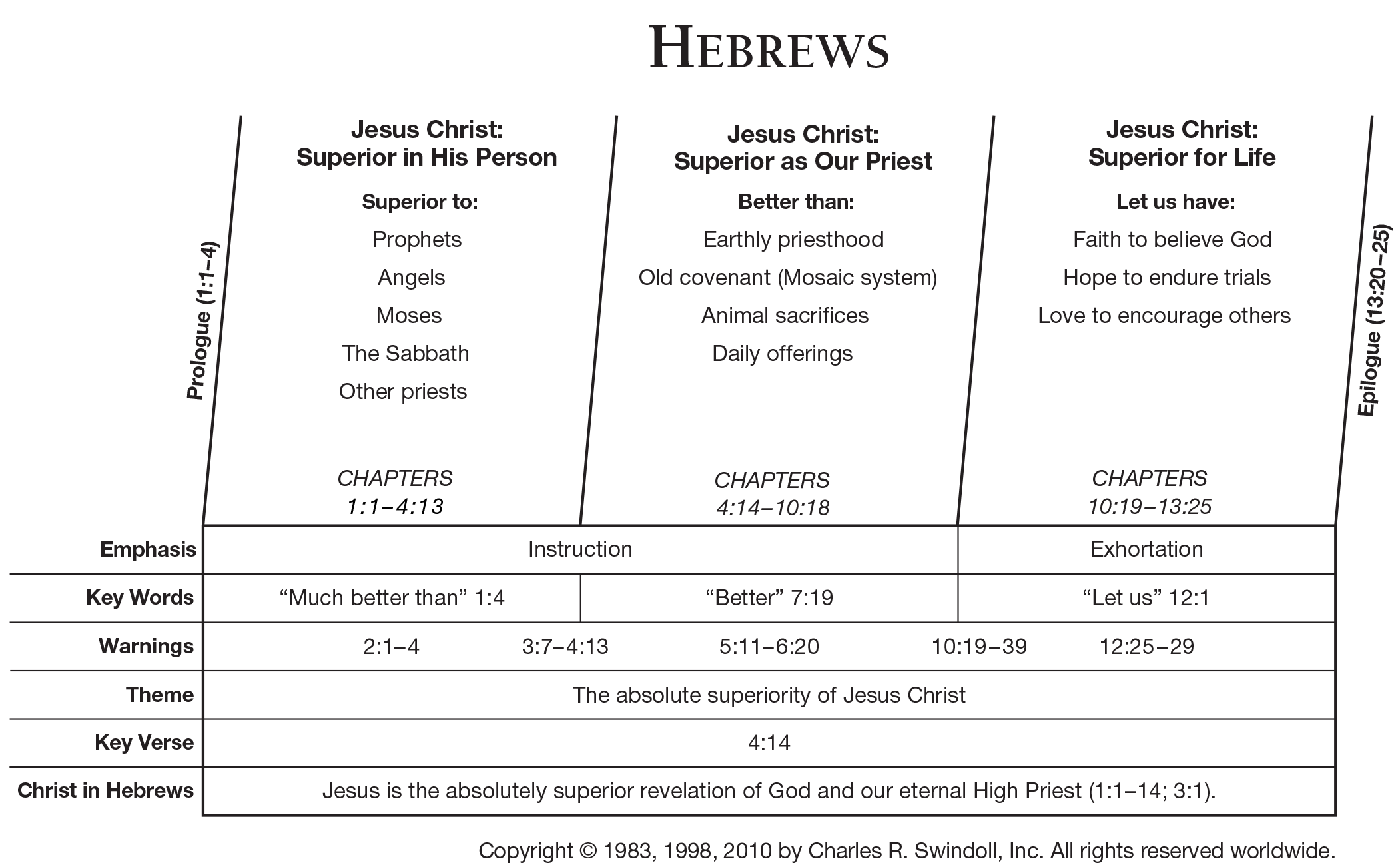
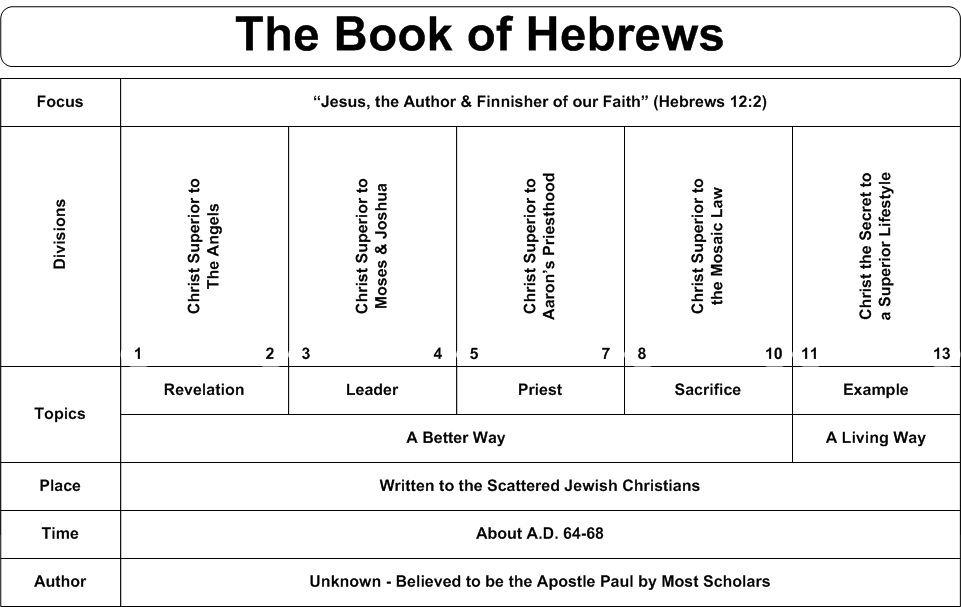
|
The Epistle |
||||
| INSTRUCTION Hebrews 1-10:18 |
EXHORTATION Hebrews 10:19-13:25 |
|||
| Superior Person of Christ Hebrews 1:1-4:13 |
Superior Priest in Christ Hebrews 4:14-10:18 |
Superior Life In Christ Hebrews 10:19-13:25 |
||
| BETTER THAN PERSON Hebrews 1:1-4:13 |
BETTER PRIESTHOOD Heb 4:14-7:28 |
BETTER COVENANT Heb 8:1-13 |
BETTER SACRIFICE Heb 9:1-10:18 |
BETTER LIFE |
| MAJESTY OF CHRIST |
MINISTRY OF CHRIST |
MINISTERS FOR CHRIST |
||
|
DOCTRINE |
DUTY |
|||
|
DATE WRITTEN: |
||||

See ESV Study Bible "Introduction to Hebrews"
(See also MacArthur's Introduction to Hebrews)
Borrow Ryrie Study Bible
See ESV Study Bible "Introduction to Hebrews"
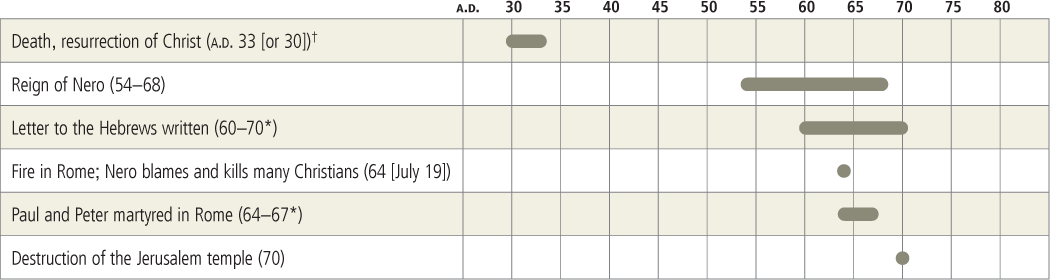
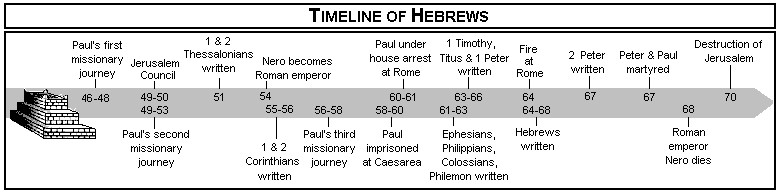
Timeline of Hebrews - ESV Study Bible
Hebrews 1:11 THEY WILL PERISH BUT THOU REMAIN AND THEY ALL WILL BECOME OLD LIKE A GARMENT, (NASB: Lockman)
Greek: autoi apolountai, (2SPAI) su de diameneis (2SPAI) ;kai pantes os himation palaiothesontai, (3PFPI)
Amplified: They will perish, but You remain and continue permanently; they will all grow old and wear out like a garment. ( (Amplified Bible - Lockman)
KJV: They shall perish; but thou remainest; and they all shall wax old as doth a garment;
Phillips: they will perish, but you remain; and they will all grow old like a garment; like a cloak you will fold them up, and they will be changed. (Phillips: Touchstone)
Wuest: They themselves shall perish, but as for you, you remain permanently. And all these shall become old and worn out as a garment.
Young's Literal: these shall perish, and Thou dost remain, and all, as a garment, shall become old,
- Will perish - Heb 12:27; Isa 34:4; 65:17; Mt 24:35; Mk 13:31; Lk 21:33; 2Pe 3:7, 3:8, 3:9, 3:10; Rev 20:11; 21:1
- You remain - Ps 10:16; 29:10; 90:2; Isa 41:4; 44:6; Rev 1:17, 1:18, 2:8
- Become old like a garment - Isa 50:9; 51:6, 51:8, 1Jn 2:17
- Hebrews 1:4-14 The Son's Superiority over Angels - Steven Cole
- Hebrews 1:4-14 The Nature of the Incarnation, Part 3 - John MacArthur
- Hebrews 1:7-14 Jesus Superior to Angels 2 - John MacArthur
- Study Questions for Hebrews - 5W/H questions for leading lessons
- Hebrews 1 Resources - Multiple Sermons and Commentaries
Related Passages:
Isaiah 34:4 And all the host of heaven will wear away, and the sky will be rolled up like a scroll. All their hosts will also wither away As a leaf withers from the vine, or as one withers from the fig tree.
Matthew 1:18 "For truly I say to you, until heaven and earth pass away, not the smallest letter or stroke shall pass away from the Law, until all is accomplished.
Matthew 24:35 (Mk 13:31) "Heaven and earth will pass away, but My words shall not pass away.
1 John 2:17 The world is passing away, and also its lusts; but the one who does the will of God lives forever.
Hebrews 13:8 Jesus Christ is the same yesterday and today and forever.
PROPHECY OF PERISHING CREATION
BUT PERSISTING CREATOR
THEY WILL PERISH (apollumi) BUT THOU REMAIN (diameno - present tense) - What/who is THEY? The nearest antecedent is earth and heavens, the works of Jesus' hands (Heb 1:10). This sets up a dramatic term of contrast (BUT). Earth and heaven will one day in the future perish which is an amazing thought. Jesus the Creator spoke a word to create everything (Heb 11:3), sustains it all by the word of His power (Heb 1:3) and will likely speak a word to uncreate everything. Think of the law of conservation of matter (or mass) which states that matter cannot be created or destroyed in an isolated system, only transformed (unless Jesus is in the equation!) Remain (diameno) in the present tense emphasizes the permanent (continual) existence of the Creator in stark contrast to His Creation! Clearly Jesus' omnipotence includes His power over all the physical laws that currently govern the universe (Heb 11:3).
. Everything around us changes,
but He will never change.
-- Warren Wiersbe
Raymond Brown - It is interesting to note that the first readers of this letter were reminded that, in a world characterized by change, they could be assured of the companionship of the changeless Lord Jesus Christ. The word must surely have come to them with encouraging assurance: Thou remainest. He is the same and his years will never end. This inspiring conviction not only comes at the beginning of the letter but is also asserted at its close. He is ‘the same yesterday and today and for ever’ (Hebrews 13:8). (BORROW The message of Hebrews : Christ Above All page 42)
Peter describes this "annihilation" of the universe
"But the day of the Lord will come like a thief, in which the heavens will pass away (parerchomai) with a roar and the elements will be destroyed with intense heat, and the earth and its works will be burned up. 11 Since all these things are to be destroyed (luo) in this way, what sort of people ought you to be in holy conduct and godliness, 12 looking for (prosdokao - present tense - See Vertical Vision) and hastening the coming of the day of God, because of which the heavens will be destroyed by burning, and the elements will melt with intense heat! 13 But according to His promise we are looking for new heavens and a new earth, in which righteousness dwells." (2Pe 3:10-13)
John describes this same event writing
"Then I saw a great white throne and Him who sat upon it, from whose presence earth and heaven fled away (PARALLELS Heb 1:11 and 2Pe 3:10), and (ou = ABSOLUTELY) no place was found for them (AKA TOTALLY DESTROYED)." (Rev 20:11)
After describing the Great White Throne Judgment, John goes on to describe the "re-creation"
Then (AFTER THE GREAT WHITE THRONE JUDGMENT) I saw a new heaven and a new earth; for the first heaven and the first earth passed away (PARALLELS Heb 1:11 and 2Pe 3:10), and there is no longer any sea. 2 And I saw the holy city, new Jerusalem, coming down out of heaven from God, made ready as a bride adorned for her husband.(Rev 21:1-2).
Here is the passage from Psalm 102 the writer is quoting...
Psalm 102:26 "Even they will perish, but Thou dost endure; And all of them will wear out like a garment; Like clothing Thou wilt change them, and they will be changed. (NAS)
Psalm 102:26 They shall perish, but thou remainest: and they all shall wax old as a garment; and as a vesture shalt thou fold them, and they shall be changed. (English translation of the Septuagint)
Spurgeon: They shall perish, but thou shalt endure. The power which made them shall dissolve them, even as the city of thy love was destroyed at Thy command; yet neither the ruined city nor the ruined earth can make a change in Thee, reverse Thy purpose, or diminish Thy glory. Thou standest when all things fall. Yea, all of them shall wax old like a garment; as a vesture shalt thou change them, and they shall be changed. Time impairs all things, the fashion becomes obsolete and passes away. The visible creation, which is like the garment of the invisible God, is waxing old and wearing out, and our great King is not so poor that he must always wear the same robes; He will ere long fold up the worlds and put them aside as worn out vestures, and He will array Himself in new attire, making a new heaven and a new earth wherein dwelleth righteousness (2Pe 3:13). How readily will all this be done. "Thou shalt change them and they shall be changed;" as in the creation so in the restoration, omnipotence shall work its way without hindrance.
The writer makes another comparison that highlights the instability of the created order including angels (although created angels [Col 1:16] have been made by the Son to be immortal - Lk 20:36, evil angels are not destroyed either but eternally punished - Mt 25:41) which contrasts with the intrinsic permanence and stability the Son and His throne. Christ is better than angels because He exists eternally (see related topic Immutable)
Hebrews 1:11 should shut the mouth of the godless, ignorant mockers who are "saying, “Where is the promise of His coming? For ever since the fathers fell asleep, all continues just as it was from the beginning of creation.” (2Pe 3:4) The mockers of the last days make what they erroneously regard as the fixed permanence of the universe to be the basis for their scoffing at Christ's coming, but the writer of Hebrews says ALL will not continue!
Spurgeon Since the Messiah is thus described as immutable and eternal He must be divine, and to deny the Godhead of the Saviour is a deadly error. Dr. Owen most comfortingly remarks:—Whatever our changes may be, inward or outward, yet Christ changing not, our eternal condition is secured, and relief provided against all present troubles and miseries. The immutability and eternity of Christ are the spring of our consolation and security in every condition. Such is the frailty of the nature of man, and such the perishing condition of all created things, that none can ever obtain the least stable consolation but what ariseth from an interest in the omnipotency, sovereignty, and eternity of Jesus Christ.
Thou Remainest
by Daniel Whittle
Thou remainest, blest Redeemer,
Lord of peace and Lord of strife,
Jesus, Savior, Lord forever,
Thou remainest, Christ, my life.Refrain
Thou remainest
Thou remainest
Thou remainest, Christ, my all;
Peace or conflict, joy or sorrow,
Thou remainest, Christ, my all.Satisfying every longing,
Of my sinful soul for grace;
From my weakness never turning,
Thou remainest, Christ, my peace.
RefrainOne by one my loved ones leave me,
Voices sweet no more be heard;
But of God naught can bereave me,
Thou remainest, Christ, my Lord.
RefrainWhen from earth, Thou, Lord, shalt call me,
Calm I’ll lay my burden down;
For I know, whate’er befall me,
Thou remainest, Christ, my crown.
Refrain
AND THEY ALL WILL BECOME OLD (palaioo) AS A GARMENT (himaton) - They all refers to the earth and heavens with no exceptions, not even a speck of dust! In the passive voice palaioo means to become old, to deteriorate and can include the idea of becoming useless. Garment (himaton) is the general word for garments and is used here as a metaphor (cf term of comparison = metaphor) to emphasize that like a garment becomes thread bare and useless, the universe is in the process of wearing out. So much for evolution! The real truth is devolution!
Wuest says the verb palaioo "means “to make ancient or old, to be worn out.” The idea here is not that the heavens will become old so far as lapse of time is concerned, but old in the sense of wearing out. The Greeks had a word for “old in point of lapsed time” namely, archaios (Hebrews Commentary)
And so the universe is not evolving, but in fact is wearing out or devolving. In thermodynamics, entropy is a measure of disorder, decay, or the tendency of systems to break down over time. The Second Law of Thermodynamics states that in a closed system, entropy always increases — things naturally move from order to disorder unless acted on by an outside force. Hebrews 1:11 is in effect a statement of "Biblical entropy," indicating that the created world is not eternal, but is wearing out just like physics says it should. While creation experiences increasing entropy, Christ is not subject to decay, change, or breakdown. Or to say it scientifically "Christ experiences zero entropy!" Jesus is the unchanging constant in a universe that’s unraveling. He is not only outside of time, but is also outside of decay.
It is interesting to note that the derivation (etymology) of our word "world" (Old English = woruld / weorold. A compound of: wer = man +ald / eald = age, life, or old). Put in plain English the word “world” originally meant “Age of man” or “the life or age of humanity.” In other words world referred to the temporal human existence, the span of human life, rather than the physical planet.
F B Meyer - Granite rocks and stars of light shall fulfil their purpose and be laid aside as worn-out robes when He speaks their concluded mission (Rev 21:5). But Jehovah-Jesus will ever be unchangeably the same, able to summon new creations into being with a word. (Gems From the Psalms)
Perish (622) (apollumi from apo = away from + olethros = state of utter ruin <> from ollumi = to destroy) is a strengthened form of ollumi with the preposition apó conveying the sense of separation away from and thus the idea is wholly or fully destroy. Destroy utterly or fully perish, lay waste, disintegrate.
APOLLUMI - 86V ONLY ONE USE IN HEBREWS - Matt. 2:13; Matt. 5:29; Matt. 8:25; Matt. 9:17; Matt. 10:6; Matt. 10:28; Matt. 10:39; Matt. 10:42; Matt. 12:14; Matt. 15:24; Matt. 16:25; Matt. 18:11; Matt. 18:14; Matt. 21:41; Matt. 22:7; Matt. 26:52; Matt. 27:20; Mk. 1:24; Mk. 2:22; Mk. 3:6; Mk. 4:38; Mk. 8:35; Mk. 9:22; Mk. 9:41; Mk. 11:18; Mk. 12:9; Lk. 4:34; Lk. 5:37; Lk. 6:9; Lk. 8:24; Lk. 9:24; Lk. 9:25; Lk. 9:56; Lk. 11:51; Lk. 13:3; Lk. 13:5; Lk. 13:33; Lk. 15:4; Lk. 15:6; Lk. 15:8; Lk. 15:9; Lk. 15:17; Lk. 15:24; Lk. 15:32; Lk. 17:27; Lk. 17:29; Lk. 17:33; Lk. 19:10; Lk. 19:47; Lk. 20:16; Lk. 21:18; Jn. 3:16; Jn. 6:12; Jn. 6:27; Jn. 6:39; Jn. 10:10; Jn. 10:28; Jn. 11:50; Jn. 12:25; Jn. 17:12; Jn. 18:9; Acts 5:37; Acts 27:34; Rom. 2:12; Rom. 14:15; 1 Co. 1:18; 1 Co. 1:19; 1 Co. 8:11; 1 Co. 10:9; 1 Co. 10:10; 1 Co. 12:23; 1 Co. 15:18; 2 Co. 2:15; 2 Co. 4:3; 2 Co. 4:9; 2 Thess. 2:10; Heb. 1:11; Jas. 1:11; Jas. 4:12; 1 Pet. 1:7; 2 Pet. 3:6; 2 Pet. 3:9; 2 Jn. 1:8; Jude 1:5; Jude 1:11; Rev. 18:14
Remain (1265) (diameno from dia = intensifies meaning + meno = to remain or abide) means to remain permanently or to continue in the same place or condition (cf Lk 1:22). When diameno is used to describe people it means to remain constant or to stand by (as those did with Jesus in Lk 22:28). It is used to describe a circumstance, state or condition that continues and thus remains the same (2Pet 3:4). Here in Hebrews the idea is that it continues to exist. It is used figuratively of the gospel continuing in association with the Galatians.
DIAMENO - 5X/5V -
Luke 1:22 But when he came out, he was unable to speak to them; and they realized that he had seen a vision in the temple; and he kept making signs to them, and remained mute.
Luke 22:28 "And you are those who have stood by Me in My trials;
Galatians 2:5 But we did not yield in subjection to them for even an hour, so that the truth of the gospel might remain with you.
Hebrews 1:11 They will perish, but Thou remainest; and they all will become old as a garment,
2 Peter 3:4 and saying, "Where is the promise of His coming? For ever since the fathers fell asleep, all continues just as it was from the beginning of creation."
DIAMENO - 11V IN Septuagint (LXX) Ps. 5:5; Ps. 19:9; Ps. 61:7; Ps. 72:17; Ps. 102:26; Ps. 119:89; Ps. 119:90; Ps. 119:91; Jer. 3:5; Jer. 32:14 and below are several uses…
Psalm 5:5 The boastful shall not stand (Heb = yatsab = set or station oneself; Lxx = diameno) before Thine eyes; Thou dost hate all who do iniquity.
Psalm 19:9 The fear of the LORD is clean, enduring (Heb = amad = to takes ones stand; Lxx = diameno) forever; The judgments of the LORD are true; they are righteous altogether.
Psalm 61:7 He will abide (Heb = yashab = sit, remain; Lxx = diameno) before God forever; Appoint lovingkindness and truth, that they may preserve him.
Psalm 119:89 Forever, O LORD, Thy word is settled (Heb = natsab = to take one's stand, to appoint, to erect; Lxx = diameno) in heaven.
Spurgeon: The strain is more joyful, for experience has given the sweet singer a comfortable knowledge of the word of the Lord, and this makes a glad theme. After tossing about on a sea of trouble the Psalmist here leaps to shore and stands upon a rock. Jehovah's word is not fickle nor uncertain; it is settled, determined, fixed, sure, immovable. Man's teachings change so often that there is never time for them to be settled; but the Lord's word is from of old the same, and will remain unchanged eternally. Some men are never happier than when they are unsettling everything and everybody; but God's mind is not with them. The power and glory of heaven have confirmed each sentence which the mouth of the Lord has spoken, and so confirmed it that to all eternity it must stand the same, -- settled in heaven, where nothing can reach it.
Will become old (3822) (palaioo from palaios = old not in point of time but old in terms of use, thus "worn out", antiquated, useless, outmoded; English "paleontology," etc.) when used in the active sense means to make old, to declare or treat as obsolete (as the Old Covenant which is caused to become old and obsolete, and hence no longer valid - Heb 8:13).
NIDNTT notes that palaioo is derived from "palaios (also from Homer onwards) is commonly used in secular Gk. meaning old: (a) positively as existing for a long time and hence venerable; (b) negatively as obsolete, worn out, and hence worthless, unusable (cf. Soph., Oedipus Rex 290, etc.). Often archaios, original, venerable, is used in the same sense, but almost always positively. palaioo (from Plato onwards) is found only in the passive in secular Greek… By giving mankind and the whole creation over to decay and corruption God passes judgment on the sin and fall of mankind (Isa. 51:6; Ps 102:26). (See 3 page article in New International Dictionary of NT Theology)
Here are the 3 uses of palaioo in the NT…
Luke 12:33 "Sell your possessions and give to charity; make yourselves purses which do not wear out, an unfailing treasure in heaven, where no thief comes near, nor moth destroys.
Hebrews 1:11 They will perish, but Thou remainest; And they all will become old as a garment,
Hebrews 8:13 When He said, "A new covenant," He has made the first obsolete. But whatever is becoming obsolete (palaioo) and growing old (gerasko) is ready to disappear.
Comment: This is entirely God’s work. Seeing that God in Christ makes a new covenant, the old covenant of the law has become obsolete. In Christ the first can be regarded only as old and fulfilled [2 Cor. 3:14]. Indeed, it may be said that the NT speaks of the old only from the standpoint of the new and for the sake of the new.
There are 22 uses of palaioo in the non-apocryphal Septuagint (LXX) (Lev. 13:11; Deut. 29:5; Jos. 9:5, 13; Neh. 9:21; Job 9:5; 13:28; 14:18; 21:7; 32:15; Ps. 6:7; 18:45; 32:3; 49:14; 102:26; Isa. 50:9; 51:6; 65:22; Lam. 3:4; Ezek. 47:12; Dan. 7:25; 11:33)
Deuteronomy 29:5 "And I have led you forty years in the wilderness; your clothes have not worn out (Heb = balah; to become old; Lxx = palaioo) on you, and your sandal has not worn out on your foot.
Psalm 32:3 When I kept silent about my sin, my body wasted away (Heb = balah = figuratively because of guilt he grew old, wasting away - Dear brother or sister, is there a secret sin you need to confess so that you might not waste away and become a dishonorable vessel, useless to the Lord?; Lxx = palaioo) Through my groaning all day long.
TDNT says that in the Septuagint (LXX) "the verb palaioo,… denotes the uselessness of worn-out things, and figuratively the transitoriness of creaturely life (cf. Ps. 32:3; Ge 8:12; Job 21:13; Isa 65:22)
Garment (cloak) (2440) himation describes a garment of any sort, but especially an outer garment and in the plural (ta himatia) for clothes in general. In contrast the Greek word chitin refers to the garment worn under the outer cloak. The himation was something thrown over the inner tunic (chitin) and in secular Greek was sometimes used for the Roman toga. The outer garments were often laid aside (Mt. 21:7, 8; Acts 7:58; 22:20; Ex. 22:26, 27: 1Sa 21:9; Is. 3:6, 7). The smell of garments deceived Isaac into believing it was Esau rather than Jacob (the deceiver) (Ge 27:27) Himation is used figuratively of the "clothing" of the created heavens (Ps 102:26, Heb 1:11-12). Joseph's loose outer garment saved him from the clutches of Potiphar's wife (Ge 39:12-13) but ironically were the evidence to substantiate her false accusation (Ge 39:18). The prophet Joel says "rend your heart and not your garments." Now return to the LORD your God, For He is gracious and compassionate, Slow to anger, abounding in lovingkindness, And relenting of evil." (Joel 2:13)
HIMATION - 58V - Used only twice in Hebrews - Heb 1:11, 12.
Adrian Rogers on eternality of Jesus (See full sermon Our Superlative Savior - page 16) - Now His eternal claim is that He is God. Jesus is forevermore God. A billion, billion years from now, He’ll still be God. Look at this verse: “Unto the Son he saith, Thy throne, O God, is for ever and ever and ever and ever.” Things change. This universe is going to wear itself out. This universe is going to run down.
Now the evolutionists like to tell us it’s on its way up, but the second law of thermodynamics tells us that it’s on its way down. It is burning out. And that’s the one thing of irrefutable proof against evolution: that this world is wearing out; it is burning down. Look, if you will, in verse 10: “And, Thou, Lord, in the beginning”—you, Jesus—“hast laid the foundation of the earth; and the heavens are the work of thine hands:”—Jesus made it all. But now notice verse 11—“they shall perish; but thou remainest; and they all shall wax old as doth a garment; and as a vesture shalt thou fold them up, and they shall be changed: but thou art the same, and thy years shall not fail” (Hebrews 1:10–11). I’m talking about His eternal claim.
I want to tell you, dear friend, that anything that moves makes friction. That’s true in the church, isn’t it? When a church grows, we have growing pains. Anything that moves makes friction, and anything that makes friction wears, and anything that wears disintegrates. And that’s the reason that this universe that is moving and wearing and pulsating is wearing down, is wearing down like a garment that wears out. Its going to wear out. But Jesus is from everlasting to everlasting. A billion years from now Jesus is the same from age to age; the same as Martin Luther said in that song, “A Mighty Fortress is our God”: “From age to age the same.”
I was reading that the sun is burning energy at the rate of 4,200,000 tons of heat per second. Listen to that statistic: 4,200,000 tons of heat per second. That means, in a few billion years, it’ll burn out. That ought to have you concerned. A college student was sitting in class and he heard a lecture like that. He was kind of dozing, and he said, “Pardon me, professor, what did you say?” He said, “In a few billion years the sun will burn out.” “Oh,” he said, “you scared me. I thought you said a few million.”
Well, friend, whether its a few billion, or a few million, it’s all going to wear out; it’s all burning out, it’s all disintegrating. But Jesus Christ, our dear Savior, will go on deathless, ageless, changeless, from age to age the same. Look at His eternal claim; look at it again: “But unto the Son he saith, Thy throne, O God, is for ever and ever.” Oh, friend, you’d better get linked up with that. You’d better get linked up with that. Things are changing, things come and go, but Christ is on the throne. He lives, He rules, He reigns. This, dear friend, is the declaration—the declaration—of His superiority.
Oh, see His superior name. See, dear friend, His eternal claim—that Jesus is God. There is no other way. Dr. Robert G. Lee loved the Lord Jesus. He was a great pastor of this church. Dr. Lee said that Jesus is literature’s loftiest ideal. He said that Jesus is philosophy’s highest personality, theology’s fundamental doctrine, spirituality’s greatest and most supreme problem, religion’s cardinal necessity.
Streams in the Desert - “Thou remainest.” (Heb. 1:11.)
THERE are always lone hearth-fires; so many! And those who sit beside them, with the empty chair, cannot restrain the tears that will come. One sits alone so much. There is some One unseen, just here within reach. But somehow we don’t realize His presence. Realizing is blessed, but—rare. It belongs to the mood, to the feelings. It is dependent on weather conditions and bodily conditions. The rain, the heavy fog outside, the poor sleep, the twinging pain, these make one’s mood so much, they seem to blur out the realizing. But there is something a little higher up than realizing. It is yet more blessed. It is independent of these outer conditions, it is something that abides. It is this: recognizing that Presence unseen, so wondrous and quieting, so soothing and calming and warming. Recognize His presence—the Master’s own. He is here, close by; His presence is real. Recognizing will help realizing, too, but it never depends on it. Aye, more, immensely more, the Truth is a Presence, not a thing, a fact, a statement. Some One is present, a warm-hearted Friend, an all-powerful Lord. And this is the joyful truth for weeping hearts everywhere, whatever be the hand that has drawn the tears; by whatever stream it be that your weeping willow is planted.
—S. D. Gordon.
When from my life the old-time joys have vanished,
Treasures once mine, I may no longer claim,
This truth may feed my hungry heart, and famished:
Lord, THOU REMAINEST! THOU art still the same!
When streams have dried, those streams of glad refreshing—
Friendships so blest, so rich, so free;
When sun-kissed skies give place to clouds depressing,
Lord, THOU REMAINEST! Still my heart hath THEE.
When strength hath failed, and feet, now worn and weary,
On gladsome errands may no longer go,
Why should I sigh, or let the days be dreary?
Lord, THOU REMAINEST! Could’st Thou more bestow?
Thus through life’s days—whoe’er or what may fail me,
Friends, friendships, joys, in small or great degree,
Songs may be mine, no sadness need assail me,
Lord, THOU REMAINEST! Still my heart hath THEE.
—J. Danson Smith.
Hebrews 1:12 AND LIKE A MANTLE YOU WILL ROLL THEM UP. LIKE A GARMENT THEY WILL ALSO BE CHANGED. BUT YOU ARE THE SAME, AND YOUR YEARS WILL NOT COME TO AN END. (NASB: Lockman)
Greek: kai hosei peribolaion helixeis (2SPAI) autous, os himation kai allagesontai (3PFPI) su de o autos ei (2SPAI) kai ta ete sou ouk ekleipsousin. (3PFAI)
BGT καὶ ὡσεὶ περιβόλαιον ἑλίξεις αὐτούς, ὡς ἱμάτιον καὶ ἀλλαγήσονται· σὺ δὲ ὁ αὐτὸς εἶ καὶ τὰ ἔτη σου οὐκ ἐκλείψουσιν.
Amplified: Like a mantle [thrown about one’s self] You will roll them up, and they will be changed and replaced by others. But You remain the same, and Your years will never end nor come to failure. [Ps. 102:25-27] ( (Amplified Bible - Lockman)
KJV: And as a vesture shalt thou fold them up, and they shall be changed: but thou art the same, and thy years shall not fail.
NKJ Like a cloak You will fold them up, And they will be changed. But You are the same, And Your years will not fail."
Phillips: like a cloak you will fold them up, and they will be changed. But you are the same, and your years will not fail' . (Phillips: Touchstone)
Wuest: And as a garment which one throws about oneself you will roll them up; as a garment also shall they be changed. But as for you, you are the same, and your years shall have no termination
Young's Literal: and as a mantle Thou shall roll them together, and they shall be changed, and Thou art the same, and Thy years shall not fail.'
NET and like a robe you will fold them up and like a garment they will be changed, but you are the same and your years will never run out."
CSB You will roll them up like a cloak, and they will be changed like a robe. But You are the same, and Your years will never end.
ESV like a robe you will roll them up, like a garment they will be changed. But you are the same, and your years will have no end."
NIV You will roll them up like a robe; like a garment they will be changed. But you remain the same, and your years will never end."
NLT You will fold them up like a cloak and discard them like old clothing. But you are always the same; you will live forever."
MIT Like a robe you will crumple them up. And like a garment they will be changed. Yet you are the same, Your years do not expire.
NJB Like a cloak you will roll them up, like a garment, and they will be changed. But you never alter and your years are unending.
NRS like a cloak you will roll them up, and like clothing they will be changed. But you are the same, and your years will never end."
RSV like a mantle thou wilt roll them up, and they will be changed. But thou art the same, and thy years will never end."
NAB You will roll them up like a cloak, and like a garment they will be changed. But you are the same, and your years will have no end."
GWN They will be taken off like a coat. You will change them like clothes. But you remain the same, and your life will never end.
BBE They will be rolled up like a cloth, even like a robe, and they will be changed: but you are the same and your years will have no end.
ASV And as a mantle shalt thou roll them up, As a garment, and they shall be changed: But thou art the same, And thy years shall not fail.
- But you are the same - Heb 13:8; Ex 3:14; Jn 8:58; Jas 1:17, Ps 90:4
- And your years - Isa 46:4; Mal 3:6
- Hebrews 1:4-14 The Son's Superiority over Angels - Steven Cole
- Hebrews 1:4-14 The Nature of the Incarnation, Part 3 - John MacArthur
- Hebrews 1:7-14 Jesus Superior to Angels 2 - John MacArthur
- Hebrews 1 Resources - Multiple Sermons and Commentaries
Related Passages:
1 Samuel 15:29 “Also the Glory of Israel will not lie or change His mind; for He is not a man that He should change His mind.”
Isaiah 46:4 Even to your old age I will be the same, And even to your graying years I will bear you! I have done it, and I will carry you; And I will bear you and I will deliver you.
Malachi 3:6 “For I, the LORD, do not change; therefore you, O sons of Jacob, are not consumed.
FOLDING UP THE HEAVENS
JESUS REMAINS THE SAME
AND LIKE A MANTLE (peribolaion) YOU WILL ROLL THEM UP (helisso) LIKE A GARMENT (himation) THEY WILL ALSO BE CHANGED (allasso) - Note two terms of comparison, specifically similes (LIKE...LIKE), which help picture what will happen to the earth and heavens. Like a mantle is a comparison which depicts one rolling up creation when the Son ends their current use. As easily as someone changes from one cloak for another, so the Son will change one order of creation for another. CHANGED (allasso) pictures changing one thing for another, in this case changing from a "worn garment" to a brand new garment, a "new heaven and new earth." (Rev 21:1)
Creation is like an old garment, which will one day
be discarded in favor of a new one.
-- Warren Wiersbe
Leon Morris - This universe that seems so solid and permanent will be rolled up, changed, and replaced by a totally new heaven and earth. But through it all the Son remains unchanged. Our years come to an end, but his will never do so.
William MacDonald - Though the sun, moon, stars, mountains, oceans, and rivers appear to be enduring, the truth is that they have built-in obsolescence. The psalmist likens them to a garment: first, it becomes worn out; then it is folded up as unusable; then it is changed for something better. Look out upon a range of snow-capped mountains, upon a glorious sunset, upon a star-studded sky. Then hear the majestic cadence of these words: Like a cloak You will fold them up, and they will be changed. But You are the same, and Your years will not fail. (BORROW Believer's Bible Commentary)
A T Robertson on mantle (peribolaion) - Old word for covering from pariballō (peri - around + ballo - throw), to fling around, as a veil in 1Co 11:15, nowhere else in N.T. ROLL UP (helixeis). Future active of helisso, late form for heilissō, in NT only here and Rev. 6:14, to fold together
The visible universe with all its laws that scientists bank on so heavily to be unchanging
is like a shirt compared to God: it was put on at creation,
and it will be taken off when God is through with it.
--John Piper
In the Revelation John has a similar description - "And the sky was split apart like a scroll when it is rolled up; and every mountain and island were moved out of their places." (Rev 6:14)
James Girdwood - When this universe has outlived its purpose, Jesus will bring it to an end. Only God and those who are his will remain.
John MacArthur comments that "During the Tribulation, as if the heavens were to be stretched to the limit and the corners then cut, they will roll up just like a scroll. The stars are going to fall, come crashing down to earth, and every island and mountain will move out of its place. The whole world will fall apart. (See Hebrews Commentary - Page 35)
Spurgeon - Time impairs all things; the fashion becomes obsolete and passes away. The visible creation, which is like the garment of the invisible God, is becoming old and wearing out, and our great King is not so poor that He must always wear the same robes. Before long, He will fold up the worlds and put them aside as worn out vestures, and He will array Himself in new attire, making a new heaven and a new earth wherein righteousness dwells. How readily will all this be done. “You will replace them like clothing, and they will be set aside” (Psa 102:26). As in the creation so in the restoration, omnipotence shall work its way without hindrance.
🙏 THOUGHT - Like Peter warned the scoffers all of us are naturally tempted to think that “all continues just as it was from the beginning of creation” (2Pe 3:4). Ask God to give you a vision of the transitory, passing nature of this present age, so that you may redeem each day and order each step wisely, knowing that you are bound for eternity which shall not pass away.
Only one life
Twill soon pass
Only what's done
In Christ will last
Life Application comments - That the earth and the heavens will be "folded up" reveals that the earth is not permanent or indestructible (a position held by many Greek and Roman philosophies). God placed Jesus in authority over all of creation, so we dare not treat any created object or earthly resource as more important than He is. When we spend more time on ourselves than on serving Christ, we treat ourselves (His creation) as being more important than our Creator. When we regard our finances, rather than our faith in Christ, as the basis for security, we give higher status to an earthly resource than we do to God. Rather than trusting in changeable and temporary resources, trust in God, Who is eternal. (See Hebrews)
Philip E Hughes sums up writing - How inescapable, once again, is the contrast between the Son and the angels! He is the Lord God; they offer him worship and homage. He is the Creator; they are his creatures. He is infinite in being and power; they are finite and dependent. Though all else should pass away, he remains, “the same yesterday and today and forever” (Heb. 13:8). (A Commentary on the Epistle to the Hebrews - Page 68)
F B Meyer - "We live in a world of change. The earth is not the same today as it was ages ago, or as it will be ages on. The sun is radiating off its heat. The moon no longer as of yore burns and glows; she is but an immense opaque cinder, reflecting the sunlight from her disk. Stars have burnt out, and will. The universe is waxing old, as garments which from perpetual use become threadbare. But the wearing out of the garment is no proof of the waning strength or slackening energy of the wearer. Nay, when garments wear out quickest, it is generally the time of robustest youth or manhood. You wrap up and lay aside your clothes when they have served their purpose; but you are the same in the new suit as in the old. Creation is the vesture of Christ. He wraps himself about in its ample folds. Its decay affects him not. And, when he shall have laid it all aside, and replaced it by the new heavens and the new earth, he will be the same forevermore."
BUT (term of contrast) YOU ARE (present tense - continually, always) THE SAME, AND YOUR YEARS WILL NOT COME TO AN END (ekleipo) - Sharp contrast between THEY in Heb 1:11 and THOU (YOU). YOU in context refers to Jesus. This passage highlights the immutability (attribute = immutable) and eternality (attribute = eternal) of Jesus the Creator and Sustainer. Lenski "He who was before creation will be the same after heaven and earth perish."
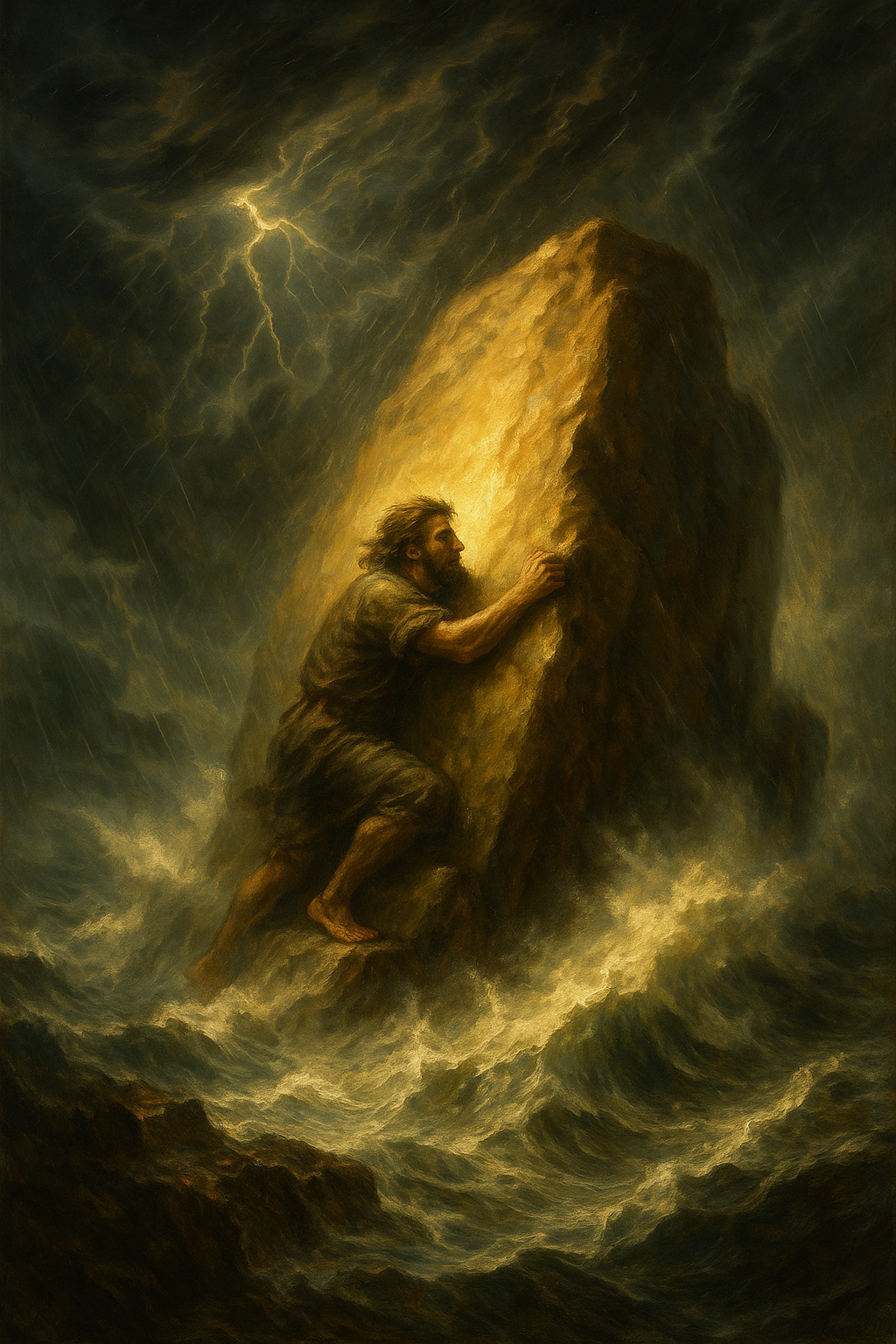
Our Rock Remains the Same
🙏 THOUGHT - Jesus continually being THE SAME speaks of the Son's stability, sovereignty and steadfastness. One is reminded that in Heb 12:28 believers "receive a kingdom which cannot be shaken" which should stimulate in us gratitude and acceptable worship of God. My life is shaken as I write this note, for my oldest daughter has chosen to go once again into the domain of darkness of illicit drug use and this time I truly fear for her life. And yet when I read of the stability of our great High Priest Who understands our trials (cf Heb 4:15), it gives me peace, regardless of the outcome. THE SAME Jesus who calmed storms and raised the dead is still ruling and still interceding for us (Heb. 7:25). He is THE SAME One Who promised "lo, I am with you always, even to the end of the age.” (Mt 28:20) I am not alone in this deep dark trial and you are not either beloved child of the King! The writer reminds us we have a hope which is like "an anchor of the soul, a hope both sure and steadfast and one which enters within the veil." (Hebrews 6:19) Hang on to that hope, for it is not a hope so, but a hope sure! Friends, finances, health, emotions all can fluctuate, but Jesus remains THE SAME! Is your faith running low? Take courage for Paul reminds us "If we are faithless, He remains faithful." (2Ti 1:13). Sing or play "Be Still My Soul" especially the words “In every change, He FAITHFUL REMAIN” because He is THE SAME! Play this song He Will Hold Me Fast
Jesus Christ is the same
yesterday and today, yes and forever.
-- Hebrews 13:8
R Kent Hughes adds "In contrast, angels, because they are created, are temporal (though Christ has apparently willed to keep them immortal) and changeable and dependent. To the suffering Jewish believers who first heard these words, these sure words about Christ must have felt like refreshing rain. Their world was not only changing—it was falling apart. But their superior Christ remained the same—eternal and unchanging—"Jesus Christ is the same yesterday and today and forever" (Hebrews 13:8). (See Hebrews: An Anchor for the Soul)
Abide with Me
“Change and decay in all around I see,
O Thou Who changest not, abide with me.”
-- Henry Lyte
Wuest makes an interesting statement that I cannot entirely substantiate from other Scriptures that "The angels, being part of the Son’s creation, are as subject to change and decay as are the heavens. He, the changeless One, is therefore superior to them." (Commentary)
John MacArthur seems to support Wuest's conclusion, observing that "Angels were subjected to decay, as their fall proves." (See Hebrews Commentary - Page 36)
John Piper asks "In What Sense Is Jesus Always the Same? Does it mean that Jesus can’t respond with joy over your situation one day and grieve over it the next day? Would that contradict the statement that Jesus is the same yesterday and today?...His sameness is the sameness of God. His unchangingness is the unchangingness of God. The visible universe with all its laws that scientists bank on so heavily to be unchanging is like a shirt compared to God: it was put on at creation, and it will be taken off when God is through with it. So what the world regards as the baseline of stability is not. God is. And Jesus Christ is God....God’s changes are not like man’s changes. Changing for God is from one situation to another, but not the kind of changing a human mind would do. God is not man to change like man changes. A man can look with joy on a person and on a situation one day and look with disapproval on that person and the new situation the next day. So can God. He rejoices over a person’s behavior one day and may grieve over it the next day. So His mind changes. So what is the difference? Man brings to every situation limitations that God does not bring. The most relevant one is that man brings finiteness and lack of knowledge....In sum, then, in answer to our first question: “Jesus Christ is the same yesterday, today and forever” does not mean that Christ can’t respond differently from day to day, rejoicing with you or over you one day and grieving with you or over you another day. Hebrews 4:15 calls him a “sympathizing High Priest.” He can and does respond differently to our different circumstances. But now we see that not only are those responses rooted in a consistent character of love and wisdom and righteousness and power, but also in a perfect knowledge and plan so that he never changes his mind because of unforeseen circumstances. He is the same in his perfect foreknowledge and his perfect plan and his perfect execution of that plan in all the details of your life to bring about his glorious goal for all his children. (See full sermon)
Great is Thy Faithfulness
“Thou changest not, Thy compassions, they fail not;
As Thou hast been, Thou forever wilt be.”
- Thomas Chisholm
Jesus Himself testified of His eternal existence (and pre-existence before Moses) saying to the Jews "Truly, truly (Amen, Amen), I say to you, before Abraham was born, I am (present tense = I continually am!). (Jn 8:58) Jesus' Jewish audience clearly knew that He was making the claim of being God and they responded to what they interpreted as blasphemy "Therefore they picked up stones to throw at Him; but Jesus hid Himself, and went out of the temple. (Jn 8:59) This is a very instructive passage regarding the concept of faith or belief in the NT. Go back up to the beginning of this section in John 8:30-31 and observe how John describes them. What does this section teach about genuine saving belief?
O God, Our Help in Ages Past
“A thousand ages in Thy sight
are like an evening gone…”
-- Isaac Watts
Although His creation is now decaying, the Creator and His Word remain the same forever.
Nature is at His mercy,
Not He at nature's
Steven Cole applies this truth - To this Jewish church, these words were not just a theological statement about Jesus’ superiority to the angels. They were also meant to be a source of great comfort in the midst of trials. The same eternal Creator who sustained the psalmist in the midst of his calamity would sustain them in the midst of their troubles. And that eternal Creator is none other than their Lord and Savior, Jesus Christ! He is the same yesterday, today, and forever (Heb 13:8). Even if you are taken away in the midst of your days, you have a lasting refuge in the eternal, unchanging Lord Jesus Christ! (The Son's Superiority over Angels)
My Hope is Built on Nothing Less
“When all around my soul gives way,
He then is all my hope and stay.”
– Edward Mote
Spurgeon - Jesus Christ is the same yesterday, today, and forever (Heb 13:8). As a man remains the same when he has changed his clothing, so is the Lord evermore the unchanging One, though His works in creation may be changed, and the operations of His providence may vary. When heaven and earth shall flee away from the dread presence of the great Judge, He will be unaltered by the terrible confusion, and the world in conflagration will effect no change in Him. Since the Messiah is thus described as immutable and eternal, He must be divine, and to deny the Godhead of the Savior is a deadly error. Dr. Owen most comfortingly remarks: “Whatever our changes may be, inward or outward, yet Christ changing not, our eternal condition is secured, and relief provided against all present troubles and miseries. The immutability and eternity of Christ are the spring of our consolation and security in every condition. Such is the frailty of the nature of man, and such the perishing condition of all created things, that none can ever obtain the least stable consolation but what arises from an interest in the omnipotency, sovereignty, and eternity of Jesus Christ.” (Gracegems)
Changed (236) (allasso from állos = another numerically but of the same kind Acts 4.12, contrasted with heteros another of a different kind) has the literally meaning of to make otherwise. The basic sense is “to make other than it is." It means to to change, to cause one thing to cease and another to take its place, to exchange one thing for another. To make something different. To alter. Allasso is used 6 times in the NT - Acts 6:14 (Stephen accused of changing the customs of the law); Ro 1:23 (exchanged the glory of the incorruptible God for an image in the form of corruptible man and of birds and four-footed animals and crawling creatures); 1Co 15:51, 52 (speaking of our future "change" of our bodies, exchanging "earth suits" for "heavenly suits"! = glorification); Gal 4:20 (change tone of speaking); Heb 1:12 (speaking of changing of creation as we now know it for "the heavens will be destroyed by burning, and the elements will melt with intense heat!" 2 Peter 3:12 and be followed by a "a new heaven and a new earth; for the first heaven and the first earth passed away." Rev 21:1).. In the Septuagint allassō describes Laban’s “changing” of Jacob’s wages (Ge 31:7), or of someone’s changing clothes (Ge 35:2, note the cultic significance, cf. Ge 41:14). The Hebrew of Ex 13:13 suggests allassō denotes “exchange” in the sense of “redeem” (cf. Lev 27:27). Apostate Israel exchanged their glory for idols (Jer 2:11; cf. Ps 106:20)
ALLASSO - 6V - alter(1), change(1), changed(3), exchanged(1). Acts 6:14; Rom. 1:23; 1 Co. 15:51; 1 Co. 15:52; Gal. 4:20; Heb. 1:12
Come to an end (fail)(1587) ekleipo from ek = out or an intens. + leípō = to fail, to leave out or off) means to leave out, leave off, by implication to cease. Transitive = to relinquish, desert. Intransitive = to leave off, to fail, cease (Lk 22:32; Heb. 1:12 quoting Ps 102:27) BDAG has (1) to be no longer in existence, fail, give out, be gone of money (2). to go away from a place, depart - some manuscripts have ekleipo in Acts 18:19 but not in the more reliable like Nestle-Aland. (3). to cease as state or event, fail, die out - of faith (Lk 22:32) In classical Greek applications of ekleipō meant “to abandon a responsibility or a thing,” consequently, “to desert an army or abandon a city.” Figuratively, the sun might “eclipse”; someone might “fail,” “faint,” or even “die.” In the Septuagint ekleipo can mean - to forsake, to desert = Jdg 5:6; to die = Ge 49:33; to faint = Ge 25:29; to cease = Ge 18:11; to fail = Ge 25:8; to remain, to be left = 2 Ki 7:13; Pr 24:31 = forsaken, destitute for "thorns". Water “evaporates” or is used up (Ge 8:13; 21:15); a number of things do or do not “cease” (Exodus 13:22; Isa 7:8; 54:10); travelers “abandon” highways (Jdg 5:6). People “die” (Jer 42:17; 44:18).
EKLEIPO - 4V - come to an end(1), fail(1), fails(1), obscured(1). Lk. 16:9; Lk. 22:32; Lk. 23:45; Heb. 1:12
F B Meyer in Our Daily Homily - Thou are the same.
Thou art the same, when contrasted with nature. — The solid bases of the hills were laid in their sockets by thy hands. The blue tapestry of the sky was woven by thy fingers; and it is as easy for Thee to lay it aside and substitute new heavens as for us to lay aside a worn-out dress and take another. And as the change of dress does not affect the nature of the wearer, neither will all the changes of creation or nature affect the power of thine hand or the tenderness of thy heart. Thou art the same!
Thou art the same, when contrasted with men. — They come and go. The great ones of the past — Abraham, Moses, David, Elijah — stood with Thee for a moment on the earth, and then passed into the great silence. Augustine, Luther, Calvin, Knox, wrought for Thee and with Thee, and passed away. Our own teachers and friends have not been suffered to continue by reason of death. One by one they have passed from us; but Thou art the same, and thy years shall not fail!
Thou art the same, when contrasted with our own moods and impulses. — They are too fitful; like the morning dew; like the evening wind. Sometimes we feel we could die for Thee; at other times we sleep amid thy sorrows. Emotions, resolutions, methods of thought and action, are permanent only in their changefulness. But Thou art the same — changeless and timeless, our Rock of Ages, our impregnable Fortress and Home!
This was the import of the Burning Bush which flamed out on the hillside in the dark night, but did not burn to the ground. Steadily, constantly, fiercely, the fire shone, but needed no fuel from the tree — symbol of the I AM. (Meyer, F. B. Our Daily Homily)
Writing on Psalm 102:27 which is quoted in Hebrews 1:11, F B Meyer adds that…
This psalm is by an anonymous singer. All we know of him is that he was overwhelmed, and poured out his complaint before God. But that lonely, sorrowful heart caught glimpses of God, which it has transmitted to all the world, enriching it for ever more. Sometimes we are led to wander alone in desolate places to catch new visions of the Eternal, bidden from ordinary souls; thus ardent artists are indifferent to peril and privation if they can catch a mountain from some fresh point of vision, and transfer a passing glimpse to their immortal canvas.
This psalm is despairful enough in its earlier passages. The smoke-wreath dissipated in the breeze, the withered grass of the desert, the declining shadow, the chirrup of a lonely sparrow — such are the images that occur naturally enough. But as he sings the man’s vision clears. He looks away from the earth-mists to the Eternal God. Here, at least, is the permanent and unchanging. Did He make all things? Then He can unmake them, and be Himself evermore the same. Let the earth vanish like a dream; let the time-sphere be ended; let the very heavens wear out like a moth-eaten garment; let the nearest and dearest pass from our embrace. Thou art the same; Thou art left; Thou remainest. “All that is transitory forsaketh us; but Christ’s seal of recognition forsaketh us not even in death, but bringeth us to the joyful heavenly host, unto our eternal fatherland.”
The writer to the Hebrews attributes these words to Him who was the brightness of the Father’s glory (Hebrews 1). We should read the psalm again with this reference in our mind. Our Savior is God, and He is the unchanging Rock of Ages in whom we may shelter. (Our Daily Homily)
ANSWER - Hebrews 13:8 says, “Jesus Christ is the same yesterday and today and forever.” Our God is immutable; that is, He is unchanging.
In Hebrews 13 the writer is encouraging readers to conduct themselves in a way that reflects a recognition of the superiority of Jesus Christ. The writer has already challenged readers to fix their eyes on Jesus and run the race with perseverance (Hebrews 12:1–2). As long as believers are fixing their eyes on Him, they can run without losing heart (Hebrews 12:3). Believers can be encouraged that He will never forsake them or leave them (Hebrews 13:5), and believers should imitate the examples of those who have had faith in Him (Hebrews 13:6). But all this encouragement and direction is only helpful if it is truth that God is the same yesterday, today, and forever. If God arbitrarily changes His character, then how can we have confidence that what He has said He will do? If we can’t rely on Him to do what He has said, then we cannot have confidence and certainty, and it is impossible to run the race with endurance.
Hebrews 13:8 gives us wonderful assurance that Jesus Christ is the same yesterday, today, and forever. This statement helps us look backward and forward so that we can know He is reliable today and that the things He has said are reliable. Jesus wasn’t some trendy preacher who rose in popularity and then faded into oblivion. Jesus had always existed as God (John 1:1; 8:58), He came in the flesh as a man in order to pay the human price owed to God for sin on behalf of all humanity (Philippians 2:5–8; 1 Corinthians 15:1–4), and He is in heaven working and interceding until He returns for His people to take them home (John 14:1–3; Romans 8:34). One day He will return in glory for all to see (Colossians 3:4), He will rule as King, and He will dwell with humanity forever (Revelation 22). He has had a consistent plan from the start and has been faithfully executing that plan, always keeping His word, and always completely trustworthy. Jesus Christ is the same yesterday, today, and forever.
The writer of Psalm 102 communicates beautifully that God existed always (Psalm 102:24), that He created the heavens and the earth (Psalm 102:25), and that, even though the creation changes (Psalm 102:26), God does not (Psalm 102:27). Because of those universal truths, the writer can be confident that God will keep His promises (Psalm 102:28). As Samuel once put it, “The Glory of Israel will not lie or change His mind. He is not a man that He should change His mind” (1 Samuel 15:29). Even when the Son of God, the second Person of the Trinity, became a man, He did not lie or change His mind about those things that had been spoken. Jesus remained faithful to His word, even modeling by example that the means to withstand temptation and testing is by holding fast to the Word of God (Matthew 4:1–11). This is further evidence that God is the same yesterday, today, and forever.
Even in passages of Scripture in which we read that God “changed His mind,”
those instances do not reflect a change of character or a rewriting of promises.
Even in passages of Scripture in which we read that God “changed His mind,” those instances do not reflect a change of character or a rewriting of promises. They typically relate to conditions that changed. In Genesis 6:6–7 God was grieved at what mankind had become, and, though He would judge humanity through the flood, He would not violate His promise of redemption, and humanity would subsist. In Exodus 32:10 God tests Moses, saying that God would destroy Israel and start again with Moses. Moses remembered that God had promised to work through a specific lineage and that He couldn’t “start over” with Moses and still keep His word. When Moses appealed to God to “change His mind,” God did. It was a key lesson in the life of Moses, that God keeps His word. In Jeremiah 26:13 God would “change His mind” about judging Israel because their judgment would be complete. In Amos 7:2–6 Amos sees visions in which God was about to destroy Israel, but God “changed His mind” when Amos interceded. This was a lesson for Amos that God keeps His word and would not allow Israel to be completely destroyed. These are a few examples of how God uses teaching tools and that He “changes His mind” only in agreement with what He has already committed to.
Being the same yesterday and today and forever, Jesus Christ is unchanging and unchangeable. No sin, distress, or complication will cause Him to abandon us. His love is constant and “as strong as death” (Song of Solomon 8:6). We can therefore have full confidence that “he who began a good work in you will carry it on to completion” (Philippians 1:6).
Hebrews 1:13 But to which of the angels has He ever said "SIT AT MY RIGHT HAND, UNTIL I MAKE YOUR ENEMIES A FOOTSTOOL FOR YOUR FEET "? (NASB: Lockman)
Greek: pros tina de ton aggelon eireken (3SRAI) pote, Kathou (2SPMM) ek dexion mou eos an tho (1SAAS) tous ecthrous sou hupopodion ton podon sou?
BGT πρὸς τίνα δὲ τῶν ἀγγέλων εἴρηκέν ποτε· κάθου ἐκ δεξιῶν μου, ἕως ἂν θῶ τοὺς ἐχθρούς σου ὑποπόδιον τῶν ποδῶν σου;
Amplified: Besides, to which of the angels has He ever said, Sit at My right hand [associated with Me in My royal dignity] till I make your enemies a stool for your feet? [Ps. 110:1.] (Amplified Bible - Lockman)
KJV: But to which of the angels said he at any time, Sit on my right hand, until I make thine enemies thy footstool?
NKJ But to which of the angels has He ever said: "Sit at My right hand, Till I make Your enemies Your footstool "?
Phillips: But does he ever say this of any of the angels: 'Sit at my right hand, till I make your enemies your footstool?' (Phillips: Touchstone)
Wuest: But to which of the angels has He said at any time, Be sitting at my right hand until I set your enemies down as the footstool of your feet?
Young's Literal: And unto which of the messengers said He ever, 'Sit at My right hand, till I may make thine enemies thy footstool?'
NET But to which of the angels has he ever said, "Sit at my right hand until I make your enemies a footstool for your feet"?
CSB Now to which of the angels has He ever said: Sit at My right hand until I make Your enemies Your footstool?
ESV And to which of the angels has he ever said, "Sit at my right hand until I make your enemies a footstool for your feet"?
NIV To which of the angels did God ever say, "Sit at my right hand until I make your enemies a footstool for your feet"?
NLT And God never said to any of the angels, "Sit in the place of honor at my right hand until I humble your enemies, making them a footstool under your feet."
MIT To which of the angels did he ever say the following? Be seated on my right. Stay there until I place your enemies as your footrest.
NJB To which of the angels has God ever said: Take your seat at my right hand till I have made your enemies your footstool?
NRS But to which of the angels has he ever said, "Sit at my right hand until I make your enemies a footstool for your feet"?
RSV But to what angel has he ever said, "Sit at my right hand, till I make thy enemies a stool for thy feet"?
NAB But to which of the angels has he ever said: "Sit at my right hand until I make your enemies your footstool"?
GWN But God never said to any of the angels, "Sit in the highest position in heaven until I make your enemies your footstool."
BBE But of which of the angels has he said at any time, Take your seat at my right hand till I put all those who are against you under your feet?
ASV But of which of the angels hath he said at any time, Sit thou on my right hand, Till I make thine enemies the footstool of thy feet?
- To which of the angels - Heb 1:5
- Sit at My right hand - Heb 1:3; 4:14; 8:1; 10:12; 12:2; Ps 110:1; Mt 22:44 Mk 12:36 Mk 16:19; Lk 20:42;43 Acts 2:33; 7:56; Ro 8:34; Ep 1:20;21, 22 Col 3:1; 1Pe 1:21; 3:22; Rev 3:21
- Until I make - Ps 21:8,9 132:18 Isa 63:3-6 Lu 19:27 1Co 15:25,26 Rev 19:11-21
- Hebrews 1:4-14 The Son's Superiority over Angels - Steven Cole
- Hebrews 1:4-14 The Nature of the Incarnation, Part 3 - John MacArthur
- Hebrews 1:7-14 Jesus Superior to Angels 2 - John MacArthur
- Hebrews 1 Resources - Multiple Sermons and Commentaries
Related Passages:
1 Peter 3:22 Who is at the right hand of God, having gone into heaven, after angels and authorities and powers had been subjected to Him.
1 Corinthians 15:25-26 For He must reign until He has put all His enemies under His feet. 26 The last enemy that will be abolished is death.
Isaiah 63:3-6 “I have trodden the wine trough alone, And from the peoples there was no man with Me. I also trod them in My anger And trampled them in My wrath; And their lifeblood is sprinkled on My garments, And I stained all My raiment. 4 “For the day of vengeance was in My heart, And My year of redemption has come. 5 “I looked, and there was no one to help, And I was astonished and there was no one to uphold; So My own arm brought salvation to Me, And My wrath upheld Me. 6 “I trod down the peoples in My anger And made them drunk in My wrath, And I poured out their lifeblood on the earth.”
Revelation 19:15-21 From His mouth comes a sharp sword, so that with it He may strike down the nations, and He will rule them with a rod of iron; and He treads the wine press of the fierce wrath of God, the Almighty. 16 And on His robe and on His thigh He has a name written, “KING OF KINGS, AND LORD OF LORDS.” 17 Then I saw an angel standing in the sun, and he cried out with a loud voice, saying to all the birds which fly in midheaven, “Come, assemble for the great supper of God, 18 so that you may eat the flesh of kings and the flesh of commanders and the flesh of mighty men and the flesh of horses and of those who sit on them and the flesh of all men, both free men and slaves, and small and great.” 19 And I saw the beast and the kings of the earth and their armies assembled to make war against Him who sat on the horse and against His army. 20 And the beast was seized, and with him the false prophet who performed the signs in his presence, by which he deceived those who had received the mark of the beast and those who worshiped his image; these two were thrown alive into the lake of fire which burns with brimstone. 21 And the rest were killed with the sword which came from the mouth of Him who sat on the horse, and all the birds were filled with their flesh.
THE FATHER GIVES HIS SON
THE POSITION OF HONOR
R C H Lenski on Heb 1:13 - This is the climax just as it is in Heb 1:3. We see that Heb 1:4–14 are the Old Testament exposition and elaboration of Heb 1:1–3. These are the prophetic voices of the Old Testament by which God spoke in olden times. To believe in Jesus means only to believe the Old Testament prophecies, believe God who spoke about Jesus in the person of the Old Testament prophets (Heb 1:1). (Borrow The Interpretation of the epistle to the hebrews and the epistle of james page 16)
But to which of the angels (aggelos/angelos) has He ever said - This is clearly a rhetorical (for effect or emphasis) question calling for a negative response, for this has never happened. God has never given an angel such a command. HE in context is God the Father and He is addressing His Son, not angels. Said (lego) is in the perfect tense which means this psalm was spoken in the past and it remains a true and permanent record of the facts.
SIT (kathemai) AT MY (the Father's) RIGHT (dexios) HAND - This is the seventh and final Old Testament quotation in this section from Ps 110:1, concluding God words spoken "long ago to the fathers in the prophets." (Heb 1:1). The Father commands the Son to SIT at His RIGHT HAND, the place of honor and authority. There is only one place at the right hand of God and this position of supreme lordship and authority is reserved forever for God's Son. In Hebrews 1:3 Jesus sat down, marking the act of assuming this place of honor, but here the verb sit is present imperative a command calling for Jesus to sit continually, clearly speaking of a permanent seat next to God the Father. "Angels and men stand before the throne, the Son sits, not in idleness, but in active power and rule." (Lenski) "It is a mark of superior dignity that the Son sits." (Leon Morris)
When was Christ initially seated at the Father's right hand? Paul gives us the answer in Ephesians 1:20-22 writing that the Father in the working of the strength of His might "brought about in Christ, when He raised Him from the dead and seated Him at His right hand in the heavenly places, far above all rule and authority and power and dominion, and every name that is named, not only in this age but also in the one to come. And He put all things in subjection under His feet, and gave Him as head over all things to the church."
Warren Wiersbe - The fact that Jesus Christ is now at the Father’s right hand (the place of honor) is mentioned many times in the New Testament (see Matt. 22:43–44; 26:64; Mark 16:19; Acts 2:33–34; Rom. 8:34; Col. 3:1; Heb. 1:3, 13; 8:1; 10:12; 12:2; 1 Peter 3:22).
R C H Lenski on Heb 1:13 - This is the climax just as it is in Heb 1:3. We see that Heb 1:4–14 are the Old Testament exposition and elaboration of Heb 1:1–3. These are the prophetic voices of the Old Testament by which God spoke in olden times. To believe in Jesus means only to believe the Old Testament prophecies, believe God who spoke about Jesus in the person of the Old Testament prophets (Heb 1:1). (Borrow The Interpretation of the epistle to the hebrews and the epistle of james page 16)
Angels can serve us (Heb 1:14), but they cannot save us.
His name is more excellent because He is not only a Son but a Saviour.
-- Raymond Brown
Jesus taking His seat at the right hand of God is taken from Ps 110:1 where David writes "The LORD (God the Father) says to my Lord (God the Son): "Sit at My right hand, until I make Thine enemies a footstool for Thy feet." Literally this begins "Jehovah said to Adonai". David records a remarkable conversation between two Persons of the Godhead. This Messianic psalm is quoted as such at least 12 times in the NT. In Mt 22:43-45 Christ specifically applies Psalm 110:1 to Himself claiming that He is not just the son of David but David's Lord. In short, Psalm 110 pictures the Messiah as King, Priest and victorious Warrior. Psalm 110:1 is quoted 5 times in the NT -- Mk 12:36, Lk 20:42; Acts 2:34, Heb 1:13, Heb 10:12. There are 15 other Scriptural references to Christ seated at the right hand of God: Ps 16:11 [KJV "at Thy right hand"], Mt 26:64; Mk 14:62; 16:19; Lk 22:69; Acts 7:55,56, Ro 8:34; Eph 1:20; Col 3:1; 1 Pet 3:22 and the 4 verses in Hebrews - Heb 1:3, Heb 1:13, Heb 8:1, Heb 12:2.
Here is Spurgeon's exposition of Psalm 110:1
Spurgeon's The LORD said unto thy Lord. -- Jehovah said unto my Adonai: David in spirit heard the solemn voice of Jehovah speaking to the Messiah from of old. What wonderful intercourse there has been between the Father and the Son! From this secret and intimate communion springs the covenant of grace and all its marvellous arrangements. All the great acts of grace are brought into actual being by the word of God; had He not spoken, there had been no manifestation of Deity to us; but in the beginning was the Word, and from of old there was mysterious fellowship between the Father and His Son Jesus Christ concerning His people and the great contest on their behalf between Himself and the powers of evil. How condescending on Jehovah's part to permit a mortal ear to hear, and a human pen to record His secret converse with His coequal Son! How greatly should we prize the revelation of His private and solemn discourse with the Son, herein made public for the refreshing of His people! Lord, what is man that Thou shouldest thus impart Thy secrets unto him!
Though David was a firm believer in the Unity of the Godhead, he yet spiritually discerns the two persons, distinguishes between them, and perceives that in the second he has a peculiar interest, for he calls him "my Lord." This was an anticipation of the exclamation of Thomas, "My Lord and my God," and it expresses the Psalmist's reverence, his obedience, his believing appropriation, and his joy in Christ. It is well to have clear views of the mutual relations of the Persons of the blessed Trinity; indeed, the knowledge of these truths is essential for our comfort and growth in grace. There is a manifest distinction in the divine persons, since One speaks to Another; yet the Godhead is one.
Sit thou at my right hand, until I make thine enemies thy footstool. Away from the shame and suffering of his earthly life, Jehovah calls the Adonai, our Lord, to the repose and honours of His celestial seat. His work is done, and He may sit; it is well done, and He may sit at His right hand; it will have grand results, and He may therefore quietly wait to see the complete victory which is certain to follow. The glorious Jehovah thus addresses the Christ as our Saviour; for, says David, he said "unto my Lord."
Jesus is placed in the seat of power, dominion, and dignity, and is to sit there by divine appointment while Jehovah fights for Him, and lays every rebel beneath His feet. He sits there by the Father's ordinance and call, and will sit there despite all the raging of His adversaries, till they are all brought to utter shame by His putting his foot upon their necks. In this sitting He is our representative. The mediatorial kingdom will last until the last enemy shall be destroyed, and then, according to the inspired word, "cometh the end, when he shall have delivered up the kingdom to God even the Father." The work of subduing the nations is now in the hand of the great God, Who by His Providence will accomplish it to the glory of His Son; His word is pledged to it, and the session of His Son at His right hand is the guarantee thereof; therefore let us never fear as to the future. While we see our Lord and Representative sitting in quiet expectancy, we, too, may sit in the attitude of peaceful assurance, and with confidence await the grand outcome of all events. As surely as Jehovah liveth Jesus must reign, yea, even now He is reigning, though all His enemies are not yet subdued. During the present interval, through which we wait for His glorious appearing (see Table comparing Rapture vs Second Coming) and visible Millennial Kingdom, He is in the place of power, and His dominion is not in jeopardy, or otherwise He would not remain quiescent. He sits because all is safe, and He sits at Jehovah's right hand because omnipotence waits to accomplish His will.
Therefore there is no cause for alarm whatever may happen in this lower world; the sight of Jesus enthroned in divine glory is the sure guarantee that all things are moving onward towards ultimate victory. Those rebels who now stand high in power shall soon be in the place of contempt, they shall be His footstool. He shall with ease rule them, He shall sit and put his foot on them; not rising to tread them down as when a man puts forth force to subdue powerful foes, but retaining the attitude of rest, and still ruling them as abject vassals who have no longer spirit to rebel, but have become thoroughly tamed and subdued.
In Mt 22:41-46 Jesus specifically applies Ps 110:1 to Himself. Matthew records that "while the Pharisees were gathered together, Jesus asked them a question, saying, “What do you think about the Christ, whose son is He?” (Whose Son is the Messiah? Note He did not ask them as He had His disciples "Who do you say that I am" Mt 16:15 for the Pharisees were neither sympathetic or honest in their assessment of His credentials) They said to Him, “The son of David.” (the Pharisees knew that the Messiah must come from the line of David as His "son" and no doubt they could have quoted several OT passages to support their answer as eg 2Sa 7:12, 13) He said to them (and in Jesus' second question He quotes Ps 110:1 which every orthodox Jewish scholar interpreted as a reference to the Messiah. Only the Messiah could sit at the right hand of Jehovah God) “Then how does David in the Spirit call Him ‘Lord,’ saying, ‘The Lord said to my Lord, ”Sit at My right hand, until I put Thine enemies beneath Thy feet” ‘? “If David then calls Him ‘Lord,’ how is He his son?” And no one was able to answer Him a word, nor did anyone dare from that day on to ask Him another question." “If Messiah is David’s Son,” Jesus asked, “then how could Messiah also be David’s Lord?”
Comment - There is only one answer to this question. As God, Messiah is David’s Lord but as man, He is David’s Son. He is both “the root and the offspring of David” (Rev 22:6). Ps 110:1 teaches the deity and the humanity of Messiah. He is David’s Lord and He is David’s Son. The rulers had heard the multitudes proclaim Him as “Son of David” when He rode into Jerusalem (Mt 21:9). The fact that He accepted this title is evidence that Jesus acknowledged Himself to be the Messiah, the Son of God. So once again the writer of Hebrews proves the superiority of Jesus for there was never an angel to which God said "Sit at My right hand. "
UNTIL (heos) I MAKE YOUR ENEMIES (echthros) A FOOTSTOOL (hupopodion) FOR YOUR FEET - Until - Always take note of this important time word (see expressions of time) which Webster reminds us is used as a function word to indicate continuance (as of an action or condition) to a specified time. Up to to the time that… What marks the terminus of this UNTIL? (see also note below) In this case the UNTIL marks the Jesus Christ's assumption of His throne as the King of kings (Rev 19:16, Mt 25:31). The time following is Messiah's complete and consummate rule over all the world forever and ever (at beginning of the Millennial Kingdom on earth). From the book of Daniel, we see that specifically when the "Stone" (Christ Jesus - see Da 2:34, 35, Da 2:44, 45) returns to bring to an end the "times of the Gentiles" (Lk 21:24) (this time likely began in 586 BC with Jerusalem being tread underfoot by the Gentile King Nebuchadnezzar and will continue UNTIL the Stone returns and crushes all the Gentile kingdoms including the final evil Gentile king, the Antichrist - Rev 19:19, 20)
Enemies (echthros) a footstool (hupopodion) for Thy feet (pous) - This expression is anthropomorphic as applied to Christ. This image is taken from the custom of conquerors putting the feet on the necks of the conquered as the ultimate sign of victory. Joshua 10:24, 25 for example records that "it came about when they brought these kings out to Joshua, that Joshua called for all the men of Israel, and said to the chiefs of the men of war who had gone with him, "Come near, put your feet on the necks of these kings." So they came near and put their feet on their necks. Joshua then said to them, "Do not fear or be dismayed! Be strong and courageous, for thus the LORD will do to all your enemies with whom you fight."
Leon Morris adds the fact "that God discharges the task of a servant in preparing a footstool for the Son is a striking piece of imagery. The angels are God’s servants. How great then is he whom God deigns to serve! To make the enemies a footstool means to subject them utterly. Consequently, God will render all Christ’s enemies utterly powerless." (See Expositor's Bible Commentary)
🙏 THOUGHT - This glorious truth should remind all believers in all ages that Christ, the Righteous Branch (Jer 23:5, 33:15), ultimately and totally triumphs over all unrighteousness (cp 2Pe 3:13 which follows Christ's Millennial Kingdom). Are you suffering because of your faith now? Are you being belittled or ostracized because of Jesus? Then you need to look carefully at the "time expression" in this verse -- until. Not "if it might occur at some time" but "until". Until means up to the time of the dawn of that glorious day when our Lord will reign as King of kings over all creation. He will bring about justice for all. And we will no longer suffer because of our love for Jesus. And there is no more "until" when the King of kings returns to establish His rule over all mankind for His kingdom will continue forever and ever (Rev 11:15). Hold on to this little word "until" if you are weak and tired and feel like throwing in the towel, for He will return and right all wrongs beloved. Maranatha Lord Jesus. Hosanna. Amen
Peter uses the time sensitive word "until" in his second epistle to encourage his first century readers (and us) to keep pressing on "And so we have the prophetic word made more sure, to which you do well to pay attention as to a lamp shining in a dark place, until the day dawns (What day might this be?) and the morning star (To Whom might this metaphor refer?) arises in your hearts. (2Pe 1:19)
Paul emphasized the truth about His authority over all creation in his letter to the Philippians writing that as a result of His obedience to the point of death on the cross "Therefore also God highly exalted Him, and bestowed on Him the name which is above every name, that at the name of Jesus EVERY KNEE SHOULD BOW, of those who are in heaven, and on earth, and under the earth, and that every tongue should confess that Jesus Christ is Lord, to the glory of God the Father. (Phil 2:9-11)
Paul records that Jesus "must reign until He has put all His enemies under His feet. The last enemy that will be abolished is death. For He has put all things in subjection under His feet. But when He says, “All things are put in subjection,” it is evident that He is excepted who put all things in subjection to Him. And when all things are subjected to Him, then the Son Himself also will be subjected to the One who subjected all things to Him, that God may be all in all." (1Cor 15:25-28)
Steven Cole adds "In the Bible, when men encountered angels, they often fell before them in fear and obeisance, but invariably the angel did not accept such worship, claiming, “I am a fellow servant… worship God” (Rev. 19:10). But even when He was on this earth with His glory veiled, Jesus accepted and encouraged those who fell before Him in worship (Luke 5:8–10; John 9:35–39; John 20:26–29). How much more should we worship Him Who now sits on the throne of God! How blasphemous it is of the Jehovah’s Witnesses to say that Jesus is a created being, an angel!" (The Son's Superiority over Angels)
Until (2193) heos as an adverb means UNTIL and is used as a preposition meaning unto, as long as, marking the continuance of an action up to the time of another action and followed by the indic., subjunctive, or opt. according to whether the latter action is certain or uncertain. (Excerpt from Zodhiates' Complete Word Study Dictionary- BORROW - see page 694 for detailed discussion).(Synonym - mechri - 3360) See also discussion of until as a "time phrase".
HEOS IN HEBREWS - Heb. 1:13; Heb. 8:11; Heb. 10:13
Here is a discussion of the use of UNTIL in Psalm 110:1 -
The preposition UNTIL can indicate the time before an event takes place (Ezek 33:22KJV) or the time until it takes place (Ps 104:23). It can also “mark a relative limit beyond which the activity of the main clause still continues” as it does in Psalm 112:8. in Psalm 110 UNTIL signifies the time until an event occurs. Stated another way, UNTIL indicates enemies will be active up to a point and then it will not happen. The point that it will not happen is when Jesus reigns over and subjugates all His enemies.
Deffinbaugh elaborates on another aspect of UNTIL in Psalm 110:1 - "While the Messiah was to share in the power and prestige of Yahweh’s reign, there was a GAP OF TIME indicated between the time of His exaltation (“Sit …”) and His triumph (“UNTIL”). There is both a present and a future dimension to the prophetic oracle of Yahweh. The enemies of the Messiah will, at a later time, be subjected to Him, but not immediately. To make someone “the footstool for their feet” (v. 1c) was to completely subject him (cf. Ps. 8:6; 18:39), an expression probably based upon the practice of military conquerors who placed their feet on the necks of their defeated foes (cf. Josh. 10:24-25). Messiah was elevated to a position of equality with Yahweh, yet the outworking of His power was yet viewed as future." (Ref)
Footstool (beneath) (5286) hupopodion from hupopódios = underfoot from hupo = under + pous = foot) is literally something under the feet and thus a foot rest or foot stool. The Jewish synagogue in the 2-3rd century had a stone bench running along the walls, with a lower tier or footstool for the feet of those sitting on the bench. Thayer = "“A footstool (for resting the feet); metaphorically, a conquered enemy under one’s feet as a sign of subjection.”
In ancient royal courts and iconography a conquering king would place his foot on the neck or body of a defeated enemy (see Joshua 10:24). Footstools symbolized control and submission. In the Greco-Roman world, to sit enthroned while your feet rested on something symbolized complete dominion.
HUPOPODION - 7V - footstool (7v) - Matt. 5:35; Lk. 20:43; Acts 2:35; Acts 7:49; Heb. 1:13; Heb. 10:13; Jas. 2:3