Hebrews 1:2
Hebrews 1:3
Hebrews 1:4
Hebrews 1:5
Hebrews 1:6
Hebrews 1:7
Hebrews 1:8
Hebrews 1:9
Hebrews 1:10
Hebrews 1:11
Hebrews 1:12
Hebrews 1:13
Hebrews 1:14
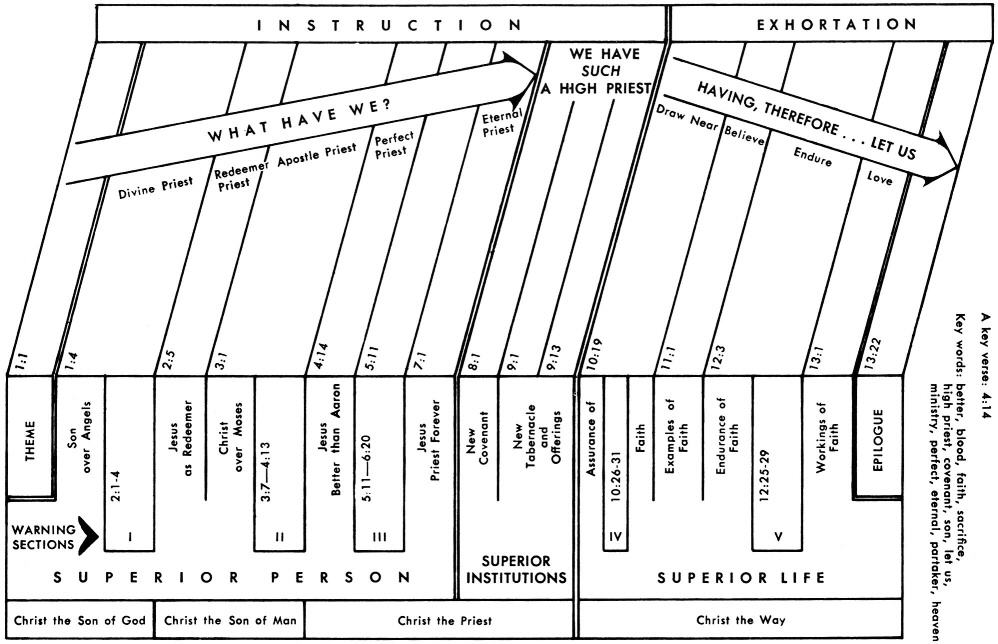
CONSIDER JESUS OUR GREAT HIGH PRIEST
Click chart to enlarge
Charts from Jensen's Survey of the NT - used by permission
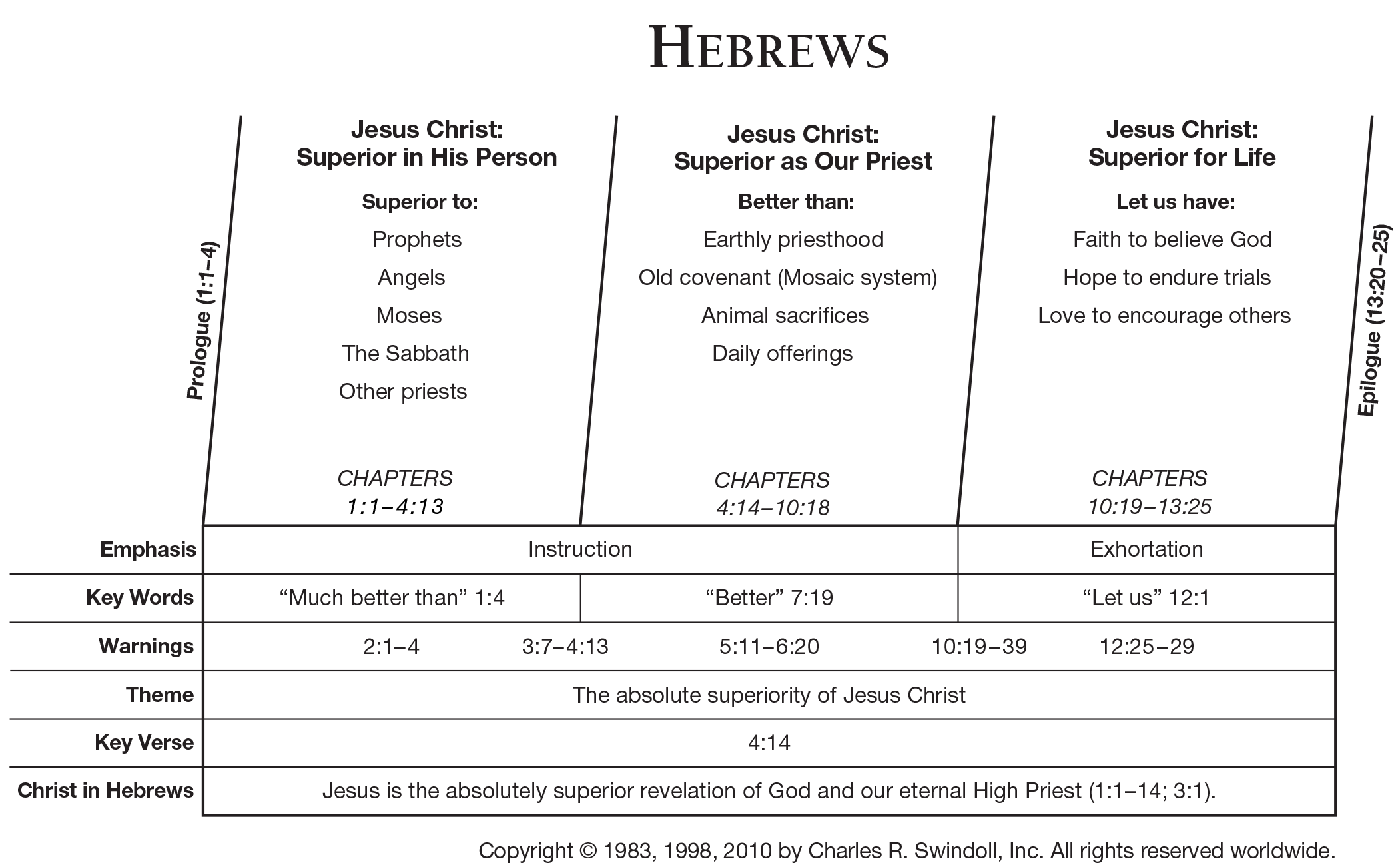
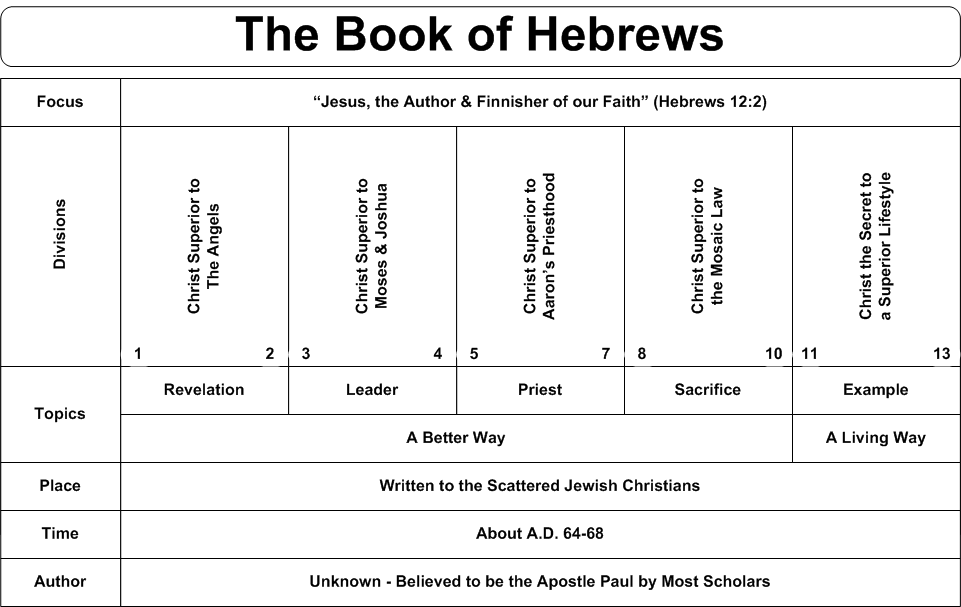
Swindoll's Chart, Another Chart
|
The Epistle |
||||
| INSTRUCTION Hebrews 1-10:18 |
EXHORTATION Hebrews 10:19-13:25 |
|||
| Superior Person of Christ Hebrews 1:1-4:13 |
Superior Priest in Christ Hebrews 4:14-10:18 |
Superior Life In Christ Hebrews 10:19-13:25 |
||
| BETTER THAN PERSON Hebrews 1:1-4:13 |
BETTER PRIESTHOOD Heb 4:14-7:28 |
BETTER COVENANT Heb 8:1-13 |
BETTER SACRIFICE Heb 9:1-10:18 |
BETTER LIFE |
| MAJESTY OF CHRIST |
MINISTRY OF CHRIST |
MINISTERS FOR CHRIST |
||
|
DOCTRINE |
DUTY |
|||
|
DATE WRITTEN: |
||||

See ESV Study Bible "Introduction to Hebrews"
(See also MacArthur's Introduction to Hebrews)
Borrow Ryrie Study Bible
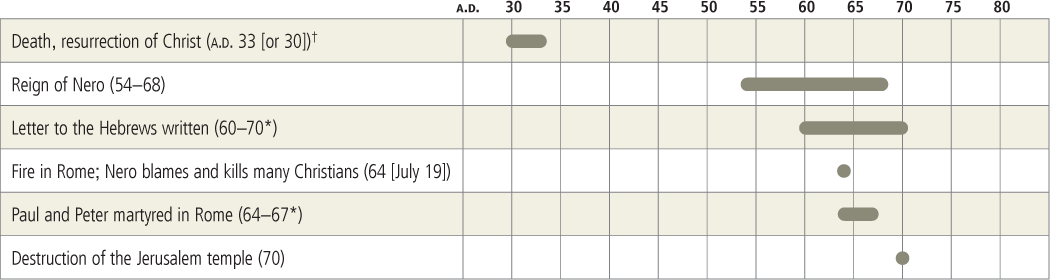
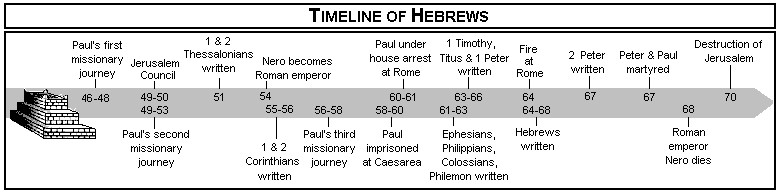
Timeline of Hebrews - ESV Study Bible
Hebrews 1:3 And He is the radiance of His glory and the exact representation of His nature, and upholds all things by the word of His power. When He had made purification of sins, He sat down at the right hand of the Majesty on high (NASB: Lockman)
Greek: os on (PAPMSN) apaugasma tes doxes kai charakter tes hupostaseos autou, pheron (PAPMSN) te ta panta to rhemati tes dunameos autou, katharismon ton hamartion poiesamenos (AMPMSN) ekathisen (3SAAI) en dexia tes megalosunes en hupselois,
BGT ὃς ὢν ἀπαύγασμα τῆς δόξης καὶ χαρακτὴρ τῆς ὑποστάσεως αὐτοῦ, φέρων τε τὰ πάντα τῷ ῥήματι τῆς δυνάμεως αὐτοῦ, καθαρισμὸν τῶν ἁμαρτιῶν ποιησάμενος ἐκάθισεν ἐν δεξιᾷ τῆς μεγαλωσύνης ἐν ὑψηλοῖς,
ALT: who being [the] outshining of His glory and [the] exact expression of His essence, and sustaining all the [things] by the word of His power, having Himself made by Himself a purification [or, purgation] of our sins, sat down at [the] right hand of the Majesty on high,
Amplified: He is the sole expression of the glory of God [the Light-being, the out-raying or radiance of the divine], and He is the perfect imprint and very image of [God’s] nature, upholding and maintaining and guiding and propelling the universe by His mighty word of power. When He had by offering Himself accomplished our cleansing of sins and riddance of guilt, He sat down at the right hand of the divine Majesty on high (Amplified Bible - Lockman)
BBE: Who, being the outshining of his glory, the true image of his substance, supporting all things by the word of his power, having given himself as an offering making clean from sins, took his seat at the right hand of God in heaven;
CSB The Son is the radiance of God's glory and the exact expression of His nature, sustaining all things by His powerful word. After making purification for sins, He sat down at the right hand of the Majesty on high.
ESV He is the radiance of the glory of God and the exact imprint of his nature, and he upholds the universe by the word of his power. After making purification for sins, he sat down at the right hand of the Majesty on high,
ICB: The Son reflects the glory of God. He is an exact copy of God's nature. He holds everything together with his powerful word. The Son made people clean from their sins. Then he sat down at the right side of God, the Great One in heaven. (ICB: Nelson)
KJV: Who being the brightness of his glory, and the express image of his person, and upholding all things by the word of his power, when he had by himself purged our sins, sat down on the right hand of the Majesty on high;
NKJ Who being the brightness of His glory and the express image of His person, and upholding all things by the word of His power, when He had by Himself purged our sins, sat down at the right hand of the Majesty on high,
NET The Son is the radiance of his glory and the representation of his essence, and he sustains all things by his powerful word, and so when he had accomplished cleansing for sins, he sat down at the right hand of the Majesty on high.
NIV The Son is the radiance of God's glory and the exact representation of his being, sustaining all things by his powerful word. After he had provided purification for sins, he sat down at the right hand of the Majesty in heaven.
NLT The Son radiates God's own glory and expresses the very character of God, and he sustains everything by the mighty power of his command. When he had cleansed us from our sins, he sat down in the place of honor at the right hand of the majestic God in heaven.
Phillips: This Son, radiance of the glory of God, flawless expression of the nature of God, himself the upholding principle of all that is, effected in person the reconciliation between God and man and then took his seat at the right hand of the majesty on high (Phillips: Touchstone)
Wuest: Who, being the out-raying [effulgence] of His glory and the exact reproduction of His essence, and sustaining, guiding, and propelling all things by the word of His power, having made purification of sins, sat down on the right hand of the Majesty on high;
Young's Literal: who being the brightness of the glory, and the impress of His subsistence, bearing up also the all things by the saying of his might -- through himself having made a cleansing of our sins, sat down at the right hand of the greatness in the highest,
MIT He radiates God's glory as a precise copy of his nature and maintains everything by his dynamic word. After having accomplished purification of sins, he sat down in the position of honor next to the majesty in the heavenly realms.
NJB He is the reflection of God's glory and bears the impress of God's own being, sustaining all things by his powerful command; and now that he has purged sins away, he has taken his seat at the right hand of the divine Majesty on high.
NRS He is the reflection of God's glory and the exact imprint of God's very being, and he sustains all things by his powerful word. When he had made purification for sins, he sat down at the right hand of the Majesty on high,
RSV He reflects the glory of God and bears the very stamp of his nature, upholding the universe by his word of power. When he had made purification for sins, he sat down at the right hand of the Majesty on high,
NAB Who is the refulgence of his glory, the very imprint of his being, and who sustains all things by his mighty word. When he had accomplished purification from sins, he took his seat at the right hand of the Majesty on high,
GWN His Son is the reflection of God's glory and the exact likeness of God's being. He holds everything together through his powerful words. After he had cleansed people from their sins, he received the highest position, the one next to the Father in heaven.
- He is the radiance Jn 1:14; Jn 14:9-10 2Co 4:6
- the exact representation of His nature 2Co 4:4; Col 1:15-16
- upholds all things Ps 75:3; Jn 1:4; Col 1:17; Rev 4:11
- power Eccl 8:4; Ro 1:16; 2Cor 4:7
- Sat down Hebrews 4:14; 8:1; 10:12; Heb 12:2; Ps 110:1; Mk 16:19; Lk 20:42;43 Acts 2:33; 7:56; Ro 8:34; Ep 1:20;21, 22, Col 3:1; 1Pe1:21; 3:22; Rev 3:21
- Majesty 1 Chr 29:11; Job 37:22; Mic 5:4; 2Pe 1:16; Jude 1:25
- Hebrews 1 Resources - Multiple Sermons and Commentaries
- Study Questions for Hebrews - 5W/H questions for leading lessons
Related Passages:
John 14:9-10 Jesus *said to him, “Have I been so long with you, and yet you have not come to know Me, Philip? He who has seen Me has seen the Father; how can you say, ‘Show us the Father’? 10“Do you not believe that I am in the Father, and the Father is in Me? The words that I say to you I do not speak on My own initiative, but the Father abiding in Me does His works.
2 Corinthians 4:4 in whose case the god of this world has blinded the minds of the unbelieving so that they might not see the light of the gospel of the glory of Christ, Who is the image (eikon) of God.
2 Corinthians 4:6 For God, who said, “Light shall shine out of darkness,” is the One who has shone in our hearts to give the Light of the knowledge of the glory of God in the face of Christ.
Revelation 4:11 “Worthy are You, our Lord and our God, to receive glory and honor and power; for You created all things, and because of Your will they existed, and were created.”
Hebrews 1:13 But to which of the angels has He ever said, “SIT AT MY RIGHT HAND, UNTIL I MAKE YOUR ENEMIES A FOOTSTOOL FOR YOUR FEET”?
Psalm 110:1 A Psalm of David. The LORD says to my Lord: “Sit at My right hand Until I make Your enemies a footstool for Your feet.”
Luke 20:42 “For David himself says in the book of Psalms, ‘THE LORD SAID TO MY LORD, “SIT AT MY RIGHT HAND,
Hebrews 8:1 Now the main point in what has been said is this: we have such a High Priest, Who has taken His seat at the right hand of the throne of the Majesty in the heavens,
Hebrews 10:11-12 Every priest stands daily ministering and offering time after time the same sacrifices, which can never take away sins; 12 but He, having offered one sacrifice for sins for all time, SAT DOWN AT THE RIGHT HAND OF GOD,
Hebrews 12:2 fixing our eyes on Jesus, the author and perfecter of faith, who for the joy set before Him endured the cross, despising the shame, and has sat down at the right hand of the throne of God.
Mark 16:19 So then, when the Lord Jesus had spoken to them, He was received up into heaven and sat down at the right hand of God.
Acts 2:33 “Therefore having been exalted to the right hand of God, and having received from the Father the promise of the Holy Spirit, He has poured forth this which you both see and hear.
Acts 7:56 and he said, “Behold, I see the heavens opened up and the Son of Man standing at the right hand of God.”
Romans 8:34 who is the one who condemns? Christ Jesus is He who died, yes, rather who was raised, who is at the right hand of God, who also intercedes for us.
Ephesians 1:20 which He brought about in Christ, when He raised Him from the dead and seated Him at His right hand in the heavenly places,
Colossians 3:1 Therefore if you have been raised up with Christ, keep seeking the things above, where Christ is, seated at the right hand of God.
GOD OF GOD, LIGHT OF LIGHT
VERY GOD OF VERY GOD
--Nicene Creed
And He is (eimi in present tense = "on" = continually - see note on "on") the radiance (apaugasma) of His glory (doxa) - AMP = He is the sole expression of the glory of God [the Light-being, the out-raying or radiance of the divine]" The Son is superior to the prophets because He is the radiance of God’s glory (See Shekinah). He is is more literally "who being" this participle denoting what the Son is continually (present tense) in Himself essentially and independently of His manifestation in time. This transcendent (meaning being beyond our ability to comprehend) idea is conveyed by two metaphorical expressions. Chrysostom wrote about light “radiating” from a light, much as heat and light would “radiate” from an old pot-bellied stove. In a similar (of course my glorious) way, Jesus radiates (carries) God’s nature out to us, so we sense His presence.
Note that several modern translations (RSV, NRSV, NJB, GWN, ICB) are not accurate translations because they use the word reflect or reflection instead of radiance. There is a major difference implied by these two words. Reflect is what the moon does with the sun's light, but the moon is not the sun! Not so with Christ is one in essence with the Father. Jesus does not just reflect the Father's glory but He is integrally part of God's glory! At His transfiguration Jesus' "garments became radiant and exceedingly white," (Mk 9:3) signifying this was His own essential glory He shares with His Father. Now you can understand the words of the Nicene Creed, which declares "GOD OF GOD, LIGHT OF LIGHT, VERY GOD OF VERY GOD."
Athanasius asks, “Who does not see that the brightness cannot be separated from the light, but that it is by nature proper to it and co-existent with it, and is not produced after it?” Ambrose explains, “Where there is light there is radiance, and where there is radiance there is also light; and thus we cannot have a light without radiance nor radiance without light, because both the light is in the radiance and the radiance in the light." In other words, “the Son is co-eternal with the Father, just as brightness is coeval with the sun…. The Son exists essentially in the Father and the Father in the Son” (Herveus, in P. Hughes, p. 43). The reason it is important to affirm this, as Athanasius saw, is “that a false doctrine of the person of Christ must inevitably result in a false doctrine of the work of Christ and consequently undermine the whole system of the gospel” (See P Hughes A Commentary on the Epistle to the Hebrews - Page 42)
Steven Cole - Creation reveals God’s “invisible attributes, His eternal power and divine nature” (Rom. 1:20). But God’s Son is “the radiance of His glory and the exact representation of His nature” (Heb. 1:3)....The early church fathers often used this verse to refute the heretics, especially the Arians. Theodoret says that the Arians rejected Hebrews from the canon because of this text
Spiros Zodhiates on He IS (KJV = being) - “This means, that there has never been a time when Jesus Christ has not been the [radiant splendor] of the Father,” which not only includes eternity past, but also “even in His incarnation when He purged our sins.” (BORROW The complete word study dictionary page 1498)
The Pulpit Commentary writes that apaugasma "is, so to speak, begotten of the source, and of one substance with it, and yet distinguishable from it; being that through which its glory is made manifest, and through which it enlightens all things. The Person of the Son is thus represented, not as of one apart from God, irradiated by His glory, but as Himself the sheen of His glory."
Kenneth Wuest adds that "The word apaugasma is not preceded by the definite article, which fact makes the term highly descriptive of character or nature." (Hebrews Commentary)
Expositor's Greek (Marcus Dods) comments on radiance that "In the Arian controversy (ED: Arius taught that the Son was a created being, inferior to God the father in nature and dignity though the first and noblest of all created beings) this designation of the Son was appealed to as proving that He is eternally generated and exists not by an act of the Father’s will but essentially… As the sun cannot exist or a lamp burn without radiating light, so God is essentially Father and Son.”
Lowell Johnson on radiance of His glory (doxa) - The glory of God is the manifestations of all His divine attributes. It is the shining forth of His glorious Person. Since God the Father is invisible, Christ, like the Shekinah glory of God which hovered as a shining cloud above the Holy of Holies, is the manifestation (or the exact expression) of what God is.
Shade your eyes, for you cannot look upon
this wondrous sight without being dazzled by it.
C H Spurgeon - Shade your eyes, for you cannot look upon this wondrous sight without being dazzled by it. Some commentators say—and it is not an inappropriate analogy, though we must not push any analogy too far—that, as light is to the sun, so is Jesus to the glory of God. He is the brightness of that glory. That is to say, there is not any glory in God but what is also in Christ: and when that glory reaches its climax, when God the Ever-Glorious is most glorious, that greatest glory is in Christ. Oh, this wondrous Word of God—the very climax of the Godhead—the gathering up of every blessed attribute in all its infinity of glory! You shall find all this in the person of the God-man, Christ Jesus. (Full Sermon Depths and Heights - Hebrews 1:2-3)
Spurgeon - There is no glory in God but what is also in Christ. Whatever God is, Christ is. Who will dare to turn his back on him? If this is God’s ambassador who comes clothed in the crimson robe of his own blood to redeem humanity, who will refuse the peace he brings?
Jewish readers who would be very familiar with these OT descriptions of the glory (doxa) of Jehovah would have a clear understanding of the intent of the author's description of Jesus as the radiance of His glory but unlike Moses could look at the glorious face of God for "the glory of God" is "in the face of Christ." (2Cor 4:6)
Jesus gives a correct opinion (doxa) of all that God is, so that to see Jesus is to see God, for in Jesus Himself is the out shining of the majesty of the Father. The Son, being one with the Father (Jn 10:30), is in Himself, and ever was, the shining forth of the glory (doxa), manifesting in Himself all that God is and does.
Jesus' Own testimony was that "he who beholds Me beholds the One who sent Me." (Jn 12:45)
Phillip queried Jesus "show us the Father and it is enough for us (Jn 14:8)
Jesus replied that "He who has seen Me has seen the Father" (Jn14:9)
Explaining that "the Father is in Me" and "the words that I say to you I do not speak on My own initiative, but the Father abiding in Me does His works." (Jn 14:10)
John gives us the marvelous description of Jesus as ""the Word (Who) became flesh, and dwelt among us, and we beheld His glory(doxa), glory (doxa) as of the only begotten from the Father, full of grace and truth" (Jn 1:14).
John went on to say that "No man has seen God at any time; the only begotten God, who is in the bosom of the Father, He has explained Him." (Jn 1:18)
Comment: The Greek word for explained is exegeomai [ek = out + hegéomai = tell, lead forward] means that Jesus, as the God Man, leads out or provides detailed information in a systematic manner of the glory (doxa) of the Father. This word exegeomai gives us our English word "exegesis" which describes the exposition of God's word, unfolding the interpretation through teaching. Jesus then is the preeminent "Expositor" declaring the Father's glory (doxa) thoroughly and particularly. "O come let us adore Him" "fixing our eyes on Jesus" (Heb 12:2)
Want to know what God says? Listen to Jesus. Want to know what God does? Watch Jesus. He is God incarnate in man.
ILLUSTRATION - Let's give an analogy realizing that it will be imperfect and can even distort the truth of the radiance of His glory if pressed too far. Jesus relates to God the way the rays of sunlight relate to the sun. There is no time that the sun exists without the beams of radiance. They cannot be separated. If you put a solar-activated calculator in the sunlight, numbers appear on the face of the calculator. These are energized by the sun's radiance, but they are not what the sun is. The rays of the sun however are an extension of the sun. We see the sun by means of seeing the rays of the sun. So too we see God the Father by seeing Jesus for they are one God.
JESUS IS EXACT IMAGE
OF GOD'S ESSENCE
And the exact representation (charakter) of His nature (hupostasis) - Phillips - "flawless expression of the nature of God" NRSV = "the exact imprint of God’s very being" AMP = "He is the perfect imprint and very image of [God’s] nature" Jesus is the perfect image of God, the visible stamp of God's essence.
James Girdwood -The word translated “representation” was used of a “copy” of a book or a coin as a “copy” of a die. A die presses its exact image into the coin, so the coin shows what the die is like. In the same way, Jesus shows us what God is like. Although we are to imitate God (Ephesians 5:1), we are imperfect copies. Jesus is the “exact representation” so that whoever sees Jesus sees God (John 14:9). (Book of Hebrews - Blueprints for 30 Messages)
Whatever God is, Christ is. The very likeness of God,
the very Godhead of Godhead, the very Deity of Deity, is in Christ Jesus.
C H Spurgeon - Whatever God is, Christ is. The very likeness of God, the very Godhead of Godhead, the very Deity of Deity, is in Christ Jesus. Dr. John Owen, who loves to explain the spiritual meaning in the Letter to the Hebrews by the types in the Old Testament, explains the brightness of the Father’s glory by a reference to the Shekinah over the mercy seat, which was the only visible token of the presence of God there. An extraordinary brightness is said to have shone forth from between the cherubim. Now, Christ is God manifesting Himself in His brightness. But, on his forehead, the high priest wore a golden plate, upon which was deeply engraved, in Hebrew letters, the inscription, “Holiness to [or of] Yahweh.” Dr. Owen thinks there is a reference, in this “representation of his essence”—this cut-out inscription of God, as it were—to that which was on the forehead of the high priest, and which represented the glorious wholeness or holiness of Yahweh, which is His great glory. You see how glorious was His original—the “representation” of His Father’s person. How lowly did He become to purge away our sins, and that by Himself, too, using His own body to be the means, by His sufferings, of taking away our guilt. Not by proxy did He serve us, but by Himself. Oh, this is wondrous love! (PLAY FERNANDO ORTEGA'S VERSION OF WHAT WONDROUS LOVE IS THIS? (Full Sermon Depths and Heights - Hebrews 1:2-3)
He who saw Jesus had seen the Father because Jesus is the exact representation (charakter), the exact expression of the Father's attributes, nature (hupostasis), so that all that God is, Jesus is, and yet they are two distinct Persons of the Godhood. Jesus is all that God is, not has been given what He is! God hasn't given Jesus something. He already is (and always has been)! Paul concurs that Jesus "is the image of the invisible God" (Col 1:15)
Phillip E Hughes says the word translated nature “denotes the very essence of God. The principal idea intended is that of exact correspondence. This correspondence involves not only an identity of the essence of the son with that of the Father, but more particularly a true and trustworthy revelation or representation of the Father by the Son” (A Commentary on the Epistle to the Hebrews)
A T Robertson commenting on hupostasis writes that "The word hupostasis for the being or essence of God “is a philosophical rather than a religious term” (Moffatt). Etymologically it is the sediment or foundation under a building (for instance). In Hebrews 11:1 hupostasis is like the “title-deed” idea found in the papyri. Athanasius rightly used Heb 1:1-4 in his controversy with Arius.
Marvin Vincent commenting on hupostasis notes that "The primary sense of hupostasis or substance is something which stands underneath; foundation, ground of hope or confidence, and so, assurance itself. In a philosophical sense, substantial nature; the real nature of anything which underlies and supports its outward form and properties. In N. T., 2Cor. 9:4; 11:17; Heb 3:14; 11:1, signifying in every instance ground of confidence or confidence."
JESUS, RADIATOR
AND REPRESENTOR
R Kent Hughes explains that "As Radiator—"the radiance of God's glory"—Jesus is part of the source, one with the Father. This is what John emphasizes when he says, "the Word was God" (John 1:1). But also as Representor—"the exact representation of his being"—Jesus is distinct, much as John also emphasizes when he says, "the Word was with God." Jesus is all God, "very God of very God." When you see Him, you see the Father. But He is also a distinct person. This is all bound in with the mystery of the holy Trinity. The cosmic supremacy of Christ dazzles the mind: He is Inheritor, Creator, Sustainer, Radiator and Representor. These are beautiful, soul-expanding thoughts. But they positively vibrate with glory when we see that they introduce the priestly supremacy of Christ—he is Purifier and Ruler.(See Hebrews: An Anchor for the Soul - Page 2)
In summary, the radiance of His glory speaks of Jesus' oneness or identity with God the Father whereas the exact representation of His nature speaks of Jesus' distinctness and thus of the plurality of the Godhood.
W E Vine adds that the essence of the phrase exact representation of His nature is to explain that "the Son of God is a distinct Person from the Father and yet One with Him in the Godhood. He is His equal, as being the perfect representation of His essence."
William Barclay - The writer to the Hebrews uses two great pictures to describe what Jesus was. He says that he was the apaugasma of God's glory. Apaugasma can mean one of two things in Greek. It can mean effulgence, the light which shines forth, or it can mean reflection, the light which is reflected. Here it probably means effulgence. Jesus is the shining of God's glory among men. (Hebrews 1 Commentary)
Lowell Johnson - “The express image of His Glory.” The words “express image” translate the word “character” in the Greek. It is used of an engraving used to make an exact impression. Jesus Christ perfectly displays the character of Holy God. This speaks of His deity. The Lord Jesus set forth the holiness, the love, the mercy and the grace of God. There is no need to wonder what God is like, or who God is – we have seen God in Jesus Christ.
JESUS UPHOLDS
ALL THINGS!
And upholds (phero - present tense) all things by the word (rhema) of His power (dunamis) - ICB = "He holds everything together with his powerful word," Wuest = "Sustaining, guiding, and propelling all things by the word of His power" - The Creator of all is also the Sustainer of all! While phero can means simply to bear something, the author does not see Christ's work in sustaining creation as if He were an "Atlas-like" figure holding up the universe as a dead weight and otherwise doing nothing. "It rather expresses that 'bearing' which includes movement, progress, towards an end." (see Westcott page 97). In other words upholds (phero - present tense) indicates that Christ is actively carrying it along, bearing it toward its final consummation. The concept of upholds is dynamic and not static. So while the Son’s work of upholding does involve support, it also involves movement. Jesus is the One Who carries all things forward on their sovereignly appointed course. The picture is that of continuous (present tense) active and dynamic involvement by the Creator and His creation, not a passive and static (deistic) involvement. The Lord Jesus holds all things together and in their proper relationship to each other by His own power, power found in His Word! The oceans are held in their beds. The rivers run down into the sea. The heavenly bodies are held in their orbits. Atoms are held together! What would it do to our spiritual lives if we truly grasps that Jesus had all things that happen to us in His omnipotent, wise, loving hands? (Rhetorical of course).
Note that the writer does not use logos, the word used to indicated revelation, but rhema which refers to the spoken word (rhema). It is Jesus' spoken word (rhema) which created all things (Heb 11:3 "the worlds [aion] were prepared by the word [rhema] of God") and it is the same spoken word rhema which sustains all things. Hughes quips "if He speaks the word, all would end, not with a Big Bang, but a Big Fizzle or Gulp!"
Paul has a similar statement explaining that Jesus "is before all things, and in Him all things hold together (perfect tense)." (Col 1:17) The upshot is that the things created by Christ are now being sustained or held together by Christ. As Luke records "In Him we live, and move, and have our being (exist)" (Acts 17:28). By Him all things were created in the past, by Him all things consist in the present and by Him all things are to be reconciled in the future "for from Him and through Him and to Him are all things. To Him be the glory forever. Amen." (Ro 11:36) Hallelujah! Thank You Jesus!
Adrian Rogers on upholds - The word “uphold” means to carry a load. Who keeps this universe running? Who regulates the sun, the moon, and the stars? Who keeps this thing like a timepiece? Who holds the stars in their orbits? What keeps this cosmos from becoming a chaos? He upholds all things by the word of his power. I used to laugh about a decade ago when they were saying, “God is dead.” Friend, if God dies, you’ll know it. You’ll know it. You see, the Bible says in the book of Colossians, “By Him all things consist.” That means they hang together. Jesus is the glue of the galaxies. He is the reason; He is the regulator, the ruler, the regent of creation. (from Sermon Who Is Jesus Christ? see page 41)
Wayne Grudem has a detailed discussion of Christ's power of preservation, the truth that "God keeps all created things existing and maintaining the properties with which he created them. Hebrews 1:3 tells us that Christ is “upholding the universe by his word of power.” The Greek word translated “upholding” is φέρω (G5770) “carry, bear.” This is commonly used in the New Testament for carrying something from one place to another, such as bringing a paralyzed man on a bed to Jesus (Luke 5:18), bringing wine to the steward of the feast (John 2:8), or bringing a cloak and books to Paul (2 Tim. 4:13). It does not mean simply “sustain,” but has the sense of active, purposeful control over the thing being carried from one place to another. In Hebrews 1:3, the use of the present participle indicates that Jesus is “continually carrying along all things” in the universe by his word of power. Christ is actively involved in the work of providence. Similarly, in Colossians 1:17, Paul says of Christ that “in him all things hold together.” The phrase “all things” refers to every created thing in the universe (see Col 1:16), and the verse affirms that Christ keeps all things existing—in him they continue to exist or “endure” (NASB mg.). Both verses indicate that if Christ were to cease his continuing activity of sustaining all things in the universe, then all except the triune God would instantly cease to exist. Such teaching is also affirmed by Paul when he says, “In him we live and move and have our being” (Acts 17:28), and by Ezra: “You are the LORD, you alone; you have made heaven, the heaven of heavens, with all their host, the earth and all that is on it, the seas and all that is in them; and you preserve all of them; and the host of heaven worships you” (Neh. 9:6). Peter also says that “the heavens and earth that now exist” are “being kept until the day of judgment” (2 Peter 3:7). One aspect of God’s providential preservation is the fact that he continues to give us breath each moment. Elihu in his wisdom says of God, “If he should take back his spirit to himself, and gather to himself his breath, all flesh would perish together, and man would return to dust” (Job 34:14–15; cf. Ps. 104:29). God, in preserving all things he has made, also causes them to maintain the properties with which he created them. God preserves water in such a way that it continues to act like water. He causes grass to continue to act like grass, with all its distinctive characteristics. He causes the paper on which this sentence is written to continue to act like paper so that it does not spontaneously dissolve into water and float away or change into a living thing and begin to grow! Until it is acted on by some other part of creation and thereby its properties are changed (for instance, until it is burned with fire and it becomes ash), this paper will continue to act like paper so long as God preserves the earth and the creation that he has made. We should not, however, think of God’s preservation as a continuous new creation: he does not continuously create new atoms and molecules for every existing thing every moment. Rather, he preserves what has already been created: he “carries along all things” by his word of power (Heb. 1:3, author’s translation). We must also appreciate that created things are real and that their characteristics are real. I do not just imagine that the rock in my hand is hard—it is hard. If I bump it against my head, I do not just imagine that it hurts—it does hurt! Because God keeps this rock maintaining the properties with which he created it, the rock has been hard since the day it was formed, and (unless something else in creation interacts with it and changes it) it will be hard until the day God destroys the heavens and the earth (2 Peter 3:7, 10–12). (See Systematic Theology - An Introduction to Bible Doctrine page 269)
Steven Cole adds that "This refutes the idea of Deism, that God created all things, but then bowed out and let everything run on its own. Scripture shows that there is not a single atom in the universe that acts apart from God’s providential governance. Every raindrop, snowflake, gust of wind, and lightning bolt obey God’s command (Ps. 148:8). He directs everything from the roll of the dice (Prov. 16:33) to the rise and fall of nations (Job 12:23). He determines in advance the number of days that each of us will live (Ps. 139:16). Our text says that Jesus exercises this immense power simply by speaking, or as Calvin says (p. 38), “with a nod.” This means that there is no such thing as random chance or luck. We are totally dependent on God, and we must receive all things as coming from Him according to His purpose for our good (Gen. 50:20; Job 2:10; Rom. 8:28).
Marvin Vincent adds that upholds all things "is concerned, not only with sustaining the weight of the universe, but also with maintaining its coherence and carrying on its development… " and adds that "the Logos is called by Philo the bond of the universe; but the maintenance of the coherence implies the guidance and propulsion of all the parts to a definite end."
🙏 THOUGHT - You may be experiencing trials and tribulations that are leading you to believe that Jesus is in control of most but not all things (especially not your trials!), but that is fiction not fact! The fact remains that even in the painful times, He is in control. I know, for this past year has been something I never would have foreseen when I was younger (I'm going on 69)! My wife of 45 years developed severe anorexia nervosa and almost died. My youngest son almost died. He called me one day to tell me he loved me. The problem was he called from a cemetery with a rope swung over a tree limb and the other end around his neck. At that moment I absolutely did not believe Jesus upholds all things by the word of His power! That was one year ago. Today that same son is genuinely born again and sober and productive and still married to his first wife. My wife is still suffering the throes of anorexia. But I can testify that Jesus is good and that Jesus truly upholds all things by the word of His power. Beloved, whatever you are experiencing, remember that you have not yet seen the end of the story of your life! Hold on to Jesus -- you can be sure He is holding on to you (whether you "feel" like it or not)! I'll see you in heaven and we can share stories of this truth that transformed our "fiery furnace" of complaints and doubts into a "fragrant altar" for offering worship!
All things (3956) (pas) refers to the totality, the universe considered as one whole. Nothing is excluded from the scope of the Son's sustaining, supporting, upholding activity. And with the present tense of upholds the idea is “He carries all things continually.” It cannot be much more all inclusive than that! The author pictures the Son as not only active in creation but then as bearing all time and space towards the fulfillment of the divine plan. And to think He loved us enough to die in our place and now He lives within us, sustaining us via His Spirit until that glorious future day when we will see Him face to face and forever be in His glorious presence!
🙏 THOUGHT - What an awesome truth that the whole universe hangs on the word of Christ for its moment by moment existence! How this flies in the face of the modern teaching on self-sufficiency. We must see that Christ upholds all things by the word of His power and that all things includes the preservation of even our very spirit, soul and body. Our daily existence depends solely upon the word of Christ's power! Therefore as the writer of proverbs exhorts us "Trust in the LORD with all your heart, and do not lean on your own understanding. In all your ways acknowledge Him, and He will make your paths straight" (Pr 3:5, 3:6) Why? Because He upholds all things by the Word of His power. Worship Him today for Who He is, God Himself, and for the profound truth that the Word of His power preserves and assures our very existence and our future hope.
C H Spurgeon - Just think of it. This great world of ours is upheld by Christ’s word. If He did not speak it into continued existence, it would go back into the nothingness from which it sprung. There exists not a being who is independent of the Mediator, save only the ever-blessed Father and the Spirit. “In him all things are held together” (Col 1:17), that is, continue to hold together. Just as the foundations uphold a house, so does Jesus Christ “sustain all things by the word of his power.” Only think of it; those innumerable worlds of light that make unbounded space to look as though it were sprinkled over with golden dust, would all die out, like so many expiring sparks, and cease to be, if the Christ who died on Calvary did not will that they should continue to exist. Surely, if Christ upholds all things He can uphold me. If the word of His power upholds earth and heaven, surely, that same word can uphold you, poor trembling heart, if you will trust him. (Full Sermon Depths and Heights - Hebrews 1:2-3)
The word (rhema) of His power (dunamis) - In other words Christ's spoken word is that by which the Son's power is manifest (click for one manifestation of this power!). And remember beloved, this is the same "word" He speaks to those who are "His own possession". What has He spoken to you this week in and through His Word? O how we need to remember that it is not just any word but is the word of His power, the very word by which His omnipotent power is manifest in and through our life! "He who has an ear, let him hear what the Spirit" of Christ would say to us today!
Rhema as used here in Hebrews 1:3 to refer to active and powerful word. Rhema is the same word that spoke everything into existence! "By faith we understand that the worlds were prepared by the word (rhema) of God, so that what is seen was not made out of things which are visible. (Heb 11:3). God the Son spoke and created but He still speaks and sustains. As we listen and obey what God says in His Son (in His Word, the Scripture), He will sustain us through any trial, bringing us to the desired end He has for us --to be conformed to the image of Jesus Christ. The "word" is not empty. It has force. It does things.
Luke gives us a correct sense of the power of God's word declaring that "No (absolute negation) word (rhema - spoken word) from God shall be void of power. " (Lk 1:37ASV, Lk 1:37KJV)
An illustration of this principle is found in Romans where Paul explains that "the gospel… is the power (dunamis) of God for salvation to everyone who believes, to the Jew first and also to the Greek." (Ro 1:16)
Thus the Son's Word, the Word of God, is unlike any other word for it has an inherent power because it is God speaking. Are you listening?Jesus sustains all things by His Word, and that Word has a divine power. The various parts of the physical universe are not held together and regulated merely by laws of nature but these very laws are His laws, and operate by His decree. He can interfere with them at any time, and will do so in the way appointed by Him. Are you trusting in the word of His power to uphold you in whatever difficult circumstance or affliction you are currently experiencing?
"From the glory of the person of Christ
he proceeds to mention the glory of His grace."
-- Matthew Henry
When He had made (poieo = aorist tense = past completed action, once and for all!) purification (katharismos) of sins (hamartia) - YLT = "through himself having made a cleansing of our sins" AMP = "When He had by offering Himself accomplished our cleansing of sins and riddance of guilt" - The verb (poieo) is used in the Septuagint in Ge 1:1 to translate "created." In this verse the Creator effects redemption of His fallen, sin stained creation and creatures! Amazing grace!
Note that the verb made (poieo) is in the middle voice. You are probably saying "So what?" The use of the middle voice is reflexive and points to the fact that the subject initiates the action and participates personally in the results of the action. That may seem like a small point, but it implies that Jesus Himself actively performed the purification and was personally engaged in that act. It emphasizes that this was not a detached or impersonal act. It shows that Jesus, as both priest and sacrifice, acted deliberately and personally to secure the purification. In sum, the middle voice emphasizes that Jesus was deeply invested in and actively participated in the redemptive act on the Cross for our benefit. He did it for YOU and He did it for ME!
Steven Cole The juxtaposition of Christ’s upholding all things by the word of His power and the next phrase, “when He had made purification of sins,” is stunning! The almighty Lord who could simply “let go” and sinners would disintegrate, instead left the glory of heaven, took on the form of a servant, and became obedient to death, even death on a cross, to purify us from our sins (Phil. 2:5–11)! “Amazing love, how can it be, that Thou my God shouldst die for me” (Charles Wesley)!
Jesus did not just make purification of sins possible,
but effectual through His death on the cross
-- Steven Cole
James Girdwood - Jesus made purification for our sins (Hebrews 1:3). This certainly points to Jesus’ death on the cross and high priestly work in Heaven. Nothing impure can enter Heaven (Revelation 21:27), so Jesus makes us pure to enable us to enter God’s presence. In addition, Jesus shed his blood for us, not only to provide forgiveness for our sins, but also to make us his very own, as numerous passages teach: Matthew 26:28; Acts 20:28; Romans 5:9; Ephesians 2:13; Hebrews 9:14, 22; 10:19; 1 Peter 1:18, 19; 1 John 1:7; Revelation 1:5. (Book of Hebrews - Blueprints for 30 Messages)
Obviously this verse speaks of the work of Christ on the Cross, specifically the completion when He cried out "It is finished (tetelestai)." ("Paid in full") (Jn 19:30). Purification (katharismos) describes the objective and total removal of our sins by Jesus Christ (Heb. 9:22, 23; Ex. 30:10; Job 7:21). Christ's work of purification reminds me of Yahweh's words of promise in Isaiah 1:18 "Though your sins are as scarlet, They will be as white as snow." (Worship the king as you play "White as Snow" - I literally broke into tears as I listened to this beautiful old Maranatha chorus. All Hail the [Purifying] Power of Jesus' Name!)
It is knowing Him as our Sin-bearer
that we lose our sin burden forever.
Had made (poieo) can be translated produced, brought about and refers to any external act as manifested in the production of something tangible or obvious to the senses, in this case Christ's definite death on the Cross. Had made (poieo) is aorist tense indicating a once-for-all-time, past completed and effective act and in the middle voice which signifies that the subject either acts upon himself or in his own interest and thus it conveys a reflexive sense (often translated by adding the reflexive English pronoun "himself"). The phrase can thus be translated He Himself had made indicating that when the Son of God made purification of sins, He did so by Himself, acting upon Himself, offering Himself as the Sacrifice for sin (Heb 9:26; He 10:12), and for Himself, acting in His own interest. To say it another way the work of purification was done by Christ personally, and was not something which He designated to be done by some other agent. The author emphasizes this truth later writing that "now once at the consummation of the ages He has been manifested to put away sin by the sacrifice of Himself." (He 9:26 cf other uses in Hebrews of this key idea of "Himself" = Heb 2:14, Heb 9:14, Heb 9:25, 26)
In Jn 17:4 Jesus declared “I glorified You on the earth, having accomplished the work (REDEMPTION - DEATH ON THE CROSS) which You have given Me to do."
Charles Haddon Spurgeon - There was never such a task as that since time began. The old fable speaks of the Augean stables, foul enough to have poisoned a nation, which Hercules cleansed—but our sins were fouler than that. Dunghills are sweet compared with these abominations; what a degrading task it seems for Christ to undertake—the purging of our sins! The sweepers of the streets, the scullions of the kitchen, the cleansers of the sewers, have honorable work compared with this task of purging sin. Yet the holy Christ, incapable of sin, stooped to purge our sins. I want you to meditate upon that wondrous work, and to remember that He did it before He went back to heaven. Is it not a wonderful thing that Christ purged our sins even before we had committed them? There they stood, before the sight of God, as already existent in all their hideousness. But Christ came and purged them. This, surely, ought to make us sing the song of songs. Before I sinned, He purged my sins away; singular and strange as it is, yet it is so. (Full Sermon Depths and Heights - Hebrews 1:2-3)
The author amplifies on this truth writing that Jesus functioned as both the Sacrifice (Offering) and the Sacrificer ("Offerer" or High Priest), Who
"does not need daily, like those high priests (Levitical priests under the Old Covenant), to offer up sacrifices, first for His own sins, and then for the sins of the people, because this He did once for all when He offered up Himself." (Hebrews 7:27, cf Hebrews 9:25-26)
Marvin Vincent notes that "In carrying on all things toward their destined end of conformity to the divine archetype, the Son must confront and deal with the fact of sin, which had thrown the world into disorder, and drawn it out of God’s order. In the thought of making purification of sins is already foreshadowed the work of Christ as High Priest, which plays so prominent a part in the epistle."
The writer of Hebrews goes to great lengths to explain Christ's sacrificial role and how His sacrifice made the Old Covenant sacrifices obsolete…
For it is impossible for the blood of bulls and goats to take away sins" (He 10:4), "but when Christ appeared as a High Priest… He entered through the greater and more perfect tabernacle (in contrast to the earthly tabernacle and the Holy of holies that the Levitical priests entered once a year on the Day of Atonement) and not through the blood of goats and calves, but through His own blood… (into) the holy place once for all, having obtained eternal redemption. For if the blood of goats and bulls and the ashes of a heifer sprinkling those who have been defiled, sanctify for the cleansing of the flesh, how much more will the blood of Christ, who through the eternal Spirit offered Himself without blemish to God, cleanse (or "purify" - katharizo) your conscience from dead works to serve the living God? … but now once at the consummation of the ages He has been manifested to put away sin by the sacrifice of Himself." (Heb 9:12-14; Hebrews 9:25-26).
John MacArthur - This truth must have seemed especially remarkable to those to whom the book of Hebrews was first written. The cross was a stumbling block to Jews (1Co 1:23), but the writer does not apologize for it. Instead, he shows it to be one of the seven excellent glories of Christ. (See Hebrews Commentary - Page 19)
William MacDonald summarizes the purifying work of the Son writing that "The Creator and the Sustainer became the Sin-bearer. In order to create the universe, He only had to speak. In order to maintain and guide the universe, He only has to speak… but in order to put away our sin once for all, He had to die on the cross of Calvary. It is staggering to think that the sovereign Lord would stoop to become the sacrificial Lamb. “Love so amazing, so divine, demands my soul, my life, my all,” as Isaac Watts’ hymn says." (Play this beautiful vocal of Watts' "When I Survey the Wondrous Cross") (BORROW Believer's Bible Commentary)
Spurgeon - Purification for sins.” Is it not a wonderful thing that he made purification for our sins even before we had committed them? There they stood, before the sight of God, as already existent in all their hideousness. The sweepers of the streets, the dishwashers of the kitchen, the cleansers of the sewers have honorable work compared with this. Yet the holy Christ, incapable of sin, stooped to make purification for our sins.
Wayne Grudem on purification of sins - When we realize that Christ’s sacrifice for our sins is finished and completed (“It is finished,” John 19:30; cf. Heb. 1:3), it gives us great assurance that our sins are all paid for, and there remains no sacrifice yet to be paid. But the idea of a continuation of Christ’s sacrifice every time the Mass is celebrated destroys our assurance that the payment has been made by Christ and accepted by God the Father and that “no condemnation” (Rom. 8:1) remains for us. For Protestants the idea that the Mass is in any sense a repetition of the death of Christ seems to mark a return to the repeated sacrifices of the old covenant, which were “a reminder of sins every year” (Heb. 10:3). Instead of the assurance of complete forgiveness of sins through the once for all sacrifice of Christ (Heb. 10:12), the idea that the Mass is a repeated sacrifice gives a constant reminder of sins and remaining guilt to be atoned for week after week. (See Systematic Theology page 872)
Related Passages:
Hebrews 7:27 (CHRIST) Who does not need daily, like those high priests, to offer up sacrifices, first for His own sins and then for the sins of the people, because this He did once for all when He offered up Himself.
Hebrews 9:12 and not through the blood of goats and calves, but through His own blood, He entered the holy place once for all, having obtained eternal redemption.
Hebrews 10:11-12 Every priest stands daily ministering and offering time after time the same sacrifices, which can never take away sins; 12 but He, having offered one sacrifice for sins for all time, SAT DOWN AT THE RIGHT HAND OF GOD,
John 19:30 Therefore when Jesus had received the sour wine, He said, “It is finished ( tetelestai = perfect tense of teleo)!” And He bowed His head and gave up His spirit.
Heb 7:27; He 9:12, He 10:10, He 10:12; He 10:14 John 19:30
SEATED AT THE PLACE OF HONOR
HIGH PRIEST AND KING
He sat down (kathizo) at the right hand (dexios) of the Majesty (megalosune) on high (hupselos) - YLT = "sat down at the right hand of the greatness in the highest" - Sat down (kathizo) represents a formal and dignified act indicating that His work was finished. The Jewish high priests could never sit down in the holy place, for their work was never done (Heb 10:11-12). The Levitical high priests could never sit down in the Tabernacle or Temple (for that reason while there was furniture, it is notable that there were no chairs in the furnishings) because their sacrificial work was never done. "All they did with those animal sacrifices was just to roll the sins of the people forward until the Lamb of God would come." (Adrian Rogers p 41) Jesus sits down forever because His sacrifice is eternally efficacious! The high priest's robe had bells attached so that the worshipers could hear him moving and know that he had not been struck down!
RIGHT HAND: Heb 1:3, 8:1,10:12,12:2, Ps 110:1 Mk 16:19 Lu 20:42 Ac 2:33, 7:56 Ro 8:34 Ep 1:20 Col 3:1 1Pe 3:22 Rev 3:21
After His death, burial, resurrection and ascension, He took His royal seat at the right hand of His Father, Who had "raised Him from the dead and seated Him at His right hand in the heavenly places, far above all rule and authority and power and dominion, and every name that is named, not only in this age but also in the one to come." (Eph 1:20-21) (See Hay's book below). Now, as our Mediator of a better covenant (Heb 8:6, Heb 9:15, Heb 12:24), He "intercedes (present tense - continually) for (huper - on our behalf) us" with His Father. (Ro 8:34 Heb 7:25). Like Melchizedek, Jesus serves as King and Priest at the same time (Hebrews 7:1–3).
Right (dexios) is used 5 times in Hebrews and all refer to Jesus' position of honor seated at the right hand of the Father (Heb. 1:3; Heb. 1:13; Heb. 8:1; Heb. 10:12; Heb. 12:2)
From the glory of his sufferings we are at length
led to consider the glory of his exaltation
-- Matthew Henry
R Kent Hughes adds that this "thought is utterly sublime but true—this glorious Cosmic Being at the apex of His splendor is praying for you and me! Can it really be? Yes! God’s Word says it is so. (Heb 7:25, Ro 8:34) Wonder of wonders!" (See Hebrews: An Anchor for the Soul - Page 3)
Wayne Grudem on sat down at the right hand - The Old Testament predicted that the Messiah would sit at the right hand of God: “The LORD says to my Lord: ‘Sit at my right hand, until I make your enemies your footstool’ ” (Ps. 110:1). When Christ ascended back into heaven he received the fulfillment of that promise: “After making purification for sins, he sat down at the right hand of the Majesty on high” (Heb. 1:3). This welcoming into the presence of God and sitting at God’s right hand is a dramatic indication of the completion of Christ’s work of redemption. Just as a human being will sit down at the completion of a large task to enjoy the satisfaction of having accomplished it, so Jesus sat at the right hand of God, visibly demonstrating that his work of redemption was completed. In addition to showing the completion of Christ’s work of redemption, the act of sitting at God’s right hand is an indication that he received authority over the universe. Paul says that God “raised him from the dead and seated him at his right hand in the heavenly places, far above all rule and authority and power and dominion, and above every name that is named” (Eph. 1:20–21). Similarly, Peter says that Jesus “has gone into heaven and is at the right hand of God, with angels, authorities, and powers having been subjected to him” (1 Peter 3:22). Paul also alludes to Psalm 110:1 when he says that Christ “must reign until he has put all his enemies under his feet” (1 Cor. 15:25). One additional aspect of the authority that Christ received from the Father when he sat at his right hand was the authority to pour out the Holy Spirit on the church. Peter says on the Day of Pentecost, “Being therefore exalted at the right hand of God, and having received from the Father the promise of the Holy Spirit, he has poured out this that you yourselves are seeing and hearing” (Acts 2:33). The fact that Jesus now sits at the right hand of God in heaven does not mean that he is perpetually “fixed” there or that he is inactive. He is also seen as standing at God’s right hand (Acts 7:56) and as walking among the seven golden lampstands in heaven (Rev. 2:1). Just as a human king sits on his royal throne at his accession to the kingship but engages in many other activities throughout each day, so too Christ sat at the right hand of God as a dramatic evidence of the completion of his redemptive work and his reception of authority over the universe but is certainly engaged in other activities in heaven as well. (See Systematic Theology page 540)
Spurgeon - There is an allusion here, no doubt, to the high priest who, on the great day of atonement (Lev 16), when the sacrifice had been offered, presented himself before God. Now Christ, our great High Priest, having, once for all, offered Himself as the sacrifice for sin, has now gone into the most holy place, and there He sits on the right hand of the Majesty on high. Notice that this implies rest. When the high priest went within the veil, he did not sit down. He stood, with holy trembling, bearing the sacrificial blood, before the blazing mercy seat. But our Savior now sits at His Father’s right hand. The high priest of old had not finished his work; the next year, another atoning sacrifice would be needed. But our Lord has completed His atonement, and now, “there no longer remains a sacrifice for sins” (Heb 10:26), for there no longer remains sin to be purged. “But this one, after he had offered one sacrifice for sins for all time, sat down at the right hand of God, from now on waiting until his enemies are made a footstool for his feet. For by one offering he has perfected for all time those who are made holy” (Heb 10:12–14). There He sits, and I am sure He would not be sitting if He had not finished the salvation of His people. Notice that Christ sits in the place of honor. Of course, we are talking figuratively now, and you must not interpret this literally. Jesus sits on the right hand of his Father; He dwells in the highest conceivable honor and dignity. All the angels worship Him, and all the blood-washed host adore Him day without night. The Father delights to honor Him. Not only does Jesus sit in the place of honor, but He occupies the place of safety. None can hurt Him now; none can stay His purposes or defeat His will. He is at the powerful right hand of God. In heaven above, and on the earth beneath, and in the waters under the earth, and on every star, He is supreme Lord and Master. They that will not yield to Him shall be broken with a rod of iron; He shall dash them in pieces like a potter’s vessel. So His cause is safe; His kingdom is secure, for He is at the right hand of power. Christ at the right hand of God signifies the eternal certainty of His reward. It is not possible that He should be robbed of the purchase of His blood. Christ will have what He bought with His own blood, especially as He lives again to claim His purchase. He shall never be a defeated and disappointed Savior. He “loved the church, and gave himself for her” (Eph 5:25); He has redeemed His loved ones from among men, and He shall have all those whom He has purchased. “He shall see of the travail of his soul, and shall be satisfied;” (Isaiah 53:11KJV) therefore, let us again say, “Hallelujah!” and fall down and worship him. (Full Sermon Depths and Heights - Hebrews 1:2-3)
Spurgeon - “He sat down at the right hand of the Majesty on high.” There he sits, and he would not be sitting if he had not finished the salvation of his people. He dwells in the highest conceivable honor and dignity. None can stop his purposes or defeat his will. His cause is safe; his kingdom is secure.
The seated posture is one of of rest and yet in His exalted state Jesus is still bearing on all things toward their destined consummation, and is still dealing with sin as the Great High Priest, saving believing sinners in His precious blood and cleansing saints from the daily defilement of sin. This is not the rest following toil, but the rest of satisfaction in a finished work (cf "once for all" or "for all time" in the following verses - Heb 7:27; He 9:12, He 10:10, He 10:12; He 10:14 John 19:30)
The seated posture indicates that the work of redemption has been completed. The seated posture of the High Priest Jesus Christ is in contrast to the Levitical priests who never sat down so far as their tabernacle work was concerned because their work was never finished, because
the Law, since it has only a shadow of the good things to come and not the very form of things, can never by the same sacrifices year by year, which they offer continually, make perfect those who draw near" (Heb 10:1)
Why? Because
it is impossible for the blood of bulls and goats to take away sins." (Heb 10:4)
In the OT David prophesies and quotes the Father inviting the Son to
Sit at My right hand until I make Thy enemies a footstool for Thy feet." (Ps 110:1)
While on earth our Lord applied the Psalm to Himself stating that
from now on THE SON OF MAN WILL BE SEATED AT THE RIGHT HAND of the power OF GOD.” (Lk 22:69, Mt 26:64, Mk 14:62).
We see the fulfillment in Hebrews where the author says that
"the main point in what has been said is this: we have such a High Priest, Who has taken His seat at the right hand of the throne of the Majesty in the heavens" (Heb 8:1, Heb 10:12, Heb 12:2)
Paul explains the significance of Jesus' present Kingly and Priestly position writing that God
raised Him from the dead, and seated Him at His right hand in the heavenly places, far above all rule and authority and power and dominion, and every name that is named, not only in this age, but also in the one to come. And He put all things in subjection under His feet, and gave Him as head over all things to the church" (Eph 1:20-23)
Peter adds that Jesus is
at the right hand of God, having gone into heaven, after angels and authorities and powers had been subjected to Him." (1Pe 3:22)
Luke tells us that after Jesus had
"been exalted to the right hand of God, and (had) received from the Father the promise of the Holy Spirit, He has poured forth this which you both see and hear (the Spirit at Pentecost)" (Acts 2:33)
Finally John offers this encouragement to all believers quoting Jesus Who is presently seated
"at the right hand of the majesty on high" promising that to Him "who overcomes, I will grant to him to sit down with Me on My throne, as I also overcame and sat down with My Father on His throne." (Rev 3:21)
And in one of the most incredible invitation every given, we as believers have been given the awesome invitation to
"draw near with confidence to the throne of grace, that we may receive mercy and may find grace to help in time of need." (Heb 4:16)
Do you need grace to make it today? I do.
Let us draw near with Spirit enabled holy boldness.
Right is also a place of delight for the psalmist says
In Thy right hand there are pleasures forever." (Ps 16:11).
Clearly this is also the position of privilege for the author of Hebrews asks in this same chapter
"which of the angels has He ever said, "SIT AT MY RIGHT HAND, UNTIL I MAKE THINE ENEMIES A FOOTSTOOL FOR THY FEET"? (Heb 1:13)
This Old Testament quotation in the preceding verse is from Ps 110:1 which reads
(A Psalm of David.) The LORD (Jehovah) says to my Lord (Adonai): "Sit at My right hand, Until I make Thine enemies a footstool for Thy feet.
Jesus taking His seat at the right hand of God is taken from Ps 110:1 where David writes…
The LORD (God the Father) says to my Lord (God the Son): "Sit at My right hand, until I make Thine enemies a footstool for Thy feet."
Comment: Literally this begins "Jehovah said to Adonai". David records a remarkable conversation between two Persons of the Godhead. This Messianic psalm is quoted as such at least 12 times in the NT. In Mt 22:43, 44, 45 Christ specifically applies Psalm 110:1 to Himself claiming that He is not just the son of David but David's Lord. In short, Psalm 110 pictures the Messiah as King, Priest and victorious Warrior. Psalm 110:1 is quoted 5 times in the NT -- Mk 12:36, Lk 20:42; Acts 2:34, Heb 1:13 and Heb 10:12. There are 15 other Scriptural references to Christ seated at the right hand of God: Ps 16:11 [KJV "at Thy right hand"], Mt 26:64; Mk 14:62; 16:19; Lk 22:69; Acts 7:55,56, Ro 8:34; Eph 1:20; Col 3:1; 1 Pet 3:22 and the 4 verses in Hebrews - see below.)
Borrow David M Hay's book Glory at the Right Hand: Psalm 110 in Early Christianity [Nashville; Abingdon, 1973] for a critical approach to this theme.
The writer of Hebrews obviously considers this teaching about the position of Christ Jesus our Great High Priest at the right hand of His Father as very important for he records this truth four times, at the beginning, in the middle and toward the end of his epistle…
Hebrews 1:3 And He is the radiance of His glory and the exact representation of His nature, and upholds all things by the word of His power. When He had made purification of sins, He sat down at the right hand of the Majesty on high
Hebrews 1:13 But to which of the angels has He ever said, "SIT AT MY RIGHT HAND, UNTIL I MAKE THINE ENEMIES A FOOTSTOOL FOR THY FEET"?
Hebrews 8:1 Now the main point in what has been said is this: we have such a High Priest, Who has taken His seat at the right hand of the throne of the Majesty in the heavens
Hebrews 12:2 fixing our eyes on Jesus, the Author and Perfecter of faith, Who for the joy set before Him endured the cross, despising the shame, and has sat down at the right hand of the throne of God.
In Mt 22:41-46 Jesus specifically applies Psalm 110:1 to Himself. Matthew records that
"while the Pharisees were gathered together, Jesus asked them a question, saying, “What do you think about the Christ, whose son is He?” (Whose Son is the Messiah? Note He did not ask them as He had His disciples "Who do you say that I am" Mt 16:15 for the Pharisees were neither sympathetic or honest in their assessment of His credentials) They said to Him, “The son of David.” (the Pharisees knew that the Messiah must come from the line of David as His "son" and no doubt they could have quoted several OT passages to support their answer as eg 2Sa 7:12-13) He said to them (and in Jesus' second question He quotes Ps 110:1 which every orthodox Jewish scholar interpreted as a reference to the Messiah. Only the Messiah could sit at the right hand of Jehovah God) “Then how does David in the Spirit call Him ‘Lord,’ saying, ‘The Lord said to my Lord, ”Sit at My right hand, until I put Thine enemies beneath Thy feet”? “If David then calls Him ‘Lord,’ how is He his son?” And no one was able to answer Him a word, nor did anyone dare from that day on to ask Him another question." “If Messiah is David’s Son,” Jesus asked, “then how could Messiah also be David’s Lord?”
There is only one answer to this question. As God, Messiah is David’s Lord but as man, He is David’s Son. He is both “the root and the offspring of David” (Rev 22:6). Ps 110:1 teaches the deity and the humanity of Messiah. He is David’s Lord and He is David’s Son. The rulers had heard the multitudes proclaim Him as “Son of David” when He rode into Jerusalem. The fact that He accepted this title is evidence that Jesus acknowledged Himself to be the Messiah, the Son of God. So once again the writer of Hebrews proves the superiority of Jesus for there was never an angel to which God said "Sit at My right hand… "
Christ has been exalted to the place of greatest eminence, power and authority. Sitting at God's right hand, is also a way of saying that Christ's saving work is done and that he is now in the place of highest honor. To a Jews, the description of Christ at God’s right hand would be more persuasive as a symbol of Christ’s authority and power than even the Resurrection. This is why Jesus spoke these words to Caiaphas just prior to his death and resurrection that hereafter he would "see THE SON OF MAN SITTING AT THE RIGHT HAND OF POWER, and COMING ON THE CLOUDS OF HEAVEN." (Mt 26:64)
🙏 THOUGHT - Have you ever committed a willful sin against God and begin to wonder "How could He possibly love me? How could He ever forgive me? I feel so ashamed." (Been there, done that!) The fact that Jesus has made the final, perfect purification for our sins and is now seated at the right hand of the Father as our Mediator, our Great High Priest, should cause you to be strong, steadfast and unshakable against the accusations and the repetitive temptations that cause you to doubt that your sins, regardless of how seemingly mundane or atrociously heinous, have been completely and irrevocably forgiven, forever washed clean by the spotless blood of Jesus. The resurrection, glorification, ascension and enthronement of Christ at the right hand of God is meant to make you confident in the hour of trial and in the hour of death that the price for your sins has been paid in full and forever and absolutely assures you will experience unhindered entrance into heaven. Meditate on the Biblical reasoning that Christ reigns today in heaven because while on earth He made purification for sins once for all time, this payment for sins being available to all who call upon the Name of the Lord (Ro 10:3). This is good news indeed for those who by faith receive it as a gift and not by trying to earn it. (Eph 2:8-9)
William MacDonald has an interesting comment that "In following the pathway of our Lord from creation to Calvary and then to glory, it seems we have quite lost sight of the prophets. Illustrious though they were, they have receded into the shadows. They bore witness to the coming Messiah (Acts 10:43). Now that He has come, they gladly retire from view." (Believer's Bible Commentary: Thomas Nelson )
C. J. Vaughan has pointed out that this passage tells us six great things about Jesus:
(i) The original glory of God belongs to Him. Here is a wonderful thought. Jesus is God's glory; therefore, we see with amazing clarity that the glory of God consists not in crushing men and reducing them to abject servitude, but in serving them and loving them and in the end dying for them. It is not the glory of shattering power but the glory of suffering love.
(ii) The destined empire belongs to Jesus. The New Testament writers never doubted his ultimate triumph. Think of it. They were thinking of a Galilean carpenter who was crucified as a criminal on a cross on a hill outside the city of Jerusalem. They themselves faced savage persecution and were the humblest of people. As Sir William Watson said of them,
"So to the wild wolf Hate were sacrificed
The panting, huddled flock, whose crime was Christ."And yet they never doubted the eventual victory. They were quite certain that God's love was backed by his power and that in the end the kingdoms of the world would be the kingdoms of the Lord and of his Christ.
(iii) The creative action belongs to Jesus. The early Church held that the Son had been God's agent in creation, that in some way God had originally created the world through him. They were filled with the thought that the One who had created the world would also be the One who redeemed it.
(iv) The sustaining power belongs to Jesus. These early Christians had a tremendous grip of the doctrine of providence. They did not think of God as creating the world and then leaving it to itself. Somehow and somewhere they saw a power that was carrying the world and each life on to a destined end. They believed,
"That nothing walks with aimless feet;
That not one life shall be destroy'd.
Or cast as rubbish to the void,
When God hath made the pile complete."
(v) To Jesus belongs the redemptive work. By his sacrifice he paid the price of sin; by his continual presence he liberates from sin.
(vi) To Jesus belongs the mediatorial exaltation. He has taken his place on the right hand of glory; but the tremendous thought of the writer to the Hebrews is that he is there, not as our judge but as one who makes intercession for us so that, when we enter into the presence of God, we go, not to hear his justice (Hebrews 1 Commentary)
Is (KJV = being) (5607) "hon" or "on" which is the present tense of eimi (I exist, I am) Zodhiates on "on" - Being, it refers to existence. It does not, however, refer to the beginning of that existence. John 1:18 says, "The only begotten Son, which is in the bosom of the Father." What is translated "which is" is the present tense part. ho ón, the one being. It means the one who has always been with the Father; there was no time when that one began to be with the Father. The Son here is designated as coeternal with the Father. There is, however, the verb huparcho, to be, which we must consider here. When used in the pres. part. as in Phil. 2:6 in regard to the person of Jesus Christ, "who, being [hupárchōn]" it asserts that Christ's present existence was (and still is) simply a continuation of His preexistence. What He came to be in His incarnation did not involve the giving up of what He was previously, i.e., God. It confirms that the Lord Jesus continued to be, in addition to His assumed manhood, what He always was, namely, Deity. This is what Paul says in Col. 2:9, that "in Him dwelleth all the fullness of the Godhead bodily." The part. of gínomai (1096, to be or become) would suggest origin or result and would mean becoming instead of being. For this reason, this word is avoided when speaking of Christ's existence as God. (SEE MUCH LONGER DISCUSSION - BORROW Complete Word Study Dictionary)
Radiance (541) (apaugasma from apaugázo = emit light or splendor in turn derived from apó = from + augázo = shine) literally means "off-flashing" and then the brightness beamed forth which describes the effulgence (from Latin effulgere = to shine forth and thus radiant splendor or brilliance emanating from an original light body), splendor or light emitted or issuing from a luminous body. It can mean either reflected brightness, refulgence (Calvin, Thayer) or effulgence as the Greek fathers hold. It is not preceded by the definite article, which makes the term highly descriptive of character or nature.
Zodhiates - apaúgasma; gen. apaugásmatos, neut. noun from apaugázō (n.f.), to emit light or splendor, which is from apo, from, and augazo, to shine. Effulgence, light, or splendor emitted or issuing from a luminous body. The word is found only in Heb. 1:3 and refers to the person of Jesus Christ. The Son is the effulgence or shining forth of God's glory and the likeness of the Father. Being the effulgence of the eternal light (John 1:4-5), the Lord Jesus must also be Himself eternal. The all-glorious divinity of the Son of God is essentially one with the Father's, but the Son is a personality distinct from that of the Father. Observe that the verb used is hón, being, the masc. pres. part. of eimi, to be. This means that there has never been a time when Jesus Christ has not been the effulgence of God's glory, even in His incarnation when He purged our sins. To distinguish the meaning of apaúgasma with the word charaktér (See Zodhiates), character, found in the same verse and translated "the express image," see the discussion under charaktér and eikon, image, in contrast to homoíoma, similitude, or homoíōsis (3669), likeness. (BORROW The complete word study dictionary page 1498)
J D Watson - Brightness apaugasma As alluded to yesterday, Hebrews 1:3 declares of Christ, “Who being the brightness of [the Father’s] glory, and the express image of his person.” Brightness is apaugasma (found only here), which comes from the verb augazo, “illuminate or shine”). We find augazo, for example, in 2 Corinthians 4:4: “In whom the god of this world hath blinded the minds of them which believe not, lest the light of the glorious gospel of Christ, who is the image of God, should shine [augazo] unto them.” With the addition of the prefix apo, “from,” apaugasma therefore pictures radiant splendor emitted from a luminous body. Here is a wonderful allusion to nature. As John Gill comments: “The allusion is to the sun, and its beam or ray: so some render it ‘the ray of his glory’; and may lead us to observe, that the Father and the Son are of the same nature, as the sun and its ray; and that the one is not before the other, and yet distinct from each other, and cannot be divided or separated one from another.” (John Gill, The New John Gill’s Exposition of the Entire Bible, comment on Hebrews 1:3.) Think of it! The Lord Jesus Christ is the very radiant splendor of God the Father’s glory. While personally distinct from the Father, the Son is still essentially one with the Father, as our Lord Himself states in John 10:30 (“I and my Father are one”). What a paradox! Additionally, since the Son is the radiant splendor of the Father, and since the light is eternal (John 1:1–4), we have a clear demonstration that the Son is also eternal. This forever discounts anyone who rejects the deity of Christ or doubts the eternal Sonship of Christ. While there has been debate on the latter among Bible teachers, we must insist that His Sonship is from all eternity (John 8:58; Jn 17:5, 24; Col. 1:17; Rev. 22:13). This is further underscored in our text by the word “being.” The Greek is hōn, which is the masculine present participle of eimi, “to be.” “This means,” as one Greek authority tells us, “that there has never been a time when Jesus Christ has not been the [radiant splendor] of the Father,” which not only includes eternity past, but also “even in His incarnation when He purged our sins.” (Zodhiates, #541.) Meditate today on God’s radiance and set your mind on His glory! (J D Watson - A Word for the Day: Key Words from New Testament)
Exact representation (5481) (charakter from charasso = to engrave and source of our English word character which describes one of the attributes or features that make up and distinguish an individual) was used in classical Greek of an engraver who mints coins or an engraving tool, a die, a stamp, a branding iron, a mark engraved, an impress or a stamp on coins and seals. Later it came to mean the impression itself, usually engraved, cut in, or stamped on in the form of a character, a letter, a mark or a sign. This impression or mark with its particular features was considered to be the exact representation of the object whose image it bore. Originally charakter referred to the stamp or impression made by a tool, especially a seal or coin die. By extension, it came to mean the precise expression or visible imprint of something invisible. That which perfectly corresponds to and expresses the source.
Charakter is a die made by an impress, like on a signet ring, the impression being identical although they are two separate entities. As a figure of speech charakter described a distinctive mark "impressed" on a person, by which he is distinguished from others. It is thus a characteristic of that person and was a Greek idiom for a person’s features.
Glory (1391) (doxa from dokeo = to think) means to give a proper opinion or estimate of something and thus the glory of God expresses all that He is in His Being and in His nature, character, power and acts. Doxa is used repeatedly in the Greek Septuagint (LXX) to describe the (Shekinah) glory of God.
For example at Mt Sinai "the appearance of the glory (LXX = doxa) of Jehovah was like a consuming fire on the mountain top" (Ex 24:17) It was there that God showed them "His glory (LXX = doxa) and His greatness" (Dt 5:24). Moses records that upon completion of the tabernacle, "the cloud covered the tent of meeting, and the glory (LXX = doxa) of the LORD filled the tabernacle." (Ex 40:34 see also Nu 14:10, 16:19 16:42). The prophet Ezekiel described the departure (Ezekiel 10:4) and then foretold of the future return (Ezek 43:4, 43:5) of the glory (doxa) of Jehovah from the Temple in Jerusalem. In Exodus 33 Moses asks God "I pray Thee show me Thy glory (LXX = doxa)!" And He said, "I Myself will make all My goodness pass before you… but… "You cannot see My face, for no man can see Me and live!" Then the LORD said, "Behold, there is a place by Me, and you shall stand there on the rock and it will come about, while My glory is passing by, that I will put you in the cleft of the rock and cover you with My hand until I have passed by. Then I will take My hand away and you shall see My back, but My face shall not be seen." (Ex 33:18-23)
Related Resources:
- Glory of God
- Shekinah glory cloud - see Garland's The Abiding Presence of God
DOXA IN HEBREWS - Heb. 1:3; Heb. 2:7; Heb. 2:9; Heb. 2:10; Heb. 3:3; Heb. 9:5; Heb. 13:2
J D Watson - doxa - The most common word translated praise in the NT is doxa , which is also translated even more often as glory. Like charis (grace) and other NT words, here is one of the most dramatic examples of NT usage transforming a word’s meaning. In secular Greek, doxa means opinion or conjecture, especially favorable human opinion, which then includes an evaluation placed by others, such as fame, repute, honor, or praise. Coming to the NT, however, we see a totally different picture. While the ideas of repute and honor are still present, the concept of opinion vanishes entirely; of the some 165 occurrences, not one speaks of this (neither do any of the post-apostolic fathers use it that way). In other words, no longer does the subjective, shifting, selfish opinion of man matter a whit. Rather, all that remains and all that matters is the eternal constant of God’s fame, repute, honor, and praise. Even more significant, however, the ideas of “radiance” and “glory” were added to doxa, concepts that were foreign to secular Greek. It now denotes “divine and heavenly radiance, the loftiness and majesty of God, and even the being of God.” (Kittle, Vol. II, p. 237) As Hebrews 1:3 declares, Christ is “the brightness of his glory, and the express image of his [the Father’s] person.” (We’ll examine that amazing word brightness tomorrow.) This change of meaning is due to a transformation in the Septuagint. It’s there that “opinion” disappeared and it’s where doxa was used to translate the Hebrew kēbōd (<H3519>, “honor, glory, majesty, wealth”). Like doxa, it speaks of “the luminous manifestation of His person, His glorious revelation of Himself.” (NIDNTT - Brown, Vol. 2, p. 44.) Puritan Thomas Watson wrote: “When we praise God, we spread his fame and renown, we display the trophies of his excellency. In this manner the angels glorify him; they are the choristers of heaven, and do trumpet forth his praise. Praising God is one of the highest and purest acts of religion. In prayer we act like men; in praise we act like angels.” (Thomas Watson, A Body of Divinity) Our English word doxology (an expression of praise) is derived from doxa, and who could improve on Thomas Ken’s hymn, penned in the seventeenth century? (J D Watson - A Word for the Day: Key Words from New Testament)
Praise God from Whom all blessings flow;
Praise Him all creatures here below;
Praise Him above ye heav’nly host;
Praise Father, Son, and Holy Ghost. Amen.
Nature (5287) (hupostasis from hupo = under + histemi = stand, referring to a foundation, ground on which something is built) is literally that which stands under anything (e.g., the foundation of a building). Hupostasis is setting under and thus describes a support, a confidence, a steadiness, a foundation (refers to ground on which something is built = e.g., the foundation of things for which we hope in Heb 11:1). Used in Greek philosophy to refer to the fundamental reality beneath appearances. Stated another way hupostasis is that which underlies the apparent and which therefore is the reality, the essence or the substance. It came to denote essence or the inner nature and as discussed below is used with that meaning in Hebrews 1:3. The author is conveying the truth that whatever the divine essence is, Jesus is said to be its perfect expression and in so doing affirms the deity of Jesus Christ. The etymological equivalent of hupostasis in English is substance or that which stands under a thing and which makes it what it is. The Son is such a revelation of the Father that when we see Jesus, we see what God's real being is. Hupostasis is a very common word from Aristotle on and was used in Greek to describe that which stands under anything such as a building, a contract, a promise. It is common in the papyri in business documents as the basis or guarantee of transactions or with the meaning of a title deed.
Kenneth Wuest in his comments on hupostasis as used in Hebrews 11:1 expands on the idea of "title deed" writing that "The word substance deserves careful treatment. It is hupostasis, made up of stasis “to stand,” and hupo “under,” thus “that which stands under, a foundation.” Thus it speaks of the ground on which one builds a hope. Moulton and Milligan report its use as a legal term. They say that it stands for “the whole body of documents bearing on the ownership of a person’s property, deposited in archives, and forming the evidence of ownership.” They suggest the translation of Heb 11:1 as “Faith is the title-deed of things hoped for.” The Holy Spirit energized act of faith which a believer exercises in the Lord Jesus is the title-deed which God puts in his hand, guaranteeing to him the possession of the thing for which he trusted Him. In the case of this first-century Jew, his act of faith in Messiah as High Priest would be the title-deed which God would give him, guaranteeing to him the possession of the salvation for which he trusted God. Thus, he would have assurance. Vincent translates, “Faith is the assurance of things hoped for.” He says that “It is the firm grasp of faith on unseen fact.”
Hupostasis 5 times in the NT…
2Cor 9:4 (2Co 9:3 But I have sent the brethren, that our boasting about you may not be made empty in this case, that, as I was saying, you may be prepared) 4 lest if any Macedonians come with me and find you unprepared, we (not to speak of you) should be put to shame by this confidence (hupostasis).
2Cor 11:17 That which I am speaking, I am not speaking as the Lord would, but as in foolishness, in this confidence (hupostasis) of boasting.
Hebrews 1:3 And He is the radiance of His glory and the exact representation of His nature (hupostasis, and upholds all things by the word of His power. When He had made purification of sins, He sat down at the right hand of the Majesty on high;
Hebrews 3:14 For we have become partakers of Christ, if we hold fast the beginning of our assurance (hupostasis)(SEE WUEST'S DISCUSSION OF "TITLE DEED" WHICH WOULD FIT WITH THIS PASSAGE) firm until the end;
Hebrews 11:1 Now faith is the assurance (hupostasis) of things hoped for, the conviction of things not seen.
Considering these meanings (SEE WUEST) of hupostasis in Hebrews 11:1 one could paraphrase this verse as follows - Faith is the title-deed of things hoped for. Faith is the foundation, the quality of confidence which leads one to stand under, endure, or undertake anything. Faith involves the most solid possible conviction, the God-given present assurance of a future reality.
Hupostasis is used 19 times in the Septuagint (LXX - Vincent writes - In LXX, it represents fifteen different words, and, in some cases, it is hard to understand its meaning, notably 1Sa 13:21. In Ruth 1:12 ("Return, my daughters! Go, for I am too old to have a husband. If I said I have hope, if I should even have a husband tonight and also bear sons"); Ps. 39:7 ("And now, Lord, for what do I wait? My hope [my ground, my foundation… for hope] is in Thee."); Ezek. 19:5, it means ground of hope: in Jdg. 6:4 ("So they would camp against them and destroy the produce of the earth as far as Gaza, and leave no sustenance [Lxx - hupostasis + zoe ~ no support or foundation of life] in Israel as well as no sheep, ox, or donkey."); Wisd. 16:21, sustenance: in Ps. 39:5 ("Behold, Thou hast made my days as handbreadths, And my lifetime [Lxx = hupostasis ~ my existence] as nothing in Thy sight, Surely every man at his best is a mere breath. Selah."); Ps 139:15, the substance or material of the human frame: in 1Sa 13:23 ("and the garrison of the Philistines"); Ezek. 26:11, an outpost or garrison: in Deut. 11:6; Job 22:20 ("and their abundance the fire has consumed"), possessions.
Word (4487) (rhema from verb rheo = to speak - to say, speak or utter definite words) refers to the spoken word, especially a word as uttered by a living voice. Laleo is another word translated speak but it refers only to uttering a sound whereas rheo refers to uttering a definite intelligible word. In the plural rhema ("words"), means saying, speech or discourse. Rhema refers to any sound produced by the voice which has a definite meaning.
RHEMA IN HEBREWS - Heb. 1:3 (HIS WORD SUSTAINS CREATION); Heb. 6:5; Heb. 11:3 (HIS WORD CREATES CREATION); Heb. 12:19
Rhema focuses upon the content of the communication. For example in Luke we read "And they understood none of these things, and this saying (rhema) was hidden from them, and they did not comprehend the things that were said." (Luke 18:34) Rhema is used to refer to "the thing spoken of", an object, a matter, an affair or an event. For example we read in Luke 1:65 "And fear came on all those living around them; and all these matters (rhema) were being talked about in all the hill country of Judea." Compare to "But Mary treasured up all these things (rhema), pondering them in her heart. (Luke 2:19)
Rhema in the NT can exhibit several nuances of meaning depending on the context --
a prophecy ("that you should remember the words [rhema] spoken beforehand by the holy prophets and the commandment of the Lord and Savior spoken by your apostles." see 2Pe 3:2),
a charge against one (Mt 27:14 Jesus "did not answer him with regard to even a single charge" [rhema]), a message (Ro 10:8 "But what does it say? "THE WORD [rhema] IS NEAR YOU, IN YOUR MOUTH AND IN YOUR HEART"-- that is, the word - rhema - of faith which we are preaching,"),
a promise (Lk 2:29 = "Now Lord, Thou dost let Thy bond-servant depart In peace, according to Thy word [rhema]" Lk 1:38 = And Mary said, "Behold, the bondslave of the Lord; be it done to me according to your word." And the angel departed from her.),
a command (Mt 4:4 "Man shall not live on bread alone, but on every word [rhema] that proceeds from the mouth of God"; Luke 5:5 And Simon answered and said, "Master, we worked hard all night and caught nothing, but at Your bidding [rhema] I will let down the nets.")
Upholds (5342) (phero) means to bear or carry and was used to describe a ship being carried along, borne or driven along by the wind (Acts 27:15) or of the men who wrote Scripture as being "moved by the Holy Spirit" (2Pe 1:21). An illustration of this use of phero is found in the Septuagint (LXX) where Moses says, "I alone am not able to carry (phero) all this people, because it is too burdensome for me,” (Nu 11:14) (Comment: Here phero has in it the idea of the responsibility of the government and guidance of Israel)
Friberg (borrow) - from a basic meaning bring, lead;
(1) literally bring, bear, carry (Lk 23.26); figuratively;
(a) of Christ's sustaining the universe bear along, carry forward ( Heb 1.3);
(b) as experiencing difficulty from burdensome circumstances bear patiently, endure, put up with (Heb 13.13);
(2) bring with one, bring along (Lk 24.1);
(3) of plants produce, bear (fruit), bring forth (Mk 4.8);
(4) move, drive, bear along;
(a) literally and passive be moved, be driven as by wind and weather (Acts 27.15);
(b) figuratively and passive be moved, be borne along as by God's Spirit (2Pe 1.21b);
(5) (a) literally and passive with an intransitive sense, as what is borne along by natural forces, as the wind, rush, sweep (AC 2.2);
(b) figuratively, as by spiritual forces go forward, go on (Heb 6.1);
(6) as bringing in evidence of validity, by a doctrine (2Jn 10), a pronouncement (2Pe 1.17), a legal charge (Jn 18.29; Acts 25.18 ), a valid attestation (Heb 9.16) present, express, convey;
(7) used absolutely of orienting movement in a certain direction, as by a road or gate lead (to) (Acts 12.10)
PHERO - 60V - bear(6), bearing(1), bears(3), bring(16), bringing(7), brought(14), carry(1), carrying(1), driven(2), endured(1), leads(1), made(3), moved(1), press(1), produce(2), produced(1), reach(2), rushing(1), take(1), took(1), upholds(1). Matt. 7:18; Matt. 14:11; Matt. 14:18; Matt. 17:17; Mk. 1:32; Mk. 2:3; Mk. 4:8; Mk. 6:27; Mk. 6:28; Mk. 7:32; Mk. 8:22; Mk. 9:17; Mk. 9:19; Mk. 9:20; Mk. 11:2; Mk. 11:7; Mk. 12:15; Mk. 12:16; Mk. 15:22; Lk. 5:18; Lk. 15:23; Lk. 23:26; Lk. 24:1; Jn. 2:8; Jn. 4:33; Jn. 12:24; Jn. 15:2; Jn. 15:4; Jn. 15:5; Jn. 15:8; Jn. 15:16; Jn. 18:29; Jn. 19:39; Jn. 20:27; Jn. 21:10; Jn. 21:18; Acts 2:2; Acts 4:34; Acts 4:37; Acts 5:2; Acts 5:16; Acts 12:10; Acts 14:13; Acts 25:18; Acts 27:15; Acts 27:17; Rom. 9:22; 2 Tim. 4:13; Heb. 1:3; Heb. 6:1; Heb. 12:20; Heb. 13:13; 1 Pet. 1:13; 2 Pet. 1:17; 2 Pet. 1:18; 2 Pet. 1:21; 2 Pet. 2:11; 2 Jn. 1:10; Rev. 21:24; Rev. 21:26
PHERO IN SEPTUAGINT - Gen. 4:3; Gen. 4:4; Gen. 27:4; Gen. 27:7; Gen. 27:13; Gen. 27:14; Gen. 30:14; Gen. 31:35; Gen. 32:13; Gen. 33:11; Gen. 36:7; Gen. 43:2; Gen. 43:22; Gen. 43:24; Gen. 47:16; Gen. 49:3; Exod. 28:30; Exod. 32:2; Exod. 32:3; Exod. 35:5; Exod. 35:21; Exod. 35:22; Exod. 35:23; Exod. 35:24; Exod. 35:25; Exod. 35:27; Exod. 35:29; Exod. 36:3; Exod. 36:5; Exod. 39:33; Lev. 2:2; Lev. 4:28; Lev. 5:6; Lev. 5:7; Lev. 5:8; Lev. 5:11; Lev. 5:12; Lev. 5:15; Lev. 5:18; Lev. 6:6; Lev. 6:21; Lev. 7:29; Lev. 15:14; Lev. 15:29; Lev. 17:4; Lev. 17:5; Lev. 17:9; Lev. 23:10; Lev. 23:12; Lev. 26:36; Num. 6:10; Num. 7:3; Num. 11:14; Num. 11:17; Num. 15:25; Num. 18:13; Deut. 1:9; Deut. 1:12; Deut. 12:6; Deut. 12:11; Deut. 14:23; Deut. 26:10; Jos. 6:13; Jos. 7:23; Jos. 15:2; Jos. 18:6; Jos. 18:9; Jdg. 3:18; Jdg. 7:25; Jdg. 18:3; Jdg. 21:12; Ruth 3:15; 1 Sam. 9:7; 1 Sam. 10:27; 1 Sam. 15:12; 1 Sam. 15:15; 1 Sam. 17:54; 1 Sam. 25:27; 1 Sam. 25:35; 1 Sam. 31:12; 2 Sam. 1:10; 2 Sam. 3:22; 2 Sam. 4:8; 2 Sam. 6:17; 2 Sam. 8:2; 2 Sam. 8:6; 2 Sam. 8:7; 2 Sam. 16:20; 2 Sam. 17:28; 1 Ki. 1:3; 1 Ki. 9:14; 1 Ki. 9:28; 1 Ki. 10:11; 1 Ki. 10:25; 1 Ki. 12:24; 1 Ki. 17:6; 2 Ki. 4:42; 2 Ki. 5:6; 2 Ki. 5:20; 2 Ki. 10:6; 2 Ki. 10:8; 2 Ki. 12:4; 2 Ki. 17:4; 2 Ki. 21:12; 1 Chr. 10:12; 1 Chr. 11:19; 1 Chr. 12:40; 1 Chr. 16:29; 1 Chr. 18:2; 1 Chr. 18:6; 1 Chr. 18:7; 1 Chr. 21:2; 1 Chr. 22:4; 2 Chr. 1:17; 2 Chr. 2:6; 2 Chr. 9:10; 2 Chr. 9:12; 2 Chr. 9:13; 2 Chr. 9:14; 2 Chr. 9:24; 2 Chr. 15:11; 2 Chr. 17:11; 2 Chr. 24:14; 2 Chr. 25:12; 2 Chr. 25:14; 2 Chr. 27:5; 2 Chr. 28:8; 2 Chr. 29:31; 2 Chr. 31:5; 2 Chr. 31:6; 2 Chr. 31:10; 2 Chr. 32:23; 2 Chr. 35:16; Ezr. 3:7; Ezr. 4:2; Ezr. 8:17; Ezr. 8:30; Neh. 8:1; Neh. 8:2; Neh. 8:15; Neh. 8:16; Neh. 10:31; Neh. 10:34; Neh. 10:35; Neh. 10:36; Neh. 10:37; Neh. 11:1; Neh. 12:27; Neh. 13:12; Neh. 13:15; Neh. 13:16; Neh. 13:18; Est. 6:8; Est. 8:12; Job 13:25; Job 17:1; Job 22:12; Job 41:7; Ps. 29:1; Ps. 29:2; Ps. 68:29; Ps. 76:11; Ps. 78:29; Ps. 96:7; Ps. 96:8; Prov. 30:21; Cant. 8:11; Isa. 1:13; Isa. 17:13; Isa. 21:14; Isa. 28:15; Isa. 28:18; Isa. 29:5; Isa. 29:6; Isa. 30:6; Isa. 30:17; Isa. 32:2; Isa. 52:11; Isa. 53:3; Isa. 53:4; Isa. 60:6; Isa. 60:17; Isa. 64:6; Isa. 66:20; Jer. 6:20; Jer. 13:24; Jer. 17:26; Jer. 18:14; Jer. 20:9; Jer. 35:17; Jer. 39:16; Jer. 44:22; Jer. 49:5; Jer. 49:32; Ezek. 17:4; Ezek. 17:8; Ezek. 27:24; Ezek. 34:29; Ezek. 36:6; Ezek. 37:5; Ezek. 40:44; Dan. 5:2; Dan. 5:3; Dan. 5:23; Dan. 6:16; Dan. 9:21; Hos. 9:16; Joel 2:22; Amos 4:4; Amos 5:22; Zeph. 3:10; Hag. 2:19; Mal. 1:13;
Power (1411) (dunamis from dunamai = to be able) refers to inherent power residing in something by virtue of its nature. Dunamis is power especially achieving power. It refers to intrinsic power or inherent ability, the power or ability to carry out some function, the potential for functioning in some way, the power residing in a thing by virtue of its nature. Dunamis conveys the idea of effective, productive energy, rather than that which is raw and unbridled. Dunamis is the word generally used by Paul of divine energy. Scripture uses dunamis to describe deeds that exhibit the ability to function powerfully (deeds of power, miracles, wonders) (eg, see Mt 11:20, 23, 13:54, 58, etc) Vine says in 2Ti 1:7 dunamis "denotes the ability requisite for meeting difficulties and for the fulfillment of the service committed to us."
DUNAMIS IN HEBREWS - Heb. 1:3; Heb. 2:4; Heb. 6:5; Heb. 7:16; Heb. 11:11; Heb. 11:34;
Purification (2512)(katharismos from from katharizo = to cleanse and our English word catharsis which Webster's defines as purification or purgation that brings about spiritual renewal or release from tension) describes the process of making clean, cleansing, purifying, freeing from filth. Although the cleansing could refer to literal cleansing from physical stain or contamination, all NT uses refer to cleansing either from the "stain" of sin, an "inward contamination" (Heb 1:3, 2Pe 1:9) or ritual cleansing as prescribed in the law of Moses (Mk 1:44, Lk 2:22, Lk 5:14) or by Jewish customs (Jn 2:6). In Classic Greek it refers to the process of purification, the sacrifice of purification. Katharismos is used in the Septuagint of the ritual cleansing of lepers (Lev 14:2; Ex 29:36), and of the ritual cleansing of sins by means of blood (Ex 30:10; Nu 14:18). Zodhiates - The baptism both of John and the Lord Jesus is designated as katharismós in John 3:25, not that the ritual of physical baptism brought about spiritual results or spiritual purification, but only as a parallel in its results. As water cleanses the body in baptism, the grace it symbolizes cleanses the soul. Its designation as a “baptism of repentance for the remission of sins” (Mark 1:4; Luke 3:3; Acts 2:38) means an identification with the forgiveness of sins. In Heb. 1:3, the word denotes the objective removal of our sins by Jesus Christ (see Heb. 9:22, 23; Sept.: Ex. 30:10; Job 7:21). In 2 Pet. 1:9, it refers to the actual purification accomplished in man, while in Heb. 1:3 to the propitiation provided by the Lord Jesus. (Complete Word Study Dictionary: New Testament)
The import of the use of the word katharismos would not be lost on the first century Jewish readers, who would be familiar with the cleansing ritual on the Day of Atonement (see use in Ex 30:10 below) as described in Leviticus 16 (Lev 16:29) which concludes with the statement that "on this day that atonement shall be made for you to cleanse (or purify) (LXX uses katharizo the root of katharismos) you You shall be clean (LXX = katharizo ) from all your sins before the LORD. (Lev 16:30) Katharismos is used twice in Exodus
Ex 29:36 “And each day you shall offer a bull as a sin offering for atonement, and you shall purify (Lxx = katharismos) the altar when you make atonement for it; and you shall anoint it to consecrate it.
Ex 30:10 “And Aaron shall make atonement on its horns once a year (Yom Kippur); he shall make atonement on it with the blood of the sin offering of atonement (Lxx = "the blood of purification" = katharismos) once a year throughout your generations. It is most holy to the LORD.”
Katharismos - 7X/7V - NAS = cleansing(2), purification(5). Mk 1:44 Lk 2:22 Lk 5:14 Jn 2:6 Jn 3:25 Heb 1:3 2Pe 1:9
Katharismos - 11x in the Septuagint - Ex 29:36; 30:10; Lev 14:32; 15:13; Num 14:18; 1 Chr 23:28; Neh 12:45; Job 7:21; Ps 89:44; Prov 14:9; Dan 12:6
Sins (266) (hamartia) brought death to man and separation from fellowship and communion with God. Sinful man needed purification of sins which in the Old Testament system required a priest to carry out the purification ritual. Thus the author adroitly introduces the idea of the Son, Christ Jesus, as the High Priest Who effects purification of sins by offering up the Sacrifice of His body on the Cross as a payment for man's sin. In the Old Testament the priests had to make sacrifices day after day and year after year not only for the purification of the people but also for themselves. Jesus made but one sacrifice when He offered Himself and because His sacrifice is unblemished and spotless (1Pe 1:18, 19notes), He can purify our sins, something that all the Old Testament sacrifices together could never accomplish
HAMARTIA IN HEBREWS - Heb. 1:3; Heb. 2:17; Heb. 3:13; Heb. 4:15; Heb. 5:1; Heb. 5:3; Heb. 7:27; Heb. 8:12; Heb. 9:26; Heb. 9:28; Heb. 10:2; Heb. 10:3; Heb. 10:4; Heb. 10:6; Heb. 10:8; Heb. 10:11; Heb. 10:12; Heb. 10:17; Heb. 10:18; Heb. 10:26; Heb. 11:25; Heb. 12:1; Heb. 12:4; Heb. 13:11
Majesty (3172) (megalosune from mégas = great, strong) refers to a state of greatness, importance, prominence and specifically as here is a title for God Who is characterized by majesty and greatness. The use of Majesty as a title for God may be rendered in some languages as `the one who is truly great' or ` truly important.'
MEGALOSUNE - 3X - Heb. 1:3; Heb. 8:1; Jude 1:25
Right (1188) (dexios) as opposed to left and when giving or receiving, preference is given to right hand (Christ is God's literal "Right hand Man") and so the right-hand position is the place of honor. It was the custom of ancient kings in the East to place at their right hand the son whom they associated with themselves in the prerogatives of royalty.
DEXIOS IN HEBREWS - Heb. 1:3; Heb. 1:13; Heb. 8:1; Heb. 10:12; Heb. 12:2;
High (5308) (hupselos from hupsos/hypsos = height, elevation) means elevated or lofty and was for example to refer to a mountain. high—1. literally = Mt 4:8; Rev 21:10, 12; uplifted Acts 13:17. Comparative hupseloteros = Heb 7:26.—2. figuratively = exalted, proud, haughty Lk 16:15; Ro 11:20; 12:16
FRIBERG (BORROW) - (1) literally, of place high, lofty, tall (Mt 4.8), opposite tapeinos (low); neuter plural hupsela, as a substantive, as referring to heaven high places, on high, the world above ( Heb 1.3); comparative hupseloteros, tera, on = with the genitive of comparison higher than, above (Heb 7.26);
(2) figuratively; (a) neuter as a substantive -- what is thought of as very valuable, what is considered greatest (Lk 16.15); high, lofty things, opposite ta tapeina = humble tasks; (b) in a negative sense arrogant, proud; idiomatically hupsela phronein = literally think high things, i.e. have proud thoughts, be haughty ( Ro 12.16)
HUPSELOS - 11V - conceited*(1), exalted(1), haughty(1), high(6), highly esteemed(1), uplifted(1). Matt. 4:8; Matt. 17:1; Mk. 9:2; Lk. 16:15; Acts 13:17; Rom. 11:20; Rom. 12:16; Heb. 1:3; Heb. 7:26; Rev. 21:10; Rev. 21:12
Hebrews 7:26 For it was fitting for us to have such a high priest, holy, innocent, undefiled, separated from sinners and exalted (hupselos) above the heavens;
Here are some related uses of hupselos in the LXX ....
Psalm 93:4 "More than the sounds of many waters, than the mighty breakers of the sea, the LORD on high (LXX = hupselos) is mighty."
Psalm 113:4 The LORD is high (LXX = hupselos) above all nations; His glory is above the heavens. 5 Who is like the LORD our God, Who is enthroned on high (LXX = hupselos)
Psalm 138:6 For though the LORD is exalted (LXX = hupselos), Yet He regards the lowly, But the haughty He knows from afar.
Isaiah 57:15 For thus says the high and exalted (LXX = hupselos) One Who lives forever, whose name is Holy, “I dwell on a high and holy place, And also with the contrite and lowly of spirit In order to revive the spirit of the lowly And to revive the heart of the contrite.
Genesis 1:26 Then God said, "Let Us (SEE BELOW) make man in Our image, according to Our likeness; and let them rule over the fish of the sea and over the birds of the sky and over the cattle and over all the earth, and over every creeping thing that creeps on the earth."
GOTQUESTIONS.ORG - What is the majestic plural, and how is it used in the Bible?
The majestic plural, also called the royal plural, is the use of a plural word (such as the pronoun we or us) to refer to a single person. As a type of nosism, the majestic plural emphasizes something or honors someone in a stylistic way. Basically, when a member of royalty, referring to himself, says, “We” instead of “I,” he is using the majestic plural. For example, Queen Victoria, upon hearing a tasteless joke, is said to have replied, “We are not amused.”
The ancient Hebrews used the majestic plural, and some examples are found in the Old Testament. But the construction is not unique to Hebrew. The Latin language also had what the Romans called pluralis maiestatis (“the plural of majesty”), and, as has been noted, English sometimes uses it as well. Other modern languages using the royal plural include Punjabi, Hindustani, Telugu, and Egyptian Arabic (in which the President of Egypt is referred to as “Your Excellencies”).
The effect of the majestic plural is to indicate greatness, power, and prestige. It is normally reserved for use by nobles, kings, popes, and other persons of high rank when speaking in an official capacity or by those of lower rank when speaking of or to their betters.
In the Bible, we find four verses in which God refers to Himself using plural pronouns. The most well-known passage is Genesis 1:26: “Then God said, ‘Let us make mankind in our image, in our likeness.’” See also Genesis 3:22; Genesis 11:7; and Isaiah 6:8. The One God is speaking of Himself in plural form: us and our. This is a perfect example of the majestic plural. God’s divine greatness and transcendence are emphasized through the simple use of pronouns.
The majestic plural is also found in one of God’s most common names in the Old Testament, Elohim. The word itself is plural (the singular is Eloah), and it is sometimes translated as “gods” (when referring to a plurality of false gods). When it refers to the One True God, Elohim (plural) is correctly translated as “God” (singular).
Deuteronomy 4:35 says, “The LORD is God”—literally, “Yahweh is Elohim.” And the famous Shema says, “The LORD our God, the LORD is one.” Again, we have the singular Lord coupled with the plural Elohim, and this time in a verse that is crystal clear that there is only one God. His name’s plural form indicates His sovereign supremacy, His matchless might, and His exceeding eminence.
We carefully note that the majestic plural in the Old Testament was not meant to teach the doctrine of the Trinity. It is simply a linguistic tool that God employed to accentuate His greatness. However, the use of plural constructions to refer to God leaves open the possibility of God’s triune nature. Later, when the doctrine of the Trinity is revealed in the New Testament, the use of the majestic plural fits right in.
SEE ALSO What does it mean when God said, “Let Us make man in Our image” (Genesis 1:26)?
Isa 6:8 Then I heard the voice of the Lord, saying, "Whom shall I (SINGULAR) send, and who will go for US (PLURAL)?" Then I said, "Here am I. Send me!"
Isa 7:14 "Therefore the Lord Himself will give you a sign: Behold, a virgin will be with child and bear a son, and she will call His name Immanuel.
Isa 9:6 For a child will be born to us, a son will be given to us; And the government will rest on His shoulders (cf UPHOLDS ALL THINGS...); And His name will be called Wonderful Counselor, Mighty God, Eternal Father, Prince of Peace.
Mic 5:2 "But as for you, Bethlehem Ephrathah, Too little to be among the clans of Judah,From you One will go forth for Me (GOD IS SPEAKING) to be ruler in Israel.His goings forth are from long ago, From the days of eternity (FORETOLD/FOREORDAINED - see Mt 2:5 =Jews in NT knew Bethlehem was to be the birthplace of Messiah. What does the TIME PHRASE imply?)."
Mt 1:23 "Behold, the virgin shall be with child, and shall bear a Son, and they shall call His name Immanuel," which translated means, "God with us."
Jn 1:1 In the beginning was the Word, and the Word was with God, and the Word was God. 2 He was in the beginning with God. (PRE-EXISTENCE, DIVINITY OF CHRIST)
Jn 1:14 And the Word became flesh (MAN), and dwelt among us, and we beheld His glory, glory as of the only begotten from the Father, full of grace and truth. (HUMANITY OF CHRIST)
Jn 8:58 Jesus said to them, "Truly, truly, I say to you, before Abraham was born, I am (EGO EIMI)." 59 Therefore they picked up stones to throw at Him (UNDERSTANDING JESUS WAS CLAIMING DIVINITY AND BLASPHEMING IN THEIR BLIND EYES); but Jesus hid Himself, and went out of the temple. (See Exodus 3:14 = Jesus used the same words to describe Himself as Jehovah God used to describe Himself So Jesus is saying He is God. So not only does the Word of God tell us Jesus is God, but Jesus Himself tells us He is God)
Jn 10:30 "I and the Father (NOTE = separate personalities yet One substance) are one (= radiance of His glory Heb 1:3 = they are One in essence/nature)." 31 The Jews took up stones again to stone Him (UNDERSTANDING JESUS WAS CLAIMING DIVINITY AND BLASPHEMING). 32 Jesus answered them, "I showed you many good works from the Father; for which of them are you stoning Me?" 33 The Jews answered Him, "For a good work we do not stone You, but for blasphemy; and because You, being a man, make Yourself out to be God." (TAKEAWAY - DON'T LISTEN TO THE SKEPTICS WHO SAY JESUS NEVER CLAIMED TO BE GOD!)
The Two are thus ONE in essence/nature, but they are NOT identical persons. The reaction of the Jews clearly indicates what they knew He meant by His proclamation...that He was God & so they proceeded to apply the punishment dictated in Lv 24:16 for blasphemy...stoning to death!
Jn 8:24 "I said therefore to you, that you shall die in your sins; for unless you believe that I am (EGO EIMI) He ("HE" ADDED BY TRANSLATORS), you shall die in your sins." (The choice is either for Him or death in one's sins. To not chose Jesus is tantamount to denying Him!)
Jn 14:9 Jesus said to him, "Have I been so long with you, and yet you have not come to know Me, Philip? He who has seen Me has seen the Father; how do you say, 'Show us the Father'?
Jn 20:26 And after eight days again His disciples were inside, and Thomas with them. Jesus *came, the doors having been shut, and stood in their midst, and said, "Peace be with you." 27 Then He *said to Thomas, "Reach here your finger, and see My hands; and reach here your hand, and put it into My side; and be not unbelieving, but believing." 28 Thomas answered and said to Him, "My Lord and my God!" (NOTE that Jesus did not deny Thomas' confession).
Col 1:15 And He is the image of the invisible God (cf Jn 14:9), the first-born (prototokos) of all creation.16 For (CRITICAL TERM OF EXPLANATION - DEMONSTRATES JESUS IS CREATOR OF ALL THINGS, NOT A CREATED BEING) by Him all things were created, both in the heavens and on earth, visible and invisible, whether thrones or dominions or rulers or authorities-all things have been created by Him and for Him.17 And He is before all things, and in Him all things hold together (Cf, "Upholds [present tense - continually] all things by the Word of His power"). 18 He is also head of the body, the church; and He is the beginning, the first-born (prototokos) from the dead (IN SENSE THAT NO ONE HAS EVER HAD A RESURRECTION AND NEVER DIED AGAIN); so that He Himself might come to have first place in everything.
Phil 2:5 Have this attitude in yourselves which was also in Christ Jesus ,6 Who, although He existed in the form (MORPHE - refers to the outward display of the inner reality or the essential form of something which never alters.) of God, did not regard equality with God a thing to be grasped, 7 but emptied Himself, taking the form (MORPHE) of a bond-servant, and being made in the likeness of men. 8 And being found in appearance as a man, He humbled Himself by becoming obedient to the point of death, even death on a cross.9 Therefore also God highly exalted Him, and bestowed on Him the name which is above every name,10 that at the name of Jesus every knee should bow, of those who are in heaven, and on earth, and under the earth,11 and that every tongue should confess that Jesus Christ is Lord, to the glory of God the Father.
Heb 1:5 For to which of the angels did He ever say, "THOU ART MY SON, TODAY I HAVE BEGOTTEN THEE"? And again, "I WILL BE A FATHER TO HIM AND HE SHALL BE A SON TO ME"?
Ps 2:7 "I will surely tell of the decree of the Lord: He said to Me, 'Thou art My Son,Today I have begotten Thee.
Acts 13:33 that God has fulfilled this promise to our children in that He raised up Jesus, as it is also written in the second Psalm, 'Thou art My Son; today I have begotten Thee.'34 "[And as for the fact] that He raised Him up from the dead, no more to return to decay, He has spoken in this way: 'I will give you the holy [and] sure [blessings] of David.'
Ro 1:3 concerning His Son, who was born (In Mt 1:20 He was "begotten") of a descendant of David according to the flesh,4 who was declared the Son of God with power by the resurrection from the dead, according to the Spirit of holiness, Jesus Christ our Lord,
Heb 1:5 For to which of the angels did He ever say, "THOU ART MY SON, TODAY I HAVE BEGOTTEN THEE"? And again, "I WILL BE A FATHER TO HIM AND HE SHALL BE A SON TO ME"?
2 Sa 7:14: "I will be a father to him and he will be a son to Me; when he commits iniquity, I will correct him with the rod of men and the strokes of the sons of men,
COMMENTS: 2Sa 7:12-13 "When your days are complete and you lie down with your fathers, I will raise up your descendant after you, who will come forth from you, (THIS REFERS TO SOLOMON) and I will establish his kingdom. 13 "He shall build a house for My name, and I will establish the throne of his kingdom forever. (THIS CANNOT REFER TO SOLOMON, but has to be MESSIAH)
Heb 1:6: And when He again brings the first-born into the world, He says, "AND LET ALL THE ANGELS OF GOD WORSHIP HIM."
hotan de palin eisagage ton prototokon eis ten oikoumenen legei KAI PROSKUNESATOSAN AUTO PANTES AGGELOI THEOU
Ps 97:7 "Let all those be ashamed who serve graven images, Who boast themselves of idols; WORSHIP HIM, ALL YOU GODS."
Lxx:
aiscunthetosan (APImp) pantes hoi proskunountes (worship: PAP) tois gluptois (carved) hoi egkauchomenoi (PMPart) en tois eidolois auton PROSKUNESATE (AAImp) AUTO PANTES HOI AGGELOI AUTOU
FIRSTBORN: PROTOTOKOS
Christ is PREEMINENT over His creation. His eternal relationship with the Father is in view, and the clause means both that He was the Firstborn before all creation and that He Himself produced creation. Firstborn = priority of position emphasizes quality or kind, not time w/ the idea of "preeminence".
E.g., Solomon was the "first-born" of David, but in fact he was not the actual first born (Ammon was in 2 Sa 3:2) but that was the TITLE given to Solomon which meant that he had PRE-EMINENCE in that family. Jesus Christ always has PRE-EMINENCE in the family of God, Jesus was there before man ever existed. He is the SUPREME BEING on earth because He pre-existed before He ever came to earth. Jn 1:1 "In the beginning was (impf tense= has no beginning and no end. So John is saying that before there was a beginning there was the Word.) the Word, and the Word was (impf) with God, and the Word was (impf) God." The impf is uses throughout this passage until you get to Jn 1:14 where the tense becomes AORIST "And the Word became (born to a virgin) flesh." He had always been God, continued to be God and He literally "became" or "took on" flesh, thus making Himself visible in the likeness of human flesh. Thus Jesus Christ existed before creation.
Heb 1:8 But of the Son He says, "THY THRONE, O GOD, IS FOREVER AND EVER, AND THE RIGHTEOUS SCEPTER IS THE SCEPTER OF HIS KINGDOM.
Heb 1:9 "THOU HAST LOVED RIGHTEOUSNESS AND HATED LAWLESSNESS; THEREFORE GOD, THY GOD, HATH ANOINTED THEE WITH THE OIL OF GLADNESS ABOVE THY COMPANIONS."
45:1 (For the choir director; according to the Shoshannim. A Maskil of the sons of) (Korah. A Song of Love.) My heart overflows with a good theme; I address my verses to the King; My tongue is the pen of a ready writer.
2 Thou art fairer than the sons of men; Grace is poured upon Thy lips; Therefore God has blessed Thee forever.
3 Gird Thy sword on Thy thigh, O Mighty One, In Thy splendor and Thy majesty!
4 And in Thy majesty ride on victoriously, For the cause of truth and meekness and righteousness; Let Thy right hand teach Thee awesome things.
5 Thine arrows are sharp; The peoples fall under Thee; Thine arrows are in the heart of the King's enemies.
6 Thy throne, O God, is forever and ever; A scepter of uprightness is the scepter of Thy kingdom.
7 Thou hast loved righteousness, and hated wickedness;
Therefore God, Thy God, has anointed Thee With the oil of joy above Thy fellows.
8 All Thy garments are fragrant with myrrh and aloes and cassia; Out of ivory palaces stringed instruments have made Thee glad.
9 Kings' daughters are among Thy noble ladies; At Thy right hand stands the queen in gold from Ophir.
10 Listen, O daughter, give attention and incline your ear; Forget your people and your father's house;
11 Then the King will desire your beauty; Because He is your Lord, bow down to Him.
12 And the daughter of Tyre will come with a gift; The rich among the people will entreat your favor.
13 The King's daughter is all glorious within; Her clothing is interwoven with gold.
14 She will be led to the King in embroidered work; The virgins, her companions who follow her, Will be brought to Thee.
15 They will be led forth with gladness and rejoicing; They will enter into the King's palace.
16 In place of your fathers will be your sons; You shall make them princes in all the earth.
17 I will cause Thy name to be remembered in all generations; Therefore the peoples will give Thee thanks forever and ever.
Heb 1:10 And, "THOU, LORD, IN THE BEGINNING DIDST LAY THE FOUNDATION OF THE EARTH, AND THE HEAVENS ARE THE WORKS OF THY HANDS;
11 THEY WILL PERISH, BUT THOU REMAINEST; AND THEY ALL WILL BECOME OLD AS A GARMENT,
12 AND AS A MANTLE THOU WILT ROLL THEM UP; AS A GARMENT THEY WILL ALSO BE CHANGED. BUT THOU ART THE SAME, AND THY YEARS WILL NOT COME TO AN END."
Ps 102:24-27:
24 I say, "O my God, do not take me away in the midst of my days, Thy years are throughout all generations.
25 "Of old Thou didst found the earth; And the heavens are the work of Thy hands.
26 "Even they will perish, but Thou dost endure; And all of them will wear out like a garment; Like clothing Thou wilt change them, and they will be changed.
27 "But Thou art the same, And Thy years will not come to an end.
28 "The children of Thy servants will continue, And their descendants will be established before Thee."
Heb 1:13 But to which of the angels has He ever said, "SIT AT MY RIGHT HAND, UNTIL I MAKE THINE ENEMIES A FOOTSTOOL FOR THY FEET"?
Ps 110:1 (A Psalm of David.) The LORD says to my Lord: "Sit at My right hand, Until I make Thine enemies a footstool for Thy feet."
2 The LORD will stretch forth Thy strong scepter from Zion, saying, "Rule in the midst of Thine enemies."
3 Thy people will volunteer freely in the day of Thy power; In holy array, from the womb of the dawn, Thy youth are to Thee as the dew.
4 The LORD has sworn and will not change His mind, "Thou art a priest forever According to the order of Melchizedek."
5 The Lord is at Thy right hand; He will shatter kings in the day of His wrath.
6 He will judge among the nations, He will fill them with corpses, He will shatter the chief men over a broad country.
7 He will drink from the brook by the wayside; Therefore He will lift up His head.
Ps 110:1 literally means "Jehovah said unto Adonai." This is a remarkable conversation between two persons of the Godhead. This psalm is a Messianic psalm quoted as such at least twelve times in the New Testament. Note Mt 22:43-45 where Christ specifically applies Ps 110:1 to Himself claiming that He is not just the son of David but David's Lord. In Ac 2:30, David is called a prophet, and rightly so, for this psalm is nothing less than pure messianic prophecy. This verse is quoted or alluded to more frequently in the NT than any other single verse (cf. Mt 22:44; 26:64; Mk 12:36; 16:19; Lu 20:42, 43; 22:69; Ac 2:34, 35; 7:55; Ro 8:34; Eph 1:20-22; Col. 3:1; Heb. 1:3, 13; 8:1; 10:12, 13; 12:2; 1 Pe 3:22). The first "Lord" (Yahweh, Heb.) denotes God the Father; the second "Lord" (^adonay, Heb.) refers to Christ. This is the consistent interpretation given the verse by Christ and the NT writers.
R Kent Hughes gives an excellent summary of the seven-fold supremacy of the Son...
- Inheritor. As Creator he is heir to the universe. As Redeemer he bought our souls and so made us his personal inheritance.
- Creator. He created the universe's one hundred thousand million galaxies, each with a hundred thousand million stars, each six hundred trillion miles across—and each fleeing away in never-ending expansion. Awesome!
- Sustainer. He is sustaining the galloping galaxies as well as the sub-microscopic universe of atoms—all by his spoken word.
- Radiator. Like the sun, he is the source and radiator of divine glory—not a reflection, but part of it! He is God.
- Representor. He is the exact representation of the Father's being. He is everything God is, yet separate. He is with God.
- Purifier. He is the cosmic sacrifice who paid for our sins with his blood in order to purify us.
- Ruler. He sits, having paid for our sins once and for all, as the supreme priest. He is at the right hand of Majesty in ineffable exaltation. And wonder of wonders, he prays for us.
Do you know this Son? Has his eloquence spoken to you? He is God's final word. There is no other! (See Hebrews: An Anchor for the Soul)
A W Tozer - CONFIDENT ASSURANCE —Hebrews 1:3 Tozer on the Son of God: A 365-Day Devotional - Page 21
I wish I could comprehend everything that the inspired Word is trying to reveal in the statement that Jesus, the eternal Son, is the “brightness of [God’s] glory, and the express image of his person” (Hebrews 1:3). This much I do know and understand: Jesus Christ is Himself God….
We live in a society where we cannot always be sure that traditional definitions still hold. But I stand where I always have stood. And the genuine believer, no matter where he may be found in the world, humbly but surely is convinced about the person and position of Jesus Christ. Such a believer lives with calm and confident assurance that Jesus Christ is truly God and that He is everything the inspired writer said He is. He is “the brightness of [God’s] glory, and the express image of his person.” This view of Christ in Hebrews harmonizes with and supports what Paul said of Jesus when he described Him as “the image of the invisible God, the firstborn of every creature” (Colossians 1:15), in whom “dwelleth all the fulness of the Godhead bodily” (2:9).
Now he understood the Christian message, that God became a man
in Jesus to communicate to us His message of salvation
ILLUSTRATION - The story is told of a devout Hindu man who was confronted with the claims of Christ. But he could not grasp the concept that God had taken on human flesh in the person of Jesus. This Hindu regarded all of life, including insects, as sacred. One day as he walked in a field wrestling with the concept of God becoming man, he came upon an anthill with thousands of ants. This anthill was in the path of a farmer plowing the field. Gripped with a concern that you or I would feel for hundreds of people trapped in a burning building, he wanted to warn them of their impending destruction. But, how? He could shout to them, but they would not hear. He could write in the sand, but they would not understand. How could he communicate with them? Then it dawned on him: if he only could become an ant, he could warn them before it was too late. Now he understood the Christian message, that God became a man in Jesus to communicate to us His message of salvation (BORROW Teacher’s Manual for the Ten Basic Steps Toward Christian Maturity [Campus Crusade for Christ], pp. 18–19).
Tony Evans - JESUS, DEITY OF
SIGNATURE stamps today have become high tech. A signature can now be put on a document by machine and still be an exact replica of the original. No one would know that the signature has been produced by a machine. In the old days, you would know someone stamped a signature because around the signature would be a hint of ink from the stamp. Now printed signatures look just like the originals. That’s exactly what Jesus Christ is. He is the signature of God. Jesus Christ is the exact image of God.
Billy Graham - Fully Man—and Fully God HEBREWS 1:3
The Bible’s message is centered in Jesus Christ, God’s one and only Son—who He is and what He has done for us by His death and resurrection. When we read its pages, we discover that Jesus was not only a great man, but He was God in human flesh, “the exact representation of [God’s] being.”
Why is this important? Because only a divine Savior can save us from our sins. We cannot save ourselves; even one sin, the Bible teaches, would be enough to keep us out of Heaven. Nor can a Savior who is less than God save us, for only God can forgive sin and make us part of His family forever. This is why “salvation is found in no one else, for there is no other name under heaven given to men by which we must be saved” (Acts 4:12 NIV).
Tonight—even as you close this book—pause and thank God for coming to Earth in the person of Jesus Christ, His Son. And thank Him that, because of Jesus, we know God loves us and that someday we will be with Him and see Him in all His glory. (See Hope for Each Day Morning and Evening Devotions - Page 437)
John Bennett - Hebrews 1:3 UPHOLDER OF ALL THINGS
We have seen what He is—the ‘exact impression’ of His person, in relation to God. Now we see what He does—in relation to the universe. He, ‘who is the image of the invisible God’, is, ‘the firstborn of all creation’, Col. 1:15 margin.
‘All things’ were created, ‘in him’ (margin)—He is the designer; ‘by him’—He is the Creator; ‘for him’—He is the reason for it, Col. 1:16.
‘All things’ in heaven or earth; visible or invisible; thrones or dominions; principalities or powers. He’s the Christ of the galaxies. Astronomers estimate that for every grain of sand on every beach on earth there is a star in heaven. The Hubble Space Telescope reflects images of galaxies perhaps twelve billion ‘light years’ away! ‘He made the stars also’, Gen. 1:16.
He’s the Christ of angelic beings. Unfallen or fallen, they only exist because of Him.
He’s the Christ of humanity. You and I owe our very being to Him.
‘All things’ are upheld by the word of His power. That He should create all things is amazing. But that He should uphold the universe is totally mind-blowing! Every star of the galaxies; every lily of the field; every sparrow of the housetop; every hair of our heads, all are upheld by Him.
‘All things’ are working together for good to them that love God, Rom. 8:28. The creator and upholder of all things is the redeemer of His people. We are His peculiar possession, precious to Him above all else. Listen to His words, ‘I give unto them eternal life; and they shall never perish, neither shall any man pluck them out of my hand’, John 10:28. Are we afraid? Listen again, ‘Be not afraid … ye are of more value than many sparrows’, Luke 12:4, 7.
The upholder of all things is the upholder of His people. Do we feel our weakness and our need today? Remember, the upholder of all things died to save us and lives to uphold us. We are precious to Him and we can confidently say with the psalmist, ‘thy right hand upholdeth me’, Ps. 63:8.
Larry Richards - Son of God (Heb. 1:1–4)
It’s hard sometimes to know just how to think about Jesus. He alone is both a true human being, and at the same time truly God. Sometimes we’re comforted by concentrating on the humanity of Jesus. We know He understands us and sympathizes with our weakness. We remember His compassionate involvement in the lives of so many, and feel close to Him.
On the other hand, it’s hard to feel close and comfortable with the God who created the universe and whose elemental power sustains it even now. What accord can we finite, short-lived beings have with one whose existence stretches unbroken from and to eternity itself?
Perhaps the best answer for us is to think “Jesus” when we need to sense the loving character of God, and to think “God” when we need to trust the ability of Jesus to meet our every need.
Personal Application - To deepen your faith, meditate on who Jesus is.
Quotable - “Something fiery and star-like gleamed from His eyes and the majesty of Godhead shown from His countenance.”—St. Jerome
(Borrow The 365 day devotional commentary)
John MacArthur - CHRIST’S RADIANCE AND REPRESENTATION Drawing Near: Daily Readings for a Deeper Faith
“He is the radiance of [God’s] glory and the exact representation of His nature” (Heb. 1:3).
Jesus is both God manifest and God in substance.
Just as the rays of the sun give light, warmth, life, and growth to the earth, so Jesus Christ is the glorious light of God shining into the hearts of men and women. As “the radiance of God’s glory,” Jesus expresses God to us. No one can see God in His full glory; no one ever will. The radiance of that glory that reaches us from God appears in the Person of Jesus Christ.
Just as the sun was never without and can never be separated from its brightness, so God was never without and cannot be separated from the glory of Christ. Never was God without Him or He without God, and never in any way can He be separated from God. Yet the brightness of the sun is not the sun, and neither is Jesus’ incarnation glory exactly the same as God in that sense. He is fully and absolutely God, and yet a distinct Person within the Triune Godhead.
Jesus said, “I am the light of the world; he who follows Me shall not walk in the darkness, but shall have the light of life” (John 8:12). As the radiance of God’s glory, Christ can transmit that light into your life and mine, so we can radiate the glory of God to a dark world.
In using the term “exact representation” to describe Christ’s relationship to God’s nature, the writer employs terminology usually associated with an impression reproduced on a seal by a die or a stamp. Jesus Christ is the reproduction of God—the perfect, personal imprint of God in time and space.
How wonderful to realize that Jesus Christ, who is both the full expression of God and the exact reproduction of God’s nature in human history, can come into our lives and give us light to see and to know God! His light is the source of our spiritual life. And His light gives us purpose, meaning, happiness, peace, joy, fellowship, everything—for all eternity.
Chris Tiegreen - Supremacy of the Son HEBREWS 1:3 The One Year Worship the King Devotional: 365 Daily Bible ... - Page 9
IN WORD The world wonders what God is like. Some religions see Him as a hard, harsh taskmaster who favors violent judgment every time He doesn’t get His way. Others see Him as an abstract force, more of a principle than a deity. Even some secularists embrace a shadow of God, though they end up with a very generic picture. Perhaps the favorite concept of God in our generation is the idea that “God is love.” After all, that’s biblical, isn’t it? But a disobedient culture defines love on its own terms and demands that God be nothing more and nothing less than its description of love. And that god simply doesn’t exist.
No, the idea that we can actually know God is elusive. We live in a confused society that makes up religion as it goes along. Meanwhile, Scripture tells us plainly that Jesus is the exact representation of the Father. It is He, in fact, who sustains all there is.
For a culture that thinks of Jesus as a nice teacher and a brave martyr, the idea of His representing God doesn’t make too many waves. But the Jesus of the Bible? The One who talked a lot about sin and hell, who spoke harshly to the Jewish elite, who said He didn’t come to bring peace on earth but to establish a dividing line? That Jesus isn’t very popular. He bruises egos and insists on being Lord. He not only carries His cross, He gives one to His followers. That Jesus doesn’t go over very well.
IN DEED So be it. Those who really want to worship God in spirit and in truth, who really want to adore Him for who He is, must look first at Jesus. The Son said that if we’ve seen Him, we’ve seen the Father (John 14:9). Disciples worshiped Him, and He let them. Sinners asked God’s forgiveness, and Jesus gave it. The Word really did become flesh. And the Word was God (John 1:1). Worship the radiance of God’s glory by worshiping Jesus.
Christ, by highest heaven adored, Christ, the everlasting Lord. —CHARLES WESLEY
THE MAJESTY OF THE FATHER SHINING THROUGH HIS SON -- HEBREWS 1:3 NIV, Once-A-Day: Walk with Jesus: 365 Days in the New Testament
Painters have tried. Sculptors have tried. Poets have tried. Yet all have failed, for only one picture of God has ever been accurately rendered.
Jesus Christ alone is the “exact representation of God’s being.” In Jesus, God became a man so that all the human race might see God.
If your picture of God is a bit fuzzy, the opening verses of Hebrews will sharpen your focus, and John Calvin’s words will help you better appreciate the picture.
WALK WITH JOHN CALVIN
“The Son is said to be ‘the radiance of God’s glory’ and the ‘exact representation of his being’; these are words which borrow from created things to describe the hidden majesty of God. But the things which are evident to our senses are fitly applied to God, that we may know what is to be found in Christ and what benefits he brings to us.
“When you hear that the Son is the brightness of the Father’s glory, think that the glory of the Father is invisible until it shines forth in Christ, and that he is called the ‘exact representation of his being’ because the Father’s majesty is hidden until it shows itself impressed on the Son’s image.
“The writer’s purpose is to build up our faith so that we may learn that God is made known to us in no other way than in Christ. Thus it follows that we are blind to the light of God until in Christ it shines on us.”
WALK CLOSER TO GOD
God is light. So is Jesus: “I am the light of the world” (John 8:12).
God is truth. So is Jesus: “I am … the truth” (John 14:6).
God is God alone. So is Jesus: “I am” (John 8:58).
“In these last days he [God] has spoken to us by his Son” (Hebrews 1:2). Therefore, you are no longer “in the dark” about God when you have met the Savior.
And that’s a thought to brighten any day!
Joni Eareckson Tada - Like Father, Like Son—Hebrews 1:3 More Precious Than Silver: 366 Daily Devotional Readings - Page 22
God sits above the space-time continuum, scattering galaxies and exploding supernovas. He sets stars and suns spinning in motion, ladles out rivers, and puckers up mountain ranges. He needs no one and does nothing to seek anyone’s favor. He is lofty, magnanimously absorbed in matters of the universe. He is happy up there.
But we’re down here drowning in misery. How do we know he even thinks about us? We know he does, because we know his Son. The Son “is the image of the invisible God” (Col. 1:15). What did God look like when he walked in our sandals? He was likable. People enjoyed the kid who worked with his dad at the carpenter’s shop in Nazareth (Luke 4:22 says, “All spoke well of him”). After God “grew up,” he had the undying affection of blind beggars, spine-twisted women, and people who ran out of wine at weddings. It’s the everyday people who took to him—fishermen, spinsters, tax rakers, widows, guys out on parole, half-breeds, bakers, and bag ladies. (Estes)
Does the Father care? Is he so invisible, omnipresent, and omniscient that he cannot or will not consider you in your pain? Is there too much “lightning and thunder on Mount Sinai” in the Father? Listen to the words of Jesus where it concerns the Father: “I tell you the truth, the Son can do nothing by himself; he can do only what he sees his Father doing, because whatever the Fathet does the Son also does” (John 5:19, emphasis added).
The Father, for all his grandeur and loftiness, loves the beggars and the bag ladies just as much as does the Son. “The LORD is compassionate and gracious, slow to anger, abounding in love” (Ps. 103:8). His love that covers the universe…covers you.
God, you are tender beyond description. Thank you for showing us who you are through the Lord Jesus.
God Is Our Fuel
God designed the human machine to run on Himself. He Himself is the fuel our spirits were designed to burn, or the food our spirits were designed to feed on. There is no other. That is why it is just no good asking God to make us happy in our own way without bothering about religion. God cannot give us a happiness and peace apart from Himself, because it is not there. There is no such thing.*
'A Jesus Nut' - By Vernon C. Grounds - A Navy pilot was describing his complex helicopter to his parents one day. He told them that a small hexagonal nut held the main rotor to the mast of the helicopter.
“Guess what we call that nut?” he asked his mother. She could only shrug her shoulders. With a smile, the pilot answered his own question: “It’s called a Jesus nut.”
That may sound irreverent, but here’s an explanation. If that small piece of metal ever came off, the helicopter would not be able to stay in the air but would come crashing to the ground. So it’s understandable why pilots in the Vietnam War gave that little part the name “Jesus nut.”
The writer to the Hebrews said that Jesus, who made the world, upholds “all things by the word of His power” (Heb 1:3). Because of Him, we inhabit a created cosmos, not a chaotic accident. He who made all reality keeps it from collapsing.
We also need Jesus Christ as our Savior from sin and as Lord of our everyday lives. He is the One who can lift us above the degrading forces of evil in our world.
If you feel as if your life is crashing down around you, remember that it’s Jesus who holds all things together—even your life.
Beneath His watchful eye
His saints securely dwell;
That hand which bears all nature up
Shall guard His children well.
—Doddridge
For time and eternity, Jesus is all we need.
Ian Paisley - Time "In the beginning God" Genesis 1:1
John Bunyan was right. The first thing God created was time. For creation is a thing of time. It had a beginning and an ending. In contrast, eternity has no beginning and no ending. For the eternal existence of the heaven and the earth God has to make all things new.
The Bible presents no arguments for the being of God. It has no apologetics. God steps into His own Revelation in the Word and what a majestic awe-inspiring step it is. His first footprint is the heavens and the earth.
Christ the Maker
"All things were made by Him and without Him was not anything made that was made" John 1:3.
By Him creation—without Him no creation. What is true of the old is true of the new. By Him the new creation—without Him no new creation. "But by Him" applies both to natural and spiritual, the old and the new.
Christ the Cement
"By Him all things consist"
He is the consistency—the cement of all creation. He holds all things together. Upholding all things by the Word of His power. Hebrews 1:3 Without Him the whole world would fall apart and disintegrate.
Christ Is the Sustainer
All creation is sustained by Him. The tiny sparrow falling to the ground is registered in His all-knowing mind. From the beginning He has sustained the world. Why then are ye so fearful O ye of little faith?
God Is Our Fuel
God designed the human machine to run on Himself. He Himself is the fuel our spirits were designed to burn, or the food our spirits were designed to feed on. There is no other. That is why it is just no good asking God to make us happy in our own way without bothering about religion. God cannot give us a happiness and peace apart from Himself, because it is not there. There is no such thing. —C. S. Lewis in Mere Christianity. Christianity Today, Vol. 43, no. 1. See: Psalms 63:5; John 6:55; Hebrews 1:3.
James Smith - Hebrews 1:3.
Much confusion exists in the minds of many men and women as to our Lord's chief errand in coming here to this world of ours. Was He sent into the world
I. To be the Prophet of God?
He did come with a message from the Most High, and such a message! It was entirely original and unique. He was and is the (not a) prophet of God, yet that was not His primary mission.
II. To be the Revealer of God?
"Shew us the Father and it sufficeth us," said the disciples to our Saviour, thus articulating man's agelong hunger and passionate desire. Now Jesus did reveal the Unseen. He declared "He that hath seen Me hath seen the Father"—marvellous statement. Yet that was not His supreme mission.
III. To be the Ruler of God?
He was not only born of the tribe of Judah, but of the family of David, thus of the Davidic line. He entered Jerusalem as King after three and a-half years' ministry. He claimed the Throne of David. But He was rejected. Yet He must ascend that throne by and by. The next king of united Israel must present and prove his descent from David. Only one Person can do this—the Man Christ Jesus. For all genealogical registers were burned at the destruction of Jerusalem and the burning of the Temple, a.d. 60, and the only descendant of David who can present his genealogy is Jesus, for that has been preserved in perpetuity in the Gospels of Matthew and Luke. Yet He came to do something very important, ere He could reign.
IV. To be the Lamb of God?
Yes. Heb. 1:3 declares the primary work He came to do. This was the work for which He came. He came to be a man and die. Seeing He came to purge our sins, why spend so much time in these early chapters of Hebrews to prove His Deity and His Majesty? Ah, the importance of the work performed is proved by the greatness of the Agent. The more important work of the State is entrusted to the most important servants. When the King entrusts a duty to his own firstborn Prince, all are conscious of the importance of the task.
Hebrews 1:1-4 - Hebrews 1:3
TODAY IN THE WORD
Moody Bible Institute president, Dr. Joseph Stowell, has written concerning today's text: ""God has always had spokesmen ready to speak for Him. When He wanted to announce the birth of His Son, He sent an angel with a message too significant to trust to a human being."" The same was true for the news of Christ's resurrection. But god's greatest spokesman was neither a patriarch nor a prophet nor an angel. According to the author of Hebrews, when God wanted to reveal Himself fully, He spoke ""by his Son"" (Heb. 1:2).
There's a very good reason that God spoke fully, and finally, through Jesus Christ. Jesus is the only Person of whom it can be said, ""He is exactly like god."" That's because Jesus is God--He is therefore both perfect and superior to anyone who has come before or since.
In a nutshell, that's the thesis of the letter to the Hebrews: Christ is superior in every way. This wonderful, and sometimes hard to understand, book is the focus of our study this month. We believe you'll be richly repaid for the time you spend in God's Word over the next thirty days. Hebrews will remind you of the incredible provisions and privileges you have in Christ.
Our study of Hebrews will follow this basic outline: the superiority of Christ's Person (1:1-4:11), the superiority of Christ's priesthood (4:12-10:18), and the superiority of Christ's power (10:19-13:25).
Since the book is anonymous, we don't know who the author of Hebrews was. It could have been Apollos, Barnabas, Silas, or Paul. It was probably written before the destruction of Jerusalem in 70 AD, since it refers to the Mosaic sacrifical system as if it were still in practice.
What we don't know about the book of Hebrews is not nearly so significant as what the content of the book itself makes clear. In Jesus Christ, we have a Savior and a High Priest who is superior to the Old Testament prophets (vv. 1-2), superior to the Old Testament priests and their sacrifices (v. 3), and superior to the angels (v. 4). Jesus alone can claim the title ""Son of God.""
TODAY ALONG THE WAY If it's been awhile since you have thought about the provisions and privileges you have in Christ, Hebrews is the right book for you!
Here are three privileges you can praise God for today, as you prepare your heart for this study. First, since Jesus is God's finale ""spokesman,"" we have God's complete Word in our hands. Second, since Jesus offered the final sacrifice on the Cross, you don't have to bring an animal to church to sacrifice next Sunday--He paid the price of sin once and for all! And third, because Jesus is superior to the angels, you don't have to go through any other human or heavenly being to gain direct access to God
Hebrews 1:1-9 'A Jesus Nut'
All things were made through Him, and without Him nothing was made that was made. —John 1:3
Read: Hebrews 1:1-9 | Bible in a Year: Proverbs 10-12; 2 Corinthians 4
A Navy pilot was describing his complex helicopter to his parents one day. He told them that a small hexagonal nut held the main rotor to the mast of the helicopter.
“Guess what we call that nut?” he asked his mother. She could only shrug her shoulders. With a smile, the pilot answered his own question: “It’s called a Jesus nut.”
That may sound irreverent, but here’s an explanation. If that small piece of metal ever came off, the helicopter would not be able to stay in the air but would come crashing to the ground. So it’s understandable why pilots in the Vietnam War gave that little part the name “Jesus nut.”
The writer to the Hebrews said that Jesus, who made the world, upholds “all things by the word of His power” (1:3). Because of Him, we inhabit a created cosmos, not a chaotic accident. He who made all reality keeps it from collapsing.
We also need Jesus Christ as our Savior from sin and as Lord of our everyday lives. He is the One who can lift us above the degrading forces of evil in our world.
If you feel as if your life is crashing down around you, remember that it’s Jesus who holds all things together—even your life. (Reprinted by permission from Our Daily Bread Ministries. Please do not repost the full devotional without their permission.)
Beneath His watchful eye
His saints securely dwell;
That hand which bears all nature up
Shall guard His children well.
—Doddridge
For time and eternity, Jesus is all we need.
Hebrews 1:3 Found: The Missing Piece
He is before all things, and in Him all things consist. —Colossians 1:17
Read: Hebrews 1:1-14 | Bible in a Year: Lamentations 1-2; Hebrews 10:1-18
The caption in USA Today read, “Physicists find the missing piece in a universal puzzle.” The “tau neutrino,” an incredibly tiny particle, was the last-theorized member of the family of particles that make up the universe. It has now been proven to exist.
Phillip Schewe of the American Institute of Physics said, “It’s like finding the Z in the alphabet of fundamental particles . . . . [This study] doesn’t save lives or fill stomachs, but it does investigate the most fundamental structures . . . out of which everything, including ourselves, is made.”
Imagine finding the smallest known piece of the universe! It’s even more amazing to know the Designer of the universe—the Creator of those tiny bits of matter—and the reason they hold together. In Colossians 1:17 we read that Jesus “is before all things, and in Him all things consist.” One Bible scholar defines the word consist as the “principle of cohesion,” adding that Jesus makes the universe “a cosmos instead of a chaos.”
Jesus Christ is more vital to our existence than the “tau neutrino.” He feeds us spiritually, as well as physically. He saves us from our sins, as well as protects us from evil. He brings order to our inner chaos. May we ever worship the One who holds everything together. (Reprinted by permission from Our Daily Bread Ministries. Please do not repost the full devotional without their permission.)
My times are in His hand,
A hand so safe and strong,
A hand which holds the sea
And guides the stars along.
—Anon.
When your world seems to be falling apart,
look to Jesus Who holds everything together.
John MacArthur - SEEING THE MAJESTY OF CHRIST - HEBREWS 1:3
God has exalted Christ above everyone and everything.
Christ in His majestic glory is “heir of all things” (Heb. 1:2). That’s why it is His right to have the title deed to the earth, spoken of in Revelation 5:1–7. There He opens that deed and takes possession of what is rightfully His as heir of all things.
Hebrews 1 further describes Christ as “the radiance of [God’s] glory and the exact representation of His nature…. When He had made purification of sins, He sat down at the right hand of the Majesty on high; having become as much better than the angels, as He has inherited a more excellent name than they. For to which of the angels did [God] ever say, ‘Thou art My Son, today I have begotten Thee’? And again, ‘I will be a Father to Him, and He shall be a Son to Me’? And when He again brings the first–born into the world, He says, ‘Let all the angels of God worship Him’ ” (vv. 3–6; compare v. 13). Because Christ is the unique Son of God, the angels are called to worship Him.
The Father said of the exalted Christ, “Thy throne, O God, is forever and ever, and the righteous scepter is the scepter of His Kingdom. Thou hast loved righteousness and hated lawlessness; therefore God, Thy God, hath anointed Thee with the oil of gladness above Thy companions” (vv. 8–9). Christ is the eternal, righteous God. He is also the Creator who lives forever and remains the same (vv. 10–12).
If you see Christ in His majesty the way the writer of Hebrews did, you’ll want to make the words of Charles Wesley’s hymn “Rejoice—The Lord Is King!” your own:
Jesus the Savior reigns, the God of truth and love;
When He had purged our stains He took His seat above:
Lift up your heart, lift up your voice!
Rejoice, again I say, rejoice!
John Bennett - Hebrews 1:3; John 1:14. THE BRIGHTNESS OF GOD’S GLORY
The glory of God must be an awesome thing to behold. According to Stephen in Acts chapter 7 verse 2, the God of glory appeared to Abram while he was yet an idolater and still in Ur of the Chaldees. This vision totally converted him to a life of dedicated devotion and of faith in the God who appeared to him.
Moses requested of God, ‘show me thy glory’, Exod. 33:18. The divine response was to allow Moses to occupy a place by Him and to cover him that he might see His hinder parts. The glory of God would ‘pass by’ him. As a result Moses face so shone that the children of Israel were not able to look at him and he had to veil his face until the reflected glory faded, 2 Cor. 3:7–13!
These things being so what are we to make of today’s divine title? Christ is ‘the brightness of God’s glory’!
Firstly, we need to know what the glory of God is. Certainly it is not just the piercing brightness of the light that eternally shines in His presence. Moses was probably ignorant of that which he had asked to see, so we can benefit from what God revealed to Moses of His glory. He declared His glory to be His divine attributes of ‘goodness, grace and mercy’. And these are but a few. The glory of God is the expression of the divine attributes in their entirety! His glory is what He is.
Now the Lord Jesus is the ‘brightness’ of this glory. The word could be rendered, effulgence, radiance, outshining or beaming. Christ is, then, in His essential majesty, the sole expression and exhibitor of the divine being. All that God is in majesty and glory are to be seen uniquely in the Son. Who can deny His deity if this is so?
The writer to the Hebrews contrasts the barely visible, flickering lamp of prophetic testimony in past times with the full-orbed revelation of God in the Son. John says, ‘and we beheld His glory’, but this was only what was seen while He was here in the flesh. One day we will gaze upon His glory undimmed and with bodies of glory too.
Paul makes a useful challenge to our hearts when he states that it is only as we behold ‘the glory of the Lord’ that we are transformed into the same image, 2 Cor. 3:18.
Stephen Olford - “Upholding all things by the word of His power.”– Hebrews 1:3
It was through the Son that the creative Word was spoken: “‘Let there be light’; and there was light” (Gen. 1:3). This verse teaches that it is similarly through the Son's Word of Power that all things are upheld or sustained.
God's principles that underlie the accomplishing of His purposes are ever the same. Thus, what was true of His creative work is true of His work of regeneration. The believing sinner is born again of the seed of the Word by the operation of the Holy Spirit. Similarly, he is sustained (upheld) by the same Word of His power.
The Word of God is the supreme means whereby the believer is sustained and empowered.
“Man shall not live by bread alone, but by every word of God.”– Luke 4:4
Kenneth Osbeck - REJOICE—THE LORD IS KING! Charles Wesley, 1707–1788 - Borrow Amazing Grace
After He had provided purification for sins, He sat down at the right hand of the Majesty in heaven. (Hebrews 1:3)
This text by Charles Wesley is another of the more than 6,500 hymns written by the “Sweet Bard of Methodism.” Wesley wrote on hundreds of scriptural passages as well as on every conceivable phase of Christian experience and doctrine. This text was developed by Wesley to encourage his followers to have a more spontaneous joy in their lives as they became aware that Christ reigns victorious in heaven. It was based on the apostle Paul’s instruction to the Christians at Philippi:
Rejoice in the Lord always. I will say it again: Rejoice! (Philippians 4:4)
It is important to remember that this instruction was written while Paul was a prisoner of Emperor Nero in Rome. The teaching of the entire Philippian letter is that it is possible to be a victor in life—regardless of the circumstances—when our faith is in an ascended, reigning Lord. There are twelve references to rejoicing in this one short book.
“Rejoice—the Lord is King!” first appeared in John Wesley’s Moral and Sacred Poems in 1744, and two years later in Charles Wesley’s collection, Hymns for our Lord’s Resurrection.
Rejoice—the Lord is King! Your Lord and King adore! Rejoice, give thanks, and sing and triumph evermore! Lift up your heart, lift up your voice! Rejoice, again I say, rejoice!
Jesus the Savior reigns, the God of truth and love; when He had purged our stains He took His seat above: Lift up your heart, lift up your voice! Rejoice, again I say, rejoice!
His kingdom cannot fail—He rules o’er earth and heav’n; the keys of death and hell are to our Jesus giv’n: Lift up your heart, lift up your voice! Rejoice, again I say, rejoice!
He all His foes shall quell, shall all our sins destroy; and every bosom swell with pure seraphic joy: Lift up your heart, lift up your voice! Rejoice, again I say, rejoice!
Rejoice in glorious hope! Our Lord the Judge shall come and take His servants up to their eternal home: Lift up your heart, lift up your voice! Rejoice, again I say, rejoice!
For Today: Philippians 4:4–9; Colossians 3:1; Hebrews 2:9
“Rejoice in the Lord always” is easy to quote but difficult to practice. Yet we must remember that this attitude of joy is not an option for the Christian but a scriptural command—the result of an intimate relationship with our reigning Lord. Carry this musical reminder as a help—
James Smith - THE PREEMINENCE OF CHRIST.
JESUS CHRIST, as God's Beloved Son, and as the Redeemer of men, has been so honoured by the Father that in all things, in all spheres, in all times, and in all Eternity He should have the PRE-EMINENCE. He has the pre-eminence:
I. In Power "For by Him were all things created." All things in Heaven and on earth, visible and invisible (Col 1:16). It pleased God that "by" Him, "through" Him, "in" Him, and "for" Him, were all things brought into existence, and without Him was not anything made that was made (John 1:3). By Him also He made the universe (Heb. 1:2). Think of it. This is the same Christ by whom, through whom, in whom, and for whom, God is now seeking to save sinners for the glory of His Name.
II. In Birth. "He is the Firstborn of every creation" (Col 1:15). He could say: "I am the First: the Beginning and the End" (Rev. 21:6). He is also the "Firstborn from among the dead" (Col 1:18). This has been called His "second birth." Christ the firstfruits, afterwards they that are Christ's at His Coining (1 Cor. 15:23). The firstborn usually becomes the heir. God hath "appointed Him heir of all things" (Heb. 1:2). And now by His marvellous grace, we who believe in Him are made "heirs together with Him."
III. In Likeness. "He is the image of the invisible God" (Col 1:15). Angels are holy, many of His people in every age have been Godly, but Christ alone in His essential character was the express image of His Person (Heb. 1 3). He could say: "He that hath seen Me hath seen the Father" (John 14:9); also: "I and My Father are One." If the Gospels were read in the light of this glory from the "face of Jesus," surely they would have a deeper meaning, a more humbling, yet more inspiring influence on our hearts and lives. Here we see grace pre-eminent
IV. In Authority. "By Him all things are held together" (Col 1:17). The law of gravitation as an ordinance of God has a mighty balancing effect in holding material things together. But this law has no influence over heavenly things. The things invisible, the theories, dominions, principalities, and spiritual powers (Col 1:16). Christ upholdeth all things by the Word of His power (Heb. 1:3). His wisdom and His will are in constant activity over all the works of His hands. His will is done in Heaven, and the time is coming when it will be done on earth. The enmity of man's free will is meanwhile a perennial obstacle. But all power has been given Him in Heaven and on earth, and He will yet subdue all unto Himself. The Lord shall reign.
V. In the Church. "He is the Head of the Body, the Church" (Col 1:18). Here His pre-eminence is generally acknowledged, but does He get His true place as such in the practical life? It is the Head of the body, and not the hands, that does the thinking and the planning. In His Word we have His mind, and will concerning us clearly revealed. The secret of the Church's authority and power lies in obedience to His Word, both in doctrine and in polity. What is displeasing to the Head must be dishonouring to the body. The head takes all the responsibilities of the body, therefore we should cast all our care on Him, both for men and resources. He supplies all the needs of His Body.
VI. In Riches. He is pre-eminently rich, "for it hath pleased the Father that in Him should all fulness dwell" (Col 1:19). This is a Divine act of grace, that God should be pleased that in Jesus Christ the world's Redeemer, all fulness should dwell, that all who are in Him by faith may be in touch with all the fulness of God. "He who was rich, for our sakes became poor: that we through His grace may become rich." "And of His fulness have all we received" (John 1:16). All the blessing we have received has come out of His fulness. Our cup may be full, but the oceans of His fulness still remains (Eph. 1:3). His Name shall be called "Wonderful" (Isa. 9:6).
James Girdwood - Jesus sustains all things by his word (Hebrews 1:3). Colossians 1:17 teaches that Jesus was “before all things, and in him all things hold together.” We all know that the same magnetic forces repel, but opposites attract. Thus, in an atom, the negative electrons orbit because the positive nucleus attracts them. So why don’t the positive protons fly apart? Some powerful force holds the positive charges together in the center of an atom. Jesus’ word is this powerful force! (Book of Hebrews - Blueprints for 30 Messages) Hallelujah!
The Church as God’s Garden (Hebrews 1:3)
Nature has her wild flowers, and they have their own loose, lawless beauty. Yet the finest effects in form and color, and fragrance, are only to be found under careful cultivation. Wild roses are no argument against the value of gardening; for even cultivated flowers, if left to themselves, will revert little by little to their wild, rude state. And so outside the Church of Jesus Christ there are good and noble, and in some senses morally winsome souls, and yet it is true that for the full cultivation of Christian char-acter, we need the Garden of the Lord—Christ Jesus by His Spirit being the Chief Gardener. Even the wild flowers, in whatever measure they possess true beauty and perfume, get it from His secret influence, though they know it not. In the realm of spirit it is as true as in nature and history, He upholdeth “all things by the word of His power” (Heb. 1:3).
The Brightness of His Glory (Hebrews 1:3)
Jesus Christ, by His constant designation as the Son, must not be considered as belonging within time and space. Take as an illustration the sun and its rays. Does the radiance of the sun proceed from the substance of the sun itself or from some other source? We all know that it proceeds from the substance itself. Yet, though the radiance proceeds from the sun itself, we cannot say that it is later in point of time than the existence of that body, since the sun has never appeared without its rays. It is for this reason, says Chrysostom, that Paul calls Christ “brightness” (Heb. 1:3), setting forth thereby His being and His eternity from God. The fact that Jesus Christ, the Word, is presented as a separate personality from God the Father does not mean that He is less eternal, less infinite, and therefore less God and less responsible for the creation of the world, than God the Father.
UNLIMITED POWER
[God] brings out their host by number; He calls them all by name. —Isaiah 40:26
Why don't the stars fall down?" A child may ask that question, but so does an astronomer. And they both get essentially the same answer: A mysterious power or energy upholds everything and prevents our cosmos from collapsing into chaos.
Hebrews 1:3 tells us that it is Jesus who upholds all things by the word of His power. He is the source of all the energy there is, whether the explosive potential packed inside an atom or the steaming kettle on the kitchen stove.
That energy is not simply a mindless force. No, God is the personal power who created everything out of nothing, including the stars (Genesis 1; Isaiah 40:26); who divided the Red Sea and delivered the Israelites from Egyptian bondage (Exodus 14:21-22); who brought to pass the virgin birth of Jesus (Luke 1:34-35); and who raised Him from the dead and conquered death (2 Timothy 1:10). Our God, the one and only true God, has the power to answer prayer, meet our needs, and change our lives.
So when life's problems are baffling, when you face some Red Sea impossibility, call upon the wonder-working God who upholds all things. And remember that with our almighty God, nothing is impossible. —Vernon C Grounds (Reprinted by permission from Our Daily Bread Ministries. Please do not repost the full devotional without their permission.)
Thou art coming to a King—
Large petitions with thee bring;
For His grace and power are such
None can ever ask too much.
—Newton
Play Come, My Soul, Thy Suit Prepare
God is greater than our greatest problem.
No angel in the sky
Can fully bear that sight,
But downward bends his wond'ring eye
At mysteries so bright.
-- Crown Him with Many Crowns
But though angels may look down, God commands you in Hebrews 12:2
to gaze studiously at Jesus, this One who is the very "radiance" of God's glory.
The Certainty of Forgiveness - The Puritan Daily Readings
Who being the brightness of his glory, and the express image of his person, and upholding all things by the word of his power, when he had by himself purged our sins, sat down on the right hand of the Majesty on high. Hebrews 1:3
God must deny Christ’s payment before He can deny your pardon. God will not deny what His Son has earned so dearly; and what He earned was for us, and not for Himself. Did God pardon many before Christ died, and will He not pardon believing souls since Christ died? Some were certainly saved before the coming of Christ. Upon what account? Not for their own righteousness; that is but a rag, and could not merit infinite grace. Not by the law; that thundered nothing but death, and condemned millions; but never breathed a pardon to one person. Or was it by their vehement supplications? Those could not make an infinite righteousness mutable; justice must be preferred before the cries of malefactors; and if those could have done it, God would not have been at the expense of His Son’s blood. Therefore it must be upon this account; “For the remission of sins that are past” (Rom. 3:25). Did God pardon upon trust, and will He not much more upon payment? Did He forgive when there was only a promise of payment, and some thousands of years to run out before it was to be made? and will He not much more forgive, since He has all the debt paid into His hands? Would God remit sin when Christ had nothing under His hand to show for it? and now that He has a public testimony and acquittance, will He not much more do it? Seeing His purging our sins, or expiating them by His death, was the ground of His exaltation to the honor of sitting at the right hand of God in our nature ... it is a certain evidence of the grant of pardon upon the account of this sacrifice to those that seek it in God’s methods, since God has shown Himself so pleased with it.
“There is no portion of Scripture whose authorship is more disputed, nor any of which the inspiration is more indisputable.”
- The writer knows them and looks forward to visiting them (Heb 13:19, 23).
- He has a good opinion of them (Heb 6:9).
- He can ask for their prayers (Heb 13:18) and give them news of their mutual friend Timothy (13:23).
- The writer recalls "earlier days" (Heb 10:32) and remembers persecutions his friends had endured (10:32, 10:34; 12:4),
- their generosity to other believers (Heb 6:10), and
- their cheerful attitude when their property had been confiscated. Heb 10:34;
- This is the only New Testament epistle that does not begin like a first-century letter, with a formal salutation and prayer. It does have an epistolatory ending.
- There is a homiletic air about much that he writes; so it is not surprising that many have considered the book a sermon--one the author had preached earlier or one he was now composing for the benefit of his friends.
When General Francisco Franco was the dictator of Spain, he often went to the palace to read his proclamations from the throne room. He always stood beside the throne; he never sat on it. Christ, however, did not hesitate to sit down at God's right hand.
GOD'S WORD IS A "WORD...
- ...of all t good words Jos 23:14
- ...of Thy lips" Ps 17:4
- ...of this salvation" Acts 13:26
- ...of God" Acts 13:44, et al
- ...of the Lord" Acts 13:48, etal
- ...of His Grace Acts 14:3, 20:32
- ...of the Gospel" Acts 15:7
- ...of promise" Ro 9:9
- ...of faith" Ro 10:8
- ...of Christ" Ro 10:17
- ...of the Cross" 1Co 1:18
- ...of reconciliation" 2Co 5:19
- ...of truth" 2Co 6:7, Col 1:5, 2Ti 2:15, Jas 1:18
- ...of life Php 2:16
- ...of God's message 1Th 2:13
- ...of His power Heb 1:3
- ...of righteousness" Heb 5:13
- ...of the oath" Heb 7:28
- ...of exhortation" Heb 13:22
- ...(living & abiding) 1Pe 1:23
- ...of Life" 1Jn 1:1
- ...of My perseverance Rev 3:10
Job 26:5-14 Hanging on Nothing
A world map published by the National Geographic Society has this notation: “Earth’s mass is 6.6 sextillion tons.” And what supports all that weight? Nothing. The planet we inhabit spins on its axis at 1,000 miles per hour as it hurtles through space in its orbit around the sun. But it’s easy for that to remain unnoticed in the midst of our daily concerns about health, relationships, and how to pay the bills.
The Old Testament character Job repeatedly considered God’s creation in his struggle to make sense of the numbing loss of his health, his wealth, and his children. “[God] stretches out the north over empty space,” Job said. “He hangs the earth on nothing” (Job 26:7). Job marveled at the clouds that did not break under the heavy water inside them (Job 26:8) and the horizon “at the boundary of light and darkness” (v.10), but called them “the mere edges of His ways” (Job 26:14).
Creation itself did not answer Job’s questions, but the heavens and the earth pointed him to God the Creator, who alone could respond with help and hope.
The Lord who upholds the universe by the “word of His power” (Heb. 1:3; Col. 1:17) is in control of our everyday lives. Experiences that seem “empty places” are all undergirded by our heavenly Father’s power and love. - June 22, 2013 - by David C. McCasland
Dear Lord, we praise You for Your infinite power. You created the world out of nothing and uphold it by Your word. Help me to remember that You are also in control of every part of my life.
When we reflect on the power of God’s creation, we see the power of His care for us.
Hebrews 1:3; Exodus 31:1-11; 35:30-35
The Son is the radiance of God’s glory and the exact representation of his being. - Hebrews 1:3
TODAY IN THE WORD
The cathedral in Chartres, France, completed in 1223, is one of the most beautiful cathedrals ever built. Inside, a sense of lightness and soaring space was designed to draw one's eyes toward heaven. Stained glass windows portray Bible stories. Outside, ornate stone carvings depict Christ's glorious return. These medieval architects understood the power of the physical materials to portray the spiritual reality.
This is a very biblical perspective, as we see by looking at God's purposes for the tabernacle. As the people wandered through the wilderness, God commanded Moses to build a tabernacle where God could meet with His people. Today's passages record how the Spirit of God came upon two individuals, Bezalel and Oholiab, to give them the skills, abilities, and knowledge necessary to construct the tabernacle according to God's plan.
The instructions that Moses received from God for the tabernacle (outlined in Ex. 26) specify that its curtains were to be made of fine blue, purple, and scarlet linen with cherubim woven into them, and were to be hung with gold clasps. The supporting beams of the tabernacle were covered in gold. Inside the tabernacle, the altar of incense and the table of showbread were also covered with gold, and the lampstand was made of pure gold. But the most beautiful object was the ark of the covenant, inside the Holy of Holies, which was also covered entirely with gold. These were the objects that the Spirit of God came upon Bezalel and Oholiab to make, as well as all the tabernacle's other objects, made of silver, bronze, stone, and wood.
The tabernacle was exceedingly beautiful. But God's purpose was not just to construct a beautiful building. Instead, the tabernacle, constructed by means of the Spirit, gave a physical picture of God's holiness, glory, and order—a stark contrast to the barren desert all around! Located in the center of the camp, the tabernacle also showed that God was the center of every aspect of life.
TODAY ALONG THE WAY
The Spirit filled Bezalel and Oholiab to make beautiful objects that portrayed God's eternal glory and holiness. John Calvin wrote, “The tabernacle was a sort of visible image of God.” The fullest image of God, however, is revealed in Jesus Christ, as seen in today's verse from Hebrews. John 1:14 could be translated, “The Word became flesh and tabernacled among us.” Using a Bible dictionary, learn more about how the tabernacle and the account in Exodus 24-31 anticipate Jesus Christ, the radiance of God's glory.
Hebrews 1:3 A Perfect Image
When a Roman emperor assumed power, he created new coinage with his image upon it. As the new coins spread through the empire, his image spread. And as his image spread, the emperor expected the coins to carry his power into the empire. Hebrews 1:3 likely has this concept of image in mind, and many translations use the word image instead of representation. Hebrews 1 reinforces Jesus’ words that “Anyone who has seen me has seen the Father” (John 14:9). But the author intends our associations to go beyond coinage, all the way back to Genesis 1 when mankind was made in the image of God.
The Son has the attributes of God in relation to making of all things (v. 3), but we also see that the Son is not a mere extension of the Father. His glory now has roots in His purifying work related to our sin. The Son is not the Father.
Neither is the Son angelic in nature. “For to which of the angels” (v. 5) sets up a contrast between the Son and angels. The Son has an eternal throne (v. 8), whereas the angels are created and worship Him (v. 6). The author also develops a contrast between the purely spiritual nature of angels (v. 7) and the identity of the Son, who has “companions” (v. 9) above whom He is elevated. These “companions” are not angels, however.
If we read chapter 2 we discover that the Son is none other than a particular human, the Man Jesus (2:9). We are the companions spoken of in 1:9, and we get to share in His inheritance. The links between the world’s creation, humanity, and the identity of the Son have come into much sharper focus.
Apply the Word
Some scholars tried to argue that Jesus was just a really good man. In response, some Bible-believing Christians have swung to the opposite pole, focusing only on His deity and ignoring His humanity. Scripture affirms that He was both fully God and fully man, and both natures are essential to His work of salvation. Thank Him today that you have access to God through Jesus!
Channels Only
You are not the oil, you are not the air—merely the point of combustion, the flash-point where the light is born. You are merely the lens in the beam. You can only receive, give, and possess the light as a lens does. —Dag Hammerskjöld in Markings. Christianity Today, Vol. 43, no. 5.
Unlimited Power - Why don't the stars fall down?" A child may ask that question, but so does an astronomer. And they both get essentially the same answer: A mysterious power or energy upholds everything and prevents our cosmos from collapsing into chaos.
Hebrews 1:3 tells us that it is Jesus who upholds all things by the word of His power. He is the source of all the energy there is, whether the explosive potential packed inside an atom or the steaming kettle on the kitchen stove.
That energy is not simply a mindless force. No, God is the personal power who created everything out of nothing, including the stars (Genesis 1; Isaiah 40:26); who divided the Red Sea and delivered the Israelites from Egyptian bondage (Exodus 14:21, 22); who brought to pass the virgin birth of Jesus (Luke 1:34, 35); and who raised Him from the dead and conquered death (2Timothy 1:10). Our God, the one and only true God, has the power to answer prayer, meet our needs, and change our lives.
So when life's problems are baffling, when you face some Red Sea impossibility, call upon the wonder-working God who upholds all things. And remember that with our almighty God, nothing is impossible.—Vernon C Grounds (Our Daily Bread, Copyright RBC Ministries, Grand Rapids, MI. Reprinted by permission. All rights reserved)
Thou art coming to a King—
Large petitions with thee bring;
For His grace and power are such
None can ever ask too much. —Newton
God is greater than our greatest problem
"Who being the brightness of his glory, and the express image of his person, and upholding all things by the word of his power, when he had by himself purged our sins, sat down on the right hand of the Majesty on high. Being made so much better than the angels." HEBREWS 1:3, 4.
SON. He hath spoken unto us in his Son." God has many sons, but only one Son. When, on the morning of his resurrection, our Lord met the frightened women, he said, "I ascend unto my Father and your Father, and my God and your God." But, as he used the words, they meant infinitely more of himself than they could ever mean of man, however saintly or childlike. No creature-wing shall ever avail to carry us across the abyss which separates all created from all uncreated life. But we may reverently accept the fact, so repeatedly emphasized, that Jesus is "the only begotten Son, which is in the bosom of the Father" (John i. i8). He is Son in a sense altogether unique.
This term, as used by our Lord, and as understood by the Jews, not only signified divine relationship, but divine equality. Hence, on one occasion, the Jews sought to kill him, because he said that God was his Father, making himself equal with God (John v. i8). And he, so far from correcting the opinion-as he must have done instantly, had it been erroneous, went on to confirm it and to substantiate its truthfulness. The impression which Jesus of Nazareth left on all who knew him was that of his extreme humility; but here was a point in which he could not abate one jot or tittle of his claims, lest he should be false to his knowledge of himself, and to the repeated voice of God. And so he died, because he affirmed, amid the assumed horror of his judges, that he was the Christ, the Son of God. "He counted it not a prize to be on an equality with God." It was his right.
His dignity is still further elaborated in the words which follow.
He is THE BEAM OF THE DIVINE GLORY, for so might the word translated effulgence be rendered. We have never seen the sun, but only its far-traveled ray, which left its surface some few minutes before. But the ray is of the same constitution as the orb from which it comes; if you unravel its texture, you will learn something of the very nature of the sun; they live in perpetual and glorious unity. And as we consider the intimacy of that union, we are reminded of those familiar words, which tell us that though no man hath seen God at any time, yet he has been revealed in the Word made flesh. We hear our Master saying again the old, deep, mysterious words: "I and my Father are one. We will come and make our abode." And we can sympathize with the evening hymn of the early Church, sung around the shores of the Bosphorus:
Hail! gladdening Light, of his pure glory poured,
Who is the Immortal Father, Heavenly, Blest.
He is also THE IMPRESS OF THE DIVINE NATURE. The allusion here is to the impression made by a seal on molten wax; and as the image made on the wax is the exact resemblance, though on another substance, of the die, so is Christ the exact resemblance of the Father in our human flesh. And thus he was able to say, "He that bath seen me hath seen the Father." The Life of Jesus is the Life of God rendered into the terms of our human life; so that we may understand the very being and nature of God by seeing it reproduced before us, so far as it is possible, in the character and life of Jesus. These two images complete each other. You might argue from the first, that as the ray is only part of the sun, so Christ is only part of God; but this mistake is corrected by the second, for an impression must be coextensive with the seal. You might argue from the second, that as the impression might be made on a very inferior material, so Christ's nature was a very unworthy vehicle of the divine glory; but this mistake is corrected by the first, for a beam is of the same texture as the sun. Coextensive with God, of the same nature as God; thus is Jesus Christ.
He is, therefore, superior to angels (Heb 1:4).-Lofty as was the esteem in which Hebrew believers had been wont to hold those bright and blessed spirits, they were not for a moment to be compared with him whose majestic claims are the theme of these glowing words.
He surpasses them in the glory of Divine Nature. Turn to Psalm 2. -one of the grandest miniature dramas in all literature. Probably composed on some marked episode in the reign of David, there is a glow, a sublimity, in the diction which no earthly monarch could exhaust. We are not, therefore, surprised to find the early Church applying it to Christ (Acts 4:25). In reading it, we first hear the roar of the mob and the calm decision of the throne; and then our attention is centered on him who comes forward, bearing the divine autograph to the decree which declares him Son. Nothing like this was ever said to angel, how-ever exalted in character or devoted in service. It is only befitting, then, that the unsinning sons of light should worship him; and as we hear the command issued, "Let all the angels of God worship him," we are still further impressed by the immense distance between their nature and his.
Do we worship him enough? During his earthly life he was constantly met by expressive acts of homage, which, unlike Peter in the house of Cornelius, he did not repress. The almost instinctive act of the little group, from which he was parted on the Mount of Olives in his ascension, was to worship him (Luke 24:52). And no sooner had he passed to his home than there burst from the Church a tide of adoration which has only become wider and deeper with the ages. The Epistles, and especially the Book of Revelation, teem with expressions of worship to Christ. And the death-cries of martyrs must have familiarized the heathen mind with the homage paid to Christ by Christians. Of the worship offered him in catacombs, or in their secret meetings, amongst dens and caves, paganism was necessarily ignorant. But the behavior and exclamations of the servants of Jesus, arraigned before heathen tribunals, and exposed to the most agonizing deaths, were matters of public notoriety.
Some years ago, beneath the ruins of the Palatine palace, was discovered a rough sketch, traced in all probability by the hand of a pagan slave in the second century. A human figure, with the head of an ass, is represented as fixed to the cross; while another figure, in a tunic, stands on one side, making a gesture which was the customary pagan expression of adoration. Underneath this caricature ran the inscription, rudely written, Alexamenos adores his God. But what a tribute to the worship paid in those early days to our Saviour, amidst gibes and taunts and persecution!
The hymns which have come down to us ring with the same spirit. Pliny writes to tell the Emperor that the Christians of Asia Minor were accustomed to meet to sing praise to Christ as God. As each morning broke, the believer of those primitive days repeated in private the Gloria in Excelsis, as his hymn of supplication and praise: "Thou only art holy; thou only art the Lord; thou only, O Christ, with the Holy Ghost, art most high in the glory of God the Father." The early Church did not simply admire Christ, it adored him.
Is not this a great lack in our private devotions? We are so apt to concentrate our thoughts on ourselves; and to thank for what we have received. We do not sufficiently often forget our own petty wants and anxieties, and launch down our tiny rivulet, until we are borne out into the great ocean of praise, which is ever breaking in music around the person of Jesus. Praise is one of the greatest acts of which we are capable; and it is most like the service of heaven. There they ask for naught, for they have all and abound; but throughout the cycles of glory the denizens of those bright worlds fill them with praise. And why should not earthly tasks be wrought to the same music? We are the priests of creation; it becomes us to gather up and express the sentiments which are mutely dumb, but which await our offering at the altar of God.
Let a part of our private and public devotion be ever dedicated to the praise of Jesus; when we shall break forth into some hymn, or psalm, or spiritual song, singing and praising Christ with angels and archangels and all the hosts of the redeemed. On that brow, once thorn-crowned, let us entwine our laurels. Upon that ear, once familiarized with threats and scorn, let us pour the fullness of our adoring devotion. So shall we gain and give new thoughts of the supreme dignity of the Lord Jesus. "Thou art worthy to receive… honor."