Hebrews 1:2
Hebrews 1:3
Hebrews 1:4
Hebrews 1:5
Hebrews 1:6
Hebrews 1:7
Hebrews 1:8
Hebrews 1:9
Hebrews 1:10
Hebrews 1:11
Hebrews 1:12
Hebrews 1:13
Hebrews 1:14
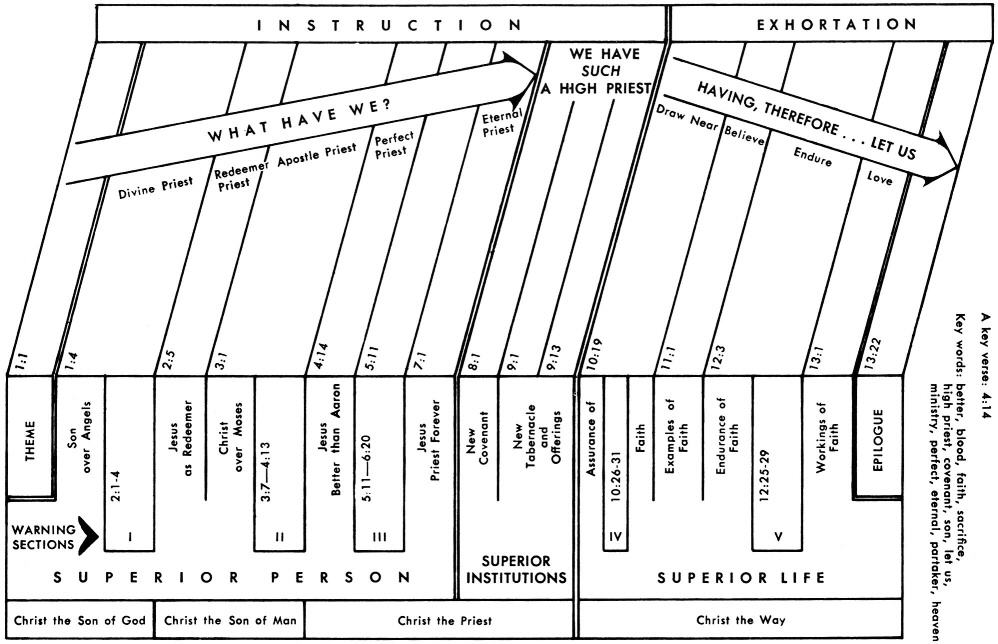
CONSIDER JESUS OUR GREAT HIGH PRIEST
Click chart to enlarge
Charts from Jensen's Survey of the NT - used by permission
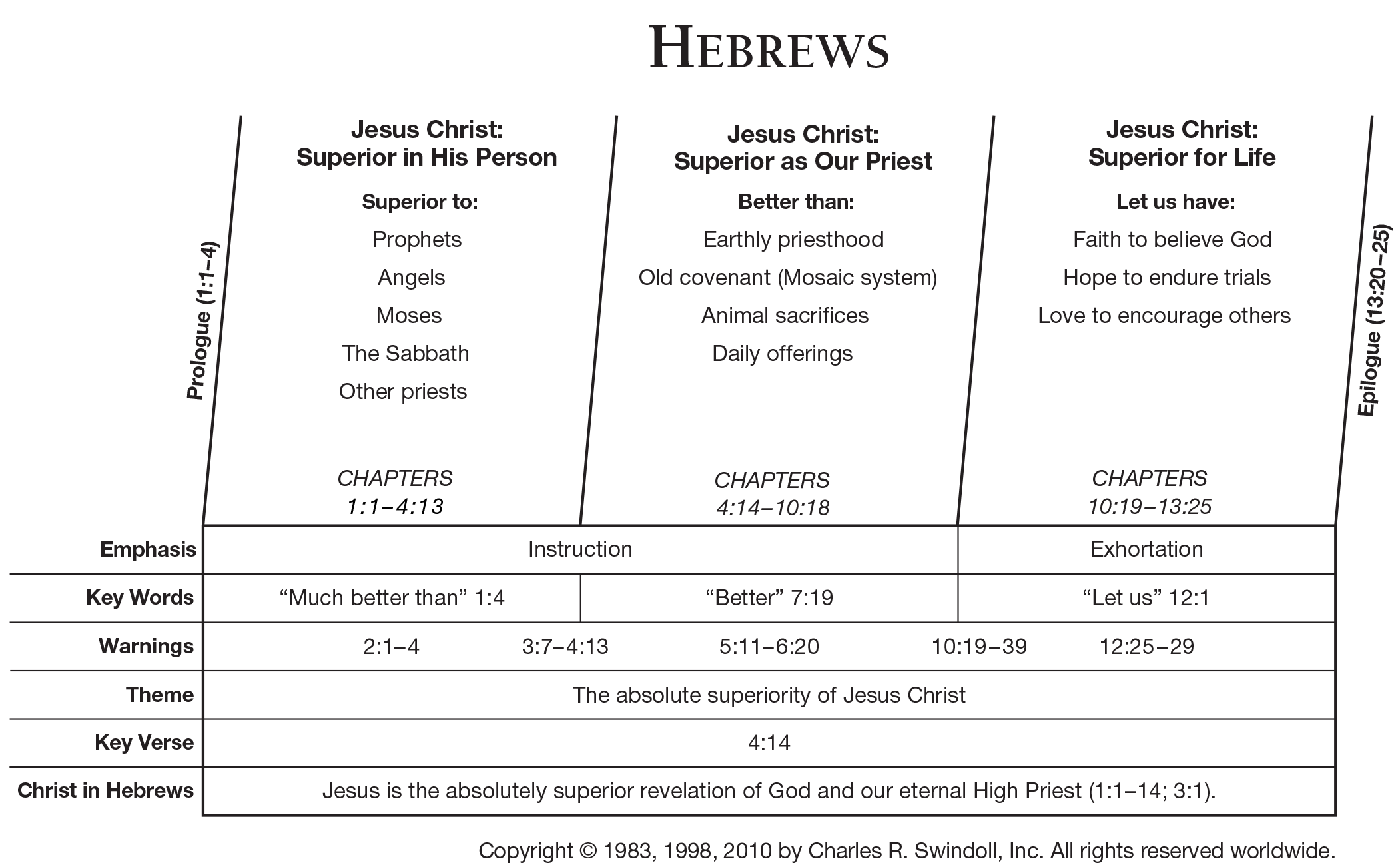
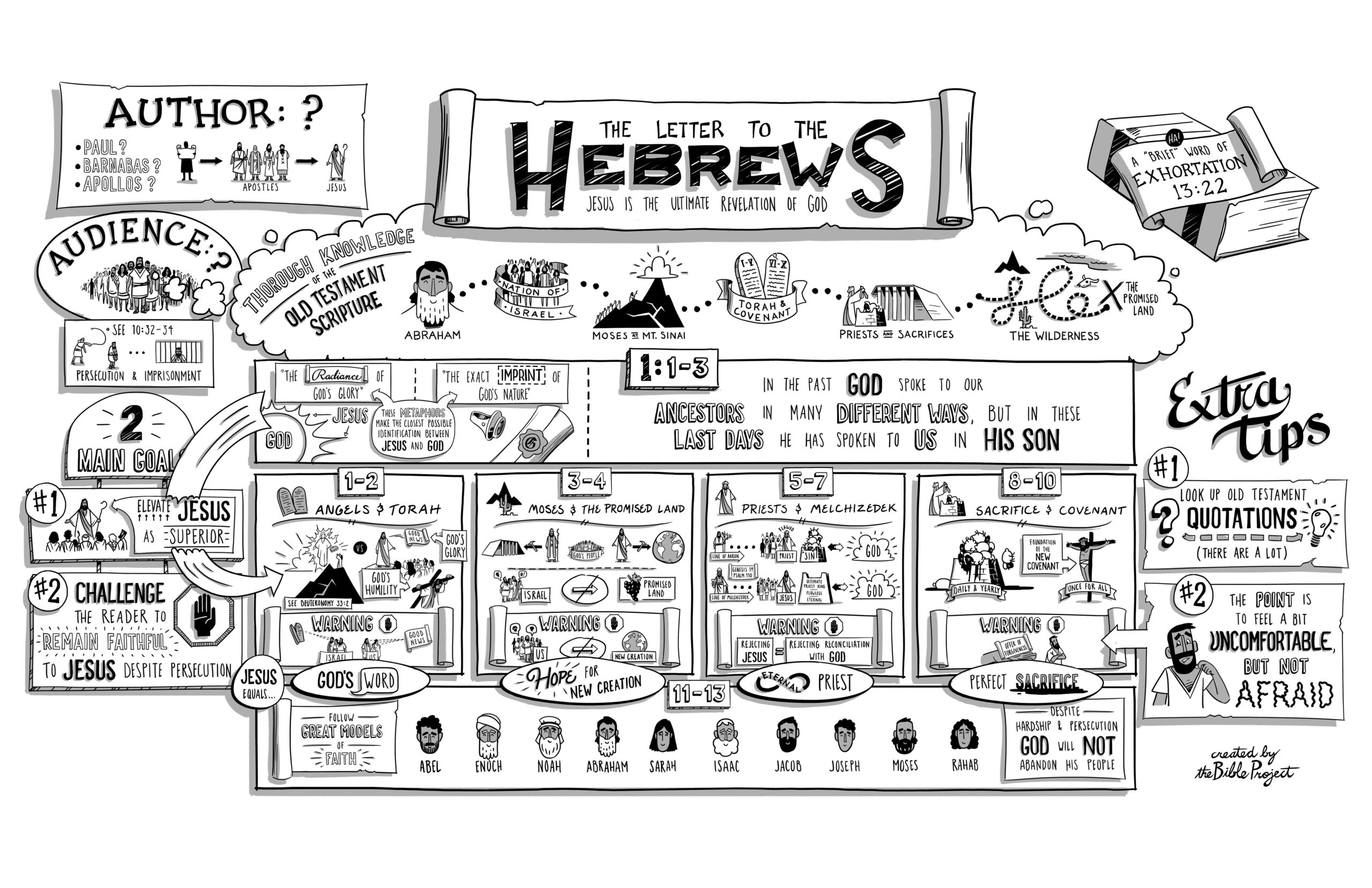
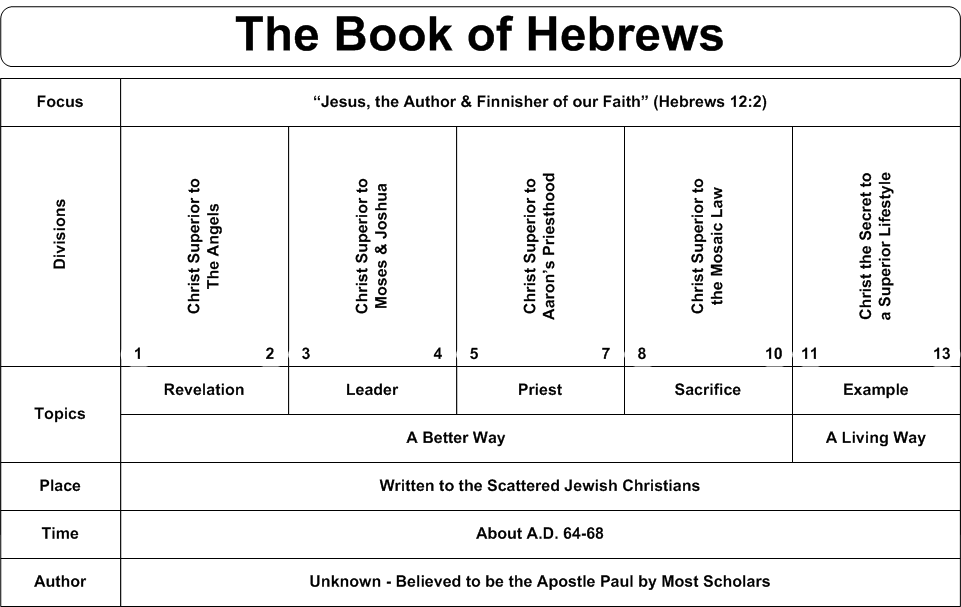
Swindoll's Chart, Interesting Pictorial Chart of Hebrews, Another Chart
|
The Epistle |
||||
| INSTRUCTION Hebrews 1-10:18 |
EXHORTATION Hebrews 10:19-13:25 |
|||
| Superior Person of Christ Hebrews 1:1-4:13 |
Superior Priest in Christ Hebrews 4:14-10:18 |
Superior Life In Christ Hebrews 10:19-13:25 |
||
| BETTER THAN PERSON Hebrews 1:1-4:13 |
BETTER PRIESTHOOD Heb 4:14-7:28 |
BETTER COVENANT Heb 8:1-13 |
BETTER SACRIFICE Heb 9:1-10:18 |
BETTER LIFE |
| MAJESTY OF CHRIST |
MINISTRY OF CHRIST |
MINISTERS FOR CHRIST |
||
|
DOCTRINE |
DUTY |
|||
|
DATE WRITTEN: |
||||

See ESV Study Bible "Introduction to Hebrews"
(See also MacArthur's Introduction to Hebrews)
Borrow Ryrie Study Bible
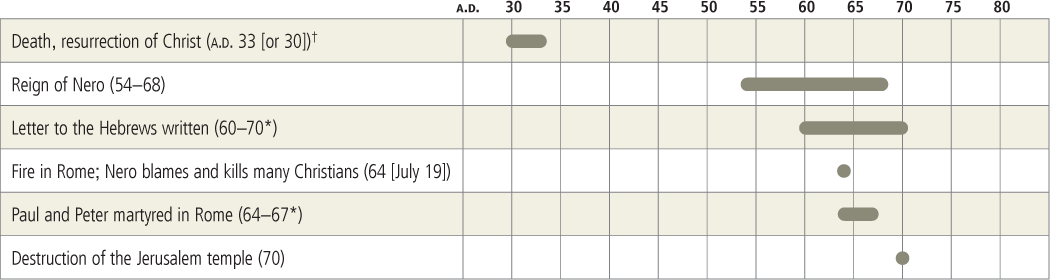
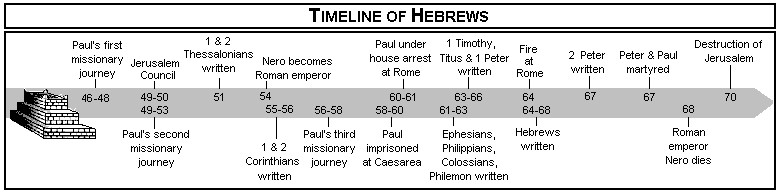
Timeline of Hebrews - ESV Study Bible
* Denotes approximate date of Writing
Hebrews 1:6 And when He again brings the firstborn into the world, He says, "AND LET ALL THE ANGELS OF GOD WORSHIP (NASB: Lockman)
Greek: hotan de palin eisagage (3SAAS) ton prototokon eis ten oikoumenen, legei, (3SPAI) Kai proskunesatosan (3PAAM) auto| pantes aggeloi theou.
BGT ὅταν δὲ πάλιν εἰσαγάγῃ τὸν πρωτότοκον εἰς τὴν οἰκουμένην, λέγει· καὶ προσκυνησάτωσαν αὐτῷ πάντες ἄγγελοι θεοῦ.
BBE And again, when he is sending his only Son into the world, he says, Let all the angels of God give him worship.
CSB When He again brings His firstborn into the world, He says, And all God's angels must worship Him.
ESV And again, when he brings the firstborn into the world, he says, "Let all God's angels worship him."
GWN When God was about to send his firstborn Son into the world, he said, "All of God's angels must worship him."
KJV: And again, when he bringeth in the first begotten into the world, he saith, And let all the angels of God worship him. (Marginal note - or, When he bringeth again, the first- begotten)
MIT And again, when he brought his firstborn into the population: All God's angels must revere him.
NAB And again, when he leads the first-born into the world, he says: "Let all the angels of God worship him."
NKJ But when He again brings the firstborn into the world, He says: "Let all the angels of God worship Him."
NET But when he again brings his firstborn into the world, he says, "Let all the angels of God worship him!"
NIV And again, when God brings his firstborn into the world, he says, "Let all God's angels worship him."
NJB Again, when he brings the First-born into the world, he says: Let all the angels of God pay him homage.
NLT And when he brought his firstborn Son into the world, God said, "Let all of God's angels worship him."
NRS And again, when he brings the firstborn into the world, he says, "Let all God's angels worship him."
RSV And again, when he brings the first-born into the world, he says, "Let all God's angels worship him."
Phillips: Further, when he brings his first-born into this world of men, he says: 'Let all the angels of God worship him' (Phillips: Touchstone)
Wuest: And whenever He shall have brought again the first-begotten into the inhabited earth, He says, And let all God’s angels worship Him. (Eerdmans)
Young's Literal: and when again He may bring in the first-born to the world, He saith, 'And let them bow before him -- all messengers of God;'
Following versions translate again in such a way as to not favor this as a reference to the Second Coming but the First Coming
- And again, when he brings the firstborn (NRSV)
- And again, when he bringeth in the first begotten into the world (KJV)
- And again, when God brings his firstborn into the world (NIV)
- And again, when he bringeth in the first begotten into the world (DNT)
- And again, when he brings his firstborn into the world (ISV)
- And again, when he leads the first-born into the world, (NAB)
- And again, when he brings the firstborn into the world (ESV)
- But when God was about to send his first-born Son into the world (TEV)
- Further, when he brings his first-born into this world of men, (Phillips)
- And again, when God brings his Firstborn into the world (JNT)
- and further when introducing the firstborn into the world (Moffatt)
- Now again when He brings the Firstborn [fig., the Pre-existent One] into the inhabited earth (ALT)
- And again, when he is sending his only Son into the world (BBE)
Following versions translate again in such a way as to favor this as a reference to the Second Coming...
- But speaking of the time when He once more brings His Firstborn (WNT)
- And when he again bringeth in the firstborn into the world (ASV)
- And whenever He shall have brought again the first-begotten into the inhabited earth (Wuest)
- Moreover, when He brings the firstborn Son again into the habitable world (Amp)
- When He again brings His firstborn into the world, (Adds a note: Or And again, when He brings His firstborn into the world..." ) (Holman Christian Std Bible)
- But when he again brings his firstborn into the world, he says, “Let all the angels of God worship him!” (NET Bible is similar to Holman above adding an explanatory note but stating that they favor the rendering that "looks forward to Christ's Second Coming to earth")
- and when he re-introduces the first-begotten into the world (Mace NT)
- But speaking of the time when He once more brings His Firstborn into the world (WNT)
- But when He again brings the firstborn (NKJV)
- and when again He may bring in the first-born to the world (YLT)
- And when He again - Heb 1:5; Pr 8:24-25 Jn 1:14;18 Jn 3:16; Ro 8:29; Col 1:15, 18 1Jn 4:9; Rev 1:5
- Let all the angels - Dt 32:43 Ps 97:7; Lk 2:9-14; 1Pe 3:22; Rev 5:9-12
- Study Questions for Hebrews - 5W/H questions for leading lessons
- Hebrews 1 Resources
Related Passages:
Revelation 5:11-12+ Then I looked, and I heard the voice of many angels around the throne and the living creatures and the elders; and the number of them was myriads of myriads, and thousands of thousands, 12 saying with a loud voice, “Worthy is the Lamb that was slain to receive power and riches and wisdom and might and honor and glory and blessing.”
Luke 2:13-14+ (ANGELS WORSHIPPED AT HIS BIRTH - SEE PICTURE BELOW) And suddenly there appeared with the angel a multitude of the heavenly host praising God and saying, 14 “Glory to God in the highest, And on earth peace among men with whom He is pleased.”

WORSHIP THE
FIRSTBORN SON
And when He again (palin) brings the firstborn (prototokos) into the world (oikoumene - "the inhabited earth") - Again is Greek adverb palin is taken as modifying the verb (brings… into) that it immediately precedes in the Greek construction, one would interpret this as a reference is to Second Coming (He 9:28+; He 10:37+) Charles Ryrie, Marvin Vincent, Kenneth Wuest, Expositor’s Commentary, and Henry Alford interpret this as a reference to the Second Coming. The interpretation suggested by the KJV and even by the NIV and ESV would favor this as a reference to the First Coming, not the Second Coming (See listing of all translations above)
John MacArthur on again - As reflected in most modern translations, the Greek word order is “And when He again brings.” So in verse 6, again refers to God’s bringing His firstborn into the world another time. When is this “again” going to happen? The only possible answer is at the Second Coming. God already brought Him once as Son, and He is going to bring Him as Son again—in blazing glory! (See Hebrews Commentary - Page 31)
NET NOTE on again - The translation adopted in the text looks forward to Christ's second coming to earth. Some take again to introduce the quotation (as in Heb 1:5) and understand this as Christ's first coming, but this view does not fit well with Heb 2:7+. Others understand it as his exaltation/ascension to heaven, but this takes the phrase "into the world" in an unlikely way.
He says - He refers to God the Father. He says is in the present tense so that the Father is continually commanding "Worship Him". Who is Him? In context Him clearly refers the Son, emphasizing His more excellent Name.
David Guzik - Rabbis used firstborn as a specifically Messianic title. One ancient Rabbi wrote, “God said, ‘As I made Jacob a first-born (Exodus 4:22), so also will I make king Messiah a firstborn (Psalm 89:28).’ ” (R. Nathan in Shemoth Rabba, cited in Lightfoot)
John MacArthur on firstborn - In this passage Christ is called the first-born. Here again, many sects and cults claim a prooftext to show that Jesus is a created being. "Look! He's first-born! You see? He was born like all the rest of us!" A related supposed prooftext is Colossians 1:15, "And He is the image of the invisible God, the first-born of all creation. But "first-born" (prōtotokos) has nothing to do with time. It refers to position. It is not a description but a title, meaning "the chief one." The concept was associated with first-born because the oldest son usually was heir to the father's entire estate. The first son to be born was not always the "first-born." Esau, for instance, was older than Jacob, but Jacob was the first-born, the prōtotokos. Genesis 49:3 gives a good description of first-born: "Reuben, you are my first-born; my might and the beginning of my strength, preeminent in dignity and preeminent in power." Might, strength, dignity, and power—these describe the meaning of first-born. It is not a time word; it is a right-to-rule word, an authority word. And Jesus Christ is the supreme First-born, the supreme Prōtotokos, the supreme right-to-rule Son. These passages, therefore, do not refer to Christ's birth as such, but to His sovereignty. "He is also head of the body, the church; and He is the beginning, the first-born from the dead" (Col. 1:18). Jesus was "the first-born from the dead." Had anybody been resurrected before Jesus? Yes. Lazarus, the other people that Jesus raised during His earthly ministry, all the Old Testament saints who came alive at the crucifixion—all these and others had been raised from the dead before Jesus! The term, therefore, obviously does not refer to time. As first-born, Jesus is the most honored One, the most dignified One, the highest One, the most powerful One. Of all those who have been resurrected, He is far and above the greatest. (See Hebrews MacArthur New Testament Commentary - Page 30)
AND LET ALL THE ANGELS (aggelos) OF GOD WORSHIP (proskuneo) - All caps indicates a direct OT quote, in this case from the Septuagint not the Hebrew (which is true of all the OT quotes in Hebrews). Worship is a command (aorist imperative) meaning to carry this out effectively and fully. The angels are to do this now and of course "ALL" obey this command. While ALL means all without exception, the fallen angels do not willingly worship Jesus, however even in the NT we see the demonic spirits (fallen angels) forced to acknowledge Jesus' authority, Mark recording "Whenever the unclean spirits saw Him (JESUS), they would fall down (prospipto) before Him and shout, “You are the Son of God!”." (Mk 3:11+) Note that fall down before is not the verb proskuneo which was used by the devil calling Him to fall down in worship in Mt 4:9+.
The angels are commanded to worship the Messiah because He is superior to them and thus are examples of worship, not objects of worship.
ESV Study Bible - Let all God’s angels worship Him may be an interpretative citation of either Ps. 97:7 or Deut. 32:43 (lxx)—or possibly both. In both cases angels are considered “sons of God,” but without the rights of the unique Son of God. The job of angels is to worship God, and hence to worship his Son (the “exact imprint of his nature,” Heb. 1:3). Since only God is worthy of worship (Ex. 20:3-5; Isa. 42:8; Matt. 4:10; Rev. 19:10; 22:9), this is further evidence of the Son’s full deity. (See ESV Study Bible - Page 6)
John records that he "heard the voice of many angels around the throne and the living creatures and the elders; and the number of them was myriads of myriads, and thousands of thousands, saying with a loud voice, "Worthy is the Lamb that was slain to receive power and riches and wisdom and might and honor and glory and blessing." (Rev 5:11-12+)
Although some scholars believe this OT quote is from the Septuagint of Dt 32:43+ others favor Psalm 97:7 (See G. L. Cockerill's Hebrews 1:6: Source and Significance - Bulletin for Biblical Research, Vol 9). At first glance Ps 97:7 does not seem to fit with the Hebrews quote because the Hebrew reads "Worship Him, all you gods" where gods in the Hebrew is elohim. But remember the OT quotes in Hebrews are exclusively from the Septuagint. So let's compare the English translations of the Hebrew and the Septuagint as follows:
HEBREW - Psalm 97:7 Let all those be ashamed who serve graven images, Who boast themselves of idols; Worship Him, all you gods (Hebrew = elohim). (English translated from the Hebrew manuscript)
GREEK - Psalm 97:7 Let all that worship graven images be ashamed, who boast of their idols; worship (Lxx = proskuneo; aorist imperative) him, all ye his angels (Greek = aggelos) (English translated from the Septuagint)
As noted above, some scholars favor the as from Dt 32:43+ which in the Greek (LXX) reads "Rejoice, ye heavens, with him, and let all the angels of God worship him". The Greek (Septuagint) of Dt 32:43 is "proskunesatosan auto pantes huioi theou," while the Greek (Septuagint) of Ps 97:7 is "proskunesate auto pantes hoi aggeloi autou" while the Greek of Heb 1:6 is "proskunesatosan auto pantes aggeloi theou." There are clearly similarities in the Hebrews 1:6 Greek text with either quote so that either would serve to substantiate the writer's main premise that the angels are to worship Jesus. The NET Note agrees writing that Heb 1:6b is "A quotation combining themes from Deut 32:43 and Ps 97:7. "
Christ is worshiped,
Angels are worshipers
When Jesus Christ was taken into the world above, at His resurrection and ascension, He was attended and worshipped by angels (Acts 1:10f). When Jesus Christ returns to this earth again, He shall be attended and worshipped by angels (Mt 13:41; Mt 16:27; Mt 24:31, 25:31).
Angels, from the Realms of Glory
Angels, from the realms of glory
Wing your flight o’er all the earth;
Ye who sang creation’s story,
Now proclaim Messiah’s birth:
Come and worship, come and worship,
Worship Christ, the newborn King.
Again (3825) palin means 1) anew, again 1a) renewal or repetition of the action 1b) again, anew 2) again, i.e. further, moreover 3) in turn, on the other hand. Gingrich —1. back Mk 5:21; 14:39; J 6:15; 11:7; Ac 18:21; 2 Cor 1:16; Gal 1:17; 4:9; Phil 1:26.—2. again, once more, anew Mt 4:8; 20:5; 26:42; 27:50; Mk 2:13; Lk 23:20; Ac 17:32; Ro 8:15; 1 Cor 7:5; Gal 2:18.—3. furthermore, thereupon Mt 5:33; 19:24; Lk 13:20; J 12:39; 19:37; Ro 15:10–12; Hb 1:5; 2:13.—4. on the other hand, in turn Mt 4:7; Lk 6:43; 1 Cor 12:21; 2 Cor 10:7.—5. pa,lin in Mk 15:13; J 18:40 refers to responses made in turn. [as prefix in palimpsest, palindrome, palinode] [pg 146]
Friberg - adverb; (1) with verbs of going, sending, turning, etc., denoting backward direction back (Jn 11.7); (2) denoting a return to a previous state or activity again (Jn 4.13); (3) denoting repetition again, once more, anew (Mt 26.43, 44); (4) denoting continuation furthermore, again, often used in series of quotations or sayings introduced by a formula ( Mt 13.45; Heb 1.5); (5) denoting a turn of thought on the other hand, in turn, again (1Jn 2.8) (Borrow Analytical Lexicon)
PALIN - 135V - again(127), again*(1), another(1), back(4), once more(4), other hand(3). Matt. 4:7; Matt. 4:8; Matt. 5:33; Matt. 13:45; Matt. 13:47; Matt. 18:19; Matt. 19:24; Matt. 20:5; Matt. 21:36; Matt. 22:1; Matt. 22:4; Matt. 26:42; Matt. 26:43; Matt. 26:44; Matt. 26:72; Matt. 27:50; Mk. 2:1; Mk. 2:13; Mk. 3:1; Mk. 3:20; Mk. 4:1; Mk. 5:21; Mk. 7:14; Mk. 7:31; Mk. 8:1; Mk. 8:13; Mk. 8:25; Mk. 10:1; Mk. 10:10; Mk. 10:24; Mk. 10:32; Mk. 11:3; Mk. 11:27; Mk. 12:4; Mk. 14:39; Mk. 14:40; Mk. 14:61; Mk. 14:69; Mk. 14:70; Mk. 15:4; Mk. 15:12; Mk. 15:13; Lk. 6:43; Lk. 13:20; Lk. 23:20; Jn. 1:35; Jn. 4:3; Jn. 4:13; Jn. 4:46; Jn. 4:54; Jn. 6:15; Jn. 8:2; Jn. 8:8; Jn. 8:12; Jn. 8:21; Jn. 9:15; Jn. 9:17; Jn. 9:27; Jn. 10:7; Jn. 10:17; Jn. 10:18; Jn. 10:19; Jn. 10:31; Jn. 10:39; Jn. 10:40; Jn. 11:7; Jn. 11:8; Jn. 11:38; Jn. 12:28; Jn. 12:39; Jn. 13:12; Jn. 14:3; Jn. 16:16; Jn. 16:17; Jn. 16:19; Jn. 16:22; Jn. 16:28; Jn. 18:7; Jn. 18:27; Jn. 18:33; Jn. 18:38; Jn. 18:40; Jn. 19:4; Jn. 19:9; Jn. 19:37; Jn. 20:10; Jn. 20:21; Jn. 20:26; Jn. 21:1; Jn. 21:16; Acts 10:15; Acts 11:10; Acts 17:32; Acts 18:21; Acts 27:28; Rom. 8:15; Rom. 11:23; Rom. 15:10; Rom. 15:11; Rom. 15:12; 1 Co. 3:20; 1 Co. 7:5; 1 Co. 12:21; 2 Co. 1:16; 2 Co. 2:1; 2 Co. 3:1; 2 Co. 5:12; 2 Co. 10:7; 2 Co. 11:16; 2 Co. 12:21; 2 Co. 13:2; Gal. 1:9; Gal. 1:17; Gal. 2:1; Gal. 4:9; Gal. 4:19; Gal. 5:1; Gal. 5:3; Phil. 1:26; Phil. 2:28; Phil. 4:4; Heb. 1:5; Heb. 1:6; Heb. 2:13; Heb. 4:5; Heb. 4:7; Heb. 5:12; Heb. 6:1; Heb. 6:6; Heb. 10:30; Jas. 5:18; 2 Pet. 2:20; 1 Jn. 2:8; Rev. 10:8; Rev. 10:11
PALIN - IN SEPTUAGINT - Gen. 8:10; Gen. 8:12; Gen. 26:18; Gen. 29:33; Gen. 30:31; Gen. 41:22; Gen. 42:24; Gen. 43:2; Gen. 44:25; Exod. 3:15; Exod. 4:6; Exod. 4:7; Lev. 14:43; Num. 35:32; Deut. 30:3; Jos. 6:14; Jdg. 2:19; Jdg. 20:39; 2 Chr. 19:4; Neh. 9:28; Job 5:18; Job 6:29; Job 7:4; Job 10:9; Job 10:16; Job 14:14; Job 32:18; Job 33:19; Job 42:17; Ps. 71:20; Ps. 71:21; Isa. 6:13; Isa. 7:4; Isa. 8:9; Isa. 23:17; Isa. 25:8; Isa. 28:25; Isa. 30:18; Jer. 18:4; Jer. 36:15; Jer. 36:28; Dan. 8:27; Dan. 9:25 = "it will be built again, with plaza and moat, even in times of distress."
First-born (firstborn) (4416) (prototokos = protos = first, + tíkto =bear, bring forth) can mean first-born chronologically (Lk 2:7+) but refers primarily to position, or rank. In other words first-born has nothing to do with time. It refers to position. It is not a description but a title, meaning “the chief one.” God made Solomon the firstborn (Ps. 89:27) even though Solomon is listed tenth in the official genealogy (1 Chron. 3:1–5). In both The concept was associated with firstborn because the oldest son usually was heir to the father’s entire estate. Greek and Jewish culture, the first-born was the son who had the right of inheritance. He was not necessarily the first one born. Although Esau was born first chronologically, it was Jacob who was the “first-born” and received the inheritance. Jesus is the One with the right to the inheritance of all creation. In Ps 89:27, God says of the Messiah, “I also shall make him My first-born,” then defines what He means—“the highest of the kings of the earth.” In Rev 1:5+, Jesus is called “the first-born of the dead,” even though He was not the first person to be resurrected chronologically. Of all ever raised, He is the preeminent One. Ro 8:29+ refers to Him as the first-born in relation to the church. In all the above cases, first-born clearly means highest in rank, not first created.
PROTOKOS - firstborn(8) - Lk. 2:7 = "her firstborn son"; Ro 8:29 = "He would be the firstborn among many brethren"; Col. 1:15; Col. 1:18; Heb. 1:6; Heb. 11:28; Heb. 12:23; Rev. 1:5
Hebrews 11:28+ By faith he kept the Passover and the sprinkling of the blood, so that he who destroyed the firstborn would not touch them.
Hebrews 12:23+ to the general assembly and church of the firstborn who are enrolled in heaven, and to God, the Judge of all, and to the spirits of the righteous made perfect,
Revelation 1:5+ and from Jesus Christ, the faithful witness, the firstborn of the dead, and the ruler of the kings of the earth. To Him who loves us and released us from our sins by His blood–
QUESTION - What does it mean that Jesus is the “firstborn” over Creation? GOTQUESTIONS.ORG
ANSWER - In a letter to the church at Colossae, the Apostle Paul gave an intriguing description of Jesus. In it, he explained Christ’s relationship to God the Father and to creation. Some have claimed that Paul’s description of Christ as the firstborn of creation means that Jesus was created—not eternal, not God. Such a doctrine, however, conflicts with the rest of the Bible. Christ could not be both Creator and created; John 1 clearly names Him Creator. Let’s take a careful look at the passage where Jesus is called the firstborn.
Colossians 1:15-21+
“And He is the image of the invisible God, the firstborn of all creation. For by Him all things were created, both in the heavens and on earth, visible and invisible, whether thrones or dominions or rulers or authorities — all things have been created by Him and for Him. And He is before all things, and in Him all things hold together. He is also head of the body, the church; and He is the beginning, the firstborn from the dead; so that He Himself might come to have first place in everything. For it was the Father’s good pleasure for all the fullness to dwell in Him, and through Him to reconcile all things to Himself, having made peace through the blood of His cross; through Him, I say, whether things on earth or things in heaven.”
Jesus is God
Christ’s relationship to His Father begins with the phrase "the image of the invisible God." The word “image,” meaning copy or likeness, expresses Christ’s deity. This word involves more than a resemblance, more than a representation. He is God! Although He took on human form, He has the exact nature of His Father (Hebrews 1:3).
The "Word" of John 1:1 is a divine Person, not a philosophical abstraction. In the incarnation, the invisible God became visible in Christ; deity was clothed with humanity (Matthew 17:2). God is in Christ: visible, audible, approachable, knowable, and available. All that God is, Christ is.
Jesus is Lord of Creation
The description "firstborn of all creation" speaks of Christ’s preexistence. He is not a creature but the eternal Creator (John 1:10). God created the world through Christ and redeemed the world through Christ (Hebrews 1:2-4).
Note that Jesus is called the firstborn, not the first-created. The word "firstborn" (Greek word "prototokos") signifies priority. In the culture of the Ancient Near East, the firstborn was not necessarily the oldest child. firstborn referred not to birth order but to rank. The firstborn possessed the inheritance and leadership.
Therefore, the phrase expresses Christ’s sovereignty over creation. After resurrecting Jesus from the dead, God gave Him authority over the Earth (Matthew 28:18). Jesus created the world, saved the world, and rules the world. He is the self-existent, acknowledged Head of creation.
Finally, the phrase recognizes Him as the Messiah: "I will make Him [Christ] My firstborn, higher than the kings of the earth" (Psalm 89:27).
Six times the Lord Jesus is declared to be the firstborn of God (see Romans 8:29; Colossians 1:15, 18; Hebrews 1:6; 12:23; Revelation 1:5). These passages declare the preexistence, the sovereignty, and the redemption that Christ offers.
Thus, the phrase "firstborn of all creation" proclaims Christ’s preeminence. As the eternal Son of God, He created the universe. He is the Ruler of creation!
Related Resource:
TWISTING THE SCRIPTURE - JEHOVAH'S WITNESSES - Jehovah's Witnesses claim that the title “firstborn of all creation” (Col 1:15+) means that Jesus is the first created being, based on the analogy of a human family where the first-born child is younger than his parents. To support this they must insert the word other into their translation called the New World Translation so that it reads “For by him all other things were created.” (Col 1:16+) There is no manuscript support which would warrant the heretical insertion of the word other into the original Greek text. The correct reading is "For by Him all things were created, both in the heavens and on earth, visible and invisible, whether thrones or dominions or rulers or authorities–all things have been created through Him and for Him." In addition to the example of Esau and Jacob mentioned above, the OT records several instances where the son who is designated the firstborn was not the one chronologically born first. For example, Ishmael was thirteen years older than Isaac, but it is Isaac who is designated as the firstborn. In addition, when Jacob transfers the right of the firstborn to one of Joseph's two sons, he makes the younger son Ephraim the firstborn. over the chronologically firstborn Manasseh.
John MacArthur - WORSHIP OF DISTINCTION - Drawing Near: Daily Readings for a Deeper Faith - Page 39
“When He again brings the first-born into the world, He says, ‘And let all the angels of God worship Him’” (Heb. 1:6).
✧✧✧
Jesus Christ is greater than angels
because He is worshiped.
Even though Jesus Christ humbled Himself and was made lower than the angels for a time, angels are still to worship Him. Since angels are to worship Him, Christ must be greater than them.
Angels have always worshiped Christ—as God. It wasn’t until His incarnation that angels were commanded to worship Him as God’s Son. It is a sin to worship anyone or anything but God. In fact, note how sternly the Apostle John was rebuked for worshiping angels (Rev. 19:10; 22:8–9). The very fact that angels are to worship Christ verifies that Christ is indeed God.
At present, the angels don’t fully understand the entire picture of God’s redemptive plan. Peter tells us that the prophets didn’t understand all that they wrote, “seeking to know what person or time the Spirit of Christ within them was indicating as He predicted the sufferings of Christ and the glories to follow” (1 Peter 1:11). Then he added, “… things into which angels long to look” (v. 12). They are still trying to figure out things they don’t understand.
But that won’t always be the case. Notice that Hebrews 1:6 says, “When He again brings the first-born into the world . . .” (emphasis added). God already brought Christ into the world once; at the Second Coming He will bring Him into the world in blazing glory. Then the fullness of the prophecy of Psalm 97:7, quoted in Hebrews 1:6, will come to pass: “Let all the angels of God worship Him.”
In His Second Coming Christ will be revealed in full glory as the Son. More than ever we will have reason to join the heavenly chorus in declaring, “Worthy is the Lamb that was slain to receive power and riches and wisdom and might and honor and glory and blessing” (Rev. 5:12).
- Created by God and Christ Nehemiah 9:6; Colossians 1:16
- Worship God and Christ Neh 9:6; Philippians 2:9-11; Hebrews 1:6
- Are ministering Spirits 1 Kings 19:5; Ps 68:17; 104:4; Luke 16:22; Acts 12:7-11; 27:23; Hebs 1:7,14
- Communicate the will of God Da 8:16,17; 9:21-23; 10:11; 12:6,7; Mt 2:13,20; Lk 1:19,28; Ac 5:20; 8:26; 10:5; 27:23; Rev 1:1
- Obey the will of God Psalm 103:20; Matthew 6:10
- Execute the purposes of God Numbers 22:22; Ps 103:21; Mt 13:39-42; 28:2; John 5:4; Rev 5:2
- Execute the judgments of God 2 Samuel 24:16; 2Ki 19:35; Ps 35:5,6; Acts 12:23; Rev 16:1
- Celebrate the praises of God Job 38:7; Ps 148:2; Isa 6:3; Luke 2:13,14; Rev 5:11,12; 7:11,12
- The law given by the ministration of Psalm 68:17; Acts 7:53; Hebrews 2:2
ANNOUNCED
- The conception of Christ Matthew 1:20,21; Luke 1:31
- The birth of Christ Luke 2:10-12
- The resurrection of Christ Matthew 28:5-7; Luke 24:23
- The ascension and second coming of Christ Acts 1:11
- The conception of John the Baptist Luke 1:13,36
- Minister to Christ Matthew 4:11; Luke 22:43; John 1:51
- Are subject to Christ Ephesians 1:21; Colossians 1:16; 2:10; 1 Peter 3:22
- Shall execute the purposes of Christ Matthew 13:41; 24:31
- Shall attend Christ at his second coming Matthew 16:27; 25:31; Mark 8:38; 2 Thessalonians 1:7
- Know and delight in the gospel of Christ Ephesians 3:9,10; 1 Timothy 3:16; 1 Peter 1:12
- Ministration of, obtained by prayer Matthew 26:53; Acts 12:5,7
- Rejoice over every repentant sinner Luke 15:7,10
- Have charge over the children of God Psalm 34:7; 91:11,12; Daniel 6:22; Matthew 18:10
- Are of different orders Isaiah 6:2; 1 Thessalonians 4:16; 1 Peter 3:22; Jude 1:9; Revelation 12:7
- Not to be worshipped Colossians 2:18; Revelation 19:10; 22:9
- Are examples of meekness 2 Peter 2:11; Jude 1:9
- Are wise 2 Samuel 14:20
- Are mighty Psalm 103:20
- Are holy Matthew 25:31
- Are elect 1 Timothy 5:21
- Are innumerable Job 25:3; Hebrews 12:22
An Anecdotal Story from a missionary physician in New Guinea: As a doctor and missionary in New Guinea, I lived in an area that I was required to travel two days by bike to purchase supplies and medicine. One those journeys I would spend one of the nights sleeping in the jungle along the way. One of the times I was going to buy supplies I saw a couple of men beating up a young man. I stopped and gave medical treatment to the injured party. I then went on and purchased my supplies and returned home. The next time I traveled to the town on a buying mission, I was stopped by one of the men who was involved in the beating of the young man I helped. He informed me that he and his friends knew that I carried money and drugs so they followed me into the jungle with the purpose of robbing and killing me. As they approached my campsite they said that I was asleep but I was surrounded by 26 armed guards. I assured him that I was very much alone that evening, but did have the opportunity to lead him to the Lord. As I returned to the States for furlough, I was sharing this story with a church. During the middle of the story a gentleman jumped up and asked me what date that would have been. I have him the date. He stated that he had been on the golf course that day and was overcome by the desire to pray for me and my protection. He called some men of the church and they met at the church and started to pray for me. He asked all the men that came that day to stand up. Twenty-six men stood up.
Rob Morgan's Deathbed Story - One of the most overlooked and yet most wonderful verses in the Bible about the ministry of angels is Luke 16:22. This is our Lord’s story of the rich man and Lazarus. Lazarus was a beggar on the streets, and if you or I were telling his story, we might say that the poor man, who had always been under-fed and under-clothed and in poor health finally died down in the gutter somewhere and someone buried his poor filthy body in an unmarked grave in potter’s field. But Jesus had a different perspective on it: The time came when the beggar died and the angels carried him to Abraham’s side. The rich man also died and was buried. Abraham’s side was a designation for heaven, the place where Abraham and all the other believers from all the other ages were gathered. The angels came and carried him to heaven. There are so many verses in the Bible designed to take away our fear of death, but this is one of the greatest ones. What happens at the moment of death? We don’t enter that tunnel alone. We don’t traverse that shadowy valley alone. Angels are dispatched, and they meet us on this side and carry us to heaven. We are escorted, ushered, accompanied by angelic escort into the presence of our Lord. I’ll never forget visiting a dear old saint, Mrs. Agnes Frazer, who called for me from her deathbed. I arrived shortly before she died, and she was barely able to speak. I said, “Mrs. Frazer, I’m here. You called for me. This is Rob Morgan, your pastor.” “Oh, yes, Brother Morgan,” she said, “I called for you because I want to know who these men are.” “What men?” “These two men in white who are standing at the foot of my bed.” “I said, ‘There’s no one here Mrs. Frazier except you and me and the nurse.” “Oh, but I see them. What should I say to them, these two men at the foot of my bed.” I felt then I was in the presence of angels, and I replied, “Just tell them that you belong to Jesus.” And that’s what she told them as she passed away just a few minutes later. Are not all angels ministering spirits sent to serve those who will inherit salvation! (Heb 1:14)!!!
Hebrews 1:7 And of the angels He says, "WHO MAKES HIS ANGELS WINDS, AND HIS MINISTERS A FLAME OF FIRE." (NASB: Lockman)
Greek: kai pros men tous aggelous legei, (3SPAI) O poion (PAPMSN) tous aggelous autou pneumata, kai tous leitourgous autou puros phoga;
BGT καὶ πρὸς μὲν τοὺς ἀγγέλους λέγει· ὁ ποιῶν τοὺς ἀγγέλους αὐτοῦ πνεύματα καὶ τοὺς λειτουργοὺς αὐτοῦ πυρὸς φλόγα,
ICB: This is what God said about the angels: "God makes his angels become like winds. He makes his servants become like flames of fire. (ICB: Nelson)
KJV: And of the angels he saith, Who maketh his angels spirits, and his ministers a flame of fire.
NKJ And of the angels He says: "Who makes His angels spirits And His ministers a flame of fire."
Phillips: This is what he says of the angels: 'Who makes his angels spirits and his ministers a flame of fire' (Phillips: Touchstone)
Wuest: And with reference to the angels He says, Who makes His angels spirits, and His servants a flame of fire. (Eerdmans)
Young's Literal: and unto the messengers, indeed, He saith, 'Who is making His messengers spirits, and His ministers a flame of fire;'
NET And he says of the angels, "He makes his angels spirits and his ministers a flame of fire,"
CSB And about the angels He says: He makes His angels winds, and His servants a fiery flame,
ESV Of the angels he says, "He makes his angels winds, and his ministers a flame of fire."
NIV In speaking of the angels he says, "He makes his angels winds, his servants flames of fire."
NLT Regarding the angels, he says, "He sends his angels like the winds, his servants like flames of fire."
MIT On one hand, he says, descriptive of the angels: He makes his messengers winds, And his servants a blazing fire.
NJB To the angels, he says: appointing the winds his messengers and flames of fire his servants,
NRS Of the angels he says, "He makes his angels winds, and his servants flames of fire."
RSV Of the angels he says, "Who makes his angels winds, and his servants flames of fire."
NAB Of the angels he says: "He makes his angels winds and his ministers a fiery flame";
GWN God said about the angels, "He makes his messengers winds. He makes his servants flames of fire."
BBE And of the angels he says, Who makes his angels winds, and his servants flames of fire:
ASV And of the angels he saith, Who maketh his angels winds, And his ministers a flame a fire:
- Who makes - Heb 1:14; 2Ki 2:11; 6:17; Ps 104:4; Isa 6:2; Ezek 1:13-14; Da 7:10; Zec 6:5
Related Passages:
Genesis 3:24+ So He drove the man out; and at the east of the garden of Eden He stationed the cherubim and the flaming sword which turned every direction to guard the way to the tree of life.
Ezekiel 1:13-14+ In the midst of the living beings there was something that looked like burning coals of fire, like torches darting back and forth among the living beings. The fire was bright, and lightning was flashing from the fire. 14 And the living beings ran to and fro like bolts of lightning.
Revelation 10:1+ I saw another strong angel coming down out of heaven, clothed with a cloud; and the rainbow was upon his head, and his face was like the sun, and his feet like pillars of fire;
Hebrews 1:14+ Are they not all ministering (leitourgikos) spirits (pneuma), sent out to render service for the sake of those who will inherit salvation?
Matthew 16:27+ “For the Son of Man is going to come in the glory of His Father with His angels, and WILL THEN REPAY EVERY MAN ACCORDING TO HIS DEEDS.
2 Thessalonians 1:7+ and to give relief to you who are afflicted and to us as well when the Lord Jesus will be revealed from heaven with His mighty angels in flaming fire,

THE CREATOR SON IS SERVED
BY CREATED ANGELS
And of the angels (aggelos) He says, "WHO MAKES (poieo) HIS ANGELS (aggelos) WINDS (pneuma), AND HIS MINISTERS (leitourgos) A FLAME (phlox) OF FIRE (pur) - Makes (poieo) means to create and since Jesus is the Creator of all things (Col 1:16+), the angels were (1) created by Him (the Son was not made anything, but made everything!), (2) are His servants to carry out His bidding (leitourgos is strictly one performing public service and by extension in the NT describes one who carries out God's will by serving others as in Heb 1:14+) and (3) are His possession because the possessive pronoun HIS which supports the premise that the angels belong to Jesus. All of these thoughts support the writer's premise that Jesus is superior to the angels.
John MacArthur agrees writing that "The Greek for makes is poieo (“to create” or “to make”). Since Christ created the angels (Col. 1:16+), He is obviously superior to them. Not only were they created by Him, but they are His possession, His angels. They are His created servants, His ministers, His winds and flame of fire." (See Hebrews Commentary - Page 32)
The word WINDS (pneuma) can also be translated "spirits" which has probably led to the interpretation (which while possible, seems a bit far fetched) that the angels can be changed into winds. (SEE #1 BELOW) P E Hughes adds that "the rendering of the KJV, “who maketh his angels spirits,” that is, spiritual, incorporeal creatures, which reflects a long-entrenched interpretation. (Vulgate - spiritus). The rendering winds rather than “spirits” is contextually required, however; for, if the latter were correct, then a consistently parallel interpretation should be sought for the description of God’s servants as fiery flames." (See A Commentary on the Epistle to the Hebrews - Page 61)
Regarding ministers a flame of fire it is interesting that seraphim (dictionary) means fiery or burning ones. In their only mention in the Bible (Isa 6:2, 6+) seraphim are clearly worshiping Jehovah Who in fact is Jesus according to Jn 12:41+.
Cleon Rogers on ministers a flame - The description here may be understood in two ways, either as personification, as when the wind storm and fire do His word (ED: ACT AS SERVANTS OF THE SON), or as referring to real persons; i.e., the angels can take the form of wind or fire (ED: SEE #1 BELOW). (The New Linguistic and Exegetical Key to the Greek New Testament)
Charles Swindoll - Angelic ministers are likened (ED: SEE #3 BELOW) to wind and fire (Heb. 1:7)—swift and potent in their own right, but nevertheless finite creatures of God under His sovereign rule. (See Insights on Hebrews - Page 21)
William MacDonald is similar to Swindoll - He is the Creator and Director of angels. They obey His will with the speed of wind and with the fervency of fire. (Borrow Believer's Bible Commentary page 2160)
Flanigan on makes His angels winds and His ministers a flame of fire - How gloriously privileged are these angelic servants. They are invisibly swift and powerful as the wind. At His bidding they may effect AS (simile) the wind irresistible judgments. But not only unseen as the wind do they minister, they may move AS (simile) the lightning, fearful, frightening, consuming, devouring (ED: SEE #3 BELOW). Gabriel-like they may run swift AS (simile) the wind on errands of mercy and goodwill (Da 8:16-18; Luke 1:19, 26-28). Like Michael they may minister AS (simile) flames of fire in matters militant (Da 10:13; Jude 1:9; Rev 12:7). In either ministries they are His servants, and for Him they serve men, as is perhaps implied in the word here translated "ministers" (leitourgos; a public servant). What then, and where, and how, is the contrast here advanced between Christ and the angels? It is in the word "maketh". The Son is not "made" anything. The angels are made, created, constituted, spirits and flames of fire. They are so made at His behest and by His will. The Son, it will now be shown in the following verse, is acknowledged for what He is in Himself, intrinsically and eternally. (What the Bible teaches – Hebrews)
The quote is from Ps 104:4+ "He makes the winds His messengers (Hebrew = malak; Lxx - aggelos), Flaming fire His ministers."
NET Note on Ps 104:4 - Heb "and his attendants a flaming fire." The lack of agreement between the singular "fire" and plural "attendants" has prompted various emendations. Some read "fire and flame." The present translation (He makes the winds his messengers, and the flaming fire his attendant. Ps 104:4NET) assumes an emendation to "his attendant" (wy in the Hebrew text being virtually dittographic).
Spurgeon comments on Psalm 104:4+ - Who makes His angels spirits...Angels are pure spirits, though they are permitted to assume a visible form when God desires us to see them. God is a spirit, and he is waited upon by spirits in his royal courts. Angels are like winds for mystery, force, and invisibility (SEE #3), and no doubt the winds themselves are often the angels or messengers of God. God Who makes his angels to be as winds, can also make winds to be his angels...His ministers a flaming fire. Here, too, we may choose which we will of two meanings: God's ministers or servants He makes to be as (term of comparison// simile) swift, potent, and terrible as fire, and on the other hand he makes fire, that devouring element, to be his minister flaming forth upon his errands.
Spurgeon - Angels are servants and not kings, they fly upon the divine errands like flames of fire, but they do not sway a sceptre, neither have they a throne existing for ever and ever. Jesus is the anointed king, and though we share in the anointing yet is He far above us. Christ is infinitely greater than Christians. We are right glad to have it so. Angels are pure spirits, though they are permitted to assume a visible form when God desires us to see them. God is a spirit, and He is waited upon by spirits in His royal courts. Angels are like winds for mystery, force, and invisibility, and no doubt the winds themselves are often the angels or messengers of God.
R Kent Hughes states: Regarding angels' specific function, there are at least four:
1) Angels continuously worship and praise the God they serve (Job 38:7; Psalm 103:20; Isaiah 6:1-3; Revelation 4:8; 5:9-12).
2) Angels communicate God's message to man. They assisted in bringing the Law (Acts 7:38, 53). Angels revealed the future to Daniel and to the Apostle John (Daniel 10:10-15; Revelation 17:1; 21:9; 22:16). Gabriel announced the births of both John the Baptist and Jesus (Matthew 1:19-24; Luke 1:11-28; 2:9-12).
3) Angels minister to believers. "The angel of the Lord encamps around those who fear him, and he delivers them" (Psalm 34:7). "For he will command his angels concerning you to guard you in all your ways; they will lift you up in their hands, so that you will not strike your foot against a stone" (Psalm 91:11, 12). Angels have dramatically delivered believers from prison (Acts 5:19; 12:6-11). Angels rejoice at the conversion of sinners (Luke 15:10). They are present within the Church (1 Corinthians 11:10). They watch the lives of believers with interest (1 Corinthians 4:9; 1 Timothy 5:21). They carry believers away at death to the place of blessedness (Luke 16:22).
4) Angels will be God's agents in the final earthly judgments and Second Coming. They will call forth the elect with a loud trumpet from the four winds (Matthew 24:31; 1 Thessalonians 4:16, 17) and will then separate the wheat from the chaff (Matthew 13:39-42). The book of Revelation tells us they will open the seals, blow the trumpets, and pour out the bowls of wrath. They will also execute the judgment against Satan and his servants (Revelation 19:17-20:3, 10). (See Hebrews: An Anchor for the Soul - Page 6)
J Harold Greenlee - An Exegetical Summary of Hebrews - QUESTION—What is the meaning of the quotation? (Abbreviations are the original sources of the interpretation). Three interpretations have been offered...
1 God may change the angels into winds and flames [EGT, GNC, ICC, Lg, WBC]. As created beings, angels are subject to God’s will and can be transformed into the elemental forces of wind and fire; this is in contrast with the Son who is above the created order and does not change [ICC, WBC]. (ED: Also Moody Bible Commentary page 1924) (ED: This interpretation may be related to a rabbinical interpretation for Marvin Vincent explains that "The thought is according to the rabbinical idea of the variableness of the angelic nature. Angels were supposed to live only as they ministered. Thus it was said: "God does with his angels whatever he will. When he wishes he makes them sitting: sometimes he makes them standing: sometimes he makes them winds, sometimes fire." "The subjection of the angels is such that they must submit even to be changed into elements."....The emphasis, therefore, is not on the fact that the angels are merely servants, but that their being is such that they are only what God makes them according to the needs of their service, and are, therefore, changeable, in contrast with the Son, who is ruler and unchangeable.)
2 The angels act in the winds and assume the form of flames [Alf, Hu, Wst]. The angels’ function is intermittent as are wind and fire through which they act [Hu].
3 The angels are compared (ED: term of comparison// simile) with wind and fire [Blm, GNC, HNTC, Hu, Lns, NIC, NTC; NLT]. The point of comparison between angels and winds is that they are swift [Lns, NIC; NLT] or forceful [NTC]. The point of comparison between angels and fire is that they are strong [NIC] or destructive [Lns, NTC]. Angels are like wind and fire in that they are insubstantial and changeable [HNTC - cf #1 above].
QUESTION - What does it mean that Jesus makes His ministers a flame of fire (Hebrews 1:7)? GOTQUESTIONS.ORG
ANSWER - The book of Hebrews was written to explain the gospel of God’s grace to born-again Hebrew believers. The writer wants to show that salvation in Jesus Christ is far superior to the Hebrew religious system. First-century Jews revered the ancient prophets and angels, some to the point of worshiping them (Colossians 2:18), so the author of Hebrews begins by establishing the superiority of Jesus Christ over the prophets (Hebrews 1:1–3) and angels (Hebrews 1:4–14).
Old Testament Scripture was something Hebrew Christians would understand and appreciate. Thus, these opening passages include multiple citations to confirm the exalted preeminence of Jesus Christ. In Hebrews 1:6–7, Jesus is proved to be better than the angels. Angels are spiritual messengers who dispense information and revelation on God’s behalf. They are highly significant beings but play a subordinate, inferior role to the Son of God:
“And again, when he brings the firstborn into the world, he says, ‘Let all God’s angels worship him.’ Of the angels he says, ‘He makes his angels winds, and his ministers a flame of fire’” (ESV).
No angel in the Bible holds a position as exalted as Jesus Christ. Instead, angels bow in reverence to Him because they recognize His nature to be far greater than their own. Indeed, angels worshiped Jesus at His birth (Luke 2:8–14), proving they are lower-ranking beings than the Son of God. As messengers who do God’s bidding (Psalm 103:20), angels serve the Son of God. Jesus makes His ministers and servants as “winds” and “flames of fire.” This passage in Hebrews 1:7 alludes to Psalm 104:4:
“He makes winds his messengers, flames of fire his servants.”
To the early Hebrew believers, Jesus makes His ministers a flame of fire was a straightforward declaration of the angels’ subservient, lesser position as agents of Jesus Christ. Angels were created by Jesus and for Jesus (Colossians 1:16; John 1:3). They are spirits without bodies (Hebrews 1:14), but they can take on human form (Daniel 8:16; 9:21). In the original language, the word translated as “winds” conveys the basic meaning of “spirits,” indicating their swift and subtle nature. “Flame of fire” communicates fiery devotion and all-consuming fervor. Yet, in the natural realm, the wind is invisible and ephemeral. Even the hottest flames eventually burn out. Like angels, these transitory, fleeting elements of nature cannot compare to the Son of God, who is substantial, majestic, and eternal (Hebrews 1:3; Colossians 2:9; John 1:14; 14:9).
While Jesus ministered on the earth, angels were always on call, ready to serve Him (Matthew 26:53; Psalm 91:11–12). After the Lord was tempted in the wilderness, “angels came and attended him” (Matthew 4:11). Just before His arrest, as Jesus prayed on the Mount of Olives, “an angel from heaven appeared to him and strengthened him” (Luke 22:43).
In days of old, God sent His angels to shut the mouths of lions (Daniel 3:28), guide believers in ministry (Acts 8:26), and deliver apostles from prison (Acts 12:6–11). Over and over throughout the ages, angels have performed the Lord’s bidding (1 Kings 19:5–7; Psalm 78:23–25; Genesis 19:15; Daniel 3:28). Still today, Jesus makes His ministers a flame of fire, sending out angels to protect, deliver, help, and serve His human followers (Acts 5:19; Psalm 34:7; 91:11–12).
Worship (4352) (proskuneo from pros = before + kuneo = kiss or adore) means to prostrate oneself in homage before another in the full sense of worship, not mere reverence or courtesy. When Jesus Christ was born into this world, He was attended and worshipped by angels. (Lu 2:13f). Proskuneo represents the most common Near Eastern act of adoration and reverence and also carries the idea of profound awe and respect. Some believe that the root word kuneo may be related to kuon which is the Greek word for dog and which then could be picturing a dog licking his master's hand.
The word proskuneo literally means to kiss toward someone, to throw a kiss in token of respect or homage, to prostrate oneself in homage, to do reverence to, to adore and so to worship and show respect. In the ancient Oriental (especially Persia) the mode of salutation between persons of equal rank was to kiss each other on the lips. When the difference of rank was slight, they kissed each other on the cheek. When one was much inferior, he fell upon his knees touched his forehead to the ground or prostrated himself, and as he was bowing down he would be throwing kisses toward the superior. It is this latter mode of salutation that is intended by the Greek writers in the use of the verb proskuneo .
TDNT notes that proskuneo "is an ancient term for reverent adoration of the gods, which in the case of chthonic deities would mean stooping to kiss the earth. The Greeks abandon the outward gesture but keep the term for the inner attitude. Later the word takes on a much more general sense expressing love and respect.
Related Resources:
- See online Dictionary of Biblical Imagery discussion of WORSHIP - page 3256.
- What is a biblical theology of worship? | GotQuestions.org
- Are any of the various worship styles unbiblical? | GotQuestions.org
- What does the Bible say about worship? | GotQuestions.org
- What does the Bible say about the position of worship leader? | GotQuestions.org
- What is true worship? | GotQuestions.org
- How much of a role should media have in worship services? | GotQuestions.org
- What is the meaning of Christian worship? | GotQuestions.org
- Regulative vs. normative principle of worship—which viewpoint is correct? | GotQuestions.org
- What are the ingredients to a truly biblical worship service? | GotQuestions.org
- Should we raise our hands/clap our hands during worship? | GotQuestions.org
- What is the difference between praise and worship? | GotQuestions.org
- Why should we worship God? | GotQuestions.org
- How can I know how to properly worship God? | GotQuestions.org
- What does it mean to worship the Lord in spirit and truth? | GotQuestions.org
- Should an unbeliever be allowed to participate in a church worship team? | GotQuestions.org
- Can a Christian worship God using music from a church with unbiblical teachings? | GotQuestions.org
- How much of a priority should worship be in the church? | GotQuestions.org
- Worship Services — Article Index | GotQuestions.org
- What are some Bible verses about worship? | GotQuestions.org
Kenneth Wuest writes that proskuneo means "to prostrate one’s self, to kiss the hand to (towards) one in token of reverence, to fall upon the knees and touch the ground with the forehead as an expression of profound reverence (to make a salam), by kneeling or prostration to do homage to one or make obeisance, either in order to express respect or make supplication.” It is used of homage shown to men of superior rank, or of homage shown to God. Here (Mark 5:6+) it speaks of homage to God, the act of worship, for the demon recognizes our Lord as the Son of God. Here we have a being, incorrigible in his nature, destined to be damned for all eternity, one of the cohorts of Satan, bending the knee to God the Son. This is that of which Paul was speaking when he referred to the universal adoration of the Lord Jesus, even by beings under the earth (Php 2:10+). They are even now bending the knee to the Son of God. In the last analysis, it was not the demoniac who was prostrating himself before the Lord Jesus. He was under the control of the demon, and the latter was the source of the homage paid the Son of God. (Wuest's Word Studies from the Greek New Testament: Eerdmans)
Wayne Detzler adds that originally proskuneo…
meant "to kiss reverently," which involved stooping down to kiss. Early Greek writers spoke of stooping to kiss the ground, as an expression of thanksgiving for a safe arrival. (This is the gesture Pope John Paul II makes on arriving in a foreign land.)
Later, proskuneo came to mean prostration, throwing oneself on the ground to show awe or respect before some deity. This was seen not only with regard to pagan gods or goddesses. It also was practiced when appearing before rulers, such as Alexander the Great. The idea was one of reverence, and this attitude of submission was signaled by falling prostrate on the ground.
In the Septuagint Greek Old Testament such worship was reserved for Jehovah God. In fact, it was considered sacrilege for a Jew to express worship toward any other pagan god or person. One recalls that Daniel's friends refused to bow to their ruler's idol (Da 3:1-12). (BORROW New Testament Words in Today's Language page 406)
The NIDNTT adds that "The basic meaning of proskuneo, in the opinion of most scholars, is to kiss. The prefix indicates a connection with cultic practices going back beyond Greek history. On Egyptian reliefs worshippers are represented with outstretched hand throwing a kiss to (pros-) the deity. Among the Greeks the verb is a technical term for the adoration of the gods, meaning to fall down, prostrate oneself, adore on one’s knees. Probably it came to have this meaning because in order to kiss the earth (i.e. the earth deity) or the image of a god, one had to cast oneself on the ground. Later proskuneo was also used in connection with the deification of rulers and the Roman emperor cult. In addition to the external act of prostrating oneself in worship, proskuneo can denote the corresponding inward attitude of reverence and humility. (Click for 3 page online discussion of proskuneo in the New International Dictionary of NT Theology)
Wayne Barber - We hear much today about worship. It is defined everywhere from emotions felt during a song to chill bumps when the preacher gives an illustration. But, what is true worship? How do we know we have worshipped? Well, there are three Greek words for worship in the NT. The first word is proskuneo, the word used when the "magi" came from the east to worship the Christ child. [Mt 2:2] This is the word that means to lie down prostrate before one that is worthy to be worshipped. It involves the attitude of humility of the person who is bowing. And on the other hand it involves an understanding and recognition that one is in the presence of the One that is worthy. It is a response word, not an emotion, but an immediate response in the presence of deity. (See True Worship by Dr Wayne Barber)
PROSKUNEO - 60X/54V - bow down(1), bow down before(1), bowed down(1), bowed down before(2), bowing before(1), bowing down(1), prostrated himself before(1), worship(32), worshiped(17), worshipers(1), worshiping(1), worships(1). Matt. 2:2; Matt. 2:8; Matt. 2:11; Matt. 4:9; Matt. 4:10; Matt. 8:2; Matt. 9:18; Matt. 14:33; Matt. 15:25; Matt. 18:26; Matt. 20:20; Matt. 28:9; Matt. 28:17; Mk. 5:6; Mk. 15:19; Lk. 4:7; Lk. 4:8; Lk. 24:52; Jn. 4:20; Jn. 4:21; Jn. 4:22; Jn. 4:23; Jn. 4:24; Jn. 9:38; Jn. 12:20; Acts 7:43; Acts 8:27; Acts 10:25; Acts 24:11; 1 Co. 14:25; Heb. 1:6; Heb. 11:21; Rev. 3:9; Rev. 4:10; Rev. 5:14; Rev. 7:11; Rev. 9:20; Rev. 11:1; Rev. 11:16; Rev. 13:4; Rev. 13:8; Rev. 13:12; Rev. 13:15; Rev. 14:7; Rev. 14:9; Rev. 14:11; Rev. 15:4; Rev. 16:2; Rev. 19:4; Rev. 19:10; Rev. 19:20; Rev. 20:4; Rev. 22:8; Rev. 22:9 Note the preponderance of uses in the Revelation (24 times) - most refer to worship of God, but at least 6 refer to worship of the Antichrist. Here are some representative uses of proskuneo in the NT…
Matthew 2:2 "Where is He who has been born King of the Jews? For we saw His star in the east, and have come to worship Him."
Matthew 2:8 And he (Herod the liar and murderer) sent them to Bethlehem, and said, "Go and make careful search for the Child; and when you have found Him, report to me, that I too may come and worship Him."
Matthew 2:11 And they ("Wise Men") came into the house and saw the Child with Mary His mother; and they fell down and worshiped Him; and opening their treasures they presented to Him gifts of gold and frankincense and myrrh.
Matthew 4:9 and he (Satan the liar and murderer) said to Him (Jesus), "All these things will I give You, if You fall down and worship me." 10 Then Jesus said to him, "Begone, Satan! For it is written, 'You shall worship the Lord your God, and serve Him only.'"
Matthew 8:2 And behold, a leper came to Him, and bowed down to Him, saying, "Lord, if You are willing, You can make me clean." (Comment: From the reverential nature of his request it seems that the leper addressed Jesus as Lord not simply in the sense of “Sir,” but as an acknowledgment of deity. What irony -- an unclean leper recognized something about Jesus that most of His own people, including the "religious" ones, were blinded to! Note also that Christ never refused to accept worship, for He knew Who He was still fully God and deserving of worship.)
Matthew 9:18 While He was saying these things to them, behold, there came a synagogue official, and bowed down before Him, saying, "My daughter has just died; but come and lay Your hand on her, and she will live."
Comment: Here proskuneo describes the act of prostrating oneself before the honored person and kissing his feet, the hem of his garment, or the ground in front of him. Such acts of reverence were not, of course, always completely sincere, but everything Jairus did proved his humility and sincerity. Contrast his bowing down with that of James and John's mother in Mt 20:20 below)
Matthew 14:33 And those (Jesus' disciples) who were in the boat worshiped Him, saying, "You are certainly God's Son!"
Matthew 20:20 Then the mother of the sons of Zebedee (James and John) came to Him with her sons, bowing down, and making a request of Him.
Comment: Here proskuneo pictures the woman's seeming act of reverence but it entirely external and self-serving. She did not desire Jesus’ honor and glory but only that He would grant that “in Your kingdom these two sons of mine may sit, one on Your right and one on Your left” - Mt 20: 21)
Matthew 28:9 (After His resurrection) And behold, Jesus met them and greeted them. And they came up and took hold of His feet (to take hold of His feet indicates they would have had to be on the ground) and worshiped Him… 17 And when they saw Him, they worshiped Him; but some were doubtful.
Mark 5:6 And seeing Jesus from a distance, he (the Gadarene demoniac) ran up and bowed down before Him (Did reverence,’ ‘made obeisance, bowed down to, but not in the technical Christian sense of worshipping Jesus, but in the general sense of paying Him reverence)
John 4:24 "God is spirit, and those who worship Him must worship in spirit and truth."
Comment: Not only did Jesus accept worship, but He also taught the essentials of worship. The Samaritan woman was preoccupied with the place of worship, but Jesus taught her that true worship was spiritual, not spatial )
John 9:38 And he said, "Lord, I believe." And he worshiped Him. (The appropriate response when our eyes are opened is to fall down before Him as Lord).
Acts 7:43 'You also took along the tabernacle of Moloch and the star of the god Rompha, the images which you made to worship them. I also will remove you beyond Babylon.'
Hebrews 11:21 (note) By faith Jacob, as he was dying, blessed each of the sons of Joseph, and worshiped, leaning on the top of his staff.
Revelation 3:9 (note) 'Behold, I will cause those of the synagogue of Satan, who say that they are Jews, and are not, but lie-- behold, I will make them to come and bow down at your feet, and to know that I have loved you.
Revelation 4:10 (note) the twenty-four elders will fall down before Him who sits on the throne, and will worship Him who lives forever and ever, and will cast their crowns before the throne, saying,
Revelation 5:14 (note) And the four living creatures kept saying, "Amen." And the elders fell down and worshiped.
Revelation 7:11 (note) And all the angels were standing around the throne and around the elders and the four living creatures; and they fell on their faces before the throne and worshiped God,
Revelation 9:20 (note) And the rest of mankind, who were not killed by these plagues, did not repent of the works of their hands, so as not to worship demons, and the idols of gold and of silver and of brass and of stone and of wood, which can neither see nor hear nor walk;
Revelation 11:1 (note) And there was given me a measuring rod like a staff; and someone said, "Rise and measure the temple of God, and the altar, and those who worship in it.
Comment - Note that this is one of the verses that indicates the Temple must be rebuilt on Temple Mount!)
Revelation 11:16 (note) And the twenty-four elders, who sit on their thrones before God, fell on their faces and worshiped God,
Revelation 13:4 (note) and they worshiped the dragon, because he gave his authority to the beast (Antichrist); and they worshiped the beast, saying, "Who is like the beast, and who is able to wage war with him?"
Revelation 13:8 (note) And all who dwell on the earth will worship him (the beast = Antichrist), everyone whose name has not been written from the foundation of the world in the book of life of the Lamb who has been slain.
Revelation 13:12 (note) And he exercises all the authority of the first beast in his presence. And he makes the earth and those who dwell in it to worship the first beast, whose fatal wound was healed.
Revelation 13:15 (note) And there was given to him to give breath to the image of the beast, that the image of the beast might even speak and cause as many as do not worship the image of the beast to be killed.
Comment: This is the source of martyrs in the Great Tribulation - those who refuse to bow down in perverted worship to the Antichrist or even his image).
Revelation 14:7 (note) and he said with a loud voice, "Fear God, and give Him glory, because the hour of His judgment has come; and worship Him who made the heaven and the earth and sea and springs of waters."
Comment: This is God's last warning at the midpoint of the Tribulation, just prior to the Great Tribulation. This is the proclamation of the Gospel to all the World - see note Revelation 14:6
Revelation 14:9 (note) And another angel, a third one, followed them, saying with a loud voice, "If anyone worships the beast and his image, and receives a mark on his forehead or upon his hand
Revelation 14:11 (note) "And the smoke of their torment goes up forever and ever; and they have no rest day and night, those who worship the beast and his image, and whoever receives the mark of his name."
Revelation 15:4 (note) "Who will not fear, O Lord, and glorify Thy name? For Thou alone art holy; For all the nations will come and worship before Thee, For Thy righteous acts have been revealed."
Revelation 16:2 (note) And the first angel went and poured out his bowl into the earth; and it became a loathsome and malignant sore upon the men who had the mark of the beast and who worshiped his image.
Revelation 19:4 (note) And the twenty-four elders and the four living creatures fell down and worshiped God who sits on the throne saying, "Amen. Hallelujah!"
Revelation 19:10 (note) And I fell at his feet to worship him. And he said to me, "Do not do that; I am a fellow servant of yours and your brethren who hold the testimony of Jesus; worship God. For the testimony of Jesus is the spirit of prophecy."
Revelation 19:20 (note) And the beast was seized, and with him the false prophet who performed the signs in his presence, by which he deceived those who had received the mark of the beast and those who worshiped his image; these two were thrown alive into the lake of fire which burns with brimstone. (Comment: Worship in the New Testament is a two-edged sword. On one hand, those who worship the Lord will live forever in heaven. Those who submit to any other worship are doomed to eternal damnation. It is eternally important to watch what we worship.)
Revelation 20:4 (note) And I saw thrones, and they sat upon them, and judgment was given to them. And I saw the souls of those who had been beheaded because of the testimony of Jesus and because of the word of God, and those who had not worshiped the beast or his image, and had not received the mark upon their forehead and upon their hand; and they came to life and reigned with Christ for a thousand years.
Revelation 22:8 (note) And I, John, am the one who heard and saw these things. And when I heard and saw, I fell down to worship at the feet of the angel who showed me these things.
Revelation 22:9 (note) And he said to me, "Do not do that; I am a fellow servant of yours and of your brethren the prophets and of those who heed the words of this book; worship God.
Proskuneo is used 177 times in the Septuagint (LXX) Gen. 18:2; 19:1; 22:5; 23:7, 12; 24:26, 48, 52; 27:29; 33:3, 6f; 37:7, 9f; 42:6; 43:26, 28; 47:31; 48:12; 49:8; Exod. 4:31; 11:8; 12:27; 18:7; 20:5; 23:24; 24:1; 32:8; 33:10; 34:8, 14; Lev. 26:1; Num. 22:31; 25:2; Deut. 4:19; 5:9; 8:19; 11:16; 17:3; 26:10; 29:26; 30:17; 32:43; Jos. 23:7, 16; Jdg. 2:2, 12, 17, 19; 7:15; Ruth 2:10; 1 Sam. 1:3, 19; 2:36; 15:25, 30f; 20:41; 24:8; 25:23, 41; 28:14; 2 Sam. 1:2; 9:6, 8; 12:20; 14:4, 22, 33; 15:5, 32; 16:4; 18:21, 28; 24:20; 1 Ki. 1:16, 23, 31, 47, 53; 2:13; 9:6, 9; 16:31; 19:18; 22:53; 2 Ki. 2:15; 4:37; 5:18; 17:16, 35f; 18:22; 19:37; 21:3, 21; 1 Chr. 16:29; 21:21; 29:20; 2 Chr. 7:3, 19, 22; 20:18; 24:17; 25:14; 29:28ff; 32:12; 33:3; Neh. 8:6; 9:3, 6; Est. 3:2, 5; 4:17; 8:12; Job 1:20; Ps. 5:7; 22:27, 29; 29:2; 45:11; 66:4; 72:11; 81:9; 86:9; 95:6; 96:9; 97:7; 99:5, 9; 106:19; 132:7; 138:2; Isa. 2:8, 20; 27:13; 37:38; 44:15, 17, 19; 45:14; 46:6; 49:7, 23; 66:23; Jer. 1:16; 8:2; 13:10; 16:11; 22:9; 25:6; 26:2; Ezek. 8:16; 46:2f, 9; Dan. 2:46; 3:5ff, 10ff, 14f, 18, 28; 6:26f; Mic. 5:13; Zeph. 1:5; 2:11; Zech. 14:16f).
Study the following representative uses to give you a sense of how proskuneo was used in the Septuagint (LXX) …
Genesis 18:2 (Context = verse 1 Now the LORD appeared to him by the oaks of Mamre, while he was sitting at the tent door in the heat of the day) And when he (Abraham) lifted up his eyes and looked, behold, three men (one of those "Men" was a theophany, very likely the pre-incarnate Lord Jesus - see related study of angel of the LORD) were standing opposite him; and when he saw them, he ran from the tent door to meet them, and bowed (Hebrew = shachah = bow down; Lxx = proskuneo) himself to the earth
Genesis 19:1 Now the two angels (the third "Man" described above did not appear to Lot) came to Sodom in the evening as Lot was sitting in the gate of Sodom. When Lot saw them, he rose to meet them and bowed down (Hebrew = shachah = bow down; Lxx = proskuneo) with his face to the ground.
Genesis 22:5 And Abraham said to his young men, "Stay here with the donkey, and I and the lad will go yonder; and we will worship (Hebrew = shachah = bow down; Lxx = proskuneo) and return to you."
Genesis 49:8 "Judah, your brothers shall praise you; Your hand shall be on the neck of your enemies; Your father's sons shall bow down (Hebrew = shachah = bow down; Lxx = proskuneo) to you.
Ruth 2:10 (note) Then she fell on her face, bowing (Hebrew = shachah = bow down; Lxx = proskuneo) to the ground and said to him, "Why have I found favor in your sight that you should take notice of me, since I am a foreigner?"
Psalm 22:27 All the ends of the earth will remember and turn to the LORD, And all the families of the nations will worship (Hebrew = shachah = bow down; Lxx = proskuneo) before Thee.
Isaiah 66:23 "And it shall be from new moon to new moon And from sabbath to sabbath, all mankind will come to bow down (Hebrew = shachah = bow down; Lxx = proskuneo) before Me," says the LORD. (Comment: This event will occur when Christ establishes His Millennial Kingdom)
It is interesting to read that the older editions of the Jehovah's Witness publication of their New World Translation translate Hebrews 1:6 as follows:
But when he again brings his First-born into the inhabited earth, he says: “And let all God’s angels worship him.” (NWT, editions of 1953, 1960, 1961, and 1970) (Bolding added)
When the editions of the Watchtower Bible cited above were printed, somehow this reference to worshiping Jesus Christ managed to escape the censor’s knife (One of those providential "accidents"!). Every other mention of worshiping Jesus was removed from the New World Translation, except the one in Hebrews 1:6. However, beginning with the 1971 revision of the NWT, all future editions were changed to read as follows (from 2013 revision)
and let all God’s angels do obeisance to him. (Marginal note = "Or bow down to him") (ED: "Him" is not capitalized by JW)
Obeisance is defined in our English dictionary as to give reverence to, to bow or to curtsy, so it takes away somewhat from the idea inherent in the stronger word "to worship".
Notice once again the importance of interpreting Scripture in context. The entire first chapter of Hebrews is devoted to contrasting Jesus Christ with the angels—showing the superiority of the Son of God over the angelic creation. But the Jehovah's Witness Watchtower Society teaches that Jesus Christ is an angel. It is little wonder that they changed Hebrews 1:6, so that they might eliminate any thought of worshiping Him as the Creator rather than the creature! If you have an older edition of the New World Translation, turn to Hebrews 1 and let the Jehovah's Witness member read verse 6. If you don't have access to this out of print version you can still invite the Jehovah's Witness to turn to Re 22:8,9+ in his own Kingdom Interlinear Translation, where the same word proskuneo is used in the original Greek. There the apostle John says,
“I fell down to worship [proskuneo] before the feet of the angel… But he tells me: ‘Be careful! Do not do that! … Worship [proskuneo] God.’
You can point out that the worship the angel refused to accept, but told John to give to God, is the same Greek verb proskuneo used in Hebrews 1:6 where the Father commanded this act and action be given to His Son Jesus. Clearly, the Son is certainly not an angel but is superior to the angels (and not a "superior angel" but the Creator of the angels!). Would it be appropriate to give the Son the same worshipful honor that is given to the Father? Let John 5:23 answer that question:
in order that all may honor the Son just as they honor the Father. He that does not honor the Son does not honor the Father who sent him” (New World Translation) (Bolding added)
We know from Exodus 20:5+ that only God is to be worshipped.
You shall not (absolute negation in the Septuagint) worship (Septuagint = same verb proskuneo) them or serve them; for I, the LORD your God, am a jealous God, visiting the iniquity of the fathers on the children, on the third and the fourth generations of those who hate Me (Exodus 20:5+)
In spite of this strong OT warning to worship no one other than God, note that Jesus always accepted such worship (not just obeisance) when it was offered! For example in one of His post-resurrection appearances to His disciples Matthew records…
And behold, Jesus met them and greeted them. And they came up and took hold of His feet and worshiped (proskuneo) Him. (Mt 28:7+) (See also Mt 14:33+, Mark 14:3-9+)
The blind man who had been healed by Jesus and subsequently was cast out of the presence of the Jewish religious leaders then encountered Jesus, John recording that…
Jesus heard that they had put him out; and finding him, He said, "Do you believe in the Son of Man?" 36 He answered and said, "And who is He, Lord, that I may believe in Him?" 37 Jesus said to him, "You have both seen Him, and He is the one who is talking with you." 38 And he said, "Lord, I believe." And he worshiped (proskuneo) Him. (John 9:35-38+)
Finally compare two parallel passages in the Revelation which use the word proskuneo…
Revelation 4:10 (note) the twenty-four elders will fall down before Him who sits on the throne, and will worship (proskuneo) Him who lives forever and ever, and will cast their crowns before the throne, saying,
Revelation 5:14 (note) And the four living creatures kept saying, "Amen." And the elders fell down and worshiped. (proskuneo).
Comment: Read the context beginning in verse 11 and you will note that the Lamb that was slain and that in verse 13 the object of the worship of the elders is Him Who sits on the throne and to the Lamb, so here in one verse Jesus the Lamb of God [John 1:29, 1 Cor 5:7] and the Father receive worship.
Note that there is no justification for translating proskuneo as worship in contexts dealing with the Father and as obeisance in contexts dealing with Jesus. In both contexts worship is the clear and obvious meaning because Jesus is God! And He is better than the angels, who are called to worship Him as God!
Here is a similar discussion on Hebrews 1:6 from David Reed's book Jehovah's Witnesses: Answered Verse by Verse (BORROW)
Hebrews 1:6 - But when he again brings his First-born into the inhabited earth, he says: “And let all God’s angels worship him.” (NWT, editions of 1953, 1960, 1961, and 1970)
When the editions of the Watchtower Bible cited above were printed, somehow this reference to worshiping Jesus Christ managed to escape the censor’s knife. Every other mention of worshiping him was removed from the New World Translation, except this one that remained—but not for long! Beginning with the 1971 revision, all future editions were changed to read:
“And let all God’s angels do obeisance to him.”
The context of this verse is most significant. The entire first chapter of Hebrews is devoted to contrasting Jesus Christ with the angels—showing the superiority of the Son of God over the angelic creation. But the Watchtower Society teaches that Jesus Christ is an angel. No wonder they changed verse six to eliminate the thought of worshiping him!
The Greek root here is proskuneo, which can properly be translated either “worship” or “obeisance,” depending on the context and, in this case, the translator’s bias. Invite the JW to turn to Revelation 22:8–9 in his own Kingdom Interlinear Translation, where the same word proskuneo is used in the original Greek. There the apostle John says, “I fell down to worship [root: proskuneo] before the feet of the angel.… But he tells me: ‘Be careful! Do not do that! … Worship [root: proskuneo] God.’ ” Point out to the Jehovah’s Witness that the worship that the angel refused to accept, but told John to give to God, is the same proskuneo that the Father commanded to be given to his Son Jesus at Hebrews 1:6. So, the Son is certainly not an angel.
Would it be appropriate to give the Son the same worshipful honor that is given to the Father? Let John 5:23 answer the question: “in order that all may honor the Son just as they honor the Father. He that does not honor the Son does not honor the Father who sent him” (NWT).
For further information on the deity of Christ and the propriety of worshiping him, see the discussions of
- Isaiah 9:6 (BORROW);
- Daniel 10:13, 21, 12:1 (BORROW);
- John 1:1 (BORROW);
- John 20:28 (BORROW); and other verses listed in the Subject-Matter Index.
Norman Geisler - SEE When Cultists Ask
HEBREWS 1:6—Does this verse indicate that Christ is just to be honored or is he to be worshiped?
MISINTERPRETATION: Though legitimate translations show Christ being worshiped by the angels in this verse, the New World Translation shows Christ being shown obeisance by the angels. The Jehovah’s Witnesses say worship is to be “directed only toward God,” not toward Jesus Christ (Reasoning from the Scriptures, 1989, 215).
CORRECTING THE MISINTERPRETATION: First of all, Jesus is often seen being worshiped (not just being shown obeisance) in Scripture. In Matthew 14:33, for example, Jesus accepts worship from his disciples on the Sea of Galilee. Again, in Mark 14:3–9, Jesus accepts worship from a woman who anoints him with costly perfume. It is noteworthy that Jesus always accepted such worship as perfectly appropriate (Matt. 28:9; John 9:38). Knowing that only God is to be worshiped (Exod. 20:5), Jesus never once corrected anyone who bowed down before him in worship.
Second, the exact same Greek word used of worshiping the Father (proskuneō) (John 4:24) is used of worshiping Jesus (Mark 14:3–9). There is no justification for translating proskuneō as “worship” in contexts dealing with the Father and as “obeisance” in contexts dealing with Jesus. In both contexts worship is the clear meaning of the word.
Third, in the Book of Revelation Jesus is seen to be receiving exactly the same kind of worship the Father receives (compare Rev. 4:10 with 5:11–14).
Clearly, then, the reference in Hebrews 1:6 points to Christ being worshiped—not being shown “obeisance”—by the angels. This is as it should be, since Christ is not only God but is the Creator of the angels (Col. 1:16).
Angel (32)(aggelos/angelos [gg in Greek is pronounced ng] possibly from ago = to bring) literally means a messenger (one who bears a message - Lk 1:11, 2:9, etc or does an errand). Most of the NT uses refer to heavenly angels (messengers) who are supernatural, transcendent beings with power to carry out various tasks. All uses of aggelos that refer to angels are masculine gender (the feminine form of aggelos does not occur.)
“The Angels are the dispensers and administrators of the Divine beneficence toward us. They regard our safety, undertake our defense, direct our ways, and exercise a constant solicitude that no evil befall us.”— John Calvin
Vine writes that aggelos refer to "an order of created beings, superior to man, Heb 2:7; Ps. 8:5, belonging to Heaven, Mt. 24:36; Mark 12:25, and to God, Luke 12:8, and engaged in His service, Psa. 103:20. Angels are spirits, Heb. 1:14, i.e., they have not material bodies as men have; they are either human in form, or can assume the human form when necessary, cp. Luke 24:4, with Lk 24:23, Acts 10:3 with Acts 10:30."
The great news about angels is that they are "ministering spirits" (Heb 1:14), where the word "ministering" is leitourgikos which in Classic Greek referred especially to those who performed public duties or works of public use (public servants). The angels are literally "spirits for sevving!"
Angels will one day gather the righteous (Mt 24:31, Mk 13:27) as well as the wicked (Mt 13:41, 49). Angels carried out God's temporal judgment on prideful Herod (Acts 12:23). Jesus makes a fascinating statement that Hell was not prepared for man, but Hell was prepared for "the devil and his angels" (Mt 25:41) Angels do not marry (Mt 22:30, Mk 12:25). Angels will accompany Jesus at His Second Coming (Mt 25:31, Mk 8:38, Lk 9:26, 2Th 1:7 = "with His mighty angels in flaming fire."). Angels are strong and can physically interact with our world (Mt 28:2). Even angels do not know the day or hour of Jesus' return (Mt 24:36, Mk 13: 27) Angels announced John the Baptist's birth to Zacharias (Lk 1:11, 13, 18-19) and Jesus' birth to Mary (Lk 1:26, 30, 34, 35, 38). The angels also announced that Jesus was alive after His crucifixion (Lk 24:23) The angels of God will be present when Jesus confesses to His Father those who confessed Him before men and when He denies those who have denied Him before men (Lk 12:8-9) While angels cannot be redeemed, they do rejoice when a sinner repents (Lk 15:10). Mary Magdalene saw two angels in Jesus' empty tomb, one at the head and the other at the feet which reminds one of the cherubim of gold on either end of the mercy seat (Jn 20:12 with Ex 37:7-9). Angels participate in worship of God but are themselves not to be worshipped (Rev 22:8-9).
Luke gives us a fascinating description of Stephen as he is being stoned to death describing "his face like the face of an angel." (Acts 6:15) I think William MacDonald's description gives us a sense of what Luke meant - "The Sanhedrin heard the charges, but as they looked at Stephen, they saw not the face of a demon, but the face of an angel. They saw the mysterious beauty of a life that is fully surrendered to the Lord, determined to proclaim the Truth, and more concerned with what God thinks than with what men may say. They saw something of the glory of Christ reflected in the radiant face of His devoted follower."
Angels watched over and acted on behalf of the apostles (Acts 5:19, 12:7-11, 15, Acts 27:23 = Paul; 1Cor 4:9), giving instructions (to Phillip to go to the place when he would explain salvation to an Ethiopian eunuch Acts 8:2, to Peter who would explain salvation to the Gentile Cornelius - Acts 10:3, 7, 22, cp Acts 11:13). Angels watched over women to see whether Christian women exhibit the proper authority over their heads by covering them (1Cor 11:10). The phrase "It is his angel" is interesting an might be taken by some as evidence that there are guardian angels (Acts 12:15). Jesus speaking of little children said "their angels in heaven continually behold the face of My Father who is in heaven." (Mt 18:10) Neither the ESV Study Bible or the MacArthur Study Bible feel these passages teach that each believer has a personal guardian angel. As MacArthur says "the pronoun (their) is collective and refers to the fact that believers are served by angels in general." (See Are there guardian angels?) Angels long to look into the things written by the prophets (1Pe 1:12). The Sadducees did not believe in the spirit world, in resurrection or in angels in contrast to the Pharisees (Acts 23:8-9).
While there is no exact number of angels recorded in Scripture, there are some enlightening passages - Mt 26:53 where Jesus declared that His Father could "at once put at My disposal more than twelve legions of angels." If a Roman legion number 6000, Jesus could have had the instant protection of 72,000 angelic soldiers! In Rev 5:11 John said that he "heard the voice of many angels… 10,000 times 10,000, and thousand of thousands," which would be over 200 million. And Hebrews 12:22 says "myriads of angels" where the noun myriad (murias) is 10,000 (same noun in Rev 5:11) but is in the plural which BDAG says is "a very large number, not precisely defined… countless thousands (millions upon millions)." Liddell-Scott adds that this speaks of "countless numbers."
Saints will judge angels (1Cor 6:3) which an incredible statement. Some think that because Christ is the judge (Jn 5:22) and we are in union with Him, it is in that sense we shall judge angels. "Satan disguises himself as an angel of light" (2Cor 11:14) through his false apostles and deceitful workers (2Cor 11:13) by masquerading as a messenger of truth which is really the "veneer" of a lie. (when ultimately he is a liar - Jn 8:44). Someone has said Satan is never more crafty than when comes in clerical garb, speaking "Christianeze" and carrying a big Bible! In 2Peter 2:4; Jude 1:6 some of the angels that sinned are said to have been cast down to hell. Paul warned against worship of angels (Col 2:18+). The Jews believed that angels form a council that God consults before doing anything. Many believed that various angels control the stars, seas, rain, snow, and other such things. Others believed that "recording angels" write down everything people say. The writer of Hebrews makes it clear that Jesus is "much better than angels" (Heb 1:4-7, 13) Jesus was made for a little while lower than the angels (Heb 2:9). Hebrew 13:2 speaks of men entertaining (showing hospitality to) "angels without knowing it." (cp Abraham in Ge 18:1-15). Angels are "ministering spirits sent out to render service for the sake of those who will inherit salvation." (Heb 1:14). "They accomplish their ministry on behalf of the heirs of salvation in various ways, including: instruction (Acts 10:3-6), deliverance (Ps. 34:7; 91:11), comfort (Matt. 1:20; Luke 22:43) and, finally, reception at death (Luke 16:22). They were created to be ministering spirits, continually sent forth to minister (that is, serve) those who shall be heirs of salvation." (Henry Morris) After His temptation, angels ministered to Jesus (Mt 4:11)
As noted above angels play a major role in the Revelation of Jesus Christ. In Rev 5:11 John says " I heard the voice of many angels around the throne and the living creatures and the elders; and the number of them was myriads of myriads, and thousands of thousands." So there are many angels! In Rev 7:11 angels around throne fell on their faces to worship God. The angels are especially instrumental in regard to God's judgments (Rev 7:1-2, Rev 8:2-6, 8, 10, 12, 13, Rev 9:1, 13, 14, 11:15 = sounded the 7 trumpet judgments, Rev 10:1, 5, 7-10; the bowl judgments = Rev 15:6-8, 16:1, 17:1). Wicked angels are also described in Revelation (Rev 9:11, 15). Michael and his angels will wage war with the dragon, Satan, and his angels and will defeat him (Rev 12:7,9). In Rev 14:6 an angel preaches the eternal Gospel, calling for those on earth to repent. A good angel takes Satan and places him in the abyss for 1000 years (Rev 20:1). John concludes quoting Jesus "I, Jesus, have sent My angel to testify to you these things for the churches. I am the root and the descendant of David, the bright morning star." (Rev 22:16)
Aggelos is used in over 200 verses in the Septuagint to refer to human messengers, angelic messengers (angels sent to Lot at Sodom - Ge 19:1, 15-16) and a divine messenger. This latter messenger is discussed in more detail under Angel of the LORD, (Ge 16:7-11, 22:11, 15, Ex 3:2 = Acts 7:30, 35, 38, Nu 22:22-27, Jdg 2:1, 4, 5:23, Jdg 6:11-12, 21-22, 13:3, 15-18, 20, 21, 2Sa 24:16, etc, synonymous with the "Angel of God" in Ge 21:17; Mt 1:20, 24, 2:13, 19 do not refer to Christ but to angels). Most conservative commentators agree that the Angel of the LORD represents a preincarnate manifestation of Christ in the Old Testament.
NIDNTT on aggelos/angelos in the Greek world - Greek uses angelos for the messenger, the ambassador in human affairs, who speaks and acts in the place of the one who has sent him. He is under the protection of the gods and is inviolate. In Homer it is used especially of the messenger of the gods, i.e. Hermes, who is also an angelos as the one who escorts souls to Hades (Ed comment: Consider the true story of the poor man carried by the angels to Abraham's bosom in Lk 16:22 - While we cannot be too dogmatic this passage suggests that when we fall asleep in Jesus we are escorted, ushered, accompanied by angelic escort into the presence of our Lord). Later, gods of the underworld are also mentioned in this capacity.
In Lk 7:24 aggelos describes human messengers sent from John to Jesus and in Lk 7:27 (cp Mt 11:10, Mk 1:2) Jesus uses aggelos to describe John the Baptist who was sent to prepare the way for Messiah. Jesus sent human messengers (aggelos) in Lk 9:52. James 2:25 uses aggelos to describe the human messengers sent from Israel to Rahab.
In 2Cor 12:7 Paul uses aggelos to describe "a thorn in the flesh, a messenger of Satan to torment" him, which many favor as an actual demonic messenger. The nature of the "thorn" is subject to much debate!
Aggelos is used by Jesus each of His messages to the Seven Churches in Revelation 2-3 and it is difficult to determine whether these are literal angels or human messengers (pastors). For an in depth discussion of the arguments see Tony Garland's table comparing 4 different interpretations.
Other names applied to angels are "sons of God" (only in the OT - Job 1:6, 38:7), holy ones (sense they set apart by and for God) (Ps 89:5,7, cp "holy angels" in Mk 8:38) and as host ("armies" of heaven) (Lk 2:13, Acts 7:42 where "host" = stratia = literally an army, cp Ps 89:6, 8, 1Sa 17:45). Angels are referred in as "chosen" (elect) in 1Ti 5:21, in contrast to the angels who sinned (2Pe 2:4, Jude 1:6, cp Mt 25:41).
NIDNTT - Angels are representatives of the heavenly world and God’s messengers. When they appear, the supernatural world breaks into this one. Because God is present in Jesus, his way on earth is accompanied by angels (Matt. 1:20; 2:13, 19; 28:2, 5; Mk. 1:13; Lk. 1:19; 2:9, 13; 22:43; Jn. 1:51; cf. Acts 1:10). At his coming again they will be at his side (Matt. 13:49; 16:27; 25:31, 2Thess. 1:7). As Son of God, Jesus stands indisputably above the angels (Mk. 13:27; Heb. 1:4–14; Phil. 2:9ff.).
Related Resources on Angels
- What are angels according to the Bible?
- Are there angels among us?
- American Church Dictionary Angels
- American Tract Society Angel
- Bridgeway Bible Dictionary Angels
- Baker Evangelical Dictionary Angel
- Charles Buck Dictionary Angel
- Easton's Bible Dictionary Angel
- Fausset Bible Dictionary Angels
- Holman Bible Dictionary Angel
- Hastings' Dictionary of the Bible Angel
- Hastings' Dictionary of the NT Angels Angels (2)
- Smith Bible Dictionary Angels
- Vines' Expository Dictionary Angel
- Watson's Theological Dictionary Angel
- Kitto Biblical Cyclopedia Angels
- Angel - International Standard Bible Encyclopedia
Sermon Series by Dr John MacArthur on Angels:
- Angels- God's Invisible Army, Part 1
- Angels- God's Invisible Army, Part 2
- Angels- God's Invisible Army, Part 3
Aggelos - 175x in 171v - translated in NAS as angel(86), angel's(2), angelic(1), angels(80), messenger(4), messengers(3). Note that the majority of the uses are in the Revelation (67x).
Matthew 1:20 But when he had considered this, behold, an angel of the Lord appeared to him in a dream, saying, "Joseph, son of David, do not be afraid to take Mary as your wife; for the Child who has been conceived in her is of the Holy Spirit.
24 And Joseph awoke from his sleep and did as the angel of the Lord commanded him, and took Mary as his wife,
Matthew 2:13 Now when they had gone, behold, an angel of the Lord appeared to Joseph in a dream and said, "Get up! Take the Child and His mother and flee to Egypt, and remain there until I tell you; for Herod is going to search for the Child to destroy Him."
19 But when Herod died, behold, an angel of the Lord appeared in a dream to Joseph in Egypt, and said,
Matthew 4:6 and said to Him, "If You are the Son of God, throw Yourself down; for it is written, 'HE WILL COMMAND HIS ANGELS CONCERNING YOU'; and 'ON their HANDS THEY WILL BEAR YOU UP, SO THAT YOU WILL NOT STRIKE YOUR FOOT AGAINST A STONE.'"
11 Then the devil left Him; and behold, angels came and began to minister to Him.
Matthew 11:10 "This is the one about whom it is written, 'BEHOLD, I SEND MY MESSENGER AHEAD OF YOU, WHO WILL PREPARE YOUR WAY BEFORE YOU.'
Matthew 13:39 and the enemy who sowed them is the devil, and the harvest is the end of the age; and the reapers are angels.
41 "The Son of Man will send forth His angels, and they will gather out of His kingdom all stumbling blocks, and those who commit lawlessness,
49 "So it will be at the end of the age; the angels will come forth and take out the wicked from among the righteous,
Matthew 16:27 "For the Son of Man is going to come in the glory of His Father with His angels, and WILL THEN REPAY EVERY MAN ACCORDING TO HIS DEEDS.
Matthew 18:10 "See that you do not despise one of these little ones, for I say to you that their angels in heaven continually see the face of My Father who is in heaven.
Matthew 22:30 "For in the resurrection they neither marry nor are given in marriage, but are like angels in heaven.
Matthew 24:31 "And He will send forth His angels with A GREAT TRUMPET and THEY WILL GATHER TOGETHER His elect from the four winds, from one end of the sky to the other.
36 "But of that day and hour no one knows, not even the angels of heaven, nor the Son, but the Father alone.
Matthew 25:31 "But when the Son of Man comes in His glory, and all the angels with Him, then He will sit on His glorious throne.
41 "Then He will also say to those on His left, 'Depart from Me, accursed ones, into the eternal fire which has been prepared for the devil and his angels;
Matthew 26:53 "Or do you think that I cannot appeal to My Father, and He will at once put at My disposal more than twelve legions of angels?
Matthew 28:2 And behold, a severe earthquake had occurred, for an angel of the Lord descended from heaven and came and rolled away the stone and sat upon it.
5 The angel said to the women, "Do not be afraid; for I know that you are looking for Jesus who has been crucified.
Mark 1:2 As it is written in Isaiah the prophet: "BEHOLD, I SEND MY MESSENGER AHEAD OF YOU, WHO WILL PREPARE YOUR WAY;
13 And He was in the wilderness forty days being tempted by Satan; and He was with the wild beasts, and the angels were ministering to Him.
Mark 8:38 "For whoever is ashamed of Me and My words in this adulterous and sinful generation, the Son of Man will also be ashamed of him when He comes in the glory of His Father with the holy angels."
Mark 12:25 "For when they rise from the dead, they neither marry nor are given in marriage, but are like angels in heaven.
Mark 13:27 "And then He will send forth the angels, and will gather together His elect from the four winds, from the farthest end of the earth to the farthest end of heaven.
32 "But of that day or hour no one knows, not even the angels in heaven, nor the Son, but the Father alone.
Luke 1:11 And an angel of the Lord appeared to him, standing to the right of the altar of incense.
13 But the angel said to him, "Do not be afraid, Zacharias, for your petition has been heard, and your wife Elizabeth will bear you a son, and you will give him the name John.
18 Zacharias said to the angel, "How will I know this for certain? For I am an old man and my wife is advanced in years."
19 The angel answered and said to him, "I am Gabriel, who stands in the presence of God, and I have been sent to speak to you and to bring you this good news.
26 Now in the sixth month the angel Gabriel was sent from God to a city in Galilee called Nazareth,
30 The angel said to her, "Do not be afraid, Mary; for you have found favor with God.
34 Mary said to the angel, "How can this be, since I am a virgin?"
35 The angel answered and said to her, "The Holy Spirit will come upon you, and the power of the Most High will overshadow you; and for that reason the holy Child shall be called the Son of God.
38 And Mary said, "Behold, the bondslave of the Lord; may it be done to me according to your word." And the angel departed from her.
Luke 2:9 And an angel of the Lord suddenly stood before them, and the glory of the Lord shone around them; and they were terribly frightened.
10 But the angel said to them, "Do not be afraid; for behold, I bring you good news of great joy which will be for all the people;
13 And suddenly there appeared with the angel a multitude of the heavenly host praising God and saying,
15 When the angels had gone away from them into heaven, the shepherds began saying to one another, "Let us go straight to Bethlehem then, and see this thing that has happened which the Lord has made known to us."
21 And when eight days had passed, before His circumcision, His name was then called Jesus, the name given by the angel before He was conceived in the womb.
Luke 4:10 for it is written, 'HE WILL COMMAND HIS angels CONCERNING YOU TO GUARD YOU,'
Luke 7:24 When the messengers of John had left, He began to speak to the crowds about John, "What did you go out into the wilderness to see? A reed shaken by the wind?
27 "This is the one about whom it is written, 'BEHOLD, I SEND MY MESSENGER AHEAD OF YOU, WHO WILL PREPARE YOUR WAY BEFORE YOU.'
Luke 9:26 "For whoever is ashamed of Me and My words, the Son of Man will be ashamed of him when He comes in His glory, and the glory of the Father and of the holy angels.
52 and He sent messengers on ahead of Him, and they went and entered a village of the Samaritans to make arrangements for Him.
Luke 12:8 "And I say to you, everyone who confesses Me before men, the Son of Man will confess him also before the angels of God;
9 but he who denies Me before men will be denied before the angels of God.
Luke 15:10 "In the same way, I tell you, there is joy in the presence of the angels of God over one sinner who repents."
Luke 16:22 "Now the poor man died and was carried away by the angels to Abraham's bosom; and the rich man also died and was buried.
Luke 22:43 Now an angel from heaven appeared to Him, strengthening Him.
Luke 24:23 and did not find His body, they came, saying that they had also seen a vision of angels who said that He was alive.
John 1:51 And He said to him, "Truly, truly, I say to you, you will see the heavens opened and the angels of God ascending and descending on the Son of Man."
John 12:29 So the crowd of people who stood by and heard it were saying that it had thundered; others were saying, "An angel has spoken to Him."
John 20:12 and she saw two angels in white sitting, one at the head and one at the feet, where the body of Jesus had been lying.
Acts 5:19 But during the night an angel of the Lord opened the gates of the prison, and taking them out he said,
Acts 6:15 And fixing their gaze on him, all who were sitting in the Council saw his face like the face of an angel.
Acts 7:30 "After forty years had passed, AN angel APPEARED TO HIM IN THE WILDERNESS OF MOUNT Sinai, IN THE FLAME OF A BURNING THORN BUSH.
35 "This Moses whom they disowned, saying, 'WHO MADE YOU A RULER AND A JUDGE?' is the one whom God sent to be both a ruler and a deliverer with the help of the angel who appeared to him in the thorn bush.
38 "This is the one who was in the congregation in the wilderness together with the angel who was speaking to him on Mount Sinai, and who was with our fathers; and he received living oracles to pass on to you.
53 you who received the law as ordained by angels, and yet did not keep it."
Acts 8:26 But an angel of the Lord spoke to Philip saying, "Get up and go south to the road that descends from Jerusalem to Gaza." (This is a desert road.)
Acts 10:3 About the ninth hour of the day he clearly saw in a vision an angel of God who had just come in and said to him, "Cornelius!"
7 When the angel who was speaking to him had left, he summoned two of his servants and a devout soldier of those who were his personal attendants,
22 They said, "Cornelius, a centurion, a righteous and God-fearing man well spoken of by the entire nation of the Jews, was divinely directed by a holy angel to send for you to come to his house and hear a message from you."
Acts 11:13 "And he reported to us how he had seen the angel standing in his house, and saying, 'Send to Joppa and have Simon, who is also called Peter, brought here;
Acts 12:7 And behold, an angel of the Lord suddenly appeared and a light shone in the cell; and he struck Peter's side and woke him up, saying, "Get up quickly." And his chains fell off his hands.
8 And the angel said to him, "Gird yourself and put on your sandals." And he did so. And he said to him, "Wrap your cloak around you and follow me."
9 And he went out and continued to follow, and he did not know that what was being done by the angel was real, but thought he was seeing a vision.
10 When they had passed the first and second guard, they came to the iron gate that leads into the city, which opened for them by itself; and they went out and went along one street, and immediately the angel departed from him.
11 When Peter came to himself, he said, "Now I know for sure that the Lord has sent forth His angel and rescued me from the hand of Herod and from all that the Jewish people were expecting."
15 They said to her, "You are out of your mind!" But she kept insisting that it was so. They kept saying, "It is his angel."
23 And immediately an angel of the Lord struck him because he did not give God the glory, and he was eaten by worms and died.
Acts 23:8 For the Sadducees say that there is no resurrection, nor an angel, nor a spirit, but the Pharisees acknowledge them all.
9 And there occurred a great uproar; and some of the scribes of the Pharisaic party stood up and began to argue heatedly, saying, "We find nothing wrong with this man; suppose a spirit or an angel has spoken to him?"
Acts 27:23 "For this very night an angel of the God to whom I belong and whom I serve stood before me,
Romans 8:38 For I am convinced that neither death, nor life, nor angels, nor principalities, nor things present, nor things to come, nor powers,
1 Corinthians 4:9 For, I think, God has exhibited us apostles last of all, as men condemned to death; because we have become a spectacle (theatron = public show for all to see) to the world, both to angels and to men.
1 Corinthians 6:3 Do you not know that we will judge angels? How much more matters of this life?
1 Corinthians 11:10 Therefore the woman ought to have a symbol of authority on her head, because of the angels.
1 Corinthians 13:1 If I speak with the tongues of men and of angels, but do not have love, I have become a noisy gong or a clanging cymbal.
2 Corinthians 11:14 No wonder, for even Satan disguises himself as an angel of light.
2 Corinthians 12:7 Because of the surpassing greatness of the revelations, for this reason, to keep me from exalting myself, there was given me a thorn in the flesh, a messenger of Satan to torment me-- to keep me from exalting myself!
Galatians 1:8-+ But even if we, or an angel from heaven, should preach to you a gospel contrary to what we have preached to you, he is to be accursed!
Galatians 3:19 Why the Law then? It was added because of transgressions, having been ordained through angels by the agency of a mediator, until the seed would come to whom the promise had been made.
Galatians 4:14 and that which was a trial to you in my bodily condition you did not despise or loathe, but you received me as an angel of God, as Christ Jesus Himself.
Colossians 2:18-+ Let no one keep defrauding you of your prize by delighting in self-abasement and the worship of the angels, taking his stand on visions he has seen, inflated without cause by his fleshly mind,
2 Thessalonians 1:7 and to give relief to you who are afflicted and to us as well when the Lord Jesus will be revealed from heaven with His mighty angels in flaming fire,
1 Timothy 3:16 By common confession, great is the mystery of godliness: He who was revealed in the flesh, Was vindicated in the Spirit, Seen by angels, Proclaimed among the nations, Believed on in the world, Taken up in glory.
1 Timothy 5:21 I solemnly charge you in the presence of God and of Christ Jesus and of His chosen angels, to maintain these principles without bias, doing nothing in a spirit of partiality.
Hebrews 1:4-+ having become as much better than the angels, as He has inherited a more excellent name than they.
5 For to which of the angels did He ever say, "YOU ARE MY SON, TODAY I HAVE BEGOTTEN YOU"? And again, "I WILL BE A FATHER TO HIM AND HE SHALL BE A SON TO ME"?
6 And when He again brings the firstborn into the world, He says, "AND LET ALL THE angels OF GOD WORSHIP HIM."
7 And of the angels He says, "WHO MAKES HIS angels WINDS, AND HIS MINISTERS A FLAME OF FIRE."
Heb 1:13-+ But to which of the angels has He ever said, "SIT AT MY RIGHT HAND, UNTIL I MAKE YOUR ENEMIES A FOOTSTOOL FOR YOUR FEET "? (See Heb 1:14-+)
Hebrews 2:2-+ For if the word spoken through angels proved unalterable, and every transgression and disobedience received a just penalty,
5-+ For He did not subject to angels the world to come, concerning which we are speaking.
7 "YOU HAVE MADE HIM FOR A LITTLE WHILE LOWER THAN THE angels; YOU HAVE CROWNED HIM WITH GLORY AND HONOR, AND HAVE APPOINTED HIM OVER THE WORKS OF YOUR HANDS;
9-+ But we do see Him who was made for a little while lower than the angels, namely, Jesus, because of the suffering of death crowned with glory and honor, so that by the grace of God He might taste death for everyone.
16 For assuredly He does not give help to angels, but He gives help to the descendant of Abraham.
Hebrews 12:22-+ But you have come to Mount Zion and to the city of the living God, the heavenly Jerusalem, and to myriads of angels,
Hebrews 13:2-+ Do not neglect to show hospitality to strangers, for by this some have entertained angels without knowing it.
James 2:25 In the same way, was not Rahab the harlot also justified by works when she received the messengers and sent them out by another way?
1 Peter 1:12-+ It was revealed to them that they were not serving themselves, but you, in these things which now have been announced to you through those who preached the gospel to you by the Holy Spirit sent from heaven-- things into which angels long to look.
1 Peter 3:22-+ who is at the right hand of God, having gone into heaven, after angels and authorities and powers had been subjected to Him.
2 Peter 2:4-+ For if God did not spare angels when they sinned, but cast them into hell and committed them to pits of darkness, reserved for judgment;
2 Peter 2:11-+ whereas angels who are greater in might and power do not bring a reviling judgment against them before the Lord.
Jude 1:6-+ And angels who did not keep their own domain, but abandoned their proper abode, He has kept in eternal bonds under darkness for the judgment of the great day,
Revelation 1:1-+ The Revelation of Jesus Christ, which God gave Him to show to His bond-servants, the things which must soon take place; and He sent and communicated it by His angel to His bond-servant John,
Revelation 1:20-+ "As for the mystery of the seven stars which you saw in My right hand, and the seven golden lampstands: the seven stars are the angels of the seven churches, and the seven lampstands are the seven churches.
Revelation 2:1-+ "To the angel of the church in Ephesus write: The One who holds the seven stars in His right hand, the One who walks among the seven golden lampstands, says this:
8-+ "And to the angel of the church in Smyrna write: The first and the last, who was dead, and has come to life, says this:
12-+ "And to the angel of the church in Pergamum write: The One who has the sharp two-edged sword says this:
18-+ "And to the angel of the church in Thyatira write: The Son of God, who has eyes like a flame of fire, and His feet are like burnished bronze, says this:
Revelation 3:1-+ "To the angel of the church in Sardis write: He who has the seven Spirits of God and the seven stars, says this: 'I know your deeds, that you have a name that you are alive, but you are dead.
5-+ 'He who overcomes will thus be clothed in white garments; and I will not erase his name from the book of life, and I will confess his name before My Father and before His angels.
7-+ "And to the angel of the church in Philadelphia write: He who is holy, who is true, who has the key of David, who opens and no one will shut, and who shuts and no one opens, says this:
14-+ "To the angel of the church in Laodicea write: The Amen, the faithful and true Witness, the Beginning of the creation of God, says this:
Revelation 5:2-+ And I saw a strong angel proclaiming with a loud voice, "Who is worthy to open the book and to break its seals?"
11-+ Then I looked, and I heard the voice of many angels around the throne and the living creatures and the elders; and the number of them was myriads of myriads, and thousands of thousands,
Revelation 7:1-+ After this I saw four angels standing at the four corners of the earth, holding back the four winds of the earth, so that no wind would blow on the earth or on the sea or on any tree.
2-+ And I saw another angel ascending from the rising of the sun, having the seal of the living God; and he cried out with a loud voice to the four angels to whom it was granted to harm the earth and the sea,
11-+ And all the angels were standing around the throne and around the elders and the four living creatures; and they fell on their faces before the throne and worshiped God,
Revelation 8:2-notes on entire chapter And I saw the seven angels who stand before God, and seven trumpets were given to them.
3 Another angel came and stood at the altar, holding a golden censer; and much incense was given to him, so that he might add it to the prayers of all the saints on the golden altar which was before the throne.
4 And the smoke of the incense, with the prayers of the saints, went up before God out of the angel's hand.
5 Then the angel took the censer and filled it with the fire of the altar, and threw it to the earth; and there followed peals of thunder and sounds and flashes of lightning and an earthquake.
6 And the seven angels who had the seven trumpets prepared themselves to sound them.
8 The second angel sounded, and something like a great mountain burning with fire was thrown into the sea; and a third of the sea became blood,
10 The third angel sounded, and a great star fell from heaven, burning like a torch, and it fell on a third of the rivers and on the springs of waters.
12 The fourth angel sounded, and a third of the sun and a third of the moon and a third of the stars were struck, so that a third of them would be darkened and the day would not shine for a third of it, and the night in the same way.
13 Then I looked, and I heard an eagle flying in midheaven, saying with a loud voice, "Woe, woe, woe to those who dwell on the earth, because of the remaining blasts of the trumpet of the three angels who are about to sound!"
Revelation 9:1-notes on entire chapter Then the fifth angel sounded, and I saw a star from heaven which had fallen to the earth; and the key of the bottomless pit was given to him.
11 They have as king over them, the angel of the abyss; his name in Hebrew is Abaddon, and in the Greek he has the name Apollyon.
13 Then the sixth angel sounded, and I heard a voice from the four horns of the golden altar which is before God,
14 one saying to the sixth angel who had the trumpet, "Release the four angels who are bound at the great river Euphrates."
15 And the four angels, who had been prepared for the hour and day and month and year, were released, so that they would kill a third of mankind.
Revelation 10:1-notes on entire chapter I saw another strong angel coming down out of heaven, clothed with a cloud; and the rainbow was upon his head, and his face was like the sun, and his feet like pillars of fire;
5 Then the angel whom I saw standing on the sea and on the land lifted up his right hand to heaven,
7 but in the days of the voice of the seventh angel, when he is about to sound, then the mystery of God is finished, as He preached to His servants the prophets.
8 Then the voice which I heard from heaven, I heard again speaking with me, and saying, "Go, take the book which is open in the hand of the angel who stands on the sea and on the land."
9 So I went to the angel, telling him to give me the little book. And he said to me, "Take it and eat it; it will make your stomach bitter, but in your mouth it will be sweet as honey."
10 I took the little book out of the angel's hand and ate it, and in my mouth it was sweet as honey; and when I had eaten it, my stomach was made bitter.
Revelation 11:15-notes on entire chapter Then the seventh angel sounded; and there were loud voices in heaven, saying, "The kingdom of the world has become the kingdom of our Lord and of His Christ; and He will reign forever and ever."
Revelation 12:7-notes on entire chapter And there was war in heaven, Michael and his angels waging war with the dragon. The dragon and his angels waged war,
9 And the great dragon was thrown down, the serpent of old who is called the devil and Satan, who deceives the whole world; he was thrown down to the earth, and his angels were thrown down with him.
Revelation 14:6-notes on entire chapter And I saw another angel flying in midheaven, having an eternal gospel to preach to those who live on the earth, and to every nation and tribe and tongue and people;
8 And another angel, a second one, followed, saying, "Fallen, fallen is Babylon the great, she who has made all the nations drink of the wine of the passion of her immorality."
9 Then another angel, a third one, followed them, saying with a loud voice, "If anyone worships the beast and his image, and receives a mark on his forehead or on his hand,
10 he also will drink of the wine of the wrath of God, which is mixed in full strength in the cup of His anger; and he will be tormented with fire and brimstone in the presence of the holy angels and in the presence of the Lamb.
15 And another angel came out of the temple, crying out with a loud voice to Him who sat on the cloud, "Put in your sickle and reap, for the hour to reap has come, because the harvest of the earth is ripe."
17 And another angel came out of the temple which is in heaven, and he also had a sharp sickle.
18 Then another angel, the one who has power over fire, came out from the altar; and he called with a loud voice to him who had the sharp sickle, saying, "Put in your sharp sickle and gather the clusters from the vine of the earth, because her grapes are ripe."
19 So the angel swung his sickle to the earth and gathered the clusters from the vine of the earth, and threw them into the great wine press of the wrath of God.
Revelation 15:1-notes on entire chapter Then I saw another sign in heaven, great and marvelous, seven angels who had seven plagues, which are the last, because in them the wrath of God is finished.
6 and the seven angels who had the seven plagues came out of the temple, clothed in linen, clean and bright, and girded around their chests with golden sashes.
7 Then one of the four living creatures gave to the seven angels seven golden bowls full of the wrath of God, who lives forever and ever.
8 And the temple was filled with smoke from the glory of God and from His power; and no one was able to enter the temple until the seven plagues of the seven angels were finished.
Revelation 16:1-notes on entire chapter Then I heard a loud voice from the temple, saying to the seven angels, "Go and pour out on the earth the seven bowls of the wrath of God."
5 And I heard the angel of the waters saying, "Righteous are You, who are and who were, O Holy One, because You judged these things;
Revelation 17:1-notes on entire chapter Then one of the seven angels who had the seven bowls came and spoke with me, saying, "Come here, I will show you the judgment of the great harlot who sits on many waters,
7 And the angel said to me, "Why do you wonder? I will tell you the mystery of the woman and of the beast that carries her, which has the seven heads and the ten horns.
Revelation 18:1-notes on entire chapter After these things I saw another angel coming down from heaven, having great authority, and the earth was illumined with his glory.
21 Then a strong angel took up a stone like a great millstone and threw it into the sea, saying, "So will Babylon, the great city, be thrown down with violence, and will not be found any longer.
Revelation 19:17-notes on entire chapter Then I saw an angel standing in the sun, and he cried out with a loud voice, saying to all the birds which fly in midheaven, "Come, assemble for the great supper of God,
Revelation 20:1-notes on entire chapter Then I saw an angel coming down from heaven, holding the key of the abyss and a great chain in his hand.
Revelation 21:9-notes on entire chapter Then one of the seven angels who had the seven bowls full of the seven last plagues came and spoke with me, saying, "Come here, I will show you the bride, the wife of the Lamb."
12 It had a great and high wall, with twelve gates, and at the gates twelve angels; and names were written on them, which are the names of the twelve tribes of the sons of Israel.
17 And he measured its wall, seventy-two yards, according to human measurements, which are also angelic measurements.
Revelation 22:6-notes on entire chapter And he said to me, "These words are faithful and true"; and the Lord, the God of the spirits of the prophets, sent His angel to show to His bond-servants the things which must soon take place.
8 I, John, am the one who heard and saw these things. And when I heard and saw, I fell down to worship at the feet of the angel who showed me these things.
16 "I, Jesus, have sent My angel to testify to you these things for the churches. I am the root and the descendant of David, the bright morning star."
Aggelos - 230 verses in the Septuagint -
Ge 16:7ff; 19:1, 15f; 21:17; 22:11, 15; 24:7, 40; 28:12; 31:11; 32:1, 3, 6; 48:16; Exod 3:2; 4:24; 14:19; 23:20, 23; 32:34; 33:2; Num 20:14, 16; 22:22ff, 31f, 34f; 24:12; Deut 32:8, 43; 33:2; Josh 7:22; Judg 2:1, 4; 4:8; 5:16, 23; 6:11f, 14, 16, 20ff, 35; 7:24; 9:31; 11:12ff, 17, 19; 13:3, 6, 9, 11, 13, 15ff, 20f; 1 Sam 6:21; 11:3f, 7, 9; 16:19; 19:11, 14, 16, 20f; 23:27; 25:14; 2 Sam 2:5; 3:12, 14, 26; 5:11; 11:4, 19, 22f, 25; 12:27; 14:17, 20; 19:27; 24:16f; 1 Kgs 13:18; 19:7; 20:5, 9; 22:13; 2 Kgs 1:2f, 5, 15f; 5:10; 6:32f; 7:15, 17; 9:18; 10:8; 14:8; 16:7; 17:4; 18:14; 19:9, 14, 23, 35; 1 Chr 14:1; 19:2, 16; 21:12, 15f, 18, 27, 30; 2 Chr 18:12; 32:21; 35:21; 36:15f; Neh 6:3; Esth 5:2; Job 1:6, 14, 16ff; 2:1; 4:18; 5:1; 20:15; 33:23; 36:14; 38:7; 40:11, 19; 41:33; Ps 8:5; 34:7; 35:5f; 78:25, 49; 91:11; 97:7; 103:20; 104:4; 138:1; 148:2; Prov 13:17; 16:14; 17:11; 25:13; 26:6; Isa 9:6; 18:2; 30:4; 33:7; 37:9, 14, 24, 36; 44:26; 63:9; Jer 27:3; 49:14; Ezek 17:15; 23:16, 40; 30:9; Dan 2:11; 3:25, 28; 4:13, 22ff, 32, 34; 6:22; 10:21; 12:1; Hos 12:4; Hag 1:13; Zech 1:9, 11ff, 17, 19; 2:3; 3:1, 3, 5f; 4:1, 4f; 5:5, 10; 6:4f; 12:8; Mal 1:1; 2:7; 3:1
Wayne Detzler on Angels - Billy Graham wrote a book titled, Angels: God's Secret Agents (BORROW). In it he sought to squelch the skepticism which surrounds angels. They really do exist, and they are active in the seen and unseen worlds. For the purposes of this study we shall consider some biblical facts about angels.
First, there was a day when angels were created. So there was a time when they were not in existence. They owe their lives to God's creative act. This fact is seen in the Book of Revelation. As the climax drew near, the Apostle John was carried away, and bowed before the revealing angel. The angelic reaction was instinctive. Immediately the heavenly herald forbade John to worship him. Then the angel explained that he was a creature, just as John was (Rev 22:8-9).
Second, angels are social creatures. They love company. Jesus knew that the Father commanded multitudes, "legions" of angelic beings. These were also at the command of the Lord Jesus Christ (Matt. 26:53). Another picture of angelic assembly comes from the penman of Hebrews. He speaks of thousands of angels in joyful assembly (Heb. 12:22). In fact, angels seldom go out alone.
Third, angels are not supermen. They are spirit beings, not physical creatures (Heb 1:14). Because of their spiritual nature, they are also not sexual beings (Mt. 22:30). They appear in four distinct ranks: angels (Lk 2:12-13), cherubs (Ge 3:24), seraphs (Isa. 6:2, 6), and archangels (1Th 4:16). Though they occupy the unseen world, they also take on themselves human forms (Heb 13:2).
Fourth, angels have limitations. As creatures they are less than God but more than men. They do not know everything (Mt. 24:36; 1Pt 1:12). Neither can they do everything (Ps 103:20-21). Furthermore, they are not sinlessly perfect (1Cor. 6:3; 2Peter 2:4).
Fifth, angels are endlessly busy. To paraphrase an old adage: "An angel's work is never done." In heaven they worship and serve God (Heb. 1:6). On earth they attend personally to children, and many think each Christian has a "guardian angel" (Mt 18:10). Angels sometimes guide God's people through difficult times (Acts 12:8-9). They also lift the saints' sinking spirits (Acts 27:23-24). Sometimes we mistake angels for human strangers, and only in heaven will we know how many times we have encountered them.
Sixth, angels made special appearances during Christ's earthly life. When He was conceived, the Archangel Gabriel announced it to Mary (Lk 1:26-38). At His birth in Bethlehem's cave, a whole host of angelic creatures accompanied His coming (Lk 2:9-10, 13). After Jesus' devilish temptation abated, angels were on hand to comfort Him (Mt 4:11). In the Garden of Gethsemane angels strengthened the Saviour (Mt 22:43). The heralds of the Resurrection were also angels (Mt 28:2-7). His return will likewise be ushered in by an angelic announcement (1Th 4:16).
From the Scriptures we can make a few generalizations. Angels were created. They are limited in other ways than we are, but they are still finite creatures. Non-satanic angels are obedient to God and carry out His will completely. No new angels are being born. (They do not many or evangelize other angels.) But new Christians are being born every day.
No characters from Christian history are more misunderstood than angels. They are often trivialized. Cupid is seen as a mini-angel flying all over, shooting painless love arrows at unsuspecting humans. As teenagers we had a silly joke about angels. Our driving habits were often more dictated by risk than by reason. "Watch out," we would say, "your guardian angel will bail out if you break the speed limit." Of course, this showed both a grave misunderstanding of angels, and the folly of tempting God. Angels were subjected to a nationalistic twist in the writings of James Thompson, an 18th-century British poet: When Britain first, at heaven's command, Arose from out the azure main,This was the charter of the land, And guardian angels sung this strain: "Rule, Britannia, rule the waves; Britons never will be slaves." Another inadequate application of angels is this: Often angels are used to account for human goodness. Benjamin Disraeli, the Prime Minister of England, reacted to the theory of evolution with this phrase: "Is man an ape or an angel? Now I am on the side of the angels." Actually, man is no more related to angels than he is to apes. Another famous British literary man was Lord Byron. He also made the mistake of aligning angels with human perfections when he wrote: "Though women are angels, yet wedlock's the devil." A more biblical picture of angels is seen in the experience of believers. Dale Evans Rogers, a western movie actress, is a sincere Christian. When a child with Down's syndrome was born to her and her husband, Roy Rogers, they discovered delight and deep affection. After the child died Dale Evans wrote a little book titled, Angel Unaware. She took her title from Hebrews 13:2, which says that some who care for the needy entertain angels unawares. The book is sentimental, but it is also scriptural. (BORROW New Testament words in today's language page 16)
Ministers (3011) (leitourgos from a derivative of laos = people [leitos ~ public] + ergon = work) is literally one who works among the people. Among the Greeks leitourgos denoted one who discharged a public office at his own expense and then more generally referred to a public servant or one who performed public service. This is the meaning in Romans (see note Romans 13:6) but even in this use takes on the adding meaning of one who performs God's will by serving others.
Paul uses leitourgos in his description of himself (Ro 15:16+) and of Epaphroditus (Php 2:25+) who was engaged in personal service. The idea is one who functions as an aide or assistant. The LXX describes Elisha's aide or attendant as a leitourgos (2Ki 4:43, 6:15).
See in depth study of leitourgos; see also study of the verb leitourgeo.
Leitourgos describes the sacred and religious ministry of the Old Testament priests (see verses below).
Leitourgos is used of the Great High Priest, Christ Jesus (He 8:2+ below)
Here are the 5 uses of leitourgos in the NT…
Romans 13:6 + For because of this you also pay taxes, for rulers are servants of God, devoting themselves to this very thing.
Romans 15:16 + (Grace was given to Paul) to be a minister of Christ Jesus to the Gentiles, ministering as a priest the gospel of God, that my offering of the Gentiles might become acceptable, sanctified by the Holy Spirit.
Philippians 2:25+ But I thought it necessary to send to you Epaphroditus, my brother and fellow worker and fellow soldier, who is also your messenger and minister to my need;
Hebrews 1:7+ And of the angels He says, "Who makes His angels winds, and His ministers a flame of fire."
Hebrews 8:2+ (Jesus our High Priest has taken His seat at the right hand of the throne of the Majesty in the heavens where He serves as) a minister in the sanctuary, and in the true tabernacle, which the Lord pitched, not man.
There are 10 uses in the Septuagint (LXX) (2 Sam. 13:18; 1 Ki. 10:5; 2 Ki. 4:43; 6:15; 2 Chr. 9:4; Ezr. 7:24; Neh. 10:39; Ps. 103:21; 104:4; Isa. 61:6) where it describes those who ministered to a king (1Ki 10:5), the attendant to the prophet Elisha (2Ki 4:43, 6:15), the servants of the house of God (Ezra 7:24), of redeemed, regenerate Jews (Isaiah 61:6 - see explanatory note below). Here are some representative uses of leitourgos in the Septuagint…
Ezra 7:24 "We also inform you that it is not allowed to impose tax, tribute or toll on any of the priests, Levites, singers, doorkeepers, Nethinim, or servants (Lxx = leitourgos) of this house of God.
Psalm 103:21 Bless the LORD, all you His hosts, you who serve Him, doing His will. (Comment: The hosts who serve Him or as the LXX has it are His "ministers" is a reference to angels as determined from the prior verse Psalm 103:20 Bless the LORD, you His angels, Mighty in strength, who perform His word, Obeying the voice of His word!")
Psalm 104:4 He makes the winds His messengers, Flaming fire His ministers. (Lxx = leitourgos) (Comment: This verse is a poetic description of the angels. Angels do His bidding as wind and fire carry out the will of God on earth.)
Isaiah 61:6 But you will be called the priests of the LORD; You will be spoken of as ministers (leitourgos) of our God. You will eat the wealth of nations, and in their riches you will boast. (Comment: This verse is most directly applicable to Jews who are born again. This is a literal fulfillment of Exodus 19:6 where God promised Israel they would be "a kingdom of priests", this fulfillment transpiring when Christ establishes His Millennial Kingdom. In the meantime, Peter applied this same terminology to the church, declaring that believers are in fact "a chosen race, a royal priesthood" now. - See + 1 Peter 2:9).
Since Messiah is the Creator and Master of angels, He is superior to them, which fact makes the NT better than the First which it displaces
Flame (5395) phlox is from phlego = to burn, shine as fire (Septuagint.: Ex. 3:2; Isa. 29:6; Joel 1:19). A flame or blaze. A bright burning fire or flame. [phlox, a flower]. In secular Greek the flame or flash of a bright helmet, the fiery strength of wine. The description of the Son of Man in Rev. 1:14+ is similar to those found in OT (cf. especially Da 3:25+).
W E Vine - akin to Lat. fulgeo, "to shine," is used apart from pyr, "fire," in Luke 16:24; with pyr, it signifies "a fiery flame," lit., "a flame of fire," Acts 7:30; 2 Thess. 1:8, where the fire is to be understood as the instrument of Divine judgment; Heb. 1:7, where the meaning probably is that God makes His angels as active and powerful as a "flame" of fire; in Rev. 1:14; Rev. 2:18; Rev. 19:12, of the eyes of the Lord Jesus as emblematic of penetrating judgment, searching out evil. (Vine's Expository Dictionary)
Gilbrant - This noun is related to the verb phegō, “set on fire, burn,” and can be found in classical Greek from the Eighth Century B.C. meaning “flame” of fire, or lightning; “heat” of the sun; or the “flash” of heavenly bodies, precious stones, or a sword (cf. Liddell-Scott). It can sometimes be found with puros (the more common word for “fire”), as in Exodus 3:2 which refers to the “flame of fire” that Moses saw come out of the bush (cf. Isaiah 66:15).
As in the Old Testament and Septuagint, the divine manifestation of God was sometimes accompanied by fire in the New Testament, often in association with divine judgment (2 Thessalonians 1:7,8; Hebrews 12:29). Phlox is also used anthropomorphically to positively describe the “eyes” of the glorified Christ (Revelation 1:14; 2:18; 19:12) or negatively, the evil influence of man’s “tongue” (James 3:6). (For the latter reference see also word study on phlogizō [5231].) (Complete Biblical Library)
PHLOX - 7V - flame(6), flaming(1). Lk. 16:24; Acts 7:30; 2 Thess. 1:7; Heb. 1:7; Rev. 1:14; Rev. 2:18; Rev. 19:12
PHLOX IN SEPTUAGINT - Gen. 15:17; Gen. 19:28; Exod. 3:2; Num. 21:28; Jdg. 3:22; Jdg. 13:20; Job 18:5; Job 41:21; Ps. 29:7; Ps. 83:14; Ps. 106:18; Prov. 24:22; Song. 8:6; Isa. 5:24; Isa. 10:18; Isa. 13:8; Isa. 29:6; Isa. 30:30; Isa. 43:2; Isa. 47:14; Isa. 50:11; Isa. 66:15; Lam. 2:3; Ezek. 20:47; Dan. 3:22; Dan. 7:9; Hos. 7:4; Joel 1:19; Joel 2:3; Joel 2:5; Obad. 1:18;
Matthew 28 Sermon by Rob Morgan (April 4, 1999)
A few weeks ago, I delivered a series of Sunday morning messages on the subject of witchcraft, the occult, and demons. Now today I want to balance it all out with an Easter Sunday morning message about the angel of the Resurrection. People are very interested in angels today, and we meet one straightaway in last chapter of Matthew’s Gospel, the account of the resurrection. It begins like this:
After the Sabbath, at dawn on the first day of the week, Mary Magdalene and the other Mary went to look at the tomb. There was a violent earthquake, for an angel of the Lord came down from heaven and, going to the tomb, rolled back the stone and sat on it. His appearance was like lightning, and his clothes were white as snow. The guards were so afraid of him that they shook and became like dead men.
The angel said to the women, "Do not be afraid, for I know that you are looking for Jesus, who was crucified. He is not here; he has risen, just as he said. Come and see the place where he lay. Then go quickly and tell his disciples: ’He has risen from the dead and is going ahead of you into Galilee. There you will see him.’ Now I have told you."
So the women hurried away from the tomb, afraid yet filled with joy, and ran to tell his disciples. Suddenly Jesus met them. "Greetings," he said. They came to him, clasped his feet and worshipped him. Then Jesus said, "Do not be afraid. Go and tell my brothers to go to Galilee; there they will see me."
The Angel’s Mission (Mt 28:1-6)
The first thing to notice is the angel’s mission, and I find it very curious to consider how Matthew puts it here. We get the idea from carefully reading this account that the body of Jesus Christ returned to life unseen in the darkness of that Middle Eastern tomb, that he rose out of his burial shroud, and that he physically and miraculously passed through the sealed, stone door of the tomb without the guards even knowing that he was gone. As the women arrived, the soldiers were unknowingly guarding an empty tomb from which the body of Jesus Christ has already disappeared. As the women approached the tomb, an angel from heaven descended from the sky, touched down with an earthquake, flexed his muscles, and rolled away the stone. He removed the grave covering, not so that the body of Jesus Christ could get out of the tomb, but so that the women, the guards, the disciples, and all the world could go in and see for themselves that it was empty.
What, then, can we learn about angels from this passage? Well, this angel…
• Had the ability to materialize, to become visible
• He was able to fly or descend from the sky
• His very presence made the earth quake and tremble
• He was incredibly powerful, able to roll away a massive stone as if it were a marshmallow
• He terrified the Roman troops by his sheer appearance
• He gleamed, flashed like lightning, and was white as snow
• He could communicate, presumably in Aramaic, to these women.
All that corresponds with what we know about angels from other passages in the Bible. In all, there are references to angels in 34 of the 66 books of the Bible, 17 in the Old Testament and 17 in the New Testament. The word angel is used 108 times in the Old Testament and 165 times in the New Testament.
In the Old Testament…
• Hagar was comforted by an angel
• Abraham was visited by angels
• Jacob wrestled with an angel
• The Israelites were led by an angel through the desert
• Gideon was instructed by an angel
• David was disciplined by the angel who smote Israel
• The armies of Assyria were destroyed by an angel
• Elijah was fed by an angel
• Zechariah tells us that angels patrol the earth like secret agents from heaven
In the Gospels…
• Angels announced our Lord’s birth to Mary, to Joseph, and to the shepherds
• Angels comforted him when he was tempted by Satan in the wilderness
• Angels strengthened him in the Garden of Gethsemane during his suffering
• Angels gathered in hushed amazement before the cross, perhaps waiting for the Lord to lift his finger and beckon them to rescue him. The old song says, He could have called 10,000 angels To destroy the world and set him free; / He could have called 10,000 angels / But he died alone for you and me./
• An angel--perhaps Gabriel--announced his resurrection here in our passage today
• Two angels dressed in white reminded the disciples at our Lord’s ascension of his Second Coming
Elsewhere in the New Testament…
• Angels explained Christ’s ascension to the apostles on Mt. Olivet
• Angels opened prison doors to free the disciples
• An angel directed Philip to a new place of ministry
• An angel directed Cornelius to send for Peter as the Gospel was given to the Gentiles
• The apostle Paul was strengthened by an angel during a turbulent storm at sea
• We learn in the book of Revelation that the angels of God congregate in vast multitudes around the throne of God for endless praise and worship
Hebrews chapter 1 tells us that angels are ministering spirits sent to serve those who inherit salvation, and I believe that we underestimate the role that angels sometimes play in our own lives today.
Charles Haddon Spurgeon once told his congregation in London: I do not know how to explain it; I can not tell how it is; but I believe angels have a great deal to do with the business of the world.
Martin Luther said, The angels are near us. They have long arms, and although they stand before the face and in the presence of God and his son Christ, yet they are hard by and about us in those affairs which by God we are commanded to take in hand.
Billy Graham wrote in his book on angels: One of the most comforting truths in all the Bible to me as I travel from one part of the world to another is to know that God has stationed his heavenly guards to protect, guide and lead me through life’s dangerous way. I cannot see these beings with my physical eyes, but I sense they are present every day.
I found a story recently I didn’t believe until I searched it out and authenticated it for myself. It involved Charles Herbert Lightoller, a tall, sun-bronzed, handsome sailor, possessing a deep, pleasant speaking voice. His mother had died during his infancy, his father had abandoned him, and he had run off to sea at the age of thirteen. By 1912, he was a respected seaman for the White Star Line and was assigned to the maiden voyage of the greatest ocean liner ever built, the Titanic.
He was just drifting off to sleep on April 14, 1912, when he felt a bump in the ship’s forward motion. Hopping from his bunk, he soon learned that the Titanic had struck an iceberg. As the horrors of that night unfolded, Lightoller finally found himself standing on the roof of the officer’s quarters, the water lapping at his feet, as he helped any and all into lifeboats. Finally there was nothing left for Lightoller to do but jump from the roof into the freezing waters of the North Atlantic.
The shock of the 28-degree water against his sweating body stunned him, and as he struggled to regain his bearing and swim away from the ship he was suddenly sucked back and pinned against a ventilation grate at the base of a funnel that went all the way down to boiler room 6. He was stuck, drowning, and going down with the ship.
Suddenly Psalm 91:11 came clearly to his mind: For He shall give His angels charge over you, To keep you in all your ways…
At that very moment, a blast of hot air exploded from the belly of the ship, shooting Lightoller like a missile to the surface of the ocean. At length, he managed to grab a piece of rope attached to the side of an overturned lifeboat and float along with it until he pulled himself on top of the upside-down boat. He turned and watched the last moments of the Titanic. Her stern swung up in the air until the ship was in "an absolutely perpendicular position." Then she slowly sank down into the water, with only a small gulp as her stern disappeared beneath the waves.
There were about thirty men atop the lifeboat and together they recited the Lord’s Prayer, then Lightoller took command of the boat and guided them to safety
Psalm 91 says, He will command his angels concerning you to guard you in all your ways.
And Psalm 34 adds, The angel of the Lord encamps around those who fear him, and he delivers him.
The Bible also says that we should be careful about the way we treat strangers for some have entertained angels unawares. Some time ago in Leadership Journal, I read about a schoolteacher name Dobie Gadient who decided to travel across America one summer and see the sights she had taught about. Traveling alone in a truck with camper in tow, she launched out. One afternoon rounding a curve on I-5 near Sacramento in rush-hour traffic, a water pump blew on her truck. She was tired, exasperated, scared, and alone. In spite of the traffic jam she caused, no one seemed interested in helping.
Leaning up against the trailer, she prayed, "Please, God, send me an angel… preferably one with mechanical experience." Within four minutes, a huge Harley drove up, ridden by an enormous man sporting long, black hair, a beard, and tattooed arms. With an incredible air of confidence, he jumped off and, without even glancing at Dobie, went to work on the truck. Within another few minutes, he flagged down a larger truck, attached a tow chain to the frame of the disabled Chevy, and whisked the whole 56-foot rig off the freeway onto a side street, where he calmly continued to work on the water pump.
The intimidated schoolteacher was too dumbfounded to talk. Especially when she read the paralyzing words on the back of his leather jacket: "Hell’s Angels—California." As he finished his task, she finally got up enough courage to say, "Thanks so much," and carry on a brief conversation. Noting her surprise at the whole ordeal, he looked her straight in the eye and mumbled, "Don’t judge a book by its cover. You may not know who you’re talking to." With that, he smiled, closed the hood of the truck, and straddled his Harley. With a wave, he was gone as fast as he had appeared.
Well, the angel that showed up on Easter Morning was wearing his finest Easter clothing. He was bright and shining, flashing like lightning, and he was powerful and glorious. His mission: To roll away the stone, to unveil the tomb, and to demonstrate to all the world that it no longer held the body of one Jesus of Nazareth.
The Angel’s Message (Mt 28:5-7)
The second thing to notice is the angel’s message. The word angel—angelos in the Greek—literally means messenger. Throughout the Bible, the angels were sent out with many messages. It was an angel who announced…
• The destruction of Sodom to Abraham
• The work of God to Balaam
• The conquest of Palestine to Joshua
• And the unfolding of world history to Daniel
In the life of Christ, it was angels who announced his birth to Joseph, to Mary, and to the shepherds of Bethlehem. But I suppose the happiest assignment ever given to any angel was the joyful task of announcing the resurrection of Jesus Christ: Do not be afraid, for I know that you are looking for Jesus, who was crucified. He is not here; he has risen, just as he said. Come and see the place where he lay. We can almost hear the satisfaction in his voice as he concludes his remarks saying, "There now, I have delivered my message; I have told you."
And what an announcement! This is the message that turns darkness to day in our lives. This is the message that strips death of its fear, the grave of its terror, and life of its despair.
Up from the grave He arose
With a mighty triumph o’er his foes.
He arose a victor from the dark domain
And He lives forever with His saints to reign.
He arose! He arose! Hallelujah! Christ arose!
The Angel’s Master (Mt 28:8-10)
So in the first paragraph we have the angel’s mission--he descended from heaven to roll away the stone and bear the tomb. In the second paragraph we have the angel’s message: He is not here, he is risen as he said. In the third paragraph, we have the angel’s Master: So the women hurried away from the tomb, afraid yet filled with joy, and ran to tell his disciples. Suddenly Jesus met them. "Greetings," he said. They came to him, clasped his feet, and worshipped him. Then Jesus said to them, "Do not be afraid. Go and tell my brothers to go to Galilee; there they will see me."
And the risen, reigning Christ is just the one we want to see! Living without him in this world is like a plant living without water—we just wither up and eventually die. It is like a pond with no source of fresh water. We just become dank and stale and stagnant. It is like a room with no ventilation. We become oppressive and unhealthy. It is like a night with no starlight, like a day with no sunrise, like a corpse without breath.
The human heart has a natural hunger that only Jesus Christ can fill. Last week I visited with a friend of mine whom I had not seen for 25 years. His name was Bill Harding, and we graduated together in 1974 from Columbia International University in South Carolina. We were hallmates during our junior year. He told me that after his graduation he had gotten married, gone to seminary, and had gone to Ethiopia with Sudan Interior Mission. Ethiopia at the time was under an oppressive Marxist government that did not welcome missionaries, and Bill had to find some other reason to justify his stay in the country. In earlier days, Bill had worked on golf courses, installing irrigation equipment. So he told the government that he knew something about water resource management, and they quickly put him in charge of drilling wells for the populace. He learned quickly on the job, and for several years, he successfully oversaw the drilling of wells, and he helped provide Ethiopians with fresh water. All the same time, he and his wife Grace were looking for opportunities to quietly witness and share their faith. He especially poured himself into three Ethiopian Christians whom he was able to teach and train.
At length, the Marxists fell from power, and Bill suddenly found new freedom in preaching. These men asked Bill if they could invite some people over to the Harding house to hear more about the Gospel, and Bill excitedly said yes. The day came, and imagine how stunned Bill and Grace were when ten thousand people showed up. There was a large field in front of their house, and for four days, sometimes in the driving rain, the people stayed. Bill preached without microphone and amplification, but multitudes were converted. The crowds would sometimes stand in the driving rain for four hours, listening to the Word of God being shouted to them over the sound of the downpour.
Bill is now stationed in Addis Ababa, with a circuit of preaching points in which thousands show up. He told me that whenever he preaches, he can see nothing but "boom boxes" being held aloft in the first several rows, as people record his sermon. When he later returns to the same spot, he finds many people who can preach his sermon word-for-word, having listened to the tapes over and over. Thousands have come to Jesus Christ, and it is a time of harvest, a time of reaping, a time of revival.
Don’t you wish your heart was hungry like that? Here in America we are so distracted by our affluence and so dull in our spirits that we sometimes forget how keen the human heart is in its natural state for the Lord Jesus Christ. He alone can meet our deepest needs. He alone can give us lasting peace.
I wonder if anyone here today has a hungry heart? Does anyone here need Jesus Christ? Is anyone here mired down in destructive habits and sins from which you can’t seem to break free? Is anyone searching for the hope of the Resurrection?
The tomb is empty that our hearts might be full. The reason Christ died is so that we might live, and the reason he rose again is that we might serve a Risen Savior. He wants to make you a person of hope, living every day to its fullest in the light of the angel’s mission: the empty tomb. In the light of his message: "Christ is risen just as he said." And in the light of his Master, Jesus of Nazareth, who said: "I have come that you might have life, and that you might have it more abundantly."