Judges 9:2
Judges 9:3
Judges 9:4
Judges 9:5
Judges 9:6
Judges 9:7
Judges 9:8
Judges 9:9
Judges 9:10
Judges 9:11
Judges 9:12
Judges 9:13
Judges 9:14
Judges 9:15
Judges 9:16
Judges 9:17
Judges 9:18
Judges 9:19
Judges 9:20
Judges 9:21
Judges 9:22
Judges 9:23
Judges 9:24
Judges 9:25
Judges 9:26
Judges 9:27
Judges 9:28
Judges 9:29
Judges 9:30
Judges 9:31
Judges 9:32
Judges 9:33
Judges 9:34
Judges 9:35
Judges 9:36
Judges 9:37
Judges 9:38
Judges 9:39
Judges 9:40
Judges 9:41
Judges 9:42
Judges 9:43
Judges 9:44
Judges 9:45
Judges 9:46
Judges 9:47
Judges 9:48
Judges 9:49
Judges 9:50
Judges 9:51
Judges 9:52
Judges 9:63
Judges 9:54
Judges 9:55
Judges 9:56
Judges 9:57
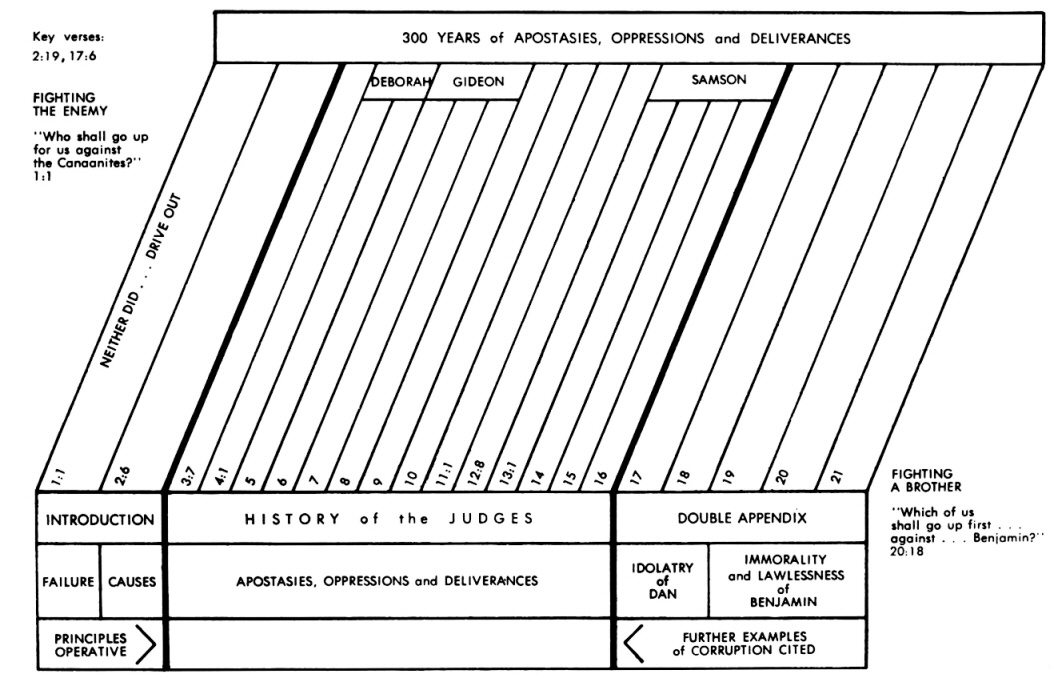
Chart from recommended resource Jensen's Survey of the OT - used by permission
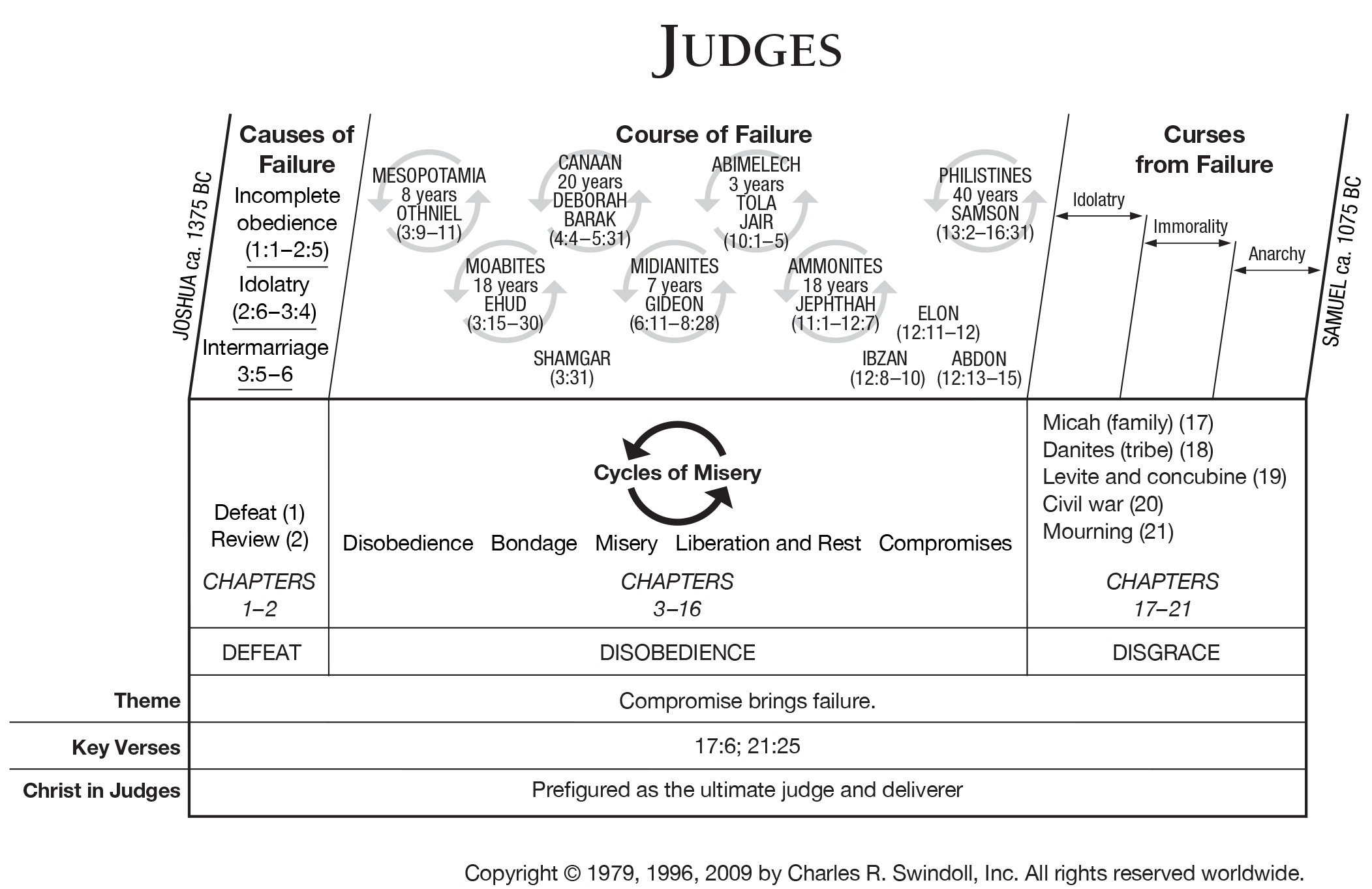
Chart on Judges - Charles Swindoll
|
RECYCLING SIN |
|||||
| Jdg 1:1-3:6 | Jdg 3:7-16:31 | Jdg 17:1-21:25 | |||
| Introduction | History of the Judges | Appendix | |||
| Causes of the Cycles THE REASON |
Curse of the Cycles THE RECORD |
Conditions in the Cycles THE RESULTS |
|||
| Failure to Complete Conquest Jdg 1:1-36 God's Judgment for Failure Jdg 2:1-3:6 |
Curse of the Cycles |
Conditions in the Cycles |
|||
| Living with Canaanites |
War with the Canaanites |
Living Like the Canaanites |
|||
| Religious Laxity |
Political Uncertainty |
Moral Anarchy |
|||
| About 350 Years of Israel's History - Almost 25%! From Compromise to Confusion! |
|||||

Another Timeline of Israel's History
Click to Enlarge
from Jensen's Survey of the OT
Click to Enlarge
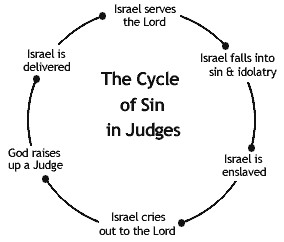
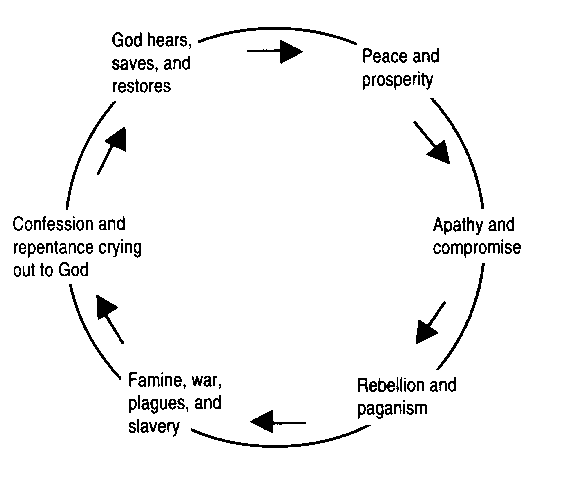
Other ways to describe Israel's cycle…
- Rest > Rebellion > Retribution > Repentance (?) > Restoration
- Sin > Suffering/Servitude > Supplication > Salvation
- Apathy > Apostasy > Affliction > Answered Prayer
- Disobedience > Desperation > Deliverance
- Disobedience > Bondage >Misery > Liberation and Rest > Compromises
Hannah's Bible Outline
Parenthesis: the tyranny of Abimelech (Jdg 8:33-Jdg 9:57)
- Israel's idolatry (Jdg 8:33-35)
- Shechem's submission to Abimelech (Jdg 9:1-57)
- Abimelech's treachery to become king (Jdg 9:1-6)
- Jothan's speech (Jdg 9:7-21)
- The parable (Jdg 9:7-15)
- The application (Jdg 9:16-21)
- Shechem's treachery toward Abimelech (Jdg 9:22-25)
- Gaal's aborted rebellion (Jdg 9:26-41)
- Abimelech's capture of Shechem (Jdg 9:42-49)
- Abimelech's death at Thebez (Jdg 9:50-57)
3. Tola (Jdg 10:1–2)
4. Jair (Jdg 10:3–5)
5. Jephthah (Jdg 10:6–12:7)
1. Israel’s sin (Jdg 10:6)
2. Israel’s servitude (Jdg 10:7–9)
3. Israel’s supplication (Jdg 10:10–16)
4. Israel’s deliverance (Jdg 10:17–12:7)
1. The preparations for battle (Jdg 10:17–11:28)
1. The armies gathered (Jdg 10:17–18)
2. The leader secured (Jdg 11:1–11)
1. His background (Jdg 11:1–3)
2. His covenant (Jdg 11:4–11)
3. The messages to Ammon (Jdg 11:12–28)
2. The vow and victory in battle (Jdg 11:29–40)
1. The vow made (Jdg 11:29–31)
2. The victory secured (Jdg 11:32–33)
3. The vow observed (Jdg 11:34–40)
3. The strife with Ephraim (Jdg 12:1–6)
1. Ephraim’s jealousy (Jdg 12:1–3)
2. Ephraim’s defeat (Jdg 12:4–6)
4. The death of Jephthah (Jdg 12:7)
6. Ibzan (12:8–10)
7. Elon (12:11–12)
8. Abdon (12:13–15)
FOLLOWING NOTES ARE COMPLETELY REVISED SPRING, 2022
Judges 9:1 And Abimelech the son of Jerubbaal went to Shechem to his mother's relatives, and spoke to them and to the whole clan of the household of his mother's father, saying,
NET Now Abimelech son of Jerub-Baal went to Shechem to see his mother's relatives. He said to them and to his mother's entire extended family,
BBE Now Abimelech, the son of Jerubbaal, went to Shechem to his mother's family, and said to them and to all the family of his mother's father,
CSB Abimelech son of Jerubbaal went to his mother's brothers at Shechem and spoke to them and to all his maternal grandfather's clan, saying,
NLT One day Gideon's son Abimelech went to Shechem to visit his uncles-- his mother's brothers. He said to them and to the rest of his mother's family,
- Abimelech the son of Jerubbaal: Jdg 8:31
- Shechem to his mother's relatives: Ge 33:18 34:2 1Ki 12:1
- and spoke to them and to the whole clan of the household: 2Sa 15:6 1Ki 12:3,20 Ps 83:2-4 Jer 18:18)
- Judges 9 Resources
- Who was Abimelech in the Book of Judges?
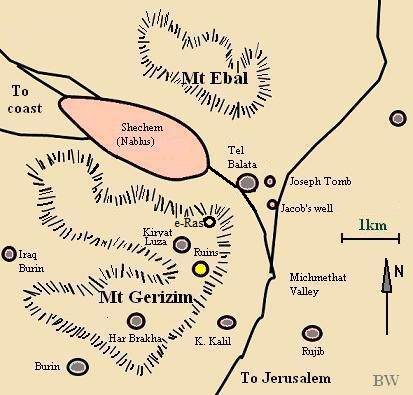
Mt Ebal and Mt Gerizim with Shechem in middle
SELFISHLY AMBITIOUS ABIMELECH
SEEKS A COUP IN THE CLAN
Warren Wiersbe entitles Judges 9 "My Kingdom Come" of course alluding to the evil ambitions of Abimelech which are in stark contrast to the petition in the Lord's (Disciple's) Prayer "Thy Kingdom Come." Indeed, ambitious men like Abimelech will continue to perpetrate their evil plans until the King of kings returns. The evil Russian leader Putin is unjustifiably invading the Ukraine even as I write May, 2022!
In this chapter we see that the apostasy of Israel after the death of Gideon is punished, not as the former apostasies by a foreign invasion, or the oppressions of any neighboring power, but by conflict within. Interestingly in after Judges 8 Gideon's name per se is never mentioned again. In Judges 9 he is always called Jerubbaal!
One major theme of this sequel to the Gideon episode is divine retribution as is made clear by Jdg 9:23, 24 and Jdg 9:56, 57]. It is an account of how God allowed the evil that Abimelech and the men of Shechem sowed to be reaped and to rebound upon their own heads.
Gary Inrig applies the truth of Judges 9 to our life - The message of the story of Abimelech is a simple but powerful one: if we reject the true King, we will be ruled by a usurper. If the throne is not filled by God the King, it will be filled by an Abimelech, a bramble king. That is the experience of Israel in Judges 9, but it remains just as true today. It operates in a personal way in our lives, so that Paul can declare in Romans 6:16: “Don’t you know that when you offer yourselves to someone to obey him as slaves, you are slaves to the one whom you obey—whether you are slaves to sin, which leads to death, or to obedience, which leads to righteousness?” If Jesus Christ does not rule my life, my sinful nature will. This same principle applies in our organizations, whether they are political or congregational. If we do not seek and follow leaders who will direct us to the kingship of Christ, we will fall under the hands of someone whose leadership is negative and destructive. Nature abhors a vacuum, and something will immediately rush in to fill it. The same principle operated spiritually in the nation of Israel. Sadly, although he was used by God to deliver his people from the Midianites, Gideon left his nation in a spiritual vacuum. It is ironic that Gideon’s original victory was due to the fact that he was obedient to God’s Word, but the greatest failure of his life was that he did not consistently practice the Word of God. In fact, as we read the account of Gideon’s judgeship, there is no suggestion that the Word of God had a very important place in his life. If he had Scripture at all, he simply ignored it, and that led him to the sin of the ephod and to his backsliding into a royal lifestyle. Despite the great affirmation of 8:23, “I will not rule over you, nor will my son rule over you. The Lord will rule over you,” Gideon did not establish the Lord in His rightful place in Israel. Confession of God’s kingship without consistent practice of that kingship is hollow. As a result, when Gideon died, his life made no permanent difference on the spiritual life of the people of Israel. For the fifth time in Judges, the cycle of sin began as the people turned away from the living and true God to the depraved pagan worship of Baal. Gideon had led a compromised, syncretized worship of the Lord, but upon his death “they set up Baal-Berith [meaning “Baal of the covenant”] as their god and did not remember the Lord their God, who had rescued them from the hands of all their enemies on every side” (Jdg 8:34). This time, however, there was a difference. The oppression did not come from a foreign power but from within Israel’s own ranks. (Borrow Hearts of Iron, Feet of Clay)
And - While there is no specific time phrase here, this copulative raises the possibility that as soon as Gideon's corpse was cold, this cold, calculating concubine's son sprang into action to gratify his lust for power and glory!
Abimelech the son of Jerubbaal went to Shechem (map) to his mother's relatives (lit = "brothers"): Deborah & Gideon took place in north, Ehud & Othniel in SE & S, Jephthah E of the Jordan, and Samson in SW. Abimelech's story takes place in the CENTRAL part of Israel and portrays the spiritual condition in that area and is the only story in Judges which depicts the central region of Israel.
George Bush - Abimelech—went to Shechem. As Shechem was a city of note in the tribe of Ephraim, and the Ephraimites appear to have been a rash, high-spirited, and excitable people, particularly jealous of their brethren of Manasseh, and perhaps still cherishing the memory of the fancied slight put upon them by Gideon, Jdg 8:1–3+, Abimelech, no doubt, promised himself, on this ground, the speedy concurrence of the Shechemites in his infamous designs. But his first step was to enlist his relatives in his interest, and with this view he applies himself to them, undoubtedly, with all the arts of an aspiring demagogue. (Judges 9 Commentary)
Abimelech is going to Shechem to incite a conspiracy against the sons of Jerubbaal. Abimelech's evil action would be turned around on him in (Jdg 9:26-29) when Gaal comes to Shechem to incite a conspiracy against Abimelech. What goes around comes around!
Shechem was about 30 miles from Ophrah (map) and was the home of Gideon's concubine (Abimelech's mother). It was the main city of the central region, located in a fertile valley (see map above) between Mt Ebal and Mt Gerizim, on a strategic crossroad of the route from the coastal highway in the west to the Jordan Valley in the east and the ridge route from Jerusalem in the south to the northern sites in the Jezreel Valley. Shechem had a hallowed place in Israel's history and had been a religious center since the time of Abraham. Yahweh first revealed Himself to Abraham at oak of Moreh in Shechem on his arrival from Haran (Ge 12:6,7), Jacob lived at Shechem (Ge 33:18-20), and Joshua led the Israelites to Shechem during the time of the conquest for a recitation of the blessings (on Mt Gerizim) and cursings (on Mt Ebal) of the Law (Joshua 8:30-35) and it was also the site of the further covenant renewal ceremony before Joshua’s death (Jos 24:1-28). Under Joshua, Shechem was both a Levitical city and a city of refuge. What a tragic blot the tale of Abimelech leaves on such a significant city in Israel's history!
Lawson Stone - Shechem features in treaty-making in the OT: Jacob and his sons entered into an agreement with the inhabitants of Shechem (Gen 34); Israel, upon entering the land, renewed the covenant at Ebal and Gerizim, the two mountains overlooking Shechem (Deut 27, Josh 8:30-35); and the book of Joshua ends at Shechem (Josh 24:1, 25) with Joshua making a covenant. This covenant united Yahweh, the Israelites, and apparently others who had joined with them. A stone and an oak figure in Joshua's covenant, as they do in the crowning of Abimelech (cf. 9:6). Shechem certainly has the stone, but the tree, naturally, is long-gone, though numerous archaeological indications at other sanctuaries all but ensure that one was indeed present at Shechem (Stager 1999:241-243). The Hebrew word for treaty or covenant, berit/berith/beriyth, appears in the name of the deity "whored after" by Israel, Baal-berith (Jdg 8:33). Later referred to in the narrative as El-berith (Jdg 9:46NLT mg), his temple treasury in Shechem funded Abimelech's adventures (Jdg 9:4). Shechem emerges one last time as a town for deal-making in 1 Kings 12, where Rehoboam seeks the rubber-stamp approval of the northern tribes for his kingship (ABD 5.1174-1186; Stager 1999:2003).....No other town in the central highlands of Israel equaled Shechem in importance. (See Joshua, Judges, Ruth)
Henry Morris on went to Shechem. The rebellious and ambitious Abimelech had apparently been brought up in Shechem by Gideon's concubine and had acquired enough influence over the Shechemites to persuade them to follow him in setting himself up as king of Israel. This involved murdering all his brothers (except Jotham, who escaped), and then establishing his supposed capital in Shechem (Judges 9:3-6). Abimelech thus presumptuously assumed by force a position which had been declined by his father.
And spoke to them and to the whole clan of the household of his mother's father, saying: Hebrew = “to all the extended family of the house of the father of his mother.” In the ancient East since concubines usually remained with their own clan the son of a concubine had a closer relationship to his mother’s family than to his father’s.
Warren Wiersbe on selfish ambition which characterized Abimelech - “You shall not covet” is the last of the Ten Commandments (Ex. 20:17NKJV), but breaking it is the first step toward breaking the other nine. Of itself, ambition isn’t an evil thing, provided it’s mixed with genuine humility and is controlled by the will of God. If it’s God’s wind that lifts you and you’re soaring on wings that He’s given you, then fly as high as He takes you. But if you manufacture both the wind and the wings, you’re heading for a terrible fall. “One can never consent to creep when one feels an impulse to soar,” said Helen Keller; and her counsel is good, so long as the impulse to soar comes from the Lord. Selfish ambition destroys. “I will ascend into heaven!” turned an angel into the devil (Isa. 14:13NKJV), and “Is not this great Babylon, that I have built” turned a king into an animal (Da 4:28–37NKJV). If we exalt ourselves, God has many ways of bringing us down (Mt. 23:12). (See The Bible Exposition Commentary)
Criswell - (Jdg 8:1,2) Whatever type of leadership Gideon exercised (Jdg 8:23), Abimelech, Gideon's son by a Canaanite of Shechem (Jdg 8:31), attempted to usurp and expand it by viciously massacring his brothers. His leadership was centered in Shechem and apparently did not extend beyond the territory of Manasseh. (Believer's Study Bible)
A R Fausset - And Abimelech the son of Jerubbaal went to Shechem, unto his mother’s brethren [ch. 8:31: of the original Canaanite population, which ought to have been exterminated according to God’s command. Gideon’s neglect of this eventuated in his concubinage with them entailing judgment upon his house after his death], and communed with them, and with all the family of the house [i.e., the whole clan] of his mother’s father, saying,
POSB - insurrection, rebellion, revolt, war, assassination, terrorism, or convincing arguments. Seeking power and authority is a common ambition within the hearts of people, an ambition that is present within every group or body of people. The desire for some level of authority or power is within the heart of all of us, ranging from the family through social groups, community organizations, businesses, and all departments of government. What we must realize is this fact: there is a good and an evil seeking of authority, a legitimate and an illegitimate seeking of power. There is good ambition and bad ambition, a righteous ambition and an evil ambition. Ambition becomes evil when it is for selfish purposes. When power is sought to gain more and more for the purpose of dominating others or for living in extravagance, indulgence, and license, it is evil. When the ambition for power leads a person to hoard and neglect others or to harm and damage others or oneself—that ambition or power is wrong. The present passage has to do with the evil ambition of seeking power for selfish purposes. The guilty culprit was Abimelech, one of the sons of Gideon. When his father died, he wanted to become the king over the territory that his father had served as judge. This chapter is the story of Abimelech: The Illegal, Renegade King, Abimelech: The Event That Shows Just How Corrupt the Israelites Had Become, 9:1-57. (Posb KJV DLX, Judges-Ruth)
1. The conspiracy of Abimelech: a picture of selfish ambition and the lust for power (Jdg 9:1-6).
2. The parable and prophetic curse upon Abimelech: a declaration of God's judgment (Jdg 9:7-21).
3. The rebellion against Abimelech: the picture of division—a divided kingdom (Jdg 9:22-41).
4. The destruction of Shechem by Abimelech: a picture of evil vengeance (Jdg 9:42-49).
5. The death of Abimelech: the just judgment of God (Jdg 9:50-57).
Gary Inrig - Two factors influence a man supremely—his parents and his home environment. Unfortunately, both of these left deep scars on Abimelech. They do not excuse his actions or remove his guilt, but they are important considerations in understanding him.
The greatest influence on our lives comes from our parents. That may seem to be something in Abimelech’s favor. After all, he was a son of Gideon, the hero of faith. But in his case that was not an unmixed blessing, for Abimelech was the product of Gideon’s years of backsliding. His mother was a part of Gideon’s harem, but Gideon did not even give her the dignity of being his wife. She was a convenience, not a life partner. The son of a concubine was in a very divided situation. Legally, he had no rights from his father, and he belonged to his mother’s family. So Abimelech had his father’s genes but not his father’s name. He could hardly respect his father for his lifestyle or his morality or love him for his fatherly care. He was an outsider, and the bitterness that he felt towards his father and his half-brothers made him desperate to right the wrongs he felt he had endured and to get his revenge.
Gideon not only failed to express love to Abimelech (ED: THIS IS A BIT CONJECTURAL AS THE TEXT IS SILENT), he failed to communicate spiritual truth to him. We are told that Gideon’s ephod was a snare not only to Gideon but to all his family. It engaged his entire family in spiritual adultery and kept them from the truths of God’s Word. There was no one snared more severely than Abimelech. His very name, “My father is king,” bore witness to his father’s sad decline. No wonder Abimelech found Baal worship easy to adopt.
The second major influence in Abimelech’s life was his city, Shechem, which vividly symbolized the spiritual confusion of the nation. It was a city rich with associations with the life of Abraham (his first well); Jacob (a well bearing his name); and Joseph (the place his bones were buried). It was also just outside the city where Joshua had led the people to commit themselves to God’s covenant, as they recited its blessings and cursings from Mt. Ebal and Mt. Gerizim. But when the people refused to obey God and drive out the Canaanites, Shechem became a mixed city. Canaanites and Israelites lived side by side, and together they worshiped Baal-Berith in the house of Baal (9:4). The city was saturated with Baalism, and because Abimelech saw no evidence of a vital faith in the Lord in his father’s life, he fell easy prey to the seductive, sensual worship of Baal.
Abimelech was a shrewd man. He was determined to build a power base of his own before he took action. His mother’s family in Shechem was a natural place to begin. One thing Abimelech had gained from his family tie was the feeling that Gideon’s descendants had a right to rule. This again contradicted Gideon’s bold affirmation in Jdg 8:23, but apparently it was generally expected that one of Gideon’s seventy sons, or the entire group, would rule. So, building on that expectation, he approached his clan with a proposal: “Ask all the citizens of Shechem, ‘Which is better for you: to have all seventy of Jerub-Baal’s sons rule over you, or just one man?’ Remember, I am your flesh and blood.” If there was a vacuum of leadership, Abimelech was going to fill it, at whatever cost.
His extended family was impressed enough by Abimelech’s abilities that they approached the leaders (the word translated citizens in the New International Version actually refers to the city’s leaders) on his behalf. They blatantly appeal to self-interest (“he is our brother”) and to the animosity that obviously existed towards Gideon’s descendants. The Shechemites fell in line with the plan, using the Baal temple as the source of their funds. Life was cheap—they provide only seventy shekels for the lives of seventy men—one shekel each! But by taking this money, Abimelech was acting as an agent of Baal, an employee of the temple. (Borrow Hearts of Iron, Feet of Clay)
ILLUSTRATION - When George Washington’s army defeated the British General Charles Cornwallis at Yorktown, the end of the Revolutionary War began. Winning the war didn’t automatically end the problems that the colonies faced. Things became so bad economically that one of George Washington’s colonels wrote Washington a secret letter, urging him to use his army to make himself king or dictator. To the colonel, this was the only way to get the affairs of the young nation under control. Washington rejected the plan, but with his popularity and power he probably could have become king if he had so desired. Abimelech was just the opposite. He had such a passionate desire to be king that he allowed nothing to stand in his way, not even the lives of hundreds of innocent people. This is the longest chapter in the Book of Judges and one of the most depressing. If the awful carnage recorded in this chapter upsets you, just be reminded that modern dictators like Idi Amin, Joseph Stalin, and Adolph Hitler have done far worse. Norman Cousins estimated that for every word in Hitler’s book Mein Kampf, 125 people died in World War II! (See The Bible Exposition Commentary)
Life Application Study Bible Notes on Abimelech - People who desire power always outnumber those who are able to use power wisely once they have it. Perhaps this is because power has a way of taking over and controlling the person using it. This is especially true in cases of inherited but unmerited power. Abimelech's life shows us what happens when hunger for power corrupts judgment.
Abimelech's position in Gideon's family as the son of a concubine must have created great tension between him and Gideon's many other sons. One against 70: Such odds can either crush a person or make him ruthless. It is obvious which direction Abimelech chose. Gideon's position as warrior and judge had placed Abimelech in an environment of power; Gideon's death provided an opportunity for this son to seize power. Once the process began, the disastrous results were inevitable. A person's thirst for power is not satisfied when he gets power—it only becomes more intense. Abimelech's life was consumed by that thirst. Eventually, he could not tolerate any threat to his power.
By this time, ownership had changed: Abimelech no longer had power—power had him. One lesson we can learn from his life is that our goals control our actions. The amount of control is related to the importance of the goal. Abimelech's most important goal was to have power. His lust for power led him to wipe out not only his brothers but also whole cities that refused to submit to him. Nothing but death could stop his bloodthirsty drive to conquer. How ironic that he was fatally injured by a woman with a farm implement! The contrast between Abimelech and the godly people of the Bible is great. He wanted to control the nation; they were willing to be controlled by God. (Borrow the Life Application Study Bible: Old Testament and New Testament)
Judges 9:2 "Speak, now, in the hearing of all the leaders of Shechem, 'Which is better for you, that seventy men, all the sons of Jerubbaal, rule over you, or that one man rule over you?' Also, remember that I am your bone and your flesh."
- Which is better for you, that seventy men: Jdg 8:30
- Also, remember that I am your bone and your flesh: Ge 29:14 2Sa 19:13 1Ch 11:1 Eph 5:30 Heb 2:14
- Judges 9 Resources
Related Resource:
Judges 8:23 But Gideon said to them, “I will not rule over you, nor shall my son rule over you (ABIMELECH IS HIS SON!); the LORD shall rule over you.”
Joshua 20:7 So they set apart Kedesh in Galilee in the hill country of Naphtali and Shechem in the hill country of Ephraim, and Kiriath-arba (that is, Hebron) in the hill country of Judah.
Joshua 21:21 They gave them Shechem, the city of refuge for the manslayer, with its pasture lands, in the hill country of Ephraim, and Gezer with its pasture lands,
Joshua 24:25-26 So Joshua made a covenant with the people that day, and made for them a statute and an ordinance in Shechem. 26 And Joshua wrote these words in the book of the law of God; and he took a large stone and set it up there (AT SHECHEM) under the oak that was by the sanctuary of the LORD.
Joshua 24:32 Now they buried the bones of Joseph, which the sons of Israel brought up from Egypt, at Shechem, in the piece of ground which Jacob had bought from the sons of Hamor the father of Shechem for one hundred pieces of money; and they became the inheritance of Joseph’s sons.
Speak, now, in the hearing of all the leaders (ba'al) of Shechem: Hebrew = “Speak into the ears of.” The Hebrew for leaders is the word ba'al which means "lords." One thought is that Abimelech may have been shunned by his half-brothers, but that is only conjecture.
Wiersbe explains why Shechem - “The Jews had been acquainted with the people of Shechem since the days of the patriarchs (Gen. 12:6; 33:18–20; 34:1ff). Both Jews and Canaanites lived in Shechem during Abimelech’s days, which explains why he started his campaign there. His mother was a Shechemite and his father was a Jew. Therefore, if Abimelech became king, he could represent both constituencies! Abimelech had another plank in his political platform: The Canaanites in Shechem had no indebtedness to Gideon’s sons, while Abimelech was definitely one of their own. Furthermore, which of Gideon’s seventy sons should be chosen king and how would he be selected? Or would all seventy try to rule the land together? With this kind of logic, Abimelech enlisted the support of both his relatives and the men of the city; and now he was ready to move into action. (See The Bible Exposition Commentary)
Which is better for you, that seventy men, all the sons of Jerubbaal, rule over you, or that one man rule over you? - Abimelech uses the same word mashal which the people used in requesting Gideon to rule over them in Jdg 8:22. It's as if he is saying I'll take what he was not willing to take, after all my name is "My Father is king!" This is in essence a rhetorical question. The logic is not bad. Seventy rulers might be somewhat chaotic. And of course the "one man" is left unidentified as if he is testing the waters.
Lawson Stone - the fact that all 70 of his sons dominated Shechem, rather than one select heir, underscores that in the wake of Gideon's abdication of his responsibility, his very influential family dominated local affairs the way any large, wealthy family might....that one man. Indeed, rule by one, one who has proven his worth serving under Yahweh's call, one who was bred to that responsibility by a father who cared about the future, certainly would be better than being suffocated by 70. (See Joshua, Judges, Ruth)
Paul Apple on Which is better for you - What about God’s plan? Think about how often we disappoint God because we make decisions independently of seeking His will. We decide on the basis of what we think is the best course for us. God calls upon us to seek first His kingdom and His righteousness. We must come to the Word of God and submit to His Spirit to determine His will. Certainly Human wisdom will make sense to us. Arguments from expediency (what works) seem to be practical and productive. But God’s thoughts and ways are not our thoughts and ways. Here Gideon offers subjugation to one ruler – and a close relative at that – to being ruled by many – and those with no special ties to Shechem.
Also, remember that I am your bone and your flesh: The Hebrew idiom is "flesh and bone" so NIV is incorrect ("flesh & blood"). Abimelech gives them 2 reasons he should be "elected" king: (1) One would be better than 70 (2) He was part "Shechemite", one of them so to speak. The implication is that he would give special attention to the local interests of the people in Shechem, which sounds like modern day politicians!
Abimelech had three major obstacles to taking rulership, the biggest being 70 other sons of Gideon to which he was only a half-brother. He also need funds. And third, is the question where he would be able to find supporters who would help him carry out his evil plans.
A R Fausset - Speak, I pray you, in the ears of all the men [Heb. ba’alee, ‘masters’; often found in the Phœnician dialect. Applied to the men of Gibeah (Jdg 20:5); and the Canaanite citizens of Jericho (Josh. 24:11); and to the men of Keilah (1Sa 23:11, 12). The continual recurrence of this word (ver. 2, 6, 7, 18, 20, 23, 24, 25, 26, 39, 46, 47, 51) can hardly be accidental; it probably alludes to the majority of them being Canaanites (see ver. 28), and connected with the Phœnician Baal-worship of Canaan] of Shechem, Whether (is) better for you, either that all the sons of Jerubbaal, (which are) threescore and ten persons [the name employed, ‘Jerubbaal,’ or destroyer of Baal, was one well calculated to prejudice against his seventy sons the men of Shechem, who were worshippers of Baal. The seventy sons had not aspired to kingship; but it suits Abimelech’s purpose to assume they did], reign over you, or that one [only, i.e., I Abimelech] reign over you? remember also that I (am) your bone and your flesh [your kinsman (Gen. 29:14). Abimelech sets at nought his father’s explicit wish, “my son shall not rule over you” (8:23)]. (Judges 9 Commentary)
George Bush - The men of Shechem. Heb. ‘the masters of Shechem;’ implying perhaps the leading men, though not necessarily confined to this sense.
Whether is better, &c. Heb. ‘what is good? whether the ruling over you of seventy persons,’ &c. From the authority and influence which Gideon had possessed, and from the acknowledged dignity of his family, the presumption would naturally be, that if the reins of government were to be lodged in any hands, it would be in those of some one of his sons, or of all of them conjointly. On this hypothesis Abimelech builds his project. But his words convey a slanderous insinuation which is not obvious to the English reader. He speaks of Gideon’s sons ‘reigning’ (משל mâshal,) or exercising domination over their countrymen, whereas it was just this species of rule which Gideon so expressly rejected both for himself and his sons, ch. 8:23, as invading the prerogative of the Most High; being content with the inferior degree of authority usually indicated by the term שפט shâphat, to judge. Nor is there any evidence, that either of his sons had the least intention of assuming a despotic sway over their brethren. But Abimelech’s conduct, in this particular, affords but another proof that he who has a wicked purpose to serve will not stick at a lie to accomplish it, and that those who design ill themselves are ever ready to charge similar designs upon others.
Your bone and your flesh. Your kinsman, of your tribe and lineage, and therefore so much the more likely to promote your interests. The relation indicated by these words is more or less close according to the connexion in which they occur. In some cases, it implies nothing more than descent from a common ancestor, 1Chr 11:1; in others, kindred of the same blood, as Jacob and Laban, Gen. 29:14; David and Amasa, 2Sa 19:13; and in others again, it appears simply to indicate the relation subsisting between the inhabitants of the same city or town. Perhaps this is all that is to be understood in the present case. But however interpreted, it was advancing a reason for his election, which was never contemplated in the appointment of magistrates over the nation of Israel. It was, in fact, directly opposed to the true ends of that institution; which required that persons chosen to office should be selected on the ground of moral qualification, and that in their administration of justice, they should be free from the bias naturally arising from private and personal regards. (Judges 9 Commentary)
Leaders (husband, lord, master, owner, possessor)(01167) ba'al means lord, owner (Ex 21:22, 28, 29, 34, 36, et al), possessor, husband (Pr 12:4), master, leader (as of a city - Jdg 9:2, 51). This Hebrew word is often combined with another Hebrew word but the English translation only gives one word, so it can be confusing. E.g., in Pr 24:8 the word "schemer" is actually two Hebrew words - possessor (baal) of schemes.
Baal in Judges - Jdg. 9:2; Jdg. 9:3; Jdg. 9:6; Jdg. 9:7; Jdg. 9:18; Jdg. 9:20; Jdg. 9:23; Jdg. 9:24; Jdg. 9:25; Jdg. 9:26; Jdg. 9:39; Jdg. 9:46; Jdg. 9:47; Jdg. 9:51; Jdg. 19:22; Jdg. 19:23; Jdg. 20:5
Judges 9:3 And his mother's relatives spoke all these words on his behalf in the hearing of all the leaders of Shechem; and they were inclined to follow Abimelech, for they said, "He is our relative."
- And his mother's relatives spoke all these words on his behalf: Ps 10:3 Pr 1:11-14
- to follow: Ge 29:15
- Judges 9 Resources
SHECHEMITES "VOTE"
ABIMELECH INTO OFFICE
And his mother's relatives spoke all these words on his behalf: His mother here refers to Gideon's concubine, not the mother of the 70 sons.
And they were inclined (natah; Lxx - klino) to follow Abimelech, for they said, "He is our relative ("brother") - The literal is better “Their heart (leb) was inclined after Abimelech.” The men of Shechem chose Abimelech "king". God was not consulted whether they should have any king, much less who it should be. If parents could see what their children would do, and what they are to suffer, their joy in them often would be turned into sorrow: we may be thankful that we cannot know what shall happen. Above all, we should fear and watch against sin; for our evil conduct may produce fatal effects upon our families, after we are in our graves.
Abimelech was not a God appointed judge of Israel. Neither did he deliver the nation from outside invaders as did the other rulers who preceded him. He was a self-appointed opportunist who had an inordinate lust for power and who committed a terrible atrocity in connection with his consuming desire to be king.
Paul Apple observes that it is "Interesting (IRONIC) that one of the main charges against Abimelech is going to be his lack of loyalty towards the household of his famous father. Yet he uses family loyalty as his rallying cry to gain a following in Shechem."
William Penn wrote "If we are not willing to be governed by God, we shall be ruled by tyrants."
British historian Thomas Macaulay, made the following comment about America: "Your republic will be fearfully plundered and laid waste by barbarians in the 20th century, with this difference: The Huns and the Vandals who ransacked Rome were from without, and your huns and vandals will come from within your own country and be engendered from within by your own institutions."
During the Judges the Israelites repeatedly refused to be governed by God and the consequences in this chapter is that they ended up being ruled by a tyrant. It was a judgment from God for their unfaithful, wayward hearts. But this time the chastisement was from within and not from without.
Jeremiah warned faithless Jerusalem that…
"Your own wickedness will correct you, and your apostasies will reprove you. Know therefore and see that it is evil and bitter for you to forsake the LORD your God, and the dread of Me is not in you," declares the Lord GOD of hosts.(Jer 2:19).
George Bush - Their hearts inclined to follow Abimelech. Heb. ויט לבם אחרי אבימלך vayyët libbâm a’harë Abimelek, their heart inclined itself after Abimelech; spoken of as the heart of one man. The reason assigned for their adherence, shows that his suggestions had taken effect. They are prompted to support his claims, because from his near relationship they would doubtless be raised to places of preferment under him, and their city would be likely to be made the metropolis of the kingdom. (Judges 9 Commentary)
Inclined (stretch, outstretched, turn aside) (05186) natah means to stretch out, to extend; to pay attention. It has 3 primary nuanes (1) spreading or stretching things (2 Sa 21:10, Jer 43:10, et al). (2) To turn aside - alteration in the present course of action (Nu 20:17, 21, Nu 22:23, 2 Sa 3:27, Ge 38:16 a bad turning aside!). "Turn aside justice (pervert) (Ex 23:6) (3) To bend (Ge 24:14, Ge 49:16, Hos 11:4, 2 Sa 22:10, Ps 144:5). Most usages are figurative. One's heart may "turn away" (Solomon in 1 Ki 11:2-4, 9, 2 Sa 19:14). On the other hand one's heart may be inclined to God and his commands (Josh 24:23; 1 Ki 8:58; Ps 119:36).
Uses of Natah in Judges - Jdg. 4:11; Jdg. 9:3; Jdg. 16:30; Jdg. 19:8
Judges 9:3 F B Meyer Our Daily Homily
Their hearts inclined to follow Abimelech; for they said, He is our brother.
Is not this the reason why God has set us in families? Had He so chosen, each of us might have been created alone as Adam was, and sent out with no special connection with others of our race. But instead, we are closely connected. It is very rarely that a man is so utterly bereaved as to be destitute of some relative.
Between a man and his brother there is a special tie. It may be truly said, in the case of brothers, that a doorway has been made through the walls which ordinarily part men, which may be bricked up or filled with debris; but the wall there will always be thinner than anywhere else, and some day the doorway may be opened for the passage of the messenger of peace. Men are always more inclined to follow the man of whom they can say, “He is our brother.” Brotherhood, sisterhood, relationship of any kind, is therefore a very precious talent; and it becomes us solemnly to ask ourselves whether it has been put to use. Have you ever spoken or written to your brother or sister about Christ?
As soon as Andrew had found Jesus, he started off to find his own brother Simon; and Simon was glad to follow him because he was his brother. Had another tried, it is as likely as not that he would have repelled him. But what could he say to the man who had shared his childhood’s sports, and had helped him haul in a net of fish many a time after a night of hard work?
This is the reason that Jesus has so strong a hold on human hearts. He is our brother, bone of our bone; not ashamed to call us brethren; and this constitutes a moving argument why we should be inclined to follow Him.
Judges 9:4 And they gave him seventy pieces of silver from the house of Baal-berith with which Abimelech hired worthless and reckless fellows, and they followed him.
- And they gave him seventy pieces of silver from the house of Baal-berith: Jdg 9:46-49 8:33,
- worthless - Jdg 11:3 1Sa 22:2 2Ch 13:7 Job 30:8 Pr 12:11 Ac 17:5
- Judges 9 Resources
SILVER FOR
SCOUNDRELS
And they gave him seventy pieces of silver from the house of Baal-berith ("Lord of the Covenant"): "House" equates with a temple of idolatrous worship. Ancient temples were often the source of great amounts of wealth and temple treasures were often used for military and political ends. Note that Abimelech's acceptance of the 70 pieces of silver from the House of Baal-Berith was tantamount to his announcing that he had rejected the true God Jehovah for the false god Baal!
Lawson Stone has an interesting thought on seventy pieces of silver - The "seventy [in] silver" could suggest that each brother was only worth one piece of silver, or it could suggest a price—like a "hit contract"—for each brother. (See Joshua, Judges, Ruth)
Baal-berith: The previous account of Gideon reveals that Baal worship was prevalent in the Plain of Esdraelon (Jezreel Valley), an area ruled by Canaanites until the victory of Barak. Shechem however was to the South of the Esdraelon Plain in the Hill Country and was less than 12 miles N of Shiloh (Jdg 18:31), which at that time was actually the home of God's tabernacle! How tragic that here was an outpost of Baal (ba'al) worship so close to the holy place of Jehovah and that it even had a deceptive name "Lord of the Covenant", a title that alone belonged to Yahweh as clearly demonstrated by the renewal of the covenant in Shechem in Joshua's time (Jos 8:30-35+). Israel broke their "marriage covenant" with Yahweh so that they could enter into a deadly "marriage covenant" with Baal-berith. Note that Baal (ba'al) means not only "lord" but also "husband." This is a headlong charge into idolatry which sets the stage for some of the ugliest chapters in Israel's history!
Paul Apple - Abimelech’s campaign was financed out of the treasury of Baal money – interesting match that the seventy pieces of silver correspond to the number of sons that will be slain. This was the bounty money that would be used to entice the wicked mercenaries to carry out his mission of extermination.
Wiersbe - “You shall have no other gods before Me” and “You shall not make for yourself any carved image” are the first and second of the Ten Commandments (Ex 20:3–4NKJV), and Abimelech broke them both. It’s obvious that he was his own god and that he had no interest in God’s will for the nation. His accepting money from the Baal worshipers to finance his crusade was a public announcement that he had renounced the God of Israel and was on the side of Baal. (See The Bible Exposition Commentary)
Life Application Study Bible: Politics played a major part in pagan religions such as the worship of Baal-berith. Governments often went so far as to hire temple prostitutes to bring in additional money. In many cases a religious system was set up and supported by the government so the offerings could fund community projects. Religion became a profit-making business. In Israel's religion, this was strictly forbidden. God's system of religion was designed to come from an attitude of the heart, not from calculated plans and business opportunities. It was also designed to serve people and help those in need, not to oppress the needy. Is your faith genuine and sincere, or is it based on convenience, comfort, and availability? (Borrow the Life Application Study Bible: Old Testament and New Testament)
A R Fausset - And they gave him threescore and ten (pieces) of silver [i.e., shekels] out of the house Baal-berith [8:33. Temple treasures were often used for political ends (1 Kings 15:18). The seventy silver pieces or shekels (Numb. 7:13, 14) would allow one each for the murder of Gideon’s seventy sons: at so little did Abimelech value the blood of his brethren. How awful that sacred money should be employed for murder! But idolatry and unnatural bloodshed go together], wherewith Abimelech hired vain [reequ, ‘empty’ of moral principle] and light [pochazim, literally boiling up: so wanton, desperate] persons, which followed him.
Abimelech hired worthless (req) and reckless (pahaz) fellows, and they followed him. (Jdg 11:3, NIV, "reckless adventurers", 2Ch13:7): These were mercenaries to help him gain control. Worthless figuratively describes the moral character of these men as "empty", as are all who are still in Adam. The Septuagint translates "worthless" with the Greek word "kenos" which conveys the idea that these men were without usefulness or success (our modern day slang term might be "losers"). They were men in whom there was nothing of truth, who could not be depended upon, whose deeds did not correspond to their words, who were boasters and imposters. These hired scoundrels were willing to do anything for silver, even murder.
John Trapp - Hired vain and light persons. - Beggarly rascals, fit for his purpose, debauched desperadoes.
Abigail Adams to John Adams on November 27, 1775 that “Power, whether vested in many or few, is ever grasping, and like the grave, cries ‘Give, give.”
T. S. Eliot somewhat scornfully concluded that “most of the troubles in the world are caused by people wanting to be important.”
Plato said, “Might is right”
Roman philosopher Seneca wrote, “Might makes right.”
French novelist Joseph Joubert said “Might and right govern everything in the world; might till right is ready.”
But when might is in the hands of selfish dictators, right rarely has a chance to get ready or to take over. Might seizes control and will hold it unless a stronger power overcomes and brings freedom. The Prophet Habakkuk described these people as “guilty men, whose own strength is their god” (Hab. 1:11). (See The Bible Exposition Commentary)
Worthless (07386)(req) is an adjective that means empty or vain (frivolous, trivial, trifling). Req is used to describe an empty pit (Ge 37:24), empty pitchers (Jdg 7:16), vain (worthless) men (Jdg 9:4, 11:3, 2Chr 13:7 = speaking of their character), empty vessels (2Ki 4:3), worthless things (Pr 12:11, Pr 28:19), empty vessel (as a term of comparison - Jer 51:34)
Gilbrant on req - Related to rîq , "emptiness," the adjective rêq means "empty," "vain." Physical objects, such as a pit (Gen. 37:24) and a pot (Ezek. 24:11), can be described as being empty. The word has the connotation of "worthless" (Gen. 41:27). Persons can be described as worthless (e.g., Pr 12:11), a commentary on their character. Moses warned that the word of instruction from the Lord was not "empty" (Deut. 32:47). (Complete Biblical Library)
Req - 14v - Usage: emptied(1), empty(6), foolish ones(1), idle(1), satisfied(1), worthless(4). Gen. 37:24; Deut. 32:47; Jdg. 7:16; Jdg. 9:4; Jdg. 11:3; 2 Sam. 6:20; 2 Ki. 4:3; 2 Chr. 13:7; Neh. 5:13; Prov. 12:11; Prov. 28:19; Isa. 29:8; Jer. 51:34; Ezek. 24:11
Reckless (06348)(pahaz) means to be undisciplined, wild, insolent. It has the idea of bubbling over, being undisciplined or boisterous. The idea is more hotheadedness than evil. Gilbrant - Related to an Arabic cognate meaning "reckless," "boastful," the verb pāchaz means "to be wanton," "to be reckless," "to be undisciplined." Appearing twice in the Hebrew Bible, the verb pāchaz has cognates in Akkadian, Arabic, Syriac, Mandaean, Jewish Aramaic and Middle Hebrew. In Judg. 9:4, Abimelech hires "vain and light ["reckless," NIV] persons, which followed him"; that is, they became followers in his attempt to gain power in Israel. The second occurrence describes the low character of men who were called prophets in Jerusalem during the days of Zephaniah: "Her prophets are arrogant; they are treacherous men" (Zeph. 3:4, NIV). (Complete Biblical Library)
George Bush - Out of the house of Baal-berith. From this it is evident that idolatry had gained ground again in some places during the life-time of Gideon. The treasure deposited in this temple, which had perhaps been raised from oblations to the idol, and thus consecrated to idolatrous uses, is made through the divine counsels the instrument of bringing upon the idolators deserved punishment, by embroiling them in a civil war that caused their ruin. Nothing is more common, in the providence of God, than for the revenues of sin to be made a plague and a curse to those that amass them.
Vain and light persons. Worthless and abandoned men; idlers and vagabonds, the very scum of society, persons who were living on the public, and had nothing to lose; ever the most fitting instruments of tyranny and cruelty. (Judges 9 Commentary)
Corrupt Politics - John Butler - Sermon Starters
Judges 9:4 "And they gave him threescore and ten pieces of silver out of the house of Baal-berith, wherewith Abimelech hired vain light persons, which followed him" (Judges 9:4).
Politics has not changed much over the years. Politics was filled with corruption back in Bible times as well as today. Our text records some political corruption which occurred some three thousand years ago that is still seen today. The Bible is always up to date in application. From our text we note the seed of the corruption, the silver of corruption and the servants of corruption.
First—The Seed of Corruption
The corruption began with a man by the name of Abimelech. HE was a son of Gideon, no less, via a concubine in Shechem (Judges 8:31). Gideon had seventy other sons. The concubine arrangement smells to high heaven. It was common in those days but that did not make it right—It was plain immorality, So the seed of corruption in our text is immoral conduct. Immorality is forever corrupting politics. For proof, check today's news media.
Second—The Silver of Corruption
"They gave him threescore and ten pieces of silver out of the house of Baal-berith." Money is involved in corrupt politics. Abimelech wanted to be a ruler in Israel so his friends raised some money to help him. Note where the money came from. It came from the heathen temple of Baal. Corrupt politics and apostate religion go hand in hand. It was so then, and it is so today. Apostate churches are no help in cleaning up politics! Let Fundamentalist push a conservative candidate or legislature, And the powers that be will check so see if they are violating any campaign laws. But Apostate churches are involved illegally in politics all the time, yet, hardly a protest is ever heard or an investigation ever made. Corrupt religion is in cahoots with corrupt politics. Sound doctrine and sound government go hand in hand.
Third—The Servants of Corruption
"Abemelech hired vain and light person, which followed him." Abemelech's crowd is like those deadbeats which follow many of our politicians to given them a crowds. I remember when John McCain hired a bunch of deadbeats with beer to meet his plane as he landed on his campaign trail. He wanted it to appear that he was very popular when what he portrayed was corrupt politics. Those who can be hired by such means to boast a campaign will prove useless in government. They are vain and light people. They lack character and will only further corrupt politics. Of course corrupt people make a corrupt politicians. Corrupt people do not vote for men of character but for those who will give them beer or other corrupting handouts. Good people are not bribed by money but are persuaded by principle. Abimelech had no good principles. We have many of his kind running for office today.
BAAL-BERITH, בעל ברית, אל ברית (See online page 141 in Dictionary of deities and demons in the Bible DDD)
I. Baal-berith (‘Baal of the Covenant’; Judg 8:33 and 9:4) and El-berith (‘El of the Covenant; Judg 9:46) occur only in the Book of Judges as specifications of the Canaanite fertility gods →Baal and →El of Shechem, an ancient Canaanite city in the hill country between Mount Gerizim and Mount Ebal. Also in Ugaritic texts brt (‘covenant’) is found in connection with Baal.
II. In the OT Shechem is often mentioned. Already in Gen 12:6–7 we are told that Abram went as far in Canaan as the sanctuary at Shechem, and the terebinth tree of Moreh, and that he built there an altar “to the LORD who had appeared to him”. This suggests that already in ‘patriarchal’ times the Shechem area was a religious centre (see e.g. Gen 33:18–20; 35:4; Josh 24:32). In Josh 24 it is told that Joshua concluded a covenant at Shechem, resulting in a confederacy of twelve Israelite tribes. Josh 24:25–26 informs us that “Joshua drew up a statute and an ordinance” (cf. Deut 11:26–32) for this confederacy in Shechem, and that he took “a great stone and set it up under the terebinth in the sanctuary of the LORD”. Many older scholars even suggested that Shechem was the original home of the Hebrew covenant as against Sinai-Horeb or Kadesh and that the city was the amphictyonic sanctuary of the tribal confederacy of Israel (ROWLEY 1950:125).
In this city the dramatic story of Abimelech, son of Jerubbaal (Gideon) by his Shechemite concubine (Judg 8:31) took place, as told in Judg 9. We are informed that in this time the gods of the city were the Canaanite gods Baal-berith and El-berith. So Shechem was a Canaanite enclave at the time of Abimelech, and the “citizens of Shechem” might not have been Israelites, but Canaanite inhabitants (FOWLER 1983: 52). A shrine of Baal-berith should have been in the city (9:4). But his cult must also have been popular among those Israelites who lived in the neighbourhood of Shechem (8:33). In 9:46, on the other hand, a crypt—be it a subterreanean cave or a hidden dark room or vault—of a temple of El-berith in Migdal-Shechem (‘Tower of Shechem’) is mentioned. Is this a reference to the temple of Baal-berith as that of El-berith, ‘the covenant god’, and is the substitution of ‘El’ for ‘Baal’ due to “scribal orthodoxy” (GRAY 1962)? Or have we to do with two different temples? In the opinion of SIMONS (1943; 1959) and other scholars Migdal-Shechem (Judg 9:46–49) is to be distinguished from the city of Shechem. It must have been situated in the neighbourhood of that city as its advanced defensive bulwark (Mount Zalmon, Judg 9:48, identical with ‘Beth-Millo’ in Judg 9:6, 20). But in Abimelech’s time this stronghold must have developed into a small settlement, depending on the mother-city of Shechem, symbolized by the surviving original name as well as by the cult of a common deity Baal-berith/El-berith. NIELSEN (1955) identified Migdal-Shechem and Beth-Millo (Judg 9:6, 20) with the main building on the acropolis of Tell Balatah.
The questions to be dealt with here are primarily archaeological. The mound (Tell Balatah) of—presumably—biblical Shechem has been excavated by various expeditions since 1913 (Sellin and Welter between 1913 and 1934; G. E. Wright led eight campaigns between 1956 and 1969). According to Wright, a massive structure, with walls seventeen feet thick, had replaced the courtyard temples of Shechem at about 1650 BCE. According to CAMPBELL (1962), it is quite likely that all the structures mentioned in Judg 9:4, 6 and 9:46 are part of the complex in Shechem’s sacred precinct.
Other buildings which could be interpreted as sanctuaries, have been found within and nearby the city too (WRIGHT 1968). The existence of these sanctuaries outside the sacred precinct, and even outside Shechem, can throw indirect light on the traditions of sacred places in the Shechem pass. But at the same time it complicates the issue of whether there was only one temple for one deity called now Baal-berith now El-berith, or there were actually two shrines one for Baal-berith and one for El-berith. The latter possibility is accepted on good grounds by many modern scholars (SOGGIN 1967; 1988; DE MOOR 1990). There is also an identification of an excavated building on Mount Ebal with the El-berith temple of Judg 9. It was Zertal who surveyed Mount Ebal during five campaigns (starting in 1982), and found there a “temenos wall” enclosing a large central courtyard. An artifact was discovered, which has been subjected to different interpretations: a great altar (ZERTAL 1985; 1986), a watchtower (SOGGIN 1988), or even an old farmhouse (KEMPINSKI 1986). Zertal saw it at first as a cultic site for the tribal Israelite confederacy which he associated with the biblical tradition (Deut 27:4; Josh 8:30–35). But Soggin is of the opinion that it could be the Migdal-Shechem, a small fortified settlement, with a holy place and an altar for El-berith. It ought to be said that the identification of the building within Shechem, excavated by Wright, as the temple of El-berith is also seriously disputed (FOWLER 1983).
As is known, El and Baal were important deities in the Ugaritic and Canaanite pantheon, and it is not unlikely that they could both have had a shrine in Shechem (MULDER 1962; SOGGIN 1967). In Ugarit too, El and Baal both had a temple (J. C. DE MOOR, The Seasonal Pattern in the Ugaritic Myth of Baʿlu [Kevelaer 1971] 111). Besides, in KTU 1.3 i:28, brt ‘covenant’ may have been used in connection with Baal. According to CROSS (1973) the name il brt is also used in a Hurrian hymn for El. SCHMITT (1964) argued that this god was originally identical with the Indian-Iranian god Mitra (‘agreement’ in Semitic form), for in the second millennium BCE the Indo-Iranians were widely scattered throughout the Near East; il brt, however, should be interpreted as the Old Semitic deity Ilabrat (M. DIETRICH & W. MAYER, UF 26 [1994] 92 with lit.).
III. It is not easy to determine which was the special character of Baal-berith and of El-berith in Judg 9. There is in the first place the question of the age and the composition of the traditions in Judg 9. JAROŠ (1976:76–77) takes Judg 9:8–15, 26–40, 46–54 as an old tradition; Judg 9:1–7, 16a, 19b–21, 23–24, 41–45, 56–57 as a later one; Judg 16b–19a, 22, 55 were added by a later hand. The fact that both deities are mentioned in one and the same area only in this composite story (Shechem) could be an indication that there was a close connection between the two deities in the Shechemite pantheon, analogous to the connection between Baal and El in the Ugaritic pantheon. It may even be that the passage in which El Berith is mentioned is the older tradition. Baal Berith, however, is pictured as a Canaanite god who was worshipped by many Israelites too (Judg 9:33).
Of the old versions LXX offers two different translations of the book of Judges, one represented by codex B (Vaticanus), the other by codex A (Alexandrinus). LXXA tries to translate terms like Baal-berith (Βααλ διαθήκης), whereas LXXB often simply transcribes the Hebrew expression with Greek letters (v 4: Βααλβεριθ; v 46: Βαιθηλβεριθ; NIELSEN 1955:142). The Peshitta and the Targum translate the Hebrew text as bĕʿal qĕyām[āʾ] (Baal of the covenant). In v 46 the Targum paraphrases the difficulties in this way: “… to the gathering place of the house of God to cut a covenant”. In the same way the Vulgate paraphrases the second part of v 46: “… they went into the shrine of their god Berith, where they had concluded a covenant with him, and therefore that very fortified place had got its name” (… ingressi sunt fanum dei sui Berith ubi foedus cum eo pepigerant et ex eo locus nomen acceperat qui erat valde munitus). In Judg 8:33 Vulg. translates as Baal foedus, but in 9:4 the Hebrew expression is oddly transcribed: Baalberith.
There are scholars who believe that Israel drew its belief in a divine covenant with Yahweh from an analogous cult of Baal-berith in Shechem, or even that baʿal was only an epithet for Yahweh in the stories of Judges (KAUFMANN 1961:138–139). The view that Baal-berith officiated as supervisor and guardian of a political treaty between Shechem and some other city-states or the local Israelite population is accepted by many scholars. Hence the explanation of his name as Baal-berith. But that there had been a profound influence from this Baal upon Israel is unprovable. Israel’s tradition of the Sinai covenant was not moulded upon the pattern of the Shechem covenant of Baal-berith (CLEMENTS 1968). On the other hand the story in Judg 9 presupposes some normal relations between Shechemites and Israelites (NIELSEN 1955:171). But this does not mean that Yahweh was worshipped in Shechem with the name Baal-berith, as GRESSMANN (1929:163–164) suggested.
Another view regarding the nature of Baal-berith is that he was one of the parties of a covenant to which his worshippers formed the corresponding party, so that a religious, or cultic, covenant was involved. Clements points out that a part of the population of Shechem is described as “men of Hamor” (in Gen 34 the name Hamor means ‘ass’), and that the ritual for the affirmation of a covenant by the slaughtering of an ass is testified in the ancient Near East. Those who were bound under covenant having participated in this ritual became “sons of Hamor” (“sons of the ass”). The covenant of Hamor “was almost certainly related to Baal-Berith, who was the chief god of the city” (CLEMENTS 1968:29; see also ALBRIGHT 1953:113, who was of the opinion that Baal-berith was an appellation of the god →Horon). This suggests a divine covenant between the local Baal and certain citizens of Shechem rather than a covenant in which Baal acted as the guardian of a local political treaty (CLEMENTS 1968:31).
In Judg 9 it is shown, however, that this god was also a god of fertility and vegetation (v 27)—so was Baal in the Canaanite pantheon: the men of Shechem went out into the field, gathered the grapes from the vineyards, trod them and held festival, coming “into the house of their god”. The identity of this god goes unsaid, but it must be either El or Baal—and most likely the latter one. Much of the later Israelite ethos was opposed to the tradition of the Canaanite Baal. So it is very unlikely that the covenant tradition is derived from the covenant tradition of Baal-berith of Shechem. The name ‘Berith’, however, may refer to his function among the Shechemites “as the witness or guarantor of the covenant between two peoples” (LEWIS 1992).
Judges 9:5 Then he went to his father's house at Ophrah, and killed his brothers the sons of Jerubbaal, seventy men, on one stone. But Jotham the youngest son of Jerubbaal was left, for he hid himself.
- Then he went to his father's house at Ophrah: Jdg 6:24
- killed: 2Ki 10:17 11:1,2 2Ch 21:4 Mt 2:16,20
- Judges 9 Resources
ABIMELECH'S AMBITION
LEADS TO MASSACRE
Then he went to his father's house at Ophrah, and killed his brothers the sons of Jerubbaal, seventy men, on one stone.: This description implies either that the execution was public or it may refer to a stone for sacrifices as with ritualistic execution. What a tragic end for the family of Gideon who had been used so mightily used of God. Killing all the legitimate heirs to the throne was a common atrocity in those days. Notice here Abimelech breaks the sixth commandment, “You shall not murder” (Ex 20:13+).
John Trapp - And slew his brethren.] So did afterwards Joram, the degenerate son of good Jehoshaphat; Romulus, first king of Rome; Jugurtha, king of the Numidians; and so doth the great Turk to this day, so soon as he cometh to the kingdom, that he may have no competitors.
Lawson Stone has an interesting comment on this slaughter of 70 at the house of Gideon - Like other usurpers, Abimelech clearly intended not just to kill his rivals, but to send a message. To slay Jerub-baal's sons in Jerub-baal's home, in the very shrine where Jerub-baal got his name, clearly announced not merely a seizure of power, but the repudiation of Jerub-baal (Gideon), his family, and all that he stood for. When Abimelech terminated the rest of Gideon's lineage and abrogated his legacy, he threw down a gauntlet before the God who had called and empowered Gideon. In essence, he shook his fist at Gideon's God and said, "Let Yahweh contend for himself, if he is a God!" God took that challenge up with a vengeance, as the story shows. Abimelech actually only got 69, or one less than all, since the number itself might be idiomatic, not literal (Fensham 1977:113-115). The 70 murdered by Abimelech calls to mind the many uses of the number in the OT. The mutilated Adoni-bezek, before his death, spoke of 70 kings, maimed in like manner, who had been subservient to him (1:5-7). Ahab's 70 sons fell to Jehu's sword in a coup (2 Kgs 10:1-11). (See Joshua, Judges, Ruth)
Preacher's Commentary draws some poignant applications writing that "We do not have to look far for contemporary illustrative material of the same sad mechanism. The stories coming out of Romania, for example, following the fall of Ceausescu, demonstrate the paranoia of the dictator who can never be 100 percent sure that he is in total control, or that he has quashed every opponent. The lust for power can and does lead to the most outrageous actions in the business world, in family struggles, and even in the church of Jesus Christ. People will do terrible things when they are consumed by the desire to come out on the top. Such arrogance destroys relationship, because it kills trust and silences dialogue. Church history has provided us with examples of what can happen when anyone—even well-motivated and apparently godly men—moves beyond personal accountability to anyone else. None of us is immune from the corrupting influence of power and position. We can all too easily lose our perspective on ourselves, and with it our moral and spiritual balance. As pastors, we need faithful friends who will pastor us and bring us down to earth from some of our wilder flights of fancy. It is not for nothing that the pulpit is sometimes caricatured as “six feet above contradiction,” or “cowards’ castle.” In a chapter full of irony, we must be careful to see that we do not succumb to the supreme idolatry of worshiping at the shrine of our own infallibility, or power, or pride. The more “successful” a ministry is perceived to be, the greater will be the danger that we start to believe our own press releases! Many a pastor has allowed himself to be “made king” in his little corner of God’s world-wide field, by an enthusiastic band of supporters, and those people have lived to rue the day. (See The Preacher's Commentary )
Wiersbe - Why didn’t somebody stop these murderers and defend Gideon’s family? Because the people of Israel had forgotten both the goodness of the Lord and the kindness of Gideon (Jdg. 8:33-35). They had neither the conviction to be concerned nor the courage to intervene. It doesn’t take long for society to change yesterday’s hero into today’s scoundrel. What the Irish poet William Butler Yeats described in his famous poem “The Second Coming” was true in the nation of Israel: The best lack all conviction, while the worst Are full of passionate intensity. (See The Wiersbe Bible Commentary)
The prophet Habakkuk could easily have been speaking to Abimelech when he warned “Woe to him who builds a city with bloodshed and establishes a town by crime!” (Hab 2:12+)
Revelation 21:8 and Rev 22:15 make it clear that murderers go to hell. Of course, a murderer can call on the Lord and be saved just as any other sinner can, but there’s no evidence that Abimelech and his crowd ever repented of their sins. Their feet were “swift to shed blood” (Ro 3:15; Isa 59:7), and the blood that they shed eventually came back on their own heads. Murder is bad enough, but when brother kills brother, the sin is even more heinous.
Gary Inrig - He then carried out a ritual execution of sixty-nine of his half brothers on a single rock (the term is used elsewhere for a stone for slaughtering cattle). This was an act intended to maximize the terror and to put the fear of Abimelech on all in the region. It was an act that should have aroused the entire nation against Abimelech. Whatever Gideon’s failings, they owed him a great deal. The demands of God’s law and simple humanity called for Abimelech to be put to death for his crime, but nobody raised a hand against him. Thus, in this one act, both Israel and Abimelech revealed themselves for what they were. Israel was an immoral, pagan society prepared to tolerate the most atrocious acts, while Abimelech was an utterly ruthless man, prepared to use any means to gain his desired ends. (Borrow Hearts of Iron, Feet of Clay)
Life Application Study Bible People with selfish desires often seek to fulfill them in ruthless ways. Examine your ambitions to see if they are self-centered or God-centered. Be sure you always fulfill your desires in ways that God would approve. (Borrow the Life Application Study Bible: Old Testament and New Testament)
But Jotham the youngest son of Jerubbaal was left, for he hid himself: Clearly this fact points to the Providence of God. And as the story unfolds Jotham almost functions like a prophet (though not a classic one of course) his survival assures that he will issue a stinging, parabolic condemnation of Abimelech. In essence he will tell him "Your comeuppance is coming!"
Fausset Bible Dictionary on Jotham - Gideon's youngest son; escaped when his 69 brothers were killed at Ophrah by their half brother Abimelech. Upon the latter being made king, Jotham from Mount Gerizim, which rises 800 ft. above the valley of Shechem on the S. side of the city, uttered against him and the Shechemites the parable or fable (the oldest extant) of the bramble and the trees. (See FABLE.) The olive, fig, and vine, the most valuable products of Palestine, represent the nobler persons like Gideon, who bear fruit to God's glory and man's good, and wish no transference to kingly positions ("to float about restless and insecure", nuwah , instead of being rooted in the soil: Judges 9:9). The bramble, good for nothing but to burn, represents Abimelech who can do nothing but harm. The bramble's hollow pretentiousness appears in his invitation, "trust in my shadow!" It could only scratch, not shelter from the heat. Easily catching fire, it can set on fire the noblest trees of Lebanon; the worthless can cause fatal hurt to the noblest (Exodus 22:5). Jotham fled to Beer and dwelt there, out of Abimelech's way.
ISBE on Jotham - The youngest son of Gideon-Jerubbaal, the sole survivor of the massacre of his seventy brothers by Abimelech (Judges 9:5 ), and (by Judges 8:22 ) the legitimate ruler of Shechem after their death. Recognizing, however, that he is powerless to assert his claim, Jotham delivers from the summit of Gerizim his famous fable (Judges 9:7-15 ), applies it to the situation in hand, and then flees for his life to Beer (Judges 9:21 ). Nothing more is told of him, but the downfall of Abimelech is referred in part to his "curse" (Judges 9:57 ). The fable tells of the kingship of the trees which, after having been declined by all useful plants, was finally offered to the bramble. The latter, inflated by its unexpected dignity, pompously offers its "shade' to its faithful subjects, while threatening all traitors with punishment (brambles carry forest fires), quite in the manner of an oriental monarch on assuming the throne. Having thus parodied the relationship of the worthless Abimelech to the Shechemites, Jotham ironically wishes both parties joy of their bargain, which will end in destruction for all concerned. Otherwise the connection between the fable and its application is loose, for, while the fable depicts the kingship as refused by all properly qualified persons, in the application the Shechemites are upbraided for their treachery and their murder of the rightful heirs. In fact, the fable taken by itself would seem rather to be a protest against kings as a class (compare 1 Samuel 8:10-18 ; 1 Samuel 12:19 , etc.); so it is possible that either the fable or its application has become expanded in transmission. Or an older fable may have been used for the sake of a single salient point, for nothing is more common than such an imperfect reapplication of fables, allegories and parables
George Bush - Slew his brethren—threescore and ten persons. The real number would seem to have been sixty-eight, for Jotham escaped, and Abimelech himself is of course to be excepted. This is on the supposition that the whole number of Gideon’s sons was, according to ch. 8:30, precisely seventy, which however cannot be positively affirmed. The presumption is, that seventy is here employed as a round number. We have in this incident the first indication of a savage custom, which is not yet extinct in Asia, and under which, a new king deems it a measure of policy to put to death his brothers, from a fear that their ambition, or the favor of the people towards them, might lead them to form designs against his dignity or life. Thus, the commencement of a new reign is signalized by the same horrible transaction as that of which we here read. In Persia, where the same principle operates, the new monarchs have rather sought to secure their own safety by putting out the eyes of their brothers and others from whom they might entertain apprehensions.
Upon one stone. Of the precise manner in which the murder was effected, we are left in ignorance. It was a common mode of capital punishment, in ancient times, to precipitate culprits from an eminence upon a rock or stone; and to this our Saviour seems to allude, Mat. 21:44. According to some, it was in this manner that the sons of Gideon perished on this occasion. Others suppose that the stone was used as a kind of altar, and that upon it Abimelech, in conjunction with the men of Shechem, made his unfortunate victims an oblation to Baal, in revenge for the sacrifice of the bullock prepared for Baal on the rock, ch. 6:25, 26. This crime of Gideon, as these idolators considered it, they determined to expiate by the sacrifice of his sons. That the men of Shechem joined in this impious slaughter is indubitable from v. 24, and this is about all that can be distinctly ascertained respecting it. It is highly probable, however, that Abimelech, under some false pretence, as perhaps that of celebrating some festival, had convened his brethren together in one place. The transaction shows, what indeed has been shown in a thousand similar instances, that ruthless ambition never hesitates; that neither conscience nor affection, neither the love of God nor the fear of man, restrains those who are under its baneful influence. (Judges 9 Commentary)
A R Fausset - And he went unto his father’s house at Ophrah, and slew his brethren, the sons of Jerubbaal, (being) threescore and ten [note ver. 18] persons, upon one stone [Abimelech formally executed them, as though it were not an assassination, but a judicial execution at one particular spot marked by a great stone. It is not unlikely that, as the threescore and ten pieces of silver were supplied him out of the house of Baal-berith, the threescore and ten persons slain, one for each piece, were intended to be expiatory victims to Baal for the sacrilege done to him by Jerubbaal their father. As Jerubbaal had sacrificed to Jehovah upon the altar rock, using the sacred bullock and the Asherah grove associated with Baal worship, to consume his burnt-offering; so the Baal worshippers, who had been offended at his act, but who durst not show their displeasure heretofore, now that he is dead, wreak their vengeance on his sons at Abimelech’s instigation, and offer them all together upon an altar-like stone (see ch. 6:25–30; 1 Sam. 6:14, 15]: notwithstanding, yet Jotham, the youngest son of Jerubbaal, was left; for he hid himself [polygamy begets treachery and fratricide, especially when ambition instigates men. A false religion removes all moral restraints. Abimelech’s bloody act at Shechem was the precursor of the extermination of dynasty after dynasty in the kingdom of the ten tribes which was founded by Jeroboam at the same Shechem, and upheld by idolatry (1 Kings 15:27–29, 16:10, 11, 18; 2 Kings 10:7, 15:13–16, 25, 30].
Judges 9:6 And all the men of Shechem and all Beth-millo assembled together, and they went and made Abimelech king, by the oak of the pillar which was in Shechem.
- And all the men of Shechem and all Beth-millo assembled together: 2Sa 5:9 2Ki 12:20;
- by the oak of the pillar which was in Shechem Jos 24:26 1Ki 12:1,20,25
- Judges 9 Resources
ABIMELECH'S CORONATION:
AN EMPTY FARCE
And all the men of Shechem and all Beth-millo assembled together, and they went and made Abimelech king (malak; Lxx - basileuo) - Beth Millo ("the house of filling") may have been a dwelling for soldiers as the name means "house of the fortress."
John Trapp - And all the men of Shechem.] They might have foreseen by his bloody fratricide what kind of king they should have of him; but they were set upon it, and they soon had enough of it; for as these Shechemites were first in raising Abimelech unjustly to the throne, so they were the first that felt the weight of his sceptre. The foolish bird fouls and smears herself with that which grew from her own excretion. Who wondereth to see the kind peasant stung with his own snake?
Henry Morris on men of Shechem. The town of Shechem had had a remarkable history. Its original Hivite male inhabitants had been slain by Simeon and Levi (Genesis 34:25). Later, Joseph was buried there (Joshua 24:32). In the division of the lands by Joshua, Shechem was in Ephraim's allocation, but near the edge of Manasseh. It was rather centrally located in Israel and Abimelech evidently thought it would also make a good capital. However, it had been given to the Levites and designated by Joshua as one of the six cities of refuge (Joshua 20:7; 21:21). Joshua's farewell address (Joshua 24) had been delivered there. Just who these "men of Shechem" were who conspired with Abimelech is uncertain, though presumably they were Ephraimites rather than Levites.
Abimelech became the first person ever to be crowned as king in Israel. His abortive 3 year rule, ran roughshod over the divine requirements for that office (cf. Dt 17:14-20) and the people get the ruler they deserve. His coronation ironically took place near the tree in Shechem where Joshua had solemnly placed the "Book of the Law" (Jos 24:26). Earlier we saw the heart of these people was not to have God rule over them but to have Gideon (Judges 8:22). Finally God gives them what they desire and they got the caliber of man they deserved. When we look around our world today, we find this principle is still true.
Notice that they selected a king of their choosing not God's as Deuteronomy had specified…
"When you enter the land which the LORD your God gives you, and you possess it and live in it, and you say, 'I will set a king over me like all the nations who are around me, 'you shall surely set a king over you whom the LORD your God chooses, one from among your countrymen you shall set as king over yourselves; you may not put a foreigner over yourselves who is not your countryman." (Dt 17:14-20+)
Abimelech decided who to set over "Israel" which is counter to God's instructions for establishing an earthly monarch (one rule).
by the oak of the pillar which was in Shechem: Jacob had buried the idols of his family under an oak at Shechem (Ge 35:4). Here Joshua (Jos 24:24-27) called to Israel to commit wholeheartedly to Yahweh. Here Joseph's bones were eventually buried (Josh. 24:32). The oak of the pillar may have later become associated with pagan worship of the Shechemites. Solomon's son, Rehoboam, went to Shechem, following the death of Solomon, to secure the acclamation of the Israelites, though the city itself was in ruins at that time (see 1Ki 12:1)
Charles Pfeiffer: It was appropriate that Abimelech be proclaimed king at a spot with religious associations. The coronation took place by the terebinth (oak) of the pillar. Jacob had buried the idols which his family had gathered under a tree at Shechem (Gen 35:4), and there Joshua had set up a monument as a witness to the covenant between God and Israel (Josh 24:26). (Borrow Wycliffe Bible Commentary)
Judges 9:22 in the KJV ("When Abimelech had reigned three years over Israel") implies that Abimelech actually reigned over all of Israel and that all Israel submitted to him for three years. The Hebrew “reigned” better translated “governed” or "act as a ruler". However it is more likely that Abimelech did not necessarily reign over the entire nation of Israel for there was not that kind of national solidarity during the days of the Judges. Abimelech was in control of Shechem and Beth-Millo, Arumah (Jdg 9:41), and Thebez (Jdg 9:50), which suggests that he had direct rule over the western part of Manasseh. (See related remarks by Cundall and Wolf below)
Gary Inrig - We need to remind ourselves at this point of the basic lesson of Judges 9. If God is not King, a usurper will arise in His place. If God had been kept in His place as King, Abimelech would never have been successful. But when there is a spiritual vacuum, Satan will rush in to fill it. There is a major lesson both personally and corporately here. We need to develop an instinctive suspicion of anyone or anything that usurps the place that belongs only to Christ in His church. There is a subtle temptation to give undue prominence to gifted people who foster our self-image and feed our baser instincts. We need to beware of any tendency to minimize the character qualifications for leadership and the servant mindset that is so clearly mandated in the New Testament. And we need to watch the workings of our own hearts. If God had been truly king, Abimelech could not have been king. So it is in my life. The flesh cannot rule where the Spirit is king. That means that the Christian life is not lived by beating down the flesh and trying as hard as I can to keep my old nature in its place. The crucial issue is whether I am enthroning Jesus in His proper place. (Borrow Hearts of Iron, Feet of Clay)
George Bush - All the house of Milla. Heb. בית מלוא beth-millo; literally, the house of filling up, perhaps so called from a deep pit or valley in the neighborhood of Shechem being filled up, and a stronghold or castle built upon it. There is a strong presumption that the same place is intended as that which, in v. 46, is called ‘a hold of the house of the god Berith.’
By the plain of the pillar. Or, Heb, עם אלון מצב im ëlōn mutztzâb, by the oak of the pillar. The allusion is perhaps to the oak or oak-grove near which Joshua erected a pillar, as a witness of the covenant renewed between God and Israel, Josh. 24:26. Schmid however maintains that the original מצב never signifies a ‘pillar,’ or ‘statue,’ but properly a mound, or artificial heap, and supposes that the Shechemites raised up some lofty elevation, on the summit of which the ceremony of Abimelech’s coronation was performed, in order to render the whole visible to a greater multitude. This structure he supposes, moreover, was situated on a plain near a certain well-known oak, which in memory of the transaction was thenceforward called ‘the oak of the rising heap;’ just as Deborah’s ‘palm-tree,’ ch. 4:6, was so called from her having made it a seat of justice. This view of the subject we are inclined to adopt. (Judges 9 Commentary)
A R Fausset - And he went unto his father’s house at Ophrah, and slew his brethren, the sons of Jerubbaal, (being) threescore and ten [note ver. 18] persons, upon one stone [Abimelech formally executed them, as though it were not an assassination, but a judicial execution at one particular spot marked by a great stone. It is not unlikely that, as the threescore and ten pieces of silver were supplied him out of the house of Baal-berith, the threescore and ten persons slain, one for each piece, were intended to be expiatory victims to Baal for the sacrilege done to him by Jerubbaal their father. As Jerubbaal had sacrificed to Jehovah upon the altar rock, using the sacred bullock and the Asherah grove associated with Baal worship, to consume his burnt-offering; so the Baal worshippers, who had been offended at his act, but who durst not show their displeasure heretofore, now that he is dead, wreak their vengeance on his sons at Abimelech’s instigation, and offer them all together upon an altar-like stone (see ch. 6:25–30; 1 Sam. 6:14, 15]: notwithstanding, yet Jotham, the youngest son of Jerubbaal, was left; for he hid himself [polygamy begets treachery and fratricide, especially when ambition instigates men. A false religion removes all moral restraints. Abimelech’s bloody act at Shechem was the precursor of the extermination of dynasty after dynasty in the kingdom of the ten tribes which was founded by Jeroboam at the same Shechem, and upheld by idolatry (1 Kings 15:27–29, 16:10, 11, 18; 2 Kings 10:7, 15:13–16, 25, 30].
Judges 9:7 Now when they told Jotham, he went and stood on the top of Mount Gerizim, and lifted his voice and called out. Thus he said to them, "Listen to me, O men of Shechem, that God may listen to you.
- mount Gerizim: Dt 11:29 27:12 Jos 8:33 Jn 4:20
- upon them: Jdg 9:20,45 Jos 6:26 1Ki 16:34
- Listen to me, O men of Shechem, that God may listen to you: Ps 18:40,41 50:15-21 Pr 1:28,29 21:13 28:9 Isa 1:15 58:6-10 Mt 18:26-34 Jas 2:13
- Judges 9 Resources
Mt Ebal and Mt Gerizim with Shechem in middle
PARABLE OF THE BRAMBLE KING
Judges 9:7-15
Now when they told Jotham: Here is another illustration from Judges of a godly individual who acted alone but who acted courageously. He could have reasoned that because he was alone he would be totally ineffective or that any interference by a "lone ranger" would be foolish and put his life at risk. But instead he chose to take a stand for righteousness in the midst of this crooked and perverse generation. And thus he acted alone to do what he could to rebuke evil and shine forth the light of God's truth that He is a just God Who will repay evil (Ro 12:17+, Ro 12:18-21+).
John Trapp - And when they told it to Jotham.] He only escaped of all the seventy sons, to tell Abimelech and his Shechemites their own, and that on the coronation day too; thundering out God’s curses from the very mountain of blessings. This could not but be terrible, and much dissweeten that day’s solemnity. Sed surdis fabulam. (But the story is on deaf ears) Where ambition hath possessed itself thoroughly of the soul, it turneth the heart into steel, and maketh it incapable of a conscience.
"All that is essential for the triumph of evil is that good men do nothing."
-- Edmund Burke
Gary Inrig - Jotham was the only member of Gideon’s family to escape the purge. His life obviously remained in great danger, but he was not willing to allow events to go unchallenged. Mount Gerizim overlooked the city of Shechem, and the arrangement of the valley below and the mountain meant that there was a natural acoustic effect that he now exploited. By staying on top of the mountain, he could both make himself heard and give himself the maximum opportunity to escape. He obviously couldn’t safely enter the city by himself! Suddenly, in the middle of Abimelech’s coronation ceremony, there was an interruption. The people turned their eyes to follow the sound, which rang through the natural amphitheater, and there, in the distance, they saw Abimelech’s only remaining half brother. Jotham alone had survived Abimelech’s butchery, and now he used a fable to capture their attention. A fable uses non-human elements (in this case, trees) that act in human fashion to make a moral or spiritual point. (Borrow Hearts of Iron, Feet of Clay)
He went and stood on the top of Mount Gerizim.: Mount Gerizim is about a half-mile from Shechem and a 1000 feet higher and was the site on which half the tribes of Israel stood for the recital of the covenantal blessings following the invasion of the Promised Land (Josh. 8:33) Jotham speaks a parable that could be heard by all those in Shechem. Jotham may have stood on the triangular rock platform that projects from the side of Gerizim, which forms a natural pulpit overlooking Shechem from which one can be heard as far away as Mount Ebal across the valley!!! God wanted this message to be heard clearly! Note the irony that the mountain associated with divine blessing, would now be the site of a stinging condemnation and curse which would be followed by a bloody civil war.
And lifted his voice ("spoke loudly" NET) and called out. Thus he said to them, "Listen to me, O men of Shechem, that God may listen to you: NET - "so that God may listen to you!" Lifted up his voice indicates he was bent on getting the attention of the entire city! His call that God may listen to you must have been a shock to the godless Baal loving Shechemites! Jotham's point is the foolishness of the trees in choosing for a king Abimelech the bramble or thistle, a worthless plant whose end was burning. It is tragic that not one time in Judges 9 do the men of Israel (except for Jotham) refer to the God of Israel! He is calling them to accountability for their actions much like so Moses records in Nu 32:23+ "be sure your sin will find you out."
John Trapp - Hearken unto me, &c.] An august exordium, whereby, and by the whole speech, it appeareth that this young man was vir bonus dicendi peritus ( = A good man, skilled in speaking), as Quintilian saith an orator should be, one that could deliver his mind fitly, and that durst do it freely.
Presented in allegorical form, this story of the trees effectively lays bare Abimelech's true character and the utter disregard of the people of Shechem for Gideon's memory. This is the first parable recorded in Scripture
Henry Morris on mount Gerizim. This famous mountain (it later was the site of the Samaritan temple, when Shechem had become known as Sychar—John 4:5, 20) was adjacent to Shechem, so Jotham's parable could either have been heard by Abimelech and his followers or else quickly relayed to them by those who heard it. He obviously was placing himself in great jeopardy, but his indictment eventually bore fruit.
ESV Study Bible - Indictment of Abimelech: Jotham’s Fable. (Jdg 9:7-21) Jotham, the only brother of Abimelech who escaped his murderous rampage, provided a strong indictment of Abimelech’s actions by means of a fable (vv. 7–20). The fable depicts the noble trees of the forest each in turn rejecting the call to kingship, which is finally accepted by the ignoble bramble bush (vv. 8–15). In this context, it is an indictment of the Shechemites (who have chosen the ignoble Abimelech as king), of Abimelech himself, and of the process by which this “king” was chosen (see esp. Jotham’s comments in vv. 16–20). It is not an indictment of the institution of kingship in general, however, since the overall thrust of the book is that a proper king would have been good for Israel. (See note in ESV Study Bible or borrow ESV study Bible)
George Bush - Stood in the top of mount Gerizim. A mountain in the immediate vicinity of Shechem, of which, see Deut. 27:12. Josephus says, that he availed himself of the occasion of a public festival, when great multitudes of the people were assembled together at the place specified, but still implying that the incident occurred some time after the above-mentioned inauguration of Abimelech as king. But to us it appears more probable that Jotham’s address was delivered on the very same occasion with the former event, or at least before the people had dispersed from that convention. The place was the same, and from the language, v. 18, 19, ‘ye have risen up this day,’ we should naturally infer that the time was the same. Jotham’s abrupt departure also, after delivering the parable, leads us to the same conclusion. He would of course entertain fears of his personal safety in the midst of a body of excited adherents of his brother, at the very time when their enthusiasm was wrought up to the highest pitch, and after uttering his message would be likely to make good his retreat as speedily as possible. At another time, there would have been less occasion for so much haste.
Hearken unto me—that God may hearken unto you. Employing, in this mode of summoning their attention, a kind of adjuration, which would be understood to signify that he spoke on this occasion by divine inspiration, and had a special message from God to deliver to them. (Judges 9 Commentary)
A R Fausset - And when they told (it) to Jotham, he went and stood in the top of mount Gerizim [2500 feet above the Mediterranean, commanding one of the finest views in Palestine], and lifted up his voice and cried [comp. Prov. 8:1, 3, 9:3], and said unto them [De Saulcy argues that, as the top of Gerizim is 500 yards above Nablous, on the south of which it rises, the voice could not be heard, and that not Nablous, but the ruins Louza (Luz), on Gerizim, answer to ancient Shechem; he has identified there the foundations of Sanballat’s temple. But the acoustic properties of the place are attested by Tristram. Jotham probably stood on the side of the summit towards the people, who, according to Josephus, were keeping a feast outside the city. Gerizim was the hill from which the blessings of the law were declared, as being the southern mount, and as the Hebrews associated life and light with the south. Ebal was the hill of the curses (Josh. 8:30–35) on the north. Jotham, on the hill of blessing, utters the cursing, their sin turning the blessing into the curse (yet there is nothing of violent invective: he contents himself with witnessing for God the certain consequences of cruelty and ingratitude: see 1 Pet. 3:9; 2 Tim. 2:24, 25)], Hearken unto me, ye men [‘lords,’ baale] of Shechem, that God may hearken unto you [see Prov. 28:9].
Thus did Jotham introduce his parable. He saw that the action which the men of Shechem were contemplating was one which could only result in their cutting off from the right of approach to God. God can only hearken to men when they walk in the way of His commandments. If they rebel against His rule, and break His laws, He cannot receive them, or attend to their prayers. Gideon had refused to be made king; but when he passed on, Abimelech, his natural son—a man unprincipled and brutal, but of great personal force—secured to himself the allegiance of the men of Shechem, and practically usurped the position of king. In order to make his position secure, he encompassed the massacre of all the sons of Gideon, except Jotham. He, escaping, uttered a parabolic prophecy from the height of Mount Gerizim. It was full of a fine scorn for Abimelech, whom he compared to the bramble accepting a position declined by the olive, the fig-tree, and the vine. It is noticeable that these were the three symbols of the national life of Israel. In the course of his parable, he indicated the line along which judgment would fall upon them, if they committed this wrong. Abimelech would be the destruction of the men of Shechem, and the men of Shechem would be the destruction of Abimelech. That prophecy was literally fulfilled. The nation was chosen to reign over nations, under the rule of God. It lost its power to reign, when it ceased to yield its allegiance to its one and only King. Had it then hearkened to Jotham, it would have been possible for God to hearken to it. (Morgan, G. C. Life Applications from Every Chapter of the Bible).
Holman Bible Dictionary on Mt Gerizim - Closely related place names meaning, “cut off ones” and “stripped one” or “baldy.” Two mountains which form the sides of an important east-west pass in central Israel known as the valley of Shechem. Ancient Shechem lies at the east entrance of this valley, and modern Nablus stands in the narrow valley between the two mountains. Shechem is located some 40 miles north of Jerusalem and, because of the mountainous terrain, controls all roads through the central hill country of Israel. Gerizim (modern Jebel et-Tor) stands 2,849 feet above the Mediterranean and 700 feet above the valley. Ebal (modern Jebel Eslamiyeh) was located directly opposite Gerizim and Isaiah 2,950 feet above sea level. Both of the mountains are steep and rocky and perhaps gave reason to the probable meaning of Shechem: “shoulder(s).” The mountains, standing like two sentinels, could be fortified and assure control of this important valley. Excavations have shown architectural features which imply its commercial and military importance in the area. When the Israelites conquered central Israel, Joshua carried out the directive given by Moses, and placed half of the tribes on Mount Gerizim to pronounce the blessing (Deuteronomy 27:12 ) and the other half on Mount Ebal to pronounce the curses (Deuteronomy 11:29 ; Joshua 8:30-35 ). Joshua built an altar on Ebal (Joshua 8:30 ). Jotham proclaimed his famous kingship fable to the citizens of Shechem from Mount Gerizim (Judges 9:7 ), thus using its sacred tradition to reinforce the authority of his message. After the Assyrians captured the Northern Kingdom, the mixed race of people began mixing pagan worship and worship of Yahweh (2 Kings 17:33 ). Gerizim disappears from biblical history until after the Babylonian Exile and the Persian restoration. The Jewish historian Josephus reported that Alexander the Great gave permission to the Samaritans to build a temple on Mount Gerizim. Archaeologists think they have found remains of this temple, 66 x 66 feet and 30 feet high, built of uncut rocks without cement. Josephus also reported that John Hyrcanus destroyed the temple in 128 B.C. Archaeologists have also found remains of the temple to Zeus Hypsistos which Hadrian, the Roman emperor, built after A.D. 100. Over 1500 marble steps led to the pagan temple. The small Samaritan community continues to worship on Gerizim today, just as they did in Jesus' lifetime when He met the Samaritan woman drawing water from Jacob's well. She pointed to traditional worship on the mountain (John 4:20 ).
Related Resources:
- Wikipedia - Mt Gerizim
- American Tract Society Gerizim
- Bridgeway Bible Dictionary Gerizim
- Easton's Bible Dictionary Gerizim
- Hastings' Dictionary of the Bible Gerizim
- Hastings' Dictionary of the NT Gerizim
- 1911 Encyclopedia Britannica Gerizim
- Kitto Biblical Cyclopedia Ebal and gerizim Gerizim mount
- McClintock and Strong's Bible Encyclopedia Gerizim
- The Jewish Encyclopedia Temple of Mount Gerizim
Judges 9:8 "Once the trees went forth to anoint a king over them, and they said to the olive tree, 'Reign over us!'
NET Judges 9:8 "The trees were determined to go out and choose a king for themselves. They said to the olive tree, 'Be our king!'
KJV Judges 9:8 The trees went forth on a time to anoint a king over them; and they said unto the olive tree, Reign thou over us.
ESV Judges 9:8 The trees once went out to anoint a king over them, and they said to the olive tree, 'Reign over us.'
NLT Judges 9:8 Once upon a time the trees decided to elect a king. First they said to the olive tree, 'Be our king!'
CSB Judges 9:8 The trees set out to anoint a king over themselves. They said to the olive tree, "Reign over us."
NIV Judges 9:8 One day the trees went out to anoint a king for themselves. They said to the olive tree, 'Be our king.'
- The trees: 2Ki 14:9 Eze 17:3-10 Da 4:10-18;
- olive tree: The {zayith,} or olive tree, in the Linnean system, is a genus of the {diandra monogynia} class of plants. It is of a moderate height, and grows best in sunny places. Its trunk is knotty; bark smooth, of an ash colour: wood solid and yellowish; leaves oblong, almost like those of the willow, of a dark green colour on the upper side, and whitish below. In June it puts forth white flowers, growing in bunches, each of one piece, widening towards the top, and dividing into four parts. After this succeeds the fruit, which is oblong and plump; first green, then pale, and when quite ripe, black. Within it is enclosed a hard stone, filled with oblong seeds. It was the most useful of all trees in the forest; as the bramble was the meanest and most worthless.
- Reign: Jdg 8:22,23
- Judges 9 Resources
THE TREES CHOSE
A KING
Lawson Stone introduces what one might call a "pulp parable" in Jdg 9:8-15 - Since the truly productive members of the forest society decline the role of king and only the worthless member, the briar, accepts it. (See Joshua, Judges, Ruth)
Once the trees went forth to anoint a king over them, Jotham's words are like a parable from a Greek word (parabole) that signifies a placing of two or more objects together, usually for the purpose of a comparison by means of a short, simple story designed to communicate a spiritual truth, religious principle, or moral lesson.
Paul Apple - Parable Illustrates the Incongruity of the Human Initiative in Anointing a King -- What Happens When the Inmates Try to Run the Asylum “Once the trees went forth to anoint a king over them” Back to the problem of the creation trying to wrest control away from its Creator The trees had direct accountability to their Creator … but now they want a visible ruler.
Henry Morris on trees went forth. This parable of the trees is not only the first parable in the Bible but probably also the first fable or parable recorded in all ancient literature. The olive tree was considered the most fruitful of all the trees of the land, the bramble the most painful, yet it has often been true—just as in the ancient reign of Abimelech—that national leadership is assumed by the most ruthless of men rather than the best of men.
and they said to the olive tree, 'Reign (malak; Lxx - basileuo) over us!: Olive groves are plentiful around the area of Shechem. This parable of the trees is the first parable in the Bible. The olive tree was considered the most fruitful of all the trees of the land, the bramble the most painful. Yet it has often been true--just as in the ancient reign of Abimelech--that national leadership is assumed by the most ruthless of men rather than the best of men.
Paul Apple - (Jdg 9:8-13) Parable Interrogates Various Candidates for One Man Rule -- Three Examples of Leaders Who Reject the Opportunity to Lord it Over Others not willing to forsake productivity for the allure of preeminence but the reality of futility
George Bush - The trees went forth, &c. Heb. הולך להכו holëk hâleku, going went forth; an emphatic phrase, intimating the entire unanimity and heartiness with which they entered upon the measure. We have in this address of Jotham, the oldest, and one of the most beautiful parables on record. It is the nature of a parable or fable to give ‘tongues to trees,’ and intelligence, life, and activity to all parts of the animate and inanimate creation. The truth of such a parable lies in the instruction conveyed in it, and the feigned circumstances being known to be such, are no ways inconsistent with veracity, but greatly subserve the cause of truth. The peculiar excellence of this mode of instruction is, that it arrests the attention more forcibly, and conveys knowledge more easily, than a train of reasoning could do; and convinces the judgment before prejudice has had time to bar the entrance of truth into the mind. Accordingly it has happened that in the East especially, where the imagination and the whole mental temperament is more fervid and glowing than elsewhere, this veiled form of instruction has always been in high repute, whether in conveying wholesome truths to the ear of power, or inculcating lessons of wisdom and justice and duty upon the obtuse and unreasoning multitude. Mr. Roberts remarks that, ‘The people of the East are exceedingly addicted to apologues, and use them to convey instruction or reproof, which with them could scarcely be done so well in any other way. Has a man been told a secret, he says, in repeating it, for instance, “A tree told me this morning, that Kandan offered a large bribe to the Modeliar, to get Muttoo turned out of his situation.” Does a man of low caste wish to unite his son in marriage to the daughter of one who is high, the latter will say, “Have you heard that the pumpkin wants to be married to the plantain-tree?” Is a wife sterile, “The cocoa-nut tree in Viraver’s garden does not bear any fruit.” Has a woman had children by improper intercourse, it is said of her husband’s garden, “Ah, the palmirah-trees are now giving cocoa-nuts.” Has a man given his daughter in marriage to another who uses her unkindly, he says, “I have planted the sugar-cane by the side of the margossa (bitter) tree.” ’ A short fable, together with its ‘moral,’ is more easily remembered than a labored argument or the same truth expressed in abstract terms, and hence it is that we find this vehicle of instruction so frequently employed in the Scriptures. Fables are there exemplified in all their various uses, whether to reprove kings, to admonish multitudes, or to instruct disciples. Our Lord himself did not disdain to employ them. They are all perfect of their kind; nearly all of them are very short; and in most instances, as in that now before us, the application is made by the speaker. The general moral of Jotham’s parable is, (1) That weak and worthless men are ever forward to thrust themselves into power, while the wise and good are more prone to decline it. (2) That they who unduly affect honor, and they who unjustly confer it, will prove sources of misery to each other. Both these points are most strikingly illustrated in the present fable, as compared with the actual results.
To anoint a king. From which it appears that the ceremony of anointing was in use among the neighboring nations, long before there was any king in Israel; for the scope of the parable makes it necessary to suppose that this was done in imitation of foreign tribes. As the Lord was their king, there was no more occasion for the Israelites setting a king over them, than there was for the trees to appoint a protecting head over them. (Judges 9 Commentary)
A R Fausset - The trees went forth [it might seem he ought rather to have said that ‘the bramble’ (Abimelech) went to the trees, than the trees to the bramble. But the Holy Spirit rightly directs the words to express that the Israelites were already burning with desire for a king: already they had applied to Gideon, begging him, his son, and his son’s son (answering to the three trees, the olive, fig, and vine specified) to rule (8:22). Heb., “The trees going went” implying eagerness in going. This suicidal wish at last was conceded by God to their hurt, under Saul (1 Sam. 8:4–20)] (on a time) to anoint a king [see 1 Sam. 10:1, oil representing the Holy Spirit’s unction (Ps. 2:6; Isa. 11:1–3)] over them; and they said unto the olive-tree, Reign thou over us.
TODAY IN THE WORD Judges 9:1-25
One day the trees went out to anoint a king for themselves. - Judges 9:8
In medieval thought, each order of living creatures had an imagined king. Every “king” possessed an innate majesty, authority, and power qualifying him to rule. The king of the four-footed creatures, for example, was the lion; the king of the birds, the eagle; the king of the planets, Jupiter. These majestic creatures were often used to represent human royalty, as with the English king, Richard, the Lion Heart.
Scripture uses trees to symbolize kings. In today’s reading, for example, Jotham uses symbolism in his parable, but his tree imagery is designed to undercut Abimelech’s rule, not to support it. After Abimelech conspires with the citizens of Shechem (his mother’s relatives) he murders his seventy brothers, who were all sons of Gideon; only Jotham, the youngest, escapes.
It happened during the time of the judges. Abimelech crowned himself king. His ambition defied God; he not only murdered his brothers, but he instituted a form of government not yet ordained by God, Israel’s true king (Jdg 8:23). Even worse, he relied on Baal and his worshipers (Jdg 9:4), the very forces his father Gideon had rightly sought to destroy. Abimelech was the very opposite of what God’s judge had to be.
Jotham’s prophetic parable of the four trees highlights this fact. The olive, fig, and vine, all producing important fruit, refuse to be king, though they are kingly trees. They recognize that their function is to grow fruit, not to rule. Only the scraggly, unfruitful thornbush, an irritant to farmers and a cause of brush-fires, agrees to be king. Given Abimelech’s destructive reign, the thornbush appropriately symbolizes his kingship.
TODAY ALONG THE WAY
This tree was a benchmark for gauging Israel’s relationship with God. Is there a similar benchmark in your spiritual pilgrimage? Perhaps a place, symbol, or verse that you have returned to, imaginatively or literally, in your journey with the Lord? Return there today and ask God to show you if you have been faithful like Joshua or if you have lapsed like Abimelech. Renew your commitment with Joshua’s words: “Throw away the foreign gods that are among you and yield your hearts to the Lord, the God of Israel” (Josh. 24:23).
TODAY IN THE WORD Judges 9:1-24
Do not set foot on their paths; for their feet rush into sin, they are swift to shed blood. - Proverbs 1:15-16
Gideon is known mostly for his service as a judge over Israel. He tore down the altar of Baal and cut down the Asherah, a wooden idol representing a female deity the Midianites worshiped (Judges 6:26-27) which earned him the name Jerub-Baal, meaning “Let Baal contend against him” (Judges 6:32). He defeated the Midianites with his army of 300 men (Judges 7-8). Gideon's legacy to Israel was his belief that God, not man, should reign as King over Israel (Judges 8:23).
But Gideon's legacy was short-lived. He had over 70 sons, only two of which survived. Abimelech, the son of Gideon by a concubine, rallied his mother's relatives in the city of Shechem to make him their king and then slaughtered the sons of Gideon by execution (v. 5) Only Jotham, Gideon's youngest son, escaped the scourge. This wasn't a crime of passion or an angry outburst. Abimelech used selfishness, hatred, fear, and division to manipulate people and to seize power for himself. And God used those same qualities to exact His wrath upon Abimelech and the entire city of Shechem. The sword by which he lived would become the sword by which he died.
It's disconcerting to read about God sending an evil spirit or demon to invoke His will (v. 23). But it reminds us that even evil spirits cannot elude God's sovereignty. Everything is under His control, and He can direct as He pleases. Secondly, God wasn't turning anyone against the desires of their heart or the nature of their wills. He was provoking their wickedness to avenge sins they had already committed.
The rest of the chapter chronicles the rebellion of Shechem, Abimelech's destruction of the city, and the woman who crushed Abimelech's head with a millstone. But the lesson of the passage goes beyond the details of the battles. God administered His justice by allowing Abimelech's thirst for violence and power to destroy him and his collaborators. Abimelech's crimes brought natural consequences in the hands of a supernatural Lord.
TODAY ALONG THE WAY
For the rest of this day (or in any day) reconsider the word natural. Remember that God created this world, and nothing in it is independent of His control. The systems, rules, and results that are so familiar within the natural world are still the handiwork of our Lord. The food we eat, the warmth of the sun, and the practical consequences of our actions don't come from “Mother Nature.” They come from God. Praise Him for the wonders big and small that He provides in every moment.
Judges 9:9 "But the olive tree said to them, 'Shall I leave my fatness with which God and men are honored, and go to wave over the trees?'
- with which : Ex 29:2,7 35:14 Lev 2:1 1Ki 19:15,16 Ps 89:20 104:15 Ac 4:27 Ac 10:38 1Jn 2:20
- God: {Elohim,} rather gods; the parable being adapted to the idolatrous Shechemites.
- go to wave over the trees: Job 1:7 2:2
- Judges 9 Resources
THE OLIVE TREE
REFUSES TO REIGN
But the olive tree said to them, 'Shall I leave my fatness with which God (Elohim) and men are honored, and go to wave over the trees - NET = "But the olive tree said to them, 'I am not going to stop producing my oil, which is used to honor gods and men, just to sway above the other trees!'" Jotham begins with the good trees - olive, fig and vine (grapevine) which are listed in the 7 crops cited as evidence of Yahweh's blessing on the land Moses recording "For the LORD your God is bringing you into a good land, a land of brooks of water, of fountains and springs, flowing forth in valleys and hills; a land of wheat and barley, of vines and fig trees and pomegranates, a land of olive oil and honey." (Dt 8:7-8+)
Wycliffe Bible Commentary - Olive oil was used as an unguent on the skin and for ceremonial purposes when priests or kings were anointed. It was burned to provide illumination, and used as an article of food corresponding to our butter. The olive tree could not be persuaded to leave its important work in order to be a king.
Lawson Stone writes "All (olive, fig, vine) represent domesticated agricultural species, requiring long-term cultivation. They reflect a vision of life that embraces continuity and stability to flourish. These crops were also the prime export products for which the land was famous. The chief of each area controlled trade with outsiders, negotiating trade on behalf of his community. These three agricultural products appear quite appropriately on the lips of an heir of the great chief, Jerub-baal. Each plant spurns the offer of kingship, claiming they are already too important to bother with being king. (See Joshua, Judges, Ruth)
Daniel Block: Olive oil was the most valuable agricultural product in the ancient world, being used every day as cooking oil, medicine, laxative, lubricant, leather softener, fuel in lamps, an ingredient in perfumes, and as in sacred rituals as a sacrificial offering and in anointing ceremonies. In a context involving an invitation to kingship, the olive appropriately cites its ceremonial value. The olive would rather honor others than be narcissistically anointed with its own oil. (Borrow Judges, Ruth. Vol. 6: New American Commentary )
Adam Clarke: The olive was the most useful of all the trees in the field or forest, as the bramble was the meanest and the most worthless.
John Gill: by "fatness" oil is meant, pressed out of the fruit of the olive tree, and which was much made use of both in the burning of the lamps in the tabernacle, and in many sacrifices, as the meat offerings and others, whereby God was honoured; and it was also made use of in the investiture of the greatest personages with the highest offices among men, as kings, priests, and prophets, as well as eaten with pleasure and delight by all sorts of men, and even by the greatest, and so men are honoured by it
Paul Apple on go wave over the trees - “wave over” – look at how the function of one man rule is mocked here – What are the legitimate functions of leadership? - To protect the godly and punish the wicked - To stimulate productivity - To lead and guide - To nurture and develop Instead leadership is presented here as an empty ritual of waving it over others – making a show while enjoying the perks of being number one
Constable - Jotham's fable was a parable with a moral (cf. 2Sa 12:1-4; 2Ki 14:9-10). It is the first parable in the Bible. The olive and fig trees and the grape vine represented productive human beings, oil, figs, and wine being among the most important products of Canaan. Brambles bore no fruit and offered no shelter or protection. They only injured those who got too close to them. Moreover they spontaneously burst into flames in hot weather and sometimes caused much damage consequently (v. 15). Obviously the bramble represented Abimelech, the trees and vine more noble individuals, and the cedars of Lebanon the upright leaders of Shechem.
George Bush - The olive tree said, &c. As the bramble was the meanest and most worthless of all the trees of the field, or forest, so the olive was the most useful. This tree, naturalists observe, seems to have been originally a native of Asia, whence it was transplanted into Egypt and Barbary and the South of Europe. The wood is hard-grained and heavy, and not liable to be injured by insects. Its color is yellowish, veined, and of an agreeable odor, while its texture renders it susceptible of a fine polish. The appearance of the olive-tree is not unlike that of our willows, as the leaves are lance-shaped, or narrow, and hoary. The fruit when ripe is like a damson to the eye, with a soft oleaginous pulp, and a hard nut in the centre. In some parts of France the inhabitants eat the berries of the olive with their bread, and find them an agreeable and wholesome condiment. The olive, in general, requires a little preparation in brine or hot water to dissipate the bitter principle which it contains, though a variety, which is very uncommon in France, is so sweet that it may be eaten at once. It is probable that the olives of Judea, when in its prosperity, were of this character, and formed to the inhabitants a pleasant accompaniment to the more substantial articles of their daily food. The oil of the olive is pre-eminent among vegetable oils, and has not only always had an extensive use in culinary purposes, but formed the menstruum or vehicle of the most celebrated perfumes.
Should I leave my fatness. The form of the original is peculiar, being apparently so compounded as to convey at once both an active and passive sense;—‘Shall be persuaded to make to cease, (i. e. to forego) my fatness?’—covertly implying that the assumption of rank and authority involves a relinquishment of one’s private ease, advantage, and comfort.
Wherewith by me they honor God and man. There was a large use of olive-oil in the service of God. The priests were anointed with it, the lamps in the tabernacle lighted with it, and almost all the offerings of fine flour cakes prepared in the pan, &c., had oil mingled with them; for which reason Jotham might say that ‘with it they honor God.’ Moreover as priests, prophets, and kings, were anointed with it, and their office was the most honorable, he might with propriety say, ‘therewith they honor man.’
Go to be promoted over the trees. Marg. ‘to go up and down for other trees.’ Horsely, ‘to wave or nod over the trees.’ Our rendering, ‘promoted,’ comes far short of giving the exact force of the Hebrew. The original word properly signifies to be moved to and fro, to wander, to stagger, to be shaken and tossed. This interpretation gives a more lively image of the perils, cares, and vicissitudes of government, especially among a turbulent and refractory people. (Judges 9 Commentary)
A R Fausset - But the olive-tree said unto them, Should I leave [by your persuasion, hechodalti, an unique form ‘cause to cease’] my fatness, wherewith by me they honour God and man [for oil was used in the sacred lamps, the whole burnt offerings, the peace offerings, the meat offerings, and the holy ointment (Lev. 2:1–16; Exod. 30:24, 25, 35:14); also for food, medicine, light, anointing the person, to mollify the skin, heal injuries, and strengthen muscles (Ps. 104:15, 141:5; Isa. 1:6; Luke 10:34; 2 Chron. 28:15; Mark 6:13; James 5:14)], and go to be promoted [נוּעַ, to hover in agitation: to soar and float in the air; for laborious and restless anxiety is the penalty of royalty; shall I tear myself from the soil in which I am firmly rooted to soar in perpetual unrest] over the trees?
Judges 9:10 "Then the trees said to the fig tree, 'You come, reign over us!'
THE OFFER MADE
TO THE FIG TREE
Then the trees said to the fig tree, 'You come, reign over us (malak; Lxx - basileuo): A fig tree was a good fruit which makes a striking contrast with the thorny, worthless bramble Jotham describes below. The trees represent the people who have the audacity to ask for another king. In Israel God was always to be their King. ""The LORD shall reign forever and ever." (Ex 15:18)
Wycliffe Bible Commentary - The fig tree was the commonest fruit tree of Palestine. Figs were not a delicious luxury, as they are in some parts of the world, but one of the food staples of the country
Adam Clarke: The fruit of the fig tree is the sweetest or most luscious of all fruits. A full-ripe fig, in its own climate, has an indescribable sweetness; so much so that it is almost impossible to eat it, till a considerable time after it is gathered from the trees, and has gone through an artificial preparation
Judges 9:11 "But the fig tree said to them, 'Shall I leave my sweetness and my good fruit, and go to wave over the trees?'
- Lk 13:6,7
- Judges 9 Resources
THE FIG TREE
REFUSES TO REIGN
But the fig tree said to them, 'Shall I leave my sweetness and my good fruit, and go to wave over the trees - The wise fig tree refused the offer to wave over the (other) trees.
Paul Apple - You probably have heard of The Peter Principle in the business realm: The Peter Principle is the principle that "In a Hierarchy Every Employee Tends to Rise to His Level of Incompetence." While formulated by Dr. Laurence J. Peter and Raymond Hull in their 1968 book The Peter Principle, a humorous treatise which also introduced the "salutary science of Hierarchiology", "inadvertently founded" by Peter, the principle has real validity. It holds that in a hierarchy, members are promoted so long as they work competently. Sooner or later they are promoted to a position at which they are no longer competent (their "level of incompetence"), and there they remain. Peter's Corollary states that "in time, every post tends to be occupied by an employee who is incompetent to carry out his duties" and adds that "work is accomplished by those employees who have not yet reached their level of incompetence". (Wikipedia) I don’t want to necessarily take my most productive sales rep and promote him to the position of inside sales manager. Likewise I don’t want to take my best technician and make him the service manager. Requires a different skill set. Just because you were successful in one realm doesn’t necessarily equip you to take the next step up the ladder.
Judges 9:12 "Then the trees said to the vine, 'You come, reign over us!'
NET Judges 9:12 "So the trees said to the grapevine, 'You come and be our king!'
KJV Judges 9:12 Then said the trees unto the vine, Come thou, and reign over us.
ESV Judges 9:12 And the trees said to the vine, 'You come and reign over us.'
NLT Judges 9:12 "Then they said to the grapevine, 'You be our king!'
CSB Judges 9:12 Later, the trees said to the grapevine, "Come and reign over us."
NIV Judges 9:12 "Then the trees said to the vine, 'Come and be our king.'
THE OFFER MADE
TO THE VINE
Then the trees said to the vine, 'You come, reign (malak; Lxx - basileuo) over us - The vine refers to the grapevine which was a valuable "tree" in Israel.
Reign (04427)(malak from melek - king) means to be or become king or queen, to reign, to have sway, power or dominion over people and nations. God is King and will rule over the whole earth in the day when He judges the earth and establishes Mount Zion (Isa. 24:23, cf Rev 19:16+). Israel rejected God from ruling over them during the time of Samuel (1Sa 8:7; cf. Ezek. 20:33). Malak also describes the rulership of human kings—the establishment of rulership and the process itself (Ge 36:31; Jdg. 9:8; Pr. 30:22). The last OT use is significant - "I will make the lame a remnant And the outcasts a strong nation, And the LORD will reign over them in Mount Zion From now on and forever." (Micah 4:7+)
Vine - "Basically the word means to fill the functions of ruler over someone. To hold such a position was to function as the commander-in-chief of the army, the chief executive of the group, and to be an important, if not central, religious figure. The king was the head of his people and, therefore, in battle were the king to be killed, his army would disperse until a new king could be chosen." (Vine's Expository Dictionary of Old Testament and New Testament Words)
Gilbrant - The most common verbal stem for mālakh is the Qal. In this stem, the verb has the meaning "to reign," as a function of the monarch. This could have a broad sense of the career of a particular king, as in the summary description of Jeroboam in 1Ki 14:19. Elsewhere, it refers to the beginning of a king's reign (e.g., 2Ki 8:16). Often an author qualifies this reigning by saying that a king reigned in a particular capital city and over a certain territory or people. For example, in 2Ki 3:1, Jehoram is recorded as reigning over Israel while in the city of Samaria.
The usual subject of the verb mālak was one of the kings of Israel or Judah, but others were pictured as "reigning" in OT times. Kings of other nations were also mentioned as "reigning," as in the mention of the kings of Edom reigning in Ge 36:31. Women could also reign, although a queen was not common in ancient Israel or Judah. The most notable exception was Athaliah (2 Ki. 11:3). The situation of being queen without reigning authority may be seen in Est 2:4. Here the replacement for Vashti was to "be queen," with little sense that the king was sharing his rule with her. The title, however, indicated that she would be the chief wife, giving her power within the palace.
When mālak is used in the Hiphil stem, it has a causative sense, "to make king," thus, "to coronate." In Israel, this "making king" was sometimes seen as a human endeavor (1Sa 12:1) and sometimes as an act of God (1Sa 15:11). A man could be made king by the people (1Ki 16:16), by a powerful army general (2Sa 2:9) or by the current king (1Ki 1:43). This "causing to become king" was sometimes accompanied by anointing (e.g., 2Ki 11:12; 23:30). The term could also be applied to women, "causing to become queen" (Est 2:17). The one occurrence of mālakh in the Hophal stem has a passive sense of "to be made king" (Da 9:1).
Very important in the OT are the theological uses of mālakh. The wise king recognized that God had made him king (1 Kings 3:7). Indeed, the privilege of reigning was recognized as a legally binding covenant with the house of David by God (2Chr 23:3). This theological basis for the Davidic dynasty gave credence to a king's claim to reign not simply as a hereditary matter, but as a divine appointment. The authority for reigning came not from the people, but from God himself.
The basis for this was that the Lord himself was the ultimate Monarch or King. No human king could reign except at the pleasure of the Lord. No human king was above the judgment of the absolute King, the Lord (e.g., 2Ki. 17:21). In fact, one of the tragedies of the OT is that when Israel clamored for a king, they were rejecting his theocratic reign over them (1Sa 8:7; 12:12).
The praise passages of the OT ring with the cry "the Lord reigns!" (e.g., 1Chr. 16:31; Ps 93:1; 96:10; 97:1; 99:1; 146:10). This sovereign reign of God was to be recognized by all nations (Ps 96:10) and even by all of creation (Ps. 97:1). For example, after the Red Sea event, Moses celebrated in song. He understood what had happened in this defeat of the armies of the most powerful human king in the world at that time (Pharaoh). This defeat was because the ultimate King had fought on behalf of Israel. Therefore, Moses ended his song with this powerful theological affirmation: "The Lord will reign for ever and ever" (Ex 15:18).
The reign of God is central to one of the most dramatic and inspiring texts in all the OT, Isa 52:7-10. This text metaphorically pictures a messenger returning to the city of Jerusalem to announce the results of a military engagement outside the city. The city has been waiting to learn the outcome, knowing that the Lord is fighting on its behalf (v. 10). But v. 7 brings the good news. The battle is over, and there is peace. The city has been saved, and there is salvation. God is completely victorious, "Your God reigns!" The reaction is a spontaneous celebration of joy and anticipation of the victorious return of the Lord (vv. 8f).
God's reign was seen to have an eschatological sense in the reign of the Messiah (Isa 32:1; Jer 23:5) and in his future consummate reign (Ezek 20:33; Mic 4:7). In the NT, the concept of the "reign of God" continued to be part of the basic theological foundation of God's people. The "reign of God" may be found in the characteristic expression of Jesus, the "kingdom of God." This was inseparably linked to the good news Jesus preached (see Mk 1:14f).
A secondary, later meaning of mālakh is found in Neh 5:7, where it has the sense "to take counsel with oneself." (Vine's Expository Dictionary of Old Testament and New Testament Words)
Malak - 300x in 284v - actually going to reign(1), appoint(1), appointed(1), became king(123), become a king(1), become king(1), become king(2), becomes king(1), being king(1), being king(1), king(21), made(9), made a king(1), made queen(1), made king(24), made king(2), made...king(2), make...king(1), make...king(3), making...king(1), put on the throne(1), queen(1), reign(39), reigned(96), reigning(1), reigns(8), rule(2), set(2), set up kings(1), surely be king(1). Gen. 36:31; Gen. 36:32; Gen. 36:33; Gen. 36:34; Gen. 36:35; Gen. 36:36; Gen. 36:37; Gen. 36:38; Gen. 36:39; Gen. 37:8; Exod. 15:18; Jos. 13:10; Jos. 13:12; Jos. 13:21; Jdg. 4:2; Jdg. 9:6; Jdg. 9:8; Jdg. 9:10; Jdg. 9:12; Jdg. 9:14; Jdg. 9:16; Jdg. 9:18; 1 Sam. 8:7; 1 Sam. 8:9; 1 Sam. 8:11; 1 Sam. 8:22; 1 Sam. 11:12; 1 Sam. 11:15; 1 Sam. 12:1; 1 Sam. 12:12; 1 Sam. 12:14; 1 Sam. 13:1; 1 Sam. 15:11; 1 Sam. 15:35; 1 Sam. 16:1; 1 Sam. 23:17; 1 Sam. 24:20; 2 Sam. 2:9; 2 Sam. 2:10; 2 Sam. 3:21; 2 Sam. 5:4; 2 Sam. 5:5; 2 Sam. 8:15; 2 Sam. 10:1; 2 Sam. 15:10; 2 Sam. 16:8; 1 Ki. 1:5; 1 Ki. 1:11; 1 Ki. 1:13; 1 Ki. 1:17; 1 Ki. 1:18; 1 Ki. 1:24; 1 Ki. 1:30; 1 Ki. 1:35; 1 Ki. 1:43; 1 Ki. 2:11; 1 Ki. 2:15; 1 Ki. 3:7; 1 Ki. 6:1; 1 Ki. 11:24; 1 Ki. 11:25; 1 Ki. 11:37; 1 Ki. 11:42; 1 Ki. 11:43; 1 Ki. 12:1; 1 Ki. 12:17; 1 Ki. 12:20; 1 Ki. 14:19; 1 Ki. 14:20; 1 Ki. 14:21; 1 Ki. 14:31; 1 Ki. 15:1; 1 Ki. 15:2; 1 Ki. 15:8; 1 Ki. 15:9; 1 Ki. 15:10; 1 Ki. 15:24; 1 Ki. 15:25; 1 Ki. 15:28; 1 Ki. 15:29; 1 Ki. 15:33; 1 Ki. 16:6; 1 Ki. 16:8; 1 Ki. 16:10; 1 Ki. 16:11; 1 Ki. 16:15; 1 Ki. 16:16; 1 Ki. 16:21; 1 Ki. 16:22; 1 Ki. 16:23; 1 Ki. 16:28; 1 Ki. 16:29; 1 Ki. 22:40; 1 Ki. 22:41; 1 Ki. 22:42; 1 Ki. 22:50; 1 Ki. 22:51; 2 Ki. 1:17; 2 Ki. 3:1; 2 Ki. 3:27; 2 Ki. 8:15; 2 Ki. 8:16; 2 Ki. 8:17; 2 Ki. 8:20; 2 Ki. 8:24; 2 Ki. 8:25; 2 Ki. 8:26; 2 Ki. 9:13; 2 Ki. 9:29; 2 Ki. 10:5; 2 Ki. 10:35; 2 Ki. 10:36; 2 Ki. 11:3; 2 Ki. 11:12; 2 Ki. 11:21; 2 Ki. 12:1; 2 Ki. 12:21; 2 Ki. 13:1; 2 Ki. 13:9; 2 Ki. 13:10; 2 Ki. 13:24; 2 Ki. 14:1; 2 Ki. 14:2; 2 Ki. 14:16; 2 Ki. 14:21; 2 Ki. 14:23; 2 Ki. 14:29; 2 Ki. 15:1; 2 Ki. 15:2; 2 Ki. 15:7; 2 Ki. 15:8; 2 Ki. 15:10; 2 Ki. 15:13; 2 Ki. 15:14; 2 Ki. 15:17; 2 Ki. 15:22; 2 Ki. 15:23; 2 Ki. 15:25; 2 Ki. 15:27; 2 Ki. 15:30; 2 Ki. 15:32; 2 Ki. 15:33; 2 Ki. 15:38; 2 Ki. 16:1; 2 Ki. 16:2; 2 Ki. 16:20; 2 Ki. 17:1; 2 Ki. 17:21; 2 Ki. 18:1; 2 Ki. 18:2; 2 Ki. 19:37; 2 Ki. 20:21; 2 Ki. 21:1; 2 Ki. 21:18; 2 Ki. 21:19; 2 Ki. 21:24; 2 Ki. 21:26; 2 Ki. 22:1; 2 Ki. 23:30; 2 Ki. 23:31; 2 Ki. 23:33; 2 Ki. 23:34; 2 Ki. 23:36; 2 Ki. 24:6; 2 Ki. 24:8; 2 Ki. 24:12; 2 Ki. 24:17; 2 Ki. 24:18; 2 Ki. 25:1; 2 Ki. 25:27; 1 Chr. 1:43; 1 Chr. 1:44; 1 Chr. 1:45; 1 Chr. 1:46; 1 Chr. 1:47; 1 Chr. 1:48; 1 Chr. 1:49; 1 Chr. 1:50; 1 Chr. 3:4; 1 Chr. 4:31; 1 Chr. 11:10; 1 Chr. 12:31; 1 Chr. 12:38; 1 Chr. 16:31; 1 Chr. 18:14; 1 Chr. 19:1; 1 Chr. 23:1; 1 Chr. 28:4; 1 Chr. 29:22; 1 Chr. 29:26; 1 Chr. 29:27; 1 Chr. 29:28; 2 Chr. 1:8; 2 Chr. 1:9; 2 Chr. 1:11; 2 Chr. 1:13; 2 Chr. 9:30; 2 Chr. 9:31; 2 Chr. 10:1; 2 Chr. 10:17; 2 Chr. 11:22; 2 Chr. 12:13; 2 Chr. 12:16; 2 Chr. 13:1; 2 Chr. 13:2; 2 Chr. 14:1; 2 Chr. 16:13; 2 Chr. 17:1; 2 Chr. 17:7; 2 Chr. 20:31; 2 Chr. 21:1; 2 Chr. 21:5; 2 Chr. 21:8; 2 Chr. 21:20; 2 Chr. 22:1; 2 Chr. 22:2; 2 Chr. 22:12; 2 Chr. 23:3; 2 Chr. 23:11; 2 Chr. 24:1; 2 Chr. 24:27; 2 Chr. 25:1; 2 Chr. 26:1; 2 Chr. 26:3; 2 Chr. 26:23; 2 Chr. 27:1; 2 Chr. 27:8; 2 Chr. 27:9; 2 Chr. 28:1; 2 Chr. 28:27; 2 Chr. 29:1; 2 Chr. 29:3; 2 Chr. 32:33; 2 Chr. 33:1; 2 Chr. 33:20; 2 Chr. 33:21; 2 Chr. 33:25; 2 Chr. 34:1; 2 Chr. 34:3; 2 Chr. 34:8; 2 Chr. 36:1; 2 Chr. 36:2; 2 Chr. 36:4; 2 Chr. 36:5; 2 Chr. 36:8; 2 Chr. 36:9; 2 Chr. 36:10; 2 Chr. 36:11; 2 Chr. 36:20; Neh. 5:7; Est. 1:1; Est. 1:3; Est. 2:4; Est. 2:17; Job 34:30; Ps. 47:8; Ps. 93:1; Ps. 96:10; Ps. 97:1; Ps. 99:1; Ps. 146:10; Prov. 8:15; Prov. 30:22; Eccl. 4:14; Isa. 7:6; Isa. 24:23; Isa. 32:1; Isa. 37:38; Isa. 52:7; Jer. 1:2; Jer. 22:11; Jer. 22:15; Jer. 23:5; Jer. 33:21; Jer. 37:1; Jer. 51:59; Jer. 52:1; Jer. 52:4; Ezek. 17:16; Ezek. 20:33; Dan. 9:1; Dan. 9:2; Hos. 8:4; Mic. 4:7
Judges 9:13 "But the vine said to them, 'Shall I leave my new wine, which cheers God and men, and go to wave over the trees?'
NET Judges 9:13 But the grapevine said to them, 'I am not going to stop producing my wine, which makes gods and men so happy, just to sway above the other trees!'
KJV Judges 9:13 And the vine said unto them, Should I leave my wine, which cheereth God and man, and go to be promoted over the trees?
ESV Judges 9:13 But the vine said to them, 'Shall I leave my wine that cheers God and men and go hold sway over the trees?'
NLT Judges 9:13 But the grapevine also refused, saying, 'Should I quit producing the wine that cheers both God and people, just to wave back and forth over the trees?'
CSB Judges 9:13 But the grapevine said to them, "Should I stop giving my wine that cheers both God and man, and rule over trees?"
NIV Judges 9:13 "But the vine answered, 'Should I give up my wine, which cheers both gods and men, to hold sway over the trees?'
NAB Judges 9:13 But the vine answered them, 'Must I give up my wine that cheers gods and men, and go to wave over the trees?'
NJB Judges 9:13 The vine replied, 'Must I forgo my wine which cheers gods and men, to go and sway over the trees?'
- cheers: Nu 15:5,7,10 Ps 104:15 Pr 31:6 Ec 10:19
- Judges 9 Resources
Related Passages:
Numbers 15:7 and for the drink offering you shall offer one-third of a hin of wine as a soothing aroma to the LORD....10) and you shall offer as the drink offering one-half a hin of wine as an offering by fire, as a soothing aroma to the LORD.
THE VINE
REFUSES TO REIGN
But the vine said to them, 'Shall I leave my new wine, which cheers God and men, and go to wave over the trees - Wine was used as a libation offering to God (see passage above) Bush explains "Not that God and man are cheered by the use of wine in the same way; but as it was employed in the sacrifices and offerings made to God, it might in that sense be said that He was ‘cheered’ by it, because when thus offered He was graciously pleased to accept of it." (Commentary)
Hebrew - “Should I stop my wine, which makes happy gods and men, and go to sway over the trees?” The negative sentence in the translation reflects the force of the rhetorical question.
A R Fausset on how wine cheers God - Not that God drinks wine; though the God-man drank it, and shall drink it anew in the Father’s kingdom (Mt. 26:29). But He accepted libations of wine poured forth in His honour at sacrifices (Lev. 23:13; Numb. 15:5, 7, 10] and man [Ps. 104:15; Prov. 31:6; Jer. 16:7], and go to be promoted [to soar restlessly] over the trees.
Judges 9:14 "Finally all the trees said to the bramble, 'You come, reign over us!'
- bramble: or, thistle, 2Ki 14:9
- Judges 9 Resources
THE TREES MAKE OFFER
TO THE BRAMBLE
Finally all the trees said to the bramble: Remember the trees represent the people, in context the Shechemites. The bramble (thornbush) was considered the lowliest of trees because it was nothing but a scraggly bush that produced nothing of value, just as was true with Abimelech. It was worthless as timber and even a menace to farmers who had to wage continual war against its encroachments. Apparently it would manifest a carpet-like growth that was especially a menace in the heat of the summer when fires occur for this bush burns voraciously once ignited and when fanned by the wind could travel at incredible speeds along the tinder of dried branches.
You come, reign over us (malak; Lxx - basileuo): Jotham's point in this fable/parable which is also a prophetic curse, is that only worthless individuals seek to lord it over others. Worthy people are too involved in useful tasks to seek such rulership over others.
MacArthur - In Jotham’s parable of trees asking for a king (Jdg 9:7–15), the olive, fig, and vine decline. They do not represent specific men who declined, rather they build the suspense and heighten the idea that the bramble (thornbush) is inferior and unsuitable. The bush represents Abimelech (Jdg 9:6, 16). (See MacArthur Study Bible or borrow The MacArthur study Bible)
Wycliffe Bible Commentary - As the last alternative, the trees approached the thorn bush, or bramble, which could be seen clinging to the rocks in the neighborhood of Shechem. (In Jdg 9:15) The bramble ironically said, Put your trust in my shadow, an obvious absurdity. With a feeling of self-importance, it threatened to devour the cedars of Lebanon if the other trees did not accord it due deference. The dry thorn often was the starting place for destructive fires.
Adam Clarke: The bramble or thorn, which, however useful as a hedge, is dangerous to come near; and is here the emblem of an impious, cruel, and oppressive king.
John Gill: this respects Abimelech, and describes him as a mean person, the son of a concubine, as having no goodness in him, not any good qualifications to recommend him to government, but all the reverse, cruel, tyrannical, and oppressive; and this exposes the folly of the Shechemites, and their eagerness to have a king at any rate, though ever so mean and despicable, useless and pernicious.
George Bush - The meanest and most worthless of trees, and fit only to be burned, though capable of annoyance from being armed with prickly spikes. The original אטד atad, translated ‘thorns’ in Ps. 58:9, and rendered rhamnus, in the Vulgate, is supposed to have been a species of buckthorn, a native of Syria and Palestine, whence it migrated into Europe in the reign of Augustus Cæsar. Many of the buckthorn family are remarkable for the length and abundance of their spines, and for the very combustible nature of their wood, which probably suggested the idea of the ‘fire’ that was to come forth and consume the disaffected. It is a proper emblem of a base-born, impious, cruel, and oppressive king. (Judges 9 Commentary)
A R Fausset - Then said all [‘all’ is not in verses 8, 10, 12; for the bramble did not join the trees in offering the kingdom to the olive, the fig, and the vine. But all the trees were unanimous in offering it to the bramble: not one of them wished it for himself except the bramble] the trees unto the bramble [not our trailing blackberry, but the Paliurus rhamnus aculeatus, a low stunted tree, with drooping jagged branches and sharp thick thorns, affording no shade: only scratching those who touch it: fit emblem of the base-born, self-important, mischievous Abimelech, who accepted the kingdom to the ruin of the offerers; whereas the noble Gideon and his sons declined it], Come thou, (and) reign over us
Judges 9:15 "And the bramble said to the trees, 'If in truth you are anointing me as king over you, come and take refuge in my shade; but if not, may fire come out from the bramble and consume the cedars of Lebanon.'
- come and take refuge in my shade: Isa 30:2 Da 4:12 Ho 14:7 Mt 13:32
- if not, may fire come out from the bramble Jdg 9:20,49 Nu 21:28 Isa 1:31 Eze 19:14
- and consume the cedars of Lebanon: 2Ki 14:9 Ps 104:16 Isa 2:13 37:24 Eze 31:3
- Judges 9 Resources
TAKE REFUGE
OR BE BURNED
And the bramble said to the trees, 'If in truth you are anointing me as king over you, come and take refuge in my shade: Take refuge conveys the idea of confiding in another or putting one's trust in them (in this case Abimelech)! What a biting sarcastic and satirical goad this must have been to Jotham's listeners! A thornbush proving shade! Ridiculous! Come take refuge in a thorny bramble bush that is only good to be burned up! Abimelech, like a bramble, could offer no real security to the people of Shechem and in fact he would be both the cause and the means of their destruction (Jdg 9:42-49, 57).
The statement reflects the bramble's arrogance, for it could not provide significant shade. Futhermore, Shade is a metaphor in the Hebrew Bible and in ancient Near Eastern literature for a ruler's sovereign authority and protection.
Gary Inrig: Verse 15 is filled with sarcasm. - "Imagine a bramble king! It was the most worthless tree imaginable, but it had delusions of grandeur. It willingly accepted the offer and loudly called the other trees to take refuge in its shade. What shade can a bramble bush offer a cedar of Lebanon? Jotham’s point is obvious. When they crowned Abimelech, they were choosing an absolutely worthless man. He could not give them the protection they wanted. Besides, he was dangerous, and he would destroy them." (Borrow Hearts of Iron, Feet of Clay)
But if not, may fire come out from the bramble and consume the cedars of Lebanon: Often in the summer, fires would break out in the bramble bushes and spread quickly through these thorn bushes. Furthermore, these fires would spread and threaten the safety of the valuable trees. The phrase “cedars of Lebanon” could represent the leading citizens of the city, who had supported Abimelech’s rule (Jdg 9:20).
Bush on may fire come out from the bramble - Understood as a prophecy, the meaning is, that the man represented by the bramble will be a source of plagues and judgments to the ‘cedars of Lebanon,’ i.e. to the most eminent persons of the land, particularly of Shechem; a prediction which the sequel shows to have been remarkably fulfilled.
Warren Wiersbe: Abimelech considered himself to be a stately tree of great value, but Jotham said he was nothing but a useless weed. What a blow to the new king’s pride! When they chose Abimelech as their king, the men of Shechem didn’t get useful olive oil, tasty figs, or cheery wine; they got only thorns – fuel for fire. (See The Bible Exposition Commentary)
George Bush - If in truth ye anoint me, &c. That the bramble here represents Abimelech, chosen and anointed king by the Shechemites, is the general opinion of commentators, both Christian and Jewish; and thus far, undoubtedly, the opinion is correct. But when it is supposed, that the words spoken by the bramble represent similar words actually spoken by Abimelech, it may be questioned whether they have hit the true scope of the passage. The real import of the bramble’s reply seems to be, not to represent what Abimelech actually said, but what he justly might have said, in a spirit of prophecy, to the men of Shechem, intent upon his elevation to the throne. The bramble, in answer to the proposal, does not decline, but accepts, the offered honor; but yet in the very terms of the acceptance, moved by a prophetic impulse, utters a prediction respecting the event, implying that so far as this measure was not adopted in truth, i. e. rightly, properly, acceptably, it would be attended with disastrous consequences, and the bramble, as an unjust usurper over the rest of the trees, would be consumed by a fire that should spread and involve in its ravages the lofty cedars of Lebanon. This was precisely what Abimelech should have said to the men of Shechem, although, in point of fact, he seems to have been so confident of success, and a favorable result, that nothing was farther from his thoughts. The whole drift of the passage turns upon the true meaning of the phrase ‘in truth,’ which is not here opposed to falsehood, duplicity, fraud, and mockery, but to conduct, which is wrong, improper, not founded in views of duty and obedience. Consequently the words that follow, ‘let fire come out,’ &c, ought rather to be rendered, ‘fire shall come out,’ &c., as they are merely a prediction of the result that would ensue, provided their motives had not been right in what they had done. Jotham’s application in the ensuing verses clearly confirms this interpretation. (Judges 9 Commentary)
A R Fausset - And the bramble said unto the trees, If in truth [implying the bramble’s delight at the unexpected honour: he can scarcely believe it true] ye anoint me king over you, (then) come (and) put your trust in my shadow [What irony! The shadow of a bramble, which if you were to lie under, and move hand or foot, would scratch, not shade you!]; and if not, let fire come out of the bramble, and devour the cedars of Lebanon [despicable as the bramble is, even it, if set on fire, as its only end is burning, can burn up the stately cedar (Exod. 22:5; Ps. 58:9; Heb. 6:8). Jotham hints that a worthless man soon betrays the tyrant-spirit; he makes the bramble betray this in his very first speech accepting the kingdom, ‘If all my commands are not instantly obeyed, and you do not abjectly put yourselves under me, then let destruction from me come upon, not merely the commonalty, but the noblest’].
Judges 9:16 "Now therefore, if you have dealt in truth and integrity in making Abimelech king, and if you have dealt well with Jerubbaal and his house, and have dealt with him as he deserved--
NLT - "Now make sure you have acted honorably and in good faith by making Abimelech your king, and that you have done right by Gideon and all of his descendants. Have you treated my father with the honor he deserves?
- have dealt with him as he deserved: Jdg 8:35
- Judges 9 Resources
JOTHAM'S CONDITIONAL
DECLARATIONS
In Judges 9:16-21 we see a curse from Jotham directed to a worthless, destructive king and the men of Shechem.
Now therefore, if you have dealt in truth ('emeth) and integrity (tamim) in making Abimelech king (malak; Lxx - basileuo), and if you have dealt well with Jerubbaal and his house, and have dealt with him as he deserved Jotham doesn't even address the worthless Abimelech here but speaks directly to the people (Jdg 9:16-20). Obviously both of these conditional statements did NOT describe the Shechemites who behaved in essentially the opposite manner!
Lawson Stone - The first term (TRUTH) has to do with something having such a stable character that it will not change. To be "true" in this sense means to be reliable and unwavering. The second word (INTEGRITY) relates more to unmixed motives and undivided allegiances. Noah was tamim, wholehearted or blameless, before God (Gen 6:9), and Abraham was called by God to "be tamim" traditionally translated, "perfect" or "wholehearted" (Gen 17:1). These words describe everything that the citizens of Shechem were not. (See Joshua, Judges, Ruth)
Ralph Davis writes that Jotham's prophetic proclamation in the form of a parable "does not stress the worthlessness of kingship but the worthlessness of Abimelech; the concern is not that the worthy candidates depreciate the offer of kingship but that a bramble accepts it. The problem is not kingship but the character of the king and his cronies, as Jotham makes clear in verses 16–20.6 Jotham’s theme is the foolishness and peril of accepting clearly unqualified leadership. Brambles make good fuel but poor kings; they burn better than they reign. People have a strange tendency to accept bramble–leadership, a fact which continues to baffle us. (Focus on the Bible: Judges)
William L. Shirer saw this bramble-like tendency in an evil man name Hitler in September 1934, at the Nazi Party celebration in Nuremberg. - The words he uttered, the thoughts he expressed, often seemed to me ridiculous, but that week in Nuremberg I began to comprehend that it did not matter so much what he said but how he said it. Hitler’s communication with his audiences was uncanny. He established a rapport almost immediately and deepened and intensified it as he went on speaking, holding them completely in his spell. In such a state, it seemed to me, they easily believed anything he said, even the most foolish nonsense. Over the years as I listened to scores of Hitler’s major speeches I would pause in my own mind to exclaim: “What utter rubbish! What brazen lies!” Then I would look around at the audience. His German listeners were lapping up every word as the utter truth.
Truth (faithfulness, faithfully) (0571) 'emeth from the verb aman = to confirm, support, believe, be faithful) is a feminine noun meaning truth, faithfulness, that which gives complete reliability. It is frequently connected with lovingkindness (Pr 3:3; Hos 4:1, 40:11, 61:7, 69:13, 85:10, 86:14, 89:14, 108:4) and occasionally with other terms such as peace (2Ki 20:19); righteousness (Isa. 48:1); and justice (Ps. 111:7). To walk in truth is to conduct oneself according to God’s holy standards (1Ki 2:4; 3:6; Ps. 86:11; Isa. 38:3). Truth was a measure of one’s word (1Ki 22:16; Da 11:2) and actions (Ge 24:49; Josh. 2:14). God is the God of truth (Ps 31:5, Ps 57:3, 10, 69:13 = "saving truth"; Ps 71:22, Ps 111:7, 115:1)
Integrity (blameless, without defect or blemish, perfect) (08549)(tamim from the verb tamam = to be complete, entire or whole (literal sense in Lev 3:9, Ezek 15:5), refers to a action which is completed and has both physical (without defect) and spiritual (blameless, devout, upright) significance. The fundamental idea is completeness or wholeness. In the realm of moral attributes, tamim frequently refers to people as “blameless.” The first OT use of tamim describes Noah "These are the records of the generations of Noah. Noah was a righteous man, blameless (Lxx = teleios = "meeting the highest standard" [BDAG]) in his time; Noah walked with God." (Ge 6:9) In the second use God tells Abraham " “I am God Almighty; Walk before Me, and be blameless." And remember God's commandments always include His enablements!
George Bush - If ye have done truly and sincerely. Properly rendered by the Vulgate, ‘If ye have acted well and without sin in appointing,’ &c. The phrase is exegetical of ‘in truth’ in the preceding verse. The same expression occurs Josh. 24:14. (Judges 9 Commentary)
A R Fausset - Now therefore, if ye have done truly [Heb., as in ver. 15, ‘in truth,’ Jotham here begins the interpretation: and appeals to the people’s conscience to judge, whether or not the bramble’s view of ‘truth’ is right] and sincerely, in that ye have made Abimelech king, and if ye have dealt well with Jerubbaal and his house, and have done unto him according to the deserving of his hands;
Judges 9:17 for my father fought for you and risked his life and delivered you from the hand of Midian;
- fought: Jdg 7:1-25 8:4-10
- risked his life Es 4:16 Ro 5:8 16:4 Rev 12:11
- Judges 9 Resources
JOTHAM REMINDS THEM
GIDEON'S RISKED HIS LIFE
for my father fought for you and risked his life and delivered you from the hand of Midian - This statement is a parenthesis to remind the Shechemites what Gideon had done for them. While Gideon risked his life the Shechemites give rulership to a man who took the lives of Gideon's true sons!
Stone has an interesting note on the phrase risked His life - The Hebrew is impossible to translate exactly, but too good to ignore, reading along the lines of "he dumped his life/soul out there." (See Bush's note below) (See Joshua, Judges, Ruth)
George Bush on risked his life Heb. ישלך את נפשו מנגד yishlëk eth naphsho minneged, cast his life from over against. A metaphorical expression, highly significant, and requiring us to conceive that Gideon, while occupying a place of safety, with his life not in jeopardy, heroically resolves to throw it, as one would cast a spear, directly towards the enemy, into the very midst of peril. This he did when he fell with only three hundred men upon the multitudinous hosts of the Midianites. Cp. Jdg 5:18, Jdg 12:3. (Judges 9 Commentary)
Judges 9:18 but you have risen against my father's house today and have killed his sons, seventy men, on one stone, and have made Abimelech, the son of his maidservant, king over the men of Shechem, because he is your relative--
- But you have risen against my father's house today: Jdg 9:5,6 8:35 Ps 109:4
- Abimelech: Jdg 9:6,14 8:31
- Judges 9 Resources
JOTHAM'S ACCUSATORY
CHALLENGE
But you have risen against my father's house today and have killed his sons, seventy men, on one stone: Twice we’re told that Abimelech killed seventy men (Jdg 9:18, 56), but if Jotham escaped, only sixty-nine were killed. But this is no more an error than are Jn 20:24 and 1Co 15:5, both of which call the band of disciples “the Twelve” at a time when there were only eleven apostles, Judas having defected.
And have made Abimelech, the son of his maidservant, king (malak; Lxx - basileuo) over the men of Shechem, because he is your relative ("brother") - His maidservant refers of course to Gideon's concubine in Shechem. Note that Jotham does not say Abimelech is king over ISRAEL! This is more support that his reign was very limited.
George Bush - Have slain his sons. The murderous deed perpetrated by Abimelech is here charged upon the men of Shechem, on the ground of their having consented to it, approved of it, and probably assisted in it. Participators in crime justly share the guilt of the principals
Son of his maid-servant. His concubine; so called here by way of disparagement and reproach. Maid-servants, however, were often adopted as concubines, Ex. 21:7–10.
Because he is your brother. Not because he is the son of Gideon, or for any intrinsic worth in himself, but simply from his bearing a relation to you, which you hope to turn to your advantage. (Judges 9 Commentary)
Judges 9:19 if then you have dealt in truth and integrity with Jerubbaal and his house this day, rejoice in Abimelech, and let him also rejoice in you.
- rejoice: Isa 8:6 Php 3:3 Jas 4:16
- Judges 9 Resources
JOTHAM'S BITING
SARCASM
If then you have dealt in truth and integrity with Jerubbaal and his house this day: Jotham ends his speech with biting sarcasm -- wishing them well if they acted honorably and in good faith (which obviously they had not done). He went on to prophetically predict mutual destruction if they have acted otherwise, which of course they had.
Moore paraphrases Jotham - "Much happiness may you have in this bramble-king of yours."
Rejoice in Abimelech, and let him also rejoice in you: Sarcasm continues. If the Shechemites' actions were honorable, then their relationship with Abimelech would be mutually cordial; if not as the next verse teaches, then they could expect mutual destruction.
George Bush - If ye have dealt truly and sincerely—then rejoice ye, &c. He therefore leaves it to the event, that is, to the providence of God, to determine whether they had done well or ill in their choice; q. d. ‘if your conduct towards the house of Gideon can be justified at any bar of justice, honor, or conscience, then much good may you have of your king; but if you have dealt basely and wickedly in this matter, then never expect to prosper.’ (Judges 9 Commentary)
Judges 9:20 "But if not, let fire come out from Abimelech and consume the men of Shechem and Beth-millo; and let fire come out from the men of Shechem and from Beth-millo, and consume Abimelech."
- let fire come out from Abimelech: Jdg 9:15,23,56,57 Jdg 7:22 2Ch 20:22,23 Ps 21:9,10 28:4 52:1-5 Ps 120:3,4 140:10
- Judges 9 Resources
THE CURSES
OF JOTHAM
But if not, let fire come out from Abimelech and consume the men of Shechem and Beth-millo; and let fire come out from the men of Shechem and from Beth-millo, and consume Abimelech What Jotham calls for is total ruin of two enemies, as if both fired their arsenal at the opposite party in the same instant and both were on target. We see this curse come to fruition in Jdg 9:23 when "God sent an evil spirit between Abimelech and the men of Shechem; and the men of Shechem dealt treacherously with Abimelech."
This chapter ends with a description of the just retribution on Abimelech and the Shechemites..
Jdg 9:56-57 Thus God repaid the wickedness of Abimelech, which he had done to his father in killing his seventy brothers. Also God returned all the wickedness of the men of Shechem on their heads, and the curse of Jotham the son of Jerubbaal came upon them.
George Bush - Let fire come out, &c. Or, Heb. תצא אש tëtzë ësh, fire shall come out. Not barely a prediction, but also an imprecation or curse, as it is expressly called, v. 57. As the thorn or bramble may be the means of kindling other wood, because it may be easily ignited; so shall Abimelech be the cause of kindling a fire of civil discord among you, that shall consume the rulers and great men of your country. The denunciations of prophets and good men, uttered under divine prompting, were often clothed with an efficiency which laid a foundation for the character given of them in what is said of the two witnesses, Rev. 11:5, 6, ‘And if any man will hurt them, fire proceedeth out of their mouth, and devoureth their enemies. These have power to shut heaven, that it rain not in the days of their prophecy; and have power—to smite the earth with all plagues, as often as they will.’ (Judges 9 Commentary)
Judges 9:21 Then Jotham escaped and fled, and went to Beer and remained there because of Abimelech his brother.
- Nu 21:16 Jos 19:8 2Sa 20:14
- Judges 9 Resources
JOTHAM
"GETS OUT OF DODGE!"
Then Jotham escaped and fled, and went to Beer ("well" - location ?) and remained there because of Abimelech his brother - Escaped and fled obviously indicate that the Shechemites responded negatively to Jotham’s rebuke forcing him to "get out of dodge" so to speak.
Adam Clarke: The condensed moral of the whole fable is this: Weak, worthless, and wicked men, will ever be foremost to thrust themselves into power; and, in the end, to bring ruin upon themselves, and on the unhappy people over whom they preside.
F Duane Lindsey: The major point of Jotham’s parable was that only worthless people seek to lord it over others, for worthy individuals are too busy in useful tasks to seek such places of authority. (See Bible Knowledge Commentary: Old Testament)
George Bush - Ran away and fled and went. This accumulation of equivalent expressions denotes the great haste with which Jotham made his escape; confirming the view given above, v. 7, of the time when this address was delivered.
To Beer. Beer signifies a well, and is prefixed to the names of many places mentioned in Scripture, from water being found in their vicinity. The place here designated seems to have been a city of the Gibeonites, Josh. 9:17, within the boundary of the tribe of Benjamin. It was situated about ten miles north of Jerusalem, and not far from Gibeah. Eusebius takes notice of this place as being a considerable village in his time; and Maundrell informs us that the modern village stands in a pleasant situation on an edge of the hill, with a gentle declivity to the south. At the foot of the hill there is an excellent spring of water, which may have given it its name, and above it are the remains of an old church built by the empress Helena. (Judges 9 Commentary)
Judges 9:22 Now Abimelech ruled over Israel three years.
THE MILLS OF GOD
GRIND 3 YEARS
Longfellow once described the justice of God writing that “Though the mills of God grind slowly, Yet they grind exceeding small” In this chapter of Judges the mills of God would grind Abimelech exceedingly small within three years! (Jdg 9:23-24)
Now Abimelech ruled over Israel three years: The verb ruled is not the same one Abimelech used in Jdg 9:2 (mashal). Bush points out that "the original for ‘ruled’ (שרה sârâh), is a word properly signifying to exercise despotic sway, a species of rule entirely different from the mild and gentle ascendency indicated by the term שפט shâphat, to judge." (see also Wolf's comment below). Note that the text does not say Abimelech judged but that he ruled. Abimelech proved not to be a "savior" like the true judges, but in fact a destroyer! As alluded to earlier "over Israel" almost certainly equates with a limited rule since his power does not seem to extend beyond the central areas of Ephraim and Manasseh.
Pulpit Commentary on ruled over - The Hebrew word here used is quite a different one from that in Jdg 9:8, 10, 12, 14, and elsewhere, where the reign of a king is designated. It means to exercise dominion, to be a chief or captain over a people. The use of it here suggests that though, as we read in Jdg 9:6, the Canaanite men of Shechem and the house of Millo had made him their king, yet he was not made king by the tribes in general, only he exercised a kind of dominion over them, or over a sufficiently large portion of them to warrant their being called Israel.
Arthur Cundall on over Israel - “The extent of Abimelech’s kingdom was very limited; only Shechem, Beth-millo, Arumah (Judges 9:41) and Thebez (Judges 9:50) are mentioned as under his jurisdiction and it is unlikely that it extended beyond a portion of western Manasseh.” (Borrow Judges & Ruth: Tyndale Old Testament Commentary)
Herbert Wolf: The word for “governed” (ruled) (yasar) is unique to the book and is perhaps chosen to distinguish Abimelech’s ill-fated rule from that of the true judges. Abimelech was more like a tyrant than a king, and he soon encountered opposition in Shechem itself. There was enough time transpired to sour the relationship between him and his supporters; they got the type of ruler they deserved; the opposite of a servant king. For 3 years it seemed as though evil had triumphed but God's justice would soon be invoked upon this wicked usurper. Treachery begets treachery, and it was not long until there were problems between Abimelech and the Shechemites.
Paul Apple -Judges 9:22-57 TITLE: THE CURSE OF JOTHAM – TREACHERY REWARDED WITH TREACHERY BIG IDEA: THE FAITHFULNESS OF GOD INCLUDES THE FULFILLMENT OF HIS CURSES INTRODUCTION:
Have any of you ever seen those little boxes of Bible promises where you can pick one card out each week and take comfort in the blessing promised in that verse? When we think of the faithfulness of God, we usually think in terms of His keeping His promises of blessing. What a comfort to sing some of the old hymns like “Standing on the Promises of God.” Just like our Bible verse for the year “Jesus Christ is the same yesterday and today ad forever” (Heb. 13:8). We know that our God will never act in a way inconsistent with Who He is and What He has promised to do. We can count on God’s faithfulness every day. But the conclusion of this account of Gideon’s son, Abimelech, the Bramble King, reminds us that God is just as faithful in carrying out His promised curses. Have you ever been in a Christian book store and seem a little box of Bible curses – where you can pick one out each day and meditate on it? Not so great from a marketing perspective!
The Bible is full of prominent curses. Starts right at the beginning of Genesis:
Gen. 2:17 “from the tree of the knowledge of good and evil you shall not eat, for in the day that you eat from it you will surely die.” Satan’s strategy is to try to undermine God’s curses; coming alongside and whispering: Surely God didn’t mean what He said; Surely He won’t act so severely.
Gen. 3 – is all about the pronouncement of major curses by God
- He addresses the serpent – declares that the seed of the woman will have the ultimate victory -
He addresses the woman – promises pain in childbirth – Did God keep His Word? -
Then He addresses the man – promises hardship and toil in everyday labor – How did it go for you this week at your job? Was it a country club type of experience?
Maybe you think God will give you a pass on certain aspects of the famous Harvest Law: “Whatsoever a man soweth, so shall he also reap.” Make no mistake – God keeps His Word. You can track the multitude of curses sprinkled throughout the Scriptures. Don’t make the mistake of taking God lightly.
For devotions, I have been using a compilation of daily nuggets from the pen of A.W. Tozer. As we consider the sovereignty and providence of God that allow Him to carry out His blessings and cursings, I found it interesting that the theme for today’s reading was exactly our message for today:
God is faithful to condemn!” Don’t be fooled by God’s timetable where it might seem like there is no accountability. If you forsake truth and integrity, your treachery will be rewarded with the curse of God.
George Bush - When Abimelech had reigned three years over Israel. Here again the original for ‘reigned’ (שרה sârâh), is a word properly signifying to exercise despotic sway, a species of rule entirely different from the mild and gentle ascendency indicated by the term שפט shâphat, to judge. The legitimate rulers of Israel at this time could never be termed שרים sarim, princes, unless in consequence of the usurpation of a power which the primitive structure of their government did not allow. It is probable that Abimelech’s authority did not at first extend beyond the city of Shechem, which had appointed him king. But by gradual encroachments he seems to have extended his sway over some of the adjacent towns and territories, compelling them to acknowledge his power, as we find him, v. 50, going against Thebez, in the tribe of Ephraim, as a rebellious city that seems to have refused subjection to him. By the phrase ‘reigned over Israel,’ we are doubtless to understand a part of Israel, i. e. such tribes as submitted to him. (Judges 9 Commentary)
A R Fausset - When Abimelech had reigned three years over Israel [Heb., governed, ‘was prince over’: yasar, from Sur; not ‘reigned.’ The Shechemites alone “made him king”: the rest of Israel (probably only northern Israel, Ephraim and Manasseh) submitted to his usurped despotism as prince, of necessity, not of choice], (23) Then God sent an evil spirit [a demon, in judicial retribution (1 Sam. 16:14–23, 18:10, 19:9). ‘God,’ Elohim, as the God of justice, sent it, not Jehovah, the covenant God of His people] between Abimelech and the men of Shechem; and the men of Shechem dealt treacherously with [conspiring secretly against] Abimelech [nothing is more unstable than popularity gained by wickedness. The friendship of the wicked is a lie],
Judges 9:23 Then God sent an evil spirit between Abimelech and the men of Shechem; and the men of Shechem dealt treacherously with Abimelech,
- God: Jdg 9:15,20 1Sa 16:14-16 18:9,10 1Ki 12:15 22:22,23 2Ch 10:15 2Ch 18:19-22 Isa 19:2,14 2Th 2:11,12
- an evil spirit: Ex, Is, 258
- dealt: Jdg 9:16 Isa 33:1 Mt 7:2
- Judges 9 Resources
Related Passages:
1 Samuel 16:14-16 (EVIL SPIRIT ON KING SAUL) Now the Spirit of the LORD departed from Saul, and an evil spirit from the LORD terrorized him. 15 Saul’s servants then said to him, “Behold now, an evil spirit from God is terrorizing you. 16 “Let our lord now command your servants who are before you. Let them seek a man who is a skillful player on the harp; and it shall come about when the evil spirit from God is on you, that he shall play the harp with his hand, and you will be well....23 So it came about whenever the evil spirit from God came to Saul, David would take the harp and play it with his hand; and Saul would be refreshed and be well, and the evil spirit would depart from him.
1 Samuel 18:10 Now it came about on the next day that an evil spirit from God came mightily upon Saul, and he raved in the midst of the house, while David was playing the harp with his hand, as usual; and a spear was in Saul’s hand.
1 Samuel 19:9 Now there was an evil spirit from the LORD on Saul as he was sitting in his house with his spear in his hand, and David was playing the harp with his hand.
DIVINE SOVEREIGNTY
JUDGING TREACHERY WITH TREACHERY
Then God sent an evil spirit between Abimelech and the men of Shechem: Mark it down that God is in complete control! What a contrast i this verse! Earlier in Judges God sent his Spirit to empower His chosen deliverers (see Jdg. 3:10; 6:34). Here the text says He sends an "evil spirit" to destroy a man who threatens Israel's welfare. God is not the Author of evil, but in His sovereignty, He is able to use evil for His holy purposes! This event would seem to be an example of God's permissive will. And so God permitted an evil spirit of jealousy, treachery, and discord, to break out between Abimelech and the Shechemites. On several occasions God uses an "evil spirit" to judge sinners (1Sa 16:14; 18:10; 19:10; 1Chr 21:1). In the course of God’s providence, there appeared jealousy, distrust, and hate. God allowed it to work as punishment for the idolatry and mass murder.
Pulpit Commentary note on Jdg 9:23-24 - These two verses contain the summary of what is related in detail in the rest of the chapter, and we are told that it all happened providentially, that the violence done to the sons of Jerubbaal, and their blood, might come to be laid (literally, for someone to lay) upon Abimelech, etc.
Lawson Stone on evil spirit - In contrast to the legitimate saviors of Israel, who were possessed by the Spirit of Yahweh, Abimelech the usurper received a kind of charisma of his own, lit. "God sent an evil spirit between Abimelech and the lords of Shechem." The term "evil" (ra') embraces the entire semantic domain of trouble, calamity, mischief, and moral evil from the point of view of the person involved. It does not denote objective evil. For example, Joshua challenged his people, "If it is ra' in your eyes to serve Yahweh" (Josh 24:15). Clearly serving Yahweh is not a bad thing, but someone conceivably could perceive it as such. Thus God put a spirit between Abimelech and the Shechemites that caused bad feelings. The authenticating, loyalty-inspiring charisma of the divinely chosen leader had its dark counterpart. God had taken up the challenge implicit in Abimelech's repudiation of Gideon. (See Joshua, Judges, Ruth)
Paul Apple - God is the Conductor, the Master Director! He is directing the course of history and all of the minute details associated with all events – yet without being the Author of sin.
NET Note on “an evil spirit.” A nonphysical, spirit being is in view, like the one who volunteered to deceive Ahab (1 Kgs 22:21). The traditional translation, “evil spirit,” implies the being is inherently wicked, perhaps even demonic, but this is not necessarily the case. The Hebrew adjective רָעַה (ra’ah) can have a nonethical sense, “harmful; dangerous; calamitous.” When modifying רוּחַ (ruakh, “spirit”) it may simply indicate that the being in view causes harm to the object of God’s judgment. G. F. Moore (Judges [ICC], 253) here refers to a “mischief-making spirit.”
ESV Study Bible - Cf. the “evil (or harmful) spirit” God sent to Saul (1 Sa. 16:14-16, 23a, 23b; 18:10; 19:9; see note on 1Sa. 16:14). Here, the spirit is between Abimelech and the Shechemites, probably “a spirit of ill will” or “a harmful spirit” between the parties. In this way, God himself brought about the estrangement between the two sides. (See in context the ESV Study Bible or borrow ESV study Bible for one hour)
MacArthur - God sent an evil spirit. In the course of God’s providence, there appeared jealousy, distrust, and hate. God allowed it to work as punishment for the idolatry and mass murder. (See the MacArthur Study Bible).
Evil Spirit occurs 10x in 9v (Note it is almost always associated with "from the LORD" or "from God" - God was in control) - Jdg. 9:23; 1Sa 16:14; 1Sa 16:15; 1Sa 16:16; 1Sa 16:23; 1Sa 18:10; 1Sa 19:9; Acts 19:15; Acts 19:16
As someone has written "When God sends evil it is always an intervening force of moral and righteous judgment, corresponding to the wickedness of the situation."
Is God unfair? Is God responsible for sin? Clearly He is not not for as James records
God cannot be tempted by evil, and He Himself does not tempt anyone. But each one is tempted when he is carried away and enticed by his own lust. (James 1:13, 14+)
In this unusual passage God is letting us see into the supernatural realm for a moment and instead of upsetting us it should encourage us that He is sovereign over every creature and every event. No, obviously God is not the Author of evil, but on the other hand God does allow evil, and because He is sovereign and omnipotent will use evil to accomplish His purposes. We know God is just, and therefore can affirm that His actions in this incident were just. He never acts in a morally dubious manner to accomplish His purposes. God may use other people's evil to accomplish His righteous purposes, but He does not cause their evil actions. In the course of God’s providence, there appeared jealousy, distrust, hate and bloodshed. God allowed this as divine retribution for the idolatry and mass murder. That God would send an evil spirit or a demonic being, shows that He sovereignly rules over all the universe. Even Satan could not attack Job without God’s permission (Job 1:12; Job 2:6).
Abimelech as well as those in Shechem were only reaping what they had sown (Galatians 6:8) A parallel passage is found in 1st Kings, where we read that…
"So the king (Rehoboam) did not listen to the people; for it was a turn of events from the LORD ("This turn of events was the will of the LORD" NLT), that He might establish His word, which the LORD spoke through Ahijah the Shilonite to Jeroboam the son of Nebat." (1Ki 12:15)
In this verse (in context) we discover that God sovereignly used the foolishness of Rehoboam to fulfill Ahijah’s prophecy (who informed King Solomon’s official, Jeroboam, of the approaching revolt of the 10 northern tribes).
Here in Judges 9 God's Word had been spoken prophetically by Gideon's son Jotham and God was now seeing that Jotham's word would be fulfilled.
and the men of Shechem dealt treacherously (bagad) with Abimelech: Dealt treacherously" (bagad) means to act unfaithfully, to violate a trust, to break an agreement or to be a traitor. The Septuagint translates bagad with the verb atheteo which means to reject, refuse or turn one's back upon! The Shechemites made Abimelech their king and agreed to recognize his authority, but now they rebelled against him. We are not told exactly how they did this,
Why did they deal treacherously? The writer has just explained that an evil spirit was sent by God to fulfill Jotham’s curse by arousing distrust or jealousy in the Shechemites. What goes around comes around! (Gal 6:7-8+, Hos 8:7) God caused the treachery that Abimelech and the men of Shechem had committed against Gideon (Jdg 9:16) to return upon their own head! (Jdg 9:56, 57).
A R Fausset - The men of Shechem dealt treacherously with [conspiring secretly against] Abimelech [nothing is more unstable than popularity gained by wickedness. The friendship of the wicked is a lie].
Related Resources:
- Why did God send an evil spirit to torment King Saul? | GotQuestions.org
- What are evil spirits? | GotQuestions.org
Dealt treacherously (0898) bagad apparently from an Arabic root meaning to deceive) means to act deceitfully, unfaithfully, to commit faithlessness.. This word describes a traitor, one who violates his allegiance and betrays something or someone (e.g., God). Bagad means to ‘break faith’ which speaks of one who does not honour the terms of an existing agreement. The root idea of bagad is to cover or cloak things over, and so to act covertly or falsely, perfidiously (acting untrue to what should command one’s fidelity or allegiance and adds to faithless the implication of an incapacity for fidelity or reliability!). "The verb connotes unfaithfulness in relationships like marriage (Ex. 21:8; Jer. 3:20; Mal. 2:14); Israel’s covenant with the Lord (Ps. 78:57; 119:158); friendships (Job 6:15; Jer. 3:20; Mal. 2:10); leadership (Jdg. 9:23)." (Baker)
Disciple's Study Bible (borrow for one hour) - GOD, Sovereignty-The belief in monotheism-the existence of one and only one God-means that ultimately all actions can be traced to the one God, either by His active intervention, His passive permission, or His choice not to act. We know from Jas 1:13-15 that God has absolutely nothing to do with evil temptations for people. God took advantage of a developing political split to punish both sides because each had committed atrocious crimes (v. 24). Because we know God is just, we can affirm that God's actions in this incident were just. He did not act in a morally dubious or arbitrary manner to accomplish His purposes. God may use other people's evil to accomplish His righteous purposes, but He does not cause their evil actions.
Walter Kaiser - go to page 211 in Hard Sayings of the Bible for discussion of the question - 1 Samuel 16:14 An Evil Spirit from the Lord?
Just as the prophet Samuel anointed David as the next king, King Saul became bereft of the Spirit of God and fell into ugly bouts of melancholia, which were attributed to an evil spirit sent from the Lord.
The Spirit of God had overwhelmed Saul when he had assumed the role of king over the land (1 Sam 10:6, 10; 11:6). Exactly what the Spirit’s presence with Saul entailed is not explained, but it seems to have included the gift of government, the gift of wisdom and prudence in civil matters, and a spirit of fortitude and courage. These gifts can be extrapolated from the evidence that after Saul was anointed king, he immediately shed his previous shyness and reticence to be in the public eye. It is obvious that Saul did not have a natural aptitude for governing, for if he had, why did he hide among the baggage when he knew already what the outcome would be? But when the Spirit of God came upon him in connection with the threatened mutilation of the citizens of Jabesh Gilead (1 Sam 11), and Saul sent out word that all able-bodied men were to report immediately for battle, the citizens of Israel were so startled that this had come from the likes of Saul that they showed up in force. God had suddenly gifted him with the “Spirit of God” (1 Sam 11:6), and Saul was a great leader for twenty years (1 Sam 14:47–48).
But all of this was lost as suddenly as it had been gained—the Spirit had removed his gift of government.
But what was the evil spirit mentioned here and in 1 Samuel 18:10 and 19:9? The ancient historian Josephus explained it as follows: “But as for Saul, some strange and demonical disorders came upon him, and brought upon him such suffocations as were ready to choke him” (Antiquities 6.8.2). Keil and Delitzsch likewise attributed Saul’s problem to demon possession. They specified that this
was not merely an inward feeling of depression at the rejection announced to him, … but a higher evil power, which took possession of him, and not only deprived him of his peace of mind, but stirred up the feelings, ideas, imagination, and thoughts of his soul to such an extent that at times it drove him even into madness. This demon is called “an evil spirit [coming] from Jehovah” because Jehovah sent it as a punishment.
A second suggestion is that this evil spirit was a messenger, by analogy with the situation in 1 Kings 22:20–23. This unspecified messenger did his work by the permission of God.
A third suggestion is that this evil spirit was a “spirit of discontent” created in Saul’s heart by God because of his continued disobedience.
Whatever the malady was, and whatever its source, one of the temporary cures for its torments was music. David’s harp-playing would soothe Saul’s frenzied condition, so that he would once again gain control of his emotions and actions (1 Sam 16:14–23).
All this happened by the permission of God rather than as a result of his directive will, for God cannot be the author of anything evil. But the exact source of Saul’s torment cannot be determined with any degree of certitude. The Lord may well have used a messenger, or even just an annoying sense of disquietude and discontent. Yet if Saul really was a believer—and I think there are enough evidences to affirm that he was—then it is difficult to see how he could have been possessed by a demon. Whether believers can be possessed by demons, however, is still being debated by theologians.
Gleason Archer - go to page 183 in The Encyclopedia of Bible Difficulties for the discussion of the topic - First Samuel 18:10 says that an evil spirit from God came on King Saul. How can this be explained if only good comes from God?
It is not quite accurate to say that only good comes from God. While it is true that God’s original creation was good (Gen. 1:31) and that God Himself is not tempted by evil, nor does He tempt (in the sense of attracting or enticing) any man to evil (James 1:13), nevertheless it remains true that genuine goodness in a moral God requires that a real difference be made between good and evil. As the ordainer and preserver of the moral order, it is absolutely necessary for God to punish sin, no matter how much love and compassion He may feel toward the sinner.
In Isaiah 45:7 we read, “[I am] the One forming light and creating darkness, causing well-being and creating calamity; I am the LORD who does all these” (NASB). The word rendered by NASB as “calamity” is the Hebrew rāʿ, which has the basic meaning of “evil” (either moral evil or misfortune evil). Here it points to the painful, harmful consequences that followed the commission of sin. Notice how James goes on to indicate how this process works: “But each one is tempted when he is carried away and enticed by his own lust. Then when lust has conceived, it gives birth to sin; and when sin is accomplished, it brings forth death” (James 1:14–15, NASB).
In Saul’s case, he had knowingly flouted the law of God—first, by performing priestly sacrifice at the Lord’s altar contrary to the divine command (1 Sam. 13:12–13), and, second, by sparing King Agag and some of the cattle of the Amalekites after he had been ordered to put them all to death (1 Sam. 15:20–23). Moreover in 1 Samuel 18:8 it is stated that Saul became insanely jealous of young David because of the public praise he had received for his prowess in slaying Goliath and the Philistines. By these successive acts of rebellion against the will and law of God, King Saul left himself wide open to satanic influence—just as Judas Iscariot did after he had determined to betray the Lord Jesus (cf. John 13:2).
Insofar as God has established the spiritual laws of cause and effect, it is accurate to say that Saul’s disobedience cut him off from the guidance and communion of the Holy Spirit that he had formerly enjoyed and left him a prey to a malign spirit of depression and intense jealousy that drove him increasingly to irrational paranoia. Although he was doubtless acting as an agent of Satan, Saul’s evil bent was by the permission and plan of God. We must realize that in the last analysis all penal consequences for sin come from God, as the Author of the moral law and the one who always does what is right (Gen. 18:25).
QUESTION - Why did God send an evil spirit to torment King Saul?
ANSWER - First Samuel 16:14 says, “The Spirit of the LORD had departed from Saul, and an evil spirit from the LORD tormented him.” This is also mentioned in 1 Samuel 16:15–16, 23; 18:10; 19:9. Why did God let an evil spirit torment Saul? In what way was the evil spirit “from” the Lord?
First, the evil spirit was “from” the Lord in that it was allowed by God to harass Saul. Ultimately, all created things are under God’s control. It is likely that this evil spirit was part of God’s judgment upon Saul for his disobedience. Saul had directly disobeyed God on two occasions (1 Samuel 13:1–14; 15:1–35). Therefore, God removed His Spirit from Saul and allowed an evil spirit to torment him. Likely, Satan and the demons had always wanted to attack Saul; God was now simply giving them permission to do so.
Second, the evil spirit was used to bring David into the life of Saul. This account is recorded immediately following David’s anointing as the future king of Israel. The reader would be wondering how a shepherd boy would become king. First Samuel 16 reveals the first step in this journey. When the king’s servants saw the torment Saul was enduring, they suggested, “See, an evil spirit from God is tormenting you. Let our lord command his servants here to search for someone who can play the lyre. He will play when the evil spirit from God comes on you, and you will feel better” (1 Samuel 16:15–16).
One of the king’s servants referred David to the king, describing the youth as a great harp player, among other things (verse 18). Saul called David to come and found him to be a great comfort: “David came to Saul and entered his service. Saul liked him very much, and David became one of his armor-bearers. Then Saul sent word to Jesse, saying, ‘Allow David to remain in my service, for I am pleased with him.’ Whenever the spirit from God came on Saul, David would take up his lyre and play. Then relief would come to Saul; he would feel better, and the evil spirit would leave him” (1 Samuel 16:21–23).
It is important to note that this evil spirit that troubled Saul was only temporary. The final verse notes that the evil spirit came on multiple occasions to bother Saul, but also it departed from him.
A related question is, does God send evil spirits to torment people today? There are examples of individuals in the New Testament being turned over to Satan or demons for punishment. God allowed Ananias and Sapphira to be filled with the spirit of Satan as a warning and example to the early church (Acts 5:1–11). A man in the Corinthian church was committing incest and adultery, and God commanded the leaders to “hand him over to Satan” to destroy his sinful nature and save his soul (1 Corinthians 5:1–5). God allowed a messenger of Satan to torment the apostle Paul in order to teach him to rely on God’s grace and power and not become conceited because of the tremendous abundance of spiritual truth he was given (2 Corinthians 12:7).
The New Testament reveals how God can use the presence of evil spirits to reveal His power. Jesus showed His power over demons on multiple occasions; every time Jesus cast out a demon, it was an affirmation of the Lord’s authority. The account of Jesus’ casting out the demons who entered a herd of pigs indicates that perhaps as many as 2,000 evil spirits were present, yet they all feared the power of Christ (Mark 5:1–13).
If God does allow evil spirits to torment people today, He does so with the goal of our good and His glory (Romans 8:28). And, just as in Job’s case, Satan and his minions can do only what God allows them to do (Job 1:12; 2:6). They never act independently of God’s sovereign and perfect will and purpose. If believers suspect they are being tormented by demonic forces, the first response is to repent of any known sin. Then we should ask for wisdom to understand what we are to learn from the situation. Then we are to submit to whatever God has allowed in our lives, trusting that it will result in the building up of our faith and the glory of God.
Evil spirits are no match for the power of God. As Ephesians 6:10–12 commands, “Be strong in the Lord and in his mighty power. Put on the full armor of God, so that you can take your stand against the devil’s schemes. For our struggle is not against flesh and blood, but against the rulers, against the authorities, against the powers of this dark world and against the spiritual forces of evil in the heavenly realms.”
GotQuestions.org
Related Resources:
- For a thorough treatment of the Holy Spirit's role in the OT I would strongly recommend Dr Leon Wood's book The Holy Spirit in the Old Testament which can be borrowed. He has an entire chapter on Saul and Evil Spirits
- An Evil Spirit from the Lord'-Demonic Influence or Divine Instrument?" The Evangelical Quarterly 70.1 (Jan.-Mar. 1998): 3-22. [1 Samuel 16:14] Robin Routledge
- What are evil spirits? | GotQuestions.org
QUESTION - What was the role of the Holy Spirit in the Old Testament?
ANSWER - The role of the Holy Spirit in the Old Testament is much like His role in the New Testament. When we speak of the role of the Holy Spirit, we can discern four general areas in which the Holy Spirit works: 1) regeneration, 2) indwelling (or filling), 3) restraint, and 4) empowerment for service. Evidence of these areas of the Holy Spirit’s work is just as present in the Old Testament as it is in the New Testament.
The first area of the Spirit’s work is in the process of regeneration. Another word for regeneration is “rebirth,” from which we get the concept of being “born again.” The classic proof text for this can be found in John’s gospel: “Very truly I tell you, no one can see the kingdom of God unless they are born again” (John 3:3). This begs the question: what does this have to do with the Holy Spirit’s work in the Old Testament? Later on in His dialogue with Nicodemus, Jesus has this to say to him: “You are Israel’s teacher…and do you not understand these things?” (John 3:10). The point Jesus was making is that Nicodemus should have known the truth that the Holy Spirit is the source of new life because it is revealed in the Old Testament. For instance, Moses told the Israelites prior to entering the Promised Land that “The LORD your God will circumcise your hearts and the hearts of your descendants, so that you may love him with all your heart and with all your soul, and live” (Deuteronomy 30:6). This circumcision of the heart is the work of God’s Spirit and can be accomplished only by Him. We also see the theme of regeneration in Ezekiel 11:19-20 and Ezekiel 36:26-29.
The fruit of the Spirit’s regenerating work is faith (Ephesians 2:8). Now we know that there were men of faith in the Old Testament because Hebrews 11 names many of them. If faith is produced by the regenerating power of the Holy Spirit, then this must be the case for Old Testament saints who looked ahead to the cross, believing that what God had promised in regard to their redemption would come to pass. They saw the promises and “welcomed them from a distance” (Hebrews 11:13), accepting by faith that what God had promised, He would also bring to pass.
The second aspect of the Spirit’s work in the Old Testament is indwelling, or filling. Here is where the major difference between the Spirit’s roles in the Old and New Testaments is apparent. The New Testament teaches the permanent indwelling of the Holy Spirit in believers (1 Corinthians 3:16-17; 6:19-20). When we place our faith in Christ for salvation, the Holy Spirit comes to live within us. The apostle Paul calls this permanent indwelling the “guarantee of our inheritance” (Ephesians 1:13-14). In contrast to this work in the New Testament, the indwelling in the Old Testament was selective and temporary. The Spirit “came upon” such Old Testament people as Joshua (Numbers 27:18), David (1 Samuel 16:12-13) and even Saul (1 Samuel 10:10). In the book of Judges, we see the Spirit “coming upon” the various judges whom God raised up to deliver Israel from their oppressors. The Holy Spirit came upon these individuals for specific tasks.
The indwelling was a sign of God’s favor upon that individual (in the case of David), and if God’s favor left an individual, the Spirit would depart (e.g., in Saul’s case in 1 Samuel 16:14).
Finally, the Spirit “coming upon” an individual doesn’t always indicate that person’s spiritual condition (e.g., Saul, Samson, and many of the judges). So, while in the New Testament the Spirit only indwells believers and that indwelling is permanent, the Spirit came upon certain Old Testament individuals for a specific task, irrespective of their spiritual condition. Once the task was completed, the Spirit presumably departed from that person.
The third aspect of the Spirit’s work in the Old Testament is His restraint of sin. Genesis 6:3 would seem to indicate that the Holy Spirit restrains man’s sinfulness, and that restraint can be removed when God’s patience regarding sin reaches a "boiling point." This thought is echoed in 2 Thessalonians 2:3-8, when in the end times a growing apostasy will signal the coming of God’s judgment. Until the preordained time when the “man of lawlessness” (v. 3) will be revealed, the Holy Spirit restrains the power of Satan and will release it only when it suits His purposes to do so.
The fourth and final aspect of the Spirit’s work in the Old Testament is the granting of ability for service. Much like the way the spiritual gifts operate in the New Testament, the Spirit would gift certain individuals for service. Consider the example of Bezalel in Exodus 31:2-5 who was gifted to do much of the artwork relating to the Tabernacle. Furthermore, recalling the selective and temporary indwelling of the Holy Spirit discussed above, we see that these individuals were gifted to perform certain tasks, such as ruling over the people of Israel (e.g., Saul and David).
We could also mention the Spirit’s role in creation. Genesis 1:2 speaks of the Spirit “hovering over the waters” and superintending the work of creation. In a similar fashion, the Spirit is responsible for the work of the new creation (2 Corinthians 5:17) as He is bringing people into the kingdom of God through regeneration.
All in all, the Spirit performs much of the same functions in Old Testament times as He does in this current age. The major difference is the permanent indwelling of the Spirit in believers now. As Jesus said regarding this change in the Spirit’s ministry, “But you know him, for he lives with you and will be in you” (John 14:17). GotQuestions.org
Related Resource:
Exposing the Permissive Will of God R.C. Sproul John 7:17
The distinction between the sovereign will of God and the permissive will of God is fraught with peril and tends to generate untold confusion.
In ordinary language, the term permission suggests some sort of positive sanction. To say that God “allows” or “permits” evil does not mean that He sanctions it in the sense that He approves of it. It is easy to discern that God never permits sin in the sense that He sanctions it in His creatures.
What is usually meant by divine permission is that God simply lets it happen. That is, He does not directly intervene to prevent its happening. Here is where grave dangers lurk. Some theologies view this drama as if God were impotent to do anything about human sin.
This view makes man sovereign, not God. God is reduced to the role of spectator or cheerleader, by which God’s exercise in providence is that of a helpless Father who, having done all He can do, must now sit back and simply hope for the best. He permits what He cannot help but permit because He has no sovereign power over it. This ghastly view is not merely a defective view of theism; it is unvarnished atheism.
Coram Deo - How has a false view of God’s permissive will affected your Christian walk in the past? Do you have a different view of His permissive will now? How will it affect your walk in the future?
George Bush - God sent an evil spirit. That is, permitted the evil spirit of discord and treachery to break out. Under the direction of providence, but not in consequence of any positive agency, jealousies were suffered to arise, which produced factions, and these factions in their turn produced insurrections, civil contentions, and bloodshed. Comp. 1 Kings 22:23; Ps. 78:49. The throne of violence never stands secure. The blood upon which it has been established seldom fails to undermine it at last.
Dealt treacherously. The original properly implies faithlessness, or the being wanting to one’s engagements, and is especially applied, Jer. 3:20, to conjugal infidelity. The Shechemites broke their covenant with Abimelech and shook off his yoke, but how far they were chargeable in this with a moral delinquency in the sight of God, we pretend not to say. The word, perhaps, in this connexion, does not carry any such implication with it. (Judges 9 Commentary)
Judges 9:24 in order that the violence done to the seventy sons of Jerubbaal might come, and their blood might be laid on Abimelech their brother, who killed them, and on the men of Shechem, who strengthened his hands to kill his brothers.
- in order that the violence done to the 70 sons of Jerubbaal might come: 1Sa 15:33 1Ki 2:32 Es 9:25 Ps 7:16 Mt 23:34-36
- Judges 9 Resources
Related Passages:
1 Samuel 15:33 But Samuel said, “As your sword has made women childless, so shall your mother be childless among women.” And Samuel hewed Agag to pieces before the LORD at Gilgal.
1 Kings 2:32 “The LORD will return his blood on his own head, because he fell upon two men more righteous and better than he and killed them with the sword, while my father David did not know it: Abner the son of Ner, commander of the army of Israel, and Amasa the son of Jether, commander of the army of Judah.
COMPLICIT PARTIES
HELD ACCOUNTABLE
in order that - Purpose clause, giving the purpose of the "evil spirit"
Wycliffe Bible Commentary - The principle of divine retribution is evident throughout the Book of Judges. Here we are told how Abimelech fell prey to treachery, even as he had treacherously killed his brothers
The violence (chamas; Lxx = adikia - act that violates standards of right conduct) done to the seventy sons of Jerubbaal might come, and their blood might be laid on Abimelech their brother, who killed them, and on the men of Shechem, who strengthened his hands to kill his brothers - The Shechemites were in a sense accomplices to Abimelech's murders. They deserved each other and deserved the justice meted out on them. As Bush says "Sooner or later the justice of God will make inquisition for blood, especially the blood of the innocent." The accessories to the crime would be reckoned with, as well as the principal perpetrator, which is a basic principle of God's retributive justice. The Shechemites aided and abetted Abimelech in his bloody project, and underscored their approval of the evil by making him king after he had done it. "Those that combine together to do wickedly, are justly dashed in pieces one against another."
The statement their blood might be laid on Abimelech their brother, who killed them suggests that Abimelech personally took each of the his brother's (really half-brother's) lives! When lust for power corrupts one's heart, it knows no limit of evil.
Strengthened… hands is translated by the NIV as they helped him. They strengthened him by giving him money, and encouraging him to make way to the throne by killing his brothers. Abimelech and his men actually committed the murder (Jdg 9:5), but the Shechemites had paid Abimelech the money he needed to hire the men and after the deed was committed, they made him king in place of his brothers. God agreed with Jotham (cf. v. 18); from his perspective the Shechemites aided and abetted Abimelech and were guilty of murder as well.
Stone regarding the interpretation of Jotham's parable - The author clearly delineates a single meaning: the divine condemnation and punishment of Abimelech as a fratricidal usurper who seized power by brute force rather than being chosen and empowered by God. The parable also censures Abimelech's co-conspirators, the leaders of Shechem, who repudiated their ties with Gideon and his God. (See commentary)
Violence (02555) chamas/hamas from the verb chamas = to treat violently or wrong) means wrong, violence (to God's law = Ezek 22:26, Zeph 3:4, "violent hatred" = Ps 25:19), malicious (witness - Ex 23:1, Dt 19:16), , and is used almost always in connection with sinful violence, not with the violence of natural catastrophes. Vine says "Basically chamas connotes the disruption of the divinely established order of things." Chamas signifies extreme wickedness and the first two uses are very instructive (especially God's reaction)…(Ge 6:11) Now the earth was corrupt in the sight of God, and the earth was filled with violence. (Lxx translates with adikia = an act that violates the standards of right conduct) and (Ge 6:13) Then God said to Noah, “The end of all flesh has come before Me; for the earth is filled with violence (Lxx translates with adikia) because of them; and behold, I am about to destroy them with the earth.
George Bush - the violence done...might come - That is, the just revenge of that cruelty; indicating the end, the scope, of the sovereign permission mentioned in the preceding verse. (Judges 9 Commentary)
A R Fausset - That the cruelty [chamas “the wrong” or ‘violence’] (done) to the threescore and ten sons of Jerubbaal might come, and their blood be laid upon Abimelech their brother [who ought to have been their defender: an awful aggravation of the crime (Gen. 4:8, 9), which slew them; and upon the men of Shechem, who aided him [Heb., strengthened his hands: viz., by supplying the money to hire murderers (ver. 4, 5] in the killing of his brethren [compare 1 Kings 2:5, 32, 33; Matt. 23:35].
Judges 9:25 And the men of Shechem set men in ambush against him on the tops of the mountains, and they robbed all who might pass by them along the road; and it was told to Abimelech.
- Jos 8:4,12,13 Pr 1:11,12
- Judges 9 Resources
Mt Ebal and Mt Gerizim with Shechem in middle
THE WEB WOVEN
TO TRAP ABIMELECH
And the men of Shechem set men in ambush against him (Abimelech) on the tops of the mountains, and they robbed all who might pass by them along the road; and it was told to Abimelech: This would have brought discredit to Abimelech who was such a weak king that he could not guarantee safety for travelers in his territory. If the ambush was on Ebal, it is like an "exclamation point" to Jotham's parabolic curse spoken from that very mount!
Pulpit Commentary - The men of Shechem, etc. The narrative now gives the details of that "treacherous dealing" on the part of the Shechemites which was spoken of in the gross in Jdg 9:. 23. Their disaffection first showed itself in acts of brigandage "against the peace of their lord the king," to use the language of our own mediaeval lawyers. The road to Shechem was no longer safe; lawless freebooters, in defiance of Abimelech's authority, stopped and robbed all travellers that passed that way, probably including Abimelech's own officers and servants.
Stone - The judgment of God unfolds not in a direct, miraculous intervention, but in the ripening fruit of Abimelech's own treachery, energized by the divinely sown spirit of hostility. The very men he had won now turn against him. The text (ON THE TOPS OF THE MOUNTAINS) probably refers to the heights of Gerizim and Ebal. Ebal in particular offers a commanding view in all directions. A vast portion of the land of Israel becomes visible in a dramatic panorama from its peak (Smith 1931:115-121). (See commentary)
Constable: comments that setting an ambush against him (Abimelech) "probably means that the men of Shechem conspired to rob Abimelech of the tolls he received from the travelers and traders who passed through Shechem. They did this by ambushing them from Mt. Gerizim and Mt. Ebal, the two mountains between which the road passed near Shechem (see map above).
Arthur Cundall agrees that the ambush against him (i.e., Abimelech) “would have the effect of reducing the number of travelers and caravans in such a troubled area, thus emptying the pockets of Abimelech as well as hitting as his pride, for he could not guarantee the safety of travel in his domain.” (Borrow Judges & Ruth: Tyndale Old Testament Commentary)
George Bush - Set liers in wait. The writer now goes on to state in what manner the evil spirit of dissension before spoken of began to produce its legitimate effects. The disaffection which had been some time growing in secret, at length taking advantage of Abimelech’s temporary absence from Shechem, assumed the character of open revolt, and a conspiracy was formed to make a prisoner of him whom they had lately hailed as prince. God is often pleased to punish bad men by the very persons who have contributed to their elevation, thus chastising them with the rods which they themselves have gathered.
Robbed all that came along that way. Disappointed and impatient probably by reason of Abimelech’s delay in returning, those who were posted in ambush were prompted to enact upon others the violence intended for him, and more especially, we may suppose, upon such of his known adherents as chanced to pass that way. (Judges 9 Commentary)
A R Fausset - And the men of Shechem set liers in wait for him [to waylay himself, if he should come that way: at all events to get all they could from passers-by, his officers and others] in the top of the mountains [Ebal and Gerizim, between which Shechem lay], and they robbed all that came along that way by them [thereby rendering administration of law impossible, and bringing his government into contempt: brigandage preparing the way for open rebellion]: and it was told Abimelech.
Judges 9:26 Now Gaal the son of Ebed came with his relatives, and crossed over into Shechem; and the men of Shechem put their trust in him.
- Gaal the son of Ebed came : Ge 13:8 19:7
- with his relatives: Ge 13:8 19:7
- Judges 9 Resources
GAAL BEGINS
HIS COUP
A coup is a stratagem to overthrow the one in power, in this case Abimelech.
Now Gaal the son of Ebed ("son of a slave") came with his relatives, and crossed over into Shechem: Gaal means something like abomination or contempt and is from the related verb gaal meaning to abhor or loathe! Great name to possess! What an apt name for Abimelech's nemesis! It is as if Gaal felt disgust for and/or loathed Abimelech! Crossed over implies from the East he "crossed over" the Jordan River. Now think for a moment… did Gaal just come out of nowhere? Why now and not 3 years earlier? What do we see here about the providence of God and in this case possibly the workings of the evil spirit?
Gaal - Only found in 9v all in Judges 9 - Jdg. 9:26; Jdg. 9:28; Jdg. 9:30; Jdg. 9:31; Jdg. 9:35; Jdg. 9:36; Jdg. 9:37; Jdg. 9:39; Jdg. 9:41.
And the men of Shechem put their trust (batach) in him - They placed their confidence in Gaal. The pagan concept of kingship rule was closely akin to trusting in man as a type of human savior, a deliverer or someone who would make their life safer and more comfortable. In that context they were willing to place their confidence in him as their leader.
Stone quips that "The scene almost smacks of a B-western movie in which a gang of low-life rustlers and rabble-rousers move into town—except, of course, Shechem was already such a town!"
Put...trust (0982) batach speaks of being confident or trusting and pertains to placing reliance or belief in a person or object (Ps 112:7; Isa 26:3) Batach expresses sense of well-being and security from having something or someone in whom to place confidence.
George Bush - And Gaal the son of Ebed came, &c. The mention of this person is somewhat abruptly introduced, and we know no more of him than is here stated. It has been conjectured that he was a native Canaanite from his courting the Shechemites into subjection to the men of Hamor, who was anciently, in the days of Jacob, lord of this city. However this may be, there is little doubt that he was a man of rank and influence, who had once been a citizen of Shechem, but for reasons unknown, had ceased for a time to be a resident there. Being, however, of a bold, aspiring, ambitious character, and finding the troubled state of the city propitious to his designs, he returns, accompanied with a strong party of relatives, and begins plotting at once to put himself at the head of affairs.
Went over to Shechem. Or, Heb. ‘passed by into Shechem.’ That is, probably, passed by the Hers in wait. Knowing them to be a party hostile to Abimelech and favorable to their own views, they suffered them to pass without molestation. It is not unlikely that Gaal had been previously in correspondence with the disaffected part of the Shechemites, and was fully advised of the state of things in the city.
Put their confidence in him. So as to make him head of the faction which had been organizing against Abimelech, but which hitherto had lacked a suitable leader. Vulg. ‘At whose coming the inhabitants of Shechem took courage.’ (Judges 9 Commentary)
A R Fausset - And Gaal the son of Ebed [probably a roving Shechemite captain of freebooters; one of the ancient stock of the Hivite Hamor (ver. 28), welcomed by the Shechemites as a suitable leader of revolt. Ebed means “a servant.” As Abimelech by the mother’s side, so Gaal by the father’s side, was son of a servant, and a Canaanite. Here was bramble fighting with bramble!] came with his brethren [his clan and followers], and went over [simply ‘passed’ from where he had been] to Shechem: and the men [Heb., ba’ale, ‘lords’] of Shechem put their confidence in him [heretofore there had been secret plotting: Gaal develops it into open revolt at the idolatrous feast of Baal-berith].
Gaal - Ebed's son. He emboldened the Shechemites to rebel against Abimelech (Judges 9:26). "Gaal came with his brethren and went over to Shechem, and the lords of Shechem (Hebrew) put their confidence in him." He apparently was captain of a band of freebooters; and the Shechemites who were dissatisfied with Abimelech's rule hoped Gaal would help them against him. Already they had "set liers in wait for Abimelech in the tops of the mountains" (Ebal and Gerizim, between which Shechem was situated), who robbed all passers by. By organized robbery they brought Abimelech's government into discredit, and probably sought to waylay and kill himself. Gaal developed their brigandage into open revolt. At the vintage ingathering feast they made praise offerings" (hillulim ), KJV made merry, margin songs; compare Isaiah 15:9-10) of their fruits, which newly planted vineyards bore in the fourth year, eating and drinking in the house of their god Baal-berith ("Baal in covenant"), answering to Jehovah's feast (Leviticus 19:2;Leviticus 19:3-35). At the feast Gaal said, "Who is Abimelech and who is Shechem that we should serve him? is not he son of Jerubbaal?" i.e., he is son of the man who pulled down Baal's altar at Shechem and restored Jehovah's worship, for which the Shechemites themselves had tried to slay him (Judges 6:27-32). Who is "Zebul his officer"? explains the previous "who is Shechem?" The might of Shechem does not consist in the might of Zebul its prefect, Abimelech's officer. To the one officer of Abimeleeh Gaal opposes, "serve the men of Hamor the father of Shechem " the patricians of the ancient line whom the Shechemites should serve; Humor was the Hivite prince who founded Shechem (Genesis 33:19; Genesis 34:2; Joshua 24:32). The rebellion sought to combine the aboriginal Shechemites with the idolatrous Israelites against the anti-Baalite family of Gideon. Heated with wine Gaal vaunted that he, if made leader of the Shechemites, would soon overcome and "remove Abimelech." Zebul, jealous of Gaal, privately (literally, with deceit, i.e. feigning assent to Gaal while planning his overthrow) sent information to Abimelech, who (margin, Judges 9:37) came "by way of the wizards' terebinths," and "chased Gaal" in battle; and "Zebul thrust out him and his brethren that they should not dwell in Shechem." In Judges 9:39 it is translated: "Gaal went out in the sight of the lords of Shechem," not at their head, but leading his own men; not until the "morrow" did the Shechemites go out. We know no more of Gaal. Foolhardy boasting, which he failed to make good in action, was his fault. (Fausset's Bible Dictionary)
Related Resources:
- International Standard Bible Encyclopedia Gaal
- Kitto Biblical Cyclopedia Gaal
- McClintock and Strong's Bible Encyclopedia Gaal
- American Tract Society Gaal
- Easton's Bible Dictionary Gaal
- Holman Bible Dictionary Gaal
- Hastings' Dictionary of the Bible Gaal
Judges 9:27 And they went out into the field and gathered the grapes of their vineyards and trod them, and held a festival; and they went into the house of their god, and ate and drank and cursed Abimelech.
KJV And they went out into the fields, and gathered their vineyards, and trode the grapes, and made merry, and went into the house of their god, and did eat and drink, and cursed Abimelech.
NET They went out to the field, harvested their grapes, squeezed out the juice, and celebrated. They came to the temple of their god and ate, drank, and cursed Abimelech.
- and held a festival Isa 16:9,10 24:7-9 Jer 25:30 Am 6:3-6
- the house of their god: Jdg 9:4 16:23 Ex 32:6,19 Da 5:1-4,23
- and ate and drank: Isa 22:12-14 Lk 12:19,20 17:26-29
- and cursed Abimelech.: Lev 24:11 1Sa 17:43 Ps 109:17
- Judges 9 Resources
SHECHEMITES PARTY
& CURSE ABIMELECH
And they went out into the field and gathered the grapes of their vineyards and trod them, and held a festival ("made merry," "celebrated"): The reference to the gathering of grapes and merry-making in the house of their god where they cursed Abimelech. This festival is likely a reference to their new year’s festival, the chief religious ceremony in the Canaanite cult-religion which was associated with the collection of the summer fruits and was held at the end of the summer harvest. This pagan festival was comparable to but earlier than the Israelite Feast of Ingathering or Tabernacles, which was in September-October (cf. Dt 16:13-15).
Pulpit Commentary - The next step forward in the rebellion was taken at the time of the vintage, probably when they were inflamed with wine; for, after they had gathered in and trodden the grapes, they kept high festival in the temple of Baal-berith, on occasion of offering to their god the solemn thank offering for the vintage. And then, speaking freely under the influence of wine, they cursed Abimelech. The whole talk of the company was of his misdeeds, and seditious and rebellious words were freely uttered on all sides.
And they went into the house of their god, and ate and drank and cursed Abimelech: So once again we see the predictable consequences of not having destroyed the Canaanites in the land… the Israelites lived among them and apparently tolerated and then got involved in worship of their god Baal-Berith. The message is clear all through Judges… drive out the enemy.
Cursed does not refer to name-calling or profanity, but rather to a formal appeal to their false gods to judge Abimelech for perceived offenses. Ironically, the Shechemites, who initially supported Abimelech, now seek the same fate for their former leader as did Jotham, whose curse against Abimelech will become reality by the end of Judges 9. Strange turnaround!
Guzik - The men of Shechem were so confident that their new leader Gaal could protect them against Abimelech that they started throwing drunken parties and openly cursing Abimelech, and challenging him to a fight (Jdg 9:28 - “Increase your army and come out!”).
George Bush - And they went out, &c. Or, Heb. ‘and when they had gone out, &c.—then they made merry.’ The original for ‘making merry,’ is properly, ‘making songs,’ or, ‘making praises,’ and refers to the custom of celebrating the harvest of vintage with songs of rejoicing and other festivities; of which see Lev. 19:24; Is. 16:9, 10; Jer. 25:30.
Went into the house of their god, &c. In imitation of the worshippers of the true God, who resorted to the sanctuary on such occasions.
Cursed Abimelech. Loading his name with the foulest reproaches and revilings, and perhaps calling upon their god to ratify their imprecations. The excitement occasioned by wine in scenes of mirth and banqueting naturally prepares men for murders, treason, and every evil work. (Judges 9 Commentary)
A R Fausset - And they went out into the fields [which till Gaal came they durst not do, through fear of Abimelech, whose anger they had provoked (ver. 27)], and gathered their vineyards, and trode (the grapes), and made merry [hillulim, rather “they made praise-offerings,” i.e., thank-offerings accompanied with praise-songs. The offerings consisted of the fruits which orchards and newly planted vineyards bore in the fourth year: thereby the vineyard was sanctified to Jehovah (margin, Lev. 19:24), in Hebrew the same word as here, ‘praise-offerings.’ The Shechemites transferred them to Baal-berith their idol!], and went into the house of their god [how righteous the retribution, that as out of the house of Baal-berith came the instrument of sin, so from it should come the judgment on the sin (ver. 4, 5)], and did eat and drink [drunkenness preparing men for all violence], and cursed Abimelech [renouncing allegiance with reviling insults, in violation of (Exod. 22:28 end: compare ver. 28; 2 Sam. 19:21; Isa. 8:21). Gaal saw now his opportunity of inciting them to open rebellion, and of being made their leader].
Judges 9:28 Then Gaal the son of Ebed said, "Who is Abimelech, and who is Shechem, that we should serve him? Is he not the son of Jerubbaal, and is Zebul not his lieutenant? Serve the men of Hamor the father of Shechem; but why should we serve him?
- Who is Abimelech: 1Sa 25:10 2Sa 20:1 1Ki 12:16
- Hamor: Ge 34:2,6
- Judges 9 Resources
RABBLE ROUSER
STIRS UP THE SHECHEMITES
Then Gaal the son of Ebed said, "Who is Abimelech, and who is Shechem, that we should serve him: This rabble rouser Gaal appealed to the people to restore the ancient Shechemite aristocracy, hinting that he himself would be a good man to lead them! Taking advantage of Abimelech’s absence, Gaal challenged the people to remember the parentage of Abimelech through his father Jerubbaal, rather than referring to his mother, the Shechemite. All of this took place in the temple of Baal-berith,
Pulpit Commentary has a helpful note - The meaning of these words, though somewhat obscure at first, becomes plain if we compare the two similar passages, 1Sa 25:10; 1Ki 12:16. In the first we have the contemptuous question, "Who is David?" and in the second the analogous one, "What portion have we in David?" but in both we have the same person described by different terms: "Who is David? and who is the son of Jesse?" and, "What portion have we in David? neither have we inheritance in the son of Jesse." Here, therefore, it is clear that Shechem is merely another name for Abimelech; and it is easy to see why. Abimelech's mother was a Canaanite bond-woman, a Shechemite; and the plea for making Abimelech king was, "for he is our brother" (vers. 2, 3). Shechem, or the son of Shechem, was therefore a natural description of Abimelech.
Is he not the son of Jerubbaal, and is Zebul not his lieutenant? Serve the men of Hamor the father of Shechem; but why should we serve him: NLT = "Serve the men of Hamor, who are Shechem's true descendants. Why should we serve Abimelech?" This would mean turning from Israelite rule to Canaanite rule. In other words Gaal is urging the people to reject the "modern" rule by Abimelech and revive the ancient Shechemite aristocracy.
Zebul means "high" or "exalted" thus Robert Boling nicknames him "Big Shot."
Pulpit Commentary on Jerubbaal - he is not a real Shechemite; he is the son of Jerubbaal; and what right has he to reign over you Shechemites? And why should Zebul lord it over you? He is only Abimelech's officer. Fling off the yoke of the Abiezrite stranger, and set up a real Canaanite government from the old race of Hamor, the true founder and head of Shechem (cf. Chr 2:50-52).
Daniel Block: Like Abimelech’s speech in v. 2, Gaal skillfully plays the ethnicity card (APPEALING TO ABIMELECH'S DEFECTIVE BLOOD LINE) in gaining the support of the lords of Shechem. If blood is the issue, then let it be kept pure, and let the kingship be brought home. Abimelech may claim kinship with the Shechemites through his mother, but his identity and nationality are determined by his father, Jerubbaal. Therefore, let the yoke of this foreigner be cast off. (Borrow Judges, Ruth. Vol. 6: New American Commentary )
George Bush - Who is Abimelech, and who is Shechem? That is, the Shechemites. Compare them together, put this base-born, worthless usurper by the side of us native Shechemites, and what reason can be assigned for our subjection to him.
Is he not the son of Jerubbaal? Spoken by way of disparagement and contempt, as if despising his memory and prompted by an indignant recollection of the act on which his name was founded, viz. his throwing down the altar of Baal. Thus do men of turbulent and ambitious spirits ‘despise dominions, and speak evil of dignities,’ and thus are the most valuable services of the best of men requited by the vile and worthless.
And Zebul his officer? Heb. פקידו pekido, his overseer; probably made governor of Shechem by Abimelech in his absence. Are you so mean-spirited and cowardly that you not only submit to the tyrant himself, but suffer his very servants to lord it over you, and particularly this contemptible Zebul?
Serve the men of Hamor. The descendants of Hamor. Hamor means donkey. If you want to be in subjection, call someone to authority who is descended from the ancient legitimate stock of Shechem, instead of this ignoble alien despot. This is a virtual challenge to them to fix their choice upon himself, as deriving his origin from this source.
The father of Shechem. The father or founder of the city and the race of the Shechemites; the name of an individual standing for the whole people. (Judges 9 Commentary)
A R Fausset - And Gaal the son of Ebed said, Who (is) Abimelech [compare 1 Sam. 25:10], and who (is) Shechem [the ‘who,’ Heb., mi, must refer to persons, not things. Who are the Shechemites, as represented by Abimelech’s “officer Zebul,” that we should serve them? (The LXX. paraphrase “the son of Shechem,” or the view which takes ‘Shechem’ for Abimelech, as an arbitrary assumption. Gaal explains himself; for “the son of Jerubbaal” explains “Who is Abimelech?” “Zebul his officer” explains “Who is Shechem?” Gaal here does not speak of the Shechemites in general, with whose ancient line he rather would identify himself, but of a petty section, the ‘shechem’ whom Zebul represented] that we should serve him? (Is) not (he) the son of Jerubbaal? [Gaal uses this name rather than ‘Gideon,’ to stigmatise him as overthrower of the altar of Baal their god, for which act the Shechemites themselves had tried to slay him (ch. 6:30, 31)]? and Zebul his officer? Serve the men of Hamor the father [in paternal kindness as well as by natural generation] of Shechem [Gen. 33:19, 34:2; Josh. 24:32. Serve the patricians of the city, who are sprung from the ancient stock of Hamor, instead of serving the one man, Zebul, Abimelech’s officer, representing but a petty section of Shechem. Abimelech was but half a Shechemite, viz., on his mother’s side (ver. 18, 8:32); from her he took his Canaanite name (Gen. 26:1). But on his father’s side he was an Israelite. Remnants of the Hivites or Canaanites had survived the destruction by Israel, and revived the worship of Baal. Possibly the term Baale, applied to “the men of Shechem,” may hint the same fact (note ver. 7)]: for why should we serve him?
Judges 9:29 "Would, therefore, that this people were under my authority! Then I would remove Abimelech." And he said to Abimelech, "Increase your army, and come out."
- Would, therefore, that this people were under my authority: The very words and conduct of a sly, hypocritical demagogue. 2Sa 15:4 1Ki 20:11 Ps 10:3 Ro 1:30,31
- And he said: Rather, "and I would say to Abimelech," as the LXX. renders; for as Dr. Wall observes, this was probably not said in the presence of Abimelech; but at an intemperate feast, in his absence, when he boasted he would challenge him.
- Increase your army: 2Sa 2:14-17 2Ki 14:8 18:23 Isa 36:8,9
- Judges 9 Resources
GAAL THROWS DOWN
THE GAUNTLET
Would, therefore, that this people were under my authority (lit "in my hand")! Then I would remove Abimelech.": NET = "If only these men were under my command, I would get rid of Abimelech!"
Pulpit Commentary - "If you will only trust me as your leader, I will soon remove Abimelech, and then you can have a national government." It seems that the people at once closed with his offer, and, thus emboldened, he sent a challenge to Abimelech to come out and fight him.
Bush says "Then would I remove Abimelech means "would speedily remove, dispatch, or make way with; an emphatic expression, implying more in Hebrew than in English."
NET Note - If only these men were under my command. One might assume from v. 26b that the men were already at his disposal, but perhaps that was not one of the terms of the agreement. Another possibility is that v. 26 is a general summary statement, with vv. 27–29 then detailing how the alliance with Gaal came about.
And he said to Abimelech, "Increase your army, and come out"- NET = "Muster your army and come out for battle!" Gaal taunts Abimelech (having already cursed him in Jdg 9:27 by telling him to INCREASE HIS ARMY NUMERICALLY, implying my army can handle anything you bring against us.
Note that Gaal was living in Shechem (see map) while Abimelech was living in Arumah (Jdg 9:41 - see map about 5 miles from Shechem), which may have been a sore point with the Shechemites who would have desired to be the site of the "king's" residence. The people could tell Gaal their problems, and he could give them the help they needed. Years later, Absalom would use this same approach and steal the hearts of Israel (2Sa 15:1-4,56).
George Bush - Would to God this people were under my hand! An exclamation disclosing the hidden source which usually prompts the complaints of artful demagogues against the existing order of things, and their large professions of concern for the public welfare; though seldom so frankly declared as in the present instance. His words clearly evince that his real object was not so much to recover the liberties of his countrymen, as to persuade them to a change of rulers. It is not easy to set bounds to the mischief that may be effected by an artful leader working upon the minds of an inflamed populace.
He said to Abimelech, Increase thine army, &c. As we have no evidence that Abimelech was within hearing of these words, the probability is, that being heated with wine and puffed up with arrogance, Gaal addresses and defies him, in this bravado style, as though actually present. Yet it may be that he sent word by some of Abimelech’s friends to their master, that he was willing to dispute the point with him, allowing him at the same time every advantage on the score of numbers which he could desire. Let him gather all his allies, and do his worst, still he would find the son of Ebed more than a match for him. (Judges 9 Commentary)
A R Fausset - And would to God this people were under my hand [my rule; the usual style of pretenders to rule (2 Sam. 15:4)]! then would I remove Abimelech. And he said to Abimelech, Increase thine army, and come out [he challenges Abimelech through Zebul, and defies him]. (30) And when Zebul the ruler of the city heard the words of Gaal the son of Ebed, his anger was kindled.
Judges 9:30 And when Zebul the ruler of the city heard the words of Gaal the son of Ebed, his anger burned.
ZEBUL REACTS TO
GAAL'S TAUNTS
And when Zebul the ruler of the city heard the words of Gaal the son of Ebed - Abimelech evidently had appointed Zebul as governor of Shechem while he personally dwelt at Arumah (Jdg 9:41)
His anger burned - Literally Zebul's "nose became hot." Bush adds "His anger was kindled. However he might have felt for his master’s honor, it was scarcely to be expected that he should pass by the insult cast upon himself. It would seem, v. 36, that from motives of policy he had hitherto temporized with the disaffected party at Shechem, but he now becomes decided, though he is still restrained from open measures against the insurgents. (Judges 9 Commentary)
Guzik - Zebul, the “city manager” on behalf of Abimelech, told Abimelech all about Gaal and this rebellion. Zebul advised Abimelech to come and attack the city.
Paul Apple - Jdg 9:30-33 - God is Always One Step Ahead – Superior Intelligence and Winning Strategy
Judges 9:31 And he sent messengers to Abimelech deceitfully, saying, "Behold, Gaal the son of Ebed and his relatives have come to Shechem; and behold, they are stirring up the city against you.
- they are stirring up the city against you: Under pretence of repairing the walls and towers, they were actually putting the place in a state of defence, intending to seize on the government as soon as they found Abimelech coming against them. Jdg 9:31
- Judges 9 Resources
ZEBUL WARNS ABIMELECH
OF REBEL ACTIVITY
And he sent messengers to Abimelech deceitfully, saying, "Behold (hinneh - LOOK!), Gaal the son of Ebed and his relatives have come to Shechem; and behold, they are stirring up the city against you: Again we see Abimelech reaping the same evil he had sown. Zebul remained loyal to Abimelech; understood that Gaal had not been careful to make all the necessary preparations for warfare; if Abimelech could surprise him, he would stand a good chance of success
Pulpit Commentary - Zebul, it appears, was governor of the city under Abimelech, and when the words of Gaal were reported to him, he privately sent off messengers to the king to tell him the state of affairs at Shechem, and urge him to come in person. Zebul meanwhile temporised, not being strong enough to resist Gaal openly.
TECHNICAL NOTE - NET Note on deceitfully - The form בְּתָרְמָה (bétarmah) in the Hebrew text, which occurs only here, has traditionally been understood to mean “secretly” or “with deception.” If this is correct, it is derived from II רָמָה (ramah, “to deceive”). Some interpreters object, pointing out that this would imply Zebul was trying to deceive Abimelech, which is clearly not the case in this context. But this objection is unwarranted. If retained, the phrase would refer instead to deceptive measures used by Zebul to avoid the suspicion of Gaal when he dispatched the messengers from Shechem. The present translation ("He sent messengers to Abimelech, who was in Arumah, reporting, "Beware! Gaal son of Ebed and his brothers are coming to Shechem and inciting the city to rebel against you." Jdg 9:31 NET)) assumes an emendation to “in Arumah” (בָּארוּמָה, ba’rumah), a site mentioned in v. 41 as the headquarters of Abimelech. Confusion of alef and tav in archaic Hebrew script, while uncommon, is certainly not unimaginable.
NET NOTE on "brothers are coming." - The participle, as used here, suggests Gaal and his brothers are in the process of arriving, but the preceding verses imply they have already settled in. Perhaps Zebul uses understatement to avoid the appearance of negligence on his part. After all, if he made the situation sound too bad, Abimelech, when he was informed, might ask why he had allowed this rebellion to reach such a stage.
NET NOTE on to rebel - The words “to rebel” are interpretive. The precise meaning of the Hebrew verb צוּר (tsur) is unclear here. It is best to take it in the sense of “to instigate; to incite; to provoke” (see Deut 2:9, 19 and R. G. Boling online - Judges The Anchor Bible, 178).
George Bush - Sent messengers—privily. Heb. בתרמה betârmâh, craftily, in fraud. That is, the pretended object of his sending them did not correspond with his real object. His ‘givings out’ were far removed from his ‘true-meant designs.’ If he had discovered himself to be wholly for Abimelech, the men of the city might at once have risen against him and put him to death. He therefore goes warily to work to acquaint Abimelech with the enemy’s designs, and to put him in a way to revenge the insults cast upon them both.
They fortify the city against thee. Heb. צרים tzarim, are besieging, from the root צור tzūr, to besiege, to press with siege, usually spoken of hostile operations carried on by invaders from without, and not without great violence applied to defensive measures adopted by those within a city. For this reason the expression, we suppose, is to be taken metaphorically for the influence exerted by Gaal and his party upon the minds of the citizens, in stirring up, exciting, augmenting the sedition that was spreading through the city. They were engaged in pressing, urging, instigating the citizens against Abimelech, and therefore it was important for him to make haste in advancing upon Shechem. (Judges 9 Commentary)
A R Fausset - And he sent messengers unto Abimelech privily [the Septuagint and Chaldee support the English version of the Hebrew Bethormah, “with deceit,” i.e., dissembling his sentiments before Gaal, the section of Shechemites who still adhered to Abimelech being too weak to oppose Gaal till Abimelech should come. But Kimchi translates “in Tormah,” i.e., Arumah, the name of the place where Abimelech resided (ver. 41)], saying, Behold, Gaal the son of Ebed, and his brethren, be come to Shechem; and, behold, they fortify [tzarim, from tzur: rather “stir up,” “excite”] the city against thee.
Judges 9:32 "Now therefore, arise by night, you and the people who are with you, and lie in wait in the field.
- arise by night: Job 24:14-17 Ps 36:4 Pr 1:11-16 4:16 Ro 3:15
- Judges 9 Resources
ZEBUL ADVISES
ATTACK BY AMBUSH
Now therefore, arise by night, you and the people who are with you, and lie in wait in the field (NET adds "outside the city"): Zebul advised Abimelech to come that night and set an ambush for the city, which would be inactive the next morning. Everything is done in the darkness; the tone of deceitfulness and treachery as opposed to truth and integrity dominates this narrative
Judges 9:33 "And it shall come about in the morning, as soon as the sun is up, that you shall rise early and rush upon the city; and behold, when he and the people who are with him come out against you, you shall do to them whatever you can."
NLT In the morning, as soon as it is daylight, storm the city. When Gaal and those who are with him come out against you, you can do with them as you wish."
NIV In the morning at sunrise, advance against the city. When Gaal and his men come out against you, do whatever your hand finds to do."
- you shall do to them whatever you can, Lev 25:26: 1Sa 10:7 25:8 Ec 9:10
- Judges 9 Resources
And it shall come about in the morning, as soon as the sun is up, that you shall rise early and rush upon the city - Bush comments "We doubt if this rendering gives the true force of the original, or the real policy of Abimelech. He does not seem to have designed, at least at present, to attack the city while Gaal was in it. He even abstained from this after he had overcome him in the open field, and when nothing that we can see prevented his pushing his conquest into the heart of Shechem, v. 40. But the true import of the word is to spread one’s self, to expand, and the phrase may be rendered, ‘spread thyself (thy forces) against or towards the city,’ i. e. with a view to lure out Gaal to an engagement in the open field."
and behold, when he and the people who are with him come out against you, you shall do to them whatever you can - NET Note says Hebrew literally reads "“Look! He and the people who are with him will come out to you, and you will do to him what your hand finds [to do].” Cp. 1Sa 10:7, where the same phrase occurs.
A R Fausset - And it shall be, (that) in the morning, as soon as the sun is up, thou shalt rise early, and set upon [Heb., phashatta, “spread out” thy troops against] the city; and, behold, (when) [rather omit the when, which is not in the Hebrew] he and the people that (is) with him come out [will have gone out] against thee [or towards thee (eeleka). The scheme was that when Gaal should have gone forth from Shechem to begin the campaign against Abimelech, or else simply to protect the people in the field (ver. 27, 42), without a suspicion that the latter was so near, and when he was coming ‘towards’ Abimelech who lay in wait, Abimelech should get between Gaal and the city, and take it by surprise], then mayest thou do to them as thou shalt find occasion [Heb., “as thine hand shall find,” i.e., as the occasion shall require].
Judges 9:34 So Abimelech and all the people who were with him arose by night and lay in wait against Shechem in four companies.
Paul Apple entitles Judges 9:34-41 "Arrogance and Boasting Crushed in the End"
So - Term of conclusion. Ambilech agrees with Zebul and follows his advice to launch a surprise attack (by night).
Abimelech and all the people who were with him arose by night and lay in wait against Shechem in four companies - NLT = "So Abimelech and his men went by night and split into four groups, stationing themselves around Shechem." This describes the first of 3 phases of Abimelech's bloody revenge against Gaal, Shechem Aand the leaders of Shechem.
George Bush - Abimelech rose up. Addressed himself to the matter before him, entered upon the business in hand. See on Josh. 1:2.
Laid wait. Probably in some of the mountains in the immediate vicinity, as is to be inferred from v. 36.
In four companies. Heb. ארבעח ראשים arbââh râshim, in four heads; a term applied to the general divisions of anything. (Judges 9 Commentary)
A R Fausset - And Abimelech rose up, and all the people that (were) [i.e., the troops that he had] with him by night, and they laid wait against Shechem in four companies [Heb., ‘heads’].
Judges 9:35 Now Gaal the son of Ebed went out and stood in the entrance of the city gate; and Abimelech and the people who were with him arose from the ambush.
NLT - Gaal was standing at the city gates when Abimelech and his army came out of hiding.
NIV - Now Gaal son of Ebed had gone out and was standing at the entrance to the city gate just as Abimelech and his soldiers came out from their hiding place.
- the people Jdg 9:44
- Judges 9 Resources
GAAL
AMBUSHED
Now Gaal the son of Ebed went out and stood in the entrance of the city gate - Bush - Gaal went out probably not alone, but at the head of his forces, either to lead them forth upon some short excursion about the city, or to be prepared for whatever assault might be meditated against him. (Judges 9 Commentary)
Trapp - ‘Had he been as valiant as he was vigilant, it might have gone better with him and his partisans.’
Pulpit Commentary - It does not appear certain whether Gaal, who, as is clear from ver. 36, was accompanied by Zebul, went out of the city gate with his men in consequence of any intelligence of Abimelech's movements, or any alarm or suspicion of danger, or merely upon some other enterprise. But whatever the cause was, as soon as he was there, Abimelech, according to Zebul's advice in ver. 33, had begun to descend from the mountains into the valley to "set upon the city." Gaal's quick eye detected them in the morning light.
And Abimelech and the people who were with him arose from the ambush - the people that were with him, from lying in wait with the intention of stealthily advancing into the city when Gaal should have left it, but this intention failed in part, owing to Gaal seeing Abimelech’s men. (Fausset)
Judges 9:36 And when Gaal saw the people, he said to Zebul, "Look, people are coming down from the tops of the mountains." But Zebul said to him, "You are seeing the shadow of the mountains as if they were men."
- You are seeing the shadow: Doubdan states, that in some parts of the Holy Land there are many detached rocks scattered up and down, some growing out of the ground, and others fragments broken off from rocky precipices, the shadow of which, it appears, Josephus thought might be most naturally imagined to look like troops of men at a distance, rather than that of the mountains; for he represents Zebul as saying to Gaal, that he mistook the shadow of the rocks for men. Eze 7:7 Mk 8:24
- Judges 9 Resources
And when Gaal saw the people (Abimelech's followers), he said to Zebul (who at this point he assumed was a friend and confederate), "Look, people are coming down from the tops of the mountains." But Zebul said to him, "You are seeing the shadow of the mountains as if they were men." - NLT = "When Gaal saw them, he said to Zebul, "Look, there are people coming down from the hilltops!" Zebul replied, "It's just the shadows of the hills that look like men."
NET NOTE on the people - Heb “the people” (also in Jdg 9:38, 43, 48). These were (ABIMELECH'S) warriors, so “men” has been used in the translation, since in ancient Israelite culture soldiers would have been exclusively males.
Pulpit Commentary on Zebul's reply to Gaal - Partly to give Abimelech time, and partly to conceal his own complicity in Abimelech's movements, Zebul affected not to see the men, and explained the appearance as being merely the shadows of the mountains cast before the rising sun.
Bush notes that "The familiarity existing between these two individuals, under their present circumstances, shows very clearly that Zebul had hitherto dissembled his real sentiments and purposes. It is not possible otherwise to account for such an interview at this time between parties so related." (Commentary)
A R Fausset - And when Gaal saw the people, he said to Zebul [who through fear had not heretofore dared to oppose Gaal, but temporised], Behold, there come people down from the top of the mountains. And Zebul [coming out to the gate with Gaal] said unto him [to deceive him, and gain time for Abimelech’s four companies to effect a junction], Thou seest the shadow of the mountains (as if they were) men.
Judges 9:37 And Gaal spoke again and said, "Behold, people are coming down from the highest part of the land, and one company comes by the way of the diviners' oak."
NET Gaal again said, "Look, men are coming down from the very center of the land. A unit is coming by way of the Oak Tree of the Diviners."
NLT But again Gaal said, "No, people are coming down from the hills. And another group is coming down the road past the Diviners' Oak."
NIV But Gaal spoke up again: "Look, people are coming down from the center of the land, and a company is coming from the direction of the soothsayers' tree."
- by the way of the diviners' oak Dt 18:14
- Judges 9 Resources
And Gaal spoke again and said, "Behold (hinneh = LOOK!), people are coming down from the highest part of the land, and one company comes by the way of the diviners' oak." Highest point (literally “the navel of the land”) which is apparently a reference to Gerizim located centrally in the central highlands.
MacArthur: a diviners’ oak = a tree regarded superstitiously where mystical ceremonies and soothsaying were done. (Borrow The MacArthur Study Bible)
Stone on diviner's oak - Many trees in the OT are named for various types of religious functions conducted there. Diviners and divination were prohibited in the OT (Lev 19:26; Deut 18:10-14), though prophetic denunciations make it clear that divination was practiced (cf. Isa 2:6; Mic 5:12). (See context Joshua, Judges, Ruth)
Charles Pfeiffer - The first company appeared to come from the middle, (NAS - "HIGHEST PART") literally the navel, of the land. This was doubtless the central hill in the district. Another came from Elon-meonenim (SEE Jdg 9:37NRSV), meaning the terebinth of the diviners. This may be equated with the terebinth (OAK) of Jdg 9:6 (Hebrew - elon = oak). (Borrow Wycliffe Bible Commentary)
George Bush - By the middle of the land. Heb. מעם טבור הארץ mëim tabbur hââretz, from the navel of the land. That is, as Gesenius and other lexicographers explain it, from the height, the most elevated summit, of the land.
By the plain of Meonenim. Or, Heb. מדרך אלון מעוננים midderek ëlōn meonedim, by the way of the oak of the augurers, or regarders of times; probably a tree or cluster of trees where superstitious auguries were performed, or where certain soothsayers dwelt. (Judges 9 Commentary)
A R Fausset - “The Wizard’s oak:” the Hebrew is translated “Observers of times” in Deut. 18:10, 14. Abimelech’s idolatrous force possibly observed omens here to augur as to the success of their expedition (compare Jdg 9:6 above and Ge 35:4), a distinct oak.
Judges 9:38 Then Zebul said to him, "Where is your boasting now with which you said, 'Who is Abimelech that we should serve him?' Is this not the people whom you despised? Go out now and fight with them!"
NLT - Then Zebul turned on him triumphantly. "Now where is that big mouth of yours?" he demanded. "Wasn't it you that said, 'Who is Abimelech, and why should we be his servants?' The men you mocked are right outside the city! Go out and fight them!"
NIV - Then Zebul said to him, "Where is your big talk now, you who said, 'Who is Abimelech that we should be subject to him?' Aren't these the men you ridiculed? Go out and fight them!"
NET Zebul said to him, "Where now are your bragging words, 'Who is Abimelech that we should serve him?' Are these not the men you insulted (depised)? Go out now and fight them!"
- Jdg 9:28,29 2Sa 2:26,27 2Ki 14:8-14 Jer 2:28
- Judges 9 Resources
ZEBUL TAUNTS
GAAL
Then Zebul said to him, "Where is your boasting (literally "mouth") now with which you said, 'Who is Abimelech that we should serve him?' Is this not the people whom you despised? Go out now and fight with them!" Zebul knew that Gaal was at a disadvantage. The taunt (or rebuke) was intended to force Gaal into a direct conflict with Abimelech. When he could deceive Gaal no longer, Zebul goaded him into leading his forces outside the protective walls of the city to fight against Abimelech’s troops. After all his bragging, Gaal had no other choice but to engage in the encounter, and his Shechemite followers were soundly defeated by Abimelech. To save face Gaal had to fight. Had Gaal stayed within the walled city he may have been safe. But Gaal responded out of pride to save face illustrating the truth of Solomon's wise saying that…
Pride goes before destruction,
And a haughty spirit before stumbling.
-- Proverbs 16:18
Stone on "Now where is that big mouth of yours?" (NLT's paraphrase) - More than just mockery, Zebul shamed Gaal. They were in the city gate, where the town elders gathered for legal and civil business. In the presence of the same men to whom Gaal had boasted the night before, Zebul threw his boast back in his face. In an ancient society where honor and shame exerted a powerful force on behavior, Gaal had no choice, if he wanted to retain his standing before the men of Shechem, but to gather his men and engage Abimelech's force. (See context Joshua, Judges, Ruth)
Pulpit Commentary - Zebul now throws off the mask, and dares Gaal to carry out his boast in Jdg 9:28.
Wolf comments that "Gaal probably was not prepared for a siege; so he had little choice but to leave the city walls behind and confront Abimelech out in the open.” (Judges)
A R Fausset - Then said Zebul unto him [throwing off the mask, when Abimelech was near], Where (is) now thy mouth, wherewith thou saidst, Who (is) Abimelech, that we should serve him? (Is) not this the people that thou hast despised? [Satan tries to persuade sinners, hell is but a ‘shadow’ (ver. 36) without a substance: then taunts those whom he tempted (Matt. 27:4). They shall then too late repent having said, “Who is the Almighty that we should serve him” (Job 21:15; Exod. 5:2); and having despised the people of God, when they see them returning with Christ (Zech. 14:5; Rev. 19:14)]. Go out, I pray now, and fight with them.
George Bush - Where is now thy mouth, &c. Where is now thy boasting thy vain bravado, of which thou wert lately so profuse? Does thy courage begin to quail upon the bare sight of the enemy? In proportion as Abimelech approached, Zebul begins to speak with more effrontery, and throw off his disguise, though his words still had the air of merely exciting Gaal to go forth like a man and redeem the pledge he had before given. Gaal thus had proof that those who are rebels themselves must not expect fidelity in their associates. (Judges 9 Commentary)
Judges 9:39 So Gaal went out before the leaders of Shechem and fought with Abimelech.
GAAL DRAWN
INTO THE NET
So Gaal went out before the leaders of Shechem and fought with Abimelech Gaal forced to leave the protection of the city and take his troops to fight Abimelech in the open fields. Gaal went out in front of his troops (cf Ex 13:21). Zebul made it impossible for him to retreat back into Shechem for safe haven
George Bush - And Gaal went out, &c. The only becoming answer to such cutting taunts and sarcasms was to sally boldly forth against the enemy. But the special hand of God was in the event for his punishment. ‘Where iniquity breakfasts, calamity will be sure to dine.’ Trapp. (Judges 9 Commentary)
A R Fausset - And Gaal went out before [not at the head of, for Gaal had only “the people with him” of his own retinue (ver. 33), but “in the sight of”] the men [‘masters,’ ‘owners,’ baale] of Shechem [whose champion he wished to prove himself (ver. 26, 29)], and fought with Abimelech.
3 things about Gaal’s rise to leadership: -
- Comes in with network of relatives; reminds us of Abimelech -
- Jdg 9:28 – questions the ties of Abimelech to this city; turns the table -
- Focus on the Baal temple as the setting
Text is describing Poetic Justice; what goes around comes around; has had a bit too much to drink and is emboldened to speak against Abimelech; wickedness may flourish for a time but God’s judgment will be executed; lot of references to ambushes in this narrative; color of deception and treachery throughout this text; all under the sovereign hand of God; -
- Overthrow of Gaal (Jdg 9:34-41) -
- Overthrow of the city – a second battle a bit of time later; -
- Overthrow of the leaders - Abimelech overthrown himself
Do not seek refuge in the gods of this world because there is no refuge in Baal; what is this Baal worship really all about? The Canaanite god of prosperity; land flowing with milk and honey; god of sexual, agricultural and economic prosperity; keep faith with Yahweh and His worship and His regulations for worship in His law
Judges 9:40 And Abimelech chased him, and he fled before him; and many fell wounded up to the entrance of the gate.
- he fled before him: 1Ki 20:18-21,30
- Judges 9 Resources
And Abimelech chased him, and he fled before him; and many fell wounded up to the entrance of the gate - NLT = "but he was defeated and ran away. Many of Shechem's warriors were killed, and the ground was covered with dead bodies all the way to the city gate." Recall that Shechem (see map) was about 5 miles from Arumah (see map),
Pulpit Commentary - The simple translation of the Hebrew is, and there fell many slain even unto the entering of the gate, showing that Abimelech's men pursued them to the very gate of the city.
Judges 9:41 Then Abimelech remained at Arumah, but Zebul drove out Gaal and his relatives so that they could not remain in Shechem.
- Zebul: Jdg 9:28,30
- Judges 9 Resources
Then Abimelech remained at Arumah, but Zebul drove out Gaal and his relatives so that they could not remain in Shechem - NLT = "Abimelech stayed in Arumah, and Zebul drove Gaal and his brothers out of Shechem."
Pulpit Commentary - Gaal was so much weakened by his defeat that Zebul was now strong enough to expel him and the remainder of "his brethren from the city.
Stone - The expulsion of Gaal and his gang from town and Abimelech's return to Arumah likely persuaded the Shechemites that this unhappy little episode was past. They could return either to their harvest or to their looting of caravans. (See context Joshua, Judges, Ruth)
George Bush on Zebul thrust out Gaal and his brethren. These words, it would seem, are not to be taken as indicating a violent expulsion. For if Zebul and his party had obtained a complete ascendency in the city, why did they not at once deliver up Gaal and his faction to Abimelech, and receive him within the walls? The fact undoubtedly was, that notwithstanding the recent defeat, the crafty Zebul saw that Abimelech’s interest in the city was not strong enough to justify him in completely throwing off the mask, and he accordingly went to work, like a skilful master of intrigue, to undermine Gaal in the affections of the people, by hypocritically grieving over the recent disaster, and persuading them that it was owing to the cowardice and bad management of their leader. This is the account Josephus gives of the matter, and we think the correct one. The consequence was, that Gaal made an ignominious exit from the city, and we hear no more of him. (Judges 9 Commentary)
Judges 9:42 Now it came about the next day, that the people went out to the field, and it was told to Abimelech.
Judges 9:42-49 describes the Destruction of Shechem
Now (Jdg 9:42,43,44,45) describes the second phase of Abimelech's bloody revenge on the rebellious Shechemites.
it came about the next day, that the people (the Shechemites) went out to the field: Looks like the men of Shechem thought that the conflict was over and they could just go about their normal daily activities; they did not think that Abimelech would hold them accountable for aligning themselves with Gaal.
Stone - The Shechemites might simply be resuming their grape harvest, the onset of which they celebrated earlier, since the crisis appeared to have passed (Boling 1975:179; Soggin 1981:191-192). Or they could have resumed their armed interdiction of traffic. Whatever their errand, they were caught off guard and massacred. Abimelech—and God—had plans for the residents of Shechem as well as for Gaal. (See context Joshua, Judges, Ruth)
Bush adds "To follow their usual employments. As Abimelech had withdrawn his forces, they issued forth, not dreaming but they were entirely secure. But the wrath of a king does not so easily subside. (Commentary)
and it was told to Abimelech: This was now his opportunity. Abimelech had one more score to settle (the second phase of his revenge) and that was with the citizens of Shechem who had cursed him (Jdg 9:27) and were attacking the caravans and robbing him of both money and reputation.
Pulpit Commentary - The Shechemites, believing Abimelech to have retired, and hoping that he would be satisfied with the chastisement inflicted upon them in the battle of the day before, left the protection of their walls next morning to pursue their usual avocations in the field. Abimelech's spies in the city being aware of their intention immediately reported it to him. Upon which he hastily took his army, divided them as before into three companies, lay in ambush in the field till the Shechemites were well out in the country, then attacked the Shechemites in the field with two of the companies, and himself at the head of the third rushed to the city gate to intercept their retreat.
Judges 9:43 So he took his people and divided them into three companies, and lay in wait in the field; when he looked and saw the people coming out from the city, he arose against them and slew them.
So he took his people (his men) and divided them into three companies, and lay in wait in the field; when he looked and saw the people coming out from the city, he arose against them and slew them - NLT = "he divided his men into three groups and set an ambush in the fields. When Abimelech saw the people coming out of the city, he and his men jumped up from their hiding places and attacked them."
Fausset comments that Abimelech "had thrown the Shechemites off their guard by retiring to Arumah, as if he meant no further operations against them, and was content with the expulsion of Gaal."
Judges 9:44 Then Abimelech and the company who was with him dashed forward and stood in the entrance of the city gate; the other two companies then dashed against all who were in the field and slew them.
- dashed forward: Jdg 9:15,20 Ga 5:15
- Judges 9 Resources
Then Abimelech and the company who was with him dashed forward and stood in (NET - "blocked") the entrance of the city gate; the other two companies then dashed against (NET - "attacked") all who were in the field and slew them - These would most likely have been weaponless workers. Abimelech had paid for his KINGSHIP with 70 brother's lives so a few more lives to ensure that there would be no further Shechemite uprising was worth the price. This ruthless, godless tyrant would stop at nothing to achieve his selfish ends.
George Bush - And Abimelech and the company that was with him, &c. This verse details in a more particular manner the circumstance of the ‘smiting,’ mentioned above, and at the same time anticipates the question, why the people attacked did not at once betake themselves to the city. Because, says the narrative, Abimelech with a strong detachment interposed himself, and cut off the communication between them and the city, that they might neither make their retreat within the walls, nor receive any succors from thence. ‘When we go out about our business, we are not sure that we shall come home again; there are deaths both in the city and in the field.’ Henry. (Judges 9 Commentary)
Judges 9:45 And Abimelech fought against the city all that day, and he captured the city and killed the people who were in it; then he razed the city and sowed it with salt.
- he captured the city Jdg 9:20
- then he razed the city: Dt 29:23 1Ki 12:25 2Ki 3:25 Ps 107:34 *marg: Eze 47:11 Zep 2:9 Jas 2:13
- Judges 9 Resources
SHECHEM SLAUGHTERED
AND SALTED
And Abimelech fought against the city all that day, and he captured the city and killed the people who were in it - Abimelech’s power and authority must have been substantial since he was able, within 3 years of his becoming king, to amass a force able to destroy rebellious Shechem and was about to complete his conquest of Thebez.
Daniel Block: It is evident from this paragraph that not every corner of the city had fallen to him. The previous verses seem to have involved his destruction of the lower part of the city, as opposed to the acropolis on which the temple fortress stood. The former, which represented the areas where people lived and carried on their daily activities, took up the larger portion of the city, to be sure, but the last line of defensive personnel and structures still remained. (Borrow Judges, Ruth. Vol. 6: New American Commentary )
Then he razed the city and sowed it with salt: Razed the city apparently refers to the lower city because it is followed by an assault on the acropolis. Salting was a symbolic ritual, which also had direct real effects, effects that condemned the city to a lengthy desolation. Salt was scattered over the site of a city for destruction and seems elsewhere in Scripture to be be the symbol of barrenness and desolation (cp Dt 29:23; Job 39:6, Ps 107:34, Je17:6, Zeph 2:9). Shechem was not rebuilt until about 200 years later by Jeroboam (1Ki 12:25).
“Put salt on Moab, for she will be laid waste; her towns will become desolate, with no one to live in them” (Jer. 48:9NIV).
To sow a land with salt, signifies its utter barrenness and desolation; a condition often illustrated in the Bible by allusions to the region of Sodom and Gomorrah, with its soil impregnated with salt, or covered with acrid and slimy pools.
Pulpit Commentary - When all the Shechemites in the field were smitten or dispersed, Abimelech stormed the city, weakened as it was by the previous loss of so many of its defenders. The city made an obstinate defence notwithstanding, but was taken before night, and all the inhabitants were put to the sword. The walls were then razed to the ground, and the site was sown with salt to express the wish that it might be barren and uninhabited for ever (cf. Psalm 107:34, marg.; Jeremiah 17:6). This action of sowing with salt is not elsewhere mentioned; but it is well known that salt destroys vegetation, and is used by gardeners for this very purpose. Pliny (quoted by Rosenmuller) says, Omnis locus in quo reperitur sal sterilis est. ("Every place in which salt is found is barren.")
Salting the Earth (Wikipedia Article) - sowing with salt, is the ritual of spreading salt on conquered cities to symbolize a curse on their re-inhabitation. It originated as a symbolic practice in the ancient Near East and became a well-established folkloric motif in the Middle Ages. Although concentrated salt is toxic to most crops, there is no evidence that sufficient salt has been applied to render large tracts of land unusable.
NET NOTE - The spreading of salt over the city was probably a symbolic act designed to place the site under a curse, deprive it of fertility, and prevent any future habitation. The practice is referred to outside the Bible as well. For example, one of the curses in the Aramaic Sefire treaty states concerning Arpad: “May Hadad sow in them salt and weeds, and may it not be mentioned again!” See J. A. Fitzmyer, The Aramaic Inscriptions of Sefire (BibOr), 15, 53. Deut 29:23, Jer 17:6, and Zeph 2:9 associate salt flats or salty regions with infertility and divine judgment.
Adam Clarke - And sowed it with salt - Intending that the destruction of this city should be a perpetual memorial of his achievements. The salt was not designed to render it barren, as some have imagined; for who would think of cultivating a city? but as salt is an emblem of incorruption and perpetuity, it was no doubt designed to perpetuate the memorial of this transaction, and as a token that he wished this desolation to be eternal. This sowing a place with salt was a custom in different nations to express permanent desolation and abhorrence. Sigonius observes that when the city of Milan was taken, in a.d. 1162, the walls were razed, and it was sown with salt. And Brantome informs us that it was ancient custom in France to sow the house of a man with salt, who had been declared a traitor to his king. Charles IX., king of France, the most base and perfidious of human beings, caused the house of the Admiral Coligni (whom he and the Duke of Guise caused to be murdered, with thousands more of Protestants, on the eve of St. Bartholomew, 1572) to be sown with salt! How many houses have been since sown with salt in France by the just judgments of God, in revenge for the massacre of the Protestants on the eve of St. Bartholomew! Yet for all this God's wrath is not turned away, but his hand is stretched out still.
TSK Note - Salt in small quantities renders land extremely fertile; but too much of it destroys vegetation. Every place, says Pliny, in which salt is found is barren, and produces nothing. Hence the sowing of a place with salt was a custom in different nations to express permanent desolation. Sigonius observes, that when Milan was taken, A.D. 1162, the walls were razed, and it was sown with salt. And Brantome informs us, that it was an ancient custom in France, to sow the house of a man with salt, who had been declared a traitor to his king. Charles IX., king of France, the most base and perfidious of human beings, caused the house of Admiral Coligni (whom he and the Duke of Guise caused to be murdered, with thousands more of Protestants, on the eve of St. Bartholomew, 1572,) to be sown with salt!
ESV Study Bible - This physical yet symbolic action signified the turning of Shechem into a barren, uninhabitable desert (cf. Deut. 29:23; Job 39:6; Ps. 107:34; Jer. 17:6). It was later rebuilt by Jeroboam (1 Kings 12:25). (See context ESV Study Bible or borrow ESV study Bible for one hour)
MacArthur - An act polluting soil and water, as well as symbolizing a verdict of permanent barrenness (Dt 29:23; Jer 17:6). Abimelech’s intent finally was nullified when Jeroboam I rebuilt the city as his capital (1Ki 12:25), ca. 930–910 B.C. (See context in The MacArthur Bible Commentary or borrow The MacArthur study Bible)
Resources on Salt:
- American Tract Society Salt
- Bridgeway Bible Dictionary Salt
- Easton's Bible Dictionary Salt
- Fausset Bible Dictionary Salt
- Holman Bible Dictionary Covenant of Salt
- Hastings' Dictionary of the Bible Salt
- Hastings' Dictionary of the NT Salt Salt (2)
- KItto - Salt
- McClintock and Strong's Bible Encyclopedia Salt
- The Jewish Encyclopedia Salt
George Bush - Took the city, &c. Though the city of his nativity, yet he fell upon in with merciless barbarity, laid it in ruins, by beating down its walls and buildings, and slew all the inhabitants! His sowing it with salt, was in token that he designed it to become a perpetual desolation. The salt was not intended to render it barren, for a town or city is not designed for culture, but for building; but as salt is an emblem of incorruption and perpetuity, it was employed to perpetuate the memory of this transaction. By comparing Deut. 29:23, it would appear mat there was an allusion in the act to the destruction of Sodom and Gomorrah. Yet all his efforts did not avail to make its desolation permanent, for it was afterwards rebuilt, and became so considerable a place that all Israel resorted thither to make Rehoboam king, 1 Kings 12:1. (Judges 9 Commentary)
A R Fausset - And Abimelech fought against the city all that day: and he took the city, and slew the people that (was) therein, and beat down the city, and sowed it [the site] with salt [symbolising his detestation, and his dooming the ground, not only never to be built upon (Mic. 3:12), but to become perpetually a barren salt waste (margin, Job 39:6; Ps. 107:34; Jer. 17:6). He gave it over to the curse of Sodom and Gomorrah (Deut. 29:23). Salt injures vegetation, and is the symbol of perpetuity].
Judges 9:46 When all the leaders of the tower of Shechem heard of it, they entered the inner chamber of the temple of El-berith.
NET When all the leaders of the Tower of Shechem heard the news, they went to the stronghold of the temple of El-Berith.
- they entered the inner chamber of the temple of El-berith: Jdg 9:4,27 8:33 1Ki 8:26 2Ki 1:2-4 Ps 115:8 Isa 28:15-18 37:38
- Judges 9 Resources
LAST STAND AT
THE IDOL SANCTUARY
Judges 9:46-49 describes the 3rd phase of Abimelech's revenge against Shechem. The Bramble bush was blazing! The result was that 1000 people were roasted alive in the pagan temple.
When all the leaders of the tower(migdal) of Shechem heard of it: These verses probably explain an incident within the city, included in the destruction previously recorded in [Jdg 9:45], rather than a subsequent event outside the destroyed city. On hearing of either the slaughter in the fields (Jdg 9:43,44) or the capture of the city gate (Jdg 9:44), the Shechemites who had retreated into the tower of Shechem (probably the same as the Beth Millo of [Jdg 9:6]), secured themselves in the stronghold of the temple of El-Berith (an alternate title for Baal-Berith, [Jdg 9:4]), probably a part of the tower of Shechem.
Pulpit Commentary - The men of the tower of Sechem. The tower of Shechem is no doubt (OTHERS AGREE ALBEIT NOT 100% CERTAIN) the same fortified building as was spoken of in Jdg 9:6 and Jdg 9:20 by the name of the house of Millo (see Jdg 9:6). An (an hold - Jdg 9:46KJV), or rather the, hold. The word so rendered occurs elsewhere only in 1 Samuel 13:6, where it is rendered high places, and is coupled with caves, thickets, rocks, and pits, as one of the hiding-places of the Israelites from the Philistines. It was probably some kind of keep built on an eminence, and the place where the treasure of the temple was kept (Jdg 9:4). It appears from the narrative that the tower of Shechem, or house of Millo, was not actually part of Shechem, nor immediately contiguous, since the report of the capture of Shechem had to be carried thither. The god Berith. It should rather be El-berith, the same as Baal-berith in Jdg 9:4 — El, i.e. god, being substituted for Baal.
Ryrie on the tower - Apparently a stronghold outside the city. The nearby temple of Baal, to which the men of the tower fled, was burned down by Abimelech and his men (v. 49).
They entered the inner chamber of the temple of El-berith: El was the name of a well-known Canaanite god, and was supposedly the father of Baal. This is probably another way to refer to Baal-berith (Jdg 8:33-35+). Their purpose in so doing was evidently not to defend themselves, but to seek "safety" at the sanctuary of their god from the vengeance of Abimelech. So much for dead idols providing live protection!
NET Note on inner chamber (stronghold) - Apparently this rare word refers here to the most inaccessible area of the temple, perhaps the inner sanctuary or an underground chamber. It appears only here and in 1 Sa 13:6, where it is paired with "cisterns" and refers to subterranean or cave-like hiding places.
El-Berith means "God of the Covenant" and is probably a reference to the Canaanite high god El not the true God Elohim. How paradoxical that they ran into the this place in a vain attempt to seek safety from Abimelech. The antithesis is seen in Pr 18:10+ - "The name of the LORD is a strong tower; The righteous runs into it and is safe."
THOUGHT - Let me ask you dear reader - Where do you run when you seek refuge from the storms, afflictions and adversities of this life - into El-Berith (the counterfeit) or into Jehovah Elohim (the real deal!). The ONLY source of refuge from the coming storm of God's wrath is Jehovah Jesus. As He Himself declares "Turn to Me and be saved, all the ends of the earth; For I am God, and there is no other." (Isaiah 45:22) This is the very passage God's Spirit used to save Charles Haddon Spurgeon! Are you saved? (See his testimony)
John Trapp on El-Berith - This was as if a man should run into a stack of straw or barrel of gunpowder, to secure himself from a raging fire. Their covenant with Baal, that image of jealousy, [Ezekiel 8:3] was the cause of their ruin. They looked upon this hold as both a fort and a sanctuary; but it saved them not.
Matthew Poole on El-Berith - Hither they fled out of the town belonging to it, fearing the same event with Shechem; and here they thought to be secure; partly by the strength of the place, as the temples of idols were ofttimes built in the highest and strongest places, as the capitol at Rome, and the temple at Jerusalem; and such this place seems to have been, because they laid their treasure here, partly by the religion of it, thinking that either their god would protect them there, or that Abimelech would spare them there, if not out of piety to that god, yet out of thankfulness for the benefit which he received thence.
George Bush - The men of the tower of Shechem. Heb. בעלי מגדל baalë migdol, the lords or masters of the tower. How these persons were distinguished from the other inhabitants of Shechem, or how this tower stood related to the city, it is extremely difficult to determine. It is not unlikely that it was a castle belonging to the city and situated in its vicinity, to which a considerable portion of the population had previously betaken themselves to escape the fury of their invader. Whatever it were, it was now deemed too insecure an asylum to trust to, and its occupants withdrew to a strong-hold in the precincts of the temple, where they promised themselves safety if not from its strength, at least from its sacredness. But in putting themselves under the protection of their idol, that which they hoped would have been for their welfare, proved to them a snare and a trap. It is highly probable that this was no other than the place called, v. 6, ‘the house of Millo,’ which was to be involved in the catastrophe predicted in Jotham’s curse, v. 20, an event most strikingly accomplished when the place was set on fire by Abimelech. (Judges 9 Commentary)
A R Fausset - And when all the men [baale, ‘masters’ or inhabitants] of the tower of Shechem [the “house of Millo” (ver. 6, note)] heard (that), they entered into a hold [tzeriach, ‘high place’ (1 Sam. 13:6] of the house [temple] of the god Berith [the covenant-god Baal-berith, to seek safety in the sanctuary. They, with the folly of idolaters, thought their god would defend his temple and them. The place too was strong, as temples often were, especially when used as treasuries. Moreover, Abimelech, they hoped, Would remember the debt of gratitude he owed for the money he received out of that very temple, and would spare them there, notwithstanding their having subsequently joined the Shechemites in revolt (ver. 4)].
Judges 9:47 And it was told Abimelech that all the leaders of the tower of Shechem were gathered together.
It was told Abimelech that all the leaders of the tower of Shechem were gathered together. - Abimelech had his spies out and about, particularly to observe the motions of the men in this tower
Peter Pett - The news reached Abimelech that all the priests of Baal-berith were there in the fortified tower, together with their attendants and priestesses, the cult prostitutes. These were men who had participated in his coronation. But instead of respect for them there was only hatred.
Judges 9:48 So Abimelech went up to Mount Zalmon, he and all the people who were with him; and Abimelech took an axe in his hand and cut down a branch from the trees, and lifted it and laid it on his shoulder. Then he said to the people who were with him, "What you have seen me do, hurry and do likewise."
- Zalmon: Ps 68:14
- Then he said to the people who were with him: Jdg 7:17,18 Pr 1:11,12
- Judges 9 Resources
So Abimelech went up to Mount Zalmon, he and all the people who were with him; and Abimelech took an axe in his hand and cut down a branch from the trees, and lifted it and laid it on his shoulder. Then he said to the people who were with him, "What you have seen me do, hurry and do likewise - NLT - "so he led his forces to Mount Zalmon. He took an ax and chopped some branches from a tree, and he put them on his shoulder. "Quick, do as I have done!" he told his men."
Pulpit Commentary - Mount Zalmon, i.e. the shady mount, so called from the thick wood which grows upon it. It was in the neighbourhood of Shechem, and is perhaps the same as that mentioned in Psalm 68:14 as famous for its snow-storms.
Barnes on Zalmon - A lofty and thickly-wooded hill, as the etymology of the name (“shady”) implies, in the immediate neighborhood of Shechem: perhaps the same as Ebal. The setting fire to the hold, where the men of Shechem were all crowded together, with their wives and children, was the literal fulfillment of Jotham‘s curse in Judges 9:20.
On his shoulder - The Hebrew word is shekem - Herbert Wolf: “shoulder” = “Shechem” – Thus the name of the city held prophetic import for its own destruction.
Pett - Taking his people with him Abimelech climbed Mount Zalmon which was tree-covered, and was so fired up that he himself took an axe and cut a bough from the tree. Then he bid all his followers to do the same as quickly as they could.
George Bush - Mount Zalmon. A mountain in the vicinity of Shechem, so called from the abundant shade caused by the forests with which it was covered. See Ps. 68:15. (Judges 9 Commentary)
A R Fausset - And Abimelech gat him up to Mount Zalmon [a hill near Shechem, identified by Dr Stanley with Ebal (Sin. and Pal., 236, note 4). The word means ‘shady,’ “Black Forest” (Ps. 68:14), where the sense is, the bright victory after the gloomy conflict was like the glittering snow which relieves the blackness of Salmon’s forests], he and all the people that (were) with him; and Abimelech took an ax [Heb., “the axes,” for himself and his men. A certain number of axes was part of the army’s equipment for such purposes] in his hand, and cut down a bough from the trees, and took it, and laid (it) on his shoulder, and said unto the people that (were) with him, What ye have seen me do, make haste, (and) do as I (have done) [the son imitates Gideon his father’s language in giving directions to his men (Jdg 6:17, 18)].
The People's Bible by Joseph Parker "Handfuls of Purpose" For All Gleaners
"What ye have seen me do, make haste, and do as I have done."- Judges 9:48.
This exhortation may be adopted by Christian believers.—What ye have seen me do in difficult business circumstances.—What ye have seen me do in the presence of great temptations.—What ye have seen me do in the way of self-sacrifice.—What ye have seen me do in great afflictions.—
This may be adopted also by Christian teachers.—The Apostle Paul said. "Be ye followers of me, even as I also am of Christ."—What ye have seen me do in the way of energy, in the way of faith, in the way of self-expenditure, in the way of forgiveness, make haste, and do as I have done.—Is the Christian believer prepared to make himself an example to others? What Christian man would be willing to say, You need not at present look any further than to myself, for I am guide and standard enough to the Church?—
This exhortation may also be adopted by parents when addressing their children: each father or mother should be able to say, What ye have seen me do in the thick of domestic difficulties, in the night of pain, in the assured oncoming of poverty, in the very cloud and overshadowing of despair.—If we were to accustom ourselves to the thought that we have to show forth our own conduct as a standard, it would make us more careful to see that that standard is noble and right.—Even if we do not call attention to our actions ourselves, yet men are looking on, and may well claim that they have a right to copy us.—We may affect humility, and say, Do not look at us, but look at our Master; but after all the men of the world have a right to say, No: Christ is too high for us: we will look at his followers, and judge his Christianity by their spirit and their action.—
A point, too, might be made of the words "make haste," because that which is an example today may be no example to-morrow in relation to certain practical matters; the circumstances altering, the adaptation to them must alter also. Beside, if we do not copy the example of today we may not be living to copy it to-morrow.—There are circumstances under which everything depends upon a prompt use of time.—The train goes at a certain moment, so does the post; the bank closes at a given hour: opportunities of all kinds are limited.—Hence the great importance which ought to be attached to the words "make haste."
Judges 9:49 And all the people also cut down each one his branch and followed Abimelech, and put them on the inner chamber and set the inner chamber on fire over those inside, so that all the men of the tower of Shechem also died, about a thousand men and women.
- put them on the inner chamber: Jdg 9:15,20 Ga 5:15 Jas 3:16
- Judges 9 Resources
Related Passages:
Judges 9:15; 20+ (JOTHAM'S "PROPHETIC PARABOLIC" CURSE) “The bramble said to the trees, ‘If in truth you are anointing me as king over you, come and take refuge in my shade; but if not, may fire come out from the bramble and consume the cedars of Lebanon.’ (9:20) “But if not, let fire come out from Abimelech and consume the men of Shechem and Beth-millo; and let fire come out from the men of Shechem and from Beth-millo, and consume Abimelech.”
TOWERING INFERNO
FULFILLS JOTHAM'S CURSE
And all the people also cut down each one his branch and followed Abimelech, and put them on the inner chamber and set the inner chamber on fire over those inside, so that all the men of the tower of Shechem also died, about a thousand men and women: Thus another Canaanite enclave was obliterated. Unfortunately not for long as it again became an important center during the days of the Israelite kingdom (1Ki 12:1), and was rebuilt by Jeroboam I (1Ki 12:25). A thousand indicates this was a massive fortress temple.
Peter Pett - The people obeyed his command and returned to the tower with their branches, and then they were piled up outside the fortified tower and set on fire, burning the tower with the people in it, who would no doubt be mercifully suffocated by the smoke. Thus all the priests and attendants of Baal died as well, together with the priestesses of Baal, the sacred prostitutes. Altogether ‘about a thousand’. Thus some hundreds. So was Jotham’s curse fulfilled (Judges 9:20).
Stone - The cutting of trees, indeed, of whole forests and orchards, figures prominently in ancient Near East warfare accounts. As Stager (1999, 2003) notes, the smoke from the fires would be suffocating in the narrow, cramped space in which Shechem's upper crust had hidden. In addition, the temple's construction would be both brick and timber; ultimately, the entire structure would collapse.
Jamieson - Since this tower or fortress was so strong, and there was no hope of its being taken by storm, Abimelech resolved to set it on fire, being a wooden edifice. With this view he went up to mount Zalmon, which, in the opinion of Dr. Robinson ('Physical Geography of Palestine,' p. 36), 'could only be some part of Gerizim or Ebal, then covered with wood, since there is no other mountain near to Shechem.' There having cut down a branch, he lifted it on his shoulder, and bade all the people around do the same. A large quantity of fuel was thus brought down from the mountain, and laid in the lease round the tower. This being ignited, the flames, communicating with the tower, began to act on its wooden walls, so that all who had taken refuge in it were suffocated by the smoke or perished in the conflagration. The application of fire was a common expedient in sieges (see Layard, 'Nineveh and its Remains,' 2: p. 373). The assailants, creeping stealthily to the gates, applied torches to them, while they screened themselves from observation and from danger by o'ercanopying their heads with their uplifted shields (cf. Homer, 'Iliad,' 2:, 464; 15:; AEschylus, 'Supplicants,' 76).
Preacher's Commentary writes that "In application, we must draw the unpalatable but salutary lesson of the “exceeding sinfulness of sin.” Once the tide of evil builds, nothing can contain it in the end. This was the unlearned lesson of the 1930s as the evil Nazi power base in Germany grew stronger and stronger, almost unchallenged, until the whole world was caught up in its cataclysmic outcome. We think that sin can be contained; but it cannot. We talk of “little” sins and “white” lies, to persuade ourselves that we can stop whenever we wish, but it is not like that. One of Dr. Paul White’s famous “Jungle Doctor” stories tells of the African family who took pity on an orphaned leopard cub, took it into their home, nurtured and cared for it, and treated it as a pet. Frequently they were warned to return it to the wild before it became too powerful for them to handle. But the warnings were disregarded; they knew the animal so well—it was one of the family. Then, one day, it showed its true nature and the “domesticated” beast of prey became a killer. The jungle doctor’s message was clear and plain: “Little leopards become big leopards, and big leopards kill!” The characteristic nature of sin is contempt for anything of value (contrast Philippians 4:8). “The thief does not come except to steal, and to kill, and to destroy” (John 10:l0a). That is why he is no friend of the shepherd or the sheep… In a culture like ours, where the very concept of sin is an endangered species, under threat of extinction, we need to hear this lesson over and over again. It is common to view individual sins as nothing more than a nuisance or an irritation, rather like minor traffic offenses. They will only cause us difficulties if we are foolish or unfortunate enough to accumulate too many, we tell ourselves. This chapter is a powerful corrective to that sort of self-indulgent weakness which all too often infects our thinking, even as Christians. (See The Preacher's Commentary)
ARCHAEOLOGY - An article in a newspaper several years ago was entitled "Biblical Revolution Account Verified": "American archaeologists have confirmed the Bible's account of a revolution which followed Abimelech's attempt to become the first king of Israel, Harvard university has announced. Evidence fixing the truth of the event was uncovered in the 4000 year old remains of Shechem… Abimelech's brief reign was dated at about 1150BC on the basis of Shechem discoveries, Harvard reported. The archaeologists also discovered that the 3 buildings mentioned in the Bible [the "House of Baal-Berith," the "House of Millo," and the "Tower of Shechem"] were one and the same and that Shechem's great temple-fortress was the largest in Palestine."
RELATED NOTE (SCROLL DOWN PAGE) - Archaeologists (e.g., E. Campbell, B. Mazar, G. E. Wright and L. Stager) refer to the “tower of Shechem” as “the Tower (migdal) Temple or Fortress-Temple” of Shechem (Campbell 1993: 1348, Stager 2003: 26 and 68 note 1). Stager recently reexamined the work of Wright who, in 1926, excavated a large building that has been reported to be this Fortress-Temple (Stager 2003). Stager’s conclusions are that this Temple, “Temple 1, ” was, in fact, the migdal referred to in Judges 9. It is the largest such Canaanite structure found in Israel and was 70 ft (21 m) wide, 86 ft (26 m) long with stone foundation walls 17 ft (5.1 m) thick. The foundation supported a multistory mudbrick and timber temple with an entrance flanked by two large towers. Stager hypothesized that the courtyard of this temple could have been where Joshua “took a large stone and set it up there under the oak near the holy place of the LORD” (Jos 24:26).
A R Fausset - And all the people likewise cut down every man his bough, and followed Abimelech, and put (them) to the hold [which was probably of wood, at least in part], and set the hold on fire upon them; so that all the men of the tower of Shechem died also [besides the men of Shechem itself] about a thousand [in all, including both] men and women [fulfilling to the letter Jotham’s curse (ver. 20)].
Judges 9:50 Then Abimelech went to Thebez, and he camped against Thebez and captured it.
- Thebez: According to Eusebius, thirteen miles from Shechem, towards Scythopolis. Jdg 9:50
- Judges 9 Resources
Then Abimelech went to Thebez, and he camped against Thebez and captured it: Thebez has been identified by most biblical scholars with modern Tubas about 10-13 miles northeast of Shechem on the road to Beth Shan (see map). This city apparently was aligned with Shechem and had joined in the revolt.The men of Thebez (modern Tubas) had, doubtless, joined the Shechemites in their rebellion against Abimelech.
Paul Apple - Abimelech was feeling his oats; felt invincible; apparently the men of Thebez had been involved in some type of insurrection attempt as well or were supportive of the men of Shechem; Abimelech figured he would take the same military approach and he should achieve the same results. [Remember what it says in fine print in many advertisements: Past performance is no guarantee of future success.]
Pett - The insurrection in Shechem had spread. Abimelech had not been reigning as a prince of Israel long and already there was general dissatisfaction. It was not only his kingship at Shechem, with their syncretistic beliefs, that was in question, but his princeship over his part of Israel. Thebez was a fortified city in the hill country of Ephraim. It is modern Tubas about ten miles (sixteen kilometres) north of Nablus and twelve miles (nineteen kilometres) north east of Shechem on the road to Beth-shan. But Abimelech was an able general, and besieged it and took it.
THEBEZ the'-bez (tebhets, "brightness"; Codex Vaticanus Thebes; Codex Alexandrinus Thaibais): A city in Mt. Ephraim which refused submission to Abimelech when he set up as king of Israel. After the reduction of Shechem he turned his arms against Thebez. There was a strong tower within the city-the citadel-into which all the inhabitants gathered for safety, climbing onto the roof of the tower. Abimelech incautiously venturing near the tower, a woman cast an upper millstone upon his head and broke his skull. Fearing the shame of perishing by the hand of a woman, he persuaded his armor-bearer to thrust him through (Judges 9:50). The incident is alluded to in 2 Samuel 11:21. Eusebius, Onomasticon places it 13 Roman miles from Neapolis (Nablus) on the road to Scythopolis (Beisan). There is no doubt that it is represented by Tubas. This is a village situated in a district of considerable fertility, about 10 miles from Nablus. There are many olive trees. The rain is captured and led to rockcut cisterns, whence the village draws its water-supply. According to the Samaritans the tomb of Neby Toba marks the grave of the patriarch Asher.
W. Ewing
Judges 9:51 But there was a strong tower in the center of the city, and all the men and women with all the leaders of the city fled there and shut themselves in; and they went up on the roof of the tower.
Related Passage:
Judges 8:17 He tore down the tower of Penuel and killed the men of the city.
A STRONG TOWER
IN THEBEZ
But there was a strong tower (migdal) in the center of the city, and all the men and women with all the leaders of the city fled there and shut themselves in; and they went up on the roof of the tower. - Bush writes of this strong tower that "Doubtless a sort of citadel such as exists in most considerable towns in western Asia, and which serves the people as a last retreat when the town is taken by an enemy, and where the people shut themselves up on occasions of popular tumult. In some parts of the East, such towers are to be seen in the open country, where the neighboring peasantry may deposit their more valuable property, or themselves take refuge, when the approach of an enemy or of a plundering tribe is expect."
Charles Pfeiffer on there was a strong tower within the city. The tower of Shechem was outside the city, that of Thebez, within. After Abimelech took the city, he had to take the stronghold within it. (Borrow Wycliffe Bible Commentary)
ESV Study Note - The foundations of a square tower (38 feet/12 m sq.) from this period were found at the site of Giloh (see Josh. 15:51; 2 Sam. 15:12). The tower was well-built, having been constructed of large, roughly hewn stones (See in context the ESV Study Bible Note or borrow ESV study Bible for one hour) (See related note above on archaeology)
Fled there - As all creatures in times of danger run to their refuges. [Pr 30:26; Ps 104:18 Da 4:10-11]
Proverbs 18:11+ A rich man’s wealth is his strong city, And like a high wall in his own imagination. (See table contrasting Pr 18:10 and Pr 18:11)
A R Fausset - But there was a strong tower within the city, and thither fled all the men and women, and [i.e., namely] all they of the city, and shut (it) to them, and gat them up to the [flat] top of the tower.
Tower (04026)(migdal) is a masculine noun that refers to a tower such as watchtower (as in a vineyard = Isa 5:2) or a strong place ("Tower of Babel" = Ge 11:4, tower for defense = Jdg 9:51), a wooden podium or rostrum (Neh 8:4), mound of perfume (Song 5:13ESV), breasts (figuratively = Song 8:10)
Erdman's Dictionary defines "tower" as "A defensive structure either built into a city wall or located on a hill as a watchtower. Towers (Heb. migdāl) were built into city walls at strategic positions such as corners, city gates, and vulnerable locations. Massive towers built as part of the city gate structure (e.g., Megiddo, Samaria, Hazor, Dan, Beer-sheba, Timnah) increased defense capabilities at a city’s most vulnerable location. Towers, built into the walls at intervals to increase defense capabilities, usually jutted out beyond the city wall giving defenders a clear view of the wall’s foundation and anyone attempting to breech the wall. This type of tower is typically taller than the adjoining city wall."
Judges 9:52 So Abimelech came to the tower and fought against it, and approached the entrance of the tower to burn it with fire.
- Jdg 9:48,49 2Ki 14:10 15:16
- Judges 9 Resources
So Abimelech came to the tower and fought against it, and approached the entrance of the tower to burn it with fire - He was encouraged by his success at the tower of Shechem. Once again we see the destructive effect of a haughty spirit!
Barnes on approached the entrance - An act of manifest danger, seeing the roof was covered with persons who would be likely to throw down missiles of all sorts on the heads of their assailants. But the hatred of Abimelech, and his thirst for revenge, made him despise danger.
Trapp - Abimelech, lifted up with (PRIDE OVER) his former successes, thought, belike, he might do anything.
A R Fausset - And Abimelech came unto [even up to] the tower, and fought against it, and went hard unto [approached even up to: Heb., ’ad] the door of the tower [reckless of the certain danger of missiles hurled down from the crowded roof, so desirous was he, through thirst for revenge] to burn it with fire.
Judges 9:53 But a certain woman threw an upper millstone on Abimelech's head, crushing his skull.
KJV And a certain woman cast a piece of a millstone upon Abimelech's head, and all to brake his skull.
NET a woman threw an upper millstone down on his head and shattered his skull.
BBE But a certain woman sent a great stone, such as is used for crushing grain, on to the head of Abimelech, cracking the bone.
CSB But a woman threw the upper portion of a millstone on Abimelech's head and fractured his skull.
ESV And a certain woman threw an upper millstone on Abimelech's head and crushed his skull.
NLT a woman on the roof dropped a millstone that landed on Abimelech's head and crushed his skull.
NRS But a certain woman threw an upper millstone on Abimelech's head, and crushed his skull.
YLT and a certain woman doth cast a piece of a rider on the head of Abimelech, and breaketh his skull,
- But a certain woman: Jdg 9:15,20 2Sa 11:21 20:21 Job 31:3 Jer 49:20 50:45
- crushing his skull: The original is {wattaritz eth gulgalto,} which is simply as the LXX. render [kai eklase to kranion autou,] "and she brake his skull." Plutarch relates, that Pyrrhus was paralyzed by a piece of a tile, which a woman threw upon his head after which he was beheaded.
- Judges 9 Resources

A HEAVY MILLSTONE
(much bigger than that in a handmill)
GOD'S SOVEREIGN
RETRIBUTION
Watch video of grinding with an upper millstone.
But a certain woman threw an upper millstone (rekeb) on Abimelech's head, crushing his skull. The KJV says "a piece of a millstone" and the Septuagint agrees rendering it as "a fragment (piece) of upper millstone". A hand mill was made from two circular stones between one and two feet in diameter and two to four inches thick, that were particularly hard and heavy. An unidentified woman dropped (literally, "threw") a (piece of a) millstone down from the tower and cracked open Abimelech's skull. The text emphasizes her singularity (literally, "one woman") and by using the verb "threw" suggests a heroic act of strength like that of a warrior. And it was not the woman had such a good aim, as it was that God had such good aim! His aim is always perfect and He hits the target in the bullseye!
William MacDonald makes an excellent point - Justice has its own way of suiting the punishment to the crime. Abimelech had slain his brothers on a stone (Jdg 9:5), and a stone crushed his own proud head. Those who live by violence will die by the same. (See context in Believer's Bible Commentary or borrow Believer's Bible Commentary) (See Poetic Justice)
NET NOTE on upper millstone - A hand mill consisted of an upper stone and larger lower stone. One would turn the upper stone with a handle to grind the grain, which was placed between the stones. An upper millstone, which was typically about two inches thick and a foot or so in diameter, probably weighed 25–30 pounds (11.4–13.6 kg). See G. F. Moore, Judges (ICC), 268; C. F. Burney, Judges, 288.
Look at how the hand of providence used this unnamed woman to toss millstone from the top of the tower and just "by chance" (100% in God's hands) was able to hit the target at just the right moment!
Galatians 6:7-8+ Do not be deceived, God is not mocked; for whatever a man sows, this he will also reap. For the one who sows to his own flesh will from the flesh reap corruption, but the one who sows to the Spirit will from the Spirit reap eternal life.
Davis comments that "The writer describes even the last blow in almost laconic terms: “and a certain woman threw an upper millstone upon Abimelech’s head” (v. 53 RSV). So unconstrued. Simply a matter of course — apparently. God’s judgment works so gradually here; there is no smell of fire and brimstone; Sinai is not shaking with smoke and thunder. (Focus on the Bible: Judges)
Stone - The phrase pelakh rekeb, "riding millstone," specifies this is the upper millstone. Women typically milled grain in a handmill featuring a pelakh takhtiyt (cf. Job 41:24), the lower grinder, which was larger, flat, and slightly concave, and the pelakh rekeb, or "riding grinder." The miller knelt, crushing the grain by rolling the oblong, almost football-shaped "rider" over the kernels. Made from black basalt, upper millstones possessed sufficient value to rate a taboo against use as collateral for debt (Deut 24:6). The cessation of the sound of grinding offered Jeremiah a symbol for the end of life as Judah knew it during the Exile (Jer 25:10). Such a stone, weighing 4-9 pounds, would constitute a formidable projectile shaped perfectly for throwing (King and Stager 2001:94). It is impressive that the Thebezite woman, in the pandemonium of flight, had the foresight to take her upper millstone. Some scholars claim this mention of "stone" is a kind of bookend to the "one stone" on which Abimelech executed his 70 half brothers. In English, this works—the word "stone" is repeated, but in Hebrew it does not. Nothing about "one stone" ('eben 'ekhath) resonates with "upper millstone" (pelakh rekeb).
Upper millstone (07393)(rekeb from rakab = to mount and ride) charito or a group of chariots, that is, used collectively of an entire force of "military chariotry" (Ex 14:7) Vine says "This use of rekeb might well be rendered "chariot-units" (the chariot, a driver, an offensive and a defensive man)." Note the root word is rakab meaning to ride so the upper millstone rides as it were or moves over the fixed nether stone. Interesting derivation!
Gilbrant - masculine noun, rekhev is derived from rākhav (HED #7680), "to ride." It generally means "riders," "cavalry," "chariots" and is used 120 times in the OT. It can refer to a collective sense, such as a collection or group of chariots (Gen. 50:9), especially war chariots such as Adonijah's (1 Ki. 1:5). Rekhev often denotes "riders," for example, "horses with horsemen" (Isa. 21:9).
When the mother of Sisera yearned for news of her son, she asked, "Why is his chariot so long in coming?" (Judg. 5:28). This is the term especially used of military chariots (e.g., Exo. 14:9, 17; 15:19; 1 Ki. 10:26; 20:21). Joshua's reference to the "iron chariots" possessed by the Canaanites were actually chariots with scythes—indeed a terrifying picture (Josh. 17:18).
The first chariots mentioned in Scripture are Egyptian ones. Pharaoh possessed royal chariots early in Egypt's history and used them for official and ceremonial purposes. These royal, or state, chariots were essentially war chariots decorated with greater pomp and splendor as befitting the head of the state (e.g., 1 Sam. 8:12). Chariots with fewer military accoutrements were also used as private carriages. There is an interesting picture in one Egyptian painting of a member of the aristocracy arriving to an evening's entertainment in his private chariot.
Rekhev eventually came to also mean "a carriage of any kind," "large bodies or caravans of carriages," especially the war chariots in great numbers. The term indicated chariots of nations such as Canaan (Josh. 17:18; Judg. 1:19; 4:3), Israel (2 Ki. 9:21, 24; 10:16), Syria (2 Ki. 5:9) and Persia (Isa. 21:7, 9).
This noun can also indicate the cities where chariots are stored or placed (2 Chr. 1:14; 8:6; 9:25). Often, rekhev refers to the horses that pull the chariots or to the soldiers who rode in the chariots, such as in 2 Sam. 8:4, "and David hamstrung all the chariot horses"; that is, he hamstrung the horses. David also "slew the men of seven hundred chariots of the Syrians," which indicates he slew the horses and men of 700 chariots.
Figurative uses of rekhev are many. God is said to possess chariots to emphasize his speed and majesty, as well as his power and greatness to oppose and conquer foes (Ps. 68:17; Jer. 51:21). Chariots and horses of fire refer to some bright, fiery effulgence which, to the viewers of the sight, resembled the physical objects (2 Ki. 2:11).
Finally, rekhev can refer to "the upper millstone," which identifies the stone which was moved upon or around the lower, or fixed millstone, so that grain could be crushed and made into flour (Deut. 24:6). (Complete Biblical Library)
chariot(19), chariot horses(2), charioteers(3), chariots(87), rider(1), riders(2), train(2), upper millstone(3). Gen. 50:9; Exod. 14:6; Exod. 14:7; Exod. 14:9; Exod. 14:17; Exod. 14:18; Exod. 14:23; Exod. 14:26; Exod. 14:28; Exod. 15:19; Deut. 11:4; Deut. 20:1; Deut. 24:6; Jos. 11:4; Jos. 17:16; Jos. 17:18; Jos. 24:6; Jdg. 1:19; Jdg. 4:3; Jdg. 4:7; Jdg. 4:13; Jdg. 4:15; Jdg. 4:16; Jdg. 5:28; Jdg. 9:53; 1 Sam. 8:12; 1 Sam. 13:5; 2 Sam. 1:6; 2 Sam. 8:4; 2 Sam. 10:18; 2 Sam. 11:21; 1 Ki. 1:5; 1 Ki. 9:19; 1 Ki. 9:22; 1 Ki. 10:26; 1 Ki. 16:9; 1 Ki. 20:1; 1 Ki. 20:21; 1 Ki. 20:25; 1 Ki. 22:31; 1 Ki. 22:32; 1 Ki. 22:33; 1 Ki. 22:35; 1 Ki. 22:38; 2 Ki. 2:11; 2 Ki. 2:12; 2 Ki. 5:9; 2 Ki. 6:14; 2 Ki. 6:15; 2 Ki. 6:17; 2 Ki. 7:6; 2 Ki. 7:14; 2 Ki. 8:21; 2 Ki. 9:21; 2 Ki. 9:24; 2 Ki. 10:2; 2 Ki. 10:16; 2 Ki. 13:7; 2 Ki. 13:14; 2 Ki. 18:24; 2 Ki. 19:23; 1 Chr. 18:4; 1 Chr. 19:6; 1 Chr. 19:7; 1 Chr. 19:18; 2 Chr. 1:14; 2 Chr. 8:6; 2 Chr. 8:9; 2 Chr. 9:25; 2 Chr. 12:3; 2 Chr. 16:8; 2 Chr. 18:30; 2 Chr. 18:31; 2 Chr. 18:32; 2 Chr. 21:9; 2 Chr. 35:24; Ps. 20:7; Ps. 68:17; Ps. 76:6; Cant. 1:9; Isa. 21:7; Isa. 21:9; Isa. 22:6; Isa. 22:7; Isa. 31:1; Isa. 36:9; Isa. 37:24; Isa. 43:17; Isa. 66:20; Jer. 17:25; Jer. 22:4; Jer. 46:9; Jer. 47:3; Jer. 50:37; Jer. 51:21; Ezek. 23:24; Ezek. 26:7; Ezek. 26:10; Ezek. 39:20; Dan. 11:40; Nah. 2:3; Nah. 2:4; Nah. 2:13; Zech. 9:10
Doctrine of Retribution – Wikipedia: Divine retribution is supernatural punishment of a person, a group of people, or all humanity by a deity in response to some human action. . . Divine retribution is aligned with divine vengeance. Almighty God alone is a just judge. Delayed judgment will eventually become eternally displayed. The wrath of God is aligned with God's nature where He loves righteousness and hates wickedness. The wrath of God is closely associated with Divine administration of justice. The wrath of God is commonly contrasted with the love of God.
Michael Lefebvre – Poetic Justice -Gideon’s new name = “the Baal fighter,” one who contends with Baal; his son is setting up worship with Baal; God will not allow that to continue; examples of ones who did not initially believe promises of God (Zachariah, Pharaoh); Jesus is the ultimate Baal contender and king over God’s people; passage framed by verses at beginning and end: this is what God is doing and this is why He did it; Abimelech being described as an oppressor, not a deliverer; but his reign is short-lived;
Gil Rugh: God’s Sovereignty Over Evil Rom. 15:4; 1 Cor. 10:6; OT examples for our instruction; learn about the seriousness of sin and its disastrous consequences; Judges is book of transition – from Israel functioning as a family before going down to Egypt to a nation; brings us up to the time of the monarchy in Israel; the ephod -- constant attraction of something visible and physical to be the focal point of our worship; Gideon was a great judge but had weaknesses and compromised in times of prosperity; Lord appeared to Abram at Shechem Gen. 12:6; Gen. 33-34 – Jacob and his sons interact with Shechem; covenant confirmed there before Joshua’s death - Josh. 24; despite confusion and disorder in world affairs, God is sovereignly in control; bringing about the destruction of godless people and preparing the way for the righteous
Lessons and Applications:
- Disobedience leads to increasing wickedness and corruption
- Failure to discipline sin among God’s people is a sign of spiritual decay and corruption
- Failure to discipline sin leads to increased wickedness and corruption
- All creation is under God’s sovereign authority, even the demons
- Demons are used by God to bring about judgment and discipline
- God has made provision for us in our spiritual conflict
- God will judge the wicked
Daniel Block: we observe God operating on the basis of fairness and honesty, doing what is right and giving people what they have earned. This time God does not act in mercy. He gives people the king they deserve, and he gives the king subjects he deserves. As dramatically as anywhere in Scripture, we observe a rigorous divine application of the principle of retribution. Fratricide has been answered with fratricide. He who had slaughtered his brothers “upon one stone” has his skull crushed beneath one stone. (Borrow Judges, Ruth. Vol. 6: New American Commentary )
John Trapp - So that ambitious King Pyrrhus was at last slain with a tile stone thrown upon his head by a woman. (e) And the like deadly blow light by a like hand, upon the head of Hermanius Earl of Lucelburg, whom Pope Hildebrand had set up in opposition to Henry the Emperor, whom he had excommunicated. (f) Simeon De Monteforti also, another of the Pope’s champions, fighting against those ancient Protestants the Waldenses, was brained with a stone at the siege of Tholouse. (g) That scholar that took his death by the falling of a letter of stone from the Earl of Northampton’s house at the funeral of Queen Anne, was to be pitied. But commentators observe it for a just hand of God upon Abimelech, that upon one stone he had slain his seventy brethren, and now a stone slayeth him: his head had stolen the crown of Israel, and now his head is smitten.
George Bush - A piece of a millstone. Literally, ‘a piece of a chariot-wheel,’ but elsewhere applied to upper-millstones.
And all to break his skull. In nearly all the copies of the English Bible printed in England, the verb appears in the past tense, brake,’ whereas in all or nearly all the American editions the word is ‘break,’ as in the text above. The former reading is certainly the correct one. The error in our editions has arisen from a misapprehension of the true meaning of the phrase ‘all to.’ According to the present use of language, this would seem rather to express intention than the result of action, but it really expresses the latter. ‘All to,’ in many of the old English writers, means ‘altogether,’ ‘entirely,’ or as Johnson says, is used, ‘as a particle of mere enforcement;’ and so doubtless it is used here; q. d. ‘she entirely or utterly brake his skull.’ Thus in Holland’s Translation of Pliny, (A. D. 1601,) ‘As for him that hath let flie a dart at him, (the lion,) and yet missed his marke and done no hurt, if hee chance to catch him, he all to shaketh, tosseth, and turneth him, lying along at his feet, but doth him no harme at all besides.’ Not understanding this, many copies of the common version, have changed it to indicate intention, by substituting ‘break,’ for ‘brake.’ (Judges 9 Commentary)
See Archæology and the Bible - Grinding.—When the grain was cut, threshed, and winnowed, there were no mills to which it could be taken for grinding. This process had to be done in each home, and the labor of doing it fell to the women of the household. (See Exod. 11:5; Matt. 24:41.) Grain was reduced to flour either by rubbing or by pounding. The process of rubbing or grinding was accomplished either by a flat saddle-shaped stone over which another was rubbed (see Figs. 81, 84), or by crushing between two stones, the top one of which was revolved somewhat as a modern millstone (Fig. 82). It required two women, as Jesus said, to grind at such a mill—one to feed it, while the other manipulated the rubbing stone. Such stones were made of hard igneous rock procured from the region east of the Sea of Galilee, and are called “querns.” In the different periods of the history of Palestine they varied in size and shape, becoming round in the Seleucid period (323–63 B. C.). The upper stone was apparently rotated by twisting the wrist. It could be thus turned half-way round and then back again. No round millstones, with the topmost of the pair perforated, as in the modern millstone, were found before the Arabic period, 637 A. D. Pictures of modern Syrian women turning this, perforated type of millstone do not, therefore, really illustrate, as is often assumed, the women of the Bible as they ground at the mill.
Probably the millstone which crushed the head of Abimelech at Thebez (Judges 9:53) was the upper stone of a “saddle quern.” The importance of these millstones is recognized in Deut. 24:6, which prohibits the taking of a mill or the upper millstone of a poor man as security, on the ground that that was the same as taking a man’s life as security. The lower millstone was always made of the harder stone. Because of this and of the grinding and pounding to which it was subjected it became a symbol of firmness (Job 41:24). (Archæology and the Bible )
Related Resource:
Judges 9:54 Then he called quickly to the young man, his armor bearer, and said to him, "Draw your sword and kill me, lest it be said of me, 'A woman slew him.'" So the young man pierced him through, and he died.
- Draw your sword and kill me: 1Sa 31:4,5
- Judges 9 Resources
2 Samuel 11:21 (THE NAMELESS WOMAN IS HONORED!) ‘Who struck down Abimelech the son of Jerubbesheth? Did not a woman throw an upper millstone on him from the wall so that he died at Thebez? Why did you go so near the wall?’–then you shall say, ‘Your servant Uriah the Hittite is dead also.’”
1 Samuel 16:21 Then David came to Saul and attended him; and Saul loved him greatly, and he became his armor bearer.
1 Samuel 31:4-6 Then Saul said to his armor bearer, “Draw your sword and pierce me through with it, otherwise these uncircumcised will come and pierce me through and make sport of me.” But his armor bearer would not, for he was greatly afraid. So Saul took his sword and fell on it. 5 When his armor bearer saw that Saul was dead, he also fell on his sword and died with him. 6 Thus Saul died with his three sons, his armor bearer, and all his men on that day together.

Dore Woodcut of Abimelech's Death
ABIMELECH'S
DISGRACEFUL DEMISE
Then he called quickly to the young man, his armor bearer, and said to him, "Draw your sword and kill me, lest it be said of me, 'A woman slew him.'" So the young man pierced him through, and he died - Dying at the hand of a woman was considered a disgrace (cf. Jdg 4:17-24). The fact that his armor-bearer (a position of trust, entailing much intimacy) finished the job with a sword didn’t change anything; for centuries later, Abimelech’s shameful death was remembered as being accomplished by a woman (see related passage above). It is interesting to note that a century later, Israel’s other questionable first king, Saul, also died in a disgraceful manner at Mount Gilboa just a few miles away! (1Sa 31:4)
McCann: Abimelech's request to be finished off by his armor-bearer is similar to Saul's later request, so as to avoid dishonor (see 1Sa. 31:4). Thus, the careers of Israel's first self-made king, Abimelech, and first divinely designated king, Saul, end in disgrace. Abimelech is an idolater from the beginning, and Saul is rejected by God for disobeying God's explicit command (1 Sam. 15).
Stone - Abimelech here anticipates Saul's similar plea, as he also was dying in shame, far from God (1 Sam 31:1-6). The heroic tradition's concern for honor finds sad expression in the plea of the fratricidal usurper not to die at the hands of a woman. The woman, however, remains immortalized, though nameless, in the annals of killers of tyrants, whom the Bible uniformly celebrates. That Abimelech's request failed to secure his honor appears in the later citation of this event as proof of his careless battle tactics, where the woman is credited with killing him after all (2 Sam 11:21).
Warren Wiersbe: Indeed, the fire did “come out of the bramble, and devour the cedars of Lebanon” (Jdg 9:15). The phrase “cedars of Lebanon” represents the leading citizens of the city, who had supported Abimelech’s rule (Jdg 9:20). (See The Bible Exposition Commentary)
Daniel Block: The man who had shamelessly played the female card to seize the throne (Jdg 9:1-2) now shamefully falls victim to a representative of this gender. Indeed the story of Abimelech the macho man is framed by two women: the first, who gave him life (Jdg 8:31), and the second, who took it (Jdg 9:53). (Borrow Judges, Ruth. Vol. 6: New American Commentary )
John Trapp - Exemplum pertinacis ambitionis et impaenitentiae.(a) A fearful example of a man who died in his sins, which is far worse than to die in a ditch, niggardly of his reputation, prodigal of his soul. Do we not sometimes see vain fools running wilfully into the field, into the grave, into hell? and all lest it should be said they have as much fear as wit. So there lay the greatness of Abimelech, "killed with death," as the phrase is in Revelation 2:23. Of him it might be truly said, as it was afterwards of Pope Boniface VIII, that he entered like a fox, reigned as a lion, and died as a dog.
George Bush - And he died. Abimelech’s device to avoid the disgrace of perishing by the hands of a woman, availed him little, for nearly three centuries afterwards we find his death ascribed to the woman who threw the piece of millstone from the wall, 2 Sam. 11:21. ‘There now lies the greatness of Abimelech; on one stone he had slain his seventy brethren and now a stone slays him; his head had stolen the crown of Israel, and now his head is smitten. O the just succession of the revenges of God! Gideon’s ephod is punished with the blood of his sons; the blood of his sons is shed by the procurement of the Shechemites; the blood of the Shechemites is shed by Abimelech; the blood of Abimelech is spilt by a woman. The retaliations of God are sure and just, and make a more due pedigree than descent of nature.’ Bp. Hall. (Judges 9 Commentary)
A R Fausset - Then he called hastily unto the young man his armour-bearer, and said unto him, Draw thy sword, and slay me [compare Saul’s death (1Sa 31:4)], that men say not of me, A woman slew him. And his young man thrust him through, and he died.
Judges 9:55 And when the men of Israel saw that Abimelech was dead, each departed to his home.
- 2Sa 18:16 2Sa 20:21,22 1Ki 22:35,36 Pr 22:10
- Judges 9 Resources
DING DONG THE
WICKED KING IS DEAD!
This subtitle is a play on the climax of the Wizard of Oz and the great song, "Ding Dong the Wicked Witch is Dead!"
And when the men of Israel saw that Abimelech was dead, each departed to his home - The men of Israel were Abimelech's followers, and for them is was as if they were waking from a bad dream. And so they laid down their weapons and went home without completing their assault on Thebez.
Trapp - They stayed not to take the tower, and to revenge their lord’s death, but happily were glad they were rid of such a tyrant.
A R Fausset - And when the men of Israel [his army, as distinguished from the rebels] saw that Abimelech was dead, they departed every man unto his place.
Judges 9:56 Thus God repaid the wickedness of Abimelech, which he had done to his father, in killing his seventy brothers.
- God repaid: Jdg 9:24 Job 31:3 Ps 9:12 11:6 58:10,11 94:23 Pr 5:22 Mt 7:2 Ac 28:4 Ga 6:7 Rev 19:20,21
- Judges 9 Resources
Related Passages:
Exodus 21:17 “He who curses his father or his mother shall surely be put to death.
Matthew 15:4 “For God said, ‘HONOR YOUR FATHER AND MOTHER,’ and, ‘HE WHO SPEAKS EVIL OF FATHER OR MOTHER IS TO BE PUT TO DEATH.’
Genesis 9:24-26 When Noah awoke from his wine, he knew what his youngest son had done to him. 25 So he said, “Cursed be Canaan; A servant of servants He shall be to his brothers.” 26 He also said, “Blessed be the LORD, The God of Shem; And let Canaan be his servant.
RECOMPENSE FOR
THE WAGES OF SIN
Thus God repaid the wickedness of Abimelech: "He came in like a fox, reigned like a lion & died as a dog." The shedding of innocent blood is something that God takes very seriously and eventually avenges (Dt 19:10, 13; 21:9; 1Ki2:31; Pr 6:17; Isa 59:7; Je7:6; 22:3, 17; Joel 3:19). The year 1990 was a record year for murders in the United States, with 23,438 persons being killed, an average of nearly three an hour all year long. When you add to this the thousands of innocent babies killed in their mother’s wombs, it’s easy to see that “the land of the free” is stained with innocent blood; and one day we will pay for it.
Pulpit Commentary - Each such evidence of the righteous judgment of God is a presage of the judgment to come, and encourages the reflection of the Psalmist: "Verily there is a reward for the righteous; doubtless there is a God that judgeth the earth" (Psalm 58:10, Pr. B. vers.).
Clarke - Both the fratricide Abimelech, and the unprincipled men of Shechem, had the iniquity visited upon them of which they had been guilty. Man's judgment may be avoided; but there is no escape from the judgments of God.
Jamieson - The manner in which the Nemesis was dealt out to this fratricide and unprincipled usurper affords a striking instance of particular administration of Providence over the Jews, and of which several instances have already occurred in this book (Judges 1:1-19; Judges 1:22; Judges 1:27-33; Judges 2:3). 'The apparent severity in some of these instances arose from the operation of human passions in the agents employed or permitted to execute these judgments, without being miraculously controlled in their conduct; or if directly commanded, we may be well assured it was indispensably necessary to effect the purposes of the divine economy' (Graves, 'Lectures on the Pentateuch,' 2:, p. 151).
Stone - The writer here makes the theological point explicit. God's wrath was expressed in the alienation of the Shechemites against Abimelech, the arrival of a seducer, the rebellion, the siege, the destruction of Shechem, and Abimelech's ultimate death at the hands of the woman. The only real deed performed by God in this story is the insinuation of a spirit of hostility amongst Abimelech and his coconspirators. For the rest, human arrogance and aggression served well enough. (See context Joshua, Judges, Ruth)
Pett - God had avenged the hurt done to His servant Gideon by the killing of his sons, for He takes note of what is done to those who serve Him faithfully, and what Abimelech had done had removed Gideon’s heirs and had been an attempt to prevent the carrying on of his true line.
Treasury of Scripture Knowledge note - Both the fratricide Abimelech and the unprincipled men of Shechem had the iniquity visited upon them of which they had been guilty. Man's judgment may be avoided; but there is no escape from that of God. How many houses have been sown with salt in France, by the just judgment of God, for the massacre of the Protestants on the eve of St. Bartholomew! .
Which he had done to his father, in killing his seventy brothers: One might question such detail of such incredible wickedness in Scripture. It was vital however to demonstrate for future generations that God does judge evil. This Scripture contains a solemn warning for America given the number of abortions that have been performed! Woe!
"Our nation has all but tripped the worst ratings on God's Richter scale of fully-deserved moral judgment."
-- Carl Henry (1980)
(He is rolling over in his grave in 2022!)
George Bush - Rendered the wickedness. Requited, recompensed the wickedness. Both the fratricide Abimelech and the unprincipled men of Shechem, had the iniquity visited upon them of which they had been guilty. Man’s judgment may be avoided, but there is no escaping from the judgment of God. The recorded end of Abimelech suggests the remark, (1) That they who thirst for blood, God will at last give them their own blood to drink. (2) The weak in God’s hand can confound the mighty, and those who walk in pride, he is able to abase. (3) They who in life consulted only their pride and ambition, will usually die as they live, more solicitous that their honor should be preserved on earth, than that their souls be saved from hell. (4) The methods proud men take to secure a great name, often only serve to perpetuate their infamy. (Judges 9 Commentary)
Judges 9:57 Also God returned all the wickedness of the men of Shechem on their heads, and the curse of Jotham the son of Jerubbaal came upon them.
- upon them (KJV): Jdg 9:20,45 Jos 6:26 1Ki 16:34
- Judges 9 Resources
SOWING SIN
REAPING RETRIBUTION
Warren Wiersbe was correct when he wrote "This is the longest chapter in the Book of Judges and one of the most depressing."
This chapter is a depressing record of human depravity. The book of Judges unfortunately does not end here but gets even worse! Irregardless, this chapter clearly demonstrates the controlling hand of God even in the face of such blatant evil. He does permit the evil to thrive, but He also limits its extent. He cut Abimelech short in the midst of his "monarchy". He extinguished the flames of evil men like Hitler when they seem certain to spread and overwhelm the whole land. In short, the forest fire is not out of God’s control. Nothing ever is, in this world or the next because as the chorus proclaims "Our God Reigns" and He is supremely able to use the adverse circumstances of life to teach His people the fundamental truth that He is in control.
Also God returned all the wickedness of the men of Shechem on their heads: "brought back on their head" is an idiom also used to describe the death of wicked fool Nabal in 1Sa 25:39 and of Joab in 1Ki 2:32, 33 who had needlessly killed Abner and Amasa. It is worth repeating the quote from earlier in these notes...
The wheels of justice turn slowly,
but grind exceedingly fine.
These final two verses explain the reason for the lengthy description of what might appear to be a less important event in the history of Israel. It was vital, especially in the period of the Judges when evil was rampant, to demonstrate for that generation and those to follow that God judges evil!
"Like a golden thread there runs through the whole scriptural narrative
the doctrine that wickedness is never allowed to go unpunished."
-- A. Cohen
CURSE OF JOTHAM
FULFILLED
And the curse of Jotham the son of Jerubbaal came upon them: Jotham's curse was pronounced in Jdg 9:20 for the pervasive idolatry. It is a formalized prayer appealing to God to judge the perpetrators of the crime against Gideon's sons. Such an appeal was the only recourse the weak and vulnerable had against powerful oppressors. By responding favorably to Jotham's prayer, God demonstrated His justice and his concern for the powerless. For other references to curses of this type see Ge. 27:12; 2Sa 16:5-14; Ps. 109:17, 18; Jer 29:22.
The theological significance of chapter 9 is to teach the doctrine of divine retribution, which is in essence the reality of just punishment, a fair deal.
Abimelech lost his life and lost his kingdom. The curse pronounced by his half-brother Jotham was fulfilled on both Abimelech and the people of Shechem (Jdg 9:20).
“Evil shall slay the wicked; And those who hate the righteous will be condemned” (Ps 34:21).
“The righteous one considers the house of the wicked, Turning the wicked to ruin.” (Pr 21:12).
ESV Study Note - Abimelech was not a true king; the institution of a valid monarchy in Israel would have to await a later time. God actively opposed Abimelech, in return for the evil he had done in killing his brothers. The “evil” (Hb. ra‘ah) spirit sent by God to effect the discord (v. 23) led directly to God’s repaying the “wickedness” (Hb. ra‘ah) of Abimelech and the Shechemites (vv. 56-57). The fire that was a sign of Abimelech’s poor choice (vv. 15, 20) brought the downfall of Shechem and Abimelech (vv. 49, 52), and these two devoured each other, as Jotham’s fable had foretold. (See context note ESV Study Bible or borrow ESV study Bible)
Matthew Henry - "The Shechemites were ruined by Abimelech; now he is reckoned with, who was their leader in villany. Evil pursues sinners, and sometimes overtakes them, when not only at ease, but triumphant. Though wickedness may prosper a while, it will not prosper always. The history of mankind, if truly told, would greatly resemble that of this chapter. The records of what are called splendid events present to us such contests for power. Such scenes, though praised of men, fully explain the Scripture doctrine of the deceitfulness and desperate wickedness of the human heart, the force of men's lust, and the effect of Satan's influence. Lord, thou has given us thy word of truth and righteousness, O pour upon us thy spirit of purity, peace, and love, and write thy holy law in our hearts."
A R Fausset - And all the evil of the men of Shechem [his accomplices in the murder] did God render upon their heads: and upon them came the curse of Jotham the son of Jerubbaal.
THE MILLS OF GOD (THE GODS) GRIND SLOWLY - "At some point a sinner will be punished; many decisions or events that are important in one's life take time in coming. Some 1,600 years ago the Greek philosopher Sextus Empiricus wrote: 'The mills of the gods grind slowly, but they grind small.' One of Longfellow's translations was a 17th century poem, 'Retribution,' by Friedrich Von Logau:
Though the mills of God grind slowly, yet they grind exceeding small;
Though with patience he stands waiting, with exactness grinds he all.
Shakespeare mentioned "the law's delays" as one of the banes of life.
Hawker's Poor Man's Commentary - REFLECTIONS
WHILE I beg the Reader to reflect with me on the sad account of human sin and transgression which this chapter affords, I desire him no less to remark, how various the ways the Lord is pleased to adopt, to punish the sins of his people. Sometimes by the scourge of the enemy, and sometimes by the baseness of false friends. Oh! my God, give me to behold, and with humble thankfulness to contemplate, thy mercy in thus adopting any, and every means, thy grace and wisdom see most suited to the end, to call home our rebellious hearts, when at any time, from a fullness of blessings, we depart from thee. Yes, blessed God! do thou mercifully appoint chastisements, of whatever kind, or nature, or degree, the case requires, so that my wandering soul is again allured and brought back to thy fold; and Jesus becomes increasingly precious, from a stronger conviction in my past rebellion, of my need of him. Raise up, gracious Lord, an holy conflict, in the struggles of my poor fallen nature, until, like the men of Shechem, and Abimelech, they mutually destroy one another, so that every thought is brought into captivity to the obedience of Christ. Root out all the brambles and thorns which would propose shelter to my sins; and do thou, blessed Jesus, as the cedar of Lebanon, or the olive tree of Engedi, and the vine of Zion, cover me with thy rich branches, and give me to sit under thy shadow with great delight, that thy fruit may be sweet to my taste
JUDGES 9
ABIMELECH, THE USURPER
This record of anarchy and blood is a photograph of the unrest of the world for want of a true Leader and Prince. As all these incidents were leading towards the days of David and Solomon, so the great agony and sorrow of our times must portend the advent of the true King. It is when the kingdoms of the world are rent by tribulation and war that we may expect to see the reign of the Son of Man. "Lift up your heads, and rejoice, for your redemption draweth nigh:'
Judges 9:1-6 Abimelech's conspiracy. -- Disregarding his father's express declaration (Jdg 8:23), Abimelech desired the chieftainship of the people. How strong is the lust of power which will make men do the most abominable crimes to gain their ends; wading through seas of blood. The men of Sechern aided and abetted Abimelech, and then made him king.
Judges 9:7-21 Jotham's parable. -- Government over men costs a great deal, and many a man has had to buy it by renouncing ease and comfort and many other delights. The vilest are sometimes exalted (Ps. 12:8-note). What a contrast between trusting in the shade of a bramble and in the shade of the great rock (Isa. 32:2).
Judges 9:22-29 The intrusion of discord. -- For only three short years did the usurper enjoy his ill-gotten place. Trouble soon broke out between him and his new subjects. Having combined to do wrong, they now divided against each other to their mutual destruction. Gaal was the son of Ebed, which means a slave, and was perhaps descended from Hamor (Ge 34).
Judges 9:30-49 The destruction of Shechem. -- How much evil one traitor, or rebel, may work in any fortress! The power of Satan against us is immensely increased by a traitorous heart within. The people trusted in the protection of their god, and were miserably disappointed. How different to our lot (Ps.27:5-note; Pr 18:10-note).
Judges 9:50-57 The fate of Abimelech. -- Abimelech thought much less of his character with God before whose presence he was soon to appear than he did of his credit with man (Jdg 9:54). This fact which he was so anxious to conceal is the one thing remembered of him (2Sa 11:21). Though wickedness may prosper for a time, yet is its end sure and terrible (Ps. 37-note). (F. B. Meyer. CHOICE NOTES ON JOSHUA THROUGH 2 KINGS)
Charles Simeon
THE method of instructing by parables is of great antiquity: it obtained among the Jews from the earliest period of their history: but the first that is recorded, and indeed the first extant in the world, is that which we have just read. The peculiar excellence of that mode of instruction is, that it arrests the attention more forcibly, and conveys knowledge more easily, than a train of reasoning could do; and convinces the judgment, before that prejudice has had time to bar the entrance of truth into the mind. The parable before us is exceeding beautiful, and admirably adapted to the occasion on which it was spoken. That we may open it fully, we shall consider,
I. The occasion of it—
Gideon had refused the promotion which all Israel had offered him—
[After the expulsion of the Midianites, “the men of Israel proposed to make Gideon their king, and to perpetuate that honour in his family: but Gideon, having no reason to think that this invitation was from God, and being desirous that God alone should be the king of his people, declined the honour, saying, “The Lord shall rule over you.” (Jdg. 9:22, 23) At the same time, wishing to preserve the remembrance of those astonishing victories which God had wrought for them by him, he requested his victorious soldiers to give him the golden earrings which they had taken from the Midianites, together with the chains which were about the necks of their camels: and with them he made a very splendid ephod, which was consecrated unto God. Whether he intended to make use of this ephod in the place of that which had been made for Aaron (Ex 28:6, 7, 8, 9, 10, 11, 12), we cannot say; but we have no doubt of his having sincerely intended to honour God by it; though, alas! through the proneness of the heart to superstition and idolatry, “it became a snare to him, and to his house.” (Jdg. 8:27) In a word, he affected not honour for himself and his family, but desired only that God should be glorified.]
After his death however, Abimelech aspired to, and gained, the throne of Israel—
[Gideon had seventy sons by many different wives; and, by a concubine, one, whom he called Abimelech. This bastard son, being of an ambitious mind, made use of his mother’s relations to impress the minds of the Shechemites with an idea, that all the seventy sons of Gideon would be so many petty tyrants among them; and that it would be better for them to have one king over them, than so many; and that, if they were of that opinion, they would do better to choose Abimelech, who was related to them, than any of the others, who had no particular interest in their welfare. Having thus insinuated himself into the favour of the Shechemites, he prevailed upon them to supply him with money out of the treasury of Baal-berith, their idol: and with that “he hired vain and light persons” to go with him and murder all his seventy brethren. What an awful proof is this, of the cruel nature of ambition, which could instigate him to such an inhuman act; and of the ease with which instruments may be procured to perpetrate any evil that the human heart can conceive! The deliberation with which this bloody man executed his project, was truly astonishing: one would have supposed, at least, that he would murder them all hastily in their beds; but, as though he delighted in that accursed work, he brought them all forth, and “slew them all on one stone.” (Jdg 9:5, 18) Jotham alone, the youngest of them all, escaped: and, when he was informed that Abimelech had been made king, he availed himself of an opportunity which some public meeting of the Shechemites afforded him, to stand on Mount Gerizim, and address the principal inhabitants. His address was short, as one would naturally expect: but it was much to the purpose; and it was contained in the parable which we have read, together with a brief application of it to their own conduct.]
Such was the occasion of the parable: we proceed to explain,
II. The import—
Two leading truths are contained in it;
1. That worthless men affect the honours which the wise and good decline—
[The character of the wise and good is fitly represented by those valuable trees, the olive, the fig, and the vine. The olive-tree was useful for the honouring of God in the sacrifices, and man in his attainment of royal or priestly honours: the fig-tree was productive of most delicious fruit: and the vine, by its generous juices, cheered the heart of man, at the same time that it afforded acceptable libations unto God. What more beautiful images could have been found, whereby to portray the character of a man who lives only to honour God, and to benefit his fellow-creatures? Such a man was Gideon; who, sensible of the snares and difficulties of royalty, was desirous rather to do good in the station in which God had placed him, than, by an elevation to a higher sphere, to encumber himself with anxious and unproductive cares. (The marginal reading is, “To go up and down for other trees;” which is strongly expressive of this idea.)
On the other hand, the bramble fitly represented a worthless person, who, grasping at power, is ready to obtain it by any means; and, whilst he is extravagant in his demands of confidence, is cruel and oppressive to all who are not subservient to his will. Such exactly was Abimelech: he promised great things to Shechem, whilst he gave them, in the first moment of his advancement, an evidence of his atrocity, and a sure pledge of his future tyranny.
What was primarily intended to mark the characters of Gideon and Abimelech, is applicable to man in every age. The wise and good are unambitious. If clearly called of God to any office, they undertake it, as Gideon did, for the Lord’s sake: but they do not seek advancement for themselves: they do not affect situations of dignity and power: they cultivate an humble and contented mind; and study rather to be good than great. Not so the noisy demagogue, who depreciates and defames others, only the more effectually to exalt himself.]
2. That they who unduly affect honour, and they who unjustly confer it, will prove sources of misery to each other—
[This was intimated in the parable, but more fully explained in the subsequent application of it. Jotham appealed to the consciences of the men of Shechem, whether they had acted as they ought to have done towards Gideon and his family: if they could say they had, he wished them every benefit from Abimelech’s administration, which they themselves could desire: but, if not, then he warned them that they would prove a curse to each other. (Jdg 9:16, 17, 18, 19, 20)
And this also is a general truth, that usurpers seldom fail of being a curse to the people whom they govern, and that those who aided them in their usurpation rarely continue faithful to them in a day of adversity. Were an instance wanted to confirm this truth, we need only look at all the powers of Europe who have been successively cajoled and injured by the great oppressor of the continent; who, having waded to his throne through seas of blood, stops not at any measures that may consolidate or extend his ill-gotten authority. And what returns he will receive from those who have contributed to his exaltation, time will shew: but, as he is even now regarded by them as a plague to the earth, it will be a miracle if they do not, when a fit opportunity occurs, prove also a plague to him.] (How abundantly has this been verified, since the Tyrant’s Retreat from Moscow! Many of his Allies in the invasion of Russia contributed afterwards to his downfall, and to his present humiliation at St. Helena. - Written in 1825.)
This parable was in the nature of a prophecy; of which we now proceed to consider,
III. The accomplishment—
[Never was a prophecy more exactly fulfilled. “The triumph of the wicked is short.” For three years Abimelech enjoyed the fruit of his wickedness: but then God “sent an evil spirit between him and the Shechemites,” and stirred them up to “deal treacherously with him.” (Jdg 9:23) What the cause of their disaffection was, we know not: but they so hated him, as to set assassins to lie in wait for him, and destroy him (Jdg 9:25). Their disloyalty appearing, one soon rose up to foment the division, and to head the conspiracy. Turbulent persons are never wanting to fan the flames of discord, and to seek their own elevation on the ruin of others. Such an one was Gaal, who, though probably a Canaanite, proposed himself as the fitter person to govern the state, and encouraged them at a drunken revel to curse and execrate Abimelech. Zebul however, a chief officer in the city, retained, though covertly, his allegiance to Abimelech; and sent him word of all that passed, together with directions for crushing the conspiracy. At the same time he endeavoured to lull asleep the fears of Gaal, so that he might be taken by surprise; and, when Gaal could no longer be deceived, he urged him, in the same derisive strain, to go forth and meet his adversary in the field of battle: but no sooner had Gaal gone forth, than Zebul interposed to cut off his retreat to the city. (Jdg 9:26-38, 41) The plan of Zebul succeeded: Abimelech speedily overthrew Gaal and his adherents; then he proceeded to fight against the other conspirators in the city; and, having taken the city, he slew all its inhabitants. Some indeed took refuge in a tower; which however, by cutting down branches of trees from an adjacent wood, and setting them on fire, he instantly destroyed, together with a thousand people that were in it. Having desolated thus the whole place, he beat down the city, and sowed it with salt, in token that its destruction should be perpetual. (Jdg 9:39-49)
The revenge of Abimelech, one might have supposed, would by this time have been satisfied: but it was not so: for, as there were many dissatisfied persons at Thebez also, a neighbouring city, he went and slew them also: and, when some of them also took refuge in a tower, he proceeded to use the same stratagem against them: but being grown incautious from success, he went too near the tower, so that a woman threw a piece of a millstone upon his head, and brake his skull: and he, indignant at the thought of being killed by a woman, “ordered his armour-bearer to slay him, that it might not be said, A woman slew him.” (Jdg 9:50, 51, 52, 53, 54)
Behold now how exactly the parable was verified! “God sent an evil spirit between Abimelech and his subjects,” on purpose that their ingratitude to Gideon and his family might be punished (Jdg 9:23, 24); and the issue of the contest, as’ the historian remarks, was a literal accomplishment of Jotham’s prediction; Abimelech and the Shechemites mutually proving a scourge and a curse to each other. (Jdg 9:56, 57)]
From this history then we may learn,
1. To be unambitious in prosperity—
[Never had man a better opportunity to gratify ambition than Gideon: yet he forbore to do it, and preferred the station which God in his providence had assigned him. In this he was truly wise. The acquisition of power is, in fact, the dereliction of ease. The increase of comforts by means of it bears no proportion to the increase of cares. Solomon in all his grandeur found nothing but “vanity and vexation of spirit.” Jeremiah’s advice to Baruch is worthy the attention of all: “Seekest thou great things unto thyself? seek them not.”]
2. To be patient in adversity—
[Great indeed was the cause of complaint which Jotham had both against Abimelech and the Shechemites: yet behold, here were no invectives against them: he contented himself with simply declaring in God’s name his testimony against them. Had he been an uninterested person, he could not have borne his testimony in milder terms. This is a pattern which we shall do well to follow. Let us therefore “not render evil for evil, or railing for railing,” but “commit ourselves to Him who judgeth righteously.”]
3. To look forward to a future time of retribution—
[We may appear for a season to succeed, and to reap a pleasant fruit from the iniquities we have sown. But what did Abimelech’s success avail him at the end of three years? and what thinks he of all his murders at this hour? So we may appear to succeed in the acquisition of unlawful pleasures or dishonest gains: but what shall we reap from such practices in a little time? and what comfort will our confederates in iniquity afford us at the last day? Now the vile seducer or the base adulterer may rejoice in, and with, his guilty companions: but what execrations will they mutually vent against each other, when God’s time is come! Know ye, Beloved, that “evil pursueth sinners;” and “though hand join in hand, the wicked shall not be unpunished.”] (Simeon, C. 1832-63. Horae Homileticae)