Matthew 5:2
Matthew 5:3
Matthew 5:4
Matthew 5:5
Matthew 5:6
Matthew 5:7
Matthew 5:8
Matthew 5:9
Matthew 5:10
Matthew 5:11
Matthew 5:12
Matthew 5:13
Matthew 5:14
Matthew 5:15
Matthew 5:16
Matthew 5:17
Matthew 5:18
Matthew 5:19
Matthew 5:20
Matthew 5:21
Matthew 5:22
Matthew 5:23
Matthew 5:24
Matthew 5:25
Matthew 5:26
Matthew 5:27
Matthew 5:28
Matthew 5:29
Matthew 5:30
Matthew 5:31
Matthew 5:32
Matthew 5:33
Matthew 5:34
Matthew 5:35
Matthew 5:36
Matthew 5:37
Matthew 5:38
Matthew 5:39
Matthew 5:40
Matthew 5:41
Matthew 5:42
Matthew 5:43
Matthew 5:44
Matthew 5:45
Matthew 5:46
Matthew 5:47
Matthew 5:48
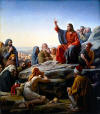
Sermon on the Mount

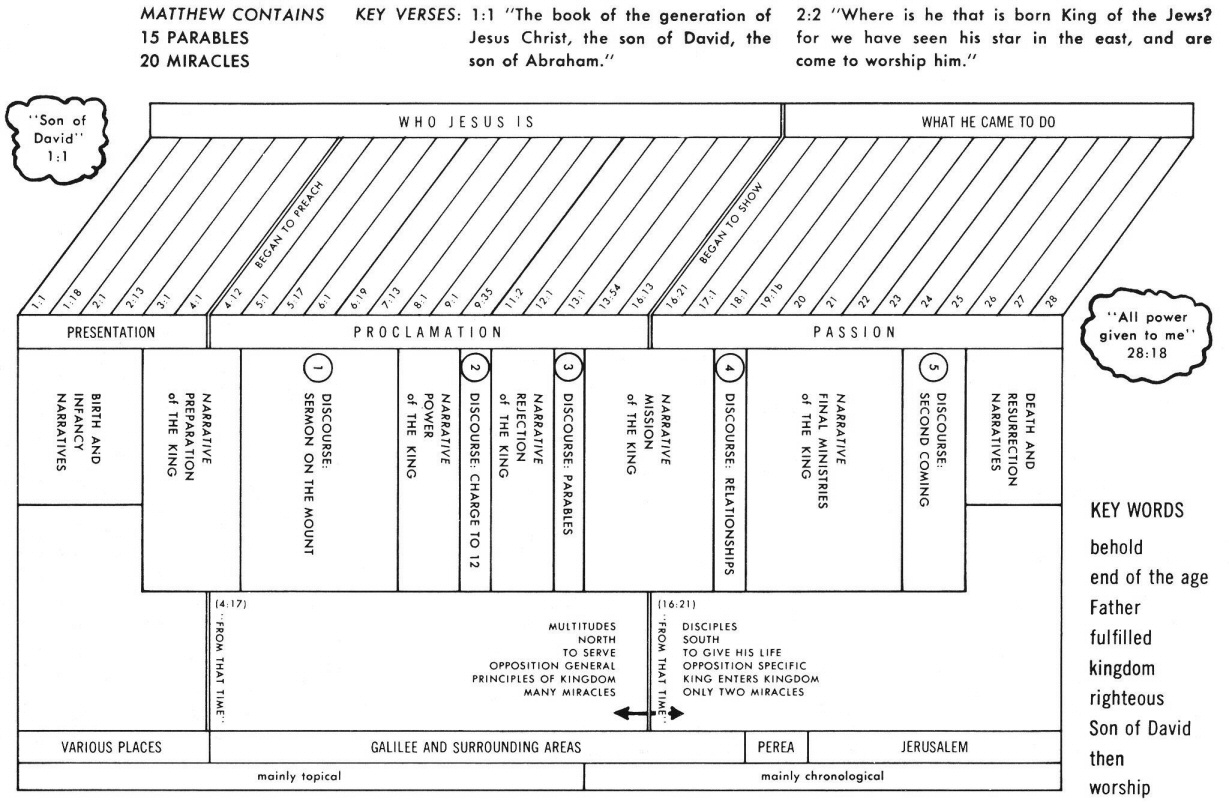
Click chart to enlarge
Charts from Jensen's Survey of the NT - used by permission
Another Chart from Charles Swindoll
THE LIFE OF JESUS AS COVERED
BY MATTHEW (shaded area)
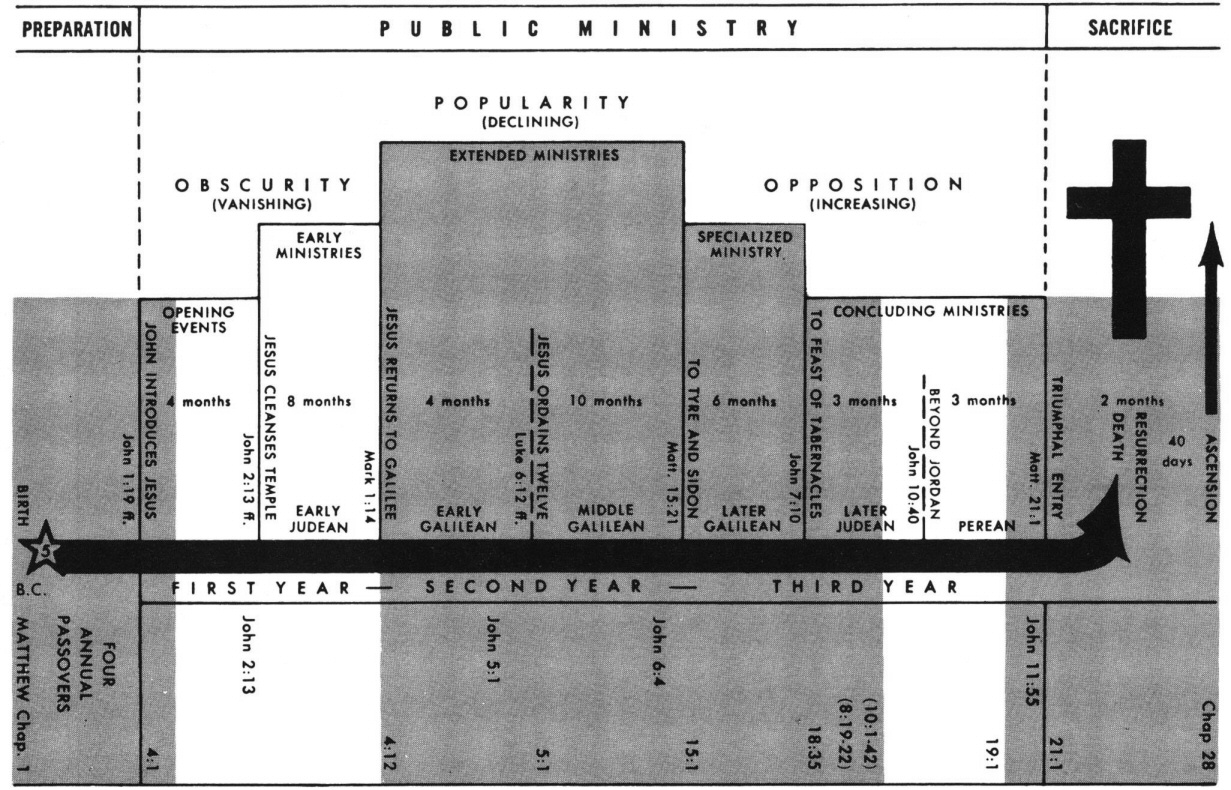
Click chart to enlarge
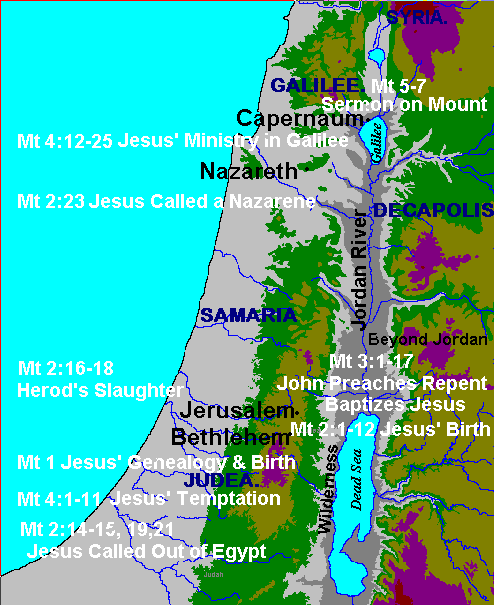
Jesus Birth and Early Years
Leading up to the Sermon on the Mount
Matthew 1-7

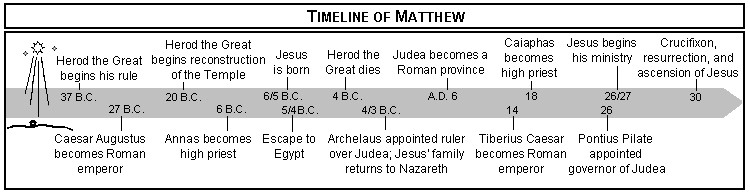
Source: Ryrie Study Bible
| THE SERMON ON THE MOUNT An Outline |
|
| Chapter | Subject |
| Mt 5:3-9 | Character |
| Mt 5:10-12 | Conflict |
| Mt 5:13-7:27 | Conduct |
Matthew 5:10 Blessed are those who have been persecuted for the sake of righteousness, for theirs is the kingdom of heaven. (NASB: Lockman)
Greek: makarioi oi dediogmenoi (RPPMPN) eneken dikaiosunes, hoti auton estin (3SPAI) e basileiaton ouranon.
BGT μακάριοι οἱ δεδιωγμένοι ἕνεκεν δικαιοσύνης, ὅτι αὐτῶν ἐστιν ἡ βασιλεία τῶν οὐρανῶν.
Amplified: Blessed and happy and enviably fortunate and spiritually prosperous (in the state in which the born-again child of God enjoys and finds satisfaction in God’s favor and salvation, regardless of his outward conditions) are those who are persecuted for righteousness’ sake (for being and doing right), for theirs is the kingdom of heaven! (Amplified Bible - Lockman)
My Amplified Paraphrase: "Blessed" (makarios) — spiritually flourishing, deeply satisfied in the soul, fully approved by God —“are those who have been persecuted” (diōkō, perfect tense: those who have been and continue to be pursued, harassed, hounded, attacked, pressured, or mistreated) “for the sake of righteousness,” that is, because they choose God’s way, live for His righteous standards, and refuse to compromise with the unrighteousness of the world. Such people are not suffering for wrongdoing or harshness, but because they reflect Christ's character to a hostile world, refusing to bend to the world's values, causing the world to push back. “For theirs is the kingdom of heaven” — they already possess assurance of the royal privileges of God’s reign, His favor, His presence, His future vindication, and the unshakeable hope of eternal glory. Their suffering now is temporary; their reward is eternal.
KJV: Blessed are they which are persecuted for righteousness' sake: for theirs is the kingdom of heaven.
NLT: God blesses those who are persecuted because they live for God, for the Kingdom of Heaven is theirs. (NLT - Tyndale House)
NKJ Blessed are those who are persecuted for righteousness' sake, For theirs is the kingdom of heaven.
NET "Blessed are those who are persecuted for righteousness, for the kingdom of heaven belongs to them.
CSB Those who are persecuted for righteousness are blessed, for the kingdom of heaven is theirs.
ESV Blessed are those who are persecuted for righteousness' sake, for theirs is the kingdom of heaven.
NIV Blessed are those who are persecuted because of righteousness, for theirs is the kingdom of heaven.
Philips: "Happy are those who have suffered persecution for the cause of goodness, for the kingdom of Heaven is theirs! (New Testament in Modern English)
Wuest: Spiritually prosperous are those who have been persecuted on account of righteousness, because theirs is the kingdom of heaven.
Young's Literal: 'Happy those persecuted for righteousness' sake -- because theirs is the reign of the heavens.
- Mt 10:23; Ps 37:12; Mk 10:30; Luke 6:22; Lk 21:12; Jn 15:20; Acts 5:40; Acts 8:1; Ro 8:35-39; 1Co4:9-13; 2 Cor 4:8-12,17; Phil 1:29; 2 Ti 2:12; 2Ti 3:12; Jas 1:2-5; 1Pe 3:13,14; 4:12-16; 1Jn 3:12; Rev 2:10
- Matthew 5 Resources - Multiple Sermons and Commentaries
- Matthew 5:10-12 The Only Way to Happiness: Endure Hardship 1 - John MacArthur
- Matthew 5:10-12 The Only Way to Happiness: Endure Hardship 2 - John MacArthur
- Matthew 5:10-12: Happy are the Harassed 1 - John MacArthur
- Matthew 5:10-12: Happy are the Harassed 2 - John MacArthur
Related Passages:
Matthew 10:23 “But whenever (Note: NOT "IF" BUT WHEN!) they persecute you in one city, flee to the next; for truly I say to you, you will not finish going through the cities of Israel until the Son of Man comes.
John 15:20 “Remember the word that I said to you, ‘A slave is not greater than his master.’ If they persecuted Me, they will also persecute you; if they kept My word, they will keep yours also.
Luke 6:22 “Blessed (makarios) are you when men hate you, and ostracize you, and insult you, and scorn your name as evil, for the sake of the Son of Man.
Acts 5:40-41 They took his advice; and after calling the apostles in, they flogged them and ordered them not to speak in the name of Jesus, and then released them. 41 So they went on their way from the presence of the Council, rejoicing that they had been considered worthy to suffer shame for His name.
Philippians 1:29 For to you it has been granted for Christ’s sake, not only to believe in Him, but also to suffer for His sake,
2 Timothy 3:12 Indeed, all (HOW MANY?) who desire to live godly in Christ Jesus will be persecuted (dioko) (A PROPHETIC PROMISE).
CHRISTLIKE CHARACTER
GUARANTEES PERSECUTION!
Blessed (makarios) are those who have been persecuted (dioko) for the sake (heneka - on account of, because) of righteousness (dikaiosune) for theirs is (present tense - now and cont) the kingdom (basileia) of heaven (ouranos) - Blessed (makarios) is literally "blessed the persecuted" (no verb "are") and it is notable that it mentioned twice in this final beatitude! They experience supernatural spiritual prosperity independent of their circumstances. This is the blessing that we would rather not partake of. It's the blessing no one really wants. But in some ways it is the most striking beatitude for it is the last, the longest, the only one associated with a command, the only one repeated by Jesus and the only one address directly to the reader (in Mt 5:11 He switches from the third person pronoun "those" to the second person pronoun "you").
Iain D Campbell on blessed - Some modern translations substitute the word ‘happy’ for the word ‘blessed’ and make the whole thing into a feeling. But Jesus is not talking about our feelings in this passage. As John Stott says, ‘Happiness is a subjective state, whereas Jesus is making an objective judgement about these people.’ (Borrow Stott's Sermon the Mount page 32) This is what God says about them. It is to those who have nothing in themselves that God gives the kingdom of heaven, the comfort of heaven, the earth as their inheritance, the satisfaction of his provision, the mercy and vision of God, the right to be called his sons and the greatest of all rewards: a place in his kingdom. (Opening Up Matthew)
John Stott adds this note on blessed asking "What is this blessing? The second half of each beatitude elucidates it. They possess the kingdom of heaven and they inherit the earth. The mourners are comforted and the hungry are satisfied. They receive mercy, they see God, they are called the sons of God. Their heavenly reward is great. And all these blessings belong together. Just as the eight qualities describe every Christian (at least in the ideal), so the eight blessings are given to every Christian. True, the particular blessing promised in each case is appropriate to the particular quality mentioned. At the same time it is surely not possible to inherit the kingdom of heaven without inheriting the earth, to be comforted without being satisfied or to see God without receiving his mercy and being called his children. The eight qualities together constitute the responsibilities, and the eight blessings the privileges, of being a citizen of God’s kingdom. This is what the enjoyment of God’s rule means. Are these blessings present or future? Personally, I think the only possible answer is ‘both’....So then the promises of Jesus in the beatitudes have both a present and a future fulfilment. (ED: cf Already-Not Yet) We enjoy the firstfruits now; the full harvest is yet to come. And, as Professor Tasker (ED: borrow Tasker's Matthew Commentary) rightly points out, ‘The future tense…emphasizes their certainty and not merely their futurity. The mourners will indeed be comforted, etc.’ (Borrow Stott's Sermon the Mount page 32)
Persecuted (dioko) is a strong verb and not just mild irritation from the world but active hostility. Persecuted (with repeated acts of enmity - thoughts, words, deeds) is in the passive voice which means that believers as the subject of the verb will receive the persecution from an external source. The perfect tense is used which indicates a fixed attitude of the persecutors. It won't ever change unless they are changed by the Gospel (from inside out, cf Acts 26:18, 2Cor 5:17). Persecutors of the "sons of God" is their permanent "persuasion!"
🙏 THOUGHT - It is especially important for Christians who are newly born into the faith to grasp the reality of persecution early so that they do not become discouraged or disillusioned when they are unexpectedly "blind-sided" by harsh words, insults, rejection, etc. because they are being "radical" with this "Jesus religion". I was not warned in my early years and was viciously attacked by leadership for teaching the Word (Precept classes and verse by verse Sunday School class)! Honestly, I considered "retiring" totally from teaching as the attack was so painful!
Jesus explained the root problem in John 3 declaring "that the light is come into the world (cf Jesus = John 8:12, His disciples are lights = Mt 5:16), and men loved the darkness rather than the light; for their deeds were evil for everyone who does evil hates the light, and does not come to the light, lest his deeds should be exposed" (John 3:19-20)
When the Beatitudes shape our inner life, they form in us the very character of citizens of the Kingdom of Heaven. And when that kingdom character is visible, it will inevitably collide with the values of the world. True believers who actually walk the radical “narrow way” that leads to life will be misunderstood, opposed, and even persecuted, precisely because their lives stand in marked contrast to the broad way that leads to destruction (Mt 7:13,14)
The more fully the Beatitudes are lived—not merely admired—the more this "light" exposes the emptiness of worldly righteousness and the darkness of human pride. A humble spirit, a mourning heart, a meek posture, a hunger for righteousness, a merciful disposition, a pure heart, and a peacemaking lifestyle are beautiful to God but are threatening to those who love darkness rather than light. Thus, persecution is not an accident but the natural consequence of displaying Christlike character in an anti-Christlike culture.
A B Bruce adds that the perfect tense that it is saying "the persecuted are not merely men who have passed through a certain experience, but men who bear abiding traces of it in their character. They are marked men, and bear the stamp of trial on their faces. It arrests the notice of the passer-by: commands his respect, and prompts the question, Who and whence? They are veteran soldiers of righteousness with an unmistakable air of dignity, serenity, and buoyancy about them. (Expositor's Greek Testament)
George F. MacLeod - “The greatest criticism of the church today is that no one wants to persecute it because there is nothing very much to persecute it about” (Leadership) WOE!
Vance Havner quipped that "One of our biggest problems today is that most of our church people have never really made up their minds to follow Jesus Christ. They are like Mr. Looking‑both‑ways in Pilgrim's Progress, or like Lot's wife looking back toward Sodom (Lk 17:32). They are like the man in the Civil War who wore a blue coat and gray trousers, and was shot at from both sides! They are like a donkey between two bales of hay‑undecided as to which to eat. They are like the son in our Lord's parable who said, I go, Sir" (Mt 22:30), and went not. They receive the word with joy, but have no root nor depth and soon fall away (Lk 8:13). They never really make up their minds, and are like the man who was asked, "Do you have trouble making decisions?" He replied, "Yes and no." (See Havner's preface)
Now that we have described the character of the true believers, the citizens of the Kingdom of Heaven, we observe next the conflict that these citizens experience in this present world (See table above). At first glance, it may seem odd that peacemakers who are poor in spirit, who mourn, who are meek, etc, would be persecuted. What we must remember however, lest we be discouraged when conflict comes, is that we have been transferred from the kingdom of darkness to the kingdom of light. Paul explains it this way as he prays for believers to be...
joyously giving thanks to the Father, who has qualified us to share in the inheritance of the saints in light. For He delivered us from the domain (right and might) of darkness, and transferred us to the kingdom of His beloved Son, in whom we have redemption, the forgiveness of sins. (Col 1:13,14)
Charles Simeon - CHRISTIANITY, to one who is not acquainted with its real nature, must appear full of paradoxes. In the preceding verses, we are informed what practical religion is; and, in the parallel passage in St. Luke’s Gospel, we have the same truths yet more plainly and explicitly declared (Lk 6:20,21,22,23,24,25,26). Had any uninspired person avowed such sentiments, we should have been ready to pronounce him mad: for there is scarcely any thing which we regard with dread, but a blessing is annexed to it; or any thing which we consider as desirable, but a woe is denounced against it: the poor, the hungry, the weeping, the despised, are congratulated; and the rich, the full, the laughing, and the honored, are represented as in a truly pitiable condition. But perhaps the greatest paradox of all is, that persons possessed of vital Christianity should be objects of persecution; that their piety should be the ground of that persecution; and that they should, on this very account, be esteemed happy. But so it is: and so it will appear (Read the entire sermon - Matthew 5:10-12 Persecution for Righteousness' Sake)
Sinclair Ferguson has an interesting comment regarding persecution asking "Is this the reverse of what we would expect? Men and women who are poor in spirit, mourn for their sin, live lives of gracious meekness, long for God's righteousness, show mercy to others, are pure in heart, and seek peace between God and man – would such people not be welcomed with open arms? After all, these are the very men and women the world needs! The world in which we live assumes that it will welcome Christians with open arms – until the first time it meets the genuine article. Until then, it is ignorant of its real response to the gospel. It assumes that it is well-disposed to Jesus Christ and to God. (BORROW Sermon on the Mount PAGE 40)
John MacArthur writes that "The Lord’s opening thrust in the Sermon on the Mount climaxes with this great and sobering truth: those who faithfully live according to the first seven beatitudes are guaranteed at some point to experience the eighth. Those who live righteously will inevitably be persecuted for it. Godliness generates hostility and antagonism from the world. The crowning feature of the happy person is persecution! Kingdom people are rejected people. Holy people are singularly blessed, but they pay a price for it....To the degree that they fulfill the first seven (ED: beatitudes) they may (ED: I think "will" is more likely than "may"!) experience the eighth....Christ living in His people today produces the same reaction from the world that Christ Himself produced when He lived on earth as a man. Righteousness is confrontational, and even when it is not preached in so many words, it confronts wickedness by its very contrast. Abel did not preach to Cain, but Abel’s righteous life, typified by his proper sacrifice to the Lord, was a constant rebuke to his wicked brother—who in a rage finally slew him....Persecution is one of the surest and most tangible evidences of salvation. Persecution is not incidental to faithful Christian living but is certain evidence of it..... Suffering persecution is part of the normal Christian life (cf. Rom. 8:16–17). And if we never experience ridicule, criticism, or rejection because of our faith, we have reason to examine the genuineness of it" (See Matthew Commentary - Page 220)
Alexander Maclaren notes that...
antagonism is inevitable between a true Christian and the world. Take the character as it is sketched in verses preceding. Point by point it is alien from the sympathies and habits of irreligious men. The principles are different, the practices are different.
A true Christian ought to be a standing rebuke to the world, an incarnate conscience.
There are but two ways of ending that antagonism: either by bringing the world up to Christian character, or letting Christian character down to the world...
As to practice — a righteous life will not make a man ‘popular.’ And as for ‘opinions’ — earnest religious opinions of any sort are distasteful. Not the profession of them, but the reality of them — especially those which seem in any way new or strange — make the average man angrily intolerant of an earnest Christianity which takes its creed seriously and insists on testing conventional life by it. Indolence, self-complacency, and inborn conservatism join forces in resenting the presence of such inconvenient enthusiasts, who upset everything and want to ‘ turn the world upside down...
The seeds of the persecuting temper are in human nature, and they germinate in the storms which Christianity brings with it. (Matthew 5:10 The Eighth Beatitude)
What does Jesus say light does to the deeds of men who love darkness? His light in you and through you dear citizen of the Kingdom of Heaven will expose the evil nature of their deeds! When His "righteousness" lights up your life...look out!...duck!...you will be persecuted by the "light haters". But remember the truth that you are blessed, even when you don't feel very blessed! Feelings can be and often are deceiving in the spiritual realm. Take your stand on the Truth of God's Word (see the passages below, especially if you are currently undergoing suffering for His Name's sake...if you're not now, you probably soon will be if you truly belong to Him!)
The persecution can be twofold involving on one hand a physical pursuing of the persecuted, and/or a personal attack with words as in the form of slander (insults, slander, hatred, spurn your name = cast it out, ostracism).
You might think well naturally the world will persecute me. I'm light. They are darkness (Eph 5:8) and therefore they hate me because the Light in me exposes their evil deeds (cf John 3:19, 20, 21). Of course, that is true but some are caught off guard when they are persecuted by others in the church. Not everyone in the church is a genuine believer (Mt 7:21, 22, 23) but are professors. When they encounter a real, radical convert of Christ, they are taken aback and this sets the scene for persecution in one form or another. And although it can be very subtle by religious folk, it is still very painful. Think about who were the most persistent persecutors of our Lord...the religious community, those who knew a lot of Bible knowledge but did not know the Truth Himself. Times may have changed but have men's hearts? (Jer 17:9) Why are we so surprised that the most vicious attacks will come from those who are in the same church? Who were the first persecutors of the new born church in Jerusalem? Was it not the religious folk again. They are the very Jews who Jesus had presented Himself to as King but they would not have Him. I am not calling for you to be inappropriately judgmental but to be wise as serpents and as innocent as doves. One qualifying note is in order. If you are persecuted by the religious folks in your church, do a careful inventory of your heart, your methods and your motives to make sure that the persecution you are experiencing is for the sake of righteousness, for the sake of His Name.
Martyn Lloyd-Jones speaks to the persecution of genuine believers by others in the church noting "How they (are) persecuted by nominal, religious people! That was also the story of the Puritan Fathers. This is the teaching of the Bible, and it has been substantiated by the history of the Church, that the persecution may come, not from the outside but from within. There are ideas of Christianity far removed from the New Testament which are held by many and which cause them to persecute those who are trying in sincerity and truth to follow the Lord Jesus Christ along the narrow way. You may well find it in your own personal experience. I have often been told by converts that they get much more opposition from supposedly Christian people than they do from the man of the world outside, who is often glad to see them changed and wants to know something about it. Formal Christianity is often the greatest enemy of the pure faith. (See page 161 in Studies in the Sermon on the Mount)
Alexander Maclaren elaborates on the persecution manifest by "The curled lip, the civil scorn, the alienation of some whose good opinion we would fain have, or, if we stand in some public position, slanderers press, and the contumacious epithets, are trivial but very real tokens of dislike. We have the assassin’s tongue instead of the assassin’s dagger. But yet such things may call for as much heroism as braving a rack, and the spirit that shoots out the tongue may be as bad as the spirit that yelled, ‘Christianos ad leones.’ (Christians to the lions) (Matthew 5:10 The Eighth Beatitude)
For the sake of (heneka) is a work which means "on account of" or "because of". Why are the "sons of God" harassed, etc? Because of "righteousness", which is ultimately God's righteousness shining forth in and through His "children". It is Christ in you the hope of glory (Col 1:27). It's like Cain killing Abel for the sake of his righteous sacrifice (Genesis 4, Heb 11:4). It is like David falsely accused and chased after by King Saul. Or Daniel being thrown in jail for praying to His Lord (Da 6:12-28). And the list goes on and on. If it happened to them, it will happen to you.
It is not suffering for conscience’ sake, for convictions’ sake or because of the ordinary troubles of life, but “for My sake.” Note Jesus does not say you will be persecuted because you are obnoxious, offensive, are inappropriately radical or overzealous, etc. Be careful not to bring unnecessary suffering upon yourselves, for this is not pleasing to your Father in heaven and receives no commendation.
Williams translates it "for being and doing right" (see also the Amplified Version above)
Jesus does not say because of rude, offensive, obnoxious, crude, law breaking or lazy (including that which sadly can be seen in Christians) behavior. Such behavior deserves the consequence of persecution. In short, this promised blessing does not apply to trouble one brings on themselves. It applies only if their righteous (right in sight of God and man) lifestyle and stand for Jesus generates opposition. To put it another way you might say that persecution is a sign your life is right in the eyes of (God and) the world.
Ray Pritchard (The Blessing No One Wants) has an interesting quote...
Clarence Jordan observed that, “It is difficult to be indifferent to a wide-awake Christian.”
You can hate them or love them, but you can’t ignore them. Wide-awake Christian confront others with the reality of God. You can’t be neutral in such cases. “These people must be crowned or crucified, because they are either mighty right or mighty wrong.”
“Because Kingdom citizens do what God requires,” “because their lives are right before God,” and “because they live as God wants people to”, the lives of God's "children" convict (or should convict) those who are living in darkness, whether those people belong to no church or are members of a church in "good standing"!
Sinclair Ferguson - Christians are persecuted for the sake of righteousness because of their loyalty to Christ. Real loyalty to him creates friction in the hearts of those who pay him only lip service. Loyalty arouses their consciences, and leaves them with only two alternatives: follow Christ, or silence him. Often their only way of silencing Christ is by silencing his servants. Persecution, in subtle or less subtle forms, is the result. We have already seen that the gospel produces a lifestyle characterised by righteousness. In practice, that means absolute integrity, whether at home, in the work place, or even at play. But such integrity challenges the moral indifference of the world, not least in our own age. Not to do the things 'everybody does' stirs the world's sleepy conscience. More than that, it irritates it, and causes annoyance and even anger. You would not think that simple honesty could be a dangerous lifestyle, until you put it into practice on the shop floor! For the Christian who is employed by another person, righteousness demands that he give his employer the time and energy for which he is paid. It means moral integrity. But how angry other employees can be when such integrity is displayed! (BORROW Sermon on the Mount)
A SHORT DIGRESSION ON
OUR PROMISED PERSECUTION
Persecution although often surprising to the young saint (cf 1Pe 4:12), is to be expected by Kingdom citizens who don't really belong to this world and such persecution is amply testified to in the New Testament as described below...
🙏 THOUGHT - (Jesus warned) "Woe to you when all men speak well of you, for in the same way their fathers used to treat the false prophets. (Luke 6:26) (What does this warning signify? It means that if you have never, ever experienced suffering for the sake of righteousness for His Name's sake, then you need to examine your profession of faith [cf 2Cor 13:5]. If Christ is in you and His beatitudes are your character, however imperfectly they may be manifest, then you will at some time and to some degree be persecuted for your righteous [not self righteous or judgmental] lifestyle in Christ which shines light on the dark deeds of the enemies of Christ, cf Ro 5:10, Col 1:21, Ro 8:7). Beloved, persecution is the believers birthmark and is sure proof that you are part of the family of God.
Martyn Lloyd-Jones addresses this issue writing "This Beatitude tests our ideas as to what the Christian is. The Christian is like his Lord, and this is what our Lord said about him. 'Woe unto you, when all men shall speak well of you! for so did their fathers to the false prophets' (Luke 6:26). And yet is not our idea of what we call the perfect Christian nearly always that he is a nice, popular man who never offends anybody, and is so easy to get on with? But if this Beatitude is true, that is not the real Christian, because the real Christian is a man who is not praised by everybody. They did not praise our Lord, and they will never praise the man who is like Him. 'Woe unto you, when all men shall speak well of you!' That is what they did to the false prophets; they did not do that to Christ Himself. So I draw my next deduction. It concerns the natural, unregenerate man, and it is this. The natural mind, as Paul says, 'is enmity against God. (Ro 8:7) Though he talks about God, he really hates God (Ro 5:10). And when the Son of God came on earth he hated and crucified Him (John 15:18-20). And that is the attitude of the world towards Him now. This leads to the last deduction, which is that the new birth is an absolute necessity before anybody can become a Christian. To be Christian, ultimately, is to be like Christ; and one can never be like Christ without being entirely changed. We must get rid of the old nature that hates Christ and hates righteousness; we need a new nature that will love these things and love Him and thus become like Him. (See page 163 in Studies in the Sermon on the Mount) (Bolding added)
Paul warned the church at Philippi of persecution exhorting them....
Only conduct (present imperative see our need to depend on the Holy Spirit to obey) yourselves in a manner worthy of the gospel of Christ; so that whether I come and see you or remain absent, I may hear of you that you are standing firm (steko - present tense - continually - this too calls for dependence on the Holy Spirit) in one spirit, with one mind striving together (sunathleo -present tense) for the faith of the gospel; in no way alarmed (pturo) by your opponents—which is a sign of destruction for them, but of salvation for you, and that too, from God. For to you it has been granted (charizomai from charis = grace) for Christ's sake, (1) not only to believe in Him, but (2) also to suffer for His sake, experiencing the same conflict which you saw in me, and now hear to be in me. (Php 1:27-30)
COMMENT: Note that that (1) the gift of faith in Christ Jesus and (2) the gift of suffering come together. When you are persecuted, and you will be when you walk worthy of the gospel, remember... do not be alarmed - the Greek word (pturo) pictures a frightened horse shying away on the battlefield. Don't be ''startled''! As an aside, when we are not startled by their opposition, it is another sign that we are saved! You realize that you have a home in heaven. So even if God permits them to take your life, He is simply saying, "It's time to come on Home, My child." This attitude will alarm your opponents, for when they see you standing firm without being startled, it is a sign they are doomed to eternal destruction. Why is this the case? Because if they were being faced with the very persecution or threats they are giving you, they would be "scared stiff"! In short, you have given your opponents a profound, piercing testimony of the reality of your faith. (See also a few related discussion questions Lesson 5)
Jesus in His last major teaching to His disciples in the Upper Room warned them...
"If (first class condition = it is a guarantee!) the world hates you, you know that it has hated Me before it hated you. "If you were of the world, the world would love its own; but because you are not of the world, but I chose you out of the world, therefore the world hates you. "Remember (present imperative see our need to depend on the Holy Spirit to obey) the word that I said to you, 'A slave is not greater than his master.' If (first class condition = certainly) they persecuted Me, they will also persecute you; if (first class condition) they kept My word (some will will hear and respond to their Gospel), they will keep yours also. (John 15:18-20)
Paul in his last words to his disciple Timothy warned him...
And indeed, all who desire to live godly in Christ Jesus will be persecuted. (2Ti 3:12)
COMMENT: Note how many will be persecuted. All. No exceptions. Note also the Source of such a persecuted life - in Christ Jesus, i.e., those who abide in the Vine for apart from Him we can do absolutely nothing, Jn 15:5. If we live what we think is "godly" in our own strength, we won't necessarily be persecuted, for Christ's enemies won't see Him and He is the One they hate and seek to denigrate and discredit)
Earlier Paul had commanded Timothy
Therefore do not be ashamed of the testimony of our Lord, or of me His prisoner; but join with me in suffering for the gospel according to the power of God (2Ti 1:8)
COMMENT: Note how it is one is enabled to not be ashamed and to suffer - the power of God.
Paul alluded to suffering in his letter to the church at Rome writing...
The Spirit Himself bears witness with our spirit that we are children of God, and if children, heirs also, heirs of God and fellow heirs with Christ, if indeed (the "if" in Greek is a first class condition and means "since" and speaks of a certainty not a possibility!) we suffer with Him in order that we may also be glorified with Him. For I consider that the sufferings of this present time are not worthy to be compared with the glory that is to be revealed to us. (Romans 8:16-18)
COMMENT: What is the mark of a child of God? Suffering with Christ (and FOR Christ). What is our motivation? We are assured of future glory which far outweighs the present suffering (cf 2Cor 4:16-18). And so we we see that present suffering has purpose in preparing us for future glory by removing the dross from our lives. (cf 1Pe 1:6, 7).
Peter also spoke to the churches in Pontus, Galatia, Cappadocia, Asia, and Bithynia (1Pe 1:1) explaining that suffering would be their lot writing...
For this finds favor, if for the sake of conscience toward God a man bears up under sorrows when suffering unjustly. For what credit is there if, when you sin and are harshly treated, you endure it with patience? But if when you do what is right and suffer for it you patiently endure it, this finds favor with God. For you have been called for this purpose, since Christ also suffered for you, leaving you an example (hupogrammos = literally to "write under" was used of a copybook of letters the pupil would look at to write out or trace out their letters) for you to follow in His step (see Walking Like Jesus Walked!), WHO COMMITTED NO SIN, NOR WAS ANY DECEIT FOUND IN HIS MOUTH; and while being reviled, He did not revile in return; while suffering, He uttered no threats, but kept entrusting Himself to Him who judges righteously; and He Himself bore our sins in His body on the cross, that (TERM OF PURPOSE) we might die to sin and live to righteousness; for by His wounds you were (SPIRITUALLY) healed. For you were continually straying like sheep, but now you have returned to the Shepherd and Guardian of your souls. (1Pe 2:18-25)
COMMENT - What happens when we "die to sin and live to righteousness" no longer "continually straying like sheep"? We will suffer unjustly (which is the kind of suffering which finds favor with God), especially by those with whom we once "strayed like sheep." What are we to do? Bear up, patiently endure, realize we were called to suffer unjustly, follow our Lord's example, don't revile in return, don't utter threats when suffering, refraining because we trust God's righteous judgment will one day be meted out to our persecutors.
Peter goes on...
But even if you should suffer for the sake of righteousness, you are blessed. AND DO NOT FEAR THEIR INTIMIDATION, AND DO NOT BE TROUBLED, but sanctify (aorist imperative see our need to depend on the Holy Spirit to obey) Christ as Lord in your hearts, always being ready to make a defense (apologia) to everyone who asks you to give an account for the hope that is in you, yet with gentleness and reverence; and keep a good conscience so that in the thing in which you are slandered, those who revile your good behavior in Christ may be put to shame. For it is better, if God should will it so, that you suffer for doing what is right rather than for doing what is wrong. (1Pe 3:14-17)....
Beloved, do not be surprised (present imperative with a negative see our need to depend on the Holy Spirit to obey) at the fiery ordeal among you, which comes upon you for your testing, as though some strange thing were happening to you; but to the degree that you share the sufferings of Christ, keep on rejoicing; so that also at the revelation of His glory, you may rejoice with exultation. If you are reviled for the name of Christ, you are blessed, because the Spirit of glory and of God rests upon you. By no means let any of you suffer as a murderer, or thief, or evildoer, or a troublesome meddler; but if anyone suffers as a Christian, let him not feel ashamed, but in that name let him glorify God. For it is time for judgment to begin with the household of God; and if it begins with us first, what will be the outcome for those who do not obey the gospel of God? AND IF IT IS WITH DIFFICULTY THAT THE RIGHTEOUS IS SAVED, WHAT WILL BECOME OF THE GODLESS MAN AND THE SINNER? Therefore, let those also who suffer according to the will of God entrust (paratithemi = commercial technical term for giving something to someone in trust for safekeeping -- a command in the present imperative see our need to depend on the Holy Spirit to obey ) their souls to a faithful Creator in doing what is right. (1Pe 4:12-19)
But you might be saying "I've never experienced persecution like these verses are describing"...
Alexander Maclaren addresses your question writing that "The great reason why professing Christians now know so little about persecution is because there is so little real antagonism. ‘If ye were of the world, the world would love his own.’ The Church has leavened the world, but the world has also leavened the Church; and it seems agreed by common consent that there is to be no fanatical goodness of the early primitive pattern (ED: Aka Book of Acts type). Of course, then, there will be no persecution, where religion goes in silver slippers, and you find Christian men running neck and neck with others, and no man can tell which is which. Then, again, many escape by avoiding plain Christian duty, shutting themselves up in their own little coteries. (Matthew 5:10 The Eighth Beatitude)
Be aware of some who might try to diminish the import of Jesus' promise of persecution for Kingdom citizens in this present world. For example, the Expositor's Bible Commentary notes that...
Lachs (pp. 101-3) cannot believe Christians were ever persecuted because of righteousness; so he repoints an alleged underlying Hebrew text to read "because of the Righteous One"-a reference to Jesus. But he underestimates how offensive genuine righteousness, "proper conduct before God" (Przybylski, p. 99), really is (cf. Isa 51:7). (See comments in Matthew)
Blessed (see makarios) spiritually prosperous, independent of one's circumstances, including even persecution! Talk about a paradox to the natural mind (cf 1Cor 2:14). Not a superficial feeling but the deep inner joy, spiritual well-being, and favor from God that exists regardless of outward circumstances. Makarios describes a state only God can give—it is the joy of being rightly aligned with Him, assured of His approval, and living in harmony with His kingdom. It is the opposite of the world’s happiness, which depends on circumstances; makarios is supernatural and anchored in God Himself.
MAKARIOS IN MATTHEW - Matt. 5:3; Matt. 5:4; Matt. 5:5; Matt. 5:6; Matt. 5:7; Matt. 5:8; Matt. 5:9; Matt. 5:10; Matt. 5:11; Matt. 11:6; Matt. 13:16; Matt. 16:17; Matt. 24:46;
Persecuted (1377) (dioko from dío = pursue, prosecute, persecute) means to follow or press hard after, literally to pursue as one does a fleeing enemy. It means to chase, harass, vex and pressure and was used for chasing down criminals. Dioko speaks of an intensity of effort leading to a pursue with earnestness and diligence in order to lay hold of and oppress or harass the "blessed". The picture of this word is like the ferocious hunting dogs chasing after the poor little red fox.
DIOKO IN MATTHEW - Matt. 5:10; Matt. 5:11; Matt. 5:12; Matt. 5:44; Matt. 10:23; Matt. 23:34
Matthew 23:34 (FOREWARNED IS FOREARMED!) “Therefore, behold, I am sending you prophets and wise men and scribes; some of them you will kill and crucify, and some of them you will scourge in your synagogues, and persecute from city to city,
Righteousness (1343) (dikaiosune from dikaios = being proper or right in the sense of being fully justified being or in accordance with what God requires) is the quality of being upright. In its simplest sense dikaiosune conveys the idea of conformity to a standard or norm. In this sense righteousness is the opposite of hamartia (sin), which is defined as missing of the mark set by God. In this sense righteousness is the opposite of hamartia (sin), which is defined as missing of the mark set by God. Dikaiosune is rightness of character before God and rightness of actions before men. Righteousness of God could be succinctly stated as all that God is, all that He commands, all that He demands, all that He approves, all that He provides through (Click here to read Pastor Ray Pritchard's interesting analysis of righteousness in the Gospel of Matthew).
DIKAIOSUNE IN MATTHEW - Matt. 3:15; Matt. 5:6; Matt. 5:10; Matt. 5:20; Matt. 6:1; Matt. 6:33; Matt. 21:32;
Vance Havner - I HAVE SET MY FACE"
For the Lord God will help me; therefore shall I not be confounded: therefore have I set my face like a flint, and I know that I shall not be ashamed" (Isa. 50:7).
So wrote Isaiah concerning God's suffering servant, and when that suffering servant came to earth ". . . he steadfastly set his face to go to Jerusalem" (Luke 9:51).
Throughout the Word of God, the heroes of faith were men who set their faces like a flint.
1. Caleb…wholly followed the Lord God" (Josh 14:14).
2. Joshua said, "As for me and my house, we will serve the Lord. " (Josh 24:15)
3.Elijah asked, "How long halt ye between two opinions?" (1 Kings 18:21).
4. Daniel "purposed in his heart" (Dan. 1:8) to be true to God.
5. Paul said: this one thing I do" (Phil. 3:13).
Pastor Ray Pritchard gives a superb analysis of what Jesus means by righteousness by examining the Jesus other uses of the same word in this sermon…
In Matthew 5:10 Jesus said, “Blessed are those who are persecuted because of righteousness.” That’s the eighth and final beatitude. When you take the fourth and eighth beatitudes together, you get something like this: We are to hunger and thirst after a kind of life that will cause some people to persecute us for our faith. So righteousness is a lifestyle that distinguishes us as true Christians and invites opposition from the world.
The second use comes from Matthew 5:20, “For I tell you that unless your righteousness surpass that of the Pharisees and the teachers of the law, you will certainly not enter the kingdom of heaven.” The Pharisees had concocted a religious system built around attendance at the temple. It involved intricate rules and regulations and meant following precepts and traditions. It was very professional and very routine. It was like wearing cheap perfume that you splash on to make yourself smell good. It’s not really a part of you and it can’t cover the odor underneath. True righteousness starts in the heart and changes a person from the inside out.
Matthew 6:1 gives us the third use of this word: “Be careful not to do your ‘acts of righteousness’ before men, to be seen by them. If you do, you will have no reward from your Father in heaven.” The Pharisees loved to pray in public--loudly! They loved to dress up in their religious garb and throw their offering in the metal container so people could hear the coins rattle. They would sacrifice anything to win the praise of others. Their religion was built around the praise of men. And they still thought God would reward them. But it was cotton-candy religion. It looked good but there wasn’t any substance there. Like Old Mother Hubbard’s cupboard, there was nothing there. By contrast, true disciples seek a righteousness that doesn’t need to be seen by others, but only by God.
Most of us already know the last verse by heart: “But seek first his kingdom and his righteousness, and all these things will be given to you as well” (Matthew 6:33). This touches the priorities of life. What is it that you are seeking in life? Fame? Fortune? Career advancement? A good salary? A secure future? A happy retirement? A marriage partner? The fulfillment of your dreams? As good as those things may be, they aren’t the most important things in life. Put God’s kingdom and God’s righteousness first. When you do, everything else you need will be given to you. Seeking “his righteousness” means letting his Word set the standard for your life. It means seeking to do that which is pleasing to him.
Put these four passages together and what do you have?
We are to hunger and thirst after …
A. A truly Christian lifestyle (Mt 5:10)
B. That changes us from the inside out (Mt 5:20)
C. So that we no longer seek the praise of men (Mt 6:1)
B. But causes us to seek God’s approval above everything else. (Mt 6:33)
If You Want It, You Can Have It
If you want righteousness, you can have it. Let me go out on a limb and make a bold statement. Whatever you want in the spiritual realm, you can have if you want it badly enough. I don’t think we appreciate the importance of that truth. Most of us are about as close to God to now as we want to be. We have about as much joy as we want, about as much peace as we want. For the most part, you are where you are right now because that’s where you want to be. If you were hungry for something better from God, you could have it.
If you want it, you can have a close walk with God.
If you want it, you can have a better marriage.
If you want to, you can do God’s will.
If you want to, you can grow spiritually.
If you want to, you can become a man of God or a woman of God.
If you want to, you can change deeply-ingrained habits.
If you want to, you can break destructive patterns of behavior…
When Jesus says, “You will be filled,” he means “You will be filled with Jesus himself!”
If you are hungry, come and eat of the Bread of Life.
If you are thirsty, come and drink of the Water of Life.
If are weary heavy laden, come and find rest.
If you are guilty, come and be forgiven.
If you are far from God, come back home again.
The French philosopher Pascal said that there is a “God-shaped vacuum” inside every human heart. Since nature abhors a vacuum, if we don’t fill it with God, we will fill it with something else. So many of us have filled our hearts with the junk food of the world. No wonder we are so unhappy. So wonder we jump from one job to another and from relationship to another…
Augustine explained both the problem and the solution: “O God, you have made us for yourself, and our hearts are restless until they find rest in you.” You will never be happy until you put God first in your life. And you can never do that until you surrender your life to Jesus Christ once and for all.
Let me give you some good news. In the kingdom of God, everything begins with a seeking heart! Salvation begins with a hungry heart. If you are tired of the life you’ve been living, you can make a new start.
Whatever you want in the spiritual realm, you can have if you want it badly enough. Jesus said, “Blessed are those who hunger and thirst for righteousness, for they will be filled. ”Are you hungry? Are you thirsty?
If you are, you can be filled. This is the promise of God to hungry hearts and thirsty souls. (Sermon on the Mount Mt 5:6)(Bolding added)
ILLUSTRATION - Savonarola was one of the greatest reformers in the history of the church. In his powerful condemnation of personal sin and ecclesiastical corruption, that Italian preacher paved the way for the Protestant Reformation, which began a few years after his death. “His preaching was a voice of thunder,” writes one biographer, “and his denunciation of sin was so terrible that the people who listened to him went about the streets half-dazed, bewildered and speechless. His congregations were so often in tears that the whole building resounded with their sobs and their weeping.” But the people and the church could not long abide such a witness, and for preaching uncompromised righteousness Savonarola was convicted of “heresy,” he was hanged, and his body was burned.
FOR THEIRS IS THE KINGDOM OF HEAVEN: hoti auton estin (3SPAI) e basileia ton ouranon:
- The kingdom of heaven - Mt 5:3; 2Th 1:4-7; Jas 1:12
- Matthew 5:10-12 The Only Way to Happiness: Endure Hardship 1 - John MacArthur
- Matthew 5:10-12 The Only Way to Happiness: Endure Hardship 2 - John MacArthur
- Matthew 5:10-12: Happy are the Harassed 1 - John MacArthur
- Matthew 5:10-12: Happy are the Harassed 2 - John MacArthur
- Matthew 5 Resources - Multiple Sermons and Commentaries
Related Passages:
Matthew 5:3 “Blessed (makarios) are the poor in spirit, for theirs is (present tense - continually) the kingdom of heaven.
2 Thessalonians 1:4-7 therefore, we ourselves speak proudly of you among the churches of God for your perseverance (hupomone) and faith in the midst of all your persecutions and afflictions which you endure. 5 This is a plain indication of God’s righteous judgment so that you will be considered worthy of the kingdom of God, for which indeed you are suffering. 6 For after all it is only just for God to repay with affliction those who afflict you, 7 and to give relief to you who are afflicted and to us as well when the Lord Jesus will be revealed from heaven with His mighty angels in flaming fire,
James 1:12 Blessed (makarios) is a man who perseveres (hupomeno - present tense - continually) under trial (peirasmos - "temptation"); for once he has been approved (dokimos), he will receive the crown of life which the Lord has promised to those who love (agapao present tense - continually love) Him. (NOTE: Don't just SAY you love Jesus, SHOW you love Jesus by your perseverance. You will be rewarded also in 2Ti 4:8).
Luke 17:20-21 Now having been questioned by the Pharisees as to when the kingdom of God was coming, He answered them and said, “The kingdom of God is not coming with signs to be observed; 21 nor will they say, ‘Look, here it is!’ or, ‘There it is!’ For behold, the kingdom of God is in your midst.”
THE KINGDOM OF HEAVEN
IS THEIR PRESENT POSSESSION!
For (hoti) is quite a strategic term of explanation! Always ask at least the simple question "What is the Author (in this case the ultimate AUTHOR!) saying? Here Jesus is explaining the good news to all who suffer for the Good News! The best is yet to come!
Theirs is the kingdom (basileia) of heaven (ouranos) - Theirs is emphatic so it means theirs and theirs alone. The Greek construction indicates once again (as in all of the beatitudes) that this Kingdom belongs to them and to them alone! No usurpers or counterfeits will infiltrate this Kingdom! The kingdom of heaven is synonymous with the kingdom of God. For more discussion see the Kingdom of God in the commentary on Luke 17:20-21.
Is (estin) is in the present tense which indicates that this is their continual possession. Is this not a "reward"? I think so, but there is an additional reward promised in Heaven! (Mt 5:12) How great is our salvation, beloved! This kingdom is what is sometimes referred to as "Already-Not Yet." Kingdom citizens have Already – here and now – entered into their Lord's Kingdom (even if you don't feel like it!) (see when you were "transferred" in Col 1:13). Yes, it is a Kingdom that is yet to be consummated ("Not Yet") and to be revealed in its final glory. Indeed, we all wait expectantly for "the seventh angel (to sound); and there (to arise) loud voices in heaven, saying, "The kingdom of the world has become (proleptic/prophetic aorist) the kingdom of our Lord, and of His Christ; and He will reign forever and ever (Rev 11:15) But to an extent in a very real sense, all the blessings that are expected in the future Kingdom are already being experienced now by citizens of the Kingdom. These blessings will just be greater and purer and more glorious in the ages to come.
A B Bruce on theirs is the Kingdom of Heaven - The common refrain of all the Beatitudes is expressly repeated here to hint that theirs emphatically is the Kingdom of Heaven. It is the proper guerdon of the soldier of righteousness. It is his now, within him in the disciplined spirit and the heroic temper developed by trial. (Expositor's Greek Testament)
Charles Spurgeon - They are often evil spoken of, they have sometimes to suffer the spoiling of their goods, many of them have laid down their lives for Christ’s sake, but they are truly blessed, for “theirs is the kingdom of heaven.
Sinclair Ferguson illustrates the point that Christians have the Kingdom of Heaven now, telling the story of "Izaak Walton, writer (best known as the author of the seventeenth-century fishing manual, The Compleat Angler) who wrote the following description of one of his great Christian contemporaries, Richard Sibbes...
Of this blest man,
Let this just praise be given:
Heaven was in him
Before he was in heaven.
But these quaint lines are just as true of every Christian, for we have already received the heavenly Spirit as the guarantee that we will full enter into our inheritance (Eph 1:13-14). (ED: cf Already-Not Yet) The Christian life is not "the opiate of the people," dulling our senses now in the hope of better things hereafter. Rather, says Jesus, it is the blessing now and more blessing to come. (Borrow Sermon on the Mount)
The Beatitudes are a "package deal"
so to speak
Observe also that the same blessing kingdom of heaven begins and ends the eight beatitudes and thus signals the beginning and the end of this section, a literary device known as “inclusion”. The Beatitudes are a "package deal" so to speak. Clearly our King intends for the be attitudes to be understood as a unit and not as separate characteristics. In other words, all Kingdom citizens possess all these characteristics, albeit varying in the degree of development in each individual. These characteristics are not ancillary but mandatory. In other words, the eight Beatitudes are the attributes of the child of God, a character which inevitably bring a conflict. But the conflict becomes the very assurance that our salvation is genuine! And so we can rejoice now as well as later in heaven.
Alexander Maclaren speaks of the twofold fulfillment of the blessing of the "kingdom of heaven" writing that...
There is a present recompense. Persecution is the result of a character which brings Christians into the kingdom. Theirs is the kingdom — they are subjects. To them it is given to enter. Persecution makes the present consciousness of the possession of the kingdom more vivid and joyous. It brings the enforced sense of a vocation separate from the hostile world’s. As Thomas Fuller puts it somewhere, in troublous times the Church builds high, just as the men do in cities where there is little room to expand on the ground level.
Persecution brightens and solidifies hope, and thus may become infinitely sweet and blessed. How often it has been given to the martyr, as it was given to Stephen, to see heaven opened and Jesus standing at the right hand of God, as if risen to His feet to uphold as well as to receive His servant. Paul and Silas made the prison walls ring with their praises, though their backs were livid with wales and stained with blood. And we, in our far smaller trials for Christ’s sake, may have the same more conscious possession of the kingdom and brightened hope of yet fuller possession of it.
There is a future recompense in the perfect kingdom, where men are rewarded according to their capacities. And if the way in which we have met the world’s evil has been right, then that will have made us fit for a fuller possession. In closing we recur to the thought of all these Beatitudes as a chain and the beginning of all as being penitence and faith. Many a poor man, or many a little child, may have a higher place in heaven than some who have died at the stake for their Lord, for not our history, but our character, determines our place there, and all the fulness of the kingdom belongs to every one who with penitent heart comes to God in Christ, and then by slow degrees from that root brings forth first the blade, then the ear, then the full corn in the ear. (Matthew 5:10 The Eighth Beatitude)
The Blessing Of Persecution...Persecution, even martyrdom, has been the cost of discipleship for Christians down through the centuries. In many lands believers still suffer imprisonment and death for their uncompromising devotion to their Savior. Even in nations that have religious freedom, a person with a bold witness for the Lord may become the target of ridicule.
When we experience hardship because of our Christian commitment, no verse of Scripture is more comforting than the beatitude spoken by our Savior, "Blessed are those who are persecuted for righteousness' sake, for theirs is the kingdom of heaven" (Mt. 5:10).
At one time in his life, British preacher Charles Haddon Spurgeon was so intensely criticized that he became deeply depressed. So his wife printed that beatitude along with the other seven on a large sheet of paper and placed it above their bed. The first thing Spurgeon saw in the morning and the last thing he read at night was our Savior's glorious promise.
Are you discouraged because you are suffering for your Christian testimony? The antidote is this one sustaining promise: "Blessed are those who are persecuted for righteousness' sake." --V C Grounds (Our Daily Bread, Copyright RBC Ministries, Grand Rapids, MI. Reprinted by permission. All rights reserved)
The consecrated cross I'll bear
Till death shall set me free,
And then go home, my crown to wear,
For there's a crown for me. --Shepherd
If you live for God,
you can expect trouble from the world.
Kingdom (932)(basileia from basileus = a sovereign, king, monarch) denotes sovereignty, royal power, dominion and refers therefore to the territory or people over whom a king rules. The Kingdom of Heaven/God is the sphere in which God is acknowledged as King (In hearts that have bowed in faith in Christ and now give Him obedience albeit not perfectly in this world but perfect in the one to come). In this sense the Kingdom has a spiritual aspect, a present physical aspect, and a future eternal aspect (beginning with the millennium, cf Mt 25:31,34), all of course depending on the context of the passage in which basileia is found. Paul is careful to remind us that the Kingdom of Heaven/God is not in observance of ordinances, external and material, but in the deeper matters of the heart, which are spiritual and essential (Ro 14:17)
The Kingdom is the rule or reign of God and Jesus the King and so is the expression of His gracious sovereign will. To belong to the Kingdom of Heaven is to belong to the King as subjects with others men and women among whom the reign of Christ has begun and who are eagerly awaiting His return and establishment of His literal earthly kingdom.
On a practical note, believers now live in the Kingdom of light, not the Kingdom of this world (Rev 11:15) and this is why the battle you are currently experiencing dear saint is far fiercer than anything you knew before you became a citizen of Christ's Kingdom (which is here and paradoxically is yet to come). How mistaken saints are when they assume that since they are now believers, everything should be simpler, easier, less demanding. How could that be when we have entered into a Kingdom that is alien to the world (cf 1Pe 1:1, 2:11-see notes 1 Peter 1:1, 2:11) in which we now temporarily reside and the life we used to live? If our King was tested, tempted, opposed, rejected and eventually crucified by the kingdom of this world, should it surprise us that belonging to His Kingdom of light would involve us in a struggle of titanic proportions? And not only the external forces are arrayed against us, but we also have to fight the continual battle within as well, as our own fallen flesh nature seeks to take us down and draw us back into the kingdom of darkness. You know full well what I am referring to! We all sadly carry into the new glorious Kingdom of Christ some of the baggage of habits and ways of thinking of the old kingdom life. And it can (and usually is) a monumental struggle for us to be rid of them.
Robert Stein on the Kingdom of God - The heart of Jesus' teachings centers around the theme of the kingdom of God. This expression is found in sixty-one separate sayings in the Synoptic Gospels. Counting parallels to these passages, the expression occurs over eighty-five times. It also occurs twice in John (3:3,5). It is found in such key places as the preaching of John the Baptist, "Repent, for the kingdom of heaven is near" (Matthew 3:2 ); Jesus' earliest announcement, "The time has come… The kingdom of God is near. Repent and believe the good news!" (Mark 1:15; cf. Matthew 4:17; Luke 4:42-43 ); the prayer Jesus taught his disciples, "your kingdom come" (Matthew 6:10 ); in the Beatitudes, "for theirs is the kingdom of heaven" (Matthew 5:3,10 ); at the Last Supper, "I will not drink again of the fruit of the vine until that day when I drink it anew in the kingdom of God" (Mark 14:25 ); and in many of Jesus' parables (Matthew 13:24,44 , 45,47; Mark 4:26,30; Luke 19:11 ). It was once popular in certain circles to argue that the expressions "kingdom of God" and "kingdom of heaven" referred to two different realities. It is now clear, however, that they are synonyms. This is evident for several reasons. For one, the two expressions are used in the same sayings of Jesus, but where Matthew uses "kingdom of heaven, " Mark or Luke or both use "kingdom of God." Second, Matthew himself uses these two expressions interchangeably in 19:23-24, "it is hard for a rich man to enter the kingdom of heaven … for a rich man to enter the kingdom of God." Finally, we know that "heaven" was frequently used as a circumlocution for "God" by devout Jews. Due to respect for the third commandment ("You shall not misuse the name of the Lordyour God" [ Exodus 20:7 ]), pious Jews used various circumlocutions for the sacred name of God (YHWH) in order to avoid the danger of breaking this commandment. One such circumlocution was the term "heaven." This is seen in the expression "kingdom of heaven" but also in such passages as Luke 15:18,21 ("Father, I have sinned against heaven and against you") and Mark 11:30 . Various Interpretations Despite the centrality of this expression in Jesus' teachings, there has been a great deal of debate over the years as to exactly what Jesus meant by it. One reason for this is that neither Jesus nor the Evangelists ever defined exactly what they meant by this expression. They simply assumed that their hearers/ readers would understand. (Click for this lengthy article on the Kingdom of God - Baker's Evangelical Dictionary of Biblical Theology)
Alexander Maclaren - The kingdom of heaven is the rule of God through Christ. It is present wherever wills bow to Him. It is future, as to complete realisation, in the heaven from which it comes, and to which, like its King, it belongs even while on earth. Obviously, its subjects can only be those who feel their dependence, and in poverty of spirit have cast off self-will and self-reliance. ‘Theirs is the kingdom’ does not mean ‘they shall rule,’ but ‘of them shall be its subjects.’ True, they shall rule in the perfected form of it; but the first, and in a real sense the only, blessedness is to obey God; and that blessedness can only come when we have learned poverty of spirit, because we see ourselves as in need of all things. (entire sermon)
Click here to study over 100 uses of the "Kingdom" most of which refer to the Kingdom of Heaven/God. Matt. 3:2; Matt. 4:17; Matt. 4:23; Matt. 5:3; Matt. 5:10; Matt. 5:19; Matt. 5:20; Matt. 6:10; Matt. 6:13; Matt. 6:33; Matt. 7:21; Matt. 8:11; Matt. 8:12; Matt. 9:35; Matt. 10:7; Matt. 11:11; Matt. 11:12; Matt. 12:25; Matt. 12:26; Matt. 12:28; Matt. 13:11; Matt. 13:19; Matt. 13:24; Matt. 13:31; Matt. 13:33; Matt. 13:38; Matt. 13:41; Matt. 13:43; Matt. 13:44; Matt. 13:45; Matt. 13:47; Matt. 13:52; Matt. 16:19; Matt. 16:28; Matt. 18:1; Matt. 18:3; Matt. 18:4; Matt. 18:23; Matt. 19:12; Matt. 19:14; Matt. 19:23; Matt. 19:24; Matt. 20:1; Matt. 20:21; Matt. 21:31; Matt. 21:43; Matt. 22:2; Matt. 23:13; Matt. 24:7; Matt. 24:14; Matt. 25:1; Matt. 25:34; Matt. 26:29; Mk. 1:15; Mk. 3:24; Mk. 4:11; Mk. 4:26; Mk. 4:30; Mk. 6:23; Mk. 9:1; Mk. 9:47; Mk. 10:14; Mk. 10:15; Mk. 10:23; Mk. 10:24; Mk. 10:25; Mk. 11:10; Mk. 12:34; Mk. 13:8; Mk. 14:25; Mk. 15:43; Lk. 1:33; Lk. 4:43; Lk. 6:20; Lk. 7:28; Lk. 8:1; Lk. 8:10; Lk. 9:2; Lk. 9:11; Lk. 9:27; Lk. 9:60; Lk. 9:62; Lk. 10:9; Lk. 10:11; Lk. 11:2; Lk. 11:17; Lk. 11:18; Lk. 11:20; Lk. 12:31; Lk. 12:32; Lk. 13:18; Lk. 13:20; Lk. 13:28; Lk. 13:29; Lk. 14:15; Lk. 16:16; Lk. 17:20; Lk. 17:21; Lk. 18:16; Lk. 18:17; Lk. 18:24; Lk. 18:25; Lk. 18:29; Lk. 19:11; Lk. 19:12; Lk. 19:15; Lk. 21:10; Lk. 21:31; Lk. 22:16; Lk. 22:18; Lk. 22:29; Lk. 22:30; Lk. 23:42; Lk. 23:51; Jn. 3:3; Jn. 3:5; Jn. 18:36; Acts 1:3; Acts 1:6; Acts 8:12; Acts 14:22; Acts 19:8; Acts 20:25; Acts 28:23; Acts 28:31; Rom. 14:17; 1 Co. 4:20; 1 Co. 6:9; 1 Co. 6:10; 1 Co. 15:24; 1 Co. 15:50; Gal. 5:21; Eph. 5:5; Col. 1:13; Col. 4:11; 1 Thess. 2:12; 2 Thess. 1:5; 2 Tim. 4:1; 2 Tim. 4:18; Heb. 1:8; Heb. 12:28; Jas. 2:5; 2 Pet. 1:11; Rev. 1:6; Rev. 1:9; Rev. 5:10; Rev. 11:15; Rev. 12:10; Rev. 16:10; Rev. 17:12; Rev. 17:17
See also related discussion on the Kingdom of Heaven Matt. 3:2; Matt. 4:17; Matt. 5:3; Matt. 5:10; Matt. 5:19; Matt. 5:20; Matt. 7:21; Matt. 8:11; Matt. 10:7; Matt. 11:11; Matt. 11:12; Matt. 13:11; Matt. 13:24; Matt. 13:31; Matt. 13:33; Matt. 13:44; Matt. 13:45; Matt. 13:47; Matt. 13:52; Matt. 16:19; Matt. 18:1; Matt. 18:3; Matt. 18:4; Matt. 18:23; Matt. 19:12; Matt. 19:14; Matt. 19:23; Matt. 20:1; Matt. 22:2; Matt. 23:13; Matt. 25:1
Heaven (3772) (ouranos from oros = hill and so the idea of elevation) is where God lives. The concept was that there were 3 heavens, the first heaven = the atmosphere, the second heaven = outer space and the third heaven = God’s abode (cf 2 Co 12:2-4 - Click discussion of The Third Heaven). In the present context Jesus is not referring so much to the place (heaven) but the One Who is there and so the term is synonymous with "kingdom of God", a term which would be less acceptable to the Jewish listeners (and readers of Matthew's gospel) as the Jews strictly avoided pronouncing the name "God".
OURANOS IN MATTHEW - Matt. 3:2; Matt. 3:16; Matt. 3:17; Matt. 4:17; Matt. 5:3; Matt. 5:10; Matt. 5:12; Matt. 5:16; Matt. 5:18; Matt. 5:19; Matt. 5:20; Matt. 5:34; Matt. 5:45; Matt. 6:1; Matt. 6:9; Matt. 6:10; Matt. 6:20; Matt. 6:26; Matt. 7:11; Matt. 7:21; Matt. 8:11; Matt. 8:20; Matt. 10:7; Matt. 10:32; Matt. 10:33; Matt. 11:11; Matt. 11:12; Matt. 11:23; Matt. 11:25; Matt. 12:50; Matt. 13:11; Matt. 13:24; Matt. 13:31; Matt. 13:32; Matt. 13:33; Matt. 13:44; Matt. 13:45; Matt. 13:47; Matt. 13:52; Matt. 14:19; Matt. 16:1; Matt. 16:2; Matt. 16:3; Matt. 16:17; Matt. 16:19; Matt. 18:1; Matt. 18:3; Matt. 18:4; Matt. 18:10; Matt. 18:14; Matt. 18:18; Matt. 18:19; Matt. 18:23; Matt. 19:12; Matt. 19:14; Matt. 19:21; Matt. 19:23; Matt. 20:1; Matt. 21:25; Matt. 22:2; Matt. 22:30; Matt. 23:13; Matt. 23:22; Matt. 24:29; Matt. 24:30; Matt. 24:31; Matt. 24:35; Matt. 24:36; Matt. 25:1; Matt. 26:64; Matt. 28:2; Matt. 28:18
William Barclay has an interesting discourse on Christian suffering in his comments on Mt 5:10-12 -
One of the outstanding qualities of Jesus was his sheer honesty. He never left men in any doubt what would happen to them if they chose to follow him. He was clear that he had come "not to make life easy, but to make men great." It is hard for us to realise what the first Christians had to suffer. Every department of their life was disrupted.
(i) Their Christianity might well disrupt their work. Suppose a man was a stone-mason. That seems a harmless enough occupation. But suppose his firm received a contract to build a temple to one of the heathen gods, what was that man to do? Suppose a man was a tailor, and suppose his firm was asked to produce robes for the heathen priests, what was that man to do? In a situation such as that in which the early Christians found themselves there was hardly any job in which a man might not find a conflict between his business interests and his loyalty to Jesus Christ.
The Church was in no doubt where a man's duty lay. More than a hundred years after this a man came to Tertullian with this very problem. He told of his business difficulties. He ended by saying, "What can I do? I must live!" "Must you?" said Tertullian. If it came to a choice between a loyalty and a living, the real Christian never hesitated to choose loyalty.
(ii) Their Christianity would certainly disrupt their social life. In the ancient world most feasts were held in the temple of some god. In very few sacrifices was the whole animal burned upon the altar. It might be that only a few hairs from the forehead of the beast were burned as a symbolic sacrifice. Part of the meat went to the priests as their perquisite; and part of the meat was returned to the worshipper. With his share he made a feast for his friends and his relations. One of the gods most commonly worshipped was Serapis. And when the invitations to the feast went out, they would read: "I invite you to dine with me at the table of our Lord Serapis."
Could a Christian share in a feast held in the temple of a heathen god? Even an ordinary meal in an ordinary house began with a libation, a cup of wine, poured out in honour of the gods. It was like grace before meat. Could a Christian become a sharer in a heathen act of worship like that? Again the Christian answer was clear. The Christian must cut himself off from his fellows rather than by his presence give approval to such a thing. A man had to be prepared to be lonely in order to be a Christian.
(iii) Worst of all, their Christianity was liable to disrupt their home life. It happened again and again that one member of a family became a Christian while the others did not. A wife might become a Christian while her husband did not. A son or a daughter might become a Christian while the rest of the family did not. Immediately there was a split in the family. Often the door was shut for ever in the face of the one who had accepted Christ.
Christianity often came to send, not peace, but a sword which divided families in two. It was literally true that a man might have to love Christ more than he loved father or mother, wife, or brother or sister. Christianity often involved in those days a choice between a man's nearest and dearest and Jesus Christ.
Still further, the penalties which a Christian had to suffer were terrible beyond description. All the world knows of the Christians who were flung to the lions or burned at the stake; but these were kindly deaths. Nero wrapped the Christians in pitch and set them alight, and used them as living torches to light his gardens. He sewed them in the skins of wild animals and set his hunting dogs upon them to tear them to death. They were tortured on the rack; they were scraped with pincers; molten lead was poured hissing upon them; red hot brass plates were affixed to the tenderest parts of their bodies; eyes were torn out; parts of their bodies were cut off and roasted before their eyes; their hands and feet were burned while cold water was poured over them to lengthen the agony. These things are not pleasant to think about, but these are the things a man had to be prepared for, if he took his stand with Christ.
We may well ask why the Romans persecuted the Christians. It seems an extraordinary thing that anyone living a Christian life should seem a fit victim for persecution and death. There were two reasons.
(i) There were certain slanders which were spread abroad about the Christians, slanders for which the Jews were in no small measure responsible.
(a) The Christians were accused of cannibalism. The words of the Last Supper--"This is my body." "This cup is the New Testament in my blood"--were taken and twisted into a story that the Christians sacrificed a child and ate the flesh.
(b) The Christians were accused of immoral practices, and their meetings were said to be orgies of lust. The Christian weekly meeting was called the Agape, the Love Feast; and the name was grossly misinterpreted. Christians greeted each other with the kiss of peace; and the kiss of peace became a ground on which to build the slanderous accusations.
(c) The Christians were accused of being incendiaries. It is true that they spoke of the coming end of the world, and they clothed their message in the apocalyptic pictures of the end of the world in flames. Their slanderers took these words and twisted them into threats of political and revolutionary incendiarism.
(d) The Christians were accused of tampering with family relationships. Christianity did in fact split families as we have seen; and so Christianity was represented as something which divided man and wife, and disrupted the home. There were slanders enough waiting to be invented by malicious-minded men.
(ii) But the great ground of persecution was in fact political. Let us think of the situation. The Roman Empire included almost the whole known world, from Britain to the Euphrates, and from Germany to North Africa. How could that vast amalgam of peoples be somehow welded into one? Where could a unifying principle be found? At first it was found in the worship of the goddess Roma, the spirit of Rome. This was a worship which the provincial peoples were happy to give, for Rome had brought them peace and good government, and civil order and justice. The roads were cleared of brigands and the seas of pirates; the despots and tyrants had been banished by impartial Roman justice. The provincial was very willing to sacrifice to the spirit of the Empire which had done so much for him.
But this worship of Roma took a further step. There was one man who personified the Empire, one man in whom Roma might be felt to be incarnated, and that was the Emperor; and so the Emperor came to be regarded as a god, and divine honors came to be paid to him, and temples were raised to his divinity. The Roman government did not begin this worship; at first, in fact, it did all it could to discourage it. Claudius, the Emperor, said that he deprecated divine honors being paid to any human being. But as the years went on the Roman government saw in this Emperor-worship the one thing which could unify the vast Empire of Rome; here was the one centre on which they all could come together. So, in the end, the worship of the Emperor became, not voluntary, but compulsory. Once a year a man had to go and burn a pinch of incense to the godhead of Caesar and say, "Caesar is Lord." And that is precisely what the Christians refused to do. For them Jesus Christ was the Lord, and to no man would they give that title which belonged to Christ.
It can be seen at once that Caesar-worship was far more a test of political loyalty than anything else. In actual fact when a man had burned his pinch of incense he received a certificate, a libellus, to say that he had done so, and then he could go and worship any god he liked, so long as his worship did not interfere with public order and decency. The Christians refused to conform. Confronted with the choice, "Caesar or Christ?" they uncompromisingly chose Christ. They utterly refused to compromise. The result was that, however good a man, however fine a citizen a Christian was, he was automatically an outlaw. In the vast Empire Rome could not afford pockets of disloyalty, and that is exactly what every Christian congregation appeared to the Roman authorities to be. A poet has spoken of "The panting, huddled flock whose crime was Christ." The only crime of the Christian was that he set Christ above Caesar; and for that supreme loyalty the Christians died in their thousands, and faced torture for the sake of the lonely supremacy of Jesus Christ.
The Bliss Of The Blood-stained Way (Matthew 5:10-12 Continued) - When we see how persecution arose, we are in a position to see the real glory of the martyr's way. It may seem an extraordinary thing to talk about the bliss of the persecuted; but for him who had eyes to see beyond the immediate present, and a mind to understand the greatness of the issues involved, there must have been a glory in that blood-stained way.
(i) To have to suffer persecution was an opportunity to show one's loyalty to Jesus Christ. One of the most famous of all the martyrs was Polycarp, the aged bishop of Smyrna. The mob dragged him to the tribunal of the Roman magistrate. He was given the inevitable choice--sacrifice to the godhead of Caesar or die. "Eighty and six years," came the immortal reply, "have I served Christ. and he has done me no wrong. How can I blaspheme my King who saved me?" So they brought him to the stake, and he prayed his last prayer: "O Lord God Almighty, the Father of thy well-beloved and ever-blessed son, by whom we have received the knowledge of thee ... I thank thee that thou hast graciously thought me worthy of this day and of this hour." Here was the supreme opportunity to demonstrate his loyalty to Jesus Christ.
In the First World War Rupert Brooke, the poet, was one of those who died too young. Before he went out to the battle he wrote:
"Now God be thanked who has matched us with his hour."
There are so many of us who have never in our lives made anything like a real sacrifice for Jesus Christ. The moment when Christianity seems likely to cost us something is the moment when it is open to us to demonstrate our loyalty to Jesus Christ in a way that all the world can see.
(ii) To have to suffer persecution is, as Jesus himself said, the way to walk the same road as the prophets, and the saints, and the martyrs have walked. To suffer for the right is to gain a share in a great succession. The man who has to suffer something for his faith can throw back his head and say,
"Brothers, we are treading where the saints have trod."
(iii) To have to suffer persecution is to share in the great occasion. There is always something thrilling in even being present on the great occasion, in being there when something memorable and crucial is happening. There is an even greater thrill in having a share, however small, in the actual action. That is the feeling about which Shakespeare wrote so unforgettably in Henry the Fifth in the words he put into Henry's mouth before the battle of Agincourt:
"He that shall live this day and see old age,
Will yearly on the vigil feast his friends,
And say, 'Tomorrow is Saint Crispian':
Then will he strip his sleeve and show his scars,
And say, 'These wounds I had on Crispin's day.'
......
And gentlemen in England now abed
Shall think themselves accurs'd they were not here,
And hold their manhoods cheap while any speaks
That fought with us upon Saint Crispin's day."
When a man is called on to suffer something for his Christianity that is always a crucial moment; it is the great occasion; it is the clash between the world and Christ; it is a moment in the drama of eternity. To have a share in such a moment is not a penalty but a glory. "Rejoice at such a moment," says Jesus, "and be glad." The word for be glad is from the verb agalliasthai (Greek #21) which has been derived from two Greek words which mean to leap exceedingly. It is the joy which leaps for joy. As it has been put, it is the joy of the climber who has reached the summit, and who leaps for joy that the mountain path is conquered.
(iv) To suffer persecution is to make things easier for those who are to follow. Today we enjoy the blessing of liberty because men in the past were willing to buy it for us at the cost of blood, and sweat, and tears. They made it easier for us, and by a steadfast and immovable witness for Christ we may make it easier for others who are still to come.
In the great Boulder Dam scheme in America men lost their lives in that project which was to turn a dust-bowl into fertile land. When the scheme was completed, the names of those who had died were put on a tablet and the tablet was put into the great wall of the dam, and on it there was the inscription. "These died that the desert might rejoice and blossom as the rose."
The man who fights his battle for Christ will always make things easier for those who follow after. For them there will be one less struggle to be encountered on the way.
(v) Still further, no man ever suffers persecution alone; if a man is called upon to bear material loss, the failure of friends, slander, loneliness, even the death of love, for his principles, he will not be left alone. Christ will be nearer to him than at any other time. (Editorial comment - I think of Paul in the last chapter of the last letter, shortly before he was martyred - 2Ti 4:16-17 "At my first defense no one supported me, but all deserted me; may it not be counted against them. 17 But [a blessed term of contrast] the Lord stood with me, and strengthened me, in order that through me the proclamation might be fully accomplished, and that all the Gentiles might hear; and I was delivered out of the lion’s mouth. 18The Lord will deliver me from every evil deed, and will bring me safely to His heavenly kingdom; to Him [be] the glory forever and ever. Amen. - Remember that God does not keep us from life's storms—He walks with us through them!)
The old story in Daniel tells how Shadrach, Meshach and Abednego were thrown into the furnace heated seven times hot because of their refusal to move from their loyalty to God. The courtiers watched. "Did we not cast three men, bound, into the fire?" they asked. The reply was that it was indeed so. Then came the astonished answer, "But I see four men, loose, walking in the midst of the fire, and they are not hurt; and the appearance of the fourth is like a son of the gods" (Daniel 3:19-25).
As Browning had it in Christmas Eve and Easter Day:
"I was born sickly, poor and mean,
A slave; no misery could screen
The holders of the pearl of price
From Caesar's envy; therefore twice
I fought with beasts, and three times saw
My children suffer by his law;
At last my own release was earned;
I was some time in being burned,
But at the close a Hand came through
The fire above my head, and drew
My soul to Christ, whom now I see.
Sergius, a brother, writes for me
This testimony on the wall--
For me, I have forgot it all."
When a man has to suffer something for his faith, that is the way to the closest possible companionship with Christ.
There remains only one question to ask--why is this persecution so inevitable? It is inevitable because the Church, when it really is the Church, is bound to be the conscience of the nation and the conscience of society. Where there is good the Church must praise; where there is evil, the Church must condemn--and inevitably men will try to silence the troublesome voice of conscience. It is not the duty of the individual Christian habitually to find fault, to criticize, to condemn, but it may well be that his every action is a silent condemnation of the unchristian lives of others, and he will not escape their hatred.
It is not likely that death awaits us because of our loyalty--to the Christian faith. But insult awaits the man who insists on Christian honor. Mockery awaits the man who practices Christian love and Christian forgiveness. Actual persecution may well await the Christian in industry who insists on doing an honest day's work. Christ still needs his witnesses; he needs those who are prepared, not so much to die for him, as to live for him. The Christian struggle and the Christian glory still exist. (William Barclay's Daily Study Bible - Matthew 5)
ANSWER - As Jesus opened His famous Sermon on the Mount (Matthew 5:3–12), He described a series of blessings granted to true servants of God, along with corresponding rewards they will experience in the kingdom of heaven. These blessings, known as the Beatitudes, formed part of Christ’s intensive discipleship training for His chosen apostles. In the eighth beatitude, Jesus declared, “Blessed are those who are persecuted for righteousness’ sake, for theirs is the kingdom of heaven” (Matthew 5:10, ESV).
The word blessed was a familiar term for Jesus’ first-century audience. Rather than a fleeting happiness dependent on current circumstances, the blessedness that Jesus spoke of is deep, abiding, unshakable joy rooted in the assurance of God’s blessing, both in the present and in the future. Life in our Lord’s kingdom is one of profound joy and inner well-being that no person and no circumstance can take away.
The persons labeled “blessed” by Jesus represent a counterculture exhibiting values not typically welcomed by people of the world at large. All the Beatitudes demonstrate God’s reversal of the world’s values, but perhaps none so markedly as this eighth one. How can being persecuted be “blessed”? Persecution is never pleasant but involves suffering and often severe pain. The key is Jesus’ qualification that the blessed persecution comes “for righteousness’ sake.”
Some people suffer for doing evil, but that is punishment, not persecution. And some are persecuted for reasons unrelated to righteousness. But Jesus wasn’t offering a general blessing to all victims of persecution for any cause. No, He offered it only to those who were persecuted for actively pursuing the kingdom of righteousness and because of their faith in Jesus Christ (Matthew 5:11). Peter put it this way: “If you suffer for doing good and you endure it, this is commendable before God” (1 Peter 2:20).
Righteousness means more than just “being a good person.” It refers to a complete orientation of life toward God and His will. This kind of righteousness is highly visible: “You are the light of the world. A town built on a hill cannot be hidden. Neither do people light a lamp and put it under a bowl. Instead they put it on its stand, and it gives light to everyone in the house. In the same way, let your light shine before others, that they may see your good deeds and glorify your Father in heaven” (Matthew 5:14–16).
To endure persecution for the sake of righteousness requires uncompromising faithfulness to God despite every threat and pressure. The Old Testament prophets were considered heroes for facing this kind of abuse (Matthew 5:12; see also 2 Chronicles 36:16; Acts 7:51–53; James 5:10). Both the prophets of old and New Testament saints serve the same cause (the advancement of the kingdom of God) and the same King (Jesus Christ). Jesus promised that both would suffer mistreatment, but both would also receive inexpressible rewards in heaven.
In this eighth beatitude, Jesus expanded the “blessed are those” formula to add “rejoice and be glad” (Matthew 5:11–12). Rather than feeling discouraged, dismayed, enraged, or depressed, believers who find themselves persecuted for openly living for Christ and His kingdom have good reason to rejoice and be glad—for their reward in heaven is great. Our Lord offered this potent dose of hope and encouragement to those whose tenacious and brilliant pursuit of righteousness makes the enemies of God’s kingdom try to thwart and extinguish it.
True believers in Christ are righteous in God’s eyes (Romans 3:21–22; 2 Corinthians 5:21; Philippians 1:11). Our confession of faith in Jesus Christ and the moral way we live our lives prove to be offensive to the world, resulting in persecution for righteousness’ sake. Jesus faced persecution and was hated by the world, and so will all those who belong to Christ and boldly live for Him: “If you belonged to the world, it would love you as its own. As it is, you do not belong to the world, but I have chosen you out of the world. That is why the world hates you” (John 15:19).
James Montgomery Boice (The Sermon on the Mount: Matthew 5-7) has an interesting discussion on what "For Righteousness' Sake" means...
Simply put, it means to be persecuted
for being like the Lord Jesus Christ himself.
Now at no point in the entire list of beatitudes is it more necessary to be careful to indicate exactly what is meant by Christ’s statement, for there is no beatitude which has been more often misunderstood and misapplied than this one. For what is the Christian persecuted? That is the heart of the teaching. The answer lies in the phrase “because of righteousness,” and in the parallel phrase in the following verse, “because of me.” It does not say, “Blessed are those who are persecuted,” as though the Lord Jesus Christ was sanctifying any persecution that might occur at any time and at any point in history. It says, “Blessed are those who are persecuted because of righteousness.” This means, “Blessed are they who are persecuted because, by God’s grace, they are determined to live as I live.”
This means that there is no promise of happiness for those who are persecuted for being a nuisance, for Christians who have shown themselves to be objectionable, difficult, foolish, and insulting to their non-Christian friends. This is not the thing about which Christ was speaking.
A humorous example of this non-sanctified type of persecution is given by Joseph Bayly in an imaginary story about Christian witnessing called The Gospel Blimp. It is a satire, of course. It is wildly exaggerated. But, unfortunately, in many of the attitudes represented it is all too true of much so-called Christian activity. The believers in an imaginary town conceive the idea of witnessing by means of a blimp which is to fly over the town trailing gospel signs and dropping tracts and leaflets called “bombs.” It is a silly idea; no one is ever converted by it. But for a while at least the town is tolerant. Tolerance changes to hostility, however, when the promoters of the project add sound equipment to the blimp and begin bombarding their neighbors with gospel services broadcast from the air. At this point, according to Bayly, the “persecution” begins. And the town newspaper prints an editorial that reads:
For some weeks now our metropolis has been treated to the spectacle of a blimp with an advertising sign attached at the rear. This sign does not plug cigarettes or a bottled beverage, but the religious beliefs of a particular group in our midst. The people of our city are notably broad-minded, and they have good-naturedly submitted to this attempt to proselyte. But last night a new refinement (some would say debasement) was introduced. We refer, of course, to the air-borne sound truck, that invader of our privacy, that raucous destroyer of communal peace.… (BORROW The Gospel Blimp by Joseph Bayly page 32)
That night the sound equipment of the blimp is sabotaged, and the Christians call it persecution.
Well, it is not persecution. That is Mr. Bayly’s point. It is a provoked response to an unjustified invasion of privacy. And, similarly, it is not persecution today when Christians are snubbed for pushing tracts onto people who do not want them, insulting them in the midst of a religious argument, poking into their affairs when they are not invited, and so on. Christ was speaking of the persecution of those who are abused for the sake of his righteousness.
Moreover, the beatitude does not mean, “Blessed are those who are persecuted for wrongdoing.” This should almost go without saying. But it cannot be left unsaid for the simple reason that most persons (including Christians) will always attempt to justify a wrong act by loud cries of unjustified persecution or prejudice. Peter wrote, “If you suffer, it should not be as a murderer or thief or any other kind of criminal, or even as a meddler” (1 Peter 4:15), for he knew that Jesus was speaking of a persecution for the sake of righteousness.
Then, too, it is not persecution for being fanatical. When the Jewish court in Jerusalem tried Michael Roban for attempting to burn down the Mosque of Al Aqsa in the temple enclosure of the city, it was not persecuting him. His act was a fanatical act, and it was not performed for the cause of Christ’s righteousness or for the sake of conformity to him.
Finally, the persecution about which Jesus spoke is not persecution evoked by following a cause, even—and you must understand me rightly here—for following Christianity.
Dr. D. Martyn Lloyd-Jones has written correctly on this point,
“I say that there is a difference between being persecuted for righteousness’ sake and being persecuted for a cause. I know that the two things often become one, and many of the great martyrs and confessors were at one and the same time suffering for righteousness’ sake and for a cause. But it does not follow that the two are always identical.… I think that in the last twenty years there have been men, some of them very well known, who have suffered, and have even been put into prisons and concentration camps, for religion. But they have not been suffering for righteousness’ sake.… This is not the thing about which our Lord is talking.” (See page 158 Sermon on the Mount)
Well, then, if the verse does not mean being persecuted for being objectionable, or doing wrong, or being fanatical, or endorsing a cause, what does it mean? What does it mean to be persecuted for righteousness’ sake, for Christ’s sake? Simply put, it means to be persecuted for being like the Lord Jesus Christ himself. Jesus said that those who are persecuted for being like him will be happy. And what is more, those who are like him will always be persecuted.
QUESTION - What is the concept of "already but not yet"? | GotQuestions.org
ANSWER - The theological concept of “already but not yet” holds that believers are actively taking part in the kingdom of God, although the kingdom will not reach its full expression until sometime in the future. We are “already” in the kingdom, but we do “not yet” see it in its glory. The “already but not yet” theology is related to kingdom theology or inaugurated eschatology.
The “already but not yet” paradigm was developed by Princeton theologian Gerhardus Vos early in the 20th century. In the 1950s George Eldon Ladd, a professor at Fuller Theological Seminary, argued that there are two meanings to the kingdom of God: 1) God’s authority and right to rule and 2) the realm in which God exercises His authority. The kingdom, then, is described in Scripture both as a realm presently entered and as one entered in the future. Ladd concluded that the kingdom of God is both present and future.
The “already but not yet” theology is popular among the Charismatics, for whom it provides a theological framework for present-day miracles. “Already but not yet” is officially embraced by the Vineyard Church and underpins many of their teachings.
There is a sense in which God’s kingdom is already in force. Hebrews 2:8–9 says, “At present, we do not yet see everything in subjection to him. But we see him who for a little while was made lower than the angels, namely Jesus, crowned with glory and honor because of the suffering of death” (ESV). In this passage, we have a “now” (we see Jesus crowned with glory), and we have a “not yet” (not everything has been subjected to Christ). Jesus is the King, but His kingdom is not yet of this world (see John 18:36).
Also, in 1 John 3:2, we read, “Dear friends, now we are children of God, and what we will be has not yet been made known. But we know that when Christ appears, we shall be like him, for we shall see him as he is.” Again, we have a “now” (we are the children of God), and we have a “not yet” (our future state). We are children of the King, but we must wait to see exactly what that entails.
Add to this the facts that Romans 8:30 says we are “glorified” and Ephesians 2:6 says we are seated with Christ “in the heavenly realms” as if these were completed acts. We don’t feel very glorified, most of the time, and our surroundings do not much resemble “heavenly realms.” That’s because the present spiritual reality does not yet match up with the future, physical reality. One day, the two will be in sync.
So, there is a biblical basis for the “already but not yet” system of interpretation. The problem comes when this paradigm is used to justify the prosperity gospel, name-it-claim-it teachings, and other heresies. The idea behind these teachings is that Christ’s kingdom is in full operation and that prayer can make it “break through” into our world. Evangelism is thought to “advance the kingdom.” And people are told they never need be sick or poor because the riches of the kingdom are available to them right now.
The Bible never speaks of “advancing the kingdom,” however. The kingdom will come (Luke 11:2). We must receive the kingdom (Mark 10:15). And the kingdom is currently “not of this world” (John 18:36). Jesus’ parables of the kingdom picture it as yeast in dough and a tree growing. In other words, the kingdom is slowly working toward an ultimate fulfillment. It is not sporadically “breaking through” to bring us comfort in this world.
The King Himself offered the kingdom to the Jews of the first century, but they rejected it (Matthew 12:22–28). One day, when Jesus returns, He will establish His kingdom on earth and fulfill the prophecy of Isaiah 51:3, “The LORD will surely comfort Zion and will look with compassion on all her ruins; he will make her deserts like Eden, her wastelands like the garden of the LORD. Joy and gladness will be found in her, thanksgiving and the sound of singing.” Until then, Jesus is building His church (Matthew 16:18) and using us for the glory of His name.
Martyn Lloyd-Jones - “The glory of the gospel is that when the Church is absolutely different from the world, she invariably attracts it. It is then that the world is made to listen to her message, though it may hate it at first.”
J C Ryle - Lastly, the Lord Jesus calls those blessed, who are persecuted for righteousness sake. He means those who are laughed at, mocked, despised, and ill-used, because they endeavor to live as true Christians. Blessed are all such! They drink of the same cup which their Master drank. They are now confessing Him before men, and He will confess them before His Father and the angels at the last day. “Great is their reward.”
Such are the eight foundation-stones, which the Lord lays down at the beginning of the sermon on the mount. Eight great testing truths are placed before us. May we mark well each one of them, and learn wisdom!
Let us learn how entirely contrary are the principles of Christ to the principles of the world. It is vain to deny it. They are almost diametrically opposed. The very characters which the Lord Jesus praises, the world despises. The very pride, and thoughtlessness, and high tempers, and worldliness, and selfishness, and formality, and unlovingness, which abound everywhere, the Lord Jesus condemns.
Let us learn how unhappily different is the teaching of Christ from the practice of many professing Christians. Where shall we find men and women among those who go to churches and chapels, who are striving to live up to the pattern we have read of to-day? Alas! there is much reason to fear, that many baptized persons are utterly ignorant of what the New Testament contains.
Above all let us learn how holy and spiritual-minded all believers should be. They should never aim at any standard lower than that of the sermon on the mount. Christianity is eminently a practical religion. Sound doctrine is its root and foundation, but holy living should always be its fruit. And if we would know what holy living is, let us often bethink ourselves who they are that Jesus calls “blessed.” (See Gospel of Matthew - chapter 5)
Billy Graham - PERSECUTION Unto the Hills: A Daily Devotional - Page 137
Blessed are they which are persecuted for righteousness’ sake: for theirs is the kingdom of heaven. MATTHEW 5:10
When we think of persecution, we rarely think of the kind of attack for sharing our faith that was commonplace when Jesus preached the Sermon on the Mount. In those days, persecution meant beatings, arrest, imprisonment, even death. Yet the Bible and all of history are full of instances where bold men and women chose persecution over denial of our Lord.
Today, many of us think we are doing God a favor when we tell another about Christ, even though we were commanded to do so. And we think we are suffering real persecution when someone makes light of our faith.
There are places in the world where Christians can still be jailed for sharing their faith or face the death penalty for leading a lost soul to Christ. Most people in our society, however, don’t care what others believe in, or if they believe in anything.
The Christian faith has become a cheap faith because we too often live as if it has no value. We complain when the preacher runs over a few minutes on the Sunday sermon and consider it a great inconvenience to return to services once or twice more in the same week. No wonder so much of the world does not consider our faith relevant when we are not even willing to give of our time, much less our freedom or lives, for what we say we believe in.
Think about it.
Have you ever been persecuted for sharing your faith in Christ? Has your faith cost you anything?
If not, perhaps you had better reexamine your faith to see if it measures up to the One who said, “Blessed are ye, when men shall revile you, and persecute you, and say all manner of evil against you falsely, for my sake. For so persecuted they the prophets which were before you” (Matthew 5:11).
Matthew 5:11 "Blessed are you when people insult you and persecute you, and falsely say all kinds of evil against you because of Me. (NASB: Lockman)
Greek: makarioi este (2PPAI) hotan oneidisosin (3PAAS) humas kai diochosin (3PAAS) kai eiposin (3PAAS) pan poneron kath' humon [pseudomenoi] (PMPMPN) eneken emou;
Amplified: Blessed (happy, to be envied, and spiritually prosperous—with life-joy and satisfaction in God’s favor and salvation, regardless of your outward conditions) are you when people revile you and persecute you and say all kinds of evil things against you falsely on My account. (Amplified Bible - Lockman)
My Amplified Paraphrase: Blessed—deeply favored, spiritually prosperous independent of your circumstances, and approved by God—are you when (not if) people revile you—hurl insults, mock you, and treat you with contempt—and persecute you, pursuing you with hostility because your life reflects Mine; and when they falsely (unjustly, without cause) accuse you and speak all kinds of evil, slanderous lies against you on account of Me, because you bear My name, walk in My ways, and hold fast to My truth. In that very moment—when the world’s hatred presses hardest—you stand under the smile of Heaven.
KJV: Blessed are ye, when men shall revile you, and persecute you, and shall say all manner of evil against you falsely, for my sake.
NLT: "God blesses you when you are mocked and persecuted and lied about because you are my followers. (NLT - Tyndale House)
Philips: "And what happiness will be yours when people blame you and ill-treat you and say all kinds of slanderous things against you for my sake! (New Testament in Modern English)
Wuest: Spiritually prosperous are you whenever they shall revile you and persecute you and say every pernicious thing against you, speaking deliberate falsehoods on account of me.
Young's Literal: 'Happy are ye whenever they may reproach you, and may persecute, and may say any evil thing against you falsely for my sake--
- When: Mt 10:25; Mt 27:39; Ps 35:11; Isaiah 66:5; Luke 7:33-34; John 9:28; 1Pe 2:23
- Because of Me: Mt 10:18,22,39; 19:29; 24:9; Ps 44:22; Mk 4:17; 8:35; 13:9,13; Lk 6:22; 9:24; 21:12,17; Jn 15:21; Acts 9:16; Ro 8:36; 1Co 4:10; 2Co 4:11; Rev 2:3
- Matthew 5:10-12 The Only Way to Happiness: Endure Hardship 1 - John MacArthur
- Matthew 5:10-12 The Only Way to Happiness: Endure Hardship 2 - John MacArthur
- Matthew 5:10-12: Happy are the Harassed 1 - John MacArthur
- Matthew 5:10-12: Happy are the Harassed 2 - John MacArthur
- Matthew 5 Resources - Multiple Sermons and Commentaries
Related Passages:
Luke 6:22 “Blessed are you when men hate you, and ostracize you, and insult you, and scorn your name as evil, for the sake of the Son of Man.
John 15:20 “Remember (present imperative see our need to depend on the Holy Spirit to obey) the word that I said to you, ‘A slave is not greater than his master.’ If they persecuted Me, they will also persecute you; if they kept My word, they will keep yours also.
Matthew 10:25 “It is enough for the disciple that he become like his teacher, and the slave like his master. If they have called the head of the house Beelzebul, how much more will they malign the members of his household!
Matthew 27:39 And those passing by were hurling abuse at Him, wagging their heads
Psalm 35:11 Malicious witnesses rise up; They ask me of things that I do not know.
Isaiah 66:5 Hear the word of the LORD, you who tremble at His word: “Your brothers who hate you, who exclude you for My name’s sake, Have said, ‘Let the LORD be glorified, that we may see your joy.’ But they will be put to shame.
Luke 7:33-34 “For John the Baptist has come eating no bread and drinking no wine, and you say, ‘He has a demon!’ 34“The Son of Man has come eating and drinking, and you say, ‘Behold, a gluttonous man and a drunkard, a friend of tax collectors and sinners!’
John 9:28 They reviled him (BLIND MAN HEALED BY JESUS) THE and said, “You are His disciple, but we are disciples of Moses.
THE BLESSEDNESS OF INSULTS
AND PERSECUTION
Is this passage not a paradox? Certainly the lost world would think that Jesus was a little "off His rocker" by saying good comes from bad! But when God is in control, this is exactly what can transpire!
The Beatitudes now turn from general truths about the people of God to a direct word to the disciples themselves. Jesus moves from “Blessed are those…” to “Blessed are you…”—a deliberate shift that brings the promise of blessing right to the doorstep of every follower of Christ. The transition is striking: after describing the character of kingdom citizens, Jesus now reveals the cost of possessing that character. A life shaped by poverty of spirit, purity of heart, mercy, meekness, and hunger for righteousness will inevitably collide with a world that despises what God loves. Matthew 5:11 prepares the disciple for this collision. It unmasks the reality many would rather ignore—that persecution is not an exception but a mark of authentic discipleship. Yet Jesus does not speak these words with heaviness; He speaks them with joy, assuring His people that no insult, slander, or injury suffered for His sake ever escapes Heaven’s notice. The Lord of glory places His blessing upon the one who bears reproach for His name.
Blessed (makarios) are you when people insult (oneidizo - unjustifiably reproach, revile, heap insults on) you and persecute (diōkō - pursue) you, and falsely (pseudomai) say all kinds of evil (poneros - vicious, painful) against you because of (heneka) Me. Jesus both honors the persecuted and fortifies their courage, reminding them (Mt 5:12) that the road of reproach is the very road the prophets walked and the very road He Himself walked. The world may cast curses, but the King blesses! Isn't it interesting that this is the only beatitude which Jesus mentions twice, the blessing of related to persecution! He does not want us to miss this vital truth, lest we be caught off-guard by an attack!
Blessed (makarios) means you are spiritually prosperous, independent of the insults and aspersions thrown at you. Why? Because this blissful state is bestowed by the Spirit of God in the hearts of believers, Peter affirming that "If you are reviled for the name of Christ, you are blessed, because the Spirit of glory and of God rests (present tense) upon you." (1Pe 4:14). This is not a promise to non-believers, but only to genuine followers of Jesus. In the face of persecution, Jesus’ promise is stated as a reality here and now which explains His shift to the second person plural (all of you) pronoun you. You, you who are listening and you who are reading. You are persecuted but you are blessed.
When (3752) (hotan) refers to an indefinite point or points of time which may be roughly simultaneous to or overlap with another point of time and so means on those occasions, at those times when, whenever, or as often as. Distinguish between "when" and "if" -- If Christ is living in you and through you (Col 3:4, et al), then it is just a matter of time before you are denigrated for taking a stand for His Gospel! You can count on it! The corollary is that if you are NEVER insulted or persecuted for the Gospel, there are two possibilities - (1) You are living for self, not Savior and the lost can't even recognize you as saved! or (2) You are not saved. You are not flowing against the current, but you are flowing downstream with all of the other dead wood! (Pun intended!)
David Guzik - Jesus brings insults and spoken malice into the sphere of persecution. We cannot limit our idea of persecution to only physical opposition or torture.
Martyn Lloyd-Jones emphasizes why citizens of the Kingdom of Heaven are persecuted writing that it is "Because he is fundamentally different, and the non-Christian recognizes this. The Christian is not just like everybody else with a slight difference. He is essentially different; he has a different nature and he is a different man. (See page 167 in Studies in the Sermon on the Mount)
Persecuted and/or tortured for Christ's sake congers up images of holy men tied to stakes with flames arising all around them, of men tied to poles and dunked beneath the water to be drowned, of men brought out to fight and die at the hands of hungry lions before blood thirsty Roman crowds, of men forced to starved and literally forced to eat refuge unless they deny Christ, of men thrown into prison for years and years in China simply for preaching the gospel...and the beat goes on. What about today, surely nothing like these things is happening is it? Unquestionably and it may be worse than we can imagine. If you don't believe it go to the following link The Voice of the Martyrs and read about imprisonments, beatings, and murder of men and women who are willing to live and die for the sake of Christ and His righteousness. We often hear Christian leaders warn that these events are not that far away from us in post-Christian America, but it is 2025 and I do not see it happening yet.
What happened to the early church leaders? Some are recorded in Scripture but most of the following are from extra-biblical sources...
- James--Beheaded
- Phillip--Crucified
- Matthew--Slain by the sword
- James the Less--Stoned to death
- Matthias--Stoned, then beheaded
- Andrew--Crucified, left hanging on the cross for three days
- Peter--Crucified upside down
- Paul--Beheaded by Nero in Rome
- Jude--Crucified
- Bartholomew--Beaten to death with clubs
- Thomas--Speared to death
- Simon the Zealot--Crucified
- John--Exiled to Patmos; died a prisoner
Whether the specific details are accurate does not detract from the real and present reality of persecution for as Jesus stated...
"These things (Upper Room Discourse - John 13-16) I have spoken to you, that in Me you may have peace. In the world you have tribulation (thlipsis originally crushing beneath a weight) but take courage (present imperative see our need to depend on the Holy Spirit to obey); I have overcome (nikao - perfect tense - in past on Cross with permanent effect) the world." (John 16:33)
I like (maybe that's not the right word) what C H Spurgeon said ''You set your heart aflame with the Word of God and man shall come and watch you burn.''
The famous German martyr Dietrich Bonhoeffer (who incidentally was brought up in the same Lutheran tradition as Nietzsche, who went the opposite direction!) wrote the following from his Flossenberg prison cell in 1937 "Suffering… is the badge of the true discipleship. The disciple is not above his master.… Luther reckoned suffering among the marks of the true church, and one of the memoranda drawn up in preparation for the Augsburg Confession similarly defines the church as the community of those “who are persecuted and martyred for the gospel’s sake.”… Discipleship means allegiance to the suffering Christ, and it is therefore not at all surprising that Christians should be called upon to suffer. (BORROW The Cost of Discipleship page 80) (As an aside, Eric Metaxas' biography on Bonhoeffer is outstanding -- it's long and gets a bit technical in parts, but you will finish it feeling like you personally know this great martyr -- BORROW Metaxas' book Bonhoeffer: Pastor, Martyr, Prophet, Spy. Here is an excellent 90 minute documentary movie on his life and also a dramatic 90 minute movie. Both could give your mind some relief from the fodder on Netflix, etc) (See excellent summary of his life in Christian History, no. 32.)
In a parallel passage in Luke, Jesus adds hatred, ostracism and scorning to the warning in Mt 5:10...
"Blessed (makarios) are you when men hate (miseo - dislike you strongly with the implication of aversion and hostility and usually implying active ill will in words and conduct) you, and ostracize (aphorizo literally mark off or set off by a boundary and so remove one from association, exclude) you, and cast insults (oneidizo = same word in Mt 5:11) at you, and scorn your name (ekbállō = literally cast out or throw out your name) as evil, for the sake of the Son of Man. (Luke 6:22)
They curl their lip and with disdainfully call you a...
- “Bible thumping bigot”
- “narrow-minded extremist”
- “right-wing fundamentalist”
- "fanatical Jesus freak"
I'm sure if you've walked worthy of the gospel of Christ (1Th 2:12, Eph 4:1, Col 1:10) for any length of time, you could add to the list of evil things opponents of Christ have hurled at your character. We probably couldn't even print many of them for they are so evil. By the way, as emphasized elsewhere in this discussion, although Jesus is calling us to be radical, He is not calling for us to be fanatical to the point of being obnoxious, bizarre, weird or repulsive. He is calling on us to manifest the seven "be attitudes" and that is guaranteed to bring trouble and all kinds of insulting names.
Spurgeon qualifies this beatitude writing that "it must be said falsely, and it must be for Christ’s sake, if you are to be blessed; but there is no blessing in having evil spoken of you truthfully, or in having it spoken of you falsely because of some bitterness in your own spirit.
All kinds of evil (poneros - harmful evil; Satan's name - Mt 13:19) means that unbelievers will tell deliberate lies about us. It also means there is no limit on the kinds of slander and falsehood we will have to endure. We live in an age where the ridicule of blacks is forbidden (rightly so), where anti-Semitism is punishable by political death (rightly so), but where Christian-bashing is a popular indoor sport; and films mocking Jesus Christ are considered avant-garde! After all who controls Hollywood and the film industry!
Oswald Chambers - When you begin to deport yourself amongst men as a saint, they will leave you absolutely alone, you will be reviled and persecuted. No man can stand that unless he is in love with Jesus Christ; he cannot do it for a conviction or a creed, but he can do it for a Being Whom he loves. Devotion to a Person is the only thing that tells; devotion to death to a Person, not devotion to a creed or a doctrine. (See Studies in the Sermon on the Mount.)
ALL BECAUSE
OF ME!
Because of (on account of) Me (heneka) explains why evil, injurious, hateful things are being said of the "sons of God". This confirms that the righteousness of life that provokes persecution in Matthew 5:10 is nothing less than the Christ-life—a righteous lifestyle patterned after Him, produced in us by His Spirit, and shining as a light in the spiritual darkness of this lost world (cf Gal 2:20). True righteousness is not self-generated moral effort but the outworking of Christ’s Own character in a surrendered, Spirit filled (controlled, energized) believer. And because the world hated Jesus, that same Spirit-enabled likeness to Christ inevitably draws the world’s attention and hostility toward His followers.
We are blessed not merely because we are spoken against.
The charges must be false—sometimes what "they say" is true!
—and it must be for Christ's sake.
--Vance Havner
D A Carson brings pointedly adds that this Christ like lifestyle "so identifies the disciple of Jesus with the practice of Jesus' righteousness that there is no place for professed allegiance to Jesus that is not full of righteousness" (Carson, see The Expositor's Bible Commentary - Abridged Edition- Page 24). (BORROW Sermon on the Mount: An Evangelical Exposition of Matthew 5-7)
I love how Alexander Maclaren challenges all Kingdom citizens declaring that
"A true Christian ought to be a standing rebuke
to the world, an incarnate conscience."
So what are we to do as citizens of the Kingdom of heaven? (Phil 3:20) We must live out the Christ life in the real world manifesting the seven character qualities Jesus has outlined (poor in spirit, mourning, meek, hungry for righteous living, merciful, pure in heart, peacemaking). This will present to a watching world an indelible mark that you are a follower of Christ. Everyone will know. Not everyone will like it, but no one will be able to deny this mark. Don't worry about seeking persecution. It will seek you! You won't have to "stir up trouble" to incite persecution. Living like Jesus will give you all the persecution you can handle and then some! (cf Walking Like Jesus Walked!) There will be times when you as a good soldier of Christ Jesus (2Ti 2:3,4), you are called to stand up for what is right in opposition to that which is evil. Martin Luther put it this way...
If I declare with loudest voice and clearest exposition every portion of God’s truth except that one little bit which the world and the devil are at the moment attacking, I am not confessing Christ no matter how boldly I may be professing Christ. For the soldier to be steady on all the battlefield besides, is mere flight and disgrace if he flinches at that single point.
When they use the Name above all names (Phil 2:9,10) as a curse word or in a joke, it's time to (poor in spirit, in meekness and mercy) speak up or maybe to make your statement by turning and walking away. Why? Because if you don't speak up in gentleness and reverence (1Pe 3:15b), who will?
Chrysostom in his homily on Matthew 5 writes that...
Then, lest thou shouldest imagine peace in all cases a blessing (Mt 5:9), He hath added, “Blessed are they which are persecuted for righteousness’ sake.”...“Blessed are ye, when men shall revile you and persecute you, and say all manner of evil against you falsely, for my sake. Rejoice, and be exceeding glad.”
As if He said, “Though they should call you sorcerers, deceivers, pestilent persons, or whatever else, blessed are ye”: so He speaks. What could be newer than these injunctions? wherein the very things which all others avoid, these He declares to be desirable; I mean, being poor, mourning, persecution, evil report. But yet He both affirmed this, and convinced not two, nor ten, nor twenty, nor an hundred, nor a thousand men, but the whole world. And hearing things so grievous and galling, so contrary to the accustomed ways of men, the multitudes “were astonished.” So great was the power of Him who spake.
However, lest thou shouldest think that the mere fact of being evil spoken of makes men blessed, He hath set two limitations; when it is for His sake, and when the things that are said are false: for without these, he who is evil spoken of, so far from being blessed, is miserable.
Then see the prize again: “Because your reward is great in heaven.” But thou, though thou hear not of a kingdom given in each one of the blessings, be not discouraged. For although He give different names to the rewards, yet He brings all into His kingdom. Thus, both when He saith, “they that mourn shall be comforted;” and, “they that show mercy shall obtain mercy;” and, “the pure in heart shall see God;” and, the peacemakers “shall be called the children of God;” nothing else but the Kingdom doth He shadow out by all these sayings. For such as enjoy these, shall surely attain unto that. Think not therefore that this reward is for the poor in spirit only, but for those also who hunger after righteousness, for the meek, and for all the rest without exception.
Since on this account He hath set His blessing on them all, that thou mightest not look for anything sensible: for that man cannot be blessed, who is crowned with such things as come to an end with this present life, and hurry by quicker than a shadow. (Homilies of the Gospel of Saint Matthew - Scroll down)
Insult (3679) (oneidizo from óneidos = disgrace, abuse, or object of disgrace or shame) means to assail with abusive words, upbraid (), slander, revile, falsely accuse or to speak disparagingly of a person in manner not justified, to find fault in a way that demeans the other, to mock, to heap insults upon as a way of shaming. The idea is to to find fault in a way that demeans the one being reproached. It means to upbraid, which in turn means to criticize severely, find fault with, reproach severely or scold vehemently. To cast insults is to throw abusive words in the face of an opponent, to mock viciously. Oneidizo “to cast into the teeth,” as in “hurling an insult.” It means that Christians can expect to be made the butt of public jokes and open ridicule. Oneidizo can be translated “say evil about”, “say you are bad”. In West Africa there is an idiom, “to spoil your name” which is very appropriate in this context. There is an use of oneidizo in which one justifiably lays a charge on someone else (see below - Jesus reproached cities, His own disciples) In the Psalms (see Lxx uses of oneidizo below) enemies revile God, Israel, the righteous, etc.
Oneidizo refers to especially strong verbal abuse which is interesting because the Jewish culture at that time considered verbal abuse to be extremely vicious. The Jewish rabbis even considered reviling to be as evil as idolatry, fornication, and bloodshed all combined! Why so serious? Because by the defamation of one's character the victim would lose his or her place in the community and, according to the circumstance of that day, almost the possibility of continuing their life. The insulting word itself was believed to have a power of its own.
ONEIDIZO - 9X/9V: denounce(1), insult(2), insulting(2), reproach(1), reproached(2), reviled(1). Matt. 5:11; Matt. 11:20; Matt. 27:44; Mk. 15:32; Mk. 16:14; Lk. 6:22; Rom. 15:3; Jas. 1:5; 1 Pet. 4:14
Matthew 5:11 "Blessed are you when men cast insults at you, and persecute you, and say all kinds of evil against you falsely, because of (on account of) Me.
Matthew 11:20 Then He began to reproach the cities in which most of His miracles were done, because they did not repent.
Matthew 27:44 And the robbers also who had been crucified with Him were casting the same insult at Him.
Mark 15:32 "Let this Christ, the King of Israel, now come down from the cross, so that we may see and believe!" And those who were crucified with Him were casting the same insult at Him.
Mark 16:14 And afterward He appeared to the eleven themselves as they were reclining at the table; and He reproachedthem for their unbelief and hardness of heart, because they had not believed those who had seen Him after He had risen.
Luke 6:22 "Blessed are you when men hate you, and ostracize you, and cast insults at you, and spurn your name as evil, for the sake of the Son of Man.
Romans 15:3 For even Christ did not please Himself; but as it is written, "The reproaches of those who reproachedThee fell upon Me." (Comment: Paul is holding up Christ as the perfect model of unselfishness.)
James 1:5 But if any of you lacks wisdom, let him ask of God, who gives to all men generously and without reproach, and it will be given to him.
1 Peter 4:14 If you are reviled for the name of Christ, you are blessed, because the Spirit of glory and of God rests upon you.
ONEIDIZO IN Septuagint (LXX) - 40X - Jdg. 5:18; 8:15; 1 Sam. 17:10, 36, 45; 2 Sam. 21:21; 23:9; 2 Ki. 19:4, 16, 22f; 1 Chr. 20:7; 2 Chr. 32:17; Neh. 6:13; Ps. 35:7; 42:10; 44:16; 55:12; 69:9; 74:10, 18; 79:12; 89:51; 102:8; 119:42; Prov. 20:4; 25:8, 10; Isa. 27:8; 37:4, 6, 17, 23f; 43:12; 54:4; 65:7; Jer. 15:9; Zeph. 2:8, 10).
Study the following sampling of the LXX uses of oneidizo and note who received the reproaches.
Judges 5:18 "Zebulun was a people who despised (Hebrew = charaph = to reproach, taunt; Lxx = oneidizo) their lives even to death, And Naphtali also, on the high places of the field.
1 Samuel 17:10 Again the Philistine (Goliath) said, "I defy (Hebrew = charaph = to reproach, taunt; Lxx = oneidizo) the ranks of Israel this day; give me a man that we may fight together."
1 Samuel 17:36 "Your servant has killed both the lion and the bear; and this uncircumcised Philistine will be like one of them, since he has taunted (Hebrew = charaph = to reproach, taunt; Lxx = oneidizo) the armies of the living God."
Nehemiah 6:13 He (Shemaiah the son of Delaiah) was hired (Nehemiah's mortal enemies Tobiah and Sanballat had hired him) for this reason, that I might become frightened and act accordingly and sin, so that they might have an evil report in order that they could reproach (Hebrew = charaph = to reproach, taunt; Lxx = oneidizo) me.
Psalm 42:10 As a shattering of my bones, my adversaries revile (Hebrew = charaph = to reproach, taunt; Lxx = oneidizo) me, While they say to me all day long, "Where is your God?"
Spurgeon's note = Cruel mockeries cut deeper than the flesh, they reach the soul as though a rapier were introduced between the ribs to prick the heart. If reproaches kill not, yet they are killing, the pain caused is excruciating. The tongue cuts to the bone, and its wounds are hard to cure. While they say daily unto me, Where is thy God? This is the most unkind cut of all, reflecting as it does both upon the Lord's faithfulness and His servant's character. Such was the malice of David's foes, that having thought of the cruel question, they said it, said it daily, repeated it to him, and that for a length, of time; surely the continual yapping of these curs at his heel was enough to madden him, and perhaps would have done so had he not resorted to prayer and made the persecutions of his enemies a plea with his Lord.)
Psalm 69:9 For zeal for Thy house has consumed me (quoted by Jesus in John 2:14, by Paul in Romans 15:3), And the reproaches (Lxx = noun = oneidismos related to verb oneidizo = unjustifiable verbal abuse and/or insults) of those who reproach (Hebrew = charaph = to reproach, taunt; Lxx = oneidizo in the present tense = continually) Thee have fallen on me.
Spurgeon's note - Those who habitually blaspheme God now curse me instead. I have become the butt for arrows intended for the Lord Himself. Thus the Great Mediator [THE MESSIAH] was, in this respect, a Substitute for God as well as for man, He bore the reproaches aimed at the one, as well as the sins committed by the other.)
Psalm 74:10 How long, O God, will the adversary revile (Hebrew = charaph = to reproach, taunt; Lxx = oneidizo), And the enemy spurn Thy name forever?
Spurgeon's note = O God, how long shall the adversary reproach? Though we know not how long yet thou dost. The times and seasons are with thee. When God is reproached, there is hope for us, for it may be He will hearken and avenge His dishonoured name. Wickedness has great license allowed it, and justice lingers on the road; God has His reasons for delay, and His seasons for action, and in the end it shall be seen that He is not slack concerning His promise as some men count slackness.)
Psalm 74:18 Remember this, O LORD, that the enemy has reviled (Hebrew = charaph = to reproach, taunt; Lxx = oneidizo); And a foolish people has spurned Thy name.
Spurgeon's note = Against thee, the ever glorious Maker of all things, have they spoken, Thine honour have they assailed, and defied even Thee. This is forcible pleading indeed, and reminds us of Moses and Hezekiah in their intercessions: "What wilt thou do unto thy great name?" "It may be that the Lord thy God will hear the words of Rabshakeh, who hath reproached the living God." Jehovah is a jealous God, and will surely glorify His own Name; here our hope finds foothold.)
Psalm 102:8 My enemies have reproached (Hebrew = charaph = to reproach, taunt; Lxx = oneidizo), me all day long; Those who deride me have used my name as a curse.
Spurgeon's note = Their rage was unrelenting and unceasing, and vented itself in taunts and insults, the Psalmist's patriotism and his griefs were both made the subjects of their sport. Pointing to the sad estate of his people they would ask him, "Where is your God?" and exult over him because their false gods were in the ascendant. Reproach cuts like a razor, and when it is continued from hour to hour, and repeated all the day and every day, it makes life itself undesirable. They were so furious that they bound themselves by oath to destroy him, and used his name as their usual execration, a word to curse by, the synonym of abhorrence and contempt. What with inward sorrows and outward persecutions he was in as ill a plight as may well be conceived.)
Psalm 119:42 So I shall have an answer for him who reproaches (Hebrew = charaph = to reproach, taunt; Lxx = oneidizo in the present tense = continually) me, For I trust (Hebrew = batach = have confidence in; Lxx = elpizo = to hope, in the sense of counting on!) in Thy word.
Comment: A Scriptural antidote you can "pick up" like a shield to defend your mind from the fiery missiles of the evil one.
Spurgeon's note = So shall I have wherewith to answer him that reproacheth me. This is an unanswerable answer. When God, by granting us salvation, gives to our prayers an answer of peace, we are ready at once to answer the objections of the infidel, the quibbles of the skeptical, and the sneers of the contemptuous. It is most desirable that revilers should be answered, and hence we may expect the Lord to save his people in order that a weapon may be put into their hands with which to rout his adversaries. When those who reproach us are also reproaching God, we may ask him to help us to silence them by sure proofs of his mercy and faithfulness.
For I trust in thy word. His faith was seen by his being trustful while under trial, and he pleads it as a reason why he should be helped to beat back reproaches by a happy experience. Faith is our argument when we seek mercies and salvation; faith in the Lord who has spoken to us in his word. "I trust in thy word" is a declaration more worth the making than any other; for he who can truly make it has received power to become a child of God, and so to be the heir of unnumbered mercies. God hath more respect to a man's trust than to all else that is in him; for the Lord hath chosen faith to be the hand into which he will place his mercies and his salvation. If any reproach us for trusting in God, we reply to them with arguments the most conclusive when we show that God has kept his promises, heard our prayers, and supplied our needs. Even the most sceptical are forced to bow before the logic of facts.
In this second verse of this eight the Psalmist makes a confession of faith, and a declaration of his belief and experience. Note that he does the same in the corresponding verses of the sections which follow. See notes on the following psalms Psalms 119:50 , "Thy word hath quickened me"; Ps 119:58 , "I entreated thy favour"; Psalms 119:66 , "I have believed thy commandments"; Ps 119:74, "I have hoped in thy word." A wise preacher might find in these a series of experimental discourses.
Evil (4190) (poneros from pónos = sorrow, pain) refers to evil in active opposition to good and which is actively harmful or hurtful. Not surprisingly Satan is referred to as the "ho poneros" which is literally "the evil one".
PONEROS IN MATTHEW - Matt. 5:11; Matt. 5:37; Matt. 5:39; Matt. 5:45; Matt. 6:13; Matt. 6:23; Matt. 7:11; Matt. 7:17; Matt. 7:18; Matt. 9:4; Matt. 12:34; Matt. 12:35; Matt. 12:39; Matt. 12:45; Matt. 13:19; Matt. 13:38; Matt. 13:49; Matt. 15:19; Matt. 16:4; Matt. 18:32; Matt. 20:15; Matt. 22:10; Matt. 25:26
Falsely (5574) (pseudomai related to pseudo = to cheat, defraud, falsify) means to utter an untruth, to attempt to deceive by falsehood, to lie or to speak falsely or deceitfully. Note that some manuscripts do not have pseudomai, as they feel it was a scribal addition. Irregardless, it does explain the true meaning of the text and is retained by many trustworthy translations such as NAS, KJV, NIV, NET, et al
PSEUDOMAI - 12V - Matt. 5:11; Acts 5:3; Acts 5:4; Rom. 9:1; 2 Co. 11:31; Gal. 1:20; Col. 3:9; 1 Tim. 2:7; Heb. 6:18; Jas. 3:14; 1 Jn. 1:6; Rev. 3:9
Because of (On account of)(1752) (heneka) is an adverb which functions as a preposition with the genitive to express cause of or reason for something or purpose on account of, for the sake of, because of (Mt 5:10f; Ro 14:20) for the sake of (Mt 16:25; 19:29). Is a marker of objective or purpose, in order that ("in order that your zeal might be made known" 2 Cor 7:12).
HENEKA - 25X/23V - because(2), because*(1), reason(4), sake(18). Matt. 5:10; Matt. 5:11; Matt. 10:18; Matt. 10:39; Matt. 16:25; Matt. 19:5; Matt. 19:29; Mk. 8:35; Mk. 10:7; Mk. 10:29; Mk. 13:9; Lk. 4:18; Lk. 6:22; Lk. 9:24; Lk. 18:29; Lk. 21:12; Acts 19:32; Acts 26:21; Acts 28:20; Rom. 8:36; Rom. 14:20; 2 Co. 3:10; 2 Co. 7:12
Gilbrant - Heneka was increasingly prominent in extra-Biblical literature from the Third Century B.C. onward (see Bauer). It relates to the advantage or benefit of a thing. It occurs extensively in the Septuagint in that same sense (cf. “therefore” in Genesis 2:24; “for this cause” in Exodus 9:16; “because of” in Psalm 5:8).
In the New Testament heneka means “for the sake of” or “on account of.” It was used most often to refer to privation or persecution. Jesus was speaking of destitution when He said, “Whosoever will lose his life for my sake, the same shall save it” (Luke 9:24). Similarly, in Matthew 5:10 heneka deals with persecution: “Blessed are they which are persecuted for (the sake of) righteousness . . . for theirs is the kingdom of heaven.” Here heneka relates to suffering for the sake of Christ.In Luke 4:18 heneka is translated by the KJV as “because.” “The Spirit of the Lord is upon me, because he hath anointed me to preach the gospel to the poor.” Although the NIV translates heneka “therefore,” the Hebrew Scriptures being referred to here (Isaiah 61:1ff.) show the word ya‛an, “on account of, because.” This translation can be noted in 2 Corinthians 3:10 and 2Co 7:12.
He Turned the Other Cheek
Known as the "Bishop of the South Pacific," John Selwyn had at one time been recognized for his boxing skill. Touched by the Holy Spirit's convicting power, however, he later became an outstanding missionary. The Southport Methodist magazine reports that one day this saintly leader reluctantly gave a stern but loving rebuke to a man who regularly attended the local church. The disorderly one resented the advice and angrily struck Brother Selwyn a violent blow in the face with his clenched fist. In return the missionary merely folded his arms and humbly looked into the man's blazing eyes. With his boxing skill and powerful rippling muscles, he could easily have knocked out his antagonist. Instead, he turned the other cheek and waited calmly to be hit a second time. This was too much for the assailant, who became greatly ashamed and fled into the jungle.
Years afterward, the man accepted the Lord as his Savior and gave his testimony before the church. It was customary at that time for a believer to choose a Christian name for himself after he was saved. When asked if he wished to follow this practice, he replied without hesitation, "Yes, call me John Selwyn! He's the one who taught me what Jesus Christ is really like!" This brought real joy to the missionary's heart, for he saw that heeding the Savior's admonition to suffer wrongfully for His sake had resulted in making his witness effective. (Luke 6:29)
Vance Havner - The Savior was spoken against (Luke 2:34). His followers were spoken against (Acts 28:22) . Christians will be spoken against (Matt. 5:11) . The Savior, the sect, the saints—we were never meant to be popular.
Egyptian Woman Disappears after Becoming a Christian
Matthew 5:11
Preaching Themes: Persecution
What happened to Nagla al-Imam and her two children? Egyptian citizen al-Imam converted to Christianity. In 2010 a controversial attorney made her conversion public. “In an interview broadcast by Free Christian Voice she described being arrested and beaten by Egyptian security forces for her change of faith. She said an officer took her by the hair and bashed her head against his desk.” She and her children disappeared on July 12, 2010, and have not been seen since. The television station that had helped her was unable to find her and had their offices vandalized by Egyptian security. Friends also reported that they were unable to locate her or her children.
We need to remember our Christian brothers and sisters around the world who are persecuted for their faith. —Jim L. Wilson and Rodger Russell
Charles Stanley - FORGIVE AND MOVE ON
Blessed are you when they revile and persecute you, and say all kinds of evil against you falsely for My sake.MATTHEW 5:11
When Spirit-filled believers are treated unjustly, they feel the outrage and frustration that accompany such acts. There may even be a period of time in which thoughts of revenge cloud their thinking. But before long, they regain perspective. They refocus on the truth. They remind themselves that “all things … work together for good” (Rom. 8:28), and that as believers, they are not to repay evil for evil (see 1 Pet. 3:9). Again, they don’t deny the pain; they just look at it differently. They choose not to become bitter. They forgive and move on.
Adrian Rogers - Learning to Stand for Jesus Matthew 5:10–14 - See page 200
Introduction
I want you to take God’s Word and find Matthew chapter 5. Would you turn to it—Matthew chapter 5. Many of us believe—I do—that we are living in the receding shadows of the end of the age, and we see signs of the times all about us. One of those signs is the persecution of Christians. So I want to talk to you this morning on this subject: “Learning to Stand for Jesus.” So many Christians are folding up when they ought to be standing up. And one of the things that we need to teach our children, those of us who are settled in the faith, is to teach them to be settled in the faith, so they can stand on the solid rock of our Lord and Savior Jesus Christ.
Now, begin reading with me, if you will, in verse 10 of this chapter: “Blessed are they which are persecuted for righteousness’ sake …”—that’s an amazing statement in itself, the blessing of being persecuted—“Blessed are they which are persecuted for righteousness’ sake: for theirs is the kingdom of heaven. Blessed are ye, when men shall revile you, and persecute you, and shall say all manner of evil against you falsely, for my sake. Rejoice, and be exceeding glad: for great is your reward in heaven: for so persecuted they the prophets which were before you. Ye are the salt of the earth: but if the salt have lost his savour, wherewith shall it be salted? it is thenceforth good for nothing, but to be cast out, and to be trodden under foot of men. Ye are the light of the world. A city that is set on an hill cannot be hid” (Matthew 5:10–14). What glorious words these are from our Lord and Savior Jesus Christ!
Now the point is clear and plain this morning. If you stand up for the Lord Jesus Christ, you’re going to be persecuted. Now the Bible says, “All that will live godly in Christ Jesus shall suffer persecution” (2 Timothy 3:13)—“all” and “shall.” Now there is a way that you can escape persecution. Would you like to hear what it is? Just don’t live godly. “All that will live godly in Christ Jesus shall suffer persecution.” Now you can hobnob and rub shoulders with the people of this world, fail to take a stand, fail to be distinctive, and you perhaps will not suffer persecution.
I’ve done many jobs working my way though school. One of them is to work in construction as a carpenter’s helper. And I worked around some carpenters who were profane men. They loved to tell dirty jokes, and they loved to ridicule my faith, especially when they learned I was going to be a preacher. Finally, one of those men, though, turned to me and looked me straight in the eye, and said, “Well, if you’re going to be a preacher, be a good one.” He said, “I once knew a preacher who was a good one.” He said, “He never mentioned religion or politics.”
Now there’s a way that you can just not take a stand for anything, and people will call you a good preacher. But, friend, the persecution that you receive is the thermometer that registers your love and your courage for the Lord Jesus Christ.
Now in this passage before us Jesus Christ is talking about the persecution that every mother’s child who loves the Lord Jesus Christ will receive if they stand for Him.
I. The Reasons for Persecution
Let’s look for a moment at the reasons for this persecution.
A. The Life We Show
The first reason is the life that we show. Look, if you will, in verse 10: “Blessed are they which are persecuted”—now, watch this—“for righteousness’ sake,”—“for righteousness’ sake”—“for theirs is the kingdom of heaven” (Matthew 5:10). The world will persecute you if you live a lifestyle of righteousness, if that is the life that you show.
Now the root word for persecute—and I looked it up again yesterday—is a word which means, “to divide” or “to separate.” Now a person who is righteous is divided, separated, from this world, so not everybody is going to be persecuted. Friend, listen. You have to earn persecution. You have to earn it. And the way you earn it is to be different.
Now righteousness is already described in this fifth chapter by the Beatitudes. Look at the Beatitudes: be pure in heart, mourn, hunger and thirst after righteousness, and all of these things. Now if you do these things, all of these Beatitudes, the next Beatitude is axiomatic: “Blessed are they which are persecuted for righteousness’ sake.”
Now if you’re not righteous, forget it: you’re not going to be persecuted. But, you see, righteousness divides. That’s what the word persecute means. It means, “to separate, to divide.”
We are, the Bible says, a peculiar people. Now you can jot that down—1 Peter chapter 2, verse 9: we are a peculiar people (1 Peter 2:9). We’re different from the world. Our faith is so different. It starts at a different source; it follows a different course; it ends at a different destination.
I heard of a lady who called her husband on the car phone. He was an elderly man. He’d gone to the grocery store. She said, “Now, Herbert, I’ve just listened to the news, and there is a crazy man on the expressway going the wrong way. Be careful.” He said, “They’re all going the wrong way!”
If you’re a Christian, you’re going to be like that man, in reverse. There is the wide road and the narrow road, and it doesn’t mean that the narrow road and the wide road are running parallel. Here is the wide road, and the narrow road is going in the opposite direction. When you stop being in collusion with the devil, you will find yourself being in collision with him.
Now we are a peculiar people. We’re children of light. They’re children of darkness. We live by the Spirit. They live in sin. We live by faith. They live by sight. We understand them. They do not understand us.
The passage that I just read in verse 13 says we’re the salt of the earth. Well, salt stings. It irritates when it’s rubbed into a wound. We’re the light of the world. Light reveals. Light exposes. And so the world, by nature, says, “Get that salt out of here, and turn off that light!” We’re different. It’s righteousness. Now we need to be very careful here. Some may go around saying, “Well, I’m persecuted,” and you may be, but you’re not persecuted for righteousness’ sake. Jesus said it must be for righteousness’ and for His name’s sake. Put this verse down there in your margin—1 Peter chapter 4, verses 14 through 16: “If ye be reproached for the name of Christ, happy are ye; for the spirit of glory and of God resteth upon you: on their part he”—that is, Jesus—“is evil spoken of, but on your part he is glorified. But let none of you suffer as a murderer, or as a thief, or as an evildoer, or as a busybody in other men’s matters.” Busybody: you stick your nose in somebody else’s business and you might find a fist at the end of it. Don’t suffer “as a busybody in other men’s matters.” But look in verse 16: “Yet if any man suffer as a Christian, let him not be ashamed; but let him glorify God on this behalf” (1 Peter 4:14–16).
The reason we suffer is for righteousness’ sake. To suffer as a Christian, you’re to be a witness, but you’re not called to be a prosecuting attorney. You’re to be different, but you’re not to be odd. You see, the persecution must be false, and it must be for Jesus’ sake.
Now this word persecution also means, “to pursue.” You see, when you’re different, they will pursue you. They’ll be watching you like a hawk. They’ll be trying to find some flaw, some difference, in you. And when they find it, it will make them feel better as they condemn you.
One time the Bible describes Jesus as going through the wheat field. And He was hungry, and it was on the Sabbath day, so He and His disciples plucked some ears of wheat and began to thresh it with their hand and to eat that wheat. It was on the Sabbath day. And there were some Pharisees who said, “Aha! Aha! Aha! You have broken the Sabbath.” Well, of course, He hadn’t. But the funny part of this whole story is, what were a bunch of Pharisees doing out in the wheat field, anyway? Kind of like Hee Haw. They stood up: “Aha!” They were following Jesus. They were pursuing Jesus. And they’ll do the same to you. When you fly the flag high, they’re going to be watching and trying to find something that they can criticize you for.
B. The Lies We Suffer
Why are we persecuted? Number one: The life that we show. Number two: The lies that we suffer. Look again in verse 11: “Blessed are ye, when men shall revile you, and persecute you, and shall say all manner of evil against you falsely, for my sake” (Matthew 5:11). They will tell lies about you. They will say things about you that are not true. I remind you that the most righteous person who ever lived, obviously, was Jesus. And how did they crucify Him? With false witnesses. They lied about the Lord Jesus Christ.
C. The Lord We Serve
Now you can expect to be lied about. You can expect your pastor to be lied about. You can expect any child of God to be lied about. And they will persecute you for the life you show. They will persecute you for the lies you suffer. Or that will be the reason that we’re persecuted: because we’re lied on. And then, a third reason, and the major reason, is the Lord we serve. Look again in verse 11: “Blessed are ye, when men shall revile you, and persecute you, and shall say all manner of evil against you falsely,”—now, watch the last three words—“for my sake” (Matthew 5:11)—“for my sake.” The Lord we serve: that’s the reason that we are persecuted.
Now this world hates Jesus. You say, “Oh, no, pastor. No, the world loves Jesus.” Well, let’s get it straight. The world has no qualms with the baby Jesus. The merchants are happy for the baby Jesus. You can walk through the mall, and you can see the manger scenes, and so forth. And the world loves the baby Jesus. Why? Who doesn’t love a baby? What a sweet story that is, the little baby Jesus there in the straw in the crib! The merchants love Jesus. I’ll tell you why: because they are making gazillions on the baby Jesus, the birth of Jesus that we celebrate. The world does not hate the baby Jesus. No, not at all! And, also, the world doesn’t hate the Jesus who healed the sick. The world does not hate the Jesus who fed the multitudes. The world doesn’t hate that Jesus. As a matter of fact, again, millions of dollars have been raised to help feed the multitudes and to heal the sick, and everybody says that is a good thing.
But why does the world hate Jesus? May I tell you very clearly and plainly? Because Jesus came—and He Himself said so—to destroy the works of the devil (1 John 3:8), amen? Now Jesus came against liquor and abortion and pornography and pride and racism and hatred. Jesus is against that. And because of that the world hates Jesus. Put in your margin John chapter 15, verses 19 through 22. Jesus said, “If ye were of the world, the world would love his own:”—that is, just be worldly, and the world will love you—“but because ye are not of the world, but I have chosen you out of the world, therefore the world hateth you. Remember the word that I said unto you, The servant is not greater than his lord.” Do you think you’re better than Jesus? Do you think the reason that you’re not persecuted is that you’re better than Jesus? “The servant is not greater than his lord.” Now, listen to this: “If they have persecuted me, they will also persecute you; if they have kept my saying, they will keep yours also.” Now, listen to this: “But all these things will they do unto you for my name’s sake, because they know not him that sent me. If I had not come and spoken unto them, they had not had sin: but now they have no cloak for their sin” (John 15:19–22).
That’s it! Jesus came to condemn sin. Jesus exposed their sin, and they hated Him. And they still hate Him. They hate the things that Jesus Christ stands against. He came to destroy the works of the devil.
Why are you persecuted? The life that we show, the lies that we suffer, and the Lord that we serve. It’s right there in this passage of Scripture. That’s why we’re going to be persecuted.
II. The Result of Persecution
Now, what is the result of this persecution? Look now in chapter 5—Matthew chapter 5, verse 11: “Blessed are ye, when men shall revile you, and persecute you, and shall say all manner of evil against you falsely, for my sake” (Matthew 5:11). Now, what are the results of this?
A. Personal Insults
Well, first of all, there are going to be personal insults. They’re going to revile you. They’re going to say some things about you that are not very flattering. You will find yourself the butt of jokes. Even now they’re dividing America up into the United States of Canada and Jesus Land. They look on us who live in the heartland of America as country bumpkins. We have the title of being the fly-over land. You’re just going from the east coast to the west coast, and the west coat back to the east coast. But we are looked down upon. We are reviled.
B. Physical Intimidation
Now, folks, it may be personal insults. I’ve been insulted a good number of times for Jesus. Secondly, it may be physical intimidation. Look again. It says they will persecute you, there in verse 11. There are people right now in prison—right now—because they have stood against sin, stood up for the unborn. They are persecuted. They are in prison.
Dr. James Dobson, who is a personal friend of mine, has said that it is estimated that 160,000 Christians in a recent year died for the Lord Jesus Christ—160,000 Christians. They were martyred. Many of the others suffered unimaginable torture and deprivation. You’re going to be persecuted.
Listen. In China, Christians who worship in churches that are not state-run face prison and even torture. In the Sudan right now, some Christians, often children, are sold into slavery for fifteen dollars a head, many of the little girls forced into prostitution. Others are forced to convert to Islam. In Pakistan, if some would refuse to convert to Islam, they would be put to death.
C. Social Injustice
There will be the reviling: personal insult. There will be the persecution: physical intimidation. And there will also be social injustice—social injustice: They will “say all manner of evil against you falsely, for my sake” (Matthew 5:11). Jesus gave a warning about this. Put this verse down in the margin—don’t turn to it, but listen to it—Mark 13, verses 9 through 13: “But take heed to yourselves: for they shall deliver you up to councils; and in the synagogues ye shall be beaten: and ye shall be brought before rulers and kings for my sake, for a testimony against them. And the gospel must first be published among all nations. But when they shall lead you, and deliver you up,”—listen to this now—“take no thought beforehand what ye shall speak, neither do ye premeditate: but whatsoever shall be given you in that hour, that speak ye: for it is not ye that speak, but the Holy Ghost. Now the brother shall betray the brother to death, and the father the son; and children shall rise up against their parents, and shall cause them to be put to death. And ye shall be hated of all men for my name’s sake: but he that shall endure unto the end, the same shall be saved” (Mark 13:9–13).
Now this passage of Scripture deals with the Great Tribulation and the horrors of the Great Tribulation, but we see foregleams of that today.
1. From the Religious World
This injustice is going to come from the religious world. They’re going to bring you before councils and synagogues, and the religious world will persecute you. I don’t have a Messiah complex, but the religious world has persecuted me. Now you can have New Age religion, and you can preach, as long as you leave out the lordship of Jesus Christ. But this will come from the religious world.
2. From the Governmental World
Not only will it come from the religious world, it will come before the governmental world. Look at Mark 13:9. “Ye shall be brought before rulers and kings for my sake” (Mark 13:9). This world system is loaded against Jesus.
Recently, the ACLU has said in California—and I quote them—“It is our position that teaching that monogamous, heterosexual intercourse within a marriage is a traditional American value is an unconstitutional establishment of a religious doctrine in public schools.” That is, if you just teach in a public school that a traditional marriage—a man and a woman—is an American value, that is unconstitutional in America. Is that not something? Friend, this persecution is here.
3. From the Domestic World
It may come from the religious world. It may come from the governmental world. It may come from your own family. It may be domestic persecution. Now, again, you have your Bible open to Matthew chapter 5, but here in this scripture in Mark chapter 13 and verse 12 it says, “Now the brother shall betray the brother to death, and the father the son; and children shall rise up against their parents, and shall cause them to be put to death” (Mark 13:12).
You may be persecuted by those closest to you: family members. And some of you right now are suffering that kind of persecution. Not infrequently am I called upon to counsel with or give advice to people who find this animus in their own families. They’re hated. They’re persecuted in their families.
The persecution will come from the religious world. It will come from the governmental world. It will come from the domestic world. That’s black print on white paper.
III. Our Response to Persecution
Now, finally, what should be our response? We’ve talked about the reasons, and the results. What is our response? How should we respond in these last days to the persecution that is going to get worse and worse and worse?
A. Reign in Life
Number one: We should learn to reign in life. Look in verse 10. We’re back to chapter 5, Matthew 5—look in Mt 5:10. When we are persecuted, God says, “for [ours] is the kingdom of heaven” (Matthew 5:10). The scripture literally says, concerning the persecuted, “for theirs is in the kingdom of heaven.” We have a kingdom. We reign with Christ in life, the Bible says. When these people persecute us, remember who we are. We’re children of the kingdom. And because we’re children of the kingdom, we should reign in life.
There are three levels of life. First of all, there is the hellish level, that returns evil for good. Then there is the human level, that returns evil for evil, and good for good. Then there’s the heavenly level, that returns good for evil.
Now you’re in Matthew 5—fast-forward to verse 43: “Ye have heard that it hath been said, Thou shalt love thy neighbour, and hate thine enemy. But I say unto you, Love your enemies, bless them that curse you, do good to them that hate you, and pray for them which despitefully use you, and persecute you;”—He’s still on the subject of persecution—“that ye may be the children of your Father which is in heaven: for he maketh his sun to rise on the evil and on the good, and sendeth rain on the just and on the unjust” (Matthew 5:43–45).
When they persecute us, we’re not to try to get even. Here we are up here in the kingdom. Here they are down here in the world. And they persecute us. “Well,” we say, “I’m going to get even with them.” Now, watch this. What do we do when we get even? That’s what we do when we get even. We leave our status, we leave our position, and no longer are we reigning with the Lord Jesus Christ.
I read a book one time called Some Dogs I Have Known. It was written by an old Methodist preacher, Bob Shuler. Bob Shuler was in a town one time holding a revival meeting, and he was getting some criticism. But he happened to be standing there outside of a restaurant, and he saw a strange sight in the road. There was a massive bulldog. You know how they walk like this—big jaws, big shoulder muscles. And he’s walking down the street, this old bulldog is. And right behind him was a little dog, a little yapping mutt, and that dog was yapping at this bulldog’s heels, snarling and yapping and barking. The old bulldog just kept on walking. He could have snapped him in two with one bite, but he just kept on walking, paid no attention to this yapping mutt. Shuler went back and wrote these words: “I did not laugh. I went to my room and said my prayers. I prayed, ‘O God, whatever the bulldog’s got, I want. Oh, for the ability to walk with strong treads, straight ahead, and let them yap and snarl, growl and bark, to their heart’s content.’ ” He then pointed out that, “We need men who the acclaimed or howling threat of the multitude did not move, men who walk on amid criticism, condemnation, anathema, cursings, content to know that in their very molding and making there is something”—listen to this—“so royal as to defend them forever against such mouthings; men who are too tall for stooping, men whose ears are too close to heaven to hear the little growls from the throats of the wormlike things of earth.” That’s a good lesson from the bulldog.
They will yap at you. Listen. You reign in life. Don’t forget who you are. You’re children of the kingdom.
B. Rejoice in the Lord
And not only do you reign in life, you rejoice in the Lord. Again, in verse 12—look at it again: “Rejoice,”—“rejoice”—“and be exceeding glad” (Matthew 5:12). You’re to rejoice in the Lord.
This word rejoice, as I’ve told you a few Sundays ago, actually has the idea of leaping and dancing. Don’t sit in the corner and feel sorry for yourself. Don’t suck your thumb. Why? Think of the company we resemble. Verse 12 says, “for so persecuted they the prophets which were before you” (Matthew 5:12).
When I get to heaven, I don’t want to meet the Apostle Paul, and he say, “Adrian, where are your scars?” I say, “Well, I didn’t get any scars.” I don’t want to be ashamed. I want to be a prophet. Don’t you want to be a prophet? They persecuted the prophets. There’s a company we resemble. There’s the character we reveal that we’re living for Jesus. There is the compensation we receive. “Great is your reward in heaven” (Matthew 5:12). I learned to sing a long time ago,
It pays to serve Jesus, it pays every day,
It pays every step of the way.
—FRANK C. HUSTON
You know, if I got no other pay, except to remind people of Jesus, that would be enough.
In the early part of the Book of Acts there were some disciples who were being persecuted, and they’d been put in prison. They’d been beaten—beaten. But they kept on preaching Jesus. You might as well have told the sun not to shine as to tell these men not to preach Jesus. And the Bible says of those who were persecuting them that they departed from the presence of the council, and the people in the council marveled that they were fisherman, unlearned—now listen to this—“and took knowledge of them, that they had been with Jesus” (Acts 4:13). They’d been persecuted, but they reacted in such a way that the people of this world said, “They are like the Lord Jesus Christ.”
C. Release Love
Now, what do you do when you’re persecuted? Listen. You reign in life. Number two: You simply stay true to the Lord Jesus Christ and rejoice in the Lord. And, finally—listen: You release love—love—to those who persecute you. Look again in Matthew chapter 5, verse 44—look at it: “But I say unto you, Love your enemies, bless them that curse you, do good to them that hate you, and pray for them which despitefully use you, and persecute you; that ye may be the children of your Father which is in heaven” (Matthew 5:44–45). Release love—release love.
Now this will be so much easier if you do the first two things, if you will reign in life, understand who you are. Then you can release love. And this love is not mere sympathy; it’s doing good to them. Notice what he says. See, God makes it to rain upon the just and the unjust (Matthew 5:45). Don’t say, “Well, I’m going to treat some people nice because they’re good people, and other people wrong because they persecute me.” Be like God and love them! Aren’t you glad that God loves sinners? Amen? Where would we be if He didn’t love us? These people are blind. They don’t have life. They don’t understand. As a matter of fact, the Bible says, in the last days, those that kill us will think they do God service (John 16:2). They are blind, and they need love, and we need to treat them as God has treated us.
Last example, and I’ll close this message. There was a preacher—well, actually it was a deacon—his name was Stephen. My son Stephen is named after this man. He was among the first deacons in the Bible. He was a powerful preacher of the Word of God. And they couldn’t controvert him. They could not change him. They could not intimidate him. So they stoned him to death. Can you imagine what it would be like to be stoned to death? Now that’s persecution. They stoned him to death. And there was a young man there holding the garments of these who were doing the stoning. You know, you take off your coat to do something like that. And this man was standing there holding their garments. His name was Saul. Later on, he became Paul, the mightiest Christian missionary theologian that the world has ever known. He was changed. What changed him? The way Stephen died. Stephen, as he was dying, looked up to heaven and said, “Lord Jesus, Lord Jesus, don’t charge this terrible thing to their account. Lord Jesus, have mercy upon them” (Acts 7:60). Saul never forgot that.
When Jesus met Saul on the road to Damascus, Jesus said, “It’s hard for you to kick against the ox goad, isn’t it?” (Acts 9:5). What was goading this man? What was goading him? What was it that gave him this disquietude? It was the face of a man that shined like an angel who released love when he was persecuted.
Conclusion We are going to be persecuted. “Yea, and all that will live godly in Christ Jesus shall suffer persecution” (2 Timothy 3:12). My brothers and my sisters, we need to believe this, but how much more do we need to teach our children to “stand up, stand up for Jesus, ye soldiers of the cross.” Teach them. Show them. These are days of golden opportunity to share the Lord Jesus Christ.
The Diamond and the Light
A master jeweler once placed a flawless diamond beneath a bright lamp. Its brilliance stunned the observers—until he turned off the light. In the darkness, the gem looked like an ordinary shard of glass. So it is with the believer: it is only when Christ’s light shines through us that the world sees a difference—and that difference often invites insults rather than applause. Persecution is simply the world squinting at the brilliance of Christ in you.
The Scent of Christ
In ancient times, soldiers returning from victory parades carried incense that announced triumph. To some, that aroma meant life; to others, it meant death. A Christian living the Christ-life carries the aroma of Christ everywhere (2Cor 2:14-16). For some it is a fragrance of hope; for others, a stench of conviction. Their insults are merely the world reacting to the scent of a Savior it cannot tolerate.
The Compass and True North
A compass always points north, whether people agree with it or not. Travelers may kick it in frustration, but its needle will not relocate. A believer fixed on Christ will often face hostility for pointing toward the one true North of righteousness. Insults come because the world wants a spinning compass—not a fixed truth.
The Soldier’s Badge
A decorated soldier once explained that his medal of valor came from enduring enemy fire. “No medal is forged without heat,” he said. Jesus declares that the insults and slander we endure for His sake are Heaven’s medals of honor. The world’s ridicule becomes the believer’s reminder: I am standing where Christ stood.
The Sculptor’s Chisel
A sculptor chips away at stone to reveal the masterpiece hidden within. The stone offers no applause. Many of the insults Christians receive become, in God’s hands, chisels that shape Christlikeness, cutting away pride, fear, and self-protection. The world’s mockery becomes the Father’s carving tool.
The Choir That Sang in Chains
In the early church, prisoners often sang hymns in dark cells (Acts 16:25-26). Their persecutors heard only noise, but Heaven heard worship. When you bear insults for Christ, you are joining a long line of chained singers—those who turned persecution into praise.
The Burning Bush Principle
Moses noticed a bush aflame yet unconsumed. The flame was not natural; it was divine. When Christians are insulted and yet remain joyful, gracious, and steadfast, the world sees an unexplainable fire—a burning that does not destroy. The insults become the backdrop for God’s sustaining grace.
The Banner on the Windy Hill
Put a banner on a windy hill, and the wind reveals it. Without resistance, it hangs limp. Persecution is simply the wind that unfurls the banner of Christ in your life. Without the pressure, it might remain unseen.
Martin Luther -HOLDING HIGH THE CROSS
May I never boast except in the cross of our Lord Jesus Christ, through which the world has been crucified to me, and I to the world.Galatians 6:14
Paul is saying here, “I am foolish, a sinner, and weak. I boast in my suffering. I brag that I am without the law, without works, without the righteousness that comes from the law, and finally, without anything except Christ. I want it to be this way. I am happy that I am viewed as unwise, evil, and guilty of all crimes.” As Paul says to the Corinthians, “Therefore I will boast all the more gladly about my weaknesses, so that Christ’s power may rest on me” (2 Corinthians 12:9). For the cross of Christ has condemned everything that the world calls good, including wisdom and righteousness. As Scripture says, “I will destroy the wisdom of the wise; the intelligence of the intelligent I will frustrate” (1 Corinthians 1:19).
Christ says,
“Blessed are you when people insult you, persecute you and falsely say all kinds of evil against you because of me” (Matthew 5:11).
So this means not only being crucified with Christ and sharing in his cross and suffering, but also boasting about it and going along joyfully with the apostles, who were considered worthy of suffering disgrace for speaking about Jesus (Acts 5:41).
But some seek honor, riches, and pleasure for the name of Jesus and flee contempt, poverty, and suffering. Do they boast about the cross of Christ?
No. Rather, they glory in the world while using the name of Christ for appearances. They end up making a mockery of it.
William MacDonald - The Lord Jesus told His disciples to rejoice when they were reviled, persecuted and falsely accused (Mt. 5:11, 12). And they did! Not many years later we read of them leaving the courtroom, “rejoicing that they were counted worthy to suffer shame for His name” (Acts 5:41).
Leviticus 19:11-16 Whisperers By M.R. De Haan
You shall not go about as a talebearer among your people. —Leviticus 19:16
According to persistent reports, I have divorced my wife and have married a 20-year-old. I am also reputed to visit taverns and was pulled from my wrecked car so intoxicated that I couldn’t stand up. I have been accused of being involved in every conceivable kind of racket and scandal. And worse yet, these stories have been believed by some people.
Do these things bother me? Not at all. I just feel sorry for the scandal mongers who spread these choice bits of gossip. I can say with David, “All who hate me whisper together against me” (Ps. 41:7). I take some comfort in knowing that this has been the experience of many of God’s servants.
Some time ago a friend told me of a particularly sordid rumor about me. When I heard it, I jumped up and shouted, “Praise the Lord!” My friend was surprised until I quoted to him the words of Jesus:
“Blessed are you when they revile and persecute you, and say all kinds of evil against you falsely for My sake” (Mt. 5:11).
He added,
“Rejoice in that day and leap for joy!” (Lk. 6:23).
If you are serving the Lord, and people are spreading rumors about you (Lev. 19:16), remember that what counts most is not what people say about you but what the Lord in heaven knows about you. And then rejoice! —M. R. De Haan, M.D. (founder of RBC Ministries) (Reprinted by permission from Our Daily Bread Ministries. Please do not repost the full devotional without their permission.)
When lies and rumors spread and seek
To hurt and injure you,
Don't fret and worry—trust the Lord
Because He knows what's true.
—Sper
He who gossips to you about others will gossip to others about you!
Sammy Tippit - After calling for silence, I began to share my testimony as quickly as possible. About 2,000 communist youth burst forward, nearly trampling the 200 Christians and pushing in toward me. They were waving their fists in my face and threatening. The whole place was in an uproar as the crowd surged forward. For a moment, I thought I had preached my last sermon. We then attempted to break our way through the crowed. As the Communists swung at me, I was overwhelmed with the joy of the Lord. God's Word leaped within my heart, "Blessed are [you] when men shall revile you" (Matthew 5:11). I had learned the most fundamental principle of spiritual awakening: "With men it is impossible, but with God all things are possible." The old German pastor had been correct. The glory of God always shines brighter when the night is the darkest. (From Fire in Your Heart - a book you might consider reading if you need your heart to be stirred to revival! Here is the main index of this little book which I have read several times.
Acts 19:21-41
Blessed are you when people insult you, persecute you and falsely say all kinds of evil against you because of me. - Matthew 5:11
TODAY IN THE WORD
In his Men of Integrity, Earl Palmer describes a lesson he learned in a defensive driving course. The instructor asked the class whether they should put their foot on or off the brake if they saw another car coming in their rearview mirror and knew they were going to be hit. Most students said it was better not to apply the brake. But the instructor explained that by braking hard and bracing for the impact, the car would be better able to sustain the impact and the driver would sustain less injury. Otherwise, the crash would create a whiplash effect.
Palmer says his driving lesson has a parallel in the Christian life. When we are firmly planted on solid ground, anchored in Christ Jesus, we can sustain the crashes that life throws against us.
The apostle Paul’s life is Exhibit A of this principle. Had he not been firmly anchored in Christ, the enemy’s heavy blows would have decimated Paul many times during his pioneer missionary ministry. One of these blows came after Paul had sent Timothy and Erastus ahead to Macedonia to check on the churches there and collect the offering for the famine-plagued believers in Jerusalem.
The anger that Demetrius stirred up among his fellow silversmiths led to a riot that lasted several hours. These men professed to be guarding the worship and “divine majesty” (v. 27) of the goddess Artemis, whose temple in Ephesus was one of the seven wonders of the ancient world. But the key to this story is the brisk business in silver statues that Demetrius and his friends enjoyed.
This was one of the few instances in the New Testament that Gentiles actively opposed the gospel message, the other being the beating Paul and Silas received in Philippi. Interestingly, that opposition also had to do with the fact that the gospel was destroying people’s religious profiteering.
Paul’s friends in Ephesus went to great effort to keep him out of the arena, maybe saving his life. Paul listened to them, but it’s obvious he wasn’t afraid of colliding with his opponents. After all, he was well anchored.
APPLY THE WORD
In the sea of hostility and opposition rising up against Christians, our anchor is Christ Himself; our stability is only in God. To withstand danger and face opposition we must, like Paul, be well anchored in Jesus. Sin, however, separates us from God. That’s why it is so important for all Christians to open our hearts to God, be sensitive to His correction, and, if there is sin in our lives, confess it immediately.
Today, search your life and make sure you aren’t harboring any unconfessed sin (1 Jn. 1:9).
James Smith - The more powerfully the young oak is bent before the blast, the more deeply does it strike its roots into the stiff, stubborn soil beneath. Although persecution is not something to be coveted, yet it is not to be shunned or lightly esteemed. "Blessed are ye when men shall revile you... falsely for My sake; rejoice and be exceeding glad, for great is your reward in Heaven" (Matt. 5:11, 12). Everything that sends the roots of our spiritual life deeper down into the will of God will make us more steadfast and fruitful for Him.
Selwyn Hughes - False Accusation Every Day with Jesus Daily Bible: With Devotions
You are blessed when they ... falsely say every kind of evil against you because of Me.—MATTHEW 5:11
Today we examine a hurt that often arises within the human heart—false accusation. Has someone accused you of a wrong for which you were not responsible, and though you try to explain or defend yourself, no one seems to believe you? It hurts, doesn't it? I have known many Christians who, when faced with the hurt of false accusation, turned away from the Christian life altogether. How sad! I have a friend who was falsely accused by fellow Christians in a church, and although I and many others knew the accusation was not true and passionately defended him, he broke down and was placed in a mental institution.
People (even Christians) have their own ways of trying to cope with the feelings that arise when they are falsely accused. Some turn to liquor. They want to dull the pain inside them, and so they take what seems to them to be an easy way to that end. But it doesn't work, for there is always the morning after.
Some turn to books. That was the advice Edmund Gosse gave to his friend Robert Ross when he became involved in the Oscar Wilde scandal at the end of the nineteenth century. "Turn for consolation to books," he said. But it didn't work. Others might turn to nature, to art, or to music.
There is, however, a better way. If you are a Christian, and your heart is heavy because of a false accusation, then I assure you that the blessed Comforter is alongside you even now. Offer the hurt to Him. He delights to heal.
Prayer
Blessed Lord Jesus, You who knew the hurt of being falsely accused, draw near in the power of Your Spirit and heal me now. I take—and You undertake. Thank You, Savior. Amen.
Further Study
James 3; 1Pt 2:1; 3:16; Lk 6:7
What is the hardest thing to tame?
For what should we use our tongues?
Can You Take Criticism?...How good are you at making enemies? No, I didn't ask how good you are at making friends. That's easy. Just be a good Joe, an easy spender, a tolerant sort of fellow who never offends anybody.
But how good are you at making enemies? If you are a child of God and you can move among wicked, ungodly, cursing men and women today, and not be different enough to incur their disfavor or reviling words, you certainly are not much of a testimony. Do you avoid discussing spiritual issues because you're afraid of criticism for your faith in Christ? Are you ashamed to talk to others about Him for fear of losing friends?
In the thousands of letters that we receive each week in response to our broadcasts and literature, we read comments of appreciation and of criticism. I can honestly say that I appreciate the critical letters as much as any others, for they confirm the gospel I preach. The Word of God is like a two-edged sword that cuts both ways. For believers it offers instructions on how to live a godly life (2Ti 3:16; 2Ti 3:12), and it brings conviction to the minds of unbelievers (Heb 4:12).
If you're willing to make enemies for Jesus' sake, rejoice, "for great is your reward in heaven" (Mt. 5:12). --M. R. De Haan, M.D. (founder of RBC Ministries) (Our Daily Bread, Copyright RBC Ministries, Grand Rapids, MI. — Reprinted by permission. All rights reserved)
Jesus, and shall it ever be,
A mortal man ashamed of Thee?
Ashamed of Thee, whom angels praise,
Whose glories shine through endless days?
--Grigg
A sure sign of spiritual growth
is the ability to take criticism.
The Blessing Of Persecution By Vernon C. Grounds -Persecution, even martyrdom, has been the cost of discipleship for Christians down through the centuries. In many lands believers still suffer imprisonment and death for their uncompromising devotion to their Savior. Even in nations that have religious freedom, a person with a bold witness for the Lord may become the target of ridicule. When we experience hardship because of our Christian commitment, no verse of Scripture is more comforting than the beatitude spoken by our Savior, “Blessed are those who are persecuted for righteousness’ sake, for theirs is the kingdom of heaven” (Mt. 5:10). At one time in his life, British preacher Charles Haddon Spurgeon was so intensely criticized that he became deeply depressed. So his wife printed that beatitude along with the other seven on a large sheet of paper and placed it above their bed. The first thing Spurgeon saw in the morning and the last thing he read at night was our Savior’s glorious promise. Are you discouraged because you are suffering for your Christian testimony? The antidote is this one sustaining promise: “Blessed are those who are persecuted for righteousness’ sake.” (Our Daily Bread, Copyright RBC Ministries, Grand Rapids, MI. — Reprinted by permission. All rights reserved)
The consecrated cross I'll bear
Till death shall set me free,
And then go home, my crown to wear,
For there's a crown for me.
—Shepherd
If you live for God,
you can expect trouble from the world.
- A life aligned with God will always collide with the world.
- Following Christ means you will eventually walk against the crowd.
- The closer you get to Jesus, the more you’ll feel the world’s pushback.
- Living for heaven guarantees friction on earth.
- If you choose God’s way, expect the world to question your steps.
- A holy life will never blend comfortably with a hostile world.
- Those who walk in the light expose what the world prefers to hide in the dark. (Jn 3:19-21)
- A Christ-centered life is a rebuke to a self-centered world.
- If you stand for truth, don’t be surprised when lies stand against you.
- A righteous path will always meet resistance from an unrighteous culture.
- Worldly approval fades the moment you choose godly obedience.
- A God-honoring life invites opposition from a world that dishonors Him.
The Others By Cindy Hess Kasper - When I was growing up, I often spent a week each summer with my grandparents. Many afternoons I would lie in the backyard hammock and read books I found in Grandpa’s bookcase. One was Foxe’s Book of Martyrs. It was heavy reading for a young girl, but I was absorbed by the detailed accounts of Christian martyrs, believers who were told to deny their faith in Christ but refused—thus suffering horrific deaths.
Hebrews 11 tells similar stories. After listing the familiar names of those who demonstrated immense faith in God, the chapter tells of the torture and death of people referred to simply as “others” (Heb 11:35-36). While their names are not mentioned, Heb 11:38 pays them this tribute: “The world was not worthy” of them. They died boldly for their faith in Jesus.
Today, we hear of persecuted Christians around the world, yet many of us have not been tested to that extent. When I examine my own faith, I wonder how I would respond to the prospect of martyrdom. I hope I would have the attitude of Paul, who said that although “chains and tribulations” awaited him (Acts 20:23), he looked forward to finishing life’s race “with joy” (Acts 20:24). Are we facing life with that kind of trusting attitude? (Our Daily Bread, Copyright RBC Ministries, Grand Rapids, MI. — Reprinted by permission. All rights reserved)
When pressures mount because we walk
The path of truth and right,
We can rejoice to know that we
Are pleasing in God’s sight.
—D. De Haan
The way to have joy in persecution
is to find your joy in Jesus.
QUESTION - What does “blessed are you when people insult you” mean (Matthew 5:11)? Gotquestions.org
ANSWER - Jesus begins His great Sermon on the Mount with the Beatitudes (Matthew 5:3–12), teaching His disciples the attitudes and behaviors that will characterize faithful kingdom servants. This teaching is particularly challenging and counterintuitive to the world’s way of thinking. At the close of this section, Jesus offers a radical perspective on persecution, adversity, and the believer’s spiritual identity: “Blessed are you when people insult you, persecute you and falsely say all kinds of evil against you because of me. Rejoice and be glad, because great is your reward in heaven, for in the same way they persecuted the prophets who were before you” (Matthew 5:11–12).
The Beatitudes describe the principal marks of Christian character and conduct of those who are truly “blessed” or “happy” in the eyes of God. Such happiness or blessedness is not based on circumstances but on the believer’s deep and abiding sense of spiritual well-being as a child of God. Because God is always present with us through every dark and difficult valley, we are blessed as we walk through the trials with Him (see Deuteronomy 31:6; Psalm 23:4).
In the eighth and final Beatitude—“Blessed are you when people insult you,”—Jesus expands on the previous seven. Here, He invites His disciples to “rejoice and be glad” in being mistreated for the sake of righteousness. The word insult in Matthew 5:11 means “to harshly criticize, to reproach, to defame.” Believers are called to endure insult, persecution, and hardship because of their identification with Christ. At the same time, they are to discover meaning and purpose through it, knowing that their reward in heaven is great. James echoes, “Dear brothers and sisters, when troubles of any kind come your way, consider it an opportunity for great joy. For you know that when your faith is tested, your endurance has a chance to grow. So let it grow, for when your endurance is fully developed, you will be perfect and complete, needing nothing” (James 1:2–4, NLT).
Persecution is a common experience among the marginalized and oppressed in society. However, Jesus does not present the blessedness of God’s kingdom as a blanket promise to all victims of persecution everywhere for any cause. This blessing is tied expressly to persecution “because of righteousness” (Matthew 5:10) and “because of me [Jesus]” (Matthew 5:11). God has reserved a special blessing for those who are insulted, mocked, persecuted, falsely accused, maligned, and spoken evil of as a result of their faith in Jesus.
The Old Testament prophets were honored as heroes of the faith for their endurance of persecution (see 2 Chronicles 36:16; Matthew 23:29–36; Acts 7:51–53; James 5:10). Here in Matthew 5:11–12, Jesus connects the ministry of the prophets with the ministry of His disciples. Both are servants of the King, advancing His kingdom and serving His cause. Both will suffer insults and abuse (see Matthew 10:18; 24:9), and both will enjoy an indescribable reward in heaven (see 1 Peter 1:6).
Being persecuted by the enemies of God is one of the most notable characteristics of a kingdom servant. Jesus Himself was ridiculed and slandered. As His followers, we shouldn’t be surprised to face the same treatment. Before sending out the twelve disciples, Jesus prepared them for inevitable insult and persecution: “Students are not greater than their teacher, and slaves are not greater than their master. Students are to be like their teacher, and slaves are to be like their master. And since I, the master of the household, have been called the prince of demons, the members of my household will be called by even worse names!” (Matthew 10:24–25, NLT).
Honor in the kingdom of heaven is the exquisite happiness and blessing of those who have actively pursued true kingdom righteousness and have been treated harshly for it. Jesus promised, “Blessed are you when people insult you.” The apostle Peter affirmed, “If you are insulted because you bear the name of Christ, you will be blessed, for the glorious Spirit of God rests upon you. . . . It is no shame to suffer for being a Christian. Praise God for the privilege of being called by his name!” (1 Peter 4:14–16, NLT). May these words inspire hope and courage in us. May our righteousness shine so brightly that the enemies of God’s kingdom can only extinguish it through insult and persecution.
B B Warfield - FOR CHRIST’S SAKE Matt. 5:11:—“For My Sake.”
“HE came to his own and his own received him not.” Though they had been for generations under the tutelage of the law, the schoolmaster to lead them to Christ; though the forerunner had come to prepare the way before Him, proclaiming repentance to be the gate to His spiritual kingdom; yet He found the majority of the people inflamed by earthly hopes and passions and wedded to their expectation of a kingdom of flesh, in which they as kings and priests should revel in the discomfiture of all their enemies. Consequently we find our Lord taking an early opportunity in His ministry, when He saw the multitudes before Him, to teach them the real nature of the kingdom which He came to found. In this aspect, the Sermon on the Mount is closely analogous to the marvelous discourse on the Bread of Life, recorded for us in the sixth chapter of John. In both alike our Lord found Himself in the presence of a carnal-minded crowd whose hopes were set upon an earthly kingdom of might and worldly glory, and who sought Him only in the hope that through Him they might gratify their ambitious aspirations. In both alike the purpose of the Divine teacher is instruction and sifting, or sifting through instruction. They knew not of what spirit they were; He would open to them the nature of the work He came to do, the nature of the spiritual kingdom He came to found.
By historical necessity, the Sermon on the Mount is, then, the proclamation of the law of the kingdom. How beautifully it opens! Not, as the listening crowd, hanging eagerly upon the lips of the wondrous teacher, expected, with a clarion call to arms, or a ringing promise of reward to him who fought valiantly for Israel. Not as we might expect, with a stinging rebuke to their carnal hopes and a stern correction and repression of their ungentle spirit. But gently and winningly, wooing the hearers to the higher ideal, by depicting in the most attractively simple language the blessedness of those in whom should be found the marks of the true children of the kingdom. When the Lord speaks to His children it is not in the voice of the great and strong wind that rends the mountain and breaks in pieces the rocks, nor in that of the earthquake, or of the fire, but in that still small voice or “sound of a gentle stillness” in which He spoke to Elijah in the mountain. The Lion of the Tribe of Judah had come and He opens His mouth and blesses the people in the voice of a Lamb.
Look at this ninefold twisted cord of the beatitudes and learn what the followers of the Lamb must be. As we look does it seem a mirror giving us back the lines and features of our own faces? Or rather, some strange picture of an unknown race brought home by some traveller to a far country—a race of almost unhuman lineaments, so different are they from our own? Indeed, here is the portrait of the dwellers in a far land, even a heavenly; here we trace in living characters the outlines of those who live with God; the citizens of His kingdom whose home and abiding city is above, where Jesus is on the right hand of God. They are not of lofty carriage—but “poor in spirit”; nor are they of gay countenance—they “mourn” rather, and “hunger and thirst” eagerly “after the righteousness” which they lack within themselves; they are “merciful, poor in heart, peacemakers.” Surely then, they are well-esteemed among men! Nay, this is another of their characteristics. They are supremely lovable; but men hate them. They are persecuted for their very righteousness’ sake. But they have their reward. Blessed are they—nay, “blessed are ye—when men shall reproach you and persecute you and say all manner of evil against you falsely for Christ’s sake. Rejoice and be exceeding glad, for great is your reward in heaven.”
The promises of Christ are not earthly but heavenly. He promises His servants evils here below; so true is it that “prosperity is the blessing of the Old Testament, adversity of the New.” Yet in the midst of all this lowliness and evil, they are blessed. As heaven is higher than earth so high is their blessedness above any earthly success or glory or delight. Though they see their earthly house of this tabernacle being literally worn away, then, by afflictions oft and endurances many they need not faint; for even this affliction is light in comparison with the weight of yonder glory. More, they may rejoice and be exceeding glad, for great is their reward in heaven. The more suffering for Christ here, the more glory with Christ there. As an old writer has it, the more the vessels of mercy are scoured here, the more may they be assured that God wants them to shine there; the more clear it is that we are being preserved not in sugar but in brine, the more clear that God is preserving us not for a season but for eternity. The last of the beatitudes thus pronounces blessed those who suffer affliction for Christ’s sake and bids them rejoice and be exceeding glad, because their reward shall be great.
Let us punctually observe, however, that it is not affliction in itself that is pronounced blessed. It is affliction for Christ’s sake. This is the key-phrase which locks up the whole list of beatitudes. For Christ’s sake. It is this that transmutes poverty of spirit into heavenly humility, that brings comfort to the mourning, and glorious riches to the meek, and plenty to those that hunger and thirst after righteousness. It is this that has been the spring of mercy in the merciful, of purity in the pure of heart, of peace in the peacemakers. And it is this and this only that makes it a glory to endure the scoffs and revilings and persecutions of men. As truly as we may say that the blessedness of affliction and persecution is due to its relation to the reward, is due to the fact that it is the gateway to the kingdom, so also may we say that it depends on its cause. For Christ’s sake is the little phrase that points us to its source and law.
When we selected these three words, “For my sake” as the centre of our meditation this afternoon, therefore, we elected to ask you to give your attention this hour to the great determining motive of the Christian life, above which the Scriptures know no higher, above which no higher can be conceived. Christ adverts to it as the great moving spring of Christian activity and endurance in the ninth beatitude. When reproach and persecution and reviling are endured on Christ’s account, then and then only are we blessed. But this is not the only place or the most moving way that this motive is adduced. The Scriptures are full of it. Let us sum up what we have to say of it in two propositions. (1) For Christ’s sake is the highest motive which could be adduced to govern our conduct. (2) For Christ’s sake ought and must be our motive in all our conduct. In other words it is the grandest and most compelling, and we should make it our universal and continual motive, in all our conduct of life.
Let us consider then, the greatness of this motive as a spring of action, and here let us observe, first, that its greatness as a motive is revealed to us by the greatness of the requirements that are made of us on its account. This ninth beatitude is an example in point. Men are expected to endure reproaches and persecutions and all manner of evil for Christ’s sake. That is, “for Christ’s sake” is expected to sweeten the bitterest cup, and to make every affliction joyful to us. Disgraceful scourgings, unjust imprisonments (Matt. 10:18), burning hates (10:22), malignant slanders (Luke 6:22), death itself (Matt. 10:39), and that with the utmost refinement of cruelty and the deepest depths of disgrace; all these are enumerated for us as things before which no Christian should hesitate when it is for Christ’s sake. All these are things which Christians have joyfully met with praises on their lips for Christ’s sake. The enumeration in the eleventh chapter of Hebrews is but a bare catalogue of what since then has been endured with delight by those who bore this strengthening talisman in their bosom, For Christ’s sake. These too have had trial of mockings and scourgings, of bonds and imprisonments, of stonings and sawings asunder, and of long lives of privation in deserts and caves and have for Christ’s sake witnessed a good confession. These all, in one word, have testified to us the supreme strength of the motive “for Christ’s sake,” by joyfully suffering everything for Christ, that they might be glorified with Him, becoming sharers in His sufferings that they might be participants in His glory.
And this leads us to observe, secondly, that the greatness of this motive is revealed to us by the greatness of the promises that are attached to living by it. So in this ninth beatitude, those who are afflicted for Christ’s sake are pronounced blessed, and are called upon to rejoice and be exceeding glad, because—because, so it is added, “great is your reward in heaven.” And so is it everywhere. “Every one” it is said, without exception (Matt. 19:29 ), “every one that hath left houses or brethren or sisters or fathers or mothers or children or lands for my name’s sake, shall receive a hundredfold and shall inherit eternal life.” Thus it is that those whose eyes are opened may see the recompense of the reward and may be enabled to account the reproach of Christ greater riches than the treasures of Egypt. He that denieth Christ before men may, indeed, receive the applause of men; but men pass away and their applause is empty air. But, he that denieth men for Christ’s sake is received into the eternal habitations. “He that findeth his life shall lose it; but he that loseth his life for my sake shall find it.” If we suffer with Him so also shall we be glorified together with Him (Rom. 8:17). There is, indeed, no limit to the reward promised; truly “great is our reward in heaven.” And the greatness of the motive may be justly measured by the greatness of the reward. As high as heaven is above earth, as long as eternity is beyond time, as great as perfection is above lack, as strong as stability is above that which endureth but a moment; so high is the heavenly reward above the earthly suffering and so strong is the motive to act for Christ’s sake.
But, thirdly, let us observe that the greatness of this motive is revealed to us by the fact that God honours it as the motive of His own most mysterious acts of redemption. He not only asks us to do for Christ’s sake what is hard for us, but He Himself for Christ’s sake does what is hard for Him. What could be more difficult for a just and holy God than to pardon sin and take the sinner into His most intimate love and communion? Yet for Christ’s sake God does even this. “I write unto you, little children,” says the beloved Apostle, “because your sins are forgiven you for his name’s sake” (1 John 2:12). All the instrumentalities of grace are set at work in the world, only for Christ’s sake. It is for His sake that we are accepted by God, that we have the gift of the Spirit, that we are regenerated, adopted, justified, sanctified, glorified. Nay, even the little things of life are for His sake. It is not only for His sake that we are received by God, but for His sake that we are treated even here and now while yet sinners as God’s children, allowed freedom of access to the Throne of Grace, and have all our petitions (little and great alike) heard and answered. “Verily I say unto you,” says the Saviour, “whatever ye shall ask in my name, that will I do” (Jno 14:13).
And thus we are led finally to observe that the greatness of the motive rests on the greatness of Christ’s work for us. As He has stopped at nothing for our sakes, so we must not stop at anything for His sake. All that we are and all that we have are His. And as He has loved us and given Himself for us, so must we love Him and give ourselves to Him. Behind the phrase “for thy sake” lurks thus all the motive power of a great love, the fruit of a great gratitude. As we can never repay Him for our redemption, so there is nothing that we can pause at, if done for His sake. Is not this the core of the whole matter? What difference will it make to us what men may judge or what they will do? Need we hesitate because they consider us beside ourselves? If this is lunacy, it is a blessed lunacy! Nay, shall we not rather say with the Apostle of old, “whether we be beside ourselves it is to God.… For the love of Christ constraineth us.” And why should the love of Christ constrain us? “Because we thus judge, that if one died for all then all died; and He died for all that those that live should no longer live unto themselves, but unto Him who for their sakes died and rose again.” Yes, here it is: for our sakes He died and rose again. And because He died for our sakes, we shall live for Him, yea, and if need be, for His sake also die. Is there, can there be asked, a stronger motive than this?
Or need we ask at this point how universal is this obligation—how far, into what details of life, we should carry it as our motive? It is clear that there can be no call so great that this motive should not dominate it; we must be glad and willing to go to death itself “for His sake.” But perhaps, the other side needs emphasis too. Can there be a call so small that this motive need not govern us? Nay, we are bought with a price and are asked not only to be ready to die, but also (sometimes a harder task) to be ready to live for Christ. Whatever we do, however small, however seemingly insignificant—must needs be for Him. We are now new creatures—no more worldlings but Christ’s children; let us see to it that we live like Christ’s own children; doing all we do for Him and for His sake. So the Scriptures teach us to do: “Whatsoever ye do in word or in deed, do all in the name of the Lord Jesus, giving thanks to God the Father through Him.” “Whatsoever ye do, do from the soul, as unto the Lord, and not unto men; knowing that from the Lord ye shall receive the recompense of the inheritance.” (Col. 3:17, 23.) As Christians, let us be Christians, recognizably followers of Christ, doing His will in all we do and trying our duty at every stage simply by these questions: Is it according to His will? Does it subserve His glory? Is it for His sake? So doing, we cannot but approve ourselves before man and God as followers of Him.
- The world’s insults are Heaven’s confirmations.
- When you bear reproach for Christ, you wear the family resemblance.
- Persecution is the world’s reaction to Christ shining through you.
- Mockery is often the echo of a lost soul's conscience awakened by truth.
- If the world never pushes back, you may not be pushing forward in Christ. (WOE!)
- Hatred from the world is proof you’re walking in step with the Savior it crucified.
- Insults from men for the Savior's sake mean applause from the Savior in Heaven.
- The sharper the slander, the clearer the likeness to Christ.
- Those who stand with Christ will stand out from the crowd.
- Reproach is the wind that proves your flag is flying.
- If Christ is your treasure, insults cannot bankrupt you.
- The world’s accusations cannot drown out the Lord’s benediction.
- The world may malign your name, but Christ has written it in His book.
- To be hated for Christ is to be honored by Christ.
Jeremiah Burroughs - A word of use to those who are reviled
Mt 5:11 Blessed are ye, when men shall revile you, and persecute you, and shall say all manner of evill against you falsely for my sake.
This last Rule of our Savior for blessedness is the most strange to flesh & blood of all the other, for them to be blessed that are persecuted, reviled, yea the rather blessed because persecuted and reviled; this is a rile to flesh and blood, therefore Christ is the more large in it; there is but one short verse for any of the other, and three large verses for this. For the poynt of persecution we have opened what it is, and the condition of the Saints what that is, wherein the blessedness of that consists, because few will acknowledge that they persecute for righteousness, we gave some Convictions for men, whereby they may come to know that in their persecution of godly men, that it is righteousness that they may persecute; and what is contained in that promise, theirs is the kingdom of heaven.
We came the last day to speak of this particular persecution, the persecution of the tongue, reviling; Blessed are ye when men shall revile you. The word for reviling, signifies to reprove one, to cast in their teeth any evil with detestation: Now the condition of the Saints is such that they must expect to be reviled in the world, and to be reviled and reproached, and that we shewed you from Scripture; and for example, we shall refer to the latter end of it; For so persecuted they the Prophets. The use of reviling I gave the last day; the hatred and malice that there is the hearts of men, all ungodly men hate the Saints, but yet all cannot persecute them, but every one may revile them, they have the liberty of the tongue to speak of them as they will, though not to persecute them; and the Devil knows that reviling it is a powerful way to prevail to weary them in their profession; your spirits cannot beare reviling, it is a sore and heavy affliction unto many, and hard to beare, and he seeth that many times when he cannot prevail by persecution, that he doth prevail by reviling, reviling is a sore evill, and doth goe very deep into the spirits of men. Many uses were made of the poynt in general, as when men take up their profession of Religion, at first, let them make account of reviling, account of all ill language; it may be parents, kindred, friends, acquaintance, Masters and all will revile you, and will have names to revile you by, and make account of this before; and then, secondly, labour to be careful in your conversation, men will revile you do what you can, but let them not find any thing in you, whereby they may revile you. Thirdly, let not Saints revile one another, for it is very sad so to doe, it is that, that the Psalmist complained of in Ps 31:11, it is in the 11 verse, I was a reproach among all mine enemies, but especially among my Neighbours, and a feare to mine acquaintance, they that did see me without, fled from me. He makes a complaint of the reproach of his enemies, but especially amongst his Neighbours that was sore to him, it was not so much for the Saints to suffer reviling languages by Prelates, as to suffer one from another; this is exceeding sad; Doe you not bind me, saith Sampson; so the godly will say of their fellow-brethren, doe not you bind us? there is a great blessing in suffering of reviling; the husbandman makes his ground fruitful, by casting dung on it; so doth God make his Saints fruitful, by the casting revilings on them by wicked men; why is it such a blessedness? thou art to look on it as a blessed thing, that when thou art reviled for Christ, thou mightest have been reviled for thine own wickedness; and blessed are ye, for there is a great reward; great is your reward in heaven; the Lord takes care of your names while you are so reviled. The use that we stood upon the last day is this, that if it be such a blessed thing to be reviled, to suffer for Christ, then it should teach the Saints that when they are reviled not to revile again, for what need they, it is that that is turned into a blessing.
Again, We must not revile others, what may we not charge others of the evil that they are guilty of, we spent a great deal of time the last day to shew you how you may charge others of what evil they are guilty of, and charge them deeply too, and not be guilty of reviling, because it was a hard work to have to doe with other men's sins, and not to be guilty of reviling, Titus 1:10, 13. For there are many unruly and vain talkers and deceivers, especially they of the Circumcision: The word translated sharply is cuttingly, and if any people of the world may be rebuked, they are the Cretans that are liars, they may call them to the rule of the Apostle: it is not safe when any have provoked you to fall presently a rebuking, when the business concerns our selves we may avoid the turning of reprehension into revilings by deliberating of it, and if the sinne be secret then we must not in a public way speake evil of men, for then it is an argument that a man loves reviling, when he seeks to rake up secret things and declares and publishes them in evill language to the world, if God keep them secret then you should not reveal them, and you must not be glad of offences neither, oh take heed of that, oh mourn for them, and be sure what language you give have a just foundation in the evil that is committed by those men that you speak against, and that you do not doe it passionately and revengefully, but do it out of a meek and quiet spirit and out of love to the truth, the more you speak against any, and charge any evill on them, you ought to pray the more from them, and specially if you think there be any thing of God in them, and if they have any thing of God in them, do not speak any thing against them but in prayer, were these rules but observed, that as often as they prayed for them, they prayed for them, as with a bitter spirit they spoke against them, then thou wouldest be clear in thy conscience of reviling. But not to proceed further in that which we spoke of the last day.
A word or two more about this point in general.
If they be Blessed that be reviled, Let not the Saints by reviling be put out of their way, when as Christ tells thee thou art blessed, what great hurt hast thou when such call thee such names, and speak such evill of thee and thou canst bear it, such as know what christian Religion means indeed, they should not at all be turned out of their way because of reviling nor dislike thereof, do not sit down with this, since I came to profess the christian Religion, what names have been cast on me, scornes, reproaches and reviling, I remember a learned man hath this similitude, what a dishonour were it for a Soldier with a puff of wind to be cast off his horse, would not every one laugh at it? Such a dishonour is it for any one that is in a good way or in a good cause to be taken off by the reproaches of wicked men which are but puff of wind, men are willing to suffer reproaches for their sinne, shame, and any name for to have their lust, and wilt not thou be willing to suffer nick names for the cause of Christ, remember that Christ hath delivered thee from an eternal reproach, Da 12:2. And many of them that sleep in the dust of the earth shall awake, some to everlasting life, and some to shame, and everlasting contempt. Yea remember that Christ takes care of thy name, and thou art under a great many of promises for clearing thy righteousness as the noon day, and it is not to sit down and think to go out of the way by reason of reviling, but pray to the Lord.* Take two or three Scriptures for directions to the godly when they are reviled, the one is in Ps 109. the beginning of in, Hold not thy peace; O God of my praise. For the mouth of the wicked, and the mouth of the deceitful are opened against me, they have spoken against me, with a lying tongue. David was a type of the Church and he suffered exceeding much, all kind of suffering and reviling as much as any, their mouths was opened, what then in the 3 verse. They compassed me about also with words of hatred, and fought against me without a cause. Vers. 4. What then?* What do I doe, but I give my self to prayer. The Original is this, but I pray, that is my refuge, prayer is my help, So in Job 16:20. My friends scorn me, but mine eye pours out tears unto God. Ps 57:2-3. I will cry unto God most high, unto God that performeth all things for me. He shall send from Heaven, and save me from the reproach of him that would swallow me up, Selah. God shall send forth his mercy and his truth, and other like expressions of David, I have help in Heaven and therefore I need not revile again and be discouraged in my way, Nehemiah was reproached when he was in his work, and did he cease his work? no.
In the last place, if those be blessed that are reviled, then certainly those that are revilers are cursed, it is a blessed thing when men being godly are reviled for Christ, then what dost thou think that instead of suffering for reviling, that art a reviler, those that were reviled, and being weary of it, are turned revilers, oh take heed of them, there are no more bitter revilers of Religion in the world then such as are apostatizing professors; when you see any man that hath been a forward professor and fallen off, and turned out, remember Rabshakeh’s Apostacy that was the worst reviler of all, surely revilers of those that are godly are in a very cursed condition, for men may pray against them, Neh 4:3, 4, 5. Now Tobiah the Ammonite, was by him, and he said, even that which they build, if a fox go up, he shall even break down their stone wall. Hear, O our God, for we are despised, and turn their reproach upon their own head, and give them for a prey in the land of captivity. And cover not their iniquity, and let not their sin be blotted out from before thee, for they have provoked thee to anger before the builders. See for ignorant ones in that place of 2Ki 2:23, 24. verses. And he went up from thence unto Bethell, and as he was going up by the way, there came forth little children out of the city, and mocked him, saying, goe up thou bald-head, go up thou bald-head. And he turned back, and looked on them and cursed them in the name of the Lord, and there came forth two She bears out of the wood, and tore 42 children of them. Oh take heed of reviling, though you do it ignorantly take heed of it, it is a most dangerous thing, you will say you do not revile them for their goodness, but because they are hypocrites, for that, I will give you that Scripture, you may think it may be an excuse; but it may prove to be an aggravation, Mark 3:22. And the Scribes which came down from Hierusalem, said he hath Belzebub, and by the prince of the divells casteth he out Devils. They would not revile them and say, we do not speak those evils of them because they have the Spirit of God, but it is by Beelzebub, therefore from thence note this, That it is a dangerous thing to charge that on hypocrisie or any wickedness, & God knows it comes from his own spirit, I might shew you divers Scriptures, read the Ps 59 and Ps 57: But especially the 59 Ps 59 That they go up and down grieving through the City, you speak contemptible of the Saints, and the Holy Ghost speaks very contemptible of you, God keeps their hands short or else they would do more, for they go grieving up and down the streets.—But to go on in the Text; Blessed are you when men revile you, and persecute you, Here comes in persecution again.
First, From the doubling of this, (for there is nothing in Scripture that is in vain, though there be repetitions yet there is some reason) you are blessed and your posterity is blessed, Christ pronounces blessedness on such as suffer for his names sake, that suffer persecution, and it may be a great comfort to any that have had their forefathers suffered, and Christ will own them the rather, Christ will own their posterity the rather. Suppose you should have one come to you in poor tattered ragg, and begg at your door, and one should come and tell you, this mans father lost all that he had for your sake; his Grand-father lost his life in your cause, would not any man reward this child, when he know this was the child of the father, or the grand-child of the Grand-father that suffered for you, it may be you suffer persecution now, and ye be pronounced blessed, and ye find no blessedness comes, but you have a double blessing provided for you hereafter, those men that now have reviling spirits, if God gives power into their hands they will have persecuting spirits, Oh let us pray that the Lord would keep them short, for they would be in danger of being Persecutors.
Secondly, And further this is added persecuted, because there are some that can bear ill language that cannot bear persecution, some men care not what they say of them in words, words break no bones, but if they come to suffer the loss of any thing, of estate, imprisonment, then they are ready to fly off; be not only willing to bear evill words, but to bear evil actions, then when they speak all manner of evil, they speak all speech, all kind of evil, it is a strange thing that this should be said of the Disciples, those that should be sent out, that they should have all manner of evil spoken against them, that they thought they should be a little too strict but not for all manner of evil to be spoken of them, But Saint Paul saith, We are the off-scouring of the world, 1 Cor. 4:13. The word is taken according to some Interpreters from the Dung-carts,* every one brings his dirt and casts into their carts, so saith Paul, We are the off-scouring of the world, and we are the dung Carts, and there is no man but hath some dirt or other to cast upon us. The Apostle alludes to the expiation in use among the heathens (Said Budæus) When certaine condemned persons were brought forth, with garlands on their heads to be put to death, as an offering to Neptune, they used to say, Sis pro nobis peripsema; be thou a propitiation for us, so as if the Apostle had said, we are as hateful in the sight of the people, as those condemned persons, that was offered up by way of expiation:—And now we are loaded with cursings and revilings as those persons were. Blessed are ye when they speak all manner of evil, There are some that can bare some reproaches, but not all reproaches, we must be willing to submit to all that God shall call us to, all manner of evil, it may be there is in some, some cause of suspicion, but they must not reprove men on suspicion, but if we went no further but only to speak evil because there is some ground of suspicion; but the people of God must expect (if on no ground at all) evil men will revile them,—
Secondly, Such kind of evil as is most contrary to them, as those that are the most sober and most temperate, they must be content to be reviled by the name of drunkards, and those that are the most chast, they must be content to be reviled by the name of unchaste, those that desire above all things in the world peace and would not be causes of trouble, only so farre as their duty calls them to, yet they must be accounted to be the troublers of the state and church, that evil which they do abhor they must be content to suffer, yea whatsoever evil that any wicked men are guilty of, yet godly men are charged with it, When Nero would fire Rome the christians were the cause of it, they lay to their charge all kind of evil, why should they speak of all manner of evil for if they be not guilty of it, then it would be washed away and to the shame of those that doe cast it on them, but they will divulge the evil abroad, and aboundanc will come to hear of the reproach, that cannot come to hear of the justification of the reproach, and of the answer to the reproach, and therefore boldly and strongly will they speak all manner of evil, though it be things that are as farre distant from them, as the East from the West, yet they will seek to cause it to stick by casting it on them, take off who can, by speaking all manner of evil; From this let us learn not to judge of the Saints by what we hear of them; what an infinite wrong will it be for us to think men to be guilty by what ever is cast upon them, we shall wrong the generation of the righteous. that if we should have the least thought of guiltiness by the reproaches that are abroad. And then let the godly labour to confute all evil that is said of them, 1 Peter 1:15. But as he which hath called you is holy, so be ye holy in all manner of conversation. It seems that the wicked they labour to revile with all manner of evil, to cast on you, and doe you labour in all your conversation to manifest all holiness, and that is the way to answer all manner of reviling. ——
Thirdly, Further, Blessed are ye when they revile ye and persecute you, and speak all manner of evil falsely, lyingly. It is a strange speech that some have, if so be that I were guilty it would nothing so much trouble me, but for them to charge me when I never thought on it, it must needs trouble me, if you were guilty when they speak evil of you truly, then you had cause to roare and cry out in the anguish of your heart, Brethren, the best of all the Saints they have some evil in them, therefore we should labour to walk that men if they will revile us, we should be sure that they should not hit right, we are conscious of some evil to our selves, but we should keep it from the eye of the world. But now how shameful is it for those that profess godliness, to give just occasion to be reviled, if mens mouths shall be opened, and it prove to be true, that you are professors of Religion, you by your sin put your selves from under the blessedness, when men shall say, you are thus and thus, and your own conscience tells you that you are worse than they doe accuse you of, thou art in a sad condition when thou hast in thy bosom a reproving conscience. You talke of mens revilings, but what doth thy conscience? men speak some evil of thee, but thy conscience speak more evil of thee.—Secondly, consider this, that if it prove true and not false that men reprove you for, it is the hand of God justly against thee, God doth spit in thy face, and cast shame on thee, by the reviling of other men. ——
Fourthly, Further, you are those that doe hurt unto Religion, you that give just occasion of mens reviling of them; Professors that walke scandalously, that makes great shew of Religion, you are the men, and doe the greatest mischief of any men on the earth. God will require all the sufferings of all his other Saints at your hands, you doe more hurt to Religion than all the persecutors of the world; that Christian that makes profession of Religion, and gives just occasion of reviling, he doth more hurt to Religion than all the Revilers of the world; and there is this reason for it, Persecutors doe but make men afraid to profess Religion, they do not make them to be out of love with Religion, but those that walk scandalously they prevail upon mens consciences, so as to make men hate religion. Now is not this a greater mischief for to make men hate it, than to make men afraid to professe it, therefore look to your selves, that if men speak any evil of you, that they may speak it falsely, but if they speak it on just occasion, then you cannot make your moane to God you are cut off from that privilege, but being reviled falsely, then you can enjoy that privilege; as you may read in the 15 Chap. of Jeremiah. It is the privilege of the Saints, that when any men speak evil of them, and their consciences tells them that it is falsely, they can then go to God.—Then when they speak evil of you falsely for my sake: Be not offensive unto others in any matters that concern man and man, if you suffer do not suffer as evil doers, but suffer for the sake of Christ, suffer in the matter of God. As it is said in the Daniel 6:5, Then said these men, we shall not find any occasion against this Daniel, except we find it against him concerning the Law of his God. Their consciences were convinced, that in all matters between man and man, there was nothing to doe with him; but let us watch him between the matters of the Lord his God: the Lord deliver us from such kind of spirits; so long as Christians walk so that let the world prie, and in all their converse between man and man they can find no fault, onely in the matters of the Lord their God, onely for Christs cause, and the matters of the Gospel. You shall have many say of their neighbour, the neighbour that lives by me he is an honest neighbour as any can live by me, but he is thus and thus, and hath taken up such an opinion, and is strict in the matters of God; and so of servants and wife, blessed are ye when all that prie into your ways and lives, have nothing else in it, all that you suffer it is for the sake of the Lord your God. Certainly, if so be you shall suffer only for his sake, then it must be set on his score, and he will own it in that day of his; In all your afflictions he is afflicted, Isa 63:9. In all their affliction he was afflicted; And the Angel of his presence saved them, in his love and in his pity he redeemed them, and he bare them, and carried them all the days of old, Ps 79:4,12. We are become a reproach to our neighbours, a scorn and derision to them that are round about us. And render unto our neighbours sevenfold into their bosom, the reproach wherewith they have reproached thee, O Lord.—If any man suffer for your sake, you account your selfe bound to vindicate him; So the Apostle, Romans 8:26. Likewise the Spirit also helpeth our infirmities, for we know not what we should pray for as we ought, but the Spirit Himself makes intercession for us with groanings, which cannot be uttered. It is a comfort for the Lord to take notice of your sufferings, when thou suffer for Christs sake, Christ loves thee, he hath promised to help thee hereafter, he hath helped thee, and is engaged to help thee, for it is for his sake that thou sufferest. Therefore go on and account thy selfe blessed for his sake; Certainly if we be willing to suffer for his sake, certainly he will be willing to suffer for our sakes; when thou suffer any thing for Christ, he is infinitely worthy, he is worthy of all that thou hast, what hath he done for thee, hath he not done more for thee, than thou hast done for him, or canst doe for him. ——
Sixthly, Further, a very great use, Blessed are those that have all manner of evill spoken falsely for my name sake; when you are reproached for Christs sake you are blessed, but when Christ is reproached for your sake, Christ now is not in a way of merit, he hath finished the work, and yet for all that Christ may have some suffering, may have shame cast on him even for thy sake, through thy wicked and ungodly life; why this is a cursed cursed thing, this is even to pull Christ down from heaven to suffer again: why did not Christ suffer enough, and wilt thou have him to suffer for thy sake more? do not thou adde to his suffering, but suffer as much for his sake as he hath done for thy sake. Romans 2:24. For the name of God is blasphemed among the Gentiles through you, as it is written. See how God is reviled, the name of God is blasphemed for your sakes, when you walk scandalously the name of God is reproached; if a professor of Religion hath any temptation to sin, consider if thou givest any permission to that sin, thou tramplest on the name of Christ; you trample on me, saith Christ, wilt thou go on yet to the permission of sin, though the name of God lies before thee; oh hard hearted wretch, that knowest the name of God lies there, and thou wilt trample on it.—It follows in the twelfth verse, that is, Rejoice and be exceeding glad; doe not only account your selves blessed, but rejoice and be exceeding glad. Luke 6:23 . Rejoice you in that day, and leap for joy, for behold, your reward is great in heaven, for in the like manner did their fathers unto the Prophets. Leap for joy, skip and leap for joy when as you are reviled for Christ, that it is not enough for Christians to be patient under suffering, but they must be joyful under suffering, it doth not become true Christians to manifest any kind of sorrow under any suffering for Christ, that when at any time we suffer in his cause, what ever we doe when we suffer for our sin, there we may manifest the work of sorrow, but when we suffer persecution for Christs sake, Christ would not have our hearts to be sorrowful at that time, but calls for rejoicing; and here is the difference between suffering for sin, and suffering for the sake of Christ, there the Lord calls for mourning and weeping when affliction is on you for your sin, but when you suffer for Christs sake, there the Scripture doth not call for any mourning or weeping or any humiliation, but for rejoicing and blessing God that they are accounted worthy for to suffer for him.
Robert Morgan - Conceited? Matthew 5:11–12
Some verses from Matthew have strengthened many a persecuted Christian, such as the Bohemian reformer, John Hus. Just before he was martyred in Constance, he wrote his friends, “I am greatly comforted by that saying of our Lord, ‘Blessed shall you be when men shall hate you. … ’ ”
Though Charles Spurgeon was never burned at the stake like Hus, he did suffer a firestorm of criticism when beginning his ministry in London. A steady stream of articles trashed his sermons, and pamphlets appeared denouncing his methods, motives, mannerisms, and messages. He was vilified in cartoons and caricatures. Several writers questioned whether he was converted.
At first, this storm of cynicism and censure deeply hurt Spurgeon, who described himself as “broken in agony.” But his wife prepared a plaque of Matthew 5:11–12 for the wall of their room where Charles would see it first thing every day: “Blessed are you when they revile and persecute you, and say all kinds of evil against you falsely for My sake. Rejoice and be exceedingly glad, for great is your reward in heaven.”
The verse did its work, and in time Spurgeon learned to take criticism in stride. Not long before his death years later, a friend, visiting him in his study, said, “Do you know, Mr. Spurgeon, some people think you conceited?”
The great preacher paused a moment, then he smiled and said with a twinkle in his eye, “Do you see those bookshelves? They contain hundreds, nay, thousands of my sermons translated into every language under heaven. Well, now, add to this that ever since I was twenty years old there never has been built a place large enough to hold the numbers of people who wished to hear me preach, and, upon my honor, when I think of it, I wonder I am not more conceited than I am!” (BORROW From this verse : 365 inspiring stories about the power of God's word)
Suffering can never ultimately be meaningless, because God himself has shared it. —Philip Yancey
Prayer Is Not Legal
Superior Judge William Constagney presides in Charlotte, North Carolina. His honor has begun each session of court by bowing his head and silently asking divine guidance. But wouldn't you know, five lawyers and the North Carolina Civil Liberties Union are demanding that the praying must stop. He says he is trying to set the tone for a solemn and dignified atmosphere in the courtroom. They say it's not legal to use religion to control the atmosphere.
Sharing In Christ’s Glory - Peter Kennedy - Preaching Illustrations
Topics: BORN AGAIN, FAITH, PERSECUTION
Bible Verses: Matthew 5:11; Romans 8:17
On the morning of November 9, 2003, Dr. Xu Yonghai and his wife, Li Shan-na were finishing their night shifts at Ping’an Hospital in Beijing where Dr. Xu is a prominent psychiatrist, when they were arrested by the Public Security Bureau (PSB) and taken for interrogation. According to Li, who was released later that day, they were questioned about the activities of Liu Feng-gang, a house church activist who has been held by the PSB since October 13. Li was told that Dr. Xu was falsely accused as “a suspect of espionage the national secrets” in collaborating with Liu Feng-gang.
Dr. Xu previously spent two and a half years in “re-education” where he was beaten for his faith. He is a prominent advocate for the house church and has spoken out against corruption in the Chinese medical system.
Dr. Xu came to faith in Christ in 1989, after loosing faith in the Communist system and seeing the spiritual void. In an interview with Associated Press in 2000, Xu said: “Life without faith is unbearable. But after I found God in 1989, my life totally changed. I felt like a new person.”
Suffering For Christ’s Sake - Peter Kennedy - Preaching Illustrations
Topics: PERSECUTION, SUFFERING
Bible Verses: Matthew 5:11; Philippians 1:29
On March 27, 2005, Easter Sunday, the Victory Church International in the small village of Khambay near Lahore, Pakistan was attacked. Four armed gunman opened fire killing one Christian worshipper and injuring six others. Arshad Masih, a young husband and father of a one-year-old daughter, was killed for his faith in Christ that Easter morning.
According to reports received by “The Voice of the Martyrs”, members of a Muslim family who had long been opponents of the congregation entered the church property at about 10:00 a.m. as the congregation was worshipping and began shooting. Some reports indicate that there were children playing outside. Arshad Masih was reportedly shot and killed as he went outside of the church building to find out what was happening.
After the shooting, the town was locked down. No one has been able to leave their homes since for several days following the shooting. Within hours, news services were alerted and Christians were praying for the congregation.
The gunmen had targeted the church because it was a growing and sharing church. It had grown from a handful of worshippers to more than 150 believers in two years. The attackers were believed to be seeking to take possession of the land that the Victory Church and its graveyard.
Christ asks us to follow Him, and that often means suffering is our companion.
Ed Dobson - Some Christians are insulted, misrepresented, and mistreated because they’re obnoxious. Jesus says the source of persecution ought to be because of your righteous living, and secondly, because of Him. Simply declaring yourself as a follower of Jesus Christ often results in persecution. Jesus says when you’re persecuted because of Him, you’re blessed! The Greek word for “persecuted” literally means to run after, to pursue someone with the intent to harm. It’s sort of like a hunting term. You don’t go out in the woods with a gun just to sit in the woods with a gun. No, you go out with a gun to kill a deer or something else. This means that Christians are in season and unbelievers hound them, go after them, intend to harm them, and falsely say all kinds of evil against them. They make up lies about you, misrepresent you, malign you, and accuse you. Now when this happens, if you get insulted for Christ, if you are persecuted for Christ, if people speak falsely against you for Christ, don’t have a sour attitude about it, saying, “I can’t believe this is happening to me. What’s going on?” Jesus said in effect, “They hated Me, and they’ll hate you. They persecuted Me, and they’ll persecute you” (see John 15:20).
D L Moody - Blessed are ye, when men … persecute you.—Matthew 5:11.
LISTEN TO PAUL in the jail at Philippi. “If God wants me to go to Heaven by way of this prison,” he says, “it is all the same to me; rejoice and be exceeding glad, Silas. I thank God that I am accounted worthy to suffer for Jesus’ sake.” And as they sang their praises to God, the other prisoners heard them; but, what was far more important, the Lord heard them, and the old prison shook. Talk about Alexander the Great making the world tremble with his armies! Here is a little tentmaker who makes the world tremble without any army!
R C Sproul - Slander Versus Kindness
“Blessed are you when people insult you, persecute you and falsely say all kinds of evil against you because of me.” [Matt. 5:11]
Slander is one of the most vicious and destructive of sins. Jesus promises us that, if we are faithful to him, destructive lies will sometimes be told about us. When that happens he tells us to “rejoice and be glad, because great is your reward in heaven, for in the same way they persecuted the prophets who were before you” (Matt. 5:12). He promises that, sooner or later, God himself will vindicate us, if not in this world then in the next.
The opposite of this viciousness is kindness, a virtue that is not talked about enough. I can think of no more godly virtue in all creation than personal kindness. What greater compliment can you receive than to be known for your kindness?
One of the qualities about Chuck Swindoll that I most admire is his evident kindness. Beginning with his warm, infectious smile and a genuinely winsome character, Chuck has captured the hearts of many in America. In all the circumstances in which I have seen him he has consistently delighted in expressing kindness to the many people who want to make his acquaintance.
The kind person does not have his or her head in the sand but is characterized by the “philosophy of the second glance”—the glance of charity. Before jumping to the conclusion that what you are doing is malicious, corrupt, wicked, or irredeemable, the kind person gives you the benefit of the doubt. The kind person says, “Yes, I know his behavior is unacceptable, but I wonder why? I wonder why he is so angry?” The kind person knows that the sinner’s behavior is evil, but that does not mean the person is irredeemable.
Every Christian is a victim of slander, but every Christian is also a recipient of God’s kindness. If God would judge us as we judge each other we would all be damned. One of the reasons we listen to Jesus is that he is kind, even though he is intolerant of sin and uncompromising in his allegiance to the righteousness of God.
Coram Deo How kind are you? Write out a list of the people who have alienated you. Have you given them the “second glance”? Perhaps you have, and you have finally given up on them. God may not have given them up, though. We are to be kind to all people, and this takes effort. Begin making the effort today; start by praying over each name on your list.
For further study: Proverbs 6:16, 19; 16:28; 17:9; James 4:11
Oswald Chambers - The teaching of the Sermon on the Mount produces a sense of despair in the natural man—exactly what Jesus means for it to do. As long as we have some self-righteous idea that we can carry out our Lord’s teaching, God will allow us to continue until we expose our own ignorance by stumbling over some obstacle in our way. Only then are we willing to come to Him as paupers and receive from Him. “Blessed are the poor in spirit …” This is the first principle in the kingdom of God. The underlying foundation of Jesus Christ’s kingdom is poverty, not possessions; not making decisions for Jesus, but having such a sense of absolute futility that we finally admit, “Lord, I cannot even begin to do it.” Then Jesus says, “Blessed are you …” (Matthew 5:11). This is the doorway to the kingdom, and yet it takes us so long to believe that we are actually poor! The knowledge of our own poverty is what brings us to the proper place where Jesus Christ accomplishes His work. (See full devotional in My Utmost for His Highest)
Oswald Chambers - Very few of us know anything about loyalty to Christ or understand what He meant when He said, “… for My sake” (Matthew 5:11). That is what makes a strong saint. (See full devotional in My Utmost for His- Page 3)
Frank Ray - Count On Criticism
Matthew 5:11 Blessed are ye, when men shall revile you, and persecute you, and shall say all manner of evil against you falsely, for my sake.
Many people get in the race and get out because they are shocked when they run into opposition on the Christian battlefield. Have you ever heard anybody say “I’m quitting because people don’t like me? I’m giving up because somebody lied on me; I’m throwing in the towel because they are talking about me.” That’s the same as a football player going to the field to play and quits the game because he was tackled. If you’re going to get on the battlefield or on the ball diamond, expect to be tackled. If you’re going to get in this Christian journey expect to be criticized. You are in good company; these things will happen to you.
You’re also going to spend some time suffering. Some suffering we bring on ourselves; some God brings upon us, and Satan causes the rest. When you come to Christ, it’s because you left somebody—Satan himself. And the devil doesn’t like you leaving him; so whatever he can do to hinder your progress, he’s going to do it. Never expect Satan to applaud and congratulate you because you’re coming to the Lord. You notice how he is often busier on Sunday than any other time because he’s trying to keep you from coming to the worship celebration. He will create any problem he can to disturb or depress you.
The Lord says, “You don’t need to worry about being picked on because you must bear in mind that whenever they challenge you, I will get them.” The fire burned the same folk that put Shadrach, Meshach and Abednego in the fiery furnace. The same lions ate the folk that put Daniel in the lion’s den. Old folks had a way of saying, be careful how you dig ditches because the one you dig for me just might be for you. God has a way of allowing things to come back around. God will never leave you alone.
Chris Tiegreen - Inevitable Insults The One Year At His Feet Devotional
“Blessed are you when people insult you, persecute you and falsely say all kinds of evil against you because of me.” Matthew 5:11
“Scars are the price which every believer pays for his loyalty to Christ.” —William Hendriksen
IN WORD Notice that Jesus doesn’t say, “Blessed are you if people insult you.” He says “when.” It is a given. Those who live as disciples in this world will get on the nerves of their culture. There is an inherently abrasive relationship between the kingdom of God and the kingdoms of men. Why? Because God and men are rivals for the same throne.
Jesus is an offense to the ego of this world. In our natural selves, we see ourselves as lords of our own lives. When those lives are dysfunctional, we seek to mend them. We apply self-help techniques, psychological therapies, religious philosophies—anything to pull ourselves up. We think we need improvement and that we can do it ourselves or with a little help from our friends.
But Jesus did not come into the world to improve us. He came to rescue those who are lost, broken, and helpless. Therein lies the offense. The world cannot accept a Savior until it admits it needs saving. To live compatibly with the Christ violates the human ego.
IN DEED Our gospel message should have no offense but Christ Himself—it should always be presented in a winsome way on our part. But even so, though some are saved, much of the world will rail against the gospel. It challenges man’s authority in his own life and insists that there is another Lord far more worthy. “Do not be surprised at the painful trial you are suffering,” Peter says (1 Peter 4:12). Know that our Savior is a threat to the prideful self-sufficiency of man. Expecting nothing else, we will be well equipped when such trials come.
John MacArthur - EXPECTING VERBAL INSULTS Daily Readings From the Life of Christ, Volume 1 - Page 87
Blessed are you when people insult you and persecute you, and falsely say all kinds of evil against you because of Me.—MATT. 5:11
Beyond physical persecution, Jesus encouraged believers with blessing for having insults cast against them. The Greek word for “insult” carries the idea of reviling, upbraiding, or serious insulting. To insult someone is to throw abusive words in the face of an opponent, to mock viciously.
To be an obedient citizen of the kingdom is to court verbal abuse and reviling. As He stood before the Sanhedrin after His arrest in the garden of Gethsemane, Jesus was spat upon, beaten, and taunted with the words, “Prophesy to us, You Christ; who is the one who hit You?” (Matt. 26:68). As He was being sentenced to crucifixion by Pilate, Jesus was again beaten, spit upon, and mocked, this time by the Roman soldiers (Mark 15:19–20).
Faithfulness to Christ may even cause friends and loved ones to say things that cut and hurt deeply. But remember, it is clear that the hallmark of a blessed person is righteousness. Holy living is what provokes persecution of God’s people. Such persecution because of a righteous life is joyous.
Make sure you are doing all you can to live faithfully for Christ.
ASK YOURSELF
How would you define the joys and blessings that flow from being misunderstood and mistreated? What do we unwittingly choose to miss by responding to the words, actions, and demeaning looks of persecution with anger, bitterness, hate, retaliation, or any other less-than-godly reaction?
John MacArthur - FORESEEING FALSE ACCUSATIONS Daily Readings From the Life of Christ, Volume 1 - Page 88
Blessed are you when people insult you and persecute you, and falsely say all kinds of evil against you because of Me.—MATT. 5:11
Faithfulness to Christ will bring enemies of the gospel who will “falsely say all kinds of evil against” us. Whereas “insults” are abusive words said to our faces, these “evil” things are primarily abusive words said behind our backs.
Jesus’ critics said of Him, “Behold, a gluttonous man and a drunkard, a friend of tax collectors and sinners!” (Matt. 11:19). If the world said that of the sinless Christ, what things can His followers expect to be called and accused of?
Slander behind our backs is harder to take, partly because it is harder to defend against than direct accusations. It has opportunity to spread and be believed before we have a chance to correct it. Those who slander us can do much harm to our reputations before we’re even aware that we’ve been slandered.
We can’t help regret being slandered, but we shouldn’t grieve about it. Instead, we should count ourselves blessed, as our Lord assures us we will be, when the slander is “because of Me.” We have no surer evidence of the Lord’s blessing than to be cursed for His sake. It should not seriously bother us when men’s curses fall on the head that Christ has eternally blessed.
Are you prepared to accept the slander you might receive because you are a Christian?
ASK YOURSELF
We can sometimes invite persecution by being unduly abrasive and difficult, so that others do not persecute us as much for our faith as for the tacky way we express it. How can we tell the difference? Are people being offended by Christ or just by us? There is certainly no blessing in being obnoxious.
A reflection on PERSECUTION When I am surprised by the world’s hostility to the gospel - Chris Tiegreen
Those who live as disciples in this world will get on the nerves of their culture. There is an inherently abrasive relationship between the Kingdom of God and the kingdoms of people. Why? Because God and humans are rivals for the same throne.
Jesus is an offense to the ego of this world. In our natural selves, we see ourselves as lords of our own lives. When those lives are dysfunctional, we seek to improve them. But Jesus did not come into the world to improve us. He came to rescue those who are lost, broken, and helpless. Therein lies the offense. The world cannot accept a Savior until it admits it needs saving.
“Don’t be surprised at the fiery trials you are going through,” Peter says (1 Peter 4:12). Know that our Savior is a threat to the prideful self-sufficiency of man. Expecting nothing else, we will be well equipped when such trials come.
God blesses you when people mock you and persecute you and lie about you and say all sorts of evil things against you because you are my followers. MATTHEW 5:11
Polycarp the Martyr
The year was A.D. 155, and the persecution against Christians swept across the Roman Empire and came to the city of Smyrna. The proconsul of Symrna, swept up in this persecution, put out an order that the Bishop of Symrna, Polycarp, was to be found, arrested, and brought to the public arena for execution. They found Polycarp and brought him before thousands of spectators screaming for blood. But the proconsul had compassion on this man who was almost a hundred years old. He signaled the crowd to silence. To Polycarp he said, “Curse the Christ and live.”
The crowd waited for the old man to answer. In an amazingly strong voice, he said, “Eighty and six years have I served him, and he has done me no wrong. How dare I blaspheme the name of my king and Lord!” With that Polycarp became a martyr. —Leith Anderson, “Can Jesus Trust Us?” Preaching Today, Tape No. 126.
Reconciling God and Suffering
It is good to learn early enough that suffering and God are not a contradiction but rather a unity, for the idea that God himself is suffering is one that has always been one of the most convincing teachings of Christianity. I think God is nearer to suffering than to happiness, and to find God in this way gives peace and rest and a strong and courageous heart. —Dietrich Bonhoeffer, in a letter to his twin sister, Sabine. See excellent summary of his life in Christian History, no. 32.
When We “Suffer”
Physical sufferings, actual pain and so on, are certainly to be classed as “suffering.” We so like to stress spiritual suffering; and yet that is just what Christ is supposed to have taken from us, and I can find nothing about it in the New Testament, or in the acts of the early martyrs. After all, whether “the church suffers” is not at all the same as whether one of its servants has to put up with this or that. I think we need a good deal of correction on this point; indeed, I must admit candidly that I sometimes feel almost ashamed of how often we’ve talked about our own sufferings. No, suffering must be something quite different, and have a quite different dimension, from what I’ve so far experienced. —Dietrich Bonhoeffer, quoted in The Martyred Christian. Christianity Today, Vol. 30, no. 2.
Vance Havner - "Spoken Against"
This child is set... for a sign which shall be spoken against. Luke 2:34.
As concerning this sect, we know that everywhere it is spoken against. Acts 28:22.
Blessed are ye when men shall... say all manner of evil against you falsely, for my sake. Matthew 5:11.
The Saviour was spoken against. The Sect of His followers was spoken against. The Saints of any age are spoken against. We share His shame and reproach. They hated Him and they will hate us. The world hath hated us because we are not of the world. But if we be reproached as Christians, let us be happy and not ashamed (1Pe 4:13-16).
The Beatitude of the Spoken Against has two qualifications. We are blessed not merely because we are spoken against. The charges must be false—sometimes what "they say" is true!—and it must be for Christ's sake.
The trend today is to try to make the Saviour, the Sect, and the Saints popular. But such is not the Scriptural reputation they bear. When the persecuted become the popular they are powerless. The church prospers in persecution, but pines in prosperity.
The Crown of Adversity
Christ was despised on earth by men, and in his greatest need, amidst insults, was abandoned by those who knew him and by friends; and you dare to complain of anyone? Christ had his adversaries and slanderers; and you wish to have everyone as friends and benefactors? Whence will your patience win its crown if it has encountered nothing of adversity? —Thomas à Kempis
J Oswald Sanders - Loyalty to the Master Matthew 5:11
Why did our Lord make His terms of discipleship so exacting, when the inevitable result would be the loss of popular support? It was because He was concerned more with quality than with quantity. He desired a band of chosen men and women, a Gideon’s band, on whose unwavering devotion He could count in days of crisis. He wanted trustworthy disciples on whom He could rely when building His church or battling with the powers of evil (Luke 14:29, 31). Once disciples are convinced of the majesty and the glory of the Christ they follow and of the cause in which they are enlisted, they will be willing for any sacrifice.
Several centuries ago an invading Eastern king, whose march had met with unbroken success, neared the territory of the young chieftain Abu Taber. Hearing of his valor, the king was reluctant to kill him and instead sent an ambassador with terms of peace. When he heard the proposal, Abu Taber summoned one of his soldiers, handed him a dagger, and commanded, “Plunge this into your breast.” The soldier obeyed and fell dead at his feet. Calling another, he ordered, “Leap over that precipice into the Euphrates.” Without a moment’s hesitation he leaped to his death. Turning to the ambassador Abu said, “Go, tell your master I have five hundred men like that, and within twenty-four hours I will have him chained with my dogs.” The king with his greatly superior numbers continued his advance, but numbers were of no avail against the fierce loyalty of Abu Taber’s devotees. Before a day had passed, the king was chained with Abu’s dogs. It is the quality of loyalty that is important.
Christianity truly interpreted has never been popular. Indeed, a religion that is popular is far removed from the teaching of our Lord. “Woe unto you, when all men shall speak well of you! for so did their fathers to the false prophets,” He warned (Luke 6:26 KJV). On the contrary, Christians are truly blessed when people revile them and say all manner of evil against them falsely for Christ’s sake (Matthew 5:11). We are invited to share not His popularity, but His unpopularity. (SM)
John MacArthur - REALIZING YOUR REWARD Drawing Near: Daily Readings for a Deeper Faith - Page 30
“Blessed are you when men revile you, and persecute you, and say all kinds of evil against you falsely, on account of Me. Rejoice, and be glad, for your reward in heaven is great, for so they persecuted the prophets who were before you” (Matt. 5:11–12).
✧✧✧
The sacrifices you make for Christ’s sake in this life will be abundantly compensated for in Heaven.
God’s promise for those who are persecuted for His sake is that their reward in Heaven will be great (Matt. 5:12). Jesus said, “Everyone who has left houses or brothers or sisters or father or mother or children or farms for My name’s sake, shall receive many times as much, and shall inherit eternal life” (Matt. 19:29).
Focusing on that promise instead of your present circumstances is how you can experience happiness amid suffering. That was Paul’s great confidence even as he faced certain death. In 2 Timothy 4:8 he declares, “In the future there is laid up for me the crown of righteousness, which the Lord, the righteous Judge, will award to me on that day; and not only to me, but also to all who have loved His appearing.”
Another source of joy in trials is knowing that you share the fate of the prophets themselves (Matt. 5:12). Those godly men suffered untold hardships for proclaiming God’s message. That’s a noble group to be identified with!
One final word of encouragement from Matthew 5:11—persecution will not be incessant! Jesus said, “Blessed are you when . . .” The Greek word translated “when” means “whenever.” You won’t always be persecuted, but whenever you are, you will be blessed. In addition, God will govern its intensity so you will be able to bear it (1 Cor. 10:13). He knows your human weaknesses and will supply the necessary grace and peace to get you through. That’s why you can rejoice when otherwise you might be devastated and filled with grief.
If you are willing to make sacrifices now, you will receive incomparable rewards in the future. How shortsighted are those who protect themselves now by denying Christ or by compromising His truth rather than sacrificing the present for the sake of eternal blessing and glory!
✧✧✧
Suggestions for Prayer: Thank God for the example of the prophets and others who have suffered for Him.
For Further Study: Read Matthew 21:33–39 and Hebrews 11:32–38. ✧ How did Jesus illustrate the persecution of God’s prophets? ✧ What is Scripture’s commendation to those who suffered for righteousness’ sake?
D A Carson - Expansion, Mt 5:11f.
Blessed are you when people insult you, persecute you and falsely say all kinds of evil against you because of me. Rejoice and be glad, because great is your reward in heaven, for in the same way they persecuted the prophets who were before you (Mt 5:11f.).
Besides the impact of the direct discourse, this expansion of the eighth beatitude affords three important insights.
First, persecution is explicitly broadened to include insults and spoken malice. It cannot be limited to physical opposition or torture.
Second, the phrase “because of righteousness” (5:10) Jesus now parallels with “because of me” (5:11). This confirms that the righteousness of life that is in view is in imitation of Jesus. Simultaneously, it so identifies the disciple of Jesus with the practice of Jesus’ righteousness that there is no place for professed allegiance to Jesus that is not full of righteousness.
Third, there is an open command to rejoice and be glad when suffering under persecution of this type. Elsewhere in the New Testament, many different reasons are advanced for rejoicing under persecution. The apostles rejoiced “because they had been counted worthy of suffering disgrace for the Name” (Acts 5:41). Peter saw trials as a means of grace to prove the genuineness of faith and to increase its purity (1 Peter 1:6ff.). And in the Old Testament the fiery furnace became the place where the divine Presence, even in a visible emissary, was made manifest to three Hebrew young men (Dan. 3:24f.). However, in the passage before us only one reason is given to prompt Jesus’ disciples to rejoice under persecution, and that reason is sufficient: their reward is great in heaven. Jesus’ disciples, then, must determine their values from the perspective of eternity (a theme Jesus expands in Matt. 6:19–21, 33), convinced that their “light and momentary troubles are achieving for [them] an eternal glory that far outweighs them all” (2 Cor. 4:17). They have aligned themselves with the prophets who were persecuted before them, and thereby testify that in every age God’s people are under the gun. Far from being a depressing prospect, their suffering under persecution, which has been prompted by their righteousness, becomes a triumphant sign that the kingdom is theirs. (BORROW Sermon on the Mount: An Evangelical Exposition of Matthew 5-7)
Walter Kaiser - Are Christians Masochists? (Mt 5:10,11, Jas 1:2) Hard Sayings
The term trials used in this verse means a “test,” and it is often translated “temptation” in other contexts. The trials in this case are the tests of faith that come from low-grade persecution from outside the church and from conflict within it. This is hardly a situation in which one would expect to have joy. How then can James argue that we should consider it “pure joy”? Is he some type of masochist? Is it necessary for Christians to deny pain and smile all the time? Our humanity cries out for an honest explanation of such questions, for to deny the reality of pain is a denial of our being human.
James 1:2–4 does not stand alone. It parallels similar sayings in Romans 5:3–5 (“we also rejoice in our sufferings”) and 1 Peter 1:6–7, all of which are “chain sayings” that link together virtues, one leading to the next. The situation pictured in all three of these passages is that of persecution. James and 1 Peter picture the persecution as a test of faith, a trial or temptation (the two authors use the identical phrase). Romans simply calls it “suffering” or “affliction” or “tribulation” (the term, like all terms for suffering, indicates persecution or hardship endured because of the faith, not illness). We know something about the type of persecutions that Paul endured; James’s community appears to be experiencing low-level economic persecution; Peter’s readers have apparently been ostracized from their society and subjected to some violence (although not death). None of these are pleasant situations.
The call to rejoice, however, is not masochistic. Masochism is taking pleasure in pain. The masochist wants to experience pain because it is the pain that gives this person pleasure. In these passages, however, we are not to rejoice in the pain, but in the future reward beyond the pain. James believes we should rejoice because trials give us an opportunity to develop the virtue of perseverance, which will in turn lead to a mature Christian character. We rejoice like an athlete in a practice session. Athletes may run or lift weights to the point of pain, but all the time their eyes are set on the big race or game. They rejoice not in the enjoyment of the stress but in the knowledge that their muscles are growing stronger and therefore they will do better when it counts. James is probably dependent upon Jesus: “Blessed are you when people insult you, persecute you and falsely say all kinds of evil against you because of me. Rejoice and be glad, because great is your reward in heaven” (Mt 5:11–12). Here we see why character is important: it will be rewarded in heaven. In other words, faithfulness under pressure today earns eternal reward tomorrow. This is seen in the life of Jesus, who “for the joy set before him endured the cross, scorning its shame” (Heb 12:2). This is how Christians are to live. As one writer puts it, James is talking about “eschatological anticipated joy.”1 It is joy not in the present feelings but in the anticipation of praise when one finally stands face to face before Jesus. The joy of that day is tasted in part already in the painful present. Thus Paul and Silas sing in the Philippian jail, not because they enjoyed the beating (although it may have been one reason why they were awake) but because they knew their Lord would more than adequately reward their suffering (Acts 16:25). It is a privilege to suffer for Jesus (Acts 5:41).
This is not to say that we cannot call pain, pain. Paul makes it very clear that he could recognize pain, call it what it is, and experience it with the full depth of human anguish (1 Cor 4:9–13; 2 Cor 4:3–12; 11:23–29). He also left us the example of fleeing from persecution when it was appropriate (Acts 17:10, 13–14). Yet even in such situations he, with James, could look beyond them to “an eternal glory that far outweighs them all” (2 Cor 4:17). We may know less of James’s life, but from the passion in his letter there is no reason to believe that on this point he would have disagreed with Paul. His is a real humanity and depth of feeling, but at the same time he looks beyond the present experience to a transcendent reward.
James, then, is no masochist, but he points to an important truth. Only those who are heavenly minded will suffer for their faith in the present. Those who do not have this anticipated joy invest themselves in the present and avoid disgrace and suffering for Christ, for it could cost them all they have invested themselves in. Those who do have James’s perspective can be reckless in their obedience to Christ, for any price they may pay today will be paid back with interest by their Lord. And it is that smile of pleasure on his face when he greets them that they rejoice in, for they already see it dimly down the halls of time as the Spirit makes it real in their hearts.
Matthew 5:12 "Rejoice and be glad, for your reward in heaven is great; for in the same way they persecuted the prophets who were before you. (NASB: Lockman )
Greek: chairete (2PPAM) kai agalliasthe, (2PPMM) hoti o misthos humon polus en tois ouranois; houtos gar ediochan (3PAAI) tousprophetas tous pro humon.
Amplified: Be glad and supremely joyful, for your reward in heaven is great (strong and intense), for in this same way people persecuted the prophets who were before you. (Amplified Bible - Lockman)
My Amplified Paraphrase: “Rejoice” (chairō — choose joy, delight, and a glad heart) and “be glad” (agalliaō — exult, leap for joy, overflow with exuberant, triumphant gladness), not because persecution feels pleasant, but because your reward (misthos — your divine recompense, God-given recognition, eternal honor) in heaven is great — exceedingly abundant, immeasurably rich, astonishingly great, surpassing anything earth can give or take away; for in the same way they persecuted (diōkō — pursued, harassed, pressured) the prophets who were before you — those faithful servants of God who walked this road first, who suffered for the Gospel, and whom God will forever honor. Therefore, your suffering links you with a noble lineage and you can be certain that God sees, God remembers, and God will reward you in overflowing, eternal fullness.
KJV: Rejoice, and be exceeding glad: for great is your reward in heaven: for so persecuted they the prophets which were before you.
who are the salt of the earth
NLT: Be happy about it! Be very glad! For a great reward awaits you in heaven. And remember, the ancient prophets were persecuted, too. (NLT - Tyndale House)
Philips: Be glad then, yes, be tremendously glad - for your reward in Heaven is magnificent. They persecuted the prophets before your time in exactly the same way. (New Testament in Modern English)
Wuest: Be rejoicing and exult exceedingly, because your reward is great in heaven. For in this manner they persecuted the prophets who were before you. (Wuest: Expanded Translation: Eerdmans)
Young's Literal: rejoice ye and be glad, because your reward is great in the heavens, for thus did they persecute the prophets who were before you.
Williams "Keep on rejoicing and leaping for ecstasy".
- Rejoice and be glad - Lk 6:23; Acts 5:41; Acts 16:25; Ro 5:3; 2Co 4:17; Phil 2:17; Col 1:24; Jas 1:2; 1Pe 4:13
- For your reward is great - Mt 6:1,2,4,5,16; 10:41,42; 16:27; Ge 15:1; Ru 2:12; Ps 19:11; 58:11; Pr 11:18; Isa 3:10; Luke 6:23,35; 1 Cor 3:8; Col 3:24; Heb 11:6,26
- For so they persecuted the prophets - Mt 21:34-38; Mt 10:16-42 23:31-37; 1Ki 18:4,13; 19:2,10-14; 21:20; 22:8,26,27; 2Ki 1:9; 2Chr 16:10; 24:20-22; 36:16; Neh 9:26; Jer 2:30; 26:8,21, 22, 23; Luke 6:23; 11:47-51; 13:34; Acts 7:51; 1Th 2:15
- Matthew 5:10-12 The Only Way to Happiness: Endure Hardship 1 - John MacArthur
- Matthew 5:10-12 The Only Way to Happiness: Endure Hardship 2 - John MacArthur
- Matthew 5:10-12: Happy are the Harassed 1 - John MacArthur
- Matthew 5:10-12: Happy are the Harassed 2 - John MacArthur
- Matthew 5 Resources - Multiple Sermons and Commentaries
Related Passages:
Luke 6:23 “Be glad in that day and leap for joy, for behold, your reward is great in heaven. For in the same way their fathers used to treat the prophets.
Acts 5:41 So they went on their way from the presence of the Council, rejoicing (chairo - present tense) that they had been considered worthy to suffer shame for His name.
Acts 16:25 But about midnight Paul and Silas were praying and singing hymns of praise to God, and the prisoners were listening to them;
Romans 5:3 And not only this, but we also exult in our tribulations, knowing that tribulation brings about perseverance;
2 Corinthians 4:17 For momentary, light affliction is producing for us an eternal weight of glory far beyond all comparison,
Colossians 1:24 Now I rejoice in my sufferings for your sake, and in my flesh I do my share on behalf of His body, which is the church, in filling up what is lacking in Christ’s afflictions.
REJOICE AND JUMP FOR JOY
AT YOUR FUTURE ETERNAL REWARD
Rejoice (chairo - be exceedingly glad) and be glad (agalliao - jump for joy), for (term of explanation - parallel passage Lk 6:23 adds "behold" to get their attention) your reward (misthos - divine recompense) in heaven (ouranos) is great (polus - abundant, overflowing, exceedingly vast beyond calculation)- This command surely must have stunned the hearers for He had just spoken of insults and persecution. Now He commands them to respond to these insults and persecution not with despair but with joy. We obey how they could possibly obey these commands in the discussion below. But even in the context Jesus explains why they should be willing to obey these somewhat puzzling commands. He is calling for them to lift their eyes off of the temporal troubles of earth and focus on the eternal reward in heaven. Yes, they would suffer, but that was not the final word. What might seem to be a negative or a loss on earth, Jesus says is a positive and a gain in the future in heaven. The former is temporary and the latter is eternal and "nar the twain shall meet" as they say. One could sum up the spiritual paradox as earthly suffering plue heavenly perspective yields (or should yield) supernatural joy! This is the first of two unshakable realities. The next "for" (see below) explains the second reality.
For (gar) in the same way they persecuted (diōkō) the prophets (prophetes) who were before you - Jesus gives a second reason they can manifest joy in trials and it is by recalling the truth that they stand in a long, noble line of Jewish prophets who preceded them and were also treated with insults and persecution! (See Hebrews 11 "Hall of Faith") In short, Jesus is not asking His disciples to deny the pain of insults and persecution, but to realign their thinking so they can interpret their present suffering through the lens of eternity.
This reminder that we stand in the line of the prophets calls to mind Peter’s encouraging exhortation to suffering saints in 1Pe 5:9-10 to "resist him (Satan), firm in your faith, knowing that the same experiences of suffering are being accomplished by your brethren who are in the world. 10 After you have suffered for a little while, the God of all grace, Who called you to His eternal glory in Christ, (HERE'S THE PROMISE!) will Himself perfect, confirm, strengthen and establish you."
Both rejoice and be glad are commands to carry out these attitudes and actions at all times (present imperative), especially when you are being persecuted for the sake of God's righteousness (not self-righteousness) and the Name of your Lord and King, Christ Jesus. We can all naturally rejoice when we are prosperous, but we can only supernaturally rejoice when we are persecuted! The joy commanded here, as elsewhere in Scripture (esp. Jas 1:2), is not an emotion but an attitude (and a fruit of the Spirit - Gal 5:22, 23). Without meaning to sound harsh, one aspect is that if we don't rejoice when we suffer for our King's sake, it amounts to disobedience (to His command) and is a reflection of our failure to really believe His promises. The world can take away every possession we own but it cannot disown us from Jesus and the joy He gives. Not only that, the worst the world can do to us is only temporary. Keep in mind that God's commandments always include His enablements! And truth be told, the only way we can rejoice and jump for joy (also a command), is by relying on supernatural power, by jettisoning self-reliance, and relying solely on the Spirit Who indwells us. This reliance begins with being filled with (controlled by) Him (Eph 5:18). Do you rise in the morning and give the day to God, acknowledging that you can't live the supernatural life unless the Spirit of Christ lives it through you? You can begin tomorrow. Present yourself to God as a living and holy sacrifice (Ro 12:1). You can be sure you will have some "tests" which will determine on whose power you are depending, self or Savior! And if you fail (like yours truly), don't give up in frustration. Keep coming back to God each morning begging for Him to live His life through you so that He gets great glory! This surely is a prayer in the vein, so to speak, of 1Jn 5:14-15!
We also need to remember that because we are in covenant with our Lord, when the world persecutes us, they are in effect persecuting Him and He is ultimately our Avenger. (see Acts 9:3-5, cf Gal 6:17, Col 1:24). (See Covenant: The Exchange of Armor and Belts )
John Stott asks "how did Jesus expect His disciples to react under persecution" and then gives 3 reasons that should encourage a godly reaction - "Verse 12: Rejoice and be glad! We are not to retaliate like an unbeliever, nor to sulk like a child, nor to lick our wounds in self-pity like a dog, nor just to grin and bear it like a Stoic, still less to pretend we enjoy it like a masochist. What then? We are to rejoice as a Christian should rejoice and even to ‘leap for joy’. (Lk 6:23) Why so? (1) Partly because, Jesus added, your reward is great in heaven (Mt 5:12a). We may lose everything on earth, but we shall inherit everything in heaven—not as a reward for merit, however, because ‘the promise of the reward is free’. (Calvin) (2) Partly because persecution is a token of genuineness, a certificate of Christian authenticity, for so men persecuted the prophets who were before you (12b). If we are persecuted today, we belong to a noble succession. (3) But the major reason why we should rejoice is because we are suffering, he said, on My account (Mt 5:11), on account of our loyalty to Him and to His standards of truth and righteousness. Certainly the apostles learnt this lesson well for, having been beaten and threatened by the Sanhedrin, ‘they left the presence of the council, rejoicing that they were counted worthy to suffer dishonour for the name’. (Acts 5:41) They knew, as we should, that ‘wounds and hurts are medals of honour’. (Lenski, p197) It is important to notice that this reference to persecution is a beatitude like the rest. (Borrow Sermon on the Mount page 52)
Warren Wiersbe - As we read the Beatitudes, we find that they represent an outlook radically different from that of the world. The world praises pride, not humility. The world endorses sin, especially if you “get away with it.” The world is at war with God, while God is seeking to reconcile His enemies and make them His children. We must expect to be persecuted if we are living as God wants us to live. But we must be sure that our suffering is not due to our own foolishness or disobedience.
Faith makes a Christian. Life proves a Christian.
Trial confirms a Christian. Death crowns a Christian.
A B Bruce notes that "agalliao is a strong word of Hellenistic coinage, from agan and hallomai, to leap much, signifying irrepressible demonstrative gladness. This joy is inseparable from the heroic temper. It is the joy of the Alpine climber standing on the top of a snow clad mountain. But the Teacher gives two reasons to help inexperienced disciples to rise to that moral elevation. For evil treatment on earth there is a compensating reward in heaven. This hope, weak now, was strong in primitive Christianity, and greatly helped martyrs and confessors. (The Expositor's Greek Testament)
Someone has well said of the Christian like that " Hallelujah!!!
"The Christian life doesn't get easier;
it gets better."
Spurgeon notes that "You are in the true prophetic succession, if you cheerfully bear reproach of this kind for Christ’s sake, you prove that you have the stamp and seal of those who are in the service of God.
Wurmbrand experienced times when
he was overcome with sheer joy
Richard Wurmbrand (Voice of the Martyrs) described this kind of joy. How was he persecuted? Probably not like any of us will ever be called upon to endure. While in a Romanian prison, Wurmbrand's torturers ripped chunks of flesh out of his body as his scars dramatically testified. He endured the horror of solitary confinement, so that for weeks to months no one would speak to him in his tiny cell. Amazingly, despite such inhumane treatment Wurmbrand experienced times when he was overcome with sheer joy, sometimes to the point of actually weakly rising to his feet and dancing around his cell confident that the angels were dancing with him. When Wurmbrand was unexpectedly released from prison, he left there looking like a scarecrow including his rotting teeth. Along the road he met a peasant who offered him a strawberry from the basket she was carrying, to which he replied “No thank you. I am going to fast!” He went home to his wife, and they prayed and fasted as a memorial to the joy he had experienced while undergoing the horrors of persecution for the cause of Christ while in prison, asking God for the same joy outside of his prison cell. Wurmbrand believed Jesus' promise in this beatitude. Do we?
Pastor Ray Pritchard offers some interesting insights on this beatitude noting that...
Our text promises a blessing to believers who are persecuted for the sake of righteousness. Let me show you in a simple diagram how this works:
1. I am righteous
2. The world persecutes me
3. God blesses me
4. I rejoice
Now note something important. All four things happen at the same time. As I am righteous, the world persecutes me. As a result, God blesses me, which causes me to rejoice. That joy encourages me to continues my righteous lifestyle, which prompts the world to persecute and God to bless, which leads to more joy and increased desire for righteousness. On and on the process goes with righteousness, persecution, blessing and joy coming on top of each other. How many of those things are positive and how many are negative?
Positive = Righteousness, Blessing, Rejoicing
Negative = Persecution
Three out of four are positive in every sense; only persecution is negative. Think of it this way: Persecution is the trigger that causes God to pour out his blessings on your life. And that enables you to rejoice. If you focus only on the persecution, you’re going to miss 75% of the fun of the Christian life! (The Blessing No One Wants)
THE REWARD FOR BEING
PERSECUTED FOR JESUS' SAKE
For - Praise God for this strategic term of explanation! This is pie in the sky bye and bye! This is the non-lying God, giving us His sure word of promise, "For all the promises of God in him are yea, and in him Amen, unto the glory of God." (2Co 1:20KJV) Practice pondering the "for's" in Scripture and you will be wonderfully rewarded with rich insights on the passage!
Your reward (misthos) in heaven (ouranos) is great (polus) - Note Your signifies it is "tailor made" by God for you personally! Is not this amazing grace that God not only saves us and gives us eternal life but even gives us eternal reward! In heaven means this is something we should look forward to. The truth of a future reward is a feature of vertical vision, a future look or uplook, which transforms present living. Although this particular reward is future, there are "rewards" now for living for Christ. For example, Paul writes "have nothing to do with worldly fables fit only for old women. On the other hand, discipline yourself for the purpose of godliness; for bodily discipline is only of little profit, but godliness is profitable for all things, since it holds promise for the present life and also for the life to come." (Mk 10:29,30, cf 1Ti 4:7,8, cf , 1Ti 6:6, Ps 1:1-3, Jn 15:11 = Jesus' joy; Isa 26:3 = perfect peace)
Great (polus) emphasizes that the believer’s reward is great in degree and overflowing in abundance—a reward beyond measure, beyond comparison, and beyond anything this world can offer. See "A Reward that is Out of this World!" Polus expresses the vast, overflowing, immeasurable magnitude of the believer’s future reward which is not merely “big,” but is actually beyond calculation, surpassing anything found on earth! (see discussion of Paul's phrase "an eternal weight of glory far beyond all comparison" 2Co 4:17) In short, the reward for the persecuted saint in heaven is exceedingly, surpassingly great, immeasurably more than we can conceive (see devotional below). Beloved, persecuted saint, meditate on "polus" for a few moments and let this eternal truth sink in!
If it bothers you to think of "rewards" you need to realize that it is a reward of God’s grace, and is not something earned in the strict sense. In other words, the reward is that which God wills to give to those who serve Him faithfully. It is not a compensation for work done, but rather a gift which far exceeds services rendered. In fact rewards are one of the motives that God Himself gives for service that glorifies Him. Clearly our highest motive for service is our love for Him. The concept of rewards is neither selfish nor unspiritual. (Borrow Randy Alcorn's classic The Treasure Principle -click search box hits if book is unavailable & click "Refresh" if page does not show or 29 page abstract. Other books by Alcorn that can be borrowed)
Notice that heaven is forever which dramatically contrasts with our short time on earth, James reminding us...
"Yet you do not know what your life will be like tomorrow. You are just a vapor that appears for a little while and then vanishes away." (Jas 4:14, cf Job 7:17, 14:1-2, Ps 39:5 [Spurgeon's note], Ps 90:5-6 [Spurgeon's note], see 1Pe 1:24)
Nothing is lost that is done for the Lord,
Let it be ever so small;
The smile of the Savior approveth the deed,
As though 'twere greatest of all.
—A. M.
D A Carson has this explanatory note on "rewards" - "C. S. Lewis (They Asked For a Paper [London: Geoffrey Bles, 1962], p. 198; cited in Stott, pp. 131-32) rightly distinguishes various kinds of rewards. A man who marries a woman for her money is "rewarded" by her money, but he is rightly judged mercenary because the reward is not naturally linked with love. On the other hand, marriage is the proper reward of an honest and true lover; and he is not mercenary for desiring it because love and marriage are naturally linked. "The proper rewards are not simply tacked on to the activity for which they are given, but are the activity itself in consummation" (ibid.). The rewards of the NT belong largely to this second category. Life lived under kingdom norms is naturally linked with the bliss of life in the consummated kingdom. Talk of "merit" or of "earning" the reward betrays lack of understanding of Jesus' meaning (cf. further on Mt 11:25; 19:16-26; 20:1-16; 25:31-46). (See Matthew) (Bolding added)
O the things of this world are a will-o'-the-wisp,
Having values that tarnish and fade;
But true treasures of joy with abundant reward,
Are the ones which in Heaven are laid!
—G.W.
He weighs things well, and makes decisions wise,
Who keeps eternity before his eyes!
—BoschHe walks a steady path and never fears the night,
whose steps are guided by eternal light.He chooses well and lives with purpose strong,
whose heart is tuned to heaven’s eternal song.He neither rushes blindly nor is captured by disguise,
who measures every choice by what never dies.He walks with courage and refuses worldly ties,
whose vision stretches past the veil to paradise.He stands unshaken though storms around him rise,
who frames each trial by what God supplies.He travels lightly and with joy that never dries,
who treasures heaven more than earthly prize.He lives with wisdom nothing earthly buys,
who keeps eternity shining in his eyes.
FOLLOWING THE PROPHETS'
PATTERN OF PERSECUTION
For (gar) Another encouraging and motivating occurrence of this strategic term of explanation! This is another reason we are to rejoice and be glad!
In the same way they persecuted (diōkō) the prophets (prophetes) who were before you - When we are persecuted for Christ, we join the company of the prophets and we stand with the prophets who would not bow. Persecuted is clearly a key word Jesus does not want His audience (or us) to miss! The Old Testament prophets were regarded as heroes to the Jews (cf 2Chr 36:16; Mt 23:29-36; Acts 7:51-53; Jas 5:10). The road of reproach we are called to traverse is the same road the prophets traveled, and Christ Himself. Note that Jesus is neither encouraging Kingdom citizens to seek persecution nor is He advocating retreating, sulking or retaliation.
When we suffer for Christ’s sake,
we are in the best possible company.
-- John MacArthur
A B Bruce - If we take the for (gar) as giving a reason for the previous statement the sense will be: you cannot doubt that the prophets who suffered likewise have received an eternal reward (so Bengel, Fritzsche, Schanz, Meyer, Weiss). But we may take it as giving a co-ordinate reason for joy = ye are in good company. There is inspiration in the “goodly fellowship of the prophets,” quite as much as in thought of their posthumous reward. It is to be noted that the prophets themselves did not get much comfort from such thoughts, and more generally that they did not rise to the joyous mood commended to His disciples by Jesus; but were desponding and querulous. On that side, therefore, there was no inspiration to be got from thinking of them. But they were thoroughly loyal to righteousness at all hazards, and reflection on their noble career was fitted to infect disciples with their spirit. Were before you are words skillfully chosen to raise the spirit. Before you not only in time but in vocation and destiny. Your predecessors in function and suffering; take up the prophetic succession and along with it, cheerfully, its tribulations. (The Expositor's Greek Testament)
Bruce Barton - Jesus placed his disciples in a long line of God’s followers who lived righteously and spoke truthfully—only to suffer for it. The Jews held the ancient prophets of God in high esteem; to be placed among them was a great honor. Jesus explained that to live and speak for God in the face of unjust persecution, as did the ancient prophets, would bring great reward in heaven. (See Life Application New Testament Commentary - Page 273)
IN GOOD COMPANY - Jesus said to rejoice when we’re persecuted. There are four reasons that persecution can be good: (1) It can take our eyes off earthly rewards, (2) it can strip away superficial belief, (3) it can strengthen the faith of those who endure, and (4) our attitude through it can serve as an example to others who follow. We can take comfort in knowing that God’s greatest prophets endured persecution (Elijah, Jeremiah, Daniel). Persecution proves that we have been faithful; faithless people would be unnoticed. In the future, God will reward the faithful by receiving them into his eternal kingdom, where there is no more persecution. No matter what you face today, if you remain faithful to Christ, one day you will receive a joyful reward. (Life Application)
David Guzik - Why will the world persecute them? Because the values and character expressed in these Beatitudes are so opposite to the world’s manner of thinking. Our persecution may not be much compared to others, but if no one speaks evil of you, are these Beatitudes traits of your life?
Who does this bring to mind in Genesis? Remember righteous Abel murdered for the sake of his righteous sacrifice! (Genesis 4 commentary) And he was just the beginning of the list of godly believers in every era that followed...Noah ...Abraham ...Moses ...Samuel ...David (by Saul) ...Isaiah ...Jeremiah ...Daniel ...Peter ...Paul ...John ...the rest of the apostles ...and of course Jesus Himself. Genuine citizens of the Kingdom of Heaven (and light, see Col 1:13) have never been very popular with those who belong to the kingdom of darkness of this world.
Ray Pritchard emphasizes again what most of us are already too painfully aware of "True believers have never been popular with the people of the world. Our righteousness intimidates them, our boldness annoys them, our refusal to participate in their sin infuriates them, and our love for God mystifies them. Because they don’t understand us, they hate us. Because they hate us, they oppose us. We seem like subversives, dangerous enemies who must be hunted down and destroyed. In the words of John Calvin, “We cannot be Christ’s soldiers on any condition but this, that the world will muchly rise up against us and pursue us even until death.” (Blessed are the Square Pegs)
The fact that the world persecuted the prophets should also motivate us to endure to the end (cf Heb 3:6, Heb 3:14). We are members of an elite corps. We have joined the ranks of godly men and women who counted it a privilege to lay down their lives for their God. And when we suffer for Christ's sake, we can know beyond a shadow of a doubt that we belong to Him.
One of the best commentaries on the persecution of the prophets is found in the "hall of faith" chapter of Hebrews, chapter 11, where we read that
"others experienced mockings and scourgings, yes, also chains and imprisonment. They were stoned, they were sawn in two (tradition holds that this was the manner in which Isaiah entered into glory), they were tempted, they were put to death with the sword; they went about in sheepskins, in goatskins, being destitute, afflicted, ill-treated (men of whom the world was not worthy), wandering in deserts and mountains and caves and holes in the ground. And all these, having gained approval through their faith, did not receive what was promised, because God had provided something better for us (is this not a clear motive for endurance in present persecution!), so that apart from us they should not be made perfect. (Heb 11:36-40)
In summary, why will the world persecute citizens of the Kingdom of Heaven? Because they truly manifest the values and character expressed in the Beatitudes, traits that are so radically different than the world's way of thinking and behaving. Your persecution may not be much compared to others (i.e., you may not be stoned to death, just slandered), but if no one ever speaks evil of you, then you have to ask "Are Jesus' Beatitudes genuinely present in my life?" If not, you may not be a member of the Kingdom of Heaven.
It is interesting that in Jesus' stern warning at the end of His sermon, He does not state that it is those who have been persecuted for His Name who must depart from Him but those who prophesied in His name, cast out demons and performed miracles but failed to do (present tense - not perfection but direction) the will of His Father. (Mt 7:21, 22, 23)
So here in this last beatitude our King alerts his loyal subjects that they would face trials but He comforted them with the assurance of a great reward. F. B. Meyer speaks of one of the other advantages of persecution for the sake of Christ writing that
“If I am told that I am to take a journey that is a dangerous trip, every jolt along the way will remind me that I am on the right road.”
Many saints down through the ages have counted the cost and were willing to pay the price of the "jolts of persecution", among them men like John Chrysostom, whose name means "golden mouthed" and who was an eloquent, uncompromising voice for the cause of Christ. But His rhetoric against sin offended the Empress Eudoxia (an oxymoron for her name means something like "good glory"! Not!). When Chrysostom was summoned before Emperor Arcadius, and was threatened with banishment unless he ceased his Bible centered preaching, he replied as one who knew Who Whom he had believed and was confident that his King could guard and keep safe that which he had entrusted to Him. And so he answered
"Sire, you cannot banish me, for the world is my Father’s house.”
“Then I will slay you,” Arcadius said.
“Nay, but you cannot, for my life is hid with Christ in God,” said Chrysostom
“Your treasures will be confiscated” the Emperor threatened again.
“Sire, that cannot be, either. My treasures are in heaven, where none can break through and steal.” said John.
“Then I will drive you from man, and you will have no friends left!” was the final, frustrated threat to which John replied...
“That you cannot do, either “for I have a Friend in heaven Who has said, ‘I will never leave you or forsake you.’”
Chrysostom was banished for taking a firm stand for righteousness, first to Armenia and then died on his way to a farther place of exile on the Back Sea, passing immediately from his momentary light affliction into his eternal weight of glory far beyond all comparison (2Co 4:17). But neither his banishment nor his death disproved or diminished his claims. The things that he valued most highly not even an emperor could take from him. Chrysostom was a man who did not fear men but feared God, living out the instructions of His Lord Who declared "Do not fear those who kill the body but are unable to kill the soul; but rather fear Him who is able to destroy both soul and body in hell." (Mt 10:28).
You may have heard their names before, Hugh Latimer, Nicholas Ridley and Thomas Cranmer. We will meet them someday soon so it behooves us to know their story and be encouraged by their willingness to suffer for Christ's sake.
Nicholas Ridley had been raised Catholic but converted to Protestantism. Hugh Latimer became a great preacher and Ridley helped author the Book of Common Prayer. During the Protestant persecution by Queen Mary ("Bloody Mary") of 1553-55, both men were arrested and condemned to be burned at the stake. As the flames were being lit, Latimer cried out to his fellow-martyr,
Be of good cheer, Master Ridley, and play the man. We shall this day light such a candle by God's grace in England as shall never be put out.
Thomas Cranmer watched them die in agony. At one time he had been the Archbishop of Canterbury. Later under great pressure he recanted his evangelical faith. But watching his two friends die seemed to give strength to his soul and a few months later he was condemned to die at the stake. As they lit the flames, he placed his right hand into the fire to show his tormentors that he was not afraid to die (cf "a sign of destruction for them" Php 1:28). (For more detail see Hugh Latimer, Bishop and Martyr) (I would also suggest the incredible 3.5 hour video on How We Got the English Bible as it goes into the lives of those who paid dearly to make sure we got the Bible we have today! You won't be disappointed. I was in tears after watching this stirring documentary.)
As the Romans attempted to obliterate Christianity, one of the early church fathers, Tertullian noted that every time the church was persecuted, it seemed to grow faster and thus he concluded with a famous quote...
“The blood of the martyrs is the seed of the church”
History has proved the truth of his words. Whenever dictators have tried to destroy the church, Christ has used the blood of his followers to water the seed of the gospel. Just look at the evangelical growth in China that followed Mao's attempts to abolish Christianity and replace it with Communism.
Joseph Tson, a Romanian pastor who stood up to the brutal dictator Ceausescu's repressions of Christianity, wrote
This union with Christ is the most beautiful subject in the Christian life. It means that I am not a lone fighter here: I am an extension of Jesus Christ. When I was beaten in Romania, He suffered in my body. It is not my suffering: I only had the honor to share His sufferings. (cf Acts 5:41) (A Theology of Martyrdom)
If you have time and want further encouragement (especially if you are currently undergoing persecution) you might consider reading some of the accounts of "a noble army, men and boys, the matron and the maid," "climbed the steep ascent of heaven, 'mid peril, toil, and pain" as recorded in the classic work Fox's Book of Martyrs. James Miller Dodds in his introduction this book wrote...
"After the Bible itself, no book so profoundly influenced early Protestant sentiment as the Book of Martyrs. Even in our time it is still a living force. It is more than a record of persecution. It is an arsenal of controversy, a storehouse of romance, as well as a source of edification."
Am I a soldier of the cross
a follower of the Lamb,
And shall I fear to own His cause,
or blush to speak His name?Must I be carried to the skies
on flowery beds of ease,
While others fought to win the prize,
and sailed thro’ bloody seas?Are there no foes for me to face?
Must I not stem the flood?
Is this vile world a friend to grace,
to help me on to God?Sure I must fight if I would reign;
increase my courage, Lord;
I will bear the toil, endure the pain,
supported by Thy Word.
-Isaac Watts
🙏 THOUGHT - When was the last time you were persecuted for the sake of the Name above all names? What have done in the last month that has caused anyone to challenge your faith? When have you risked speaking out in favor of righteousness? How have you defended the cause of Christ and the purity of the gospel?
I just recently experienced a mild degree of persecution when I sent out an email to all my 1964 Seguin High School classmates in which I told them I frequently prayed for them to come to know Jesus and that my desire was to have a better "high school reunion" in heaven with all of them. I quoted several passages from John's Gospel, including John 8:24 in which Jesus declared "Therefore I said to you that you will die in your sins; for unless you believe that I am He, you will die in your sins.” The result was an almost immediate reply from a classmate who is an avowed lesbian chiding me "Oh Bruce for crying out loud. Do you think the rest of us are just sheep waiting for you to save us? from the wolf?" If I am honest, it did cause me a slight degree of emotional pain, but it hardly compares to the persecution our brothers and sisters are experiencing from radical religionists in third world countries!
John Stott gives an excellent summary of the Beatitudes:
The beatitudes paint a comprehensive portrait of a Christian disciple. We see him first alone on his knees before God, acknowledging his spiritual poverty and mourning over it. This makes him meek or gentle in all his relationships, since honesty compels him to allow others to think of him what before God he confesses himself to be. Yet he is far from acquiescing in his sinfulness, for he hungers and thirsts after righteousness, longing to grow in grace and in goodness.
We see him next with others, out in the human community. His relationship with God does not cause him to withdraw from society, nor is he insulated from the world’s pain. On the contrary, he is in the thick of it, showing mercy to those battered by adversity and sin. He is transparently sincere in all his dealings and seeks to play a constructive role as a peacemaker. Yet he is not thanked for his efforts, but rather opposed, slandered, insulted and persecuted on account of the righteousness for which he stands and the Christ with Whom he is identified. (Borrow Stott's Sermon the Mount page 54)
The ways of the God of Scripture
appear topsy-turvy to men.Such a reversal of human values is basic to biblical religion. The ways of the God of Scripture appear topsy-turvy to men. For God exalts the humble and abases the proud, calls the first last and the last first, ascribes greatness to the servant, sends the rich away empty-handed and declares the meek to be his heirs. The culture of the world and the counter-culture of Christ are at loggerheads with each other. In brief, Jesus congratulates those whom the world most pities, and calls the world’s rejects ‘blessed’. (Borrow Sermon on the Mount page 56)
Rejoice (5463) (chairo) means to be cheerful (cheer "full"), to be calmly happy or well-off or to enjoy a state of happiness and well-being. “to rejoice,” “to be glad,” “to experience deep delight,” or “to be filled with joy.” It is not a superficial emotion but an inner exultation rooted in spiritual truth, not circumstances. "Rejoice" is use to describe a little lamb skipping around for joy. It describes a physical change in one's countenance and is not something one can fake. It is a physical expression of joy that radiates to others (cf Mt 5:16). You can walk around and say that you are rejoicing but if it's not seen then you are not rejoicing! This is the joy Jesus commands in Matthew 5:12 is counterintuitive—joy in the face of hostility—because it is anchored in heaven and energized on earth by the indwelling Spirit (another clear clue that Sermon on the Mount can only be "obeyed" by genuine believers). Some examples - Joy in persecution 0 Matthew 5:12 Joy in salvation truth - Luke 10:20; Joy shared among believers - Romans 12:15; Joy in seeing spiritual fruit - 3 John 4; Greeting of joyful goodwill - Matthew 28:9
In the Bible chairo describes the joy that comes when the soul rests in God’s sovereignty, delights in Christ, and trusts the Spirit’s work.
It is not circumstantial but Christ-centered, not natural but supernatural, not momentary but continual (present tense), not dependent on comfort but on kingdom truthPaul put Jesus’ command to rejoice into practice, rejoicing even in his Roman imprisonment—writing to the Philippians and using chairo seven times, once in each chapter. (Phil. 1:18; Phil. 2:17,18,28; Phil. 3:1; Phil. 4:4,10), giving us a wonderful example to imitate (as he commanded in 1Co 11:1).
CHAIRO IN MATTHEW - Mt. 2:10; Mt. 5:12; Mt. 18:13; Mt. 26:49; Mt. 27:29; Mt. 28:9.
Note Matthew's first use of chairo of the wise men, recording that "when they saw the star, they rejoiced exceedingly with great joy." (Mt 2:10)
Be glad (21) (agalliao from agan = much + hallomai = jump; gush, leap, spring up) means literally "jump for joy" or experience a state of great joy and gladness. As you might surmise, agalliao often is accompanied by verbal expression and appropriate body movements. This type of rejoicing is eternal—unhindered and unchanged by what happens in this present life. The idea is to be extremely joyful and to express it. You really can't fake this joy. Agalliao expresses extreme joy, especially as it is used in the Septuagint (LXX) (see uses in Isa 12.6; 25.9; 29.19; 35.1, 2; 41.17; 49.13; 61.10; 65.14, 19).
AGALLIAO - 11V - exultation(1), exulted(1), glad(2), greatly rejoice(2), rejoice(1), rejoiced(2), rejoiced greatly(2). Matt. 5:12; Lk. 1:47; Lk. 10:21; Jn. 5:35; Jn. 8:56; Acts 2:26; Acts 16:34; 1 Pet. 1:6; 1 Pet. 1:8; 1 Pet. 4:13; Rev. 19:7
Reward (3408) (misthos) means pay for service, wages or reward. The main idea is that of a compensation which is valuable and special.
MISTHOS - 28V - pay(2), price(1), reward(19), wage(1), wages(6). Matt. 5:12; Matt. 5:46; Matt. 6:1; Matt. 6:2; Matt. 6:5; Matt. 6:16; Matt. 10:41; Matt. 10:42; Matt. 20:8; Mk. 9:41; Lk. 6:23; Lk. 6:35; Lk. 10:7; Jn. 4:36; Acts 1:18; Rom. 4:4; 1 Co. 3:8; 1 Co. 3:14; 1 Co. 9:17; 1 Co. 9:18; 1 Tim. 5:18; Jas. 5:4; 2 Pet. 2:13; 2 Pet. 2:15; 2 Jn. 1:8; Jude 1:11; Rev. 11:18; Rev. 22:12
Great (4183) polus means “many” in number, “much” in amount, “great” in degree, “intense” in feeling, or “abundant” in fullness—its root idea always pointing to something multiplied, enlarged, or overflowing. Many, much of number, quantity, amount. The comparative pleíōn (4119); superlative pleístos (4118). See "A Reward that is Out of this World!"
Gilbrant - Polus is the masculine form of an adjective whose meaning is “much” or “many.” When used of numbers it means “many” or “numerous.” For example, the sinful woman’s “many sins” were forgiven (Luke 7:47). When used of size, degree, or intensity polus (pollē [feminine] or polu [neuter]) can mean “much, mighty, great, full, all, severe, hard.” For example, the young man had “much property” (Matthew 19:22); the one like the Son of Man had a voice like “many waters” (Revelation 1:15); and the Son of Man will come with “great” power and glory (Mark 13:26). Polus (pollē, polu) can also be used as a noun. “Many will say to me in that day . . . ” (Matthew 7:22). “The many” listeners were astonished (Mark 6:2). At times this adjective can be used as an adverb meaning “greatly, earnestly, often, loudly, freely.” The cleansed leper proclaimed his cleansing freely (Mark 1:45). Jesus entered the house of Jairus and saw people weeping and wailing “greatly” (Mark 5:38). (Complete Biblical Library)
Here is a simple summary of the varied used of the term polus...
1. Polus describes QUANTITY — “many” The most common meaning: many people (Matt 22:14); many things (Mark 4:5); many sins (Luke 7:47); many possessions (Matt 19:22) It emphasizes number, multitude, or plurality.
2. Polus describes DEGREE — “great” This is its sense in Matthew 5:12: “your reward in heaven is great (polus)…” Here polus doesn’t mean “many rewards,” but a reward of great magnitude, immense, surpassingly abundant. This is the adjectival use meaning much in degree, large, vast, exceeding.
3. Polus can express INTENSITY — “much, deeply” Used adverbially (πολύ), it can modify verbs: “greatly amazed” (Matt 7:28); “much afraid” (Matt 17:6); “strongly urged” (Luke 14:18); It conveys strong feeling, intense reaction, or deep experience.
4. Polus can signify ABUNDANCE — “much, plentiful” In contexts about: abundant harvest; plentiful mercy; rich grace; overflowing generosity. It draws attention to overflow, fullness, superabundance.
5. Polus can describe IMPORTANCE — “great, significant” As in: great authority; great power; great joy This is a qualitative use—something weighty, notable, or of great impact.
In summary, Polus means “many” in number, “much” in amount, “great” in degree, “intense” in feeling, or “abundant” in fullness—its root idea always pointing to something multiplied, enlarged, or overflowing.
Below is a more technical summary:
The following summary is from Gingrich's Shorter Lexicon of the Greek New Testament (borrow).
For other excellent summaries of polus you can borrow Friberg's Analytical Lexicon of the Greek New Testament which discusses POLUS on page 320 or Zodhiates' Complete Word Study Dictionary: New Testament page 1194 (a lengthy 1.5 page discussion)
I. positive degree of comparison much, many—
1. adj.—
a. with a noun, etc., in the plural many, numerous, large, great Mt 4:25 ; 7:13, 22; Mk 6:13; Lk 15:13; Jn 20:30; Ac 1:3; 24:10; Ro 4:17f; 1 Cor 8:5; Heb 2:10; Rev 5:11 a great deal of property Mk 10:22. long periods of time Lk 8:29.—
b. with a noun in the singular much, large, great, strong, severe Mt 20:29; Ac 6:7; 11:21; 18:10; 23:10; 27:21; Ro 9:22; Eph 2:4; 1 Th 2:2. Long Jn 5:6; Ac 15:32. late hour Mk 6:35.—
2. substantively—
a. polloi many persons Mk 2:2; 10:45; Lk 1:1, 14, 16; Gal 3:16; 2 Cor 12:21; 2Pe 2:2. the many Mk 6:2; Ro 12:5; 1Co 10:33; the majority, most Mt 24:12; Heb 12:15; the crowd 2 Cor 2:17
b. polla, many things, much, at length Mt 13:3; Mk 4:2; Lk 9:22; 2 Cor 8:22a.—polla in the acc. as adv. - greatly, earnestly, strictly, loudly, often, etc. Mk 5:38, 43; 6:20; 1 Cor 16:12, 19; Jas 3:2; hard Ro 16:6, 12.—
c. polu, much Mt 6:30; Lk 12:48; Ac 28:6; Ro 3:2; Phil 2:12; Hb 12:9, 25. pollou genitive - of price for a large sum of money Mt 26:9. polu acc. as adv. - greatly, very much Mk 12:27; Lk 7:47b.
II. comparative degree pleion (4119) , neut. pleion or pleon, genitive of all genders pleionos; nom. pl. masc. and fem. pleiones, contracted pleious; neut. pleiona, contracted pleio; more.—
1. adj. Mt 21:36 ; Jn 4:1; 7:31; 15:2; Ac 2:40; 4:22; Heb 3:3; Rev 2:19; longer Ac 18:20; many Acts 13:31.—
2. subst.—
a. (oi`) pleiones, (oi`) pleious - the majority, most Ac 19:32; 27:12; 1 Cor 10:5; 15:6 .—(Even) more J 4:41; Ac 28:23.—
b. pleion, pleon more to. plei/on the greater sum, etc. Mt 6:25; Mk 12:43; Lk 7:43; 9:13 .—Acc. as adv. more, to a greater degree Mt 5:20; Lk 7:42; J 21:15.—
III. superlative pleistos (4118) - most—
1. adj. most of Mt 11:20. Very great, very large Mt 21:8; Mk 4:1.—
2. subst. oi` pleistoi - the majority, most Ac 19:32 v.l. Neut. acc. as adv. to. pleiston at the most 1 Cor 14:27.
[poly-, combining form in such words as polygamy, polymath]
POLUS IS RENDERED IN NASB 95 - all(3), better(1), deep(1), earnestly(3), enough(1), even more(1), few*(1), freely(1), full(1), further(1), further*(3), GREAT (33), greater(4), greater numbers(1), greatly(5), hard(2), harshly(1), heartily(1), high price(1), LARGE (30), large numbers(1), large sums(1), larger(1), late*(2), lengthy(1), long(5), longer(1), loudly(1), majority(3), MANY (181), many more(1), many people(1), many subjects(1), many things(17), many...things(4), MORE (25), more numerous(1), most(8), most people's(1), MUCH (50), often(1), plentiful(2), quite(2), several(1), some(1), something greater(2), strict(1), terrible(1), very(1), very large(1), very long(1), very much(1).
POLUS - 375V - Matt. 2:18; Matt. 3:7; Matt. 4:25; Matt. 5:12; Matt. 6:25; Matt. 6:30; Matt. 7:13; Matt. 7:22; Matt. 8:1; Matt. 8:11; Matt. 8:16; Matt. 8:30; Matt. 9:10; Matt. 9:37; Matt. 10:31; Matt. 11:20; Matt. 12:15; Matt. 12:41; Matt. 12:42; Matt. 13:2; Matt. 13:3; Matt. 13:5; Matt. 13:17; Matt. 13:58; Matt. 14:14; Matt. 14:24; Matt. 15:30; Matt. 15:33; Matt. 16:21; Matt. 19:2; Matt. 19:22; Matt. 19:30; Matt. 20:10; Matt. 20:28; Matt. 20:29; Matt. 21:8; Matt. 21:36; Matt. 22:14; Matt. 24:5; Matt. 24:10; Matt. 24:11; Matt. 24:12; Matt. 24:30; Matt. 25:19; Matt. 25:21; Matt. 25:23; Matt. 26:9; Matt. 26:28; Matt. 26:47; Matt. 26:53; Matt. 26:60; Matt. 27:19; Matt. 27:52; Matt. 27:53; Matt. 27:55; Mk. 1:34; Mk. 1:45; Mk. 2:2; Mk. 2:15; Mk. 3:7; Mk. 3:8; Mk. 3:10; Mk. 3:12; Mk. 4:1; Mk. 4:2; Mk. 4:5; Mk. 4:33; Mk. 5:9; Mk. 5:10; Mk. 5:21; Mk. 5:23; Mk. 5:24; Mk. 5:26; Mk. 5:38; Mk. 5:43; Mk. 6:2; Mk. 6:13; Mk. 6:20; Mk. 6:31; Mk. 6:33; Mk. 6:34; Mk. 6:35; Mk. 7:4; Mk. 7:13; Mk. 8:1; Mk. 8:31; Mk. 9:12; Mk. 9:14; Mk. 9:26; Mk. 10:22; Mk. 10:31; Mk. 10:45; Mk. 10:48; Mk. 11:8; Mk. 12:5; Mk. 12:27; Mk. 12:37; Mk. 12:41; Mk. 12:43; Mk. 13:6; Mk. 13:26; Mk. 14:24; Mk. 14:56; Mk. 15:3; Mk. 15:41; Lk. 1:1; Lk. 1:14; Lk. 1:16; Lk. 2:34; Lk. 2:35; Lk. 3:13; Lk. 3:18; Lk. 4:25; Lk. 4:27; Lk. 4:41; Lk. 5:6; Lk. 5:15; Lk. 5:29; Lk. 6:17; Lk. 6:23; Lk. 6:35; Lk. 7:11; Lk. 7:21; Lk. 7:42; Lk. 7:43; Lk. 7:47; Lk. 8:3; Lk. 8:4; Lk. 8:29; Lk. 8:30; Lk. 9:13; Lk. 9:22; Lk. 9:37; Lk. 10:2; Lk. 10:24; Lk. 10:40; Lk. 10:41; Lk. 11:31; Lk. 11:32; Lk. 11:53; Lk. 12:7; Lk. 12:19; Lk. 12:23; Lk. 12:47; Lk. 12:48; Lk. 13:24; Lk. 14:16; Lk. 14:25; Lk. 15:13; Lk. 16:10; Lk. 17:25; Lk. 18:39; Lk. 21:3; Lk. 21:8; Lk. 21:27; Lk. 22:65; Lk. 23:27; Jn. 2:12; Jn. 2:23; Jn. 3:23; Jn. 4:1; Jn. 4:39; Jn. 4:41; Jn. 5:6; Jn. 6:2; Jn. 6:5; Jn. 6:10; Jn. 6:60; Jn. 6:66; Jn. 7:12; Jn. 7:31; Jn. 8:26; Jn. 8:30; Jn. 10:20; Jn. 10:32; Jn. 10:41; Jn. 10:42; Jn. 11:19; Jn. 11:45; Jn. 11:47; Jn. 11:55; Jn. 12:9; Jn. 12:11; Jn. 12:12; Jn. 12:24; Jn. 12:42; Jn. 14:2; Jn. 14:30; Jn. 15:2; Jn. 15:5; Jn. 15:8; Jn. 16:12; Jn. 19:20; Jn. 20:30; Jn. 21:15; Jn. 21:25; Acts 1:3; Acts 1:5; Acts 2:40; Acts 2:43; Acts 4:4; Acts 4:17; Acts 4:22; Acts 5:12; Acts 6:7; Acts 8:7; Acts 8:8; Acts 8:25; Acts 9:13; Acts 9:42; Acts 10:2; Acts 10:27; Acts 11:21; Acts 13:31; Acts 13:43; Acts 14:1; Acts 14:22; Acts 15:7; Acts 15:28; Acts 15:32; Acts 15:35; Acts 16:16; Acts 16:18; Acts 16:23; Acts 17:4; Acts 17:12; Acts 18:8; Acts 18:10; Acts 18:20; Acts 18:27; Acts 19:18; Acts 19:32; Acts 20:2; Acts 21:10; Acts 21:40; Acts 22:28; Acts 23:10; Acts 23:13; Acts 23:21; Acts 24:2; Acts 24:4; Acts 24:7; Acts 24:10; Acts 24:11; Acts 24:17; Acts 25:6; Acts 25:7; Acts 25:14; Acts 25:23; Acts 26:9; Acts 26:10; Acts 26:24; Acts 27:10; Acts 27:12; Acts 27:14; Acts 27:20; Acts 27:21; Acts 28:6; Acts 28:10; Acts 28:23; Acts 28:29; Rom. 3:2; Rom. 4:17; Rom. 4:18; Rom. 5:9; Rom. 5:10; Rom. 5:15; Rom. 5:16; Rom. 5:17; Rom. 5:19; Rom. 8:29; Rom. 9:22; Rom. 12:4; Rom. 12:5; Rom. 15:22; Rom. 16:2; Rom. 16:6; Rom. 16:12; 1 Co. 1:26; 1 Co. 2:3; 1 Co. 4:15; 1 Co. 8:5; 1 Co. 9:19; 1 Co. 10:5; 1 Co. 10:17; 1 Co. 10:33; 1 Co. 11:30; 1 Co. 12:12; 1 Co. 12:14; 1 Co. 12:20; 1 Co. 12:22; 1 Co. 14:27; 1 Co. 15:6; 1 Co. 16:9; 1 Co. 16:12; 1 Co. 16:19; 2 Co. 1:11; 2 Co. 2:4; 2 Co. 2:6; 2 Co. 2:17; 2 Co. 3:9; 2 Co. 3:11; 2 Co. 3:12; 2 Co. 4:15; 2 Co. 6:4; 2 Co. 6:10; 2 Co. 7:4; 2 Co. 8:2; 2 Co. 8:4; 2 Co. 8:15; 2 Co. 8:22; 2 Co. 9:2; 2 Co. 9:12; 2 Co. 11:18; 2 Co. 12:21; Gal. 1:14; Gal. 3:16; Gal. 4:27; Eph. 2:4; Phil. 1:14; Phil. 1:23; Phil. 2:12; Phil. 3:18; Col. 4:13; 1 Thess. 1:5; 1 Thess. 1:6; 1 Thess. 2:2; 1 Thess. 2:17; 1 Tim. 3:8; 1 Tim. 3:13; 1 Tim. 6:9; 1 Tim. 6:10; 1 Tim. 6:12; 2 Tim. 2:2; 2 Tim. 2:16; 2 Tim. 3:9; 2 Tim. 4:14; Tit. 1:10; Tit. 2:3; Phlm. 1:7; Phlm. 1:8; Heb. 2:10; Heb. 3:3; Heb. 5:11; Heb. 7:23; Heb. 9:28; Heb. 10:32; Heb. 11:4; Heb. 12:9; Heb. 12:15; Heb. 12:25; Jas. 3:1; Jas. 3:2; Jas. 5:16; 1 Pet. 1:3; 2 Pet. 2:2; 1 Jn. 2:18; 1 Jn. 4:1; 2 Jn. 1:7; 2 Jn. 1:12; 3 Jn. 1:13; Rev. 1:15; Rev. 2:19; Rev. 5:4; Rev. 5:11; Rev. 7:9; Rev. 8:3; Rev. 8:11; Rev. 9:9; Rev. 10:11; Rev. 14:2; Rev. 17:1; Rev. 19:1; Rev. 19:6; Rev. 19:12
Prophets (4396) (prophetes from pró = before or forth + phemí = tell) refers in the present context to those persons in the OT who spoke under divine influence and inspiration foretelling future events or exhorting, reproving, and admonishing individuals or nations as the ambassador of God and the interpreter of His will to men. Hence the prophets spoke not their own thought but what they received from God, retaining, however, their own consciousness and self–possession (cf 2Pe 1:21)
PROPHETES IN MATTHEW - Matt. 1:22; Matt. 2:5; Matt. 2:15; Matt. 2:17; Matt. 2:23; Matt. 3:3; Matt. 4:14; Matt. 5:12; Matt. 5:17; Matt. 7:12; Matt. 8:17; Matt. 10:41; Matt. 11:9; Matt. 11:13; Matt. 12:17; Matt. 12:39; Matt. 13:17; Matt. 13:35; Matt. 13:57; Matt. 14:5; Matt. 16:14; Matt. 21:4; Matt. 21:11; Matt. 21:26; Matt. 21:46; Matt. 22:40; Matt. 23:29; Matt. 23:30; Matt. 23:31; Matt. 23:34; Matt. 23:37; Matt. 24:15; Matt. 26:56; Matt. 27:9
Before (4253) (pro) in this context refers not to place but time and thus those who were prior or before you in time. (See 2 Chr 24:21; Neh 9:26; Jer 20:2; cf. Matt 21:35; 23:32-37; Acts 7:52; 1Th 2:15).
QUESTION - Why is our reward in heaven great if we are persecuted and reviled (Matthew 5:12)? Gotquestions.org
ANSWER - The primary audience for Christ’s Sermon on the Mount (Matthew 5:1—7:29) was the twelve disciples. Others came and listened, but the Lord’s principal intent was to teach His closest followers—the twelve men who were set apart for leadership in God’s kingdom (see Matthew 19:28; Revelation 21:14). These apostles would be the ones to experience the fiercest persecution. To address this concern, Jesus concluded His opening Beatitudes with this wonderful assurance: “Blessed are you when others revile you and persecute you and utter all kinds of evil against you falsely on my account. Rejoice and be glad, for your reward is great in heaven, for so they persecuted the prophets who were before you” (Matthew 5:11–12, ESV).
The disciples were about to undergo unprecedented persecution under the cruel Roman Empire. Indeed, throughout history, faithful followers of Christ have faced intense oppression and persecution (2 Timothy 3:12; Philippians 1:29). The Lord knew that His kingdom leaders and faithful servants would need to maintain an eternal perspective. The Beatitudes provide this hope—they assure us that, no matter how much suffering and hardship we endure for Christ’s sake, we can be confident that our reward in heaven will be great.
Honor, blessing, and recompense in heaven are not promised simply as payment for injustices suffered in this life but specifically for “those who are persecuted because of righteousness” (Matthew 5:10). God has a special prize set aside for believers who are insulted, mocked, punished, and treated unfairly because of their stand and testimony for Jesus Christ. These are Christians who eagerly practice kingdom righteousness and suffer for it.
Such kingdom servants are like the prophets of the Old Testament who “were jeered at, and their backs were cut open with whips. Others were chained in prisons. Some died by stoning, some were sawed in half, and others were killed with the sword. Some went about wearing skins of sheep and goats, destitute and oppressed and mistreated. They were too good for this world, wandering over deserts and mountains, hiding in caves and holes in the ground” (Hebrews 11:32–38, NLT; cf. Hebrews 11:26; see also Acts 7:51–53; James 5:10). For all who suffer abuses similar to those of the prophets of old, Jesus promises indescribable rewards in heaven.
Jesus isn’t just encouraging His most loyal “movers and shakers” to endure persecution but to “rejoice and be glad” in it. Despite their temporal hardships, these servants possess the most distinguishing qualities of kingdom servants. They have the radical courage to let their “light shine before others, that they may see your good deeds and glorify your Father in heaven” (Matthew 5:16). They are brave enough to endure suffering at the hands of their King’s enemies and still rejoice (see Acts 5:41; Romans 5:3, 2 Corinthians 12:10; Hebrews 10:34; James 1:2; 1 Peter 4:13). In fact, they are willing to lose everything, even their very lives, to gain the kingdom of heaven (Revelation 12:11).
The apostle Paul’s lifestyle exemplified that of a kingdom servant. He considered everything of value in this temporal life as worthless compared to the “surpassing worth of knowing Christ Jesus my Lord, for whose sake I have lost all things. I consider them garbage, that I may gain Christ and be found in him, not having a righteousness of my own that comes from the law, but that which is through faith in Christ—the righteousness that comes from God on the basis of faith. I want to know Christ—yes, to know the power of his resurrection and participation in his sufferings, becoming like him in his death, and so, somehow, attaining to the resurrection from the dead” (Philippians 3:7–11).
As Christians, we should expect the world to hate us (Mark 13:13; 1 John 3:12). But if we live as devoted kingdom servants, partaking in Christ’s suffering because of our identification with Jesus, our reward in heaven is great: “For our light and momentary troubles are achieving for us an eternal glory that far outweighs them all” (2 Corinthians 4:17). The apostle Peter affirmed, “Dear friends, do not be surprised at the fiery ordeal that has come on you to test you, as though something strange were happening to you. But rejoice inasmuch as you participate in the sufferings of Christ, so that you may be overjoyed when his glory is revealed” (1 Peter 4:12–13). Our present suffering is not even worth comparing with the glories of heaven (Romans 8:18).
The Bible is abundantly clear that God rewards our faithfulness to Him (Genesis 15:1; Ruth 2:12; Proverbs 13:13; Psalm 18:20; Luke 6:35; Colossians 3:24). Jesus Himself promises the “victor’s crown” for those who suffer persecution (Revelation 2:10). Our reward in heaven is great when our desire to live righteously is intense and determined—when our testimony for Christ shines so brightly that the enemies of God’s kingdom are driven to extinguish its brilliance.
Joseph Stowell - BLESSED ARE THOSE . . . I Would Follow Jesus: Writings from the Heart of Joseph Stowell
“REJOICE AND BE GLAD, BECAUSE GREAT IS YOUR REWARD IN HEAVEN.”—Matthew 5:12
To look at modern Christians you would think that the national anthem of the kingdom is the reggae tune, “Don’t Worry, Be Happy.” Happiness is beyond a doubt the priority pursuit among worldlings, but it was never intended to be the first desire of followers of Jesus. It’s not that He doesn’t want us to be happy. It is that He wants us to seek and serve Him regardless and let Him reward us with the blessedness that only He can give. He wants us to live in the realization that He, not life, is the source of ultimate happiness is the message of the Beatitudes.
The poor in spirit have no choice but to fix their hearts on the prosperity that the King provides eternally. Since they have confidence in Christ, and Him alone, theirs is the kingdom of heaven. Those who mourn are confident that throughout eternity they will know the comfort of God. That is certainly superior to a griefless life here and an eternity of mourning. The gentle here are those who respond in grace and forgiveness to their offenders. As such, they will inherit possessions that cannot be taken from them.
In a world where people thirst to satisfy their lusts with evil, Christ said it is those who thirst for righteousness who will ultimately find satisfaction. The merciful will find mercy. In contrast to those who live in sinful ways, Christ elevates those who are pure, for they shall know intimacy with God (Matthew 5:8).
Rather than using intimidation to gain selfish ends, Christ said that those who live to make peace are known throughout eternity as sons of God, since God Himself is the ultimate peacemaker.
Those who have defined their lives by the virtues of the kingdom and have suffered persecution from a world that hates the principles of paradise will remain unshaken, because heaven will be eternally theirs.
It’s no wonder that Christ concludes the promise of true blessedness with, “Your reward in heaven is great” (Matthew 5:12 NASB).
In times when life seems less than happy, do you focus on Jesus and look for your reward in Him?
John MacArthur - REASONS FOR GLADNESS Daily Readings From the Life of Christ, Volume 1 - Page 91
Rejoice and be glad, for your reward in heaven is great; for in the same way they persecuted the prophets who were before you.—MATT. 5:12
Jesus provides us with two reasons for our rejoicing and being glad when we are persecuted for His sake.
First, He says, “Your reward in heaven is great.” Whatever we do for the Lord now, including suffering for Him—especially suffering for Him—reaps eternal dividends.
But God’s dividends aren’t ordinary dividends. They are not only “eternal” but also “great.” We often hear, and perhaps are tempted to think, that it is unspiritual and crass to serve God for the sake of rewards. But that is one of the motives God Himself gives for serving Him. We first of all serve and obey Christ because we love Him, just as on earth He obeyed the Father because He loved Him. But it was also because of “the joy set before Him” that Christ Himself “endured the cross, despising the shame” (Heb. 12:2). It is neither selfish nor unspiritual to do the Lord’s work for a motive that He Himself gives and has followed.
Second, we are to rejoice because the world “persecuted the prophets who were before” us in the same way that it persecutes us. Persecution is a mark of our faithfulness just as it was a mark of the prophets’ faithfulness. When we suffer for Christ’s sake, we know beyond a doubt that we belong to God because we are experiencing the same reaction from the world that the prophets experienced. So realize that if you are persecuted, you belong in the line of that great company of righteous servants.
ASK YOURSELF
What’s your immediate reaction to the idea that we labor for the “reward” of God’s blessing? God knows our hearts. He has given us desires to register our growth and progress in the faith. As long as the reward we seek is more of Jesus and to see Him glorified, should we be averse to wanting return on our faithful investment?
John MacArthur - POSTURE FOR GLADNESS Daily Readings From the Life of Christ, Volume 1 - Page 90
Rejoice and be glad, for your reward in heaven is great; for in the same way they persecuted the prophets who were before you.—MATT. 5:12
The Christian’s response to persecution and affliction should not be to retreat and hide. Jesus told us we are the “salt of the earth” and the “light of the world” (Matt. 5:13–14). For our salt to flavor the earth and our light to lighten the world, we must be active in the world. The gospel is not given to be hidden but to enlighten. “Let your light shine before men in such a way that they may see your good works, and glorify your Father who is in heaven” (v. 16).
When we become Christ’s salt and light, our salt will sting the world’s open wounds of sin, and our light will irritate its eyes that are accustomed to darkness. But even when our salt and light are resented, rejected, and thrown back into our face, we should “rejoice, and be glad.”
The meaning of “be glad” is to exult, to rejoice greatly, to be overjoyed. Jesus used the imperative mood, thus commanding us to be glad. Not to be glad when we suffer for Christ’s sake is to be untrusting and disobedient.
The world can take away a great deal from God’s people, but it cannot take away their joy and their happiness. When people attack us for Christ’s sake, they are really attacking Him (cf. Gal. 6:17; Col. 1:24). And their attacks can do us no more permanent damage than they can do to Him.
So rejoice in the privilege we have been given to be salt and light, no matter the reaction.
ASK YOURSELF
Gladness joins many of the other qualities that make up the beatitudes, character traits that are unnatural enough to be impossible without the Holy Spirit’s empowerment. So, what does it tell you when gladness bubbles up from within you? How can fear of persecution rival the joy of knowing that Christ is living and active in your heart?
A REWARD THAT IS OUT OF THIS WORLD - a devotional based on Jesus' use of polús in Mt 5:12
The word Jesus uses for “great” in Matthew 5:12 is polús—a word that stretches far beyond our categories of “big” or “impressive.” It means abundant beyond counting, overflowing beyond boundaries, surpassing anything the human mind can quantify. Jesus is saying, “Your reward in heaven is not just sufficient. It is immeasurable.” That single word, polús, is a quiet reminder when the pressure rises, when the world misunderstands, when obedience feels costly, God sees it all! (Pr 15:3, 2Ch 16:9) Nothing righteous is ever wasted.
People may overlook your faithfulness. The world may not applaud your courage. But heaven keeps perfect books—and heaven’s reward is not measured with earthly scales.
Polús lifts our eyes. It whispers: “God’s ‘much’ is greater than all of man’s ‘little.’”
Every unseen act of obedience…
Every tear shed in faith…
Every reproach borne for Christ…
Every choice to stand for Him when it costs…
All of it is gathered, remembered, and multiplied by the God Who delights to give exceedingly and abundantly, not sparingly or stingily. So when you walk through hardship for Christ, don’t measure it by the pain of the moment. Measure it by the polús of eternity—the “exceedingly great” eternal reward that awaits you in the presence of your King, forever and ever. Amen!
Remember...
What is small here is great there.
What is costly here is priceless there.
What is painful here is glorious there.
Beloved disciple of Christ,
let the truth of polús steady your heart today.
The world may take from you,
but heaven will repay you in ways beyond all imagination!
DON'T BE RESIGNED! - As sorrowful, yet always rejoicing. 2 Corinthians 6:10
To rejoice in sorrow, to be happy when we are persecuted, and to give thanks in everything, takes grace. Yet, this is the Lord's command to each of His tested children. If the Savior is leading, and we recognize Him as the tender Good Shepherd who never makes any mistakes, then we should not let distresses unnerve us, or sorrow break our spirit.
Many years ago someone handed me a tract on which were printed these instructive words from an anonymous author:
It is better to rejoice than to, be resigned. The word `resigned' is not found in the Bible, but `rejoice' runs through the Scriptures like a great carillon of music. There is danger of self-pity in resignation — and self-pity is deadly poison. There is no danger, however, that we will be pitying ourselves while rejoicing `with joy unspeakable and full of glory.' (1Pe 1:8) Resignation often means a certain mock piety — perhaps unconsciously so, but nevertheless real. Joy, however, is `the fruit of the Spirit' (Gal 5:22); not a counterfeit, but real with supernatural and divine power. The Lord Jesus Christ told His disciples that hard times were coming for them, and that these difficulties meant blessing (Luke 6:22). And how did the Lord say the disciples should take those experiences when they came? With resignation? God forbid! He said, `Rejoice ye in that day, and leap for joy; for, behold, your reward is great in heaven'!"
Yes, we must avoid self-pity and its sorrow-faced counter-part of "mere resignation." Both are unworthy reactions to God's leading. Don't be "resigned"; it is a form of unholy fatalism, and, as such, is never mentioned in the Bible. (Our Daily Bread, Copyright RBC Ministries, Grand Rapids, MI. — Reprinted by permission. All rights reserved)
So bless the travail of gloom-filled hours,
For joy is oft wrought with pain
And what if the day be dark? Thank God
That the sun will shine again!
—MacLennan
True victory is to rejoice in what God sends,
and never to long for what He sees fit to deny!
F. B. Meyer in his book Blessed Are Ye writes...
MARTYRS AND PROPHETS
"Blessed are they which are persecuted for righteousness" sake: for theirs is the kingdom of heaven," etc.--Matt. 5:10-12.
THIS beatitude completes the octave, but there is no special reason why our Lord should not have finished with the seventh, because the eighth is altogether so different to the foregoing. They rather deal with character, this with condition; they with the internal quality of the Christian soul, this with its external relation. So far as we understand the first seven, they might be developed in the spirit, apart from all the world beside, immured (enclosed) in some secluded grotto (cave) apart from the world; but this indicates that our Lord's conception for His Church was that it would be constantly in the midst of the world; not of it, but in it; and therefore in perpetual collision and antagonism with its evil.
He seems to have been sketching His own life. These beatitudes tell the story of our Saviour's personal life, as, indeed, it is the story of His life as developed step by step in the believer's heart. They are therefore objectively and subjectively historical. They are objectively historical, for we know that our Lord Jesus was poor in spirit, emptied Himself, mourned and wept for the sin of man; was meek; hungered and thirsted for righteousness; was merciful and pure in heart; and that He came to make peace. All these qualities in our Saviour's experience brought Him to the Cross--brought Him into collision with the evil of the world, and in three years to Calvary. Thus the beatitudes afford a true history of the progress of our Saviour's life from the emptying of the incarnation to the laying down of His life for men.
They are also true of each one of us. We begin by being poor in spirit, broken in heart, and lowly in mind. We pass through phase after phase of added knowledge of God and of His truth; and as we do so we approximate always more and more to the climax of the Cross, and just in proportion as we are like Christ in the attainment of these lovely qualities, we become like Him also in our suffering and sorrow even to death.
How clearly our Lord Jesus Christ predicts the effect which these qualities will have upon the world. It is as if He said, " It is impossible for you to be thus and thus without incurring a very avalanche of hate, but in the midst of it all, you may retain the blessed placidity and rest which I have promised. There is no need that the benedictions which I have already uttered to those who are merciful and meek and pure in heart, should forsake you when you stand at the stake or are nailed to the Cross, for the blessed life is altogether independent of outward circumstances; it may be deeply seated and rooted in the soul when all without is in turmoil and war."
One of the Scotch martyrs, when they were putting the faggots at his feet, said, " Methinks they are casting roses before me." Another of the martyrs, when he was about to die, said, " I was glad when they said to me, Let us go into the house of the Lord." And it is said of the great Argyle, that when his physician felt his pulse, as he laid his head upon the block, he could detect no fluttering, but the quiet steady beat of health and peace. Since, then, the qualities our Saviour characterized in the beatitudes were inevitably driving Him and all His followers into collision with the world, it was very delightful and beautiful of Him to say, " In the midst of all this you may be blessed; yea, you may rejoice, your heart may leap and bound with exceeding joy." And the more we think about it, the more sure it seems that all those who died for the faith had some special grace given which enabled them to be more than conquerors, and it will come still to those who are accounted worthy to suffer for Christ amongst men.
Let us notice, first, why we are persecuted; secondly, the manner of the persecution; thirdly, the blessedness which is possible amidst it all.
I. THE CAUSE OF PERSECUTION
It is twofold. First we are " Persecuted for righteousness' sake," and then He says, " And shall persecute you for My sake." Evidently men must feel that His cause was righteousness; that He was the righteous Servant of God, and that righteousness was no longer an abstraction or sentiment, because He had embodied it. This is a great distinction, and makes it so much easier to suffer for Him. It is well enough to suffer for a cause, the cause of justice, truth, and righteousness, but how much better to think of suffering for Him! It is an inspiration to realize that righteousness is Christ, and that whenever men suffer for righteousness they do really suffer for Him who is the Prince of Righteousness and the King of Truth? Wherever there is right in the world for which men suffer, the cause of Jesus Christ is somehow implicated in it. But how wonderful that Jesus, at the very beginning of His ministry, a Nazarene peasant, standing amid a number of peasants on the Mount of Beatitudes, should identify the cause of righteousness with Himself in this marvellous combination. " For My sake," He said.
Now why is it that the world hates and persecutes us for His sake? There are just these reasons. First, that the more there is of Christ in us, the more we condemn the world, and there is nothing the ungodly man so dislikes as to have the search-light of unsullied purity flashed in upon the workings of his heart and life. Jesus Christ is to the ungodly what the sun at noontide is to the diseased eye; what the bounding joyousness of the child is to the weakened nerve. And hence it is in proportion as we are living in the power of Jesus Christ, and are bringing to bear the influence of our character and life upon other men that they wince beneath the impinging ray; they shrink from it; it causes them pain, and they turn naturally in indignant hatred on those who have thus inflicted upon them suffering.
Secondly, the more there is of Christ in us, the more we offend the pride of men and women around, who desire to have the admiration which we have, or which true godliness has, but which they are not able to win, through their inability to pay the price for it. Hence jealousy and envy immediately begin to work. Remember how Aristides was hated, because he was always called " The Just." Men who were notoriously unjust envied him the love of his fellow-citizens. And so there will always be a great jealousy on the part of the ungodly toward those who love Christ.
Thirdly, the Christ-spirit in any one of us is always aggressive, and compels us to attack the vested interests of wrong-doing. The Lord Jesus never contemplated that His children should go quietly through the world exerting only a negative influence. He expected that there would be a constant positive effect proceeding from His Church, that, like salt, it would sting. But when the craft is in danger, when the receipts fall off, we naturally rouse the indignation of those who suffer in consequence. The search-light brought to bear upon the diseased conscience, the constant feeling that the Christian possesses a character which the ungodly cannot emulate, and which wins an admiration they cannot receive, together with the fear that worldly position and possessions are threatened by the progress of the Christ-spirit--all these things tend to make men.
And yet the source of hatred really lies deeper than all this. It seems as if there is a malignancy of hatred in evil against the good which cannot be perfectly explained by any of these reasons, and which must be attributed to that eternal war and hatred which exist between Satan and all his legions, and Jesus Christ and the armies of heaven. There is a great war in the universe, a fire raging beyond the range of our sight, and we may be pretty sure the signs of it will break out whenever we manifest on earth something of the purity and beauty of Jesus Christ our Lord. These are the causes of persecution.
II. THE FORMS WHICH THIS PERSECUTION TAKES
Our Lord characterizes it in three distinct ways --first, in word; secondly, in act; and thirdly, in imputation of evil. In word men reproach us; in act they persecute us; in imputation of evil they " say all manner of evil against us falsely for His sake." We need hardly dwell upon this. We know something of the hiss of the serpent. We have all suffered more or less from the unkind word. We know what it is for stories to pass round and round, for we ourselves have been only too prone to take them upon our lips and pass them forward. The word and the act, how many have suffered, how many are suffering? Think of the eight hundred Quakers--to take one of the smallest religious sects--who in the reign of Charles II. suffered for their religion, and the one million pounds exacted from that body in payment of fines for conscience' sake, and of all the countless numbers who have suffered for the cause of Christ.
And then as to the imputation of evil. I do not think any of us should shrink from it. We are very anxious about our character, but if we live close to Christ, men will impute to us all manner of evil. They will impugn our motives, misrepresent our actions, and circulate malicious stories about us. The nearer we live to Christ the more certain it is it will be so; that if they called Him Beelzebub they will call us the same. My belief is that we should be very careless about these things, and that the only time when we should defend our character should be when aspersions on it may injure the cause of Christ; that as far as we are concerned we should be content to lose our character and be counted the offscouring of all things.
When these reports are circulating, and these stories being told, and these unkind words being hurled from lip to lip, we should immediately turn to our Master and tell Him we are content to suffer with and for Him. Ask Him to intercede for and to vindicate us, if it is His will we should be vindicated, and if not, to give us grace to suffer patiently and wait. We are so eager to stand well; we are so sorry if the least thing is said against us; we are so irritated if we are misunderstood and misrepresented; we are so anxious to write the explanatory letter to the paper or the private individual. It is a profound mistake. We should be content to trust God with the aspersion, to leave to Him our vindication, and meanwhile to plod on, doing our work quietly day by day, as in His sight, only being more tender and thoughtful and careful of those who have done us wrong. That is the true Christian spirit.
III. THE BEATITUDE
Why is it that we are blessed, and how does the blessedness come? The Master says that they which are persecuted for righteousness' sake have the kingdom, and that was the very promise with which He commenced this series of Beatitudes, " Blessed are the poor in spirit, for theirs is the kingdom of heaven." It would almost seem, therefore, as if we had come back to where we started, but it is not quite so. It is quite true that the poor in spirit have the kingdom, and that those who are persecuted have the kingdom, but we must remember that just as steps in the spiral staircase always come back upon their starting-point, but upon a higher level, so we come back to the kingdom, but upon a higher level than we were when we started with the poor in spirit, and it may be that this series is constantly repeating itself in higher rounds. It may be that we shall begin to-day, by poverty of spirit, to climb up the spiral staircase toward this eighth beatitude, and then starting again from this eighth beatitude we shall pass, so to speak, through a higher series, passing through the same notes but in another key. We shall never get away from mourning, only we shall mourn for deeper reasons. We shall never cease to be learning the lesson of meekness, but it will be a deeper down meekness than ever before, one that dyes our very heart fibre. We shall always be seeking purity, but we shall have new conceptions of purity, and as we know these things in a more perfect degree we shall be persecuted more, and so every time we will come back and back and back to where we started, but higher up. Persecuted for righteousness' sake and yet possessing the kingdom.
Our Lord Jesus Christ was looking over the wall of time; there were patent to Him things which none but He knew of. In the tenth verse He speaks in the past tense, but in the present tense in the eleventh verse. " Blessed are they that have been persecuted for righteousness' sake, for theirs is the kingdom of heaven," as if at that moment He saw all the spiritual witnesses to the truth of God who had suffered from the time of Abel, and He says, "I see them, and they have already entered upon the royalties of the eternal world, and sit on thrones and judge;" and then turning to His disciples He said, " Blessed are ye when men shall revile you: for your reward is great in heaven." In future, when we are persecuted, I think it will help us if we seek to look into the future, as Jesus did, and realize the greatness of our reward, for every reward that we receive in heaven will carry with it greater opportunity of blessing in the ages that are yet to be. That was why the Lord spoke about thrones. The thrones on which we are to sit imply that we shall be able more widely to help those needing help; to serve God more efficiently; to minister before Him, and carry His blessed gospel, perhaps to regions of the universe where it has never been heard. We shall indeed be blessed if the persecution of this world shall make us more fit to serve and minister in the next.
Notice how the Lord Jesus puts the martyr upon the same footing as the prophet. He said, " So persecuted they the prophets," as if the martyr were a prophet. It is a profound thought, but a very true and deep one. The prophet stood among his fellows witnessing to the unseen and eternal; the martyr or the sufferer does the same. So that the fagots on which the martyrs of Christ have been burnt have lighted up the souls of men almost as much as the words of prophets have done, and have cast a glow upon the centuries. Prophets witness to the unseen and eternal by their words, sufferers do it by their agonies. If we, day by day, are willing to suffer for Christ in the workshop or in the home, we are drawing aside the veil of the unseen and eternal, through our fiery trials people are catching a glimpse of the faith and heroism and strength of Christianity, and we are witnessing to the reality of things unseen by ordinary vision, but which animate us to endure.
To Thee, my God, I flee, to hide from the rebuke and hate of men, who daily pursues, oppresses, and wrest my words; hide me in the secret of thy pavilion, I entreat Thee, from the strife of tongues. F. B. Meyer. Blessed Are Ye