Matthew 5:2
Matthew 5:3
Matthew 5:4
Matthew 5:5
Matthew 5:6
Matthew 5:7
Matthew 5:8
Matthew 5:9
Matthew 5:10
Matthew 5:11
Matthew 5:12
Matthew 5:13
Matthew 5:14
Matthew 5:15
Matthew 5:16
Matthew 5:17
Matthew 5:18
Matthew 5:19
Matthew 5:20
Matthew 5:21
Matthew 5:22
Matthew 5:23
Matthew 5:24
Matthew 5:25
Matthew 5:26
Matthew 5:27
Matthew 5:28
Matthew 5:29
Matthew 5:30
Matthew 5:31
Matthew 5:32
Matthew 5:33
Matthew 5:34
Matthew 5:35
Matthew 5:36
Matthew 5:37
Matthew 5:38
Matthew 5:39
Matthew 5:40
Matthew 5:41
Matthew 5:42
Matthew 5:43
Matthew 5:44
Matthew 5:45
Matthew 5:46
Matthew 5:47
Matthew 5:48
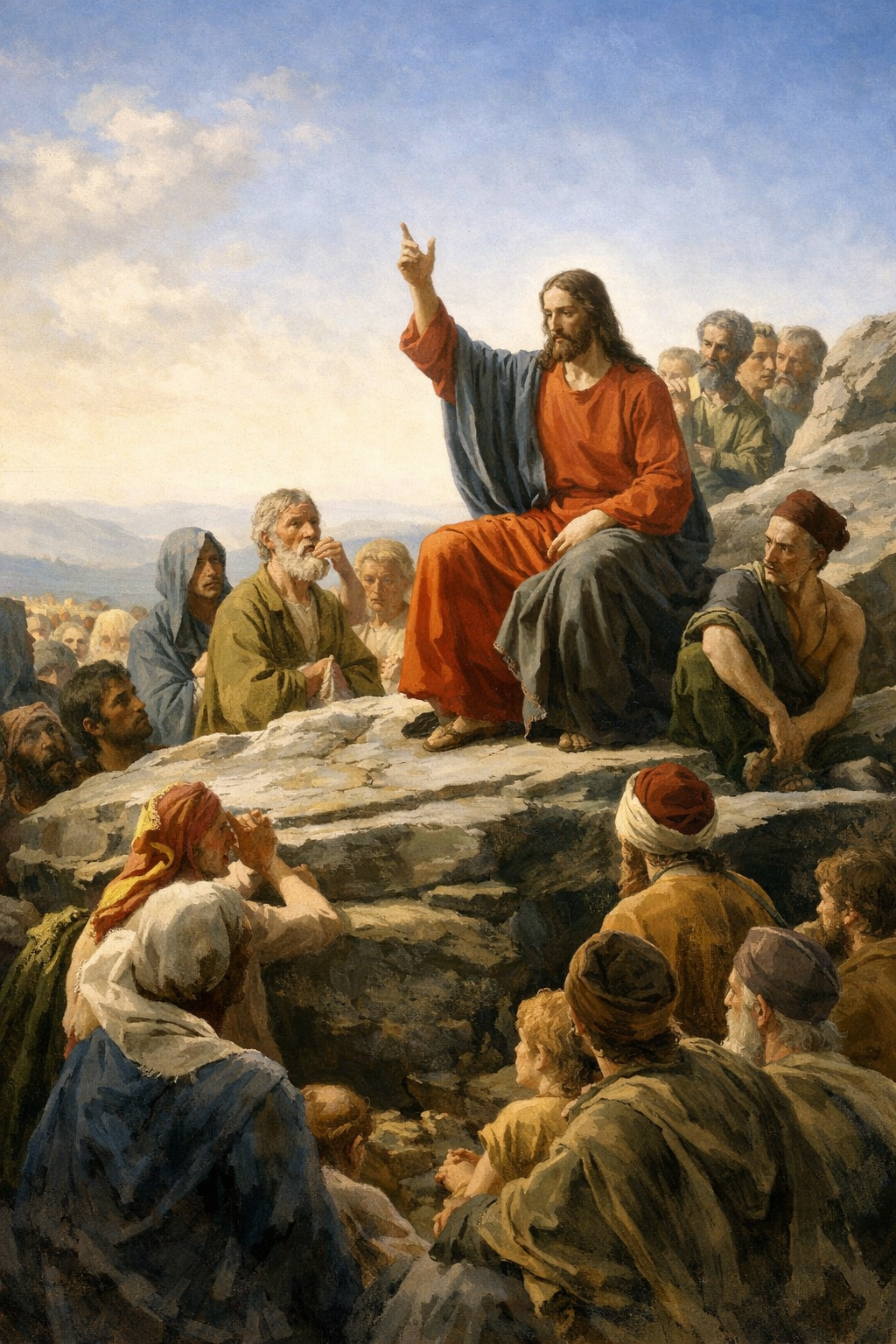
Sermon on the Mount
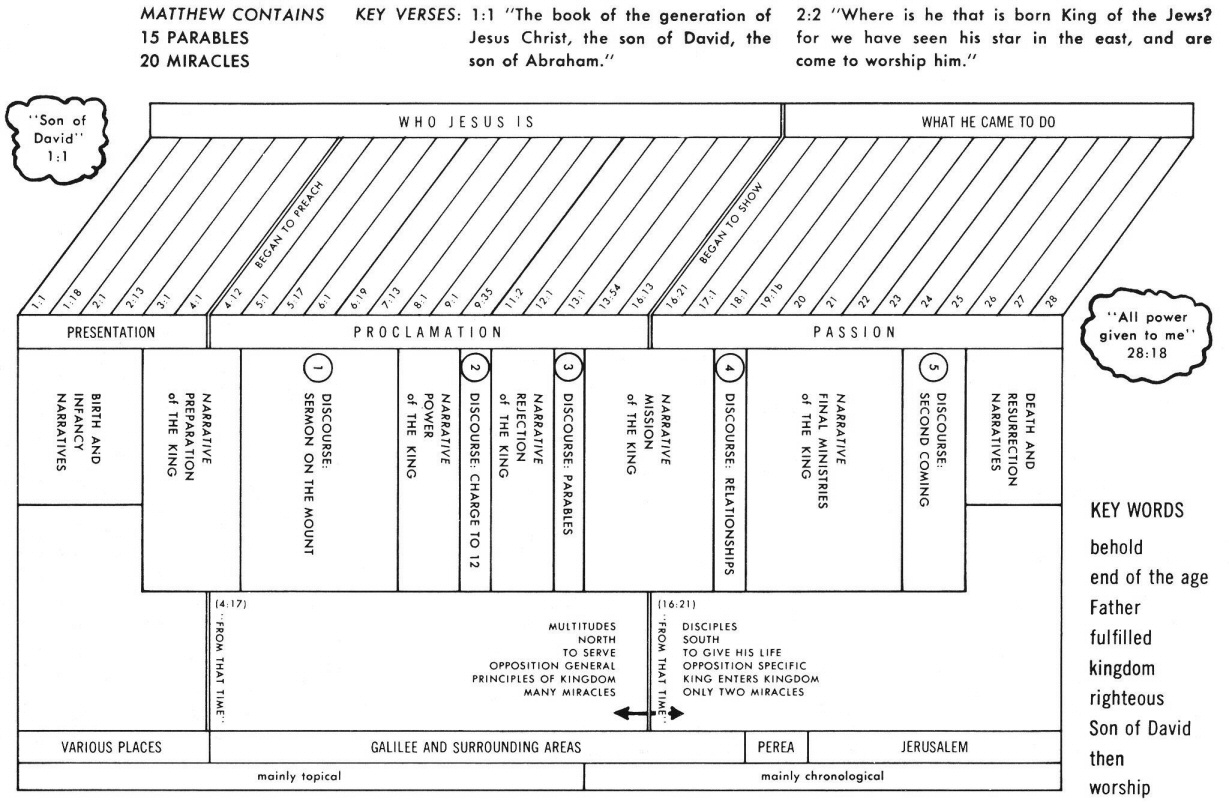
Click chart to enlarge
Charts from Jensen's Survey of the NT - used by permission
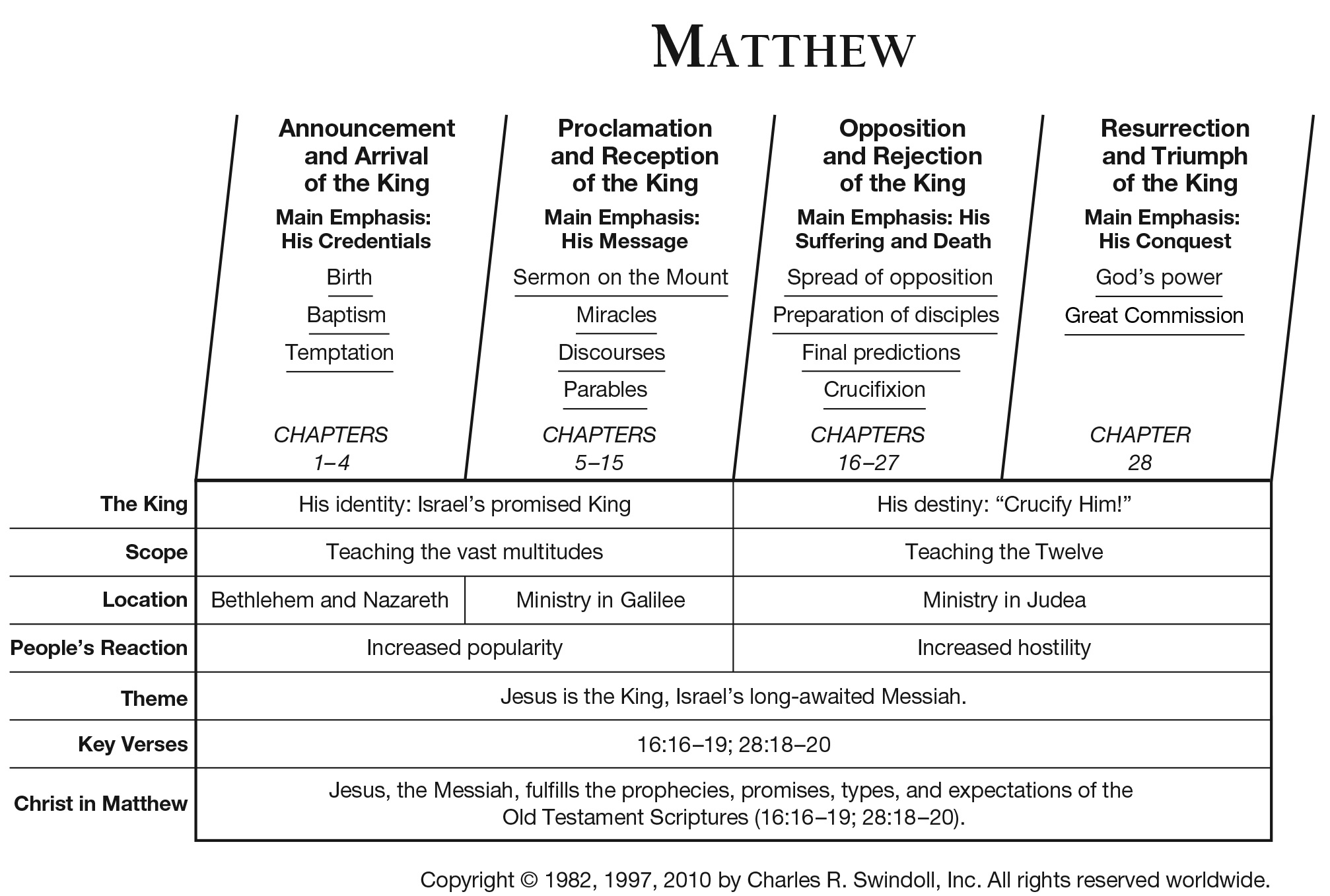
Another Chart from Charles Swindoll
THE LIFE OF JESUS AS COVERED
BY MATTHEW (shaded area)
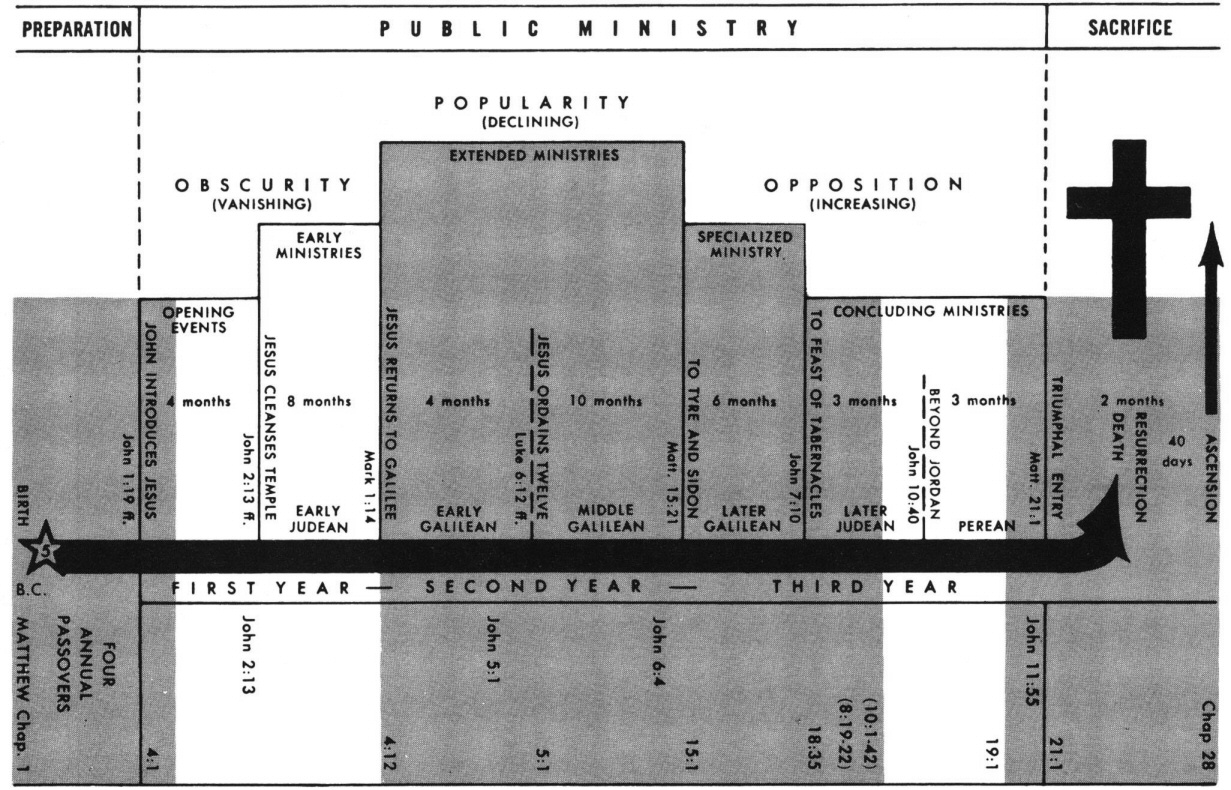
Click chart to enlarge
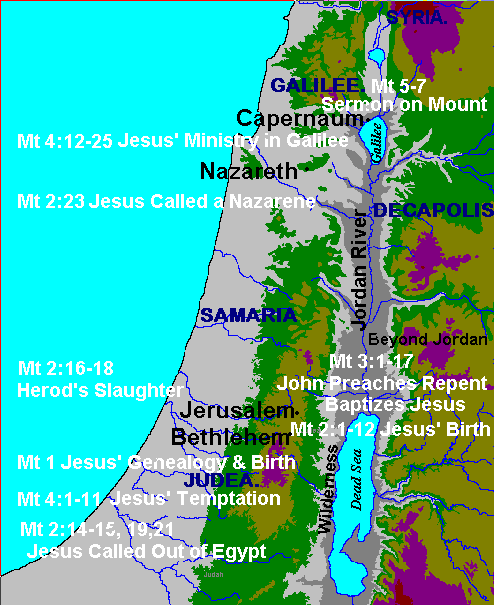
Jesus Birth and Early Years
Leading up to the Sermon on the Mount
Matthew 1-7
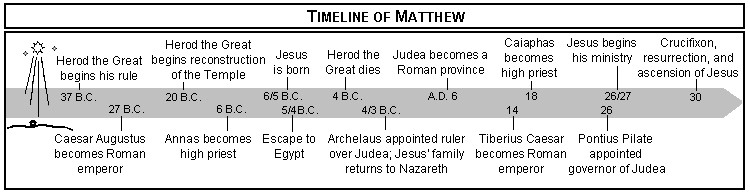
Source: Ryrie Study Bible
Matthew 5:19 "Whoever * then annuls one of the least of these commandments, and teaches others to do the same, shall be called least in the kingdom of heaven; but whoever * keeps and teaches them, he shall be called great in the kingdom of heaven. (NASB: Lockman)
Greek: os ean oun luse (3SAAS) mian ton entolon touton ton elachiston kai didache (3SAAS) outos tous anthropous, elachistos klethesetai (3SFPI) en te basileia ton ouranon; os d' an poiese (3SAAS) kai didache (3SAAS), outos megas klethesetai (3SFPI) en te basileia ton ouranon.
Amplified: Whoever then breaks or does away with or relaxes one of the least [important] of these commandments and teaches men so shall be called least [important] in the kingdom of heaven, but he who practices them and teaches others to do so shall be called great in the kingdom of heaven. (Amplified Bible - Lockman)
KJV: Whosoever therefore shall break one of these least commandments, and shall teach men so, he shall be called the least in the kingdom of heaven: but whosoever shall do and teach them, the same shall be called great in the kingdom of heaven.
NLT: So if you break the smallest commandment and teach others to do the same, you will be the least in the Kingdom of Heaven. But anyone who obeys God's laws and teaches them will be great in the Kingdom of Heaven. (NLT - Tyndale House)
Philips: This means that whoever now relaxes one of the least of these commandments and teaches men to do the same will himself be called least in Heaven. But whoever teaches and practises them will be called great in the kingdom of Heaven. (New Testament in Modern English)
Wuest: Whoever therefore shall deprive of authority one of these least commandments and shall teach men so, shall be called least in the kingdom of heaven. But whoever shall do and teach them, this man shall be called great in the kingdom of heaven.
Young's Literal: 'Whoever therefore may loose one of these commands -- the least -- and may teach men so, least he shall be called in the reign of the heavens, but whoever may do and may teach them, he shall be called great in the reign of the heavens.
WHOEVER THEN ANNULS ONE OF THE LEAST OF THESE COMMANDMENTS, AND SO TEACHES OTHERS, SHALL BE CALLED LEAST IN THE KINGDOM OF HEAVEN: hos ean oun luse (3SAAS) mian ton entolon touton ton elachiston kai didache (3SAAS) houtos tous anthropous, elachistos klethesetai (3SFPI) en te basileia ton ouranon
- Dt 27:26; Ps 119:6,128; Gal 3:10, 11, 12, 13; Jas 2:10,11
- Mt 23:23; Dt 12:32; Lk 11:42
- Mt 15:3, 4, 5, 6; 23:16-22; Mal 2:8,9; Ro 3:8; 6:1,15; 1Ti 6:3,4; Rev 2:14,15,20
- Mt 11:11; 1Sa 2:30
- Matthew 5 Resources - Multiple Sermons and Commentaries
- Matthew 5:19 Christ and the Law, Part 3 - John MacArthur
- Matthew 5:20 Christ and the Law, Part 4 - John MacArthur
Charles Simeon - IT must be confessed, that amongst those who profess a high regard for the Gospel, there are some who speak of it in terms, which, to say the least, have an antinomian and licentious aspect. In their zeal against self-righteousness, they are apt to represent the law as altogether abolished: knowing that we are no longer under the law as a covenant, they express themselves as if we were freed from it also as a rule of life. But we must never forget that the Gospel is a “doctrine according to godliness;” and that “the law, so far from being made void through faith, is established by it.” In the words preceding the text, our blessed Lord had said, that “he came not to destroy the law and the prophets, but to fulfil them: and in the words before us, he teaches us to infer from thence the undiminished authority of the sacred code. (Read the entire sermon - Matthew 5:19 The Danger of Little Sins)
Whoever then - This phrase refers back to what Jesus had just declared regarding the Law. This section emphasizes that God’s law is a reflection of God’s holy, righteous and good character (Ro 7:12) and is therefore changeless and eternal.
Annuls (3089) (luo cf the compound kataluo = abolish, used by Jesus in Mt 5:17 [note]) means to break, set loose, release, dissolve, or even to melt. The idea is that of reducing God's Law to nothing, making it inoperative, in essence by loosing ourselves from its requirements and standards.
Luo - 42x in 29v - annuls(1), break(1), breaking(1), broke down(1), broken(2), broken up(2), destroy(2),destroyed(3), loose(2), loosed(2), putting an end to(1), release(1), released(7), removed(1), take off(1), unbind(1),untie(8), untied(1), untying(4). Matt 5:19; 16:19; 18:18; 21:2; Mark 1:7; 7:35; 11:2, 4, 5; Luke 3:16; 13:15, 16; 19:30, 31, 33; John 1:27; 2:19; 5:18; 7:23; 10:35; 11:44; Acts 2:24; 7:33; 13:25, 43; 22:30; 27:41; 1 Cor 7:27; Eph 2:14; 2Pe 3:10ff; 1Jn 3:8; Rev 1:5; 5:2; 9:14f; 20:3, 7.
Least (1646) (elachistos is the superlative of mikrós = small) means the least, minimal in magnitude, number and quantity. Jesus' point is that in fact some of God's commandments are greater than others, but irregardless they are all holy and all important and are not to be disregarded. Jesus declares that He will hold those in lowest esteem who hold His Word in lowest esteem. There are no insignificant or non-inspired statements in the Bible.
Elaschistos - 14x in 12v - least(6), smallest(1), very least(1), very little thing(4), very small(1), very small thing(1).Matt 2:6; 5:19; 25:40, 45; Luke 12:26; 16:10; 19:17; 1 Cor 4:3; 6:2; 15:9; Eph 3:8; Jas 3:4.
Commandments (1785) (entole from en = in, upon + téllo = accomplish, charge) means an injunction or authoritative prescription which stresses the authority of the one commanding.
Entole - 67x in 61v -command(2), commanded*(1), commandment(38), commandments(23), instructions(1), orders(1),requirement(1). Matt 5:19; 15:3; 19:17; 22:36, 38, 40; Mark 7:8f; 10:5, 19; 12:28, 31; Luke 1:6; 15:29; 18:20; 23:56; John 10:18; 11:57; 12:49f; 13:34; 14:15, 21; 15:10, 12; Acts 17:15; Rom 7:8ff; 13:9; 1 Cor 7:19; 14:37; Eph 2:15; 6:2; Col 4:10; 1 Tim 6:14; Titus 1:14; Heb 7:5, 16, 18; 9:19; 2 Pet 2:21; 3:2; 1 John 2:3f, 7f; 3:22ff; 4:21; 5:2f; 2 John 1:4ff; Rev 12:17; 14:12
ISBE has the following article on commandments…The commandments are, first of all, prescriptions, or directions of God, concerning particular matters, which He wanted observed with reference to circumstances as they arose, in a period when He spake immediately and with greater frequency than afterward. They were numerous, minute, and regarded as coordinate and independent of each other. In the Ten Commandments, or, more properly, Ten Words, EVm (debharim), they are reduced to a few all-comprehensive precepts of permanent validity, upon which every duty required of man is based. Certain prescriptions of temporary force, as those of the ceremonial and forensic laws, are applications of these "Words" to transient circumstances, and, for the time for which they were enacted, demanded perfect and unconditional obedience. The Psalms, and especially Ps 119, show that even under the Old Testament, there was a deep spiritual appreciation of these commandments, and the extent to which obedience was deemed a privilege rather than a mere matter of constrained external compliance with duty. In the New Testament, Jesus shows in Mt 22:37,40; Mk 12:29,31; Lk 10:27 (compare Ro 13:8,10) their organic unity. The "Ten" are reduced to two, and these two to one principle, that of love. In love, obedience begins, and works from within outward. Under the New Testament the commandments are kept when they are written upon the heart (Heb 10:16). While in the Synoptics they are referred to in a more abstract and distant way, in both the Gospel and the Epistles of John their relation to Jesus is most prominent. They are "my commandments" (Jn 14:15,21; 15:10,12); "my Father's" (Jn 10:18; 15:10); or, many times throughout the epp., "His (i.e. Christ's) commandments." The new life in Christ enkindles love, and not only makes the commandments the rule of life, but the life itself the free expression of the commandments and of the nature of God, in which the commandments are grounded. Occasionally the word is used in the singular collectively (Ex 24:12; Ps 119:96; 1 Cor 14:37). (Commandments)
Keeps and teaches - Spurgeon comments on this phrase noting that "It is vain to teach the commandments without first doing them. The doing must always precede the teaching. If a man’s example cannot be safely followed, it will be unsafe to trust his words."
Teaches (1321) (didasko [word study] from dáo= know or teach; English = didactic; see study of related noun didaskalia and the adjective didaktikos) means to provide instruction or information in a formal or informal setting. In the 97 NT uses of didasko the meaning is virtually always to teach or instruct, although the purpose and content of the teaching must be determined from the context. Didasko refers to imparting positive truth. It means to hold discourse with others in order to instruct them.
John MacArthur writes that didasko "refers to the passing on of information-often, but not necessarily, in a formal setting. It focused on content, with the purpose of discovering the truth-contrary to the forums so popular among Greeks, where discussion and the bantering about of various ideas and opinions was the primary concern (see Acts 17:21). Synagogue teaching, as illustrated by that of Jesus, was basically expository. Scripture was read and explained section by section, often verse by verse. (MacArthur, J: Matthew 1-7 Chicago: Moody Press)
How do we know that some of God's laws are "weightier" ("the least of") than others ?
Matthew records the following examples…
Teacher, which is the great commandment in the Law?" 37 And He said to him, "'YOU SHALL LOVE THE LORD YOUR GOD WITH ALL YOUR HEART, AND WITH ALL YOUR SOUL, AND WITH ALL YOUR MIND.' 38 "This is the great and foremost commandment. 39 "The second is like it, 'YOU SHALL LOVE YOUR NEIGHBOR AS YOURSELF.' 40 On these two commandments depend the whole Law and the Prophets. (Mt 23:36-40)
Woe to you, scribes and Pharisees, hypocrites! For you tithe mint and dill and cummin, and have neglected the weightier provisions of the law: justice and mercy and faithfulness; but these are the things you should have done without neglecting the others. (Mt 23:23)
What happens to those who reduce the Law (even the least of the commandments) to nothing and teach others to do the same? Will they lose their salvation? Clearly they are those who are in the "kingdom of heaven" and therefore they are believers. So Jesus is not saying one can lose his or her salvation. What He is alluding to, is the fact that one can receive a lesser reward in heaven (cf 1Cor 3:10-15, 2Cor 5:10) based upon how one handles the commandments of God - Do you esteem them highly or take them lightly, as shown by your thoughts, words and deeds? You are no longer under the law (Ro 6:14, Gal 5:18-Galatians 5:18 ) under grace and subject to the law of liberty (James 1:25). And yet liberty does not equate with licentiousness (cf Ro 6:1, 2, 3, 4- see notes Romans 6:1; 6:2;6:3; 6:4) (which would be the equivalent of "annulling" the commandments, of not keeping them).
John has a parallel warning in his second epistle writing…
Watch yourselves (present imperative demands a continual personal vigilance, not others but yourself!), that you might not lose what we have accomplished, but that you may receive a full reward (knowledge that rewards worked for can be lost should promote faithful, loving obedience). (2John 1:8)
At the Judgment Seat of Christ (2Cor 5:10), every believer will receive praise for Paul writes… (see bema; see also RBC booklet - Just Before Heaven: The Judgment Seat Of Christ)
Therefore do not go on passing judgment before the time, but wait until the Lord comes who will both bring to light the things hidden in the darkness and disclose the motives of men's hearts (This warning indicates that motives for service and ministry will be clear to God and a major factor in His judgment); and then each man's praise (literally "his praise") will come to him from God. (1Cor 4:5)
James gives a special warning to those who are formal teachers of God's Word…
Let not many of you become teachers, my brethren, knowing that as such we shall incur a stricter (greater - this adjective supports the idea of degrees of treatment at the judgment) judgment (the responsibility of teaching others the word of God is an awesome task that should not be accepted without prayerful consideration) (James 3:1)
MacDonald comments "that Jesus anticipated a natural tendency to relax God’s commandments. Because they are of such a supernatural nature, people tend to explain them away, to rationalize their meaning. But whoever breaks one part of the law, and teaches other people to do the same, shall be called least in the kingdom of heaven. The wonder is that such people are permitted in the kingdom at all—but then, entrance into the kingdom is by faith in Christ. A person’s position in the kingdom is determined by his obedience and faithfulness while on earth. The person who obeys the law of the kingdom—that person shall be called great in the kingdom of heaven. (Borrow Believer's Bible Commentary)
QUESTION - What does it mean to be least in the kingdom of heaven? GOTQUESTIONS.ORG
ANSWER - In the Sermon on the Mount, Jesus speaks much about the importance and value of the Law: “For truly I tell you, until heaven and earth disappear, not the smallest letter, not the least stroke of a pen, will by any means disappear from the Law until everything is accomplished” (Matthew 5:18). The accomplishing of the Law was realized in Jesus Himself, who came to fulfill the Law (verse 17). In verse 19, Jesus says, “Therefore anyone who sets aside one of the least of these commands and teaches others accordingly will be called least in the kingdom of heaven, but whoever practices and teaches these commands will be called great in the kingdom of heaven.”
In other words, the Law is perfect and holy, and every command that God gave is equally important. The commandments are so important, Jesus said, that if someone sets aside what might be considered “one of the least” of them, then that person will be called “least in the kingdom of heaven.” Conversely, the one who teaches the whole Law—and obeys it—will be called “great” in the kingdom.
It is important to remember to whom Jesus was speaking in the Sermon on the Mount, namely, Jews in Israel who were still under the dispensation of the Law. At the time of Jesus’ address to the multitudes in Matthew 5, the Law was in full effect; the temple was standing, the sacrifices were being offered, and the veil was intact. When we make application of Jesus’ words to the church today, we need to distinguish between the moral laws that God gave and the ceremonial and civil laws. When Jesus cried, “It is finished!” from the cross, some laws, such as those regulating sacrifice and worship, were obviously fulfilled because Christ Jesus was the final and complete sacrifice. Other commands, such as the command not to murder or lie, are still as valid now as ever. In case there is any doubt, the moral laws are repeated in the New Testament epistles, whereas the other laws (concerning diet, observance of days, etc.) are not repeated for the church.
One day, Jesus will return to the earth to set up His kingdom (Daniel 2:44; Revelation 11:15). Jesus’ reference to the “least in the kingdom of heaven” in Matthew 5:19 suggests that there will be different levels of honor in the kingdom. The criteria used for assigning honor seem to be based on the handling of God’s Word. Those who received God’s Word and fulfilled their responsibilities in God’s sight will be called “great,” but those who rejected parts of God’s Word and shirked their responsibilities will be called “least.” This corresponds to the believers’ appearance before the judgment seat of Christ one day, where we will be rewarded based on how faithfully we served Christ (2 Corinthians 5:10). Some of us will “suffer loss” when our work “will be shown for what it is” and its quality does not pass the test (see 1 Corinthians 3:11–15).
Immediately after speaking of those who are least in the kingdom of heaven, the Lord Jesus indirectly condemns the Pharisees and religious teachers for their misconduct concerning the Law: “For I tell you that unless your righteousness surpasses that of the Pharisees and the teachers of the law, you will certainly not enter the kingdom of heaven” (Matthew 5:20). The Pharisees, then, were examples of those who “set aside” some of the commandments, and they would suffer shame for it (see also Mark 7:1–13). Not only did their actions diminish some parts of the Law, but they had no true righteousness—because they rejected Christ.
In summary, Jesus taught that the Law is good (Matthew 5:18–19), and the righteousness of the Law is fulfilled in Himself (verse 17). His message was not contrary to the Law; rather, His words confirmed the Law and His works accomplished the Law. Those who lightly esteem God’s Word will themselves be lightly esteemed. Greatness in the kingdom of heaven will not be based on one’s gifts but upon how one handles the Word of God (see 2 Timothy 2:15).
Theocratic Kingdom—The phrases “Kingdom of Heaven,” “Kingdom of God,” “Kingdom of Christ,” etc., denote the same Kingdom
It has already been shown (Props. 20–23, etc.) how the Jews understood and employed these phrases, and how the first preachers adopted them.
Obs. 1. Now attention is called to the fact that they are used as synonymous in the New Testament What Matthew pronounces “the Kingdom of heaven,” is said by Mark, Luke, and John to be “the Kingdom of God,” as e.g. comp. Matthew 5:3, with Luke 6:20, and Matthew 13:11 with Mark 4:11. So also “the Kingdom of God” is designated Christ’s Kingdom, as e.g. comp. Matthew 16:28 with Luke 9:27, Mark 9:1, etc.
So also “the Father’s Kingdom” and Christ’s are represented as identical. Comp. e.g. Matthew 13:41–43 with Ephesians 5:5, and Matthew 26:29 with II Peter 1:11, etc., and Prop. 83. In reference to the usage of those phrases, comp. Props. 22 and 23, and the note by Dr. Craven in Lange’s Com. Revelation, p. 93.
Obs. 2. These phrases thus interchangeably employed to denote the one Kingdom (Prop. 35) were understood to mean the Davidic Kingdom restored, as e.g. Acts 1:6, Matthew 20:21, Acts 15:16, Luke 1:32, etc. (comp. Props. 19–23).
This has been so frankly admitted by our opponents (as e.g. Dr. Campbell, Knapp, Neander, etc.) that more need not be added, leaving our argument to bring in the additional proof. On every side do we find this testimony, given, too, without any thought of its bearing on the subject. Thus e.g. Farrar (Life of Christ, vol. 1, p. 22) informs us that “waiting for the Consolation of Israel “is equivalent to Mark 15:43, “waiting for the Kingdom of God,” and that among the Jews a prayer for the coming of the Messiah was, “may I see the Consolation of Israel.” The Messiah and the Kingdom were united. We merely suggest that in addition to the meanings and derivation usually given to the phrase used by Matthew, “the Kingdom of heaven” (viz.: that the God of heaven gives it to the Christ, that through it the Father’s will is manifested, that heavenly principles, etc., are exhibited, etc.), may there not, in the employment of the plural form, “heavenlies,” be an allusion to the peculiar form of government (Theocratical) under chosen. heavenly rulers (comp. Prop. 154). Dr. Meyer (Com. on Matthew 3:2) says: “It is called the Messianic Kingdom, not because the words ‘of the heavens’ express God, but because this Kingdom is conceived as descending from heaven and entering the world, Galatians 4:26.” This idea may (comp. Revelation 19:11–16 and 21:2, etc.) indeed be included, but it does not exclude the old Jewish notion derived from Daniel, or the one just stated. It may include them all, making it the more expressive.
Obs. 3. In addition to the abundant testimony already adduced, that they were regarded as denoting the same Kingdom, and that the restored Theocracy, as existing under David, we add a few more. Nast (Com. on Matthew 11:1–6), allowing the Church-Kingdom theory as correct, frankly says: “Though John the Baptist, Zecharias, and those other Israelites who waited for ‘the Consolation of Israel,’ expected the Messiah to establish a spiritual Kingdom, a reign of righteousness, they connected, nevertheless, with it, the idea of a visible, terrestrial Kingdom, that he would literally sit on David’s throne, and extend His reign from the river to the ends of the earth.” Doddrige (Com. Matthew 3:2), cordially adopting the Church-Kingdom idea as intended by the phrase, says: “It is plain that the Jews understood it of a temporal monarchy, which God would erect; the Beat of which, they supposed, would be Jerusalem, which would become, instead of Rome, the capital of the world. And the expected Sovereign of this Kingdom they learned from Daniel to call ‘the Son of Man’” (Were the Jews mistaken? Comp. Props. 19–23 and 31–35). Fairbairn (Herm. Manual, p. 41–43) tells us that the phrase, “points back to those prophecies of the Old Testament, in which promise was made of a King and Kingdom, that should unite heaven and earth in another way than could be done by a merely human administration,” etc., which we cordially receive as true, remarking, however, that the plain Theocratical meaning contained in the grammatical sense (which he carefully avoids), as held by the Jews, by the disciples and apostles, introduces just such a union of heaven and earth (as e.g. God in Jesus condescending to reign as earthly Ruler, etc.) as he advocates. Our entire argument thus far conclusively proves that all these phrases do not denote separate things (as e.g. intimated by Lange, Com. Matthew, p. 73), or are given (so Fleck, quoted by Lange) “in order to distinguish the Christian Kingdom of God more fully from the Jewish Theocracy,” but the restored Theocracy, as covenanted and predicted under the Messiah. They were applied to a definite, well-known Kingdom, viz.: the Theocratic-Davidic.
But able writers, wedded to the spiritual Church-Kingdom theory, can see nothing in the phrase but another and differing Kingdom, viz.: the Church regarded as militant and triumphant. Thus, to illustrate how confidently they appeal to its simplicity in their teaching, we refer to Gregory (Four Gospels, p. 146), who, speaking of “the Kingdom of heaven,” and that Matthew by its use intended to correct false Jewish views (when Acts 1:6, he still held them), confidently asserts: “The phrase clearly expresses the idea that it is a Kingdom distinct from all these kingdoms of this world after which the Jew had fashioned his idea of the Messiah’s dominion. Its origin is in the heavens, where God dwells; its throne, the seat of the King, is there; its highest present and prospective glories are there. This simple phrase taught that the Kingdom of the Messiah was to be a spiritual and heavenly Kingdom, unlike the old Theocracy with its temple and throne in Jerusalem; unlike the magnificent empire patterned after Rome, which the worldly Jew was dreaming of; wholly unlike the temporal empire of the Papacy long after established.” Here is a tissue of assumptions: (1) It ignores the fact that it was a Jewish phrase, adopted without explanation by Matthew, and that it could not possibly convey the idea assumed, being definitely used to designate the restored Davidic Kingdom and its extent, etc., as given by Daniel; (2) it engrafts upon it a modern notion, which the Jews never entertained, being bound by the plain covenant and prophetical language which locates the Kingdom, not in heaven but on the earth; (3) he assumes that the phrase is so clearly full of his doctrine that it ought to have taught the Jew such a view, when the facts are just the reverse, viz.: that its usage fortified them and the disciples (including Matthew) in believing that it unmistakably taught the restoration of the downfallen Theocracy, which was—as we have shown—a Kingdom of God and of heaven; (4) its simplicity of teaching established and confirmed the almost universal Pre-Millenarianism of the early Church and its connected doctrine of the Kingdom—a position just directly opposite to that which Gregory finds in the “simple phrase,” and which Shedd (His. of Doc, p. 291) calls a peculiarity of the Jewish-Christian.”
BUT WHOEVER KEEPS AND TEACHES THEM, HE SHALL BE CALLED GREAT IN THE KINGDOM OF HEAVEN: os d' an poiese (3SAAS) kai didache (3SAAS), houtos megas klethesetai (3SFPI) en te basileia ton ouranon (
- Keeps Mt 28:20; Acts 1:1; Ro 13:8, 9, 10; Gal 5:14-24; Phil 3:17,18; 4:8,9; 1Th 2:10-12; 4:1-7; 1Ti 4:11,12; 6:11; Titus 2:8-10; 3:8
- Great in the Kingdom - Mt 19:28; 20:26; Da 12:3; Lk 1:15; 9:48; 22:24, 25, 26; 1Pe 5:4
- Matthew 5 Resources - Multiple Sermons and Commentaries
- Matthew 5:19 Christ and the Law, Part 3 - John MacArthur
- Matthew 5:20 Christ and the Law, Part 4 - John MacArthur
Related Passages:
Matthew 19:28 And Jesus said to them (HIS 11 DISCIPLES), “Truly (AMEN) I say to you, that you who have followed Me, in the regeneration when the Son of Man will sit on His glorious throne, you also shall sit upon twelve thrones, judging the twelve tribes of Israel.
JESUS' PATH TO
GREATNESS
But - Don't forget to pause and ponder term of contrast. What is the change of direction? What is the writer contrasting? Why?, etc.
Whoever keeps and teaches them - Keeps them is synonymous with obedience to the commandments. To teach them requires that one obeys them. Otherwise, such a teacher is a hypocrite and his/her teaching is highly suspect. John 7:17 says “If anyone is willing to do His will, he will know of the teaching, whether it is of God or whether I speak from Myself." In other words, Jesus is saying if you are willing to obey His will (His word), then you will know and understand the teaching. Then you can teach it rightly!
The two ways one can rightly (or wrongly) handle the Word of God are by doing and teaching. Citizens of the Kingdom of Heaven should live like that is where they are going and should uphold every part of God’s law, both in their living and in their teaching…
For our citizenship is in heaven, from which also we eagerly wait for a Savior, the Lord Jesus Christ (Php 3:20) (What we are "waiting for" [or "looking expectantly for"] should determine what [Who] we are living for!)
At the end of Jesus' great commission, He emphasizes that in going forth and making disciples we are to be…
teaching them to observe all that I commanded you; and lo, I am with you always, even to the end of the age." (Mt 28:20)
In his letter to the Roman saints, Paul explained their relationship to the Law instructing them to…
Owe nothing to anyone except to love one another; for he who loves his neighbor has fulfilled the law. For this, "YOU SHALL NOT COMMIT ADULTERY, YOU SHALL NOT MURDER, YOU SHALL NOT STEAL, YOU SHALL NOT COVET," and if there is any other commandment, it is summed up in this saying, "YOU SHALL LOVE YOUR NEIGHBOR AS YOURSELF." Love does no wrong to a neighbor; love therefore is the fulfillment of the law. (Ro 13:8, 9, 10)
Writing to the saints in Galatia (who were being tempted to keep the Law as a means of being "better Christians" or to make themselves more acceptable to God) Paul reminds them that…
you were called to freedom, brethren; only do not turn your freedom into an opportunity for the flesh (i.e., licentiousness), but through love serve one another for the whole Law is fulfilled in one word, in the statement, "YOU SHALL LOVE YOUR NEIGHBOR AS YOURSELF." But if you bite and devour one another, take care lest you be consumed by one another. But I say, walk by the Spirit, and you will not carry out the desire of the flesh. For the flesh sets its desire against the Spirit, and the Spirit against the flesh; for these are in opposition to one another, so that you may not do the things that you please. But if you are led by the Spirit, you are not under the Law (The ritual or ceremonial law - sacrifices, feasts, keeping of days, etc - has been fulfilled in Christ and are no longer to be kept under grace. The moral law remains in place and are meant for our good and to promote holiness. Their pull under the leading of the Holy Spirit draws us into true freedom. To return to a ritualistic expression of the Law enslaves us. The Holy Spirit will guide us in the path of love to fulfill the law). (Galatians 5:13-24)
In a parallel passage in Paul's letter to the Thessalonians presents his example of right doing of the Word…
You are witnesses, and so is God, how devoutly and uprightly and blamelessly we behaved toward you believers just as you know how we were exhorting and encouraging and imploring each one of you as a father would his own children, so that you may walk in a manner worthy of the God who calls you into His own kingdom and glory. (1Th 2:10-12)
Greatness in the Kingdom of heaven will not be based on one's gifts but upon how one handles the word of God. And although not everyone has a formal teaching gift, every believer teaches in one way or another but the life and their actions.
John MacArthur echoes this thought commenting that "Greatness is not determined by gifts, success, popularity, reputation, or size of ministry-but by a believer’s view of Scripture as revealed in his life and teaching. Jesus’ promise is not simply to great teachers such as Paul or Augustine, Calvin, Luther, Wesley, or Spurgeon. His promise applies to every believer who teaches others to obey God’s Word by faithfully, carefully, and lovingly living by and speaking of that Word. Every believer does not have the gift of teaching the deep doctrines of Scripture, but every believer is called and is able to teach the right attitude toward it. (See Matthew Commentary)
Kingdom (932) (basileia from basileus = a sovereign, king, monarch) denotes sovereignty, royal power, dominion and refers therefore to the territory or people over whom a king rules. The Kingdom of Heaven/God is the sphere in which God is acknowledged as King (In hearts giving Him obedience). In this sense (and as elaborated on below) the Kingdom has a spiritual aspect, a present physical aspect, and a future eternal aspect (beginning with the millennium, cf Mt 25:31,34), all of course depending on the context of the passage in which basileia is found. Paul is careful to remind us that the Kingdom of Heaven/God is not in observance of ordinances, external and material, but in the deeper matters of the heart, which are spiritual and essential -- "for the kingdom of God is not eating and drinking, but righteousness and peace and joy in the Holy Spirit." (Ro 14:17)
Click here to study over 100 uses of the Kingdom most of which refer to the Kingdom of Heaven/God.
See also related discussion on the Kingdom of Heaven
D Martyn Lloyd-Jones explains the kingdom of heaven as follows..
You will find certain people saying that there is a difference between the 'kingdom of heaven' and the 'kingdom of God'; but my difficulty is to know what the difference is. Why does Matthew talk about the kingdom of heaven rather than the kingdom of God? Surely the answer is that he was writing primarily for the Jews, and to the Jews, and his chief object, perhaps, was to correct the Jewish conception of the kingdom of God or the kingdom of heaven. They had got into this materialistic way of looking at the kingdom; they were thinking of it politically and in a military sense, and our Lord's whole object here is to show that His kingdom is primarily a spiritual one. In other words He says to them, 'You must not think of this kingdom primarily as anything earthly. It is a kingdom in the heavens, which is certainly going to affect the earth in many different ways, but it is essentially spiritual. It belongs to the heavenly rather than to the earthly and human sphere.'
What is this kingdom, then? It means, in its essence, Christ's rule or the sphere and realm in which He is reigning. It can be considered in three ways as follows. Many times when He was here in the days of His flesh our Lord said that the kingdom of heaven was already present. Wherever He was present and exercising authority, the kingdom of heaven was there. You remember how on one occasion, when they charged Him with casting out devils by the power of Beelzebub, He showed them the utter folly of that, and then went on to say, 'If I cast out devils by the Spirit of God, then the kingdom of God is come unto you' (Matt 12:28). Here is the kingdom of God. His authority, His reign was actually in practice. Then there is His phrase when He said to the Pharisees, 'the kingdom of God is within you, or, 'the kingdom of God is among you' (NAS "is in your midst" Luke 17:21). It was as though He were saying, 'It is being manifested in your midst. Don't say "look here" or "look there". Get rid of this materialistic view. I am here amongst you; I am doing things. It is here.' Wherever the reign of Christ is being manifested, the kingdom of God is there. And when He sent out His disciples to preach, He told them to tell the cities which received them not, 'Be ye sure of this, that the kingdom of God is come nigh unto you.' (Luke 10:9, 11, cf Luke 19:11, 21:31)
It means that; but it also means that the kingdom of God is present at this moment in all who are true believers… In writing to the Colossians he gives thanks to the Father 'who hath delivered us from the power of darkness, and hath translated us into the kingdom of his dear Son' (see note Colossians 1:13). The 'kingdom of his dear Son' is 'the kingdom of God, it is 'the kingdom of heaven', it is this new kingdom into which we have entered. Or, again, in his letter to the Philippians he says, 'Our conversation is in heaven,' or, `Our citizenship is in heaven.' We are here on earth, we obey the powers that be, we live our lives in this way. Yes; but 'our citizenship is in heaven; from whence also we wait for a Saviour' (see note Philippians 3:20). We who recognize Christ as our Lord, and in whose lives He is reigning and ruling at this moment, are in the kingdom of heaven and the kingdom of heaven is in us. We have been translated into the 'kingdom of his dear Son'; we have become a 'kingdom of priests. (cf 1Pe 2:9, 10-notes 1Pe 2:9; 10, Re 1:6, Re 5:10)
The third and last way of looking at the kingdom is this. There is a sense in which it is yet to come. It has come; it is coming; it is to come. It was here when He was exercising authority; it is here in us now; and yet it is to come. It will come when this rule and reign of Christ will be established over the whole world even in a physical and material sense (ED: HERE HE SEEMS TO BE REFERRING TO THE FUTURE "EXTERNAL, VISIBLE" KINGDOM OF GOD ON EARTH OVER WHICH CHRIST WILL REIGN AS KING). The day is coming when the kingdoms of this world will have become 'the kingdoms of our Lord, and of his Christ, when Jesus shall reign where'er the sun Doth his successive journeys run; His kingdom stretch from shore to shore, Till moons shall wax and wane no more. (Play Isaac Watts precious hymn - Jesus Shall Reign sing it out unto the Lord - Vocal Version)
It will then have come, completely and entirely, and everything will be under His dominion and sway. Evil and Satan will be entirely removed; there will be `new heavens and a new earth, wherein dwelleth righteousness' (2Pe 3:13), and then the kingdom of heaven will have come in that material way. The spiritual and the material will become one in a sense, and all things will be subject to His sway, that 'at the name of Jesus every knee should bow, of things in heaven, and things in earth, and things under the earth; and that every tongue should confess that Jesus Christ is Lord, to the glory of God the Father' (Php 2:10, 11). (Online - page 45 Studies in the Sermon on the Mount) (Bolding added)
John MacArthur has a discussion of "kingdom of heaven" writing (see Matthew Commentary - Page 55) that...
Although the precise phrase is not found there, the kingdom of heaven is basically an Old Testament concept. David declares that “the Lord is King forever and ever” (Ps. 10:16; cf. Ps 29:10), that His kingdom is everlasting, and that His dominion “endures throughout all generations” (Ps. 145:13). Daniel speaks of “the God of heaven [Who] will set up a kingdom which will never be destroyed” (Dan 2.:44; cf. Ezek 37:25), a “kingdom [that] is an everlasting kingdom” (Da 4:3). The God of heaven is the King of heaven, and the heavenly kingdom is God’s kingdom. Matthew uses the phrase kingdom of heaven thirty-two times, and is the only gospel writer who uses it at all. The other three use “the kingdom of God.” It is probable that Matthew used kingdom of heaven because it was more understandable to his primarily Jewish readers. Jews would not speak God’s name (Yahweh, or Jehovah), and would often substitute heaven when referring to Him-much as we do in such expressions as “heaven smiled on me today.” There is no significant difference between “the kingdom of God” and the kingdom of heaven. The one phrase emphasizes the sovereign Ruler of the kingdom and the other emphasizes the kingdom itself, but they are the same kingdom. Matthew 19:23-24 confirms the equality of the phrases by using them in interchangeably.
The kingdom has two aspects, the outer and the inner, both of which are spoken of in the gospels. Those aspects are evident as one moves through Matthew.
In the broadest sense, the kingdom includes everyone who professes to acknowledge God.
Jesus’ parable of the sower represents the kingdom as including both genuine and superficial believers (Matt. 13:3-23), and in His following parable (Matt 13:24-30) as including both wheat (true believers) and tares (false believers). That is the outer kingdom, the one we can see but cannot accurately evaluate ourselves, because we cannot know people’s hearts. The other kingdom is the inner, the kingdom that includes only true believers, only those who, as John the Baptist proclaimed, repent and are converted. God rules over both aspects of the kingdom, and He will one day finally separate the superficial from the real. Meanwhile He allows the pretenders to identify themselves outwardly with His kingdom.
God’s kingly rule over the hearts of men and over the world may be thought of as having a number of phases.
The first is the PROPHESIED kingdom, such as that foretold by Daniel (Da 2:44).
The second phase is the PRESENT kingdom, the one that existed at the time of John the Baptist and that he mentions. It is the kingdom that both John and Jesus spoke of as being at hand (cf. Mt 4:17).
The third phase may be referred to as the INTERIM kingdom, the kingdom that resulted because of Israel’s rejection of her King. The King returned to heaven and His kingdom on earth now exists only in a mystery form. Christ is Lord of the earth in the sense of His being its Creator and its ultimate Ruler; but He does not presently exercise His full divine will over the earth. He is, so to speak, in a voluntary exile in heaven until it is time for Him to return again. He reigns only in the hearts of those who know Him as Savior and Lord. For those “the kingdom of God is … righteousness and peace and joy in the Holy Spirit” (Ro 14:17). (ED: ELSEWHERE MACARTHUR REFERS TO THIS AS THE "SPIRITUAL" KINGDOM OF GOD.)
The fourth phase can be described as the MANIFEST kingdom, in which Christ will rule, physically, directly, and fully on earth for a thousand years, the Millennium (see notes on this website re: Millennium 1, Millennium 2, Millennium 3). In that kingdom He will rule both externally and internally-externally over all mankind, and internally in the hearts of those who belong to Him by faith.
The fifth, and final, phase is the “ETERNAL kingdom of our Lord and Savior Jesus Christ,” which “will be abundantly supplied” to all of His own (2Pe 1:11). (see Matthew Commentary - Page 55)
The topic Kingdom of God (synonymous term = Kingdom of Heaven) can be confusing as the interpretation depends on the context in which it is used - It can mean a spiritual Kingdom, a Millennial Kingdom or a Kingdom in the New Heaven and New Earth. Many who espouse the teaching of replacement theology or supersessionism do not accept a literal earthly Kingdom of God. I am firmly convinced (from Scripture) that there will be a literal earthly Kingdom of God ruled by the King of kings, the Lord Jesus Christ. For that reason I have several detailed discussions on the Kingdom of God in the commentaries on the following verses...
- Luke 17:20-21-commentary
- Luke 19:11ff-commentary
- Acts 1:6-commentary
- Matthew 5:3 - commentary
Here is my simplistic summary of the Kingdom of God/Heaven:
|
THE KINGDOM OF |
||
| Internal Invisible |
In Hearts of Believers |
Present Age (Between 1st & 2nd Comings) |
| External Visible |
Literal On earth |
Messianic Age (After 2nd Coming) |
| External Visible |
Literal New Earth |
Eternal Age (After Christ gives Kingdom to Father) |
- Internal, Invisible - in hearts of believers only - in this present age (between Christ's First and Second Comings)
- External, Visible - literal earthly Kingdom - will include both believers ("internal" aspect of Kingdom) and unbelievers - in the next age (After Christ's Second Coming)
- External, Visible - literal heavenly Kingdom - only believers ("internal" aspect of Kingdom) - following age #2 (After Christ gives the Kingdom to His Father)
Vance Havner - Pharisees or Christians?
For I say unto you, That except your righteousness shall exceed the righteousness of the scribes and Pharisees, ye shall in no case enter into the kingdom of heaven (Matthew 5:20)
When our Lord was upon earth His worst enemies were the Pharisees. Pharisaism shows up in several forms: in cold orthodoxy without the love of God; in religion that majors on the minors and minors on the majors, tithing of mint, anise, and cummin, while neglecting judgment, mercy, and faith; and in religious activity without the Spirit. This last is most dangerous of all because it is so deceptive.
There were many commendable things about the Pharisees. They studied the Scriptures, attended the house of God, prayed, tithed, lived separated lives, and sought to win others, compassing land and sea to make one proselyte. Yet Jesus said that the publicans and harlots would go into the Kingdom of God before them. A church full of Pharisees would be a remarkable institution. (I don't know of a church where all the members attend services, pray, study the Bible, tithe, live clean moral lives separated from the world, and seek to win others.) Yet a church filled with Pharisees would be a church filled with lost sinners and as sure for hell as a club of atheists. The Pharisees had no work of grace in their souls, no love of God in their hearts; they were strangers to the Holy Spirit.
Here is something very disturbing in our religious life today. All of these activities we have mentioned are the very things we are trying so hard to get our church members to do. Drives, contests, study courses, suppers, conventions, campaigns galore—all are aimed at getting church people to do what they should do anyway, and without all this pressure, because they love God. In fact, if they do these things for any reason other than love for Christ they might as well not do them at all, because only that activity which is the spontaneous expression of love for Him is acceptable in His sight. There is a frightening danger that we are developing Pharisees instead of growing Christians. It is possible to get a lot of people busy doing a lot of things Christians ought to do without their being Christians or having Christian motivation. We can build a religious empire, put up hundreds of church buildings, take in thousands of members, and raise millions of dollars by promotional methods under religious auspices—without the Holy Spirit being anywhere near the place.
All such exercises as going to church, giving, and witnessing for Christ are the natural, normal expressions of a healthy Christian. Study courses are not necessary to teach children to play; playing is the natural exercise of a healthy child. A sick child will not play, but we don't make him well by sending him out to play! Young people do not require promotional campaigns on how to fall in love; healthy young people naturally fall in love. We are trying to get disinterested church members to do what they don't want to do instead of developing healthy Christians who will do these things, not from artificial stimulation, but because to a Spirit-filled Christian it is doing what comes naturally.
Dr. Findley Edge wrote, "It is far easier to lead people to engage in action than it is to lead them to act from a Christian motivation. That is one reason it is so much easier to make Pharisees than it is to make Christians." He points out that in so doing we lead people to deceive themselves into thinking they are something they are not, thus "developing a massive number of 20th-century Pharisees." Certainly we aid in their self-deception and we bring down the judgment of God on ourselves as well as them.
One reason for this is that people are more interested in being religious than in being righteous: "... the kingdom of God is not meat and drink; but righteousness, and peace, and joy in the Holy Ghost" (Romans 14:17). Plenty of people are interested in peace and joy but not in righteousness. They want to be happy but they do not want to get right, be right, live right. They are like a man with a broken arm, who says, "No, I do not want the arm set—I only want a shot to kill the pain." The business of a doctor is not to make people happy but to make them well. When they are well they will be happy. The gospel makes us right, then happy.
What did our Lord mean when He said, "... except your righteousness shall exceed the righteousness of the scribes and Pharisees, ye shall in no case enter into the kingdom of heaven"? How much better than a Pharisee can one be? Not much, religiously. But Jesus did not mean that we should add a few more activities. He meant another kind of righteousness: the imputed, imparted, implanted righteousness of Christ Himself who is made unto us righteousness. That is just what the Pharisees did not have.
The Pharisees were successors to Moses. Our Lord said, in effect, "Do as they say, not as they do" (Matthew 23:2-3). What they did was not the expression of the love of God in their hearts. The churches in Ephesus and Sardis did many good things, but their motivations and objectives were wrong. Why is one chapter in Matthew given to the denunciation of a group soon to go out of existence? Is there any relevance today? Yes, because we have more Pharisees than ever. I do not think that most of them intend to be Pharisees; they hardly suspect that they are, and would be dumbfounded to find it out. They may come to church, sing in the choir, teach in Sunday school, and support the church, but it is a performance and not an experience. Jesus called the Pharisees "hypocrites," which means "play-actors." They were pretending what was not real. This is a day of imitations. We have produced fruit and flowers that look so real as to deceive all but most careful observers. In the Parable of the Tares, the devil did not burn up the wheat or plow up the ground; he planted an imitation.
Our Lord said that if we abide in Him we shall produce much fruit. Trying to get church people to produce results without the cause, to abound in good works when they are not abiding in grace, produces an artificial Christianity that may deceive even religious experts but will never pass inspection at the bar of God. We need to get back to producing Christians instead of Pharisees, born-again disciples as well as believers whose activities are motivated by the Holy Spirit. True Christian activity is but the outliving of the inliving Christ. Without Him we can do nothing.
Oswald Chambers —Matthew 5:20
OUR STANDARD OF MORAL CONDUCT must exceed that of the morally upright man or woman who lives apart from the grace of God. Our Lord does not lower the standard of moral conduct for His people; instead, He pushes it higher. We not only have to do right, but our motives must be right. The springs of our thinking must be right.
That is the standard of moral conduct we shall be able to meet if we are born again of the Spirit of God and if we obey the Spirit.
Prayer Thought: Help me, Lord, to surrender myself fully to You so that I may be all that You expect me to be.
Adrian Rogers - It’s What’s Inside That Counts (Full sermon page 258)
Main Scripture Text: Matthew 5:20–22
“For I say unto you, That except your righteousness shall exceed the righteousness of the scribes and the Pharisees, ye shall in no case enter into the kingdom of heaven.” MATTHEW 5:20
Introduction
I. The Malice of Murder
A. Not All Killing Is Forbidden
1. The Bible Does Not Forbid the Killing of Animals
2. The Bible Does Not Forbid Capital Punishment
3. The Bible Does Not Forbid Killing in Self-Defense
B. Types of Killing That the Bible Forbids
1. Homicide
2. Suicide
3. Infanticide
II. The Acid of Anger
A. Types of Anger That Come Out of the Heart
1. Caustic Anger
2. Contemptuous Anger
3. Condemning Anger
B. The Progression to Malice
1. Bitterness
2. Wrath
3. Anger
4. Clamor
5. Evil Speaking
6. Malice
III. The Requirement for Righteousness
A. Imputed Righteousness
B. Implanted Righteousness
Conclusion
J C Philpot -
or I say unto you, That except your righteousness shall exceed the righteousness of the scribes and Pharisees, you shall never enter into the kingdom of heaven." Matthew 5:20
There are three kinds of righteousness, or at least three kinds of righteousness which bear that name. There is inherent righteousness, of which we have none. There is imputed righteousness, which is all our justification. And there is imparted righteousness, when God the Spirit makes us new creatures, and raises up in the heart that "new man, which after God" (that is, "after the image of God") "is created in righteousness and true holiness." When the Lord, therefore, said, "Except your righteousness shall exceed the righteousness of the scribes and Pharisees, you shall never enter into the kingdom of heaven," he did not mean only an external righteousness wrought out by his obedience to the law for them, but an internal righteousness wrought out by the Holy Spirit in them. Thus we read of the inward as well as the outward apparel of the Church, "The King's daughter is all glorious within; her clothing is of wrought gold." Two kinds of righteousness belong to the Queen; her imputed righteousness is her outward robe, "the clothing of wrought gold;" but imparted righteousness is her inward adorning, which makes her "all-glorious within." This inward glory is the new man in the heart, with all his gifts and graces, what Peter calls "the divine nature," "Christ in the heart, the hope of glory."
MATTHEW 5:20
READ: Matthew 5:17-20
JESUS told us that we must have a better righteousness than that of the Pharisees. Those meticulous guardians of the law not only appeared to keep every point of it, they even added to it. How can Christ possibly expect us to do more than that? The truth is, we can do what Jesus asked. Our righteousness can exceed theirs. Here's how:
First, as Christians, we can obey from the heart. The obedience of the Pharisees was external. It was a surface-only kind of righteousness. It did not come from within. For example, a couple years ago, due to some unusual circumstances, I owed the Internal Revenue Service more than my normal amount of income tax. I waited until the April 15 deadline and then wrote the check begrudgingly. I met the demands of the law, but my heart wasn't in it. That's not the type of obedience Christ wants.
Second, our righteousness is superior because it comes from Christ. He did not come to destroy the law; He came to fulfill it (v. 17). He did this by His sinless life, and He gives us the merits of His righteousness when we trust Him (Romans 3:21-26).
Because we have Christ's righteousness, we can obey God out of love. This makes our righteousness exceed that of the Phari-
sees. —DCE
Lord, every day I want to make choices that will help me know You better, love You more, and obey You more enthusiastically.
THE WORK OF THE TEACHER -- S S Lappin
“Whosoever therefore shall break one of these least commandments, and shall teach men so, shall be called least in the kingdom of heaven: but whosoever shall do and teach them, he shall be called great in the kingdom of heaven.”—Matt. 5:19.
INTRODUCTION.—The most familiar title applied to Jesus, and one He seems most to have prized, was Teacher. The teacher’s office may be seen as Jesus saw it
I. In the Words “Shall Be Greatest.”
The law of Moses was the most valuable possession of the race up to that time. To exalt and extend its power was the one work most vital.
II. Also in the Words “Do and Teach.”
These two go together—we can not teach except we do as well as say. We can not do anything of value but by the very act we become teachers of others.
III. But Also as Well, in the Need of Our Day and the Accumulation of Truth We Possess.
1. We stand between the past with all it offers and the future with all its needs.
2. We are under obligation, not only to teach, but to teach others to teach.
3. Our commonest possessions are often most worth passing on.
4. To teach is a life-enlarging process. Example: Jesus at the well.
Matthew 5:20 "For I say to you that unless * your righteousness surpasses that of the scribes and Pharisees, you will not enter the kingdom of heaven. (NASB: Lockman)
Greek: lego (PAI) gar humin hoti ean me perisseuse (3SAAS) humon e dikaiosune pleion ton grammateon kai Pharisaion, ou me eiselthete (2PAAS) eis ten basileian ton ouranon.
Amplified: For I tell you, unless your righteousness (your uprightness and your right standing with God) is more than that of the scribes and Pharisees, you will never enter the kingdom of heaven. (Amplified Bible - Lockman)
KJV: For I say unto you, That except your righteousness shall exceed the righteousness of the scribes and Pharisees, ye shall in no case enter into the kingdom of heaven
NLT: "But I warn you—unless you obey God better than the teachers of religious law and the Pharisees do, you can't enter the Kingdom of Heaven at all! (NLT - Tyndale House)
Philips: For I tell you that your goodness must be a far better thing then the goodness of the scribes and Pharisees before you can set foot in the kingdom of Heaven at all! (New Testament in Modern English)
Wuest: For I am saying to you, unless your righteousness excels that of the men learned in the sacred scriptures and that of the Pharisees, not in any case will you enter the kingdom of heaven.
Young's Literal: 'For I say to you, that if your righteousness may not abound above that of the scribes and Pharisees, ye may not enter to the reign of the heavens.
FOR I SAY TO YOU, THAT UNLESS YOUR RIGHTEOUSNESS SURPASSES THAT OF THE SCRIBES AND PHARISEES: lego (PAI) gar humin hoti ean me perisseuse (3SAAS) humon e dikaiosune pleion ton grammateon kai Pharisaion
- Mt 23:2, 3, 4, 5,23-28; Luke 11:39,40,44; 12:1; 16:14,15; 18:10-14; 20:46,47; Ro 9:30, 31, 32; 10:2,3; 2 Cor 5:17; Phil 3:9
- Matthew 5 Resources - Multiple Sermons and Commentaries
- Matthew 5:19 Christ and the Law, Part 3 - John MacArthur
- Matthew 5:20 Christ and the Law, Part 4 - John MacArthur
Charles Simeon - IT would be a gratification to many to know the lowest degree of piety that would suffice for their admission into the kingdom of heaven. But to have such a line drawn for us, would be by no means profitable: for it may well be doubted, whether any, who under present circumstances are slothful in their pursuit of holiness, would be quickened by it; and there is reason to fear that the zeal of many would be damped. Information, however, of a nature not very dissimilar, is given us; and it will be found of the highest importance to every child of man. Our blessed Lord has marked out for us a line, that must be passed by all who would be numbered amongst his true disciples. There were certain characters, very numerous among the Jews, characters much contemplated and much admired; these, he tells us, must be surpassed. To equal the most exalted among them will not suffice: our righteousness must exceed theirs, if ever we would enter into the kingdom of heaven. The persons we refer to were the Scribes and Pharisees; the former of whom were the learned teachers and expositors of the law; the latter were a sect who affected peculiar sanctity, and were regarded by the people as the most distinguished patterns of piety and virtue. The two were generally associated together in the Scriptures; because the Scribes, though not necessarily, yet, for the most part, belonged to the sect of the Pharisees: and, so united, they were considered as having all the learning and piety of the nation concentred in them. But, notwithstanding the high estimation in which they were held, our Lord most solemnly affirmed that none of them could, in their present state, be admitted into heaven; and that all who would be counted worthy of that honour, must attain a higher righteousness than theirs.This information, I say, is valuable; because, though it is not so definite as to encourage any to sit down contented with their attainments, it serves as a standard by which we may try our attainments, and a criterion whereby we may judge of our real state. (Read the entire sermon - Matthew 5:20 Evangelic And Pharisaic Righteousness Compared)
Righteousness (1343) (dikaiosune [word study] from dikaios [word study] = being proper or right in the sense of being fully justified being or in accordance with what God requires) is the quality of being upright. In its simplest sense dikaiosune conveys the idea of conformity to a standard or norm. In this sense righteousness is the opposite of hamartia (sin), which is defined as missing of the mark set by God. In this sense righteousness is the opposite of hamartia (sin), which is defined as missing of the mark set by God.
Dikaiosune is rightness of character before God and rightness of actions before men. Righteousness of God could be succinctly stated as all that God is, all that He commands, all that He demands, all that He approves, all that He provides through faith in Christ (Click here to read Pastor Ray Pritchard's interesting analysis of righteousness in the Gospel of Matthew).
Spurgeon comments that "The scribes and Pharisees were supposed to be righteous beyond all others. “Nay,” saith Christ; “you must go beyond them.” They were, after all, superficial, flimsy, pretentious, unreal in their righteousness; and we must have a far nobler character than they ever attained, or we “shall in no case enter into the kingdom of heaven.”
Dwight Pentecost has some helpful insights on this verse writing…
How good does a man have to be to go to heaven? No man is so depraved that he thinks bad people go to heaven. He instinctively recognizes that heaven is reserved for good people. So the question is not, Will bad people go to heaven? The question is, Just how good do good people have to be to go to heaven?… Pharisaism was a clever system devised to circumvent the requirements of the holiness of God and the demands of the Law. The Pharisees had the Law in their hand. They knew the revelation of the holiness of God revealed there. They knew the requirements of God as to the conduct of righteous men, but they realized they could not attain that standard. Therefore, they devised a system which essentially circumvented the requirements of the Law to make it possible for men to attain a substitute set of standards.
The Pharisees said that if one lived up to their interpretation of the Law, they would be acceptable to God. The Pharisees had codified the Scriptures into 365 negative commandments and 250 (Ed note: actually 248) positive commandments, and taught that if men kept all these, they would be acceptable in the sight of God. But every one of the commandments they had set before men had to do with external conduct. They were concerned only with external acts. They had interpreted the Law of God to apply only to outward acts, never to the thoughts that produced the act. They said it is wrong to murder a man, but said nothing about the hate that produces murder. They said it is wrong for a man to commit adultery, but nothing about the lust that produces adultery. They said it is wrong to steal, but said nothing about the covetousness which leads a man to steal. As long as a man was not caught in some act, he was righteous in the sight of the Pharisees. (Pentecost, J. D. Design for living: Lessons in Holiness from the Sermon on the Mount. Kregel Publications)
Surpasses (4052) (perisseuo from perissós = abundant) means to superabound, be in excess, to o overflow, to excel or to be in abundance. Perisseuo carries the idea of exceeding the requirements, of overflowing or overdoing. It means to exceed a fixed number of measure, to be left over and above a certain number or measure.
Perisseuo - 39x in 35v - Matt 5:20; 13:12; 14:20; 15:37; 25:29; Mark 12:44; Luke 9:17; 12:15; 15:17; 21:4; John 6:12f; Acts 16:5; Rom 3:7; 5:15; 15:13; 1 Cor 8:8; 14:12; 15:58; 2 Cor 1:5; 3:9; 4:15; 8:2, 7; 9:8, 12; Eph 1:8; Phil 1:9, 26; 4:12, 18; Col 2:7; 1 Thess 3:12; 4:1, 10. The NAS renders perisseuo as abound(8), abounded(1), abounding(1), abundance(3), abundant(1), better(1), cause to abound(1), cause to abound*(1), excel(2), have an abundance(3), have more than enough(1), having abundance(1), increasing(1),lavished(m)(1), left over(4), leftover(1), live in prosperity(1), make abound(1), overflowed(1), overflowing(2),surpasses(1), surplus(2).
Paul a Pharisee explains the righteousness Jesus is referring to…
But whatever things were gain to me (as a Pharisee, a Hebrew of Hebrews, etc), those things I have counted as loss for the sake of Christ. More than that, I count all things to be loss in view of the surpassing value of knowing Christ Jesus my Lord, for whom I have suffered the loss of all things, and count them but rubbish in order that I may gain Christ, and may be found in Him, not having a righteousness of my own derived from the Law, but that which is through faith in Christ, the righteousness which comes from God on the basis of faith (see notes Philippians 3:7-8; 3:9)
Writing to the Romans Paul asks…
What shall we say then? That Gentiles, who did not pursue righteousness, attained righteousness, even the righteousness which is by faith; but Israel, pursuing a law of righteousness, did not arrive at that law. Why? Because they did not pursue it by faith, but as though it were by works. They stumbled over the stumbling stone, (see notes Romans 9:30; 9:31; 9:32)
Guzik illustrates just how fanatical the scribes and Pharisees were with a modern story…
The Pharisees were so scrupulous in their keeping of the law that they would even tithe from the small spices obtained from their herb gardens (Matthew 23:23). The heart of this devotion to God is shown by modern day Orthodox Jews. In early 1992, tenants let three apartments in an Orthodox neighborhood in Israel burn to the ground while they asked a rabbi whether a telephone call to the fire department on the Sabbath violated Jewish law. Observant Jews are forbidden to use the phone on the Sabbath, because doing so would break an electrical current, which is considered a form of work. In the half-hour it took the rabbi to decide "yes," the fire spread to two neighboring apartments. We can exceed their righteousness because our righteousness exceeds that of the scribes and Pharisees in kind, not degree. (Matthew 5)
William MacDonald comments that "Jesus uses hyperbole (exaggeration) to drive home the truth that external righteousness without internal reality will not gain entrance into the kingdom. The only righteousness that God will accept is the perfection that He imputes to those who accept His Son as Savior (2 Cor. 5:21). Of course, where there is true faith in Christ, there will also be the practical righteousness that Jesus describes in the remainder of the Sermon. (Borrow Believer's Bible Commentary)
Scribes (1122) (grammateus from grapho = write) is literally a writer. A grammateus includes the ideas of scribe, secretary, and occasionally town-clerk (depending on the context). For the Jews a grammateus was a man learned in the Mosaic law and in sacred writings. In the Septuagint grammateus was frequently used for a political officer who assisted kings or magistrates by keeping written accounts of public acts and occurrences or royal revenues (2Ki 12:10). Their education made them indispensable in many civilizations, as they were needed to keep all military, government, legal, and financial records. The books of Ezra, Nehemiah, Daniel, Chronicles and Esther also indicate something of the beginnings of the movement, whereas Josephus and the NT speak of this group in a more advanced stage of development.
Ezra was referred to as a scribe…
"Ezra had set his heart to study the law of the LORD, and to practice it, and to teach His statutes and ordinances in Israel… Artaxerxes, king of kings, to Ezra the priest, the scribe of the law of the God of heaven, perfect peace. (Ezra 7:10,12)
Like Ezra the earliest scribes were found only among the priests and Levites. They recorded, studied, interpreted, and often taught Jewish law. Believing the Babylonian Captivity and Exile had come because of a lack of knowledge of and obedience to the Torah, the Law, the Israelite exiles devoted themselves to the study of the Old Testament. On them fell the duty of multiplying copies of the law and of teaching it to others (Ezra 7:6,10, 11, 12; Nehemiah 8:1,4,9,13)
The scribes became experts in and were considered authorities on the interpretation of the Scriptures during the Inter-testament Period. They preserved the law and were its defenders, especially in the Hellenistic period, when the priesthood had become corrupt. Scribes devoted themselves to the careful study of the text, and laid down rules for transcribing it with the most scrupulous precision. As time passed on the "words of the scribes" were honored above the Law. It was a greater crime to offend against them than against the Law.
Israel had two kinds of scribes, civil and ecclesiastical. The civil scribes functioned somewhat like notaries, and were involved in various governmental duties. Shimshai (Ezra 4:8) was such a scribe. The ecclesiastical scribes devoted their time to study of the Scriptures, and came to be its primary interpreters and articulators. As Jesus explained in Mt 5:21-48, despite their exposure to the Word of Truth, they missed the profound spiritual intent of the Word, specifically God's intent to change and effect our hearts. And they had fooled most of the populace who had a common saying that…
“If only two people go to heaven, one will be a scribe and the other a Pharisee.”
In view of this high regard that Jesus' audience doubtless had for the Scribes and Pharisees, one can imagine the shockwaves produced by His declaration that the only ones who would go to heaven were those whose righteousness greatly surpassed that of the Scribes and Pharisees!
Most of the scribes belonged to the party of the Pharisees, and were "professional students" and became the defenders and authorities regarding the Jewish law, both Scriptural and traditional. The Scribes were often referred to as lawyers because they were entrusted with the administration of the law as judges in the Sanhedrin (cf. Mt 22:35). They were a highly honored, prestigious group among the Jews, who recognized them as the key scholars of religious Judaism. The Scribes gathered around them pupils who they instructed in the Law and they expected their students to revere them beyond even what one would normally give to parents. The pupils were expected to retain the material taught and to transmit it without variation. Scribes were generally conservative and literal in regard to their interpretation of Scripture, but they were also generally legalistic and strict in regard to both the ceremonial (feasts, days, etc) and the moral law. Those of the scribes who were Sadducees were liberal in their interpretation of Scripture, not believing in such things as the resurrection and angels (Acts 23:8). Whether conservative or liberal, however, the scribes of Jesus’ day were alike in their opposition to Him.
Although scribes were the supposed experts in the Law, they like the Pharisees concerned themselves entirely with external observance of the law and tradition and paid little if any attention to heart motives or attitudes. The righteousness practiced by the scribes and Pharisees also fell short of God’s righteousness because it was partial, woefully incomplete. In many ways the scribes and Pharisees were like liberal theologians of our day taking Scriptural terms and redefining them to suit their own human perspectives and philosophy. They reworked biblical teachings, commands, and standards to produce variations in keeping with their own desires and capabilities. They knew they could not be holy in the same way God is holy-and had no desire to be-so they simply changed the meaning of holiness. The righteousness of the scribes and Pharisees was completely self-centered, produced by their fleshly efforts for the purposes of self-glory. Their practices were designed to accomplish external, showy things about which they could boast and be proud. Their satisfaction came when they received approval and commendation from men not the approval of God!
Scribes in the time of our Lord Jesus, were the primary public teachers of the Jews and were esteemed as the interpreters of Scripture…
And gathering together all the chief priests and scribes of the people, he (King Herod) began to inquire of them where the Christ was to be born. And they said to him, "In Bethlehem of Judea, for so it has been written by the prophet, 6 'AND YOU, BETHLEHEM, LAND OF JUDAH, ARE BY NO MEANS LEAST AMONG THE LEADERS OF JUDAH; FOR OUT OF YOU SHALL COME FORTH A RULER, WHO WILL SHEPHERD MY PEOPLE ISRAEL'" Matthew 2:4, 5, 6
And His disciples asked Him, saying, "Why then do the scribes say that Elijah must come first?" Matthew 17:10
And Jesus answering began to say, as He taught in the temple, "How is it that the scribes say that the Christ is the son of David? Mark 12:35
Scribes wore long robes and loved pre-eminence
And in His teaching He was saying: "Beware of the scribes who like to walk around in long robes, and like respectful greetings in the market places, and chief seats in the synagogues, and places of honor at banquets, Mark 12:38,39
The manner of the scribes' teaching contrasted with that of Christ
for He was teaching them as one having authority, and not as their scribes. Matthew 7:29; cf Mark 1:22
Scribes would seat themselves in the chair of Moses…
Then Jesus spoke to the multitudes and to His disciples, saying, "The scribes and the Pharisees have seated themselves in the chair of Moses (equivalent to a university’s “chair of philosophy.” To “sit in Moses’ seat” was to have the highest authority to instruct people in the law. Jesus is stressing the fact that this was an imaginary authority the scribes and Pharisees claimed for themselves. There was a legitimate sense in which the priests and Levites had authority to decide matters of the law (Dt 17:9), but the scribes and Pharisees had gone beyond any legitimate authority and were adding human tradition to the Word of God);
3 therefore all that they tell you, do and observe (as far as it was in accordance with the Word of God), but do not do according to their deeds; for they say things, and do not do them. 4 "And they tie up heavy loads (extra-biblical traditions, legalism), and lay them on men's shoulders; but they themselves are unwilling to move them with so much as a finger. 5 "But they do all their deeds to be noticed by men; for they broaden their phylacteries (to make them more prominent, even "super spiritual"!), and lengthen the tassels of their garments. 6 "And they love the place of honor at banquets, and the chief seats in the synagogues, 7 and respectful greetings in the market places, and being called by men, Rabbi (Jesus condemns not the title per se but the pride and pretense they associated with the title). Matthew 23:2-7
Scribes annulled the commandments of God for the sake of their own traditions.
(Jesus declared they were) thus invalidating the word of God by your tradition which you have handed down; and you do many things such as that." (Mark 7:13)
Scribes were condemned by Christ for hypocrisy
"Woe to you, scribes and Pharisees, hypocrites, because you travel about on sea and land to make one proselyte; and when he becomes one, you make him twice as much a son of hell as yourselves. Matthew 23:15
Scribes were frequently Pharisees and actually defended Paul
And there arose a great uproar; and some of the scribes of the Pharisaic party stood up and began to argue heatedly, saying, "We find nothing wrong with this man; suppose a spirit or an angel has spoken to him?" Acts 23:9
Scribes were often offended at out Lord’s conduct and teaching
But when the chief priests and the scribes saw the wonderful things that He had done, and the children who were crying out in the temple and saying, "Hosanna to the Son of David," they became indignant, 16 and said to Him, "Do You hear what these are saying?" And Jesus * said to them, "Yes; have you never read, 'OUT OF THE MOUTH OF INFANTS AND NURSING BABES THOU HAST PREPARED PRAISE FOR THYSELF'?" Matthew 21:15-16
5 And Jesus seeing their faith said to the paralytic, "My son, your sins are forgiven." 6 But there were some of the scribes sitting there and reasoning in their hearts, 7 "Why does this man speak that way? He is blaspheming; who can forgive sins but God alone?" 8 And immediately Jesus, aware in His spirit that they were reasoning that way within themselves, * said to them, "Why are you reasoning about these things in your hearts? Mark 2:6-8
16 And when the scribes of the Pharisees saw that He was eating with the sinners and tax-gatherers, they began saying to His disciples, "Why is He eating and drinking with tax-gatherers and sinners?" 17 And hearing this, Jesus * said to them, "it is not those who are healthy who need a physician, but those who are sick; I did not come to call the righteous, but sinners." Mark 2:16-17
And the scribes who came down from Jerusalem were saying, "He is possessed by Beelzebul," and "He casts out the demons by the ruler of the demons." And He called them to Himself and began speaking to them in parables, "How can Satan cast out Satan? (Mark 3:22-23)
Scribes tested the Jesus so that they might be able to accuse Him…
And the scribes and the Pharisees brought a woman caught in adultery, and having set her in the midst, 4 they said to Him, "Teacher, this woman has been caught in adultery, in the very act. 5 "Now in the Law Moses commanded us to stone such women; what then do You say?" 6 And they were saying this, testing Him, in order that they might have grounds for accusing Him. But Jesus stooped down, and with His finger wrote on the ground. John 8:3-6
The Scribes were active in procuring our Lord’s death
From that time Jesus Christ began to show His disciples that He must go to Jerusalem, and suffer many things from the elders and chief priests and scribes, and be killed, and be raised up on the third day.
Now Herod was very glad when he saw Jesus; for he had wanted to see Him for a long time, because he had been hearing about Him and was hoping to see some sign performed by Him. 9 And he questioned Him at some length; but He answered him nothing. 10 And the chief priests and the scribes were standing there, accusing Him vehemently. Luke 23:8-10
Scribes opposed the disciples teaching about Jesus…
And it came about on the next day, that their rulers and elders and scribes were gathered together in Jerusalem; 6 and Annas the high priest was there, and Caiaphas and John and Alexander, and all who were of high-priestly descent. 7 And when they had placed them in the center, they began to inquire, "By what power, or in what name, have you done this?" Persecuted the Christians (Acts 4:5-7; Acts 6:12)
Pharisees (5330) (Pharisaios) is a word that is transliterated from the Hebrew. The Hebrew is apparently derived from parash which in turn is related to the Aramaic word peras signifying to separate, owing to a different manner of life from that of the general public.
The problem with the system of achieving acceptance with God is highlighted in Mark 7 in which Jesus warned His disciples against the doctrine of the Pharisees declaring that
IN VAIN DO THEY WORSHIP ME, TEACHING AS DOCTRINES THE PRECEPTS OF MEN.' "Neglecting the commandment of God, you hold to the tradition of men." He was also saying to them, "You nicely set aside the commandment of God in order to keep your tradition. "For Moses said, 'HONOR YOUR FATHER AND YOUR MOTHER'; and, 'HE WHO SPEAKS EVIL OF FATHER OR MOTHER, LET HIM BE PUT TO DEATH'; but you say, 'If a man says to his father or his mother, anything of mine you might have been helped by is Corban (that is to say, given to God),' 12 you no longer permit him to do anything for his father or his mother;13 thus invalidating the word of God by your tradition which you have handed down; and you do many things such as that." (Mark 7:7-13)
Torrey gives a Scriptural summary of the Pharisees:
A sect of the Jews Acts 15:5, the strictest observers of the Mosaic ritual Acts 26:5; By descent, especially esteemed Acts 23:6; They were characterized as Zealous of the law Acts 15:5; Philippians 3:5 ; Zealous of tradition Mark 7:3,5-8; Galatians 1:14; Outwardly moral Luke 18:11; Philippians 3:5,6 ; Rigid in fasting Luke 5:33; 18:12 ; Active in proselytizing Matthew 23:15 ; Self-righteous Luke 16:15; 18:9 ; Avaricious Matthew 23:14; Luke 16:14 ; Ambitious of precedence Matthew 23:6 ; Fond of public salutations Matthew 23:7 ;Fond of distinguished titles Matthew 23:7, 8, 9, 10 ; Particular in paying all dues Matthew 23:23 ; Oppressive Matthew 23:4 ;Cruel in persecuting Acts 9:1,2 ; Believed in the resurrection and supernatural world (angels) Acts 23:8 ; Made broad their phylacteries Matthew 23:5 ; Their opinions, a standard for others John 7:48 ; many priest and Levites were of John 1:19,24; Many rulers, lawyers, and scribes were of John 3:1; Acts 5:34; 23:9 ; Had disciples Luke 5:33; Acts 22:3; Some came to John for baptism Matthew 3:7; As a body, rejected John’s baptism Luke 7:30.
In the interactions with Christ: Often invited by Luke 7:36; 11:37 ; Condemned by, for associating with sinners Matthew 9:11; Luke 7:39; 15:1,2 ; Asked for signs by Matthew 12:38; 16:1 ; Tempted by, with questions about the law Matthew 19:3; 22:15,16,35 ;Watched by, for evil Luke 6:7 ; Offended, by his doctrine Matthew 15:12; 21:45; Luke 16:14; Declared the imaginary righteousness of, to be insufficient For salvation Matthew 5:20 ; Declared the doctrines of, to be hypocrisy Matthew 16:6,11,12; Luke 12:1 ;Denounced woes against Matthew 23:13-33 ;Called, and evil and adulterous generation Matthew 12:39 ; Called, serpents and generation of vipers Matthew 23:33 ;Called fools and blind guides Matthew 23:17,24 ; Compared, to whited sepulchres Matthew 23:27 ;Compared, to graves that appear not Luke 11:44 ;Left Judea for a time on account of John 4:1-3 ; Imputed Christ’s miracles to Satan’s power Matthew 9:34; 12:24 ; Sent officers to apprehend Christ John 7:32,45 ; Often sought to destroy Christ Matthew 12:14; 21:46; John 11:47,53,57
Barclay has some interesting historical details about the Pharisees writing that…
In many ways the Pharisees were the best people in the whole country. There were never more than 6,000 of them; they were what was known as a chaburah, or brotherhood. They entered into this brotherhood by taking a pledge in front of three witnesses that they would spend all their lives observing every detail of the scribal law. What exactly did that mean? To the Jew the Law was the most sacred thing in all the world. The Law was the first five books of the Old Testament. They believed it to be the perfect word of God. To add one word to it or to take one word away from it was a deadly sin. Now if the Law is the perfect and complete word of God, that must mean that it contained everything a man need know for the living of a good life, if not explicitly, then implicitly. The Law as it stood consisted of great, wide, noble principles which a man had to work out for himself. But for the later Jews that was not enough. They said: “The Law is complete; it contains everything necessary for the living of a good life; therefore in the Law there must be a regulation to govern every possible incident in every possible moment for every possible man.” So they set out to extract from the great principles of the law an infinite number of rules and regulations to govern every conceivable situation in life. In other words they changed the law of the great principles into the legalism of by-laws and regulations.
The best example of what they did is to be seen in the Sabbath law. In the Bible itself we are simply told that we must remember the Sabbath day to keep it holy and that on that day no work must be done, either by a man or by his servants or his animals. Not content with that, the later Jews spent hour after hour and generation after generation defining what work is and listing the things that may and may not be done on the Sabbath day. The Mishnah is the codified scribal law. The scribes spent their lives working out these rules and regulations. In the Mishnah the section on the Sabbath extends to no fewer than twenty-four chapters. The Talmud is the explanatory commentary on the Mishnah, and in the Jerusalem Talmud the section explaining the Sabbath law runs to sixty-four and a half columns; and in the Babylonian Talmud it runs to one hundred and fifty-six double folio pages. And we are told about a rabbi who spent two and a half years in studying one of the twenty-four chapters of the Mishnah.
The kind of thing they did was this. To tie a knot on the Sabbath was to work; but a knot had to be defined.
“The following are the knots the making of which renders a man guilty; the knot of camel drivers and that of sailors; and as one is guilty by reason of tying them, so also of untying them.”
On the other hand knots which could be tied or untied with one hand were quite legal. Further,
“a woman may tie up a slit in her shift and the strings of her cap and those of her girdle, the straps of shoes or sandals, of skins of wine and oil.”
Now see what happened. Suppose a man wished to let down a bucket into a well to draw water on the Sabbath day. He could not tie a rope to it, for a knot on a rope was illegal on the Sabbath; but he could tie it to a woman’s girdle and let it down, for a knot in a girdle was quite legal. That was the kind of thing which to the scribes and Pharisees was a matter of life and death; that was religion; that to them was pleasing and serving God.
Take the case of journeying on the Sabbath. Ex16:29 says:
“Remain every man of you in his place; let no man go out of his place on the seventh day.”
A Sabbath day’s journey was therefore limited to two thousand cubits, that is, one thousand yards. But, if a rope was tied across the end of a street, the whole street became one house and a man could go a thousand yards beyond the end of the street. Or, if a man deposited enough food for one meal on Friday evening at any given place, that place technically became his house and he could go a thousand yards beyond it on the Sabbath day. The rules and regulations and the evasions piled up by the hundred and the thousand.
Take the case of carrying a burden. Jeremiah 17:21, 22, 23, 24 said:
“Take heed for the sake of your lives and do not bear a burden on the Sabbath day.”
So a burden had to be defined. It was defined as
“food equal in weight to a dried fig, enough wine for mixing in a goblet, milk enough for one swallow, honey enough to put upon a wound, oil enough to anoint a small member, water enough to moisten an eye-salve,”
and so on and on. It had then to be settled whether or not on the Sabbath a woman could wear a brooch, a man could wear a wooden leg or dentures; or would it be carrying a burden to do so? Could a chair or even a child be lifted? And so on and on the discussions and the regulations went.
It was the scribes who worked out these regulations; it was the Pharisees who dedicated their lives to keeping them. Obviously, however misguided a man might be, he must be desperately in earnest if he proposed to undertake obedience to every one of the thousands of rules. That is precisely what the Pharisees did. The name Pharisee means the Separated One; and the Pharisees were those who had separated themselves from all ordinary life in order to keep every detail of the law of the scribes. (John Commentary - Daily Study Bible online).
YOU SHALL NOT ENTER THE KINGDOM OF HEAVEN: ou me eiselthete (2PAAS) eis ten basileian ton ouranon
- Mt 3:10; 7:21; 18:5; Mark 10:15,25; Luke 18:17,24,25; John 3:3-5; Hebrews 12:14; Revelation 21:27
- Matthew 5 Resources - Multiple Sermons and Commentaries
- Matthew 5:19 Christ and the Law, Part 3 - John MacArthur
- Matthew 5:20 Christ and the Law, Part 4 - John MacArthur
Related Passages:
Matthew 7:21“Not everyone who says to Me, ‘Lord, Lord,’ will enter the kingdom of heaven, but (NOTE CONTRAST) he who does (PRESENT TENSE = SPEAKS OF "DIRECTION" OF YOUR LIFE NOT "PERFECTION!") the will of My Father who is in heaven will enter.
Luke 18:17 “Truly (AMEN) I say to you, whoever does not receive the kingdom of God like a child ("CHILD LIKE" TRUST AND FAITH IN JESUS) will not enter it at all.”
Luke 18:24 And Jesus looked at him and said, “How hard it is for those who are wealthy to enter the kingdom of God! 25 “For it is easier for a camel to go through the eye of a needle than for a rich man to enter the kingdom of God.”
Hebrews 12:14 Pursue (present imperative see our need to depend on the Holy Spirit to obey) peace with all men, and the sanctification (HOLINESS) without which no one will see the Lord (WILL NOT ENTER KINGDOM OF HEAVEN! PURSUIT OF HOLINESS SIMPLY DEMONSTRATES THERE IS AN INDWELLING HOLY SPIRIT.)
Revelation 21:27 (DESCRIPTION OF THOSE WHO DO NOT ENTER THE KINGDOM) and nothing unclean, and no one who practices (PRESENT TENSE = AS ONE'S HABITUAL PRACTICE OR LIFESTYLE) abomination and lying, shall ever come into it, but only those whose names are written in the Lamb’s book of life. (BE GLAD FOR THE PRESENT TENSE BECAUSE THERE IS PROBABLY NO SAINT THAT CAN HONESTLY SAY THEY HAVE NOT LIED -- THE POINT IS LYING IS NOT THE CONTINUAL PATTERN OF THEIR LIFE AND IF IT IS THEY TAKE AFTER THEIR "FATHER" WHO IS THE "FATHER OF LIES" - John 8:44).
ENTRANCE INTO GOD'S
KINDGOM DENIED
You shall not enter - "Not" is the double negative (ou me) the strongest way to say "no" in Greek. In short, you won't enter because you have not been born again (Jn 3:3-7) and do are not "clothed" with the imputed righteousness of Christ (2Cor 5:21+) As an aside there is no one standing at the entrance to heaven at a pearly gate (which a person who claimed to be a believer described to me just recently)! For believers the truth is when we are absent from the body (fall asleep in Jesus), we are immediately in the presence of the Lord (2Cor 5:8, cf Php 1:21). (See What happens after death? | GotQuestions.org; Do believers immediately go to heaven when they die?|Gotquestions.org)
TECHNICAL NOTE - Unlike English where “I don’t know nothing” becomes “I know something” and is horrible grammar, the Koine Greek actually strengthens the negation when two negatives are used together. Thus two Greek negatives stacked together = an intensified, emphatic “absolutely not.” Here are 3 verses with powerful statements all using double negatives - Hebrews 13:5 , John 10:28 (eternal security), Matthew 24:35 (eternality of the Word). In summary, Greek uses double negatives to strengthen the negation, to express certainty, permanence, or absolute denial; to remove any possible doubt from the statement; to emphasize certainty of divine promises or absolute prohibitions (like Jesus' use here in Mt 5:20.)
Spurgeon - These are solemn words of warning. God grant that we may have a righteousness which exceeds that of the scribes and Pharisees, a righteousness inwrought by the Spirit of God, a righteousness of the heart and of the life!
Near the end of His sermon, Jesus warned that…
Not everyone who says to Me, 'Lord, Lord,' will enter the kingdom of heaven; but he who does (present tense = habitually, not perfection but the general direction! The "pattern" of their life) the will of My Father who is in heaven. "Many will say to Me on that day, 'Lord, Lord, did we not prophesy in Your name, and in Your name cast out demons, and in Your name perform many miracles?' "And then I will declare to them, 'I never (not even at any time, never at all) knew you; DEPART FROM ME, YOU WHO PRACTICE (present tense = habitually) LAWLESSNESS.' (see notes Matthew 7:21; 7:22; 7:23)
In John Nicodemus a member of the Jewish ruling council, the Sanhedrin, commented on the fact that many knew He had come from God because of His signs. Jesus got right to the point and…
answered and said to him, "Truly, truly, I say to you, unless one is born again, he cannot see the kingdom of God (Heaven).." Nicodemus said to Him, "How can a man be born when he is old? He cannot enter a second time into his mother's womb and be born, can he?" Jesus answered, "Truly, truly, I say to you, unless one is born of water and the Spirit, he cannot enter into the kingdom of God (Heaven). (John 3:3-5)
Kingdom of Heaven (see discussion of kingdom of heaven)
Place yourself for a moment in Jesus' audience. You are a Jew and for years you have watched the Scribes and Pharisees meticulously keep the Law (or what you thought was the Law). And you knew that as it was said "if only two men are allowed to enter Heaven, then one will certainly be a teacher of the law and the other a Pharisee." No one else was even considered a viable candidate in comparison! The need to surpass the righteousness of the religious professionals would have come as a total shock.
In Mt 5:21-48, Jesus proceeds to illustrate what He meant by a surpassing righteousness, explaining that the righteousness of the Pharisees was only skin deep. Jesus begin to explain that God's righteousness called for true heart conformity to God's holy Law, not merely external and ceremonial but real and spiritual. Using six illustrations, Jesus explains what true righteousness from a new heart should look like.
ANSWER - In Jesus’ Sermon on the Mount (Matthew 5—7), Jesus explains that the people needed to change their minds about how they could enter the kingdom of the heavens (also called the kingdom of God). The disciples’ righteousness needed to exceed the righteousness of the scribes and Pharisees (Matthew 5:20).
The prophets had explained that God’s eternal heavenly kingdom would one day come to earth and from then on God would dwell on earth with humanity. The kingdom’s change of address is first promised to David in 2 Samuel 7. That promise will begin to be fulfilled in Revelation 19—20 when Jesus returns to earth in glory and installs His kingdom in Jerusalem. While Jesus’ audience were expecting the Messiah’s kingdom to come, they thought that they could be part of that kingdom simply by being related to Abraham or by following Moses’ Law. Jesus explains in several ways throughout His Sermon on the Mount that the disciples’ righteousness needed to exceed the righteousness of the scribes and Pharisees.
Matthew 5:1 says that crowds of people had assembled to hear Jesus. When many had come, He went to an elevated place (a hill or a mount) and began to teach His disciples in a way that all could hear. Jesus first discussed some of the blessings of the kingdom (Matthew 5:2–12). After that, He explained some of the responsibilities of that kingdom. He explained that He did not come to abolish the Law and the Prophets (a reference to the Hebrew Scriptures) but that He came to fulfill them (Matthew 5:17–18). Not even a small stroke from God’s Word would pass away until He had fulfilled everything that He came to accomplish.
Jesus was not introducing a new way to get into the kingdom; rather, He was helping people understand what the Hebrew Scriptures were talking about. In part because of the false teaching of the scribes and the Pharisees, the people thought they could earn their way into the kingdom by their efforts or by their heritage. This was the kind of righteousness that the scribes and Pharisees were prescribing. Jesus made it clear that kind of righteousness was not righteous enough. He told the disciples and all who were listening that their righteousness needed to exceed the righteousness of the scribes and Pharisees. No one can earn the righteousness needed to enter the kingdom. All must look to the Messiah to provide it for them. Instead of seeking an external righteousness or the approval of men, they needed to seek the authentic, internal righteousness that was acknowledged by God.
At the conclusion of His message, Jesus provided an illustration to contrast the false righteousness of the scribes and Pharisees and the true righteousness that comes from God. Those who heard and heeded the words of Jesus are like a wise man who built his house on the rock. When the storms came, the house stood fast (Matthew 7:24–25). On the other hand, those who rejected the words of Jesus are like one who built his house on the sand. It crumbled when the storm came (Matthew 7:26–27).
Jesus helped the people understand that they did not get to determine how one becomes righteous in God’s sight. The scribes and Pharisees were leading the people astray, suggesting that one could achieve righteousness on his own. The Hebrew Scriptures had revealed from the start that righteousness comes by faith in the Lord (Genesis 15:6; Habakkuk 2:4). Jesus was not abolishing the Scriptures; He was fulfilling them. He was reminding the people of how they could be righteous.
Soon, Jesus would pay the price for the sin of all people. All who believe in Him have His righteousness and become citizens of His kingdom that will one day be revealed (see Colossians 1:13 and 3:1–4). While we wait for His kingdom to come to earth, He has given us much to do. We can be thankful that we have the righteousness needed by the grace of God through faith in Jesus Christ.
James Smith - “Excepts” of the Bible CONCERNING YOUR RIGHTEOUSNESS
BIBLE “EXCEPTS,” No. 1.
“For I say unto you, That except your righteousness shall exceed the righteousness of the Scribes and Pharisees ye shall in no case enter into the kingdom” (Matt. 5:20).
In other words, except you are better men and women than those whom you consider to be the very cream of your society, you will not enter the Kingdom. Then what kind of men were these referred to by our Lord? The general idea is that they were hypocrites; but this is a mistake. Without doubt there were some who merited that designation; yet not all. “Pharisee” meant one “separated,” and described those who had severed themselves from all wrong and questionable things. They were great religious teachers and leaders of that day, and therefore they must be taken as types of the highest conformity with the Law which the Old Testament affords. Luke 18:11 and 12 gives us a good description of them. By this we learn that they were punctual in attendance at Divine worship, believed in and practised public and private prayer, were temperate in eating and drinking, were generous and benevolent, supported the house of prayer, and read and studied the Sacred Scriptures. What more could be desired of them? And yet our Blessed Lord declares that there is no hope for us unless we are better than they!
“No, I cannot say that I am a Christian; but I am doing my best.” Are you? Do you pray three times a day, read and study the Word of God, frequent as often as possible the meeting place, and support well its honoured institutions? “No!” Then cease talking about “doing your best.” But granted that you are. Here was a large class of individuals who really were doing their best, and yet our Lord said that that was not sufficient. If you reflect for a little upon this, you will be compelled to exclaim: “This is staggering.” Surely this word of the Lord’s ought to bring despair to the hearts of all who are honestly doing their best. Why, He states in another place (Isa. 64:6) that, in His pure eyes, even our best is as filthy rags! Then if that is His estimation of man’s best, what must His opinion be of man’s worst?
Verily, our Lord’s words would be terrible if they stood alone, but, thank God, they do not. Just before He made this astounding statement, He declared that He had not come to destroy the law, but to fulfil it. That is to say, He has perfectly fulfilled all God’s righteous claims. Thank God for that! If my best is not sufficient, God’s best is more than enough; if my righteousness will not pass muster, there is another righteousness that will see me through There is an excellent righteousness—the righteousness of the Lord’s own providing—which becomes ours through faith.
Let us trace the great contrast between man’s righteousness and God’s righteousness.
I. The Former is Prospective, whilst the Latter is Possessive. “The righteous man under the law became righteous by doing righteously; under grace he does righteously because he has been made righteous.” What an amazing difference! The one hopes to gain God’s favour by becoming righteous through desperate struggles, whilst the other begins working after gaining God’s favour in Christ. A bird in the hand is worth two in the bush. Far, far better, to enter into present possession of God’s righteousness than vainly strive to work out one of your own.
II. One is Only External, whilst the Other is Both. This is described for us in Matthew 23:28. Man’s righteousness is confined entirely to the life that is seen by man, but the righteousness of God is both concerned with the external and the internal, because it is both imputed and imparted.
III. Whilst the Former is Ceremonial, the Latter is Spiritual. The Scribes and Pharisees had made the observance of ceremonies the be-all, and end-all, of religion. Now ceremonies are all right in their place, yet vital godliness is not a series of ceremonies, but a deep inward spiritual reality.
IV. One is One-Sided, whilst the Other is Full-Orbed. Righteousness is not only a state of being right with man, the fulfilling of every relation in which we stand to others, but also a state of being right with God, the fulfilling of every relation in which we stand to God—not only a character man approves of, but a character God approves of, too. This the Pharisees lost sight of, for they narrowed their conception of righteousness to man, and left God out of the reckoning, and this was fatal.
V. One was, and is, an “It,” whilst the Other is “He.” Ah, this is the crux of the whole matter: “The LORD our righteousness” (Jer. 23:6). It is what the Lord is for me, and within me. This is a Living Righteousness. And what the Lord is in Himself, He proposes to make us, if we will but trust and rest in Him. When He becomes my righteousness (which far, far exceeds the righteousness of the Scribes and Pharisees), this will see me through. Blessed be His Name for ever and ever!
WARNING AGAINST PARTIAL RIGHTEOUSNESS - John MacArthur Daily Readings From the Life of Christ, Volume 1 - Page 109
For I say to you that unless your righteousness surpasses that of the scribes and Pharisees, you will not enter the kingdom of heaven.—MATT. 5:20
The righteousness practiced by the religious leaders further displeased God because it was partial, falling way short of His perfect standard. Again in Matthew 23, Jesus illustrates this phony righteousness: “You tithe mint and dill and cummin, and have neglected the weightier provisions of the law: justice and mercy and faithfulness; but these are the things you should have done without neglecting the others” (v. 23).
The Jewish leaders were conscientious about making nonessential tithes of the smallest plants and seeds, yet they totally neglected showing justice and mercy to others or having heartfelt faithfulness to God.
To a large degree this sin of partial righteousness flows directly from externalism. Unregenerate people disregard justice, mercy, and faithfulness because those traits basically reflect a divinely transformed heart. Without a new heart no one can accomplish “the weightier provisions of the law.”
In a separate encounter, the Lord quoted Isaiah and further warned the Pharisees of their empty and misdirected religion: “This people honors Me with their lips, but their heart is far away from Me. But in vain do they worship Me, teaching as doctrines the precepts of men” (Mark 7:6–7). Like the religious leaders and many of the people of Jesus’ day, professing believers today can be constantly exposed to Scripture but only superficially responsive to it. Their watered-down, partial obedience to God’s commands demonstrates their failure to grasp the profound spiritual intent of God’s law and their probable unsaved condition.
ASK YOURSELF
Realize afresh today that the only obedience which interests God is total obedience—the kind that can only be accomplished through Christ’s righteousness, imputed to His redeemed children. What instances of partial obedience need to be converted to full obedience in your life?
WARNING AGAINST EXTERNAL RIGHTEOUSNESS - John MacArthur
For I say to you that unless your righteousness surpasses that of the scribes and Pharisees, you will not enter the kingdom of heaven.—MATT. 5:20
The religious leaders of Jesus’ day were entirely concerned with a mere external observance of God’s law, giving almost no consideration to motives or attitude. In Matthew 23:25, Jesus gives a descriptive view of such useless religion: “You are like whitewashed tombs which on the outside appear beautiful, but inside they are full of dead men’s bones and all uncleanness.” Because of that terrible condition, our Lord labeled the scribes and Pharisees as “hypocrites.” They thought God would judge them only for what they did, not for what they thought.
But Jesus considers this sort of righteousness to be of the worst kind. Anybody who practices such “religion” is guilty of a large array of vile sins (Matt. 23:25–31). At another time Jesus warned the Pharisees, “You are those who justify yourselves in the sight of men, but God knows your hearts; for that which is highly esteemed among men is detestable in the sight of God” (Luke 16:15).
Christ’s next teachings in this sermon would declare that God’s first concern is with people’s hearts. He condemns attitudes of anger, hatred, and lust, not merely their outward manifestations in murder and adultery (Matt. 5:22, 27–28). Similarly, anyone’s deeds of righteousness, such as prayer, giving, or fasting—if not done with a humble, loving attitude—are worthless (cf. 6:5–18). Hypocrisy and externalism cannot substitute for genuine righteousness.
ASK YOURSELF
Where has hypocrisy slipped into your life? Confess every example of it today—not the temptation itself, but rather every time you have gone on to mask pride and impurity with self-righteous appearances. Deal directly with these and repent, experiencing again the freedom of living whole, genuine lives of faith.
Daily Light on the Daily Path -
“Let it be so now, for thus it is fitting for us to fulfill all righteousness.”
“I delight to do your will, O my God; your law is within my heart.”
“Do not think that I have come to abolish the Law or the Prophets; I have not come to abolish them but to fulfill them. For truly, I say to you, until heaven and earth pass away, not an iota, not a dot, will pass from the Law until all is accomplished.”—The Lord was pleased, for his righteousness’ sake, to magnify his law and make it glorious.—“For I tell you, unless your righteousness exceeds that of the scribes and Pharisees, you will never enter the kingdom of heaven.”
For God has done what the law, weakened by the flesh, could not do. By sending his own Son in the likeness of sinful flesh and for sin, he condemned sin in the flesh, in order that the righteous requirement of the law might be fulfilled in us, who walk not according to the flesh but according to the Spirit.—For Christ is the end of the law for righteousness to everyone who believes.
Matt. 3:15; Ps. 40:8; Matt. 5:17–18; Isa. 42:21; Matt. 5:20;
Rom. 8:3–4; Rom. 10:4
Chris Tiegreen - Righteousness Within The One Year Heaven on Earth Devotional: 365 Daily ... - Page 30
Unless your righteousness is better than the righteousness of the teachers of religious law and the Pharisees, you will never enter the Kingdom of Heaven! Matthew 5:20
IN WORD
The Pharisees were upstanding members of society. Some of them were judgmental and legalistic —we read about their confrontations with Jesus frequently —but most were genuinely interested in doing God’s will and respected by society for their devotion. They were in many ways the first-century equivalent of today’s dedicated church-goer. And they were very intent on following God’s law to the letter.
In their focus on the details of God’s law, Pharisees sometimes missed the heart of it. We can relate; we’ve all focused on rules, principles, and formulas while neglecting the Spirit’s intent. But no one would have accused the Pharisees —or us today —of being unrighteous for that reason alone. Except Jesus. Jesus saw the Pharisees’ works and knew what they were missing. Their attempts at total obedience were not enough. Their hearts had not been fundamentally changed.
That’s a sobering message for us. No matter how fully we obey God in our actions, we aren’t righteous unless our hearts have been transformed. We know from the rest of Jesus’ teaching and especially later New Testament writings that we have the righteousness of Christ by faith in Him. So our righteousness exceeds that of the Pharisees and legal experts because it’s His righteousness in us, not ours. Still, this righteousness is never simply theoretical. It’s meant to be practical. Deep down inside, the heart fit for the Kingdom is one whose nature is changed at the core.
IN DEED
Jesus’ goal is to prepare His people for life in His Kingdom, so He produces a heart that is clean on the inside, not just a lifestyle that looks good on the outside. That doesn’t mean we become sinless, but it does mean we are growing out of sinful tendencies. His work in us is never superficial; He goes to the root. He produces the Kingdom inwardly before we can live in it outwardly.
ADDITIONAL READING: Romans 10:2-4
Oswald Chambers - His Nature and Our Motives
“… unless your righteousness exceeds the righteousness of the scribes and Pharisees, you will by no means enter the kingdom of heaven” (Matthew 5:20).
The characteristic of a disciple is not that he does good things, but that he is good in his motives, having been made good by the supernatural grace of God. The only thing that exceeds right-doing is right-being. Jesus Christ came to place within anyone who would let Him a new heredity that would have a righteousness exceeding that of the scribes and Pharisees. Jesus is saying, “If you are My disciple, you must be right not only in your actions, but also in your motives, your aspirations, and in the deep recesses of the thoughts of your mind.” Your motives must be so pure that God Almighty can see nothing to rebuke. Who can stand in the eternal light of God and have nothing for Him to rebuke? Only the Son of God, and Jesus Christ claims that through His redemption He can place within anyone His own nature and make that person as pure and as simple as a child. The purity that God demands is impossible unless I can be remade within, and that is exactly what Jesus has undertaken to do through His redemption.
No one can make himself pure by obeying laws. Jesus Christ does not give us rules and regulations—He gives us His teachings which are truths that can only be interpreted by His nature which He places within us. The great wonder of Jesus Christ’s salvation is that He changes our heredity. He does not change human nature—He changes its source, and thereby its motives as well.
Oswald Chambers - Disposition and deeds
Except your righteousness shall exceed the righteousness of the scribes and Pharisees, ye shall in no case enter into the kingdom of heaven. Matthew 5:20.
The characteristic of a disciple is not that he does good things, but that he is good in motive because he has been made good by the supernatural grace of God. The only thing that exceeds right doing is right being. Jesus Christ came to put into any man who would let Him a new heredity which would exceed the righteousness of the scribes and Pharisees. Jesus says—‘If you are My disciple you must be right not only in your living, but in your motives, in your dreams, in the recesses of your mind.’ You must be so pure in your motives that God Almighty can see nothing to censure. Who can stand in the Eternal Light of God and have nothing for God to censure? Only the Son of God, and Jesus Christ claims that by His Redemption He can put into any man His own disposition, and make him as unsullied and as simple as a child. The purity which God demands is impossible unless I can be re-made within, and this is what Jesus has undertaken to do by His Redemption.
No man can make himself pure by obeying laws. Jesus Christ does not give us rules and regulations; His teachings are truths that can only be interpreted by the disposition He puts in. The great marvel of Jesus Christ’s salvation is that He alters heredity. He does not alter human nature; He alters its mainspring.
Righteousness, One More Time Matthew 5:20 - Charles Wood
Introduction:
If one’s righteousness must exceed that of the Pharisees to go to heaven, then the righteousness of those going to heaven ought to exceed that of the Pharisees as well.
That really isn’t too big an order, given the kind of righteousness the Pharisees had.
Here are some ways in which ours ought to exceed theirs:
I. Principles Rather Than Details
A. There are generations of young people who know what to do or not do but who have no idea of why
B. This is why the Bible doesn’t deal with each specific issue
II. Motives Rather Than Actions
A. The reasons why we do things are very important
1. Obedience is a good motive
2. Love out of obedience is an even better one
B. Actions are best when they arise out of proper motives
III. Being Rather Than Doing
A. What you are determines the worth of what you do
B. Constant doing without supporting that doing with being will eventually break down
IV. Reality Rather Than Appearance
A. It is important to be concerned with appearances, but things aren’t always as they seem
B. The most important issue is reality—what you really are inside
V. Acceptance With God Rather Than Applause from Men
A. The Pharisees were consumed with winning men’s approval
1. We tend to do what we know people will applaud
2. We avoid that which will bring disapproval
B. It is much more significant to have God’s approval
VI. Relationship Rather Than Religion
A. We hesitate to call our brand of Christianity a religion
1. Religion has too much of man in it
2. Christianity is a relationship with God
B. Many are satisfied with a religion
Conclusion: Unless there is reality, there is nothing!
Righteousness That Exceeds Matthew 5:20 - Charles Wood
Introduction: Just about everyone claims to have been “born again,” but do we really know what it means to be such?
I. The Standard
A. The Pharisees: the most outstanding religious leaders of the time
1. They were recognized and revered by the people
2. They determined the course of religious life in the nation (this is why Christ tangled with them so much)
3. They were people who claimed—appeared to have—intense righteousness
B. The basis of the righteousness of the Pharisees
1. Religion—they were the most consistently religious people in Israel
2. Birth—they were “Children of Abraham:” they had retained purity of breed and could trace their roots through genealogies
3. Status—they were the most highly regarded people in the nation
4. Performance—they kept the law with a vengeance, even to the point of growing hedges around the law
5. Conformity—tradition was a key issue: they developed and kept it
6. Morality—they were very moral people who were generally clear of blame
C. These are all things that people tend to depend on today
II. The Demand
A. Christ holds them up as example (He basically agrees with their outward claims)
B. He insists that one’s righteousness must exceed theirs in order for one to enter heaven
C. He uses strong language to make the point perfectly clear
1. Note key words/phrases: except, exceed, in no case
2. There is no missing what He is saying here
III. The Dilemma
A. No one that I have ever met exceeds what is described of the Pharisees
B. Even if one could exceed them, there are other prohibitions (Gal. 2:16; Eph. 2:8–9)
C. We are called upon to exceed the Pharisees, and we are told that we can’t do so
IV. The Provision
A. None of us will exceed the Pharisees
1. Even if we do, it will not be enough
2. Yet we are told that we must do so in order to enter the kingdom
B. When we are without hope, God provides a hope
1. Christ was perfectly righteous—Matthew 3:15; 5:17
2. Christ offers to give His righteousness to us
C. If we have Christ’s righteousness, we have a righteousness that exceeds that of the Pharisees
1. There might be another righteousness that exceeds it
2. There is no other righteousness that fulfills the law
D. We can have that righteousness simply by receiving Christ—it comes with Him (1 Cor. 1:30; Rom. 10:4)
Conclusion: Let’s examine:
What makes you think you are heading for heaven? Religion? Birth? Status? Performance? Conformity? Morality?
The only righteousness that satisfies God is Christ’s. Have you accepted Him and His righteousness?
No Power (Ro 7:6) - I remember seeing a newspaper photograph of three signs nailed to a big oak tree. Their message was obvious. On the top sign were printed the words, "No Trespassing," on the middle one, "No Hunting," and on the bottom, "No Nothing."
The newspaper's accompanying comment read, "'No Trespassing,' 'No Hunting,' well, that's a landowner's prerogative. But 'No Nothing' makes you want to beep your horn, shout out the window--anything to resist a little."
The apostle Paul was very familiar with the urge behind such a response. In Romans 7 he pointed out that the law actually awakens rebellious desires within us (Ro 7:5). Being told not to do something excites our sinful nature to express itself.
Our rebellious response to negative rules points out our need for a strong, compelling motivation to do what's right. Paul said that we can go beyond a list of do's and don'ts to a love relationship with Christ Himself (Ro 7:6). The law carries with it the sentence of death because of our inability to keep it (Ro 7:10). But being united to Christ results in life.
By daily walking and talking with our Lord and Savior Jesus Christ, we can go from "no" power in the law to all power in Him. --M R De Haan II (Our Daily Bread, Copyright RBC Ministries, Grand Rapids, MI. Reprinted by permission. All rights reserved)
Though freed from the law with its stern demands--
No longer ruled by its harsh commands--
I'm bound by Christ's love and am truly free
To live and to act responsibly. --DJD
In Christ, God's love was expressed and His law was satisfied.