Matthew 5:2
Matthew 5:3
Matthew 5:4
Matthew 5:5
Matthew 5:6
Matthew 5:7
Matthew 5:8
Matthew 5:9
Matthew 5:10
Matthew 5:11
Matthew 5:12
Matthew 5:13
Matthew 5:14
Matthew 5:15
Matthew 5:16
Matthew 5:17
Matthew 5:18
Matthew 5:19
Matthew 5:20
Matthew 5:21
Matthew 5:22
Matthew 5:23
Matthew 5:24
Matthew 5:25
Matthew 5:26
Matthew 5:27
Matthew 5:28
Matthew 5:29
Matthew 5:30
Matthew 5:31
Matthew 5:32
Matthew 5:33
Matthew 5:34
Matthew 5:35
Matthew 5:36
Matthew 5:37
Matthew 5:38
Matthew 5:39
Matthew 5:40
Matthew 5:41
Matthew 5:42
Matthew 5:43
Matthew 5:44
Matthew 5:45
Matthew 5:46
Matthew 5:47
Matthew 5:48

Sermon on the Mount
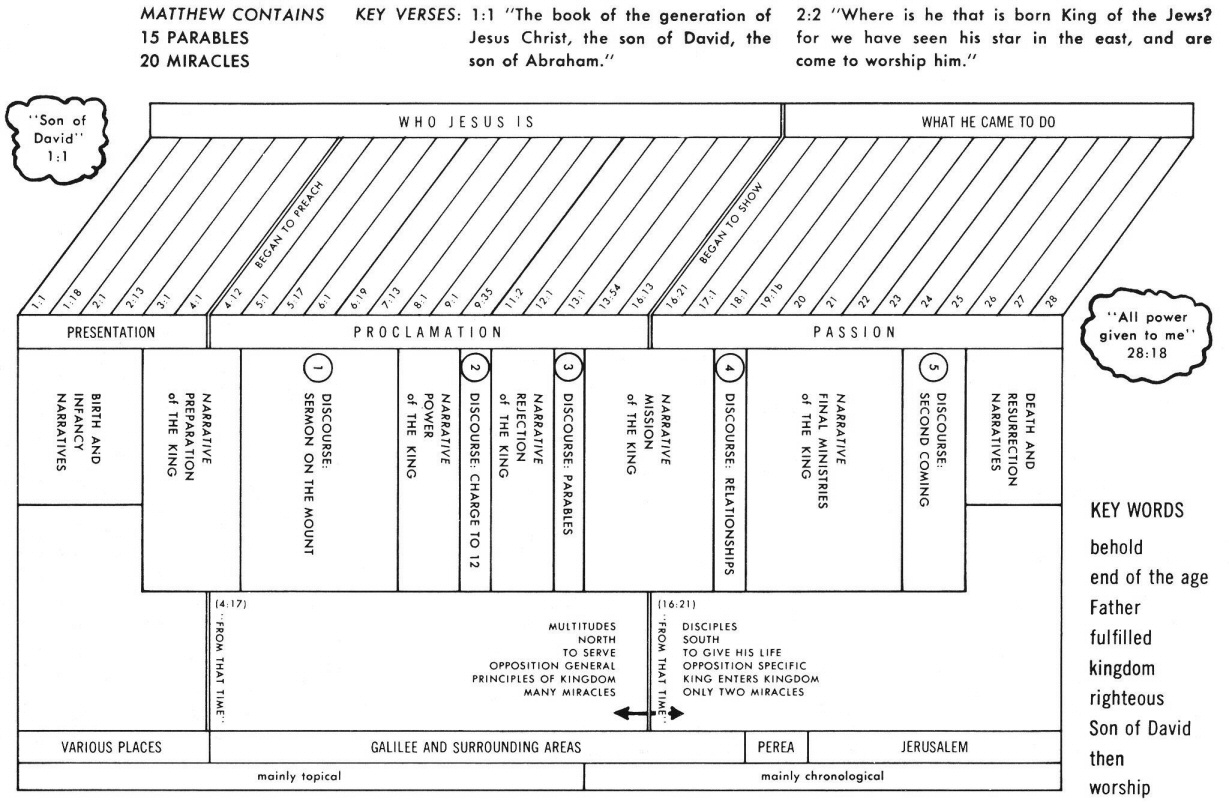
Click chart to enlarge
Charts from Jensen's Survey of the NT - used by permission
Another Chart from Charles Swindoll
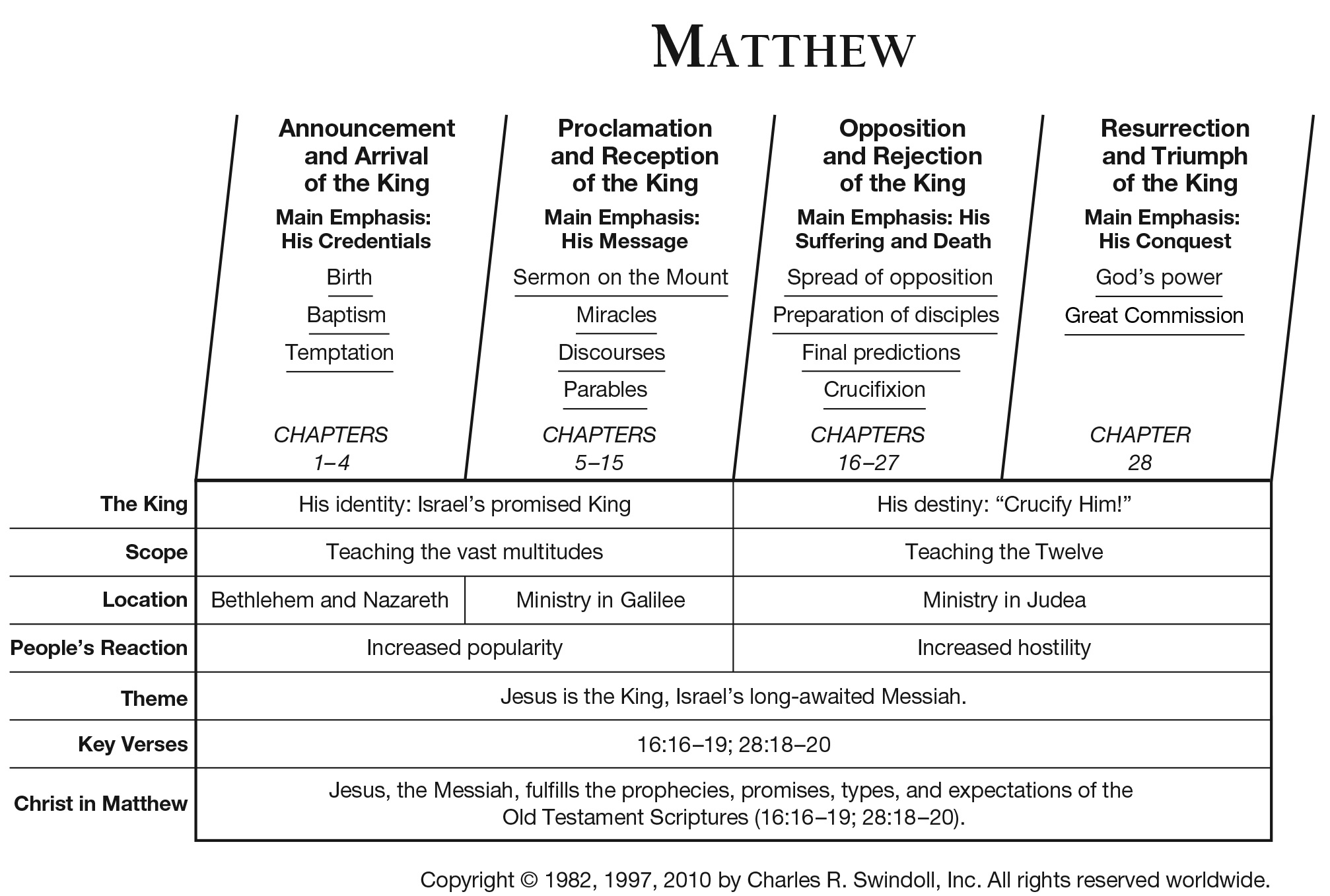
THE LIFE OF JESUS AS COVERED
BY MATTHEW (shaded area)
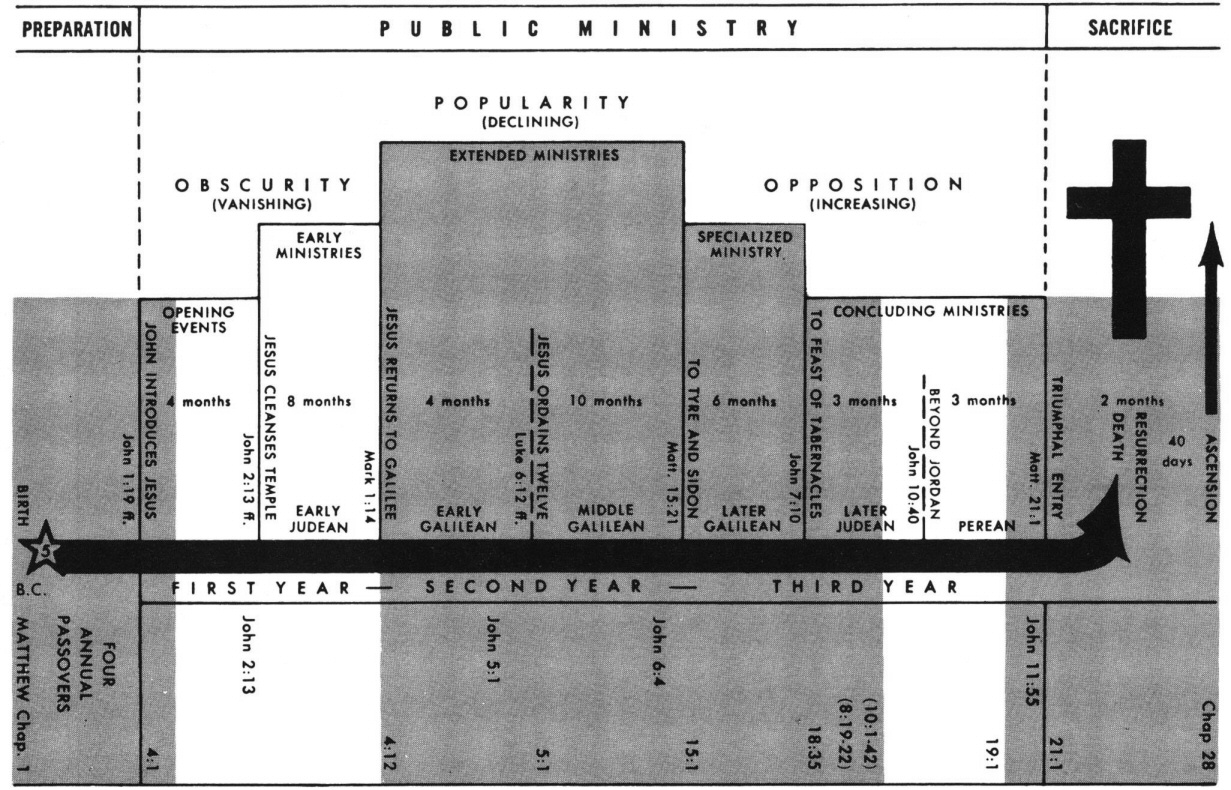
Click chart to enlarge

Jesus Birth and Early Years
Leading up to the Sermon on the Mount
Matthew 1-7

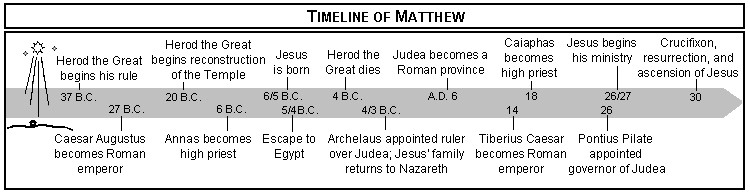
Source: Ryrie Study Bible
Matthew 5:27 "You have heard that it was said, 'YOU SHALL NOT COMMIT ADULTERY' (NASB: Lockman)
Greek: Ekousate (2PAAI) oti errethe, (3SAPI) Ou moicheuseis. (2SFAI)
Amplified: You have heard that it was said, You shall not commit adultery.
Barclay: You have heard that it has been said: You must not commit adultry. (Westminster Press)
NLT: "You have heard that the law of Moses says, 'Do not commit adultery.' (NLT - Tyndale House)
Philips: "You have heard that it was said to the people in the old days, 'You shall not commit adultery'. (New Testament in Modern English)
Wuest: You heard that it was said, You shall not commit adultery.
Young's Literal: 'Ye heard that it was said to the ancients: Thou shalt not commit adultery;
YOU HAVE HEARD THAT IT WAS SAID, 'YOU SHALL NOT COMMIT ADULTERY: Ekousate (2PAAI) oti errethe, (3SAPI) Ou moicheuseis. (2SFAI)
- Exodus 20:14; Lev 20:10; Deut 5:18; 22:22, 23, 24; Proverbs 6:32
- Matthew 5 Resources - Multiple Sermons and Commentaries
GOD'S CLEAR WORD ON
MARITAL FAITHFULNESS
You have heard (akouo) it said (cf Mt 5:21, 33, 38, 43) - Remember that Heard (akouo) means more than to hear with the ears. In Scripture, it regularly conveys hearing that obligates a response. To hear in the biblical sense is to receive truth, to understand it and therefore to be responsible for obeying it. The moment a man hears the truth of God he is no longer neutral! Jesus is not excusing ignorance. He is saying, in effect "You were taught this. You know it. Therefore, you are accountable." The fact that they have heard removes the refuge of excuse. What is heard becomes moral knowledge, and moral knowledge brings responsibility before God. Hearing without obedience is condemned (cf. hearing but not doing) (Jas 1:22). In summary the heard (akouo) means truth was received with the ears that truth now binds the hearer with responsibility and accountability before God.
To paraphrase John Owen, the Word preached does not leave men as it finds them. If it does not become an aroma of life unto life, it will be a aroma of death unto death. The same truth (God’s Word, the gospel) produces opposite effects depending on the hearer. Life for those who receive it. Judgment for those who reject it.
You have heard suggests that the multitudes listening had for the most part not studied the Law of Moses for themselves but had only heard the teaching on the Law, most likely from the scribes and Pharisees. He is addressing the common teaching and understanding of the Law as it was received and explained by the scribes and Pharisees—not correcting Scripture itself, but correcting a reduced, externalized interpretation of it.
Note that It was said is different than the phrase "it is written" which is often used to introduce Scripture. This supports the conclusion that Jesus is referring to what the religious leaders had said to the lay people. In some cases such as in verse 27, their quotations were accurate but in others they were not (eg, Mt 5:43). In all cases their exposition was either perverted, truncated, or taken out of context and left much to be desired. Jesus gives a full exposition correcting the aberrant teaching the people had heard. As with all good teachers, Jesus knew that truth was critical for what a person believes will determine how they behave. If they believed inaccurate exposition of the Law, they would live in a manner not pleasing to the Lord.
'YOU SHALL NOT COMMIT ADULTERY (Ex 20:14)- In first-century Judaism, adultery was largely treated as a behavioral boundary: as long as one avoided the outward act, one was considered obedient. Jesus affirms the command as true and authoritative, but He intentionally sets the stage to press beyond the act to the heart. This verse functions as the starting point, not the conclusion. The audience would expect agreement—and they get it—but only briefly. What Jesus is about to do (in the very next verse) is reveal that God’s concern has never been limited to visible conduct. The Law was always aimed at the inner person—desires, intentions, and affections—not merely outward compliance. Thus, this statement prepares the listener for a radical re-examination of righteousness: not “Have you crossed the line?” but “Where is your heart moving?” In short, Jesus affirms the commandment against adultery while exposing the inadequacy of an obedience that stops at externals. True righteousness, He will show, is not merely avoiding sin with the body, but refusing sin’s rule in the heart.
The sixth commandment (Exodus 20:13) protects the sanctity of life and the seventh (Exodus 20:14) the sanctity of marriage. According to Jewish law, adultery referred to sexual intercourse with the wife or the betrothed of a Jew and it was condemned because it was in essence "taking" another man's wife and thus was considered illicit use of that man's property! They viewed it as an external act.
This was a serious offense in the OT, Moses recording…
'If there is a man who commits adultery with another man's wife, one who commits adultery with his friend's wife, the adulterer and the adulteress shall surely be put to death. (Leviticus 20:10)
"If a man is found lying with a married woman, then both of them shall die, the man who lay with the woman, and the woman; thus you shall purge the evil from Israel. 23 "If there is a girl who is a virgin engaged to a man, and another man finds her in the city and lies with her, 24 then you shall bring them both out to the gate of that city and you shall stone them to death; the girl, because she did not cry out in the city, and the man, because he has violated his neighbor's wife. Thus you shall purge the evil from among you. (Deut 22:22-24)
Solomon wrote that "The one who commits adultery with a woman is lacking sense. He who would destroy himself does it. (Pr 6:32)
Jesus is making the point that just because a man had never committed the physical act of adultery, he was still guilty if he fulfilled the criteria in the next verse. A Jewish man might be quite proud that he had never broken this commandment, and yet be like the false teachers Peter described as…
having eyes full of adultery (moichalis) and that never cease from sin, enticing unstable souls, having a heart (THE HEART OF THE PROBLEM IS THE HEART!) trained (gumnazo - perfect tense - enduring effect. They "trained" their heart! AMAZING!) in greed (pleonexia), accursed children (2Pe 2:14)
Charles Simeon - THAT the Jews were unacquainted with the spiritual nature of their law, we do not wonder; because their authorized instructors were chiefly occupied in ceremonial observances; but that Christians should be ignorant of it, is astonishing, since the strongest light has been cast upon it in the New Testament, and every minister of Christ must make it known, in order to state with accuracy the scope and excellence of the Gospel. Yet it is certain that few Christians comparatively have just views of the law: and it is to be feared, that, in many instances, ministers themselves are not sufficiently aware of the importance of setting it before their people in all its spirituality and extent. The exposition of it which our Lord has given us in this sermon, precludes all possibility of doubt respecting its real import. In the words which we have now read, he interprets the seventh commandment: (Read the entire sermon - Matthew 5:27, 28 Our Lord's Exposition of the 7th Commandment)
God’s commandments were
not given to frustrate us
but to fulfill us.
What God forbids destroys us; what He commands fulfills us. God does not withhold pleasure out of cruelty, but out of care. Holiness is not the enemy of happiness.
Related Resources:
- Exposition of Solomon's proverbs dealing with sexual purity - Pr 5:1-14; Pr 5:15-23; Pr 6:20-35; Pr 7:1-27
- Bible Dictionary Articles on Adultery
Commandment 7—Keep Yourself Pure - External respectability (cp "reputation" - what others think about us) is no guarantee against the internal impropriety (cp "character" - what God knows we are - 1Sa 16:7, Pr 5:21, 15:3, etc) in which one's mind is constantly wandering down the illicit paths of impurity (defiled by his thought life which naturally leads to evil words and deeds, cp Mk 7:21, 22, 23).
The Bible is up-to-date on sexual matters. Long ago, God warned against adultery and fornication. In effect, He said, “Say no!” Now, in the 20th century with the awful threat of AIDS, many lawmakers, educators, and doctors are agreeing with the Almighty.
The Grand Rapids Press carried an article titled “Abstinence: The New Emphasis in Sex Education.” It told of 16-year-old Will Heiss, a “peer educator” who challenges younger kids to say no to sexual activity—and they are listening.
Author and campus lecturer Josh McDowell reminded a college audience that the seventh commandment is a gracious provision by God, given for our protection. Josh told of a man who had several sexual relationships. The man later received Christ and met a wonderful woman whom he married. “She’s precious,” confided the man, “but in the intimacy of our marriage I’m haunted by the ‘ghosts’ of those previous affairs.”
Abstinence until marriage is a sure safeguard. It protects the gift of sexual intimacy that is to be enjoyed within a lifelong relationship of commitment and trust. God hates sexual immorality because He has the highest good of men and women at heart. — by Dennis J. De Haan (Reprinted by permission from Our Daily Bread Ministries. Please do not repost the full devotional without their permission.)
Lord, grant me strength from day to day—
How prone I am to go astray!
The passions of my flesh are strong;
Be Thou, my God, a shield from wrong.
—DJD
Matthew 5:28 but I say to you that everyone who looks at a woman with lust for her has already committed adultery with her in his heart. (NASB: Lockman)
Greek: ego de lego (1SPAI) humin oti pas o blepon (PAPMSN) gunaika pros to epithumesai (AAN) auten ede emoicheusen (3SAAI) auten en te kardia autou
Amplified: But I say to you that everyone who so much as looks at a woman with evil desire for her has already committed adultery with her in his heart.
Barclay: But I say to you that every one who looks at a woman in such a way as to waken within himself forbidden desires for he has already committed adultry with her within his heart. (Westminster Press)
NLT: But I say, anyone who even looks at a woman with lust in his eye has already committed adultery with her in his heart. (NLT - Tyndale House)
Philips: But I say to you that every man who looks at a woman lustfully has already committed adultery with her - in his heart. (New Testament in Modern English)
Wuest: But as for myself, I am saying to you, Everyone who is looking at a woman in order to indulge his sexual passion for her, already committed adultery with her in his heart. (Wuest: Expanded Translation: Eerdmans)
Young's Literal: but I -- I say to you, that every one who is looking on a woman to desire her, did already commit adultery with her in his heart.
BUT I SAY TO YOU THAT EVERYONE WHO LOOKS AT A WOMAN WITH LUST FOR HER: ego de lego (1SPAI) humin hoti pas o blepon (PAPMSN) gunaika pros to epithumesai (AAN) auten
But I say to you that everyone whose eyes are turned on a woman with desire has had connection with her in his heart. (BBE)
But I tell you that if you look at another woman and want her, you are already unfaithful in your thoughts. (CEV)
But I tell you that if anyone looks at a woman and wants to sin sexually with her, then he has already done that sin with the woman in his mind. (International Children's Bible)
- Mt 22:39; 7:28,29
- Ge 34:2; Joseph's great example in Ge 39:7-23; Ex 20:17; 2Sa 11:2-5, Job 31:1,7, 9; Pr 6:25; Jas 1:13-15; 2Peter 2:14; 1Jn 2:15, 16, 17
- Matthew 5 Resources - Multiple Sermons and Commentaries

THE LOOK THAT
HOOKS
But I say to you - The phrase “but I say to you” asserts His divine authority to reveal the true depth of God’s law, which always aimed at the heart, not merely behavior.
That everyone (no exceptions) who looks (blepo - present tense - keeps looking) at a woman with lust (epithumeo) for her has already committed adultery (moicheuo) with her in (locative of sphere) his heart (kardia). Jesus is declaring that sin is not measured only by outward actions but by inward desires. He does not redefine adultery; He locates its root.
Looks (blepo - present tense - keeps looking) at a woman with lust (epithumeo) - This is not a passing notice or involuntary attraction. Jesus describes a deliberate, lingering gaze (blepo - present tense - keeps looking) that feeds the fire of desire. The issue is not seeing, but staring in order to desire. Lust (epithumeo) here means covetous sexual desire, wanting someone who is not yours for self-gratification. This perverted desire treats the person as an object rather than a bearer of God’s image.
There is a saying that when one takes a vote and the those who vote "yes" win -- "The aye's have it!" Well that is the problem with lust… the eyes have it! Look at the following passages (these are just a sampling of many similar passages) and notice the central role of the eyes…
And it shall be a tassel for you to look at and remember all the commandments of the LORD, so as to do them and not follow after your own heart and your own eyes, after which you played the harlot, (Nu 15:39)
Then those of you who escape will remember Me among the nations to which they will be carried captive, how I have been hurt by their adulterous hearts which turned away from Me, and by their eyes, which played the harlot after their idols; and they will loathe themselves in their own sight for the evils which they have committed, for all their abominations (see + Ezekiel 6:9)
(A man's violent son who) oppresses the poor and needy, commits robbery, does not restore a pledge, but lifts up his eyes to the idols, and commits abomination (Ezekiel 18:12)
But they (Israel) rebelled against Me and were not willing to listen to Me; they did not cast away the detestable things of their eyes, nor did they forsake the idols of Egypt. Then I resolved to pour out My wrath on them, to accomplish My anger against them in the midst of the land of Egypt. (Ezekiel 20:8)
So Achan (when his sin was exposed - see Nu 32:23!) answered Joshua and said, "Truly, I have sinned against the LORD, the God of Israel, and this is what I did: when I saw among the spoil a beautiful mantle from Shinar and two hundred shekels of silver and a bar of gold fifty shekels in weight, then I coveted them and took them; and behold, they are concealed in the earth inside my tent with the silver underneath it." (Joshua 7:20, 21)
Comment: Note progression - Saw with eyes, coveted in his heart, stole with with his hands, hid because he knew it was wrong - cp Pr 28:13, Pr 5:21, 22, 15:3 David in Ps 32:1, 2, 3, 4, 5
Job expresses his resolve to guard his eyes declaring…
I have made a covenant (the most solemn, binding agreement known in the ancient near east) with my eyes. How then could I gaze (Hebrew verb which does not refer to a casual glance but means to consider carefully, diligently consider, discern, get understanding, look carefully, pay close attention to; cp David 2Sa 11:2, 3, 4,5) at a virgin? (Job 31:1)
Comment: One version says to gaze is to "undress a girl with my eyes!
Job then links his eyes (what we let in to our mind) with the heart (our thought life - our intellect, emotion, will) in Job 31 writing…
If my step has turned from the way, or my heart followed my eyes… (Job 31:7)
Comment - Compare Solomon's uses of heart in his "treatise" on sexual purity in Proverbs 5-7 = Pr 5:12, 6:21, 25, 7:3, 7:10, 25
Job goes on to add some "teeth" so to speak to his covenant, calling down on himself his own punishment if he were to break covenant…
If my heart has been enticed by a woman, or I have lurked at my neighbor's doorway, may my wife grind for another, and let others kneel down over her (most take this latter statement to refer to her lying with another man). For that would be a lustful crime; moreover, it would be an iniquity punishable by judges. (Job 31:9-11)
John MacArthur issues a strong warning to all would desire to live godly in Christ Jesus explaining that "Although sexual temptations have been strong since man’s fall, our day of permissiveness and perversion has brought an increase in those destructive influences that no society in history has had before (see note 2 Timothy 3:13). Ours is a day of unbridled indulgence in sexual passion. People propagate, promote, and exploit it through the most powerful and pervasive media ever known to man. It seems to be the almost uninterrupted theme of our society’s entertainment. Even in academic and religious circles we see seminars, books, tapes, and programs of all sorts that promise to improve sexual knowledge, experience, freedom, and enjoyment. Mass media uses sex to sell its products and to glamorize its programs. Sex crimes are at all-time highs, while infidelity, divorce, and perversion are justified. Marriage, sexual fidelity, and moral purity are scorned, ridiculed, and laughed at. We are preoccupied with sex to a degree perhaps never before seen in a civilized culture. (See Matthew Commentary - Page 300)
But (term of contrast) - Literally this reads "but I -- I say to you" (ego de lego). Once again Jesus counters "popular opinion" and raises the bar on sexual sin, to not just external acts but internal thoughts. And there is no "secret" thought life before the all knowing God.
Everyone - No exception clauses. Priests, kings, ministers, youth, old man, male, female, etc are not given a pass on sexual infidelity with their eyes!
Looks (991) (blepo) means to look at or behold. Blepo generally denotes simply a voluntary observation or taking notice of something or someone. In some contexts blepo conveys the sense of directing one's attention to something so as to take notice of it or consider it (eg, 1Co 1:26). Jesus uses blepo 5 times in this Sermon (Mt 5:28; 6:4, 6, 18; 7:3)
Blepo is in the present tense which pictures one continually looking (a "lust filled" look at that). The idea is that what may have begun as a glance, becomes a gaze! Men, don't go there! Cut your losses quickly! Jesus is not describing a casual glance, but a veritable lust filled stare. This look characterizes the man whose glance is not checked by holy (Spirit) restraint (See the fruit of the Spirit, self control in notes on and Galatians 5:23)
Barclay - The man whom Jesus here condemns (in Mt 5:27, 28) is the man who deliberately uses his eyes to stimulate his desires; the man who finds a strange delight in things which waken the desire for the forbidden thing. To the pure all things are pure. But the man whose heart is defiled can look at any scene and find something in it titillate and excite the wrong desire. (Matthew 5 Commentary - Daily Study Bible)
Moffatt's paraphrase conveys the idea "anyone who looks at a woman and wants to possess her (or as another version says "to undress her"!)
Barclay has an interesting rendering we men would do well to ponder "if anyone looks at a woman in such a way as deliberately to awaken within himself the forbidden desire for her."
Lust is like rot
in the bones.
Wiersbe explains that "The “look” that Jesus mentioned was not a casual glance, but a constant stare with the purpose of lusting. It is possible for a man to glance at a beautiful woman and know that she is beautiful, but not lust (cp "gaze" in Job 31:1) after her. The man Jesus described looked at the woman for the purpose of feeding his inner sensual appetites as a substitute for the act (cp James 1:14, 15notes). It was not accidental; it was planned (cp Ro 13:14). (Bible Exposition Commentary)
Lust (1937) (epithumeo from epí = upon, used intensively + thumós = passion) (Click study of noun epithumia) means literally to fix the desire upon (object could be good [Mt 13:17, Lk 22:15 used of Jesus] or bad [1Co 10:6]). It means to have a strong desire to do or secure something. To desire greatly. To long for. Note that the preposition epi can express motion toward or upon and thus one lexicon defines it as to set one's heart upon. In sum, epithumeo describes a strong impulse toward something so that one's passions or affections directed toward some object, thing or person.
Here in Matthew 5:28 Jesus moves the command from external act to internal aim. The construction πρὸς τὸ ἐπιθυμῆσαι marks purpose/intention. The look is instrumental to a lustful goal. It’s not mere noticing but cultivated coveting (it's the second glance that traps you!) It is not the inadvertent (unintentional) glance (which in our amoral society is virtually impossible to avoid!) but the intentional glance that will stimulate the fallen flesh. And don't be deceived, one intentional glance is all the fallen flesh needs to hook you!
In Romans 7:7–8 the command reveals (not causes) sin. Paul’s experience shows how law unmasks the root-level desire problem (epithumia).
In Gal 5:17 Paul describes the two desiring powers are set in opposition, in continual spiritual war! Victory over the flesh is NOT possible for an non-believer, but only for a believer in Christ. Victory is so much by suppression of the lusts of the flesh. Victory is attainable as the believer daily learns to lean on the stronger desire produced by the indwelling Holy Spirit, which negates or displaces the desires of the fallen flesh (as described in Gal 5:16) (This is the principle of Expulsive Power of a New Affection) Scripture rarely says “just stop desiring” but instead commands “walk by the Spirit” so you won’t gratify fleshly desires (Gal 5:16). This is not "Let go, let God," but "Let God (Spirit), let's go!" The Spirit energizes us but we are not puppets and still must make the God honoring choice when confronted with temptation to lust!
Jesus uses epithumeo with its evil connotation here in Mt 5:28, where epithumeo describes a husband's lustful passion directly toward a woman who is not his wife ("Those leering looks you think nobody notices" Msg). As an aside, for one of the best "defenses" against this seductive but dangerous sin of sexual immorality and adultery see Solomon's advice in Pr 5:15, 16, 17, 18, 19 and compare it with Paul's in 1Co 7:2, 5. In fact, Proverbs 5-7 should be required reading for every Christian man at least once a year! It seems that Solomon must have ceased reading it, for he certainly ceased heeding it! (See his spiritual decline in 1 Kings 11:1-14)! The lesson (FOR ANY OF US WHO THINK WE STAND - see 1 Cor 10:12) is that we can know the truth BUT if we fail to practice that truth, we are deluding ourselves (James 1:22) and will soon be ensnared by the deceitfulness of sin (Heb 3:13), which promises great gratification but fails to tell us the great price it will cost!
A Brief Theology of Desire - At Creation desire was part of God’s good design. God "desire" that Adam desire Eve, for joy and for procreation of the species! But because of Adam's fall into sin desire (energized by the fallen flesh) became bent, aimed at wrong objects or aimed at right objects in wrong ways or wrong measure (Ge 3; Ro 7:7–11). But because of redemption, believers in Christ have their desires reordered (Gal 5:16–24, 2Co 5:17). The Spirit produces new loves that counter-desire the flesh “the flesh desires (epithumeo - present tense = continual warfare) against the Spirit, and the Spirit against the flesh” (Gal 5:17). Sanctification is to be a believer's progressive growth in regard to desire. Not that he or she is not to have desires but that their desires be rightly-directed desire, learning to desire the good, at the right time, in the right proportion, and ever for God’s glory (Phil 1:9–11; Col 3:1–5 with "evil desires" part of the “old self”). Some opposites of negative desire - self-control (egkrates/enkrates), contentment (autarkeia), obedience (hupakouo) to God’s will.
Psalm 119:40 is a great prayer we can (should) all frequently pray that uses this same verby epithumeo (in the Septuagint - Lxx) in a positive context -
"Behold, I long for (Lxx = epithumeo) Thy precepts; Revive me through Thy righteousness."
🙏 THOUGHT - Notice that the use of epithumeo in Ps 119:40 gives us a great pattern for fighting the good fight of faith against the fleshly longing Jesus warned against in Mt 5:28. What is the pattern? In context it is to "long for Thy precepts!" This powerful principle is also known as the Expulsive Power of a New Affection, the new longing which is directed toward the Lord in effect negating longing of the Old Man for gratification of the flesh!
Here are the 16 uses of epithumeo in the NT - Epithumeo is translated in the NAS as covet(2), coveted(1), craved(1), desire(1), desired(2), desires(1), long to(3), longing to(2), lust(2), sets its desire(1). Mt 5:28; Mt 13:17; Lk 15:16; 16:21; 17:22; 22:15; Acts 20:33; Ro 7:7; Ro 13:9; 1Co 10:6; Gal 5:17; 1Ti 3:1; Heb 6:11; James 4:2; 1Pe 1:12; Re 9:6.
There are 37 uses of epithumeo in the non-apocryphal Septuagint (LXX)-Ge 31:30; 49:14; Ex 20:17; 34:24; Nu 11:4; Dt 5:21; 7:25; 12:20; 14:26; 18:6; 1Sa 2:16; 20:4; 2Sa 3:21; 23:15; 1Ki 11:37; 1Chr. 11:17; 2Chr 8:6; Esther 4:17; Job 33:20; Ps 45:11; 106:14; 119:20, 40; Pr 21:26; 23:3, 6; 24:1; Eccl 6:2; Song 2:3; Is 1:29; 26:9; 43:24; 58:2, 11; Je 17:16; Amos 5:18; Mic 2:2
UBS Handbook makes the distinction that"this verse does not just refer to noticing a woman as attractive, or even to a brief recognition that she is sexually appealing. It refers instead to actually contemplating having sex with her, that is, to having the intention of doing so. (The United Bible Societies' New Testament Handbook Series)
Gilbrant on epithumeo - In classical literature epithumeō means “desire for, long for”; it is neither a negative nor positive impulse. The term can be used of a longing for food, of “political attachments” (see Liddell-Scott), or of sensual desires. It can simply denote a “desire” to do something. Büschel notes that the epithum- word group in Greek philosophy generally is an ethical rather than religious concept; thus it is only one among the four chief passions, “pleasure, fear, and grief” (“thumos,” Kittel, 3:168ff.). The Septuagint translators utilized epithumeō for as many as 10 Hebrew terms. In a majority of instances it translates a form of ’āwâh, “long for” (e.g., for food, Numbers 11:4; of personal choice, 1 Samuel 2:16; of sexual desire, Deuteronomy 5:18; of desiring a neighbor’s wife, Judith 16:22; of the desire for wisdom, Sirach 1:26; of the desire for God’s law, Psalm 119:20 [ta’ăvāh]). There are hints that “desire” or “craving” often stood over against God. This is most clear in the wilderness account where the Israelites’ desire for other food was regarded as a major sin which was recalled by later Judaism (cf. Numbers 11:4ff.; Psalm 106:14; Wisdom of Solomon 16:3; 1 Corinthians 10:6). (Complete Biblical Library)
A little will satisfy nature; less will satisfy grace;
nothing will satisfy men's lusts.
-- Thomas Brooks
The Ten Commandments clearly addressed the problem of looking and desiring…
You shall not covet your neighbor's house; you shall not covet (chamad = desire, take pleasure in; Lxx = epithumeo the same verb Jesus used in Mt 5:28 = to set one's heart upon and so to have a strong impulse in this context in a bad sense toward) your neighbor's wife or his male servant or his female servant or his ox or his donkey or anything that belongs to your neighbor. (Exodus 20:17, cp Dt 5:21)
Oswald Chambers rightly warned us that "We cannot think anything without the thought having its consequence. (Shade of His Hand)
Jesus explained the relationship between the heart (including our thought life, especially our "secret" thought life - not "secret" to God - Pr 5:21, 15:3, et al) and our actions, specifically those that are defiling…
(In the context of clarifying that food is not what defiles a man) And He was saying, "That which proceeds out of the man, that is what defiles the man. For from within, out of the heart of men, proceed the evil thoughts, fornications, thefts, murders, adulteries, deeds of coveting and wickedness, as well as deceit, sensuality, envy, slander, pride and foolishness. All these evil things proceed from within and defile the man. (Mark 7:20-23, cp Mt 12:34)
Solomon explains that…
the commandment is a lamp, and the teaching is light; and reproofs for discipline are the way of life, to keep you from the evil woman, from the smooth tongue of the adulteress. Do not desire her beauty in your heart, (cp Job 31:7, 9) nor let her catch you with her eyelids. (Pr 6:23-25)
James explains that we are each responsible and cannot blame God writing…
Let no one say when he is tempted, "I am being tempted by God"; for God cannot be tempted by evil, and He Himself does not tempt anyone. But each one is tempted when he is carried away and enticed by his own lust. Then when lust has conceived, it gives birth to sin; and when sin is accomplished, it brings forth death. Do not be deceived, my beloved brethren. (James 1:13-16)
The godly King David failed to keep watch over his eye gate which were the door to his heart as recorded in 2 Samuel 11..
Then it happened in the spring, at the time when kings go out to battle (Spring was an advantageous time to wage war because of good weather and available provisions from the harvest), that David sent Joab and his servants with him and all Israel, and they destroyed the sons of Ammon and besieged Rabbah. But (this is one of saddest conjunctions in the Bible and in the story of this man after God's own heart. So many subsequent events hinged on this one "but". How we all need to watch over our hearts with all diligence especially when the old nature begins to seduce with "but this… " or "but that… ") David stayed at Jerusalem. 2 Now when evening came David arose from his bed and walked around on the roof of the king's house, and from the roof he saw a woman bathing (Oriental homes had an enclosed courtyard that was considered part of the house. Bathsheba, bathing herself by lamplight, was not immodest for she was in her house. However, the interior of the courtyard could be seen from the roof of David's house, situated as it was on the higher elevation of Mt Zion); and the woman was very beautiful in appearance (Temptation is the enticement to satisfy God given desires in a God forbidden way. We all must remember that character is revealed by what you do in secret, when no one else is around to see. David's palace likely commanded the best view and there was no one who see into his courtyard except of course God! How practical are the lessons in David's life in our modern era where one click of a mouse in privacy of one's study, where no one else can see, can place a "bathing Bathsheba" before one's eyes in an instant. Maturity is revealed by what you do in your free time. A person of integrity uses their free time wisely.) (Click Spurgeon's devotional on 2 Samuel 11:2)
3 So David sent and inquired about the woman. (David looked and he lusted in his heart) And one said, "Is this not Bathsheba, the daughter of Eliam, the wife of Uriah the Hittite?" (We are never out of the reach of temptation. Both at home and abroad we are liable to meet with allurements to evil; the morning opens with peril, and the shades of evening find us still in jeopardy. They are well kept whom God keeps, but woe unto those who go forth into the world, or even dare to walk their own house unarmed. Those who think themselves secure are more exposed to danger than any others. The armour-bearer of Sin is Self-confidence. It wasn’t sin for David accidentally to see Bathsheba bathing. Sin came when he allowed himself—no, chose —to fix his eyes and mind on her. Lust overshadowed moral conviction. David’s dam wasn’t strong enough to restrain the forces of sexual temptation he exposed himself to. Am I more righteous than David, whom God called “a man after his own heart”)
4 And David sent messengers and took her, and when she came to him, he lay with her; and when she had purified herself from her uncleanness, she returned to her house. 5 And the woman conceived; and she sent and told David, and said, "I am pregnant." (like a stone thrown in water, sin’s ripples led to a cover-up and murder for which David, his family, and his nation suffered dearly) 6 Then David sent to Joab, saying, "Send me Uriah the Hittite." So Joab sent Uriah to David. 7 When Uriah came to him, David asked concerning the welfare of Joab and the people and the state of the war. 8 Then David said to Uriah, "Go down to your house, and wash your feet." And Uriah went out of the king's house, and a present from the king was sent out after him.
Redeeming Desire
“With desire I have desired to eat this Passover with you before I suffer.” — Luke 22:15
At its root, epithumeo reminds us that we are creatures of desire. We cannot avoid longing (READ THAT AGAIN!). The question is never if we will desire, but WHAT or WHO we will desire. Jesus Himself used the word to describe His holy yearning to share the Passover before the cross. Yet the same word describes the adulterous gaze (Matt 5:28) or Israel’s craving for evil things (1 Cor 10: +).
Desire is like fire. In a hearth, it gives warmth and light; left unchecked, it consumes the house.
1. The Danger of Misplaced Desire
When desire fastens on what God forbids—wealth, power, pleasure outside His will—it enslaves us. James warns: “You desire and do not have, so you murder” (Jas 4:2). Desire untamed breeds frustration, envy, strife. Left unchecked, it leads to ruin.
2. The Beauty of Holy Desire
But desire is not our enemy. In fact, it is meant to be our compass toward God. The angels “desire to look into” gospel mysteries (1 Pet 1:12). Paul “desired to depart and be with Christ” (Phil 1:23). And Jesus longed for table fellowship with His disciples before His passion. Holy longing (energized by the Holy Spirit and Holy Word - are you daily in the Word?) pulls us upward, sharpening hope and fueling faith.
3. The Battle of Desires
Paul says, “The flesh desires against the Spirit, and the Spirit against the flesh” (Gal 5:17). The Christian life is not the absence of desire but the Spirit enabled victory of right desire over wrong desire. This is why sanctification feels like war—two hungers fight for dominance. It is war, spiritual war! In Romans 8:13 Paul gives one the great verses dealing with sanctification- " if you are living according to the flesh, you must die; but if by the Spirit you are putting to death the deeds of the body, you will live."
HAS ALREADY COMMITTED ADULTERY WITH HER IN HIS HEART: ede emoicheusen (3SAAI) auten en te kardia autou
- Ps 119:96; Ro 7:7,8,14
- Matthew 5 Resources - Multiple Sermons and Commentaries
Related Passages:
Romans 7:7; 8 What shall we say then? Is the Law sin? May it never be! On the contrary, I would not have come to know sin except through the Law; for I would not have known about coveting if the Law had not said, “YOU SHALL NOT COVET.” 7:8 But sin, taking opportunity through the commandment, produced in me coveting of every kind; for apart from the Law sin is dead.
CONDEMNED
BEFORE CONTACT!
Has already committed adultery (moicheuo) with her in his heart - Jesus says the sin is already real before any physical act occurs. Rest assured (or uneasy) that our heart’s intention carries genuine moral weight before God Who sees our heart. In other words, Jesus teaches that willfully nurturing lustful desire is heart-level adultery, because God judges not only actions but the intentions that give birth to them. There is an idiom which says "It's the thought that counts" and that is spot on regarding lustful looks!
Be sure and understand what Jesus is not saying. He is not equating temptation with sin. He is not denying differences in consequences between an adulterous thought and an adulterous act. He is not promoting legalism or self-reformation. Ultimately, His words should be a constant reminder that we must always rely on the Holy Spirit's power and not our own "will-power" to fend off the temptation.
On the other hand be sure to understand what Jesus is saying. He is saying God’s holiness demands internal integrity, not just external restraint (Pharisees were a prototype for external fastidiousness). True righteousness born by God and maintained by His Spirit is transformational, not merely behavioral. Sexual sin is conceived long before it is committed.
Spurgeon - So that the unholy desire, the lascivious glance, everything that approximates towards licentiousness, is here condemned; and Christ is proved to be not the Abrogator of the law, but the Confirmer of it. See how he shows that the commandment is exceedingly broad, wide as the canopy of heaven, all-embracing. How sternly it condemns us all, and how well it becomes us to fall down at the feet of the God of infinite mercy, and seek his forgiveness.
“’Tis mercy — mercy we implore,
We would thy pity move;
Thy grace is an exhaustless store,
And thou thyself art Love.”
Committed adultery (3431) (moicheuo from moichós = an adulterer - see Adultery) means to commit adultery and refers to sexual intercourse between a man and woman when one or both of them is married.
John MacArthur adds that "In both the Old and New Testaments the word relates to sexual intercourse with anyone other than one’s marriage partner. That Jesus here implies that the principle of sexual purity can be seen in a wider sense than adultery (though adultery is His point here) seems clear from the fact that both everyone and a woman are comprehensive terms that could also apply to the unmarried… It is not lustful looking that causes the sin in the heart, but the sin in the heart that causes lustful looking. The lustful looking is but the expression of a heart that is already immoral and adulterous. The heart is the soil where the seeds of sin are imbedded and begin to grow. (See Matthew Commentary - Page 302)
The central moral thrust of the Sermon on the Mount is that the basis of all sin is the inner thought, not the outward act. A person commits the sin when he wants to do it, whether or not he ever carries it out in action.
To reiterate do not misunderstand what Jesus is saying. He is not saying that a lustful thought is identical to a lustful deed, and so one might just as well commit adultery! That is not what He is saying! The desire and the deed are not identical, but, spiritually speaking, they are equivalent.
Dave Guzik agrees writing that "Jesus is not saying that the act of adultery and adultery in the heart are the same thing. More than a few people have been deceived on this point, and say "I’ve already committed adultery in my heart, so I may as well do it in practice." The act of adultery is far worse than adultery in the heart. Jesus’ point is not to say they are the same things, but to say they are both sin, and both prohibited by the command against adultery. Some people only keep from adultery because they are afraid to get caught, and in their heart they commit adultery every day. It is good that they keep from the act of adultery, but it is bad that their heart is filled with adultery.. This principle applies to much more than men looking at women. It applies to just about anything we can covet with the eye or mind. (Commentary Notes)
Jesus declared that
"the things that proceed out of the mouth come from the heart, and those defile (cause to become unclean, profane, polluted, unholy, cf the man or woman God uses - cf 2Ti 2:21) the man. For out of the heart come evil thoughts, murders, adulteries, fornications, thefts, false witness, slanders. These are the things which defile the man; but to eat with unwashed hands does not defile the man." (Mt 15:18-20)
The things that defile the man come from an unwashed heart, not from unwashed hands. The need is for God to cleanse men’s hearts, not for men to wash their hands.
It is interesting that many of the Jews considered the OT command not to commit adultery (Ex 20:14; Deut 5:18) not so much as a function of purity, as of theft or the stealing of another man's wife. "I see her. I want her. I will steal her."
Bruce Barton has a well worded comment noting that “Private sins” have a fatal attraction by appearing to be internal, hidden, secret. Jesus declared lustful looks to be sin. God is not bound by our privacy—our thoughts and emotions are as visible to him as our actions. From the divine perspective, they are actions. This, in part, explains their sinfulness. Lust also creates an offense before God by misusing one of his most powerful gifts—the capacity to reflect. That part of us most able to consider and appreciate our Creator, his Word, and his world, becomes increasingly toxic as we use it to consider sin. Unlike an offending eye or hand, a sinful mind cannot be removed. Don’t give in to lustful desires. (See Matthew - Page 96)
Arthur Pink applies our Lord's teaching to temptresses as well as "temptees" - If lustful looking is so grievous a sin, then those who dress and expose themselves with the desire to be looked at and lusted after … are not less but perhaps more guilty. In this matter it is not only too often the case that men sin but women tempt them to do so. How great then must be the guilt of the great majority of modern misses who deliberately seek to arouse the sexual passions of young men. And how much greater still is the guilt of most of their mothers for allowing them to become lascivious temptresses.
Heart (2588) (kardia) does not refer to the physical organ in Scripture but is always used figuratively to refer to the seat and center of human life, the wellspring of man’s spiritual life. The heart is the center of the personality, and it controls the intellect, emotions, and will. No outward obedience is of the slightest value unless the heart turns to God.
Guzik makes a good point "Since Jesus considers adultery in the heart a sin, we know what we think about and allow our heart to rest on is based on choice. Many believe they have no choice - and therefore no responsibility - for what they think about, but this contradicts the clear teaching of Jesus here. We may not be able to control passing thoughts or feelings, but we certainly do decide where our heart and mind will rest. . (Commentary Notes)
Robertson says the heart is…Not just the centre of the blood circulation though it means that. Not just the emotional part of man’s nature, but here the inner man including the intellect, the affections, the will. This word is exceedingly common in the New Testament and repays careful study always. It is from a root that means to quiver or palpitate. Jesus locates adultery in the eye and heart before the outward act. Wunsche (Beitrage) quotes two pertinent rabbinical sayings as translated by Bruce: “The eye and the heart are the two brokers of sin.” (Job 31:7) “Passions lodge only in him who sees.” Hence the peril of lewd pictures and plays to the pure. (Robertson, A. Word Pictures in the New Testament)
Kardia includes the thinking process (thoughts) and particularly the will. Jesus asked a group of scribes, “Why are you thinking evil in your hearts?” (Matthew 9:4).
The heart is the control center of mind and will as well as emotion. Jesus is pinpointing the area we need to guard men…
WE NEED TO THINK ABOUT…
Our Thought Life!
Vine writes that kardia "came to denote man’s entire mental and moral activities, and to stand figuratively for the hidden springs of the personal life, and so here signifies the seat of thought and feeling. (Collected writings of W. E. Vine.)
The desire and the deed are not identical, but, spiritually speaking, they are equivalent. Mark it down, that a lustful look is the expression of a heart attitude that says in essence, “I would if I could.”
Constable "Fantasized immorality is just as sinful to God as physical immorality. The fact that fornication that takes place in the brain has fewer bad consequences than fornication that takes place on a bed does not mitigate this truth. (Expository Notes)
William MacDonald writes that "E. Stanley Jones caught the import of this verse when he wrote "If you think or act adultery, you do not satisfy the sex urge; you pour oil on a fire to quench it." Sin begins in the mind, and if we nourish it, we eventually commit the act. (Borrow Believer's Bible Commentary)
Paul gives one of the best antidotes instructing us to…
put on (aorist imperative see our need to depend on the Holy Spirit to obey - Do this now! It even conveys a sense of urgency.) the Lord Jesus Christ, and make no provision (present imperative with a negative see our need to depend on the Holy Spirit to obey says either "Stop doing this" it forbids one from beginning to do this.) for the flesh in regard to its lusts. (Ro 13:14)
Comment: Provision is pronoia which literally is a thought beforehand. Most sinful behavior results from wrong ideas and lustful desires we allow to linger in our minds (Jas 1:14, 15). Don't fill your mind with plans for your sin. Instead, fill your mind with (Php 4:8) thoughts, thoughts of Christ in Whom are hidden all the riches of wisdom and knowledge (Col 2:3) and in Whom we are complete (Col 2:8)… possessing all His precious and magnificent promises.) Don't be like the man who was delivered from his smoking habit and took all of his smoking paraphernalia (pipes, tobacco, etc) and buried it in his back yard and then put a stone over the spot so that he would know where to dig in case he couldn't hold out. He was making provision for his old flesh nature to gratify the desires of that nature! And I'll bet he didn't hold out. We fail to grasp the latent power inherent in our old nature (flesh). We may even think our old nature has been redeemed. Perish that thought. It is still the old nature. We have died to it's power (Ro 6:11, 12, 13, 14) but it's power is still it's power and we give it an inch it will take a yard. Do not be deceived beloved brethren.
Note that this passages has two commands - I contend that you cannot keep either command in your own power ("will power," "self control," etc - See discussion of the Need for the Holy Spirit to obey NT commands), but only as God's Spirit gives you the desire and the power (Php 2:13NLT). Then you are enabled to work out your salvation in fear and trembling (Php 2:12). Note that dependence on the Holy Spirit is not "carte blanche" to passivity. It is the non-biblical call to "Let go, let God!" In fact, it is more biblically phrased "Let God and Let's go!" God's sovereign power. Our submission to and dependence upon the enabling power of the Spirit allowing us to make the choice to "Put on" Jesus and to not continue to "Make provision" for the flesh. Beloved, you cannot keep these commands relying solely on your own will and power (aka "will power")! It is utterly IM-possible. But it is HIM-possible! As we let the Word of Christ dwell in us richly (Col 3:16), we will find the Spirit of God fills us (Eph 5:18) and enables us to put to death the deeds of the body (Ro 8:13). We experience the freedom and God receives the glory! For more on the intimate relationship between the Spirit and the Word see the following chart detailed chart comparison of Eph 5:18ff and Col 3:16ff. If you are full of the God's Word, you will be full of His Spirit.
We are repeatedly called to imitate Jesus, to walk like Jesus walked (1 Cor 11:1, 1 Jn 2:6, 1 Peter 2:21) and yet we too often fail to truly understand how Jesus walked. Remember that He emptied Himself of His divine prerogatives and became fully Man. And as the perfect Man, He gave us the perfect pattern to follow. And what was that pattern? Matthew 4:1-11 and Luke 4:1-11 give us a perfect pattern to ponder and seek to imitate. Jesus was tempted by the devil (Mt 4:1), who also tempts us, but we also have the internal fallen flesh that tempts us (James 1:14-15). So how did Jesus fight the good fight of faith? How did Jesus fight off the incredibly powerful temptations of the devil? He was victorious because He was (1) filled with the Spirit (Mt 4:1, Lk 4:1, 14, cf Acts 10:37-38) and (2) He was filled with the Word of Truth. In short, He used the sword of the Spirit, which is the Word of God (Eph 6:17). Beloved, now do you see how you can fight the good fight of faith? Do you understand that you can't fight in reliance upon your own strength, but must fight with supernatural power supplied by the Spirit and the Word.
See more discussion of the principles summarized above
J Vernon McGee - Oh, how many believers are making every provision for the flesh but are making no provision to go into His presence. My friend, I beg you to put Christ first in your life and to get out the Word of God. This is all-important. (See Thru the Bible)
Ray Stedman gives this illustration of putting on Jesus "When I get up in the morning I put on my clothes, intending them to be part of me all day, to go where I go and do what I do. They cover me and make me presentable to others. That is the purpose of clothes. In the same way, the apostle is saying to us, “Put on Jesus Christ when you get up in the morning. Make him a part of your life that day. Intend that he go with you everywhere you go, and that he act through you in everything you do. Call upon his resources. Live your life IN CHRIST.”
R G Lee in his famous sermon Payday Someday spoke of the consequences of sin...
"Payday Someday!" God said it -- and it was done! Yes, and from this we learn the power and certainty of God in carrying out His own retributive providence, that men might know that His justice slumbereth not. Even though the mill of God grinds slowly, it grinds to powder. Yes, the judgments of God often have leaden heels and travel slowly. But they always have iron hands and crush completely.
F B Meyer has the following thoughts entitled The Rule of the Eye…
WE have already seen that if a man permits his heart to be filled with anger that perpetually boils over or explodes in hard and contemptuous expressions he is excluded from the Kingdom of Heaven, and cast away as useless, the fire of Gehenna being a well-known expression for the rubbish-heap. We are now led a step further, and taught that impurity may have the same terrible effect, unless its earliest motions be sternly repressed. Indeed, Christ teaches that what is as natural as a right hand or eye, may, unless rigorously ruled, become the cause of the whole body being cast into Gehenna.
The outward and inward, the expression by the body and the passionate desire of the lower region of the soul (which we might call the animal soul), act and react on each other. The former influences the latter as the pouring of oil arouses a smothered flame. On the other hand, through the combination of desire and imagination, contriving together in the dark caverns of the soul, the body may become the instrument of deeds that make the pure stars blush.
The legislators of the old time laid it down that no member of the commonwealth should commit adultery, and enacted terrible penalties if their prohibition were trampled under foot (Deut. 22:24); but the Divine Man, who reads the heart of man, goes back behind the deed to its premonitory stages, legislates about the look that may inflame passion, and condemns the soul that does not instantly turn the eye from that which allures it, to the All-Holy, asking to be cleansed, not with tears only, but with blood, and pleading that the eye henceforth may be filmed with pity, melted into tenderness, and set on fire with the light of His eyes, that are described as being like a flame of fire.
The importance of the Regimen of the Eye is acknowledged in many places of Scripture: "When the woman saw that the tree was good for food, and that it was a delight to the eyes"; … "Lot saw the plain of Sodom." It was to David's straying glances that his great sin was due (2 Sam. 11:2). The Psalmist asks that his eyes may be turned away from beholding vanity. Job made a covenant with his eyes, and the Wise Man tells us not to look upon the wine when it is red, and giveth its colour in the cup. Each passage enforces our Lord's words.
The first step in the religious life is to detect right and wrong, not in the act, but in the thought and intention. If sin is arrested there, it is arrested in its earliest stage. When the inward senses are exercised and trained to discern good and evil, and when the soul not only discerns, but resists, there is no fear of the life being mastered by the tempter. The snake is killed in the egg; the microbe is destroyed before it can breed; the enemy is defeated before he can become ensconced within the city walls.
It is a remarkable fact to how small an extent many professing Christians practise this discernment between things that differ. They will be quite willing to admit that the soul has senses, duplicated with those of the body; that it has eyes with which it may see God; ears by which it may hear the inner voice; the sense of touch, and even of smell, by which to distinguish between the wholesome and the corrupt, between the air of Paradise and the breath of the pit. But they have never learned to exercise them, to note and act upon their earliest suggestion (Heb. 5:14). This is the cause of infinite failure, and keeps such Christians in the stage of babyhood. They never become full grown, nor partake of the solid food of the Word (compare also 1 Cor. 3:1-2).
A curious illustration of this happened to me once. A Christian lady was very anxious that I should read a certain novel which had just come out and was attracting wide interest. She assured me that I should find much that I would approve of and enjoy. Acting on her advice, I took the book to beguile some leisure hours on the Atlantic, and sat down one afternoon on my deck-chair to enjoy it. When, however, I reached page 50, I flung it over into the ocean, as I thought its contents would injure the fishes less than myself. If I had continued to read that story I should have been playing with fire.
What made the difference between that Christian lady and myself? Was it not that my inner senses were more sensitive than hers, and able to discern the evil of the book, which she would have unwittingly permitted to poison and contaminate her entire nature?
Some of us have quicker natural senses than others, The coastguardsman, accustomed to survey the ocean, will detect a tiny boat which would escape the notice of the average landsman; the experienced eye of the scout will build up a whole volume of useful information from the examination of a footstep, or even a handful of ash, which would be of no service to the ordinary traveller. Similar differences hold in the realm of the soul; and many receive poison into their systems almost before they are aware.
It is therefore of the utmost importance to exercise the soul in the discriminations of the inner sense, and to accustom it to act on its findings; and this was probably in the mind of our Lord when He spoke so earnestly about the rule of the eye, too accustomed to move carelessly over faces and forms, on the spectacle of human and natural life, as it passes in ceaseless panorama before us. It would not have been easy to speak to all the world about the senses of the soul. Men would not for the most part have understood Him. But if He could only teach them that there might be sin in a look, and that the unregulated look might lead to sin, it would be one step at least towards awakening the soul to watchfulness against those first yieldings to temptation, which reveal themselves not only in the glance of the eye, but in the inner movement of the soul. Let a man begin to guard his looks, he will end by keeping his heart beyond all else that he keeps, since he has come to see that out of it are the issues of life.
We must learn, most of all, to conquer passionate desire. The appetites which God has implanted within us, for food, for sleep, for human love, and such-like things, are not in themselves wrong, but they are very liable to get wrong in two directions. Either we may desire a right thing too passionately and for the mere pleasure it affords, rather than for the service it will enable us to do to others; or we may desire satisfaction from an object which, for good reasons, is placed outside the circumference of our life.
The presence of such an object may excite the passionate desire of our nature; and, if it should, our Lord says we must not look on it. In this case, the old proverb, "Out of sight out of mind," is our only safeguard. What the eye does not see, the heart will be less likely to desire.
The Master goes further, and says that if we are brought into almost constant contact with an object that tempts us, and if we cannot conquer its inevitable fascination upon our temperament, it would be better for us to pluck it out and cast it away, though it were precious as an eye and useful as a foot. Of course, the best policy would be to acquire such an elevation and strength of soul that we should be superior to the temptation of any wrong or hurtful snare. When a child is well fed it will not fight with dogs for the garbage of the streets. When we come from standing on the Transfiguration Mount, with the light of its recent glory on our faces, we shall find no attractions in the vanities of Vanity Fair. But, failing that, and as the next best thing, it were wiser, like Joseph of old, to leave our garment and flee, refusing even to be in the same room with the temptress. At whatever cost, however, we must learn to master the desire of our senses, and not allow our feet to wander in the direction they solicit, unless it be one which God Himself has marked out for us. Even then we must tread in it with moderation, such as is imposed on the one side by the remembrance that every good and perfect gift is the Father's gift, and therefore to be used reverently; and, on the other, by the fear lest we should injure another, and forget that in every act we must consider the well-being of all around us as paramount to our own enjoyment.
It must be, of course, always borne in mind that sin is not to be imputed to the body. It is not the eye that sins, but the heart that uses it for its sin. It is not the body that yields itself to the entrance of evil things, but the soul that turns the key, unlocks the door, and permits them to enter. No doubt the body is a weight in the heavenly race, because in its subtle nervous mechanism it carries the record and impulse of many acts of unrestrained evil on the part of our ancestors. It is a chain whose links have been forged by many separate acts, which have grown into habits. But the ultimate power is always invested in the spirit, which must always utter its I will! or its I will not! before an act can be done which has any moral quality in it, of which we must give an account, and which is either a step upward to heaven or downward to the pit.
If you sin, it is not your body that sins, but you through your body; and you are transforming into a pigsty what God made for His palace and temple. Strong as heredity may be, you are stronger. Vehement as the steeds are which are yoked to the chariot of life, the beneficent Creator would never have given them to you except that He knew that you were well able, with His grace helping you, to rein them in, and compel them to keep the course, and run the race, and win the goal. If then you want to arrest acts of sin in the body, it is imperative that you should deal with the inward sense and with the desires of the mind.
HOW THEN CAN WE PURIFY THE DESIRES OF THE MIND?
(1) We must guard against the first tiny thought of evil. The microbes float in the air, and if at any time we are off our guard and allow them to alight, they will infallibly find a nest in which to breed. The Holy Spirit, if we entrust Him with the sacred task, will make us very sensitive when the tiniest speck of evil is floating toward us, and will remind us to shelter under the Blood. You may shrink from my using that mystic word, but, believe me, there is no other infallible talisman of victory. "They overcame by the Blood of the Lamb."
(2) We must avoid the occasions of temptations. It is useless to ask God not to lead us into temptation if we thrust ourselves thither. I had once to advise a young artist to give up painting figures because it was impossible for him to go through the training, which is held to be necessary, without being overmastered by temptations incident to that line of study. It was the right foot, but it always made him stumble, and it had to go. At another time I had no alternative but to advise a young girl to break away from an attachment dear to her as life, because she could not continue it without serious spiritual danger. It was the right eye, but it had to be plucked out. But are these losses without compensation? Nay, verily. It is impossible to give up such things for Christ without receiving a hundredfold in this present life. When Milton's eyes are closed on the scenes of earth they are opened on the Throne of God and the Lamb. We are completed in Him. We go maimed into Life!
(3) We must appropriate the opposite grace. It is good, but it is not enough to turn the eyes away from beholding vanity, nor to shut them as the ascetic might do from all that is right and natural and innocent. There is something better, supplied by the universal principle, which we are using throughout these chapters, Love.
When our hearts are filled with love, the eyes will not gaze on an object for selfish enjoyment. They will look on the interests of another; will see all the agony and pain that may ensue if that other is turned away, as poor Bathsheba was from the path of unsullied righteousness; will fill with tears at the very thought of bringing shame and dishonour into another's life; will become tender with a holy and selfless love; will be yielded as organs of Christ's own vision; and, out of all that, will come the transparency of a pure heart, which the Holy Spirit shall make His abiding-place.
"Who among us shall dwell in the everlasting burnings" of the Divine purity? He that "shutteth his eyes from looking upon evil, he shall dwell on high" (Isa. 33:14-16, R.V.). (The Directory of the Devout Life)