Matthew 5:2
Matthew 5:3
Matthew 5:4
Matthew 5:5
Matthew 5:6
Matthew 5:7
Matthew 5:8
Matthew 5:9
Matthew 5:10
Matthew 5:11
Matthew 5:12
Matthew 5:13
Matthew 5:14
Matthew 5:15
Matthew 5:16
Matthew 5:17
Matthew 5:18
Matthew 5:19
Matthew 5:20
Matthew 5:21
Matthew 5:22
Matthew 5:23
Matthew 5:24
Matthew 5:25
Matthew 5:26
Matthew 5:27
Matthew 5:28
Matthew 5:29
Matthew 5:30
Matthew 5:31
Matthew 5:32
Matthew 5:33
Matthew 5:34
Matthew 5:35
Matthew 5:36
Matthew 5:37
Matthew 5:38
Matthew 5:39
Matthew 5:40
Matthew 5:41
Matthew 5:42
Matthew 5:43
Matthew 5:44
Matthew 5:45
Matthew 5:46
Matthew 5:47
Matthew 5:48
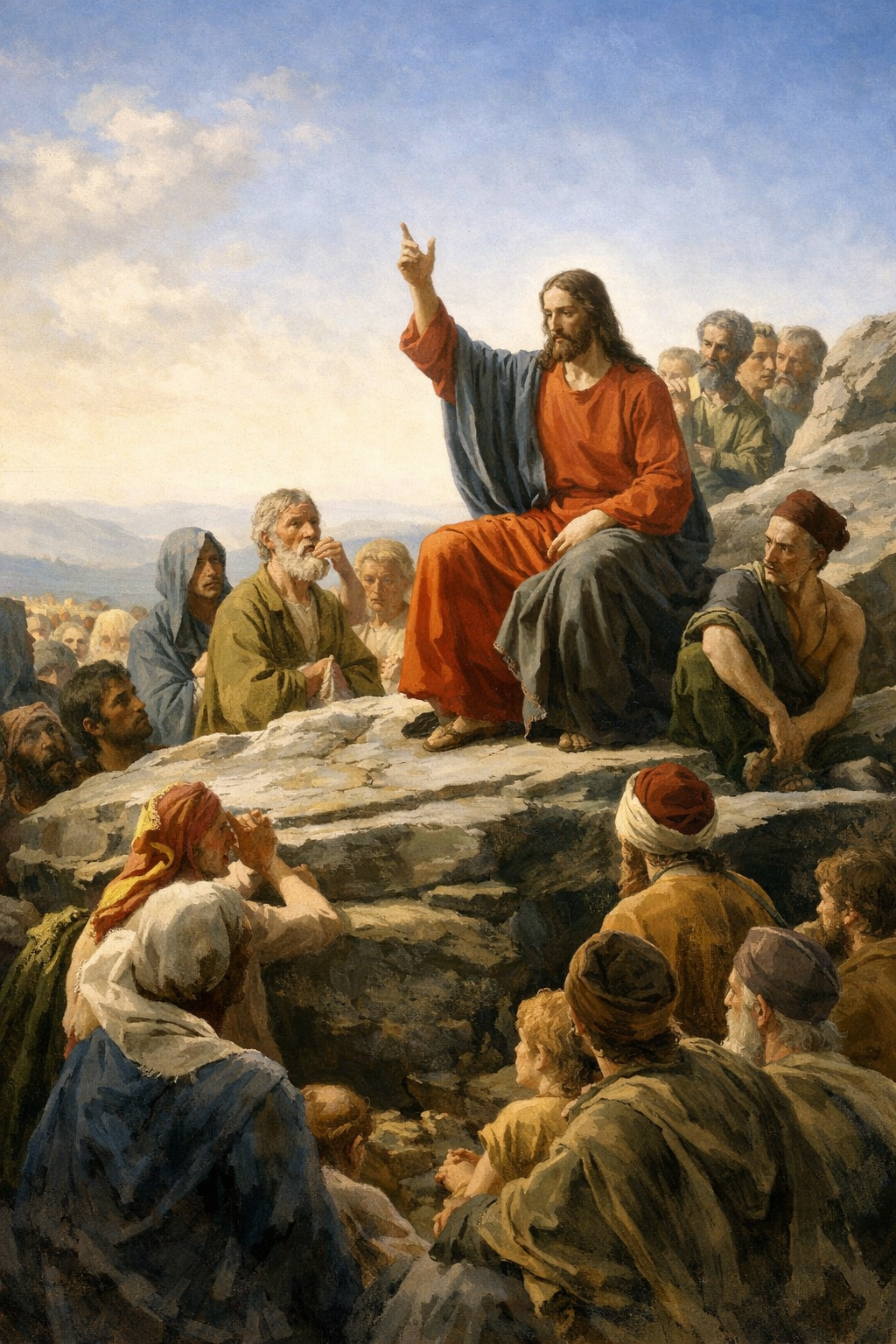
Sermon on the Mount
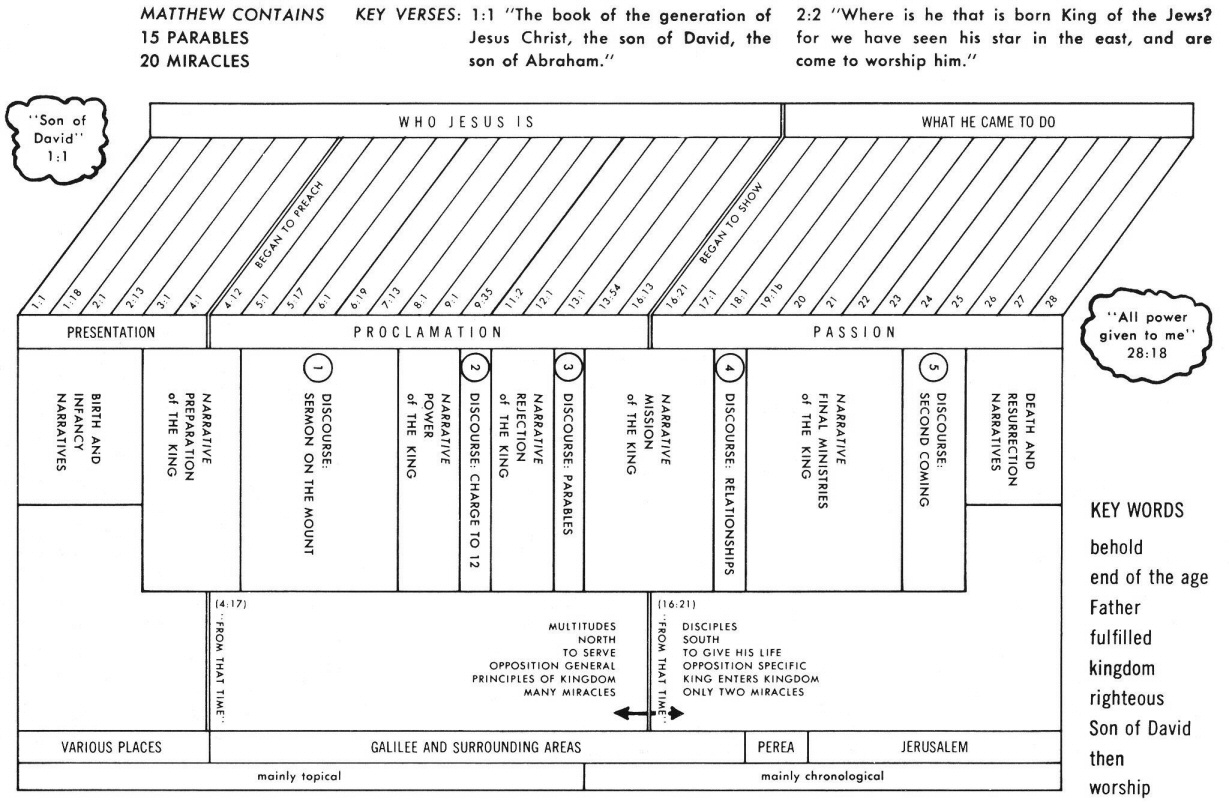
Click chart to enlarge
Charts from Jensen's Survey of the NT - used by permission
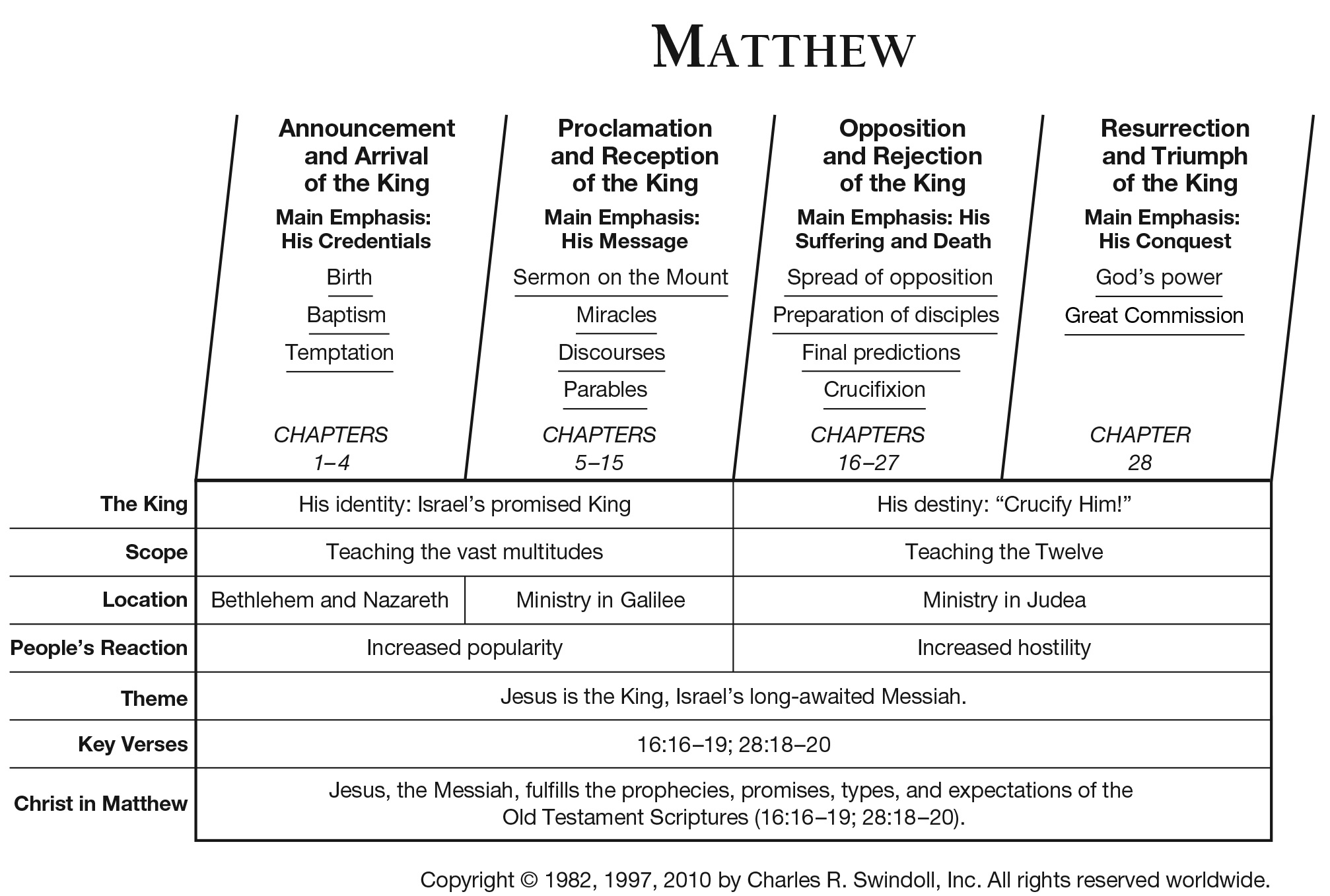
Another Chart from Charles Swindoll
THE LIFE OF JESUS AS COVERED
BY MATTHEW (shaded area)
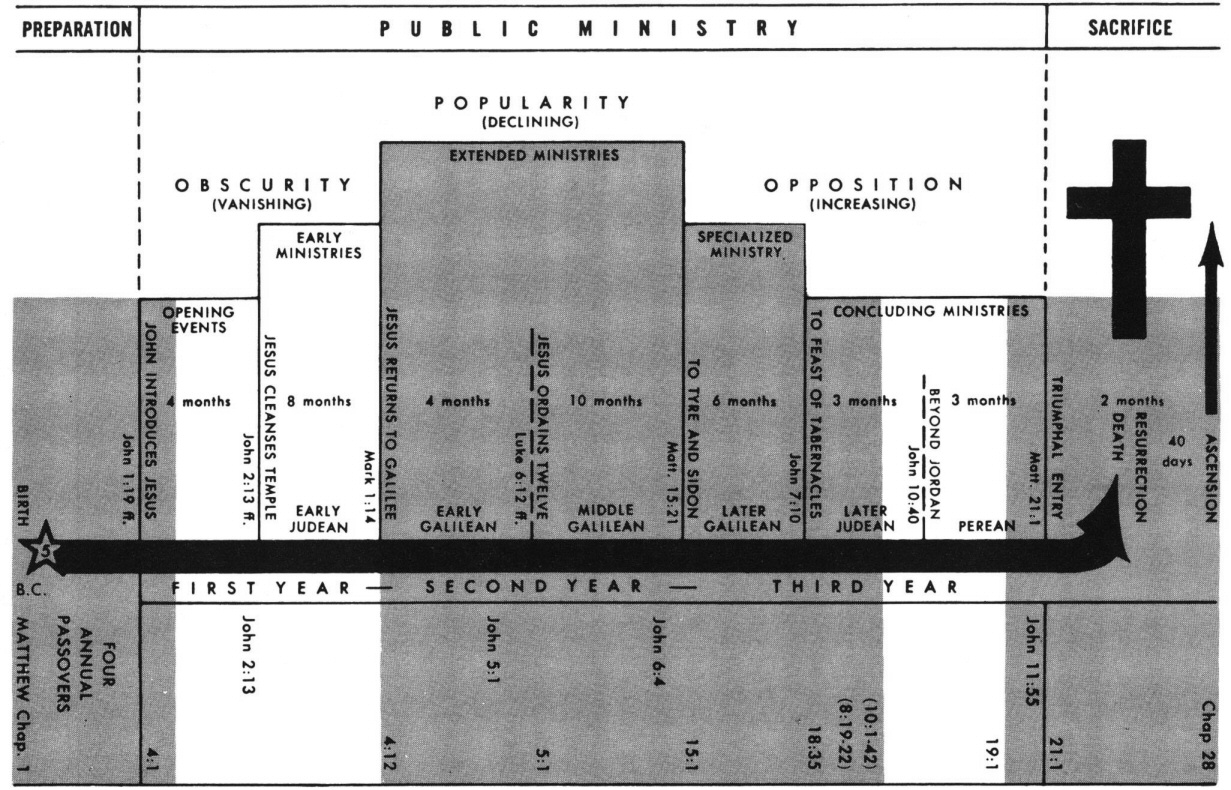
Click chart to enlarge
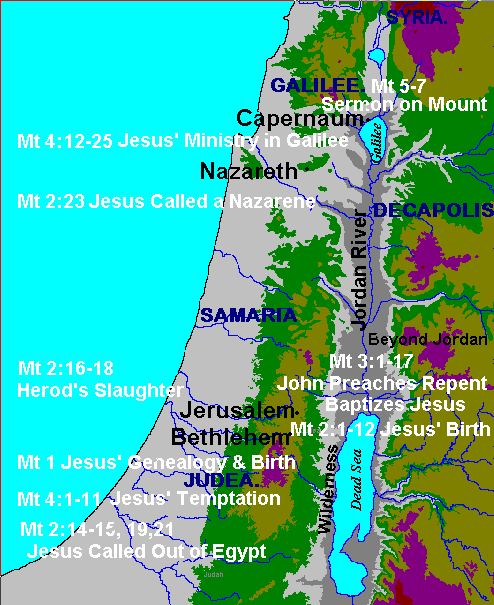
Jesus Birth and Early Years
Leading up to the Sermon on the Mount
Matthew 1-7
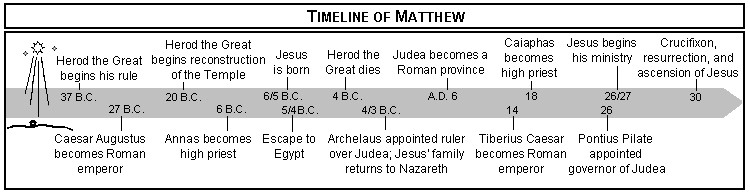
Source: Ryrie Study Bible
Matthew 5:33 Again, you have heard that the ancients were told, 'YOU SHALL NOT MAKE FALSE VOWS, BUT SHALL FULFILL YOUR VOWS TO THE LORD.' (NASB: Lockman)
Greek: Palin ekousate (2PAAI) oti errethe (3SAPI) tois archaiois, Ouk epiorkeseis, (2SFAI) apodoseis (2SFAI) de to kurio tous orkous sou.
Amplified: Again, you have heard that it was said to the men of old, You shall not swear falsely, but you shall perform your oaths to the Lord [as a religious duty]. (Amplified Bible - Lockman)
NLT: "Again, you have heard that the law of Moses says, 'Do not break your vows; you must carry out the vows you have made to the Lord.' (NLT - Tyndale House)
Philips: "Again, you have heard that the people in the old days were told - 'You shall not swear falsely, but shall perform your oaths to the Lord', (New Testament in Modern English)
Wuest: Again, you heard that it was said by those of a previous time, You shall not perjure yourself but you shall discharge your oaths with reference to the Lord.
Young's Literal: 33 'Again, ye heard that it was said to the ancients: Thou shalt not swear falsely, but thou shalt pay to the Lord thine oaths;
AGAIN, YOU HAVE HEARD THAT THE ANCIENTS WERE TOLD, 'YOU SHALL NOT MAKE FALSE VOWS: Palin ekousate (2PAAI) oti errethe (3SAPI) tois archaiois, Ouk epiorkeseis, (2SFAI) apodoseis (2SFAI)
- Mt 23:16
- Torrey's Topical Textbook = Oaths
- Matthew 5:33-37 The Spiritual Credibility Gap - John MacArthur
Related Passages:
Matthew 23:16 “Woe to you, blind guides, who say, ‘Whoever swears by the temple, that is nothing; but whoever swears by the gold of the temple is obligated.’
Lev 17:12 'And you shall not swear falsely by My name, so as to profane the name of your God; I am the LORD.
THOU SHALL NOT
FORSWEAR!
You have heard (Matt 5:21, 27, 33, 38, 43) - First He said to His listeners, "You have heard"—that's the human standard. Then He said, "But I say to you"—that's God's standard.
Jesus gives us the fourth of six illustrations of a righteousness that surpasses that of the scribes and Pharisees (Mt 5:20)
The ancients were correct in this regard to the "letter" of the Law about vows. They had simply learned how to worm their way around the Law and thus they perverted the truth inherent in these laws as discussed below.
Ancient (744) (archaios from arche = beginning) means old, expressing that which was from the beginning in contrast to palaiós (3820), old, as having existed a long period of time. Archaíos reaches back to a beginning, whenever that beginning may have been.
Archaios - 11x in 11v -NAS renders it as - ancient(2), ancients(2), early(1), long standing(1), of old(4), old things(1). Matt 5:21, 33; Luke 9:8, 19; Acts 15:7, 21; 21:16; 2 Cor 5:17; 2 Pet 2:5; Rev 12:9; 20:2.
False vows (1964)(epiorkeo from epíorkos as in 1Ti 1:10 = a perjured person from epí = against, + hórkos = an oath) means to commit perjury, to forswear self, to swear falsely, to not fulfill one’s oath.To swear falsely, not to fulfill one's oath.Vine - signifies "to swear falsely, to undo one's swearing, forswear oneself" (epi, "against," orkos, "an oath"), Matthew 5:33 . Cp. epiorkos, "a perjured person, a perjurer," , "false swearers." (Vine's Expository Dictionary of NT Words)
Gilbrant - In classical Greek the word epiorkeō (sometimes spelled ephiorkeo) occasionally means simply “to swear” but usually refers to a false oath. Moulton-Milligan describes its use in the legal formula: “If my oath is kept (euorkeō), may it be well with me; but if false (epiorkeō), the reverse.” The New Testament uses it only in Matthew 5:33 where Jesus described one of the traditional interpretations of the Old Testament regulations. The verse contrasts it with the virtue of performing any vow made to God and thus refers in this context to the sin of making a solemn vow to God and not carrying it out. The word can also be used to describe an assertion reinforced by a reference to God, one which is intentionally deceptive. (Complete Biblical Library)
Webster's 1828 forswear = (v. i.) To swear falsely; to commit perjury. (v. i.) To deny upon oath. (v. i.) To reject or renounce upon oath; hence, to renounce earnestly, determinedly, or with protestations.
Webster's 1828 perjure = To cause to violate an oath or a vow; to cause to make oath knowingly to what is untrue; to make guilty of perjury; to forswear; to corrupt; - often used reflexively; as, he perjured himself.(v. t.) To make a false oath to; to deceive by oaths and protestations.
King James Dictionary = FORSWEAR, pret. forswore pp. forsworn. See Swear and Answer. 1. To reject or renounce upon oath. 2. To deny upon oath. Like innocence, and as serenely bold as truth, how loudly he forswears thy gold. To forswear one's self, is to swear falsely to perjure one's self. Thou shalt not forswear thyself. Matthew 5 . FORSWEAR, To swear falsely to commit perjury. As Jesus explains, the issue is not so much about vows per se as it is about speaking the truth from our heart of integrity.
Charles Simeon - AMONGST persons unaccustomed to hear the peculiar doctrines of the Gospel, a kind of jealousy is often excited by the very recital of the text; especially if the preacher be known to be zealous for those doctrines, and the passage which he has selected evidently inculcates them. This feeling is manifestly wrong; and every one who loves the Gospel sees in a moment the evil of indulging it. But is this feeling peculiar to those who are ignorant of the Gospel? No; by no means: for religious people themselves are too apt to yield to it, when any text is announced which leads only to the discussion of some moral subject. But if this feeling be wrong in the unenlightened part of mankind, it is a thousand times more so in those who profess to be enlightened, and who ought on that very account to love every portion of the sacred volume, and gladly to hear every truth insisted on in its season. The subject of swearing does not seem to promise much edification to an audience conversant with the sublimer mysteries of our religion: but, if our blessed Lord saw fit to speak of it so fully in his Sermon on the Mount, we may be sure that our time cannot be misspent in investigating, as we purpose to do (Read the entire sermon - Matthew 5:33-37 Swearing Forbidden)
Kent Hughes illustrates the desire for truth in the prayer of the chaplain of the Kansas Senate - "Omniscient Father: Help us to know who is telling the truth. One side tells us one thing, and the other just the opposite. And if neither side is telling the truth, we would like to know that, too. And if each side is telling half the truth, give us the wisdom to put the right halves together. In Jesus' name, Amen.(BORROW Sermon on the Mount: The Message of the Kingdom)
This prayer highlights what we all know to be just as true in America as it was in Israel in Jesus' day...truth is a vanishing breed. In fact a recent book (1991), The Day America Told the Truth-What People Really Believe About Everything That Really Matters (borrow) chronicles the decline of truth.
Hughes agrees and goes on to add that "Today there is an urgent truth shortage! There was a time when western culture was distinguished from other cultures by at least a conventional outward sense of obligation to tell the truth. But now there is a pervasive indifference to truth-telling, and this has not only infected day-to-day conversation but the most solemn pledges of life. Perjury under solemn oath is epidemic. The sacred vows of marriage are broken almost as often as repeated. God's name is invoked by blatant liars who purport to be witnesses to the truth. There is, indeed, a crisis, but we must not make the mistake of thinking it occurs only out there because it happens among us too. It is difficult to always tell the truth. The great preacher and writer George Macdonald wrote to his son on December 6, 1878, "I always try - I think I do - to be truthful. All the same I tell a great many lies." I identify with that. I am speaking to someone and suddenly realize that what I am saying is not the truth. Perhaps you have experienced the same. The difficulty comes from the combination of my own deceitful nature and the pervasive deceptiveness of the surrounding culture. (BORROW Sermon on the Mount: The Message of the Kingdom)
BACKGROUND ON
OATHS & VOWS
OATHS - A solemn affirmation accompanied by an appeal to the Supreme Being. God has prohibited all false oaths, and all useless and customary swearing in ordinary discourse; but when the necessity or importance of a matter requires an oath, he allows men to swear by his name, Exodus 22:11 Leviticus 5:1 . To swear by a false god was an act of idolatry, Jeremiah 5:7 12:16. Among the Hebrews an oath was administered by the judge, who stood up, and adjured the party who was to be sworn. In this manner our Lord was adjured by Caiaphas, Matthew 26:63 . Jesus had remained silent under long examination, when the high priest, rising up, knowing he had a sure mode of obtaining an answer said, "I adjure thee by the living God, that thou tell us whether thou be the Christ." To this oath, thus solemnly administered, Jesus replied that he was indeed the Messiah. — — An oath is a solemn appeal to God, as to an all-seeing witness that what we say is true, and an almighty avenger if what we say be false, Hebrews 6:16 . Its force depends upon our conviction of the infinite justice of God; that he will not hold those guiltless who take his name in vain; and that the loss of his favor immeasurable outweighs all that could be gained by false witness. It is an act of religious worship; on which account God requires it to be taken in his name, Deuteronomy 10:20 , and points out the manner in which it ought to be administered, and the duty of the person who swears, Exodus 22:11 Deuteronomy 6:18 Psalm 15:4 24:4 . Hence atheists, who profess to believe that there is no God, and persons who do not believe in a future state of reward and punishment, cannot consistently take an oath. In their mouths an oath can be only profane mockery.
God Himself is represented as confirming his promise by oath, and thus conforming to what is practiced among men, Hebrews 6:13,16-17 . The oaths forbidden in Matthew 5:34-35 James 5:12 , must refer to the unthinking, hasty, and vicious practices of the Jews; otherwise Paul would have acted against the command of Christ, Romans 1:9 Galatians 1:20 2 Corinthians 1:23 . That person is obliged to take an oath whose duty requires him to declare the truth in the most solemn and judicial manner; though undoubtedly oaths are too often administered unnecessarily and irreverently, and taken with but slight consciousness of the responsibility thus assumed. As we are bound to manifest every possible degree of reverence towards God, the greatest care is to be taken that we swear neither rashly nor negligently in making promises. To neglect performance is perjury, unless the promise be contrary to the law of nature and of God; in which case no oath is binding. See CORBAN. A customary formula of taking an oath was "The Lord do so to me, and more also;" that is, the lord slay me, as the victim sacrificed on many such occasions was slain, and punish me even more than this, if I speak not the truth, Ruth 1:17 1 Samuel 3:17 . Similar phrases are these: "As the Lord liveth," Judges 8:19 "Before God I lie not," Romans 9:1; "I say the truth in Christ," 1 Timothy 2:7; "God is my record," Philippians 1.8 . Several acts are alluded to as accompaniments of an oath; as putting the hand under the thigh, Genesis 24:2 47:29; and raising the hand towards heaven, Genesis 14:22,23 Deuteronomy 32:40 Revelation 10:5 .
VOWS - A promise made to God of doing some good thing or abstaining from some lawful enjoyment, under the influence of gratitude for divine goodness, of imminent danger, the apprehension of future evils, or the desire of future blessings. To fulfill a vow binding one to sin, was to all sin to sin; but no considerations of inconvenience or loss could absolve one from a vow, Psalm 15:4 Malachi 1:14 . Jacob, going into Mesopotamia, vowed the tenth of his estate, and promised to offer it at Beth-el, to the honor of God, Genesis 28:20-22 . Moses enacted several laws for the regulation and execution of vows. "If thou shalt forbear to vow, it shall be no sin in thee; that which is gone out of thy lips thou shalt keep and perform," Deuteronomy 23:21,23 Ecclesiastes 5:4-5 . — — The vows of minors, etc., were not binding without the consent of the head of the family, Numbers 30:1-16 . A man might devote himself or his children to the Lord, Numbers 6:2. Jephthah devoted his daughter, Judges 11:30-40; and Samuel was vowed and consecrated to the service of the Lord, 1 Samuel 1:11,27,28 . If men or women vowed themselves to the Lord, they were obliged to adhere strictly to his service, according to the conditions of the vow; but in some cases they might be redeemed, Leviticus 27:1-34 . These self imposed services were more in keeping with the ancient dispensation, in which outward sacrifices and observances had so large a share, than with enlightened Christianity. See CORBAN, and . NAZARITES (American Tract Society Bible Dictionary)
RELATED RESOURCES ON OATH:
- See Interesting Comments by William Barclay on Jewish Oaths
- American Tract Society • Oath
- Bridgeway Bible Dictionary • Oath
- Charles Buck Dictionary • Supremacy, Oath of • Oath
- Easton's Bible Dictionary • Oath
- Fausset Bible Dictionary • Oath
- Holman Bible Dictionary • Oaths
- Hastings' Dictionary of the Bible • Oaths
- Hastings' Dictionary of the NT • Oath • Oaths
- Morrish Bible Dictionary • Oath
- Vines' Expository Dictionary • Oath
- Webster Dictionary • Oath • Oathable • Oaths
- Watson's Theological Dictionary • Oath
- 1911 Encyclopedia Britannica • Oath
- International Standard Bible Encyclopedia • Oath
- Kitto Biblical Cyclopedia • Oath
- McClintock and Strong's Bible Encyclopedia • Oath (2) • Oath
- The Jewish Encyclopedia • Oath
- Nave Topical Bible • Oath
- Thompson Chain Reference • Oaths
The lawful purpose of, explained Hebrews 6:16
Antiquity of Genesis 14:22; 24:3,8
USED FOR
Confirming covenants Genesis 26:28; 31:44,53; 1 Samuel 20:16,17
Deciding controversies in courts of law Exodus 22:11; Numbers 5:19; 1 Kings 8:31
Pledging allegiance to sovereigns 2 Kings 11:4; Ecclesiastes 8:2
Binding to performance of sacred duties Numbers 30:2; 2 Chronicles 15:14,15; Nehemiah 10:29; Psalm 132:2
Binding to performance of any particular act Genesis 24:3,4; 50:25; Joshua 2:12
Judicial from of administering 1 Kings 22:16; Matthew 26:63
Often accompanied by raising up the hand Genesis 14:22; Daniel 12:7; Revelation 10:5,6
Often accompanied by placing the hand under the thigh of the Person sworn to Genesis 24:2,9; 47:29
To be taken in fear and reverence Ecclesiastes 9:2
THE JEWS
Forbidden to take, in name of idols Joshua 23:7
Forbidden to take in the name of any created thing Matthew 5:34-36; James 5:12
Forbidden to take false Leviticus 6:3; Zechariah 8:17
Forbidden to take rash, or unholy Leviticus 5:4
To use God's name alone in Deuteronomy 6:13; 10:20; Isaiah 65:16
To take, in truth, judgment, &c Jeremiah 4:2
Generally respected the obligation of Joshua 9:19,20; 2 Samuel 21:7; Psalm 15:4; Matthew 14:9
Fell into many errors respecting Matthew 23:16-22
Often guilty of rashly taking Judges 21:7; Matthew 14:7; 26:72
Often guilty of falsely taking Leviticus 6:3; Jeremiah 5:2; 7:9
Condemned for false Zechariah 5:4; Malachi 3:5
Condemned for profane Jeremiah 23:10; Hosea 4:2
INSTANCES OF RASH, &c
Joshua, &c Joshua 9:15,16
Jephthah Judges 11:30-36
Saul 1 Samuel 14:27,44
Herod Matthew 14:7-9
The Jews who sought to kill Paul Acts 23:21
Custom of swearing by the life of the king Genesis 42:15,16
EXPRESSIONS USED AS
By the fear of Isaac Genesis 31:53
As the Lord liveth Judges 8:19; Ruth 3:13
The Lord do so to me, and more also Ruth 1:17
God do so to thee, and more also 1 Samuel 3:17
By the Lord 2 Samuel 19:7; 1 Kings 2:42
God do so to thee and more also 1 Samuel 3:17
Before God I lie not Galatians 1:20
I call God for a record 2 Corinthians 1:23
God is witness 1 Thessalonians 2:5
I charge you by the Lord 1 Thessalonians 5:27
As thy soul liveth 1 Samuel 1:26; 25:26
God used, to show the immutability of his counsel
Genesis 22:16; Numbers 14:28; 6:17
QUESTION - What does it mean to let your yes be yes and your no be no -
ANSWER - Jesus said, “Let your communication be, Yea, yea; Nay, nay: for whatsoever is more than these cometh of evil” (Matthew 5:37, KJV). The NIV clarifies the meaning of Jesus’ words somewhat: “All you need to say is simply ‘Yes’ or ‘No’; anything beyond this comes from the evil one.” The context of this verse has to do with oath-keeping. We’ll take a look at the broader context of Jesus’ sermon:
Matthew 5 is part of the Sermon on the Mount. In this section, Jesus addresses some of the underlying principles of certain Old Testament laws. There are some cases in which a person could obey the letter of the law but still be guilty of breaking the principle. The Pharisees and teachers were experts at keeping the letter of the law, but Jesus warns His hearers that, unless their righteousness surpasses that of the Pharisees and teachers of the law, they will never enter the kingdom of heaven (Matthew 5:20). This statement would have shocked His hearers, because the Pharisees and scribes were looked up to as paragons of obedience. Jesus points out that technical obedience is not enough if the spirit of the law is broken.
In Matthew 5:21–22, Jesus teaches that it is not enough to be “technically” innocent of murder because one can have murderous thoughts and attitudes without carrying out the physical act. In Matthew 5:27–28, Jesus says it is not enough to be “technically” innocent of adultery because a lustful look destroys one’s purity of thought. In Matthew 5:31–32, Jesus teaches that divorcing a wife for an inadequate reason, even when the “proper paperwork” is filed, may not be a legitimate divorce in God’s eyes.
In Matthew 5:33–37, following the same pattern, Jesus addresses the subject of telling the truth. Jesus tells the crowd not to break their oaths. An oath was a promise to do or not do something, invoking God as witness and the One to bring judgment if the promise was broken. It was common for people to make oaths to emphasize their seriousness and truthfulness. Sometimes they would swear on something less than God, such as “heaven.” The point of the lesser oath was to allow some flexibility in breaking the oath—since God’s name had not been invoked, they reasoned, breaking the oath wasn’t that bad. In this case, the oath was being made by a person who was not afraid to break it, making the oath duplicitous. Instead of varying the “sincerity level” of oaths, Jesus says to simply say “Yes” or “No” and mean it. The invocation of God’s name is a mere technicality. Mouthing a meaningless oath does not create loopholes for yourself. Your word should be your promise. Jesus says that, oath or no oath, simply say what you mean and stick by it.
Here is the whole context: “You have also heard that our ancestors were told, ‘You must not break your vows; you must carry out the vows you make to the Lord.’ But I say, do not make any vows! Do not say, ‘By heaven!’ because heaven is God’s throne. And do not say, ‘By the earth!’ because the earth is his footstool. And do not say, ‘By Jerusalem!’ for Jerusalem is the city of the great King. Do not even say, ‘By my head!’ for you can’t turn one hair white or black. Just say a simple, ‘Yes, I will,’ or ‘No, I won’t.’ Anything beyond this is from the evil one” (Mathew 5:33–37, NLT).
In Matthew 5:34, Jesus says, “Do not swear an oath at all.” Some have interpreted this to mean that a Christian should never take an oath for any reason, such as testifying in court. A witness is “sworn in” raising his or her right hand (and sometimes placing the other hand on a Bible) and promising to “tell the truth, the whole truth, and nothing but the truth.” However, the point of Jesus’ teaching is not that taking an oath in this manner is wrong. Taking a meaningless oath in order to create a loophole and retain the option of breaking it is wrong. If an oath is required in the course of civic duty, the Christian should have no problem making it. The proper application of Jesus’ principle of “let your yes be yes” is that the Christian must be truthful in all circumstances.Gotquestions.org
QUESTION - What does the Bible say about keeping your vows / oaths?
ANSWER - There are about 30 biblical references to vows, most of which are from the Old Testament. The books of Leviticus and Numbers have several references to vows in relation to offerings and sacrifices. There were dire consequences for the Israelites who broke vows, especially vows to God.
The story of Jephthah illustrates the foolishness of making vows without understanding the consequences. Before leading the Israelites into battle against the Ammonites, Jephthah—described as a mighty man of valor—made a rash vow that he would give to the Lord whoever first came out of doors to meet him if he returned home as the victor. When the Lord granted him victory, the one who came out to meet him was his daughter. Jephthah remembered his vow and offered her to the Lord (Judges 11:29–40). Whether or not Jephthah should have kept this vow is dealt with in another article. What this account shows is the foolishness of rash vows.
Jesus taught concerning vows, “You have heard that it was said to the people long ago, ‘Do not break your oath, but keep the oaths you have made to the Lord.’ But I tell you, Do not swear at all: either by heaven, for it is God’s throne; or by the earth, for it is his footstool; or by Jerusalem, for it is the city of the Great King. And do not swear by your head, for you cannot make even one hair white or black. Simply let your ‘Yes’ be ‘Yes,’ and your ‘No ,’ ‘No’; anything beyond this comes from the evil one” (Matthew 5:33–37).
A little background information is helpful in understanding Jesus’ words here. The religious leaders of the day advocated keeping a vow if it was a public vow using God’s name; however, if the vow was made in the course of everyday conversation, referencing only “heaven” or “earth” or “Jerusalem,” it was not really binding. People had a loophole. They could lie or exaggerate in their conversations and lend themselves an air of credibility by saying, “I swear by heaven that this is true!” They could not be held to account because they did not specifically swear by God’s name and the vow was private. Jesus countered that idea. If you swear something, it had better be true, He says. In fact, all you need to say is “yes” or “no.” Your word should be good. There’s no need for overwrought expressions to bolster your case.
Psalm 15:4 describes a righteous person as one “who keeps an oath even when it hurts, and does not change their mind.” Jesus’ teaching in Matthew 5 supports this biblical principle. Oaths are binding, even when spoken frivolously or privately as part of everyday conversation. A promise is a promise, and there is no loophole in God’s eyes to allow a person to renege on an oath.
So, Jesus was not condemning all forms of promises, contracts, or agreements. Jesus was speaking of the kind of spontaneous vow made when a person says, “I cross my heart and hope to die” or “I swear on a stack of Bibles” or “I swear on my mother’s life.” Jesus warns against using those types of flippant oaths. His teaching in Matthew 5 is not meant to discourage careful, thought-out promises, such as wedding vows or a legal contract.
The principle here is clear for Christians: be careful about making vows, either to the Lord or to one another. The fact that we are prone to errors in judgment means that we may make vows foolishly or out of immaturity. Further, the informal vows we make (“I swear by all the angels in heaven!”) are completely unnecessary. Our word is our bond. Gotquestions
Related Resource:
BUT SHALL FULFILL YOUR VOWS TO THE LORD: (2SFAI) apodoseis (2SFAI) de to kurio tous orkous sou.
But - Always stop and query this term of contrast, asking What is being contrasted (why?, how?, etc), and you will usually be forced to re-read the previous passage or clause.
THOUGHT - It is not a bad thing to read the inspired, eternal Word of God slowly and deliberately! I think sometimes we read the daily newspaper Stats of our favorite football team with more deliberation and inquisitiveness than we do the eternal Word of God! Newspapers will all BURN someday! Only God's Word endures forever! Read it like you really believe it! Slowly and judiciously.
Keep in mind that in the Old Testament vows were encouraged and they were especially encouraged to be in God's Name. However, once the vow was made, it was final and could not be rescinded without consequences.
Exodus 20:7 “You shall not take the name of the Lord your God in vain, for the Lord will not leave him unpunished who takes His name in vain
Leviticus 19:12 You shall not swear falsely by My name, so as to profane the name of your God; I am the Lord.
Deuteronomy 5:11 ‘You shall not take the name of the Lord your God in vain, for the Lord will not leave him unpunished who takes His name in vain.
Deuteronomy 23:23 “You shall be careful to perform what goes out from your lips, just as you have voluntarily vowed to the Lord your God, what you have promised.
Psalm 50:14 Offer to God a sacrifice of thanksgiving and pay your vows to the Most High;
Spurgeon: And pay thy vows unto the most High. Let the sacrifice be really presented to the God who sees the heart, pay to him the love you promised, the service you covenanted to render, the loyalty of heart you have vowed to maintain. O for grace to do this! O that we may be graciously enabled to love God, and live up to our profession! To be, indeed, the servants of the Lord, the lovers of Jesus, this is our main concern. What avails our baptism, to what end our gatherings at the Lord's table, to what purpose our solemn assemblies, if we have not the fear of the Lord, and vital godliness reigning within our bosoms?
Psalm 76:11 Make (command) vows to the Lord your God and fulfill (command) them; Let all who are around Him bring gifts to Him who is to be feared.
Spurgeon: Vow, and pay unto the Lord your God. Well may we do so in memory of such mercies and judgments. To vow or not is a matter of choice, but to discharge our vows is our bounden duty. He who would defraud God, his own God, is a wretch indeed. He keeps his promises, let not his people fail in theirs. He is their faithful God and deserves to have a faithful people. — — Let all that be round about him bring presents unto him that ought to be feared. Let surrounding nations submit to the only living God, let his own people with alacrity present their offerings, and let his priests and Levites be leaders in the sacred sacrifice. He who deserves to be praised as our God does, should not have mere verbal homage, but substantial tribute. Dread Sovereign, behold I give myself to thee.
1) To whom vows may be made. Not to man, but God. — — 2) What vows should be thus made.
Of self dedication. — Of self service. — Of self sacrifice. — How kept: Vow and pay. — From duty. — From fear of his displeasure. G. R.
Ecclesiastes 5:4 When you make a vow to God, do not be late in paying it; for He takes no delight in fools. Pay what you vow! 5 It is better that you should not vow than that you should vow and not pay. 6 Do not let your speech cause you to sin and do not say in the presence of the messenger of God that it was a mistake. Why should God be angry on account of your voice and destroy the work of your hands?
Fulfill (591) (apodidomi [word study] from apó = from + didomi = give) means to pay or give back, implying a debt. This word carries the idea of obligation and responsibility for something that is not optional. The prefixed preposition apo (off, away from) makes the verb mean “to give off” from one’s self. To give back or pay back or to do something necessary in fulfillment of an obligation or expectation. The idea is that the one who gives a vow must fulfill His promise to meet his "obligation".
Fulfill - 48x in 46v- NAS = account*(1), award(1), fulfill(2), gave back(2), give(3), give back(1), given over(1),giving(1), make (1), paid(2), paid up(1), pay(2), pay back(4), recompense(1), render(7), repay(10), repayment to be made(1), repays(1), returning(1), sold(3), yielding(1), yields(1). Matt 5:26, 33; 6:4, 6, 18; 12:36; 16:27; 18:25f, 28ff, 34; 20:8; 21:41; 22:21; 27:58; Mark 12:17; Luke 4:20; 7:42; 9:42; 10:35; 12:59; 16:2; 19:8; 20:25; Acts 4:33; 5:8; 7:9; 19:40; Rom 2:6; 12:17; 13:7; 1 Cor 7:3; 1Thess 5:15; 1 Tim 5:4; 2 Tim 4:8, 14; Heb 12:11, 16; 13:17; 1 Pet 3:9; 4:5; Rev 18:6; 22:2, 12.
Expositor's Greek Testament says that "the Scribes misplaced the emphasis (on the significance of oaths). They had a great deal to say, in sophistical style, of the oaths that were binding and not binding, (but) nothing about the fundamental requirement of truth in the inward parts (see Ps 51:6 below)
Behold, Thou dost desire truth in the innermost being, And in the hidden part Thou wilt make me know wisdom. (Ps 51:6).
Spurgeon: Thou dost desire truth in the inward parts. Reality, sincerity, true holiness, heart fidelity, these are the demands of God. He cares not for the pretence of purity, He looks to the mind, heart, and soul. Always has the Holy One of Israel estimated men by their inner nature, and not by their outward professions; to Him the inward is as visible as the outward, and He rightly judges that the essential character of an action lies in the motive of him who works it.
Ryrie helps us understand how the scribes and Pharisees were perverting the Old Testament passages on vows noting that "Oaths taken in the name of the Lord were binding, and perjury was strongly condemned in the law (Ex. 20:7; Lev. 19:12; Deut. 19:16, 17, 18, 19). Every oath contained an affirmation or promise and an appeal to God as the omniscient punisher of falsehoods, which made the oath binding. Thus we find phrases like "as the Lord lives" (1Sam. 14:39). The emphasis on the sanctity of oaths led to the feeling that ordinary phrasing need not be truthful or binding. (The Ryrie Study Bible: New American Standard Translation: 1995. Moody Publishers) (Bolding added)
In other words, when the scribes and Pharisees made an oath in the name of the LORD, that oath must be kept. On the other hand if one made an oath without expressly use the LORD's name (this is the "catch", the "fine print" so to speak) this oath was considered to be of lesser significance and did not demand one to be quite so conscientious about keeping it. And so the practice had come into vogue of making oaths "by heaven", "by earth", "by Jerusalem", "by the Temple", etc. Later in Matthew Jesus again castigates the scribes and Pharisees for their abuse of oaths declaring "Woe to you, blind guides, who say, 'Whoever swears by the temple, that is nothing; but whoever swears by the gold of the temple, he is obligated.... And, 'Whoever swears by the altar, that is nothing, but whoever swears by the offering upon it, he is obligated." (Mt 23:16,18)
In this example of manipulation of truth by the scribes and Pharisees, they (illogically) reasoned that swearing by the temple, did not obligate one to fulfill their vow, but swearing by the gold of the temple, obligated them to fulfill the vow. Similarly, they hypocritically reasoned that swearing by the gift on the altar was binding, but swearing by the empty altar was not. What they did was value gold above God since the temple was the house of God.
In the following verse, Mt 5:34, Jesus clearly forbids such hypocritical swearing (see below).
Vows (KJV = oaths) (3727) (horkos) "is primarily equivalent to herkos, "a fence, an enclosure, that which restrains a person;" hence, "an oath." The Lord's command in Matthew 5:33 was a condemnation of the minute and arbitrary restrictions imposed by the scribes and Pharisees in the matter of adjurations (Webster = a solemn charging on oath, or under the penalty of a curse; an earnest appeal), by which God's Name was profaned. The injunction is repeated in James 5:12 . The language of the Apostle Paul, e.g., in Galatians 1:20; 1Thessalonians 5:27 was not inconsistent with Christ's prohibition, read in the light of its context. Contrast the "oaths" mentioned in Matthew 14:7,9; 26:72; Mark 6:26 .Hebrews 6:16 refers to the confirmation of a compact among men, guaranteeing the discharge of liabilities; in their disputes "the oath is final for confirmation." This is referred to in order to illustrate the greater subject of God's "oath" to Abraham, confirming His promise; cp. Luke 1:73; Acts 2:30. (Vine's Expository Dictionary of NT Words = Oath)
Kitto - Oath, an appeal to God in attestation of the truth of what you say, or in confirmation of what you promise or undertake. Cicero correctly terms an oath a religious affirmation; that is, an affirmation with a religious sanction. Hence it appears that there are two essential elements in an oath: first, the human, a declared intention of speaking the truth, or performing the action in a given case; secondly, the divine, an appeal to God, as a Being who knows all things and will punish guilt. According to usage, however, there is a third element in the idea which 'oath' commonly conveys, namely, that the oath is taken only on solemn, or, more specifically, on juridical occasions. The essence of an oath lies obviously in the appeal which is thereby made to God, or to divine knowledge and power. The customary form establishes this, 'So help me God.' The Latin words (known to have been used as early as the sixth century), whence our English form is taken, may be thus rendered: so may God and these holy gospels help me; that is, 'as I say the truth.' The present custom of kissing a book containing the Gospels has in England taken place of the latter clause in the Latin formula. Oaths did not take their origin in any divine command. They were a part of that consuetudinary law which Moses found prevalent, and was bound to respect, since no small portion of the force of law lies in custom, and a legislator can neither abrogate nor institute a binding law of his own mere will. Accordingly, Moses made use of the sanction which an oath gave, but in that general manner, and apart from minute directions and express words of approval; which shows that he merely used, without intending to sanction, an instrument that he found in existence and could not safely dispense with. Examples are found in , where an oath is ordered to be applied in the case of lost property; and here we first meet with what may strictly be called a judicial oath. (For full article see Kitto's Popular Cyclopedia of Biblical Literature = Oath - as an aside, C H Spurgeon spoke very highly of Kitto's work.)
Lord (2962) (kurios/kyrios from kuros = might or power, related to kuroo = to give authority) primarily means the possessor, owner, master, the supreme one, one who is sovereign (e.g., Roman emperors - Acts 25:26) and possesses absolute authority, absolute ownership rights and uncontested power. Kurios is used of the one to whom a person or thing belonged, over which he has the power of deciding, the one who is the master or disposer of a thing (Mk 7:28)
- See in depth 10 page discussion of kyrios in The New International Dictionary of New Testament Theology (NIDNTT)
Kurios has a variety of meanings/uses in the NT and therefore one must carefully examine the context in order to discern which sense is intended by the NT author. For example, some passages use kurios only as a common form of polite address with no religious/spiritual meaning. The reader should also be aware that in view of the fact that kurios is used over 9000 times in the Septuagint (LXX) and over 700 times in the NT, this discussion of kurios at best only "skims the surface" of this prodigious, precious word. W E Vine's summary below gives you a sense of variety of nuances of kurios.
Colin Brown (editor) - Classic Greek- kyrios (attested from Pindar on) adj. having power, authoritative, from to kyros, power, might; as a noun, lord, ruler, one who has control (over people things, himself). kyrios always contains the idea of legality and authority. kyrios is often used beside despotés which means especially an owner (with overtones of high-handedness). Later anyone occupying a superior position was referred to quite generally as kyrios and addressed as kyrie (fem. kyria). From here it penetrated as a loan-word into the Heb. of the Talmud and Midrash, and also into Aram. (cf. e.g. Tg. Job 5:2; Tg. Ps. 53:1) to denote God. (NOTE -- CLICK HERE FOR 10 PAGE IN DEPTH TREATMENT OF KYRIOS IN THE The New International Dictionary of New Testament Theology NIDNTT - page 590)
Gilbrant - Classical Greek Originally kurios was an adjective which meant “to have power, authority.” The term also functioned as a noun, and in that case it meant “lord, master, ruler.” It could be an address reserved for those with a superior status (“sir”). In classical Greek kurios might be applied to the gods, but it was not usually a divine title. That did not happen until the later Hellenistic period when the Oriental emperors over the Greek people took the title for themselves, according to their custom. Later, some Roman emperors also employed the title kurios to themselves. They also promoted the notion of emperor worship and considered themselves divine. Here is where the term came to have religious connotations. Since Christians were unable to acknowledge such “gods,” they often met with severe persecution from the official government.
Septuagint Usage - The Septuagint records kurios more than 9,000 times. The term equals such Hebrew words as ’ādhôn, and bā‛al, and the Aramaic term marē (cf. marana-tha, “our Lord come”), which all mean “lord.” Furthermore, gᵉvîr (“commander”) and shallîṯ (“ruler”) are also translated by kurios. But first and foremost kurios denotes God’s name as is depicted by the tetragrammaton (literally, “four letters”) YHWH (Yahweh). Thus kurios occurs more that 6,000 times in the Septuagint for YHWH (Bietenhard, “Lord,” Colin Brown, 2:511).
New Testament Usage - Of the more than 700 times kurios occurs in the New Testament, over 200 are in Luke’s writings and nearly 280 belong to Paul. Used in reference to men, kurios ordinarily has its normal Greek understanding. It may signify the owner of either animate or inanimate objects: “lord of all” (Galatians 4:1); “master of the house” (Mark 13:35); the owners of a colt (Luke 19:33); the master of servants, slaves (Matthew 10:24f.; Acts 16:16); and many, many more usages (see e.g., Matthew 9:38; 20:8). But like the Old Testament usage, kurios in the New Testament also functions as the name of God. Each person of the Godhead—the Father, Son, and Holy Spirit—is called kurios. In the following texts kurios is the equivalent of ’ādhôn: Mark 12:11/Psalm 118:22; Mark 12:36/Psalm 110:1; Acts 4:26/Psalm 2:1f.
God is frequently called “Lord” in the Old Testament citations and allusions found in the New Testament. The Father exercises His authority as Lord over all His created universe. Jesus praised Him with the address “Lord of heaven and earth” (Matthew 11:25; Luke 10:21). This authority is primarily a result of the fact that He is the creator of the universe: “God that made the world and all things therein, seeing that He is Lord of heaven and earth . . . ” (Acts 17:24). God is the Lord of mankind, the Lord of the harvest (Matthew 9:38); He is the Lord of His church, the master of His vineyard. He has at His disposal human instruments who carry out the work of proclaiming His salvation (Matthew 21:33-43). Since the Lord is Lord in the ultimate sense, He is, moreover, the Lord of history who sovereignly governs all the earthly powers and rulers. He is the “blessed and only Ruler, the King of kings and Lord of lords” (1 Timothy 6:15, NIV).
We note that kurios is the name most frequently applied to Jesus Christ. The extensive use of the name obviously is because the writers invested this term with more than just an ordinary meaning. The title is applied in its ultimate and divine sense to Jesus. “Jesus Lord” chiefly refers to the elevated and glorified Christ. It is a title which God has given him in response to His saving work: “Wherefore (because of His abasement and death) God also hath highly exalted him, and given him a name which is above every name” (Philippians 2:9). God has, through the resurrection and the ascension of Christ to the right hand of the Father, “made that same Jesus . . . both Lord and Christ” (Acts 2:36).
The lordship of Christ is especially related to the Church. Christ is, above all else, the Lord of His people, His body. He is “our Lord Jesus Christ,” one of Paul’s most frequently used descriptions of Jesus’ relationship to His people.
Paul uniquely emphasized Christ’s lordship over the heavenly angelic powers. The underlying assumption is that the fall of man and his subsequent rebellion against God has cosmic dimensions. Christ brings everything into subjection to His lordship; everybody will be subsumed under His headship (Ephesians 1:10; Colossians 1:20). All powers are essentially conquered through His death and resurrection; the main battle has been won (Colossians 2:15). Satan’s empire has been upended (Luke 10:18; Revelation 12:8,9). Still, there remains an ultimate battle, and everything will be under Christ’s power and rule. “For he must reign, till he hath put all enemies under his feet” (1 Corinthians 15:25). This dominion of Christ is, though, only visible to the faithful (Hebrews 2:8).
The Old Testament witness to God as YHWH is remarkably applied to Jesus consistently in the New Testament. Here the New Testament is uniquely underscoring the reality that Jesus is Lord in the divine sense (e.g., Psalm 102:26f./ Hebrews 1:10-12 passim the New Testament; Isaiah 40:3; Joel 2:32/Romans 10:13; Malachi 3:1/Mark 1:2-4;). Almost 20 New Testament allusions and citations to Psalm 110 are applied to Jesus (e.g., Matthew 22:44; 26:64; Mark 12:36; Luke 20:42; Acts 2:35; Romans 8:34; passim the New Testament writings).
The goal of Christian exhortation is to encourage the believer to place every aspect of his or her life under the lordship of Christ. “But in your hearts set apart Christ as Lord” (1 Peter 3:15, NIV). To confess Christ as Lord one must be willing to faithfully carry out His perfect will. Any distortion of Christ’s commands results in catastrophe. “Why do you call me ‘Lord, Lord’ and not do what I say” (Luke 6:46, NIV; cf. Matthew 7:21). The one confessing Christ as Lord and not doing His will has built his faith on sand (Luke 6:49).
The final judgment of evil and good rests in the hands of the Lord as Lord of the universe, the world, the Church, the individual, the living, and the dead (2 Thessalonians 1:7-10). Ever since His resurrection and ascension Jesus has assumed the role of Lord (Acts 2:36; Philippians 2:5-11). The fact that Jesus Christ is seated at the right hand of God identifies Him as the authoritative arm of God. He is Lord in the ultimate sense of the word. (Complete Biblical Library)
W E Vine summarizes Kurios - Noun Masculine — kurios — koo'-ree-os ) properly an adjective, signifying "having power" (kuros) or "authority," is used as a noun, variously translated in the NT, "'Lord,' 'master,' 'Master,' 'owner,' 'Sir,' a title of wide significance, occurring in each book of the NT save Titus and the Epistles of John. It is used
(a) of an owner, as in Luke 19:33 , cp. Matthew 20:8 ; Acts 16:16 ; Galatians 4:1 ; or of one who has the disposal of anything, as the Sabbath, Matthew 12:8 ;
(b) of a master, i.e., one to whom service is due on any ground, Matthew 6:24 ; 24:50 ; Ephesians 6:5 ;
(c) of an Emperor or King, Acts 25:26 ; Revelation 17:14 ;
(d) of idols, ironically, 1 Corinthians 8:5 , cp. Isaiah 26:13 ;
(e) as a title of respect addressed to a father, Matthew 21:30 , a husband, 1 Peter 3:6 , a master, Matthew 13:27 ; Luke 13:8 , a ruler, Matthew 27:63 , an angel, Acts 10:4 ; Revelation 7:14 ;
(f) as a title of courtesy addressed to a stranger, John 12:21 ; 20:15 ; Acts 16:30 ; from the outset of His ministry this was a common form of address to the Lord Jesus, alike by the people, Matthew 8:2 ; John 4:11 , and by His disciples, Matthew 8:25 ; Luke 5:8 ; John 6:68 ;
(g) kurios is the Sept. and NT representative of Heb. Jehovah ('Lord' in Eng. versions), see Matthew 4:7 ; James 5:11 , e.g., of adon, Lord, Matthew 22:44 , and of Adonay, Lord, Matthew 1:22 ; it also occurs for Elohim, God, 1 Peter 1:25 . (Vine's Expository Dictionary of Old Testament and New Testament Words)
Friberg summarizes kurios as "strictly, a substantive of the adjective kurios (strong, authoritative); hence, one having legal power lord, master;
(1) in a nonreligious sense; (a) one controlling his own property owner, lord, master (Mk 12.9); (b) one having authority over persons lord, master (Lk 12.43);
(2) as a form of address showing respect sir, lord (Jn 4.11);
(3) in religious usage, as a designation and personal title for God (Mt 1.20) and Jesus Christ (Jn 20.18) (the) Lord; translation of the Hebrew adonai, which in the public reading of Scripture replaced the tetragrammaton YHWH." (BORROW Analytical Lexicon of the Greek New Testament )
JESUS IS — LORD
Lord is used 139 times in the NT of the Godhead (or particularly of God the Father), and 489 times directly of Jesus. Therefore at the outset should be noted that in the NT Jesus is referred to as Lord (Kurios) more frequently than by any other title. Therefore it behooves us to understand the truth concerning Jesus as Lord and not allow ourselves to become side tracked in debate over so-called "Lordship salvation". The indisputable Biblical facts are that faith in Jesus saves and Jesus is Lord. This confession of "Jesus is Lord" became a direct affront to the practice of emperor worship. Certain cities even built temples for Caesar-worship as was the case in Smyrna where the command was to honor the emperor by confessing "Caesar is Lord". To declare "Jesus is Lord" became a crime punishable by death, resulting in the martyrdom. I think the first century believers understood "Lordship" in a way modern believers would find it difficult to comprehend! (cp Jesus' "prophetic" warning in Mt 10:22, 23, 24, 25 where "master" is kurios)
Lord is not merely a name that composes a title, but signifies a call to action so that every saint should willingly, reverently bow down to Jesus Christ. If Christ is our Lord, we are to live under Him, consciously, continually submitting our wills to him as His loyal, loving bondservants ("love slaves"), always seeking first His Kingdom and His righteousness (Mt 6:33). According to this practical working "definition" beloved we all need to ask ourselves "Is Jesus Christ my Lord?". "Do I arise each day, acknowledges this is the day the Lord hath made?" (Ps 118:24) "Do I surrender my will to His will as I begin each day?" (cp Ro 12:1, Ro 12:2) Beloved, don't misunderstand. None of us have "arrived" in this area of Jesus as Lord of our lives. And it is precisely for that reason that Peter commands us to continually "grow (present imperative) in the grace (unmerited favor, power to live the supernatural, abundant life in Christ) and knowledge (not just intellectual but transformational) of our Lord and Savior Jesus Christ. To Him be the glory, both now and to the day of eternity. Amen." (2Pe 3:18) So do not be discouraged. Don't "throw in the towel" as they say. Keep on keeping on, pressing (continually = present tense) "on toward the goal for the prize of the upward call of God in Christ Jesus." (Php 3:14)
Boice adds that...
Citizens of the empire were required to burn a pinch of incense to the reigning Caesar and utter the words Kyrios Kaisar (“Caesar is Lord!”). It is this that the early Christians refused to do and for which they were themselves thrown to the wild lions or crucified. It was not that Christians were forbidden to worship God. They were free to worship any god they chose so long as they also acknowledged Caesar. Romans were tolerant. But when Christians denied to Caesar the allegiance that they believed belonged to the true God only, they were executed. (See Boice's Daniel: An Expositional Commentary- Page 69)
Thayer says kurios is "he to whom a person or thing belongs, about which he has the power of deciding; master, lord."
In classical Greek, kurios was used of the false gods, such as Hermes, Zeus, etc. Kurios was also used in secular Greek to identify the head of the family, who was lord of his wife and children (compare 1Sa 1:8, Ge 18:22 referred to in the NT - 1Pe 3:6 where "lord" = kurios)
Wayne Detzler writes that kurios - In the earliest Greek this word meant "to have power or authority." Later it came to describe one who is in control. As classical Greek developed, it became a title for men of importance. Since the gods of ancient Greece were neither creators nor lords of their fate, pagan deities were not called "lord" until much later. By the time of Christ, kings had come to be called "lord." This was true of the Roman Emperor Caligula (A.D. 37-41). It was also true of Candace, the fabled queen of upper Egypt (Ac 8:27). So too Herod the Great, Herod Agrippa I, and Herod Agrippa II were called "lord." (BORROW New Testament Words in Today's Language)
When one referred to someone as "Lord" they were not only acknowledging the position of authority, but they were also referring to someone who, in that position of authority had a concern and a passion for others who are under his authority.
Carpenter and Comfort comment that...
The Jews who first followed Jesus would have been aware that God was repeatedly called “Lord” in the Greek Old Testament (Septuagint - LXX). Thus, they knew what they were saying when they called Jesus “Lord.” To call Him Lord was to call Him “God.” When Thomas encountered the risen Christ, he proclaimed to Jesus, “My Lord and my God” (Jn 20:28). (Holman Treasury of Key Bible Words: 200 Greek and 200 Hebrew Words Defined and Explained)
Comment: Although I agree with the preceding statement, it does need to be qualified by the fact that sometimes Jesus is addressed as "Lord" by individuals in a context which does not strongly suggest they understood that they were alluding to His deity. Clearly Thomas acknowledged and confessed Jesus as Lord and as God, but examination of passages earlier in the disciples' time with Jesus are not always convincing that they fully understood He was Jehovah of the OT.
Wayne Barber - When you refer to Jesus as Lord Jesus Christ, you’re not just referring to the position He holds, but you’re referring to the compassion He feels for the people whom He oversees....Whatever He does in the authoritative position that God has put Him in is for our good.
Renn observes that "in the New Testament and usually refers to Jesus Christ as God incarnate. The title "Lord," when applied to the Messiah, signifies his divine nature. As the New Testament Greek equivalent of the Hebrew term YHWH, normally transliterated as Yahweh (GOD), it transfers to the person of Christ all those characteristics that the Hebrew title attributes to the person of God. In approximately five hundred places, kyrios refers to Jesus as "Lord," "the Lord Jesus," "the Lord Jesus Christ," or "Jesus Christ our Lord" (including slight variations in word order). (Expository Dictionary of Bible Words: Word Studies for Key English Bible Words Based on the Hebrew and Greek Texts)
William Barclay (not always thoroughly conservative and orthodox) says kurios...
is the key word of early Christianity. It has four stages of meaning. (a) It is the normal title of respect like the English sir, the French monsieur, the German herr. (b) It is the normal title of the Roman Emperors. (c) It is the normal title of the Greek gods, prefaced before the god’s name. Kurios Serapis is Lord Serapis. (d) In the Greek translation of the Hebrew scriptures it is the regular translation of the divine name, Jahveh or Jehovah. So, then, if a man called Jesus kurios he was ranking him with the Emperor and with God; he was giving him the supreme place in his life; he was pledging him implicit obedience and reverent worship. To call Jesus kurios was to count him unique. First, then, a man to be a Christian must have a sense of the utter uniqueness of Jesus Christ.
It (kurios) was the official title of the Roman Emperor. The demand of the persecutors always was, “Say, ‘Caesar is Lord (kurios).’” It was the word by which the sacred name Jehovah was rendered in the Greek translation of the Old Testament scriptures. When a man could say, “Jesus is Lord,” it meant that he gave to Jesus the supreme loyalty of his life and the supreme worship of his heart. It is to be noted that Paul believed that a man could say, “Jesus is Lord,” only when the Spirit enabled him to say it (1Co 12:3). The Lordship of Jesus was not so much something which he discovered for himself as something which God, in his grace, revealed to him.
The phrase for Lord and God (in Re 4:11) is kurios kai theos and that was the official title of Domitian, the Roman Emperor. It was, indeed, because the Christians would not acknowledge that claim that they were persecuted and killed. Simply to call God Lord and God was a triumphant confession of faith, an assertion that he holds first place in all the universe.
Green, et al...
The term kyrios was used both in religious and secular contexts in the NT era. On the one hand, both national and mystery religions, especially in the East (i.e., Egypt, Syria, Asia Minor, but also in Greece and elsewhere), frequently used the term kyrios (referring to the "male deity") or its female equivalent kyria to refer to gods and goddesses such as Isis, Serapis or Osiris. For instance, we have evidence of the use of the term in countless papyri and inscriptions of Serapis (e.g., “I thank the Lord Serapis that when I was in peril on the sea, he saved me immediately” -- Letter from Apion, a soldier in the Roman navy to his father, second century AD). Or again in a letter from a son to his mother, Nilus, in the second century AD we read, “I make intercession for you day by day to the Lord Serapis”. (Ed: Paul referred to these pagan “gods and lords” in 1Co 8:5,6 asserting that there is only one true God and one true Lord Jesus Christ)
It is quite clear in these contexts that the term kyrios connotes a deity who can answer prayers and deserves thanks for divine help... As Alfred Deissmann long ago argued, it is quite likely that the early church deliberately and polemically ascribed to Jesus titles that had already been applied to the emperor. The meaning of the term (kurios) within the Pauline communities, namely an absolute divine being to whom one belongs and owes absolute allegiance and submission, becomes all the more evident in light of the Pauline language of self-reference. Paul speaks of himself and others as douloi, “slaves,” (see doulos) in order to indicate their relationship to Jesus “the Lord” (Ro 1:1; Ro 13:4). (Green, J. B., McKnight, S., & Marshall, I. H. Dictionary of Jesus and the Gospels. Downers Grove, Ill.: InterVarsity Press - This resource is recommended you desire a scholarly, in depth discussion of kyrios regarding its secular, Jewish and NT uses)
Kurios is found 722x in 665v (GNT = Greek New Testament by Kurt Aland, et al) and 748x in 687v in the Greek Textus Receptus (used to translate KJV - eg, cp Mt 13:51NAS with Mt 13:51KJV). Kurios is used some 400x in salvation passages when we are told to believe in the Lord compared some 24 uses of the word "Savior" as a reference to Jesus (Note: To be accurate, in context some of these 24 uses of Savior refer ot the Father). Kurios is used in over 9000 verses in the OT Septuagint (LXX) and about 6000 uses of kurios translate the Hebrew (YHWH) for Jehovah and about 3000 uses translate Adon/Adonai.
In the book of Acts, Luke refers to Jesus only two times as Savior but some 92 times as Lord. As noted above, in the entire NT, Jesus is referred to as Savior far less often than He is referred to as Lord. When the two titles are mentioned together, Lord always precedes Savior. It is interesting that the last book of the Bible, the Revelation, does not refer to Jesus as Savior, but uses "Lord" some 22 times, some references indicating God the Father (Re 4:8, Re 4:11, Re 5:9, Re 11:15, 16, 17), some God the Son (Re 1:8 [some see this as the Father], Re 11:8) and once as a title of respect by John to an angel (Re 7:14). Tony Garland commenting on Revelation 1:8 writes that
Designating someone as “Lord,” especially in John’s day, could have serious implications. It was a title which Christians did not use lightly. (Quoting from Harold Foos "Christology in the Book of the Revelation" Garland adds that) “Lord (kurios) means that the bearer was worthy of divine recognition and honor. The apostolic writers and early believers were well aware of this meaning. Polycarp, for example, died as a martyr rather than call Caesar kurios."
The idea expressed by kurios in the NT is often that of one to whom a person or thing belongs or the one who has disposition of men or property...
as the owner of the vineyard (Mt 20:8; 21:40; Mk 12:9; Lk 20:13, 15)
as the Lord of the harvest (Mt. 9:38; Luke 10:2)
as the master of the house (Mk 13:35, cp Lxx - Jdg 19:12)
as Lord of the Sabbath (Mt 12:8; Mk 2:28; Lk 6:5) - as having the power to determine what is suitable to the Sabbath and of releasing Himself and others from its obligation.
Kurios = Can signify a title of honor and as such is often translated "sir" (Mt 13:27; 21:30; 27:63; Lk 13:8; Jn 4:11, 15, 19, 49; 5:7; 12:21; 20:15) which expresses respect and reverence such as when servants salute their master (Mt 13:27; Lk 13:8; Lk 14:22ESV; etc.), of a son to his father (Mt. 21:29), citizens toward magistrates (Mt 27:63)
Kurios = Used in the sense of one's husband (1Pe 3:6, Lxx of Ge 18:12).
Comment by Wuest: The word (kurios) was used as a title of the Roman emperors, the term carrying with it the implication of divinity which was ascribed to them. It is the word used for the name “Lord,” when it is applied to the Lord Jesus. It is the word which the Philippian jailer used when he said, “Sirs (kurios), what must I do to be saved?” (Ac 16:30) It is used in the sentence, “No man can keep on serving two masters (kurios)" (Mt 6:24-see notes). The word was used in secular Greek as a title of honor addressed by subordinates to their superiors, or as a courteous appellative in the case of persons closely related. In a petition to a Prefect we have, “I became very weak, my lord.” In another example we have, “I entreat you, sir, to hasten to me.”
Kurios = Lord in the sense of anyone wishing to honor a man of distinction (Mt 8:2, 6, 8; 15:27; Mk 7:28; Lk 5:12; etc.)
Kurios = Used in Acts 25:26 as a reference to the Roman emperor.
Kurios = Used in 1Co 8:5 to refer to the false, pagan "so-called gods".
Kurios = Lord as used of the disciples toward Jesus, Who was their teacher and their master (Mt. 8:25; 16:22; Lk 9:54; Jn 11:12; etc.).
Kurios = As "Master" emphasizing the one who has legal power over someone (eg slaves, servants) or some thing (property, land) - (Mt 10:24, 25, 24:45, 46, 48, 50; 25:19, 20, 21, 22, 23, 24, 26; Mk 13:35; Lk 5:5; 8:24, 45; 9:33, 49; 12:36, 37, 42, 43, 45, 46; 14:21, 22, 23; 16:3, 5, 8; 17:13; 19:16, 18, 20, 25; Jn 13:16; 15:15, 20; Acts 16:16, 19, Ro 6:9, 14; 14:4; 1Co 3:10; Ep 6:9; Col 3:22, 23, 24, Col 4:1; 2Ti 2:21; 2Pe 2:1; Jude 1:4; compare similar uses in Lxx - Ex 21:28, 29, 34, 22:8). Note that kurios translated as "Master" in the gospels often reflects the disciples interacting with the Lord. These uses indicate that they understood even if imperfectly their servile relationship to Him (excepting of course Judas Iscariot).
Compare this meaning of kurios ("Master") with the Greek word despotes [word study] (from deo = tie or bind + posis = a husband; English - "despot" which can have a negative sense of one who exercises tyrannical power) which is used 9 times in the NT (Lk 2:29 Acts 4:24 1Ti 6:1, 2, 2Ti 2:21, Titus 2:9, 1Pe 2:18, 2Pe 2:1, Rev 6:10) five of which refer to the master of the house. (See also notes below) Originally, despotes indicated absolute, unrestricted authority, so that the Greeks refused the title to any but their false gods. In NT despotes and kurios are used somewhat interchangeably of God, as well as of masters of servants. Despotes is used to refer to Christ (2Pe 2:1, Rev 6:10 Jude 1:4; cp uses of despotes in the Lxx - Ge15:2, 8; Isa 1:24) Zodhiates (Ref or Logos) adds that "Despotes wields unlimited authority, while kurios exercises morally restricted authority for good. Jesus is predominantly called Kurios, Lord, because of His omnipotent concern. God is Kurios, Lord, because He is despotes of all things (cf. Job 5:8ff.)"
Matthew 10:24 "A disciple is not above his teacher, nor a slave above his master. Mt 10:25 "It is enough for the disciple that he become like his teacher, and the slave like his master. If they have called the head of the house Beelzebul, how much more will they malign the members of his household!
Matthew 24:45 "Who then is the faithful and sensible slave whom his master put in charge of his household to give them their food at the proper time? Mt 24:46 "Blessed is that slave whom his master finds so doing when he comes.
Colossians 3:22 Slaves, in all things obey those who are your masters (kurios) on earth, not with external service, as those who merely please men, but with sincerity of heart, fearing the Lord (kurios). 23 Whatever you do, do your work heartily, as for the Lord (kurios) rather than for men; 24 knowing that from the Lord (kurios) you will receive the reward of the inheritance. It is the Lord (kurios) Christ Whom you serve. 25 For he who does wrong will receive the consequences of the wrong which he has done, and that without partiality. Col 4:1 Masters (kurios), grant to your slaves justice and fairness, knowing that you too have a Master (kurios) in heaven.
Comment: Note the parallel between the human master-slave relationship and the relationship believers have to the Lord Jesus Christ. If you are having difficulty with the concept of "Jesus as Lord", you would do well to meditate on this passage in which the apostle Paul intimately and repeatedly interweaves the secular and religious meanings of kurios. Who is the Lord of your life? Who is your Master? As one wise monarch once said, “My dominion over my subjects ends where that of God’s begins.”
1 Peter 3:15 but sanctify (set apart - aorist imperative) Christ as Lord (kurios) in your hearts ("In your hearts" is not found in the OT passage, Is 8:13, but is added by Peter to show that this acknowledgment of Christ as Lord must be at the very core or center of our being = honor Christ completely and wholeheartedly!), always being ready to make a defense to everyone who asks you to give an account for the hope that is in you, yet with gentleness and reverence
Comment: In the context (suffering for sake of righteousness - 1Pe 3:14 quoting from Is 8:12, 13) Peter commands these suffering saints to set aside Jesus Christ as the Lord and Master of their lives, Who would be their refuge, resource and defender when persecution came. Peter calls believers to reverence Jesus as the Sovereign of our lives, the implication being that all we do and say should be in His will, for His pleasure, and for His glory. In a practical application, this verse calls for the lordship of Christ to permeate every area of our lives, including our time, our possessions, our occupation, our marriage, etc, so that nothing is to be excluded from His rule. Dear believer, have you set aside as Lord in every area of your life? Our Kurios is our refuge and defender when we suffer for His Name's sake.
Matthew Poole: Exalt Him in your hearts, and give Him the honour of all His glorious perfections, power, wisdom, goodness, faithfulness, etc., by believing them, and depending upon His promises for defence and assistance against all the evils your enemies may threaten you with. (Matthew Poole's Commentary on the New Testament)
Kurios = title given to God, the ruler of the universe, with the definite article (ho = "the" - "the Lord", the definite article indicates not just any "Lord" but the one and only Lord) (Mt. 1:22; 5:33; Mk 5:19; Acts 7:33; 2Ti 1:16, 18; etc.). Kurios is used to refer to God without the definite article which stresses the nature or character (Mt. 21:9; 27:10; Mk 13:20; Lk 2:9, 23, 26; Heb. 7:21; etc.).
Kurios = Jesus as the Messiah, the Christos, Who by virtue of His death acquired the special ownership of mankind (even those who never in this present life acknowledge Him as "Lord" - see Php 2:9, 10, 11) and after His resurrection was exalted by a partnership in the divine administration (Acts 10:36; Ro 14:8; 1Co 7:22; 8:6).
Kurios - 717x in 660v in NT - 640 refer to God -
Mt 1:20, 22, 24; 2:13, 15, 19; 3:3; 4:7, 10; Mt 5:33; Mt 6:24; Mt 7:21, 22; Mt 8:2, 6, 8, 21, 25; 9:28, 38; 10:24, 25; 11:25; 12:8; 13:27; 14:28, 30; 15:22, 25, 27; 16:22; 17:4, 15; 18:21, 25, 27, 31, 32, 34; 20:8, 30, 31, 33; 21:3, 9, 30, 40, 42; 22:37, 43, 44, 45; 23:39; 24:42, 45, 46, 48, 50; 25:11, 18, 19, 20, 21, 22, 23, 24, 26, 37, 44; 26:22; 27:10, 63; 28:2; — Mk 1:3; 2:28; 5:19; 7:28; 11:3, 9; 12:9, 11, 29, 30, 36, 37; 13:20, 35; 16:19, 20; — Luke 1:6, 9, 11, 15, 16, 17, 25, 28, 32, 38, 43, 45, 46, 58, 66, 68, 76; 2:9, 11, 15, 22, 23, 24, 26, 39; 3:4; 4:8, 12, 18, 19; 5:8, 12, 17; 6:5, 46; 7:6, 13, 19; 9:54, 59, 61; 10:1, 2, 17, 21, 27, 39, 40, 41; 11:1, 39; 12:36, 37, 41, 42, 43, 45, 46, 47; 13:8, 15, 23, 25, 35; 14:21, 22, 23; 16:3, 5, 8, 13; 17:5, 6, 37; 18:6, 41; 19:8, 16, 18, 20, 25, 31, 33, 34, 38; 20:13, 15, 37, 42, 44; 22:33, 38, 49, 61; 24:3, 34; — John 1:23; 4:11, 15, 19, 49; 5:7; 6:23, 34, 68; 8:11; 9:36, 38; 11:2, 3, 12, 21, 27, 32, 34, 39; 12:13, 21, 38; 13:6, 9, 13, 14, 16, 25, 36, 37; 14:5, 8, 22; 15:15, 20; 20:2, 13, 15, 18, 20, 25, 28; 21:7, 12, 15, 16, 17, 20, 21; — Acts 1:6, 21, 24; 2:20, 21, 25, 34, 36, 39, 47; 3:20, 22; 4:26, 29, 33; 5:9, 14, 19; 7:31, 33, 49, 59, 60; 8:16, 22, 24, 25, 26, 39; 9:1, 5, 10, 11, 13, 15, 17, 27, 28, 31, 35, 42; 10:4, 14, 33, 36; 11:8, 16, 17, 20, 21, 23, 24; 12:7, 11, 17, 23; 13:2, 10, 11, 12, 44, 47, 48, 49; 14:3, 23; 15:11, 17, 26, 35, 36, 40; 16:14, 15,1 6, 19, 30, 31, 32; 17:24; 18:8, 9, 25; 19:5, 10, 13, 17, 20; 20:19, 21, 24, 35; 21:13, 14; 22:8, 10, 19; 23:11; 25:26; 26:15; 28:31 — Ro 1:4, 7; 4:8, 24; 5:1, 11, 21; 6:23; 7:25; 8:39; 9:28, 29; 10:9, 12, 13, 16; 11:3, 34; 12:11, 19; 13:14; 14:4, 6, 8, 11, 14; 15:6, 11, 30; 16:2, 8, 11, 12, 13, 18, 20, 22; — 1Cor 1:2, 3, 7, 8, 9, 31; 2:8, 16; 3:5, 20; 4:4, 5, 17, 19; 5:4, 5; 6:11, 13, 14, 17; 7:10, 12, 17, 22, 25, 32, 34, 35, 39; 8:5, 6; 9:1, 2, 5, 14; 10:21, 22, 26; 11:11, 23, 26, 27, 32; 12:3, 5; 14:21, 37; 15:31, 57, 58; 16:7, 10, 19, 22, 23 — 2Cor 1:2, 3, 14; 2:12; 3:16, 17, 18; 4:5, 14; 5:6, 8, 11; 6:17, 18; 8:5, 9, 19, 21; 10:8, 17, 18; 11:17, 31; 12:1, 8; 13:10, 13; — Gal 1:3, 19; 4:1; 5:10; 6:14, 18; — Ep 1:2, 3, 15, 17; 2:21; 3:11; 4:1, 5, 17; 5:8, 10, 17, 19, 20, 22; 6:1, 4, 5, 7, 8, 9, 21, 23, 24; — Php 1:2, 14; 2:11, 19, 24, 29; 3:1, 8, 20; 4:1, 2, 4, 5, 10, 23; — Col 1:3, 10; 2:6; 3:13, 17, 18, 20, 22, 23, 24; 4:1, 7, 17; — 1Th 1:1, 3, 6, 8; 2:15, 19; 3:8, 11, 12, 13; 4:1, 2, 6, 15, 16, 17; 5:2, 9, 12, 23, 27, 28; — 2Th 1:1, 2, 7, 8, 9, 12; 2:1, 2, 8, 13, 14, 16; 3:1, 3, 4, 5, 12, 16, 18; — 1Ti1:2, 12, 14; 6:3, 14, 15; — 2Ti 1:2, 8, 16, 18; 2:7, 19, 22, 24; 3:11; 4:8, 14, 17, 18, 22; — Philemon 1:3, 5, 16, 20, 25 — Heb 1:10; 2:3; 7:14, 21; 8:2, 8, 9; 10:16, 30; 12:5, 6, 14; 13:6, 20; — Jas 1:1, 7; 2:1; 3:9; 4:10, 15; 5:4, 7, 8, 10, 11, 14, 15; — 1Pet 1:3, 25; 2:3, 13; 3:6, 12, 15; — 2Pe 1:2, 8, 11, 14, 16; 2:9, 11, 20; 3:2, 8, 9, 10, 15, 18; — Jude 1:4, 5, 9, 14, 17, 21, 25; — Rev 1:8; 4:8, 11; 7:14; 11:4, 8, 15, 17; 14:13; 15:3, 4; 16:7; 17:14; 18:8; 19:6, 16; 21:22; 22:5, 6, 20, 21.
Observe - Most of the uses of kurios are by Luke (Gospel and Acts - some 210x) and Paul's letters (275x) which NIDNTT postulates is because of "the fact that Luke wrote for, and Paul to, people who lived in areas dominated by Gk. culture and language. On the other hand, the Gospel of Mark, more firmly based in Jewish Christian tradition, uses the kyrios-title only 18 times, and these mostly in quotations."
NAS = lord(10), Lord (626), Lord of lords(2), Lord's(12), lords(1), master(38), master's(3), masters(8), masters'(1), owner(6), owners(1), sir(11), sirs(1).
The following New Testament phrases help one appreciate the meaning of kurios as it refers to Jesus, Who is described as...
- Lord of the harvest - Mt 9:38, Lk 10:2
- Lord of heaven and earth - Mt 11:25 (actually refers to the Father), Mt 11:25Lk 6:5, Acts 17:24
- Lord of the Sabbath - Mt 12:8, Lk 10:21, Jas 5:4
- Lord of all - Acts 10:36, Ro 10:12
- Lord both of the dead and of the living - Ro 14:9 (see below)
- Lord's bondservant - 2Ti 2:24
- Lord of glory - 1Co 2:8, cp Jas 2:1
- Lord of peace - 2Th 3:16
- Lord of lords - 1Ti 6:15, Re 17:14, Re 19:16
- Lord of the earth - Rev 11:4
- Lord Jesus - (38 times - Note concentration in the book of Acts) Mk 16:19 Lk 24:3 Ac 1:21 Ac 4:33 Ac 7:59 Ac 8:16 Ac 9:17 Ac 11:20 Ac 15:11 Acts 16:31 Acts 19:5 Acts 19:13 Acts 19:17 Acts 20:24 Acts 20:35 Acts 21:13 Rom 14:14 Rom 16:20 1Cor 5:4 1Cor 5:5 1Cor 11:23 1Cor 16:23 2Cor 1:14 2Cor 4:14 2Cor 11:31 Eph 1:15 Phil 2:19 Col 3:17 1Th 2:15 1Th 2:19 1Th 3:13 1Th 4:1 1Th 4:2 2Th 1:7 2Th 1:8 Philemon 1:5 Rev 22:20 Rev 22:21
- Lord Jesus Christ (63 times) - Ac 11:17; 15:26; 20:21; 28:31; Ro1:7; 5:1, 11; 13:14; 15:6, 30; 16:24; 1Co 1:2, 3, 7, 8, 10; 6:11; 8:6; 15:57; 2Co 1:2, 3; 8:9; 13:14; Gal 1:3; 6:14, 18; Ep 1:2, 3, 17; 5:20; 6:23, 24; Php 1:2; 3:20; 4:23; Col 1:3; 1Th 1:1, 3; 5:9, 23, 28; 2Th 1:1, 2, 12; 2:1, 14, 16; 3:6, 12, 18; 1Ti 6:3, 14; Phile 1:3, 25; Jas 1:1; 2:1; 1Pe 1:3; 2Pe 1:8, 14, 16; Jude 1:4, 17, 21
- Lord Christ - Ro 16:18, Col 3:24
The following list of seven general uses of kurios in the NT is based on a paper by Farstad in the Journal of Grace Evangelical Society (Volume 2, 1989).
1. Jesus Is Lord in His Dignity
At the most basic level of usage, Kurios denoted respect for our Lord even when the speaker was not yet aware of who He really was.
The Samaritan woman...addressed Him as Kurios (“Sir” Jn 4:11, 15, 19—NKJV), a title of respect.
The fact that kurios can refer to both God and man sometimes makes it hard for translators to know which word to put in the English text. The man who was healed by Christ in Jn 9:36 asks: “Who is He, Lord, that I may believe in Him?” It is clear that this man did not yet know who Jesus was, so Sir might be a better translation here than Lord.
A theologically important usage of Kurios is made by the repentant thief at Calvary. The dying thief requests, “Lord, remember me when You come into Your kingdom” (Lk 23:43). Such faith!
Today there is too much brash familiarity in addressing our Lord as “Jesus” all the time. We are well aware that many devout hymns are addressed to Christ by His human name of Jesus, and that godly Christians are fond of this His human name. But we show greater honor and respect when we address Him and refer to Him by one of His titles of dignity. One of the chief of these titles is Lord Jesus.
2. Jesus Is Lord of the Sabbath
Kurios in Mt 12:8, Mk 2:28, Lk 6:5.
Thayer - possessed of the power to determine what is suitable to the Sabbath, and of releasing himself and others from its obligations
He is not controlled by the Sabbath, but the Sabbath is under His control (which) suggests His deity (cp Mk 2:27, 28). As God the Son He shared in giving the original Sabbath law to Israel (Ge 2:3 where "rested" = Hebrew shabath). As Man, Jesus submitted to the Sabbath law to fulfill all righteousness. He did not submit to the traditions that had encrusted the law with legalisms that actually contradicted the original good that God intended by the fourth commandment. Because Jesus is Lord of the Sabbath, we can rejoice with Paul that no Christian can be called to book for keeping or not keeping the Sabbath (Col 2:16, 17). The principle of rest every seventh day, however, is a blessing to man’s mental and physical health and is well worth maintaining.
3. Jesus Is Lord of His Day
Jesus is Master of His own day, the “Lord’s Day” (Rev 1:10). The first day of the week in paganism was devoted to the sun (hence “Sunday”) and, with Nero and several others, to the supposedly divine emperor. In Christianity the first day is devoted to the Son, the risen, conquering Son and commemorates His resurrection, His dominion (or lordship) over death, Hades, and the grave.
As to what each individual should or should not do on the Lord’s Day, a personal submission to the Lord’s will in one’s own circumstances can decide the issue in the light of Scripture. We should neither offend others nor “judge Another’s [the Lord’s] servant” in this regard (Ro 14:4).
4. Jesus Is Lord in His Supper
In the “Lord's Supper” (1Co 11:20), the word is kuriakos (from kurios) signifies belonging to a lord or ruler, who in context is Christ. The context in 1Corinthians 11 is one of disrespect on the part of some carnal Corinthians for this feast of remembrance. It was not the Lord’s Supper they were having, but rather a church supper to gratify their physical appetites!
5. Jesus Is Lord and Master
This is a very good translation of at least one aspect of His Lordship, namely that He is Master, Lord, and Sovereign. Even the less than devotional (though highly useful word) “Boss” gives us some of the truth of this nuance of Kyrios. In the Gospels our Lord tells several parables in which the key figure is a “boss” or lord, whether of a vineyard, an estate, or whatever. It does not take great insight to figure out who is represented by this man in various guises. Obviously, it is the Lord Jesus Himself.
We are not merely “employees” of our Lord! We can’t change employers if we are truly regenerated. Sometimes we are told to “make Jesus Lord of our life.” No doubt this plea is well meant. But He is Lord, whether we like it or not. The real question is: “What kind of servant (or slave) do we make ourselves?” If, like the OT slave who asked for his ear to be pierced with the awl to show his willing servitude, we submit and obey Him because we love Him, then we are on the way to becoming “good and faithful” servants (Mt 25:21).
6. Jesus Is Lord of Lords 1Ti 6:15, Re 17:14, Re 19:16
This phrase gives strong witness to Christ's absolute sovereignty. Lord of lords is a Hebrew way of stating the superlative (by virtue of its repetition). The expression signifies “The Most Absolute Sovereign.” Gentile kings in OT days called themselves “king of kings.”
7. Jesus Is LORD God
In Biblical Greek kurios is a divine title and used in the LXX rendering of YHWH (Jehovah) and of Adonai (Lord).
We may expect to find the earliest Christian use of kurios in the Acts of the Apostles, reflecting the life and worship of the first believers. But in the earlier part of the book it is often difficult to determine the reference of kurios, whether it is to Jesus or to the Father. For instance, when the first believers prayed, ‘Thou, Lord, which knowest the hearts’, were they addressing Jesus (Acts 1:24)? The title seems to apply equally well to both Jesus and the Father….A title, once the prerogative of God the Father, is rapidly coming to be applied to Jesus, His Son. ‘The fact is that we can almost see the Church’s faith growing before our eyes.’ We are quickly approaching a point where Kurios is a technical word with only one meaning, the ‘Lord’ Jesus.
Mt 3:3, “Prepare the way of the LORD” (Kyrios for YHWH in the OT Hebrew) refers to Christ’s road being prepared by John the Baptist. Surely the word Jehovah or Yahweh must mean the Lord Jesus in this context.
It is common in old hymns to apply Jehovah, the personal name of God in its English form, chiefly to the Father. Actually the name must refer to all three Persons of the Holy Trinity, even if OT usage (necessarily) emphasizes the First Person—the One the Son has taught us to call “Father.” Yes, Jesus is LORD in the highest sense; Jesus is God the Son; Jesus is Jehovah.
A Few NT — Uses of Kurios
Matthew 6:24 No one can serve two masters (kurios); for either he will hate the one and love the other, or he will hold to one and despise the other. You cannot serve God and wealth.
Spurgeon comments: This is often misunderstood. Some read it, “No man can serve two masters.” Yes he can; he can serve three or four. The way to read it is this: “No man can serve two masters.” He can serve two, but they cannot both be his master. He can serve two persons very readily. For the matter of that, he can serve twenty, but not two masters. There cannot be two master principles in a man’s heart, or master passions in a man’s soul. “No man can serve two masters.” Either the one or the other will be master, they are so opposed to each other that they will never agree to a divided service. “Ye cannot serve God and mammon.” It is the Lord Jesus Christ who says this, so do not attempt to do what he declares is impossible.
Matthew 7:21 "Not everyone who says to Me, 'Lord, Lord,' will enter the kingdom of heaven; but he who does (present tense - as one's lifestyle = evidence of a changed life) the will of My Father who is in heaven. 22 "Many (not a few, but "many") will say to Me on that day, 'Lord, Lord, did we not prophesy in Your name, and in Your name cast out demons, and in Your name perform many miracles?' 23 "And then I will declare to them, 'I never knew you; DEPART FROM ME, YOU WHO PRACTICE (present tense - as your lifestyle - no evidence of a changed life) LAWLESSNESS.'
Comment: Professing Jesus as "Lord" or even acknowledging that Jesus is "Lord", is by itself not sufficient evidence of saving faith. So much for "Lordship salvation". Jesus is Lord whether we acknowledge that fact or not. What Jesus is saying is that the best evidence of genuine salvation is one's life, not one's lips! Doing the will is in the note (If Jesus Christ is in you, His Spirit is in you and His Spirit is holy and is at work in you to urge and empower you to live a holy life. Remember we are not talking perfection, but direction! If an individual NEVER exhibits evidence a holy longing and/or holy living (in short, a "changed life"), it is possible that this individual has "failed the test" and needs to be diligent to make certain of their calling and election as Peter exhorts in 2Pe 1:10-note. Do not be deceived - no evidence of a changed life may be an indicator of no eternal life!)
Matthew 22:41 Now while the Pharisees were gathered together, Jesus asked them a question, 42 saying, "What do you think about the Christ (the Messiah), whose son is He?" They said to Him, "The son of David." 43 He said to them, "Then how does David in the Spirit (under the inspiration of the Holy Spirit) call Him (referring to the "son of David") 'Lord,' (kurios) saying, 44 'THE LORD (kurios) (God the Father) SAID TO MY LORD (kurios) (God the Son), "SIT AT MY (the Father's) RIGHT HAND, UNTIL I (God the Father) PUT THINE (the Son's) ENEMIES BENEATH THY (the Son's) FEET"'? (Quoting Ps 110:1) 45 "If David then calls Him 'Lord,' (kurios) how is He (God the Son) his (David's) son?" 46 And no one was able to answer Him a word, nor did anyone dare from that day on to ask Him another question.
Comment: Earlier Jesus had asked His disciples a similar question (Mt 16:15) and they gave the correct answer (Mt 16:16). The Pharisees' answer "Son of David" was the expected (correct answer, cp Mk 12:35). David refers to the Messiah as his Lord, thus is saying that He is more than just his “son” and this stumped the religious leaders. It's amazing how often simple Biblical truths stumble non-believers.
Mark 1:3 "The way of the Lord" -
Comment: The “way” is hodos, a road. Lord = kurios, the One Who is the possessor and disposer of a thing and in the context of believers, of the possessor of the believer's body and his/her life (cp 1Co 6:19, 1Cor 6:20). He is the Master and there is to be no other master (Mt 6:24) lest we bring great anxiety into our souls (Mt 6:25ff). Kurios is used in the Septuagint (LXX) to translate the title of the self existent God Jehovah. The Gospels tell the story of how the Ancient of Days (Da 7:9, 13, 22) incarnated Himself in humanity, grew up from a little child to manhood, and offered Himself to Israel as her Messiah (her "Anointed One") and King. And when John the Baptist cried out that the King's road needed to be prepared, he was not referring to a literal road but figuratively making reference to the hearts of His Chosen People which must be prepared to receive Him, and yet most failed to heed the call (cp Jn 1:11, 12, 13). Here in Mk 1:3, “Lord” does not have the definite article ("the" - not present in the Greek text), and thus the emphasis is upon the character or quality. Kurios is in the genitive indicating possession, so that the road is the Lord’s road, a road of such a quality as would belong to and befitting Jehovah-Jesus.
Do we arise each morning and seek to "make ready the way of the Lord" in our hearts? If not, we need to listen to the voice of one crying in the wilderness and prepare our hearts to receive our King and our Lord each day of our life for the rest (and the "rest" in terms of ceasing from our fleshly labors) of our lives!
Mark 7:8 - "Yes, Lord, but even the dogs under the table feed on the children’s crumbs" -
Comment: Kurios is used here of the one to whom a person or thing belonged, about which he has the power of deciding. It refers to the master or disposer of a thing. The woman uses kurios as the master or disposer of something and this is the sense this woman used Kurios.
Romans 6:9 knowing that Christ, having been raised from the dead, is never to die again; death no longer is master over Him.
Comment: Death is personified as a "master" but not over Jesus because of His resurrection from the dead, proving death had no victory over Him (or all who are in Christ).
Romans 10:9 that if you confess (to assent, own and acknowledge openly) with your mouth Jesus as Lord (kurios), and believe in your heart that God raised Him from the dead, you will be saved; 10 for with the heart a person believes, resulting in righteousness, and with the mouth he confesses, resulting in salvation.
Mounce comments: The earliest Christian confession is that "Jesus is Lord." This was the climax of Peter's speech on Pentecost (Acts 2:36); by making this confession a person is saved (Ro 10:9,10). Jesus is Lord whether He is on earth (Mt 7:21, Mt 21:29, 30) or exalted in heaven (1Co 16:22, Re 22:20). By confessing Jesus as "Lord", the Christian community was also recognizing that He has dominion over the world. As a result of Jesus' sovereignty, one day every created being will acknowledge what the insignificant, persecuted community at Philippi confesses in its worship: "Jesus Christ is Lord" (Php 2:11). (Complete Expository Dictionary of Old and New Testament Words)
Wuest comments: Thus, to confess Jesus as Lord includes a heart belief in His deity, incarnation, vicarious atonement and bodily resurrection. Robertson says, “No Jew would do this who had not really trusted Christ, for Kurios in the LXX is used of God. No Gentile would do it who had not ceased worshipping the emperor as Kurios. The word Kurios was and is the touchstone of faith...Faith precedes confession, of course.”
John Stott: Life and death seem to be taken as constituting together the sum total of our human being. While we continue to live on earth and when through death we begin the life of heaven, everything we have and are belongs to the Lord Jesus and must therefore be lived to his honour and glory. (The message of Romans: God's good news for the world. The Bible speaks today)
Matthew Poole: The Lord "is the centre, in which all the lines in the whole circumference of our lives do meet....At all times, and in all estates, whether of health or sickness, abundance or poverty, life or death, we are the Lord’s property, and at his disposal; he hath an absolute dominion over us, living or dying; in this world, or in the next."
Charles Hodge: No Christian considers himself his own master or free to regulate his behavior according to his own will or for his own ends. He is Christ’s servant and therefore endeavors to live according to Christ’s will and for his glory...Death, as well as life, must be left in the hands of God, to be directed by his will and for his glory...the Christian does not live according to his own will or for his own pleasure. Here Paul states, affirmatively, that the Christian lives according to the will of Christ and for his glory. If this is the case, he is a true Christian; he belongs to Christ and should be treated as such. It is very obvious, especially from the following verse, which speaks about death and resurrection, that Christ is intended in the word Lord in this verse. It is for Christ, and in subjection to His will, that every Christian endeavors to regulate his heart, his conscience, and his life. This is the profoundest homage the creature can give to his Creator....If we live, we live to the Lord. We are not our own but Christ’s (1Co 6:19). This right of possession, and the consequent duty of devotion and obedience, are not founded on creation but on redemption. We are Christ’s because he has bought us with a price. (Hodge, C. Commentary on the Epistle to the Romans, 1835).
William MacDonald: Here it is in a nutshell: First you must accept the truth of the Incarnation, that the Babe of Bethlehem’s manger is the Lord of life and glory, that the Jesus of the NT is the Lord (Jehovah) of the OT. Second, you must accept the truth of His resurrection, with all that it involves. God has raised Him from the dead as proof that Christ had completed the work necessary for our salvation, and that God is satisfied with that work. Believing this with the heart means believing with one’s mental, emotional, and volitional powers. So you confess with your mouth the Lord Jesus and believe in your heart that God has raised Him from the dead. It is a personal appropriation of the Person and work of the Lord Jesus Christ. That is saving faith.
The question often arises, “Can a person be saved by accepting Jesus as Savior without also acknowledging Him as Lord?” The Bible gives no encouragement to anyone who believes with mental reservations: “I’ll take Jesus as my Savior but I don’t want to crown Him Lord of all.” On the other hand, those who make submission to Jesus as Lord a condition of salvation face the problem, “To what degree must He be acknowledged as Lord?” Few Christians would claim to have made an absolute and complete surrender to Him in this way. When we present the gospel, we must maintain that faith is the sole condition of justification. But we must also remind sinners and saints constantly that Jesus Christ is Lord (Jehovah-God), and should be acknowledged as such. (MacDonald, W & Farstad, A. Believer's Bible Commentary: Thomas Nelson)
Romans 14:7 For not one of us lives for himself, and not one dies for himself; 8 for if we live, we live for the Lord, or if we die, we die for the Lord; therefore whether we live or die, we are the Lord’s. 9 For to this end Christ died and lived again, that He might be Lord both of the dead and of the living.
James Denney comments: The truth which has been affirmed in regard to the Christian’s use of food, and observance or non-observance of days, is here based on a larger truth of which it is a part. His whole life belongs, not to himself, but to his Lord. ‘No one of us lives to himself’ does not mean, ‘every man’s conduct affects others for better or for worse, whether he will or not’; it means, ‘no Christian is his own end in life; what is always present to his mind, as a rule of his conduct, is the will and the interest of his Lord.’ The same holds true of his dying. He does not choose either the time or the mode of it, like a Roman Stoic, to please himself. He dies when the Lord wills, as the Lord will, and even by his death glorifies God. In Ro 14:14 Paul comes to speak of the influence of conduct upon others; but here there is no such thing in view; the prominence given to the Lord three times in Ro 14:8 shows that the one truth present to his mind is the all-determining significance, for Christian conduct, of the relation of Christ. This (ideally) determines everything, alike in life or death; and all that is determined by what is right. (Bolding added) (St. Paul's Epistle to the Romans by James Denney in The Expositor's Greek Testament - NOTE - this downloads 84 MB Pdf - quote is on page 703)
Middletown Bible comments: How we do what we do is even more important, and every believer needs to make sure he does what he does as unto the Lord. The real issue is the fact that "WE ARE THE LORD'S." We belong to Him spirit, soul and body! He is our Master and we are His slaves. This is our Christian liberty: we are FREE to serve Christ as His love-slaves! No believer "lives to himself" (Ro 14:7). Why not? This is explained in 2Co 5:14, 15, "For the love of Christ constrains us; because we thus judge, that if one died for all, then were all dead: And that he died for all, that they which live should not henceforth live unto themselves, but unto Him which died for them, and rose again." We no longer are to live for ourselves. We spent all of our unsaved life living this way (1Pe 4:1,2). Rather we are to live for the One who died and rose again for us. — — Christian living is LIVING UNTO HIM--to serve Him, to honor Him, to please Him, to gladly obey Him. We are to MAGNIFY HIM whether it be by living or by dying (see Php 1:20, 21, 22, 23). Even our dying is to be a service rendered unto Him (compare Jn 21:19). Our living and our dying are in His hands because we belong to Him. He rules our days and the length of our days. Death does not change the relationship. He is our Lord when we are alive. He is our Lord when we are dead. If anything, death IMPROVES the relationship because to depart and to be with Christ is FAR BETTER (Php 1:23) and is considered "GAIN" (Php 1:21), and to be absent from the body is to be PRESENT WITH THE LORD (2Co 5:8). Christ died and rose and revived (lived again) for this purpose, that He might be LORD (Php 2:9, 10, 11). — — (1) I am not my own Lord (1Co 6:19, 1Co 6:20). (2) I am not Lord and Judge over my fellow believers (Ro 14:10). (3) HE IS LORD and I am His servant and love slave, serving with my fellow believers, accountable to Him and to Him alone! (Romans 14 Comments) (Bolding added)
H C G Moule comments: The Master’s claim is eternally first; for it is based direct upon the redeeming work in which He bought us for Himself. For whether we live, to the Lord we live; and whether we be dead, to the Lord we are dead; in the state of the departed, as before, “relation stands.” Alike, therefore, whether we be dead, or whether we live, the Lord’s we are; His property, bound first and in everything to His possession. For to this end Christ both died and lived again, that He might become Lord of us both dead and living... What the Apostle says here, in this wonderful passage of mingled doctrine and duty, is that, whether or no we are owning our vassalage to Christ, we are nothing if not de jure His vassals. He has not only rescued us, but so rescued us as to buy us for His own. We may be true to the fact in our internal attitude; we may be oblivious of it; but we cannot get away from it. It looks us every hour in the face, whether we respond or not. It will still look us in the face through the endless life to come....manifestly it is this objective aspect of our “belonging” which is here in point. St. Paul, is not reasoning with the “weak” and the “strong” from their experience, from their conscious loyalty to the Lord. Rather, he is calling them to a new realization of what such loyalty should be. It is in order to this that he reminds them of the eternal claim of the Lord, made good in His death and Resurrection; His claim to be so their Master, individually and altogether, that every thought about each other was to be governed by that claim of His on them all. “The Lord” must always interpose; with a right inalienable. Each Christian is annexed, by all the laws of Heaven, to Him. So each must — not make, but realize that annexation, in every thought about neighbour and about brother.
The passage invites us meantime to further remark, in another direction. It is one of those utterances which, luminous with light given by their context, shine also with a light of their own, giving us revelations independent of the surrounding matter. Here one such revelation appears; it affects our knowledge of the Intermediate State.
The Apostle four times over in this short paragraph, makes mention of death, and of the dead....And this last sentence (Ro 14:9), with its mention not of the dying, but of the dead, reminds us that the reference in them all is to the Christian’s relation to his Lord, not only in the hour of death, but in the state after death. It is not only that Jesus Christ, as the slain One risen, is absolute Disposer of the time and manner of our dying. It is not only that when our death comes we are to accept it as an opportunity for the “glorifying of God” (Jn 21:19; Php 1:20) in the sight and in the memory of those who know of it. It is that when we have “passed through death,” and come out upon the other side “When we enter yonder regions, When we touch the sacred shore,” our relation to the slain One risen, to Him who, as such, “hath the keys of Hades and of death” (Re 1:18), is perfectly continuous and the same. He is our absolute Master, there as well as here. And we, by consequence and correlation, are vassals, servants, bondservants to Him, there as well as here. Here is a truth which, we cannot but think, richly repays the Christian’s repeated remembrance and reflection; and that not only in the way of asserting the eternal rights of our blessed Redeemer over us, but in the way of shedding light, and peace, and the sense of reality and expectation, on both the prospect of our own passage into eternity and the thoughts we entertain of the present life of our holy beloved ones who have entered into it before us. Everything is precious which really assists the soul in such thoughts, and at the same time keeps it fully and practically alive to the realities of faith, patience, and obedience here below, here in the present hour... He who died and rose again is at this hour, in holy might and right, “the Lord” of the blessed dead. Then, the blessed dead are vassals and servants of Him who died and rose again. And all our thought of them, as they are now, at this hour, “in those heavenly habitations, where the souls of them that sleep in the Lord Jesus enjoy perpetual rest and felicity,” gains indefinitely in life, in reality, in strength and glory, as we see them, through this narrow but bright “door in heaven” (Revelation 5:1), not resting only but serving also before their Lord, who has bought them for His use, and who holds them in His use quite as truly now as when we had the joy of their presence with us, and He was seen by us living and working in them and through them here. (Moule, C. G. H. Romans Bishop Moule)
b The lordship of Christ enters into every aspect of a believer’s life. We don’t live to ourselves but to the Lord. We don’t die to ourselves but to the Lord. It is true that what we do and say affects others, but that is not the thought here. Paul is emphasizing that the Lord should be the goal and object of the lives of His people. Everything we do in life is subject to Christ’s scrutiny and approval. We test things by how they appear in His presence. Even in death we aspire to glorify the Lord as we go to be with Him. Both in life and in death we belong to Him. One of the reasons for which Christ died and rose and lived again is that He might be our Lord, and that we might be His willing subjects, gladly rendering to Him the devotion of our grateful hearts. His lordship continues even in death, when our bodies lie in the grave and our spirits and souls are in His presence. (Ibid)
2Peter 3:18 but grow (present imperative - Command for saints to continually be increasing in His grace and knowledge for both are infinite and cannot be fully plumbed in this life or the one to come!) in the grace and knowledge of our Lord and Savior Jesus Christ. To Him be the glory, both now and to the day of eternity. Amen.
Bishop Trench compares kurios with despotes...
According to the later Greek grammarians, a man was a despotes in relation to his slaves —and therefore an oikodespotes (3617)—but a kyrios in relation to his wife and children. Certainly there is a degree of truth to this distinction, since kyrios implies a limited moral authority whose wielder takes into consideration the good of those over whom it is exercised. The despotes, however, exercises a more unrestricted power and domination, with no such limitations or restraints. To address another as despota implies an element of submission not found in the title kyrie. The Greeks refused the title of despotes to any but the gods. Our own use of the terms despot, despotic, and despotism, when contrasted with our use of lord and lordship, attests that these words are colored for us as well.
Nevertheless, there were influences that tended to dissolve this distinction. Slavery—the appropriating without payment of other men's toil—however legalized is so abhorrent to men's innate moral sense that they seek to mitigate its atrocity, in word at least. In antiquity, wherever a more humane view of slavery was present, the antithesis of despotes to doulos was replaced by that of kyrios to doulos [word study]. The harsher antithesis might survive, but the milder existed along with it. Paul's writings contain examples that show that the distinction of the Greek grammarians was not observed in popular speech. In Paul's usage, masters are both kyrioi (Ep 6:9; Col. 4:1) and despotai (1Ti 6:1, 2; Titus 2:9; cf. 1Pe 2:18).
Experience has shown that sinful man cannot be trusted with unrestricted power over his fellow man, for such power will certainly be abused. When man regards God as the absolute Lord, Ruler, and Disposer of his life, however, it results in great benefits, since God's power is never disconnected from his wisdom and love. Just as the Greeks were willing to call the gods despotai, though they refused this title to any other, so in Scripture both despotes and kyrios are applied to the true God. In 2Pe 2:1 and in Jude 4 the term is applied to Christ as God. Erasmus—perhaps because of an unconscious, latent Arianism—denied that despotes in Jude 4 refers to Christ; he attributed kyrios to Christ and despotes to the Father. But the fact that in Erasmus's Greek text Theon (2316) followed despoten and was joined to it really lay at the root of his reluctance to ascribe despotes to Christ. It was really not a philological but a theological difficulty for Erasmus, regardless of how he may have sought to persuade himself otherwise.
The Christian use of despotes expresses a sense of God's absolute disposal of his creatures, of his autocratic power more strongly than kyrios. Philo found evidence of Abraham's eulabeia (G2124) when he tempered boldness with reverence and godly fear in addressing God not as the usual kyrie but as despota. As Philo elaborated, despotes is not only kyrios but a "frightful kyrios" that implies a more complete prostration of self before the might and majesty of God than does kyrios. (Trench's Synonyms of the New Testament)
Nathan Stone discusses the use of kurios in the NT as it parallels the use of the Hebrew Name of God Adonai in the the OT...
The meaning of Adonai as Lord and Master is carried over into the New Testament. Between two and three centuries before Christ the Hebrew Scriptures were translated into Greek (Septuagint - LXX) by a group of Jewish translators at Alexandria in Egypt. It is interesting to note that they translated the word Adonai in Ge 15:2 as “Master.” In the Greek it is “Despot.”
In the New Testament, too, it is the word used of men as lord and master in relationship to servants. It is used hundreds of times of the Lord Jesus Himself. We are said to be not our own; we have been bought with a price. We belong to God who is our Lord and Master. We are therefore bidden to glorify God in body and spirit, which are His (1Co 6:19, 1Co 6:20). Many Scriptures set forth this relationship to God as His servants. We are exhorted to present our bodies as a living sacrifice to God, holy, and acceptable, and this as our reasonable service (Ro 12:1). We are to understand what is the will of the Lord—our Adonai (Ep 5:17). And Peter calls us children of obedience to Him who has called us (1Pe 1:14, 15); and He is the Master who has bought us (2Pe 2:1).
A striking illustration of this is found in the life of the apostle Paul. He felt himself to be a zealous servant of the Lord God of his fathers even in his first opposition to and persecution of the Church, believing he was doing God great service. The first words that fall from his lips on his conversion are: “Lord [Master], what wilt thou have me to do?” (Ac 9:6). Like a good servant, he tells us that when it pleased God to reveal His Son in him that he might preach Him among the nations, “immediately he conferred not with flesh and blood,” but he went away in complete surrender to be alone with his Lord to prepare himself as quickly as possible to do His will (Ga 1:16, 17). He seems to take even a little pride in emphasizing the Lordship of Jesus Christ by calling himself His bondservant or slave. As such he bore in his body the marks of his Lord Jesus (Gal. 6:17). “Christ Jesus, my Lord [my Master, my Adonai], counted me faithful, appointing me to his service” (1Ti 1:12). “I count not my life dear to myself so that I may accomplish my course, and the ministry which I received from the Lord Jesus” (Ac 20:24). Whether we live or die, we are the Lord’s (the Master’s).
As in the Old Testament, so in the New, God as Lord is represented as the One who bestows gifts upon and equips His servants for their service. He made some apostles, others prophets, evangelists, pastors, teachers—all for the accomplishment of His purpose and will in the perfecting of the saints, the work of the ministry, and the edifying of the Body of Christ (Ep 4:11, 12). Having these gifts from our Lord, Paul exhorts us, let us wait on them and minister them, as faithful servants, with diligence (Ro 12:6, 7, 8). God, as Lord, is said to protect, to provide for and sustain His servants. In the Old Testament, Adonai says to Abram, “I am thy shield.” He is a rock, a fortress, a deliverer. Luke says of Paul, in great danger: “The Lord stood by him and said, Be of good cheer” (Ac 23:11). Again: “The Lord stood with me and strengthened me” (2Ti 4:17). The Lord delivers His servants from every evil (2Ti 4:18). The grace of the Lord is continually with His servants. It is the Lord who says to Paul, “My grace is sufficient for thee” (2Co 12:9). The Lord directs the service of His servants, opening doors (2Co 2:12), and closing them, too (Ac 16:6). We are exhorted to abound in the work of the Lord for such work is never in vain (1Co 15:58).
God’s requirements of service and usefulness are clearly set forth in the parables of the Lord Jesus, especially in the parable of the talents (Mt 25:14-30), and the parable of the pounds (Lk 19:11-27). As Lord, He rewards the faithfulness of His servants and punishes their lack of it. The reward is far more than commensurate with the service rendered. In the parables, the reward is represented in terms of the material, but the real reward is in the realm of the spiritual, of which the material is only a feeble analogy. Even so, the greatness of our reward for faithfulness as servants lies in our increasing apprehension and possession of our Lord Himself. Adonai said to Abram, “I am thy exceeding great reward.” Frequently in the Old Testament the Lord is said to be the inheritance, the portion and possession of His people (Nu 18:20; Ps. 73:26; 16:5; Ezek 44:27, 28). So Christ our Lord gave Himself for us and to us. If we are His, He is ours, and He is ours in proportion as we are His.
Apart from this, however, there is a day of reckoning for His servants. In the Old Testament, Adonai renders to every man according to his work (Ps 62:12). Every servant’s work is to be made manifest. The test of fire will prove its worth. If it stands the test, it will receive a reward. If not, it will be lost (1Co 3:13, 14, 15). “To whomsoever much is given, of him shall much be required: and to whom they commit much, of him will they ask the more” (Lk 12:48ASV) “It is required in stewards, that a man be found faithful” (1Co 4:2ASV).
But since God is Lord of all men whether they acknowledge Him or not, there is a day of reckoning for all men apart from His servants. Jeremiah calls it the day of Adonai, Jehovah of hosts (Jer 46:10). It is a day of vengeance, for Adonai the Lord will demand a reckoning from all His creatures. But, thank God that the Lord Jesus Christ will be deliverance and surety in that day for all who have believed on and served Him.
It is the Lord Jesus Christ, however, Who, though He is our Lord and Master, is the supreme example of the true and faithful servant. He is the ideal servant. It is in Him we realize the full import and blessedness of the relationship that exists between ourselves and God as servant to a Lord. He is revealed in the Old Testament as the Servant. “Behold my servant, whom I uphold; mine elect, in whom my soul delights; I have put my spirit upon him” (Is 42:1). “He shall not fail” (Is 42:4). “I the Lord…will hold thine hand, and will keep thee" (Is 42:6). So the New Testament tells us He took the form of a servant—the same word Paul uses of himself, a bondservant, a slave. He humbled Himself and became obedient unto death (Php 2:7, 8). “Lo, I come (in the volume of the book it is written of me,) to do thy will, O God” (He 10:7). This is in fulfillment of Ps 40:6, 7, 8 where He is spoken of as the slave whose ear is bored, because he loves his master and elects to serve him forever (Ex 21:6). He said of Himself, “I do always those things that please him” (Jn 8:29). “Even Christ pleased not himself,” says Paul (Ro 15:3). “The Son of man came not to be ministered unto, but to minister, and to give his life a ransom for many” (Mt 20:28). “I am among you as He that serves” (Lk 22:27). As a servant He also suffered, being made perfect through sufferings (He 2:10-note). In that wonderful thirteenth chapter of John, He sets Himself forth as our Example as a servant. “Ye call me Master and Lord: and ye say well, for so I am” (Jn 13:13). “I have given you an example, that ye should do as I have done to you. Verily, verily, I say unto you, The servant is not greater than his lord …” (Jn 13:15, 16). He exhorted to faithful service to the end, and spoke of the blessedness of those servants whom the Lord when He comes will find faithful and watching (Lk 12:36, 37).
To be servant of the Lord is the greatest liberty and joy of all. Man needs lordship. With faculties and judgments impaired, distorted by sin, original and personal, he needs direction, guidance, authority in this world. Man is born to worship and serve. If he does not serve God, then directly or indirectly he serves the Devil, the usurper of authority. But no man, as our Lord said, can serve two masters—that is, God and the Devil—at the same time. “Know ye not,” says Paul, “that to whom ye yield yourselves servants to obey, his servants ye are to whom ye obey; whether of sin unto death, or of obedience unto righteousness?” (Ro 6:16). To be subject to Satan is to be abject. His lordship makes service servile. He has made service degraded and a badge of inferiority. Christ, our Lord, Himself the ideal servant, has invested service with dignity, nobility, liberty, joy. “For he that is called in the Lord, being a servant, is the Lord’s freeman” (1Co 7:22). To be the servant of God is eternal life (Ro 6:22). And the faithful servant of the Lord will one day hear those joyful words from the lips of the Lord: “Well done, good and faithful servant … enter thou into the joy of thy Lord.” (Stone, Nathan: Names of God)
Alexander Maclaren "Swear Not At All"
IN His treatment of the sixth and seventh commandments, Jesus deepened them by bringing the inner man of feeling and desire under their control. In His treatment of the old commandments as to oaths, He expands them by extending the prohibitions from one kind of oath to all kinds. The movement in the former case is downwards and inwards; in the latter it is outwards, the compass sweeping a wider circle. Perjury, a false oath, was all that had been forbidden. He forbids all. We may note that the forms of colloquial swearing, which our Lord specifies, are not to be taken as an exhaustive enumeration of what is forbidden. They are in the nature of a parenthesis, and the sentence runs on continuously without them ‘Swear not at all …, but let your communication be Yea, yea; Nay, nay.’ The reason appended is equally universal, for it suggests the deep thought that ‘whatsoever is more than these,’ that is to say, any form of speech that seeks to strengthen a simple, grave asseveration by such oaths as He has just quoted, ‘cometh of evil,’ inasmuch as it springs from, and reveals, the melancholy fact that his bare word is not felt binding by a man, and is not accepted as conclusive by others. If lies were not so common, oaths would be needless. And oaths increase the evil from which they come, by confirming the notion that there is no sin in a lie unless it is sworn to.
The oaths specified are all colloquial, which were and are continually and offensively mingled with common speech in the East. Nowhere are there such habitual liars, and nowhere are there so many oaths. Every traveller there knows that, and sees how true is Christ’s filiation of the custom of swearing from the custom of falsehood. But these poisonous weeds of speech not only tended to degrade plain veracity in the popular mind, but were themselves parents of immoral evasions, for it was the teaching of some Rabbis, at all events, that an oath ‘by heaven’ or ‘by earth’ or ‘by Jerusalem’ or ‘by my head’ did not bind. That further relaxation of the obligation of truthfulness was grounded on the words quoted in Matt. 5:33, for, said the immoral quibblers, ‘it is “thine oaths to the Lord” that thou “shalt perform,” and for these others you may do as you like.’ Therefore our Lord insists that every oath, even these mutilated, colloquial ones which avoid His name, is in essence an appeal to God, and has no sense unless it is. To swear such a truncated oath, then, has the still further condemnation that it is certainly an irreverence, and probably a quibble, and meant to be broken. It must be fully admitted that there is little in common between such pieces of senseless profanity as these oaths, or the modern equivalents which pollute so many lips to-day, and the oath administered in a court of justice, and it may further be allowed weight that Jesus does not specifically prohibit the oath ‘by the Lord,’ but it is difficult to see how the principles on which He condemns are to be kept from touching even judicial oaths. For they, too, are administered on the ground of the false idea that they add to the obligation of veracity, and give a guarantee of truthfulness which a simple affirmation does not give. Nor can any one, who knows the perfunctory formality and indifference with which such oaths are administered and taken, and what a farce ‘kissing the book’ has become, doubt that even judicial oaths tend to weaken the popular conception of the sin of a lie and the reliance to be placed upon the simple ‘Yea, yea; Nay, nay.’
F B Meyer has the following comments on make an impression, as if they were “talking big” and making enormous promises. the affirmation which one made was a lie or promise never even meant to be kept, that did not disturb their conscience long had sworn oath “to LORD.”Mt 5:33-37...
SIMPLICITY IN SPEECH
(Matt. 5:33-37.)
SPEECH! What is it? The vibration of the air set in motion by vocal chord, tongue, and lip. Apparently mechanical, yet how spiritual. Enriched from the voices of nature, the dash of the breaker, the murmur of the breeze, the song of the bird, and cry of beast, yet in its original fountains the evident gift of the Creator.
Speech is the utterance of the soul, and more; because the soul dyes and impregnates speech with its emotions and inspirations, so that they are communicated to others as by spiritual magnetism. Even when the words themselves are unintelligible we catch the Divine afflatus, or our steps are quickened by the clarion appeal.
God spake, and the visible creation emerged from the realm of thought into realized fact. By speech the Law was promulgated from Sinai; and by speech He who spake as never man spake, and who was the Word of God incarnate, left us thoughts that can never die. Speech has burned with the vehemence of Demosthenes, flashed with the eloquence of Cicero, trembled with the pathos of Chrysostom, thundered with the emphasis of Luther, rung with the high note of Pitt, glittered with the brilliance of Sheridan, and poured like a torrent from the lips of Burke. What a wonderful gift is this of human speech. To what heights it may rise, to what depths descend. "Therewith bless we the Lord and Father, and therewith curse we men, which are made after the likeness of God. Out of the same fountain proceeds sweet water and bitter."
The noblest form of speech is the reflection in simple and natural words of great and good thoughts which have been occupying the speaker's mind. Then language becomes strong in its simplicity and majestic in its unadorned truth. There is small need for nicely-balanced sentences or highly flavoured speech when the soul of patriot, orator, or preacher is aglow with exalted and inspiring conceptions. The volcanic fires that are burning within vent themselves in burning syllables, which plough their way into the hearts of men. When the speaker is deeply moved, his manuscript is crumpled in his hand, the precise words which he had carefully prepared are forgotten, and he makes a fresh way for himself in words that leap red-hot and alive from his lips. The yeas and nays of Christ have been sufficient to revolutionize the ages, not because of their eloquence (as judged by human standards), but because they are weighted with the wisdom and life of God. Terse, unadorned, and simple sentences, such, for instance, as Abraham Lincoln was wont to utter, are sufficient when far-reaching and profound principles of personal conduct or public policy have to be announced.
If then we would obey this command of our Lord as to speech, and confine ourselves to pure and simple language, we must begin to think more deeply, to love more tenderly, to cultivate our souls to nobler issues, and to amass spiritual treasure. We can safely leave our words to take care of themselves if our inner life is pure, and sweet, and strong. Let us only imbibe our Master's spirit, and love God first and our neighbours as ourselves, then from the pure fountain will flow pellucid streams like those that issue from the throne of God and of the Lamb.
It must, however, be sorrowfully confessed that for the most part the thinking of ourselves and of others is not of that order. Men are not true, or deep, or unselfish, in their innermost hearts, and they know it, and therefore in all ages they have endeavoured to atone for the poverty of their thought by the extravagance of their language.
Men are not true. To compensate, therefore, for their lack of veracity, and to induce others to think that they were neither lying nor deceiving, they have linked their words with the awful name of God, daring the All-True to step out of His silence to confound them if it were not as they said.
Men are not profound. To compensate, therefore, for their lack of deep and original thoughts, and to turn public attention from their threadbare and impoverished souls, they employ extravagant and exaggerated speech, like that with which a frivolous girl of the period is accustomed to express herself when for the first time she stands in the presence of the solemn majesty of the Alps at flush of dawn or under the touch of the silver moon.
Men are not unselfish. To compensate, therefore, for their conscious tack of that love which forgets itself in its devotion to the interests of others they will fill their speech with extravagant expressions, which may impress the ear and heart of those that hear them for the first time, but fall vain and insipid on those who know that the love which vaunts itself most passionately is more than likely to be scheming for its personal advantage.
It is common enough for us to hide our nakedness, our untruthfulness, our selfishness, under strong asseverations and protestations, which call in the Supreme Being to witness against us if it be not as we affirm.
The remarkable thing is that God keeps silent. Though His verdict be invoked by the habitual liar and blasphemer who swears that black is white, and calls on God to strike him dead, or in some other way to prove that his words are false, yet Heaven makes no sign. No voice speaks out of the silence, no thunderbolt hurtles through the air; no sign is given that God is not mocked. Indeed it might seem as though God had not heard, or that He was perfectly indifferent.
But such is not the case. There are many examples on record, like that, for instance, of Ananias and Sapphira, where, in answer to some blasphemous appeal, God has interposed to vindicate the truth which had been shamefully misstated. God is not indifferent. He is not careless of the interest of truth and righteousness. He hides Himself under the slow working of immutable laws. But He is never appealed to without sooner or later answering the appeal, vindicating innocence and exposing the liar and the profane. With slow, silent, and inexorable precision the Divine Government deals with all exaggerations, lies, and blasphemies, showing their hollowness, exposing their futility, and casting them up on the beach of the universe, to the derision of all pure and righteous souls.
In order to avoid using the Name of God in their protestations, men have introduced into their speech expressions which, in fact, derived all the significance they possessed from their association with Him. It has been a mean subterfuge. They have not liked to say, By God, or By the Life of God, and therefore they have substituted the phrase, By Heaven. They have scrupled to say, May God strike me dead if I lie, and therefore they have slightly modified their speech, and said, By my life, or By my head, though they know perfectly well that life and death are ultimately only at the disposal of the Almighty.
In our own speech we inherit some of these subterfuges, and apparently employ them without thought.
"Zounds," is a contraction of "By the wounds of Christ."
"My dear," or "Dear me," is an English form of the Italian, Dia mia, my goddess.
Good gracious, or My gracious," are clearly abbreviations of "My gracious God."
"By Jove" is, of course, the Latin name for Divinity.
"Begad" is "By God."
Many similar expressions will occur to the minds of my readers, and they all savour of the attempt to give the impression of solemnity and reliableness to statements which have no other claim for consideration except that they are associated with the awful Name and Being of God.
The Jews, like all Oriental nations, were especially given to these expletives, and sheltered themselves with the excuse that, so long as they did not mention the Divine Being, they might be excused. They said "Thou shalt perform to the Lord thine oaths" meant that oaths which were not definitely made to the Lord, or by the invocation of the name of God, were not binding.
Our Lord shows the fallacy of this reasoning. He says that, whatever emphasis the allusions to Heaven, or Jerusalem, or the head, may give to our speech, is derived from their association with God; and that, therefore, if we would avoid the charge of blasphemy, we must cease to interlard our speech with such expressions. They are needless when our hearts are pure and our words sincere; they are objectionable, and worse, when introduced to give a false and unnatural emphasis to our speech.
As the disciples of Jesus, we must avoid, in dress, in expenditure, in our household equipment, whatever savours of extravagance. In all our behaviour, as well as in our speech, there must be the simplicity and beauty of Jesus.
Perhaps there is more truth than we would care to admit in the following minute of an old Friends' meeting: "It is the judgment of Friends that we should refrain from having fine tea-tables set with fine china, seeing it is more for sight than service, and it's advised that Friends should not have so much china or earthenware sett on their mantel-pieces or on their chests of drawers, but rather set them in their closets until they have occasion to use them. And we desire an alteration in those things that Truth's testimony is gone out against, viz., the Friends' gowns made indecently, one part over long and the other too short, with lead in the sleeves, and that Friends should come to a stability and be satisfied in the shape and compass that Truth leads into without changing as the world changes, also that Friends' cloaths may be of a decent modest colour, not hair cut or powdered, and neither coives to be made with gathers on the forehead, bordering on the fashion of the world."
This prohibition of our Lord, "Swear not at all," does not, in my judgment, touch on the subject of taking an oath in a court of law or on the assumption of high office. He is simply dealing with the use of expletives in ordinary speech. In His own trial He did not scruple to be put upon His oath. When the High Priest said unto Him, "I adjure Thee by the Living God, that Thou tell us whether Thou be the Christ, the Son of God," Jesus said, "Thou hast said."
And on one solemn occasion the Apostle Paul deliberately called God to witness that he spoke the truth in Christ, "his conscience bearing witness in the Holy Ghost."
It is not inadmissible that on occasions of high and solemn importance we should bare our heads as we stand before God and solemnly ask Him to stand with us in attesting the truth of the words we speak and the vows we make. But there is a vast difference between this and the incessant and thoughtless appeal to God on every small and frivolous occasion.
The true and holy soul finds God everywhere and in everything. Heaven above is God's throne; earth beneath, His footstool; Jerusalem, the holy city, the residence of the great King. Note these closing words, "the Great King." We are reminded of the sublime words with which the last of the prophets rebuked the lax and slovenly worship of the chosen people: "From the rising of the sun even unto the going down of the same My Name is great among the Gentiles; and in every place incense is offered unto My Name, and a pure offering, for I am a great King, saith the Lord of hosts, and My Name is terrible among the Gentiles" (Mal. 1:11-14).
Let us cultivate this thought, that God is not only our Father, but a great King, and with all the familiarity of little children will be mingled reverential awe. Wherever we go we shall recollect the presence of God, and this will prevent us from the spirit which is betrayed into extravagant speech. We shall not dream of using words which come within the scope of our Lord's condemnation when we remember that every word is spoken in the presence of our Judge, and that of every idle word that we may speak we shall be called to give an account.
All harsh judgments of other people, who are God's creatures; all flippant reference to Scripture to spice our conversation, and suggest witticisms and conundrums; all light remarks on God's dealings with men, as in a book once published, called "The Comic History of England "; all trifling with sacred subjects, or exposing them to ridicule, will be impossible to those who invest them with the thought that God is great, and greatly to be feared, and to be had in reverence by all that are about Him. The reverent use of the Day of God; the entrance with devout and sacred thoughts into His House; the wary and careful participation in the Lord's Supper; the loving handling of Scripture, and even of the Book which contains it; the honour with which parent and friend, old and young, are treated, all these admirable and beautiful traits, so necessary to the perfecting of character, are due to the same origin and source. When God is treated as the Great King, the whole life falls into symmetry and order, and becomes a prolonged Yea to truth, a profound Nay to falsehood and error, to the glory of Him who is God's Yea and Amen to all the needs of the human soul. (F. B. Meyer. The Directory of the Devout Life)
Charles Simeon on Mt 5:33-37 "Swearing Forbidden"
The subject of swearing does not seem to promise much edification to an audience conversant with the sublimer mysteries of our religion: but, if our blessed Lord saw fit to speak of it so fully in his Sermon on the Mount, we may be sure that our time cannot be misspent in investigating, as we purpose to do,
I. The nature and extent of the prohibition before us—
You must be aware that there is a very respectable body of people in this kingdom, who not only deny the lawfulness of oaths altogether, but make the abstaining from them an essential part of their religion; insomuch that the legislature, which exacts an oath of all others, allows them to give their evidence in a way of simple assertion. Now these people understand the prohibition in ourtext as unlimited: whereas we consider it as limited.
To exhibit it in its true light, I shall shew,
1. To what it does not extend—
[It does not extend then to oaths taken in a court of judicature. This is evident from their being absolutely enjoined on many occasions by God himself — — — Moreover, our blessed Lord submitted to be examined upon oath; and, on being adjured by the living God, gave a reply, which nothing else could extort from him. And by his disciples also such an use of oaths is manifestly approved: it is said, that an oath for confirmation is an “end of all strife.” Now then I ask, would such kind of oaths have been commanded of God, taken by Christ, and approved by the Apostles, if there had been any thing necessarily and inherently wrong in them? We are well assured, that had they been in themselves morally evil, the use of them would never have been so sanctioned.
Nor does the prohibition absolutely extend to the use of them on any other solemn occasion. On some particular occasions they were imposed and taken by holy men of old. Abraham exacted an oath of his servant whom he sent to seek a wife for his son Isaac. Jacob took an oath of Joseph, as Joseph also did of the children of Israel, that they would carry up his bones to Canaan, and bury them in the promised land. And Jonathan made David swear to him to exercise tenderness towards his posterity, after that he should be seated on the throne of Israel. Under the New Testament, the most distinguished of all the Apostles very frequently made an appeal to God, when the subject was such as needed a solemn confirmation, and could not be confirmed in any other way — — —
Who that considers this statement can doubt for a moment the admissibility of oaths on such occasions as could not otherwise be satisfactorily determined?]
2. To what it does extend—
[The foregoing limitation is intimated even in the text: for though the words, “Swear not at all,” appear to be indefinite, yet it is plain that the prohibition was designed only to reach to such oaths as were used in common “conversation:” “Swear not; but let your conversation be Yea, yea, Nay, nay.”
Nevertheless the import of the prohibition is very extensive. It extends, first, to all irreverent appeals to God. The “taking of God’s holy name in vain” is forbidden in the third commandment; which our blessed Lord is here rescuing from the false glosses of the Scribes and Pharisees. They thought that nothing but perjury was a violation of that commandment: but he informs them that all light mention of the name of God, and all irreverent appeals to him, were sinful. Well would it be, if they who customarily curse and swear, and they also who occasionally use the words “God knoweth,” were sensible of the guilt which they contract!
The prohibition extends also to all swearing by the creature. The Jews had a much greater reverence for the name of God than the generality of Christians have. Being averse to mention that, they invented an inferior kind of oaths, and swore “by heaven, or by the earth, or by Jerusalem, or by their own heads.” To these they annexed less sanctity, and were therefore less scrupulous about the violation of them. But our Lord shews, that to swear by the creature was, in fact, to swear by the Creator himself; since every creature was his, and subsisted only by his providential care. On another occasion he entered more fully still into this argument, and shewed the folly of recurring to such subterfuges. In fact, if a separation could be made, there would be to the full as much guilt in swearing by the creature as in swearing by the Creator; since it would be an ascribing of omniscience and omnipotence to that which is incapable of knowing the things about which the appeal is made, or of executing judgment between the parties. This is idolatry; and, as idolatry, will be visited with God’s heaviest displeasure. This statement is abundantly confirmed by the Apostle James, who prohibits the same kind of oaths under the pain of eternal condemnation.
Once more, the prohibition extends to all unnecessary confirmation of our word. All vehement protestations are unbecoming the Christian character. Unless the urgency of the occasion require some additional testimony, a simple affirmation or negation is all that we should use: our “Yea should be yea, and our Nay, nay.” If questioned, we may repeat our answer; “Yea, yea,” or “Nay, nay;” but beyond that we ought not to go, except the authority of a magistrate, or the importance of the subject, absolutely require it.]
Having thus endeavoured to mark the extent of the prohibition, we will proceed to state,
II. The reasons of it—
Our Lord says, “Whatsoever is more than these, cometh of evil.” The words which are here translated “evil,” may also mean, “the evil one:” and in this sense many understand them. If we take them in the former sense, it relates to the source of such expressions; and if in the latter sense, it refers rather to their tendency: since Satan instigates men to swear, in order that he may accomplish by that means his own malevolent designs. Both senses being equally good and proper, we shall include both.
Our Lord then prohibits oaths, because they are evil,
1. In their source—
[Whence do they spring? Frequently from an undue vehemence of temper. Those who are irascible, almost always are intemperate in their expressions. They will swear, if not by God, yet by their life, their soul, their faith; or they will pledge their honour, which yet is God’s, as much as their “head” is God’s. In short, whether they affirm or deny, they will, directly or indirectly, make God a party in their cause. If reproved for this, they will urge their passion as an excuse; but this is to urge one sin as an excuse for another: and, if we grant that hasty expressions originate in hasty tempers, they are on that very account exceeding criminal. They “come of evil,” and are for that very reason to be condemned.
But they arise also from low thoughts of the importance of truth. A person duly sensible of the sacredness of truth will not hastily convey an idea that his simple assertions are unworthy of credit: he will be cautious what he affirms: and, having affirmed any thing, he will expect his word to be taken as much as his oath. If unreasonable persons require more, he will rather leave the confirmation of his word to other testimony, than admit, by unnecessary oaths or protestations, the existence of an intention to deceive. In direct opposition to such a character is he, who wantonly transgresses the commandment in our text: he proves by that very act, that he has no such high sense of honour, no such value for truth, no such disposition to maintain his character for veracity. What then must that habit be, which so degrades every one that yields to it; or rather, I should say, which marks him so destitute of the noblest attributes of man?
We may further add, that all violations of this commandment proceed from a disregard of God, and of every thing belonging to him. Who that had a reverence for the Divine Majesty, would dare to profane his name, and to appeal to him on every trivial occasion? People, when they take God’s name in vain, account it sufficient to say, “I did not think of it:” but what excuse is that? It says, in fact, ‘I have no reverence for God: he has forbidden such levity; but I have no fear of offending him: he is present when I profane his name; but I have no wish to please him. Were I in the presence of an earthly monarch, I could take heed to my words, and put a bridle on my tongue; but, though I know that God both sees and hears me, I regard him no more than if he did not exist. It is true, he declares, that, “if I take his name in vain, he will not hold me guiltless;” but “my lips are my own: who is he, that he should be Lord over me?” Let him say what he will, or do what he will, I am determined to have my own way, and to set him at defiance.’
Once more I ask, what must that habit be, which betrays such a disposition as this?]
2. In their tendency—
[Satan, “the god of this world,” is ever “working in all the children of disobedience.” As he put it into the hearts of Ananias and Sapphira to lie, so he puts it into the hearts of ungodly men to swear. By this he has several objects to accomplish.
By this he hopes, first, to eradicate truth and virtue from the world. When he has prevailed on men so to cast off the fear of God as to take his name in vain, he will easily instigate them to any thing else. Having already lowered their estimate of truth, he will soon lead them to overstep the bounds of truth, and occasionally to confirm their falsehoods also with oaths. Indeed he stirs up men to confirm with oaths that which is doubtful, more frequently than that which is true; and consequently to perjure themselves, without being at all aware what guilt they are contracting: and could he influence all, as he does the great mass of those who are under his dominion, there would be no longer any truth or virtue to be found. He was a liar from the beginning; and he would take care that all his children should be known by their resemblance to him.
By this too he hopes, in the next place, to bring God himself into contempt. How ardently he desires to attain this object, we need not say: but this is clear, that the means he uses to attain it are admirably adapted to the end proposed. Tell a person who is accustomed to swear, that God is displeased with him; and you make no more impression on him than if he had never heard of such a Being. Tell him that he shall be fined a few shillings, and he is all alive to the subject: but if you speak of “the judgments of God, he puffs at them” with perfect contempt. Nor is it in the speaker only that these effects are produced: the hearers of such conversation gradually lose their abhorrence of the sin, and their tender concern for the honour of their God: and the more this insensibility is diffused, the more does Satan exult and triumph.
Lastly, by this Satan aims to destroy the souls of men. What destruction he makes in this nation by means of oaths, none but God can tell. This appears to many to be a little sin; and Satan easily seduces men to the commission of it. But, even if it drew no other sins along with it, it would not be small, nor would the consequences of it be unimportant. God has said, that “he will not hold such persons guiltless.” They may hold themselves guiltless, it is true; but God will not form his judgment according to their estimate: he has fixed his determination, and will never reverse it. This Satan knows: and if he can but deceive us with vain hopes, he has gained his end. Yes, in truth, that roaring lion goeth about, seeking to devour us; and then does he most prosper in his endeavours, when he leads us to “sport ourselves with our own deceivings.”]
Address—
1. Those who are addicted to the habit of swearing—
[I speak not to those who are familiar with oaths and imprecations (if their own consciences do not speak to them, all that I can say will be to little purpose) but to those who make only occasional appeals to God, or take his name in vain. View your sin as it has been set forth: view it in its source. What undue warmth of temper does it manifest! what insensibility to the value and importance of truth! and what a profane disregard of God! View it in its tendency: see how it tends to eradicate virtue from the world; to bring God himself into contempt, and to ruin the souls of men. Is this a habit that you will indulge? What do you gain by it? By other sins you obtain some kind of gratification; but by this, none at all: it brings no pleasure, no profit, no honour, along with it. In the commission of other sins you sell your souls for something; in this, for nought; you do not sell, but give, yourselves to your great adversary. O that God may impress this thought upon your minds, and that this word may be ever sounding in your ears, “Swear not at all!”]
2. Those who are free from that habit—
[Shall I tell you what the ungodly world are ready to say to you? “These people will not swear; but they will lie.” Dearly beloved, this would be a dreadful reproach indeed if it were true: and whosoever he be to whom this reproach attaches, that person has reason to tremble for his state before God. Tell me not of faith, or love, or any thing else; for this is certain, that “all liars shall have their part in the lake that burneth with fire and brimstone.” Christian tradesmen, consider this in your dealings with mankind; for “as the nail sticketh between the jointings of the stones, so doth lying between buying and selling.” Christian servants, remember this when tempted to conceal a fault, or to exculpate yourselves from some blame. Let all, of every class, and every degree, remember this. If ye be Christ’s indeed, ye will remember him “in whose lips there was no guile found.” Let truth be in your inward parts, and let it be ever dear to your souls. Set a watch before the door of your lips; for “of every idle word you shall give account in the day of judgment;” yea, “by your words you shall be justified; and by your words you shall be condemned.”] (Matthew 5:33-37 Swearing Forbidden)
Flavell Lee Mortimer (1802-1878) - Matthew 5:33-37. Christ forbids irreverent swearing.
The Lord Jesus observes the expressions we use in our common conversation; he notices every reproachful word we utter to each other; he notices also every irreverent word we speak of God (cp Mt 12:36). He heard with displeasure the Jews of old calling their brethren raca and fool (Mt 5:22), and swearing by heaven, by the earth, by Jerusalem, and by their own heads. Let us never forget that He still listens to our words, and is displeased with every profane expression, such as, "God bless us," "The Lord knows," "Upon my soul." Ungodly people are so much in the habit of uttering these exclamations, that they scarcely know when they use them (Ed: And sadly in our post-Christian culture in America, the glorious names of "Christ" and "Jesus" have become common words used as profanity! The Name above names used in the basest of ways!). But they could not have acquired the habit, if they had felt reverence for the majesty of the Almighty God (Ed: cp similar idea of the effect of the "fear of the LORD" on "evil" - Pr 8:13, 16:6, Job 1:1). But when men became sinners, they began to despise Him. If they were to hear His dreadful voice, they would be filled, as Adam was, with fear (Ge 3:8); but when they do not see Him, they feel no dread, and care not how they insult His Name. "You shall not take the name of the Lord your God in vain. The Lord will not let you go unpunished if you use His name in vain." (Dt 5:11)
But with what solemn awe the Son of God speaks of His Father! Even the heavens and earth are not common things in His sight. When we look up at the blue vault above our heads, we are gazing upon the throne of its Creator; and when we look around upon this green and smiling earth, we are gazing upon the footstool of its glorious Monarch—even our own heads are His, and not ours; for He made them, while we cannot make one hair, white or black. If men were not sinners, they would be satisfied with saying "yes" and "no," without using oaths to confirm their words. For Jesus said, "Simply let your 'Yes' be 'Yes,' and your 'No,' 'No'; anything beyond this comes from the evil one—or the evil heart."
There is one difficulty that may be urged respecting the rule Christ laid down. How is it that Paul in his epistles often appeals to God, saying, "God is my witness, I speak the truth in Christ; I lie not. I call God for a record upon my soul." Did Paul speak profanely? That is impossible, for he spoke by the Holy Spirit. It is therefore lawful to appeal to God on solemn important occasions; as in a court of justice, when our words may affect the life of a fellow-creature. It is even mentioned in Isaiah as a proof of piety in future days, that men instead of swearing by false gods, will swear by the true God. "He who swears in the earth, shall swear by the God of truth." (Is. 65:16.) In Deuteronomy also, God said, "You shall fear the Lord your God, and serve him, and swear by his name." (Dt 6:13.) It must therefore be lawful on some occasions to use solemn oaths.
How condescending God has been to us in having used an oath to confirm His promise to us! Because he could swear by no greater, he swore by himself, and he said, "As I live." This he did to quiet the unbelieving fears of his own people. He says to each of those who have fled to Christ for pardon, "Surely blessing I will bless you." He adds his oath to his word, and says, "As I live." Thus by two immutable or unchangeable things, his word and his oath, He gives strong consolation to the poor penitent trembling at his footstool (He 6:17, 18). He uses the same oath when He threatens to destroy His enemies. "I lift up my hand to heaven, and say, 'I live forever.' If I whet my glittering sword, and my hand take hold in judgment, I will render vengeance to my enemies, and will reward them that hate me." (Deut. 32:40, 41.) Well, then, may we fear this glorious and fearful name, "The Lord your God." (A Devotional Commentary on the Gospels)
Matthew 5:34 "But I say to you, make no oath at all, either by heaven, for it is the throne of God (NASB: Lockman)
Greek: ego de lego (1SPAI) umin me omosai (AAN) olos; mete en to ourano, oti thronos estin (3SPAI) tou theou
Amplified: But I tell you, Do not bind yourselves by an oath at all: either by heaven, for it is the throne of God; (Amplified Bible - Lockman)
NLT: But I say, don't make any vows! If you say, 'By heaven!' it is a sacred vow because heaven is God's throne.. (NLT - Tyndale House)
Philips: but I say to you, don't use an oath at all. Don't swear by Heaven for it is God's throne (New Testament in Modern English)
Wuest: But I say to you, Do not put yourself under oath at all, neither by heaven, because it is the throne of God
Young's Literal: but I -- I say to you, not to swear at all; neither by the heaven, because it is the throne of God,
BUT I SAY TO YOU, MAKE NO OATH AT ALL, EITHER BY HEAVEN, FOR IT IS THE THRONE OF GOD: ego de lego (1SPAI) umin me omosai (AAN) holos; mete en to ourano, hoti thronos estin (3SPAI) tou theou
- Deut 23:21, 22, 23; Eccl 9:2; James 5:12
- Mt 23:16, 17, 18, 19, 20, 21, 22; Isaiah 57:15; 66:1
- Matthew 5:33-37 The Spiritual Credibility Gap - John MacArthur
But (term of contrast) - Now Jesus introduces the contrast.
I say to you - 131x mostly in the Gospels -
Matt 3:9; 5:18, 20, 22, 26, 28, 32, 34, 39, 44; 6:2, 5, 16, 25, 29; 8:10f; 10:15, 23, 42; 11:11, 22, 24; 12:6, 31; 13:17; 16:28; 17:12, 20; 18:3, 10, 13, 18f; 19:9, 23f, 28; 21:21, 31, 43; 23:36, 39; 24:2, 34, 47; 25:12, 40, 45; 26:13, 21, 29, 34; Mark 2:11; 3:28; 5:41; 8:12; 9:1, 13, 41; 10:15, 29; 11:23f; 12:43; 13:30, 37; 14:9, 18, 25, 30; Luke 3:8; 4:24f; 5:24; 6:27; 7:9, 14, 26, 28, 47; 9:27; 10:12, 24; 11:9; 12:4, 8, 22, 37, 44, 59; 13:35; 16:9; 18:17, 29; 21:3, 32; 22:16, 18, 34; 23:43; John 1:51; 3:3, 5, 11; 4:35; 5:19, 24f; 6:26, 32, 47, 53; 8:34, 51, 58; 10:1, 7; 12:24; 13:16, 20f, 38; 14:10, 12; 16:20, 23; 21:18; Acts 5:38; 1 Cor 11:22; Rev 2:24.
The specific phrase but I say to you - 14x, all by Jesus - Matt 5:22, 28, 32, 34, 39, 44; 12:6; 17:12; 26:29; Mark 9:13; Luke 4:25; 6:27; 9:27; Rev 2:24
Make no oath (3660) (omnuo) means to affirm the truth of a statement by calling on a divine being to execute sanctions against a person if the statement in question is not true.
Omnuo - 26x in 20v - NAS = make an oath(2), swear(6), swears(10), swore(6), sworn(2).
Matt 5:34, 36; 23:16, 18, 20ff; 26:74; Mark 6:23; 14:71; Luke 1:73; Acts 2:30; Heb 3:11, 18; 4:3; 6:13, 16; 7:21; Jas 5:12; Rev 10:6.
Heaven (3772) (ouranos) refers to the vaulted expanse of the sky with all things visible in it and in context refers to the portion or portions of the universe generally distinguished from planet earth. Ouranos describes literally the expanse of space that seems to be over the earth like a dome. In the NT heaven and earth comprise all of creation, though the two are distinctive (Mt 6:9). God spoke both into existence and heaven is His realm. In Hebrew thought heaven was Jehovah's dwelling place and is the believer's true and eternal home.
Baker's Evangelical Dictionary of Biblical Theology has a long article...
"Heaven" is the created reality beyond earth. "The heavens and the earth" (Gen 1:1) circumscribe the entire creation, or what we call the universe. God does not need heaven in which to exist. He is self-existent and infinite. Place is an accommodation of God to his finite creatures. God transcends not only earth, but heaven as well.
"Heaven" designates two interrelated and broad concepts—the physical reality beyond the earth and the spiritual reality in which God dwells. Frequently, the word "heaven" appears in the plural. The nearly exclusive word for heaven in the Old Testament, samayim, is an intensive plural more literally translated "heights" or "high places." Jehovah is, therefore, "God most High" (Gen 14:18-20; Psalm 18:13). Of the 284 occurrences of its New Testament counterpart, ouranos (lit. "that which is raised up"), about one-third are plural. (see Baker's Evangelical Dictionary of Biblical Theology has a long article)
Notice that in the following Old Testament passages regarding oaths, all allude directly or indirectly to the oath in God's Name or to the LORD...
'And you shall not swear falsely by My name, so as to profane the name of your God; I am the LORD. (Leviticus 19:12)
"If a man makes a vow to the LORD, or takes an oath to bind himself with a binding obligation, he shall not violate his word; he shall do according to all that proceeds out of his mouth. (Numbers 30:2)
"When you make a vow to the LORD your God, you shall not delay to pay it, for it would be sin in you, and the LORD your God will surely require it of you. However, if you refrain from vowing, it would not be sin in you. You shall be careful to perform what goes out from your lips, just as you have voluntarily vowed to the LORD your God, what you have promised. (Deuteronomy 23:21-23)
So the question you may be asking is "Why does Jesus condemn their use of oaths?" Most commentators agree that Jesus is not making a blanket statement condemning oaths per se. What He does condemn is the ruse of the religious leaders who swore oaths that "split theological hairs" by their use of words such as "heaven... earth... Jerusalem". The Jewish legal experts had many ways to get around the law and break oaths, so that a person’s promises might mean nothing. In their perverted logic, the religious leaders felt they had cleverly avoided the use of God's Name for if they had used His Name or made it to the Lord, it would have been binding. These "pseudo-vows" they reasoned were not inextricably binding and could be broken with (in their way of thinking) no fear of sinning against God. Jesus "nails the coffin shut" on this genre of vow, explaining that the religious leaders were deceiving themselves for the very places they mentioned were all associated with God and thus the oaths associated with those place names were just as binding and unbreakable as they would have been if they used God's Name. Jesus ups the standard telling us to speak the truth and not embellish our conversation with oaths that are supposed to strengthen our words. Have such integrity that people will believe what you say.
C H Spurgeon... If we cannot be believed on our word, we are surely not to be trusted on our oath. Trust not the man who promises with an oath. He swears too glibly for his oath to be worth anything.
Richard Sibbes - The life of an honest man is an oath.
Illustration of an Oath Too Late - McIan of Glencoe meant to surrender, no doubt about it, when in 1691 William the Third gave the word that all royalists must take the oath or take the consequences. McIan meant to surrender, to go to the place where all the Highland chieftains were to go, and take the oath of allegiance, but he said, "I will be the last. I will go at just the last moment. The others have gone ahead, the others have been at Inverness weeks ago, to take the oath," and he started a few days before the thirty-first of the last month, really meaning to take the oath: but a snow-storm came on and detained him, struggling and stumbling through the snows. McIan arrived three days behind the time fixed, and the king's messenger had gone. There was the tramp of the government army northward to Glencoe, and in the morning the valley that had been so peaceful the night before ran red with blood. Too late! You mean to be saved. Do you know, hell is full of those who meant to be saved, meant to give themselves to Christ, meant to do it, yet are lost? Oh, see to it that you get Christ while there is opportunity given! Oh, close with Him! Why risk eternity?—John Robertson. (One Thousand Evangelistic Illustrations)
Throne (2362) (thronos) is a relatively large and elaborate seat upon which ruler sits on official occasions. Thronos is used to denote a seat of authority, and hence a symbol of power (Lk 1:52). Then it becomes the synonym for power of the highest order (Rev 13:2), and stands for those who exercise the power.
Thronos - 62x in 51v - Matt 5:34; 19:28; 23:22; 25:31; Luke 1:32, 52; 22:30; Acts 2:30; 7:49; Col 1:16; Heb 1:8; 4:16; 8:1; 12:2; Rev 1:4; 2:13; 3:21; 4:2ff, 9f; 5:1, 6f, 11, 13; 6:16; 7:9ff, 15, 17; 8:3; 11:16; 12:5; 13:2; 14:3; 16:10, 17; 19:4f; 20:4, 11f; 21:3, 5; 22:1, 3
The religious leaders who practiced these subtle "word games" either conveniently dismissed or were completely ignorant of such corroborating Old Testament passages such as the following...
Thus says the LORD, "Heaven is My throne, and the earth is My footstool. Where then is a house you could build for Me? And where is a place that I may rest? (Isaiah 66:1)
Beautiful in elevation, the joy of the whole earth, is Mount Zion (Jerusalem) in the far north, the city of the great King. (Psalm 48:2) (Spurgeon's note)
For the LORD Most High is to be feared, a great King over all the earth...For God is the King of all the earth. Sing praises with a skillful psalm. (Psalm 47:2,7) (See Spurgeon's notes Verse 2; Verse 7)
So when one swore an oath “by Jerusalem,” was not Jerusalem the city of the great King? So clearly, when oaths were sworn with an appeal to any of these places, they were as definitely binding as if the name of "Jehovah" (LORD) had been invoked in connection with them! To break them was sin, and that is precisely what the religious leaders were doing!
For discussion on swearing by one's head in an attempt to escape a binding oath, see discussion on Mt 5:36.
Most commentators agree that Jesus is not declaring a blanket condemnation on vows for this practice is referred to elsewhere in the NT in a positive light (see Luke 1:73; He 6:13, 14, 15, 16, 17, 18-see notes Heb 6:13; 14; 15; 16; 17; 18 which refers to God Himself making the vow!) and practiced (see note Romans 1:9). Oath-taking is permitted, but it is not encouraged. In the courtroom oath taking is permitted. As discussed, Jesus' main point was to emphasize the importance of truthfulness in our speech and to minimize the need for believers to resort to oaths in our everyday conversation. We should be such men and women of our word that any statement we make to anyone does not need to be "validated" by an oath.
Freeman in Manners and Customs of the Bible comments that...
Most do not consider that solemn oaths in a court of justice, or on other proper occasions, are wrong, provided they are taken with due reverence. Others, however, such as Quakers, take this verse in its most literal sense and will not swear any type of oath. But all oaths taken without necessity, or in common conversation, must be sinful, as well as all those expressions that are appeals to God, though persons think thereby to evade the guilt of swearing. Evil men and women are not bound by oaths, the godly have no need of them. (Borrow Freeman, J. M., & Chadwick, H. J. Manners & Customs of the Bible. 1996. Whitaker House)
Matthew 5:35 or by the earth, for it is the footstool of His feet, or by Jerusalem, for it is THE CITY OF THE GREAT KING. (NASB: Lockman)
Greek: mete en te ge, oti upopodion estin (3SPAI) ton podon autou; mete eis Ierosoluma, oti polis estin (3SPAI) tou megalou basileos;
Amplified: Or by the earth, for it is the footstool of His feet; or by Jerusalem, for it is the city of the Great King. (Amplified Bible - Lockman)
NLT: And if you say, 'By the earth!' it is a sacred vow because the earth is his footstool. And don't swear, 'By Jerusalem!' for Jerusalem is the city of the great King. (NLT - Tyndale House)
Philips: nor by the earth for it is his footstool, nor by Jerusalem for it is the city of the great king. (New Testament in Modern English)
Wuest: nor by the earth, because it is the footstool of His feet, neither by Jerusalem, because it is the city of the great King.
Young's Literal: nor by the earth, because it is His footstool, nor by Jerusalem, because it is a city of a great king,
OR BY THE EARTH, FOR IT IS THE FOOTSTOOL OF HIS FEET OR BY JERUSALEM, FOR IT IS THE CITY OF THE GREAT KING
- Ps 99:5
- 2 Chr 6:6; Ps 48:2; 87:2; Malachi 1:14; Rev 21:2,10
- Matthew 5:33-37 The Spiritual Credibility Gap - John MacArthur
Or by the earth...by Jerusalem - The NLT paraphrases it "And if you say, 'By the earth!' it is a sacred vow because the earth is his footstool. And don't swear, 'By Jerusalem!' for Jerusalem is the city of the great King." Instead of swearing we should worship, the psalmist exhorting us to "Exalt the LORD our God, and worship at His footstool; (Why?) Holy is He." (Ps 99:5). And of Jerusalem the psalmist says "Beautiful in elevation, the joy of the whole earth, Is Mount Zion [in] the far north, The city of the great King." (Ps 48:2).
For...for - Always pause and ponder this term of explanation (used twice in this one passage) asking your Teacher, the Spirit, to enlighten the eyes of your heart (1 Cor 2:10-13). As you make it your practice to pause and ponder connective words like for (compare - therefore, for this reason, so that, but, etc), you will be amazed at some of the insights you will glean from just slowing down, being still and ceasing to strive (e.g., speed reading to finish your "daily reading")!
As explained more fully in the above discussion (Mt 5:34), what Jesus is forbidding is the flippant, profane, or careless use of oaths in everyday speech. We hear them everyday in our modern world -- "I swear to God that it's true." "As God is my witness, I'll do it."
In Jesus' day as in ours such oaths were often employed for deceptive purposes. To make the person being victimized believe the truth was being told, the Jews would swear using religious jargon which they did not intend to honor. But it all was in God’s creation, so it drew Him in and produced guilt before Him, exactly as if the oath were made in His name. Jesus suggested that all our speech should be as if we were under an oath to tell the truth.
R Kent Hughes writes that "The Mishna devotes one whole section called Shebuoth ("Oaths") to an elaborate discussion of when oaths are binding and when they are not. The swearing of oaths had degenerated into a system of rules as to when you could lie and when you could not. The results were incredible. There was an ongoing epidemic of frivolous swearing, and oaths were continually mingled with everyday speech: "By your life," "by my beard," "may I never see the comfort of Israel if . . ." There was an inevitable trivialization of everyday language and integrity. It became common practice to convince another that you were telling the truth (while lying) by bringing some person or eminent object into reference. The deception was very subtle....One rabbi taught that if one swore by Jerusalem one was not bound, but if one swore toward Jerusalem, it was binding - evidently because that in some way implied the Divine Name. All of this produced in its adherents a profound spiritual schizophrenia: "I'm not telling the truth, but I'm really not lying." Their use of oaths was like children saying, "I have my fingers crossed, so I don't have to tell the truth." (BORROW Sermon on the Mount: The Message of the Kingdom)
Hastings Bible Dictionary of the NT (G W Stewart) has and excellent entry on OATHS - Christ's teaching on the subject of oaths is set forth in one of the sections of the Sermon on the Mount, in which He contrasts His doctrine with that of the earlier dispensation (Matthew 5:33-37). The position of the Law on the subject is summed up in the statement, "Thou shalt not forswear thyself, but shalt perform unto the Lord thine oaths." This is a combination of different passages in the Law (Leviticus 19:12 , Numbers 30:3 , Deuteronomy 23:22), of which the first deals specially with oaths, the others with vows. But in point of obligation oaths and vows were recognized in the Rabbinical schools as on the same footing (Talmud und Midrasch), and the statement in which Christ here represents the position of the Law was, no doubt, the current formula in which, in these schools, the doctrine of the Law on the question was summed up. in opposition to this dictum of the Law, Christ lays down an absolute prohibition, "Swear not at all." Matthew 5:34 ), and proceeds to draw out the full meaning of the all by showing that His prohibition covers every appeal to anything beside us in confirmation of our word, and not merely such as expressly introduce the Name of Jehovah. The casuists among the scribes made a distinction between more and less binding oaths. The former class consisted of those which invoked the name of God; the latter used such forms as "by heaven," "by earth," "by Jerusalem," "by the life of my head." An oath by heaven and earth, for instance, was not considered to be binding, because one did not require to think of the Creator; whereas if one swore by one of the letters of the Divine name, or by one of the Divine attributes, that was regarded as binding, and he who treated such an oath lightly was punishable History of the Jewish People). (For full discussion see Hastings' Dictionary of the New Testament -Oaths)