Matthew 6:2
Matthew 6:3
Matthew 6:4
Matthew 6:5
Matthew 6:6
Matthew 6:7
Matthew 6:8
Matthew 6:9
Matthew 6:10
Matthew 6:11
Matthew 6:12
Matthew 6:13
Matthew 6:14
Matthew 6:15
Matthew 6:16
Matthew 6:17
Matthew 6:18
Matthew 6:19
Matthew 6:20
Matthew 6:21
Matthew 6:22
Matthew 6:23
Matthew 6:24
Matthew 6:25
Matthew 6:26
Matthew 6:27
Matthew 6:28
Matthew 6:29
Matthew 6:30
Matthew 6:31
Matthew 6:32
Matthew 6:33
Matthew 6:34
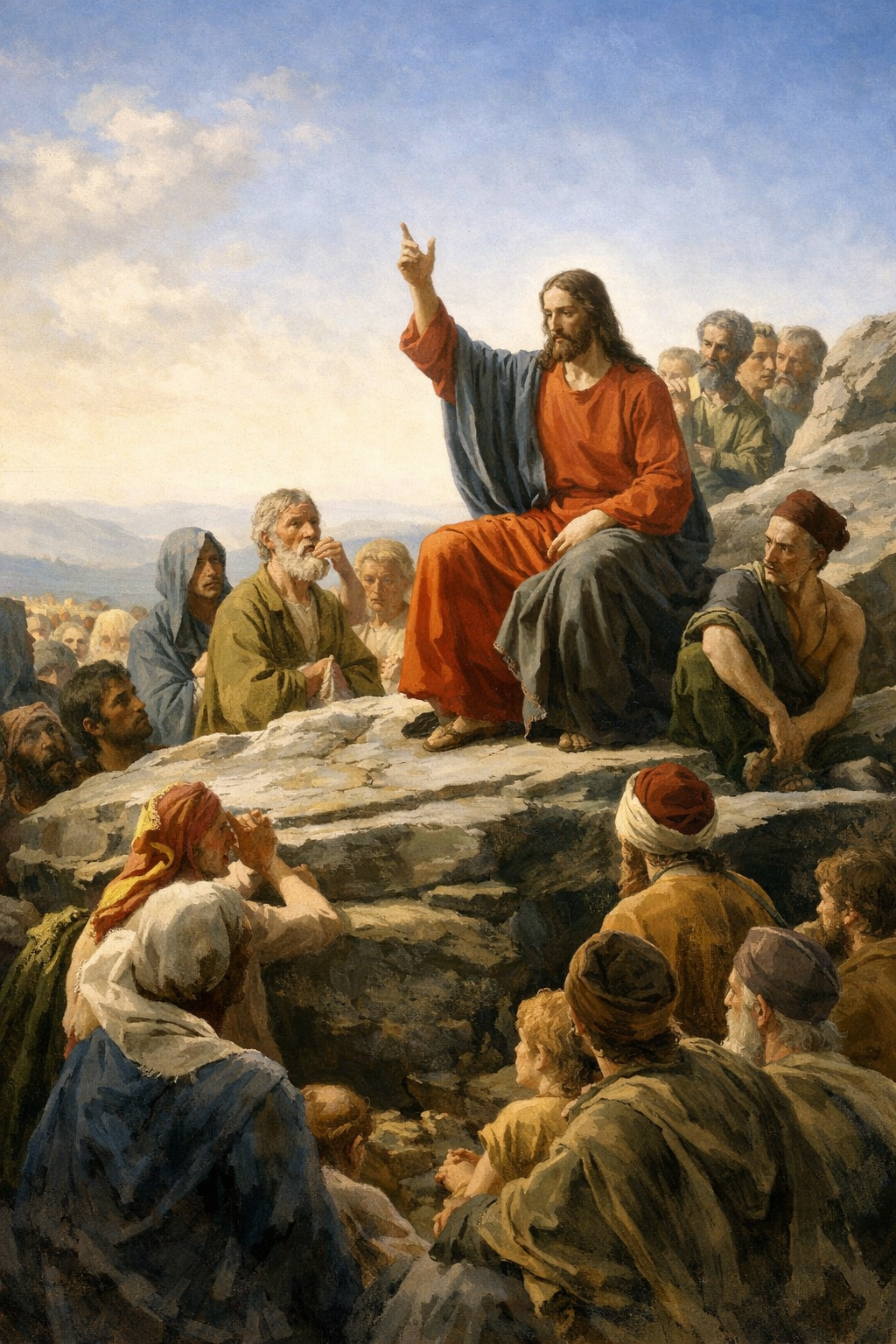
Sermon on the Mount
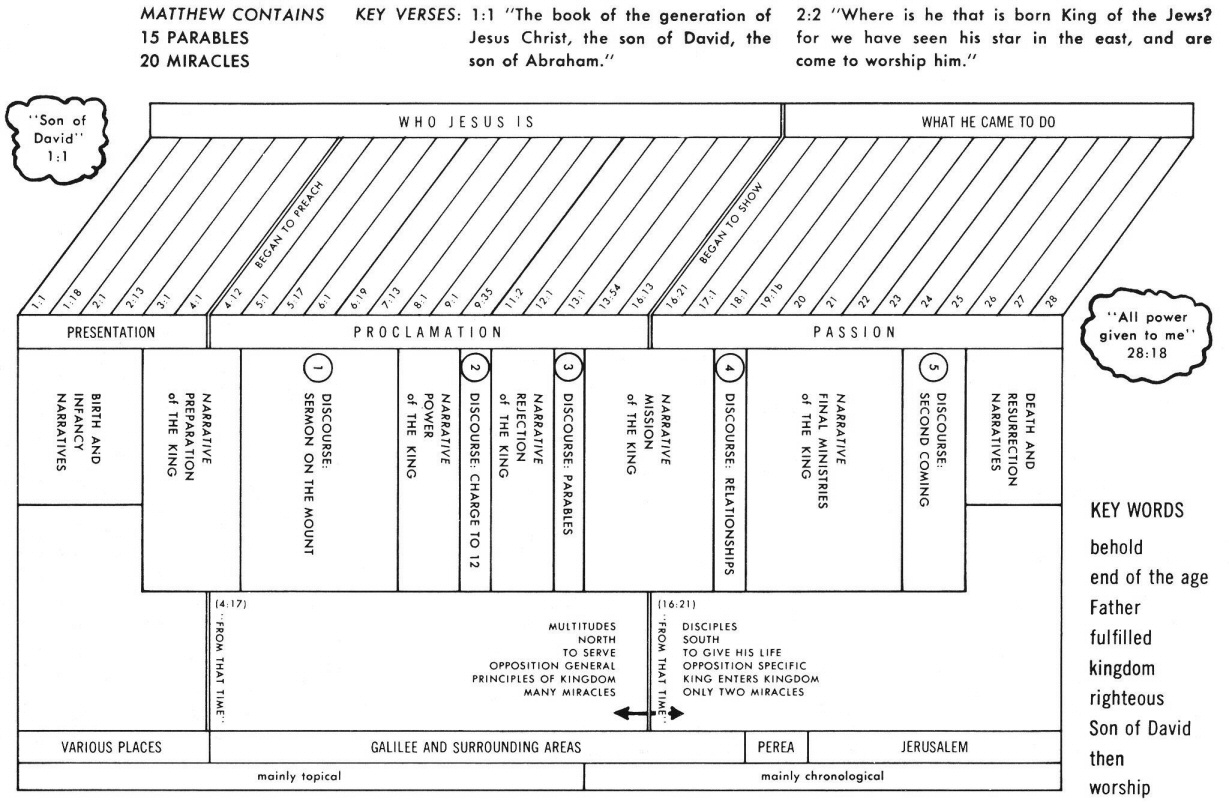
Click chart to enlarge
Charts from Jensen's Survey of the NT - used by permission
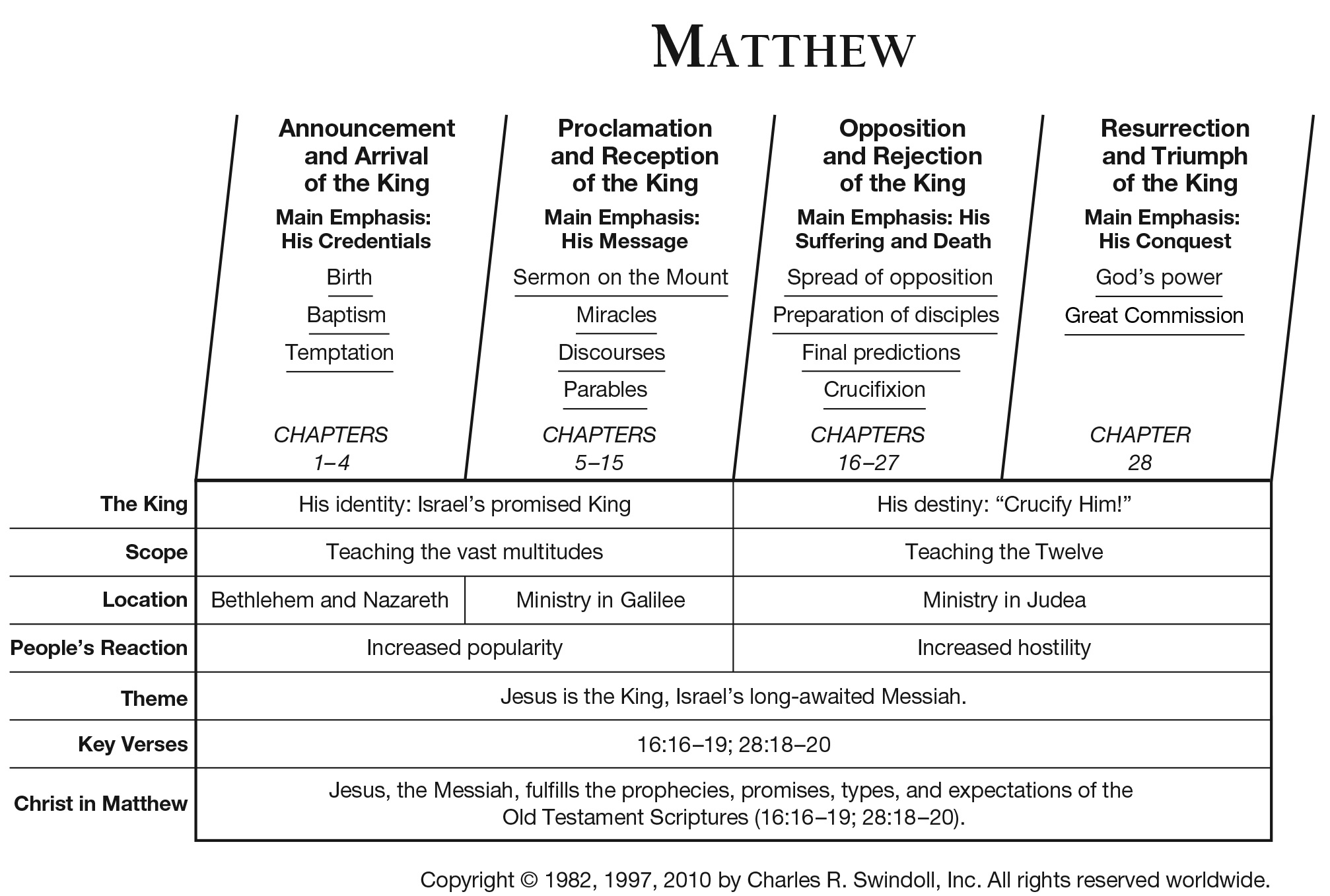
Another Chart from Charles Swindoll
THE LIFE OF JESUS AS COVERED
BY MATTHEW (shaded area)
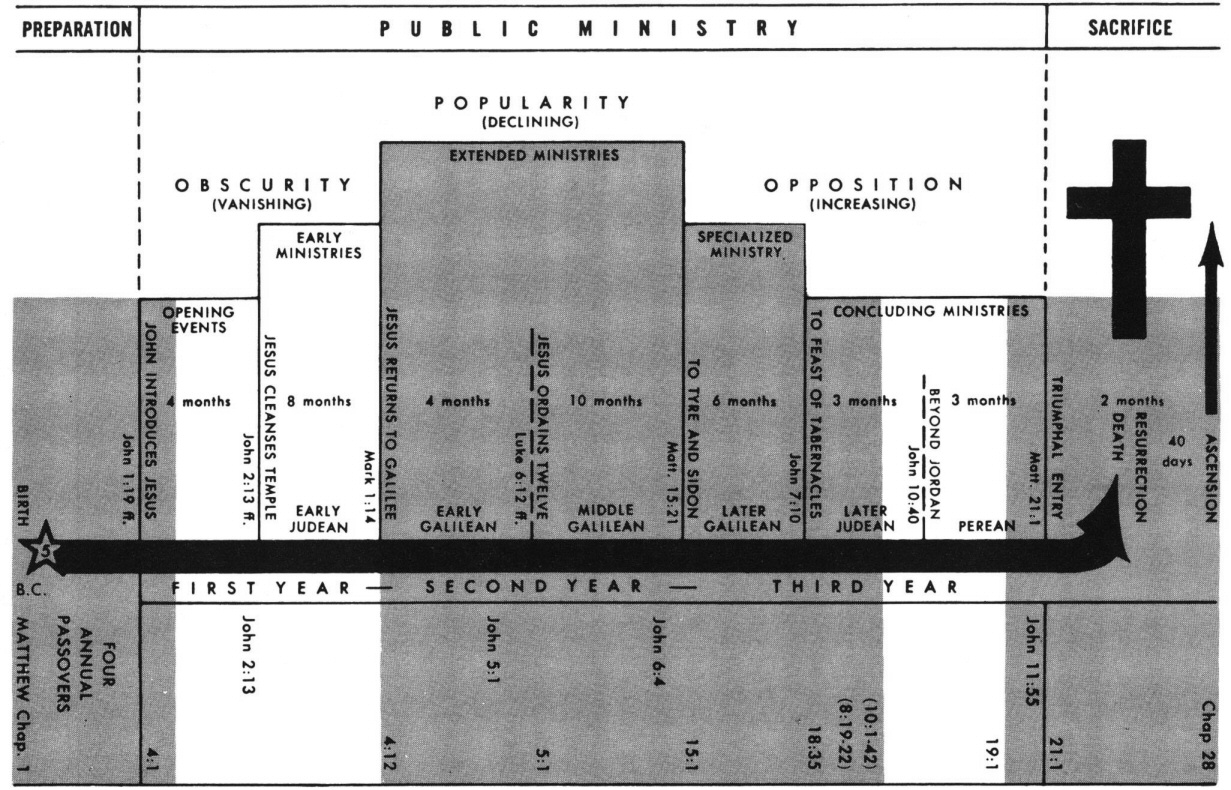
Click chart to enlarge
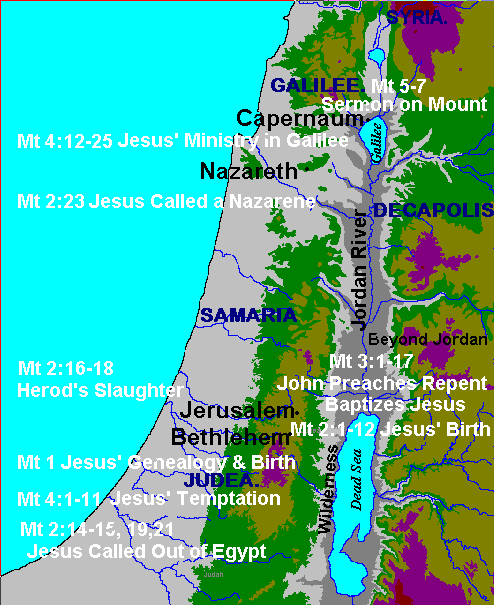
Jesus Birth and Early Years
Leading up to the Sermon on the Mount
Matthew 1-7

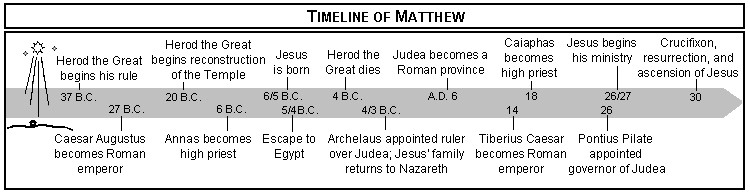
Source: Ryrie Study Bible
Matthew 6:13 'And do not lead us into temptation, but deliver us from evil. [For Yours is the kingdom and the power and the glory forever. Amen.]' (NASB: Lockman)
Greek: kai me eisenegkes (2SAAS) hemas eis peirasmon, alla rhusai (2SAMM) hemas apo tou ponerou. [hoti sου estin e basileia kan e dunamis kai e doxa eis thous aionas amen]
Amplified: And lead (bring) us not into temptation, but deliver us from the evil one. For Yours is the kingdom and the power and the glory forever. Amen. (Amplified Bible - Lockman)
KJV: And lead us not into temptation, but deliver us from evil: For thine is the kingdom, and the power, and the glory, for ever. Amen.
NLT: And don't let us yield to temptation, but deliver us from the evil one. (NLT - Tyndale House)
Philips: Keep us clear of temptation, and save us from evil. (New Testament in Modern English)
Wuest: And do not lead us into the place of testing where a solicitation to do evil would tempt us to sin, but deliver us from the Pernicious One.
Young's Literal: 'And mayest Thou not lead us to temptation, but deliver us from the evil, because Thine is the reign, and the power, and the glory -- to the ages. Amen.
|
THE LORD'S |
|
|
Our Father Who is in heaven… |
|
|
Your Kingdom Come… |
|
|
Your will be done… |
|
| Index #4 |
Give us this day our daily bread… |
| Index #5 |
Forgive us our debts… |
| Index #6 |
Do not lead us into temptation… |
| Index #7 |
For Yours is the kingdom… |
AND DO NOT LEAD US INTO TEMPTATION: kai me eisenegkes (2SAAS) hemas eis peirasmon:
- Mt 26:41; Genesis 22:1; Deuteronomy 8:2,16; Proverbs 30:8; Luke 22:31, 32, 33, 34, 35, 36, 37, 38, 39, 40, 41, 42, 43, 44, 45, 46; 1Corinthians 10:13; 2Corinthians 12:7, 8, 9; Hebrews 11:36; 1Peter 5:8; 2Peter 2:9; Revelation 2:10; 3:10
- Matthew 6 Resources - Multiple Sermons and Commentaries
- INDEX SENTENCE: NUMBER SIX
Kenneth Wuest paraphrase - Do not lead us into the place of testing where a solicitation to do evil would tempt us to sin, but deliver us from the Pernicious One
J C Ryle explains that this sentence "teaches us that we are liable at all times to be led astray and to fall. It instructs us to confess our infirmity and beseech God to hold us up, and not allow us to run into sin. We ask Him, Who orders all things in heaven and earth, to restrain us from going into that which would injure our souls, and never to let us be tempted beyond what we can bear ("No temptation has overtaken you but such as is common to man; and God is faithful, who will not allow you to be tempted beyond what you are able, but with the temptation will provide the way of escape also, that you may be able to endure it." 1 Corinthians 10:13)
J R Miller summarizes this sentence as follows "We put our hand into God’s in the morning, and we ask him to lead us through the day. We know not what experiences may come to us and we ask him not to bring us into sore testings. The prayer is a request that in the doing of God’s will for the day we may not be brought into places where it will be hard for us to be faithful. (Read his entire discussion Shrinking from Temptation )
Believer's Study Bible - This is a request for the intervention of God in life's moments of trial and temptation in such a manner that the "way of escape" is made clear (cf. 1 Cor. 10:13). The petition gives full recognition to the incredible deception and power of temptation and affirms that deliverance from the grasp of evil can come only from the Lord. (Criswell, W A. Believer's Study Bible: New King James Version. 1991. Thomas Nelson)
Bible Knowledge Key Word Study - Acknowledging their weakness, disciples must seek God's aid in escaping temptation (cf. 1 Cor. 10:13). (Bock, Darrell L, Editor: The Bible Knowledge Key Word Study: The Gospels Cook Communications)
Spurgeon - The man who is really forgiven, is anxious not to offend again; the possession of justification leads to an anxious desire for sanctification. “Forgive us our debts,” that is justification; “Lead us not into temptation, but deliver us from evil,” that is sanctification in its negative and positive forms.
Do not lead (1533) (eisphero from eis = into + phéro = to bring, bear) bring into or lead into.
The verb eisphero is in the aorist tense which speaks of an effective action at some point in time. The active voice indicates the subject, in this case God, brings about the action, i.e., He either does or does not bring us into temptation. Finally the subjunctive mood is the mood of probability which speaks of an action that may or should happen, but which is not necessarily true at present. Now after all the fancy Greek we can rephrase and paraphrase what Jesus tells us to pray…
"Father I ask you not to bring us into temptation at any point in time"
The Net Bible - The request "do not lead us into temptation" is not to suggest God causes temptation, but is a rhetorical way to ask for His protection from sin. (The NET Bible; Bible. Biblical Studies Press)
Interesting resource from J R Miller - Matthew 6:13 Shrinking from Temptation
An OT parallel is found in Psalm 141:4 - Do not incline my heart to any evil thing, To practice deeds of wickedness With men who do iniquity; And do not let me eat of their delicacies.
Spurgeon comments that this petition "is equivalent to the petition, “Lead us not into temptation.” O that nothing may arise in providence which would excite our desires in a wrong direction. The Psalmist is here careful of his heart. He who holds the heart is lord of the man; but if the tongue and the heart are under God’s care all is safe. Let us pray that he may never leave us to our own inclinings, or we shall soon decline from the right." Amen and Amen!
C H Spurgeon's comments…
And lead us not into temptation, but deliver us from evil: For thine is the kingdom, and the power, and the glory, for ever. Amen.
In the course of providence, the Lord tests our graces and the sincerity of our profession; and for this purpose he does “leads us into temptation. ” We entreat him not to try us too severely. Lord, let not my joys or my sorrows become temptations to me. As I would not run into temptation of myself, I pray thee, do not lead me where I must inevitably meet it.
But if I must be tried, Lord, deliver me from falling into evil, and specially preserve me from that evil one, who, above all, seeks my soul, to destroy it. Temptation or trial may be for my good, if I am delivered from evil.
Lord, do this for me, for I cannot preserve myself.
The prayer finishes with a doxology. That devotion which begins with prayer ends in praise. All rule, and might and honor, belong to God; and to him let them for ever be ascribed. His is “the kingdom ”, or the right to rule; “the power ”, or the might to uphold his authority; and “the glory ”, or the honor that comes out of his government. Our whole heart delights that the Lord is thus supreme and glorious; and therefore we say, “Amen. ” How perfect is this model of prayer! So fit for man to pray, so suitable to be laid before the throng of the Majesty on High. Oh, that we may have grace to copy it all our days! Jesus, our King, will not refuse to present a prayer which is of his own drawing up and is directed to the Father whom he loves to glorify. (Commentary)
Temptation (3986) (peirasmos from peirazo = to make trial of, try, tempt, prove in either a good or bad sense) is a difficult word to understand for most modern believers because when we hear temptation we think of an inducement to do evil. However in the Greek, peirasmos is a morally neutral word which simply describes putting one to the test and then refers to the actual tests. Tests (trials) come (sent or allowed by God) in order to discover a person’s nature or the quality of some thing. Think of yourself as a tube of "spiritual toothpaste". Pressure (tests ~ temptations) simply bring out what's really on the inside (your character)! Peirasmos then connotes trouble or something that breaks into your peace, comfort, joy, happiness, etc. Trials/temptations are like a "moral crossroads" if you will. Since a believer now has a new heart and God's Spirit, he or she can make a choice as to how they respond to the test/temptation. A test/temptation faced in a way that seeks to please our Father is a harmless test and is actually beneficial to the saint as James 1:2, 12 below explains. However, the same test wrongly met becomes a temptation to evil as explained below.
Peirasmos - 21x in 20v - temptation(12), testing(2), trial(3), trials(4).
Matt 6:13; 26:41; Mark 14:38; Luke 4:13; 8:13; 11:4; 22:28, 40, 46; Acts 20:19; 1 Cor 10:13; Gal 4:14; 1 Tim 6:9; Heb 3:8; Jas 1:2, 12; 1 Pet 1:6; 4:12; 2 Pet 2:9; Rev 3:10.
J R Miller explains that…
It will help us to understand the spirit of the prayer to remember that the word “temptation” does not mean primarily to allure to sin. To tempt is to try, to test, to prove. New ships are proved before they are entrusted with lives or treasure upon the sea. Anchors are tested before they are allowed to become the only hope of a vessel in the peril of a storm. God proved Abraham, putting his faith and obedience to the test. After the trial the angel said to him, “Now I know that thou fearest God.” Abraham had stood the test. Jesus was tempted before he began his public ministry, that he might be a proved deliverer.
The temptations to which we are exposed continually are primarily provings, testings, to see whether we will be true to God or not. Indeed there is no experience that we meet in life which is not in a sense a testing. Every moment we are required to make a choice, and our choices prove us. Here is a duty; shall we do it or not? Here is a call to service; shall we accept it, or decline it? Here is an impulse to something worthy; shall we yield to it, or repress it? We have money; shall we use it for God, or shall we clutch it for ourself? Sickness tries us; shall we bear it patiently, and take from it the gifts of God it brings us, or shall we chafe and repine, and leave our sick-room harmed by the experience?
Even sweet and pure human love tests us; many are held back by it from self-sacrificing duty. Thus Peter, in love for his Lord, sought to keep him from going to his cross. “Get thee behind me, Satan” was our Lord’s answer. Many others in the warmth and tenderness of their affection, have become the tempters of their friends, and ofttimes have kept them back from costly duties or perilous service to which God had called them.
Thus testing always implies the possibility of failure. There is no experience in which we may not sin. There is a wrong alternative in every call to that which is right. Instead of doing the duty, we may neglect it. Instead of making the self-denial or sacrifice, we may decline it. Instead of resisting the sin, we may yield to it. Temptation always brings an opportunity to overcome, to grow stronger. But if we fail to use the opportunity we sin. (Read Miller's entire discussion Shrinking from Temptation)
Vincent adds that in regard to the meaning of peirasmos it "is a mistake to define this word as only solicitation to evil. It means trial of any kind, without reference to its moral quality."
Peirasmos thus can be translated as tests, trials or temptations, the context determining whether the intended purpose is for good (tests, trials) or evil (temptations). As discussed below in James 1, God will send "trials" but they are never intended to lead us into evil. God however will allow Satan to send "temptations" and his are always intended to lead us into evil. In his first chapter, James uses peirasmos or the verb peirazo (the root word from which peirasmos is derived) four times illustrating the importance of context in accurate interpretation.
Illustration #1: Consider it all joy, my brethren, when you encounter various trials (peirasmos), knowing that the testing of your faith produces endurance." (James 1:2-3-note)
Illustration #2: Blessed is a man who perseveres under trial (peirasmos); for once he has been approved, he will receive the crown of life, which the Lord has promised to those who love Him. (James 1:12-note)
Illustration #3: Let no one say when he is tempted (peirazo), "I am being tempted (peirazo) by God"; for God cannot be tempted by evil, and He Himself does not tempt (peirazo) anyone. But each one is tempted (peirazo) when he is carried away and enticed by his own lust. (James 1:13-14-note)
To summarize
James 1:2,12 - context indicates trials that are to bring out the best in us
James 1:13-14 - context refers to trials meant to tempt us and bring out the worst in us
One other point to emphasize is that even though God does not tempt us to evil, He does test us and/or allow us to be tested to bring out the best. Our problem is that because of the weakness of our flesh, especially the residual, latent "old man" (the "flesh", the residual of the Sin nature we all inherited from Adam), we refuse to submit to the control of our inner Guide and source of power, the Holy Spirit (Gal 5:16+, Gal 5:18+), and we make the willful (fleshly) choice to not consider the test as all joy and we sin (evil instead of good). And so Jesus instructs kingdom citizens to pray…
"Do not lead or bring us into testing but deliver us from evil (the evil - which could mean Satan)"
So one meaning of our prayer is for God not to "lead us into temptation" or "Lord, please don't lead me into a test".
If a believer in the power of the Spirit (led by, controlled by the Spirit), he or she successfully endures that trial (and we call it just that -- a "trial" and not a "temptation"). On the other hand, if a believer, doubts God's goodness and listens to the old flesh nature, giving one's self over to its power and disobeying God, that trial has led to sin. God allows "peirasmos" into our life not to make us sin but to make us more like the Savior. Not so with Satan as his encounter with our Lord illustrates.
Discovery Bible - The Lord's Prayer teaches, "Lead us not into temptation," which is better translated, "Lead us not into (negative) 'testing'." Jesus taught we are to avoid divine chastisement – by preferring His deliverance power. That is, living in His "maximum" instead of our "minimum"! Living outside of faith (God's fullness) brings undesirable tests, in the sense they are necessary to correct the believer from straying further from God. These tests however also restore us to God as we submit to His redemptive acts of love. Reflection: Being all-wise, God always knows what is necessary to develop us rather than just satisfy us!
Paul used peirasmos twice in his marvelous words of encouragement to the Corinthians and in principle to all believers that
"No temptation (peirasmos - test or trial regardless of how or where it comes or where it leads) has overtaken (assailed, seized and laid hold on) you but such as is common to man (such as men under divine aid may be able to resist and repel); and God is faithful (you can trust Him, secure in Who He is), Who will not allow (He is sovereign and in total control - we are not the mere victims of circumstances) you to be tempted (peirázō - tried or tested) beyond what you are able (No trial or temptation is inherently stronger than our spiritual resources. People sin because they willingly sin), but with the temptation (peirasmos) will (always) provide the (specific, one and only) way of escape (we escape not by getting out of it but by passing through it. God does not take us out; He sees us through by making us able to endure it) also ("the way out" is always there right along with the test or temptation), that you may be able to endure it (bear up under it patiently)." (1 Corinthians 10:13-see in depth commentary notes)
So the believer prays to be kept from overwhelming solicitation to sin, and if he falls into it, to be rescued from it. Deliver is actually in the form of a command.
Peter reminds us that just as God rescued righteous Lot from Sodom, "the Lord knows how to rescue the godly from temptation (trial - peirasmos), and to keep the unrighteous under punishment for the day of judgment." (2 Pe 2:9+)
John MacArthur explains this petition "do not lead us into temptation" writing…I affirm with Chrysostom, the early church Father, that the solution to this issue is that Jesus is here not speaking of logic or theology but of a heart desire and inclination that cause a believer to want to avoid the danger and trouble sin creates. It is the expression of the redeemed soul that so despises and fears sin that it wants to escape all prospects of falling into it, choosing to avoid rather than having to defeat temptation. Here is another paradox of Scripture. We know that trials are a means for our growing spiritually, morally, and emotionally. Yet we have no desire to be in a place where even the possibility of sin is increased. Even Jesus, when He prayed in the Garden of Gethsemane, first asked, “My Father, if it is possible, let this cup pass from Me,” before He said, “yet not as I will, but as Thou wilt” (Matt. 26:39). He was horrified at the prospect of taking sin upon Himself, yet He was willing to endure it in order to fulfill the will of His Father to make possible the redemption of man. Our proper reaction to times of temptation is similar to Christ’s, but for us it is primarily a matter of self-distrust. When we honestly look at the power of sin and at our own weakness and sinful propensities, we shudder at the danger of temptation or even trial. This petition is another plea for God to provide what we in ourselves do not have. It is an appeal to God to place a watch over our eyes, our ears, our mouth, our feet, and our hands-that in whatever we see, hear, or say, and in any place we go and in anything we do, He will protect us from sin…This petition is a safeguard against presumption and a false sense of security and self-sufficiency. We know that we will never have arrived spiritually, and that we will never be free of the danger of sin, until we are with the Lord. With Martin Luther we say, “We cannot help being exposed to the assaults, but we pray that we may not fall and perish under them.” As our dear Lord prayed for us in His great intercessory prayer, we want, at all costs, to be kept from the evil one (John 17:15).(Matthew 1-7 Macarthur New Testament Commentary Chicago: Moody Press) (Bolding added)
OTHER INTERPRETATIONS OF "LEAD US NOT INTO TEMPTATION"
R Kent Hughes - “LEAD US NOT INTO TEMPTATION” What does “Lead us not into temptation” mean? Certainly it cannot mean (as some have wrongly thought) that God is the prime mover behind all temptations. James 1:13 makes this clear: “When tempted, no one should say, ‘God is tempting me.’ … nor does he tempt anyone.” On the other hand, others have imagined that if Christians truly pray this prayer, they can be delivered from all temptation. But the Bible is clear that temptation is an unavoidable part of human existence. All the apostles and all the great saints have lived in continual temptation. The key to what “Lead us not into temptation” means is found in the fact that the word translated “temptation” has two meanings. It can denote an enticement that has the goal of causing one to sin, or it can refer to a test or trial of the validity of one’s faith. The word occurs twenty-one times in the New Testament, and twenty of those appearances have the latter idea of testing or trial. Thus the meaning of “Lead us not into temptation” is simply, “Do not allow us to come under the sway of temptation that will overpower us and cause us to sin.”....If temptations helped shape the life and ministry of the perfect Christ (cp Heb 2:10+) much more do they do so for us! Temptation is necessary for the development of our moral character. (William Barclay wrote that) “Temptation is not so much the penalty of manhood as it is the glory of manhood. It is that by which a man is made an athlete of God.” That was the way it was for Martin Luther. No one can doubt that Luther became stronger as he fought off the massive temptations of the world, the flesh, and the devil. Conquered temptation knits the fibers of our souls into muscular cords. The old belief that the strength of a slain enemy passes into the slayer is true in regard to a Christian’s overcoming temptations. That is why the Scriptures urge the long view. “Consider it pure joy, my brothers, whenever you face trials of many kinds, because you know that the testing of your faith develops perseverance” (James 1:2, 3+). That is why today we count among the great Christians of our time people like Dietrich Bonhoeffer, Corrie ten Boom, and Alexander Solzhenitsyn. Their great trials (Ed: Which were in a very real sense also temptations, temptations to deny God and His Word and Way) made them into spiritual giants. So the proper prayer regarding temptation is not that we be delivered from all temptation, for facing and overcoming it is necessary for the health of our souls. But proper prayer does ask God to deliver us from overpowering temptations, recognizing that we are weak and liable to fold under severe testing. (Hughes, R. K. Sermon on the Mount: The Message of the Kingdom. Crossway)
James Rosscup - An Exposition of Prayer in the Bible - After petitions in verse 10–11 and confession in verse 12, Jesus urges prayer for victory over temptation. The thought seems to be as A. T. Robertson sums it up...He calls the command a “permissive imperative.” The prayer is that the Father will not permit us, through the weaknesses that can spell our downfall, to be led into temptation that is too much for us (cf. Ps. 141:4). Rather God can be counted on as faithful not to permit those tenderly available to Him to go that far. He has various influences which, if received, can guard us—such as His Spirit who can supply (cf. Lk. 11:13) and His Word which can incline us in the right way and against the evil (cf. Ps. 17:4; 37:31), as well as prayer that He answers with His strengthening (Ps. 138:3; cf. “quicken [revive] me” often repeated in Ps. 119)). God would never deliberately lead us into temptation with the aim to hurt us. The second part of verse 13, “but deliver us from evil,” probably refers, as it is in the masculine gender, to “the evil one,” the devil. As Jesus Himself experienced victory against the devil’s temptation by rightly utilizing God’s Word against this enemy (Matt. 4:1–11), so can His disciples.
ESV Study Bible - This final (sixth) petition addresses the disciples’ battle with sin and evil. Lead us not into temptation. The word translated “temptation” (Gk. peirasmos) can indicate either temptation or testing (see Mt 4:1; James 1:13). The meaning here most likely carries the sense, “Allow us to be spared from difficult circumstances that would tempt us to sin” (cf. Matt. 26:41). Although God never directly tempts believers (James 1:13), he does sometimes lead them into situations that “test” them (cf. Matt. 4:1; also Job 1; 1 Pet. 1:6; 4:12). In fact, trials and hardships will inevitably come to believers’ lives, and believers should “count it all joy” (James 1:2) when trials come, for they are strengthened by them (James 1:3–4). Nonetheless, believers should never pray to be brought into such situations but should pray to be delivered from them, for hardship and temptation make obedience more difficult and will sometimes result in sin. Believers should pray to be delivered from temptation (cf. Matt. 26:41; Luke 22:40, 46; 2 Pet. 2:9; Rev. 3:10) and led in “paths of righteousness” (Ps. 23:3).
Octavius Winslow…This solemn petition--perhaps the most solemn one of the whole prayer--would appear a natural and impressive consequence of the preceding one for forgiveness. In the contemplation of that petition, the mind was necessarily led into a deep and grave consideration of sin in its various forms, and of the confession of sin in its minute detail, and of the forgiveness of sin in its daily renewal. Passing from that theme, it would seem as if the next utterance of the wakeful, tremulous heart would be, "Lord, lead me not into temptation. If such is sin; if such the sore penitence to which its commission leads, and such the humiliating acknowledgment in which it results, and such the costly pardon--the price of blood--which its guilt demands, Lord, keep me, fence me, surround me; that, having been washed every whit clean, I may tread no path, be placed in no position whereby I may be exposed to the power of temptations which I cannot evade, whose strength I cannot resist, and thus relapse from my high and holy walk with You. You have given me absolution from sin, but no indulgence to sin. I would be as free from the tyranny as from the condemnation of sin, and would find my most precious, powerful, and persuasive motive to seek after the attainment of holiness in Your full, and free, and most loving forgiveness. Having washed my feet, how shall I defile them!" (The WATCHFUL Spirit of the Lord)
Ray Stedman writes that "The third area of prayer is in the realm of the spirit, "Lead us not into temptation." Again, the vital thing is touched. In the unseen war of the spirit, the greatest needs of our life are deliverance and protection. But an immediate problem arises here, for Scripture reveals that temptation is necessary to us and no one escapes it in the Christian life. Furthermore, though God himself never tempts us to sin, yet he does test us with difficult and discouraging circumstances and these things become the instruments of God to strengthen us, to build us up and thus to give us victory. When we read this prayer, then we are confronted with this question: "Are we really expected to pray that God will not do what He must do to accomplish His work within us?" After all, even Jesus, we are told, was led of the Spirit into the wilderness to be tempted of the devil. What then does he mean, "lead us not into temptation"? I confess I have puzzled and prayed and read about this, and I am convinced that what he means here is that this is a prayer to be kept from unrecognized temptation. When temptation is recognized as such, it can be resisted, and when we resist, it is always a source of strength and growth in our life. If I am filling out my income tax and I find that some income has come to me through other than ordinary channels and there is no way of anyone checking it, I am confronted with a temptation to omit it, but I know it is wrong. No one has to tell me; I know it is wrong. When I resist that, I find I am stronger the next time when a larger amount is involved. You see, when we recognize lust as lust and hate as hate and cowardice as a temptation to be a coward, this is one thing. It is a rather simple matter to resist obvious evil, if we really mean to walk with God. But temptation is not always so simple. There are times when I think I am right, and with utmost sincerity and integrity of heart I do what I believe is the right thing, and, later, look back upon it and see that I was tragically and horribly wrong. Now that is what he is talking about here. Peter is an example on this. In the Upper Room, with brashness and confidence and utter naivete, Peter said to the Lord, "Though others forsake you, I will never forsake you," (Matthew 26:33). They walked out of the Upper Room with the words of our Lord ringing in his ears, "Peter, before this night is over, before the cock crows in the morning you will have denied me three times," Matthew 26:34). Still confident, Peter went into the Garden of Gethsemane, and when the soldiers came he had a sword ready, and struck off the ear of the High Priest's servant in his eagerness to show his faithfulness to the Lord. Jesus had said to him there in the Garden, "Peter, watch and pray, that you enter not into temptation," (Matthew 25:41). But Peter did not heed that word. Instead he slept, and our Lord came and woke him again and asked him to pray, not for the Lord, but for himself, Peter. But Peter did not pray, and when he came into the court of the High Priest and was standing before the fire, Satan took him and wrung his courage out like a dish rag and hung him up limp, to dry in the presence of a little girl. There, with cursing and swearing, he found himself trapped, and denied his Lord, and in the awful realization of what he had done he went out into the blackness of the night and wept bitterly. This is what our Lord refers to in this phrase. This prayer is the recognition of our foolish weakness and our tendency to stumble on into blind folly. It is what we desperately need to pray… All three of these requests reflect the one great truth that Jesus labors to impress upon us, that we are forever in need -- body, soul, and spirit. Only as we walk, step by step, in a continual sense of dependence upon a living God can any of this need ever be adequately met. When we fail to pray this simple, childlike prayer out of our hearts, expressing it in whatever words we choose, we are simply exposing ourselves to unnecessary disturbance, upset and failure. (See the full message Talking to My Father)
Yield Not to Temptation
by Hortatio Palmer
Yield not to temptations for yielding is sin;
Each vict’ry will help you some other to win;
Fight manfully onward, dark passions subdue;
Look ever to Jesus—He’ll carry you through.
Shun evil companions, bad language disdain;
God’s name hold in rev’rence, nor take it in vain;
Be thoughtful and earnest, kind-hearted and true;
Look ever to Jesus—He’ll carry you through.
To him that o’er-cometh God giveth a crown;
Thru faith we will conquer tho often cast down
He who is our Savior our strength will renew
Look ever to Jesus—He’ll carry you through.
Chorus:
Ask the Savior to help you, comfort, strengthen and keep you;
He is willing to aid you—He will carry you through.
Thomas a Brakel (Christian's Reasonable Service) gives some excellent final instructions on how to conduct ourselves in warfare…
Prayer and work must be combined; a Christian desires to perform what he prays for, and endeavors to do as much as he is able. When he prays, “Lead us not into temptation,” then he must refrain from leading himself into temptation.
We lead ourselves into temptation…
(1) when we do not flee those circumstances in which we have frequently fallen, but rather seek them out, or, upon their occurrence consciously yield to them, there being neither need nor obligation to avail ourselves of them.
Such circumstances can vary greatly and may either pertain to someone’s disposition, calling or other situations. To some the company of given individuals is harmful, to others dining engagements, to others the use of ordinary means, and for others at times solitude. We must flee from these things that can be avoided, or else we lead ourselves into temptation. If we cannot avoid those situations in which we have frequently fallen, being under obligation by divine commandment, we must be very much on our guard to keep our hearts diligently by bridling our tongue, yielding in specific cases, standing firm for God’s cause, and arming ourselves with sincerity and caution. When we conduct ourselves in this way, the temptation will have less effect upon us.
(2) when we use lawful and ordinary things too frequently and thoughtlessly.
(3) when we cherish vain thoughts and find our delight in them—even if they pertain to natural matters.
(4) when upon having sinned, we do not immediately arise, but either through carelessness, discouragement, unbelief and rejection of our spiritual state—or else due to finding delight in sin—remain where we are, so that sin gains in strength.
(5) when we reflect upon thoughts which suddenly enter our mind—be it concerning a sin in which we find delight, unbecoming thoughts of God and divine things, or dreadful interjections.
We shall thereby lose a good spiritual frame, and in an evil spiritual frame we are susceptible to temptation. Against all these a Christian must be watchful and strive, being active in faith: “Watch and pray, that ye enter not into temptation” (Mt 26:41-note); “Be sober, be vigilant; because your adversary the devil, as a roaring lion, walks about, seeking whom he may devour: whom resist steadfast in the faith” (1Pe 5:8, 9-note).
J I Packer has an interesting discussion of lead us not into temptation - After prayer for provender and pardon comes a cry for protection, our third basic need. The sentence has two halves; “lead us not into temptation, but deliver us from evil” (either sin, or trouble, or both, or “the evil one” who manipulates trouble to induce sin). Both halves, however, express a single thought: “life is a spiritual minefield; amid such dangers we dare not trust ourselves; Father, keep us safe.” Here the Lord’s Prayer links up with the view of life that runs through the Psalms. The realism, self-distrust, and humble dependence on God that breathes through this petition is something we all need to learn. Testing - The thought that God may lead Christians into temptation, as the first clause assumes, has puzzled and shocked many people. Things grow clearer, however, once we see what temptation means here. “Test” or “trial”—that is, a situation which reveals how far you are able to go right and avoid going wrong—is the idea behind the word. The driving test, which (believe it or not) is designed to enable you to show that you can do everything right, is a “temptation” in this sense. Now, any educational or training program must of necessity include periodic tests for gauging progress, and the experience of taking and passing such tests can be very encouraging to the trainee. In God’s program for the spiritual education and growth of Christians, the same applies. God does and must test us regularly, to prove what is in us and show how far we have got. His purpose in this is wholly constructive, to strengthen us and help us forward. Thus he “tested” Abraham (so RSV; AV has “tempt,” RV “prove”) by telling him to sacrifice Isaac, and after the test promised him great blessing “because you have obeyed my voice” (Genesis 22:1, 18). No Picnic - Why, then, if temptation is beneficial, should we ask to be spared it? For three reasons. First, whenever God tests us for our good, Satan, “the tempter,” tries to exploit the situation for our ruin. “Your adversary the devil prowls around like a roaring lion, seeking someone to devour” (1 Peter 5:8). Jesus knew from his wilderness experience how mean and cunning Satan is, and wished no one to underestimate him or to court a meeting with him. (Our modern occultists would do well to take this to heart.) Second, the pressures in times of trial can be so appalling that no sane Christian can do other than shrink from them, just as they shrink from the thought of having cancer. For both reasons Jesus was as right to start his prayer in Gethsemane with “Father, remove this cup” as he was to end it with “yet not my will but yours be done” (cf. Matthew 26:39). Temptation is no picnic! Third, knowledge of our own proven weakness, thickheadedness, and all-round vulnerability in spiritual matters, and of the skill with which Satan exploits our strong and weak points alike, mixing frontal assaults on our Christian integrity with tactics of infiltration and ambush, so that while avoiding one hazard we constantly fall victim to another, compels us to cry, in humility and self-distrust, “Lord, if it be possible, please, no temptation! I don’t want to risk damaging myself and dishonoring you by falling!” Temptation may be our lot, but only a fool will make it his preference; others will heed Paul’s warning to the spiritually reckless, “let any one who thinks that he stands take heed lest he fall” (1 Corinthians 10:12). Watch and Pray - When Jesus found his disciples asleep in Gethsemane, he said, “Watch and pray that you may not enter into [that is, start yielding to] temptation; the spirit indeed is willing [to do God’s will], but the flesh [human nature] is weak” (Matthew 26:41). What prompted his comment was the struggle he had just had with himself, in which his own flesh had violently recoiled from the prospect of Calvary, plus now the sleep of those who, though tired, had been asked to watch with him—stay awake, that is, and support him by their presence and prayers. We must appreciate that the test of sincerity and realism in saying “lead us not into temptation” is readiness to “watch and pray,” lest we fall victim to it unawares. “Watch” suggests a soldier on guard, alert for the first signs of enemy attack. We watch against temptation by noting what situation, company, and influences expose us to it, and avoiding them wherever we can. As Luther said, you can’t stop the birds flying over your head, but you can stop them nesting in your hair. Find out what for you is fire, and don’t play with it! “Pray” points to the kind of prayer Jesus had just made—prayer for strength to do what one knows is right in face of inward reluctance plus any number of siren-songs seeking to charm one off course and spiritually onto the rocks. Nobody ever expressed the right state of mind in this matter better than Charles Wesley, in the hymn that starts, “Jesus, my strength, my hope, On thee I cast my care.”
I want a godly fear,
A quick-discerning eye
That looks to thee when sin is near
And sees the tempter fly;
A spirit still prepared
And armed with jealous care,
For ever standing on its guard
And watching unto prayer.
The conclusion of the matter is this. For good and necessary reasons connected with our Christian growth (cf. James 1:2–12), we shall not be spared all temptation (cf. 1Corinthians 10:13); but if we ask to be spared and watch and pray against Satan’s attempts to exploit situations for our downfall, we shall be tempted less than we might have been (cf. Revelation 3:10), and will find ourselves able to cope with temptation when it comes (1 Corinthians 10:13). So do not be unrealistic in not budgeting for temptation, nor foolhardy enough to court it; but when it comes, do not doubt God’s power to deliver from the evil it brings, and to “keep you from falling” (Jude 24) as you pick your way through it. When you are not conscious of temptation, pray “lead us not into temptation”; and when you are conscious of it, pray “deliver us from evil”; and you will live. (Growing in Christ)
HIS OWN LUST - As an aside church history records the tragic story of Origen of Alexandria misinterpreted and thus misapplied Jesus' teaching in Mt 5:29-30 (notes) and as a result had himself physically emasculated in an attempt to overcome his sensual desires (lusts). It is significant that not long afterward, the Council of Nicea outlawed the practice. Apart from the fact that such mutilation is contrary to Scripture, poor Origen still had his eyes, and even if he had caused them to be removed, he would still have had the "eye" of his mind!
A boy named Bobby asked his mother if he could go play ball with his friends. She consented, but she knew that the boys had to pass their favorite "swimming hole," so she told him not to go swimming. When Bobby left the house, however, he took his bathing suit with him just in case! Well, you know what he did when he saw his friends enjoying themselves in the pond. Bobby had invited temptation by taking his swimsuit with him.
How different the attitude displayed by the youngster who said, "When I go past a watermelon patch, I can't keep my mouth from watering, but I can run!" His action exemplifies what Paul was saying to young Timothy in today's Scripture reading. According to 1Corinthians 10:13, God is faithful and will not allow us to be tempted beyond what we are able, but will with the temptation also make the way of escape, that we may be able to bear it. When temptation comes, God will do His part—He will provide "the way of escape." But it's up to us to run! —R. W De Haan
EVERY TEMPTATION
IS AN OPPORTUNITY TO FLEE TO GOD.
John Stott gives a more sane interpretation and application of Jesus' teaching, writing that "If your eye causes you to sin because temptation comes to you through your eyes (objects you see), then pluck out your eyes. That is, don’t look! Behave as if you had actually plucked out your eyes and flung them away, and were now blind and so could not see the objects which previously caused you to sin. Again, if your hand or foot causes you to sin, because temptation comes to you through your hands (things you do) or your feet (places you visit), then cut them off. That is: don’t do it! Don’t go! Behave as if you had actually cut off your hands and feet, and had flung them away, and were now crippled and so could not do the things or visit the places which previously caused you to sin.” That is the meaning of “mortification.”
NOT HUNGRY - We had everything set .for the first bass fishing expedition of the year. We had exotic new lures that we knew would be irresistible to those big six-pounders lurking beneath the surface of our favorite fishing lake. We would tempt them with Sassy Shads, brightly colored new Hula Poppers, buzz baits, a "killer" red flatfish with a black stripe, and a white double spinner with long bright streamers. And, if all else failed, we had some fresh Canadian crawlers. Out at dawn, we hit all the best spots with our assortment of delectable temptations. But nothing happened. We worked the shore. We cast along the weeds. We tried every lure in the tackle box—even the crawlers. Finally we gave up. Heading back to the cabin, we concluded, "The fish just aren't hungry."
Satan (and our fallen flesh which is still present in believers) has a whole "tackle box" of alluring devices he uses to tempt us. Some are gaudy and exotic, easy to spot—yet oh, so tempting. Others whet our appetites in quiet and subtle ways, appearing harmless until the hook is set. Whatever the temptation, we can best resist if we do not let our thoughts dwell on evil but on things that are true, noble, just, pure, and lovely (Phil. 4:8). With mental discipline and the help of the Holy Spirit, we can keep our hearts full of goodness. Then the temptation will have to say in effect that "They just aren't hungry."—D. C. Egner.
In 1346, during the Hundred Years' War, the English army of King Edward III met a French battalion at Crecy, France. The King's son, Prince Edward, led one vital division of the British force while Edward III stood nearby with a strong band of soldiers, ready to send relief if needed. Soon after the battle started, the prince thought he was in danger, so he sent for help. But the king didn't come. Young Edward sent another message, pleading for immediate assistance. His father responded by telling the courier,
Go tell my son that I am not so inexperienced a commander as not to know when help is needed, nor so careless a father as not to send it.
This story illustrates the heavenly Father's relationship with believers as we battle temptation and sin. Often we cry out for help, but it seems that God sends no relief. Yet at no time does He withdraw His eye from our precarious position. He never allows us to be tempted beyond what we are able to bear, and when He sees that we are about to be overcome He rushes to our aid or provides a way to escape. So we need not get frantic—our Father is aware of our situation. In 1 Corinthians 1:9 the apostle Paul said, "God is faithful." Commenting on this, Ambrose Serle noted,
He is wise to foresee and provide for all my dangers. He is faithful to perfect and perform all His promises.
No matter how hot the conflict, the Lord is ready to intervene at the right moment. He is always standing by. —P. R. Van Gorder.
It's My Fault - The first step in overcoming sin is to admit that we are the ones who are responsible. To look for someone else to blame is to evade the real issue.
A man in a parking lot backed into another car. He simply didn't look to see if the way was clear, and he was obviously at fault. But he jumped out of his car, yelled furiously at the woman driving the car he hit, and told her it was her fault for getting in his way. I learned later that he continued to blame her when he spoke to his insurance agent. Eventually she was cleared, but only after going through tremendous anguish.
This is similar to what happened in the Garden of Eden. After Adam ate the forbidden fruit, he said he wasn't to blame. It was the fault of the woman God had made.
Sometimes we respond like that. When we do something wrong, we immediately look for someone to blame, even if it's God. But James says we sin because we listen to our own selfish desires.
Troubled by a sin that won't go away? Maybe you're not overcoming it because you are blaming someone else. You might even be blaming God because He didn't stop you from doing it. Nonsense! You'll never conquer your sin until you're willing to say, "It's my fault!" -- David C. Egner (Our Daily Bread, Copyright RBC Ministries, Grand Rapids, MI. — Reprinted by permission. All rights reserved)
God cannot prosper those who try
To cover sin and wrong deny;
But all who humbly will confess,
The Savior with His love will bless. - DJD
You can never conquer sin with an excuse.
BUT DELIVER US FROM EVIL : alla rhusai (2SAMM) hemas apo tou ponerou:
- 1Chr 4:10; Ps 121:7,8; Je 15:21; Jn 17:15; Gal 1:4; 1Th 1:10; 2Ti 4:17,18; Heb 2:14,15; 1Jn 3:8; 5:18,19; Rev 7:14, 15, 16, 17; 21:4
- Matthew 6 Resources - Multiple Sermons and Commentaries
Literally "deliver us ourselves away from the evil (one)"
J C Ryle explains that in the last section of this sixth index sentence
We are taught to ask God to deliver us from the evil that is in the world, the evil that is within our own hearts, and not least from the evil one, the devil. We confess that, so long as we are in the body, we are constantly seeing, hearing and feeling the presence of evil. It is about us, and within us, and around us on every side. We entreat him who alone can preserve us, to be continually delivering us from its power (John 17:15).
Deliver (4506) (rhuomai from rhúo = to draw, drag along the ground) means to draw or snatch to oneself and invariably refers to a snatching from danger, evil or an enemy. This basic idea of rescuing from danger is pictured by the use describing a soldier’s going to a wounded comrade on the battlefield and carrying him to safety (he runs to the cry of his comrade to rescue him from the hands of the enemy). Rhuomai emphasizes greatness of peril from which deliverance is given by a mighty act of power.
Rhuomai - 17x in 15v -
Mt 6:13; 27:43; Lk 1:74+; Ro 7:24-note; Ro 11:26-note; Ro 15:31-note; 2Co 1:10; Col 1:13-note; 1Th 1:10-note; 2Th 3:2; 2Ti 3:11-note; 2Ti 4:17, 18-note; 2Pe 2:7-note, 2Pe 2:9-note
Deliver is in the aorist imperative which is a call (command) for urgent, effective action. The incredible truth that the children of God can approach His throne boldly (in the time of need and beloved we are always in need of God's delivering power! Heb 4:16+, Heb 10:19, 20, 21+) with verbs in the form of commands is a reflection of His grace which is absolutely amazing! (See why we have such bold access = Ro 5:1-2+)
From (apo) depicts the rupture of a former association, in this case an association with evil. It means to remove away from or to put some distance between (one's self and evil and/or the Evil One)! What a great picture (and promise) of divine deliverance!
THOUGHT - Why do we (I) not pray this powerful petition more often?!
Evil (4190) (poneros from ponos = labor, sorrow, pain) describes evil in active opposition to good and that which corrupts (causes deterioration or lowering in quality or character, implying a loss of soundness, purity and/or integrity! Wow! Only a fool would not want to be delivered from such a state!).
Poneros describes evil that with is actively harmful or hurtful in effect or influence, and of course is an excellent description of the effects of sin that is not dealt with (confess and repent - 1Jn 1:7, 8, 9, cp 2Co 12:21, Rev 2:5-note, Ps 119:25-note)! In the present verse the definite article "tou" ("the" in Greek) precedes poneros which literally would be translated "the evil", the specific evil, which in turn is felt by many expositors to be synonymous with Satan, the essence of evil. And thus many of the Bible versions will render it "the evil one" (Amplified) or "the Evil One" ("the Pernicious One", Wuest). (See related study of diabolos). While this indeed may be the intended meaning, we do well to remember that evil emanates from our three intractable enemies - the world, the flesh and the devil.
Augustine's prayer was "Lord, deliver me from that evil man—myself!"
The great Puritan writer Thomas Watson has some pithy thoughts concerning the interpretation of "the evil" writing…
There is more in this petition than is expressed. The thing expressed is—that we may be kept from evil. The thing further intended is—that we may make progress in piety. "Denying ungodliness and worldly lusts;" there is being delivered from evil; "we should live soberly, righteously, and godly;" there is progress in piety. Titus 2:12-note. In general, when we pray, "Deliver us from evil," we pray to be delivered from the evil of SIN. Not that we pray to be delivered immediately from the presence and indwelling of sin, for that cannot be in this life—we cannot shake off this viper. But we pray that God would deliver us more and more from the power and practice, from the scandalous acts of sin which cast a sad reflection upon the gospel. Sin is the deadly evil which we pray against. With what pencil shall I be able to draw the deformed face of sin? The devil would baptize sin with the name of virtue. It is easy to lay fair colors on a black face. I shall endeavor to show you what a vile monster sin is, and that there is great reason we should pray, "Deliver us from evil." Sin, as the apostle says, is exceeding sinful. Romans 7:13-note. Sin is the very distillation of evil; it is called the "accursed thing." Josh 7:13… It fetches its pedigree from hell. It is of the devil. John 8:44. It calls the devil "father". Sin is the poison which the old serpent has spit into our virgin nature. Look upon sin in its nature, and it is evil. See what the Scripture compares it to. It has got a bad name. It is compared to the vomit of dogs (2Pe 2:22-note); to a menstruous cloth (Isa 30:22); which, as Jerome says, was the most unclean thing under the law; it is compared to the plague (1Ki 8:38); and to a gangrene (2Ti 2:17-note). People with these diseases, we would be averse to eat and drink with… Sin is an act of high INGRATITUDE to God… a FOOLISH thing… a POLLUTING thing… a DEBASING thing… a PAINFUL thing… a DISTURBING thing… There is more evil in a drop of sin—than in a sea of affliction…
THOUGHT - Beloved, we would all be wise and better off if we would take some time [it will take about 90 minutes but consider it an investment in eternity!] to read and ponder Watson's full dissertation on Sin - read Deliver Us From Evil
Poneros - 78x in 72v - Mt 5:11, 37, 39, 45; 6:13, 23; 7:11, 17f; 9:4; 12:34, 35, 39, 45; 13:19, 38, 49; 15:19; 16:4; 18:32; 20:15; 22:10; 25:26; Mk 7:22f; Lk 3:19; 6:22, 35, 45; 7:21; 8:2; 11:13, 26, 29, 34; 19:22; Jn 3:19; 7:7; 17:15; Acts 17:5; 18:14; 19:12f, 15f; 25:18; 28:21; Ro 12:9; 1Co 5:13; Gal 1:4; Ep 5:16; 6:13, 16; Col 1:21; 1Th 5:22; 2Th 3:2,3; 1 Ti 6:4; 2Ti 3:13; 4:18; Heb 3:12; 10:22; Jas 2:4; 4:16; 1Jn 2:13, 14; 3:12; 5:18, 19; 2Jn 1:11; 3Jn 1:10; Rev 16:2. NAS = bad(5), crimes(1), envious(1), envy*(1), evil(50), evil one(5), evil things(1), malignant(1), more evil(1), more wicked(1), vicious(1), wicked(6), wicked man(1), wicked things(1), worthless(1).
[FOR YOURS IS THE KINGDOM AND THE POWER AND THE GLORY FOREVER. AMEN.]: [hoti sου estin e basileia kan e dunamis kai e doxa eis thous aionas amen]:
- Mt 6:10; Ex 15:18; 1Chr 29:11; Ps 10:16; 47:2,7; 145:10, 11, 12, 13; Da 4:25,34,35; 7:18; 1Ti 1:17; 6:15-17; Re 5:13; 19:1) (Mt 28:20; Nu 5:22; Deut 27:15, 16, 17, 18, 19, 20, 21, 22, 23, 24, 25, 26; 1Ki 1:36; 1Chr 16:36; Ps 41:13; 72:19; 89:52; 106:48; Je 28:6; 1Co 14:16; 2Co 1:20; Re 1:18; 3:14; 19:4
- Matthew 6 Resources - Multiple Sermons and Commentaries
- INDEX SENTENCE: NUMBER SEVEN
J C Ryle explains and then admonishes us writing that…
We declare in these words our belief that the kingdoms of this world are the rightful property of our Father; that to him alone belongs all “power”; and that he alone deserves to receive all “glory.” And we conclude by offering to him our hearts, giving him all honor and praise, and rejoicing that he is King of kings, and Lord of lords.
And now let us examine ourselves and see whether we really desire to have the things which we are taught to ask for in the Lord’s Prayer. Thousands, it may be feared, repeat these words daily as a form, but never consider what they are saying. They care nothing for the “glory,” the “kingdom,” or the “will” of God: they have no sense of dependence, sinfulness, weakness, or danger; they have no love or charity towards their enemies. And yet they repeat the Lord’s Prayer! These things ought not to be so. May we resolve that, by God’s help, our hearts shall always go together with our lips! Happy is the person who can really call God “Father” through Jesus Christ the Saviour, and can therefore say a heartfelt “Amen” to all that the Lord’s Prayer contains.
D A Carson has a succinct summary of the problems found with this beautiful doxology writing that…
The doxology-"for yours is the kingdom and the power and the glory forever. Amen"-is found in various forms in many MSS (manuscripts) The diversity of what parts are attested is itself suspicious (for full discussion, cf. Metzger, Textual Commentary pp. 16-17; cf. Hendriksen, pp. 337f.); and the MS (manuscript) evidence is overwhelmingly in favor of omission-a point conceded by Davies (Setting, pp. 451-53), whose liturgical arguments for inclusion are not convincing. The doxology itself, of course, is theologically profound and contextually suitable and was no doubt judged especially suitable by those who saw in the last three petitions a veiled allusion to the Trinity: the Father's creation and providence provides our bread, the Son's atonement gives cures our forgiveness, and the Spirit's indwelling power assures our safety and triumph. But "surely it is more important to know what the Bible really contains and really means, than to cling to something not really in the Bible, merely because it gratifies our taste, or even because it has for us some precious associations" (Broadus). (Gaebelein, F, Editor: Expositor's Bible Commentary 6-Volume New Testament. Zondervan Publishing) (Bolding added)
A Kitten from Heaven - A kitten belonging to a Romanian pastor became stranded in a tree. To get it down, the pastor threw a rope over the branch and tied it to his car's bumper. Driving slowly forward, he pulled the branch down to within reach. Just then the rope snapped and the frightened feline went flying through the air and was nowhere to be found.
The next day the pastor met a neighbor. "You'll never believe what happened yesterday!" she exclaimed. "My little girl had been begging for a kitten, but I told her she could have one only if Jesus gave it to her. So she ran outside, knelt down, and prayed, 'Jesus, please give me a kitty of my very own to love and care for. Amen.' Just then a kitten with paws outstretched fell right out of heaven!"
Whether or not this story is true, it makes the point that asking is basic to prayer. Jesus taught His disciples to say, "Give us," "Forgive us," "Deliver us" (Mt. 6:11-13). But our asking must always be based on a desire to please God and to advance His purposes on earth (vv.9-10,13). James said, "You ask and do not receive, because you ask amiss, that you may spend it on your pleasures" (Jas. 4:3). That's why we must learn about God from His Word. Then our asking will glorify Him. --D J De Haan (Our Daily Bread, Copyright RBC Ministries, Grand Rapids, MI. Reprinted by permission. All rights reserved)
Pray on, then, child of God, pray on;
This is your duty and your task.
To God the answering belongs;
Yours is the simpler part--to ask. --Chisholm
God always gives us what we ask--or something better
Contact With Another World - A group of scientists are directing their thoughts and needs into the heavens, but not to the God of the Bible. They have calculated that as many as fifty million civilizations may exist somewhere in space, and they believe that some of them may have found methods to improve our lives and control the time of death. In November, 1974, these scientists, using special technology, beamed a message to a cluster of stars on the outer edge of our galaxy. But even if that signal were picked up, they estimate that it would take forty-eight thousand years for an answer to come back.
To Christians, these efforts seem ridiculous and destined to failure. Yet those scientists are serious about their efforts, while we, who do have contact with "another world," sometimes act as if our prayers are not heard. Every child of God has the opportunity to get in touch, not with other creatures, but with the Creator Himself! We have immediate access through prayer to the One who stretched out all the galaxies in the heavens. He hears us the instant we pray and answers according to His will. Through the wonderful privilege of prayer, every Christian can come to One who is all-powerful, who listens in heaven, and who can and does change the affairs of people.
In light of our relationship to Him, we can send our messages to heaven with renewed confidence, because we know personally our God-listener. —M. R. De Haan II (Our Daily Bread, Copyright RBC Ministries, Grand Rapids, MI. Reprinted by permission. All rights reserved)
When we bend our knees to pray,
God bends His ear to listen.
The Anaconda - Lorrie Anderson, missionary to the head-shrinking Candoshi Shapra Indians of Peru, was looking for a quiet place for her daily time of Bible reading and prayer, so she went down by the edge of the river. After reading the Bible, she took up her prayer list. Eyes closed, she did not see the deadly anaconda weaving through the water until it struck, burying its fangs into her flesh. It withdrew to strike, hitting her arm again and again as it held her, screaming, in its coils. It reared up for the death blows. Then suddenly the giant snake, never known to release its prey, relaxed its grip and slithered off through the water. While Lorrie was being treated, a witch doctor from a nearby village burst into the hut and stared at her. She couldn’t believe Lorrie had survived. She said her son-in-law, also a witch doctor, had chanted to the spirit of the anaconda that morning and sent it to kill the young missionary. “I’m certain,” Lorrie said, “that except for the protection of God, it would have worked.”
F B Meyer has the following devotional on God's Deliverance -
"Lead us not into temptation, but deliver us from evil."--Matt. 6:13.
OUR LORD couples His own prayer with ours when He says, pray: "Lead us not into temptation, but deliver us from evil." We remember that He was led into the wilderness by the Spirit, that He might be tempted, and that "in all points" He was tempted like as we are, though in His case there was no sin. It is wonderful to know that by some marvellous oneness of nature the Son of God Himself pursued the dreaded track of temptation.
And while we have this moral nature which links us, upon the one hand, to the eternal Christ, our Captain, who has gone through the same ordeal, we are also linked to every other man, woman, and child the world over. For, though we might suppose that there were such diversities of life that some might be secure of an immunity from temptation, yet a closer inspection of our common lot reveals the fact that it is inevitable to us all.
Temptation creeps into the sick-chamber equally as into the heyday of our health. It finds its way into the seclusion of the student even as it dogs the steps of the man of the world doing his business. It comes to the minister, with its tendency to elation or despondency, as well as to the criminal; to the poor as well as to the rich. There is no life, however guarded, that is not exposed to the blast and sirocco of temptation. Therefore we utter this prayer as one---"as."
But let us take heart! Remember it is the Father to whom this prayer is addressed. He made us, and knows just what we can stand; He loves us, and His tender succour is always by our side. He draws near, saying, "I am with you in this dark valley, and am able to make you stand; I would not have brought you here had I not counted the cost. I am able to be a very present help in this time of trouble. I have carried others through this ordeal, and I can carry you; only keep near my side; look away from the tempter to my face; cease to trust yourself and depend absolutely upon Me, and I, who brought you to this testing-place, will lead you out. Be of good cheer! See, there awaits you the crown which the Lord, the righteous Judge, shall give to each soldier who has stood true to Him in the hour of trial, and you could not get that if you did not bear this. It is because I want you to win that I am giving you the chance of this hard fight."
PRAYER - Father, be it so; my heart and my flesh fail, but Thou art the strength of my heart, and my portion for ever. Forbid that we should be overcome with evil, help us to overcome evil with good. AMEN. (F. B. Meyer. Our Daily Walk)
A GOOD MOTTO FOR HAPPY LIVING
Matthew 6:13
F B Meyer
"For thine is the kingdom, and the power, and the glory for ever. Amen." Matthew 6:13
Is it possible for us to have a motto which shall more exactly work out in a noble life than this threefold motto? For if the kingdom of your heart is God's, and if the power of your life by which you realize your ideals is God's, and if the motive and purpose of your life be for the greater glory of God, I think you have everything there that will make your life a strong, sweet and blessed one.
"Thine is the kingdom." Not Thine shall be the kingdom. To me there is little doubt that the kingdom is here. I base that upon those words of our Lord: "There are some standing here who shall not taste of death until they see the Son of Man coming in His kingdom." Evidently our Lord meant that some would taste of death before the kingdom came. The Transfiguration took place within a few days, and it is not probable that before then any died out of that little group that stood around Him; therefore, we cannot suppose that the promise of our Lord was fulfilled in the Transfiguration. On the other hand, we know a great many did die before; but a few survived to see the fall of Jerusalem in the year 70. My belief is that that was one of the greatest epochs in the world's story; that then the Hebrew epoch or age came to a close, and the Kingdom of God was erected or constituted. Therefore those parables in Matthew 13, in which our Lord speaks of the Kingdom of Heaven, seem to me to be the story of the age in which we ourselves are living, during which He is taking out of His kingdom all things that offend and work iniquity, and is bringing that kingdom into manifestation. The kingdom is here.
I am quite aware that there is a great revolt, but that does not hinder the fact that the kingdom has come. You will remember that David was God's constituted king, and he set up his kingdom over Israel. Absalom, his ne'er-do-well son, gathered to himself the hearts of the men of Israel and cajoled them, pretending he would do better for them than his father did. "Oh! that I were made judge in the land," he said, "that every man which hath any suit or cause might come unto me, and I would do him justice," Absalom stole away the hearts of the men of Israel, but David was still God's king, and those who gathered round him might have said, "Thine, O David, is the kingdom. Absalom has come into Jerusalem, and holds it; but thine, O son of Jesse, is the kingdom. Absalom may gather the men of Israel as the sand on the seashore in order to uphold his power, but it will crumble, for thine, O David, is the kingdom." And presently Absalom's power does crumble, and David comes to his own. So I believe--and the longer I think about it the more sure I am--that Jesus Christ is God's designated King of men, and that just as in the conservatoire of music, amid all the scales and the mistakes and the efforts of those who wish to become pianists, there stands erected the true conception and ideal of music, that the discords will presently die out and the kingdom of music will become manifested; and just as in the Royal Academy there may be many pictures absolutely unworthy of being put on the walls, but amid all the failures and shortcomings there always stands the majestic kingdom of beauty; and just as amid all the lies that are being told by men, told on the public platform, told through the press, told in literature nevertheless there stands the kingdom of absolute truth before which all these lies will some day pass as froth upon the ocean; so I believe, unseen by the eye of the ordinary man, there is standing among us the Kingdom of Christ, of which Christ is the head, and whose legislation was laid down in the Sermon on the Mount.
1. A Mystery Revealed
For never forget the kingdom is the Divine order of human society. Just as when we were boys and girls we looked at our copybooks and saw our poor, uneven hand-writing underneath the copper-plate at the top of the page, so amid all the lies and changes and revolutions of earth there is God's kingdom, now a mystery, that will some day be revealed. Because it is there the order of society is maintained.
Where does society come from? Do you think society came out of the brain of man? Do you think we owe it to Plato or to Moses? To neither of these ultimately, but to Plato and Moses reading from the eternal tablets of God's constitution all those mighty conceptions of government which are for ever associated with their name. And just as underneath this body of yours and mine there is forming an eternal body in which the soul will robe itself when at death it passes forth, and the presence of that body beneath this changing dust keeps the form, keeps the figure, keeps the general appearance of the face the same, so under all the shifting and changing of human life and society there is a Divine order. Revolution will expend itself in vain, and mankind will never go back to chaos, because underneath all government and the power of judge and constable there lie the great outlines of the Kingdom of God. The Christian man is bound to be a politician because he sees the outlines of that kingdom, and is constantly desiring to write the statutes of that kingdom upon the statute book of his fatherland. Ever since I saw the kingdom I could not help being a politician. I do not mean a party politician; but I have striven in my humble way to translate that which I see--the Kingdom of God and make it operative among nations and communities of men. If God's is the kingdom, He will take you in His care, and He will bring you presently to that refreshing, soul-restoring water. Be calm and still. God is King. He will find your niche in the kingdom. He will bring you to the open door. He will bring you your chance. Over every young man who has been daunted and disappointed, but who still grips his sword with unconquerable courage, God the Father is bending. "Thine is the kingdom."
It may be necessary for you to wait in the shadow, to stand on sentry duty, and only at the last hour of your life may you be allowed to rush into the fray, and with a few minutes of fighting end your career. "Thine is the kingdom." Oh, believe in God. Believe that, above all, there is an eternal program; that above your employers, above those who are constantly watching you to see whether you do your duty, amid all the chaos of daily life eddying round you, God has a program and God has a plan, and God has a purpose. He has assigned places to us. Life is a Divine thought which we have to work out. Oh, sing it, chant it, whisper it to your heart, you who feel baffled and disappointed--say, in spite of it all, "Thine, O my Father, is the kingdom."
2. Perspectives on Power
And "Thine is the power." Is it not exquisitely beautiful that this comes at the end of the prayer? "Hallowed be Thy name." "Thine is the power"--to secure its hallowing. "Thy kingdom come." "Thine is the power," to bring it into evidence. "Give us this day our daily bread." "Thine is the power," to make the ravens bring it, or to make the handful of meal last out, to make the little money you have last until you get a situation. "Forgive us our trespasses and help us to forgive others."… "Thine is the power"--to make these hard hearts gentle. "Lead us not into temptation."
"Thine is the power" against which the adversary will break his bows in vain. "Deliver us from evil," because Thine is the power to do it. Oh, at the close of every petition, stay for a little while and rest upon that Selah. "Thine is the power" by which this petition of mine may be brought to pass.
The millionaire says, "Mine is the power," but his money perishes. The orator says, "Mine is the power," but his vocal cords fail him. The artist says, "Mine is the power to bewitch and entrance men," but his hand is paralyzed. Nothing in this world is so disappointing as the boast of power. We find ourselves able to do so little. The things which we think are so big do not last; the most enormous exertions yield so small a result. Weaker men appear to do things we cannot touch. People whom we despise, whom we count as ciphers, who seem to have such meagre resources, are able to achieve so much in the world; while we men of genius, men of birth, men who ought to have power, have not got it. Life is full of instances of that kind. But it is a great thing when a man realizes that power belongs to God, and when he realizes himself to be a medium through which God's power operates.
There is nothing you cannot do if you learn that; if you once believe that as the pen in Milton's hand conveyed Milton's power to the page, and through the page to generations; and as the power in Raphael's wrist passed into his brush, and through that brush to the canvas, so if you really want to bring about the kingdom of God on earth, the kingdom of truth, beauty, and love, you need only yield your life to God; and if you desire in your heart only the glory of God, you will find the power of God begin to thrill through you like the electricity in the wires which act as a medium for conveying power to these electric lamps. The millionaire, the artist, the literary man who boasts of his power often shuts himself off from the source of power. Everything in this world depends upon whether a man works for God, or allows God to work through him.
A great evangelist, Dr. Chapman, has often told a story about myself and himself. He had been in business, and became minister of a great church in Philadelphia. One Monday he was more than usually dispirited. The Sunday had been a poor one, and he felt, as we ministers often feel, as if he could never preach again. He had sat down at his desk and written his resignation, and was intending to post it to his church officers, when a girl brought in The New York Tribune, containing an address I had delivered on the previous Friday at Northfield. In that address I said what I have said to you, that it is not what a man does for God that tells, but what God does through human life. Dr. Chapman was arrested by that. He knelt down and said: "O God, I have worked for Thee, and have failed. Now work through me." And he said to himself, "If God does things through me, and I yield myself to Him, there is no limit to the possibilities of my life." He rose up, tore up the letter, and resumed his pastorate, and since then he has gone on from strength to strength.
And "Thine is the glory." If you seek your own glory you will lose that, and His. But if you seek His, you will get yours. We are all tempted, like the youth Narcissus in the Greek fable, to bend over the brook and fall in love with ourselves, and we get changed into flowers, and fade in an hour. But he that doeth the will of God, and seeketh the will of God, abideth for ever. When men compliment you upon the excellence of your character, and tell you how spiritual you are, and how sweet is your influence, say, "Thine is the glory, O Christ; I have got it all from Thee." If you write a book "Thine is the glory" on the frontispiece. If you paint a picture--"Thine is the glory" as a scroll at the foot. If you are a doctor or a surgeon, and are able to render some great service of deliverance, do not take thanks without in your heart saying, "Thine is the glory." I like to think of those angels standing before God and praising Him day and night--angels excelling in strength, doing His commandments, hearkening to His voice; I like to think of them traveling through the realms of space, and making them the home of song; I like to think of them reaching the far distance where the ether breaks upon the rocks of eternity, and in that far distant land saying, "Glory to God! Glory to God in the highest."
Is not this, then, the motto that we want? Is it not something to live for? Thine is the kingdom over men, and over my life. Thine is the power and the glory. Will you all dare to say, "For ever, Amen"? Will you not at this very moment say in your heart, "Jesus, my King, rule over me"? He died for you. He loves you. He can bless you. Will you now put the crown of your life upon Him? (F. B. Meyer. The Gift of Suffering)
Matthew 6:14 "For if you forgive others for their transgressions, your heavenly Father will also forgive you. (NASB: Lockman)
Greek: Ean gar aphete (2PAAS) tois anthropois ta paraptomata auton, aphesei (3SFAI) kai humin o pater humon o ouranios;
Amplified: For if you forgive people their trespasses [their reckless and willful sins, leaving them, letting them go, and giving up resentment], your heavenly Father will also forgive you. (Amplified Bible - Lockman)
KJV: For if ye forgive men their trespasses, your heavenly Father will also forgive you:
NLT: If you forgive those who sin against you, your heavenly Father will forgive you. (NLT - Tyndale House)
Philips: For if you forgive other people their failures, your Heavenly Father will also forgive you. (New Testament in Modern English)
Wuest: For, if you forgive men their trespasses, your heavenly Father will also forgive you. (Wuest: Expanded Translation: Eerdmans)
Young's Literal: 'For, if ye may forgive men their trespasses He also will forgive you -- your Father who is in the heavens;
FOR IF YOU FORGIVE OTHERS FOR THEIR TRANSGRESSIONS, YOUR HEAVENLY FATHER WILL ALSO FORGIVE YOU: Ean gar aphete (2PAAS) tois anthropois ta paraptomata auton, aphesei (3SFAI) kai humin o pater humon o ouranios
- Mt 6:12; 7:2; 18:21, 22, 23, 24, 25, 26, 27, 28, 29, 30, 31, 32, 33, 34, 35; Pr 21:13; Mark 11:25,26; Ep 4:32-note; Col 3:13; James 2:13; 1Jn 3:10
- Matthew 6 Resources - Multiple Sermons and Commentaries
‘Yes, if you forgive others their failings, your heavenly Father will forgive you yours" (The New Jerusalem Bible)
For (1063) (gar) is a subordinating conjunction (see value of pausing to ponder this term of explanation) which is used to identify the fact that what follows is an explanation of a previous statement, in this case prior phrase "as we also have forgiven our debtors".
Obviously our Lord is emphasizing the importance and necessity of forgiving one another when we pray to our Father. Forgiveness from the Father depends on forgiveness dispensed to others. As discussed in the next verse, this forgiveness relates to fellowship within the family of God (think of your family and the dynamics that exist when for example a husband does not forgive a wife [or vice versa] --- communications are altered/disturbed, but they still remain husband and wife), not the forgiveness which is associated with salvation (believers have God's judicial forgiveness - at the moment of salvation they are [judicially] justified by God, declared fully righteous before God because of their having been placed their faith in Christ and now being found in His righteousness -- In short, they are judicially forgiven of all sins, past, present and future. They are forever members of the family of God, but as occurs when family members harbor unforgiveness, the day to day experiential relationship/communication is disturbed/disrupted. Be sure you understand the difference. Jesus is not saying you are in danger of losing your salvation but you are sure to not experience the joy of your salvation which He desires that you might experience to the full.)
Spurgeon writes that…
Our Savior now makes a remark upon this prayer, and on one particular part of it which has stumbled a great many.
There are some who have altered this, and pray in this fashion, “Forgive us our debts as we desire to forgive our debtors.” It will not do. You will have to desire God to forgive you, and desire in vain, if you pray in that fashion. It must come to this point of literal immediate, completed forgiveness of every offense committed against you if you expect God to forgive you. There is no wriggling out of it. The man who refuses to forgive, refuses to be forgiven. God grant that we may, none of us, tolerate malice in our hearts. Anger glances in the bosom of wise men: it only burns in the heart of the foolish. May we quench it, and feel that we do freely, and fully, and heartily forgive, knowing that we are forgiven.
C H Spurgeon's - For if ye forgive men their trespasses, your heavenly Father will also forgive you: but if ye forgive not men their trespasses, neither will your Father forgive your trespasses This enforces Christian action by limiting the power of prayer according to our obedience to the command to forgive. If we would be forgiven, we must forgive: if we will not forgive, we cannot be forgiven. This yoke is easy; this burden is light. It may be a blessing to be wronged, since it affords us an opportunity of judging whether we are indeed the recipients of the pardon which comes from the throne of God. Very sweet is it to pass by other men’s offenses against ourselves; for thus we learn how sweet it is to the Lord to pardon us. (Commentary)
John Stott (in The Contemporary Christian) wrote that "Not long before she died in 1988, in a moment of surprising candor in television, Marghanita Laski, one of our best-known secular humanists and novelists, said,"What I envy most about you Christians is your forgiveness; I have nobody to forgive me."
Vernon Grounds relates a wonderful story of the power of forgiveness in Ernest Gordon's Miracle on the River Kwai…
The Scottish soldiers, forced by their Japanese captors to labor on a jungle railroad, had degenerated to barbarous behavior, but one afternoon something happened. A shovel was missing. The officer in charge became enraged. He demanded that the missing shovel be produced, or else. When nobody in the squadron budged, the officer got his gun and threatened to kill them all on the spot … It was obvious the officer meant what he had said. Then, finally, one man stepped forward. The officer put away his gun, picked up a shovel, and beat the man to death. When it was over, the survivors picked up the bloody corpse and carried it with them to the second tool check. This time, no shovel was missing. Indeed, there had been a miscount at the first check point. The word spread like wildfire through the whole camp. An innocent man had been willing to die to save the others! … The incident had a profound effect… The men began to treat each other like brothers. When the victorious Allies swept in, the survivors, human skeletons, lined up in front of their captors (and instead of attacking their captors) insisted: "No more hatred. No more killing. Now what we need is forgiveness." Sacrificial love had transformed the hearts and minds and produced a supernatural forgiveness.
Forgive (863) (aphiemi from apo = prefix implies separation + hiemi = put in motion, send) (Click study of aphiemi) (Click for related discussion of forgive in Mt 6:12) means literally to send away.
As a legal term it meant to repay or cancel a debt or to grant a pardon) Aphiemi conveys the basic idea of an action which causes separation and means to send from one's self, to forsake, to hurl away, to put away, let alone, disregard, put off. It conveys the basic idea of an action which causes separation and refers to total detachment, total separation, from a previous location or condition. It means to send forth or away from one's self. It refers to the act of putting something away or of laying it aside. In secular Greek aphiemi initially conveyed the sense of to throw and in one secular writing we read "let the pot drop" (aphiemi). From this early literal use the word came to mean leave or let go.
Unfortunately forgiveness is not a popular subject in our post (non) Christian society which tends to see forgiving people as weak, and unforgiving ones as strong. But the Bible teaches otherwise, for one of the supreme attributes of our Father in heaven is His forgiveness.
How does our heavenly Father forgive? The Scripture testifies…
“As far as the east is from the west, so far has He removed our transgressions from us,” David declared (Ps 103:12).
"Lo, for my own welfare I had great bitterness; It is Thou who hast kept my soul from the pit of nothingness, For Thou hast cast all my sins behind Thy back. (Isaiah 38:17)
"I, even I, am the one who wipes out your transgressions for My own sake; And I will not remember your sins. (Isaiah 43:25)
""I have wiped out your transgressions like a thick cloud, And your sins like a heavy mist. Return to Me, for I have redeemed you." (Isaiah 44:22)
"And they shall not teach again, each man his neighbor and each man his brother, saying, 'Know the LORD,' for they shall all know Me, from the least of them to the greatest of them," declares the LORD, "for I will forgive their iniquity, and their sin I will remember no more." (Jeremiah 31:34) (This truth is so crucial that the Spirit inspires it to be repeated two more times in the NT quotations in Hebrews 8:12, 10:17)
“Who is a God like Thee, Who pardons iniquity and passes over the rebellious act of the remnant of His possession? He does not retain His anger forever, because He delights in unchanging love. He will again have compassion on us; He will tread our iniquities under foot. Yes, Thou wilt cast all their sins into the depths of the sea” (Micah 7:18-19-note).
Transgressions (3900) (paraptoma [word study] from parapipto = fall aside from para = aside + pipto = fall) means a deviation from living according to what has been revealed as the right way to live. The basic idea conveyed is that of stumbling or falling. The idea behind transgressions is that we have crossed a line, challenging God's boundaries, whereas the idea behind sins (hamartia 266) is that we have missed a mark, the perfect standard of God. It pictures a person making a false step, departing from the path of life defined by God's will.
FORGIVENESS IS NOT
SOMETHING EARNED
The phrase "Your heavenly Father will forgive you" at first glance might suggest our forgiveness is something we must work for or merit. That is not what Jesus is saying for there is no "work" anyone (other than Christ's fully atoning death on the Cross) could do that would merit God's forgiveness. The point is that believers who have been forgiven so great a debt against God, are new creations in Christ, with a new heart and the Holy Spirit, and thus they have the power and the call on their lives to forgive one another as they have been forgiven by God. To not do so is a rebellious, blatant, open act of disobedience representing a willful choice. In other words, to not forgive is to sin against God the ultimate Forgiver. Though many people choose to retain the poison of hatred in their lives, forgiveness is commanded and is possible through Christ. Can we who have been forgiven so much not forgive the relatively small things (in comparison to our sin against perfect holiness!) done against us? We, of all people, should always be eager to forgive. And notice that Jesus does not say that it is sufficient to put up with each other or to refuse retaliation, but we must truly forgive, sending away the debt they owe us. Such forgiveness is not natural but is a marvelous supernatural possibility of amazing grace working in the heart of believer who chooses to surrender his or her "rights". You can mark it down that being forgiving is a sign of knowing God’s forgiving grace.
Paul writes that believers are to
be kind to one another, tender-hearted, forgiving each other, just as God in Christ also has forgiven you. (At the time of salvation, the sinner stands before God as a debtor, but the debt is paid in full and forgotten! His forgiveness is gracious, complete, granted eagerly not begrudgingly, and here it is motivating) Therefore be imitators of God, as beloved children and walk in love, just as Christ also loved you… (Eph 4:32, Eph 5:1-2 - see expositional notes on Ephesians 4:32, Eph 5:1, 5:2, also see Wayne Barber's sermons on Eph 4:31-32, 5:1-2)
As someone has well said an unforgiving spirit is the devil’s playground, and before long it becomes the Christian’s battleground. If somebody hurts us, either deliberately or unintentionally, and we do not forgive them, then the potential is for us to develop bitterness, which hardens the heart. We should be tenderhearted and kind, but instead we are hardhearted and bitter. Actually, we are not hurting the person who hurt us but are only hurting ourselves. Bitterness in the heart makes us treat others the way Satan treats them, when we should treat others the way God has treated us. In His gracious kindness, God has forgiven us, and we should forgive others. God Himself is infinitely kind, tender–hearted, and forgiving, and we show those virtues by imitating their Source. We do not forgive for our sake or even for their sake, but for Jesus’ sake. Learning how to forgive is one of the secrets of a happy Christian life.
In Colossians Paul exhorts believers to continually (present tense) be "bearing with one another, and (present tense - continually) forgiving each other, whoever has a complaint against anyone; just as the Lord forgave you, so also should you. (Colossians 3:13+)
To CONTINUALLY FORGIVE “just as the Lord forgave you” means just as freely, generously, wholeheartedly, spontaneously, and eagerly! We of all people have this great motive to forgive. If God is never more like Himself than when He forgives, man is never more like God than when he forgives. But we need more than just "motive" to forgive like God forgives us. Remember that we cannot depend on our old nature, the fallen flesh to initiate and empower this supernatural type of forgiveness like God's forgiveness. The ONLY way to accomplish this "quality and quantity" of forgiveness is by depending wholly on the Holy Spirit to supernaturally energize us with the desire to forgive and the power to forgive (see/memorize/meditate on Php 2:13NLT+). This is not "Let go, let God," for we must still exercise our volition or will, our conscious choice to carry out this supernatural forgiveness. When we do that the saying could be more accurately phrased "Let God and let's go!" We are 100% responsible while at the same time 100% dependent on God's Spirit to accomplish this supernatural forgiveness. See the "Paradoxical Principle of 100% Dependent and 100% Responsible" (100/100)
Alexander Pope was "spot on" when he says "To err is human, to forgive divine."
Proverbs 19:11 says, “A man’s discretion makes him slow to anger, and it is his glory to overlook a transgression.”
Warren Wiersbe explains that "God’s forgiveness of sinners is an act of His grace. We did not deserve to be forgiven, nor can we earn forgiveness. Knowing that we are forgiven makes it possible for us to fellowship with God, enjoy His grace, and seek to do His will. Forgiveness is not an excuse for sin; rather, it is an encouragement for obedience. And, because we have been forgiven, we can forgive others (Col 3:13, Ep 4:32-note). The Parable of the Unforgiving Servant makes it clear that an unforgiving spirit always leads to bondage (Matt. 18:21-33, 34, 35). (Wiersbe, W: Bible Exposition Commentary. Victor) (Bolding added)
HOW CAN I FORGIVE? - Some of life's hurts are so deep and painful that to forgive the people who caused them seems impossible. Yet Jesus says that we can't experience His forgiveness if we have an unforgiving spirit.
In World War II, Corrie Ten Boom and her sister Betsie were arrested for concealing Jews and were sent to a German concentration camp. Betsie died a slow and terrible death as a result of the cruel treatment.
Then, in 1947, Corrie spoke about God's forgiveness to a church in Munich. Afterward, a man sought her out. She recognized him as one of the guards who had mistreated her and Betsie. He told her that he had become a Christian, and with extended hand he asked for her forgiveness. Corrie struggled with her feelings, but when she recalled the words of Jesus in Matthew 6:15, she knew she had to forgive. She silently prayed, "Jesus, help me!" and thrust her hand into the hand of her former tormentor.
Someone has said, "Forgiveness is not a case of 'holy amnesia' that wipes out the past. Instead, it is the experience of healing that drains the poison from the wound."
God asks us to do for others what He has done for us through Jesus Christ. He'll give us strength to forgive. - D J. De Haan (Our Daily Bread, Copyright RBC Ministries, Grand Rapids, MI. Reprinted by permission. All rights reserved)
Lord Jesus, give us grace each day
That we may follow in Your way,
Especially when some unloved soul
Needs our forgiving to be whole.
Since we all need forgiveness,
we should always be forgiving.
John MacArthur emphasizes the importance of forgiveness in his excellent commentary on Philemon (in which forgiveness is a major theme) warning that…
Failure to do so will bring at least four unpleasant results.
First, failure to forgive will imprison believers in their past. (Ed: Someone has said "To forgive is to set the prisoner free, and then discover the prisoner was you.")
Unforgiveness keeps the pain alive. Unforgiveness keeps the sore open; it never allows the wound to heal. Dwelling on the wrong done feeds anger and resentment and robs one of the joy of living. Forgiveness, on the other hand, opens the prison doors and sets the believer free from the past.
Second, unforgiveness produces bitterness.
The longer believers dwell on offenses committed against them, the more bitter they become. Bitterness is not just a sin; it is an infection. The writer of Hebrews warns,
“See to it that no one comes short of the grace of God; that no root of bitterness springing up causes trouble, and by it many be defiled” (Heb. 12:15-note).
A bitter person’s speech is cutting, sarcastic, even slanderous. Bitterness distorts a person’s whole outlook on life, producing violent emotions, intolerance, and thoughts of revenge. It is especially devastating to the marriage relationship. Bitterness shuts off the affection and kindness that should exist between the partners. The root of bitterness and unforgiveness all too often produces the weed of divorce. Forgiveness, on the other hand, replaces bitterness with love, joy, peace, and the other fruits of the Spirit (cf. Gal 5:22, 23-note).
Third, unforgiveness gives Satan an open door.
Paul warns believers in Ephesians 4:26, 27 (see notes Ephesians 4:26; 4:27), “Be angry, and yet do not sin; do not let the sun go down on your anger, and do not give the devil an opportunity.” To the Corinthians he wrote, “Whom you forgive anything, I forgive also; for indeed what I have forgiven, if I have forgiven anything, I did it for your sakes in the presence of Christ, in order that no advantage be taken of us by Satan; for we are not ignorant of his schemes” (2Cor 2:10,11). It is no exaggeration to say that most of the ground Satan gains in our lives is due to unforgiveness. (If love fulfills the law toward others [Ro 13:8-note], lack of love violates it. Unforgiveness is lack of love.) Forgiveness bars that avenue of demonic attack.
Fourth, unforgiveness hinders fellowship with God. Our Lord solemnly warned, “If you forgive men for their transgressions, your heavenly Father will also forgive you. But if you do not forgive men, then your Father will not forgive your transgressions” (Matt. 6:14, 15). As noted in the introduction, that passage speaks not of the completed, past forgiveness of salvation, but of ongoing relational forgiveness between believers and the Father. It is a serious matter nonetheless to know that one cannot be right with God if he is unforgiving of others. Forgiveness restores the believer to the place of maximum blessing from God. It restores the purity and joy of fellowship with God.
The importance of forgiveness is a constant theme of Scripture. There are no less than seventy-five different word pictures about forgiveness in the Bible. They help us grasp the importance, the nature, and the effects of forgiveness.
• To Forgive Is To Turn The Key, Open the cell door, and let the prisoner walk free.
• To Forgive Is To Write In Large Letters across a debt, “Nothing owed”
• To Forgive Is To Pound The Gavel In a courtroom and declare, “Not guilty!”
• To Forgive Is To Shoot An Arrow So high and so far that it can never be found again.
• To Forgive Is To Bundle Up All The garbage and trash and dispose of it, leaving the house clean and fresh.
• To Forgive Is To Loose The Moorings Of a ship and release it to the open sea.
• To Forgive Is To Grant A Full Pardon to a condemned criminal.
• To Forgive Is To Relax A Strangle hold On a wrestling opponent.
• To Forgive Is To Sandblast A Wall Of graffiti, leaving it looking like new.
• To Forgive Is To Smash A Clay Pot into a thousand pieces so it can never be pieced together again. (John Nieder and Thomas Thompson, Forgive and Love Again [Eugene, Oreg.: Harvest House, 1991], p. 48)
Forgiveness is so important that the Holy Spirit devoted an entire book of the Bible to it. In the brief book of Philemon, the spiritual duty to forgive is emphasized, but not in principle, parable, or word picture. Through a real life situation involving two people dear to him, Paul teaches the importance of forgiving others. Following the introduction in Philemon 1:1, 2, 3, Paul describes the spiritual character of one who forgives in Philemon 1:4, 5, 6, 7. Such a person has a concern for the Lord, a concern for people, a concern for fellowship, a concern for knowledge, a concern for glory, and a concern to be a blessing. (MacArthur, J. Philemon. Chicago: Moody Press) (Bolding added)
Our Daily Bread illustration of forgiveness - Bruce Goodrich was being initiated into the cadet corps at Texas A & M University. One night, Bruce was forced to run until he dropped -- but he never got up. Bruce Goodrich died before he even entered college.
A short time after the tragedy, Bruce's father wrote this letter to the administration, faculty, student body, and the corps of cadets: "I would like to take this opportunity to express the appreciation of my family for the great outpouring of concern and sympathy from Texas A & M University and the college community over the loss of our son Bruce. We were deeply touched by the tribute paid to him in the battalion. We were particularly pleased to note that his Christian witness did not go unnoticed during his brief time on campus."
Mr. Goodrich went on: "I hope it will be some comfort to know that we harbor no ill will in the matter. We know our God makes no mistakes. Bruce had an appointment with his Lord and is now secure in his celestial home. When the question is asked, 'Why did this happen?' perhaps one answer will be, 'So that many will consider where they will spend eternity.'" (Our Daily Bread, Copyright RBC Ministries, Grand Rapids, MI. Reprinted by permission. All rights reserved) March 22, 1994.
In his book Lee: The Last Years, Charles Bracelen, Charles Bracelen Flood reports that after the Civil War, Robert E. Lee visited a Kentucky lady who took him to the remains of a grand old tree in front of her house. There she bitterly cried that its limbs and trunk had been destroyed by Federal artillery fire. She looked to Lee for a word condemning the North or at least sympathizing with her loss. After a brief silence, Lee said, "Cut it down, my dear Madam, and forget it." It is better to forgive the injustices of the past than to allow them to remain, let bitterness take root and poison the rest of our life. (Michael Williams)
When the first missionaries came to Alberta, Canada, they were savagely opposed by a young chief of the Cree Indians named Maskepetoon. But he responded to the gospel and accepted Christ. Shortly afterward, a member of the Blackfoot tribe killed his father. Maskepetoon rode into the village where the murderer lived and demanded that he be brought before him. Confronting the guilty man, he said,
"You have killed my father, so now you must be my father. You shall ride my best horse and wear my best clothes."
In utter amazement and remorse his enemy exclaimed,
"My son, now you have killed me!"
He meant, of course, that the hate in his own heart had been completely erased by the forgiveness and kindness of the Indian chief. (Today in the Word, Moody Bible Institute)
In May 1924, a shocked nation learned two young men from Chicago, Richard Leopold and Nathan Loeb, had killed 14-year-old Bobbie Franks. What made the crime so shocking, and made Leopold and Loeb household names, was the reason for the killing. The two became obsessed with the idea of committing the "perfect murder," and simply picked young Franks as their victim. They were sentenced to life imprisonment, but Leopold was killed in a prison brawl in 1936. Claiming he wanted "a chance to find redemption for myself and to help others," Nathan Loeb became a hospital technician at his parole in 1958. He died in 1971. (Today in the Word, Moody Bible Institute)
John Bunyan's Picture of Forgiveness in his allegory Pilgrim's Progress - In the beautiful memorial window of the Abbey Church at Elstow, the visitor can see, in the mystic colors of ecclesiastical glass, Christian (a major character in Pilgrim's Progress) kneeling at the foot of the Cross, while his dark and heavy burden rolls from his shoulders. John Bunyan's immortal picture is as true and brief an answer as can be given to the question, "What is the result of forgiveness?" Christian said that he "saw it no more"—the burden was gone. This will always be true. It does not mean that the memory of transgression will pass, or that its shadow will never fall across our path; but that the sting and shame and pain which constitute its burden are gone.—C. E. Mcartney (Encyclopedia of 15,000 Illustrations: Signs of the Times)
A childhood accident caused poet Elizabeth Barrett to lead a life of semi-invalidism before she married Robert Browning in 1846. There's more to the story. In her youth, Elizabeth had been watched over by her tyrannical father. When she and Robert were married, their wedding was held in secret because of her father's disapproval. After the wedding the Brownings sailed for Italy, where they lived for the rest of their lives. But even though her parents had disowned her, Elizabeth never gave up on the relationship. Almost weekly she wrote them letters. Not once did they reply. After 10 years, she received a large box in the mail. Inside, Elizabeth found all of her letters; not one had been opened! Today those letters are among the most beautiful in classical English literature. Had her parents only read a few of them, their relationship with Elizabeth might have been restored. (Daily Walk Devotional - The Navigators)
In the 14th century, Robert Bruce of Scotland was leading his men in a battle to gain independence from England. Near the end of the conflict, the English wanted to capture Bruce to keep him from the Scottish crown. So they put his own bloodhounds on his trail. When the bloodhounds got close, Bruce could hear their baying. His attendant said, "We are done for. They are on your trail, and they will reveal your hiding place." Bruce replied, "It's all right." Then he headed for a stream that flowed through the forest. He plunged in and waded upstream a short distance. When he came out on the other bank, he was in the depths of the forest. Within minutes, the hounds, tracing their master's steps, came to the bank. They went no farther. The English soldiers urged them on, but the trail was broken. The stream had carried the scent away. A short time later, the crown of Scotland rested on the head of Robert Bruce. The memory of our sins, prodded on by Satan, can be like those baying dogs--but a stream flows, red with the blood of God's own Son. By grace through faith we are safe. No sin-hound can touch us. The trail is broken by the precious blood of Christ. "The purpose of the cross," someone observed, "is to repair the irreparable." (E. Lutzer, Putting Your Past Behind You)
There's a Spanish story of a father and son who had become estranged. The son ran away, and the father set off to find him. He searched for months to no avail. Finally, in a last desperate effort to find him, the father put an ad in a Madrid newspaper. The ad read: Dear Paco, meet me in front of this newspaper office at noon on Saturday. All is forgiven. I love you. Your Father. On Saturday 800 Pacos showed up, looking for forgiveness and love from their fathers. (Bits & Pieces, October 15, 1992)
BEWARE OF RESENTMENT - SUBTLE FORM OF UNFORGIVING SPIRIT - William Barclay remarks,
There may be greater sins than touchiness, but there is none which does greater damage in the Christian church.”
Many of us are quick to take offense and slow to forgive. The great Samuel Johnson once made a sarcastic remark about an acquaintance that was repeated by a hearer to the man, but without the accompanying remark that “he was a very good man.” His biographer Boswell writes that the man
could never forgive this hasty contemptuous expression. It rankled in his mind; and though I informed him of all that Johnson said, and that he would be very glad to meet him amicably, he positively declined repeated offers which I made, and once went off abruptly from a house where he and I were engaged to dine, because he was told that Dr. Johnson was to be there. I have no sympathetic feeling with such persevering resentment.
Indeed God’s Word has no such sympathy either, because God’s honored servants must bear evil without being resentful. (Hughes, R. K., & Chapell, B.1 & 2 Timothy and Titus : To guard the deposit. Preaching the Word. Wheaton, Ill.: Crossway Books)
Careless Word- In 1980, Lee Atwater, a political campaign manager, inflicted terrible pain with his words. His staff learned that an opposing congressional candidate from South Carolina had once experienced severe depression and undergone electric shock therapy. When Atwater released the information to the press, it humiliated the candidate and cast doubt on his ability. In anguish, the man questioned Atwater's campaign ethics. Atwater responded by saying that he had no intention of responding to a man "hooked up to a jumper cable." Ten years later, Atwater was afflicted with an incurable brain tumor. He was confined to bed, attached to machines and tubes and wires. Before he died, he wrote the candidate a letter and asked to be forgiven (Eph 4:32-note). He saw how cruel and heartless his words had been.
(EDITORIAL THOUGHT- It strikes me that so many [too many] people wait until they are about to die to seek forgiveness for wrongs they have carried around their entire life and which have "gnawed" away at their conscience and their very soul. Dear reader I must ask you - Is their someone from whom you need to seek forgiveness? Or is there someone to whom you need to grant forgiveness, "canceling their debt" against you and thereby releasing yourself from the unyielding prison of resentment and bitterness, feelings that you have willfully chosen to keep "bottled" up inside your heart and mind for days, months or perhaps even years? If the Spirit prompts you, I pray you do not delay, for your sake and the sake of His Name. Amen
Our words can be just as devastating. And it seems that it's our children or family or fellow believers whom we hurt the most. As believers in Christ, we have an obligation before God to evaluate the impact of our words. Idle, angry, hateful words can inflict great harm, for which we will be held accountable (Mt 12:36, 37).
Ask God for help. Before hurtful words come pouring out of your mouth, think first—then leave them unsaid. —D C Egner (Our Daily Bread, Copyright RBC Ministries, Grand Rapids, MI. Reprinted by permission. All rights reserved)
Use words of kindness, filled with love,
That heal and nourish life
Instead of hurling angry words
That wound and stir up strife. —SperThink before you act.
Think twice before you speak.
Chuck Swindoll reports that a seminary student in Chicago faced a forgiveness test. Although he preferred to work in some kind of ministry, the only job he could find was driving a bus on Chicago's south side. One day a gang of tough teens got on board and refused to pay the fare. After a few days of this, the seminarian spotted a policeman on the corner, stopped the bus, and reported them. The officer made them pay, but then he got off. When the bus rounded a corner, the gang robbed the seminarian and beat him severely. He pressed charges and the gang was rounded up. They were found guilty. But as soon as the jail sentence was given, the young Christian saw their spiritual need and felt pity for them. So he asked the judge if he could serve their sentences for them. The gang members and the judge were dumbfounded. "It's because I forgive you," he explained. His request was denied, but he visited the young men in jail and led several of them to faith in Christ. (Swindoll also wrote "Forgiveness is a required course!")
Swindoll - We are most like beasts when we kill. We are most like men when we judge. We are most like God when we forgive.
Swindoll - The extent to which you can envision God's forgiveness of you, to that same measure you will be given the capacity to forgive others.
"The man I ate dinner with tonight killed my brother." The words, spoken by a stylish woman at a PF banquet in Seattle, amazed me. She told how John H. had murdered her brother during a robbery, served 18 years at Walla Walla, then settled into life on a dairy farm, where she had met him in 1983, 20 years after his crime. Compelled by Christ's command to forgive, Ruth Youngsman had gone to her enemy and pronounced forgiveness. Then she had taken him to her father's deathbed, prompting reconciliation.
Some wouldn't call this a success story: John didn't dedicate his life to Christ. But at that PF banquet last fall, his voice cracked as he said, "Christians are the only people I know that you can kill their son, and they'll make you a part of their family. I don't know the Man Upstairs, but He sure is hounding me."
John's story is unfinished; he hasn't yet accepted Christ. But just as Christ died for us regardless of our actions or acceptance, so Ruth forgave him without qualification. Even more so, she became his friend. (Albert H. Quie, President of Prison Fellowship Ministries, Jubilee, p. 5)
A sign in a convenience store read, "Check Cashing Policy: To err is human. To forgive, $10." It's a funny way to recognize the fact that we make mistakes, but it's also evidence of the way many people think about forgiveness.
A captive was once brought before King James II of England. The King reprimanded the prisoner: "Don't you know that it is in my power to pardon you?" The scared, shaking prisoner replied, "Yes, I know it is in your power to pardon me, but it is not in your nature." The prisoner had keen insight to know that unless a person had a spiritual rebirth, we have no nature to forgive. Only God can change our hearts to become like His.
Corrie ten Boom told of not being able to forget a wrong that had been done to her. She had forgiven the person, but she kept rehashing the incident and so couldn't sleep. Finally Corrie cried out to God for help in putting the problem to rest. "His help came in the form of a kindly Lutheran pastor," Corrie wrote, "to whom I confessed my failure after two sleepless weeks." "Up in the church tower," he said, nodding out the window, "is a bell which is rung by pulling on a rope. But you know what? After the sexton lets go of the rope, the bell keeps on swinging. First ding, then dong. Slower and slower until there's a final dong and it stops. I believe the same thing is true of forgiveness. When we forgive, we take our hand off the rope. But if we've been tugging at our grievances for a long time, we mustn't be surprised if the old angry thoughts keep coming for a while. They're just the ding-dongs of the old bell slowing down." "And so it proved to be. There were a few more midnight reverberations, a couple of dings when the subject came up in my conversations, but the force -- which was my willingness in the matter -- had gone out of them. They came less and less often and at the last stopped altogether: we can trust God not only above our emotions, but also above our thoughts."
A couple married for 15 years began having more than usual disagreements. They wanted to make their marriage work and agreed on an idea the wife had. For one month they planned to drop a slip in a "Fault" box. The boxes would provide a place to let the other know about daily irritations. The wife was diligent in her efforts and approach: "leaving the jelly top off the jar," "wet towels on the shower floor," "dirty socks not in hamper," on and on until the end of the month. After dinner, at the end of the month, they exchanged boxes. The husband reflected on what he had done wrong. Then the wife opened her box and began reading. They were all the same, the message on each slip was, "I love you!"
Marie de Medicis, the Italian-born wife of King Henri IV of France, became the regent for their son Louis after her husband's death in 1610. In later years her relationship with Louis soured and they lived in a state of ongoing hostility. Marie also felt a deep sense of betrayal when Cardinal Richelieu, whom she had helped in his rise to political power, deserted her and went over to her son's side. While on her deathbed Marie was visited by Fabio Chigi, who was papal nuncio of France. Marie vowed to forgive all of her enemies, including Cardinal Richelieu. "Madam," asked Chigi, "as a mark of reconciliation, will you send him the bracelet you wear on your arm?" "No," she replied firmly, "that would be too much."
True forgiveness is hard to extend because it demands that people let go of something they value -- not a piece of jewelry, but pride, perhaps, as sense of justice, or desire for revenge. (Daily Walk Devotional - The Navigators)
Rabbi David A. Nelson likes to tell the story of two brothers who went to their rabbi to settle a longstanding feud. The rabbi got the two to reconcile their differences and shake hands. As they were about to leave, he asked each one to make a wish for the other in honor of the Jewish New Year. The first brother turned to the other and said, "I wish you what you wish me." At that, the second brother threw up his hands and said, "See, Rabbi, he's starting up again!"
This headline appeared in the Grand Rapids Press: "Convict Tells of a Torture that Time Can't Change." The article described a newspaper reporter's interview with a man who had been convicted of killing his wife. Here's how the writer described the scene: "He leans forward from his chair. For a moment he says nothing. Finally he comments, matter-of-factly, 'I'll never be the same. I have no illusions about that. I still have to live with it.'" Since he was being considered for parole, the prisoner was asked by the reporter if he deserved to be let out. He responded by saying, "Out? I lost a wife, and I can't replace her. It'll always be on my mind, because no matter what, I still bear the final responsibility. There's no amount of time I could do that would change anything. I could do 100 years or 1,000 years; how do you set a number for something like that?"
When Narvaez, the Spanish patriot, lay dying, his father-confessor asked him whether he had forgiven all his enemies. Narvaez looked astonished and said, "Father, I have no enemies, I have shot them all."
Freud - "One must forgive one's enemies, but not before they've been hanged."
What a contrast with Abraham Lincoln - One of President Lincoln's associates scolded him rather severely for being soft on his enemies. "Why do you insist on trying to make friends of them?" he chided. "You should be trying to destroy them." To which Lincoln replied gently, "Am I not destroying my enemies when I make them my friends?"
Josh Billings - "There is no revenge so complete as forgiveness."
It is said of Samuel Johnson, the great English writer and lexicographer, that "the way to get a favor from him was to do him an injury." Evidently it was characteristic of him to forgive his enemies and pray for them.
Emerson said of Lincoln: "His heart was as great as the world, but there was no room in it to hold the memory of a wrong."
Spurgeon advised, "Cultivate forbearance until your heart yields a fine crop of it. Pray for a short memory as to all unkindness."
Philip the Good, when some of his courtiers would have persuaded him to punish a prelate who had used him ill, he declined, saying, "It is a fine thing to have revenge in one's power; but it is a finer thing not to use it."
THE POWER OF THE CROSS - Before Louis XII became King of France he suffered great indignities and cruelties at the hand of his cousin Charles VIII. He was slandered, thrown into prison, kept in chains and constant fear of death.
When he succeeded his cousin to the throne, however, his close friends and advisers urged him to seek revenge for all these shameful atrocities. But Louis XII would not hear to any of the suggestions of these whisperers in his court. Instead they were amazed to see him preparing a list of all the names of men who had been guilty of crimes against himself. Behind each name they noticed he was placing a red cross.
His enemies, hearing of this list and the red cross placed behind each name by the king himself, were filled with dread alarm. They thought that the sign of a cross meant they were thereby sentenced to death on the gallows. One after the other they fled the court and their beloved country. But King Louis XII learning of their flight called for a special session of the court to explain his list of names and the little red crosses. "Be content, and do not fear," he said in a most cordial tone. "The cross which I drew by your names is not a sign of punishment, but a pledge of forgiveness and a seal for the sake of the crucified Savior, who upon His Cross forgave all His enemies, prayed for them, and blotted out the handwriting that was against them."
“At last I understood: in the final analysis, forgiveness is an act of faith. By forgiving another, I am trusting that God is a better justice-maker than I am. By forgiving, I release my own right to get even and leave all issues of fairness for God to work out. I leave in God’s hands the scales that must balance justice and mercy.” -- Philip Yancey, WHAT’S SO AMAZING ABOUT GRACE?
The Puritan John Owen said: “Our forgiving of others will not procure forgiveness for ourselves; but our not forgiving others proves that we ourselves are not forgiven.” And Thomas Watson said: “A man may as well go to hell for not forgiving as for not believing.” (Quoted in I.D.E. Thomas, The Golden Treasury of Puritan Quotations (Edinburgh: Banner of Truth Trust, 1977)
Lamesa, Texan Don Nut says he and his wife have been married fifty years. He says that the secret is that they never went to bed without settling any differences between them. But Don concedes there have been times when he went ten days without sleep. -- Associated Press
Recently, a survey was made of 200 married adults in regards to forgiveness. The researchers were wondering how one’s ability to forgive others would affect their marital satisfaction and personal well-being. The research suggested that there is a huge relationship between marriage satisfaction and forgiveness. In fact, it appears that as much as one third of marriage satisfaction is related to forgiveness.
Not only does the ability to forgive impact the marriage relationship, it was significantly related to personal emotional distress. As forgiveness ability went up, individuals reported fewer symptoms of depression, anxiety, and fatigue. These results are powerful and suggest that all counselors, both secular and faith-based, should be helping people develop the skill of forgiveness. - Peter J. Lawson, NEW FORGIVENESS RESEARCH, January 27, 2003; contributed By: Michael Raisbeck
"Forgiveness is the key that unlocks the door of resentment and the handcuffs of hate. It is a power that breaks the chains of bitterness and the shackles of selfishness." - William Arthur Ward
A group of Moravian missionaries once decided to take the message of God to the Eskimos. One of their struggles in teaching the Eskimos was that they could not find a word in the Eskimo language for forgiveness. Finally, they had to compound a phrase to use in the place of forgiveness. This compound phrase turned out to be issumagijoujungnainermik. It's a formidable looking assembly of letters, but the expression has a beautiful connotation for those who understand that it means "not being able to think about it anymore.
What Forgiveness is Not:
• FORGETTING: deep hurts can rarely be wiped out of one's awareness.
• RECONCILIATION: reconciliation takes two people, but an injured party can forgive an offender without reconciliation.
• CONDONING: forgiveness does not necessarily excuse bad or hurtful behavior.
• DISMISSING: forgiveness involves taking the offense seriously, not passing it off as inconsequential or insignificant.
• PARDONING: a pardon is a legal transaction that releases an offender from the consequences of an action, such as a penalty. Forgiveness is a personal transaction that releases the one offended from the offense. - Adapted from Robert D. Enright
A man who was telling his friend about an argument he'd had with his wife commented, "Oh, how I hate it, every time we have an argument; she gets historical."
The friend replied, "You mean hysterical."
"No," he insisted. "I mean historical. Every time we argue she drags up everything from the past and holds it against me!"
THE POWER OF FORGIVENESS - A life filled with anger — a church full of angry people — is a pain to the Spirit (Ep 4:30-note). He will not work, indeed cannot, for he abides by his own laws. The great evangelist D. L. Moody related a story which demonstrates this truth:
I remember one town that Mr. Sankey and I visited. For a week it seemed as if we were beating the air; there was no power in the meetings. At last, one day, I said that perhaps there was someone cultivating the unforgiving spirit. The chairman of our committee, who was sitting next to me, got up and left the meeting right in view of the audience. The arrow had hit the mark, and gone home to the heart of the chairman of the committee. He had had trouble with someone for about six months. He at once hunted up this man and asked him to forgive him. He came to me with tears in his eyes, and said: “I thank God you ever came here.” That night the inquiry room was thronged.
We must deal with our anger for the sake of our own souls and the life of the Church. (Hughes, R. K.: Ephesians: The Mystery of the Body of Christ. Crossway Books)
Louis XII of France before coming to power had been severely mistreated by his enemies, and at one point was even placed into chains in prison. After his ascension to the throne of France, advisors urged him to seek revenge but he refused. Instead, what he did was even more amazing -- he had all of the names of those men who had injured or insulted him written on a scroll and after each man's name he placed a red cross When his enemies heard what King Louis XII had done, they reasoned that they were marked men and feared for their lives, some even fleeing the country! The king responded by explaining that,
The cross which I drew beside each name was not a sign of punishment, but a pledge of forgiveness extended for the sake of the crucified Savior, who upon His cross forgave His enemies and prayed for them.
The King who had been thrown in a literal prison by enemies, refused to allow unforgiveness of those same enemies to keep him in the spiritual bondage and torment that Jesus "promised" to those who refused to forgive (cp Mt 18:34, 35)!
From East To West (Psalm 103:12) - How far is the east from the west? Where does the east end and the west begin? A certain state once had this slogan: "Where the west begins and the tall corn grows." The last part of the slogan is true; the first is not. No one knows where the west begins or where it ends. It's all a matter of where we ourselves are.
If I were in New York and wanted to travel as far west as possible, how far would I have to go? When I reach Los Angeles, the Philippines are still west, and after that China is still west, and from there Europe is west, and from Europe I go back to New York.
How far west must I go to reach the east? It cannot be measured.
Someone asked an elderly Christian, "Does the devil ever trouble you about your past sins?" She answered, "Yes." When asked what she does then, she replied, "Oh, I just tell him to go east." "What do you do if he comes back?" "I tell him to go west." "And when he comes back from the west, what do you do then?" She said, "I just keep him going from the east to the west."
Rejoice today, believer, that your sins are beyond the reach of man or demons. Because Jesus died on the cross and rose from the grave, God removed your transgressions "as far as the east is from the west" (Ps. 103:12). --M R De Haan (Our Daily Bread, Copyright RBC Ministries, Grand Rapids, MI. Reprinted by permission. All rights reserved)
Forever gone the sins Christ bore,
His work is so complete,
They'll be remembered nevermore;
I worship at His feet. --Anon.
When God saves us, our sins are forgiven and forgotten forever.
Pray for those who spitefully use you and persecute you. —Matthew 5:44
During the war in Kosovo in 1999, three Americans were captured and held hostage for more than a month. After intense negotiations, a breakthrough occurred and the prisoners were allowed to go free.
Roy Lloyd was part of the delegation that secured their release. He reported, “Each of the three young soldiers was very religious. One of them, Christopher Stone, would not leave until he was allowed to go back to the soldier who served as his guard and pray for him.”
Here was a young man who knew something about the principles of Jesus. He could have resented his circumstances and hated his captors. He could have developed a bitter, vengeful spirit. He could have carried a burning rage out of that difficulty. But following the command of Jesus (Matthew 5:44) and the example of Paul and Silas in Philippi (Acts 16:25-34), he forgave his captor and ministered to him.
In a world where retaliation is common, believers are called to be different. We are to pray for our persecutors, forgive them, and minister to them.
Jesus’ principles for His followers are challenging, but with the help of the Holy Spirit who lives in us we can choose to have a forgiving spirit. —D C Egner (Our Daily Bread, Copyright RBC Ministries, Grand Rapids, MI. Reprinted by permission. All rights reserved)
For Further Study:
Why should we forgive? (Matthew 6:14, 15).
Whom should we forgive? (Luke 17:3, 4).
How can we forgive? (Galatians 5:16, 22, 23, 24, 25).
We are never more Christlike than when we choose to forgive.
Jungle Aviation and Radio Service (JAARS), the flying department of Wycliffe Bible Translators--had flown thousands of hours over a 25 year span without one fatal accident before April 7, 1972. On that day, a Piper Aztec lost its right engine and crashed in Papua New Guinea, killing all seven persons aboard. The Aztec had just rolled out of the Wycliffe maintenance hangar the day before following a 100 hour inspection. The chief mechanic was stunned when he heard the news of the crash. Reviewing in his mind each step he had performed in inspecting that right engine, he suddenly recoiled in horror. He remembered that he had been interrupted while tightening a fuel line and had never returned to finish the job! That faulty connection had allowed raw fuel to spray out and catch fire while the Aztec was in flight. The mechanic's guilt at being responsible for the deaths of his companions crushed him. For days he did not know what to do. The other mechanics tried to help him, as did his own family. But when the family of Doug Hunt, the pilot who was killed in the accident, was preparing to return to their home in New Zealand, the mechanic knew he had to see them, talk with them and beg their forgiveness. He could barely get out the words as he sobbed in their presence. "That hand there," he said, looking at his right hand, "took Doug's life." Glennis Hunt, Doug's widow, embraced him. "Glennis sat by me and held the hand that took her husband's life," he later wrote, "and another JAARS pilot sat on my other side with a demonstration of love, comfort, and forgiveness. That was the most significant first step in the healing process." (Max Lucado, God Came Near, Multnomah Press, 1987, p. 101).
When Dwight Lyman Moody died on December 22, 1899, Reuben Archer Torrey was Superintendent of the Moody Bible Institute and pastor of the Chicago Avenue Church (now Moody Church), both founded under the leadership and direction of the dynamic Moody. Thomas DeWitt Talmage, the fiery pulpiteer and author/editor, had just retired from his pastorate of the First Presbyterian Church in Washington, D.C.
Unknown to most people, the two men - both with dominant, unbending personal- ities - had experienced a falling out some time previously. When Talmage learned of Moody's death, and knowing that his mantle would fall on Torrey, he immediately sat down and penned the latter a note. In it, he expressed regret for being such a poor Christian as to allow their differences to separate them for years, confessed his own fault in the matter, and begged Torrey's forgiveness. No one else, apparently, knew about it.
Years later, when J. Vernon McGee was pastor of the Church of the Open Door in Los Angeles, where Torrey had gone after leaving the work in Chicago, he found Talmage's letter in an old file and reported it on his nationwide radio program, "Thru the Bible." We assume Torrey accepted the apology and made one of his own, so both got it taken care of prior to the Bema Seat. At least Talmage, we know, got his part settled here rather than there.
In the Talmud Jewish Rabbi Jose ben Jehuda taught that a man was to be forgiven three times: "If a man transgresses one time, forgive him. If a man transgresses two times, forgive him. If a man transgresses three times, forgive him. If a man transgresses four times, do not forgive him." This teaching is probably taken from Amos 1:3 and Amos 2:1
Many years ago, Pastor Stuart Briscoe visited a mission in a remote, primitive area. He spent the night in the hut of the local "witch" doctor. Overhead, Briscoe noticed a variety of small objects hanging from the ceiling. The missionary informed him that each object represented some offense the villagers had committed against the doctor or his family. If someone spoke unkindly of the doctor, he would hang up an object representing that person's unkind words.
Forgiveness was not an option. In fact, the doctor hung those objects from the ceiling so that as he lay in bed each night, he could count the objects and remind himself of each person's offense. In this way, he was continually replaying his grievances. -- Jill Briscoe, HeartStrings
Ruth Bell Graham - A good marriage is the union of two forgivers.
When the books of a certain Scottish doctor were examined after his death, it was found that a number of accounts were crossed through with a note: "Forgiven -- too poor to pay." But the physician's wife later decided that these accounts must be paid in full and she proceeded to sue for money. When the case came to court the judge asked but one question. Is this your husband's handwriting? When she replied that it was he responded: "There is no court in the land that can obtain a debt once the word forgiven has been written."
And that is the good news that the Gospel offers us this morning. God's attitude is not "I'll forgive but I won't forget," but rather, "Forgiven, Forgotten Forever." Across our debt has been written the words, "Forgiven -- too poor to pay." Once a debt has been cancelled there is no one who can collect on it. God wipes it out of his mind. Oh, if we could only do that. If we could forgive others like that; if we could forgive ourselves like that.
A "Byte" of Humor (Pun Intended) - Author Gary Inrig (The Parables. Grand Rapids: Discovery House, 1991 - I highly recommend anything he has written!) tells of a man bitten by a dog later discovered to be rabid. Hospital tests confirmed that the man had contracted rabies and his fate was sealed. The doctor was forced to relay the bad news declaring to his doomed patient…
Sir, everything possible will be done to make you comfortable, but we can’t offer any false hope. My best advice to you is to put your affairs in order as soon as possible.
The dying man sank back in depression and shock, but finally rallied enough strength to ask for a pen and paper. He began writing furiously. When the doctor returned, the man was still writing what the doctor assumed was his will and said…
Well, it’s good to see you’ve taken my advice. I take it you’re working on your will.
To which the patient quipped…
This ain't no will, Doc. It’s a list of people I plan on bitin’ before I die!”
Forbearance! Forgiveness! (in Col 3:13-note) Here is the grave of all of our squabbles. In the home, at work, on the playing field, and in the church we are called upon to exhibit the spirit of the Lord Jesus. In one of his sermons, D. L. Moody used to picture the Lord's saying to Peter, "Go, hunt up the man who put the crown of thorns on My head and tell him that I love him. Tell him that he can have a crown in my kingdom, one without a thorn. Find the man who spat in my face and preach the gospel to him. Tell him that I forgive him and that I died to save him. Find the man who thrust the spear into my side and tell him that there is a quicker way to my heart." That is how the Lord Jesus has forgiven us. Now it is our turn. We are to forgive others and make an end of our quarrels. The Greek word occurs only here and means "grievances." (Phillips, John: Exploring Colossians: An Expository Commentary)
UNABLE TO FORGIVE FROM THE HEART - One scholar has said that when Andrew Jackson hated, it often became a grand passion. He could hate with a Biblical fury. He would resort to petty and vindictive acts to nurture his hatred and keep it bright and strong and ferocious. He needed revenge. He always struck back.
On May 30, 1806, Jackson met crackshot Charles Dickinson in a duel at Harrison's Mills, Kentucky. It appears that Dickinson had made some rude comments about Jackson's wife. Others had too- she wasn't actually divorced when Jackson married her.
So that morning they paced off for the duel. Upon the signal to "Fire!," Dickinson instantly raised his pistol and, as expected, got off the first shot. Kicking up dust from Jackson's coat as it entered, the bullet stuck him full in the chest. Everyone watching knew that Jackson had been hit. Astonishingly, Jackson did not fall but remained standing, ramrod straight. The 70-caliber ball had chipped off his breastbone, broken two ribs, plowed through chest muscle to come within an inch of his heart. Blood drained down his leg and began to fill his boot.
Dumbfounded, Dickinson had to remain on his mark to await his fate. He was now at Jackson's mercy.
A man in Jackson's situation customarily raised his pistol, aimed it at his disarmed opponent, then pointed it at the sky and fired. It was the gentlemanly thing to do and earned you much respect. Dickinson stood frozen, his arms folded across his chest, his eyes fixed on the ground. Jackson raised his pistol, took level aim - and pulled the trigger. A harmless "click" followed. The hammer had mercifully failed to strike.
Jackson now had a second chance to consider his actions, to remind himself that Dickinson's wife was pregnant. Jackson himself was born after his father's death and knew the hardship of growing up fatherless on the frontier. As Dickinson waited helplessly in place, Jackson carefully recocked his pistol and again took deliberate aim at his opponent. And for the second time he pulled the trigger. This time the weapon did not misfire, and Dickinson fell mortally wounded. Jackson showed no remorse for having shot Dickinson in cold blood.
The episode would haunt Jackson the rest of his life. The full ounce of lead was lodged so close to his heart that doctors never dared to try to remove it. Thereafter he experienced sporadic chest pain that increased with old age.
During his first presidential campaign in 1828, the opposition compiled a list of his brutality and printed a handbill with 18 coffins on it. Each had the name of an individual killed by Jackson's gun or order. His harshness and inability to forgive almost cost him the presidency, not to mention his life.
HOW MANY BERRY SPOONS DO YOU POSSESS? - "I'll never forgive him. I told him I would never forgive him." The attractive elderly lady spoke softly, but with resolve, to the night nurse. Her expression was troubled as she turned away, focusing her eyes on the drape closing in her nursing home bed. The conversation had traveled from the temporal to the eternal and now a deep hurt had surfaced.
She told of how her brother had approached her hospital bed, accusing her of taking more than her share of family heirlooms following their mother's death. He spoke of various items, ending with "the berry spoon." He said, "I want the berry spoon." For the 40 years since the parent's death he had hidden his feelings, and now they erupted. She was both hurt and angered by his accusation and vowed never to forgive him. "It's my spoon. It was given to me," she defended herself. "He's wrong and I won't forgive him."
A berry spoon. In the bed lay a woman given two months to live-60 days-and she would face eternity and never see her brother again in this life. Her mind and spirit were in anguish, and her only remaining family tie was broken over a spoon.
How many berry spoons are there in our lives? How many things, as insignificant as a spoon, in light of eternity, separate us from full communion with God? How much lack of forgiveness keeps us from fellowship with others?
Karl Menninger, the famed psychiatrist, once said that if he could convince the patients in psychiatric hospitals that their sins were forgiven, 75 percent of them could walk out the next day! (Today in the Word, Moody Bible Institute)
On the Lord's day a group of missionaries and believers in New Guinea were gathered together to observe the Lord's Supper. After one young man sat down, a missionary recognized that a sudden tremor had passed through the young man's body that indicated he was under a great nervous strain. Then in a moment all was quiet again. The missionary whispered, "What was it that troubled you?" "Ah," he said, "But the man who just came in killed and ate the body of my father. And now he has come in to remember the Lord with us. At first I didn't know whether I could endure it. But it is all right now. He is washed in the same precious blood." And so together they had Communion. It is a marvelous thing, the work of the Holy Spirit of God. Does the world know anything of this? (H. A. Ironside)
Missy Jenkins has just released an extraordinary book. If her name doesn’t ring a bell, what happened to her probably will. On Dec. 1, 1997, a 14-year-old classmate of Missy’s shot her at school. In the rampage, three students were killed and five were injured. Missy’s injuries caused her to become paralyzed and placed her in a wheel chair. In her book, I Choose to be Happy, she tells of forgiving her attacker. She even met with him personally in prison. What gave her the courage to forgive? She attributes it to her faith. She believes that the forgiving lead to her healing. In an interview promoting the book, she said of forgiveness, “It released me from being angry. Being angry holds you down. It causes you to be tired…So I just chose to be happy and move on with my life. I thought it was the best way to help me heal, physically and emotionally.” (Preaching.com)
In a dream, Martin Luther found himself being attacked by Satan. The devil unrolled a long scroll containing a list of Luther's sins, and held it before him. On reaching the end of the scroll Luther asked the devil, "Is that all?" "No," came the reply, and a second scroll was thrust in front of him. Then, after a second came a third. But now the devil had no more. "You've forgotten something," Luther exclaimed triumphantly. "Quickly write on each of them, 'The blood of Jesus Christ God's son cleanses us from all sins.'" (Kurt Koch)
Helen Grace Lesheid writing on on bitterness - It grows. It distorts reality. It keeps us chained to the past. Like bad air, it pollutes not just the bitter person, but those who come in contact with the person (cp He 12:15-note). (Breaking Free from Bitterness - Discipleship Journal, Vol 14, No. 6, Nov/Dec 1994)
Forgiveness is a funny thing; it warms the heart and cools the sting. -- William A. Ward
Don't Emulate Old Miss Havisham - “Perhaps the best caricature of the power of resentment was penned by the author Charles Dickens in his novel Great Expectations. There we meet the immortal character Miss Havisham, jilted at the altar many years before. Long ago, she was dressing for her wedding, waiting for the hour of nine when her groom would arrive and the blessed event would begin. The immense wedding cake, along with a sumptuous feast, lay in wait. At precisely ten minutes before nine, a message arrived. The groom would not be coming; he had run away with another woman. At that moment, time had ceased to move forward in the mansion of Miss Havisham. Every clock in the house registered ten minutes to nine from that day on. Neither did old Miss Havisham’s wardrobe ever change: she still wore the wedding dress and the veil, now faded, yellowed with age and tattered. The windows of the ruined mansion stayed heavily draped so that sunshine might never enter. For decades the cake and the feast had rotted on the tables, mostly carried off by rats and spiders. The rats could be heard behind the wall panels. ‘Sharper teeth than those of the rats have been gnawing on me,’ (cp Mt 18:34) said Miss Havisham. And of course she was right. The teeth of resentment cut sharp and deep, and can lay waste to the life that God designed as a feast and a celebration of abundant living (Jn 10:10).” (David Jeremiah, Slaying the Giants in Your Life. Nashville, Tn: W Publishing Group, 2001)
The Power of Unforgiveness/Forgiveness - When Leonardo da Vinci was painting the "Last Supper," he had an intense, bitter argument with a fellow painter. Leonardo was so enraged that he decided to paint the face of his enemy into the face of Judas. That way the hated painter's face would be preserved for ages in the face of the betraying disciple. When Leonardo finished Judas, everyone easily recognized the face of the painter with whom Leonardo quarreled. Leonardo continued to work on the painting. But as much as he tried, he could not paint the face of Christ. Something was holding him back. Leonardo decided his hatred toward his fellow painter was the problem. So he worked through his hatred by repainting Judas' face, replacing the image of his fellow painter with another face. Only then was he able to paint Jesus' face and complete the masterpiece.
William Cowper wrote…
Alas! if my best Friend, who laid down his life for me, were to remember all the instances in which I have neglected him, and to plead them against me in judgment, where should I hide my guilty head in the day of recompense? I will pray, therefore, for blessings on my friends, even though they cease to be so, and upon my enemies, though they continue such.
Dwight L Moody said that
Forgiveness is not that stripe which says, “I will forgive, but not forget.” It is not to bury the hatchet with the handle sticking out of the ground, so you can grasp it the minute you want it. -- The voice of sin is loud, but the voice of forgiveness is louder.
Arthur Balfour said that…
The best thing to give to your enemy is forgiveness; to an opponent, tolerance; to a friend, your heart; to your child, a good example; to a father, deference; to your mother, conduct that will make her proud of you; to yourself, respect; to all men, charity.
Francis Bacon wrote that…
This is certain, that a man that studieth revenge keeps his wounds green, which otherwise would heal and do well.
George Sweeting told the following story…
When Andrew Jackson was being interviewed for church membership, the pastor said,
"General, there is one more question which I must ask you. Can you forgive all your enemies?"
Andrew Jackson was silent as he recalled his stormy life of bitter fighting. Then he responded,
"My political enemies I can freely forgive; but as for those who attacked me for serving my country and those who slandered my wife—Doctor, I cannot forgive them!"
The pastor made it clear to Jackson that before he could become a member of that church and partake of the broken bread and the cup his hatred and bitterness must be confessed and dealt with before God. Again there was an awkward silence. Then Jackson affirmed that if God would help him, he would forgive his enemies.
Mark Twain who apparently was not a believer had an interesting statement…
Forgiveness is the fragrance that the flower leaves on the heel of the one who crushed it.
Henry Ward Beecher wrote that…
Forgiveness ought to be like a cancelled note—torn in two and burned up, so that it never can be shown against one.
God pardons like a mother, who kisses the offense into everlasting forgiveness.
"I can forgive, but I cannot forget," is only another way of saying, "I cannot forgive."
Thomas Adams wrote that…
He that demands mercy, and shows none, ruins the bridge over which he himself is to pass. (George Herbert has a similar quote -- He who cannot forgive others breaks the bridge over which he must pass himself.)
Erwin W. Lutzer
You must choose to forgive whoever has wronged you. Forgiveness is not an emotion, it is a decision of the will. (Ed note: Enabled by the Spirit!)
A man's discretion makes him slow to anger, And it is his glory to overlook a transgression. Proverbs 19:11
Do not rejoice when your enemy falls, And do not let your heart be glad when he stumbles Proverbs 24:17
BURYING THE HATCHET - Old Joe was dying. For years he had been at odds with Bill, formerly one of his best friends. Wanting to straighten things out, he sent word for Bill to come and see him. When Bill arrived, Joe told him that he was afraid to go into eternity with such a bad feeling between them. Then, very reluctantly and with great effort, Joe apologized for things he had said and done. He also assured Bill that he forgave him for his offenses. Everything seemed fine until Bill turned to go. As he walked out of the room, Joe called out after him, "But, remember, if I get better, this doesn't count!"
We may smile at this story. Yet what a clear picture this gives of the way we sometimes treat one another. The forgiveness we profess is often superficial (Ed: Not from the heart, Mt 18:35, Ezek 36:26, 27). It may be prompted by fear, or to gain some selfish advantage, or to clear our conscience--not out of genuine love for God (cf Lk 7:41, 42, 43, 44, 45, 46, 47) and the one who has wronged us. Yes, we may say we forgive, but when the least little friction arises, we are quick to resurrect past grievances (cf God's forgiveness - Isa 38:7, 44:22, Mic 7:19). In short, we like to "bury the hatchet" with the handle sticking out. That way we can easily pick it up again and use it to our advantage. How different is the forgiveness Jesus talked about! (Mt 18:15, 16, 17, 18, 19, 20, 21, 22).
If our sinless Lord is willing to forgive us--with all our faults--how can we withhold pardon from those who have sinned against us? True Christlike forgiveness buries the hatchet completely.
Those who say they will forgive but can't forget,
simply bury the hatchet but leave the handle out for immediate use.
--D. L. Moody
Every man should have a fair-sized cemetery
in which to bury the faults of his friends.
--Henry Ward Beecher
Christ the Lord our debt has paid—
All our sins on Him were laid;
We like Him should try to live,
Always ready to forgive! —Bosch
To resent and remember brings strife;
To forgive and forget brings peace.
For Further Thought - What happens to your fellowship with God when you hold a grudge? (Mt 6:15-note). Can you think of someone you need to forgive?
For Further Thought - What happens to your fellowship with God when you hold a grudge? (see Mt 6:15-note). Can you think of someone you need to forgive? If not would you be willing to pray David's heart searching plea in Ps 139:23, 24? Forgiveness (releasing the "debt" the other party owes you) will "cost" you -- you will have to deny self (Mk 8:34), to deny "your rights" (Php 2:4-note), something that you can only do after you have presented your body (everything - spirit, soul, mind, emotions, will, etc) to God as a holy sacrifice, for then His Spirit will enable you by grace to freely forgive for the glory of your Father in heaven.
Garth Brooks has a song which speaks of the unforgiving heart…
We bury the hatchet
But leave the handle stickin' out
We're always diggin' up things
We should forget about
When it comes to forgettin'
Baby, there ain't no doubt
We bury the hatchet
But leave the handle sticking out
-Garth Brooks, "We Bury The Hatchet"
on the Album: Ropin The Wind
One great obstacle of stumbling is non-forgiveness. The hatchet might seem to be buried, but people continue to grab hold of the handle when they want to use it against another. Jesus said if a brother repents, forgive him-that is, bury the hatchet and its handle. How many times, you might ask? As often as the brother repents, we are to forgive (Lk 17:3, 4- where "forgive" = aphiemi [word study] meaning release him, cancel his debt, let it go!). Don't grab hold of buried hatchet handles, for they become stumbling blocks to forgiveness.
Thomas A. Edison was working on a crazy contraption called a "light bulb" and it took a whole team of men 24 straight hours to put just one together. The story goes that when Edison was finished with one light bulb, he gave it to a young boy helper, who nervously carried it up the stairs. Step by step he cautiously watched his hands, obviously frightened of dropping such a priceless piece of work. You've probably guessed what happened by now; the poor young fellow dropped the bulb at the top of the stairs. It took the entire team of men twenty-four more hours to make another bulb. Finally, tired and ready for a break, Edison was ready to have his bulb carried up the stairs. He gave it to the same young boy who dropped the first one. That's true forgiveness. (James Newton, Uncommon Friends)
Button in a tourist shop: to err is human, to forgive is out of the question.
Opaquing fluid is the magical liquid that covers over your errors, your typos, your unfortunate slip-ups. You brush on the liquid and start all over again--hopefully this time with no unfortunate slip-ups. Opaquing fluid is forgiveness, an obliteration of a goof with no telltale traces that the goof happened at all. (John V Chervokas, How to Keep God Alive from 9 to 5)
The art of forgiving is a spiritual grace every Christian should develop. Because this is so difficult to put into practice, he offers the following suggestions:
1) Begin by assuring yourself that compared to Christ's suffering you haven't been seriously wronged at all.
2) Recall the many kind deeds that have been shown to you, perhaps even by the person who has harmed you.
3) List the benefits you have received from the Lord (Ed: E.g., Ps 103:12, Isa 38:17, Isa 44:22, Mic 7:19, to list a few of the metaphors that give us a faint picture of the Father's infinite, eternal forgiveness!).
4) Thank Him for blessing you with His love and forgiveness each day.
5) Make an honest effort to pray for the one who has injured you.
6) Go even further by looking for an opportunity to help him.
7) If the offense is especially hard to forget, try to erase the memory by thinking gracious and generous thoughts.
8) Finally, before you fall asleep at night, repeat slowly and thoughtfully that phrase from the Lord's Prayer, "Forgive us our debts, as we forgive our debtors." (Roy L. Smith)
NO FEAR OF THE FIRE OF CONDEMNATION - Some people try to punish themselves for their sins. They do not stand on the promises of forgiveness and Christ' propitiation. "Many years ago, a father and his daughter were walking through the grass on the Canadian prairie. In the distance, they saw a prairie fire, and they realized that it would soon engulf them. The father knew there was only one way of escape: They would quickly begin a fire right where they were and burn a large patch of grass. When the huge fire drew near, they then would stand on the section that had already burned. When the flames did approach them, the girl was terrified but her father assured her, 'The flames can't get to us. We are standing where the fire has already been.'" (Erwin Lutzer, Failure, The Back Door to Success)
Related Resources on Forgiveness
- Exposition of "Forgiveness" in Ephesians 4:32
- Exposition of "Forgiveness" in Colossians 3:13
- Exposition of "Forgiveness" in Matthew 6:12 and Matthew 6:14-15.
- Illustrations and quotes on forgiveness
NT words for forgive/forgiveness:
- Forgiveness (859) aphesis
- Forgive (send away from, cancel the debt, release, let go) (863) aphiemi
- Forgive (grant, freely give, bestow) (5483) charizomai
Excellent 5 Part Sermon Series on Forgiveness by Dr Ray Pritchard:
- 1) Forgiveness Healing the Hurt We Never Deserved
- 2) Forgiveness and the Lord's Prayer
- 3) Judge Not!
- 4) Is Total Forgiveness Realistic
- 5) The Final Step-Blessing Your Enemies
Other Resources on Forgiveness
- John Beeson - Say No to the Gospel of Self-Forgiveness
- Father, Forgive Them by Dr. Ray Pritchard
- Forgiving the Unforgivable by Dr. Ray Pritchard
- Forgiveness of Injuries (Mt 18:21-22) by John Angell James
- Forgiveness of Sins by Henry Law - 17 Chapter Treatise!
Matthew 6:15 "But if you do not forgive others, then your Father will not forgive your transgressions. (NASB: Lockman)
Greek: ean de me aphete (2PAAS) tois anthropois, oude o pater humon aphesei (3SFAI) ta paraptomata humon.
Amplified: But if you do not forgive others their trespasses [their reckless and willful sins, leaving them, letting them go, and iving up resentment], neither will your Father forgive you your trespasses. (Amplified Bible - Lockman)
KJV: But if ye forgive not men their trespasses, neither will your Father forgive your trespasses.
NLT: But if you refuse to forgive others, your Father will not forgive your sins (NLT - Tyndale House)
Philips: But if you will not forgive other people, neither will your Heavenly Father forgive you your failures. (New Testament in Modern English)
Wuest: But if you do not forgive men, neither will your Father forgive your trespasses. (Wuest: Expanded Translation: Eerdmans)
Young's Literal: but if ye may not forgive men their trespasses, neither will your Father forgive your trespasses.
BUT IF YOU DO NOT FORGIVE OTHERS, THEN YOUR FATHER WILL NOT FORGIVE YOUR TRANSGRESSIONS: ean de me aphete (2PAAS) tois anthropois, oude o pater humon aphesei (3SFAI) ta paraptomata humon
A DIVINE PROMISE
TO AVOID!
But - Is a term of contrast which marks a change in direction so to speak. Always ask what is being contrasted.
If… then - a conditional promise, in this case one we would rather not receive!
Forgive (863) (aphiemi from apo = prefix implies separation + hiemi = put in motion, send) (Click study of aphiemi) (Click for related discussion of forgive in Mt 6:12) means literally to send away.
As a legal term it meant to repay or cancel a debt or to grant a pardon) Aphiemi conveys the basic idea of an action which causes separation and means to send from one's self, to forsake, to hurl away, to put away, let alone, disregard, put off. It conveys the basic idea of an action which causes separation and refers to total detachment, total separation, from a previous location or condition. It means to send forth or away from one's self. It refers to the act of putting something away or of laying it aside. In secular Greek aphiemi initially conveyed the sense of to throw and in one secular writing we read "let the pot drop" (aphiemi). From this early literal use the word came to mean leave or let go.
Jesus was not teaching that believers earned God’s forgiveness by forgiving others; for this would be contrary to God’s free grace and mercy. However, if we have truly experienced God’s forgiveness, then we will have a readiness to forgive others (Ep 4:32, Col 3:13 -see related study note Ephesians 4:32; Colossians 3:13). The only reliable evidence of a person’s being saved is not a past experience of receiving Christ but a present life that reflects Christ.
Forgiveness can be initiated by either the offender or the one offended. Maybe the one who has something against you has not asked for forgiveness and is enjoying their bitterness. Go and offer forgiveness and seek reconciliation anyway. Maybe you have offended them and never asked forgiveness. You should go and ask forgiveness. Similarly, forgiveness should be given even if it is not sought. Though the relationship will never be restored until the offending person desires forgiveness, still we are not to hold a grudge, but forgive them from the heart and be free from any bitterness—showing only love and mercy (only possible when we are surrendered to, controlled by and empowered by the Holy Spirit). When we refuse to forgive others and seek our own revenge, we usurp the authority of God, in a sense taking the sword of divine judgment out of His hand and wielding it ourselves. Such an attitude implies that God is unjust, indifferent, or unable to judge. God is far more able to deal with offenses against us than we are, for He Alone has complete understanding of the situation, while our understanding is limited. He also has the supreme authority. And as discussed elsewhere in this section on forgiveness, when we fail to forgive others, our fellowship with God is hindered and we are in danger of His loving but severe discipline. In short, both of these negative consequences are far too high a price to pay for our wickedly "enjoying" a lack of forgiveness.
Transgressions (3900) (paraptoma from parapipto = fall aside from para = aside + pipto = fall) means a deviation from living according to what has been revealed as the right way to live. The basic idea conveyed is that of stumbling or falling.
There are two kinds of forgiveness, judicial and parental (see summary of types of forgiveness). When we trust Christ as Lord and Savior, we receive forgiveness from the penalty of sins; that is judicial forgiveness. When we, as believers, confess our sins, we receive parental forgiveness (1Jn 1:9); this maintains fellowship with God our Father. Anyone who confesses and forsakes his sins has the assurance that God not only forgives but forgets (Heb 10:17). Forgiveness then belongs to the matter of fellowship: If I am not in fellowship with God, I cannot pray effectively. But fellowship with my brother helps to determine my fellowship with God; hence, forgiveness is important to prayer. Furthermore, forgiving a fellow believer, no matter what their offense, makes a strong statement of concern for fellowship.
Beloved, there is a vast difference in reading a book on how to fly a plane and actually flying one yourself. It's the same way with reading the Scriptures and these notes on forgiveness. But by walking in obedience to God's will and actually forgiving the one who owes you a moral debt, you enter into the experience of exhilaration and liberation that can only come when you actually put your Bible knowledge into practice. Don't delay, rationalize or procrastinate. Make the decision to forgive and remember if God is for you (and He as the supreme "Forgiver" is), who can be against you? Jesus commanded us as kingdom citizens to let our light shine before men that they might see our good works (like forgiveness) and glorify the Father Who is in heaven (Mt 5:14,15,16 - see notes Mt 5:14-16). An unforgiving spirit will not give a proper opinion to others ("glorify") of the magnanimous forgiving nature of our Father.
John MacArthur explains that "The forgiveness envisioned in (Mt 6:14, 15) is not the complete and comprehensive forgiveness that accompanies the event of salvation, because that already is done. It is rather God’s relational, continual forgiveness that accompanies the process of sanctification of believers. Paradoxically, Christians are already fully forgiven (cf. Ep 1:7-note), but still need ongoing forgiveness (cf. 1John 1:9). It is a sobering truth that believers will forfeit God’s blessing and invite His chastening in their lives if they fail to forgive others. That Christians are to forgive each other, as God has forgiven them, is the underlying theme of Philemon (Ed note: Philemon would make it an excellent book to study if you are wrestling with this critically important issue of forgiveness). (MacArthur, J. Philemon. Chicago: Moody Press)
How important is forgiveness? Our Lord stated that it is so important that it takes priority over everything, even worship. Worshiping God, though living in an unrestored relationship with another believer, is hypocrisy. God would rather see us resolve our differences than receive our offerings as Jesus warned earlier in this sermon declaring…
"If therefore you are presenting your offering at the altar, and there remember that your brother has something against you, leave your offering there before the altar, and go your way; first be reconciled to your brother, and then come and present your offering. (Mt 5:23, 24- notes)
Pastor Ray Pritchard adds that…
Jesus is telling us that there is a vital link between the way you treat other people and the way God in heaven is going to treat you. Let’s face it. We don’t like that. On one level we tend to think it would be good if we could hate someone for what they did to us and still have the blessings of God, still be filled with the Spirit, still walk in joy every day, still radiate the love of Jesus, and still have our prayers answered. We’d much prefer if we could just have our relationship with God insulated and encapsulated so we could treat other people any way we like. Jesus says, “No deal. You can’t have it that way.” Unless you forgive you will not be forgiven. This is a hard word, isn’t it? But it is a hard word of grace. Many of us desperately need to take a searching moral inventory and ask ourselves some serious questions:
Am I up to date on my forgiving?
Am I holding a grudge against anyone?
Do I harbor any bitterness against any person?
Am I talking too much about what others have done to me?
Have I forgiven those closest to me who have hurt me so deeply?
Someone says, “But I can’t forgive.” No, don’t ever say that. The word “can’t” is a cop-out. The issue is deeper than that. You won’t forgive. Don’t make excuses and don’t play games. If you are a true Christian, a genuine believer in Jesus Christ, if your sins have been washed away, then you can forgive. What God has done for you, you can do for others. There may be some people who won’t forgive. As long as you won’t forgive you’re better off if you never pray the Lord’s Prayer because unless you forgive you will not be forgiven.
And in all of this we have the example of our Lord Jesus Christ who when he was crucified—the innocent for the guilty—the just for the unjust—the righteous for the unrighteous—Jesus, who was murdered at the hands of wicked men, as he hung on the cross cried out, “Father, forgive them for they know not what they do.”
A Place To Begin
Let’s wrap up this sermon with three simple statements of application.
1. You are never closer to the grace of Jesus Christ than when you confess your sins to him.
Are you laboring under a burden of guilt because of foolish things you have said or done? A sense of your own sin is a sign of God’s grace at work in your heart. When you cry out, “God be merciful to me, a sinner,” you will find that the Father will not turn you away.
2. You are never more like Jesus than when you forgive those who have sinned against you.
Do you want to be like Jesus? Become a great forgiver. Jesus was a forgiving Man. He came to create a race of forgiving men and women.
3. You will never fully enter into your freedom in Christ until you learn the freedom of forgiveness.
The two freedoms go together. As long as you hold on to your resentments, you are still chained to the past. You only hurt yourself. By refusing to forgive, you block off the channel of God’s blessing in your life. Although there is freedom in Christ, the unforgiving Christian knows nothing about it. He is still in bondage to the remembered hurts from the past. Until those chains are broken by a decisive act of forgiveness, he will remain a slave to the past.
I have said several times that this is a hard word and indeed it is. But it is also a cleansing word that cuts through all our flimsy excuses and leads us to a fountain of grace where we can be healed, made whole, and restored to a right relationship with our Creator. Our God freely forgave us while we were his enemies. Can we not do for others what he has done for us? (Forgiveness and the Lord's Prayer)