Romans 1:2
Romans 1:3
Romans 1:4
Romans 1:5
Romans 1:6
Romans 1:7
Romans 1:8
Romans 1:9
Romans 1:10
Romans 1:11
Romans 1:12
Romans 1:13
Romans 1:14
Romans 1:15
Romans 1:16
Romans 1:17
Romans 1:18
Romans 1:19
Romans 1:20
Romans 1:21
Romans 1:22
Romans 1:23
Romans 1:24
Romans 1:25
Romans 1:26
Romans 1:27
Romans 1:28
Romans 1:29
Romans 1:30
Romans 1:31
Romans 1:32

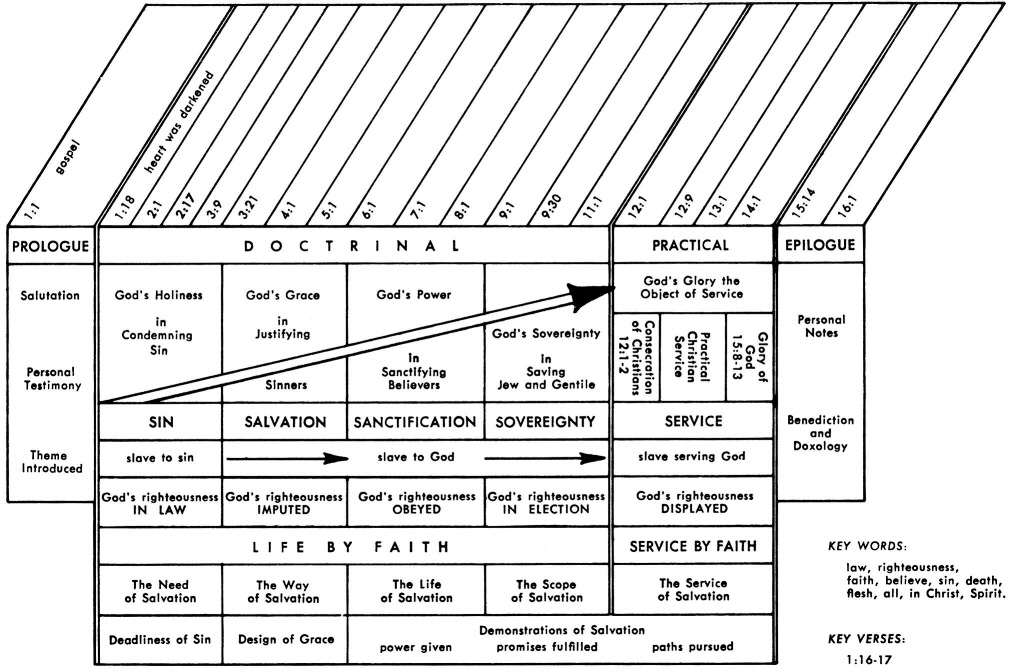
Click chart to enlarge
Chart from recommended resource Jensen's Survey of the NT - used by permission
Romans Overview Chart - Charles Swindoll
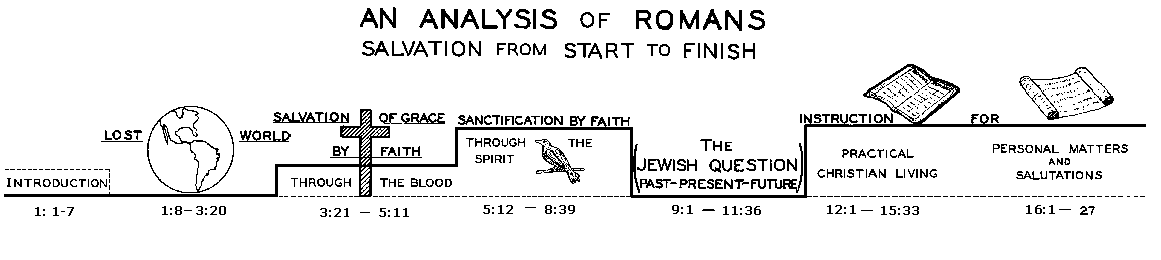
Source: Dr David Cooper
Click to Enlarge
R Ruin (Romans 1:17 – 3:20) – The utter sinfulness of humanity
O Offer (Romans 3:21-31) – God’s offer of justification by grace
M Model (Romans 4:1-25) – Abraham as a model for saving faith
A Access (Romans 5:1-11) – The benefits of justification
N New Adam (Romans 5:12-21) – We are children of two “Adams”
S Struggle w/ Sin (Romans 6-8) Struggle, sanctification, and victory
|
ROMANS ROAD |
||||
| Romans 1:18-3:20 | Romans 3:21-5:21 | Romans 6:1-8:39 | Romans 9:1-11:36 | Romans 12:1-16:27 |
| SIN | SALVATION | SANCTIFICATION | SOVEREIGNTY | SERVICE |
| NEED FOR SALVATION |
WAY OF SALVATION |
LIFE OF SALVATION |
SCOPE OF SALVATION |
SERVICE OF SALVATION |
| God's Holiness In Condemning Sin |
God's Grace In Justifying Sinners |
God's Power In Sanctifying Believers |
God's Sovereignty In Saving Jew and Gentile |
Gods Glory The Object of Service |
| Deadliness of Sin |
Design of Grace |
Demonstration of Salvation | ||
| Power Given | Promises Fulfilled | Paths Pursued | ||
| Righteousness Needed |
Righteousness Credited |
Righteousness Demonstrated |
Righteousness Restored to Israel |
Righteousness Applied |
| God's Righteousness IN LAW |
God's Righteousness IMPUTED |
God's Righteousness OBEYED |
God's Righteousness IN ELECTION |
God's Righteousness DISPLAYED |
| Slaves to Sin | Slaves to God | Slaves Serving God | ||
| Doctrine | Duty | |||
| Life by Faith | Service by Faith | |||
|
Modified from Irving L. Jensen's chart above |
||||
Romans 1:1 Paul, a bond-servant of Christ Jesus, called as an apostle, set apart (RPP) for the gospel of God, (NASB: Lockman)
Greek: Paulos doulos Christou Iesou, kletos apostolos, aphorismenos (RPPMSN) eis euaggelion Theou,
Amplified: FROM PAUL, a bond servant of Jesus Christ (the Messiah) called to be an apostle, (a special messenger) set apart to [preach] the Gospel (good news) of and from God, (Amplified Bible - Lockman)
NLT: This letter is from Paul, Jesus Christ's slave, chosen by God to be an apostle and sent out to preach his Good News. (New Living Translation - Tyndale House)
Phillips: This letter comes to you from Paul, servant of Jesus Christ, called as a messenger and appointed for the service of that Gospel of God (New Testament in Modern English)
Wuest: Paul, a bondslave by nature belonging to Christ Jesus, an ambassador by divine summons, permanently separated to God's good news
Young's Literal: Paul, a servant of Jesus Christ, a called apostle, having been separated to the good news of God--
PAUL: Paulos:
- Acts 13:9; 22:7; 26:1,14) (Click for tabular timeline of Paul's life
- Romans 1 Resources - Multiple Sermons and Commentaries
Related Resources:
- Paul • Paul, The Apostle, 1
- Paul, The Apostle, 2
- Paul, The Apostle, 3
- Paul, The Apostle, 4
- Paul, The Apostle, 5
- Paul, The Apostle, 6
- Paul, Voyage And Shipwreck Of
- Pauline Theology
Paul (Latin = paulus or paullus) (Click for brief summary of Paul's life) means small or little whereas Saul means asked for. Some Others find in the name an expression of humility, according to Paul’s declaration that he was “the least of the apostles” (1Co 15:9) while others feel it alludes to his diminutive stature, but this is speculation at best.
Paul was a Jew of the tribe of Benjamin, born in the Greek city of Tarsus in Cilicia and was a Roman citizenship (Acts 22:28, 29). Paul was well acquainted with the three great nationalities of the Roman Empire and was providentially prepared for his apostolic mission among the Jews, the Greeks, and the non–Greeks, also called barbarians. Under the instruction of Gamaliel, a distinguished rabbi at Jerusalem (Acts 5:34), Paul became a master of the Jewish law (Acts 22:3; Gal 1:14). Paul was also a tentmaker, a trade that he performed so that he could support himself (Acts 18:3; 1Co 4:12; 9:18).
A BOND-SERVANT OF CHRIST JESUS: Paulos doulos Christou Iesou:
- Ro 1:9; 15:16; 16:18; Jn 12:26; 13:14, 15, 16; 15:15, 20, Ac 27:23; 2Co 4:5; Gal 1:10; Php 1:1; Titus 1:1; Jas 1:1; 2Pe 1:1; Jude 1; Rev 1:1; 22:6 ,9
- Romans 1 Resources - Multiple Sermons and Commentaries
WHOSE I AM
WHOM I SERVE
Note Paul's perception of reality as a new creature in Christ -- he is not his own (1Cor 6:19-20-note, cp 1Pe 1.18-19-note) He understands he belongs to another, Christ Jesus. If we could just grasp a fraction of this truth that Paul had laid hold of, what a powerful impact it would have on our lives! Oh, for more of Christ and less of me! Notice Paul's testimony to the centurion and others on the ship that would soon crash at Malta - "For this very night an angel of the God to Whom I belong and Whom I serve (literally = "Whose I am, Whom I serve) stood before me..." (Acts 27:23, context Acts 27:21, 23-26).
SURRENDER
BEFORE
SERVICE
Oh, how often I pretend to willingly serve, when in fact I have not truly surrendered my will to His will! It reminds me of how my worship should always precede my work. Enable me Lord to surrender and then serve. Amen.
Bondservant (1401) (doulos [word study] from root deo = "to bind") in its primary meaning describes one who is bound to another. Paul was "a servant (bound to) of Jesus Christ"; no longer a servant (bound to) of sin, nor of Satan, nor of man, nor of Moses and his Law, nor of the traditions of men.
Doulos was used of a select group of OT believers who were bondservants of Jehovah including Abraham (Ps 105:6, 42), Moses (2Ki 21:8, Mal 4:4), Joshua [Josh 24:29], Caleb [Nu 14:24], Job [Job 1:8], David (2Sa 7:5, 8) the prophets (Am 3:7; Zec 1:6), and the Servant of servants Messiah [Is 42:1,53:11]
Click both of the following links for in depth word studies on doulos (1) or doulos (2).
In Greek culture doulos conveyed the basic idea of subservience and had a wide range of connotations. It was sometimes used of a person who voluntarily served others, but most commonly it referred to those who were in unwilling and permanent bondage, from which often there was no release but death. The Hebrew equivalent (ebed - 05650) is used hundreds of times in the Old Testament and carries the same wide range of connotations. The Mosaic law provided for an indentured servant to voluntarily become a permanent bond-slave of a master he loved and respected.
“If a slave plainly says, ‘I love my master, my wife and my children; I will not go out as a free man,’ then his master shall bring him to God, then he shall bring him to the door or the doorpost. And his master shall pierce his ear with an awl; and he shall serve him permanently” (Ex. 21:5,6).
Paul used doulos in this latter sense to describe a servant who willingly committed himself to serve a master he loved and respected (Dt 15:12, 13, 14, 15, 16, 17, 18 Ex 21:5, 6) He had come to understand the liberating truth that true freedom is found in bondage to Jesus Christ, his Master.
Marvin Vincent says that a doulos "involves the ideas of belonging to a master, and of service as a slave. The former is emphasized in Paul’s use of the term, since Christian service, in his view, has no element of servility, but is the expression of love and of free choice. From this stand-point the idea of service coheres with those of freedom and of sonship. Compare 1Co 7:22; Gal 4:7; Ep 6:6-note; Philemon 1:16. On the other hand, believers belong to Christ by purchase (1Co 6:20; notes on 1Peter 1:18-note; Eph 1:7-note), and own Him as absolute Master." (Vincent, M. R. Word studies in the New Testament. Vol. 3, Page 1-2)
John MacArthur writes that "In New Testament times there were millions of slaves in the Roman Empire, the vast majority of whom were forced into slavery and kept there by law. Some of the more educated and skilled slaves held significant positions in a household or business and were treated with considerable respect. But most slaves were treated much like any other personal property of the owner and were considered little better than work animals. They had virtually no rights under the law and could even be killed with impunity by their masters. (MacArthur, J: Romans 1-8. Chicago: Moody Press)
Harry Ironside illustrates the idea of bondslave: "He (PAUL) does not mean however that his was a service of bondage. Rather he served in the whole-hearted obedience of one who realized that he had "been bought with a price:" (1Co 6:20-note) even the precious blood of Christ (1Pe 1:18-note; 1Pe 1:19-note). There is a story told of an African slave whose master was about to slay him with a spear when a chivalrous British traveler thrust out his arm to ward off the blow, and it was pierced by the cruel weapon. As the blood spurted out he demanded the person of the slave, saying he had bought him by his suffering. To this the former master ruefully agreed. As the latter walked away, the slave threw himself at the feet of his deliverer exclaiming, "The blood-bought is now the slave of the son of pity. He will serve him faithfully." And he insisted on accompanying his generous deliverer, and took delight in waiting upon him in every possible way. Thus had Paul, thus has each redeemed one, become the bondman of Jesus Christ. We have been set free to serve, and may well exclaim with the Psalmist (Ps 116:16 O LORD, surely I am Your servant, [Lxx = doulos] I am Your servant, the son of Your handmaid, You have loosed my bonds.).
Paul most likely wrote Romans from Corinth, as inferred from the references to Phoebe (Romans 16:1-notes, Cenchrea was Corinth's port), Gaius (Ro 16:23-note), and Erastus, each of these individuals known to be associated with Corinth.
The apostle wrote Romans toward the close of his 3rd missionary journey (around 56AD), as he prepared to leave for Palestine with an offering for the poor believers in the Jerusalem church (Ro 15:25-note). Phoebe was apparently given the great responsibility of delivering this letter to the Roman believers (Ro 16:1-note).
Christ (Christos) Jesus ( Iesous) - This exact Name 15x in Romans - Ro 1:1; 2:16; 3:24; 6:3, 11, 23; 8:1,2, 11, 34, 39; 15:5, 16, 17; 16:3;
CALLED AS AN APOSTLE: kletos apostolos:
- Ro 1:5; 11:13; Ac 9:15; 22:14, 15,21; 26:16;17,18 1Cor 1:1; 9:1,16-18; 15:8-10; 2Cor 1:1; 11:5; 12:11; Gal 1:1,11-17; Ep 1:1; 3:5-7; 4:11; Col 1:1,25; 1Ti 1:1,11,12; 2:7; 2Ti 1:11; Titus 1:1; Heb 5:4
- Romans 1 Resources - Multiple Sermons and Commentaries
Paul is an apostle not by his design but God's grand design, "by the will of God" a point he repeatedly emphasizes (cp 1Cor 1:1, 2Cor 1:1, Gal 1:1, Eph 1:1, Col 1:1, 1Ti 1:11, 2Ti 1:1). Read Paul's explanation of why he was an apostle - "Paul, an apostle of Christ Jesus by the will of God, according to the promise of life in Christ Jesus." "Paul, an apostle (not sent from men nor through the agency of man, but through Jesus Christ and God the Father, who raised Him from the dead)." (Gal 1:1) " Paul, an apostle of Jesus Christ by the will of God, and Timothy our brother." (Col 1:1)
Paul was called specifically to be an apostle to the Gentiles (Ro 11:13-note; cp Acts 9:15, 22:21, 26:17) explains later in this epistle that he "received grace and apostleship to bring about the obedience of faith among all the Gentiles, for His name's sake." (Ro 1:5-note - see discussion of the phrase "obedience of faith")
Called (2822) (kletos [word study]) from kaléo = call) means invited or welcomed and was originally used to designate those invited to a banquet. In the NT kletos is generally used of one who has accepted a calling or an invitation to become a guest or member of a select group. We have been invited by God in the proclamation of the Gospel to obtain eternal salvation in the kingdom through Christ. The verbal adjective kletos with this ending usually has a passive sense ("be called").
Apostle (652) (apostolos [word study] from kaléo = call) (or click here) means literally “one who is sent” and from the context Paul did not thrust himself into this office or take this honor to himself, of which he always judged himself unworthy, (1Cor 15:9,10, cf Gal 1:1) but was "called" to the office according to the will and by the grace of God. Paul was invited by God to be His man to the Gentiles (2Ti 4:17-note).
Paul is an apostle by calling, a divinely initiated calling, not an apostle by human seeking. The New English Bible's rendering "apostle by God's call," does a good job of catching the force of the Greek. The apostle was a man who had seen the risen Messiah (Acts 9:1, 2, 3, 4, 5, 6, 10, 11, 12, 15, 16, 17, 18, 19, 20, 21, 22) and had been appointed by Him to plant the flag of faith in every community to which His master led him. He was His emissary, God's ambassador (Eph 6:20-note cf the role of saints today 2Co 5:20) and he spoke with God's authority. Thus, in Paul's words there is the implicit claim that he is the authoritative representative of Jesus Christ, divinely called to his task. Paul's call, as Abraham's (Ge 12:1, Heb 11:8-note), was an invitation that came from heaven.
While there are no apostles today, it is certainly to be expected that believers, regardless of the precise spiritual gift they possess, minister their gift with the same sense of divine calling to it. There is abundant evidence that there are many attempting to minister in the name of Jesus Christ who have never been called by Him to the task. It could be said of them, as Jehovah said of the false prophets in Jeremiah's day,
I have not sent these prophets, yet they ran: I have not spoken to them, yet they prophesied (Jer 23:21).
One is reminded of the story of the old preacher who had a good grasp of these fundamental principles and even more so a grasp of and relationship with the Lord Himself. On one occasion he had to listen to a brash young preacher, very sure of himself, who displayed little evidence of the life and power of God in his preaching. When the message was over, he went over to the confident youth and said, "WAS YOU SENT, or DID YOU JUST WENT?"
SET APART FOR (unto): aphorismenos (RPPMSN) eis:
- Lev 20:24, 25, 26; Nu 16:9,10; Dt 10:8; 1Chr 23:13; Is 49:1; Jer 1:5; Ac 13:2, 3, 4; Gal 1:15; 1Ti 1:15,16; Heb 7:26
- Romans 1 Resources - Multiple Sermons and Commentaries
Paul was saying, “I’ve got a hedge about me-I’m not free to go off and do just anything. I have one thing I am set apart for, one thing God has called me for-and that is the gospel of God.”
Note that this threefold description given by the apostle of himself rings one resounding note: The initiative for genuine ministry comes from God (cf. Heb 5:4-note).
Set apart (873) (aphorizo from apó = off from, apart + horizo = mark out the limit) means to mark off the boundaries, to appoint, set one apart for some purpose. It is used of the final separation of the righteous from the wicked (Mt 13:49; 25:32); of the separation of the disciples from the world (Lk 6:22); and of the setting apart of apostles to special functions (Acts 13:2).
The central idea is “to limit by setting apart from the rest,” hence, to distinguish from others in some specific way.
Aphorizo - 10x in 10v -Mt. 13:49; 25:32; Lk 6:22; Acts 13:2; 19:9; Ro 1:1; 2Co. 6:17; Gal. 1:15; 2:12). NAS is translated: hold...aloof, 1; ostracize, 1; separate, 2; separates, 1; set apart, 2; set...apart, 1; take, 1; took away, 1.
Set apart is in the perfect tense which speaks of a past completed action having present results, thus Wuest says that Paul was "permanently separated to God's good news." Are you? Am I? Good questions to ponder beloved.
Aphorizo is used 63 times in the Septuagint (Lxx) (Greek translation of Hebrew OT) -Ge 2:10; 10:5; Ex 19:12, 23; 29:24, 26-27; Lev 10:15; 13:4-5, 11, 21, 26, 31, 33, 50, 54; 14:12, 38, 46; 20:25-26; 25:34; 27:21; Nu 8:11; 12:14f; 15:20; 18:24; Dt 4:41; Josh 14:4; 16:9; 21:13-15, 21-23; 2Sa 8:1; Ps 68:9; Pr 8:27; Isa 29:22; 45:24; 52:11; 56:3; Ezek 45:1, 4, 13; 48:9, 20; Mal 2:3 - Throughout the OT, God provided for the setting apart of His chosen people. To the entire nation He declared "Thus you are to be holy to Me, for I the Lord am holy; and I have set you apart (Lxx = aphorizo) from the peoples to be Mine (Notice this last phrase - "to be Mine" - Paul "got it" - He understood he was no longer his own as discussed above. Do you understand this vital truth? Do I? I fear not - speaking for myself!)." (Lev 20:26).
In the OT aphorizo (and the related word group) is used of setting apart to God the firstborn, of offering to God first fruits, of consecrating to God the Levites, and of separating Israel to God from other peoples. The basic instruction was that there was to be no intermingling of the chosen people with the Gentile nations or of the sacred with the profane and ordinary.
Complete Biblical Library Greek-English Dictionary - In the New Testament there are two basic ideas conveyed by aphorizō. One is “to separate” in the sense of taking something away. For example, Acts 19:9 reports that Paul “separated the disciples” in order to teach and to explain the Gospel. Matthew 25:32 pictures the judgment scene in which the sheep and the goats will be separated from each other. Matthew 13:49 portrays the separation of the wicked from the righteous. The concept of separation includes the idea of excommunication. Luke 6:22 marks for blessedness the one excluded from religious fellowship because of loyalty to the Son of Man. The same nuance of exclusion is found in Isaiah 45:24 (LXX 45:25). Peter, in Galatians 2:12, drew back from Gentile fellowship and separated himself from them. Here the force of the verb is the act of holding oneself aloof, of willful separation. Similarly, 2 Corinthians 6:17 employs this verb in an imperative sense, “Be separate.” The second fundamental meaning of aphorizō is “to set apart,” “to appoint.” Paul identified himself as one singled out by God, set apart for special ministry (Romans 1:1; Galatians 1:15). Acts 13:2 reports the calling of Barnabas and Saul for mission service: “Separate me Barnabas and Saul . . . ” (The Complete Biblical Library Old and New Testament)
Luke uses this verb in the sense of excommunication (synagogue, etc) quoting Jesus Who declared
Blessed are you when men hate you, and ostracize (exclude, ban) you, and cast insults at you, and spurn your name as evil, for the sake of the Son of Man." (Lk 6:22)
The Aramaic term Pharisee may share a common root with aphorizo and carries the same idea of separation. The Pharisees, however, were not set apart by God or according to God’s standards but had rather set themselves apart according to the standards of their own traditions (cf. Mt 23:1, 2).
Paul by his own testimony was as to the Law a Pharisee (Php 3:5-note), "one separated" to the law, but after the dramatic Damascus Road encounter he became eternally separated unto the Gospel of His Lord. In the past, God
had set (Paul) apart (aphorizo), even from (his) mother's womb (before he was born) and called (him) through His grace (Gal 1:15-note)
(Gal 2:12-note) For prior to the coming of certain men from James, he used to eat with the Gentiles; but when they came, he began to withdraw and hold himself aloof, fearing the party of the circumcision.
Paul once the most ardent of the self-appointed Pharisees, was now set apart divinely, not humanly. God revealed to him that he had been set apart by God’s grace even from his mother’s womb.
As A T Robertson put it
The Pharisees were the separatists who held themselves off from others. Paul conceives himself as a spiritual Pharisee “separated unto the gospel of God ” (Word Pictures in the New Testament)
When God "was pleased to reveal His Son in" Paul, he was forever dedicated fully to the ministry of God's gospel (1Cor 9:23).
Shortly thereafter while the leaders of the church at Antioch "were ministering to the Lord and fasting, the Holy Spirit said,
Set apart (aphorizo) for Me Barnabas and Saul for the work to which I have called them" (Acts 13:2)
This setting apart by the Holy Spirit's declaration resulted in Paul's "First Missionary Journey.
In sum, setting apart indicates the separating of an individual for specific service.
Paul admonishes the Corinthians to
COME OUT (aorist imperative) FROM THEIR MIDST AND BE SEPARATE (aphorizo - aorist imperative)," says the Lord. "AND DO NOT TOUCH (present imperative - with a negative = stop touching what is unclean) WHAT IS UNCLEAN; And I will welcome you." (2Co 6:17)
C. I. Scofield summarizes this idea of being set apart by God writing that
Separation...is...from whatever is contrary to the mind of God and unto God Himself. The underlying principle is that in a moral universe it is impossible for God fully to bless and use His children who are in compromise or complicity with evil. Separation from evil implies separation in desire, motive, and act, from the world...Separation is not from contact with evil... but from complicity with and conformity to it. And the reward of separation is the full manifestation of the divine fatherhood (2Co 6:17,18) unhindered communion and worship and fruitful service (2Ti 2:21-note) as world conformity involves the loss of these, though not of salvation. Christ is the model. He was "holy, blameless, pure, set apart from sinners" (Hebrews 7:28-note), and yet He was in such contact with them for their salvation that the Pharisees, who illustrate the mechanical and ascetic conception of separation judged Him as having lost His Nazirite character (Lk 7:39)
The apostle Paul reminds us of the sign on the back of a u haul type truck...
ANY LOAD
ANY PLACE
ANY TIME
This motto was certainly true of Paul and should be true of all who claim the Name of Jesus Christ as their Lord and Savior. None of us will ever achieve perfection in this area but with God's grace can redeem every breath of life God graciously gives us that we might see His kingdom enlarged and His Name glorified "any place, any time."
THE GOSPEL OF GOD: euaggelion theou:
- Ro 1:9,16; 15:16, 29; 16:25; Mark 16:15,16; Lk 2:10,11; Acts 20:24; Eph 1:13; 1Th 2:2; 2Th 2:13; 14, 1Ti 1:11
- See Torrey's Topic Gospel
- See More Discussion of the Gospel - Notes on Romans 1:16
- Romans 1 Resources - Multiple Sermons and Commentaries
Gospel (2098) (euaggelion [word study]) (9x in Romans - Ro 1:1, 9, 16; 2:16; 10:16; 11:28; 15:16, 19; 16:25) literally means good news. The noun euaggelion and the verb euaggelizo/euangelizo are derived from eu meaning “well” and aggello which meant “to bear a message, bring tidings or news, proclaim.” Thus euaggelizomai means “to bring a message of good news” and the noun euaggelion “is the good news that was proclaimed.
Euaggelion - Matt 4:23; 9:35; 24:14; 26:13; Mark 1:1, 14f; 8:35; 10:29; 13:10; 14:9; 16:15; Acts 15:7; 20:24; Ro 1:1, 9, 16; 2:16; 10:16; 11:28; 15:16, 19; 16:25; 1 Cor 4:15; 9:12, 14, 18, 23; 15:1; 2 Cor 2:12; 4:3f; 8:18; 9:13; 10:14; 11:4, 7; Gal 1:6f, 11; 2:2, 5, 7, 14; Eph 1:13; 3:6; 6:15, 19; Phil 1:5, 7, 12, 16, 27; 2:22; 4:3, 15; Col 1:5, 23; 1 Thess 1:5; 2:2, 4, 8f; 3:2; 2 Thess 1:8; 2:14; 1 Tim 1:11; 2 Tim 1:8, 10; 2:8; Phlm 1:13; 1 Pet 4:17; Rev 14:6. NAS = good news(1), gospel(73), gospel's(2).
Wuest says that the word “gospel” comes from the Saxon word gode-spell, the word gode meaning good, and “spell” meaning a story, a tale.
Euaggelion was in just as common use in the first century as our words good news. “Have you any good news (euaggelion) for me today?” must have been a common question. Our word gospel today has a definite religious connotation. In the ordinary conversation of the first century, it did not have such a meaning. However, gospel was taken over into the Cult of the Caesar where it acquired a religious significance. The Cult of the Caesar was the state religion of the Roman empire, in which the emperor was worshipped as a god. When the announcement of the emperor’s birthday was made, or the accession of a new Caesar (gives rise to our English Kaiser & Czar!) proclaimed, the account of either event was designated by the word euaggelion. And so euaggelion is found in an inscription of 9BC with reference to the birthday of the Emperor Augustus, “but the birthday of the god (the Emperor) was for the world the beginning of tidings of joy on his account”.
Euaggelion was used for the proclamation of good news of victory in battle with announcement of the death and/or capture of the enemy. Under the inspiration of the Holy Spirit the Paul appropriated euaggelion, taking it from its well known secular use and speaking of the message of salvation as good news. Paul’s good news was not from or about the emperor but was "of God", belonging to God, originating with God, and committed to men by God, Who qualified them for preaching and gives them effects related to their preaching of the gospel. God alone receives the glory in the gospel.
In addition to the "definition" in (Ro1:16ff) Paul gives an excellent definition of the "gospel" to the Corinthians reminding them that it was
"the gospel which I preached to you, which also you received, in which also you stand, by which also you are saved, if you hold fast the word which I preached to you (holding fast proves one has had genuine rebirth and is not a work one does to merit salvation which is by grace alone), unless you believed in vain. For I delivered to you as of first importance what I also received, that Christ died for our sins according to the Scriptures, and that He was buried, and that He was raised on the third day according to the Scriptures, and that He appeared to Cephas, then to the twelve..." (See notes 1Corinthians 15:1; 15:2; 15:3; 15:4; 15:5; 15:6; 15:7; 15:8)
The writers of the New Testament adapted the term Gospel as God's glorious message of salvation for lost otherwise hopeless, helpless sinners. Euaggelion is found in several combination phrases, each describing the gospel like a multifaceted jewel in various terms from a different viewpoint (from the NASB, 1977):
- the gospel of the kingdom (Mt 4:23+, Mt 9:35+, Mt 24:14+)
- the gospel of Jesus Christ, the Son of God (Mk 1:1+) because it centers in Christ
- the gospel of God (Mk 1:14+, Ro 15:16+, 2Co 11:7+, 1Th 2:2+, 1Th 2:8,9+, 1Pe 4:17+) because it originates with God and was not invented by man
- the gospel of the kingdom of God (Lu 16:16+)
- the gospel of the grace of God (Acts 20:24+, Ro 1:1+),
- the gospel of His Son (Ro 1:9+)
- the gospel of Christ (Ro 15:19+, 1Co 1:9+, 2Co 2:12+, 2Co 9:13+, 2Co 10:14+, Gal 1:7+, Phil 1:27+, 1Th 3:2+)
- the gospel of the glory of Christ (2Co 4:4+)
- the gospel of your salvation (Eph 1:14+)
- the gospel of peace (Eph 6:15+)
- the gospel of our Lord Jesus (2Th 1:8+)
- the glorious gospel of the blessed God (1Ti 1:11+)
- In Ro 16:25, 26+ Paul called it “my Gospel” indicating that the special emphasis he gave the gospel in his ministry.
- An eternal gospel - Rev 14:6+ (Some writers such as C I Scofield interpret this as a "different gospel" than the other "gospels" mentioned above but I think such a distinction is incorrect and is poorly substantiated).
For a rewarding study, study the preceding references in context making notation of the truth you observe about the gospel. If you would like a special blessing, take an afternoon to go through all 76 uses of euaggelion in context making a list of what you learn about the gospel. The Spirit of God will enlighten your heart and encourage your spirit in a very special way...and you'll want to share the "good news" with someone because of your "discoveries"!
Euaggelion - Matt. 4:23; Matt. 9:35; Matt. 24:14; Matt. 26:13; Mk. 1:1; Mk. 1:14; Mk. 1:15; Mk. 8:35; Mk. 10:29; Mk. 13:10; Mk. 14:9; Mk. 16:15; Acts 15:7; Acts 20:24; Rom. 1:1; Rom. 1:9; Rom. 1:16; Rom. 2:16; Rom. 10:16; Rom. 11:28; Rom. 15:16; Rom. 15:19; Rom. 16:25; 1 Co. 4:15; 1 Co. 9:12; 1 Co. 9:14; 1 Co. 9:18; 1 Co. 9:23; 1 Co. 15:1; 2 Co. 2:12; 2 Co. 4:3; 2 Co. 4:4; 2 Co. 8:18; 2 Co. 9:13; 2 Co. 10:14; 2 Co. 11:4; 2 Co. 11:7; Gal. 1:6; Gal. 1:7; Gal. 1:11; Gal. 2:2; Gal. 2:5; Gal. 2:7; Gal. 2:14; Eph. 1:13; Eph. 3:6; Eph. 6:15; Eph. 6:19; Phil. 1:5; Phil. 1:7; Phil. 1:12; Phil. 1:16; Phil. 1:27; Phil. 2:22; Phil. 4:3; Phil. 4:15; Col. 1:5; Col. 1:23; 1 Thess. 1:5; 1 Thess. 2:2; 1 Thess. 2:4; 1 Thess. 2:8; 1 Thess. 2:9; 1 Thess. 3:2; 2 Thess. 1:8; 2 Thess. 2:14; 1 Tim. 1:11; 2 Tim. 1:8; 2 Tim. 1:10; 2 Tim. 2:8; Phlm. 1:13; 1 Pet. 4:17; Rev. 14:6
E. Stanley Jones adds that while the world's vast array of
Religions are man’s search for God; the Gospel is God’s search for man. There are many religions, but one Gospel.
A poet has summarized the good news of the gospel of God, writing:
Do this and live, the law commands,
But gives me neither feet nor hands.
A better word the gospel brings.
It bids me fly and gives me wings
The simple truth of this poem was dramatically illustrated in the conversion of the renowned preacher John Wesley who had just returned to England from an discouraging "evangelistic" trip to Savannah, Georgia, having encountered difficulty with the colonists and also coming under conviction that he himself might not be genuinely born again. On the evening of May 24, 1738, he unwillingly agreed to attend a society in Aldersgate Street, where someone was reading Luther's Preface to the Epistle to the Romans not knowing that he would soon be forever a new man. Wesley later wrote
"About a quarter before nine, while he (Luther) was describing the change which God works in the heart through faith in Christ, I felt my heart strangely warmed. I felt I did trust in Christ, Christ alone, for my salvation; and an assurance was given me that he had taken my sins away, even mine; and saved me from the law of sin and death."
Armed with the liberating gospel message Wesley embarked on 40 years of ministry and was instrumental along with George Whitfield in launching the First Great Awakening in the 1730's and 1740's in England and across the Atlantic in colonial America. Before this spiritual reawakening ended, over half of America's colonists were touched by the preaching of the gospel and the foundation was in fact laid for the American Revolution. The gospel certainly is the power of God to change a man and change a nation. May God be pleased to once again send His revival winds on the spiritually darkening land of America.
Testimony of William Tyndale - The man to whom we owe the largest debt for the translation of the Bible into English, writing in the preface to Romans in his 1534 edition of the English New Testament:
Forasmuch as this epistle is the principal and most excellent part of the New Testament, and most pure gospel, and also a light and a way in unto the whole Scripture, I think it meet that every Christian man not only know it by rote and without the book, but also exercise himself therein evermore continually, as with the daily bread of the soul. No man verily can read it too oft or study it too well; for the more it is studied the easier it is, the more it is chewed the pleasanter it is, and the more groundly it is searched the preciouser things are found in it, so great treasure of spiritual things lieth hid therein." (Sound advice from a man who died as a martyr literally giving his life for the gospel. Click for biographical sketch)
Romans 1:2 which He promised beforehand (3SAMI) through His prophets in the holy Scriptures, (NASB: Lockman)
Greek: o proepeggeilato (3SAMI) dia ton propheton autou en graphais hagiais,
Amplified: Which He promised in advance [long ago] through His prophets in the sacred Scriptures— (Amplified Bible - Lockman)
NLT: This Good News was promised long ago by God through his prophets in the holy Scriptures. (New Living Translation - Tyndale House)
Phillips: which was long ago promised by the prophets in the holy scriptures. (New Testament in Modern English)
Wuest: which He promised aforetime through the intermediate agency of His prophets in holy writings
Young's Literal: which He announced before through His prophets in holy writings
WHICH HE PROMISED BEFOREHAND THROUGH HIS PROPHETS I N THE HOLY SCRIPTURES: o proepeggeilato (3SAMI) dia to n propheton autou en graphais hagiais :
- Lk 24:26,27; Ac 10:43;13:32, 26:6; 2Ti 3:15, Gal 3:8, Gen 22:18, Titus 1:2
- Romans 1 Resources - Multiple Sermons and Commentaries
Promised beforehand (4279) (proepaggellomai from pro = before + epaggello = to announce that one is about to do, to promise of one's own accord) expresses the idea that God announced with certainty in advance as to what He would do to make righteousness available to unrighteous sinful mankind.
The only other use of proepaggellomai (not used in Septuagint)...
2Corinthians 9:5 So I thought it necessary to urge the brethren that they would go on ahead to you and arrange beforehand your previously promised bountiful gift, so that the same would be ready as a bountiful gift and not affected by covetousness.
God's gospel is good news, but it is not new news.
Here Paul alludes to the element of divine foreordination in the gospel. As Luther in his characteristically rugged way said,
Christianity did not originate by accident or in the fate of the stars (as many empty-headed people presume)," but "it became what it was to be by the certain counsel and premeditated ordination of God." It is not without reason that Romans has been called a "theology of the Old Testament", because Paul's words "promised beforehand," overlap considerably with the truths found in Isaiah 40-66 (Isa 40:9; 52:7; 61:1) and Habakkuk (Hab 2:4) and so as Leenhardt aptly puts it "The gospel represents not a break with the past, but a consummation of it.
Prophets (see word study below) in the present context refers not just to prophets like Isaiah or Habakkuk but to all the human authors of the Old Testament.
Key point: The Gospel is found in the Old Testament, which is a good thing because the OT Scriptures were what the apostles used to preach to the people (cp Acts 8:28-36). Listen to Peter's proclamation (recall Peter preached primarily to the Jews and Paul was the apostle to the Gentiles)
But the things which God announced beforehand by the mouth of all the prophets, that His Christ should suffer, He has thus fulfilled. Repent therefore and return, that your sins may be wiped away, in order that times of refreshing may come from the presence of the Lord and that He may send Jesus, the Christ appointed for you, Whom heaven must receive until the period of restoration of all things about which God spoke by the mouth of His holy prophets from ancient time. "Moses (a prophet) said, 'THE LORD GOD SHALL RAISE UP FOR YOU A PROPHET (Messiah) LIKE ME FROM YOUR BRETHREN. TO HIM YOU SHALL GIVE HEED (Dt 18:15) in everything He says to you. And it shall be that every soul that does not heed that prophet shall be utterly destroyed from among the people.' And likewise, all the prophets who have spoken, from Samuel and his successors onward, also announced these days. It is you who are the sons of the prophets, and of the covenant which God made with your fathers, saying to Abraham, 'AND IN YOUR SEED (Ultimately fulfilled in the Messiah - Gal 3:16) ALL THE FAMILIES OF THE EARTH SHALL BE BLESSED.' For you first, God raised up His Servant (Jesus), and sent Him to bless you by turning (Ed: Yes, we are to repent, but ultimately God facilitates and enables the "turning"!) every one of you from your wicked ways." (Acts 3:18-26)
Of Him (Messiah) all the prophets bear witness that through His Name everyone who believes in Him receives forgiveness of sins. (Acts 10:43)
The term Law and the Prophets (Mat 5:17, Mat 7:12, Mat 11:13, Mat 22:40, Luke 16:16, Luke 24:44, John 1:45, Acts 13:15, Acts 24:14, Acts 28:23, Rom 3:21) is used elsewhere to refer to the entire Old Testament (Acts 24:14) and the Law (Pentateuch) in turn was written by Moses, whom Scripture also calls a prophet (Dt18:15). So here Paul's use of the term prophets is a reference to the all of the Old Testament. Compare " Law of Moses and the Prophets and the Psalms" in Luke 24:44.
Writing to the Galatians Paul explains the promise given beforehand teaching that "the Scripture, foreseeing that God would justify the Gentiles by faith, preached the gospel beforehand to Abraham, saying, "ALL THE NATIONS SHALL BE BLESSED IN YOU" (Gal 3:8) which is a quotation from (Ge 12:3). The gospel, which originated with God, was not a divine afterthought, nor was it first taught in the New Testament. It does not reflect a late change in God’s plan or a revision of His strategy. Clearly salvation in the Old Testament was identical with salvation in the New Testament for both teach a man is justified (declared righteous) by exercise of personal faith. It is surprising how many saints sitting even in Bible teaching churches are still "fuzzy" on how a man or woman was saved in the Old Testament. With the simple declaration that the Gospel of God was promised beforehand, Paul gives us the answer to this often confusing topic.
Holy (40)(hagios) set apart from common, in this context from common (profane) uninspired, errant writings of men.
Scriptures (1124)(graphe [word study] from grapho = to write; English = graphite - the lead in a pencil!) means first a writing or thing written, a document. The majority of the NT uses refer to the Old Testament writings, in a general sense of the whole collection when the plural (= Scriptures - Matt. 21:42; 22:29; 26:54; Mark. 12:24; 14:49; Lk. 24:27, 32, 45; Jn. 5:39; Acts 17:2, 11; 18:24, 28; Rom. 15:4; 2Pe 3:16) is used and other times of a particular passage when the singular is used (= the Scripture - Mark. 12:10; 15:28; Lk. 4:21; Jn. 13:18; 19:24, 36f; Acts 1:16; 8:35; Ro 11:2; Jas. 2:8, 23) and is used in such a way that quoting Scripture is understood to be the same as quoting God!
In the holy Scriptures - Paul speaks in the language of the Jews who frequently referred to the Bible as the "holy Scriptures". Of practical import one should note that in light of this truth, it is exegetical suicide to attempt to interpret the NT apart from the voice of its predecessor, the OT. Are evangelicals giving due process to the OT from the pulpits? The old is the new concealed and the new is the old revealed.
This is the only place in NT the phrase "Holy Scriptures" (graphais hagiai) is used. Most Jews of that day were so accustomed to looking to rabbinical tradition for religious guidance that the Holy Scriptures were looked on more as a sacred relic than as the source of truth. Paul is emphasizing that the Scriptures are not just any writings but are holy and thus are set apart from all humanly inspired, profane writings. How so? One test is what is the effect the writing produces? The Holy Scriptures possess the inherent ability to produce holiness, separation from sin and consecration unto God. No sinner can long read the Holy Scriptures without a change taking place in their life. Either they will change in a supernatural way or the Scriptures will not be read for long. The Scriptures are the authoritative document of God which produces holiness in man who is by birth unholy (Ro 5:12 - note).
The Holy Scriptures will keep you from sin or sin will keep you from the Scriptures!
Bibles that are falling apart usually belong to people who aren't!
E. Paul Hovey said "Men do not reject the Bible because it contradicts itself, but because it contradicts them."
Henry Ward Beecher said that "The Bible is God’s chart for us to steer by, to keep us from the bottom of the sea, and to show us where the harbor is, and how to reach it without running on rocks or bars."
D. L. Moody - The study of God’s Word brings peace to the heart. In it, we find a light for every darkness, life in death, the promise of our Lord’s return, and the assurance of everlasting glory."
Phillip Brooks adds that "The Bible is like a telescope. If a man looks through his telescope, then he sees worlds beyond: but if he looks at his telescope, then he does not see anything but that. The Bible is a thing to be looked through, to see that which is beyond; but most people only look at it; and so they see only the dead letter."
The Bible is the only alive book for dead people (see Ephesians 2:1-note; Ephesians 2:2-note; Ephesians 2:3-note) for it alone makes the correct diagnosis of mankind's sin sickness and it alone provides the life saving cure.
While the rabbinical writings popular in the first century—and often studied more diligently than Scripture itself—may not have taught the gospel of God, the divinely inspired Old Testament certainly did (see discussion on the descendant of David below as an example).
Prophets (4396)(prophetes from próphemi = literally to tell beforehand in turn from pró = before, in front of, forth, on behalf of + phemí = speak, tell) is primarily a forth-teller or one who speaks out God’s message, primarily to their own generation, usually always calling the people to God's truth for them at that moment, often using the phrase "Thus saith the Lord." The prophet is one who speaks before in the sense of proclaim, or the one who speaks for, i.e., in the Name of (God). "As distinct from the sacral figures of pagan antiquity the biblical prophet is not a magician. He does not force God. On the contrary, he is under divine constraint. It is God Who invites, summons, and impels him--e.g., Jer 20:7" (Lamorte and Hawthorne) Although we commonly think of the prophet as predicting future events (foretelling) generally this was secondary to his work of forth-telling. When they functioned as predictors or prognosticators, the Biblical prophets foretold the future with 100 percent accuracy. And so if they were correct on the first coming of Messiah, they will be correct on His second coming and on the coming of the antichrist. In sum, forth-telling dealt with current events and fore-telling with future events, but in both the goal is the same -- to call us to trust the Lord and submit to His will for our lives, living in conformity with His Word. Lexham Bible - Prophetes is someone who is specially endowed or enabled to receive and deliver direct revelation of God's will.
See also Dictionary of Biblical Imagery discussion of imagery associated with PROPHET.
Prophetes - Prophets and the prophetic gift acquire a unique function in the New Testament. To a certain extent the prophets of the New Testament and the prophetic function are modeled after the Old Testament prophets. They share many features as well as the same title. The prophets speak as inspired by the Spirit of God; likewise, revelation occurs through the same channel (1Corinthians 13:2). God’s purpose to save Gentiles was preached by the Old Testament prophets even before the New Testament. In the New Testament this fact is revealed not only by the apostles but by the prophets as well (Ephesians 3:5). (The Complete Biblical Library Old and New Testament)
Eerdman's Dictionary - A religious intermediary (Heb. nābi; Gk. prophetēs) whose function is to carry messages back and forth between human beings and a deity. The OT refers to a number of figures as prophets. Fifteen of these are associated with written collections that bear their names — the books from Isaiah through Malachi, excluding Daniel. References to others appear in the prophetic and Deuteronomistic history books. These include Nathan (2Sa 7, 12; 1Kgs. 1), Gad (1 Sam. 22:5; 2 Sam. 24:11), Ahijah (1Kgs. 11:29; 14:2, 18), Elijah (1Kgs. 17-2 Kgs. 2), Elisha (2Kgs. 2–9), Micah (1Kgs. 22), Jonah (2 Kgs. 14:25), Huldah (22:14), and Hanani (Jer. 28). These books also refer generically to prophets whom they do not name (1 Sam. 28:6; 1 Kgs. 13; 2 Kgs. 17:13, 23; 21:10; 23:2; 24:2; Amos 2:11-12; Mic. 3:5–6, 11; Jer. 14:13–16; 23:9–22), and sometimes these operate in groups (1Sam. 10:5, 10–12; in 1 Kgs. 22 there are 400). The story of Elijah’s contest with 450 prophets of Baal and 400 of Anat indicates that prophets of other deities than Yahweh could be found in Israel (1 Kgs. 18).
Webster's 1828 -
- One that foretells future events; a predicter; a foreteller.
- In Scripture, a person illuminated, inspired or instructed by God to announce future events; as Moses, Elijah, David, Isaiah, &c.
- An interpreter; one that explains or communicates sentiments. Ex. 7.
- One who pretends to foretell; an imposter; as a false prophet. Acts 13.
School of the prophets, among the Israelites, a school or college in which young men were educated and qualified for public teachers. These students were called sons of the prophets.
Simply put, prophetes in Scripture is one who speaks for God, as His mouthpiece so to speak (referring of course to true not false prophetes) to men, communicating His truth to them.
MacArthur - Prophetes is "one who speaks out." We think of a prophet as somebody who says "In three weeks the sky is going to fall." It actually wasn't until medieval times that the word prophet became connected with the idea of prediction in the English language. It was always connected with the idea of speaking forth. The prophet was someone who gave God a voice in the world.
Analytical Lexicon - (1) generally one who speaks for God, proclaiming what God wants to make known; used of Old Testament prophetic personalities (Mt 2.23), of John the Baptist (Mt 14.5), of Jesus (Mt 21.11), of believers endowed with the gift of prophecy (Acts 15.32; Eph 4.11), and once of a pagan prophet (Titus 1.12); (2) the pro- prefix may indicate either a sense of place (before, in front of, publicly) or time (previously, in advance), and the context must be used to determine the presence of either or both elements; (a) with the prefix primarily of place, the prophet is one who declares God’s message publicly as a forth teller, as teacher, admonisher, preacher (1Cor 14.29); (b) with the prefix denoting time, the prophet is a foreteller with special knowledge of the future (Mt 24.15); (c) the Christian prophet is one with a special gift and calling to proclaim the divine message, interpret the times, and urge people to believe in Christ for salvation (Eph 3.5); (3) plural "the prophets" collectively, as a group the prophets (Mt 5.12); by metonymy, for their writings the prophetic books, the prophets, what the prophets wrote (Acts 24.14); idiomatically, of all the sacred writings of the Old Testament, literally the law and the prophets, i.e. the Scriptures (Mt 7.12)
TDNT on Secular Prophets - prophets in the Greek world are people who declare things imparted by the gods in direct inspiration or through signs, their task being one of interpretation. Oracle prophets proclaim the will or counsel of the gods in answer to direct questions that cover the whole range of private, political, and cultic life. Human criteria control the selection of oracle prophets, who usually come from higher social classes, and even their inspiration tends to be induced by human initiative. Oracle prophets enjoy high esteem and have official positions, so that they may often be asked to lead delegations etc. In some cases the verb prophēteúō may include stating and presenting the question.
Vincent on prophetes - The popular conception of a prophet is limited to his foretelling future events. This is indeed included in the term, but does not cover its meaning entirely. The word is from phemi, to speak, and pro, before, in front of. This meaning of the preposition may have reference to time, viz., before, beforehand; or to place, viz., in front of, and so, publicly; and this latter meaning, in turn, easily runs into that of in behalf of; for. The prophet is, therefore, primarily, one who speaks standing before another, and thus forming a medium between him and the hearer. This sense runs naturally into that of instead of. Hence it is the technical term for the interpreter of a divine message. So Plato: “For this reason it is customary to appoint diviners or interpreters to be judges of the true inspiration. Some persons call them diviners, seers (μάντεις); they do not know that they are only repeaters of dark sayings and visions, and are not to be called diviners at all, but interpreters (προφῆται) of things divine” (“Timaeus,” 72). Similarly of an advocate to speak for, or instead of one. The central idea of the word is, one to whom God reveals himself and through whom he speaks. The revelation may or may not relate to the future. The prophet is a forth-teller, not necessarily a foreteller. The essence of the prophetic character is immediate intercourse with God. One of the Hebrew names for “prophet,” and, as some maintain, the earlier name, signified a shewer or seer. See 1 Sam. 9:10; and in 1 Cor. 14:26–30, Paul shows that revelation stands in necessary connection with prophesying. (From Luke 7 - Vincent's Word Studies)
Barclay - Prophet means both a fore-teller and a forth-teller. They foretold the future; but even more they forth told the will of God. They had no settled sphere; they were not attached to any one church. They were held in the highest honour. The Teaching of the Twelve Apostles which dates to about A. D. 100, contains the first service order book of the Church. The order for the sacrament of the Lord’s Supper is laid down, but then it is said that the prophets are to be allowed to conduct the service as they will. Men knew that they had special gifts. But they had special dangers too. The career of prophet was one which a man might undertake not from the highest but from the lowest of motives. The false prophet existed, the man who simply battened on the charity of the Church. The same Teaching of the Twelve Apostles warns against the prophet who in a vision asks for money or for a meal; it instructs that prophets should always be given hospitality for one night but says that if they desire to stay longer without working they are false prophets. (Note on Acts 11:27)....Prophets and teachers had different functions. The prophets were wandering preachers who had given their whole lives to listening for the word of God then taking that word to their fellow men. The teachers were the men in the local churches whose duty it was to instruct converts in the faith. A prophet points out to a man or a nation what is wrong; but he does so not to push them into despair but to point the way to cure and to amendment and to rightness of life (Note on Acts 13:4)....(The blind man who received sight) He went on to call Jesus a prophet. When asked his opinion of Jesus in view of the fact that he had given him his sight, his answer was: “He is a prophet” (verse 17). Now a prophet is a man who brings God’s message to men. “Surely the Lord God does nothing,” said Amos, “without revealing his secret to his servants the prophets” (Amos 3:7). A prophet is a man who lives close to God and has penetrated into his inner councils. When we read the wisdom of the words of Jesus, we are bound to say: “This is a prophet!” Whatever else may be in doubt, this is true—if men, followed the teachings of Jesus, all personal, all social, all national, all international problems would be solved. If ever any man had the right to be called a prophet, Jesus has. ...They brought the man and examined him. When he was asked his opinion of Jesus, he gave it without hesitation. He said that Jesus was a prophet. In the Old Testament a prophet was often tested by the signs he could produce. Moses guaranteed to Pharaoh that he really was God’s messenger by the signs and wonders which he performed (Exodus 4:1–17). Elijah proved that he was the prophet of the real God by doing things the prophets of Baal could not do (1 Kings 18). No doubt the man’s thoughts were running on these things when he said that in his opinion Jesus was a prophet. (Note on John 9)
Wuest - The prophetes (prophet) is the outspeaker; he who speaks out the counsel of God with the clearness, energy and authority which spring from the consciousness of speaking in God’s name, and having received a direct message from Him to deliver. Of course all this appears in weaker and indistincter form in classical Greek, the word never coming to its full rights until used of the prophets of the true God.… From signifying … the interpreter of the gods, or of God, the word abated a little of the dignity of its meaning, and prophetes (prophet) was no more than as interpreter in a more general sense; but still of the good and true.… But it needs not to follow further the history of the word, as it moves outside the circle of Revelation. Neither indeed does it fare otherwise within this circle. Of the prophetes (prophet) alike of the Old Testament and of the New we may with the same confidence affirm that he is not primarily, but only accidentally, one who foretells things future; being rather one who, having been taught of God, speaks out his will (Deut. 18:18; Isa. 1; Jer. 1; Ezek. 2; 1Cor. 14:3)....Even within the sphere of heathenism itself, the superior dignity of the prophetes (prophet) to the mantis (one who divines, a seer, a presager, a foreboder) was recognized; and recognized on these very grounds. Thus there is a well-known passage in the Timaeus of Plato … , where exactly for this reason, that the mantis (one who divines, a seer) is one in whom all discourse of reason is suspended, who, as the word itself implies, more or less rages, the line is drawn broadly and distinctly between him and the prophetes (prophet), the former being subordinated to the latter, and his utterances only allowed to pass after they have received the seal and approbation of the other.… The truth which the best heathen philosophy had a glimpse of here, was permanently embodied by the Christian Church in the fact that, while it assumed the propheteuō (to prophecy) to itself, it relegated the manteuomai (to divine) to that heathenism which it was about to displace and overthrow.” (Wuest's word studies from the Greek New Testament)
Schenck - One significant aspect of prophecy is to warn of what will happen if sin does not stop. A prophet might also serve to reveal new directions in which God wants His people to go.
Many but not all of the NT uses of prophetes refer to a person in the OT who spoke under divine influence and inspiration, foretelling future events or exhorting, reproving, and threatening individuals or nations as the ambassador of God and the interpreter of His will to men. Hence the prophet spoke not his own thoughts but what he received from God, retaining, however, his own consciousness and self–possession (Ex 7:1; 2Pe 1:20, 21; esp 1Co 14:32).
The prophets in Eph 2:20; 3:5 refer to those prophetes in the NT whose teaching (along with the apostles) served as the foundation of the NT church. This group of prophetes is also mentioned in Ep 4:11 and 1Co12:28 as those who God's Spirit uses to edify the Church. Zodhiates adds that "NT prophets were for the Christian church what OT prophets were for Israel. They maintained intact the immediate connection between the church and the God of their salvation. They were messengers or communicators. Such prophets were not ordained in local churches nor do they have successors."
In a general sense prophetes referred to any friend of God to whom He makes known His will, such as Abraham (Ge 20:7) and the patriarchs ( Ps 105:15).
Thayer - In the NT "one who, moved by the Spirit of God and hence, his organ or spokesman, solemnly declares to men what he has received by inspiration, especially future events, and in p*articular such as relate to the cause and kingdom of God and to human salvation.
Wayne Detzler - In ancient Greek the word "prophet" referred to a public proclamation. So anyone who made a public proclamation was acting as a "prophet." Later the word was connected to a religious declaration, such as the interpretation of the oracle at Delphi. Those who spoke on behalf of the oracle were called prophets. There were four characteristics of these people. First, they were not responsible for the content, which they passed on unchanged. Second, they gave advice only when asked. Third, they were relevant to the needs of the petitioner. Fourth, the prophet was called by the institution of the oracle, not by any specific pagan god. The Septuagint Greek Old Testament had two kinds of prophets. There were speaking prophets (as Nathan, Elijah, and Elisha) and writing prophets (as Isaiah, Jeremiah, Daniel, and Amos). Two criteria were set down to prove the truth of a prophet. First, he had to speak the truth (Deut. 18:22). Second, he must not mislead the people away from Jehovah God (13:1-5). BIBLE USAGE - The words pertaining to prophecy occur no fewer than 200 times in the New Testament. There are 5 specific cases in which these words are used. First, they refer to Old Testament prophets. Jesus spoke often of the persecution which was poured out on Old Testament prophets (Matt. 23:31; Luke 4:24). Matthew likewise quoted the prophets frequently with regard to the birth and ministry of Jesus (Matt. 1:22; 2:17). The apostles also saw Christ as the fulfillment of messianic prophecies (Acts 3:18, 21). Likewise, Christ was the epitome of revelation, which began in the time of the prophets (Heb. 1:1-2; 1 Peter 1:10-11). Second, John the Baptist was seen as a prophet. Christ called him the greatest prophet, the "super prophet" (Matt. 11:8, 11). Likewise the disciples classified John the Baptist as one of the prophets (16:14; 17:9-13; Mark 8:28). John the Baptist was expected as an indicator of the incarnation of Messiah (Luke 7:20). Third, Jesus was called the Prophet. He was compared with the great prophets of the Old Testament (Mark 6:15). He was the prophet who was compared in significance with Moses, though in reality He far outshone Moses (Acts 3:22; 7:37). The Jews believed that the messianic age would be ushered in by a great prophet, and Christ filled that role completely. Fourth, on some occasions believers were especially enabled to prophesy. This occurred during the time of Christ. For instance, when Mary visited her cousin, Elizabeth prophesied (Luke 1:41-55). At the birth of John the Baptist, his father Zacharias also prophesied (1:67-79). When Jesus was presented in the temple, Simeon prophesied that Maly would suffer anguish (2:25-33). There were special occasions when the Holy Spirit came upon believers. Fifth, by the same token, some in the early church had the gift of prophecy. For instance, Agabus prophesied the persecution against Paul (Acts 21:10-14). At the same place Paul met the four prophetess daughters of Philip the evangelist (21:9). To the Corinthians Paul declared that certain Christians had the gift of 322 prophecy (1 Cor. 14:3-5, 24). Actually Paul preferred this gift over the ecstatic gift of tongues. The church was built on the foundation of the apostles and the prophets, all of whom presented God's message (Eph. 2:20). In short, the gift of prophecy existed during New Testament times. A prophet sometimes foretold coming events. If he was a true prophet, his predictions came to pass. A prophet sometimes also forcefully declared the message of God. If he was a true prophet, he led people toward God, not away from Him. ILLUSTRATIONS - A prophet is preeminently a man of God. Concerning this remarkable class of people, Benjamin N. Cardozo claimed: "The prophet and the martyr do not see the hooting throng. Their eyes are fixed on the eternities." In fact, because their heads are in heaven, their feet sometimes float above the ground. Nevertheless their message is essential to survival in time and eternity. Writing on the same subject, Raphael H. Levine referred to the Old Testament prophets as men of vision, when he said: "The Hebrew prophets were .. . primarily exhorters, interpreters of the will of God ... men impelled by their vision of God as a God of justice, holiness, love, and the one and only God in a polytheistic world." Famous archeologist William Foxwell Albright (1891-1971) underlined the biblical requirements of a prophet: "Fulfillment of prophecies was only one important element in the validation of a `true' prophet. More important still was the moral and religious content of a prophet's message." No prophet of God would or could convey an ungodly message. Prophets were reliable not because of their intelligence. Neither was it their communication skills which made them prophets. They spoke by direct inspiration of the Holy Spirit. About this aspect the famed Dutch theologian and statesman, Abraham Kuyper (1837-1920), said: "Inspiration is the name of that all-comprehensive operation of the Holy Spirit whereby He has bestowed on the church a complete and infallible Scripture." In our day there has been much emphasis on the need for prophetic preaching, which speaks specifically and authoritatively to the needs of our times. Once Dr. Martyn Lloyd-Jones (1899-1981) of Westminster Chapel in London was addressing a group of ministers, of which I was a part. In all seriousness he said: "Gentlemen, the day of the pastor is gone. The church today does not need mere pastors, but rather prophets who confidently can say: `Thus saith the Lord.' " Along the same lines David Watson wrote concerning prophetic preaching: "One of the most urgent needs of the church is to know what the Spirit of God is saying to His people today. There is therefore a 'particularity' about prophecy. It is a particular word inspired by God, given to a particular person or group of persons, at a particular moment, for a particular purpose" (David Watson, I Believe in the Church [London: Hodder and Stoughton, 1982], p. 258).(New Testament words in today's language)
Zodhiates - The office of a prophet should not be confused with prophecy or the gift of prophecy which pertains to all believers (1Co 13:8; 14:3; 1Ti 1:18; 4:14; Rev 11:6). Hence, the significant admonition in 1Th 5:20, “do not despise (a command) prophetic utterances.” One thing must be remembered, namely, that he who prophesies is not necessarily a prophet in the OT or NT sense of a restricted office.
Prophetes in the NT was used of those who under divine influence served as ambassadors of God, especially as teachers sent from God - Mt 10:41; 13:57; Mk 6:4; Luke 4:24; 13:33; Jn 7:52; Rev 11:10; 16:6; 18:20, 24. Prophetes is used to describe John the Baptist (Mt 11:9; 14:5; Mk 11:32; Luke 1:76; 20:6). Prophetes is used in the Lxx of Deut 18:15 as a prophecy of Messiah (Christ, the Prophet - Torrey's Topic) and alluded to in Jn 1:21, 25; 6:14, Jn 7:40; Acts 3:22, 23; 7:37. Jesus is referred to as prophetes in the Gospels (Mt 21:11, 46; Luke 7:16; 24:19; Jn 9:17)
OT prophets mentioned in the NT are...
- Isaiah (Mt 1:22; 3:3; Luke 3:4; Jn 1:23)
- Jeremiah (Mt 2:17; 27:9)
- Joel (Acts 2:16)
- Micah (Mt 2:5);
- Jonah (Mt 12:39; Luke 11:29);
- Zechariah (Mt 21:4);
- Daniel (Mt 24:15; Mk 13:14);
- Samuel (Acts 13:20);
- David (Acts 2:30);
- Elisha (Luke 4:27);
- Asaph (Mt 13:35);
- Balaam (2Pe 2:16 [Nu 22:1ff]).
Vine - "one who speaks forth or openly", "a proclaimer of a divine message," denoted among the Greeks an interpreter of the oracles of the gods. In the Sept. it is the translation of the word roeh, "a seer;" 1Samuel 9:9 , indicating that the "prophet" was one who had immediate intercourse with God. It also translates the word nabhi, meaning "either one in whom the message from God springs forth" or "one to whom anything is secretly communicated." Hence, in general, "the prophet" was one upon whom the Spirit of God rested, Numbers 11:17-29 , one, to whom and through whom God speaks, Numbers 12:2; Amos 3:7,8 . In the case of the OT prophets their messages were very largely the proclamation of the Divine purposes of salvation and glory to be accomplished in the future; the "prophesying" of the NT "prophets" was both a preaching of the Divine counsels of grace already accomplished and the foretelling of the purposes of God in the future. In the NT the word is used (a) of "the OT prophets," e.g., Matthew 5:12; Mark 6:15; Luke 4:27; John 8:52; Romans 11:3; (b) of "prophets in general," e.g., Matthew 10:41; 21:46; Mark 6:4; (c) of "John the Baptist," Matthew 21:26; Luke 1:76; (d) of "prophets in the churches," e.g., Acts 13:1; 15:32; 21:10; 1 Corinthians 12:28,29; 14:29,32,37; Ephesians 2:20; 3:5; 4:11; (e) of "Christ, as the aforepromised Prophet," e.g., John 1:21; 6:14; 7:40; Acts 3:22; 7:37 , or, without the article, and, without reference to the Old Testament, Mark 6:15 , Luke 7:16; in Luke 24:19 it is used with aner, "a man;" John 4:19; 9:17; (f) of "two witnesses" yet to be raised up for special purposes, Revelation 11:10,18; (g) of "the Cretan poet Epimenides," Titus 1:12; (h) by metonymy, of "the writings of prophets," e.g., Luke 24:27; Acts 8:28 . (Prophet - Vine's Expository Dictionary of NT Words)
Trench discusses the synonyms propheteuo (4395 - prophesy) and manteuomai (3132-Tell Fortunes) writing that "Although propheteuo is used frequently in the New Testament, manteuomai is used only in Acts 16:16, where a girl possessed with a "spirit of divination" or "spirit of Apollo" is said to have "brought her masters much profit by for-tune-telling [manteuomene]. "The absence of manteuomai elsewhere in the New Testament and its use here are noteworthy. (See full discussion on Trench's Synonyms of the New Testament)
- Easton's Bible Dictionary Prophet
- Fausset Bible Dictionary Prophet
- Hastings' Dictionary of the Bible Prophet
- Hastings' Dictionary of the NT Prophet
Prophetes - 144x in 138v - Usage: prophet (63), prophets (81). Matt. 1:22; Matt. 2:5; Matt. 2:15; Matt. 2:17; Matt. 2:23; Matt. 3:3; Matt. 4:14; Matt. 5:12; Matt. 5:17; Matt. 7:12; Matt. 8:17; Matt. 10:41; Matt. 11:9; Matt. 11:13; Matt. 12:17; Matt. 12:39; Matt. 13:17; Matt. 13:35; Matt. 13:57; Matt. 14:5; Matt. 16:14; Matt. 21:4; Matt. 21:11; Matt. 21:26; Matt. 21:46; Matt. 22:40; Matt. 23:29; Matt. 23:30; Matt. 23:31; Matt. 23:34; Matt. 23:37; Matt. 24:15; Matt. 26:56; Matt. 27:9; Mk. 1:2; Mk. 6:4; Mk. 6:15; Mk. 8:28; Mk. 11:32; Lk. 1:70; Lk. 1:76; Lk. 3:4; Lk. 4:17; Lk. 4:24; Lk. 4:27; Lk. 6:23; Lk. 7:16; Lk. 7:26; Lk. 7:39; Lk. 9:8; Lk. 9:19; Lk. 10:24; Lk. 11:47; Lk. 11:49; Lk. 11:50; Lk. 13:28; Lk. 13:33; Lk. 13:34; Lk. 16:16; Lk. 16:29; Lk. 16:31; Lk. 18:31; Lk. 20:6; Lk. 24:19; Lk. 24:25; Lk. 24:27; Lk. 24:44; Jn. 1:21; Jn. 1:23; Jn. 1:25; Jn. 1:45; Jn. 4:19; Jn. 4:44; Jn. 6:14; Jn. 6:45; Jn. 7:40; Jn. 7:52; Jn. 8:52; Jn. 8:53; Jn. 9:17; Jn. 12:38; Acts 2:16; Acts 2:30; Acts 3:18; Acts 3:21; Acts 3:22; Acts 3:23; Acts 3:24; Acts 3:25; Acts 7:37; Acts 7:42; Acts 7:48; Acts 7:52; Acts 8:28; Acts 8:30; Acts 8:34; Acts 10:43; Acts 11:27; Acts 13:1; Acts 13:15; Acts 13:20; Acts 13:27; Acts 13:40; Acts 15:15; Acts 15:32; Acts 21:10; Acts 24:14; Acts 26:22; Acts 26:27; Acts 28:23; Acts 28:25; Rom. 1:2; Rom. 3:21; Rom. 11:3; 1 Co. 12:28; 1 Co. 12:29; 1 Co. 14:29; 1 Co. 14:32; 1 Co. 14:37; Eph. 2:20; Eph. 3:5; Eph. 4:11; 1 Thess. 2:15; Tit. 1:12; Heb. 1:1; Heb. 11:32; Jas. 5:10; 1 Pet. 1:10; 2 Pet. 2:16; 2 Pet. 3:2; Rev. 10:7; Rev. 11:10; Rev. 11:18; Rev. 16:6; Rev. 18:20; Rev. 18:24; Rev. 22:6; Rev. 22:9
Prophetes - 253v in the non-apocryphal Septuagint - Ge 20:7; Ex 7:1; Nu 11:29; 12:6; Dt 13:1, 3, 5; 18:15, 18-20, 22; 34:10; Jdg 6:8; 1Sa 3:20-21; 9:9; 10:5, 10-12; 19:20, 24; 22:5; 28:6, 15; 2Sa 7:2; 12:1, 25; 24:11; 1Kgs 1:8, 10, 22-23, 32, 34, 38, 44-45; 11:29; 13:11, 18, 20, 25, 29; 16:12; 17:1; 18:4, 13, 19-20, 22, 25, 29, 40; 19:1, 10, 14, 16; 20:13, 22, 35, 38, 41; 22:6-7, 10, 12-13, 22-23; 2Kgs 2:3, 5, 7, 15; 3:11, 13; 4:1, 38; 5:3, 8, 13, 22; 6:1, 12; 9:1, 4, 7; 10:19, 21; 14:25; 17:13, 23; 19:2; 20:1, 11, 14; 21:10; 23:2, 18; 24:2; 1Chr 10:13; 16:22; 17:1; 25:2; 26:28; 29:29; 2Chr 9:29; 12:5, 15; 13:22; 15:8; 16:7, 10; 18:5-6, 9, 11-12, 21-22; 19:2; 20:20; 21:12; 24:19; 25:15-16; 26:22; 28:9; 29:25, 30; 32:20, 32; 35:15, 18; 36:5, 12, 15-16; Ezra 5:1f; 6:14; 9:11; Neh 6:7, 14; 9:26, 30, 32; Ps 51:1; 74:9; 105:15; Isa 3:2; 9:15; 28:7; 29:10; 30:10; 37:2; 38:1; 39:3; Jer 1:5; 2:8, 26, 30; 4:9; 5:13, 31; 7:25; 8:1; 13:13; 14:13-15, 18; 18:18; 23:9, 11, 13-15, 21, 25-26, 28, 30-32; 25:4; 26:5; 27:15f, 18; 28:8-9; 29:15; 32:32; 35:15; 37:19; 42:2; 43:6; 44:4; 45:1; 51:59; Lam 2:9, 14, 20; 4:13; Ezek 2:5; 7:26; 13:2, 4, 9, 16; 14:4, 7, 9-10; 22:28; 33:33; 38:17; Da 9:2, 6, 10, 24; Hos 4:5; 6:5; 9:7f; 12:10, 13; Amos 2:11-12; 3:7; 7:14; Mic 3:5-6, 11; Hab 1:1; 3:1; Zeph 3:4; Hag 1:1, 3, 12; 2:1, 10, 20; Zech 1:1, 4-6; 7:3, 7, 12; 8:9; 13:4-5
Prophetes in the Septuagint "replaces the Hebrew nāvî’, “prophet,” in the Septuagint. The etymology of the root is uncertain and interpretations of the original sense of the word differ. Some think prophētēs should be understood passively: one who is chosen by God specifically for the task. Ordinarily, though, the word is thought to be active: a nāvî’ declares or preaches (see Rendtorff, “prophētēs,” Kittel, 6:796). The prophetic formula “Thus saith the Lord” appears to support this view. Consequently, the etymology is only of secondary importance; at a very early stage in its development prophētēs assumed a technical role in the Old Testament for the prophet who spoke on behalf of God. Many well-known figures in Israel’s history were called nāvî’: Abraham (Genesis 20:7), Moses (Deuteronomy 34:10), Aaron (Exodus 7:1), and Miriam (Exodus 15:20). (The Complete Biblical Library Old and New Testament)
Romans 1:3 concerning His Son, Who was born (AMPMSG) of a descendant of David according to the flesh, (NASB: Lockman)
Greek: peri tou Huiou autou tou genomenou (AMPMSG) ek spermatos Dauid kata sarka,
Amplified:[The Gospel] regarding His Son, Who as to the flesh (His human nature) was descended from David, (Amplified Bible - Lockman)
NLT: It is the Good News about his Son, Jesus, who came as a man, born into King David's royal family line. (New Living Translation - Tyndale House)
Phillips: The Gospel is centered in God's Son, a descendant of David by human genealogy (New Testament in Modern English)
Wuest: which He promised aforetime through the intermediate agency of His prophets in holy writings concerning His Son, who came from the ancestral line of David so far as His humanity is concerned,
Young's Literal: concerning His Son, (who is come of the seed of David according to the flesh,
CONCERNING HIS SON: peri tou Huiou autou:
- Ro 1:9; 8:2, 8:3, 29, 8:30, 8:31, 8:32, 8:33; Ps 2:7; Mt 3:17; 26:63; 27:43; Lk 1:35; Jn 1:34, 1:49;3:16-18, 3:35, 3:36; 5:25; 10:30, 36; 20:28, 20:31; Ac 3:13; 9:20; 1Co 1:9; Gal 4:4; Col 1:13, 14, 15; 1Th 1:10; 1Jn 1:3; 3:8, 3:23; 4:9, 10, 15; 5:1, 5:5, 5:10, 11, 12, 13, 5:20; Rev 2:18
- Romans 1 Resources - Multiple Sermons and Commentaries
In his last (known) written communication Paul commanded Timothy to "Remember (present imperative - keep on remembering) Jesus Christ, risen from the dead (His divinity), descendant of David (His humanity), according to my gospel (2Ti 2:8-note)
Son (5207) (huios) refers literally to a male son. The "Son" of God is the One Who has the essential characteristics and nature of the Father (cp Jn 10:30).
Son - Note that another Greek word huios (5207), translated son, differs from teknon because the latter gives prominence to the fact of birth, whereas huios stresses the dignity and character of the relationship and usually speaks of one who is fully mature. Despite these distinctions, because these words often overlap in meaning and are used seemingly without discrimination, one should not press their semantic differences in every case but allow the context to rule in the interpretation (always a good rule!)
It is interesting to observe that the moment that Paul, the Pharisee of Pharisees, had his eyes opened
"immediately he began to proclaim Jesus in the synagogues, saying, "He is the Son of God." (Acts 9:20)
The gospel is Theo-centric in that God is the ultimate source of salvation, but it is Christocentric in that its executive is the unique Son of God Who cut the covenant in His blood on the Cross.
WHO WAS BORN OF A DESCENDANT OF DAVID: tou genomenou (AMPMSG) ek spermatos Dauid:
- 2Sa 7:12, 13, 14, 15, 16; Ps 89:36, 37; Is 9:6, 9:7, Jer 23:5, 6; 33:15, 16, 17, 26; Am 9:11; Mt 1:1, 1:6, 16, 20, 21, 23, 9:27; 12:23; 15:22; 22:42, 43, 44, 45; Lk 1:31, 32, 33, 69, 2:4, 2:5, 2:6; Jn 7:42; Ac 2:30; 13:22, 23; 2Ti 2:8
- Related Resource: Messianic Prophecies
- Romans 1 Resources - Multiple Sermons and Commentaries
God's promise to David was
Your house and your kingdom shall endure before Me forever. Your throne shall be established forever. (2Sa 7:16) (Dr S Lewis Johnson's written or audio discussion of 2 Samuel 7:1, 2,3,4, 5, 6, 7, 8, 9, 10, 11, 12, 13, 14, 15, 16, 17 The Davidic Covenant, part I; The Davidic Covenant, part II)
Isaiah referenced David when he prophesied of the Messiah writing that a
Child will be born to us, a Son will be given to us and the government will rest on His shoulders and His Name will be called Wonderful Counselor, Mighty God, Eternal Father, Prince of Peace (Is 9:6)
"He will reign on David's throne" (NIV, Is 9:7).
Through Jeremiah God promised to
"raise up for David a righteous Branch" (Jer 23:5) Whose "name" is "The LORD our Righteousness" (Jer 23:6)
And so as we open the New Testament, Matthew begins his gospel with "the genealogy of Jesus Christ, the son of David, the son of Abraham" (Mt 1:1)
How fascinating to read that the very ones who had physical sight could not recognize the Messiah as the Son of David (Jn 1:11), but that "two blind men (who) followed Him" were "crying out and saying, "Have mercy on us, Son of David!" (Mt 9:27) Would it be that all men were physically blind if that opened their hearts to see the "Son of David."
The Jewish crowds wondered "Could it be that Jesus is the Son of David, the Messiah?" (NLT, Mt 12:23) and yet even a Gentile "Canaanite woman" recognized Jesus as the "descendant of David" crying out "Have mercy on me, O Lord, Son of David; my daughter is cruelly demon-possessed." (Mt 15:22)
Paul a former Pharisee knew as did all "good" Pharisees that "the Messiah" is "The son of David." (Mt 22:42)
Paul reminded Timothy that it was important to
"Remember Jesus Christ, risen from the dead, descendant of David, according to my gospel." (2Ti 2:8-note)
John MacArthur notes that "Even secular history is replete with reports of Jesus’ life and work. Writing about a.d. 114, the ancient Roman historian Tacitus reported that Jesus was founder of the Christian religion and that He was put to death by Pontius Pilate during the reign of Emperor Tiberius (Annals 15.44). Pliny the Younger wrote a letter to Emperor Trajan on the subject of Jesus Christ and His followers (Letters 10.96–97). Jesus is even mentioned in the Jewish Babylonian Talmud (Sanhedrin 43a, Abodah Zerah 16b-17a)." (MacArthur, J: Romans 1-8. Moody)
The Jewish historian Josephus (circa 90AD) in a brief biographical sketch of Jesus of Nazareth wrote that "Now there was about this time Jesus, a wise man, if it be lawful to call Him a man: for He was a doer of wonderful works, a teacher of such men as receive the truth with pleasure. He drew over to Him both many of the Jews and many of the Gentiles. He was Christ. And when Pilate, at the suggestion of the principal men among us, had condemned Him to the cross, those that loved Him at the first did not forsake Him; for He appeared to them alive again the third day as the divine prophets had foretold these and ten thousand other wonderful things concerning Him. And the tribe of Christians so named from Him are not extinct at this day." (Antiquities, vol. 2, book 18, chap 3)
ACCORDING TO THE FLESH: kata sarka:
- See Torrey's Topics Human Nature of Christ, The; Prophecies Respecting Christ
- Ro 8:3; 9:5; Ge 3:15; Jn 1:14; Gal 4:4; 1Ti 3:16; 1Jn 4:2, 4:3; 2Jn 1:7
- Romans 1 Resources - Multiple Sermons and Commentaries
Flesh (4561)(sarx [word study]) has a range of meanings but here clearly refers to Jesus incarnation as flesh and blood (God "con carne"), fully Man and fully God.
Easton's defines the incarnation as...
that act of grace whereby Christ took our human nature into union with his Divine Person, became man. Christ is both God and man. Human attributes and actions are predicated of him, and he of whom they are predicated is God. A Divine Person was united to a human nature (Acts 20:28; Ro. 8:32; 1Cor 2:8; Heb 2:11, 12, 13, 14; 1Ti 3:16; Gal. 4:4, etc.). The union is hypostatical, i.e., is personal; the two natures are not mixed or confounded, and it is perpetual. (See also Person Of Christ, 1-3)
Paul never grew tired of the wonder of "the Word" becoming flesh (Jn 1:14), writing to Timothy that
by common confession great is the mystery of godliness: He...was revealed in the flesh... (1Ti 3:16)
The truth of Christ's incarnation is so critical to the gospel that John uses it as a litmus test, declaring
"by this you know the Spirit of God: every spirit that confesses that Jesus Christ has come in the flesh is from God and every spirit that does not confess Jesus is not from God..." (1Jn 4:2, 3) adding in his second epistle that "deceivers...do not acknowledge Jesus Christ as coming in the flesh." (2Jn 1:7)
The truth is that
when the fulness of the time came, God sent forth His Son, born of a woman, born under the Law, in order that He might redeem those who were under the Law, that we might receive the adoption as sons. (Gal 4:4, 5)
Romans 1:4 Who was declared (APP) the Son of God with power by the resurrection from the dead, according to the Spirit of holiness, Jesus Christ our Lord, (NASB: Lockman)
Greek: tou horisthentos (APP ) Huiou theou en dunamei kata pneuma hagiosunes ex anastaseos nekron, Iesou Christou tou kuriou hemon,
Amplified: And [as to His divine nature] according to the Spirit of holiness was openly designated the Son of God in power [in a striking, triumphant and miraculous manner] by His resurrection from the dead, even Jesus Christ our Lord (the Messiah, the Anointed One). (Amplified Bible - Lockman)
NLT: And Jesus Christ our Lord was shown to be the Son of God when God powerfully raised him from the dead by means of the Holy Spirit. (New Living Translation - Tyndale House)
Phillips: and patently marked out as the Son of God by the power of that Spirit of holiness which raised him to life again from the dead. He is our Lord, Jesus Christ (New Testament in Modern English)
Wuest: who was demonstrated in the sphere of power as Son of God so far as His divine essence was concerned by the resurrection of the dead, Jesus Christ our Lord
Young's Literal: who is marked out Son of God in power, according to the Spirit of sanctification, by the rising again from the dead,) Jesus Christ our Lord;
WHO WAS DECLARED THE SON OF GOD WITH POWER BY THE RESURRECTION FROM THE DEAD: tou horisthentos (APP) Huiou theou en dunamei kata pneuma hagiosunes ex anastaseos nekron:
- Jn 2:18, 19, 20, 21; Ac 2:24, 32; 3:15; 4:10, 11, 12; 5:30, 31, 32; 13:33, 34, 35; 17:31; 2Co 13:4; Ep 1:19, 20, 21, 22, 23; Heb 5:5, 5:6; Rev 1:18
- Romans 1 Resources - Multiple Sermons and Commentaries
Who was declared - Literally who was "marked out Son in power".
Newell - The gospel is all about Christ. Apart from Him, there is no news from heaven but that of coming woe! (Romans 1 Commentary)
Ryrie - Better, designated; i.e., Jesus was designated or proved to be the Son of God by His own resurrection from the dead. (The Ryrie Study Bible)
The Son of God - Morris writes...
While Jesus was fully man--in fact, perfect man, man as God had intended man to be--He was also fully God. This fact was perfectly demonstrated by His bodily resurrection. The power to defeat death and rise again is beyond all human ability. Only the Creator of life, the God who imposed death as the penalty for sin, could defeat death. Christ's bodily resurrection, supported historically as it is by "many infallible proofs" (Acts 1:3) is the crowning proof that He is, indeed, the eternal and unique Son of God.
Declared (3724) (horizo from horos = boundary, limit; English "horizon" which is "the apparent line that divides the earth and the sky" which leads to the thought that Jesus is the "line" that divides all time into BC/AD!) means strictly speaking “to limit” and then figuratively “to fix,” “to appoint.” Time as well as space can be limited. Horizo means to mark out, to bound ("horizon") and figuratively to appoint, decree or specify. It means to mark out definitely. The boundary set can be (1) of time (fix, appoint - cf Heb 4:7) or (2) of space (fix, determine - Acts 17:26-27). Horizo referring to persons means to appoint or designate (Acts 17:31). In Lk 22:22 horizo refers to the making of a definite plan (decide, determine, cp Acts 2:23, 10:42, 11:29). BDAG adds that from the basic meaning., ‘to separate entities and so establish a boundary’, derives the sense ‘to define ideas or concepts’: set limits to, define, explain.
In the Septuagint horizo can mean to act as a boundary (Nu 34:5), to separate or determine (Pr 18:18), to mark out (Pr 16:30), to establish, to ordain (3Macc 5:42)
TDNT on horizo in Ro 1:4 - Jesus is instituted the Son of God in power. Whether the reference here is to a declaration or an appointment is not a matter of great urgency, since a divine declaration is also a divine appointment.
In this present context horizo signifies that Jesus has been conclusively, irrefutably "marked out" as the "Son of God" by the resurrection. By Jesus' supreme demonstration of His ability to conquer death, a power belonging only to God, He established beyond "all reasonable doubt" (to use a term common in the legal vernacular) that He was indeed God, the Son.
Horizo - 8 times in the NT - Usage: appointed(2), declared(1), determined(3), fixes(1), predetermined(1).
Luke 22:22 "For indeed, the Son of Man is going as it has been determined; but woe to that man by whom He is betrayed!"
Acts 2:23 this Man, delivered over by the predetermined plan and foreknowledge of God, you nailed to a cross by the hands of godless men and put Him to death.
Acts 10:42 "And He ordered us to preach to the people, and solemnly to testify that this is the One who has been appointed by God as Judge of the living and the dead.
Acts 11:29 And in the proportion that any of the disciples had means, each of them determined to send a contribution for the relief of the brethren living in Judea.
Acts 17:26 and He made from one man every nation of mankind to live on all the face of the earth, having determined their appointed times and the boundaries of their habitation,
Acts 17:31 because He has fixed a day in which He will judge the world in righteousness through a Man whom He has appointed, having furnished proof to all men by raising Him from the dead."
Romans 1:4 who was declared the Son of God with power by the resurrection from the dead, according to the Spirit of holiness, Jesus Christ our Lord,
Hebrews 4:7 He again fixes a certain day, "Today," saying through David after so long a time just as has been said before, "TODAY IF YOU HEAR HIS VOICE, DO NOT HARDEN YOUR HEARTS."
Horizo - 20x in the non-apocryphal Septuagint - Nu 30:2, 3, 4, 11; Nu 34:6; Josh 13:7, 27; Josh 15:12; 18:20; 23:4; Pr 16:30; 18:18; Ezek 47:20; Dan 6:12;
The story is told that a certain M. Lepeau complained to Talleyrand that a new religion of his—one he considered a great improvement over Christianity—had failed to catch on with the people. He asked Talleyrand for some suggestions. Talleyrand dryly said,
M. Lepeau, to insure success for your new religion, all you need do is have yourself crucified and then rise from the dead on the third day!
Son of God - Jamieson writes...
Observe how studiously the language changes here. He “was made [says the apostle] of the seed of David, according to the flesh” (Ro 1:3); but He was not made, He was only “declared [or proved] to be the Son of God.” So Jn 1:1, 14, “In the beginning was the Word … and the Word was made flesh”; and Is 9:6, “Unto us a Child is born, unto us a Son is given.” Thus the Sonship of Christ is in no proper sense a born relationship to the Father, as some, otherwise sound divines, conceive of it. By His birth in the flesh, that Sonship, which was essential and uncreated, merely effloresced into palpable manifestation. (See on Lk 1:35; Acts 13:32,33).
With power - Clearly the power capable of raising one from the dead.
NET has this note - Paul is not saying that Jesus was appointed the "Son of God by the resurrection" but "Son-of-God-in-power by the resurrection," as indicated by the hyphenation. He was born in weakness in human flesh (with respect to the flesh, Ro 1:3) and he was raised with power.
Power (1411) (dunamis [word study] from dunamai = to be able, to have power) power especially achieving power. It refers to intrinsic power or inherent ability, the power or ability to carry out some function, the potential for functioning in some way (power, might, strength, ability, capability), the power residing in a thing by virtue of its nature. Dunamis is the implied ability or capacity to perform. It conveys the idea of effective, productive energy, rather than that which is raw and unbridled. Dunamis is the word generally used by Paul of divine energy.
Peter associates Jesus' resurrection with our living hope...
Blessed be the God and Father of our Lord Jesus Christ, who according to His great mercy has caused us to be born again to a living hope through the resurrection of Jesus Christ from the dead
Spurgeon adds this pithy practical comment...
Our baptism, solemn as it was, was a great acted falsehood, a living pretense, unless we are dead to our former way of living, and have come to live unto God in a new life altogether, by virtue of the resurrection of Christ from the dead.
Resurrection from the dead - See related resources -
Christ's Resurrection Prophesied in the Old Testament...
- First Fruits as a prophetic picture of Christ's Resurrection
- The Sign of Jonah as a prophecy of Christ's Resurrection
- The "Third Day" in Hosea - Does it predict Christ's Resurrection?
- Resurrection in the Old Testament
- The Two Resurrections - "First" and "Second" - on a timeline
- Seven Resurrections in Scripture
Resurrection (386) (anastasis from anistemi = stand up which in turn is from ana = again + histemi = stand) (word study on anastasis) literally means a standing again. Anastasis as used in Scripture describes one who has come back to life after having died. The undeniable demonstration that Jesus is the Son of God is His resurrection from the dead.
Jesus when asked by the deceptive scribes and Pharisees for a "sign" declared
no sign shall be given to it but the sign of Jonah the prophet for just as JONAH WAS THREE DAYS AND THREE NIGHTS IN THE BELLY OF THE SEA MONSTER, so shall the Son of Man be three days and three nights in the heart of the earth. (Mt 12:39, 40)
Christ's resurrection was the great sign intended to bring conviction and those who would not be convinced by this sign would not be convinced by anything. And so we note the emphasis on the resurrection in the apostle's messages in Acts (Acts 2:32, 3:15, 4:10, 5:30, 31, 32, 10:39, 40, 41, 13:30,31).
The resurrection is in a sense God's "exclamation point" to the good news of resurrection life available in Christ Jesus through the gospel.
The resurrection furnishes the most conclusive and irrefutable evidence of Jesus’ divine Sonship. By the demonstration of His ability to conquer death, a power belonging only to God Himself (the Giver of life), Jesus established beyond all doubt that He was indeed God, the Son.
During the years following the French Revolution, there was a great turning away from the Christian religion. A certain man named La Revilliere concocted a new religion which he thought was far superior to Christianity, but had trouble convincing others to follow him. Seeking help, he went to the great diplomat Charles de Talleyrand for advice. His advice was simple.
"To ensure success for your new religion, all you need to do is have yourself crucified and then rise from the dead on the third day."
He’s right, of course for it is the resurrection which demonstrates forever that Jesus Christ is the Son of God from heaven.
Paul's parting words to the "Epicurean and Stoic philosophers" was to declare that God had "fixed a day in which He will judge the world in righteousness through a Man Whom He has appointed, having furnished proof to all men by raising Him from the dead." Now when they heard of the resurrection of the dead, some began to sneer... (Acts 17:31, 32)
IT is a great mistake to treat Paul’s writings, and especially this Epistle, as mere theology. They are the transcript of his life’s experience. As has been well said, the gospel of Paul is an interpretation of the significance of the life and work of Jesus based upon the revelation to him of Jesus as the risen Christ. He believed that he had seen Jesus on the road to Damascus, and it was that appearance which revolutionised his life, turned him from a persecutor into a disciple, and united him with the Apostles as ordained to be a witness with them of the Resurrection. To them all the Resurrection of Jesus was first of all a historical fact appreciated chiefly in its bearing on Him. By degrees they discerned that so transcendent a fact bore in itself a revelation of what would become the experience of all His followers beyond the grave, and a symbol of the present life possible for them. All three of these aspects are plainly declared in Paul’s writings. In our text it is chiefly the first which is made prominent. All that distinguishes Christianity, and makes it worth believing, or mighty, is inseparably connected with the Resurrection.
I. The Resurrection Of Christ Declares His Sonship.
Resurrection and Ascension are inseparably connected. Jesus does not rise to share again in the ills and weariness of humanity. Risen,’ He dieth no more; death hath no more dominion over Him.’ ‘He died unto sin once’; and His risen humanity had nothing in it on which physical death could lay hold. That He should from some secluded dimple on Olivet ascend before the gazing disciples until the bright cloud, which was the symbol of the Divine Presence, received Him out of their sight, was but the end of the process which began unseen in morning twilight. He laid aside the garments of the grave and passed out of the sepulchre which was made sure by the great stone rolled against its mouth. The grand avowal of faith in His Resurrection loses meaning, unless it is completed as Paul completed his ‘yea rather that was raised from the dead,’ with the triumphant ‘who is at the right hand of God.’ Both are supernatural, and the Virgin Birth corresponds at the beginning to the supernatural Resurrection and Ascension at the close. Both such an entrance into the world and such a departure from it, proclaim at once His true humanity, and that ‘this is the Son of God.’
Still further, the Resurrection is God’s solemn’ Amen’ to the tremendous claims which Christ had made. The fact of His Resurrection, indeed, would not declare His divinity; but the Resurrection of One who had spoken such words does. If the Cross and a nameless grave had been the end, what a reductio ad absurdum that would have been to the claims of Jesus to have ever been with the Father and to be doing always the things that pleased Him. The Resurrection is God’s last and loudest proclamation, ‘This is My beloved Son: hear ye Him.’ The Psalmist of old had learned to trust that his sonship and consecration to the Father made it impossible that that Father should leave his soul in Sheol, or suffer one who was knit to Him by such sacred bonds to see corruption; and the unique Sonship and perfect self-consecration of Jesus went down into the grave in the assured confidence, as He Himself declared, that the third day He would rise again. The old alternative seems to retain all its sharp points: Either Christ rose again from the dead, or His claims are a series of blasphemous arrogances and His character irremediably stained.
But we may also remember that Scripture not only represents Christ’s Resurrection as a divine act but also as the act of Christ’s own power. In His earthly life He asserted that His relation both to physical death and to resurrection was an entirely unique one. ‘I have power,’ said He, ‘to lay down my life, and I have power to take it again’; and yet, even in this tremendous instance of self-assertion, He remains the obedient Son, for He goes on to say, ‘This commandment have I received of My Father.’ If these claims are just, then it is vain to stumble at the miracles which Jesus did in His earthly life. If He could strip it off and resume it, then obviously it was not a life like other men’s. The whole phenomenon is supernatural, and we shall not be in the true position to understand and appreciate it and Him until, like the doubting Thomas, we fall at the feet of the risen Son, and breathe out loyalty and worship in that rapturous exclamation, ‘My Lord and my God.’
II. The Resurrection Interprets Christ’s Death.
There is no more striking contrast than that between the absolute non-receptivity of the disciples in regard to all Christ’s plain teachings about His death and their clear perception after Pentecost of the mighty power that lay in it. The very fact that they continued disciples at all, and that there continued to he such a community as the Church, demands their belief in the Resurrection as the only cause which can account for it, If He did not rise from the dead, and if His followers did not know that He did so by the plainest teachings of common-sense, they ought to have scattered, and borne in isolated hearts the bitter memories of disappointed hopes; for if He lay in a nameless grave, and they were not sure that He was risen from the dead, His death would have been a conclusive showing up of the falsity of His claims. In it there would have been no atoning power, no triumph over sin. If the death of Christ were not followed by His Resurrection and Ascension, the whole fabric of Christianity falls to pieces. As the Apostle puts it in his great chapter on resurrection, ‘Ye are yet in your sins.’ The forgiveness which the Gospel holds forth to men does not depend on the mercy of God or on the mere penitence of man, but upon the offering of the one sacrifice for sins in His death, which is justified by His Resurrection as being accepted by God. If we cannot triumphantly proclaim ‘Christ is risen indeed,’ we have nothing worth preaching.
We are told now that the ethics of Christianity are its vital centre, which will stand out more plainly when purified from these mystical doctrines of a Death as the sin-offering for the world, and a Resurrection as the great token that that offering avails. Paul did not think so. To him the morality of the Gospel was all deduced from the life of Christ the Son of God as our Example, and from His death for us which touches men’s hearts and makes obedience to Him our joyful answer to what He has done for us. Christianity is a new thing in the world, not as moral teaching, but as moral power to obey that teaching, and that depends on the Cross interpreted by the Resurrection. If we have only a dead Christ, we have not a living Christianity.
III. Resurrection Points Onwards To Christ’s Coming Again.
Paul at Athens declared in the hearing of supercilious Greek philosophers, that the Jesus, whom he proclaimed to them, was ‘the Man whom God had ordained to judge the world in righteousness,’ and that ‘He had given assurance thereof unto all men, in that He raised Him from the dead.’ The Resurrection was the beginning of the process which, from the human point of view, culminated in the Ascension. Beyond the Ascension stretches the supernatural life of the glorified Son of God. Olivet cannot be the end, and the words of the two men in white apparel who stood amongst the little group of the upward gazing friends, remain as the hope of the Church: ‘This same Jesus shall so come in like manner as ye have seen Him go into heaven.’ That great assurance implies a visible corporeal return locally defined, and having for its purpose to complete the work which Incarnation, Death, Resurrection, and Ascension, each advanced a stage. The Resurrection is the corner-stone of the whole Christian faith. It seals the truths that Jesus is the Son of God with power, that He died for us, that He has ascended on high to prepare a place for us, that He will come again and take us to Himself. If we, by faith in Him, take for ours the women’s greeting on that Easter morning, ‘The Lord hath risen indeed,’ He will come to us with His own greeting, ‘Peace be unto you.’ (Maclaren, A. Expositions of Holy Scripture)
ACCORDING TO THE SPIRIT OF HOLINESS: kata pneuma hagiosunes:
- 1Pe 1:11; 2Pe 1:21; 2Sa 23:2, Rev 19:10
- Romans 1 Resources - Multiple Sermons and Commentaries
A number of commentators feel the phrase spirit of holiness indicates a spirit or disposition of holiness which characterized Christ spiritually but John MacArthur (whose interpretation I favor) states that
It was the Holy Spirit working in Christ Who accomplished Jesus’ resurrection and every other miracle performed by Him or associated with Him. In the incarnation, Jesus Christ was conceived by the power of the Holy Spirit and was raised from the dead by the power of the Holy Spirit. (Ibid) The following translations favor spirit as a reference to the Holy Spirit
- NET Romans 1:4 who was appointed the Son-of-God-in-power according to the Holy Spirit by the resurrection from the dead, Jesus Christ our Lord.
- NIV Romans 1:4 and who through the Spirit of holiness was declared with power to be the Son of God by his resurrection from the dead: Jesus Christ our Lord.
- ESV Romans 1:4 and was declared to be the Son of God in power according to the Spirit of holiness by his resurrection from the dead, Jesus Christ our Lord,
Ryrie - Some understand according to the Spirit of holiness to refer to the Holy Spirit, whereas others consider it a reference to Christ's own holy being. Thus the verse may be understood this way: the resurrection of Jesus is the mighty proof of His deity, and this is declared by the Holy Spirit. (The Ryrie Study Bible: New American Standard Translation: 1995. Moody Publishers)
JESUS CHRIST OUR LORD: Iesou Christou tou kuriou hemon:
- Romans 1 Resources - Multiple Sermons and Commentaries
What a great name -- Jesus Christ our Lord (Acts 4:12). - This exact Name is found 5 times in the NT - Ro 1:4; 5:21; 7:25; 1 Cor 1:9; Jude 1:25
Newell adds that...Ten times in Romans Paul uses this title, or, “Our Lord Jesus Christ,” that full name beloved by the apostles and all instructed saints from Pentecost onward: for “God hath made Him both Lord and Christ, this Jesus whom ye crucified” (Acts 2:36).
Spurgeon writes...What a glorious Lord we serve! He is God's Son: "Jesus Christ our Lord." In his human nature, he is a Man of royal race: "of the seed of David." He was a man, therefore he died: but he rose again, for he was more than man: "declared to be the Son of God with power." He is as much the Son of God as he was the Son of man. The humanity is as true as the divinity, the divinity as true as the humanity.
Jesus is the Hebrew name Yehoshua, (contracted to Joshua or Yeshua = he will save = Yahweh (I Am) + yasha = saves) which means "Jehovah saves".
His full name, The Lord Jesus Christ, is used some 61 times in the NT (click for these verses)
Christ (Christos from the verb chrío meaning to anoint, rub with oil or consecrate to an office) is literally "the anointed" and corresponds to the Hebrew Old Testament term "Messiah" or the Anointed One.
He is Jesus because He saves His people from their sin (Mt 1:21). He is Christ because He has been anointed by God as King and Priest (Rev 19:16, Heb 7:26). He is the Lord because He is God and is the sovereign ruler of the universe (Da 7:27)
Lord (2962) (kurios from kúros = might, power in turn from kuróo = give authority, confirm) describes One who has absolute ownership and uncontrolled power. signifies sovereign power and authority. In the NT, Jesus is referred to some ten times as Savior and some 700 times as Lord. When the two titles are mentioned together, Lord always precedes Savior. Jesus is "kurios which describes Him as the supreme in authority, the Owner, the Sovereign Ruler and Master. Paul adds "our". Is He "your" Lord? Specifically, could someone tell that the Lord Jesus Christ "owns" you by watching the way you live? By observing... the choices you make? ...the language you use? ...the way you love your wife and children? ...the way you treat your employees or co-workers? ...the way you drive on the freeway? ...etc, etc?
In classical Greek, kurios was used of gods and was found on inscriptions applied to different gods such as Hermes, Zeus, etc. Secular Greek also used kurios to describe the head of the family, the one who is "lord" of wife and children (although that does not give him the right to "lord" it over them!).
Kurios was used by Philippian jailer when he said to Paul and Silas after a great earthquake rocked the prison, opening the doors to their prison cell...
“Sirs, (kurios) what must I do to be saved?” (Acts 16:30)
Jesus used kurios in teaching that
No one can serve two masters; (kurios) for either he will hate the one and love the other, or he will hold to one and despise the other. You cannot serve God and mammon (Mt 6:24-note)
Kurios was used in secular Greek as a title of honor addressed by subordinates to their superiors, or as a courteous name in the case of persons closely related. In a petition to a high Roman authority we have, “I became very weak, my lord” and in another example “I entreat you, sir, to hasten to me.” Sarah used it as a wifely courtesy to her husband, as a recognition of her willing submission to Abraham's authority over her.
Moses records Sarah's reaction to the prophecy that she would bear a son...
And Sarah laughed to herself, saying, "After I have become old, shall I have pleasure, my lord (kurios in the LXX referring in this context to her husband Abraham) being old also?" (Ge 18:12)
In a similar used of kurios Ruth addressed Boaz saying...
"I have found favor in your sight, my lord (kurios in the LXX), for you have comforted me and indeed have spoken kindly to your maidservant, though I am not like one of your maidservants." (Ru 2:13-note)