Philippians 1:2
Philippians 1:3
Philippians 1:4
Philippians 1:5
Philippians 1:6
Philippians 1:7
Philippians 1:8
Philippians 1:9
Philippians 1:10
Philippians 1:11
Philippians 1:12
Philippians 1:13
Philippians 1:14
Philippians 1:15
Philippians 1:16
Philippians 1:17
Philippians 1:18
Philippians 1:19
Philippians 1:20
Philippians 1:21
Philippians 1:22
Philippians 1:23
Philippians 1:24
Philippians 1:25
Philippians 1:26
Philippians 1:27
Philippians 1:28
Philippians 1:29
Philippians 1:30

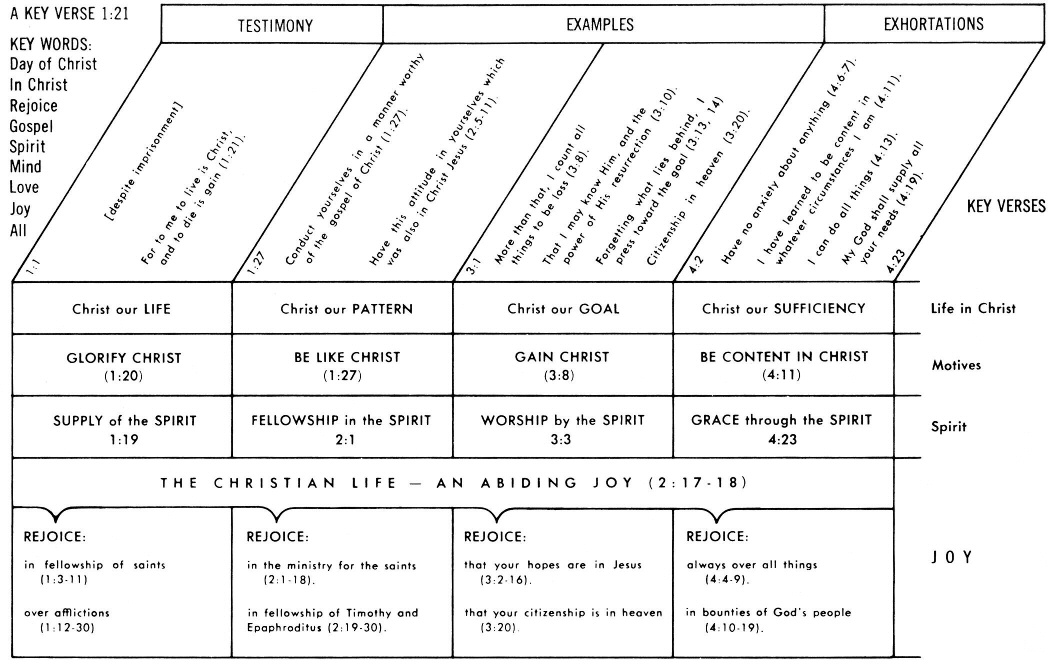
LIFE IN CHRIST
Click chart to enlarge
Charts from Jensen's Survey of the NT - used by permission
Philippians - Charles Swindoll = Chart on right side of page
| Account of Paul's Circumstances Php 1:1-30 |
Have the Mind of Christ Php 2:1-30 |
Have the Knowledge of Christ Php 3:1-21 |
Have |
| Partakers of Christ | People of Christ | Pursuit of Christ | Power of Christ |
| Suffering | Submission | Salvation | Sanctification |
| Experience | Examples | Exhortation | |
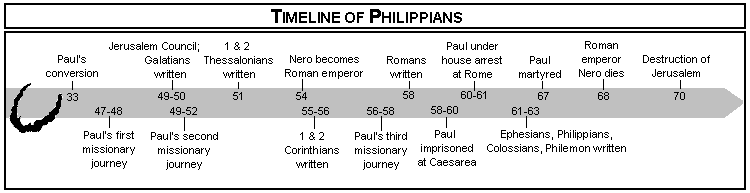
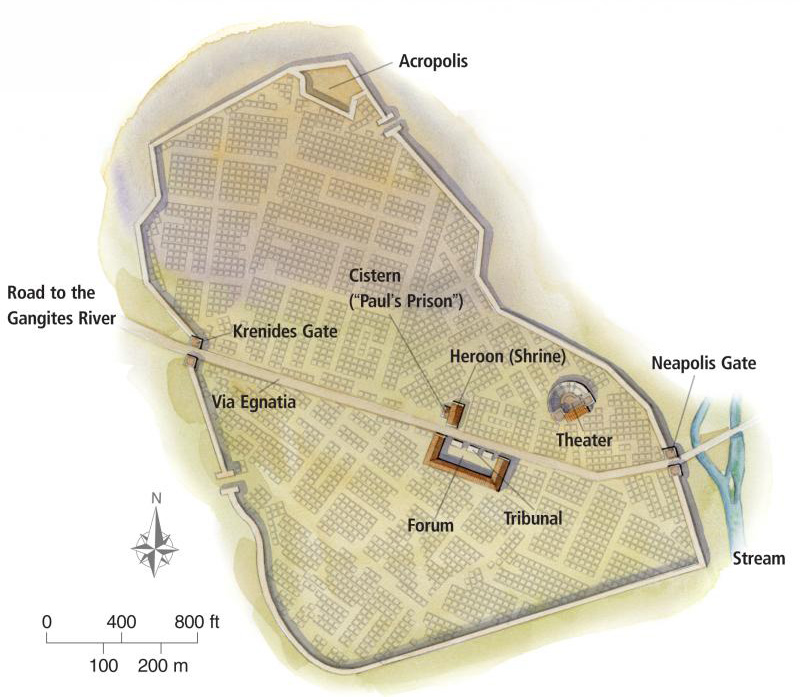
Philippi in the Time of Paul
The city plan above shows those features of the city of Philippi that archaeologists have so far identified as dating from the time of Paul. “Paul’s Prison” is not believed to be an authentic site, but was a cistern later associated with Christian worship. (ESV.org)
Philippians 1:27. Only conduct yourselves in a manner worthy of the gospel of Christ, so that whether I come and see you or remain absent, I will hear of you that you are standing firm in one spirit , with one mind striving together for the faith of the gospel (NASB: Lockman)
Greek: Monon axios tou euaggeliou tou Christou politeuesthe, (2PPMM) hina eite elthon (AAPMSN) kai idon (AAPMSN) humas eite apon (PAPMSN) akouo (1SPAS) ta peri humon hoti stekete (2PPAI) en eni pneumati, mia psuche sunathlountes (PAPMSN) te pistei tou euaggeliou
Amplified: Only be sure as citizens so to conduct yourselves [that] your manner of life [will be] worthy of the good news (the Gospel) of Christ, so that whether I [do] come and see you or am absent, I may hear this of you: that you are standing firm in united spirit and purpose, striving side by side and contending with a single mind for the faith of the glad tidings (the Gospel). (Amplified Bible - Lockman)
My Amplified Paraphrase: Only conduct yourselves (politeuomai — live as citizens whose true homeland is Heaven; let your public and private behavior reflect your heavenly identity) in a manner worthy (axios — fitting, weighty, matching the value and glory) of the gospel of Christ, so that whether I come and see you in person or remain absent and hear reports about you, I will know that you are standing firm (steko — holding your ground, unshaken, anchored, refusing to retreat) in one spirit (hen pneumati — united by the same Holy Spirit, sharing a single spiritual heartbeat), with one mind (mia psuchē — one soul, one passion, one resolve, inwardly knit together), striving together (sunathleō — laboring side-by-side like trained athletes on the same team; contending shoulder to shoulder) for the faith of the gospel (the defense, advance, and living demonstration of the message of Christ).
Barclay: One thing you must see to whatever happens—live a life that is worthy of a citizen of the Kingdom and of the gospel of Christ, so that whether I come and see you, or whether I go away and hear how things go with you, the news will be that you are standing fast, united in one spirit, fighting with one soul the battle of the gospel’s faith (Westminster Press)
ESV Only let your manner of life be worthy of the gospel of Christ, so that whether I come and see you or am absent, I may hear of you that you are standing firm in one spirit, with one mind striving side by side for the faith of the gospel,
KJV: Only let your conversation be as it becometh the gospel of Christ: that whether I come and see you, or else be absent, I may hear of your affairs, that ye stand fast in one spirit, with one mind striving together for the faith of the gospel;
NET Only conduct yourselves in a manner worthy of the gospel of Christ so that– whether I come and see you or whether I remain absent– I should hear that you are standing firm in one spirit, with one mind, by contending side by side for the faith of the gospel,
NLT: But whatever happens to me, you must live in a manner worthy of the Good News about Christ, as citizens of heaven. Then, whether I come and see you again or only hear about you, I will know that you are standing side by side, fighting together for the Good News. (NLT - Tyndale House)
Phillips: But whatever happens, make sure that your everyday life is worthy of the Gospel of Christ. So that whether I do come and see you, or merely hear about you from a distance, I may know that you are standing fast in a united spirit, battling with a single mind for the faith of the Gospel (Phillips: Touchstone)
Wuest: Only (since my only reason for remaining on earth is for your progress in the Christian life), see to it that you recognize your responsibility as citizens (of heaven), and put yourselves to the absolute necessity of performing the duties devolving upon you in that position, doing this in a manner which is befitting to the gospel of Christ, in order that whether having come and having seen you, or whether being absent I am hearing the things concerning you, namely, that you are standing firm in one spirit, holding your ground, with one soul contending (as a team of athletes would) in perfect co-operation with one another for the faith of the gospel (Eerdmans Publishing - used by permission)
Young's Literal: Only worthily of the good news of the Christ conduct ye yourselves, that, whether having come and seen you, whether being absent I may hear of the things concerning you, that ye stand fast in one spirit, with one soul, striving together for the faith of the good news,
ONLY CONDUCT YOURSELVES IN A MANNER WORTHY OF THE GOSPEL OF CHRIST: monon axios tou euaggeliou tou Christou politeuesthe (2PPMM):
- Phil 3:18, 19, 20, 21; Eph 4:1; Col 1:10; 1 Th 2:11, 12; 4:1; Titus 2:10; 2 Pe 1:4-9; 3:11,14
- Torrey's Topic Christian Conduct
- Ro 1:9; 16, Ro 15:16; 29 2 Co 4:4; 9:13; Gal 1:7
Whatever happens, conduct yourselves in a manner worthy of the gospel of Christ (Lightfoot 1)
But under all circumstances do your duty as good citizens of a heavenly kingdom; act worthily of the Gospel of Christ (Lightfoot 2)
One thing you must see to whatever happens—live a life that is worthy of a citizen of the Kingdom and of the gospel of Christ. (Barclay)
But whatever happens, make sure that your everyday life is worthy of the Gospel of Christ (Phillips)
Live in such a way that you are a credit to the message of Christ.
Only (since my only reason for remaining on earth is for your progress in the Christian life), see to it that you recognize your responsibility as citizens (of heaven), and put yourselves to the absolute necessity of performing the duties devolving upon you in that position, doing this in a manner which is befitting to the gospel of Christ (Eerdmans Publishing - used by permission)
Outline from John G Butler - Exhortations on Standing
The Style of the Standing - Php 1:27
- Stand firmly
- Stand faithfully.
The Specifics in the Standing - Php 1:27–30
- The sanctification in the standing - Php 1:27
- The society in the standing - Php 1:27
- The service in the standing - Php 1:27
- The stoutheartedness in the standing - Php 1:28
- The suffering in the standing - Php 1:29-30
Outline from Lehman Strauss
Pleading - Php 1:27-30
- A Plea to Stand - Php 1:27a
- A Plea to Strive - Php 1:27b-28
- A Plea to Suffer - Php 1:29-30
An Outline from John Phillips
The Prisoner and His Pulpit - Php 1:27-30
Unyielding in Battle - Php 1:27a
Undivided in Battle - Php 1:27b
Unafraid in the Battle - Php 1:28-30
Paul's Exhortation - Php 1:28-29
The Opposition they Faced - Php 1:28a
The Opportunity they Faced - Php 1:28b-29
Of Being Different - Php 1:28b
Of Being Disciples - Php 1:29
Paul's Example - Php 1:30
Greg Herrick - Exhortation to Unity
A. The Command: Live Worthy of the Gospel (Php 1:27a-b)
B. The Way: (Php 1:27c-28)
1. By Contending for the Faith of the Gospel
2. By Not Being Frightened
C. The Ultimate Rationale (Php 1:29-30)
1. The Ultimate Rationale for Suffering (Php 1:29)
2. The Example (Php 1:30)
Brian Bill's Outline - Walk the Talk
- Standing Together (Php 1:27b)
- Striving as a Team (Php 1:27c)
- Surviving to the End (Php 1:28)
- Suffering for Christ (Php 1:29)
- Struggling with Others (Php 1:30)
CITIZENS OF TWO
WORLDS
In the Greek Php 1:27-30 are one long sentence.
The POSB entitles Php 1:27-30 "The Marks of a Great Church." Paul was in prison. He faced a capital crime and there was a strong chance he might be executed. He did not think so, but there was a possibility. He was not sure if he would ever see the Philippian church again, so he sat down and began to write to them. What would you say if you were writing to a group of God’s people for the last time? One of the subjects that concerned Paul was the subject of this passage: the marks of a great church. The Philippian church was a great church, and Paul wanted it to remain great. Therefore, he reviewed with them the marks of a great Christian church.
1. Mark 1: Christian conduct—heavenly citizenship (Php 1:27).
2. Mark 2: honoring the Gospel (Php 1:27).
3. Mark 3: standing firm (Php 1:27).
4. Mark 4: courage and fearlessness (Php 1:28–30).
Dwight Edwards - This is a major turning point in this epistle as it concludes the prologue (Phil 1:1-26) and introduces the body (Phil 2:1-4:1). It also gives us the theme or "controlling idea" of the book.
- See Irving Jensen's chart of Philippians - Note the second segment "Christ our Pattern: Be like Christ" beginning at Php 1:27
Edwards goes on to add that in Php 1:27-30 we have "a synopsis or summary of the "Counter-cultural Lifestyle" we are to live while stationed here on earth. We are to be a unified, advancing army; unwavering in our assault upon the gates of hell, enduring any and all of Satan's opposition in God's global conquest of fallen earth.
Mattoon - Up to this point, the book of Philippians has been mostly autobiographical. At verse 27, Paul shifts direction to an application of spiritual truths for his readers. He shifts the focus from our privileges to our obligations.
Gene Getz entitles Php 1:27-30 United We Win, Divided We Lose - Ask any football coach what it takes to win. If he really understands the game, he will zero in on three factors—a good defense, a good offense, and a positive attitude. Would you believe that Paul believed the same ingredients are necessary for Christians to be victorious over their opponents!
Brian Bill - Your life is anything but easy and your walk with Jesus has more worries than victories. We’re going to see in our passage for this morning that Paul has moved from his personal situation to the problems of the Philippians. He’s told them that he will win either way, that his circumstances will turn out for the advance of the gospel, and that his joy will continue to increase. Now his concern is for the church. He’ll be OK, but what about them? Will they go in the tank when trials come? Will they pout when they have problems? Will they fold instead of being faithful? Will they turn on each other instead of working with each other? When things are not easy will they get queasy and begin to question their faith? The first part of Php 1:27 shows Paul’s passion for the Philippians: “…conduct yourselves in a manner worthy of the gospel of Christ.” He’s essentially saying, “Walk the talk” or “live up to who you are.” This is a command in the present tense, meaning this is a call for continuous activity. His choice of words is really interesting and is lost on us in our setting. The Greek word translated “conduct” is where we get “political” or “metropolitan.” This is the main verb in these four verses, which in the Greek is just one long sentence. The basic idea is one of citizenship. Later in Philippians 3:20, Paul says that our “citizenship is in heaven.”...Paul is saying that we’re to live as if we’re being watched! Remember that people judge heaven by the conduct of its citizens. We represent the gospel of Christ and therefore must live in a worthy way.
You're writing a "gospel,"
A chapter each day,
By the deeds that you do,
By the words that you say;
Men read what you write,
Whether faithless or true;
Say, what is the "gospel"
According to you?
In Php 1:24-25 Paul stated that he believed it would be more beneficial for the Philippian saints if he remained alive on earth. He was willing to die to self and "remain in the body." And once he had settled that issue, he moved quickly to his primary concern—the spiritual welfare of the Christians at Philippi giving them a series of exhortations.
Only (3440) (monon) conveys the idea of the one essential thing. It focuses attention on the next few words of Paul. Wuest says the idea of only is "since my only reason for remaining on earth is for your progress in the Christian life." He goes on to explain "The word “only” connects Paul’s statement that the assurance which he has that he will be given his freedom, comes from the fact that the Philippian saints need his ministry, with his exhortation to them to conduct themselves worthy of the gospel. Since their need of his ministry is the only reason for his wishing to remain on earth, it behooves the Philippian saints to receive that ministry with an open heart, obey his Spirit-given exhortations, and grow in their Christian experience. The rest of the letter therefore has to do with the spiritual needs of these saints. As we study these exhortations, we discover what things were lacking in their lives and what things needed to be corrected. The basic, all-inclusive exhortation is, “Let your conversation be as it becometh the gospel of Christ.”
Vine on only - i.e., "whatever takes place, whether I see you again or not.”
Edwards on only - He singles out ("only") what they are to concentrate upon whether he is present or absent. They are to incarnate, or "flesh out" the gospel of Christ.
Eadie - The adverb monon gives oneness to the advice, places it by itself, as if in solitary prominence—“my impressions being as I have described them, this one or sole thing would I enjoin upon you in the meanwhile.” In Gal 2:10, 5:13, the adverb is used with similar specialty. Here it is placed emphatically before the verb, as in Mt 8:8, 9:21, 14:36. (Philippians Commentary online)
Edwards on conduct yourselves - Because Philippi was a Roman colony this word becomes extremely interesting and noteworthy. The Romans took great pride in their citizenship and took very seriously its accompanying responsibilities. This comes out very clearly in Acts 16 in the chapter which describes the founding of the Philippian church:
Acts 16:12--"and from there to Philippi, which is the foremost city of that part of Macedonia, a (Roman) colony. And we were staying in that city for some days."
Acts 16:21--"'and they teach customs which are not lawful for us, being Romans, to receive or observe."'
Acts 16:37--"But Paul said to them, 'They have beaten us openly, uncondemned Romans, and have thrown us into prison. And now do they put us out secretly? No indeed! Let them come themselves and get us out."'
Acts 16:38--"And the officers told these words to the magistrates, and they were afraid when they heard that they were Romans."
Thus Paul is playing on their naturally strong sense of Roman identity, citizenship, and responsibility; but directing it first and foremost to their new and real citizenship--heaven. "For our citizenship is in heaven . . . " (Phil. 3:20). He is exhorting them to live "worthily" of their heavenly identity and to conduct themselves in a manner that well represents their eternal homeland. From this we may gain a fitting title for this great epistle: EARTHLY CONDUCT OF HEAVENLY CITIZENS. This entire letter will describe in one way or another how we, the citizens of heaven should conduct ourselves during our brief stay on earth.
Lehman Strauss - Until now Paul has been writing, for the most part, in the first person, the Epistle being chiefly autobiographical, the one exception being his prayer in Phil 1:9-11. Here the tenor of his message shifts to an application of spiritual truths to his readers and hearers. This is a missing note in present-day ministry and needs to be revived. Preaching and teaching in the abstract and in generalities to no one in particular does not build strong Christians. Truth must be applied. It must appeal to the conscience of the hearer. Paul commences his plea with the use of the important word "conversation." It is not conversation in the sense of words, but of works; not of language, but of life. Paul commences his plea with the use of the important word "conversation." (Php 1:27KJV) It is not conversation in the sense of words, but of works; not of language, but of life.
Spurgeon - We often miss our Lord’s company, because our conversation (conduct) does not please Him. When our Beloved goes down into His garden, it is to feed there and gather lilies; but if thorns and nettles are the only products of the soil, He will soon be away to the true beds of spices.
NET Note on Conduct yourselves (Greek "live your lives as citizens") - The Philippians lived in a free Roman city, and thus understood from their own experience what it meant to live as citizens. Paul is here picking up on that motif and elevating it to the citizenship of heaven. Cf. 3:20 (our citizenship is in heaven)
Vine - The phrase “let your manner of life be” translates the middle voice of the verb politeuō, to be a politēs, a citizen; it carried with it the thought of the fulfillment of duties as a member of a polis, a city; here it is used metaphorically of conduct characteristic of the heavenly city (see at 3:20), though the word is appropriate to those who lived in a Roman “colony,” and Paul had there declared himself a Roman citizen. It.
THE CHURCH: A COLONY
OF HEAVEN ON EARTH!
Wiersbe - Paul is suggesting that we Christians are the citizens of heaven, and while we are on earth we ought to behave like heaven’s citizens. He brings this concept up again in Php 3:20. It would be a very meaningful expression to the people in Philippi because Philippi was a Roman colony, and its citizens were actually Roman citizens, protected by Roman law. The church of Jesus Christ is a colony of heaven on earth! And we ought to behave like citizens of heaven.
Conduct yourselves is a command (imperative mood) in the present tense, calling for continuous conduct. The middle voice means the Philippians must initiate the action of proper conduct themselves and participate in the results thereof (or stated another way the subjects - the Philippian saints - act in reference to themselves and for their own benefit, participating in the results of the action.)
Conduct yourselves (let your conversation be)(4176) (politeuomai from polítes = citizen from polis = city) is used only here and means to conduct one's self according to the laws and customs of the state (cf Php 3:20). It often referred to job duties that a man is responsible for as a member of a community or body of people. From this word we get such English words as politic or political. Literally translated, Paul said, "Behave as citizens," or "Perform your duties as good citizens."
🙏 THOUGHT: When our conduct matches our creed we are walking worthy of the creed of the Gospel! Lack of authenticity or even worse gross hypocrisy sully and impugn the good news of the Gospel. Dear saint how are you doing? Does your walk match your talk? Or are you so timid they have no idea you are even a believer in Jesus Christ?
John Eadie says that politeuomai "denotes to be a citizen in a state or to live as such a citizen, and then generally to live, to conduct oneself… Here… (politeuomai) defines life in its public aspect, and is often so employed… It is found often in Josephus, and is a favorite term with the Church Fathers… The apostle, in similar exhortations, uses peripateo, as in Eph 4:1; Col. 1:10 1Th. 2:12. In each of these cases, as here, that verb is construed with axios (worthy). For a somewhat similar purpose the apostle employs anastrepho 1Ti 3:15; He 13:18; Ep 2:3… The apostle, in his choice of this peculiar verb in preference to his more favorite one, looks at them as members of a community, bound closely by reciprocal connections, and under obligations to various correspondent duties, and therefore “the gospel of Christ” should be the norm or standard by which they ought to be guided…The meaning then is—this sole request do I make, live as the gospel prescribes; and as the genitive tou Christou and the last clause of the verse would seem to suggest, let your church-life be in harmony with its spirit and precepts—that rectitude, courage, and love, which Christ illustrated in His teaching, and exemplified in His life." (Philippians Commentary online)
Luke recognized their status when he identified Philippi as "a leading city of the district of Macedonia, a Roman colony." (Acts 16:12). Later Luke recorded that the uproar which resulted in the imprisonment of Paul and Silas arose because the magistrates in Philippi thought these men were violating Roman customs, "proclaiming customs which it is not lawful for us to accept or to observe, being Romans.” (Acts 16:21).
Philippi as a colony possessed Roman citizenship (see note below) and Paul was proud of his own possession of this right, but even "prouder" of his heavenly citizenship. And so the Philippians who also are citizens of heaven should behave accordingly. They should be in practice what they are in position, which applies to saints of all times.
Just as Philippi was a colony of Rome with all the rights and privileges bestowed on those who were born in Rome, in a similar way the church at Philippi was a colony of heaven, and the members were commanded to walk as citizens of that unseen country, not so much by keeping outward regulations, but by the power of the indwelling Holy Spirit. Their worthy walk was to reflect the transformation wrought in them by the gospel of Jesus Christ. God wanted the Philippians' daily conduct to betray them as pilgrims and strangers on earth and as citizens of "the city which has foundations, whose architect and builder is God" (He 11:20-note), citizens of "a better country, that is, a heavenly one" (He 11:16) and of "the city of the living God, the heavenly Jerusalem and to myriads of angels" (He 12:22). A life worthy of the gospel is a life lived in the power of the Holy Spirit. It is the earthly walk of a heavenly minded man.
Brian Bill on citizenship in Philippi - Located hundreds of miles from Rome, Philippi enjoyed all the benefits and privileges of the Roman Empire. They were not taxed, their city was under Roman law and their culture reflected Rome, not the other cities around them. In short they were loyal to another location and conducted themselves according to another culture. They adopted Roman dress and Roman names and even spoke Latin, the language of Rome. John MacArthur points out that Roman society was highly community-conscious, where the individual was subordinate to the state. People saw this as a privilege and were careful to not doing anything that would bring disrepute to their citizenship. (cf the fear of the magistrates in Acts 16:37-39) Likewise, Paul is telling us that while we live here, our habits should reflect heaven, “in a manner worthy of the gospel of Christ.” This phrase refers to weighing something on the scales. The idea is that our manner of life should weigh as much as the Gospel we claim to be committed to. How we dress, how we speak, and how we act must line up with our ultimate loyalty. We are not just individuals who can do what we want; we are interdependent members of the community of faith, with our heritage firmly rooted in heaven. (cf 1 Peter 1:1 = "reside as aliens", 1 Peter 2:11 "aliens and strangers")
POSB on why Paul used politeuomai and not peripateo (walk) - Usually, when the New Testament refers to behavior or conduct, it uses a word meaning how a person should walk about day by day (peripateo). But Paul switches the word in writing to the Philippians. Why? The reason is significant. As stated in the introductory material, Philippi was a proud Roman colony. In fact, it was famous as a miniature Rome. A city became a Roman colony by one of two ways. At first Rome founded colonies throughout the outer reaches of the Empire to keep the peace and to guard against invasions from barbaric hordes. Veteran soldiers, ready for retirement, were usually granted citizenship if they would go out and settle these colonies. Later on, however, a city was granted the distinctive title or a Roman Colony for loyalty and service to the Empire. The distinctive thing about these colonies was their fanatic loyalty to Rome. The citizens kept all their Roman ties: the Roman language, titles, customs, affairs, and dress. They refused to allow any infiltration of local influence whatsoever. They totally rejected the influence of the world around them. They were Roman colonists within an alien environment. This is the reason Paul uses the word politeuesthe. It means conduct and behavior, but more accurately it means the conduct and behavior of citizenship, of a person who is the citizen of a great nation. The Philippian church knew exactly what Paul was saying: they were citizens of heaven. Therefore, they must …
• keep their close ties with heaven
• speak the clean and pure language of heaven
• bear the title of heaven, Christian, and do so proudly
• bear witness to the customs of heaven
• carry on the affairs of heaven
• dress as a citizen of heaven
• allow no infiltration of worldly influence whatsoever
• live and conduct themselves as a heavenly colony within a polluted and dying environment
ILLUSTRATION The story is told that Alexander the Great once met a lazy, good-for-nothing soldier in his army and asked for his name. The soldier replied, “Alexander, sir.” Alexander the Great then said, “Either change your name or change your ways!”
Gene Getz explains that "Paul was appealing, then, to a familiar cultural and emotional mentality. "You are loyal to your city and to your country," he implied. "Then, more so, be loyal to your fellow Christians and to the eternal kingdom of God. Be a good citizen of heaven, even though you're still on earth." How could they do this? Paul completed the exhortation in the very same breath: they are to conduct themselves in a "manner worthy of the gospel." Just as all loyal Philippians desired to live up to their high calling and the privilege of being citizens of Rome, so the Christians in Philippi were to live up to their high calling as citizens of the kingdom of God. Thus Paul exhorted them to live "in a manner worthy of the gospel of Christ." (The Measure of A Christian)
John Phillips - The Philippian Christians were citizens of two worlds. They were citizens of the Roman world and they were citizens of the world that ruled Paul's desires (cf Jn 17:14-16). The two worlds were at war. The Christians' heavenly citizenship had to take priority over their human citizenship, as the powers that be soon came to understand. The Caesars could not tolerate this priority even though the Christians' heavenly citizenship made them better human citizens, better neighbors, better workers, better soldiers, better teachers, better parents, better children. At the height of the Neronic and other persecutions, the line between the two worlds was so clearly drawn that Christians refused to offer even a merely symbolic pinch of salt on a pagan altar.
J Ligon Duncan writes "Moises Silva translates this phrase, “What really matters is that you behave as citizens of heaven.” In other words, Paul is saying to the Philippians (and of course it applies directly to us) this: “You are Roman citizens,” he’s saying to the Philippians, “and you’re proud of it. You recognize that you have privileges that few in this world have. But you also have responsibilities, and those responsibilities are very important. The future of this state depends upon it. Remember, then, Philippian Christians, that as believers you have a higher citizenship even than the citizenship that you hold from Rome. You are citizens of the kingdom of heaven, and you have the greatest privileges and responsibilities in the world.” (Living in a Manner Worthy of the Gospel - 2)
William Barclay adds that "Philippi was a Roman colony; and Roman colonies were little bits of Rome planted throughout the world, where the citizens never forgot that they were Romans, spoke the Latin language, wore the Latin dress, called their magistrates by the Latin names, however far they might be from Rome. So what Paul is saying is, “You and I know full well the privileges and the responsibilities of being a Roman citizen. You know full well how even in Philippi, so many miles from Rome, you must still live and act as a Roman does. Well then, remember that you have an even higher duty than that. Wherever you are you must live as befits a citizen of the Kingdom of God. (The Daily Study Bible)
The phrase only....worthy is placed at beginning of Greek sentence for emphasis -- only worthily of the Gospel of Christ conduct yourselves. This places emphasis on the way they (we) walk in the midst of a perverse, crooked generation (Php 2:15). The Gospel has eternal worth. We are it's bearers. When we live empowered by the Spirit (especially emphasized in the Gospel in Romans 8:1-37), we are then able to walk in a manner concordant with the Gospel.
Spurgeon - Some persons cannot hear an exhortation without at once crying out that we are legal. Such persons will always find this Tabernacle the wrong place for them to feed in. We are delighted to preach good high doctrine, and to insist upon it that salvation is of grace alone; but we are equally delighted to preach good high practice and to insist upon it, that that grace which does not make a man better than his neighbours, is a grace which will never take him to heaven, nor render him acceptable before God. (The Gospel's Power in a Christian's Life - 640)
Mattoon - A person's manner of living was to be a credit to the Gospel of Jesus. It was to bring honor to Jesus Christ. Christians are to live as citizens of the kingdom of Heaven. We are to live consistent as citizens of Heaven. The word "becometh" (Php 1:27KJV) is interesting. We hear that someone's clothing does or does not become him or her. What is meant is the color or cut of the clothes enhances the face and personality of the person. When it does, the garment is "becoming." Our lives should reflect Jesus Christ. Christian behavior in Scripture is likened to garments. After a person believes the Gospel, there are some things that he must "put off and some things he must "put on." Notice Colossians 3:8-10 (Ed: Have you "put off" these filthy garments? Or do others still see these garments on you in you everyday life? To walk worthy of the Gospel is to put these off, something you can do only by relying on the Spirit - see Ro 8:13). Paul instructs us to put off some things (the negative) and to put on some things (the positive). Colossians 3:12-14. Do your spiritual garments "become" your Christian profession (Ed: Are they "becoming"?)? Are you concerned about adorning the Gospel of Christ by your manner of life as you are your body by the clothing you wear? Our manner of life either helps or hinders the Gospel. It either recommends the truth to others or else makes the truth repulsive. Paul is pleading for Gospel-worthy Christians who will carry on for Jesus Christ without the prop of the apostle's presence. Paul is saying, "Live for Christ whether I am with you or absent from you."
The most important weapon against the enemy
Is not a stirring sermon or a powerful book.
It is the consistent life of believers.
MY WALK THE GOSPEL
Does this truth about a consistent life not remind us of the "breastplate of righteousness" which is vital for victory in spiritual warfare (Eph 6:14)
The believer’s behavior is to …
• fit the Gospel he professes
• correspond to the Gospel he professes
• be suitable to the Gospel he professes
• be worthy of the Gospel he professes
A manner worthy (adverb) (516) (axios) which means having the same weight as another thing & can refer to a set of scales that balance with the same weight on one side as on the other side of the scale. So if Christ is in me (one side of the scale), then my goal in this body of flesh is to walk worthy, making those decisions that are in accordance with Who is in me (the other side of the scale). The idea is that the conduct of the saints weigh as much as the character of Christ The Philippian saints (and all saints) were to see to it that their manner of life weighs as much as the gospel they profess to believe. That which gives weight to a Christian’s words is the fact that his manner of life befits, is congruous to and corresponds with the gospel he preaches. If your conduct doesn't match your profession you may not have a genuine possession (of the gospel of salvation). Your life should measure up to all that the gospel proclaims and all that the gospel works out in a man’s life.
POSB - We often say that some piece of clothing is becoming to a person. What we mean is that the clothing matches and enhances the person’s looks and personality. The same with the gospel of Christ. If we put on the gospel, we are to wear the gospel. Are you wearing the Gospel?
Vine - The life is to be lived “worthily [axiōs] of the gospel”; cp. worthily of the saints, Romans 16:2; of the Lord, Colossians 1:10; of God, 1 Thessalonians 2:12; 3 John 6; of the calling, Ephesians 4:1.
Lehmann Strauss - Our manner of life as Christians either helps or hinders the gospel, it either recommends the truth to others or else makes the truth repulsive.
Walking in a manner worthy (click here for Scriptural summary of a "worthy walk") is a phrase used several times in the NT
Therefore I, the prisoner of the Lord, implore you to walk in a manner worthy of the calling with which you have been called, (Ep 4:1) (AND THEN PAUL DESCRIBES A WORTHY WALK) with all humility and gentleness, with patience, showing tolerance for one another in love, 3 being diligent to preserve the unity of the Spirit in the bond of peace. (Eph 4:2-3)
("exhorting and encouraging and imploring" - see 1 Th 2:11) so that (purpose clause) you would walk in a manner worthy of the God who calls you into His own kingdom and glory. (1Th 2:12)
and they have testified to your love before the church. You will do well to send them on their way in a manner worthy of God. (3 Jn 1:6)
not pilfering, but showing all good faith so that they will adorn ("in order to bring credit to the teaching of") the doctrine of God our Savior in every respect. (Titus 2:10)
The use of axios in Col 1:9-12 (Click Col 1:9, 1:10 for exposition) another Pauline summary of a "worthy walk." This passage also emphasizes that we should pray for each other to have this type of worthy walk! Prayers for physical ailments are fine, but prayers for a worthy walk are far more valuable. In the table below notice that description of worthy walk is clearly a walk that is not natural, but supernatural and thus it is only possible as we are filled with the Spirit of Jesus Christ (Eph 5:18) Who enables us to continually walk by the Spirit (Gal 5:16).
|
WALKING WORTHY |
|
ILLUSTRATION - The world famous master of mime, Marcel Marceau, was asked what the difference was between regular acting and pantomime. Marceau's response was interesting. He said, "In the case of a bad actor, the words are there even if the actor is no good. But when a mime is not good, there is nothing left. A mime must be very clear and very strong." The same is true of the Christian's conduct and witness. Is it "conduct which is worthy of the Gospel?". If a believer's verbal testimony is rejected, it may be wise for him to say no more. But it's then that silence should speak so clearly that no one can mistake the message. If we are in a situation where our actions alone have to do the talking, let's make sure they are coming through loud and clear for Christ. When we walk worthy, our lives exalt Christ. And when our lives exalt Christ, even our "silence" is eloquent!
The gospel of Christ are the good tidings of the Kingdom of God and of salvation through Christ, to be received by faith, on the basis of His expiatory death, His burial, resurrection, and ascension. (See commentary notes on the gospel as defined in 1Co 15:1-8 (notes 1Co 15:1; 2; 3; 4; 5; 6; 7; 8).
Here the Greek "tou Christou" is considered by John Eadie as genitive (conveys possessive sense) of origin thus referring to "the Gospel which Jesus has communicated." Others such as Marvin Vincent take this to be genitive of object (“the Gospel of God concerning His Son” or "the Gospel which proclaims Christ"). Vincent adds that "This is Paul’s more usual formula." (See 1 Co 9:12; 2 Co 2:12; Gal 1:7; 1 Th 3:2)
Gospel (2098)(euaggelion from eú = good + aggéllo = proclaim, tell) means good news, glad tidings, Saxon = gōd-spell = lit. "good tale, message".
Euaggelion originally referred to a reward for good news and later became the good news itself. The word euaggelion was in just as common use in the first century as our words good news today. "Have you any good news for me today?" would have been a common question. In this secular use euaggelion described good news of any kind and prior to the writing of the New Testament, had no definite religious connotation in the ancient world until it was taken over by the "Cult of Caesar" which was the state religion and in which the emperor was worshipped as a god (see more discussion of this use below).
Gospel was adopted as a technical term for the Christian message which is succinctly stated by Paul in 1 Cor 15:1-4 (notes 1Co 15:1; 15:2; 15:3; 15:4) and finds complete expression in the four Gospels and the epistle to the Romans. Succinctly stated, the Gospel is not just "getting saved" as so many believe, but it is "progressing in salvation" (growth in Christ-likeness).
The writers of the New Testament adapted the term Gospel as God's glorious message of salvation for lost otherwise hopeless, helpless sinners. Euaggelion is found in several combination phrases, each describing the gospel like a multifaceted jewel in various terms from a different viewpoint (from the NASB, 1977):
- the gospel of the kingdom (Mt 4:23, Mt 9:35, Mt 24:14)
- the gospel of Jesus Christ, the Son of God (Mk 1:1) because it centers in Christ
- the gospel of God (Mk 1:14, Ro 15:16, 2Co 11:7, 1Th 2:2, 1Th 2:8,9, 1Pe 4:17) because it originates with God and was not invented by man
- the gospel of the kingdom of God (Lu 16:16)
- the gospel of the grace of God (Acts 20:24, Ro 1:1),
- the gospel of His Son (Ro 1:9)
- the gospel of Christ (Ro 15:19, 2Co 2:12, 2Co 9:13, 2Co 10:14, Gal 1:7, Phil 1:27, 1Th 3:2)
- the gospel of the glory of Christ (2Co 4:4)
- the gospel of your salvation (Eph 1:14)
- the gospel of peace (Eph 6:15)
- the gospel of our Lord Jesus (2Th 1:8)
- the glorious gospel of the blessed God (1Ti 1:11)
- In Ro 16:25, 26 Paul called it “my Gospel” indicating that the special emphasis he gave the gospel in his ministry.
- An eternal gospel - Rev 14:6 (Some writers such as C I Scofield interpret this as a "different gospel" than the other "gospels" mentioned above but I think such a distinction is incorrect and is poorly substantiated).
For a rewarding study, study the preceding references in context making notation of the truth you observe about the gospel. If you would like a special blessing, take an afternoon to go through all 76 uses of euaggelion in context making a list of what you learn about the gospel. The Spirit of God will enlighten your heart and encourage your spirit in a very special way...and you'll want to share the "good news" with someone because of your "discoveries"!
Euaggelion - Matt. 4:23; Matt. 9:35; Matt. 24:14; Matt. 26:13; Mk. 1:1; Mk. 1:14; Mk. 1:15; Mk. 8:35; Mk. 10:29; Mk. 13:10; Mk. 14:9; Mk. 16:15; Acts 15:7; Acts 20:24; Rom. 1:1; Rom. 1:9; Rom. 1:16; Rom. 2:16; Rom. 10:16; Rom. 11:28; Rom. 15:16; Rom. 15:19; Rom. 16:25; 1 Co. 4:15; 1 Co. 9:12; 1 Co. 9:14; 1 Co. 9:18; 1 Co. 9:23; 1 Co. 15:1; 2 Co. 2:12; 2 Co. 4:3; 2 Co. 4:4; 2 Co. 8:18; 2 Co. 9:13; 2 Co. 10:14; 2 Co. 11:4; 2 Co. 11:7; Gal. 1:6; Gal. 1:7; Gal. 1:11; Gal. 2:2; Gal. 2:5; Gal. 2:7; Gal. 2:14; Eph. 1:13; Eph. 3:6; Eph. 6:15; Eph. 6:19; Phil. 1:5; Phil. 1:7; Phil. 1:12; Phil. 1:16; Phil. 1:27; Phil. 2:22; Phil. 4:3; Phil. 4:15; Col. 1:5; Col. 1:23; 1 Thess. 1:5; 1 Thess. 2:2; 1 Thess. 2:4; 1 Thess. 2:8; 1 Thess. 2:9; 1 Thess. 3:2; 2 Thess. 1:8; 2 Thess. 2:14; 1 Tim. 1:11; 2 Tim. 1:8; 2 Tim. 1:10; 2 Tim. 2:8; Phlm. 1:13; 1 Pet. 4:17; Rev. 14:6
ILLUSTRATION - We have some neighbors who believe a false gospel,” a church member told his pastor. Do you have some literature I can give them? The pastor opened his Bible to 2 Co 3:2. "You are our letter, written in our hearts, known and read by all men." He said, "The best literature in the world is no substitute for your own life. Let them see Christ in your behavior and this will open up opportunities to share Christ’s Gospel with them." The greatest weapon against the devil is a godly life. And a local church that practices the truth, that “behaves what it believes,” is going to defeat the enemy. This is the first essential for victory in this battle. (Warren Wiersbe - Bible Exposition Commentary. 1989. Victor)
Spurgeon (Morning and Evening) THE GOSPEL IS VERY SIMPLE - The word "conversation" (conduct) does not merely mean our talk and converse with one another, but the whole course of our life and behaviour in the world. The Greek word signifies the actions and the privileges of citizenship: and thus we are commanded to let our actions, as citizens of the New Jerusalem, be such as becomes the gospel of Christ. What sort of conversation is this? In the first place, the gospel is very simple. So Christians should be simple and plain in their habits. There should be about our manner, our speech, our dress, our whole behaviour, that simplicity which is the very soul of beauty. The gospel is pre-eminently true, it is gold without dross; and the Christian's life will be lusterless and valueless without the jewel of truth. The gospel is a very fearless gospel, it boldly proclaims the truth, whether men like it or not: we must be equally faithful and unflinching. But the gospel is also very gentle. Mark this spirit in its Founder: "a bruised reed he will not break." Some professors are sharper than a thorn-hedge; such men are not like Jesus. Let us seek to win others by the gentleness of our words and acts. The gospel is very loving. It is the message of the God of love to a lost and fallen race. Christ's last command to his disciples was, "Love one another." O for more real, hearty union and love to all the saints; for more tender compassion towards the souls of the worst and vilest of men! We must not forget that the gospel of Christ is holy. It never excuses sin: it pardons it, but only through an atonement. If our life is to resemble the gospel, we must shun, not merely the grosser vices, but everything that would hinder our perfect conformity to Christ. For his sake, for our own sakes, and for the sakes of others, we must strive day by day to let our conversation be more in accordance with his gospel.
SO THAT WHETHER I COME AND SEE YOU OR REMAIN ABSENT I WILL HEAR OF YOU THAT YOU ARE STANDING FIRM IN ONE SPIRIT: hina eite elthon (AAPMSN) kai idon (AAPMSN) humas eite apon (PAPMSN) ta peri humon akouo (1SPAS) hoti stekete (2PPAI) en eni pneumati:
- Phil 2:12; 24
- Eph 1:15; Col 1:4; 1 Th 3:6; Philemon 1:5; 3 Jn 1:3, 4
- Eph 2:1, 2:2; 4:1; Ps 122:3; 133:1; Mt 12:25; 1 Co 1:10; 15:58; 16:13,14; 2 Co 13:11
Then, whether I come and see you or only hear about you in my absence, I will know that you stand firm in one spirit (Lightfoot 1)
So that whether I come among you and see with my own eyes, or stay away and obtain tidings from others, I may learn that you maintain your ground bravely and resolutely, acting by one inspiration (Lightfoot 2)
in order that whether having come and having seen you, or whether being absent I am hearing the things concerning you, namely, that you are standing firm in one spirit holding your ground (Eerdmans Publishing - used by permission)
so that whether I come and see you, or whether I go away and hear how things go with you, the news will be that you are standing fast (Barclay)
So that whether I do come and see you, or merely hear about you from a distance, I may know that you are standing fast in a united spirit (Phillips)
“in order that, whether having come and seen you, or whether being absent, I may hear of your affairs” (Eadie)
THE BELIEVERS' DEFENSIVE STANCE:
UNITY OF PERSONS
So that (hina) - This is a term of conclusion which should always cause you to pause and ask the 5W/H questions. E.g., What has Paul just told them to do? Why?
Lehman Strauss on whether I come and see you or remain absent - The desire in the heart of every true pastor is to feed those in the assembly so they can stand alone with God upon His Word. It is a grief to any man of God to have his people take the attitude that they just cannot get along without him. Personally, I am never flattered by those who bemoan my absence as though the blessing of God leaves my local assembly when I am away. If every Christian's manner of life becomes the gospel, there never need be any fear when the pastor is elsewhere. The church at Philippi felt it owed its existence to Paul, thus they were in great danger of leaning upon him rather than upon Christ. If they depended on Paul, or on any man, their experience was borrowed and they were parasites. If they were truly Christ's, they would look to Him for needed strength and wisdom. So whether the apostle is with them or absent from them, he hopes to hear a good report of their "affairs."
Christ-Centered Exposition on whether I come and see you or remain absent - Paul exhorts the church to live consistently on mission together. One mark of effective leadership is being able to leave without things collapsing. In the church, pastors are called to develop future leaders and to labor alongside other leaders so that if they do have to leave for some reason, for any length of time, continuity and progress remain. Paul tells the Philippians, “Hey, you don’t need me in order to move forward in the mission. Whether or not I’m there, keep pressing on.” (Christ-Centered Exposition Commentary – Exalting Jesus in Philippians)
Vine - whether I come and see you or be absent,—he would not have them unduly dependent upon the influence of his presence with them. There is only One whose presence with us is essential, and of the utmost importance for us to realize.
Edwards - "A house divided against itself cannot stand" nor can an army effectively advance against the enemy while its ranks are turned against one another. This theme of unity will run throughout the entire epistle (Phil 2:1-16, 4:1-3). This unity has a specific purpose undergirding it: THE ADVANCEMENT OF THE GOSPEL.
Paul has just issued a command for them to conduct themselves worth of the Gospel and now he gives them the first of two specific ways (1 standing firm in one spirit (focuses on our unity with Christ) and (2) With one mind striving together (focuses on our unity with one another which flows out of our unity with Christ!)
Gene Getz on standing firm - Any team of athletes who compete must have a definite strategy. The opponents who are advancing must be stopped; they must not score.....No team earns a recognized title in the world of sports without performance to back it up—unified performance. Paul encouraged the Christians at Philippi to "stand firm in one spirit" against their opponents—the opponents of the gospel of Christ. It would take more than a Christian here or there to "hold the line." It would take the whole "Christian team" at Philippi. Together they had to take a defensive stance. And it was to be "in one spirit"—that emotional feeling that draws a team (a body of believers) together. Many a game has been lost in the world of sports because of fractured morale. One bad attitude can destroy unity and oneness. That is why even a very skilled player can be benched and see little action. Skill is necessary, yes, but a bad attitude will undermine the "oneness of spirit" that is vital to winning. (Ibid)
Lehman Strauss on spiritual warfare - Stand fast in one spirit, with one mind." The basis for this whole plea is the fact that there is a war on. The saints are engaged in a great conflict. Paul tells them the battle is with "your adversaries" (Phil 1:28), and he adds that it is "the same conflict which ye saw in me" (Phil 1:30).
Eadie - It is interesting to note that the apostle's mind, though under the guidance of the Holy Spirit, moved with perfect ease and freedom, and fell into those colloquial idioms and loose disturbed constructions, which so naturally happen when a warm-hearted man is rapidly and confidentially throwing his thoughts into a letter. (Philippians Commentary online)
What did Paul desire to hear about the believers in Philippi? - That they were standing firm. Is this not that which every preacher or teacher longs to hear when they receive news of their former congregation or former students/disciples?
The apostle John said it beautifully "I have no greater joy than this, to hear of my children walking in the truth." (3 Jn 1:4 )
Many saints are “tossed to and fro, and carried about with every wind of doctrine” (Ephesians 4:14). Remember the enemy is a liar and traffics in half-truths and overt lies, so for believers to be able to stand, they must know the truth on which they stand! The battle field is our minds and the battle is over truth. Take your stand on the truth of God's Word and do not be moved from it.
Hold your ground regardless of danger!
Why does Paul give this exhortation? There is a spiritual war going on whether we acknowledge it or not! Walter Martin used to warn believers of their vulnerability if they did not march forward (or in this case hold their ground) -
"There isn't a single piece for your rear end. Do you know why? Because soldiers do not turn around in the middle of combat, they go forward. And the reason some Christians become ineffective and weak and drained is that in the midst of conflict and combat, they fail to believe in Jesus Christ and they turn around and run away. And the flaming arrows of the wicked one have lodged in their spiritual rumps. There is only one way to get your strength back: get down on your knees and confess your sins, ask Jesus Christ to pull out the arrows, and then apply what we've learned: endure hardship as a soldier of Christ, be self-controlled and alert, maintain faith in Christ, and put on the armor of God. God will give you the victory. You can count on it!"
Picture a Roman military formation in which the soldiers stood side by side, shoulder to shoulder. As they gathered in as close as possible to each other, they held their shields up and their spears out (Picture 1, Picture 2). They were nearly impenetrable in this posture. This word was used of a soldier who defended his position no matter what. Standing firm is an exhortation to spiritual solidarity. We are to stand and we are to do so together, in unity. When we are united, the world takes notice as in Psalm 133:1: “How good and pleasant it is when brothers live together in unity!”


Brian Bill on standing firm - Part of our problem today is that we think the Christian life should make us happy in an individualistic sort of way. But the Bible is clear that Christianity is not a playground, but rather a battlefield. We have not been saved just so we can have an easy and comfortable life; we have been conscripted into God’s army. When the shrapnel starts flying, some of us are quick to desert because we didn’t sign up for this. Many of us really don’t want to stand together with other Christians. ILLUSTRATION: Have you heard of the “Serenity Prayer”? It goes like this: “God grant me the serenity to accept the things I cannot change; courage to change the things I can; and wisdom to know the difference.”This week I came across a different take on this called the “Senility Prayer.” “God grant me the senility to forget the people I never liked anyway; the good fortune to run into the ones I do; and the eyesight to tell the difference.” Instead of standing together, some of us are splitting apart but unity is extremely important to Christ, as reflected in his prayer to the Father in John 17:23: “May they be brought to complete unity to let the world know that you sent me and have loved them even as you have loved me.” The early church certainly experienced this in Acts 2:44 and Acts 4:32: “All the believers were together and had everything in common…All the believers were one in heart and mind…” To choose to be united is not optional; it’s the heartbeat of heaven and the lifeblood of the church. Paul doesn’t mince words in this regard.
Christ Centered Exposition - The Philippians were attacked for believing in Christ as King. Consequently, Paul urges them to remember that they’re engaged in a war. They must not disavow their loyalty to Jesus, but must instead faithfully stand firm in the face of intimidation. We have strength to stand firm because of our union with Christ (Ed: And filled with the lavish provision of the Spirit of Christ!) (Exalting Jesus in Philippians)
LIKE GOOD SOLDIERS
HOLDING YOUR GROUND
Standing firm (4739) (steko) literally means to stand but is frequently used figuratively in the NT to convey ideas of firmness or uprightness and thus means in essence “to stand firm and hold one’s ground." Steko can mean to stand literally ("whenever you stand praying… " Mk 11:25) but in the other NT uses steko (and in our present passage) is used figuratively in a positive sense of to stand firm in faith and duty, to be constant, to persevere, to remain steadfast, to continue in a state. It can mean to be firmly committed in conviction or belief. In Jn 8:44 Jesus uses steko in a negative sense describing the fact that the devil absolutely does not stand in the truth. Steko was used in the context of military battles referring to “soldiers who determinedly refuse to leave their posts irrespective of how severely the battle rages.”
Steko indicates the determination of a soldier who stands his ground not budging one inch from his post. Like "good soldiers of Christ Jesus" (2 Ti 2:3,4) they were to stand fast as a united front, the body of Christ. The idea is to keep one’s ground in battle, and in order to do this, one must be settled on the firm foundation of the Rock of Ages. Paul's exhorts spiritual solidarity and an esprit de corps. The Holy Spirit unites Christians into one body (1 Co 12:13, Eph 4:4). If they can stand firm in the Spirit (but see Vincent's discussion below regarding the meaning of "in one spirit"), they can overcome small differences among individual members and work forcefully toward a common goal—to withstand external persecution related to the gospel.
Steko - 11x in 11v - NAS = stand(2), stand firm(4), standing(1), standing firm(2), stands(2).
Mark 3:31 Then His mother and His brothers arrived, and standing outside they sent word to Him and called Him.
Mark 11:25 "Whenever you stand praying, forgive, if you have anything against anyone, so that your Father who is in heaven will also forgive you your transgressions.
John 8:44 "You are of your father the devil, and you want to do the desires of your father. He was a murderer from the beginning, and does not stand in the truth because there is no truth in him. Whenever he speaks a lie, he speaks from his own nature, for he is a liar and the father of lies.
Romans 14:4 Who are you to judge the servant of another? To his own master he stands or falls; and he will stand, for the Lord is able to make him stand.
1 Corinthians 16:13 Be on the alert, stand firm in the faith, act like men, be strong.
Galatians 5:1 It was for freedom that Christ set us free; therefore keep standing firm and do not be subject again to a yoke of slavery.
Philippians 1:27 Only conduct yourselves in a manner worthy of the gospel of Christ, so that whether I come and see you or remain absent, I will hear of you that you are standing firm in one spirit, with one mind striving together for the faith of the gospel;
Philippians 4:1 Therefore, my beloved brethren whom I long to see, my joy and crown, in this way stand firm in the Lord, my beloved.
1 Thessalonians 3:8 for now we really live, if you stand firm in the Lord.
Ryrie - The good news of their spiritual well-being was a breath of life to Paul.
2 Thessalonians 2:15 So then, brethren, stand firm and hold to the traditions which you were taught, whether by word of mouth or by letter from us.
Morris - "Traditions" can be either valuable or harmful, depending on whether or not they support God's Word. Jesus, for example, rebuked the Pharisees on this basis: "Why do ye also transgress the commandment of God by your tradition?" (Matthew 15:3). Paul, on the other hand, encouraged the Thessalonians to keep the traditions they had been taught by him, either verbally or in writing, (2 Thessalonians 3:6). For the first twenty years or so of the spread of Christianity, each church needed to remember, carefully and accurately, what they had been taught orally by the apostles or their prophets, pastors, and teachers, for they did not yet have the New Testament in written form. By this time, however, Paul had written down at least some of his teachings, and the New Testament was beginning to take shape. Eventually, by the time the last apostle died, it would all be written and circulated among the churches, and there would be no further need for them to be guided by the oral traditions. The corresponding message to us today, therefore, would be to "stand fast, and hold the traditions which ye have been taught."
Revelation 12:4 And his tail swept away a third of the stars of heaven and threw them to the earth. And the dragon stood before the woman who was about to give birth, so that when she gave birth he might devour her child.
Steko is used only once in the Septuagint in Jdg 16:26.
Marvin Vincent steko is used "mostly in Paul, and always signifying firm standing, acquiring that meaning, however, from the context. In Mk. 3:31, 11:25, it means simply ‘to stand.’" (A Critical and Exegetical Commentary on the Epistles to the Philippians and to Philemon)
In one spirit - A few think this is the Holy Spirit, but that is unlikely in the context. But while it is not the Holy Spirit, it is a spirit that is ONLY possible by members walking in the Spirit, in unity (Eph 4:3). In one spirit means in the spirit of unity and harmony; for bickering, contention, and self-seeking hinder and mar the gospel witness.
Why would Paul emphasize one spirit and one mind which both speak of unity? He gives us a clue in Php 4:2 where two women were not getting along with each other. Apparently the members of the fellowship were taking sides, as is often the case, and the resulting division was hindering the work of the church.
POSB explains the phrase in one spirit - One spirit means that all the members of a church must be born again by the Spirit of Christ. All members must have a renewed spirit from the same source, from the same Person. They must all be committed to the Lord Jesus Christ. They must all have a heart given to Him.
ILLUSTRATION OF NOT ONE SPIRIT AND MIND - One church split because of a disagreement on the placement of a piano bench. This led to two different factions taking turns in the church, moving the bench in and out according to who was occupying the building at the time!
Vine on one spirit - whilst the spirit, in this use of the word, denotes the sentient element in man, that by which he perceives, reflects, feels, desires (e.g., Matt. 5:3; Acts 17:16; 1 Cor. 2:11; 5:3, 4; 14:14, 15; 2 Cor. 7:1), here it stands for purpose, aim, as in 2 Corinthians 12:18 (A.V. to be preferred here); Ephesians 4:23; Revelation 19:10.
Lehman Strauss - I know of nothing that mars a gospel testimony as does disunity among God's people caused by self-seeking. Nothing is more harmful to the unsaved than to discover division among Christians. If Satan can disrupt the ranks of God's children, he has won a great victory. He knows the truth of our Lord's statement: "Every city or house divided against itself shall not stand" (Matt. 12:25).... Our Lord prayed for His own, "That they all may be one... that the world may believe" (John 17:21). To stand fast in one spirit, with one mind, means to face the opposition unitedly. Unity is essential in the home, in business, and in the Church. We must stand firm and upright in perfect oneness.
Mattoon - Nothing mars a Gospel testimony as disunity among God's people caused by self-seeking, petty gripes, and misunderstanding. Nothing is more harmful to the unsaved than to discover division among Christians. If Satan can disrupt the ranks of God's people, he has won a great victory. F. A. Noble said, "A church in which the unity has been displaced by bitterness might as well go at once into the hands of a receiver. The days of its usefulness and prosperity are at an end." Beloved, we are to stand hand to hand, heart to heart, and shoulder to shoulder
Eadie explains "that the apostle describes the Christian spirit. He hoped to hear that they stood in one spirit—pervaded with one genuine spiritual emotion—and not arrayed into separate parties with divided sentiments. (Philippians Commentary online)
Vincent adds that here Paul is not referring to…
the Holy Spirit (as Weiss), but that disposition which is communicated in Christ to believers, filling their souls, and generating their holy qualities and works. In the possession of this they are pneumatikoi, —they are joined to the Lord and are one spirit with Him (1Co 6:17. See 2Co 12:18; Lk 1:17; Jn 6:63; Acts 6:10). The character, manifestations, or results of this disposition are often defined by qualifying genitives; as, the spirit of meekness, faith, power, wisdom. (See Ro 8:2, Ro 8:15; 1Co 4:21; 2Co 4:13; Gal 6:1; Ep 1:17; 2Ti 1:7) At the same time it is to be carefully observed that these combinations are not mere periphrases for a faculty or disposition of man. The energy of the Holy Spirit is always assumed as behind and animating the disposition in its various manifestations. (A Critical and Exegetical Commentary on the Epistles to the Philippians and to Philemon. Page 33 - Online)
APPLICATIONS regarding teamwork. Remember you’re in a battle. What sort of images come to mind when you think of a Christian? Someone who spends all day in a library? Someone removed from society like a monk in a desert? Do you think of a celebrity? Notice what Paul thinks about: soldiers of the King and determined athletes. He uses images that denote warfare, perseverance, teamwork, and tenacity. He uses such metaphors often (cf. 2 Tim 2:3-5). We need to remember that this is the nature of the Christian life. You’re an athlete. You’re a soldier.
Why do athletes practice multiple times a day and go on disciplined diets? Why do soldiers put themselves through difficult training? Because the prize or the goal is worth it. We must engage in the war and contend faithfully because Christ is worth it. Paul tells Timothy that the aim of a good soldier is to “please the recruiter” (2 Tim 2:4). He goes on to tell him, “Keep your attention on Jesus Christ” (2 Tim 2:8). Remember Him when you go on those mission trips filled with unidentifiable bites, parasites, and sleepless nights. Remember Him as you go with that church-planting team to the urban core. Remember He is worth it when you keep serving and counseling that wayward brother or sister. He is worth it, and He is enough.
Realize that we don’t engage in this battle on our own. There’s nothing like being part of a local church on mission together; no group, no team, no organization is like the church, the fellowship of the gospel. Don’t be a secret agent, a little ninja running off by yourself! Be part of the unit! Be part of the team! Pray, give, go, encourage, invest, and support. Be a soldier. And do so in Christ’s power.
Fight alongside other believers, not against them. Unfortunately, some in the Philippian church started fighting each other. Such sideways energy output does no good in our efforts to advance the gospel in the face of the real enemy, Satan. Look at what Paul says regarding this matter, as he uses some similar language in (Phil 4:2-3)
Previously, these two ladies were contending alongside Paul in the mission, but something happened, and they swerved off mission. How common this is in the church! Remember the Titans is one of my favorite sports movies. It’s the story of a high school football team in Virginia in their first season as an ethnically integrated unit. They had to overcome some serious internal strife before they could win games against their opponents. They resolved many of the tensions at a two-week training camp at Gettysburg. Before they could win, they had to become a unit. Don’t spend your energy on foolish debates and on things that don’t center on advancing the gospel. We have a mission field to engage; we don’t need fighting in the barracks and in the locker room! (Christ Centered Exposition)
Rod Mattoon - The Battle of Antietam in 1862, lasted for 12 hours and ranks as the bloodiest day of the Civil War, with 10,000 Confederate casualties and even more on the Union side. "At last the sun went down and the battle ended," wrote one historian, "smoke was heavy in the air, the twilight quivering with the anguished cries of thousands of wounded men." Though militarily a draw, the mediocre Union General George McClellan was able to end the brilliant Robert E. Lee's thrust into Maryland, forcing him to retire across the Potomac. How was this possible? Two Union soldiers had found a copy of Lee's battle plans and had delivered them to McClellan before the engagement. In some respects, we are no-match for our adversary, Satan, whose wiles we are told to be wary of. But as with General McClellan, our enemy's plans have fallen into our hands. We know his usual strategies—to entice us with lies, lust, greed, and the like. With such knowledge, given to us by God's Word and God's Spirit within, we too can resist the enemy's advances. Because the adversaries are many and mighty, the saints will have to stand fast in one spirit, with one mind. Fellowship in the faith and in the preaching of the Gospel produces unity. They were to stand fast in unity because their adversaries would attempt to divide and destroy them.
Withstanding The Storm - When we stand together as Christians, we can endure the fierce onslaughts of adversity and the subtle attacks of our spiritual foe. But when we isolate ourselves, or if we're abandoned by those who should be there to uphold us, we are more likely to fall. This is illustrated by the towering fir trees of Washington state. A few years ago a violent windstorm swept through the area and many trees that were standing by themselves were blown over. But those that grew tightly together in the forest did not fall because they were strengthened by their intertwining roots. They were able to withstand the strong winds. What they couldn't do by themselves, they were able to do together. As followers of Jesus, we need each other. The apostle Paul told the believers in Philippi to "stand fast in one spirit" and to help one another as they faced adversity (Phil 1:27; 2:3, 4). We too are to join arms and hearts, offering encouragement and hope in our struggles. We may not know when a fellow Christian is being tossed around by the strong winds of adversity. But we do know this: When we stand together, we're better able to withstand the storm. --D C Egner (Our Daily Bread, Copyright RBC Ministries, Grand Rapids, MI. Reprinted by permission. All rights reserved)
ILLUSTRATION - Perhaps you’ve read about the famous battle of Thermopylae (or saw one of the movies about it). In 480 BC an alliance of Greek-city states, led by King Leonidas of Sparta, fought against the mighty Persian army. The battle took place at the pass of Thermopylae in central Greece. Vastly outnumbered, the Greeks held back the Persians for three days in one of history’s most famous last stands. A small force led by King Leonidas, including his famous group of 300 Spartans, blocked the only road through which the massive army of Persia’s Xerxes the Great could pass. Likewise, the Philippian congregation may have felt vastly outnumbered, but they were called to stand courageously against hostile forces. And they were to do this together, under the kingship of Jesus, who has already won the ultimate battle. (Christ-Centered Exposition Commentary – Exalting Jesus in Philippians)
THE PELOTON - I am a bicyclist and enjoy watching the Tour de France -- What becomes obvious to anyone who watches this display of phenomenal physical prowess is that the riders are strongest and fastest when they ride in the so-called "Peloton" (Definition = A densely packed group of riders, sheltering in each others' draft. In a mass-start race, most of the competitors usually end up in one large peloton for most of the race. The word is French, from a term that means rolled up in a ball.). And so when the riders remain in this aggregation, their effectiveness and strength is maximized. Now apply these truths from the sporting world to the spiritual world, specifically the body of Christ. How tragic when a believer leaves the peloton of the local body and tries to "ride" this Christian life (which is not just a three week race like the Tour de France) which is a lifelong race! Even as so often happens in those bicyclists who "break away" from the pack, the peloton almost always is able (but not always in the actual road race) to reel them in and "swallow" them up. The upshot is that we as believers function best when we are in the "pack", drafting off those around us, even as they draft off of us (spiritually speaking of course).
Brethren, we're stronger
when we "ride" (stand) together
Passavant - Whenever Christians fall out with one another, it happens for the most part because they are unwilling to surrender their own self-will to the control of the one Spirit of the Lord, or to merge their individuality in His sovereignty.
WITH ONE MIND STRIVING TOGETHER FOR THE FAITH OF THE GOSPEL: mia psuche sunathlountes (PAPMSN) te pistei tou euaggeliou:
- Jer 32:39; Jn 17:20, 21 Acts 2:46; 4:32; Ro 12:4, 5; 1Cor 12:12-31; Eph 4:3, 4, 5, 6; Jas 3:18; Jude 1:3'
- Pr 22:23; Acts 24:24; Ro 1:5; 10:8; Eph 1:13; 1Ti 1:11, 19; 2Ti 4:7
contending as one man for the faith of the gospel (Lightfoot 1)
that with united aims and interests you are fighting all in the ranks of the Faith on the side of the Gospel (Lightfoot 2)
with one soul contending (as a team of athletes would) in perfect co-operation with one another for the faith of the gospel (Eerdmans Publishing - used by permission)
fighting with one soul the battle of the gospel’s faith (Barclay)
battling with a single mind for the faith of the Gospel (Phillips),
THE BELIEVERS' OFFENSIVE STANCE:
UNITY OF PURPOSE
- Standing firm - As Soldiers
- Striving together - As Athletes
POSB on with one mind - One mind means that all members must be set upon the same purpose; they must all be focused upon the purpose of Jesus Christ. The point is this: the world—its people, families, and nations—may be split and divided, arguing and differing, fussing and feuding, fighting and divorcing, warring and killing, seeking and grasping; but the church is not to live that way. The church is to be unified; it is to be one in spirit and one in mind; one in heart and one in purpose. (cf 1 Cor 1:10, 2 Cor 13:11, Eph 4:3, Php 2:2-4, 1 Pe 3:8)
Vine - with one soul—here, the seat of will and purpose, as in Matthew 22:37; Acts 4:32; Ephesians 6:4 (heart); Hebrews 12:3. It is often difficult to distinguish soul from spirit, which are alike in nature and activities (cp. Heb. 4:12). Generally speaking, the spirit is the higher, the soul the lower element. The spirit is the life-principle bestowed by God on man, the soul is the resulting life constituted in the individual (the body being the material organism animated by both).
One mind - The Greek word psuche is soul so this could be read as One soul (real "soul mates") or One life (real "body life"). One "soul" indicates that unity must extend to inward disposition. They were to maintain a single "souled" (minded) focus in the face of opposition. Christians face a common foe and should not fight each other but should unite against the enemy. We see this same thought repeated by Paul later, so clearly he was concerned that they maintain a spirit of unity...
Philippians 2:2 make my joy complete by being of the same mind, maintaining the same love, united in spirit, intent on one purpose.
Mind (5590) (psuche or psyche from psucho = to breathe, blow, English = psychology, "study of the soul") is the breath, then that which breathes, the individual, animated creature. However the discerning reader must understand that psuche is one of those Greek words that can have several meanings, the exact nuance being determined by the context. (Click an excellent article on Soul in the Evangelical Dictionary of Biblical Theology; see also ISBE article on Soul). The "soul" describes the vital force which animates the body and shows itself in breathing. Apply that thought to the picture of the "body" of Christ, the Church. Is your local body alive, filled with vital, supernatural energy, breathing well or "gasping for breath"?
Gene Getz - To win against opponents of Christianity in Philippi they not only had to take a strong defensive stance—stand firm—but also had to exert offensive effort—contend for the faith. No athletic team can win consistently without both an offensive and defensive strategy. I use an example from my hometown. Frequently Tom Landry—a Christian who is coach of the Dallas Cowboys—has emphasized the importance of both good defensive and offensive performance. On occasions when the outcome of the game has been less than happy for the Cowboys, it has often been caused by the inability of both squads to perform equally well. The "oneness" of the whole team has been missing. It takes more than a good quarterback—as important as he is. If the offensive linemen don't hold the charging defensive linemen, the quarterback is "dead." And if the running backs don't get through, the ball will not advance. And if the wide receivers don't get into the open, those gallant moments of significant forward movement fade into mere wishes and dreams. A touchdown may never come. Paul speaks in this passage of "contending as one man," No one Christian can win by himself; he needs other members of the body of Christ. Together as one body they must move toward victory in Jesus Christ. Too often a local body of believers depends on "the pastor" to contend for the faith. Or they depend on the elders or some other small group in the church. Paul made it clear to the Philippians that every believer in Philippi was to be involved in advancing the cause of Christ. (This begs the question: Are you on the playing field contending earnestly for the faith or are you in the grandstands spectating leisurely?)
Vincent explains with one mind noting that "Psuche is the mind as the seat of sensation and desire. It is that part of the individual, personal life which receives its impressions on the one hand from the pneuma (spirit), the higher divine life-principle, and on the other hand from the outer world. There are cases where the meanings of psuche and pneuma approach very nearly, if indeed they are not practically synonymous. (See Lk 1:46, 47; Jn 11:33, cp. Jn 12:27; Mt. 11:29; 1Co 16:18) But there must, nevertheless, be recognised a general distinction between two sides of the one immaterial nature which stands in contrast with the body. Pneuma expresses the conception of that nature more generally, being used both of the earthly and of the non-earthly spirit; while psuche designates it on the side of the creature. Pneuma, and not psuche , is the point of contact with the regenerating forces of the Holy Spirit,—the point from which the whole personality is moved Godward. Psuche must not be restricted to the principle of animal life; nor must it be distinguished from pneuma as being alone subject to the dominion of sin, since pneuma also is described as being subject to such dominion. See 2Co 7:1; Ep 4:23; 1Co 7:34; 1Th 5:23, which imply that the pneuma needs sanctification. Psuche is never, like pneuma, used of God. ( A Critical and Exegetical Commentary on the Epistles to the Philippians)
Eadie - The apostle uses both pneuma and psuche, and therefore recognized a distinction between them. In their separate use they are apparently interchangeable; for though they really represent different portions or aspects of our inner nature, it may be loosely designated by either of them. But the adjectives pneumatikos and psuchikos are contrasted in reference to the body—1Co 15:44; and there is a similar contrast of character in Jude 1:19. Pneuma is the higher principle of our spiritual nature, that which betokens its divine origin, and which adapts it to receive the Holy Spirit, and in which He works and dwells. Psuche, on the other hand, is the lower principle—the seat of instinct, emotions, and other powers connected with the animal life. It is allied to kardia, but pneuma to nous. Pneuma is the term applied generally to Christ in the Gospels; but in the account of the agony psuche occurs—psuche and soma (body) make up living humanity. (Philippians Commentary online)
Brian Bill on striving as a team - We must start by standing together but then we need to do more than that. We must also strive together: “contending as one man for the faith of the gospel.” This word for “contending” is also translated as “striving” and is an athletic image. The preposition sun (with) is combined with the noun athleo, from which we get athletics. By the way, Paul uses this preposition 16 different times in this short letter – he is a strong believer in teamwork! The idea is that we are to compete as a team to advance the gospel message. We are not just united for unity’s sake. We are put together as one for the purpose of winning others to Jesus....Paul’s passion for unity is laid out in Romans 15:5-6:
Now may the God Who gives perseverance and encouragement grant you to be of the same mind with one another according to Christ Jesus, so that with one accord you may with one voice glorify the God and Father of our Lord Jesus Christ.
What a great prayer to pray for your church dear pastor, elder, deacon, member! God answers prayers prayed according to His will! (1 John 5:14-15).
Striving together - Together not against! It is the picture of a team working and struggling together against strong opposition (cp. a football team). The church—every member of it—is to strive for the faith of the gospel: strive, work, struggle, push, exert all the energy possible; everyone cooperating together, not a single person letting up or turning aside or walking off the field. The opposition is difficult; therefore, the faith of the gospel needs every member working and struggling together.
Melick points out, “If the Roman military element appreciated the military associations with the word ‘stand,’ the Greek population would identify with the necessity of ‘contending as one man’ as was demanded in athletic games” (Philippians).
We see this same idea in...
1 Corinthians 15:58 Therefore, my beloved brethren, be steadfast, immovable, always abounding in the work of the Lord, knowing that your toil is not in vain in the Lord.
Dwight Edwards - The church united is also to be the church militant. seeking to break through the gates of hell (Mt 16:18) with the gospel of Christ, to turn men "from darkness to light and from the power of Satan to God, that they may receive forgiveness of sins and an inheritance" (Acts 26:18).
Mid toil and tribulation, and tumult of her war,
She waits the consummation of peace forevermore,
Till with the vision glorious her longing eyes are blest,
And the great church victorious shall be the church at rest.
The Church's One Foundation
Striving together (4866) (sunathleo [only use in Scripture] from sun/syn = with + athleo [used only in 2Ti 2:5] = contend in the games or in classical Greek to contend in battle and of conflicts of cities; to strive = struggle requiring great determination to win) to contend or wrestle together as in an athletic contest in which a group of athletes co-operates with one another as a team competing against another team, and thus working in perfect co-ordination against a common opponent.
Mattoon - Sunathleo has the idea of co-operation, suggesting that a group of athletes cooperate as a team against an opposing team. Instead of striving together as a team against a common foe, many saints today bicker among themselves. Are you?
Clearly this verb would bring to the mind of the Philippians the picture of an athletic contest, which was a popular aspect of their culture (cf Olympics, Isthmian games, etc). The Greek verb athleo is the root of the English word athletic and means to contend for a prize or to compete in the (Olympic or Isthmian) games. The prefix sun/syn- means “together” and speaks of an intimate union which in turn pictures the idea of “teamwork.”
Wiersbe observes that "Throughout this letter, Paul uses an interesting device to emphasize the importance of unity. In the Greek language, the prefix sun- means “with, together,” and when used with different words, strengthens the idea of unity. (It is somewhat like our prefix co-.) At least sixteen times, Paul uses this prefix in Philippians, and his readers could not have missed the message! (Bible Exposition Commentary)
There is to be a mutual striving together: side by side, shoulder to shoulder, and heart to heart. Paul pictured the local church as a team of "athletes" striving together to reach their God-given goal. Paul exhorted the Philippians to be friends, not foes and co-workers, not competitors. Since the church has a common objective and a common adversary, Paul pleads for a united and zealous church to resist the adversary, establish the true faith, and advance the gospel of Christ.
Sunathleo is used in (Php 4:3) translated as "have shared my struggles" where Paul refers to his "teammates", Euodia and Syntyche. Now these two women appeared not to be striving together but striving against one another and creating problems for the rest of the team (Php 4:2).
Note the verb is plural thus referring not so much to individuals but to the entire church at Philippi.
Let your civic behavior be becomingly appropriate to your allegiance to the gospel.
One who professes salvation from sin and who has received imputed righteousness should live in a godly life style. Paul wants the saints to live as citizens of another kingdom and to do this, believers are called to STAND (Php 1:27), STRIVE (Php 1:27) and SUFFER (Php 1:29) all for the sake of our Lord Jesus Christ.
Brian Bill - (as noted above) Philippians 4:3, Paul uses this same word “contending” (struggle) to describe how Euodia and Syntyche used to serve on the team with him before they started contending against each other and causing problems for the team. Paul pleads with them to make peace so that they can function once again as a team in the cause of Christ. Dietrich Bonhoeffer, who was imprisoned for standing up to Hitler, knew how important it was to work as a team. In his book, “Life Together,” he gives seven principles that help Christians live together (Pages 90-109). Christians, he says, should:
- Hold their tongues, refusing to speak uncharitably about a Christian brother;
- Cultivate the humility that comes from understanding that they, like Paul, are the greatest sinners and can only live in God’s sight by his grace;
- Listen “long and patiently” so that they will understand their fellow Christian’s need;
- Refuse to consider their time and calling so valuable that they cannot be interrupted to help with unexpected needs, no matter how small or menial;
- Bear the burden of their brothers and sisters in the Lord, both by preserving their freedom and by forgiving their sinful abuse of that freedom;
- Declare God’s word to their fellow believers when they need to hear it;
- Understand that Christian authority is characterized by service and does not call attention to the person who performs the service.
Vine on the faith of the gospel;—the faith is here that which the gospel contains and sets forth, the teaching of the gospel. Some would render it “with the faith of the gospel,” cooperating with it in the striving, thus connecting it with the sun in sunathleō, but the reference in the prefix is to the personal cooperation. Either meaning is possible.
The faith (te pistis) (Click discussion of this specific phrase in 2Ti 4:7). The faith is a specific phrase (i.e., the definite article te = "the" defines this as not just any faith but "the faith" indicating specificity at least in some contexts as discussed more below) found some 38 times in the NASB, some instances referring to saving faith exercised by an individual.
NET Note - The phrase "the faith of the gospel" could mean one of three things: "the faith that is the gospel" (genitive of apposition), "the faith that originates from the gospel" (genitive of source), or "faith in the gospel" (objective genitive).
The faith - 38x in NAS - Acts 3:16; 6:7; 13:8; 14:22; 16:5; Rom 4:11, 12, 16; 14:22; 1 Cor 16:13; 2 Cor 13:5; Gal 1:23; 3:23; 6:10; Eph 1:15; 4:13; Phil 1:25, 27; Col 1:23; 1 Tim 1:2, 14; 3:9, 13; 4:1, 6; 5:8; 6:10, 21; 2 Tim 1:13; 2:18; 3:8; 4:7; Titus 1:1, 13; 3:15; Philemon 1:5; Jude 1:3; Rev 13:10
About one-half of the uses of the faith refer not to the ACT of believing but rather to WHAT is believed, specifically as in this verse referring to the gospel. The gospel is the truth, the foundation of their striving together (in peace) not striving against each other. Believers are tragically more often at war with each other over such small things (color of the church carpet, whether the pews should have padding, etc!) To be sure, we cannot compromise on the truth of the gospel for peace is never purchased by the sacrifice of truth. Paul is calling for unity but not at the expense of the gospel. How important is unity? Is it not the essence of the body of Christ for as our Lord Jesus declared…
By this shall all men know that ye are my disciples, if ye have love one to another. (John 13:35)
For their (the Lord's disciples and by application the church composed of genuine believers) sakes I sanctify Myself, that they themselves also may be sanctified in truth. I do not ask on behalf of these alone, but for those also who believe in Me through their word that they may all be one (cp "striving together for the the faith of the gospel"); even as You, Father, are in Me and I in You, that they also may be in Us, so that (What is one of the effects when the body of Christ manifests a spirit of unity?) the world may believe that You sent Me. The glory which You have given Me I have given to them, that they may be one, just as We are one; I in them and You in Me, that they may be perfected in unity, so that (How important is unity of the body of Christ?) the world may know that You sent Me, and loved them, even as You have loved Me. (John 17:19-23)
Jude writes that we are to "contend earnestly for the faith which was once for all delivered to the saints" which is a reference to the truth to be believed (Jude 1:4).
Another example of the faith referring to the objective body of truth is Paul's statement that he was "preaching the faith which he once tried to destroy." (Gal 1:23)
The faith corresponds to "the gospel" in 1Co 1:17, 2:1, 2 and is used in a similar way in Paul's first letter to Timothy (1Ti 3:9,4:1, 5:8, 6:10).
A T Robertson "For the teaching of the gospel, objective sense of pistis (faith)."
Vincent has a lengthy note on "the faith" stating that te pistei is "Dative of interest. The trustful and assured acceptance of Jesus Christ as the Saviour from sin and the bestower of eternal life, is the clear sense of pistis in the majority of NT passages. At the same time, there is an evident tendency of the subjective conception to become objective. The subjective principle of the new life is sometimes regarded objectively as a power. It is the sender or proclaimer of a message (Gal 3:2; Ro 10:16. See Sieffert on Gal. 3:2, and Bornemann on 1Th 2:13). It is something to be contended for (Jude 1:3). It is a precious gift to be obtained (2Pe 1:1). It is something to be held fast (1Ti 1:19). Hence, though not equivalent to doctrina fidei (so Lightfoot here and on Gal. 3:23, and Sanday on Ro 1:5), its meaning may go beyond that of the subjective energy to that of the faith as a rule of life (so Gal 3:23; 1Ti 1:19, 4:1; and here). Thus Klopper explains pistis here as “the new regimen of those who are Christ’s; the objectively new, obligatory way of life.” The phrase pistis tou euaggeliou occurs nowhere else in NT. According to the common analogy of genitives with pistis, euaggeliou would be the objective genitive, ‘faith in the gospel’; but according to the meaning of pistis given above, it will be rather ‘the faith which belongs to the gospel,’ the rule of life which distinctively characterizes it. (A Critical and Exegetical Commentary on the Epistles to the Philippians and to Philemon)
Brian Bill (Calvary Murrietta) - The Philippians Conduct/STRIVING TOGETHER (Php 1:27)
5.1. "Our Conduct" - There should be about our behavior/lifestyle an attention to our WHOLE life. {Paul Harvey said, "If you don't live it , you don't believe it!"}
5.1.1. In our speech (guys!), how we dress (ladies!)[not prudish, yet modest], in our actions & reactions, …all of our lifestyle.
5.1.2. Holy has the same root as wholly, it means complete. A man is not complete in spiritual stature if all his mind, heart, soul, and strength are not given to God. (R. J. Stewart)
5.1.3. Someone once asked Gandhi, "What is the greatest hindrance to Christian missions in India?" Gandhi replied, "Christians!"
5.1.4. The Indians have a wonderful saying: "When you were born, you cried, and the world rejoiced. Live your life in such a manner that when you die, the world cries, and you rejoice.
5.2. Paul spiritually challenges them to 2 things: 1st - "Stand Fast" in spirit & mind in 2 different aspects:
5.2.1. [1] Among themselves - There should be unity & harmony {ie. striving together(27)}
5.2.2. [2] Before others - They should exhibit this solidarity & courage in striving together for the gospel(28).
5.2.2.1. Striving - as in an athletic contest (rwp) {1 time used, sunathleo}
5.2.2.2. The Philippians have seen Paul fight the good fight of faith by the sweat of his brow,…now he exhorts them to do the same.
5.3. Now Paul challenges them to Not be alarmed by their opponents(Php 1:28).
6. NOT TERRIFIED BY YOUR ENEMY (Php 1:28)
6.1. NKJV = Terrified; NIV = Frightened; NASB = Alarmed.
6.1.1. The metaphor is of a timid or scared horse (ie. not startled in anything)
6.2. As conflicts arise there is no reason to be shy or hesitant…here's why!
6.2.1. [1] They're not Alone(27) - They were to strive together. They'd have friends by their side.
6.2.2. [2] The Victory was theirs(28) - Further explained in 2 Thes.1:5-10.
6.2.3. [3] God granted them to Suffer for Him(Php 1:29) - Don't let suffering catch you off guard; rather prepare for suffering by expecting it!
6.2.4. [4] Any conflicts you'll face, I've faced!(Php 1:30) - Sometimes it helps just knowing that someone else has already been thru what you're currently experiencing. (1Pe 5:9-10)
6.2.4.1. Read - 2 Cor.1:3-6 3Blessed be the God and Father of our Lord Jesus Christ, the Father of mercies and God of all comfort, 4who comforts us in all our affliction so that we will be able to comfort those who are in any affliction with the comfort with which we ourselves are comforted by God. 5For just as the sufferings of Christ are ours in abundance, so also our comfort is abundant through Christ. 6But if we are afflicted, it is for your comfort and salvation; or if we are comforted, it is for your comfort, which is effective in the patient enduring of the same sufferings which we also suffer;
7. SUFFERING FOR HIS SAKE (Php 1:29,30)
7.1. "The pruning maybe uncomfortable now, but in the future you'll see succulent fruit so heavy your branches will reach the ground."
8. End:
8.1. In making Right Decisions in the midst of a dilemma! Remember to: [1] Rethink your priorities [2]Reconsider the imp. of Christ in your life
8.2. Q: Do you find yourself in a hard pressed Dilemma? In between a rock & a hard place?
8.2.1. Your decision won't be easy, but remember your Priorities.
8.2.1.1. Usually we see our priorities this way "God-marriage-family-work-etc."
8.2.1.2. Yes we should put "God" on the top, but he also should be put 1st in everything (ie. God - God in my marriage - God in my family - God in my work - God in...)
8.2.2. Write down your Dilemma_____________
8.2.2.1. Then Alternative #1 __________________
8.2.2.1.1. Benefits -
8.2.2.1.2. Liabilities -
8.2.2.2. Alternative #2 ________________________
8.2.2.2.1. Benefits -
8.2.2.2.2. Liabilities -
8.2.3. Fill this out & show it to the Lord & ask Him for wisdom, discernment, & direction.
8.2.4. Then, show it to someone godly you respect.
8.3. Have you faced your future?
8.3.1. Seneca called Death, "The Birthday of your Eternity!"
8.3.2. "If your not ready to die, your not ready to live!"
8.3.3. One man while dying said to his son, "Leonard, There's nothing to dying, its the living that matters!"
8.3.4. "For to me, to live is Christ, & to die is gain." "To live w/o Christ is to die w/o Christ!
8.3.5. Be near me, Lord, when dying; O show thy cross to me; And, for my succour flying, Come, Lord to set me free; These eyes, new faith receiving, From thee shall never move; For he who dies believing Dies safely through thy love. Bernard Of Clairvaux (1090-1153)
ILLUSTRATION - Remember the Titans is one of my favorite sports movies. It’s the story of a high school football team in Virginia in their first season as an ethnically integrated unit. They had to overcome some serious internal strife before they could win games against their opponents. They resolved many of the tensions at a two-week training camp at Gettysburg. Before they could win, they had to become a unit. Don’t spend your energy on foolish debates and on things that don’t center on advancing the gospel. We have a mission field to engage; we don’t need fighting in the barracks and in the locker room!
Christ-Centered Exposition - Christ-Centered Exposition Commentary – Exalting Jesus in Philippians.
Keep On Writing - The following poem written by Paul Gilbert is intended to encourage us as Christians to be persuasive, flesh-and-blood testimonies for our Savior.
You're writing a "gospel,"
A chapter each day,
By the deeds that you do,
By the words that you say;
Men read what you write,
Whether faithless or true;
Say, what is the "gospel"
According to you?
Sometimes, however, our writing is done with scratchy pens. Maybe it's badly blurred and so illegible that God's message can't be deciphered.
Hannah More, an outstanding witness for the gospel in 19th-century England, sometimes felt discouraged about the quality of her spiritual penmanship. Although she organized schools for the unevangelized poor and wrote many tracts and hymns, she had a low opinion of her effectiveness. This was her self-appraisal: "God is sometimes pleased to work with the most unworthy instruments--I suppose to take away every shadow of doubt that it is His own doing. It always gives me the idea of a great author writing with a very bad pen."
Yet we need not be discouraged. God, the great Author, is able to use even scratchy pens like you and me to communicate His message to people around us. Regardless of how we appraise our penmanship, let's prayerfully keep on writing. --V C Grounds (Our Daily Bread, Copyright RBC Ministries, Grand Rapids, MI. Reprinted by permission. All rights reserved)
We're not called to work for God,
but to let God work through us.
The story is told of a man who had several sons who were always squabbling. Their disunity was hurting the family business on which they all depended for their livelihood. The father called his sons together and handed a thin bamboo cane to the strongest of them. "Snap that cane," the old man said. Thinking his father had taken leave of his senses, the young man complied. The old man tied two thin bamboo canes together. "Snap these," he said. Again the young man had no difficulty. The father kept adding more and more canes to the bundle. Soon the son was sweating and straining to snap them and before long he found the task completely beyond his strength. Singly or in small bundles the canes could be snapped easily, but united the canes had more strength than the young man had. The object lesson needed no comment. (Phillips, John: Exploring Philippians: An Expository Commentary)
Loud Silence - The world famous master of mime, Marcel Marceau, was asked what the difference was between regular acting and pantomime. Marceau's response was interesting. He said, "In the case of a bad actor, the words are there even if the actor is no good. But when a mime is not good, there is nothing left. A mime must be very clear and very strong."
The same thing is true of the Christian's witness. If a believer's verbal testimony is rejected, it may be wise for him to say no more. But it's then that silence should speak so clearly that no one can mistake the message.
For example, in the case of a married couple, the wife's quiet reverence for God should be crystal-clear to her unbelieving husband so that he may be won "without a word" (1Pe 3:1, 2). Husbands are reminded by Peter to live with their wives with understanding and honor (1Pe 3:7). If the wife is the one who needs a wordless witness, then the husband's character and treatment of her should reflect his relationship to Jesus Christ.
These truths apply to every believer, married or not. If we are in a situation where our actions alone have to do the talking, let's make sure they are coming through loud and clear for Christ. --M R De Haan II (Our Daily Bread, Copyright RBC Ministries, Grand Rapids, MI. Reprinted by permission. All rights reserved)
Sometimes our witness will be spurned
And nothing's left to say;
But if our lives are true to Christ,
His love we will convey. --DJD
When our lives honor Christ,
even silence is eloquent.
Philippians 1:28. in no way alarmed by your opponents which is a sign of destruction for them, but of salvation for you, and that too, from God. (NASB: Lockman)
Greek: kai me pturomenoi (PPPMPN ) en medeni hupo ton antikeimenon, (PMPMPG) etis estin (3SPAI) autois endeixis apoleias, humon de soterias kai touto apo theou
Amplified: And do not [for a moment] be frightened or intimidated in anything by your opponents and adversaries, for such [constancy and fearlessness] will be a clear sign (proof and seal) to them of [their impending] destruction, but [a sure token and evidence] of your deliverance and salvation, and that from God. (Amplified Bible - Lockman)
Barclay: and that you are not put into fluttering alarm by any of your adversaries. For your steadfastness is a proof to them that they are doomed to defeat, while you are destined for salvation—and that from God. (Westminster Press)
BBE: Having no fear of those who are against you; which is a clear sign of their destruction, but of your salvation, and that from God;
Eadie: And in nothing terrified by the adversaries which is to them a token of perdition, but to you of your salvation and this from God
(“And in nothing intimidated by your adversaries: inasmuch as this non-alarm on your part is a token to them of perdition, but to you of salvation.”)
ESV: and not frightened in anything by your opponents. This is a clear sign to them of their destruction, but of your salvation, and that from God.
GWT: So don't let your opponents intimidate you in any way. This is God's way of showing them that they will be destroyed and that you will be saved.
ICB: And you will not be afraid of those who are against you. All of these things are proof from God that you will be saved and that your enemies will be lost.
KJV: And in nothing terrified by your adversaries: which is to them an evident token of perdition, but to you of salvation, and that of God.
Macent: without being under any the least apprehension from your adversaries: this will be to them a sign of their ruin, and to you of salvation, by the divine appointment.
MLB: not for a moment intimidated by your antagonists. For them this implies destruction, but for you deliverance, and that from God.
Moffatt: Never be scared for a second by your opponents; your fearlessness is a clear omen of ruin for them and of your own salvation—at the hands of God.
Montgomery: and in no way terrorized by its enemies. For you fearlessness is a clear indication of coming ruin for them, but of salvation for you at the hands of God.
NET: and by not being frightened (intimidated) in any way by your opponents. This is a sign of their destruction, but of your salvation — a sign which is from God.
NKJV: and not in any way terrified by your adversaries, which is to them a proof of perdition, but to you of salvation, and that from God.
NJB: undismayed by any of your opponents. This will be a clear sign, for them that they are to be lost, and for you that you are to be saved.
NLT: Don't be intimidated by your enemies. This will be a sign to them that they are going to be destroyed, but that you are going to be saved, even by God himself. (NLT - Tyndale House)
Phillips: and not caring two straws for your enemies. The very fact that they are your enemies is plain proof that they are lost to God, while the fact that you have such men as enemies is plain proof that you yourselves are being saved by God. (Phillips: Touchstone)
Wuest: And do not be terrified in even one thing by those who are entrenched in their opposition against you, which failure on your part to be frightened is an indication of such a nature as to present clear evidence to them of [their] utter destruction, also clear evidence of your salvation, and this [evidence] from God. (Eerdmans Publishing - used by permission)
Young's Literal: and not terrified in anything by those opposing, which to them indeed is a token of destruction, and to you of salvation, and that from God;
IN NO WAY ALARMED BY YOUR OPPONENTS (those continually lining themselves up against you): kai me pturomenoi (PPPMPN) en medeni hupo ton antikeimenon (PMPMPG) :
- Isa 51:7, 51:12; Mt 10:28; Lk 12:4, 5, 6, 7; 21:12, 13, 14, 15,16, 17, 18, 19; Acts 4:19-31; 5:40, 41, 42; 1Th 2:2; 2Ti 1:7;1:8 Heb 13:6; Rev 2:10
without being frightened in any way by those who oppose you (Lightfoot)
and that no assault of your antagonists makes you waver (Lightfoot 2)
and that you are not put into fluttering alarm by any of your adversaries. For your steadfastness is a proof to them that they are doomed to defeat, while you are destined for salvation—and that from God. (Barclay)
not caring two straws for your enemies. (Phillips),
And do not be terrified in even one thing by those who are entrenched in their opposition against you (Wuest)
Jesus had warned His disciples to expect opposition (Jn 15:18) In a similar manner Paul warned Timothy (2Ti 3:12)
STRIVING TO THE END
Brian Bill - When we stand and when we strive it’s easy to get afraid when people come after us....We shouldn’t be surprised by opposition. We don’t have to wig out because we’re on the winning team. Actually, if people are not opposing you because of the gospel then there’s something wrong. Here’s a question to ask yourself:“Have I annoyed anyone lately?” Remember what Jesus said in John 15:18: “If the world hates you, keep in mind that it hated me first.”
In no way alarmed - The NAS omits the "and" which marks this as a continuation of the previous fact Paul has just stated - that they were with one soul to contend like a team of athletes against the "other team" or a battalion of soldiers against the enemy. This verse speaks of courage in the face of strong opposition.
Mattoon - Beloved, do not be afraid if you do not know all the answers. Do not be alarmed or intimidated by the enemies of the Gospel. (cf 1 Jn 4:4)
Why might we be alarmed? Even in "Christian America" if you are "radical" (really just a normal disciple of Jesus), you have all experienced that in this corrupt, godless world, being a Christ follower is difficult. Naturally, unrighteous people push back against our stand for Christ and righteousness. And so we've all experienced one or more of these reactions to our faith in Christ - avoided, ridiculed, mocked, isolated, ignored, neglected, overlooked, by-passed (e.g., in a job), cursed, questioned, abused, mistreated, slandered, persecuted, imprisoned, martyred (we may feel like "martyrs" but most of us will never be truly martyred for our faith)..
Paul gives us 4 reasons we should not be alarmed by our adversaries -
(1) Persecution is a sign that the persecutors are doomed. Notice Paul says it is a sign not to us but to them! The Spirit of God is able to take their persecution of us and convict their hearts of the evil they are doing. Their persecution of a fellow human being strikes the fact of doom and judgment to their hearts: it convicts them, and by that conviction they stand a better chance of being saved.
(2) Persecution is a sign of salvation for us. Of course, it is not the only sign, but it is one sign. If a believer stands fast in persecution, it is a clear sign that he is being strengthened by the Spirit of God and is a true believer.
(3) Persecution is a privilege, not a terror. When we are persecuted, we are suffering for Christ, the Sovereign Lord of the universe! If we happen to be cornered by some who oppose and rebel against Him, we are not to deny Him, nor be ashamed to own His name. We are not to be terrified by persecution. It is the highest honor imaginable to represent and serve the Lord God of all. He is coming soon to subject all opponents and enemies and to rule and reign over all. We could have no greater privilege than preparing the way for Him—even if some do oppose us.
(4) Paul left the church a dynamic example of bearing persecution. Paul had been arrested, beaten, and jailed and the church was witness to all that he bore for the sake of Christ. We are called to imitate him (1 Cor 11:1) and we can accomplish it through the presence and power and lavish provision of the Spirit of Jesus Christ.
The New Testament is replete with passages that warn us we will suffer if we are truly followers of Christ - see Jn 15:20, 1 Th 3:3, 2 Ti 3:12, 1 Pe 4:12-14, 1 Pe 4:16).
John Phillips paraphrases this verse…
"Don't be scared out of your determination to live out your heavenly citizenship by anything your enemies might try to do to you… Their opposition to you is their own condemnation. Your calm collective courage in the face of danger and persecution is a sure token to your enemies of the perdition that awaits them."
Paul's call to courage in the face of danger has been heeded down through the centuries by millions of believers whose exploits have earned them mention on the honor roll of Heaven. Foxe's Book of Martyrs, although out of vogue now, is still a tribute to the often supernatural bravery of God's people in the face of terrifying ordeals. Nowhere has man's inhumanity to man been more dreadfully displayed than in the persecution of believers. In lands where freedom reigns, Christians do not have to fear police brutality, but in other lands they are still being tortured and tormented for their faith. Our fathers were brought up on doses of John Foxe's classic, complete with harrowing illustrations… It has been said that more people have died for Christ in the twentieth century than in all the other centuries of the Christian era combined. We could dwell on our danger, but it is better to heed Paul's exhortation not to be afraid of our enemies. (Phillips, John: Exploring Philippians: An Expository Commentary)
Gene Getz - An athletic team that moves onto a playing field must do so with a positive attitude—an attitude of victory. Like it or not, a confident but realistic "we are going to win" attitude chalks up victories. This is true in individual competition as well. You may have emotionally rebelled against what appeared to be a "bragging" Mark Spitz—but he won seven gold medals in the 1972 Olympics. You may have been even a little sickened by the egotistical antics of Muhammad Ali—but he became a world champion. And as a team—united as one confident mass of humanity—a Super Bowl team emerges each year, demonstrating the importance of unified effort. Paul was a good "coach." He knew that a successful strategy against Satan's forces included more than skill and determination. It involved an attitude of confidence and trust, not in their own human efforts, but in the Lord Jesus Christ. Near the end of this epistle, he bore gallant testimony to this fact when he wrote, "I can do everything through him who gives me strength" (Php 4:13). Paul then exhorted the Philippians not to be afraid of their opponents. Don't be "frightened in any way," he charged. You will win, no matter what the outcome: this Paul was sure of. Had he not just explained this truth from his own life when he spoke of his own "deliverance"? "I eagerly expect and hope," he said, "that I will in no way be ashamed, but will have sufficient courage so that now as always Christ will be exalted in my body, whether by life or by death" (Php 1:20). Paul's constant desire for the Philippian Christians was that they, too, would have the same boldness and courage to exalt Christ in their bodies—no matter what the cost.
Dwight Edwards - Paul now gives instructions concerning the opposition we will face as we struggle together for the faith of the gospel. The certainty of opposition is seen clearly from here and Php 1:29. All who live godly in Christ Jesus will face the consequences of going against the grain of this world. Yet as opposition assails us, how are we to respond? We are not to be intimidated or frightened. He doesn't tell us to retaliate against them or Rive in to them. He gives us the supernatural response--don't be intimidated. Go about with our business as usual and don't allow these agents of Satan to terrify or intimidate us.
Alarmed (intimidated)(4426) (pturo from ptoeo = scare: frighten; terrify) in the active voice means to frighten or to scare, but it is used more often in a passive sense which means to let oneself be intimidated, to be frightened or to be terrified. Pturo was used to describe a frightened horse shying away on the battlefield and about to stampede. Paul is saying they are not to be fearful as the result of being intimidated. Don't be afraid, scared, frightened or terrified like a horse shying in battle. Don't be startled. Present tense calls for this to be our continual attitude.
Diodorus Siculus, speaking of chariot-horses of Darius at battle of Issus "Frightened (pturomenoi) by reason of the multitude of the dead heaped round them, they shook off their reins."
Plutarch says "The multitude is not easy to handle so that it is safe for any one to take the reins; but it should be held sufficient, if, not being scared by sight or sound, like a shy and fickle animal, it accept mastery."
Barclay has a picturesque translation "that you are not put into fluttering alarm."
Perhaps there is an allusion to Cassius who at the battle of Philippi committed suicide at the fear of defeat. In any event Paul is saying that the Philippians are not to be startled, frightened or terrified like an uncontrollable stampede of horses. God wants fearless fighters with undaunted courage, who will not be startled or intimidated by anything. Such holy boldness is note natural but supernatural, produced by the Holy Spirit. (see Torrey's Topic Holy Boldness)
Opponents (480) (antikeimai [word study] from antí = against, opposite + keímai =be placed, lie) literally means to line up face to face with or to lie opposite. It means to confront or bring face to face especially with a challenging attitude.
Antikeimai - 8x in 8v - adversaries(1), contrary(1), enemy(1), opponents(3), opposes(1), opposition(1). STUDY THESE OTHER NT USES FOR SOME INTERESTING INSIGHTS -
Luke 13:17; 21:15; 1 Cor 16:9; Gal 5:17; Phil 1:28; 2 Th 2:4; 1 Tim 1:10; 5:14.
Vine - used elsewhere of the adversaries of the Lord’s people, in Luke 21:15; 1 Corinthians 16:9; 2 Thessalonians 2:4; 1 Timothy 5:14; opponents of Christ, Luke 13:17; of His doctrine, 1 Timothy 1:10; of mutual antagonism between the Holy Spirit and the flesh in the believer, Galatians 5:17.
Antikeimai means to be set over against, to be opposed or be in opposition and is often used as a "verbal noun" variously translated as opponent, enemy or adversary. Note that in the Septuagint (LXX) (specifically in Zechariah 3:1), this verb is used to describe the opposition of the Adversary, Satan. In the NT, antikeimai is also used to describe the action of the Antichrist once he has been revealed for who he really is in (2Th 2:4). Little wonder that these men oppose the Philippian saints who are striving for the faith of the gospel. And we will also be opposed so do not be dismayed but be encouraged by the apostle's concluding remarks. There is no middle ground for as Jesus said a person is either for Him or against Him (Mt 12:30).
This meaning of the word antikeimai presents a vivid picture that might make any saint consider stampeding, especially if they chose to focus on the adversary (antikeimai) rather than on the Almighty (Shaddai ). Who you focus on will determine your perspective (cp Paul's declaration in 2Ti 1:12) and your response. Faith is the best antidote for fear and here Paul records truths (the fate of the saints contrasted dramatically with the fate of their adversaries), which should serve to fortify their heart and mind to fight the good fight of faith. Faith comes by hearing and hearing by the Word of Christ (cp Ro 10:17). When we take our focus off of the Word of faith, we are in danger of falling prey to the worry of fear. Ultimately the worst our adversary can do to us (death) is in fact the best (present with the Lord - 2Co 5:6, 8), so why should we fear!
A. T. Robertson adds that "Any preacher who attacks evil will have opposition."
Or like Dr. Wayne Barber often said "Preach the word and duck!"
John Eadie comments that the saints at Philippi "were to feel a panic in no respect, or in nothing were they to manifest trepidation or alarm. As those “adversaries” were known to themselves, the apostle does not specify them, and whatever their number, stratagem, or ferocity, the Philippian athletes were not to waver for a moment, far less to retreat. Their enemies were either the malignant Jewish or Pagan population which surrounded them, and made them “suffer,” and before whose machinations some might be tempted to a compromise, or even to a relapse. (Philippians Commentary online)
Don't yield to the world around but take to heart the words of the poet who wrote…
Nay, world, I turn away,
Though thou seem fair and good,
That friendly, outstretched hand of thine,
Is stained with Jesus' blood
J Ligon Duncan paraphrases Paul as saying in essence
‘You are facing, and you will face, great conflict and opposition because you’re Christians. Don’t be frightened about that. Don’t be discouraged by that. Don’t feel threatened by that, because you’ve been given the gift of faith, you’ve been given the gift of suffering, and you’re going through the same thing that I’m going through.’ He gives three encouragements in verses 29-30, so that they can follow the exhortation that he gave them in verse 28.
If you’ll allow me to do a little imaginative paraphrase of this passage just to re-emphasize the flow of thought, it would go something like this. Paul says to these Philippian Christians, and to you,
‘These conflicts that you are experiencing with unbelieving Gentiles who are persecuting you, and who will persecute you, and with the Judaizers who want to tear you apart from one another, and they want to tear you away from the gospel…don’t be frightened or threatened, or discouraged by the fact that you are experiencing those conflicts.’
Now let me just stop right there and say something. Any time you come to a place in the Bible where God says, “Don’t be afraid…don’t be frightened…don’t be discouraged,” understand this very encouraging truth: Paul and God are not saying that there is nothing frightening, nothing threatening, nothing fearful in the Christian life. They’re saying the exact opposite. They’re saying that because there are things that are frightening and threatening, and fearful, and discouraging, here’s an encouragement to you. Here’s an encouragement from God. The very fact that God tells you in the word, “Don’t be frightened,” lets you know that God knows that you struggle with being frightened sometimes. And the very fact that He tells you “Don’t be discouraged” is not an indication that discouragement should play no part in the Christian life. It’s an indication that it’s all over the Christian life! And God in His love and kindness, and encouraging mercy, wants to comfort His people and give them reasons why, despite the fact that they do have reasons that they could be discouraged, they have greater reasons why they should not be discouraged. And that’s exactly what the Apostle Paul is doing here.
‘Don’t be frightened,’ he’s saying. ‘I understand that you are in a threatening, frightening, discouraging situation, but don’t be frightened.’ He goes on, ‘You may be tempted to view these kinds of conflicts as an indication that God is displeased with you, and He is punishing you for something.’ The Apostle Paul says, ‘Don’t do that.’ ‘Or, you may be tempted to look at your circumstances and say, ‘God has abandoned us.’ And the Apostle Paul is saying, ‘Don’t do that. That’s exactly wrong. That’s exactly the opposite of what is happening here. That could not be farther from the truth. In fact,’ Paul says [I’m still paraphrasing], ‘you need to understand this suffering is under the sovereign control of God. He is the one who has ordained it, not for your destruction, but for your everlasting good. Indeed, this kind of suffering [suffering for Christ’s sake] is just another proof of your salvation, because unbelievers persecuted the Lord Jesus Christ, and what happens to the master happens to disciples. And what did Jesus Himself say in the first words of the greatest sermon ever preached? ‘Blessed are you when you are persecuted for My sake.’’ The Apostle Paul says, ‘The fact that you are being persecuted for Christ’s sake is a proof of your salvation. It is a confirmation that God is saving and will save you. Indeed, dear friends,’ the Apostle Paul goes on to say, ‘both your faith and your suffering for Christ are gifts of our loving heavenly Father, and suffering is the way to glory.’
That’s my extended paraphrase of Php 1:28-30. (Philippians 1:29-30 Not Only to Believe, But to Suffer)
Robert Hall:—“Nothing terrified by your adversaries” (Php 1:28). Having Jesus Christ present with the Father, as an advocate, what was there to terrify them? They knew that He was at the head of all—principalities and powers, thrones and dominions, being made subject to Him. That Christian, my brethren, who views Jesus Christ as the Lord of men, of angels, and of glory, how firm and undaunted may he look around him, and consider kings and princes but as common dust; for they must submit themselves to His authority or perish. See Ps 2:10, 11, 12.
WHICH IS A SIGN OF DESTRUCTION (loss of all that gives meaning to existence) FOR THEM BUT OF THEM BUT OF SALVATION FOR YOU AND THAT TOO FROM GOD: etis estin (3SPAI) autois endeixis apoleias humon de soterias, kai touto apo theou:
- 2Th 1:5; 1:6 1Pet 4:12, 13, 14) (Mt 5:10, 11, 12; Ro 8:17; 2Ti 2:11, 12
- Ge 49:18; Ps 50:23; 68:19, 20; Isa 12:2; Lk 3:6; Acts 28:28
This is a sign to them that they will be destroyed, but that you will be saved—and that by God (Lightfoot 1)
for this will be a sure omen to them of utter defeat, to you of life and safety: an omen, I say, sent by God himself." (Lightfoot 2)
The very fact that they are your enemies is plain proof that they are lost to God, while the fact that you have such men as enemies is plain proof that you yourselves are being saved by God" (Phillips)
which failure on your part to be frightened is an indication of such a nature as to present clear evidence to them of [their] utter destruction, also clear evidence of your salvation, and this [evidence] from God (Eerdmans Publishing - used by permission)
A SIGN OF DESTRUCTION
OR DELIVERANCE
Gene Getz on a sign - When Paul used the word sign, some believe he was actually alluding to the "thumbs up" or "thumbs down" signal (Picture), when the fickle crowd in the Roman amphitheater signified their desire for a gladiator to "live" or "die." If so, Paul was saying to the Philippians that God would be giving the signal—through them, as they "stand firm in one spirit, contending as one man for the faith of the gospel without being frightened in any way"—that their opponents' doom was sealed. The foe would ultimately be destroyed if they did not repent and turn to Jesus Christ in faith (Ed: an "eternal thumbs down!"). Furthermore, Paul said that the Christians' future was also predetermined: they would "be saved—and that by God."
A sign (1732) (endeixis from endeíknumi = show forth <> en = in, to + deíknumi = expose to eyes and give proof , make known by visual, auditory, or linguistic means) (also translated "omen") means a pointing out (particularly with the finger) or a proof (Ro 3:25, 26). It is "evidence marked and manifest." (Eadie) It is something that points to or serves as an indicator of something else and hence is synonymous with a sign, an indication, evidence, verification. It describes the means by which one knows that something is a fact. It is something that compels acceptance of something mentally or emotionally and thus serves as a demonstration or a proof.
Endeixis - 4x in 4v - Ro 3:25, 26, 2 Co 8:24; Php 1:28. NAS = demonstration(1), proof(1), sign(1).
In secular Greek endeixis meant a pointing out and was used as a legal term, meaning a laying out of information against one who discharged public functions for which he was legally disqualified.
In this case endeixis refers to a pointing out of the failure of the Philippian saints to be alarmed even in face of the real opposition they were experiencing. By their very hostility to believers and to the gospel, the opponents of the gospel were giving twofold evidence that testified against them and for believers…
First, the sign shows that the enemies of God and His people are under His severe judgment (everlasting suffering in hell, eternal punishment, not annihilation).
Secondly opposition to the gospel gives evidence of the salvation of those who suffer hostility. In other words, persecution for the sake of Christ proves believers belong to Him. Therefore persecution that tends to be discouraging to believers should in fact be a source of confidence and joy because it shows they are saved. Dear saint "called, beloved in God the Father, and kept for Jesus Christ" (Jude 1:1), are you suffering for Christ's sake? Take heart, remembering Paul's exhortation to…
be (present imperative = Command for this to be your everyday attitude and action) steadfast, immovable, always abounding in the work of the Lord, knowing that your toil is not in vain in the Lord. (1Cor 15:58) (Do you believe what God promises through Paul - that you work for Christ is not futile but fertile in the future? What we believe will impact how we behave. If we believe these truths, we will press on toward the goal for the prize of the upward call of God in Christ Jesus! It's always too soon to quit in Christ!)
Endeixis was a Greek law term, denoting proof or evidence obtained by an appeal to facts.
Vincent adds that endeixis was "used in Attic law of a writ of indictment. A demonstration or proof."
Vine - The synonym endeigma is rendered “manifest token” in 2 Thessalonians 1:5. Whilst the two words are similar in idea, endeigma is a token as acknowledged by those mentioned, endeixis points more to the inherent veracity of the token.
The Philippians' refusal to be intimidated by external foes was evidence that the salvation they had experienced was real and even more ominous, that their enemies were doomed to eternal loss and destruction. Steadfastness at any time is a compelling witness to the Gospel’s trustworthiness, but is especially notable when the steadfastness is in the face of stiff opposition. Some of us have enough trouble holding fast from day to day. These saints at Philippi did so even with the winds of opposition blowing in their face!
Eadie - The courage of the sufferer is proof to the persecutor of his sin, whether he will take it or not, and is also a witness to himself of his final bliss and safety… The token to the adversary of his perdition must be, that in the unshaken steadfastness of the Christian sufferer, he may infer the truth of the belief which sustains him (Ed: the suffering saint) so to do and dare, and learn what must be his own doom, if he continue to oppose it, and persecute its adherents. On the other hand, were the adversary to terrify the convert, or induce him to hesitate or recant, then such cowardice or vacillation would naturally lead him to despise a religion which could be so easily renounced, or was valued less than life (cp Paul's attitude Acts 20:24), and he would be confirmed in his blindness and cruelty (Philippians Commentary online)
Lightfoot sees an allusion, in accord with striving together, to the sign of life or death given by the crowds in the amphitheater when a gladiator was vanquished, giving the sign of either thumbs up or thumbs down. This could be a possible allusion and if so Paul is saying that the "Christian gladiator" does not anxiously await the signal of life or death from the fickle crowd. The great Director of the contest Himself has given us a sure token of deliverance. When believers willingly suffer without being “terrified,” it is a sign that God’s enemies will be destroyed and eternally lost (2Th 1:4-8). Thus the failure of the saints to be terrified by the antagonism of their adversaries, was clear evidence of such a nature as to convince these pagans that they were on the road to utter destruction, and clear evidence of the salvation of the Philippian believers.
The destruction of God’s enemies is certain and a foregone conclusion, but when Christians stand strong against intimidation against the world, the flesh and the devil, it shows those spiritual enemies that their ultimate destruction is certain. When our spiritual enemies fail to make us afraid, they have failed completely, because they really have no other weapon other than fear and intimidation.
Destruction for them, but of salvation - Spiritual ruin versus spiritual rescue!
Edwards explains how our Holy Spirit refusal to turn tail and run is a sin of destruction for the adversaries of the Gospel - It is a sign to the unbeliever of his impending judgment and eternal destruction. If they can't win over Christians in this wicked world while Satan is still ruler, what will happen at the restoration to righteousness? Our response becomes a sign to them of our confidence in the living God, Who will vindicate the righteous and judge the wicked (cf Ps 1:5, 6). This response is to be modeled after Christ's before Pilate. No doubt Christ's response somewhat unnerved this godless man (cf Jn 19:11, 12, see also Pilate's wife - Mt 27:19).
Destruction (perdition)(684) (apoleia from apo = marker of separation, away from + olethros = ruin, death but not annihilation <> from ollumi = destroy) does not mean annihilation but instead refers to the state after death wherein exclusion from salvation is a realized fact, wherein man, instead of becoming what he might have been, is lost and ruined. This is tragic! It describes a human life created in the image of God, corrupted by the sin of Adam, unredeemed by the blood of the Lamb and who is therefore ruined and is no longer usable by his Creator for the intended purpose to glorify God. This destruction is accompanied by everlasting torment and “weeping and gnashing of teeth” (Mt 13:42, 50).
In sum apoleia does not mean loss of being, but loss of well-being; not extinction, but ruin!
Apoleia - 18x in 17v - Matt 7:13; 26:8; Mark 14:4; John 17:12; Acts 8:20; Rom 9:22; Phil 1:28; 3:19; 2 Thess 2:3; 1 Tim 6:9; Heb 10:39; 2 Pet 2:1, 3; 3:7, 16; Rev 17:8, 11. NAS = destruction(13), destructive(1), perdition(1), perish(1), waste(1), wasted(1).
Through His prophet Isaiah Jehovah gave orders to bring back His sons and daughters (those of Israel who had believed in Messiah)…
Everyone who is called by My name,
And whom I have created for My glory,
Whom I have formed, even whom I have made." (Isaiah 43:7)
All people are created by God for His glory, but when they refuse to come to Him for salvation they lose their opportunity for redemption and the thus the opportunity of becoming what God intends for them to be. They are then fit only for condemnation and destruction. The opposition of the adversaries of was strong evidence that the opponents of the Philippians saints were rushing headlong into perdition.
Why is our response a sign to us of salvation? Edwards explains "Because of our ability to respond supernaturally we see unmistakable evidence that we are saved from the destruction which awaits these adversaries. We never could have responded this way before we were saved. It is also a foretaste of the ultimate vindication which will be ours when Christ returns to reign. "That" appears to be referring to "salvation" which clearly comes to us from God."
Vine - salvation,—the word sōtēria is here used to sum up and describe the spiritual and eternal deliverances resulting from the grace of God in Christ manifested in His sacrificial and expiatory death on the cross, Titus 2:11, and in the grace of the Lord Jesus Himself, Acts 15:11; 2 Corinthians 8:9 (a testimony to His essential deity), and in His resurrection. Here, the future consummation is especially in view, as the “salvation” is in marked antithesis to “perdition.” This salvation is to be brought about at the coming of the Lord for His saints to receive them to Himself, at the beginning of His Parousia. See at Php 3:20, and at Romans 5:9, 10; 13:11; 1 Corinthians 3:15; 5:5; Hebrews 9:28; 1 Peter 1:5. The experience of present salvation is but the earnest of that which is to come. For present salvation, see Php 2:12.
Salvation (4991) (soteria from soter = Savior in turn from sozo = save, rescue, deliver) describes the rescue or deliverance from danger, destruction and peril. "Salvation" is a broader term in Greek than we often think of in English. Other concepts that are inherent in soteria include restoration to a state of safety, soundness, health and well being as well as preservation from danger of destruction.
Psalm 37:39 (note) (Context Ps 37:38) But the salvation of the righteous is from the Lord; He is their strength in time of trouble. (cp Jonah 2:9b)
Comment (Spurgeon): Sound doctrine this. The very marrow of the gospel of free grace. By salvation is meant deliverance of every kind; not only the salvation which finally lands us in glory, but all the minor rescues of the way; these are all to be ascribed unto the Lord, and to Him alone (Ed: See related topic - Three Tenses of Salvation). Let Him have glory from those to whom He grants salvation.
He is their strength in the time of trouble. While trouble overthrows the wicked, it only drives the righteous to their strong Helper, Who rejoices to uphold them.
And that too from God - John Eadie explains this passage "It is not the token itself which is from God, but the token with what it points to, and what gives it significance. The courageous constancy of the sufferer is a sign to the adversary of his perdition, and to its own possessor of salvation, and the whole is of God. Not simply salvation, but the token of salvation; not simply perdition, but the token of it—this unique and singular phenomenon is of God. (Philippians Commentary online)
Vine on that from God;—referring, not merely to the salvation, but to the token and all connected with it, namely, their power to face the foe and all that this attitude would indicate. Whatever is accomplished through faith is not the outcome of human energy; it has its source in God and depends upon Him for its power and fulfillment. Both faith and its effects are from Him. Cp. Ephesians 2:8.
Christ-Centered Exposition - When Christians are standing together in the face of external pressure, something is happening: a sign is given. It’s a “two-way sign.” It’s a sign pointing to destruction and salvation, to confrontation and confirmation, to judgment and assurance. Unbelievers are confronted with their unbelief and their impending judgment if they don’t believe. Believers have a word of confirmation, as God assures them in the struggle that they really are God’s people and they will be saved on the last day. Notice how non-politically correct this statement is. Contrary to what you hear, not everyone is going to heaven. We don’t all believe the same thing. Like the judge in the gladiator games, we give a “thumbs up” to some and a “thumbs down” to others. Therefore, the decisive issue is, What will you do with that man on the cross?....We need to remember that our opponents won’t win. We shouldn’t live hopelessly. God the Judge will have the last word. Some Christians live this life in a very sad, hopeless way. But we shouldn’t. The wicked prosper only for a season (Ps 73). People may oppose you, but that doesn’t mean you should live in discouragement. Many of the pagans in Philippi probably looked at the small band of Christians and thought, We’re winning, and from the surface, the church may have looked like a small, weak, pathetic band of people. But God will have the last word; a sign is given, and it’s a “thumbs down” to those who persecute you and a “thumbs up” to those who take a stand for the gospel. Don’t panic. God is reigning, and God’s glory will cover the earth as the waters cover the sea (Hab 2:14). Go on speaking the gospel, and don’t be deterred by what you read in popular literature or online.(Christ-Centered Exposition Commentary – Exalting Jesus in Philippians)
A Time of Suspense.
The Apostle had been in suspense; on the one hand, the supreme interest of living was that he might know and serve Christ; on the other hand, to die would be gain because it would usher him into an existence with wider horizons and opportunities. Which of the two to choose had thrown him into difficulty and suspense. Finally, however, he had come to the conclusion, that, in all probability, the hour for striking his tent, weighing his anchor, and departing to be with Christ had not come, and that he would have still to abide in the flesh, staying at his post, maintaining his witness on behalf of the Gospel, and bearing the burden and weight of the Churches which looked to him as their father. As far as he was concerned, it was infinitely better to go to be with Christ, but for the sake of the work that needed him, he realised that it was more necessary to remain with his fellow-believers, as their comrade and helper, so as to promote their progress in the knowledge of God, and their joy in believing.
How to Live Meanwhile.
He counted, therefore, with almost absolute certainty that he would return again to Philippi, and already he seemed to hear their shouts of rejoicing as he disembarked at the quay, and was welcomed by the membership of the Church which had come down to Neapolis to greet him. In order that that glad hour might be a sky without clouds, that there might be nothing to jar on the greatness of their mutual gladness, he urged that their conversation (lit. their citizenship) should be worthy of the Gospel of Christ, so that whether he came to see them or was compelled still to be absent, he might hear good tidings of their steadfastness, unity, undaunted courage, and willingness to suffer.
Our "Conversation."
The word conversation is the rendering of a Greek word, which is familiar to us in the terms "police," "politics," "politicians." Its primary reference is to cities and city life. The Apostle thought of the Philippian disciples as citizens. They were citizens of Rome in the first instance, but they were also citizens of the Heavenly Jerusalem. Later on in this Epistle he says, "Our conversation (lit. citizenship) is in heaven." Is not this true of us all? Much as we glory in our earthly citizenship, we have more to glory in when we remember that we are under a Divine Sovereign, that we owe allegiance to Heavenly laws, and that we have burgess rights in the City of God. This, Macaulay tells us, in his eloquent description of the Puritans, was their pride and boast, and it may be ours. We desire a better country, that is, an heavenly, and believe that God has prepared for us a city. We confess that we are pilgrims and strangers on the earth, because we greet from afar the Celestial City, the home of God's elect.
The word, in the course of usage, obtained a wider significance than citizenship, and refers to the manner of life which is incumbent on all those, who by faith have become children of the Jerusalem which is above. We have daily to live in a manner which becomes our high calling and great profession.
We must be Steadfast.
"That ye stand fast." It is comparatively easy to mount up with wings, to run without wearying, and even to walk without fainting, but the hardest matter is to stand fast. Not going back, not yielding to the pressure of circumstances, not cowering before the foe, but quietly, resolutely, and determinedly holding our ground. This note rings through the Apostle's writings. "Having done all," he cries, "see that ye withstand in the evil day, and stand" (Eph. 6:13-14). In this Epistle, we shall find him bidding his brethren "stand fast in the Lord" (Phil. 4:1). Evidently, in his judgment, steadfastness was of supreme importance in the make-up of character.
It is good to begin, but it is better to keep on steadily to the end. It is much when the young soldier, well equipped for battle, steps out into the early dawn, with the light shining upon his weapons, but it is more important far, if, in the late afternoon, he is found standing in the long thin line, resisting the perpetual onset of the foe. We are told of Daniel, that he "continued" (Dan. 1:21). This, perhaps, is the greatest tribute to him, that through decades he did not swerve from his loyalty to God, or devotion to the high interests which were committed to his charge. The men that are steadfast in their loyalty to truth, in their prosecution of duty, in their holding the post assigned to them by the providence of God, are those which leave the deepest impression on their contemporaries. It is not the flash of the meteor which the world really wants, but the constant radiance of the fixed star. What though the storm beats in your face, and every effort is made to dislodge you, though it seems as if you were forgotten in that lone post of duty, still stand fast: the whole situation may depend upon your tenacity of purpose, the campaign may be decided by your holding your ground without flinching. If the Master has put you as a light on the cellar stair, never desert that post because it is lonely and distasteful, and because the opportunity of service comes rarely. To be found doing your duty at the unexpected moment, when His footfall is heard along the corridor, will be a reward for years of patient waiting.
We must Preserve the Spirit of Unity.
"In one spirit, with one mind (R.V. soul) striving together (lit. wrestling) for the faith of the Gospel."
The idea of the Apostle is derived from the ancient games, when men might wrestle side by side against those of another city or nation. We put each other in good heart when we stand and strive shoulder to shoulder. The regiments which are drawn from the same locality, are most likely to give a good account of themselves in the battle. Every care should be taken to guard against the outbreak of misunderstanding and jealousy, for these, more than anything else, will induce a spirit of disunion, which is the sure precursor of failure.
In the Home.
To use the illustration of our Lord, the homes that are united are irresistible in their impact upon men, the household which is divided against itself cannot stand. So it is with the alliances, leagues, and parties of human politics; so it is with the army, with federations of operatives, or in the administration of the affairs of state. Directly there are suspicions, jealousies, envies; so soon as men are alienated by the spirit of faction and intrigue; directly parties are for themselves rather than for the state;--paralysis ensues.
In the Church.
In Church life, it is of course necessary that each should preserve his individuality. Each stone in the foundation of the New Jerusalem must flash with its own lustre. Each star must shine with its own glory; each ray in the prism must be itself, or the pure beam of light cannot be produced. The very glory of our common Church life is in the play and mutual interaction of different temperaments, dispositions, and character. A dull uniformity is much to be feared. "If the different members of each Church were similar, if all held the same views, all spoke the same words, all viewed truth from the same stand-point, they would have no unity, but would be simply an aggregate of atoms--the sand pit over again." But amid all these differences there may be a true unity, the different notes may make one splendid burst of music, the different regiments may be animated by a common heroism, the crowd of Medes, Parthians, Elamites, Mesopotamians, Cretans and Arabians, Jews and Gentiles, may make one Church, of whom it may be said "They continued with one accord in the temple, and in breaking bread at home." Whatever we do as members of Christian organisations, we should lay stress upon the things in which we are agreed, and refuse to be alienated over inconsiderable matters, about which we differ.
We must Show Courage in the Presence of our Enemies.
"In nothing affrighted by the adversaries, which is to them an evident token of perdition, but to you of salvation, and that from God."
The adversaries include the virulent hate of Jews who dogged the footsteps of the Apostle, and sought to overthrow his work, and the strong hatred of the Gentiles, which showed itself in the cruel scourging and imprisonment to which Paul and Silas had been subjected ten years before. The origin of the word translated affrighted, suggests the behaviour of a horse when it becomes scared, springs aside, or dashes off wildly. It is an expression of panic and dismay; as if one should say, "It is vain to resist, the enemy is too strong."
In point of fact, our adversaries bluster much, but effect very little. They come near to us, as Goliath to David, threatening the terrible things that they are prepared to perpetrate for our undoing, but when they discover that we manfully hold our own, they recoil as the waves from the rocks and cliffs of the shore. It seems, sometimes, as though the ocean would prevail, the mighty waves, mountain high, come towering towards the coast, but within a moment there is nothing to show for their fury but a mass of foam. It was so with the Spanish Armada, when with loud defiance it was hurled against Elizabeth; it was so with the long strife that followed the burning of John Huss and Jerome at Prague, when all Europe arrayed itself against their followers in vain. "Lo the kings assemble themselves, they pass away together; they saw it and then were they amazed; they were dismayed and were stricken with terror; trembling took hold of them there, and pain as of a woman in travail; with the east wind Thou breakest the ships of Tarshish."
Courage Becomes God's Servant.
Undaunted courage becomes the servant of God. It shone in the faces of the three young men, who told the king that they would not bow down to his graven image. It inspired the apostles, who told the Sanhedrin that they must obey God rather than men. It flamed forth in Luther's lonely stand against the papacy. "Be of good comfort, Master Ridley," said Latimer, "and play the man, we shall this day light such a candle, by God's grace, in England, as I trust shall never be put out." In these words was evidence of the undaunted courage which has never failed to animate the martyrs of Jesus. It is impossible to ordinary flesh and blood, but, by faith, we may receive the lion-heart of Him, who is not only the Lamb as it had been slain, but the Lion of the tribe of Judah.
We must Accept Suffering as a Gift from God.
"To you it hath been granted in the behalf of Christ, not only to believe on Him, but also to suffer in His behalf; having the same conflict which ye saw in me, and now hear to be in me." How greatly these words must have encouraged the Philippian Christians! They realised that the Apostle looked upon them as fellow soldiers in the same fight as that in which for a life-time he had been engaged. Their steadfastness and victory at Philippi would make his own resistance easier, just as his heroism in Rome sent a thrill of courage and hope into that far distant city. They were comrades, fellow soldiers, entrusted with similar responsibility on behalf of the dear Lord who was leading the fight.
Our Victories are Our Lord's.
The same thought was in the mind of the Master, when, on the return of the seventy from casting out a few demons, He said, "I beheld Satan fallen as lightning from heaven." He encouraged them by reminding them that their victories were His. So is it always. There is not a single lad at whom shoes are thrown in the bedroom by his school-fellows, because he says his prayers beside his bed; there is not a girl who brings on herself the derisive epithets of her fellow factory hands, because she reads her Testament in the dinner hour; there is not a single working man who endures obloquy and reproach, the hiding of his tools, and exclusion from the companionship of his fellow workmen, because he dares to rebuke their blasphemous and impure conversation, who is not sharing in that same conflict, which is always raging between heaven and hell.
Suffering for Christ's Sake is a Gift.
In that conflict suffering is inevitable, but let us dare to recognise that suffering for Christ's sake is a gift. "It is given to you on behalf of Christ." He entrusts money to some, learning to others, gifts of speech and organisation to others, but to some, who may well stand in the inner circle, He gives the prerogative to suffer. Accept your suffering as a precious gift from His hand, and dare to believe that in and through it all, you are filling up that which is behind of His own suffering, for His Body's sake, which is the Church. You are being admitted into His Gethsemane to watch with Him, your suffering is precious in His sight, and will have a distinct and undoubted effect in hastening the advent of His Kingdom. (F. B. Meyer. The Epistle to the Philippians)
WE read in the Acts of the Apostles that Philippi was the chief city of that part of Macedonia, and a ‘colony.’ Now, the connection between a Roman colony and Rome was a great deal closer than that between an English colony and England. It was, in fact, a bit of Rome on foreign soil.
The colonists and their children were Roman citizens. Their names were enrolled on the lists of Roman tribes. They were governed not by the provincial authorities, but by their own magistrates, and the law to which they owed obedience was not that of the locality, but the law of Rome.
No doubt some of the Philippian Christians possessed these privileges. They knew what it was to live in a community to which they were less closely bound than to the great city beyond the sea. They were members of a mighty polity, though they had never seen its temples nor trod its streets. They lived in Philippi, but they belonged to Rome. Hence there is a peculiar significance in the first words of our text. The rendering, ‘conversation,’ was inadequate even when it was made. It has become more so now. The word then meant ‘conduct,’ It now means little more than words. But though the phrase may express loosely the Apostle’s general idea, it loses entirely the striking metaphor under which it is couched. The Revised Version gives the literal rendering in its margin — ‘Behave as citizens’ — though it adopts in its text a rendering which disregards the figure in the word, and contents itself with the less picturesque and vivid phrase — ‘let your manner of life be worthy.’ But there seems no reason for leaving out the metaphor; it entirely fits in with the purpose of the Apostle and with the context.
The meaning is, Play the citizen in a manner worthy of the Gospel. Paul does not, of course, mean, Discharge your civic duties as Christian men, though some Christian Englishmen need that reminder; but the city of which these Philippians were citizens was the heavenly Jerusalem, the metropolis, the mother city of us all. He would kindle in them the consciousness of belonging to another order of things than that around them. He would stimulate their loyalty to obedience to the city’s laws. As the outlying colonies of Rome had sometimes entrusted to them the task of keeping the frontiers and extending the power of the imperial city, so he stirs them up to aggressive warfare; and as in all their conflicts the little colony felt that the Empire was at its back, and therefore looked undaunted on shoals of barbarian foes, so he would have his friends at Philippi animated by lofty courage, and ever confident of final victory.
Such seems to be a general outline of these eager exhortations to the citizens of heaven in this outlying colony of earth. Let us think of them briefly in order now.
I. Keep fresh the sense of belonging to the mother city.
Paul was not only writing to Philippi, but from Rome, where he might see how, even in degenerate days, the consciousness of being a Roman gave dignity to a man, and how the idea became almost a religion. He would kindle a similar feeling in Christians.
We do belong to another polity or order of things than that with which we are connected by the bonds of flesh and sense. Our true affinities are with the mother city. True, we are here on earth, but far beyond the blue waters is another community, of which we are really members, and sometimes in calm weather we can · see, if we climb to a height above the smoke of the valley where we dwell, the faint outline of the mountains of that other land, lying bathed in sunlight and dreamlike on the opal waves.
Therefore it is a great part of Christian discipline to keep a vivid consciousness that there is such an unseen order of things at present in existence. We speak popularly of’ the future life,’ and are apt to forget that it is also the present life to an innumerable company. In fact, this film of an earthly life floats in that greater sphere which is all around it, above, beneath, touching it at every point.
It is, as Peter says, ‘ready to be unveiled.’ Yes, behind the thin curtain, through which stray beams of the brightness sometimes shoot, that other order stands, close to us, parted from us by a most slender division, only a woven veil, no great gulf or iron barrier. And before long His hand will draw it back, rattling with its rings as it is put aside, and there will blaze out what has always been, though we saw it not. It is so close, so real, so bright, so solemn, that it is worth while to try to feel its nearness; and we are so purblind, and such foolish slaves of mere sense, shaping our lives on the legal maxim that things which are non-apparent must be treated as nonexistent, that it needs a constant effort not to lose the feeling altogether.
There is a present connection between all Christian men and that heavenly City. It not merely exists, but we belong to it in the measure in which we are Christians. All these figurative expressions about our citizenship being in heaven and the like, rest on the simple fact that the life of Christian men on earth and in heaven is fundamentally the same. The principles which guide, the motives which sway, the tastes and desires, affections and impulses, the objects and aims, are substantially one. A Christian man’s true affinities are with the things not seen, and with the persons there, however his surface relationship knit him to the earth. In the degree in which he is a Christian, he is a stranger here and a native of the heavens. That great City is, like some of the capitals of Europe, built on a broad river, with the mass of the metropolis on the one bank, but a widespreading suburb on the other. As the Trastevere is to Rome, as Southwark to London, so is earth to heaven, the bit of the city on the other side the bridge. As Philippi was to Rome, so is earth to heaven, the colony on the outskirts of the empire, ringed round by barbarians, and separated by sounding seas, but keeping open its communications, and one in citizenship.
Be it our care, then, to keep the sense of that city beyond the river vivid and constant. Amid the shows and shams of earth look ever onward to the realities, ‘the things which are,’ while all else only seems to be The things which are seen are but smoke wreaths, floating for a moment across space, and melting into nothingness while we look. We do not belong to them or to the order of things to which they belong. There is no kindred between us and them. Our true relation ships are elsewhere. In this present visible world all other creatures find their sufficient and homelike abode. ‘Foxes have holes, and birds their roosting-places’; but man alone has not where to lay his head, nor can he find in all the width of the created universe a place in which and with which he can be satisfied. Our true habitat is elsewhere. So let us set our thoughts and affections on things above. The descendants of the original settlers in our colonies talk still of coming to England as going ‘home,’ though they were born in Australia, and have lived there all their lives. In like manner we Christian people should keep vigorous in our minds the thought that our true home is there where we have never been, and that here we are foreigners and wanderers.
Nor need that feeling of detachment from the present sadden our spirits, or weaken our interest in the things around us. To recognise our separation from the order of things in which we ‘move,’ because we belong to that majestic unseen order in which we really ‘have our being,’ makes life great and not small. It clothes the present with dignity beyond what is possible to it if it be not looked at in the light of its connection with ‘the regions beyond.’ From that connection life derives all its meaning. Surely nothing can be conceived more unmeaning, more wearisome in its monotony, more tragic in its joy, more purposeless in its efforts, than man’s life, if the life of sense and time be all. Truly it is ‘like a tale told by an idiot, full of sound and fury, signifying nothing.’ ‘The white radiance of eternity,’ streaming through it from above, gives all its beauty to the ‘dome of many-coloured glass’ which men call life. They who feel most their connection with the city which hath foundations should be best able to wring the last drop of pure sweetness out of all earthly joys, to understand the meaning of all events, and to be interested most keenly, because most intelligently and most nobly, in the homeliest and smallest of the tasks and concerns of the present.
So, in all things, act as citizens of the great Mother of heroes and saints beyond the sea. Ever feel that you belong to another order, and let the thought, ‘Here we have no continuing city,’ be to you not merely the bitter lesson taught by the transiency of earthly joys and treasures and loves, but the happy result of ‘seeking for the city which hath the foundations.’
II. Another exhortation which our text gives is, Live by the laws of the city.
The Phllippian colonists were governed by the code of Rome. Whatever might be the law of the province of Macedonia, they owed no obedience to it. So Christian men are not to be governed By the maxims and rules of conduct which prevail in the province, but to be governed from the capital. We ought to get from on-lookers the same character that was given to the Jews, that we are ‘a people whose laws are different from all people that he on earth,’ and we ought to reckon such a character our highest praise. Paul would have these Philippian Christians act ‘worthy of the gospel.’ That is our law.
The great good news of God manifest in the flesh, and of our salvation through Christ Jesus, is not merely to be believed, but to he obeyed. The gospel is not merely a message of deliverance, it is also a rule of conduct.
It is not merely theology, it is also ethics. Like some of the ancient municipal charters, the grant of privileges and proclamation of freedom is also the sovereign code which imposes duties and shapes life. A gospel of laziness and mere exemption from hell was not Paul’s gospel. A gospel of doctrines, to he investigated, spun into a system of theology, and accepted by the understanding, and there an end, was not .Paul’s gospel. He believed that the great facts which he proclaimed concerning the self-revelation of God in Christ would unfold into a sovereign law of life for every true believer, and so his one all-sufficient precept and standard of conduct are in these simple words, ‘worthy of the gospel.’
That law is all-sufficient. In the truths which constituted Paul’s gospel, that is to say, in the truths of the life, death, and resurrection of Jesus Christ, lies all that men need for conduct and character. In Him we have the ‘realised ideal,’ the flawless example, and instead of a thousand precepts, for us all duty is resolved into one — be like Christ. In Him we have the mighty motive, powerful enough to overcome all forces that would draw us away, and like some strong spring to keep us in closest contact with right and goodness. Instead of a confusing variety of appeals to manifold motives of interest and conscience, and one knows not what beside, we have the one all-powerful appeal, ‘If ye love Me, keep My commandments,’ and that draws all the agitations and fluctuations of the soul after it, as the rounded fulness of the moon does the heaped waters in the tidal wave that girdles the world. In Him we have all the helps that weakness needs, for He Himself will come and dwell with us and in us, and be our righteousness and our strength.
Live ‘worthy of the gospel,’ then. How grand the unity and simplicity thus breathed into our duties and through our lives! All duties are capable of reduction to this one, and though we shall still need detailed instruction and specific precepts, we shall be set free from the pedantry of a small scrupulous casuistry, which fetters men’s limbs with microscopic bands, and shall joyfully learn how much mightier and happier is the life which is shaped by one fruitful principle, than that which is hampered by a thousand regulations.
Nor is such an all-comprehensive precept a mere toothless generality. Let a man try honestly to shape his life by it; and he will find soon enough how close it grips him, and how wide it stretches, and how deep it goes. The greatest principles Of the gospel are to be fitted to the smallest duties.
Indeed that combination-great principles and small duties — is the secret of all noble and calm life, and nowhere should it be so beautifully exemplified as in the life of a Christian man. The tiny round of the dew-drop is shaped by the same laws that mould the giant sphere of the largest planet. You cannot make a map of the poorest grass-field without celestial observations. The star is not too high nor too brilliant to move before us and guide simple men’s feet along their pilgrimage. ‘Worthy of the gospel’ is a most practical and stringent law.
And it is an exclusive commandment too, shutting out obedience to other codes, however common and fashionable they may be. We are governed from home, and we give no submission to provincial authorities. Never mind what people say about you, nor what may be the maxims and ways of men around you. These are no guides for you. Public opinion (which only means for most of us the hasty judgments of the half-dozen people who happen to be nearest us), use and wont, the customs of our set, the notions of the world about duty, with all these we have nothing to do. The censures or the praise of men need not move us. We report to headquarters, and subordinates’ estimate need be nothing to us. Let us then say, ‘With me it is a very small matter that I should be judged of men’s judgment. He that judgeth me is the Lord.’ When we may be misunderstood or harshly dealt with, let us lift our eyes to the lofty seat where the Emperor sits, and remove ourselves from men’s sentences by our ‘appeal unto Caesar’; and, in all varieties of circumstances and duty, let us take the Gospel which is the record of Christ’s life, death, and character, for our only law, and labour that, whatever others may think of us, we ‘may be well pleasing to Him.’
III. Further, our text bids the colonists fight for the advance of the dominions of the City.
Like the armed colonists whom Russia and other empires had on their frontier, who received their bits of land on condition of holding the border against the enemy, and pushing it forward a league or two when possible, Christian men are set down in their places to be ‘wardens of the marches,’ citizen soldiers who hold their homesteads on a military tenure, and are to ‘strive together for the faith of the gospel.’
There is no space here and now to go into details of the exposition of this part of our text. Enough to say in brief that we are here exhorted to ‘stand fast’; that is, as it were, the defensive side of our warfare, maintaining our ground and repelling all assaults; that this successful resistance is to be ‘in one spirit,’ inasmuch as all resistance depends on our poor feeble spirits being ingrafted and rooted in God’s Spirit, in vital union with whom we may be knit together into a unity which shall oppose a granite breakwater to the onrushing tide of opposition; that in addition to the unmoved resistance which will not yield an inch of the sacred soil to the enemy, we are to carry the war onwards, and, not content with holding our own, are with one mind to strive together for the faith of the gospel There is to be discipline, then, and compact organisation, like that of the legions whom Paul, from his prison among the Praetorian guards, had often seen shining in steel, moving like a machine, grim, irresistible. The cause for which we are to fight is the faith of the gospel, an expression which almost seems to justify the opinion that ‘the faith’ here means, as it does in later usage, the sum and substance of that which is believed. But even here the word may have its usual meaning of the subjective act of trust in the gospel, and the thought may be that we are unitedly to fight for its growing power in our own hearts and in the hearts of others. In any case, the idea is plainly here that Christian men are set down in the world, like the frontier guard, to push the conquests of the empire, and to win more ground for their King.
Such work is ever needed, never more needed than now. In this day when a wave of unbelief seems passing over society, when material comfort and worldly prosperity are so dazzlingly attractive to so many, the solemn duty is laid upon us with even more than usual emphasis, and we are called upon to feel more than ever the oneness of all true Christians, and to close up our ranks for the fight. All this can only be done after we have obeyed the other injunctions of this text. The degree in which we feel that we belong to another order of things than this around us, and the degree in which we live by the Imperial laws, will determine the degree in which we can fight with vigour for the growth of the dominion of the City. Be it ours to cherish the vivid consciousness that we are hero dwelling not in the cities of the Canaanites, but, like the father of the faithful, in tents pitched at their gates, nomads in the midst of a civic life to which we do not belong, in order that we may breathe a hallowing influence through it, and win hearts to the love of Him whom to imitate is perfection, whom to serve is freedom.
IV. The last exhortation to the colonists is, Be sure of victory.
‘In nothing terrified by your adversaries,’ says Paul. He uses a very vivid, and some people might think, a very vulgar metaphor here. The word rendered terrified properly refers to a horse shying or plunging at some object. It is generally things half seen and mistaken for something more dreadful than themselves that make horses shy; and it is usually a half-look at adversaries, and a mistaken estimate of their strength, that make Christians afraid. Go up to your fears and speak to them, and as ghosts are said to do, they will generally fade away. So we may go into the battle, as the rash French minister said he did into the Franco-German war, ‘with a light heart,’ and that for good reasons. We have no reason to fear for ourselves. We have no reason to fear for the ark of God. We have no reason to fear for the growth of Christianity in the world. Many good men in this time seem to be getting half-ashamed of the gospel, and some preachers are preaching it in words which sound like an apology rather than a creed. Do not let us allow the enemy to overpower our imaginations in that fashion. Do not let us fight as if we expected to be beaten, always casting our eyes over our shoulders, even while we are advancing, to make sure of our retreat, but let us trust our gospel, and trust our King, and let us take to heart the old admonition, ‘Lift up thy voice with strength; lift it up, be not afraid.’
Such courage is a prophecy of victory. Such courage is based upon a sure hope. ‘Our citizenship is in heaven, from whence also we look for the Lord Jesus as Saviour.’ The little outlying colony in this far-off edge of the empire is ringed about by wide-stretching hosts of dusky barbarians. Far as the eye can reach their myriads cover the land, and the watchers from the ramparts might well be dismayed if they had only their own resources to depend on. But they know that the Emperor in his progress will come to this sorely beset outpost, and their eyes are fixed on the pass in the hills where they expect to see the waving banners and the gleaming spears. Soon, like our countrymen in Lucknow, they will hear the music and the shouts that tell that He is at hand. Then when He comes, He will raise the siege and scatter all the enemies as the chaff of the threshing-floor, and the colonists who held the post will go with Him to the land which they have never seen, but which is their home, and will, with the Victor, sweep in triumph’ through the gates into the city,’
THE interests of immortal souls should be dear to every one, but most of all to the ministers of Christ. Neither the height of prosperity, nor the depth of adversity, should ever induce us to forget them. Our blessed Lord, when in the bosom of his Father, could not rest, (if we may so speak,) till he had undertaken our cause; nor in the midst of all his sufferings did he relax his solicitude in our behalf. St. Paul also, in every diversity of state, was so intent on the salvation of his fellow-creatures, that he counted not even his life dear to him, if only he might be instrumental to their eternal welfare. He was now in prison at Rome: yet what employed his thoughts? He had a request to make to the Philippian Church: and what was it? Did he desire that they would endeavour to liberate him from his chains? No; he was unmindful of himself, and solicitous only that they should adorn the Gospel. For this “only” did he labour; and this “only” did he desire.
We notice, in the words before us,
I. His general exhortation—
The standard at which the Christian is to aim, is widely different from that with which the rest of the world are satisfied. We can easily understand that different modes of living would become a prince and a beggar, or a philosopher and a child: we can readily conceive also, that if a company of angels were sent down to sojourn upon earth, and a direction were given them to live suitably to their high station, it would import pre-eminent sanctity in the whole of their conversation. From hence we may form some idea of the exhortation in the text. The Christian is “a citizen of no mean city;” he is a citizen even of heaven itself: and he is to order his life in such a way, as becomes the society to which he belongs. The Gospel is the charter of their privileges, and the directory of their conduct: and they are to walk as becomes,
1. The wonders it unfolds—
[Contemplate the great mystery of redemption: contemplate the incarnation, life, death, resurrection, and ascension of Christ, together with the offices he still continues to execute for his people’s good — — — Contemplate the favour with which the Father regards them in and through his beloved Son — — — Contemplate the love of the Holy Spirit, who condescends to make their polluted bodies and souls his habitation, in order that through his gracious influences they may be made meet for the inheritance of the saints in light — — — What kind of a life do such mysteries of love and mercy require? Should not our souls be lost, as it were, in wonder, love and praise? — — —]
2. The profession it calls us to—
[We profess to be “as lights in the world,” “as cities set on a hill:” we profess to be “born from above,” to be “transformed into the Divine image,” yea, to be “changed into the Divine image, from glory to glory, by the Spirit of our God.” In a word, we profess to be “epistles of Christ, known and read of all men;” insomuch that no one can behold us, without seeing the mind and will of God exhibited in living characters before his eyes. What then is the conversation suited to such a state? Is a mere negative holiness sufficient, or a lukewarm performance of religious duties? Who will behold God in such a conduct as that? If we are to exhibit Christ to the world, we must “walk altogether as Christ walked:” his temper, his spirit, his conduct, must be ours — — —]
3. The benefits it confers—
[Take a distinct view of these: survey the pardon of sins unnumbered, the peace that passeth understanding, the strength for every duty, the access to God on all occasions, the joy unspeakable and glorified, the prospects opened in a dying hour, the crowns and kingdoms reserved for us in a better world — — — What manner of persons ought we to be, who have such mercies vouchsafed unto us? Does it become such persons to be weighing out their services by drachms and scruples, if we may so speak? Should we not “love and serve God with all our heart, and all our mind, and all our soul, and all our strength?” The continual habit of our minds should be, “What shall I render unto the Lord?” — — —]
But, that we may not spend all our time in mere general truths, let us proceed to notice,
II. His particular directions—
A Christian minister is not like the ostrich, which having laid her eggs in the sand, pays no further attention to them; but like a tender mother, who, after having brought forth her infant, travails with it in birth a thousand times, through her fond solicitude for its welfare. If present with his people, he watches over them with care; if absent from them, he anxiously inquires respecting their state. To see good in them, and to hear it of them, is, next to his personal enjoyment of God, his chief happiness. He can say with truth respecting them, “I live, if ye stand fast in the Lord.” Now, amongst the various blessings which he desires them to enjoy, there are two in particular, to which we would call your attention;
1. An union of heart among themselves—
[This is essentially necessary to the welfare of any Church: if there be dissensions and divisions among them there will soon be confusion and every evil work. And where shall we look for union, if not among the household of God? Have they not all one faith, one hope, one baptism, one God and Father? Are they not all members of one body, all animated by the same Spirit, all heirs of the same glory? It was from these very considerations that the Apostle urged the Ephesian Church to cultivate an humble, meek, forbearing, and forgiving temper, and to “keep the unity of the Spirit in the bond of peace;” and, as in the text, made it his one request to them, when he was a prisoner at Rome. Of how much importance he thought this temper to be, we may judge from what he himself says in a few verses after the text: we cannot conceive language more tender, or motives more powerful, or entreaties more urgent, than he there addresses to them; and the one point that he there presses upon them is, that they would be “like-minded, having the same love, being of one accord, and of one mind.”
This then we would impress upon your minds as a matter of indispensable necessity. There will of course, amongst a number of persons whose former views, habits, and dispositions have been so different, arise many occasions of difference, perhaps also of dissatisfaction and disgust: but Christians should regard the smallest symptom of disunion, as they would the beginnings of a conflagration in the house wherein they dwelt: every one should have his personal feelings swallowed up in an attention to the common cause. All should have one object, and unite their efforts to accomplish it, and banish in an instant whatever might obstruct their exertions for the general good. That this will sometimes be attended with difficulty, is implied in the very exhortation to “stand fast in one spirit:” but it may be done; and, if our hearts be right with God, it will be done.]
2. A zealous attachment to the faith of Christ—
[Many things there are which may operate to turn us from the faith of Christ. That which the Apostle more especially had in view, was the dread of persecution: and certain it is, that the fear, not only of death, but even of an opprobrious name, causes many to draw back from their holy profession. But we must “take up our cross daily, and follow Christ;” yea, we must “follow him boldly without the camp, bearing his reproach.” In this holy fortitude we should all unite: for the defection of one has a tendency to weaken all the rest. “With one mind therefore we should strive together for the faith of the Gospel.” We should endeavour to preserve in our own souls a love of the truth, and in every possible way to recommend it to those around us. We should bear in mind the benefits which we hope to receive from the Gospel, and the obligations we have to hold fast our profession of it: and we should determine, through grace, to seal it (if need be) even with our blood.
We must be careful, however, not to spend our zeal about the circumstantials of religion, or to cloke a bigoted attachment to a party under a pretence of love to Christ: it is the Gospel itself, and the blessed truth which it unfolds, that we are to contend for; and for that we are to be ready to lay down our lives.
To hear of these two things, an orderly and affectionate agreement among themselves (like that of a well-disciplined army), and a steadfastness in the faith of Christ, is the greatest joy of a minister, when, by the providence of God, he is for a time removed from them: in reference to both of them, therefore, we would address you in the language of the Apostle, “Brethren, dearly beloved and longed-for, my joy and crown, so stand fast in the Lord, my dearly beloved.”]