Romans 7:2
Romans 7:3
Romans 7:4
Romans 7:5
Romans 7:6
Romans 7:7
Romans 7:8
Romans 7:9
Romans 7:10
Romans 7:11
Romans 7:12
Romans 7:13
Romans 7:14
Romans 7:15
Romans 7:16
Romans 7:17
Romans 7:18
Romans 7:19
Romans 7:20
Romans 7:21
Romans 7:22
Romans 7:23
Romans 7:24
Romans 7:25

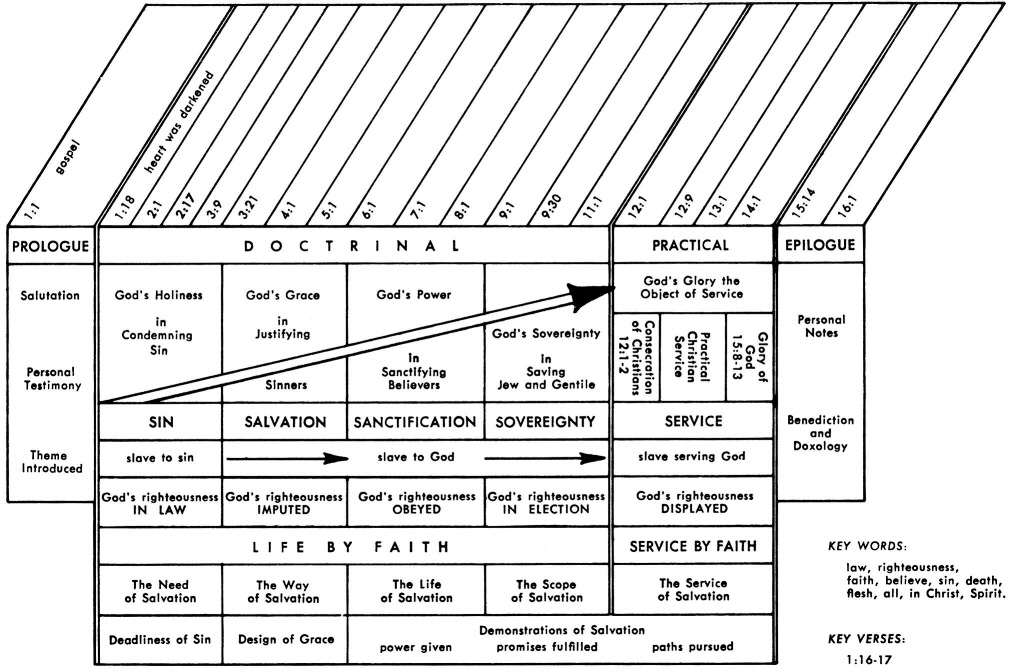
Click chart to enlarge
Chart from recommended resource Jensen's Survey of the NT - used by permission
Romans Overview Chart - Charles Swindoll
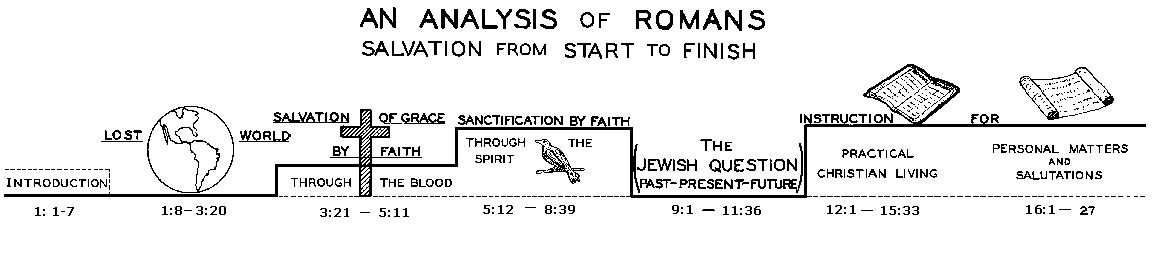
Source: Dr David Cooper
Click to Enlarge
| ROMANS ROAD to RIGHTEOUSNESS |
||||
| Romans 1:18-3:20 | Romans 3:21-5:21 | Romans 6:1-8:39 | Romans 9:1-11:36 | Romans 12:1-16:27 |
| SIN | SALVATION | SANCTIFICATION | SOVEREIGNTY | SERVICE |
| NEED FOR SALVATION |
WAY OF SALVATION |
LIFE OF SALVATION |
SCOPE OF SALVATION |
SERVICE OF SALVATION |
| God's Holiness In Condemning Sin |
God's Grace In Justifying Sinners |
God's Power In Sanctifying Believers |
God's Sovereignty In Saving Jew and Gentile |
Gods Glory The Object of Service |
| Deadliness of Sin |
Design of Grace |
Demonstration of Salvation | ||
| Power Given | Promises Fulfilled | Paths Pursued | ||
| Righteousness Needed |
Righteousness Credited |
Righteousness Demonstrated |
Righteousness Restored to Israel |
Righteousness Applied |
| God's Righteousness IN LAW |
God's Righteousness IMPUTED |
God's Righteousness OBEYED |
God's Righteousness IN ELECTION |
God's Righteousness DISPLAYED |
| Slaves to Sin | Slaves to God | Slaves Serving God | ||
| Doctrine | Duty | |||
| Life by Faith | Service by Faith | |||
|
Modified from Irving L. Jensen's chart above |
||||
R Ruin (Romans 1:17 – 3:20) – The utter sinfulness of humanity
O Offer (Romans 3:21-31) – God’s offer of justification by grace
M Model (Romans 4:1-25) – Abraham as a model for saving faith
A Access (Romans 5:1-11) – The benefits of justification
N New Adam (Romans 5:12-21) – We are children of two “Adams”
S Struggle w/ Sin (Romans 6:1-8:39) Struggle, sanctification, and victory
Romans 7:4 Therefore, my brethren, you also were made to die to the Law through the body of Christ, so that you might be joined to another, to Him who was raised from the dead, in order that we might bear fruit for God. (NASB: Lockman)
Greek: hoste adelphoi mou, kai humeis ethanatothete (2PAPI) to nomo dia tou somatos tou Christou, eis to genesthai (AMN) humas hetero to ek nekron egerqenti, (AAPMSD) hina karpophoresomen (1PAAS) to theo
Amplified: Likewise, my brethren, you have undergone death as to the Law through the [crucified] body of Christ, so that now you may belong to Another, to Him Who was raised from the dead in order that we may bear fruit for God. (Amplified Bible - Lockman)
Barclay: Just so, my brothers, you have died to the law, through the body of Jesus Christ (for you shared in his death by baptism) in order that you should enter into union with another, I mean, with him who has been raised from the dead, in order that we may bear fruit to God. (Westminster Press)
NLT: So this is the point: The law no longer holds you in its power, because you died to its power when you died with Christ on the cross. And now you are united with the one who was raised from the dead. As a result, you can produce good fruit, that is, good deeds for God. (NLT - Tyndale House)
Phillips: There is, I think, a fair analogy here. The death of Christ on the cross had made you "dead" to the claims of the Law, and you are free to give yourselves in marriage, so to speak, to another, the one who was raised from the dead, that you may be productive for God. (Phillips: Touchstone)
Wuest: So that, my brethren, as for you, you also were put to death with reference to the law through the intermediate agency of the body of Christ, resulting in your being married to another, to the One who was raised up from among the dead, in order that we might bear fruit to God. (Eerdmans Publishing - used by permission)
Young's Literal: So that, my brethren, ye also were made dead to the law through the body of the Christ, for your becoming another's, who out of the dead was raised up, that we might bear fruit to God;
THEREFORE MY BRETHREN, YOU ALSO WERE MADE TO DIE TO THE LAW THROUGH THE BODY OF CHRIST: hoste adelphoi mou, kai humeis ethanatothete (2PAPI) to nome dia tou somatos tou Christou:
- Romans 7:6; 6:14; 8:2; Gal 2:19,20; 3:13; 5:18; Eph 2:15; Col 2:14,20
- Romans 7 Resources - Multiple Sermons and Commentaries
In Galatians Paul states a parallel truth writing that…
through the Law I died to the Law (cp Ga 3:10,13, 24), so that I might live to God.
Comment: What does the first [somewhat difficult to grasp] clause mean? The law condemns and subjects all men to the death penalty. Think of the situation where a man is found guilty of a capital offense and is executed. What power does the law have over this dead man? And by the same token, Paul is saying [and the next verse makes this even clearer - Ga 2:20] I have died with Christ [Ro 6:3] and Christ took the full brunt of the penalty that was justly due to me for breaking the law, though He Himself was not guilty of breaking any law [He 4:15, 1Pe 1:18, 19]. And so God's righteous justice was propitiated or satisfied when the full fury of His holy wrath was poured out upon the Lamb of God Who took away [Jn 1:29, 1Pe 2:24, 25, cp Re 5:6, Re 5:9] Paul's [and every believer's] sins, so that Paul [and every believer] is forever free of the death penalty imposed by the law.
Middletown Bible has a useful table comparing the truths in Romans 6 and Romans 7…
| ROMANS 6 | ROMANS 7 | |
| Key Word in Chapter | SIN (see Ro 6:1, 2, 6, 7, 10-23) 11 times |
LAW (see Ro 7:1-14, 16, 22, 25) 18 times |
| Believer’s Relationship | Believer’s Relationship to Sin |
Believer’s Relationship to Law |
| Dominion | Sin had dominion (Ro 6:14) |
The Law had dominion (Ro 7:1) |
| Death | I died to (the) Sin (Ro 6:2) |
I died to the law (Ro 7:4) |
| Freedom | Free from Sin (Ro 6:18) |
Free (delivered) from the law (Ro 7:3,6) |
| Newness | Walk in newness of LIFE (Ro 6:4) |
Serve in newness of SPIRIT (Ro 7:6) |
| Fruit of Flesh Fruit of Spirit (God’s life) |
Romans 6:21KJV Romans 6:22KJV |
Romans Ro 7:5 Romans Ro 7:4 |
Therefore (5620) (hoste) means so that, consequently, accordingly, thus. This opening word indicates that illustration is now giving way to application. It draws an inference from the preceding illustration and introduces the actual relation with respect to Christians who are in a position corresponding with that of the wife.
Made to die (2289) (thanatoo [word study] from thánatos = death) means literally to kill, to cause to be put to death, to mortify, to give up to death, to condemn to death or to deliver over to death. And so in the NT some uses are literal (Mt 10:21, 26:59, 27:1, Mk 13:12, 14:55) and mean to cause cessation of life as by condemning to death or delivering/handing one over to be killed.
In Ro 7:4 thanatoo is used figuratively in reference to the death that the believer dies through supernatural, mystical but very real unity with the body of the crucified Christ. The aorist tense conveys the truth that this "death" is a past tense, historical event. Count it as true. Praise Him that it is true. Then walk in the light of that truth. Don't place yourself back under the "yoke" of the law in any form! Even "good things" can subtly become "laws" -- e.g., "If I don't have my quiet time this morning, the Lord won't bless me." Wrong! The Lord blesses you not because you merit blessing but because He is good. Sure, He blesses obedience, but our obedience is to be out of love, not legalistic constraints, out of a desire to please our Father, not puff up our flesh. So don't be deceived beloved brethren for our spirit is willing but our flesh is weak, so we must continually be on guard and continually surrendered to His sweet will, not some legalistic yoke.
In another very practical figurative use of thanatoo Paul instructs believers to mortify (cp Col 3:5KJV) or subdue the evil desires and deeds that emanate from those desires (Ro 8:13). By using the present tense in Ro 8:13 Paul is calling for a habitual, moment by moment effort (albeit not "self" effort, but Spirit enabled effort) on the part of believers to "search and destroy" these death dealing deeds. We need to have the continual mindset of soldiers who are continually engaged (Take no "furloughs" please dear believer! Your adversary doesn't! cp 1Pe 5:8 where "prowls" = continually) in a deadly conflict (1Pe 2:11, 2Ti 2:3, 4) and must continually be killing sin (by the Spirit), lest sin kill us. Remember that "death" speaks of separation so what a believer enabled by the Spirit is to do is to separate moment by moment, day by day from the evil, dead dealing deeds of the fallen flesh nature (Jas 1:14, 15). Remember brethren beloved by God (1Th 1:4), that He saved us by grace through faith (Ep 2:8, 9) the first time (justification - Ro 3:24, Ro 3:28) and He saves us each day by that same grace through faith (progressive sanctification). Our tendency is to try to live this supernatural life in our strength (flesh), not the strength of His Spirit (faith). God says in Roman 6-8, stop "trying" and start "dying" (to your flesh), and do this every day and every moment of every day! Trying breeds struggling and frustration. Dying yields surrender and fulfillment. (SEE CAVEAT BELOW REGARDING "STOP TRYING AND START DYING") In Romans 7 Paul will make it all too clear that one cannot be sanctified by the law. To reiterate, the moment you try to please God by keeping a list of do's and don'ts, of regulations, of schedules, etc, then at that moment you have in effect placed yourself back up under the law in one form or another and your experience will mimic that of Paul's description in Romans 7. And as Paul explains in the next verse, when you place yourself under the law, the law functions like a stimulant or a catalyst to arouse your sinful passions (Ro 7:5)! Beware! Legalism can be very subtle!
ONE CAVEAT REGARDING THE EXHORTATION - "STOP TRYING AND START DYING" - This statement DOES NOT mean that we are to "Let Go and Let God" which is a false teaching (probably originating from the Keswick Movement - See Andy Naselli's lectures on his book "Let Go and Let God")! A And so, as an example, the phrase "stop trying" means stop trying to live the supernatural life in your natural strength, but in dependence on the Spirit. So does this signify you will do nothing? Does this signify you are a "passive participant" in your progressive sanctification? Of course not! Paul was very clear that while believers are totally dependent on the Spirit of Christ to live a supernatural life, we are also totally responsible to work out our salvation -- "So then, my beloved, just as you have always obeyed, not as in my presence only, but now much more in my absence, work out (command in the present imperative - but even obeying this necessitates the Spirit's enablement described in the next verse) your salvation with fear and trembling; 13 for (strategic "term of explanation") it is God Who is at work in you, both to will (desire) and to work (power) for His good pleasure. (Php 2:12, Php 2:13NLT). One might sum up it up as "Let God and Let's Go!" See also the "Paradoxical Principle of 100% Dependent and 100% Responsible".
Thanatoo -11x in 11 verses in the NAS - Matt. 10:21; 26:59; 27:1; Mk. 13:12; 14:55; Lk. 21:16; Rom. 7:4; 8:13, 36; 2 Co. 6:9; 1 Pet. 3:18 and is rendered in the NAS as cause to be put to death(1), made to die(1), put to death(8), putting to death(1).
Note that the Law has not died. Believers have been made to die (passive voice = divine passive = God brought about this supernatural event, not us. We became sharers and participants in this truth by grace through faith!) to the Law. Paul avoids saying that the Law died, for that is not taught in Scripture, though the law had a certain course to run as explained in Hebrews (cp He 8:13NLT). Paul is continuing the emphasis which he had begun to explain in Romans 6, where he introduced the truth that death ends obligation, having stated in Ro 6:14 (see note) that believers are no longer under (under the power, authority, and control of) law, but under grace".
In Galatians Paul explained that
Christ redeemed (bought us back, delivered us by paying the price = His precious blood) us from the curse of the Law, having become a curse (which condemned us to die) for (on our behalf, speaking of His substitutionary death) us (Galatians 3:13)
In Colossians he explained that God
cancelled and blotted out and wiped away the handwriting of the note (bond) with its legal decrees and demands which was in force and stood against us (hostile to us). This [note with its regulations, decrees, and demands] He set aside and cleared completely out of our way by nailing it to [His] cross. (Col 2:14)
Paul went on to explain that
(believers) have died with Christ (believer’s union with Christ in His death and resurrection) to the elementary principles of the world… (Col 2:20)
Writing to the churches in Galatia Paul explained that
I have been crucified with Christ (the believer is identified with Christ in His death) and it is no longer I who live, but Christ lives in me (Jesus did not die for me in order that I might go on living as I choose but that from now on He might live His life in and through me, empowering me by His Spirit to live in a supernatural way previously not possible in my strength) and the life which I now live in the flesh I live by faith (reliance and continual dependence on Christ, yielding to Him, allowing Him to live His life through me) in the Son of God, Who loved me, and delivered Himself up for me." (Gal 2:20)
Christ, not the law, now is to have dominion over me. Stated another way, the believer’s rule of life is Christ and not the law. It is not a matter of striving and trying, but of trusting and relying. Believers are called and empowered to live a holy life (1Pe 1:14, 1Pe 1:15, 16, Lv 11:44), not out of fear of punishment, but out of love of God and a desire to be pleasing to Him as our Father (cp 1Pe 1:17NLT, 2Co 5:9, 2Co 7:1 in context of the promises in 2Co 6:16, 17, 18).
As Middletown Bible reminds us "The law is a terrible husband -- strict, inflexible, stern, rigid, demanding and unbending. The Lord is a wonderful husband -- merciful, gracious, and He, by His power and life, ENABLES me to please Him (cp He 13:21NLT, He 13:20NLT). Just as a marriage relationship produces FRUIT (children), so our marriage to Christ produces fruit (see Ro 6:22ESV; Ga 5:22, Ga 5:23). See also John 15:2, 5, 8 = "fruit" > "more fruit" > "much fruit." (Romans chapter 7)
Through (1223) (dia) marker of instrument by which something is accomplished, by means of.
The body of Christ (Mt 26:26; Jn 6:51; 1Cor 10:16; Heb 10:10; 1Pet 2:24) - This is not a reference to the church (also referred to as "the body of Christ", cp Ep 4:12), since the word has not been used in the corporate, mystical sense so far in Romans, and when it is so used (Ro 12:4, 5) Paul brings in the human body as an analogy in order to make his meaning clear, as he had done in an earlier letter (1Cor 12:12, 13).
Newell writes that…
The great lesson which each of us must lay to his own heart, is, that those in Christ, whether Jew or Gentile, are not under law as a principle, but under grace (Ro 6:14),—full, accomplished Divine favor—that favor shown by God to Christ! And the life of the believer now is
(1) in faith, not effort: as Paul speaks in Gal 2:20 (note):
The life which I now live in the (physical) flesh, I live in faith, the faith which is in the Son of God
(2) in the power of the indwelling Spirit; for walking by the Spirit (Gal 5:16, Ga 5:18, Ga 5:25) has taken the place of walking by external commandments; and
(3) exercising ourselves to have a good conscience toward God and men always (1Ti 1:5, 19, 1Pe 3:16): particularly, not wrongly using our freedom (or liberty) (Take a moment and ponder these passages on freedom in Christ = Ro 8:2, Ga 5:1, cp Ga 2:4, Jn 8:31, 32, 34, 36, 1Co 7:22NLT, 2Co 3:17NIV, 1Pe 2:16NLT, 2Pe 2:19NLT, Jude 4NIV). (Romans - Verse by Verse)
THAT YOU MIGHT BE JOINED TO ANOTHER TO HIM WHO WAS RAISED FROM THE DEAD: eis to genesthai (AMN) humas hetero to ek nekron egerthenti (AAPMSD):
- Ps 45:10, 11, 12, 13, 14, 15; Isa 54:5; 62:5; Hos 2:19,20; Jn 3:29; 2Cor 11:2; Eph 5:23, 24, 25, 26, 27; Rev 19:7; 21:9
- Romans 7 Resources - Multiple Sermons and Commentaries
Paul now spells out two purposes of our union Christ (in His death): (1) We might belong to Christ and (2) We are to be fruit bearers for the glory of God.
Stop for a moment and contrast our new relationship in Christ with our former relationship under the law - we are dead to the law and married to Christ. Our relationship is now a love relationship not a legal (law) relationship. What a wonder, that the God Who created us, redeemed us and then marries us! Surely we see in this how Christianity is not a dead, even orthodox religion but a relationship to a living Person. Beloved, Paul is explaining that Christianity is not about doing something but about knowing Someone (cp Jn 17;3, 1Jn 2:3, 4). Never lose the wonder of this grand truth and lapse into legalistic religion when you could be enjoying intimate relationship with the God of the Universe! Amazing love, how can it be?…
And Can It Be That I Should Gain
And can it be that I should gain
An interest in the Savior’s blood?
Died He for me, who caused His pain—
For me, who Him to death pursued?
Amazing love! How can it be,
That Thou, my God, shouldst die for me?
Amazing love! How can it be,
That Thou, my God, shouldst die for me?
See and listen also to…
Gaithers And Can It Be That I Should Gain live
Amazing Love
Chris Tomlin - Amazing Love
Joined (be married to, might belong to, becoming another's) (1096) (ginomai) means to cause to become or to come into existence and more literally "having become another man's". If you are dead, how can you be joined to another? In Christ’s death we died and in Christ’s resurrection we live and since we are alive we can be joined in marriage to Christ! Amen.
And so in a mystical (but very real) sense believers are now united to Christ as His bride (Ep 5:25) for we have been betrothed to our Beloved (2Co 11:2) and betrothal in the Jewish culture was tantamount to a legal binding relationship and to break it one had to get a writ of divorce (cp Joseph contemplating breaking the "engagement" to Mary in Mt 1:18, 19, 20). As a woman could marry a new husband only after her first husband had died, so we have been married, as it were, to our great Bridegroom after we died to the law (Re 19:7, Re 19:8, cp 1Co 6:19, 20).
To belong to Christ involves participation not only in his death but also in His resurrection (cp Col 2:12, cp Ro 6:3, Ro 6:4, 2Co 13:4). Severance from obligation to serve the law is only part of the truth. We are married, as it were, to the risen Lord, with a view to bearing fruit to God. Perhaps an analogy is intended here--as a marriage produces progeny, so the believer's union with Christ results in spiritual fruit. It should be recalled that in our Lord's teaching the secret of fruit bearing is union with Himself (Jn 15:5, 7, 8), emphasized here in Romans 7:6.
THAT WE MIGHT BEAR FRUIT FOR GOD: hina karpophoresomen (1PAAS) to theo:
- Ro 6:22; Jn 15:8; Gal 5:22,23; Phil 1:11; 4:17; Col 1:6,10
- Romans 7 Resources - Multiple Sermons and Commentaries
That (2443) (hina) is a marker of result or of purpose for the fact that believers are in Christ, having been born again to a new Master with a new Power and Purpose in Christ.
Bear fruit (2592) (karpophoreo from karpos = fruit + phero = to bring) literally means to bring forth fruit, to be fertile, productive. In John 15 those who abide in the Vine Christ Jesus, will bring forth "much fruit" ("good works").
Karpophereo is in the subjunctive mood which with hina (conjunction meaning "for the purpose of", "in order that") is used to express purpose -- fruit bearing. If you are a believer and feel you have no "purpose", here it is… go and bear fruit, much fruit, fruit that remains for eternity. Focus on the facts not on your feelings. Let this truth renew your mind if you are downcast.
The aorist tense calls for this to be an actual outcome (fruit bearing).
Some commentators (even some very excellent expositors like Lloyd-Jones) interpret fruit as literal children (continuing with Paul's metaphor of marriage), an interpretation that seems incorrect even from the context. In other words, who is a believer joined to? Christ of course, so it seems far fetched to think Paul intends fruit in such a context to be children. Could he mean "spiritual children"? I suppose one cannot totally discount that possibility for converts are occasionally referred to as "fruit".
Newman writes that Paul's metaphor of bear fruit...
may have the specific meaning of “bringing others to God,” but in the present context the emphasis seems to be more general, that is, simply living a life that is useful to God. In some languages, useful in the service of God may be expressed as “doing good for God’s sake” or “doing good as a way of serving God.” (The United Bible Societies' New Testament Handbook Series)
Stott goes on to add that…
whether ‘fruit’ means ‘children’ or not, all are agreed that the result of being released from the law and joined to Christ is holy living, not antinomian license. For becoming a Christian involves a radical change of allegiance. At the end of chapter 6 our two slaveries were contrasted. At the beginning of chapter 7 it is our two marriages, death dissolving the first and so permitting the second. Both metaphors speak of our new freedom to serve, which is the topic to which Paul now comes. (Stott, J. R. W. The Message of Romans. Leicester, England; Downers Grove, Ill.: InterVarsity Press)
Matthew Poole says fruit refers to…
fruits of holiness and good works, to the glory and praise of God.
Jamieson writes that…
all the issues of this new life, in Christian obedience, are regarded as the “fruit” of this blessed union to the Risen One.
KJV Bible Commentary writes that…
The purpose of our being free from the law and married to another, the risen Lord, is that we may produce fruit unto God. Although this may be an extension of the marriage analogy, and the fruit mentioned is the progeny which is the result of marriage (i.e., the winning of others to the Lord), it is most likely that the fruit unto God is a righteous life which is characterized by those “good works, which God hath before ordained that we should walk in them” (Eph 2:10). (Dobson, E G, Charles Feinberg, E Hindson, Woodrow Kroll, H L. Wilmington: KJV Bible Commentary: Nelson)
John MacArthur's comments that…
Godly fruit exists basically in two dimensions: (a transformed life that manifests godly) attitudes and actions. The fruit of the Holy Spirit in a believer’s life is manifested internally in his attitudes of “love, joy, peace, patience, kindness, goodness, faithfulness, gentleness, self-control” (Gal. 5:22, Ga 5:23). As far as godly actions are concerned, Jesus said, “I am the true vine, and My Father is the vine dresser. Every branch in Me that does not bear fruit, He takes away; and every branch that bears fruit, He prunes it, that it may bear more fruit” (John 15:1, 2). The writer of Hebrews speaks of “the fruit of lips that give thanks to His name” (He 13:15), and Paul prayed that Philippian believers would be prepared for the day of Christ by being “filled with the fruit of righteousness which comes through Jesus Christ, to the glory and praise of God” (Php 1:11).
Charles Simeon (Horae Homileticae Vol 15: Romans) says that …
By our connection with the law, we have brought forth fruit only unto sin and death: but by the mighty operation of divine grace, we shall be enabled to bring forth fruit unto God, and holiness, and life (Ro 6:21, 22). We shall no longer live under the influence of a slavish spirit, aiming only at the mere letter of the commandment, and regarding even that as an irksome service; but we shall aspire after the utmost spirit of the commandment, and strive with holy ardour to make the highest possible attainments, longing, if possible, to be “holy as God is holy,” (1Pe 1:16) and to be “perfect as God is perfect.” (Mt 5:48) Our services will resemble those of the heavenly choir, who look, and watch, and pant, as it were, for an opportunity to testify their love to God, and to execute, in all its extent, His holy will. How should the prospect of such fruit stimulate our desires after Christ! Let us bear in mind, that the bringing of us to such a state was the great object which He sought in giving up Himself for us (1Pe 2:24); and let it be also the great object of our solicitude in devoting ourselves to Him (Ro 14:7, 8)
Notice that Paul moved from the second person plural (you) to the first person plural (we), including himself along with his readers. The believer who has died with Christ is released from bondage to the law and hence from bondage to sin and is free to experience the abundant life of Christ (Jn 10:10b). God’s purpose in all this is in order that we might bear fruit to God (cp Ro 6:22 Gal 5:22, 23- notesGa 5:22; 23 Php 1:11- ). Only a person who is spiritually alive can bear spiritual fruit, fruit that remains (cf. Jn 15:4,5,16). (See also word study on fruit = karpos)
As believers we are not to continue in sin (Ro 6:1) but we are now in Christ and married to our Savior, Jesus, and our occupation is to bear fruit for God…
For we are His workmanship (poiema), created in Christ Jesus for good works (see Good Deeds), which God prepared beforehand, that we should walk in them. (Ep 2:10).
In sum, Paul is saying that before faith in Christ's death, burial and resurrection, we were ''married'' to a husband named ''the Law''. But when we died with Christ in Romans 6, we were set free from our husband and united with our new Husband, Christ. The old ''husband'' is not dead… believers are the ones who have died.
Barnes writes that bring forth fruit means…
That we should live a holy life. This is the point and scope of all this illustration. The new connexion is such as will make us holy. It is also implied that the tendency of the law was only to bring forth fruit unto death, Ro 6:5 and that the tendency of the gospel is to make man holy and pure. Comp. Ga 5:22,23. (Albert Barnes. Barnes NT Commentary)
Barnhouse has the following thoughts on fruit…
One of the most important purposes of redemption is that we might bring forth fruit unto God. We were transplanted out of death and rooted and grounded in His love so that we might bring forth fruit. Fruit is the expression of life, and in the Word of God fruit is indicative of converts, character, and conduct…
“Abide in me, and I in you. As the branch cannot bear fruit of itself, except it abide in the vine; no more can you, except you abide in me” (John 15:4). This is a magnificent expansion of our text in Romans which sets forth our oneness with Christ, our marriage to Him to bring forth fruit for God. “I am the vine, you are the branches. He who abides in me, and I in him, he it is that bears much fruit, for without me you can do nothing” (v. 5). How many Christians read it, “Without me you cannot do very much,” cling to their own imagined ability, and so fail to bear fruit! God never mingles His power with ours. Only when we recognize our own absolute nothingness does He work in full power. (Barnhouse, D. G. God's Freedom : Romans 6:1-7:25. Grand Rapids, MI.: William B. Eerdmans Publishing Company)
Robert Haldane writes that…
One of the great ends of marriage was to people the world, and the end of the marriage of believers to Christ is, that they may bring forth fruit to God, John 15:4, 5, 6, 7, 8. From this it is evident that no work is recognized as fruit unto God before union with Christ. All works that appear to be good previous to this union with Christ are “dead works,” (He 9:14) proceeding from self–love, self–gratification, pride, self–righteousness, or other such motives. “They that are in the flesh cannot please God.” (Ro 8:8) “The carnal mind is enmity against God; for it is not subject to the law of God, neither indeed can be.” (Ro 8:7) We can never look upon the law with a friendly eye till we see it disarmed of the sting of death; and never can bear fruit unto God, nor delight in the law as a rule, till we are freed from it as a covenant, and are thus dead unto sin. How important, then, is the injunction, “Likewise reckon ye also yourselves to be dead indeed unto sin,”—and this applies equally to the law,—”but alive unto God through Jesus Christ our Lord,” Romans 6:11. (Romans 7 Commentary)
Newell adds that…
It is implicitly asserted here that those under law could not bring forth fruit to God. Because, in order to bring forth such fruit, they had to be made dead to the Law. This cannot be sufficiently emphasized, for all about us we find those who are earnestly seeking to bear fruit to God, while “entangled with the yoke of bondage,” (Ga 5:1KJV) not knowing themselves dead to the legal principle… No, it is only those who see themselves to have died with Christ and to be now joined to a Risen Christ in glory, that fully bring forth fruit to God.
It Is a glorious day when a believer sees himself only in a Risen Christ—dead, buried and risen; and can say with another, “I am not in the flesh, not in the place of a child of Adam at all, but delivered out of it by redemption. The whole scene of a living man, this world in which the life of Adam develops itself, and of which the Law is the moral rule, I do not belong to, before God, more than a man who died ten years ago out of it.” (Romans Verse by Verse)
Romans 7:5 For while we were in the flesh, the sinful passions, which were aroused by the Law, were at work in the members of our body to bear fruit for death. (NASB: Lockman)
Greek: hote gar emen (1PIAI) en te sarki, ta pathemata ton hamartion ta dia tou nomou energeito (3SIMI) en tois melesin hemon eis to karpophoresai (AAN) to thanato;
Amplified: When we were living in the flesh (mere physical lives), the sinful passions that were awakened and aroused up by [what] the Law [makes sin] were constantly operating in our natural powers (in our bodily organs, in the sensitive appetites and wills of the flesh), so that we bore fruit for death. (Amplified Bible - Lockman)
NLT: When we were controlled by our old nature, sinful desires were at work within us, and the law aroused these evil desires that produced sinful deeds, resulting in death. (NLT - Tyndale House)
Phillips: While we were "in the flesh" the Law stimulated our sinful passions and so worked in our nature that we became productive - for death! (Phillips: Touchstone)
Wuest: For when we were in the sphere of the sinful nature, the impulses of the sins which were through the law were operative in our members, resulting in the production of fruit with respect to death. (Eerdmans Publishing - used by permission)
Young's Literal: for when we were in the flesh, the passions of the sins, that are through the law, were working in our members, to bear fruit to the death;
NET For when we were in the flesh, the sinful desires, aroused by the law, were active in the members of our body to bear fruit for death.
CSB For when we were in the flesh, the sinful passions operated through the law in every part of us and bore fruit for death.
ESV For while we were living in the flesh, our sinful passions, aroused by the law, were at work in our members to bear fruit for death.
NIV For when we were controlled by the sinful nature, the sinful passions aroused by the law were at work in our bodies, so that we bore fruit for death.
NRS While we were living in the flesh, our sinful passions, aroused by the law, were at work in our members to bear fruit for death.
NJB While we were still living by our natural inclinations, the sinful passions aroused by the Law were working in all parts of our bodies to make us live lives which were fruitful only for death.
NAB For when we were in the flesh, our sinful passions, awakened by the law, worked in our members to bear fruit for death.
GWN While we were living under the influence of our corrupt nature, sinful passions were at work throughout our bodies. Stirred up by Moses' laws, our sinful passions did things that result in death.
RSV While we were living in the flesh, our sinful passions, aroused by the law, were at work in our members to bear fruit for death.
ASV For when we were in the flesh, the sinful passions, which were through the law, wrought in our members to bring forth fruit unto death.
FOR WHILE WE WERE (past tense) IN THE FLESH (unregenerate): hote gar hemen en te sarki:
- Ro 8:8,9; Jn 3:6; Gal 5:16,17,24; Eph 2:3,11; Titus 3:3
- Romans 7 Resources - Multiple Sermons and Commentaries
THE BONDAGE OF THE FLESH
AND THE POWER OF SIN
Were is in the imperfect tense which speaks of durative action (= action that is ongoing, progressive or continual) in the past (when you were unregenerate). At that time we were dead in our trespasses and sins and under the rule and control of our fallen sin nature inherited from Adam. We had no choice but to obey the strong desires of our unregenerate flesh.
NIV is interpretive but accurate "controlled by the sinful nature"
"when basically we were governed by our sinful human nature" (Kistemaker)
Flesh (4561)(sarx) (Click in depth study) is used 147 times in the NT and because of multiple nuances (some Greek lexicons list up to 11 definitions for sarx!) the diligent disciple must carefully observe the context of in order to discern which nuance is intended. The range of meaning extends from the substance flesh (both human and animal), to the human body, to the entire person, and to all humankind.
In the present context, sarx is used in the moral/ethical or spiritual sense to describe the outlook of mankind which is continually orientated toward self, is prone to sin, is opposed to God and which pursues its own ends in self-sufficient, independence from God. Flesh thus is the ugly complex of human sinful desires that includes the ungodly motives, affections, principles, purposes, words, and actions that sin generates through our bodies. Sarx as used in this manner denotes the entire fallen human being—not just the sinful body but the entire being, including the soul and mind, as affected by sin. To live in the flesh is to be ruled and controlled by that evil complex. Because of Christ’s saving work on our behalf, the sinful flesh no longer has the "right" to reign over us, to debilitate us and drag us back into the pit of depravity into which we were all born.
Believers need to understand that there is this remnant of the old flesh nature within our physical bodies of flesh. In contrast to the unregenerate man, believers now have the power when led by the Holy Spirit to say "yes" to God and "no" to the flesh, whereas before our union with Christ in Romans 6 (Ro 6:1, 2, 3, 4, 5, 6, 7, 8, 9, 10, 11-see notes on Ro 6:1-3; 6:4-5; 6:6-7; 6:8-10; 6:11) took place, we had no choice. Paul teaches clearly that the flesh is opposed to Spirit. The unbeliever can live only in the flesh, but the believer can live in the Spirit but can fall back into living according to the flesh. Paul repeatedly encourages believers to overcome the deeds of the flesh in the only way possible - by living in the Spirit.
IN THE FLESH
In the flesh - Here are all the NT uses (in the NAS) of this phrase - Ro 2:28; 7:5; 8:3, 8, 9; 2Co 10:3; 12:7; Ga 2:20; 6:12; Ep 2:11; Phil 1:22, 24; 3:3, 4; 1Ti 3:16; Philemon 1:16; 1Pet. 3:18; 4:1, 2, 6; 1Jn. 4:2; 2 Jn. 1:7. Most of these uses of in the flesh describe one's physical being, the literal body, a number of these in fact specifically referring to the Incarnation or Christ in the flesh. The following 4 verses however use in the flesh to refer to man’s unredeemed humanness, his own ability and achievements apart from, hostile to and opposed to God - Ro 7:5, 8:8, 9, Php 3:3, 4.
The Amplified Version qualifies the phrase in the flesh with the explanatory clause that this refers to mere physical lives but a careful examination of the context does not support the Amplified Version's interpretation.
The Weymouth paraphrase is interesting…
For whilst we were under the thraldom of our earthly natures, sinful passions— made sinful by the Law—were always being aroused to action in our bodily faculties that they might yield fruit to death.
Phillips renders it…
While we were "in the flesh" the Law stimulated our sinful passions and so worked in our nature that we became productive - for death! (Phillips: Touchstone)
MacDonald explains that…
In the flesh here is descriptive of our standing before we were saved. Then the flesh was the basis of our standing before God. We depended on what we were or what we could do to win acceptance with God. In the flesh is the opposite of “in Christ.” (Borrow Believer's Bible Commentary)
Donald Barnhouse rightly states that…
Here, ‘in the flesh’ does not refer to the body. These three simple words describe the deadly state of people who have not been born again… It is a moral state, the condition of the unsaved before God. The state of the redeemed is described in chapter 8:
“You are not in the flesh but in the Spirit, if so be that the Spirit of God dwelleth in you” (see note Romans 8:9).
Being in the flesh, then, is the opposite of being in the Spirit. We all begin in the flesh, but some of us are now in the Spirit, even though the flesh is still in us. Because we have been freed from the flesh by the death of our Lord Jesus Christ and our union with Him in His resurrection, we are liberated from the passions of that flesh and may henceforth be dominated by the new life of our risen Lord.
Wuest writes that in the flesh…
refers to the condition of a person in the absolute control of the evil nature, as is clearly seen by a consideration of Paul’s words in Ro 8:9 where he says, “But ye are not in the flesh but in the Spirit, if so be that the Spirit of God, dwell in you.” That is, in the case where the person is indwelt by the Holy Spirit, that person is not in the control of the evil nature. That individual is a saved person. Consequently, the one who is in the flesh is an unsaved person, the flesh here referring to the fallen nature. (Eerdmans Publishing - used by permission)
John MacArthur notes that…
The unredeemed, unregenerate person can operate only in the area of the flesh, the natural and sinful sphere of fallen mankind… A person who still lives in the realm of the flesh cannot belong to Christ (see Ro 8:9)… It is possible, of course, for a believer to fall back into some of the ways of the flesh, which he does whenever he sins. Although a believer can never again be in the flesh (Ed: In the figurative sense of being in the sphere of the anti-God influence), the flesh is still able to manifest itself in the believer. (See Romans Commentary)
William Newell explains that Paul…
… does not say, in the body, for we are all that! Being in the body has no moral significance, but the words are, in the flesh-the condition of those not saved, as we see from Ro 8:8; Ro 8:9:
For ye are not in the flesh but in the Spirit, if so be that the Spirit of God dwelleth in you.
This does describe a moral state or condition, - absence of life, absence of the Holy Spirit, and control by the fallen nature. (Romans 7).
In summary, In the flesh in Romans 7:5 refers to a lost man, one who is unredeemed and thus unregenerate and able to operate only in the sphere of fallen mankind. To be sure, the believer can still manifest deeds of the flesh, but he or she can never again be in the flesh in the same way as before being crucified with Christ (Ro 6:6).
MacDonald agrees explaining that…
The expression in the flesh obviously doesn’t mean in the body. In the flesh here is descriptive of our standing before we were saved. Then the flesh was the basis of our standing before God. We depended on what we were or what we could do to win acceptance with God. In the flesh is the opposite of in Christ. (Borrow Believer's Bible Commentary)
As alluded to above in the discussion of sarx, in order to keep one from becoming confused, be aware that in the letter to the Romans Paul uses the word flesh to convey different meanings:
(1) the humanity of Jesus Christ (Ro 1:3)
(2) the physical body (Ro 2:28- )
(3) mankind--"no flesh" (Ro 3:20)
(4) the so-called "ethical" meaning denoting the old sinful nature (flesh). It is this last sense of the word that pervades Romans 7 and 8, together with a final use in Ro 13:14.
THE SINFUL PASSIONS… AROUSED BY THE LAW: ta pathemata ton hamartion ta dia tou nomou:
- Ro 3:20; 4:15; 5:20; 1Cor 15:56; 2Cor 3:6, 7, 8, 9; Gal 3:10; Jas 2:9,10; 1Jn 3:4
- Romans 7 Resources - Multiple Sermons and Commentaries
HOW THE LAW REVEALS
OUR SINFUL NATURE
Simply stated, the law can never conquer our sinful passions. It can only arouse our sinful passions. This is why legalism does not work, for when we put ourselves under (subject to) the law, we stir up our flesh and sin awakens.
Sinful passions - This is a genitive expression in Greek and can be rendered "sinful passions" or "passions which lead to sin." Robertson says "passions of sins" or marked by sins.
Passion (3804) (pathema from pascho = suffer where the suffix "–ma" indicates that which is suffered) in this context means passions, impulses, affections or strong inward emotions. Although not the primary meaning of pathema in this verse, the other meaning deserves mention and contemplation for it refers to the very pain that we are experiencing right now because of sin, those very things that we can "see, touch and feel" - those things that are causing us anguish and emotional trauma… all because they are dictated by our fallen sinful nature and fall so far short of God's mark.
Sinful passions then describe those overwhelming impulses to think and do evil, which characterize those who are “in the flesh” (Ep 2:3), but which obviously can also affect true believers. Prior to our conversion we were ruled by sinful passions which were aroused by the law. Paul uses pathema in Galatians explaining that…
Now those who belong to Christ Jesus have crucified the flesh with its passions (pathema) and desires. (Gal 5:24)
Aroused is not in the original Greek but does accurately reflects the intent of this passage. Consider the effects of the Laws of Prohibition in the 1920's. The law that banned alcohol stimulated the old flesh nature and the sinful passions were aroused so that men's appetite for alcohol increased and the results were deadly fruit euphemistically referred to as the "Roaring 20's". It was a tragic chapter in American History. The Mosaic Law affected the nation of Israel much like the Law of Prohibition affected America. The Law stipulates what is right and what is wrong, and in so doing it arouses evil in an unregenerate person because the naturally rebellious nature makes him want to do the very things that are forbidden, so that he becomes a veritable "spiritual oxymoron!"
As MacDonald succinctly explains…
It is not that the law originated them ("the sinful passions"), but only that by naming and then forbidding them it stirred up the strong desire to do them!" (Borrow Believer's Bible Commentary)
Poole notes that sinful passions refer to…
the corrupt inclinations to sin, which are drawn forth by the law, as ill vapors are raised out of a dunghill by the sun; or which are irritated by the law.
Calvin writes that…
the law excited in us evil emotions, which exerted their influence through all our faculties; for there is no part which is not subject to these depraved passions. What the law does, in the absence of the inward teacher, the Spirit, is increasingly to inflame our hearts, so that they boil up with lusts.
The unbeliever’s rebellious nature is awakened when restrictions are placed on him and make him want to do the very things the law forbids. As strange as it might seem, the law itself, by its very prohibitions, generates sinful impulses which lead to breaking the law! So in fact this is one of the functions of the Law -- to stimulate our sinful flesh! "Forbidden fruit is sweet". The natural (in the flesh) tendency in man is to desire the forbidden thing.
Augustine vividly pictured the interaction of the Law and our sinful passions writing that…
"The law is not at fault, but our evil and wicked nature; even as a heap of lime is still and quiet until water is poured on it, but then it begins to smoke and burn, not from the fault of the water, but from the nature of the lime which will not endure it."
Barnhouse has an interesting comment on the Law noting that…
When the Church age began, the majority of believers were Jews who, not yet having the New Testament, continued to live as though still under the law. Consequently there was a conflict which reached its climax at Antioch when Paul rebuked Peter for clinging to the law as a principle of Christian living. But in spite of Paul’s victory, man’s natural tendency to do something for himself brought him back under law, and by the end of the Dark Ages the entire legal system clouded over the life of the Church. Those who believed in grace alone were a small remnant appearing throughout the centuries like scattered stars peeping through clouds. When the Reformers emerged after the Renaissance, they made a valiant attempt to lead the church back to Biblical truth.
Wayne Barber comments on Romans 7:5 noting that it teaches…
the most fundamental truth about living under the law. When we were under the Law, it actually energized and encouraged our sinful flesh to operate. The law actually energized our sinful flesh. In Romans 7:5 we see the term in the flesh is associated with the controlling power of the sinful passions, and all this is associated with being in union with Adam and under the law:
"For while we were in the flesh, the sinful passions, which were aroused by the Law, were at work in the members of our body to bear fruit for death."
In the flesh—we were dead spiritually in the realm of flesh. We were in union with Adam.
The sinful passions indicated that which is the result of the sin of Adam. These are the inordinate desires of our bodies that once controlled us.
"Which were aroused by the Law, were at work in the members of our body to bear fruit for death."
Actually, you could read that:
"which were, through the Law (or by means of the law) at work in the members of our body."
They were energized by the law. Paul wants us to see how that the law actually energizes the flesh.
Paul has just described a miserable situation. Under the law, the sinful passions of our flesh were energized and we could do nothing about it. They produced fruit in us, unrighteous fruit.
We have got to understand this. When we are under the law, the flesh is always at work, and the flesh can only produce unrighteousness. The flesh loves to work whether it be grossly sinful works or "religious works." In fact, it is in the "religious" realm that it is the hardest to detect. Flesh is inherently rebellious to God and His ways, so even though it may appear to do good things, flesh trusts in it’s own strength. And without the ingredient of "faith in God and His ability," the result is that our fleshly self always wants the glory for what it has done.
In the religious realm the flesh loves to obey laws, to observe holy occasions, even to fast. Paul had to chastise the Galatian believers over this. Look at Galatians 4:9, 10, 11:
But now that you have come to know God, or rather to be known by God, how is it that you turn back again to the weak and worthless elemental things, to which you desire to be enslaved all over again? You observe days and months and seasons and years. I fear for you, that perhaps I have labored over you in vain.
That is true even today. Years ago my wife and I were walking on a beach in Florida. This lady came towards us with a radio headset on. She was singing a Christian song at the top of her lungs. We stopped and spoke with her for several minutes. She never said a word about Christ. It was all about her church and what her church was doing and how active she was in her church. I had the overwhelming feeling that she had completely missed the point of what being under grace was all about.
The flesh also loves to boast about its religious achievements, of how many prayers were offered, or how many gifts were given. Look at Luke 18:9-14
And He also told this parable to certain ones who trusted in themselves that they were righteous, and viewed others with contempt: ‘Two men went up into the temple to pray, one a Pharisee, and the other a tax-gatherer. The Pharisee stood and was praying thus to himself, "God, I thank Thee that I am not like other people: swindlers, unjust, adulterers, or even like this tax-gatherer. I fast twice a week; I pay tithes of all that I get." But the tax-gatherer, standing some distance away, was even unwilling to lift up his eyes to heaven, but was beating his breast, saying, "God, be merciful to me, the sinner!" I tell you, this man went down to his house justified rather than the other; for everyone who exalts himself shall be humbled, but he who humbles himself shall be exalted.’
Folks, our flesh hasn’t changed! Just as in the days of Genesis 11, when man became so arrogant that he thought he could somehow ascend unto Heaven, our depraved flesh always thinks it can somehow perform in such a way that God will accept it.
To go back and live under the law is to endeavor to live once again in the power of one’s flesh. It is to invoke the guilt and the condemnation of the law which energizes the flesh. You say,
"It is impossible for a believer to think that he can please God in his own fleshly efforts. He has been delivered from that kind of thinking."
Has he? Listen as Paul addressed some believers at Galatia in Galatians 3:1:
"You foolish Galatians, who has bewitched you, before whose eyes Jesus Christ was publicly portrayed as crucified?"
He is saying, "You have a mind, and you have been taught, but you choose to refuse to understand. You would rather play church." "Who has bewitched you" has the idea of "charmed." Paul says,
"Who has come to you and with smooth-talk charmed you into this foolish error of thinking you can please God by fleshly effort and religious habit?"
He goes on in Galatians 3:2:
"This is the only thing I want to find out from you: did you receive the Spirit by the works of the Law, or by hearing with faith?"
You see, the law, and the works of the flesh that seek to obey the law, cannot save nor sanctify a person. To trust in one's flesh, seeking to obey the law, is to commit spiritual suicide. Paul dealt with the antinomians in Romans 6. Could it be that he is dealing with the legalists in Romans 7?
The same misery we experienced when we were in Adam under the law, which is the inability to produce righteousness in our fleshly efforts, will be ours if we go back to trusting in our own efforts. Our flesh is just as arrogant and sinful. It has been rendered powerless, so it cannot control us unless we choose to allow it.
So far we have seen: the principle of law—it controls a person as long as they live; the practical illustration of the Principle—the law said that a woman who was married to a man still living could not remarry another until her first husband died; the purpose of the illustration Paul used—we were once in union with Adam with the law controlling and condemning us, but when we put our faith into Christ we died to that relationship and now we are free from the law and under His Grace in our union with Him. The problem that man had which required him to be joined to Christ was that man in union with Adam could never produce righteousness that God would accept.
><> ><> ><>
Illustration - Take a dish of Baking Soda (and explain it represents our Sin nature). It appears quiet until another substance is added. Add Vinegar (and explain that it represents the Law). What's the result? The Baking Soda is no longer quiet but begins to smoke and froth. The fault is not in the vinegar, but in the nature of the Baking Soda which will not remain inactive when "provoked" by Vinegar. The Law is not at fault, but the fault lies in our evil, wicked Sin nature!
><> ><> ><>
LAW STIRS UP SIN – ILLUSTRATION FROM PILGRIM’S PROGRESS - In his Pilgrim’s Progress, John Bunyan describes Interpreter’s house, which Pilgrim entered during the course of his journey to the Celestial City. The parlor of the house was completely covered with dust, and when a man took a broom and started to sweep, he and the others in the room began to choke from the great clouds of dust that were stirred up. The more vigorously he swept, the more suffocating the dust became. Then Interpreter ordered a maid to sprinkle the room with water, with which the dust was quickly washed away. Interpreter explained to Pilgrim that the parlor represented the heart of an unsaved man, that the dust was original sin, the man with the broom was the law, and the maid with the water was the gospel. His point was that all the law can do with sin is to stir it up. Only the gospel of Jesus Christ can wash it away.
FORBIDDEN FRUIT - In Galveston, Texas, a hotel on the shore of the Gulf of Mexico put this notice in each room:
No Fishing From The Balcony
Yet every day, hotel guests threw in their lines to the waters below. Then the management decided to take down the signs -- and the fishing stopped!
In his Confessions, Augustine (354-430), the well-known theologian, reflected on this attraction to the forbidden. He wrote, "There was a pear tree near our vineyard, laden with fruit. One stormy night we rascally youths set out to rob it … We took off a huge load of pears -- not to feast upon ourselves, but to throw them to the pigs, though we ate just enough to have the pleasure of the forbidden fruit. They were nice pears, but it was not the pears that my wretched soul coveted, for I had plenty better at home. I picked them simply to become a thief … The desire to steal was awakened simply by the prohibition of stealing."
Romans 7 sets forth the truth illustrated by Augustine's experience: Human nature is inherently rebellious. Give us a law and we will see it as a challenge to break it. Jesus, however, forgives our lawbreaking and gives us the Holy Spirit. He imparts a new desire and ability so that our greatest pleasure becomes bringing pleasure to God. -H W Robinson (Our Daily Bread, Copyright RBC Ministries, Grand Rapids, MI. Reprinted by permission. All rights reserved)
Why do we keep on trying
The far of this world's sin
When God has set before us
The joy of Christ within?
-JDB
Forbidden fruit tastes sweet but has bitter consequences.
WERE AT WORK IN THE MEMBERS OF OUR BODY: energeito (3SIMI) en tois melesin hemon:
- Romans 7:8, 9, 10, 11, 12, 13; Mt 15:19; Gal 5:19, 20, 21; Jas 1:15
- Romans 7 Resources - Multiple Sermons and Commentaries
THE POWER OF SIN
AT WORK WITHIN
Were at work (1754) (energeo [word study] from en = in + érgon = work. English = energetic) means they worked effectively to cause something to happen. They worked energetically to produce results. The imperfect tense pictures the continual activity - over and over these sinful passions effectively and efficiently exerted their influence on our various body parts.
As Wuest phrases it "The emotions or impulses of sin, stirred to activity by the law, were operative in the members of our bodies with the result of the production of fruit, this fruit being with respect to death, identified with death, thus, characterized by death. (Eerdmans Publishing - used by permission)
Members (3196) (melos [word study]) refers to the parts of the physical body, which is the "base camp" from which Sin operates in the unbeliever, but can also operate in a believer.
Melos - 34x in 24v in NAS - Matt. 5:29f; Rom. 6:13, 19; 7:5, 23; 12:4f; 1 Co. 6:15; 12:12, 14, 18ff, 22, 25ff; Eph. 4:25; 5:30; Col. 3:5; Jas. 3:5f; 4:1.
As Beet says members refers to…
the various parts of our bodies, moving our lips, hands, and feet, to words, deeds, and ways, of sin. When the body with its appetites was the controlling element of our life, it was the seat of emotions prompting sin. (Beet, J. A. Beet's Commentaries: Romans)
Jesus used melos in His graphic warning declaring that…
if your right eye makes you stumble, tear it out, and throw it from you; for it is better for you that one of the parts (members) of your body perish, than for your whole body to be thrown into hell (which would equate with "fruit for death"). And if your right hand makes you stumble, cut it off, and throw it from you; for it is better for you that one of the parts (members) of your body perish, than for your whole body to go into hell (which would equate with "fruit for death"). (Matthew 5:29, 30)
Earlier Paul had used melos in his charge to believers to…
"not go on presenting the members of your body to sin as instruments of unrighteousness (which equates with "fruit for death"); but present yourselves to God as those alive from the dead, and your members as instruments of righteousness to God." (Ro 6:13)
After explaining to the saints at Colossae their lofty position (and privilege) in Christ Paul commanded them (their responsibility) even with a sense of urgency to
"Therefore consider the members of your earthly body as dead to immorality, impurity, passion, evil desire, and greed, which amounts to idolatry. (all of which equates with "fruit for death")" (Col 3:5)
TO BEAR FRUIT FOR DEATH: eis to karpophoresai (AAN) to thanato:
- Romans 7 Resources - Multiple Sermons and Commentaries
THE DEADLY
HARVEST OF SIN
Bear fruit (2592) (karpophoreo from karpos = fruit + phero = to bring) The verb is in the Infinitive mood which is used to express purpose.
Robertson rightly observes that here we see a "Vivid picture of the seeds of sin working for death."
The sinful passions at work in unbelievers produce a corrupt and perishable harvest of eternal death (Ro 5:12; Ro 6:16, Ro 6:21 cf Galatians 6:7-8). The contrast between the two types of fruit is striking in Romans 6 where Paul asks the rhetorical question:
what benefit (literally "fruit" = karpos) were you then deriving from the things of which you are now ashamed? For the outcome of those things is death. But now having been freed from sin and enslaved to God, you derive your benefit (literally "fruit" = karpos), resulting in sanctification, and the outcome, eternal life." (Ro 6:21KJV, Ro 6:22KJV, Ro 6:23KJV-notes Ro 6:21; 6:22; 6:23)
MacDonald says that…
These sinful passions found expression in our physical members, and when we yielded to temptation we produced poison fruit that results in death. (Borrow Believer's Bible Commentary)
Harry Ironside offers an interesting word picture to explain bearing fruit for death writing that…
The law was the husband, the active agent through whom we hoped to bring forth fruit to God. But instead of that, we brought forth fruit to death. All our labor and suffering in the hope of producing righteousness ended in disappointment - the child was stillborn. (Commentary on Romans)
C H Spurgeon explains the fruit bearing nature of sinful passions aroused by the law writing that…
It is not the nature of sin to remain in a fixed state. Like decaying fruit, it grows more rotten. The man who is bad today will be worse tomorrow. Every week that he lives, he adds some new evil habit to all that he had before, until the chain, which at first seemed but a silken cord, becomes at last an adamantine fetter, in which he is held fast so that he cannot escape. It is impossible to say how far men will wander away from God!
><> ><> ><>
Our Daily Bread devotional tells an interesting story of our "sinful passions"…
A twenty-five year veteran of the Internal Revenue Service was convicted of income tax evasion. The IRS auditor was caught trying to exploit what he thought was a flaw in the system. About the time that story made headlines, the Detroit News ran a feature article on the growing problem of the unethical and immoral conduct of some criminal court judges. The article raised the question, "Who's going to judge the judges?"
The lawlessness of people familiar with the law is not confined to courtrooms and the IRS. There is one law that we all have broken—God's law. Worse than that, some religious people take pride in their relationship to that law. Without fail, these people are exposed by the very law they love. The law of God reveals all self-professed law keepers to be lawbreakers.
Writing to the Romans, Paul made it clear that the law of God should never be used as a basis for self-righteous pride. Instead, it should be used to show how much we all need God's mercy. The law is a school-master or tutor to bring us to Christ so that we can be justified by faith (Gal. 3:24) . Only when we rely on God's mercy rather than on our record of keeping the law will we bring honor to the Lord. And only then can we be "delivered from the law" (Ro 7:6) —M R De Haan II (Our Daily Bread, Copyright RBC Ministries, Grand Rapids, MI. Reprinted by permission. All rights reserved)
In Christ, we can all live above the law.
><> ><> ><>
Vance Havner addresses the issue of fruit in the Christian life in a piece entitled "The Four Fs of the Christian Experience"…
The Christian experience may be set forth in four Fs: Faith in Christ, Fellowship with Christ, Faithfulness to Christ, and Fruitfulness for Christ.
1. Faith in Christ.
Certainly it begins with Faith in Christ. "Believe on the Lord Jesus Christ and thou shalt be saved." "I know whom I have believed." Everything else grows out of relationship with Christ and identification with Him.
In geometry we use a compass with one prong stationary while we describe our circle with the other. Christ is the fixed center: "All power is given unto me"; our circumference is the world: "Go ye into all the world." And if we do not expand, the world, the flesh, and the devil will contract. If we do not push out, the devil will push in!
2. What about fellowship with Christ?
Is our fellowship with the Father and with His Son Jesus Christ? (1John 1:3). Is it the fellowship of the Spirit? (Php 2:1). Is it fellowship in the Gospel? (Php 1:5). Are we walking in the light so that we have fellowship one with another? (1John 1:7). Do we know anything about the fellowship of His sufferings? (Php 3:10). Do we have fellowship with the unfruitful works of darkness? (Ep 5:11). There can be no heavenly fellowship if there is a hindering fellowship.
3. Along with fellowship with Christ goes faithfulness to Christ.
"It is required in stewards that a man be found faithful" (1 Cor 4:2). Mind you, it is not optional, take‑it‑or‑leave‑it; it is required. We have been espoused to one husband and married to Christ, and unfaithfulness is adultery. John wrote to Gaius, "Thou doest faithfully whatsoever thou doest. " Do we work faithfully or is it flashily or fitfully? Shall we merit one day the final commendation, "Well done, thou good and faithful servant"?
4. If we are in fellowship and faithful, we shall be fruitful.
We are married to Another, even to Him who is raised from the dead that we should bring forth fruit unto God (Ro 7:4). If we abide in Him we shall bring forth much fruit. There is the fruit of the spirit, love, joy, peace, longsuffering, gentleness, goodness, faith, meekness, temperance (Gal 5:22; Gal 5:23). Pity the Christian who claims to be living in the land of Canaan, with its figs and pomegranates, if all he has to show is crab apples!
Faith in Christ, Fellowship with Christ, Faithfulness to Christ, Fruitfulness for Christ‑here is the heart of the matter.
Romans 7:6 But now we have been released from the Law, having died to that by which we were bound, so that we serve in newness of the Spirit and not in oldness of the letter. (NASB: Lockman)
Greek: nuni de katergethemen (1PAPI) apo tou nomou, apothanontes (AAPMPN) en o kateichometha, (1PIPI) hoste douleuein (PAN) hemas en kainoteti pneumatos kai ou palaioteti grammatos.
Amplified: But now we are discharged from the Law and have terminated all intercourse with it, having died to what once restrained and held us captive. So now we serve not under [obedience to] the old code of written regulations, but [under obedience to the promptings] of the Spirit in newness [of life]. (Amplified Bible - Lockman)
Barclay: But now we are completely discharged from the law, because we have died to that by which we were held captive, so that we serve, not under the old written law, but in the new life of the spirit. (Westminster Press)
NET: But now we have been released from the law, because we have died to what controlled us, so that we may serve in the new life of the Spirit and not under the old written code.
NLT: But now we have been released from the law, for we died with Christ, and we are no longer captive to its power. Now we can really serve God, not in the old way by obeying the letter of the law, but in the new way, by the Spirit. (NLT - Tyndale House)
Phillips: But now that we stand clear of the Law, the claims which existed are dissolved by our "death", and we are free to serve God not in the old obedience to the letter of the Law, but in a new way, in the spirit. (Phillips: Touchstone)
Wuest: But now we were discharged from the law, having died to that in which we were constantly being held down, insomuch that we are rendering habitually a slave’s obedience in a sphere new in quality, that of the Spirit, and not in a sphere outworn as to usefulness, in a sphere of that which was put in writing. (Eerdmans Publishing - used by permission)
Young's Literal: and now we have ceased from the law, that being dead in which we were held, so that we may serve in newness of spirit, and not in oldness of letter.
BUT NOW WE HAVE BEEN RELEASED FROM THE LAW: nuni de katergethemen (1PAPI) apo tou nomou:
- Ro 7:4; Ro 6:14-15; Gal 3:13,23, 24, 25; 4:4,5
- Romans 7 Resources - Multiple Sermons and Commentaries
Related Passages:
Romans 6:14-15 For sin shall not be master over you, for you are not under law but under grace. 15 What then? Shall we sin because we are not under law but under grace? May it never be!
Galatians 3:13 Christ redeemed us from the curse of the Law, having become a curse for us–for it is written, “CURSED IS EVERYONE WHO HANGS ON A TREE”–
Galatians 3:23-25 But before faith came, we were kept in custody under the law, being shut up to the faith which was later to be revealed. 24 Therefore the Law has become our tutor to lead us to Christ, so that we may be justified by faith. 25 But now that faith has come, we are no longer under a tutor.
NO LONGER UNDER LAW
NOW UNDER GRACE
But now is one of those great contrasts in Scripture and is used frequently by Paul - Here are the 24 uses of But now in Paul's writings -Ro. 3:21; 6:22; 7:6; 11:30; 15:23, 25; 16:26; 1 Co. 7:14; 12:18, 20; 13:13; 14:6; 15:20; 2 Co. 8:11, 22; Gal. 3:25; 4:9; Eph. 2:13; 5:8; Phil. 2:12; Col. 3:8; 1 Thess. 3:6; 2 Tim. 1:10; Philemon 1:11;-- This would make an interesting Sunday School lesson simply observing what Paul was contrasting, why he was doing it, etc. These contrasting truths could lead to fruitful discussion and application.
Barnes has an interesting analysis of this section writing…
But now. Under the gospel. This verse states the consequences of the gospel, in distinction from the effects of the law. The way in which this is accomplished the apostle illustrates more at length in Ro 8:1-39, with which this verse is properly connected. The remainder of Ro 7:1-25 is occupied in illustrating the statement in Ro 7:5, of the effects of the law; and after having shown that its effects always were to increase crime and distress, he is prepared in Ro 8:1-39, to take up the proposition in this verse, and to show the superiority of the gospel in producing peace. (Albert Barnes. Barnes NT Commentary)
Barnhouse comments on the word now noting that…
in the mind of Paul, all time was divided between then and now. Then was before Christ died; now, since Christ died. Twenty-one times he opposes now to then. “If any man be in Christ he is a new creation” (2Co 5:17) only because Christ came and drove a wedge of eternity straight into time so that men could live eternity in time. This is life eternal.
We have been released - (Discharged from, separated from) We were set free by virtue of our death with Christ on the Cross (Ro 6:3, Ro 6:6, Gal 2:20). We have been discharged from the Law like the woman was discharged from the legality that bound her to her husband. The result? Believers are no longer under the Law nor subject to the Law.
Released (2673) (katargeo [word study] from kata = intensifies meaning + argeo = be idle) means to make the power or force of something ineffective, to render it powerless, to reduce it to inactivity or to put it out of use. The basic idea of katargeo is to cause something (in this case the Law) to be idle, useless, inoperative or ineffective.
Compare Paul's use of similar terms in "is released" (Ro 7:2 katargeo) and "shall be free" (Ro 7:3)
Katargeo always denotes a nonphysical destruction by means of a superior force coming in to replace the force previously in effect.
Note that the aorist tense points to a specific time in the past (this is a "historical event") when we were set free from the Law. When in the past? Paul does not say, but almost certainly when the Spirit blew His life into our deadness from sin the moment we confessed Jesus as Lord and believed in our heart that God raised Him from the dead (Ro 10:9, 10notes). Note also that katargeo is in the passive voice which is what some theologians refer to as the "divine passive" in contexts such as this verse, where the "divine passive" indicates that the power which set us free from the Law was God's power. All glory and honor and praise be unto Him. Amen.
Someone has written that katargeo is pictured by our well known English phrases like "to pull the teeth out of," or "to declaw." Before Christ gave us a new heart, "the Sin" within us ruled us, wielding a power over us which we could not resist; and which led us commit sins. The law functioned to arouse the sinful desire, but no longer has that effect (unless we choose to put ourselves back up under a list of do's and don'ts). But now that our old self has been nailed to the cross of Christ (Ro 6:6), the power of sin and the effect of the law over our physical bodies have been rendered inoperative (ESV "brought to nothing" - Ro 6:6).
Understand the distinction - Inoperative "yes" but annihilated "no". Wrong choices can still ''recharge'' or "revive" that old master ("the Sin") that persists latent within every believer. We do well to heed God's warning to Cain for Sin is ever, like a lion, crouching at the door of our mind and heart, seeking to seduce and ensnare us to miss God's mark for our lives (see Ge 4:6, 7).
Why did we die to the law? Why are we released from the law? Why are we not under the law? So that we may sin all the more? No! So that we may “serve” (not sin) – death to the law makes us servants, not sinners. Contrary to popular opinion in the spirit of Jdg 21:25, freedom is not the right to do as we please but is the power to do as we should (cp Ezek 36:26, 27, noting God's work in verse 27 and man's responsibility. The Christian life is not as has unfortunately been portrayed by some "Let go and let God" but is "work out what God has worked in"! (cp Php 2:12, Php 2:13)
Barnhouse illustrates the believer's release from the Law writing that "When a man is discharged from the law, he has been cleared and will never face trial in that matter again. No phantom of re-arrest hangs over the one whose case has been settled. The founders of British justice insisted that no citizen could be held in double jeopardy for any cause initiated against him. Even if he has been tried for murder, he can never be tried again on the same count if he has been declared not guilty. Even if evidence of guilt is brought to light afterward, since he has been discharged from the law, his case can never be revived. Similarly, even if you think yourself to have been under some system of law to God, you have been discharged from that law by the death of the Lord Jesus Christ. (Barnhouse, D. G. God's Freedom: Romans 6:1-7:25. Page 215. Grand Rapids, MI.: William B. Eerdmans Publishing Company. 1961)
HAVING DIED TO THAT BY WHICH WE WERE BOUND: apothanontes (AAPMPN) en o kateichometha (1PIPI):
- Ro 7:1,4; Ro 6:2
- Romans 7 Resources - Multiple Sermons and Commentaries
Related Passages:
Romans 7:4 Therefore, my brethren, you also were made to die to the Law through the body of Christ, so that (TERM OF PURPOSE) you might be joined to another, to Him who was raised from the dead, in order that we might bear fruit for God.
Romans 6:2 May it never be! How shall we who died to sin still live in it?
Romans 6:11 Even so consider yourselves to be dead to sin, but alive to God in Christ Jesus.
Ironside observes that "In the illustration the first husband dies and the woman is free to be married to another. In the application Paul did not say the law has died, but the point he made is that death (and for us it is Christ's death) has ended the relationship we had with the law. So there is after all no real disagreement; in either case the former condition is ended by death. The law, as we have seen, was addressed to man in the flesh, and this was our former state, but now all is changed. We are no longer in the flesh but in the Spirit, and so in a new state to which the law in no sense applies (as Romans 8 will show us)." (Commentary on Romans)
Having died (599) (apothnesko from apó = an intensifier + thnesko = to die) means literally, to die off, but stronger than thnesko. Although the NT uses it to refer to natural death, Paul uses it here to refer to believers who are justified by faith in Christ and thus who actually died to the power the Law once exerted over them. Notice that it is not the Law that has died but the believer, who has been made dead to the claims of the Law through the body of Christ (Ro 7:4) .
The aorist tense again pictures a past tense event and emphasizes finality, a once for all, historical event that in context equates with the moment each of us placed our faith in Christ as discussed above. The passive voice again speaks of God's power causing us to die to the Law which held us as prisoners.
We can translate it "we died once for all". Note that Paul does not call upon Christians to die to sin (We died-not for sin, but to sin and to the law) but explains that by sharing in Christ's death, they have in fact already died to sin and the law. The handcuffs and shackles of the Law have been broken, setting us free to serve our new Master! This truth is a fact, not an experience. Feelings have nothing to do with it. From God's point of view, He sees every believer as dead, buried and raised (truth of Ro 6:1-10 -notes Ro 6:1; 6:2; 6:3; 6:4; 6:5; 6:6; 6:7; 6:8; 6:9; 10) with the Lord Jesus Christ, and therefore united with Him (Ro 6:5) so tightly that we could never be separated.
We were bound - Mark it down. Do not forget from what we who are now in Christ have been delivered - we were captives, prisoners, slaves. Beloved believer, do you wish to go back into these uncomfortable chains and dank, dark dungeon? Of course not. Then ponder these passages that the Spirit might give you understanding regarding the new "wings" God has given every believer to enable them to "fly" supernaturally. As an aside, trying to fly without His gracious provision of "wings" only leads to futility and frustration in the Christian life!
Were bound (2722) (katecho [word study] from katá = intensifies meaning + écho = have, hold) means we were held fast, held down, confined or retained. It meant to prevent someone from doing something by restraining, hindering or holding down (as Paul explained in Ro 1:18 of unregenerate men actively, continually "holding down" or "suppressing" the truth of the Gospel). Paul explains that the Law had a firm hold on unbelievers and held them as their master. Katecho was a legal term conveying the picture of “taking possession of property” which helps give us a picture of the firm grip that the Law held on us when we were outside of Christ. Dear believer, why would we ever want to go back up under the Law? And remember that some forms of legalism can be very subtle!
To reiterate, as unbelievers we were hindered by the Law. It's as if the Law seized us and retained us under it's power as our ''master''. When we died with Christ (Click notes on "crucified with" Christ in Ro 6:6), we died to the binding power of the law. Paul has just warned us (click here) that the law arouses sin, so if you place yourself back up under the Law, the sinful passions will be aroused. Be careful of saying things like ''I won't do___________.'' You have just placed yourself back under the Law and the flesh with its sinful passions will be aroused. (Click discussion of some of the subtle "do's and don'ts" that confronted the saints at Colossae in Col 2:20, 21, 22, 23)
Paul's readers were very familiar with slavery and would (or at least should) readily understand that when a human slave died, obviously he was freed from his master’s service. By analogy when one has died to sin and the Law (Click discussion of "dead to sin") he is no longer the slave of sin and is freed from the service to sin and the Law.
SO THAT WE SERVE IN NEWNESS OF THE SPIRIT: hoste douleuein (PAN) hemas en kainoteti pneumatos:
- Ro 1:9; 2:27, 28, 29; 6:4,11,19,22; 12:2; Ezek 11:19, 20; 36:26; 2Cor 3:6; 5:17; Gal 2:19,20; 6:15; Phil 3:3; Col 3:10
- Romans 7 Resources - Multiple Sermons and Commentaries
So that (hoste) indicates a contemplated result. See value of pausing to ponder terms of purpose or result.
We serve - Not "you" serve. Paul identifies with them and in fact this was Paul's testimony on the outset of this epistle…
For God, whom I serve in my spirit in the preaching of the gospel of His Son, is my witness as to how unceasingly I make mention of you (Ro 1:9)
This verse also represents a fulfillment of Ezekiel's prophecy of the New Covenant where God promised a spiritual "heart transplant" for Israel (first fulfilled by Jesus with His Jewish disciples in His last Passover = inauguration of the New Covenant = Lk 22:15, 16, 17, 18, 19, 20, Mt 26:27, 28, 29, Mk 14:24, 25 and by way of application to all Gentiles who would repent and belief in the Messiah - cp the church at Corinth composed of Gentiles and Jews - 1Co 11:25, 26 proclaim the Lord's death = past finished work on the Cross [First Coming], skips > 2000 years until He comes [Second Coming] = future blessed hope, Titus 2:13)…
And I shall give them (Israel = but only the remnant [mouseover for popup note]) one heart, and shall put a new spirit within them. And I shall take the heart of stone out of their flesh and give them a heart of flesh, that (explains purpose - new heart gives a new ability to obey - see associated gift of the Spirit in Ezekiel 36:27 below, cp Lk 24:49, Ac 1:4,8, 2:33, Jn 7:39) they may walk in My statutes and keep My ordinances, and do them (Note the juxtaposition of man's responsibility [do them] and God's sovereign gift of grace [give them a heart of flesh - a heart with a new propensity that desires to obey out of love {not legalistic constraint} and a desire to be pleasing to the Father]. Then (When? When they enter into the New Covenant and receive the ability to obey out of love, not legalism) they will be My people, and I shall be their God. (Ezekiel 11:19, 20) (Cp the "circumcision" of the heart = Dt 10:16,30:6, Je 4:4, 9:26, Ezek 44:7, Lev 26:41; Col 2:11; Ro 2:28,29, Php 3:3 -- see Excursus on Circumcision Of the Heart)
Moreover, I will give you a new heart and put a new spirit within you; and I will remove the heart of stone from your flesh and give you a heart of flesh. I will put My Spirit within you and cause you to walk in My statutes, and you will be careful to observe My ordinances. (Ezek 36:26, 27)
As Vine notes Paul changes the metaphor from marriage to that of service, as he contrasts two ways of rendering service to God.
Serve (1398) (douleuo [word study] from doulos) means to be in the position of a servant. The present tense pictures this servitude to God as the believer's continual state. Serving now with this brand new spirit (a new heart, a circumcised heart, a regenerate heart, cp 2Co 5:17) is to be the believer's lifestyle. (cp Jesus Who came not "to be served but to serve", Mk 10:45, Php 2:5, Php 2:3, 4)
Wuest translates it
insomuch that we are rendering habitually a bondslave's obedience in a sphere new in quality, that of the Spirit, and not in a sphere outworn as to usefulness, in a sphere of that which was written. (Eerdmans Publishing - used by permission)
Douleuo - 25x in 23v in the NAS - enslaved(3), in bondage(1), render service(1), serve(10), served(1), serves(1),serving(4), slavery(1), slaves(3). Mt. 6:24; Lk. 15:29; 16:13; Jn. 8:33; Acts 7:7; 20:19; Rom. 6:6; 7:6, 25; 9:12; 12:11; 14:18; 16:18; Gal. 4:8f, 25; 5:13; Eph. 6:7; Phil. 2:22; Col. 3:24; 1 Thess. 1:9; 1 Tim. 6:2; Tit. 3:3
In newness - In an atmosphere or environment that has never existed. "Breathe in" this newness. Walk in this newness. Serve in this newness. Remember you now exist in the sphere of newness of the Holy Spirit and don't foolishly fall into the trap of volitionally (you make the choice) placing yourself back up under the law in any form (especially those things that ostensibly "look good" and if carried out with the proper motive and "Spirit" are good).
Newness (2538) (kainotes from kainos = new, qualitatively, a kind that never existed before) is a noun identifying something extraordinary. It is a renewal which is qualitatively different. In this context kainotes refers to the new state of life in which the Holy Spirit has placed us.
The only other NT use of kainotes is in Romans 6 Paul explaining what it means to have died with Christ…
Therefore we have been buried with Him through baptism into death, in order that as Christ was raised from the dead through the glory of the Father, so we too might walk in newness of life. (See note Romans 6:4)
Vine explains that kainotes "is used in the phrases (a) “newness of life, Ro 6:4, i.e., life of a new quality; the believer, being a new creation (2Cor 5:17), is to behave himself consistently with this in contrast to his former manner of life; (b) “newness of the spirit,” Ro 7:6, said of the believer’s manner of serving the Lord. While the phrase stands for the new life of the quickened spirit of the believer, it is impossible to dissociate this (in an objective sense) from the operation of the Holy Spirit, by whose power the service is rendered.
Obeying God is now not a dreaded, impossible duty but a natural result of the Spirit in us. Before our co-crucifixion with Christ, we served one master, Sin. Paul has already explained our liberation from this harsh task master in Romans 6…
knowing this, that our old self (Old Man) was crucified with Him, that our body of Sin might be done away with, that we should no longer be slaves to Sin (Ro 6:6)
16 Do you not know that when you present yourselves to someone as slaves for obedience, you are slaves of the one whom you obey, either of Sin resulting in death, or of obedience resulting in righteousness?
17 But thanks be to God that though you were slaves of Sin, you became obedient from the heart to that form of teaching to which you were committed,
18 and having been freed from Sin, you became slaves of righteousness.
19 I am speaking in human terms because of the weakness of your flesh. For just as you presented your members as slaves to impurity and to lawlessness, resulting in further lawlessness, so now present (aorist imperative - This is a command but still believers have a choice - we can serve God in newness of the Spirit by making this presentation) your members as slaves to righteousness, resulting in sanctification. 20 For when you were slaves of Sin, you were free in regard to righteousness. (the implication is that now under grace we are constrained to make choices that lead to righteousness. Who are you choosing to obey lately? The old master Sin, or the new Master God and His Spirit? Remember, now you have a choice, but you don't have a choice concerning the consequences! Present your members to God and use them as instruments of righteousness not lawlessness.) (See notes Romans 6:16; 17; 18; 19; 20)
Of the Spirit - Note that the word Spirit may be spirit (lowercase “s”) to contrast with the written document, the Law. The thought then is that believers do not live by the “oldness” of the Law but by the “newness” of a regenerated spirit. On the other hand Spirit may refer to the Holy Spirit, the Source of new life. In the final analysis beloved, are not both the little "s" and big "S" interpretations true?
Vine agrees writing that "While “newness of spirit” may stand for the new state or the new life of the believer, as in Ro 8:4 (see note), yet it is impossible to dissociate this from the Holy Spirit, by whose power the believer renders his service. {AMEN!} (Vine, W. Collected writings of W. E. Vine. Nashville: Thomas Nelson)
Barnes adds newness of the Spirit could mean…
In a new spirit or in a new and Spiritual manner. This is a form of expression implying…
(1.) that their service under the Gospel was to be of a new kind, differing from that under the former dispensation.
(2.) That it was to be of a spiritual nature, as distinguished from that practised by the Jews. Cp. 2Co 3:5, 6. See [Ro 2:28]. See [Ro 2:29]. The worship required under the gospel is uniformly described as that of the spirit and the heart, rather than that of form and ceremony. Jn 4:23, "The true worshippers shall worship the Father in spirit and in truth." Php 3:3. (Ibid)
The written code, which has special reference to the law rather than to Scripture in general, has no power to give life and to produce a service acceptable to God. Only a person can beget human life, and only a divine Person can impart spiritual life (Col 3:4YLT, 1Jn 5:11, 12, Jn 20:31 - so what's the "key"? Believing, faith, 2Co 5:7, 4:18), which is then fostered and nurtured by the Spirit of Christ (Ro 8:9).
Do this and live, the law demands,
But gives me neither feet nor hands.
A better word the gospel brings.
It bids me fly and gives me wings
So what are the "wings" in this poem? The supernatural power of the Holy Spirit. Hallelujah!
AND NOT IN OLDNESS OF THE LETTER: kai ou palaioteti grammatos:
- Romans 7 Resources - Multiple Sermons and Commentaries
We serve not under the old written code, but in the new life of the Spirit. (RSV)
Paul contrasted the letter and the Spirit earlier in Romans in a section that was addressed especially to Jewish readers…
And he who is physically uncircumcised, if he keeps the Law, will he not judge you who though having the letter of the Law and circumcision are a transgressor of the Law? For he is not a Jew who is one outwardly, nor is circumcision that which is outward in the flesh. But he is a Jew who is one inwardly; and circumcision is that which is of the heart, by the Spirit, not by the letter; and his praise is not from men, but from God. (Ro 2:27, 28, 29notes)
Not (3756) (ou) confers absolute negation. Believers service is absolutely no longer like it was under the law. God said the law was old because He had replaced it by the covenant of grace.
As A T Robertson says…
The death to the letter of the law (the old husband) has set us free to the new life in Christ. So Paul has shown again the obligation on us to live for Christ. (Comment: "On us" in the sense that we have the freedom to choose moment by moment which master we will obey. But even the "want to" or desire to obey our new Master, comes from God's indwelling Spirit, Who also gives us the power to obey. This is a mystery to be sure but one cannot escape the continual "tension" between man's responsibility and God's sovereignty. But oh the glorious fruit of learning to work out your salvation in fear and trembling [Php 2:12]. And so the next time your spouse speaks harshly without provocation or justification, you can chose which master you will obey. If the Spirit, you will surely be granted a generous portion of His fruit called "patience" or long temper [Gal 5:22]. This is learning how to walk by the Spirit [Gal 5:16] in real time! As you do, you will begin to experience the reality of the supernatural truth that Christ is your life [Col 3:4] and you can experience it abundantly!)
Oldness (3821) (palaiotes from palaios [word study] = old in the sense of worn out, decrepit, useless) describes obsoleteness, antiquatedness or oldness. Palaiotes describes one's characteristic state of being obsolete (or superseded). Romans 7:6 (the only use in Scripture) describes God's "planned" obsolescence regarding the law.
The Spirit comes in the place of the letter. The letter is something belonging to the past and no longer has force since it belongs to an age and economy now past and gone.
Thayer writes that palaiotes describes "the old state of life controlled by `the letter' of the law".
Letter (1121) (gramma from grapho = engrave, write) describes a writing, a letter (including a letter of the alphabet), a note, legal code, etc. It referred to a document or letter one writes. The letter in this context is synonymous with the law. Now the external rules of conduct which represent only outward conformity to some standard, has given place in the believer to our response to the operation of the Holy Spirit, in Whom we are now to continually "walk" (Gal 5:16). Enabled by the Spirit of Christ believers can now serve the Lord, even "keeping the law", not because of being in bondage to the law, but because of the freedom in the Spirit (Ro 6:18). Does that make sense? Remember that now in the new covenant, the Law is written on our hearts (He 8:10, Jer 31:33). Remember too that now the Spirit Who lives in us and gives us the desire and the power to obey the Law (Php 2:13, Ezek 36:27). Don't slip into the trap of trying to do this in your own strength or you have just place yourself back up under the Law!
MacArthur explains it this way…
The law is still important to the Christian. For the first time, he is able to meet the law’s demands for righteousness (which was God’s desire when He gave it in the first place), because he has a new nature and God’s own Holy Spirit to empower his obedience. And although he is no longer under the law’s bondage or penalty, he is more genuinely eager to live by its godly standards than is the most zealous legalist. With full sincerity and joy, he can say with the psalmist, “O how I love Thy law!” (Ps. 119:97). (See Romans Commentary)
Matthew Henry writes that not in oldness of the letter means that…
we must not rest in mere external services, as the carnal Jews did, who gloried in their adherence to the letter of the law, and minded not the spiritual part of worship. The letter is said to kill with its bondage and terror, but we are delivered from that yoke that we may serve God without fear, in holiness and righteousness, Lk. 1:74, 75
To grant (the context is the promises in the holy covenant of Abraham in which God granted) us that we (Jews), being delivered from the hand of our enemies, might serve Him without fear, In holiness and righteousness before Him all our days. (Luke 1:74, 75)
We are under the dispensation of the Spirit, and therefore must be spiritual, and serve in the spirit. Compare with this 2Cor 3:3, 6, etc.
(Paul is speaking to the believers in Corinth who are now "read" by all men) being manifested that you are a letter of Christ, cared for by us, written not with ink, but with the Spirit of the living God, not on tablets of stone (cf "the oldness of the letter" as in Ro 7:6), but on tablets of human hearts… 3:6 (And that as a result of this divine transaction, the believers adequacy, sufficiency or qualification to serve the living God is not from self but from God Himself) Who also made us adequate as servants of a new covenant, not of the letter, but of the Spirit; for the letter kills (Letter ~ Whole Mosaic Mosaic Law which kills in the sense that it could not give life but could only give a consciousness of sin and to stumble on one point of law was to be guilty of it all, which in turn is sin, the wages of which are death). The Spirit, by contrast, gives life to believers.), but the Spirit gives life. (real life as God meant it to be lived, with purpose and power from His Spirit. Are you living it beloved?) (2Cor 3:3,6)
It becomes us to worship within the veil, and no longer in the outward court.
What is the potential "danger"? Once you are saved and yet trying to continue to serve in oldness of the letter, by obeying the letter of the law. Anytime a believer tries to live under the "letter" of the Law, know for certain that the Law will "kill". You won't lose your salvation but you will not experience growth in holiness (sanctification). The "letter" or holy law of God is not an external code of “do’s” and “don’ts.” Rather it is a law of love written on our hearts. We do not obey that law because we fear the Lord, but because we love Him.
Newell remarks…
Wonderful paradoxes of the gospel! In Ro 7:4 (note), having died, they bear fruit; and here, having been discharged, they serve (Romans 7:6). What an unspeakable satisfaction filled the apostle’s heart, at finding himself serving God, in all the capacities of his love-filled being, the more he felt his complete freedom from that Law that once “held” him. In the old days, it was, “I verily thought I ought to do”; now it is, “I delight to do.” As we say elsewhere, the instructed believer finds himself doing the will of God as it is in heaven, that is, in the very spirit of service, and not by forms, or ordinances—which are earthly “rudiments.”
Oldness of letter it once was—minute particulars of legal observances according to the tradition of the fathers; newness of spirit it had become when the apostle learned that he had died out to the whole legal sphere, to the Adam-position—man in the flesh, unto whom the Law had been given at Sinai.
Truly Paul could say to his Jewish fellow-believers, God has here, concerning the Law, conferred on us a heavenly degree of D.D.: “Dead, Discharged.” (Beware that you do not turn into an LL.D. and go about “desiring to be teachers of the Law, understanding neither what you say, nor whereof you confidently affirm!” (1Ti 1:7)
Now unto us Gentile believers, what a breeze from the delectable mountains this passage is! For our poor consciences are always—sad to say—ready to hear of some new “duty” or “path of surrender,” or “dying out” to this or that: not satisfied with God’s plain announcement that we died to sin, are not under law… And that we are to present ourselves to Him as “alive from the dead, and our members as instruments of righteousness unto God—‘whose service is perfect freedom.’ (Romans 7)
Road Construction
Read: Jeremiah 31:31-34
We have been delivered from the law, . . . so that we should serve in the newness of the Spirit. —Romans 7:6
Here in Michigan we joke that we have two seasons: winter and road construction. Harsh winters damage road surfaces, so repair crews begin their work as soon as the ice melts and the ground thaws. Although we call this work “construction,” much of what they do looks like “destruction.” In some cases, simply patching holes is not an option. Workers have to replace the old road with a new one.
That’s what it can feel like when God is at work in our lives. Throughout the Old Testament, God told His people to expect some major renovation on the road between Him and them (Isa. 62:10-11; Jer. 31:31). When God sent Jesus, it seemed to the Jews as if their way to God was being destroyed. But Jesus wasn’t destroying anything. He was completing it (Matt. 5:17). The old way paved with laws became a new way paved with the sacrificial love of Jesus.
God is still at work replacing old ways of sin and legalism with the way of love that Jesus completed. When He removes our old ways of thinking and behaving, it may feel as if everything familiar is being destroyed. But God is not destroying anything; He is building a better way. And we can be confident that the end result will be smoother relationships with others and a closer relationship with Him. By Julie Ackerman Link (Our Daily Bread, Copyright RBC Ministries, Grand Rapids, MI. — Reprinted by permission. All rights reserved)
Free from the law—O happy condition!
Jesus has bled, and there is remission;
Cursed by the law and bruised by the fall,
Grace has redeemed us once for all. —Bliss
Upheaval often precedes spiritual progress."
CHANGE OFTEN LEADS TO SPIRITUAL PROGRESS.
No Power - I remember seeing a newspaper photograph of three signs nailed to a big oak tree. Their message was obvious. On the top sign were printed the words, "No Trespassing," on the middle one, "No Hunting," and on the bottom, "No Nothing."
The newspaper's accompanying comment read,
"'No Trespassing,' 'No Hunting,' well, that's a landowner's prerogative. But 'No Nothing' makes you want to beep your horn, shout out the window--anything to resist a little."
The apostle Paul was very familiar with the urge behind such a response. In Romans 7 he pointed out that the law actually awakens rebellious desires within us (Ro 7:5). Being told not to do something excites our sinful nature to express itself.
Our rebellious response to negative rules points out our need for a strong, compelling motivation to do what's right. Paul said that we can go beyond a list of do's and don'ts to a love relationship with Christ Himself (Ro 7:6). The law carries with it the sentence of death because of our inability to keep it (Ro 7:10). But being united to Christ results in life.
By daily walking and talking with our Lord and Savior Jesus Christ, we can go from "no" power in the law to all power in Him. —Mart De Haan (Our Daily Bread, Copyright RBC Ministries, Grand Rapids, MI. Reprinted by permission. All rights reserved)
Though freed from the law with its stern demands--
No longer ruled by its harsh commands--
I'm bound by Christ's love and am truly free
To live and to act responsibly. --DJDIn Christ, God's love was expressed and His law was satisfied.