Ruth 1:2
Ruth 1:3
Ruth 1:4
Ruth 1:5
Ruth 1:6
Ruth 1:7
Ruth 1:8
Ruth 1:9
Ruth 1:10
Ruth 1:11
Ruth 1:12
Ruth 1:13
Ruth 1:14
Ruth 1:15
Ruth 1:16
Ruth 1:17
Ruth 1:18
Ruth 1:19
Ruth 1:20
Ruth 1:21
Ruth 1:22
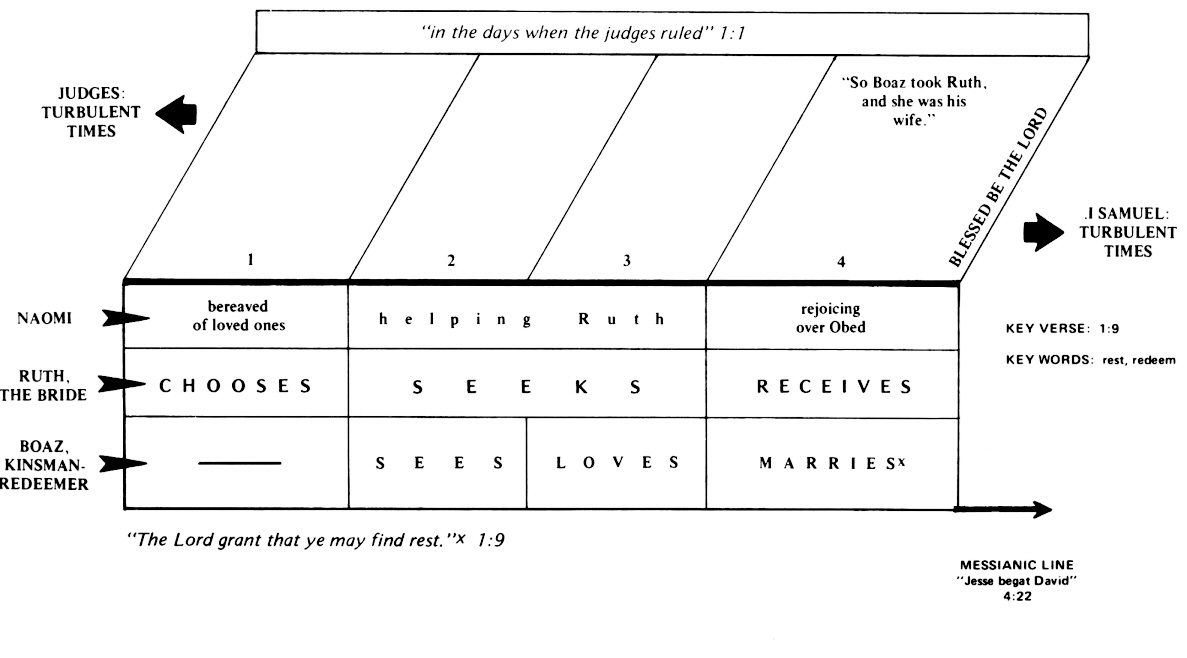
Irving Jensen's Survey of Bible (see his summary of Ruth online - page 392)
See Swindoll's summary chart of Ruth See Ruth Devotionals
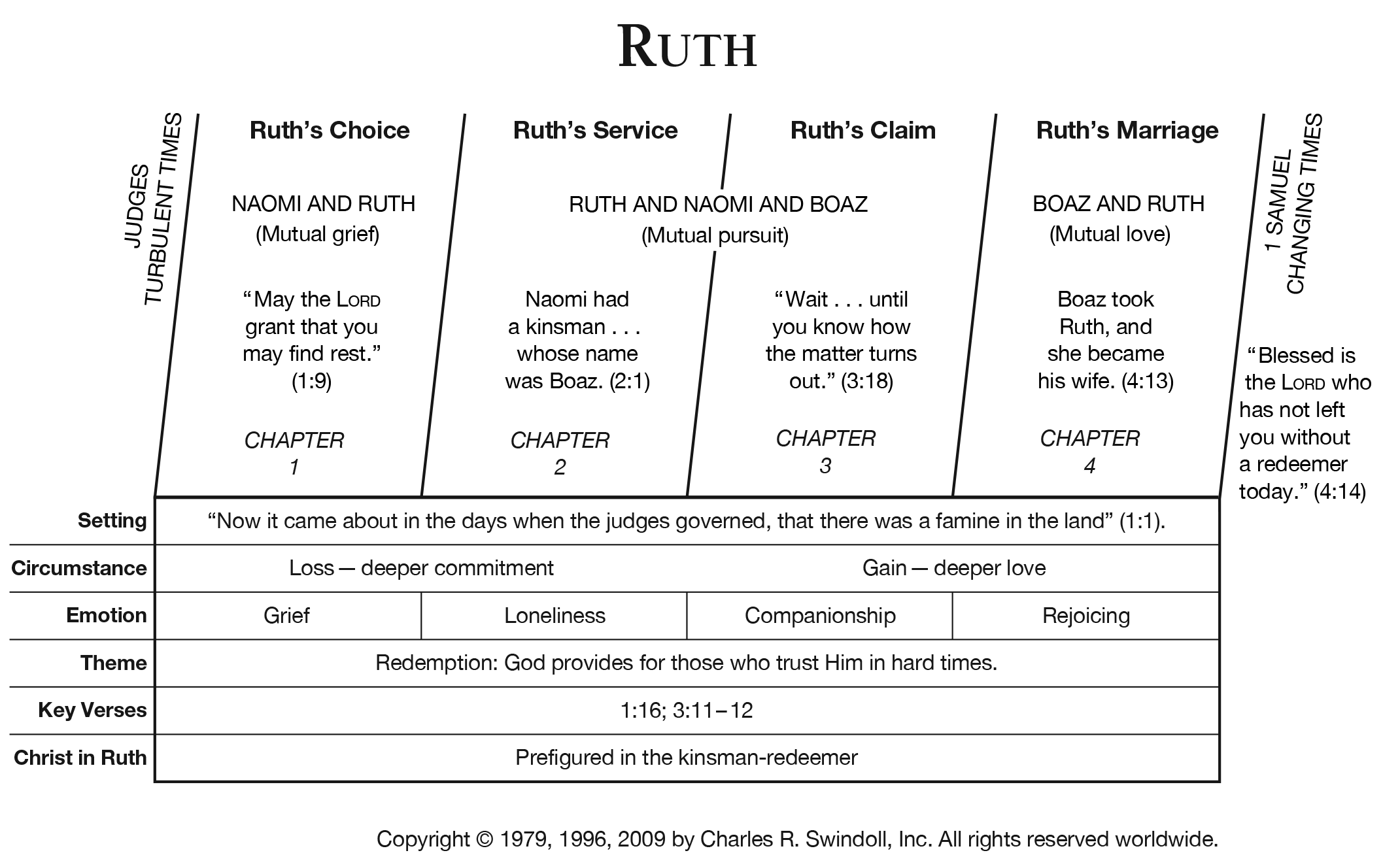
|
RUTH: GOD PROVIDES |
|||
| Ruth 1 | Ruth 2 | Ruth 3 | Ruth 4 |
| Ruth's Choice | Ruth's Service | Ruth's Claim | Ruth's Marriage |
| Ruth's Resolve | Ruth's Rights | Ruth's Request | Ruth's Reward |
| Naomi and Ruth Mutual Grief |
Ruth and Naomi and Boaz Mutual Pursuit |
Boaz and Ruth Mutual Love |
|
| Ruth's Decision: Return with Naomi |
Ruth's Devotion: Provide for Naomi |
Ruth's Request: Redemption by Boaz |
Ruth's Reward: Relative of Messiah |
| Ruth and Naomi |
Ruth and Boaz |
||
| Death of Naomi's Family |
Ruth Cares for Naomi |
Boaz Cares for Ruth |
God Blesses with New Birth |
| Grief | Loneliness | Companionship | Rejoicing |
| Location: Plains of Moab |
Location: Fields of Bethlehem |
Location: Threshing floor of Bethlehem |
Location: Little town of Bethlehem |
| Time Lapsed: About 30 Years See Timeline |
|||
| Setting: Ru 1:1 Now it came about in the days when the judges governed Jdg 21:25+ In those days there was no king in Israel; everyone did what was right in his own eyes. |
|||

|
The Book of Judges |
|
|
RUTH |
JUDGES |
|
Spiritual |
Spiritual |
|
Purity |
Immorality |
|
Deciding for |
Pursuing Idols |
|
Devotion |
Disloyalty |
|
Love |
Lust |
|
Peace |
War |
|
Kindness |
Cruelty |
|
Obedience |
Disobedience |
|
Oasis |
Desert |
|
Faithfulness |
Faithlessness |
Ruth 1:6: Then she arose with her daughters-in-law that she might return from the land of Moab, for she had heard in the land of Moab that the LORD had visited His people in giving them food. (NASB: Lockman)
BGT (LXX)καὶ ἀνέστη αὐτὴ καὶ αἱ δύο νύμφαι αὐτῆς καὶ ἀπέστρεψαν ἐξ ἀγροῦ Μωαβ ὅτι ἤκουσαν ἐν ἀγρῷ Μωαβ ὅτι ἐπέσκεπται κύριος τὸν λαὸν αὐτοῦ δοῦναι αὐτοῖς ἄρτους
Septuagint (LXX): kai aneste (3SAAI) aute kai ai duo numphai autes kai apestrepsan (3PAAI) ec agrou Moab hoti ekousan (3PAAI) en agro Moab hoti epeskeptai (3SRMI) kurios ton laon autou dounai (AAN) autois artous (Click here for explanation of abbreviations in parentheses after each verb)
English of Septuagint: And she rose up and her two daughters-in-law, and they returned out of the country of Moab, for she heard in the country of Moab that the Lord had visited his people to give them bread.
KJV Then she arose with her daughters in law, that she might return from the country of Moab: for she had heard in the country of Moab how that the LORD had visited his people in giving them bread.
NET So she decided to return home from the region of Moab, accompanied by her daughters-in-law, because while she was living in Moab she had heard that the LORD had shown concern for his people, reversing the famine by providing abundant crops.
BBE So she and her daughters-in-law got ready to go back from the country of Moab, for news had come to her in the country of Moab that the Lord, in mercy for his people, had given them food.
CSB She and her daughters-in-law prepared to leave the land of Moab, because she had heard in Moab that the LORD had paid attention to His people's need by providing them food.
ERV Then she arose with her daughters in law, that she might return from the country of Moab: for she had heard in the country of Moab how that the LORD had visited his people in giving them bread.
ESV Then she arose with her daughters-in-law to return from the country of Moab, for she had heard in the fields of Moab that the LORD had visited his people and given them food.
GWN Naomi and her daughters-in-law started on the way back from the country of Moab. (While they were still in Moab she heard that the LORD had come to help his people and give them food.
NKJ Then she arose with her daughters-in-law that she might return from the country of Moab, for she had heard in the country of Moab that the LORD had visited His people by giving them bread.
NAB She then made ready to go back from the plateau of Moab because word reached her there that the LORD had visited his people and given them food.
NIV When she heard in Moab that the LORD had come to the aid of his people by providing food for them, Naomi and her daughters-in-law prepared to return home from there.
NJB She then decided to come back from the Plains of Moab with her daughters-in-law, having heard in the Plains of Moab that God had visited his people and given them food.
NLT Then Naomi heard in Moab that the LORD had blessed his people in Judah by giving them good crops again. So Naomi and her daughters-in-law got ready to leave Moab to return to her homeland.
NRS Then she started to return with her daughters-in-law from the country of Moab, for she had heard in the country of Moab that the LORD had considered his people and given them food.
- the LORD had visited His people: Ge 21:1 50:25 Ex 3:16 4:31 1Sa 2:21 Lu 1:68 19:44 1Pe 2:12+
- in giving them food:Ge 28:20; 48:15; Ex 16:4-6; Ps 104:14;15+ Ps 111:5+; Ps 132:15+; Ps 145:15+; Ps 146:7+; Ps 147:14+; Pr 30:8; Isa 55:10; Mt 6:11+; 1Ti 6:8
- Ruth 1 Resources - Multiple Sermons and Commentaries
GOD GIVES BREAD TO
THE HOUSE OF BREAD
Then - This is a critical time phrase. In the preceding scene we see that 3 widows find themselves in the place of having no future and no hope. But God is in charge of both our future and our hope and He moves actively into the story. The light of Jehovah begins to shine through the clouds of Naomi's spiritually dark world and she responds to His light. God's grace (in the tangible form of good news) shines in the midst of Naomi's grief and emotional pain. Naomi would have testified to the truth of Solomon's proverb "Like cold water to a weary soul, so is good news from a distant land." (Pr 25:25)
Naomi’s heart has remained in Judah,
and she has not allowed herself to forget her God.
-- David Atkinson
She arose (qum) - Jehovah had "seen the affliction of" (cf Ex 3:7-8+) Naomi and so moves heaven and earth (rain, sun, fruitful grain harvest) to inspire Naomi to move on. But as is almost always the case note the interaction between God's sovereignty (provision of "bread") and man's responsibility (she arose). Notice the repetition of she (she arose...she might return...she had heard) which places heavy emphasis on Naomi as the key player in this move to Bethlehem.
THOUGHT- There is a time when we must choose to RISE UP and lay hold of what we have been laid hold of by Christ for. We must forget "what lies behind and (reach) forward to what lies ahead… (pressing) on toward the goal for the prize of the upward call of God in Christ Jesus." (Php 3:12-14+). Naomi's decision to return to Bethlehem would determine the destiny of Ruth and of many who would come after her. Let us thank God that Naomi arose from her grieving and moved toward God, although had she chosen not to do so, God's purpose of raising up a Redeemer would not have been thwarted (Job 42:2) (Study the "Attributes of God")
There is something very significant in the fact that Naomi arose. What does this indicate? The clear implication is that she remembered Jehovah in the days of the Judges when many in Israel either "forgot the LORD their God and served the Baals and the Asheroth" (Jdg 3:7) and "did not remember the LORD their God, Who had delivered them from the hands of all their enemies on every side." (Jdg 8:34) Scripture repeatedly places emphasis on remembering God (particularly just before they went into the Promised Land - where they would in fact soon forget Him!) See Ex. 13:3; Dt. 5:15; Dt 8:2, 18; Dt 7:18; Dt 9:7; Dt 15:15; Dt 16:12; Dt 24:18, 22. So what is the point? Naomi remembered Jehovah! Run Naomi run to Jehovah your Covenant Keeping God and learn by your experience the truth that Jehovah withholds "no good thing… from those who walk uprightly"… "for the LORD God is a sun and shield. Jehovah gives grace and glory." (Ps 84:11+) and His "grace is sufficient for you (Naomi and for you dear reader), for (His) dunamis is perfected in (our) weakness"… "when (we are) weak, then (we are) strong." (2Cor 12:9, 10+)
This same phrase (as she arose) was used to describe David's arising and moving on after his first son's death "But when David saw that his servants were whispering together, David perceived that the child was dead; so David said to his servants, "Is the child dead?" And they said, "He is dead. So David arose (qum) from the ground, washed, anointed himself, and changed his clothes; and he came into the house of the LORD and worshiped. Then he came to his own house, and when he requested, they set food before him and he ate." (2Sa 12:19, 20).
In the hard times, faith will sometimes mean
leaving unanswered difficulties in the hands of God.
Such faith will be strengthened by keeping in the front of our minds
the ways God has helped us in the past.
-- David Atkinson
David Atkinson - But Naomi remembered. Lines of communication have been kept open with the people at home. From Ruth’s later testimony we see she has been a clear witness to Yahweh in Moab. She has kept alive in her consciousness the reality of the Lord’s help to her people in the past. She waited for news of his help in the present. Like the psalmist, when consumed with grief and depression (Ps 77:1-10), no doubt Naomi would console herself by ‘calling to mind the deeds of the Lord’ (cf Ps 77:11). Like Jonah in his unenviable aquatic state, Naomi’s mind was not far from prayer (‘When my soul fainted within me, I remembered the Lord; and my prayer came to thee’ Jonah 2:7). In the hard times, faith will sometimes mean leaving unanswered difficulties in the hands of God. Such faith will be strengthened by keeping in the front of our minds the ways God has helped us in the past. Peter urges his Christian readers to keep in mind the gracious promises and gifts of God (2Pe 1:4+), and arouses them by way of reminder. And supremely are we bidden to recall, to rest upon and to be nourished by the saving grace of God in Christ every time we eat the bread or drink the cup of the Lord ‘in remembrance’ of him. Faith is a journey of trust and growth; it is a moving mobile, not a still life. And when some parts swing for a time in the shadow, we trust that they will again emerge into the light as they have many times before. Part of the spirituality of the men and women of faith of Naomi’s day was to meditate on the great acts of God in the past, and we can learn from them how to keep faith alive in the dark times. So Naomi’s heart has remained in Judah, and she has not allowed herself to forget her God. Indeed her ears are alert to the news which reaches her in Moab that Yahweh has not abandoned his people: the famine is over, the Lord has visited his people and given them food. (See context in The Message of Ruth: The Wings of Refuge)
THOUGHT - We must make a decision of our will to "strengthen (aorist imperative - an command to be carried out even with a sense of urgency but possible only as we depend on the Holy Spirit to obey) the hands (the author has just given a lengthy discourse on divine discipline which is not joyful at the moment we are experiencing it) that are weak and the knees that are feeble, and make straight paths for (our) feet" (Heb 12:12-13+).
THOUGHT - How important it is for us to look expectantly for the hand of the LORD in every event in our life (FROM EXPERIENCE THIS IS EASIER FOR ME TO WRITE ABOUT THAN TO PUT INTO PRACTICE!) He is in the process of training up His children to full maturity, that we "may share His holiness" (Heb 12:10, 11+) and be "conformed to the image of His Son" (Ro 8:29+), the Author and Perfecter (Finisher) of the race of life (He 12:2+). So keep your eyes fixed on Jesus as you "walk through the valley of the shadow of death" (Ps 23:4+), even as your dreams seem to die and all earthly hope seems lost. Recall to your mind God's promise of His faithfulness EVERY morning (Lam 3:21-24) even when the clouds seem to hide His face! That's when faith walks out and takes God at His Word (Heb 11:6+) and is enabled to see "Him Who is unseen" (Heb 11:27+). "God is in the heavens. He does whatever He pleases" (Ps 115:3+) exercising His sovereignty, orchestrating events behind the scenes and all the while allowing each individual free will to make the decisions that determine destiny.
Matthew Henry calls our attention to "The good affection Naomi bore to the land of Israel" specifically noting that "Though she could not stay in it while the famine lasted, she would not stay out of it when the famine ceased. Though the country of Moab had afforded her shelter and supply in a time of need, yet she did not intend it should be her rest for ever" for as Henry rightly observes "no land should be that but the holy land, in which the sanctuary of God was, of which He had said, "This is My resting place for ever and ever" (Ps 132:14+ NIV) Naomi began to think of returning, after the death of her two sons. When death comes into a family, it ought to reform what is amiss there. Earth is made bitter to us, that heaven may be made dear."
NAOMI REVERSES
DIRECTION & DESTINY!
With her daughters-in-law that she might return (shub/shuv) from the land of Moab - The word for "her daughters-in-law" is literally "her brides" or the brides of her sons. Land of Moab is more accurately the "fields of Moab". It's interesting that in the fields of Moab where the grain was grown that Naomi learned there was food in the fields of Israel. The key word is return, the Hebrew verb shub/shuv, a word which conveys the basic meaning of movement, spatially or spiritually and can be translated turn back, restore or repent. In short, shub refers to a reversal or change of direction, an “about face," a movement back to the point of departure. Is this a picture of repentance in the heart of Naomi? I think it is at least a suggestion that there is repentance. And Repenters always find that God always puts out the "welcome mat".
John Martin observes that "Return (shub/shuv) is a key word in Ruth. Hebrew forms of this word are used several times in this first chapter. Here is an apt illustration of repentance. Naomi reversed the direction she and her husband had taken. She turned away from Moab and the errors of the past. She turned her back on the tragic graves of her loved ones and headed back to Judah, her homeland." (See context in The Bible Knowledge Commentary).
J Vernon McGee - The famine was over back in the Promised Land, and there was bread again in Bethlehem, the house of bread and praise. And so now she wants to return home. It's interesting. The prodigal family and the prodigal son will long for the father's house. And if they don't long for the father's house, they just don't happen to be the children of the father. The prodigal son will never be happy in the pigpen. (ED: AND NAOMI WOULD NEVER BE HAPPY IN MOAB, THE WASHBOWL!) (See context in Thru the Bible)
The Scripture is replete with picturesque idioms emphasizing man's responsibility in repentance -
"incline your heart unto the Lord your God" (Josh 24:23)
"circumcise yourselves to the LORD & remove the foreskins of your heart" (Jer 4:4)
"wash your heart from evil O Jerusalem, that you may be saved. How long will your wicked thoughts Lodge within you?" (Jer 4:14)
"break up your fallow ground (usually cultivated land that is allowed to lie idle during the growing season), for it is time to seek the LORD until He comes to rain righteousness on you" (Hos 10:12).
Observe the central role of our heart. All these expressions of man's activity are pictured in the Hebrew verb shub which combines the two requisites of repentance -- turn from evil and turn to God and to good. However lest we forget that even repentance is a gift of His grace, we need to be mindful not to "think lightly of the riches of His kindness and forbearance and patience" for it is "the kindness of God leads (us) to repentance" (Ro 2:4+)
Naomi answers to the question is it possible for someone who has dwelt in a "distant land" for many years to come home again? (See ILLUSTRATION below) The answer is always "yes". Speaking to rebellious Israel God declared that "though your sins are as scarlet, they will be as white as snow. Though they are red like crimson, they will be like wool." (Isaiah 1:18).
THOUGHT - Have you wandered away from God even going to Moab, God's "Washbowl"? And who of us can honestly say "Not me, no never"! Do you think you have been away too long? Maybe you've been gone for 10 years (or longer) like Naomi. Do you fear God's response if you were to repent and return? Take heart for Jesus is "the same yesterday and today, yes and forever" (Heb 13:8+) and says that "the one who comes to Me I will certainly not cast out." (John 6:37)
To where was Naomi returning? To Israel. To Bethlehem. To her God. To her people. Have circumstances occurred in your life that have caused you to meander off the path and into "Moab"? Will you "remember (present imperative see our need to depend on the Holy Spirit to obey) therefore from where you have fallen, and repent (aorist imperative see our need to depend on the Holy Spirit to obey) and do (aorist imperative see our need to depend on the Holy Spirit to obey) the deeds you did at first"? (Rev 2:5+) Encouraged by what transpired in the next 3 chapters in Naomi's life, you can be "confident… that "He who began a good work in you will perfect it until the day of Christ Jesus." (Php 1:6+) In truth every person ever born was at one time in the "land of Moab", helplessly mired in sin, engaged in idolatrous practices and at continual enmity with the Almighty (Ro 5:6+, Ro 5:8+, Ro 5:10+). O, praise God for sending us a Kinsman-Redeemer!
In a similar way as God was leading Naomi back, He had affirmed to Jacob "behold, I am with you and will keep you wherever you go, and will bring you back (shub/shuv) to this land for I will not leave you until I have done what I have promised you." (Genesis 28:15) In both Naomi's and Jacob's "returns" God was working out His sovereign purpose of redemption.
ILLUSTRATION - NAOMI AND HOMING PIGEONS - A book recently tackled one of life's minor puzzles--how do homing pigeons find their way home? The answer seems to be: we're not sure. One theory is that young pigeons develop an "odor map" by smelling odors that are carried to their homes on the winds from various directions. Another theory is that the birds use the earth's magnetic field to determine course and position. Whatever technique homing pigeons use, their instincts are uncanny. They always finish their journeys in the right place… The Bible is filled with stories of people who did and of those who did not finish well. They have much to teach us… The story of Ruth gets us off to a great start. This young woman from Moab definitely finished well. She became the great-grandmother of David. Ruth's name is on a short list of women singled out for special mention in the genealogy of Jesus. She was part of the Savior's royal bloodline and is therefore a background figure in the Christmas story. (Today in the Word)
For - This word is often a term of explanation, which should prompt a pause to ponder what is the writer explaining. This will usually force you to re-read the preceding text (never a bad thing) to establish the context. In a sense you are carrying out a "mini-meditation" on the Scriptural text (always a good thing! - Ps 1:2-3+, Joshua 1:8+).
She had heard in the land of Moab that the LORD had visited (paqad; Lxx - episkeptomai) His people - HCSB = "that the LORD had paid attention to His people's need by providing them food." NIV = "the LORD had come to the aid of his people by providing food for them." How did Naomi hear? The text does not say but "good news" spread some 80 miles south and east from Bethlehem to Moab. The Chaldee Targum (targum means 'interpretation, translation, version') says that the news of this visitation was conveyed by an angel. Clearly that is a highly speculative "interpretation", but it makes the point that if we seek to rightly divide the Word of truth (2Ti 2:15), we must be diligent to let the text (let God) say what He says without adding to or taking away from the text (cf Pr 30:6). In the ancient world news was carried to a largely by caravan traders, mariners, and other travelers but exactly how Naomi knew the text does not say. The point is that when God wants us to know something, He will find a way to convey His message, even if he has to make a dumb donkey speak! (cf 2Pe 2:16+)
David Atkinson on the LORD - The LORD, as we have said, renders the name of God, Yahweh. He is the God whose personal name indicates his character: the God who is the actively existing one, the God who comes to meet his people in need, the God who sets his people free by the action of a redeemer (goel). It is by the character of this Lord, revealed to her people generations before, that Naomi now measures the bitterness of her bereavement and her isolation (Ru 1:13, 21). It is this Lord who, we are told later, is worshiped by Boaz and his harvesters, and whose blessing is invoked on Ruth (Ru 2:4, 12). It is this Lord who is blessed by Naomi for Boaz’ gracious generosity, who is seen as the giver of life, and under whose providential care Naomi ultimately finds joy (2:20; 4:13-14). The book of Ruth is rich in its revelation of the sort of God Yahweh is. Our author is anxious that the character of this Lord will dominate his narrative. It is as if he wants his readers to place the detailed events of his story’s pains and joys within the context of the God whose character is described by ‘Yahweh’. (See context in The Message of Ruth: The Wings of Refuge)
Atkinson has a good word on the LORD visited His people - What significance there is in the phrase the Lord has visited! The report Naomi had received is not expressed in terms such as ‘the weather has broken’, or ‘there has been an upturn in the economy’, or ‘the threat of invasion has gone’. All of these could have been part of the chain of causes in the recovery of Bethlehem from the famine. But no, the report comes to Naomi in terms of the Lord’s action. Here is a central theme in the Bible: all of life is traced directly to the hand of God. To concentrate primarily on second causes may encourage us to seek to be manipulators of the system. It is concentration on the Great Cause which teaches us to live by faith. When the Lord ‘visits’ his people, he does so in either judgment or blessing. The food now available in Bethlehem is understood by Naomi as God’s gift. The sense of this is caught by the psalmist: ‘I will abundantly bless her provisions; I will satisfy her poor with bread’; it is caught also by the priest Zechariah centuries later, as he delighted in the birth of Messiah’s messenger: ‘Blessed be the Lord God of Israel, for he has visited and redeemed his people.’ With Naomi’s confidence in that God, she can handle, as we shall see, the feelings of anger towards him which her circumstances provoke. She now sets off with Ruth and Orpah to journey home. (See context in The Message of Ruth: The Wings of Refuge)
John MacArthur - The sovereignty of Jehovah on behalf of Israel permeates the pages of Ruth in several ways: 1) actually for good (Ru 2:12; 4:12-14), 2) perceived by Naomi for bad (Ru 1:13, 21), and 3) in the context of prayer/blessing (Ru 1:8, 9, 17; 2:4, 12, 20; 3:10, 13; 4:11). The return of physical prosperity only shadowed the reality of a coming spiritual prosperity through the line of David in the person of Christ. (See context in The MacArthur Bible Commentary)
This is the first mention of God's covenant Name, Jehovah (I Am) in a way that clearly acknowledges He is sovereign and in control of the affairs of both individuals and nations. (Ru 1:13+, Ru 1:21+, Ru 2:20+, Ru 4:12 15+). What is so beautiful about Ruth’s story is that it never loses sight of Jehovah, Whose covenant love assures the culmination of this short story and of all history exactly as He has purposed. As you take time to linger and meditate on this narrative jewel, you will find the presence of the "Author and Perfecter" radiating forth from every verse and your faith will be encouraged to hold fast to the One Who is "I Am".
THOUGHT- God is not a "genie" but He is the great I Am (Ex 3:14+). He is anything and everything we will ever need no matter how dark our circumstances or how hopeless our outlook. The key is to glance at your circumstances but gaze at your God, and your "uplook" will change the perspective of your "outlook"! The heavenly uplook can make all the difference in the world on your worldly outlook! Naomi may have felt like God had dealt bitterly but she still sought His face even in the midst of her dark despair! What a challenging lesson for us all. Even when we are feeling hopeless, we need to fix our eyes on Jesus, not on our circumstances. Then we need to behave according to what He leads us to do. In this case He was leading Naomi to return to home and ultimately to her Kinsman-Redeemer. She may have been emotionally downtrodden but she retained her hope in God. Paul experiencing suffering chose a similar attitude declaring "I know Whom I have believed and I am convinced that He is able to keep that which I have entrusted to Him until that day". (2Ti 1:12+) God's people need to learn from the "perseverance and encouragement of the Scriptures we might have hope!" (Ro 15:4+)
Look around & be distressed.
Look inside & be depressed.
Look at Jesus & be at rest.
---Corrie Ten Boom
When Naomi was finding life bleak, Ruth chose to stand by her mother-in-law rather than leave her to face the journey into the future all alone. Ruth's steadfast commitment to Naomi was God's provision to enable her to endure. Naomi was discovering the glorious truth that
"No temptation (test) has overtaken you but such as is common to man and God is faithful, Who will not allow you to be tempted (tested) beyond what you are able, but with the temptation (test) will provide the way of escape also, that you may be able to endure it (not that you may be able to "escape it"!)." (1Cor 10:13+)
God's provision of bread in Israel and Ruth in Moab provided the way of escape for Naomi. And He will do the same for you in your hour of testing. Beloved, trust in Jehovah with all your heart and don't lean on your own ways in your hour of testing.
NET NOTE - Heb “had visited” or “taken note of.” The basic meaning of פָּקַד (paqad) is “observe, examine, take note of” (T. F. Williams, NIDOTTE 3:658), so it sometimes appears with זָכַר (zakhar, “to remember”; Pss 8:4 [MT 5]; 106:4; Jer 14:10; 15:15; Hos 8:13; 9:9) and רָאָה (ra’ah, “to see”; Exod 4:31; Ps 80:14 [MT 15]; NIDOTTE 3:659). It often emphasizes the cause/effect response to what is seen (NIDOTTE 3:659). When God observes people in need, it is glossed “be concerned about, care for, attend to, help” (Gen 21:1; 50:24, 25; Ex 4:31; Ru 1:6; 1Sa 2:21; Jer 15:15; Zeph 2:7; Zech 10:3b; NIDOTTE 3:661). When humans are the subject, it sometimes means “to visit” needy people to bestow a gift (Jdg 15:1+; 1Sa 17:18). Because it has such a broad range of meanings, its use here has been translated variously: (1) “had visited” (KJV, ASV, NASV, RSV; so BDB 823–24 s.v. פָּקַד); (2) “had considered” (NRSV) and “had taken note of” (TNK; so HALOT 955–57 s.v. פקד); and (3) “had come to the aid of” (NIV), “had blessed” (TEV), and “had given” (CEV; so NIDOTTE 3:657). When God observed the plight of his people, he demonstrated his concern by benevolently giving them food.
About the same time that "Jehovah visited His people" in Bethlehem, another barren downcast Hebrew woman had a "visit" from Jehovah: "Jehovah visited (paqad) Hannah and she conceived and gave birth to three sons and two daughters. And the boy Samuel grew before the LORD." (1Sa 2:21)
The Greek verb used by the Septuagint (LXX) to translate paqad is episkeptomai (epi = upon + sképtomai = looking at or paying attention to) which has the idea of going to see with the goal of relieving distress, sickness or bondage. The verb often described the visiting of the sick and in the NT almost exclusively refers to a visitation for good. The idea is to look upon one in distress with mercy, favor or regard.
James uses episkeptomai to "define" real religion writing that "This is pure and undefiled religion in the sight of our God and Father, to visit (episkeptomai) orphans and widows in their distress, and to keep oneself unstained by the world. (James 1:27+)
For example, in Luke we find "Zacharias… filled with the Holy Spirit (prophesying)… "Blessed be the Lord God of Israel, for He has visited (episkeptomai) us and accomplished redemption (lutrosis - word study) (how? by sending a Kinsman-Redeemer!) for His people, and has raised up a horn of salvation (Messiah) for us in the house of David (a descendent from the line of Boaz and Ruth) His servant… 78 Because of the tender mercy of our God, With which the Sunrise from on high shall visit (episkeptomai) us, (Luke 1:67-69, 78+)
What a fascinating parallel between Luke and Ruth, where God's visitation draws Naomi back to Bethlehem where Jehovah would accomplish redemption for Ruth and place her in the line of the Messiah, the Redeemer of Israel and all mankind. Naomi had eyes to recognize and a heart to respond to the "Lord's visitation" and was rewarded.
Centuries later Israel is recompensed (negatively) for failure to recognize His visitation, Luke recording Jesus' "Triumphal Entry" into Jerusalem…
"And when He approached, He saw the city and wept over it, saying "If you had known in this day, (the specific day = see comment below) even you, the things which make for peace! (See comment below - when a king entered a city on a donkey it was for peace! A white horse signified war = see Messiah's return Rev 19:11f-note) But now they have been hidden from your eyes. "For the days shall come upon you when your enemies will throw up a bank before you, and surround you, and hem you in on every side, and will level you (Jerusalem) to the ground and your children within you, and they will not leave in you one stone upon another (this prophecy fulfilled in 70AD with Roman destruction of Jerusalem and the Temple), because you did not recognize the time of your visitation." (Luke 19:41, 42, 43, 44)
Comment: Daniel 9:25, 26-note clearly predicted the visitation of the Messiah to Jerusalem, and there is good support for the fact that Daniel's prophecy specified the exact day the Messiah entered Jerusalem on "Psalm Sunday" mounted on a donkey being welcomed by the cry from the multitudes of "Blessed is the King Who comes in the name of the Lord", quoting Ps 118:6-note. In 1894 Sir Robert Anderson in his monumental work, The Coming Prince - click book, [independently confirmed by the study of Dallas Theological Seminary professor Dr Harold Hoehner in 1976] calculated from Da 9:25, 26-note that following the decree to rebuild Jerusalem in 445BC in Neh 2:1, 2, 3, 4, 5, 6, 7, 8 until Messiah, the Prince was 177,880 days which coincided with the very day Jesus entered Jerusalem -- Palm Sunday -- riding on a donkey fulfilling Zechariah's prophecy "Rejoice greatly, O daughter of Zion! Shout in triumph, O daughter of Jerusalem! Behold, your King is coming to you. He is just and endowed with salvation, humble, and mounted on a donkey, even on a colt, the foal of a donkey." -- Zech 9:9
Finally Peter reminds us that the certainty of the Lord's "visitation" should motivate godly behavior, exhorting saints to "Keep your behavior excellent among the Gentiles, so that in the thing in which they slander you as evildoers, they may on account of your good deeds, as they observe them, glorify God in the day of visitation (the related noun episkope, used for public office of an overseer and gives us our English "Episcopal" ) (1Pe 2:12+)
In the Septuagint (LXX) episkeptomai is found some 127 times and is used almost exclusively to describe a visitation for good or looking toward someone with a view to benefiting him. The psalmist for example prays
Remember me, O LORD, in Thy favor toward Thy people;
Visit (episkeptomai in the aorist imperative) me with Thy salvation, (Ps 106:4-note)
"RESTOCKING
THE SHELVES"
In giving them food (or bread - lehem) - The "store shelves" in the "House of Bread" were being restocked with bread by God Himself (Jas 1:17+)! This is how Jehovah came to the aid of His people, which reminds us His daily provision of manna during Israel's ~40 years wilderness journey (lehem in Ex 16:12ff+) satisfying "them with the bread (lehem) of heaven." (Ps 105:40). We once again see God's sovereignty for "He causes the grass to grow for the cattle, and vegetation for the labor of man, so that he may bring forth food from the earth… food which sustains man's heart." (Ps 104:14;15+) As the psalmist records "The eyes of all look to Thee, and Thou dost give them their food in due time." (Ps 145:15+) God's provision of food was His way of providentially moving the events of the story to the next exciting scene in the fields of Bethlehem.
NET NOTE - Heb “by giving to them food.” The translation “reversing the famine and providing abundant crops” attempts to clarify the referent of לֶחֶם (lekhem, “food”) as “crops” and highlights the reversal of the famine that began in Ru 1:1. The infinitive construct לָתֵת לָהֶם לָחֶם (latet lahem lakhem) may denote (1) purpose: “[he visited his people] to give them food” or (2) complementary sense explaining the action of the main verb: “[he visited his people] by giving them food.” The term לֶחֶם (lakhem) here refers to agricultural fertility, the reversal of the famine in Ru 1:1.
The return of physical prosperity foreshadowed the reality of a coming spiritual prosperity through the line of David in the person of Christ.
The sovereignty of God permeates the pages of Ruth:
3) in the context of prayer/blessing (Ru 1:8-9+, Ru 1:17+, Ru 2:4+, Ru 2:12+, Ru 2:20+, Ru 3:10+, Ru 3:13+, Ru 4:11+)
Matthew Henry observes that "God, at last, returned in mercy to His people; for, though He contend long, He will not contend always. As the judgment of oppression, under which they often groaned in the time of the judges, still came to an end, after a while, when God had raised them up a deliverer, so here the judgment of famine: At length God graciously visited his people in giving them bread. Plenty is God's gift, and it is His visitation which by bread, the staff of life, holds our souls in life. Though this mercy be the more striking when it comes after famine, yet if we have constantly enjoyed it, and never knew what famine meant, we are not to think it the less valuable.
J Vernon McGee draws an interesting parallel with the story of the prodigal son commenting that now Naomi "wants to return home. It’s interesting. The prodigal family and the prodigal son will long for the father’s house. And if they don’t long for the father’s house, they just don’t happen to be the children of the father. The prodigal son will never be happy in the pigpen. He just wasn’t made for a pigpen. He hasn’t the nature of a pig… So eventually this family must go home. Finally Naomi says she’s going back to Bethlehem-Judah." (See context in Thru the Bible Ruth)
THOUGHTS - Some practical thoughts regarding these events: Naomi would have died in Moab had God not intervened. If God choose not to arrest and arouse us, we all would perish in "Moab". However, Jehovah speaks sending "awakening providences", sometimes as affliction and loss and sometimes in the form of His unmerited goodness. In both situations it is the kindness of God which leads us to repentance (Ro 2:4+). Dear reader, are you still in "Moab" having never lived in "Bethlehem", having never responded to His call to repent and in danger of dying in "Moab" and entering into the "eternal fire" (Mt 25:41, cf 2Th 1:6-10+)? Dearly beloved saint, have you wandered off the "highway of holiness" (Isa 35:8) to "Moab" where you are practicing idolatry that you know God despises and which He must discipline? Is God speaking to you through your circumstances? Good news from the LORD’s land comes to the awakened wanderer. Are you listening? Will you repent and walk in the light dear one? (1Jn 1:7-9+)
God so loved those in "Moab" that He gave "He gave His only begotten Son (as our Kinsman-Redeemer), that whoever believes in Him should not perish, but have eternal life." (Jn 3:16+) Let His lovingkindness which is new every morning awaken in your heart an attitude of gratitude and contrition.
S H Tyng adds "Many think they must first feel much, and mourn much, and suffer much, before they can hope to go back in peace to God. But why? Will your suffering save you? Will your multiplied tears add anything to a Saviour’s worth? Is your dwelling on fire? And must you wait until you are scorched with the flames before you can escape in safety? Have you mistaken your road in journeying? And can you recover your lost steps the better by delay or hesitation or fruitless grief? Nay. You want all the time for actual pursuit. You have none to waste. Turn! Turn! fly! Fly! ‘Tis madness to defer. Naomi goes to no other part of Moab, to no other land of idolatry. She goes directly back to the land of Judah. This is a blessed example. How many go from one broken cistern to another!" But all these efforts are vain. Edom or Babylon are no better than Moab. No. You must fly to Bethlehem at once. Now is the accepted time. This is the day of your salvation." (Ruth 1:6 The Awakening)
Visited (06485) (paqad) means primarily to pay attention to or to observe with care or interest. Paqad can mean to visit for good or for evil, the latter often in "visiting the iniquity" (Ex 20:5; 34:7; Nu 14:18; Dt 5:9-10.) In the positive sense paqad means to intervene on behalf of, to come to the aid of. The visit was for good in Ruth 1:6 is paraphrased by the NIV as "the LORD (Jehovah) had come to the aid of His people"
Other divine vistations for good include - Moses record of God's faithfulness in keeping His promise to produce an heir for Abraham - "Then (always ask - when is "then"?) the LORD took note (paqad; Lxx - episkeptomai) of Sarah as He had said (when God gives a promise beloved, He keeps it!), and the LORD did for Sarah as He had promised (note repetition for emphasis = "He had said" ~ "He had promised")." (Genesis 21:1) Again in Genesis as Joseph is about to fall asleep, to the very end firmly trusting in God to carry out His promise (to bring them back to Canaan - a promise God fulfilled 4 centuries later in the exodus) and thus declaring to his brothers "I am about to die, but God will surely take care (paqad - NIV = "surely come to your aid"; Lxx - episkeptomai) of you, and bring you up from this land to the land which He promised on oath to Abraham, to Isaac and to Jacob. Then Joseph made the sons of Israel swear, saying, "God will surely take care take care (paqad) of you, and you shall carry my bones up from here." (Ge 50:24, 25) David cried out "Remember me, O LORD, in Thy favor toward Thy people. Visit (paqad) me with Thy salvation (THIS IS THE VISITATION EVERY SINNER MUST HAVE!)." (Ps 106:4+)
In sum, paqad conveys the idea that Jehovah directs His attention to His people, inquires into their state and is thus informed and able to take steps to meet their need. God was not deaf or blind to Naomi's suffering, even as He had not been deaf to the groaning of Israel oppressed under the cruel hand of Pharaoh, for as Moses writes "Jehovah was concerned (paqad; Lxx - episkeptomai) about the sons of Israel and… He had seen their affliction" (Exodus 4:31+)
Food (03889)(lehem from lacham = to use as food, to eat) means bread or food and in a general sense refers to anything God has approved for nourishment.
Ruth 1:7 So she departed from the place where she was, and her two daughters-in-law with her; and they went on the way to return to the land of Judah. (NASB: Lockman)
BGT καὶ ἐξῆλθεν ἐκ τοῦ τόπου οὗ ἦν ἐκεῖ καὶ αἱ δύο νύμφαι αὐτῆς μετ᾽ αὐτῆς καὶ ἐπορεύοντο ἐν τῇ ὁδῷ τοῦ ἐπιστρέψαι εἰς τὴν γῆν Ιουδα
Septuagint (LXX): kai exelthen (3SAAI) ek tou topou ou en ekei kai ai duo numphai autes met' autes kai eporeuonto (3PIMI) en te hodo tou epistrepsai (AAN) eis ten gen Iouda
English of Septuagint: And she went forth out of the place where she was, and her two daughters-in-law with her: and they went by (imperfect tense = were going, proceeding by) the way to return to the land of Juda.
KJV Wherefore she went forth out of the place where she was, and her two daughters in law with her; and they went on the way to return unto the land of Judah.
NET Now as she and her two daughters-in-law began to leave the place where she had been living to return to the land of Judah,
BBE And she went out of the place where she was, and her two daughters-in-law with her; and they went on their way to go back to the land of Judah.
CSB She left the place where she had been living, accompanied by her two daughters-in-law, and traveled along the road leading back to the land of Judah.
ERV And she went forth out of the place where she was, and her two daughters in law with her; and they went on the way to return unto the land of Judah.
ESV So she set out from the place where she was with her two daughters-in-law, and they went on the way to return to the land of Judah.
GWN So she left the place where she had been living, and her two daughters-in-law went with her.) They began to walk back along the road to the territory of Judah.
NKJ Therefore she went out from the place where she was, and her two daughters-in-law with her; and they went on the way to return to the land of Judah.
NAB She and her two daughters-in-law left the place where they had been living. Then as they were on the road back to the land of Judah,
NIV With her two daughters-in-law she left the place where she had been living and set out on the road that would take them back to the land of Judah.
NJB So, with her daughters-in-law, she left the place where she was living and they took the road back to Judah.
NLT With her two daughters-in-law she set out from the place where she had been living, and they took the road that would lead them back to Judah.
NRS So she set out from the place where she had been living, she and her two daughters-in-law, and they went on their way to go back to the land of Judah.
YLT And she goeth out from the place where she hath been, and her two daughters-in-law with her, and they go in the way to turn back unto the land of Judah.
- So she departed - 2Ki 8:3
- Went on their way to return - Ru 1:10, 14+ Ex 18:27
- Ruth 1 Resources - Multiple Sermons and Commentaries
So is what is referred to in inductive Bible study as a term of conclusion. Here "so" would equate with "Therefore" or "for this reason". Whenever you see a term of conclusion stop and ask why is it "there for"? Why did she depart? Because she had "heard". May God give us all ears to hear His voice in our darkest distress so that we might journey back into the light and the joy of the Lord. How Naomi's response sets her apart from so many others! Many hear of the good things God is doing in the lives of others, and only wish they could have some of it - instead of actually setting out to receive it! Naomi could have stayed in Moab all of her life wishing things were different, but she did something to receive what God had to give her. It is also noteworthy that Naomi repeats a familiar pattern of behavior of the patriarchs, Abraham and Isaac, both of whom had left their homeland because of famine, and both of whom returned when food became available.
She departed from the place where she was, and her two daughters-in-law with her - What is "the place where she was"? It was a dreary "place" was it not? Multiplied losses - lost husband, lost sons, lost dreams, lost hopes of ever raising a family, etc. Naomi could have stayed at "the place where she was" but upon hearing about the work of Jehovah, she made a choice.
THOUGHT - Our losses may or may not be of the same magnitude and/or the same character as those of Naomi, but the principle remains the same. We each have a choice - we can choose to move back to "the land" of God's promises or we can stay in the "miry clay (Ps 40:2) of Moab". Beloved, if you find yourself in "Moab" today, run to His word, filled with magnificent and precious promises, and you will find that His arms are open and His promises are "yea and amen" in Christ Jesus. So run to Him dear suffering, afflicted saint. He will succour your soul. Depart "from the place where you are" and return into the arms of the Lover of your soul.
Mills adds that this "The scene painted before our eyes is of a pathetic trio, stricken with poverty and grief, facing the frightening desert mountain wastes of Moab alone, beckoned on only by trust in Yahweh, Israel’s God, and the hope that the proceeds from Elimelech’s property might alleviate their desperate circumstances." (Mills, M. - Ruth: A study guide to the book of Ruth, 1999)
From later events indicating that Naomi had a practical understanding of the concept of the Kinsman-Redeemer, one can assume that Naomi also had a good understanding of Deuteronomy and so must have known that she could expect to receive the humane treatment that Israelite law accorded to aliens and widows. Moses for example had written that "the alien, the orphan and the widow who are in your town, shall come and eat and be satisfied, in order that the LORD your God may bless you in all the work of your hand which you do." (Deut 14:29)
and they went on the way to return (shub/shuv) to the land of Judah - Actually only one (Naomi) was on the way to return, for the other two had never been there. Judah means "Praise Yahweh" and is derived from Leah's reaction to her bearing Jacob his third son, Moses writing that Leah "conceived again and bore a son and said "This time I will praise Yahweh" Therefore she named him Judah." (Gen 29:35) They had begun their return to the House of Bread (Bethlehem) and the Land of Praise Jehovah (Judah). This is a good journey for us all to begin when circumstances appear humanly hopeless!
David uses shub to describe the restorative power of the Word of God writing "The law of the LORD is perfect ("complete" comprehensive, all-sided so as to cover all aspects of some thing, conveys the idea of integrity), restoring (shub) the soul (Psalm 19:7+)
THOUGHT - Dear reader, perhaps you have wandered off to "Moab" and need to make a definite decision to return to "Bethlehem" and "Bethlehem's greatest Son", the Lord Jesus Christ. Rest assured He is waiting for you to "Return to Bethlehem", as He so poignantly taught in the story of the Prodigal Son, who in a critical moment made the right decision to return declaring…'I will get up and go to my father, and will say to him, "Father, I have sinned against heaven, and in your sight; I am no longer worthy to be called your son; make me as one of your hired men." And he got up and came to his father. But while he was still a long way off, his father saw him, and felt compassion for him, and ran and embraced him, and kissed him." (Luke 15:18, 19, 20)
Clearly the two daughter-in-laws saw something in Naomi - perhaps her piety - and were persuaded to go along with her to Bethlehem. Whatever they saw in Naomi, it attracted them.
THOUGHT Do others look at my life and desire to come along on the journey? Is my walk with the Lord something that makes others say, "I want that also!" If you feel like Naomi in a foreign land with no hope, a good place to begin your journey is by retracing your steps back into the presence of the Almighty, even like the busy church at Ephesus to whom Jesus declared: 'But I have this against you, that you have left your first love (doctrinal orthodoxy had degenerated into mechanical orthodoxy - the fires of their love had grown cold). (1) Remember (present imperative - keep on remembering - forgetfulness is frequently the initial cause of spiritual decline - see our need to depend on the Holy Spirit to obey all 3 commands) therefore from where you have fallen, and (2) repent (aorist imperative - do this now! It's urgent!) and (3) do (aorist imperative - do them now!) the deeds you did at first (and this will show your repentance is genuine) or else I am coming to you, and will remove your lampstand out of its place-- unless you repent." (Re 2:4-5+) Begin your journey back by remembering how you felt when the Spirit wooed you and you fell in love with Jesus. There's a bit of "prone to wander" in all of us, but God's covenant love remains available to the all who would repent (Acts 3:19, 20+) and who would seek Him diligently (Heb 11:6+) with a whole heart. Let us return (Hos 6:1+) to our God if we have strayed. He is not there to condemn us but to comfort us even as the father welcomed home his prodigal son. (Luke 15:20, 21+).
Ness adds a note to ponder:
"1. God’s house of worldly correction is to God’s people a school of heavenly instruction. Naomi’s crosses and losses she met with in Moab made her soul to sit loose from that cursed country, and to long for Canaan— that blessed land of promise. God’s rod hath a voice (Micah 6:9),and now Naomi’s ear was open to hear the instruction of it (Job 36:8, 9, 10;Micah 2:10). It is a rich mercy when affliction brings us from worse to better, from Moab to Canaan, further off from sin and nearer to God.
2. Godly souls should lead convincing lives. Such and so amiable was the conversation of godly Naomi in the eyes of those two daughters of Moab that it convinced them both — to love her and her people, and to go along with her out of their own native country unto her land. Plato saith, "If moral virtue could be beheld with mortal eyes, it would attract all hearts to be enamoured with it." How much more, then, would theological virtue or supernatural grace do so?
3. Every heart should hanker heavenward, as Naomi did homeward from Moab to Canaan." (Biblical Illustrator)
Departed (3318) (yatsa) "movement away" from some point. It is a very common Hebrew verb and means to go out as from a particular locality or from the presence of a person.
Return (7725) (shub/shuv) describes movement back to the point of departure or reversal of direction. Shub essentially means to turn (Josh 19:12), to return (Ge 3:19), to turn back (Ex 14:2), to do again, to change, to withdraw, to bring back, to reestablish, to be returned, to bring back, to take, to restore, to recompense, to answer, to hinder. Shub essentially refers to a reversal or change of direction, an “about face.”This same Hebrew verb is used in Ru 4:15 (see note) where God is referred to as "a Restorer (Shub) of life". (cf Ps 23:3-note "He restores [shub] my soul")
The Septuagint (LXX) uses an interesting Greek verb, epistrepho (from epí = motion toward + strépho = turn) to translate shub. The LXX uses epistrepho some 416 times to convey the ideas of restore, return or repent, any or all of these ideas being compatible with Naomi's "return". Epistrepho literally means a change of direction and figuratively also refers to such a change which conveys the idea of repentance or the change of one's mind. For example epistrepho is used by Paul to describe the formerly pagan worshipping Thessalonians who "turned to (epistrepho) God from idols to serve a living and true God (1Th 1:9+) In Naomi's case epistrepho could reflect simply a literal turning back toward her home country, although in the context of the story, this point in time clearly marks a decisive moment which we discover has significant spiritual implications.
Shub is a keyword in Ruth 1 occuring 10 times! - Ruth 1:6; Ruth 1:7; Ruth 1:8; Ruth 1:10; Ruth 1:11; Ruth 1:12; Ruth 1:15; Ruth 1:16; Ruth 1:21; Ruth 1:22; Ruth 2:6; Ruth 4:3; Ruth 4:15;
Ruth 1:8 And Naomi said to her two daughters-in-law, "Go, return each of you to her mother's house. May the LORD deal kindly with you as you have dealt with the dead and with me. (NASB: Lockman)
BGT (LXX) καὶ εἶπεν Νωεμιν ταῖς νύμφαις αὐτῆς πορεύεσθε δὴ ἀποστράφητε ἑκάστη εἰς οἶκον μητρὸς αὐτῆς ποιήσαι κύριος μεθ᾽ ὑμῶν ἔλεος καθὼς ἐποιήσατε μετὰ τῶν τεθνηκότων καὶ μετ᾽ ἐμοῦ
Septuagint (LXX): kai eipen (3SAAI) Noemin tais numphais autes poreuesthe (2PPMM) de apostraphete (2PAPM) hekaste eis oikon metros autes poiesai (3SAAO) kurios meth' humon eleos kathos epoiesate (2PAAI) meta ton tethnekoton (RAPMPG) kai met' emou
English of Septuagint: And Noemin said to her daughter-in-law, Go now, return each to the house of her mother: the Lord deal mercifully with you, as ye have dealt with the dead, and with me.
KJV And Naomi said unto her two daughters in law, Go, return each to her mother's house: the LORD deal kindly with you, as ye have dealt with the dead, and with me.
NET Naomi said to her two daughters-in-law, "Listen to me! Each of you should return to your mother's home! May the LORD show you the same kind of devotion that you have shown to your deceased husbands and to me!
BBE And Naomi said to her two daughters-in-law, Go back to your mothers' houses: may the Lord be good to you as you have been good to the dead and to me:
CSB She said to them, "Each of you go back to your mother's home. May the LORD show faithful love to you as you have shown to the dead and to me.
ERV And Naomi said unto her two daughters in law, Go, return each of you to her mother's house: the LORD deal kindly with you as ye have dealt with the dead, and with me.
ESV But Naomi said to her two daughters-in-law, "Go, return each of you to her mother's house. May the LORD deal kindly with you, as you have dealt with the dead and with me.
GWN Then Naomi said to her two daughters-in-law, "Go back! Each of you should go back to your mother's home. May the LORD be as kind to you as you were to me and to our loved ones who have died.
NKJ And Naomi said to her two daughters-in-law, "Go, return each to her mother's house. The LORD deal kindly with you, as you have dealt with the dead and with me.
NAB Naomi said to her two daughters-in-law, "Go back, each of you, to your mother's house! May the LORD be kind to you as you were to the departed and to me!
NIV Then Naomi said to her two daughters-in-law, "Go back, each of you, to your mother's home. May the LORD show kindness to you, as you have shown to your dead and to me.
NJB Naomi said to her two daughters-in-law, 'Go back, each of you to your mother's house.
NLT But on the way, Naomi said to her two daughters-in-law, "Go back to your mothers' homes. And may the LORD reward you for your kindness to your husbands and to me.
NRS But Naomi said to her two daughters-in-law, "Go back each of you to your mother's house. May the LORD deal kindly with you, as you have dealt with the dead and with me.
YLT And Naomi saith to her two daughters-in-law, 'Go, turn back, each to the house of her mother; Jehovah doth with you kindness as ye have done with the dead, and with me;
- Go, return - Jos 24:15-28; Lk 14:26, 27, 28, 29, 30, 31, 32, 33
- the LORD - Php 4:18, 4:19 2Ti 1:16-1:18
- the dead - Ruth 1:5+; Ru 2:20e; Ep 5:22+; Ep 6:2+; Eph 6:3+ Col 3:18+, Col 3:24+
- Ruth 1 Resources - Multiple Sermons and Commentaries
COMMAND TO
GO BACK HOME
And Naomi said to her two daughters-in-law, "Go, return (shub/shuv) each of you to her mother's house - This is the first time someone speaks in this book and it launches a lengthy dialogue (Ru 1:8-17). Hubbard points out an interesting fact that 56 of 85 verses in this book are dialogue, which makes this the main literary feature of the book. Naomi begins the dialogue with two commands to the in laws, these double imperatives emphasizing urgency and/or firm resolve that they return home. Naomi appeals to them by emphasizing their strongest earthly ties, their families, specifically their mother's house (see Block's comment below). By all common sense, returning would seem to be the wise thing to do. Orpah and Ruth certainly had stronger family ties (by blood) in Moab than they did with Naomi (by marriage to her sons), so it made sense for them to stay in Moab instead of going to a new land where they would be seen as foreigners and would be uncertain as to how they would be received.
Block on sending them back home says "by sending each of her daughters-in-law home to her “mother’s house” Naomi is releasing them to remarry. Support for this interpretation may be found in Ru 1:9, where Naomi prays that both of them would find security in the “house of her husband.” (Borrow Judges, Ruth. Vol. 6: New American Commentary - page 632)
Hubbard offers another thought on why use the phrase mother's house writing that "This destination is surprising since widows normally returned to their “father’s house” (Tamar, Gen. 38:11; cf. Lev. 22:12; Num. 30:17; Deut. 22:21; Jdg. 19:2, 3). The expression mother’s house (bêṯ ʾēm) occurs only three other times in the OT. In Song 3:4 and Song 8:2 it probably refers to the bedroom of a woman’s mother as a safe site for lovers to rendezvous. Rebekah ran there to report her conversation with Abraham’s servant seeking a wife for Isaac (Ge. 24:28). Note, finally, that Naomi specifically wished the two women happy second marriages in Ru 1:9. In sum, the phrase “mother’s house” occurs in contexts having to do with love and marriage. It seems likely, then, that Naomi here referred to some custom according to which the “mother’s house”—probably her bedroom, not a separate building—was the place where marriages were arranged. I prefer this solution to the host of available scholarly alternatives.38. (See context in The Book of Ruth - NICOT or borrow The book of Ruth)
NET Note on the phrase mother's house - Heb “each to the house of her mother.” Naomi’s words imply that it is more appropriate for the two widows to go home to their mothers, rather than stay with their mother-in-law (see F. W. Bush, Ruth, Esther [WBC], 75).
May the LORD deal kindly (hesed) with you as you have dealt with the dead (the deceased husbands) and with me - Naomi balances her two firm commands with two tender prayers, here and in Ru 1:9, in effect bestowing a double blessing on both of them. The first is "May the Lord show you the same kind of devotion that you have shown to the dead and to me" (NET) "And may the LORD reward you for your kindness to your husbands and to me" (NLT) She is asking Yahweh to treat them as kindly as they had treated the dead (their deceased husbands) and herself (they did not have to follow her as they were doing for their social ties with her were broken when their husbands died. Indeed, both daughters-in-law are showing significant self-sacrifice for they choose voluntarily to follow her and were willing to accept widowhood, childlessness, and loss of blood relative ties for Naomi's sake!). Naomi does not appeal to the Moabite god Chemosh for blessing but to Yahweh, the true and living God. She clearly is not shy in her witness for Jehovah, which was God's original intent for Israel to be a light to the nations (the Gentiles) (Isa 42:6, cf Paul's quote in Acts 13:47+) Her very act of praying further serves to show that she has faith in Jehovah, in spite of all the negative circumstances. In other words, why pray, if Yahweh was not worthy of her trust.
THOUGHT- Note that despite Naomi's distressed state, prayer was part of her everyday language! This is as it should be for all of God's children who pray "without ceasing" (1Th 5:17+), as part of their daily conversation, praying while sitting, standing, walking; praying silently, out loud, for others, with others, in short keeping the "receiver off the hook" and praying whenever the opportunity presents itself. Does this characterize your prayer life? In Moab, Naomi prayed to the one true God, the God of Israel, for geography is no barrier to prayer. Prayer when parting with friends is a good practice. Paul parting with the Ephesian elders for the last time "knelt down and prayed with them all." (Acts 20:36)
In this passage Naomi prays specifically that God would deal with the two Moabite widows as they had benevolently dealt with her family which reminds us of Jesus' words "Blessed are the merciful, for they shall receive mercy." (Mt 5:7+). Naomi is saying in essence "Ruth, Orpah. You have shown kindness to the dead (three Israelite men) and to her. May God show you kindness (hesed) in turn." She is calling for God to allow them to reap what they had sown for as says "whatever a man (woman) sows, this he (she) will also reap… in due time we shall reap if we do not grow weary. So then, while we have opportunity, let us do good to all men (women), and especially to those who are of the household of the faith (NAOMI WAS OF THE HOUSEHOLD OF FAITH IN JEHOVAH)." (Gal 6:7,6:9 10+)
THOUGHT- What harvest are you going to reap as a result of your thoughts, words and deeds this week? For example, David choose to show kindness (hesed -see below) to Mephibosheth because of the kindness shown to him by Mephibosheth's dead father, Jonathan, saying "Do not fear, for I will surely show kindness (hesed) to you for the sake of your father Jonathan, and will restore to you all the land of your grandfather Saul; and you shall eat at my table regularly." (2Sa 9:7)
Hubbard on Naomi's prayer - Apparently the phrase was used as a technical way of bringing an end to a relationship. Thus, Naomi’s prayer was more than a casual “Goodbye and God bless you.” Rather, she thereby formally freed the women from any future responsibility toward her. More important, since she will not be in a position in the future to do them ḥeseḏ, she asked God to do it for her. Thus, Naomi’s wish provides a glimpse of her utter hopelessness. Powerless to repay their kindness, her only recourse was to turn them over to God’s care. (See context in The Book of Ruth - NICOT or borrow The book of Ruth)
A. Thomson adds that the kindness of the two girls likely reflected the kindness of Naomi - "We often make for ourselves the beds we are to lie upon, and we may be certain that there would be more Ruths in the world if there were more Naomis. But how blessed when it can thus be said of us, that we have dealt kindly with the dead”! We should make it our habitual and earnest aim so to behave ourselves towards our kindred that, should we be called to stand beside their open graves, this would be the testimony of others and of our own consciences. But we must not forget that there is an important sense in which we may prove our undying love for the dead by our kindness to the living. Those two young widows expressed their affection for their departed husbands by their thoughtful attentions to Naomi. They loved her for her own sake, but they loved her doubly for their sakes. Religion, indeed, warrants us to think of our friends beyond the grave as still living, though absent. David’s nobly generous spirit rejoiced that he could still reach his departed Jonathan in lavishing respect and kindness upon Jonathan’s only surviving son, Mephibosheth. And this sentiment reaches its highest possible point of sublimity, and becomes, as it were, transfigured, when we show kindness to another because he belongs to Christ. In this way we can still reach Him in His members, and anoint His blessed feet with our precious ointment and wash them with our tears. That poor sufferer whom you relieved by your benefactions and soothed by your sympathy was a disguised Christ. Even the cup of cold water given to a disciple in the name of a disciple is to be remembered by Him on another day." (Showing Kindness to the Dead)
Kindly (02617) (hesed/chesed/heced) is used over 200 times in the OT and most often translated as "lovingkindness". Hesed refers to acts of devotion and lovingkindness that go beyond the requirements of duty. Hesed is the idea of faithful love in action and often refers to God's lovingkindness expressed in His covenant relationship with Israel (His "loyal love" to His "Wife" Israel - e.g., Hos 2:18-20, Is 54:5, Je 31:32). God's hesed His denotes persistent and unconditional tenderness, kindness, and mercy, a relationship in which He seeks after man with love and mercy (cp God immediately seeking man Ge 3:9, who was immediately hiding Ge 3:8 trying to cover their shame Ge 3:7 - contrast God's lovingkindness manifest by spilling blood to provide skins to cover their shame! Ge 3:21). Hesed expresses both God’s loyalty to His covenant and His love for His people along with a faithfulness to keep His promises. The basic idea of hesed conveys the performance of acts of kindness, love or mercy to someone.
Hesed is used 2 more times in Ruth - Ru 2:20 and Ru 3:10.
NET Note on Hesed in Ruth - The noun חֶסֶד (khesed, “devotion”) is a key thematic term in the book of Ruth (see Ru 2:20; 3:10). G. R. Clark suggests that חֶסֶד “is not merely an attitude or an emotion; it is an emotion that leads to an activity beneficial to the recipient”; an act of חֶסֶד is “a beneficent action performed, in the context of a deep and enduring commitment between two persons or parties, by one who is able to render assistance to the needy party who in the circumstances is unable to help him—or herself” (The Word Hesed in the Hebrew Bible [JSOTSup], 267). HALOT 336–337 s.v. II חֶסֶד defines the word as “loyalty” or “faithfulness.” Other appropriate glosses might be “commitment” and “devotion.”
Motyer has described God's hesed or covenant love as “combining the warmth of God’s fellowship with the security of God’s faithfulness.” (See The Preacher's Commentary)
Huey adds that "hesed encompasses deeds of mercy performed by a more powerful party for the benefit of the weaker one."