Titus 1:2
Titus 1:3
Titus 1:4
Titus 1:5
Titus 1:6
Titus 1:7
Titus 1:8
Titus 1:9
Titus 1:10
Titus 1:11
Titus 1:12
Titus 1:13
Titus 1:14
Titus 1:15
Titus 1:16
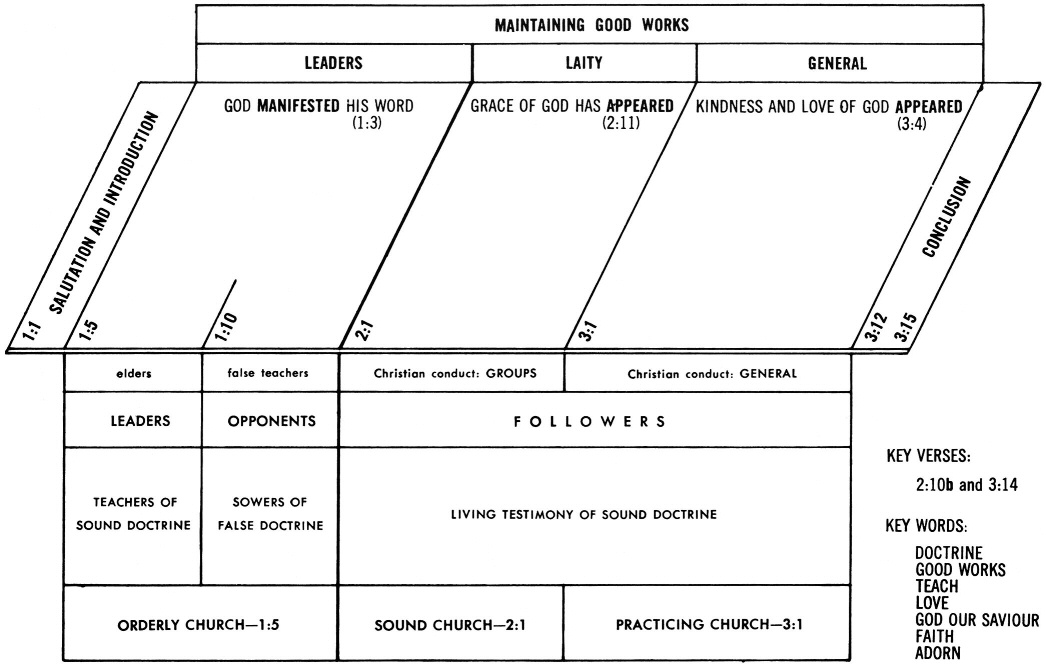
ADORNING THE DOCTRINE OF GOD
Click chart to enlarge
Charts from Jensen's Survey of the NT - used by permission
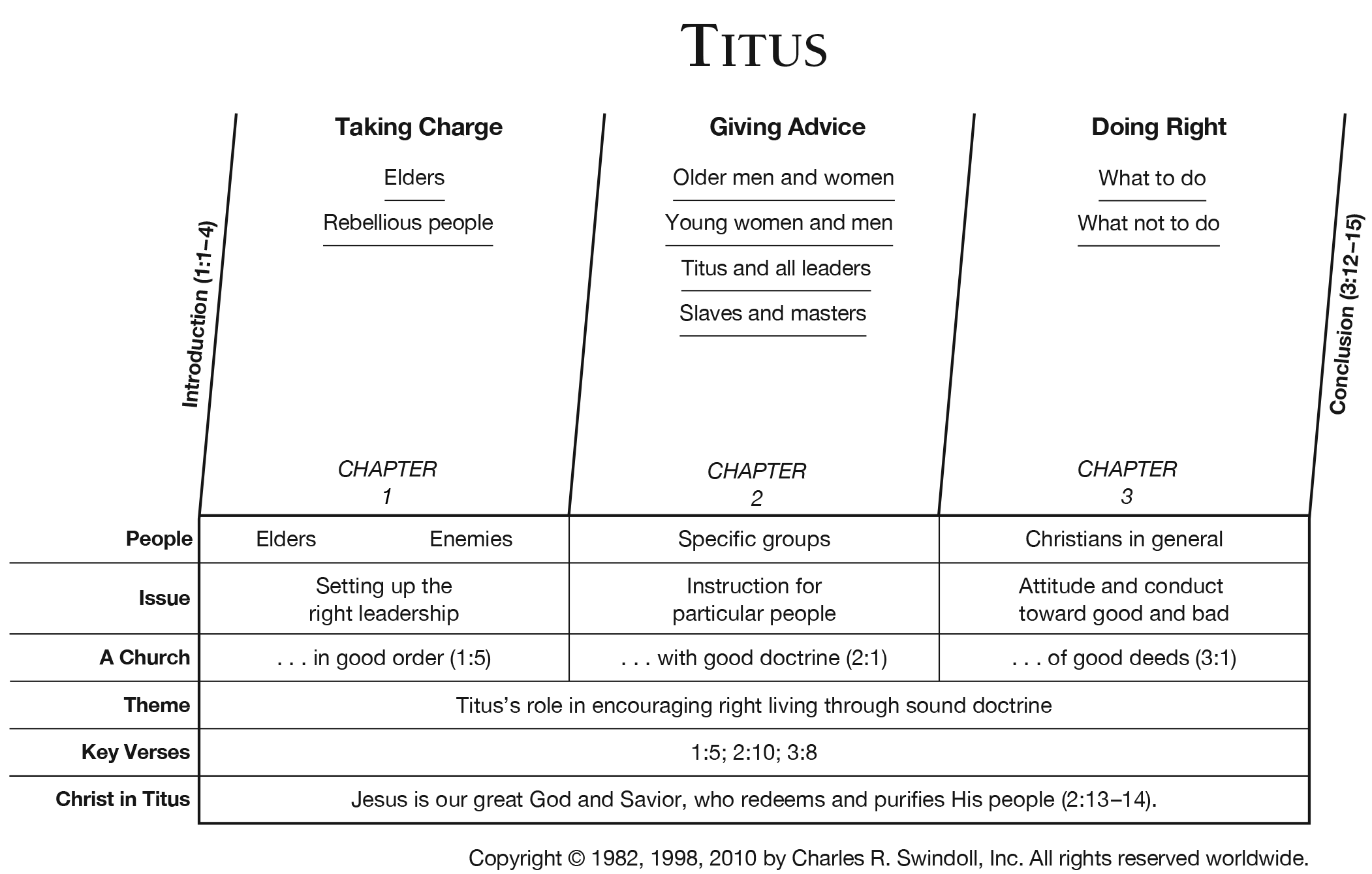
See Summary Chart by Charles Swindoll
Chart below from Michael J. Penfold
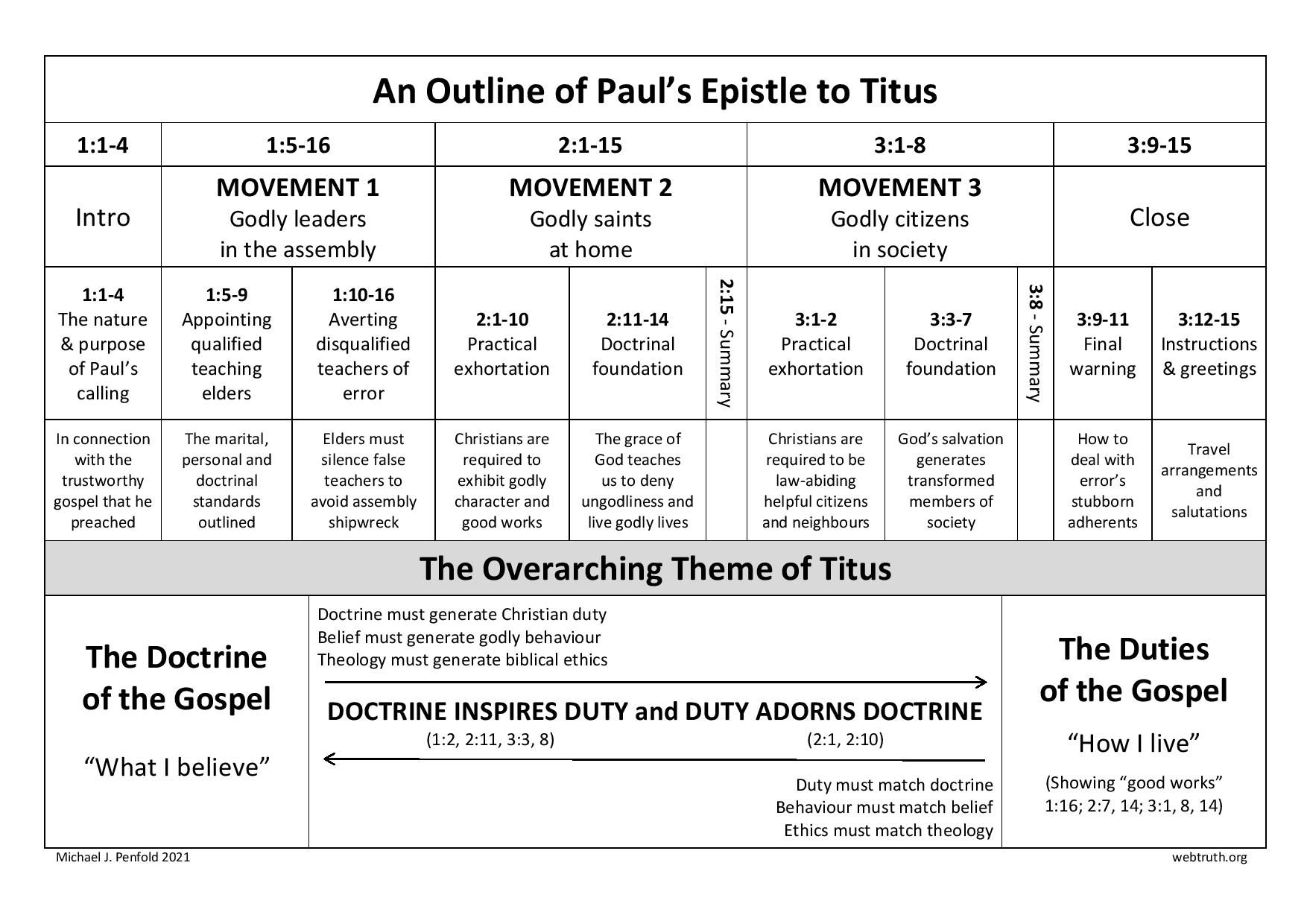
|
Focus |
Appoint Elders |
|||
|
Divisions |
Ordain |
Rebuke |
Maintain |
|
|
Topics |
||||
|
Topics |
Organization |
Offenders |
Operation |
|
|
Place |
Probably Written from either Corinth or Nicopolis (cf. Titus 3:12). |
|||
|
Time |
Circa 63 AD |
|||
|
Modified from Talk Thru the Bible |
||||
Titus 1:9 holding fast the faithful word which is in accordance with the teaching, so that he may be able both to exhort in sound doctrine and to refute those who contradict (NASB: Lockman)
Greek: antechomenon (PMPMSA) tou kata ten didachen pistou logou, hina dunatos e (3SPAS) kai parakalein (PAN) en te didaskalia| te hugiainouse (PAPFSD) kai tous antilegontas (PAPMPA) elegchein. (PAN)
BGT ἀντεχόμενον τοῦ κατὰ τὴν διδαχὴν πιστοῦ λόγου, ἵνα δυνατὸς ᾖ καὶ παρακαλεῖν ἐν τῇ διδασκαλίᾳ τῇ ὑγιαινούσῃ καὶ τοὺς ἀντιλέγοντας ἐλέγχειν.
Barclay: with a strong grip on the truly reliable message which Christian teaching gave to him, that he may be well able to encourage the members of the Church with health-giving teaching, and to convict the opponents of the faith. (Westminster Press)
GWT: He must be devoted to the trustworthy message we teach. Then he can use these accurate teachings to encourage people and correct those who oppose the word. (GWT)
KJV: Holding fast the faithful word as he hath been taught, that he may be able by sound doctrine both to exhort and to convince the gainsayers.
NKJ holding fast the faithful word as he has been taught, that he may be able, by sound doctrine, both to exhort and convict those who contradict.
NET He must hold firmly to the faithful message as it has been taught, so that he will be able to give exhortation in such healthy teaching and correct those who speak against it.
CSB holding to the faithful message as taught, so that he will be able both to encourage with sound teaching and to refute those who contradict it.
ESV He must hold firm to the trustworthy word as taught, so that he may be able to give instruction in sound doctrine and also to rebuke those who contradict it.
NIV He must hold firmly to the trustworthy message as it has been taught, so that he can encourage others by sound doctrine and refute those who oppose it.
NLT He must have a strong belief in the trustworthy message he was taught; then he will be able to encourage others with wholesome teaching and show those who oppose it where they are wrong.
Phillips: a man who takes his stand on the orthodox faith, so that he can by sound teaching both stimulate faith and confute opposition. (Phillips: Touchstone)
Wuest: holding fast, yes, more than that, paying attention to the trustworthy Word in accordance with the teaching, in order that he may be able both to be exhorting in the teaching which is sound and to be convicting those who are opposing [Christianity]. (Eerdmans)
Young's Literal: holding -- according to the teaching -- to the steadfast word, that he may be able also to exhort in the sound teaching, and the gainsayers to convict;
HOLDING FAST THE FAITHFUL WORD WHICH IS IN ACCORDANCE WITH THE TEACHING: antechomenon (PMPMSA) tou pistou logou kata ten didachen :
- Job 2:3; 27:6; Pr 23:23; 1Th 5:21; 2Th 2:15; 2Ti 1:13; Jude 1:3; Rev 2:25; 3:3, 11
- Titus 1 Resources - Multiple Sermons and Commentaries
- Titus 1:9 Elders: Men of the Word - Steven Cole
- Titus 1:9 The Qualifications for a Pastor, 3: Teaching Skill - John MacArthur
- What Elders Do - Ray Pritchard
with a strong grip on the truly reliable message which Christian teaching gave to him (Barclay)
He must be devoted to the trustworthy message we teach (GWT), the steadfast word (YLT)
holding fast, yes, more than that, paying attention to the trustworthy Word in accordance with the teaching (Wuest)
He must have a strong and steadfast belief in the trustworthy message he was taught (NLT)
He must hold firmly to the trustworthy message as it has been taught (NIV)
He must have a firm grasp of the word that is trustworthy in accordance with the teaching (NRSV)
he must hold firm to the sure word as taught (RSV)
He must hold firmly to the message which can be trusted and which agrees with the doctrine (TEV)
he must have a firm grasp of the unchanging message of the tradition, (NJB)
clinging to the faithful word according to the doctrine taught (DNT)
cling to the faithful word with fervent devotion and unflagging diligence (MacArthur)
John Phillips - Elders Are to Be Faithful Men (1:9)
1. Holding Fast the Word of God (1:9a-b)
a. Their Trust in God's Word (1:9a)
b. Their Training in God's Word (1:9b)
2. Heralding Forth the Word of God (1:9c-e)
a. Their Sound Doctrine (1:9c)
b. Their Solemn Duty (1:9d-e)
Paul moves from the personal qualifications discussed above to the "doctrinal qualifications" of elders and overseers, expounding a truth which is critical to the spiritual health of the body of Christ.
Adam Clarke says the overseer is to be "conscientiously retaining, and zealously maintaining, the true Christian doctrine" (Clarke's Commentary)
Spurgeon - See what ministers ought to be, and pray that many such may be found for our churches.
Ray Pritchard - Every word is important. “Hold firmly” means “constantly holding onto and not letting go.” The “trustworthy message” refers to the essential truths of the Christian faith—the fundamentals which must not be compromised. “Sound doctrine” is literally “healthy doctrine” or “wholesome teaching,” referring to the well-balanced teaching of God’s Word that produces healthy Christian living. To “refute” is to “correct” or “convince” those who “contradict” the truth.
Exalting Jesus in Titus - Paul then moves from the elder's personal qualifications to his ministerial and doctrinal qualifications. False teaching will inevitably lead to false living. Wrong belief will inevitably lead to a wrong life. Paul believed we must have definite convictions both about truth and about the teaching of that truth. Again, there is no room, not one inch, for compromise. It is possible to have the faithful (true, genuine) message but lose it or hold it haphazardly. It is possible to hold fast to what is not the true and faithful message because we leave what we were taught for something we think is better. Being devoted to the truth, "holding fast the faithful word" (NASB), means respecting the Bible as the inspired and inerrant Word of God. It means affirming the Bible's priority, authority, and sufficiency for what we believe and how we will live. It means the minister of God places himself gladly and willingly, and in full submission, under the Word. He is a Word man, a Word minister, a Word-constrained and captivated slave. He will preach this Word and only this Word. He would never think of standing before a congregation and doing anything less than proclaiming the Word of God. He will honor what God has said, and he will honor how God has said it. Bottom line: he will be an expositor of Holy Scripture.
W E Vine - the thought is that of cleaving to or holding firmly to, perhaps with the suggestion of facing opposition such as that of gainsayers. The faithful word would be the doctrine taught by Paul and his fellow apostles; cp. 2 Timothy 1:13 and 3:14. What the apostles taught was according to the doctrines of the Christian faith, and the elder or overseer is responsible to adhere to the word of God without adding to it or diminishing from it.
Holding fast (472) (antechomai from antí = against or opposite to + écho = hold) means literally to hold one's self against, the primary sense being to keep one's self directly opposite someone or something. It conveys the sense of cleaving to, strongly adhering to or holding firmly (in context to the faithful word).To cling firmly, to hold fast, to be devoted to.
🙏 THOUGHT - The picture is of one clinging steadfastly to the "rope" of divine truth (a "trustworthy rope" - see illustration) in the midst of opposition or over a flaming fire of opposition (so to speak). Hold the Word fast, and it will hold you firm. Fasten your faith to the faithful Word. Grip grace, guard truth, and ground your life in it. Let go of sin, but never of Scripture. To hold fast the Word is to let nothing else hold sway. Fasten your faith to the faithful Word. Grip truth firmly, or the world will loosen your hold. Clutch the cross, cherish the creed.
The second meaning of antechomai in the NT is to help or assist by giving supplementary support or aid to (1Th 5:14).
Antechomai expresses the sense of a strong attachment to someone or something. To be devoted (feeling or demonstrating loyalty and thus ardent, devout, loving). To cling to (adhere as if glued firmly to and so to hold on tightly and tenaciously).
Antechomai is used 4 times in NT…
Matthew 6:24+) "No one can serve two masters; for either he will hate the one and love the other, or he will hold to (cleave to, holding firmly to, devoted to) one and despise the other. You cannot serve God and mammon.
Luke 16:13 "No servant can serve two masters; for either he will hate the one, and love the other, or else he will hold to one, and despise the other. You cannot serve God and mammon."
1 Thessalonians 5:14+) And we urge you, brethren, admonish the unruly, encourage the fainthearted, help (support) the weak, be patient with all men.
Titus 1:9 holding fast the faithful word which is in accordance with the teaching, that he may be able both to exhort in sound doctrine and to refute those who contradict.
There are 16 uses of antechomai in the Septuagint (LXX)
Deut. 32:41; Neh. 4:16; Job 33:24; Prov. 3:18; 4:6; Eccl. 7:18; Isa. 48:2; 56:2, 4, 6; 57:13; Jer. 2:8; 8:2; 44:10; Dan. 10:21; Zeph. 1:6
Proverbs 3:18 She (wisdom) is a tree of life to those who take hold (Lxx = antechomai) of her, and happy are all who hold her fast.
Keathley - But what is meant by “to hold fast”? It means to study, know, live by the Bible as God’s faithful message to His people and to defend it against the many attacks that have and will be waged against the Bible as God’s special revelation to man.
The Greek writer Sophocles uses this verb of a physical action to "hold one's hand against one's head so as to shade the eyes".
Ulysses S. Grant said…
Hold fast to the Bible as the sheet-anchor of our liberties; write its precepts on your hearts and practise them in your lives. To the influence of this book we are indebted for the progress made in true civilization, and to this we must look for our guide in the future.
Overseers and elders must continue to cling tenaciously and uncompromisingly to the faithful Word even in the face of opposition and the temptation to abandon it for something more "palatable" or "ear tickling" (see notes 2 Timothy 4:3; 4:4).
He is not to be like a child "tossed here and there by waves, and carried about by every wind of doctrine, by the trickery of men, by craftiness in deceitful scheming" (see note Ephesians 4:14).
The leader instead must be characterized by doctrinal stability so that he is emboldened like Paul to not "shrink from declaring… the whole purpose of God." (Acts 20:27)
Barnes says the overseer "is to hold (the truth) fast, in opposition to one who would wrest it away, and in opposition to all false teachers, and to all systems of false philosophy. He must be a man who is firm in his belief of the doctrines of the Christian faith, and a man who can be relied on to maintain and defend those doctrines in all circumstances." (Albert Barnes' Notes on the Bible)
Paul uses the middle voice (reflexive = an action initiated by and directed back onto the subject) for antechomai to picture the overseer holding himself face to face as it were with the Word of God because he knows it to be trustworthy and dependable, not unreliable and treacherous like the spurious teachings of those who contradict.
One way the overseer is to adhere to the Word is by not adding to "the words of the prophecy of this book" or taking "away from the words of the book" (see notes Revelation 22:18; Revelation 22:19).
In a similar instruction Paul commanded Timothy who appears to have been "overseeing" the Ephesian church to "retain the standard of sound words which you have heard from me." (see note 2 Timothy 1:13)
The overseer should "examine (dokimazo in the present imperative = command to make this your habitual practice - EVERYTHING!) everything carefully" and "hold fast (present imperative) to that which is good (see note 1Th 5:21)
The overseer needs to heed the wisdom of the proverb which exhorts us to
Buy truth, and do not sell it. Get wisdom and instruction and understanding. (Pr 23:23)
The overseer is to
stand firm and hold to the traditions which (he was) taught, whether by word of mouth or by letter from us (Paul, et al). (2Th 2:15)
The overseer is to be alerted if
"anyone advocates a different doctrine, and does not agree with sound words, those of our Lord Jesus Christ, and with the doctrine conforming to godliness." (1Ti 6:3).
The overseer needs to have the attitude of Jude who wrote
"Beloved, while I was making every effort to write you about our common salvation, I felt the necessity to write to you appealing that you contend earnestly for the faith which was once for all delivered to the saints." (Jude 1:3)
In short, the overseer is to be a man characterized by doctrinal stability.
The LORD testifies to Satan concerning Job that
there is no one like him on the earth, a blameless and upright man fearing God and turning away from evil. And he still holds fast his integrity, although you incited Me against him, to ruin him without cause." (Job 2:3)
Later Job himself affirms that
I have not departed from the command of His lips; I have treasured the words of His mouth more than my necessary food." (Job 23:12)
Job held fast to his integrity because he held fast to the trustworthy word of God and so too must overseers of God's flock.
Antechomai is used 15 times in the Septuagint (Greek of Hebrew OT). For example speaking of wisdom, Solomon writes that
She is a tree of life to those who take hold of (antechomai) her, And happy are all who hold her fast." (Pr 3:18 )
The overseer clings with utmost confidence to the faithful word because he knows that it alone is completely trustworthy and reliable, unlike the spurious doctrines of the false teachers.
The faithful word - trustworthy, reliable, believable, dependable Word of God. There is nothing else like it in time and eternity. Hold it even when all else falls or fails for it never will beloved!
Faithful (4103) (pistos from peitho = to persuade - induce one by words to believe, have confidence) is something or someone who is worthy of faith or keeps promises and is applied to God, humans, His Word, etc Pistos means dependable (worthy of reliance or trust), trustworthy, steadfast, unswerving.
Webster says that "Faithful" means firm in adherence to whatever one owes allegiance and implies unswerving adherence to a person or thing or to the oath or promise by which a tie was contracted.
Vincent summarizes of the meaning of pistos
(1), of one who shows Himself faithful in the discharge of a duty or the administration of a trust (Mt 24:45). Hence, trustworthy (2Ti 2:2). Of things that can be relied upon (2Ti 2:11).
(2), Confiding; trusting; a believer (Gal 3:9; Acts16:1; 2Cor 6:15; 1Ti 5:16)" (Word Studies in the New Testament) In Gal 3:9 refers to "Abraham, the believer" the faithful one.
TWO MEANINGS OF
PISTOS IN THE NT
(1) ACTIVE MEANING = trusting or believing
This is the less frequent usage. This sense speaks of a sinner exercising faith in the Lord Jesus. In the first NT use in this sense, Jesus "said to Thomas,
“Reach here your finger, and see My hands; and reach here your hand, and put it into My side; and be not unbelieving, but believing." (Jn 20:27)
Paul instructs Timothy to
"let those who have believers (pistos) as their masters not be disrespectful to them because they are brethren, but let them serve them all the more, because those who partake of the benefit are believers (pistos) and beloved. Teach and preach these principles." (1Ti 6:2)
When pistos is used in this active sense to refer to the faith which a lost sinner must place in the Lord Jesus in order to be saved, it includes the following ideas -- the act of considering the Lord Jesus worthy of trust as to His character and motives, the act of placing confidence in His ability to do just what He says He will do, the act of entrusting the salvation of his soul into the hands of the Lord Jesus, the act of committing the work of saving his soul to the care of the Lord. This means a definite taking of one’s self out of one’s own keeping and entrusting one’s self into the keeping of the Lord Jesus. Thus Paul says
So then those who are of faith are blessed with Abraham, the believer (pistos). (Gal 3:9)
Using a striking contrast, Paul asks
what harmony has Christ with Belial, or what has a believer in common with an unbeliever? (2Cor 6:15)
came also to Derbe and to Lystra. And behold, a certain disciple was there, named Timothy, the son of a Jewish woman who was a believer, but his father was a Greek. (Acts 16:1)
Note also that with regard to believers, they are spoken of sometimes in the Active sense (as "believers") and sometimes in the Passive (as "faithful").
The New Testament concept of faith includes three main elements, mutually connected and requisite, though according to circumstances sometimes one and sometimes another may be more prominent
(1) a fully convinced acknowledgement of the revelation of grace; (2) a self-surrendering fellowship (adhesion); and (3) a fully assured and unswerving trust (and with this at the same time hope) in the God of salvation or in Christ. (Modified from Cremer)
2) PASSIVE MEANING = trustworthy or faithful.
Here the basic idea is that of trustworthiness. In this sense pistos describes God, Christ, servants, His Word as faithful, reliable, worthy of belief or trust, in short, dependable.
Marvin Vincent adds that pistos used of God describes Him as "True to his own nature and promises; keeping faith with Himself and with man."
Paul writes that even
if we are faithless, He remains faithful; for He cannot deny Himself. (see note 2 Timothy 2:13)
Pistos in this passive sense is used of one who shows Himself faithful in the discharge of a duty or the administration of a trust
Who then is the faithful and sensible slave whom his master put in charge of his household to give them their food at the proper time? Mt 24:45.
Hence, pistos describes the one who is trustworthy
And the things which you have heard from me in the presence of many witnesses, these entrust to faithful men, who will be able to teach others also. see note 2 Timothy 2:2).
Of the Word of God (which is the sense pistos is used in Titus 1:9) that can be relied upon
"It is a trustworthy statement: if any man aspires to the office of overseer, it is a fine work he desires to do." 1Ti 3:1
"It is a trustworthy statement: For if we died with Him, we shall also live with Him." - see note 2 Timothy 2:11
In this passive sense of trustworthy or faithful, pistos is applied to God as fulfilling His own promises (see notes Hebrews 10:23; Hebrews 11:11), as fulfilling the purpose for which He called men (1Th 5:24; 1Co 1:9), as responding with guardianship to the trust reposed in Him by men (1Co 10:13; 1Pe 4:19). Christ is faithful (2Thes 3:3; He 3:2; He 2:17 Re 19:11) Christ as the faithful witness (RE 1:5; Re 3:14). God’s and Christ's faithfulness in these verses speak not only of His essential being (faithful is Who He is), but also of His faithfulness toward us, as shown for example in the famous verse
"If we confess our sins, He is faithful and righteous to forgive us our sins and to cleanse us from all unrighteousness." (1 Jn 1:9)
In the papyri, we find the following illustrations of the use of pistos -- "Whom no one would trust even if they were willing to work" = confidence in the person’s character and motives. "I have trusted no one to take it to her" = confidence in the ability of another to perform a certain task.
Pistos is used 67 times in the NT - Pistos is translated believe(2), believer(4), believers(5), believing(1), faithful(43), Faithful(1), faithful one(1), faithfully(1), sure(1), trustworthy(7), who believe(1).
Matthew 24:45 "Who then is the faithful and sensible slave whom his master put in charge of his household to give them their food at the proper time?
Matthew 25:21 "His master said to him, 'Well done, good and faithful slave. You were faithful with a few things, I will put you in charge of many things; enter into the joy of your master.'
23 "His master said to him, 'Well done, good and faithful slave. You were faithful with a few things, I will put you in charge of many things; enter into the joy of your master.'
Luke 12:42 And the Lord said, "Who then is the faithful and sensible steward, whom his master will put in charge of his servants, to give them their rations at the proper time?
Luke 16:10 "He who is faithful in a very little thing is faithful also in much; and he who is unrighteous in a very little thing is unrighteous also in much.
11 "Therefore if you have not been faithful in the use of unrighteous wealth, who will entrust the true riches to you?
12 "And if you have not been faithful in the use of that which is another's, who will give you that which is your own?
Luke 19:17 "And he said to him, 'Well done, good slave, because you have been faithful in a very little thing, you are to be in authority over ten cities.'
John 20:27 Then He said to Thomas, "Reach here with your finger, and see My hands; and reach here your hand and put it into My side; and do not be unbelieving, but believing."
Acts 10:45 All the circumcised believers who came with Peter were amazed, because the gift of the Holy Spirit had been poured out on the Gentiles also.
Acts 13:34 "As for the fact that He raised Him up from the dead, no longer to return to decay, He has spoken in this way: 'I WILL GIVE YOU THE HOLY and SURE blessings OF DAVID.'
Acts 16:1 Paul came also to Derbe and to Lystra. And a disciple was there, named Timothy, the son of a Jewish woman who was a believer, but his father was a Greek,
15 And when she and her household had been baptized, she urged us, saying, "If you have judged me to be faithful to the Lord, come into my house and stay." And she prevailed upon us.
1 Corinthians 1:9 God is faithful, through whom you were called into fellowship with His Son, Jesus Christ our Lord.
1 Corinthians 4:2 In this case, moreover, it is required of stewards that one be found trustworthy.
17 For this reason I have sent to you Timothy, who is my beloved and faithful child in the Lord, and he will remind you of my ways which are in Christ, just as I teach everywhere in every church.
1 Corinthians 7:25 Now concerning virgins I have no command of the Lord, but I give an opinion as one who by the mercy of the Lord is trustworthy.
1 Corinthians 10:13 No temptation has overtaken you but such as is common to man; and God is faithful, who will not allow you to be tempted beyond what you are able, but with the temptation will provide the way of escape also, so that you will be able to endure it.
2 Corinthians 1:18 But as God is faithful, our word to you is not yes and no.
2 Corinthians 6:15 Or what harmony has Christ with Belial, or what has a believer in common with an unbeliever?
Galatians 3:9 So then those who are of faith are blessed with Abraham, the believer.
Ephesians 1:1 Paul, an apostle of Christ Jesus by the will of God, To the saints who are at Ephesus and who are faithful in Christ Jesus:
Ephesians 6:21 But that you also may know about my circumstances, how I am doing, Tychicus, the beloved brother and faithful minister in the Lord, will make everything known to you.
Colossians 1:2 To the saints and faithful brethren in Christ who are at Colossae: Grace to you and peace from God our Father.
7 just as you learned it from Epaphras, our beloved fellow bond-servant, who is a faithful servant of Christ on our behalf,
Colossians 4:7 As to all my affairs, Tychicus, our beloved brother and faithful servant and fellow bond-servant in the Lord, will bring you information.
9 and with him Onesimus, our faithful and beloved brother, who is one of your number. They will inform you about the whole situation here.
1 Thessalonians 5:24 Faithful is He who calls you, and He also will bring it to pass.
2 Thessalonians 3:3 But the Lord is faithful, and He will strengthen and protect you from the evil one.
1 Timothy 1:12 I thank Christ Jesus our Lord, who has strengthened me, because He considered me faithful, putting me into service,
15 It is a trustworthy statement, deserving full acceptance, that Christ Jesus came into the world to save sinners, among whom I am foremost of all.
1 Timothy 3:1 It is a trustworthy statement: if any man aspires to the office of overseer, it is a fine work he desires to do.
11 Women must likewise be dignified, not malicious gossips, but temperate, faithful in all things.
1 Timothy 4:3 men who forbid marriage and advocate abstaining from foods which God has created to be gratefully shared in by those who believe and know the truth.
9 It is a trustworthy statement deserving full acceptance.
10 For it is for this we labor and strive, because we have fixed our hope on the living God, who is the Savior of all men, especially of believers.
12 Let no one look down on your youthfulness, but rather in speech, conduct, love, faith and purity, show yourself an example of those who believe.
1 Timothy 5:16 If any woman who is a believer has dependent widows, she must assist them and the church must not be burdened, so that it may assist those who are widows indeed.
1 Timothy 6:2 Those who have believers as their masters must not be disrespectful to them because they are brethren, but must serve them all the more, because those who partake of the benefit are believers and beloved. Teach and preach these principles.
2 Timothy 2:2 The things which you have heard from me in the presence of many witnesses, entrust these to faithful men who will be able to teach others also.
11 It is a trustworthy statement: For if we died with Him, we will also live with Him;
13 If we are faithless, He remains faithful, for He cannot deny Himself.
Titus 1:6 namely, if any man is above reproach, the husband of one wife, having children who believe, not accused of dissipation or rebellion.
9 holding fast the faithful word which is in accordance with the teaching, so that he will be able both to exhort in sound doctrine and to refute those who contradict.
Titus 3:8 This is a trustworthy statement; and concerning these things I want you to speak confidently, so that those who have believed God will be careful to engage in good deeds. These things are good and profitable for men.
Hebrews 2:17 Therefore, He had to be made like His brethren in all things, so that He might become a merciful and faithful high priest in things pertaining to God, to make propitiation for the sins of the people.
Hebrews 3:2 He was faithful to Him who appointed Him, as Moses also was in all His house.
5 Now Moses was faithful in all His house as a servant, for a testimony of those things which were to be spoken later;
Hebrews 10:23 Let us hold fast the confession of our hope without wavering, for He who promised is faithful;
Hebrews 11:11 By faith even Sarah herself received ability to conceive, even beyond the proper time of life, since she considered Him faithful who had promised.
1 Peter 1:21 who through Him are believers in God, who raised Him from the dead and gave Him glory, so that your faith and hope are in God.
1 Peter 4:19 Therefore, those also who suffer according to the will of God shall entrust their souls to a faithful Creator in doing what is right.
1 Peter 5:12 Through Silvanus, our faithful brother (for so I regard him), I have written to you briefly, exhorting and testifying that this is the true grace of God. Stand firm in it!
1 John 1:9 If we confess our sins, He is faithful and righteous to forgive us our sins and to cleanse us from all unrighteousness.
3 John 1:5 Beloved, you are acting faithfully in whatever you accomplish for the brethren, and especially when they are strangers;
Revelation 1:5 and from Jesus Christ, the faithful witness, the firstborn of the dead, and the ruler of the kings of the earth. To Him who loves us and released us from our sins by His blood--
Revelation 2:10 'Do not fear what you are about to suffer. Behold, the devil is about to cast some of you into prison, so that you will be tested, and you will have tribulation for ten days. Be faithful until death, and I will give you the crown of life.
13 'I know where you dwell, where Satan's throne is; and you hold fast My name, and did not deny My faith even in the days of Antipas, My witness, My faithful one, who was killed among you, where Satan dwells.
Revelation 3:14 "To the angel of the church in Laodicea write: The Amen, the faithful and true Witness, the Beginning of the creation of God, says this:
Revelation 17:14 "These will wage war against the Lamb, and the Lamb will overcome them, because He is Lord of lords and King of kings, and those who are with Him are the called and chosen and faithful."
Revelation 19:11 And I saw heaven opened, and behold, a white horse, and He who sat on it is called Faithful and True, and in righteousness He judges and wages war.
Revelation 21:5 And He who sits on the throne said, "Behold, I am making all things new." And He said, "Write, for these words are faithful and true."
Revelation 22:6 And he said to me, "These words are faithful and true"; and the Lord, the God of the spirits of the prophets, sent His angel to show to His bond-servants the things which must soon take place.
Pistos occurs some 46 times in the Septuagint (LXX)
Nu 12:7; Deut 7:9; 28:59; 32:4; 1Sa 2:35; 3:20; 22:14; 25:28; 2Sa 20:18; 23:1; 1Ki 11:38; Neh 9:8; 13:13; Job 12:20; 17:9; Ps 19:7; 89:28, 37; 101:6; 111:7; 145:13; Pr 2:12; 11:13, 21; 13:17; 14:5, 25; 17:6f; 20:6; 25:13; Isa 1:21, 26; 8:2; 22:23, 25; 33:16; 49:7; 55:3; Je 42:5; Da 2:45; 6:4; Hos 5:9
The Septuagint (Greek of the Hebrew OT) uses pistos 42 times, the first occurrence describing God's testimony about Moses declaring
"Not so, with My servant Moses, He is faithful in all My household." (Nu 12:7)
Moses in turn records the following of God writing
"Know therefore that the LORD your God, He is God, the faithful God, Who keeps His covenant and His lovingkindness to a thousandth generation with those who love Him and keep His commandments." (Dt 7:9)
Notice the seal of assurance stamped upon God's covenant. It is backed up by His faithful character.
In addition there are three uses of pistos in the Septuagint which parallel the truth in Titus 1:9 ("the faithful word"), two of these uses in Psalms and the other in Daniel in reference to one of the most foundational prophecies ever recorded in Daniel 2:
Psalm 19:7 "The law of the LORD is perfect, restoring the soul. The testimony of the LORD is sure (Translated in Septuagint with pistos - "faithful"), making wise the simple." (Comment: Spurgeon comments that "God’s witness in his Word is so sure that we may draw solid comfort from it both for time and eternity, and so sure that no attacks made upon it, however fierce or subtle, can ever weaken its force. What a blessing that in a world of uncertainties we have something sure to rest upon! We hasten from the quicksands of human speculations to the solid ground of divine revelation." - see Spurgeon's note)
Psalm 111:7 "The works of His hands are truth and justice. All His precepts are sure (Translated in Septuagint with pistos - "faithful")."
Spurgeon (his commentary) writes "All that he has appointed or decreed shall surely stand, and his precepts which he has proclaimed shall be found worthy of our obedience, for surely they are founded in justice and are meant for our lasting good. He is no fickle despot, commanding one thing one day and another another, but His commands remain absolutely unaltered, their necessity equally unquestionable, their excellence permanently proven, and their reward eternally secure. Take the word commandments to relate either to his decrees or his precepts, and we have in each case an important sense; but it seems more in accordance with the connection to take the first sense and consider the words to refer to the ordinances, appointments, or decrees of the great King."
Whatever the mighty Lord decrees,
Shall stand for ever sure.
The settled purpose of his heart
To ages shall endure.
Daniel 2:45-note "Inasmuch as you saw that a stone was cut out of the mountain without hands and that it crushed the iron, the bronze, the clay, the silver, and the gold, the great God has made known to the king what will take place in the future; so the dream is true, and its interpretation is trustworthy."
In short, God's Holy Word is trustworthy, dependable, reliable and sure because God Himself is faithful (1Cor 1:9, 1Th 5:24) and cannot lie (Titus 1:2 [note], Nu 23:19). Because God's Word is faithful, those who teach and preach the Word must also be faithful or trustworthy (1Cor 4:2, cf Num 12:7) and "entrust it to faithful men who will be able to teach others also" (2Ti 2:2).
The same combination of "faithful" (pistos) and "logos" translated here as "faithful word" is found five other times in the pastoral epistles and each of these other occurrences is translated "trustworthy statement" (1Ti 1:15, 3:1, 4:9, 2Ti 2:11, Titus 3:8).
In the Revelation John records some of God's final words on His word: "And He who sits on the throne said, “Behold, I am making all things new.” And He *said, “Write, for these words (logos) are faithful and true.” (Re 21:5-note) God always speaks truth ( “Sanctify them in the truth; Thy word is truth" Jn 17:17) One of the seven angels said to John "These words (logos) are faithful and true”; and the Lord, the God of the spirits of the prophets, sent His angel to show to His bond-servants the things which must shortly take place." (Re 22:6)
God's Word will surely come to pass. Therefore, it behooves the overseer to be diligent to cling to this precious trustworthy Word as he leads the flock into all truth and counters all lies and liars with the Word of Truth
John Phillips - Elders must trust God's Word implicitly. Their task is to bring Scripture-not modern psychology, human philosophy, or scientific theories-to bear on a situation....Nowadays, it is not uncommon to find elders who are well taught in almost everything except the Bible. Many men are willing to spend years acquiring a mastery of music, mathematics, or medicine but are content to spend less than half an hour a week in Bible study. Paul would require that men spend much more time than that in acquiring knowledge of God's Word before he would allow them to become elders. To be a first-class Bible teacher, a man does not need a degree from a seminary, but he does need to put much time and effort into studying the Bible in depth....Any movement that deemphasizes doctrine must be suspect. In a properly functioning local church, the elders place great importance on sound teaching. That was a primary characteristic of the infant church. The new believers "continued steadfastly in the apostles' doctrine" (Acts 2:42). In the last days, Paul warned, people will give heed to "doctrines of devils" and "will not endure sound doctrine" (1 Tim. 4:1; 2 Tim. 4:3). Therefore, we must be sure that those who are chosen to have the rule over us in the Lord are true to the Word of God and zealous in teaching it.(Explore the Bible)
Word (3056) (logos from légō = to speak with words; English = logic, logical) means something said and describes a communication whereby the mind finds expression in words. Although Lógos is most often translated word which Webster defines as "something that is said, a statement, an utterance", the Greek understanding of lógos is somewhat more complex.
See the New International Dictionary of New Testament Theology for a 30+ page discussion of WORD - logos, word, utterance, meaning; lego, collect, count, say; logikos, intellectual, rational, reasonable, spiritual; logion, saying; logios, eloquent; cultured; alogos, irrational, without speech; laleo, to talk, chat, speak.
See discussion of "The Logos" (Jesus Christ) in John 1:14-Commentary
In the Greek mind and as used by secular and philosophical Greek writers, lógos did not mean merely the name of an object but was an expression of the thought behind that object's name. Let me illustrate this somewhat subtle nuance in the meaning of lógos with an example from the Septuagint (LXX) (Greek of the Hebrew OT) in which lógos is used in the well known phrase the Ten Commandments.
The Septuagint translates this phrase using the word lógos as “the ten (deka) words (logoi)” (Ex 34:28), this phrase giving us the familiar term Decalogue. Clearly each of the "Ten Commandments" is not just words but words which express a thought or concept behind those words.
This then is the essence of the meaning of lógos and so it should not be surprising that depending on the context lógos is translated with words such as "saying, instruction, message, news, preaching, question, statement, teaching, etc". This understanding of lógos also helps understand John's repeated usage of this Greek word as a synonym for the second Person of the Godhead, the Lord Jesus Christ (see discussion below).
Lógos then is a general term for speaking, but always used for speaking with rational content. Lógos is a word uttered by the human voice which embodies an underlying concept or idea. When one has spoken the sum total of their thoughts concerning something, they have given to their hearer a total concept of that thing. Thus the word lógos conveys the idea of “a total concept” of anything. Lógos means the word or outward form by which the inward thought is expressed and made known. It can also refer to the inward thought or reason itself. Note then that lógos does not refer merely to a part of speech but to a concept or idea. In other words, in classical Greek, lógos never meant just a word in the grammatical sense as the mere name of a thing, but rather the thing referred to, the material, not the formal part. In fact, the Greek language has 3 other words (rhema, onoma, epos) which designate a word in its grammatical sense. Lógos refers to the total expression whereas rhema (see word study) for example is used of a part of speech in a sentence. In other words rhema, emphasizes the parts rather than the whole.
Cremer explains that lógos is used of the living, spoken word,
the word not in its outward form, but with reference to the thought connected with the form,… in short, not the word of language, but of conversation, of discourse; not the word as a part of speech, but the word as part of what is uttered.
Although not every lexicographer would agree with Vincent's assessment of the origin of lógos, his comments are very interesting and worth noting. He explains that
lógos is from the root "leg-", appearing in lego, the primitive meaning of which is to lay: then, to pick out, gather, pick up: hence to gather or put words together, and so, to speak. Hence lógos is, first of all, a collecting or collection both of things in the mind, and of words by which they are expressed. It therefore signifies both the outward form by which the inward thought is expressed, and the inward thought itself. (Vincent, M. R. Word studies in the New Testament: Vol. 2, Page 1-25)
Barclay adds that "the Greek term for word is lógos; but lógos does not only mean word; it also means reason. For John, and for all the great thinkers who made use of this idea, these two meanings were always closely intertwined. Whenever they used lógos the twin ideas of the Word of God and the Reason of God were in their minds. (The Daily Study Bible Series)
Robert Lightner in his commentary on First John (specifically "the Word of Life" in 1Jn 1:1) has a helpful note on "Logos" as it relates to Jesus…
The designation Word (Logos) attracts our attention. What does it mean? What picture does it convey of the Lord Jesus? Let me illustrate: I might have all kinds of ideas, thoughts, suggestions in my mind, all kinds of emotions in my heart, but unless there was some way, some means by which I could convey them to others, they would not know them. This is where words derive their value. Words are vehicles for conveying thoughts to others, and if it is true that "as a man thinketh in his heart so is he" then my words will be vehicles for conveying to others what I am. The Lord Jesus is the Word, the conveyor to men not only of the thoughts of God and the wisdom of God, but the conveyor of what God is. He is the vehicle to reveal God to men, thus "no man hath seen God at any time; the only begotten Son, which is in the bosom of the Father (who has His being in the bosom of the Father), he hath declared him" (John 1:18). As the "Word" our Lord Jesus revealed God in His power in the creation (John 1:3) and upholding of the world (Heb. 1:1-3). He has revealed Him through incarnation (John 1:14) and redemption to the guilty sons of men. Did He not say: "He that hath seen me hath seen the Father" (John 14:9)?
As alluded to earlier the 330 uses of lógos are translated by multiple English words in the NASB, as shown by the following compilation with the parentheses indicating the number of occurrences
account(7), accounting(2), accounts(2), answer(1), appearance(1), complaint(1), exhortation (1), have to do(1), instruction(1), length (1), matter(4), matters(1), message(10), news(3), preaching(1), question(2), reason(2), reasonable(1), remark(1), report(1), said(1), say(1), saying(4), sayings(1), speaker(1), speech(10), statement(18), story(1), talk(1), teaching(2), thing(2), things(1), utterance(2), what he says(1), what (1), word(179), words(61).
The following discussion will not deal with all of these nuances of lógos. Here is W E Vine's summary of Logos
Noun Masculine — logos — log'-os ) denotes
(I) "the expression of thought," not the mere name of an object, (a) as embodying a conception or idea, e.g., Luke 7:7; 1 Corinthians 14:9,19; (b) a saying or statement, (1) by God, e.g., John 15:25; Romans 9:9; 9:28 , RV, "word" (AV, "work"); Galatians 5:14; Hebrews 4:12; (2) by Christ, e.g.,Matthew 24:35 (plur.); John 2:22; 4:41; 14:23 (plur.); 15:20. In connection with (1) and (2) the phrase "the word of the Lord," i.e., the revealed will of God (very frequent in the OT), is used of a direct revelation given by Christ,1 Thessalonians 4:15; of the gospel, Acts 8:25; 13:49; 15:35,36; 16:32;19:10; 1 Thessalonians 1:8; 2 Thessalonians 3:1; in this respect it is the message from the Lord, delivered with His authority and made effective by His power (cp. Acts 10:36 ); for other instances relating to the gospel seeActs 13:26; 14:3; 15:7; 1 Corinthians 1:18 , RV; 2 Corinthians 2:17; 4:2;5:19; 6:7; Galatians 6:6; Ephesians 1:13; Philippians 2:16; Colossians 1:5;Hebrews 5:13; sometimes it is used as the sum of God's utterances, e.g.,Mark 7:13; John 10:35; Revelation 1:2,9; (c) discourse, speech, of instruction, etc., e.g., Acts 2:40; 1 Corinthians 2:13; 12:8; 2 Corinthians 1:18;1 Thessalonians 1:5; 2 Thessalonians 2:15; Hebrews 6:1 , RV, marg.; doctrine, e.g., Matthew 13:20; Colossians 3:16; 1 Timothy 4:6; 2 Timothy 1:13; Titus 1:9; 1 John 2:7;
(II) "The Personal Word," a title of the Son of God; this identification is substantiated by the statements of doctrine in John 1:1-18 , declaring in verses John 1:1,2 (1) His distinct and superfinite Personality, (2) His relation in the Godhead (pros, "with," not mere company, but the most intimate communion), (3) His deity; in John 1:3 His creative power; in John 1:14 His incarnation ("became flesh," expressing His voluntary act; not as AV, "was made"), the reality and totality of His human nature, and His glory "as of the only begotten from the Father," RV (marg., "an only begotten from a father"), the absence of the article in each place lending stress to the nature and character of the relationship; His was the shekinah glory in open manifestation; John 1:18 consummates the identification: "the only-begotten Son (RV marg., many ancient authorities read "God only begotten,"), which is in the bosom of the Father, He hath declared Him," thus fulfilling the significance of the title "Logos," the "Word," the personal manifestation, not of a part of the Divine nature, but of the whole Deity (see IMAGE).The title is used also in 1 John 1:1 , "the Word of life" combining the two declarations in John 1:1,4 andRevelation 19:13 (for 1 John 5:7 see THREE).
W E Vine also has the following discussions of other ways logos is translated (keep in mind Vine basis his definitions on how logos was translated in the KJV):
- Cause - "a word spoken for any purpose," denotes, in one place, a cause or reason assigned, Matthew 5:32 .
- Communication - "a word, that which is spoken" (lego, "to speak"), is used in the plural with reference to a conversation; "communication," Luke 24:17 . Elsewhere with this significance the RV renders it "speech," Matthew 5:37;Ephesians 4:29 . See ACCOUNT. Note: In Colossians 3:8 , where the AV translates aischrologia by "filthy communication," the RV renders it "shameful speaking" (aischros, "base," lego, "to speak").
- Account - "a word or saying," also means "an account which one gives by word of mouth" (cp. No. 4), Matthew 12:36; Matthew 18:23 , RV, reckoning;" Matthew 16:2; Acts 19:40; 20:24 (AV, "count"); Romans 14:12;Philippians 4:17; Hebrews 13:17; 1 Peter 4:5
- Intent - "a word, account, etc.," sometimes denotes "a reason, cause, intent," e.g.,Matthew 5:32 , "cause;" it is rendered "intent" in Acts 10:29
- Matter - "a word, speech, discourse, account," hence also "that which is spoken of, a matter, affair, thing," is translated "matter" in Mark 1:45; Acts 8:21; 15:6;19:38; in the RV of Philippians 4:15 , "in the matter of" (AV, "concerning"). See ACCOUNT.
- Question - "a word," is translated "question" in Matthew 21:24 (AV, "thing"); in Mark 11:29 (RV, marg., "word") andLuke 20:3 , AV, "one thing:" there is no word in the original for "one," hence the RV, "a question."
- Saying - "a word," as embodying a conception or idea, denotes among its various meanings, "a saying, statement or declaration," uttered (a) by God; RV, "word" or "words" (AV, "saying"), e.g., in John 8:55; Romans 3:4; Revelation 19:9; 22:6,7,9,10; (b) by Christ, e.g., Mark 8:32; 9:10; 10:22; Luke 9:28;John 6:60; 21:23; the RV appropriately substitutes "word" or "words" for AV, "saying" or "sayings," especially in John's Gospel e.g. 7:36,40; 8:51,52; 10:19; 14:24; 15:20; 18:9,32; 19:13; (c) by an angel, Luke 1:29; (d) by OT prophets, John 12:38 (RV, "word") Romans 13:9 (ditto); 1 Corinthians 15:54; (e) by the Apostle Paul in the Pastoral Epp., 1 Timothy 1:15; 3:1; 4:9; 2 Timothy 2:11; Titus 3:8; (f) by other men, Mark 7:29; Acts 7:29; John 4:37 (in general). See ACCOUNT , and especially WORD.
- Speech - akin to lego (SPEAK, No. 1), most frequently rendered "word" (for an analysis see WORD), signifies "speech," as follows: (a) "discourse," e.g.,Luke 20:20 , RV, "speech" (AV, "words"); Acts 14:12 (see SPEAKER); 20:7;1 Corinthians 2:1,4; 4:19 , AV (RV, "word"); 2 Corinthians 10:10; (b) "the faculty of speech," e.g., 2 Corinthians 11:6; (c) "the manner of speech," e.g.,Matthew 5:37 , RV, "speech" (AV, "communication"); Colossians 4:6; (d) "manner of instruction," Titus 2:8; 1 Corinthians 14:9 , RV (AV, "words");Ephesians 4:29 , RV (AV, "communication"). See SAYING.
- Treatise - "a word," denotes "a treatise or written narrative" in Acts 1:1 .
- Utterance - "a word," is translated "utterance" in 1 Corinthians 1:5; 2 Corinthians 8:7;Ephesians 6:19 . See WORD. Notes: (1) In Colossians 4:3 , AV, logos is rendered "(a door) of utterance." (2) For apophthengomai, rendered "utterance" in Acts 2:4 , see SPEAK , No. 5.
Lógos was in use among Greeks before John used it, the Greeks using it to denote the principle which maintains order in world. In connection with the Greek word for “seed” in its adjective form, Lógos was used to express the generative principle or creative force in nature. The Stoics believed that this world was permeated with that Lógos. It was the Lógos which put sense into the world. It was the Lógos which kept the stars in their courses and the planets in their appointed tracks. It was the Lógos which controlled the ordered succession of night and day, and summer and winter and spring and autumn. The Lógos was the reason and the mind of God in the universe, making it an order and not a chaos.
In summary, Greek philosophers, in attempting to understand the relationship between God and the universe, spoke of an unknown mediator between God and the universe, naming this mediator, “Logos” John tells them that this mediator unknown to them is our Lord, and he uses the same name “Lógos .” In the first verse of his gospel John gives us a summary outline of Jesus' preexistence, His fellowship with God the Father in His preincarnate state and His absolute deity writing that "In the beginning was the Lógos, and the Lógos was with God, and the Lógos was God." (Jn 1:1)
If there is any doubt about Who John was referring to, he goes on to describe the incarnation writing that "the Lógos became flesh, and dwelt among us, and we beheld His glory, glory as of the only begotten from the Father, full of grace and truth." (Jn 1:14)
In his first epistle John writes that "What was from the beginning, what we have heard, what we have seen with our eyes, what we beheld and our hands handled, concerning the Word of Life." (1Jn 1:1)
John describing Jesus' triumphant return at the end of this age writes that "He is clothed with a robe dipped in blood; and His name is called The Word of God." (Rev 19:13).
William Barclay adds that the Greeks "had the conception of the Logos. In Greek logos means two things—it means word and it means reason. The Jew was entirely familiar with the all-powerful word of God. “God said, let there be light; and there was light” (Ge 1:3). The Greek was entirely familiar with the thought of reason. He looked at this world; he saw a magnificent and dependable order. Night and day came with unfailing regularity; the year kept its seasons in unvarying course; the stars and the planets moved in their unaltering path; nature had her unvarying laws. What produced this order? The Greek answered unhesitatingly, The Logos, the mind of God, is responsible for the majestic order of the world. He went on, What is it that gives man power to think, to reason and to know? Again he answered unhesitatingly, The Logos, the mind of God, dwelling within a man makes him a thinking rational being. (The Daily Study Bible)
Lógos also can refer to a computation, reckoning or a formal accounting, especially of one’s actions, and frequently with a figurative extension of commercial terminology (account, accounts). For example, Paul writes that "each one of us shall give account (logos) of himself to God." (Ro 14:12)
In a similar use Jesus told about a certain rich man who called to his steward "and said to him, 'What is this I hear about you? Give an account (lógos) of your stewardship, for you can no longer be steward." (Lk 16:2)
After explaining that "the word (logos) of God is living and active and sharper than any two-edged sword, and piercing as far as the division of soul and spirit, of both joints and marrow, and able to judge the thoughts and intentions of the heart."
the writer then brings home his point emphasizing that "there is no creature hidden from His sight, but all things are open and laid bare to the eyes of Him with whom we have to do." (He 4:12, 13-notes).
This last phrase reads more literally "with Whom is our reckoning (lógos)" or "to Whom we must render an account (lógos)."
RELATED RESOURCES: on "Word"
- Girdleston's Synonyms of the OT - Word
- Trench's Synonyms of the NT - Word
- American Tract Society Word
- Bridgeway Bible Dictionary Word
- Baker Evangelical Dictionary Word
- Easton's Bible Dictionary Word of God
- Holman Bible Dictionary Word
- Hastings' Dictionary of the Bible Word
- Hastings' Dictionary of the NT Word Word (2)
- International Standard Bible Encyclopedia Word
- McClintock and Strong's Bible Encyclopedia Word
THE GOSPEL AND LOGOS
The phrase “the word of the Lord,” the revealed will of God, is synonymous with the gospel in several instances (Acts 8:25; 12:24 13:48 13:49; 15:35 15:36, 16:32;19:10; 1Th 1:8 [note]; 2Thes 3:1 1 Peter 1:25 [note]) The gospel is also frequently referred to as "the word of God".
Spurgeon - Word of God: Everliving - How wonderfully has the Lord provided for the continuance of the vegetable world; he causes the plant to scatter broadcast a multitude of seeds, and bids the winds convey them far and wide. The fowls of the air are commissioned to bear berries and fruits to their proper soils, and even to bury them in the earth; while scores of four-footed creatures, engaged in storing up food for themselves, become planters of trees, and propagators of plants. Seeds bear a charmed life about them, they will germinate after being buried for centuries; they have been known to flourish when turned up from the borings of wells from the depth of hundreds of feet, and when ponds and lakes have been dried, the undrowned vegetable life has surprised the beholders by blossoming with unknown flowers. Can we imagine that God has been thus careful of the life of the mere grass of the field, which is the very emblem of decay, and yet is negligent of his Word which liveth and abideth for ever? It is not to be dreamed of. Truth, the incorruptible seed, is ever scattering itself, every wind is laden with it, every breath spreads it; it lies dormant in a thousand memories, it preserves its life in the abodes of death. The Lord has but to give the word, and a band of eloquent men shall publish the gospel, apostles and evangelists will rise in abundance, like the warriors who sprang from the fabled dragon's teeth; converts will spring up like flowerets at the approach of spring, nations shall be born in a day, and truth, and God the Lord of truth, shall reign for ever.
In Acts we read that
"when they had prayed, the place where they had gathered together was shaken, and they were all filled with (controlled by) the Holy Spirit, and began to speak the word of God (this phrase referring to the gospel as it does also in the following verses in this paragraph) with boldness." (Acts 4:31)
"Now the apostles and the brethren who were throughout Judea heard that the Gentiles also had received (accepted deliberately and readily ~ welcomed) the word of God." (Acts 11:1)
"And when they reached Salamis, they began to proclaim the word of God in the synagogues of the Jews; and they also had John as their helper… who was with the proconsul, Sergius Paulus, a man of intelligence. This man summoned Barnabas and Saul and sought to hear the word of God… And the next Sabbath nearly the whole city assembled to hear the word of God." (Acts 13:5,7,44).
Paul writes
that most of the brethren, trusting in the Lord because of my imprisonment, have far more courage to speak the word of God ("the gospel") without fear. (Php 1:14)
The writer of Hebrews exhorts us to
Remember (present imperative = command to make this your habitual practice - How might we remember them? What about in prayer?) those who led you, who spoke the word of God ("the gospel") to you; and considering the result of their conduct, imitate their faith. (He 13:7)
John describes what he saw writing that…
when He broke the fifth seal, I saw underneath the altar the souls of those who had been slain because of the word of God ("the gospel"), and because of the testimony which they had maintained." (Rev 6:9)
"And I saw thrones, and they sat upon them, and judgment was given to them. And I saw the souls of those who had been beheaded because of the testimony of Jesus and because of the word of God ("the gospel"), and those who had not worshiped the beast or his image, and had not received the mark upon their forehead and upon their hand; and they came to life and reigned with Christ for a thousand years." (Rev 20:4)
Paul writes to the saints at Thessalonica
"And for this reason we also constantly thank God that when you received from us the word (lógos) of God’s message, you accepted it not as the word (lógos) of men, but for what it really is, the word (lógos) of God, which also performs its work in you who believe." (1Th 2:13)
Lógos is also used in several other phrases as a synonym for the gospel --
"Brethren, sons of Abraham’s family, and those among you who fear God, to us the word of this salvation is sent out." (Acts 13:26);
"Therefore they spent a long time there speaking boldly with reliance upon the Lord, who was bearing witness to the word of His grace (possessing the inherent power to transform), granting that signs and wonders be done by their hands " (Acts 14:3);
Peter gave the first of 3 speeches at the Council (Sanhedrin) that amount to one of the strongest defenses of salvation by grace through faith alone contained in Scripture.
"And after there had been much debate, Peter stood up and said to them, “Brethren, you know that in the early days God made a choice among you, that by my mouth the Gentiles should hear the word of the gospel and believe" (Acts 15:7);
Paul contrasts the word (lógos) of the Cross to the speech (lógos) of human wisdom writing that
"Christ did not send me to baptize, but to preach the gospel, not in cleverness of speech (lógos), that the cross of Christ should not be made void. For the word (lógos) of the cross (the gospel in all its fullness centering on the incarnation and crucifixion of Christ) is to those who are perishing foolishness, but to us who are being saved it is the power of God." (1Cor 1:17, 18)
Paul goes on to explain
namely, that God was in Christ reconciling the world to Himself, not counting their trespasses against them, and He has committed to us the word of reconciliation." (2Cor 5:19)
in the word of truth, in the power of God; by the weapons of righteousness for the right hand and the left" (2Cor 6:7);
In Him, you also, after listening to the message (lógos) of truth, the gospel of your salvation—having also believed, you were sealed in Him with the Holy Spirit of promise" (Eph 1:13)
Paul exhorted believers to keep
holding fast (better translated "holding out or forth" the gospel) the word of life, so that in the day of Christ I may have cause to glory because I did not run in vain nor toil in vain." (Php 2:16)
Paul gave thanks
because of the hope laid up for you (saints at Colossae) in heaven, of which you previously heard in the word of truth, the gospel," (Col 1:5)
The writer of Hebrews adds that…
For everyone who partakes only of milk is not accustomed to the word of righteousness, for he is a babe but solid food is for the mature, who because of practice have their senses trained to discern good and evil. (He 5:13).
Lógos is used occasionally for the sum of all God's utterances, Jesus declaring that the Pharisees and Scribes were
invalidating (depriving of authority, canceling) the word (lógos) of God by your tradition which you have handed down; and you do many things such as that. (Mk 7:13).
Lógos was used to refer to ability as an orator combined with exceptional performance (his "deed"), the "word and deed" being distinguishing marks in Greek society.
Luke conveys this same thought speaking of Christ and of Moses:
"And He said to them (on the road to Emmaus after His resurrection), “What things?” And they said to Him, “The things about Jesus the Nazarene, who was a prophet mighty in deed and word in the sight of God and all the people." (Lk 24:19)
"And Moses was educated in all the learning of the Egyptians, and he was a man of power in words and deeds." (Acts 7:22)
In the last section of his epistle to the Writing to the Colossians Paul exhorts them that
whatever you do in word or deed, do (present tense = as your lifestyle) all in the name of the Lord Jesus, giving thanks present tense = let an attitude of gratitude be your lifestyle - you may be shocked at how different your perspective is on the people and events that God allows to touch your life) through Him (study) to God the Father. (Col 3:17)
Lógos is used 20 times in the pastoral epistles (see comment below for all uses with 5 uses mentioned in the preceding paragraph). In the first letter to Timothy Paul reminded his young protégée that
"In pointing out these things to the brethren, you will be a good servant of Christ Jesus, constantly (present tense = habitual, lifestyle, passive = being, action on subject comes from outside the recipient) nourished (continually being trained up) on the words (lógos) of the faith and of the sound doctrine which you have been following." (1Ti 4:6)
Comment: All 20 uses of logos in the pastoral epistles - 1Ti 1:15, 3:1, 4:5, 4:6, 4:9, 4:12, 5:17, 6:3, 2Ti1:13, 2:9, 2:11, 2:15, 2:17, 4:2, 4:15, Titus 1:3, 1:9, 2:5, 2:8, 3:8
Continual feeding on the truths of Scripture is essential to the spiritual health of all Christians, but especially overseers.
John MacArthur gives a stinging commentary on the modern church noting that
"This quality (being constantly nourished on the words of the faith) is basic to excellence in ministry, but is sadly lacking in the church today. Much contemporary preaching is weak and produces weak churches because it reflects a lack of biblical knowledge and a minimal commitment to the study of Scripture. For many pastors, study is an unwelcome intrusion into their schedule. It interrupts the routine of administrative tasks and meetings with which they occupy themselves. They study only enough to make a sermon, not to feed their own hearts and think deeply and carefully on divine truth. The result is impotent sermons that fall on hard hearts and have little impact." (MacArthur, John: 1Timothy Moody Press)
Paul reminds Timothy that "the word of God" is powerful and cannot be "imprisoned" (2Ti 2:9), that it is "the word of truth" that the workman is to handle accurately (2Ti 2:15), that he is to "preach the word (being) ready in season and out" (2Ti 4:3), and that the "teaching" (lógos) had been "vigorously opposed" implying that this would likely be Timothy's as experience as well as all overseers. (2Ti 4:15).
Paul emphasized the vital role of the lógos in the spiritual life of the church, commanding the Ephesian overseers to
“Be on guard for yourselves (note priority is first a call to self-examination) and for all the flock, among which the Holy Spirit has made you overseers, to shepherd the church of God which He purchased with His own blood." (Acts 20:28).
Paul then goes on to say
"and now I commend (entrust) you to God and to the word of [God’s] grace, which is able to build you up and to give you the inheritance among all those who are sanctified.” (Acts 20:32).
In other words, if an overseer is to feed (exhort) and protect (refute those who speak against) the flock, he must be a student of the Scriptures and devoted to prayer. Only then will the overseer have true knowledge of the "faithful word" and the wisdom to be able to apply that knowledge.
The Septuagint (Greek of the Hebrew OT) uses lógos 849 times. In one well known use the psalmist asks
"How can a young man keep his way pure? By keeping it according to Thy word (lógos)." (Ps 119:9)
Spurgeon commenting on this verse gives good advice for young men, especially those who might aspire to be overseers writing
"Young man, the Bible must be your chart, and you must exercise great watchfulness that your way may be according to its directions. You must take heed to your daily life as well as study your Bible, and you must study your Bible that you may take heed to your daily life. To obey the Lord and walk uprightly will need all our heart and soul and mind. Yet the word is absolutely necessary, for otherwise care will darken into morbid anxiety, and conscientiousness may become superstition. It is not enough to desire to be right; for ignorance may make us think that we are doing God service when we are provoking him, and the fact of our ignorance will not reverse the character of our action, however much it may mitigate its criminality. Let each person, young or old, who desires to be holy have a holy watchfulness in his heart, and keep the Holy Bible before his open eye. There he will find every turn of the road marked down, every slough and miry place pointed out, with the way to go through unsoiled; and there, too, he will find light for his darkness, comfort for his weariness, and company for his loneliness, so that by its help he will reach the benediction of the first verse of the psalm ("How blessed are those whose way is blameless, who walk in the law of the LORD" Ps 119:1 - Spurgeon's note on verse 1), which suggested the psalmist’s inquiry and awakened his desires." (Spurgeon, C. H. The Treasury of David)
MacArthur says that
"It is failure in the area of holding fast the faithful word that is largely responsible for the superficial, self-elevating preaching and teaching in many evangelical churches… the weak, shallow, insipid sermonettes for Christianettes” Here is the real villain that has led so many to be converted to what they consider relevancy and therefore to preach a pampering psychology or become standup comics, storytellers, clever speechmakers or entertainers who turn churches into what John Piper in his most excellent book The Supremacy of God in Preaching has called “the slapstick of evangelical worship” (Baker, 1990, p 21). Preaching and teaching are the primary responsibilities of elders." (MacArthur. Titus: Moody Press)
Dearly beloved elder/overseer, are you feeding the sheep or too busy to even feed yourself? The spiritual health of the flock is at stake. Peter informs us that it is only by the intake of the
"pure milk of the Word that… you may grow in respect to salvation." (1 Peter 2:2)
Jesus prayed for His disciples (including overseers) asking His Father to "Sanctify them (make them holy, separate from the profane world around them. How?) in the truth" emphasizing that "Thy Word is truth." (Jn 17:17)
Warren Wiersbe described a naive church member who said
"We don’t want doctrine; just give us helpful devotional thoughts!” does not not know what he is saying. Apart from the truth (and this means Bible doctrine), there can be no spiritual help or health. (Wiersbe, W: Bible Exposition Commentary. 1989. Victor)
Overseers are to hold fast to sound, healthy doctrine irregardless of what other "pastures" the sheep clamor for! The overseer (and every believer) is enabled "to stand firm against the schemes of the devil" (Ep 6:11) because he has "girded (his) loins with truth" (Ep 6:14) The only "offensive" weapon the overseer can wield against the lies of Satan is "the sword of the Spirit, which is the Word of God" (Ep 6:17).
The overseer should cling to the faithful word because it is
- the word of His grace (Acts 14:3)
- the word of the gospel (Acts 15:7)
- the word of promise (Ro 9:9)
- the word of the Cross (1Cor 1:18)
- the word of reconciliation (2Co 5:19)
- the word of life (Php 2:16)
- the word of truth (2 Cor 6:7, Col 1:5)
- the message of truth (Eph 1:13)
- the word of His power (He 1:3)
- the word of righteousness (He 5:13)
- the word of Christ (Ro 10:17; Col 3:16)
- the word of the Lord -16 occurrences in NAS NT = Luke 22:61; Acts 8:25; 11:16; 12:24; 13:44, 48f; 15:35f; 16:32; 19:10, 20; 1 Thess 1:8; 4:15; 2 Thess 3:1; 1 Pet 1:25
- the word of God - 42 occurrences in NAS NT -Matt 15:6; Mark 7:13; Luke 3:2; 5:1; 8:11, 21; 11:28; John 10:35; Acts 4:31; 6:2, 7; 8:14; 11:1; 13:5, 7, 46; 17:13; 18:11; Rom 9:6; 1 Cor 14:36; 2 Cor 2:17; 4:2; Eph 6:17; Phil 1:14; Col 1:25; 1 Thess 2:13; 1 Tim 4:5; 2 Tim 2:9; Titus 2:5; Heb 4:12; 6:5; 11:3; 13:7; 1 Pet 1:23; 2 Pet 3:5; 1 John 2:14; Rev 1:2, 9; 6:9; 19:13; 20:4
Thus saith the Lord! should "punctuate" the ending of every exhortation and refutation the overseer speaks forth. See the interesting A. W. Pink booklet on Profiting From the Word.
C. H. Spurgeon's exhortation is applicable to overseers - ''It is blessed, to eat into the very soul of the Bible until, at last, you come to talk in Scriptural language, and your spirit is flavored with the words of the Lord, so that your blood is Bibline and the very essence of the Bible flows from you.''
WHICH IS IN ACCORDANCE WITH THE TEACHING: kata ten didachen :
In accordance with the teaching - (katá ten didachen) is the first phrase in the Greek sentence, which emphasizes the importance of being certain that the "faithful word" is in fact the word which squares with the teaching of the Lord Jesus and His apostles. Any other word is not reliable or trustworthy.
Keathley - “According to the teaching” is a clear reference to the apostolic tradition of doctrine handed down to the church, now in the completed cannon of Scripture. The text, however, stresses that for the message to be faithful or reliable, it must be according to the apostolic tradition of the faith (cf. Jude 1:3-4 and 2 Thess. 3:6 with Col. 2:8). The point is clear: elder/overseers must be men of the Book as the inspired, inerrant, and infallible Word of God.
The faithful word to which the overseer is to tenaciously cling is that which is "according to the teaching" or in full agreement with the teaching of
"so great a salvation" which "was at the first spoken through the Lord (Jesus)" and "was confirmed (made sure, proved valid)… by those who heard (apostles)" (Heb 2:3).
Note that "The teaching" (1322) (didache) is modified in the original Greek by the definite article "the" which defines this as not just any teaching but the specific body of teaching passed on from the apostles and suggests that Christian teaching was beginning to be formed into some type of recognized, orthodox doctrine.
Isaiah gives a good test of any overseer (or any teacher for that matter) is "To the law and to the testimony! If they do not speak according to this word, it is because they have no dawn." (Isa 8:20)
Isaiah taught that if the predictions of the false prophets did not harmonize with written revelation, their counsel was darkness and not light. Similarly Paul is instructing Titus that every "word" must be tested by plumb line of "the teaching" (which today equates with the Holy Bible, the overseer's absolute "yardstick")
In his first letter to Timothy, Paul emphasizes that the overseer "must (continually) be (this is not optional)… able to teach (didaktikós) (apt or skillful at teaching, able to communicate spiritual truth)" (1 Ti 3:2)
He must continually "work hard (toiling to the point of weariness) at preaching and teaching." (1Ti 5:17)
In the second epistle to Timothy Paul explained that "the Lord’s bond-servant must not be quarrelsome, but be kind to all, able to teach (didaktikós), patient when wronged." (2 Ti 2:24)
J Vernon McGee - "I feel that men who hold office in a church should be Bible-trained men. During World War II we had what was called “ninety-day wonders.” The army needed more officers and so they put them through a short course in a hurry, and they came up with some rather peculiar second lieutenants in those days. Remember that Paul told Timothy to “lay hands suddenly on no man …” (1Ti 5:22). You are not to have a man converted one night, ask him to give his testimony the next night, make him an officer in the church on the third night, an evangelist on the fourth, and the pastor of the church on the fifth night! We sometimes do things like that today, and it is very unfortunate for the church. A church officer should be able to stand on the Word of God and to give it out." (Thru the Bible Commentary: Nashville: Thomas Nelson)
Hold Fast the Faithful Word
Hold fast the faithful Word of grace,
No shifting winds your heart displace;
For truth once loosed is soon undone,
But firm it stands through ages run.
The Word that formed the earth and sea,
Now guards the soul eternally;
Though cultures fade and voices lie,
God’s steadfast truth will not deny.
So grip it tight when storms arise,
Let Scripture’s light direct your eyes;
For faith will stand when flesh has failed,
If anchored where God’s Word prevailed.
Hold fast, dear heart—be strong, be true,
The faithful Word will carry you;
Though all the world’s foundations shake,
God’s living truth will not forsake.
SO THAT HE MAY BE ABLE BOTH TO EXHORT IN SOUND DOCTRINE: hina dunatos e (3SPAS) kai parakalein (PAN) te hugiainouse (PAPFSD) :
- So that he may be able - 1 Ti 1:15; 4:9; 6:3; 2 Ti 2:2
- To exhort in sound doctrine - Titus 2:1; 2:7 2:8 1Ti 1:10; 6:3 2Ti 4:3
- Titus 1 Resources - Multiple Sermons and Commentaries
- Titus 1:9 Elders: Men of the Word - Steven Cole
- Titus 1:9 The Qualifications for a Pastor, 3: Teaching Skill - John MacArthur
Then he can use these accurate teachings to encourage people (GWT)
that he may be well able to encourage the members of the Church with health-giving teaching (Barclay)
then he will be able to encourage others with right teaching (NLT)
that he will be able to give exhortation in such healthy teaching (NET)
so that he may be able both to give stimulating instruction and encouragement in sound (wholesome) doctrine (Amp)
so that he may be able to give comfort by right teaching (BBE)
so that he may be well qualified both to encourage others with sound teaching (WNT)
INFILLING WITH THE WORD
ENABLES EXHORTING WITH THE WORD
So that (2443) (hina) is a purpose statement explaining why the overseer needs to cling to the reliable Word of God for only in this manner will he be enabled to carry out effective exhortation and refutation. See discussion of terms of purpose or result - so that, in order that, that, as a result.
John Calvin wrote that the overseer "ought to have two voices: one, for gathering the sheep and another, for warding off and driving away wolves and thieves."
Calvin adds that "This is remarkable applause (marked commendation) bestowed on the word of God, when it is pronounced to be sufficient, not only for governing the teachable, but for subduing the obstinacy of enemies. And, indeed, the power of truth revealed by the Lord is such that it easily vanquishes all falsehoods."
Able (1415) (dunatos from dunamai = referring to power one has by virtue of inherent ability and resources; see study of dunamis) means powerful, able, strong.
Able describes that which has sufficient or necessary power, means, skill, or resources to accomplish an objective.
Dunatos is found 32 times in the NT and is translated able(6), could(1), impossible*(1), influential men(1), man of power(1), mighty(3), Mighty One(1), possible(12), power(1), powerful(1), strong(3), strong enough(1).
Below are a representative sampling of the 32 NT uses of dunatos which make for a very enlightening and encouraging study in itself. Note especially what you learn about God and also about men and what made men dunatos.
Matthew 19:26 And looking at them Jesus said to them, "With people this is impossible, but with God all things are possible."
Matthew 24:24 "For false Christs and false prophets will arise and will show great signs and wonders, so as to mislead, if possible, even the elect.
Matthew 26:39 And He went a little beyond them, and fell on His face and prayed, saying, "My Father, if it is possible, let this cup pass from Me; yet not as I will, but as You will."
Mark 9:23 And Jesus said to him, "'If You can?' All things are possible to him who believes."
Mark 10:27 Looking at them, Jesus said, "With people it is impossible, but not with God; for all things are possible with God."
Mark 13:22 for false Christs and false prophets will arise, and will show signs and wonders, in order to lead astray, if possible, the elect.
Mark 14:35 And He went a little beyond them, and fell to the ground and began to pray that if it were possible, the hour might pass Him by.
36 And He was saying, "Abba! Father! All things are possible for You; remove this cup from Me; yet not what I will, but what You will."
Luke 1:49 "For the Mighty One has done great things for me; And holy is His name.
Luke 14:31 "Or what king, when he sets out to meet another king in battle, will not first sit down and consider whether he is strong enough with ten thousand men to encounter the one coming against him with twenty thousand?
Luke 18:27 But He said, "The things that are impossible with people are possible with God."
Luke 24:19 And He said to them, "What things?" And they said to Him, "The things about Jesus the Nazarene, who was a prophet mighty in deed and word in the sight of God and all the people,
Acts 2:24 "But God raised Him up again, putting an end to the agony of death, since it was impossible (literally "not possible) for Him to be held in its power.
Acts 7:22 "Moses was educated in all the learning of the Egyptians, and he was a man of power in words and deeds.
Acts 11:17 "Therefore if God gave to them the same gift as He gave to us also after believing in the Lord Jesus Christ, who was I that I could stand in God's way?"
Acts 18:24 ¶ Now a Jew named Apollos, an Alexandrian by birth, an eloquent man, came to Ephesus; and he was mighty in the Scriptures.
Acts 20:16 For Paul had decided to sail past Ephesus so that he would not have to spend time in Asia; for he was hurrying to be in Jerusalem, if possible, on the day of Pentecost.
Acts 25:5 "Therefore," he said, "let the influential men among you go there with me, and if there is anything wrong about the man, let them prosecute him."
Romans 4:21 and being fully assured that what God had promised, He was able also to perform.
Romans 9:22 What if God, although willing to demonstrate His wrath and to make His power known, endured with much patience vessels of wrath prepared for destruction?
Romans 11:23 And they also, if they do not continue in their unbelief, will be grafted in, for God is able to graft them in again.
Romans 12:18 If possible, so far as it depends on you, be at peace with all men.
Romans 15:1 Now we who are strong ought to bear the weaknesses of those without strength and not just please ourselves.
1 Corinthians 1:26 For consider your calling, brethren, that there were not many wise according to the flesh, not many mighty, not many noble;
2 Corinthians 10:4 for the weapons of our warfare are not of the flesh, but divinely powerful for the destruction of fortresses.
2 Corinthians 12:10 Therefore I am well content with weaknesses, with insults, with distresses, with persecutions, with difficulties, for Christ's sake; for when I am weak, then I am strong.
2 Corinthians 13:9 For we rejoice when we ourselves are weak but you are strong; this we also pray for, that you be made complete.
Galatians 4:15 Where then is that sense of blessing you had? For I bear you witness that, if possible, you would have plucked out your eyes and given them to me.
2 Timothy 1:12 For this reason I also suffer these things, but I am not ashamed; for I know whom I have believed and I am convinced that He is able to guard what I have entrusted to Him until that day.
Titus 1:9 holding fast the faithful word which is in accordance with the teaching, so that he will be able both to exhort in sound doctrine and to refute those who contradict.
Hebrews 11:19 He considered that God is able to raise people even from the dead, from which he also received him back as a type.
James 3:2 For we all stumble in many ways. If anyone does not stumble in what he says, he is a perfect man, able to bridle the whole body as well.
TDNT notes that all words deriving from the stem duna- have the basic meaning of “being able,” of “capacity” in virtue of an ability) pertains to being capable, able (having the ability to perform some function; having sufficient power, skill, or resources to accomplish an objective), adept (highly skilled or well-trained implying aptitude as well as proficiency) or competent (being what is necessary; having requisite or adequate ability or qualities).
An overseer who makes it his habit or lifestyle to continually be "holding fast the faithful word" is an overseer who will possess the inherent ability, competence and skill to exhort the saints and refute the spiritual opponents. As we might say today "He will have what it takes!"
Overseers therefore should seek to emulate their Lord "Who was… mighty (dunatos) in deed and word in the sight of God and all the people" (Lk 24:19), the Lord's servant Moses who "was a man of power (dunatos) in words and deeds." (Acts 7:22) or Apollos who "was mighty (dunatos) in the Scriptures." (Acts 18:24).
Paul uses dunatos to describe the "weapons" available not only to the overseer but to every saint writing that although "we walk in the flesh, we do not war according to the flesh, for the weapons of our warfare are not of the flesh, but divinely powerful (dunatos) for the destruction of fortresses." (2 Co 10:3, 4, 5)
The overseer must avoid carnal weapons like intimidation, manipulation, trickery, double-talk, rumor, and hypocritical behavior for they are not effective means of refutation.
Paul explained how "dunatos" became a reality in his life writing that "And He (the Lord Jesus) has said to me,
“My grace is sufficient for you, for power (dunamis) is perfected in weakness.” Most gladly, therefore, I will rather boast about my weaknesses, that the power (dunamis) of Christ may dwell in me. Therefore I am well content with weaknesses, with insults, with distresses, with persecutions, with difficulties, for Christ’s sake; for when I am weak, then I am strong. (dunatos)" (2Cor 12:9, 2Cor 12:10)
Paul realized that when he was naturally weak the Lord would provide the power that he lacked and needed and would enable him to do things he could not have done had he been naturally strong. It is when we are most conscious of our own weakness and nothingness that we most depend on the power of God. And it is when we are thus cast on Him in complete dependence that His power is manifested to us, and we are truly strong (dunatos).
The overseer needs to be a shepherd capable of feeding the sheep and driving away the predators.
Exhort (3870) (parakaleo [word study] from para = side of, alongside, beside + kaleo [ word study] = call) means literally to call one alongside, to call someone to oneself, to call for, to summon. Parakaleo can include the idea of giving help or aid but the primary sense in the NT is to urge someone to take some action, especially some ethical course of action. Sometimes the word means convey the idea of comfort, sometimes of exhortation but always at the root there is the idea of enabling a person to meet some difficult situation with confidence and with gallantry.
Kent Hughes illustrates the root idea of parakaleo "to come alongside and encourage" with the following example
I see this exemplified every time my church has a roller skating party, and the parents put their little ones on skates for the first time. Mom and Dad skate with their child, holding on to his or her hands, sometimes with the child’s feet on the ground and sometimes in the air. But all the time the parents are alongside encouraging… [exhortation] is a wonderful gift, and we are to place it at Christ’s feet and be willing to be worn out in its use.
Parakaleo described a defense counsel in a court of law who served as the accused person's advocate and who pleaded the cause of the accused. Parakaleo displays a wealth of meanings but in the present context seems to teaching which was encouraging, comforting, and edifying to the believers, especially in light of the false teachers alluded to in the subsequent passages.
The overseer’s purpose is to admonish, strengthen, encourage the saints, enabling them to understand doctrine. This Biblical exhortation becomes the foundation of spiritual living, building the believers up in the faith.
William Barclay emphasizes that pastors, elders and overseers "must be able to encourage the (saints)… The navy has a rule which says that no officer shall speak discouragingly to any other officer in the performance of his duties. There is always something wrong with preaching or teaching whose effect is to discourage others. The function of the true Christian preacher and teacher is not to drive a man to despair, but to lift him up to hope." (Daily Study Bible Series)
HEALTHY TEACHING
Paul is exhorting elders to hold to "healthy teaching" for he knows that there can be "sick teaching," which will not provide "healing" for "sick" saints! Dear pastor, are you hold fast the faithful word so that your Spirit led teaching is according to the book? Remember as a preacher/teacher you are like a "physician" providing "God's medicine" which will lead to healthy souls of the sheep you are feeding. Feed them the pure milk of the Word because it is ONLY by the PURE WORD that they will grow in respect to their salvation (progressive sanctification, growth in holiness, increasing Christ-likeness)! Do not dilute the Word or give alternatives, remembering that you have a holy stewardship for which one day you must give an account to the Master (1 Cor 4:1, 2, cf Mt 24:45, Lk 12:42)
Sound Doctrine - 1 Tim. 4:6; 2 Tim. 4:3; Titus 1:9; Titus 2:1
See Allen Ross' multi-part study - Sound Doctrine: A Biblical Study of the Doctrines in the Nicene Creed
Sound (5198) (hugiaino verb from noun hugies = whole, healthy; English = hygiene, hygienic = making sick folk whole; figuratively right or accurate) means to be in good health, to be healthy and wholesome, referring to literal, physical health as in (Luke 7:10)
Most of the NT uses of hugiaino are figurative, describing that which is free from admixture of error and generally referring to Christian teaching or doctrine which is to accurately or correctly reflect the Bible and God's will and way. True, incorrupt and unadulterated doctrine.
In a secular use Plutarch records that "these are sound views about the gods and true"
Hugiaino is used 12x in NT. The first three NT uses hugiaino , all by Dr Luke, refer to the literal meaning, to be sound in health, Jesus answering the criticism of the Pharisees and Scribes saying to them that
"It is not those who are well (hugiaino - KJV has "whole" - present tense) who need a physician, but those who are sick." (Lk 5:31)
The second use is in reference to the healing of the believing centurion's servant --
"And when those who had been sent returned to the house, they found the slave in good health (hugiaino - KJV has "whole" - present tense) ." (Lk 7:10)
Luke's third use describes the returned prodigal son…
Luke 15:27 "And he (the father of the prodigal son) said to him, 'Your brother has come, and your father has killed the fattened calf, because he has received him back safe and sound (this phrase translated by one Greek verb hugiaino - present tense)'
Here are all the other NT uses of this verb hugiaino…
1 Timothy 1:10 and immoral men and homosexuals and kidnappers and liars and perjurers, and whatever else is contrary to sound (present tense) teaching,
1 Timothy 6:3 If anyone advocates a different doctrine, and does not agree with sound (present tense) words, those of our Lord Jesus Christ, and with the doctrine conforming to godliness,
2 Timothy 1:13 Retain the standard of sound (present tense) words which you have heard from me, in the faith and love which are in Christ Jesus. (see note)
2 Timothy 4:3 For the time will come when they will not endure sound (present tense) doctrine; but wanting to have their ears tickled, they will accumulate for themselves teachers in accordance to their own desires; (see note)
- The only sure cure for itching ears is sound doctrine taught by Spirit-filled teachers of godly character. God's truth is the best defense against the devil's lie.
Titus 1:9 holding fast the faithful word which is in accordance with the teaching, that he may be able both to exhort in sound (present tense) doctrine and to refute those who contradict.
Titus 1:13 This testimony is true. For this cause reprove them severely that they may be sound (present tense) in the faith, (see note) (Comment: Hugiaino conveys the idea of "healthy" in faith or having a faith free from admixture of error)
Titus 2:1 But as for you, speak the things which are fitting for sound (present tense) doctrine. (see note)
Titus 2:2 Older men are to be temperate, dignified, sensible, sound (present tense) in faith, in love, in perseverance. (see note)
3 John 1:2 Beloved, I pray that in all respects you may prosper and be in good health (present tense), just as your soul prospers.
Hugiaino is found 11 times in the Septuagint (LXX) (Gen 29:6; 37:14; 43:27-28; Ex 4:18; 1Sa 25:6; 2Sa 14:8; 20:9; Pr 13:13; Dan 10:19)
Hugiaino speaks of teaching which is diametrically opposed to to the sickly, morbid, unpractical teaching of those who speak against the gospel. Isn't it sad that in our society, so many (even in the church) are health conscious and scrupulous about "soundness" of the food they eat, and yet they exhibit little concern for the integrity of the spiritual food they eat! The validity and power of the overseer's exhortation lies in its conformity to the great doctrines of divine revelation, not in his eloquence or charisma.
Hugiaino is used literally (by Dr Luke) to describe physical and mental soundness. It means to be healthy (implying full strength and vigor as well as freedom from signs of disease), to be well or to be safe and sound. To the Greeks health was regarded as the normal state and was highly valued.
Hugiaino is used more often in the NT in the figurative sense referring to various things (teaching, doctrine, words, the faith). When referring to doctrine hugiaino means doctrine that is sound (free from flaw, defect, decay, error, fallacy), correct, true, pure, free of error, uncorrupted. Hugiaino denotes the wholesomeness or healthiness of true Christian teaching which is “health-producing.”
Vine writes that hugiaino "describes the incorruptness of the words and teaching of the faith (and) in its metaphorical use is confined to these three pastoral epistles. While it signifies the essential character of the doctrines of the faith and of the words of God, it also intimates their healthful effect upon the believer in maintaining his soul in holiness and purity." (Collected writings of W. E. Vine)
Paul uses hugiaino only in the figurative or metaphorical sense. In the Pastoral epistles, hugiaino occurs eight times with six uses associated with didaskalia, which is doctrine or teaching. The importance of sound, healthy, wholesome Christian doctrine cannot be overemphasized in regard to the spiritual health of the body of Christ. Would your exhortations to those you are shepherding be characterized by Paul as sound doctrine? The spiritual health and wholeness of your flock is dependent on what you are feeding them.
Paul's first use in the Pastoral epistles describes various "sicknesses" of the soul (immorality, etc) that were "contrary to (continually opposed to or hostile to) sound (hugiaino) doctrine (didaskalia)." (1Ti 1:10)
Paul goes on to define "sound doctrine" as that which is "Sound, healthy, wholesome doctrine is the only kind of teaching that produces spiritual life and growth. The implication is that false, unsound, unwholesome doctrine produces spiritual disease and debilitation. One can see why it was so critical for overseers to exhort with sound doctrine.
Warren Wiersbe comments that
"It is unfortunate today that we not only have (unsound, unhealthy doctrine) in teaching and preaching, but also in music. Far too many songs not only teach no doctrine, but many even teach false doctrines. A singer has no more right to sing a lie than a teacher has to teach a lie." (Wiersbe, W: Bible Exposition Commentary)
Paul identified three (#1-3) characteristics of false teachers writing that "If (Greek assumes following to be true)
(#1) anyone advocates a different doctrine and
(#2) does not agree with sound (hugiaino) words, those of our Lord Jesus Christ, and
(#3) with the doctrine conforming to godliness," (1Ti 6:3)
False teachers are not in agreement with spiritually wholesome and (spiritual) health-giving words, here defined as "those of our Lord Jesus Christ". Note that the effects in life and conduct are the test of the soundness of the teaching. The doctrine of Scripture is always practical, it never consists of merely theological tenets. Sound doctrine promotes godliness. Unsound words, not based on Scripture will always result in an unholy life. Thus the overseer needs to exhort with sound words.
Paul exhorted Timothy to
Retain (present imperative - Command to continually hold - calls for continual dependence on r the Holy Spirit to obey) the standard (hupotuposis - first is Greek sentence for emphasis) of sound (hugiaino) words which you have heard from me, in the faith and love which are in Christ Jesus. (see note 2 Timothy 1:13)
Timothy, as are all good overseers, is to hold fast the pattern of the sound words, the doctrinal phraseology he received from Paul (this phrase parallels the phrase in Titus 1:9 "according to the teaching"). Timothy is to he is to cling to the very expressions by which this truth is conveyed. Particular words are to be retained and used so that the doctrinal statements of the truth may remain accurate, wholesome and spiritual health producing for future teachers and preachers.
Paul explained that Timothy must preach the Word because
"the time will come when they will not endure sound (hugiaino) doctrine (didaskalia); but wanting to have their ears tickled, they will accumulate for themselves teachers in accordance to their own desires." (see note 2 Timothy 4:3)
"This testimony is true. For this cause reprove (elegcho - same word here in Titus 1:9) them severely that they may be sound (hugiaino) in the faith" (see note Titus 1:13)
The faith here stands for the sum total of Christian doctrine.
"But as for you, speak the things which are fitting for sound doctrine." (see note Titus 2:1)
Sound doctrine requires commensurate sound, wholesome behavior. Sound teaching produces spiritual health, and it is of the utmost importance for overseers to see to it that what they minister is of this character. Only thus can practical godliness issue.
"Sound doctrine" is doctrine which is true, pure and uncorrupted, in contrast to that of false teachers which corrupts and tears down. Thus sound doctrine builds the saints up in the faith and protects them against the corrupting influence of lies and falsehoods.
"If the doctrine be not sound, vain is the profession of it, and vain its influence. It is good to be zealously affected in a good thing; but zeal for what is not of God will do no good to the souls of men, how sincere so ever that zeal may be." (Clarke's Commentary)
Sound biblical doctrine not only should be taught but also adhered to with deep conviction.
Sound doctrine when heard and heeded leads to holy living but when unheard or unheeded leads to unholy living.
Doctrine (1319) (didaskalia) refers not to the method of teaching but to the content or the body of knowledge usually taught by speaking and which was constructed so as to shape the listener's will. Contrary to what is offered in much popular preaching today, the Bible is not a resource for truth but is the divinely revealed source of truth. It is not a supplementary text but the only text. Its truths are not optional but mandatory. Sound doctrine comforts the weary but afflicts the comfortable! And so sinners will be intolerant of the uncomfortable, convicting truth found in sound doctrine.
Doctrine has the double application of exhorting and convicting, of instructing the saints and convicting those in opposition.
Related Resources:
- Why is sound doctrine so important?
- Why is Christian doctrine so divisive?
- What is doctrine?
- What is false doctrine?
- When can a doctrine be considered truly biblical?
AND TO REFUTE THOSE WHO CONTRADICT: kai tous antilegontas (PAPMPA) elegchein (PAN):
- Titus 1:11; Acts 18:28; 1Cor 14:24; 2Ti 2:25
- Titus 1 Resources - Multiple Sermons and Commentaries
- Titus 1:9 Elders: Men of the Word - Steven Cole
- Titus 1:9 The Qualifications for a Pastor, 3: Teaching Skill - John MacArthur
and correct those who oppose the word (GWT)
and the gainsayers to convict (YLT)
and to convince the gainsayers (One who contradicts or denies what is alleged; an opposer) (KJV)
he must be able to show those who are against the true teaching that they are wrong (ICB)
show those who oppose it where they are wrong (NLT)
and also to show the error of those who are opposed to it. (TEV)
and correct those who speak against it (NET)
to refute and convict those who contradict and oppose it [showing the wayward their error] (Amp)
and to reply successfully to opponents (WNT)
Refute those who contradict - Just as a physician must attack infection & disease, so local church leaders must attack false doctrine!
In Romans Paul issued a similar exhortation to the saints
Now I urge you, brethren, keep your eye on (skopeo in the present tense!) those who cause dissensions and hindrances contrary to the teaching which you learned, and turn away from them. (Ro 16:17)
The overseer is to be continually able (dunatos) to rebuke the opposition in such a way that the opponent is compelled to admit the error of his ways, to bring forth conviction or confession.
The overseer should speak forth the faithful word for "All Scripture is inspired by God and profitable for teaching, for reproof, (elegxis - noun form of elegcho) for correction, for training in righteousness (see note 2 Timothy 3:16).
Paul exhorted Timothy to "preach the word; be ready in season and out of season; reprove (elégchō), rebuke, exhort, with great patience and instruction. (2Ti 4:2) (4 commands)
Adam Clarke says the overseer is to "Refute the objections, confound the sophistry, and convert the gainsayers; and thus defend the truth. (Clarke's Commentary)
Trench says that elegcho means ‘to rebuke another, with such an effectual wielding of the victorious arms of the truth, as to bring him, if not always to a confession, yet at least to a conviction of his sin’… The aim of Christian rebuke is not to humiliate a man, but to enable him to see and recognize and admit the duty and the truth to which he has been either blind or disobedient”.
Hiebert says that reprove (refute) "signifies a presentation of evidence so that the arguments of the opponents are beaten down and proved to be baseless… a firm grasp of the truth is the indispensable preparation for him who would undertake to dispel error. (Titus and Philemon. page 36-37, Moody, 1957).
Refute (1651) (elegcho or elencho is a primary verb but is related to elegchos = bringing to light) means to bring to the light something hidden (especially sin) with the implication that there is adequate proof of wrongdoing (Jn 3:20, Eph 5:11). To expose, to convince someone of their error or sin, leading to a sense of conviction or acknowledgment of wrongdoing (Jn 16:8), to convict (prove guilty), to reprove, to shame or disgrace and thus to rebuke another in such a way that they are compelled to see and to admit the error of their ways. To confront someone about their behavior with the intent of correcting them, often in a direct but loving manner. (Rev 3:19). This sense of elegcho involves not just pointing out faults but doing so with the goal of restoration and growth. To show someone that they have done something wrong and summon them to repent. Sound doctrine is one way to confront and correct false beliefs (Titus 1:9), which underscores the vital importance of Bibliocentric exhortation! 1) To scrutinize or examine carefully, bring to light, expose. (2) To convict, to show to be wrong. Elegcho was used in the Greek law courts not merely of a reply to an opposing attorney, but of a refutation of his argument. (3) To convince someone of error. (4) show to be false or erroneous (5) To reprove, admonish in the sense of setting right. (6) To rebuke, reprove by chastisement.
Elegcho is often used in the context of God or the Holy Spirit bringing conviction of sin to lead people to repentance and spiritual growth. Whether exposing, convicting, or rebuking, the aim of elegcho is not to humiliate but to bring the person back into right standing with God and others. Elegcho is a biblical tool for maintaining truth, correcting errors, and encouraging spiritual maturity within the church and individual lives.
Gary Hill on elegcho - properly, to convince by solid, compelling evidence which especially exposes what is wrong or right....preeminently used of the Holy Spirit producing conviction in the heart. The Holy Spirit produces inner conviction, i.e. convinces people about what: misses God's mark ("sin"); has His approval ("righteousness"); and the eternal consequences of this (for everlasting punishment or reward). We constantly need the Holy Spirit to convict us about what is right as well as what is wrong so we don't hate what is wrong . . . more than love what is right! (The Discovery Bible)
Elegcho -17x - NAS Usage: convict(2), convicted(2), convicts(1), expose(1), exposed(2), rebuke(1), refute(1), reprimanded(1), reprove(4), reproved(1), show… fault(1).
Matthew 18:15 "If your brother sins, go and show him his fault in private; if he listens to you, you have won your brother.
Luke 3:19 But when Herod the tetrarch was reprimanded by him because of Herodias, his brother's wife, and because of all the wicked things which Herod had done,
John 3:20 "For everyone who does evil hates the Light, and does not come to the Light for fear that his deeds will be exposed.
John 8:46 "Which one of you convicts Me of sin? If I speak truth, why do you not believe Me?
John 16:8 "And He, when He comes, will convict the world concerning sin and righteousness and judgment;
1 Corinthians 14:24 But if all prophesy, and an unbeliever or an ungifted man enters, he is convicted by all, he is called to account by all;
Ephesians 5:11 Do not participate in the unfruitful deeds of darkness, but instead even expose them;
13 But all things become visible when they are exposed by the light, for everything that becomes visible is light.
1 Timothy 5:20 Those who continue in sin, rebuke in the presence of all, so that the rest also will be fearful of sinning.
2 Timothy 4:2 preach the word; be ready in season and out of season; reprove, rebuke, exhort, with great patience and instruction.
Titus 1:9 holding fast the faithful word which is in accordance with the teaching, so that he will be able both to exhort in sound doctrine and to refute those who contradict.
13 This testimony is true. For this reason reprove them severely so that they may be sound in the faith,
Titus 2:15 These things speak and exhort and reprove with all authority. Let no one disregard you.
Hebrews 12:5 and you have forgotten the exhortation which is addressed to you as sons, "MY SON, DO NOT REGARD LIGHTLY THE DISCIPLINE OF THE LORD, NOR FAINT WHEN YOU ARE REPROVED BY HIM;
James 2:9 But if you show partiality, you are committing sin and are convicted by the law as transgressors.
Jude 1:15 to execute judgment upon all, and to convict all the ungodly of all their ungodly deeds which they have done in an ungodly way, and of all the harsh things which ungodly sinners have spoken against Him."
Revelation 3:19 'Those whom I love, I reprove and discipline; therefore be zealous and repent.
There are 48 uses of elegcho in the non-apocryphal Septuagint Gen. 21:25; 31:37, 42; Lev. 6:5; 19:17; 2 Sam. 7:14; 1 Chr. 12:17; 16:21; 2 Chr. 26:20; Job 5:17; 9:33; 13:3, 10, 15; 15:3, 6; 22:4; 32:12; 33:19; 40:2, 4; Ps. 6:1; 38:1; 50:8, 21; 94:10; 105:14; 141:5; Prov. 3:11; 9:7f; 10:10; 15:12; 18:17; 19:25; 24:25; 28:23; 30:6; Isa. 2:4; 11:3f; 29:21; Jer. 2:19; Ezek. 3:26; Hos. 4:4; Amos 5:10; Hab. 1:12; Hag. 2:14
Pr 3:11 My son, do not reject the discipline of the LORD, Or loathe His reproof (Heb = tokachath - argument; reproof; Lxx = elegcho)
There is another verb, epitimao, which is somewhat similar to elegcho and also can mean rebuke but in contrast to elegcho, the rebuke associated with epitimao does not bring the individual rebuked to a conviction of fault. It might be because the one rebuked was innocent of the charge or that he was guilty but refused to acknowledge his guilt. Epitimao is used by Mark, for Satan, the fallen angels, and the demons who are incorrigible, refuse to be convicted of their sin and will not acknowledge it nor repent. For example, Mark records that
when Jesus saw that a crowd was rapidly gathering, He rebuked (epitimao) the unclean spirit, saying to it, “You deaf and dumb spirit, I command you, come out of him and do not enter him again. (Mk 9:25)
Elegcho means:
1) To scrutinize or examine carefully, bring to light, expose. Jesus said that
everyone who does evil hates the light, and does not come to the light, lest his deeds should be exposed (elegcho). (Jn 3:20)
And do not participate in the unfruitful deeds of darkness, but instead even expose (elegcho) them 12 for it is disgraceful even to speak of the things which are done by them in secret. 13 But all things become visible when they are exposed (elegcho) by the light, for everything that becomes visible is light. (see notes Ephesians 5:11; 12; 13)
2) To convict, to show to be wrong. Jesus for example said "Which one of you convicts (elegcho) Me of sin? If I speak truth, why do you not believe Me?" (Jn 8:46)
Elegcho was used in the Greek law courts not merely of a reply to an opposing attorney, but of a refutation of his argument. No one could prove any charges of sin against our Lord. No one could bring charges against Him in such a way as to convince Him that He was guilty. (because of course He wasn't)
Jesus describing the role of the Holy Spirit says that "He, when He comes, will convict (elegcho) the world concerning sin and righteousness and judgment" (Jn 16:8).
The Spirit’s coming would result in heightened conviction among unbelievers concerning sin, righteousness, and judgment. Before the Spirit's coming that conviction had come mainly from the Old Testament, John the Baptist, Jesus and the disciples’ influence. Here the purpose of the Holy Spirit is not condemnation but conviction of the need for the Savior. The Spirit would not just accuse people of sin, but would bring an inescapable sense of guilt before God upon them.
Wuest adds that here "elegcho refers to those of the unsaved who are brought by the Holy Spirit into the place of salvation. The reproof spoken of is an effectual one. The rest of the unsaved hate the light and do not come to the light, lest their deeds be (exposed) proven to be evil and they be put under obligation to confess their guilt (Jn 3:20). (Word Studies from the Greek New Testament)
3) To convince someone of error. To refute (prove wrong by argument or evidence). The idea behind refute is that one present evidence so that the arguments of the opponents are beaten down and shown to have no merit. Apollos
powerfully refuted (elegcho) the Jews in public, demonstrating by the Scriptures that Jesus was the Christ. (Acts 18:28)
4) show to be false or erroneous). To confute (to overwhelm in argument = refute conclusively). Elihu for example said
there was no one who refuted (Lxx = elegcho) Job (Job 32:12).
5) To reprove, admonish in the sense of setting right. For example Jesus said
if your brother sins, go and reprove (elegcho) him in private; if he listens to you, you have won your brother. (Mt 18:15).
6) To rebuke, reprove by chastisement. For example, the writer of Hebrews tells his readers"you have forgotten the exhortation which is addressed to you as sons, “My son, do not regard lightly the discipline of the Lord, nor faint when you are reproved (elegcho) by Him." (Heb 12:5)
Job says "Behold, how happy is the man whom God reproves (Lxx = elegcho)… (Job 5:17)
The person who has spiritual understanding will respond to a rebuke from God by acknowledging his guilt and confessing
Barclay - Demosthenes said that (elegcho) describes the situation in which a man unanswerably demonstrates the truth of the things that he has said. Aristotle said that (elegcho) means to prove that things cannot be otherwise than as we have stated them. Christian rebuke means far more than flinging angry and condemning words at a man. It means speaking in such a way that he sees the error of his ways and accepts the truth. (The Daily Study Bible)
Vincent has a lengthy discussion of the meaning of elegcho explaining that it
has several phases of meaning. In earlier classical Greek it signifies to disgrace or put to shame. Thus Ulysses, having succeeded in the trial of the bow, says to Telemachus, “the stranger who sits in thy halls disgraces (elegchei) thee not” (“Odyssey, xxi., 424). Then, to cross-examine or question, for the purpose of convincing, convicting, or refuting; to censure, accuse. So Herodotus: “In his reply Alexander became confused, and diverged from the truth, whereon the slaves interposed, confuted his statements (elegchon, cross-questioned and caught him in falsehood), and told the whole history of the crime” (1:115). The messenger in the “Antigone” of Sophocles, describing the consternation of the watchmen at finding Polynices’ body buried, says: “Evil words were bandied among them, guard accusing (elegchon) guard” (260). Of arguments, to bring to the proof; prove; prove by a chain of reasoning. It occurs in Pindar in the general sense of to conquer or surpass. “Having descended into the naked race they surpassed (elegzan) the Grecian band in speed (“Pythia,” xi., 75). (Bolding added. Vincent, M. R. Word studies in the New Testament. Vol. 2, Page 1-102)
Vincent goes on to add that
In the New Testament elegcho is found in the sense of
(1) reprove ("But when Herod the tetrarch was reproved by him on account of Herodias, his brother’s wife, and on account of all the wicked things which Herod had done" Lk 3:19; "Those who continue in sin, rebuke in the presence of all, so that the rest also may be fearful of sinning." 1Ti 5:20, "And if your brother sins, go and reprove him in private; if he listens to you, you have won your brother." Mt 18:15 etc.).
(2) Convince of crime or fault ("But if all prophesy, and an unbeliever or an ungifted man enters, he is convicted by all, he is called to account by all" 1Cor 14:24; "But if you show partiality, you are committing sin and are convicted by the law as transgressors." James 2:9).
(3) To bring to light or expose by conviction (Jas 3:20; Eph. 5:11, Eph. 5:13; Jn 8:46). So of the exposure of false teachers, and their refutation (Titus 1:9, 13; 2:15).
(4) To test and expose with a view to correction, and so, nearly equivalent to chasten (Heb 12:5).
The different meanings unite in the word convict. Conviction is the result of examination, testing, argument. The test exposes and demonstrates the error, and refutes it, thus convincing, convicting, and rebuking the subject of it. This conviction issues in chastening, by which the error is corrected and the erring one purified. If the conviction is rejected, it carries with it condemnation and punishment. The man is thus convicted of sin, of right, and of judgment ("And He (the Holy Spirit), when He comes, will convict (elegcho) the world concerning sin, and righteousness, and judgment" Jn 16:8). In this passage the evil-doer is represented as avoiding the light which tests, that light which is the offspring of love and the consequent exposure of his error. Compare Eph. 5:13; Jn1:9, 10, 11." (Vincent's Word Studies) (Bolding added)
Contradict (483) (antilego from anti = over against, opposite, instead of, in place of + lego = speak) (gainsayers in KJV {gainsay = deny, contradict, speak against}) means literally to say against or to speak against and so to contradict (assert the contrary of, take issue with, implying open or flat denial), to speak in opposition to or to oppose (place over against something so as to provide resistance), to gainsay (declare to be untrue or invalid and implies disputing the truth of what another has said), to deny, to refute (to deny the truth or accuracy of). In secular Greek antilego was used to mean "reject a writing as spurious". Continually contradicting an authority = obstinate.
Antilego is used 9 times in the NT. The first NT use is in Luke where we read
"Simeon blessed them, and said to Mary His mother, "Behold, this Child is appointed for the fall and rise of many in Israel, and for a sign to be opposed" (Lk 2:34).
The NASB translation of "opposed" is more literal in the KJV which reads "a sign which shall be spoken against (antilego)".
The Jewish audience cried out to Pilate that if he released Jesus he would make himself a
"king who opposes (antilego) Caesar." (Jn 19:12)
In Acts Luke records another group of Jews who saw the crowds assembled to hear Paul and Barnabas and were
"were filled with (what filled them controlled them) jealousy, and began contradicting (antilego) the things spoken by Paul and were blaspheming." (Acts 13:45)
Paul explaining how he come to Rome as a prisoner, and how the authorities in Jerusalem were willing to release him.
"But when the Jews objected (antilego), I was forced to appeal to Caesar; not that I had any accusation against my nation. For this reason therefore, I requested to see you and to speak with you, for I am wearing this chain for the sake of the hope of Israel. And they said to him, "We have neither received letters from Judea concerning you, nor have any of the brethren come here and reported or spoken anything bad about you. But we desire to hear from you what your views are; for concerning this sect, it is known to us that it is spoken against (antilego) everywhere." (Acts 28:19-22)
Paul quoting God's declaration in Isa 65:2 (Septuagint translates Hebrew there with antilego) wrote that
"as for Israel He says, “All the day long I have stretched out My hands to a disobedient (unbelieving, unyielding, self-willed) and obstinate (antilego = "a continually {present tense} speaking against", fault-finding, contrary, contradicting) people." (see note Romans 10:21)
In other words the reason God has temporarily set Israel aside is their stubborn rebelliousness and continual attitude of "speaking against" God and His Messiah!
In chapter 2 of Titus Paul writes
"Urge bondslaves to be subject to their own masters in everything, to be well-pleasing, not argumentative (not to continually {present tense} talk back or contradict) (antilego)."
The related noun, antilogia, is used by Jude to describe "the rebellion of Korah" (Jude 1:11)
These "talkers back" here in Titus are obstinate and are continually (present tense = habit, lifestyle) contradicting, disputing, opposing, speaking against and taking issue with biblical truth. You know who they are… these men are in every church and the overseers need to be men of the Book in order to counter their divisive arguments that seek to discredit the Book!
It is interesting that this passage on elders and overseers says nothing directly about their physical prowess, educational attainments, social status, or business acumen but instead places emphasis upon their character. It is not true, as is sometimes suggested, that the same qualities that make a man successful in business also fit him for leadership in the church! How is your church doing? Does your leadership insist on these very specific qualifications or do you select men based upon charisma, popularity, success in the world system? The emphasis must always be on the integrity of the candidate rather than on their spectacular gifts or accomplishments. No intellectual ability or oratorical prowess can make up for a lack of a virtuous and blameless life.
In contrast to 1 Timothy 3, Titus 1 contains no mention of deacons.
William MacDonald writes that "One other point should be mentioned. The picture that emerges of a godly elder is not that of a man who arranges for speakers, disburses funds, contracts for building repairs, and that’s all! The true elder is deeply and vitally involved in the spiritual life of the church by his instruction, exhortation, encouragement, rebuke, and correction." (Believer's Bible Commentary)
Hiebert sums up this section noting that "In admitting a man to the ministry [as overseer or elder] the primary consideration must ever be the integrity of his character rather than his spectacular gifts… nothing directly is said about the work of the elders. The emphasis is rather upon the character of the men placed in charge of the work. If the church gets such ministers the work will prosper. The church must appoint such men if it is to remain true to its mission and resist the assaults of doctrinal apostasy and open ungodliness. These qualifications outline the ideal toward which each local assembly must look in the selection of its minister. Are we insisting strongly enough on these qualifications for our ministers? Do we refuse men who do not have them? In admitting a man to the ministry the primary consideration must ever be the integrity of his character rather than his spectacular gifts. 'No intellectual power or pulpit brilliancy can atone for the lack of solid Christian virtues and a blameless life.' (Harvey)." (Bolding added. Titus and Philemon. page 37. Moody. 1957).
A W Tozer - Right Thinking Spiritually Will Bring Right Living
Holding fast the faithful word as he hath been taught, that he may be able by sound doctrine both to exhort and to convince the gainsayers. Titus 1:9
It would he impossible to overemphasize the importance of sound doctrine in the life of a Christian. Right thinking about all spiritual matters is imperative if we would have right living. As men do not gather grapes of thorns nor figs of thistles, so sound character does not grow out of unsound teaching!
The word ‘doctrine’ means simply religious beliefs held and taught. It is the sacred task of all Christians, first as believers and then as teachers of religious beliefs, to be certain that these beliefs correspond exactly to truth.
A precise agreement between belief and fact constitutes soundness in doctrine. We cannot afford to have less.
Each generation of Christians must look to its beliefs. While truth itself is unchanging, the minds of men are porous vessels out of which truth can leak and into which error may seep to dilute the truth they contain.
When men deal with things earthly and temporal, they demand the truth; only in religious thought is faithfulness to truth looked upon as a fault!
Increasing numbers of evangelical Christians are becoming ashamed to be found unequivocally on the side of truth, but moral power has always accompanied definitive beliefs. We need right now a return to a gentle dogmatism that smiles while it stands stubborn and firm on the Word of God that liveth and abideth forever!
Sound Doctrine Should not be Sour - A postgraduate student, studying cello under Pablo Casals, played his number in a way that seemed to us excellent, but the great maestro said, "You are playing the notes but not the music!" The Church today numbers one category of Christians whose spiritual experience is wild music without the notes of sound doctrine, a lot of noise that needs a tune. On the other hand, there are thousands who have the notes correct theologically, but there is no melody, no joyous praise, no hallelujah. These two extremes ought to get together, join mandate with melody, and find in God's lawbook a songbook. Then our delight would be in the law of the Lord, service with not merely a smile but a song.
ILLUSTRATIONS -
1. The Anchor in the Storm
A ship caught in a violent storm survives not by its sails but by its anchor. The anchor grips the solid seabed beneath the chaos above. Likewise, the believer—and especially the spiritual leader—must “hold fast the faithful word.” When the winds of false teaching and cultural change blow, only those anchored in God’s unchanging Word remain secure.
Lesson: The Word of God is the anchor that holds firm when everything else is shifting.
2. The Lighthouse Keeper
A lighthouse keeper on a rugged coast is entrusted to keep the light burning, no matter the weather. If he grows careless or allows the lamp to go out, ships are lost. So too, elders and teachers must keep the light of truth shining. “Holding fast the faithful word” is their sacred trust to ensure others find safe passage in a dark world.
Lesson: God entrusts His truth to us not to hide it but to keep it shining for others.
3. The Bridge Engineer
An engineer building a bridge tests every beam for strength. One weak beam could cost lives. In the same way, doctrine must be tested against Scripture. To “hold fast the faithful word” means refusing to build faith on anything less than God’s tested truth.
Lesson: Spiritual lives collapse when built on untested ideas instead of the tested truth of God’s Word.
4. The Rooted Tree
A tall tree withstands storms because its roots reach deep. Its unseen strength keeps it standing. “Holding fast” means rooting one’s faith deep in Scripture—drawing nourishment and stability from the Word, not from passing opinions.
Lesson: Deep roots in Scripture prevent spiritual uprooting.
5. The Torchbearer
In an ancient relay, the runner’s duty was not to outshine others but to not drop the torch. Paul’s charge to Titus is similar: leaders must hold and pass on the faithful Word unchanged.
Lesson: Our task is not to invent truth, but to guard and hand it forward intact.
6. The Compass in the Wilderness
Travelers lost in a wilderness may follow false landmarks and end up farther from home. But a compass that points true north never lies. Scripture is that compass. Holding fast means trusting God’s Word to guide even when feelings and circumstances pull the other way.
Lesson: Trust God’s Word when you can’t trust your own direction.
7. The Skilled Pilot
An airline pilot flying through dense clouds cannot rely on his feelings—his senses will deceive him. He must trust his instruments. So must the Christian leader: “holding fast the faithful word” means relying on revelation, not emotion, to navigate truth.
Lesson: Faithfulness depends on trusting the Word over feelings.
8. The Mountain Climber’s Grip
A climber scaling a steep cliff holds to the rope with his very life. Letting go even for a moment means disaster. In the same way, we must cling tightly to the faithful Word—our lifeline to truth and safety.
Lesson: Those who lose their grip on Scripture lose their footing in life.
9. The Soldier’s Sword
A Roman soldier never entered battle without his sword. To lose it was to lose defense and offense alike. The faithful Word is the believer’s sword (Eph 6:17). To “hold fast” means to keep it ready, sharp, and unsheathed against error and temptation.
Lesson: You can’t win the fight for truth with a neglected sword.
10. The Musician’s Tuning Fork
An orchestra tunes to a single pitch so all instruments harmonize. The Word of God is the believer’s “tuning fork.” It keeps our beliefs and behavior in tune with God’s standard. When a leader “holds fast” the Word, the whole church plays in harmony.
Lesson: Truth brings harmony; compromise brings discord.
11. The Blacksmith’s Anvil
The anvil endures countless hammer blows yet remains unbroken. False philosophies have struck at Scripture for centuries, but the Word stands firm. The faithful servant holds fast to it, knowing the Bible will outlast every hammer that falls against it.
Lesson: The Word outwears all who strike it.
12. The Archaeologist’s Brush
An archaeologist gently removes centuries of dust to uncover something precious and unchanging. So teachers of God’s Word carefully brush away cultural assumptions to reveal timeless truth.
Lesson: We don’t rewrite the Word to fit the age; we uncover it for each generation.
13. The Trusted Blueprint
Builders trust the architect’s blueprint to the letter. To alter it is to ruin the design. God’s Word is the divine blueprint; to “hold fast” means to build by it alone, not by personal preference or popular trends.
Lesson: A faithful builder follows the plan, not public opinion.
14. The Lifeguard’s Rope
When a swimmer is caught in a current, the lifeguard throws a rope and yells, “Hold on!” The rope cannot fail, but the swimmer must grip it tightly. God’s Word saves those who trust it—holding fast is the difference between rescue and ruin.
Lesson: God’s truth holds, but we must hold to it.
15. The Archivist’s Vault
Ancient documents are preserved in climate-controlled vaults so they are never lost. In the same way, believers preserve truth in their hearts, guarding it against distortion and decay.
Lesson: The faithful Word must be protected, not polluted.
16. The Relay Runner’s Baton
In a relay race, one runner passes the baton; if it’s dropped, the team fails. Pastors and teachers “hold fast the faithful Word” so they can pass it on uncorrupted to the next generation.
Lesson: Don’t drop the truth entrusted to you—pass it forward intact.
17. The Bank Vault
Banks guard what’s valuable behind heavy steel doors. The faithful Word is heaven’s treasure, and God entrusts it to His stewards. Holding it fast means protecting it from theft, distortion, or neglect.
Lesson: Guard truth like treasure—it’s worth more than gold.
18. The Firefighter’s Hose
When battling flames, a firefighter must never let go of the hose. His grip determines life or death. Likewise, leaders must never release their hold on the faithful Word—it’s the only instrument that extinguishes falsehood.
Lesson: Let go of the Word, and error spreads like wildfire.
19. The Shepherd’s Staff
A shepherd’s staff guides and guards his flock. Scripture is the pastor’s staff—used to correct, comfort, and lead. Holding fast to the faithful Word ensures the flock is safe from wolves and led to truth.
Lesson: A shepherd without the Word is no shepherd at all.
20. The Candle in the Wind
A single candle, cupped in careful hands, stays alight though the winds rage. Truth may seem fragile in a hostile world, but those who hold it fast keep its flame alive.
Lesson: The faithful Word still burns brightest when fiercely guarded.
✅ Summary Thought: To “hold fast the faithful Word” is to cling, guard, preserve, and pass on the truth no matter the pressure. Whether as anchor, sword, rope, or light, the Word must be gripped firmly and guarded faithfully—for if truth slips, everything else unravels.
Don Fortner - Paul told Titus that every pastor must hold the faithful word of gospel truth firmly, as he has been taught it, so that ‘he may be able by sound doctrine both to exhort and to convince the gainsayers’. Without sound doctrine the pulpit is as useless as a broken weather-vane. Here are seven pillars of sound doctrine which are essential to the faith of the gospel. See that you hold them firmly.
1. God Almighty is absolutely sovereign in all things (Ps. 115:3). God is sovereign in creation, in providence and in salvation. He does what he will, when he will, where he will, with whom he will and he has mercy on whom he will have mercy (Rom. 9:11–23).
2. The Bible is the Word of God, by which he reveals himself to men (2 Tim. 3:16–17; Rom. 10–16). The Bible alone is inspired by God. Therefore the Bible alone is our rule of faith and practice. The only voice of authority in all matters of doctrine and spiritual instruction is the Word of God.
3. All men by nature are totally depraved (Rom. 3:10–19). Man is fallen, guilty, sinful and helpless, dead in trespasses and in sins (Rom. 5:12; Eph. 2:1–3). Unless God intervenes to save, all men will for ever perish, being justly condemned.
4. God chose and determined to save some people in eternal, electing love (2 Thess. 2:13). Without any consideration of anything except his own will, God chose some. All who were chosen of him will be saved.
5. Christ died in the place of God’s elect, and accomplished their eternal redemption by his death (Heb. 9:12). Christ satisfied divine justice for his people and redeemed them from the curse of the law.
6. God the Holy Spirit saves every elect, redeemed sinner by the irresistible power of his grace (Ps. 65:4). The grace of God does not offer salvation; it brings salvation!
7. Every believer is eternally secure in Christ (John 10:27–30). Not one of Christ’s sheep can ever perish. They are kept by the power of God. This is sound doctrine. This is the gospel of grace.
Erwin Lutzer - Speaking of the relativity of our day and how religion has been divorced from the facts of evidence, Erwin Lutzer warns us with the following insightful words.
Obviously, dark days lie ahead for the believing church since Christianity is no longer providing the consensus for our society. The freedoms Christianity brought to us are being destroyed before our eyes. We are living at a time when humanistic thinking is coming to its natural conclusions in morals, education, and law. If we are to withstand the onslaught, we must be convinced in our own minds that we have a message from God, a sure word that “shines in a dark place.” As Francis Schaeffer told us, only a strong view of Scripture can withstand the powerful pressure of relativistic thinking.
Many of us were born into a culture where the Bible was at least respected, if not believed and practiced. Even those who did accept the Bible acknowledged that whether the Bible was the Word of God mattered, because truth mattered. Truth, it was believed, was not something that arises within us, but rather something that has to be discovered by rational debate and evidence.
Today, all of this is lost. Almost no one asks whether a belief is true; the question is whether it is “meaningful to me.” Thus, we have a blizzard of conflicting claims, and millions of people have no desire to sort the true from the false, facts from fiction. We have gone from the belief that everyone has a right to his own opinion, to the absurd notion that every opinion is equally “right.” Spirituality is a private matter; beliefs are accepted or rejected to suit one’s fancy.
When the Bible, which is rooted in the soil of history and logic, is either rejected or reinterpreted to fit any belief, everyone is on his own to guess at the answer for ultimate questions. Since there is no umpire to judge various belief systems, the game of life is played with every participant creating his own rules. As a result, the Christian church is floundering, looking for an answer to today’s spiritual and moral malaise. When we tell people we must return to the Bible, we often are pitied, looked upon as sincere but naive souls whom time has passed by. ( Erwin W. Lutzer, Seven Reasons Why You Can Trust the Bible (Moody Press, Chicago, 1998)
James Butler - The Duty of the Clergy
Paul told Titus to appoint elders (pastors) to the various churches in Crete and to charge the elders about the Scriptures. Pastors have many responsibilities. None is greater than his responsibility about the Word.
FIRST—THE COMMITMENT TO THE WORD
"Holding fast the faithful word." To be a good pastor, one must be steadfast in loyalty to the Word of God. Churches should never call a pastor who expresses doubt one way or another about the Scriptures.
SECOND—THE CHARACTER OF THE WORD
"Faithful word." The Word of God is more trustworthy than any other word. The clergy is not asked to commit himself to anything but the best.
THIRD—THE CONCERN ABOUT THE WORD
"As he has been taught." The clergy must have been interested enough in the Word to be taught the Word. Those who go to college to be a minister but do not evidence enough interest in the Word to major in the Bible are suspect and not fit for the ministry.
FOURTH—THE CAPABILITY IN THE WORD
"That he may be able by sound doctrine." The Word of God will enable the pastor to be able to deal with the problems that comfort him which are named in the words following. The Word equips the pastor for his job. If the pastor has not been trained in the Word he is not enabled to pastor the church properly. Today with so many people in the church ignorant of what the church is to do, the lack of enablement by the pastor is not quickly discerned.
FIFTH—THE COMFORTING BY THE WORD
"By sound doctrine to exhort." The word exhort comes from a word that means 'to comfort.' You cannot truly comfort a person apart from the Scriptures. In fact, when a person is sick or dying he never asks you to read the latest newspaper or magazine to him, but he wants the Scripture read to him, for nothing comforts like the Scripture. So the pastor needs to be schooled and skilled in the Word in order to give proper comfort.
SIXTH—THE CORRECTING BY THE WORD
"By sound doctrine ... convince the gainsayers." The "gainsayers" are those who dispute what the truth says. The pastor must know the Word of God well ("sound doctrine" ) to be able to deal properly with those who oppose the message of the church. The message is "sound doctrine" and any deviation from it is unsound teaching. Gainsayers traffic in this deviation stuff and must be corrected. The word "convince" means to rebuke, to reprove with conviction. The pastor must know the Word of God well ("sound doctrine") so that his reproving and rebuking will not be refuted nor easily challenge