Hosea 5:2
Hosea 5:3
Hosea 5:4
Hosea 5:5
Hosea 5:6
Hosea 5:7
Hosea 5:8
Hosea 5:9
Hosea 5:10
Hosea 5:11
Hosea 5:12
Hosea 5:13
Hosea 5:14
Hosea 5:15

Hosea's Unconditional Love for Gomer
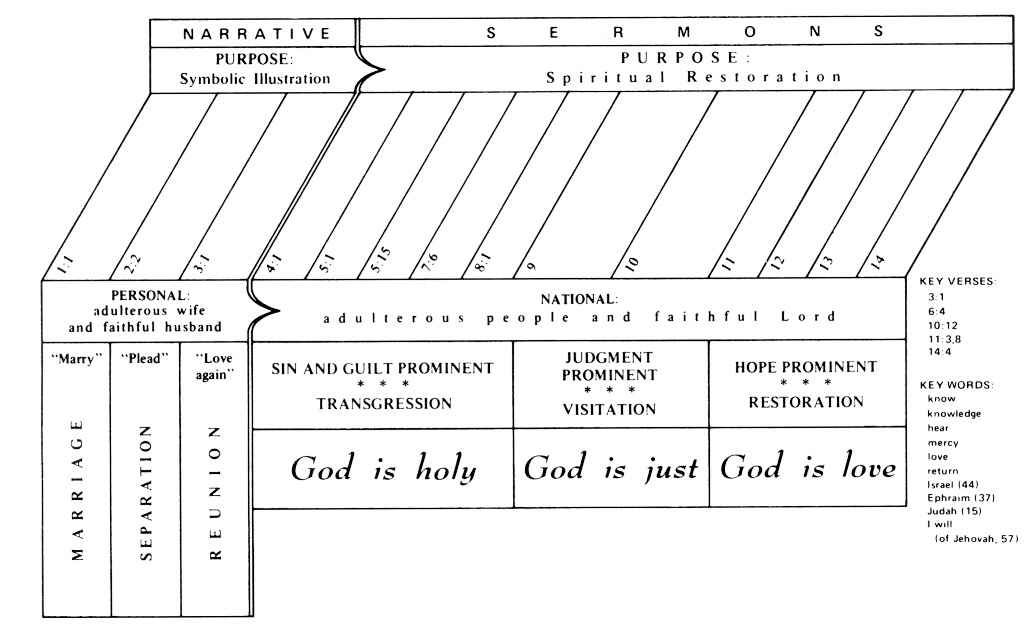
Click chart to enlarge
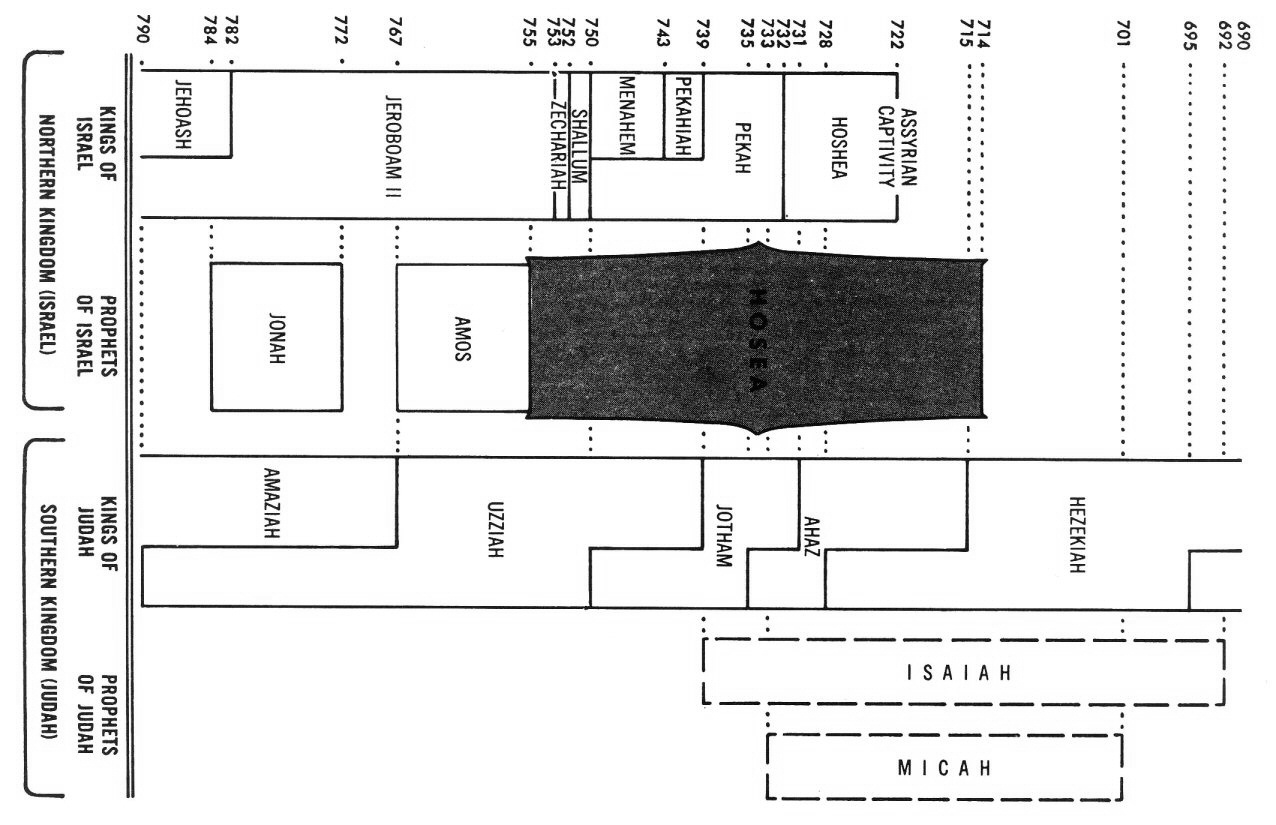
Click chart to enlarge
Chart from recommended resource Jensen's Survey of the OT - used by permission
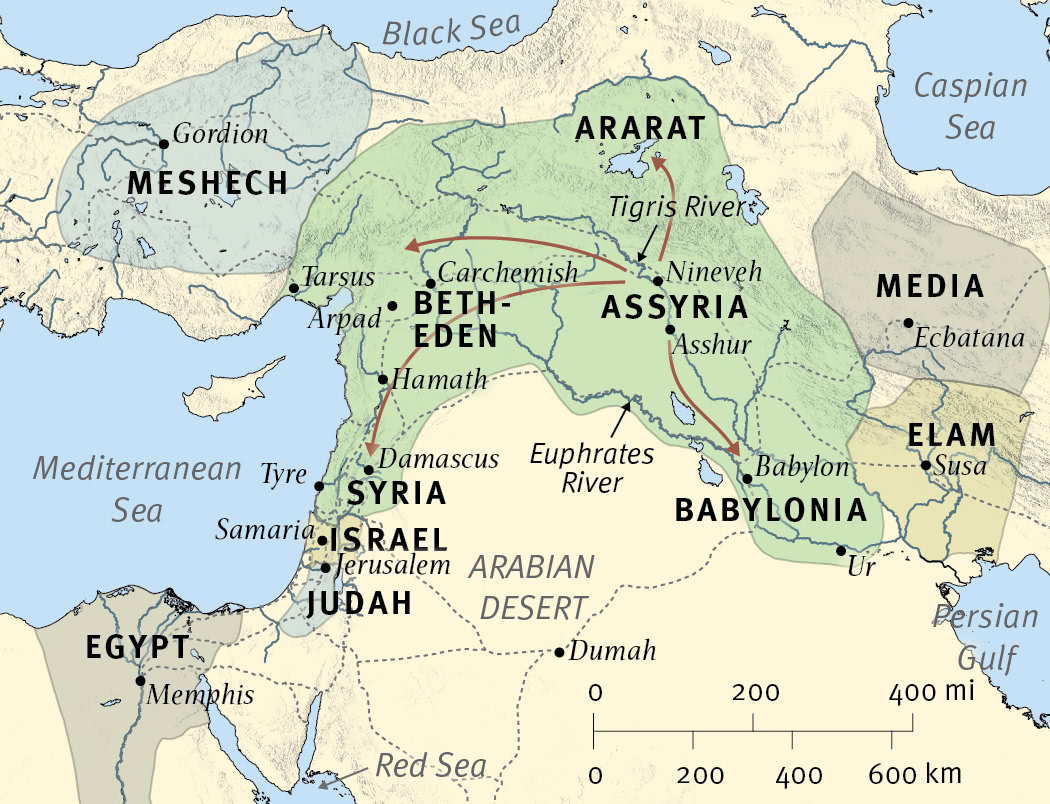
Source: ESV Global Study Bible
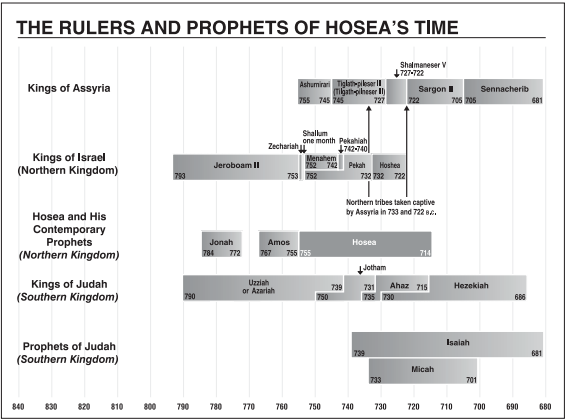
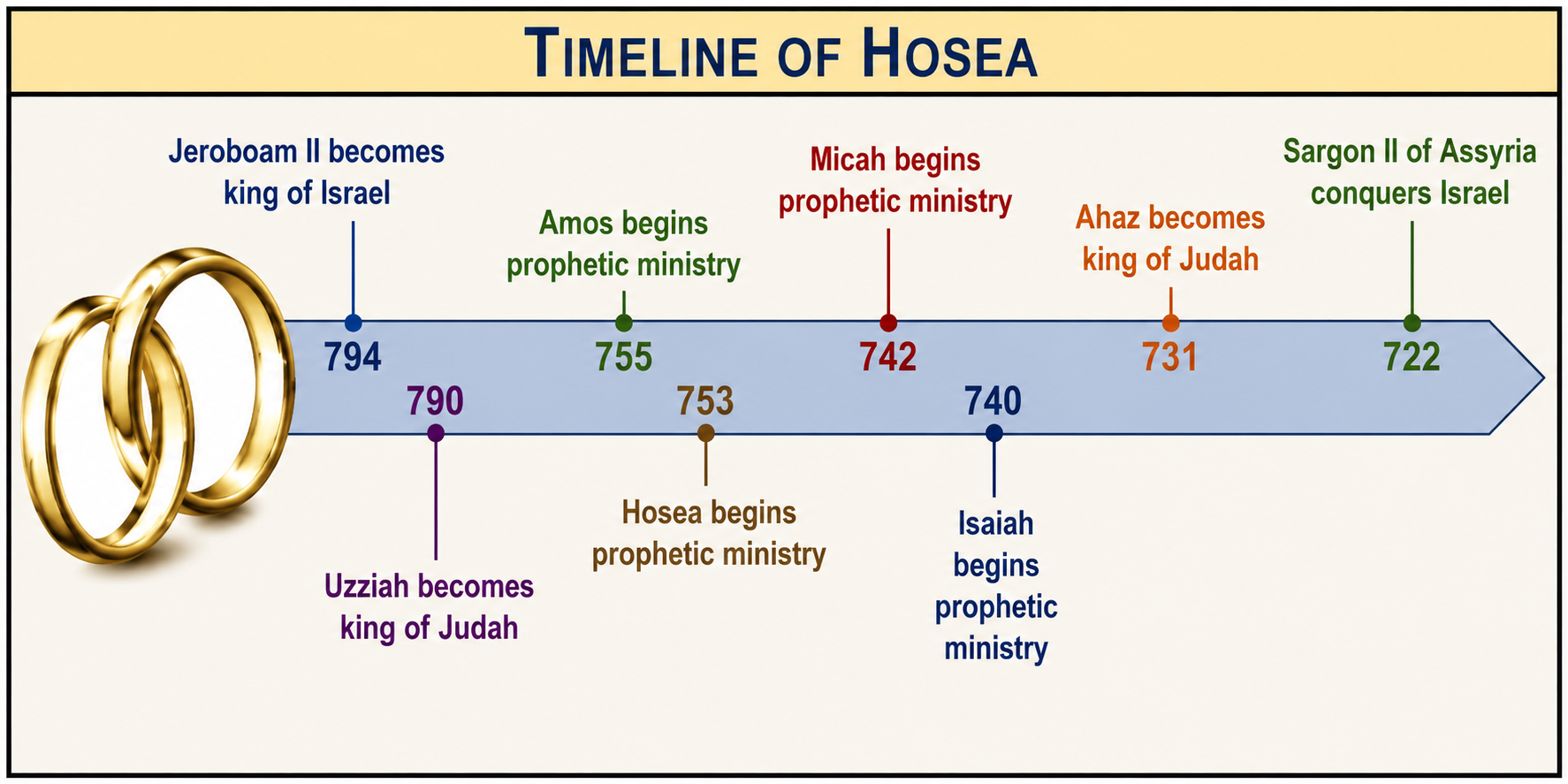
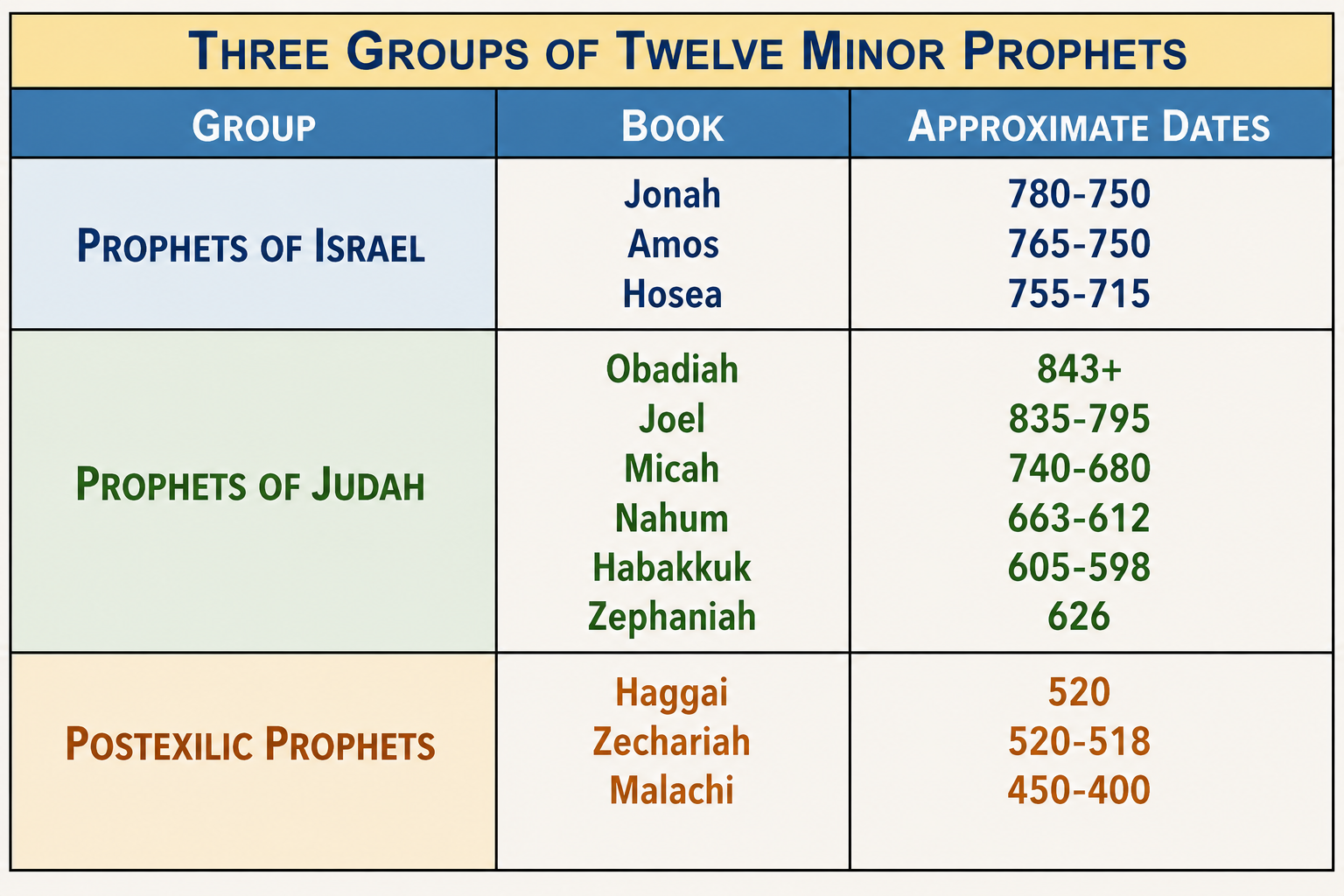
OUTLINE OF HOSEA
I. The Prodigal Wife, Hosea 1:1-3:5
A. Her Unfaithfulness, Hosea 1:1-11
B. Her Punishment, Hosea 2:1-13
C. Her Restoration and Israel's, Hosea 2:14-23
D. Her Redemption, Hosea 3:1-5
II. The Prodigal People, Hosea 4:1-14:9
A. The Message of Judgment, Hosea 4:1-10:15
1. The indictment, Hosea 4:1-19
2. The verdict, Hosea 5:1-15
3. The plea of Israel, Hosea 6:1-3
4. The reply of the Lord, Hosea 6:4-11
5. The crimes of Israel, Hosea 7:1-16
6. The prophecy of judgment, Hosea 8:1-10:15
B. The Message of Restoration, Hosea 11:1-14:9
1. God's love for the prodigal people, Hosea 11:1-11
2. God's chastisement of the prodigal people, Hosea 11:12-13:16
3. God's restoration of the prodigal people, Hosea 14:1-9
Ryrie Study Bible
Robert Chisholm points out that there are 5 "Judgment-Salvation" cycles in the book of Hosea:
| CYCLES OF JUDGMENT AND SALVATION IN HOSEA |
|
|
JUDGMENT |
SALVATION |
|
Hosea 1:2-9 |
Hosea 1:10-2:1 |
|
Hosea 2:2-13 |
Hosea 2:14-3:5 |
|
Hosea 4:1-5:14 |
Hosea 5:15-6:3 |
|
Hosea 6:4-11:7 |
Hosea 11:8-11 |
|
Hosea 11:12-13:16 |
Hosea 14:1-9 |
Hosea 5:1 Hear this, O priests! Give heed, O house of Israel! Listen, O house of the king! For the judgment applies to you, For you have been a snare at Mizpah And a net spread out on Tabor.
KJV Hear ye this, O priests; and hearken, ye house of Israel; and give ye ear, O house of the king; for judgment is toward you, because ye have been a snare on Mizpah, and a net spread upon Tabor.
NET Hear this, you priests! Pay attention, you Israelites! Listen closely, O king! For judgment is about to overtake you! For you were like a trap to Mizpah, like a net spread out to catch Tabor.
NLT "Hear this, you priests. Pay attention, you leaders of Israel. Listen, you members of the royal family. Judgment has been handed down against you. For you have led the people into a snare by worshiping the idols at Mizpah and Tabor.
BGT ἀκούσατε ταῦτα οἱ ἱερεῖς καὶ προσέχετε οἶκος Ισραηλ καὶ ὁ οἶκος τοῦ βασιλέως ἐνωτίζεσθε διότι πρὸς ὑμᾶς ἐστιν τὸ κρίμα ὅτι παγὶς ἐγενήθητε τῇ σκοπιᾷ καὶ ὡς δίκτυον ἐκτεταμένον ἐπὶ τὸ ἰταβύριον
LXE Hear these things, ye priests; and attend, O house of Israel; and hearken, O house of the king; for the controversy is with you, because ye have been a snare in Scopia, and as a net spread on Itabyrium,
CSB Hear this, priests! Pay attention, house of Israel! Listen, royal house! For the judgment applies to you because you have been a snare at Mizpah and a net spread out on Tabor.
ESV Hear this, O priests! Pay attention, O house of Israel! Give ear, O house of the king! For the judgment is for you; for you have been a snare at Mizpah and a net spread upon Tabor.
NIV "Hear this, you priests! Pay attention, you Israelites! Listen, O royal house! This judgment is against you: You have been a snare at Mizpah, a net spread out on Tabor.
YLT 'Hear this, O priests, and attend, O house of Israel, And, O house of the king, give ear, For the judgment is for you, For, a snare ye have been on Mizpah, And a net spread out on Tabor.
NKJ "Hear this, O priests! Take heed, O house of Israel! Give ear, O house of the king! For yours is the judgment, Because you have been a snare to Mizpah And a net spread on Tabor.
NJB Hear this, you priests, listen, House of Israel, pay attention, royal House, for it is you who have justice in your care, but you have been a snare at Mizpah and a net outspread on Tabor.
- Hear this, O priests: Ho 4:1,6,7 6:9 Mal 1:6 2:1
- Give heed, O house of Israel: Ho 7:3-5 1Ki 14:7-16 21:18-22 2Ch 21:12-15 Jer 13:18 22:1-9 Am 7:9 Mic 3:1,9
- For the judgment applies to you: Ho 9:11-17 10:15 13:8
- For you have been a snare at Mizpah: Ho 9:8 Mic 7:2 Hab 1:15-17
- And a net spread out on Tabor.: Jdg 4:6 Jer 46:18
Hear (shama; LXX - akouo) this, O priests! Give heed (qashab; LXX - prosecho - turn ones mind to something, pay close attention) , O house of Israel! Listen (azan; LXX - enotizomai - listen carefully), O house of the king! - Three commands to three groups. The priests were accused in Hosea 4. Give heed is literally “Use the ear”. To hear and not to do is not to heed! It's like going in one ear and out the other. We've all had kids like that! Unfortunately these are not unruly kids but an unruly nation! Here all society is addressed, beginning with the priests, including the Israelites and finally the leaders (kings).
The sin of idolatry like a venom
had infected high and low alike.
-- Charles Feinberg
Leon Wood - The threefold call to attention in this verse is parallel to a similar one in Hos 4:1. The general thought continues as before. Three imperatives demand attention; and three groups of people are alerted: the priests, already given special notice in chapter 4, the people of Israel, and the royal family (lit., "house of king"). (The Expositor's Bible Commentary)
Bob Utley - "Hear" See note at Hosea 4:1. This chapter starts out with three IMPERATIVES related to hearing God's message. (1) Hear,, Qal IMPERATIVE, "hear and obey," e.g. Deut. 6:4 (see LISTEN/HEAR [shema]); (2) Give heed, Hiphil IMPERATIVE, "listen attentively," e.g. Isa. 10:30; 28:23; 34:1; 49:1; Micah 1:2; (3) Listen, Hiphil IMPERATIVE, "give ear" e.g. Gen. 4:23; Num. 23:18; Isa. 32:9
For - Term of explanation, explaining why all three groups neede to pay careful attention.
The judgment (mishpat/mispat) applies to you - Literally = “for the judgment is to you”; or “For this accusation is against you.” Cf. NIV = “This judgment is against you.” God is now addressing those who bear the greatest responsibility for Israel's spiritual condition. While some interpreters limit this indictment to the priests and royal leaders, the context suggests that the judgment extends to priests, princes, and people alike—no one is exempt. Each shared responsibility for leading or participating in Israel's apostasy. Together they had ensnared the nation by promoting and embracing false worship and idolatry, making themselves fully accountable before the Lord.
Gilbrant - Neither the religious privileges of the priests, nor the multitude of the people, nor the civil dignity of the king, can exempt any from God’s judgment. The king was probably Zechariah.
Charles Feinberg - Those who were constituted the judges of God’s people were now to be judged by Him for their unfaithfulness to His truth and will. (See The Minor Prophets)
For you have been a snare (pach; LXX - pagis = literally anything that catches and holds fast) at Mizpah - Literally, "you were a trap to Mizpah." Instead of leading the people to worship Yahweh, Israel's priests and leaders had become "spiritual hunters," setting traps of idolatry and false religion to ensnare the unsuspecting. Like a concealed bird trap, their corrupt teaching and example lured the people into apostasy. Mizpah, a site once associated with covenant gatherings and God's dealings with His people. It was there that Samuel summoned Israel’s leadership for a religious service following the return of the ark from Philistine territory. In that service the leaders were asked to confess their sin in the mishandling of God’s sacred ark. (1Sa 7:1-14). It was there that Samuel summoned Israel’s leadership for a religious service, had become a center of spiritual deception. Its revered status likely made the trap even more effective, for the people assumed that worship offered at such a historic location must be acceptable to God. Thus, what should have been a place leading people to the Lord became a snare that led them away from Him.
🙏 THOUGHT - False religion is always a spiritual trap because every person is created with a God-given longing to worship (Eccl. 3:11). Even those who deny God's existence inevitably devote themselves to someone or something in His place, which is ultimately a form of idolatry (Ro 1:21-25). False religion appeals to fallen human nature because it substitutes ritual, ceremony, tradition, or repetitive religious activity for a genuine relationship with the living God. Tragically, millions are deceived into believing that their religion, sincerity, or good works will secure their place in heaven, when in reality they remain separated from God and on a fast track to Hell! Scripture is unequivocal: "There is salvation in no one else; for there is no other name under heaven that has been given among men by which we must be saved" (Acts 4:12). The only way of salvation is by personal faith in Jesus Christ, for "Believe in the Lord Jesus, and you will be saved" (Acts 16:31). Jesus Himself declared, "I am the way, and the truth, and the life; no one comes to the Father but through Me" (Jn. 14:6).
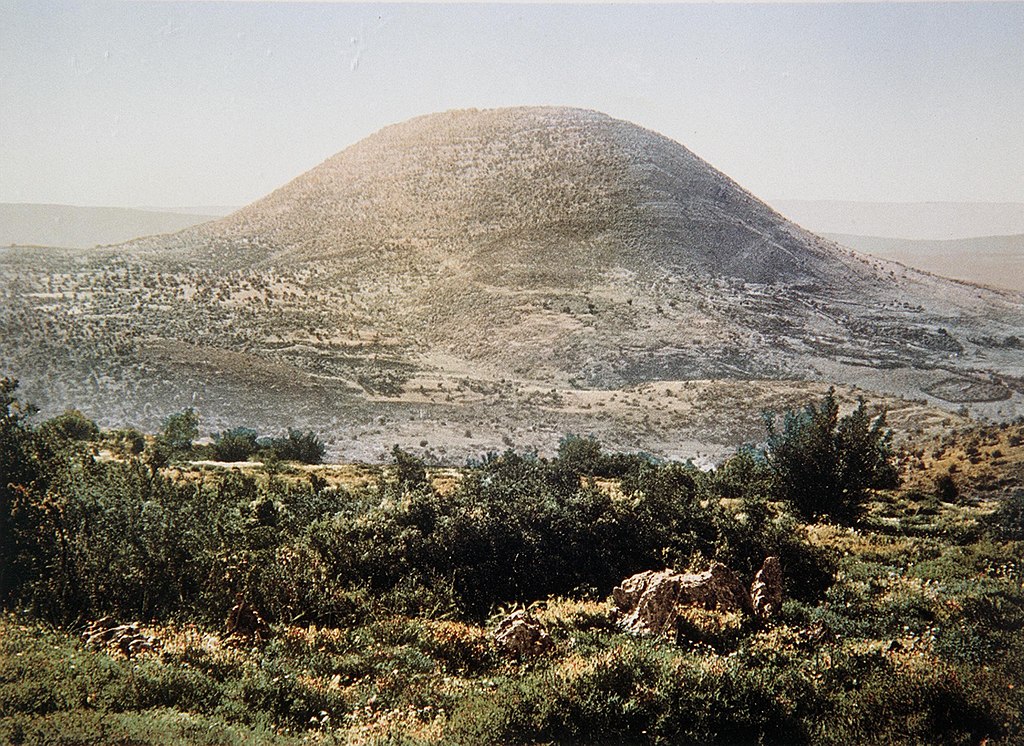
Mount Tabor
And a net (resheth) spread out on Tabor - Literally, "and a net spread out over Tabor." Continuing the hunting imagery, Hosea pictures Israel's leaders as expert fowlers who had spread a large net to capture unsuspecting birds. Mount Tabor (at the northeastern tip of the Jezreel Valley) once the scene of one of Israel's great victories under Deborah and Barak (Jdg. 4:6, 12, 14), had now become a center of spiritual deception. Instead of directing the people to Yahweh, the priests and leaders transformed this revered location into a place where false worship flourished, making it even easier to lure the people into idolatry. The very places that should have reminded Israel of God's faithfulness instead became instruments of apostasy. In striking contrast, the godly psalmist declared, "My eyes are continually toward the LORD, for He will pluck my feet out of the net" (resheth) (Ps. 25:15). Israel fixed her eyes on idols and was ensnared; believers are called to fix their eyes on the Lord, Who alone is able to deliver us from Satan's traps and keep us from spiritual deception. (cf. Ps. 91:3; 124:7; 141:9; 2 Tim. 2:26).
Bob Utley - ▣ "Mizpah" This (BDB 859) means "outpost" or "watchtower." There are so many towns by this name which are scattered throughout the Promised Land that the exact site is uncertain. However, we do know that it was the site of a sacred pillar which was the symbol of the male fertility god, Ba'al. ▣ "Tabor" This location in Canaan (BDB 1061), like other ancient sites, was once devoted to YHWH (i.e. Ps. 89:13; Jer. 46:18), but now it had become amalgamated with Tyrian Ba'alism.
Derek Kidner comments on the irony that "God sees them (ISRAEL) as a menace—this people called to be a blessing to the world! The label once fastened on the Canaanites, and also proverbially on prostitutes, comparing them to snares and traps, must now be pinned upon the Chosen People." (See The Message of Hosea)
Charles Feinberg - Mizpah in the east of the land and Tabor in the west were made places of a snare and trap where the people were enticed to worship idols in the high places. In short, instead of protecting the people from delusions that would lead them from the worship of the Lord, the leaders were the very ones who went forth as hunters to ensnare them from following the Lord.(See The Minor Prophets)
Constable - There was an Israelite Mizpah in Gilead (Judg. 10:17; 11:29) and one in the territory of Benjamin (1 Sam. 7:5; 10:1). Mt. Tabor stood in the Jezreel Valley in northern Israel. Probably these hunting sites represent the whole nation (by merism), from north to south or east to west. The point is that the leadership was corrupting the people everywhere.
The piercing eye of God saw secret liking and disposition to sin, the love the house of Israel had to their sins, and the dominion their sins had over them. Pride makes men obstinate in other sins. And as Judah was treading in the same steps, they would fall with Israel. By dealing treacherously with the Lord, men only deceive themselves. Those that go to seek the Lord with their flocks and their herds only, and not with their hearts and souls, cannot expect to find him; nor shall any speed who do not seek the Lord while he may be found. See how much it is our concern to seek God early, now, while it is the accepted time, and the day of salvation.
Am I a stepping stone
or a stumbling stone?
APPLICATION - Hosea's warning reminds us that spiritual influence is never neutral. Every parent, pastor, teacher, church leader, and believer is either leading others closer to Christ or away from Him (Mt. 5:16; 18:6). The priests and rulers of Israel should have pointed the people to Yahweh, but instead became snares and nets that trapped them in idolatry. We must therefore ask ourselves, Am I a stepping stone or a stumbling stone? (Ro. 14:13). Equally important, we must exercise discernment (1Th 5:20,21,22), for not every church, preacher, or religious movement that claims to speak for God actually does so (Mt. 7:15-23; Acts 20:28-30; 1 Jn. 4:1). Like the Bereans, we are to examine every teaching by the Scriptures (Acts 17:11). The safest place to be is with our eyes fixed on Jesus (Heb. 12:2), our minds anchored in His Word (Ps. 119:9-11, Col 3:16), and our hearts devoted to the true Shepherd, Who Alone can keep us from the snares of deception (2Ti 2:26; Jude 24,25, Ps 25:15, Ps 19:13, Ps 119:10, Ps 119:133, Mt 6:13).
Snare (06341)(pach) refers to a literal bird trap and thus means to ensnare, confine and control - As one would birds (Amos 3:5, Pr 7:23, Eccl 9:12). Most OT uses are figurative and refer to that which brings sudden danger and/or which entangles in difficulties, being held captive by circumstances. (Jos 23:13; Job 22:10; Ps 69:23; 91:3; 119:110; 140:6; 141:9; 142:4; Pr 22:5; Isa 24:17, 18; Jer 18:22; 48:43, 44; Hos 5:1; 9:8) The implication is that it is able to snare someone because it is deceptively attractive (eg, a woman who is not your wife - Pr 7:23).
(Hos. 9:8) Ephraim was a watchman with my God, a prophet; Yet the snare of a bird catcher is in all his ways, And there is only hostility in the house of his God.
Gilbrant - Occurring twenty-five times in the Hebrew Bible, the noun pach, which refers to a "snare" for birds, has cognates attested in Arabic, Christian Palestinian Aramaic, Syriac, Jewish Aramaic and Middle Hebrew. It is used exclusively in metaphors of humans being trapped by other humans or by the Lord. The effectiveness of the snare metaphor lies in the element of surprise. The victim does not sense danger until it is too late (Amos 3:5). The lure of the loose woman of Proverbs employs this simile (Prov. 7:23), as does a description of the effects of the syncretistic practices of the official priesthood of the northern kingdom of Israel (Hos. 5:1). The psalmist calls out for protection from the snares of the wicked (Ps. 140:5; 141:9; 142:3), as does Jeremiah (Jer. 18:22). Indeed, divine protection is characterized as rescue from a snare (Ps 91:3; 124:7). The Lord accused the wicked of ignoring his word delivered through the prophets, as they instead set snares for them (Hos. 9:8). The Day of the Lord will be catastrophic for the wicked, as wherever they turn, there will be no escape from the traps which the omnipresent Lord will set for them (Isa. 24:17f; Jer. 48:43f). The wicked will stumble and be caught in traps so that justice may prevail (Prov. 22:5). Indeed, Job's condition was proof in the eyes of his visitors that the wicked would be ensnared, for they were certain that Job had committed a grievous sin which he refused to admit (Job 18:8f; 22:10). The wicked inhabitants of Canaan who were not exterminated would serve as a snare to the Israelites who chose to intermarry with them, ultimately causing the Israelites to perish from the land which the Lord gave them (Josh. 23:13). (Complete Biblical Library Greek-English Dictionary)
Pach - 22v - snare(15), snares(4), trap(5). Jos. 23:13; Job 18:9; Job 22:10; Ps. 11:6; Ps. 91:3; Ps. 119:110; Ps. 124:7; Ps. 140:5; Ps. 141:9; Ps. 142:3; Prov. 7:23; Prov. 22:5; Eccl. 9:12; Isa. 8:14; Isa. 24:17; Isa. 24:18; Jer. 18:22; Jer. 48:43; Jer. 48:44; Hos. 5:1; Hos. 9:8; Amos 3:5
NET Note on snare - The noun פַּח (pakh, “trap”) is used (1) literally of a bird-trap, used in similes and metaphors (Amos 3:5; Prov 7:23; Eccl 9:12), and (2) figuratively to refer to (a) calamities and plots (Job 18:9; 22:10; Pss 91:3; 119:110; 124:7; 140:6; 141:9; 142:4; Prov 22:5; Isa 24:17–18; Jer 18:22; 48:43–44; Hos 9:8) and (b) a source of calamity (Josh 23:13; Pss 11:6; 69:23; Isa 8:14; Hos 5:1; BDB 809 s.v. פַּח).
Net (07568)(resheth) used predominantly used of a net for trapping (Job 18:8; Ps. 140:5). Often, the heathen are caught in their own traps (Ps 9:15; 35:7; 57:6). The believer should look to God, whose strength can deliver from the net (Ps 25:15; Ps 31:4).
Resheth - net(20), network(2). Ex 27:4; Exod. 27:5; Exod. 38:4; Job 18:8; Ps. 9:15; Ps. 10:9; Ps. 25:15; Ps. 31:4; Ps. 35:7; Ps. 35:8; Ps. 57:6; Ps. 140:5; Prov. 1:17; Prov. 29:5; Lam. 1:13; Ezek. 12:13; Ezek. 17:20; Ezek. 19:8; Ezek. 32:3; Hos. 5:1; Hos. 7:12
Gilbrant - In Exodus, the altar is to have a bronze "net" or "lattice" on it (Exo. 27:4f; 38:4). The resheth probably allowed for better ventilation and easier cleaning. The holes would have allowed the air to flow more freely and the ashes and grease to drop into the hollow opening (Durham, Exodus, 376).
John Hartley - Net is an instrument used to catch game, as birds (Proverbs 1:17); it was made out of cords woven together. Sometimes a net was spread over a pit; the animal became entrapped in the net as he fell into the hole. It also indicates the bronze grate placed under the altar which extended (or set in the middle (?)) halfway to the ground and had four bronze rings at its corners (Ex 27:4f.; Ex 38:4f.). It is translated "network" when used with maʿăśeh "work."This word is employed metaphorically to describe people being trapped by their enemies. The wicked spread nets to overcome the righteous (Ps 140:5), and the arrogant lay a net by flattery (Proverbs 29:5). However, they often become trapped in their own deeds (Job 18:8). Priests and rulers too lay a net for the people by entangling them in sin (Hosea 5:1). On the other hand, God spreads a net for disobedient Israel (Hosea 7:12; Ezekiel 12:13; Ezekiel 17:20; cf. Ezekiel 19:8) and for Pharaoh (Ezek 32:3). It means they shall be taken into captivity. This image draws from real life, for a picture in ANEP 288 shows a Mesopotamian king containing his enemies in a net (cf. Lament. 1:13). The righteous, however escape the net of the wicked by confidently calling on God, their refuge (Psalm 25:15; Psalm 31:4). (Theological Wordbook of the Old Testament)
NET Note on net - The noun רֶשֶׁת (reshet, “net”) is used (1) literally of a net used to catch birds (Prov 1:17) and (2) in figurative descriptions of the wicked plotting to ensnare their victims (Pr 29:5; Ps 9:16; 10:9; 25:15; 31:5; 35:7; 57:7; 140:6; Job 18:8; BDB 440 s.v. רֶשֶׁת).
Hosea 5:1-7 Today in the Word
Because of their sinful deeds, I will drive them out of my house . . . all their leaders are rebellious. Hosea 9:15
In November 1978, members of the Peoples Temple killed U.S. Congressman Leo Ryan who was investigating in Jonestown, Guyana, where hundreds of the cult’s members had fled to escape media scrutiny in the United States. Later that day, the cult’s founder and leader, Jim Jones, forced his followers to drink a cyanide-laced beverage and brutally murdered those who refused. Over 900 people died at the hands of the wicked leader who then killed himself. The Jonestown tragedy is an infamous example of how people in power can ensnare their victims. During the time of Hosea, the abysmal leadership of Israel’s kings and priests had brought an entire nation to destruction.
The religious and governmental leadership of Israel had forsaken their legitimacy, and the beginning of chapter 5 is directed specifically against them (v. 1). The kings and priests of Israel had openly welcomed pagan worship practices since the kingdom was divided (1 Kings 14; cf. Jer. 2:1–9) and had never completely eliminated foreign religious influence. God held those leaders accountable for entrapping the people and carrying them along in apostasy. As a result, the victims of their rebellion were piled like slaughtered animals (v. 2), and the hearts of the people became permanently misguided (v. 4).
It should be noted here that Ephraim was one of the tribes of Israel and was often used as another name for the northern kingdom. By using the names of Jacob’s son (Judah) and grandson (Ephraim, Joseph’s son), Hosea emphasized the ongoing aspect of Israel’s disobedience. After generations of defiance, the nation was about to experience God’s withdrawal from a loving relationship with them. Those who attempted to worship God would not find the opportunity (v. 6). With hearts saturated with lust for other gods and sexual promiscuity (v. 3), any sacrifice to God would have been rendered meaningless. Even the festivals ordained to thank God, instead commemorated Israel’s destruction (v. 7).
Apply the Word
Whether you’re a high-ranking leader in the church or a soft-spoken role model behind the scenes, your sin affects the people who look up to you. Take a moment to list all the people who may watch and imitate your behavior and attitudes. You might write down individual names or entire groups of people. Your children, family members, coworkers, students, and everyone on this list will be influenced for better or for worse by your actions. Ask God to lead you to shine as a guiding light for His glory.
Hosea 5:2 The revolters have gone deep in depravity, But I will chastise all of them.
KJV And the revolters are profound to make slaughter , though I have been a rebuker of them all.
NET Those who revolt are knee-deep in slaughter, but I will discipline them all.
NLT You have dug a deep pit to trap them at Acacia Grove. But I will settle with you for what you have done.
BGT ὃ οἱ ἀγρεύοντες τὴν θήραν κατέπηξαν ἐγὼ δὲ παιδευτὴς ὑμῶν
LXE which they that hunt the prey have fixed: but I will correct you.
CSB Rebels are deeply involved in slaughter; I will be a punishment for all of them.
ESV And the revolters have gone deep into slaughter, but I will discipline all of them.
NIV The rebels are deep in slaughter. I will discipline all of them.
YLT And to slaughter sinners have gone deep, And I am a fetter to them all.
NKJ The revolters are deeply involved in slaughter , Though I rebuke them all.
NJB They have dug the ditch deep at Shittim and so I am going to punish them all.
NRS and a pit dug deep in Shittim; but I will punish all of them.
RSV And they have made deep the pit of Shittim; but I will chastise all of them.
NAB In their perversity they have sunk into wickedness, and I am rejected by them all.
English Revised Version "And the revolters are gone deep in making slaughter; but I am a rebuker of them all."
- The revolters: Ho 6:9 9:15 Jer 6:28
- have gone deep in depravity: Ps 64:3-6 140:1-5 Isa 29:15 Jer 11:18,19 18:18 Lu 22:2-5 Ac 23:12-15
- But I will chastise all of them: Ho 6:5 Isa 1:5 Jer 5:3 25:3-7 Am 4:6-12 Zep 3:1,2 Rev 3:19
PEOPLE HUNTED
AND SLAUGHTERED
The revolters have gone deep in depravity - Note that this is one of the more difficult verses in Hosea to interpret (only the first half of this verse), so keep that in mind as you read these comments. Better rendered "the revolters have gone deep into slaughter," (ESV) Literally - “and those who revolt have gone deep into slaughter” (similar KJV, NIV). NET = "Those who revolt are knee-deep in slaughter." And this rendering would continue the hunting metaphor as they in effect (spiritually) "slaughter" their prey (many of whom would literally end up slaughtered by the brutal Assyrians). Other writers do not agree that this refers to physical slaughter (see Patterson below). The revolters are clearly those who have turned away from God's law.
TECHNICAL NOTE - The Masoretic Text reads slaughter (from shachat, with a tet), which is why ESV, NIV, NET, KJV, and CSB render it that way; NASB's "depravity" reads the word through the lens of the parallel idiom in Hosea 9:9, which uses the similar-sounding but distinct root shachath (with a taw); a third proposal reads "a pit at Shittim," completing the snare-net-pit hunting picture but requiring emendation the NET Bible's editors judge unnecessary — and since all three readings accuse Israel's leaders of preying on the very people they were charged to shepherd, and all agree that God says I am discipline to all of them, nothing of substance rides on the choice.
The only other use of "revolters" (rebels, deviators, swervers, defectors) (Hebrew transliterated = set) is in Ps 101:3 which says "I will set no worthless thing before my eyes; I hate the work of those who fall away (Heb = set; Septuagint = ekklino = literally turn away - figuratively morally deviating from a right path ); It shall not fasten its grip on me." In Hos 5:2 revolters, the word Hebrew "set," is translated in Septuagint with the verb agreuo which is used of hunting or fishing to take, catch unawares. Figuratively in the NT, agreuo is used of taking advantage of someone in an unguarded moment (cf Mk 12.13).
Richard Patterson on have gone deep in depravity - The result is that these revered places (MIZPAH, TABOR) in Israelite history have become scenes of spiritual degradation. So deeply stained with sin have these historic places become that they may be described as “knee deep in slaughter.” The reference may carry a double meaning and possibly refer to the heinous crime of child sacrifice (cf Ps 106:36-38) as well as metaphorically to Israel’s people as “slaughtered” victims of their leaders.
NET Note - The Masoretic Text reads וְשַׁחֲטָה שֵׂטִים הֶעְמִיקוּ (véshakhatah setim he’miqu): “and rebels have made deep the slaughter.” The BHS editors propose ושַׁחַת הַשִּׁטִּים הֶעְמִיקוּ (véshakhat hashittim he’miqu): “they have made the pit of Shittim [place of idolatry] deep” (cf. NRSV, TEV, NLT; see BDB 1006 s.v. שַׁחֲטָּה). This involves: (1) phonological confusion between the similar sounding consonants ת (tav) and ט (tet), (2) redivision of words to take ה (hey) as the article with הַשִּׁטִּים rather than feminine noun ending of וְשַׁחֲטָה, and (3) revocalization of הַשִּׁטִּים with the two daghesh fortes. Retaining the reading of the MT is preferable here.
But I will chastise (musar) all of them - Literally “but I am discipline to all of them”; ASV = “but I am a rebuker of them all.” The verb chastise in Lxx is paideutes which means corrector, one who disciplines and corrects by punishment.
Robert Chisholm notes that musar "refers here to severe punishment designed to restore one to proper behavior. As such, it is an expression of love that arises out of a close relationship (cf. Prov. 3:11; 13:24; 15:5). The positive goal of the Lord's judgment is evident (cf. Hosea 2:6-7; 5:15b). (See Bible Knowledge Commentary: Old Testament - Page 1391)
Chastise (discipline) (04148)(musar from yasar = to discipline, chasten, admonish) refers to discipline, chastening, correction. God's chastening is always for purposes of instruction, and should not be ignored or resented. (Job 5:17 cp Job 42:2). Solomon instructs us "My son, do not reject the discipline of the LORD Or loathe His reproof." (Pr 3:11) One of major purposes of wisdom literature is to teach wisdom and instruction (musar) (Pr 1:2) Isaiah describes the divine chastisement poured out on the Suffering Messiah (Isa 53:5).
Musar - 40x - chastening(3), chastise(1), correction(3), discipline(18), disciplines(1), instruction(20), punishment(2), reproof(1), warning(1).
Deut. 11:2; Job 5:17; Job 20:3; Job 33:16; Job 36:10; Ps. 50:17; Prov. 1:2; Prov. 1:3; Prov. 1:7; Prov. 1:8; Prov. 3:11; Prov. 4:1; Prov. 4:13; Prov. 5:12; Prov. 5:23; Prov. 6:23; Prov. 7:22; Prov. 8:10; Prov. 8:33; Prov. 10:17; Prov. 12:1; Prov. 13:1; Prov. 13:18; Prov. 13:24; Prov. 15:5; Prov. 15:10; Prov. 15:32; Prov. 15:33; Prov. 16:22; Prov. 19:20; Prov. 19:27; Prov. 22:15; Prov. 23:12; Prov. 23:13; Prov. 23:23; Prov. 24:32; Isa. 26:16; Isa. 53:5; Jer. 2:30; Jer. 5:3; Jer. 7:28; Jer. 10:8; Jer. 17:23; Jer. 30:14; Jer. 32:33; Jer. 35:13; Ezek. 5:15; Hos. 5:2; Zeph. 3:2; Zeph. 3:7
Hosea 5:3 I know Ephraim, and Israel is not hidden from Me; For now, O Ephraim, you have played the harlot, Israel has defiled itself.
KJV I know Ephraim, and Israel is not hid from me: for now, O Ephraim, thou committest whoredom, and Israel is defiled.
NET I know Ephraim all too well; the evil of Israel is not hidden from me. For you have engaged in prostitution, O Ephraim; Israel has defiled itself.
NLT I know what you are like, O Ephraim. You cannot hide yourself from me, O Israel. You have left me as a prostitute leaves her husband; you are utterly defiled.
BGT ἐγὼ ἔγνων τὸν Εφραιμ καὶ Ισραηλ οὐκ ἄπεστιν ἀπ᾽ ἐμοῦ διότι νῦν ἐξεπόρνευσεν Εφραιμ ἐμιάνθη Ισραηλ
LXE I know Ephraim, and Israel is not far from me: for now Ephraim has gone grievously a-whoring, Israel is defiled.
CSB I know Ephraim, and Israel is not hidden from Me. For now, Ephraim, you have acted promiscuously; Israel is defiled.
ESV I know Ephraim, and Israel is not hidden from me; for now, O Ephraim, you have played the whore; Israel is defiled.
NIV I know all about Ephraim; Israel is not hidden from me. Ephraim, you have now turned to prostitution; Israel is corrupt.
YLT I have known Ephraim, And Israel hath not been hid from me, For now thou hast gone a-whoring, Ephraim, Defiled is Israel.
NKJ I know Ephraim, And Israel is not hidden from Me; For now, O Ephraim, you commit harlotry; Israel is defiled.
NJB Ephraim have I known, Israel is not hidden from me; and yet, Ephraim, you have played the whore, Israel is befouled.
NRS I know Ephraim, and Israel is not hidden from me; for now, O Ephraim, you have played the whore; Israel is defiled.
- I know Ephraim: Am 3:2 Heb 4:13 Rev 3:15
- Ephraim: Ho 5:9,11,13 6:4 8:11 12:1 13:1 Ge 48:19,20 De 33:17 Isa 7:5,8,9,17
- you have played the harlot: Ho 4:17,18 1Ki 12:26-33 14:14-16 Eze 23:5-21
NOTHING WAS HIDDEN
FROM JEHOVAH
I know (yada) Ephraim, and Israel is not hidden from Me - Ephraim...Israel refer to northern kingdom. Jehovah was fully aware of Israel's spiritual condition. Their idolatry, hypocrisy, and covenant unfaithfulness had not escaped His notice. Though the people may have concealed their sins from one another or imagined that their religious rituals masked their rebellion, nothing is hidden from the all-seeing, all-knowing God. As Solomon declared, "The eyes of the LORD are in every place, watching the evil and the good" (Pr. 15:3; cf. Ps. 33:13-15; 90:8; 94:9; Heb. 4:13). God's statement, "I know Ephraim," is not merely an acknowledgment of His omniscience but a declaration that He knows them intimately, their outward actions, inward motives, and secret sins. Therefore, His coming judgment is neither arbitrary nor uninformed, but perfectly righteous because it is based on His complete and infallible knowledge of His people.
🙏 THOUGHT - Sometimes we deceive ourselves thinking that because we can commit a sin in "secret," unbeknownst to other people, God does not see. What if we simply stopped each time before we were going to commit our "secret" sin and say "Wait, this is not hidden from Jehovah!" (And as alluded to above we need to fix our eyes on Jesus - read/memorize Psalm 25:15 and ask the Spirit to enable you to practice the presence of the Lord!) Remember that secret sin on earth is open scandal in heaven! (Heb. 4:13).
Richard Patterson The Lord singles out Ephraim particularly for its leading role in all of this. For the importance of Ephraim’s leadership role in the Northern Kingdom is longstanding. Its very first king Jeroboam I was from Ephraim and it was he who began the worship at rival religious centers.
Wood - "The Bethel altar was in Ephraim, the center of a religion not only corrupt (see Hos 4:10, 12) but corrupting all Israel, also. God knew the whole sad story; nothing was hidden." (The Expositor's Bible Commentary)
For now, O Ephraim, you have played the harlot (zanah) - It is notable that the Septuagint translates zanahwith the Greek verb ekporneuo (ek = out or from + porneuo = commit fornication or lewdness) which is used only once in the NT in Jude 1:7 and means to be to be utterly unchaste. The picture is to give one's self over to indulge in flagrant immorality, to live licentiously. The use in Jude 1:7 reflects the force of the prefix ek meaning "out and out" and depicts the Sodomites as giving themselves up utterly to fornication. "The inhabitants of these depraved cities in Jude 1:7 made "an “out and out surrender to” extravagant sexual lust. Ge 19:5-9 clearly portrays the sin of the Sodomites as homosexuality. They were thoroughly committed to its practice." (Hiebert) The use of that rare verb to translate "play the harlot" suggests similar practices going on in Ephraim. At the very least the point is that they were engaged in unspeakably gross immorality. Enough said!
SELF-INFLICTED
WOUNDS
Israel has defiled (tame;LXX - miaino) itself - Israel had become spiritually and morally unclean through its persistent idolatry and covenant unfaithfulness. The verb tame means to become defiled, polluted, or ceremonially unclean, rendering a person unacceptable before a holy God. Other translations capture the sense well: "Israel has become corrupt" (NIV), "has made itself unclean" (NCV), and "are unfit to worship Me" (TEV). Significantly, Israel defiled itself; its corruption was self-inflicted and the result of deliberate choices, not unfortunate circumstances. In the Septuagint, ṭāmēʾ is translated by miaino, which literally means to stain or dye with another color. Figuratively, it describes something that has become morally contaminated, polluted, corrupted, or tainted, especially the mind and conscience (cf. Titus 1:15). In a ceremonial sense, it refers to that which is unclean and therefore unacceptable in God's presence. By embracing idols instead of Yahweh, Israel had not merely committed isolated acts of sin; the nation had become thoroughly stained by sin and unfit for the holy fellowship God desired with His covenant people. (cf. Lev. 11:44-45; Isa. 59:2; Titus 1:15).
Played the harlot (02181) (zanah) is a verb meaning to fornicate, to prostitute and refers to marital infidelity or unfaithfulness. It was word used elsewhere in the OT to describe prostitution (Lev 21:7, Pr 7:10). Many of the uses of zanah are figurative describing Israel 's (Jehovah's "wife") commission of "spiritual prostitution" by having "intercourse" so to speak with other gods (cp 1 Co 6:16). Indeed, idolatry is looked upon as prostitution (Isa 50:1, 2, 3; 54:6, 7, 8; Jer 2:1, 2, 3; 3:1ff; Hos 2:1ff; Jas 4:4-note; Rev 2:4-note). In addition zanah describes Israel’s improper relationships with other nations (Isa. 23:17; Ezek. 23:30; Nah. 3:4). "The thought seems to be of having relations with these nations for the sake of political and monetary benefit, although in the case of Nineveh the added element of alluring, deceitful tactics leading on to oppressive dominance is implied." (TWOT) "A third figurative meaning is found in Isa 1:21, where the Israelites’ departure from God’s approved moral standards is called harlotry." (TWOT)
ZANAH IN HOSEA - Hos. 2:5; Hos. 3:3; Hos. 4:10; Hos. 4:12; Hos. 4:13; Hos. 4:14; Hos. 4:15; Hos. 4:18; Hos. 5:3; Hos. 9:1
Defiled (made unclean) (02930)(tame) means to become unclean or make unclean. To become ceremonially unclean. To defile oneself (Hos 5:3, 6:10, Ezek 20:30). A wife defiles herself by adultery (Nu 5:13, Jer 2:23 = speaks of Israel as God's wife who had defiled herself by her spiritual adultery with idols!, Ezek 23:13 = refers to Judah and in context to the 10 Northern tribes - both had defiled themselves). To defile (violate) a girl (Ge 34:5), a woman (Ezek 18:6)
TAME - 3X IN HOSEA Hos 5:3, Hos 6:10, Hos 9:4
Hosea 5:4 Their deeds will not allow them To return to their God. For a spirit of harlotry is within them, And they do not know the LORD.
KJV They will not frame their doings to turn unto their God: for the spirit of whoredoms is in the midst of them, and they have not known the LORD.
NET Their wicked deeds do not allow them to return to their God; because a spirit of idolatry controls their heart, and they do not acknowledge the LORD.
NLT Your deeds won't let you return to your God. You are a prostitute through and through, and you do not know the LORD.
BGT οὐκ ἔδωκαν τὰ διαβούλια αὐτῶν τοῦ ἐπιστρέψαι πρὸς τὸν θεὸν αὐτῶν ὅτι πνεῦμα πορνείας ἐν αὐτοῖς ἐστιν τὸν δὲ κύριον οὐκ ἐπέγνωσαν
LXE They have not framed their counsels to return to their God, for the spirit of fornication is in them, and they have not known the Lord.
CSB Their actions do not allow them to return to their God, for a spirit of promiscuity is among them, and they do not know the LORD.
ESV Their deeds do not permit them to return to their God. For the spirit of whoredom is within them, and they know not the LORD.
NIV "Their deeds do not permit them to return to their God. A spirit of prostitution is in their heart; they do not acknowledge the LORD.
YLT They give not up their habitual doings, To turn back unto their God, For a spirit of whoredoms is in their midst, And Jehovah they have not known.
NKJ "They do not direct their deeds Toward turning to their God, For the spirit of harlotry is in their midst, And they do not know the LORD.
NJB Their deeds do not allow them to return to their God, since an urge to play the whore possesses them and they no longer know Yahweh.
NRS Their deeds do not permit them to return to their God. For the spirit of whoredom is within them, and they do not know the LORD.
RSV Their deeds do not permit them to return to their God. For the spirit of harlotry is within them, and they know not the LORD.
NAB Their deeds do not allow them to return to their God; For the spirit of harlotry is in them, and they do not recognize the LORD.
GWN "The wicked things that the people have done keep them from returning to their God. They have a spirit of prostitution, and they don't know the LORD.
- Their deeds will not allow them. Ps 36:1-4 78:8 Joh 3:19,20 2Th 2:11,12
- For a spirit of harlotry is within them: Ho 4:12 Jer 50:38
- And they do not know the LORD. Ho 4:1 1Sa 2:12 Ps 9:10 Jer 9:6,24 22:15,16 24:7 Joh 8:55 Jn 16:3 1Jn 2:3,4
Related Passages:
Hosea 4:12 My people consult their wooden idol, and their diviner’s wand informs them; For a spirit of harlotry has led them astray, And they have played the harlot, departing from their God.
Hosea 1:2 When the LORD first spoke through Hosea, the LORD said to Hosea, “Go, take to yourself a wife of harlotry and have children of harlotry; for the land commits flagrant harlotry, forsaking the LORD.”
Romans 6:16-19 Do you not know that when you present yourselves to someone as slaves for obedience, you are slaves of the one whom you obey, either of sin resulting in death, or of obedience resulting in righteousness? 17 But thanks be to God that though you were slaves of sin, you became obedient from the heart to that form of teaching to which you were committed, 18and having been freed from sin, you became slaves of righteousness. 19I am speaking in human terms because of the weakness of your flesh. For just as you presented your members as slaves to impurity and to lawlessness, resulting in further lawlessness, so now present your members as slaves to righteousness, resulting in sanctification.
John 16:3 “These things they will do because they have not known the Father or Me.
John 17:3 This is eternal life, that they may know You, the only true God, and Jesus Christ whom You have sent.
THE BONDAGE OF
HABITUAL SIN
This is a frightening verse for it shows the enslaving power of sin persisted in!
Their deeds will not allow them - Literally, "their deeds do not permit them." Israel's outward actions were the visible evidence of an inward spiritual corruption. Their sinful conduct did not merely reveal the condition of their hearts but it also reinforced it, making repentance increasingly difficult. Their deeds had become habitual, creating a moral and spiritual bondage that kept them from turning back to the Lord. As Jesus taught, "everyone who commits sin is the slave of sin" (Jn. 8:34). Their defiled hearts produced defiling deeds, and those deeds, in turn, further hardened their hearts. This illustrates the deceitful, enslaving cyclical nature of sin: the longer it is practiced, the more power it gains over the sinner (Heb. 3:13). Israel's inability to return to God was not because God was unwilling to receive them, but because they had so persistently embraced sin that their own actions had become chains binding them to their rebellion. (cf. Jer. 13:23; Ro 6:16-19).
In Pr 5:22 Solomon stated the same truth - "His own iniquities will capture the wicked, And he will be held with the cords of his sin." Israel was now in a state of held by the cords of their sin!
Their acts reflected the attitude of their heart, the defiled condition of their heart which resulted in defiling deeds.
🙏 THOUGHT - Isn't that always the case? Jesus clearly taught this integral heart-deeds dynamic declaring (Mt 15:19-20) “For out of the heart come evil thoughts, murders, adulteries, fornications, thefts, false witness, slanders. These are the things which defile the man; but to eat with unwashed hands does not defile the man.” Because this is a "truism" it is imperative to seek to practice (enabled by the Spirit) Proverbs 4:23 "Watch (command and in the Septuagint = present imperative) over your heart with all diligence, For from it flow the springs of life." (See discussion of the Need for the Holy Spirit to obey these commands)
Charles Feinberg - The evil power of the Israelites’ ungodly habits is having its way (ED: SIN HAS POWER!), for their deeds will not permit them to turn to the Lord. They are held by them as in a vice. Like a spirit of drunkenness or the spirit of stupor so has the spirit of whoredom, of spiritual defection, settled upon the people. They have become spiritually darkened, therefore, and know not Jehovah. (See The Minor Prophets)
they had passed
the point of no return
Bob Utley - This verse personifies Israel's idolatry (cf. Hosea 4:1; JPSOA, "because of the lecherous impulse within them"). Some scholars see this in combination with Hosea 4:12,19 as a personal evil influence (see PERSONAL EVIL). The people of Israel had become so settled in their evil character (i.e. "spirit of harlotry") that they had passed the point of no return (cf. Hosea 4:17; Job 8:4; Ps. 81:12; Rom. 1:24,26,28). Oh my, Oh my, Oh my!! For "return" see REPENTANCE (OT)
John Phillips - The One who had experienced Israel's perfidy over and over again said, "They will not" (italics added). The battle against evil always ends up as a battle of the will. The wicked should not say that they cannot overcome evil; the truth is that they will not. (See Exploring the Minor Prophets: An Expository Commentary - Page 50)
To return (shub/sub; LXX - epistrepho - turn around, turn back, repent - Mk 4:12) to their God - The people desired "prostitution" with the false gods (and the lascivious, gross, abominable sex that was associated with their so-called "worship!"). So "God gave them over in the lusts of their hearts to impurity, so that their bodies would be dishonored among them." (Ro 1:24). In essence, God said you want idols and their associated immorality, then I will give you over to them, which is a frightening place to be!
🙏THOUGHT: BEWARE! This passage is a sobering reminder that persistent sin eventually enslaves the sinner (Jn 8:34). Israel's problem was not merely that they committed sinful acts, but that their deeds had become a settled pattern, making repentance increasingly difficult. BEWARE!
Repentance becomes impossible for a people totally devoted to sin. Evil deeds raise a barrier between a sinner and God. They raise wicked pride in people's hearts, barring saving humility and repentance. Adulterous Israel (Hos 1:2) had become totally corrupt or unclean (Eze 39:23,24), unfit for God's presence. Instead of letting God's Spirit lead them, they followed the "spirit of prostitution.'' They did not even know God (Hos 4:1-2). They stumbled along a crooked path of sin (Isa 1:2-4). Such a path certainly cannot lead the way to God, who cannot accept unfaithful, treacherous people (Isa 48:1-9). Political allies cannot cure sin sickness. They cannot fight God's discipline. Only confession of sin and guilt or shame (2Ch 28:9-13, 1Jn 1:9) can bridge the sin gap which separates us from God.
For (term of explanation) a spirit (ruah/ruach; LXX - pneuma) of harlotry (zenunim; LXX - porneia - generally, of every kind of extramarital, unlawful, or unnatural sexual intercourse) is within them - "A spirit of harlotry" describes not an occasional lapse but a governing bent so that the direction their inner life now leans by default to harlotry. Literally = "spirit of harlotries”; NLT = "You are a prostitute through and through" CSB = spirit of promiscuity" NIV =“a spirit of prostitution”; TEV = “Idolatry has a powerful hold on them.” CEV interprets it literally: “your constant craving for sex keeps you from knowing me.” There is undoubtedly truth in the CEV paraphrase because Israel's whoring after idols was usually associated with abominable sexual immorality especially on the so-called "high places." As we have noted repeatedly idolatry and immorality frequently traffic together in Scripture.
In Hosea zānâh is overwhelmingly figurative for idolatry, describing spiritual adultery against Israel's covenant Husband. The pattern runs through the prophets: Isaiah 54:6–8; Jeremiah 2:2, 3:1ff; Ezekiel 16 and 23; and extends even into the New Testament — "You adulteresses, do you not know that friendship with the world is hostility toward God?" (James 4:4).
God says He knows Ephraim,
but Ephraim does not know Him.
-- Charles Feinberg
And they do not know (yada ) the LORD - They were not genuine believers. Know (yada) speaks of intimacy (Adam and Eve in Ge 4:1). Because they were "intimate" with idolatry, they could hardly be "intimate" with the true and living God, for one cannot serve God and mammon (Mt 6:24). Of course, they undoubtedly knew about God, even as many in America know things about Him. But the difference between knowing about God and knowing God is the difference between hell and heaven!
Bob Utley - they do not know the Lord" The Hebrew term "to know" implies intimate relationship (cf. Gen.4:1). They had no personal relationships with YHWH though they were active participators in religious ritual and liturgy (cf. Isa. 29:13). Lack of knowledge, both personal and covenantal, is the recurrent theme of Hosea (cf. Hosea 2:20; 4:1,6; 6:3,6).
Harlotry (02183) zenunim is a Hebrew noun derived from zānâh (זָנָה) denotes fornication or harlotry, but its significance extends far beyond physical immorality into the realm of covenant theology and spiritual allegiance. At its most basic, the term refers to sexual unfaithfulness that violates the exclusivity of the marriage relationship (Hos. 4:11). In this literal sense, it describes acts that break the one-flesh union established by God, highlighting the betrayal of intimacy, trust, and covenant loyalty. However, the dominant usage in Scripture is figurative, where the word becomes a powerful theological metaphor. It depicts Israel’s breach of her covenant relationship with Yahweh, who is portrayed as her Husband (cf. Jer. 2:2; Isa. 54:5). Thus, “fornication” comes to mean spiritual infidelity—giving to others the devotion, trust, and worship that belong to God alone.
ZENUNIM - 13X/11V - harlotries(5), harlotry(8). Gen. 38:24; 2 Ki. 9:22; Jer. 3:2; Ezek. 23:11; Ezek. 23:29; Hos. 1:2; Hos. 2:2; Hos. 2:4; Hos. 4:12; Hos. 5:4; Nah. 3:4
This spiritual harlotry manifests in several interrelated ways:
Idolatry – The primary sense: Israel “prostitutes” herself by worshiping false gods, often at high places or through images (“stones and stocks,” Jer. 3:9). This is not merely religious error but covenant betrayal, exchanging the living God for lifeless substitutes.
Covenant rebellion – The term also encompasses a broader posture of disobedience and refusal to submit to God (Num. 14:33). It reflects a heart that has turned away, not just in worship but in will.
Moral corruption – Because idolatry reshapes behavior, this “fornication” includes the ethical decay that flows from abandoning God (Hos. 6:10). Spiritual unfaithfulness inevitably produces social and personal sin.
Misplaced trust and alliances – In passages like Ezekiel 23, the imagery includes reliance on foreign nations. Such alliances often involved invoking foreign deities and trusting human power instead of Yahweh. Thus, political compromise becomes another form of spiritual adultery.
Defilement of the land – This sin is not isolated to individuals; it spreads and contaminates the entire community and even the land itself (Jer. 3:2). The imagery conveys pervasive, public, and normalized unfaithfulness.
Yada (יָדַע) — Hebrew for "know" — carries a wide range of meanings beyond mere intellectual awareness: understanding good/evil (Gen. 3:22), experiential knowledge gained through living something out (Deut. 8:2-5), personal relationship with a person or with God (Deut. 4:35; Hos. 4:1), sexual intimacy (Gen. 4:1; Luke 1:34), learned skill (Gen. 25:27), and wisdom (Prov. 1:2). It's also used of God testing someone so they come to know their own faith through the experience (Gen. 22:1,12; Deut. 8:2) — not God learning something new. Hosea 6:6 sums up its highest use: God desires relational knowledge of Him over ritual sacrifice.
QUESTION: What was the "spirit of prostitution (HARLOTRY)"? GOTQUESTIONS.ORG
ANSWER: Hosea 4:12 makes a strong and graphic accusation against Israel: “My people inquire of a piece of wood, and their walking staff gives them oracles. For a spirit of whoredom has led them astray, and they have left their God to play the whore.” Why would God say Israel had a spirit of whoredom (“spirit of prostitution,” NIV)?
This provocative label is given to idolaters. We read that the Israelites “inquire of a piece of wood.” In other words, Israelites were consulting wooden idols. They had invested financially in making these idols or in asking others to give advice from idols. These idolaters were “unfaithful” to the Lord as they paid to have a relationship with other gods. God’s people are to be faithful to Him; to chase after other gods is to commit “spiritual adultery.”
The “spirit of whoredom” could be a poetic reference to Israel’s desire to practice idolatry. However, there is a real connection between idolatry and the spirit world: “They sacrificed to demons, which are not God—gods they had not known” (Deuteronomy 32:17). There are spirits, demonic in nature, which set themselves up as “gods” in this world and demand worship. The “spirit of whoredom” could be a literal entity that led Israel astray.
Hosea 4:13 continues to delineate the problem: “They sacrifice on the tops of the mountains and burn offerings on the hills, under oak, poplar, and terebinth, because their shade is good. Therefore your daughters play the whore, and your brides commit adultery.” Israel’s spiritual prostitution included offering sacrifices to false gods. This was in violation of God’s Law that commanded sacrifice only to the Lord in the temple in Jerusalem. The worship of other gods often included actual prostitution, a sexual sin that the Israelites had been commanded to avoid.
Such strong words from God through the prophet Hosea were intended to condemn idolatry and call Israel to repentance. God offered forgiveness and restoration even to those who had been so wicked. Hosea himself served as an example of God’s grace: his wife Gomer was unfaithful to him, yet he restored his relationship with her (Hosea 1:2; 3:1-5). In the same way, God was willing to restore His relationship with His people who had strayed into idolatry.
Hosea 14, the final chapter of the book, reveals the Lord’s desire for His people: “Return, O Israel, to the LORD your God, for you have stumbled because of your iniquity” (Hosea 14:1). Verse 4 likewise encourages, “I will heal their apostasy; I will love them freely, for my anger has turned from them.” Verse 7 poetically describes a restored Israel in the future: “They shall return and dwell beneath my shadow; they shall flourish like the grain; they shall blossom like the vine.”
Despite wayward Israel’s following a “spirit of prostitution,” it is clear the Lord’s desire was to restore His people, calling them to repentance and a renewed relationship. This gracious offer to sinners is still extended to individuals today through Jesus Christ. He has offered forgiveness of sin and the opportunity for a relationship with God for everyone who trusts in Him (John 3:16; Ephesians 2:8-9).
Hosea 5:5 Moreover, the pride of Israel testifies against him, And Israel and Ephraim stumble in their iniquity; Judah also has stumbled with them.
KJV And the pride of Israel doth testify to his face: therefore shall Israel and Ephraim fall in their iniquity; Judah also shall fall with them.
NET The arrogance of Israel testifies against it; Israel and Ephraim will be overthrown because of their iniquity. Even Judah will be brought down with them.
NLT "The arrogance of Israel testifies against her; Israel and Ephraim will stumble under their load of guilt. Judah, too, will fall with them.
BGT καὶ ταπεινωθήσεται ἡ ὕβρις τοῦ Ισραηλ εἰς πρόσωπον αὐτοῦ καὶ Ισραηλ καὶ Εφραιμ ἀσθενήσουσιν ἐν ταῖς ἀδικίαις αὐτῶν καὶ ἀσθενήσει καὶ Ιουδας μετ᾽ αὐτῶν
LXE And the pride of Israel shall be brought low before his face; and Israel and Ephraim shall fall in their iniquities; and Judas also shall fall with them.
CSB Israel's arrogance testifies against them. Both Israel and Ephraim stumble because of their wickedness; even Judah will stumble with them.
ESV The pride of Israel testifies to his face; Israel and Ephraim shall stumble in his guilt; Judah also shall stumble with them.
NIV Israel's arrogance testifies against them; the Israelites, even Ephraim, stumble in their sin; Judah also stumbles with them.
YLT And humbled hath been the excellency of Israel to his face, And Israel and Ephraim stumble by their iniquity, Stumbled also hath Judah with them.
NKJ The pride of Israel testifies to his face; Therefore Israel and Ephraim stumble in their iniquity; Judah also stumbles with them.
NJB Israel's arrogance is his accuser, the guilt of Israel and Ephraim is their undoing, Judah too will be undone with them.
- the pride of Israel: Ho 7:10 Pr 30:13 Isa 3:9 Isa 9:9,10 Isa 28:1-3
- testifies against him: Isa 44:9 Isa 59:12 Jer 14:7 Mt 23:31 Lu 19:22
- Israel and Ephraim stumble in their iniquity: Ho 4:5 14:1 Pr 11:5,21 Pr 14:32 Pr 24:16 Am 5:2
- Judah also has stumbled with them: Ho 5:14 Hos 8:14 2Ki 17:19,20 Eze 23:31-35 Am 2:4,5
Related Passages:
Hosea 7:10 Though the pride of Israel testifies against him, Yet they have not returned to the LORD their God, Nor have they sought Him, for all this.
Isaiah 59:12 For our transgressions are multiplied before You, And our sins testify against us; For our transgressions are with us, And we know our iniquities:
Jeremiah 14:7 “Although our iniquities testify against us (REFERS TO JUDAH), O LORD, act for Your name’s sake! Truly our apostasies have been many, We have sinned against You.
Hosea 14:1 Return, O Israel, to the LORD your God, For you have stumbled because of your iniquity.
Isaiah 3:9 The expression of their faces bears witness against them, And they display their sin like Sodom; They do not even conceal it. Woe to them! For they have brought evil on themselves.
Amos 5:2 She has fallen, she will not rise again– The virgin Israel. She lies neglected on her land; There is none to raise her up.
Isaiah 3:8 For Jerusalem has stumbled and Judah has fallen, Because their speech and their actions are against the LORD, To rebel against His glorious presence.
Jeremiah 6:21 Therefore, thus says the LORD, “Behold, I am laying stumbling blocks before this people. And they will stumble against them, Fathers and sons together; Neighbor and friend will perish.”
Proverbs 11:5 The righteousness of the blameless will smooth his way, But the wicked will fall by his own wickedness.
PRIDE WAS A WITNESS
AGAINST ISRAEL!
Moreover, the pride (gaon; LXX - hubris - insolence, arrogance) of Israel testifies against him - Their own arrogance took the witness stand (so to speak is personified as a witness) against unfaithful Israel. God is opposed to (antitasso from anti = against + tasso = order, set means to set an army in array against, to arrange in battle order; to line oneself up against) the proud, which is a picture of Him "stiff arming" the prideful person! Woe! (see commentary on James 4:6). (cf similar expression 1 Sa 12:3, 2 Sa 1:16). Proverbs 16:18 says "Pride goes before destruction, And a haughty spirit before stumbling."
sin inevitably becomes
the stumbling stone of the sinner
And Israel and Ephraim stumble (kashal) in their iniquity ('avon; LXX - adikia - disregard for what is right, wrongdoing) - The verb kashal means to stumble, totter, stagger, fall, or collapse, often describing someone who loses his footing because of weakness or an obstacle. Figuratively, it speaks of spiritual and moral failure that results in ruin and judgment. Israel's downfall was not caused by unfortunate circumstances or foreign enemies, but by their own iniquity. Their persistent sin had become the very obstacle over which they stumble. Having rejected God's truth and embraced idolatry, they were no longer walking securely in His way but were stumbling headlong toward destruction. The picture is one of a traveler whose own path has become treacherous because of his own choices. As Proverbs warns, "The way of the wicked is like darkness; they do not know over what they stumble" (Pr 4:19). Hosea's point is that sin inevitably becomes the stumbling stone of the sinner. What Israel embraced for pleasure, prosperity, and security ultimately became the cause of her downfall (cf. Hos 14:1; Isa. 3:8; Jer. 6:21; Ro 14:13).
Charles Feinberg - Instead of the warnings of God bringing about deep searchings of heart and turning back to the Lord, Israel has become unbearably proud. Pride is always out of place and is so often meant to conceal other errors. But the very arrogance of Israel, fed by the outward prosperity of the land, will testify against the people in the hour of national decline and ruin. Pride ever goes before a fall, so both Ephraim and Judah are headed for a fall. (See The Minor Prophets)
As Constable says "With their proud noses high in the air, they frequently stumbled as they walked. Judah had also stumbled in some of the same sins."
Bob Utley - "stumble. . .stumbled" The VERB (BDB 505, KB 502) is used twice in Hosea 5:5. In the OT YHWH's will for His people was characterized as a path or way (see following note). To leave the path or stumble on the way was imagery for sin and rebellion (cf. Hosea 14:1). Often "stumble" is paired with "fall" (cf. Prov. 24:17; Isa. 3:8; 31:3; Jer. 6:15; 8:12; 46:6,16), but also used in a figurative sense.
The Hebrew concept of "the way" (derek) frequently pictures one's manner of life or conduct. A godly life is portrayed as walking on a straight, clear, and well-marked path that God has revealed through His Word (Ps. 16:11; 25:4; 27:11; 86:11; 119:35, 105; 139:24; Isa. 40:14). God's will is not hidden; He calls His people to walk faithfully in His ways without turning to the right or the left (Deut. 5:32; 17:11, 20; 28:14; 31:29; Prov. 4:27). Throughout Scripture, this imagery represents a lifestyle of obedient faith (Ex. 16:4; Isa. 30:20; 42:24; Jer. 9:12; 26:4; 32:23; 44:10, 23; Zech. 7:12), a theme especially prominent in Proverbs (Prov. 1:19; 2:8, 13, 15, 19-20; 3:6; 4:10-19; 8:20; 10:17; 12:28; 15:24). This Old Testament picture continues in the New Testament, where Christianity was first known as "the Way" (Acts 9:2; 19:9, 23; 22:4; 24:14, 22), emphasizing that following Christ is not merely believing certain truths but living in daily obedience. Jesus declared, "I am the way" (Jn. 14:6), and believers are called to walk in a manner worthy of their calling (Eph. 4:1, 17; 5:2, 15).
NET Note on stumble - Heb “will stumble” (so NCV, NLT). The verb כָּשַׁל (kashal, “to stumble; to stagger; to totter”) is used figuratively to describe distress (Isa 59:10; Ps 107:12), the debilitating effects of misfortune and calamity (Isa 5:27), and toil in exile (Lam 5:13). It is often used figuratively to describe the overthrow of a people or nation through divine judgment (Isa 8:15; Jer 6:21; 50:32; Hos 4:5; 5:5; 14:2). The Niphal stem used here is also frequently used in reference to divine judgment: “be overthrown,” of nations, armies (Jer 6:15; 8:12; Dan 11:19, 33, 34, 41; BDB 505 s.v. כָּשַׁל 1.b). This figurative use of כָּשַׁל is often used in collocation with נָפַל (nafal, “to fall”; Isa 3:8; 31:3; 8:15; Jer 6:15; Dan 11:19).
Judah also has stumbled (kashal) with them - Note that Ephraim "stumbled" into Assyrian exile in 722 BC, so Judah had ample time to contemplate the error of her idolatrous, unfaithful ways and yet she stiffened her neck, hardened her heart and steadfastly refused to repent and return to her Husband, her Maker (Jer 31:32, Isaiah 54:5). And so she "stumbled" into exile in Babylon in 586 BC.
APPLICATION - MARK IT DOWN! Sin never remains our servant—it eventually becomes our master and our stumbling block. Every act of disobedience makes the next step easier, until the very sin we once chose begins to control us. The only safe path is to walk in the light of God's Word (Ps. 119:105) and immediately confess and forsake sin before it causes us to stumble (1 Jn. 1:9; Pr 28:13). As Jude reminds believers, God "is able to keep you from stumbling" (Jude 24), but that protection belongs to those who humbly walk in dependence upon Him.
Pride (01347) gaon derived from the root גָּאָה (gāʾāh) meaning “to rise,” “be exalted,” or “be lifted up,” is a masculine singular term that carries a wide semantic range depending on its context. It can denote swelling, elevation, majesty, splendor, excellence, or pride, and its meaning shifts between positive descriptions of greatness and negative descriptions of arrogance. In its most basic sense, the word conveys the idea of something rising or being elevated, whether physically, politically, morally, or spiritually. In the Old Testament it is sometimes used in a literal or physical sense to describe natural growth or swelling, such as the thick vegetation along the Jordan River during its seasonal flooding (Jer. 12:5; Zech. 11:3). In these contexts the term simply refers to height, abundance, or flourishing growth. Similarly, Isaiah speaks of the future restoration of Israel when “the Branch of the LORD will be beautiful and glorious” and the land will display renewed bounty for the restored remnant (Isa. 4:2), illustrating how the concept of exaltation can describe the flourishing condition of the land and people under God’s blessing.
Stumbled (03782) (kashal) means to stagger, totter, falter - stumbling in and out of control (Lev 26:37). Literally kashal describes physically falling. Figuratively kashal speaks of falling in the sense of failing or falling into ruin (Ps 64:8, 2Chr 25:8, Isa. 3:8; Hos. 14:1)
Kashal is used 4x in Hosea - Hos. 4:5; Hos. 5:5; Hos. 14:1; Hos. 14:9
NET Note on has stumbled - Heb “will stumble” (so NCV). The term כָּשַׁל (kashal) appeared in the preceding line (Niphal “be overthrown”) and now appears here (Qal “will stumble”). The repetition of כָּשַׁל emphasizes that a similar fate will befall Judah because it failed to learn its lesson from God’s judgment on Israel. The verb כָּשַׁל (“to stumble”) does not describe the moral stumbling of Judah, but the effect of God’s judgment (Isa 8:15; Jer 6:21; 50:32; Hos 4:5; 5:5; 14:2), and the toil of exile (Lam 5:13).
Hosea 5:6 They will go with their flocks and herds To seek the LORD, but they will not find Him; He has withdrawn from them.
KJV They shall go with their flocks and with their herds to seek the LORD; but they shall not find him; he hath withdrawn himself from them.
NET Although they bring their flocks and herds to seek the favor of the LORD, They will not find him– he has withdrawn himself from them!
NLT When they come with their flocks and herds to offer sacrifices to the LORD, they will not find him, because he has withdrawn from them.
BGT μετὰ προβάτων καὶ μόσχων πορεύσονται τοῦ ἐκζητῆσαι τὸν κύριον καὶ οὐ μὴ εὕρωσιν αὐτόν ὅτι ἐξέκλινεν ἀπ᾽ αὐτῶν
LXE They shall go with sheep and calves diligently to seek the Lord; but they shall not find him, for he has withdrawn himself from them.
CSB They go with their flocks and herds to seek the LORD but do not find Him; He has withdrawn from them.
ESV With their flocks and herds they shall go to seek the LORD, but they will not find him; he has withdrawn from them.
NIV When they go with their flocks and herds to seek the LORD, they will not find him; he has withdrawn himself from them.
YLT With their flock and with their herd, They go to seek Jehovah, and do not find, He hath withdrawn from them.
NKJ "With their flocks and herds They shall go to seek the LORD, But they will not find Him; He has withdrawn Himself from them.
NJB Though they go in search of Yahweh with their sheep and cattle, they will not find him; he has withdrawn from them.
NRS With their flocks and herds they shall go to seek the LORD, but they will not find him; he has withdrawn from them.
- go: Ex 10:9,24-26 Pr 15:8 Pr 21:27 Jer 7:4 Mic 6:6,7
- they: Pr 1:28 Isa 1:11-15 Isa 66:3 Jer 11:11 La 3:44 Eze 8:18 Am 5:21-23 Mic 3:4 Joh 7:34
- He has withdrawn from them: Song 5:6 Lu 5:16
Related Passages:
Proverbs 15:8 The sacrifice of the wicked is an abomination to the LORD, But the prayer of the upright is His delight.
Proverbs 21:27 The sacrifice of the wicked is an abomination, How much more when he brings it with evil intent!
SACRIFICES BROUGHT
IN VAIN
They will go with their flocks and herds - NLT = "When they come with their flocks and herds to offer sacrifices to the LORD" This speaks of their vain (too little, too late) attempts to approach God with their animal sacrifices.
NET Note - The terms flocks and herds are used figuratively for animal sacrifices (metonymy of association). Hosea describes the futility of seeking God’s favor with mere ritual sacrifice without the prerequisite moral obedience (e.g., 1 Sam 15:24; Ps 50:6–8; 51:17–18; Isa 1:12; Mic 6:6–8).
Bob Utley "They will go with their flocks and herds" Israel tries to approach YHWH through her many sacrifices, but He will not be found (cf. Amos 5:21-23; Isa. 1:10-15; Jer. 14:12; nor His word, Amos 8:12)! The sacrificial system, which was a way for sinful humans to approach a holy God, has been abrogated! The Mosaic Covenant is broken! They will seek Him but not find Him! He has withdrawn from them I cannot imagine a worse statement than that the Redeemer, the Covenant God, has now left His covenant people to their own way (v. 4).
Leon Wood says that "To go with "flocks and herds to seek the Lord" means to search after God's favor through sacrifice. But without the evidence of true faith, mere outward sacrifice will not do (cf. Hos 6:6; 1 Sam 15:22-23). Thus the people find only that God "has withdrawn himself from them." (The Expositor's Bible Commentary)
Here is God's "commentary" on this passage...
“What are your multiplied sacrifices to Me?” Says the LORD. “I have had enough of burnt offerings of rams And the fat of fed cattle; And I take no pleasure in the blood of bulls, lambs or goats. 12 “When you come to appear before Me, Who requires of you this trampling of My courts? 13 “Bring your worthless offerings no longer, Incense is an abomination to Me. New moon and sabbath, the calling of assemblies– I cannot endure iniquity and the solemn assembly. 14 “I hate your new moon festivals and your appointed feasts, They have become a burden to Me; I am weary of bearing them. 15 “So when you spread out your hands in prayer, I will hide My eyes from you; Yes, even though you multiply prayers, I will not listen. Your hands are covered with blood. (Isa 1:11-15)
To seek (baqas; LXX - ekzeteo) the LORD (Jehovah), but they will not find Him - Literally = “they go out to seek the LORD”; NCV “to worship the Lord”; NLT “to offer sacrifices to the Lord.” Why? Because of their determination not to turn to God (see Hos 5:4 "Their deeds will not allow them To return to their God").
David Guzik - In many ways today, people think they are seeking God when they really aren’t. It’s just a superficial investigation. For example, a man might say, “I grew up in the Baptist church and couldn’t find God there. So, I went to the Methodist church and couldn’t find God there. Then I went to the Pentecostal church but couldn’t find God there. Now I’m at the Presbyterian church and can’t find God.” You may imagine you have searched hard after God, but that is an illusion. The truth is that you are running away from God. When He started to get close to you at the Baptist church, you left it and became a Methodist. When He started to get close to you at the Methodist church, you became a Pentecostal. You’ve followed the same pattern – a superficial search for God that backs away when you really start getting close to God.
the Israelites have sinned away
the day of grace
John Phillips writes that "When at last they say, "We will," God will say, "No you won't." When the Israelites have sinned away the day of grace, they will bring flocks and herds for sacrifice in a last desperate move to avert their doom, but God will no longer be available. When He has knocked and knocked, and called and called in vain, He will go away." The Israelites should have known what would happen, for they knew that God had withdrawn himself from King Saul. Saul sinned against God with a high hand, but the time came when he desperately needed God. However, no message came to him from God. Samuel was dead. David knew God and wrote Psalms, but Saul had driven him away. God had abandoned Saul. No more terrible state of soul can be imagined. In desperation he resorted to witchcraft—finding the door of Heaven barred, he went down and knocked at the door of Hell. God opened that door and let Saul fall through it into the darkness on the other side. (See Exploring the Minor Prophets: An Expository Commentary - Page 51)
He has withdrawn (chalats; LXX - ekklino - turn away from, steer clear of, stay away from) from them - Withdrawn is a frightening verb to ponder! But why did Yahweh turn away? They were two-faced hypocrites. They wanted a "touch" of God, but they wanted to continue to caress their empty idols! God's holiness precludes Him fellowshipping with duplicitous men!
🙏 THOUGHT - Our prayer should be "Teach me Your way, O LORD; I will walk in Your truth; Unite my heart (NIV - give me an undivided heart) to fear Your name." (Ps 86:11) SEE Give Me An Undivided Heart (Play Single Heart and Pure Heart)
Charles Feinberg - Now, driven by slavish fear, they seek the Lord to sacrifice to Him of their flocks and herds. But He knows the true condition of their hearts (Jer 17:10), and will not be found of them. He has withdrawn Himself from them. Not finding the root of the matter in them. He will not be satisfied with outward acts and observances. He must have truth, sincerity, in the inward parts. (See The Minor Prophets)
🙏 THOUGHT - How is your worship on Sunday? Are you "bringing the flocks and herds" to God on Sunday but living like the devil Monday - Saturday? Then don't be surprised when you do not feel close to God and/or when you begin to experience His hand of chastisement (assuming you are really a "son" - see Hebrews 12:5-11).
NET Note - “the LORD”; the phrase “the favor of” does not appear in Hebrew here, but is supplied for the sake of clarity. It is implied by the metonymical (cause-effect) reference to the LORD, the source of favor and forgiveness.
James Smith - THE WITHDRAWAL OF GOD’S FACE - HOSEA 5
This simply means the withdrawal of His favour. Here is—
I. A Sad and Solemn Possibility.
“He hath withdrawn Himself from them” (Hos 5:6). The face of God stands for Divine presence and approval: guidance, comfort, and help. How miserable and hopeless must that nation or that soul be when this face is withdrawn from them. “The face of the Lord is against them that do evil” (Psa. 34:16). How can we pray, “Make Thy face to shine upon us” (Psa. 31:16) if in our service we are secretly seeking self-glory or the praise of men? He will not give His countenance to that which is displeasing to His heart. But, blessed be God, we can now behold His glory in the face of Jesus Christ (2 Cor. 4:6). That face which is ever turned to those who love Him and faithfully follow on to know. “My presence (lit. face) shall go with you” (Exod. 33:14). Beware. Grieve not the Holy Spirit, lest His face be hidden. Thou hast said, “Seek ye My face.” My heart would answer. “Thy face, Lord, will I seek.”
II. The Reasons for His Withdrawal. There must be a cause for this a cause that is painful to a loving heart.
1. THEY HAD BECOME A SNARE (Hos 5:1). Instead of being a light and example, encouraging others to trust and serve the Lord, they had been as a snare and a net, trapping unwary feet into their ungodly ways. Do you wonder that God turns away His face and favour from those whose life and example encourages others to dishonour His Name and His message? “He that is not for Me is against Me”.
2. “THEY WOULD NOT FRAME THEIR DOINGS to turn unto their God” (Hos 5:4). Or, “Their doings would not suffer them to honour their God.” Is it not so with many in our own day? Their daily doings are such that they will not suffer them to take time to pray, or even to think of the merciful God they are so persistently ignoring. Christian workers, take time to look up. Don’t let the multitude of your engagements hinder the act of worship, lest He hide His face from you.
3. “THEY HAD DEALT TREACHEROUSLY with the Lord” (Hos 5:7). Treachery is a violation of allegiance, a breach of faith. We are traitors to the Captain of our Salvation when we identify ourselves with the ranks of the enemy. To be unfaithful to our Lord is to miss the shining of His face. “Be not deceived, God is not mocked.” Now let us note some of—
III. The Results of His Withdrawn Face. On their part there was—
1. VAIN SACRIFICES. “They shall go with their flocks and herds, … but they shall not find Him” (Hos 5:6). No number of sacrifices will atone for the hidden face of God as long as the heart is not right towards Him. Not any number of works, nor any amount of fleshly energy expended in His service will make up for the absence of the Holy Spirit of power. Out of fellowship with God means to us vain and fruitless testimony. They were—
2. OPPRESSED AND BROKEN (Hos 5:11). Because they had lost the vision of the face of their God, they sought help from the gods made by hands. Disobeying the Word of the Lord, they became obedient to the commandment of a worldly-wise man (see Kings 12:28). Distressed by the powers of the world, and broken like a potter’s vessel. This becomes the destiny of the soul that has deliberately grieved away the saving presence of its God. Then they—
3. SEEK FOR ANOTHER REMEDY (Hos 5:13). But they found no healing for their sickness, no balm for their wound. Lord, to whom can we go when the true fountain of our life has been dried up? All other sources are but “broken cisterns” that can hold nothing that a sinful soul needs. When faith in God has failed, then life is but a desperate and hopeless struggle. “Without Me ye can do nothing.”
4. GOD WAITS TILL THEY SEEK HIS FACE. “I will return to my place till they acknowledge their guilt and seek My face” (Hos 5:15, margin). Although His face may be hidden because of their sin, yet in love He longs for fellowship with the prodigal nation. Confession is needed, and the search of the backslider should be not only for healing, but for the brightness of the face of the Healer. “Ye shall find Me when ye shall seek Me with all your heart.” “He restoreth my soul.” When the prodigal in penitence saw the face of his father, he immediately received of the riches of his grace. Those who refuse the favour of God now, as revealed in the face of Jesus, may have to say: “Hide me from the face of Him that sitteth upon the throne, and from the wrath of the Lamb” (Rev. 6:16).
Hosea 5:7 They have dealt treacherously against the LORD, For they have borne illegitimate children. Now the new moon will devour them with their land.
KJV They have dealt treacherously against the LORD: for they have begotten strange children: now shall a month devour them with their portions.
NET They have committed treason against the LORD, because they bore illegitimate children. Soon the new moon festival will devour them and their fields.
NLT They have betrayed the honor of the LORD, bearing children that are not his. Now their false religion will devour them along with their wealth.
BGT ὅτι τὸν κύριον ἐγκατέλιπον ὅτι τέκνα ἀλλότρια ἐγεννήθησαν αὐτοῖς νῦν καταφάγεται αὐτοὺς ἡ ἐρυσίβη καὶ τοὺς κλήρους αὐτῶν
LXE For they have forsaken the Lord; for strange children have been born to them: now shall the cankerworm devour them and their heritages.
CSB They betrayed the LORD; indeed, they gave birth to illegitimate children. Now the New Moon will devour them along with their fields.
ESV They have dealt faithlessly with the LORD; for they have borne alien children. Now the new moon shall devour them with their fields.
NIV They are unfaithful to the LORD; they give birth to illegitimate children. Now their New Moon festivals will devour them and their fields.
YLT Against Jehovah they dealt treacherously, For strange sons they have begotten, Now consume them doth a month with their portions.
NKJ They have dealt treacherously with the LORD, For they have begotten pagan children. Now a New Moon shall devour them and their heritage.
NJB They have betrayed Yahweh because they have fathered bastards; now the new moon will devour them and their fields.
NRS They have dealt faithlessly with the LORD; for they have borne illegitimate children. Now the new moon shall devour them along with their fields.
- They have dealt treacherously against the LORD - Ho 6:7 Isa 48:8 59:13 Jer 3:20 5:11
- For they have borne illegitimate childrenNe 13:23,24 Ps 144:7,11 Mal 2:11-15
- Now the new moon : Eze 12:28 Zec 11:8
Related Passages:
Hosea 2:11 "I will also put an end to all her gaiety, her feasts, her new moons, her sabbaths and all her festal assemblies."
Isaiah 1:13–14 Bring your worthless offerings no longer, Incense is an abomination to Me. New moon and sabbath, the calling of assemblies– I cannot endure iniquity and the solemn assembly. 14 “I hate your new moon festivals and your appointed feasts, They have become a burden to Me; I am weary of bearing them.
They have dealt treacherously (bagad) against the LORD - NRSV “dealt faithlessly”; NLT “betrayed the honor of.” NET = "They have committed treason against the LORD." Israel was called by Jehovah as His wife, by taking covenant vows, but she broke the covenant and abandoned Him (just like Gomer had done to Hosea). Treacherously (bagad) is translated in the Septuagint with egkataleipo which pictures Israel as abandoning or deserting Yahweh! The judgment is therefore exquisitely fitted to the crime. The festival Israel trusted in becomes the instrument of her ruin. Her religion, offered to a God who had withdrawn (Hos 5:6), turns and consumes her. This is a repeated refrain in the Old Testament...
Hos 6:7 But like Adam they have transgressed the covenant; There they have dealt treacherously (bagad) against Me.
Jer 3:20 “Surely, as a woman treacherously departs (bagad) from her lover, So you have dealt treacherously with Me, O house of Israel,” declares the LORD.
Malachi 2:14 Yet you say, ‘For what reason?’ Because the LORD has been a witness between you and the wife of your youth, against whom you have dealt treacherously (bagad) , though she is your companion and your wife by covenant.
Charles Feinberg - They have not realized the enormity of their sin. They have dealt treacherously (the figure is one of the marriage bond between God and Israel) against the Lord, and the generation that they have reared knows not the Lord. (See The Minor Prophets)
Bob Utley "They have dealt treacherously against the Lord" The VERB (BDB 93, KB 108, Qal PERFECT) is regularly used of a marriage covenant (e.g. Mal. 2:14-16). Here it is used of Israel being faithless to YHWH (cf. Jer. 3:20).
For they have borne illegitimate (zur; LXX - allotrios - belonging to another, not one's own) children - This statement may have both a literal and a spiritual meaning. Literally, it could refer to children conceived through the ritual prostitution associated with Baal worship, making them "illegitimate" in both a moral and covenantal sense. Spiritually, the children were "strange" (see zur below) or "alien" because they were being raised in idolatry rather than in the fear of the Lord. Instead of producing a godly generation devoted to Yahweh, Israel reproduced its own spiritual adultery in the lives of its children. They had utterly failed to obey Moses' command to diligently teach their children God's Word and cultivate reverential fear of Him (Deut. 6:4-9; 6:20-25; 11:18-21). The very purpose of the Shema was to pass covenant faith from one generation to the next, but Israel had abandoned that calling. As a result, they raised a generation that was spiritually estranged from the Lord, perpetuating the nation's apostasy rather than preserving its covenant heritage.
Hear, O Israel! The LORD is our God, the LORD is one! 5 “You shall love the LORD your God with all your heart and with all your soul and with all your might. 6 “These words, which I am commanding you today, shall be on your heart. 7 “You shall teach them diligently to your sons and shall talk of them when you sit in your house and when you walk by the way and when you lie down and when you rise up. (Dt 6:4-7)
Now the new moon (note) will devour ('akal; LXX - katesthio = eat up ravenously, consume, destroy) them with their land. - NLT paraphrases it fairly accurately "Now their false religion will devour them along with their wealth." Israel is not neglecting worship for as we saw in Hos 5:6 she is bringing the animals. The sacrifices were being offered, the calendar was being kept, the pilgrimage was under way. But sadly God has stepped out of the picture. Verse 7 then delivers the verdict on their religius facade, saying that it will not save them. In fact, it will eat them.These were the monthly sacrifices which in their case clearly were utter hypocrisy and clearly not blessed by Jehovah! In fact this verse says just the converse - their hypocritical worship would bring about the ruin of people and fields alike.
NET Note on now - The particle עַתָּה (’attah) often refers to the imminent or the impending future: “very soon” (BDB 774 s.v. עַתָּה 1.b). In Hosea it normally introduces imminent judgment (Hos 2:12; 4:16; 5:7; 8:8, 13; 10:2).
With their land - Family land grants distributed under Joshua (Josh 18:5–9; 19:9). This is why versions render it "portions" (KJV), "fields" (ESV, NIV), "heritage" (NKJV), or "land" (NASB). It is not generic real estate. It is the covenant inheritance, held under God's own titl
Robert Chisholm adds that "The fields, for which they sought fertility through Baal worship, would be destroyed by drought, blight, and insects, and would be overrun by invading armies (cf. Lev. 26:16, 19-20; Deut. 28:17, 22-24, 33, 38-42, 51)." (SEE Bible Knowledge Commentary: Old Testament - Page 1391)
Dealt treacherously (0898)(bagad apparently from an Arabic root meaning to deceive) means to act deceitfully, unfaithfully, to commit faithlessness.. This word describes a traitor, one who violates his allegiance and betrays something or someone (e.g., God). Bagad means to ‘break faith’ which speaks of one who does not honour the terms of an existing agreement. The root idea of bagad is to cover or cloak things over, and so to act covertly or falsely, perfidiously (acting untrue to what should command one’s fidelity or allegiance and adds to faithless the implication of an incapacity for fidelity or reliability!). "The verb connotes unfaithfulness in relationships like marriage (Ex. 21:8; Jer. 3:20; Mal. 2:14); Israel’s covenant with the Lord (Ps. 78:57; 119:158); friendships (Job 6:15; Jer. 3:20; Mal. 2:10); leadership (Jdg. 9:23).
The Septuagint translates bagad in this passage with the verb egkataleipo (en = in + kataleipo = forsake, desert) means literally to leave down in and conveys the sense of deserting someone, to let one down, to abandon.
Illegitimate (02114)(zur) means to turn aside, to depart, to be crooked, to be perverse, to be devious. To go the wrong way. Baker says "It indicates what a person or nation trusts in. In context it indicates guile, deviousness, etc. found in political alliances with Egypt rather than trust in God’s word (Isa. 30:12). The wicked and perverse follow a path of perversity, crookedness, deviousness (Pr. 2:15; 3:32), and the Lord abhors them. Their way of crookedness shows that they despise and reject the Lord (Pr. 14:2). In two passages, it has the sense of losing sight of something or of something being lost sight of (Pr. 3:21; 4:21)."
ZUR IN HOSEA - Hos. 5:7; Hos. 7:9; Hos. 8:7; Hos. 8:12
Devour (consume, feed) (00398) 'akal means "to consume." It is used of both humans and animals. Sometimes, it is used with the verb "to drink" in connection with the good life. Genesis 26:30 reads "and he made for them a feast and they 'ate' and drank." Judges 9:27 reads "They 'ate' and 'drank' and cursed Abimelech." First Kings 4:20 reads "Judah and Israel were many 'eating' and 'drinking' and making merry." In Job 1:4, Job's sons and daughters met regularly "to eat and drink." Generally, the noun is used in the context of to "eat food" (Gen. 3:19). This verb is often used figuratively with overtones of destroying something or someone. So the sword, fire, and forest are said to "consume" men. The things "consumed" may include such various things as land (Gen. 3:17), fields (Isa. 1:7), offerings (Deut. 18:1), and a bride's purchase price (Gen. 31:15). ʾĀkal might also connote bearing the results of an action (Isa. 3:10).
'AKAL IN HOSEA - Hos. 2:12 = devour; Hos. 4:8 = feed on the sin; Hos. 4:10 = they will eat; Hos. 5:7; Hos. 7:7 = they consume their rulers; Hos. 7:9 = Strangers devour his strength; Hos. 8:13 = They sacrifice the flesh and eat ; Hos. 8:14 = I will send a fire on its cities that it may consume; Hos. 9:3 = they will eat unclean ; Hos. 9:4 = All who eat of it will be defiled; Hos. 10:13 = You have eaten the fruit of lies; Hos. 11:4 = I bent down and fed them; Hos. 13:8 = There I will also devour them like a lioness
QUESTION - What was the significance of the new moon in Bible times? GOTQUESTIONS.ORG
ANSWER - The significance of the new moon in Bible times is that it marked the beginning of a nw month (the Hebrew calendar is lunar-based), and it was a time when the Israelites were to bring an offering to God. The beginning of the month was known not by astronomical calculations but by the testimony of messengers appointed to watch for the first visible appearance of the new moon. As soon as the first sliver was seen, the fact was announced throughout the whole country by signal fires on the mountaintops and the blowing of trumpets. The Hebrew word for “month” (hodesh) literally means “new moon.”
In Numbers 28:11, the New Moon offering is commanded for the first time: “On the first of every month, present to the Lord a burnt offering of two young bulls, one ram and seven male lambs a year old, all without defect.” Each of the animal sacrifices was to be accompanied by a grain offering and a drink offering (verses 12–14). In addition to burnt offerings, a goat was to be sacrificed to the Lord as a sin offering (verse 15). The New Moon festival marked the consecration to God of each new month in the year. New Moon festivals were marked by sacrifices, the blowing of trumpets over the sacrifices (Numbers 10:10), the suspension of all labor and trade (Nehemiah 10:31), and social or family feasts (1 Samuel 20:5).
As with any religious ritual, there was a danger of observing the New Moon festivals without a true heart to follow God. Later in their history, the Israelites continued to observe the New Moon festivals outwardly, even after their hearts had turned cold toward God. They readily parted with their bulls and lambs and goats, but they would not give up their sins. They relied on the outward observations to cleanse them, even though there was still evil in their hearts. God had severe words for such hypocrisy: “Stop bringing meaningless offerings! Your incense is detestable to me. New Moons, Sabbaths and convocations—I cannot bear your worthless assemblies. Your New Moon feasts and your appointed festivals I hate with all my being. They have become a burden to me; I am weary of bearing them” (Isaiah 1:13–14). Sin is hateful to God, and no amount of ritual or ceremony or sacrament can make up for a sinful heart. “Behold, you delight in truth in the inward being” (Psalm 51:6, ESV; see also Hosea 6:6).
Observance of New Moon festivals and their sacrifices is no longer required. When the perfect Sacrifice, the spotless Lamb of God, appeared, He rendered the observation of these ordinances no longer necessary. All the righteous requirements of the Law were fulfilled by Him (Matthew 5:17), and His work on the cross means that no longer are sacrifices for sin required. Paul reminds us of this fact: “Do not let anyone judge you by what you eat or drink, or with regard to a religious festival, a New Moon celebration or a Sabbath day. These are a shadow of the things that were to come; the reality, however, is found in Christ” (Colossians 2:16–17).
C H Spurgeon - Morning and Evening
“They have dealt treacherously against the Lord.” — Hosea 5:7
Believer, here is a sorrowful truth! Thou art the beloved of the Lord, redeemed by blood, called by grace, preserved in Christ Jesus, accepted in the Beloved, on thy way to heaven, and yet, “thou hast dealt treacherously” with God, thy best friend; treacherously with Jesus, whose thou art; treacherously with the Holy Spirit, by whom thou hast been quickened unto life eternal! How treacherous you have been in the matter of vows and promises. Do you remember the love of your espousals, that happy time—the springtime of your spiritual life? Oh, how closely did you cling to your Master then! saying, “He shall never charge me with indifference; my feet shall never grow slow in the way of his service; I will not suffer my heart to wander after other loves; in him is every store of sweetness ineffable. I give all up for my Lord Jesus’ sake.” Has it been so? Alas! if conscience speak, it will say, “He who promised so well has performed most ill. Prayer has oftentimes been slurred—it has been short, but not sweet; brief, but not fervent. Communion with Christ has been forgotten. Instead of a heavenly mind, there have been carnal cares, worldly vanities and thoughts of evil. Instead of service, there has been disobedience; instead of fervency, lukewarmness; instead of patience, petulance; instead of faith, confidence in an arm of flesh; and as a soldier of the cross there has been cowardice, disobedience, and desertion, to a very shameful degree.” “Thou hast dealt treacherously.” Treachery to Jesus! what words shall be used in denouncing it? Words little avail: let our penitent thoughts execrate the sin which is so surely in us. Treacherous to thy wounds, O Jesus! Forgive us, and let us not sin again! How shameful to be treacherous to him who never forgets us, but who this day stands with our names engraven on his breastplate before the eternal throne.
Hosea 5:8 Blow the horn in Gibeah, The trumpet in Ramah. Sound an alarm at Beth-aven: "Behind you, Benjamin!"
KJV Blow ye the cornet in Gibeah, and the trumpet in Ramah: cry aloud at Bethaven, after thee, O Benjamin.
NET Blow the ram's horn in Gibeah! Sound the trumpet in Ramah! Sound the alarm in Beth Aven! Tremble in fear, O Benjamin!
NLT "Sound the alarm in Gibeah! Blow the trumpet in Ramah! Raise the battle cry in Beth-aven! Lead on into battle, O warriors of Benjamin!
BGT σαλπίσατε σάλπιγγι ἐπὶ τοὺς βουνούς ἠχήσατε ἐπὶ τῶν ὑψηλῶν κηρύξατε ἐν τῷ οἴκῳ Ων ἐξέστη Βενιαμιν
LXE Blow ye the trumpet on the hills, sound aloud on the heights: proclaim in the house of On, Benjamin is amazed.
CSB Blow the horn in Gibeah, the trumpet in Ramah; raise the war cry in Beth-aven: After you, Benjamin!
ESV Blow the horn in Gibeah, the trumpet in Ramah. Sound the alarm at Beth-aven; we follow you, O Benjamin!
NIV "Sound the trumpet in Gibeah, the horn in Ramah. Raise the battle cry in Beth Aven; lead on, O Benjamin.
YLT Blow ye a cornet in Gibeah, a trumpet in Ramah, Shout, O Beth-Aven, after thee, O Benjamin.
NKJ "Blow the ram's horn in Gibeah, The trumpet in Ramah! Cry aloud at Beth Aven,`Look behind you, O Benjamin!'
NJB Sound the horn in Gibeah, the trumpet in Ramah, raise the war cry in Beth-Aven, 'We are behind you, Benjamin!'
NRS Blow the horn in Gibeah, the trumpet in Ramah. Sound the alarm at Beth-aven; look behind you, Benjamin!
- Blow the horn : Ho 8:1 Jer 4:5 6:1 Joe 2:1,15
- Gibeah: Ho 9:9 10:9 Jud 19:12-15 20:4-6 1Sa 15:34 2Sa 21:6 Isa 10:29
- Ramah: 1Sa 7:17 8:4 15:34
- Bethaven: Ho 4:15 10:5,8 Jos 7:2 1Ki 12:29
- Behind you, Benjamin: Jdg 5:14
BLOW THE SHOFAR FOR
THE DAY OF DESTRUCTION
The Shofar blasts (listen to what it must have sounded like) would soon be heard in Israel as the invading Assyrians swept down to the southern edge of the Northern Kingdom (thus the towns mentioned - see below). This sound would have surely struck fear in the hearts of the hearers!
Blow the horn (shophar/shopar/sopar) in Gibeah, The trumpet in Ramah - Gibeah and Ramah were cities of the land of Benjamin, and served as as strategic points on Judah's northern border. Three names, three escalating warning sounds, moving geographically northward through Benjamite territory (the border zone between Israel and Judah). Gibeah was Saul's hometown, a border town of Benjamin. The shophar (ram's horn) was the standard instrument for sounding a military alarm (cf. Joel 2:1; Jer. 4:5). Ramah, a few miles north of Gibeah, also in the land of Benjamin. Using a second, distinct word for trumpet intensifies the urgency. In short, this is not just one town sounding an isolated alarm, but it is more of a relay of warnings spreading the alert.
Sound an alarm at Beth-aven - Beth-aven is probably the reference to Bethel (see comments Hos 4:15) which was on the southern edge of Israel (Northern 10 Tribes). The evil day and destruction are now vividly pictured as actually having come. All is in confusion, hurry, alarm, because the enemy was in the midst of them. The ram’s horn was to be blown as the alarm when the enemy was at hand. The trumpet was especially used for the worship of God. Gibeah and Ramah were cities of Benjamin on the borders of Ephraim where the enemy, who had possessed himself of Israel, would burst in upon Judah. Beth-aven ("house of wickedness/iniquity") is Hosea's deliberate, mocking substitute for Bethel ("house of God") (Hos. 4:15; 10:5). By this point Bethel had become a center of golden-calf idolatry, so Hosea refuses to call it "God's house" and instead names it for what it had actually become.
"Behind you, Benjamin!" - NET = "Tremble in fear, O Benjamin!" This is also a battle cry, warning Benjamin that the enemy is closing in from behind which was a direction assumed safe. It signals that the danger is not only frontal or expected; it's already encircling them.
In effect, Hosea was sounding the prophetic equivalent of an air-raid siren! This string of border towns traces the path an invading army would take moving from the northern kingdom down toward Judah's territory. Hosea is warning the judgement is now arriving, town by town, and even the direction they think is safe ("behind you") offers no protection.
NET Note on behind you - The Masoretic Text reads the anomalous אַחֲרֶיךָ בִּנְיָמִין (’akharekha binyamin, “behind you, O Benjamin”), a reading followed by many English versions. The LXX reads ἐξέστη (exestē) which might reflect an alternate textual tradition of הַחֲרִדוּ בִּנְיָמִין (hakharidu binyamin, “Tremble in fear, O Benjamin”); the verb form would be a Hiphil imperative 2nd person masculine plural from חָרַד (kharad, “to tremble, be terrified”; BDB 353 s.v. חָרַד). For discussion of this textual problem, see D. Barthélemy, e.d., Preliminary and Interim Report on the Hebrew Old Testament Text Project, 5:236.
Charles Feinberg - At long last the predicted judgment of God falls upon the people. The invasion of the land by the Assyrian hosts is portrayed before the very eyes of the people. The coming of the enemy’s forces is announced in a call to defend the land by shouting and sending the alarm broadcast through the land. The danger will threaten Benjamin also, a part of the Southern Kingdom which adjoined on the territory of the northern tribes, for Gibeah, Ramah, and Beth-aven are all cities of Benjamin. The old battlecry will be raised, “After thee, O Benjamin!” (See The Minor Prophets)
Musical Horns Used by Israel — Summary
The Old Testament uses four Hebrew terms for horns or trumpets, referring either to animal horns (especially ram's horns) or straight silver trumpets. In practice, the first three terms often overlap and are used interchangeably. These instruments served both religious and national purposes, functioning as God's appointed means of communicating with His people.
They were used to:
- Summon the people to worship and announce Israel's sacred feasts (Lev. 23:24; Num. 10:10).
- Call the nation to repentance and warn of impending judgment (Isa. 58:1; Joel 2:1; Ezek. 33:1-6).
- Signal battle or military movements, including attacks and retreats (Josh. 6:4-5; Judg. 3:27; Hos. 5:8).
- Announce the anointing of kings, such as Solomon (1 Ki. 1:34, 39), and proclaim national celebrations.
- Celebrate God's presence, including the giving of the Law at Sinai (Ex. 19:13, 16, 19), the Year of Jubilee (Lev. 25:9), and the bringing of the Ark to Jerusalem (1 Chr. 15:24, 28).
The ram's horn (shofar) was typically made from an animal horn, while the silver trumpets described in Numbers 10 were specially crafted for priestly use in worship, military, and royal ceremonies. Together these instruments proclaimed God's commands, warned of danger, gathered His people, and celebrated His saving acts. In Hosea 5:8, the sounding of the trumpet announces not celebration but the imminent arrival of God's judgment.
Hosea 5:8-15 Today in the Word
There is no god besides me. I put to death and I bring to life, I have wounded and I will heal. Deuteronomy 32:39
Judging from the number of advertisements for pharmaceuticals and weight-loss products, it appears that Americans are increasingly focused on getting physically healthy—or at least thinner. Even as obesity rates climb and many poor people find access to health care restricted, the obsession with an ideal standard of health and fitness sells magazines and gets television viewers to tune in.
The people of Israel were more concerned with their physical health than their spiritual well-being, and their search for healing was desperate and futile. On many occasions, God showed His power to heal those who called out to Him for mercy. But God also showed His power by bringing affliction to people who rebelled against Him. God compared Himself to a moth and to rot (v. 12)! His glory had not diminished at all, but His relationship with Israel had switched from healer to destroyer.
Today’s passage references Israel’s attempt to find help from Assyria, their future captors. But even the greatest human king could not save Israel from the wrath of God, whether it came in the form of disease (v. 13) or violence (v. 14). Israel’s decision to turn to a foreign ruler instead of their own sovereign Lord illustrated just how clouded their minds had become.
Verses 8 and 9 raise an alarm of panic in Israel about the judgment coming to them, but God made it clear in verse 15 that He would not be rushing in to save them. He was done playing the role of healer and protector for a reckless nation. The prophecy from Hosea was God’s final call to the people of Israel. For some time following Hosea’s ministry, God would retreat into silence and wait for a trembling, hurting people to return to Him. In His omnipresence, God could never leave Israel alone, but in His holy justice, God would seem infinitely distant from the culture so steeped in wickedness. If His Word would not turn Israel back to Him, God’s actions would bring on a change of heart.
Apply the Word
Some believers presumptuously attribute any natural disaster or epidemic to a specific judgment of God. On the other end of the spectrum, many people naively exclude the possibility of any divine judgment in our world today. Consider these two principles: first, before turning your requests to God in prayer, turn your heart to Him in obedience; and second, instead of trying to interpret the incomprehensible sovereignty of God, follow the Word He has clearly revealed. God will never punish obedience to His commands!
Hosea 5:9 Ephraim will become a desolation in the day of rebuke; Among the tribes of Israel I declare what is sure.
KJV Ephraim shall be desolate in the day of rebuke: among the tribes of Israel have I made known that which shall surely be.
NET Ephraim will be ruined in the day of judgment! What I am declaring to the tribes of Israel will certainly take place!
NLT One thing is certain, Israel: On your day of punishment, you will become a heap of rubble.
BGT Εφραιμ εἰς ἀφανισμὸν ἐγένετο ἐν ἡμέραις ἐλέγχου ἐν ταῖς φυλαῖς τοῦ Ισραηλ ἔδειξα πιστά
LXE Ephraim has come to nought in the days of reproof: in the tribes of Israel I have shown faithful dealings.
CSB Ephraim will become a desolation on the day of punishment; I announce what is certain among the tribes of Israel.
ESV Ephraim shall become a desolation in the day of punishment; among the tribes of Israel I make known what is sure.
NIV Ephraim will be laid waste on the day of reckoning. Among the tribes of Israel I proclaim what is certain.
YLT Ephraim is for a desolation in a day of reproof, Among the tribes of Israel I have made known a sure thing.
NKJ Ephraim shall be desolate in the day of rebuke; Among the tribes of Israel I make known what is sure.
NJB When the day of punishment comes, Ephraim will be a wasteland; on the tribes of Israel I have pronounced certain doom.
NRS Ephraim shall become a desolation in the day of punishment; among the tribes of Israel I declare what is sure.
RSV Ephraim shall become a desolation in the day of punishment; among the tribes of Israel I declare what is sure.
NAB Ephraim shall become a waste on the day of chastisement: Against the tribes of Israel I announce what is sure to be.
GWN Ephraim will become a wasteland when the time for punishment comes. I will make the truth known among the tribes of Israel.
- Ephraim will become a desolation: Ho 5:12,14 Hos 8:8 Hos 9:11-17 Hos 11:5-6 Hos 13:1-3,15,16 Job 12:14 Isa 28:1-4 Am 3:14,15 Amos 7:9,17
- Among the tribes of Israel I declare what is sure: Isa 46:10 Isa 48:3,5 Am 3:7 Zec 1:6 Joh 16:4
Related Passages:
Deuteronomy 28:37 “You shall become a horror (sammah/shammah), a proverb, and a taunt among all the people where the LORD drives you.
Hosea 8:8 Israel is swallowed up; They are now among the nations Like a vessel in which no one delights.
Amos 3:14-15 For on the day that I punish Israel’s transgressions, I will also punish the altars of Bethel; The horns of the altar will be cut off And they will fall to the ground. 15 “I will also smite the winter house together with the summer house; The houses of ivory will also perish And the great houses will come to an end,” Declares the LORD.
DESOLATION IS
COMPLETE AND CERTAIN
Ephraim will become a desolation (sammah/shammah; LXX - aphanismos - a vanishing away, condition of being no longer visible, as in destruction) in the day of rebuke - NLT “day of punishment.” Ephraim, the largest and most prominent tribe, is used throughout Hosea as shorthand for the entire northern kingdom of Israel (much like "Ephraim" and "Israel" function as synonyms elsewhere in the book — cf. Hos. 4:17; 5:3,5) Ephraim was not taken away for a time, but completely and was never restored. Desolation points to the coming devastation and depopulation that would culminate in the Assyrian conquest of 722 BC when cities would be left in ruins and the land emptied.
The day of rebuke ties the coming military disaster directly to divine discipline rather than mere political misfortune. The "day" language echoes the recurring prophetic theme of a fixed, appointed moment of reckoning (cf. Amos 5:18-20's "Day of the Lord"). This is not random war but is God's rebuke arriving in historical form.
Charles Feinberg - Evidently the enemy will make a clean sweep of the kingdom of Ephraim and endanger the southern tribes as well. This is “the day of rebuke” and chastisement concerning which they had been repeatedly warned. (See The Minor Prophets)
Desolation had been promised for disobedience...
I will make the land desolate so that your enemies who settle in it will be appalled over it. (Lev. 26:32)
Among the tribes of Israel I declare what is sure - God promised it. That settled it. It was as good as done (which is what happened some 30 years later). God was not threatening in vague terms. The Hebrew sense here is closer to "what is certain" or "what is established" emphasizing that this judgment is as fixed and reliable as anything God has ever spoken. It functions almost like a legal pronouncement in the sense that the verdict had already been rendered, and only the execution remained to be carried out. There would be no stay of execution for Israel!
Charles Feinberg - It is not now a matter of a conditional threat which may be averted. No, God has made known that which shall surely be. There is no hope now for a stay of sentence, for the people are thoroughly impenitent.(See The Minor Prophets)
NET Note on declare (yada) - The verb הוֹדַעְתִּי (hoda’ti, Hiphil perfect 1st person common singular from יָדַע, yada’; Qal “to know,” Hiphil “to make known, declare”) here functions as (1) an instantaneous perfect, representing an action being performed at the same instant that the speaker utters the statement (e.g., Gen 14:22; Deut 8:19; 26:3; 2 Sam 17:11; 19:30; P s 143:6); or (2) an epistolary perfect, representing a situation in past time from the viewpoint of the recipient of the message but in present time from the viewpoint of the writer (e.g., 1 Kgs 15:19; 2 Chr 2:12). For functions of the perfect tense (suffix-conjugation), see IBHS 486–90 §30.5.1.
NET Note on what is sure - The substantival use of the Niphal participle נֶאֱמָנָה (ne’emanah, “that which is sure”) refers to an event that will occur in the future (BDB 52 s.v. אָמַן 2).
Desolation (horror) (08047) sammah/shammah means “desolation,” “ruin,” “waste,” “horror,” or “appalling spectacle.” The basic idea behind the word is the ruin or wasting produced by catastrophic destruction, most often the result of divine judgment against sin. In many passages the word describes cities, lands, houses, or nations laid waste, but the term also carries a strong emotional component—the stunned reaction of observers who witness such devastation. Thus shammāh does not merely denote ruin; it often conveys the shock, dread, and horror produced by the sight of ruin. Scripture therefore uses the word to depict both the objective destruction itself and the overwhelming reaction it provokes among those who behold it.
Hosea 5:10 The princes of Judah have become like those who move a boundary; On them I will pour out My wrath like water.
KJV The princes of Judah were like them that remove the bound: therefore I will pour out my wrath upon them like water.
NET The princes of Judah are like those who move boundary markers. I will pour out my rage on them like a torrential flood!
NLT "The leaders of Judah have become like thieves. So I will pour my anger on them like a waterfall.
BGT ἐγένοντο οἱ ἄρχοντες Ιουδα ὡς μετατιθέντες ὅρια ἐπ᾽ αὐτοὺς ἐκχεῶ ὡς ὕδωρ τὸ ὅρμημά μου
LXE The princes of Juda became as they that removed the bounds: I will pour out upon them my fury as water.
CSB The princes of Judah are like those who move boundary markers; I will pour out My fury on them like water.
ESV The princes of Judah have become like those who move the landmark; upon them I will pour out my wrath like water.
NIV Judah's leaders are like those who move boundary stones. I will pour out my wrath on them like a flood of water.
YLT Princes of Judah have been as those removing a border, On them I do pour out as water My wrath.
NKJ "The princes of Judah are like those who remove a landmark; I will pour out My wrath on them like water.
NJB The rulers of Judah act like men who move the boundary stone; I shall pour my wrath out on them like a flood.
NRS The princes of Judah have become like those who remove the landmark; on them I will pour out my wrath like water.
RSV The princes of Judah have become like those who remove the landmark; upon them I will pour out my wrath like water.
NAB The princes of Judah have become like those that move a boundary line; Upon them I will pour out my wrath like water.
- The princes of Judah: Ho 5:5
- like those who move a boundary: Dt 19:14 Dt 27:17 2Ki 16:7-9 2Ch 28:16-22 Pr 17:14 22:28
- I will pour out My wrath like water: Ps 32:6 88:17 93:3,4 Mt 7:27 Lu 6:49
THE REASON FOR
THE COMING DESOLATION
The princes (leaders) of Judah have become like those who move a boundary - Because boundary stones marked God-given tribal and family inheritances (Josh. 13-19), moving one wasn't just petty theft — it was an assault on the covenant order God had established for the land itself. It was quiet, cowardly theft: done at night, hard to prove, exploiting a neighbor's trust. This was tantamount to stealing property from neighbors. Moses warns against moving boundaries (or boundary stones - something that could be done stealthily at night!) - it is forbidden and if you do it you are cursed!
Robert Chisholm explains that "The act was tantamount to theft as it obscured the legal boundary between properties and was a way of taking some land that belonged to another. Perhaps this particular crime was cited in order to allude to the acts of social injustice being carried out by the Judean upper class (cf. Isa. 5:8; Micah 2:1-2). (See Bible Knowledge Commentary: Old Testament - Page 1392)
Charles Feinberg - The princes of Judah, no better than their brothers of the Northern Kingdom, have placed themselves on the plane of the commonest thieves in the land—those that remove the landmark. The rights of others mean nothing to them. The outrage of Ahab against Naboth had been committed again and again since the first attempt had achieved its object. For this God’s wrath will be poured out upon them as a flood. (See The Minor Prophets)
Deuteronomy 19:14 “You shall not move your neighbor’s boundary mark, which the ancestors have set, in your inheritance which you will inherit in the land that the LORD your God gives you to possess.
Deuteronomy 27:17 ‘Cursed is he who moves his neighbor’s boundary mark.’ And all the people shall say, ‘Amen.’
Notice the phrase "have become like those" so this is a comparison -- they were not necessarily moving boundary stones (although that may have been going on also), but the point is that princes (leaders) of Judah were in effect moving the spiritual boundaries (so to speak) that had been established by God. As Wood says they were "changing the boundary between right and wrong, between true and false religion, between the true God and the idols." (Ibid)
Bob Utley - "The princes of Judah have become like those who move a boundary" The land of Canaan was given to Abraham's seed by divine promise (i.e. Gen. 15:12-21). It was divided by lot among the tribes of Israel (i.e. Josh. 12-19). Each village divided the land by families. The village worked the fields together. Each family's land was marked off by white stones, so that they could receive the produce. Judah took advantage of a time of weakness in Israel and annexed some of Israel's southern territory. The moving of the boundary is an ancient atrocity (cf. Deut. 19:14; 27:17; Prov. 22:28; 23:10; Job 24:2). (ED NOTE: While this is a possibility and is a commonly held interpretation, it is not uncontested. In fact this explanation doesn't fit well, since it is Ephraim/Israel that is condemned for turning to Assyria for help in verse 13, and Scripture indicates Judah was too weak at the time of the Syro-Ephraimite war to mount such an attack. In other words, if Judah were busy annexing Israelite land, you'd expect the "ran to Assyria" charge in v.13 to land on Judah too — but it's aimed at Ephraim instead.)
On them I will pour out My wrath like water - Water in Israel normally would be refreshing, but here the metaphor is anything but refreshing. As water is poured out of a bucket, so God's wrath would be poured out on Israel. This might be like "divine water boarding" but that analogy breaks down because God has already tried to get them to confess their sins. This is more like a "divine drowning" because of their persistent sin.
NET Note on like water - Heb “like water” (so KJV, NAB, NRSV); NLT “like a waterfall.” The term מַיִם (mayim, “water”) often refers to literal flood waters (Gen 7:7, 10; 8:3, 7–9; Isa 54:9) and figuratively describes the LORD’s judgment that totally destroys the wicked (BDB 566 s.v. מַי 4.k).
Hosea 5:11 Ephraim is oppressed, crushed in judgment, Because he was determined to follow man's command.
KJV Ephraim is oppressed and broken in judgment, because he willingly walked after the commandment.
NET Ephraim will be oppressed, crushed under judgment, because he was determined to pursue worthless idols.
NLT The people of Israel will be crushed and broken by my judgment because they are determined to worship idols.
BGT κατεδυνάστευσεν Εφραιμ τὸν ἀντίδικον αὐτοῦ κατεπάτησεν κρίμα ὅτι ἤρξατο πορεύεσθαι ὀπίσω τῶν ματαίων
LXE Ephraim altogether prevailed against his adversary, he trod judgment under foot, for he began to go after vanities.
CSB Ephraim is oppressed, crushed in judgment, for he is determined to follow what is worthless.
ESV Ephraim is oppressed, crushed in judgment, because he was determined to go after filth.
NIV Ephraim is oppressed, trampled in judgment, intent on pursuing idols.
YLT Oppressed is Ephraim, broken in judgment, When he pleased he went after the command.
NKJ Ephraim is oppressed and broken in judgment, Because he willingly walked by human precept.
NJB Ephraim is oppressed, crushed by the sentence, for having deliberately followed a Lie.
NRS Ephraim is oppressed, crushed in judgment, because he was determined to go after vanity.
RSV Ephraim is oppressed, crushed in judgment, because he was determined to go after vanity.
NAB Is Ephraim maltreated, his rights violated? No, he has willingly gone after filth!
- Ephraim is oppressed: De 28:33 2Ki 15:16-20,29 Am 5:11,12
- Because he was determined to follow man's command: 1Ki 12:26-33 Mic 6:16
CRUSHED BY THE
CONSEQUENCES OF DISOBEDIENCE
Ephraim is oppressed (ashaq), crushed in judgment (mishpat/mispat) - Ephraim (Northern 10 Tribes) in fact did experience a oppressive, crushing judgment by the brutal Assyrians. The words "oppressed" and "crushed" describe the devastating effects of the Assyrian domination that was already beginning to overwhelm Israel. Though Assyria was the immediate human instrument, Hosea makes clear that God Himself was the ultimate Judge. Israel was not the victim of bad luck or unfortunate politics but of divine discipline for covenant unfaithfulness.
Charles Feinberg - Ephraim and his ruling house will be oppressed and crushed by the judgment of God, because he obeyed the command of man, that command of Jeroboam who called upon Israel to worship the golden calves at Dan and Bethel. (See The Minor Prophets)
The same Hebrew verb for oppressed (ashaq) is used in the "cursings" section of Deuteronomy 28 (blessings Dt 28:1-14, cursings begins in Dt 28:15ff)
Deuteronomy 28:33 “A people whom you do not know (Assyria for Northern Kingdom - 722 BC; Babylon for Southern Kingdom - 586 BC) shall eat up the produce of your ground and all your labors, and you will never be anything but oppressed (ashaq) and crushed (ratsats; Lxx = thrauo - broken in pieces as pottery, figuratively broken in spirit - Lk 4:18) continually.
NET Note on oppressed - The verb עָשַׁק (’ashaq, “to oppress”) may refer to (1) oppressing the poor and defenseless (BDB 798 s.v. עָשַׁק 1), or more likely to (2) oppression of one nation by another as the judgment of God (Deut 28:29, 33; 1 Chr 16:21; Pss 105:14; 119:121, 122; Isa 52:4; Jer 50:33; Hos 5:11; BDB 798 s.v. 2). The Qal passive participles עָשׁוּק (’ashuq, “oppressed”) and רְצוּץ (rétsuts, “crushed”) might refer to a present situation (so KJV, RSV, NASB, NIV, NRSV); however, the context suggests that they refer to a future situation (so NLT). When a participle is used in reference to the future, it often denotes an imminent future situation and may be rendered, “about to” (e.g., Gen 6:17; 15:14; 20:3; 37:30; 41:25; 49:29; Exod 9:17–18; Deut 28:31; 1 Sam 3:11; 1 Kgs 2:2; 20:22; 2 Kgs 7:2). For functions of the participle, see IBHS 627–28 §37.6f.
NET Note on crushed - The term רְצוּץ (rétsuts, “crushed”) is a metaphor for weakness (e.g., 2 Kgs 18:21; Isa 36:6; 42:3) and oppression (e.g., Deut 28:33; 1 Sam 12:3, 4; Amos 4:1; Isa 58:6). Here it is used as a figure to describe the devastating effects of the LORD’s judgment.
Because - Term of explanation. The reason for Israel's judgment is now stated. NLT says "because they are determined to worship idols." This answer is straightforward - they "deserved" or "earned" the judgment! They had been intent on pursuing idols. They got paid their due, for the wages of sin is death (Ro 6:23).
He was determined (yaal ~ was willing, resolved, undertook) to follow man's command - Ephraim didn't stumble into this accidentally; he chose, deliberately and willingly, to go this direction.
There is another way this verse is read. The NAS marginal note says "Or with some ancient versions, follow nothingness" Thus versions like NET Bible (also NIV, NLT) render it "he was determined to pursue worthless idols." The Septuagint would lend some support to this rendering because the Greek word here is mataios which means that which is deceptive and ineffectual, which is a good description of empty idols! Applied here, it would mean Ephraim wasn't just submitting to human authority (man's command) but was determined to chase after idols, which are mataios since they promise something but deliver nothing. They're impotent by nature and unable to save, unable to act, unable to deliver on what they represent.
APPLICATION - Every generation must decide whether it will follow God's Word or man's wisdom. Whenever tradition, popular opinion, cultural values, or personal preferences are elevated above Scripture, spiritual decline follows. The only safe path is to test every teaching and practice by God's Word and obey Him rather than men (Acts 17:11; 5:29).
Oppressed (06231)(ashaq) means to oppress, to extort, to defraud. The root word is concerned with acts of abuse of power or authority, the burdening, trampling, and crushing of those lower in station (half the uses are in the context of poverty). Ashaq speaks of harshness or roughness and often embodies use of force or violence. The Septuagint translates ashaq here (and the other use of ashaq in Hos 12:7) with the verb katadunasteuo (from katá = down, against + dunasteúo = to rule or dunastes = a ruler or potentate) means to exercise dominion against. In the two NT uses it conveys the sense of tyrannize or oppress harshly.
Determined (02974)(yaal) means to show willingness, be pleased, determine, undertake (to do anything). It describes the "Canaanites persisted (yaal) living in the land." (Josh 17:12, cf similar use Jdg 1:27 and Amorites in Jdg 1:35). In Jdg 19:6 “Please be willing to spend the night, and let your heart be merry.” In 1 Sa 12:22 "the LORD has been pleased to make you a people for Himself." In 2 Ki 6:3 “Please be willing to go with your servants.”
It means "to be foolish, to act foolishly; to show oneself foolish. It depicts an action, behavior, and attitude that are against what is considered wise, prudent, upright. Miriam and Aaron murmured against Moses, which was shown to be a foolish act in the circumstances (Num. 12:11). It means in some contexts to act against God's people and the Lord's plan for them (Isa. 19:13). It means to behave against the way of the Lord (Jer. 5:4). It refers to Babylonian priests being made to appear foolish by the failure and falsity of their oracles (Jer. 50:36). (Complete Word Study Dictionary – Old Testament)
Ralph Alexander on yaal - The primary meaning of this root is "to exhibit a moral behavior which demonstrates a lack of understanding of God's righteous ways." It is similar in meaning to nābal. The term involves both an ignorance of God's ways and an active insensibility and opposition to the known righteous behavior which God desires of his people for their own good. When the Lord is dealing with foreign nations, the emphasis of this root lies upon the lack of understanding of God's purposes and ways. The princes of Egypt have led their people astray because they did not understand the Lord's purposes for Egypt (Isaiah 19:13). Parallel terms in the context indicate that these leaders were "deceived" (nishshe’û) and "scoundrels" (ʾĕwilîm) who were morally bad. Likewise, the Lord judged the Babylonian diviners because their words and boastings were empty of God's righteous ways (Jeremiah 50:36). The common usage of this root when it is used to describe Israelites concerns a failure to behave morally according to their understanding of God's righteous revelation. Miriam deliberately acted contrary to God's revealed truth when in jealousy she questioned Moses' humility and leadership (Numbers 12:11). Jeremiah claims that the people of Jerusalem, being weak (dallīm), behaved improperly when they did not seek to do God's truth or justice, but rather swore falsely, refused to repent, and obstinately rejected correction and instruction (Jeremiah 5:4). Foolishness, therefore, as conveyed by this term, does not stress the inability to act intelligently, but rather the moral failure to behave according to God's prescribed holy conduct. (Online - Theological Wordbook of the Old Testament)
Yaal - 19v - agreed(1), determined(1), persisted(3), please(2), pleased(2), pleased*(1), tried(1), undertook(1), ventured(2), willing(5). Gen. 18:27; Gen. 18:31; Exod. 2:21; Deut. 1:5; Jos. 7:7; Jos. 17:12; Jdg. 1:27; Jdg. 1:35; Jdg. 17:11; Jdg. 19:6; 1 Sam. 12:22; 1 Sam. 17:39; 2 Sam. 7:29; 2 Ki. 5:23; 2 Ki. 6:3; 1 Chr. 17:27; Job 6:9; Job 6:28; Hos. 5:11
Hosea 5:12 Therefore I am like a moth to Ephraim And like rottenness to the house of Judah.
KJV Therefore will I be unto Ephraim as a moth, and to the house of Judah as rottenness.
NET I will be like a moth to Ephraim, like wood rot to the house of Judah.
NLT I will destroy Israel as a moth consumes wool. I will make Judah as weak as rotten wood.
BGT καὶ ἐγὼ ὡς ταραχὴ τῷ Εφραιμ καὶ ὡς κέντρον τῷ οἴκῳ Ιουδα
LXE Therefore I will be as consternation to Ephraim, and as a goad to the house of Juda.
CSB So I am like rot to Ephraim and like decay to the house of Judah.
ESV But I am like a moth to Ephraim, and like dry rot to the house of Judah.
NIV I am like a moth to Ephraim, like rot to the people of Judah.
YLT And I am as a moth to Ephraim, And as a rotten thing to the house of Judah.
NKJ Therefore I will be to Ephraim like a moth, And to the house of Judah like rottenness.
NJB Because of this, I shall be like ringworm for Ephraim and like gangrene for the House of Judah.
NRS Therefore I am like maggots to Ephraim, and like rottenness to the house of Judah.
RSV Therefore I am like a moth to Ephraim, and like dry rot to the house of Judah.
NAB I am like a moth for Ephraim, like maggots for the house of Judah.
- I am like a moth: Job 13:28 Isa 50:9 51:8
- And like rottenness to the house of Judah , Jon 4:7 Mk 9:44-48 Pr 12:4
GOD'S JUDGMENT LIKE
MOTHS AND WORMS
This is Hosea 5:12, and it's one of the more unusual divine self-descriptions in Scripture — God comparing Himself not to a lion or a storm (his more common judgment images) but to something quiet, slow, and hidden. Notice that although Hosea's prophecy which he began in about 753 BC is directed primarily at the Northern Kingdom which some 31 years later was carried off by the Assyrians into exile in 722 BC, here the prophecy also speaks of the judgment that will fall on Judah culminating in her exile to Babylon in 586 BC. God is clearly sovereignly in control of both of these enemy invasions and exiles!
Therefore (term of conclusion) I (YAHWEH) am like a moth to Ephraim - Notice the words of God "I am" which depicts the judgment as already in progress (reminding me of Ro 1:18 where "wrath of God is being revealed from heaven against all ungodliness and unrighteousness!"). The divine metaphor of a moth is worth pondering for a moth does not destroy a garment in one dramatic strike. It works from the inside, unseen, eating away at the fabric until the damage suddenly becomes visible and by then it's often too extensive to repair (I have a couple of dress slacks to prove it!). Applied to Ephraim the moth pictures God's judgment as a slow, corrosive process already at work internally. How? It was already being manifest in political instability, spiritual decay, alliances with foreign powers, all of these factors "eating away" at the nation from within, long before the final collapse in 722 BC.
Leon Wood - "The people were being eaten—as if by moths and decay—by problems and troubles."
Charles Feinberg - In the hour of visitation God has become to Ephraim as a moth and to Judah as rottenness. Both kingdoms are falling to pieces and cannot maintain themselves any longer. In the hour of their stringency, instead of looking to God, both looked to man. (See The Minor Prophets)
Bob Utley - YHWH compares Himself to shocking, terrible problems. Obviously, this is personified imagery. ▣ Moth Literally this is "gnawing worm" or "moth larvae" (BDB 799, cf. Ps. 39:11; Isa. 50:9; 51:8; see UBS, Fauna and Flora of the Bible, pp. 55-56). It was imagery for destruction (cf. TEV). God would judge Israel and Judah with worms and rot (BDB 955).
God describes the slow, sure ruin of Ephraim as a moth slowly, silently eats threads and ruins an expensive suit or dress! Have you ever had that happen -- you put your pants on to go to church and your wife asks "Did you see the holes in your pants?" Whoa!
🙏 THOUGHT - A nation does not crumble in a day but overy years, decades, perhaps centuries of sinfulness which eats away at the soul of the nation until one day it collapses. The collapse of Israel had been in process over a long period of time, because God is longsuffering and desires to give us an opportunity to confess, repent and be revived. This note is written in July, 2026 and it is clear that moths and worms are eating away at the moral foundation of America, we once proudly referred to as "one nation under God!" Lord God please send revival to America for Thy Name's sake, for Thy glory, in the Name of Jesus. Amen.
And like rottenness (raqab - NET - "wood rot," CSB - "decay," ESV - "dry rot," REB - "festering sore," NJB - "gangrene," NAB - "maggots!!!") to the house of Judah - Like the gradual, imperceptible work of a moth, here the picture is of wood that is rotting because of worms and by the time the rot is discovered, the wood is ruined. As witht the moth metaphor, we picture something gradual and internal and not sudden (although in the final days of the Assyrian invasion it would be sudden and complete). Judah, though not yet facing the same imminent collapse as Israel, was being warned that the same corrosive judgment is already operating in her as well (Judah's own fall wouldn't come until 586 BC, over a century later).
The metaphors of Yahweh as a moth and rottenness convey judgment as a corrosive process eating away at the nation from the inside rather than a single decisive blow.
In other words, both pictures share the same core idea. They picture judgment that is not a single catastrophic blow but a hidden, ongoing process of deterioration. It is a sobering image because it means the damage may already be well underway before anyone notices. By the time the "hole" is visible in the expensive suit or the wood is visibly weak, it is often too late for a quick fix. This pattern connects to the next verse Hos 5:13. This slow decay is precisely why Ephraim's response in Hos 5:13 of running to Assyria for help rather than to God is so tragic and misguided. To push the metaphors, you cannot cure moth damage or rot with a human alliance. The remedy has to address the source, Israel's evil heart, not the symptom, the sin emanating from that heart.
🙏 THOUGHT - Remembering the axiomatic truth that "these things happened (TO EPHRAIM/ISRAEL) as examples for us, so that we would not crave evil things as they also craved" (1Cor 10:6), let me ask you "Is there any "moth damage or wood rot" in your heart beloved?" If the wood is a picture of one's spiritual foundation, our spiritual house may crumble slowly but surely if we allow persistent sin to "simmer" in our heart. Oh my or oh me! As Moses said in Numbers 32:23 " “But if you will not do so, behold, you have sinned against the LORD, and be sure your sin will find you out." We always think in our deceived state, there is no way anyone would ever find out about our secret sin. But secret sin on earth is open scandal in Heaven (Pr 15:3). And all the while the secret sin is destroying one's soul like a moth slowly ruining a garment or termites slowly destroying the foundation of a house. The proverb is true when it says "He who conceals his transgressions will not prosper, but (PRAISE GOD FOR THIS TERM OF CONTRAST - CHANGE OF DIRECTION!) he who confesses and forsakes them will find compassion." (Pr 28:13). Ask God to search your heart today and confess and turn from any known persistent rebellion against the Lord (Ps 139:23,24).
Moth (06211) ʿash (עָשׁ) is a masculine noun for "moth," referring to the fragile yet destructive four-winged insect, occurring seven times in the Old Testament and derived from a root meaning "to be weak" or "to dissolve" (with cognates across Aramaic, Syriac, Ugaritic, Arabic, Ethiopic, and Akkadian).
Every occurrence functions symbolically, picturing consumption or corruption rather than a literal insect problem. Job uses the image to underscore the fragility of human life — people, like houses of clay, are crushed even more easily than a moth (Job 4:19) — and to describe how the wicked's works, though seemingly secure, are as unstable and short-lived as a moth's cocoon (Job 13:28; 27:18). The Psalmist likewise pictures God consuming a man's strength and wealth like a moth eating away at something from within (Ps 39:11). Isaiah warns that those who oppose the Lord's Servant will be devoured by the moth, like a garment slowly consumed (Ps 50:9; 51:8). And in Hosea's most striking use, God declares Himself "like a moth to Ephraim" (Ps 5:12) signifying not an external, sudden attack, but a quiet, internal disintegration, paralleling the next phrase, "rottenness to the house of Judah," to convey judgment as a corrosive process eating away at the nation from the inside rather than a single decisive blow. The Septuagint typically renders the word with the Greek σής, and the New Testament carries the same destructive imagery forward, warning against treasures moths can consume on earth (Matt. 6:19-20; Luke 12:33-34) and describing the moth-eaten riches of the wealthy (James 5:2, echoing Job 13:28).
'ASH - 6V - moth(5), moth-eaten*(1). Job 4:19; Job 13:28; Ps. 39:11; Isa. 50:9; Isa. 51:8; Hos. 5:12
Rottenness (07538)(raqab from raqeb = to rot) is a masculine noun that refers to decay, either the process of decay or the result of decay. Job refers to himself as "decaying (balah - 01086) like a rotten thing." (Job 13:28). Of a wife who shames a man is "like rottenness in his bones." (Pr 12:4) Of "passion is rottenness to the bones." (Pr 14:30). Habakkuk says "Decay enters my bones." (Hab 3:16).
The Septuagint translates raqab in Hos 5:12 with the noun kenton which means a sharp, pointed instrument used for piercing to hurt or kill; literally, of insects with a poisonous tip stinger (Rev 9.10); figuratively, of death power to hurt (1Cor 15.55);
NET Note on rottenness - The noun רָקָב (raqav, “rottenness, decay”) refers to wood rot caused by the ravages of worms (BDB 955 s.v. רָקָב); cf. NLT “dry rot.” The related noun רִקָּבוֹן (riqqavon) refers to “rotten wood” (Job 41:27).
Raqab - 5x - decay(1), rotten thing(1), rottenness(3). Job 13:28; Prov. 12:4; Prov. 14:30; Hos. 5:12; Hab. 3:16
Hosea 5:13 When Ephraim saw his sickness, And Judah his wound, Then Ephraim went to Assyria And sent to King Jareb. But he is unable to heal you, Or to cure you of your wound.
KJV When Ephraim saw his sickness, and Judah saw his wound, then went Ephraim to the Assyrian, and sent to king Jareb: yet could he not heal you, nor cure you of your wound.
NET When Ephraim saw his sickness and Judah saw his wound, then Ephraim turned to Assyria, and begged its great king for help. But he will not be able to heal you! He cannot cure your wound!
NLT "When Israel and Judah saw how sick they were, Israel turned to Assyria-- to the great king there-- but he could neither help nor cure them.
BGT καὶ εἶδεν Εφραιμ τὴν νόσον αὐτοῦ καὶ Ιουδας τὴν ὀδύνην αὐτοῦ καὶ ἐπορεύθη Εφραιμ πρὸς Ἀσσυρίους καὶ ἀπέστειλεν πρέσβεις πρὸς βασιλέα Ιαριμ καὶ αὐτὸς οὐκ ἠδυνάσθη ἰάσασθαι ὑμᾶς καὶ οὐ μὴ διαπαύσῃ ἐξ ὑμῶν ὀδύνη
LXE And Ephraim saw his disease, and Judas his pain; then Ephraim went to the Assyrians, and sent ambassadors to king Jarim: but he could not heal you, and your pain shall in nowise cease from you.
CSB When Ephraim saw his sickness and Judah his wound, Ephraim went to Assyria and sent a delegation to the great king. But he cannot cure you or heal your wound.
ESV When Ephraim saw his sickness, and Judah his wound, then Ephraim went to Assyria, and sent to the great king. But he is not able to cure you or heal your wound.
NIV "When Ephraim saw his sickness, and Judah his sores, then Ephraim turned to Assyria, and sent to the great king for help. But he is not able to cure you, not able to heal your sores.
YLT And see doth Ephraim his sickness, and Judah his wound, And Ephraim goeth unto Asshur, And sendeth unto a warlike king, And he is not able to give healing to you, Nor doth he remove from you a scar.
NKJ "When Ephraim saw his sickness, And Judah saw his wound, Then Ephraim went to Assyria And sent to King Jareb; Yet he cannot cure you, Nor heal you of your wound.
NJB Once Ephraim realised that he was sick and Judah that he had an ulcer, Ephraim then went to Assyria, he sent messengers to the Great King; but he has no power to cure you or to heal you of your sore;
NRS When Ephraim saw his sickness, and Judah his wound, then Ephraim went to Assyria, and sent to the great king. But he is not able to cure you or heal your wound.
RSV When Ephraim saw his sickness, and Judah his wound, then Ephraim went to Assyria, and sent to the great king. But he is not able to cure you or heal your wound.
NAB When Ephraim saw his infirmity, and Judah his sore, Ephraim went to Assyria, and Judah sent to the great king. But he cannot heal you nor take away your sore.
- When Ephraim saw his sickness: Jer 30:12,14 Mic 1:9
- Then Ephraim went to Assyria and sent to King Jareb: Ho 7:11 10:6 12:1 2Ki 15:19,29 16:7 2Ch 28:16-18
- But he is unable to heal you 2Ch 28:20,21 Jer 30:15
Related Passages:
Jeremiah 30:12; 14 “For thus says the LORD, ‘Your wound is incurable And your injury is serious. (30:14) ‘All your lovers have forgotten you, They do not seek you; For I have wounded you with the wound of an enemy, With the punishment of a cruel one, Because your iniquity is great And your sins are numerous.
Micah 1:9 For her wound is incurable, For it has come to Judah; It has reached the gate of my people, Even to Jerusalem.
2 Kings 17:1-6 In the twelfth year of Ahaz king of Judah, Hoshea the son of Elah became king over Israel in Samaria, and reigned nine years. 2 He did evil in the sight of the LORD, only not as the kings of Israel who were before him. 3 Shalmaneser king of Assyria came up against him, and Hoshea became his servant and paid him tribute. 4 But the king of Assyria found conspiracy in Hoshea, who had sent messengers to So king of Egypt and had offered no tribute to the king of Assyria, as he had done year by year; so the king of Assyria shut him up and bound him in prison. 5 Then the king of Assyria invaded the whole land and went up to Samaria and besieged it three years. 6 In the ninth year of Hoshea, the king of Assyria captured Samaria and carried Israel away into exile to Assyria, and settled them in Halah and Habor, on the river of Gozan, and in the cities of the Medes.
INTERNAL DECAT
DISCERNED!
When Ephraim saw his sickness - They saw the degrading effects of the "moths" on their culture! Frankly, this is an amazing statement for one would have thought their consciences would have been so seared and their hearts so deceived that they could even discern their moral sickness! But apparently they were aware that there was major moral rot in both the northern and southern kingdoms! There was political instability, weakness before her enemies, the fallout from the Syro-Ephraimite War. And yet tragically, even with this awareness, there was no repentance! Such is the power of sin beloved! Be careful when you begin to give into "little" sins for they eventually inevitably lead to a big fall! (cf Song 2:15)
And Judah his wound - Wound is the Hebrew mazor from the root zur meaning to press down and crush, describing an injury that festers rather than heals. The Septuagint renders mazor both times in Hosea 5:13 with the Greek word odune, the same term used for physical or mental anguish elsewhere in the NT (cf. 1Ti 6:10, where grief pierces those who wander from the faith for love of money). The picture, then, is not a surface scrape but a deep, throbbing injury, one that presses in and crushes, the kind that demands real treatment, not a quick fix. And that's exactly what makes Ephraim's turn to Assyria in the very same verse so tragic. This was a wound so severe it called for the Great Physician, but instead they reached for a foreign king who was powerless to heal it.
Then - When? When they recognized their "sickness!" Wood writes "Ephraim sought help from Assyria rather than from God. The precise time when Ephraim did this is uncertain, though it may have been when Menahem paid tribute to Assyria (2 Kings 15:19-20)." (Ibid)
Ephraim went to Assyria and sent to King Jareb ("great king") - This is Hosea's first use of this dreadful word "Assyria." Jareb (yarev) means great and so is translated not as a proper name but as "great king" in the NET, ESV, CSB, NIV, NLT. BDB says the idea of the word yarev is "let him contend" or "one who contends."
NET Note on Jareb - "The Masoretic Text reads מֶלֶךְ יָרֵב (melekh yarev, “a contentious king”). This is translated as a proper name (“king Jareb”) by KJV, ASV, NASB. However, the stative adjective יָרֵב (“contentious”) is somewhat awkward. The words should be redivided as an archaic genitive-construct מַלְכִּי רָב (malki rav, “great king”; cf. NAB, NIV, NRSV, NLT) which preserves the old genitive hireq yod ending. This is the equivalent of the Assyrian royal epithet sarru rabbu (“the great king”). Same phrase in Hosea 10:6.
King Jareb is one of the more debated phrases in Hosea. It's likely not a proper name at all but a title or epithet, probably meaning something like "the contentious king" or "a king who contends/picks a fight" (from Hebrew rib, "to contend, strive"). Many scholars take it as a sarcastic label for the Assyrian king (probably Tiglath-pileser III), essentially: "the king who's supposed to fight for you" dripping with irony given what follows (Assyria attaching Israel). (It appears again in Hos. 10:6 in the same context.) Assyria became the instrument of judgment rather than deliverance — the very nation Israel ran to for healing would later be the nation that conquered and exiled her (722 BC).
Hosea's uses of Assyria - Hos. 5:13; Hos. 7:11; Hos. 8:9; Hos. 9:3; Hos. 10:6; Hos. 11:5; Hos. 11:11; Hos. 12:1; Hos. 14:3;
Gilbrant on Jareb (Yarev) - Yārfiv was Hosea's nickname for the king(s) of Assyria (Hos. 5:13; 10:6), who would prove to be Israel's enemy rather than a trusted ally. Hosea was probably referring to Tiglath-pileser III (745-727 B.C.), who in 734 B.C. captured Gaza and made several raids on Israel; Shalmaneser V (727-722 B.C.), who laid siege and captured Samaria (722 B.C.), the capital city of Israel, deporting its inhabitants to Assyria; and Sargon II (721-705 B.C.) who reconquered Gaza and defeated Egypt and Philistia. (Complete Biblical Library)
Charles Feinberg - Foolishly they turned to the king of Assyria who had no concern for their interests and was to be the final scourge in the hand of God to carry away Ephraim into captivity. But Judah was not without fault, for she also sought after the help of the Assyrian power, who is here designated by a nickname, according to the opinion of some. (See Is 7:17-19.) (See The Minor Prophets)
Thus Ephraim sees the sin problem or the results caused by the sin and goes to men instead of to God. And not only do they not go to God, but they go to pagan, godless men! This is the height of stupidity, but when one is deceived (which is what sin does to our heart and mind - see Deceitfulness of Sin) they do stupid things and don't even realize how foolish they are! (You've never done that have you? Of course I have!)
🙏 THOUGHT - How many Christians are suffering moral (sin) sickness (unforgiving spirit, bitter spirit, angry spirit, "wandering eyes," etc) and instead of going to the Counselor, God the Spirit, Who is the Spirit of Wisdom, they go to men who have degrees steeped in humanistic wisdom (like "King Jareb") and find that man's wisdom is unable to heal or cure their heart illness. And this makes sense, because sin sickness has a spiritual basis and therefore requires a spiritual solution. One of the best "medicines" is to as confess and repent, the best "cure" for sin sickness (of course this is not referring to physical sickness which is a different matter and for which it is wise to use physicians and medicines, both of which are ultimately gifts from God.) (1Jn 1:9, Pr 28:13)
Sin sickness cannot be healed
even by a "great king"
But he is unable to heal you or to cure you of your wound - Israel turned to the mighty king of Assyria, hoping he could solve her crisis. Yet her deepest problem was not political or military but spiritual. No foreign king, however powerful, could heal the disease of sin or reverse the judgment that God Himself had decreed on Israel. Assyria could neither forgive Israel's rebellion nor restore her broken relationship with the LORD. This illustrates a timeless truth: sin-sickness cannot be healed by human power, political alliances, wealth, education, religion, or even the greatest earthly ruler. Only God can heal the wound caused by sin (cf. Hos. 6:1; Ps. 103:2-3; Jer. 17:14). Israel sought help in the wrong place, discovering too late that every substitute for God ultimately fails.
In Second Chronicles we read a similar story of King Ahaz (Southern Kingdom, Juday) who initially sought help from Assyria (2 Chr 28:16)
So Tilgath-pilneser (ED: variant spelling of Tiglath-pileser III) king of Assyria came against him and afflicted him instead of strengthening him.(2Ch 28:20)
Sickness (disease, illness, grief) (02483) choli from chalah = to become sick, weak, grieved) is a masculine noun which refers to various ailments, pain, suffering, sorrow. It describes misery resulting from affliction. Some of the afflictions are external in origin, such as the fall of Ahaziah through the lattice of his chamber. The common denominator of the ailments referred to by chŏlî is either that the problem is chronic (e.g., Ahaziah died; "when Elisha had fallen sick with the illness of which he was to die," 2 Ki. 13:14) or that the sufferer is in constant pain (cf. Ecc. 6:2; Jer. 6:7; 2 Chr. 16:12). Choli describes suffering as a result of loss of wealth (Eccl 6:2). Choli is an appropriate metaphor for the Northern Kingdom as the sickness which was to kill Israel had befallen it (Hos. 5:13), an account of its oppression of the weak (v. 11). The verb is used in the sense of “sick of heart” or “mind,” as a girl sick with love (Song 2:5; 5:8). Saul complained that nobody was “sick,” i.e. “felt sorry” for him (1 Sa 22:8).
Choli is used figuratively of the ever-present evil of Jerusalem (Isa. 1:5; Jer. 6:7) that could not be healed by seeking out foreign powers for healing (Hos. 5:13). Idolatry was an especially heinous sickness of Israel before the exile (Jer. 10:19).
CHOLI -22V - affliction(1), disease(2), grief(1), griefs(1), illness(3), sick(1), sickness(14), sicknesses(1). Deut. 7:15; Deut. 28:59; Deut. 28:61; 1 Ki. 17:17; 2 Ki. 1:2; 2 Ki. 8:8; 2 Ki. 8:9; 2 Ki. 13:14; 2 Chr. 16:12; 2 Chr. 21:15; 2 Chr. 21:18; 2 Chr. 21:19; Ps. 41:3; Eccl. 5:17; Eccl. 6:2; Isa. 1:5; Isa. 38:9; Isa. 53:3; Isa. 53:4; Jer. 6:7; Jer. 10:19; Hos. 5:13
Wound (04205) is mazor (from zur = press down and out, crush) which means wound and is used twice in Hosea 5:13 (both times translated odune = physical or mental pain) and once in Jer 30:13 ("sore").
Gilbrant on wound - The wounds here represent impending death. Infected wounds are symptomatic of death (ED: AS AN INFECTIOUS DISEASE DOCTOR THIS IS TRUE - IT IS LIKE GANGRENE OF THE LEG WHICH IF NOT AMPUTATED WILL CAUSE DEATH - IN THEIR CASE THE PROBLEM COULD NOT BE CURED BY AMPUTATION BECAUSE THE WHOLE BODY WAS "INFECTED" BY SIN!). The imagery here is of wounds which will not be healed, given that Yahweh is the Healer [Jehovah Rapha], and He is judging them. The people had turned their trust to political alliances, rather than trusting in Yahweh. Thus, this position is one of hopelessness, as their alliances will not save them from the nations which Yahweh is sending as judgement. (Complete Biblical Library Greek-English Dictionary)
Hosea 5:12-14 TODAY IN THE WORD
Adolph Hitler's destruction of thousands of Jews during the holocaust will go down in history as one of the fiercest, most inhumane acts of all time. He and his soldiers conquered nations, bringing humiliation and death to every person they suspected was a Jew. As word spread of Hitler's conquests and his ferociousness, his soldiers inspired paralyzing fear in the people who lay in their path.
The Assyrians who were threatening Israel in the days of Hosea were much like Hitler and his men. They were known for their brutality and cruelty toward their defeated foes. Add to this the Assyrians' utter contempt for the God of Israel, and Israel's actions described in Hosea 5:13 become shocking.
As Israel (referred to here as Ephraim) staggered under the discipline of God, the nation did not turn to Him in confession and repentance, but to its nemesis Assyria! It was like trying to draw up a peace treaty with Adolph Hitler.
The historical incident in view here is likely the submission of Israel's King Hoshea to Shalmaneser V of Assyria. Hoshea paid tribute to the Assyrian king, but then tried to make a secret alliance with Egypt. His trickery was discovered! Assyria invaded and conquered the land, deporting its people. This was the judgment prophesied by Hosea (2 Kings 17:1-6).
Today's reading shows the real problem with Israel's political scheming. Her problem was not military, but spiritual. The solution for Israel was not an alliance with Assyria, but a renewal of her true alliance--her covenant with God.
Israel needed a doctor to heal her sores (v. 13), but she ignored God and went to the wrong place. The images of God's discipline in these verses are remarkable. Moths and rot (v. 12) cause destruction, and a ""great lion"" tears to pieces (v. 14). Israel experienced all these miseries on ""the day of reckoning"" (v. 9), the Assyrian conquest.
TODAY ALONG THE WAY
The picture of a powerful enemy pressing at the gates of a fortified city has a parallel in our spiritual lives.
Our enemy the devil is a tireless invader, constantly seeking to penetrate our defenses and cause us to fall under his attacks. But we know from God's Word that Satan is a defeated enemy through the power of Christ.
C H Spurgeon - A Caution for Sin-Sick Souls - excerpt from introduction of this sermon...
THERE is a tendency, in the heart of man, to want something to look at rather than something to trust to. The children of Israel had God for their King, and a glorious King he was. Where else was there found such impartial justice, such tender compassion for the poor, or such perfect righteousness in every statute that was ordained, and every sentence that was enforced? But they said, “Nay, let us have a king whom we can see,—a king whose pomp and magnificence shall dazzle our senses, even though he will take our sons to be his bondslaves, and our daughters to be his confectionaries. Let us have a king, that we may see the gaudy glitter of his crown with our eyes, and hear the sovereign mandate from his throne with our ears.” God granted them that request.
Their sole allegiance was due to that almighty King whose superlative glory admitted of no natural similitude. The Lord Jehovah was the God of Israel,—a God ever ready to forgive their sins, to hear their prayers, and to seek their welfare. But the children of Israel said, “Not so; let us make a king to judge us, like all the nations: and let us set up gods, after the fashion of the Gentiles, that our hands can handle, and that our eyes can behold. Let us have blocks of wood and stone. Let us have the carved images of the heathen.” Neither would they rest till they had set up for themselves, in every high place, gods that were no gods. For this, the Lord chastised them. He gave up their lands to famine, and their habitations to the spoiler. He brought enemies from far countries to lay them waste, so that the state became sick, and the whole nation impoverished. Then the people of Ephraim opened their eyes, and looked to their condition.
But when Judah saw himself to be wounded, what course did he pursue? There was God waiting to help him when he returned to his allegiance. There was Jehovah ready to heal all his distresses, to give him back all that had been laid waste, and to restore to him everything that the spoiler had taken. But, no! the arm of Jehovah was not enough for Judah; Judah must rely upon a force that could look imposing in its array. “Oh!” said the people, “let us send to the king of Assyria, and let him furnish us with tens of thousands of soldiers, and aid us with his mighty men, so we shall be safe. Thus will our state recover itself.” But if they had trusted in God, my brethren, how secure they would have been! Mark what God did for them in the days of Hezekiah. Their enemies came upon them in great numbers. Hezekiah prayed before the Lord. And it came to pass, that night, God sent forth the blast of his nostrils, and their foes were utterly destroyed. When the men of Judah arose early in the morning, “behold, they were all dead corpses!” As often as they trusted in God, they found immediate succour, and their enemies were put to confusion.
But not so was their heart stayed in its confidence. No; they cannot rely upon the unseen arm. They must have men, and men’s devices. They must have something they can see. Unless they have the spear, and the sword, and the shield of the Assyrian state, they can feel no sense of security. They went to the Assyrian king, they sent to king Jareb, “yet could he not heal them, nor cure them of their wound.” How foolish they were to hope he would, for, as soon as they sent their ambassadors to the king of Assyria, he flattered himself while he spoke to them, “Oh, you want help, do you? I will send you some soldiers to help you.” Remember that their houses had been stripped of all the gold and silver they contained to give a present to the king of Assyria. “I will send my soldiers to help you,” said he to them; and then he whispered to himself, “After they have helped you, they shall help themselves.” And so they did. When they had come, and for a little while had fought for the people of Israel, and set them free, then they turned round upon them, and carried them captive, and spoiled them of all they had. This comes of trusting in man. “Cursed be the man that trusteth in man, and maketh flesh his arm; but blessed is the man that trusteth in the Lord, and whose hope the Lord is.”
Looking at this fallacy of a nation as illustrative of a common tendency of mankind, and using my text as the picture of a sinner in a certain peculiar state of mental anxiety, I shall observe, first, the sinner’s partial discovery of his lost estate; secondly, the wrong means which he takes to be cured of his evil; after which I will endeavour to direct you, as God shall enable me, to the right means of finding healing and deliverance through the atonement and obedience of our Lord Jesus Christ.
Hosea 5:14 For I will be like a lion to Ephraim And like a young lion to the house of Judah. I, even I, will tear to pieces and go away, I will carry away, and there will be none to deliver.
KJV For I will be unto Ephraim as a lion, and as a young lion to the house of Judah: I, even I, will tear and go away; I will take away, and none shall rescue him.
NET I will be like a lion to Ephraim, like a young lion to the house of Judah. I myself will tear them to pieces, then I will carry them off, and no one will be able to rescue them!
NLT I will be like a lion to Israel, like a strong young lion to Judah. I will tear them to pieces! I will carry them off, and no one will be left to rescue them.
BGT διότι ἐγώ εἰμι ὡς πανθὴρ τῷ Εφραιμ καὶ ὡς λέων τῷ οἴκῳ Ιουδα καὶ ἐγὼ ἁρπῶμαι καὶ πορεύσομαι καὶ λήμψομαι καὶ οὐκ ἔσται ὁ ἐξαιρούμενος
LXE Wherefore I am as a panther to Ephraim, and as a lion to the house of Juda: and I will tear, and go away; and I will take, and there shall be none to deliver.
CSB For I am like a lion to Ephraim and like a young lion to the house of Judah. Yes, I will tear them to pieces and depart. I will carry them off, and no one can rescue them.
ESV For I will be like a lion to Ephraim, and like a young lion to the house of Judah. I, even I, will tear and go away; I will carry off, and no one shall rescue.
NIV For I will be like a lion to Ephraim, like a great lion to Judah. I will tear them to pieces and go away; I will carry them off, with no one to rescue them.
YLT For I am as a lion to Ephraim, And as a young lion to the house of Judah, I -- I tear and go, I bear away, and there is no deliverer.
NKJ For I will be like a lion to Ephraim, And like a young lion to the house of Judah. I, even I, will tear them and go away; I will take them away, and no one shall rescue.
NJB for I shall be like a lion to Ephraim, like a young lion to the House of Judah; I myself shall rend them, then go my way, shall carry them off, beyond hope of rescue.
NRS For I will be like a lion to Ephraim, and like a young lion to the house of Judah. I myself will tear and go away; I will carry off, and no one shall rescue.
RSV For I will be like a lion to Ephraim, and like a young lion to the house of Judah. I, even I, will rend and go away, I will carry off, and none shall rescue.
NAB For I am like a lion to Ephraim, like a young lion to the house of Judah; It is I who rend the prey and depart, I carry it away and no one can save it from me.
- For I will be like a lion to Ephraim: Ho 13:7,8 Job 10:16 Ps 7:2 La 3:10 Am 3:4-8
- I, even I, will tear to pieces: Ps 7:2 50:22 Mic 5:8
- there will be none to deliver.: De 28:31 Job 10:7 Isa 5:29 Am 2:14
GOD IS LIKE A LION
THAT TEARS TO PIECES
For - Term of explanation, explaining why there was no healing forthcoming for Israel, especially not from human sources.
I will be like (term of comparison// simile) a lion to Ephraim - Note the "I will" indicates that God is directly involved in meting out the judgment (cf similar scenario with "I am" in Hos 5:12). The moth metaphor now morphs into the raging lion metaphor! This is God Himself Who would soon attack Ephraim like a lion which violently attacks and kills its prey. This shows God's sovereignty as He uses men as His instrument of judgment (Assyria 722 BC, Babylon 586 VC) to carry out His judgment on Ephraim and later on Judah.
Charles Feinberg - Neither the arm of the Assyrian monarch nor any other human agency will avail to heal the wound of God’s people, for He Himself will tear and rend them as an irresistible and rapacious lion. When He carries off the prey, none will be able to withstand Him or deliver from His hand. (Cp. Ps 50:22.)(See The Minor Prophets)
Leon Wood - Help could not come from Assyria. A good reason for this is advanced. God, mightier than this foreign country, was "like a lion" in bringing destruction on both Ephraim and Judah. God's justice, like his love, works inevitably, irresistibly. His chastisement, already operating through the mothlike and decaying conditions indicated in v.12, would be greatly accentuated through the coming devastation by Assyria—the very country whose aid had been sought. Against Israel, Tiglath-pileser III would come in two crushing campaigns (743 and 734-732 B.C.); and later (722 B.C.) Shalmaneser V would do much to bring Israel's history to an end. Against Judah, Sennacherib would come (701 B.C.). (See The Expositor's Bible Commentary - Abridged Edition- Page 224)
And like (term of comparison// simile) a young lion to the house of Judah - In contrast to the moth (Hos. 5:12), which pictures God's slow, almost imperceptible judgment, the young lion portrays His sudden, powerful, and devastating judgment. A young lion pounces and tears its prey apart with irresistible strength, leaving no possibility of escape. The southern kingdom of Judah, though spared for a time, would in a little over a century later experience this fierce judgment because she followed the same path of covenant unfaithfulness as Israel. Tragically, the tribe (Judah) from which the promised Lion of Judah would come (Ge 49:9-10; Rev. 5:5) rejected the very God Who desired to be their Defender and Deliverer. Instead of finding refuge under the wings of His protection, they, like their sister Israel, pursued idols and foreign alliances, reaping the bitter harvest of their continual rebellion. The One who would have fought for them became the One who fought against them in righteous judgment.
I, even I, will tear to pieces and go away I will carry away, and there will be none to deliver - The repetition “I, even I” emphatically identifies the LORD Himself as the One executing judgment. Like a lion overpowering its prey, He would tear Ephraim and Judah apart, then carry them away with irresistible force. No one could snatch prey from a lion’s mouth, and certainly no nation, ruler, idol, or foreign alliance could deliver them from the hand of God. The words “I will carry away” point beyond military defeat to exile, when Ephraim would be carried away by Assyria, and Judah would later be carried away by Babylon. Their removal from the land was not merely the result of superior armies but the righteous judgment of the covenant God they had rejected (cf Lev 26:33, Dt 28:63, 64, Dt 29:28, 1Ki 14:15, fulfilled in 2Ki 17:7-23). When God gives people over to the consequences of persistent rebellion, every false refuge fails and “there will be none to deliver.”
APPLICATION - God's judgment is both certain and irresistible for those who persistently reject Him. Israel and Judah trusted political alliances, idols, and their own schemes, but none could deliver them when God acted in judgment. The lesson for believers is clear that our only true Refuge is the Lord Himself. When we resist His loving discipline, He may remove every false support until we return to Him (Heb 12:5-11). Rather than trusting in human wisdom, resources, or relationships, we should seek the Lord wholeheartedly (Mt 6:33), for the One who judges rebellion is also the One who graciously protects all who take refuge in Him (Ps 46:1; Nah 1:7).
Hosea 5:15 I will go away and return to My place Until they acknowledge their guilt and seek My face; In their affliction they will earnestly seek Me.
KJV I will go and return to my place, till they acknowledge their offence, and seek my face: in their affliction they will seek me early.
NET Then I will return again to my lair until they have suffered their punishment. Then they will seek me; in their distress they will earnestly seek me.
NLT Then I will return to my place until they admit their guilt and turn to me. For as soon as trouble comes, they will earnestly search for me."
BGT πορεύσομαι καὶ ἐπιστρέψω εἰς τὸν τόπον μου ἕως οὗ ἀφανισθῶσιν καὶ ἐπιζητήσουσιν τὸ πρόσωπόν μου ἐν θλίψει αὐτῶν ὀρθριοῦσι πρός με λέγοντες
LXE I will go and return to my place, until they are brought to nought, and then shall they seek my face.
--- Hosea 6:1 In their affliction they will seek me early, saying, Let us go, and return to the Lord our God; for he has torn, and will heal us; he will smite, and bind us up.CSB I will depart and return to My place until they recognize their guilt and seek My face; they will search for Me in their distress.
ESV I will return again to my place, until they acknowledge their guilt and seek my face, and in their distress earnestly seek me.
NIV Then I will go back to my place until they admit their guilt. And they will seek my face; in their misery they will earnestly seek me."
YLT I go -- I turn back unto My place, Till that they are desolate, and have sought My face. In their distress they do seek Me speedily!'
NKJ I will return again to My place Till they acknowledge their offense. Then they will seek My face; In their affliction they will earnestly seek Me."
NJB I shall go back to my place until they confess their guilt and seek me, seek me eagerly in their distress.
NRS I will return again to my place until they acknowledge their guilt and seek my face. In their distress they will beg my favor:
RSV I will return again to my place, until they acknowledge their guilt and seek my face, and in their distress they seek me, saying,
- I will go away and return to My place: Ho 5:6 Ex 25:21,22 1Ki 8:10-13 Ps 132:14 Isa 26:21 Eze 8:6 10:4 Eze 11:23 Mic 1:3
- Until they acknowledge their guilt and seek My face: Ho 14:1-3 Lev 26:40-42 De 4:29-31 Dt 30:1-3 1Ki 8:47,48 2Ch 6:36,37 2Ch 7:14 Ne 1:8,9 Job 33:27 Isa 64:5-9 Jer 3:13 29:12-14 Jer 31:18-20 Eze 6:9 20:43 36:31 Da 9:4-12
- In their affliction they will earnestly seek Me: Jdg 4:3 Jdg 6:6,7 Jdg 10:10-16 2Ch 33:12,13 Job 27:8-10 Ps 50:15 Ps 78:34 Ps 83:16 Pr 1:27,28 Pr 8:17 Isa 26:9,16 Jer 2:27 Zep 2:1-3 Lu 13:25
Related Passages:
Deuteronomy 30:1-6 (PARTIALLY FULFILLED IN RETURN FROM BABYLONIAN EXILE, POINTING TO FULFILLMENT WHEN MESSIAH RETURNS) “So it shall be when all of these things have come upon you, the blessing and the curse which I have set before you, and you call them to mind in all nations where the LORD your God has banished you, 2 and you return to the LORD your God and obey Him with all your heart and soul according to all that I command you today, you and your sons, 3 then the LORD your God will restore you from captivity, and have compassion on you, and will gather you again from all the peoples where the LORD your God has scattered you. 4 “If your outcasts are at the ends of the earth, from there the LORD your God will gather you, and from there He will bring you back. 5 “The LORD your God will bring you into the land which your fathers possessed, and you shall possess it; and He will prosper you and multiply you more than your fathers. 6 (ISRAEL WILL ENTER THE NEW COVENANT) “Moreover the LORD your God will circumcise your heart and the heart of your descendants, to love the LORD your God with all your heart and with all your soul, so that you may live.
AFFLICTION THAT
LEADS TO REPENTANCE
Robert Chisholm entitles Hosea 5:15-6:3 "Israel's Restoration Envisioned." (See The Bible Knowledge Commentary Minor Prophets)
I will go away and return (shub/sub) to My place -Yahweh is speaking and announcing His temporary withdrawal from Israel. This is a tragic statement for a God Who is actively judging would still be present and engaged, but a God Who withdraws removes the possibility of relationship in the meantime. In context of Hosea, think of a husband who moves out to live separated from his wife. The use of return (shub/sub) is somewhat ironic, for elsewhere in Hosea it refers to Israel's need to return (and repent) (Hos 6:1, Hos 14:1,2). But here, God is the One doing the returning, withdrawing to His own dwelling because Israel has refused to return as was asked of them. Simply put, since the nation would not turn back to God, God turns away from them. This withdrawal is not final but has a stated condition and endpoint: God will remain distant UNTIL genuine repentance occurs.
Charles Feinberg on I will go away - When in the fullness of time God sent forth His Son, He came unto His own and they who were His own received Him not. They would not have Him as King, but preferred Caesar. Therefore, He went and returned to His place. And what a place had been prepared for Him, at the right hand of the Father! (See Ps 110:1.) There the blessed Son of David and rightful King of Israel remains until Israel in penitence acknowledges the offence in rejecting Him and delivering Him to the Romans. In that hour she will seek His face, not the plans and panaceas of men. It will be an hour of affliction, the day and time of Jacob’s trouble (Jer 30:1-7 - SEE DISCUSSION BELOW), when she will with all earnestness seek the Lord. (See The Minor Prophets)
UNTIL THEY SEEK
MY FACE
Until - Expression of time. Ask when will until be consummated? The context says when they acknowledge their guilt and seek God's face. The until in Hosea 5:15 parallels Jesus' prophecy in Mt 23:29
"For I say to you, from now on you shall not see Me UNTIL you say, 'BLESSED IS HE WHO COMES IN THE NAME OF THE LORD!'"
Comment - This affirmation, prophesied in Psalm 118:26, had been sung by the Jerusalem crowds when Jesus entered the city just a few days before. They thought He had come as a conquering King to break the yoke of the Roman oppression, but they did not accept Who He was, and their enthusiasm was quickly rejected by the priests, the very ones who should have known the Truth. The result was the age-long exile (almost 2000 years now) and suffering of the Jews which Hosea describes in Hosea 3:4 "For the sons of Israel will remain for many days without king or prince, without sacrifice or sacred pillar and without ephod or household idols." But one day (perhaps soon) the UNTIL will come to pass when Christ comes a Second Time, in power and great glory (Mt 24:30), the nation of Israel will recognize Him in deep repentance (Zech 12:10-14) and will cry out "Blessed is he that cometh in the name of the Lord."
It is fascinating to observe other "UNTILS" that will culminate in Israel's blessing: (1) Israel must say, "Blessed is he".(cp Ge 49:10) (2) Gentile world power must run its course (Lu 21:24; Da 7:21,22, cp Da 2:34, 35). (3) the elect number of Gentiles and Jews must be brought into the Church (Acts 15:13-18). Then "the Deliverer will come from Zion," etc. (Ro 11:25-27).
David Alan Hubbard - The sequence of divine judgment is noteworthy: (1) Ephraim and Judah are chastened with a purulent disease because of their civil war (Hos 5:12); (2) they turn not to God but to Assyria for healing—and in vain (Hos 5:13); (3) God’s response to their entanglements is even more ferocious—he tears them beyond repair and drags them away from all rescue (Hos 5:14); and (4) then, as a lion retires to his lair, he withdraws (cf. on Hos 5:6) to wait for their distress to prod them to repentance (Hos 5:15). (See Hosea: An Introduction and Commentary - Page 133)
Until they acknowledge (admit, confess) their guilt and seek (baqas; LXX - epizeteo) My face - This prophecy will be fulfilled in the future when Israel confesses her sin and seeks her Messiah (see below for discussion of these end times events). The Hebrew for acknowledge guilt is asham which the Septuagint translates with the verb aphanizo which means to obliterate, to vanish, to disappear which suggests the picture of her guilt "vanishing" because it had been acknowledged and in effect laid upon Jesus Who paid the price in full at Calvary (Jn 19:30).
AFFLICTION THAT
AWAKENS THE SOUL
In their affliction (tsar; LXX - thlipsis) they will earnestly seek (shachar) Me - When is their affliction? This describes the future event in which the nation of Israel will experience a horrible period of time known as "the time of Jacob's distress"which was prophesied by Jeremiah (Jeremiah 30:7).
‘Alas! for that day is great, There is none like it; And it is the time of Jacob’s distress (tsarah from tsar), But he will be saved from it (cf Zech 13:8,9, Da 12:1, 2, 10, Ro 11:26).
The time of Jacob's distress corresponds to the Great Tribulation which the Lord Jesus had forewarned the Jews about declaring...
“Therefore when you see the ABOMINATION OF DESOLATION which was spoken of through Daniel the prophet, standing in the holy place (let the reader understand), 16 then those who are in Judea must flee to the mountains. 17 “Whoever is on the housetop must not go down to get the things out that are in his house. 18 “Whoever is in the field must not turn back to get his cloak. 19“But woe to those who are pregnant and to those who are nursing babies in those days! 20“But pray that your flight will not be in the winter, or on a Sabbath. 21“For then (WHEN? When Mt 24:15 takes place) there will be a great tribulation, such as has not occurred since the beginning of the world until now, nor ever will (ED: THIS IS NOT DESTRUCTION OF JERUSALEM IN 70 AD. THE NAZI HOLOCAUST WAS FAR WORSE! THIS TIME IS YET FUTURE!). (Mt 24:15-21)
In the Septuagint (Lxx) translation, the Greek word for affliction (tsar) in Hosea 5:15 is thlipsis which literally describes a pressing together, but figuratively as in the prophecy in Hosea 5:15 refers to trouble that inflicts distress. In this case it will distress on the entire nation (Israel and Judah) in the future Great Tribulation. Thus it should come as no surprise that this same word thlipsis is used by Jesus to describe the Great Tribulation (thlipsis megale) in Mt 24:21 quoted above.
In summary, the 3.5 year period of the Great Tribulation is the same period of affliction described in Hosea 5:15, which is also described in Jeremiah 30:7 (time of Jacob’s distress) and Daniel 12:1 (see below).
“Now at that time Michael, the great prince who stands guard over the sons of your people, will arise. And there will be a time of distress (tsarah from tsar; LXX - thlipsis) such as never occurred since there was a nation until that time; and at that time your people, everyone who is found written in the book, will be rescued (cf Jer 30:7 "will be saved from it").
They will earnestly seek (shachar) Me - This future repentance of Israel finds its clearest description across multiple prophetic witnesses that together trace one unified end-times event. Zechariah describes this time when repentant Israel will seek God's face...
“I will pour out on the house of David and on the inhabitants of Jerusalem, the Spirit of grace and of supplication, so that they will look on Me whom they have pierced; and they will mourn for Him, as one mourns for an only son, and they will weep bitterly over Him like the bitter weeping over a firstborn. (Zechariah 12:10)
We see a parallel prophecy in Deuteronomy
“When you (ISRAEL) are in distress (tsar; LXX - thlipsis) and all these things have come upon you, in the latter days ("Time of Jacob's Distress", the Great Tribulation, "time of distress" in Da 12:1) you will return to the LORD your God and listen to His voice. (Deut 4:30)
Zechariah goes on to describe the salvation of Israel in this time of affliction...
It will come about in all the land,” Declares the LORD, “That two parts in it will be cut off and perish; But the third will be left in it. 9 “And I will bring the third part through the fire, Refine them as silver is refined, And test them as gold is tested. They will call on My name, And I will answer them; I will say, ‘They are My people,’ And they will say, ‘The LORD is my God.’” (Zechariah 13:8-9)
Daniel's description parallels Zechariah's description...
“Many (JEWS) will be purged, purified and refined (cf "THE THIRD WILL BE LEFT"), but the wicked will act wickedly; and none of the wicked will understand, but those who have insight will understand. (Daniel 12:10)
Paul describes this same event
For I do not want you, brethren, to be uninformed of this mystery–so that you will not be wise in your own estimation–that a partial hardening has happened to Israel until the fullness of the Gentiles has come in; 26 and so all Israel (ED: ALL THE 1/3 WHO REPENT) will be saved; just as it is written, “THE DELIVERER WILL COME FROM ZION, HE WILL REMOVE UNGODLINESS FROM JACOB.” 27 “THIS IS MY COVENANT WITH THEM, WHEN I TAKE AWAY THEIR SINS.” (Romans 11:25-27)
In summary, together these preceding prophecies (and we could have added others) describe not a scattered set of prophecies but one coherent future reality that there will be a refined remnant of Israel, purified through great tribulation, finally turning in genuine repentance and faith to the God and her Messiah, the One they once rejected. O glorious day.
Related Resources:
- Daniel's seventieth week - last half or 3.5 year = Great Tribulation.
- Commentary on Matthew 24:15
- Commentary on Matthew 24:21
- Commentary on Deuteronomy 4:30
- Commentary on Jeremiah 30:7
- Commentary on Daniel 12:1
Acknowledge (0816) asham is a verb which means to be liable for a wrongdoing, implying the one who is liable will suffer or be punished for their guilt (eg, Hos 10:2). Guilt before God is the result of sin and was used of individuals (Lev 5:2–5; Nu 5:6, 7); congregations (Lev 4:13); or nations (Ezek. 25:12; Hos 13:16) In Lev 5:6-7 not only was the person guilty but restitution was to be made plus 20%, which the goal being atonement and forgiveness. NET Note says that while asam means "are guilty," the verb is sometimes used metonymically with the meaning "to suffer the consequences of guilt," the effect being substituted for the cause. TWOT - "The primary meaning of the word asam seems to center on guilt, but moves from the act which brings guilt to the condition of guilt to the act of punishment. In any particular passage it is often difficult to determine which thrust the word has....It may denote acts of sin, responsibility for sin, punishment, and even the aftermath of punishment. Perhaps, one may hold that the ʾašam connotes the totality of alienation from God, including its consequences."
ASHAM - 34X/32V - acknowledge their guilt(1), bear their guilt(1), became guilty(1), become guilty(3), becomes guilty(4), certainly guilty(1), condemned(2), desolate(1), did wrong(1), found guilty(1), go(1), guilty(9), held guilty(3), hold them guilty(1), incurred grievous guilt(1), suffer(1), unpunished*(1), wronged(1). Lev. 4:13; Lev. 4:22; Lev. 4:27; Lev. 5:2; Lev. 5:3; Lev. 5:4; Lev. 5:5; Lev. 5:17; Lev. 5:19; Lev. 6:4; Num. 5:6; Num. 5:7; Jdg. 21:22; 2 Chr. 19:10; Ps. 5:10; Ps. 34:21; Ps. 34:22; Prov. 30:10; Isa. 24:6; Jer. 2:3; Jer. 50:7; Ezek. 6:6; Ezek. 22:4; Ezek. 25:12; Hos. 4:15; Hos. 5:15; Hos. 10:2; Hos. 13:1; Hos. 13:16; Joel 1:18; Hab. 1:11; Zech. 11:5
Affliction (06862)(tsar from tsarar = to bind, be restricted or cramped) literally indicates narrowness as of a narrow space vividly depicted when the Angel of the Lord confronted Balaam and stood in such a narrow space that Balaam could not pass by (Nu 22:26). Tsar is used figuratively of the personal anguish one encounters in adverse circumstances. Tsar is used in a parallel prophetic passage in Dt 4:30
“When you are in distress and all these things have come upon you, in the latter days you will return to the LORD your God and listen to His voice."
TSAR - 30V - afflicted(1), affliction(1), anguish(1), anguished(1), distress(17), privation(1), strait(1), trouble(7). Deut. 4:30; 1 Sam. 2:32; 1 Sam. 13:6; 2 Sam. 22:7; 2 Chr. 15:4; Est. 7:4; Job 7:11; Job 15:24; Job 36:16; Job 36:19; Job 38:23; Ps. 4:1; Ps. 18:6; Ps. 32:7; Ps. 59:16; Ps. 66:14; Ps. 102:2; Ps. 106:44; Ps. 107:6; Ps. 107:13; Ps. 107:19; Ps. 107:28; Ps. 119:143; Isa. 5:30; Isa. 25:4; Isa. 26:16; Isa. 30:20; Isa. 63:9; Jer. 48:5; Hos. 5:15
Earnestly seek (07836) shachar means to look for diligently. To earnestly seek (Job 7:21, 8:5, Ps 63:2, etc). To long for or strongly desire something (Pr 11:27). To search for (Job 24:5). To conjure, seeking hidden knowledge (Isa 47:11). Shachar implies eager seeking under stress (Ps 63:1; 78:34; Hos 5:15)
SHACHAR - 12V - diligently(1), diligently seek(1), diligently seeks(1), earnestly seek(1), searched diligently(1), seek(2), seek me diligently(1), seek you earnestly(1), seek your earnestly(1), seeking(1), seeks you diligently(1). Job 7:21; Job 8:5; Job 24:5; Ps. 63:1; Ps. 78:34; Prov. 1:28; Prov. 7:15; Prov. 8:17; Prov. 11:27; Prov. 13:24; Isa. 26:9; Hos. 5:15
C H Spurgeon - Morning and Evening
“In their affliction they will seek me early.” — Hosea 5:15
Losses and adversities are frequently the means which the great Shepherd uses to fetch home his wandering sheep; like fierce dogs they worry the wanderers back to the fold. There is no making lions tame if they are too well fed; they must be brought down from their great strength, and their stomachs must be lowered, and then they will submit to the tamer’s hand; and often have we seen the Christian rendered obedient to the Lord’s will by straitness of bread and hard labour. When rich and increased in goods many professors carry their heads much too loftily, and speak exceeding boastfully. Like David, they flatter themselves, “My mountain standeth fast; I shall never be moved.” When the Christian groweth wealthy, is in good repute, hath good health, and a happy family, he too often admits Mr. Carnal Security to feast at his table, and then if he be a true child of God there is a rod preparing for him. Wait awhile, and it may be you will see his substance melt away as a dream. There goes a portion of his estate—how soon the acres change hands. That debt, that dishonoured bill—how fast his losses roll in, where will they end? It is a blessed sign of divine life if when these embarrassments occur one after another he begins to be distressed about his backslidings, and betakes himself to his God. Blessed are the waves that wash the mariner upon the rock of salvation! Losses in business are often sanctified to our soul’s enriching. If the chosen soul will not come to the Lord full-handed, it shall come empty. If God, in his grace, findeth no other means of making us honour him among men, he will cast us into the deep; if we fail to honour him on the pinnacle of riches, he will bring us into the valley of poverty. Yet faint not, heir of sorrow, when thou art thus rebuked, rather recognize the loving hand which chastens, and say, “I will arise, and go unto my Father.”
Arnold Fruchtenbaum - The One who is speaking throughout this chapter is God Himself. There are certain presuppositions behind the understanding of this verse. Before anyone can go back to a place, he must first leave it. In this passage, God states that He is returning to His place. God’s place is Heaven. Before God can go back to Heaven, He must first leave it. The question is, “When did God ever leave Heaven?” God left Heaven at the Incarnation in the Person of Jesus of Nazareth. Then, because of one specific offense committed against Him, He returned to Heaven at the Ascension from the Mount of Olives. This verse further states that He will not come back to the earth until the offense that caused Him to return to Heaven is acknowledged or confessed. What is that Jewish national offense committed against the Person of Yeshua? It is not, as many believe, the act of killing Him. The actual killing of the Messiah was done by Gentile, not Jewish, hands. He was condemned and sentenced by a Gentile judge. He was crucified by Gentile soldiers. But all this is ultimately irrelevant for, regardless of Jewish acceptance or Jewish rejection, Jesus would have to die anyway to become the sacrifice for sin. The national offense of Israel was in the rejection of His Messiahship. According to this verse, only when this offense is acknowledged or confessed will the Messiah return to the earth. (Messianic Bible Study Collection)
G Campbell Morgan - The word till, with which we end the quotation, is an arresting and illuminating word. In this chapter we have the prophet's special message to the priests, to the people, and to the king, concerning the national pollution, and the Divine judgments consequent thereupon. These latter are described in their progressive nature. First there was the judgment of the moth and rottenness. This was already upon them; they were sick and feeble, who should have been strong. Then there would be the judgment of calamity from without, suggested under the figure of the lion and the young lion, both hunters of the prey. The final form was that of the Divine withdrawal. Jehovah declared that He would go and return to His place. This was the direst calamity necessarily which could befall this people. It will be remembered that much later, Ezekiel saw in visions this very thing happen in the case of. Judah. It was in connection with his final phase of judgment that the prophet used this word till. The Divine withdrawal was not to be final; it was a method intended to produce a result which would make His return possible. "In their affliction they will seek Me earnestly," and when that is so, He returns. The ultimate glory of Ezekiel's vision was that he saw the return of Jehovah to His house and so to His people. That note is ever to be found in the words which speak of the judgments of Jehovah upon His people. When, long after these things, the Messiah had to pronounce a doom upon the city, and prolong the period of the desolation because He was rejected, we still find the word till; "Behold, your house is left unto you desolate; for I say unto you, Ye shall not see Me henceforth Tim. ye shall say, Blessed is He that cometh in the name of the Lord."
Daily Light on the Daily Path - I will return again to my place, until they acknowledge their guilt and seek my face, and in their distress earnestly seek me.
Your iniquities have made a separation between you and your God, and your sins have hidden his face from you.—My beloved had turned and gone. . . . I sought him, but found him not; I called him, but he gave no answer.—“I hid my face and was angry, but he went on backsliding in the way of his own heart. I have seen his ways, but I will heal him.”—“Have you not brought this upon yourself by forsaking the Lord your God, when he led you in the way?”
“And he arose and came to his father. But while he was still a long way off, his father saw him and felt compassion, and ran and embraced him and kissed him.”—I will heal their apostasy; I will love them freely, for my anger has turned from them.
If we confess our sins, he is faithful and just to forgive us our sins and to cleanse us from all unrighteousness.
Hos. 5:15; Isa. 59:2; Song 5:6; Isa. 57:17–18; Jer. 2:17; Luke 15:20; Hos. 14:4; 1 John 1:9
F B Meyer - Hosea 5:15 I will go and return to my place, till they acknowledge their offence, and seek my face.
The withdrawal of God’s countenance and protection involved the exile of Israel from their own land. No weapon formed against them could prosper, so long as they walked with their Almighty Friend; but sin severed them from his care, and cut them adrift to be swept before the storm of the invader.
There is always a “till” in God’s withdrawals. He tears that He may heal; goes that He may come; leaves, that He may return so soon as the afflicted soul is led to seek his face. May not this be your lot? You seem deserted by man and God; life is going very hardly with you; thick darkness broods over your soul, and sore affliction devastates your life; yes, and worse is threatened. But is there not an offence somewhere that needs to be acknowledged; a sin that should be confessed?
Search yourself by the suggestions of this chapter. Have you in any way been a snare or a net to other souls, injuring them by your example or conversation (Hosea 5:1)? Have you been unfaithful to your immortal lover, Christ (Hosea 5:3)? Have you become proud of any of God’s gifts, or the position to which they have lifted you (Hosea 5:5)? Have you been grasping and fraudulent, like those who secretly remove the landmark to include a little more of their neighbor’s lands with their own (Hosea 5:10)? Have you willingly walked after the statutes of Omri (Hosea 5:11, and 1 Kings 16:25)? Have you gone for help away from God to some unhallowed alliance, such as is represented by King Jareb, the Assyrian, whose alliance Israel sought (Hosea 5:13)? Ask God what controversy He has with you, and put it away. You will be astonished to discover what evils you have been harboring. But the result will be salutary indeed.
As Robert Chisholm (The Bible Knowledge Commentary Minor Prophets) points out this passage begins one of the "salvation" cycles Hosea 5:15-6:3 in Hosea. Here are all 5 cycles:
| CYCLES OF JUDGMENT AND SALVATION IN HOSEA |
|
| JUDGMENT | SALVATION |
|
Hosea 1:2-9 |
Hosea 1:10-2:1 |
|
Hosea 2:2-13 |
Hosea 2:14-3:5 |
|
Hosea 4:1-5:14 |
Hosea 5:15-6:3 |
|
Hosea 6:4-11:7 |
Hosea 11:8-11 |
|
Hosea 11:12-13:16 |
Hosea 14:1-9 |