2 Kings 23:2
2 Kings 23:3
2 Kings 23:4
2 Kings 23:5
2 Kings 23:6
2 Kings 23:7
2 Kings 23:8
2 Kings 23:9
2 Kings 23:10
2 Kings 23:11
2 Kings 23:12
2 Kings 23:13
2 Kings 23:14
2 Kings 23:15
2 Kings 23:16
2 Kings 23:17
2 Kings 23:18
2 Kings 23:19
2 Kings 23:20
2 Kings 23:21
2 Kings 23:22
2 Kings 23:23
2 Kings 23:24
2 Kings 23:25
2 Kings 23:26
2 Kings 23:27
2 Kings 23:28
2 Kings 23:29
2 Kings 23:30
2 Kings 23:31
2 Kings 23:32
2 Kings 23:33
2 Kings 23:34
2 Kings 23:35
2 Kings 23:36
2 Kings 23:37
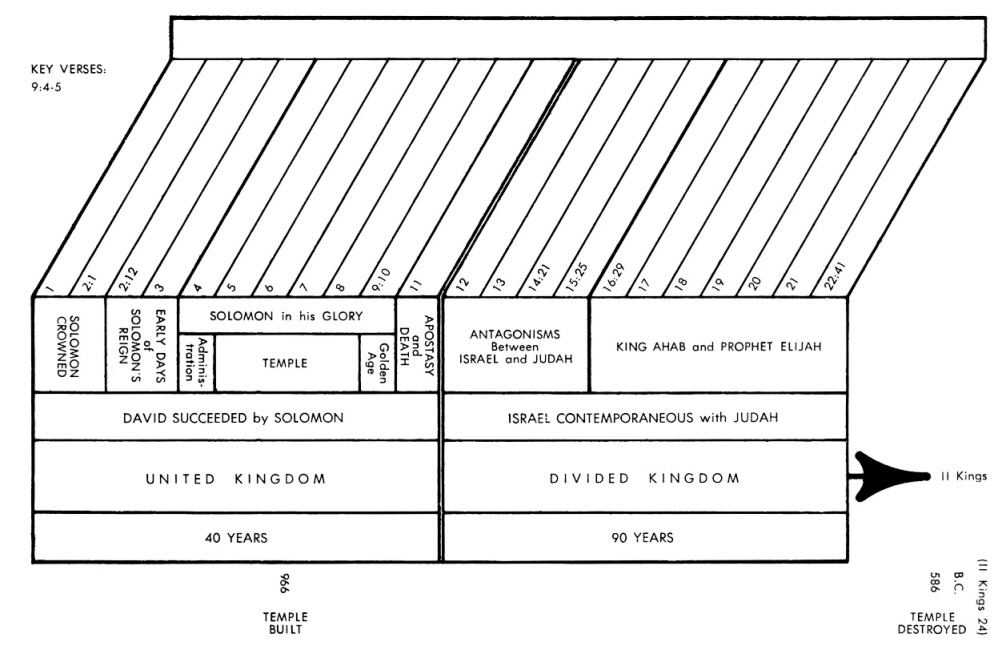
Chart from recommended resource Jensen's Survey of the OT - used by permission
1 Kings Chart from Charles Swindoll

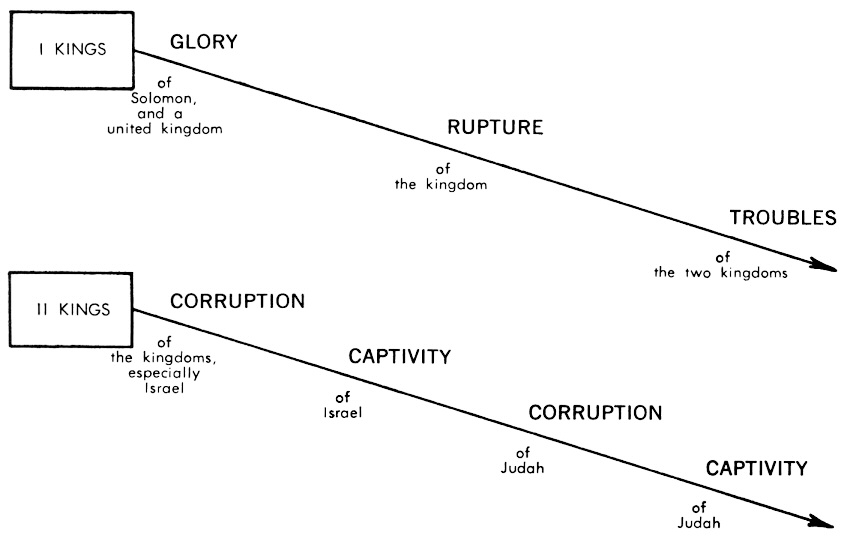
THE DOWNWARD SPIRAL
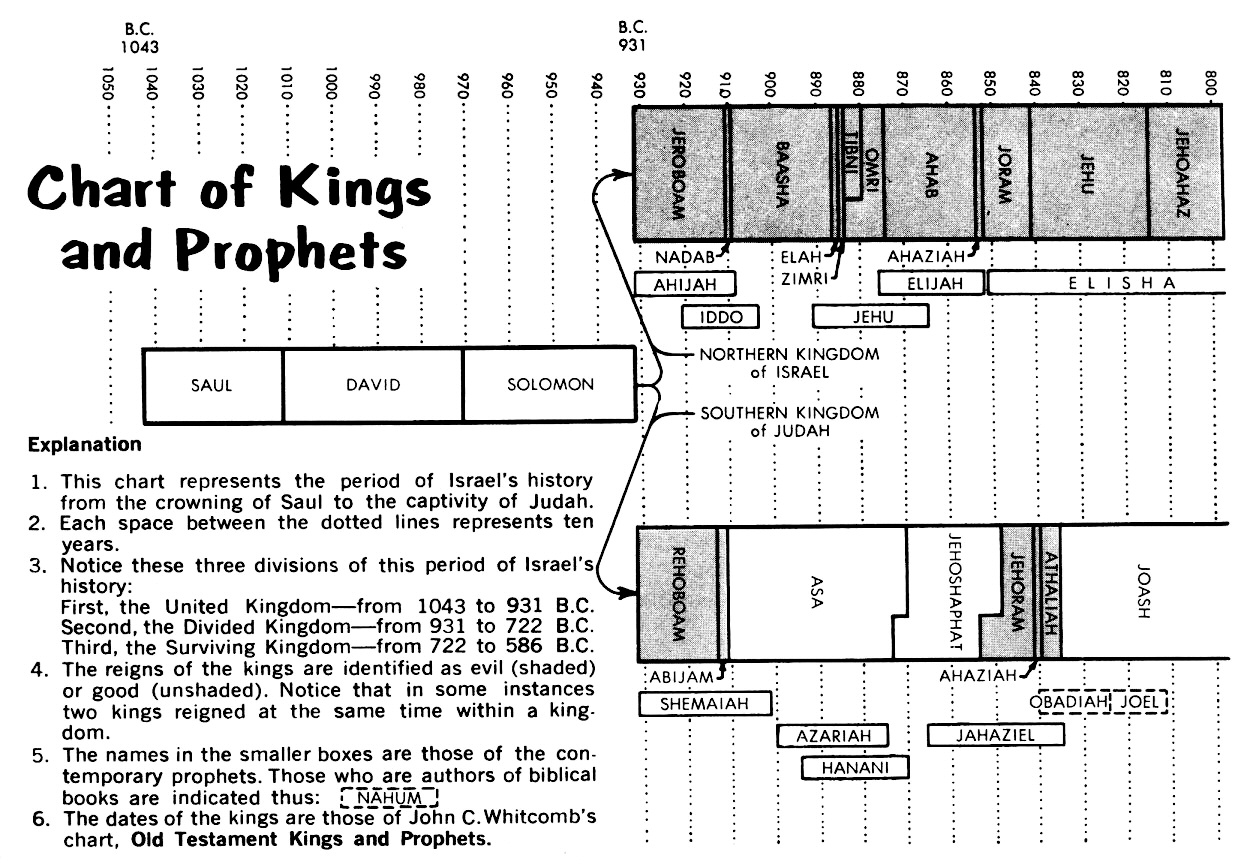
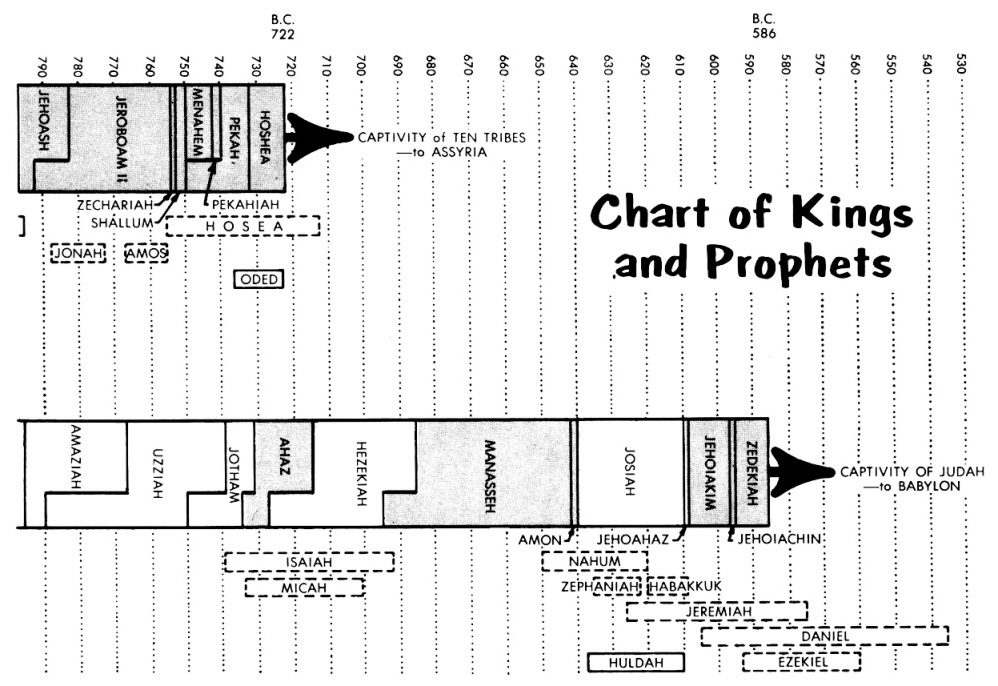
Click to Enlarge
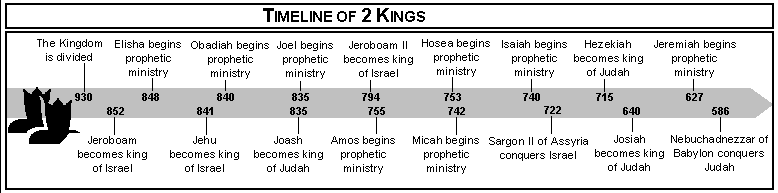
Ryrie Study Bible - Borrow
Click to Enlarge
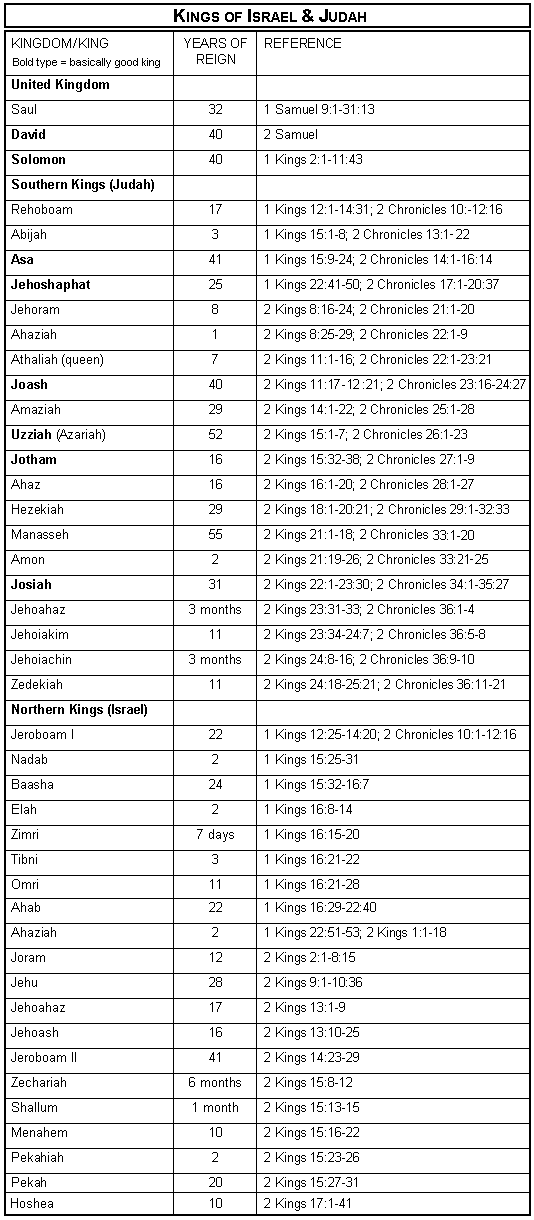
(NOTE: Many consider Amaziah and Hezekiah as "good" kings)
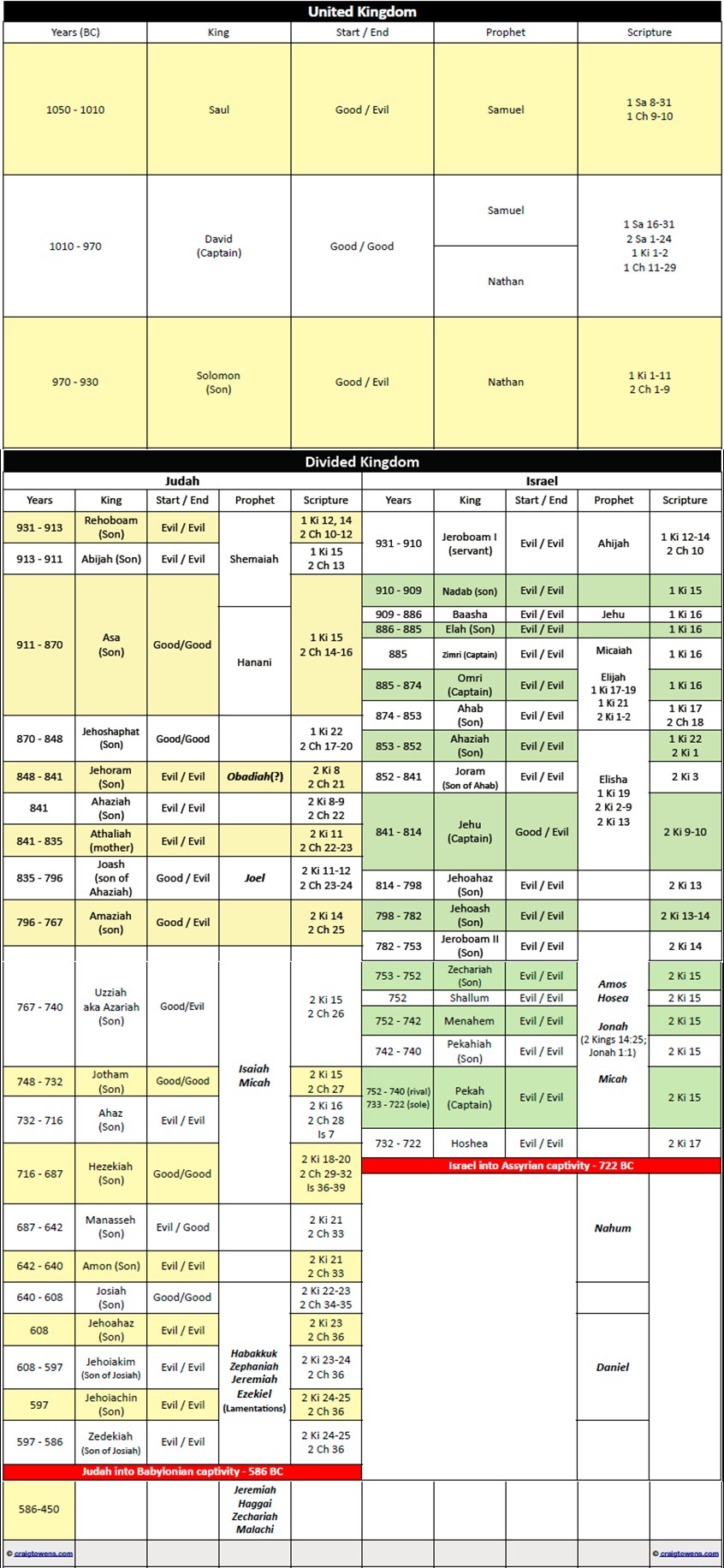
SEE ALSO:
ESV chart - kings of Israel - more information
ESV chart - kings of Judah - more information
Another Chart with Variable Dates for Reigns of King
2 Kings 23:1 Then the king sent, and they gathered to him all the elders of Judah and of Jerusalem.
- the king: De 31:28 2Sa 6:1 2Ch 29:20 30:2 34:29,30-33
JOSIAH PROMPTED TO CALL
FOR GATHERING OF ELDERS
Then - Marks a significant progression in the action of King Josiah. After hearing the Book of the Law read and then hearing Huldah's prophecy concerning Judah's fate, King Josiah realized the seriousness of Judah’s sin and the certainty of coming judgment. Josiah responded by sending out a summons for the leaders of the nation to gather. Josiah's response shows that true repentance leads to decisive action (brings forth fruit in keeping with repentance - Mt 3:8+).
See Dale Ralph Davis' discussion of the timing of events in 2Ki 22-23. Davis writes "Josiah’s reforms were both begun and to a large extent complete before Hilkiah’s discovery of the Book of the Law."
The king sent, and they gathered to him all the elders of Judah and of Jerusalem. Instead of keeping the message to himself, Josiah called together the nation’s leaders in a formal national meeting. Such gatherings were often called for important political or religious decisions. Here the purpose was spiritual reform and covenant renewal. The elders were the recognized leaders and representatives of the people. By gathering the nation’s leaders, the king prepared the way for a public reading of Scripture and a national commitment to return to the covenant with the LORD.
Bob Utley - "the elders" This usually refers to the tribal leaders or local older leaders.
Peter Pett: Note the distinction between the elders of Jerusalem and the elders of Judah. As the city of David Jerusalem was administratively separate from Judah. In Jerusalem the king had direct authority and could act as he wished, in Judah he had to consider local custom and respect the authority of the elders of Judah, the princes and the tribal aristocrats.
John Walton - Function of the elders. The elders (patriarchal family heads) played a major role in the early tribal organization of Israel and evidently still had a function during the monarchy. Elders had been given authority in their local communities and may still have played a limited role in the political leadership during the monarchy. City elders also played a limited role in preserving stability and enacting laws in their communities in Babylonia. However, they did not initiate policy, as the central monarchy controlled the power source of the state, the economy and the armed forces. (IVP Bible Background Commentary: OT page 408)
Bob Utley - CONTEXTUAL INSIGHTS
- Because of the conditions existing in the world, Judah found herself relatively independent during the reign of Josiah. This was due primarily to debilitating battles between Egypt and Babylon, which reduced both of their armies.
- This resurgence in nationalism and the discovery of part of the Law of Moses in the Temple (2 Kings 22) is the setting of chapter 23.
- There was a general tendency over all the Mediterranean world to try to return to "the good old days" and Judah was a part of this general move.
- 2 Kings 22 and 23 form a literary unit; please read the parallel in 2 Chronicles 34:1-35:19.
- This chapter contains several allusions to different idols and cultic sites.
- of Canaan
- Ba'al, 2Ki 23:4,5
- Asherah, 2Ki 23:4,6,7
- gold calves, 2Ki 23:4,15,17
- ancient high places
- Ashtoreth, 2Ki 23:13
SPECIAL TOPIC: FERTILITY WORSHIP OF THE ANE
SPECIAL TOPIC: ISRAEL'S MANDATED RESPONSE TO CANAANITE FERTILITY WORSHIP - of Babylon
- host of heaven, 2Ki 23:4,5,12
- sun, 2Ki 23:5,11
- moon, 2Ki 23:5
- constellations,2Ki 23:5
- names of foreign gods
- Ashtoreth of Sidonians, 2Ki 23:13
- Chemosh of Moab, 2Ki 23:13
- Milcom of Ammon, 2Ki 23:13
- Molech of Phoenicia, 2Ki 23:10
- of Canaan
- Notice the types of priests that were removed.
- idolatrous priests, 2Ki 23:5
- Ba'al, 2Ki 23:5
- Asherah, 2Ki 23:6
- male cult prostitutes, 2Ki 23:7
- priests from "high places," 2Ki 23:8,9,15,20
- mediums, 2Ki 23:24
- spiritists, 2Ki 23:24
- teraphim, 2Ki 23:24
- the idols with their priests, 2Ki 23:24
- idolatrous priests, 2Ki 23:5
2 Kings 23:2 The king went up to the house of the LORD and all the men of Judah and all the inhabitants of Jerusalem with him, and the priests and the prophets and all the people, both small and great; and he read in their hearing all the words of the book of the covenant which was found in the house of the LORD.
- both small and great: Heb. from small even unto great, Ge 19:11 1Sa 5:9 30:2 2Ch 15:13 Es 1:5 Job 3:19 Ps 115:13 Ac 26:22 Rev 20:12
- he read: De 31:10-13 2Ch 17:9 Ne 8:1-8 9:3 13:1
- the book: 2Ki 22:8 De 31:26 1Ki 8:9
Related Passages:
2 Chronicles 34:30+ The king went up to the house of the LORD and all the men of Judah, the inhabitants of Jerusalem, the priests, the Levites and all the people, from the greatest to the least; and he read in their hearing all the words of the book of the covenant which was found in the house of the LORD.
JOSIAH READS GOD'S
WORD AT THE TEMPLE
The king went up to the house of the LORD - The house of the LORD refers to the temple in Jerusalem. The phrase “went up” reflects the elevation of the temple mount and also the common biblical expression for approaching God’s dwelling place. By going to the temple, Josiah brings the nation to the central place of worship and covenant relationship with God.
And all the men of Judah and all the inhabitants of Jerusalem with him This indicates a national assembly. Representatives from across Judah, along with the residents of Jerusalem, were gathered so that the entire community would hear the Word of God. The event was not limited to political leaders but involved the broader population.
And the priests and the prophets - Their presence emphasizes that the gathering involved both spiritual authority and national leadership.
Bob Utley - "the priests and prophets" These are two of the three sources of revelation. The other source of revelation in the OT is the wisdom teachers or sages (cf. Jer. 18:18). In the parallel passage in 2 Chr. 34:30, it has "Levites" instead of "prophets." Notice the reading of the Law of Moses was for all the people, not just the leaders! Also notice YHWH's word caused an immediate spiritual action (cf. Isa. 55:9-11).
And all the people, both small and great - stresses the inclusiveness of the assembly. Everyone—regardless of social status, influence, or wealth—was present. The Word of God was intended for the entire covenant community, not just its leaders.
and he read in their hearing (“read in their ears”) - Josiah read aloud so that the people could hear God’s commands directly. In the ancient world, public reading was essential because many people could not read personally. Hearing the Word proclaimed allowed the entire nation to understand the covenant obligations.
Bob Utley - "he read in their hearing" Public reading of the law was not a new thing (cf. Exodus 20; Deuteronomy 5; 31:10-13; Nehemiah 8).
Peter Pett: The emphasis is on the fact that the whole stratum of people were represented, rather than on suggesting that all the people would be literally present and able to hear the words that would be read out. The point that is being stressed was that the covenant was being made by the whole people.
All the words of the book (seper; LXX - biblion) of the covenant - This refers to the Law of Moses, and as discussed earlier (2Ki 22:8+), likely including at least Deuteronomy, and possibly a larger portion of the Pentateuch. The book of the covenant highlights that these writings contained the terms of Israel’s binding conditional covenant relationship with the LORD.
Bob Utley - the book of the covenant which was found in the house of the Lord" Most scholars assume this was some portion of the book of Deuteronomy (cf. 2 Kgs. 22:8-13), but we still just do not know how much of the Pentateuch was involved.
which was found in the house of the LORD - Josiah explains to the people that the book of the covenant had been lost in the Temple but was not providentially found.
Spurgeon -That was a grand Bible-reading, with a king for reader, and all his princes and all his people gathered to Listen to the Word of God. What could he have said better, had he been the greatest of orators ? To read out of this blessed Book must surely be to the edification of the hearers.
John Walton - public reading of documents. Even after the invention of the alphabet, many of the people in the ancient Near East were illiterate, and thus the public reading of documents had an important function. Assyrian sources describe heralds standing at city gates reading royal pronouncements to groups of onlookers. 23:3. pillar. The king stood near a pillar or column (platform, according to the Jewish writer Josephus). It may have been a standing structure in the temple reserved for royalty. No clear parallels for this custom exist elsewhere in the Near East(IVP Bible Background Commentary: OT page 408)
He read in their hearing all the words of the Book of the Covenant, which had been found in the temple of the Lord. 2 Chronicles 34:30
Today's Scripture & Insight: 2 Chronicles 34:29–31
In 1970, a car executive visiting Denmark learned that a 1939 Buick Dual Cowl Phaeton was owned by a local resident. Since the car never actually went into production, it was a rare find—a one-of-kind vehicle. Delighted with the discovery, the executive bought the car and spent his time and money to have it restored. Currently, this unique car is featured in a world-renowned collection of classic vehicles.
Hidden treasures can take many forms, and in the book of 2 Chronicles we read about another discovery of a lost treasure. Eighteen years into his reign as king of Judah, Josiah began to repair the temple in Jerusalem. During the process, the priest Hilkiah found the “Book of the Law in the temple” (2 Chronicles 34:15). The Book of the Law, the first five books of the Old Testament, had likely been hidden away decades earlier to keep it safe from invading armies. Over time it had been simply forgotten.
When King Josiah was told about this discovery, he realized the importance of the find. Josiah called all the people together and read the entire Book of the Law so they could commit themselves to keep all that was written in it (vv. 30–31).
Still important for our lives today, we have the amazing blessing of access to all sixty-six books of the Bible, a treasure of infinite worth. By: Lisa M. Samra (Reprinted by permission from Our Daily Bread Ministries. Please do not repost the full devotional without their permission.)
How did you come to know the Bible as a treasure? How have you grown in your understanding of its great worth?
Heavenly Father, help me to delight in the treasure of the Scriptures today.
2 Kings 23:3 The king stood by the pillar and made a covenant before the LORD, to walk after the LORD, and to keep His commandments and His testimonies and His statutes with all his heart and all his soul, to carry out the words of this covenant that were written in this book. And all the people entered into the covenant.
- stood: 2Ki 11:14,17 2Ch 23:13 34:31,32
- made a covenant: Ex 24:7,8 De 5:1-3 29:1,10-15 Jos 24:25 2Ch 15:12-14 23:16 2Ch 29:10 Ezr 10:3 Ne 9:38 10:28-39 Jer 50:5 Heb 8:8-13 12:24 Heb 13:20
- to walk: De 8:19
- his commandments: De 4:45 5:1 6:1 Ps 19:7-9
- with all their heart: De 6:5 10:12 11:13 Mt 22:36,37
- And all: Ex 24:3 Jos 24:24 2Ch 34:32,33 Ec 8:2 Jer 4:2
NATIONAL COVENANT
RENEWAL CEREMONY
The king stood by the pillar - The pillar refers to a special place in the temple where the king stood during important public or covenant ceremonies. It was likely near the entrance to the temple court, a traditional location associated with royal authority and public proclamation. A similar scene occurred earlier when Joash was crowned 2 Kings 11:14 " the king was standing by the pillar, according to the custom." Standing at this pillar symbolized the king acting in his official capacity as the covenant leader of the nation.
Bob Utley - "The king stood by the pillar" This seems to be a prominent and special raised place of honor (i.e., a platform, cf. Targums) for the king (cf. 2 Kgs. 11:14; 16:18; 2 Chr. 23:13; Neh. 8:4), but we just do not know how much of the Pentateuch was involved.
And made (karath - cut) a covenant (beriyth) before the LORD - Literally "he cut a covenant" which alludes to the practice of cutting the carcass of an animal, separating the parts, allowing parties to seal their agreement by walking between them (cf. Ge 15:17; Jer 34:18) The text does not say this procedure was practiced in this instance. Nevertheless Josiah publicly declared his personal commitment to the LORD by "cutting covenant" but he did not create a new covenant. Rather, he renewed and reaffirmed the existing covenant given through Moses. Josiah led the people to publicly recommit themselves to the LORD and to obedience to His law. Before the LORD emphasizes that this was done in God’s presence, at His temple, and under His authority.
To walk after the LORD - As used frequently in the Bible to walk is a metaphor for one’s manner of life or daily conduct. To walk after the LORD means to follow Him in obedience, loyalty, and devotion, ordering one’s life according to His will (as specified in His Word). It describes a continual pattern of living under God’s authority.
And to keep His commandments (mitsvah) and His testimonies (eduth) and His statutes (chuqqah/ḥuqqâ) - These three terms collectively describe the revealed will of God in the Law. In Jeremiah 44:23 God rebuked Judah for not walking “in his law and in his statutes and in his testimonies.” This shows that all three terms together represent the fullness of God’s revealed will
Bob Utley - "to keep" This was a covenant renewal ceremony (cf. Joshua 24; 1 Samuel 12; Josephus, Antiq. 10.4.3) to an ancient covenant that had been somehow lost, forgotten, or ignored! Obedience is crucial!
The word commandments (mitsvah) is the general term for God’s commands and refers to the comprehensive body of divine instruction given through Moses. These are the direct orders of God that express His moral will—such as the Ten Commandments (Exodus 20:1–17)—and they reveal what God requires of His people in their conduct and worship.
The word testimonies (eduth) emphasizes God’s covenantal witness to His people. His testimonies are the truths and declarations that bear witness to His character, faithfulness, and expectations. The Ark of the Covenant was sometimes called “the ark of the testimony” (Ex 25:22) because it contained the tablets of the Law—God’s own testimony to His covenant relationship with Israel. When the psalmist says, "Your testimonies also are my delight; They are my counselors.” (Psalm 119:24), he is rejoicing in God’s revealed truth that bears witness to who He is and how He calls His people to live.
The term statutes (chuqqah/ḥuqqâ) refers to specific, prescribed regulations or ordinances. These often relate to ceremonial, ritual, or civil matters—such as the observance of feasts, sacrifices, or priestly duties. For example, Exodus 12:14 calls the Passover a “statute forever,” meaning it was a divinely appointed ordinance to be observed continually. Statutes are the detailed applications of God’s broader commandments, showing how His people were to live out His holiness in daily and communal life.
His commandments reveal His moral standards, His statutes show how those standards are to be practiced, and His testimonies declare His faithfulness and truth. Psalm 19:7–8 beautifully summarizes this harmony: “The law of the LORD is perfect, reviving the soul; the testimony of the LORD is sure, making wise the simple; the precepts of the LORD are right, rejoicing the heart.”
In essence, while commandments, statutes, and testimonies differ slightly in focus, they all flow from the same divine source and serve the same purpose—to reveal God’s holy character and to guide His people into faithful obedience. Together, they remind us that loving God means treasuring and obeying every part of His Word, as Jesus affirmed in John 14:15: “If you love me, you will keep my commandments.”
with all his heart (leb) and all his soul (nephesh) - We see this same phrase describing Josiah in 2Ki 23:25. This speaks of total devotion. It describes a life wholly surrendered to God, loving Him with every emotion, thought, and action and holding nothing back.
Bob Utley - "with all his heart and all his soul" The new king made a total commitment to walk in the ways of YHWH. The people followed, at least outwardly, the king's commitment.
In Hebrew thought the heart represents the inner person, the mind, will, and emotions, while the soul refers to one’s whole life or being. The expression means wholehearted commitment, not partial obedience. God does not want mere outward compliance but inward transformation.
This language echoes the central command of the Law Deuteronomy 6:5 "You shall love the LORD your God with all your heart and with all your soul and with all your might."
to carry out the words of this covenant (beriyth) that were written in this book (seper; LXX - biblion) - This stresses practical obedience. Not just hearing but doing! Josiah’s covenant was not merely verbal or ceremonial; it required actually doing what the Scriptures commanded.
And all the people entered into the covenant (beriyth) - After seeing their King's commitment and hearing the words of the Book of the Covenant read publicly in the temple, the entire covenant community of Judah who had gathered in Jerusalem, joined the king in recommitting themselves to obey God’s law. Entered into the covenant means that the people formally agreed to the covenant renewal proclaimed by Josiah. To reiterate, this was not the creation of a new covenant but a renewal of the Mosaic covenant originally established at Mount Sinai.
David Guzik believes this was an authentic committment by all the people writing "The fact that this happened among all the people means that this was a special work of the Holy Spirit. The Bible tells us that there are times when the Holy Spirit comes upon people as a group, which is a different work than the individual filling of the Spirit. There are times when the Holy Spirit seems to work on a group, and we should pray for such moving of the Holy Spirit today." While I appreciate what Guzik is saying and cannot exclude this explanation, the sad truth is their vows to keep the Mosaic covenant did not endure for immeditately after Josiah passed, the nation was led by an evil king (implying the people practiced evil). Of course, there was always a genuine believing remnant.
Trapp comments “They pretended and professed to do so; but most of them dissembled and dealt deceitfully, not turning to God with their whole hearts, as good Jeremiah complaineth (Jer 7:5-7).”
Wiseman adds that "“The ceremony compares with the basic Mizpah covenant (1 Samuel 7:11-17; 10:25) and the renewal of the covenant at Shechem (Joshua 24), both of which marked turning points in Jewish history.”
One is reminded of the people's response to the original covenant ceremony at Mt Sinai...
Then Moses came and recounted to the people all the words of the LORD and all the ordinances; and all the people answered with one voice and said, “All the words which the LORD has spoken we will do!”....7 Then he took the book of the covenant and read it in the hearing of the people; and they said, “All that the LORD has spoken we will do, and we will be obedient!” (Exodus 24:3,7)
Sadly we see how good their "WILL DO" turned out to be, for it got the nation where it was today, on the brink of desolation and destruction because of failure to obey!
Statutes (02708) chuqqah/ḥuqqâ The Hebrew noun ḥuqqâ (חוּקָּה) is a rich theological term meaning “statute,” “ordinance,” “prescription,” or “something prescribed and fixed.” It comes from the root ḥāqaq, meaning to engrave, inscribe, or decree, conveying the idea of something permanently established, binding, and authoritative. As the feminine form of ḥōq, it often emphasizes specific prescribed regulations, especially in covenantal and ritual contexts. Because of its broad semantic range, ḥuqqâ takes its precise meaning from context, but it consistently refers to what God has fixed, ordained, or required. It appears over 100 times in the Old Testament and is especially concentrated in the Pentateuch, where it forms a key part of God’s revealed will alongside related terms such as commandments (מִצְוָה, miṣwâ), judgments (מִשְׁפָּט, mishpāṭ), and law (תּוֹרָה, tôrâ).
From the earliest biblical record, chuqqah/ḥuqqâ is associated with obedience to God’s revealed will, even before the Law was formally codified. God commended Abraham because “Abraham obeyed My voice and kept My charge, My commandments, My statutes, and My laws” (Genesis 26:5), showing that these divine requirements were known and binding prior to Sinai. Under Moses, these statutes were formally taught and codified, as leaders were instructed “to teach them the statutes and the laws, and make known to them the way in which they are to walk” (Exodus 18:20), and the priests were to “teach the sons of Israel all the statutes which the LORD has spoken” (Leviticus 10:11). These statutes governed every area of life, including moral conduct, ceremonial worship, and social relationships, and were given so that Israel would be distinct from the nations: “You shall not do what is done in the land of Egypt… nor are you to walk in their statutes. You are to perform My judgments and keep My statutes” (Leviticus 18:3–4). Obedience brought blessing—“If you walk in My statutes and keep My commandments… then I shall give you rains in their season” (Leviticus 26:3–4)—while disobedience brought covenant curses (Leviticus 26:15, 43).
A major nuance of chuqqah/ḥuqqâ is that it often refers to specific prescribed rituals or ordinances, especially those that are perpetual (“a statute forever”). For example, the Passover was instituted as “a memorial… throughout your generations… a permanent ordinance” (Exodus 12:14), and the Feast of Unleavened Bread likewise as “a permanent ordinance” (Exodus 12:17). The Day of Atonement was to be observed as “a permanent statute” (Leviticus 16:29, 31, 34), and the priesthood itself was established “by a perpetual statute” (Exodus 29:9). Other examples include regulations regarding sacrifices (Leviticus 3:17B), priestly conduct (Leviticus 10:9), and sacred festivals (Leviticus 23:41). Thus, chuqqah/ḥuqqâ frequently denotes fixed, divinely ordained practices that structure Israel’s worship and covenant life, highlighting the idea that these are not optional traditions but binding divine prescriptions.
Chuqqah/ḥuqqâ can also describe fixed orders in creation, showing that God’s decrees extend beyond Israel’s law into the structure of the universe itself. Job speaks of God who “set a limit for the rain and a course for the thunderbolt” (Job 28:26), and Jeremiah records God’s declaration: “If My covenant for day and night stand not… then I would reject the descendants of Jacob” (Jeremiah 33:25), referring to the fixed ordinances governing creation. Similarly, God “gives the sun for light by day and the fixed order of the moon and the stars for light by night” (Jeremiah 31:35). In this sense, chuqqah/ḥuqqâ reflects the idea that God’s decrees are not only moral laws but also the established order of reality itself, underscoring His sovereign authority over both nature and covenant.
Throughout Israel’s history, faithfulness to God’s statutes became a measure of covenant loyalty, and leaders were evaluated based on their obedience. David could say, “For all His ordinances were before me, and as for His statutes, I did not depart from them” (2 Samuel 22:23), and Solomon was warned that the Davidic covenant depended on walking “in My statutes and My ordinances” (1 Kings 6:12). However, many kings rejected these statutes, leading to national decline and judgment (2 Kings 17:15, 34). Even though Josiah sought to restore obedience and “made a covenant before the LORD… to carry out His commandments and His testimonies and His statutes with all his heart” (2 Kings 23:3), the accumulated disobedience of the nation still resulted in exile (2 Kings 23:25–27). The prophets consistently condemned Israel for rejecting God’s statutes—“They have not walked in My statutes and have rejected My ordinances” (Ezekiel 20:13; cf. Amos 2:4)—yet also looked forward to a future restoration when God would transform His people so that “they will walk in My statutes and be careful to observe My ordinances” (Ezekiel 36:27 NASB; cf. 37:24).
At the same time, Scripture contrasts God’s statutes with human or pagan “statutes,” which represent corrupt practices and false systems of worship. Israel was warned not to follow the “statutes of the nations” (Leviticus 20:23), and Micah condemned the people because “the statutes of Omri… are observed” (Micah 6:16), showing that not all “statutes” are righteous—only those established by God. Likewise, Isaiah pronounces woe on those who create unjust laws: “Woe to those who enact evil statutes” (Isaiah 10:1), demonstrating that human decrees can oppose God’s righteous standards.
Yet it also points forward to the need for inward transformation,
since Israel repeatedly failed to keep these statutes outwardly.Ultimately, chuqqah/ḥuqqâ reveals a profound theological truth: God’s will is not arbitrary but fixed, revealed, and binding, calling His people to a life of ordered obedience. Yet it also points forward to the need for inward transformation, since Israel repeatedly failed to keep these statutes outwardly. The promise of the New Covenant answers this failure, as God declares, “I will put My law within them and on their heart I will write it… for I will forgive their iniquity” (Jeremiah 31:33–34). Thus, chuqqah/ḥuqqâ moves from external prescription to internal transformation, showing that the ultimate goal of God’s statutes is not mere ritual compliance but a heart aligned with His will.
Summary - chuqqah/ḥuqqâ denotes a divinely established, binding ordinance—often fixed and perpetual—that governs worship, life, and even creation itself, revealing God’s authoritative will and ultimately pointing to the need for inward obedience through covenant transformation.
CHUQQAH - 100V - appointed(1), customs(5), due(1), fixed order(1), fixed patterns(1), ordinance(5), ordinances(1), statute(25), statutes(62), statutory(2). Gen. 26:5; Exod. 12:14; Exod. 12:17; Exod. 12:43; Exod. 13:10; Exod. 27:21; Exod. 28:43; Exod. 29:9; Lev. 3:17; Lev. 7:36; Lev. 10:9; Lev. 16:29; Lev. 16:31; Lev. 16:34; Lev. 17:7; Lev. 18:3; Lev. 18:4; Lev. 18:5; Lev. 18:26; Lev. 18:30; Lev. 19:19; Lev. 19:37; Lev. 20:8; Lev. 20:22; Lev. 20:23; Lev. 23:14; Lev. 23:21; Lev. 23:31; Lev. 23:41; Lev. 24:3; Lev. 25:18; Lev. 26:3; Lev. 26:15; Lev. 26:43; Num. 9:3; Num. 9:12; Num. 9:14; Num. 10:8; Num. 15:15; Num. 18:23; Num. 19:2; Num. 19:10; Num. 19:21; Num. 27:11; Num. 31:21; Num. 35:29; Deut. 6:2; Deut. 8:11; Deut. 10:13; Deut. 11:1; Deut. 28:15; Deut. 28:45; Deut. 30:10; Deut. 30:16; 2 Sam. 22:23; 1 Ki. 2:3; 1 Ki. 3:3; 1 Ki. 6:12; 1 Ki. 9:6; 1 Ki. 11:11; 1 Ki. 11:33; 1 Ki. 11:34; 1 Ki. 11:38; 2 Ki. 17:8; 2 Ki. 17:13; 2 Ki. 17:19; 2 Ki. 17:34; 2 Ki. 23:3; 2 Chr. 7:19; Job 38:33; Ps. 18:22; Ps. 89:31; Ps. 119:16; Jer. 5:24; Jer. 10:3; Jer. 31:35; Jer. 33:25; Jer. 44:10; Jer. 44:23; Ezek. 5:6; Ezek. 5:7; Ezek. 11:20; Ezek. 18:9; Ezek. 18:17; Ezek. 18:19; Ezek. 18:21; Ezek. 20:11; Ezek. 20:13; Ezek. 20:16; Ezek. 20:19; Ezek. 20:21; Ezek. 20:24; Ezek. 33:15; Ezek. 37:24; Ezek. 43:11; Ezek. 43:18; Ezek. 44:5; Ezek. 44:24; Ezek. 46:14; Mic. 6:16
G Campbell Morgan - The king stood by the pillar, and made a covenant before the Lord, to walk after the Lord.-2 Kings 23.3
The figure of Josiah in this story is heroic and pathetic. From consultation with Huldah he knew that the people were so corrupt that there would be no deep note or lasting value in their reformation. That fact, however, did not give him the right to refuse to follow the light which had come to him. The description of what he did is graphic. He carried out his work with enthusiasm and energy. He first arranged for the public reading of the book of the law. Then he made this covenant. Immediately succeeding, the work went forward ; the Temple was purged of all the vessels of false religions; from one end of the land to the other, idolatrous shrines and altars were swept away. Following this, the Passover Feast, long neglected, was observed with all its ancient glory. So far as Josiah was concerned, this whole procedure was the outcome of sincerity and loyalty. The people, however, were simply following the lead of the king, not under any sense of penitence, or return to Jehovah. Therefore there was no turning on the part of God from His necessary purpose of judgment. The action of Josiah the king, like that of Jeremiah the prophet, was heroic, in that both were loyal to the will and word of God, even though their action produced no results in the national life.
2 Kings 23:4 Then the king commanded Hilkiah the high priest and the priests of the second order and the doorkeepers, to bring out of the temple of the LORD all the vessels that were made for Baal, for Asherah, and for all the host of heaven; and he burned them outside Jerusalem in the fields of the Kidron, and carried their ashes to Bethel.
- priests of the second order: These were either such as occasionally supplied the high priests's office, or those of the second course or order established by David. 1Ch 24:4-19 Mt 26:3 27:1
- and the doorkeepers: 2Ki 22:4 1Ch 26:1-19
- to bring out of the temple of the LORD: 2Ki 21:3,7 2Ch 33:3,7 34:3,4
- all the vessels that were made for Baal, , for Asherah, and for all the host of heaven: 2Ki 17:16 Jdg2:13 1Ki 16:31 18:19,26,40 19:18 Isa 27:9 Jer 7:9
- he burned them outside Jerusalem in the fields of the Kidron: 2Sa 15:23 Joh 18:1, Cedron
- and carried their ashes to Bethel: 1Ki 12:29 Ho 4:15 Am 4:4
Related Passages:
Deuteronomy 12:3+ “You shall tear down their altars and smash their sacred pillars and burn their Asherim with fire, and you shall cut down the engraved images of their gods and obliterate their name from that place.
1 Kings 15:13+ He (KING ASA) also removed Maacah his mother from being queen mother, because she had made a horrid image as an Asherah; and Asa cut down her horrid image and burned it at the brook Kidron.
JOSIAH BEGINS TO PURGE
THE TEMPLE OF IDOLS
Then the king commanded Hilkiah the high priest and the priests of the second order and the doorkeepers - The priests of the second order were assistant priests serving under the high priest Hilkiah in the temple hierarchy. The priesthood in ancient Israel was structured in ranks so at the top was the high priest, who served as the spiritual leader of the nation and the only one permitted to enter the Holy of Holies on the Day of Atonement (Lev 16:2, 34). Beneath him were other priests, descendants of Aaron, who performed sacrifices, maintained the altar, and taught the Law. The priests of the second order were likely senior priests who served directly under the high priest, functioning as his deputies or assistants.
2 Chronicles 31:19 shows that the priesthood was carefully ordered, with named individuals assigned to specific duties and responsibilities. The “second order” priests would have been part of this organized system, ensuring that temple worship was conducted properly and according to the Law of Moses.
To bring out of the temple of the LORD all the vessels that were made for Baal (ba'al), for Asherah (Asherah), and for all the host of heaven - Shockingly, pagan worship objects had been placed inside the temple of the LORD during earlier reigns, especially under kings like Manasseh. Baal was a major Canaanite deity associated with fertility and storms. Recall that the meanings of Baal include lord, owner, possessor and husband. Israel was Jehovah's wife, so Baal worship was tantamount to "marital infidelity." Little wonder that Yahweh her true Husband was jealous! (See Israel the Wife of Jehovah) Asherah (Asherah) often represented by wooden poles or images symbolizing fertility. The host of heaven referred to worship of the sun, moon, and stars, a form of astral worship adopted from surrounding nations. These vessels likely included incense altars, ritual utensils, and cultic objects used in pagan ceremonies.
Recall that Josiah's father Manasseh did repent but clearly the evil practices had become so engrained that they persisted into Josiah's reign.
🙏 THOUGHT - Such is the "sticking power" of idolatry! We think we can simply "shed" the idols, but are effectively deluded because the idols do not "shed us!" Only the Spirit can make a clean sweep of our body, His temple (1Co 6:19-20+)!
And he burned them outside Jerusalem in the fields of the Kidron - This act was both symbolic and practical because it demonstrated Josiah’s zeal for the LORD and his determination to completely destroy every trace of idol worship that had defiled God’s house. The Kidron Valley lay east of Jerusalem between the city and the Mount of Olives, and had often served as a place of judgment, purification, and disposal of unclean things (cf Hezekiah's reform in 2Ch 29:16+). Josiah was removing the pollution of false worship from the holy city and symbolically cleansing the land. The burning of these items was not merely destruction—it was an act of purification, ensuring that nothing associated with idolatry could ever be reused or restored.
Peter Pett - Kidron was the place where Asa had previously burned defiling effigies (1 Kings 15:13; compare 2 Kings 23:6 below and see 2 Chronicles 29:16; 2 Chronicles 30:14 under Hezekiah), and was clearly a place marked down for such activity, being already defiled by what Asa had done. Importantly it was outside Jerusalem so that Jerusalem would not be defiled by the activity.
In the passages Josiah read in the book, it is very likely he read of God's charge to burn the idols outside Jerusalem as described in Deuteronomy 7:25+ "The graven images of their gods you are to burn with fire; you shall not covet the silver or the gold that is on them, nor take it for yourselves, or you will be snared by it, for it is an abomination to the LORD your God." Burning them not only symbolized complete rejection and purification but also ensured they could never be reused.
And carried their ashes to Bethel - With a decline in Assyrian power, Josiah was able to exert his religious influence in the North. Bethel, located in the former northern kingdom of Israel, had long been a center of false worship and was there that Jeroboam I, the first king of the divided northern kingdom, set up one of the golden calves and told the people, “Behold your gods, O Israel, who brought you up out of the land of Egypt” (1Ki 12:28–29). This act of rebellion led Israel into centuries of idolatry. By taking the ashes of the destroyed idols from Jerusalem and scattering them at Bethel, Josiah was making a powerful statement by symbolically defiling the place where Israel’s idolatry began, so the same judgment that had fallen on Judah’s idols would also fall on the idolatry of Israel. In short, burning the idols reduced them to ashes, and transporting those ashes to Bethel, the heart of Israel’s rebellion, was a way of defiling that place and declaring God’s supremacy over all false gods. It was as if Josiah was saying that the pollution of idolatry, which had begun in Bethel, was now being returned there to be utterly condemned.
Josiah's act also fulfilled prophecy. In 1 Kings 13:1–2, a man of God from Judah had prophesied against Jeroboam’s altar at Bethel, saying, “O altar, altar, thus says the LORD: ‘Behold, a son shall be born to the house of David, Josiah by name, and he shall sacrifice on you the priests of the high places who make offerings on you, and human bones shall be burned on you.’” By carrying the ashes to Bethel and later destroying the altar there (2Ki 23:15–16), Josiah literally fulfilled this centuries-old prophecy. His actions demonstrated that God’s Word never fails and that His judgment against idolatry is certain.
John Walton - constellations and starry hosts. Worship of the starry hosts refers to the worship of the celestial gods (sun god, moon god and Venus particularly; in Babylonia, Shamash, Sin and Ishtar respectively), who were primary in most ancient religions. Controlling the calendar and time, seasons and weather, they were viewed as the most powerful of the gods. They provided signs by which omens were read, and they looked down on all. By the end of the second millennium a major compilation of celestial omens, the seventy tablets of the work known as Enuma Anu Enlil, had been compiled and was consulted for nearly a thousand years. Stamp seals from Israel in this period show that astral deities were very popular. There were many constellations recognized by the Mesopotamian astrologers (many, though not all, the same we recognize today, transmitted through the Greeks), but the Zodiac is not yet known at this time. For more information see comment on 2 Chronicles 33:5. (IVP Bible Background Commentary: OT page 408)
Dale Ralph Davis summarizes Josiah's impressive list of reforms writing "We cannot be sure of all the details but one might suggest this is Josiah’s twelve-step ‘de-Manassehfication’ program.
1. Removing pagan vessels from temple (2Ki 23:4)
2. Deposing pagan clergy (2Ki 23:5)
3. Pulverizing the Asherah image (2Ki 23:6)
4. Wrecking the male prostitutes’ temple apartments (2Ki 23:7)
5. Defiling Judah’s high places, deposing their priests (2Ki 23:8–9)
6. Desecrating Tophet, the place of child sacrifice (2Ki 23:10)
7. Removing and destroying sun worship paraphernalia (2Ki 23:11)14
8. Smashing royal idolatrous altars (2Ki 23:12)
9. Eliminating Solomon’s folly (2Ki 23:13)
10. Destroying the props for fertility worship (2Ki 23:14)
11. Pulling down/defiling Jeroboam’s Bethel worship center (2Ki 23:15–16)
12. Purge throughout northern cities (2Ki 23:19–20)
(BORROW 2 Kings : the power and the fury - may need to refresh page to view)
KIDRON - The Kidron Valley, located between Jerusalem and the Mount of Olives, is one of the most theologically rich and symbolically significant locations in Scripture, consistently associated with judgment, impurity, sorrow, and death, yet ultimately with future restoration. The name “Kidron” (also rendered Cedron) likely refers either to the dark, murky waters that occasionally flowed through it or to the vegetation of the area, and geographically it is not a constant stream but a wadi (seasonal torrent), as Scripture calls it “the brook Kidron” (2 Samuel 15:23; John 18:1), flowing only after heavy rains. This valley became known as a place where what was defiled, rejected, or judged was cast away, giving it a powerful symbolic role throughout biblical history.
The Kidron Valley is repeatedly associated with the removal and destruction of idolatry, especially during times of reform. Under Josiah, the king commanded that all the vessels made for Baal, Asherah, and the host of heaven be removed from the temple and “burned… in the fields of the Kidron” (2 Kings 23:4), and he also “brought out the Asherah from the house of the LORD… to the brook Kidron, and burned it… and ground it to dust” (2 Kings 23:6). This practice had precedent: Asa “removed Maacah his mother… because she had made a horrid image as an Asherah; and Asa cut down her horrid image and burned it at the brook Kidron” (1 Kings 15:13), and during the reforms of Hezekiah, the Levites “carried the uncleanness out… to the brook Kidron” (2 Chronicles 29:16) and the people “arose and destroyed the altars… and cast them into the brook Kidron” (2 Chronicles 30:14). Thus the Kidron became a designated place for the disposal of impurity and idolatry, symbolizing the removal of sin from God’s presence.
The valley is also closely connected with sorrow and exile, most poignantly in the life of David, who, fleeing from Absalom’s rebellion, crossed the Kidron in deep grief: “All the country was weeping with a loud voice… and the king crossed the brook Kidron” (2 Samuel 15:23), and he went up the Mount of Olives “weeping as he went” (2 Samuel 15:30). The Kidron thus becomes a pathway of suffering and humiliation, marking moments of crisis and loss. It also appears as a boundary of judgment and confinement, as Solomon warned Shimei, “On the day you go out and cross the brook Kidron, know for certain that you shall surely die” (1 Kings 2:37), reinforcing its association with life-and-death consequences.
By the time of Josiah, the Kidron Valley had also become associated with death and defilement, functioning as a burial area, as Josiah “threw its dust on the graves of the common people” (2 Kings 23:6; cf. Jeremiah 26:23), and historical tradition records that executions, such as that of Athaliah, took place there (2 Kings 11:16). This combination of idolatry, impurity, and death gives the valley a powerful symbolic identity as a place where sin is judged and removed.
The Kidron Valley also plays a profound role in the New Testament, especially in the final hours of Jesus Christ. On the night of His betrayal, “Jesus… went forth with His disciples over the ravine of the Kidron, where there was a garden” (John 18:1), entering the Garden of Gethsemane, where He experienced intense agony, and “His sweat became like drops of blood, falling down upon the ground” (Luke 22:44). Just as David crossed the Kidron in sorrow, so the greater Son of David crossed it on His way to the cross, making the valley a symbolic passage from suffering to sacrificial obedience.
Finally, the Kidron Valley is associated with future judgment and ultimate restoration. Many identify it with the “Valley of Jehoshaphat,” where God declares, “I will gather all the nations and bring them down to the valley… then I will enter into judgment with them there” (Joel 3:2; cf. Joel 3:14). Yet remarkably, the same place of death and impurity is promised transformation: “The whole valley… where dead bodies and ashes are thrown… will be holy to the LORD. It will not be plucked up or overthrown anymore forever” (Jeremiah 31:40). In the context of the New Covenant, God declares, “I will forgive their iniquity, and their sin I will remember no more” (Jeremiah 31:34), and “I will turn their mourning into joy” (Jeremiah 31:13).
Thus, the Kidron Valley stands as a profound biblical symbol: a place where sin is cast out, idols are destroyed, sorrow is experienced, and judgment is executed, yet also a place that God promises to redeem, sanctify, and make holy, illustrating the larger biblical theme that what is defiled and judged by God can ultimately be transformed by His grace into something sacred.
2 Kings 23:5 He did away with the idolatrous priests whom the kings of Judah had appointed to burn incense in the high places in the cities of Judah and in the surrounding area of Jerusalem, also those who burned incense to Baal, to the sun and to the moon and to the constellations and to all the host of heaven.
- the idolatrous priests: Heb. Chemarim. Ho 10:5 *marg: Foretold. Zep 1:4-5
- all the host: 2Ki 21:3,4 Jer 8:1,2 44:17-19
Related Passages:
Zephaniah 1:4-5+ (GOD HAD PREVIOUSLY PREDICTED THE END OF THE IDOLATROUS PRIESTS) “So I will stretch out My hand against Judah And against all the inhabitants of Jerusalem. And I will cut off the remnant of Baal from this place, And the names of the idolatrous priests along with the priests. 5 “And those who bow down on the housetops to the host of heaven, And those who bow down and swear to the LORD and yet swear by Milcom,
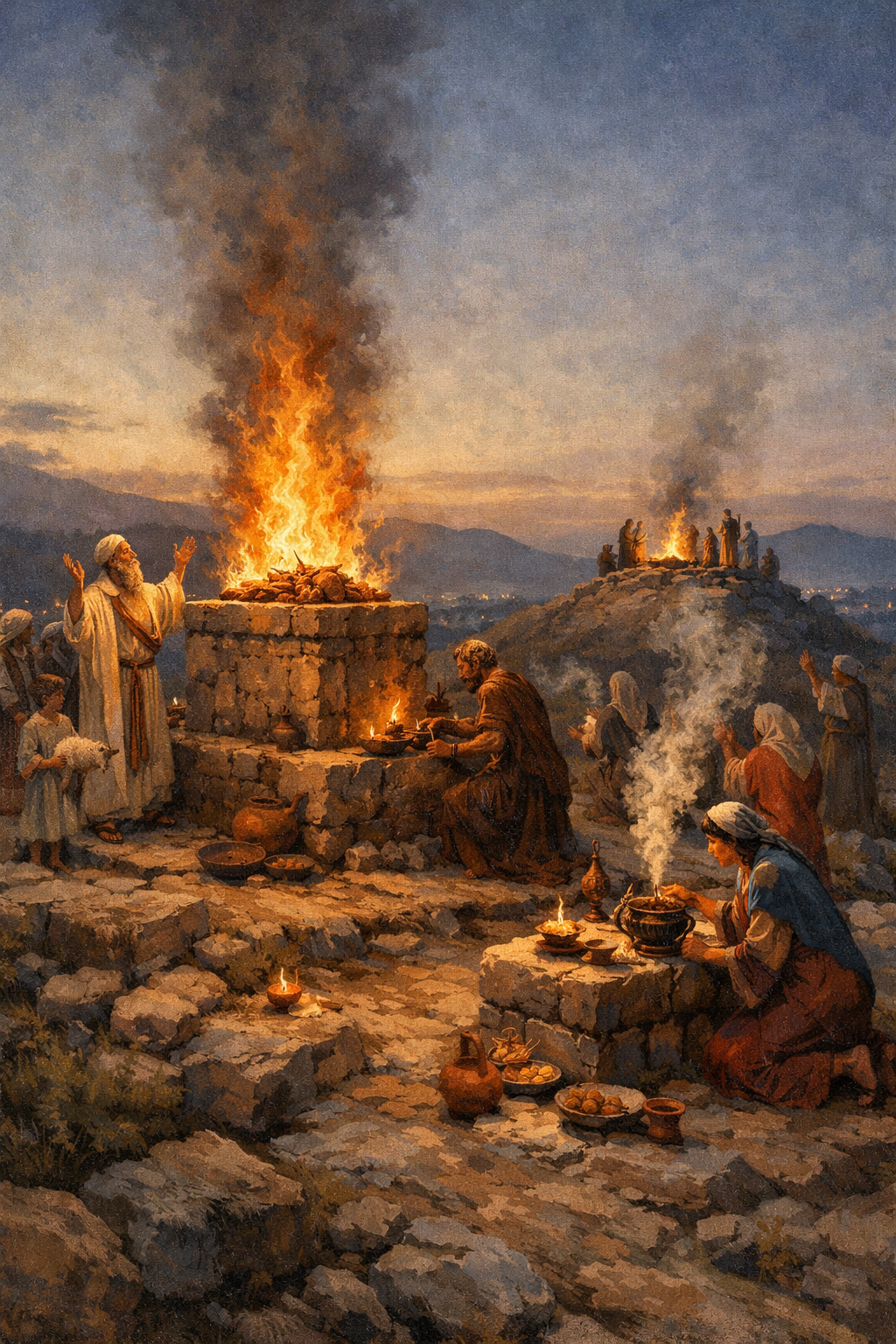
PURGING THE
IDOLATROUS PRIESTS
He did away with the idolatrous priests (komer) whom the kings of Judah had appointed to burn incense in the high places (bamah) in the cities of Judah and in the surrounding area of Jerusalem also those who burned incense to Baal, to the sun and to the moon and to the constellations and to all the host of heaven.- Reform #2 - Did away means that Josiah removed and abolished the priests who were conducting false worship. These false priests offered incense and sacrifices at “high places,” which were unauthorized worship sites scattered throughout the land. Although some high places had originally been used for worshiping the LORD, they eventually became centers of idolatry where people mixed the worship of God with the worship of Baal, Asherah, and the “host of heaven.”
Any thorough reformation can not only deal with sinful things;
it must also deal with sinful people.
David Guzik: Josiah’s reforms did not only remove sinful things, but also the sinful people that promoted and permitted these sinful things. The idols that filled the temple did not get there or stay there on their own – there were idolatrous priests who were responsible for these sinful practices.
Bob Utley - "He did away with the idolatrous priests" (komer) In this verse, and v. 20, it seems the king ordered the slaughter of these pagan priests. They were priests of the fertility idols in both Judah and Israel (cf. Hos. 10:5; Zeph. 1:4). This term may be a Hebrew word play on "snare" (BDB 485). The priests of vv. 5, 20 are different from the Judean priests of vv. 8-9. These were probably non-Levitical (Josephus, Antiq. 10.4.3; 1 Kgs. 12:31,33; 2 Kgs. 17:32).
Adam Clarke has an interesting note on the idolatrous priests" (komer) - “Probably they were an order made by the idolatrous kings of Judah, and called kemarim, from camar, which signifies to be scorched, shriveled together, made dark, or black, because their business was constantly to attend sacrificial fires, and probably they wore black garments.”
The high places mentioned here were a persistent problem throughout Israel’s history. Even some otherwise faithful kings, like Asa and Jehoshaphat, failed to remove them completely (1 Kings 15:14; 22:43). But Josiah’s reform was different—he went further than any of his predecessors. He not only destroyed the idols and altars but also removed the priests who served them, cutting off the source of false worship at its root.
Burning incense to the idols shows how deeply Judah had fallen into paganism. These forms of worship were borrowed from surrounding nations, particularly the Canaanites and Babylonians, who practiced astrology and venerated celestial bodies as divine powers. Yet God had clearly forbidden such practices in Deuteronomy 4:19+ "And beware not to lift up your eyes to heaven and see the sun and the moon and the stars, all the host of heaven, and be drawn away and worship them and serve them, those which the LORD your God has allotted to all the peoples under the whole heaven." Josiah’s removal of these priests was therefore an act of obedience to God’s Word and a rejection of the syncretism that had polluted Judah’s faith.
TSK - constellations (mazzaloth) - So the Vulgate {duodecim signa,} "the twelve signs," i.e., the zodiac; which is the most probable meaning of the word {mazzaloth,} from the Arabic {manzeel,} a {caravanserai,} house, or dwelling, as being the apparent dwellings of the sun in his annual course; and the Targumists and Rabbins often employ the words {tereysar mazzalaya,} to denote the signs of the zodiac. In Kings the word is used with reference to the pagan worship of the stars with all such worship's astrological significance. Mazzaloth is a feminine noun meaning a planet, a constellation and refers to zodiacal signs in the heavens (2 Ki 23:5), often a temptation to Israel to worship them.
John Walton - pagan priests. The term “pagan, idol priests” (Hebrew, komer) has many parallels in the ancient Near East, especially from Assyria. Kumru priests are known from Old Assyrian Period documents from Cappadocia (c. 2000-1800 B.C.) and from a single document from Mari during the reign of the Assyrian king, Shamshi-Adad I (reigned 1814-1781 B.C.). An Arabian queen was given the title of kumirtu priestess in an inscription of the Assyrian king Ashurbanipal (668-631 B.C.). Kumra’ is also the word for priest in Aramaic in the first millennium B.C. It is plausible that these priests mentioned here served the shrines of West Semitic deities such as Baal and Asherah, though some consider them renegade priests of Yahweh.(IVP Bible Background Commentary: OT page 408)
Idolatrous priests (03649)(komer) refers specifically to a pagan or idolatrous priest, one who serves in religious systems opposed to the worship of Yahweh. Unlike the common Hebrew word for priest, כֹּהֵן (kōhēn)—used for legitimate priests serving the LORD—kōmer carries a strongly negative and polemical sense in the Old Testament. It occurs only three times in the Hebrew Bible (2 Kings 23:5; Hosea 10:5; Zephaniah 1:4), and in each case the term appears in a context of prophetic denunciation of idolatry. Thus, the word functions not merely as a neutral occupational term but as a theological label identifying corrupt religious leaders who promoted false worship. These kōmerim were priests who officiated in cults devoted to Baal, the golden calf, celestial deities, or other pagan practices that had infiltrated Israel and Judah.
In 2 Kings 23:5, the term appears in the account of King Josiah’s sweeping religious reforms. Josiah removed the kōmerim, the idolatrous priests appointed by earlier kings of Judah, who had been burning incense at high places throughout the land and even within Jerusalem. Their removal symbolized the purging of syncretism from Judah’s worship, restoring the exclusive worship of Yahweh prescribed in the Mosaic covenant. In Hosea 10:5, the word describes the priests associated with the calf cult at Bethel in the northern kingdom of Israel. Hosea prophesied that these priests would mourn when the golden calf—an idol they served—would be carried away into exile by the Assyrians. Here the kōmerim are depicted as religious leaders emotionally attached to the very idols that would prove powerless to save them. Finally, Zephaniah 1:4 includes the term in a prophetic announcement of judgment: God declares He will cut off “the names of the idolatrous priests (kōmerim) along with the priests.” This warning comes in the period before Josiah’s reform and highlights how deeply pagan worship had penetrated Judah’s religious leadership.
The etymology of kōmer is uncertain, though several proposals have been suggested. Some scholars, such as Sigmund Mowinckel, proposed that it may derive from a root kmr meaning “to be hot or excited,” suggesting that these priests were characterized by ecstatic or frenzied ritual activity—similar to the dervish-like enthusiasm seen in certain pagan cults. If correct, the term could carry the sense of “the ecstatic one” or “one inflamed with religious frenzy.” Other scholars suggest that the word may be borrowed from Egyptian or other Semitic languages, reflecting the cultural interchange between Canaanite, Egyptian, and broader Near Eastern religious traditions. The word is attested in Aramaic and appears widely in the Semitic world; it even entered Greek as a loanword describing pagan priests. Some interpreters, including W. F. Albright, suggested that kōmer may refer specifically to eunuch priests, which were known in certain ancient fertility cults. Such a possibility would heighten the contrast with Israel’s covenant law, since Deuteronomy 23:1 forbade such persons from the assembly of the LORD, reinforcing the idea that these priests represented religious practices completely alien to Yahweh’s worship.
Theologically, the distinction between kōmer and kōhēn is extremely important. The Old Testament consistently reserves kōhēn for priests legitimately appointed to serve Yahweh according to the covenant and the Levitical system. By contrast, kōmer is always associated with apostasy, syncretism, and false religion. The word therefore becomes a linguistic marker distinguishing true worship from counterfeit worship. The prophets used it deliberately to expose leaders who outwardly claimed religious authority but were actually guiding the people into idolatry. In the prophetic worldview, such leaders were especially culpable because they corrupted the spiritual life of the nation and led people away from covenant faithfulness.
In summary, kōmer designates a pagan priest serving idols rather than the LORD, and its rare appearance in Scripture underscores the severity of the practices it describes. Each occurrence is connected with divine judgment or reform, demonstrating God’s intolerance of religious corruption within His covenant people. Whether associated with Baal worship in Judah, calf worship in Bethel, or other syncretistic cults, the kōmerim represent the tragic reality that religious leaders themselves can become instruments of idolatry. Consequently, the term serves as a powerful reminder in the prophetic literature that God demands purity of worship and faithfulness among those who lead His people spiritually.
2 Kings 23:6 He brought out the Asherah from the house of the LORD outside Jerusalem to the brook Kidron, and burned it at the brook Kidron, and ground it to dust, and threw its dust on the graves of the common people.
- Asherah 2Ki 21:7 Jdg3:7 1Ki 14:23 16:33 Jer 17:2
- and burned: Ex 32:20 De 7:25 9:21
- the graves: 2Ki 10:27 2Ch 34:4
ASHERAH FROM THE TEMPLE
TO THE TRASH DUMP
He brought out the Asherah (Asherah) from the house of the LORD outside Jerusalem to the brook Kidron, and burned it at the brook Kidron, and ground it to dust, and threw its dust on the graves of the common people - Reform #3 - The Asherah had been placed inside the temple of the LORD, likely during the reign of Manasseh, who had introduced widespread idolatry (2 Kings 21:7). Josiah did not merely discard the idol but he completely destroyed it. Burning and grinding it to powder ensured that it could never be restored or reused. This thorough destruction echoes other biblical examples of eliminating idolatry (compare Exod. 32:20 when Moses ground the golden calf to powder).
Threw its dust on the graves of the common people - This act carried deep symbolic meaning. In ancient Israel, contact with graves rendered a person or object ceremonially unclean (Nu 19:16). By scattering the dust of the idol on graves, Josiah was deliberately defiling it, making it permanently unfit for any future use in worship. It was a public declaration that the idol was cursed and rejected by God. Some scholars suggest that “the graves of the common people” may refer to burial sites of those who had participated in idolatry, making the act even more symbolic of judgment.
John Walton - scattering of the dust over graves. The sequence of burn-grind-scatter-eat is also found in a Ugaritic text to indicate total destruction of a deity—every destructive action is being carried out. The scattering of the dust on the graves is a final act of desecration on the image. (IVP Bible Background Commentary: OT page 408)
Bob Utley - "burned it. . .ground it to dust. . .threw its dust" This is similar to the destruction of Aaron's golden calf (cf. Exod. 32:20, which is repeated in Deut. 9:21). "and threw its dust on the graves of the common people" This refers to: The common people had participated in the idolatrous practices and this was a sign of their spiritual condition. The Jews considered that the graveyards were already ceremonially unclean and the depositing of the ashes there would pollute symbolically these graves even more (cf. Jer. 26:23).
John MacArthur: The Kidron Valley contained a burial ground for the common people (cf. Jer 26:23). Scattering ashes from the object of idolatry [Asherah] is said in 2Ch 34:4 to have been on the graves of those who sacrificed to that idol. The “common people” had followed their leaders to apostasy, defilement, and damnation – all symbolized by the act of scattering the ashes. (See MacArthur Study Bible)
2 Kings 23:7 He also broke down the houses of the male cult prostitutes which were in the house of the LORD, where the women were weaving hangings for the Asherah.
- the male cult prostitutes: Ge 19:4,5 1Ki 14:24 15:12 22:46 2Ch 34:33 Ro 1:26,27
- which were in the house of the LORD: Ex 35:25,26 Eze 8:14 16:16 Ho 2:13
Related Passages:
2 Corinthians 6:16+ Or what agreement has the temple of God with idols? For we are the temple of the living God; just as God said, “I WILL DWELL IN THEM AND WALK AMONG THEM; AND I WILL BE THEIR GOD, AND THEY SHALL BE MY PEOPLE.
JOSIAH CLEANS HOUSE OF
HORRID ABOMINATIONS
He also broke down the houses of the male cult prostitutes (qadesh) which were in the house of the LORD - REFORM #4 - These houses were chambers or rooms within the temple complex that had been set aside for immoral and idolatrous rituals associated with pagan worship. The male cult prostitutes (qadesh “consecrated ones”) were men who engaged in sexual acts as part of fertility rites dedicated to false gods, particularly Asherah, the Canaanite goddess of fertility. Such practices were common in Canaanite religion, where sexual immorality was falsely believed to ensure agricultural prosperity and divine favor. The fact that these activities were taking place “in the house of the LORD” shows how far Judah had fallen into apostasy under kings like Manasseh (2 Kings 21:3–7). Again, Josiah may have heard this from Deuteronomy 23:17 which says “None of the daughters of Israel shall be a cult prostitute, nor shall any of the sons of Israel be a cult prostitute (qadesh)."
Where the women were weaving hangings for the Asherah (Asherah) - Where means in the Temple, which had become a center for pagan ritual activity. Their presence within the temple showed how severely Judah’s worship had been corrupted, and Josiah’s reforms aimed to completely purify the house of the LORD from such practices.
Dilday: The word translated ‘hangings’ likely refers to a fabric woven by idol worshippers for curtains behind which the ritual obscenities were practiced.
Wiseman: used by the priests or statues or to denote the ‘plaited cord’ round the head as worn by Babylonian women prostitutes.
William Barnes: vv. 6-7 -- removed … took … outside … burned … ground … to dust … tore down . Here is a sampling of the forceful verbs used to describe Josiah’s thoroughgoing actions of cult cleansing and altar destruction. Other verbs include “defiled” (23:8); “destroyed” (23:12); “smashed … to bits” (23:12); “scattered” (23:12); “desecrated” (23:13); “smashed” (23:14); and “demolished” (23:19). This king certainly had his work cut out for him, and he certainly went at it with “all his heart and all his soul.” (SEE 1-2 Kings - Page 364)
What was meant to be a place of holiness and prayer had been turned into a center of pagan ritual. This was a direct violation of God’s command in Ex 20:3–5, “You shall have no other gods before me. You shall not make for yourself a carved image… You shall not bow down to them or serve them.” The temple, which was to be the dwelling place of the one true God, had been desecrated by practices that celebrated immorality and false worship. As Ro 1:25 says “They exchanged the truth about God for a lie and worshiped and served the creature rather than the Creator.”
John Walton - male shrine prostitutes. The Hebrew term, qedeshim, refers to “sacred males.” Little is known about this practice, but it was thoroughly condemned and may well have had to do with cultic prostitution (see Deut 23:18-19). Cognate terms are found in Akkadian and Ugaritic, where they are also not clear in terms of function. The root means to be ritually clean. A qadishtu in Akkadian was a woman of special status. She had particular functions in the temple (midwife, wet-nurse and devotee of the god of the temple) none of which appear to be obviously of a sexual nature. A similar situation can be found at Ugarit. The condemnation of the males here in 2 Kings 23:7 may have had to do with the fact that they were devotees of foreign deities. weaving for Asherah. Apparently the women were weaving types of coverings or vestments to adorn the Asherah statue (or pole). The fashioning of woven and embroidered garments used to place on the statues of gods in Mesopotamia is well known. (IVP Bible Background Commentary: OT page 408)
Male cult prostitutes (06945) qadesh is a masculine noun (from qodesh = holy, apartness, sacredness) that refers to a male cult prostitute associated with pagan temple worship, particularly within the fertility religions of Canaan and the surrounding ancient Near East. The term is striking because it comes from the Hebrew root קָדַשׁ (qādash), which means “to be holy,” “to consecrate,” or “to set apart.” In the worship of Yahweh this root describes what is devoted to God and separated for His sacred purposes (Leviticus 20:7; Exodus 19:6). Tragically, in the pagan religions of Canaan the same concept of “being set apart” was corrupted to refer to men dedicated to ritual prostitution in pagan shrines. Thus the word qādeš reflects a tragic irony: a term rooted in the concept of holiness came to describe a person set apart for sexual immorality in the service of idols. This distortion illustrates how deeply pagan religion perverted the biblical concept of holiness, turning what should have been devotion to the true God into ritualized immorality.
QADESH - 9V - Gen. 38:21; Gen. 38:22; Deut. 23:17; 1 Ki. 14:24; 1 Ki. 15:12; 1 Ki. 22:46; 2 Ki. 23:7; Job 36:14; Hos. 4:14
In the ancient Near East, cult prostitution formed a central feature of fertility religion, especially in the worship of deities such as Baal, Asherah, Astarte, and Anath. These religions believed that fertility in crops, animals, and families could be stimulated through imitative or sympathetic magic. Worshipers engaged in sexual relations with temple prostitutes—both male and female—believing that these acts symbolically stimulated the gods to grant fertility and prosperity. Thus cult prostitutes were not merely immoral individuals but were considered religious functionaries dedicated to their gods, and sexual acts performed with them were regarded as sacred rites intended to influence divine powers. The female cult prostitute was called קְדֵשָׁה (qedēshah), while the male counterpart was the qādeš. These individuals were often attached to pagan temples or shrines and sometimes performed other duties associated with temple maintenance and ritual service.
The Old Testament makes it clear that such practices were widespread among the Canaanite nations that inhabited the land before Israel arrived. The Mosaic Law explicitly prohibited these practices because they were incompatible with the holiness of Yahweh and the moral framework of the covenant. Deuteronomy 23:17 states, “None of the daughters of Israel shall be a cult prostitute, nor shall any of the sons of Israel be a cult prostitute.” This command forbade both female and male shrine prostitution within Israel, establishing a clear boundary between the worship of the LORD and the immoral religious practices of surrounding nations. The prohibition demonstrates that Israel’s covenant relationship with God demanded moral purity and rejected any attempt to merge sexuality with religious ritual. In contrast to the fertility cults, biblical worship honored sexuality as God’s gift within the covenant of marriage rather than as a means of manipulating divine forces.
The pervasiveness of cult prostitution in the surrounding culture is illustrated in the story of Judah and Tamar in Genesis 38. When Tamar disguised herself and sat by the roadside, Judah assumed she was a shrine prostitute, and he asked the men of the place, “Where is the temple prostitute who was by the road at Enaim?” (Genesis 38:21). The narrative indicates that such figures were commonly recognized in the region, showing how normal temple prostitution was in Canaanite society. Judah’s assumption demonstrates the cultural context in which Israel lived, where sexual rites connected with religious worship were widely accepted and expected.
Despite the clear prohibitions of the Law, cult prostitution eventually infiltrated Israel and Judah during periods of spiritual decline. During the reign of Rehoboam, Scripture records that Judah adopted the religious practices of the surrounding nations. 1 Kings 14:23–24 describes how the people built high places, sacred pillars, and Asherah poles and states, “There were also male cult prostitutes in the land. They did according to all the abominations of the nations which the LORD dispossessed before the sons of Israel.” The presence of these shrine prostitutes demonstrates how deeply pagan fertility religion had penetrated the spiritual life of Judah. High places, sacred pillars, Asherah poles, and cult prostitution formed a religious system centered on fertility worship, which stood in direct opposition to the covenant worship of Yahweh.
Several godly kings attempted to purge these practices from the land. King Asa initiated major reforms during his reign, removing the cult prostitutes and destroying idols. 1 Kings 15:12–13 records that he “put away the male cult prostitutes from the land and removed all the idols which his fathers had made,” even removing his own grandmother Maacah from her royal position because she had made an image of Asherah. Asa’s reforms demonstrate the seriousness of this corruption, which had spread even into the royal household. His son Jehoshaphat continued the reform movement, removing the remaining shrine prostitutes who had survived earlier efforts (1 Kings 22:46). These actions illustrate the persistent struggle within Israel to maintain the purity of worship commanded by the covenant.
The most dramatic reform occurred during the reign of King Josiah in the seventh century BC. Josiah launched an extensive campaign to purify Judah’s worship and eradicate idolatry. 2 Kings 23:7 reveals the shocking extent to which fertility religion had penetrated the nation: “He also broke down the houses of the male cult prostitutes which were in the house of the LORD, where the women were weaving hangings for the Asherah.” This verse indicates that shrine prostitutes had actually established living quarters within the temple precincts in Jerusalem itself. Women were producing garments or coverings for Asherah, the fertility goddess associated with Baal. The presence of such practices in the temple shows how deeply pagan religion had corrupted Judah’s worship before Josiah’s reforms.
The prophets often condemned these practices because they symbolized Israel’s spiritual unfaithfulness. In prophetic literature, idolatry is frequently portrayed as spiritual adultery, a betrayal of Israel’s covenant relationship with God. The moral and spiritual consequences of these practices are highlighted in passages such as Job 36:14, which states that the wicked “die in youth, and their life perishes among the cult prostitutes.” Similarly, Hosea 4:14 condemns Israelite men who participated in ritual prostitution, declaring, “I will not punish your daughters when they play the harlot or your brides when they commit adultery, for the men themselves go apart with harlots and offer sacrifices with temple prostitutes.” In this context the prophet exposes the hypocrisy of religious leaders and worshipers who engaged in immoral rituals while pretending to honor God.
The existence of the qādeš therefore represents more than a social or moral problem; it reflects the profound theological conflict between the worship of Yahweh and the religions of the surrounding nations. The fertility cults blurred the distinction between worship and sensuality, turning sexuality into a supposed sacred act designed to manipulate divine powers. In contrast, the worship of Yahweh emphasized holiness, covenant fidelity, and moral purity. By condemning the cult prostitute, Scripture affirms that true holiness cannot coexist with the immoral practices of pagan religion. The tragic misuse of a word derived from “holy” to describe ritual prostitution stands as a powerful reminder of how false religion can distort sacred concepts and lead people away from the true worship of God.
2 Kings 23:8 Then he brought all the priests from the cities of Judah, and defiled the high places where the priests had burned incense, from Geba to Beersheba; and he broke down the high places of the gates which were at the entrance of the gate of Joshua the governor of the city, which were on one’s left at the city gate.
- Geba: Jos 21:17 1Ki 15:22 1Ch 6:60 Isa 10:29 Zec 14:10
- Beersheba: Ge 21:31 26:23 Jdg20:1 1Ki 19:3
JOSIAH BREAKS DOWN
AND DEFILES HIGH PLACES
Then he brought all the priests from the cities of Judah - REFORM #5 - Many local priests serving at the high places, which were worship sites scattered throughout towns and hills.
Bob Utley - "he brought all the priests from the cities of Judah, and defiled the high places" This is an attempt of Josiah to centralize the worship at the central sanctuary in Jerusalem only (cf. vv. 21-23) and thereby abandon the local high places.
And defiled (tame; LXX - miaino - literally dye with another color) the high places (bamah) where the priests had burned incense, from Geba to Beersheba - To defile a site meant to desecrate it or to render it ritually unclean and unusable for worship. Josiah intentionally polluted these high places so they could never again function as religious shrines. By doing this he permanently abolished these centers of unauthorized worship.
From Geba to Beersheba was a common way of describing the entire territory of Judah from north to south. Geba represented the northern boundary (7 mi NE of Jerusalem) and Beersheba represented the southern limit (45 mi. S of Jerusalem). Therefore Josiah's reform was nationwide, not limited to Jerusalem. In short, Josiah left no place for spiritual compromise.
and he broke down the high places (bamah) of the gates which were at the entrance of the gate of Joshua the governor of the city, which were on one’s left at the city gate - Some shrines had even been constructed near city gates, which were major public gathering places in ancient towns. These locations made the worship sites highly visible and accessible. Josiah demolished these structures to remove the influence of pagan worship from public life.
The gate of Joshua the governor of the city identifies a specific shrine located near the gate associated with Joshua, a city official or governor. The gate area was likely an important civic location where people gathered for trade, legal matters, and public announcements.
John Walton - desecrating high places. Desecration of sacred places occurs when forbidden cultic practices are performed there. The laws for preserving the purity of Yahweh’s sacred places are outlined in the book of Leviticus, but these desecrate the temple because they represent things not acceptable in Yahweh’s presence. Other actions may cause desecration to the shrines of other gods. There were, however, certain common desecrating actions. Turning what had once been a sacred area into a graveyard (see v. 14) or a latrine (see 10:27) would bring permanent desecration. shrines at the gates. At Dan standing stones were found at a shrine just inside the city gate, and the clear remains of the presentation of votive offerings were evident. It is thought that the standing stones represented some of the deities of cities that had fallen to Israel. The votive offerings would be in fulfillment of vows made to those deities (perhaps for their aid in overthrowing the city the Israelites were fighting against). For more information on standing stones see comment on 17:10. (IVP Bible Background Commentary: OT page 408)
High places (01116) bamah Six activities seem to be related to high places -- burning of incense, sacrificing, eating of sacrificial meals, praying, prostitution, child sacrifice (cf. bama in the valley, Je7:31). The first use in Lev 26:30 is God's declaration to Israel "I will destroy your high places." In Dt 32:13 speaking of Jacob (Israel) He declared "He made him ride on the high places of the earth," so clearly some uses of bamah are not negative. In a similar use God says Israel "you will tread upon their (Israel's enemies') high places." Another positive use is Psalm 18:33 where David declared Jehovah "makes my feet like hinds' feet, And sets me upon my high places." (cp Hab 3:19 - NET Note = David "compares his agility in battle to the ability of a deer to negotiate rugged, high terrain without falling or being injured.", cp Isa 58:14) We see he effect of Israel's high places on Jehovah in Ps 78:58 = "For they provoked Him with their high places and aroused His jealousy with their graven images."
A sad phrase that is repeated again and again (speaking of Israel) is "the high places were not taken away" (1Ki 15:14, 2Chr 15:17 = King Asa but notice he did remove some of them - 2Chr 14:3, 5, 1Ki 22:43, 2Chr 20:33 = King Jehoshaphat, 2Ki 12:3 = King Jehoash, 2Ki 14:4 = King Amaziah, 2Ki 15:4 = King Azariah, 2Ki 15:35 = King Jotham son of Uzziah and look what his son did in 2Ki 16:1-4!, 2Chr 20:33). In many of these passages the context was of a king doing "spiritual house cleaning" so to speak and yet still failing to remove the high places. Isn't sin that way? We confess one or two sins but we have a little pet sin (better a "venomous viper") that we just don't have the heart to kill! God grant us spiritual eyes and hearts to learn from Israel's mistakes. Amen! Some kings like Hezekiah (1Ki 18:4, 2Chr 31:1, Isa 36:7) and Josiah (2Ki 23:4,8, 13, 15, 19-20, 2Chr 34:3 cp prophecy about Josiah 300 years earlier = 1Ki 13:2) did destroy the high places, but in Hezekiah's case his own son Manasseh rebuilt them (2Ki 21:1-2, 3, 2Chr 33:3) and in Josiah's case the people rebuilt them!
Defiled (made unclean) (02930) tame means to become unclean or make unclean. To become ceremonially unclean. To defile oneself (Hos 5:3, 6:10, Ezek 20:30). A wife defiles herself by adultery (Nu 5:13, Jer 2:23 = speaks of Israel as God's wife who had defiled herself by her spiritual adultery with idols!, Ezek 23:13 = refers to Judah and in context to the 10 Northern tribes - both had defiled themselves). To defile (violate) a girl (Ge 34:5), a woman (Ezek 18:6)
Qal: To become (cultically or ceremonially) unclean: a) men Lev.11:24-39 Lev.5:3 Lev 13:14, 14:46, 15:5, 17:15, 22:6, Nu 19:7, Hag 2:13 b) things Lev.11:32-38' so that uncleanness arises Eze.22:3 <> Nif.: defile, pollute oneself Hos.5:3 by Lev.11:43 <> Piel: Lev.13:441. dishonor: ravish (a girl) Ge 34:5; profane Eze.43:7 2. defile, profane: tabernacle Lev.15:31, land Lev.18:28 3. (cultically) defile: oneself Lev.11:44, a nazîr Nu 6:9, altar 2Ki.23:16, house of Yahweh Jer.7:30 4. declare unclean Lev.13:8-59 <> Pual: be defiled Eze.4:14 <> Hitp.: incur uncleanness, become unclean Lev.11:24 <> Hotpaal: be touched by uncleanness Deut 24:4
The Septuagint (Lxx) translates tame with the verb miaino, means literally to dye with another color. As used in the NT figuratively miaino describes a mind and conscience that is morally contaminated, corrupted, tainted, tinged and polluted (Titus 1:15+ = "defiled and unbelieving"). In a ceremonial or cultic sense miaino means to defile, profane, desecrate, make unclean or to become unacceptable. To defile something is to sully (damage the purity or integrity of), mar (impair the appearance of; disfigure) or spoil it. Jude uses miaino in a physical and a moral sense of the one's flesh defiled by licentiousness and so to corrupt morally. (Jude 1:8+)
2 Kings 23:9 Nevertheless the priests of the high places did not go up to the altar of the LORD in Jerusalem, but they ate unleavened bread among their brothers.
- the priests: Eze 44:10-14 Mal 2:8,9
- but they did: 1Sa 2:36 Eze 44:29-31
Nevertheless the priests of the high places did not go up to the altar of the LORD in Jerusalem, Although these priests were not executed, they were not permitted to serve at the temple altar in Jerusalem. Their previous association with the high places likely disqualified them from priestly service at the central sanctuary.
This situation parallels an earlier instruction in Ezekiel 44:10-14, where Levites who had gone astray with idolatry were allowed to perform lesser duties but not approach the altar.
But they ate unleavened bread among their brothers - Even though they could not serve as temple priests, they were still considered part of the Levitical community. Therefore they were allowed to share in the priestly food portions, which included unleavened bread from offerings (cf. Leviticus 6:16-18). In other words they retained some privileges of priestly support, but they lost the privilege of ministering at the altar.
In summary, the unfaithful priests were removed from positions of authority but not entirely rejected. Their situation serves as a sobering reminder that God’s servants are called to holiness and obedience, and that while His grace restores, His holiness still demands reverence and purity in worship. One is reminded of 1Co 9:24-27+...
Do you not know that those who run in a race all run, but only one receives the prize? Run (present imperative see our need to depend on the Holy Spirit to obey) in such a way that you may win. 25 Everyone who competes in the games exercises self-control in all things. They then do it to receive a perishable wreath, but we an imperishable. 26 Therefore I run in such a way, as not without aim; I box in such a way, as not beating the air; 27 but I discipline my body and make it my slave, so that, after I have preached to others, I myself will not be disqualified.
John Walton - eating unleavened bread. The term here for unleavened bread is either a generic term for grain offerings or unleavened cakes to be eaten at the Passover celebration. Since leaven was associated with spoilage, and therefore impurity, unleavened bread was used in most sacred ceremonies. (IVP Bible Background Commentary: OT page 409)
2 Kings 23:10 He also defiled Topheth, which is in the valley of the son of Hinnom, that no man might make his son or his daughter pass through the fire for Molech.
- Topheth: Isa 30:33 Jer 7:31,32 19:6,11-13, Tophet
- the valley: Jos 15:8 2Ch 28:3 33:6 Jer 19:2 32:35 Mt 5:22 *Gr:
- might make: 2Ki 16:3 17:17 21:6 Lev 18:21 De 18:10 Jer 32:35 Eze 16:21 20:26,31 Eze 23:37-39
CHILD SACRIFICE
ELIMINATED
He also defiled (tame; LXX - miaino - literally dye with another color) Topheth, which is in the valley of the son of Hinnom, that no man might make his son or his daughter pass through the fire for Molech - Topheth was a specific site located in the Valley of the Son of Hinnom (south of Jerusalem). It had become a place where children were sacrificed by fire to the Ammonite god Molech. Topheth represented the deepest moral and spiritual corruption of Judah’s idolatry. The name Topheth may be related to a word meaning “drum”, possibly because drums were beaten during the ritual to drown out the cries of the children being burned. To defile the place meant Josiah intentionally made it ritually unfit for worship. This likely involved desecrating the site—possibly by scattering bones or refuse there (a common method of rendering a site unclean in Jewish law). Josiah's purpose was clear to permanently prevent it from ever being used again for child sacrifice.
This horrific practice had been adopted by some Israelites under earlier kings, particularly Ahaz and Manasseh.
Bob Utley - "He also defiled Topheth, which is in the valley of the son of Hinnom, that no man might make his son or his daughter pass through the fire for Molech" Topheth (BDB 1075) is the place where sacrifices to Molech (i.e., the Phoenician fire god to which infant children were sacrificed) occurred to insure fertility, were made. This was done right outside the city of Jerusalem in the Valley of the Sons of Hinnom. This was a despicable act and the Jews later made this place the garbage dump of Jerusalem. This is the imagery that Jesus used to describe the hell (i.e., Gehenna). "Topheth" means "place of burning."
John Walton - Topheth, Ben Hinnom, Molech. Topheth was the cultic installation where children were offered to the god Molech. The word is thought to signify the hearth where the child was placed. The Hebrew term has parallel terms in both Ugaritic and Aramaic with the meaning “furnace, fireplace.” Scholars have thought that Topheth was at the edge of the valley of Ben Hinnom before connecting with the Kidron Valley. The valley of Ben Hinnom has been identified with Wadi er-Rababi southwest of the City of David. Many consider Molech to be a netherworld deity featuring rituals with Canaanite origins focusing on dead ancestors. An eighth-century B.C. Phoenician inscription speaks of sacrifices made to Molech before battle by the Cilicians and their enemies. The name Molech appears to be related to the Hebrew term mlk (“to rule”). Sacrifices to Molech were done at the installation of Baal, which may mean that the term was an epithet of Baal himself, as well as other deities (Jer 32:35).(IVP Bible Background Commentary: OT page 409)
Topheth (Hebrew tōpheth, Strong’s 08612) was a specific site in the Valley of the Son of Hinnom (Ben Hinnom), just southeast of Jerusalem. Scripture identifies it as a high place where the horrific practice of child sacrifice occurred, particularly offerings to Molech. “They have built the high places of Topheth, which is in the valley of the son of Hinnom, to burn their sons and their daughters in the fire” (Jeremiah 7:31). Because of this abomination, the Lord declared that the place would become known as the “Valley of Slaughter” where the dead would be buried in judgment (Jer 7:32; 19:6, 11). The site lay near the southern end of the Hinnom Valley where it turns east toward the Kidron Valley. Its name may derive either from a root meaning “to burn” (thus “place of burning”) or from tōph, meaning “drum,” possibly referring to instruments used to drown out the cries of children sacrificed in the fires of Molech.
Topheth became a symbol of extreme corruption in Judah’s worship. Several kings of Judah participated in the practice of making their children “pass through the fire” there (2Ch 28:3; 33:6; Jer 32:35). During his reforms, King Josiah deliberately desecrated Topheth to stop these sacrifices, as recorded (2Ki 23:10). The prophets later used the imagery of Topheth as a place prepared for divine judgment (Isa 30:33). Over time, because refuse and carcasses were burned in this valley, it became associated with the idea of divine punishment, contributing to the later Jewish concept of Gehenna, a symbol of final judgment.
The Valley of Hinnom (Hebrew Gê-Hinnōm, Strong’s H2011), meaning “Valley of Hinnom” or possibly associated with lamentation, was a deep, narrow ravine with steep rocky sides located south and west of Jerusalem, separating Mount Zion on the north from the Hill of Evil Counsel and the plain of Rephaim to the south. It first appears in Scripture as a boundary marker between the tribal territories of Judah and Benjamin: “Then the border went up the valley of Ben-hinnom… to the south of the Jebusite (that is, Jerusalem)” (Joshua 15:8; cf. Joshua 18:16). The name likely derives from an early resident known as “Hinnom,” possibly of Jebusite origin. In Israel’s later history this valley became infamous for idolatrous worship, especially the horrific rites connected with Molech and Baal in which children were burned as sacrifices. Scripture records that certain kings of Judah participated in or allowed these practices: “He made his son pass through the fire, according to the abominations of the nations” (2 Kings 16:3; cf. 2 Chronicles 28:3; 33:6; Jeremiah 32:35). A specific section of the valley called Topheth was the place where these sacrificial fires were kindled (Jeremiah 7:31; 19:6).
Because of these abominations, the valley became a powerful symbol of divine judgment. During his religious reforms King Josiah deliberately desecrated the site to prevent further sacrifices, fulfilling the record: “He also defiled Topheth, which is in the valley of the son of Hinnom, that no man might make his son or his daughter pass through the fire for Molech” (2 Kings 23:10; cf. 2 Chronicles 34:4–5). After this period the area appears to have been treated with contempt and used as a place for refuse and corruption, which reinforced its association with uncleanness and judgment. Over time the name “Ge-Hinnom” (Greek Gehenna) became a well-known Jewish expression for the place of final punishment, a meaning reflected in the teaching of Jesus: “Whoever says, ‘You fool,’ shall be guilty enough to go into the fiery hell (Gehenna)” (Matthew 5:22; cf. Matthew 10:28; Mark 9:43; Luke 12:5). Thus the Valley of Hinnom moved from being a geographical boundary near Jerusalem to the name gehenna (geenna) meaning "hell," the lake of fire "prepared for the devil" and all those who reject God's salvation through Jesus Christ (Matthew 25:41; Revelation 20:15).
Molech (or Moloch)—whose name likely derives from the Hebrew melekh, “king”—was the national deity of the Ammonites and one of the most abhorrent idols condemned in Scripture. Worship of Molech involved the sacrifice of children by fire, a practice strongly forbidden by God in the Law: “You shall not give any of your offspring to offer them to Molech, nor shall you profane the name of your God; I am the LORD” (Leviticus 18:21; cf. Leviticus 20:2–5; Deuteronomy 12:31; 18:10). Historical descriptions portray Molech as a hollow bronze idol, often depicted with a bull’s head and outstretched arms, heated from within by fire so that children placed upon it were burned as offerings. These sacrifices were associated particularly with Topheth in the Valley of Hinnom near Jerusalem, where apostate kings of Judah such as Ahaz and Manasseh caused their sons to “pass through the fire” (2 Kings 16:3; 21:6; 2 Chronicles 28:3; 33:6). Because of these atrocities, King Josiah later defiled Topheth to stop the practice (2 Kings 23:10).
The prophets repeatedly denounced this worship as one of the greatest corruptions of Israel’s covenant faith. Jeremiah condemned those who “built the high places of Baal… to cause their sons and their daughters to pass through the fire to Molech, which I had not commanded them” (Jeremiah 32:35; cf. Jeremiah 7:31; 19:5). Ezekiel likewise rebuked Israel for sacrificing their children to idols (Ezekiel 16:20–21; 20:31), while Micah exposed the twisted logic behind such rites when he asked rhetorically, “Shall I give my firstborn for my transgression, the fruit of my body for the sin of my soul?” (Micah 6:7). Molech worship appears closely related to other Canaanite cults such as Baal and Chemosh, reflecting the broader pagan idea of offering the most precious possession to appease a deity. Scripture consistently portrays this practice as a detestable abomination that provoked divine judgment (Jeremiah 19:6; Psalm 106:37–38). After the Babylonian exile, Israel finally abandoned this form of idolatry, and Molech worship disappears from Jewish history.
2 Kings 23:11 He did away with the horses which the kings of Judah had given to the sun, at the entrance of the house of the LORD, by the chamber of Nathan-melech the official, which was in the precincts; and he burned the chariots of the sun with fire.
- the sun: 2Ki 23:5 2Ch 14:5 34:4 Eze 8:16
JOSIAH ERADICATES
SUN WORSHIP
He did away with the horses which the kings of Judah had given to the sun, at the entrance of the house of the LORD - REFORM #7 - Sun worship was extremely common in the ancient Near East. Civilizations such as Egypt, Babylon, Assyria, and Persia revered the sun as a supreme deity. The verse reveals that earlier kings of Judah had introduced sun worship into the very precincts of the temple in Jerusalem. Horses had been “given to the sun,” likely meaning they were dedicated to the worship of the sun-god. The sun was often personified as a deity and was imagined as riding across the sky in a chariot drawn by horses. Because of this belief, horses and chariots were sometimes kept at temples as sacred objects associated with the sun’s daily course. These animals may have been used in ritual processions honoring the sun, especially at sunrise. The fact that they were stationed at the entrance of the house of the LORD shows how deeply pagan practices had infiltrated Judah, even into the area surrounding Yahweh’s temple.
NET - "He removed from the entrance to the Lord’s temple the statues of horses" - The words “statues of” have been supplied in the translation for clarity.
Patterson and Austel - The utilization of the horse in the solar cultus was widespread in the ancient Near East, being attested particularly in Assyrian and Aramean inscriptional and artifactual sources.” (See 1 Samuel - 2 Kings - Volume 3 - Page 938)
Bob Utley - "He did away with the horses which the kings of Judah had given to the sun This is another aspect of the worship of the Assyrian god, Ashur. Apparently the chariots and horses were a symbol of the sun moving across the heavens (i.e., Ps. 19:1-6). They may have been real or possibly statues.
By the chamber of Nathan-melech the official, which was in the precincts - This verse provides a historical detail that grounds this account in reality. Nathan-melech was likely a royal officer or court official who had some responsibility for these horses or for the maintenance of the temple precincts. Archaeological discoveries in Jerusalem have even uncovered a seal bearing the name “Nathan-melech, servant of the king,” which may refer to this very individual. His chamber being near the temple entrance shows how closely intertwined the royal administration and idolatrous practices had become.
and he burned the chariots of the sun with fire - Burning the chariots of the sun symbolized total destruction and purification. Fire, in this context, represented judgment and cleansing. Josiah was ensuring that these objects could never again be used for idolatry. His actions fulfilled the command in Deuteronomy 7:5, where God told Israel to “break down their altars and dash in pieces their pillars and chop down their Asherim and burn their carved images with fire.”
TSK - Throughout the East, the horse because of his swiftness and utility, was dedicated to the sun; and the Greeks and Romans feigned that the chariot of the sun was drawn by four horses, Pyrous, Eous, Aithon, and Phlegon: and hence also chariots were dedicated to that luminary. Jarchi says, that those who adored the sun had horses, which they mounted every morning, to go out to meet him at his rising. The kings of Judah had imitated these idolatrous customs, and kept the horses of the sun even at the entrance of the temple of the Lord!
John Walton - horses and chariots dedicated to the sun. White horses were used in important ritual functions in Assyria and were usually associated with Ashur and Sin, major deities in the Assyrian pantheon. White horses were dedicated at the feet of a certain deity. Moreover a number of Assyrian deities rode a horse-drawn chariot on festival days. In Assyrian mythology the sun (god) was carried across the sky in a chariot driven by his charioteer Rakib-il. In the syncretism referred to here, Yahweh was probably being worshiped as a sun god, and the chariot and horses represented his vehicle. Archaeological evidence is provided by Iron Age horse figurines with solar disks and by the Taanach cult stand, which portrays a horse with a sun-disk on its back. This would have some similarity with the golden calf imagery where the calf served as a pedestal or the ark of the covenant that functioned as a footstool. None of these portray deity, but they represent his throne.(Jer 32:35).(IVP Bible Background Commentary: OT page 409)
2 Kings 23:12 The altars which were on the roof, the upper chamber of Ahaz, which the kings of Judah had made, and the altars which Manasseh had made in the two courts of the house of the LORD, the king broke down; and he smashed them there and threw their dust into the brook Kidron.
- were on the roof: De 22:8 Jer 19:13 Zep 1:5
- which Manasseh had made : 2Ki 21:5,21,22 2Ch 33:5,15
- threw their dust into the brook Kidron: 2Ki 23:6
Related Passages:
2 Kings 21:4-5 He built altars in the house of the LORD, of which the LORD had said, “In Jerusalem I will put My name.” 5 For he built altars for all the host of heaven in the two courts of the house of the LORD.
2 Chronicles 29:16 So the priests went in to the inner part of the house of the LORD to cleanse it, and every unclean thing which they found in the temple of the LORD they brought out to the court of the house of the LORD. Then the Levites received it to carry out to the Kidron valley.
DESTRUCTION OF SOME OF
MANASSEH'S DEFILEMENTS
The altars which were on the roof, the upper chamber of Ahaz which the kings of Judah had made - REFORM #8 - In the ancient Near East, rooftops were often used for religious rituals, particularly for worship of the “host of heaven” (the sun, moon, and stars). Earlier kings of Judah had adopted this pagan practice. The prophet Jeremiah later describes the same activity Jeremiah 19:13 “The houses of Jerusalem and the houses of the kings of Judah will be defiled like the place Topheth, because of all the houses on whose rooftops they burned sacrifices to all the heavenly host.” Thus, the roof of Ahaz’s chamber apparently contained altars used for astral worship, probably influenced by Assyrian or Babylonian religion during the period when Judah was politically dependent on those empires.
And the altars which Manasseh had made in the two courts of the house of the LORD - These altars were not merely outside the temple but were within its sacred precincts, defiling the very place where God’s presence was to dwell.
The king broke down and he smashed them there and threw their dust into the brook Kidron - Josiah’s response was uncompromising. This was not a symbolic gesture—it was a total destruction. By breaking them down and grinding them to dust, Josiah ensured that nothing of these altars could ever be reused or restored. Throwing the dust into the brook Kidron, which flowed east of Jerusalem, was a way of removing the defilement from the holy city entirely. The Kidron Valley had long been used as a place of purification and disposal of unclean things (2 Chronicles 29:16; 2 Kings 23:4, 6). By casting the remains there, Josiah was symbolically cleansing the temple and the city from the pollution of idolatry.
🙏 THOUGHT - Spiritually, Josiah’s cleansing of the temple points to the need for believers to cleanse their own hearts (GOD'S TEMPLE) from anything that rivals God’s place in their lives. Just as Josiah removed the altars from God’s house, Christians are called to remove idols from the “temple” of their hearts and smash them to dust! (Ro 8:13+).
John Walton - upper room of Ahaz. The upper room typically functioned as an audience chamber, so these were in a prominent location in the palace.(IVP Bible Background Commentary: OT page 409)
2 Kings 23:13 The high places which were before Jerusalem, which were on the right of the mount of destruction which Solomon the king of Israel had built for Ashtoreth the abomination of the Sidonians, and for Chemosh the abomination of Moab, and for Milcom the abomination of the sons of Ammon, the king defiled.
- Solomon: 1Ki 11:7 Ne 13:26
- Ashtoreth: Jdg2:13 10:6 1Sa 7:4 12:10 1Ki 11:5,33
- Chemosh: Nu 21:29 Jdg11:24 Jer 48:7,13,16
- Milcom: Zep 1:5, Malcham
Related Passages:
1 Kings 11:5-7+ For Solomon went after Ashtoreth the goddess of the Sidonians and after Milcom the detestable idol of the Ammonites. 6 Solomon did what was evil in the sight of the LORD, and did not follow the LORD fully, as David his father had done. 7 Then Solomon built a high place for Chemosh the detestable idol of Moab, on the mountain which is east of Jerusalem, and for Molech the detestable idol of the sons of Ammon.
DEFILING WORSHIP SITES
BUILT BY SOLOMON
The high places (bamah) which were before Jerusalem, which were on the right of the mount of destruction - REFORM #9 - This mount is identified by most scholars as the southern part of the Mount of Olives, located east of Jerusalem. Because of the idolatry practiced there, it came to be called the Mount of Corruption or Destruction (Hebrew har ha-mashchith). Ironically, this site stood directly across from the temple mount, making the idolatry there especially offensive to the LORD.
NET NOTE - mount of destruction - a derogatory name for the Mount of Olives, involving a wordplay between מִשְׁחָה (mishkhah), “anointing,” and מַשְׁחִית (mashkhit), “destruction.”
Which Solomon the king of Israel had built for Ashtoreth the abomination (shiqquts) of the Sidonians, and for Chemosh the abomination (shiqquts) of Moab, and for Milcom the abomination (shiqquts; LXX - bdelugma) of the sons of Ammon - Note repetition of the abomination emphasizing what God thought about these practices. These high places were originally built roughly 300 years earlier by King Solomon late in his life. Influenced by his many foreign wives, he allowed pagan worship to be established in Israel. Worship of Ashtoreth often involved ritual prostitution and immoral rites. The national god of Moab. Historical sources and biblical references suggest that worship of Chemosh sometimes included child sacrifice. Milcom (or Molech) was the chief god of the Ammonites. Worship of this deity notoriously involved burning children as sacrifices, a practice strongly condemned by God.
What is shocking is that Solomon had built these altars 300 years earlier and they had "survived" the reigns of all the kings before Josiah!
🙏 THOUGHT - There surely is a poignant lesson here! Solomon's abominable pagan shrines had lasted through the reigns of 14 kings, including kings like Asa and Hezekiah! This shows the powerful persisting effect of sin not radically eradicated! We need to "look out" beloved for when we begin to cater to a pet sin, we will soon end up ensnared by our "pet" and it may be very difficult to extirpate ourselves from its grip! Pet sins can become persistent sins like Solomon's sins had become!
The king defiled (tame; LXX - miaino - literally dye with another color) - Josiah made the high places ritually unclean and unusable for worship. This likely involved desecrating the sites, possibly by scattering bones or other impurities, so that they could never again function as religious shrines.
TSK - the mount of destruction - that is, the mount of Olives, Houbigant, deriving the Hebrew {mashchith} from {mashach,} "to anoint," reads "the Mount of Olives." Jarchi, following the Chaldee, also says this was the Mount of Olives; for this is the mount {hammishchah,} of unction: but because of the idolatrous purposes for which it was used, the Scripture changed the appellation to the mount of {hammashchith,} corruption.
John Walton - Solomon’s idols. The amenities that Solomon had provided for his foreign wives included the construction of altars and shrines for their worship of their own gods (see the comments on 1 Kings 11:5-7). (IVP Bible Background Commentary: OT page 409)
Abomination (08251) shiqquts from the shaqats = to detest - Lev 11:11, 13, 43+, Lev 20:25+, Dt 7:26, Ps 22:24) means disgusting, filthy, detestable, detestable thing. Shiqquts is a generic term for anything that is reprehensible to Yahweh because of its nature or effects. It refers especially to an idol per se (Jer 16:18, 2 Ki 23:13, 24) or to practices associated with idolatry (especially in Ezekiel 5:11+, Ezek 7:20+, Ezek 11:18, 21+ which led to the departure of the Shekinah glory of God from His Temple - He will never share His glory with another so called god!). Jesus commented on this prophetic event (which was still a prophecy at the time He spoke and as of 2015 is still prophetic) - "Therefore when you see the ABOMINATION OF DESOLATION which was spoken of through Daniel the prophet, standing in the holy place (let the reader understand)." (Mt 24:15+) In one of the more incredible uses of this word in the OT we see the wisest man in the OT is described as "going after" the detestable idols (1Ki 11:5) and even building a high place for them (1Ki 11:7). Woe! Before you cast a stone read 1 Cor 10:12!
The Septuagint (LXX) translates shiqquts with the noun bdelugma (from bdelusso = emit foul odor, turn away thru loathing or disgust, abhor in turn related to bdeo = stink) describes that which is extremely hated or abhorred. These Bdelugma is the very word Jesus used in Mt 24:15+ to describe the "abomination", the future abomination which causes (spiritual) desolation, i.e. it creates either a horror in the mind of the beholders or an objective condition of spiritual devastation. Millard Ericsson commenting on the uses of shiqquts and toebah as well as the Septuagint uses of bdelugma says "These terms generally describe an act particularly reprehensible to God, such as idolatry (Deut. 7:25–26), homosexuality (Lev. 18:22+; Lev 20:13+), wearing clothing of the opposite sex (Deut. 22:5)
2 Kings 23:14 He broke in pieces the sacred pillars and cut down the Asherim and filled their places with human bones.
- He broke in pieces the sacred pillars: Ex 23:24 Nu 33:52 De 7:5,25,26 2Ch 34:3,4 Mic 1:7
- filled their places with human bones2Ki 23:16 Nu 19:16,18 Jer 8:1,2 Eze 39:12-16 Mt 23:27,28
Related Passages:
Numbers 19:16+ ‘Also, anyone who in the open field touches one who has been slain with a sword or who has died naturally, or a human bone or a grave, shall be unclean for seven days.
2 Chronicles 31:1+ (AFTER A GREAT PASSOVER CELEBRATION IN HEZEKIAH'S DAY) Now when all this was finished, all Israel who were present went out to the cities of Judah, broke the pillars in pieces, cut down the Asherim and pulled down the high places and the altars throughout all Judah and Benjamin, as well as in Ephraim and Manasseh, until they had destroyed them all. Then all the sons of Israel returned to their cities, each to his possession.
JOSIAH DESTROYS & DEFILES
PILLARS AND ASHERIM
He broke in pieces the sacred pillars (matstsebah) - REFORM #10 - The sacred pillars were upright stone monuments used in pagan worship. These stones were often set up beside altars or shrines and symbolized the presence or power of a deity. In Canaanite religion they were commonly associated with fertility worship and were frequently paired with Asherah poles. Although in early patriarchal times a stone pillar could be used as a memorial to God (e.g., Genesis 28:18), Israel was later strictly forbidden to erect such pillars for worship because they had become inseparably tied to pagan cults. Josiah may have heard the following in the Book of the Law - Deuteronomy 16:22 “You shall not set up for yourself a sacred pillar which the LORD your God hates.
Bob Utley - He broke in pieces" This VERB (BDB 990, KB 1402, Piel PERFECT) in the Piel stem, is often used of the complete destruction of idols (cf. 2 Kgs. 11:18; 18:4; 23:14; 2 Chr. 14:3; 34:4; Isa. 21:9; Jer. 43:13).
And cut down the Asherim (Asherah) The Asherim were wooden cult objects associated with Asherah, a major Canaanite fertility goddess often regarded as the consort of Baal. These objects were typically carved poles or trees planted near altars and shrines. Worship connected with Asherah frequently involved abominable immoral fertility rites and ritual prostitution. Because of this, the Law repeatedly commanded Israel to destroy them. Exodus 34:13+ is another text Josiah may have heard when Shaphan read the Book God said “you are to tear down their altars and smash their sacred pillars and cut down their Asherim."
And filled their places with human bones - According to Israelite law, contact with human bones rendered a place ceremonially unclean (cf. Nu 19:16). By scattering bones there, Josiah intentionally defiled the sites so they could never again be used as places of worship. This was a powerful symbolic act: the places where idols had been honored were turned into unclean burial sites.
Josiah’s actions in this chapter demonstrate the fulfillment of that prophecy and show his determination to eradicate idolatry completely.
Josiah's reform reminds us that true repentance often requires removing the very objects and influences that lead people into sin, not simply condemning them in words. True repentance does not merely regret sin—it destroys it. Just as Josiah broke the pillars and cut down the Asherim, believers are called to tear down the idols in their own hearts—anything that takes the place of God’s rightful rule. Colossians 3:5+ "Therefore consider the members of your earthly body as dead to immorality, impurity, passion, evil desire, and greed, which amounts to idolatry."
John Walton - covered with human bones. It is presumed that the human bones were thrown onto the refuse so no one would try to retrieve the items. This was because of the taboo of coming into contact with dead bodies (see comment on Num 19:11). (IVP Bible Background Commentary: OT page 410)
Pillars (04676)(matstsebah from natsab = to take a stand) means something set upright, most often "a standing, unhewn block of stone utilized for religious and memorial purposes. Pillars could function either as legitimate memorials to God or as forbidden symbols of idolatry, depending on their purpose and use. Jacob set up a stone pillar to commemorate a divine encounter (Gen 28:18, 22), and Moses erected an altar with twelve pillars at Sinai to represent Israel’s tribes before the LORD (Exod 24:4), showing that pillars could serve as reminders of God’s covenant acts. Over time, however, pillars became closely associated with pagan worship, especially devotion to Baal, and were frequently adopted by Israel in direct violation of God’s commands (1 Kgs 14:23; 2 Kgs 3:2; 10:26–27; 18:4; 23:14; Mic 5:13). As a result, what began as a neutral or even sacred symbol was corrupted into an instrument of idolatry, prompting prophetic condemnation and royal reforms aimed at their destruction.
Sacred pillars in pagan worship were very likely understood symbolically as male fertility markers, especially in Baal cults, but the Bible’s concern is not perverted anatomical detail but perverted covenant loyalty. God forbade them because they embodied fertility religion, false worship, and reliance on created powers rather than the LORD, who alone gives life and blessing (Deut 11:16–17; Hos 10:1–2).
MATSTSEBAH - 33V - Gen. 28:18; Gen. 28:22; Gen. 31:13; Gen. 31:45; Gen. 31:51; Gen. 31:52; Gen. 35:14; Gen. 35:20; Exod. 23:24; Exod. 24:4; Exod. 34:13; Lev. 26:1; Deut. 7:5; Deut. 12:3; Deut. 16:22; 2 Sam. 18:18; 1 Ki. 14:23; 2 Ki. 3:2; 2 Ki. 10:26; 2 Ki. 10:27; 2 Ki. 17:10; 2 Ki. 18:4; 2 Ki. 23:14; 2 Chr. 14:3; 2 Chr. 31:1; Isa. 6:13; Isa. 19:19; Jer. 43:13; Ezek. 26:11; Hos. 3:4; Hos. 10:1; Hos. 10:2; Mic. 5:13
Asherim (0842) Asherah refers both to the Canaanite fertility goddess and to the wooden cult objects (poles) that symbolized her presence, objects that were deliberately manufactured, carved, set up, and sometimes even placed within the temple itself, yet always condemned by Scripture (Judg 6:25–26; 1 Kgs 14:15, 23; 2 Kgs 21:7). These poles were made of wood, could be cut down and burned, and were typically positioned beside Baal altars on high places under leafy trees, reflecting Canaanite fertility worship (Exod 34:13; Deut 12:3; 16:21). While some texts clearly use Asherah to denote the goddess herself (Judg 3:7; 1 Kgs 18:19; 2 Kgs 23:4), others refer to the cultic object associated with her worship, sometimes even incorporated illicitly into Yahweh worship but never approved by God (2 Kgs 21:7; 23:6). Historically, Asherah (ʾṯrt) was widely venerated in the ancient Near East as the consort of El and “mother of the gods,” later associated with Baal, and her cult gained particular prominence during the divided monarchy under royal influence, especially through Jezebel (1 Kgs 18:19). Despite periodic reforms under kings like Asa and Hezekiah, the Asherah cult repeatedly resurfaced, illustrating a persistent pattern of apostasy in Israel and Judah and underscoring Scripture’s consistent hostility toward both the goddess and her symbols as illegitimate and corrupting forms of worship.
ASHERAH - 40V - Exod. 34:13; Deut. 7:5; Deut. 12:3; Deut. 16:21; Jdg. 3:7; Jdg. 6:25; Jdg. 6:26; Jdg. 6:28; Jdg. 6:30; 1 Ki. 14:15; 1 Ki. 14:23; 1 Ki. 15:13; 1 Ki. 16:33; 1 Ki. 18:19; 2 Ki. 13:6; 2 Ki. 17:10; 2 Ki. 17:16; 2 Ki. 18:4; 2 Ki. 21:3; 2 Ki. 21:7; 2 Ki. 23:4; 2 Ki. 23:6; 2 Ki. 23:7; 2 Ki. 23:14; 2 Ki. 23:15; 2 Chr. 14:3; 2 Chr. 15:16; 2 Chr. 17:6; 2 Chr. 19:3; 2 Chr. 24:18; 2 Chr. 31:1; 2 Chr. 33:3; 2 Chr. 33:19; 2 Chr. 34:3; 2 Chr. 34:4; 2 Chr. 34:7; Isa. 17:8; Isa. 27:9; Jer. 17:2; Mic. 5:14
2 Kings 23:15 Furthermore, the altar that was at Bethel and the high place which Jeroboam the son of Nebat, who made Israel sin, had made, even that altar and the high place he broke down. Then he demolished its stones, ground them to dust, and burned the Asherah.
- the altar that was at Bethel 2Ki 10:31 1Ki 12:28-33 14:16 15:30 21:22
- ground them to dust: 2Ki 23:6
Related Passages:
1 Kings 12:28-29+ So the king consulted, and made two golden calves, and he said to them, “It is too much for you to go up to Jerusalem; behold your gods, O Israel, that brought you up from the land of Egypt.” 29 He set one in Bethel, and the other he put in Dan.
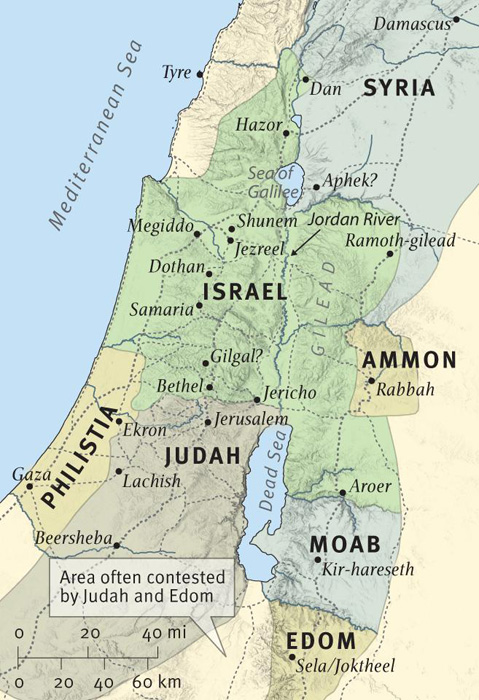
Bethel 10 Miles from Jerusalem
(Source: ESV Global SB)
JOSIAH'S REFORMS MOVE
NORTHWARD TO BETHEL
Furthermore, the altar that was at Bethel - - REFORM #11 - Bethel sits about 10 miles north of Jerusalem in the central hill country of Israel. The main north–south ridge road (later the “Way of the Patriarchs”) connected the two locations. This road was heavily used throughout Israel’s history. Bethel was close enough to draw people away from Jerusalem’s temple worship, which explains why it became such an important center of apostate worship.
And the high place (bamah) which Jeroboam the son of Nebat, who made Israel sin, had made - Jeroboam also built a high place and an altar at Bethel, appointing priests who were not Levites and instituting a counterfeit religious system. Because of this, the historical books repeatedly describe him as “Jeroboam the son of Nebat, who made Israel sin.”
Even that altar and the high place (bamah) he broke down - Remarkably, the destruction of this altar had been foretold nearly three centuries earlier. During Jeroboam’s reign, a prophet from Judah confronted the altar at Bethel in 1 Kings 13:2 “O altar, altar, thus says the LORD, ‘Behold, a son shall be born to the house of David, Josiah by name; and on you he shall sacrifice the priests of the high places who burn incense on you, and human bones shall be burned on you.’” This prophecy is astonishing because Josiah is named specifically long before he was born.
Then he demolished its stones, ground them to dust, and burned the Asherah (Asherah) - Roughly 300+ years later Josiah traveled north to Bethel and fulfilled the prophecy of 1Ki 13:2 (see 2Ki 23:16). He did not merely dismantle the altar but completely destroyed it.
Bethel had been one of the earliest and most influential centers of Israel’s apostasy, and its altar had stood for generations as a symbol of rebellion against God’s commands. By destroying it, Josiah was purging the land (south and north) of the legacy of Jeroboam’s sin, fulfilling a 300 year old prophecy and restoring the principle that worship must occur where God appointed.
This verse shows how deeply entrenched sin can persist across generations. The idolatrous system Jeroboam established had corrupted Israel for centuries. Yet God had already foretold that a future king would destroy it. On the other hand, Josiah’s actions therefore demonstrate both God’s faithfulness to His word and the power of genuine reform to dismantle even long-standing systems of spiritual corruption.
John Walton - exhumation. Josiah is fulfilling the prophecy in 1 Kings 13:2. In both Mesopotamia and Israel the worst criminals were not accorded a proper burial, and their bones were either burned or discarded. This was the worst possible thing for an individual, since one’s spiritual existence was intertwined with their physical existence (for more information see comments on Num 3:12-13 and Joshua 8:29). Thus if one’s bones were destroyed, the individual’s existence was also extinguished. (IVP Bible Background Commentary: OT page 410)
BETHEL - Bethel, located about 10–12 miles north of Jerusalem near Ai, was one of the most significant cities in the Old Testament, both geographically and spiritually, situated along major north–south and east–west trade routes in the central hill country and marking the boundary between Ephraim and Benjamin (Joshua 16:1–2; 18:13). Its name, from the Hebrew Bēyth-’Ēl, means “house of God,” reflecting its early role as a sacred site. Bethel first appears in connection with Abram, who “built an altar to the LORD and called upon the name of the LORD” (Genesis 12:8 NASB), and later returned there after Egypt, again calling on the LORD (Genesis 13:3–4 NASB). Its defining moment came through Jacob, who, fleeing from Esau, dreamed of a ladder reaching to heaven and declared, “Surely the LORD is in this place… This is none other than the house of God, and this is the gate of heaven” (Genesis 28:16–17 NASB), after which “he called the name of that place Bethel” (Genesis 28:19 NASB); later he returned, built an altar, and called it El-Bethel (Genesis 35:1–7 NASB).
During the period of the Judges, Bethel functioned as a major center of worship where Israel sought God’s counsel—“the sons of Israel went up and inquired of God” (Judges 20:18 NASB)—and where the ark of the covenant was present, with Phinehas ministering there (Judges 20:26–28 NASB); it was also associated with leadership, as Deborah “was sitting under the palm tree of Deborah between Ramah and Bethel” (Judges 4:5 NASB). In the early monarchy, Bethel remained a legitimate worship site, as Samuel “went annually on circuit to Bethel… and judged Israel” (1 Samuel 7:16 NASB). However, after the kingdom divided, Jeroboam I corrupted Bethel by establishing it as a royal sanctuary and setting up a golden calf, declaring, “Behold your gods, O Israel” (1 Kings 12:28–29 NASB), thereby instituting an alternative system of worship to rival Jerusalem. From that point, Bethel became synonymous with idolatry, and prophets denounced it strongly—“On the day that I punish Israel’s transgressions, I will also punish the altars of Bethel” (Amos 3:14 NASB), and “Do not seek Bethel… for Bethel will come to trouble” (Amos 5:5 NASB); Hosea mockingly renamed it “Beth-aven” (house of wickedness) (Hosea 10:5, 8 NASB).
Even amid corruption, God preserved a prophetic witness, as communities of prophets were present there in the days of Elijah and Elisha (2 Kings 2:2–3 NASB). After the fall of the northern kingdom in 722 BC, Bethel remained a religious center, though marked by syncretism, as a priest was sent to teach the people “the custom of the god of the land” (2 Kings 17:28–33 NASB). Its long history of idolatry finally ended during the reforms of Josiah, who “tore down the altar that was at Bethel… and burned the high place” (2 Kings 23:15 NASB), fulfilling the earlier prophecy against it (1 Kings 13:1–3 NASB). After the exile, Bethel was still inhabited (Ezra 2:28; Nehemiah 7:32 NASB), but it never regained its former prominence. Thus Bethel stands as a profound biblical illustration: a place that began as a true “house of God,” marked by divine revelation and worship (Genesis 28), became a center of false religion and idolatry (1 Kings 12), was repeatedly condemned by the prophets (Amos; Hosea), and was ultimately judged and destroyed (2 Kings 23), demonstrating that spiritual privilege does not guarantee faithfulness and that God will judge corrupted worship.
2 Kings 23:16 Now when Josiah turned, he saw the graves that were there on the mountain, and he sent and took the bones from the graves and burned them on the altar and defiled it according to the word of the LORD which the man of God proclaimed, who proclaimed these things.
- burned: 1Ki 13:1,2,32 Mt 24:35 Joh 10:35
Related Passage:
1 Kings 13:1-3+ (THE MAN OF GOD INTERRUPTED JEROBOAM'S DEDICATION SERVICE OF HIS ALTAR AT BETHEL) Now behold, there came a man of God from Judah to Bethel by the word of the LORD, while Jeroboam was standing by the altar to burn incense. 2 He cried against the altar by the word of the LORD, and said, “O altar, altar, thus says the LORD, ‘Behold, a son shall be born to the house of David, Josiah by name; and on you he shall sacrifice the priests of the high places who burn incense on you, and human bones shall be burned on you.’” 3Then he gave a sign the same day, saying, “This is the sign which the LORD has spoken, ‘Behold, the altar shall be split apart and the ashes which are on it shall be poured out.’”
Matthew 24:35+ “Heaven and earth will pass away, but My words will not pass away.
Joshua 23:14-15+ - "Now behold, today I am going the way of all the earth, and you know in all your hearts and in all your souls that not one word of all the good words which the LORD your God spoke concerning you has failed; all have been fulfilled for you, not one of them has failed. 15 "And it shall come about that just as all the good words which the LORD your God spoke to you have come upon you, so the LORD will bring upon you all the threats, until He has destroyed you from off this good land which the LORD your God has given you.
JOSIAH FULFILLS 300+
YEAR OLD PROPHECY
Now when Josiah turned, he saw the graves that were there on the mountain, and he sent and took the bones from the graves and burned them on the altar and defiled (tame; LXX - miaino - literally dye with another color) it according to the word of the LORD which the man of God proclaimed, who proclaimed these things - After destroying the altar at Bethel built by Jeroboam I, Josiah noticed graves on the nearby hillside. These were likely the burial places of idolatrous priests or people associated with the idolatrous worship that had been practiced there. To ensure the altar could never again be used, Josiah removed bones from the tombs and burned them on the altar. This action fulfilled a prophecy given about the altar approximately 300 years before (1Ki 13:2+). As noted earlier, according to Israel’s ceremonial law (Nu 19:16), contact with human bones rendered a person or place ritually unclean. By burning bones on the altar, Josiah deliberately defiled it permanently, ensuring that it could never again function as a religious shrine. In so doing the text emphasizes that Josiah’s actions occurred according to the word of the LORD which the man of God proclaimed.
Dale Ralph Davis - This prophetic fulfillment packs a solid assurance. In the present context it bolsters Huldah’s prophecy of 22:15–20. If Yahweh’s word from 930 BC has come to pass, then surely his word through Huldah in 622 BC will as well. And if Yahweh’s centuries’ old prophecies come so clearly to pass, should we not count every syllable from God’s mouth as unquestionably reliable? Let me add, however, that the prophecy of Josiah’s purging work carries the promise of still more. In 1 Kings 13:2 he is called ‘a son to be born to the house of David’. De Graaf picks up the cue: "The son of David’s house had come as an avenger of the Lord’s rights, which had been violated. One day David’s great Son will also bring judgment. Then the claims of the Lord’s covenant will be fully restored." What we see in Josiah signals that there is something more to come. (BORROW 2 Kings : the power and the fury - may need to refresh page to view)
2 Kings 23:17 Then he said, “What is this monument that I see?” And the men of the city told him, “It is the grave of the man of God who came from Judah and proclaimed these things which you have done against the altar of Bethel.”
- What is this monument that I see: 1Ki 13:1,30,31
JOSIAH DISCOVERS GRAVE
OF THE PROPHET
Then he said, “What is this monument that I see?” And the men of the city told him, “It is the grave of the man of God who came from Judah and proclaimed these things which you have done against the altar of Bethel - Josiah notices a particular tomb and asks whose it is. He is told that it belongs to the prophet who originally gave the prophecy about the altar. Josiah then honors that prophet’s grave and leaves it undisturbed. This creates one of the most remarkable prophetic fulfillments in the Old Testament, where the king unknowingly carries out a prophecy spoken centuries earlier and then discovers the very tomb of the prophet who predicted it.
2 Kings 23:18 He said, “Let him alone; let no one disturb his bones.” So they left his bones undisturbed with the bones of the prophet who came from Samaria.
- the bones of the prophet: 1Ki 13:1-22,31
JOSIAH HONORS GRAVE
OF THE PROPHET
He said, “Let him alone; let no one disturb his bones.” So they left his bones undisturbed - After discovering a monument marker and learning it belonged to the man of God who came from Judah and had prophesied the destruction of the Bethel altar centuries earlier, he recognized that the prophet had been faithful to the word of the LORD, and therefore his burial place was not to be desecrated.
with the bones of the prophet who came from Samaria - This refers to the older prophet from Bethel who appears in the earlier narrative in 1 Kings 13. After the man of God from Judah died, that older prophet buried him in his own tomb and later instructed that his own bones be placed beside him when he died.
1 Kings 13:31+ After he had buried him, he spoke to his sons, saying, “When I die, bury me in the grave in which the man of God is buried; lay my bones beside his bones.
Josiah's "Bethel Moment" serves as a powerful reminder that God’s word never fails. Even when centuries pass, what the LORD has spoken will ultimately be fulfilled.
2 Kings 23:19 Josiah also removed all the houses of the high places which were in the cities of Samaria, which the kings of Israel had made provoking the LORD; and he did to them just as he had done in Bethel.
- the houses: 2Ki 17:9 1Ki 12:31 13:32
- the cities: 2Ch 30:6-11 31:1 34:6,7
- the kings: 2Ki 8:18 1Ki 16:33 Mic 6:16
- to provoke the Lord: 2Ki 17:16-18 21:6 Ps 78:58 Jer 7:18,19 Eze 8:17,18
JOSIAH "CLEANS HOUSE"
IN CITIES OF SAMARIA
Josiah also removed all the houses of the high places (bamah) which were in the cities of Samaria - REFORM #12 - The houses of the high places refers to shrine buildings connected with the high places, constituting local worship centers scattered throughout the land. These sites typically included an altar for sacrifices, a small shrine or temple structure, sacred objects such as Asherah poles, pillars, or idols and priests who officiated there. Although some high places originally may have been intended for the worship of Yahweh, they had long since become centers of idolatry and syncretistic worship, mixing the worship of the LORD with pagan practices.
Which the kings of Israel had made provoking the LORD - Beginning with Jeroboam I, the kings of Israel promoted an alternative religious system to keep people from worshiping in Jerusalem. 1 Kings 12:31 says that Jeroboam I "made houses on high places, and made priests from among all the people who were not of the sons of Levi."
And he did to them just as he had done in Bethel - What is amazing is that Assyria was the ruling power over the Northern Kingdom and yet they allowed (or at least did not give a "cease and desist" order to) Josiah to destroy the rotten ROOT of Jeroboam I's reign which had been yielding rotten FRUIT for about 290 years! Just as he had done in Bethel indicates he destroyed the altar and high place, ground the stones to dust, burned the Asherah and defiled the altar with human bones. By repeating these actions throughout the cities of Samaria, Josiah ensured that these shrines could never again function as centers of pagan worship.
2 Kings 23:20 All the priests of the high places who were there he slaughtered on the altars and burned human bones on them; then he returned to Jerusalem.
- he slaughtered on the altars 2Ki 10:25 11:18 Ex 22:20 De 13:5 1Ki 13:2 18:40 Isa 34:6 Zec 13:2,3
- burned human bones on them: 2Ch 34:5
BONES OF IDOLATROUS PRIESTS
BURNED ON IDOL ALTARS!
All the priests of the high places (bamah) who were there he slaughtered on the altars and burned human bones on them; then he returned (shub/sub; LXX - epistrepho) to Jerusalem - There is quite an irony in this verse. Note that in contrast to Josiah's more merciful treatment of priests in Jerusalem, Josiah did not show mercy to these northern priests. The irony is that after slaughtering them, he "offered" bones (possibly their own bones) on their own idolatrous altars, which served to defile those places, making them permanently unclean according to Jewish law (Nu 19:16), ensuring they could never again be used for worship.
John MacArthur: These non-Levitical priests, who led apostate worship in the former northern kingdom, were idolaters who seduced God’s people into idolatry. They were put to death in accordance with the statutes of Dt 13:6-18; 17:2-7, and their graves were doubly defiled with burned bones. (See MacArthur Study Bible)
Peter Pett: We naturally react against the idea of the slaughter of these men, but we must remember they were at the time seen as traitors to YHWH and his covenant, and therefore as worthy of death. No one in those days would have doubted that their crimes were deserving of the death penalty, for they were seen as in direct rebellion against YHWH. Furthermore it is probable that at the time they were not seeking to submit to the king and pleading for mercy, but were fiercely seeking to defend their high places, which they saw as sacred, against the assaults of Josiah’s men.
Then he returned to Jerusalem - After cleaning house in the Northern Kingdom, his work there was finished and he returned to Jerusalem.
Iain Provan: vv. 15-20 -- A marked feature of the Josianic reform is that he not only destroys but also desecrates (2Ki 23:8, 10, 13), particularly by placing items considered to be holy in proximity with graves and human bones (2Ki 23:6, 14; cf. Nu 19:1–22 for the idea of death as a pollutant, esp. Nu 19:18). It has already been hinted in verse 4 that this procedure is to be extended to Bethel, where Josiah takes the ashes of the idolatrous vessels brought out from the temple, but it is only in verse 15 that this line of narrative is picked up. Jeroboam, it will be recalled, had started out as a new Moses and finished up instead as a second Aaron, fashioning calves for the people and instituting a new cult focused on Bethel (see the commentary on 1 Kgs. 12–13). Josiah now takes action against this cult, which has lived on in the activities of the new settlers in the land of Israel (cf. 2 Kgs. 17:24ff.). He does so in a way that recalls Moses’s own action against the first golden calf. He burns the high place (along with the Asherah pole) and grinds it to powder (cf. Heb. śrp̱, “to burn,” and ḏqq leʿāp̱ār, “to grind to powder,” in v. 15 and Deut. 9:21, noting also 2Ki 23:6). He then defiles the altar with bones taken from the surrounding tombs, in accordance with the prophecy of the man of God in 1 Kings 13:2 (cf. also 2Ki 13:11–32 for the background to vv. 17–18). (See 1 & 2 Kings - Understanding the Bible Commentary Series - Page 55)
2 Kings 23:21 Then the king commanded all the people saying, “Celebrate the Passover to the LORD your God as it is written in this book of the covenant.”
- Celebrate: 2Ch 35:1-19
- as it is written: Ex 12:3-20 Lev 23:5-8 Nu 9:2-5 Nu 28:16-25 Dt 16:1-8
COMMAND TO REINSTITUTE PASSOVER
STIMULATED BY BOOK OF LAW
As discussed elsewhere it is clear that Josiah's reforms were begun prior to the discovery of the Book of the Law. What did follow this discovery was Josiah's all for celebration of the Passover and the renewal of the Mosaic Covenant (2Ki 23:1-3).
Then the king commanded all the people saying, “Celebrate the Passover (pesach/pesah) to the LORD your God as it is written in this book (seper; LXX - biblion) of the covenant - KJV has "keep the Passover," but "Celebrate" is more apropos (cf 2Ki 23:22)! After purging Judah and even parts of the former northern kingdom of idolatry, high places, and pagan priests (2Ki 23:4–20), Josiah turned to restoring true covenant worship. The rediscovered Law contained detailed instructions for observing the Passover, the annual feast commemorating Israel’s deliverance from Egypt (Ex 12:14; Dt 16:1–8). King Josiah therefore commanded the entire nation to celebrate the Passover “as it is written in this book of the covenant,” emphasizing obedience to the written Word of God (Ex 12:3-20 Lev 23:5-8 Nu 9:2-5 Nu 28:16-25 Dt 16:1-8) rather than corrupted traditions.
Wiersbe: Josiah ruled at a time when Assyria was on the decline and Babylon hadn’t yet reached its zenith, the times were more peaceful, and the people could travel in greater safety. The celebration was indeed a great rallying time for the Jewish people from both Judah and Samaria.
2 Kings 23:22 Surely such a Passover had not been celebrated from the days of the judges who judged Israel, nor in all the days of the kings of Israel and of the kings of Judah.
- Surely: 2Ch 35:18-19
- of the kings: 2Ch 30:1-3,13-20 2Ch 35:1-19
Related Passages:
2 Chronicles 35:18-19 There had not been celebrated a Passover like it in Israel since the days of Samuel the prophet (~400-450 YEARS); nor had any of the kings of Israel celebrated such a Passover as Josiah did with the priests, the Levites, all Judah and Israel who were present, and the inhabitants of Jerusalem. 19In the eighteenth year of Josiah’s reign this Passover was celebrated.
AN EXTRAORDINARY
PASSOVER CELEBRATION
Surely such a Passover (pesach/pesah) had not been celebrated from the days of the judges who judged Israel, nor in all the days of the kings of Israel and of the kings of Judah - This is a remarkable statement, first because of the time phrase from the days of the judges, which would be approximately 500-700 years earlier (or longer). And secondly, it was remarkable that it surpassed the Passovers of all kings, north or south, which would include Hezekiah's wonderful Passover celebration (around 715 BC, 2Ch 29:3, 2Ch 30:26) almost a century before Josiah's celebration.
David Guzik - The Passover remembered the central act of redemption in the Old Testament: God’s deliverance of Israel from Egypt in the days of Moses. Their neglect of the Passover proved that they had neglected to remember the LORD’s work of redemption for them. It was as if a group of modern Christians had completely forgotten communion or the celebration of the Lord’s Supper, which remembers Jesus’ work of redemption for us.
Bob Utley - The Passover celebrated by Hezekiah in 2 Chr. 30:13-27 was attended only by Judah (cf. 2 Chr. 30:10). Josiah's Passover would include the northern remnant of Israel. The last recorded Passover celebrated by all the tribes was Joshua 5:10-11. It was originally a family event, not a national event (cf. Exodus 12).
This Passover was extraordinary because invitations were sent throughout Israel and Judah (even to the northern tribes after Assyria’s conquest) and many from Ephraim, Manasseh, Asher, and Zebulun (all Northern Kingdom) came to Jerusalem. Thus several factors likely made Josiah’s Passover exceptional including (1) full obedience to the Mosaic LawThe celebration was conducted exactly as prescribed in the covenant law. (2) People from both Judah and remnants of the former northern kingdom participated, (3) occuring after widespread repentance and reform in which Josiah had removed idols, destroyed high places, and restored proper worship, (4) with centralized worship in Jerusalem at the place God had chosen, as required in the Law, agains as recorded in the Law which Josiah likely heard read...
You are not allowed to sacrifice the Passover in any of your towns which the LORD your God is giving you; 6 but at the place where the LORD your God chooses to establish His name, you shall sacrifice the Passover in the evening at sunset, at the time that you came out of Egypt. (Dt 16:5-6+)
The writer of Chronicles records
"There had not been celebrated a Passover like it in Israel since the days of Samuel the prophet; nor had any of the kings of Israel celebrated such a Passover as Josiah did with the priests, the Levites, all Judah and Israel who were present, and the inhabitants of Jerusalem. (2Ch 35:18+)
Peter Pett: The feast of the Passover, which celebrated the deliverance from Egypt, would have been seen as a very appropriate feast for celebrating the new deliverance from Assyria which was now being enjoyed and celebrated as the chains of Assyria were being flung off by the removal of all that was connected with the worship of Assyrian gods. No wonder that it was celebrated with such fervour
SURPRISING FACTOIDS - It is surprising (and sad) to note that the OT mentions only 4 Passovers (other than the initial Passover in Exodus 12) - Joshua (Joshua 5:10–12), Hezekiah (2Ch 30:1, 6–9, 15, 2Ch 30:26), Josiah (2Ki 23:21–23, 2Ch 35:18), and Ezra (Ezra 6:19–22 - 1st Passover after Babylonian exile) in a span of about 1000 years! Note that these four Passovers occur at major turning points in Israel’s history: (1) Entering the land (Joshua); (2) Return to God before judgment (Hezekiah); (3) Final reform before exile (Josiah); (4) Restoration after exile (Ezra).
In addition, from the time of the renewal of the covenant by Joshua, no mention is made of the covenant rite of circumcision, except by implication (e.g., the Philistines are described as uncircumcised) or in a figurative sense (Jer 6:10, Jer 9:26).
Similarly, given the incredible importance of the Day of Atonement in the life of Israel, it is amazing that other than Leviticus 16, there is NO express mention of this Day in the Old Testament (a possible exception is Numbers 29:7–11, Isaiah 58:3–5)! There is NO passage that says “They celebrated the Day of Atonement…” “Such a Day of Atonement had not been kept…” This silence is striking and surprising in that mention of it would have seemed natural and appropriate in connection with the events described in 1Ki 8:2, 65f, Ezra 3:1-6 and Nehemiah 8, all of which were important events that took place in the 7th month at about the time of the Day of Atonement.
2 Kings 23:23 But in the eighteenth year of King Josiah, this Passover was observed to the LORD in Jerusalem.
PASSOVER CELEBRATED
TO THE LORD
But in the eighteenth year of King Josiah, this Passover (pesach/pesah) was observed to the LORD in Jerusalem - Josiah began to reign in Judah at the age of eight (about 640 BC). His eighteenth year would therefore fall around 622 BC when he was about 26 yo. This year is extremely important in the history of Judah because it was when the Book of the Law was discovered in the temple during repair work. After hearing the Law, Josiah gathered the people and renewed the covenant with the LORD (2Ki 23:3) and as part of restoring obedience to the Law, Josiah commanded the people to celebrate the Passover according to what was written in the covenant.
To the LORD in Jerusalem - Reiterates the clear instructions in Dt 16:5-6 discussed above. By celebrating Passover again according to the Law, Josiah was calling the nation to remember God’s redemption and return to covenant faithfulness.
Whitcomb: Three points of special interest should be noted in this account:
- First, it appears that conditions had deteriorated so badly in the Temple since the days of Hezekiah that faithful Levites had removed and hidden the Ark of God! (II Chron. 35:3). Josiah ordered it to be returned, for there could be no proper observance of the Passover without it.
- Second, the Levites showed extraordinary zeal in preparing Passover lambs, not only for themselves, but also for the priest, the singers, and the porters (II Chron. 35:11-15; cf. Ezra 6:20).
- Third, this was the greatest Passover since the days of Samuel the prophet 500 years earlier (II Chron. 35:18), because of the obstacles that had to be overcome and because it was done with such great zeal and according to the Law (Hezekiah’s Passover had to be held on the second month because so many were ceremonially defiled – II Chron. 30:2, 3, 17-20).
2 Kings 23:24 Moreover, Josiah removed the mediums and the spiritists and the teraphim and the idols and all the abominations that were seen in the land of Judah and in Jerusalem, that he might confirm the words of the law which were written in the book that Hilkiah the priest found in the house of the LORD.
NKJ Moreover Josiah put away those who consulted mediums and spiritists, the household gods and idols, all the abominations that were seen in the land of Judah and in Jerusalem, that he might perform the words of the law which were written in the book that Hilkiah the priest found in the house of the LORD.
NET Josiah also got rid of the ritual pits used to conjure up spirits, the magicians, personal idols, disgusting images, and all the detestable idols that had appeared in the land of Judah and in Jerusalem. In this way he carried out the terms of the law recorded on the scroll that Hilkiah the priest had discovered in the LORD's temple.
- removed the mediums and the spiritists: 2Ki 21:3,6 1Sa 28:3-7 Isa 8:19 19:3 Ac 16:16-18 Rev 22:15
- teraphim, Ge 31:19 Jdg17:5 18:17,18 Ho 3:4
- that he might: Lev 19:31 20:27 De 18:10-12 Isa 8:20 Ro 3:20 Jas 1:25
- the book: 2Ki 22:8-13 2Ch 34:14-19
Related Passages:
Leviticus 19:31 ‘Do not turn to mediums or spiritists; do not seek them out to be defiled by them. I am the LORD your God.
JOSIAH CLEARS OUT
THE OCCULT RABBLE
Moreover, Josiah removed the mediums (ob/ov) and the spiritists (yiddeoni) - These were people who attempted to communicate with the dead or with spirits in order to gain hidden knowledge or guidance. In the ancient world such practices included necromancy, divination, and spirit consultation. Such practices were considered detestable because they sought supernatural knowledge apart from God. And again note where this clear instruction was given, in the book he had heard read by Shaphan.
Deuteronomy 18:10-12 “There shall not be found among you anyone who makes his son or his daughter pass through the fire, one who uses divination, one who practices witchcraft, or one who interprets omens, or a sorcerer, 11 or one who casts a spell, or a medium, or a spiritist, or one who calls up the dead. 12 “For whoever does these things is detestable to the LORD; and because of these detestable things the LORD your God will drive them out before you.
Bob Utley - "mediums" This is literally "a bottle" (BDB 15, KB 393, cf. 2 Kgs. 21:6 and NIDOTTE, vol. 1, p. 303). It refers to the strange sounds that wind makes when passing over a bottle. In the Septuagint this word is translated "ventriloquist," which implies one who can control voices or noises (cf. Lev. 19:31; 20:27; Deut. 18:11). "the spiritists" Literally this is "the knowing ones" (see full note at 2 Kgs. 21:6). The terms "mediums" and "spiritists" are always mentioned in the OT together. "teraphim" This refers to household or family gods (cf. Gen. 31:19; Jdgs. 17:5; 1 Sam. 19:13). SPECIAL TOPIC: Teraphim
And the teraphim (teraphim) and the idols (gillul/gillulim) and all the abominations (shiqquts; LXX - prosochthisma - offence, provocation, idol, object of anger) that were seen in the land of Judah and in Jerusalem - The teraphim were small household idols often used for domestic worship or divination. These figurines were believed to bring blessing or guidance to the household. Even though they were smaller than temple idols, they represented personal or family-level idolatry. Along with these, Josiah removed all the idols and abominations found in Judah and Jerusalem. The word abominations in the Old Testament often refers to practices that are especially offensive to God, and representing ways in which the people had turned from the worship of the true God to practices He had explicitly forbidden.
That (term of purpose) - This is Josiah's purpose for the aforementioned occult clean out!
He might confirm the words of the law which were written in the book (seper; LXX - biblion) (e.g., Dt 18:10-12) that Hilkiah the priest found in the house of the LORD - NET - "In this way he carried out the terms of the law recorded on the scroll that Hilkiah the priest had discovered in the LORD's temple." NIV - " This he did to fulfill the requirements of the law written in the book that Hilkiah the priest had discovered in the temple of the LORD."
This verse illustrates that true revival involves returning to Scripture and removing anything that contradicts it. Josiah did not simply encourage better behavior—he eliminated the spiritual influences that were leading the people away from God.
Idols (01544) gillul/gillulim - latter is the plural form = all OT uses are plural) means logs, blocks, shapeless things. This word describes "an object (not necessarily three dimensional) which has been formed to resemble a person, god, animal." (Louw-Nida). Notably, the root galal also produced the Hebrew noun גֵּל (gel) or גֶּלֶל (gelel), meaning “dung” or excrement
Animal and human feces often form round lumps, so ancient Hebrews used the same “round” root to describe droppings. The term gillulim seems to deliberately echo this word for dung (gel/gelal) by sound – essentially a pun. Medieval commentators like Ibn Ezra (12th century) already noticed that gillulim sounds like gelal (dung) and considered the term an “outrageous and denigrating” nickname for idols as “dung pellets” Modern scholars likewise conclude that gillulim stems from a single root gll with two related meanings – “round, roll” and by extension “dung” – and that the biblical writers intentionally exploited the vulgar sense to mock idols
2 Kings 23:25 Before him there was no king like him who turned to the LORD with all his heart and with all his soul and with all his might, according to all the law of Moses; nor did any like him arise after him.
- there was no king like him: 2Ki 18:5
- who turned to the LORD: 2Ki 23:3 De 4:29 6:5 1Ki 2:4 8:48 15:5 Jer 29:13
- according to all the law of Moses: Ne 10:29 Mal 4:4 Joh 1:17 7:19
JOSIAH'S UNMATCHED
DEVOTION
Before him there was no king like him who turned to (shub/sub; LXX - epistrepho) the LORD with all his heart and with all his soul and with all his might - NET - "No king before or after repented before the LORD as he did" (2Ki 23:25NET) This is a unique, absolute statement but it does not mean other kings were not godly (e.g., David, Hezekiah). But it emphasizes that Josiah’s reform and obedience to the Law were unparalleled in scope and intensity. Josiah turned to the LORD which implies intentional, decisive repentance, not mere emotion. With all his heart (inner will, decision making center)… soul (life, being)… might (strength) signals total, undivided devotion and is a direct echo of the Shema Dt 6:5 "You shall love the LORD your God with all your heart and with all your soul and with all your might." Josiah is the only king explicitly said to fulfill the Shema in this way.
According to all the law of Moses is the key to the whole verse. Josiah’s greatness was Scripture-driven (2 Kings 22 - discovery of the Book of the Law), a comprehensive obedience and thus in conformity to God’s revealed Word.
Nor did any like him arise after him - What made Josiah unique was that he obeyed Scripture fully. Earlier kings removed idols but not all, especially not the high places. Josiah destroyed high places, defiled Topheth, removed idolatrous priests, destroyed Jeroboam I's Bethel altar, etc. Josiah dismantled centuries of accumulated sin for idolatry had been building since the days of the judges (600+ years), Solomon's high place and Jeroboam's Bethel altar (~931 BC). Josiah stands out as the most Torah-aligned king in Judah’s history
2 Kings 23:25 Like unto Josiah was there no king before him.
This chapter is a marvellous record of cleansing and purging. We are led from one item to another of drastic reform. Nothing was spared that savored of idolatry. Priests and altars, buildings and groves, came under the searching scrutiny of this true-hearted monarch; and, as the result, it was possible to keep such a Passover as had not been observed during the days of the judges or the kings (2 Kings 23:22).
How much our enjoyment of the solemn feast depends upon our previous efforts to put away from our lives all that is inconsistent with the law of God. We hardly realize how insidiously evils creep in. Before we are aware, we have fallen beneath God’s ideal, and adopted the customs of our neighbors, or of those with whom we come into daily contact. All such declension hinders our joy in keeping the Passover. It is needful, therefore, that there should be times when we turn to God with fresh devotion, and in the light of His holy truth pass the various departments of our life under review, testing everything by the Book of the Law. In Josiah’s case, the sacred volume was recovered from long neglect; in our case it needs to be re-read in the light of higher resolves. This would be like a new discovery. Our ultimate rule must always be the will of God, appreciated with growing clearness, and used as a standard by which to judge the habits and tenets of our life. We read the Bible for purposes of a truer knowledge of God and His ways, and for spiritual quickening; but let us also use it more frequently as the bath of the spirit. Let us bathe in it. Let us revel in it as the grimy children of the slums in the laughing wavelets of river and sea.
2 Kings 23:26 However, the LORD did not turn from the fierceness of His great wrath with which His anger burned against Judah, because of all the provocations with which Manasseh had provoked Him.
- However - 2Ki 21:11-13 2Ki 22:16,17 2Ki 24:2,4 2Ch 36:16 Jer 3:7-10 Jer 15:1-4
Related Passages:
2 Kings 21:11-13+ “Because Manasseh king of Judah has done these abominations, having done wickedly more than all the Amorites did who were before him, and has also made Judah sin with his idols; 12 therefore thus says the LORD, the God of Israel, ‘Behold, I am bringing such calamity on Jerusalem and Judah, that whoever hears of it, both his ears will tingle. 13 ‘I will stretch over Jerusalem the line of Samaria and the plummet of the house of Ahab, and I will wipe Jerusalem as one wipes a dish, wiping it and turning it upside down.
TOO LITTLE
TOO LATE
However - This marks a contrast. So while Josiah was the most fully Scripture-obedient king in Judah’s history, even his unparalleled reform could not reverse the nation’s long-standing judgment.
The LORD did not turn (shub/sub; LXX - apostrepho) from the fierceness of His great wrath (aph; LXX - orge) with which His anger burned (charah) against Judah - Yahweh had given His divine decree in 2Ki 21:11-13 (see above). Note the play on the word "turn" for in 2Ki 23:25 Josiah "turned" (repented) but that was not enough to cause Yahweh to "turn"!
because - Term of explanation. This one is easy and sad. Yahweh would not relent from His wrath on Judah.
Of all the provocations with which Manasseh had provoked Him - Manasseh's sin was "over the top" for Yahweh, even though Manasseh did repent. It was too much and Josiah's godly reign was unable to reverse the coming storm. Notice that 3 times Scripture says "BECAUSE" of Manasseh's sins in this verse and the two below...
2 Kings 21:11-13 “Because Manasseh king of Judah has done these abominations, having done wickedly more than all the Amorites did who were before him, and has also made Judah sin with his idols; 12 therefore thus says the LORD, the God of Israel, ‘Behold, I am bringing such calamity on Jerusalem and Judah, that whoever hears of it, both his ears will tingle. 13 ‘I will stretch over Jerusalem the line of Samaria and the plummet of the house of Ahab, and I will wipe Jerusalem as one wipes a dish, wiping it and turning it upside down.
Jeremiah 15:1-4 (NOTE: "BECAUSE OF MANASSEH") Then the LORD said to me, “Even though Moses and Samuel were to stand before Me, My heart would not be with this people (GOD WOULD NOT BE SWAYED EVEN BY THE MOST GODLY SAINTS); send them away from My presence and let them go! 2 “And it shall be that when they say to you, ‘Where should we go?’ then you are to tell them, ‘Thus says the LORD: “Those destined for death, to death; And those destined for the sword, to the sword; And those destined for famine, to famine; And those destined for captivity, to captivity.”’ 3 “I will appoint over them four kinds of doom,” declares the LORD: “the sword to slay, the dogs to drag off, and the birds of the sky and the beasts of the earth to devour and destroy. 4 “I will make them an object of horror among all the kingdoms of the earth because of Manasseh, the son of Hezekiah, the king of Judah, for what he did in Jerusalem.
Comment - This passage show God's resolve to punish Judah, despite the godly reforms by Manasseh.
Bob Utley - However, the Lord did not turn from the fierceness of His great wrath Apparently Judah had passed the point of no return during the wicked reign of Manasseh (cf. 2 Kgs. 21:14; 24:4). The people's hearts were only outwardly touched and not inwardly changed by the reforms of Josiah (i.e., Jeremiah 5). This VERB (BDB 996, KB 1427, Qal PERFECT; NIDOTTE, vol. 4, pp. 55-59) is often used of "turning from" in the theological sense of repentance. Judah would not "turn" from idolatry so YHWH did not turn from judgment.
Walter Kaiser - 2Kings 23:26 Why Did the Lord Not Turn from His Anger? - Hard Sayings of the Bible
Is it possible to overcome the effects of years of wickedness and evil by a time of unprecedented reform and revival? Can a godly grandson’s thirty-year reign make up for his ruthless grandfather and father, who provoked God to the limit for sixty years? In other words, does evil have a corporate and cumulative effect on society, or, as the saying goes, does “every tub always stand on its own bottom”?
In spite of the probability that Manasseh of Judah became king, or coregent, about ten years before his father, Hezekiah, died, his godly father had no influence on his fifty-year reign. This is especially shocking after the great revival under Hezekiah.
Manasseh illustrates the old saying “God may have children, but he has no grandchildren.” In his case a godly home was no guarantee that he would follow the Lord.
For half a century Manasseh duplicated all the depravity of the Canaanites. He murdered so many righteous men that there were too few to defend Jerusalem when the need arose (2 Kings 21:10–15); all of which the people tolerated. This ruthless monarch ordered Isaiah “sawed in two” (Heb 11:37). Manasseh’s idolatry and unrighteousness brought Judah and Jerusalem to unavoidable rejection by God (2 Kings 24:3; Jer 15:4).
Manasseh did have what is today called a deathbed conversion experience. For offending the Assyrian king Ashurbanipal, Manasseh was hauled off to prison where “in his distress he sought the favor of the LORD his God and humbled himself greatly before the God of his fathers. And when he prayed to him, the LORD was moved by his entreaty and listened to his plea. … Then Manasseh knew that the LORD is God” (2 Chron 33:12–13). This came at the end of his reign.
But it was too late to reverse the trends in society and his own household. Manasseh was succeeded by his wicked son Amon, who himself was assassinated by other ruffians. 2 Chronicles 33:23 pointedly informs us that King Amon “did not humble himself before the LORD.”
Mercifully God prepared Amon’s eight-year-old son, Josiah, to take over as king. From the very beginning, Josiah walked in David’s ways and not in the ways of his grandfather Manasseh or his father Amon. He deserves the credit for initiating one of the most intensive periods of reformation and revival known in Judah’s history. But it seems this revival never deeply penetrated the culture, for it carried no lasting effects and had insufficient strength to overcome the years of compounded evil accumulated under Manasseh. Josiah’s work was insufficient to offset the evil done by his father and grandfather before him.
Though Josiah ended outward and gross forms of idolatry in his sincere desire to dedicate himself and his people to the Lord, the people themselves did not turn back to the Lord. They followed their religious king out of fear, but their hearts and minds, apparently, were affected very little.
If the early chapters of Jeremiah reflect the conditions under King Josiah, then they describe the people’s deep inner apostasy, not only before Josiah’s reform and discovery of the Book of the Law, but also during and following it.
The Holy One of Israel could no longer forgive and extend mercy; he at last was obligated to bring the judgment foretold to Manasseh in 2 Kings 21:12–15. Thus, even though God is patient and long-suffering in his mercy, judgment will and must eventually come, even though someone arrives on the scene who seemingly cancels the debt standing against all the people (2 Kings 22:15–20).
2 Kings 23:27 The LORD said, “I will remove Judah also from My sight, as I have removed Israel. And I will cast off Jerusalem, this city which I have chosen, and the temple of which I said, ‘My name shall be there.’”
- I will remove: 2Ki 17:18,20 18:11 21:13 24:3 25:11 De 29:27,28 Eze 23:32-35
- from My sight Ps 51:11 Jer 31:37 33:24 La 2:7
- ‘My name shall be there: 2Ki 21:4,7 1Ki 8:29 9:3
JUDAH'S EXILE & DESTRUCTION
OF JERUSALEM & THE TEMPLE
The LORD said - This is His divine decree. The verdict is in and now Judah must wait for the fulfillement of God's judgment.
“I will remove Judah also from My sight, as I have removed Israel - Just as Israel had been removed from the land by Assyria, so too would Judah be removed from the land by Babylon. Judah had seen this happen to Israel, but did not learn from it. Implicit is that God would withdraw His protective presence from Judah and Jerusalem. Moses had declared this as a "done deal" in Deuteronomy 29:28 writing "and the LORD uprooted them from their land in anger and in fury and in great wrath, and cast them into another land, as it is this day."
And I will cast off Jerusalem, this city which I have chosen (2Ch 6:6) - This is astonishing and sad for Jerusalem was God's chosen city and to cast off means He would reject the city, abandoning it to judgment by removing His protection and using a pagan nation as His instrument of judgment. One principle is seen here that the greater the privilege, the greater the accountability. Privilege does not guarantee protection.
and the temple of which I said, ‘My name shall be there - Even the very place of God's presence would not be spared. This was contra Judah's false belief that “We have the temple, so we are safe” (read Jer 7:4) Sacred places do not protect sinful people!
Bob Utley - What a shocking rejection of Judah, YHWH's special place for His name to dwell would be destroyed and exiled! The nation, the city, and the temple will be judged! This was because of Manasseh's idolatry (cf. 2 Kgs. 24:1-4, 20; 2 Chr. 36:15-21; Jer. 52:3). The Mosaic covenant was conditional!
Trace the historical context to understand the irreversible divine decree...
- Judges → decline
- Solomon → compromise
- Jeroboam → institutionalized idolatry (Bethel)
- Manasseh → peak corruption
- Josiah → reform too late to reverse God's verdict
Centuries of accumulated rebellion led to irreversible judgment
2 Kings 23:28 Now the rest of the acts of Josiah and all that he did, are they not written in the Book of the Chronicles of the Kings of Judah?
- the rest: 2Ki 20:20
JOSIAH'S FULL RECORD
RECORDED ELSEWHERE
Now the rest of the acts of Josiah and all that he did, are they not written in the Book (seper; LXX - biblion) of the Chronicles of the Kings of Judah? This is a rhetorical question, meaning “Of course they are recorded elsewhere.” The Book of the Chronicles of the Kings of Judah was an official royal record. This is not the biblical book of 1–2 Chronicles, but a now-lost historical source used by the author of Kings.
2 Kings 23:29 In his days Pharaoh Neco king of Egypt went up to the king of Assyria to the river Euphrates. And King Josiah went to meet him, and when Pharaoh Neco saw him he killed him at Megiddo.
- Pharaoh neco: Herodotus, says he was now was now marching "to make war upon the Medes and Babylonians, who had dissolved the Assyrian empire," the king of the latter being the famous Nabopollasar, who had also become king of Assyria. 2Ki 23:33,34,35 2Ch 35:20-24 Jer 46:2
- Euphrates: 2Ki 24:7 2Ch 35:20 Jer 46:2
- Josiah went: 2Ch 35:20-23
- he killed him: 2Ki 22:20 Ec 8:14 9:1,2 Isa 57:1,2 Ro 11:33
- Megiddo: Megiddo, called Magdolum, by Herodotus, was situated in the tribe of Manasseh, west of Jordan, in the valley of Jezreel, and not far fron Hadad-Rimmon, or Maximianopolis. This suggests that Josiah reigned over the country formerly possessed by the ten tribes; and it is also probable, that Neco had landed his troops at or near Cesarea of Palestine. 2Ki 9:27 Jos 17:11 Jdg1:27 5:19 1Ki 4:12 Zec 12:11, Rev 16:16,
- he had seen him: 2Ki 14:8,11
KING JOSIAH MEETS
NECO AT MEGIDDO
In his days Pharaoh Neco king of Egypt went up to the king of Assyria to the river Euphrates. And King Josiah went to meet him, and when Pharaoh Neco saw him he killed him at Megiddo - Pharaoh Necho II (reigned ~610–595 BC) was marching north to the Euphrates River with the goal to assist the Assyrians against the rising power of Babylon. The three nations clashed at Carchemish in 609 BC with Babylon one of the most important battles of ancient near eastern history.
Bob Utley - "Pharaoh Neco of Egypt" This is a reference to Pharaoh Neco II, son of Psammetichus, also known as Psamtik II (595 B.C. ‒ 589 B.C.. For many years the Egyptian Pharaohs had been dominated by Assyria, but as Assyria's power waned, Egypt had become a strong independent world power again. SPECIAL TOPIC: KINGS OF EGYPT
The question arises why did Josiah intervene? We cannot know for sure. He could have had political reasons - Josiah may have favored Babylon over Assyria and Assyria had long oppressed the region (including Israel). He could have simply been defending his territory for Egypt’s army had to pass through Judah’s territory.
Bob Utley - King Josiah went to meet him" Apparently as the Assyrian Empire was dying and the Empires of Babylon and Media were on the rise, Egypt decided it was in her best interest to keep a buffer state between herself and Babylon, therefore, she tried to go the aid of the remaining retreating Assyrian army in the area of northern Syria at the head waters of the Euphrates. King Josiah possibly had an arrangement with the Babylonians, as his father Hezekiah had, and tried to stop Pharaoh's army from aiding the weak Assyrian army, however, a "fluke" arrow killed him in 609 B.C.
He killed him at Megiddo - Megiddo was a strategic military pass located in the Jezreel Valley, controlling major trade and military routes. Therefore whoever controlled Megiddo controlled movement between Egypt, Syria and Mesopotamia.
The account in 2Ch 35:20-24 adds details...
After all this, when Josiah had set the temple in order, Neco king of Egypt came up to make war at Carchemish on the Euphrates, and Josiah went out to engage him. 21 But Neco sent messengers to him, saying, “What have we to do with each other, O King of Judah? I am not coming against you today but against the house with which I am at war, and God has ordered me to hurry. Stop for your own sake from interfering with God who is with me, so that He will not destroy you.” 22 However, Josiah would not turn away from him, but disguised himself in order to make war with him; nor did he listen to the words of Neco from the mouth of God, but came to make war on the plain of Megiddo. 23 The archers shot King Josiah, and the king said to his servants, “Take me away, for I am badly wounded.” 24 So his servants took him out of the chariot and carried him in the second chariot which he had, and brought him to Jerusalem where he died and was buried in the tombs of his fathers. All Judah and Jerusalem mourned for Josiah.
What did godly King Josiah miss? Neco warned him God had called his army to march and if Josiah opposed him God would destroy him. In short, King Josiah made a decision to enter a battle that he was not supposed to fight (even after being forewarned by Necho)! According to 2Ch 35:23,24, Josiah was wounded by an archer and was taken back to Jerusalem where he died.
Iain Provan: Unwisely interposing himself between Egypt and Assyria, he was killed at Megiddo, suffering the same ignominious exit from the stage as his apostate ancestor Ahaziah (cf. 2 Kgs. 9:27–28): carried by chariot from Megiddo to Jerusalem and buried … in his own tomb (v. 30; cf. 22:20). That the best king of Judah should end his days in the same way as one of the worst indicates the way things are now going. The delay of judgment for Jerusalem and its kings is utterly at an end. (See 1 & 2 Kings - Understanding the Bible Commentary Series - Page 55)
Believer's Study Bible - The year of this event was 609 B.C. The new Babylon, under a king named Nabopolssar (see chart, "Kings of Babylon," 2 Kin. 24:1), had finally brought the mighty Assyrian Empire to an end. Ashur, the capital city, fell to the Babylonians in 614 B.C., and after two years of bitter fighting Nineveh fell in 612 B.C. The fall of Nineveh vindicated the predictions of Zephaniah (Zeph. 2:13ff.). However, a small remnant of Assyrian forces were in temporary possession of Haran. The Egyptian Pharaoh Necho, in the year 609 B.C., was marching to the aid of these Assyrians in an attempt to stop Babylon from becoming the new world leader. Pharaoh Necho wanted Egypt to regain world prominence instead of Babylon. Josiah did not wish Egypt to assist the long-standing enemies of Judah, so he attempted to stop Pharaoh Necho at Megiddo but was killed in the effort. His body was returned to Jerusalem for burial.
Valley of Jezreel (plain of Megiddo, or, later, Armegeddon). The Valley of Jezreel gets its name from the town of Jezreel at the east end of the valley. This fertile plain divides the Carmel range from lower Galilee, extending southeast with the Kishon River from the Acco plain above Carmel to pass between the Hill of Moreh and Mount Gilboa and into the Jordan valley by Beth Shan. It ranges from five to ten miles wide across its fifteen-mile length (Jokneam to Jezreel). Major trade routes came into the valley by way of Nahal Iron at Megiddo, so the valley was sometimes referred to as the plain of Megiddo, or, later, Armegeddon. It was a natural staging ground for battles, and many took place there during biblical times, including Deborah and Barak’s battle with the Canaanites (Judg 4), the battle of Mount Gilboa between Saul and the Philistines (1 Sam 31), and the battle between Josiah and Pharaoh Necho (2 Kings 23:29). It was also the location of Thutmose III’s famous battle of Megiddo in the fifteenth century to subdue the land of Canaan (John Walton - IVP Bible Background Commentary: OT page 254)
2 Kings 23:30 His servants drove his body in a chariot from Megiddo, and brought him to Jerusalem and buried him in his own tomb. Then the people of the land took Jehoahaz the son of Josiah and anointed him and made him king in place of his father.
- servants: 2Ki 9:28 1Ki 22:33-38 2Ch 35:24
- the people: 2Ki 14:21 21:24 2Ch 36:1,2-4
JOSIAH DIES IN BATTLE
JEHOAHAZ ANOINTED
His servants drove his body in a chariot from Megiddo, and brought him to Jerusalem and buried him in his own tomb - After Josiah was wounded at Megiddo, his servants transported him and he dies at Jerusalem.
2 Chronicles 35:25+ Then Jeremiah chanted a lament for Josiah. And all the male and female singers speak about Josiah in their lamentations to this day. And they made them an ordinance in Israel; behold, they are also written in the Lamentations.
Then the people of the land took Jehoahaz (Shallum - Jer 22:11) the son of Josiah and anointed (masah/maschah) him and made him king in place of his father - The people, like leader and elders, acted quickly to secure leadership selecting Jehoahaz even though he was not the oldest son of Josiah. They anointed him in a formal act of installing a king.
Christopher Knapp points out that "The regular succession to the throne of Judah ceased with the lamented Josiah. Jehoahaz was not the eldest son of the late king. Johanan and Jehoiakim were both older than he (1 Chronicles 3:15). He was made king by popular choice: it was the preference of the multitude, not the appointment of God."
Poole adds that "the people’s sins were the true cause why God gave them wicked kings, whom he suffered to do wickedly, that they might bring the long deserved and threatened punishment upon themselves and their people."
Bob Utley - "anointed him" AB, p. 291, makes an interesting comment that only a few kings were "anointed" in 1 and 2 Kings. All of them were not the "expected" choice (i.e., oldest son). Solomon ‒ 1 Kgs. 1:45 Jehoash ‒ 2 Kgs. 11:12 Jehoahaz ‒ here
With the death of Josiah everything begins to unravel - political instability, foreign domination and rapid spiritual decline. Remember, it is only about 4-5 years until Babylon's first invasion of Judah.
Josiah’s death removed a restraining influence and exposed the true condition of the nation. We see that external reform does not necessarily equate with genuine internal transformation. Though Josiah led reform, the people quickly reverted because their hearts were not changed.
Warren Wiersbe - From the death of Josiah in 608 to the destruction of Jerusalem by Babylon in 586 – a period of twenty-two years – four different kings sat on David’s throne, three of them sons of Josiah but not imitators of his faith. Jehoahaz and Jehoiachin each reigned for only three months. It was a sad time for the people of God, but there was still a believing remnant that followed the Lord and helped seekers in each new generation to know the Lord.
Whitcomb: What was really accomplished by this great reformation? Were any of the fundamental spiritual problems of the people solved? Was there a widespread turning of hearts to the Lord? Was the nation now in a position to serve and glorify their God? The answer to these questions, unfortunately, is no. This might come as a great surprise to many in our own day who feel that their best energies should be spent on reform movements, purging the nation of this or that physical or moral evil. That such evils are ruining the nation and should be uprooted no sensible person would deny. But the problem is how to deal with the source, not the final product; with the root, not the ultimate fruit. Every true Christian is (or should be) concerned with the problems of environmental pollution, drugs, crime, pornography, governmental inefficiency, communism, war, etc., etc., which threaten the health, morals, and very existence of our society. But if the source and root of these problems is not recognized and dealt with in the light of God’s Word, nothing of permanent value can be accomplished for anyone. Our Lord told of a man (or, in our case, a nation) from which an evil spirit was expelled (Matt. 12:43). Returning, he found that there had been a great reformation – he found it “empty, swept, and garnished.” “Then goeth he, and taketh with himself seven other spirits more evil than himself, and they enter in and dwell there; and the last state of that man [or nation] became worse than the first. Even so shall it be also unto this evil generation.” Here is the abiding lesson Josiah’s reforms. “Out of the heart come forth evil thoughts, murders . . .” (Matt. 15:19; cf. 12:33-35), and unless the heart is dealt with by the Holy Spirit speaking through His Word, there can be neither salvation nor permanent reformation (cf. Heb. 4:12; Eph. 2:1-10; Rom. 8:1-4; Ezek. 36:26, 27).
QUESTION - Who was King Jehoahaz in the Bible? - GotQuestions.org
ANSWER - Jehoahaz son of Josiah, king of Judah (609 BC). Although he was the fourth son of Josiah, Jehoahaz was made king over Judah once his father died (2 Kings 23:31; 2 Chronicles 36:1). Also known as Shallum (1 Chronicles 3:15), Jehoahaz only reigned for three months in Jerusalem before being deposed by Pharaoh Necho. The pharaoh installed Jehoahaz’s brother, Eliakim (aka Jehoiakim) as king and deported Jehoahaz in chains. Jehoahaz later died in Egypt (2 Kings 23:31–35). This third and final Jehoahaz also “did evil in the eyes of the LORD, just as his predecessors has done” (2 Kings 23:32).
The sins of the last Jehoahaz are especially tragic because his father, Josiah, had been an exceptionally good king. Josiah had found the Book of the Law, renewed the covenant, torn down the high places of idol worship, destroyed the priests of false gods, reinstituted the Passover, and turned to the Lord “with all his heart and with all his soul and with all his strength, in accordance with all the Law of Moses” (2 Kings 23:25). But his son Jehoahaz did not follow in his steps.
2 Kings 23:31 Jehoahaz was twenty-three years old when he became king, and he reigned three months in Jerusalem; and his mother’s name was Hamutal the daughter of Jeremiah of Libnah.
- Jehoahaz: 1Ch 3:15 Jer 22:11, Shallum
- Hamutal: 2Ki 24:18
JEHOAHAZ SHORT
RULE AS KING
Jehoahaz was twenty-three years old when he became king, and he reigned three months in Jerusalem; and his mother’s name was Hamutal the daughter of Jeremiah of Libnah Jehoahaz, though the son of the godly Josiah, began his reign at age 23 but ruled only three months before being removed by Pharaoh Neco, revealing that spiritual legacy cannot substitute for personal obedience to God.
John Walton - chronology. Jehoahaz began and ended his short reign of three months in 609 B.C., not long after the final collapse of the Assyrian empire at Harran and on the verge of the monumental struggle between Egypt and Babylon for supremacy in the Near East. (IVP Bible Background Commentary: OT page 410)
Jehoahaz (2Ki 23:31), 609 BC
Jehoiakim (2Ki 23:36), 609–597 BC
- Battle of Carchemish (cf. 2Ki 24:7), 605 BC
- Deportation No. 1 (cf. Dan. 1:1–4)
- Jehoiakim rebels (2Ki 24:1), 601 BC (?)
Jehoiachin (2Ki 24:8), 597 bc
- Deportation No. 2 (2Ki 24:10–16; cf. Ezek. 1:1–3)
Zedekiah (24:18), 597–587 BC
- Zedekiah rebels (2Ki 24:20), after 593 (cf. Jer. 51:59)
- Babylonian siege (2Ki 25:1–2), 589 BC
- Jerusalem falls (2Ki 25:3–10), 586 BC
- Deportation No. 3 (2Ki 25:11–12)
2 Kings 23:32 He did evil in the sight of the LORD, according to all that his fathers had done.
- 2Ki 21:2-7,21,22
JEHOAHAZ DID
EVIL LIKE HIS FATHERS
He did evil in the sight of the LORD, according to all that his fathers had done - Notice In the sight of the LORD is God’s evaluation, not man’s. God looks at the heart (1Sa 16:7), obedience and faithfulness to His Word. Once again we see strong spiritual influence (Josiah) did not guarantee would follow his father. Instead, he followed "his fathers," the kings who had practiced evil (like Manasseh, Amon, etc)! The evil Jehoahaz did is not specified, but clearly he is undoing (or ignoring) Josiah's reforms.
Peter Pett: One of the problems with kings having multiple wives was that they did not have a close rapport with their sons, and the result was that the major influence in their bringing up was in the hands of their mothers and their advisers (note the constant importance of the queen mother in the narrative). This would partly explain why Josiah’s godliness had not been passed on to his sons, and why on his death his sons reverted back to Baalism. Such kings did not choose their wives because of their spiritual status, but because of their political influence.
Christopher Knapp on Jehoahaz - His name is omitted from among those of our Lord’s ancestors in Matthew 1… which may imply that God did not recognize Jehoahaz, the people’s choice, as being in a true sense the successor.”
2 Kings 23:33 Pharaoh Neco imprisoned him at Riblah in the land of Hamath, that he might not reign in Jerusalem; and he imposed on the land a fine of one hundred talents of silver and a talent of gold.
- imprisoned him : 2Ch 36:3,4 Eze 19:3,4
- Riblah: 2Ki 25:6 Nu 34:11 Jer 39:5,6 52:9,10,26,27
- Hamath: Nu 13:21 1Ki 8:65
- and he imposed on the land . 2Ki 18:14 Ex 21:22 2Ch 36:3 Pr 19:19
JUDAH UNDER FOREIGN
DOMINATION
Pharaoh Neco imprisoned him at Riblah in the land of Hamath, that he might not reign in Jerusalem; and he imposed on the land a fine of one hundred talents of silver and a talent of gold - This verse shows how quickly Judah moved from independence under Josiah to foreign domination after his death. Jehoahaz was removed from power becauseEgypt refused to allow him to rule. This marks a major shift for henceforth Judah is no longer free to choose its king,but foreign powers now decide leadership.
The domination was not just political but also economic. 100 talents of silver with each talent weighing about 75 pounds equated to 7,500 pounds of silver and about 75 pounds of gold. Judah had now become a vassal state of Egypt. . This is considerably less than the fine imposed upon Hezekiah (three hundred talents of silver and thirty talents of gold; 2 Kings 18:14). The percentage of silver (seven thousand five hundred pounds) to gold (seventy-five pounds) is also different (100:1 instead of 10:1). This is a fulfillment of the curses in Deuteronomy 28:25 “The LORD shall cause you to be defeated before your enemies…” and Deuteronomy 28:44 “He shall lend to you, but you will not lend to him; he shall be the head, and you will be the tail.”
In short when the leader abandoned God, Judah lost protection, freedom and wealth and fell under foreign domination, fulfilling the warnings of Deuteronomy 28:47–48, where God said that disobedience would lead to servitude under foreign powers.
John Walton - relations with Egypt. The Levant was an unstable area after the collapse of Assyria in 612-610 B.C. Egypt and Babylon now fought a furious war for supremacy in the area. Egypt apparently tried unsuccessfully to lift the siege of the last Assyrian center at Haran in 610-609 B.C. Josiah of Judah tried to block Egypt’s invasion of Syria but was wounded at the battle of Megiddo and subsequently died. Because of the power vacuum in the area, Judah became an Egyptian protectorate (609-608 B.C.). Four years later the Egyptians, although delayed, now traveled north and battled the Chaldeans at Carchemish, suffering a tremendous defeat (605 B.C.). The Chaldeans followed by invading Egypt in 601-600 but suffered heavy casualties. At any rate, Judah was only temporarily under the leadership of Egypt. (IVP Bible Background Commentary: OT page 410)
John Walton - Riblah in Hamath. Riblah (modern Tel Zerr’a) was an important administrative and military town near Kadesh on the Orontes River in Syria about twenty miles south of the major Aramean center of Hamath. The Assyrians had set up a fortress here in the eighth century. Later Nebuchadrezzar II of Babylon used it as headquarters during his campaigning in the west. (IVP Bible Background Commentary: OT page 410)
2 Kings 23:34 Pharaoh Neco made Eliakim the son of Josiah king in the place of Josiah his father, and changed his name to Jehoiakim. But he took Jehoahaz away and brought him to Egypt, and he died there.
- Eliakim: Jos 18:18 2Ch 36:3,4
- the son of Josiah: 1Ch 3:15
- changed his name: 2Ki 24:17 Ge 41:45 Da 1:7
- Jehoiakim: "Called Jakim, Mt 1:11."
- he took Jehoahaz away: Jer 22:11,12 Eze 19:3,4
PHAROAH NECO IN
FULL CONTROL OF JUDAH
Pharaoh Neco made Eliakim the son of Josiah king in the place of Josiah his father, and changed his name to Jehoiakim - Pharaoh Necho II now functions as overlord of Judah and decides who will rule and even changes his name, asserting his authority.
John Walton - name changing. The name change was somewhat minimal, as the theophoric element (God’s name contained in the name) was altered, from El- (generic for god) to Jeho- (for Yahweh). The name change probably had to do with a loyalty oath to a new overlord, which the Assyrian kings had also done. In the previous generation, Psammeticus I of Egypt (father of Necho) was renamed Nabushezibanni by the Assyrian king Ashurbanipal when he was installed as a district ruler. Notice also the name change for Daniel and his friends (Dan 1:6-7)(IVP Bible Background Commentary: OT page 410)
John Dummelow: Jehoahaz had been chosen by the people without the sanction of Nechoh, who therefore asserted his authority by deposing him, and substituting his brother.
John MacArthur: In 609 B.C. Pharaoh Neco II placed jehoahaz’s older brother on the throne of Judah. Neco changed his name form Eliakim, meaning “God has established,” to Jehoiakim, “the Lord has established.” The naming of a person was regarded in the ancient Near East as sign of authority; so by naming Jehoiakim, Neco demonstrated that he was the lord who controlled Judah. As vassal of Egypt, Judah risked attack by Egypt’s enemy Babylon
But he took Jehoahaz away and brought him to Egypt, and he died there - This fulfills the pattern of covenant judgment in Deuteronomy 28:36 “The LORD will bring you and your king… to a nation which neither you nor your fathers have known…”
This verse shows three major developments: 1. Loss of sovereignty as Egypt appoints the king and Judah becomes a vassal state. 2. Beginning of exile pattern whith first Davidic king taken away giving a preview of later Babylonian exiles. 3. Rapid decline after Josiah
Remember that Neco may have changed kings but it is God Who ultimately makes the change for Da 2:21 says "It is He who changes the times and the epochs; He removes kings and establishes kings; He gives wisdom to wise men And knowledge to men of understanding."
Egypt's control show how God's judgment often comes through nations. Here Egypt becomes an instrument of God’s discipline, but was only a precursor of the greater discipline to follow with Babylon.
QUESTION - Who was King Jehoiakim in the Bible? | GotQuestions.org
ANSWER - The following discussion is adapted from GotQuestions.org but is revised with addition informaton and multiple Scriptures.
Jehoiakim (named Eliakim at birth, 2Ch 36:4) was one of the last kings of Judah before the Babylonian captivity. He reigned 11 years from 609-597 BC (2Ki 23:36; 2Ch 36:5). Jehoiakim was a son of godly King Josiah (Jeremiah 26:1), who had returned Judah to the LORD by tearing down idol shrines and restoring obedience to God’s Law (2Ki 23:19–25). Jehoiakim's mother was Zebidah (2Ki 23:36). After Josiah’s death, his son Jehoahaz was chosen king by the people (2Ki 23:30). Jehoahaz did not follow in the footsteps of his father King Josiah but “did evil in the sight of the Lord” (2Ki 23:32). Jehoahaz reigned only 3 months (2Ki 23:31) before he was taken into captivity by Pharaoh Neco the ruler of Egypt (2Ki 23:33).
In 609 BC (the year King Josiah died), Pharaoh Neco replaced Jehoahaz with his 25-year-old brother Eliakim, renaming him Jehoiakim (2Ki 23:34), and making him a vassal king of Egypt who paid tribute to Pharaoh Neco and taxed Judah to obtain the funds to pay the tribute (2Ki 23:35). At this time Judah was still fully under Egyptian control.
This Egyptian dominance of Jehoiakim lasted until 605 BC, when a shift occurred at the Battle of Carchemish, where Nebuchadnezzar of Babylon defeated Pharaoh Neco of Egypt (Jer 46:2). Following this victory, Babylon became the dominant world power, and in that same year (605 BC) Nebuchadnezzar invaded Jerusalem (2Ch 36:6+, Da 1:1-see comment regarding dating of years, 2Ki 24:1), subduing Jehoiakim and taking some Hebrew captives to Babylon, including Daniel and his three friends (Da 1:2-5, 6). At this point, Jehoiakim shifted allegiance and became a vassal of Nebuchadnezzar. 2Ki 24:1 adds that "Jehoiakim became his servant for three years then he turned and rebelled against him," which led to intensified judgment as the LORD sent raiding bands against Judah (2Ki 24:2). Jehoiakim eventually died around 598 BC, in disgrace as prophesied in Jeremiah 22:19 (see below), and was succeeded by his son Jehoiachin,
One point of potential confusion is in 2 Chronicles 36:6+ which describes Nebuchadnezzar's first attack on Jerusalem in 605 BC. The text reads "Nebuchadnezzar king of Babylon came up against him (Jehoiakim) and bound him with bronze chains to take him to Babylon." The phrase "take him to Babylon" likely means that Nebuchadnezzar intended to deport him, but that the plan was not carried out. John Walton agrees "Jehoiakim was captured and shackled (2Ch 36:6), but appears to have avoided exile since he died in Judah." (See IVP Background Commentary) Norman Geisler asks the question "Was Jehoiakim carried to Babylon or did he die in Jerusalem?" and answers by explaining that "Apparently, Jehoiakim was bound and fettered with the intention “to carry him off to Babylon” (2Ch 36:6), but he was slain instead, and his body ignominiously treated “and cast out beyond the gates of Jerusalem” (Jer. 22:19)." (See When Critics Ask) This interpretation fits with the historical and textual evidence, harmonizing with Jeremiah 22:18,19, where the prophet foretells that Jehoiakim would have “the burial of a donkey, dragged and dumped beyond the gates of Jerusalem.” In short, there is no clear evidence Jehoiakim was ever physically taken to Babylon and the record shows he died in Jerusalem and received a dishonorable burial.
Character: Violent, Defiant, and Spiritually Hardened
Jehoiakim’s reign was characterized by moral corruption, oppression, and spiritual insensitivity. Ezekiel 19:5–7 likens him to a predatory lion devouring prey and laying waste to the land, vividly illustrating his destructive leadership. Rather than ruling as a faithful shepherd like his father Josiah (Jeremiah 22:15,16), Jehoiakim functioned as a vassal installed by Egypt (2 Kings 23:34), imposed heavy taxation on his people (2 Kings 23:35), practiced oppression and injustice (Jeremiah 22:13,14, 15, 16, 17), rejected God’s Word (Jer 36:23–24 see next topic below), and even killed God’s prophet Uriah (Jer 26:23).
Rejection of God’s Word
Surely a defining moment that illustrates Jehoiakim’s depraved spiritual condition is found in Jeremiah 36, where he responds to God’s prophetic warning with shocking defiance. During the time King Jehoiakim reigned as a vassal of Babylon, the prophet Jeremiah preached in Jerusalem. God’s message was that the Babylonian invasion was God’s punishment for Judah’s sin and that the Hebrews should repent. Jehoiakim called for Jeremiah’s scroll to be read in his court. But, as every three or four columns of the scroll were read, “the king cut them off with a scribe’s knife and threw them into the firepot, until the entire scroll was burned in the fire. The king and all his attendants who heard all these words showed no fear, nor did they tear their clothes” (Jeremiah 36:23, 24). This act was more than symbolic for it was a deliberate rejection of God's authority. Neither the king nor his officials showed any fear of God nor repentance, revealing that their hearts were hardened against conviction of sin by the Holy Spirit (cf Acts 7:51+). In attempting to destroy God’s Word, Jehoiakim demonstrated the ultimate folly of resisting divine truth, for while the scroll burned, the message remained and would soon be fulfilled with Jerusalem and the Temple being burned! In short, instead of rending his garment in fear like his father Josiah (2Ki 22:11+), he defiantly "rended" God's scroll (Jer 36:24)! Rather than heed God’s warning, Jehoiakim hardened his heart and tried to destroy God’s Word (see Jer 25:1–4). Earlier, Jehoiakim in effect rejected God's word through His prophet Uriah putting him to death and casting "his dead body into the burial place of the common people." (cf Jer 26:20, 21, 22, 23).
Divine Judgment Pronounced
Jeremiah rewrote the scroll that Jehoiakim had cut and burned, and God pronounced judgment on the king: “Therefore this is what the LORD says about Jehoiakim king of Judah: He will have no one to sit on the throne of David; his body will be thrown out and exposed to the heat by day and the frost by night” (Jer 36:30). These pronouncements were not merely symbolic but specific and personal, reflecting the seriousness of his sin and the certainty of divine justice. Jehoiakim’s rejection of God’s Word ensured that he would experience its fulfillment in judgment.
Although Scripture does not provide a detailed narrative of Jehoiakim’s death, the available evidence points to a humiliating and violent end consistent with Jeremiah’s prophecies. In 597 BC Jerusalem came under a second siege from Babylon, and according to historical sources such as Josephus, Jehoiakim was killed and received no proper burial. Jeremiah 22:19 recorded he would be "buried with a donkey’s burial, dragged off and thrown out beyond the gates of Jerusalem." This highlights the fitting nature of this outcome, for Jehoiakim had denied Uriah an honorable burial (Jer 26:23) and now was himself denied a kings burial (contrast his father's burial 2Ch 35:24,25) and left exposed in disgrace. His end stands as a sobering example of divine law of retribution (reaping and sowing), where judgment mirrors the nature of the sin committed (Gal 6:7-8+)
Aftermath: Rapid Decline of the Throne
Following Jehoiakim’s death, the instability of Judah’s leadership became even more apparent. His son Jehoiachin reigned for only three months before being taken captive to Babylon, and Zedekiah was appointed by Babylon rather than by God’s prophetic guidance. This shift marked a dramatic departure from earlier times when kings were anointed under divine authority. The throne of David, once a symbol of covenant promise, now appeared fragile and compromised, reflecting the nation’s deep spiritual decline and its subjugation to Gentile rule.
Theological Lessons
Jehoiakim’s life offers enduring spiritual lessons. First, it demonstrates that a godly heritage does not ensure personal faithfulness, as each individual must respond to God independently (Deuteronomy 24:16). Second, it shows that rejecting God’s Word leads inevitably to ruin, for truth cannot be destroyed, only ignored at great cost. Third, it affirms that God’s Word is indestructible, for though Jehoiakim burned the scroll, the message was rewritten and fulfilled. Finally, it reveals that divine justice is precise and personal for this king who dishonored God’s Word and His servants experienced judgment that mirrored his own actions. His life stands as a vivid illustration of Proverbs 29:1, warning that persistent stubbornness in the face of rebuke leads to sudden and irreversible destruction.
A man who hardens his neck after much reproof
Will suddenly be broken beyond remedy.
2 Kings 23:35 So Jehoiakim gave the silver and gold to Pharaoh, but he taxed the land in order to give the money at the command of Pharaoh. He exacted the silver and gold from the people of the land, each according to his valuation, to give it to Pharaoh Neco.
- the silver: 2Ki 23:33
- taxed: 2Ki 15:19,20
JEHOIAKIM PAID TRIBUTE
AND EXTRACTED TAXES
So Jehoiakim gave the silver and gold to Pharaoh, but he taxed the land in order to give the money at the command of Pharaoh. He exacted the silver and gold from the people of the land, each according to his valuation, to give it to Pharaoh Neco - Jehoiakim became a vassal to Egypt for four years, exacting the tribute from all the people (though he built a luxurious palace for himself, Jer. 22:13-14) He was forced to tax the people heavily to pay tribute to Egypt.
Wiseman comments on Jehoiakim's taxing noting that “at the same time Jehoiakim was wasting resources on the construction of a new palace by forced labour (Jeremiah 22:13-19).”
Peter Pett: Jehoiakim then set about gathering the tribute required by the Pharaoh by means of levying taxation on the people of the land ‘according to the commandment of Pharaoh’. The phrase is significant. It was no longer YHWH’s commandments that were being observed in Judah, but Pharaoh’s. As a result each man in Judah was assessed, and was then called on to contribute in accordance with his ability to pay. It would appear from this that while the Temple had been restored it had few treasures in it of which it could be stripped. Such poverty, the author wants us to know, was the consequence of its history (it is in total contrast to the wealth of Solomon with which the book began). Throughout the book of Kings the prophetic author has constantly and deliberately emphasised the source from which tribute was paid. Initially and regularly it was paid from the Temple and palace treasuries (2 Kings 12:18; 2 Kings 16:8; 1 Kings 14:26; 1 Kings 15:18) then by stripping the Temple of its gold (2 Kings 18:16). Now it was down to everyone making a contribution. The royal treasuries were finally empty. This was the consequence of disobedience to YHWH.
2 Kings 23:36 Jehoiakim was twenty-five years old when he became king, and he reigned eleven years in Jerusalem; and his mother’s name was Zebidah the daughter of Pedaiah of Rumah.
- Jehoiakim: 1Ch 3:15 2Ch 36:5 Jer 1:3
JEHOIAKIM RULES
ELEVEN YEARS
Jehoiakim was twenty-five years old when he became king - He is older than Jehoahaz who the people had selected.
and he reigned eleven years in Jerusalem - He reigned approximately 609–598 BC. Initially he was a vassal of Egypt, but later submitted to Babylon (2Ki 24:1).
and his mother’s name was Zebidah the daughter of Pedaiah of Rumah - The naming of the queen mother is significant because they often had influence in the royal court. The exact location of Rumah is uncertain.
John Walton - chronology. Jehoiakim’s reign of eleven years was from 609 to 598 B.C. During this time, Nebuchadnezzar of Babylon fought a fierce battle at the Egyptian border in 601-600 with unclear results. Both armies were severely depleted, and the Chaldean king was unable to invade Egypt. This may have encouraged Jehoiakim to rebel against Babylon. (IVP Bible Background Commentary: OT page 410)
2 Kings 23:37 He did evil in the sight of the LORD, according to all that his fathers had done.
- he did: Jer 22:13-17 26:20-23 36:23-26,31 Eze 19:5-9
- all that: 2Ch 28:22-25 33:4-10,22,23
Related Passages:
Jeremiah 36:21-24 Then the king sent Jehudi to get the scroll, and he took it out of the chamber of Elishama the scribe. And Jehudi read it to the king as well as to all the officials who stood beside the king. 22 Now the king was sitting in the winter house in the ninth month, with a fire burning in the brazier before him. 23 When Jehudi had read three or four columns, the king cut it with a scribe’s knife and threw it into the fire that was in the brazier, until all the scroll was consumed in the fire that was in the brazier. 24 Yet the king and all his servants who heard all these words were not afraid, nor did they rend their garments.
LIKE A BROKEN RECORD:
ANOTHER EVIL KING
He did evil in the sight of the LORD, according to all that his fathers had done - So here we see a second son of Josiah who did not follow his father but "his fathers," kings who did evil. Despite apparent stability and royal lineage, his reign would be marked by spiritual failure and increasing national decline.
Wiersbe: It was Jehoiakim who cut to pieces and burned to ashes the scroll of Jeremiah’s prophecy (Jer. 36:21-23, 24). Unlike his father, Josiah, he had no respect for the Lord or His Word (Jer. 22:1-23).
Trapp points out that “To all his former evils he added this, that he slew Urijah the prophet (Jeremiah 26:20, 23).”
Adam Clarke: He was a most unprincipled and oppressive tyrant. Jeremiah gives us his character at large, Jeremiah 22:13-19, to which the reader will do well to refer. Jeremiah was at that time in the land, and was an eyewitness of the abominations of this cruel king.