2 Kings 24:2
2 Kings 24:3
2 Kings 24:4
2 Kings 24:5
2 Kings 24:6
2 Kings 24:7
2 Kings 24:8
2 Kings 24:9
2 Kings 24:10
2 Kings 24:11
2 Kings 24:12
2 Kings 24:13
2 Kings 24:14
2 Kings 24:15
2 Kings 24:16
2 Kings 24:17
2 Kings 24:18
2 Kings 24:19
2 Kings 24:20
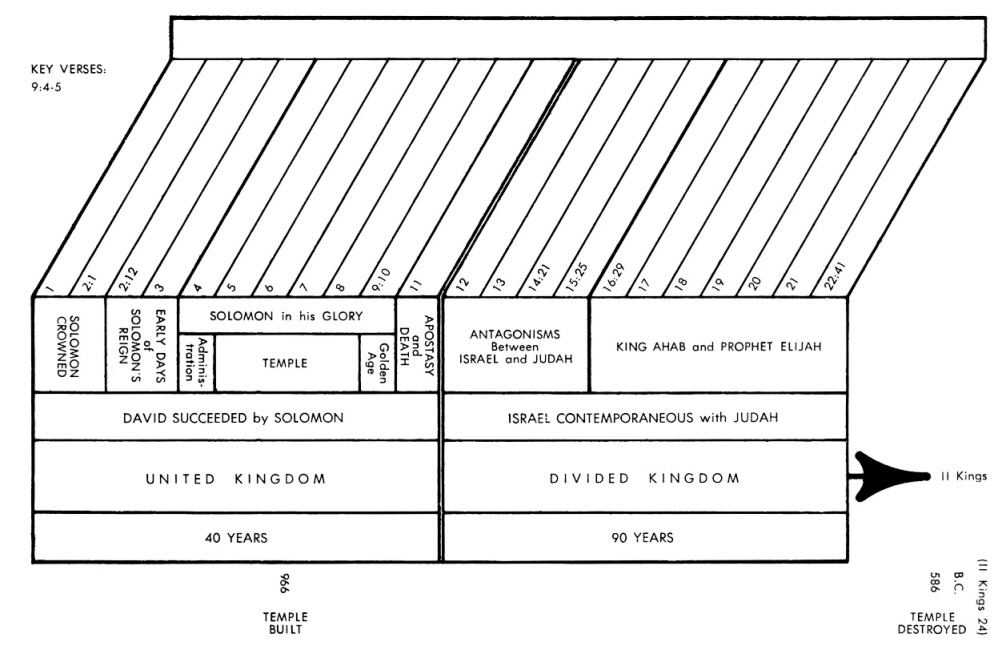
Chart from recommended resource Jensen's Survey of the OT - used by permission
1 Kings Chart from Charles Swindoll

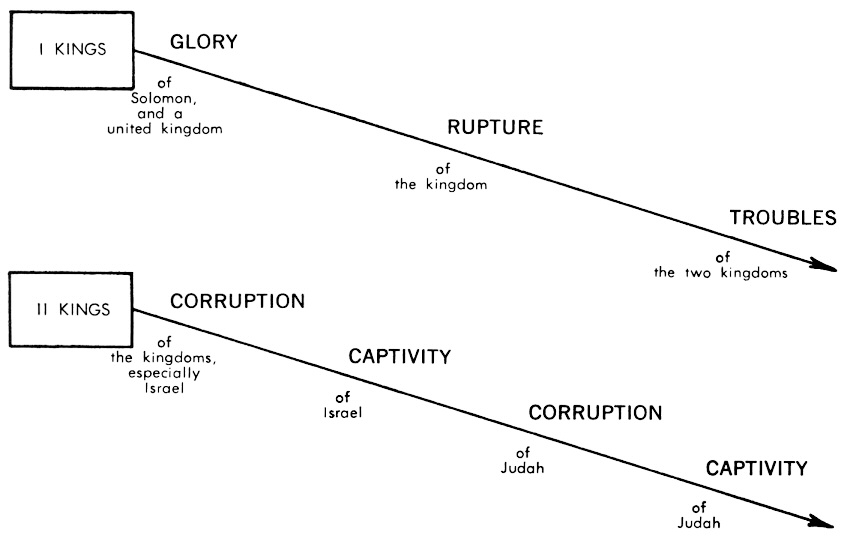
THE DOWNWARD SPIRAL
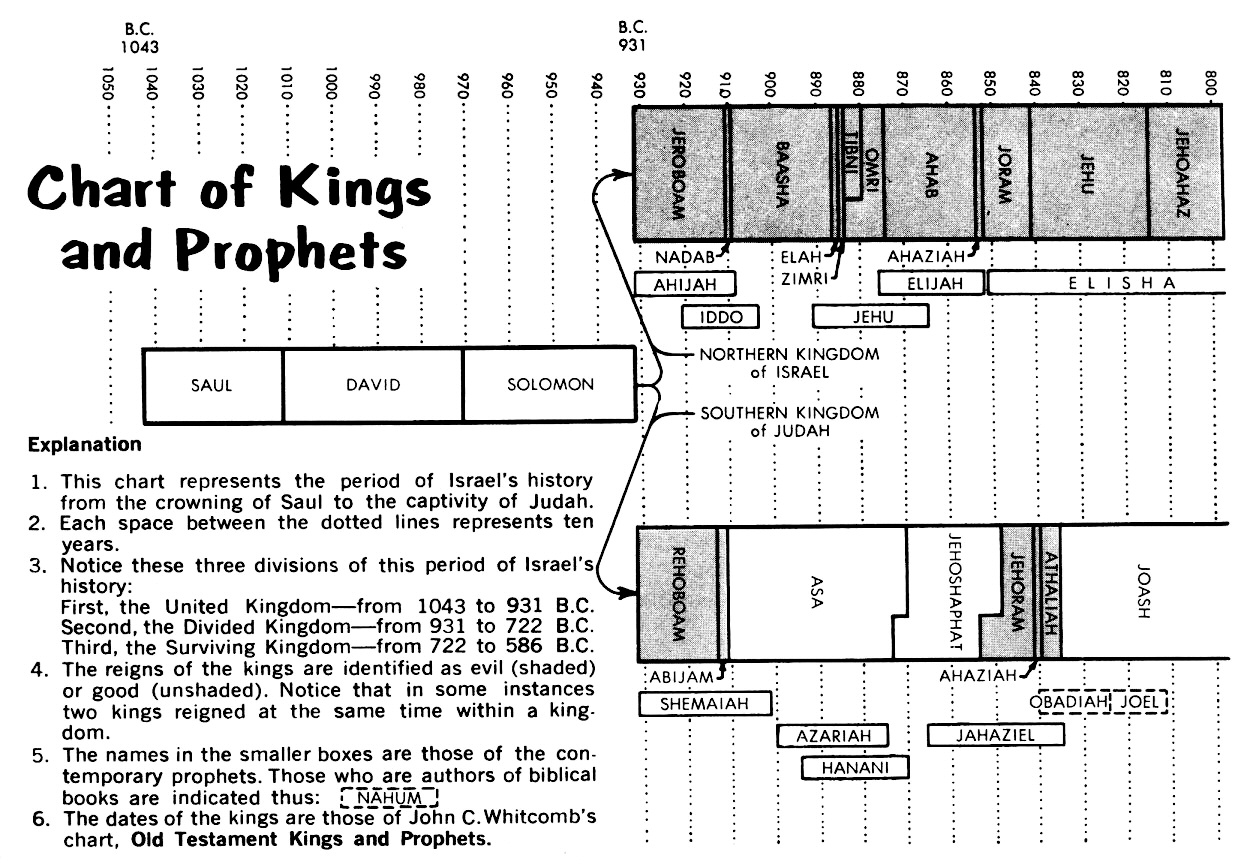
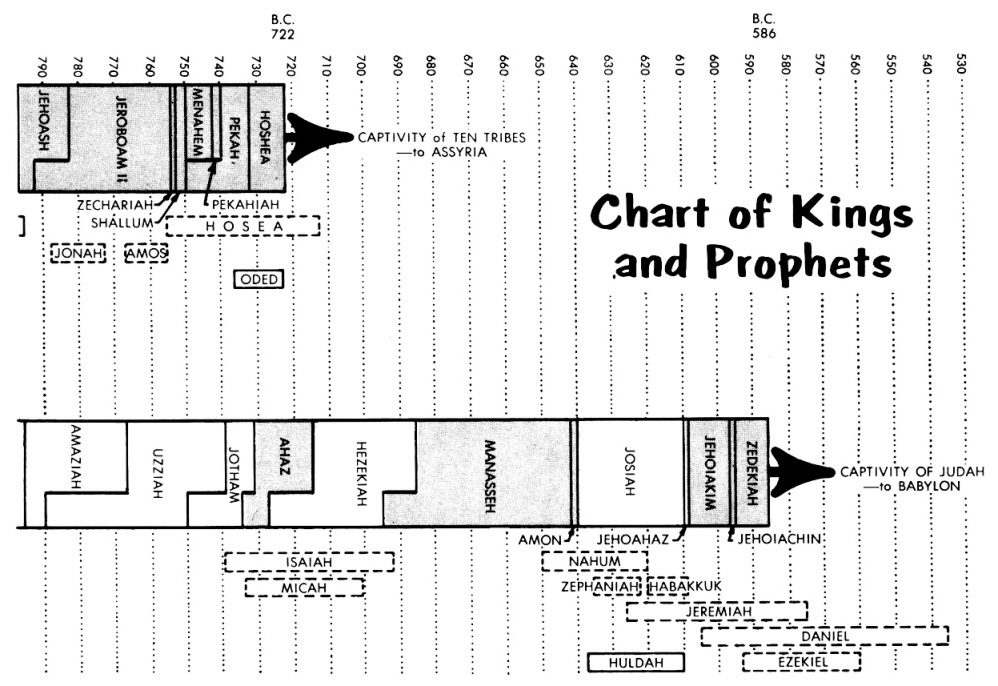
Click to Enlarge
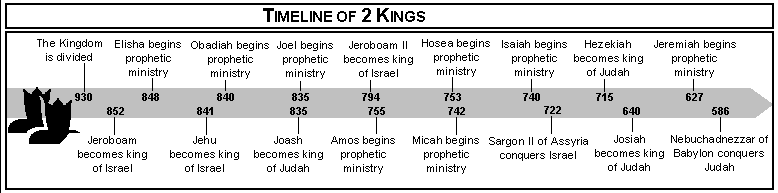
Ryrie Study Bible - Borrow
Click to Enlarge
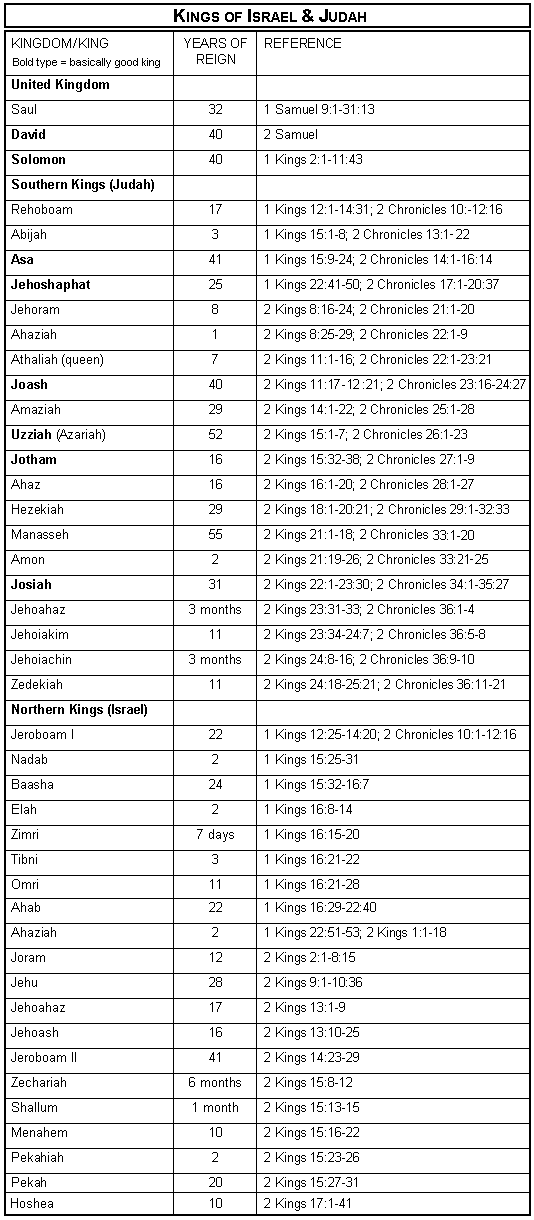
(NOTE: Many consider Amaziah and Hezekiah as "good" kings)
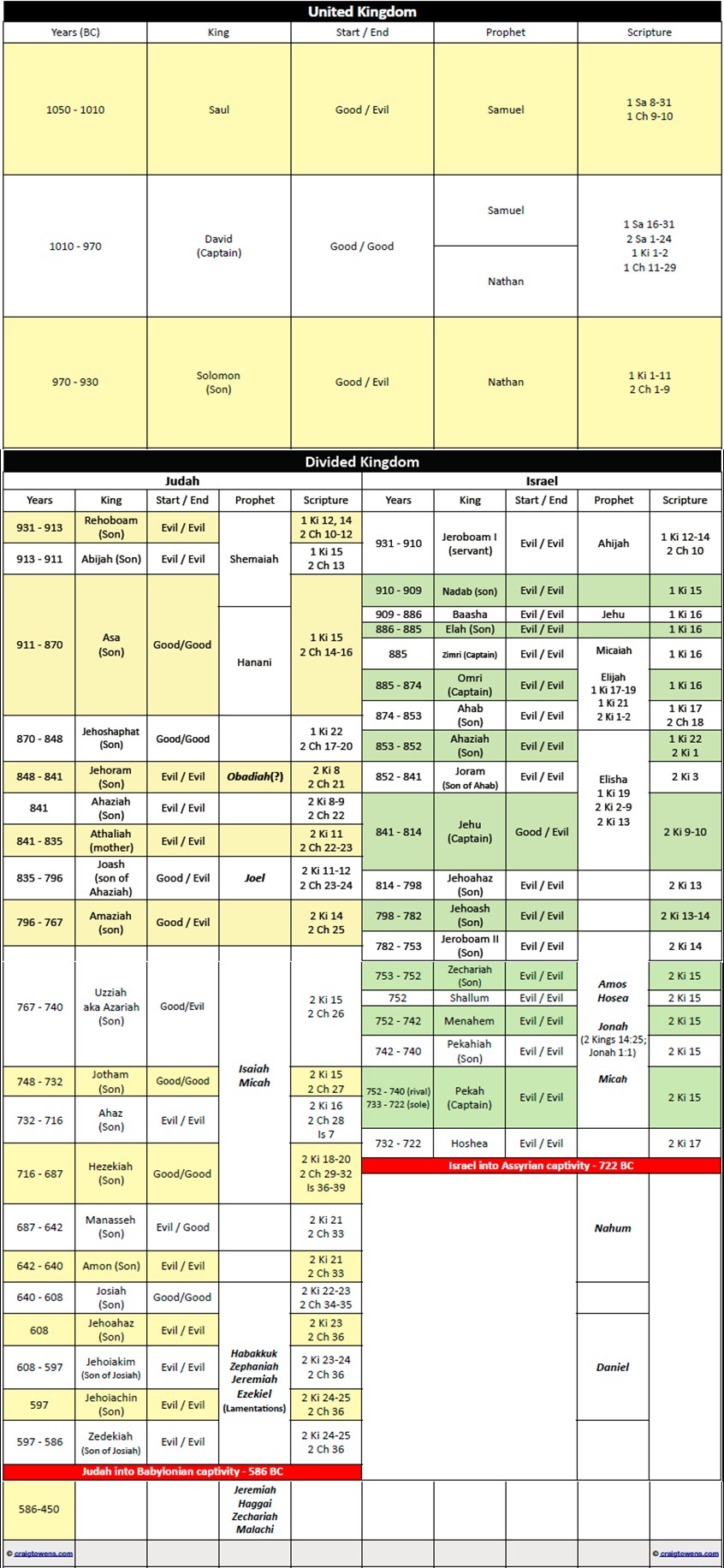
SEE ALSO:
ESV chart - kings of Israel - more information
ESV chart - kings of Judah - more information
Another Chart with Variable Dates for Reigns of King
2 Kings 24:1 In his days Nebuchadnezzar king of Babylon came up, and Jehoiakim became his servant for three years; then he turned and rebelled against him.
- his days: 2Ki 17:5 2Ch 36:6-21 Jer 25:1,9 46:2 Da 1:1
Related Passages:
Jeremiah 1:1-2 The words of Jeremiah the son of Hilkiah, of the priests who were in Anathoth in the land of Benjamin, 2 to whom the word of the LORD came in the days of Josiah the son of Amon, king of Judah, in the thirteenth year of his reign (627 BC - AGE 21).
Jeremiah 25:1-9 The word that came to Jeremiah concerning all the people of Judah, in the fourth year of Jehoiakim (605 BC) the son of Josiah (JOSIAH DIED IN 609 BC), king of Judah (that was the first year of Nebuchadnezzar king of Babylon) (BATTLE OF CARCHEMISH IN 605 BC MARKS BEGINNING OF BABYLON'S DOMINANCE), 2 which Jeremiah the prophet spoke to all the people of Judah and to all the inhabitants of Jerusalem, saying, 3 “From the thirteenth year of Josiah (627 BC - JOSIAH WOULD HAVE BEEN ABOUT 21 HAVING BEGUN PURGING THE LAND AT IN THE 12TH YEAR AT AGE 20) the son of Amon, king of Judah, even to this day, these twenty-three years (WARNINGS FROM 627 BC → 605 BC) the word of the LORD has come to me, and I have spoken to you again and again, but you have not listened. 4 “And the LORD has sent to you all His servants the prophets again and again, but you have not listened nor inclined your ear to hear, 5 saying, ‘Turn now everyone from his evil way and from the evil of your deeds, and dwell on the land which the LORD has given to you and your forefathers forever and ever; 6 and do not go after other gods to serve them and to worship them, and do not provoke Me to anger with the work of your hands, and I will do you no harm.’ 7 “Yet you have not listened to Me,” declares the LORD, “in order that you might provoke Me to anger with the work of your hands to your own harm. 8 “Therefore thus says the LORD of hosts, ‘Because you have not obeyed My words, behold, I will send and take all the families of the north,’ declares the LORD, ‘and I will send to Nebuchadnezzar king of Babylon, My servant, (GOD'S INSTRUMENT OF DISCIPLINE) and will bring them against this land and against its inhabitants and against all these nations round about; and I will utterly destroy them and make them a horror and a hissing, and an everlasting desolation. 10 Moreover, I will take from them the voice of joy and the voice of gladness, the voice of the bridegroom and the voice of the bride, the sound of the millstones and the light of the lamp. 11 ‘This whole land will be a desolation and a horror, and these nations will serve the king of Babylon seventy years. 12 ‘Then it will be when seventy years are completed I will punish the king of Babylon and that nation,’ declares the LORD, ‘for their iniquity, and the land of the Chaldeans; and I will make it an everlasting desolation.
Daniel 1:1-6+ In the third year of the reign of Jehoiakim king of Judah, Nebuchadnezzar king of Babylon came to Jerusalem and besieged it. 2 The Lord gave Jehoiakim king of Judah into his hand, along with some of the vessels of the house of God; and he brought them to the land of Shinar, to the house of his god, and he brought the vessels into the treasury of his god. 3 Then the king ordered Ashpenaz, the chief of his officials, to bring in some of the sons of Israel, including some of the royal family and of the nobles, 4 youths in whom was no defect, who were good-looking, showing intelligence in every branch of wisdom, endowed with understanding and discerning knowledge, and who had ability for serving in the king’s court; and he ordered him to teach them the literature and language of the Chaldeans. 5 The king appointed for them a daily ration from the king’s choice food and from the wine which he drank, and appointed that they should be educated three years, at the end of which they were to enter the king’s personal service. 6Now among them from the sons of Judah were Daniel, Hananiah, Mishael and Azariah.
JEHOIAKIM IN THE DAYS OF
NEBUCHADNEZZAR
2 Kings 23:36-37 Jehoiakim was twenty-five years old when he became king, and he reigned eleven years in Jerusalem; and his mother’s name was Zebidah the daughter of Pedaiah of Rumah. 37 He did evil in the sight of the LORD, according to all that his fathers had done.
Wiersbe: It was Jehoiakim who cut to pieces and burned to ashes the scroll of Jeremiah’s prophecy (Jer. 36). Unlike his father, Josiah, he had no respect for the Lord or His Word (Jer. 22:1-23).
Josephus: He was of a wicked disposition, and ready to do mischief; nor was he either religious towards God, or good-natured towards men.
Adam Clarke: He was a most unprincipled and oppressive tyrant. Jeremiah gives us his character at large, Jeremiah 22:13-19, to which the reader will do well to refer. Jeremiah was at that time in the land, and was an eyewitness of the abominations of this cruel king.
In his days Nebuchadnezzar king of Babylon came up (invaded, launched an attack) - 2 Chronicles 36:6 adds "Nebuchadnezzar king of Babylon came up against him and bound him with bronze chains to take him to Babylon." This was in effect the first deportation to Babylon in 605 BC described also in (Da 1:1–2).
In the third year of the reign of Jehoiakim king of Judah, Nebuchadnezzar king of Babylon came to Jerusalem and besieged it. 2 The Lord gave Jehoiakim king of Judah into his hand, along with some of the vessels of the house of God; and he brought them to the land of Shinar, to the house of his god, and he brought the vessels into the treasury of his god.
It was also at this time that Daniel and his three friends were taken to Babylon (Da 1:3-6)
Jehoiakim was later returned to Jerusalem, although he had to act as Nebuchadnezzar’s servant for three years and pay tribute to him.
Nebuchadnezzar is king of Babylon which at this time in history was ascending to world power having defeated Egypt and Assyria at Battle of Carchemish in 605 BC. Came up indicates military invasion from the north in 605 BC, which Daniel calls the 3rd year of Jehoiakim's reign and Jeremiah calls the 4th year of his reign, the "apparent discrepancy" due to Daniel using the Babylonian system of accession and Jeremiah the Jewish system (see more below). This is the first of 3 Babylonian invasions of Judah - 605, 597 and 586 BC.
Nebuchadnezzar's name means "Nebo is the protector of my offspring" and he reigned from 605-562 BC. Note that at this time he was not king but crown prince, because his father, Nabopolassar was not yet dead. He died in 605 B.C. (See KINGS OF BABYLON)
JEHOIAKIM'S SUBJUGATION TO
NEBUCHADNEZZAR
Jehoiakim became his servant ( 'ebed; LXX - doulos) for three years - In effect Judah is now a vassal state of Babylon and Jehoiakim is a vassal king. A vassal is someone who is under the authority of a more powerful ruler and owes loyalty, service, or tribute to that ruler. As Jehoiakim was obligated to pay tribute (tax, gold, goods) to Babylon adn to submit politically to Babylon. In essence, while Jehoiakim did not lose his throne in Jerusalem, he did lose his independence.
SUBSEQUENT REBELLION
AGAINST NEBUCHADNEZZAR
Then - This marks a progression in the historical narrative, when reigning turned into rebelling.
He turned and rebelled (marad; LXX - atheteo literally means to regard as nothing and so to reject, refuse) against him (Nebuchadnezzar) - While the text does not specifically state the nature of Jehoiakim's rebellion, it likely included refusal to pay tributes, because "money always talks!"
Bob Utley - "rebelled against him" We learn from "The Babylonian Chronicles," which were found in 1956, of a very costly battle three years after Carchemish (i.e., 605 B.C.) between Babylon and Egypt on Egypt's border. See Edwin Yamauchi, The Stones and the Scriptures, p. 83.
Believer's Study Bible - From 609 to 605 B.C., Egypt was dominant in the regions of ancient Canaan, but the day of Nebuchadnezzar and the Babylonians came in 605 B.C., when Egypt and Babylon clashed in the Battle of Carchemish. The Babylonians drove the Egyptians back to Egypt and emerged as the new world leader. All of Syria and Palestine to the border of Egypt was exposed to the new conqueror (2Ki 24:7). Nebuchadnezzar immediately moved south as far as Jerusalem, where he forced the submission of Jehoiakim and other kings of the area. At this time, 605 B.C., Nebuchadnezzar carried away certain young men from Jerusalem to be relocated in Babylon. Among these were Daniel and his three friends, Hananiah, Mishael, and Azariah (Da 1:1-6+). The 70-year captivity of Judah (Jer. 25:11, 12; 29:10) may be figured from this year of Daniel's deportation, to the decree of Cyrus to allow the Jews to return (Ezra 1:2-4).
Whitcomb: After three years of paying tribute to Nebuchadnezzar, he finally decided, against the vigorous warnings of Jeremiah (cf. Jer. 36:29), to rebel against the Babylonian monarch (2 Kings 24:1). But God raised up various marauding bands from the north and east to harass Jehoiakim until he was finally killed in early December, 598 B.C. Jeremiah had predicted that “they shall not lament for him, saying, Ah lord! Or, Ah his glory! He shall be buried with the burial of an ass, drawn and cast forth beyond the gates of Jerusalem” (Jer. 22:18-19; cf. 36:30). Furthermore, “he shall have none to sit upon the throne of David” (Jer. 36:30), which must have been an anticipation of the curse which would fall upon his son, Jehoichin.
John Walton - Nebuchadnezzar and Jehoiakim. Nebuchadnezzar II took the throne of Babylon in 605 B.C. after his victory against Egypt at the Battle of Carchemish in the same year. From that time on Jehoiakim was vassal to Babylon during most of his reign. The Babylonian Chronicle states that the Chaldeans were able to wrest control of the Levant from Egypt after this. Nebuchadnezzar attempted to follow up with an invasion of Egypt (601-600). This attack apparently crippled the Chaldeans for a brief period, possibly causing Jehoiakim to ally himself with Egypt. Nebuchadnezzar’s response was to attack Judah with garrison troops from the west. Jehoiakim was captured and shackled (see 2 Chron 36:6), but appears but appears to have avoided exile since he died in Judah. 24:2. invading raiders. (See IVP Background Commentary)
QUESTION - Who was King Jehoiakim in the Bible? | GotQuestions.org
ANSWER - The following discussion is adapted from GotQuestions.org but is revised with addition informaton and multiple Scriptures.
Jehoiakim (named Eliakim at birth, 2Ch 36:4) was one of the last kings of Judah before the Babylonian captivity. He reigned 11 years from 609-597 BC (2Ki 23:36; 2Ch 36:5). Jehoiakim was a son of godly King Josiah (Jeremiah 26:1), who had returned Judah to the LORD by tearing down idol shrines and restoring obedience to God’s Law (2Ki 23:19–25). Jehoiakim's mother was Zebidah (2Ki 23:36). After Josiah’s death, his son Jehoahaz was chosen king by the people (2Ki 23:30). Jehoahaz did not follow in the footsteps of his father King Josiah but “did evil in the sight of the Lord” (2Ki 23:32). Jehoahaz reigned only 3 months (2Ki 23:31) before he was taken into captivity by Pharaoh Neco the ruler of Egypt (2Ki 23:33).
In 609 BC (the year King Josiah died), Pharaoh Neco replaced Jehoahaz with his 25-year-old brother Eliakim, renaming him Jehoiakim (2Ki 23:34), and making him a vassal king of Egypt who paid tribute to Pharaoh Neco and taxed Judah to obtain the funds to pay the tribute (2Ki 23:35). At this time Judah was still fully under Egyptian control.
This Egyptian dominance of Jehoiakim lasted until 605 BC, when a shift occurred at the Battle of Carchemish, where Nebuchadnezzar of Babylon defeated Pharaoh Neco of Egypt (Jer 46:2). Following this victory, Babylon became the dominant world power, and in that same year (605 BC) Nebuchadnezzar invaded Jerusalem (2Ch 36:6+, Da 1:1-see comment regarding dating of years, 2Ki 24:1), subduing Jehoiakim and taking some Hebrew captives to Babylon, including Daniel and his three friends (Da 1:2-5, 6). At this point, Jehoiakim shifted allegiance and became a vassal of Nebuchadnezzar. 2Ki 24:1 adds that "Jehoiakim became his servant for three years then he turned and rebelled against him," which led to intensified judgment as the LORD sent raiding bands against Judah (2Ki 24:2). Jehoiakim eventually died around 598 BC, in disgrace as prophesied in Jeremiah 22:19 (see below), and was succeeded by his son Jehoiachin,
One point of potential confusion is in 2 Chronicles 36:6+ which describes Nebuchadnezzar's first attack on Jerusalem in 605 BC. The text reads "Nebuchadnezzar king of Babylon came up against him (Jehoiakim) and bound him with bronze chains to take him to Babylon." The phrase "take him to Babylon" likely means that Nebuchadnezzar intended to deport him, but that the plan was not carried out. John Walton agrees "Jehoiakim was captured and shackled (2Ch 36:6), but appears to have avoided exile since he died in Judah." (See IVP Background Commentary) Norman Geisler asks the question "Was Jehoiakim carried to Babylon or did he die in Jerusalem?" and answers by explaining that "Apparently, Jehoiakim was bound and fettered with the intention “to carry him off to Babylon” (2Ch 36:6), but he was slain instead, and his body ignominiously treated “and cast out beyond the gates of Jerusalem” (Jer. 22:19)." (See When Critics Ask) This interpretation fits with the historical and textual evidence, harmonizing with Jeremiah 22:18,19, where the prophet foretells that Jehoiakim would have “the burial of a donkey, dragged and dumped beyond the gates of Jerusalem.” In short, there is no clear evidence Jehoiakim was ever physically taken to Babylon and the record shows he died in Jerusalem and received a dishonorable burial.
Character: Violent, Defiant, and Spiritually Hardened
Jehoiakim’s reign was characterized by moral corruption, oppression, and spiritual insensitivity. Ezekiel 19:5–7 likens him to a predatory lion devouring prey and laying waste to the land, vividly illustrating his destructive leadership. Rather than ruling as a faithful shepherd like his father Josiah (Jeremiah 22:15,16), Jehoiakim functioned as a vassal installed by Egypt (2 Kings 23:34), imposed heavy taxation on his people (2 Kings 23:35), practiced oppression and injustice (Jeremiah 22:13,14, 15, 16, 17), rejected God’s Word (Jer 36:23–24 see next topic below), and even killed God’s prophet Uriah (Jer 26:23).
Rejection of God’s Word
Surely a defining moment that illustrates Jehoiakim’s depraved spiritual condition is found in Jeremiah 36, where he responds to God’s prophetic warning with shocking defiance. During the time King Jehoiakim reigned as a vassal of Babylon, the prophet Jeremiah preached in Jerusalem. God’s message was that the Babylonian invasion was God’s punishment for Judah’s sin and that the Hebrews should repent. Jehoiakim called for Jeremiah’s scroll to be read in his court. But, as every three or four columns of the scroll were read, “the king cut them off with a scribe’s knife and threw them into the firepot, until the entire scroll was burned in the fire. The king and all his attendants who heard all these words showed no fear, nor did they tear their clothes” (Jeremiah 36:23, 24). This act was more than symbolic for it was a deliberate rejection of God's authority. Neither the king nor his officials showed any fear of God nor repentance, revealing that their hearts were hardened against conviction of sin by the Holy Spirit (cf Acts 7:51+). In attempting to destroy God’s Word, Jehoiakim demonstrated the ultimate folly of resisting divine truth, for while the scroll burned, the message remained and would soon be fulfilled with Jerusalem and the Temple being burned! In short, instead of rending his garment in fear like his father Josiah (2Ki 22:11+), he defiantly "rended" God's scroll (Jer 36:24)! Rather than heed God’s warning, Jehoiakim hardened his heart and tried to destroy God’s Word (see Jer 25:1–4). Earlier, Jehoiakim in effect rejected God's word through His prophet Uriah putting him to death and casting "his dead body into the burial place of the common people." (cf Jer 26:20, 21, 22, 23).
Divine Judgment Pronounced
Jeremiah rewrote the scroll that Jehoiakim had cut and burned, and God pronounced judgment on the king: “Therefore this is what the LORD says about Jehoiakim king of Judah: He will have no one to sit on the throne of David; his body will be thrown out and exposed to the heat by day and the frost by night” (Jer 36:30). These pronouncements were not merely symbolic but specific and personal, reflecting the seriousness of his sin and the certainty of divine justice. Jehoiakim’s rejection of God’s Word ensured that he would experience its fulfillment in judgment.
Although Scripture does not provide a detailed narrative of Jehoiakim’s death, the available evidence points to a humiliating and violent end consistent with Jeremiah’s prophecies. In 597 BC Jerusalem came under a second siege from Babylon, and according to historical sources such as Josephus, Jehoiakim was killed and received no proper burial. Jeremiah 22:19 recorded he would be "buried with a donkey’s burial, dragged off and thrown out beyond the gates of Jerusalem." This highlights the fitting nature of this outcome, for Jehoiakim had denied Uriah an honorable burial (Jer 26:23) and now was himself denied a kings burial (contrast his father's burial 2Ch 35:24,25) and left exposed in disgrace. His end stands as a sobering example of divine law of retribution (reaping and sowing), where judgment mirrors the nature of the sin committed (Gal 6:7-8+)
Aftermath: Rapid Decline of the Throne
Following Jehoiakim’s death, the instability of Judah’s leadership became even more apparent. His son Jehoiachin reigned for only three months before being taken captive to Babylon, and Zedekiah was appointed by Babylon rather than by God’s prophetic guidance. This shift marked a dramatic departure from earlier times when kings were anointed under divine authority. The throne of David, once a symbol of covenant promise, now appeared fragile and compromised, reflecting the nation’s deep spiritual decline and its subjugation to Gentile rule.
Theological Lessons
Jehoiakim’s life offers enduring spiritual lessons. First, it demonstrates that a godly heritage does not ensure personal faithfulness, as each individual must respond to God independently (Deuteronomy 24:16). Second, it shows that rejecting God’s Word leads inevitably to ruin, for truth cannot be destroyed, only ignored at great cost. Third, it affirms that God’s Word is indestructible, for though Jehoiakim burned the scroll, the message was rewritten and fulfilled. Finally, it reveals that divine justice is precise and personal for this king who dishonored God’s Word and His servants experienced judgment that mirrored his own actions. His life stands as a vivid illustration of Proverbs 29:1, warning that persistent stubbornness in the face of rebuke leads to sudden and irreversible destruction.
JOSIAH’S REIGN
& JEREMIAH’S CALL
📅 640–609 BC — Reign of Josiah
2 Chronicles 34–35
Great reforms, rediscovery of the Law
📅 627 BC — Jeremiah begins prophesying
Jeremiah 1:2 “In the thirteenth year of his reign…”
Beginning of 23 years of warning
TURNING POINT:
JOSIAH’S DEATH
📅 609 BC — Josiah killed at Megiddo
2 Chronicles 35:20–24
Spiritual decline begins
RAPID DECLINE OF JUDAH
📅 609 BC — Jehoahaz (3 months)
2 Chronicles 36:1–4
Taken captive to Egypt
📅 609–598 BC — Jehoiakim (11 years)
2 Chronicles 36:5–8
Wicked reign; rejects God’s Word (Jeremiah 36)
GLOBAL SHIFT:
BABYLON RISES
📅 605 BC — PIVOTAL YEAR
Battle of Carchemish
Babylon defeats Egypt
Jeremiah 25:1 “Fourth year of Jehoiakim… first year of Nebuchadnezzar”
PROPHETIC ALIGNMENTS (605 BC)
Jeremiah 25:1–11
23 years of warning now culminate
Prophecy of 70 years of captivity
“In the third year of the reign of Jehoiakim king of Judah, Nebuchadnezzar king of Babylon came to Jerusalem and besieged it."
Note: Babylonian method of dating (Used by Daniel) where year a king came to the throne = “accession year” (year 0) and the first full year = year 1. Jehoiakim becomes king: 609 BC. Stated another way using the Accession Year system, the first year of a king's reign was the "accession year," with the first full year being the second year as shown below.
609 = accession year (year 0)
608 = year 1
607 = year 2
606/605 = year 3
So Daniel 1:1 calls 605 BC the 3rd year
Jewish Method (Used by Jeremiah) - Non-Accession System. The first partial year is counted as year 1
609 BC = year 1
608 = year 2
607 = year 3
606/605 = year 4
So Jeremiah 25:1 calls 605 BC the 4th year
First deportation to Babylon
Daniel and his three friends, Hananiah, Mishael, and Azariah taken
Temple vessels taken
2 Chronicles 36:6–7
Jehoiakim bound
Temple treasures carried to Babylon
Habakkuk (same general period)
Habakkuk struggles with God using Babylon
Habakkuk 1:6 “I am raising up the Chaldeans…”
AFTER 605 BC
FINAL DECLINE
📅 598–597 BC — Jehoiachin (3 months) (Josiah's grandson)
Taken to Babylon
Second deportation (Ezekiel included)
📅 597–586 BC — Zedekiah (11 years)
Last king of Judah
Rebels against Babylon
FINAL JUDGMENT
📅 586 BC — Fall of Jerusalem
2 Chronicles 36:17–20
Temple burned
City destroyed
People exiled
BIG PICTURE FLOW
627 BC ➡️ Warning begins (Jeremiah called)
609 BC ➡️ Godly leadership removed (Josiah dies)
605 BC ➡️ First deportation to Babylon - Daniel and the boys
597 BC ➡️ Second deportation - Ezekiel and 10,000
586 BC ➡️ Judgment completed - Jerusalem falls, Temple destroyed
KEY CONNECTION
Jeremiah 25 (605 BC) is a hinge of history:
Looks back → 23 years of ignored warnings
Looks forward → 70 years of captivity
QUESTION - Who was Nebuchadnezzar? | GotQuestions.org
ANSWER - Nebuchadnezzar II, sometimes alternately spelled Nebuchadrezzar, was king of Babylonia from approximately 605 BC until approximately 562 BC. He is considered the greatest king of the Babylonian Empire and is credited with the construction of the Hanging Gardens of Babylon. Nebuchadnezzar is mentioned by name around 90 times in the Bible, in both the historical and prophetic literature of the Hebrew Scriptures. Nebuchadnezzar receives the most attention in the book of Daniel, appearing as the main character, beside Daniel, in chapters 1–4.
In biblical history, Nebuchadnezzar is most famous for the conquering of Judah and the destruction of Judah and Jerusalem in 586 BC. Judah had become a tribute state to Babylon in 605 BC but rebelled in 597 BC during the reign of Jehoiachin and then again in 588 BC during the reign of Zedekiah. Tired of the rebellions, and seeing that Judah had not learned its lesson when he invaded, conquered, and deported Judah in 597, Nebuchadnezzar and his general, Nebuzaradan, proceeded to completely destroy the temple and most of Jerusalem, deporting most of the remaining residents to Babylon. In this, Nebuchadnezzar served as God’s instrument of judgment on Judah for its idolatry, unfaithfulness, and disobedience (Jeremiah 25:9).
Secular history records Nebuchadnezzar as a brutal, powerful, and ambitious king, and the Bible, for the most part, agrees. However, the book of Daniel gives additional insight into his character. Daniel chapter 2 records God giving Nebuchadnezzar a dream about what kingdoms would arise after his own. In the dream, Nebuchadnezzar was a “head of gold” on a statue, with the descending parts of the body, comprised of silver, bronze, iron, and iron mixed with clay, representing the less powerful kingdoms that would come after him. Nebuchadnezzar demanded the astrologers and wise men to interpret his dream without him telling it to them and, when they were unable to, Nebuchadnezzar ordered all of the astrologers and wise men to be killed. Daniel spoke up and, through a miracle from God, interpreted Nebuchadnezzar’s dream. The king then promoted Daniel to be one of his most influential advisers. Interestingly, when Daniel interpreted his dream, Nebuchadnezzar declared,
“Truly, your God is God of gods and Lord of kings, and a revealer of mysteries, for you have been able to reveal this mystery” (Daniel 2:47).
In Daniel 3, Nebuchadnezzar created a gold statue of himself and required all the people to bow down to it whenever the music played. Daniel’s three friends, Shadrach, Meshach, and Abednego, refused, and the king had them thrown into a blazing furnace. Miraculously, God protected them, and when they came out of the furnace, Nebuchadnezzar proclaimed,
“Blessed be the God of Shadrach, Meshach, and Abednego, who has sent his angel and delivered his servants, who trusted in him, and set aside the king’s command, and yielded up their bodies rather than serve and worship any god except their own God. Therefore I make a decree: Any people, nation, or language that speaks anything against the God of Shadrach, Meshach, and Abednego shall be torn limb from limb, and their houses laid in ruins, for there is no other god who is able to rescue in this way” (Daniel 3:28–29).
In Daniel chapter 4, Nebuchadnezzar is given another dream by God. Daniel interpreted the dream for Nebuchadnezzar and informed him that the dream was a warning to the king to humble himself and recognize that his power, wealth, and influence were from God, not of his own making. Nebuchadnezzar did not heed the warning of the dream, so God judged him as the dream had declared. Nebuchadnezzar was driven insane for seven years. When the king’s sanity was restored, he finally humbled himself before God. In Daniel 4:3, Nebuchadnezzar declares, “How great are his signs, how mighty his wonders! His kingdom is an everlasting kingdom, and his dominion endures from generation to generation.” Nebuchadnezzar continued in Daniel 4:34–37,
“For his dominion is an everlasting dominion, and his kingdom endures from generation to generation; all the inhabitants of the earth are accounted as nothing, and he does according to his will among the host of heaven and among the inhabitants of the earth; and none can stay his hand or say to him, ‘What have you done?’ … “Now I, Nebuchadnezzar, praise and extol and honor the King of heaven, for all his works are right and his ways are just; and those who walk in pride he is able to humble.”
The exclamations of Nebuchadnezzar recorded in the book of Daniel have led some to consider the possibility that Nebuchadnezzar became a believer in the one true God. History records Nebuchadnezzar being a follower of the Babylonian gods Nabu and Marduk. Is it possible that Nebuchadnezzar renounced these false gods and instead only worshiped the one true God? Yes, it is possible. If nothing else, Nebuchadnezzar became a henotheist, believing in many gods but worshiping only one God as supreme. Based on his words recorded in Daniel, it definitely seems like Nebuchadnezzar submitted himself to the one true God. Further evidence is the fact that God refers to Nebuchadnezzar as “my servant” three times in the book of Jeremiah (Jeremiah 25:9; 27:6; 43:10). Was Nebuchadnezzar saved? Ultimately, this is not a question that can be answered dogmatically. Whatever the case, the story of Nebuchadnezzar is an example of God’s sovereignty over all men and the truth that “The king’s heart is a stream of water in the hand of the Lord; He turns it wherever He will” (Proverbs 21:1).
2 Kings 24:2 The LORD sent against him bands of Chaldeans, bands of Arameans, bands of Moabites, and bands of Ammonites. So He sent them against Judah to destroy it, according to the word of the LORD which He had spoken through His servants the prophets.
- The LORD sent against him: 2Ki 6:23 13:20,21 De 28:49,50 2Ch 33:11 Job 1:17 Isa 7:17 13:5 Jer 35:11 Eze 19:8
- according to the word of the LORD: 2Ki 20:17 2Ki 21:12-14 2Ki 23:27 Isa 6:11,12 Jer 25:9 Jer 26:6,20 Jer 32:28 Mic 3:12
Related Passages:
2 Kings 20:17 (PROPHET ISAIAH TO HEZEKIAH) ‘Behold, the days are coming when all that is in your house, and all that your fathers have laid up in store to this day will be carried to Babylon; nothing shall be left,’ says the LORD.
2 Kings 21:10-14 Now the LORD spoke through His servants the prophets, saying, 11“Because Manasseh king of Judah has done these abominations, having done wickedly more than all the Amorites did who were before him, and has also made Judah sin with his idols; 12 therefore thus says the LORD, the God of Israel, ‘Behold, I am bringing such calamity on Jerusalem and Judah, that whoever hears of it, both his ears will tingle. 13 ‘I will stretch over Jerusalem the line of Samaria and the plummet of the house of Ahab, and I will wipe Jerusalem as one wipes a dish, wiping it and turning it upside down. 14 ‘I will abandon the remnant of My inheritance and deliver them into the hand of their enemies, and they will become as plunder and spoil to all their enemies;
2 Kings 23:26-27 However, the LORD did not turn from the fierceness of His great wrath with which His anger burned against Judah, because of all the provocations with which Manasseh had provoked Him. 27 The LORD said, “I will remove Judah also from My sight, as I have removed Israel. And I will cast off Jerusalem, this city which I have chosen, and the temple of which I said, ‘My name shall be there.’”
Jeremiah 25:9 behold, I will send and take all the families of the north,’ declares the LORD, ‘and I will send to Nebuchadnezzar king of Babylon, My servant, and will bring them against this land and against its inhabitants and against all these nations round about; and I will utterly destroy them and make them a horror and a hissing, and an everlasting desolation.
Jeremiah 26:6; 20 then I will make this house like Shiloh, and this city I will make a curse to all the nations of the earth.”’” (26:20) Indeed, there was also a man who prophesied in the name of the LORD, Uriah the son of Shemaiah from Kiriath-jearim; and he prophesied against this city and against this land words similar to all those of Jeremiah.
Jeremiah 32:28 Therefore thus says the LORD, “Behold, I am about to give this city into the hand of the Chaldeans (BABYLONIANS) and into the hand of Nebuchadnezzar king of Babylon, and he will take it.
THE CONSEQUENCES OF
JEHOIAKIM'S REBELLION
The LORD sent against him bands of Chaldeans (Babylonians), bands of Arameans (Syria from North), bands of Moabites (from East), and bands of Ammonites (from NE) - Yahweh Himself responds to Jehoiakim's rebellion by sending enemies to raid Judah. Once again we see the sovereignty of God Who is behind the scenes of ALL world history (it is HIS-story!) And so these attacks were not random but were divinely directed. Bands refer to raiding parties or what we might call today guerrilla attacks, so this was not just a single invasion but a constant harassment from multiple directions.
God is in control...
Isaiah 45:7 The One forming light and creating darkness, Causing well-being and creating calamity; I am the LORD who does all these.
Amos 3:6 If a trumpet is blown in a city will not the people tremble? If a calamity occurs in a city has not the LORD done it?
So He sent them against Judah to destroy it - Just in case we missed it, He sent makes it crystal clear that these bands represent God's intentional judgment on Judah. And while we often say God sent discipline, in this case He sends destruction of the kingdom! These raids mark the beginning of the end of the Kingdom of Judah which will culminate in teh sacking of Jerusalem and burning of the Temple in 586 BC.
According to the word of the LORD which He had spoken through His servants the prophets - According to the word of the LORD again reiterates that what was happening was not unexpected but was divinely determined. Not only was it determined but Judah had been warned repeatedly through His servants the prophets.
which He had spoken through His servants the prophets - Through Moses God had prophesied “I will lay waste your cities…and scatter you among the nations” (Leviticus 26:32, 33). Through Isaiah God said “All… will be carried to Babylon” (Isaiah 39:6). And through Jeremiah God had said “I will send… Nebuchadnezzar… against this land” (Jeremiah 25:9). Yahweh did not judge Judah without warning but had sent them men who were preachers, watchmen and messengers of mercy before judgment. The bottom line is that Judah's judgment came only after her repeated rejection of His warnings.
Jeremiah 7:25 says "Since the day that your fathers came out of the land of Egypt until this day, I have sent you all My servants the prophets, daily rising early and sending them."
John Walton - invading raiders. The CHALDEANS were the designation of the Semitic-speaking people of Nebuchadnezzar II of Babylon. They are mentioned in Assyrian records as inhabiting Babylonia by the beginning of the first millennium B.C. Though we are most familiar with the Arameans connected to the Aramean state north of Israel, there were also eastern Arameans, a Semitic-speaking people who inhabited much of the Tigris-Euphrates Valley, who often appear alongside the Chaldeans. It appears that the Chaldeans were more of a town-based group, while the Arameans were seminomadic. According to Babylonian sources, the Moabites and Ammonites were subjects of Babylon and were thus required to send troops against a recalcitrant neighbor. (See IVP Background Commentary)
2 Kings 24:3 Surely at the command of the LORD it came upon Judah, to remove them from His sight because of the sins of Manasseh, according to all that he had done,
- Surely: 2Ki 18:25 Ge 50:20 2Ch 24:24 25:16 Isa 10:5,6 45:7 46:10,11 Am 3:6
- remove them: 2Ki 23:26,27 Lev 26:33-35 De 4:26,27 28:63 29:28 Jos 23:15 Jer 15:1-4 Mic 2:10
- because the sins: 2Ki 21:2-11 Ex 20:5
JUDAH'S EXILE BECAUSE
OF MANASSEH'S SINS
Surely at the command of the LORD it came upon Judah - What is "it"? God's great wrath and promised calamity! The point of this statement is that the raids and the coming Babylonian attacks on Jerusalem were not random events, but were sovereignly decreed to transpire. God would use men (men's responsiblity) but He was in charge, orchestrating all the events (God's sovereignty). This is a variation on the Paradoxical Principle of 100% Dependent and 100% Responsible.
Bob Utley - "the command of the Lord" In Hebrew theology there is great emphasis put on the spoken word. It was the method of creation (Genesis 1). It always accomplishes its purpose (cf. Isa. 55:9-11). It became the name of YHWH's Messiah ("the word," cf. 1 John 1).
To remove them from His sight - While in one sense this is "hyperbole" (because God is omniscient, all seeing and omnipresent, everywhere), this removal speaks of loss of a sense of His favor, His presence, His protection and worst of all His fellowship (think of the loss of the Shekinah glory cloud with destruction of the Temple). This does NOT mean that Yahweh ceased to be concerned for the Jews (cf His unconditional covenant with Abram Ge 12:1-3+, 2Ch 21:7, Ps 37:25,28, Ps 111:9, Isa 59:21, Ezek 37:26+) or that they could never return (Dt 30:1-6+). But it It DOES mean they were rejected from privileged status (chosen people, blessings of Dt 28:1-14) and were placed under divine judgment for 70 years. Is there not an echo of Adam's sin and his "exile" from Eden when he was driven from Yahweh's presence and fellowship.
What a reversion the present passage is of the famous Aaronic blessing "The LORD make His face shine on you, And be gracious to you." (Nu 6:25+). Of course, in the present context to be removed from His sight means to be taken out of Judah into exile in Babylon.
We see this thought in 2 Kings 17:22-23+ in describing what had happened to the Northern Kingdom in 722 BC (and should have been a warning to the southern kingdom!) - "The sons of Israel walked in all the sins of Jeroboam which he did; they did not depart from themuntil the LORD removed Israel from His sight, as He spoke through all His servants the prophets. So Israel was carried away into exile from their own land to Assyria until this day."
🙏 THOUGHT - The principle is timeless that sin will result in expulsion from His presence.In Judah’s case, this meant physical removal from the land; today, for the believer, it is not a loss of salvation but a loss of the joy and intimacy of fellowship with Him (cf. Psalm 66:18+; Isaiah 59:2, Ge 3:8+). Sin (unholy) invariably disrupts communion with God (holy), dulls our spiritual senses, hardens our heart and creates a sense of separation from our Father.
Do you feel distant from your loving Father? Has the sweetness of His presence grown faint? Have you left that first love you once had for Jesus (Rev 2:4-5+)? Then you need to ask Him (Ps 139:23,24+) whether there is some sin you have tolerated despite His gentle warnings either through His Word or through His loving hand of discipline (Heb 12:5-11+). The Spirit is faithful to convict us of sin (Jn 16:8,9+), but when His loving conviction is resisted, fellowship is hindered (cf 1Jn 1:6,7+). Yet the remedy is graciously simple. Confess your sin (be specific, don't generalize) and repent of your sin and God will restore what sin has disrupted (1 John 1:9+, Pr 28:13+).
Because - This is one of more straightforward terms of explanation, giving God's justification for His removal.
Of the sins of Manasseh, according to all that he had done - What had he done? Read 2Ki 21:2-10+ for a list of his abominable sins against Yahweh. These were so great in number and heinousness that Manasseh is singled out repeatedly as a primary reason Yahweh would bring calamity of Judah and Jerusalem. See the following passages holding Manasseh accountable....
2 Kings 21:11+ “Because Manasseh king of Judah has done these abominations, having done wickedly more than all the Amorites did who were before him, and has also made Judah sin with his idols; 12therefore thus says the LORD, the God of Israel, ‘Behold, I am bringing such calamity on Jerusalem and Judah, that whoever hears of it, both his ears will tingle.
2 Kings 23:26-27+ However, the LORD did not turn from the fierceness of His great wrath with which His anger burned against Judah, because of all the provocations with which Manasseh had provoked Him.
2 Kings 24:3+ Surely at the command of the LORD it came upon Judah, to remove them from His sight because of the sins of Manasseh, according to all that he had done, 4 and also for the innocent blood which he shed, for he filled Jerusalem with innocent blood; and the LORD would not forgive.
Jeremiah 15:4 “I will make them an object of horror among all the kingdoms of the earth because of Manasseh, the son of Hezekiah, the king of Judah, for what he did in Jerusalem.
G Campbell Morgan - Surely at the commandment of the Lord came this upon Judah.-2 Kings 24.3
After the death of Josiah, the judgments of God fell upon the nation in rapid succession. Jehoahaz succeeded to the throne; but, notwithstanding all that had been done during the reign of Josiah, he turned immediately to evil courses in his brief reign of three months. The king of Egypt deposed him, and set Jehoiakim upon the throne. He reigned only as tributary to Pharaoh. The lesson of righteousness was not learned, and for eleven years this man, no longer king, but only the vassal of Israel's old enemy, Egypt, continued in evil courses. He became tributary to Babylon under Nebuchadnezzar. The continuity of evil made respite impossible, and the solemn words are written: "Jehovah would not pardon." Calamity upon calamity fell upon the people, until completely broken and spoiled, they were carried away into captivity. And the historian in these words records the solemn fact that all these evils came upon Judah at the commandment of Jehovah. In this whole story the abiding truth is illustrated. that men cannot escape from God. They are always under His control. They may create -their own experience of that government, by their attitude toward it. If His throne be recognized and His law obeyed, He commands blessing. If, on the other hand, His throne be disregarded, and His law broken, He commands calamity. Moreover, in either case the inspiration of His action is that of love.
2 Kings 24:4 and also for the innocent blood which he shed, for he filled Jerusalem with innocent blood; and the LORD would not forgive.
- for the innocent: 2Ki 21:16 Nu 35:33 De 19:10 Jer 2:34 19:4
- he filled Ps 106:38
- which: Jer 15:1,2 La 3:42 Eze 33:25
Related Passages:
2 Kings 21:16+ Moreover, Manasseh shed very much innocent blood until he had filled Jerusalem from one end to another; besides his sin with which he made Judah sin, in doing evil in the sight of the LORD.
Genesis 9:6+ “Whoever sheds man’s blood, By man his blood shall be shed, For in the image of God He made man.
Numbers 35:33+ ‘So you shall not pollute the land in which you are; for blood pollutes the land and no expiation can be made for the land for the blood that is shed on it, except by the blood of him who shed it.
MORE MANASSEH
SINS
and also for the innocent blood which he shed - Innocent blood refers to the unjust killing of those who were not guilty of wrongdoing—likely including faithful prophets who spoke God’s truth, righteous individuals who opposed idolatry, and children sacrificed in pagan worship. As the passages above show, innocent blood defiles the land itself and cries out for justice.
for he filled Jerusalem with innocent blood - This is a vivid picture, emphasizing the volume/quantity of violence, the pervasiveness (everywhere in the "city of peace") and the idea that guilt had reached its full measure.
and the LORD would not forgive - Judah had crossed a point of no return. Don't misinterpret this verse, for it does not mean God is unwilling to forgive repentant individuals (Manasseh himself was personally forgiven—2Ch 33:12–13). What it does mean is that national judgment was now irreversible for Judah had persistently rejected God’s warnings. Their guilt was deep, repeated, and unrepented at a national level. Therefore, the time for mercy (in terms of avoiding judgment) had passed. Intercession would no longer avert judgment.
God is patient, but not indefinitely so. Certain sins (like systemic injustice and bloodshed and kiling babies) brings severe accountability. A nation can reach a point where judgment becomes certain, even if individuals can still repent
Bob Utley - "the Lord would not forgive" God will forgive the repentant, as Manasseh shows, but not the stiff necked, rebellious sinner. These people sinned in the presence of great light. (See THE UNPARDONABLE SIN and THE SIN UNTO DEATH)
2 Kings 24:5 Now the rest of the acts of Jehoiakim and all that he did, are they not written in the Book of the Chronicles of the Kings of Judah?
- the rest: 2Ch 36:8 Jer 22:13-17 26:1-36:32
Related Passages:
Jeremiah 26:20-23 (JEHOIAKIM SLAYS PROPHET) Indeed, there was also a man who prophesied in the name of the LORD, Uriah the son of Shemaiah from Kiriath-jearim; and he prophesied against this city and against this land words similar to all those of Jeremiah. 21 When King Jehoiakim and all his mighty men and all the officials heard his words, then the king sought to put him to death; but Uriah heard it, and he was afraid and fled and went to Egypt. 22 Then King Jehoiakim sent men to Egypt: Elnathan the son of Achbor and certain men with him went into Egypt. 23 And they brought Uriah from Egypt and led him to King Jehoiakim, who slew him with a sword and cast his dead body into the burial place of the common people.
SUMMARY OF
JEHOIAKIM
Now the rest of the acts of Jehoiakim and all that he did, are they not written in the Book of the Chronicles of the Kings of Judah - This is a standard closing formula used throughout Kings to summarize a ruler’s life and point readers to additional historical records.
Remember that the Book of the Chronicles of the Kings of Judah refers to an ancient royal record (now lost), not the biblical books of 1–2 Chronicles.
Interestingly, even though more was recorded elsewhere, Kings highlights mainly Jehoiakim’s evil in the sight of the LORD (2 Kings 23:37), his rebellion against Babylon (2 Kings 24:1), his cutting and burning God's Word (Jer 36:20-22, 23, 24, 25, 26) and his role in bringing judgment on Judah
Other sources add more detail as in Jeremiah 22:18–19 where his body was treated essentially like refuse because of his evil (See (Jeremiah 22:13–17)!
A life that rejects God’s Word may gain temporary power
but it ends in disgrace before God.
Therefore thus says the LORD in regard to Jehoiakim the son of Josiah, king of Judah, “They will not lament for him (CONTRA JOSIAH - 2Ch 35:25+): ‘Alas, my brother!’ or, ‘Alas, sister!’ They will not lament for him: ‘Alas for the master!’ or, ‘Alas for his splendor!’ 19 “He will be buried with a donkey’s burial (NO HONORABLE BURIAL - LIKE A DISCARDED, WORTHLESS ANIMAL CARCASS!), Dragged off (NO FUNERAL PROCESSION - PICTURE OF DISGRACE & CONTEMPT) and thrown out beyond the gates of Jerusalem (OUTSIDE THE CITY LIKE REFUSE = SHAME, SUCH BODIES OFTEN LEFT UNBURIED!).
TSK - In the East, a body exposed during the night would be a prey to wild animals; if any of it were left till the morning, the carnivorous birds would devour it.
Jeremiah 36:30 ‘Therefore thus says the LORD concerning Jehoiakim king of Judah, “He shall have no one to sit on the throne of David, and his dead body shall be cast out to the heat of the day and the frost of the night.
COMMENT: His line would not continue securely on the throne. His son Jehoiachin reigned only 3 months (2 Kings 24:8). After that, his family line effectively lost stable rule. Yahweh said his body would be left unburied and left exposed, which was the ultimate disgrace.
Walter Kaiser adds that "the king who “cast” the Word of God into the fire that was burning in the palace on that cold day would himself be “cast” (the same Hebrew word) out so that his dead body would be exposed to the heat by day and the frost by night."
2 Kings 24:6 So Jehoiakim slept with his fathers, and Jehoiachin his son became king in his place.
- slept: 2Ch 36:6,8 Jer 22:18,19 Jer 36:30
Related Passages:
2 Chronicles 36:6+ Nebuchadnezzar king of Babylon came up against him and bound him with bronze chains to take him to Babylon.....36:8 Now the rest of the acts of Jehoiakim and the abominations which he did, and what was found against him, behold, they are written in the Book of the Kings of Israel and Judah. And Jehoiachin his son became king in his place.
JEHOIAKIM SLEPT BUT
WAS NOT BURIED
So Jehoiakim slept with his fathers This is a common biblical expression for death of a king, but he did not have the burial of a king as described above (see passages and note). Jehoiakim's dishonorable life led to a disgraced end, and his son’s brief reign signaled Judah’s imminent fall of Judah and Jerusalem.
And Jehoiachin his son became king in his place - This would be Josiah's grandson.
Norman Geisler - When Critics Ask - 2 KINGS 24:6—Did Jehoiakim die in Jerusalem, as this passage suggests, or did he die in Babylon, as 2 Chronicles 36:6 implies?
PROBLEM: The statement in 2 Kings 24:6 indicates that Jehoiakim died a peaceful death at home. However, 2 Chronicles 36:6 describes Jehoiakim’s capture and deportation to Babylon by Nebuchadnezzar, which indicates that Jehoiakim died a terrible death in a foreign land. Which is correct?
SOLUTION: The fact is that neither passage actually identifies where Jehoiakim died. The deportation described in 2 Kings 24:10–16 is not the same event as that described in 2 Chronicles 36:5–8. There is a difference in the severity of the action of Nebuchadnezzar. Whereas 2 Chronicles 36:7 indicates that Nebuchadnezzar took only Jehoiakim and some of the articles of the temple, 2 Kings 24:13 points out that Nebuchadnezzar took all of the treasures of the house of the Lord, that he carried all of Jerusalem into captivity (2Ki 24:14), and that only the poorest were left in the land (2Ki 24:14). The two accounts clearly report two different events.
Consequently, it is quite possible that after the first captivity—when Jehoiakim was taken to Babylon, according to the report in 2 Chronicles 36—Jehoiakim was allowed to return to Jerusalem at a later time and died there. However, it is also possible that Jehoiakim died in captivity. The Scriptures are simply silent on this point.
Walter Kaiser - A Failed Prophecy? - Hard Sayings of the Bible
King Jehoiakim had personally taken his knife and cut off the scroll with the words of the Lord from Jeremiah the prophet, section by section, as it was being read. Each piece was then tossed into the fire. For this, Jeremiah had a new oracle of doom when he rewrote the scroll: No descendant of Jehoiakim would sit on the throne of David.
Was this prediction fulfilled? As it turned out, when Jehoiakim died in 597 B.C., his son Jehoiachin took over for a mere three months, apparently without any official coronation ceremony, for Jerusalem was under siege from the king of Babylon. Jehoiachin was not allowed to remain on the throne; instead, his uncle Zedekiah was installed by the Babylonians in his place, as Jehoiachin and his sons were carted off to exile, where he remained until he died (see 2 Kings 24:6 and 2 Chron 36:9).
The Hebrew verb yāšaḇ “to sit [on the throne],” when used of a king, carries with it a certain sense of permanence and stability, which a short reign of approximately ninety days hardly appears to properly signify. Jehoiakim’s son was not allowed to remain on the throne, if he ever could properly be said to occupy it: he was unceremoniously removed.
Thus the king who “cast” the Word of God into the fire that was burning in the palace on that cold day would himself be “cast” (the same Hebrew word) out so that his dead body would be exposed to the heat by day and the frost by night.
See also comment on page 44 - “Are Old Testament Prophecies Really Accurate?”
Gleason Archer - How, when, and where did Jehoiakim die? - Bible Difficulties
2 Kings 24:6 states,
“So Jehoiakim slept with his fathers, and Jehoiachin his son became king in his place” (NASB). (This suggests that this wicked king enjoyed a normal burial and was buried in a royal tomb—although “slept with his fathers” might mean simply that he joined his forefathers in the realm of the dead—Sheol.)
2 Chronicles 36:5–8 reads:
“Jehoiakim was twenty-five years old when be became king, and he reigned eleven years in Jerusalem.… Nebuchadnezzar king of Babylon came up against him and bound him with bronze chains to take him to Babylon. Nebuchadnezzar also brought some of the articles of the house of the LORD to Babylon and put them in his temple in Babylon.… And Jehoiachin his son became king in his place” (NASB).
This could be construed to mean that Jehoiakim was taken off to Babylon as a prisoner and remained there the rest of his life—an event that would have to have occurred in 598 B.C. (since he ruled eleven years from 608 B.C.) Yet the text here does not actually say that he never returned from Babylon, as a chastened vassal of Nebuchadnezzar, having given him solemn promises of loyalty and assurances that he would never again team up with Pharaoh Necho and the Egyptians against the Chaldean overlordship. If it was the latter, then this event probably took place in 604 B.C., after Nebuchadnezzar had extended his rule over Syria, Phoenicia, Samaria, and Judah, taking with him an assortment of hostages, such as Daniel, Hananiah, Mishael, and Azariah.
Just as Ashurbanipal of Assyria took King Manasseh from his kingdom and imprisoned him for a considerable length of time in Babylon (2 Chron. 33:11–12), until he became repentant for his previous unfaithfulness to God and was finally restored to his throne by the Assyrian king, so also Jehoiakim was probably restored to his throne in Jerusalem as a chastened vassal king under the Chaldean overlordship. The Chronicles passage does not describe his deportation to Babylon in terms clearly suggestive of the downfall of Jerusalem in 597, when the young son and successor Jehoiachin was thus deported, along with “all the captains and all the mighty men of valor, ten thousand captives, and all the craftsmen and the smiths. None remained except the poorest people of the land” (2 Kings 24:14, NASB). Moreover, on the occasion of that second deportation, Nebuchadnezzar did not remove just “some of the articles of the house of the LORD” (2 Chron. 36:7) but, rather, “all the treasures of the house of the Lord, and the treasures of the king’s house” (2 Kings 24:13, italics mine).
It therefore appears that the episode of 2 Chronicles 36:5–8 was not the same as that of 2 Kings 24:14. The former took place in 604 (ED: OTHERS USE THE DATE 605 BC), along with the captivity of Daniel and his friends; the latter took place in 597 and involved a different king (Jehoiachin), with a far larger amount of treasure and a huge number of captives. Thus the case for establishing a discrepancy completely fails; the data of the biblical text precludes identifying the two events as the one and same transaction.
But the manner and place of Jehoiakim’s death were a bit more pathetic than the brief statement in 2 Kings 24:6 would indicate, for we read in Jeremiah 22:18–19:
“Therefore thus says the LORD in regard to Jehoiakim the son of Josiah … ‘They will not lament for him:’ … He will be buried with a donkey’s burial, dragged off and thrown out beyond the gates of Jerusalem” (NASB).
This predicts the shameful treatment meted out to Jehoiakim’s corpse after he died (apparently around 7 December 598 B.C.). Instead of a normal interment in a royal tomb—whether at the time of the funeral or sometime thereafter—that body was tossed into some open pit like that intended for a dead animal; and he was permanently interred outside the city walls by a citizenry that deeply resented his wicked and disastrous reign. His unhappy son, Jehoiachin, remained to face the full consequences of his father’s oath breaking toward Nebuchadnezzar—as noted above.
2 Kings 24:7 The king of Egypt did not come out of his land again, for the king of Babylon had taken all that belonged to the king of Egypt from the brook of Egypt to the river Euphrates.
- the king: Jer 37:5-7 46:2
- from the brook of Egypt to the river Euphrates.: Ge 15:18 Nu 34:5 Jos 15:4 1Ki 4:21 Isa 27:12
The king of Egypt did not come out of his land again - Egypt stopped expanding militarily into Judah and surrounding regions. Pharaoh Necho no longer marched north to control territory. Recall that Egypt had previously controlled Judah and installed Jehoiakim (2 Kings 23:34) as king. But now Egypt is defeated and pushed back.
for the king of Babylon had taken all that belonged to the king of Egypt from the brook of Egypt to the river Euphrates - This verse reminds us that earthly power is fleeting, and no nation stands secure apart from God’s sovereign will. Egypt’s downfall and Babylon’s rise both served God’s purposes in history. As Daniel later declared, “He changes times and seasons; He removes kings and sets up kings” (Daniel 2:21). The verse also warns believers today not to place their trust in worldly powers or alliances but in the Lord alone, who rules over all nations. Psalm 33:16–17 reminds us, “The king is not saved by his great army; a warrior is not delivered by his great strength. The war horse is a false hope for salvation.”
Bob Utley - "the brook of Egypt" This does not refer to the Nile but Wadi El-Arish, located in modern Gaza. This is the southern boundary of the Promised Land (cf. Gen. 15:18; Num. 34:5; 1 Kgs. 8:65). "to the river Euphrates" Here, we are speaking of its head waters in Syria.
MacArthur: In 601 B.C., Nebuchadnezzar again marched W against Egypt and was turned back by strong Egyptian resistance. However Egypt, though able to defend its own land, was not able to be aggressive and recover its conquered lands or provide any help for its allies, including Judah.
John Walton - Babylon versus Egypt. Nebuchadnezzar II attempted to follow up his victory over the Egyptians at Carchemish by invading Egypt in 601-600. They met at the Wadi of Egypt (probably the Wadi el-Arish on the eastern edge of the Nile Delta region). There was evidently a fierce battle, and the troops of Nebuchadnezzar were unable to conquer Egypt. However, the Babylonians were able to regroup for another campaign in the Levant soon thereafter, and the Egyptians were unable to muster a defense against them. (See IVP Background Commentary)
R. D. Patterson: War had cost both the Chaldeans and the Egyptians dearly, so that Nebuchadnezzar was unable to mobilize the troops and equipment to deal with impudent Judah, now newly allied to his Egyptian adversary, Neco. Accordingly Nebuchadnezzar spent the next few years in rebuilding his armed might in anticipation of the time when he could deal with the insurgents. Meanwhile he moved against the Arameans and Arabians, thus strengthening his hold on Judah’s Egyptian flank (v. 2). This also put him in a position to utilize the Transjordanian tribes to send raiding parties into Judah. The author of Kings reports that that harassment found its ultimate origin in God’s command to bring judgment to a wicked Judah that had followed in the train of Manasseh’s wickedness, a judgment the prophets had repeatedly warned about (vv. 3-4; cf. e.g., Jer 15:1-9; Hab 1:2-6; Zeph 1:4-13; 3:1-7). In 598 B.C., Nebuchadnezzar was ready. Gathering his huge force, he set out for Jerusalem and the impenitent Jehoiakim. But Nebuchadnezzar was not to avenge himself on the Judean king personally; for even as he set out for Judah, Jehoiakim lay dead, succeeded by his son, Jehoiachin.
QUESTION - Who was Pharaoh Neco? GOTQUESTIONS.ORG
ANSWER - The biblical figure Neco, or Necho, king of Egypt, is identified with Pharaoh Nekau/Necho II, a pharaoh of the 26th dynasty who ruled Egypt from around 610—595 BC. His name means “carrying out the desires of the heart.” Pharaoh Neco appears in the biblical accounts of the Judean kings Josiah, Jehoahaz, and Jehoiakim, and Jeremiah mentions him in a prophecy.
Though Pharaoh Neco spent much of his time involved in battles, he commissioned several civil building projects, tried to form an Egyptian navy, and attempted to construct a canal connecting the Nile to the Red Sea—a precursor to the Suez Canal, finally built thousands of years later. Pharaoh Neco is mentioned a handful of times in the Bible, and he had significant power and influence at the crossroads of three major kingdoms of the time: Assyria, Babylon, and Judah.
For several years, Assyria was the most powerful nation in the Middle Eastern region. They conquered many other tribes, kingdoms, and cultures, demanding tribute and slaves from the defeated peoples. Babylon was one such kingdom under the Assyrian thumb, but they revolted. Led by general Nebopolasser, and with the help of the Medes and Scythians, Babylon overthrew the chief Assyrian city, Nineveh, in c. 612 BC.
The Assyrians were not going to hold out against the Babylonians without help from their allies. Egyptian reinforcements, led by Pharaoh Neco, marched toward the second Assyrian capital, Harran. On the way, they passed close to the border of Judah, where they were intercepted by King Josiah, and “Pharaoh Neco killed him at Megiddo, as soon as he saw him” (2 Kings 23:29, ESV). An additional detail comes from 2 Chronicles 35:20–24, which clarifies that Pharaoh Neco actually did warn King Josiah not to interfere, but the Judean ruler did not listen and ended up losing his life. This happened in c. 609 BC.
The Egyptian army could not save Harran, and the city fell to Babylonian forces, also in 609. Pharaoh Neco had to regroup his troops at Carchemish on the west bank of the Euphrates, where Nebopolasser’s Babylonian armies eventually defeated them in 605 BC (see Jeremiah 46:2).
Meanwhile, Pharaoh Neco and some of his troops were returning to Egypt, again passing by Judah. King Josiah’s son Jehoahaz had inherited the throne, but he only reigned three months before Pharaoh Neco returned. The Egyptian king deposed the young ruler and placed his brother Eliakim on the throne instead, changing his name to Jehoiakim. Jehoahaz was taken to Egypt, where he eventually died, while Jehoiakim ruled Judah, paying a tribute of silver and gold to Pharaoh Neco (2 Kings 23:33–35; 2 Chronicles 36:3–4).
Later, Nebopolasser sent his son Nebuchadnezzar to lay siege against Egypt. Pharaoh Neco could barely stand against them, and when no reinforcements arrived, he was eventually forced to pay Babylon tribute. Jeremiah wrote of Egypt’s defeat in Jeremiah 46, revealing that “the LORD will push them down” (Jeremiah 46:15). God judged Egypt and Pharaoh Neco for their sins and bloody actions against His people by delivering Neco into the hands of Nebuchadnezzar (Jeremiah 46:25–26). Nebuchadnezzar was also the force God used to discipline Judah for its disobedience (Jeremiah 46:28). However, Judah was not destroyed like Pharaoh Neco was; God’s people were preserved (Jeremiah 46:27–28).
2 Kings 24:8 Jehoiachin was eighteen years old when he became king, and he reigned three months in Jerusalem; and his mother’s name was Nehushta the daughter of Elnathan of Jerusalem.
- Jehoiachin: 1Ch 3:16 Jer 24:1, Jeconiah, Jer 22:24,28 37:1, Coniah, Mt 1:11,12, Jechonias
- eighteen years: 2Ch 36:9
JEHOIACHIN'S BRIEF
REIGN IN JERUSALEM
Jehoiachin was eighteen years old when he became king, and he reigned three months in Jerusalem; and his mother’s name was Nehushta the daughter of Elnathan of Jerusalem - Jehoiachin was the son of Jehoiakim, ruled as king for only three months before he received the blow of the Babylonian attack on Jerusalem in March, 597 B.C. (2Ki 24:10, 11).
Bob Utley - "Nehushta" The name (BDB 639) means "support." In Jeremiah 13:18 she is called "Queen Mother." "Elnathan" He was a leader under Jehoiakim (cf. Jer. 26:22; 36:12,25).
TSK on eight years old - In the parallel place, he is said to be only eight years old; but this must be a mistake, for we find that having reigned only three months, he was carried captive to Babylon, and there had wives; and had he been of such a tender age, it could scarcely have been said that, as a king, "he did that which was evil in the sight of the Lord.
John Walton - Jehoiachin of Judah chronology. Jehoiachin’s brief reign was in the last month of 598 and the first two months of 597. Since Jehoiachin appears to have come to the throne while Nebuchadnezzar’s army was on the way to Jerusalem, his father, Jehoiakim, can be seen as instigating the trouble that brought the Babylonians west. (See IVP Background Commentary)
Jehoahaz (2Ki 23:31), 609 BC
Jehoiakim (2Ki 23:36), 609–598 BC
- Battle of Carchemish (cf. 2Ki 24:7), 605 BC
- Deportation No. 1 (cf. Da 1:1–4) - Daniel and his friends
- Jehoiakim rebels (2Ki 24:1), 601 BC (?)
Jehoiachin (2Ki 24:8), 597 BC
- Deportation No. 2 (2Ki 24:10–16; cf. Ezek. 1:1–3) - Ezekiel and 10,000
Zedekiah (24:18), 597–587 BC
- Zedekiah rebels (2Ki 24:20), after 593 BC (cf. Jer. 51:59)
- Babylonian siege (2Ki 25:1–2), 589 BC
- Jerusalem falls (2Ki 25:3–10), 586 BC
- Deportation No. 3 (2Ki 25:11–12)
Norman Geisler - When Critics Ask - 2 KINGS 24:8—How old was Jehoiachin when he became king?
PROBLEM: The record in 2 Kings 24:8 states that Jehoiachin was 18 years old when he became king. However, in 2 Chronicles 36:9 we find the claim that Jehoiachin was age 8 when he became king. Which is correct?SOLUTION: This is probably a copyist error. Most likely, Jehoiachin was 18 when he became king. The observation that he “did evil in the sight of the Lord, according to all that his father had done” (2 Kings 24:9), is a description of an older man rather than a young boy. Additionally, the fact that the Chaldeans condemned him to prison in 597 B.C., indicates that they considered him to be a responsible adult.
QUESTION - What age was Jehoiachin when he began his reign? - Got Questions
ANSWER - 2 Kings 24:8 declares, “Jehoiachin was 18 years old when he began to reign,” while 2 Chronicles 36:9 says, “Jehoiachin was 8 years old when he began to reign.” Skeptics and critics are quick to use this apparent contradiction as clear evidence of an error in the Bible. Those who hold to the inerrancy of the Bible vehemently disagree with the conclusion that the Bible is in error. So, why do these two verses have different numbers for Jehoiachin’s age, and which verse is correct?
There are two primary explanations for the apparent contradiction between 2 Kings 24:8 and 2 Chronicles 36:9 in regards to Jehoiachin’s age. The first explanation is that this represents a copyist’s error. As the Old Testament manuscripts were copied by hand, from century to century, small and inconsequential errors found their way into the biblical text. In ancient Hebrew, the numbers 8 and 18 would have been differentiated by a very small mark. No matter how meticulous the scribes were, it would be understandable if one misread the number and recorded the wrong number on the new manuscript.
It is important to remember that the inerrancy of the Bible only applies to the original manuscripts. The Bible is the best-preserved work from ancient times. With literally thousands of ancient manuscripts in existence, the reliability of the biblical text is not in question. No textual variant has any impact whatsoever on any important biblical doctrine. Virtually all of the variations involve numbers, spelling, or the presence of a preposition. Further, due to the sheer number of biblical manuscripts, it is usually easy to determine which reading is correct in the instances of apparent copyist’s errors. Rest assured, the Bible is completely trustworthy.
The second explanation in regards to Jehoiachin’s age in 2 Kings 24:8 and 2 Chronicles 36:9 is that 2 Chronicles records Jehoiachin’s age when he was appointed co-regent with his father, and 2 Kings records Jehoiachin’s age when, after his father’s death, he became king in his own right. Other kings also used co-regents. David appointed Solomon king while David was still alive (1 Kings 1:33-40), and, when Uzziah was afflicted with leprosy, his son Jotham became co-regent (2 Chronicles 26:21). While there is no specific mention of a co-regency in regards to Jehoiachin, this is a plausible explanation for the difference between 2 Kings 24:8 and 2 Chronicles 36:9.
There are other explanations in addition to these two, but they are quite a bit more complicated. Whatever the case, there are biblically plausible explanations for this apparent contradiction. Even if this is indeed a copyist’s error, the presence of such an error does not invalidate the doctrine of biblical inerrancy. God’s Word is infallible even when well-intentioned but flawed scribes make mistakes.
QUESTION - Who was King Jehoiachin in the Bible? | GotQuestions.org
ANSWER - King Jehoiachin, also referred to as Jeconiah and Coniah, ruled in Judah for three months and ten days (2 Chronicles 36:9) in 597 BC before he was taken captive to Babylon. He was eighteen years old when he began to rule and did evil in the eyes of the Lord (2 Chronicles 36:9; 2 Kings 24:8–9).
Jehoiachin’s father, Jehoiakim (formerly named Eliakim), was a son of the good king Josiah. Pharaoh Neco had taken Jehoahaz, the son of Josiah who initially succeeded him, captive and placed Eliakim, whose name he changed to Jehoiakim, on the throne instead. Pharaoh Neco also imposed a levy on Judah, which Jehoiakim paid by taxing the people heavily. King Jehoiakim reigned for eleven years and did evil in God’s eyes (2 Kings 23:36–37; 2 Chronicles 36:5). During Jehoiakim’s reign, King Nebuchadnezzar of Babylon invaded Jerusalem. Jehoiakim became Nebuchadnezzar’s vassal for three years, but then he rebelled. In response, the Babylonians proceeded to attack Judah, and God sent Aramean, Moabite, and Amonite raiders against Judah as well (2 Kings 24:2). Babylon took over, and Egypt stood down (2 Kings 24:7).
Jehoiachin succeeded his father, Jehoiakim, in Jerusalem, but his rule was short-lived as King Nebuchadnezzar laid siege against Jerusalem and the young king along with the queen mother and the royal officials surrendered to Babylon (2 Kings 24:10–12). All this happened in accordance with the things prophesied against Judah due to the sins of Manasseh (2 Kings 24:2–4; 2 Chronicles 36:15–21). In this second deportation of Jews from Jerusalem, Nebuchadnezzar took Jehoiachin prisoner along with his mother, his wives, his officials, and the leading men in Judah (2 Kings 24:16). Nebuchadnezzar also took ten thousand others into exile, leaving only the poorest behind, and he raided the temple (2 Kings 24:13–14; 2 Chronicles 36:10).
With Jehoiachin imprisoned in Babylon, King Nebuchadnezzar installed Jehoiachin’s uncle, Zedekiah, on the throne. Zedekiah was rebellious against God and against King Nebuchadnezzar (2 Chronicles 36:12–13). After eleven years of Zedekiah’s rule, Jerusalem fully fell to Nebuchadnezzar. More exiles were carried off, and the Babylonians destroyed Jerusalem’s walls and burned the temple and the palaces (2 Kings 25:9–10; 2 Chronicles 36:19; Jeremiah 52:13–14). Jerusalem was destroyed.
Thirty-seven years after his deportation, Jehoiachin was given some freedom in Babylon. Evil-Merodach had become king of Babylon (2 Kings 25:27; Jeremiah 52:31), and he “spoke kindly” to Jehoiachin and gave the imprisoned king a seat of honor at his table and a daily allowance (2 Kings 25:28–30; Jeremiah 52:32–34). “So Jehoiachin put aside his prison clothes and for the rest of his life ate regularly at the king’s table” (2 Kings 25:29).
The tragedy that befell Jehoiachin was predicted by the prophet Jeremiah. God said that Jehoiachin would be removed from the throne (Jeremiah 22:24) and be taken to Babylon, where he would die (verses 26–27). But the curse upon Jehoiachin went deeper than just his deposition and exile: “This is what the Lord says: ‘Record this man as if childless, a man who will not prosper in his lifetime, for none of his offspring will prosper, none will sit on the throne of David or rule anymore in Judah’” (Jeremiah 22:30). Thus, the line of kings from David’s family ended with Jehoiachin—a fact that had ramifications for the Messiah, who was to be the Son of David (2 Samuel 7:12–16).
Jehoiachin’s is a strange tale—son of a puppet king of Egypt, imprisoned by the king of Babylon to make room for another puppet king, taken in the second wave of exiles, yet released from prison and given a gracious end to his life. Jehoiachin seems to be a man stuck in the middle of history. We do not know what happened during his years in prison or why Evil-Merodach was so kind to him. What is evident in the story of Jehoiachin is God’s righteous judgment as well as His merciful grace.
2 Kings 24:9 He did evil in the sight of the LORD, according to all that his father had done.
- according: 2Ki 24:19 2Ch 36:12
LIKE FATHER
LIKE SON...EVIL
He did evil in the sight of the LORD, according to all that his father had done. - This is a moral and spiritual evaluation, not just behavior. Jehoiachim followed the same sinful pattern as his father Jehoiakim. He only reigned 3 months but that was long enough to reveal his evil heart! In contrast to the some of the evil kings who were followed by godly sons (Hezekiah, Josiah), this time there is no break in the generational decline. As the leader goes, so goes the nation and the nation of Judah is now in "spiritual freefall." The upshot is that a godly heritage can be abandoned, and a sinful heritage can be continued, for each generation must choose its path before God.
2 Kings 24:10 At that time the servants of Nebuchadnezzar king of Babylon went up to Jerusalem, and the city came under siege.
- At that time: Da 1:1,2
- came under siege, 2Ki 25:2
JERUSALEM BESIEGED:
JUDGMENT IS IN MOTION
At that time - Ask "what time?" The time relates directly to what just happened which includes Jehoiakim's rebellion against Babylon (2Ki 24:1), who died (2Ki 24:6)and was replaced by his son Jehoiachin. The upshot is that the siege is the immediate consequence of rebellion
The servants of Nebuchadnezzar king of Babylon went up to Jerusalem - The phrase went up to Jerusalem is a standard biblical expression because the city is elevated geographically and thus armies always “go up” to it.
And the city came under siege - Babylon surrounds the city cutting off supplies and allows no entrance or exit. The goal of the siege is to force surrender without immediate destruction. This is the second invasion of Jerusalem by Nebuchadnezzar. The year is 597 BC and Babylon comes to Jerusalem to put down the rebellious Hebrews.
John Walton - 597 siege of Jerusalem. In response to Judah’s rebellion, the Chaldeans attacked Jerusalem in 597. The Babylonian Chronicle states that the siege lasted a mere three months, probably the entire reign of Jehoiachin. Although Nebuchadnezzar took credit for the victory in his annals, he did not preside over the campaign but left it to his generals. The relative ease with which the city was captured may be explained by the fact that it was during winter and food would have been scarce. The city’s population would have been much larger than normal, since those in the outlying areas of Judah sought refuge in Jerusalem. (See IVP Background Commentary)
D A Carson - For the Love of God (Vol. 1) THE FINAL UNRAVELING OF THE Davidic dynasty was not pretty. The last reforming king, Josiah, made a major mistake when he unnecessarily confronted Pharaoh Neco of Egypt. In 609 B.C., Josiah not only lost, but lost his life (2 Kings 23:29) while still a relatively young man. His son Jehoahaz became king at the age of twenty-three, but his reign lasted a mere three months, until Pharaoh Neco arrested him and ultimately transported him to Egypt, where he died. Pharaoh Neco installed another son of Josiah on the throne, viz. Jehoiakim. He lasted eleven years. Second Kings 24 picks up the account from there.
Jehoiakim’s Judah was squeezed between Egypt in the south and west, and Babylon in the north and east. The latter got the upper hand. Jehoiakim himself was corrupt, religiously perverse, and had grandiose visions of himself. He reintroduced pagan cults; violence abounded. In the fourth year of his reign, in 605 B.C., Pharaoh Neco of Egypt was crushed by the Babylonians at the battle of Carchemish on the northern Syrian border; Egyptian power did not manage to reassert itself for almost three hundred years. Jehoiakim and the tiny country of Judah became a vassal tributary of the Babylonian empire.
But in 601 B.C., Jehoiakim rebelled. Nebuchadnezzar sent contingents of his armed forces to harry Judah. Then in December 598 B.C., he moved his powerful army to besiege Jerusalem. Jehoiakim died. His eighteen-year-old son Jehoiachin reigned for three months. Faced with an impossibly difficult decision, on March 16, 597 B.C., he abandoned resistance and surrendered. King Jehoiachin, the queen mother, the palace retinue, the nobility, the men of valor, the leading craftsmen, and the priestly aristocracy (including Ezekiel) were transported seven hundred miles away to Babylon—at a time when seven hundred miles was a long, long way. Jehoiachin remained in prison and house arrest for thirty-seven years before he was released; but even then he never returned home, never saw Jerusalem again. The Babylonians still regarded him as the rightful king (as did the exiles), but meanwhile they installed a caretaker king back in Judah—his uncle Zedekiah, still only twenty-one years of age (24:18). His end belongs to the next chapter.
“Surely these things happened to Judah according to the LORD’s command, in order to remove them from his presence because of the sins of Manasseh and all he had done, including the shedding of innocent blood. For he had filled Jerusalem with innocent blood, and the LORD was not willing to forgive.… It was because of the LORD’s anger that all this happened to Jerusalem and Judah, and in the end he thrust them from his presence” (24:3–4, 20).
2 Kings 24:11 And Nebuchadnezzar the king of Babylon came to the city, while his servants were besieging it.
NEBUCHADNEZZAR ARRIVES
AFTER HIS FORCES LAY SIEGE
And Nebuchadnezzar the king of Babylon came to the city, while his servants were besieging it - Nebuchadnezzar's servants of course are the Babylonian military forces. This passage (and others like it) represents a fulfillment of prophecies like Jer 25:9 "behold, I will send and take all the families of the north,’ declares the LORD, ‘and I will send to Nebuchadnezzar king of Babylon, My servant, and will bring them against this land and against its inhabitants and against all these nations round about; and I will utterly destroy them and make them a horror and a hissing, and an everlasting desolation." While Nebuchadnezzar is not a puppet, it is clear that even his personal arrival is under the sovereign control of Yahweh.
2 Kings 24:12 Jehoiachin the king of Judah went out to the king of Babylon, he and his mother and his servants and his captains and his officials. So the king of Babylon took him captive in the eighth year of his reign.
- Jehoiachin: 2Ch 36:10 Jer 24:1 29:1,2 38:17,18 Eze 17:12
- took him captive: 2Ki 25:27 Jer 52:28,31
- in the eighth year of his reign: Jer 25:1 52:28
Related Passages:
Jeremiah 25:1 The word that came to Jeremiah concerning all the people of Judah, in the fourth year of Jehoiakim the son of Josiah, king of Judah (that was the first year of Nebuchadnezzar king of Babylon),
Ezekiel 1:1-3 Now it came about in the thirtieth year, on the fifth day of the fourth month, while I was by the river Chebar among the exiles, the heavens were opened and I saw visions of God. 2 (On the fifth of the month in the fifth year of King Jehoiachin’s exile, 3 the word of the LORD came expressly to Ezekiel the priest, son of Buzi, in the land of the Chaldeans by the river Chebar; and there the hand of the LORD came upon him.)
JEHOIACHIN CAPTURED
IN SECOND INVASION
Jehoiachin the king of Judah went out to the king of Babylon - This language indicates that Jehoiachin surrendered to Nebuchadnezzar. He capitulated without a fight.
he and his mother and his servants and his captains and his officials - The surrender included the queen mother (often held significant influence), the military leaders and politcal oficials. This would effectiely leave no power structure remaining.
Bob Utley - "his captains" This refers to Judah's professional military officers. Verse 16 also denotes Judah's best soldiers were also exiled, as were "the craftsmen" who could build more weapons (Jewish Study Bible, p. 776). Daniel and his three friends would have also been exiled at this time. See R. K. Harrison, BORROW Old Testament Times, "The Exile," pp 255-269. I really like R. K. Harrison because he makes an attempt to relate the OT to its ANE context.
So the king of Babylon took him captive in the eighth year of his reign Jehoiachin is now taken prisoner to Babylon. The the eighth year of his reign is clearly a reference to Nebuchadnezzar, circa 597 BC .
In summary, Jerusalem fell to Babylon in 597 B.C. Jehoiachin was taken captive to Babylon, along with the queen mother, princes, craftsmen, and leading citizens, including the prophet Ezekiel (Ezek 1:1-3). The temple was looted, and the treasures were taken back to Babylon (2Ki 24:11-16). Tablets excavated from a building near the Ishtar Gate of ancient Babylon give an independent confirmation of these events. There is a direct reference to Jehoiachin, and some of the tablets refer also to his five sons who accompanied him to Babylon.
John Walton - Jehoiachin’s imprisonment. The quick surrender by Judah may be the reason why the Babylonians were somewhat lenient in their treatment of the Judahites. The deportation of a rebellious monarch was common treatment by both the Assyrians and Babylonians. They were looked upon as rulers that had broken a loyalty oath with the Babylonians (or Assyrians) and were duly punished. The conquerors normally installed a monarch who was sensitive to their cause, often from the same royal house in order to preserve some sense of continuity with the local population. (See IVP Background Commentary)
2 Kings 24:13 He carried out from there all the treasures of the house of the LORD, and the treasures of the king’s house, and cut in pieces all the vessels of gold which Solomon king of Israel had made in the temple of the LORD, just as the LORD had said.
- He carried out from there all the treasures of the house of the LORD: 2Ki 20:17 Isa 39:6 Jer 20:5
- and cut: 2Ki 25:13-15 Ezr 1:7-11 Jer 27:16-21 28:3,4,6 Da 5:2,3
- which Solomon: 1Ki 7:48-50 2Ch 4:7-22
Related Passages:
Daniel 5:2-3+ When Belshazzar tasted the wine, he gave orders to bring the gold and silver vessels which Nebuchadnezzar his father had taken out of the temple which was in Jerusalem, so that the king and his nobles, his wives and his concubines might drink from them. 3 Then they brought the gold vessels that had been taken out of the temple, the house of God which was in Jerusalem; and the king and his nobles, his wives and his concubines drank from them.
NEBUCHADNEZZAR FULFILLS
ISAIAH'S PROPHECY
He carried out from there all the treasures of the house of the LORD, and the treasures of the king’s house - This is clearly a fulfillment of the action of Hezekiah and Isaiah's prophecy (just as the LORD had said)...
2 Kings 20:17+ ‘Behold, the days are coming when all that is in your house, and all that your fathers have laid up in store to this day will be carried to Babylon; nothing shall be left,’ says the LORD.
Bob Utley makes an interesting comment on all the treasures - This may have been when the ark of the covenant was taken to Babylon (i.e., 597 B.C.). If not here, surely in 587 B.C., when the city and temple were completely destroyed. See note at v. 20. (THE ARK OF THE COVENANT)
Taking the vessels of God was proof of the power of Nebuchadnezzar's gods (1Ki 7:48-51). Shinar. Babylonia (see Gen. 10:10; 11:2). And cut in pieces all the vessels of gold which Solomon king of Israel had made in the temple of the LORD - This refers to the original Temple furnishings made for Solomon’s Temple (1Ki 7:48–50). It is interesting to recall that this was not the first loss. E.g., in 1Ki 14:26 Shishak (Egypt) took treasures and in 2Ki 18:16 Hezekiah stripped gold from temple. This marked the beginning of the end of the glory of Solomon's Temple and given that the Temple was God's dwelling, this act was a visible sign that God was withdrawing His protection and His blessing.
The phrase cut in pieces all the vessels of gold indicates that these items were not preserved intact, but dismantled or broken up and possibly even melted down for transport or reuse
just as the LORD had said - For example through His prophet Isaiah 2 Kings 20:17+ ( = Isa 39:6), a prophecy almost 100 years before its fulfillment. The point is that God had warned Judah long in advance, had patiently waited for repentance, and then when there was no lasting national repentance He saw to it that His Word was fulfilled exactly.
Jeremiah had also made similar prophecies...
Jeremiah 15:13 “Your wealth and your treasures I will give for booty without cost, Even for all your sins And within all your borders.
Jeremiah 27:21-22 “Yes, thus says the LORD of hosts, the God of Israel, concerning the vessels that are left in the house of the LORD and in the house of the king of Judah and in Jerusalem, 22 ‘They will be carried to Babylon and they will be there until the day I visit them,’ declares the LORD. ‘Then I will bring them back and restore them to this place.’”
The prophecy through Moses also relates...
Deuteronomy 28:49-52 “The LORD will bring a nation against you from afar, from the end of the earth, as the eagle swoops down, a nation whose language you shall not understand (BABYLON), 50 a nation of fierce countenance who will have no respect for the old, nor show favor to the young. 51 “Moreover, it shall eat the offspring of your herd and the produce of your ground until you are destroyed, who also leaves you no grain, new wine, or oil, nor the increase of your herd or the young of your flock until they have caused you to perish. 52 “It shall besiege you in all your towns until your high and fortified walls in which you trusted come down throughout your land, and it shall besiege you in all your towns throughout your land which the LORD your God has given you.
F B Meyer - 2 Kings 24:13 He carried out thence all the treasures of the House of the Lord.
Amongst these departed treasures must have been much of the sacred furniture of the Temple, and the holy vessels; because, in the days of Belshazzar, we find them brought out to grace the royal banquet. Belshazzar drank wine from them with his lords, wives, and concubines, whilst they praised the gods of Babylon, who had given them victory over their foes. Amongst the rest was the golden candlestick, whose flame afterward illuminated the inscription of doom, written by God’s hand upon the palace wall. By the command of Cyrus these precious vessels were finally restored (Ezra 5:14), and carried back to Jerusalem, by a faithful band of priests (Ezra 8:33).
The whole story of the captivity is full of solemn lessons.— The Church of God must make her choice between one of two courses: either she must keep from all entangling alliances, and from vying for temporal power; or she must face the liability of being brought under the power with which she would fain assimilate. Israel wanted to be as the other nations around her, imitating their organization, and allying herself now with one, and then with another; in consequence she was swept into captivity to the very nation whose fashions she most affected (Isaiah 38).
Have we never tasted the bitters of captivity?— Borne away from our happy early homes to live among strangers, set to repugnant tasks, removed from all that made life worth living, we have known the exile’s lot. Alas! if it be so; yet, even in our captivity, where the Lord’s song is silenced, and our harps hang from the willows, if we repent, and put away our sins, and turn again to the Lord, He will not only have mercy, but abundantly pardon, and bring us again that we may be as we were in times past.
2 Kings 24:14 Then he led away into exile all Jerusalem and all the captains and all the mighty men of valor, ten thousand captives, and all the craftsmen and the smiths. None remained except the poorest people of the land.
- Jerusalem: 2Ch 36:9,10 Jer 24:1-5 52:28 Eze 1:1,2
- craftsmen: 1Sa 23:19-22
- the poorest: 2Ki 25:12 Jer 39:10 Jer 40:7 Jer 52:16 Eze 17:14
Related Passage:
Micah 4:10 “Writhe and labor to give birth, Daughter of Zion, Like a woman in childbirth; For now you will go out of the city, Dwell in the field, And go to Babylon. There you will be rescued; There the LORD will redeem you From the hand of your enemies.
2 Kings 25:12 But the captain of the guard left some of the poorest of the land to be vinedressers and plowmen.
Jeremiah 39:10 But some of the poorest people who had nothing, Nebuzaradan the captain of the bodyguard left behind in the land of Judah, and gave them vineyards and fields at that time.
Jeremiah 52:16 But Nebuzaradan the captain of the guard left some of the poorest of the land to be vinedressers and plowmen.
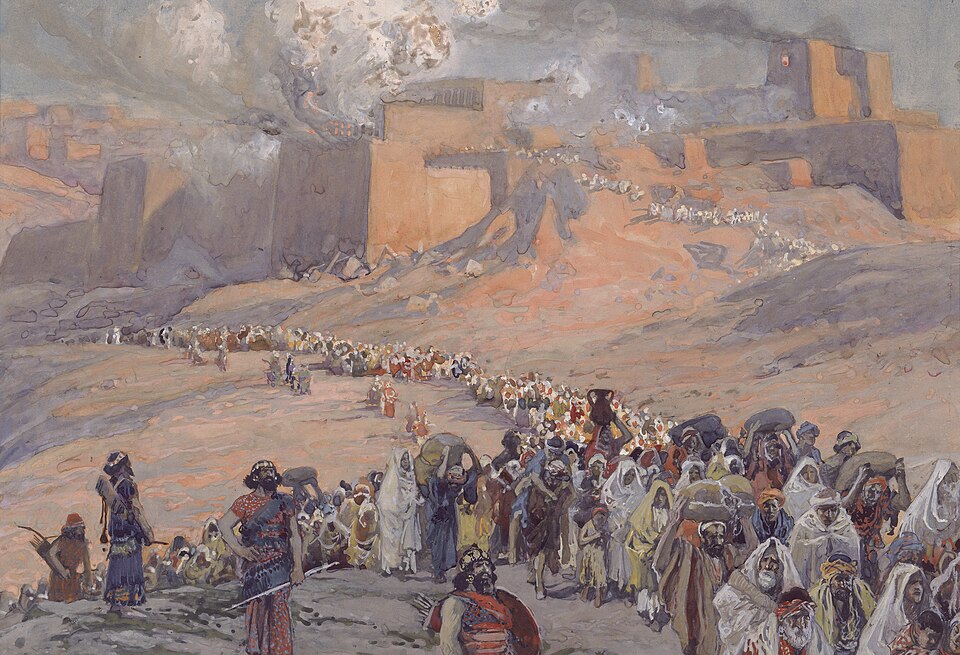
Tissot's The Flight of the Prisoners
NEBUCHADNEZZAR'S
FORCED DEPORTATION
Then he (NEBUCHADNEZZAR) led away into exile all Jerusalem - Note it says "all" but this clearly was not literally every individual.
And all the captains and all the mighty men of valor, ten thousand captives, and all the craftsmen and the smiths - Those people who would be important to maintain leadership in the city were removed. All the military leaders and skilled warriors were exiled, removing Judah's ability to fight or rebel.
Ten thousand captives - These represent the elite of society. Ezekiel is also taken in this group (Ezek 1:1-2).
Ezekiel 1:1-2 Now it came about in the thirtieth year, on the fifth day of the fourth month, while I was by the river Chebar among the exiles, the heavens were opened and I saw visions of God. 2 (On the fifth of the month in the fifth year of King Jehoiachin’s exile,
And all the craftsmen and the smiths - This would weaken Judah and strengthen Babylon, preventing Judah from making weapons and recovering from the siege.
Bob Utley The MT has the NOUN (BDB 360, KB 358) which denotes artisans skilled in metal, stone, or wood. These are the very people who could help build the buildings and weaponry of Neo-Babylon. Also, it took Judah's skilled workers away and left the nation weakened. See NIDOTTE, vol. 2, pp. 298-299.
None remained except the poorest people of the land - The poor were the unskilled, those who were no political or military threat. They are left to work the land maintain minimal stability, but posed no danger to Babylon.
When a nation rejects God, even its strengths, its leaders, skills, and defenses, can be removed, leaving only weakness behind.
John Walton - deportation. Though we have no records from Babylon concerning deportation practices, it can be assumed that they inherited Assyrian administrative practices to a certain extent. It was typical policy to deport influential people (rich and the military) as well as skilled workers, who could be employed cheaply in Babylon. The “poor of the land” were either not useful or were not considered a threat by remaining in the land of Judah. (See IVP Background Commentary)
2 Kings 24:15 So he led Jehoiachin away into exile to Babylon; also the king’s mother and the king’s wives and his officials and the leading men of the land, he led away into exile from Jerusalem to Babylon.
- he led Jehoiachin: 2Ki 24:8 2Ch 36:10 Es 2:6 Jer 22:24-28
Related Passages:
Jeremiah 24:1 After Nebuchadnezzar king of Babylon had carried away captive Jeconiah the son of Jehoiakim, king of Judah, and the officials of Judah with the craftsmen and smiths from Jerusalem and had brought them to Babylon, the LORD showed me: behold, two baskets of figs set before the temple of the LORD!
NEBUCHADNEZZAR'S SYSTEMATIC
DISMANTLING OF JUDAH
Recall that this is the second major deportation to Babylon (597 BC).
So he (NEBUCHADNEZZAR) led Jehoiachin away into exile to Babylon - Jehoiachin has surrendered in 2Ki 24:12. Led...away makes no mention of fetters or hooks as with King Manasseh (2Ch 33:11+). He would later be released from prison as recorded in 2 Kings 25:27 (cf Jer 52:31-34).
Now it came about in the thirty-seventh year of the exile of Jehoiachin king of Judah, in the twelfth month, on the twenty-seventh day of the month, that Evil-merodach (SON OF NEBUCHADNEZZAR WHO BEGIN TO REIGN IN 561 BC) king of Babylon, in the year that he became king, released Jehoiachin king of Judah from prison;
COMMENT - Jehoiachin was taken captive to Babylon in 597 BC (2 Kings 24:12–16). Thirty-seven years later brings us to about 561 BC. This means Jehoiachin had spent nearly four decades in prison—a long season of humiliation. Jehoiachin was still recognized as “king of Judah” even in exile. Babylonian records (ration tablets - see Wikipedia - Jehoiachin's Rations Tablets) confirm that he received provisions as a royal exile. This shows the Davidic line was preserved, even in captivity.
also the king’s mother and the king’s wives and his officials and the leading men of the land, he led away into exile from Jerusalem to Babylon - The king's mother was taken because queen mothers held major influence and this would remove a key power figure. In addition the royal household was taken to remove any heirs who might try to lay claim to the throne.
Note the repetition of the phrase he led away into exile which emphasizes the totality and finality.
In summary, Babylon removed the king, his family, and all leadership from Jerusalem, leaving the nation powerless and marking a decisive step in Judah’s exile and downfall.
2 Kings 24:16 All the men of valor, seven thousand, and the craftsmen and the smiths, one thousand, all strong and fit for war, and these the king of Babylon brought into exile to Babylon.
- seven thousand: Jer 29:2 52:28
CONTINUED STRATEGY
TO DISMANTLE JUDAH
All the men of valor seven thousand These are experienced warriors, trained and battle-ready. Removing them eliminates Judah’s military strength and prevents rebellion.
And the craftsmen and the smiths, one thousand, all strong and fit for war - Craftsmen are builders and artisans. Smiths are metalworkers (especially weapons) so no smiths means no weapons. All strong and fit for war are the best, strongest, most useful men.
And these the king of Babylon brought into exile to Babylon - Nebuchadnezzar is carrying out a targeted deportation strategy and as we saw in 2Ki 24:14 this left "None remained except the poorest people." Nebuchadnezzar is intentionally stripping the nation of its ability to defend, rebuild, or resist and leaving it powerless thus fulfilling God’s judgment.
MacArthur: Nebuchadnezzar took an additional 10,000 Judeans as captives to Babylon, in particular the leaders of the nation. This included the leaders of the military and those whose sills would support the military. Included in this deportation was the prophet Ezekiel. Only the lower classes remained behind in Jerusalem. The Babylonian policy of captivity was different from that of the Assyrians, who took most of the people into exile and resettled the land of Israel with foreigners (17:24). The Babylonians took only the leaders and the strong, while leaving the weak and poor, elevating those left to leadership and thereby earning their loyalty. Those taken to Babylon were allowed to work and live in the mainstream of society. This kept the captive Jews together, so it would be possible for them to return, as recorded in Ezra.
2 Kings 24:17 Then the king of Babylon made his uncle Mattaniah king in his place, and changed his name to Zedekiah.
- the king of Babylon: 2Ch 36:10,11 Jer 37:1 52:1
- made his uncle Mattaniah king in his place 1Ch 3:15,16 2Ch 36:10
- changed his name to Zedekiah: 2Ki 23:34 2Ch 36:4
Related Passages:
Jeremiah 22:30 “Thus says the LORD, ‘Write this man (JEHOIACHIN) down childless, A man who will not prosper in his days; For no man of his descendants will prosper Sitting on the throne of David Or ruling again in Judah.’”
NEBUCHADNEZZAR INSTALLS
A PUPPET RULER IN JUDAH
Then (597 BC) the king of Babylon made his uncle Mattaniah king in his place - Mattaniah was the uncle of Jehoiachin and the third son of Josiah to rule Judah. Unfortunately even this son lacked the integry and godly character of his father. This is difficult to understand. I have two sons and one has "gone south," but fortunately not both. Josiah would have been so sad! Note that none of Jehoiachin's sons reigned on Judah's throne, as Jeremiah predicted (Jer 22:30).
Bob Utley "Mattaniah" He was the last available son of Josiah (cf. 1 Chr. 3:15; Jer. 25:1) to be the Davidic king. He was the third son of Josiah to rule as king of Judah. His name (BDB 682) means "gift of YHWH." "Zedekiah" His name meant "YHWH is righteous" (BDB 843). This king was very good to Jeremiah (cf. Jer. 38:14-28) in contrast to Jehoiakim, but he was not a godly king (cf. v. 19).
And changed his name to Zedekiah The change of name was to shew Nebuchadnezzar's supremacy, and that Zedekiah was only his vassal or viceroy. The custom of changing names, we are assured by travellers, still exists in the East.
John Walton - 24:17. name changing. As with Jehoiakim, Mattaniah was required by the Babylonians to change his name. The Babylonian Chronicle simply states that Nebuchadnezzar II appointed a king of his choice in Judah and that the new king “was after his heart,” meaning that he had been “domesticated” by the Babylonians. As before, the Babylonians thought it in their own best interest to give the king another Hebrew name, so as not to incite rebellion. (See IVP Background Commentary) (See discussion of Change of Name. See also Why did Nebuchadnezzar change Daniel's name to Belteshazzar?)
2 Kings 24:18 Zedekiah was twenty-one years old when he became king, and he reigned eleven years in Jerusalem; and his mother’s name was Hamutal the daughter of Jeremiah of Libnah.
- Zedekiah: 2Ch 36:11 Jer 37:1 52:1-11
- Hamutal: 2Ki 23:31
THE LAST KING
OF JUDAH
Zedekiah was twenty-one years old when he became king, and he reigned eleven years in Jerusalem - Assuming his "coronation" was in 597 BC, this means that he was born about 618 BC. The point is that he had 9 years to witness the impact of the godly reign of his father Josiah. Result? Like water off a duck's back. Godliness did not rub off on this or any of Josiah's sons. Frankly, this is one of the most difficult aspects of the lives of the kings to understand! We will have to wait until heaven and may understand then (1Co 13:12+). Zedekiah reigned from 597 to 586 BC.
Bob Utley The text of 2 Kgs. 24:18-25:21 is used in Jeremiah 52. Jeremiah 39:1-10 repeats 2 Kgs. 25:1-12.
And his mother’s name was Hamutal the daughter of Jeremiah of Libnah - This is not the prophet Jeremiah. Josiah had at least two sons by different mothers, which indicates he had at least 2 wives. Hamutal was the mother of Jehoahaz (Shallum) (2Ki 23:31) and Zedekiah in this verse. Another wife named Zebidah was the mother of Jehoiakim (2Ki 23:36).
John Walton - Zedekiah of Judah and the Fall of Jerusalem chronology. Zedekiah, the last king of Judah, reigned from 597 to 586. Necho II (r. 610-595), Psammeticus (r. 595-589) and Apries (r. 589-570) were rulers of Egypt, while Nebuchadnezzar II (r. 604-562) ruled the Chaldean empire. (See IVP Background Commentary)
2 Kings 24:19 He did evil in the sight of the LORD, according to all that Jehoiakim had done.
- He did evil: 2Ki 23:37 2Ch 36:12 Jer 24:8 37:1-38:28 Eze 21:25
Related Passages:
2 Chronicles 36:12-14+ He (ZEDEKIAH) did evil in the sight of the LORD his God; he did not humble himself before Jeremiah the prophet who spoke for the LORD. 13 He also rebelled against King Nebuchadnezzar who had made him swear allegiance by God. But he stiffened his neck and hardened his heart against turning to the LORD God of Israel. 14 Furthermore, all the officials of the priests and the people were very unfaithful following all the abominations of the nations; and they defiled the house of the LORD which He had sanctified in Jerusalem.
ZEDEKIAH PICKS UP WHERE
JEHOIAKIM LEFT OFF!
He did evil in the sight of the LORD, according to all that Jehoiakim had done - Obviously Zedekiah did not learn from his brother's evil reign which caused God to send bands of raiders against Judah (2Ki 24:2). And perhaps he did not hear Jeremiah's words in Jeremiah 22:18-19 - "
Therefore thus says the LORD in regard to Jehoiakim the son of Josiah, king of Judah, “They will not lament for him: ‘Alas, my brother!’ or, ‘Alas, sister!’ They will not lament for him: ‘Alas for the master!’ or, ‘Alas for his splendor!’ 19“He will be buried with a donkey’s burial, Dragged off and thrown out beyond the gates of Jerusalem."
Surely Zedekiah witnessed the dishonorable treatment of his brother's body when he died, but it clearly had no impact on him. Perhaps it was pride "Surely this won't happen to me!" And so he too did evil in full view of the holy God!
Bob Utley "He did evil in the sight of the Lord" His evil actions are specified in 2 Chr. 36:12-14.
2 Kings 24:20 For through the anger of the LORD this came about in Jerusalem and Judah until He cast them out from His presence. And Zedekiah rebelled against the king of Babylon.
- through: 2Ki 22:17 Ex 9:14-17 De 2:30 Isa 19:11-14 1Co 1:20 2Th 2:9-11
- Zedekiah: 2Ch 36:13 Jer 27:12-15 38:17-21 Eze 17:15-20
Related Passages:
2 Kings 22:17 “Because they have forsaken Me and have burned incense to other gods that they might provoke Me to anger with all the work of their hands, therefore My wrath burns against this place, and it shall not be quenched.”’
Jeremiah 27:12-15 I spoke words like all these to Zedekiah king of Judah, saying, “Bring your necks under the yoke of the king of Babylon and serve him and his people, and live! 13 “Why will you die, you and your people, by the sword, famine and pestilence, as the LORD has spoken to that nation which will not serve the king of Babylon? 14 “So do not listen to the words of the prophets who speak to you, saying, ‘You will not serve the king of Babylon,’ for they prophesy a lie to you; 15f or I have not sent them,” declares the LORD, “but they prophesy falsely in My name, in order that I may drive you out and that you may perish, you and the prophets who prophesy to you.”
2 Chronicles 36:13 (KING ZEDEKIAH) He also rebelled against King Nebuchadnezzar who had made him swear allegiance by God. But he stiffened his neck and hardened his heart against turning to the LORD God of Israel.
DIVINE JUDGMENT
FINALLY FALLS
For through the anger of the LORD this came about in Jerusalem and Judah until He cast them out from His presence - The destruction of Jerusalem and the exile were not accidents of history or simply the result of Babylon’s military strength. Ultimately they were the outworking of the sovereign LORD’s righteous anger against Judah's persistent, unrepentant sin.
Bob Utley "the anger of the Lord" This is anthropomorphism but expresses truth that God's love can turn to wrath. "He cast them out from His presence" This is a reference to God symbolically dwelling between the Cherubim on the lid of the ark of the covenant in the Holy of Holies. This is a prelude to exile.
Judah was not defeated because Babylon was strong, but
because the LORD withdrew His protection and delivered them to judgment.
For generations, Judah had provoked God through idolatry, injustice, and covenant unfaithfulness—sins that reached a climax under kings like Manasseh (2 Kings 21:10–15+). Despite repeated warnings through prophets such as Isaiah, Jeremiah, and others, the nation refused to turn back. God’s anger, therefore, was not impulsive but judicial—His settled, holy opposition to sin.
The phrase “until He cast them out from His presence” is especially sobering and reflects the fulfillment of the warnings given long before. E.g., in Deuteronomy 29:27-28+ Moses recorded (as a "done deal" some 800 years before it happened) writing
"Therefore, the anger of the LORD burned against that land (PROMISED LAND), to bring upon it every curse which is written in this book (DEUTERONOMY 28-29) and the LORD uprooted them from their land in anger and in fury and in great wrath, and cast them into another land, as it is this day."
Until - The main idea of until is “up to the point when” or “continuing to a certain moment when something changes.” Until marks the decisive turning point where ongoing action reaches its final result. Until in the present context is a marker of culmination or an end point. In other words, everything (God’s patience, warnings, calls to repent) was building toward this final outcome of Judah's being cast out of the Promised Land.
🙏 THOUGHT - O beloved, how we need to ponder the "untils" in our life! Why? Because "until” reveals the solemn, sobering truth that there is a limit to persistent rebellion. Yes, God is incredibly patient (cf Ex 34:6), but He is not indefinitely tolerant of sin that we refuse to repent of.
To be cast from God’s presence meant more than leaving the land but also signified the loss of blessing, the removal from the place where God had chosen to dwell (the Temple in Jerusalem), and the experience of exile as His righteous judgment. Persistent rebellion ultimately leads to removal from fellowship and blessing! Yet even in judgment, there is an implied hope: the same God who casts out is also the God who restores when His people repent...
“So it shall be when all of these things have come upon you, the blessing and the curse which I have set before you, and you call them to mind in all nations where the LORD your God has banished you, 2and you return to the LORD your God and obey Him with all your heart and soul according to all that I command you today, you and your sons, 3then the LORD your God will restore you from captivity, and have compassion on you, and will gather you again from all the peoples where the LORD your God has scattered you. (Deut. 30:1–3+)
And Zedekiah rebelled (marad; LXX - atheteo - reject, refuse) against the king of Babylon - A powerful anti-Babylonian faction in Jerusalem exerted increasing pressure on King Zedekiah to break his oath of loyalty to Babylon in 589 BC and to seek renewed military support from Egypt (Jer. 27:1–22). This political agitation was fueled not only by nationalistic hopes but also by religious deception, as false prophets confidently proclaimed that God would soon shatter Babylon’s dominance and swiftly bring the exiles back to Jerusalem (Jer. 28:2–4). Their optimistic predictions fostered a false sense of security among the people and emboldened the push for rebellion. In stark contrast, Jeremiah faithfully delivered the word of the LORD, repeatedly warning that reliance on Egypt was futile and that Babylon’s supremacy was divinely ordained for a season (Jer. 37:6–8). He urged submission rather than resistance, declaring that rebellion would only bring greater judgment. Nevertheless, Zedekiah, swayed by political pressure and unwilling to heed God’s prophet, chose defiance. As a result, in 588 B.C., the Babylonian armies marched against Jerusalem, laying siege to the city with the determined purpose of bringing about its complete destruction.