Hosea 7:2
Hosea 7:3
Hosea 7:4
Hosea 7:5
Hosea 7:6
Hosea 7:7
Hosea 7:8
Hosea 7:9
Hosea 7:10
Hosea 7:11
Hosea 7:12
Hosea 7:13
Hosea 7:14
Hosea 7:15
Hosea 7:16

Hosea's Unconditional Love for Gomer
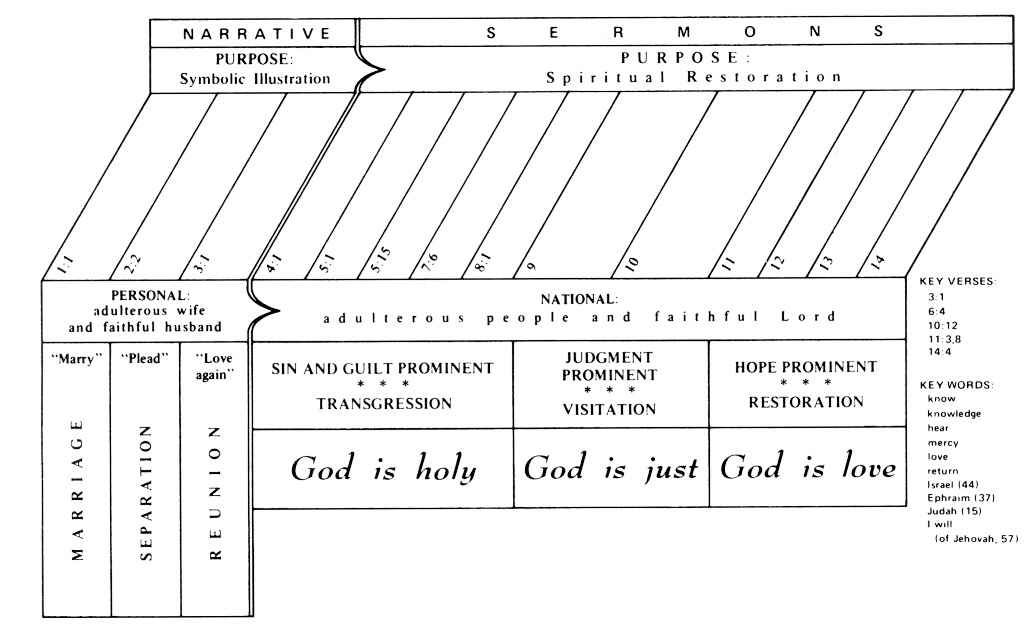
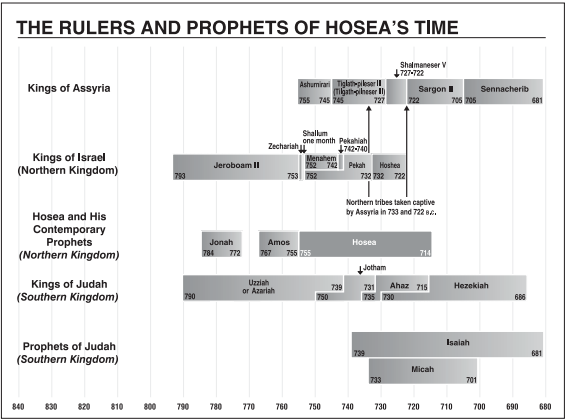
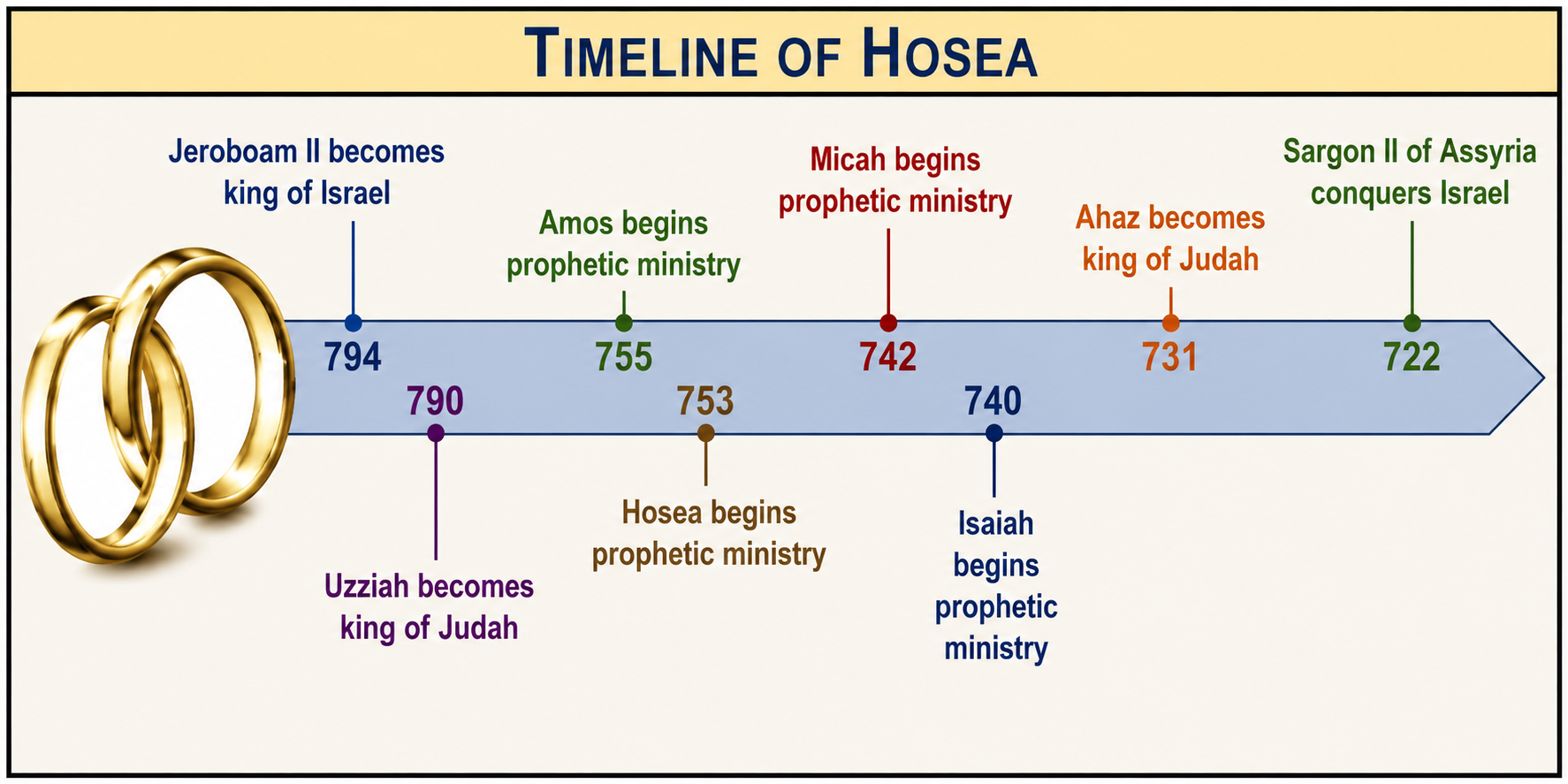
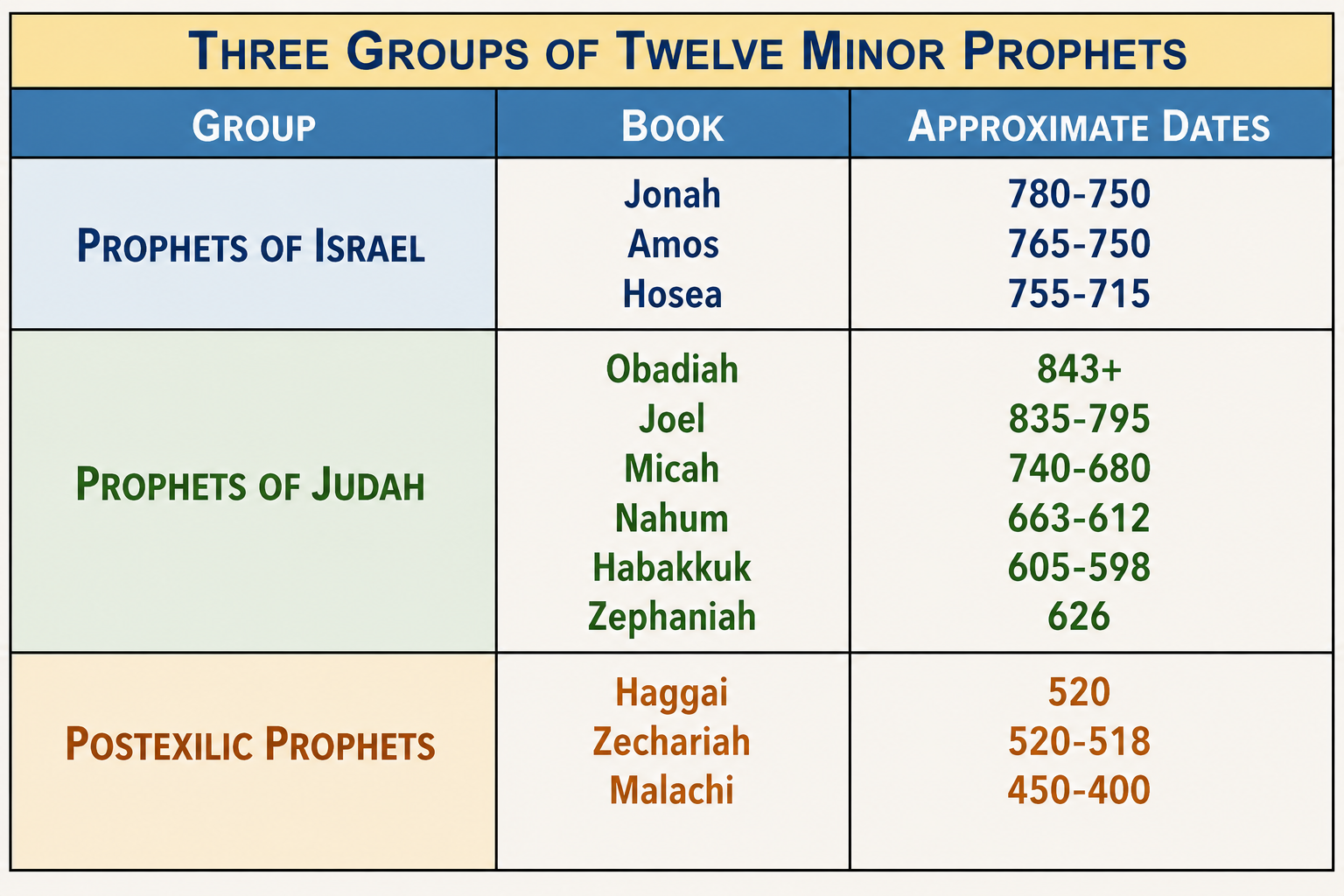
Click chart to enlarge
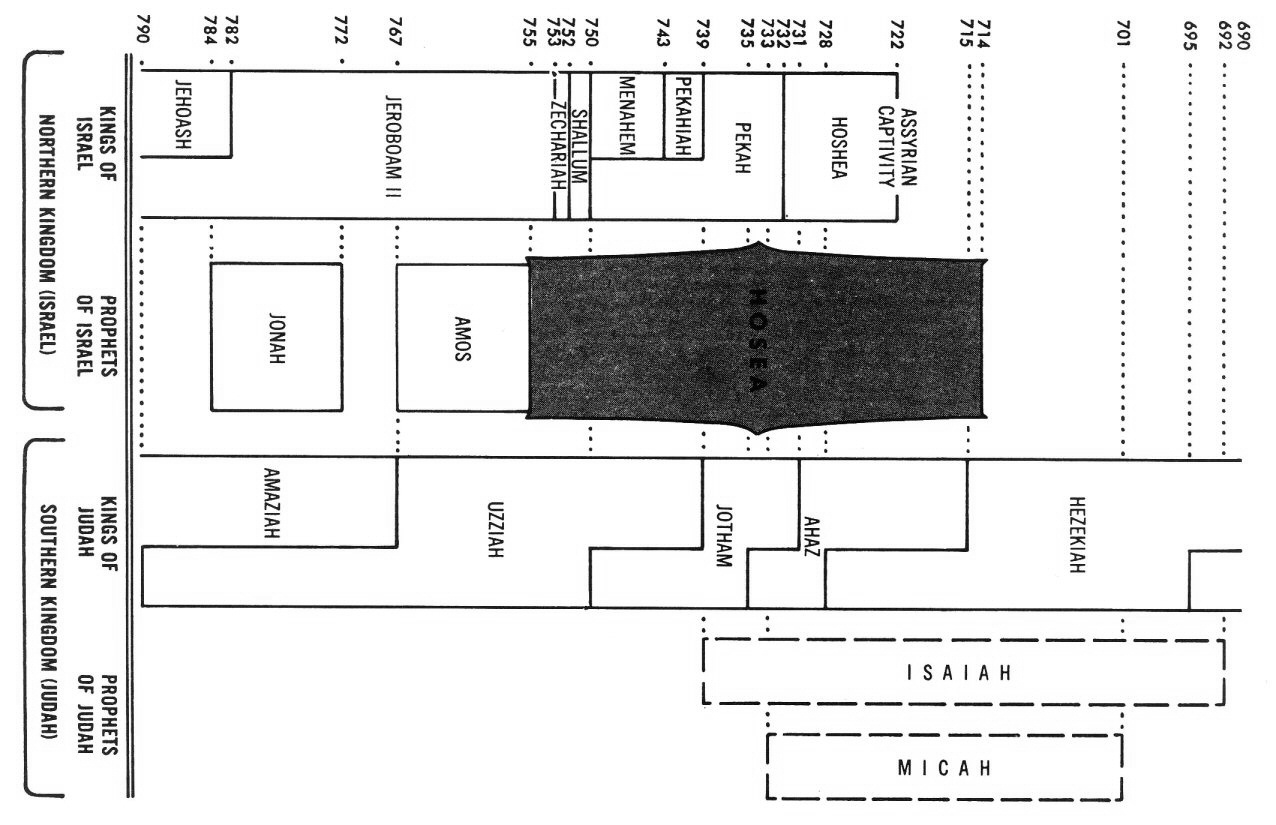
Click chart to enlarge
Chart from recommended resource Jensen's Survey of the OT - used by permission
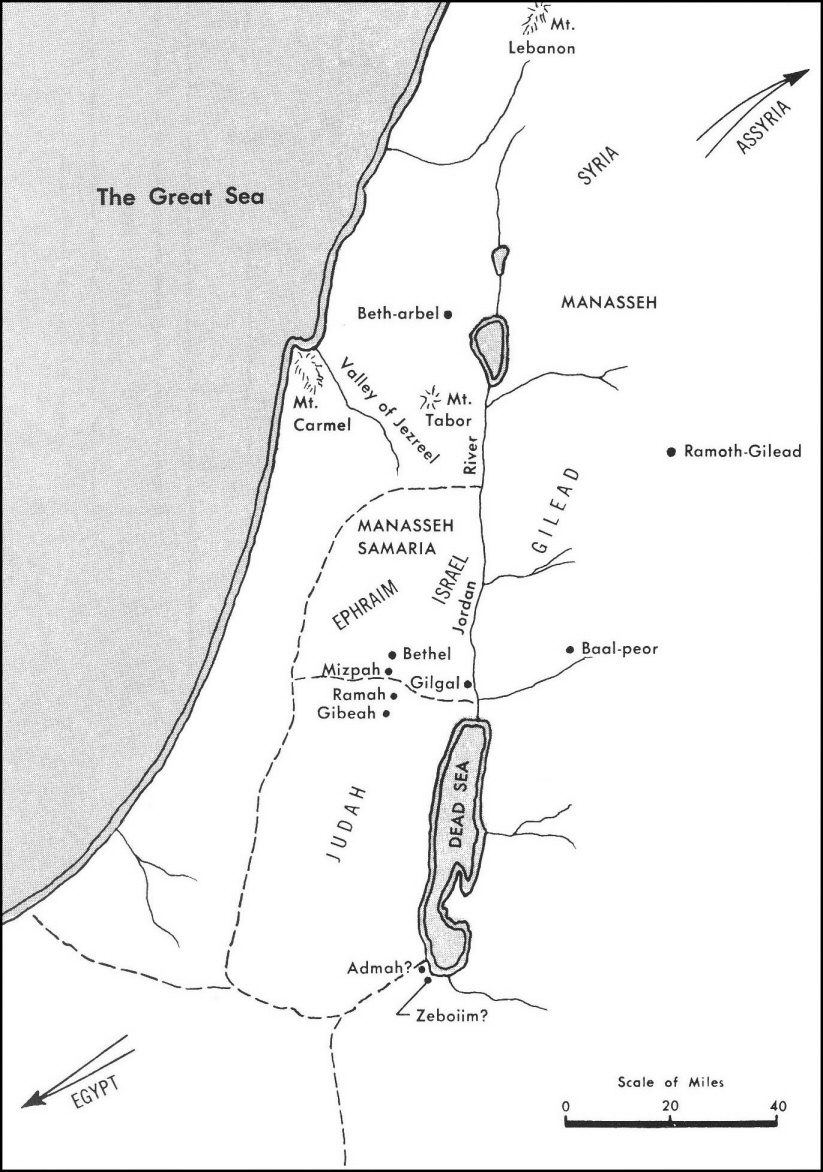
Click chart to enlarge
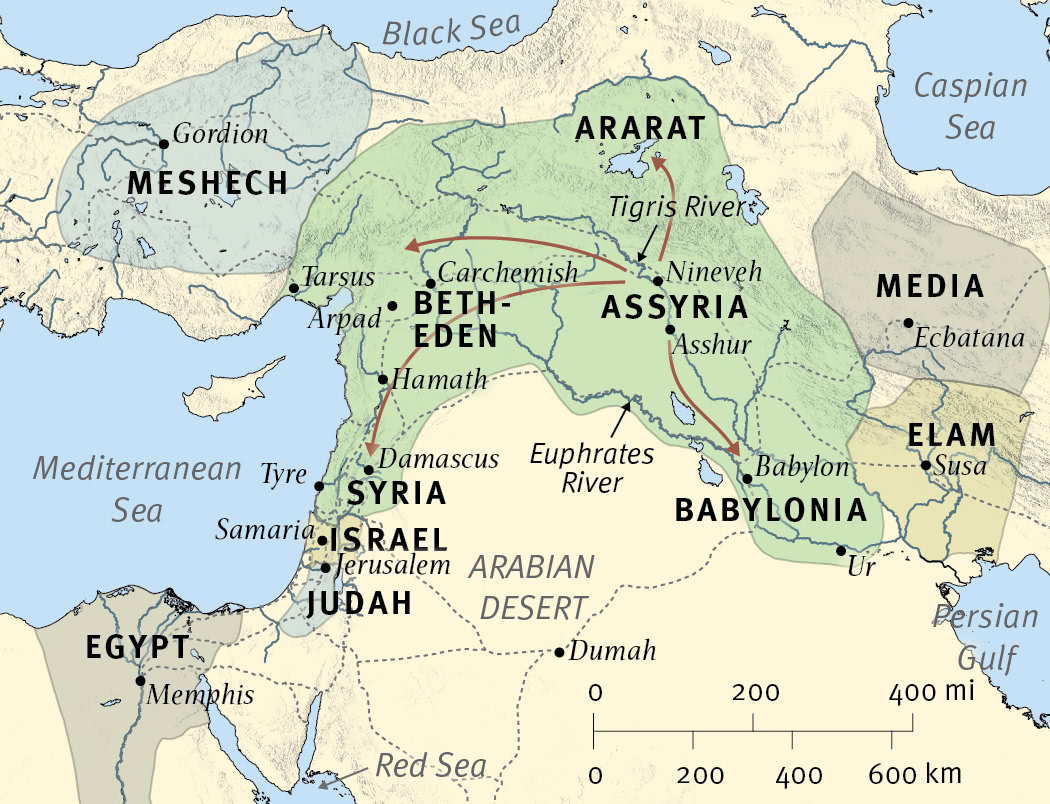
Source: ESV Global Study Bible
OUTLINE OF HOSEA
I. The Prodigal Wife, Hosea 1:1-3:5
A. Her Unfaithfulness, Hosea 1:1-11
B. Her Punishment, Hosea 2:1-13
C. Her Restoration and Israel's, Hosea 2:14-23
D. Her Redemption, Hosea 3:1-5
II. The Prodigal People, Hosea 4:1-14:9
A. The Message of Judgment, Hosea 4:1-10:15
1. The indictment, Hosea 4:1-19
2. The verdict, Hosea 5:1-15
3. The plea of Israel, Hosea 6:1-3
4. The reply of the Lord, Hosea 6:4-11
5. The crimes of Israel, Hosea 7:1-16
6. The prophecy of judgment, Hosea 8:1-10:15
B. The Message of Restoration, Hosea 11:1-14:9
1. God's love for the prodigal people, Hosea 11:1-11
2. God's chastisement of the prodigal people, Hosea 11:12-13:16
3. God's restoration of the prodigal people, Hosea 14:1-9
Ryrie Study Bible
John Hannah's Outline - The prophet's message
The prophet's message (Hosea 4:1-14:8)
- Jehovah's rejection of Israel (Hosea 4:1-7:16)
- The faithlessness of Israel (Hosea 4:1-19)
- The fact of apostasy (Hosea 4:1-3)
- The reason for apostasy (Hosea 4:4-10)
- The course of apostasy (Hosea 4:11-19)
- The idolatry of Israel (Hosea 4:11-13)
- The instruction of Judah (Hosea 4:14-19)
- The repudiation of Israel (Hosea 5:1-6:3)
- The rebuke of Israel (Hosea 5:1-7)
- The judgment upon Israel (Hosea 5:8-15)
- The invitation to Israel (Hosea 6:1-3)
- The fickleness of Israel (Hosea 6:4-11)
- The foolishness of Israel (Hosea 7:1-16)
- The wickedness of Israel (Hosea 7:1-7)
- The silliness of Israel (Hosea 7:8-16) Hannah's Bible Outlines.
- The faithlessness of Israel (Hosea 4:1-19)
Robert Chisholm points out that there are 5 "Judgment-Salvation" cycles in the book of Hosea:
| CYCLES OF JUDGMENT AND SALVATION IN HOSEA |
|
| JUDGMENT | SALVATION |
|
Hosea 1:2-9 |
Hosea 1:10-2:1 |
|
Hosea 2:2-13 |
Hosea 2:14-3:5 |
|
Hosea 4:1-5:14 |
Hosea 5:15-6:3 |
|
Hosea 6:4-11:7 |
Hosea 11:8-11 |
|
Hosea 11:12-13:16 |
Hosea 14:1-9 |
Hosea 7:1 When I would heal Israel, The iniquity of Ephraim is uncovered, And the evil deeds of Samaria, For they deal falsely; The thief enters in, Bandits raid outside,
BGT ἐν τῷ ἰάσασθαί με τὸν Ισραηλ καὶ ἀποκαλυφθήσεται ἡ ἀδικία Εφραιμ καὶ ἡ κακία Σαμαρείας ὅτι ἠργάσαντο ψευδῆ καὶ κλέπτης πρὸς αὐτὸν εἰσελεύσεται ἐκδιδύσκων λῃστὴς ἐν τῇ ὁδῷ αὐτοῦ
NET whenever I want to heal Israel, the sin of Ephraim is revealed, and the evil deeds of Samaria are exposed. For they do what is wrong; thieves break into houses, and gangs rob people out in the streets.
LXE When I have healed Israel, then shall the iniquity of Ephraim be revealed, and the wickedness of Samaria; for they have wrought falsehood: and a thief shall come in to him, even a robber spoiling in his way;
NLT "I want to heal Israel, but its sins are too great. Samaria is filled with liars. Thieves are on the inside and bandits on the outside!
KJV When I would have healed Israel, then the iniquity of Ephraim was discovered, and the wickedness of Samaria: for they commit falsehood; and the thief cometh in, and the troop of robbers spoileth without.
ESV When I would heal Israel, the iniquity of Ephraim is revealed, and the evil deeds of Samaria; for they deal falsely; the thief breaks in, and the bandits raid outside.
ASV When I would heal Israel, then is the iniquity of Ephraim uncovered, and the wickedness of Samaria; for they commit falsehood, and the thief entereth in, and the troop of robbers ravageth without.
CSB when I heal Israel, the sins of Ephraim and the crimes of Samaria will be exposed. For they practice fraud; a thief breaks in; a raiding party pillages outside.
NIV 1 whenever I would heal Israel, the sins of Ephraim are exposed and the crimes of Samaria revealed. They practice deceit, thieves break into houses, bandits rob in the streets;
NKJ "When I would have healed Israel, Then the iniquity of Ephraim was uncovered, And the wickedness of Samaria. For they have committed fraud; A thief comes in; A band of robbers takes spoil outside.
NRS when I would heal Israel, the corruption of Ephraim is revealed, and the wicked deeds of Samaria; for they deal falsely, the thief breaks in, and the bandits raid outside.
YLT 'When I give healing to Israel, Then revealed is the iniquity of Ephraim, And the wickedness of Samaria, For they have wrought falsehood, And a thief doth come in, Stript off hath a troop in the street,
- When I would heal Israel: Jer 51:9 Mt 23:37 Lu 13:34 Lu 19:42
- The iniquity of Ephraim is uncovered: Hos 4:17 Hos 6:8 Hos 8:9 Isa 28:1 Mic 6:16
- And the evil deeds of Samaria Ho 8:5 Hos 10:5 Eze 16:46 23:4 Am 8:14
- For they deal falsely: Ho 5:1 Hos 6:10 Hos 11:12 Hos 12:1 Isa 59:12 Jer 9:2-6 Mic 7:3-7
- Bandits raid outside: Ho 6:9
Related Passage:
Matthew 23:37 “Jerusalem, Jerusalem, who kills the prophets and stones those who are sent to her! How often I wanted to gather your children together, the way a hen gathers her chicks under her wings, and you were unwilling.
Hosea 7:1 Also, O Judah, there is a harvest appointed for you, When I restore the fortunes of My people.
Hosea 8:5 He has rejected your calf, O Samaria, saying, “My anger burns against them!” How long will they be incapable of innocence?
Hosea 10:5 The inhabitants of Samaria will fear For the calf of Beth-aven. Indeed, its people will mourn for it, And its idolatrous priests will cry out over it, Over its glory, since it has departed from it.
Hosea 5:1 Hear this, O priests! Give heed, O house of Israel! Listen, O house of the king! For the judgment applies to you, For you have been a snare at Mizpah And a net spread out on Tabor.
Hosea 6:10 In the house of Israel I have seen a horrible thing; Ephraim’s harlotry is there, Israel has defiled itself.
Hosea 11:12 Ephraim surrounds Me with lies And the house of Israel with deceit; Judah is also unruly against God, Even against the Holy One who is faithful.
Hosea 12:1 Ephraim feeds on wind, And pursues the east wind continually; He multiplies lies and violence. Moreover, he makes a covenant with Assyria, And oil is carried to Egypt.
Hosea 6:7-9 But like Adam they have transgressed the covenant; There they have dealt treacherously against Me. 8 Gilead is a city of wrongdoers, Tracked with bloody footprints. 9 And as raiders wait for a man, So a band of priests murder on the way to Shechem; Surely they have committed crime.
Hosea 4:2 There is swearing, deception, murder, stealing and adultery. They employ violence, so that bloodshed follows bloodshed.
JEHOVAH'S DESIRE
TO HEAL ISRAEL
When I would heal (rapha/rophe; LXX - iaomai - cure, deliver from sin - Mt 13:15) Israel The iniquity ('avon; LXX - adikia - disregard for what is right, wrongdoing) of Ephraim is uncovered (galah; LXX - apokalupto - revealed, disclosed) - God's efforts to heal Israel sadly only served to "catalyze" more outbreak of their sin sickness so that their sin was even more evident (uncovered). He sent prophets to heal them but in so doing Israel's sins were even more evident and exposed! It was as if the Word of the Lord spoken by the prophets brought the sin that existed to the light, but did not result in repentance, thus increasing the people's guilt.
The more light God sent,
the more thier sin was exposed.
The NIV said it this way "whenever I would heal Israel, the sins of Ephraim are exposed." God had tried to bring them to the point of reception of His hand of chastisement and to repentance, but His efforts were met with obstinate rejection and even running more into their sins!
God's discipline was intended to lead His people to repentance, but they responded with hardened hearts and deeper disobedience. Thus, the light of God's Word did not create their sin but revealed it, exposing what had long been concealed and leaving them without excuse. The very means God used to bring healing became the occasion for their guilt to be more fully manifested because they continually rejected His gracious call to return (cf. Isa. 1:18-20; Jer. 6:16-19; Jn. 3:19-21).
🙏 THOUGHT - While the context is different, the principle is similar to that outlined in Hebrews 12:5-11 which speaks of God's hand of discipline on the Hebrew believers so that they might repent and receive the benefits of divine discipline - God's discipline is evidence of His love for us (Hebrews 12:6), God's discipline assures us that we are His spiritual children, genuine members of His family (Hebrews 12:7-8), God's discipline enhances our spiritual life (Hebrews 12:9), God's discipline enables us to share His holiness (Hebrews 12:10), God's discipline yields the peaceful fruit of righteousness (Hebrews 12:11). So the question is this -- Are you a believer and you are experiencing divine discipline but you are not receiving it as beneficial to your spiritual life? If so, be careful! God may have to intensify the chastisement in order to gain your full attention and your acceptance of His loving, remedial, beneficial discipline.
And the evil deeds of Samaria - Samaria, the capital of the Northern Kingdom (often representing the entire nation of Israel or Ephraim), had become "crime central," the epicenter of Israel's spiritual and moral corruption. Chosen by King Omri as Israel's capital (1 Ki. 16:24), it quickly developed into the political, religious, and cultural heart of the apostate kingdom. From Samaria, idolatry, injustice, and covenant unfaithfulness spread throughout the land. Rather than leading the nation in the worship of Yahweh, its rulers promoted the worship of the golden calves and later Baal, making the city a breeding ground for evil. Thus, Hosea's reference to "the evil deeds of Samaria" is more than an indictment of one city, but is in effect a condemnation of the entire Northern Kingdom, whose capital had become the center from which sin radiated to every corner of the nation (cf. 1 Ki. 16:29-33; Mic. 1:5-7).
Pusey - "The disease prevailed against the remedy, and was irritated by it, so that the remedy served only to 'lay open' the extent of its malignity, and to show that there was worse in it, than did at first appear". (See The Minor Prophets: Hosea, Joel, Amos, Obadiah and Jonah - Page 71)
Gary Cohen - The lack of loyalty to the Lord already has been proved as a reason that an immediate restoration of the nation is impossible (6:4–11). Now, in the first seven verses of chapter 7, the Lord adds a second reason for the impossibility of immediate restoration: the continual revelation of unconfessed secret sins. Without a full and complete judgment for sin, the holiness of God will continue to expose sin and foil any attempts to restore the nation. If it were not for the full payment for sin made upon Calvary, we too would stand eternally unacceptable to God (1 Pet. 3:18). (See Hosea & Amos- Everyman's Bible Commentary - Page 48)
For (term of explanation) they deal falsely (sheqer) - Explains why their deeds were evil. "They practice deceit" (NIV). Falsehood describes their practice of deceiving with untruthful statements. The Septuagint (Lxx) uses ergazomai meaning that they really "worked at this" and did so very effectively! The word sheqer was used of the breaking of a promise, being false to a treaty or commitment, hence an empty promise.
Trent Butler on deal falsely (sheqer) - Here is the verb from Exodus 20:16 ("bear false witness"). There it relates to false testimony in court. Here the people are playing politics in the worst way, making promises and joining in alliances to which they have no intention of remaining faithful.....Up to now Hosea has focused primarily on religious sin brought on by priests and worship practices. For the first time Hosea mentions Israel's capital, Samaria. Now he turns to political problems and evils within the nation. (See Holman Old Testament Commentary - Hosea, Joel, Amos - Page 52)
In Jeremiah's prophecy we see a similar description of the Southern kingdom of Judah and notice a major driving force in both descriptions is that they were greedy for gain! Does this not sound like some of the business activities in America? Woe!
Jer 6:13 “For from the least of them even to the greatest of them, Everyone is greedy for gain, And from the prophet even to the priest Everyone deals falsely (sheqer).
Jer 8:10 “Therefore I will give their wives to others, Their field s to new owners; Because from the least even to the greatest Everyone is greedy for gain; From the prophet even to the priest Everyone practices deceit.(sheqer)..
The thief enters in - NET = "thieves break into houses" stealthily describing crimes of burglary or "breaking and entering." NLT says "Thieves are on the inside and bandits on the outside!" Israel's actions of stealing (inside and outside) epitomized their complete refusal to abide by God's covenant, in this case specifically Ex 20:15 “You shall not steal."
Crime was rampant in the society, because God was "absent!" (See Illustration below) This reminds us of the "theme verse" in the horrible sin filled days of the Book of Judges "In those days there was no king in Israel; everyone did what was right in his own eyes." (Jdg 21:25) Indeed, "Righteousness exalts a nation, But sin is a disgrace to any people." (Pr 14:34 - Are you listening America? Woe!)
Eaton adds that "We become like the God — or the gods — that we worship. ‘They went after vanity and became vanity’ (Jeremiah 2:5). People may think that they can remove the worship of God and still have a decent society. Maybe they can — for a short time! But take away the God of the Bible and soon the righteousness of the Bible will disappear also. Society gets steadily worse." (Focus on the Bible - Hosea)
Bandits raid outside - out-of-doors with open violence. NET = "gangs rob people out in the streets." Gangs of thugs were robbing people openly on the streets.
Thomas Constable - Most people's reaction to their (GOD'S PROPHETS) messages was rejection and further heart-hardening. The people lied to one another and stole from each other. These two crimes are a synecdoche for civil and social injustices in general.
Jon Courson - Here, the Lord is saying, "I wanted to heal these people. But their iniquity was discovered or, literally, flaunted." It's not as though the Lord is a harsh taskmaster, saying, "I won't heal you because you've sinned." No, He's saying, "I wanted to heal you, but couldn't because you were so proud of your sin."There was a time in our own country when people were embarrassed about their sin. Now it's flaunted, leaving us to wonder how much healing, how many blessings are averted because of it. (See Jon Courson's Application Commentary)
Patterson - liars... Thieves... bandits.—Hosea’s penchant for grouping items in three is seen once more (cf. Hos 5:1). Three classes of people are singled out: deceivers, thieves who break into buildings, and robbers who wait outside to do their mischief. Another group of three (king, princes, and people) is clustered in Hos 7:3. Thus, all Israel is condemned. (See Minor Prophets: Hosea through Malachi - Page 42)
Heal (Be a Physician) (07495)(rapha/rophe) means to heal (both figurative and literal healing), to make whole, to restore to normal (restore health), to cure, to repair. In 1Ki. 18:30 it refers to “repairing” the altar of the Jerusalem temple. Rapha in its participial form, rophe (meaning “one who heals”) is the Hebrew word used of physicians in Jer. 8:22; Gen. 50:2; 2Chr 16:12; Job 13:4. Rapha is usually translated in the Septuagint with the Greek verb iaomai which was used here figuratively, of deliverance from sin and its evil consequences (restore, make whole, renew).
RAPHA/ROPHE IN HOSEA - 5x - Hos. 5:13; Hos. 6:1; Hos. 7:1; Hos. 11:3; Hos. 14:4
Iniquity (05771)('avon from verb 'avah = to bend, twist, distort)conveys the basic meaning of to bend, twist, distort. First used of Cain Ge 4:13. 'Avon describes the iniquity, evil, punishment or guilt which is associated with a twisting of the standard or deviation from it. Since there is a deliberate twisting or perverting, 'avon describes sin that is particularly evil. It may also describe the punishment or disaster that befalls those who practice wickedness.'Avon also describes a conscious twisting or distorting as implied by the fact that David says "I kept myself from my iniquity." (2Sa 22:24) Israel made a choice to return to the sins of her ancestors (Jer. 11:10; 13:22). The punishment that goes with this deliberate act as a consequence is indicated by the word also (Ge 4:13; Isa 53:11). Avon is the Hebrew word which most distinctly unites sins of all kinds with their penal consequences. Avon is not only the iniquity but can also indicate the guilt that results from the act.
In the Septuagint (Lxx) avon is translated in Hos 7:1 with adikia which means a condition of not being right, whether with God, according to the standard of His holiness and righteousness or with man, according to the standard of what man knows to be right by his conscience.
AVON IN HOSEA - Hos. 4:8; Hos. 5:5; Hos. 7:1; Hos. 8:13; Hos. 9:7; Hos. 9:9; Hos. 12:8; Hos. 13:12; Hos. 14:1; Hos. 14:2;
Uncovered (01540)(galah) means to uncover (sadly the first use = Noah uncovering himself after becoming drunk! - Ge 9:21, cp Lev 18:6 prohibiting "uncover nakedness" ~ sexual relations), to reveal (God revealed Himself to Jacob at Bethel, and thus the name El-Bethel - Ge 35:7. 2Sa 2:27), expose (Ex 20:26), open (God opened the eyes of Balaam to see the Angel of the LORD - Nu 22:31), reveal (Dt 29:29). Galah is used of not yet revealing the Word of the LORD to Samuel (1Sa 3:7) and of revealing Himself to Samuel (1Sa 3:21). The Septuagint (Lxx) translates galah with the verb apokalupto (from apó = from + kalúpto = cover, conceal, English = apocalypse) which literally means to remove the cover from and so the idea is to remove that which conceals something. The light of God's Word through His prophets reveals what men attempt to conceal, their sin.
Falsely (lies, deception) (08267)(sheqer from shāqar = to deal deceitfully) refers to a deceptive statement, “breaking faith with others by presenting deception/falsehood rather than truth” (NIDOTTE) Sheqer describes words or activities that are "false," in the sense of being without basis in fact or reality. Sheqer is used with particular reference to false testimony, as in court. It speaks of something which is utterly false which the hearer interprets as true and thus is misled or deceived. The ninth commandment said “You shall not bear false witness against your neighbor. (Ex 20:16, cp Dt 19:18) Zechariah warned against false oaths or perjury (Zech. 5:4; 8:17, cp Jer 5:2). Such deceit is listed in Ps as the act of an adversary (Ps. 27:12), motivated by arrogance (Ps 119:69) and the purpose is to destroy someone through slanderous words (Isa. 32:7). Lxx translates here with adikía (G93)
ILLUSTRATION - October 7, 1969 the Montreal, Canada police force went on strike. Because of what resulted, the day has been called Black Tuesday. A burglar and a policeman were slain. Forty-nine persons were wounded or injured in rioting. Nine bank holdups were committed (almost a tenth of the total number of holdups that occurred the previous year) along with 17 robberies at gunpoint. Usually disciplined, peaceful citizens joined the riffraff and went wild (cf Pr 29:18), smashing some 1,000 plate glass windows in a stretch of 21 business blocks in the heart of the city, hauling away stereo units, radios, TVs and wearing apparel. While looters stripped windows of valuable merchandise, professional burglars entered stores by doors and made off with truckloads of goods. A smartly dressed man scampered down a street with a fur coat over each arm. With no police around to reign in crime, anarchy reigned! (A modern day picture of the book of Judges 21:25!)
Hosea 7:1-7 Today in the Word
All of them are hot as an oven; they devour their rulers. All their kings fall, and none of them calls on me. Hosea 7:7
Five years after Barry Bonds retires, he’ll be eligible for the Hall of Fame. After the ongoing controversy surrounding Bonds’ alleged use of steroids, many voters have indicated that they’re reluctant to elect him. If he’s not elected, baseball’s all-time leaders in homeruns (Bonds) and hits (Pete Rose) would be left out of the Hall because of personal and professional transgressions.
Israel’s image was stained in God’s eyes by their rampant transgressions. Their sin stood in the way of God’s healing (v. 1). They were engulfed by their wickedness like the flames of a torch shining brightly for God to see (v. 2).
The fire metaphor sears throughout this passage, and it’s a fitting description of the nature of sin. Like a pre-heated oven that burns hot as dough is being prepared for baking, Israel’s sinful passions burned in anticipation of sinful acts (v. 4). Their sin was as varied as it was extreme, including adultery, violence, deceit, mockery, drunkenness, and theft. The national depravity was not a story of isolated incidents of sin; rather, it was an ongoing inferno of evil pursuits.
Even more shockingly, the sinfulness of Israel pleased its leaders (v. 3). It is bad enough that a nation’s rulers would tolerate deplorable behavior, but to actually delight in it is unforgivable! It was also their doom. The land’s kings were consumed by the flames of Israel’s sin. Facing the certain judgment of Assyrian exile, the sinfulness of the nation practically burned the kingdom to the ground. As the fire of sin burned and the nation of Israel crumbled, not one of the ruling kings had the humility or forethought to call on God for help. God wasn’t ignoring their cries—there were none to be heard. Israel should not have been surprised to hear Hosea’s report of judgment. Not only did they fail to acknowledge their sin, but their leaders failed to turn to God even as their sin destroyed them.
Apply the Word
An immature follower of Christ might turn to God only in times of trouble, but it is far worse to completely ignore God when distress does come. Our impulse might very well be to run from God when temptation comes. Or maybe we fear that God is tired of our pleas for help, as if we could wear out God’s mercy. Neither is true—we can and should run to God, when we need both His forgiveness and His rescue.
Hosea 6:11-7:7 TODAY IN THE WORD
Many readers of Today in the Word will remember a very effective anti-smoking television commercial from several decades ago. It showed a young father and his toddler son washing the family car. Every motion the father made was imitated by his son. Finally, the dad lit up a cigarette as the boy watched carefully, then picked up the pack. The message was clear: like father, like son.
Earlier this month we learned that eighth-century B.C. Israel illustrated a variation of this principle: like leaders, like people. One reason for the nation's sin and lack of faithfulness to God was its leaders' treachery. The priests failed miserably in their ministry of offering pure worship to God and teaching the people His ways. And Israel's kings were weak and opportunistic, often taking the easy way instead of showing regard for God and His laws.
Hosea 7 contains important messages of warning and instruction that can relate to America today. Leaders both in the church and in the government would do well to read God's indictments of Israel. We will pay close attention to this important chapter today and tomorrow.
God's desire to heal and restore is obvious once again. But He cannot and will not overlook flagrant sin, especially when there is no sign of repentance. This was Israel's condition in the final years before Assyria's conquest of her.
By now, we are well acquainted with Israel's sins. What is truly amazing is that the people acted as if God was oblivious to what they were doing and was incapable of doing anything about it. On the contrary--their sins were fully ""exposed,"" ""revealed,"" and ""always before [God]"" (Hosea 7:1-2).
The political intrigue swirling about the capital city of Samaria is alluded to in Hosea 7:3-7. Four of Israel's final kings were assassinated, and King Hoshea sealed the nation's doom by trying to double-cross the king of Assyria.
TODAY ALONG THE WAY
What an awesome responsibility it is to be a leader!
Most of us would not classify ourselves as leaders. But like the father in the old television commercial, each of us is setting an example for someone else. So it is helpful to ask: how is your Christian example to your family, co-workers, fellow believers at church, or even the neighbor?
Hosea 7:2 And they do not consider in their hearts That I remember all their wickedness. Now their deeds are all around them; They are before My face.
Amplified But they do not consider and say to their minds and hearts that I [earnestly] remember all their wickedness. Now their own doings surround and entangle them; they are before My face.
BGT ὅπως συνᾴδωσιν ὡς συνᾴδοντες τῇ καρδίᾳ αὐτῶν πάσας τὰς κακίας αὐτῶν ἐμνήσθην νῦν ἐκύκλωσεν αὐτοὺς τὰ διαβούλια αὐτῶν ἀπέναντι τοῦ προσώπου μου ἐγένοντο
NET They do not realize that I remember all of their wicked deeds. Their evil deeds have now surrounded them; their sinful deeds are always before me.
LXE that they may concert together as men singing in their heart: I remember all their wickedness: now have their own counsels compassed them about; they came before my face.
NLT Its people don't realize that I am watching them. Their sinful deeds are all around them, and I see them all.
KJV And they consider not in their hearts that I remember all their wickedness: now their own doings have beset them about; they are before my face.
ESV But they do not consider that I remember all their evil. Now their deeds surround them; they are before my face.
ASV And they consider not in their hearts that I remember all their wickedness: now have their own doings beset them about; they are before my face.
CSB But they never consider that I remember all their evil. Now their sins are all around them; they are right in front of My face.
NIV but they do not realize that I remember all their evil deeds. Their sins engulf them; they are always before me.
NKJ They do not consider in their hearts That I remember all their wickedness; Now their own deeds have surrounded them; They are before My face.
NRS But they do not consider that I remember all their wickedness. Now their deeds surround them, they are before my face.
YLT And they do not say to their heart, That all their evil I have remembered, Now compassed them have their doings, Over-against My face they have been.
NAB Yet they do not remind themselves that I remember all their wickedness. Even now their crimes surround them, present to my sight.
NJB and they never pause to consider that I remember all their wicked deeds; and now their own deeds hem them in and stare me in the face.
GWN They don't realize that I remember all the evil things they've done. Now their sins surround them. Their sins are in my presence.
BBE And they do not say to themselves that I keep in mind all their sin; now their evil acts come round them on every side; they are before my face.
- And they do not consider in their hearts, De 32:29 Ps 50:22 Isa 1:3 Isa 5:12 Isa 44:19
- That I remember all their wickedness: Ho 9:9 Ps 25:7 Jer 14:10 Am 8:7 Lu 12:2 1Co 4:5
- Now their deeds are all around them: Nu 32:23 Job 20:11-29 Ps 9:16 Pr 5:22 Isa 26:16 Jer 2:19 4:18
- They are before My face: Job 34:21 Ps 90:8 Pr 5:21 Jer 16:17 Jer 32:19 Heb 4:13
Related Passages:
Isaiah 1:3 “An ox knows its owner, And a donkey its master’s manger, But Israel does not know, My people do not understand.”
GOD KNEW ABOUT
ISRAEL'S SINS
God always knows! Don't deceive yourself!
And they do not consider in their hearts that I remember all their wickedness - Literally "and they do not say in their heart." TEV "It never enters their heads." NET = "They do not realize that I remember all of their wicked deeds." NLT = "Its people don't realize that I am watching them." (NLT) What is the picture here? Is this not the conscience speaking to our heart and yet their conscience is not functioning as it should. If one spends enough time fighting against his conscience, the conscience can become seared! (cf 1 Ti 4:2) The point is that Israel (REFLECTING THEIR SELF-DECEPTION) did not acknowledge that God knew about their many sins. They manifested blatant contempt of God! They were deceived in their self deception (cf Gal 6:7).
🙏 THOUGHT - Sin is by it's very nature deceptive (apate). (Heb 3:13) describes the danger of being "hardened by the deceitfulness of sin." (See related discussion - Deceitfulness of Sin) And beloved when we are deceived by sin, we do not even know it! That is the nature of self deception. Are you contemplating toying with any "little" sin (there is NO "Little" sin! cf Song 2:15)? Let me be more specific -- Men are you allowing your eyes to gaze on defiling images on the internet, thinking like Israel did that God is not aware? BEWARE! You are on a slippery slope! Repent and return and God will heal you! Read slowly and meditatively the warning words of Solomon (who sadly did not listen to his own warning! see 1 Kings 11:1-14) (Pr 5:3-23)
The Septuagint (Lxx) is very picturesque (and sad) for it uses the verb sunado which means to "sing together." The picture is "they agree as men in harmony with each other" or "they are in full harmony" in their hearts.
What compounds the sinfulness of what they do is their deluded thinking. They believe (lit., “say in their heart”) that God does not take account of their transgression. As a consequence, they are entrapped in the snares of their evil, which Yahweh indeed does see (v. 2)! (SEE Hosea, Amos, Micah)
David Guzik gets in our face - Have you forgotten? Do you think God doesn’t see? Do you think God is blind to your adultery or pre-marital sex? Do you think your pornography habit goes unnoticed? Do you think God’s eyes are closed when you get drunk or take drugs? There are many church-going people today who think that God forgets or never sees such things, because they do them and then they come to church and make a profession of godliness, pretending that those things are never part of their life.
J M Flanigan - In their depravity they seemed never to consider that Jehovah knew, and recorded, all their wickedness. Their evil deeds encompassed them and were, though they did not know it, surrounding them like a host of enemies, and they had no conscience of wrongdoing. But all was before His face who knew their every sin. How true were the words of the Psalmist in their case: "The wicked is snared in the work of his own hands" (Ps 9:16).
What the Bible Teaches - What the Bible Teaches – Daniel, Hosea, Joel, Amos, Obadiah, Jonah, Micah.
Eric Tully - They think that they are acting with impunity since God does not see or care. But God responds that he does “remember all their evil” (Hosea 7:2). The people of Israel are storing up judgment for themselves.
Jerry Hwang - YHWH’s perfectly photographic memory (cf. 7:2a–b) means that the conspirators can never outrun their own sins. (See Hosea: A Discourse Analysis of the Hebrew Bible - Page 196)
Eaton - Conscience about such things has become hardened (‘They do not speak to their own hearts’). (Focus on the Bible-Hosea)
Now their deeds are all around them - Hosea laments that Israel had gone so far as to surround herself with wickedness in the very presence of the God who keeps accounts. What a picture! Their sins have entangled them. The Septuagint (Lxx) translates all around (sabab) with kukloo which means to encircle or encompass, generally with a hostile intent. This is reminiscent of Hebrews 12:1 although that passage speaks of believers describing "the sin which so easily entangles."
Jerry Hwang - Here the image shifts from a remembering God (Hos 7:2b) to evil actions that are personified as opponents who “surround” (סבב) like encircling enemies (cf. Gen 19:4; Amos 3:11; Ps 22:17[16]). In this reference to Hosea’s frequent theme of sin that ensnares the sinner (cf. 4:5–6), the Creator who always sees (“they are before my face!” [7:2d]) enforces the link between act and consequence. (See Hosea: A Discourse Analysis of the Hebrew Bible - Page 196)
The same Hebrew verb sabab for "all around" is used again in Hos 11:12 where God declares "Ephraim surrounds (sabab, again the Lxx = kukloo) Me with lies And the house of Israel with deceit; Judah is also unruly against God, Even against the Holy One who is faithful.
They are before My face - The omniscient God sees all, Solomon writing "The eyes of the LORD are in every place, Watching the evil and the good." (Pr 15:3). And again in Proverbs we read "For the ways of a man are before the eyes of the LORD, And He watches all his paths." (Pr 5:21) In Jeremiah God said "For My eyes are on all their ways; they are not hidden from My face, nor is their iniquity concealed from My eyes." (Jer 16:17) - In Hebrews we read "And there is no creature hidden from His sight, but all things are open and laid bare to the eyes of Him with whom we have to do ("to whom we must render an account" = NET)." (Heb 4:13).
Psalm 90:8 says "You (GOD) have placed our iniquities before You, Our secret sins in the light of Your presence." God's light of holiness alway illumines and exposes the hidden corners and dark secrets of our heart!
Eaton - A century ago, in ‘the west’, men and women turned aside from the Bible. They were so confident that evolution was about to take them to the pinnacle of glory. The first world war of 1914–1918 shattered their dreams of utopia, but even that was thought to be the ‘war to end all wars’. What crass ignorance of God, and ignorance of human history! The end of the twentieth century shows the results: great cleverness in technology, but more murders, violence, and broken homes than ever. Lying and immorality are not even regarded as sin at all! Israel thought the nation would last for ever, but they had thirty years left. How many years does the western world have? It is one of the affluent parts of the world, but so was Israel in Jeroboam’s day. Israel despised the Gentiles, but soon Assyrians and Babylonians, and then Greeks and Romans, would be far more influential and prestigious than Israel. At present ‘the west’ is the affluent, influential, admired part of the world. But how long will it last? The centre of gravity of the Christian world is now Africa, South America and Indonesia. One can expect Christian influence to steadily grow there as it is steadily declining in the western world. Hosea has a message for us! The murders and the violence, the sex–craze and the lying, are signs of how much our society needs the God of the Bible. The need of the hour is not a new political party, not superior technology, not the right foreign policy, or the right relationship in some financial market. Our very survival as a people depends on whether or not spiritual awakening comes and — while we are waiting — on how many people actually come to Jesus Christ. A country with few Christians will be a place of murder, immorality and deceit. Israel proved it long ago. The modern world adds its confirmation. (Ibid)
Hosea 7:3 With their wickedness they make the king glad, And the princes with their lies.
BGT ἐν ταῖς κακίαις αὐτῶν εὔφραναν βασιλεῖς καὶ ἐν τοῖς ψεύδεσιν αὐτῶν ἄρχοντας
NET The royal advisers delight the king with their evil schemes, the princes make him glad with their lies.
LXE They gladdened kings with their wickedness, and princes with their lies.
NLT "The people entertain the king with their wickedness, and the princes laugh at their lies.
KJV They make the king glad with their wickedness, and the princes with their lies.
ESV By their evil they make the king glad, and the princes by their treachery.
ASV They make the king glad with their wickedness, and the princes with their lies.
CSB They please the king with their evil, the princes with their lies.
NIV "They delight the king with their wickedness, the princes with their lies.
NKJ They make a king glad with their wickedness, And princes with their lies.
NRS By their wickedness they make the king glad, and the officials by their treachery.
YLT With their wickedness they make glad a king, And with their lies -- princes.
NAB In their wickedness they regale the king, the princes too, with their deceits.
NJB They amuse the king with their wickedness and the chief men with their lies.
GWN "They make kings happy with the wicked things they do. They make officials happy with the lies they tell.
BBE In their sin they make a king for themselves, and rulers in their deceit.
- Ho 5:11 1Ki 22:6,13 Jer 5:31 Jer 9:2 28:1-4 37:19 Am 7:10-13 Mic 6:16 Mic 7:3 Ro 1:32 1Jn 4:5
Related Passages:
Isaiah 5:20 Woe to those who call evil good, and good evil; Who substitute darkness for light and light for darkness; Who substitute bitter for sweet and sweet for bitter!
CORRUPT
"POLITICIANS"
With their wickedness they make the king glad and the princes with their lies - NET = "The royal advisers delight the king with their evil schemes" This is one of the saddest indictments in Hosea. Instead of grieving over sin and promoting righteousness, Israel's leaders took pleasure in wickedness and deception. The people delighted the king by carrying out evil, and they pleased the princes by telling lies that flattered, concealed the truth, and advanced their corrupt agendas. Rather than rewarding integrity and godliness, the nation's rulers encouraged and celebrated the very sins that were provoking God's judgment. This reveals a society in which moral values had been completely inverted—evil was applauded, deceit was admired, and truth was suppressed. When those in authority rejoice in wickedness instead of righteousness, the moral fabric of an entire nation quickly unravels (cf. Prov. 14:34).
🙏 THOUGHT - A nation is in grave spiritual danger when its leaders delight in evil and its people applaud deception. Scripture pronounces "Woe to those who call evil good, and good evil" (Isa. 5:20). Godly leaders should rejoice in truth, justice, and righteousness (Pr 16:12-13), and believers are called to do the same. We should therefore examine our own hearts: What brings us joy? Do we delight in what pleases God (Ps. 1:2; Phil. 4:8), or have we become entertained by the very things that grieve His heart? Our delights reveal our character, for what we celebrate today will shape who we become tomorrow.
This is a very sad verse! When wickedness and lies are the source of one's gladness, happiness or delight, then one has truly perverted God's order. Their response to evil makes me think of the last verse in Paul's horrible description of humanity that has chosen to reject the knowledge of the Most High God...
Although they know the ordinance of God, that those who practice such things are worthy of death, they not only do the same, but also give hearty approval to those who practice them. (Ro 1:32)
The NLT paraphrase gives us an vivid picture of a country turned upside down - "The people entertain the king with their wickedness, and the princes laugh at their lies." Sin in rulers encouraged sin in the ruled. Think about the picture -- if you saw your leader rejoicing in wickedness, it would be much easier for you his subject to do what was evil and to amuse the rulers with your accounts of wickedness! Sin was not only tolerated, but even celebrated! This is the picture of a very sick society!
Wickedness (07451)(ra') describes the inability to come up to good (God's) standards. It speaks of inferior quality (think of their ability to lead the people). It describes wicked thoughts and evil actions, common bed-fellows in the heart and mind of all who have rejected God and His Truth. The Septuagint translates ra' with kakia which refers to the quality of wickedness and in a moral sense means depravity, vice or baseness (James 1:21, 1 Peter 2:16, Acts 8:22). It is the opposite of arete and all virtue and therefore lacks social value. It denotes a vicious disposition, evilness, ill-will, spitefulness. And this is what gave them joy!!! When that happens in a society, you know the society is very sick and not far from death. Indeed the Assyrians defeated Israel in 722 BC and took them off into exile (cf the "10 lost tribes")
Glad (08056)(sameach) is an adjective which denotes being glad, happy or joyful with one's entire being. Think about that definition for a moment! Joy over evil permeates their entire being! Woe! Sameach usually refers to spontaneous emotion or extreme happiness expressed in some visible and/or external manner.
Lies would include deceptive schemes.
Lies (03585)(kachash from verb kachash = to disappoint, deceive, fail, grow lean) is a masculine noun which means lies, leanness.
Septuagint translates kachash in this verse with pseudos from pseudomai = to lie and which describes an untrue statement, an intentional violation of the truth, a lie or a deception. Falsehood is that which is in the state of being untrue. Pseudos is the content of a false utterance. Pseudos is conscious and intentional falsehood. In a broad sense, pseudos is whatever is not what it seems to be or professes to be (the antithesis of truth).
Kachash - 6x - leanness(1), lies(5). - Job 16:8; Ps. 59:12; Hos. 7:3; Hos. 10:13; Hos. 11:12; Nah. 3:1
Baker - It carries the meaning of deception and deceit, of Israel's lying to God (Hos. 10:13; 11:12). Nineveh, the capital of Assyria, was full of deceit and lies (Nah. 3:1). The wicked constantly utter lies (Ps. 59:12). In the context of Job 16:8, it means sickliness, leanness, or gauntness. (Complete Word Study Dictionary – Old Testament)
Gilbrant on kachash - Of its six occurrences in the Hebrew Bible, five times this noun occurs with the nuance of "lie," once meaning "leanness" (Job 16:8). It is derived from the verb kāchash, "to deny," "to lie," "to waste away" (HED #3703). Only the latter nominal nuance is attested in Talmudic.The noun usually refers to a "lie." What precisely is meant by lie is not always clear. Lying and cursing is a sin perpetrated by the enemies of the psalmist (Ps. 59:12). The elite of Samaria performed evil, oppressive works, assuming Yahweh would not remember them (Hos. 7:3). It is reasonable to assume that this lying involved legal matters, that it was the path to ill-gotten wealth. This assumption is strengthened by the indictment against the elite of Israel found in ch. 10. "You have plowed iniquity, you have reaped injustice, you have eaten the fruit of lies" (v. 13). The deceit was not limited. Hosea 11:12 proclaims that "Ephraim surrounds me with lies." Another instance of ill-gotten gain is found in Nahum's scathing prophecy of judgment and doom concerning the capital of Assyria, Nineveh (Nah. 3:1). The passage of woe begins with "Woe to the bloody city, completely full of lies and pillage; Her prey never departs" (NASB). The booty and plunder were the result of violent seizure, and the "lies" mentioned here must also point to some type of unwarranted gain. (Complete Biblical Library Greek-English Dictionary)
Hosea 7:4 They are all adulterers, Like an oven heated by the baker Who ceases to stir up the fire From the kneading of the dough until it is leavened.
BGT πάντες μοιχεύοντες ὡς κλίβανος καιόμενος εἰς πέψιν κατακαύματος ἀπὸ τῆς φλογός ἀπὸ φυράσεως στέατος ἕως τοῦ ζυμωθῆναι αὐτό
NET They are all like bakers, they are like a smoldering oven; they are like a baker who does not stoke the fire until the kneaded dough is ready for baking.
LXE They are all adulterers, as an oven glowing with flame for hot-baking, on account of the kneading of the dough, until it is leavened.
NLT They are all adulterers, always aflame with lust. They are like an oven that is kept hot while the baker is kneading the dough.
KJV They are all adulterers, as an oven heated by the baker, who ceaseth from raising after he hath kneaded the dough, until it be leavened.
ESV They are all adulterers; they are like a heated oven whose baker ceases to stir the fire, from the kneading of the dough until it is leavened.
ASV They are all adulterers; they are as an oven heated by the baker; he ceaseth to stir the fire, from the kneading of the dough, until it be leavened.
CSB All of them commit adultery; they are like an oven heated by a baker who stops stirring the fire from the kneading of the dough until it is leavened.
NIV They are all adulterers, burning like an oven whose fire the baker need not stir from the kneading of the dough till it rises.
NKJ "They are all adulterers. Like an oven heated by a baker-- He ceases stirring the fire after kneading the dough, Until it is leavened.
NRS They are all adulterers; they are like a heated oven, whose baker does not need to stir the fire, from the kneading of the dough until it is leavened.
YLT All of them are adulterers, Like a burning oven of a baker, He ceaseth from stirring up after kneading the dough, till its leavening.
NAB They are all kindled to wrath like a blazing oven, Whose fire the baker desists from stirring once the dough is kneaded until it has risen.
NJB They are all adulterers, hot as an oven which the baker need not stoke from the time he has kneaded the dough until it rises.
GWN They all commit adultery. They are like a heated oven, an oven so hot that a baker doesn't have to fan its flames when he makes bread.
BBE They are all untrue; they are like a burning oven; the bread-maker does not make up the fire from the time when the paste is mixed till it is leavened.
- They are all adulterers: Ho 4:2,12 Jer 5:7,8 9:2 Jas 4:4
- Like an oven heated by the baker: Ho 7:6,7
UNBRIDLED
LUST
Things have not changed much - see the Encyclopedia of World Problems and Human Potential (bet you did not realize there was such an "encyclopedia"! Sad that we need one like this but it will be out of print in Heaven!) has an article on "Unbridled Lust." Unbridled means not restrained, not controlled, unchecked, ungoverned. One dictionary defines "unbridled lust" this way -- If you describe behavior or feelings as unbridled, you mean that they are not controlled or limited in any way.
Because of the many references to a baker and baking in this chapter, some writers suggest that Hosea was a baker before God called him to be a prophet.
This is the first of four similes used to describe unfaithful Israel -- Oven (Hos 7:4-7), Cake not turned (Hos 7:8-10), Silly Dove (Hos 7:11-12), Deceitful Bow (Hos 7:13-16).
They are all adulterers (na'ap) - Probably literally and spirituall. Who is they? In context of Hos 7:3 it would seem to be both the rulers and the ruled, neither being "ruled" or governed by a sense of righteousness! Thus ALL means sexual perversion permeated the entire society from top to bottom. The worship of Baal was well-known to associated with unspeakable licentiousness. Sadly, America is on a "crash" course for similar perverted practices. Of course while there was undoubtedly literal adultery, the sin also includes spiritual adultery against God.
POSB - Imagine a nation of people engaging in so much illicit sex that it could be called a nation of adulterers. Sadly, it has been true of so many nations down through history. The people were aflame with lust for sex and false gods, committing both physical and spiritual adultery. They turned away from their spouses and from God, giving themselves to others. (Preacher's Outline & Sermon Bible – Hosea)
Eaton comments that "The line, ‘All of them are adulterers’, is probably to be taken both figuratively and literally. When Hosea was told ‘The land is committing great harlotry’ (Hos 1:2) the language was figurative. Yet we know that the nation’s impurity was also quite a literal matter.
This passage reminds me of Peter's lurid description of the false teachers "having eyes full of adultery that never cease from sin, enticing unstable souls, having a heart trained in greed, accursed children." (2 Peter 2:14)
Like an oven (tannur) heated by the baker - This is a term of comparison (specifically a simile which is preceded by either "like" or "as"). The people had released all moral restraints and were so zealous for their adultery that they were vividly compared to a heated oven. The picture of this oven is that the baker could cease from stirring up the fire and it would burn all night. In a word, their passions were hot and continually "glowing" like embers on a fire! Sick!
Who ceases to stir up the fire From the kneading of the dough until it is leavened - NLT = "They are like an oven that is kept hot while the baker is kneading the dough." The baker would pause fueling the fire while the dough was kneaded and given time to be fully leavened. Presumably this comparison indicates that these adulterers rested only while their passions were refuelled for further sinning.
Wood explains that "The oven was so hot that a baker could cease tending the fire during an entire night—while the dough he had mixed was rising—and then, with a fresh tending of the fire in the morning, have sufficient heat for baking at that time." (Expositor's Bible Commentary)
The Wycliffe Bible Commentary - For the baker there was an interval of rest between the time when he kneaded the dough and the time when it was thoroughly leavened. So Israel would have a brief rest after one indulgence before plunging into yet greater lust and infamy.
Adulterers (05003)(נָאַף nāʾap̱) is a verb meaning to commit adultery and is used literally of the physical act (Ex. 20:14; Lev. 20:10; Pr 6:32; Jer. 5:7; Jer 7:9; Jer 29:23; Hos 4:2; Mal 3:5). Na'ap is also often used of spiritual adultery as well and as such is often equated with idolatry (Isa. 57:3; Jer. 3:9; Ezek 23:37). Lxx translates this with the moicheuo which means to commit adultery in the present tense speaks of their continual practice.
Oven (08574)(tannur) refers to refers to a kiln, oven, firepot, generally small and sometimes portable stove, not a large furnace. This stove was approximately two to three feet in diameter and was made of clay and placed in the ground. These stoves were used for baking food, especially bread (Exo. 8:3; Lev. 2:4; 7:9). In post-exilic times, an area in northwest Jerusalem was guarded by the Tower of Ovens (Neh. 3:11; 12:38). The flaming stove was a symbol of God's judgment against the wicked (Isa. 31:9; Mal. 4:1 = describes the Day of the Lord). In Genesis 15:17 a smoking oven and flaming torch represent the presence of God in a fiery theophany.
Tannur - furnace(2), Furnaces(2), oven(10), ovens(1). Gen. 15:17; Exod. 8:3; Lev. 2:4; Lev. 7:9; Lev. 11:35; Lev. 26:26; Neh. 3:11; Neh. 12:38; Ps. 21:9; Isa. 31:9; Lam. 5:10; Hos. 7:4; Hos. 7:6; Hos. 7:7; Mal. 4:1
Their Picture: in chapter 7 four pictures present the people as they appeared to the eye of God.
(1) A hot oven, vv. 4, 6, 7. Not heated to provide bread, Isa. 58:7, but burning with lust and illicit appetites.
(2) An unturned cake, v. 8. One side overdone, the other underdone. Their creed was correct but their conduct was corrupt.
(3) A silly dove without a heart, v. 11. Defective in love and loyalty, they flitted from one alliance to another. God Himself binds their wings lest they fly even farther from Him, v. 12. What a lesson to all who long to flee their circumstance but cannot! The constrictions are but God’s net for preservation and instruction.
(4) A deceitful bow, v. 16. There was an inbuilt deflection, a moral twist, that meant they would always miss the mark and be a derision to their enemies, v. 16; cf. Rom. 3:10, 23.
Hosea 7:5 On the day of our king, the princes became sick with the heat of wine; He stretched out his hand with scoffers,
BGT αἱ ἡμέραι τῶν βασιλέων ὑμῶν ἤρξαντο οἱ ἄρχοντες θυμοῦσθαι ἐξ οἴνου ἐξέτεινεν τὴν χεῖρα αὐτοῦ μετὰ λοιμῶν
NET At the celebration of their king, his princes become inflamed with wine; they conspire with evildoers.
LXE In the days of our kings, the princes began to be inflamed with wine: he stretched out his hand with pestilent fellows.
NLT On royal holidays, the princes get drunk with wine, carousing with those who mock them.
KJV In the day of our king the princes have made him sick with bottles of wine; he stretched out his hand with scorners.
ESV On the day of our king, the princes became sick with the heat of wine; he stretched out his hand with mockers.
ASV On the day of our king the princes made themselves sick with the heat of wine; he stretched out his hand with scoffers.
CSB On the day of our king, the princes are sick with the heat of wine-- there is a conspiracy with traitors.
NIV On the day of the festival of our king the princes become inflamed with wine, and he joins hands with the mockers.
NKJ In the day of our king Princes have made him sick, inflamed with wine; He stretched out his hand with scoffers.
NRS On the day of our king the officials became sick with the heat of wine; he stretched out his hand with mockers.
YLT A day of our king! Princes have polluted themselves with the poison of wine, He hath drawn out his hand with scorners.
NAB On the day of our king, the princes are overcome with the heat of wine. He extends his hand among dissemblers;
NJB At the holiday for our king, the ministers become inflamed with wine, while he accepts the homage of people
GWN On the day of the king's celebration, the officials become drunk from wine, and the king joins mockers.
BBE On the day of our king, the rulers made him ill with the heat of wine; his hand was stretched out with the men of pride.
- On the day of our king: Ge 40:20 Da 5:1-4 Mt 14:6 Mk 6:21
- the princes became sick: Pr 20:1 Isa 5:11,12,22,23 28:1,7,8 Hab 2:15,16 Eph 5:18 1Pe 4:3,4
- He stretched out his hand: 1Ki 13:4
- with scoffers: Ps 1:1 69:12 Pr 13:20 23:29-35 Da 5:4,23
DRUNKEN
CAROUSING
Hosea 7:5–7 describes how the conspirators characteristically carried out their plots. It began by getting the king drunk.
On the day of our king, the princes became sick with the heat of wine - NLT = "On royal holidays, the princes get drunk with wine." NJB = "At the holiday for our king, the ministers become inflamed with wine." Most commentators interpret the day of our king as a day of festival or celebration.
Phillips on the day of our king - The expression "the day of our king" probably refers to one of the many coronations that took place during Hosea's long ministry as one king after another fell to the assassin's knife. None of these kings had even a passing thought for God. (See Exploring the Minor Prophets: An Expository Commentary - Page 54)
James Mays: Verse 5 seems to describe the stratagem by which the palace revolt is accomplished. When all is ready the conspirators arrange for the officials of the present king to be drunk. While they are intoxicated and the king is defenceless, they strike. The assassination of Elah by Zimri in 876 was carried off while the court was drunk (I Kings 16.8–14) and the strategy may well have been used on other occasions. The ‘day of their king’ would seem to mean the coronation day of the candidate in whose behalf the conspirators acted. (See Hosea (1969): A Commentary - Page 106)
He stretched out his hand with scoffers (lis/lits; LXX - loimos = pestilence, person dangerous to public welfare, harmful) - NIV = "he joins hands with the mockers." The king joined in with the scoffers. The king willingly associated himself with, welcomed, or joined in fellowship with mockers and wicked men. It does not simply mean a handshake. Rather, it pictures the king embracing the company and counsel of scoffers. Instead of surrounding himself with wise and godly counselors, the king joined himself to drunken, cynical, and ungodly companions. Rather than restraining evil, he participated in it. As the context below shows these scoffers were the ringleaders planning to assassinate the king (with whom they became drunk! Talk about deceit and treachery!)
🙏 THOUGHT - Leadership rises or falls by the company it keeps. A ruler or any believer who extends his hand in fellowship with scoffers will inevitably be influenced by them. Scripture repeatedly warns against walking in the counsel of the wicked (Ps. 1:1), keeping company with fools (Pr 13:20), or being deceived by evil companions (1Co 15:33). Instead, believers are to seek the fellowship of the wise and the godly, for "He who walks with wise men will be wise, but the companion of fools will suffer harm" (Pr 13:20). Hosea's picture is a sober reminder that the people with whom we choose to associate will profoundly shape our character and ultimately our destiny.
Scoffers (03887)(lis/lits) means to boast, to scorn, to mock, to deride, or to imitate. In Proverbs (Pr 9:7, 8; 13:1; 20:1) it means to deride or to boast so as to express utter contempt.
Gilbrant - The Book of Proverbs provides a wide-ranging discussion of the scoffer. A scoffer makes a mockery of justice (Prov. 19:28), despising all rules and authority. Proverbs 3:34 places the scoffer as the opposite of the humble. God himself scoffs at the scoffer. The Septuagint renders "scoffer" here as "proud," a translation which is repeated in the NT in Jam. 4:6 and 1 Pet. 5:5. The Hiphil stem is used in the sense of mocking or scorning in Job 16:20 as a description of Job's visitors, and in Ps. 119:51, where the writer declares that he will avoid those proud ones who mock his faith in God. The Hiphil participle appears four times in the sense of "interpreter" or "intermediary." In Gen. 42:23, Joseph speaks to his brothers through an interpreter. Second Chronicles 32:31 mentions the delegation of Babylonian representatives who saw king Hezekiah's treasures. The other passages refer to those who go between God and humans. Isaiah 43:27 describes the "interpreters" of Israel who have sinned, probably referring to teachers who did not pass on God's word to the people properly. In Job 33:23, Elihu claims that God uses suffering for our benefit. He may even send an angel as an interpreter, to help us understand how to respond to suffering.
Lis/lits - 27v - carry on as scoffers(1), deride(1), envoys(1), interpreter(1), makes a mockery(1), mediator(1), mock(1), mocker(1), scoff(1), scoffer(10), scoffers(5), scoffs at the scoffers(1), scorner(1), spokesmen(1). Gen. 42:23; 2 Chr. 32:31; Job 16:20; Job 33:23; Ps. 1:1; Ps. 119:51; Prov. 1:22; Prov. 3:34; Prov. 9:7; Prov. 9:8; Prov. 9:12; Prov. 13:1; Prov. 14:6; Prov. 14:9; Prov. 15:12; Prov. 19:25; Prov. 19:28; Prov. 19:29; Prov. 20:1; Prov. 21:11; Prov. 21:24; Prov. 22:10; Prov. 24:9; Isa. 28:22; Isa. 29:20; Isa. 43:27; Hos. 7:5
Hosea 7:6 For their hearts are like an oven As they approach their plotting; Their anger smolders all night, In the morning it burns like a flaming fire.
BGT διότι ἀνεκαύθησαν ὡς κλίβανος αἱ καρδίαι αὐτῶν ἐν τῷ καταράσσειν αὐτούς ὅλην τὴν νύκτα ὕπνου Εφραιμ ἐνεπλήσθη πρωὶ ἐγενήθη ἀνεκαύθη ὡς πυρὸς φέγγος
NET They approach him, all the while plotting against him. Their hearts are like an oven; their anger smolders all night long, but in the morning it bursts into a flaming fire.
LXE Wherefore their hearts are inflamed as an oven, while they rage all the night: Ephraim is satisfied with sleep; the morning is come; he is burnt up as a flame of fire.
NLT Their hearts are like an oven blazing with intrigue. Their plot smolders through the night, and in the morning it breaks out like a raging fire.
KJV For they have made ready their heart like an oven, whiles they lie in wait: their baker sleepeth all the night; in the morning it burneth as a flaming fire.
ESV For with hearts like an oven they approach their intrigue; all night their anger smolders; in the morning it blazes like a flaming fire.
ASV For they have made ready their heart like an oven, while they lie in wait: their baker sleepeth all the night; in the morning it burneth as a flaming fire.
CSB For they-- their hearts like an oven-- draw him into their oven. Their anger smolders all night; in the morning it blazes like a flaming fire.
NIV Their hearts are like an oven; they approach him with intrigue. Their passion smolders all night; in the morning it blazes like a flaming fire.
NKJ They prepare their heart like an oven, While they lie in wait; Their baker sleeps all night; In the morning it burns like a flaming fire.
NRS For they are kindled like an oven, their heart burns within them; all night their anger smolders; in the morning it blazes like a flaming fire.
YLT For they have drawn near, As an oven is their heart, In their lying in wait all the night sleep doth their baker, Morning! he is burning as a flaming fire.
NAB the plotters approach with hearts like ovens. All the night their anger sleeps; in the morning it flares like a blazing fire.
NJB who laugh at him. Their hearts are like an oven as they plot, all night their passion slumbers, then in the morning it bursts into flame;
GWN They become hot like an oven while they lie in ambush. All night long their anger smolders, but in the morning it burns like a raging fire.
BBE For they have made their hearts ready like an oven, while they are waiting secretly; their wrath is sleeping all night; in the morning it is burning like a flaming fire.
- their hearts are like an oven: Ho 7:4,7 1Sa 19:11-15 2Sa 13:28,29 Ps 10:8,9 Pr 4:16 Mic 2:1

PLOTTING TO
OVERTHROW THE KING
They plotted against the king while they partied with the king!
For their hearts are like an oven as they approach their plotting - KJV - "whiles they lie in wait" NJB = "Their hearts are like an oven as they plot, all night their passion slumbers, then in the morning it bursts into flame" NLT - "Their hearts are like an oven blazing with intrigue." The imagery of lying in wait suggests a predatory nature, akin to a hunter or an enemy preparing to ambush. The idea of plotting (oreb) is to ambush or trap. It is used figuratively in Jer 9:8 to describe the harm and evil that wicked people plan for their own neighbor (Jer. 9:8). Here it describes the political intrigue aimed against the king. To whom does "their hearts" refer? The nearest antecedent is the scoffers in Hos 7:6.
James Mays: When the plot breaks into the open, the hot passion of the conspirators is like the oven fire which is stirred and fed at morning until the flames leap out of the oven door. If the sequence of words in MT’s text are rearranged, the first line can be translated: ‘When they draw near in their ambush/their heart is like the oven.’ The sense is essentially the same. (See Hosea (1969): A Commentary - Page 106)
Lloyd Ogilvie: In Hosea’s day an oven was about three feet in length, cylindrical in form, with the walls sloping to an open aperture at the top. Fire was set in the oven early in the morning, and the flames would leap up through the top. Later, when the walls were thoroughly hot, the fire would be removed and the flat cakes of kneaded dough would be slapped on the inside walls of the oven. (See The Preacher's Commentary - Vol. 22: Hosea / Joel / Amos)
ESV Study Bible - The oven is a suppressed passion, like anger smoldering, that unexpectedly and violently erupts;
Their anger smolders (yashen) all night, In the morning it burns like a flaming fire - The NLT captures the thought well: "Their plot smolders through the night, and in the morning it breaks out like a raging fire." Hosea continues the imagery of an oven (Hos. 7:4-7). The conspirators concealed their murderous intentions, allowing their resentment and hatred to smolder beneath the surface like embers hidden beneath ashes. Outwardly they appeared calm, but inwardly their anger continued to burn as they secretly plotted against the king. By morning, those carefully nurtured passions erupted into open violence, just as a rekindled fire bursts into blazing flames. Their hidden malice had matured into deliberate action, and the conspiracy (assasination) was carried out. Hosea's point is that unchecked anger and cherished sin never remain dormant. What begins as concealed resentment eventually erupts in destructive words and deeds (cf. Jas. 1:14-15; Eph. 4:26-27; Pr 29:22). The inward fire of sinful passion, if left unconfessed and unrestrained, will ultimately consume both the sinner and those around him.
Robert Chisholm suggests "One might paraphrase verse 6: "When they approach the king their hearts, like an oven, contain a fire. Just as the fire burns lowly while the baker is inactive, so their scheme remains a secret. But when their time for action comes, the destructive plot is realized, just as a fire in an oven blazes forth when the time for baking arrives." (See The Bible Knowledge Commentary Minor Prophets - Page 12)
Smolders (03463)(yashen) is an adjective which primarily describes someone sleeping. I especially like Elijah's mocking use to describe Baal declaring "perhaps he is asleep (yashen) and needs to be awakened.” (1 Ki 18:27). In Da 12:2 yashen describes those who have died "who sleep in the dust." Hosea uses yashen figuratively to describe the passion of the scoffers "sleeping" but then says in the morning it will be aroused like a flaming fire.
Yashen - 9v - asleep(3), sleep(1), sleeping(1), slept(1), smolders(1), who fall asleep(1), who sleep(1). 1 Sam. 26:7; 1 Sam. 26:12; 1 Ki. 3:20; 1 Ki. 18:27; Ps. 78:65; Cant. 5:2; Cant. 7:9; Dan. 12:2; Hos. 7:6
Adrian Rogers - Now God said that Israel is like an overheated oven. Now the idea is there’s something on the inside that is smoldering—that when the oxygen hits it, it’s going to burst into flame......What’s the idea? The idea is that this nation on the inside had this insatiable lust, this adulterous lust, this unclean fire burning, burning, burning like an overheated oven. Then comes the time when the oxygen hits it, and they’re consumed.
That’s what’s happened to America: we’ve had a fire in the oven for a long time, and now suddenly we’re wondering about this explosion of pornography and filth and adultery and broken homes, debauchery, bisexuality, homosexuality, lesbianism—unmentionable filth that devours us, because all of this has been in the nation and in the hearts of the people just smoldering. And suddenly we’ve seen a nation engulfed in the flames of lust and filth—and it’s a tragedy. Now, you see, it burned on the inside for a long time, and everything seemed fine. But then the door was opened, and the oxygen hit it. Remember what I said some time ago? Do you know what sin often is? Sin is an undetected weakness, an unexpected opportunity, and an unprotected life. You put those three things together. (See full sermon Revival Inside and Out)
Hosea 7:7 All of them are hot like an oven, And they consume their rulers; All their kings have fallen. None of them calls on Me.
BGT πάντες ἐθερμάνθησαν ὡς κλίβανος καὶ κατέφαγον τοὺς κριτὰς αὐτῶν πάντες οἱ βασιλεῖς αὐτῶν ἔπεσαν οὐκ ἦν ὁ ἐπικαλούμενος ἐν αὐτοῖς πρός με
NET All of them are blazing like an oven; they devour their rulers. All of their kings fall– and none of them call on me!
LXE They are all heated like an oven, and have devoured their judges: all their kings are fallen; there was not among them one that called on me.
NLT Burning like an oven, they consume their leaders. They kill their kings one after another, and no one cries to me for help.
KJV They are all hot as an oven, and have devoured their judges; all their kings are fallen: there is none among them that calleth unto me.
ESV All of them are hot as an oven, and they devour their rulers. All their kings have fallen, and none of them calls upon me.
ASV They are all hot as an oven, and devour their judges; all their kings are fallen: there is none among them that calleth unto me.
CSB All of them are as hot as an oven, and they consume their rulers. All their kings fall; not one of them calls on Me.
NIV All of them are hot as an oven; they devour their rulers. All their kings fall, and none of them calls on me.
NKJ They are all hot, like an oven, And have devoured their judges; All their kings have fallen. None among them calls upon Me.
NRS All of them are hot as an oven, and they devour their rulers. All their kings have fallen; none of them calls upon me.
YLT All of them are warm as an oven, And they have devoured their judges, All their kings have fallen, There is none calling unto Me among them.
NAB They are all heated like ovens, and consume their rulers. All their kings have fallen; none of them calls upon me.
NJB yes, all of them as hot as ovens, they consume their rulers. All their kings have fallen thus, not one of them has ever called on me.
- And they consume their rulers: Ho 8:4 1Ki 15:28 1 Ki 16:9-11,18,22 2Ki 9:24,33 10:7,14 2Ki 15:10,14,25,30
- None of them calls on Me: Ho 7:10,14 5:15 Job 36:13 Isa 9:13 43:22 64:7 Eze 22:30 Da 9:13
ASSASSINATION OF
THEIR KINGS
All of them are hot like an oven - Hosea continues the vivid oven metaphor introduced in the preceding verses (Hos. 7:4-6). The "heat" does not refer to godly zeal but to the burning passions of sinful desire. Like an oven heated to baking temperature, the hearts of Israel's leaders burned with uncontrolled lust, hatred, ambition, drunkenness, and murderous intent. Their sinful passions were not momentary impulses but were continually fueled until they erupted into evil actions. Just as an oven retains intense heat, their hearts remained inflamed with wicked schemes, awaiting the opportunity to carry them out. . Them refers to the scoffers of Hos 7:5 who were planning the assassination. Their hearts had become furnaces of rebellion rather than temples of the Holy Spirit. Instead of being "fervent in spirit, serving the Lord" (Rom. 12:11), they were fervent in evil, consumed by passions that ultimately destroyed both themselves and their nation. As James warns, "each one is tempted when he is carried away and enticed by his own lust. Then when lust has conceived, it gives birth to sin; and when sin is accomplished, it brings forth death" (Jas. 1:14-15). Hosea's oven reminds us that cherished sin always generates destructive heat, eventually consuming everyone it touches.
All their kings have fallen - Note the plural kings which alludes to the assassination of four of the last seven kings of Israel who were assassinated. During the prophetic days of Hosea the following kings reigned - Jeroboam II (793-753), Zechariah (753-752 = assassinated), Shallum (752 = assassinated), Menahem (overlapping reign with Pekah - 752-742), Pekahiah (742 = assassinated, overlapped with Pekah), Pekah (752-732 = assassinated), and the last king Hoshea (732-722).
Leon Wood - During Hosea's time alone, Zechariah was killed by Shallum, Shallum by Menahem, Pekahiah by Pekah, and Pekah by Hoshea (2 Kings 15:10, 14, 25, 30). (The Expositor's Bible Commentary - Abridged Edition: OT)
And they consume ('akal; LXX - katesthio - destroy) their rulers - The verb consume continues the oven imagery and pictures a raging fire that devours everything in its path. The sinful passions that burned within Israel's leaders (lust, drunkenness, ambition, hatred, and conspiracy) ultimately destroyed the very rulers they claimed to serve. As described above the conspirators' murderous plots culminated in the assassination of their own kings, fulfilling Hosea's graphic picture of an oven whose flames consume those nearest it. This was no exaggeration. Hosea's point is clear that unchecked sin eventually destroys not only its victims but also those who cultivate and promote it.
None of them calls on Me - This is the sad appendix to their sinful state and presumably describes both kings and scoffers. Sin keeps one from God (we don't want to be confronted with His holiness) and so it is little wonder that they did not call on Jehovah. In short, they loved their sin more than God (if they even loved Him at all which is doubtful)!
Thomas Constable draws an interesting application to the nation of Israel - All of Israel's past kings had fallen. All the Israelite kings who followed Jeroboam II suffered assassination except Menahem. A continuing dynasty, as existed in Judah, never succeeded in the North. The reason was that none of the Israelites sought the Lord.
David Guzik on none of them calls on Me - The true King of Israel was totally ignored! That is not a good thing to do! They did in fact continue to sacrifice to the Lord (Hosea 5:6) but it was empty ceremony, not a true calling upon the Lord. (ED: Hypocritical, empty religion!)
Trent Butler on none of them calls on Me - Even in the period of the judges with all its intrigue, sin, and false religion, Israel returned to call on God for help in time of trouble. This generation was worse than that one. They ignored their only source of help, even when the Lord stood ready to heal. (Holman Old Testament Commentary - Hosea, Joel, Amos - Page 53)
POSB - The leaders of the nation used these drunken socials to mock, deceive, and plot evil against their rivals and the king. Government functions and socials had degenerated to the point that they were nothing more than gatherings of intrigue or conspiracy, functions where the downfall of rivals and kings were plotted. Note these facts: (1) Within the brief history of the Northern Kingdom of Israel (about 210 years), there were nine different dynasties. (2) Within a brief period of just 13 years of Israel’s latter history, the nation had five kings (see 2 Ki 15:8-31). (3) Within 20 years of Israel’s latter history, four kings were assassinated (see above reference). Due to the scheming, plotting, and evil passions of the people, including the leaders, the nation of Israel was in constant turmoil. Political instability gripped the nation. Now note the tragic fact pointed out by God: no one was calling on the Lord (Hos 7:7b). Despite the immorality, adultery, and drunken socials, despite the national turmoil and political instability, the people were failing to seek the Lord. And their failure to do so was the root cause of their sin, shame, and doom. Instead of choosing to follow the Lord, they chose to follow the lusts and evil passions of their flesh. (Preacher's Outline & Sermon Bible – Hosea)
Consume (devour) (00398) 'akal primarily means to eat, feed, consume, or devour. While it most commonly describes the literal act of eating by humans or animals (Gen. 3:19; 37:25), it is frequently used figuratively to depict complete consumption, destruction, or overwhelming defeat. Fire devours (Lev. 10:2), the sword consumes (Deut. 32:42), wild beasts devour (Gen. 37:20), forests consume more than the sword (2 Sam. 18:8), and enemies seek to devour their victims (Ps. 27:2). The verb can also describe famine, pestilence, oppression, or God's judgment consuming the wicked (Hos. 13:8). In a broader sense, ʾākal may refer to enjoying a feast (Gen. 26:30; 1 Ki. 4:20), earning one's livelihood (Gen. 3:19; Amos 7:12), or spiritually appropriating God's Word (Ezek. 3:2). Throughout Scripture, the verb conveys the idea of taking something completely into oneself or bringing it to complete consumption, whether for nourishment, enjoyment, destruction, or judgment.
AKAL IS A KEY VERB IN HOSEA - Hos. 2:12; Hos. 4:8; Hos. 4:10; Hos. 5:7; Hos. 7:7; Hos. 7:9; Hos. 8:13; Hos. 8:14; Hos. 9:3; Hos. 9:4; Hos. 10:13; Hos. 11:4; Hos. 13:8; Joel 1:4;
Hosea 7:8 Ephraim mixes himself with the nations; Ephraim has become a cake not turned.
BGT Εφραιμ ἐν τοῖς λαοῖς αὐτοῦ συνανεμείγνυτο Εφραιμ ἐγένετο ἐγκρυφίας οὐ μεταστρεφόμενος
NET Ephraim has mixed itself like flour among the nations; Ephraim is like a ruined cake of bread that is scorched on one side.
LXE Ephraim is mixed among his people; Ephraim became a cake not turned.
NLT "The people of Israel mingle with godless foreigners, making themselves as worthless as a half-baked cake!
KJV Ephraim, he hath mixed himself among the people; Ephraim is a cake not turned.
ESV Ephraim mixes himself with the peoples; Ephraim is a cake not turned.
ASV Ephraim, he mixeth himself among the peoples; Ephraim is a cake not turned.
CSB Ephraim has allowed himself to get mixed up with the nations. Ephraim is unturned bread baked on a griddle.
NIV "Ephraim mixes with the nations; Ephraim is a flat cake not turned over.
NKJ "Ephraim has mixed himself among the peoples; Ephraim is a cake unturned.
NRS Ephraim mixes himself with the peoples; Ephraim is a cake not turned.
YLT Ephraim! among peoples he mixeth himself, Ephraim hath been a cake unturned.
NAB Ephraim mingles with the nations, Ephraim is a hearth cake unturned.
NJB Ephraim mixes with the nations. Ephraim is a half-baked cake.
GWN "Ephraim mixes with other nations. Ephraim, you are like a half-baked loaf of bread.
- Ephraim mixes himself: Ho 5:7,13 9:3 Ezr 9:1,12 Ne 13:23-25 Ps 106:35 Eze 23:4-11 Mal 2:11
- Ephraim has become a cake not turned: Ho 8:2-4 1Ki 18:21 Zep 1:5 Mt 6:24 Rev 3:15,16
FUTILE FOREIGN
POLICY
Weakness of Israel's internal affairs now expands to weakness of external affairs.
Ephraim mixes (balal) himself with the nations - Ephraim, another name for the Northern Kingdom of Israel (the ten tribes), had abandoned God's call to be a distinct and holy people by forming political alliances and adopting the religious practices of the surrounding pagan nations. Hosea develops this theme in Hosea 7:8-12, showing that Israel's foreign policy of relying on Assyria and Egypt rather than on the Lord was both faithless and ultimately futile. The NLT paraphrases the thought well: "The people of Israel mingle with godless foreigners." Israel's sin was not merely diplomatic cooperation but spiritual compromise. Instead of influencing the nations for the glory of Yahweh, the nations influenced Israel toward idolatry, immorality, and covenant unfaithfulness. This was the very opposite of God's original purpose for His covenant people, whom He had called to be "a kingdom of priests and a holy nation" (Ex. 19:6), set apart to reflect His character and proclaim His truth to the world. By mixing with the nations, Israel gradually lost her distinct identity, becoming indistinguishable from the pagan cultures she was supposed to transform (cf. Lev. 20:24-26; Deut. 7:1-6; Ps. 106:35-39). Instead of being in the world but not of it, Israel became of the world, and the result was spiritual ruin.
🙏 THOUGHT - Hosea's warning speaks powerfully to the church today. There is a real danger that believers become so conformed to the values, priorities, and lifestyles of the world that they are virtually indistinguishable from those who do not know Christ. While we are called to live in the world, we must never become of the world (Jn 17:14-18). Instead of allowing the world to shape us, we are to be transformed by the renewing of our minds (Ro 12:2). Jesus commanded, "Let your light shine before men in such a way that they may see your good works, and glorify your Father who is in heaven" (Mt. 5:16). A searching question for every believer is this: Would an unbeliever notice anything distinctly Christlike about my life? If our values, speech, entertainment, relationships, and priorities are indistinguishable from the surrounding culture, our testimony has been compromised. God calls His people to be holy, set apart for His glory (1Pe 1:15-16), shining as lights in a dark world (Phil. 2:15), "so that you may proclaim the excellencies of Him who has called you out of darkness into His marvelous light." (1Pe 2:9)
Israel became a spiritual mixture, attempting to combine the worship of Yahweh with the beliefs and practices of the surrounding pagan nations. The result was compromise rather than consecration.
Ephraim mixes (balal) - The Septuagint uses a rare verb sunanamignumi (1 Cor 5:9, 11, 2 Th 3:14) which described mixing ingredients for medicine and figuratively describing mingling oneself with others and speaks of an intimate intermingling or close fellowship with others. Gilbrant notes that this verb was "It is used twice in the Septuagint (Ezekiel 20:18; Hosea 7:8) in warnings given to the Israelites against intermingling with people or practices that would destroy the purity and devotion of God’s people." Of course at this stage of the Northern Kingdom's history purity and devotion were as they say "past history!"
Jon Courson comments that "Throughout Scripture, we see injunctions against mixture. Repeatedly, the Lord speaks against it as if to say, "Either be on fire so I can use you, or be cold so I can convict you, but don't be half-baked or lukewarm." (See Jon Courson's Application Commentary)
Leon Wood - "Mixed in" translates a reflexive form (Hithpolel), showing that the Israelites themselves had encouraged this mixed population. As the context implies, heathen gods and pagan ways of worship were imported into the country. (The Expositor's Bible Commentary - Abridged Edition: OT)Stuart - "Hosea's lurching foreign policy is illustrative. In 732 B.C., Hoshea, after killing Pekah, suddenly shifted from alliance with Egypt, Philistia, and Aram-Damascus to alliance with Assyria. A few years later he broke that alliance, and coming virtually full circle, again sought alliance with Egypt. These confused policies are caricatured in the figurative sense of 'mixed up.'" (Word Biblical Commentary)
Ephraim has become a cake not turned - Another baking term of comparison, this one a metaphor. What happens to a pancake that is not turned? Not fit to eat - one side burned, scorched black, and the other side raw and soggy! Worthless! Ready to cast away (which is exactly what happened to the Northern Kingdom in 722 BC when they were taken into exile by Assyria!) NLT has the idea paraphrasing it "as worthless as a half-baked cake!" Constable suggests the picture is that Israel was "crusty toward Yahweh but soft toward other nations."
Adrian Rogers on a cake not turned - Now, what does that mean? Well, you know what cornbread is. You know what a hoecake is. You know what a muffin is, or anything else put in an oven. In that day their ovens did not heat from the top and the bottom—just the bottom. And so you put the bread in the oven. You put the dough in the oven. And when it was done on one side, you turned it so it would be done on the other side. But what He says here is Ephraim not only is like an overheated oven; Ephraim is like a half-baked cake. Now, what does that mean? It meant that there was no separation; there was no consistency in this life. This was a mixed life, a half-baked life—scorched on one side and raw on the other. What had happened? As you read this chapter and read this book, these people purported to be people of God in the temple on Saturday, but other days of the week they were in the house of idols, and “good-Lord, good-devil,” half-baked people in houses of idolatry and in the temple of God at the same time, just like some Baptists who sit in an X-rated or R-rated movie on Saturday night and then try to sing in the choir on Sunday morning. They were half-baked. They were like people who go to seed on Bible doctrine but they don’t live the life. I had a man in one of my churches in another place, he could split a theological hair in nine equal sections, but he was one of the meanest men I’ve ever met—cruel and vindictive; all doctrine and no love. We have other people who are all love and no doctrine—a sloppy agape. They’re half-baked. We don’t have to have loveless truth or truthless love. I mean, a true Christian is to be consistent. We have a lot of half-baked folks. I’ll tell you, half-baked folks are the hardest kind of people to pastor. You get somebody who’ll go to seed in one area, and the other area he is absolutely ignorant, or careless, or indifferent, or rebellious, and all he sees is one half of the equation. These are people who hold back revival; and one of the major reasons for it is they mix themselves among the people. That’s what verse 8 says. They don’t practice separation. (See full sermon Revival Inside and Out)
POSB - The cake was not fit to eat, which suggests it was to be cast away. Why? Because it was not fully baked. So it was with Israel. The people were not fully committed to the Lord. They were only half-committed. They were mixing and compromising with the unbelievers, the wicked of this earth. They participated in the sinful behavior of unbelievers. When the Israelites looked around at the prosperity of the surrounding nations, they coveted their power and wealth. Instead of trusting God, the Israelites—leaders and citizens alike—placed their trust in the power and wealth of the surrounding nations. (Ibid)
🙏 THOUGHT - God demands spiritual separation of His saints (holy ones - holy means separated). We are not to form evil associations nor participate in the wicked behavior of unbelievers. We are not to cave in to the seductions and enticements of this world. (cf Ro 12:1-2, 2 Cor 6:17-18, 2 Cor 7:1, Eph 5:11-12, 2 Ti 2:4, Heb 11:24-25, 1 Jn 2:15-16, Isa 52:11)
Mixes (1101)(balal) means to mingle, mix, tangle, once to anoint (Ps 92:10) and once to confuse (Ge 11:7 and probably related to name it was given = Babel - Ge 11:9). The idea is to become one or to lose most essential distinctions by combination. Balal was used of mixing oil into the flour or meal of the cereal offering until every particle of flour was mingled or anointed with oil (bālûl bashshemen; Exodus 29:2, 40; Leviticus 2:4-5; and Leviticus 7; and often in Numbers 7, 15, 28, 29). It is interesting that even this term balal is a cooking term and was associated with blending ingredients in cooking! (cf Lev 2:4-5).
Gilbrant - This primary Hebrew verb means "to mix," "to confuse" or "to confound." It appears twice in the Qal (preterite) tense. Genesis 11:9 says that Babel, which by folk etymology was understood to literally mean "confusion," was so named because "there the Lord confused the language of all the earth." Psalm 92:10 says, "I have been anointed (in other words, mingled) with fresh oil." Being soaked in fragrant freshening oil was the psalmist's way of depicting the joy he experienced when the Lord enabled him to triumph over his enemies. Balal appears 38 times in the passive form of the Qal participle. Unleavened cakes mixed with oil were part of the items used in the consecration of Aaron and his sons to the priesthood. Verse 40 says that part of the daily offerings on the altar included "one-tenth of an ephah of flour mixed with one-fourth of a hin of oil from pressed olives." In Lev. 14:10, part of the ritual for cleansing lepers included "three-tenths of an ephah of fine flour mixed with oil as a grain offering." A leper who was poor was permitted to bring "one-tenth of an ephah of fine flour mixed with oil as a grain offering." Other offerings were similar. Other mixtures in the OT include Ephraim among the peoples (Hos. 4:8) referring to Israel's political alliances with pagan nations, "fodder" for donkeys and "mixed fodder." (Complete Biblical Library)
Balal - 40v - anointed(1), confuse(1), confused(1), mixed(38), mixes(1). Gen. 11:7; Gen. 11:9; Exod. 29:2; Exod. 29:40; Lev. 2:4; Lev. 2:5; Lev. 7:10; Lev. 7:12; Lev. 9:4; Lev. 14:10; Lev. 14:21; Lev. 23:13; Nu 6:15; Nu 7:13; Nu 7:19; Nu 7:25; Nu 7:31; Nu 7:37; Nu 7:43; Nu 7:49; Nu 7:55; Nu 7:61; Nu 7:67; Nu 7:73; Nu 7:79; Nu 8:8; Nu 15:4; Nu 15:6; Nu 15:9; Nu 28:5; Nu 28:9; Nu 28:12; Nu 28:13; Nu 28:20; Nu 28:28; Nu 29:3; Nu 29:9; Nu 29:14; Ps. 92:10; Hos. 7:8
Hosea 7:8-16 Today in the Word
In his pride the wicked does not seek him; in all his thoughts there is no room for God. Psalm 10:4
Professionally trained homing pigeons are often used for dramatic effect at weddings or other events. After they’re released, they fly home, easily finding their way even on trips of one hundred miles or more. But when doves lacking any homing ability are released, the results are far from beautiful. At a New Jersey event commemorating the September 11 tragedy, eighty young untrained doves were released and chaos ensued. Some flew into buildings, others plunged into the Hudson River, and some just walked away. None of them had any clue where “home” was.
Israel in Hosea’s day suffered from a similar problem. They had become like distant relatives of Abraham and his sacrificial faith. Their bearings should have been permanently oriented to God, but they had lost any inclination to return to Him. Israel had degenerated into a weak and foolish nation.
The picture of Israel as a silly dove is one of several metaphors in today’s reading. God also compared them to a cake that had been ruined in two ways. Israel had mixed into the cultures of foreign lands, spoiling the basic ingredients of their faith. They were then left to burn like a pancake that never was flipped. Their integration with pagan religions and the lack of care from anyone resembling a spiritual leader left Israel in a worthless state.
Israel was also like an old man unaware of the effects of age (v. 9). They were like an archer’s bow that sent its arrows astray (v. 16). All these pictures point to the depraved condition of the nation of Israel. They had no direction, no strength, and no idea of how desperate their situation had become.
As lowly as they were, Israel was an arrogant nation, which may have been the root of their other sins. God predicted two tragic results of their condition that would prove how unfounded their pride was. They were to be ridiculed by other nations and defeated by military powers. Insult would be heaped upon injury.
Apply the Word
We need humble hearts to acknowledge both our sin and God’s supremacy. Spending time in prayer and in God’s Word is an excellent way to expose sin and correct your course. Read these passages of confession in Scripture, and let them teach you how to humbly acknowledge your sin to God: Psalm 51; Daniel 9:4–19; and 1 Timothy 1:12–17. Ask the Holy Spirit to guide your prayers so that your desires are shaped by what God desires.
Hosea 7:8-16 TODAY IN THE WORD
From the New Deal of the 1930s to the Great Society of the 1960s, America has been the object of a number of social programs designed to address some of our deepest human problems. These efforts have often been well-intentioned, but they have failed to alleviate, let alone eradicate, many of the problems they were intended to cure. Dr. Tony Evans, Bible teacher and Moody Press author, pinpoints part of the problem when he says we have asked the government to do what it was never designed by God to do.
As Dr. Evans says, ""If God is your problem, only God is your solution."" In other words, a problem that has spiritual roots will not be fixed by government action alone.
We referred to this issue several days ago because it applies to Israel in the days of Hosea. When Israel sinned and God afflicted her, instead of running to God, the leaders and their people ran everywhere else looking for relief.
Today's text maps out the foolish routes Israel's kings took. We already know that the nation knuckled under to Assyria for awhile in an attempt to stave off military disaster and that King Hoshea then foolishly tried to make a deal with Egypt.
These actions left Ephraim, or Israel, like a flat cake on a hot grill. This is vivid imagery, likening the nation to a piece of dough that lay burning and was soon to be discarded (v. 8).
The imagery changes in verse 9, but the result is the same. Like a man trying to deny that he is growing older, losing his strength and his dark hair, Israel blindly plunged on in arrogance and refused to seek the Lord for relief.
So God let His rebellious people fly into their trap, like senseless birds being snared by a crafty hunter. Amazingly, even as Israel reeled under God's discipline and yet refused to acknowledge Him, the people still expected the land to produce abundant grain and wine (vv. 11-14).
TODAY ALONG THE WAY
We are still witnessing the ancient problem of nations pinning their hopes for peace and security on manmade alliances and military might.
REFLECTION - Israel ‘mixed with the nations and learned to do as they did’ (Ps. 106:35), and drew down on themselves the judgement of God. It was just as great folly then as it remains today to suppose that anyone can serve two masters. Compromise between God and mammon (worldly wealth) is impossible (cf. Matt. 6:24). Israel’s attempts to do so were therefore inevitably doomed, and still serve as a warning to avoid any similar clash of loyalties. Though still in the world and therefore not in a position to separate completely from the ungodly (cf. 1 Cor. 5:10), the Christian community is to maintain a holy separation and so prove that they are sons and daughters of God Almighty (cf. 1 Cor. 10:21; 2 Cor. 6:14–18). When an individual believer or a church as a body compromises in its fidelity to the revealed standards of God and seeks security and success by employing worldly strategies, the folly of half-baked Ephraim is replicated. (John McKay - Mentor Commentary)
C H Spurgeon - “Ephraim is a cake not turned.” —Hosea 7:8
A cake not turned is uncooked on one side; and so Ephraim was, in many respects, untouched by divine grace: though there was some partial obedience, there was very much rebellion left. My soul, I charge thee, see whether this be thy case. Art thou thorough in the things of God? Has grace gone through the very centre of thy being so as to be felt in its divine operations in all thy powers, thy actions, thy words, and thy thoughts? To be sanctified, spirit, soul, and body, should be thine aim and prayer; and although sanctification may not be perfect in thee anywhere in degree, yet it must be universal in its action; there must not be the appearance of holiness in one place and reigning sin in another, else thou, too, wilt be a cake not turned.
A cake not turned is soon burnt on the side nearest the fire, and although no man can have too much religion, there are some who seem burnt black with bigoted zeal for that part of truth which they have received, or are charred to a cinder with a vainglorious Pharisaic ostentation of those religious performances which suit their humour. The assumed appearance of superior sanctity frequently accompanies a total absence of all vital godliness. The saint in public is a devil in private. He deals in flour by day and in soot by night. The cake which is burned on one side, is dough on the other.
If it be so with me, O Lord, turn me! Turn my unsanctified nature to the fire of thy love and let it feel the sacred glow, and let my burnt side cool a little while I learn my own weakness and want of heat when I am removed from thy heavenly flame. Let me not be found a double-minded man, but one entirely under the powerful influence of reigning grace; for well I know if I am left like a cake unturned, and am not on both sides the subject of thy grace, I must be consumed for ever amid everlasting burnings.
Hosea 7:8,10 Half-Baked Christians
READ: Hosea 7
Ephraim is a cake unturned. . . . But they do not return to the Lord their God. —Hosea 7:8,10
The prophet Hosea used the tribe of Ephraim as a poetic representation of the northern kingdom of Israel. In a colorful admonition, he wrote that Ephraim had become "a cake unturned" (Hosea 7:8).
In today's terminology, the prophet might have said that Ephraim was "half-baked." The people were like a pancake burned on one side but raw on the other. Although they took advantage of the Lord's goodness, they did not seek Him with their heart. When they needed help, they turned to other sources (vv.10-11,14-16). They had become tasteless and useless to God, so He was forced to judge them.
Jesus echoed the words of the prophet. Although He had gentle words for penitent sinners, He gave a scathing rebuke to the haughty and self-righteous who wanted to live as they pleased. He was furious at two-faced religious leaders who talked a good talk but turned around and exploited their followers (Matthew 23:13-30).
God is never soft on sin. He sent His only Son to redeem us from sin's penalty (John 3:16). Let's not be half-baked Christians, claiming God's forgiveness but still living as we please. The only fitting response to God's mercy and grace is to serve Him in humility and love.—Haddon W. Robinson (Reprinted by permission from Our Daily Bread Ministries. Please do not repost the full devotional without their permission.)
Thinking It Through
What is the basis of our salvation? (Ephesians 2:8-9).
How are we to respond to God's grace? (v.10).
How does God correct His children? (Hebrews 12:5-11).
God's grace is not license to live as we please—
it's liberty to please God
Grace does not lower God's standard—it enables us to live by it.
Saving grace not only forgives sin—it transforms the sinner.
God's mercy pardons the guilty; God's grace empowers the godly.
Grace never excuses sin—it delivers us from its dominion.
Grace is not permission to drift—it is power to persevere.
True grace changes both our standing before God and our walk with God.
Grace not only rescues us from hell—it restores us to holiness.
Grace does not make holiness optional—it makes holiness possible.
We are not saved by good works, but we are saved for good works (Eph. 2:8-10).
God's grace changes our destination—and our direction.
Grace does not leave us as it found us.
The evidence of saving grace is a transformed life.
The gospel not only declares us righteous—it teaches us to live righteously (Titus 2:11-12).
Christ died to save us from sin, not to leave us in it.
Grace humbles the proud and strengthens the humble.
Grace is never a cloak for compromise—it is the clothing for Christlikeness.
God's grace is received by faith and revealed by obedience.
The same grace that justifies also sanctifies.
The more we understand grace, the less we desire to abuse it.
Grace is God's power to become what God commands us to be.
Hosea 7:8-12 The Divided Heart
Teach me Your way, O Lord; I will walk in Your truth; unite my heart to fear Your name. —Psalm 86:11
The Israelites of Hosea's day were trying to worship both pagan idols and the one true and living God. So the prophet Hosea used three colorful figures of speech to describe their divided hearts.
First, they were like a half-baked cake—palatable neither to God nor the pagans (7:8). Second, they were like a proud man who can't see the signs of his aging—they were unaware of their spiritual decline (vv.9-10). Third, they were like a senseless dove—flying from one pagan nation to another in a vain quest for help (v.11).
Today, we as Christians are often afflicted with the same divided-heart syndrome. We believe on Jesus but are reluctant to commit every area of our lives to Him. We go to church but don't want to live out our faith each day if it deprives us of worldly success or pleasure. A divided heart, though, results in some serious consequences. First, we don't please God or attract nonbelievers to Christ. Second, it may take a crisis to show us our true spiritual decline. And third, we live unfulfilled lives, even though we flit from one worldly pleasure to another.
Let's pray each day, "Teach me Your way, O Lord; I will walk in Your truth; unite my heart to fear Your name" (Psalm 86:11). —Herbert Vander Lugt (Reprinted by permission from Our Daily Bread Ministries. Please do not repost the full devotional without their permission.)
An undivided heart, O Lord,
Is what we need each day,
For we are prone to compromise
And wander from Your way.
—D. De Haan
A divided heart multiplies our problems.
Hosea 7:9 Strangers devour his strength, Yet he does not know it; Gray hairs also are sprinkled on him, Yet he does not know it.
BGT κατέφαγον ἀλλότριοι τὴν ἰσχὺν αὐτοῦ αὐτὸς δὲ οὐκ ἐπέγνω καὶ πολιαὶ ἐξήνθησαν αὐτῷ καὶ αὐτὸς οὐκ ἔγνω
NET Foreigners are consuming what his strenuous labor produced, but he does not recognize it! His head is filled with gray hair, but he does not realize it!
LXE Strangers devoured his strength, and he knew it not; and grey hairs came upon him, and he knew it not.
NLT Worshiping foreign gods has sapped their strength, but they don't even know it. Their hair is gray, but they don't realize they're old and weak.
KJV Strangers have devoured his strength, and he knoweth it not: yea, gray hairs are here and there upon him, yet he knoweth not.
ESV Strangers devour his strength, and he knows it not; gray hairs are sprinkled upon him, and he knows it not.
ASV Strangers have devoured his strength, and he knoweth it not: yea, gray hairs are here and there upon him, and he knoweth it not.
CSB Foreigners consume his strength, but he does not notice. Even his hair is streaked with gray, but he does not notice.
NIV Foreigners sap his strength, but he does not realize it. His hair is sprinkled with gray, but he does not notice.
NKJ Aliens have devoured his strength, But he does not know it; Yes, gray hairs are here and there on him, Yet he does not know it.
NRS Foreigners devour his strength, but he does not know it; gray hairs are sprinkled upon him, but he does not know it.
YLT Devoured have strangers his power, And he hath not known, Also old age hath sprinkled itself on him, And he hath not known.
NAB Strangers have sapped his strength, but he takes no notice of it; Of gray hairs, too, there is a sprinkling, but he takes no notice of it.
NJB Foreigners have eaten his strength away but he is unconscious of it; even his hair is turning grey but he is unconscious of it.
GWN Foreigners are using up your strength, but you don't realize it. You have become a gray-haired, old man, but you don't realize it.
- Strangers devour his strength: Ho 8:7 2Ki 13:3-7,22 15:19 Pr 23:35 Isa 42:22-25 57:1
FOREIGN ALLIANCES
SAPPED STRENGTH
Strangers devour his strength, Yet he does not know it - NLT paraphrases it "Worshiping foreign gods has sapped their strength." Foreign nations were weakening Israel's economy, morality, etc. But to what does Hosea refer? Most likely the vile, corrupting cultic practices of the idolatrous people with whom they had chosen to intermingle. This is beginning of the law of sowing and reaping. Sadly they are so "intoxicated" by the sensual practices of the heathen, they do not even recognize their abominable condition. Once again we see the deadly deceptive effects of sin unconfessed and unrepented. It is like a pet boa constrictor which finally shows it wild nature and entangles and suffocates its owner!
Strangers - some of these "strangers" included the nation of Assyria who invaded the Northern Kingdom.
POSB - Israel’s alliances with other nations were weakening its economy, morality, independence, and freedom. The leaders were exporting far more goods and wealth than the nation was receiving. (Ibid)
Gray hairs also are sprinkled on him, Yet he does not know it - What does this metaphor picture? When one's hair turns gray, it usually indicates he is aging, and with age comes weakness and a feeble mind, so that one does not even recognize their true condition! The nation of Israel was totally unaware that the nation was on the brink of death! Just as gray hairs appear gradually and almost imperceptibly, Israel's spiritual and national deterioration had progressed unnoticed. The nation had become weak, vulnerable, and ripe for judgment, yet remained utterly oblivious to its true condition. Israel's political alliances, military setbacks, and spiritual apostasy were all unmistakable signs that her strength was ebbing away, but she failed to recognize them. As one commentator aptly observes, "The people were like a gray-haired man who did not know his time was short." The tragedy was not merely that Israel was growing weak, but that she was blind to her own decline. Self-deception had become so complete that the nation continued on as though nothing were wrong, even while standing on the brink of destruction (cf. Hos. 5:3; Rev. 3:17). This is one of sin's most dangerous effects, for it gradually dulls spiritual perception until a person no longer recognizes his true condition before God. (cf. Prov. 16:18; Jer. 8:7; Jas. 1:22-24).
Thomas Constable - Tribute payments to allies constantly drained the nation's wealth and weakened its economy (cf. 2 Kings 15:19-20; 17:3). Israel was unaware of its real condition, as when a person's hair becomes gray but he does not notice it. Others can sense the approach of death, but he does not. Israel was dying in the late 730s and early 720s, but its own people did not know it.
Jon Courson has a great application - Israel wasn't even aware that her vitality and vibrancy were gone. In Judges 16, we see the same thing happen in the life of Samson. One of the saddest verses in the Bible is where we read that he stood up and "wist not that the Spirit of the Lord was departed from him" (Judges 16:20). His hair was cut and now he was powerless—but he didn't even know it until it was too late. This is what's tricky about losing our spiritual vitality. We don't even know it until the enemy is there. We realize only too late that our strength is gone. To the people of Israel, Hosea says, "Yes, you're celebrating your liberality right now and enjoying your material prosperity. But you don't realize the enemy is at the gates. You're going to stand up like Samson, thinking you'll be able to take them on, but you're going down. A stranger will devour you." Indeed, just as Philistines devoured Samson, so the Assyrians would devour Israel. If we ignore our walk with the Lord—our devotional life, times of prayer, times of fellowship—there will be an enemy from hell on the way. When he comes, we can't stand up to him if we have no backlog, no history, no consistency in our walk with the Lord. And we'll go down as a result....Israel mistakenly thought that, because she was prospering, she would be invincible. Little did she know that in a matter of years Assyria would destroy her. Don't be like Israel. Don't find yourself sidelined by the enemy because you didn't take seriously the message of Hosea. Don't think that you don't need to pray or seek the Lord with intensity but that you'll just cruise into church occasionally. If you do, like Israel, you'll be half-baked. Like Samson, you'll be powerless. (See Jon Courson's Application Commentary)
Adrian Rogers on gray hairs - Now here’s a man turning gray, but he fails to look in the mirror. He thinks he’s just as young as he ever was. Now we know there are some people who are prematurely gray; but, generally speaking, gray hair is a sign of what? Approaching age. And approaching age, generally speaking, is a sign of what? Waning strength. So as your hair gets grayer, your strength gets less and less. The gray hair means you’re not as strong as you used to be, as a general rule. Isn’t that true? And we all get older physically.....Now it’s one thing to recognize your limitations; it’s one thing to say, “I am getting older, and my strength is getting less”; but how sad it is for those limitations to be there and not to recognize it. Notice verse 9: “Strangers have devoured his strength, and he knoweth it not: yea, gray hairs are here and there upon him, and he knoweth not.” (Hosea 7:9) I think one of the saddest verses in the Bible is that verse concerning Samson, when Delilah said, “Samson, the Philistines be upon you.” Samson, who had his hair shorn, which was a symbol of his Nazarite strength, got up and shook himself—and the Bible says what? “He did not know that the Spirit of the Lord had departed from him.” (Judges 16:20) That is, he did not know his strength was no longer there. “Gray hairs are here and there upon him, and he knoweth not.” In his case, there was no hair upon him, but he did not realize that his strength was gone.
A church can be that way. They don’t realize that they don’t have the power they once had. And, you know, they try to make up with pith and program and personality and propaganda and promotion for the power of God. One woman wrote another woman about their church and said, “Pray for us here: we’re in trouble. The furnace is out, and the blower’s still going.” That happens in churches. It can happen in lives. I mean, God knows. It’s bad enough for the strength to be gone; but for the strength to be gone, and not to know it! “Well,” you say, “Pastor, I can’t help it if I’m getting older.” No, you can’t help it in the physical realm. That’s normal and natural, and we all need to learn to act our age. But you can learn it in the spiritual realm—that you never have to grow old. Listen to 2 Corinthians chapter 4, verse 16: “But though our outward man perish, yet the inward man is renewed day by day.” (2 Corinthians 4:16) You ought to have that virility and that strength. You ought to be young and alive and blithe and strong in the spirit. But the problem is that there are some who are in this building tonight, you’re not as strong spiritually as you once were, but you don’t know it, because you haven’t looked in the mirror. “Gray hairs are here and there upon him, yet he knoweth not.” Now a few may get gray overnight, but most of them get gray gradually. And that’s the way most of us lose our spiritual strength: it’s not sudden, and we may not be conscious of it—worse yet, we may camouflage it, physically or spiritually.
How did it happen? How did this nation, this Ephraim, these people like an overheated oven and a half-baked cake, how did they become like a weakened man? Well, look at it. Look at it in verse 9: “Strangers have devoured his strength.” (Hosea 7:9) Now he mixed himself among the strangers. He’s a half-baked cake. And they’re taking his strength from him. This world will sap the strength, the honor, the glory, the time, the praise that ought to go to Jesus Christ. Many of you are spending time and energy and love on the things of this world, and you’re being robbed and sapped of the spiritual strength that you ought to have. You have misplaced priorities. You’re being robbed. And you don’t realize how much television and amusements and business and other things, some legitimate and some illegitimate, are stealing away the strength. And spiritually you’re turning gray. And you think you’re just as strong as you ever were; but like Samson, you’re going to rise to shake yourself and find yourself in deep trouble. And I’m speaking to me when I speak to you—and I’m listening.
Ephraim Is Like a Silly Dove - Here’s the fourth of these metaphors that are here. He says, “Not only are they like an overheated oven; not only are they like a half-baked cake; not only are they like a weakened man; but they’re like a silly dove.” Look, if you will, in verse 11: “Ephraim also is like a silly dove without heart: they call to Egypt, they go to Assyria.” (Hosea 7:11)
Now “without heart,” that literally means “without understanding.” In the Bible, the heart is the seat of the understanding. When He says, “a silly dove,” He means a witless dove; a foolish creature; a dove that has no sense of homing. It’s lost his sense of direction. It’s lost its built-in gyro. You see, Israel was at this time in danger. They were about to be invaded. They don’t know what to do. “Maybe we’ll run down here to Egypt. Maybe Egypt can help. Oh, no, no, no! Let’s go up to Assyria. Maybe Assyria can help us.” So they go here; they go there; they’re flitting here and flying there rather than coming to God—just like America, just like so many of us, like so many churches and like so many individuals. Rather than going to God, we’re flitting here and flying there, looking here, looking there—no sense of direction.
And what’s the result of that? Verse 12: “When they shall go, I will spread my net upon them; I will bring them down as the fowls of the heavens; I will chastise them, as their congregation hath heard.” (Hosea 7:12) And God says, “I’ll just throw a net over this bird, this silly dove.” And a lot of us have been so chastised of God, and God has thrown the net over us, and we wonder, “Why are all of these things happening to us?” Yet we’ve been going from place to place, person to person, trying to find the answer to this thing. Why don’t we come to God? Why don’t we turn to the Lord? Why are we like an overheated oven, a half-baked cake, and a prematurely gray or weakened man? Why are we like a silly dove without a mind, without instinct, without a homing device, going here, going there, looking to these places for help? When will we come to God and turn to God? Why has He thrown this net of chastisement over us? Because of our sin!
Ephraim Is Like a Deceitful Bow
Now here’s the fifth of these metaphors in this seventh chapter. He says that Israel is like a deceitful bow. Look now in verse 16 of this same chapter: “They return, but not to the most High …”—I mean, “O Lord, help us. O God, I’m a’ coming home.” God said, “You didn’t come to me”—“They return, but not to the most High: they are like a deceitful bow: their princes shall fall by the sword for the rage of their tongue: this shall be their derision in the land of Egypt.” (Hosea 7:16) They go down to Egypt for help. “Woe to them that go down to Egypt for help.” (Isaiah 31:1)
“A deceitful bow”—what’s He talking about there? He’s talking about a warrior’s bow, like a bow and an arrow. But here’s a bow that’s not tempered right. Maybe it’s too taut over here and too limber over here. Maybe it’s crooked. But no matter how good the archer is, or how skilled the archer is, if a skilled archer has a crooked bow, he can’t shoot a straight arrow. And God is saying, “I’d like to use you; I’d like to use you, Ephraim; I’d like to use you, Israel; I’d like to use you in the battle against my enemies, but I can’t shoot a straight arrow with you. You’re a crooked bow. You can’t be used in my hand. You’re not a mighty weapon in my hand. You’re useless to me. I’ll just have to cast you aside. And when I cast you aside, by the way, you won’t have any protection, because I was going to use you as a bow against your enemies, but you won’t have protection.”
You know, God would like to use some folks out here tonight. He can’t use you. You know why? He can’t shoot straight with you. You’re wondering, “Why doesn’t God use me? Why does God use somebody else? Why doesn’t God use me?” I’ll tell you why: because you’re a deceitful bow, a crooked bow. Why are you a crooked bow? Well, it’s probably because you’re a silly dove. And why are you a silly dove? It’s because you’re gray and don’t know it. And why are you gray and don’t know? It is because you’re half-baked. And why are you half-baked? You’re like an overheated oven. I wonder if God says to this nation, “Look, I would have healed you; I want to heal you; I want to bless you.”
Now you say, “Well, Pastor, is Bellevue going to have revival?” Forget about Bellevue having revival: why don’t you think about you having revival? Don’t think about whether anybody else is going to have revival. You know, if you’ll have revival, and you have revival, and you have revival, and I have revival, we’ll have revival, amen?
Not my brother, nor my sister, but it’s me, O Lord,
Standing in the need of prayer.
—NEGRO SPIRITUAL
Let’s just read this seventh chapter over sometime again and look at it and see if God is not speaking to each of us.
Let’s bow our heads in prayer. Heads are bowed, and eyes are closed. Again, I remind you that God says, “If my people, which are called by my name, shall humble themselves, and pray, and seek my face, and turn from their wicked ways; then will I hear from heaven, and will forgive their sin, and will heal their land.” (2 Chronicles 7:14)
O Father, I pray tonight for those who burn on the inside with lust, lust that will one day consume them. God, help them to repent. I pray, dear Lord, for those today who are half-baked and so inconsistent in their lives. O Lord God, help them that they might turn from that inconsistency and learn to live balanced, godly lives. I pray, heavenly Father, if there’s someone here tonight who’s wondering if any of those old sinners are going to repent, who himself has gray hairs and he doesn’t even know it, whose strength has been devoured by strangers—O God, could that man be me? Lord, help me to understand. Oh, God forbid that I should preach to others and not listen to what I say. Heavenly Father, forgive us when we’re like a silly dove, going to everyone and everything else but you, Lord. God, you alone are our hope. Nobody, nothing else, can save us. And, Lord, one more time, make us a mighty weapon in your hand. Forgive our deceitfulness, Lord. And use us. Use me against the enemy for your glory and my own protection. I pray in Jesus’ wonderful name. Amen. (See Revival Inside and Out)
REFLECTION - It is folly to look in a mirror and then go away and forget what one is like (cf. James 1:24). Ephraim’s conduct had degenerated one stage further—he did not even look in the mirror—and so he was in denial about the blows he had already suffered and the present weakness of his situation (cf. Prov. 23:35; Isa. 42:25; Rev. 3:17). The only remedy for such a lack of awareness is ongoing self-examination in the light of Scripture (cf. Job 13:23; Ps. 77:6; Lam. 3:40; 2 Cor. 13:5). It continues to be incumbent on the church to examine itself for ‘grey hairs’ lest it is unwittingly beguiled by the deceitfulness of adversaries, human or demonic, and compromises its testimony by conformity to current cultural standards of behaviour (cf. 2 Cor. 11:1–3; 1 John 2:15). How easy it is for a church to be merely an empty shell while it deludes itself that it is serving the Lord! How easy it is for an individual to succumb to pressures to adopt current social norms and so drift from the Lord! (John McKay - Mentor Commentary)
‘Gray hairs are here and there upon him, yet he knoweth not.’ Hosea 7:9
Decays in grace and backsliding are usually very much like the fall of the autumn leaves. You are watching the trees, for even now they are beginning to indicate the coming fall. They evidently know that their verdant robes are to be stripped from them, for they are casting off their first loose vestments. How slowly the time of the brown leaf comes on! You notice here and there a tinge of the copper hue, and anon the gold leaf or the bronze is apparent. Week after week you observe that the general fall of the leaves is drawing nearer, but it is a matter that creeps slowly on. And so with backsliders. They are not put out of the visible church all at once; they do not become open offenders all at once. The heart by slow degrees turns aside from the living God, and then at last comes the outward sin and the outward shame. God save us from falling by little and little! The devil’s little strokes have felled many great oaks. Constant droppings of temptation have worn away many stones. God save us from this. Some cities have been taken by storm. Brave soldiers have made the irons of the scaling ladder bite on the top of the wall, and up they have swarmed in defiance of death and taken the city by sudden force within a few hours. But many other cities have been taken by the slow process of the siege; the supplies have been cut off; warriors have been slain at the sally-ports slowly; entrenchments have been thrown up nearer and nearer to the wall, mines have been dug under the bastions, forts have been weakened, gates have been shaken, and at last the city has been subdued. Where Satan captures one man by force of strong temptation, he captures ten by the gradual process of sapping and undermining the principles which should rule within. May God preserve us from this!
Summary of sermon "Grey Hairs" - C.H. Spurgeon's "Grey Hairs" (Sermon No. 830) is
a powerful 1868 address based on Hosea 7:9: "Grey hairs are here and there upon him, yet he does not know it."
He uses the physical decay of aging to illustrate the dangers of unrecognized spiritual backsliding and decline.
Spurgeon masterfully breaks the message down into three main sections:
Explaining the Ignorance:
He outlines how a believer can slowly drift from God without realizing it—often due to pride, lack of self-examination, or comparing oneself to worse sinners.
Holding Up the Mirror:
He lists concrete "grey hairs" of spiritual decay, such as a decline in secret prayer, the loss of first love, a growing love for the world, and a diminished appetite for God's Word.
Recommending Remedies:
He urges listeners to seek a fresh revelation of the Cross, return immediately to the Savior, and seek the reviving power of the Holy Spirit.
Spurgeon reminds his congregation that while physical grey hairs are natural and bring splendor, spiritual grey hairs signal a dangerous decay that requires urgent repentance and grace.
J J Knapp - Greying Heads Hos. 7:9 When the grey hairs start to spread on our head, it is an unmistakable sign, that our strength is decreasing slowly but surely. It is true; this does not happen at the same age for everyone. There are those who start to turn grey already while they are still in their full strength, whereas on others in more advanced age hardly a silver thread can be discerned. In general, however, greyness is a certain sign that the climax was reached and that it is going down hill. Added to riper years be a riper mind, a milder heart, a considered word and a wizened judgment. Unfortunately this balance between inward and outward development is not always present. We meet grey heads whose language is as inconsiderate as twenty years before. Their appearance lacks earnesty. There is no distinction in it. They leave the impression of people who are not aware of their ripening age; grey hairs are here and there upon them, yet they know it not.
Degeneration without being aware of it. Lessening in grace without perceiving it. Aging spiritually without knowing it; an evil that affects many and that must hurt others always. Do not claim that this must be an exception. Instead, it should be admitted that in general it is quite common. In a way it speaks for itself, because spiritual aging happens equally inconspicuously and gradually as the greying of our hair. If our head were today black and tomorrow all of a sudden white, we would be startled. However, the graduality of the fading keeps us at ease. In a spiritual sense this masks the danger. A sudden serious fall, a gross act of unrighteousness in an unguarded moment; certainly, it would be terrible and inexcusable, but we would soon lie with a broken spirit before God’s face. A silent decay is much more worrisome. An unnoticeable loss of strength. A degenerating slackening of faith. A weaker and weaker voice of conscience. A slowly stretching of the bands that bind us to Christ. A prayer that loses its fervour. A more hurried reading of God’s Word. An avoiding of solitude. In one word: greying.
Daily we should place ourselves before the mirror of God’s Word, before that clear glass that does not flatter us or deceive us, but that tells us the plain truth. Greying demands greater alertness, more serious confession of sin and more fervent prayer, so that our youth may be renewed and our strength invigorated. In the realm of grace we may not age. Wilting is not necessary. Jesus Christ is the same yesterday and today. If only there would be oneness with Him, there would be an increase from strength unto strength in spiritual life, a steady ripening for the eternal youthfulness of heaven.
G Campbell Morgan - He knoweth it not . . . He knoweth it not. Hosea 7.9
This chapter contains the prophet's diagnosis of the disease of the nation. He declared that the desire of God to deal was frustrated by the pollution of the nation, and its wilful ignoring of God. In all this description there are no words more pathetic and tragic than these, twice repeated in this verse. The figure employed is that of a man, whose strength is being destroyed by strangers; and whose debility is manifesting itself to others—as witness his grey hairs—but he is ignorant of both things. That, said the prophet, was the condition of the nation of Israel. Its strength was devoured by its alliances; the signs of decadence were patent to the outside observer; but the nation was ignorant of the truth. That made the situation the more difficult. When a nation knows its weakness it is halfway to recovery. That is true also of a man. Can any condition be conceived of more tragic than that of this disease and decay of which the sufferer is all unconscious? Yet how often it has been the condition of nations. They maintain the outward semblance of vigour and freshness, by all sorts of artifices which deceive none except themselves. So also with men. Whether for nations or men, the only hope in such a case is that by some awakening word, or quickening judgment, the true consciousness may be created. The sense of departed strength, the discovery of grey hairs, may be the way of healing and restoration. To bring men and nations to such sense, to such discovery; God is ever acting, by prophetic word, and punitive act.
F B Meyer - Hosea 7:9 Grey hairs are here and there upon him, yet he knoweth not.
Sin in its worst forms was prevalent among the people, and secretly deteriorated their strength. Of this, however, they were unconscious; but imagined that they were as strong as at other times, anticipating long years of national prosperity. They little weaned that they had reached the old age of their history, with its attendant decrepitude and helplessness. What a striking illustration of the insidious process of decay, of unconscious deterioration, of the departure of the Samson-might while we wist it not.
But is not this always the case with the initial stages of backsliding, of which this is the most dangerous element, that we are so largely unaware of the change that has come over us? Gradually and almost insensibly we lose our watchfulness over our thoughts; our relish for the society of God’s people; our delight in God’s house; our interest in the salvation of others; our sensitiveness of conscience as to the conventionalities of trade or society. We do not realize it; we are not specially concerned; we have no idea that the white ant is eating out the substance of our furniture, and the dry-rot undermining the rafters of our house. Strangers are devouring our strength; grey hairs are indicating our decay—to all eyes but our own. We grow grey almost imperceptibly; the strength of our manhood is very slowly undermined; the degrees of spiritual declension are as the fall of the year through the last days of summer. But it need not be if we would regard ourselves in the mirror of God’s Word.
“It is strange: but life’s currents drift us
So surely and swiftly on,
That we scarcely notice the changes
And how many things are gone.”
Hosea 7:10 Though the pride of Israel testifies against him, Yet they have not returned to the LORD their God, Nor have they sought Him, for all this.
BGT καὶ ταπεινωθήσεται ἡ ὕβρις Ισραηλ εἰς πρόσωπον αὐτοῦ καὶ οὐκ ἐπέστρεψαν πρὸς κύριον τὸν θεὸν αὐτῶν καὶ οὐκ ἐξεζήτησαν αὐτὸν ἐν πᾶσι τούτοις
NET The arrogance of Israel testifies against him, yet they refuse to return to the LORD their God! In spite of all this they refuse to seek him!
LXE And the pride of Israel shall be brought down before his face: yet they have not returned to the Lord their God, neither have they diligently sought him for all this.
NLT Their arrogance testifies against them, yet they don't return to the LORD their God or even try to find him.
KJV And the pride of Israel testifieth to his face: and they do not return to the LORD their God, nor seek him for all this.
ESV The pride of Israel testifies to his face; yet they do not return to the LORD their God, nor seek him, for all this.
ASV And the pride of Israel doth testify to his face: yet they have not returned unto Jehovah their God, nor sought him, for all this.
CSB Israel's arrogance testifies against them, yet they do not return to Yahweh their God, and for all this, they do not seek Him.
NIV Israel's arrogance testifies against him, but despite all this he does not return to the LORD his God or search for him.
NKJ And the pride of Israel testifies to his face, But they do not return to the LORD their God, Nor seek Him for all this.
NRS Israel's pride testifies against him; yet they do not return to the LORD their God, or seek him, for all this.
YLT And humbled hath been the excellency of Israel to his face, And they have not turned back unto Jehovah their God, Nor have they sought Him for all this.
NAB The arrogance of Israel bears witness against him; yet they do not return to the LORD, their God, nor seek him, for all that.
NJB (Israel's arrogance is his own accuser; but they do not come back to Yahweh their God or seek him, despite all this.)
GWN Israel, your arrogance testifies against you, but even after all this, you don't turn to the LORD your God or look to him for help.
BHT wü`änâ gü´ô|n-yiSrä´ël Büpänäyw wülö|´-šäºbû ´el-yhwh(´ädönäy) ´élö|hêhem wülö´ biqšuºhû Bükol-zö´t
BBE And the pride of Israel gives an answer to his face; but for all this, they have not gone back to the Lord their God, or made search for him.
- Though the pride of Israel testifies against him: Ho 5:5 Jer 3:3
- Yet they have not returned to the LORD their God: Ho 7:7 6:1 Pr 27:22 Isa 9:13 Jer 8:5,6 25:5-7 35:15-17 Am 4:6-13 Zec 1:4
- Nor have they sought Him, for all this.: Ps 10:4 14:2 53:2 Ro 3:11
ISRAEL'S
ARROGANCE
Though the pride of Israel testifies against him - Hosea repeats part of Hosea 5:5 "Moreover, the pride of Israel testifies against him, And Israel and Ephraim stumble in their iniquity; Judah also has stumbled with them." Beloved, Israel was like an arrogant man who does not even realize that his own pridefulness is self-incriminating! Notice in Hosea 5:5 he prophesies of the the effect of their pride - it will bring them down (stumble).
Yet they have not returned to the LORD their God (cf Hos 3:5; Hos 5:4; Amos 4:6-11) - You know why most people don't like to repent? We see the dynamic in this passage -- it is stubborn pride (see the "I" as the central letter in that word pride!). "I" don't need to repent. "I" don't need God. Pride and genuine repentance are mutually exclusive. One cannot strut proudly into God’s presence to make a confession of sin. Israel fails to acknowledge the One who invites them back. The implication, reinforced in 7:14, is that the nation no longer recognizes the distinction between Yahweh and the other gods. They appeal to him as they do to idols. Their refusal to repent was not due to a lack of opportunity but to a proud heart unwilling to submit to the Lord. (cf. Isa. 55:6-7; Jer. 3:12-13).
Nor have they sought Him, for all this - What is "all this?" Clearly Hosea is referring to the things just described in Hos 7:8-9, the intermingling and the "rotten fruit" therefrom.
🙏 THOUGHT - Many people are filled with pride and are arrogant toward God. Their pride keeps them from admitting their sins. Few people think they are sinful enough for God to reject them. In reality, most people deceive themselves, thinking that they are good enough and do enough good for God to accept them. They fail to understand that God is perfect in holiness and in righteousness and that we are “short of His glory” (Ro 3:23). They fail to understand that we will never be good enough on our own for God to accept us. Therefore, we must put self aside and trust in God’s Son, the Lord Jesus Christ. We must believe and trust that He paid the penalty for our sin and secured perfect righteousness for us. But like the Israelites, most people arrogantly reject God’s Word that points out their sins. And they reject their need for God’s Son, for His death and righteousness to cover them. For that reason, they see no need to admit their sin, no need to repent or to seek the Lord. As stated, their pride is self-incriminating, accusing and condemning them. (cf Mt 23:12, Pr 16:18, 26:12, 29:23, Isa 5:21, 14:13-15, Obadiah 1:4) (Preacher's Outline & Sermon Bible).
Hosea 7:11 So Ephraim has become like a silly dove, without sense; They call to Egypt, they go to Assyria.
BGT καὶ ἦν Εφραιμ ὡς περιστερὰ ἄνους οὐκ ἔχουσα καρδίαν Αἴγυπτον ἐπεκαλεῖτο καὶ εἰς Ἀσσυρίους ἐπορεύθησαν
NET Ephraim has been like a dove, easily deceived and lacking discernment. They called to Egypt for help; they turned to Assyria for protection.
LXE And Ephraim was as a silly dove, not having a heart: he called to Egypt, and they went to the Assyrians.
NLT "The people of Israel have become like silly, witless doves, first calling to Egypt, then flying to Assyria for help.
KJV Ephraim also is like a silly dove without heart: they call to Egypt, they go to Assyria.
ESV Ephraim is like a dove, silly and without sense, calling to Egypt, going to Assyria.
ASV And Ephraim is like a silly dove, without understanding: they call unto Egypt, they go to Assyria.
CSB So Ephraim has become like a silly, senseless dove; they call to Egypt, and they go to Assyria.
NIV "Ephraim is like a dove, easily deceived and senseless-- now calling to Egypt, now turning to Assyria.
NKJ "Ephraim also is like a silly dove, without sense-- They call to Egypt, They go to Assyria.
NRS Ephraim has become like a dove, silly and without sense; they call upon Egypt, they go to Assyria.
YLT And Ephraim is as a simple dove without heart, Egypt they called on -- to Asshur they have gone.
NAB Ephraim is like a dove, silly and senseless; They call upon Egypt, they go to Assyria.
NJB Ephraim is like a silly, witless pigeon calling on Egypt, turning to Assyria.
GWN Ephraim, you are like a silly, senseless dove. You call for Egypt and run to Assyria for help.
BHT wayühî ´epraºyim Küyônâ pôtâ ´ên lëb micraºyim qär亴û ´aššûr häläºkû
BBE And Ephraim is like a foolish dove, without wisdom; they send out their cry to Egypt, they go to Assyria.
- Ephraim has become like a silly dove: Ho 11:11
- without sense: Ho 4:11 Pr 6:32 15:32 *marg: Pr 17:16
- They call to Egypt, they go to Assyria.: Ho 5:13 Hos 8:8-9 Hos 9:3 Hos 12:1 Hos 14:3 2Ki 15:19 17:3,4 Isa 30:1-6 31:1-3 Jer 2:18,36 Eze 23:4-8
Related Passages:
Hosea 11:11 They will come trembling like birds from Egypt And like doves from the land of Assyria; And I will settle them in their houses, declares the LORD.
Hosea 4:11 Harlotry, wine and new wine take away the understanding.
Proverbs 6:32 The one who commits adultery with a woman is lacking sense; He who would destroy himself does it.
Hosea 5:13 When Ephraim saw his sickness, And Judah his wound, Then Ephraim went to Assyria And sent to King Jareb. But he is unable to heal you, Or to cure you of your wound.
Hosea 8:8-9 Israel is swallowed up; They are now among the nations Like a vessel in which no one delights. 9 For they have gone up to Assyria, Like a wild donkey all alone; Ephraim has hired lovers.
Hosea 12:1 Ephraim feeds on wind, And pursues the east wind continually; He multiplies lies and violence. Moreover, he makes a covenant with Assyria, And oil is carried to Egypt.
Hosea 14:3 “Assyria will not save us, We will not ride on horses; Nor will we say again, ‘Our god,’ To the work of our hands; For in You the orphan finds mercy.”
"BIRD-BRAINED"
DIPLOMACY!
So Ephraim has become like a silly (pātah) dove, without sense (Literally - "without heart [leb]" - cf Jer 5:21 addressed to Judah) - Why is Israel like a dove? He tells us. They are senseless. The NIV says they are "easily deceived and senseless." Doves can be enticed into traps by the appeal of food. Israel was seduced by the wealth, power, and fame of Egypt and Assyria. They were easily ensnared by Egypt and Assyria, especially the latter which eventually took the "silly doves" into captivity in Assyria!
Thomas Constable - This was "bird-brained" diplomacy. Emissaries had fluttered off to Egypt (2 Kings 17:3-4) and Assyrian (2 Kings 15:29) seeking aid without realizing the danger that these nations posed (cf. Hos 11:11).
Jon Courson has an interesting explanation of silly dove - After laying her eggs, if an intruder comes by, a mother dove will pretend that her wing is broken to distract the intruder. The reason she's called silly is because, when you see a bird flopping on the ground, you know there must be a nest close by. "You're just like a dove," the Lord said to His people. (See Jon Courson's Application Commentary)
Routledge - Two expressions sum up the nation’s folly. Easily deceived (pātah) suggests simple-mindedness, naïvety and gullibility. Senseless translates, literally, ‘without heart’, and, because the heart (lēb) was the seat of the will, indicates an inability to make sound judgments.75 That has led to vacillation between Assyria and Egypt, depending on which seemed better able to provide the help needed. (See Hosea: An Introduction and Commentary - Page 113)
They call to Egypt, they go to Assyria - Both idolatrous nations, Egypt on the south and Assyria on the north (northeast) King Menahem turned to Assyria (2Ki 15:19-20) while King Hoshea alternated in allegiance to Assyria and Egypt (2Ki 17:3-4).
John MacArthur - Like a dove, reputed to lack good sense (cf. Mt 10:16), so Israel had sought assistance from Egypt and Assyria, rather than from the Lord, who would ultimately trap her (cf. Hos 8:9, 10). (See The MacArthur Study Bible)
POSB - Israel was never to enter treaties with unbelieving, oppressive, or cruel nations. To enter political alliances with any of them would condone the evil and oppressive ways of the world. Israel was not to give approval to evil but rather to bear strong witness to all nations to the only living and true God. However, as stated, the Israelites were like mindless birds, easily taken in. In times of need they ignored God, His power and promises. Instead of seeking the Lord, they foolishly sought the power and wealth of others. They turned to Egypt and Assyria for economic prosperity, protection, and wealth when needed. Time and again the Lord had sent His prophets to warn the people against trusting the oppressive nations and unbelievers of this world. Placing trust in the power and riches of this world is a misplaced trust. This world with all its power and wealth will fail. But the Israelites were deceived, so they ignored God’s prophets and warnings. (Ibid)
James Mays: During the career of Hosea the international policy of Israel swung back and forth between Assyria and Egypt like a pendulum. Menahem was quick to submit to Tiglath-pileser at the cost of a vast tribute (II Kings 15.19f.). Pekah joined the coalition formed to resist Assyria’s power (II Kings 15.37); possibly the allies hoped for Egyptian aid. Hoshea came to the throne in a shift back to Menahem’s policy of submission to Assyria, but later appealed to Egypt (II Kings 17.4) and revolted. Using one of his ready metaphors, Hosea compares the nation to a silly dove that is easily deceived. The way the comparison is stated in v. 11 and extended in v. 12 suggests that the dove is thought of as a bird with such little sense as to be trapped easily. To the prophet’s eye, Israel is all too easily deceived into thinking that in first Egypt and then Assyria lies her help. But the people’s fluttering from one to the other is lack of sense, for their real crisis is not caused by the great powers. Appealing to them is like sending for a physician who cannot heal (Hos 5.13). Once again Hosea terms the failure to recognize dependence on Yahweh as a basic stupidity (Hos 5.11, 13). (See Hosea: A Commentary - Page 109)
Silly (entice, allure) (06601) pathah means to be simple and can describe persons who are simple, naïve, and overcome by vain things (Job 5:2). Pathah in Hosea 2:14 refers to tender, even seductive, speech. Elsewhere pathah describes a man's seduction of a virgin (Ex. 22:16) and a lover's attempt to entice a man (Samson) into divulging confidential information (Jdg 14:15; 16:5).
In the Qal, pāthāh has two nuances. First, it may mean "to be simple," "to be gullible," as in Hos. 7:11: "Ephraim also is like a silly dove without heart: they call to Egypt, they go to Assyria." The tribe of Ephraim lacked sense or heart, that is, understanding, as they vacillated between trusting in God or going to Egypt or Assyria for help. Second, the verb has the idea of being "deceived" or "enticed," as in Deut. 11:16, "Take heed to yourselves, that your hearts be not deceived, and you turn aside, and serve other gods, and worship them," and in Job 31:27, "And my heart has been secretly enticed."
“Ephraim also is like a silly dove without heart”—Hosea 7:11.
THE race of Ephraim is not extinct. Men are to this very day very much like what they were in the days of the prophets. The same rebukes are still suitable, as well as the same comforts. As man has altered very little, if at all, in his outward bodily conformation, so has he not varied in the inner constitution; he is much the same to-day as he was in the time of Hosea. In this congregation, in the midst of the city of London, we have too large a company of those who are “like a silly dove without heart.”
To proceed at once with the text, I want you to notice four things: first, a saintly similitude; secondly, a secret distinction; thirdly, a severe description; and, lastly, a serious consideration.
I. Here we have A SAINTLY SIMILITUDE: “Ephraim is like a dove.”
The people are not compared here to the eagle that soareth aloft, and scenteth its prey from afar, nor to the vulture which delights to gorge itself with carrion; they are not likened to any foul and unclean bird which was put aside under the law; but the very figure which is constantly chosen to set forth the beauty of holiness, to describe the believer, and to picture the whole Church,—nay, that very emblem by which we set forth him who is holiness itself, God the Holy Spirit,—that, same comparison to a dove is here used to describe those who were without heart. “Ephraim is like a dove,”—it is a saintly similitude. (See full sermon A Silly Dove )
Summary of the Sermon - A Silly Dove -
"A Silly Dove" is
a famous sermon by Charles H. Spurgeon, based on Hosea 7:11: "Ephraim is like a silly dove without heart."
He uses the metaphor to warn believers about spiritual superficiality, noting that while doves are harmless, they can be indecisive, easily frightened, and prone to foolishly trusting false allies rather than God.
Spurgeon’s primary message breaks down the verse into a few key themes:
Spiritual Inconsistency:
He likens believers who flutter between worldly reliance and Christ to a dove that has lost its way. When trials come, these "silly doves" seek help from the world (like Ephraim running to Egypt or Assyria) rather than resting in God.
"Without Heart":
Spurgeon emphasizes that the dove’s issue isn't a lack of love, but a lack of steadfast understanding and genuine, unwavering faith.
Divine Rescue:
Just as Noah reached out his hand to pull the weary dove back into the ark, Spurgeon illustrates how Jesus mercifully intervenes, drawing hesitant and fearful sinners into His protective grace.
Hosea 7:12 When they go, I will spread My net over them; I will bring them down like the birds of the sky. I will chastise them in accordance with the proclamation to their assembly.
BGT καθὼς ἂν πορεύωνται ἐπιβαλῶ ἐπ᾽ αὐτοὺς τὸ δίκτυόν μου καθὼς τὰ πετεινὰ τοῦ οὐρανοῦ κατάξω αὐτούς παιδεύσω αὐτοὺς ἐν τῇ ἀκοῇ τῆς θλίψεως αὐτῶν
NET I will throw my bird net over them while they are flying, I will bring them down like birds in the sky; I will discipline them when I hear them flocking together.
LXE Whenever they shall go, I will cast my net upon them; I will bring them down as the birds of the sky, I will chasten them with the rumor of their coming affliction.
NLT But as they fly about, I will throw my net over them and bring them down like a bird from the sky. I will punish them for all the evil they do.
KJV When they shall go, I will spread my net upon them; I will bring them down as the fowls of the heaven; I will chastise them, as their congregation hath heard.
ESV As they go, I will spread over them my net; I will bring them down like birds of the heavens; I will discipline them according to the report made to their congregation.
ASV When they shall go, I will spread my net upon them; I will bring them down as the birds of the heavens; I will chastise them, as their congregation hath heard.
CSB As they are going, I will spread My net over them; I will bring them down like birds of the sky. I will discipline them in accordance with the news that reaches their assembly.
NIV When they go, I will throw my net over them; I will pull them down like birds of the air. When I hear them flocking together, I will catch them.
NKJ Wherever they go, I will spread My net on them; I will bring them down like birds of the air; I will chastise them According to what their congregation has heard.
NRS As they go, I will cast my net over them; I will bring them down like birds of the air; I will discipline them according to the report made to their assembly.
YLT When they go I spread over them My net, As the fowl of the heavens I bring them down, I chastise them as their company hath heard.
NAB Even as they go I will spread my net around them, like birds in the air I will bring them down. In an instant I will send them captive from their land.
NJB Wherever they turn, I shall spread my net over them, I shall bring them down like the birds of the sky, I shall punish them for their perversity.
GWN When you go, I will spread my net over you. I will snatch you out of the air like a bird. I will punish you for all the evil things you have done.
- When they go, I will spread My net over them: Job 19:6 Jer 16:16 Eze 12:13 17:20 32:3
- I will bring them down like the birds of the sky: Ec 9:12
- I will chastise them in accordance with the proclamation to their assembly.: Lev 26:14-46 De 28:15-68 29:22-28 31:16-29 32:15-43 2Ki 17:13-18 Jer 44:4 Rev 3:19
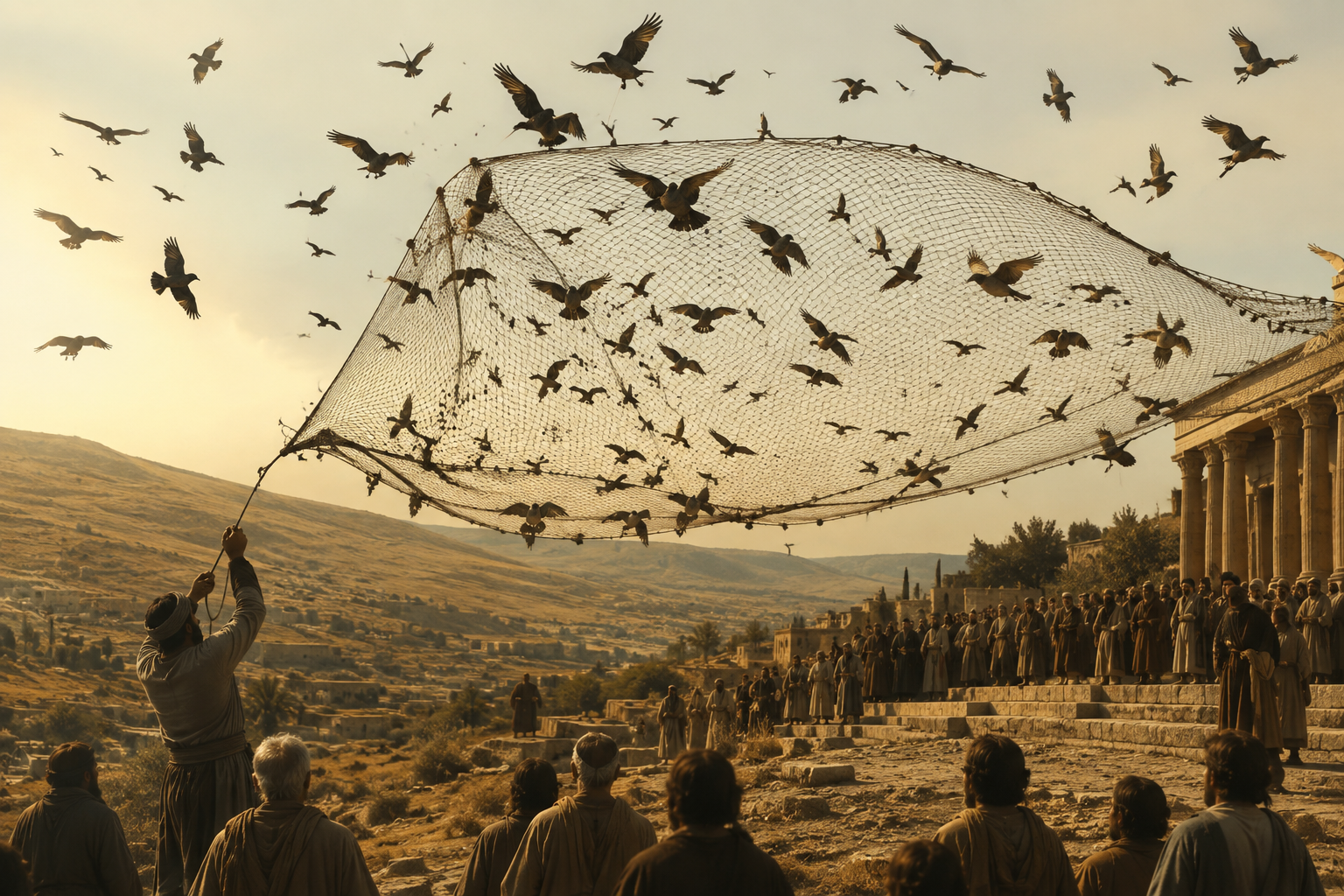
GOD CASTS HIS
NET OF JUDGMENT
God is depicted as a divine fowler. A fowler is a person who hunts wildfowl. What is interesting is that God is clearly the Hunter, but He uses a pagan nation as His instrument to spread His net over Israel (cf similar situation regarding His chastisement of Judah - Jer 25:9, Jer 27:6, Jer 32:28, Jer 43:10, Jer 46:26).
When they go I will spread My net over them - When God casts the net, there is no escape! The hunting imagery continues from Hosea 5:1, where Israel's leaders were described as setting snares and spreading nets to trap the people. Now the roles are reversed. God Himself becomes the Hunter. Whenever Israel attempts to escape by forming alliances with Egypt or Assyria (Hos. 7:11), the Lord declares that He will spread His net over them. Just as a bird cannot escape a hunter's well-cast net, Israel will not escape God's sovereign judgment. Their political maneuvering and military strategies will prove utterly futile, for there is no escaping the hand of Almighty God (cf. Ps. 139:7-12; Amos 9:2-4).
I will bring them down like the birds of the sky - Like unsuspecting birds suddenly trapped in a net, Israel would be swiftly and decisively brought down. What they imagined would bring security would instead become the means of their downfall. This is one of those divine promises Israel surely wished had never been spoken, yet God's warnings are as certain as His promises of blessing. The nation that had proudly exalted itself would be humbled under God's mighty hand. The imagery emphasizes both the certainty and the inescapability of His judgment (cf. Hos. 5:14; Deut. 28:49; Lam. 1:13).
I will chastise (yasar) them in accordance with the proclamation to their assembly - Yahweh would discipline Israel exactly as He had repeatedly warned through His prophets and in the covenant curses announced to the nation. His judgment would not be arbitrary or excessive, but fully consistent with His covenant and His prior declarations (Lev. 26:14-39; Deut. 28:15-68). The ultimate fulfillment came when the Assyrians conquered the Northern Kingdom in 722 B.C., deporting the Israelites into exile (2 Ki. 17:5-23). Thus, the captivity of Israel was not an unexpected tragedy but the righteous execution of God's long-announced judgment upon a nation that persistently refused to repent.
🙏 THOUGHT - Is there not a warning to all believers in this divine judgment on Israel? We must guard against deception, against deceiving ourselves and allowing others to deceive us (James 1:22, James 1:26, 1 Jn 1:8, Rev 3:17, Isa 44:20). We must guard against placing our hope and trust in the power of man (Isa 2:22, Isa 31:1, Jer 17:5) or the riches of this godless world system (Mk 10:24, Lk 12:16-21 1 Ti 6:17). This begs a simple question we should all answer honestly -- In whom are you placing your trust? In anything or anyone other than God? Then your trust is misplaced and will reap a harvest of corruption and if not repented from potentially even a harvest of destruction (cf 1 John 5:17, 1Co 11:30, Jas 5:20).
Hosea 7:13 Woe to them, for they have strayed from Me! Destruction is theirs, for they have rebelled against Me! I would redeem them, but they speak lies against Me.
BGT οὐαὶ αὐτοῖς ὅτι ἀπεπήδησαν ἀπ᾽ ἐμοῦ δείλαιοί εἰσιν ὅτι ἠσέβησαν εἰς ἐμέ ἐγὼ δὲ ἐλυτρωσάμην αὐτούς αὐτοὶ δὲ κατελάλησαν κατ᾽ ἐμοῦ ψεύδη
NET Woe to them! For they have fled from me! Destruction to them! For they have rebelled against me! I want to deliver them, but they have lied to me.
LXE Woe to them! for they have started aside from me: they are cowards; for they have sinned against me: yet I redeemed them, but they spoke falsehoods against me.
NLT "What sorrow awaits those who have deserted me! Let them die, for they have rebelled against me. I wanted to redeem them, but they have told lies about me.
KJV Woe unto them! for they have fled from me: destruction unto them! because they have transgressed against me: though I have redeemed them, yet they have spoken lies against me.
ESV Woe to them, for they have strayed from me! Destruction to them, for they have rebelled against me! I would redeem them, but they speak lies against me.
ASV Woe unto them! for they have wandered from me; destruction unto them! for they have trespassed against me: though I would redeem them, yet they have spoken lies against me.
CSB Woe to them, for they fled from Me; destruction to them, for they rebelled against Me! Though I want to redeem them, they speak lies against Me.
NIV Woe to them, because they have strayed from me! Destruction to them, because they have rebelled against me! I long to redeem them but they speak lies against me.
NKJ "Woe to them, for they have fled from Me! Destruction to them, Because they have transgressed against Me! Though I redeemed them, Yet they have spoken lies against Me.
NRS Woe to them, for they have strayed from me! Destruction to them, for they have rebelled against me! I would redeem them, but they speak lies against me.
YLT Woe to them, for they wandered from Me, Destruction to them, for they transgressed against Me, And I -- I ransom them, and they have spoken lies against Me,
NAB Woe to them, they have strayed from me! Ruin to them, they have sinned against me! Though I wished to redeem them, they spoke lies against me.
NJB Woe to them for having fled from me! Ruin seize them for having wronged me! I have rescued them again and again and they have only told lies about me.
GWN "How horrible it will be for these people. They have run away from me. They must be destroyed because they've rebelled against me. I want to reclaim them, but they tell lies about me.
- Woe to them, Ho 9:12 Isa 31:1 La 5:16 Eze 16:23 Mt 23:13-29 Rev 8:13
- for they have strayed from Me: Ho 11:2 Job 21:14,15 22:17 Ps 139:7-9 Jon 1:3,10
- Destruction is theirs,: Heb. spoil
- I would redeem them: De 15:15 Ne 1:10 Ps 106:10 107:2,3 Isa 41:14 43:1 63:8 Mic 6:4 1Pe 1:18,19
- but they speak lies against Me.: Ho 7:3 Hos 11:12 Isa 59:13 Jer 18:11,12 42:20 44:17,18 Eze 18:2,25 Mal 3:13-15 1Jn 1:10
Related Passages:
Hosea 9:12 Though they bring up their children, Yet I will bereave them until not a man is left. Yes, woe to them indeed when I depart from them!
Hosea 11:2 The more they called them, The more they went from them; They kept sacrificing to the Baals And burning incense to idols.
Deuteronomy 15:15 “You shall remember that you were a slave in the land of Egypt, and the LORD your God redeemed you; therefore I command you this today.
Hosea 7:3 With their wickedness they make the king glad, And the princes with their lies.
Hosea 11:12 Ephraim surrounds Me with lies And the house of Israel with deceit; Judah is also unruly against God, Even against the Holy One who is faithful.
THREE INDICTMENTS:
WANDERED, REBELLED, LIED!
Woe (hoy) to them - Trouble is coming! Impending doom is hanging over their heads as a nation and as individuals! God pronounces doom on Israel because she had continually wandered away from Him. Like a loving Husband, God's heart was always toward redeeming them, but they would have none of it even going so far as to accuse Him of lying. They made foreign treaties to defend themselves since they thought God either would or could not! And you say you do not believe in the utter depravity of man!
James Mays: A woe-saying is spoken over those who are doomed or dead. It is not an invocation of disaster, but rather a statement of sorrow and warning that the consequences of some act or situation are impending and inevitable. In prophetic speech it becomes a dirge for those under the sentence of Yahweh’s judgment. The ‘woe’ is provoked by the ‘devastation’ which Yahweh has decreed against his people who have fled from him to another, and so rebelled against his lordship. (See Hosea: A Commentary - Page 111)
For (term of explanation) - Here God explains why the "Woe" and ultimately why they would be destroyed.
They have strayed (nadad; LXX - apopedao - turn away from in active voice = volitional choice) from Me - Strayed indicates Israel's deliberate evasion of, its rebellious departure from God. God is a just Judge. Here He clearly states the crime that leads to punishment. Straying from God Who is the essence of Truth will always lead to error and the consequences associated with the error! Where were they straying? To the false gods of the foreign nations! Gods who in fact were no gods. They were following after the Gentiles who had "exchanged the glory of the incorruptible God for an image in the form of corruptible man and of birds and four-footed animals and crawling creatures." (Ro 1:23)
Trent Butler - Instead of returning to the Lord, they have strayed farther and farther away. The verb carries with it an undertone of fleeing or escaping, so that Israel wandered off from God intentionally, seeking to escape or flee from his presence. (See Holman Old Testament Commentary - Hosea, Joel, Amos - Page 55)
From Me - From God. This indicates that Israel's basic problem was spiritual. They have chosen their ways (see Hos 2:5, Hos 2:7) When one strays from God, it affects EVERYTHING else in one's life, and in this case EVERYTHING else in the nation - moral decline, economic collapse, political intrigue, etc. America, please wake up and return to the motto "In God We Trust!" Later Hosea describes the fruit reaped from their wandering to cavort with foreign nations, for God would give them what they wanted but not in the way they had wanted it....
My God will cast them away (WHY?) Because they have not listened to Him; And they will be wanderers (nadad) among the (FOREIGN) nations. (Hos 9:17)
Destruction (shod) is theirs, for (term of explanation) they have rebelled (pasha) against Me! - They revolted against Divine authority, substituting their plans for God's plans. This is the cause of their coming destruction. Note that Israel's rebellion was against Me. Like an unfaithful wife, they rebelled against their covenant relationship with God Who was their Husband (Jer 31:32, cf Isa 54:5). Note that sin is always first and foremost against God! (cf Ge 39:9b)
🙏 THOUGHT - It was true of the nation of Israel ("God's chosen people") and it is true of every man and woman who stubbornly rebels against God and refuses His offer of redemption, the free gift of eternal life in His Son. Dear reader, if this describes your heart, well first of all I am shocked you are even reading this commentary. But if you are and it describes you then even as I write these words I am uttering a prayer to the Most High God that by His Spirit and His Word of Truth He would grant you faith and repentance so that by grace through faith you believe in the Lord Jesus Christ that you might be saved from the "guttermost" to the "uttermost." In Jesus' might saving Name (Acts 4:12, Acts 16:31). Amen!
I would redeem (padah; LXX - lutroo - free by paying a ransom) them, but they speak lies against Me (see Hos 12:1) - The verb padah means to redeem, ransom, rescue, or deliver by paying a price. It is the language of a kinsman-redeemer who intervenes to free someone from bondage or danger. Throughout Israel's history, Yahweh repeatedly demonstrated Himself to be her Redeemer, delivering her from Egypt (Ex. 6:6; Dt. 7:8), from her enemies, and from countless national crises. The LXX translates padah with lutroo, the same Greek verb later used in the New Testament to describe Christ's redemptive work in purchasing sinners' freedom through His own blood (Lk. 24:21; Titus 2:14; 1Pe 1:18-19).
Robin Routledge: Despite the people’s sin, Yahweh wants to redeem them (7:13). Here we see a further expression of the divine husband’s willingness to restore his unfaithful wife. There is a way back (cf. 7:10, 14), but then, as now, many who are caught up in persistent wrongdoing refuse to admit their need and turn to Yahweh with the kind of meaningful repentance that can open the way for forgiveness and restoration. (See Hosea: An Introduction and Commentary - Page 117)
The tragedy is not that God was unwilling to redeem Israel, but that Israel rejected the very God Who longed to rescue her. The imperfect verb, "I would redeem," expresses God's gracious disposition and repeated willingness to deliver His people. Yet instead of responding with faith, gratitude, and repentance, "they speak lies against Me." They slandered God's character, rejected His prophets, trusted in idols and foreign alliances, and attributed His blessings to false gods. Their lies were both verbal and practical, revealing hearts that refused to believe the truth about God. Thus, the God who stood ready to redeem was met with unbelief, ingratitude, and covenant treachery. Israel's bondage was not due to any lack of divine mercy, but to her persistent refusal to trust and return to her Redeemer (cf. Hos. 11:1-4; Isa. 43:1; 44:22; Titus 2:14; 1 Pet. 1:18-19).
Trent Butler on speak lies against Me - They pledge covenant faithfulness in worship but break every commandment and every covenant expectation once they leave God's worship place.
The Reformation Study Bible - This may refer to the false ideas about the Lord that had been imported into Israel's religion, to insincere words of repentance (Hos 6:1-3), or more generally to the broken promises of the covenant.
Note the repetition of the phrase against Me! God took their lies as a personal affront! But notice that even in the face of their wandering, rebellion and lying, grace abounds! The "I" is emphatic. What is God saying here? He is saying He would "pay the price" to deliver them from the coming catastrophe. Sadly, the leadership and laity were stubborn and hard hearted and totally unresponsive to God's plea to return to Him!
🙏 THOUGHT - I wonder what would happen if we all begin to realize our sin was against God and that He took it as a personal affront and that it hurt His heart (Ezek 6:9)? Might these immutable truths serve to motivate us (energized by the Spirit's gift of love and grace) to turn from that sin? Just a thought to ponder beloved.
This is a tragic statement. On one hand God in His great mercy and lovingkindness would still redeem Israel. Sadly Israel would have no part of this and probably told lies saying He would not help them.
POSB - Despite all the Lord had done for them, the people chose to forsake the Lord and to give themselves to the false gods and idols of this world. They lied both to themselves and to all whom they influenced. (Ibid)
Woe (01945)(hoy) is an interjection of distress used primarily by the prophets, 6x in mourning for the dead (1Ki 13:30 Jer 22:18; 34:5), and 40x as negative warnings specifying Divine punishment in the form of disaster, etc, for failing to repent from certain sins. The wicked are under the judgment of God (cp Ro 1:18ff) and therefore face a time of ruin and mourning, so that the only thing left for an unrepentant people is to mourn the destruction of their lives! Woe! Patterson adds that "Woe oracles typically contain the following elements: invective (“woe to”), threat, and criticism (the reason for the denunciation and threatened judgment)." Woe is also used in Hosea 9:12.
Strayed (05074)(nadad) means to flee, shake, agitate, wander. "Basic to the meaning of the root is the concept of motion, often with a directional sense, i.e. motion away from a person or object." (TWOT) Nadad means to turn from, to take flight, to turn away from (Isa. 10:31; Jer. 4:25; 9:10; Nah. 3:7, 17). Nadad can refer to the fluttering of a bird (Isa. 10:14) The nuances often denote a type of movement in which the subject is vulnerable. Nadad can mean to thrust away, to drive out (2 Sam. 23:6; Job 18:18). In Job 15:23; Pr 27:8; Hos. 9:17 ("they will be wanderers among the nations") nadad means to wander around. In Ge 31:40 and Est. 6:1 the verb is used with the nuance of fleeting sleep. The Septuagint translates nadad in this verse with the verb apopedao (not found in NT) meaning to turn away from, to hurry off (Pr 9:18), to leap off (Ezek 19:3). Apopedao is in the active voice meaning that they made a volitional, conscious choice to turn away from the Holy One of Israel. When one turns from Holy the antithesis of unholy (in this case destruction) awaits them in this life and the one to come! Frightening! God grant that by His Spirit we might not stray from Him even momentarily, for the sake of His great Name in Christ. Amen.
Gilbrant - The most common meaning of nādad is "to flee." The reason for fleeing generally is to escape military force. This is the primary usage of the verb in Isaiah (where more than a quarter of the total occurrences of the verb are found), a Book which has the continual looming threat of Assyrian invasion (e.g., 21:15). The danger and vulnerability of those fleeing is evident. Both birds (Jer. 4:25) and humans (Isa. 33:3) will flee before the judgment of Yahweh. The absence of fluttering in the imagery of an abandoned nest which is seized declares the vulnerability of the hatchlings (Isa. 10:14; cf. 16:2). They are doomed without protection, just as the king of Assyria proclaimed that all peoples were before him. Ironically, it was Yahweh Who had given the king power over others, and the king himself was just as vulnerable to Yahweh's will as any other human (Isa. 10:5-19). The person who wanders is likewise in a state of vulnerability. The northern kingdom of Israel was condemned for abandoning the protection of Yahweh in favor of establishing military alliances with Egypt and Assyria (Hos. 7:13). Leaving the protection of Yahweh meant that Israel was doomed: the Covenant would be revoked, and the curse of losing the land would be enforced (ch. 8). (Complete Biblical Library Greek-English Dictionary)
Nadad - chased(1), chased away(1), could(1), flapped(1), fled(6), flee(5), fleeing(1), fugitive(2), fugitives(1), shake(1), shrink(1), strayed(1), thrust away(1), wander(1), wanderers(1), wanders(3). Gen. 31:40; 2 Sam. 23:6; Est. 6:1; Job 15:23; Job 18:18; Job 20:8; Ps. 31:11; Ps. 55:7; Ps. 64:8; Ps. 68:12; Prov. 27:8; Isa. 10:14; Isa. 10:31; Isa. 16:2; Isa. 16:3; Isa. 21:14; Isa. 21:15; Isa. 22:3; Isa. 33:3; Jer. 4:25; Jer. 9:10; Jer. 49:5; Hos. 7:13; Hos. 9:17; Nah. 3:7; Nah. 3:17
Destruction (devastation, violence)(07701)(shod from shadad = to deal violently with, despoil, devastate, ruin) is a masculine noun meaning violence, destruction, desolation, robbery, spoil, wasting. The primary meaning of shod is violence or destruction and is used to describe an "act of violence or oppression." In Job the idea is not to fear coming violence - "And you will not be afraid of violence when it comes" (Job 5:21). The primary meaning of destruction was used by Hosea and here by Joel to express God's reason for the coming Day of the LORD which will bring destruction on His Chosen People (Hos. 7:13 = "Woe to them, for they have strayed from Me! Destruction is theirs, for they have rebelled against Me! I would redeem them, but they speak lies against Me."). There is a second use of shod in Hosea 9:6 ("because of destruction"), Hosea 10:14 "destroyed"), Hosea 12:1 ("violence").
Shod in this passage refers more specifically to a general collapse of the social and economic structures of the nation (cf. Isa. 13:6; Isa 16:4; Isa 22:4; Jer. 48:3; Amos 5:9).
Rebelled (transgressed)(06586)(pasha - cognate verb = pesha' = to transgress) is a verb conveys the fundamental idea of a breach of relationships (civil or religious) between two parties. This word describes those who break away from authority and thus trespass, apostatize, rebel, revolt, transgress. Septuagint translates pasha in this verse with the verb asebeo meaning to violate norms of a deity (in this case God), commiting impious deeds, living wickedly and profanely, basically living with regard for God either in belief or practice.
I would redeem (06299)(padah) means to redeem, ransom, buy and so to cause the freedom or release of a person from bondage or ownership, often implying a delivering or rescue of a person in distress. The basic meaning of the Hebrew root is to achieve the transfer of ownership from one to another through payment of a price or an equivalent substitute. Padah is used to depict God's act of redeeming; He redeemed His people with a mighty hand from Pharaoh and the slavery they were under in Egypt (Dt. 7:8; Mic. 6:4). Egypt was literally the house of slavery and became the symbol of slavery and oppression from which Israel was delivered (Dt. 9:26; 24:18). Padah is translated in the Septuagint with the verb lutroo (from lutron/lytron which is derived from luo = to loosen that which is bound, especially freeing those in prison). The noun lutron is the ransom price paid for loosing captives from their bonds and setting them at liberty. The verb lutroo refers to the releasing of someone held captive (e.g., a prisoner or a slave) on receipt of the ransom payment. Padah is used again in Hos 13:14 "shall I ransom (padah) them from the power of Sheol? Shall I redeem (gaal) them from death? O Death, where are your thorns? O Sheol, where is your sting? Compassion will be hidden from My sight."
Gilbrant on padah - The prime concept driving this root is that some mode of exchange is required for consumers to receive the objects they desire. In OT times, the possession of the object oftentimes was acquired by the seller. For example, one could redeem a female slave, that she might again experience freedom (Lev. 19:20). The synonym gāʾal (HED #1381) is usually employed for this act. The owner of a female Israelite slave was required to allow her to be redeemed and was prohibited from selling her to foreigners (Exo. 21:8). The verb is often employed metaphorically, outside of its strict legal sense. The Psalms repeatedly assert that the author had been redeemed from some distress by Yahweh (e.g., 26:11). Likewise, David asserted that he had been redeemed repeatedly by the Lord (1 Ki. 1:29). Indeed, the Lord redeemed Israel from slavery as his firstborn (Exo. 13:13), which was further celebrated in David's prayer of thanksgiving upon receiving the covenant that established his descendants as perpetual rulers (2 Sam. 7:23). Zion would be redeemed from its current state of desolation, according to Isa. 1:27. The redemption of the Israelites was at the cost of the firstborn of the Egyptians (cf. Exo. 4:23). The firstborn children of the Israelites were redeemed by substituting the Levites for service to Yahweh (Num. 3:44ff). Further, human offspring and unclean animal offspring were redeemed by offerings of large or small cattle, depending upon the occasion (e.g., 18:8ff). There were classes of unredeemable objects. Anything declared cherem (HED #2869), "devoted to Yahweh," was not redeemable, including humans (Lev. 27:27ff). (Complete Biblical Library Greek-English Dictionary)
William Coker writes that "The semantic development of pādâ is one of great significance to Christian theology. Originally, it had to do with the payment of a required sum for the transfer of ownership, a commercial term. Exodus and Leviticus 19:20 speak of the redemption of a slave girl for the purpose of marriage. It is also used to speak of the redemption of a man's life who is under the sentence of death, as in 1 Samuel 14:45, when Jonathan was redeemed by the people of Israel. The word was given special religious significance by the Exodus. When God delivered Israel from servitude to Egypt, he did so at the price of the slaughter of all the firstborn in Egypt, man and beast (Exodus 4:23; Exodus 12:29). Consequently, the event was to be perpetually commemorated in Israel by the consecration of all the firstborn of man and beast to the Lord (Exodus 13:12). (Theological Wordbook of the Old Testament)
REFLECTION - ‘Ransom’ (Hos 7:13) was originally a commercial term indicating a transaction in which a stipulated sum was paid to transfer ownership (cf. the release of a slave girl, Exod. 21:8), and in many religious contexts in the Old Testament the idea of payment is still present (Exod. 13:13; 34:20; Num. 18:15–16). However, when God ransoms his people, the concept of payment or price recedes and the emphasis is on liberation from distressing or restricting circumstances, such as when Israel was brought out of the servitude of Egypt. The Psalmists also plead for deliverance from danger or oppression using this term (cf. Pss. 25:22; 26:11; 31:5; 119:134). In Psalm 130:7–8 reference is made more specifically to ransoming from sin. For the more specific term ‘redeem’, see on 13:14. In the New Testament, the cost involved in the ransom paid to effect salvation is made clear. ‘You were ransomed from the futile ways inherited from your forefathers, not with perishable things such as silver or gold, but with the precious blood of Christ, like that of a lamb without blemish or spot’ (1 Pet. 1:18–19). (John McKay - Mentor Commentary)
James Smith - FLEEING FROM THE REDEEMER
“Woe unto them! for they have fled from Me: though I have redeemed them” (Hosea 7:13).
Ephraim is here said to be like a silly dove (v. 11). Could anything be more silly than to flee from Him who hath redeemed us. To flee from Him is to flee to destruction (v. 13). Alas, that such silliness should be so very common.
I. See what the Lord has done for them. “I have redeemed them.” Think of their wretched condition in Egypt, and how He redeemed them out of the house of slavery (Micah 6:4). Think of His condescension in coming down to dwell in a bush, that He might manifest His purpose of grace to Moses (Exod. 3:8). Think of what He hath done for us in coming down to dwell in the Man Christ Jesus, that He might show forth the riches of His grace in redeeming us by His own blood. What a sacrifice of the wealth of divine love is here. “He is the propitiation for our sins.”
II. See what they did with the Lord. “They fled from Him.” It is impossible to flee from that presence which is everywhere, or from the all-searching of His eyes; but we may flee from Him in the love and confidence of our hearts and in the choosing of our own will and way. It is a sure sign that there is something wrong within when we turn away from those who love us. The guilty child is ashamed to look its father in the face; its eyes flee from him. Some flee from the Lord, like Jonah, by refusing to obey His Word; but there be many who flee from Him, like Adam, because they know that they have sinned against Him. It was not so with David. “I flee to Thee to hide me.” It is utter madness for a thirsty soul to flee from the fountain of living water to broken and empty cisterns.
III. See what they said about Him. “They have spoken lies against Me” (v. 13). Those who flee from the mercy of God are likely to think and speak lies about Him. They would drag the Holy One down to their own level. They speak lies against Him when they say: 1. That God does not love them. 2. That they need to make themselves better before coming back to Him. 3. That the death of Christ was not for them. 4. That simple faith in Him will not justify. 5. That their sins are too many to be forgiven. 6. That He does not answer prayer. 7. That He is not able to keep from falling. Those who speak such lies against Him show that they have come under the power of the devil, who is such a liar from the beginning.
IV. See where they go who flee from the Redeemer. “Woe unto them” (v. 13). They rush into grief and misery and into the destruction of all peace and fellowship with God. To turn away from our Redeemer is to turn back to the bondage and slavery of our own restless self-will. “He that is without Christ is without hope” (Eph. 2:12).
James Smith - A SEVENFOLD COMPLAINT Hosea 7:13–15
It is worthy of notice that the Me’s here are all emphatic in the Hebrew. They—
1. Have fled from Me (v. 13).
2. Have transgressed against Me.
3. Have spoken lies against Me.
4. Have not cried unto Me.
5. Rebelled against Me.
6. Imagine mischief against Me.
7. Return, but not to Me.
Hosea 7:14 And they do not cry to Me from their heart When they wail on their beds; For the sake of grain and new wine they assemble themselves, They turn away from Me.
BGT καὶ οὐκ ἐβόησαν πρός με αἱ καρδίαι αὐτῶν ἀλλ᾽ ἢ ὠλόλυζον ἐν ταῖς κοίταις αὐτῶν ἐπὶ σίτῳ καὶ οἴνῳ κατετέμνοντο ἐπαιδεύθησαν ἐν ἐμοί
NET They do not pray to me, but howl in distress on their beds; They slash themselves for grain and new wine, but turn away from me.
LXE And their hearts did not cry to me, but they howled on their beds: they pined for oil and wine.
NLT They do not cry out to me with sincere hearts. Instead, they sit on their couches and wail. They cut themselves, begging foreign gods for grain and new wine, and they turn away from me.
KJV And they have not cried unto me with their heart, when they howled upon their beds: they assemble themselves for corn and wine, and they rebel against me.
ESV They do not cry to me from the heart, but they wail upon their beds; for grain and wine they gash themselves; they rebel against me.
ASV And they have not cried unto me with their heart, but they howl upon their beds: they assemble themselves for grain and new wine; they rebel against me.
CSB They do not cry to Me from their hearts; rather, they wail on their beds. They slash themselves for grain and new wine; they turn away from Me.
NIV They do not cry out to me from their hearts but wail upon their beds. They gather together for grain and new wine but turn away from me.
NKJ They did not cry out to Me with their heart When they wailed upon their beds. "They assemble together for grain and new wine, They rebel against Me;
NRS They do not cry to me from the heart, but they wail upon their beds; they gash themselves for grain and wine; they rebel against me.
YLT And have not cried unto Me with their heart, but howl on their beds, For corn and new wine they assemble themselves, They turn aside against Me.
NAB They have not cried to me from their hearts when they wailed upon their beds; For wheat and wine they lacerated themselves, while they rebelled against me.
NJB Theirs is no heartfelt cry to me when they lament on their beds; when they gash themselves over the grain and new wine, they are still rebelling against me.
GWN They don't pray to me sincerely, even though they cry in their beds and make cuts on their bodies while praying for grain and new wine. They have turned against me.
- And they do not cry to Me from their heart : Job 35:9,10 Ps 78:34-37 Isa 29:13 Jer 3:10 Zec 7:5
- When they wail on their beds; : Isa 52:5 65:14 Am 8:3 Jas 5:1
- For the sake of grain and new wine they assemble themselves: Ho 3:1 Ex 32:6 Jud 9:27 Am 2:8 Mic 2:11 Ro 16:18 Php 3:19 Jas 4:3
Related Passages:
Hosea 3:1 Then the LORD said to me, “Go again, love a woman who is loved by her husband, yet an adulteress, even as the LORD loves the sons of Israel, though they turn to other gods and love raisin cakes.”
ISRAEL REFUSED TO
TURN TO GOD!
And they do not cry to Me from their heart (leb) - God's lovingkindness and compassion is always open to the sincere cry of the sinner. They were not sincere, but they were certainly sinners! Genuine repentance begins in the heart, but Israel had a major heart problem - spiritual atherosclerosis!
When they wail on their beds - They are crying from self-pity not for a Savior! They cry from their beds, but not from their hearts! They were not crying out in repentance, but in fact more in remorse over the consequences of their sin. Their "crocodile tears" failed to impress God, who saw their hearts (cf 1 Sa 16:7b).
E B Pusey - At least, the prophet does not deny that they cried to God at all; only, he says, that they did not cry to Him with their heart. Their cries were wrung from them by their temporal distresses, and ended in them, not in God. There was no sincerity in their hearts, no change in their doings. Their cry was a mere howling. The secret complaint of the heart is a loud cry in the ears of God. The impetuous cry of impatient and unconverted suffering is a mere brutish howling. Their heart was set wholly on their earthly wants; it did not thank God for giving them good things, nor cry to Him truly when He withheld them. (The minor prophets with a commentary explanatory- Page 48)
James Mays: The Assyrian campaign in 734/3 undoubtedly left the land stripped of its crops and the renewal of harvest became a desperate matter (Hos 8.7). In their plight the Israelites raised the lament for help (zā’aq) to Yahweh (Hos 8.2). But the ritual by which they appealed was taken from the fertility rites of Canaan and dealt with Yahweh as though he were Baal. ‘With their heart’ is not a phrase of earnestness or sincerity; heart in Hosea is the mind, the responsible intelligence (Hos 4.4; Hos 7.11). Israel cried out to Yahweh in stupidity, forgetting the conditions of the covenant and trying to manipulate him as a nature god whose amoral function is to produce corn and new wine (Hos 2.5, 8f.). There is some evidence that ritual wailing was performed in prostration (2Sa 12.16; Ps. 4.4) and was practised in fertility rites (Song 3.1; Isa. 57.8). The prophets of Baal in the contest on Mount Carmel lacerated themselves as they entreated Baal to come as the god of the thunder-storm and so end the drought (1Ki 18.28); ritual gashing in mourning for the dead was prohibited in Israel because of its Canaanite connections (Dt. 14.1; Lev. 19.28). The Israelite thought of Yahweh as absent (dead?) like Baal and tried by the laments that summoned Baal to gain his help with crops. So their very appeal was stubborn contumacious rebellion against the person of Yahweh. (See Hosea: A Commentary - Page 111)
John MacKay comments "Because of their lack of heart recognition of the LORD all that their prayers amount to is a pained expression of grief and despair in which they are consumed by their own feelings and the tragedies that have come upon them. They are like petulant children who complain that they have not got what they wanted and who refuse to accept any personal responsibility for the situation which had beset their land. ‘On their beds’ refers to the hours of the day when they could engage in undisturbed reflection and meditation (cf. Ps . 4:4; 16:7).(Ibid)
For the sake of grain and new wine they assemble themselves (See Hos 2:8, Hos 2:22 = Millenium, Hos 9:1-2) - This suggests that the grain and new wine were scarce as Mays explained above. God's hand of discipline on the fertility of the land was always clearly stated (Lev 26:19).
TECHNICAL NOTE - Note that other versions have a very different rendering of this passage. For example the NET and CSB Bibles have "They slash themselves for grain and new wine." The NLT has "They cut themselves." The ESV and NRSV have "they gash themselves." See the technical note from the NET Bible below. I favor this reading of the Hebrew text and the Greek Septuagint rendering supports it (Greek verb is katatemno also used in Lev 21:5, 1 Ki 18:28). The fact that Israel was resorting to pagan practices that call on Baal to grant fertility to the land makes a perfect contrast with the opening line that Israel did "not cry out to Me from their heart." As Solomon's prayer below shows, instead of slashing and gashing themselves, they could have simply fallen on their face in repentance and cried out to Jehovah.
They turn away (sur) from Me - If they were in fact gashing themselves, they were explicitly turning away from God's clear instructions to "not cut yourselves nor shave your forehead for the sake of the dead." (Dt 14:1). What is tragic is they did the very opposite of what could have helped them. This passage is a good description of apostasy! Either they were ignorant of the Word of God or simply refused to receive it as Truth. The prayer of Solomon had clearly outlined the way of healing for the people and the land...
“When the heavens are shut up and there is no rain, because they have sinned against You, and they pray toward this place and confess Your name and turn from their sin when You afflict them, 36 then hear in heaven and forgive the sin of Your servants and of Your people Israel, indeed, teach them the good way in which they should walk. And send rain on Your land, which You have given Your people for an inheritance. 37 “If there is famine in the land, if there is pestilence, if there is blight or mildew, locust or grasshopper, if their enemy besieges them in the land of their cities, whatever plague, whatever sickness there is, 38 whatever prayer or supplication is made by any man or by all Your people Israel, each knowing the affliction of his own heart, and spreading his hands toward this house; 39 then hear in heaven Your dwelling place, and forgive and act and render to each according to all his ways, whose heart You know, for You alone know the hearts of all the sons of men, (1 Ki 8:35-39, cf 2 Chr 7:13,14)
NET Bible Note on they slash themselves - The Massoretic Text reads יִתְגּוֹרָרוּ (yitgoraru) which is either (1) Hitpolel imperfect 3rd person masculine plural (“they assemble themselves”; so KJV, NASB) from I גּוּר (gur, “to sojourn”; BDB 157 s.v. I גּוּר) or (2) Hitpolel imperfect 3rd person masculine plural (“they excite themselves”) from II גּוּר (gur, “to stir up”; BDB 158 s.v. II גּוּר). However, the Hebrew lexicographers suggest that both of these options are unlikely. Several other Hebrew MSS preserve an alternate textual tradition of יִתְגּוֹדָדוּ (yitgodadu) which is a Hitpolel imperfect 3rd person common plural (“they slash themselves”) from גָּדַד (gadad, “to cut”; BDB 151 s.v. גָּדַד), as also reflected in the Septuagint (Lxx) (cf. NAB “they lacerated themselves”; NRSV, TEV “gash themselves”; NLT “cut themselves.”) This reflects the pagan Canaanite cultic practice of priests cutting themselves and draining their blood on the ground to elicit agricultural fertility by resurrecting the slain fertility god Baal from the underworld (Dt 14:1; 1 Kgs 18:28; Jer 16:6; 41:5; 47:5). Cf. CEV which adds “in the hope that Baal will bless their crops.”
Hosea 7:15 Although I trained and strengthened their arms, Yet they devise evil against Me.
NET Although I trained and strengthened them, they plot evil against me!
LXE They were instructed by me, and I strengthened their arms; and they devised evils against me.
NLT I trained them and made them strong, yet now they plot evil against me.
KJV Though I have bound and strengthened their arms, yet do they imagine mischief against me.
ESV Although I trained and strengthened their arms, yet they devise evil against me.
ASV Though I have taught and strengthened their arms, yet do they devise mischief against me.
CSB I trained and strengthened their arms, but they plot evil against Me.
NIV I trained them and strengthened them, but they plot evil against me.
NKJ Though I disciplined and strengthened their arms, Yet they devise evil against Me;
NRS It was I who trained and strengthened their arms, yet they plot evil against me.
YLT And I instructed -- I strengthened their arms, And concerning Me they think evil!
NAB Though I trained and strengthened their arms, yet they devised evil against me.
NJB Though I supported and gave strength to their arms, they plan how to hurt me.
GWN I trained them and made them strong. Yet, they plan evil against me.
- Although I trained and strengthened their arms 2Ki 13:5,23 14:25-27 Ps 106:43-45
- trained and strengthened, Job 5:17 Ps 94:12 Pr 3:11 Heb 12:5 Rev 3:19
- Yet they devise evil against Me.: Ps 2:1 62:3 Jer 17:9 Na 1:9 Ac 4:25 Ro 1:21 2Co 10:5
Related Passages:
2 KIngs 13:23 But the LORD was gracious to them and had compassion on them and turned to them because of His covenant with Abraham, Isaac, and Jacob, and would not destroy them or cast them from His presence until now.
Hosea 2:8 “For she does not know that it was I who gave her the grain, the new wine and the oil, And lavished on her silver and gold, Which they used for Baal.
Hosea 11:3 Yet it is I who taught Ephraim to walk, I took them in My arms; But they did not know that I healed them.
DIVINE PROVISION
VERSUS
PEOPLE'S REBELLION
Although I trained and strengthened their arms - In Hos 11:3 "it is I who taught Ephraim to walk, I took them in My arms; But they did not know that I healed them." God says "God had been their all in all, and they now saw Him as nothing at all! Woe! When you begin the downward spiral of sin, beware!
Sin will take you further than you ever wanted to stray!
Cost you more than you ever dreamed you would pay!
Keep you longer than you ever thought you would stay!
MacKay comments "I strengthened their arms refers to their limbs (not weaponry), but probably it denotes more than imparting physical power to their bodies. This is the all-encompassing prosperity with which the LORD had blessed the nation’s endeavours, but which had been misunderstood and misused (cf. Hos 2:8, 12)." (Ibid)
Thomas Constable has a slightly different interpretation than MacKay - It was Yahweh who had taught His people how to be strong. He had also made them strong militarily (cf. Ezek. 30:24-25), for example during Jeroboam II's reign (cf. 2 Kings 14:25-28).
Yet they devise (chasab/hasab; LXX - logizomai) evil against Me - Note the phrase against Me repeated from Hos 7:12 (where it is found twice). They are not just passive apostates, but actually dared to devise evil against God, slighting Him in the process. They thought about it seriously. It was not a passing thought but a definitive plan. You know a person is deceived when they seek to tangle with God! The Hebrew word for evil (ra'/ra'ah) is translated in the Septuagint with poneros the Greek word signifying active evil, evil calculated to do harm! Poneros denotes determined, aggressive, and fervent evil that actively opposes what is good. Poneros is not just bad in character (like kakos), but bad in effect (injurious)!
H. Ronald Vandermey: The indictment against Israel closes with a few broken lines that fall on the page like tears for one with a broken heart (vv. 15-16). No matter how hard the Lord tried to train (literally, “discipline”) and strengthen Israel for her battle against wickedness, she rejected Him by joining the side of evil. She had become “like a deceitful bow,” failing the archer in the time of battle. Without the Lord, who was her strength (Psalm 28:7), Israel would fall helplessly prostrate at the feet of her captors. (See Hosea & Amos- Everyman's Bible Commentary - Page 51)
John Courson - God had provided, protected, and prospered Israel. He had found her, fed her, and fought for her. Yet for all of that, rather than repent and return to Him, Israel rebelled against Him, turning instead to her powerless idols and relying on her faulty alliances. (See Jon Courson's Application Commentary)
Trained (chastened, instructed) (03256)(yasar) means to chasten, chastise, admonish, discipline. Literally to chasten with blows or figuratively with words (instruct, correct, punish, reform, reprove). The theological basis for discipline of Israel is grounded in the covenant relationship which Yahweh established with His people. It is a good thing to be disciplined by the Lord for as the psalmist says "Blessed is the man whom You chasten, O LORD, And whom You teach out of Your law." (Ps 94:12) Notice there that the discipline is not in a vacuum but is coupled with teaching, a good pattern! (cp similar pattern in Isa 28:26). Yasar is used 3x in Hosea - Hos 7:12 ("I will chastise them"), Hos 7:15, Hos 10:15. MacKay adds that "Trained is rendered ‘chastise’ in Hos 5:2 (musar not yasar) and Hos 7:12, but here it denotes the whole educative process designed to nurture spiritual and moral vigour.
Hosea 7:16 They turn, but not upward, They are like a deceitful bow; Their princes will fall by the sword Because of the insolence of their tongue. This will be their derision in the land of Egypt.
BGT ἀπεστράφησαν εἰς οὐθέν ἐγένοντο ὡς τόξον ἐντεταμένον πεσοῦνται ἐν ῥομφαίᾳ οἱ ἄρχοντες αὐτῶν δι᾽ ἀπαιδευσίαν γλώσσης αὐτῶν οὗτος ὁ φαυλισμὸς αὐτῶν ἐν γῇ Αἰγύπτῳ
LXE They turned aside to that which is not, they became as a bent bow: their princes shall fall by the sword, by reason of the unbridled state of their tongue: this is their setting at nought in the land of Egypt.
NET They turn to Baal; they are like an unreliable bow. Their leaders will fall by the sword because their prayers to Baal have made me angry. So people will disdain them in the land of Egypt.
NLT They look everywhere except to the Most High. They are as useless as a crooked bow. Their leaders will be killed by their enemies because of their insolence toward me. Then the people of Egypt will laugh at them.
KJV They return, but not to the most High: they are like a deceitful bow: their princes shall fall by the sword for the rage of their tongue: this shall be their derision in the land of Egypt.
ESV They return, but not upward; they are like a treacherous bow; their princes shall fall by the sword because of the insolence of their tongue. This shall be their derision in the land of Egypt.
ASV They return, but not to him that is on high; they are like a deceitful bow; their princes shall fall by the sword for the rage of their tongue: this shall be their derision in the land of Egypt.
CSB They turn, but not to what is above; they are like a faulty bow. Their leaders will fall by the sword because of the cursing of their tongue. They will be ridiculed for this in the land of Egypt.
NIV They do not turn to the Most High; they are like a faulty bow. Their leaders will fall by the sword because of their insolent words. For this they will be ridiculed in the land of Egypt.
NKJ They return, but not to the Most High; They are like a treacherous bow. Their princes shall fall by the sword For the cursings of their tongue. This shall be their derision in the land of Egypt.
NRS They turn to that which does not profit; they have become like a defective bow; their officials shall fall by the sword because of the rage of their tongue. So much for their babbling in the land of Egypt.
YLT They turn back -- not to the Most High, They have been as a deceitful bow, Fall by sword do their princes, From the insolence of their tongue, This is their derision in the land of Egypt!
NAB They have again become useless, like a treacherous bow. Their princes shall fall by the sword because of the insolence of their tongues; thus they shall be mocked in the land of Egypt.
NJB They turn to what does not exist, they are like a faulty bow. Their leaders will fall by the sword because of their arrogant talk; how they will be laughed at in Egypt!
GWN They don't return to the Most High. They are like a defective bow. Their officials will die in battle because they curse. The people in Egypt will ridicule them for this.
- They turn, but not upward: Ho 6:4 8:14 11:7 Ps 78:37 Jer 3:10 Lu 8:13 11:24-26
- They are like a deceitful bow: Ps 78:57
- Because of the insolence of their tongue. : Ho 7:13 Ps 12:4 52:2 57:4 73:9 Isa 3:8 Jer 18:18 Mt 12:36 Jas 3:5 2Pe 2:8 Rev 13:5
- This will be their derision in the land of Egypt: Ho 8:13 9:3,6 Eze 23:32 36:20
NO REPENTANCE
They turn, but not upward - Where did they turn? To the godless nations around them and not to God! They do not turn to Heaven, toward the Most High God (Hos 7:15NIV). This is a "silly dove" turning everywhere but upward to the only One Who could help them! In Hos 11:7 God says "My people are bent on turning from Me. Though they call them to the One on high, None at all exalts Him."
E B Pusey - They changed, whenever they did change, with a feigned, hypocritical conversion, but not to God, nor acknowledging His Majesty. Man, until truly converted, turns to and fro, unstably, hither and thither, changing from one evil to another, from the sins of youth to the sins of age, from the sins of prosperity to the sin of adversity; but he remains himself unchanged. He turns, not to the most High. The Prophet says this in three, as it were, broken words, They turn, 2not most High. The hearer readily filled up the broken sentence, which fell, drop by drop, from the Prophet’s choked heart. (See The Minor Prophets: Hosea, Joel, Amos, Obadiah and Jonah - Page 79)
Trent Butler - The people of Israel return, but they do not repent. They turn, but not in the right direction. They return to their false worship and arrogant actions. They return upward to the high places rather than upward to the Most High. (See Holman Old Testament Commentary - Hosea, Joel, Amos- Page 56)
MacKay - While return/‘come back’ is precisely the response that was required (cf. Hos 3:5; 6:1; 14:1), Ephraim persisted in getting it wrong. They reoriented their ways, possibly seeking to renew failed or rejected alliances, but not to him who is on high (cf. Hos 11:7). (Mentor Commentary)
They are like a deceitful bow - As their result of turning everywhere but upward to God, Hosea says they are like a warped bow that sends arrows awry, not at the bull's eye! The "bull's eye" (so to speak) was Jehovah and His amazing mercy and His all sufficient sovereign power, but they totally missed Him! See "treacherous bow" in Ps 78:57. This could even allude to the fact that instead of shooting their enemies, they used their deceitful bow to shoot (assassinate) 4 of their last five leaders!
E B Pusey - They are like a deceitful bow, which, “howsoever the archer directs it, will not carry the arrow right home to the mark,” but to other objects clean contrary to his will. “3God had, as it were, bent Israel, as His own bow, against the tyranny of the devil and the deceit of idolatry. For Israel alone in the whole world cast aside the worship of idols, and was attached to the true and natural Lord of all things. But they turned themselves to the contrary. For, being bound to this, they fought against God for the glory of idols. They became then as a warped bow, shooting their arrows contrariwise.” In like way doth every sinner act, using against God, in the service of Satan, God’s gifts of nature or of outward means, talents, or wealth, or strength, or beauty, or power of speech. God gave all for His own glory; and man turns all aside to do honor and service to Satan. (See The Minor Prophets: Hosea, Joel, Amos, Obadiah and Jonah - Page 79)
Their princes (Israel's leaders) will fall by the sword because of the insolence (za'am) of their tongue - Hosea now announces the inevitable outcome of Israel's rebellion: her leaders would perish by violence. During the final decades of the Northern Kingdom, this prophecy was repeatedly fulfilled as kings and princes fell through assassination, conspiracy, and ultimately the Assyrian invasion (cf. 2 Ki. 15:10, 14, 25, 30; 17:3-6) (see notes Hos 7:7). The cause of their downfall was "the insolence of their tongue." The noun za'am conveys the idea of rage, indignation, arrogance, or reckless speech. Their proud, defiant words reflected hearts that had rejected God's authority. They lied against the Lord (Hos. 7:13), mocked His warnings, trusted in their own wisdom, and spoke with arrogant self-confidence rather than humble dependence upon Him. Their tongues revealed the rebellion of their hearts, and those same proud words ultimately brought them under God's judgment. As Proverbs wisely observes, "Death and life are in the power of the tongue" (Pr 18:21), and Jesus taught that "the mouth speaks out of that which fills the heart" (Mt. 12:34 cf Mt 15:18-20). Israel's rulers fell not merely because they spoke rashly, but because their arrogant speech exposed a heart of persistent unbelief and covenant rebellion. Their words became the evidence that justified God's righteous sentence against them (cf. Isa. 3:8; Jas. 3:5-6).
insolence (za'am) of their tongue - The Hebrew more literally is "defiance of their tongue." In English defiance means the act of defying or the disposition to resist with a willingness to contend or fight! The idea of insolence is that they had feelings of intense anger and actions which result from their inner fury.
Leon Wood adds that "The verb (za'am) is used to indicate both the state of being indignant and the activity giving expression to that state."...In the prosperous days of Jeroboam II, Israel had boasted of her strength to Egypt. Now she would be ridiculed in Egypt because of the downfall of her leaders. (The Expositor's Bible Commentary - Abridged Edition: OT)
Robert Chisholm - The nation's leaders, who had rejected their true source of strength (cf. Hosea 7:15), would be destroyed in battle because of their pride. Insolent words refers to a formal denunciation or curse. Israel's rejection of divine aid (cf. v. 13) in favor of foreign alliances is compared to a verbal reproach against God. Ironically Israel would become an object of derision among the Egyptians, whose aid they had foolishly sought (cf. v. 11). (See The Bible Knowledge Commentary Minor Prophets - Page 14)
This will be their derision (laag - mockery, scorn, ridicule) in the land of Egypt - Egypt would fail to assist Israel and then would be little God's power (see Dt 9:28). Israel had looked to Egypt for protection instead of trusting in the Lord, but Egypt would neither rescue nor honor her. Instead, Israel would become an object of ridicule among the very nation in which she had placed her confidence. The people who sought security through political alliances would discover only shame and humiliation. Rather than exalting Israel, Egypt would mock her helplessness and failed diplomacy. This fulfilled Moses' warning that covenant disobedience would bring reproach before the nations (cf. Deut. 28:37). Ironically, the nation that had once witnessed God's mighty deliverance of Israel from Egyptian bondage would now witness Israel's disgrace because she had abandoned her Redeemer. Israel's misplaced trust not only failed to save her but also brought dishonor to the name of the Lord before the nations (cf. Deut. 9:28; Isa. 30:1-3; 31:1-3).
E B Pusey - This shall be their derision in the land of Egypt. This, i.e. all this, their boasting of Egypt, their failure, their destruction, shall become their derision. In Egypt had they trusted; to Egypt had they gone for succor; in Egypt should they be derided. Such is the way of man. The world derides those who trusted in it, sued it, courted it, served it, preferred it to their God. Such are the wages, which it gives. (See The Minor Prophets: Hosea, Joel, Amos, Obadiah and Jonah - Page 79)
NIV Study Bible on Egypt - There is no record of a forced exile of large numbers to Egypt. Some captives were taken there (2Ki 23:34; Jer 22:11-14), and some fugitives voluntarily went there (2Ki 25:26; Jer 42-44). A return from Egypt is envisioned in Hos 11:11; Isa 11:11; 27:13; Zec 10:10. (See NIV Study Bible - Page 87)
Leon Wood comments on be their derision in the land of Egypt - NLT paraphrases it "Then the people of Egypt will laugh at them." NIV has "they will be ridiculed in the land of Egypt." In the prosperous days of Jeroboam II, Israel had boasted of her strength to Egypt. Now she would be ridiculed in Egypt because of the downfall of her leaders. (The Expositor's Bible Commentary - Abridged Edition: OT)
Thomas Constable - In the days of Jeroboam II the Israelites had also boasted insolently about not needing Yahweh to the Egyptians. But the Egyptians, their treaty partner on several occasions, would deride them for their weakness.
ESV Study Bible - Egypt here is a symbolic name for all foreign powers, and is intended as a metaphorical reference to Israel’s bondage in Egypt prior to the exodus, rather than a literal reference to a new deportation to Egypt. Like other historical references in Hosea, this name bemoans the reversal of Israel’s fortunes. The humiliation and degradation of being taken into captivity is depicted on numerous reliefs from the ancient Near East (cf. Joel 2:17).
M. Daniel Carroll - Even in the worst of times, with sure defeat and exile before them, the nation and its leaders stubbornly refuse to respond to the merciful God of their history, the “Most High,” who is sovereign over all nations. They refuse to admit their guilt (v. 16). Their idolatry is all-encompassing and all-consuming. Whatever beliefs Israel may have concerning Yahweh are seriously distorted and have brought them death and disaster. (See Hosea, Amos, Micah)
Insolence (02195)(za'am) conveys the basic idea is experiencing or expressing intense anger and includes the thought of denunciation. Swanson notes that za'am can be "a curse that demonstrates extreme indignation." (eg Ps 38:4, 69:34). Their tongue empowered by their insolence at least indicated disparaging speech and possibly even curses against God! (NAS marginal note - "indignation or cursing.")
Derision (03933)(laag from verb laag = to mock, deride, scoff, sneer; note laag is very close to our word "laugh") means a mocking, deriding or treating with contempt. In English derision means contemptuous laughter, the use of ridicule or scorn to show contempt, state of being laughed at or ridiculed. Laag is used of the Lord's treatment of His rebellious people, making them an object of scorn before Himself and others (Ps. 44:13; Ps 79:4; Hos. 7:16). The wicked mock the righteous (Ps. 123:4).
Gilbrant - Elihu accused Job of "drinking scorn like water" (Job 34:7). He felt that Job's "speech" was a mockery since his adversity was deserved, that surely he must have sinned to have incurred such a horrid fate from God. Yet, he had the audacity to say that he was innocent (v. 5). The psalmist complained that Israel had been made a "scorn" (Ps. 123:4).The people's apostasy would eventually relegate Israel and Judah to a "derision" (with le, HED #3937, "to derision," Ezek. 23:32; 36:4). Ironically, the nation would become "a derision" in Egypt, the land in which they had sought help, trusting in political alliances rather than in the protection of Yahweh (Hos. 7:16).
Laag - 7v - laugh(1), mock(3), mocked(5), mocks(4), scoff(2), scoffs(1), sneer(1), stammering(1). Job 34:7; Ps. 44:13; Ps. 79:4; Ps. 123:4; Ezek. 23:32; Ezek. 36:4; Hos. 7:16