James 2:2
James 2:3
James 2:4
James 2:5
James 2:6
James 2:7
James 2:8
James 2:9
James 2:10
James 2:11
James 2:12
James 2:13
James 2:14
James 2:15
James 2:16
James 2:17
James 2:18
James 2:19
James 2:20
James 2:21
James 2:22
James 2:23
James 2:24
James 2:25
James 2:26
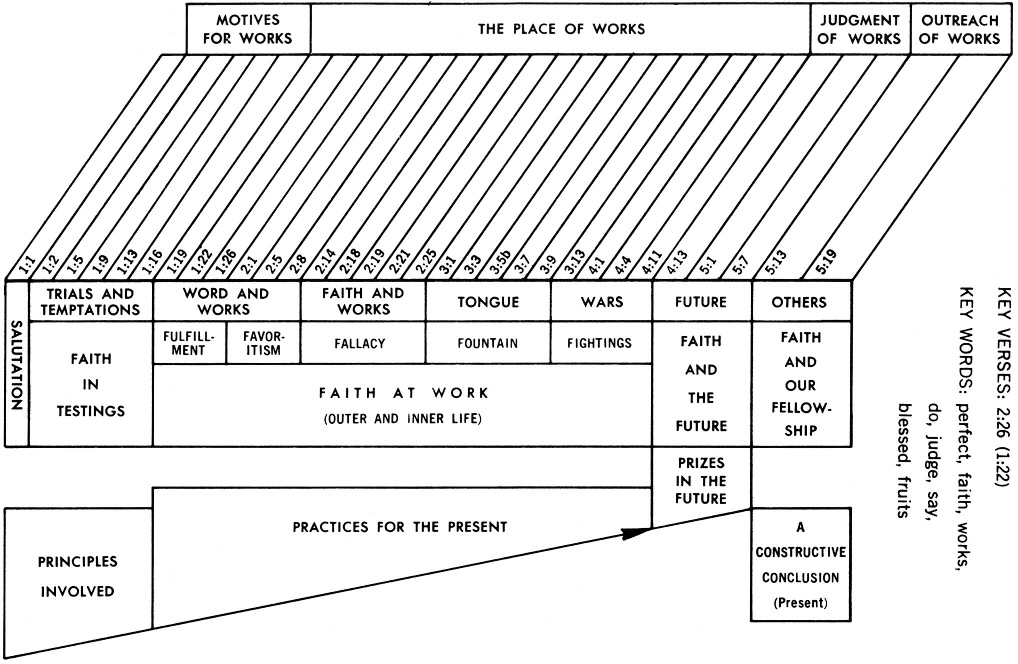
Click chart to enlarge
Chart from recommended resource Jensen's Survey of the NT - used by permission
See also Overview Chart by Charles Swindoll
|
JAMES |
|||||||
| Motives for Works |
The Place of Works: Outward Demonstration of Inner Faith |
Outreach of Works |
|||||
| Jas 1:1-18 | Jas 1:19-2:13 | Jas 2:14-25 | Jas 3:1-12 | Jas 3:13-4:12 | Jas 4:13-5:12 | Jas 5:13-19 | |
| Trials & Temptations |
Word & Works |
Faith & Works |
Tongue | Wars | Future | Others | |
|
Faith |
Fulfill |
Favor |
Fallacy |
Fountain |
Factions |
Faith |
Faith |
|
FAITH AT WORK |
|||||||
Faith tested by its reaction to partiality (James 2:1–13)
A. The rebuke for partiality (James 2:1–4)
1. The prohibition of partiality (James 2:1)
2. The illustration of partiality (James 2:2–3)
3. The question of condemnation (James 2:4)
B. The result of partiality (James 2:5–11)
1. The inconsistency in their conduct (James 2:5–7)
a. The divine choice of the poor (James 2:5b–6a)
b. The hostile actions of the rich (James 2:6b–7)
2. The breach of God’s law (James 2:8–11)
a. The relations to this law (James 2:8–9)
(1) The commendation upon its fulfillment (James 2:8)
(2) The sin in its violation (James 2:9)
b. The breaking of this law (James 2:10–11)
(1) The principle stated (James 2:10)
(2) The principle illustrated (James 2:11)
C. The appeal for consistent conduct (James 2:12–13)
1. The statement of the appeal (James 2:12)
2. The vindication of the appeal (James 2:13)
Faith tested by its production of works (2:14–26)
A. The character of a useless faith (James 2:14–20)
1. The uselessness of an inoperative faith (James 2:14–17)
a. The question concerning inoperative faith (James 2:14)
b. The illustration of inoperative faith (James 2:15–16)
c. The application made to inoperative faith (James 2:17)
2. The barrenness of orthodox faith without works (James 2:18–20)
a. The assertion of an objector (James 2:18a)
b. The challenge to the objector (James 2:18b–19)
(1) The demonstration of faith by works (James 2:18b)
(2) The character of faith without works (James 2:19)
c. The appeal to the objector (James 2:20)
B. The manifestation of saving faith through works (James 2:21–25)
1. The working of Abraham’s faith (James 2:21–24)
a. The evidence of Abraham’s faith (James 2:21)
b. The results of Abraham’s working faith (James 2:22–23)
(1) The perfecting of his faith (James 2:22)
(2) The fulfillment of the Scripture (James 2:23a)
(3) The friendship with God (James 2:23b)
c. The conclusion from Abraham’s example (James 2:24)
C. The union of faith and works (James 2:26) (From Hiebert - James Commentary)
James 2:1 My brethren, do not hold your faith in our glorious Lord Jesus Christ with an attitude of personal favoritism.
GNT Ἀδελφοί μου, μὴ ἐν προσωπολημψίαις ἔχετε τὴν πίστιν τοῦ κυρίου ἡμῶν Ἰησοῦ Χριστοῦ τῆς δόξης.
Amplified MY BRETHREN, pay no servile regard to people [show no prejudice, no partiality]. Do not [attempt to] hold and practice the faith of our Lord Jesus Christ [the Lord] of glory [together with snobbery]!
Phillips Don't ever attempt, my brothers, to combine snobbery with faith in our glorious Lord Jesus Christ!
Wuest My brethren, stop holding your faith in our Lord Jesus Christ, the Lord of the glory, in connection with an act showing partiality [to anyone].
NET My brothers and sisters, do not show prejudice if you possess faith in our glorious Lord Jesus Christ.
NLT My dear brothers and sisters, how can you claim to have faith in our glorious Lord Jesus Christ if you favor some people over others?
KJV My brethren, have not the faith of our Lord Jesus Christ, the Lord of glory, with respect of persons.
ESV My brothers, show no partiality as you hold the faith in our Lord Jesus Christ, the Lord of glory.
ASV My brethren, hold not the faith of our Lord Jesus Christ, the Lord of glory, with respect of persons.
CSB My brothers, do not show favoritism as you hold on to the faith in our glorious Lord Jesus Christ.
NIV My brothers, as believers in our glorious Lord Jesus Christ, don't show favoritism.
NKJ My brethren, do not hold the faith of our Lord Jesus Christ, the Lord of glory, with partiality.
NRS My brothers and sisters, do you with your acts of favoritism really believe in our glorious Lord Jesus Christ?
YLT My brethren, hold not, in respect of persons, the faith of the glory of our Lord Jesus Christ,
NAB My brothers, show no partiality as you adhere to the faith in our glorious Lord Jesus Christ.
NJB My brothers, do not let class distinction enter into your faith in Jesus Christ, our glorified Lord.
GWN My brothers and sisters, practice your faith in our glorious Lord Jesus Christ by not favoring one person over another.
BBE My brothers, if you have the faith of our Lord Jesus Christ of glory, do not take a man's position into account.
- do not hold your faith: Ac 20:21 24:24 Col 1:4 1Ti 1:19 Tit 1:1 2Pe 1:1 Rev 14:12
- in our glorious Lord Jesus Christ : Ps 24:7-10 1Co 2:8 Tit 2:13 Heb 1:3
- with an attitude of personal favoritism: Jas 2:3,9 3:17 Lev 19:15 De 1:17 16:19 2Ch 19:7 Pr 24:23 28:21 Mt 22:16 Ro 1:11 1Ti 5:21 Jude 1:16
- James 2 Resources - Multiple Sermons and Commentaries
- JAMES 2:1-13 5W/H QUESTIONS (5W/H) for personal study or leading a verse by verse inductive study on James
Structural Outline of James 2:1–13
A. The Rebuke for Partiality (vv. 1–4)
1. The prohibition of partiality (v. 1)
2. The illustration of partiality (vv. 2–3)
3. The question of condemnation (v. 4)
B. The Result of Partiality (vv. 5–11)
1. The inconsistency in their conduct (vv. 5–7)
2. The breach of God’s law (vv. 8–11)
C. The Appeal for Consistent Conduct (vv. 12–13)
1. The statement of the appeal (v. 12)
2. The vindication of the appeal (v. 13)
Related Passages:
Romans 2:11 For there is no partiality with God.
Ephesians 6:9 And masters, do the same things to them, and give up threatening, knowing that both their Master and yours is in heaven, and there is no partiality with Him.
Colossians 3:25 For he who does wrong will receive the consequences of the wrong which he has done, and that without partiality.
Acts 10:34-35 Opening his mouth, Peter said: “I most certainly understand now that God is not one to show partiality, 35 but in every nation the man who fears Him and does what is right is welcome to Him.
1 Corinthians 2:8 the wisdom which none of the rulers of this age has understood; for if they had understood it they would not have crucified the Lord of glory;
John 1:14 And the Word became flesh, and dwelt among us, and we saw His glory, glory as of the only begotten from the Father, full of grace and truth.
Revelation 5:12-13 saying with a loud voice, "Worthy is the Lamb that was slain to receive power and riches and wisdom and might and honor and glory and blessing." And every created thing which is in heaven and on the earth and under the earth and on the sea, and all things in them, I heard saying, " To Him who sits on the throne, and to the Lamb, be blessing and honor and glory and dominion forever and ever."
PROHIBITION OF
PARTIALITY
What James is calling for in this passage is our Christian BEHAVIOR to match our Christian BELIEF. Keep the context in mind: he has just urged his readers to practice "pure and undefiled religion" (James 1:27), and now he provides a concrete illustration of what that looks like within the church. Genuine faith is not merely professed; it is demonstrated in the way believers treat one another. Thus, James confronts the sin of favoritism and calls his readers to show the same impartiality that characterizes God Himself. This section also serves as a natural bridge to the next major unit (James 2:14-26), where James explains that the genuineness of faith is revealed by works. James 2:1-13 describes one such work, the practical expression of love, mercy, and impartiality toward fellow believers. In short, James insists that authentic faith must be visible in everyday relationships, for true Christianity is not merely a matter of doctrine confessed, but of doctrine lived.
As Brian Bell agrees that "In James 2:1-26 we’ll continue to understand what true religion and real faith look like (see James 1:27).
J Vernon McGee entitles James 2:1-13 as "God Tests Faith by Attitude and Action in Respect of Persons" which is a good summary of this section.
My brethren (adelphos) - It is surprising that the phrase my brethren appears only 22x in the all of the Bible and 8 of those uses are in the epistle of James. (Jas. 1:2; Jas. 2:1; Jas. 2:14; Jas. 3:1; Jas. 3:10; Jas. 3:12; Jas. 5:12; Jas. 5:19). Similarly, the related phrase my beloved brethren occurs only 5 times in Scripture and 3 of the uses are by James (Jas. 1:16; Jas. 1:19; Jas. 2:5). James is addressing his readers as a fellow believer and in using "beloved" emphasizes that what he is saying is motivated by love for them. This is a family issue and James addresses it with a pastor’s heart, not from a judge’s bench.
Jamieson - The equality of all Christians as "brethren," forms the groundwork of the admonition.
Do not hold - James is issuing a command in the present imperative with a negative which means "do not be holding" meaning stop practicing partiality, "don't make it a practice!" of showing favoritism, or don't start. James is calling for a halt to a practice that was already in progress in some assemblies. What James is commanding is better seen by rephrasing and paraphrasing the passage "As believers in our glorious Lord Jesus Christ, don't show favoritism." So if any of his readers are demonstrating favoritism, they must cease from this forthwith! Paul uses the related verb (prosopolempteo) in James 2:9 and clearly calls this favoritism a sin!
Paul of course is not saying that we should never show honor to members of the body. As MacArthur says "Paul wrote the Thessalonians to "appreciate" and "esteem... very highly" their pastors (1 Thess. 5:12-13). "The elders who rule well are to be considered worthy of double honor," Paul told Timothy, "especially those who work hard at preaching and teaching" (1 Tim. 5:17)." (MacArthur New Testament Commentary – James) Similarly Peter says "Honor all people, love the brotherhood, fear God, honor the king." (1 Pe 2:17)
Your faith (pistis) in our glorious (doxa) Lord (kurios) Jesus (Iesous) Christ (Christos) - The NET Bible = "if you possess faith in our glorious Lord Jesus Christ." The NLT paraphrases it in the form of a question "how can you claim to have faith in our glorious Lord Jesus Christ" if you are demonstrating as attitude of favoritism? Goodspeed also phrases it as a question -- "Do you try to combine faith in our glorious Lord Jesus Christ with acts of partiality?" While it is possible this was in the forth of a question, reading it as a command is favored by most commentators and is a bit more forceful than a question.
Bob Utley on faith - This is not "faith" in the sense of doctrine, as in Acts 6:7; 13:8; 14:22; Gal. 1:23; 3:23; 6:10; Phil. 1:27; Jude 3 and 20, but personal trust in Christ (objective genitive). "in our glorious Lord Jesus Christ" This GENITIVE phrase is literally "of the glory" and is in apposition to the GENITIVE phrase literally "of the Lord." This is a title for Deity in the Bible (cf. Ps. 29:1-9; Acts 7:2; Eph. 1:17). The rabbis used the term Shekinah glory" to speak of YHWH dwelling with Israel (cf. Exod. 16:10; 2 Chr. 7:1-3).
Our glorious (doxa) Lord (kurios) Jesus (Iesous) Christ (Christos) - Literally "our Lord Jesus Christ of the glory." ESV = "Lord Jesus Christ, the Lord of glory"- Some commentators think this is a reference to the Shekinah glory of God (cf Ex 40:34, Nu 14:10, 1Ki 8:11, 2Chr 7:2). In either event James is appealing to those who "are actively adhering to the One in Whom "the faith" centers." (Hiebert). Paul later calls Christ “the Lord of glory” in 1 Corinthians 2:8.
Looking up to Jesus prevents us
from looking down on others.
Lord (kurios) Jesus (Iesous) Christ (Christos) - His full Name is found only here and James 1:1 in this letter and in that passage on a par with God! There are of course other allusions to Jesus Christ (See Jas 2:7, Jas 5:7, 9, 14-15) John associates glory (doxa) with Jesus in John 1:14 "And the Word became flesh, and dwelt among us, and we saw His glory (doxa), glory (doxa) as of the only begotten from the Father, full of grace and truth." (See also Heb 1:3).
Proper View of Christ Leads to
a Proper View of Others.
Paul Apple makes an excellent point that a "Proper View of Christ Leads to a Proper View of Others. Once we truly see how "glorious" Christ is, there will be no room for distinctions on the human plane because we all pale in comparison to the glory of Christ. Look at how our Lord (in all of His Majesty) treated others and we will see that there is no room for "personal favoritism" on our part. Surely the disciples are not above the Master when it comes to showing compassion to all men without distinction." (Commentary) Paul Apple's comment reminds me of the words in the great hymn Turn Your Eyes on Jesus...
Turn your eyes upon Jesus
Look full in His wonderful face
And the things of earth will grow strangely dim
In the light of His glory and grace
Jamieson has an interesting thought on glory in James 2:1 - The glory of Christ resting on the poor believer should make him be regarded as highly by "brethren" as his richer brother; nay, more so, if the poor believer has more of Christ's spirit than the rich brother.
Bruce Barton - Early Christians developed descriptions for Jesus that expressed the depth of their trust in him. They could be called reflective names, since they resulted from reflections on Jesus. Paul gives us a number of his reflective names for Jesus:
- his Son, Jesus Christ our Lord (1 Corinthians 1:9)
- Christ, the power of God and the wisdom of God (1 Corinthians 1:24)
- the image of the invisible God (Colossians 1:15)
- the beginning and the firstborn from among the dead (Colossians 1:18)
- our great God and Savior, Jesus Christ (Titus 2:13) (See James - Page 42)
J Vernon McGee observes that "Here is a strong assertion of the deity of Christ. I know of no one who was in a better position to determine the deity of Christ than a younger brother of the Lord Jesus who was brought up in the same home with Him. Frankly, I think James (HALF BROTHER OF JESUS, UNBELIEVER AT ONE POINT in Jn 7:5 BUT BELIEVER AFTER 1 Cor 15:7) is in a better position to speak on the deity of Christ than some theologian sitting in a swivel chair in a musty library in New York City, removed from the reality of even his own day. Such a man is really far removed from the reality of the first century and the home in which Jesus was raised. Therefore, I go along with James, if you don't mind. He is the "Lord Jesus Christ, the Lord of glory." (See Thru the Bible Vol. 53: The Epistles James)
Jamieson on faith (the faith) - that is, the Christian faith. James grounds Christian practice on Christian faith
Matthew Henry adds that "The character of Christians fully implied: they are such as have the faith of our Lord Jesus Christ; they embrace it; they receive it; they govern themselves by it; they entertain the doctrine, and submit to the law and government, of Christ; they have it as a trust; they have it as a treasure."
If we would seek to imitate Jesus (which we are in fact commanded to do - 1 Cor 11:1 recalling that Jesus ministered to a wealthy Jewish leader as well as to poor beggars, to virtuous women as well as prostitutes, etc) we would avoid all hints of demonstrating partiality or favoritism. Our Lord did not look at the outward appearance; He looked at the heart (cf 1 Sa 16:7) In fact perfect impartiality is one of God's great attributes (Ro 2:11, Eph 6:9, Col 3:25) and if you are a Gentile, you should be especially thankful He did not demonstrate partiality. Peter learned this great truth as the door of salvation was flung open to the Gentiles in Acts 10-11, Peter "Opening his mouth, Peter said: “I most certainly understand now that God is not one to show partiality (prosopolemptes) but in every nation the man who fears Him and does what is right is welcome to Him.." (Acts 10:34-35). I love what John MacArthur said writing that "The Gospel is a great leveler, available with absolute equality to everyone who believes in the Savior it proclaims."
🙏 THOUGHT - Indeed, we are all on the same level at the foot of Jesus' Cross, which is a good place to continue to remain even after we are saved, for grace flows down (James 4:6)!
Bruce Barton comments that "In general, social distinctions did not exist in the early church. Masters sat beside their slaves during worship; sometimes a slave was the leader of the assembly. But from its beginnings, the church had many poor, outcasts, and those of little class or influence. So when a rich person was converted, the church members needed to guard against making more of a fuss over him or her than they would at the conversion of another poor person." (James - Page 44)
When wealth entered the door, the temptation to court it was real.
The church in every age faces this gravitational pull.
Warren Wiersbe - We have this same problem with us today. Pyramid climbers are among us, not only in politics, industry, and society, but also in the church. Almost every church has its cliques, and often, new Christians find it difficult to get in. Some church members use their offices to enhance their own images of importance. Many of the believers James wrote to were trying to seize spiritual offices, and James had to warn them (James 3:1). (Bible Exposition Commentary)
With an attitude of personal favoritism (prosopolepsia) - The Greek word for personal favoritism (prosopolepsia) is near the beginning of the sentence for emphasis. Note also that the noun is in the plural indicating that practically speaking there is more than one way to show partiality (just a look, withhold one's hand of fellowship, don't invite them to dinner, etc, etc). What James is saying is that if one says he has faith in Jesus, then the action of showing personal favoritism is not compatible with one who has saving faith, which is reasonable considering that most of his readers have a Jewish background and would be very familiar with this Old Testament description of God.
THOUGHT - The height of showing impartiality (not "receiving face") is seen in the life of our Lord, Isaiah recording "He was despised and forsaken of men, A man of sorrows and acquainted with grief; And like one from whom men hide their face He was despised, and we did not esteem Him." (Isaiah 53:3)
Brian Bell - Partiality/favoritism/respect of persons defined: It literally means to “receive by face”.It is to judge a book by its cover. It is judging a person by how they look. Like: by their clothes, cars, or color. It is pandering to someone, because he is rich or influential or popular. To lift up a person’s countenance, to regard him with favor. (i.e. Samuel w/Eliab) It is to hold prejudice [pre-judge]. What does “respect of persons” actually look like? Discrimination - the act, practice, or an instance of discriminating categorically rather than individually. To be bias, bent, to have a tendency - an inclination of temperament or outlook, especially a personal and sometimes unreasoned judgment. Prejudice, from the words pre + judge: preconceived judgment or opinion; an adverse opinion or leaning formed without just grounds or before sufficient knowledge. Judgments based on evil motives. James is not talking about the kind of discernment that comes from a thorough understanding of another’s character. The 3 other places partiality/favoritism shows up in the NT. We’re assured the Father is not a respecter of persons. When He judges, He judges the heart, not outward appearances! Wrong Judging! - Mt.7:1 Judge not, that you be not judged. krino meaning, “to separate, select so as to declare a verdict.” This type of judging is wrong because of the motive or attitude behind it. Right Discerning! - Heb.5:14 But solid food is for the mature, who by constant use have trained themselves to distinguish good from evil. (NIV) diakrino (prefix added) meaning, “to separate, to distinguish, to select.” It’s the idea of distinguishing on the basis of comparison, coupled w/careful thinking. The mark of a mature Christian is the ability to discern good from evil, strengths from weaknesses, to be concerned for the welfare of those we correct.
John MacArthur applies James 2:1 - Tragically, many otherwise biblical and faithful churches today do not treat all their members the same. Frequently, those who are of a different ethnic background, race, or financial standing are not fully welcomed into fellowship. That ought not to be. It not only is a transgression of God's divine law but is a mockery of His divine character. (James MacArthur New Testament Commentary - Page 100)
Bob Utley - Believers must be careful of worldly distinctions. They must also be impartial. God (in Christ), has torn down every barrier that humans have raised to their fellow human: rich-poor; Jew-Gentile; slave-free; and men-women (cf. 1 Cor. 12:13; Gal. 3:28; Col. 3:11).
J Vernon McGee adds "What James is telling us here is not to profess faith in Christ and at the same time be a spiritual snob. Don't join some little clique in the church. All believers are brethren in the body of Christ, whatever their denomination. There is a fellowship of believers; friendship should be over them as a banner. James is addressing the total community of believers -- the rich, the poor, the common people, the high, the low, the bond and free, the Jew and the Gentile, the Greek and the barbarian, male and female. They are all one when they are in the body of Christ. There is a brotherhood within the body of believers, and the Lord Jesus Christ is the common denominator. Friendship and fellowship are the legal tender among believers." (Thru the Bible Vol. 53: The Epistles - James)
David Guzik points out that "We do well to remember that James wrote to a very partial age, filled with prejudice and hatred based on class, ethnicity, nationality, and religious background. In the ancient world people were routinely and permanently categorized because they were Jew or Gentile, slave or free, rich or poor, Greek or barbarian, or whatever. A significant aspect of the work of Jesus was to break down these walls that divided humanity, and to bring forth one new race of mankind in Him (Ephesians 2:14-15)." (Enduring Word Bible Commentary – James)
Wiersbe is so right when he says "We are prone to judge people by their past, not their future....We do not enjoy sitting with certain people in church because they "are not our kind of people." Jesus was the Friend of sinners, though He disapproved of their sins. It was not compromise, but compassion, that caused Him to welcome them, and when they trusted Him, forgive them." (Bible Exposition Commentary) (Bold added)
John Phillips on the impartiality of God/Jesus - God is neither partial nor prejudiced in His dealings with the human race. The color of a person's skin, the size of his bank balance, the number of degrees he has after his name, or the place he holds in the social hierarchy leaves God completely unimpressed. The Lord Jesus was as polite to the woman at the well (John 4) as He was to Nicodemus (John 5). He was as gracious to the woman who touched the hem of His garment as He was to Jairus, the ruler of the synagogue. He was as open to poor, blind Bartimaeus as He was to the rich young ruler. He had no "respect of persons." He was as honest and forthright with the Syro-Phoenician woman as He was with Pilate. He treated everyone with the same love, the same interest, and the same care and concern. He was not condescending when He was dealing with the publicans and sinners, and He was not cowed or compromising when He was dealing with those who occupied the seat of power. He gave the outcasts and the untouchables the same gentle, loving compassion that He extended to the scribes and the Pharisees. Sometimes the Lord did not approve of peoples' behavior, but He looked beyond that to the individuals and their deepest needs and treated them with dignity no matter what. (See Exploring the Epistle of James: An Expository Commentary - Page 68)
Brian Bell summarizes James 2:1-13 - Over all theme: If you have true saving faith, you will practice impartiality. Also, we will see people in terms of character instead of clothing. You will not cater to the rich, nor ignore the poor. You will love each person for the sake of Christ. Christian love means treating others the way the Lord treats us & doing it in the power of the Spirit. Q: Are we free from the preoccupation with what people have rather than what they are? Q: Do we love & learn from the rich in faith? James made this a tightly constructed passage: 1st, he introduces a principle (Jas 2:1); then he illustrates his point (Jas 2:2-4); next he explains it (Jas 2:5-11); finally, applies it (Jas 2:12,13).
Brethren (80)(adelphos from a = denotes unity + delphus = a womb) ) in classic Greek described the son of the same mother but in the spiritual sense is actually one born by the Spirit and in the the family of the same Father. And what James addresses now is a "family issue."
Faith (pistis) is more literally "the faith" (ten pistin) so points to objective aspect of faith, that is, what is believed or what one place their faith in. In this passage "the faith" speaks of fatih in the objective sense rather than the subjective sense. In other words, Subjectively faith is the personal persuasion, conviction, belief in the truth, veracity, reality of something. "Clearly objective genitive, not subjective (faith of), but "faith in our Lord Jesus Christ." (A T Robertson) Objectively faith is that which is believed (usually designated as "the faith"),that is the doctrine believed which ultimately is embodied in the Gospel. Are you confused? The main point is these are believers and James underscores this by identifying himself with the readers when he says Jesus is "OUR" glorious Lord Jesus Christ. They did not just say "Jesus Christ is Lord," but "Jesus is MY Lord." See Study of "the faith (pistis)".
Glorious (1391)(doxa from dokeo = to think) in simple terms means to give a proper opinion or estimate of something. Glory is something that is a source of honor, fame, or admiration. It describes renown, a thing that is beautiful, impressive, or worthy of praise. It follows that the glory of God expresses all that He is in His Being and in His nature, character, power and acts. Doxa is the word used by the Septuagint (Lxx) translation of Ex 24:16 - "The glory (Septuagint = doxa) of the LORD rested on Mount Sinai, and the cloud covered it for six days; and on the seventh day He called to Moses from the midst of the cloud." It is worth noting that God's glory is past (Ex 24:16), present (Jn 1:14, fulfilling the prophecy of Isa 40:5), and future (Titus 2:13 at His Second Coming, also fulfilling the prophecy of Isa 40:5) and in the New Heaven and New Earth (Rev 21:23).
Paul writes about "the wisdom which none of the rulers of this age has understood; for if they had understood it they would not have crucified the Lord of glory." (1 Cor 2:8)
See also Glory of God, Shekinah glory cloud
LORD of glory, we adore Thee,
Christ of God, ascended high;
Heart and soul we bow before Thee,
Glorious now beyond the sky;
Thee we worship,
Thee we praise,
Excellent in all Thy ways.Mighty King, with glory crowned,
Rightful Heir and Lord of all:
Once rejected, scorned, disowned,
E'en by those Thou cam'st to call:
Thee we honour,
Thee adore,
Glorious now and evermore.
Lord (Master, Owner)(2962)(kurios from kuros = might or power, related to kuroo = to give authority) primarily means the possessor, owner, master, the supreme one, one who is sovereign (used this way of Roman emperors - Act 25:26) and possesses absolute authority, absolute ownership and uncontested power. Kurios is used of the one to whom a person or thing belonged, over which he has the power of deciding, the one who is the master or disposer of a thing (Mk 7:28)
Jesus (2424) Iesous is transliteration of the Greek Iesous, which in turn is the transliteration of the Hebrew name Jehoshua (Yehoshua) or Jeshua (Yeshua) which mean Jehovah is help or Jehovah is salvation. Stated another way the Greek Iesous corresponds to the OT Jehoshua (Yehoshua) which is contracted as Jeshua (Yeshua). In the Gospels the single Name Jesus (Iesous) is used as His personal Name and is found 538 times. In the Epistles Jesus is usually (but not always - e.g., Ro 3:26; 4:24; 1Cor 12:3; 2Cor 11:4; Phil 2:10; 1Th 4:14; Heb 7:22; 10:19, etc) used in combination with Christ or Lord (see next paragraph). Jesus is known by Christ alone some 44 times in the Gospels.
Looking at the entire NT we find Jesus in several combinations…
- Jesus Christ (137x in 134v)
- Christ Jesus (91x in 86v) All except one use (Acts 24:24) are by Paul.
- Lord Jesus Christ (63x in 63v).
- Lord Jesus (without Christ) (38x in 38v)
- Jesus the Christ occurs in Acts 3:20.
- Jesus is the Christ (Acts 9:22, cp Acts 17:3).
- Jesus was the Christ (Acts 18:5, 28).
- Jesus Christ the Nazarene (Acts 4:10).
- Jesus Christ our Lord (Ro 1:4)
One of my favorite (older) choruses is Jesus, Name Above All Names - YouTube
Jesus, Name above all names,
Beautiful Savior, glorious Lord.
Emanuel, God is with us,
Blessed Redeemer, Living Word.
Christ (5547) Christos from chrio = to rub or anoint, consecrate to an office) describes one who has been anointed with oil, one who has been consecrated. The majority of the NT uses refer to Jesus (exceptions = "false Christs" - Mt 24:24, Mk 13:22). Christos describes one who has been anointed, symbolizing appointment to a task. It is used here as the title "Anointed One" and is the Greek synonym for "Messiah." Christos is used in the Septuagint describing everyone anointed with the holy oil, especially the priesthood (Lev. 4:5, Lev 4:16) and it is also a name applied to those who were acting as redeemers like Cyrus. (See also Messiah - Anointed One)
Gilbrant writes that "Hamilton suggests a fourfold significance to such anointing (“māshach,” Theological Wordbook of the Old Testament, 1:530): (1) separation unto God, (2) authorization by God, (3) divine enablement, and (4) the coming Deliverer. In regards to this final use he says, “Though this association with the term māshach is not as prevalent in the OT as often supposed, the prospect of a righteous, Spirit-filled ruler is increasingly discernible in the OT (cf. Isaiah 9:1-7; Isa 1:1-5; Isa 61:1)” (ibid.). It was probably because of his role as a deliverer of God’s people, selected by the Lord for His purpose, that Cyrus, a Gentile emperor, was given the title of “messiah, anointed” (Isaiah 45:1). However, long after Cyrus, God’s people were still promised Messiah the prince, the one to fulfill all of the Biblical promises (Daniel 9:25,26)." (Complete Biblical Library Greek-English Dictionary)
Personal favoritism (4382)(prosopolepsia from prósopon = face + lambáno = receive) literally means "face taking", “receive face” (e.g., judging the book by its cover, judging the person by externals, not internals), the accepting of one's person. The idea is looking to see who someone is before deciding how to treat him. The idea is judging by appearance and on that basis giving or not giving special favor and respect. It pertains to judging purely on a superficial level, without consideration of a person’s true merits, abilities, or character. The Oriental custom of greeting was to bow one's face to the ground. If the one being greeting accepted the person, the one doing the greeting was allowed to lift his head again. The accepting of the appearance of a person was a Hebraic term for "partiality". In summary, the idea behind prosopolepsia is that one judges on the basis of externals or pre-conceived notions, and shows partiality or favoritism. In practice it as here in James it meant to make unjust distinctions between people by treating one person better than another. See: Impartial - God's Attribute
A T Robertson adds that prosopolepsia is "made from prosōpon lambanein (Luke 20:21; Galatians 2:6), which is a Hebrew idiom for panim nasa, "to lift up the face on a person," to be favorable and so partial to him."
Hiebert adds a helpful note on prosopolepsia - This compound noun that literally means "a receiving of face" is based on the Septuagint (Lxx) rendering of a Hebrew phrase meaning "to lift up the face" (Lev 19:15; Ps. 82:2). The compound noun does not occur in secular Greek or the Septuagint and is apparently a term developed early in the Christian church. It came to be a well-known term to denote the partiality of a judge raising the face of someone to his unjust advantage. It denotes "a biased judgment based on external circumstances such as rank, wealth, or race, disregarding the intrinsic merit of the person involved." This was a common failing of Oriental judges, and the Old Testament strictly prohibited it (Lev 19:15; Deut. 1:17; 2 Chr 19:6-7; Pr 24:23). The early church, with its strong sense of justice and personal worth, was keenly aware of this evil practice. (Commentary on James)
Ecc 5:19 riches - gift of God (Riches are a gift, not a goal)
Lk 12:15-21 beware of greed; life not = possessions; fool stores up treasure but not rich toward God
Lk 16:13-14 cannot serve God and wealth
Mt 19:24 - It is extremely difficult for a rich person to enter God’s kingdom.
Pr 11:4 - Riches cannot save in judgment; trust in wealth fails, but righteousness delivers and prospers.
Pr 11:28- Trust in riches fails; righteous will flourish
Pr 23:4-5- Do not toil obsessively for wealth; it is fleeting like an eagle in flight. (Wealth is fleeting).
Ecc 5:10- Love of money leads to dissatisfaction; it is vanity.
Mk 4:18-19- Wealth can choke the Word and prevent spiritual growth (or salvation). (Material desire can block God’s Word)
1Ti 6:9-10- Love of money = danger – Leads to temptations, ruin, and wandering from faith.
1Ti 6:17-19- Instruct the rich not to be arrogant or rely on uncertain wealth; instead, they should be rich in good deeds, generous, and ready to share, storing up treasures in heaven. (Be rich in good works – Generosity and God-centered living store eternal treasure)
SUMMARY - Riches themselves aren’t evil, but attachment to them can lead to spiritual danger. There is a balance of enjoying God’s gifts versus being enslaved by them. Receive wealth as a gift, don't pursue it as a god; don't trust it, don't love it, don't serve it; use it generously for God's purposes, because it is temporary, spiritually dangerous, and cannot save.
Lord of Glory (1 Corinthians 2:8; James 2:1) - Borrow All the Divine Names in the Bible - Herbert Lockyer
In a way, this title is akin to the one we have just considered for glory is synonymous with heaven. Describing the return of Jesus to heaven at His ascension, Paul says, "He was received up into glory" (1 Timothy 3:16). As the Lamb, "He is all the glory in Emmanuel's land." Twice over Jesus is designated Lord of Glory, and this title, as all others, is illuminated when interpreted in the light of its context.
The companion titles Father of Glory and Lord of Glory are pregnant with spiritual meaning. Take the former, which reads in the original, "the Father of the glory," "the Father Glory-Clad" as Way puts it. The article suggests that the glory is preeminently the Father's, "the Father to whom the glory belongs," and He waits to make us the recipients of "the riches of the glory of his inheritance in the saints" (Ephesians 1:7, 18). Stephen tells us that as The God of Glory" He appeared unto Moses (Acts 7:2). See Psalm 29:3.
As for our inheritance of "the riches of the glory," Ellicott comments that Paul gives us in these verses "a noble accumulation of genitives, setting for the inheritance on the side of its glory, and the glory on the side of its riches." Glory is the essential characteristic of salvation, and this glory is richly abounding.
Lord of Glory, the majestic title of Christ, embodies the thought that He Himself possessed glory as His native right. As used by Paul, the title implies that he had the most exalted conception of Christ as Lord, T. C. Edwards on 1 Corinthians 2:8 says, The Lord to whom glory belongs as His native right.... Glory is the peculiar attribute of Jehovah among all the gods (Psalm 29:1). The expression... implies that Jesus was Lord of Glory, that is Jehovah and that the Lord of Glory died" (Acts 3:15). Paul also speaks of "the Lords death" (1 Corinthians 11:26). The hymnist invites us to "survey the Cross, on which the Prince of Glory died." As we saw in another connection our Lord's Deity gave efficacy to His death for sinners. He is called The Lord of Glory, then, because glory belongs to Him as His characterizing quality and because He came as "the effulgence of the glory of God" (Hebrews 1:3).
Paul describes how the princes of this world "crucified the Lord of glory" who was "ordained before the world unto our glory" (1 Corinthians 2:7, 8; Matthew 25:34). The glory was ever His, and He came to bestow it upon us, and to bring to us the perfection of our nature. Arthur Way translates it, "to lift us into the glory of His presence." It was only through His sacrifice, however, that He achieved this purpose (Revelation 11:8). Jesus is the Lord whose attribute is glory (Psalm 29:1; Acts 7:2; Ephesians 1:17).
The quotation from James has a different significance. Here, the words, the Lord are in italics, meaning they are not in the original, and so the passage should read, "our Lord Jesus Christ, the glory," or, "the Glorious One" (2:1), and is akin to the phrase, "the brightness of His glory" (Hebrews 1:3). He is the true Shekinah. But rich in glory, for our sakes He became poor, and the application James makes is instructive, namely, that in the presence of Christ the Glory earthly distinctions and glory should disappear (2:1-9). Incidentally, this is one of the rare passages in which James, the natural brother of our Lord, breaks through his habitual reserve in speaking of his brother, who had become his Master, and shows us something of his reverence and devotion. To him, Jesus was The Glorious One.
Matthew Henry - Lord of Glory
My brothers, show no partiality as you hold the faith in our Lord Jesus Christ, the Lord of glory. James 2:1
Those who profess faith in Christ as the Lord of glory must not respect persons on account of mere outward circumstances and appearances, in a manner not agreeing with their profession of being disciples of the lowly Jesus. St. James does not here encourage rudeness or disorder: civil respect must be paid; but never such as to influence the proceedings of Christians in disposing of the offices of the church of Christ, or in passing the censures of the church, or in any matter of religion. Questioning ourselves is of great use in every part of the holy life. Let us be more frequent in this, and in everything take occasion to discourse with our souls. As places of worship cannot be built or maintained without expense, it may be proper that those who contribute thereto should be accommodated accordingly; but were all persons more spiritually-minded, the poor would be treated with more attention that usually is the case in worshiping congregations. A lowly state is most favorable for inward peace and for growth in holiness. God would give to all believers’ riches and honors of this world, if these would do them good, seeing that he has chosen them to be rich in faith, and made them heirs of his kingdom, which he promised to bestow on all who love him. Consider how often riches lead to vice and mischief, and what great reproaches are thrown upon God and religion, by men of wealth, power, and worldly greatness; and it will make this sin appear very sinful and foolish.
John Bennett - LORD OF GLORY
‘And sitting down they watched him there,’ Matt. 27:36. What thoughts passed through the minds of the Roman soldiers as they watched the dying moments of Jesus of Nazareth? What did the ‘rulers of this world’, the chief priests, the scribes, the Pharisees, see as they mocked and exulted in His death? And what did that small group of His followers think as they grieved for Him? One thing seems clear—that as they saw Him there they did not see Him as the Lord of glory. Our Lord Himself prayed saying, ‘Father, forgive them; for they know not what they do’, Luke 23:34. Peter says that ‘through ignorance ye did it, as did also your rulers’, Acts 3:17, and Paul adds here, ‘had they known it, they would not have crucified the Lord of glory’.
In Acts chapter 7 verse 2, we are told that ‘The God of glory appeared unto … Abraham’. This is probably a direct reference to the Son of God, who is always the One who proceeds from the Father to reveal the Father. James reminds us of the title again, when he speaks of ‘our Lord Jesus Christ, the Lord of glory’, Jas. 2:1. In a prophetic sense, Christ’s entry into heaven is as ‘the King of glory’, Ps. 24:7. We are given a wonderful insight into the mind of Christ as He, facing the horror and shame of the cross, could speak to the Father of ‘the glory which I had with thee before the world was’, John 17:5. When the Son of God became man, making Himself even lower than the angels, He left the glory of heaven, veiling His own inherent glory too, that He might be found in fashion as a man. This incredible step of self-abnegation led Him in a pathway of obedience, right on to death, even the death of the cross, Phil. 2:6–8.
With what deliberate contrast those words then come to us—they ‘crucified the Lord of glory’. The Lord of glory was put to death in a place of shame; men killed the Prince of life; the Light of the world was shrouded in darkness; the Son of the Blessed became a curse for us; the Just was numbered with the transgressors; the theme of angels’ worship became the song of the drunkard; the Immortal lay down His life. Why? This was ‘the wisdom of God … which God ordained before the world unto our glory’, v. 7. Only God could bring glory from shame!
B B Warfield's book The Lord of Glory - 344 pages on various Names of Christ
F B Meyer - James 2:1–13. This sin of making distinctions in God’s house is as rife today as ever; and wherever it is practiced the divine Spirit departs. God’s love is impartial, so far as outward appearances might affect it; and in his Church the only real differences must be those of humility, purity and righteousness.
“Blessed are the poor in spirit,” whether they be rich in this world’s goods or not. But it is easier for a poor man to be rich in faith and an heir of the Kingdom, because he can give more of his attention to the things of the Spirit.
The law of love must be supreme with us; and we must love our fellows, whatever their position or property, as ourselves, for Christ’s sake. If we fail in this, we show that we have never entered into the heart of the Christian faith. A man may observe all the laws of health; but if he inhale one whiff of poison he may die; so we may be outwardly obedient to the entire Decalogue, but delinquency in love will invalidate everything.
The Lord Of Glory - Del Wininger
Introduction: There is no question about Jesus’ being the Lord of Glory. However, there is a great need for all people to recognize this fact and elevate Jesus to this exalted position. Our hope and prayer is that this study will aid each of us in doing this.
I. Jesus has the right to be called “The Lord of Glory.”
A. Events leading up to His glorification.
1. He did not glorify Himself, Heb. 5:5.
2. He was not glorified before the Holy Ghost was given, Jn. 7:39.
3. Jesus asked His father to glorify Him, Jn. 17:1.
B. Jesus regains His glory.
1. A return to former glory, Jn. 17:5; 2 Cor. 8:9.
2. God glorified His Son, Acts 3:13.
3. His glorification was made possible in His resurrection, 1 Pet. 1:21; Rev. 1:5; Col. 1:18.
II. The work of Jesus in His glorified state.
A. Among all peoples and authorities.
1. He is the Almighty, Rev. 1:8; Mt. 28:18; Eph. 1:20–22.
2. He possesses the keys of Hades and death, Rev. 1:18.
3. He is the Prince of the kings of the earth, Rev. 1:5.
B. For and among His people.
1. He supervises the work of the churches, Rev. 1:13–20; Rev. 2:5.
2. He is our mediator, 1 Tim. 2:5.
3. He is our High Priest, Heb. 4:15; Heb. 2:9, 17–18.
III. Various reactions to the “Lord of Glory.”
A. Past respect shown.
1. John was absolutely overwhelmed and fell as dead, Rev. 1:17.
2. The angels of God, Heb. 1:6; Lk. 2:8–14; 1 Pet. 3:22.
3. Stephen while being stoned, Acts 7:55–59.
4. Paul on the road to Damascus, Acts 9:4–6.
B. Future respect to be shown by all peoples in the last day, Phil. 2:10–11.
C. Present honour accorded the Lord of Glory, Rev. 5:8–14; Jn. 14:6.
Conclusion: If we overcome as He overcame, we may sit with Him in His throne, Rev. 3:21. If we suffer with Him, we may be glorified together, Rom. 8:17.
THE LORD OF GLORY - Ken Hemphill
1 Corinthians 2:8 If they had known it, they would not have crucified the Lord of glory.
The Corinthian letter has always been one of my favorites. The church family in Corinth was diverse, to say the least. And sometimes this diversity led to a factious spirit.
There were some in Corinth who were impressed by flowery speech and the rhetoric of wisdom. Thus, Paul had determined to focus on preaching Jesus simply, for he knew that those who were “mature” would recognize the wisdom of Christ without all the lofty language (2:6).
The wisdom that Paul preached was “hidden in a mystery” (verse 7), unable to be discerned by human wisdom. It is a wisdom that must be revealed by the Spirit of God, who searches “the deep things of God” (verse 10). And the sure evidence that none of the rulers of this age understood God's wisdom was their role in the crucifixion of the “Lord of glory.”
What divine irony! The very men who attempted to do away with Jesus unwittingly participated in carrying out God's divine purpose determined before the ages. They thought they were killing a messianic pretender, a blasphemer. But if they had understood the enormity of rejecting him, they would not have done so.
The title “Lord of glory” is seen by many to be the most magnificent title given to Christ. James referred to Jesus as our “glorious Lord” (James 2:1). A similar idea surfaces in John's Gospel: “We observed His glory, the glory as the One and Only Son from the Father, full of grace and truth” (John 1:14). In the Old Testament, God's glory was manifest on a smoke-shrouded mountain, the pillar of fire, and the cloud filling the temple. But once Jesus came, God's glory was manifest in him.
The Lord of all ages is thus the Lord of final glory, for himself and for all his people. Paul concluded that if the rulers of this age had understood this, they never would have rejected him. But we understand! May we never be guilty of rejecting him through our apathy or unbelief.
GOD IS THE MAN OF SORROWS
THE LORD OF GLORY - T C Horton
Which none of the princes of this world knew: for had they known it, they would not have crucified the Lord of glory. (1 Corinthians 2:8)
What a title is this! In the background are the eternal years which the mind of man can never penetrate. “The Lord of Glory”—Creator of all things, in whom is wrapped up all wisdom and power. “Had they known!” Oh, the pity of it that eyes are closed and hearts bolted against the revelation of our Lord who descended from the heights of glory and went into the depths of human sorrow and suffering in order to reveal Himself to sinful men. Pity the poor princes of this world who resist His entreaties of the Holy Spirit to receive Him as Saviour and Lord.
O gracious Lord, make our meditations of You sweet this day. Your glory is hard to comprehend. Give us grace to comprehend it. Amen.
The Lord of Glory Is My Light
1 The Lord of glory is my light,
And my salvation too;
God is my strength, nor will I fear
What all my foes can do.
2 One privilege my heart desires,
Oh! grant me an abode,
Among the churches of thy saints,
The temples of my God.
3 There shall I offer my bequests,
And see thy beauty still;
Shall hear thy message of love,
And there inquire thy will.
4 When troubles rise, and storms appear,
There may his children hide;
God has a strong pavilion where
He makes a soul abide.
5 Now shall my head be lifted high
Above my foes around;
And songs of joy and victory
Within thy temple sound.
Lord of Glory, Who Hast Bought Us
by Eliza S. Alderson, 1864 (Tr. August Crull, 1845-1923) Ac 20:35
ST. ASAPH—William S. Bambridge
1 Lord of Glory, who hast bought us
With Thy life-blood as the price,
Never grudging for the lost ones
That tremendous sacrifice;
And with that hast freely given
Blessings countless as the sand
To the unthankful and the evil
With Thine own unsparing hand;
2 Grant us hearts, dear Lord, to yield Thee
Gladly, freely, of Thine own;
With the sunshine of Thy goodness
Melt our thankless hearts of stone
Till our cold and selfish natures,
Warmed by Thee, at length believe
That more happy and more blessed
’Tis to give than to receive.
3 Wondrous honor hast Thou given
To our humblest charity
In Thine own mysterious sentence,
“Ye have done it unto Me.
Can it be, O gracious Master,
Thou dost deign for alms to sue,
Saying by Thy poor and needy,
“Give as I have given to you”?
4 Yes, the sorrow and the sufferings
Which on every hand we see
Channels are for tithes and offerings
Due by solemn right to Thee;
Right of which we may not rob Thee,
Debt we may not choose but pay,
Lest that face of love and pity
Turn from us another day.
5 Lord of Glory, who hast bought us
With Thy life-blood as the price,
Never grudging for the lost ones
That tremendous sacrifice,
Give us faith to trust Thee boldly,
Hope, to stay our souls on Thee;
But, oh! best of all Thy graces,
Give us Thine own charity.
Jon Bloom - It is moving to hear James refer to his brother as “our Lord Jesus Christ, the Lord of glory” (James 2:1). Can you imagine what this phrase meant for James? The Lord of glory had once slept beside him, ate at his dinner table, played with his friends, spoke to him like a brother, endured his unbelief, paid the debt of his sin, and then brought him to faith. It may have taken twenty to thirty years of faithful, prayerful witness by the Son of God, but the miracle occurred: his brothers believed. May the Lord of glory grant the same grace to our beloved unbelievers. (ED: IT TOOK 30 YEARS IN MY CASE!!!)
James Smith - THE OPEN FACE
"But we all with open face, beholding as in a glass, the glory of the Lord, are changed into the same image" (2 Cor. 3:18).
The open face is needed in approaching the mirror of God's Holy Word, if we would see ourselves as we really are, and be transfigured into the image of the Lord of glory. The Word of God will have no transforming power in our hearts if we look into it only with that blinking critical eye that proudly sits in judgment upon the truth. The Lord give us that frank, open, honest face that rejoices in the truth, that our inner man may be changed into His image. If the truth of God transforms not our hearts and lives, we have not the open face.
No More Prejudice
Read: James 2:1-10
My brethren, do not hold the faith of our Lord Jesus Christ, the Lord of glory, with partiality. — James 2:1
A 2010 survey by Newsweek contained some startling statistics: 57 percent of hiring managers believe an unattractive (but qualified) job candidate would have a harder time getting hired; 84 percent of managers said their bosses would hesitate before hiring a qualified older candidate; 64 percent of hiring managers said they believe companies should be allowed to hire people based on appearance. All are clear examples of unacceptable prejudice.
Prejudice is not new. It had crept into the early church, and James confronted it head-on. With prophetic grit and a pastor’s heart, he wrote: “My brethren, do not hold the faith of our Lord Jesus Christ, the Lord of glory, with partiality” (James 2:1). James gave an example of this type of prejudice—favoring the rich and ignoring the poor (vv.2-4). This was inconsistent with holding faith in Jesus without partiality (v.1), betrayed the grace of God (vv.5-7), violated the law of love (v.8), and was sinful (v.9). The answer to partiality is following the example of Jesus: loving your neighbor as yourself.
We fight the sin of prejudice when we let God’s love for us find full expression in the way we love and treat each other. — Marvin Williams
Thinking It Over
Who helped you determine what is the right way to treat people? Was it based on external things? What are some ways you can love people as Jesus did?
Looking up to Jesus prevents us from looking down on others.
WEALTH - The Bible presents a balanced and nuanced view of wealth. Scripture neither condemns wealth itself nor exalts poverty as inherently virtuous. Rather, wealth is viewed through the lens of God's ownership, human stewardship, covenant responsibility, and eternal priorities. From Genesis to Revelation, the fundamental truth is that God owns all things. "The earth is the LORD'S, and all it contains" (Psalm 24:1; cf. 1 Chronicles 29:11; Psalm 50:12; Isaiah 66:2). Therefore, human beings are not ultimate owners but stewards entrusted with resources to be used for God's glory and the good of others (Deuteronomy 8:11-20; Leviticus 19:9-18; Isaiah 58:6-10).
Under the Mosaic Covenant, wealth was often associated with covenant blessing and obedience (Leviticus 26; Deuteronomy 28). Material prosperity could be a sign of God's favor upon a faithful nation, while poverty and hardship could reflect covenant discipline. Yet even in the Old Testament, wealth was never an end in itself. God's people were commanded to honor Him with their possessions (Proverbs 3:9), care for the poor and vulnerable (Deuteronomy 14:28-29; 26:12-15), and avoid gaining wealth through oppression or dishonesty (Jeremiah 5:26-29; Micah 6:9-12). The prophets repeatedly condemned those who enriched themselves at the expense of others. Thus, wealth was viewed as a gift from God to be managed responsibly, not as proof of personal superiority or spiritual worth.
The book of Proverbs adds an important practical dimension. Proverbs generally teaches that diligence, wisdom, integrity, and hard work tend to lead to prosperity, while laziness and foolishness often lead to poverty (Proverbs 10:4-5; 12:11; 13:11; 21:5). However, Proverbs also warns that riches are uncertain, temporary, and spiritually dangerous when trusted instead of God (Proverbs 11:28; 23:4-5; 27:24). Wisdom is consistently presented as far more valuable than material wealth (Proverbs 3:13-15; 8:10-11). The righteous are exhorted to be generous, compassionate, and willing to share with the poor, recognizing that "He who is gracious to a poor man lends to the LORD" (Proverbs 19:17; cf. Proverbs 11:24-26; 14:31; 22:9).
The New Testament shifts the focus from covenant prosperity to kingdom priorities. Jesus repeatedly warned that wealth can become a powerful spiritual obstacle because it tempts people to trust in their resources rather than in God (Matthew 6:24; 13:22; 19:23-24; Luke 12:15-21). He taught His followers to seek first God's kingdom and trust the Father to provide their daily needs (Matthew 6:25-34). Wealth is not condemned, but the love of wealth is. The rich young ruler (Mark 10:17-31) and the church at Laodicea (Revelation 3:17-19) illustrate how material prosperity can foster self-sufficiency and spiritual blindness.
At the same time, the New Testament never teaches that poverty is inherently godly or that wealth is inherently sinful. Rather, believers are called to hold possessions loosely, recognizing the temporary nature of earthly riches (1 Corinthians 7:30-31). Paul exhorted Christians to work diligently (Ephesians 4:28; 2 Thessalonians 3:10-12), provide for their families (1 Timothy 5:8), be content with what God has supplied (Philippians 4:11-12; Hebrews 13:5), and use their resources generously for the benefit of others (1 Timothy 6:17-19). Wealth becomes dangerous when it becomes a source of security, identity, pride, or self-reliance rather than a tool for serving God and others.
James reflects this same perspective. He condemns favoritism toward the rich (James 2:1-7), warns wealthy oppressors of coming judgment (James 5:1-6), and reminds believers that God has often chosen "the poor of this world to be rich in faith and heirs of the kingdom" (James 2:5). James is not glorifying poverty; rather, he is exposing the folly of judging people by worldly standards. God's kingdom values differ radically from the world's values. Those who appear insignificant in the eyes of society may be highly esteemed by God, while those who appear powerful and successful may be spiritually bankrupt.
The Bible's overarching message is clear: wealth is a gift from God, not a god to be worshiped. It is a stewardship, not an entitlement. It may be enjoyed with gratitude, but never trusted as a source of ultimate security. Material possessions are temporary, but righteousness, generosity, faithfulness, and devotion to God have eternal value. Therefore, believers must continually evaluate their attitudes toward wealth in light of Scripture, ensuring that their trust rests not in uncertain riches but in "God, who richly supplies us with all things to enjoy" (1 Timothy 6:17).
ILLUSTRATION - Bishop Potter was sailing for Europe on one of the great transatlantic ocean liners. When he went on board, he found that another passenger was to share the cabin with him. After going to see the accommodations, he came up to the purser’s desk and inquired if he could leave his gold watch and other valuables in the ship’s safe. He explained that ordinarily he never availed himself of that privilege, but he had been to his cabin and had met the man who was to occupy the other berth. Judging from his appearance, he was afraid that he might not be a very trustworthy person. The purser accepted the responsibility for the valuables and remarked, “It’s all right, bishop, I’ll be very glad to take care of them for you. The other man has been up here and left his for the same reason!"
ILLUSTRATION - Racism in the church today is not as bad as it used to be. Forty years ago Jan and I were members of a Bible Church in Arlington, Texas, pastored by a graduate of Dallas Seminary, where blacks were unwelcome and the whites in the church made no bones about it. They would literally get up and move if an African American sat down next to them. Needless to say, there weren’t many who visited, and none who stayed. Thankfully that would be almost unheard of today. But few of us would say there is no vestige of racial discrimination remaining in American society, or even in the Church.
Nor is racism a new problem. In OT days the Jewish people were notorious for using their unique position as God’s chosen people to justify discrimination against non‑Jews in areas that had nothing to do with their relationship with God. And the Christian Church had hardly been established before racism began to rear its ugly head. We read in Acts 6 that “In those days when the number of disciples was increasing, the Grecian Jews among them complained against the Hebraic Jews because their widows were being overlooked in the daily distribution of food.” And Paul had to hammer the Galatians with the truth that “In Christ there is neither Jew nor Greek” (Galatians 3:28)....
The book of James, written just 15 years after the death and resurrection of Jesus, demonstrates that in the earliest years of church life there was already need for a position paper on what to do “when favoritism and prejudice come to church.” I want us to read that position paper as found in James 2:1‑13. - Michael Andrus
DOES YOUR CHURCH SHOW FAVORITISM? Ask these questions:
- How closely does our congregation reflect the socioeconomic and racial neighborhood in which we gather?
- In our church, people may not be ushered to good or bad seats, but in what other ways might we be favoring the rich or discriminating against the poor?
- Would a poor person feel welcome in our church? Would a rich person feel welcome in our church?
- In what ways do we consciously or unconsciously favor some people over others in our church? Why do we do this?
- How can our ministry reach out to all people without any hint of discrimination?
- What can we do to be completely free from being impressed by the wealth or power of others? (Life Application Bible Commentary – James)
- The wealth of an individual is no measure of the worth of that individual.
- The real measure of a person’s wealth is how much he would be worth if he lost all his money.
Dana Gould - When a Christian shows favoritism, he is being double-minded. A Christian has identified with Jesus and His interests and concerns. Jesus, God’s unique Son, chose to identify with the poor and helpless during His ministry on earth. His attitude is the model for every believer. So when a Christian plays favorites, he’s at odds with his Lord. (Shepherd's Notes: James)
King Oscar - I remember reading a story about a plainly dressed man who entered a church in the Netherlands and took a seat near the front. A few minutes later a woman walked down the aisle, saw the stranger in the place she always sat, and curtly asked him to leave. He quietly got up and moved to a section reserved for the poor.
When the meeting was over, a friend of the woman asked her if she knew the man she had ordered out of her seat. “No,” she replied. Her friend then informed her, “The man you ordered out of your seat was King Oscar of Sweden! He is here visiting the Queen.” - Our Daily Bread, December 3, 1993
John MacArthur - THE IMPARTIALITY OF GOD Drawing Near: Daily Readings for a Deeper Faith
“My brethren, do not hold your faith in our glorious Lord Jesus Christ with an attitude of personal favoritism” (James 2:1).
Because God is impartial,
we as Christians must be impartial too.
People are prone to treat others differently based upon external criteria such as looks, possessions, or social status, but God is utterly impartial. He never shows favoritism and always judges righteously.
Favoritism can be defined as a preferential attitude and treatment of a person or group over another having equal claims and rights. It is unjustified partiality. James 2:1–13 confronts this as sin and admonishes us to avoid it at all costs.
God’s impartiality is seen throughout Scripture. For example, Moses said to the people of Israel, “The Lord your God is the God of gods and the Lord of lords, the great, the mighty, and the awesome God who does not show partiality, nor take a bribe. He executes justice for the orphan and the widow, and shows His love for the alien by giving him food and clothing. So show your love for the alien, for you were aliens in the land of Egypt” (Deut. 10:17–19). Jehoshaphat, king of Judah, warned his judges to rule without partiality because God Himself has “no part in unrighteousness, or partiality” (2 Chron. 19:7).
God’s impartiality is also seen in His gracious offer of salvation to people of every race. In Acts 10:34–35 Peter says, “I most certainly understand now that God is not one to show partiality, but in every nation the man who fears Him and does what is right, is welcome to Him.”
God is also impartial in judgment. Romans 2:9–11 says that God will bring “tribulation and distress for every soul of man who does evil … but glory and honor and peace to every man who does good. … For there is no partiality with God.”
Our text is a timely admonition because prejudice, discrimination, and bigotry are ever-present evils in our society—both inside and outside the church. I pray that God will use these studies to guard you from favoritism’s subtle influences and to strengthen your commitment to godly living.
Suggestions for Prayer: Ask God to reveal any partiality you might be harboring. As He does, confess it and turn from it.
For Further Study: Read Ephesians 6:5–9 and 1 Timothy 5:17–21. How does God’s impartiality apply to how you should respond to your co-workers and your church leaders?
John MacArthur - LOOKING BEYOND EXTERNALS Drawing Near: Daily Readings for a Deeper Faith
“My brethren, do not hold your faith in our glorious Lord Jesus Christ with an attitude of personal favoritism” (James 2:1).
Your true worth is based on the value of your soul,
not on external considerations.
Jesus is “our glorious Lord” (James 2:1)—the Sovereign One who rules over all His creation, the One in whom the fullness of God’s glory is revealed. John said, “The Word [Jesus] became flesh, and dwelt among us, and we beheld His glory, glory as of the only begotten from the Father, full of grace and truth” (John 1:14). Paul said, “In Him all the fullness of Deity dwells in bodily form” (Col. 2:9).
As God, Jesus shares the impartiality of the Father. He knows that a person’s worth is based on the value of his soul, not on external considerations. That’s why He always looks on the heart and never judges on externals alone.
That was evident in the way Jesus dealt with sinners when He was still on earth. He never hesitated to confront them—whether they were influential Jewish religious leaders or common folks. Even His enemies acknowledged His impartiality when they said, “Teacher, we know that You are truthful and teach the way of God in truth, and defer to no one; for You are not partial to any” (Matt. 22:16).
Like the Father, Jesus also extended the offer of salvation to men and women of every race, social class, and moral standing. That’s illustrated by the parable He told in Matthew 22:1–14 about the marriage of a king’s son (an illustration of Himself). The invited guests (Israel) didn’t show up, so the king commanded his servants to go out and gather everyone they could find to furnish the wedding with guests. As a result, people of every station in life attended the wedding, just as people of every station in life are called to salvation.
As you have opportunities to minister to others today, don’t be influenced by externals such as looks, clothing, or economic level. Do as Jesus did: treat them with compassion, and speak the truth without compromise.
Suggestions for Prayer: Praise the Lord for His impartiality, and ask Him for special grace as you reach out to others today.
For Further Study: Read Matthew 20:1–16. How does that parable illustrate the impartiality of God?
Playing Favorites By Timothy Beougher
Scripture: James 2:1–7, especially verse 1: My brethren, do not hold the faith of our Lord Jesus Christ, the Lord of glory, with partiality.
Introduction: We live in a world that tends to judge people based on externals. Our culture says that your worth is determined by the kind of job you have, the kind of car you drive, the kind of house you live in, and the kind of clothes you wear. But the Bible tells us a person’s value is not determined by the amount of their valuables. James makes clear in our passage for today that while prejudice and favoritism may be commonplace in the world, they have no place in the church.
1. The Prohibition of Favoritism (v. 1). Notice James’ reference to “the Lord of glory.” He reminds us of the basis for our fellowship with one another. If God brought about our fellowship, we as believers should not break our relationships because of prejudice. The term “favoritism” or “partiality” comes from a word that means “face.” Favoritism is judging others based on appearance, or in other words, at face value. Partiality, judging on the basis of appearance instead of on the basis of the heart, is directly contradictory to the character of God (see 2 Cor. 5:16). When we see a fellow believer in sin, we care enough about him to approach him in love and point him back to God; that is judging with proper motives. The kind of judging James warns against is sin: judging with the wrong motive. In this case, we do not have the other person’s interests at heart, but our own bias and selfish interests.
2. A Picture of Favoritism (vv. 2–4). Lest anyone think that this is a sin that only others struggle with, James illustrates a situation that each of us can immediately identify with. In the context of a worship service, two different people enter. These individuals are judged on the basis of appearance alone. In ancient times, it was a sign of great wealth and social aristocracy to wear many rings. The culture of that day so valued rings that you could go to stores and rent a ring or two for a special occasion to impress others. Notice the response of the church member, “Here’s a good seat for you.” Taking the rich man down to the “chief seats” was an attempt to flatter him in hopes of getting something from him (see Matt. 23:6). A second person enters, this time described as a poor man in shabby clothes. The church member is also quick to direct this man, to make him stand or sit on the floor. This “church member” or “usher” is communicating that this person is really not welcome. I wonder if any of us secretly consider ourselves “above” others. Do we turn away from someone of seeming “lesser importance” to seek the favor of someone “more important?” James concludes his illustration in response to this behavior, “Have you not shown partiality among yourselves, and become judges with evil thoughts?”
3. The Presumption of Favoritism (vv. 5–7). Favoritism is to believe that God thinks the same way we think, that God values the same things that we value. First, James tells us that while we may think it is noble to show favoritism, God does not show favoritism on the basis of outward appearance (see Mark 12:14). The believers in James’ day needed to hear the message that to follow Christ means to judge on His standards, not on human standards. They needed to be reminded (and so do we) that God chooses the poor in the eyes of the world (see 1 Cor. 1:26–29). The presumption of favoritism is that this life is all that matters. If the rich really are in charge, then we would be wise to cater to their every whim. But if Christ is truly the King of kings, the Glorious Lord of the world (and He is), then He, not the rich, deserves our service, our allegiance, and our loyalty. The one who claims to be a follower of the glorious Lord Jesus but who then shows favoritism is guilty of having a divided heart, a double mind.
Conclusion: Let’s search our hearts for attitudes that don’t belong there, attitudes of favoritism or attitudes of prejudice. If we find them there, let’s repent of them. Let’s ask God to take them away, and to replace them with attitudes of love and compassion. I wonder if people come to mind whom we have not treated properly. We need to resolve, with God’s help, to treat these people differently.
Million Dollar Mistake
Elisa Tinsley, in USA Today, described how a Spokane, Washington bank lost one of its best customers, a construction company owner named John Barrier. John Barrier had just come from a construction site and his clothes were dirty. He went to the bank to cash a $100 check. When he tried to get his parking slip validated, the teller refused, saying he hadn’t conducted a transaction. “You have to make a deposit to get your parking slip validated,” she insisted. John Barrier told the teller he was a substantial depositor but she was obviously doubtful. He asked to see the manager, who also refused to validate the parking slip. The next day, John Barrier went back to the bank and withdrew a rather large sum of money, one million dollars to be exact.
Heavenly Father, You are the holy and just Judge. Thank You for saving us from the penalty of eternal death through the sacrifice of Jesus Christ. Thank You that our eternal security doesn’t depend on our bank accounts. You have chosen to change poor fools like us into Your people to take Your gospel to the world. Help us to carry out this great commission without prejudice or favoritism so that we may one day join hands with people from every tribe and nation around the glorious throne of the Lamb and sing Your praises throughout eternity. In Jesus’ name we ask these things, Amen.
Overcoming Prejudice Rev. Todd M. Kinde
SCRIPTURE: James 2:1–12
INTRODUCTION: Treating a person with partiality is a sin and evidence of a partial faith.
1. The Situation of Partiality (2:1–7).
2. The Solution of Love (2:8–13).
CONCLUSION: The standard of judgment is the law of liberty (v. 12). It is not an enslaving legalism. Rather, it is a royal law of love (v. 8), which the believer is enabled to keep by the indwelling Holy Spirit (Gal. 5:22, 23). God will judge the sins of prejudice and favoritism.
The Test of Love - James 2:1–9 - Croft Pentz
People love for different reasons: some love for money; others love for fame. Still others love for prestige and position. The true child of God loves God for what he can give—not what he can get. It is easy to love those who love us. But it is hard to love those who take from us and never give.
I. The Partiality—v. 1
“Dear brothers, how can you claim that you belong to the Lord Jesus Christ, the Lord of glory, if you show favoritism to rich people and look down on poor people?”—LB.
A. It is wrong to judge people by their race.
B. It is wrong to judge people by their religion.
C. It is wrong to judge people by their riches.
“… God is no respector of persons—Acts 10:34. Neither should we!
II. The Pleasing—vv. 2–4
A. The motives—v. 4. “Judging a man by his wealth shows that you are guided by wrong motives”—LB. Loving a person because of riches shows a love for money—1 Timothy 6:10. In God’s sight all men are equal.
III. The Pleasure—v. 5
A. People—“… Hath not God chosen the poor of this world rich in faith …” Those who know Christ are rich in spiritual ways. Note the words of Paul in 1 Corinthians 3:22.
B. Promise—“And heirs of the kingdom which He hath promised to them that love Him?” Those who are poor in Spirit will inherit the kingdom of God. When we are children of God, He is our Father and what He has is ours—John 1:12.
IV. The Problem—vv. 1–7
A. Problem of the rich—v. 6. The rich oppress the poor; they make trouble; they sue. To treat them better than the poor who are Christians is wrong!
B. Practice of the rich—v. 7. These rich people often use God’s name in vain; they mock Christianity; they mock Christ, whom we serve. They are not interested in serving Christ.
V. The Practice—vv. 8–9
A. Practice—v. 8. Christians must fulfil the royal law—to love others as we love ourselves. See Leviticus 19:8, Matthew 22:39.
B. Problem—v. 9. If you show partiality you are breaking God’s law. Compare with James 4:17.
Why do you love God?—for what He gives, or what you can give? Do you displease God by loving some people while ignoring others? Are you willing to love when you know it will cost you something? Are you looking for those who will give something to you in return for your love? How deep is your love toward God? Real love is more than words.
Wrong Motives
Someone once penned a clever rhyme to illustrate the problem of favoritism:
. . . many people go to church,
As everyone knows;
Some go to close their eyes,
And some to eye their clothes.
Favoritism Challenged
Muretus, a wandering scholar in the Middle Ages was very learned but very poor. In his wanderings he fell ill, and he was taken to the place where the destitute were kept. The people who cared for him did not know that he was a scholar and that he understood Latin. The doctors were discussing his case in Latin, saying that he was a poor creature of value to no one and that it was hopeless and unnecessary to expend care and money on attention to such a worthless individual. Muretus looked up and answered in their own Latin, “Call no man worthless for whom Christ died.”
Tabletalk Magazine - The Glory of God
We turn today to the first verse of the second chapter of James, wherein the apostle refers to Jesus as “the Lord of glory.” Even though this is an acceptable translation of the original Greek text, it is not necessarily the most accurate way to render the verse in English. As the note in the Reformation Study Bible indicates, it is also possible to translate “the Lord of glory” as simply “the glory.” In reality, it does not really matter which one we choose because the two translations are synonymous. However, to say Jesus is “the glory” is a good way to encapsulate a portion of the New Testament’s description of the majesty of Christ.
As someone from a Jewish background, James undoubtedly had the Hebrew term kabod in mind when he penned his epistle. “Glory,” or kabod in the original text, usually deals with weightiness or substance. When the Old Testament declares that God’s name is “glorious” (1 Chron. 29:13), it is ascribing weight or importance to His name. Basically, the meaning is that God possesses supreme gravitas; nothing is more important or greater than He, and no one deserves more honor.
Under the old covenant, the primary way in which our Creator manifested His glory was in a cloud. (Ex. 16:10; 1 Kings 8:10). We do not know exactly what this cloud looked like, but we get the impression that it glowed brightly with some kind of unique light because this same cloud had to direct Israel through the wilderness after they left Egypt (Neh. 9:12). In fact, most of us probably think of bright light whenever we hear the word glory, and this is due to the fact that light is often associated with glory in Scripture (Rev. 21:23).
Christ is the incarnation of God’s glory (John 1:14), and it is the vision of this glory in the new heavens and earth for which we all hope. When Jesus walked the earth, this glory was usually hidden from plain view and only visible for brief moments to a select few of His disciples (Luke 9:28–36). But all who love and serve the Messiah will one day get to see the beauty of His glory. In the new Jerusalem we will see Him face to face (Rev. 21).
Sin Of The Skin
Do not hold the faith of our Lord Jesus Christ, the Lord of glory, with partiality. —James 2:1
Most people hate to be accused of racism. But racial bias is all too prevalent. Even Christians have had a long history of ethnic prejudice. In the first century, Jewish believers were reluctant to accept their Gentile brothers. In recent years, racial discrimination has been a dominant issue.
Prejudice can run so deep that it sometimes takes a tragedy to make a person see how wrong it is to discriminate on the basis of physical differences. Several years ago I read about a bigoted truckdriver who had no use for African-Americans. But one early morning, his tanker truck flipped over and burst into flames. A week later, he was lying in a hospital bed and looking into the face of a black man who had saved his life. He learned that the man had used his own coat and bare hands to smother the flames that had turned the trucker into a human torch. He wept as he thanked the man for his act of unselfish heroism.
We shouldn’t need a tragedy to open our eyes. We need only look to Calvary. There our Lord gave His life for people of every language, race, and nation. The universal scope of His sacrifice shows His love for every human being.
Have mercy on us, Lord, if we have fanned the fire of prejudice that You died to put out.By Mart DeHaan (Our Daily Bread, Copyright RBC Ministries, Grand Rapids, MI. — Reprinted by permission. All rights reserved)
Join hands, then, brothers of the faith,
Whate'er your race may be;
Who serves my Father as a son
Is surely kin to me.
—Oxenham
Prejudice is a lazy man's substitute for thinking.
No Partiality
Do not hold the faith of our Lord Jesus Christ, the Lord of glory, with partiality. —James 2:1
A man attended a church regularly for several months, but he was always ignored. Because no one knew who he was, and he looked out-of-place with his old and worn-out clothes, no one ever took the time to speak to him.
One Sunday as he took a seat in church, he intentionally left his hat on. As the pastor stood on the platform and looked out over the audience, he noticed the man with the hat right away. So he summoned one of the deacons and asked him to tell the man that he forgot to remove his hat. When the deacon spoke to the man, he responded with a big smile and said, “I thought that would do it. I have attended this church for 6 months, and you are the first person who has ever talked to me.”
There is no place for prejudice or favoritism in the family of God. We who have been born again through faith in Jesus are equals in God’s sight. And that equality should be evident in the way we treat other believers.
We must be hospitable and courteous to all, regardless of their race, social status, or appearance. When we show favoritism, we sin against people whom God loves and for whom Christ died. Let’s be gracious to everyone and be careful to avoid showing partiality. By: Richard DeHaan (Our Daily Bread, Copyright RBC Ministries, Grand Rapids, MI. — Reprinted by permission. All rights reserved)
All those who know and love the Lord
Must show by word and deed
That they will not discriminate
But welcome those in need.
—D. De Haan
Prejudice builds walls; love breaks them down.
A Misleading Impression
God shows personal favoritism to no man. —Galatians 2:6
Today's Scripture: James 2:1-13
He wasn’t wearing a shirt, and his car looked like it was a refugee from a junkyard. Yet the unkempt man who stopped to help them on the Chicago expressway was, to my friends, angelic.
While traveling the busy highways of Chicago, Ken and Sue’s van blew a tire. As they edged toward the shoulder of the expressway, with cars flying past, they quickly prayed for help. That’s when the man in the rusty car waved and yelled to them that he would help.
Most of us are reluctant to trust complete strangers, so my friends were understandably wary of this scraggly man. Yet they soon found out that he was a mechanic who himself had been stranded just days earlier. He grabbed his tools, got to work on their car, and quickly had them back on the road.
We often judge people by the way they look or dress, or by what kind of car they drive. Sure, we must be careful whom we trust, but that doesn’t mean we should dismiss everyone who doesn’t dress like a television news anchor.
People come in all sizes, colors, and conditions. Before we set aside those who don’t match our personal standards, we need to remind ourselves that our Creator doesn’t play favorites (Gal. 2:6). Neither should we. By: Dave Branon (Our Daily Bread, Copyright RBC Ministries, Grand Rapids, MI. — Reprinted by permission. All rights reserved)
First impressions are misleading
For we do not know the heart;
We can often be mistaken
Since we only know in part.
—Fitzhugh
Always look at others through the eyes of Christ.
MERCY OVER JUDGMENT
READ: James 2:1–13
Speak and act as those who are going to be judged by the law that gives freedom. James 2:12
When my children were squabbling and came to me to tattle on one another, I took each child aside separately to hear their account of the problem. Since both were guilty, at the end of our chat I asked them each what they felt would be an appropriate, fair consequence for their sibling’s actions. Both suggested swift punishment for the other. To their surprise, I instead gave them each the consequence they had intended for their sibling. Suddenly, each child lamented how “unfair” the sentence seemed now that it was visited upon them—despite having deemed it appropriate when it was intended for the other.
My kids had shown the kind of “judgment without mercy” that God warns against (James 2:13). James reminds us that instead of showing favoritism to the wealthy, or even to one’s self, God desires that we love others as we love ourselves (v. 8). Instead of using others for selfish gain, or disregarding anyone whose position doesn’t benefit us, James instructs us to act as people who know how much we’ve been given and forgiven—and to extend that mercy to others.
God has given generously of His mercy. In all our dealings with others, let’s remember the mercy He’s shown us and extend it to others.— Kirsten Holmberg (Our Daily Bread, Copyright RBC Ministries, Grand Rapids, MI. — Reprinted by permission. All rights reserved)
Lord, I’m grateful for the great mercy You’ve shown me. Help me to offer similar mercy to others as a measure of my gratitude to You.
God’s mercy prompts us to be merciful.
A PREJUDICED USHER
James 2:1-13
If you show partiality, you commit sin. James 2:9
In his autobiography, Mahatma Gandhi wrote that during his student days he read the Gospels seriously and considered converting to Christianity. He believed that in the teachings of Jesus he could find the solution to the caste system that was dividing the people of India.
So one Sunday he decided to attend services at a nearby church and talk to the minister about becoming a Christian. When he entered the sanctuary, however, the usher refused to give him a seat and suggested that he go worship with his own people. Gandhi left the church and never returned. “If Christians have caste differences also,” he said, “I might as well remain a Hindu.” That usher’s prejudice not only betrayed Jesus but also turned a person away from trusting Him as Savior.
The “prejudiced usher” described in today’s Bible passage welcomed a wealthy visitor but insulted a poor one. Perhaps he felt he was doing his job and only carrying out the wishes of the members in the church. But he displayed bad manners, and he was guilty of a sin as serious as murder and adultery (James 2:9-11).
When people visit your church, do you warmly welcome them regardless of their race or social status? —Haddon W Robinson (Our Daily Bread, Copyright RBC Ministries, Grand Rapids, MI. — Reprinted by permission. All rights reserved)
God’s love that drew salvation’s plan
embraces every class of man;
it breaks the toughest racial wall
because it offers Christ to all.
—D De Haan
Prejudice distorts what it sees, deceives when it talks, and destroys when it acts.
"The Underbird"
You are of more value than many sparrows. —Luke 12:7
Today's Scripture: James 2:1-9
Charlie Brown, the comic strip character, identified with the underdog, probably because he always felt like one. In one scene he was building a birdhouse when the cynical Lucy came by. “I’m building it for sparrows,” Charlie told her. Lucy said, “For sparrows? Nobody builds birdhouses for sparrows.” “I do,” replied Charlie Brown. “I always stick up for the underbird.”
At times Christians may overlook the “sparrows,” the little people in their worlds. They may ignore those they view as less valuable.
James said it’s wrong for a Christian to practice partiality (James 2:1). It’s a sin to show personal favoritism (v.9). The reasons may be social, economic, educational, or ethnic, but there’s no excuse for disrespecting people with our attitudes and words.
Jesus didn’t do this. He crossed all kinds of traditional barriers to talk with tax-collectors, sinners, non-Jews, people of mixed races, the poor, as well as the rich. He came to identify with each of us, and to pay the price on the cross for all our sins.
When a sparrow falls, the Father takes note of it. But He cares much more for people, including the “underbird.” Perhaps we need a little more Charlie Brown in us. By: David C. Egner (Our Daily Bread, Copyright RBC Ministries, Grand Rapids, MI. — Reprinted by permission. All rights reserved)
Lord, help me to love the way that You love
The humble, the lowly, the meek;
And help me to care the way that You care
For sinners, the outcasts, the weak.
—Fitzhugh
Nobody wins when we play favorites.
Cemetery Walk
My brethren, do not hold the faith of our Lord Jesus Christ, the Lord of glory, with partiality. —James 2:1
Today's Scripture: James 2:1-13
On my way home from high school I often walked by one cemetery and cut through another. I was intrigued by the grave markers, for they revealed the social status of each person who had died. Near the cemetery entrances were crypts, gray stone buildings with ornate iron scrollwork and the family name prominently displayed. Pillars and large ornamental markers were nearby, then rows and rows of headstones. Small, flat, stone markers marked the graves of the poor.
As I recall those days, I’m reminded of a cemetery in Germany called God’s Acre. A young nobleman named Zinzendorf (1700-1760) opened his estate to religious refugees from Moravia. He gave them the freedom to worship God as they wished. In time, that little enclave became a worldwide missionary movement.
Each person buried in that cemetery, prince or pauper, count or coal miner, had an identical plain white headstone. This underscored their conviction that all believers in Christ are spiritually equal in their standing before God. They took seriously the teaching of James 2:1, that we are not to treat one another with “partiality.”
Lord, help us to treat our brothers and sisters in Christ as equals, giving honor to all. By: David C. Egner (Our Daily Bread, Copyright RBC Ministries, Grand Rapids, MI. — Reprinted by permission. All rights reserved)
In Jesus Christ we all are equal,
For God's Spirit makes us one;
As we give each other honor,
We give glory to His Son.
—Fitzhugh
The ground is level at the foot of the cross.
Looks And Life
Man looks at the outward appearance, but the Lord looks at the heart. —1 Samuel 16:7
During the first few hours of their 30th college reunion, Mary Schmich and her friends talked mostly about how old their classmates looked. But as the event progressed, their focus began to change. Later, in her Chicago Tribune column, Mary wrote: “Once you get used to the fact that time has robbed every single one of you of something—or added it in the wrong places . . . you stop thinking about looks [and] start talking about life.”
So much of our time and attention are devoted to physical appearance that it’s easy to consider it the most important aspect of our lives. But the Bible reminds us that God wants us to see ourselves and others differently.
When the Lord sent Samuel to anoint a new king over Israel (1 Samuel 16:1), God reminded him to look deeper than physical characteristics: “Do not look at his appearance or at his physical stature . . . . For the Lord does not see as man sees; for man looks at the outward appearance, but the Lord looks at the heart” (v.7).
God’s Word has some harsh condemnation for those who show favoritism based on appearances (James 2:1-2). When we begin to see people through God’s eyes, our focus will change from looks to life.By: David C. McCasland (Our Daily Bread, Copyright RBC Ministries, Grand Rapids, MI. — Reprinted by permission. All rights reserved)
God looks not at the outward form
But what is in the heart;
The beauty He is pleased to see,
His Spirit can impart.
—Hess
Our mirrors reflect the outward appearance;
God’s mirror reveals the inward condition.
No More Prejudice
My brethren, do not hold the faith of our Lord Jesus Christ, the Lord of glory, with partiality. —James 2:1
Today's Scripture & Insight: James 2:1-10
A 2010 survey by Newsweek contained some startling statistics: 57 percent of hiring managers believe an unattractive (but qualified) job candidate would have a harder time getting hired; 84 percent of managers said their bosses would hesitate before hiring a qualified older candidate; 64 percent of hiring managers said they believe companies should be allowed to hire people based on appearance. All are clear examples of unacceptable prejudice.
Prejudice is not new. It had crept into the early church, and James confronted it head-on. With prophetic grit and a pastor’s heart, he wrote: “My brethren, do not hold the faith of our Lord Jesus Christ, the Lord of glory, with partiality” (James 2:1). James gave an example of this type of prejudice—favoring the rich and ignoring the poor (vv.2-4). This was inconsistent with holding faith in Jesus without partiality (v.1), betrayed the grace of God (vv.5-7), violated the law of love (v.8), and was sinful (v.9). The answer to partiality is following the example of Jesus: loving your neighbor as yourself.
We fight the sin of prejudice when we let God’s love for us find full expression in the way we love and treat each other.By: Marvin Williams (Our Daily Bread, Copyright RBC Ministries, Grand Rapids, MI. — Reprinted by permission. All rights reserved)
Thinking It Over
Who helped you determine what is the right way to
treat people? Was it based on external things?
What are some ways you can love people as Jesus did?
Looking up to Jesus prevents us from looking down on others.
A W Tozer - Holy, Holy, Holy: Kneel at Jesus’ Feet
My brethren, have not the faith of our Lord Jesus Christ, the Lord of glory, with respect of persons. James 2:1
A system of literature has grown up around the notion that Christianity may be proven by the fact that “great men” believe in Christ!
A magazine article carries the caption that “Senator So-and-So Believes in Christ.” The implication is that if the senator believes in Christ, then Christ must be all right.
When did Jesus Christ have to ride in on the coattail of a senator, or a governor, or some other well known man?
No, no, my brother! Jesus Christ stands alone, unique and supreme, self-validating, and the Holy Ghost declares Him to be God’s eternal Son. Let all the presidents and all the kings and queens, the senators, and the lords and ladies of the world, along with the great athletes and great actors—let them kneel at His feet and cry, “Holy, holy, holy is the Lord God Almighty!”
Only the Holy Ghost can do this, my brethren. For that reason, I don’t bow down to great men. I bow down to the Great Man, and if you have learned to worship the Son of Man, you will not worship other men.
The Holy Spirit is God’s imperative of life. If Christ is to be the Christ of God rather than the Christ of intellect, then we must enter in beyond the veil, until the illumination of the Holy Spirit fills our hearts and we are learning at the feet of Jesus—not at the feet of men!
Daily Light on the Daily Path - Do not be haughty, but associate with the lowly.
My brothers, show no partiality as you hold the faith in our Lord Jesus Christ, the Lord of glory. . . . Has not God chosen those who are poor in the world to be rich in faith and heirs of the kingdom, which he has promised to those who love him?
Let no one seek his own good, but the good of his neighbor.—But if we have food and clothing, with these we will be content. But those who desire to be rich fall into temptation, into a snare, into many senseless and harmful desires that plunge people into ruin and destruction.
But God chose what is foolish in the world to shame the wise; God chose what is weak in the world to shame the strong; God chose what is low and despised in the world, even things that are not, to bring to nothing things that are, so that no human being might boast in the presence of God.
O Lord, my heart is not lifted up; my eyes are not raised too high.
Rom. 12:16; James 2:1, 5; 1 Cor. 10:24; 1 Tim. 6:8–9; 1 Cor. 1:27–29; Ps. 131:1
GOING TO CHURCH WITHOUT SOCKS
Do not hold the faith of our Lord Jesus Christ, The Lord of glory, with partiality. --James 2:1
In his Prison Fellowship newsletter, Chuck Colson tells of a pastor who was putting the final touches on his sermon early one Sunday morning when he heard a knock on his study door. There stood three ragged boys who had received gifts from church members. Their home was ravaged by drugs and prostitution. They had never been in a church before and wanted to look around. So the pastor gave them a quick "tour." Fifteen minutes later they were back, asking what time the service started. "Can people come to your church if their socks don't match?" asked the oldest. The pastor assured them they could. "What if they don't have any socks?" Again, the pastor reassured them. "That's good," said the boy, "because my socks don't match, and my little brother hasn't any." That morning those boys came to church and were warmly welcomed. Since then the church has helped the entire family.
Just as the gospel is open to everyone, everyone should feel welcome in our churches. Wealthy and poor, child and aged, police officer and ex-con, handicapped and athlete are all objects of Christ's love. They are all potential members of His body. May there be no barriers in our churches nor in our hearts toward anyone! --David C. Egner (Our Daily Bread, Copyright RBC Ministries, Grand Rapids, MI. — Reprinted by permission. All rights reserved)
Lord, may some weary souls find rest Because Your people took them in And helped them see the love of Christ That frees us from our guilt and sin.
Lord, may some weary souls find rest
Because Your people took them in
And helped them see the love of Christ
That frees us from our guilt and sin.
-DJD
Poor is the church that values programs more than people.
WELCOME?
"Do not hold the faith of our Lord Jesus Christ, the Lord of glory, with partiality." -- James 2:1
Many years ago, when my father, Dr. M. R. De Haan, was president of Radio Bible Class, a well-known minister came to our office. Initially I was awed by the presence of this distinguished visitor. My impression soon began to change, however, as I listened to him talk about himself. He seemed to exemplify what the apostle Paul said a Christian should NOT do, that is, "to think of himself more highly than he ought to think" (Ro 12:3). When my father asked the noted pulpiteer about another preacher in the same town, he ridiculed the man's ministry to those who lived "on the other side of the tracks." I've never forgotten that incident.
What about our attitudes? Is there favoritism in our churches? Are we as interested in the "down and outer" as much as the "up and outer"? Do we greet those on the bottom rung of the social ladder with the same enthusiasm we show to those who have riches and enjoy worldly prestige? Christians should never neglect a needy soul. The Lord is not pleased when we show undue favoritism to some and snub others. Is the word "welcome" printed on your church bulletin? Does it apply to everyone? -- Richard W. De Haan (Reprinted by permission from Our Daily Bread Ministries. Please do not repost the full devotional without their permission.)
No one is excluded from the circle of God's grace,
We cannot get beyond His love and care;
Why then do we close our minds and turn away our face
From all who in the gospel have a share?
-- Hess
A heart that is open to Christ will be open to those He loves.
James 2:2 For if a man comes into your assembly with a gold ring and dressed in fine clothes, and there also comes in a poor man in dirty clothes,
Wuest For if there comes into your synagogue [the meeting-place of Christian Jews] a man whose hand is conspicuously loaded with gold rings [and] in brightly shining clothing, and there comes in also a poor man in dirty clothing who is dependent upon others for support,
Phillips Suppose one man comes into your meeting well-dressed and with a gold ring on his finger, and another man, obviously poor, arrives in shabby clothes.
NET For if someone comes into your assembly wearing a gold ring and fine clothing, and a poor person enters in filthy clothes,
GNT ἐὰν γὰρ εἰσέλθῃ εἰς συναγωγὴν ὑμῶν ἀνὴρ χρυσοδακτύλιος ἐν ἐσθῆτι λαμπρᾷ, εἰσέλθῃ δὲ καὶ πτωχὸς ἐν ῥυπαρᾷ ἐσθῆτι,
NLT For example, suppose someone comes into your meeting dressed in fancy clothes and expensive jewelry, and another comes in who is poor and dressed in dirty clothes.
KJV For if there come unto your assembly a man with a gold ring, in goodly apparel, and there come in also a poor man in vile raiment;
ESV For if a man wearing a gold ring and fine clothing comes into your assembly, and a poor man in shabby clothing also comes in,
ASV For if there come into your synagogue a man with a gold ring, in fine clothing, and there come in also a poor man in vile clothing;
CSB For example, a man comes into your meeting wearing a gold ring and dressed in fine clothes, and a poor man dressed in dirty clothes also comes in.
NIV Suppose a man comes into your meeting wearing a gold ring and fine clothes, and a poor man in shabby clothes also comes in.
NKJ For if there should come into your assembly a man with gold rings, in fine apparel, and there should also come in a poor man in filthy clothes,
NRS For if a person with gold rings and in fine clothes comes into your assembly, and if a poor person in dirty clothes also comes in,
YLT for if there may come into your synagogue a man with gold ring, in gay raiment, and there may come in also a poor man in vile raiment,
NAB For if a man with gold rings on his fingers and in fine clothes comes into your assembly, and a poor person in shabby clothes also comes in,
NJB Now suppose a man comes into your synagogue, well-dressed and with a gold ring on, and at the same time a poor man comes in, in shabby clothes,
GWN For example, two men come to your worship service. One man is wearing gold rings and fine clothes; the other man, who is poor, is wearing shabby clothes.
BBE For if a man comes into your Synagogue in fair clothing and with a gold ring, and a poor man comes in with dirty clothing,
- if a man comes into your assembly with a gold ring: Es 3:10 8:2 Lu 15:22
- nd dressed in fine clothes: Ge 27:15 Mt 11:8,9
- there also comes in a poor man in dirty clothes: Isa 64:6 Zec 3:3,4
- James 2 Resources - Multiple Sermons and Commentaries
Related Passages:
Matthew 23:6 “They (PHARISEES) love the place of honor at banquets and the chief seats in the synagogues,
THE ILLUSTRATION
OF PARTIALITY
For (gar) is a term of explanation. This supports the interpretation above that this is a direct command and not a question, for if it were the latter, the "for" would be more difficult to explain. What is James explaining? He has just issued a rebuke (in the form of a command) and is now explaining what this might look like.
If - This introduces a third class conditional statement, indicating that the illustration is hypothetical but possible and one in fact the readers may have seen or themselves carried out. James is shooting straight at the conscience of his readers!
A man comes into your assembly (sunagoge) -Use of this term sunagoge show that he is writing to Jewish believers. The early Jewish believers still called their meetings by that familiar term.,
A T Robertson "It may seem a bit odd for a Christian church (ekklēsia) to be termed sunagoge (literally "a coming together" or "to bring together"), but James is writing to Jewish Christians and this is another incidental argument for the early date....In the fourth century an inscription has sunagōgē for the meeting-house of certain Christians."
D Edmond Hiebert - Here the reference (sunagoge) is to the place of assembly, as is evident from the mention of assigned seats. The readers are Christians (James 1:1; 2:1), and the pronoun "your" makes clear that it is not a non-Christian Jewish synagogue, since the readers are viewed as being in control of arrangements....At the time when James wrote, the Jewish Christians apparently continued to speak of their place of assembly as their "synagogue," so James used the term that would be most familiar to them. (Commentary on James)
With a gold ring (chrusodaktulios) and dressed in fine (lampros) clothes - "A gold-fingered man" like the James Bond movie! And "In bright (lampros = shining brilliant) clothing," probably referring to the glittering color of his clothes. In short he would be hard to miss! The phrase "a gold fingered man" clearly does not mean a single ring on a man's finger but to a man whose fingers were loaded down with gold rings or multiple rings on one finger, and the social status of a person could be noted by the quality of his ring The point is that this man was clearly a man of wealth and his expensive attire added to that impression.
Michael Andrus - To bring the illustration up to date, he drives up to church in a new Mercedes, wears a $1,000 hand‑tailored suit, and sports a Rolex watch. The other man is obviously poor. He drives up in a rusted ’87 sedan, wears an outdated topcoat and disheveled suit, and obviously needs a haircut. The rich man is singled out for special attention and conducted politely to his seat. The poor man, on the other hand, is ignored. Mt 23:6 helps us better understand the situation James describes by telling us that there were chief seats (not cheap seats) in the synagogues. The Pharisees loved the chief seats–apparently located down in front–because they could enter the place of worship in their elegant robes and march toward the front, calling attention to themselves. There was nothing wrong with the fact that these people were wealthy, but stoking their pride by showing them favoritism was wrong.
ILLUSTRATION - Chief seats, by the way, are not entirely unknown even in some evangelical churches. When we lived in Dallas back in the 60’s we visited on several occasions a particular church whose membership included H. L. Hunt, at the time allegedly the richest man in the world. He had a special pew down near the front which the ushers reserved for him, or so we were told. We are generally more subtle today. In many churches the favoritism is shown by appointing the wealthy to the board, naming buildings after them, or just giving them preferential treatment.
🙏 THOUGHT - How do you react when you shake a man's hand in church and notice he is wearing an expensive Rolex watch?
Dressed in fine (lampros = shining brilliant) clothes - Some robes were said to have been made from silver that would glisten in the sunlight (s. Acts 12:21).
John MacArthur adds that lampros "is used of the "gorgeous robe" that Herod and his soldiers mockingly placed on Jesus before they sent Him to Pilate (Luke 23:11) and of the "shining garments" of the angel who appeared to Cornelius as he was praying (Acts 10:30).(Ibid)
D Edmond Hiebert on fine (lampros) clothes - The reference is probably to the shining white garments often worn by wealthy Jews. (Commentary on James)
R Kent Hughes quips "The man almost glows! (Cf. Acts 10:30.) How great he looks with his Caribbean tan and the white linen Gatsbyesque suit and the panama. We are impressed! (James: Faith That Works - Page 87)
Charles Swindoll - In the ancient Near East, it was customary for people of great wealth or nobility to wear jewel-studded garments of fine fabric like silk. Their garments announced that they were influential, powerful people who could change your life with the nod of their heads. (Insights on James, 1 & 2 Peter - Page 49)
A T Robertson on gold ring (chrusodaktulios) - The word occurs nowhere else, but Lucian has chrusocheir (gold-handed) and Epictetus has chrusous daktulious (golden seal-rings). "Hannibal, after the battle of Cannae, sent as a great trophy to Carthage, three bushels of gold-rings from the fingers of Roman knights slain in battle" (Vincent).
D Edmond Hiebert has an interesting note on rings in the ancient world - The wearing of a ring was customary among the Jews (Luke 15:22), but in Roman society, the wealthy wore rings on their left hand in profusion. A sign of wealth, rings were worn with great ostentation. There were even shops in Rome where rings could be rented for a special occasion. No doubt this ostentatious practice also spread to the provinces and would be known to James's readers. The practice of wearing rings as a manifestation of luxury and display invaded the churches. Clement of Alexandria (c. 155-c. 220) in his Paidagogos felt it necessary to urge Christians to wear only one ring because it was needed for purposes of sealing. The Apostolic Constitutions (c. 381) warned Christians against fine clothing and rings, since these were all signs of lasciviousness. (Commentary on James)
William Barclay adds - "We adorn our fingers with rings,' said Seneca, 'and we distribute gems over every joint.' The early Christian theologian Clement of Alexandria recommends that Christians should wear only one ring, and that it should be worn on the little finger. It ought to have on it a religious emblem, such as a dove, a fish or an anchor, and the justification for wearing it is that it might be used as a seal. (Barclay's Daily Study Bible)
J Vernon McGee - He was ostentatious, if you please. His clothing is contrasted with that of the poor man. Someone has said, "Some go to church to close their eyes, and others go to eye the clothes." We have made Sunday a time when we Christians put on our Sunday-go-to-meeting clothes. A great many people come to church overdressed. There is a dash and a splash and a flash about them. There is a pomp and pomposity. It's glitter and gaudy, and vulgar and vain, also. This rich man makes his entrance into church with flags flying and a fanfare of trumpets. There is parade and pageant. It is as if he drives up in his gold Cadillac, getting out as his chauffer opens the door for him. He walks in, strutting like a peacock. He is like the rich man the Lord Jesus spoke of in the true story of the rich man and Lazarus: "There was a certain rich man, which was clothed in purple and fine linen, and fared sumptuously every day" (Luke 16:19). He "fared sumptuously" means that life was one continual party for him. (See Thru the Bible Vol. 53: The Epistles -James)
Cleon Rogers has an interesting cultural note related to fine or "shining" clothes - The normal toga of the Romans was white, as was the robe of the Jews, and political candidates wore even brighter white produced by rubbing the garment with chalk. The white toga had to be cleaned and when this was neglected the Romans called it sordida, and those who wore such garments sordidati. (borrow The New Linguistic and Exegetical Key to the Greek New Testament page 556)
And there also comes in a poor (ptochos) man in dirty (rhuparos) clothes - James repeats the verb "comes" which would indicate he is presenting these as two separate events. This man is poor (ptochos) to the point of being a beggar.
Charles Swindoll - Please note that this isn’t just an average man off the street coming to church out of curiosity. This one stands out to normal people as exceptionally poor, just as the wealthy man stood out as enviably rich. This leaves the usher with a decision to make and no time to think. In cases like this, a person’s true character shines through. What does he do? In James’s illustration, the usher is blinded by the bling (2:3). The rich man gets VIP treatment: “You sit here in a good place.” Where was that? Matthew 23:6 mentions “chief seats in the synagogues,” so there must have been preferred seating for people of importance. In an ancient synagogue, the pulpit stood near the center of the meeting hall, and the tabernacle, where the scrolls were kept, was toward the front. Seating for men ran along the two sides and women and children sat in a balcony. The best seats in the house would have been nearest the pulpit.....Now let me make something clear about what James is not saying in this passage. The illustration is about the one who’s judging the rich man as being better than the poor man. It’s not about the rich man or the poor man. There’s nothing necessarily wrong with being rich. And there’s nothing necessarily wrong with being poor. The problem James is addressing is the motive that affects the behavior. (Insights on James, 1 & 2 Peter - Page 49)
Your assembly (4864)(sunagoge from sunago = lead together, assemble or bring together) refers to a group of people “going with one another” (sunago) literally describes a bringing together or congregating in one place. Eventually, sunagoge came to mean the place where they congregated together. The word was used to designate the buildings other than the central Jewish temple where the Jews congregated for worship. Historically, the Synagogues originated in the Babylonian captivity after the 586 BC destruction of the temple by Nebuchadnezzar and served as places of worship and instruction. In the present context while this could mean a synagogue, the main idea is that it was the place where believers were assembled.
NET NOTE - Grk "synagogue." Usually sunagoge, refers to Jewish places of worship (e.g., Matt 4:23, Mark 1:21, Luke 4:15, John 6:59). The word can be used generally to refer to a place of assembly, and here it refers specifically to a Christian assembly (BDAG 963 s.v. 2.b.).
Gold ring (5554) chrusodaktulios (chrusos = gold +daktulios = a finger ring from daktulos = finger) means having a gold rings on one's finger, adorned with gold rings, wearing gold rings. Louw and Nida says "Such rings “usually contained the signet of the owner by which he could mark ownership and seal documents”. The word first appears in Greek literature at James 2:2, and may well have been coined by James. The mention of “gold rings” as a stylistic element representing wealth and social status is also found in Epictetus (Discourses, 1.22.18), though he did not use the compound form chrusodaktulios.
Fine (2986) lampros means bright, shining, radiant, is an adjective which means bright, radiant (radiating light), like the heavenly bodies (Rev 22:16), like clear, sparkling water (Rev 22:1), like resplendent, elegant clothing (Lk 23:11, Jas 2:2) and like lavish, elegant things used for luxurious living (Rev 18:14).
Lampros means clear or transparent, being free of anything that prevents one from perceiving the object that is lampros. Herod's soldiers treated Jesus with contempt, mocking him by dressing Him in a gorgeous robe (Lk 23:11, cf "fine clothes" James 2:2,3). In Rev 15:6 John describes "the seven angels who had the seven plagues came out of the temple, clothed in linen, clean and bright, and girded around their chests with golden sashes." In Revelation 18:14 John describes "all things that were luxurious and splendid have passed away from" Babylon. In Revelation 19:8 we see the "antithesis" in a sense of Rev 18:14, for here he describes the church who "was given to her to clothe herself in fine linen, bright and clean." In Rev 22:1 John sees heaven and "a river of the water of life, clear as crystal, coming from the throne of God and of the Lamb." In Revelation 22:16 John records “I, Jesus, have sent My angel to testify to you these things for the churches. I am the root and the descendant of David, the bright morning star.”
LAMPROS - 9V - Lk. 23:11; Acts 10:30; Jas. 2:2; Jas. 2:3; Rev. 15:6; Rev. 18:14; Rev. 19:8; Rev. 22:1; Rev. 22:16
Poor (4434)(ptochos from ptosso = crouch, cringe, cower down or hide oneself for fear, a picture of one crouching and cowering like a beggar with a tin cup to receive the pennies dropped in!) is an adjective which describes one who crouches and cowers and is used as a noun to mean beggar. These poor were unable to meet their basic needs and so were forced to depend on others or on society. Classical Greek used the ptochos to refer to a person reduced to total destitution, who crouched in a corner begging. As he held out one hand for alms he often hid his face with the other hand, because he was ashamed of being recognized. Used 4x by James in this section to emphasize how desperately poor this man was. Jas. 2:2; Jas. 2:3; Jas. 2:5; Jas. 2:6
Dirty (4508)(rhuparos from rhupos = filth) means literally dirty, filthy, foul. In the only other NT use in Rev 22:11 rhuparos is used figuratively of "dirty behavior", morally impure, degenerate, a morally filthy person. "“Let the one who does wrong, still do wrong; and the one who is filthy, still be filthy; and let the one who is righteous, still practice righteousness; and the one who is holy, still keep himself holy.”
Showing Favoritism - Why it is wrong to show favoritism to the wealthy:
- It is inconsistent with Christ's teachings.
- It results from evil thoughts.
- It insults people made in God's image.
- It is a by-product of selfish motives.
- It goes against the biblical definition of love.
- It shows a lack of mercy to those less fortunate.
- It is hypocritical.
- It is a sin.
Borrow Life Application Study Bible.
Dress As an Idol
For if there come unto your assembly a man with a gold ring, in goodly apparel, and there come in also a poor man in vile raiment.—James 2:2.
Dr. Johnson used to say that a gentleman ought to dress so that after he has left you you can not remember what he had on. This is the dictate of common sense. The man should be so much more apparent than his clothes that he should be thought of, and they not. Now, the Christian law is only this maxim of good taste enlarged and consecrated. Let the Christian dress so that Christian manhood shall not be overlaid, disguised, or misinterpreted. Let Christians so dress as to show that their hearts are not on these things, but heavenly. Whatever goes to indicate the dress is a supreme object in life, and whatever implies this, is just so far both wrong and unchristian. There is no better definition of an idol than that it steals the heart away from God, and when dress does this it is as much an idol as ever Moloch was; and it is fast coming to be seen that it is a worship no less cruel and bloody.—Rev. Dr. Buddington.
ILLUSTRATION of "pre-judging" - In 1884 a young man died, and after the funeral his grieving parents decided to establish a memorial to him. With that in mind they met with Charles Eliot, president of Harvard University. Eliot received the unpretentious couple into his office and asked what he could do. After they expressed their desire to fund a memorial, Eliot impatiently said, “Perhaps you have in mind a scholarship.” “We were thinking of something more substantial than that...perhaps a building,” the woman replied. In a patronizing tone, Eliot brushed aside the idea as being too expensive and the couple departed. The next year, Eliot learned that this plain pair had gone elsewhere and established a $26 million memorial named Leland Stanford Junior University, better known today as Stanford! (Today in the Word, June 11, 1992)
John MacArthur - MINISTERING TO THE POOR Drawing Near: Daily Readings for a Deeper Faith - Page 39
“If a man comes into your assembly with a gold ring and dressed in fine clothes, and there also comes in a poor man in dirty clothes, and you pay special attention to the one who is wearing the fine clothes, and say, ‘You sit here in a good place,’ and you say to the poor man, ‘You stand over there, or sit down by my footstool’; have you not made distinctions among yourselves, and become judges with evil motives?” (James 2:2–4).
You must show equal respect to poor and rich alike.
Partiality is an age-old problem that exists in almost every area of life. Perhaps its most common manifestations are racial, religious, and socioeconomic discrimination. By implication James denounced partiality in any form, but in James 2:2–4 he specifically mentions preferential treatment of the rich over the poor. He knew such favoritism was devastating not only because it is sinful, but also because the majority of believers in the early church were poor, common people. Discriminating against them would have struck a blow at the very heart of the church!
From its inception the church has upheld the priority of ministering to the poor. Acts 2:44–45 says, “All those who had believed were together, and had all things in common; and they began selling their property and possessions, and were sharing them with all, as anyone might have need.” Paul organized a relief fund for the needy saints in Jerusalem (1 Cor. 16:1–4), and during one severe famine, “in the proportion that any of the disciples had means, each of them determined to send a contribution for the relief of the brethren living in Judea. And this they did, sending it in charge of Barnabas and Saul to the elders” (Acts 11:29–30).
God has chosen the poor of this world to be rich in faith and heirs of the Kingdom, but some of James’s readers were dishonoring them (vv. 5–6). That had to stop! We too must honor the poor by treating them with dignity rather than prejudice and by meeting their needs whenever possible. Be alert to those around you whom you might help in some practical way.
Suggestions for Prayer: Ask the Lord to keep you sensitive to those around you, and for wisdom to know how to respond to their needs.
For Further Study: Read 1 Corinthians 1:26–29, noting the kinds of people God uses to accomplish His purposes.
John MacArthur - GUARDING YOUR MOTIVES Drawing Near: Daily Readings for a Deeper Faith - Page 39
“If a man comes into your assembly with a gold ring and dressed in fine clothes, and there also comes in a poor man in dirty clothes, and you pay special attention to the one who is wearing the fine clothes, and say, ‘You sit here in a good place,’ and you say to the poor man, ‘You stand over there, or sit down by my footstool’; have you not made distinctions among yourselves, and become judges with evil motives?” (James 2:2–4).
Favoritism is motivated by an evil desire
to gain some advantage for yourself.
The story is told of a pastor who never ministered to an individual or family in his church without first checking a current record of their financial contributions. The more generous they were with their money, the more generous he was with his time. That’s an appalling and flagrant display of favoritism, but in effect it’s the same kind of situation James dealt with in our text for today.
Picture yourself in a worship service or Bible study when suddenly two visitors enter the room. The first visitor is a wealthy man, as evidenced by his expensive jewelry and designer clothes. The second visitor lives in abject poverty. The street is his home, as evidenced by his filthy, smelly, shabby clothing.
How would you respond to each visitor? Would you give the rich man the best seat in the house and see that he is as comfortable as possible? That’s a gracious thing to do if your motives are pure. But if you’re trying to win his favor or to profit from his wealth, a vicious sin has taken hold of you.
Your true motives will be revealed in the way you treat the poor man. Do you show him equal honor, or do you simply invite him to sit on the floor? Anything less than equal honor reveals an evil intent.
Favoritism can be subtle. That’s why you must be in prayer and in the Word, constantly allowing the Spirit to penetrate and purify your deepest, most secret motives.
Suggestions for Prayer: Praise God for His purity. ✧ Ask Him always to control your motives and actions.
For Further Study: Some Christians confuse honor with partiality. Giving honor to those in authority is Biblical; showing partiality is sinful. Read 1 Peter 2:17 and Romans 13:1, noting the exhortations to honor those in authority over you.
QUESTION - What does the Bible say about favoritism? GotQuestions.org
ANSWER - Favoritism is partiality or bias. To show favoritism is to give preference to one person over others with equal claims. It is similar to discrimination and may be based on conditions such as social class, wealth, clothing, actions, etc.
The Bible is clear that favoritism is not God’s will for our lives.
First, favoritism is incongruent with God’s character: “God does not show favoritism” (Romans 2:11). All are equal before Him. Ephesians 6:9 says, “There is no favoritism with him.” Colossians 3:25 teaches God’s fairness in judgment: “Anyone who does wrong will be repaid for his wrong, and there is no favoritism.”
Second, the Bible teaches Christians are not to show favoritism: “My brothers, as believers in our glorious Lord Jesus Christ, don’t show favoritism” (James 2:1). The context concerns the treatment of rich and poor in the church. James points out that treating someone differently based on his financial status or how he is dressed is wrong.
The Old Testament provides similar instruction regarding favoritism. Leviticus 19:15 teaches, “Do not pervert justice; do not show partiality to the poor or favoritism to the great, but judge your neighbor fairly.” Exodus 23:3 likewise commands, “Do not show favoritism to a poor man in his lawsuit.” Justice should be blind, and both rich and poor should be treated equally before the law.
Third, the Bible calls favoritism sin: “If you really keep the royal law found in Scripture, ‘Love your neighbor as yourself,’ you are doing right. But if you show favoritism, you sin and are convicted by the law as lawbreakers” (James 2:8-9). Favoritism is a serious offense against God’s call to love one’s neighbor as oneself.
Fourth, church leaders are especially charged not to show favoritism. Paul commanded Timothy, a young church leader, “I charge you, in the sight of God and Christ Jesus and the elect angels, to keep these instructions without partiality, and to do nothing out of favoritism” (1 Timothy 5:21).
Fifth, it is difficult to avoid showing favoritism. Even Christ’s closest followers struggled with bias against people different from them. When the apostle Peter was first called to minister to non-Jewish people, he was reluctant. He later admitted, “I now realize how true it is that God does not show favoritism but accepts men from every nation who fear him and do what is right” (Acts 10:34-35). The fact that James specifically addresses the sin of favoritism implies that this was a common problem within the early church.
Favoritism is a problem we still deal with. Favoritism and partiality are not from God, and Christians are called to love. As humans, we tend to form judgments based on selfish, personal criteria rather than seeing others as God sees them. May we grow in the grace and knowledge of our Lord and Savior Jesus Christ and follow His example of treating every person with God’s love (John 3:16).
James 2:3 and you pay special attention to the one who is wearing the fine clothes, and say, "You sit here in a good place," and you say to the poor man, "You stand over there, or sit down by my footstool,"
GNT ἐπιβλέψητε δὲ ἐπὶ τὸν φοροῦντα τὴν ἐσθῆτα τὴν λαμπρὰν καὶ εἴπητε, Σὺ κάθου ὧδε καλῶς, καὶ τῷ πτωχῷ εἴπητε, Σὺ στῆθι ἐκεῖ ἢ κάθου ὑπὸ τὸ ὑποπόδιόν μου,
Amplified And you pay special attention to the one who wears the splendid clothes and say to him, Sit here in this preferable seat! while you tell the poor [man], Stand there! or, Sit there on the floor at my feet!
Phillips If you pay special attention to the well-dressed man by saying, "Please sit here - it's an excellent seat", and say to the poor man, "You stand over there, please, or if you must sit, sit on the floor",
Wuest and you look upon the one wearing the clothing which is brightly shining with respectful consideration, and say, As for you, be sitting down here in this place of honor, and say to the poor man, As for you, stand in that place or be sitting down beside my footstool
NET do you pay attention to the one who is finely dressed and say, "You sit here in a good place," and to the poor person, "You stand over there," or "Sit on the floor"?
NLT If you give special attention and a good seat to the rich person, but you say to the poor one, "You can stand over there, or else sit on the floor"-- well,
KJV And ye have respect to him that weareth the gay clothing, and say unto him, Sit thou here in a good place; and say to the poor, Stand thou there, or sit here under my footstool:
ESV and if you pay attention to the one who wears the fine clothing and say, "You sit here in a good place," while you say to the poor man, "You stand over there," or, "Sit down at my feet,"
CSB If you look with favor on the man wearing the fine clothes and say, "Sit here in a good place," and yet you say to the poor man, "Stand over there," or, "Sit here on the floor by my footstool,"
NIV If you show special attention to the man wearing fine clothes and say, "Here's a good seat for you," but say to the poor man, "You stand there" or "Sit on the floor by my feet,"
NKJ and you pay attention to the one wearing the fine clothes and say to him, "You sit here in a good place," and say to the poor man, "You stand there," or, "Sit here at my footstool,"
NRS and if you take notice of the one wearing the fine clothes and say, "Have a seat here, please," while to the one who is poor you say, "Stand there," or, "Sit at my feet,"
YLT and ye may look upon him bearing the gay raiment, and may say to him, 'Thou -- sit thou here well,' and to the poor man may say, 'Thou -- stand thou there, or, Sit thou here under my footstool,' --
NJB and you take notice of the well-dressed man, and say, 'Come this way to the best seats'; then you tell the poor man, 'Stand over there' or 'You can sit on the floor by my foot-rest.'
GWN Suppose you give special attention to the man wearing fine clothes and say to him, "Please have a seat." But you say to the poor man, "Stand over there," or "Sit on the floor at my feet."
BBE And you do honour to the man in fair clothing and say, Come here and take this good place; and you say to the poor man, Take up your position there, or be seated at my feet;
- and you pay special attention Jude 1:16
- you say to the poor man: Jas 2:6 Isa 65:5 Lu 7:44-46 2Co 8:9
- James 2 Resources - Multiple Sermons and Commentaries
Related Passages:
Matthew 25:35 ‘For I was hungry, and you gave Me something to eat; I was thirsty, and you gave Me something to drink; I was a stranger, and you invited Me in;
Luke 14:7-11 And He began speaking a parable to the invited guests when He noticed how they had been picking out the places of honor at the table, saying to them, 8“When you are invited by someone to a wedding feast, do not take the place of honor, for someone more distinguished than you may have been invited by him, 9and he who invited you both will come and say to you, ‘Give your place to this man,’ and then in disgrace you proceed to occupy the last place. 10“But when you are invited, go and recline at the last place, so that when the one who has invited you comes, he may say to you, ‘Friend, move up higher’; then you will have honor in the sight of all who are at the table with you. 11“For everyone who exalts himself will be humbled, and he who humbles himself will be exalted.”
THE ILLUSTRATION CONTINUES:
NOW THE REACTION
And you pay special attention (epiblepo) to the one who is wearing the fine (lampros) clothes - So now James has both the rich man and the poor man standing in the assembly. The verb pay special attention is epiblepo means to look upon intently, play close attention, with the implication of showing special respect for the rich man. James uses this verb in the second person plural which pictures the eyes of the entire assembly are gazing on this rich man!
Hiebert comments that "The repeated reference to his clothes underlines that their favorable response was prompted solely by his external appearance, "only the outward and the perishing attracting attention." (Commentary on James)
And say, "You sit here in a good (kalos) place," - Here's a good seat for you! Note he is not cordially offered just any place but a good place, the Greek word kalos which pertains to meeting a relatively high standard of excellence and/or expectation. Perhaps it was the seat with a cushion! This illustration recalls the sin of the scribes and Pharisees who loved the "chief seats in the synagogues" (Matthew 23:1-6).
Hiebert on seating - The fourth-century Apostolic Constitutions ordered that the bishop should place the deacons in charge of seating the people and directed that if the service already was in progress, the bishop would not interrupt the service to direct a rich visitor to "an upper place." (Commentary on James)
Craig Keener has an interesting historical note - Jewish legal texts condemn judges who make one litigant stand while another is permitted to sit; these hearings normally took place in synagogues (James 2:2). To avoid partiality on the basis of clothing, some second-century rabbis required both litigants to dress in the same kind of clothes. (See Pdf page 677 The IVP Bible Background Commentary: New Testament)
And you say to the poor (ptochos) man, "You stand over there, or sit down by my footstool" - Notice the order. The rich man is attended to before the poor man and brusquely told to stand and specifically "over there" (so you won't be conspicuous!) Or he could set literally "under my footstool." So stand out of the way or sit on the floor in a somewhat degrading position. This could have been something like what was found in a synagogue of the 2nd. or 3rd. century—a stone bench running along the walls, w. a lower tier for the feet of those sitting on the bench (Adamson).
See Jesus' instructions when He observed the behavior of people arriving for an important social event - Read Luke 14:7-11, cf His words in Mt 25:35.
A T Robertson on down by - For this use of hupo "down against" or "down beside" see Exodus 19:17 hupo to oros ("at the foot of the mountain") and hupo se ("at thy feet") (Deut. 33:3). Conquerors often placed their feet on the necks of the victims (Luke 20:43).
John MacArthur - To ask another person, especially a visitor or guest, to sit down by my footstool was therefore a double show of disrespect. The person on a bench or in a chair not only would not give that seat to the visitor but would not even allow him to sit on his footstool. (See James Commentary - Page 103)
Bruce Barton - The Jews had a practice of seating the most important people nearest the sacred scrolls. Other people would be seated in the back. This unhealthy practice was still carried on by some Christians. Those with the most important jobs or roles would get preferred seating. James speaks out against this. It is our relationship with Christ that gives us dignity, not our profession or possessions.The Christian answer is not reverse discrimination—treating the poor like royalty and the rich like scum. Our goal is to treat people without consideration for their status. No one is unworthy to be seated. (See James - Page 46)
Jon Courson - If you knew that in ten minutes you would have a half-hour meeting with Donald Trump, would you comb your hair, brush your teeth, think about what you would say? What if you knew that in ten minutes you would meet with a homeless man? Would you expend the same kind of energy? This is what James is getting at. We're all vulnerable; we're all guilty of treating people differently, depending on how we view them outwardly. But almost without exception, the irony is that the people we try to impress the most are those who care about us the least—while the people who really would be open to receiving from us are those for whom we think we don't have time. On the high-school campus, so often the goal is to see the quarterback or the head cheerleader saved. The real key, however, is to go for the kid who sits in the back of the cafeteria all alone, for he's the one who is most often the one ready to listen. The same holds true where you work. We tend to get all excited about the people we highly esteem financially or professionally, economically or intellectually. But it's the poor people who will be most responsive to the gospel and most welcoming of us. Because we so often waste our time trying to impress people who are impressed with themselves, we need to change our perspective. That is what James is championing. "Why is it," he asks, "that when someone comes into your congregation who is dressed in fine clothes, who has a name, or who is esteemed highly, you give him the best seat in the house?" Oh, how we need to be aware of our own fleshly tendencies. (See Jon Courson's Application Commentary- Page 1523)
R Kent Hughes on James' hypothetical event - But even if the event were hypothetical, subsequent church history has documented that this sin repeats itself in the church. We do not even have to look back to the so-called Dark Ages to find it. Because the eighteenth-century Church of England had become so elitist and inhospitable to the common man, in 1739 John Wesley had to take to graveyards and fields to preach the gospel. And thus we have poignant accounts of his preaching to 30,000 coal miners at dawn in the fields, and the resulting saving power of the gospel evidenced by tears streaming white trails down their coal-darkened faces. Wesley was no schismatic, but because there was no room in the established church for common people, he reluctantly founded the Methodist-Episcopal Church. (See James: Faith That Works - Page 9)
Pay special attention (regard) (1914) epiblepo means to literally to turn the eyes upon. The root verb blepo frequently implies looking not nonchalantly but with intent and earnest contemplation. To direct one’s attention to, to look with attention or interest or respect or favor. BDAG says epiblepo means to "look intently, to pay close attention to (show special respect for - James 2:3), to look attentively at with implication of personal concern for someone or something. This latter nuance speaks of God's loving care in Luke 1:48. The use in James also conveys the sense of caring too much about or being partial toward. These nuances are interesting to consider as you ponder Lot's wife turning to look back and turning to a pillar of salt (Ge 19:26).
Good (2570) kalos describes that which is inherently excellent or intrinsically good, providing some special or superior benefit. Kalos is good with emphasis (as discussed below) on that which is beautiful, handsome, excellent, surpassing, precious, commendable, admirable.
In classical Greek kalos was originally used to describe that which outwardly beautiful. Other secular uses of kalos referred to the usefulness of something such as a fair haven, a fair wind or that which was auspicious such as sacrifices. Kalos referred to that which was "morally beautiful" or noble and hence virtue was called "the good" (to kalon). The New Testament uses of kalos are similar to the secular Greek -- outwardly fair, as the stones of the temple (Lk 21:5); well adapted to its purpose, as salt ("salt is good" Mk 9:50); competent for an office, as deacons ("good servant of Christ Jesus" 1 Ti 4:6); a steward ("serving one another, as good stewards of the manifold grace of God", 1 Pe 4:10); a good soldier (2Ti 2:3); expedient, wholesome ("it is better for you to enter life crippled" Mk 9:43, 45, 47); morally good, noble, as works ("Let your light shine before men in such a way that they may see your good works" Mt 5:16); conscience ("we are sure that we have a good conscience", see note Hebrews 13:18). The phrase it is good, i.e., a good or proper thing ("It is good not to eat meat or to drink wine", Ro 14:21). In the Septuagint (LXX) kalos is the most commonly used word for good as opposed to evil (e.g., see Ge 2:17; 24:50; Isaiah 5:20).
Read a story about William Booth (of Salvation Army fame) written by Richard Collier and which relates to favoritism of James 2...
But time and again, in the vast cold barracks of Broad Street Chapel, Booth noted one thing lacking. Their sermons done, revivalists like Caughey and Marsden, following time-honoured Methodist procedure, would urge people to the communion rail--called also the mourner's bench, a kind of Protestant confessional--in public acceptance of Christ. Yet the poorest and most degraded never came forward. Nor were they present even at Booth's own street sermons.
Booth, of course, knew where they congregated--down in "The Bottoms," one of Nottingham's cruellest slums, where men shunned church as they shunned prison. These lost sheep he now set out to find.
Those who made part of Broad Street congregation never forgot that electric Sunday in 1846: the gas jets, dancing on whitewashed walls, the Minister, the Rev. Samuel Dunn, seated comfortably on his red plush throne, a concord of voices swelling into the evening's fourth hymn:
Foul I to the fountain fly,
Wash me, Saviour, or I die
(from Rock of Ages)(ED: YOU HAVE TO LOVE BOOTH'S TIMING - AS THESE WORDS ARE BEING SUNG, BOOTH IS BRINGING INTO THE CHAPEL A HOST OF FOUL MEN AND WOMEN!) The chapel's outer door suddenly shattered open, engulfing a white scarf of fog. In its wake came a shuffling shabby contingent of men and women, wilting nervously under the stony stares of mill-managers, shop-keepers and their well-dressed wives. In their rear, afire with zeal, marched "Wilful Will" Booth, cannily blocking the efforts of the more reluctant to turn back. To his dismay the Rev. Dunn saw that young Booth was actually ushering his charges, none of whose clothes would have raised five shillings in his own pawnshop, into the very best seats; pewholders' seats, facing the pulpit, whose occupants piled the collection-plate with glinting silver.
This was unprecedented, for the poor, if they came to chapel, entered by another door, to be segregated on benches without backs or cushions, behind a partition which screened off the pulpit. Here, though the service was audible, they could not see--nor could they be seen.
Oblivious of the mounting atmosphere, Booth joined full-throatedly in the service--even, he later admitted, hoping this devotion to duty might rate special commendation. All too soon he learned the unpalatable truth: since Wesley's day, Methodism had become "respectable."
The service done, Booth found himself facing a drumhead meeting of deacons under the Rev. Dunn and their instructions left no room for doubt. In future, if Booth brought such a flock to chapel they would enter by the side door--and sit in their appointed seats.
Head bowed, Booth accepted the rebuke--but in many ways, it would seem, this first gesture came to symbolise the entire credo of the army of men and women who would one day hail him as its founder. (Read the full account of The General Next to God online)
James 2:4 have you not made distinctions among yourselves, and become judges with evil motives?
Amplified Are you not discriminating among your own and becoming critics and judges with wrong motives?
Phillips doesn't that prove that you are making class-distinctions in your mind, and setting yourselves up to assess a man's quality? - a very bad thing.
Wuest are you not divided in your own mind [expressing a doubt as to the requirements of the faith you have in the Lord
NET If so, have you not made distinctions among yourselves and become judges with evil motives?
GNT οὐ διεκρίθητε ἐν ἑαυτοῖς καὶ ἐγένεσθε κριταὶ διαλογισμῶν πονηρῶν;
NLT doesn't this discrimination show that your judgments are guided by evil motives?
KJV Are ye not then partial in yourselves, and are become judges of evil thoughts?
ESV have you not then made distinctions among yourselves and become judges with evil thoughts?
ASV Do ye not make distinctions among yourselves, and become judges with evil thoughts?
CSB haven't you discriminated among yourselves and become judges with evil thoughts?
NIV have you not discriminated among yourselves and become judges with evil thoughts?
NKJ have you not shown partiality among yourselves, and become judges with evil thoughts?
NRS have you not made distinctions among yourselves, and become judges with evil thoughts?
YLT ye did not judge fully in yourselves, and did become ill-reasoning judges.
NAB have you not made distinctions among yourselves and become judges with evil designs?
NJB In making this distinction among yourselves have you not used a corrupt standard?
GWN Aren't you discriminating against people and using a corrupt standard to make judgments?
BBE Is there not a division in your minds? have you not become judges with evil thoughts?
- have you not made distinctions among yourselves: Jas 1:1-27 Job 34:19 Mal 2:9
- become judges with evil motives: Jas 4:11-12 Job 21:27 Ps 58:1 82:2 109:31 Mt 7:1-5 Joh 7:24
- James 2 Resources - Multiple Sermons and Commentaries
Related Passages:
James 4:11-12 Do not speak against one another, brethren. He who speaks against a brother or judges his brother, speaks against the law and judges the law; but if you judge the law, you are not a doer of the law but a judge of it. 12 There is only one Lawgiver and Judge, the One who is able to save and to destroy; but who are you who judge your neighbor?
JAMES' CONCLUDING
APPLICATION QUESTION
The question in this passage is based on the hypothetical example James had just presented in James 2:2-3. James is pithy and likes to prick the conscience so he zeroes in on the evil attitude of favoritism. Like a judge he announces his verdict in the form of a question - guilty of discrimination. Favoritism is always bad but it is especially bad in God's Church because it gives a wrong impression of the character of our Father Who is perfectly Impartial.
🙏 THOUGHT - As a personal testimony I (as a successful physician) have definitely experienced this discrimination (I was on the "positive" side of it) and it was very apparent to me what the pastor (no names will be mentioned) was doing, attempting to curry favor with me. Although this has been over 20 years ago, I can still recall the very uncomfortable feeling in the pit of my stomach. I did not want to be shown favoritism and it made me very uneasy. Unfortunately I did not yet understand the message of James 2 or I would have taken it to the pastor. (He left that church not long after this). The upshot is that discrimination can actually work adversely both ways - toward the rich and toward the poor! Pastors, elders, church leaders, assiduously avoid the temptation to show favoritism to the "rich and famous" in your flock. It is not even theologically logical for before God in Christ Jesus we are ALL in effect "rich and famous!" Amen? Amen!
Have you not made distinctions (diakrino) among yourselves - This is rhetorical and expects an affirmative response as does the second part of the question if the reader is honest in his answer! Yourselves conveys the idea of "in your own minds" (and sadly in dependence on the fallen fleshly thinking of the old man).
🙏 THOUGHT - These passages in James 2:1-13 raise the ugly issues of outward show versus inward spirituality, temporal versus eternal. Which do you prefer? Sadly too many in the church today prefer outward show and temporal values.
Charles Swindoll on made distinctions - James couldn’t be clearer. This kind of prejudice is sin. If there’s one place where class distinctions should be broken down, it’s in our places of worship. Discrimination over color, political persuasion, financial status, fashion, or appearance doesn’t belong in the church, either inside or outside its doors, in private or in public. (Insights on James, 1 & 2 Peter - Page 50)
Constable explains that "The usher made two errors. First, he showed favoritism because of what the rich man might do for the church if he received preferential treatment. He should have treated everyone graciously, as God does. This reflects a double-minded attitude, thinking like the world in this case while thinking as God thinks in other respects (James 1:8).Second, the usher, who represents all the believers, manifested evil motives in judging where to seat the two visitors. His motive (ED: THIS IS IMPLIED BUT NOT STATED) was what the church could obtain from them rather than what it could impart to them. The Christian and the church should seek primarily to serve others rather than getting others to serve them (cf. Mark 10:45). (James 2 Expository Notes)
Brian Bell - So why can’t I show partiality? Because it’s impossible to judge another person’s motives simply on the basis of outward appearance or any other external force. No one can determine the heart of another especially in a 1st-time encounter. Thats why James says it’s wrong!
Michael Andrus points out that " This sermon, hard-hitting as it will be on the subject of discrimination, should not be interpreted as support for gay marriage, for example. The God who calls discrimination sin discriminates Himself in favor of marriage between one man and one woman.
And become judges (krites) with evil (poneros) motives (dialogismos)? - Some translate this as "Judges with vicious intentions." Again an affirmative response is expected to this rhetorical question James uses to draw their attention to their sin of favoritism. If they demonstrated favoritism as in this illustration of a rich man and a poor man they would in effect have made themselves judges, and bad ones at that, because their motives were evil. The "usher" is not judging with honesty and objective clarity but with evil motives.
Craig Blomberg adds "When we attempt to discern people's value based on external features. we not only try to usurp God's role as Judge, but we fail miserably in the process." (James - Page 109)
Dana Gould - In the Old Testament, evil judges often showed favoritism toward rich and powerful people at the expense of those who were not (see Ps. 82:2; Prov. 18:5; Mal. 2:9). This behavior or attitude is not characteristic of God. (Shepherd's Notes: James)
Michael Andrus on evil (poneros) motives (dialogismos) - I think a case can be made for the fact that all favoritism and prejudice can ultimately be traced back to evil motives. We cater to the rich because we hope to get something out of them, we show favoritism to the powerful and the popular because we feel important when we’re around them.
James speaks against judging others again in chapter 4 - "Do not speak against one another, brethren. He who speaks against a brother or judges his brother, speaks against the law and judges the law; but if you judge the law, you are not a doer of the law but a judge of it." (Jas 4:11)
John MacArthur - James feared that his readers would behave just like the sinful world by catering to the rich and prominent while shunning the poor and common. (MacArthur Study Bible)
ESV Study Bible - Christians are not to “judge” each other (Mt. 7:1-5; Ro 14:4; 1Co 5:12), and to do so can only mean one’s mind is consumed with evil “thoughts” (Gk. dialogismos, which can mean “opinions,” “reasoning,” or “conclusions”). (borrow ESV Study Bible)
Brian Bell - So why can’t I show partiality? Because it’s impossible to judge another person’s motives simply on the basis of outward appearance or any other external force. No one can determine the heart of another especially in a 1st-time encounter. That is why James says it’s wrong! Judges with evil thoughts (motives) - It might be in hopes of selfish gain; or to maintain class distinctions; or simply out of pride & contempt. (ILLUSTRATION) In his autobiography, Mahatma Gandhi wrote that during his student days he read the Gospels seriously and considered converting to Christianity. He believed that in the teachings of Jesus he could find the solution to the caste system that was dividing the people of India. So one Sunday he decided to attend services at a nearby church and talk to the minister about becoming a Christian. When he entered the sanctuary, however, the usher refused to give him a seat and suggested that he go worship with his own people. Gandhi left the church and never returned. “If Christians have caste differences also,” he said, “I might as well remain a Hindu.” WOE!
As Charles Swindoll says "James couldn’t be clearer. This kind of prejudice is sin. If there’s one place where class distinctions should be broken down, it’s in our places of worship. Discrimination over color, political persuasion, financial status, fashion, or appearance doesn’t belong in the church, either inside or outside its doors, in private or in public." (Insights on James, 1 & 2 Peter - Page 50)
Life Application Study Bible - Sometimes we do this (MAKE DISTINCTIONS) because: (1) poverty makes us uncomfortable; we don't want to face our responsibilities to those who have less than we do; (2) we want to be wealthy, too, and hope to use the rich person as a means to that end; (3) we want the rich person to join our church and help support it financially. All these motives are selfish, stemming from the view that we are superior to the poor person. If we say that Christ is our Lord, then we must live as he requires, showing no favoritism and loving all people regardless of whether they are rich or poor. (Borrow Life Application Study Bible.)
William MacDonald - Probably the most glaring example of it in the church today is the discrimination shown against people of other races and colors. Black believers have been ostracized in many instances or at least made to feel unwelcome. Converted Jews have not always been accepted cordially. Oriental Christians have tasted discrimination in varying degrees. It is admitted that there are enormous social problems in the whole area of racial relations. But the Christian must be true to divine principles. His obligation is to give practical expression to the truth that all believers are one in Christ Jesus. (Believer's Bible Commentary: Second Edition - Page 2309)
Craig Keener has an interesting historical note on favoritisim in the courts - Roman laws explicitly favored the rich. Persons of lower class, who were thought to act from economic self-interest, could not bring accusations against persons of higher class, and the laws prescribed harsher penalties for lower-class persons convicted of offenses than for offenders from the higher class. Biblical law, most Jewish law and traditional Greek philosophers had always rejected such distinctions as immoral. (See Pdf page 677 The IVP Bible Background Commentary: New Testament)
John Phillips - After C. S. Lewis became a Christian, he decided that it would be appropriate for him to join a local church. There he found himself in the company of that very collection of his neighbors he had formerly sought diligently to avoid. The local grocer came sidling up to him to unctuously present him with a hymnbook. He looked around him and noticed that the man over there had boots that squeaked, the woman in front of him was wearing a ridiculous hat, and the man behind him sang off-key. He found himself drawing the unwarranted conclusion that these peoples' faith must somehow be ridiculous. Only later did he learn that some of these people were, in fact, devout, well-taught, and valiant Christians—believers whom Satan himself had reason to fear. It is a great mistake to judge people by their appearance. (Exploring the Epistle of James: An Expository Commentary - Page 70)
Have you not made distinctions (1252)(diakrino from diá = separation, "thoroughly back and forth" + kríno = distinguish, decide, judge) basically means to separate wholly, to judge "back and forth" between two and thus divide between two. To face both ways, to be divided against oneself, to waiver, to distinguish. James used this same verb in James 1:6 writing that one "must ask (James 1:5) in faith without any doubting (diakrino), for the one who doubts (diakrino) is like the surf of the sea, driven and tossed by the wind." Positively diakrino can refer to close-reasoning (discrimination) or negatively as in James 2:4 to "over-judging" or going too far.
The primary idea of diakrino is that they would be differentiating between rich and poor by separating (and they literally did separate them!). In other words they have discriminated and made unjustified divisions in their assemblies, in effect making social distinctions. Robertson says "They are guilty of partiality (a divided mind) as between the two strangers."
Gilbrant has an interesting thought on the use of diakrino in this passage - When these believers made prejudicial distinctions between classes of people they wavered between the thinking of the world which made class distinctions and the faith they claimed to possess which forbade showing partiality." (Complete Biblical Library)
Brian Bellhas an interesting comment on the closely related word diakrisis (derived from diakrino) writing that "This type of judging (James 2:4) is wrong because of the motive or attitude behind it. Right Discerning! = Hebrews. 5:14 "Solid food is for the mature, who because of practice have their senses trained to discern (diakrisis) good and evil. a) diakrino (prefix added) meaning, “to separate, to distinguish, to select.” It’s the idea of distinguishing on the basis of comparison, coupled with careful thinking. The mark of a mature Christian is the ability to discern good from evil, strengths from weaknesses, to be concerned for the welfare of those we correct.
Judges (2923)(krites from krino = to judge) were those who decided making their decisions based on examination and evaluation, in this context, the way the person appeared! We never do that do we? (Compare Lev 19:15).
Evil (wicked, bad) (4190)(poneros from poneo = toil) means evil including evil, malignant character, pernicious and denotes determined, aggressive, and fervent evil that actively opposes what is good. Poneros is not just bad in character (like kakos), but bad in effect (injurious)! That is a vivid description of what personal favoritism does! In short, partiality is vicious, injurious and destructive!
Motives (reasonings) (1261)(dialogismos from diá = through + logizomai = reckon) means literally they were reasoning through and doing so with relative thoroughness and completeness but sadly not with integrity.
ILLUSTRATION - Treating rich visitors with great respect and Treating poor visitors with no respect (at least one's he thought were poor!). -- In 1884 a young man died, and after the funeral his grieving parents decided to establish a memorial to him. With that in mind they met with Charles Eliot, president of Harvard University. Eliot received the unpretentious couple into his office and asked what he could do. After they expressed their desire to fund a memorial, Eliot impatiently said, “Perhaps you have in mind a scholarship.” “We were thinking of something more substantial than that...perhaps a building,” the woman replied. In a patronizing tone, Eliot brushed aside the idea as being too expensive and the couple departed. The next year, Eliot learned that this plain pair had gone elsewhere and established a $26 million memorial named Leland Stanford Junior University, better known today as Stanford! (Today in the Word)
Charles Swindoll has a great illustration of not showing favoritism entitled "General Seating No Longer Available"
When I was stationed on the island of Okinawa, our general liked to sit down front during chapel services. There was always a place reserved for him and his entourage of aides—all those guys that waited on him hand and foot. He would usually arrive about five minutes after the worship started, and you could just hear all of them marching in step to go sit down in that one spot that everybody knew belonged to them.
Well, we had a fine Christian chaplain who was a real maverick, a strong preacher, and a courageous fellow. He was one of the only chaplains I knew who was genuinely born-again. One Easter Sunday morning the chapel was packed. There were guys outside who couldn’t get a seat. The chaplain wanted to make as much room as possible for all the troops, so he packed them in wherever there was space. He told the ushers, “Bring ’em down.” And guess who sat in the general’s seat? A private. Now in the Marine Corps, trust me, no one else sits where generals are supposed to sit—especially buck privates! But this Easter Sunday he did. Then in came the general. He surveyed the chapel and saw there was no place available. The general obviously didn’t like that, because our fine chaplain was sent off that island in less than three months’ time. The chaplain paid a big price for a valuable virtue. He refused to show partiality, even if it meant seating an on-time private over a tardy general. But God works in mysterious ways. I found out months later that our chaplain who got booted off Okinawa wound up being stationed in Hawaii. How good is that! (Swindoll's Living Insights New Testament Commentary – James, 1 & 2 Peter)
Illustration of Partiality - Pastor Stuart Silvester told me of a conversation he had with an acquaintance who frequently flew his small private plane in and out of Toronto International Airport. He asked the pilot if he ever encountered problems taking of and landing a small craft at an airport that was dominated by so many large jets. His friend responded, “My plane may be small, but I have the same rights, the same privileges, and the same access to that airport as anyone else—even the jumbo jets!” Beloved you can see the application - the small planes can fly at the same level as the jumbo jets around here. The poor man should be as welcome as the rich man in the church of Jesus.
Talk About Prejudice! - An African-American minister Raleigh Washington said the following "When I was born, I was black. When I grew up, I was still black. When I go out in the cold, I'm still black. When I go out in the sun, I get more black. When I'm sick, I'm black, and when I die, I'm sure I'll still be black. But I found out that when white people are born, you're pink. When you grow up, you become white. When you go out in the cold, 'lOU turn blue. And when you stay out in the sun, you turn reg. When you're sick, they say, "You look green," and when you die, you turn purple. Now what I want to know is why do they call blacks "colored people?"
Sad Illustration of Favoritism - The late Max Cadenhead, when he was pastor of First Baptist Church in Naples, Florida, riveted his congregation one day with a bold confession. "My message today is on the parable of the Good Samaritan," Max announced. "Let me start with an illustration. "Remember last year when the Browns came forward to join the church?" he asked. Everyone nodded ; the Browns were a very influential family. "Well, the same day a young man came forward and gave his life to Christ. I could tell he needed help and we counseled him." No one nodded; no one remembered. "We worked with the Browns, got them onto committees. They've been wonderful folks," ' Cadenhead said to muffled amens. "The young manOwell, we lost track. "Until yesterday, that is, as I was preparing today's message on the Good Samaritan. I picked up the paper, and there was that young man's picture. He had shot and killed an elderly woman." Chins dropped throughout the congregation, mine included, as the pastor continued. "I never followed up on that young man, so I'm the priest who saw the man in trouble and crossed to the other side of the road . I am a hypocrite." More of that kind of sober honesty in the church would be very healthy. For God's kingdom is just the opposite of ours. We go after the rich or the influential, thinking if we can just bag t his one or that one, we'll have a real catch for the kingdom . Like the folks profiled by the apostle James, we offer our head tables to the wealthy and well-dressed and reserve the back seats for those we consider unimportant.
BIBLE ILLUSTRATION - The Lord even had to remind Samuel in 1 Samuel 16:7 “Do not look at his appearance or at the height of his stature, because I have rejected him; for God sees not as man sees, for man looks at the outward appearance, but the LORD looks at the heart.”
James 2:5 Listen, my beloved brethren: did not God choose the poor of this world [to be] rich in faith and heirs of the kingdom which He promised to those who love Him?
GNT Ἀκούσατε, ἀδελφοί μου ἀγαπητοί· οὐχ ὁ θεὸς ἐξελέξατο τοὺς πτωχοὺς τῷ κόσμῳ πλουσίους ἐν πίστει καὶ κληρονόμους τῆς βασιλείας ἧς ἐπηγγείλατο τοῖς ἀγαπῶσιν αὐτόν;
Amplified Listen, my beloved brethren: Has not God chosen those who are poor in the eyes of the world to be rich in faith and in their position as believers and to inherit the kingdom which He has promised to those who love Him?
Phillips For do notice, my brothers, that God chose poor men, whose only wealth was their faith, and made them heirs to the kingdom promised to those who love him.
Wuest Listen, my brethren, beloved ones. Did not God select out for himself those who are poor in the world’s estimation to be wealthy in the sphere of faith and heirs of the kingdom which He promised to those who love Him?
NET Listen, my dear brothers and sisters! Did not God choose the poor in the world to be rich in faith and heirs of the kingdom that he promised to those who love him?
NLT Listen to me, dear brothers and sisters. Hasn't God chosen the poor in this world to be rich in faith? Aren't they the ones who will inherit the Kingdom he promised to those who love him?
KJV Hearken, my beloved brethren, Hath not God chosen the poor of this world rich in faith, and heirs of the kingdom which he hath promised to them that love him?
ESV Listen, my beloved brothers, has not God chosen those who are poor in the world to be rich in faith and heirs of the kingdom, which he has promised to those who love him?
ASV Hearken, my beloved brethren; did not God choose them that are poor as to the world to be rich in faith, and heirs of the kingdom which he promised to them that love him?
CSB Listen, my dear brothers: Didn't God choose the poor in this world to be rich in faith and heirs of the kingdom that He has promised to those who love Him?
NIV Listen, my dear brothers: Has not God chosen those who are poor in the eyes of the world to be rich in faith and to inherit the kingdom he promised those who love him?
NKJ Listen, my beloved brethren: Has God not chosen the poor of this world to be rich in faith and heirs of the kingdom which He promised to those who love Him?
NRS Listen, my beloved brothers and sisters. Has not God chosen the poor in the world to be rich in faith and to be heirs of the kingdom that he has promised to those who love him?
YLT Hearken, my brethren beloved, did not God choose the poor of this world, rich in faith, and heirs of the reign that He promised to those loving Him?
NAB Listen, my beloved brothers. Did not God choose those who are poor in the world to be rich in faith and heirs of the kingdom that he promised to those who love him?
NJB Listen, my dear brothers: it was those who were poor according to the world that God chose, to be rich in faith and to be the heirs to the kingdom which he promised to those who love him.
GWN Listen, my dear brothers and sisters! Didn't God choose poor people in the world to become rich in faith and to receive the kingdom that he promised to those who love him?
BBE Give ear, my dear brothers; are not those who are poor in the things of this world marked out by God to have faith as their wealth, and for their heritage the kingdom which he has said he will give to those who have love for him?
- Listen, my beloved brethren: Judges 9:7 1Ki 22:28 Job 34:10 38:14 Pr 7:24 8:32 Mk 7:14 Ac 7:2
- did not God choose the poor of this world: Jas 1:9 Isa 14:32 29:19 Zep 3:12 Zec 11:7,11 Mt 11:5 Lu 6:20 Lu 9:57,58 16:22,25 Joh 7:48 1Co 1:26-28 2Co 8:9
- to be rich in faith: Pr 8:17-21 Lu 12:21 1Co 3:21-23 2Co 4:15 6:10 Eph 1:18 3:8 1Ti 6:18 Heb 11:26 Rev 2:9 3:18 21:7
- heirs of the kingdom: Mt 5:3 25:34 Lu 12:32 22:29 Ro 8:17 1Th 2:12 2Th 1:5 2Ti 4:8,18 1Pe 1:4 2Pe 1:11
- which He promised to those who love Him, Jas 1:12 Ex 20:6 1Sa 2:30 Pr 8:17 Mt 5:3 Lu 6:20 12:32 1Co 2:9 2Ti 4:8
- James 2 Resources - Multiple Sermons and Commentaries
Related Passages:
1 Corinthians 1:26-29 For consider your calling, brethren, that there were not many wise according to the flesh, not many mighty, not many noble; 27 but God has chosen (eklego - ELECTION) the foolish things of the world to shame the wise, and God has chosen (eklego) the weak things of the world to shame the things which are strong, 28 and the base things of the world and the despised God has chosen (eklego), the things that are not, so that He may nullify the things that are, 29 so that (HERE IS THE PURPOSE OF GOD'S CHOOSING THE FOOLISH, WEAK, BASE, THINGS THAT ARE NOT) no man may boast before God.
Luke 6:20 And turning His gaze toward His disciples, He began to say, “Blessed are you who are poor, for yours is the kingdom of God.
John 15:16 “You did not choose Me but I chose you, and appointed you that you would go and bear fruit, and that your fruit would remain, so that whatever you ask of the Father in My name He may give to you.
Acts 13:48 When the Gentiles heard this, they began rejoicing and glorifying the word of the Lord; and as many as had been appointed to eternal life believed.
Ephesians 1:4 just as He chose us in Him before the foundation of the world, that we would be holy and blameless before Him. In love
THE INCONSISTENCY
EXPOSED
In this next section (James 2:5-11) James now exposes the absurd irony of the situation using three arguments against the practice of favoritism and each argument is in the form of a question which expects an affirmative answer. James knows how to get his reader's attention by forcing them to answer! This is a good practice when teaching the Bible - rather than lecturing (often in one ear and out the other), interacting (including interrogating), which tends to engage the hearers.
Charles Swindoll observes that James gives 3 reasons to show that favoritism should not be practiced by believers - "a theological reason, a logical reason, and a biblical reason.
A Theological Reason (James 2:5). God shows no partiality, so neither should His children. The apostle Paul develops this theological principle in 1 Corinthians 1:26-29....
A Logical Reason (James 2:6-7)...indiscriminately showing favoritism toward the rich and mistreating the poor made no sense at all!....
A Biblical Reason (James 2:8-11). Finally, James points his readers to Scripture, which excludes all partiality." (Insights on James, 1 & 2 Peter - Page 52)
Listen, (akouo) my beloved (agapetos) brethren (cf Jas 1:16, Jas 1:19) - Listen calls for the special attention of James' audience. He knows that there will be some who will probably be offended. So James is kind (motivated by love) but firm and once again addresses them as his fellow believers adding that they are beloved, the very adjective God used of His own Son (Mt 3:17). They are dear to him. Beloved is used (other than of Jesus) only of Christians who are united with God and with each other in this divine love. Agapetos speaks of love called out of one’s heart by preciousness of the object loved. Believers are greatly loved (held dear) by God Himself! James is saying that he is motivated by this quality of love and desires the best for them. Beloved, is that how you are loving your brothers and sisters in Christ?
🙏 THOUGHT - There may be another reason James began this sentence with the attention grabbing verb Listen. The same Greek verb akouo is found in the Septuagint (Lxx) of the famous Shema of Deuteronomy 6:4 “Hear (Septuagint - akouo) O Israel! The LORD is our God, the LORD is one! And so this verb would have been very familiar to the Jewish believers who very likely had heard and/or recited the Shema every morning and evening as was the typical practice in orthodox Jewish homes.
Listen is akouo in the aorist imperative a command in essence saying "Give me your full attention! This is important!" It is interesting that only James uses Listen as an attention grabber in all of the epistles. The other uses are in the Gospels and Acts. One of the uses in Acts 15:13 is in the context of the Jerusalem Council where Luke records that "After they had stopped speaking, James answered, saying, “Brethren, listen to me. (Mt. 13:18; Mt. 21:33; Mk. 7:14; Lk. 18:6; Acts 2:22; Acts 7:2; Acts 13:16; Acts 15:13; Acts 22:1; Jas. 2:5)
REAL RICHES ARE
"OUT OF THIS WORLD!"
Did not God choose (eklego) the poor (ptochos) of this world (kosmos) [to be] rich (plousios) in faith (pistis) - Answer? Yes! Note the paradox - the poor will be rich (of course not every poor person will be saved and there is no merit with God because of their poverty). The very ones they treat with contempt God treats with amazing (unmerited) grace! God's order is frequently to invert the world's order - the weak will be strong, more blessed to give than receive, the low (humble) will be lifted up (exalted), etc, etc. Little wonder that the unbelieving world often considers Christians as crazy!
To snub the poor is to dishonor
those God has honored.
James is not teaching that God elects people because they are poor (not all the poor are of the "elect"), but that God's election has frequently fallen upon those whom the world despises and overlooks, directly rebuking the congregation for honoring those whom God has not necessarily chosen and dishonoring those whom He very well may have. And regarding faith, poverty strips away every false prop and forces the soul to depend on God alone, producing a quality of faith less often seen among the wealthy.
🙏 THOUGHT - As a successful physician, I was relatively well off by the world's standards when I was born again at age 39. So I am especially sensitive to passages like James 2:5ff and eternally grateful that the Spirit called me and birthed me into God's Kingdom. The words of Jesus are a continual, precious reminder to me of my having been made rich in faith at age 39...
And Jesus looked at him and said, “How hard it is for those who are wealthy to enter the kingdom of God! For it is easier for a camel to go through the eye of a needle than for a rich man to enter the kingdom of God.” (Lk 18:24-25)
See Kaiser's Hard Sayings article Woe to the Rich - page 658
D Edmond Hiebert comments that "When men become Christians, it is not due to their own unaided decision to accept the gospel but to the fact that God has chosen and drawn them unto Himself (John 15:16; 1 John 4:10; Rom. 9:11)." (Commentary on James)
Spiros Zodhiates adds a note on chosen - "There is one thing which James wants to make clear by this word “chosen” and that is that God always takes the initiative when it comes to the salvation of man, and man actually does nothing more than respond to that initiative. Without that initiative of God, man could not possibly exercise the will to be saved. The child could not catch his father’s hand if the hand were not made available, if it were not stretched out. Grace is available to all, but it is only appropriated by some, and these some are certainly God’s elect.....Remember that the verb is in the middle voice, which indicates an action done for oneself and in one’s own interest. This demonstrates to us that God in the exercise of His sovereignty and choice interferes in no way with our free will to choose to respond or to reject the divine initiative. will to choose to respond or to reject the divine initiative. It may sound like a mystery or a paradox, but it is one of the many found in the Scriptures which the finite mind of man cannot understand: that God’s choice of us is in no way dependent on our choice of Him. As Beecher used to say, “The elect are whosoever will, and the non-elect are whosoever won’t.”" (Borrow James Commentary)
David Guzik - When we choose people by what we can see on the surface, we miss the mind of God. Remember that Judas appeared to be much better leadership material than Peter. (Enduring Word Bible Commentary – James)
Poor (ptochos) is the same noun Jesus used in the Beatitudes (Mt 5:3) but the meaning there was poor in spirit, while here the reference is to the economically poor. The word ptochos is the more severe of the two Greek words for poor, not penes (the working poor who have little) but ptochos(the destitute, the beggar, one who crouches and cowers) and is used of Lazarus in Luke 16:20.
The world often regards the financially poor as “inferior,” but James 2:5 shows that God’s evaluation is entirely different. God has often chosen those who are “poor in this world” to be “rich in faith” and “heirs of the kingdom.” This does not mean every poor person is saved, or that no rich person is saved, but it does show a general pattern: those who enter the kingdom by grace through faith are more often among the lowly, needy, and unimpressive in the eyes of the world than among the powerful and self-sufficient. Paul teaches the same principle in 1 Corinthians 1:26–29, where God chooses “the foolish,” “the weak,” and “the things that are not,” so that “no man may boast before God.” God delights to save in such a way that all human boasting is excluded and all glory goes to Him alone.
F B Meyer has an interesting analysis - “The rich man may trust Him; but the poor man must. . . . the poor man has no fortress in which to hide, except the two strong arms of God.”
Zodhiates on poor - Thus the adjectival noun ptōchós or “poor,” refers to the man who is conscious of his abjectness and needs in this world and crouches in the presence of his superiors. He is one for whom the burden of life is so great that he cannot but beg. He is mistreated even in the house of God, as we saw in the illustration which James gave us. A peculiar blessedness that pertains to the poor elect of God is found in their full dependence on God. The rich and prosperous depend on their possessions, but the poor depend on the Possessor and Creator of all things. (Borrow James Commentary)
"God must love the common people
because He made so many of them."
--Abraham Lincoln
So here the promise to the poor is that they will be rich in faith, they would receive the divine gift of faith to believe in the Gospel and then faith to persevere to the end of their life when they step off into eternal life. Paul described some of the present riches of "poor" believers including the fact that He has been blessed "with every spiritual blessing in the heavenly places in Christ" (Eph. 1:3). Peter adds that "His divine power has granted to us everything pertaining to life and godliness, through the true knowledge of Him Who called us by His own glory and excellence. For by these He has granted to us His precious and magnificent promises, so that by them you may become partakers of the divine nature, having escaped the corruption that is in the world by lust." (2 Peter 1:3-4)
HEIRS OF
THE KINGDOM
And heirs (kleronomos) of the kingdom (basileia) which He promised (epaggello) - So the poor in addition to being rich in faith, are also heirs of the kingdom which describes both a present legal standing with a guarantee of a future (eschatological) inheritance. The first emphasizes spiritual character while the second emphasizes spiritual privilege and future glory. This truth should serve as a strong deterrent to believers to showing favoritism to the rich at the expense of the poor, because it reminds us that God's evaluation of people differs radically from that of the world.
Zodhiates on kleronomos - It indicates to us that each of us who has been born into the family of God through the cleansing blood of the Lord Jesus has acquired the status of sonship; we have become His sons and daughters. We have a rich God and, therefore, there is something to inherit from Him; each one of us will have a lot which we shall take hold of one day. Every one of us will have a different lot, but, praise God, He will have enough for every one of us. We are heirs of the kingdom. Once we acknowledge God as our King, His kingdom automatically becomes ours. Who, therefore, can dispute our riches in Him? According to the world we may be considered poor, but in Christ we are the richest of all people. (Borrow James Commentary)
Paul alludes to the believer's status now as an heirs writing " if children, heirs also, heirs of God and fellow heirs with Christ, if indeed we suffer with Him so that we may also be glorified with Him." (Ro 8:17).
To those who love (agapao) Him - Answer? Yes! Who are those who love Him? Those who have been born again and received His Spirit, "because the love of God has been poured out within our hearts through the Holy Spirit Who was given to us." (Ro 5:5) Now the Holy Spirit bears as part of His spiritual fruit this supernatural love (Gal 5:22) in believers who are filled with the Spirit (Eph 5:18), walk by the Spirit (Gal 5:16) and are led by the Spirit (Gal 5:18). Hiebert in fact feels "the crown of life and the coming kingdom are practically synonymous expressions, both relating to the eschatological future." (Commentary on James)
The more we love the Lord,
the more real His promises become to us.
-- Spiros Zodhiates (cf Jn 14:21)
Gilbrant - God chose those whom the world classified as poor in order that He might make them rich—not as the world considers riches, but rich in faith. See Luke 12:21; 16:11; 2 Corinthians 8:9. The richness included future blessing as "heirs of the kingdom." There are present (Romans 14:17) and future (Matthew 26:29) blessings of the Kingdom. (Complete Biblical Library)
It has been well said that the only kingdom that will prevail and persist in this world is the kingdom which is not of this world! Amen!
John MacArthur adds that agapao "expresses the purest, noblest form of love, which is volitionally driven, not motivated by superficial appearance, emotional attraction, or sentimental relationship." (1 & 2 Thessalonians. Moody Press)
John Phillips (Exploring the Epistle of James - Page 71) writes that "It is the height of folly to despise poor people, especially in the church. We ought, rather, to sing with Hattie E. Buell the song of the Christian poor, "A Child of the King":
I once was an outcast stranger on earth,
A sinner by choice, and an alien by birth!
But I've been adopted, my name's written down,
An heir to a mansion, a robe and a crown.
Choose (1586)(eklego from ek = out, out of, out from + légo = select, choose, cf eklektos) literally means to select out, single out or choose out of. The idea in eklego speaks of the sizable number from which the selection is made. It implies the taking of a smaller number out of a larger. We will not here address the too often contentious topic of election except to say the verb eklego means to choose out for oneself, but does not imply rejection of those not chosen.
Related Resources:
- What is conditional election?
- Who are the elect of God?
- How are predestination and election connected with foreknowledge?
Rich (4145)(plousios from ploutos = wealth, abundance, riches) is an adjective which defines that which exists in a large amount with implication of its being valuable. Literally plousios generally refers to having an abundance of earthly possessions that exceeds normal experience. Here is James clearly it refers to a poor believer who has an abundance of heavenly blessings because they are rich in faith. Compare a similar use of plousios in Jesus' description of the believers in Smyrna declaring "‘I know your tribulation and your poverty (but you are rich)" (Rev 2:9).
PLOUSIOS is a "key word" in the epistle of James with 5 of the 28 NT uses - Jas. 1:10; Jas. 1:11; Jas. 2:5; Jas. 2:6; Jas. 5:1.
Faith (4102)(pistis) means trust, the "state of believing on the basis of the reliability of the one trusted." It has well been said that faith is not believing in spite of evidence—that’s superstition—but obeying in spite of circumstances and consequences. Swindoll makes the important distinction about Christian faith - The term implies both knowledge and action. One may receive knowledge of a certain truth and may even offer verbal agreement, but “trust” or “confidence” is not said to be present until one’s behavior reflects that truth.
PISTIS IN JAMES - as. 1:3; Jas. 1:6; Jas. 2:1; Jas. 2:5; Jas. 2:14; Jas. 2:17; Jas. 2:18; Jas. 2:20; Jas. 2:22; Jas. 2:24; Jas. 2:26; Jas. 5:15
Puritan Thomas Manton wrote that faith "is the open hand of the soul, to receive all the bounteous supplies of God." I would add that it is even God's Spirit Who "prys" our hand open, so to speak! Indeed, salvation is "from Him and through Him and to Him are all things. To Him be the glory forever. Amen" (Ro 11:33)
Heirs (2818)(Kleronomos from kleros = a lot - lots were cast to divide property or select an heir + nemomai = to possess, to distribute among), literally refers to one who obtains a lot or portion. It is one who receives something as a possession or a beneficiary (the person named as in an insurance policy to receive proceeds or benefits). An heir does not attain that status through meritorious effect but through a personal relationship with God through faith in His Son's fully atoning sacrifice. Of course here (as in most NT uses) applies primarily to the realm of spiritual inheritance. The emphasis is on the heir's right to possess. And so kleronomos signifies more than simply one who inherits something but also includes the idea of taking into one's possession. In this context the poor become possessors of God's glorious kingdom. See BELIEVERS' INHERITANCE.
Kingdom (932)(basileia from basileus = a sovereign, king, monarch) denotes sovereignty, royal power, dominion. Basileia is the realm in which a king sovereignly rules, in this context King Jesus. Kingdom is one of those concepts which has "how but not yet" ("here but still future") aspects. For every believer in Christ, the "now" aspect is the rule of Christ in our hearts. The "then" (future) aspect most likely refers to the rule of Christ in the Millennial Kingdom, when Christ reigns as King of the earth, preceding the coming Kingdom in the New Heaven and New Earth. Recall James is writing to Jewish readers and they would be especially attuned to the prophetic promises of Messiah's future earthly reign which is the answer to the disciples' question just prior to His ascension when they asked Him "“Lord, is it at this time You are restoring the kingdom to Israel?” (Acts 1:6). Clearly these Jewish disciples were looking for a Kingdom and Jesus did not refute their belief. See commentary on the nature of the Kingdom they were anticipating in their question in Acts 1:6.
Promised (1861)(epaggello from epi = intensifies + aggello = to tell, declare) means to proclaim, promise, declare, announce. BDAG says it means "to declare to do something with implication of obligation to carry out what is stated." Also used in Jas 1:12 where God " promised (A CROWN) to those who love Him."
Love (25)(agapao related study agape) means to love unconditionally and sacrificially as God Himself loves sinful men (John 3:16), the way He loves the Son (John 3:35, 15:9, 17:23, 24). Note that agapao is a verb and by its verbal nature calls for action. This quality of love is not an emotion but is an action initiated by a volitional choice. Here in James 2:5 apagao is in the present tense (calling for habitual practice only possible as one continually relies on the Holy Spirit) and active voice (conscious choice of one's will). James used agapao in James 1:12 declaring a promise - "Blessed is a man who perseveres under trial; for once he has been approved, he will receive the crown of life which the Lord has promised to those who love Him." The third use in James is in Jas 2:8.
ILLUSTRATION OF POOR - . A little boy said to his mother one day, “Mother, I think God always hears it when we scrape the bottom of the barrel.” His mother was poor. They often used their last stick of wood out in the country village and their last bit of bread before they could tell where the next supply was to come from. But they had so often been provided for in unexpected ways, just when they were most in need, that the little boy thought God always heard it when they scraped the bottom of the barrel. Is not this a distinct privilege of the poor, to scrape the bottom of the barrel and at the same time reach the ear of God?
ILLUSTRATION OF FAITH - Two little girls were counting their pennies. One said, “I have five pennies.” The other said, “I have ten.” “No,” said the first little girl, “You have just five cents, the same as I.” “But,” the second child quickly replied, “my father said that when he came home tonight he would give me five cents, and so I have ten cents.” Trustfully, she counted what her father had promised. That is exactly how a Christian can be poor in the estimation of the world and at the same time be rich. He counts as his whatever his heavenly Father has. And is it not a source of joy to know that we can never be deprived of such riches because they are in secure hands? No one can fully guarantee earthly riches, but riches held in heaven’s bank no one can touch. And the assurance is that the One with whom our riches are deposited sees our needs and He will give us according to our needs; not always according to our wants because what we want would not always contribute to blessedness and happiness. As Moody said: “Trust in yourself, and you are doomed to disappointment; trust in your friends, and they will die and leave you; trust in money, and you may have it taken from you; trust in reputation, and some slanderous tongue may blast it, but trust in God, and you are never to be confounded in time or eternity.”
F B Meyer - Hath not God chosen the poor of this world?
There is nothing that men dread more than poverty. They will break every commandment in the Decalogue rather than be poor. But it is God’s chosen lot. He had one opportunity only of living our life, and He chose to be born of parents too poor to present more than two doves at his presentation in the temple. All his life was spent among the poor. His chosen apostles and friends were, with few exceptions, poor. He lived on charity, rode in triumph on a borrowed steed, ate his last meal in a borrowed room, and lay in a borrowed grave. “Hath not God chosen the poor of this world?” Why is poverty so dear to God?
It is in harmony with the spirit of the Gospel. — The world-spirit aggrandises itself with the abundance of its possessions. Its children vie with each other in luxury and display. The spirit of Christ, on the other hand, chooses obscurity, lowliness, humility; and with these poverty is close akin.
It compels to simpler faith in God. — The rich man may trust Him; but the poor man must. There is so much temptation to the well-to-do classes to interpose their wealth between themselves and the pressure of daily need; but the poor man has no fortress in which to hide, except the two strong arms of God. He waits on Him for his daily bread, and gathers the manna falling straight from the sky.
It gives more opportunities of service. — The rich are waited on, and pay for servants to wait on those they love. The poor, on the contrary, are called to minister to one another, at every meal, and in all the daily round of life. Herein they become like Him who was, and is, as one that serveth, and who became poor, that through his poverty we might be rich.
A blind girl, whose eyes had been opened by a surgical operation, delighted in the sight of her father, who had a noble appearance and presence. His every look and motion were watched by his daughter with the keenest delight. For the first time his constant tenderness and care seemed real to her. If he caressed her or even looked upon her kindly, it brought tears of gladness to her eyes. “To think,” she said, holding his hand closely in her own, “that I have had this father for these many, many years, and never knew him!” Many of us are poor in this world’s goods, but we are so blind that we fail to see how rich our heavenly Father is, and that His riches are ours when we become His children and love Him with all our hearts. -- Spiros Zodhiates (Borrow James Commentary)
Queen Elizabeth once sent an ambassador far away on important and difficult business. He objected, saying to the queen, “But what will become of my business and my family?” The queen replied, “You take care of my business, and I will take care of yours.” Is it not wonderful to know that we belong to a King who will take care of all our business as long as we keep loving Him?
Michael Andrus - While man looks on the outward appearance, God looks on the heart. Wealth, power, and status are not high on His list of criteria for usefulness. As a matter of fact, God specializes in the poor, the weak, the foolish, the downtrodden, and the rejected.
Why? Well, I think there are several reasons. One is that He is making a statement, teaching us a very important theological truth through the kind of people he chooses. Listen to Paul’s description of the early Christians as found in 1 Cor. 1:26-28ff:
“Brothers, think of what you were when you were called. Not many of you were wise by human standards; not many were influential; not many were of noble birth. But God chose the foolish things of the world to shame the wise; God chose the weak things of the world to shame the strong. He chose the lowly things of this world and the despised things–and the things that are not–to nullify the things that are, so that no one may boast before him.”
That last phrase is the key. God avoids favoritism of the wealthy and powerful to prevent them from becoming proud in their external assets and thinking that their wealth and power give them an inside track with God.
But that’s not the only reason God does not practice favoritism toward the rich, the mighty and the intelligent. It is also because to a great degree those who have been downtrodden socially are much more readily able to recognize their downtrodden position spiritually. Just ask yourself, where are you more likely to find people willing to admit they are sinners in need of a Savior? At a meeting of the Wichita Chamber of Commerce or in a chapel service at Union Rescue Mission? At a faculty meeting at WSU or at a Manna Meal at Hilltop Community Church?
I think it’s worthwhile to notice, while we’re speaking of God’s example, that Jesus surely followed it. He never favored the rich, the powerful, and the influential. In fact, He spent a relatively large part of his time with the down‑and‑out and the rejected. He recruited a despised tax collector to be one of His twelve apostles (none of whom were from the upper class) and made a special effort to reach out to another tax collector named Zacchaeus. He ministered to and identified socially with a Samaritan woman, a prostitute at that. He healed the daughter of a Syro‑Phoenician woman, whom the Jews treated like a dog. He healed a Roman centurion’s servant. He indicated that the poor widow who gave her mite was greater in His eyes than the rich Pharisee who boastfully gave his large donation. In fact, He so identified Himself with those who were racially and socially rejected that the Pharisees liked to call Him “a Samaritan,” which was a nasty racial epithet in that day.
And yet He was the Glorious Lord, as verse one tells us. When we see that glory for what it really is, we cannot be much impressed by external human status symbols, or lack thereof, in those to whom we minister, and with whom we worship. To claim to be worshiping Jesus Christ who came to earth to minister to all sorts of people, and yet at the same time to discriminate between individuals on the basis of externals, is a perversion of the Gospel and is completely inconsistent with the example that both God and His Son have set for us.
F B Meyer - Hath not God chosen the poor of this world?
There is nothing that men dread more than poverty. They will break every commandment in the Decalogue rather than be poor. But it is God’s chosen lot. He had one opportunity only of living our life, and He chose to be born of parents too poor to present more than two doves at his presentation in the temple. All his life was spent among the poor. His chosen apostles and friends were, with few exceptions, poor. He lived on charity, rode in triumph on a borrowed steed, ate his last meal in a borrowed room, and lay in a borrowed grave. “Hath not God chosen the poor of this world?” Why is poverty so dear to God?
It is in harmony with the spirit of the Gospel. — The world-spirit aggrandises itself with the abundance of its possessions. Its children vie with each other in luxury and display. The spirit of Christ, on the other hand, chooses obscurity, lowliness, humility; and with these poverty is close akin.
It compels to simpler faith in God. — The rich man may trust Him; but the poor man must. There is so much temptation to the well-to-do classes to interpose their wealth between themselves and the pressure of daily need; but the poor man has no fortress in which to hide, except the two strong arms of God. He waits on Him for his daily bread, and gathers the manna falling straight from the sky.
It gives more opportunities of service. — The rich are waited on, and pay for servants to wait on those they love. The poor, on the contrary, are called to minister to one another, at every meal, and in all the daily round of life. Herein they become like Him who was, and is, as one that serveth, and who became poor, that through his poverty we might be rich.
CHILDREN OF THE KING
Hath not God chosen the poor of this world to be rich in faith and heirs of the kingdom? James 2: 5
At prayer meeting last night during "testimony time," one of the ladies related an experience she had in a supermarket. She noticed that the woman at the cash register seemed excited and elated. When she arrived at her station, this clerk blurted out, "Wouldn't you like to touch me? I just shook hands with a movie star!" Mentioning his name she continued, "He passed through this very line a few minutes ago. Wouldn't you like to touch my hand?" "No, thank you," the other replied, "but wouldn't you like to touch me? I'm better than a movie star. I'm a child of the King!" She went on to explain that she was one of the "heirs of the kingdom of God" through faith in the Lord Jesus Christ.
The world doesn't pay much attention to Christians. In fact, those who really believe the Bible and talk about being "born-again" are often snubbed. Yet, our relationship with God through Christ sets us apart from all others. By faith in Him, we have been born into the family of God. We are "heirs of God, and joint heirs with Christ" (Rom. 8:17). Heaven is our real home. We are just passing through this world while our mansions are being prepared for our eternal habitation. "The cattle upon a thousand hills" belong to our Father. United to Him, the Ruler of the universe, we become true royalty.
When things look dark and the world mistreats you, take heart, believer. The day is coming when your true identity will be revealed at the ". . . manifestation of the sons of God" (Rom. 8:19). We may not amount to much in the eyes of men, but God views us as His dear children and "heirs of the Kingdom"! (Our Daily Bread, Copyright RBC Ministries, Grand Rapids, MI. — Reprinted by permission. All rights reserved)
A tent or a cottage, why should I care?
They're building a palace for me over There;
Though exiled from Home, yet still I may sing:
All glory to God, I'm a child of the King.
—H. E. Buell
No man is poor who is heir to all the riches of God!
James 2:6 But you have dishonored the poor man. Is it not the rich who oppress you and personally drag you into court?
Amplified But you [in contrast] have insulted (humiliated, dishonored, and shown your contempt for) the poor. Is it not the rich who domineer over you? Is it not they who drag you into the law courts?
Phillips And if you behave as I have suggested, it is the poor man that you are insulting. Look around you. Isn't it the rich who are always trying to "boss" you, isn't it the rich who drag you into litigation?
Wuest But as for you, you dishonored the poor man. Do not those who are wealthy exploit, oppress, and dominate you, and they themselves drag you into law-courts?
NET But you have dishonored the poor! Are not the rich oppressing you and dragging you into the courts?
GNT ὑμεῖς δὲ ἠτιμάσατε τὸν πτωχόν. οὐχ οἱ πλούσιοι καταδυναστεύουσιν ὑμῶν καὶ αὐτοὶ ἕλκουσιν ὑμᾶς εἰς κριτήρια;
NLT But you dishonor the poor! Isn't it the rich who oppress you and drag you into court?
KJV But ye have despised the poor. Do not rich men oppress you, and draw you before the judgment seats?
ESV But you have dishonored the poor man. Are not the rich the ones who oppress you, and the ones who drag you into court?
ASV But ye have dishonored the poor man. Do not the rich oppress you, and themselves drag you before the judgment-seats?
CSB Yet you dishonored that poor man. Don't the rich oppress you and drag you into the courts?
NIV But you have insulted the poor. Is it not the rich who are exploiting you? Are they not the ones who are dragging you into court?
NKJ But you have dishonored the poor man. Do not the rich oppress you and drag you into the courts?
NRS But you have dishonored the poor. Is it not the rich who oppress you? Is it not they who drag you into court?
YLT and ye did dishonour the poor one; do not the rich oppress you and themselves draw you to judgment-seats;
NAB But you dishonored the poor person. Are not the rich oppressing you? And do they themselves not haul you off to court?
NJB You, on the other hand, have dishonoured the poor. Is it not the rich who lord it over you?
GWN Yet, you show no respect to poor people. Don't rich people oppress you and drag you into court?
BBE But you have put the poor man to shame. Are not the men of wealth rulers over you? do they not take you by force before their judges?
- But you have dishonored the poor man: Jas 2:3 Ps 14:6 Pr 14:31 Pr 17:5 Ec 9:15,16 Isa 53:3 Joh 8:49 1Co 11:22
- Is it not the rich who oppress you: Jas 5:4 Job 20:19 Ps 10:2,8,10,14 12:5 Pr 22:16 Ec 5:8 Isa 3:14,15 Am 2:6,7 4:1 5:11 8:4-6 Mic 6:11,12 Hab 3:14 Zec 7:10
- personally drag you into court: Jas 5:6 1Ki 21:11-13 Ac 4:1-3,26-28 5:17,18,26,27 13:50 16:19,20 Ac 17:6 18:12
- James 2 Resources - Multiple Sermons and Commentaries
Related Passages:
Proverbs 14:31 He who oppresses the poor taunts his Maker, But he who is gracious to the needy honors Him.
Proverbs 17:5 He who mocks the poor taunts his Maker; He who rejoices at calamity will not go unpunished.
Proverbs 22:7 The rich rules over the poor, And the borrower becomes the lender’s slave.
James 5:4 Behold, the pay of the laborers who mowed your fields, and which has been withheld by you, cries out against you; and the outcry of those who did the harvesting has reached the ears of the Lord of Sabaoth.
JAMES INDICTS
HIS READERS
But you - In contrast (term of contrast) to the way God treats the poor! But contrary to God’s practice and direction. You is emphatic which sharpens the contrast. So the contrast is God chose the poor BUT you dishonored the poor! The point is clear that when a believer dishonors the poor, he is treating them essentially exactly the opposite of the way God treats them!
Have dishonored (atimazo - aorist active) the poor (ptochos) man - But telling the poor man to stand out of the way or to sit on the floor, either of which would signify their degrading, contemptuous treatment of the poor man. The force of James's logic clear for God looked at the poor man and said "heir of the kingdom." You looked at the same man and said "sit on the floor." You have rendered a verdict on that man that directly contradicts God's verdict. You have, in effect, overruled God. "To dishonor the poor is to dishonor those whom God honors, and so to invert the order of God." (Calvin)
The dignity of man does not depend on the things
that he possesses, but on what he is in the sight of God.
-- Spiros Zodhiates
In this section the fascinating irony which they should have grasped (if their spiritual eyes had been opened and they were not relying on their fleshly logic) is that the rich man was much less likely to become a believer in Jesus Christ than the poor man.
JAMES ASKS THREE
RHETORICAL QUESTIONS
A rhetorical question is asked primarily for effect and not expecting an answer. James proceeds to evaluate the absurdity of their favoritism of the rich man by asking three rhetorical questions (Jas 2:6-7). The expected though unexpressed answer to each of these questions is yes.
Is it not the rich (plousios) who (present tense - continually) oppress (katadunasteuo) you? Answer? Yes! The NIV renders it "Is it not the rich who are exploiting you?" Amplified has "Is it not the rich who domineer over you?" Wuest has "Do not those who are wealthy exploit, oppress, and dominate you." Phillips has "Isn't it the rich who are always trying to "boss" you." Oppress is in the present tense picturing this as the continual practice of the rich to whom they are showing favoritism! The Greek word (katadunasteuo) gives us the picture of a potentate exercising his sovereign power over those under his control in a way that is hurtful, exploitative and oppressive! The only other use of this verb describes those "who were oppressed by the devil" (Acts 10:38) giving us some idea of the origin of the oppression James attributes to the rich man!
Bruce Barton - The rich exploiting the poor was not a new development; there are references to this throughout the Old Testament (Jeremiah 7:6; 22:3; Ezekiel 18:7; Amos 4:1; 8:4; Malachi 3:5)...In first-century Palestine, landowners and merchants often accumulated wealth and power, forcing the poor people from the land and causing them to become even poorer. (James - Page 50)
William Barclay - "in the society which James inhabited the rich (continually) oppressed the poor. They dragged them to the law courts. No doubt this was for debt. At the bottom end of the social scale men were so poor that they could hardly live, and moneylenders were plentiful and extortionate. In the ancient world there was a custom of summary arrest. If a creditor met a debtor on the street, he could seize him by the neck of his robe, nearly throttling him and literally drag him to the law courts. That is what the rich did to the poor! They had no sympathy; all they wanted was the uttermost farthing. It is not riches that James is condemning. It is the conduct of riches without sympathy." (Barclay's Daily Study Bible)
And personally (present tense - continually) drag (helko) you into court? Answer? Yes! Here James speaks of the legal harassments of the believers by the rich who they favored! The wealthy visitors being fawned over are often the very people dragging believers into court, using their economic power against the church. Drag is in the present tense picturing this as the continual practice of the rich. Of course, James is not indicting every rich person, but stating this as a general (and well known) rule. This rhetorical question shows how irrational it was for the believers to honor those who continually mistreated them.
Craig Keener notes that "Roman courts always favored the rich, who could initiate lawsuits against social inferiors, although social inferiors could not initiate lawsuits against them. In theory, Jewish courts sought to avoid this discrimination, but as in most cultures people of means naturally had legal advantages: they were able to argue their cases more articulately or to hire others to do so for them." (See Pdf page 677 The IVP Bible Background Commentary: New Testament)
John MacArthur - Aren't the rich the ones who take advantage of you financially and drag you into civil court to sue you and take all you have? Aren't they the ones who belittle you and depreciate your human value? (James Commentary)
As Constable says "How inconsistent it is to despise one's friends and honor one's foes!"
D Edmond Hiebert - The rich were using the courts to exploit the poor, either through appeal to unjust legal enactments or by their power with the judges to deprive the poor of their just rights. (Commentary on James)
Warren Wiersbe: "The religious experts in Christ's day judged Him by their human standards, and they rejected Him. He came from the wrong city, Nazareth of Galilee. He was not a graduate of their accepted schools. He did not have the official approval of the people in power. He had no wealth. His followers were a nondescript mob and included publicans and sinners. Yet He was the very glory of God! No wonder Jesus warned the religious leaders, 'Stop judging by mere appearances, and make a right judgment' (John 7:24NIV)." (Bible Exposition Commentary)
Michael Andrus has an interesting comment - Someone might argue that the church needs the rich and powerful in order to have a solid base of financial support and influence. But I have done an informal, totally unscientific survey over the years of churches that have gone through major splits, and I want to tell you that the catalyst for every church split I’ve ever seen, always and without exception, is a rich and/or powerful church member. Because the rich and powerful are catered to out in the world it becomes easy for them to expect the same treatment in the church. Because they learn that they can get their way by using their money and throwing their influence around out in the world, it’s easy for them to try the same tactics in the church.
Dishonored (treat shamefully) (818)(atimazo from atimos = without honor, despised, of no account > a = without + time = honor) means to be treated with indignity, cause to be disgraced or degraded, to be treated shamefully, to suffer shame or to be dishonored (treated in a degrading manner). To dishonor is to bring reproach or shame on; to stain the character of; to lessen the reputation. To treat with disrespect. This is the very word that Peter and the other apostles used after being beaten by the Jewish council "So they went on their way from the presence of the Council, rejoicing that they had been considered worthy to suffer shame (atimazo) for His name." (Acts 5:41)
ATIMAZO - 6V - Lk. 20:11; Jn. 8:49; Acts 5:41; Rom. 1:24; Rom. 2:23; Jas. 2:6
Oppress (2616)(katadunasteuo from katá = down, against + dunasteúo = to rule or dunastes = a ruler or potentate) means to exercise inordinate power (kata - "down upon") or dominion over others, to tyrannize, exploit ruthlessly. In two NT uses (here and Acts 10:38) it conveys the sense of tyrannize, oppress harshly. It is used in the Septuagint of the oppression of Israel in Egypt (Ex 1:13) and in Ezek 22:29 of rulers crushing the poor. This is not casual mistreatment but describes systemic, power-based exploitation.
Hiebert - "The term, frequently used in the Septuagint (Lxx) of the exploitation of the poor and needy (Jer. 7:6; Ezek. 22:29; Amos 4:1; Zech. 7:10), does not denote religious persecution but social and economic exploitation by the unprincipled rich who were "lording it over" them...It is an inveterate social evil that has plagued human relations in all ages." (Commentary on James)
Drag (1670)(helko) means to drag or draw toward without necessarily the notion of force as in suro. In Acts 16:19 (when Paul and Silas were seized and dragged before the authorities in Philippi) and Acts 21:30 (taking hold of Paul they dragged him out of the temple) helko is used of physically dragging the victims. In James 2:6 it carries the image of physically hauling someone before a magistrate against their will.
HELKO - 8V - Jn. 6:44; Jn. 12:32; Jn. 18:10; Jn. 21:6; Jn. 21:11; Acts 16:19; Acts 21:30; Jas. 2:6
A little girl told her aunt that she had found a new key to unlock people’s hearts. It was the little word “please.” It is the key that fits the lock of everybody’s heart. - Spiros Zodhiates
The poor man is deprived of enough things. Why deprive him of the honor which he deserves? “If a civil word or two will make a man happy,” said a French king, “he must be wretched, indeed, who will not give them to him.” - Spiros Zodhiates
James 2:7 Do they not blaspheme the fair name by which you have been called?
Amplified Is it not they who slander and blaspheme that precious name by which you are distinguished and called [the name of Christ invoked in baptism]?
Phillips Isn't it usually the rich who blaspheme the glorious name by which you are known?
Wuest Is it not they themselves who revile and defame the honorable name [Christian] which was given you?
NET Do they not blaspheme the good name of the one you belong to?
GNT οὐκ αὐτοὶ βλασφημοῦσιν τὸ καλὸν ὄνομα τὸ ἐπικληθὲν ἐφ᾽ ὑμᾶς;
NLT Aren't they the ones who slander Jesus Christ, whose noble name you bear?
KJV Do not they blaspheme that worthy name by the which ye are called?
ESV Are they not the ones who blaspheme the honorable name by which you were called?
ASV Do not they blaspheme the honorable name by which ye are called?
CSB Don't they blaspheme the noble name that was pronounced over you at your baptism?
NIV Are they not the ones who are slandering the noble name of him to whom you belong?
NKJ Do they not blaspheme that noble name by which you are called?
NRS Is it not they who blaspheme the excellent name that was invoked over you?
YLT do they not themselves speak evil of the good name that was called upon you?
NAB Is it not they who blaspheme the noble name that was invoked over you?
NJB Are not they the ones who drag you into court, who insult the honourable name which has been pronounced over you?
GWN Don't they curse the good name of Jesus, the name that was used to bless you?
BBE Do they not say evil of the holy name which was given to you?
- Do they not blaspheme: Ps 73:7-9 Mt 12:24 27:63 Lu 22:64,65 Ac 26:11 1Ti 1:13 Rev 13:5,6
- the fair name: Ps 111:9 Song 1:3 Isa 7:14 9:6,7 Jer 23:6 Mt 1:23 Ac 4:12 Php 2:9-11 Rev 19:13,16
- by which you have been called: Isa 65:15 Ac 11:26 Eph 3:15
- James 2 Resources - Multiple Sermons and Commentaries
BLASPHEMY BY
THE RICH
Do they not (present tense - continually) blaspheme (blasphemeo) the fair Name by which you have been called? - Answer? Yes! The fair name would be Christ (or Jesus), so the Name by which they are called would be Christians (Acts 11:26) (But see NET note). Literally it reads the Name "which has been called upon you" which would mark their personal relationship to the Name. The actions of the rich, includingdragging the poor to court and blaspheming Christ’s name, would support the premise that their allegiance to the fallen world rather than to Christ and His Kingdom. So rather than honoring Christ, they dishonor the very Name by which sinners are saved (Acts 4:12) and by which believers have been called (James 2:7).
Thomas Schreiner adds that "The polemic against the rich continues in James 2:6–7. The rich are described as those who oppress believers, bring them to court, and revile the name of Christ. Clearly, those who speak against Christ do not belong to the people of God. God. In James 5 the future judgment of the rich is portrayed (James 5:1–6). James prophesies that eschatological judgment is coming, and the accumulated riches of the wealthy will be worthless to fend off judgment in that day. The rich have lived sumptuously and luxuriously on their large estate farms while depriving laborers of wages. (New Testament Theology: Magnifying God in Christ - Page 767)
Hiebert explains that "The expression is a Hebraism (Name by which you have been called) denoting that they belong to the one whose name they wear (Dt 28:10; 2Ch 7:14; Isa. 4:1; Jer. 14:9; Amos 9:12). So Christians belong to Christ. The New English Bible renders it "the honoured name by which God has claimed you....The expression is a gentle reminder that they belong to Christ Jesus and are not at liberty to practice partiality, for it dishonors that honorable name."
Christian (3x in NT Acts 11:26, 26:28, 1Pe 4:16) which means "those who belong to Christ - we are united with Christ and called to bear His reputation, and to live under His Lordship. Christian (Christianos) is from Christos (Christ) = "Anointed One," the Messiah + -anos = a suffix meaning "belonging to" or "adherent of" thus a Christianos was literally "a person belonging to Christ," "a follower of Christ," or "one identified with Christ"
D Edmond Hiebert on this question which is the third and final question says "This question concerning "the rich" establishes that they were not Christians. The passage best suits the view that they were wealthy Christ-rejecting Jews. Their blasphemous utterances against Jesus Christ may be viewed as expressed in the court in order to intensify the hostility of the judge toward the Christians, but it need not be confined to the courts. It may well be their reaction to the testimony of believers to Christ in daily life. (Commentary on James)
John MacArthur - By which you have been called (epikaleomai) emphasizes the believer’s personal relationship to and identity with Jesus Christ. Every reference to being “called” in the New Testament epistles refers to God’s effectual, saving call, by which He saves sinners (cf. Rom. 8:28–30). The very name Christian means “Christ’s ones,” those who belong to and identify themselves with Christ and have the great privilege of expressing His love and impartiality."
Friberg has this note on epikaleomai) "in the passive voice - passive with onoma (name), idiomatically, denoting that one person belongs to another whose name is attached to him epikaleisthai to onoma, tino epi tina literally have someone's name called on someone, i.e. belong to, be the person of (Acts 15.17)" (Borrow Analytical Lexicon of the Greek New Testament)
NET Note favors a different interpretation of by which you were called - "that was invoked over you," referring to their baptism in which they confessed their faith in Christ and were pronounced to be his own. To have the Lord's name "named over them" is OT imagery for the Lord's ownership of his people (cf. 2 Chr 7:14; Amos 9:12; Isa 63:19; Jer 14:9; 15:16; Dan 9:19; Acts 15:17 ).
Simon Kistemaker - Christians revere the name of Jesus—a name that James describes as noble. They are the ones who have to listen to rich people blaspheme the name of Jesus. If they keep silent while the rich slander that noble name, they themselves sin against the command not to take the name of God in vain (Exod. 20:7; Deut. 5:11). By keeping silent these people who belong to Jesus give assent to slandering the name of Jesus. They have turned against him by showing deference to the rich. (Exposition of James)
To summarize, the logic is devastating that you are flattering the enemies of Christ while despising the very people God has chosen. They were honoring their oppressors and dishonoring their fellow heirs. They were aligning themselves with the enemies of both the poor and of God, while insulting the very people God had chosen, enriched in faith, and destined for His kingdom.
Blaspheme (slander)(987)(blasphemeo) means literally to speak to harm and therefore to bring into ill repute, to slander, to defame. "Blasphemy involves much more than taking God’s name in vain, though that is at the heart of it. A person blasphemes God when he takes His Word lightly and even jests about it or when he deliberately defies God to judge Him." (Wiersbe Bible Exposition Commentary)
Fair(noble - NIV, ESV)(2570)(kalos) is good with emphasis on that which is beautiful, handsome, excellent, surpassing, precious, commendable, admirable. In classical Greek kalos was originally used to describe that which outwardly beautiful. Play this great old classic "Beautiful Isn't He."
James 2:8 If, however, you are fulfilling the royal law according to the Scripture, "YOU SHALL LOVE YOUR NEIGHBOR AS YOURSELF," you are doing well.
GNT εἰ μέντοι νόμον τελεῖτε βασιλικὸν κατὰ τὴν γραφήν, Ἀγαπήσεις τὸν πλησίον σου ὡς σεαυτόν, καλῶς ποιεῖτε·
Amplified If indeed you [really] fulfill the royal Law in accordance with the Scripture, You shall love your neighbor as [you love] yourself, you do well.
Phillips If you obey the royal law, expressed by the scripture, 'You shall love your neighbour as yourself', all is well.
Wuest If indeed you fulfill the royal law of the scripture, namely, You shall love with a divine and self-sacrificial love your neighbor as you love yourself, you are doing splendidly.
NET But if you fulfill the royal law as expressed in this scripture, "You shall love your neighbor as yourself," you are doing well.
NLT Yes indeed, it is good when you obey the royal law as found in the Scriptures: "Love your neighbor as yourself."
KJV If ye fulfil the royal law according to the scripture, Thou shalt love thy neighbour as thyself, ye do well:
ESV If you really fulfill the royal law according to the Scripture, "You shall love your neighbor as yourself," you are doing well.
ASV Howbeit if ye fulfil the royal law, according to the scripture, Thou shalt love thy neighbor as thyself, ye do well:
CSB Indeed, if you keep the royal law prescribed in the Scripture, Love your neighbor as yourself, you are doing well.
NIV If you really keep the royal law found in Scripture, "Love your neighbor as yourself," you are doing right.
NKJ If you really fulfill the royal law according to the Scripture, "You shall love your neighbor as yourself," you do well;
NRS You do well if you really fulfill the royal law according to the scripture, "You shall love your neighbor as yourself."
YLT If, indeed, royal law ye complete, according to the Writing, 'Thou shalt love thy neighbour as thyself,' -- ye do well;
NAB However, if you fulfill the royal law according to the scripture, "You shall love your neighbor as yourself," you are doing well.
NJB Well, the right thing to do is to keep the supreme Law of scripture: you will love your neighbour as yourself;
GWN You are doing right if you obey this law from the highest authority: "Love your neighbor as you love yourself."
BBE But if you keep the greatest law of all, as it is given in the holy Writings, Have love for your neighbour as for yourself, you do well:
- If, however, you are fulfilling the royal law according to the Scripture,: Jas 2:12 1:25 1Pe 2:9
- YOU SHALL LOVE YOUR NEIGHBOR AS YOURSELF,: Lev 19:18,34 Mt 22:39 Mk 12:31-33 Lu 10:27-37 Ro 13:8,9 Ga 5:14 Ga 6:2 1Th 4:9
- you are doing well.: Jas 2:19 1Ki 8:18 2Ki 7:9 Jon 4:4,9 Mt 25:21,23 Php 4:14
- James 2 Resources - Multiple Sermons and Commentaries
FULFILLING THE
ROYAL LAW
James quotes from Leviticus 19:18 which says " ‘You shall not take vengeance, nor bear any grudge against the sons of your people, but you shall love your neighbor as yourself; I am the LORD." This is the supreme or highest law governing all human relationships.
THIS VERSE SEEMS TO ME TO BE EASY TO MISINTERPRET AS IT WAS NOT SOMETHING THE READERS WERE FULFILLING!
THE AMPLIFIED VERSION MIGHT HELP. It reads "If, however, you are [really] fulfilling the royal law according to the Scripture, “You shall love your neighbor as yourself [that is, if you have an unselfish concern for others and do things for their benefit]” you are doing well."
This verse is actually a stinging rebuke to his readers! He is not praising them but actually is exposing them because they were favoring the rich (Jas 2:2-3), dishonoring the poor (Jas 2:6) and being partial in judgment (Jas 2:4) This is the precise opposite of loving your neighbor as yourself! You cannot simultaneously honor one person (rich man) and despise another (poor man) based on wealth and claim to be fulfilling the royal law!
James is essentially saying: "You think you are doing well, but look at what you are actually doing." Showing partiality shatters the royal law at its very foundation, because true neighbor-love is impartial by definition. The poor man in shabby clothing (Jas 2:2) is your neighbor just as much as the man with the gold ring! And he goes on to say in Jas 2:9 that to honor one and shame the other is not love but is sin.
James holds this verse up like a mirror: "This is what the King requires. Now look at what you are doing." Their partiality was not a minor lapse but was a direct violation of the supreme relational commandment of the kingdom.
J Vernon McGee adds that "If you want to please God, to obey Him, and to discharge your responsibility, James makes it very clear what you are to do: "Thou shalt love thy neighbour as thyself." That is the summation of the whole manward aspect of the Mosaic Law." (Thru the Bible)
If, however, you are fulfilling (teleo) the royal (basilikos) law according to the Scripture (graphe) - The "IF" is a first class conditional statement assuming that it is true. The idea is "since" or "because" you are fulfilling the royal law. Notice the source of this Law is not from the machinations of fallen men, but from the Word of God, according to the Scripture, for Who else would decree such a high and holy law! The phrase according to the Scripture would also in effect serve to validate or authenticate that the book of Leviticus from which this quote came is Holy Scripture. And once again we see how tho Old is the New "concealed" (at least relatively speaking) and the New is the Old revealed.
Given the fact that James is believed by many scholars to be the earliest NT written (circa A.D. 44–49 - some mention 1 Thessalonians or Galatians), the designation the Scripture (graphe) refers to the Old Testament Scripture, for this is all the saints would have had access to at this time. In fact, the majority of the uses of this term in the NT refer to the OT scriptures (one exception in 2Pe 3:16 uses "Scripture" to refer to Paul's letters).
D Edmond Hiebert on royal (basilikos) law - The expression a royal law occurs only here in the New Testament. Varied reasons for the designation have been suggested: "(a) as describing the law of love as sovereign over all others (cf. Mt. 22:36-40; Ro 13:8-9; Gal. 5:14); (b) as fitted for kings and not slaves (cf. vv 5, 12); (c) as given by the King." Huther dismissed the last suggestion as "far-fetched." The first is the most common suggestion. (Commentary on James)
John MacArthur explains it this way - Royal carries the ideas of supreme and sovereign, indicating the absolute and binding authority of the law. When a sovereign king gives an edict, it is incontestably binding on all his subjects. There is no court of appeal or arbitration. According to the Scripture indicates that God's sovereign, royal law and His biblical commands are synonymous. What James calls the royal law is, in essence, the sum and substance of the complete Word of God, summarized in Matthew 22:37-40 as perfectly loving God and loving one's neighbor. Paul says, "Love is the fulfillment of the law"(Rom. 13:10; cf. Ro 13:8-9). When one loves God with perfect devotion, he does not break any of His commands. When one loves his neighbor perfectly, he never violates another person. Thus perfect love keeps all the commands, thereby fulfilling the whole law. (James MacArthur New Testament Commentary - Page 111)
Henry Morris on the royal (basilikos) law - This law was first set forth in Scripture in Lv 19:18. It was cited by Christ as a parallel law to that of loving God (Mt 22:39 Mk12:31 Lu10:27). It is also quoted in Mt 5:43; 19:19 Ga 5:14 (where Paul says it sums up the whole body of the Mosaic laws as they deal with human behavior and relationships). Thus, the Bible cites it specifically eight times. No wonder it is called the royal law.
W E Vine on possible meaning of royal law - this may mean a law which covers or governs other laws and therefore has a specially regal character (as Hort suggests), or because it is made by a King (ED: JESUS).
Wiersbe asks Why is "love thy neighbor" called "the royal law"? (I am quoting this one but not fully convinced it is accurate, and I especially question point #3 below)...
(1) For one thing, it was given by the King. God the Father gave it in the Law, and God the Son reaffirmed it to His disciples (John 13:34). God the Spirit fills our hearts with God's love and expects us to share it with others (Ro 5:5). True believers are "taught of God to love one another" (1 Th 4:9).
(2) But "love thy neighbor" is the royal law for a second reason: it rules all the other laws. "Love is the fulfilling of the Law" (Ro 13:10). There would be no need for the thousands of complex laws if each citizen truly loved his neighbors.
(3) But the main reason why this is the royal law is that obeying it makes you a king. Hatred makes a person a slave, but love sets us free from selfishness and enables us to reign like kings. Love enables us to obey the Word of God and treat people as God commands us to do. We obey His Law, not out of fear, but out of love. (Bible Exposition Commentary)
YOU SHALL LOVE (agapao) YOUR NEIGHBOR (plesion) AS YOURSELF - Note that this commandment is to love your neighbor is the antithesis of our fallen natural tendency to show partiality or prejudice (the root of prejudice means "pre-judge!). Of course the only way to keep this (second) great commandment is by being continually filled with and controlled by the Spirit Who Alone can bring forth this quality of selfless, supernatural love from a human heart (Gal 5:22, Ro 5:5). Note what this verse clearly teaches -- men do NOT need to learn to love themselves. It is a basic trait of every human to love themselves for as Paul clearly states "no one ever hated his own flesh, but nourishes and cherishes it." (Eph 5:29). So what this OT quote teaches us is that we know how to love ourselves and are to show that same quality of love to others. When we do that, we are in effect fulfilling the royal law and clearly will have no problem with the sin of favoritism or impartiality! Paul gives a similar teaching in Philippians
Do nothing from selfishness or empty conceit, but with humility of mind regard one another as more important than yourselves; do not merely look out for your own personal interests (WHICH COMES NATURALLY TO ALL MEN), but also for the interests of others. (Php 2:3-4)
The command to love our neighbor as ourselves stands in direct opposition to our fallen tendency toward partiality and prejudice. Indeed, the very idea of prejudice is to "pre-judge" people on the basis of outward appearance, status, wealth, race, or some other external factor. The royal law calls us to treat others not according to human standards but according to God's standard of love.
Of course, the only way to obey this great commandment consistently is through the power of the Holy Spirit. As we as believers are continually filled with and controlled by the Spirit, He produces the fruit of supernatural, selfless love in our hearts (Galatians 5:22; Romans 5:5). Such love does not originate from our fallen human nature but from God's work within us.
It is also important to note what this command does not teach. Scripture never suggests that people must first learn to love themselves. Self-love is already a basic characteristic of fallen humanity! As Paul writes, "for no one ever hated his own flesh, but nourishes and cherishes it" (Ephesians 5:29). The point of Leviticus 19:18 and James 2:8 is that we already know how naturally and persistently we seek our own welfare, comfort, and interests. God commands us to extend that same concern to others.
When we love others as we naturally love ourselves,
we fulfill the royal law.
When we love others as we naturally love ourselves, we fulfill the royal law. Such love leaves no room for favoritism, prejudice, or partiality, for it values people not according to worldly distinctions but according to their worth before God.
Paul expresses the same principle in Philippians 2:3-4: "Do nothing from selfishness or empty conceit, but with humility of mind regard one another as more important than yourselves; do not merely look out for your own personal interests, but also for the interests of others." Looking out for our own interests comes naturally. Looking out for the interests of others is the supernatural work of God's grace operating through a Spirit-filled believer.
Neighbor (plesion) refers to anyone whose need we are able to meet. Thus, the command to love our neighbor extends beyond fellow believers to include all people, whether Christian or non-Christian. Jesus' parable of the Good Samaritan (Luke 10:25-37) makes it clear that "neighbor" is not defined by proximity, ethnicity, religion, or social status, but by the opportunity to show mercy and love.
Paul echoes this truth in Galatians 6:10: "So then, while we have opportunity, let us do good to all people, and especially to those who are of the household of the faith." Notice the balance. Believers are to do good to all people, including unbelievers, while giving special attention to fellow Christians. Therefore, biblical love is not selective or restricted to those who are like us. It reaches outward to all whom God places in our path and whose needs we are able to meet.
Hiebert adds that "In the parable of the Good Samaritan (Luke 10:30-37), Jesus revealed that the term is not to be limited by considerations of race but incorporates every human being, including foreigners (Luke 10:25-37) and enemies (Matt. 5:44), whom our circumstances enable us to benefit." (Commentary on James)
NET Note on "You Shall Love..." - A quotation from Lev 19:18 (also quoted in Matt 19:19; Mt 22:39; Mark 12:31; Luke 10:27; Rom 13:9; Gal 5:14).
Love (agapao) is singular, emphasizing that this command is directed to each individual believer. The responsibility to love others cannot be delegated or fulfilled by proxy. Every Christian is personally accountable to obey this command. James is not addressing the church merely as a collective body, but each believer within that body. This command is consistent with our Lord's teaching in John 13:34-35:
A new commandment I give to you, that you love one another, even as I have loved you, that you also love one another. 35 “By this all men will know that you are My disciples, if you have love for one another.”
Comment - "Consistent obedience to this precept throughout the church," Johnstone observes, "would be of itself an evangelistic power immeasurably surpassing anything else she could bring into action." Christianity's adoption of, and demand for, such a love has transformed social and domestic relations wherever it has been carried into practice. (Hiebert Commentary on James)
Wiersbe on you shall love (agapao) your neighbor (plesion) - Christian love does not mean that I must like a person and agree with him on everything. I may not like his vocabulary or his habits, and I may not want him for an intimate friend. Christian love means treating others the way God has treated me. It is an act of the will, not an emotion that I try to manufacture. The motive is to glorify God. The means is the power of the Spirit within ("for the fruit of the Spirit is love"). As I act in love toward another, I may find myself drawn more and more to him, and I may see in him (through Christ) qualities that before were hidden to me. Also, Christian love does not leave the person where it finds him. Love should help the poor man do better; love should help the rich man make better use of his God-given resources. Love always builds up (1 Cor. 8:1); hatred always tears down. We only believe as much of the Bible as we practice. If we fail to obey the most important word—"love thy neighbor as thyself"—then we will not do any good with the lesser matters of the Word. (Bible Exposition Commentary)
Grant Osborne on the phrase as yourself - They must be loved as yourself, meaning that you must have as deep and sacrificial a love for others as you have for yourself. However, this does not mean a "self-disregard" that involves denial of self, nor does "as yourself" reflect a narcissistic centering on self. Rather, it concerns a consideration and care for others as being part of yourself. (James, 1-2 Peter, Jude, Revelation - Page 53)
You are doing (poieo) well (kalos) - "You are doing excellently." Why excellent? For this is loving others like God loves them! It is being an imitator of God and of Jesus as Paul commands in Eph 5:1-2 = "Therefore be imitators (present imperative = as your habitual practice only possible as we continually rely on the Holy Spirit to obey this command) of God, as beloved children; and walk (present imperative = habitual practice in reliance on the Holy Spirit to obey this command) in love, just as Christ also loved you and gave Himself up for us, an offering and a sacrifice to God as a fragrant aroma."
🙏 THOUGHT - If you are struggling to love another brother or sister in Christ, may I suggest you take it to the Lord in prayer. One prayer you might consider praying frequently is 2Th 3:5 asking "the Lord direct your heart into the love of God and into the steadfastness of Christ." Prayer in His will taps into the truth in 1Jn 5:14-15 so that you can know that you will have the requests which you have asked from Him.
Such a life can surely expect to hear Jesus declare...
“His master said to him, ‘Well done, good and faithful slave. You were faithful with a few things, I will put you in charge of many things; enter into the joy of your master.’ (Mt 25:21, cf Lk 19:17)
Doing well is the conclusion of the conditional statement beginning with "IF." James' point is that believers are doing well when they "Love your neighbor as yourself." It would be implicit if they are keeping this second great commandment, they by default would be keeping the first great commandment - "And He said to him, " 'YOU SHALL LOVE THE LORD YOUR GOD WITH ALL YOUR HEART, AND WITH ALL YOUR SOUL, AND WITH ALL YOUR MIND.' This is the great and foremost commandment." (Mt 22:37-38). How can one love his neighbor if he does not first love God Who created his neighbor? The readers had not been doing well! As explained above James is giving them the standard (Mt 22:37-38) they should follow when a poor man comes into the assembly,
You are doing well is the conclusion of the conditional statement that begins with "IF" in James 2:8. James' point is that believers are doing well when they genuinely obey the royal law: "You shall love your neighbor as yourself." If they are fulfilling this second great commandment, they are also demonstrating love for God, for true love for one's neighbor flows out of love for God. Jesus joined these two commandments together:
"YOU SHALL LOVE THE LORD YOUR GOD WITH ALL YOUR HEART, AND WITH ALL YOUR SOUL, AND WITH ALL YOUR MIND." This is the great and foremost commandment. The second is like it, "YOU SHALL LOVE YOUR NEIGHBOR AS YOURSELF." (Matthew 22:37-39)
Indeed, how can one truly love his neighbor without first loving God, the Creator of that neighbor? Love for others is the practical outworking of love for God.
James' readers, however, had not been doing well. Their favoritism toward the rich and their dishonoring of the poor demonstrated that they were failing to keep the royal law. Thus, James sets before them the divine standard by which their conduct is to be measured. If they were truly loving their neighbor as themselves, they would welcome the poor man into the assembly with the same respect and dignity shown to the rich man. Genuine love leaves no room for partiality because it views people through God's eyes rather than through the lens of worldly status and wealth.
John Phillips gives a hypothetical illustration of keeping the royal law - The spirit of this "royal law" runs very deep. Here you are, coming home from work one day when, on alighting from the bus, you notice that the sky ahead is black with smoke. "Hello!" you say. "It looks as though there is a house on fire." Just then, with sirens blaring, the fire truck roars by. You hurry your steps and turn a corner. Now you can see a crowd of people up ahead, and the fire truck is unloading its men and equipment. "It's on my block!" you say, as you break into a run. Then you notice that it is your house that's on fire. "Praise the Lord!" you exclaim. "I'm so glad it's not my neighbor's house." So a person would react if he were motivated by the royal law. That is a rare person indeed. (Exploring the Epistle of James: An Expository Commentary - Page 74)
Are fulfilling (carrying out, accomplishing) (5055)(teleo) is an interesting verb to use here because it means to complete something, not merely to end it, but to bring it to perfection or its destined goal. The present tense would picture this as a process, because we will never carry it out perfectly in this short life. It is no accident that this same verb is used of the perfect fulfillment of God's love for sinful men because teleo was one of the last words uttered by Jesus on the Cross when He declared "Tetelestai" which is the perfect tense (speaks of its lasting effect!) of teleo and means "It is Finished!" And all God's people shout "Thank You God. Thank You Jesus. Hallelujah! Amen!"
Royal (937)(basilikos from basileus = king) means royal, kingly, of a king. Zodhiates - belonging to a king (Acts 12:20, a territory; Jn 4:46, 49, a nobleman, a person attached to a court; Sept.: Nu 20:17; 21:22; 2 Sa 14:26; Esther 8:15). Befitting a king, of kingly dignity (Acts 12:21, a robe; James 2:8, noble, excellent, preeminent, referring to law)." (Ibid)
Basilikos - 5x - king's (1), royal (2), royal official (2) Jn 4:46; Jn 4:49; Acts 12:20; Acts 12:21; Jas 2:8
W E Vine - basilikos - Usage Notes: an adjective, "royal, belonging to a king" (basileus), is used of the command, "thou shalt love thy neighbor as thyself," "the royal law," Jas. 2:8; this may mean a law which covers or governs other laws and therefore has a specially regal character (as Hort suggests), or because it is made by a King (a meaning which Deissmann assigns) with whom there is no respect of persons; it is used with the pronoun tis, "a certain one," in John 4:46, 49, of a courtier, one in the service of a king, "a nobleman" (some mss. have the noun basilikos, "a petty king," in these two verses). It is used of a country in Acts 12:20, "the king's (country)," and of royal apparel in Acts 12:21. (Vine's Expository Dictionary)
Basilikos in the Septuagint (Lxx) - Nu 20:17; Nu 21:22; 2 Sa 14:26; Est. 1:19; Est. 2:9; Est. 2:23; Est. 8:12; Est. 8:15; Est. 9:3; Job 18:14; Da 1:3; Da 1:5; Da 1:13; Da 1:15; Da 2:5; Da 2:49; Da 6:7; Da 8:27
Neighbor (Near) (4139)(plesion from pélas = near, near to or from plesios = close by) literally means near (literal use only in Jn 4:5), quite near, nearby = position quite close to another position. Figuratively, plesion means to be near someone and thus be a neighbor. Generally, plesion refers to a fellow man, any other member of the human family. TDNT explains that "Ho plesion" is the "neighbor," the person next to one" then more generally the “fellow human being.”
Two apples up in a tree were looking down on the world. The first apple said, “Look at all those people fighting, robbing, rioting - no one seems willing to get along with his fellow man. Someday we apples will be the only ones left. Then we’ll rule the world.” Replied the second apple, “Which of us - the reds or the greens?”
John MacArthur - FULFILLING THE ROYAL LAW Drawing Near: Daily Readings for a Deeper Faith
“If … you are fulfilling the royal law, according to the Scripture, ‘You shall love your neighbor as yourself,’ you are doing well” (James 2:8).
Love is the only antidote for partiality.
In Matthew 22:36 a lawyer asked Jesus which commandment was the greatest. Jesus answered, “‘You shall love the Lord your God with all your heart, and with all your soul, and with all your mind.’ This is the greatest and foremost commandment. The second is like it, ‘You shall love your neighbor as yourself.’ On these two commandments depend the whole Law and the Prophets” (vv. 37–40). Love for God and one’s fellowman summarizes the intent of God’s law and is the measure of true faith.
Jesus wasn’t calling for the shallow, emotional, self-oriented love that is so prevalent in our society, but for a sacrificial quality of love that places the needs of others on par with your own. That kind of love is utterly incompatible with partiality, which seeks only to further its own selfish goals.
Showing partiality breaks God’s law because it violates God’s attributes, misrepresents the Christian faith, ignores God’s choice of the poor, and condones the blasphemous behavior of the rich (James 2:1–7). But when you treat others impartially, you fulfill the royal law. “Royal” in James 2:8 translates a Greek word that speaks of sovereignty. The law was given by God, who is the supreme authority in the universe; so it is authoritative and binding. Love fulfills God’s law because if you love someone, you won’t sin against him.
Apparently not all of James’s readers were showing partiality, so he commended them, saying they were “doing well.” The Greek word translated “well” speaks of that which is excellent. They were doing an excellent thing because they were acting in a manner consistent with God’s impartial, loving nature. That’s God’s call to every believer, for “the one who says he abides in [Christ] ought himself to walk in the same manner as He walked” (1 John 2:6). As you do, you fulfill God’s law and thereby prove that your faith and love are genuine.
Suggestions for Prayer: God’s love is the only antidote for partiality. So pray each day that He will teach you how better to express His love to those around you.
For Further Study: Read the following verses, noting the characteristics of godly love: John 3:16; Ephesians 5:25–29; Philippians 1:9–11; and 1 John 5:1–3.
Doing Well
If you really fulfill the royal law according to the Scripture, “You shall love your neighbor as yourself,” you do well. —James 2:8
Today's Scripture:James 1:1-13
In the book Flags of Our Fathers, James Bradley recounts the World War II battle of Iwo Jima and its famous flag-raising on Mount Suribachi. Bradley’s father, John, was one of the flag-raisers. But more important, he was a Navy corpsman—a medic.
In the heat of battle, facing a barrage of bullets from both sides, Bradley exposed himself to danger so he could care for the wounded and dying. This self-sacrifice showed his willingness and determination to care for others, even though it meant placing himself at great personal risk.
Doc Bradley won the Navy Cross for his heroism and valor, but he never spoke of it to his family. In fact, it was only after his death that they learned of his military decorations. To Doc, it wasn’t about winning medals; it was about caring for his buddies.
In James 2:8 we read: “If you really fulfill the royal law according to the Scripture, ‘You shall love your neighbor as yourself,’ you do well.” By intentionally seeking to care for others in the way that we would hope to be treated, James says we “do well.” The word well means “rightly, nobly, so there is no room for blame.”
Selflessly “doing well” expresses the heart of God, and fulfills His law of love. By: Bill Crowder (Our Daily Bread, Copyright RBC Ministries, Grand Rapids, MI. — Reprinted by permission. All rights reserved)
Let the road be rough and dreary,
And its end far out of sight;
Foot it bravely, strong or weary;
Trust in God and do the right.
—Macleod
Love is at the heart of obedience.
James 2:9 But if you show partiality, you are committing sin and are convicted by the law as transgressors.
GNT εἰ δὲ προσωπολημπτεῖτε, ἁμαρτίαν ἐργάζεσθε ἐλεγχόμενοι ὑπὸ τοῦ νόμου ὡς παραβάται.
Amplified But if you show servile regard (prejudice, favoritism) for people, you commit sin and are rebuked and convicted by the Law as violators and offenders.
Phillips But once you allow any invidious distinctions to creep in, you are sinning, you have broken God's Law.
Wuest But if, as is the case, you are showing partiality [to certain individuals], you are committing a sin, being effectually convicted by the law as transgressors
NET But if you show prejudice, you are committing sin and are convicted by the law as violators.
NLT But if you favor some people over others, you are committing a sin. You are guilty of breaking the law.
KJV But if ye have respect to persons, ye commit sin, and are convinced of the law as transgressors.
ESV But if you show partiality, you are committing sin and are convicted by the law as transgressors.
ASV but if ye have respect of persons, ye commit sin, being convicted by the law as transgressors.
CSB But if you show favoritism, you commit sin and are convicted by the law as transgressors.
NIV But if you show favoritism, you sin and are convicted by the law as lawbreakers.
NKJ but if you show partiality, you commit sin, and are convicted by the law as transgressors.
NRS But if you show partiality, you commit sin and are convicted by the law as transgressors.
YLT and if ye accept persons, sin ye do work, being convicted by the law as transgressors;
NAB But if you show partiality, you commit sin, and are convicted by the law as transgressors.
NJB but as soon as you make class distinctions, you are committing sin and under condemnation for breaking the Law.
GWN If you favor one person over another, you're sinning, and this law convicts you of being disobedient.
BBE But if you take a man's position into account, you do evil, and are judged as evil-doers by the law.
- But if you show partiality: Jas 2:1-4 Lev 19:15
- you are committing sin: Joh 8:9,46 16:8 1Co 14:24 Jude 1:15
- are convicted by the law as transgressors Ro 3:20 7:7-13 Ga 2:19 1Jn 3:4
- James 2 Resources - Multiple Sermons and Commentaries
TRANSGRESSING THE
ROYAL LAW
James is reading the minds of what some of his readers may have been thinking and he will address it in vv 9-11. They might have thought showing favoritism was not that big of a deal and at best was only a minor transgression. James refutes the soft-peddling of favoritism and brings it out into the light of God's holy word -- to discriminate against anyone is sin!
Barton writes "The believers had not made the connection between God's command to love their neighbor (ED: "THE ROYAL LAW") and their discrimination against the poor." (James - Page 52)
Constable writes that "The type of preferential treatment James dealt with in this pericope (James 2:1-13) violates the royal law because it treats some as inferior and others as sources of special favor (cf. Acts 10:34). It also violates specific commands found in God's Word that reveal God's will in interpersonal dealings (Matt. 7:12; cf. Lev. 19:15). (Ibid)
But (term of contrast) if you show partiality (prosopolempteo) - Just as the "IF" in James 2:8 is a first class conditional, so too is this "IF" which assumes the follow as a true statement. That is, you are showing favoritism (present tense). It would seem that James gives the readers the two extremes - obeying or disobeying the royal law, and respectively, doing well or committing sin. The choice is theirs!
Just as the "if" in James 2:8 is a first class conditional statement, so also is the "IF" in James 2:9, assuming the condition to be true for the sake of argument. In other words, James assumes that his readers are showing favoritism (continually - present tense), a practice he has already exposed in verses 1–4. James presents two stark alternatives: either they are fulfilling the royal law by loving their neighbor and thus doing well (v. 8), or they are showing partiality and thereby committing sin (v. 9). There is no middle ground. The contrast is deliberate and forceful. Their treatment of others reveals whether they are obeying the royal law or violating it. The choice is theirs, to continue showing favoritism and stand condemned as transgressors, or to love their neighbor impartially and demonstrate obedience to God's law.
But habitual, blatant partiality (present tense) is a serious sin because as MacArthur writes "just as loving one's neighbor as one's self fulfills God's "royal law according to Scripture" and gives sure evidence of being God's child, so does habitual (present tense) partiality transgress that divinely revealed law and give sure evidence to the contrary." (See related comment below)
Showing partially is in the active voice indicating conscious, volitional choice. Similarly committing ("committing sin") is in the reflexive middle voice indicating even more the personal involvement in committing the sin - the idea is "you yourself are committing" and committing is also in the present tense.
Hiebert adds that "The evil (SHOWING PARTIALITY) was not some unfortunate action into which they had accidentally fallen but was a deliberate practice (SEE NOTE ABOVE ON VOICE AND TENSE). As Roberts pungently remarks, "Partiality is not a trifling fault, it is a foul travesty of the law of God fully exposed in the Scriptures!" (Commentary on James)
James now presents two conclusions of showing partiality - (1) you are committing a sin and (2) you are guilty of breaking the law.
You are committing (ergazomai) sin - NET has "if you show prejudice, you are committing sin." So showing partiality, favoritism or prejudice (Ouch! You've never been guilty of this have you?) is a sin! The verb for commiting is ergazomai which is picturesque for it means to engage in an activity involving considerable expenditure of effort, as when one toils energetically and diligently in a field! (Mt 21:28). It is as if one is working hard to show partiality and as noted above doing so continually (present tense)! Did you ever consider that committing sin is hard work? Interesting thought. It is so much easier to rest in God's commandments which brings the peaceful fruit of righteousness (Heb 12:11) instead of guilt and angst and discipline!
John would add that those showing partiality are lawbreakers -
Everyone who practices (present tense - recall showing favoritism was present tense = habitual practice) sin also practices (present tense) lawlessness; and sin is lawlessness. (1 Jn 3:4).
ESV Study note adds that "Favoritism toward the rich breaks the OT commands to treat the poor equitably (Lev. 19:15; Deut. 16:19; Job 34:19) and is a serious transgression of God’s law." (Borrow ESV Study Bible)
And are convicted (elegcho) by the law as transgressors (parabates)(lawbreakers) - James says the law convicts and so personifies the law. In this case the phrase the law looks back to the royal law in James 2:8. But the law is impersonal and it is actually the Holy Spirit Who uses the transgressed law to convict (cf Jn 16:8). The Spirit like a prosecuting attorney finds those showing favoritism as guilty of deliberately breaking the the royal law. A transgressor is one who "steps over a know boundary" and reflects not ignorance but a willful action against the revealed will of God.
Grant Osborne observes that James' "point is that any act of bias whatsoever—whether on the basis of race, gender, looks, social status, or economics—breaks the laws of God and is a sin. Before God all people stand equally as his creation. As Paul says, "For you are all sons of God through faith in Christ Jesus...There is neither Jew nor Greek, there is neither slave nor free man, there is neither male nor female; for you are all one in Christ Jesus." (Gal 3:26, 28)." (James, 1-2 Peter, Jude, Revelation - Page 54)
R Kent Hughes comments that "James views such an action (SHOWING FAVORITISM) as deliberate and ugly. It is not merely an excusable lack of courtesy, but a scandalous breach of God's love." (James: Faith That Works - Page 12)
John Phillips on transgressors - The word here for "transgressors" means literally "one who oversteps." A transgressor breaks through a boundary. He goes too far. He breaks God's law. God does not want cliques in His church. Those who belong to cliques go too far. (Exploring the Epistle of James: An Expository Commentary - Page 75)
Show partiality (only here in Bible)(4380)(prosopolempteo from prosopon = face + lambano = receive) means to accept or respect persons and in this context means to show partiality or favoritism by treating one person better than another. Zodhiates adds that it is "Equivalent to the Hebraism prósōpon lambánō (prosopon = face, presence, person; lambano = to receive, take into account), to show favor or partiality (Lk 20:21 "You [JESUS] are not partial" ~ "You do not receive face"). See Septuagint (Lxx): Lev. 19:15 = "you shall not be partial to the poor"; Mal. 2:9 = "you are not keeping My ways but are showing partiality in the instruction." (Borrow The Complete Word Study Dictionary: New Testament)
Committing (Accomplishing,Performing, Producing) (2038) ergazomai from ergon = work) means to engage in an activity involving considerable expenditure of effort. To work effectively. The NT uses ergazomai in a literal (to do manual labor) and figurative (especially spiritual - see below) sense. To labor, do work. Ergazomai speaks of "an action as something that stands in contrast to inactivity or talk." (Richards) Ergazomai "emphasizes the process of an action, carrying with this the ideas of continuity and repetition. It means “to labor, to be active, to perform,” with the idea of continued exertion being included." (Wuest)
Sin (266)(hamartia) literally conveys the idea of missing the mark as when hunting with a bow and arrow (in Homer some hundred times of a warrior hurling his spear but missing his foe). Later hamartia came to mean missing or falling short of any goal, standard, or purpose. Hamartia in the Bible signifies a departure from God's holy, perfect standard of what is right in word or deed (righteous). It pictures the idea of missing His appointed goal (His good and acceptable and perfect will - Ro 12:2) which results in a deviation from what is pleasing to Him. In short, sin is conceived as a missing the true end and scope of our lives, which is the Triune God Himself. As Martin Luther put it "Sin is essentially a departure from God."
Convicted (exposed)(present tense) (1651)(elegcho a primary verb but related to elegchos = bringing to light) means to bring to the light (to reveal hidden things) with the implication that there is adequate proof of wrongdoing. To expose, to reprove, to shame or disgrace and thus to rebuke in such a way that one is compelled to see and to admit the error of their ways, in this case that they are demonstrating favoritism. The idea also has implicit the summons to the transgressor to repent. This verb is preeminently used of the Holy Spirit producing conviction in the heart, that inner conviction which convinces us that we have missed God's mark and have missed His approval. We constantly need the Holy Spirit to convict us about what is right as well as what is wrong so we don't hate what is wrong more than love what is right!
This same verb elegcho is used in Hebrews 12 to describe the chastening or discipline of sons and daughters by our Father, the writer of Hebrews declaring that "you have forgotten the exhortation which is addressed to you as sons, “MY SON, DO NOT REGARD LIGHTLY THE DISCIPLINE OF THE LORD, NOR FAINT WHEN YOU ARE REPROVED BY HIM." (Heb 12:5)
Elegcho is used in John 3 which helps illustrate the meaning of this verb. Jesus explains that "everyone who does evil hates the Light, and does not come to the Light for fear that his deeds will be exposed (elegcho)." (John 3:20)
Transgressors (3848)(parabates from pará = beyond or contrary to + baíno = to go; cf parabasis) describes one who steps on one side and thus goes beyond or steps across a line. A transgressor is a violator of the God's law, one who goes beyond the law. It refers to the the person who steps beyond a fixed limit into forbidden territory. The point is that the royal law draws the line that should not be crossed or "stepped over" and discrimination against anyone, whether on the basis of dress, race, social class, wealth, sex, etc., is a clear violation of the royal law.
MacArthur comments on the difference between sin and transgressors - Hamartia, translated simply sin, pertains to missing the mark of God's standard of righteousness, whereas parabates (transgressors) refers to someone who willfully goes beyond God's prescribed limits. In the one case, a person comes short; in the other, he goes too far. Both are sinful, just as adding to or subtracting from God's revealed Word are both sinful (Rev. 22:19). (Ibid)
Hiebert has a interesting if somewhat technical note on law and transgressors - Since the Mosaic law prohibits partiality (Lev 19:15; Deut. 1:17; 16:19), and the law of love is violated when anyone is treated with discourtesy and snobbery, they cannot escape the verdict that they are "lawbreakers" (parabatai), people who are guilty of having passed over a forbidden boundary. Their partiality is not a trivial fault to be dismissed lightly as of no consequence, but a clear case of disobedience to a known demand of the Law. Adamson notes that "to the rabbis such transgression was 'rebellion,' and broke 'the fence of the Torah.'" Behind the noun "lawbreakers" lies the picture of the law laying out the way of righteousness in which a man should walk. But they have not stayed on the marked road; they have stepped defiantly over the boundary to engage in a forbidden practice. If the word "sin" conveys the negative truth that they have not measured up to the requirements of the Law but have fallen short, "lawbreakers" (AS RENDERED IN THE NIV = James 2:9NIV) marks the "positive side" (ED: MAYBE BETTER PHRASED THE "ANTITHETICAL" SIDE) of sin in that they have deliberately violated the restrictions of the law. (Commentary on James)
Phillips gives an illustration - In his book The Source, James Michener tells of a Jewish boy who grew up ostracized by society because he was an illegitimate child. The Law of Moses was explicit: "A bastard shall not enter into the congregation of the Lord; even to his tenth generation shall he not enter into the congregation of the Lord" (Deut. 23:2). It was a law that was intended to secure the sanctity of sex and the strength of family life. The rabbis went to work on this prohibition, expounded it, amplified it, and probed all of its nuances and ramifications. They came up with a thousand ways to make life intolerable for the victim and invented extraordinary measures for getting around them. As long as the young man in Michener's story was small, it was not so bad, although the stigma of his birth clung to him. But as he grew older, he was forced to shoulder an increasingly intolerable burden. The full horror of his situation dawned upon him when he faced the fact that, as a bastard and a social outlaw, he could not marry a respectable Jewish girl. The parents of the girl, the rabbis, and the community as a whole militated against any such unthinkable arrangement. Then, in the midst of his grief and bitterness, he found the church! Here was a group of people, emancipated from the law, both able and willing to receive even a person such as him heartily and without reservation into its fellowship. It opened up a new life. James is at pains, through thirteen verses of his epistle, to see that the church remained that way—free from prejudice, discrimination, and partiality. Such attitudes are sinful in the sight of God. (Exploring the Epistle of James: An Expository Commentary)
John MacArthur - TRANSGRESSING THE ROYAL LAW Drawing Near: Daily Readings for a Deeper Faith
“If you show partiality, you are committing sin and are convicted by the law as transgressors. For whoever keeps the whole law and yet stumbles in one point, he has become guilty of all. For He who said, ‘Do not commit adultery,’ also said, ‘Do not commit murder.’ Now if you do not commit adultery, but do commit murder, you have become a transgressor of the law” (James 2:9–11).
You sin when you fall short of God’s holy standard
or go beyond the limits of His law.
Many people attempt to justify their sinfulness by categorizing sins according to their apparent severity. For example, telling a “little white lie” isn’t as serious to them as committing perjury; cheating on their income tax isn’t as serious as robbing a bank. Others see God’s law as a series of detached injunctions and assume they can gain credit with God by keeping one law even if they break the others. In the final analysis, if the laws they don’t break outweigh the laws they do, they think everything will be OK.
Apparently some of those to whom James wrote had the same misconceptions, believing sins like prejudice, partiality, and indifference to the poor weren’t as serious as sins like murder and adultery. Or perhaps they believed they could make up for their favoritism by keeping God’s law in other areas.
Both of those views are erroneous and potentially damning because God’s law isn’t a series of detached injunctions or a way of gaining credit with God. It’s a unified representation of His holy nature. Even though all sins aren’t equally heinous or damaging, from God’s perspective every sin violates His standard. When you break one law, you break them all and are characterized as a sinner and transgressor.
“Sin” in verse 9 speaks of missing the mark and falling short of God’s holy standard. “Transgressors” refers to going beyond the accepted limits. One says you’ve fallen short; the other says you’ve gone too far. Both are equal violations of God’s holiness. You must see all sin as an affront to Him and must never compound your sin by attempting to hide it, justify it, or counterbalance it with good works.
Suggestions for Prayer: Memorize 1 John 1:9, and always confess your sin whenever you violate God’s holy law. ✧ Praise God for pitying our plight as sinners and for providing a Savior.
For Further Study: Read Galatians 3:10–29, noting the purpose of God’s law.
James 2:9 If you show partiality, you commit sin.
Clothing companies try to offer garments that match the public's perception of what a successful person wears. To determine this, a clothing analyst performed an experiment with raincoats. An actor wearing a tan raincoat approached people at a subway station. He explained that he had left his wallet home and asked to borrow train fare. People were surprisingly generous with this supposedly unfortunate executive. Then the actor wore a dark raincoat and approached people in the same way with the same story. This time he was treated differently Not only would no one give him money, but he was physically threatened. The opposite reaction was linked to the color of the coat. People saw the dark garment as threatening and judged the man with suspicion.
Aren't we also guilty of judging by appearances? Don't we let externals determine how we respond to people? Whenever we discriminate according to race, age, gender, or income level, we are sinning (James 2:9). God is impartial, and when we accept all people equally we are reflecting His character.—D. C. Egner (Our Daily Bread, Copyright RBC Ministries, Grand Rapids, MI. — Reprinted by permission. All rights reserved)
PREJUDICE LETS YOU FORM OPINIONS
WITHOUT GETTING THE FACTS.
Garlic And Sapphires
If you show partiality, you commit sin. —James 2:9
Today's Scripture: James 2:1-9
In her fascinating book Garlic and Sapphires: The Secret Life of a Critic in Disguise, Ruth Reichl reflects on her 6 years as a New York Times restaurant critic. Because she was the most influential critic in the country, top restaurants posted her photograph so their employees could recognize her. Hoping to earn a high rating in the New York Times, the staff intended to provide her with their top service and best cuisine.
In response, Reichl developed a clever strategy. Hoping to be treated as a regular patron, she disguised herself. On one occasion, she dressed up as an old woman. The restaurant made her wait a long time to be seated and then was unresponsive to her requests.
In the early church, James spoke out against favoritism: “[If] you pay attention to the one wearing the fine clothes and say to him, ‘You sit here in a good place,’ and say to the poor man, ‘You stand there,’ or, ‘Sit here at my footstool,’ have you not shown partiality among yourselves?” (2:3-4).
When people attend our churches, are they treated impartially? Or do we show favoritism to the wealthy or elite? God calls us to show concern for and interest in all people, regardless of their social status. Let’s welcome all to join us in worshiping the King! By: Dennis Fisher (Our Daily Bread, Copyright RBC Ministries, Grand Rapids, MI. — Reprinted by permission. All rights reserved)
Dear Lord, You welcomed us into Your kingdom, not because of who we are but because of who You are— our loving and merciful God. Help us to open our arms of fellowship to all who enter in. Amen.
God lets us into His fellowship.
Who are we to keep others out?
The Outcast
If you show partiality, you commit sin. —James 2:9
Today's Scripture: James 2:1-9
His face was grimy, his hair long and dirty. Beer stained his clothing and perfumed the air around him. When he stepped into the church building, the Sunday worshipers ignored him. They were stunned when the man approached the pulpit, took off his wig, and began preaching. That’s when they realized he was their pastor.
I don’t know about you, but I tend to be friendly and shake hands with the people I know and those who pre-sent themselves well.
James issued a serious warning for people like me. He said, “If you show partiality, you commit sin” (2:9). Favoritism based on appearance or economic status has no place in God’s family. In fact, it means we have “become judges with evil thoughts” (v.4).
Fortunately, we can guard against preferential treatment by loving our neighbor as ourselves—no matter who our neighbor may be. Reaching out to the homeless man, the hungry woman, or the heartbroken teen means we “fulfill the royal law according to the Scripture” (v.8).
In a world that keeps the outcast at arm’s length, let’s show the love of Christ and embrace the one who needs our care the most. By: Jennifer Benson Schuldt (Our Daily Bread, Copyright RBC Ministries, Grand Rapids, MI. — Reprinted by permission. All rights reserved)
Forgive me, Lord, for prejudice— Remove its subtle lie; Oh, fill my heart with Your great love That sent Your Son to die. —D. De Haan
True Christian love helps those who can’t return the favor.
James 2:10 For whoever keeps the whole law and yet stumbles in one point, he has become guilty of all.
Amplified For whosoever keeps the Law [as a] whole but stumbles and offends in one [single instance] has become guilty of [breaking] all of it.
Phillips Remember that a man who keeps the whole Law but for a single exception is none the less a law-breaker.
Wuest For whoever observes the whole law and yet stumbles in one point, he has become guilty of all [the commandments].
NET For the one who obeys the whole law but fails in one point has become guilty of all of it.
GNT ὅστις γὰρ ὅλον τὸν νόμον τηρήσῃ πταίσῃ δὲ ἐν ἑνί, γέγονεν πάντων ἔνοχος.
NLT For the person who keeps all of the laws except one is as guilty as a person who has broken all of God's laws.
KJV For whosoever shall keep the whole law, and yet offend in one point, he is guilty of all.
ESV For whoever keeps the whole law but fails in one point has become accountable for all of it.
ASV For whosoever shall keep the whole law, and yet stumble in one point, he is become guilty of all.
CSB For whoever keeps the entire law, yet fails in one point, is guilty of breaking it all.
NIV For whoever keeps the whole law and yet stumbles at just one point is guilty of breaking all of it.
NKJ For whoever shall keep the whole law, and yet stumble in one point, he is guilty of all.
NRS For whoever keeps the whole law but fails in one point has become accountable for all of it.
YLT for whoever the whole law shall keep, and shall stumble in one point, he hath become guilty of all;
NAB For whoever keeps the whole law, but falls short in one particular, has become guilty in respect to all of it.
NJB You see, anyone who keeps the whole of the Law but trips up on a single point, is still guilty of breaking it all.
GWN If someone obeys all of God's laws except one, that person is guilty of breaking all of them.
BBE For anyone who keeps all the law, but makes a slip in one point, is judged to have gone against it all.
- whoever keeps the whole law: De 27:26 Mt 5:18,19 Ga 3:10
- James 2 Resources - Multiple Sermons and Commentaries
SERIOUSNESS OF
STUMBLING!
For (gar) is a term of explanation. You would think that telling us that showing partiality was sin and breaking the royal law would have been enough to get his reader's attention. But now in this context, James is led by the Spirit to explain why this sin of favoritism is so serious. It is so easy for all of us to excuse some breach of the law that we consider to be just a minor matter ("It's just a little white lie," etc). James is going to explode that misconception which all of us have bought into at one time or another! It may seem "minor" to us, but before a perfectly holy God it is no different than Adam's sin which catapulted the entire human race into sin and spiritual death! Another "myth" that James exposes is the rationalization that we may have disobeyed one commandment, but what is that compared to all those that we obeyed? Don't we get some credit for those?
Having just declared that favoritism is sin and that those who practice it are convicted by the law as transgressors (James 2:9), James now explains why this sin is so serious. One might think that identifying favoritism as a violation of the royal law would be sufficient, but under the Spirit's guidance James presses the matter further.
The reason is that we are all prone to minimize certain sins that seem insignificant in our own eyes. We rationalize, "It's only a little white lie," "It's just a small compromise," or "Everyone does it." James demolishes that misconception. What may appear to us to be a minor infraction is still a violation of God's holy law. The issue is not the size of the sin in our estimation but the fact that it is an offense against a perfectly holy God.
The law is a unified expression of God's holy character.
To violate even one command is to become a lawbreaker,
James also exposes another common rationalization: "Yes, I may have broken one commandment, but look at all the others I have kept." Surely our obedience in many areas should offset our failure in one area. James will show that God's law does not work that way. The law is a unified expression of God's holy character. To violate even one command is to become a lawbreaker, for the same God Who gave one command gave them all.
No one can excuse favoritism as a minor fault.
Thus James is preparing his readers to understand a sobering truth which is that no one can excuse favoritism as a minor fault. The sin itself may seem small when compared to murder or adultery, but any violation of God's law constitutes rebellion against the Lawgiver. The seriousness of sin is measured not merely by the act committed, but by the holiness of the God against whom it is committed.
J Vernon McGee adds "The Law condemns discriminating between the rich and poor. Someone will say, "Well, I didn't commit murder, and I haven't committed adultery." You haven't? Listen to what James says." (Thru the Bible)
God doesn’t grade on the curve.
God doesn’t grade on the curve. And if you’re thinking you’re going to be accepted by the fact that you’ve got a pretty good record with a few ups and downs, James is saying he has bad news for you that you aren’t going to make it to Heaven!
James' point is not that every sin is equally heinous in its consequences, but that every sin constitutes an act of disobedience against the same God who gave the entire Law.
John MacArthur explains that "The Jews tended to regard the law as a series of detached commands. To keep one of those commands was to gain credit. To break one was to incur debt. Therefore, a man could add up the ones he kept and subtract the ones he broke and, as it were, emerge with a moral credit or debit balance.That philosophy, of course, is common to every works-righteousness system of religion. The idea is that acceptance or rejection by God depends essentially on the moral standing of the person himself. If he does more good than bad, he is accepted by God. If the scale tilts the other way, he is rejected. That totally unbiblical notion is firmly believed by many, many people, including many who name the name of Christ. God's standard, however, is perfection. (cf Mt 5:48 = "Therefore you are to be perfect, as your heavenly Father is perfect.")." (James Commentary - Page 114) (Bold added)
Simon Kistemaker has a similar comment noting that "The Jews in the time of James made a distinction between the more important laws and those that were less significant. For example, they considered the law on sabbath observance most pressing. But other commandments, like the one against swearing, they did not consider very important (see Mt. 5:33-37; James 5:12). (Exposition of James)
D Edmond Hiebert - This principle of the unity of the law was also taught by the rabbis. "If he do all, but omit one, he is guilty for all severally" (shabbath. 70.2). But as Billerbeck points out, more frequently the rabbis reversed this teaching and held that obedience to certain specific laws was as good as obedience to the whole, usually in connection with the observance of the Sabbath. "The Sabbath weighs against all the precepts; if they keep it, they were reckoned as having done all" (Shemoth Rabb. 25). There was a constant tendency among the rabbis to make the ceremonial cover up moral and spiritual lapses. But Scripture does not allow us to make such compensatory value judgments concerning the various demands of the law In Galatians 5:3 Paul declares that those who place themselves under the law are obligated to obey the whole law. (Commentary on James)
Craig Keener - Jewish teachers distinguished “heavier” from “lighter” sins, but felt that God required obedience to even the “smallest” commandments, rewarding the obedient with eternal life and punishing transgressors with damnation. That willful violation of even a minor transgression was tantamount to rejecting the whole law was one of their most commonly repeated views. (Ancient writers often stated principles in sharp, graphic ways but in practice showed more mercy to actual transgressors in the community.) Stoics (against the Epicureans) went even farther in declaring that all sins were equal. The point here is that rejecting the law of economic impartiality in Leviticus 19:15, or the general principle of love behind it (Leviticus 19:18), was rejecting the whole authority of God (James 2:8). Jewish teachers often used “stumbling” as a metaphor for sin. (See Pdf page 677 The IVP Bible Background Commentary: New Testament)
Bruce Barton - James' point here is not that showing favoritism is as "bad" as murder, but that no matter what commandment someone breaks, that person is guilty of an offense against God. He or she has violated the will of God. We cannot excuse the sin of favoritism by pointing to the rest of the good we do. Sin is not simply balanced against good—it must be confessed and forgiven. (James - Page 52)
For (gar) whoever keeps (tereo) the whole (holos) law (nomos) and yet stumbles (ptaio) in one point, he has become guilty (enochos) of all - Note the whoever which is equivalent to "anyone who" which is another way to say that no one can claim he or she is an exception to this principle.
John Phillips pictured the unity of the law as like a chain - "A chain is only as strong as its weakest link." One link is broken and the anchor plunges to the depths of hell unless one believes in Christ Who perfectly obeyed whole law because only "through Him everyone who believes is freed from all things, from which you could not be freed through the Law of Moses." (Acts 13:39). (Exploring the Epistle of James: An Expository Commentary)
F B Meyer pictured the unity of the law this way "A person may observe all the laws of health, but if he inhales one whiff of poison, he may die; so we may be outwardly obedient to the entire Decalogue, but delinquency in love will invalidate everything."
James is not saying that the person who stumbles in one point has committed every sin forbidden by God's law. Rather, he is teaching that the person who violates even one commandment becomes guilty as a lawbreaker. The issue is not the number of laws broken but the fact that God's law has been violated.
A helpful illustration is a windowpane. If a person breaks only one corner of the pane, he has not shattered every part of the glass, but he has nevertheless broken the entire window. In the same way, God's law is a unified whole. To violate one command is to become a transgressor of the law because the same God who gave one command gave them all. Similarly, if you break one link in a chain, the entire chain is essentially broken.
John MacArthur adds "You may hit it only once, and that rather lightly, but the whole window is shattered. In the same way, some sins are relatively light and some are extremely vile. But breaking ("annuls" = breaks) even "one of the least of these commandments" (Matt. 5:19) shatters the unity of God's holy law and turns the guilty person into a transgressor." (James MacArthur New Testament Commentary - Page 114)
In short James is emphasizing that favoritism cannot be excused as a "minor" sin. Even though it may seem less serious than adultery or murder, it still constitutes a violation of God's holy law and renders the offender guilty before the Lawgiver.
R Kent Hughes describes the unity of the law this way - "James sees the Law as a seamless garment which, when ripped in one place, tears the whole garment. Early Jewish writings said similar things, and later writings such as the Talmud were explicit: "If he do all, but omit one, he is guilty of all severally" (Shabbath 70, 2). Jesus Himself alluded to the Law's unity (cf. Matthew 5:18, 19; Matthew 23:23), and Paul would say, "All who rely on observing the law are under a curse, for it is written: 'Cursed is everyone who does not continue to do everything written in the Book of the Law'" (Galatians 3:10; Galatians 5:3 = "And I testify again to every man who receives circumcision, that he is under obligation to keep the whole Law."). (James: Faith That Works - Page 100)
Bruce Barton addresses the question "So why is a person who commits one sin guilty of breaking them all? James is not attempting to discuss greater or lesser sins. He is pointing to the overall effect of any sin on our relationship with God. Where we tend to see God's rules like a fabric, James sees glass. If we throw a small or large stone at the fabric, the hole will be similar in shape and size to the rock thrown. If we throw a stone at the glass, however, any sized stone will shatter the glass (ED: THINK "ANY SIZED SIN"). This does not mean that breaking any commandment is just as bad as breaking any other (for example, stealing bread instead of murdering a person). It does mean that deliberately breaking any commandment shows our attitude toward God's direction for our life." (James - Page 53)
A T Robertson - This is law. To be a lawbreaker one does not have to violate all the laws, but he must keep all the law (holon ton nomon) to be a law-abiding citizen, even laws that one does not like. See Matthew 5:18-19 for this same principle. There is Talmudic parallel: "If a man do all, but omit one, he is guilty for all and each." This is a pertinent principle also for those who try to save themselves. (Word Pictures in the New Testament)
Grant Osborne - "The point is that "failing" (STUMBLES) in one area is enough to lead a person away from God. Thus, such a one "is as guilty as a person who has broken all of God's laws." The courtroom metaphor continues, and the thrust is that God will judge them guilty. This does not mean that discrimination is the same as murder but rather that both are equally breaking God's law. (James, 1-2 Peter, Jude, Revelation - Page 54)
Simon Kistemaker has a comment that is apropos to "stumbles" writing that "If I stub my toe, not only my toe but also my whole body hurts. Every part of my body is integrally related to the whole (cf 1 Cor 12:26). If I break one of God's commandments, I sin against the entire law of God." (Exposition of James)
Simon Kistemaker of course is illustrating how the law of God is viewed as a unity (= an undivided or unbroken completeness or totality with nothing wanting; the quality of being united into one).
ESV Study Bible on "fails in one point has become accountable (enochos) for all of it" (ESV translation) - The law was considered an interdependent whole, (ED: cf unity) and any infraction constituted a breaking of the law as a whole. Jesus said, “not an iota, not a dot, will pass from the Law until all is accomplished” (Mt. 5:18). Thus favoritism (James 2:9) makes one “accountable” (Gk. enochos, a legal term for “liable” or “guilty” before God’s court) for the whole law. (Borrow ESV Study Bible)
He has become guilty (enochos) of all - James is not saying he is guilty of all in the sense that that he has violated every single law of God. He is saying he is guilty of all, because as discussed above, the law is considered a unity.
John MacArthur adds that "One transgression makes fulfilling the law's most basic commands—to love God perfectly and to love one's neighbor as oneself—impossible." (MacArthur Study Bible)
William Barclay: The Jew was very apt to regard the law as a series of detached injunctions. To keep one of these injunctions was to gain credit; to break one was to incur debt. Therefore, a man could add up the ones he kept and subtract the ones he broke, and, as it were emerge with a credit or a debit balance. (Barclay's Daily Study Bible)
Douglas Moo: The law, the will of God for his people, is an indivisible whole, and to violate one part of it is to be at odds with all of it. The unity of the law, with the corollary that it had to be observed in its entirety, was a widely held notion. (James: An Introduction and Commentary - Page 127)
Thomas Lea: The Bible does not say all sins are equal. Stealing a candy bar is not the same as committing adultery. Thinking about murder is not as bad as committing the act. Every sin does bring guilt. It takes only a single sin to make a person a sinner. No act of obedience can compensate for acts of disobedience. (Holman New Testament Commentary - Hebrews & James)
Dan McCartney: Because the law is a perfect, complete law, selective obedience of it is disobedience. Thus, the one who keeps the whole law save in one respect is a transgressor. This may seem harsh, but at issue is not the totaling up of merits and demerits, where one demerit then wipes out all the merits, but an attitude toward God’s law. Violation of even one of its tenets bespeaks the attitude of the doer toward the law: it is an attitude of rebellion. The unity of the law is based on the unity of the lawgiver (James 4:12), and therefore “disregard to a single point is disregard to the Lawgiver” (Mayor 1897: 86). James’s application here, of course, is first of all that someone who “loves” wealthy people more than the poor is not truly obeying the command of love. However, the principle is more far-reaching. It undercuts any notion that keeping most of the law most of the time has any value at all, and it should give the lie to the theory that James is advocating the acquisition of merit by obedience. (James (Baker Exegetical Commentary on the New Testament))
D Edmond Hiebert on has become guilty of all explains that here James "categorically states the sweeping result. "Has" (gegonen) renders a perfect tense and asserts that his failure has brought him into the abiding condition of being guilty of all, all the things demanded by the law. Guilty does not mean that James charges the man with having actually violated all the other parts of the law Nor does it mean that all violations of the law are equally serious. Guilty (enochos) is literally "in the power of" and means that the transgressor has been "brought into the condemning power of" the whole. In the words of Davids, "although penalties may vary, one is counted a criminal no matter which particular section of the code one may have broken." He who deliberately violates one part of the law, while observing the rest, reveals in himself "a sinful disposition which will manifest itself in many other ways when there is convenient opportunity and adequate inducement." Our obedience to God's will cannot be on a selective basis; we cannot choose that part that is to our liking and disregard the rest. God's will is not fragmentary; the entire law is the expression of His will for His people; it constitutes a grand unity. (Commentary on James)
Stumbles (4417)(ptaio) means literally to lose one's footing and so to fall, stumble or “to be tripped up. Ptaio is used only figuratively in the NT of failing to do God's will and thus "going astray," erring or sinning. In the present passage stumbles indicates one trips over (so to speak) the "boundary line" established by the royal law. James is not necessarily saying we do this on purpose or willfully, but that we stumble and disobey a law out of carelessness or inattention. In James 3:2 James writes "For we all stumble (ptaio) in many ways. If anyone does not stumble (ptaio) in what he says, he is a perfect man, able to bridle the whole body as well."
PTAIO - 4 uses in NT - Ro 11:11; Jas. 2:10; Jas. 3:2; 2 Pet. 1:10
Guilty (liable, accountable) (1777)(enochos from enecho = to hold in) literally means held fast in or caught in. Enochos means being guilty of having done wrong and thus deserving some particular penalty. As the NLT says the one who stumbles over only one point "is as guilty as a person who has broken all of God's laws." The Amplified says this one "has become guilty of [breaking] all of it."
ENOCHOS - 8V - Matt. 5:21; Matt. 5:22; Matt. 26:66; Mk. 3:29; Mk. 14:64; 1 Co. 11:27; Heb. 2:15; Jas. 2:10
POSB summaries James 2:10 - Showing partiality makes a person guilty of the whole law of God (James 2:10). How is this possible? How can a person be guilty of all the law if he breaks only one law? Men follow God or else they do not follow God. There is no such thing as subtracting the laws that one does not like and keeping the laws that one does like. Every law has been given by God. They all form a whole pattern, a complete style of life. They are all necessary to point one in the right direction and toward the right goal.Thus, to offend in one point or to slip from one law makes one short of the goal. One side-steps from the right direction. One goes astray from the whole law of God and one becomes guilty of the whole law.Simply stated, if a person breaks one law, he has violated the law of God, the whole package of God's law. Although he broke only one law, he is still guilty; he is still a transgressor. He has still broken God's law. He is no less guilty than if he had broken every law. He stands as a transgressor before God and he must be forgiven by God just as much as any other transgressor. This is significant for us to notice and heed, for it means (2) that we cannot pick and choose what laws we will keep and what laws we will violate, (2) that we cannot build up a merit system with God by keeping most of the laws and be allowed to break a few of the laws, (3) that we cannot become more acceptable to God because we keep most of the laws and break only a few, (4) that we are more righteous than other people because we keep more laws than they do and break fewer of what men call the more meaningful laws. The point is this: showing partiality makes a person a terrible law-breaker, the most serious offender imaginable. We are guilty of breaking the great royal law of God, the law of love, the very basic law of God's kingdom. We are guilty of breaking all the laws of God. We stand as guilty as the the most base transgressor of God's holy law, and we are just as liable and subject to punishment as any other transgressor. (Borrow The Preacher's outline & sermon Bible)
D L Moody - THE ten commandments are not ten different laws; they are one law. If I am being held up in the air by a chain with ten links and I break one of them, down I come, just as surely as if I break the whole ten. If I am forbidden to go out of an enclosure, it makes no difference at what point I break through the fence. “Whosoever shall keep the whole law and yet offend in one point, he is guilty of all.” “The golden chain of obedience is broken if one link is missing.”
ILLUSTRATIONS - The honor code for the U.S. Military Academy at West Point is as follows: “A cadet does not lie, cheat, or steal; nor tolerate anyone who does.”
This honor code is so stringent that even one violation at any time during the four years of study, including even the day before graduation, requires automatic expulsion of the guilty party.
Assume that a ship is anchored at port with an anchor that has 613 links in its chain, representing the 613 commands in the Mosaic Law. If only one link breaks, the ship will be set adrift, so the 612 links that did hold count for nothing if just one is broken.
Or consider your situation if you had fallen over the edge of a very high cliff and were clinging to a chain for dear life. How many links of that chain must break before you would plummet to your death?
The Mosaic Law is the same, according to James 2:10. If you fail in one point, you might as well have blown it all—you’re dead either way.
James Smith - SOLIDARITY OF THE LAW JAMES 2:10–12
We are here exhorted ever to keep in mind the fact that we shall be judged by the Law, called here the Law of Liberty (v. 12), and that the constant remembrance of that fact should influence our speech and conduct. “So speak ye, and so do, as they that shall be judged by the Law of Liberty.”
There is another point we shall deal with in our next study, but we must now note the solidarity of the Law.
It is human to gloss over sin. Said a little girl when excusing some questionable act, “I haven’t broken the commandment, I’ve only cracked it.” Here in verses 10 and 11 we are told that if only one commandment be broken, we are “guilty of all,” that in the breaking of one we break all. Read Gal. 3:10 which enforces this fact, observing the word “all.” We may have a fine chain, but of what use is it if all links are good save one? That one broken link renders it useless. “For whosoever obeys the whole Law, and only makes a single slip, is guilty of everything” (M.).
Another fact. It is clear that the one sin thought of here is that mentioned in verse 9., viz., respect of persons. And there are few, if left to themselves, who would ever dream of reckoning such behaviour as sin.
These are facts to ponder.
John Piper - True obedience to God (not just to lists of laws) means more than outward performances which can be tallied in percentages (like 80 percent obeyed). Rather, true obedience is to be so transformed that we delight to do God’s will at multiple levels. We delight in his will as the excellent expression of his wisdom and justice and love. We delight in personal, close communion with him as our guide, which we would lose, at least for a season, if we acted against his counsel. We delight in his gift of a clean conscience. We delight in the smile of his approval. We delight in God himself whom we see and know more clearly when we walk in unbroken fellowship and obedience. We delight in the prospect of ongoing assurance and hope, which is jeopardized and weakened if we gradually slip away from him in callous disobedience.
The point of James seems to be that willfully doing our own thing in one area while claiming to be doing God’s will in several other areas is a misleading and self-justifying way to look at it. As Alfred Plummer says, “To detect ourselves thus balancing a transgression here, against many observances there, ought at once to startle us into the conviction that the whole principle of our lives must be faulty. Our aim is, not to love God, or to obey Him, but to get to heaven, or at least to escape hell, on the cheapest terms” (The Expositor’s Bible, vol. 6 [New York: George H. Doran Co., n.d.], 588).
JAMES 2:10
READ: James 2:8-13
WHAT happens when we break a law of God? Is the law damaged? Does it chip, crack, bend, or shatter? Does it suddenly cease to operate? Consider, for example, a person who tries to break the law of gravity. A deluded person might jump from a second-story balcony convinced that he can fly. But in violating the law of nature, he himself is broken. The law remains unscathed. The same is true of the moral law of God. Sometimes we talk about breaking it as if the law itself suffers due to our action. But the law of God is not broken. We are. We damage our health. We damage our relationships. We damage our reputations. We dam-age our spiritual sensitivity. We damage our future. As a result, we are in constant need of repair, which we receive from the very One whose law we've broken. And for this we have every reason to thank God continually for His mercy, forgiveness, grace, and patience.—M R De Haan II (Our Daily Bread, Copyright RBC Ministries, Grand Rapids, MI. — Reprinted by permission. All rights reserved)
Lord, make me ever more aware of the eventual and inevitable results of my sin. May I realize that by violating Your spiritual laws I damage myself and the ones I love, not the law. Relieve me of my foolish thinking which tells me that because the consequences are not immediately evident, there are none.
Oswald Chambers - The law and the gospel
For whosoever shall keep the whole law, and yet offend in one point, he is guilty of all. James 2:10.
The moral law does not consider us as weak human beings at all, it takes no account of our heredity and infirmities, it demands that we be absolutely moral. The moral law never alters, either for the noblest or for the weakest, it is eternally and abidingly the same. The moral law ordained by God does not make itself weak to the weak, it does not palliate our shortcomings, it remains absolute for all time and eternity. If we do not realize this, it is because we are less than alive; immediately we are alive, life becomes a tragedy. “I was alive without the law once: but when the commandment came, sin revived, and I died.” When we realize this, then the Spirit of God convicts us of sin. Until a man gets there and sees that there is no hope, the Cross of Jesus Christ is a farce to him. Conviction of sin always brings a fearful binding sense of the law, it makes a man hopeless—“sold under sin.” I, a guilty sinner, can never get right with God, it is impossible. There is only one way in which I can get right with God, and that is by the death of Jesus Christ. I must get rid of the lurking idea that I can ever be right with God because of my obedience—which of us could ever obey God to absolute perfection!
We only realize the power of the moral law when it comes with an ‘if.’ God never coerces us. In one mood we wish He would make us do the thing, and in another mood we wish He would leave us alone. Whenever God’s will is in the ascendant, all compulsion is gone. When we choose deliberately to obey Him, then, with all His almighty power, He will tax the remotest star and the last grain of sand to assist us.
GOD'S MERCY SYSTEM
"Whoever shall keep the whole law, and yet stumble in one point, he is guilty in all." - James 2:10
In the United States justice system, it's important that jurors have an open mind. They can't have their minds made up before they get into the courtroom. They must always remember that a person is considered innocent until proven guilty. Even for those who never expect to find themselves on the wrong side of the law, it's a comfort to know that guilt is not assumed, but has to be proven. Yet, this system of justice is not like the one God has devised for mankind. We are declared guilty before we even enter His courtroom! And though that may not sound fair, it is. God's perfect holiness demands it. In a courtroom, when a person is found guilty, he or she faces punishment. But the wonderful thing about God's courtroom is that when we admit our guilt, we are offered mercy! We are all guilty and face an eternal life-sentence of death. Yet the penalty for sin is meted out only to those who refuse to acknow- ledge their sin, and who reject God's forgiveness through Jesus Christ. Guilty -- that's our status. But we can be granted forgiveness and be pardoned from our sin through the blood of Jesus Christ. That's God's mercy system! -- J. David Branon (Our Daily Bread, Copyright RBC Ministries, Grand Rapids, MI. — Reprinted by permission. All rights reserved)
God's pardon is so full and free,
For Jesus died on Calvary;
It's granted to each sinful soul
Who truly longs to be made whole.
-- Dennis J. De Haan
God's justice condemns us -- but His mercy redeems us
James 2:11 For He who said, "DO NOT COMMIT ADULTERY," also said, "DO NOT COMMIT MURDER." Now if you do not commit adultery, but do commit murder, you have become a transgressor of the law.
Amplified For He Who said, You shall not commit adultery, also said, You shall not kill. If you do not commit adultery but do kill, you have become guilty of transgressing the [whole] Law.
Phillips The one who said, 'Do not commit adultery', also said, 'Do not murder'. If you were to keep clear of adultery but were to murder a man you would have become a breaker of God's whole Law.
Wuest For He who said, Do not commit adultery, also said, Do not commit murder. Now if, as is the case, you are not committing adultery, but are committing murder, you have become a transgressor of the law.
NET For he who said, "Do not commit adultery," also said, "Do not murder." Now if you do not commit adultery but do commit murder, you have become a violator of the law.
GNT ὁ γὰρ εἰπών, Μὴ μοιχεύσῃς, εἶπεν καί, Μὴ φονεύσῃς· εἰ δὲ οὐ μοιχεύεις φονεύεις δέ, γέγονας παραβάτης νόμου.
NLT For the same God who said, "You must not commit adultery," also said, "You must not murder." So if you murder someone but do not commit adultery, you have still broken the law.
KJV For he that said, Do not commit adultery, said also, Do not kill. Now if thou commit no adultery, yet if thou kill, thou art become a transgressor of the law.
ESV For he who said, "Do not commit adultery," also said, "Do not murder." If you do not commit adultery but do murder, you have become a transgressor of the law.
ASV For he that said, Do not commit adultery, said also, Do not kill. Now if thou dost not commit adultery, but killest, thou art become a transgressor of the law.
CSB For He who said, Do not commit adultery, also said, Do not murder. So if you do not commit adultery, but you do murder, you are a lawbreaker.
NIV For he who said, "Do not commit adultery," also said, "Do not murder." If you do not commit adultery but do commit murder, you have become a lawbreaker.
NKJ For He who said, "Do not commit adultery," also said, "Do not murder." Now if you do not commit adultery, but you do murder, you have become a transgressor of the law.
NRS For the one who said, "You shall not commit adultery," also said, "You shall not murder." Now if you do not commit adultery but if you murder, you have become a transgressor of the law.
YLT for He who is saying, 'Thou mayest not commit adultery,' said also, 'Thou mayest do no murder;' and if thou shalt not commit adultery, and shalt commit murder, thou hast become a transgressor of law;
NAB For he who said, "You shall not commit adultery," also said, "You shall not kill." Even if you do not commit adultery but kill, you have become a transgressor of the law.
NJB He who said, 'You must not commit adultery' said also, 'You must not kill.' Now if you commit murder, you need not commit adultery as well to become a breaker of the Law.
GWN After all, the one who said, "Never commit adultery," is the same one who said, "Never murder." If you do not commit adultery but you murder, you become a person who disobeys God's laws.
BBE For he who said, Do not be untrue in married life, is the same who said, Put no man to death. Now if you are not untrue in married life, but you put a man to death, the law is broken.
- DO NOT COMMIT ADULTERY: Ex 20:13-14 De 5:17-18 Mt 5:21-28 19:18 Mk 10:19 Lu 18:20 Ro 13:9
- Now if you do not commit adultery,: Lev 4:2,13,22 Ps 130:3,4
- James 2 Resources - Multiple Sermons and Commentaries
Related Passages:
Exodus 20:13-14 “You shall not murder. 14 “You shall not commit adultery.
Deuteronomy 5:17-18 ‘You shall not murder. 18 ‘You shall not commit adultery.
CLASSIFYING FAVORITISM
WITH "SERIOUS" SINS
For (gar) - James will illustrate the unitary nature of the law by explaining that to break one law is to break the whole law. In so doing, he shows that favoritism is no minor sin, but ranks with sins considered far more "serious." Clearly, James is trying to make the point that practicing favoritism is a serious transgression, for these "serious" sins and favoritism are both equally glaring violations of the law of love (cf Ro 12:9, Ro 13:10, Ro 15:1-2, Gal 5:14).
James now illustrates the unitary nature of God's Law by showing that to break one command is to become a transgressor of the whole Law. His point is that favoritism is not a minor offense that can be excused or overlooked. By placing partiality alongside sins such as adultery and murder, James demonstrates that it belongs in the category of serious violations of God's revealed will. The issue is not that all sins have identical consequences, but that every sin is an act of disobedience against the same divine Lawgiver. Thus, the person who shows favoritism cannot minimize his guilt by comparing his sin with what he considers more serious offenses. James is driving home the truth that partiality is a serious transgression because, like adultery and murder, it is a blatant violation of the royal law of love (cf. Romans 12:9; Romans 13:10; Romans 15:1–2; Galatians 5:14). In God's sight, favoritism is not merely poor judgment or social prejudice; it is sin against His Law and against one's neighbor.
🙏 THOUGHT - The practical implication would be that if there were any in the assembly who were actively practicing this sin, they need to understand it was serious and they needed to confess and repent of it.
Don Anderson - God doesn’t grade sin. Sin is sin. And you’re saying “What about adultery? And murder? Certainly partiality’s not as bad as that?” Well James has been reading your mail! (Notes)
POSB adds that "Partiality is a sin that selects and favors one person over another. It ignores and neglects a person. It casts one into oblivion, wipes one out; treats one as though he is nothing, absent, or non-existent. Thus, it is comparable to murder. It is the same root, the same cause, the same selfishness, the same lust, the same sin as killing. This stresses the seriousness of showing partiality. Scripture is clear in its warning: the church and believers are not to show partiality or favoritism to anyone." (Borrow The Preacher's outline & sermon Bible)
Simon Kistemaker - James has selected the two commandments that are mentioned first in the section of the law that pertains to the neighbor (see Mt. 19:18-19 and parallels). The simple logic is that if a person keeps the one commandment but violates the other (ED: BECAUSE OF THE UNITY OF THE LAW), he is nonetheless a lawbreaker and God declares him guilty. (Exposition of James)
Bruce Barton comments that "Jewish theologians of the day would have disagreed with James, saying some laws were "light" and some "heavy," meaning that breaking some was not as serious as breaking others. It might seem that stumbling on the act of showing favoritism is breaking one of those "least commandments," not nearly as bad as committing adultery or murdering. But God's law was not written with "heavy" and "light" commands so that obedience to some outweighed obedience to others. Believers are called to consistent obedience. From our perspective, there do seem to be degrees of sin. The immediate effects of some sins seem much more destructive and horrible than others. This is true. What we must remember, however, is God's perspective. He not only sees immediate effects, but he also sees hidden and long-term effects. And the long-term effect of all sin is rebellion against God." (See James - Page 53)
He who said - Hiebert calls this "another Jewish circumlocution for God." Kistemaker adds that "this is a typical Jewish way to avoid using the name of God." Interesting thought considering the Jewish background of the believers James is addressing.
Hiebert explains that "God explicitly set forth both of these laws. The one Lawgiver underlines the unity of the laws He established. The two laws cited, the first two precepts of the second table of the Decalogue, are both negatively stated: the negative mē with the aorist subjunctive expresses a peremptory prohibition; not even a single act of adultery or murder can be condoned. But the interest of James centers not on the individual commands but on the fact that the same God gave both. They equally express the will of the one Lawgiver." (Commentary on James)
DO NOT COMMIT ADULTERY (moicheuo)," also said, "DO NOT COMMIT MURDER (phroneuo)"- So to illustrate the seriousness of favoritism, James selects two of what most of us would consider the "more serious" sins, the breaking of either of which in the Old Testament would incur the death penalty. James will go on to conclude that those who commit these "serious" sins have become a transgressor (parabates) of the law just those who committed the sin of favoritism were considered as transgressors (parabates) of the royal law (James 2:9).
A T Robertsonnotes that "The unity of the law lies in the Lawgiver who spoke both prohibitions."
Craig Blomberg on adultery and murder - But why these two examples? One answer looks ahead in James, where in Jas 4:2–4 these ideas return, as people “murder” out of envy and are “adulterous” in their relationship with God (Jas 4:4). Another option is to look at the Sermon on the Mount in Mt 5:21–30, where these are the two laws out of the Ten Commandments that Jesus picks out to expand. Davids adds that murder was “frequently associated with discrimination against the poor and failure to love the neighbor,” which would fit James’s context well. In any event, his point in Jas 2:10–11 is to show that neglecting the poor transgresses a central tenet of God’s will. (James - Page 119)
R Kent Hughes comments that "It may seem like James is making a "big deal" out of the rather common sin of favoritism—"everyone does it." But he isn't, for favoritism indicates the tilt of one's soul. Christians who practice favoritism are flagrant lawbreakers. James has made favoritism a notorious sin, listing it with murder and adultery....Lives of favoritism are lives in jeopardy (ED: SEE THE THOUGHT BELOW - JEOPARDY MEANS "a source of danger; a possibility of incurring loss or misfortune"). What is our attitude in our heart of hearts toward the poor, toward other races, toward the uneducated? Do we favor the privileged? These are the questions of a moral theologian who is concerned that we have a real faith (ED COMMENT: "REAL FAITH" VERSUS "FALSE FAITH" IS THE MAIN SUBJECT OF THE REMAINDER OF THIS CHAPTER. THUS IN THIS CONTEXT THE PRACTICE OF THE SIN OF FAVORITISM RAISES QUESTIONS ABOUT THE GENUINENESS OF ONE'S FAITH. THIS WOULD ALSO EXPLAIN WHY JAMES HAD GONE TO SUCH GREAT LENGTHS TO POINT OUT THAT IT IS A SERIOUS TRANSGRESSION, NOT A TRIVIAL MATTER TO BE IGNORED! IT IS NOT BE "SWEPT UNDER THE RUG" BUT "PUT UNDER THE BLOOD!"). (SEE James: Faith That Works - Page 100) (Bold added)
🙏 THOUGHT - LET ME REPEAT A COMMENT FROM James 2:9 - "But habitual, blatant partiality (present tense) is a serious sin."
MacArthur comments that "just as loving one's neighbor as one's self fulfills God's "royal law according to Scripture" and gives sure evidence of being God's child, so does habitual (present tense) partiality transgress that divinely revealed law and give sure evidence to the contrary." (SEE James Commentary - Page 113)
Now if you do not commit adultery, but do commit murder, you have become a transgressor (parabates) of the law - How absurd to assume that if one does not commit adultery, he may commit murder with impunity. James says the truth is that you have still become a lawbreaker.
Ronald Blue says "Utilizing the extreme instances of adultery and murder, James showed the absurdity of inconsistent obedience." (Bible Knowledge Commentary - Page 825)
George Stulac sums up James' message as "Don't think you are keeping the law of Christ while you are practicing favoritism. It is as much a contradiction as if you claimed you were keeping the law just because you were not committing adultery even though you were practicing murder. James's language is stark and emphatic in James 2:9: If you show favoritism, you sin." (The IVP New Testament Commentary Series – James)
In the context of the sin of favoritism, the point is that while favoritism might not seem to be as serious as some other sins (adultery, murder), especially when one considers the social consequences (and the OT penalty of death for adultery or murder), ALL sins (including favoritism) are just as serious as murder and adultery because all sins represents a violation of God's perfect and holy will.
Brian Bell succinctly summarizes James thoughts in James 2:8-11 - If are a “respect of persons”, you are sinning, you are a transgressor of the law: Its inconsistent with God’s character (v5); Its inconsistent with sound logic (v6,7); It’s inconsistent with Scripture (v8-11); It’s sin (v9); It makes you guilty of the whole law of God (v10); It is just as serious a sin as adultery and killing (11); God will judge Sin (v11).
Simon Kistemaker has an interesting Doctrinal Consideration of James 2:8-11 - Too often we look at the commandments from a negative point of view. We do so because most of them are cast in a negative form: for example, do not murder, do not commit adultery, do not steal. But the Ten Commandments have a positive side, too. They teach us that within the boundaries of God's protective laws we have perfect freedom. As fish thrive in water because water is their natural habitat, so the child of God flourishes in the setting of the law. He realizes that God has graciously given him these laws for his protection and safety. He knows that "the law of the Lord is perfect" and that "the precepts of the Lord are right" (Ps. 19:7, 8). He experiences the love of God in these commandments, so that he in turn can express his love to God and his neighbor.Why does the believer keep the law of God? He keeps the law (ED: SEE BELOW) because in this way he is able to show his gratitude to God. The law of God, then, is a rule of gratitude for the believer. (Exposition of James)
Comment: I would add that "he keeps the law" because he is now able to keep the law for in the New Covenant (1) it is written on his heart (Jer 31:33, Hebrews 8:10) (2) he has the Spirit living inside Who gives the supernatural power he needs to obey the law (Gal 5:18 cf Ro 8:13, Gal 5:16), and (3) he has the love of God poured out in his heart (Ro 5:5) and now is motivated to obey out of love not out of legalism (cf Jn 14:15).
James 2:12 So speak and so act as those who are to be judged by the law of liberty.
Amplified So speak and so act as [people should] who are to be judged under the law of liberty [the moral instruction given by Christ, especially about love].
Phillips Anyway, you should speak and act as men who will be judged by the law of freedom.
Wuest In this manner be speaking and in this manner be doing, namely, as those who are about to be judged by a law of liberty,
NET Speak and act as those who will be judged by a law that gives freedom.
GNT οὕτως λαλεῖτε καὶ οὕτως ποιεῖτε ὡς διὰ νόμου ἐλευθερίας μέλλοντες κρίνεσθαι.
NLT So whatever you say or whatever you do, remember that you will be judged by the law that sets you free.
KJV So speak ye, and so do, as they that shall be judged by the law of liberty.
ESV So speak and so act as those who are to be judged under the law of liberty.
ASV So speak ye, and so do, as men that are to be judged by a law of liberty.
CSB Speak and act as those who will be judged by the law of freedom.
NIV Speak and act as those who are going to be judged by the law that gives freedom,
NKJ So speak and so do as those who will be judged by the law of liberty.
NRS So speak and so act as those who are to be judged by the law of liberty.
YLT so speak ye and so do, as about by a law of liberty to be judged,
NAB So speak and so act as people who will be judged by the law of freedom.
NJB Talk and behave like people who are going to be judged by the law of freedom.
GWN Talk and act as people who are going to be judged by laws that bring freedom.
BBE Let your words and your acts be those of men who are to be judged by the law which makes free.
- So speak and so act Php 4:8 Col 3:17 2Pe 1:4-8
- the law of liberty: Jas 1:25
- James 2 Resources - Multiple Sermons and Commentaries
Related Passages:
2 Corinthians 5:9-10 Therefore we also have as our ambition, whether at home or absent, to be pleasing to Him. 10 For we must all appear before the judgment seat of Christ, so that each one may be recompensed for his deeds in the body, according to what he has done, whether good or bad.
Romans 14:10-12 But you, why do you judge your brother? Or you again, why do you regard your brother with contempt? For we will all stand before the judgment seat (bema) of God. 11 For it is written, “AS I LIVE, SAYS THE LORD, EVERY KNEE SHALL BOW TO ME, AND EVERY TONGUE SHALL GIVE PRAISE TO GOD.” 12 So then each one of us will give an account of himself to God.
Revelation 22:12 “Behold, I am coming quickly, and My reward is with Me, to render to every man according to what he has done.
James 1:25 But one who looks intently at the perfect law, the law of liberty, and abides by it, not having become a forgetful hearer but an effectual doer, this man will be blessed in what he does.
John 8:31-32 (RELATED TO LAW OF LIBERTY) So Jesus was saying to those Jews who had believed Him, “If you continue in My word, then you are truly disciples of Mine; 32 and you will know the truth (cf Jn 17:17), and the truth will make you free.(eleutheroo)”
Romans 8:3-4 For what the Law could not do, weak as it was through the flesh, God did: sending His own Son in the likeness of sinful flesh and as an offering for sin, He condemned sin in the flesh, 4 so that the requirement of the Law might be fulfilled in us, who do not walk according to the flesh but according to the Spirit.
Philippians 2:13NLT (EXPLAINING HOW WE WORK OUT OUR SALVATION) For God (THE HOLY SPIRIT) is (continually-present tense) working in you, (continually-present tense) giving you the desire to obey him and the power to do what pleases Him.
THE APPEAL FOR
CONSISTENT CONDUCT
We must all soberly ponder the truth that how we live today will impact eternity in one way or another. We should ever speak and ever act as those who are about to be judged by Jesus! Such an attitude under grace and enabled by the Spirit would doubtless exert a radically transforming effect on virtually every aspect of our life!
So speak and so act - Speaking and doing are seen in the earlier example of partiality in what one said and how one treated the rich man and the poor man (James 2:2-3). So in this context what one says and what one does are the two ways discrimination was shown. James is basically saying: Don’t just talk the talk; you are accountable to walk the walk. “Practice what you preach.” “So keep speaking and so keep acting as if you were about to be judged by a law of liberty.” What we say must not be different from what we do.
ILLUSTRATION - A mother said to her child, “Johnny, you take those marbles back to Willie Jones. You know I have told you about playing marbles for keeps; you think you won them, but that is wrong; you go right back and give them to the boy from whom you took them.” “Yes, Mama,” said Johnny dutifully, “and shall I take back the painted vase you won at Mrs. Jones’ bridge party?” Maybe Johnny was cheeky, fresh, and needed spanking! Yes, but Johnny brought out what most of us know; it is much easier to preach than it is to practice. (Zodhiates)
James' combination of speech and action is similar to phrases like "in words and deeds" (describing Moses in Acts 7:22) or John's exhortation "Little children, let us not love with word or with tongue, but in deed and truth." (1 John 3:18).
Speak and act are both commands in the present imperative calling for habitual speech and action. All of us need to regularly watch our speech and our actions. Ultimately the only way to obey these commands is by reliance on the indwelling Spirit, Who will give us the desire and the power (Phil 2:13NLT), to work out this aspect of our salvation in fear and trembling (Phil 2:12). Stated another way, godly speech and actions are not the result of external pressure to keep a list of rules and regulations, but are made possible because the love of Christ has been poured out within our hearts by the Holy Spirit Who God has given us (Ro 5:5). Love is the fulfillment of the Law (Romans 13:10), so if we love God, serving Him and keeping His commandments will not be a burden or a battle. Love makes obedience a blessing and not a burden and God's Spirit makes this obedience possible.
As those who are to be (mello - about to be) judged (krino) by the law of liberty - The phrase are to be is the verb mello which describes a future event that is sure to happen and can even convey the sense of an event which is about to take place at any time (imminent). For believers the judgment he is referring to is the Bema Seat or Judgment Seat of Christ (2Co 5:10). And the verb judged (krino) in this context does not mean we are to be condemned, but that we will each stand before the Judge Jesus Christ Who will evaluate our character and contact using the law of liberty. and dispense rewards. (cf Rev 22:12, Ro 14:10-12)
Hiebert adds that "James is insistent that all of Christian conduct be motivated by the realization of future judgment (cf. 2 Cor. 5:9-10)." (Commentary on James)
In James 5:9, James reminds his reads "Behold (PAY ATTENTION), the Judge is standing right at the door!"
Don Anderson - What James is suggesting here is that our speech and our actions should be saturated by love. What we say and what we do are the final proof of what is really in our hearts. (Notes)
John Phillips - we should speak and act as those who will be judged by the law of liberty, by the fact that God has set us free from sin and free from the legalism that so many people embrace. (Exploring the Epistle of James: An Expository Commentary)
Remember that the context for James issuing these commands is the danger of showing favoritism or partiality. In that context the POSB comments that "Who a person is—his social standing and wealth, clothing and appearance—are to have no effect upon us whatsoever. We are to receive people, actually reach out to them through our speech and behavior, no matter who they are. God is going to judge us on the basis of how we have loved and reached out to people, regardless of who they are." (Borrow The Preacher's outline & sermon Bible)
Charles Swindoll - Speak not and act not out of natural, superficial, cultural conditioning. To speak and act that way makes believers into lawbreakers, subjecting them to God’s discipline. Believers will never fall under condemnation by God (Ro 8:1), but they will be judged and rewarded on how they conduct themselves in this life. James reveals the standard by which all believers will be judged: “by the law of liberty” (Jas. 2:12). In the context of 2:8–11, we know the law James had in mind—the liberating, royal law that excludes all prejudice and puts away all partiality—“You shall love your neighbor as yourself.” (Insights on James, 1 & 2 Peter - Page 52)
William MacDonald - What James is saying is, “As believers, you are no longer under the law of bondage, but you are under the law of liberty—liberty (ED: FREEDOM) to do what is right. The Law of Moses required you to love your neighbor but did not give you the power, and condemned you if you failed. Under grace, you are given the power (ED: Php 2:13NLT) to love your neighbor and are rewarded when you do it. You don’t do it in order to be saved but because you are saved. You do it, not through fear of punishment, but through love for Him who died for you and rose again. When you stand before the Judgment Seat of Christ, you will be rewarded or suffer loss according to this standard. It will not be a question of salvation but of reward.” (Believer's Bible Commentary: Second Edition - Page 2311)
C. Leslie Mitton: This is the law which operates, not by outward enforcement, but when the love of Christ inwardly constrains. It is part of the freedom of the children of God, which issues in glad and spontaneous obedience to Him, for the sake of pleasing Him who has done so much for them, and in the glad assurance that what He commands is life's surest guide to deep and lasting happiness.
Warren Wiersbe adds that "Our words will be judged. Note the words spoken to the two visitors in James 2:3. What we say to people, and how we say it, will come up before God. Even our careless words will be judged (Matt. 12:36). Of course, the words we speak come from the heart; so when God judges the words, He is examining the heart (Matt. 12:34-37). Jesus emphasized caution when speaking in some of His warnings in the Sermon on the Mount (Matt. 5:21-26, 33-37; Mt 7:1-5, 21-23). Our deeds will be judged. Read Colossians 3:22-25 for additional insight. It is true that God remembers our sins against us no more (Jer. 31:34; Heb. 10:17); but our sins affect our character and works. We cannot sin lightly and serve faithfully. God forgives our sins when we confess them to Him, but He cannot change their, consequences. (Bible Exposition Commentary) (Bold added)
As those who are to be (mello) judged (krino) by the law of liberty (eleutheria) - NLT = "you will be judged by the law that sets you free." Notice what seems to be an oxymoron - freedom and law. The NIV has "the law that gives freedom," a description that applies only to those who have "faith in our glorious Lord Jesus Chris" (James 2:1) The law is freedom in that by submitting to Christ a person is set free from the law of sin and death (Rom 8:2) and transformed to a life of service and love.
Believers are to continually order their speech and their steps (so that their walk matches their talk) in light of the truth that they will each stand individually at the Bema Seat of Christ "so that each one may be recompensed for his deeds in the body, according to what he has done, whether good or bad." (2 Cor 5:10, see also Ro 14:10-12; 1 Cor 3:10-15). Unbelievers will be judged by the law at the Great White Throne judgment, but it will bring them the "recompense" of condemnation and eternal punishment (Rev 20:11-15).
🙏 THOUGHT - So while believers will not be judged for their sin which was judge at Calvary, we will be judged according to our works. Did we live according to God’s will for our lives? Have we laid up any treasure in heaven? Will any of our works follow us home? Will they survive the judgment of God?
R Kent Hughes has a sobering comment on this awesome day in the life of every believer when we will be judged by the law of liberty - This judgment will be no casual prelude to eternity. It will be a solemn time. True, some believers' works will be seen as "gold, silver, costly stones," but others will suffer immense shame for their "wood, hay or straw." Truly, our "work will be shown for what it is, because the Day will bring it to light. It will be revealed with fire, and the fire will test the quality of each man's work. If what he has built survives, he will receive his reward. If it is burned up, he will suffer loss; he himself will be saved, but only as one escaping through the flames" (1 Cor. 3:12-15). James, the Lord's brother, lived in awareness of this reality, and so commands those prone to favoritism to "Speak and act as those who are going to be judged by the law that gives freedom" (James 2:12). "Speak" and "act" are present active imperatives: keep on speaking and keep on acting in the reality of the coming judgment. This is sobering grist for spiritual meditation. You do not know my heart, and I do not know yours, but God does. And we are going to be relentlessly and perfectly judged (2Co 5:10). (See James: Faith That Works - Page 13)
Alexander Ross: We shall be judged… not so much by the observance or neglect of this or that external rule as by the degree in which our heart and life have been dominated by the spirit of love.
Donald Burdick - Since he is speaking to believers, the judgment to which he refers must be the judgment of believers at the judgment seat of Christ (2 Cor 5:10). (page 1847 The Expositor's Bible Commentary)
Warren Wiersbe said "Believers today must find their life and victory in God’s Word. Unless we know what God commands, we can’t obey Him; but if we know His commandments, believe them, and obey them, then His power goes to work in our lives. (ED: BE CAREFUL HERE - THIS ALMOST SOUNDS LIKE LEGALISM. THE TRUTH IS WE CAN ONLY OBEY THEM BY RELYING ON THE SPIRIT'S ENABLING POWER). “And His commandments are not burdensome” (1 John 5:3). Obeying the Lord becomes a joyful privilege when you realize that His commandments are expressions of His love, assurances of His strength, invitations to His blessing, opportunities to grow and bring Him glory, and occasions to enjoy His love and fellowship as we seek to please Him." (Bible Exposition Commentary - Old Testament )
David Nystrom: James thus links profession and action (see v. 12). His appeal to judgment is not foreign to the thought of the New Testament. Here is a strong reminder of the true center of the Christian life—the perfect law that is planted within us. It is in actions of self-sacrifice and love for others that the mettle of our faith is demonstrated. In a long passage (Matt. 25:31–46) Jesus makes the claim that the efficacy of faith is demonstrated in acts of mercy (providing for the hungry, the thirsty, the stranger, the ill-clad, the sick, and the prisoner). For both Jesus and James, in other words, the law that is the fulcrum of judgment is the law of love for one’s neighbor. (NIVAC Bundle 8: General Epistles, Revelation - Page 232)
Peter gives believers a caution regarding living under the law of liberty (using the same noun eleutheria) -
Act (verb added by translators - this verse is a continuation of the sense of the command in 1 Pe 2:13) as free (eleutheria) men, and do not use your freedom as a covering for evil, but use it as bondslaves (doulos) of God. (1 Peter 2:16).
Curtis Vaughan: Those who make a habit of judging others are inclined to forget that they themselves face a day when God will judge them. (James: Bible Study Commentary - Page 53)
THE LAW OF
LIBERTY
Judged (krino) by the law of liberty (eleutheria) - It is not law that enslaves, but is law that frees, the law of love written on the heart by the Spirit, the law fulfilled not by external compulsion but by inner transformation (Jer 31:33; Ro 8:4). While believers are still called on to obey God's law, the law is no longer a burden but gives us freedom because instead of obeying now out of legalistic constraint, we obey out of love and joy (1Jn 5:2-3, Jn 14:15). We obey with thankful hearts because we are free from law's power, liberated by the Gospel and the gift of the indwelling Spirit (power) Who enables us to obey and please our Father (Php 2:13NLT).
In Ezekiel 36:26-27 (new covenant) Yahweh says "Moreover, I will give you a new heart and put a new spirit within you; and I will remove the heart of stone from your flesh and give you a heart of flesh. “(GOD'S SOVEREIGNTY) I will put My Spirit within you and cause you to walk in My statutes, and (OUR RESPONSIBILITY) you will be careful to observe My ordinances."
Do this and live, the law commands,
but gives me neither feet nor hands.
A better word the Gospel brings.
It bids me fly and gives me wings.
Brian Bell says the Law of liberty is "Not freedom from the obligations of moral law; it is freedom to fulfill the just requirements of the law."
Ronald Blue explains why the law gives one liberty - God's Law, because of its wise constraints, brings true freedom (cf. James 1:25). Disobedience to God's Law brings bondage. (Bible Knowledge Commentary - Page 825)
John MacArthur in his comments on law of liberty in James 1:25 has this note - by referring to the Word as the law of liberty, James focused on its redemptive power in freeing believers from the bondage of sin and then freeing them to righteous obedience (John 8:34, 35, 36). It allows us to serve God not out of fear or mere sense of duty, but out of gratitude and love. One day it also will free us from this world and its corruption; from our fallenness; from our flesh; from temptation; and from the curses of sin, death, and hell (ED: AND FROM THE PLEASURE OF SIN!). (see James MacArthur New Testament Commentary - Page 85)
For believers the law of liberty could be summarized as follows...
Freedom is not the right to do as we please.
Freedom is the power to do as we should.
The law of liberty is related to what Jesus said when He promised "So if the Son makes you free (eleutheroo), you will be free (eleutheros) indeed. (John 8:36)
Douglas Moo: God’s gracious acceptance of us does not end our obligation to obey him; it sets it on a new footing. No longer is God’s law a threatening, confining burden. For the will of God now confronts us as a law that gives freedom (see also Jas 1:25) – an obligation that is discharged in the joyful knowledge that God has both ‘liberated’ us from the penalty of sin and given us, in his Spirit, the power to obey his will. To use James’ own description, this law is ‘planted in’ us and has the power to save us (Jas 1:21). (The Letter of James - Page 22)
In John MacArthur's comment on James 2:12 he writes that "The Gospel is the law of liberty because it frees those who place their faith in Jesus Christ from the bondage, judgment, and punishment of sin and brings them ultimately to eternal freedom and glory. It liberates us sinners from falsehood and deception and from the curses of death and hell. Even more marvelously, it frees us to obey and serve God, to live faithfully and righteously according to His Word and by the power of His indwelling Spirit. And it frees us to follow our Lord willingly out of love rather than reluctantly out of fear. In every sense, it is the "royal law" of God (v. 8), the divine and wondrous law of liberty. (James Commentary)
Hiebert agrees writing that it "is not a law of liberty because it liberates us from obedience to God's holy Commandments, or as even from a single point in any of them; the Gospel itself and true faith impel us to this obedience." It is a divinely wrought motivation in the hearts of "those who love Him" (James 1:12; 2:5). (Commentary on James)
Mitton on the law of liberty - This is the law which operates, not by outward enforcement, but when the love of Christ inwardly constrains (ED: EMPOWERED BY THE INDWELLING SPIRIT). It is part of the freedom of the children of God, which issues in glad and spontaneous obedience to Him, for the sake of pleasing Him Who has done so much for them, and in the glad assurance that what He commands is life's surest guide to deep and lasting happiness." ( The Epistle of James. 1966)
Alec Motyer - Man is made in the image of God. Our true freedom depends on discovering how we can give expression to our true nature. How can we live so as to be like him? James answers this crucial question by his startling expression, the law of liberty. bringing together the two things which people think of as opposites, law and liberty! But, as we have seen, the law is the nature of God expressed in commandments. When we obey his commands, then we are living like him. We are in the image of God; the law is in the image of God. When we bring these two together, we are ‘being ourselves’; we are truly free. God’s law describes the life of true freedom; obedience opens the door into the free life. (The Message of James)
Hiebert - The genitive "of liberty" is subjective, denoting that this law "gives" the experience of freedom in the lives of those who voluntarily observe it. The definite article with "liberty" "the liberty," points to the well-known Christian freedom from bondage that the believer knows through faith in Christ (John 8:31, 32, 33, 34, 35, 36). As he submits himself to its transforming power, this law of liberty works in his life a disposition and ability to do God's will joyfully (Php 2:12, Php 2:13). It does not promote antinomianism but prompts obedience without compulsion. In Jas 2:12, the only other place in the New Testament where the designation "law of liberty" occurs, James associates it with the law of love. The believer is not free from the obligation to do God's will as revealed in His Word, but love works in him the desire to do his Father's will. Men are free when they want to do what they ought to do. This is the "splendid paradox" produced by a living faith in the gospel through the indwelling Holy Spirit. (Commentary on James)
William Barclay - He calls it the law of liberty; that is, the law in the keeping of which a man finds his true liberty (Ed: Again freedom enabled by the indwelling Spirit - cf Ro 8:2+, 2Cor 3:17+). All the great men have agreed that it is only in obeying the law of God that a man becomes truly free. "To obey God," said Seneca, "is liberty." "The wise man alone is free," said the Stoics, "and every foolish man is a slave." Philo said "All who are under the tyranny of anger or desire or any other passion are altogether slaves; all who live with the law are free." So long as a man has to obey his own passions and emotions and desires, he is nothing less than a slave. It is when he accepts the will of God that he becomes really free--for then he is free to be what he ought to be. His service is perfect freedom and in doing His will is our peace. (Barclay's Daily Study Bible)
John Phillips on law of liberty - We are now free. Free from servitude of the law! Free to serve the Lord! Free to be under His authority! Free to lift Him up before men! Thus shall we anticipate with joyful expectation the day when we shall be judged by the law of liberty. What have we done with that liberty? That will be the question.
Michael Andrus on law of liberty - the purpose of a good law is to restrict one kind of behavior in order to grant freedom in a more important area. God’s Law frees us from sin and enables us to be all we can be in Jesus Christ.
Liberty (1657) (eleutheria from eleutheros - that which is capable of movement, freedom to go wherever one likes, unfettered; see word study on verb eleutheroo) describes the state of being free and stands in opposition to slavery or bondage. It depicts the state of being free as opposed to being in bondage to the Law (cp Gal 2:4, Ro 7:4) or enslaved to Sin (Ro 6:16, Ro 6:17, 18). Eleutheria refers to personal liberty but not license. True liberty is living as we should, not as we please. Eleutheria was used especially in NT times of the freeing of slaves. Related Resource: Excursus on Freedom - discussion of eleutheria, etc
Vine - liberty, is rendered “freedom” in Gal 5:1, “with freedom did Christ set us free.” The combination of the noun with the verb stresses the completeness of the act, the aorist (or point) tense indicating both its momentary and comprehensive character; it was done once for all. The RV margin “for freedom” gives perhaps the preferable meaning, i.e., “not to bring us into another form of bondage did Christ liberate us from that in which we were born, but in order to make us free from bondage.” The word is twice rendered “freedom” in the RV of Gal 5:13 (KJV, “liberty”). The phraseology is that of manumission from slavery, which among the Greeks was effected by a legal fiction, according to which the manumitted slave was purchased by a god; as the slave could not provide the money, the master paid it into the temple treasury in the presence of the slave, a document being drawn up containing the words “for freedom.” No one could enslave him again, as he was the property of the god. Hence the word apeleutheros, No. 2. The word is also translated “freedom” in 1Pe 2:16, rv. In 2Co 3:17 the word denotes “freedom” of access to the presence of God. See liberty. (Vine's Expository Dictionary)
Eleutheria - 11x - Ro 8:21; 1Co 10:29; 2Co. 3:17; Gal 2:4; 5:1, 13; James 1:25; 2:12; 1Pe 2:16; 2Pe 2:19.
Norman Geisler - When Critics Ask -
JAMES 2:12—Does the law bring liberty or bondage?
PROBLEM: By James’ account, the law of God brings liberty into the Christian’s life, since he describes it here as the “law of liberty.” This appears to be in direct conflict with the Apostle Paul’s contention that the Law of Moses “gives birth to bondage” (Gal. 4:24).
SOLUTION: James and Paul are speaking of two different laws. Paul is speaking of the OT Law of Moses, “the one from Mount Sinai” (Gal. 4:24). And James is speaking of the NT “law of liberty,” which Paul calls the “law of Christ” (Gal. 6:2) that has set us free from the law of bondage. As Paul put it, “what the Law [of Moses] could not do in that it was weak through the flesh,” nevertheless “the law of the Spirit of life in Christ Jesus has made me free from the law of sin and death” (Rom. 8:2–3). The Law of Moses was written in stone, but the law of Christ is inscribed by the Spirit in our hearts (Jer. 31:31; 2 Cor. 3:3–7). The two laws can be summarized as follows:
|
THE LAW OF MOSES |
THE LAW OF CHRIST |
|
Brings bondage |
Brings liberty |
|
Weak through the flesh |
Powerful by the Spirit |
|
Written on stone |
Written on the heart |
Kent Hughes gives an illustration of the radical change Spirit enabled obedience to James' commands in this passage produced inthe life of Amy Carmichael the celebrated missionary to India.
The decisive moment which determined the direction of her life came on a dull Sunday morning in Belfast as the family was returning from church. They saw what they had never seen before in Presbyterian Belfast—an old woman lugging a heavy bundle. Amy and her brothers turned around, took the bundle, and helped her along by the arms. "This meant facing all the respectable people who were, like ourselves, on their way home. It was a horrid moment. We were only two boys and a girl, and not at all exalted Christians. We hated doing it. Crimson all over (at least we felt crimson, soul and body of us) we plodded on, a wet wind blowing us about, and blowing, too, the rags of that poor old woman, till she seemed like a bundle of feathers and we unhappily mixed up with them." There was an ornate Victorian fountain in the street, and just as they passed it, "this mighty phrase was suddenly flashed as it were through the grey drizzle: 'Gold, silver, precious stones, wood, hay, stubble—every man's work shall be made manifest; for the day shall declare it, because it shall be declared by fire; and the fire shall try every man's work of what sort it is. If any man's work abide—'" Amy turned to see who had spoken. There was nothing but the fountain, the muddy street, the people with their politely surprised faces. The children plodded on with the bundle of feathers, but something had happened to the girl which changed forever life's values. (From the great book A Chance to Die, the Life and Legacy of Amy Carmicheal by Elisabeth Elliot).
The knowledge that God was her judge, and that judgment was coming, gave Amy Carmichael the strength of character to ignore the pressures of a class-driven society and forever identify with the poor, which she did in her legendary ministry. She no longer courted the favor of the privileged. (SEE James: Faith That Works - Page 101)
When the Reverend George Pentecost had finished a discourse in the city of Edinburgh, Horatio Bonar put his hand upon his shoulder and said, “You love to preach to men, don’t you?” and Dr. Pentecost answered, “Yes.” Then Mr. Bonar said, “Do you love the men you preach to?” That is the message of James in the words “Thus speak …”—love the men you speak to; put affection in your articulate sounds; otherwise they are no different from the sounds of the grasshoppers and the animals.
See article - Mercy Triumphs Over Justice: James 2:13 and the Theology of Faith and Works BY WILLIAM DYRNESS - Themelios Volume 6 - Issue 3
John MacArthur - SHOWING MERCY - Drawing Near: Daily Readings for a Deeper Faith
“So speak and so act, as those who are to be judged by the law of liberty. For judgment will be merciless to one who has shown no mercy; mercy triumphs over judgment” (James 2:12–13).
Showing mercy is characteristic of a regenerate person.
Divine judgment has never been a popular topic of conversation. Godly people throughout history have been ridiculed, persecuted, and even killed for proclaiming it. In their efforts to win the approval of men, false teachers question or deny it. But James 2:12–13 reminds us that judgment will come, so we’d better live accordingly.
The basis for divine judgment is God’s Word, which James called “the law of liberty” (v. 12). It is a liberating law because it frees you from sin’s bondage and from the curse of death and Hell. It is the agency of the Spirit’s transforming work, cutting deep into your soul to judge your thoughts and motives (Heb. 4:12). It gives you the wisdom that leads to salvation and equips you for godly living (2 Tim. 3:15–17). It imparts truth and discernment, freeing you from error and spiritual deception. It is in every sense a law of freedom and liberation for those who embrace it.
If you show partiality and disregard for the needy, the law becomes your judge,
exposing the fact that you aren’t truly redeemed.
The law liberates believers but condemns unbelievers. The phrase “judgment will be merciless to one who has shown no mercy” (v. 13) speaks of unrelieved judgment in which every sin receives its fullest punishment. That can only mean eternal Hell! If the Word is at work in you, its effects will be evident in the way you speak and act. If you are impartial and merciful to people in need, that shows you are a true Christian and have received God’s forgiveness and mercy yourself. If you show partiality and disregard for the needy, the law becomes your judge, exposing the fact that you aren’t truly redeemed.
Are you a merciful person? Do you seek to provide for others without favoritism? When you fail to do so, do you confess your sin and seek forgiveness and restoration? Those are marks of true faith.
Suggestions for Prayer: Praise the Lord for His great mercy toward you, and be sure to show mercy to those around you.
For Further Study: Read Luke 1:46–55, 68–79. Follow Mary’s and Zacharias’ example by rejoicing over God’s mercy toward His people.
G Campbell Morgan - So speak ye, and so do, as men that are to be judged by a law of liberty.—James 2.12.
Again the purpose of James is practical, but the arresting word here is the description of the standard of speech and action as "a law of liberty." The phrase had already been used, as a definition of "the perfect law" (r. 25). Its repetition shows that it suggests an aspect of law which impressed the writer, and it is interesting to remember that the phrase is peculiar to James. He had referred a little before to the "royal law"—"Thou shalt love thy neighbor as thyself"—words taken from the law of Moses, and emphasized in the teaching of Jesus. Was it not the sum-total of the conception of life as implicated in that "royal law" that he described as a "law of liberty"? To keep that law is only possible when that which the Lord had connected with it is obeyed: "Thou shalt love the Lord thy God." When that law is kept, the soul is set free from all the bondage which results from the breaking of any of the enactments of the moral law. The law of liberty is the law which defines our relationship to God and man as love-mastered. To speak and do under that impulse, is to be free indeed. If that law be disobeyed, if no mercy be shown, then judgment based upon that law will show no mercy. Love is the most vigilant and severe sentinel that watches words and works. If it be obeyed, then is life a life of liberty. If it be disobeyed, then are we in bondage every way.
Henry Morris - The Law of Liberty
"So speak ye, and so do, as they that shall be judged by the law of liberty" (James 2:12).
On Independence Day, Americans should give thanks to the Author of liberty that we have been privileged to live in this "sweet land of liberty," where we can worship God freely, in accord with His Word. Liberty is not license, however, and the essence of the American system is liberty under law. Fundamentally, that law is "the law of nature and of nature's God," the natural laws of God's world and the revealed laws of God's Word. Within that framework we do have liberty, but not liberty to defy either the physical law of gravity or the spiritual "law of liberty." The latter is formulated in Scripture and has been applied over the centuries, in the English common law and later in our system of constitutional law, both of which are based on Scripture.
Some today, seeking license rather than liberty, might recoil at the very idea of "the law of liberty," calling it an "oxymoron," or contradiction in terms. Jesus said that only "the truth shall make you free!" (John 8:32). "Sin is the transgression of the law" (1 John 3:4), and "sin, when it is finished, bringeth forth death" (James 1:15), not freedom!
No one can be saved by the law, but those who are saved—by grace through faith in Christ—will love God's law, for it is "holy, and just, and good" (Rom. 7:12). We should say with the Psalmist: "So shall I keep Thy law continually for ever and ever. And I will walk at liberty: for I seek Thy precepts" (Ps. 119:44-45).
There is, indeed, a law of liberty, and whoever will walk in real liberty will find it only in God's law of life, through His revealed Word. For "whoso looketh into the perfect law of liberty, and continueth therein, he being not a forgetful hearer, but a doer of the work, this man shall be blessed in his deed" (James 1:25).
QUESTION - What is the law of liberty? | GotQuestions.org
ANSWER - We find the law of liberty first mentioned in James 1:25, “But the one who looks into the perfect law, the law of liberty, and perseveres, being no hearer who forgets but a doer who acts, he will be blessed in his doing.” James here refers to the gospel, which, although it is called here a law, is not, strictly speaking, a law comprised of requirements and enforced by sanctions. Rather, it is a declaration of righteousness and salvation by Christ, an offer of peace and pardon by Him, and a free promise of eternal life through Him. The juxtaposition of the two contradictory terms—“law” and “liberty”—made the point, especially to the Jews, that this was an entirely new way of thinking about both. Paul uses this same technique when he refers to the “law of faith” in Romans 3:27.
The perfect liberty found in Christ fulfills the “perfect law” of the Old Testament because Christ was the only one who could. Those who come to Him in faith now have freedom from sin’s bondage and are able to obey God. Christ alone can set us free and give us true liberty (John 8:36).
The phrase “law of liberty” is found again in James 2:12. In this portion of his epistle, James is discussing the sin of showing partiality within the church. He reminds his hearers that to show favoritism toward others is a violation of the command to love our neighbor as we love ourselves. Jesus Himself reminded us that all of the Law that God gave to Moses could be summed up into one concise principle—to love God with all the heart, soul and mind, and to love our neighbor as ourselves (Matthew 22:37–40).
God’s Word teaches plainly that all have sinned and stand condemned before God (Romans 3:10, 23; 6:23). No one but Jesus Christ has ever fully obeyed the law of God. He who knew no sin became sin for us (Isaiah 53:5–6; 2 Corinthians 5:21)! Christ’s sacrifice on the cross has redeemed from the curse of the Law all who trust in Him by faith (Galatians 3:10–14). Believers have been justified (declared righteous) by His grace (Romans 3:24–28) and are no longer under condemnation (Romans 8:1). All who have trusted Christ have received the Holy Spirit (Romans 8:9). It is His power in us that gives us the ability to please God (Galatians 5:13–16).
Christ’s perfect sacrifice brings release from the eternal death sentence that the Law brings upon all sinners, and it gives believers the ability to please God as we put off the works of the flesh (Colossians 3:1–9), put on love (Colossians 3:12–17), and walk in (or by) the Spirit day by day. It is by the Spirit’s filling and control (Galatians 5:16-26; Ephesians 5:17–21) that we can walk in love and please our Heavenly Father.
What perfect liberty we now enjoy! What a blessed privilege to have received mercy, to be redeemed (liberated) from the bondage of sin, and to be empowered for service by our Creator! Our love for others proves the reality of our faith (1 John 4:7–11). Let us love one another even as He has loved us (1 John 4:19).
Free from the law, oh, happy condition!
Jesus hath bled, and there is remission!
Cursed by the law, and bruised by the fall,
Grace hath redeemed us once for all.
Now are we free—there's no condemnation,
Jesus provides a perfect salvation;
"Come unto Me,"—oh, hear His sweet call,
Come, and He saves us once for all.
Children of God! oh, glorious calling!
Surely His grace will keep us from falling;
Passing from death to life at His call,
Blessed salvation, once for all.
Once for all, O sinner, receive it;
Once for all, O brother, believe it;
Cling to the Cross, the burden will fall;
Christ hath redeemed us once for all.
Bertrand Russell, no friend of Christianity (an avowed atheist) made a fascinating statement - There are certain things that our age needs...The root of the matter (if we want a stable world) is a very simple and old-fashioned thing, a thing so simple that I am almost ashamed to mention it, for fear of the derisive smile with which wise cynics will greet my words. The thing I mean — please forgive me for mentioning it — is love, Christian love, or compassion. If you feel this, you have a motive for existence, a guide in action, a reason for courage, an imperative necessity for intellectual honesty. If you feel this, you have all that anybody should need in the way of religion. Although you may not find happiness, you will never know the despair of those whose life is aimless and void of purpose, for there is always something that you can do to diminish the awful sum of human misery.
ILLUSTRATION OF PRE-JUDGING (ROOT WORDS OF PREJUDICE) - A woman was waiting at an airport one night. With several long hours before her flight. She hunted for a book in the airport shop, Bought a bag of cookies and found a place to drop. She was engrossed in her book, but happened to see, That the man beside her, as bold as could be, Grabbed a cookie or two from the bag between, Which she tried to ignore, to avoid a scene. She read, munched cookies, and watched the clock, As the gutsy “cookie thief!” diminished her stock. She was getting more irritated as the minutes ticked by, Thinking, “If I wasn’t so nice, I’d blacken his eye!” With each cookie she took, he took one, too.When only one was left, she wondered what he’d do. With a smile on his face and a nervous laugh, He took the last cookie and broke it in half. He offered her half, as he ate the other. She snatched it from him and thought, “Oh brother, This guy has some nerve, and he’s also rude, Why, he didn’t even show any gratitude!” She had never known when she had been so galled, And sighed with relief when her flight was called. She gathered her belongings and headed for the gate, Refusing to look back at the “thieving ingrate.” She boarded the plane and sank in her seat, Then sought her book, which was almost complete. As she reached in her baggage, she gasped with surprise. There was her bag of cookies in front of her eyes! “If mine are here, she moaned with despair, Then the others were his and he tried to share! Too late to apologize, she realized with grief, That she was the rude one, the ingrate, the thief!”
James 2:13 For judgment will be merciless to one who has shown no mercy; mercy triumphs over judgment.
Amplified For to him who has shown no mercy the judgment [will be] merciless, but mercy [full of glad confidence] exults victoriously over judgment.
Phillips The man who makes no allowances for others will find none made for him. It is still true that "mercy smiles in the face of judgment."
Wuest for the judgment will be without mercy to the person who did not show mercy; mercy exults in triumph over judgment.
NET For judgment is merciless for the one who has shown no mercy. But mercy triumphs over judgment.
GNT ἡ γὰρ κρίσις ἀνέλεος τῷ μὴ ποιήσαντι ἔλεος· κατακαυχᾶται ἔλεος κρίσεως.
NLT There will be no mercy for those who have not shown mercy to others. But if you have been merciful, God will be merciful when he judges you.
KJV For he shall have judgment without mercy, that hath shewed no mercy; and mercy rejoiceth against judgment.
ESV For judgment is without mercy to one who has shown no mercy. Mercy triumphs over judgment.
ASV For judgment is without mercy to him that hath showed no mercy: mercy glorieth against judgment.
CSB For judgment is without mercy to the one who hasn't shown mercy. Mercy triumphs over judgment.
NIV because judgment without mercy will be shown to anyone who has not been merciful. Mercy triumphs over judgment!
NKJ For judgment is without mercy to the one who has shown no mercy. Mercy triumphs over judgment.
NRS For judgment will be without mercy to anyone who has shown no mercy; mercy triumphs over judgment.
YLT for the judgment without kindness is to him not having done kindness, and exult doth kindness over judgment.
NAB For the judgment is merciless to one who has not shown mercy; mercy triumphs over judgment.
NJB Whoever acts without mercy will be judged without mercy but mercy can afford to laugh at judgement.
GWN No mercy will be shown to those who show no mercy to others. Mercy triumphs over judgment.
BBE For the man who has had no mercy will be judged without mercy, but mercy takes pride in overcoming judging.
- judgment will be merciless to one who has shown no mercy Jas 5:4 Ge 42:21 Judges 1:7 Job 22:6-10 Pr 21:13 Isa 27:11 Mt 5:7 Mt 6:15 Mt 7:1,2 Mt 18:28-35 Mt 25:41-46 Lu 16:25
- mercy triumphs over judgment.: Ps 85:10 Jer 9:24 Eze 33:11 Mic 7:18 Eph 1:6,7 2:4-7 1Jn 4:8-16,18,19
- James 2 Resources - Multiple Sermons and Commentaries
Related Passages:
Proverbs 21:13 He who shuts his ear to the cry of the poor Will also cry himself and not be answered.
James 5:4 Behold, the pay of the laborers who mowed your fields, and which has been withheld by you, cries out against you; and the outcry of those who did the harvesting has reached the ears of the Lord of Sabaoth.
Matthew 5:7 “Blessed are the merciful, for they shall receive mercy."
COMMENT - They did not earn mercy for showing others mercy. They showed others mercy which showed they were born again and because they were born again, they received mercy from God at the time of judgment. (MERCY TRIUMPHS OVER JUDGMENT)
Matthew 6:15 “But if you do not forgive others, then your Father will not forgive your transgressions.
Matthew 7:1-2 “Do not judge so that you will not be judged. 2“For in the way you judge, you will be judged; and by your standard of measure, it will be measured to you.
Matthew 25:41-46 (THIS GROUP SHOWED NO MERCY AND RECEIVE ETERNAL PUNISHMENT) “Then He will also say to those on His left, ‘Depart from Me, accursed ones, into the eternal fire which has been prepared for the devil and his angels; 42 for I was hungry, and you gave Me nothing to eat; I was thirsty, and you gave Me nothing to drink; 43 I was a stranger, and you did not invite Me in; naked, and you did not clothe Me; sick, and in prison, and you did not visit Me.’ 44 “Then they themselves also will answer, ‘Lord, when did we see You hungry, or thirsty, or a stranger, or naked, or sick, or in prison, and did not take care of You?’ 45 “Then He will answer them, ‘Truly I say to you, to the extent that you did not do it to one of the least of these, you did not do it to Me.’ 46 “These will go away into eternal punishment, but the righteous into eternal life.”
A TERRIFYING PROVERB-
LIKE STATEMENT
For (because = NIV)(gar) (term of explanation) James explains the reason for the commands just issued in James 2:12.
Vincent writes that James "puts himself at the stand-point of the judgment, and looks backward."
Judgment (krisis) will be merciless (aneleos) to one who has shown no mercy (eleos) - NLT = "There will be no mercy for those who have not shown mercy to others." In context this would describe those believers who showed partiality to some (rich) and discriminated against others (poor), in effect showing no mercy to the latter group. In the context James has been addressing believers ("my brothers"). While directed to believers, this warning could be directed to those in the group who are professing Christians but who lack of mercy which calls into question their faith.
And note that James is not teaching that by showing mercy we merit mercy from God. That is works righteousness and simply stated it does not work. Besides if we were able to earn mercy, it would not be mercy (Just as with grace)! Sinners can do absolutely nothing to merit God's mercy in salvation.
John MacArthur describes the one who has shown no mercy (eleos) - Their lives are characterized by partiality, hardness, selfishness, and lack of concern for others—in short, lovelessness. They are far from loving others as they love themselves, reflecting nothing of God's love and care for those in need. (James Commentary - Page 117)
A T Robertson - For this principle of requital see Matthew 5:7; Matthew 6:14; Matthew 7:1-2; Matthew 18:33.
Douglas Moo - James suggests that ‘showing mercy’ is one particular aspect of the law of liberty that is important for his readers to recognize. ‘Showing mercy’ is, in fact, just what the love command requires (v. 8) and what James’ readers are failing to do when they ‘dishonour the poor man’.....If James’ readers continue to discriminate, they place themselves in danger of facing a harsh judgment.
If you are a person who habitually, repeatedly fails to show compassion/mercy to your fellow man, then, simply, soberly stated, you are utterly destitute of Christian character. You are lost and will receive no mercy at the Great White Throne Judgment. On the other hand the children of God will imitate their Father and are energized by His Spirit to show mercy and shun partiality (Of course none of us will ever be perfect in not showing partiality -- it is not about perfection but about direction). We are never more like our Lord than when show mercy (and love). And to reiterate, because we have the indwelling Holy Spirit of God, it is impossible for a believer not to show mercy/compassion to some degree. As stated, we will never do it perfectly, but to NEVER do it signifies that such a person has never been born again!
James is saying that a life characterized by discrimination
and favoritism indicates a damned soul!
R Kent Hughes - an unmerciful spirit reveals a heart that has not received mercy, but the heart which has been the object of divine mercy will be merciful. This is why the fifth beatitude proclaims, "Blessed are the merciful, for they will be shown mercy" (Matthew 5:7). If we are not merciful we have much to fear, for the beatitude becomes a curse parallel to James' words. The unmerciful will not receive mercy. A terrifying thought! A deeper terror in James' words is this: favoritism is evidence of an unmerciful spirit. The merciful do not ignore the poor in favor of the privileged, but reach out to them. James is saying that a life characterized by discrimination and favoritism indicates a damned soul! This is frightening moral theology from the brother of Jesus. (James: Faith That Works - Page 103) (Bold added)
Kurt Richardson seem to be in agreement with Hughes - Failure to show mercy to those in need calls into question whether there has been any true act of repentance in face of God’s mercy. Instead of liberation, the full force of the law’s condemnation falls against those who break the law. (New American Commentary - James - Page 126)
If we have shown mercy, then He will show mercy to us;
if we have not shown mercy, then He will not show mercy to us.
POSB agrees writing that "We shall receive a reciprocal reward for our behavior. God is going to treat us exactly as we have treated others. If we have shown mercy, then He will show mercy to us; if we have not shown mercy, then He will not show mercy to us. And note: there is only one thing that will rejoice victoriously over judgment and that is mercy. The judgment of God is going to swoop down and consume a person who has not shown mercy. Our only hope against the burning fire of God's judgment is mercy. Therefore, we must be merciful in order to escape the terrible judgment of God. (Borrow The Preacher's outline & sermon Bible)
mercy should be the mark
of the regenerated person.
Donald W. Burdick - The reason for responding to the exhortation of v. 12 is that "judgment without mercy" will be the lot of the unmerciful. No doubt mercy is singled out because James has the poor man of v. 2 in mind. Instead of the mercy the man needed, he received cruel discrimination, and that at the hands of professing Christians. The basic principle that underlies v. 12a was stated by Christ himself (Matt 18:33). The recipient of mercy should likewise be merciful. In fact, mercy should be the mark of the regenerated person. If it is present in the believer's life, he will have nothing to fear at the judgment. It is in this sense that "mercy triumphs over judgment." The believer will be able to smile triumphantly in the time of judgment. In the same vein John declares, "Love is made complete among us so that we will have confidence on the day of judgment, because in this world we are like him" (1 John 4:17). The presence of love (or mercy) shows that God has performed a work of grace in the believer's heart, making him like Christ. As a result, he can have confidence when he is judged. (page 1848 The Expositor's Bible Commentary)
R C H Lenski - For, certainly, that last judgment is without mercy for him who did not exercise mercy. Has Jesus himself not said so in describing this judgment (Matt. 25:41-45)? What is all this about letting Jesus be hungry, thirsty, a stranger, naked, sick, in prison, and doing nothing for him, but failure to exercise mercy?...Yes, these people will say what Jesus states in Matt. 7:22; but see what an answer they have already received (ED: cf Mt 7:23). Even doing the greatest works without faith in the gospel will leave them guilty in all points of the law. (Borrow James Commentary)
If one does not show mercy, he thereby shows
that he has no vital connection with God.
Curtis Vaughan agrees writing "We should be very careful in interpreting this statement. James surely does not mean that by showing mercy to man we procure mercy from God. That would make salvation a matter of human merit and would contradict the whole tenor of Scripture. What James means is that by failing to show compassion on our fellow men we prove ourselves to be utterly destitute of Christian character. Christian people are the children of God. They bear his image; they copy His example. It is therefore impossible for them to fail to share in his compassion, to fail to reflect His spirit of mercy. If one does not show mercy, he thereby shows that he has no vital connection with God. (James: Bible Study Commentary - Page 54)
But unbelievers (the ones not showing mercy at all)
can look forward only to their just condemnation.
Craig Blomberg: Martin warns against diminishing “the severity of this verse,” because “those who fail to demonstrate a living and consistent faith are in danger of facing harsh judgment at the end, for they live as though ethical issues were of no consequence.” (James- Page 72) True believers (the ones showing mercy to others) will find God’s mercy in Christ annuls the condemnation they otherwise would have received. The mercy in view in this verse is thus both human and divine. But unbelievers (the ones not showing mercy at all) can look forward only to their just condemnation. (James - Page 120)
Let me be clear that while several of the preceding commentaries speak of eternal punishment for those who never show mercy, not all commentators agree with this interpretation and feel that since James began by addressing believers, the merciless person in this case is one whose rewards will be affected, but not their eternal destiny.
Here are the two interpretations
For genuine believers, James 2:12 points to the judgment of rewards where the believer’s works being evaluated by Christ.
For false professors, it warns of the judgment of condemnation where there will be exposure of a dead faith that never truly saved.
I favor this two-fold approach because in the following context (Jas 2:14ff) clearly James is addressing those who are simply professing faith but whose works (e.g., never showing mercy) fail to show their faith is genuine saving faith.
MERCY TRIUMPHS
OVER JUDGMENT
This phrase is not easy to interpret, so several commentaries are quoted.
Michael Andrus - James concludes with an interesting comment: “mercy triumphs over judgment!” Some liberal commentators suggest this means that God’s mercy will triumph over His threatened judgment and in the end, all will be saved. I think that is completely extraneous to the passage and clearly contradictory to the rest of Scripture. What it probably means is that if we show mercy to the downtrodden, that will be used in our defense at the Judgment Seat of Christ. Instead of being judged we will be rewarded.
C. Leslie Mitton: It may, however, well be that though James has felt it necessary to stress the reality of God's judgment, yet he feels compelled to conclude with a glad acknowledgement that in the end it is God's mercy which has the last word: It triumphs over judgment.
Ronald Blue writes that "Just as love triumphs over prejudice, mercy triumphs over judgment." (Bible Knowledge Commentary - Page 825)
Grant Osborne comments on mercy triumphs over judgment - There is some question as to whether the "mercy" is God's or ours. If it is God's, it is saying that the mercy of God will predominate in the end and provide forgiveness for our shortcomings (Adamson, Hort, Martin). If it is human mercy, it means that by the grace of God people can overcome their prejudices and find mercy toward the less fortunate (Laws, Hiebert, Moo). Both aspects have their strengths, and both fit the context. Thus, it is best to see a "both-and" here. As McCartney (2009:150) states, this "specifically shows the relation between God's mercy in judgment toward people and the mercy of those people, who will be judged." "True believers (the ones showing mercy to others) will find God's mercy in Christ annuls the condemnation they otherwise would have received" (Blomberg and Kamell 2008:120). The NLT captures this well = "There will be no mercy for those who have not shown mercy to others. But if you have been merciful, God will be merciful when he judges you." (James, 1-2 Peter, Jude, Revelation - Page 55)
John MacArthur - James brings us to the climax of his great argument. Partiality is inconsistent with the Christian faith because the Christian faith is consistent with the nature of God—and God is wholly impartial. Partiality is inconsistent with the purpose and the plan of God in choosing the poor of this world to be spiritually rich. Partiality is inconsistent with loving your neighbor as yourself. Even if it were the only sin a person ever committed, partiality, like all other sins, shatters the entire law of God and makes a person a transgressor, condemned to hell forever. If you come before the judgment seat of God and He sees that you have lived a life that is merciful to others, He will show mercy to you, because your mercy will testify to your saving faith. It will be true in your case that mercy triumphs over judgment. Contrarily, a person who has lived a life devoid of mercy to others will show himself to be without saving faith. (James MacArthur New Testament Commentary - Page 117)
Mercy triumphs (Katakauchaomai) over judgment (krisis) - Mercy will triumph at the judgment seat of Christ because judgment can find nothing against it. Impartial love and acts of kindness will triumph at the Judgment Seat. Paul writes that "against such things (including love as shown by one's speaking and acting - Jas 2:12) there is no law." (Gal 5:23)
In other words when a man or woman shows mercy to others, it is a clear indication that their life has been transformed by God's grace and mercy. And because they have received saving mercy, their sins which justly deserved God's judgment are forever removed by the fully atoning work of Jesus Christ. Any charges that might have been brought against this person have in effect been "dropped," in fact, in a sense "dropped" on our Sin Bearer, Jesus Christ (Read 2 Cor 5:21, 1 Pe 2:24, Isa 53:5-6).
R C H Lenski explains mercy triumphs over judgment beautifully writing "James closes most effectively: "Mercy boasts against judgment." The unmerciful shall not find mercy in the judgment; the merciful shall boast even in the face of judgment. This is not the language of legalism, which would be farcical in view of James 2:9 plus James 3:2; it is the language of Christ and of the gospel (Mt. 5:7; Mt 25:40). "Mercy" is to be understood in the same sense as it was in the previous sentence, the mercy produced in the believer's heart and life by the mercy of God, the evidence of true faith. Jesus will publicly acknowledge this mercy as an evidence of faith, and so it may indeed "boast against judgment," no judgment condemns the man who has this evidence." (Borrow James Commentary)
R Kent Hughes - Of course, there is an upside in his final sentence: “Mercy triumphs over judgment” (v. 13b). A heart full of mercy through faith in the mercy of God “triumphs over [literally boasts against] judgment.” A truly merciful Christian heart looks forward to judgment. The beauty of James’ practical, moral approach to faith is that it cuts through all the religious words and rhetoric. We can fool each other so easily, simply by learning to quote a few Bible verses and slip in some evangelical clichés. We can learn to give a proper Christian testimony and deliver it with apparent conviction, but that does not mean our faith is real. James is saying that real faith is not indicated only by avoiding the big no-no’s like murder and adultery, but by how we treat people, especially the needy. (James: Faith That Works - Page 103)
George Stulac: This can be interpreted as a statement about the relative weight of two attributes of God, the point being that God rejoices in being able to overcome his judgment with his mercy. But it is better to take the mercy as human: our showing mercy triumphs over God’s judgment in that it defends us before God’s judgment seat. As Hort describes the image, ‘κρίσις [judgment] comes so to speak as the accuser before the tribunal of God, and ἐλεος [mercy] stands up fearlessly and as it were defiantly to resist the claim.’ Believers, in themselves, will always deserve God’s judgment: our conformity to the ‘royal law’ is never perfect, as it must be (vv. 10–11). But our merciful attitude and actions will count as evidence of the presence of Christ within us. And it is on the basis of this union with the One who perfectly fulfilled the law for us that we can have confidence for vindication at the judgment. (James - Page 131)
Dale Allison: One suspects (i) that James adopts the traditional sentiment, that divine mercy trumps divine justice, in order to convey that mercy is what matters most and (ii) that the imitation dei is implicit: if mercy carries the day with God, it should carry the day with human beings.
Augustus Toplady puts the great truth of mercy triumphing over judgment into verse...
The judgments of Your holy law
With me can have nothing to do
My Savior’s obedience and blood
Hide all my transgressions
From view
Dear believer who has received divine mercy and now are privileged to dispense mercy as God's representative, take a moment to play and ponder Toplady's beautiful hymn A Debtor to Mercy
A debtor to mercy alone
Of covenant mercy I sing
I come with Your righteousness on
My humble offering to bring
The judgments of Your holy law
With me can have nothing to do
My Savior’s obedience and blood
Hide all my transgressions
From view
The work which Your goodness began
The arm of Your strength will complete
Your promise is yes and amen
And never was forfeited yet
The future or things that are now
No power below or above
Can make You Your purpose forego
Or sever my soul from Your love
VERSE 3
My name from the palms of Your hands
Eternity will not erase
Impressed on Your heart it remains
In marks of indelible grace
Yes I, to the end will endure
Until I bow down at Your throne
Forever and always secure
Forever and always secure
Forever and always secure
A debtor to mercy alone
Jamieson echoes this thought - Mercy, so far from fearing judgment in the case of its followers, actually glorifieth against it, knowing that it cannot condemn them. Not that their mercy is the ground of their acquittal, but the mercy of God in Christ towards them, producing mercy on their part towards their fellow men, makes them to triumph over judgment, which all in themselves otherwise deserve.
A T Robertson - Only mercy can triumph over justice with God and men. "Mercy is clothed with the divine glory and stands by the throne of God" (Chrysostom). See Romans 8:31-39; Matthew 9:13; Matthew 12:7.
William MacDonald - Let us test ourselves then on this important subject of partiality. Do we show more kindness to those of our own race than those of other races? Are we more kindly disposed to the young than to the old? Are we more outgoing to good-looking people than to those who are plain or homely? Are we more anxious to befriend prominent people than those who are comparatively unknown? Do we avoid people with physical infirmities and seek the companionship of the strong and healthy? Do we favor the rich over the poor? Do we give the “cold shoulder” to “foreigners,” those who speak our language with a foreign accent? (Believer's Bible Commentary: Second Edition)
Judgment (justice)(2920)(krisis from krino = to judge, decide) means a decision or judgment, verdict, justice, court (tribunal). The first use is by Jesus in the Sermon on the Mount declaring "‘Whoever commits murder shall be liable to the court." ("in danger of judgment") (Mt 5:21, cp Mt 5:22) Mt 10:15, 11:22, 24 all describe Jesus' sobering warning to the Jews of a specific future and frightening "day of judgment." (cp "sentence [krisis] of hell" Mt 23:33, see related uses of krisis in 2 Peter 2:9, 2 Peter 3:7) Krisis is also used by James in James 5:12.
Merciless (415)(aneleos from a = without + eleos = mercy) means unmerciful, merciless, pitiless, without compassion. This is the only use in Scripture and describes God's judgment. And this is so sad because one of God's great attributes is in fact Mercy.
Mercy (compassion)(1656)(eleos) is the outward manifestation of pity and assumes need on the part of those who are recipients of the mercy and sufficient resources to meet the need on the part of those who show it. The idea of mercy is to show kindness or concern for someone in serious need or to give help to the wretched, to relieve the miserable. Here the essential thought is that mercy gives attention to those in misery. Wuest that eleos is used of God it describes "God’s “kindness and goodwill toward the miserable and afflicted, joined with a desire to relieve them” (Vincent). Grace meets man’s need in respect to his guilt and lost condition; mercy, with reference to his suffering as a result of that sin."
Triumphs (2620)(Katakauchaomai from kata = against + kauchaomai = to boast) means to boast against. The basic idea of the verb is of exulting in being able to prevail over something or someone else. Used with this meaning it is used positively in James 2:13 and negatively in James 3:14.
Louw-Nida says it means "to boast about something by downgrading something else." It is an expression of a feeling of one's comparative superiority and so to look down upon another, boasting at the expense of another (negative sense in Ro 11:18, James 3:14). In James 2:13 the idea expresses what is better or victorious, that which wins out over. The force of katakauchaomai is to brag about oneself in comparison with others. The meaning is clearly illustrated by an inscription on a grave in Asia Minor. The monument cites a gladiator as he gloats over a defeated foe. Katakauchaomai emphasizes one’s superiority over others with whom one is being compared (Bauer).
Katakauchaomai - 3x - arrogant(2), arrogant toward(1), triumphs over(1). - Ro 11:18, James 2:13, James 3:14.
Romans 11:18 do not be arrogant (present imperative with a negative only possible to accomplish this by continually relying on the Holy Spirit to obey) toward the branches; but if you are arrogant, remember that it is not you who supports the root, but the root supports you.
James 3:14 But if you have bitter jealousy and selfish ambition in your heart, do not be arrogant and so lie against the truth.
QUESTION - What does it means that mercy triumphs over judgment (James 2:13)?
ANSWER - James 2:13 says, “Because judgment without mercy will be shown to anyone who has not been merciful. Mercy triumphs over judgment.”
When looking for the meaning from any passage, it is always important to look at the context. This chapter, and indeed the whole book of James, is a letter from the apostle James to the Church about practical Christian living. Not only does it deal with how to respond to God, but also how to maintain a Christlike relationship with others.
The first half of chapter 2—which includes verse 13—addresses the favoritism some believers were showing toward the rich at the expense of the poor (verses 1–9). James then goes on to speak about the Law and how breaking even one of God’s commands makes one guilty of breaking all of them—one infraction is all it takes to make one a lawbreaker (verses 10–11). While some in the church may have seen favoritism as a “lesser” sin, James informed them that any sin, no matter how small it seems, constitutes breaking the entirety of God’s Law for His people.
James 2:12–13 fit right into the flow of the previous verses.
Verse 12 says, “Speak and act as those who are going to be judged by the law that gives freedom.”
This liberty, which comes through the gospel of Christ,
gives us freedom from the power of sin.
James reminds the believers that they are no longer held under the old Law; instead, they are under a new law of freedom that was established through Jesus’ death and resurrection—born-again believers are under the New Covenant. This liberty, which comes through the gospel of Christ, gives us freedom from the power of sin. Live your life in such a way, says James, that proves that you expect to answer to God some day for your actions.
No believer will be able to excuse his sin by saying, “I couldn’t help it,” because the cross of Christ did away with that bondage. We are under the law of liberty now.
In James 2:13, the thought is continued: “Because judgment without mercy will be shown to anyone who has not been merciful.” We dare not violate the law of liberty in our hearts by withholding mercy from others. If we who have been shown such great mercy act unmercifully toward our neighbors, then we will be dealt with in similar fashion. Jesus made the same point in the parable of the unforgiving steward (Matthew 18:23–35). And the principle goes back to Solomon’s time: “Whoever shuts their ears to the cry of the poor will also cry out and not be answered” (Proverbs 21:13). James’ mention of “mercy” here corresponds to his mention of “love” in verse 8: the “royal law” is to love your neighbor as yourself.
“Cursed are the unmerciful,
for they will be shown no mercy.”
In the Beatitudes, Jesus proclaims, “Blessed are the merciful, for they will be shown mercy” (Matthew 5:7). James gives the converse of that statement in James 2:13, saying, in essence, “Cursed are the unmerciful, for they will be shown no mercy.” A Christian is not under God’s curse. One of the qualities of the Christian is that he shows mercy and compassion toward others.
This brings us to the final statement of James 2:13, “Mercy triumphs over judgment.” The idea is that mercy “glories” or “boasts” against judgment, knowing that, where mercy and judgment seem to conflict, mercy wins. The good news for every child of God in Christ is that God’s mercy toward us will triumph over His judgment of us (see Romans 8:1). Our sins may argue against us, but Christ is our loving Advocate who argues for us and prevents us from receiving the judgment we deserve. We, in turn, display God’s type of mercy toward others.
In essence, James 2:13 tells us that, since God will judge us with mercy, we should judge others with mercy. Being merciful is an act that shows our thankfulness for all God has done, and it is made possible through the Holy Spirit’s indwelling.
Lehman Strauss - Let us remember that "mercy rejoiceth against judgment." This means that mercy triumphs over judgment. If I show mercy to the needy instead of sitting in judgment upon them, I shall triumph in the end at the Judgment Seat of Christ. The Apostle John says that love has boldness in the day of judgment (1 John 4:17). Outward actions show very clearly what a man is at heart now, as well as what his reward will be hereafter. When a Christian shows compassion on others at all times, he looks forward to the judgment with calm confidence. A heart full of mercy has no fear of the day of judgment but rejoices in the face of it.
J Vernon McGee - Many years ago in New York City there lived a wealthy couple by the name of Mr. and Mrs. Whitemore. They were entertaining guests one night and, in order to do something different, they went down to the Bowery to the mission of Jerry McAuley. These people went in and sat down in the back to take in the service that night. This wealthy couple belonged to a very fashionable church, but they had no more heard the gospel than a person living in the darkest heathenism in the world. As they heard Jerry McAuley preach, their hearts were touched, and they saw themselves as sinners. They went forward, and that night the mink knelt with the rags as they accepted Christ. Mr. and Mrs. Whitemore became workers in that area, and she established a home for wayward girls. She became known as the Rose of Mulberry Bend and was instrumental in beginning the movement for a ministry to such troubled girls.
How we need to recognize today that it is sinful to think that we are better than someone else and to look down upon others. It does not matter who the man is; before God that man is on the same plane as you are. We are sinners and need to come as that rich couple came -- we need to come to the Cross and accept Christ as our Savior.
Another story is told that took place in London when a great preacher, a very fine young man, by the name of Caesar Milan was invited one evening to a very large and prominent home where a choice musical was to be presented. On the program was a young lady who thrilled the audience with her singing and playing. When she finished, this young preacher threaded his way through the crowd which was gathered around her. When he finally came to her and had her attention, he said, "Young lady, when you were singing, I sat there and thought how tremendously the cause of Christ would be benefited if you would dedicate yourself and your talents to the Lord. But," he added, "you are just as much a sinner as the worst drunkard in the street, or any harlot on Scarlet Street. But I am glad to tell you that the blood of Jesus Christ, God's Son, will cleanse you from all sin if you will come to Him." In a very haughty manner, she turned her head aside and said to him, "You are very insulting, sir." And she started to walk away. He said, "Lady, I did not mean any offense, but I pray that the Spirit of God will convict you."
Well, they all went home, and that night this young woman could not sleep. At two o'clock in the morning she knelt at the side of her bed and took Christ as her Savior. And then she, Charlotte Elliott, sat down and wrote the words of a favorite hymn, "Just As I Am":
Just as I am, without one plea,
But that Thy blood was shed for me,
And that Thou bidd'st me come to Thee,
O Lamb of God, I come!
Just as I am, and waiting not
To rid my soul of one dark blot,
To Thee whose blood can cleanse each spot,
O Lamb of God, I come!
And then the final stanza:
Just as I am -- Thou wilt receive,
Wilt welcome, pardon, cleanse, relieve;
Because Thy promise I believe,
O Lamb of God, I come!
My friend, may I say to you, that this is the basis on which all of us must come to Christ. (Thru the Bible: James)
DEVOTIONAL QUESTIONS: from Paul Apple (page 112)
1) Do we minister to others based on how gracious God has been to us or based on what we think we will receive in return from the other individual? Is our selection of church officers ever influenced by the person's professional or economic status? Do we refrain from preaching on certain controversial topics so as not to offend the rich and powerful in the church?
2) What type of prejudices do we have based on judging others on external appearance? We all are guilty of this from time to time. How can we work at viewing others from God's perspective?
3) What can the wealthy do to improve the vitality of their faith and protect against the danger of trusting in their own resources? How can they stay humble and not let their money or power affect how they relate to others?
4) Why should we be overly impressed with the rich and powerful since we are ourselves children of the King of Kings? Does our concept of church family brotherhood make for a level playing field as we relate to one another?
Warren Wiersbe: The religious experts in Christ's day judged Him by their human standards, and they rejected Him. He came from the wrong city, Nazareth of Galilee. He was not a graduate of their accepted schools. He did not have the official approval of the people in power. He had no wealth. His followers were a nondescript mob and included publicans and sinners. Yet He was the very glory of God! No wonder Jesus warned the religious leaders, “Stop judging by mere appearances, and make a right judgment” (John 7:24, NIV).
Brian Bell summarizes James 2:12-13 - Three basic principles:
1. Let the Scriptures be your standard, not how we were raised! (verse 12) a) Instead of excusing our prejudices w/statements like, “That’s the way I was brought up!” - “That’s just the way I am!” Allow God to change how you think, speak, & act by living according to his word.
2. Let love be your law! a) Some of the most needy people get treated the worse. Ask, How can I love this person? - What’s needed to build this person up?
3. Let Mercy be your message! (verse 13) a) To show no mercy is to receive no mercy! We are commanded to temper justice with mercy
Mercy triumphs over judgment (not over justice, but judgment/condemnation). It was once said that when we see a brother or sister in sin, there are 2 things we do not know: First, we do not know how hard he or she tried not to sin. And second, we do not know the power of the forces that assailed him or her. We also do not know what we would have done in the same circumstances. When I recognize my prejudice, I will tell myself I lack sound information & am prejudging that person, which makes my opinion irrational & unfair. (Sermon)
Mercy! What a tremendous word! It reminds us of the person who had his photograph taken and was not satisfied with the result. He complained to the photographer, “This picture doesn’t do me justice.” The photographer replied, “Sir, what you need is not justice but mercy!” That is what we all need all of the time. God offers us a choice between a fair trial or a free pardon. We would be wise to settle for His mercy. - John Phillips
Frank Stagg, a Southern Baptist author, addressed his own denomination more than 40 years ago with a statement that is still worth considering. He said, “It is possible that future historians may declare the irony of ironies–that in the middle of the 20th century, fight promoters and baseball managers did more for emancipating the Negro than did the Church.” Well, racism is much less overt today than it once was, but favoritism and prejudice are far from absent from the church. I ask you if that sign out in front of the typical evangelical church, “Everybody Welcome,” really means what it says. Charles Swindoll writes, “If there is one place where class distinctions should break down, it is in the place of worship where color, political persuasion, type of Christian experience, money, status, rank, name, apparel, smell, size, and age mean nothing.” By God’s grace may it be so at __________________ Church (FILL IN YOUR CHURCH'S NAME) - Michael Andrus
Paul Apple has 4 rather pithy devotional questions based on James 2:1-13
1) Do we minister to others based on how gracious God has been to us or based on what we think we will receive in return from the other individual? Is our selection of church officers ever influenced by the person's professional or economic status? Do we refrain from preaching on certain controversial topics so as not to offend the rich and powerful in the church?
2) What type of prejudices do we have based on judging others on external appearance? We all are guilty of this from time to time. How can we work at viewing others from God's perspective?
3) What can the wealthy do to improve the vitality of their faith and protect against the danger of trusting in their own resources? How can they stay humble and not let their money or power affect how they relate to others?
4) Why should we be overly impressed with the rich and powerful since we are ourselves children of the King of Kings? Does our concept of church family brotherhood make for a level playing field as we relate to one another?
James 2:14 What use is it, my brethren, if someone says he has faith but he has no works? Can that faith save him?
For in depth discussion of this verse see:
James 2:15 If a brother or sister is without clothing and in need of daily food,
For in depth discussion of this verse see:
James 2:16 and one of you says to them, "Go in peace, be warmed and be filled," and yet you do not give them what is necessary for their body, what use is that?
For in depth discussion of this verse see:
James 2:17 Even so faith, if it has no works, is dead, being by itself.
For in depth discussion of this verse see:
James 2:18 But someone may well say, "You have faith and I have works; show me your faith without the works, and I will show you my faith by my works."
For in depth discussion of this verse see:
James 2:19 You believe that God is one. You do well; the demons also believe, and shudder.
For in depth discussion of this verse see:
James 2:20 But are you willing to recognize, you foolish fellow, that faith without works is useless?
For in depth discussion of this verse see:
James 2:21 Was not Abraham our father justified by works when he offered up Isaac his son on the altar?
For in depth discussion of this verse see:
James 2:22 You see that faith was working with his works, and as a result of the works, faith was perfected;
For in depth discussion of this verse see:
James 2:23 and the Scripture was fulfilled which says, "AND ABRAHAM BELIEVED GOD, AND IT WAS RECKONED TO HIM AS RIGHTEOUSNESS," and he was called the friend of God.
For in depth discussion of this verse see:
James 2:24 You see that a man is justified by works and not by faith alone.
For in depth discussion of this verse see:
James 2:25 In the same way, was not Rahab the harlot also justified by works when she received the messengers and sent them out by another way?
For in depth discussion of this verse see:
James 2:26 For just as the body without the spirit is dead, so also faith without works is dead.
For in depth discussion of this verse see: