Isaiah 44:2
Isaiah 44:3
Isaiah 44:4
Isaiah 44:5
Isaiah 44:6
Isaiah 44:7
Isaiah 44:8
Isaiah 44:9
Isaiah 44:10
Isaiah 44:11
Isaiah 44:12
Isaiah 44:13
Isaiah 44:14
Isaiah 44:15
Isaiah 44:16
Isaiah 44:17
Isaiah 44:18
Isaiah 44:19
Isaiah 44:20
Isaiah 44:21
Isaiah 44:22
Isaiah 44:23
Isaiah 44:24
Isaiah 44:25
Isaiah 44:26
Isaiah 44:27
Isaiah 44:28
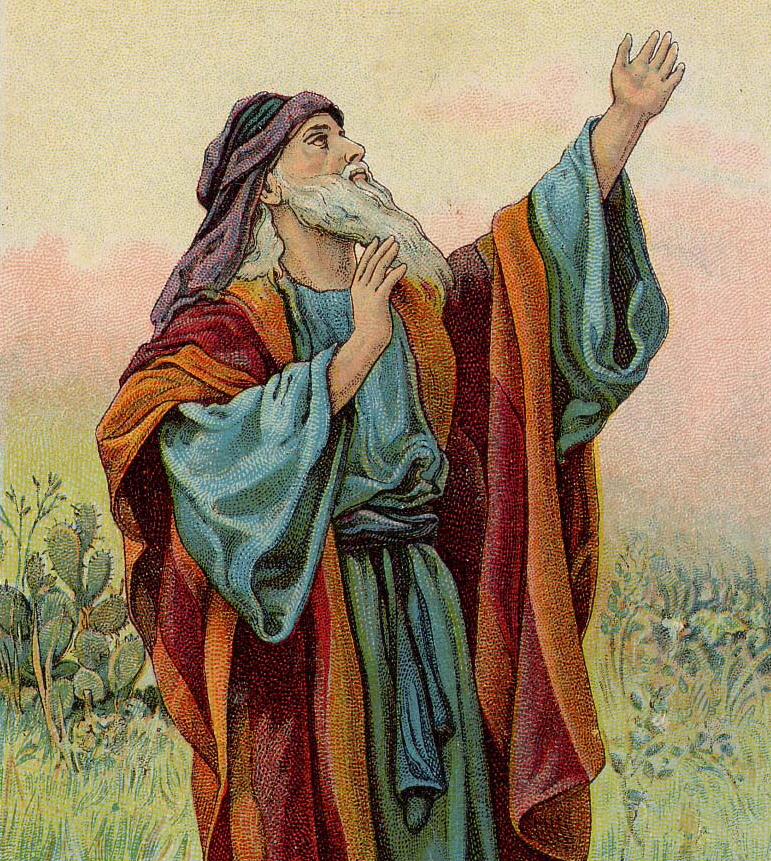
NOTE: This Verse by Verse Commentary page is part of an ongoing project to add notes to each verse of the Bible. Therefore many verses do not yet have notes, but if the Lord tarries and gives me breath, additions will follow in the future. The goal is to edify and equip you for the work of service (Eph 4:12-13) that the Lord God might be glorified in your life and in His Church. Amen (Isa 61:3b, Mt 5:16)
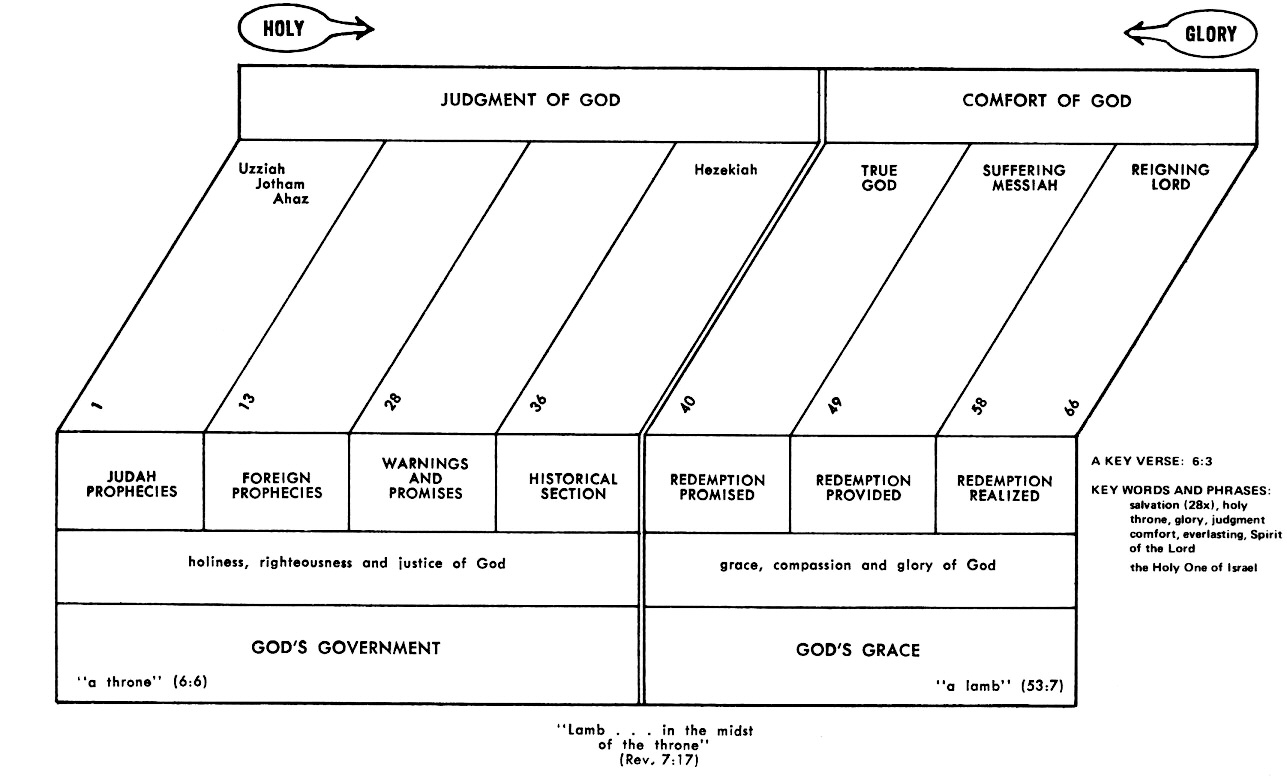
Click Chart by Irving Jensen to Enlarge
Another Chart by Charles Swindoll
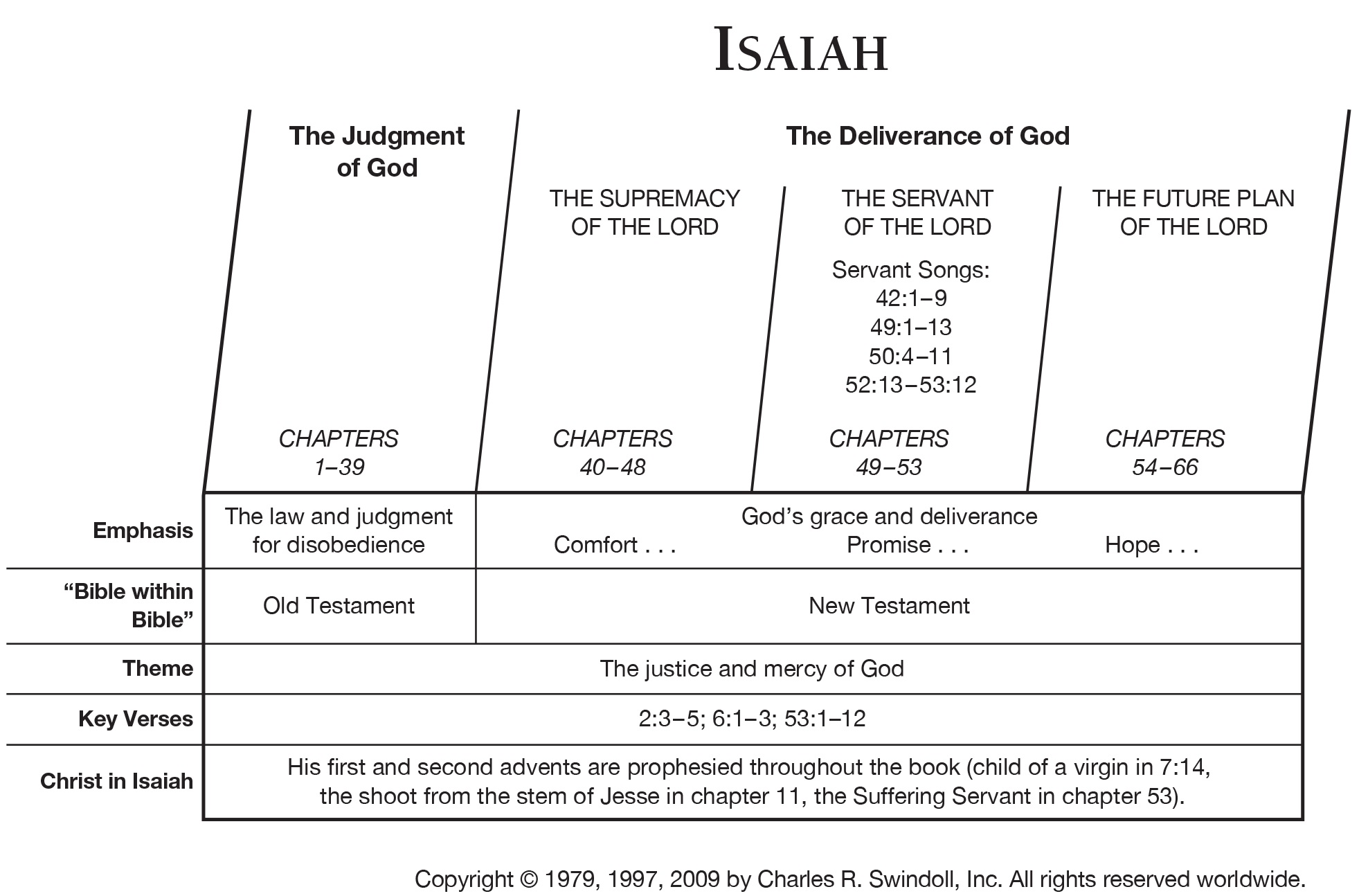
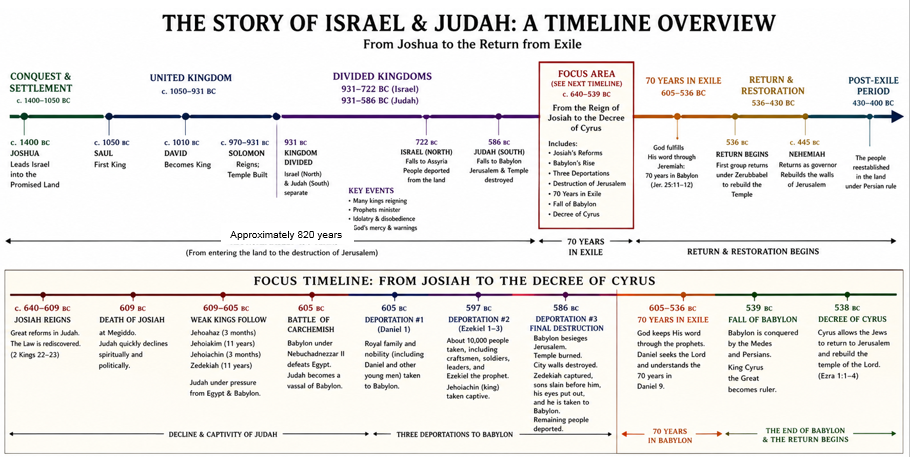
| ISAIAH ("Jehovah is Salvation") See Excellent Timeline for Isaiah - page 39 |
||||||
| JEHOVAH'S Judgment & Character (Isaiah 1-39) |
JEHOVAH'S Comfort & Redemption (Isaiah 40-66) |
|||||
| Uzziah Jotham Ahaz 1-12 |
13-27 |
28-35 |
Hezekiah's Salvation & Blessing 36-39 |
True God 40-48 |
Suffering Messiah 49-57 |
Reigning Lord 58-66 |
| Prophecies Regarding Judah & Jerusalem Is 1:1-12:6 |
Prophecies Against the Nations |
Warnings & Promises |
Historical Section |
Redemption Promised: Israel's Deliverance |
Redemption Provided: Israel's Deliverer |
Redemption Realized: Israel's Glorious Future |
| Prophetic | Historic | Messianic | ||||
| Holiness, Righteousness & Justice of Jehovah | Grace, Compassion & Glory of Jehovah | |||||
| God's Government "A throne" Is 6:1 |
God's Grace "A Lamb" Is 53:7 |
|||||
| Time 740-680BC |
||||||
Isaiah 44:1 “But now listen, O Jacob, My servant, And Israel, whom I have chosen:
- now: Isa 42:23 48:16-18 55:3 Ps 81:11-13 Jer 4:7 Lu 13:34 Heb 3:7,8
- O Jacob: Isa 41:8 43:1 Ge 17:7 De 7:6-8 Ps 105:6,42,43 Jer 30:10 46:27,28 Ro 11:5,6
SIMPLE OUTLINE OF ISAIAH 44
- Isaiah 44:1-5 Blessing of Israel
- Isaiah 44:6-8 Yahweh's Uniqueness
- Isaiah 44:9-20 Idolatry Ridiculed
- Isaiah 44:21-23 Israel Forgiven and Redeemed
Related Passages:
Deuteronomy 7:6-8 “For you are a holy people to the LORD your God; the LORD your God has chosen you to be a people for His own possession out of all the peoples who are on the face of the earth. 7 “The LORD did not set His love on you nor choose you because you were more in number than any of the peoples, for you were the fewest of all peoples, 8 but because the LORD loved you and kept the oath which He swore to your forefathers (ABRAHAM, ISAAC, JACOB), the LORD brought you out (OF SLAVERY IN EGYPT) by a mighty hand and redeemed ( goel/ga'al PAID A PRICE TO SET THEM FREE - BLOOD OF PASSOVER LAMB) you from the house of slavery, from the hand of Pharaoh king of Egypt.
Isaiah 43:10 “You are My witnesses,” declares the LORD, “And My servant whom I have chosen, So that you may know and believe Me And understand that I am He. Before Me there was no God formed, And there will be none after Me.
ANOTHER "SHEMA"
TO ISRAEL
Wycliffe Bible Commentary on Isaiah 44:1-5 - Despite Israel's backsliding and apostasy, she was God's chosen people and the object of his unmerited favor. (Borrow Wycliffe Bible Commentary page 640)
William MacDonald on Isaiah 44:1-5 - In these verses we hear the heartbeat of the Lord for His people. (Borrow Believer's Bible Commentary)
Pulpit Commentary introduces this chapter - A PROPHECY OF ISRAEL'S SPIRITUAL RECOVERY AND REGENERATION. This section is closely connected with ch. 43, of which it ought to form the conclusion. The prophet cannot bear to leave Israel under a ban — its spiritual guides "profaned," and itself given over to "reproaches." He must end with a brighter prospect. Accordingly, he holds out, in the present passage...the blessing of an abundant outpouring of the Spirit, to take the place of the preceding "curse" (Isaiah 43:28).
In Dt 6:4 Israel was commanded with the famous "Shema" - "Hear, O Israel! The LORD is our God, the LORD is one!"
But now - This term of contrast at the beginning of the chapter forces us to observe the previous chapter's ending. Isa 43:27-28 says “Your first forefather sinned, And your spokesmen have transgressed against Me. 28 “So I will pollute the princes of the sanctuary, And I will consign Jacob to the ban and Israel to revilement." But now marks a turning point, shifting from judgment to grace, from rebuke to reassurance.
David Guzik says "Though Isaiah 43 ended with a warning of judgment, it did not mean God would take back His promise of hope and restoration. Israel could still know the goodness of the LORD if they would only turn back to Him."
Listen (shama - command to hear and heed) Listen means not merely to hear words, but to receive them and obey them (cf Jas 1:22).
Bob Utley - "listen" This is an IMPERATIVE (BDB 1033, KB 1570) which characterizes many oracles in Isaiah (cf. Isa. 1:2,10; 6:8,9,10; 7:13; 28:14; 32:9; 33:13; 34:1; 36:13; 39:5; 42:18; 46:3,12; 47:8; 48:1,12,14, 16; 51:1,7,21; 55:2,3; 59:1; 66:5).
This word means "to hear so as to perform" (cf. James 1:22-25). It became the name (the Shema) of the famous Jewish prayer in Deut. 6:4-5.
O Jacob ("Supplanter"), My servant ('ebed) And Israel ("God Strives") - Jacob parallels Israel, so that the patriarch is identified with the literal nation. The nation of Israel is described as Yahweh's servant and as His chosen people. Jacob recalls the man who wrestled with God and was transformed by His grace (Ge 32:28), while Israel represents the people who descended from him and were chosen to be God’s special possession. The title My servant ('ebed) expresses both privilege and purpose. Thus Israel as servant was to display God’s glory and keep His covenant as an example to the nations (Isa 42:6). She was CHOSEN specifically for this purpose and would experience God's protection, even when they were being disciplined (e.g., even in the Babylonian exile, a remnant was preserved and returned to the land after 70 years of "discipline" - see doctrine of the saved remnant of Israel - NB - The meaning of remnant is always determined by the context as it can refer to several different groups.).
How great the honour to be acknowledged
as a servant of the King of kings!
Whom I have chosen underscores the divine initiative of God in establishing His relationship with Israel. The nation did not attain this standing through merit, achievement, or moral superiority; rather, it was entirely the result of God’s sovereign love, gracious purpose, and covenant mercy. Moses made this explicit in Deuteronomy 7:6-8.
Divine election flows not from human worthiness but from God’s own character and faithfulness. His choosing is rooted in His love, grounded in His promises, and carried out according to His sovereign will. This truth both humbles and assures: it removes all grounds for boasting, while at the same time providing unshakable security, since the relationship rests not on human effort but on God’s unchanging purpose (Isa 41:8–9; 44:2).
HERE IS AN EXAMPLE OF MISINTERPRETATION OF THIS VERSE BY AN EXCELLENT WRITER JAMES STALKER:
He asked "Why are the people of God called by the name of Jacob? Have you never wondered why the people of God should be called by the name of the third of the ancient patriarchs in preference to the first two?...Not only so: this usage has passed over into the New Testament, and we still sometimes call the whole body of living Christians the Israel of God."
My answer to his question is the people of God are NEVER called by the name of Jacob! Stalker’s error is both contextual and theological, for he is reading an Old Testament passage addressed to national Israel and extending that designation to the Church without maintaining the distinction Scripture preserves. In Isaiah 44:1–2, the terms “Jacob” and “Israel” (and Jeshurun Isa 44:2) clearly refer to the physical descendants of Jacob, the nation uniquely chosen by God as stated in Deuteronomy 7:6–8, which describes a national, covenantal election rather than a general label for all believers. Context is therefore decisive, and Stalker removes the term “Jacob” from its historical and covenantal setting and applies it broadly to the Church, whereas Scripture distinguishes between Israel and the Church, calling believers instead those who are “in Christ” (Ephesians 1:3) and “Abraham’s descendants” (Galatians 3:29). By suggesting that Christians should be "called by the name Jacob" blurs a distinction the Bible maintains, since the literal nation of Israel still has a future and has not been rejected (Read Romans 11:1, 26, 29). Stalker’s mistake is not primarily devotional but interpretive, taking a national term and reapplying it to the Church without preserving its original context, which leads to a confusion of categories that Scripture keeps clearly distinct.
This is not to say that one cannot apply the principles of these names in a devotional sense. For example read Alexander Maclaren's application of the three names in Isa 44:1-2...
Jacob, Israel, Jeshurun: I take these three names in their order as teaching us--
I. THE PATH OF TRANSFORMATION. Every “Jacob” may become a “righteous one” if he will tread Jacob’s road. We start with that first name of nature which, according to Esau’s bitter etymology of it, meant “a supplanter,”--not without some suggestions of craft and treachery in it. It is descriptive of the natural disposition of the patriarch, which was by no means attractive. All through his earlier career he does not look like the stuff of which heroes and saints are made. But in the mid-path of his life there came that hour of deep dejection and helplessness when, driven out of all dependence on self, and feeling round in his agony for something to lay hold upon, there came into this nightly solitude a vision of God. In conscious weakness, and in the confidence of self-despair, he wrestled with the mysterious Visitant in the only fashion in which He can be wrestled with. “He wept and made supplication to Him,” as one of the prophets puts it, and so he bore away the threefold gift-blessing from those mighty lips whose blessing is the communication, and not only the invocation of the mercy, a deeper knowledge of that Divine and mysterious Name, and for himself a new name (ED: "ISRAEL"). That new name implied a new direction given to his character. Hitherto he had wrestled with men whom he would supplant, for his own advantage, by craft and subtlety; henceforward he strove with God for higher blessings, which, in striving, he won. All the rest of his life was on a loftier plane. That is the outline of the only way in which, from out of the evil and the sinfulness of our natural disposition, any of us can be raised to the loftiness and purity of a righteous life. There must be a Peniel between the two halves of the character if there is to be transformation. How different that path is from the road which men are apt to take in working out their own self-improvement! How many forms of religion, and how many toiling souls in effect just reverse the process, and say practically--first make yourselves righteous, and then you will get communion with God. That is an endless and a hopeless task! This sequence, too, may very fairly be used to teach us the lesson that there is no kind of character so debased but that it may partake of the purifying and ennobling influence.
II. THE LAW FOR THE CHRISTIAN LIFE. There are some religious people that seem to think that it is enough if only they can say: “Well! I have been to Jesus Christ, and I have got my past sins forgiven; I have been on the mountain and have held communion with God.” Now, the order of these names here points the lesson that the apex of the pyramid, the goal of the whole course, is--righteousness. God does not tell us His name merely in order that we may know His name, but in order that, knowing it, we may be smitten with the love of it, and so may come into the likeness of it. Take, then, these three names of my text as preaching, in antique guise, the same lesson that the very Apostle of affectionate contemplation uttered with such earnestness: “Little children! let no man deceive you. He that doeth righteousness is righteous, even as He is righteous.”
III. THE MERCIFUL JUDGMENT WHICH GOD MAKES OF THE CHARACTER OF THEM THAT LOVE HIM. Jeshurun means “the righteous one.” How far beneath the ideal of the name these Jewish people fell we all know, and yet the name is applied to them. Although the realisation of the ideal has been so imperfect, the ideal is not destroyed. And so we Christian people find that the New Testament calls us “saints.” All wrong-doing is inconsistent with Christianity, but it is not for us to say that any wrong-doing is incompatible with it; and therefore for ourselves there is hope, and for our estimate of one another there is the lesson of charity, and for all Christian people there is a lesson--live up to your name. Noblesse oblige! (ED: French phrase meaning “nobility obligates.” It expresses the idea that those who possess privilege, status, wealth, or power are morally bound to act with honor, generosity, and responsibility toward others, especially those in need.) Fulfil your ideal. Be what God calls you, and “press toward the mark for the prize.”
IV. THE UNION BETWEEN THE FOUNDER OF THE NATION AND THE NATION. The name of the patriarch passes to his descendants, the nation is called after him that begat it. In some sense it prolongs his life and spirit and character upon the earth. That is the old-world way of looking at the solidarity of a nation. There is a New Testament fact that goes even deeper than that. The names which Christ bears are given to Christ’s followers (ED: "CHRISTIAN"). Is He a King, is He a Priest? He makes us kings and priests (Rev 5:10). Is He anointed the Messiah? God “hath anointed us in Him.” (2Co 1:21) Is He the light of the world? “Ye are the light of the world.” (Mt 5:14-16). His life passeth into all that love Him in the measure of their trust and love. (A. Maclaren, D. D.)
QUESTION - Is Israel still God's chosen people? | GotQuestions.org
ANSWER - Beyond any doubt, God chose Israel to be His people in a special way. God stated His choice openly in Deuteronomy 7:6: “For you are a people holy to the Lord your God. The Lord your God has chosen you out of all the peoples on the face of the earth to be his people, his treasured possession.”
The next verse relates why God chose Israel: “The Lord did not set his affection on you and choose you because you were more numerous than other peoples, for you were the fewest of all peoples. But it was because the Lord loved you and kept the oath he swore to your ancestors” (Deuteronomy 7:7–8a). God’s choosing of Israel had nothing to do with them and everything to do with God.
A question that often arises is, “Is Israel still God’s chosen people?” After all, the New Testament speaks of all believers in Christ as “God’s chosen people, holy and dearly loved” (Colossians 3:12; cf. 1 Peter 1:1), and, in Christ, there is no difference between Jew and Gentile (Galatians 3:28).
We believe that, even as God is working through the church in this age, Israel is still God’s people in a unique way. The biblical basis for that statement is found in the Old Testament covenants and songs, Jewish history, the biblical prophecies, and the New Testament insistence that God is faithful.
Israel Is Still God’s People: The Covenants
God’s covenant with Abraham promised Abraham three things: a land, a posterity, and a blessing (Genesis 12:1–3). Through Abraham’s seed, the whole world would be blessed. In Genesis 13:15, God highlights the enduring nature of this covenant: “All the land that you see I will give to you and your offspring forever” (emphasis added). Importantly, the covenant did not depend on Abraham’s power to keep it. In fact, Abraham was not even conscious when God ratified the covenant by Himself (Genesis 15). Since God alone took the responsibility of blessing Abraham’s seed, the covenant was unconditional.
God reaffirmed the covenant with Abraham’s son Isaac (Genesis 21:12; 26:3–4), and with Isaac’s son Jacob (Genesis 28:14–15). From then on, every time God referred to Himself as “the God of Abraham, Isaac, and Jacob,” that covenant was remembered. God chose to have a perpetual relationship with Abraham’s descendants from generation to generation.
The covenant God made with David (and with Solomon) was likewise a unilateral, unconditional promise. That covenant assured David that God would “provide a place for my people Israel” where they will “no longer be disturbed” (2 Samuel 7:10). God would also establish a “house” and a “kingdom” for David (verses 11–12). And then God revealed the enduring nature of this covenant: “Your house and your kingdom will endure forever before me; your throne will be established forever” (verse 16, emphasis added).
From the beginning, Israel has had a unique relationship with God. Both the Abrahamic Covenant and the Davidic Covenant detail the special blessings God gave Israel, and both covenants are said to last forever.
Israel Is Still God’s People: Biblical History
The fact that Israel is God’s people is seen in their exodus from Egypt (Exodus 3—13). God split the Red Sea for them (Exodus 14). He met them at Mount Sinai and spoke to the nation personally (Exodus 19:16–19). He sustained them for forty years in the wilderness (Nehemiah 9:21) and brought them to the Promised Land (Nehemiah 9:22). Through it all, God’s treatment of Israel was based on His faithfulness to His covenants with them.
The unique relationship between Israel and God is seen in the theocratic nature of Israel’s early government. Israel was to be ruled directly by God. Moses, Joshua, and the judges acted as regents and intermediaries (see Judges 8:23). Eventually, the Israelites rejected that arrangement in favor of a king (1 Samuel 8:5–7). But, even in the time of the kings, God continued to dwell among His people in the tabernacle and, later, the temple (Exodus 29:44–46; 2 Chronicles 7:15–16). The ark of the covenant, which housed a copy of the covenant, was a symbol of God’s throne, the place where He ruled His people, Israel.
Even when the Israelites persisted in disobedience and God removed them from their land of blessing, God was faithful to His promises: “In your great mercy you did not put an end to them or abandon them, for you are a gracious and merciful God” (Nehemiah 9:31). In fact, God returned Israel to their land (see the books of Ezra and Nehemiah).
Israel Is Still God’s People: Biblical Poetry
The theme of God’s choosing Israel as His people continues through the book of Psalms. Here are just a few examples from that book:
For the Lord has chosen Zion,
he has desired it for his dwelling, saying,
“This is my resting place for ever and ever;
here I will sit enthroned, for I have desired it.” (Psalm 132:13–14)Why do you look with envy, O rugged mountains,
at Mount Zion, where God has chosen to live,
where the Lord himself will live forever? (Psalm 68:16, NLT)For he remembered his holy promise,
and Abraham, his servant.
So he brought his people out [from Egypt] with joy,
his chosen ones with singing.
And he gave them the lands of the nations,
and they took possession of the fruit of the peoples’ toil,
that they might keep his statutes
and observe his laws.
Praise the Lord! (Psalm 105:42–45, ESV)For the Lord has chosen [the descendants of] Jacob for Himself,
Israel for His own special treasure and possession. (Psalm 135:4, AMP)
Israel Is Still God’s People: The Prophecies
Throughout Israel’s history, God took pains to maintain His relationship with His chosen people through the prophets. Elijah, Isaiah, Hosea, Ezekiel, and others voiced God’s call for the nation to cease from their sinful dalliances and return to Him. And, in no uncertain terms, the prophets warned of the consequences of continued disobedience. God’s chosen people abused the prophets and ignored their message (Acts 7:52). Despite that rebellion, God remained committed to His covenantal people.
In a passage concerning the restoration of Israel, the prophet Isaiah pictures the city of Jerusalem as despairing of God’s help (Isaiah 49:14). In reply, God says,
Can a mother forget the baby at her breast
and have no compassion on the child she has borne?
Though she may forget,
I will not forget you!
See, I have engraved you on the palms of my hands;
your walls are ever before me. (Isaiah 49:15–16)In a similar passage promising restoration to the nation of Israel, the prophet Jeremiah relates God’s promise of steadfast love:
I have loved you with an everlasting love;
I have drawn you with unfailing kindness. (Jeremiah 31:3)Later in the same context, Jeremiah writes this to God’s people, Israel:
This is what the Lord says,
he who appoints the sun
to shine by day,
who decrees the moon and stars
to shine by night,
who stirs up the sea
so that its waves roar—
the Lord Almighty is his name:
“Only if these decrees vanish from my sight,”
declares the Lord,
“will Israel ever cease
being a nation before me.”
declares the Lord. (Jeremiah 31:35–36)And Zechariah, who also looked forward to the day of restoration, promises an event that shows the glory awaiting Israel in the future:
This is what the Lord Almighty says: “In those days ten people from all languages and nations will take firm hold of one Jew by the hem of his robe and say, ‘Let us go with you, because we have heard that God is with you.’” (Zechariah 8:23)
Israel Is Still God’s People: The New Testament
The apostle Paul directly answers the question, “Is Israel still God’s people?” in Romans 9—11. In this extended passage, Paul begins by expressing his deep, sincere love for his fellow Jews (Romans 9:1–4). He follows that with a brief overview of how God blessed them and used them to bring the Messiah into the world (verses 4–5).
Yet, Paul points out, it seems as if Israel has been rejected as God’s people. After centuries of rebellion, culminating in their rejection of their own Messiah (Acts 2:36; 3:13–15), there has been a stumbling and hardening of heart (Romans 9:6–33). Israel is zealous for God but has no true knowledge of God (Romans 10:2). They attempt to establish their own righteousness through keeping the law, and they reject the righteousness that comes through faith in Christ (Romans 10:3–13). In all this, they have become “a disobedient and obstinate people” (Romans 10:21, quoting Isaiah 65:2).
So, Paul asks, “Did God reject his people?” His answer is unequivocal: “By no means! . . . God did not reject his people, whom he foreknew” (Romans 11:1–2). Earlier in Romans, Paul had made the same point: “What if some [Jews] were unfaithful? Will their unfaithfulness nullify God’s faithfulness? Not at all! Let God be true, and every human being a liar” (Romans 3:3–4). That is, God’s promises to Israel are still in effect, despite human unfaithfulness.
The wording Paul uses to negate the idea that God has abandoned His people is a very strong negative in the Greek (mē genoito). When he says, “By no means!” (Romans 11:1) and “Not at all!” (Romans 3:4), he absolutely repudiates any notion that God is done with Israel. In fact, Paul follows it up with personal proof: “I am an Israelite myself” (Romans 11:1). If God has permanently abandoned His people, then Paul would not be saved.
The rest of Romans 11 is an explanation of Israel’s current state and God’s future plan for them. Currently, Israel has experienced a hardening of heart due to their rejection of the Messiah (Romans 11:7). They stumbled at the truth and have been set aside in God’s plan. To use Paul’s analogy, the “natural branches” of the olive tree have been set aside in favor of “a wild olive shoot” that has been grafted in their place. In other words, “because of [Israel’s] transgression, salvation has come to the Gentiles” (Romans 11:11). But even this has a goal of reaching the Jews: salvation was brought to the Gentiles “to make Israel envious” (verse 11).
In teaching the “setting aside” of Israel, Paul repeats the truth that they are still God’s covenant people: “Again I ask: Did they stumble so as to fall beyond recovery? Not at all [(mē genoito]!” (Romans 11:11). As he wraps up his discussion, Paul further clarifies: “Israel has experienced a hardening in part until the full number of the Gentiles has come in, and in this way all Israel will be saved” (Romans 11:25–26). Note three important things here:
1) Israel’s current hardening is partial (“in part”).
2) Israel’s current setting aside is temporary (“until”).
3) Israel’s future involves salvation.
So, yes, Israel is still God’s chosen people, even though, in their current state of rebellion, they have been temporarily set aside in God’s plan to bless the world. God is faithful. He will keep His promises to Israel, no matter what. That’s the meaning of Romans 11:29: “God’s gifts and his call are irrevocable.” We should follow Paul’s lead and praise God for His faithfulness: “To him be the glory forever! Amen” (Romans 11:36).
G Campbell Morgan - O Jacob, My servant; and Israel, whom I have chosen.—Isa. 44.1
In this chapter we have three of these messages of Jehovah. They also are linked with the proclamation concerning the Servant in Isaiah 42 by the opening words of Isa 43—"But now." Let this be kept in mind as we read.
The first message here, called the nation not to fear, in view of Jehovah's redeeming purpose to pour His Spirit upon its seed (Isa 44:1-5).
The second is perhaps the finest satire in all the prophecy against false gods, in which the method of their making is mocked at; their futility is declared; and the people of God are called upon to remember these things (Isa 44:6-23).
In the last the greatness of Jehovah is celebrated in creation and in government; and His appointment of Cyrus as the instrument to accomplish His pleasure is announced (Isa 44:24-27).
We have emphasized these opening words to fasten attention upon the fact that throughout these messages, which interpret the purpose of Jehovah in the appointment of His Servant, the thoughts of Creation and Redemption persist, the ultimate emphasis being upon Redemption; and that therefore the nation is seen and referred to, as failing and yet as fulfilling the true ideal. It is Jacob; but it is Israel. It is Jacob; but it is Jeshurun. Thus we see the outlook of God, and understand His method. He sees Jacob, knows all about the persistent failure; therefore the dispensations of punishment; Jacob must pass through travail. But all the while He sees Israel, as set upon realization; therefore Israel must come to triumph. Once more let us remind ourselves that this redeeming realization of creative purpose will be brought about through the Servant of Jehovah.
Isaiah 44:2 Thus says the LORD who made you And formed you from the womb, who will help you, ‘Do not fear, O Jacob My servant; And you Jeshurun whom I have chosen.
- made: Isa 44:21 Isa 43:1,7,21
- formed: Isa 44:24 Isa 46:3-4 Isa 49:1 Ps 46:5 Ps 71:6 Jer 1:5 Eze 16:4-8 20:5-12 Heb 4:16
- Fear: Isa 41:10,14 43:1 Lu 12:32 Ro 8:30 Eph 1:4 1Th 1:4
- Jeshurun: De 32:15 33:5
Related Passages:
Deuteronomy 32:15 “But Jeshurun grew fat and kicked– You are grown fat, thick, and sleek– Then he forsook God who made him, And scorned the Rock of his salvation.
Deuteronomy 33:5 “And He was king in Jeshurun, When the heads of the people were gathered, The tribes of Israel together.
Deuteronomy 33:26 “There is none like the God of Jeshurun, Who rides the heavens to your help, And through the skies in His majesty.
Isaiah 43:1 But now, thus says the LORD, your Creator, O Jacob, And He who formed you, O Israel, “Do not fear, for I have redeemed you; I have called you by name; you are Mine!
Isaiah 44:24 Thus says the LORD, your Redeemer, and the one who formed you from the womb, “I, the LORD, am the maker of all things, Stretching out the heavens by Myself And spreading out the earth all alone,
Isaiah 46:3-4 “Listen to Me, O house of Jacob, And all the remnant of the house of Israel, You who have been borne by Me from birth And have been carried from the womb; 4 Even to your old age I will be the same, And even to your graying years I will bear you! I have done it, and I will carry you; And I will bear you and I will deliver you.
JACOB OR ISRAEL ALSO
KNOWN AS JESHURUN
Thus says the LORD Who made you - In other words Yahweh brought them into existence as a nation (watch birth of modern nation of Israel). This is a tender and reassuring declaration of God’s sovereign care and faithful covenant love for His people.
And formed (fashioned)(yatsar; LXX - plasso - as an artisan fashions and shapes) you from the womb - The verb (yatsar), is the same word used of a potter shaping clay ("you are the potter [yatsar]" - Isa 64:8). It conveys intentional design, care, and skill. The phrase from the womb adds the idea of continuity and intimacy, indicating that Yahweh’s involvement with Israel did not begin later in their history but reaches back to their very beginning as a nation. Just as God forms an individual life in the womb (Ps 139:13; prophet Jeremiah in the womb in Jer 1:5), so He formed Israel from its earliest stages, shaping its destiny according to His purpose. In short, Israel’s relationship with Yahweh is not accidental or temporary, but rooted in His deliberate, loving, and sovereign work from the very beginning. God’s creative act shows His intimate involvement in the lives of the nation of Israel
His relationship with them, and the great things He had done on their behalf, are presented as grounds for confidence, encouraging them to trust Him and to take courage. They knew He loved them because He had formed them from the beginning, from the time they were in their mother’s womb. He was responsible for their existence, and so, of course, He wanted to help them.
This truth is meant to bring assurance that the One who created and shaped the nation of Israel is fully committed to sustaining and preserving the nation. This is still true today (2026), even though most of the nation does not know Him as Savior, Yeshua.
Wycliffe Bible Commentary - From the very beginning—from the womb—he had appointed her to be his peculiar people (Dt 14:2KJV, Dt 26:18KJV), bestowing upon her the title of Jeshurun (asv), Upright One (cf. Deut 32:15; 33:5, 26)—a token of her eventual conversion to Gospel holiness (ED: Ro 11:26). Circumstances in the reign of Manasseh (2Ki 21:1-18) (when Isaiah was doubtless granted these revelations ED: Isa 1:1 does not list Manasseh but likely he did overlap from Hezekiah into his Hezekiah's son's reign) may have seemed to indicate a complete and permanent departure from the faith. But God here explicitly predicts that future Israel was to receive the Living Water and the Holy Spirit himself poured out upon them (pre-eminently at Pentecost, Acts 2)(ED: cf in the last of the last days we will see fulfillment of Zech 12:10). (Borrow Wycliffe Bible Commentary page 640)
Who will help ('azar; LXX - boetheo) you, ‘Do not fear (yare in jussive mood = functions like a command) - Yahweh wants to remind Israel that He is their Helper (See Jehovah Ezer: The LORD our Helper), and will not forsake them even though they have backslidden for centuries. His steadfast love reflects His faithfulness to keep the Abrahamic Covenant and ultimately reflects His amazing grace and boundless mercy toward His chosen people.
The command “Do not fear” is a recurring theme in Scripture, expressing God’s desire that His people trust in His faithfulness rather than be overwhelmed by their circumstances. In Isaiah 41:10, God gives a similar assurance: “Do not fear, for I am with you; do not anxiously look about you, for I am your God. I will strengthen you, surely I will help you, surely I will uphold you with My righteous right hand.” Even when Israel faced exile and hardship, God’s covenant love remained steadfast. His command, “Do not fear,” is grounded not in their strength but in His covenant promises, because He is a "Covenant Keeping God" (a truth over which all of us in the New Covenant can shout "Thank You LORD!" See Covenant - Abrahamic vs Old vs New).
Do Not Fear - 58x/57v - NOTE FREQUENT REPETITION BY ISAIAH (10X) - Gen. 15:1; Gen. 21:17; Gen. 26:24; Gen. 35:17; Exod. 14:13; Num. 14:9; Num. 21:34; Deut. 1:21; Deut. 3:2; Deut. 3:22; Deut. 31:8; Jos. 8:1; Jos. 10:8; Jos. 10:25; Jdg. 6:23; Ruth 3:11; 1 Sam. 12:20; 2 Sam. 9:7; 2 Sam. 13:28; 1 Ki. 17:13; 2 Ki. 6:16; 2 Ki. 17:34; 1 Chr. 22:13; 1 Chr. 28:20; 2 Chr. 20:15; 2 Chr. 20:17; 2 Chr. 32:7; Ps. 55:19; Ps. 64:4; Isa. 10:24; Isa. 40:9; Isa. 41:10; Isa. 41:13; Isa. 41:14; Isa. 43:1; Isa. 43:5; Isa. 44:2; Isa. 51:7; Isa. 57:11; Jer. 10:5; Jer. 46:27; Jer. 46:28; Lam. 3:57; Joel 2:21; Joel 2:22; Hag. 2:5; Zech. 8:13; Zech. 8:15; Mal. 3:5; Matt. 10:26; Matt. 10:28; Matt. 10:31; Lk. 5:10; Lk. 12:7; Lk. 18:4; 1 Pet. 3:14; Rev. 2:10
Bob Utley - "Do not fear" This phrase (Qal IMPERFECT used in a jussive sense [= LIKE A COMMAND]) is used often in chapters 40-66 (cf. Isa. 40:9; 41:10,13,14; 43:1,5; 44:3; 51:7; 54:4,14; 57:11). They were not to fear because (1) they were God's (chosen) people, (2) He was with them, (3) their punishment was over and (4) He would provide all they needed.
O Jacob (nation of Israel) My servant ('ebed); And you Jeshurun (Yeshurun) whom I have chosen (bachar; LXX - eklego/eklegomai - chosen from among a number and in the middle voice = "for Himself") - By using both names, God reminds Israel of their human frailty and their divine calling. Though they often failed, they were still His chosen nation, set apart for His purposes. So not only is Yahweh the Creator of Israel, here we see that He is also the Sustainer. Jeshurun from the root yashar "upright," is synonymous with Israel/Jacob. God's sovereign promise is to pour His Spirit upon Israel and to change the character of His people so that they will indeed be "Upright" which anticipates the future righteousness of the redeemed nation of Israel. Yahweh has never lost sight of the truth of His choosing Israel and in the future (Millennium) will display them as His chosen people.
Jacob My servant - Isa. 44:1; Isa. 44:2; Isa. 45:4; Jer. 30:10; Jer. 46:27; Jer. 46:28; Ezek. 37:25 Jacob My servant is God’s chosen instrument through whom His saving plan for the world is carried out (cf Isa 42:6), even though the nation itself often failed. In other words, Israel is not the source of redemption, but the channel God ordained to bring it about, for the ultimate act of redemption (the Cross) came through Israel, specifically the Messiah. (cf Isa 49:6, Ro 11:11, Ro 11:15) God sovereignly used Israel’s rejection of Messiah to open the door to the nations, so that even her disobedience was woven into God's grand plan of redemption. In summary, Israel is called My servant because God used—and still uses—the nation as the historical vessel through which His plan of salvation for the entire world is accomplished.
Jeshurun is translated in the LXX with the phrase "egapemenos (agapao) Israel" translated as "beloved Israel" where the verb (agapao) is in the perfect tense that indicates past completed action (that time when Israel was first chosen) and continuing, lasting or enduring effect, i.e., beloved forever in Yahweh's heart. How sad when some writers (ancient [especially the reformers] and modern) make the statement that God is finished with the nation of Israel or that Israel is now replaced by the church, the so-called "true Israel"! Even the perfect tense refutes this false teaching! Yahweh loved literal Israel from the womb and still loves the literal nation of Israel in the twenty-first century and will love her to the end of this present evil age and into the ages that follow!
Moody Bible Commentary (p 1070) - The Septuagint translates Jeshurun (Yeshurun) as “beloved” or “one who is loved,” whereas most of the Targumim and the Peshitta (a fourth- or fifth-century Syriac translation of the Bible) translate it “Israel.” Only the Targum Yerushalmi translates Jeshurun in Dt 32:15. Regardless of the translation, most commentators agree that Jeshurun should be identified with Israel. This identification is clear from the term’s parallelism with Jacob (Isa 44:2).
Jeshurun is a name of grace, identity, and destiny. It declares that Israel is not defined merely by what it has been, but by what God has chosen, called, and will ultimately make it to be (fully realized in the Millennial Reign of their Messiah), a people made upright by His power, sustained by His help, and secure in His covenant love (Isa 41:14; Ps 37:37).
Watch Israel - A Nation Is Born, which might better be called the Rebirth of the modern nation of Israel and which presents this drama from a non-religious, albeit still fascinating viewpoint in which the Christian can clearly discern God's hand of direction. (Note that this 6 part series is now available free on youtube [One other note - Youtube has strangely put the following warning on the video, a warning which was not on the series when I watched it several years ago! So my advice is watch it while you can before they take it down completely! Here is the warning - "The following content may contain graphic or violent imagery Viewer discretion is advised - I understand and wish to proceed"]
Believers today can rest in the same assurance that the Lord who created and redeemed them will never abandon them. As Philippians 1:6 affirms, “He who began a good work in you will perfect it until the day of Christ Jesus.”
Help (05826) 'azar means to protect, aid, help, succor, support, give material or nonmaterial encouragement. Azar often refers to aid in the form of military assistance and in many instances refers to help from Jehovah as illustrated by the uses below. The LXX translates 'azar with the word group that includes boáo, boetheo, boethos, all conveying the general idea of running to the aid of one who cries out for help (e.g., see He 2:18 which uses boetheo) (See related study of the Name of God - Jehovah Ezer: The LORD our Helper).
ʿāzar (עָזַר) carries the rich and multifaceted idea of helping, aiding, supporting, or coming to the assistance of another, whether in physical, material, emotional, or spiritual need. At its core, the word conveys the movement of one who supplies what is lacking in another, often in a moment of weakness, danger, or insufficiency. It is not a casual or superficial help, but a decisive intervention that strengthens, sustains, or delivers. This is seen most clearly in its frequent use of God as the Helper of His people, where the term expresses His active involvement in preserving, rescuing, and empowering those who cannot help themselves (Gen 49:25; Ps 28:7; Isa 41:10, 13). The passive sense further deepens this meaning, indicating one who has been upheld or strengthened by such aid, as in “The LORD is my strength and my shield; my heart trusts in Him, and I am helped” (Ps 28:7).
The term is used approximately eighty times in the Old Testament and often carries a military nuance, describing assistance in battle or deliverance from enemies. In this sense, ʿāzar portrays God as the divine warrior who intervenes on behalf of His people, ensuring victory where human strength is insufficient (2 Chr 14:10; Isa 31:3; Ps 46:5). This military aspect highlights both the power and necessity of divine help, especially when contrasted with the futility of human or pagan assistance. Scripture mocks idols and false gods precisely because they cannot “help” (ʿāzar) (Deut 32:38), and it warns against trusting in human alliances such as Egypt, whose “help is vain and empty” (Isa 30:7). Thus, the word draws a sharp theological contrast: true help comes from the Lord alone, while all other sources ultimately fail.
Beyond warfare, ʿāzar also encompasses human cooperation and mutual assistance, where individuals come alongside one another to accomplish a shared purpose (Josh 1:14; 10:4). Yet even here, the underlying theology remains: all genuine help is ultimately derived from God, whether directly or through human agents. This truth is embedded in Hebrew names formed from the root, such as Azariah (“the LORD has helped”) and Ebenezer (“stone of help,” 1 Sam 7:12), memorializing divine intervention as the source of success and deliverance.
In the Psalms especially, ʿāzar takes on a deeply personal and devotional dimension, describing God as the helper of the helpless. He aids the poor, the fatherless, and the oppressed (Ps 10:14; 72:12), and He responds to the cries of those in distress, illness, or abandonment (Ps 22:11; 54:4; 86:17; 109:26). Here the word moves beyond military imagery to portray God as the One who upholds life, restores hope, and sustains faith, even in the most intimate struggles. The psalmist repeatedly confesses that apart from God, there is no help, reinforcing the truth that ʿāzar ultimately points to dependence upon divine grace.
Prophetically and eschatologically, the word underscores both judgment and salvation. Nations may “help” evil (Zech 1:15), but God Himself needs no helper, as seen in His solitary execution of judgment (Isa 63:5). This reveals the absolute sovereignty of God: He alone is the sufficient Helper who requires no assistance, yet graciously chooses to help His people.
In summary, ʿāzar is a theologically rich term that portrays help as active, necessary, and often life-preserving intervention, most fully embodied in God Himself. It emphasizes that mankind is inherently dependent, and that whether in battle, distress, or daily need, true and effective help comes from the Lord alone (Ps 37:40; Isa 41:14).
Jeshurun (03494)(Yeshurun from yashar which means to make smooth or straight (as in Isa 40:3, of Cyrus Isa 45:2), or right (as in Isa 45:13).
YESHURUN - 4V - Deut. 32:15; Deut. 33:5; Deut. 33:26; Isa. 44:2
The Hebrew name Jeshurun (יְשֻׁרוּן, yešurûn) is a richly theological and poetic designation for Israel that conveys the idea of “the upright one,” “the straight one,” or “the one made right.” It is derived from the Hebrew verb yāshar (יָשַׁר), meaning to be ישר, that is, to be straight, level, upright, or morally right (Deut 32:15; Isa 44:2). Thus, Jeshurun is not merely a name but an idealized description of what Israel is called to be before God, a people characterized by righteousness, integrity, and covenant faithfulness.
This name appears only four times in the Old Testament (Deut 32:15; 33:5, 26; Isa 44:2), always in poetic or elevated contexts, which is why it is often referred to as the “poetic name of Israel.” It stands in parallel with Jacob and Israel, yet carries a distinct nuance. Whereas “Jacob” can recall the nation’s natural condition, often associated with weakness or even deception (Gen 27:36), “Jeshurun” presents God’s perspective of His people as they ought to be, or as He graciously regards and forms them to be. This creates a striking theological contrast, especially in Isaiah 44:2, where “Jacob whom I have chosen” is paralleled with “Jeshurun whom I have chosen”, highlighting both grace and transformation.
In Deuteronomy 32:15, the name is used with a tone of irony: “Jeshurun grew fat and kicked…”. Here, the one called “upright” becomes rebellious, forsaking the God who made him. This exposes the tension between Israel’s calling and Israel’s conduct. The name underscores what Israel should be, while the context reveals what Israel often became. Yet in Deuteronomy 33:5 and 33:26, the tone shifts to one of hope and divine favor, where God is portrayed as the King and Helper of Jeshurun, riding through the heavens to come to their aid. This emphasizes that despite failure, God remains committed to His people and acts on their behalf.
In Isaiah 44:2, the name takes on a deeply comforting and redemptive tone: “Do not fear, O Jacob My servant… Jeshurun whom I have chosen.” Here, Jeshurun reflects God’s electing grace and restorative purpose, especially as the passage goes on to describe the pouring out of water and the Spirit (Isa 44:3). In this context, Jeshurun points forward to a renewed, spiritually restored Israel, one sustained both physically and spiritually by God’s provision.
Theologically, Jeshurun encapsulates several key truths. First, it reflects God’s ideal for His people, that they be upright and aligned with His character (Deut 6:18). Second, it highlights the contrast between divine calling and human failure, revealing the need for grace. Third, it magnifies God’s covenant faithfulness, for He continues to call Israel “upright” not because of their perfection, but because of His purpose and redemptive work in them. Finally, it anticipates the ultimate fulfillment of that uprightness, not through human effort, but through divine transformation (Isa 44:3).
In summary, Jeshurun is a name of grace, identity, and destiny. It declares that Israel is not defined merely by what it has been, but by what God has chosen, called, and will ultimately make it to be—a people made upright by His power, sustained by His help, and secure in His covenant love (Isa 41:14; Ps 37:37).
Jeshurun in the Theological Dictionary of the OT (ONLINE) - 1. Occurrences and Meaning. The name “Jeshurun” occurs only 4 times in the OT: Dt. 32:15; 33:5, 26; Isa. 44:2. It is also found in two Hebrew manuscripts of Sir. 37:25.1 In early rabbinic texts, “Jeshurun” appears frequently when the OT texts in question are cited in the Talmud and Midrash; elsewhere in early Jewish writings the use of this word is limited almost entirely to these OT passages.
There is general agreement that “Jeshurun” is associated with the root yšr.2 What is debated is whether -ûn is a diminutive suffix resembling the endings of names like šimšôn and zeḇulôn3 or a denominative suffix.4 Whether -ûn represents an independent suffix or is merely a dialectal variant of -ôn is hard to decide.5 In the latter case, there would be no etymological reason not to consider “Jeshurun”6 a diminutive.7 It is significant that yšr appears as an element in Akkadian and especially Amorite personal names, e.g., i-šar-ra-ma-aš, i-šar-ra-ma-šu, etc.;8 i-šar-li-im, ḫa-mu-yi-šar, etc.9 In many of these names, yšr (in Amorite, the /š/ can alternate with /s/10) is a theophorous element.11 The Akkadian and Amorite parallels to the name “Jeshurun” show that the name itself need not be a neologism. Neither, however, is it necessarily an old hypocoristic name. The occurrences of “Jeshurum” are much too scattered and unusual.
The LXX already translates the name as ēgapēménos; in Isa. 44:2, it adds an explanatory “Israel” (cf. Sir. 37:25, where the LXX reads only “Israel”). It clearly already assumed that the name was associated with → ישׁר yšr, “be upright.” This interpretation also appears occasionally in later Jewish literature (e.g., in the morning prayer “Jacob …, whom thou didst name Israel and Jeshurun”), although it is well known that this literature enjoys wordplay (cf. the play on šôr and šîr in Gen. Rab. lxxvii.1). The Vulg. follows the LXX, translating “Jeshurun” as dilectus (Dt. 32:15) and rectissimus (Israhel in Sir. 37:25). In Isa. 44:2, for example, the other ancient Greek versions (Aquila, Symmachus, and Theodotion) have euthýs or euthýatos.12 In all the passages (except Sir. 37:25, where it provides no translation13), the Syr. maintains the translation “Israel.” The Targumim also usually prefer the translation (bêṯ) yiśrāʾēl; but Targ. Neofiti, for example, has bêṯ yaʿaqōḇ in Dt. 32:5, and some manuscripts read yešurûn as well as yiśrāʾēl in Isa. 44:2.14
2. Jeshurun/Israel/Jacob. Most scholars15 consider “Jeshurun” in the OT to be a cognomen for Israel and/or Jacob based on the root yšr.16 The word almost always appears in parallel with or in the context of both names. Bacher17 has suggested that “Jeshurun” is a neologism coined as a euphemism for “Jacob”; this view has found wide acceptance.18 According to Bacher, the name “Jacob” is associated with notions of trickery and dishonesty (cf. Gen. 25:26; 27:36; Hos. 12:4[Eng. v. 3]), the opposite of uprightness and honesty (cf. Isa. 40:4; 42:16; Mic. 3:9). Bacher adds two conjectures based on this interpretation: (1) to read “Jeshurun” instead of yešārîm in Nu. 23:10 (explaining the sg. kāmōhû); and (2) in the title of the book sēp̱er hayyāšār (Josh. 10:13; 2 S. 1:18), to treat hayyāšār as a title for Israel, “coined for the same reasons as ‘Jeshurun.’ ” In opposition to Bacher, Naor19 has tried to show that the word “Jeshurun” is in fact a remnant of an early form dating from a time before ʿqb had acquired the secondary meaning “deceive.” He agrees with Sachsse that “Jeshurun” is important for the earliest etymology and pronunciation of the word “Israel”: yšrʾl, he claims, means “God is trustworthy, upright.” Others, too, find the š in “Jeshurun” significant for the etymology and meaning of “Israel.”20 Besides those (e.g., Caspari) who categorically deny the possibility of an original /š/ in “Israel,” there are others (e.g., Naor) who argue for this possibility, citing, for example, Jgs. 12:6 and 1 Ch. 25:14 as evidence for variation between /š/ and /ś/ in Hebrew.21 Whether “Jeshurun” is in fact related to “Israel” and the latter was originally pronounced with /š/ instead of /ś/ is discussed under → ישׂראל yiśrāʾēl. Here we simply restate our view that “Jeshurun” is associated with the root yšr. This etymology is suggested by the ancient versions and supported by the Akkadian and Amorite personal names cited above; the contexts in which the word occurs also argue for this view. Nevertheless, Bacher’s theory that “Jeshurun” is a neologism deliberately antithetical to “Jacob” remains dubious. Although there is no consensus respecting the date and Sitz im Leben of Dt. 32 and 33, it is quite clear that both in these chapters and in Isa. 44 “Jeshurun” is a word familiar to the author, used in some kind of play on the names “Jacob” and “Israel.” There is no hint, however, of a deliberate antithesis.22 Also unresolved is the question why the word appears so rarely in the OT and outside this book. Bacher has tried to answer this question by arguing that the name “Jacob” was a familiar name with a long history and that “Israel” functioned as a significant and honorable alternative to “Jacob.” But this argument holds only if “Jeshurun” always functions as an antithesis to “Jacob.” This is not true, however, in Dt. 33:26. If we follow the MT, we even have the reading kāʾēl instead of keʾēl (yešurûn): “the god Jeshurun,” like “the god Bethel.”23 The conclusion is obvious: “Jeshurun” is only a rarely used equivalent to “Jacob” and “Israel.” It may be a “literary invention, and therefore not part of the real corpus of Israelite names,”24 or a hypocoristic25 form of the name “Israel,” used as a pet name or cognomen for Israel/Jacob.
3. Individual Passages. In Dt. 32, the Song of Moses, and Dt. 33, the Blessing of Moses, “Jacob” appears 4 times in parallel with “Israel” (Dt. 32:9; 33:4, 10, 2826), “Jeshurun” 3 times. This in itself is striking. In addition, after 32:14 has stated that Yahweh fed Israel miraculously with such food as “curds from the herd, and milk from the flock, with fat of lambs,” etc., the Samaritan Pentateuch and LXX continue (v. 15) in poetic parallelism: wayyōʾḵal yaʿaqōḇ wayyiśbaʿ wayyišman yešurûn wayyiḇʿāṭ, etc., with “Jacob” and “Jeshurun” in parallel. Although the interpretation of v. 15 is difficult (“He became cocky, fat, thick, and sleek, and forsook God his maker”), it is clear that Jeshurun was fostered by God and thus became “fat and sleek.”27 The word “Jeshurun” clearly suggests Israel in an ideal situation,28 with its “uprightness” due more to God’s help than his own efforts.
Dt. 33:5, in a context that mentions the assembly of Jacob (v. 4) and the tribes of Israel, says: wayehî bîšurûn meleḵ. The text does not say who became king in or over Jeshurun; the Midrash even suggests Moses himself. Many translate: “There was a king in Jeshurun”;29 others think in terms of Yahweh and translate: “And Yahweh became king over Jeshurun” (cf. Nu. 23:21; Jgs. 8:23; Isa. 33:22). The latter interpretation has much to recommend it. In any case, it is clear that here Israel is also presented as a community in its ideal state, while the poet is indulging in some kind of wordplay with “Jacob,” “Jeshurun,” and “Israel.” Seebass30 thinks that “Jeshurun” here refers originally to Israel’s non-Israelite neighbors associated with Judah (Caleb, Cain, Othniel, and Jerahmeel), which were incorporated into the system of the twelve tribes of Israel to compensate for the vanished tribe of Simeon.
Immediately after the blessing of the tribes, in which many of them are promised the rich bounty of heaven and earth, the epilogue begins: “There is none like the God of Jeshurun, who rides through the heavens to your help (beʿezreḵā)” (Dt. 33:26). We reject the Masoretic pointing mentioned above (kāʾēl instead of keʾēl) both because elsewhere “Jeshurun” is another name for Jacob/Israel and also because in the languages in which yšr appears in theophorous names it is always a verbal element, not the theophorous element.31 This verse, too, speaks of Israel’s “uprightness” bestowed by God’s grace. Again “Jeshurun” is mentioned first, followed later (v. 28) by “Israel” and “Jacob.” In Dt. 33:2–5, 26–29, a hymn von Rad32 calls an “informative psalm of praise,” not only the verses in question but also the word “Jeshurun” exert a kind of centripetal force, enclosing the tribal oracles of the Blessing of Moses (vv. 6–25). The idealistic promises to the tribes in the oracles are, as it were, guaranteed by an idealistic and promising name for Israel and Jacob: “Jeshurun.”
The word appears in 1 other OT passage, in Deutero-Isaiah (Isa. 44:2). The context of this verse is Isa. 43:22–44:4,33 in which God promises to blot out Israel’s transgressions and then tells Israel not to fear, because he will pour out his blessing on Israel’s descendants. Isa. 44:2a calls Yahweh “the one who made you, who formed you from the womb and will help you”; v. 2b continues: “Fear not, O Jacob my servant, Jeshurun whom I have chosen.” In Deutero-Isaiah, “Israel” appears almost always in parallel with “Jacob.”34 In this regard, we may note Isa. 43:22, 28; 44:1, 5 in the present pericope. Only in 44:2 does “Jacob” stand in parallel with “Jeshurun.” Is Deutero-Isaiah here merely playing with words, using a hypocoristicon for variety? The notion that a diminutive with “benevolent overtones” is inappropriate to the language of divine love35 is already disproved by Isa. 41:14 (“worm Jacob”). But why does Deutero-Isaiah use the word only here? Apart from the question whether the transitional 44:1 is a secondary addition,36 clearly placing God’s chosen Israel in parallel with Jeshurun, it is immediately apparent that in 43:23ff. God charges Jacob/Israel with having refused to offer him sheep, fat, and other choice sacrifices. Nevertheless, God will bless the people in the future by pouring his spirit upon Israel’s offspring and descendants (44:3). This will create an ideal situation, in which new names will be given (44:5). This description constitutes a clear parallel to the Song of Moses and the Blessing of Moses in Dt. 32 and 33, even to the use of the same words (such as ʿāśâ [Dt. 32:15; Isa. 44:2] and ʿāzar [Dt. 33:26; Isa. 44:2]). This relationship best accounts for the use of “Jeshurun” here.
Finally, Sir. 37:25 poses a difficult problem. Here “Jeshurun” appears only in ms. D and in the margin of ms. B.37 Ms. B itself reads ʿam yiśrāʾēl, a reading supported by the LXX and Vulg. The Syr. completely omits v. 25.38 Segal39 thinks its omission is due to Christian hostility toward the people of Israel. But the varying position and text of this verse in the Hebrew and Greek manuscripts indicate that it is probably a late interpolation into the text of Sirach, as many scholars rightly suggest. But this fact makes it difficult to explain why “Jeshurun” should be used in this particular text. In any event, the word clearly conveys a favorable meaning and is equated with the term “(people of) Israel.” Mulder
QUESTION - What does it mean that God is the God of Jeshurun? GOTQUESTIONS.ORG
ANSWER - In Isaiah 44:1–2, God comforts His people with these words:
“But now listen, Jacob, my servant,
Israel, whom I have chosen.
This is what the Lord says—
he who made you, who formed you in the womb,
and who will help you:
Do not be afraid, Jacob, my servant,
Jeshurun, whom I have chosen.”
The name Jeshurun means “upright one” or “blessed one.” In the parallelism of Isaiah’s poetry, Jeshurun is a synonym for Jacob in the previous line. So we see that Jeshurun is a poetic reference to the nation of Israel. It is a term of endearment; the Greek Septuagint translates Jeshurun as “beloved one,” using a form of the word agape. The name Jeshurun is used four times in the books of Deuteronomy and Isaiah. In each case the name occurs in a poetic setting and refers to Israel, God’s beloved people.
In Deuteronomy 32, Moses rehearses the history of Israel to that point, including a time when the Israelites were unfaithful to God in the wilderness:
“Jeshurun grew fat and kicked;
filled with food, they became heavy and sleek.
They abandoned the God who made them
and rejected the Rock their Savior” (Deuteronomy 32:15).
As Moses begins his final blessings on the tribes of Israel, he says,
“[The Lord] was king over Jeshurun
when the leaders of the people assembled,
along with the tribes of Israel” (Deuteronomy 33:5).
Then, as Moses ends the same series of blessings, he says,
“There is no one like the God of Jeshurun,
who rides across the heavens to help you
and on the clouds in his majesty.
The eternal God is your refuge,
and underneath are the everlasting arms” (Deuteronomy 33:26–27).
Israel could be called “Jeshurun” because of God’s mercy and forgiveness. Isaiah starts out his book with a condemnation of Israel’s sin, calling the people a “sinful nation . . . whose guilt is great” and a “brood of evildoers . . . given to corruption” (Isaiah 1:4). Yet God still tenderly calls them “Jeshurun,” the “upright one.” The children of Israel forsook the Lord: “They have spurned the Holy One of Israel and turned their backs on him” (verse 4). Yet God still lovingly calls them “Jeshurun,” the “beloved one.” Jeshurun is God’s grace on display.
“He will not always accuse,
nor will he harbor his anger forever;
he does not treat us as our sins deserve
or repay us according to our iniquities.
For as high as the heavens are above the earth,
so great is his love for those who fear him;
as far as the east is from the west,
so far has he removed our transgressions from us” (Psalm 103:9–12).
Isaiah 44:3 ‘For I will pour out water on the thirsty [land] And streams on the dry ground; I will pour out My Spirit on your offspring And My blessing on your descendants;
NET For I will pour water on the parched ground and cause streams to flow on the dry land. I will pour my spirit on your offspring and my blessing on your children.
NLT For I will pour out water to quench your thirst and to irrigate your parched fields. And I will pour out my Spirit on your descendants, and my blessing on your children.
- pour: Isa 41:17 59:21 Eze 34:26 Joe 3:18 Joh 7:37-39 Rev 21:6 22:17
- floods: Isa 32:2 35:6,7 43:19,20 48:21 49:10 Ps 78:15,16 107:35
- dry ground: Ps 63:1 Mt 12:43, Greek
- pour: Isa 32:15 59:21 Pr 1:23 Eze 39:29 Joe 2:28 Zec 12:10 Ac 2:17 Ac 2:33,39 10:45 Tit 3:5,6
Related Passages:
Joel 2:28-29 “It will come about after this That I will pour out My Spirit on all mankind; And your sons and daughters will prophesy, Your old men will dream dreams, Your young men will see visions. 29“Even on the male and female servants I will pour out My Spirit in those days.
Acts 2:17 ‘AND IT SHALL BE IN THE LAST DAYS,’ God says, ‘THAT I WILL POUR FORTH OF MY SPIRIT ON ALL MANKIND; AND YOUR SONS AND YOUR DAUGHTERS SHALL PROPHESY, AND YOUR YOUNG MEN SHALL SEE VISIONS, AND YOUR OLD MEN SHALL DREAM DREAMS;
Acts 2:33 “Therefore having been exalted to the right hand of God, and having received from the Father the promise of the Holy Spirit, He has poured forth this which you both see and hear.
Zechariah 12:10 “I will pour out on the house of David and on the inhabitants of Jerusalem, the Spirit of grace and of supplication, so that they will look on Me whom they have pierced; and they will mourn for Him, as one mourns for an only son, and they will weep bitterly over Him like the bitter weeping over a firstborn.
Ezekiel 36:24-27 (NEW COVENANT AFTER ISRAEL REGATHERED TO PROMISED LAND AT END OF THIS PRESENT AGE) “For I will take you from the nations, gather you from all the lands and bring you into your own land. 25 “Then I will sprinkle clean water on you, and you will be clean; I will cleanse you from all your filthiness and from all your idols. 26 “Moreover, I will give you a new heart and put a new spirit within you; and I will remove the heart of stone from your flesh and give you a heart of flesh. 27 “I will put My Spirit within you and cause you to walk in My statutes, and you will be careful to observe My ordinances.
Isaiah 35:6-7 (DESCRIPTION OF MILLENNIAL BLESSINGS) Then the lame will leap like a deer, And the tongue of the mute will shout for joy. For waters will break forth in the wilderness And streams in the Arabah. 7 The scorched land will become a pool And the thirsty ground springs of water; In the haunt of jackals, its resting place, Grass becomes reeds and rushes.
Isaiah 41:18 I will open rivers on the bare heights And springs in the midst of the valleys; I will make the wilderness a pool of water And the dry land fountains of water.
Isaiah 43:19-20 (DESCRIPTION OF MILLENNIAL BLESSINGS) Behold, I will do something new, Now it will spring forth; Will you not be aware of it? I will even make a roadway in the wilderness, Rivers in the desert. 20 “The beasts of the field will glorify Me, The jackals and the ostriches, Because I have given waters in the wilderness And rivers in the desert, To give drink to My chosen people (REDEEMED REMNANT OF ISRAEL).
Isaiah 32:15 Until the Spirit is poured out upon us from on high, And the wilderness becomes a fertile field, And the fertile field is considered as a forest.
John 7:38-39 “He who believes in Me, as the Scripture said, ‘From his innermost being will flow rivers of living water.’” 39 But this He spoke of the Spirit, whom those who believed in Him were to receive; for the Spirit was not yet given, because Jesus was not yet glorified.
POURING OUT ON A
THIRSTY LAND AND PEOPLE
For I will pour out water on the thirsty land And streams on the dry ground - "Land" is not in Hebrew but added. Thirsty land describes a landscape that is lifeless, cracked, and unproductive in desperate need of revival. In the ancient Near East, water was precious and often scarce, so water was a powerful metaphor for life and divine blessing. Without water, the land could not sustain life. So Yahweh is prophysying that He Himself will intervene to reverse desolation and bring renewal (Isa 35:6–7). While this desciption could speak only of physical desolation of the land, there it surely also point to spiritual barrenness of the people’s hearts. And what is the "condition?" It is not need? Is in not willingness to say "I am thirsty for Your Spirit Lord?"
Showers of blessing, showers of blessing we need.
Mercy-drops ‘round us are falling,
But for the showers we plead.
God’s promise to pour out water signifying His intention to restore, revive, and bless His people once again, physically and spiritually (see prophecy in next clause). Just as rain transforms a desert into fertile ground, God’s Spirit transforms barren hearts into fruitful ones. This description of pour out is in marked contrast to the outpouring in Isa 42:24 "So He poured out on him the heat of His anger...."
John MacArthur writes "The extensive blessing of physical conditions will favor the nation in the coming kingdom age (Isa 43:19, 20); they were also symbolic of spiritual refreshment from the Holy Spirit and God Himself (Isa 32:15; Joel 2:28-29)."
John Martin - Though it is certainly possible to understand this (pour out water on the thirsty land) as a metaphor, introducing the coming offspring promised to Israel in the second half of the verse (v. 3) and in v. 4, it may be best to view the reference as a literal restoration of the land. (Moody Bible Commentary page 1070)
Notice the repetition of the verb “pour out,” which paints a vivid picture of abundance, generosity, and unhindered flow. The language is intentional and emphatic. God does not say He will sprinkle a few drops or ration out His provision as though He were reluctant or limited. Instead, He promises an outpouring, a lavish, overflowing supply that meets the need fully and even beyond expectation (cf Eph 3:20). Just as rain saturates parched ground until it is revived and productive, so God’s blessing comes freely and sufficiently to restore what was dry and lifeless. This imagery underscores His gracious character, for He gives not sparingly but bountifully (Isa 55:1), satisfying the thirsty soul and filling the needy with what they lack (Ps 107:9), ultimately pointing to the fullness of His Spirit poured out without measure to bring spiritual life out of death with promise of fruitfulness (cf Joel 2:28; John 7:38–39).
When the soil is parched by prolonged drought, how welcome the refreshing rains are; and to the dry and barren soul, how life-giving and encouraging are the waters of salvation.
I will pour out My Spirit on your (ISRAEL'S) offspring And My blessing on your descendants - This prophetic promise is directed specifically to Israel, assuring a future, divinely initiated renewal. The language of pouring out signifies abundance, sovereignty, and life giving transformation, much like water upon parched ground in the immediate context (Isaiah 44:3). This begs the question WHEN will Yahweh do this? There is a legitimate sense in which this promise saw an initial or partial fulfillment at Pentecost, where Peter explicitly connects the outpouring of the Spirit to the prophecy of Joel, saying, “This is what was spoken of through the prophet Joel” (Acts 2:16–17; Joel 2:28–29). Since the early recipients were largely Jewish, this event can be viewed as a foretaste of the promised blessing upon Israel.
However, the scope of Isaiah 44:3 extends beyond Pentecost to a more complete national and spiritual restoration of Israel that has not yet fully occurred. This fuller fulfillment is most clearly described in Zechariah’s prophecy: “I will pour out on the house of David and on the inhabitants of Jerusalem, the Spirit of grace and of supplication” (Zechariah 12:10), resulting in a profound repentance as they “look on Me whom they have pierced.” At that future moment, Israel as a nation will experience deep conviction, mourning, and turning to the Lord, marking the climactic realization of the promise (cf Zech 13:8,9). Thus, Isaiah 44:3 spans both an initial fulfillment in the early church era and an ultimate fulfillment at the end of the age, when Yahweh brings about the full spiritual restoration and blessing of His covenant people (cf "all Israel will be saved" - Ro 11:26).
H A Ironside commenting on Acts 2:17says "Peter applied the words of Joel 2:28-29 to what then took place, not as indicating that the prophecy was exhausted by that outpouring, but that it was of the same character as what was yet to come when Israel shall be brought back to God and the Spirit poured out upon them from on high (Zech 12:10) and all the spared nations be blessed accordingly. It is of this the present passage speaks.
John Martin - This outpouring of the Spirit will occur when the people have returned in belief to the land (cf. Ezek. 36:24-27; Joel 2:25-29) just after the Messiah's second coming to establish the Millennium. (See The Bible Knowledge Commentary)
Bob Utley - "I will pour" This VERB (Qal IMPERFECT) is often used in connection with anointings or sacrifices. In this verse it is repeated twice - (1) once for the miraculous water of abundance and (2) once for the Spirit (see SPECIAL TOPIC: SPIRIT IN THE BIBLE) (a) Isa. 32:15, different word and (b) Joel 2:28, different word. YHWH is the source of blessings and for desert people water was the symbol of life and abundance (cf. Isa. 44:4). on your offspring Blessings, like curses, moved through families (cf. Deut. 5:9-10; 7:9). These future generations (ED: OF ISRAEL) will know who they are in YHWH (ED: In the New Covenant "they shall all know Me, from the least of them to the greatest of them," Jer 31:34).
Henry Morris - The Holy Spirit is here symbolized by life-giving waters; this figure is often appropriated in the New Testament (John 1:33; 3:5; Jn 7:38,39; Titus 3:5).
C H Spurgeon - Without the Spirit of God we can do nothing; we are as ships without wind, or chariots without steeds, like branches without sap, we are withered; like coals without fire, we are useless; as an offering without the sacrificial flame, we are unaccepted. I desire both to feel and to confess this fact whenever I attempt to preach. I do not wish to get away from it, or to conceal it, nor can I, for I am often made to feel it to the deep humbling of my spirit.” “I believe that, at this present moment, God’s people ought to cry to him day and night (FOR THE SPIRIT)...There are many things that are desirable for the Church of Christ, but one thing is absolutely needful; and this is the one thing, the power of the Holy Ghost in the midst of his people.”
C H Spurgeon - Morning and Evening - When a believer has fallen into a low, sad state of feeling, he often tries to lift himself out of it by chastening himself with dark and doleful fears. Such is not the way to rise from the dust, but to continue in it. As well chain the eagle’s wing to make it mount, as doubt in order to increase our grace. It is not the law, but the gospel which saves the seeking soul at first; and it is not a legal bondage, but gospel liberty which can restore the fainting believer afterwards (cf Gal 3:3). Slavish fear brings not back the backslider to God, but the sweet wooings of love allure him to Jesus’ bosom.
Are you this morning thirsting for the living God, and unhappy because you cannot find him to the delight of your heart?
Have you lost the joy of religion, and is this your prayer, “Restore unto me the joy of thy salvation”?
Are you conscious also that you are barren, like the dry ground; that you are not bringing forth the fruit unto God which he has a right to expect of you; that you are not so useful in the Church, or in the world, as your heart desires to be?
Then here is exactly the promise which you need, “I will pour water upon him that is thirsty.”
You shall receive the grace you so much require, and you shall have it to the utmost reach of your needs. Water refreshes the thirsty: you shall be refreshed; your desires shall be gratified.
Water quickens sleeping vegetable life: your life shall be quickened by fresh grace.
Water swells the buds and makes the fruits ripen; you shall have fructifying grace: you shall be made fruitful in the ways of God.
Whatever good quality there is in divine grace, you shall enjoy it to the full. All the riches of divine grace you shall receive in plenty; you shall be as it were drenched with it: and as sometimes the meadows become flooded by the bursting rivers, and the fields are turned into pools, so shall you be—the thirsty land shall be springs of water.
J C Philpot - Thirst, as a feeling of the soul, in a spiritual sense, is certainly indicative of divine life. It is as impossible, spiritually viewed, for a man dead in sin to thirst after a living God, as for a corpse in the graveyard to thirst after a draught of cold water from the well. I know for myself that such a feeling as thirsting after God had no place in my bosom until the Lord was pleased to quicken my soul into spiritual life. I had heard of God by the hearing of the ear. I had seen Him in creation, in the starry sky, in the roaring sea, in the teeming earth; I had read of Him in the Bible; I had learnt His existence by education and tradition; and I had some apprehensions of His holiness in my natural conscience; but as to any spiritual thirsting after Him, any earnest desire to fear Him, know Him, believe in Him, or love Him,—no such experience or feeling, I can say for myself, ever dwelt in my bosom. I loved the world too dearly to look to Him who made it, and myself too warmly and affectionately to seek Him who would bid me crucify and mortify it. A man, therefore, I am well convinced, must be made alive unto God by spiritual regeneration before he can experience any such sensation as is here conveyed by the figure “thirst,” or know anything of the Psalmist’s feelings when he cried, “As the hart panteth after the water-brooks, so panteth my soul after thee, O God. My soul thirsteth for God, for the living God.” Now wherever God has raised up in the soul this spiritual thirst after Himself, He certainly will answer that desire, “the desire of the righteous shall be granted.” His own invitation is, “Ho! every one that thirsteth, come ye to the waters”; and Jesus Himself says with His own blessed lips, “If any man thirst, let him come unto me and drink.” Nay, He opened His ministry by pronouncing a blessing on such “Blessed are they which do hunder and thirst after righteousness; for they shall be filled.” - Ears from Harvested Sheaves.
J C Philpot - How often does the soul, born and taught of God, feel that is this “dry ground!” It would fain be fruitful in every good word and work; it would be adorned with every grace of the Spirit within, and with every good and godly fruit without. Let no one thing that the child of God is careless or indifferent either as to inward or outward fruit. There is nothing too holy, too heavenly, too spiritual, or too gracious which the child of grace woulod not desire inwardly to experience and outwardly produce. But he feels that he cannot by any exertion of his own produce this fruitfulness after which he sighs. As well might a barren field covert itself into a fruitful garden without being tilled by human hand or without rain from the sky, as a soul that feels and knows its own barrenness produce by its own exertions a crop of the fruits of righteousness. But the Lord who knows the desire of the heart, and its inward mourning over its own barreness, has given in the text a sweet and gracious promise, “I will pour floods upon the dry ground.” A partial shower would not be enough. The dry ground would soon absorb a few drops of summer rain. Floods must come, either from the skies or from the streams of that river which makes glad the city of God, to produce this mighty change. These floods are the promises poured into the soul, the love of God shed abroad in the heart, the manifestations of Christ and of His atoning blood, the inflowings of grace as superabounding over all the aboundings of sin, and the flowing of peace as a river into the contrite spirit
J C Philpot - In pouring out His Spirit upon Zion’s seed, God pours out therewith every spiritual blessing that there is in His heart or hands to bestow. Whatever earthly good you may enjoy, without the blessing of God it will but prove a curse; whatever afflictions fall to your earthly lot, if God bless, they must all eventually be made a blessing. Nor is this blessing niggardly given, for the Lord has here promised that He will pour it out! It shall be given as profusely and as abundantly as the Spirit Himself. Nor shall Zion doubt either the blessing itslef or the source whence it comes, for it carries its own evidence, shines in the light of its own testimony, and manifests itself by its own effects. And does not the contrast between the dry ground and the promised showers of blessing enhance it all the more? Your very barrenness and sterility make the promise all the more suitable, and therefore all the more sweet. If you look into yourself, a barren wilderness meets your view. If you look up, you see the clouds of blessing floating in the pure sky. You see that the Lord has promised to “pour water upon him that is thirsty, and floods upon the dry ground.” You beg of Him to fulfil that promise to your soul. You have no other plea but His own word of promise, no ohter recommendation but your own miserable barrenness. He enables you to cry to Him. He listens to that cry, and in His own time pours water upon your thirsty soul, and floods upon your dry and parched heart. O may a sense of our poverty and destitution be ever a means, in His sacred hand, of leading us to seek that blessing which He alone can bestow!
Cross References: Ps 42:1; Pr 10:24; Is 55:1; Jn 7:37
C H Spurgeon - OUR dear children have not the Spirit of God by nature, as we plainly see. We see much in them which makes us fear as to their future, and this drives us to agonizing prayer. When a son becomes specially perverse, we cry with Abraham, “Oh, that Ishmael might live before thee!” We would sooner see our daughters Hannahs than empresses. This verse should greatly encourage us. It follows upon the words, “Fear not, O Jacob, my servant,” and it may well banish our fears.
The Lord will give his Spirit; will give it plentifully, pouring it out; will give it effectually, so that it shall be a real and eternal blessing. Under this divine outpouring our children shall come forward, and “one shall say, I am the Lord’s; and another shall call himself by the name of Jacob.”
This is one of those promises concerning which the Lord will be enquired of. Should we not, at set times, in a distinct manner, pray for our offspring? We cannot give them new hearts, but the Holy Spirit can; and he is easily to be entreated of. The great Father takes pleasure in the prayers of fathers and mothers. Have we any dear ones outside of the ark? Let us not rest till they are shut in with us by the Lord’s own hand.
C H Spurgeon - A promise for us and for our children
‘I will pour water upon him that is thirsty … I will pour my spirit upon thy seed … and they shall spring up as among the grass, as willows by the water courses, One shall say, I am the LORD’s; and another shall call himself by the name of Jacob.’ Isaiah 44:3–5
The thirsty land shall be springs of water. O my brethren, when the Holy Spirit visits a man, what a difference is made in him! I know a preacher, once as dull and dead a man as ever misused a pulpit; under his slumbering ministrations there were few conversions, and the congregation grew thinner and thinner, good men sighed in secret, and the enemy said, ‘Aha! so would we have it.’ The revival came, the Holy Spirit worked gloriously, the preacher felt the divine fire and suddenly woke up to energy and zeal. The man appeared to be transformed; his tongue seemed touched with fire; elaborate and written discourses were laid aside, and he began to talk out of his own glowing heart to the hearts of others. He preached as he had never done before; the place filled; the dry bones were stirred, and quickening began. Those who knew him once so elegant, correct, passionless, dignified, cold, lifeless, and unprofitable, asked in amazement, ‘Is Saul also among the prophets?’ The Spirit of God is a great wonder-worker. You will notice certain church members; they have never been good for much; we have had their names on the roll, and that is all: suddenly the Spirit of God has come upon them, and they have been honoured among us for their zeal and usefulness. We have seen them here and there and everywhere diligent in the service of God, and foremost in all sorts of Christian labour, though before you could hardly get them to stir an inch. I would then that the quickening Spirit would come down upon me, and upon you, upon every one of us in abundance, to create men valiant for truth and mighty for the Lord. O for some of the ancient valour of apostolic times.
John Piper - A Precious Promise: The Outpouring of God’s Spirit Isaiah 44:1–5 (March 4, 1984) EXCERPT
1. To Whom Is the Promise Made?
In answer to the first question, the promise is not made to all Israelites, nor only to Israelites. In the verse immediately preceding chapter 44 (Isa 43:28) God shows what he does with unrepentant Israel: “I delivered Jacob to utter destruction and Israel to reviling.” When Israel refuses to serve the Lord, he is punished. But Isaiah 44:1–5 promises blessing not punishment. Therefore God addresses Israel in Isa 44:1-2 as “my servant.” “Hear now, Jacob my servant” (Isa 44:1). “Fear not, O Jacob my servant” (Isa 44:2). Insofar as Israel serves God, it stands under the promise not the curse. Not only that, the name Jeshurun (“Jeshurun, whom I have chosen”) in verse 2 probably means the “upright one.” So God’s promise is not made to all Israel with no qualification, but only to Israel as “upright.” Israel as “servant of God.” The promise does not apply to all Israelites.
Nor does it apply only to Israelites. Isa 44:5 is probably referring to converted Gentiles when it says, “This one will say, ‘I am the Lord’s,’ another will call himself by the name of Jacob, and another will write on his hand, ‘The Lord’s,’ and surname himself by the name of Israel.” (Compare Ps 87:4–5.) The promise is not going to be restricted to physical Israel because there will be many who accept Israel’s God, who align themselves with God’s people, and who give themselves to God. That includes you and me if we belong to Christ (Gal 3:29). We are true Jews (ED: THIS IS A QUESTIONABLE STATEMENT WITH WHICH I DISAGREE! WE ARE STILL GENTILES, ALBEIT GENTILES GRAFTED INTO THE RICH ROOT OF THE JEWISH OLIVE TREE - Ro 11:17-24. WE HAVE SPIRITUAL IDENTITY BUT NOT ETHNIC IDENTITY!), Abraham’s offspring and heirs of the promise (Gal 3:29).
So the answer to the first question is: the promise is made to Israel insofar as Israel serves God and is upright; and the promise reaches out to Gentiles who will say, “I am the Lord’s,” and submit themselves to the God of Israel, whom we know today as the Father of our Lord Jesus Christ. The promise is ours.
2. What Is the Promise?
Second, what is the promise? The promise in verse 3 is that God will pour out his Spirit: “I will pour out my Spirit upon your descendants and my blessing on your offspring.” God promised in the eighth century BC that a day was coming when he would fill his upright servants with himself. The idea of pouring is the idea of copiousness. When we say, “It’s pouring outside,” we mean something more than, “It’s drizzling, or misting, or dripping.” We mean, “If you go out, you’ll get drenched.” So God’s pouring corresponds to our being drenched or soaked or filled. In other words, God promises a day when his people, his servants, will be drenched with the Spirit.
I would argue that ever since the day of Pentecost, when this prophecy (as well as Joel 2:28, Ezekiel 39:29, and Zechariah 12:10) received its inaugural fulfillment, it has been a Christian duty to delight to seek and maintain the fullness of God’s Spirit. Ever since Peter claimed in Acts 2:16–17 that the last days of outpouring had begun, none of us who reads this promise in Isaiah 44 should be content until we are drenched with the Holy Spirit.
What Does the Outpouring of the Spirit Accomplish? What will that mean according to Isaiah?
1. Our Fears Are Taken Away
First, it will mean that our fears will be taken away. Isa 44:2: “Fear not, O Jacob, my servant.” The Spirit of God is God. When he is poured out upon you, you are safe! Not safe from trouble, but safe from everything that God Almighty knows is not good for you. When we are drenched with the Spirit, we are drenched with the assurance that Mondays are made in heaven just like Fridays. Whatever seems fearful tomorrow does not need to be fearful if you are filled with the Spirit. Relations at home may be tense, health may be deteriorating, the boss may be planning your dismissal, tomorrow may bring a very threatening confrontation—whatever is making you anxious about tomorrow, open your heart to the outpouring of God’s Spirit; look to his word of promise and he will fill you with hope and conquer your fear.
2. Our Longing for God Is Satisfied
Isa 44:3 describes the effect of the outpouring in another way. “I will pour water on the thirsty (land).” The word “land” is not in the original (KJV, “I will pour water on him that is thirsty”). I take this to mean that when the Holy Spirit is poured out, not only are fears removed but longings are satisfied. The soul’s thirst for God is quenched—or at least we taste enough satisfaction in him to know where to spend the rest of our life drinking.
Our future can look bleak for two reasons: one is the prospect that misery is coming; the other is the prospect that happiness is not coming. And isn’t virtually all the work of the human heart exhausted by these two things: fearing future misery and thirsting for future happiness? If so, then Isaiah’s promise is just what we need: when the Spirit is poured out into our heart, fear is taken away and thirst is satisfied. Or to put it another way, if the Spirit has taken away what is fearful out of our future and put what is soul-satisfying into our future, then he has given to us the full assurance of hope. And we begin to see the ancient roots of Romans 15:13: “By the power of the Holy Spirit we abound in hope.”
3. We Will Always Flourish
Isa 44:4 describes yet another effect of the outpouring of the Spirit. Those who experience it “will spring up among grass like willows by flowing streams.” Doesn’t this imply that the outpouring of the Holy Spirit is not supposed to be a one-time thing or a sporadic thing, but instead should be continual? We should drink up the Holy Spirit the way a tree by the stream continually drinks up water. In your life right now you might be surrounded by desert, but if your roots go down by the stream of the Spirit, you will always flourish. If you draw on his life, you will never thirst. The assurance of hope will give rise to the flourishing of joy.
4. We Will Overflow in Love
But what about the spillover of love? Does Isaiah promise that, too? Isaiah 58:11 shows that he does: “The Lord will guide you continually and satisfy your desire with good things, and make your bones strong; and you shall be like a watered garden, like a spring of water, whose waters fail not.” There it is. The final promise is that we will be springs, not sponges. The human heart cannot be satisfied until it becomes a spring from which others can drink. Hope we must have! Joy we must have! But the goal of our quest is reached when our joy in God spills over in love to others for the glory of God.
Pour the Word into Your Mind and Heart
the Spirit of God does not produce hope apart from the Word of God;
and the Word of God does not produce hope apart from the Spirit of God.
It’s not an accident that in Psalm 1:1-3 the tree planted by streams of water that brings forth fruit for others is a picture of the person who meditates on the Word of God day and night, while the tree planted by streams of water in Isaiah 44 is a picture of the person who has experienced the outpouring of the Holy Spirit. It’s not an accident because the Spirit of God does not produce hope apart from the Word of God; and the Word of God does not produce hope apart from the Spirit of God. But the Spirit through the Word, and the Word by the Spirit, takes away fear, nourishes hope, fills with joy, overflows in love, and glorifies God. That’s what it means to be filled with the Spirit. Therefore the way to experience the outpouring of the Spirit is to pour the Word of the Spirit into your mind and heart every day (Col 3:16) and believe it.
I urge you in the name of Jesus Christ, if you long for the touch of the Spirit of God upon your life, give yourself day and night to the reading of his Word.
QUESTION - What is the outpouring of the Holy Spirit? GOTQUESTIONS.ORG
ANSWER - The outpouring of the Holy Spirit—the pouring out of God’s Spirit to fill and indwell people—was prophesied in the Old Testament and fulfilled at Pentecost (Acts 2). This event was predicted in the Old Testament: in Isaiah 44:3 God said to Israel, “I will pour water on the thirsty land, and streams on the dry ground; I will pour out my Spirit on your offspring, and my blessing on your descendants.” The Holy Spirit is pictured as the “water of life” that saves and blesses a dying people. On the day of Pentecost, Peter quoted another prophecy as being fulfilled: “I will pour out my Spirit on all people. Your sons and daughters will prophesy, your old men will dream dreams, your young men will see visions. Even on my servants, both men and women, I will pour out my Spirit in those days. . . . And everyone who calls on the name of the Lord will be saved” (Joel 2:28–29, 32).
The outpouring of the Holy Spirit ushered in a new era, the church age. In the Old Testament, the Holy Spirit was a rare gift that was only given to a few people, and usually for only short periods of time. When Saul was anointed king of Israel, the Holy Spirit came upon him (1 Samuel 10:10), but when God removed His blessing on Saul, the Holy Spirit left him (1 Samuel 16:14). The Holy Spirit came for specific moments or seasons in the lives of Othniel (Judges 3:10), Gideon (Judges 6:34), and Samson (Judges 13:25; 14:6) as well, to enable them to do His will and serve Israel. At Pentecost, the Holy Spirit was poured out on all believers in Christ, and He came to stay. This marked a major change in the Holy Spirit’s work.
Before His arrest, Jesus had promised to send His disciples the Holy Spirit (John 14:15–17).
“If you love Me, you will keep My commandments. 16 “I will ask the Father, and He will give you another Helper, that He may be with you forever; 17 that is the Spirit of truth, whom the world cannot receive, because it does not see Him or know Him, but you know Him because He abides with you and will be in you.
The Spirit “lives with you and will be in you,” Jesus said (John 14:17). This was a prophecy of the indwelling of the Spirit, another distinctive of the church age. The outpouring of the Holy Spirit in Acts 2 marked the fulfillment of Jesus’ words, too, as the Holy Spirit came upon all believers in a powerful, visible (and audible) way. Luke records the event: “Suddenly a sound like the blowing of a violent wind came from heaven and filled the whole house where they were sitting. They saw what seemed to be tongues of fire that separated and came to rest on each of them. All of them were filled with the Holy Spirit and began to speak in other tongues as the Spirit enabled them” (Acts 2:2–4). Immediately, the Spirit-filled believers went into the streets of Jerusalem and preached Christ. Three thousand people were saved and baptized that day; the church had begun (Acts 2:41).
The outpouring of the Holy Spirit upon humanity was the inauguration of the New Covenant, which had been ratified by Jesus’ blood (Luke 22:20). According to the terms of the New Covenant, every believer is given the Holy Spirit (Ephesians 1:13). Ever since Pentecost, the Holy Spirit has baptized every believer into Christ at the moment of salvation (1 Corinthians 12:13), as He comes to permanently indwell God’s children.
In the book of Acts, there are three “outpourings” of the Holy Spirit, to three different people groups at three different times. The first was to Jews and proselytes in Jerusalem (Acts 2). The second was to a group of believing Samaritans (Acts 8). The third was to a group of believing Gentiles (Acts 10). Significantly, Peter was present at all three outpourings. Three times, God sent the Holy Spirit with demonstrable signs, as the Great Commission was being fulfilled. The same Holy Spirit coming upon Jews, Samaritans, and Gentiles in the same manner in the presence of the same apostle kept the early church unified. There was not a “Jewish” church, a “Samaritan” church, and a “Roman” church—there was one church, “one Lord, one faith, one baptism” (Ephesians 4:5).
The outpouring of the Spirit is different from the filling of the Spirit. The outpouring was a unique coming of the Holy Spirit to earth; the filling happens whenever we are surrendered to God’s control of our lives. We are commanded to be filled with the Spirit (Ephesians 5:18). In this regard it is possible for the believer either to be “filled with the Spirit” or to “quench” the Spirit (1 Thessalonians 5:19). In either case, the Holy Spirit remains with the believer (as opposed to the Old Testament era, when the Holy Spirit would come and go). The filling of the Spirit comes as a direct result of submission to God’s will, and the quenching is a direct result of rebelling against God’s will.
Some still look for an “outpouring” of the Holy Spirit on a specific group of people in a specific place or time, but there is no biblical support for the repeat of such a Pentecost-style event. The church has already begun; the apostles have already laid that foundation (Ephesians 2:20). Sometimes we sing songs that ask the Holy Spirit to “come”; the reality is that He has already come to us—at the moment of salvation—and, once He comes, He doesn’t leave. The outpouring of the Spirit is a completed prophecy that ushered in the church age and the New Covenant in which all believers are given the Holy Spirit.
Isaiah 44:4 And they will spring up among the grass Like poplars by streams of water.’
NET They will sprout up like a tree in the grass, like poplars beside channels of water.
NIV They will spring up like grass in a meadow, like poplar trees by flowing streams.
- spring: Isa 58:11 Isa 61:11 Ps 1:3 92:13-15 Ac 2:41-47 4:4 5:14
- Like poplars: Ps 137:1,2 Eze 17:5
Related Passages:
Psalms 1:3 He will be like a tree firmly planted by streams of water, Which yields its fruit in its season And its leaf does not wither; And in whatever he does, he prospers.
LIKE TREES FIRMLY PLANTED
BY STREAMS OF WATER
And they will spring up among the grass Like poplars by streams of water - What is the metaphor teaching? Like is a simile (term of comparison), so what is the comparison? Is it not spiritual life and spiritual growth? Who is THEY? In the context of Isaiah 44:3–4, the answer is clear: they are the descendants of Israel who experience the outpouring of God’s Spirit, those upon whom the “living waters” of divine blessing have been poured.
The imagery shifts from barren ground being revived to new life emerging, emphasizing not only restoration but multiplication and vitality. Just as grass suddenly appears after rain, and poplar trees flourish beside abundant water sources, so these Spirit-renewed people will thrive, grow rapidly, and display visible evidence of life and blessing.
The comparison to trees planted by streams also highlights stability, nourishment, and continual supply, echoing the principle that those sustained by God’s provision (His Word and His Spirit) will prosper and endure (Ps 1:3; Jer 17:7–8). In sum, they are not merely physical descendants, but those within Israel who are spiritually renewed by God’s outpoured Spirit, marked by growth, fruitfulness, and a restored relationship with Him.
J C Philpot - Isaiah 44:4 - The Lord’s people are spoken of here as at once “springing up” under the influence of the water poured and of the floods given. We cannot mistake the spiritual meaning of the figure, as it is so clear and certain. In those burning regions where rain does not fall at all seasons from the skies, as in our dripping clime, the effect of copious showers falling upon the parched vegetation is almost miraculous. A few days completely reverse the scene, and on every side vegetation springs up as if it started with gigantic growth out of the bosom of the heated soil. To this the figure in the text alludes, “They shall spring up,” that is, Zion’s children, “as among the grass,” with all that young and active growth which so clearly manifests the power and the blessing of God.
But what may we understand by the expression “grass?” May we not interpret it as emblematic of the flesh, according to the words of the prophet, “All flesh is grass!” All the pride, pomp, and beauty of the flesh are but as grass, for “all the glory of man is as the flower of grass,” which, when cut down by the scythe, soon withers, is gathered into heaps, and swept away out of the field. In this point of view we may consider the children of God to spring up amongst the sons of men as flowers among the grass, bedecking it with beauty—the only beautiful objects among the green blades. O how blessed it is to see children of God springing up here and there amongst the grass which everywhere so thickly covers the mead! Time may have been when you were hidden beneath the grass—when, though a flower in God’s sight, your root was in the dust, and you lay undistinguished amidst the thick herbage. But being a flower, one of the Redeemer’s own lilies, among whom He feeds, when the rain of heaven dropped upon you, you sprang up amid the crowded blades which before hid you from view.
Cross References: Isaiah 40:6, 1 Peter 1:24
J C Philpot - Isaiah 44:4 - The willow, we know, cannot exist without water; it must be near the brook or river, or it withers and dies. Take a young willow and plant it upon a mountain top or in the sandy desert, and it soon droops and perishes. But take the barest twig off the willow, and plant it near a stream, so that the water may reach it, and it will soon shoot downwards and push a vigorous stem upwards. So it is with the child of grace: he must live by the river side; he must dip his roots into that “river, the streams whereof make glad the city of God,” and by it he must be continually bathed, or he droops and dies. He cannot live in the world, away from Jesus, His Word, ordinances, house, people, presence, Spirit, and grace, anymore than the willow can thrive and grow in the wilderness. How beautifully is this set forth by the prophet Jeremiah - “Blessed is the man that trusteth in the Lord, and whose hope the Lord is: for he shall be as a tree planted by the waters, and that spreadeth out her roots by the river, and shall not see when heat cometh, but her leaf shall be green; and shall not be careful in the year of drought, neither shall cease from yielding fruit.” The saints of God, then, grow like “willows by the water courses.”
How enduring, too, is the willow, What life in every branch! and even when pollarded, or cut down low, still reviving “through the scent of water,” and shouting out its branches afresh. May we not see in this a fitting emblem of the child of God, and admire how, like the willow, he preserves life and vigour when the nobler trees of the forest are blown down by the storm or are cut down for fuel?
Cross References: Jeremiah 17:7, Job 14:9
Isaiah 44:5 “This one will say, ‘I am the LORD’S’; And that one will call on the name of Jacob; And another will write on his hand, ‘Belonging to the LORD,’ And will name Israel’s name with honor.
AMPC One will say, I am the Lord’s; and another will call himself by the name of Jacob; and another will write [even brand or tattoo] upon his hand, I am the Lord’s, and surname himself by the [honorable] name of Israel.
NET One will say, ‘I belong to the Lord,’ and another will use the name ‘Jacob.’ One will write on his hand, ‘The Lord’s,’ and use the name ‘Israel.’”
- I am: De 26:17-19 Ps 116:16 Jer 50:5 Mic 4:2 Zec 8:20-23 Zech 13:9
- will write on his hand,: Ne 9:38 10:1-29 2Co 8:5
- the name: Ga 6:16 1Pe 2:9
Related Passages:
Zechariah 8:22-23 ‘So many peoples and mighty nations (GENTILES) will come to seek the LORD of hosts in Jerusalem and to entreat the favor of the LORD.’ Thus says the LORD of hosts, ‘In those days ten men from all the nations will grasp the garment of a Jew, saying, “Let us go with you, for we have heard that God is with you.”’”
EVIDENCES OF BELIEVING
CHILDREN OF ISRAEL
This one will say, ‘I am the LORD’S’ - The result of the outpouring of the Spirit described in Isa 44:3-4, Who places in the heart the truth that they belong to the LORD, a truth they will joyfully and publicly identify themselves as belonging to Yahweh.
Paul amplifies this truth by placing a seal on believers and giving them a pledge in Ephesians 1:13-14 "In Him, you also, after listening to the message of truth, the Gospel of your salvation–having also believed, you were sealed in Him with the Holy Spirit of promise, Who is given as a pledge of our inheritance, with a view to the redemption of God’s own possession, to the praise of His glory."
The outpouring of the Spirit upon them strongly indicates that they are participants in the New Covenant promises. This is not merely external restoration, but an internal transformation wrought by God Himself. As declared in Jeremiah 31:33, “But this is the covenant which I will make with the house of Israel after those days,” declares the LORD, “I will put My law within them and on their heart I will write it; and I will be their God, and they shall be My people.” This promise moves beyond outward conformity to an inward work of grace, where obedience flows from a renewed heart rather than external compulsion.
Ezekiel 36:27 further clarifies the means by which this transformation occurs: “I will put My Spirit within you and cause you to walk in My statutes, and you will be careful to observe My ordinances.” The indwelling Spirit is the divine agent who enables and empowers obedience, ensuring that God’s people not only know His will but are inclined and strengthened to walk in it.
And that one will call on the name of Jacob - This describes personal and public identification ith Jacob, that is, with Israel, the covenant people whom God has chosen and redeemed. These individuals will openly and willingly associate themselves with God’s people. This is not forced or merely ethnic identity, but a heartfelt, voluntary declaration.
And another will write on his hand, ‘Belonging to the LORD,’ - This is a sign of ownership reminding us of the servant who loves his master and has an awl pierced through his ear as a sign he will be his servant forever (Dt 15:16,17). They will recognize that they no longer belong to themselves but belong to God their Creator and Protector.
Charles Spurgeon on Another will write with his hand, “Belonging to the LORD”: “The text may have another rendering, for, if you notice, the word ‘with’ in the text is in italics (KJV), to show that it was inserted by the translators. It might run thus: ‘Another shall subscribe his hand unto the Lord.’ This alludes to the custom which still exists, but which was more common in those days, of a servant being marked or tattooed in the hand with his master’s name…. Paul alludes to this when he says, ‘Henceforth let no man trouble me, for I bear in my body the marks (stigma) of the Lord Jesus;’ (Gal 6:17) as much as to say, ‘I am Christ’s: I have had his name branded upon me.’”
John Piper feels that "Isa 44:5 is probably referring to converted Gentiles when it says, “This one will say, ‘I am the Lord’s,’ another will call himself by the name of Jacob, and another will write on his hand, ‘The Lord’s,’ and surname himself by the name of Israel.” (Cp Ps 87:4–5.) The promise is not going to be restricted to physical Israel because there will be many who accept Israel’s God, who align themselves with God’s people, and who give themselves to God."
And will name Israel’s name with honor - a deliberate, respectful identification with Israel as the people of God. The phrase conveys more than simply using a name; it carries the idea of embracing that name as something honorable, even glorious. To “name Israel’s name” means to associate oneself with Israel, while “with honor” indicates that this association is made with esteem, dignity, and a sense of privilege rather than shame.
In the historical context, Israel had often been a reproach among the nations because of judgment and exile (Deut 28:37). But here the picture is reversed. After the outpouring of the Spirit and the renewal of the people, the name “Israel” becomes something to be embraced proudly. Individuals will willingly take on that identity, not out of mere ethnicity, but out of recognition that Israel is the people whom God has redeemed, restored, and blessed. Along with the preceding descriptions, naming Israel with honor describes a wholehearted allegiance and joyful belonging. It anticipates a time when association with the LORD and His people is seen as a mark of blessing and honor rather than shame or disgrace (Zech 8:23).
Contrast this with Isaiah 43:22 "Yet you have not called on Me, O Jacob; But you have become weary of Me, O Israel."
C H Spurgeon - A revival promise Isaiah 44:5
One memorable thing about conversions wrought by the Holy Spirit is this, that these converted people shall be led to confess their faith. They shall not, like Nicodemus, come to Jesus by night; they shall not hope to go to heaven creeping all the way behind the hedge, but they shall avow their allegiance. ‘One shall say, I am the LORD’s; and another shall call himself by the name of Jacob; and another shall subscribe with his hand unto the LORD, and surname himself by the name of Israel.’ The God of Israel shall be their God, and the people of Israel shall be their people. I love to see both these things in young converts. Some appear to dedicate themselves to God, but they feel themselves such superior beings that they do not join with any church, but hold themselves in the isolation which practically means, ‘Stand by; I am holier than thou.’ They do not think any church good enough for them, but my private opinion is that they are not good enough for any church. On the other hand, some will join a church, but do not seem to have had enough respect to the inward, vital part of religion in giving themselves up to the Lord, and therefore no church will find them to be any great gain. There must be the two together, a surrender to God and then a union with the people of God. Consider the first of these points—‘One shall say, I am the LORD’s’. He shall confess that from head to foot, body, soul and spirit, he is not his own but Christ’s. He will feel, ‘I have been washed in his blood; I have been pardoned all my sins and been renewed in heart; and now I am the Lord’s and desire to live to his praise. Tell me what I can do and how I can serve the Lord, for I am his and mean to be his for ever.’ This is delightful.
Isaiah 44:6 “Thus says the LORD, the King of Israel and his Redeemer, the LORD of hosts: ‘I am the first and I am the last, And there is no God besides Me.
NET This is what the LORD, Israel's king, says, their protector, the LORD who commands armies: "I am the first and I am the last, there is no God but me.
NLT This is what the LORD says-- Israel's King and Redeemer, the LORD of Heaven's Armies: "I am the First and the Last; there is no other God.
- the King: Isa 33:22 43:15 Mal 1:14 Mt 25:34 27:37
- his redeemer: Isa 44:24 41:14 43:1,14 48:17 54:5 59:20 Jer 50:34
- I am the first: Isa 41:4 Isa 48:12 Rev 1:8,11,17,18 Rev 2:8 Rev 22:13
- beside: Isa 44:8 37:16,20 42:8 43:10,11 45:6,21,22 De 4:35,39 6:4 32:39 1Ti 3:16
Related Passages:
Isaiah 41:4 “Who has performed and accomplished it, Calling forth the generations from the beginning? ‘I, the LORD, am the first, and with the last. I am He.’”
Isaiah 48:12 “Listen to Me, O Jacob, even Israel whom I called; I am He, I am the first, I am also the last.
Revelation 1:8 “I am the Alpha and the Omega,” says the Lord God, “who is and who was and who is to come, the Almighty.”
Revelation 1:17 When I saw Him, I fell at His feet like a dead man. And He placed His right hand on me, saying, “Do not be afraid; I am the first and the last,
Revelation 2:8 “And to the angel of the church in Smyrna write: The first and the last, who was dead, and has come to life, says this:
Revelation 22:13 “I am the Alpha and the Omega, the first and the last, the beginning and the end.”
YAHWEH DECLARES HIS
EXCLUSIVITY
Thus says the LORD, the King of Israel and his Redeemer (goel/ga'al; LXX - rhuomai - of bringing out of severe/acute danger), the LORD of hosts (Jehovah Sabaoth, LORD of hosts/of armies) - There are actually 4 divine titles - Yahweh, King, Redeemer and Jehovah Sabaoth. These titles function as a solemn pronouncement of divine authority and uniqueness. The titles emphasize God’s comprehensive authority: as King, He rules; as Redeemer, He restores and liberates; as LORD of hosts, He commands all cosmic forces.
The theological weight of these titles becomes clearer in context. The second half of Isaiah (Isaiah 40–66), often called the Old Testament Gospel, employs the term Redeemer repeatedly and speaks most clearly about the coming of Christ. Indeed, Christ will return as King of kings (Rev 19:16), because He came first as Redeemer.
Redeemer occurs 13x (out of 19 total) in Isaiah - Ruth 4:14; Job 19:25; Ps. 19:14; Ps. 78:35; Prov. 23:11; Isa. 41:14; Isa. 43:14; Isa. 44:6; Isa. 44:24; Isa. 47:4; Isa. 48:17; Isa. 49:7; Isa. 49:26; Isa. 54:5; Isa. 54:8; Isa. 59:20; Isa. 60:16; Isa. 63:16; Jer. 50:34
This declaration addresses the historical context of Israel’s exile, when surrounding nations promoted their own deities. The statement reassures Israel that despite appearances, only one God truly exists and controls history.
I am the first and I am the last - This expresses God’s absolute and eternal supremacy over all existence. Using the analogy of the Greek alphabet’s alpha and omega (Rev 22:13), the statement means there exists nothing before or after God—no temporal or ontological reality beyond His presence. He stands as the absolute foundation of everything, with no “before” and no “after.” This declaration encompasses multiple divine attributes simultaneously: God’s eternity (having no beginning or end), His creative power over all other beings, and His sovereignty as the Author and Ruler of all existence. The fuller expression “I am the first and I am the last” conveys more distinct notions of His eternity, omnipotence, and creative will than the simpler “I am."
David Guzik - An idol can never be the First, because an idol needs someone to make him. An idol can never be the Last because they wear out and break. But the Lord GOD of Israel is both the First and the Last; He is completely unique, and besides Him there is no God..... Jesus takes the same title of the First and the Last in Revelation 1:17 and 22:13. If the LORD is the First and the Last according to Isaiah 44:6, and if Jesus is the First and the Last according to Revelation 1:17 and 22:13, since there cannot be two firsts or two lasts, Jesus must be the LORD God.
Alex Motyer adds "As first he does not derive His life from elsewhere (contrast the idols; Isa 44:10-17) but is self-existing and self-sufficient; as last He remains at the end, supreme, totally fulfilled.” (See The Prophecy of Isaiah: An Introduction Commentary - Page 344)
I am the first and I am the last means God is the first and last God because no other gods exist before or after Him. The affirmation establishes God as the supreme Creator and ultimate end of all things, the center toward which all creation should orient itself, and positions Him as the foundation of all redemptive work that restores humanity to its true relationship with Him. Additionally, “I am the last” signifies that God never relinquishes authority and will remain supreme when all temporal powers fade, that He serves as the final Judge ensuring justice will ultimately prevail, and that He alone endures as the ultimate Refuge when all other supports disappear.
The language denotes eternity in its fullest sense, that God encompasses the beginning and end of all things, existed at creation’s commencement, and will exist at its conclusion, making Him eternally existent. This phrase, rooted in Old Testament passages, becomes particularly significant in Revelation where Christ Himself claims this same title, asserting the identical honor and glory belonging to God the Almighty.
And there is no God besides Me - This reinforces Yahweh’s exclusive claim to divinity. So not only is He the the first and I am the last but is everything thing in between. There is nothing else in between, specifically no other gods. God’s exclusive claim to deity prepared the way for another challenge to false gods in Isa 44:7-20 (cf. Isa 43:10).
This passage dismisses rival claims to divinity as human fabrications—other gods may be claimed but are nothing, since Yahweh alone is everything
Bob Utley - "there is no God besides Me" This is an affirmation of uniqueness and MONOTHEISM. This is a recurrent theme in Isaiah (i.e. Isa. 43:11; 45:5,6,21; 46:6,8; Deut. 4:35,38; 1 Sam. 2:2; Mark 12:32).
Henry Morris has an interesting comment - It seems that two divine Persons are speaking here, yet both are only one God, the Creator and Savior.
Isaiah 44:7 ‘Who is like Me? Let him proclaim and declare it; Yes, let him recount it to Me in order, From the time that I established the ancient nation. And let them declare to them the things that are coming And the events that are going to take place.
- who: Isa 41:22,26 43:9,12 45:21 46:9,10 48:3-8
- since: Isa 41:4 Ge 17:7,8 De 32:8 Ac 17:26
YAHWEH ASKS
"WHO IS LIKE ME?"
Who is like Me? This emphasizes God’s incomparability. Though false idols may claim to be like God, only God can predict the future and determine the events that will take place.
John Martin writes "Once again, the idols are shown to be powerless to aid those who serve them. The idols cannot offer sure advice or security to their followers because the idols do not know or control the future." (Moody Bible Commentary, page 1071)
Let him proclaim (jussive mood = functions like a command) and declare (jussive mood = functions like a command) it - This is Yahweh's "courtroom challenge" to all false gods to prove their existence and power but they cannot (cf. Isa. 41:21-24; 45:21; 46:10).. The language is almost ironic and confrontational. If any so-called god claims to be real, let him step forward, speak up, and prove it. The idols are invited to speak authoritatively about reality, history, and the future.
Yes, let him recount (jussive mood = functions like a command) it to Me in order, From the time that I established the ancient nation - The challenge intensifies: “let him recount it to Me in order.” In other words, let him lay out a coherent, detailed account of history from beginning to end. This is not just about predicting isolated events, but demonstrating complete knowledge and control over the unfolding of human history.
The phrase “from the time that I established the ancient nation” points specifically to Israel. God is saying, in effect, “Explain My people. Explain their origin, their calling, their preservation, and their destiny.” Israel’s history is not random; it is the result of God’s sovereign choice and ongoing intervention (Deut 7:6–8). To recount that history accurately would require divine omniscience and sovereignty.
The force of the challenge is clear that no idol can do this. They cannot explain the past, govern the present, or predict the future. Only Yahweh can declare and orchestrate history from its beginning to its end (Isa 46:9–10). Thus, the verse magnifies God’s uniqueness. He Alone is the Author of history ("HIS-story"), the One who established His people Israel, sustains them, and declares their future with absolute certainty.
David Guzik - Because God is the First and the Last, He lives outside our time-domain and can proclaim things before they happen. He can proclaim the things that are coming and shall come. This shows God really is who He says He is, watching and directing the parade of human and cosmic history as it makes its course down His appointed path.
And let them (false gods, idols) declare to them the things that are coming And the events that are going to take place - God issues a a bold courtroom like challenge to every supposed deity! God alone is able to declare ''the end from the beginning'' [Isa 42:9 44:7 46:9,10 45:21] If these idols are truly gods, let them prove it by doing what only God can do, namely, foretell the future with certainty and accuracy. The test is simple but decisive. Can they reveal what is coming? Can they announce events before they occur? The implied answer is silence, because idols are lifeless and powerless, incapable of knowledge, much less sovereign control over history.
The consistent testimony of Scripture is that fulfilled prophecy
is one of the clearest evidences of the true God
In contrast, God Alone possesses this ability. He declares “the end from the beginning,” demonstrating both His omniscience and His sovereign rule over all things (Isa 46:9–10). What He announces inevitably comes to pass, because He not only knows the future, He ordains it. Earlier He had said, “Behold, the former things have come to pass, now I declare new things” (Isa 42:9), and again He challenges, “Who is like Me? Let him proclaim and declare it” (Isa 44:7). The consistent testimony of Scripture is that fulfilled prophecy is one of the clearest evidences of the true God (Isa 45:21).
Thus, this verse exposes the utter impotence of idols while magnifying the uniqueness of Yahweh. He Alone speaks with authority about the future because He alone governs it. The challenge stands unanswered by all false gods, confirming that there is none like Him, none beside Him, and none who can rival His power, knowledge, or sovereign control over history.
Isaiah 44:8 ‘Do not tremble and do not be afraid; Have I not long since announced it to you and declared it? And you are My witnesses. Is there any God besides Me, Or is there any other Rock? I know of none.’”
NET: Don't panic! Don't be afraid! Did I not tell you beforehand and decree it? You are my witnesses! Is there any God but me? There is no other sheltering rock; I know of none.
- Do not tremble : Isa 44:2 41:10-14 Pr 3:25,26 Jer 10:7 30:10,11 Joh 6:10
- have declared: Isa 42:9 48:5 Ge 15:13-21 28:13-15 46:3 48:19 49:1-28 Lev 26:1-46 De 4:25-31 28:1-68
- are: Isa 43:10,12 Ezr 1:2 8:22 Da 2:28,47 3:16-28 4:25 5:23-30 6:22 Ac 1:8 14:15 17:23-31 Heb 12:1 1Jn 1:2
- Is there: Isa 44:6 45:5,6 46:9 De 4:35,39 32:39 1Sa 2:2 2Sa 22:32 Joh 1:1 Joh 10:30
- Rock, De 32:4,31 Ps 18:31
Related Passages:
Deuteronomy 4:35 “To you it was shown that you might know that the LORD, He is God; there is no other besides Him.
Deuteronomy 32:4; 31 “The Rock! His work is perfect, For all His ways are just; A God of faithfulness and without injustice, Righteous and upright is He. 31 “Indeed their rock is not like our Rock, Even our enemies themselves judge this.
Psalm 18:31 For who is God, but the LORD? And who is a rock, except our God,
Moses Strikes the Rock
DO NOT FEAR
YAHWEH IS YOUR ROCK
Do not tremble (jussive mood = functions like a command) and do not be afraid (jussive mood = functions like a command) - This command is grounded in the overwhelming reality of who God has just revealed Himself to be. In light of His absolute uniqueness, His sovereign control over history, and His proven ability to declare and accomplish the future, this command is not a mere encouragement but a settled certainty. There is no need to fear because God has foretold what will happen to Israel. Fear is rendered unnecessary because the One speaking is the only true God, the unchanging Rock, and there is no rival who can threaten His purposes or His people.
The double command intensifies the call to confidence. “Do not tremble” addresses inward agitation, while “do not be afraid” speaks to outward fear of circumstances or enemies. Both are silenced by the truth that God alone reigns. Since He has “long since announced” and fulfilled His word, His people can rest in the assurance that nothing lies outside His knowledge or control (Isa 41:10; Isa 46:10).
Thus, these commands are, in a sense, a “stone cold lock.” They are anchored in the character and track record of God Himself. Because He is who He is, fear has no rightful place. His people are called to live in settled confidence, knowing that the God who rules history also secures their future (Deut 31:6; Ps 56:3–4).
David Guzik - Knowing these truths about God isn’t only good for winning theological quiz games. When we really know who God is, and His great wisdom and authority over all things, it erases all fear in our lives.
Have I not long since announced it to you and declared it? - God appeals to Israel’s memory and experience as decisive evidence of His uniqueness. The question expects a strong yes. From the earliest days of the nation, God had already spoken, revealed, and made known His purposes. He did not remain silent or obscure, but clearly “announced” (foretold) and “declared” (proclaimed openly) what He would do.
This points especially to the prophetic word. Again and again, God revealed future events before they occurred, and then brought them to pass exactly as spoken (Isa 42:9). Israel had witnessed this pattern throughout their history. What God said, He did. His words were not guesses or vague predictions, but authoritative declarations rooted in His sovereign control over history (Isa 46:10).
The force of the statement is therefore twofold. First, it reinforces accountability: Israel cannot claim ignorance, because God has already made His truth known to them. Second, it serves as proof: fulfilled prophecy validates that He Alone is God. No idol has ever done this, but Yahweh has consistently revealed and accomplished His purposes.
And you are My witnesses. Is there any God besides Me? - Answer? No, not one! This is both a commission (witnesses) and a challenge that demands a clear verdict. The nation of Israel is called to stand as God’s witnesses, those who testify from history and experience that Yahweh Alone is God. They have seen His miraculous works (opening the Red Sea, drowning the Egyptian army), heard His audible word (from Mt Sinai), and lived under His covenant faithfulness (40 years of provision in the wilderness, etc), so their very existence is evidence that He Alone is the true God. The rhetorical question, “Is there any God besides Me?” presses the issue to its unavoidable conclusion. The only faithful answer is an emphatic no, not one.
Those who belong to God are to affirm with both word and life that He Alone is God, the only sure Foundation, the only true Savior, and the only One worthy of our trust (Dt 4:35; 1Sa 2:2; Isa 45:5).
David Guzik - As if God said to His people, “You are all witnesses of these truths. Tell Me yourself – is there any God besides Me?” Because there is no other God besides the LORD, it means that God the Father is the LORD, God the Son is the LORD, and God the Holy Spirit is the LORD. Yahweh – the name translated by the all-caps LORD – is the Triune God, the One God in Three Persons. There are no “grades” or “degrees” to true deity. There are false gods, symbolic gods, and the true God – and the only true God is Yahweh, the LORD.
Or is there any other Rock? I know of none - Here God Himself reinforces the truth that there is no other God besides Him. “Rock” speaks of stability, protection, and unchanging strength, declaring that no other supposed deity can provide what He alone supplies.
Notice the "antidote" for trembling and fear in this passage. God alone is our Rock. Notice also that this true God has "announced" (read Isa 44:7) what will happen before it happens (another reason to be diligent to study the prophetic books of Scripture). Our problem is forgetfulness of how stable and sure is God as our Rock. One reason we must be daily eating His Word, is because of fallen, fleshy, forgetful spirits. When we read His Word which is purer than silver refined sevenfold, we are reminded that our omniscient, omnipotent Rock is the only rock on which to build for salvation (past tense and salvation present tense = daily sanctification), the only Rock we can run to for shelter and safety, the Rock of Ages, Christ Jesus, on which the Church is founded such that the gates of hell cannot prevail (Mt 16:18). And notice that if the omniscient One knows of no other gods, there can be no other! Worship Him with your whole being every hour of every day.
John Martin - God’s declaration cannot be threatened because God is the only Rock. Not only is God capable of proclaiming what will come about in the course of history, He is also incapable of being thwarted as He conforms world events to His will. God is, like a rock, a source of stability and strength. He is Israel’s immovable foundation (cf. Dt 32:3, 15, 18, 30, 37; 1Sm 2:2; Ps 18:31). God is not one foundation among many, but the only foundation period. There is no other rock. (SEE Moody Bible Commentary page 1071)
Related Resources:
M Villiers has an excellent, practical comment: THE REASON WHY WE SHOULD NOT FEAR
The reason is, that the Lord thus argues with us: “Have not I told thee from that time, and have declared it?” That is, God challenges man to deny this fact, that He knows the end from the beginning, and has proved that He knows it by foretelling the end from the beginning. This is the manner in which God argues in other passages. (Isa 42:9). God knows the end; God foresees the means, and foreseeing the means He exercises control over those means--everything that happens therefore, great or small, is under the control of God, who “orders all things after the counsel of His own will,” (Eph 1:11) and consequently we have nothing to fear, because we are in His hands who “doeth all things well.” (Mk 7:37) This is the manner in which we find the argument used in Isa 51:12. Having thus stated the Christian’s duty as well as his privilege--not to fear; and having seen what the reason is, that God has foretold all things, and therefore decreed and settled all things from the beginning, HE THEN CHALLENGES HIS PEOPLE in these words--“Ye are even My witnesses,” and therefore urges upon them, by the strongest possible personal appeal, to bear testimony to the fact that the Lord He is God, and our God too, for ever and for ever. (Biblical Illustrator-Isaiah)
George H Morrison - Is there any God besides me? —Isaiah 44:8
In the Christian view of God there are two attributes that it is not easy for the human reason to combine.34 One of them we call the transcendence of God; to the other we give the name of immanence.
Now what do we mean by the divine transcendence? We mean that God is over all, blessed forever. We mean that apart from and above the universe there lives and reigns a personal Creator. We mean that were this world to be extinguished and were every living being to disappear, still would there be, eternal in the heavens, the Spirit whom we designate as God. Over against all created things, sustaining them and yet distinct from them, self-conscious in the silence of eternity and looking from without on all things made—it is to such a God, exalted over all, that we apply the attribute transcendence.
And what do we mean by the immanence of God? We mean the presence of the Almighty in creation. We mean that time and space and all their thousand occupants are but the garments that we see him by. Deep through the universe runs the thrill of life, and wherever that life is, there is God. His personal habits are the laws of nature; his love of beauty is seen in every valley. A God transcendent, like some consummate painter, adorns with his brush the lilies of the field; a God who is immanent breathes into the lilies, and they become the expression of himself. A God transcendent, like some master crafter, fashions the fowls of the air for flight; a God who is immanent lives in every bird and breaks the eternal silence in their song. A God transcendent, like some mighty sculptor, models with his deft hand the human form; a God who is immanent looks through human eyes and thinks in the thinking of the human brain.
Deny, reject, make light of God’s transcendence, and you cut at the very roots of human progress. The immanence of God is a great truth to be grasped firmly by the believing soul, but to say that the immanence of God is everything is to be a traitor to tomorrow. (Sermon entitled The Immanence of God)
Is there any God besides me?—Isaiah 44:8
When we deny transcendence, we cease to have a God who is a person. And the one thing that you blot out when you identify the Creator with his creatures is a God who will answer when his children speak. Sooner or later, all of us need the living God. In such hours, if we thought that there was no one on the throne who cared or knew, the burdens and the cares of life would grow insufferable, and we would be plunged into darkness.
But there cannot be a living God if God is only the Spirit of the universe. You can adore creation, but you cannot cry to it, “Father, I have sinned.” We do not want to find ourselves divine in the great moments when we are most ourselves. We want to find the living God above us, who is ready to hear us when we call.
Being what we are, God is truly nearest when he is seated on his throne in heaven. I am not always nearest those around me except in a shallow and physical sense. Those who are nearest may be a thousand miles off, if they are the ones who love and understand me. And so with God in the altitude of heaven—if he knows and cares and understands and pities, then he is far nearer to my heart than if he were by my side. If his presence is interfused with setting suns, you seem to bring him under my very gaze. But if that is all—if he is nowhere else—if you must search for him beyond the universe in vain, then the divine is brought within our hail only to be banished far away. It is not things that can enter through the portals of the heart. It is personality, love, power. It is the influence of a living spirit. And all these you inevitably forfeit when you believe only in God’s immanence; it robs the heart of the God for whom it craves, while it seems to bring him very near.
When you lose the personality of God, you lose the individuality of human beings. Faced by a sovereign and transcendent God, men and women were strengthened to do and to endure. When you lose that sense of the high God and merge him in the movement of his world you lose the presence that is so needed to draw us to our best. Slip the anchor of the living God, and you slip the anchor of accountability. And as that conception strengthens, the meaning of personality decays, and people forget much of their noblest heritage in Christ. (From The wings of the morning : addresses from a Glasgow pulpit page 188)
Is there any God besides me? —Isaiah 44:8
[The denial of transcendence] is certain to put our moral lives in jeopardy, for it destroys the distinction between good and evil.36 The moral power of the cross of Christ has not only made goodness very beautiful. It has also made sin more sinful. No one can ever be a Christian who treats sin lightly. God demonstrates his own love for us in this: while we were still sinners, Christ died for us. The meaning of that love will grow or lessen according to our measurement of sin. When people have most deeply felt the wonder of the love of God in Christ, they have felt at the same time the guilt of sin.
It is just that moral heritage that is likely to be lost in the teaching of today. It is a bad thing to vilify humanity; I believe it is even worse to deify it. If the life of God is the life of the human race and the activity of God is human activity, where is your standard to tell that this is right and to say with authority that that is wrong? There is no law, with its divine “Thou shalt not.” There is no atonement on the cross for guilt. There is no Spirit of a holy God to convince of sin. [An exclusive immanence] may be full of charm, but confusing good with evil saps the conscience.
The logical outcome is that might is right. A hero may be good, may be bad—the one essential is that a hero be strong. There is no room for the baffled and the fallen in a world whose god is only a stream of being that neither can pity nor can love.
Christ’s revelation of God was that of fatherhood, and as long as we are true to that, we have a living and true God who meets the need of human hearts. There is transcendence in the thought of fatherhood—the sweet and perfect sovereignty of love. Above his children, strong and just and merciful, a refuge from the storm, there stands the Father. And in fatherhood no less is immanence, for the father’s very life is in the child, and, in ways not less real because they are undefinable, father and child are one. All that is noblest in the thought of sovereignty, all that is fairest in the thought of immanence meets in that God whose name and nature have been revealed to us by and in the Lord. We beseech you, then, O God, show us your glory. Give us the spirit that cries, “Abba, Father.” Then earth and humanity will not be less because the life of the divine is more. (From The wings of the morning : addresses from a Glasgow pulpit page 188)
Isaiah 44:9 Those who fashion a graven image are all of them futile, and their precious things are of no profit; even their own witnesses fail to see or know, so that they will be put to shame.
AMPC All who make graven idols are confusion, chaos, and worthlessness. Their objects (idols) in which they delight do not profit them, and their own witnesses (worshipers) do not see or know, so that they are put to shame.
CEB Idol-makers are all as nothing; their playthings do no good. Their promoters neither see nor know anything, so they ought to be ashamed.
TLB What fools they are who manufacture idols for their gods. Their hopes remain unanswered. They themselves are witnesses that this is so, for their idols neither see nor know. No wonder those who worship them are so ashamed.
MSG All those who make no-god idols don’t amount to a thing, and what they work so hard at making is nothing. Their little puppet-gods see nothing and know nothing—they’re total embarrassments! Who would bother making gods that can’t do anything, that can’t “god”? Watch all the no-god worshipers hide their faces in shame. Watch the no-god makers slink off humiliated when their idols fail them. Get them out here in the open. Make them face God-reality.
- Those who fashion a graven image: Isa 41:24,29 De 27:15 Ps 97:7 Jer 10:3-8,14,15
- and their: Isa 2:20,21 37:18-20 46:1,2,6,7 Jdg 10:14 1Ki 18:26-40 Jer 2:11,27,28 14:22 16:19,20 Da 5:23 Ho 8:4-6 Hab 2:18-20 1Co 8:4
- precious: Heb. desirable, Da 11:38
- their own: Isa 44:18,20 42:18 43:8 45:20 Ps 115:8 135:18 Ro 1:22 2Co 4:4 Eph 4:18 5:8
VANITY, VANITY ALL
IDOLATRY IS VANITY
John Martin - Despite God’s incomparability, humanity insists on trusting in the gods that are formed with human hands. Isaiah 44:9-20 represents a condemnation of those who trust in handmade idols. (SEE Moody Bible Commentary page 1071)
Those who fashion (yatsar; LXX - plasso - as an artisan fashions and shapes) a graven image (pesel; LXX- gluptos = a thing carved) are all of them futile (tohu; LXX - mataios - of what is deceptive or ineffectual, not what it appears to be) - This exposes both the emptiness of the idol and the emptiness of the one who makes it. The word futile (tohu) conveys the idea of emptiness, formlessness, vanity, and utter worthlessness, the same term used in Genesis 1:2 to describe the earth before God brought order and purpose. In other words, idol-makers are investing their energy, skill, and devotion into something that has no substance, no life, no power, and no reality (Jeremiah 10:3–5; Psalm 115:4–8). Other texts suggest that idols are used by the demonic to seduce and trick fallen humans (cf. Dt. 32:16-17; Ps. 106:37; 1Co 8:4-6; 10:20; Gal. 4:8; Rev. 9:20).
What they produce cannot see, hear, speak, or save, and therefore all their labor collapses into spiritual nothingness. The worshiper becomes like what he worships: spiritually blind, deaf, and senseless (Psalm 135:15–18; Habakkuk 2:18–19). There is also a tragic irony here: man, who was created in the image of the living God, now creates a god in his own image and then bows down to it. This reverses the created order and results in spiritual degradation (Romans 1:21–23). All of them emphasizes the universal scope of this judgment. No idol-maker is exempt; regardless of intention, sincerity, or craftsmanship, the outcome is the same.
TAKEAWAY - This passage is not just condemning ancient idol worship but exposing a timeless principle that anything that replaces God becomes an empty substitute that cannot satisfy or save. Whether physical idols or modern forms of misplaced trust, all such pursuits are tohu, devoid of lasting reality, because only the LORD is the true Creator, Redeemer, and Savior (Isaiah 44:6–8).
And their precious things (chamad/hamad) are of no profit (benefit) - In this exposure of idolatry Isaiah shifts from the makers to the objects themselves. The term “precious things” refers to the idols that people treasure, value, and even revere, often crafted from costly materials or associated with deep emotional or religious devotion. Yet God declares that, despite their perceived worth, they are “of no profit”, meaning they yield no benefit, no help, no deliverance, and no lasting gain. What men prize most highly is, in reality, spiritually bankrupt.
This is a direct contradiction of human perception. Idolaters believe these objects can bring protection, guidance, blessing, or security, but Scripture repeatedly affirms the opposite: “They cannot speak; They cannot walk… nor can they deliver” (Jeremiah 10:5), and “There is no profit in them” (Jeremiah 16:19) The Hebrew idea behind “profit” carries the sense of something that is useful, advantageous, or beneficial, especially in a time of need. But idols utterly fail at the very point where help is most needed. When crisis comes, they are powerless to act, leaving their worshipers empty-handed (Isaiah 44:17–20).
There is also a subtle but piercing irony here. What is called “precious” in the eyes of man is declared worthless by God. This reveals the deceptive nature of the human heart, which elevates what is empty and assigns value where none truly exists (Jer 17:9). Men pour time, resources, and affection into these “precious things,” yet receive nothing in return. Instead of profit, there is loss; instead of gain, there is spiritual poverty. Only what is rooted in God has true profit and eternal value (Pr 11:4; Mt 16:26). Everything else, no matter how cherished, proves empty in the end.
TAKEAWAY - In essence, this phrase is a sobering reminder that anything we elevate to ultimate importance apart from God, no matter how “precious” it appears, is incapable of delivering real benefit. True profit, both now and eternally, is found only in the LORD, not in the lifeless substitutes fashioned by human hands (Isaiah 44:6–8).
Even their own witnesses fail to see or know - This exposes the collapse of all testimony in favor of idols. In a courtroom setting, a witness is one who gives credible evidence to establish truth. Idolaters, in effect, claim that their gods are real, powerful, and worthy of trust. But God declares that their own witnesses cannot validate those claims because they “do not see or know.” That is, they lack both perception and understanding. Those who defend and promote idols are themselves spiritually blind and without true knowledge. Their inability “to see or know” reflects a judicial hardening: having rejected the true God, they are left in darkness (Isaiah 44:18; Romans 1:21–22). Thus, the very people who should testify to the value of their “precious things” are incapable of doing so because they are deceived. Their testimony is invalid, not because they are insincere, but because they are spiritually undiscerning.
What we worship shapes our
capacity to perceive truth.
There is no credible witness, no reliable evidence, no true knowledge to support it. This stands in sharp contrast to the LORD, who repeatedly says, “You are My witnesses” (Isaiah 43:10; 44:8), because He alone acts in history, reveals truth, and can be known. His people can testify because He truly sees, knows, speaks, and saves.
Those who cling to lifeless idols become like them, blind and unknowing (Psalm 115:8). But those who know the living God are given true sight and understanding (Jeremiah 9:23–24). Thus, Isaiah is not merely criticizing idols; he is exposing the tragic blindness that accompanies any substitute for the living God.
So that they will be put to shame (repeated v11x2): Here we see the inevitable outcome of idolatry. The conjunction so that shows that because their idols cannot see or know, and because their witnesses are blind, the end of the matter is shame. In Scripture, shame carries the idea of being publicly exposed, disgraced, and disappointed because one’s trust has proven false. Those who fashioned and trusted in idols expected help, protection, and blessing, but when those hopes collapse, they are left humiliated. Their confidence is shown to be misplaced.
There is also a strong judicial tone in Isaiah’s language. The scene resembles a courtroom where claims are tested. Idolaters have presented their case, their “witnesses,” and their “precious things,” but everything fails under examination. The verdict is shame because there is no truth, no power, and no reality behind their claims. Their idols cannot testify, cannot act, and cannot save (Isaiah 45:20; Habakkuk 2:18–19). When the truth is revealed, their entire system collapses, and they stand exposed.
This shame is both present and future. Even now, idolatry leads to spiritual emptiness and disappointment, but ultimately, there will be a final and complete exposure when all false trusts are revealed before God (Isaiah 2:17–18; Romans 1:22–23). What once seemed “precious” becomes a source of disgrace.
By contrast, Scripture repeatedly affirms the opposite for those who trust in the LORD: “Whoever believes in Him will not be disappointed [put to shame]” (Isaiah 28:16; Romans 10:11). Thus, Isaiah sets up a stark contrast: false trust ends in shame, but true trust in the living God ends in honor and security.
I like what Ryrie said speaking about the purpose of demeaning idolatry - Another devastating attack on idolatry (an intended "vaccination" against the coming exposure to idolatry in Babylon!).
Graven image (06459) pesel from pasal = to hew, cut as in Ex 34:1) is a noun that refers to something carved (graven) or cast image - normally carved from wood or chiseled from rock, but it can also be poured or cast (Isa40:19; 44:10). Isa40:19 describes the “casting” of an idol that is then plated or overlaid with gold.
The first use of pesel is Ex 20:4 (Lev 26:2, Dt 5:8)which is God's command "You shall not make for yourself an idol." In the Septuagint (Lxx) the Greek word used for pesel in Ex 20:4 is eidolon (from eídos = that which is seen, what is visible, figure, appearance) is primarily a phantom, form, image, shadow or likeness. Note that other uses of pesel are translated with a word found only in the Septuagint (Lxx), the adjective gluptos which means a thing carved or a graven image. (Used in Lxx of Lev 26:1, Dt 4:16, 23, 25) and here in Isaiah 44:9.
In Dt 4:23 the result of forgetting the Mosaic covenant is that they make a graven image. Dt 4:25 is a prophecy saying Israel would make idols. In Dt 27:15 God says the man who makes an idol is cursed!
The concentration of uses of pesel in Judges 17:1-13 (note) and Judges 18:1-33 (note) shows the defiling, abominable effect of forgetting the LORD their God (Judges 3:7).
Futile (empty, formless, meaningless) (08414) tohu means empty, formless, futile, waste, meaningless.
TOHU -19V - chaos(1), confusion(1), desolation(1), emptiness(1), empty space(1), formless(2), futile(2), futile things(1), meaningless(2), meaningless arguments(1), nothing(2), waste(3), waste place(2). Gen. 1:2; Deut. 32:10; 1 Sam. 12:21; Job 6:18; Job 12:24; Job 26:7; Ps. 107:40; Isa. 24:10; Isa. 29:21; Isa. 34:11; Isa. 40:17; Isa. 40:23; Isa. 41:29; Isa. 44:9; Isa. 45:18; Isa. 45:19; Isa. 49:4; Isa. 59:4; Jer. 4:23
The Hebrew noun tōhû (תֹּהוּ) carries the fundamental idea of formlessness, emptiness, and unreality, describing that which lacks order, substance, purpose, or stability. Its meaning must be drawn from its Old Testament usage, since it has no clear cognates, and across those contexts it consistently conveys a negative condition of desolation, futility, or non-functionality, standing in sharp contrast to the order, fullness, and purposeful design that characterize God’s work.
Its most foundational use appears in Genesis 1:2, where “the earth was tōhû,” traditionally rendered “without form.” Here the term does not imply chaos in the sense of disorder opposed to God’s nature, but rather unformed and unproductive incompleteness. The earth had not yet been shaped or filled. This is confirmed by the structure of the creation account, where the first three days give “form” (light/dark, sky/sea, land), and the last three days “fill” what was empty (sun/moon, birds/fish, animals/man). Thus, tōhû describes the earth prior to God’s ordering activity, not the result of judgment, but a stage awaiting divine formation.
In other contexts, however, tōhû takes on the sense of desolation and wasteland, especially when linked to judgment. It describes a desert wilderness (Deut 32:10; Job 6:18), a land reduced to ruin (Isa 34:11; Jer 4:23), or even a destroyed city (Isa 24:10). In these settings, the word depicts a reversal of creation order, where what God once formed and filled is reduced back to emptiness and barrenness due to sin and judgment.
The term also extends metaphorically into the moral and spiritual realm, where it signifies emptiness, vanity, and futility. Idols are described as tōhû because they are utterly worthless and unreal (1 Sam 12:21; Isa 41:29; 44:9). Human efforts apart from God are likewise characterized as tōhû, lacking substance or lasting value (Isa 49:4). Even the nations and rulers, when compared to God, are regarded as tōhû, emphasizing their insignificance and inability to accomplish anything apart from Him (Isa 40:17, 23). In this sense, tōhû points to that which appears real but is ultimately empty, ineffective, and without eternal substance.
A striking usage appears in Job 26:7, where God “hangs the earth on tōhû,” portraying it as suspended over “nothingness” or “empty space,” highlighting both God’s sovereign power and the utter dependence of creation upon Him.
Thus, while the nuances of tōhû vary, its core idea remains consistent. It represents that which is unformed, unfilled, empty, futile, or reduced to desolation, whether physically, morally, or spiritually. It is the opposite of what God intends, for He “did not create it tōhû, but formed it to be inhabited” (Isa 45:18). Therefore, tōhû ultimately underscores a profound theological contrast: apart from God’s creative and sustaining work, all is emptiness and futility, but through His word and power, He brings order, purpose, fullness, and life out of what was formless and void.
Isaiah 44:10 Who has fashioned a god or cast an idol to no profit?
NLT - Who but a fool would make his own god--an idol that cannot help him one bit!
- 1Ki 12:28 Jer 10:5 Da 3:1,14 Hab 2:18 Ac 19:26 1Co 8:4
THE FOOLISHNESS OF
FASHIONING "LITTLE GODS"!
Who has fashioned (yatsar; LXX - plasso - as an artisan fashions and shapes) a god or cast an idol (pesel; LXX- gluptos = a thing carved) to no profit? - This is a rhetorical question which is designed to expose the absurdity and futility of idolatry. It is not seeking information but pressing a conclusion: no one who thinks rightly would do such a thing. The implied answer is that it is irrational to devote time, skill, and resources to creating something that ultimately yields no benefit whatsoever.
Fashioned (yatsar; LXX - plasso - as an artisan fashions and shapes) is especially striking because it is often used of God as the true Creator and Former of all things (Isa 44:2, 24). Here, however, man assumes that role, attempting to form a god. This is a profound reversal of reality. Instead of God forming man, man now forms a god in his own image and then bows to it (cf Ro 1:20-23). Likewise, cast refers to the process of pouring molten metal into a mold, highlighting the human craftsmanship behind what is later worshiped as divine (Isa 44:12–13). The very origin of the idol proves its impotence because it is the product of human hands!
To no profit underscores the complete uselessness of the entire endeavor. There is no gain, no advantage, no deliverance, and no lasting value. Despite the labor involved and the sincerity of the worshiper, the end result is spiritual bankruptcy (Jeremiah 2:11; Habakkuk 2:18).
John Martin - The question in v. 10 should be taken as a moment of satire since no one who forms idols profits. The idol makers and their associates cannot benefit from building their own god because the makers themselves are only human (v. 11). As Brueggemann notes, “These gods have no inherent power or force but are manufactured. As a consequence, they can have no more power or force than their ‘makers’ can bestow upon them, which is nil” (See Moody Bible Commentary page 1072).
There is a strong element of irony in this verse, for man, who is dependent, limited, and created, manufactures something even more dependent and lifeless, then attributes power to it. How foolish to think that something made by man could ever become greater than the man who made it!
Anything we “fashion” or elevate to ultimate trust that cannot truly deliver is, by definition, “to no profit.” Only the LORD, the true Creator and Redeemer, provides real "profit" in this world and the world to come (Isaiah 44:6–8).
Fashioned (formed)(03335) yatsar means to form, to fashion. One of my favorite uses of yatsar is Ps 94:9 "He who formed the eye, does He not see?" I studied the anatomy of the eye in medical school and that alone should make a believer out of your. There is no way this complex organ could have possibly evolved! So much for the "blind" evolutionists! Yatsar is used 6x in Jer 18:2-6 where it is translated "potter."
Gilbrant on yatsar - Meaning "to form," "to fashion," this verb occurs most often in the Qal stem, with infrequent appearances in Niphal, Pual and Hophal. It is used to describe the activity of human beings in shaping or forming various objects, but more often to denote the activity of God.
Occasionally, the word is used for other techniques of shaping raw materials. Isaiah 44:9-12 describes the construction of an idol being shaped with tongues over hot coals and shaped with hammers. Habakkuk 2:18 also describes the one who carves the shape of a graven image.
A figurative use of the word describes the way evil rulers use the Law to devise or frame ways of wrongdoing (Ps. 94:20).
The majority of times this word is used refer to the activity of God. In fact, the very first appearance of the word is in Gen. 2:7f, where we read that "the Lord God formed man from the dust of the ground." The shaping of dust brings the mind naturally to the picture of a potter shaping his clay. The same term describes the shaping of the animals and birds in Gen. 2:19.
Yātsar appears in parallel construction with the two other main verbs used of creation, bāraʾ (HED #1282), "to create," and ʿāsāh (HED #6449), "to make," or "to do." God is the Creator of the universe (Isa. 45:18), the earth itself (Jer. 33:2), the hearts of humans (Ps. 33:15), the mountains (Amos 4:13), the dry land (Ps. 95:5), the seasons (Ps. 74:17), the human eye (Ps. 94:9), the leviathan (Ps. 104:26) and the human spirit (Zech. 12:1). In fact, God is the One Who forms all things (Jer. 10:16; 51:19). The prophets make a point of claiming that God shapes a person in the womb, whether it be the prophet Jeremiah (Jer. 1:5), the messianic Servant of Yahweh (Isa. 49:5) or the people of God in general (Isa. 44:24).
The prophet Isaiah takes particular pains to explain that God brought the nation of Israel into existence as a people, forming them himself (Isa. 43:1, 7, 21; 44:2, 21, 24).
The word also appears in passages where it describes the way God shapes a plan or devises a purpose in his mind. This can describe the purposes which He has made in the past (2 Ki. 19:25; Isa. 37:26; 46:11) or the plans He is currently carrying out (Jer. 18:11). (Complete Biblical Library)
Isaiah 44:11 Behold, all his companions will be put to shame, for the craftsmen themselves are mere men. Let them all assemble themselves, let them stand up, let them tremble, let them together be put to shame.
NLT All who worship idols will stand before the LORD in shame, along with all these craftsmen--mere humans--who claim they can make a god. Together they will stand in terror and shame.
AMPC Behold, all his fellows shall be put to shame, and the craftsmen, [how can they make a god?] they are but men. Let them all be gathered together, let them stand forth; they shall be terrified, they shall be put to shame together.
NIV People who do that will be put to shame; such craftsmen are only human beings. Let them all come together and take their stand; they will be brought down to terror and shame.
- all his: Isa 1:29 42:17 45:16 1Sa 5:3-7 6:4,5 Ps 97:7 Jer 2:26,27 10:14 Jer 51:17
- let them all: Isa 41:5-7 Jud 6:29-32 16:23-30 1Ki 18:19-29,40 Da 3:1-7 5:1-6 Ac 19:24-34 Rev 19:19-21
Related Passages:
Psalm 97:7 Let all those be ashamed who serve graven images, Who boast themselves of idols; Worship Him, all you gods.
IDOLS AND THEIR MAKERS
PUT TO SHAME
Behold (hinneh) calls attention to a certain and unavoidable outcome.
All his companions will be put to shame Those who associate themselves with idols, whether makers or worshipers share the same allegiance to idols, but they will also share the same result of shame. This shame is not merely emotional embarrassment, but public exposure because what they trusted in will be proven empty, and their misplaced confidence will be revealed as foolish (Ps 97:7). Notice how this verse begins and ends with shame.
For - Term of explanation. What is Isaiah explaining here? Clearly he is explaining why they will be ashamed.
The craftsmen themselves are mere men - Those who fashion gods are themselves finite, weak, and dependent. They are created beings attempting to create something to worship. On the one hand is the living God, eternal, sovereign, and all-knowing, who declares the future and accomplishes His purposes. On the other hand are idols, formed by mere men, incapable of thought, speech, or action. Those who align themselves with such emptiness inevitably share in its disgrace (Jer 10:14).
Let them all assemble (jussive mood = functions like a command) themselves, let them stand up (jussive mood = functions like a command), let them tremble (jussive mood = functions like a command), let them together be put to shame (jussive mood = functions like a command) - This clause continues the courtroom challenge, summoning all idol makers and their followers to gather and present their case. God invites them to “assemble” and “stand up,” as though they could mount a credible defense of their gods. Let them bring all their skill, all their arguments, all their supposed power. Let the entire system of idolatry come forward at once.
The final result is unavoidable: “let them together be put to shame.” This is collective exposure and humiliation. Their unity does not strengthen them; it only ensures that they share the same downfall. The more they gather, the more public their disgrace becomes. What they trusted in is proven empty, and their allegiance to it is revealed as folly (Isa 45:16).
Making idols is utterly irrational, even if it proves profitable. God declares that all who persist in making and worshiping idols will be put to shame. The process itself exposes the folly: an idol does not create; it must be crafted by human hands. The very same tree can be used to warm oneself, to bake bread, and then to fashion a god. What a striking irony. What does this reveal about the supposed life and power of an idol?
John Martin - In the end, anything that these human idol makers create will be beset with human limitations that cannot provide comfort. Unlike the Lord, who forms and sustains Israel throughout its generations (cf. v. 2), the humans who form idols cannot hope to see their work last. They will be brought together to display their humiliation. (See page 1072 Moody Bible Commentary).
Isaiah 44:12 The man shapes iron into a cutting tool and does his work over the coals, fashioning it with hammers and working it with his strong arm. He also gets hungry and his strength fails; he drinks no water and becomes weary.
NLT The blacksmith stands at his forge to make a sharp tool, pounding and shaping it with all his might. His work makes him hungry and thirsty, weak and faint.
AMPC The ironsmith sharpens and uses a chisel and works it over the coals; he shapes [the core of the idol] with hammers and forges it with his strong arm. He becomes hungry and his strength fails; he drinks no water and is faint.
- The man shapes iron: Isa 40:19 41:6,7 46:6,7 Ex 32:4,8 Jer 10:3-11
- he is: Hab 2:13
THE WEARY MAKER
OF WORTHLESS IDOLS
The man shapes iron (blacksmith) into a cutting tool and does his work over the coals, fashioning (yatsar) it with hammers and working it with his strong arm. He also gets hungry and his strength fails; he drinks no water and becomes weary - The blacksmith labors intensely, using fire, tools, and physical strength to shape metal into an object of worship. The scene highlights effort, skill, and human ingenuity. Yet the irony is unmistakable: the “god” being produced depends entirely on the strength, tools, and creativity of the man who is making it. The creator is clearly greater than the thing he creates, exposing the absurd reversal that will soon follow when the maker bows down to his own product.
Isaiah then draws attention to the frailty of the craftsman: He tires, he hungers, he thirsts. His strength is not inherent but fleeting. This sharp contrast underscores the foolishness of idolatry. How can a being who is subject to exhaustion produce something worthy of worship? The supposed deity is the result of a process that depends on a frail, needy human. What a contrast to the living God, Who neither grows weary nor needs sustenance (Isa 40:28).
The man, who is dependent and perishable, fashions a lifeless object and then treats it as if it were powerful and divine. The result is not only theological error but profound folly, as trust is placed in what is ultimately nothing
John Martin - The satire about idols continues by describing the construction of idols and highlighting their manufactured nature. The detail provided concerning the production of the idols emphasizes the inherent weakness and worthlessness of the gods. While the powerful iron tools, the heat of the coals, and the strength of the maker’s arm are undeniable, the text also notes the frailty of the builder whose strength fails because of hunger and thirst. Rather than bringing strength, the idol weakens the one who builds it so that even in its construction the idol reveals its inability to sustain those who trust in it. (See page 1072 Moody Bible Commentary).
Isaiah 44:13 Another shapes wood, he extends a measuring line; he outlines it with red chalk. He works it with planes and outlines it with a compass, and makes it like the form of a man, like the beauty of man, so that it may sit in a house.
NLT Then the wood-carver measures and marks out a block of wood, takes the tool, and carves the figure of a man. Now he has a wonderful idol that cannot even move from where it is placed!
- he extends a measuring line: Ex 20:4,5 De 4:16-18,28 Ac 17:29 Ro 1:23
- that it may: Ge 31:19,30,32 35:2 De 27:15 Judges 17:4,5 18:24 Eze 8:12
Related Passages:
Isaiah 40:18-20 To whom then will you liken God? Or what likeness will you compare with Him? 19 As for the idol, a craftsman casts it, A goldsmith plates it with gold, And a silversmith fashions chains of silver. 20 He who is too impoverished for such an offering Selects a tree that does not rot; He seeks out for himself a skillful craftsman To prepare an idol that will not totter.
Romans 1:22-23 Professing to be wise, they became fools, 23 and exchanged the glory of the incorruptible God for an image in the form of corruptible man and of birds and four-footed animals and crawling creatures.
IDOLS: MEASURED, MARKED
AND MADE BY MAN
Another shapes wood, he extends a measuring line; he outlines it with red chalk. He works it with planes and outlines it with a compass, and makes it like the form of a man, like the beauty of man - Isaiah describes the careful, artistic process of crafting a wooden idol, emphasizing precision and skill. The idol does not come into existence by divine power, but by human calculation and craftsmanship. This highlights a crucial truth: the object of worship is entirely the product of human effort and imagination. It may be artistry but it lacks divinity! This in a sense is the reversal of the created order.
The idol is fashioned in human likeness, reflecting human ideas of beauty and proportion. In effect, man creates his “god” in his own image. This reverses the true order of creation, for Scripture declares that man was made in the image of God (Gen 1:27), not the other way around. Idolatry thus becomes a distortion of reality, where the Creator is replaced with a human projection.
Smith notes: “Although the author makes no comparison with God, any Hebrew person in the audience would see the dramatic contrasts. In 40:12 and 22 God stretches out a line to mark off the breadth of the heavens, but in this text the idols are made by a man who stretches out a short line to make the outline of the idol (Smith, Isaiah 40–66, 232).
John Martin on form of a man - That the idol is made in the likeness of a human (when in fact humanity is made in the image of God) in order to sit in a shrine speaks to the underlying self-worship that characterizes idolatry....The wooden idol...is crafted in a manner that is familiar to humankind. It brings no dread or terror, but a sense of complacency that does not challenge its maker. Instead, the idol reaffirms its maker and whatever lifestyle he chooses to live. (See Page 1072 Moody Bible Commentary)
So that it may sit in a house - The "god" that sits! This “god” ends up as a stationary object, confined to a place, dependent on human placement and care. It cannot move, act, or respond but simply “sits.” The contrast with the living God could not be greater, the confined idol and the living God! Yahweh is not confined, not shaped by human hands, and not dependent on human support. He is the Creator, not the creation (Isa 40:18–20).
Isaiah 44:14 Surely he cuts cedars for himself, and takes a cypress or an oak and raises it for himself among the trees of the forest. He plants a fir, and the rain makes it grow.
NLT He cuts down cedars; he selects the cypress and the oak; he plants the cedar in the forest to be nourished by the rain.
- cuts: Isa 40:20 Jer 10:3-8 Ho 4:12 Hab 2:19
Related Passages:
Psalm 104:14 He causes the grass to grow for the cattle, And vegetation for the labor of man, So that he may bring forth food from the earth,
Jeremiah 10:3-8 For the customs of the peoples are delusion; Because it is wood cut from the forest, The work of the hands of a craftsman with a cutting tool. 4“They decorate it with silver and with gold; They fasten it with nails and with hammers So that it will not totter. 5“Like a scarecrow in a cucumber field are they, And they cannot speak; They must be carried, Because they cannot walk! Do not fear them, For they can do no harm, Nor can they do any good.” 6There is none like You, O LORD; You are great, and great is Your name in might. 7Who would not fear You, O King of the nations? Indeed it is Your due! For among all the wise men of the nations And in all their kingdoms, There is none like You. 8But they are altogether stupid and foolish In their discipline of delusion–their idol is wood!
Isaiah 40:20 He who is too impoverished for such an offering Selects a tree that does not rot; He seeks out for himself a skillful craftsman To prepare an idol that will not totter.
Habakkuk 2:19 “Woe to him who says to a piece of wood, ‘Awake!’ To a mute stone, ‘Arise!’ And that is your teacher? Behold, it is overlaid with gold and silver, And there is no breath at all inside it.
GOD GROWN TREES FOR
MAN-MADE IDOLS!
Surely he cuts cedars for himself, and takes a cypress or an oak and raises it for himself among the trees of the forest. He plants a fir, and the rain makes it grow - Hee Isaiah deepens the exposure of idolatry by tracing the origin of the idol back even further, not just to the craftsman’s tools, but to the tree itself. The emphasis on “for himself” is striking. The man selects and cultivates the tree for his own purposes. He chooses strong, desirable wood such as cedar, oak, or cypress, trees known for durability and value. He may even plant and nurture the tree, waiting for it to grow. This highlights intentionality and personal investment. The idol does not come from heaven; it originates in human planning and effort.
The irony is that it is God Who caused the tree to grow! The rain, which is under God’s sovereign control, nourishes the tree. Thus, even the raw material for the idol is supplied by God Himself. This creates a profound irony, for the very tree that will become an idol exists only because the true God caused it to grow.
Isaiah is carefully dismantling the entire process. From seed to tree, from tree to carved image, everything depends on God at every stage, yet man takes what God has provided and turns it into an object of false worship. The absurdity intensifies: man uses God’s creation, sustained by God’s provision, to construct something that replaces God.
The Tree God Grew
Becomes a God Man WorshipsThe verse therefore exposes not only the futility of idolatry but its ingratitude and blindness. What should lead man to worship the Creator, the provision of trees, rain, and growth, is instead twisted into a means of creating a substitute for Him (Rom 1:21–23). It is a tragic exchange: the gift is exalted over the Giver, from "forest to folly!"
Isaiah 44:15 Then it becomes something for a man to burn, so he takes one of them and warms himself; he also makes a fire to bake bread. He also makes a god and worships it; he makes it a graven image and falls down before it.
NLT And after his care, he uses part of the wood to make a fire to warm himself and bake his bread. Then--yes, it's true--he takes the rest of it and makes himself a god for people to worship! He makes an idol and bows down and praises it!
AMPC Then it becomes fuel for a man to burn; a part of it he takes and warms himself, yes, he kindles a fire and bakes bread. [Then out of the remainder, the leavings] he also makes a god and worships it! He [with his own hands] makes it into a graven image and falls down and worships it!
- a god: Isa 44:10 Isa 45:20 Jdg 2:19 2Ch 25:14 Rev 9:20
Related Passages:
Isaiah 45:20 “Gather yourselves and come; Draw near together, you fugitives of the nations; They have no knowledge, Who carry about their wooden idol And pray to a god who cannot save.
Judges 2:19 But it came about when the judge died, that they would turn back and act more corruptly than their fathers, in following other gods to serve them and bow down to them; they did not abandon their practices or their stubborn ways.
FROM FIREWOOD
TO FALSE GOD!
Then it becomes something for a man to burn, so he takes one of them and warms himself; he also makes a fire to bake bread. He also makes a god and worships it - Isaiah’s argument now comes to its sharpest and most satirical point. The same tree, grown by God and cut down by man, is divided and used for completely ordinary purposes. Part of it is burned as fuel. With it, the man warms himself and bakes his bread. It serves basic, necessary, everyday functions. There is nothing sacred about it; it is simply wood. Yet from that very same material, he fashions a “god.” This is the height of irony.
One portion of the tree is consumed in the fire, reduced to ashes, while another portion is carved into an idol and treated as divine. The contrast is intentional and devastating. If part of the wood can be burned for warmth, how can the remaining part possess any divine power? The supposed “god” is no different in substance from what was just used to cook a meal.
What Warms the Body
Cannot Save the Soul
he makes it a graven image (pesel) and falls down before it. The term “graven image” (Hebrew pesel) emphasizes something carved, shaped by human hands. It is not self-existent, not living, not powerful. It is the result of human effort and imagination. And yet, in a tragic reversal, the man “falls down before it.” The one who made the idol now submits to it. The creator bows before the creation.
Burned for Warmth,
Worshiped as God
This exposes the essence of idolatry as both irrational and spiritually blind. Man Bows to What He Burns! It is not merely a mistake in theology, but a profound distortion of reality. Man takes what is common, what he himself controls and uses, and then elevates it to the status of deity. In doing so, he exchanges the glory of the Creator for something lifeless and dependent (Ro 1:23, 25).
The passage also highlights ingratitude. The fire that warms him and bakes his bread is ultimately a provision from God (Ps 104:14–15), yet instead of giving thanks to the Giver, he uses the same provision to create a substitute god. Thus, Isaiah exposes idolatry as a tragic exchange, where what is ordinary is exalted, and the true God is ignored.
In the end, the verse reveals the utter folly of false worship. The idol has no life, no power, and no reality beyond the wood from which it is made, while the living God alone is worthy of worship, for He is not fashioned by man, but is the Creator of all things (Isa 40:18–20).
Robert Morgan - Worthless Wood (BORROW From this Verse page 137)
Before he was murdered in Polynesia, John Williams had a full and fruitful ministry. He had been a wild youth back in England, but all that had changed on a Sunday night when he ducked into a church to hide from the wild gang that chased him. There in the back row he heard the gospel. And there, on another Sunday, he heard the call of God to missions. He was sent to Polynesia from the London Missionary Society in 1816 and immediately began going from island to island sharing Christ.
Several of the islands were ruled by an evil chief named Romatane, to whom Williams preached from Isaiah 44:15–17 on the folly of idolatry. A man cuts down a tree and uses some of it for firewood, “And the rest of it he makes into a god, his carved image. He falls down before it and worships it, prays to it and says, ‘Deliver me, for you are my god!’ ” How foolish!
That day the chief began to glimpse the truth of the gospel, and he stayed up all night talking to John. In the morning, he called together his people and ordered them to destroy all their idols.
“Will not the gods punish us?” cried the people.
“No,” said Romatane. “Each god is a worthless piece of wood that we have decorated. Pile them up and make a bonfire.”
They did, and it was indicative of John’s success everywhere. During his ministry, fifty different South Sea islands received the gospel.
He was only forty-three when he set off for a new group of islands, the New Hebrides. After a difficult passage, he disembarked with seven others on the cannibalistic island of Erromanga and began following a small creek inland. He heard a noise behind him, turned, ran, tripped, and fell. His skull was smashed in two blows, then his backbone was broken.
His soul went to heaven. His body was eaten.
Isaiah 44:16 Half of it he burns in the fire; over this half he eats meat as he roasts a roast and is satisfied. He also warms himself and says, “Aha! I am warm, I have seen the fire.”
NLT He burns part of the tree to roast his meat and to keep himself warm.
WOOD FOR WARMTH
NOT WORSHIP
Half of it he burns in the fire; over this half he eats meat as he roasts a roast and is satisfied. He also warms himself and says, “Aha! I am warm, I have seen the fire exposes the absurdity and blindness of idolatry by walking us step-by-step through the ordinary, perfectly legitimate use of wood, and then contrasting it with the irrational act that follows. The man cuts down a tree and uses part of it in a completely sensible way: he burns it for fuel, cooks his food, roasts meat, eats, and is satisfied. He also warms himself and acknowledges the goodness of the fire, essentially saying, “This works. This meets my need.” There is nothing sinful about these actions; in fact, they reflect God’s provision through creation (Ecclesiastes 2:24; Psalm 104:14–15). The fire serves him, sustains him, and gives him comfort. AS THEY SAY "SO FAR, SO GOOD!" But the force of the passage lies in what comes next (Isaiah 44:17): with the very same material, from the very same tree, he fashions a god and bows down to it.
Isaiah 44:17 But the rest of it he makes into a god, his graven image. He falls down before it and worships; he also prays to it and says, “Deliver me, for you are my god.”
NLT Then he takes what's left and makes his god: a carved idol! He falls down in front of it, worshiping and praying to it. "Rescue me!" he says. "You are my god!"
- Deliver me: Isa 36:19-20 Isa 37:38 Da 3:17,29 6:16,20-22,27
Related Passages:
Isaiah 36:19-20 ‘Where are the gods of Hamath and Arpad? Where are the gods of Sepharvaim? And when have they delivered Samaria from my hand? 20 ‘Who among all the gods of these lands have delivered their land from my hand, that the LORD would deliver Jerusalem from my hand?’”
1 Samuel 12:21 “You must not turn aside, for then you would go after futile (tohu) things (E.G., IDOLS) which can not profit or deliver (natsal) because they are futile (tohu).
Isaiah 40:19-20 As for the idol, a craftsman casts it, A goldsmith plates it with gold, And a silversmith fashions chains of silver. 20 He who is too impoverished for such an offering Selects a tree that does not rot; He seeks out for himself a skillful craftsman To prepare an idol that will not totter.
Psalm 115:4-7 Their idols are silver and gold, The work of man’s hands. 5 They have mouths, but they cannot speak; They have eyes, but they cannot see; 6 They have ears, but they cannot hear; They have noses, but they cannot smell; 7 They have hands, but they cannot feel; They have feet, but they cannot walk; They cannot make a sound with their throat.
Jeremiah 10:5 “Like a scarecrow in a cucumber field are they, And they cannot speak; They must be carried, Because they cannot walk! Do not fear them, For they can do no harm, Nor can they do any good.”
Isaiah 2:8 Their land has also been filled with idols; They worship the work of their hands, That which their fingers have made.
Isaiah 45:20 “Gather yourselves and come; Draw near together, you fugitives of the nations; They have no knowledge, Who carry about their wooden idol And pray to a god who cannot save.
FROM FIREWOOD TO
LEFTOVERS MADE INTO FALSE GODS!
But - Term of contrast. Isaiah is highlighting a dramatic contrast. One half of the wood is clearly recognized as common fuel, something created and useful but entirely under man’s control; yet the other half is irrationally elevated into something divine. The same object that warms his body becomes, in his mind, a being that can supposedly save his soul.
The rest (sheerith) of it he makes into a god, his graven image (pesel; LXX- gluptos = a thing carved) - The Hebrew text places the phrase “the rest of it” at the beginning of the sentence, emphasizing that idols are made from leftovers—scrap wood remaining after pieces have been used for essential daily needs. The rest of the wood is carved, and shaped, into a lifeless idol. The man is not discovering a god, but is trying to manufacture one (Isaiah 40:19–20). What he creates, he then reverences, reversing the true order of Creator and creature.
He falls down before it and worships (shachah; LXX- proskuneo = basic sense bow down to kiss someone's feet, garment hem, or the ground in front of him); he also prays (palal; LXX- proseuchomai = talking to a deity in order to ask for help, usually in the form of a request, vow, or wish) to it and says, “Deliver (natsal; LXX- exaireo - rescue) me, for (term of explanation) you are my god.” - How foolish is this person to pray to a piece of wood, seeking salvation from leftover firewood! The progression is sad, from carving to bowing to worshiping and finally to praying for salvation. Each step shows a deeper level deception. This makes me think of Ro 1:22 "Professing to be wise, they became fools."
Idolatry is not merely an outward act
but a progressive surrender of the heart.
To fall down is an outward act of submission. To worship is to ascribe worth and honor. And of course to pray is to entrust one’s needs to another, in this case to a piece of wood! Thus, the man ultimately places his trust for deliverance in something that has no life, no power, and no awareness (Ps 115:4–7; Jer 10:5). The irony is unmistakable as this man asks the object he has just carved to save him. This is indeed deception at its deepest level, the great exchange in which the Creator is abandoned for the work of human hands (Ro 1:25). The warning is clear: whatever we rely on for security and salvation becomes our god, and if it is not the living Lord, it will ultimately fail to deliver (Isaiah 43:11).
Surely an individual can find a meteorite fallen from heaven
or something with a slight better claim to be a god.
-- Trent Butler C.
Deliver (05337) natsal means primarily to deliver, often by the power of one entity overcoming another. Deliverance from the hand or power (Ge 32:11, Hos 2:10). Idols and human might cannot deliver (1 Sa 12:21, Ps 33:16).
A verb meaning to deliver, rescue, or snatch away, often conveying the idea of one power overcoming and removing another from danger or domination. Deliverance is frequently expressed as being saved “from the hand” (that is, the power or control) of another (Gen 32:11; Hos 2:10), emphasizing a decisive act of intervention where the weaker party is freed by a stronger one. In Scripture, this term consistently highlights both need and dependence, showing that true deliverance must come from a source greater than the threat.
Accordingly, idols and human strength are exposed as utterly incapable of delivering. Idols are described as “vain” because “they cannot profit or deliver” (1 Sam 12:21), and even the might of armies cannot ultimately save (Ps 33:16). In contrast, God alone is repeatedly revealed as the true Deliverer. He rescues His people from tangible enemies (2 Sam 22:1; Jer 1:8), from inward realities such as sin and transgression (Ps 39:8), and even from death itself (Ps 33:19; 56:13). His deliverance is therefore both external and internal, temporal and eternal, demonstrating His sovereign power over every realm.
The verb can also carry the idea of recovering or taking back what was under another’s control, whether people or possessions (Judg 11:26; 1 Sam 30:8). In this sense, it may be translated “recover,” “rescue,” “strip,” or “spoil” (Ex 3:22; 12:36; 2 Chr 20:25), highlighting victory over an enemy and the reclaiming of what was lost. In more specialized uses, it can describe escaping from danger (literally “delivering one’s eyes,” meaning to escape notice, 2 Sam 20:6), mediating or separating opposing parties (2 Sam 14:6), or even the removal of something entrusted, as when the psalmist pleads that God would not “take” His word from his mouth (Ps 119:43).
Overall, the word presents a rich theological picture: deliverance is an act of sovereign intervention by a superior power, resulting in rescue, restoration, and freedom. It underscores the biblical truth that salvation, in every sense, belongs to the Lord, and that anything apart from Him is powerless to truly save (Isa 45:22).
Isaiah 44:18 They do not know, nor do they understand, for He has smeared over their eyes so that they cannot see and their hearts so that they cannot comprehend.
NLT Such stupidity and ignorance! Their eyes are closed, and they cannot see. Their minds are shut, and they cannot think.
AMP They do not know, nor do they understand, for God has muddied their eyes so that they cannot see, and their hearts (minds) as well so that they cannot understand.
- They do not know, nor do they understand: Isa 44:9,20 Isa 45:20 Isa 46:7-8 Jer 10:8,14 Ro 1:21-23
- for he: Isa 6:10 Isa 29:10 Ps 81:12 Mt 13:14-15 Ac 14:16 Ro 1:28 Ro 11:8-10 2Co 4:3-4 2Th 2:9-12
- cannot: Isa 56:11 Ps 92:6 Pr 2:5-9 28:5 Jer 5:21 Da 12:10 Ho 14:9 Mt 12:34 Joh 5:44 8:43 12:39,40 2Pe 2:14
Related Passages: Words in red = command or imperative
Proverbs 2:6 For the LORD gives wisdom; From His mouth come knowledge and understanding.
Jeremiah 10:8; 14 But they are altogether stupid and foolish In their discipline of delusion–their idol is wood! 14 Every man is stupid, devoid of knowledge; Every goldsmith is put to shame by his idols; For his molten images are deceitful, And there is no breath in them.
Psalms 81:12 “So I gave them over to the stubbornness of their heart, To walk in their own devices.
Romans 1:28 And just as they did not see fit to acknowledge God any longer, God gave them over to a depraved mind, to do those things which are not proper,
Romans 11:8-10 just as it is written, “GOD GAVE THEM A SPIRIT OF STUPOR, EYES TO SEE NOT AND EARS TO HEAR NOT, DOWN TO THIS VERY DAY.” 9And David says, “LET THEIR TABLE BECOME A SNARE AND A TRAP, AND A STUMBLING BLOCK AND A RETRIBUTION TO THEM. 10“LET THEIR EYES BE DARKENED TO SEE NOT, AND BEND THEIR BACKS FOREVER.”
2 Corinthians 4:3-4 And even if our gospel is veiled, it is veiled to those who are perishing, 4in whose case the god of this world has blinded the minds of the unbelieving so that they might not see the light of the gospel of the glory of Christ, who is the image of God.
2 Thessalonians 2:9-12 that is, the one whose coming is in accord with the activity of Satan, with all power and signs and false wonders, 10 and with all the deception of wickedness for those who perish, because they did not receive the love of the truth so as to be saved. 11 For this reason God will send upon them a deluding influence so that they will believe what is false, 12in order that they all may be judged who did not believe the truth, but took pleasure in wickedness.
Isaiah 46:7-8 “They lift it (THEIR IDOLS) upon the shoulder and carry it; They set it in its place and it stands there. It does not move from its place. Though one may cry to it, it cannot answer; It cannot deliver him from his distress (Isa 44:17). 8 “Remember this, and be assured; Recall it to mind, you transgressors.
Isaiah 6:9-10 (See Mt 13:14-15) (JUDICIAL HARDENEING!) He said, “Go, and tell this people: ‘Keep on listening, but do not perceive; Keep on looking, but do not understand.’ 10 “Render the hearts of this people insensitive, Their ears dull, And their eyes dim, Otherwise they might see with their eyes, Hear with their ears, Understand with their hearts, And return and be healed.”
John 12:39-40 For this reason (JUDICIAL HARDENEING!) they could not believe, for Isaiah said again, 40 “HE HAS BLINDED THEIR EYES AND HE HARDENED THEIR HEART, SO THAT (term of purpose/result) THEY WOULD NOT SEE WITH THEIR EYES AND PERCEIVE WITH THEIR HEART, AND BE CONVERTED AND I HEAL THEM.”
Isaiah 29:9, 10 Be delayed and wait, Blind yourselves and be blind; They become drunk, but not with wine, They stagger, but not with strong drink. 10 For the LORD has poured over you a spirit of deep sleep, He has shut your eyes, the prophets; And He has covered your heads, the seers.
BLINDED EYES
HARDENED HEARTS
This verse explains why the idolater can persist in such obvious illogical deception as just described.
They do not know, nor do they understand - They are spiritual ignoramuses! This individul does not lack information but does lack the capacity for spiritual discernment. He is no longer able to perceive truth as God defines it!
For - Term of explanation. This one explains why they are spiritually ignorant! It is not just their natural flesh but God's supernatural "smearing."
He has smeared over their eyes so that they cannot see and their hearts so that they cannot comprehend - They are spiritually blind! Here we see the sobering truth of God's judicial blindness. This is not an arbitrary act of God making innocent people blind. Rather, it is a judicial act of God in response to persistent, willful rejection of His truth. The people had already hardened themselves, and now God confirms and seals that condition as judgment. In response to their persistent sin of idolatry, God veiled their sight, leaving them unable to perceive. People first reject truth, and then God confirms them in that rejection, giving them over to their chosen delusion (Isaiah 6:9–10; Romans 1:21–28; 2 Thessalonians 2:10–12). Thus, their blindness is both self-induced and divinely confirmed. Isaiah earlier said “He has blinded their eyes and hardened their heart” (Isaiah 6:10), a passage echoed in the New Testament (John 12:39–40). It is not that they lack evidence, but that they suppress what is evident (Romans 1:18–20).
The result is tragic: “so that they cannot see… cannot comprehend.” The repetition of vision and thinking underscores the totality of their dismal condition. The idolater cannot connect the obvious facts, that the wood he burns for fuel cannot possibly also be a god who saves. His reasoning is broken because God has caused his spiritual perception to be corrupted. Sin blinds the mind and hardens the heart, making what is foolish appear reasonable. Left unchecked, this leads to a state where God hardens and truth no longer penetrates.
Sin affects not only behavior
but perception
Isaiah 44:19 No one recalls, nor is there knowledge or understanding to say, “I have burned half of it in the fire and also have baked bread over its coals. I roast meat and eat it. Then I make the rest of it into an abomination, I fall down before a block of wood!”
NLT The person who made the idol never stops to reflect, "Why, it's just a block of wood! I burned half of it for heat and used it to bake my bread and roast my meat. How can the rest of it be a god? Should I bow down to worship a chunk of wood?"
NET No one thinks to himself, nor do they comprehend or understand and say to themselves: 'I burned half of it in the fire– yes, I baked bread over the coals; I roasted meat and ate it. With the rest of it should I make a disgusting idol? Should I bow down to dry wood?'
AMPC And no one considers in his mind, nor has he knowledge and understanding [enough] to say [to himself], I have burned part of this log in the fire, and also I have baked bread on its coals and have roasted meat and eaten it. And shall I make the remainder of it into an abomination [the very essence of what is disgusting, detestable, and shamefully vile in the eyes of a jealous God]? Shall I fall down and worship the stock of a tree [a block of wood without consciousness or life]?
- heart: Heb. setteth to his heart, Isa 46:8 Ex 7:23 De 32:46 Eze 40:4 Hag 1:5 *marg: Ho 7:2
- an abomination: De 27:15 1Ki 11:5,7 2Ki 23:13
THE ABSENCE OF
SPIRITUAL INSIGHT
No one recalls, This passage describes the veritable collapse of rational thinking in the idolater’s mind. He cannot recalls speaks of a failure of memory and honest self-examination. In other words, the man does not stop to think back over his own actions. He has already proven the true nature of the wood by using it as fuel, yet he does not bring that knowledge forward into his reasoning.
nor is there knowledge or understanding to say, “I have burned half of it in the fire and also have baked bread over its coals. I roast meat and eat it. - This is not a lack of information but a lack of discernment and logical coherence. The idolater cannot put together the obvious facts. Isaiah then lays out the reasoning that should occur: “I have burned half of it… baked bread… roasted meat… then I make the rest of it into an abomination.” The argument is intentionally simple, almost childlike, to show that the problem is not complexity but spiritual blindness. The same material that is consumed, controlled, and used for ordinary purposes is irrationally elevated into an object of worship.
Then I make the rest of it into an abomination (toebah; LXX - bdelugma -detestable thing, esp idolatry) - Here abomination stands for the idol. And we see that what the idolater reveres, God rejects. Idolatry is not just foolish but offensive to the holy God.
Trent Butler - Such behavior is reflexive, doing what you have learned without analyzing why you are acting in such a way or examining what you should logically expect from such action. The Babylonians, and the Israelites who were imitating them, never asked, “What kind of god am I worshiping? Should I really expect results from a block of wood?” Surely they did not really believe they could create a god with their own hands. All they had done was create an abomination that God detested (see Dt. 7:25–26; 18:9; 27:15; 32:16; Jer. 7:9–10; 16:18).
I fall down before a block of wood - Here we see the idol in its simplest reality, a mere piece of timber. The act of worship is therefore completely inverted, for he, a living made in God’s image, bows before something lifeless that he himself has shaped (Isaiah 2:8).
The idolater sees correctly at one level, he knows the wood burns and serves him, but he refuses to draw the necessary conclusion that it cannot be divine. This is the essence of self-deception described elsewhere in Scripture, where people “suppress the truth in unrighteousness” (Romans 1:18). Apart from God’s illumination, the human heart can hold contradictory ideas without recognizing the inconsistency.
Isaiah’s point is clear: idolatry is not only false worship, it is irrational at its core, and it reveals a heart that has lost the ability to think rightly about God, itself, and the world.
You know, to be an idolater, a man need not make an image of wood, or stone, or gold,
for he can worship his own thoughts, his own ideas, his own notions; and
every man, whose great object in life is anything less than
the glory of God, really is a worshipper of idols.
C H Spurgeon - (from Barriers Obliterated sermon on Isa 44:22) - WE noticed, as we read the chapter, the extreme folly of a man attempting to make a god for himself, or to worship anything as God save only the one living and true God. We consider the heathen to be very foolish for worshipping their hideous idols. Yet, you know, to be an idolater, a man need not make an image of wood, or stone, or gold, for he can worship his own thoughts, his own ideas, his own notions; and every man, whose great object in life is anything less than the glory of God, really is a worshipper of idols. If that statement be true,—and I challenge anyone to prove that it is not,—London swarms with spiritual idolaters. He, who lives to himself, practically worships himself. That, you know, is a very extreme form of idolatry, for even the heathen do not bow down and worship themselves; but there are many, who do not call themselves heathen, who do that. He who lives only to make money,—what is he but a worshipper of the golden calf? And he who cares continually for the opinion of his fellow-men,—what does he worship but that shameless creature, Fame? He lives upon the breath from other men’s nostrils, and counts it worth his while to make himself a slave that he may win the applause of his fellow-slaves. If we live to thee, great God, we live wisely; for thou alone art self-existent, and thou canst reward us and bless us; but if we live for anything less than thee, we live foolishly, since, even if we could attain the objects after which we seek, they would soon pass away from us, or else, by death, we should pass away from them. For an immortal spirit, there is nothing worth living for but to please God. “To glorify God, and to enjoy him for ever,” is the only worthy end of mortal man.
Abomination (detestable, loathsome) (08441) toebah refers to an abominable custom or thing. Abomination. Loathsome. Detestable thing. Something or someone who is loathsome and abhorrent. Toebah is primarily understood in the context of the Law. It identifies unclean food (Dt. 14:3); the activity of the idolater (Isa. 41:24); the practice of child sacrifice (Dt. 12:31); intermarriage by the Israelites (Mal. 2:11); the religious activities of the wicked (Pr 21:27); and homosexual behavior (Lev. 18:22). In a broader sense, the word is used to identify anything offensive (Pr 8:7)."
Sometimes as here in Isa 44:19 toebah is used as a synonym for idol, a repulsive thing, a worship object, with a focus that it is an item to be rejected (Dt 32:16; 2Ch 34:33; Isa 44:19, Jer 16:18; Eze 5:9; 7:20; 11:18, 21; 16:36). Toebah is even used for a specific pagan deity, as in 2Ki 23:13 where Milcom is called "the abomination of the Ammonites." And even prayer is an abomination when offered by one who refuses to obey God's Word (Pr 28:9).
Isaiah 44:20 He feeds on ashes; a deceived heart has turned him aside. And he cannot deliver himself, nor say, “Is there not a lie in my right hand?”
NLT The poor, deluded fool feeds on ashes. He is trusting something that can give him no help at all. Yet he cannot bring himself to ask, "Is this thing, this idol that I'm holding in my hand, a lie?"
AMP That kind of man (the idolater) feeds on ashes [and is satisfied with ashes]! A deceived mind has led him astray, so that he cannot save himself, or ask, “Is this thing [that I am holding] in my right hand not a lie?”
TLB The poor, deluded fool feeds on ashes; he is trusting what can never give him any help at all. Yet he cannot bring himself to ask, “Is this thing, this idol that I’m holding in my hand, a lie?”
- feeds: Job 15:2 Ps 102:9 Pr 15:14 Ho 12:1 Lu 15:16
- a deceived: 1Ki 22:20-23 Job 15:31 Ho 4:12 Ro 1:20-22,28 2Th 2:11 2Ti 2:13 Rev 12:9 13:14 18:23 20:3
- Is there: Isa 28:15-17 Jer 16:19 Hab 2:18 2Th 2:9-11 1Ti 4:2
WHEN THE HEART
BELIEVES A LIE
He feeds on ashes - This is a metaphorical picture is of a man nourishing himself on what has no substance, no life, and no ability to sustain. Ashes are the end product of something burned up, empty, weightless, and useless for nourishment. The image exposes the reality of idolatry: what promises satisfaction actually leaves the soul empty (Jer 2:13). Instead of feeding on truth, he feeds on illusion, and what he consumes only deepens his spiritual starvation.
A deceived heart has turned him aside - The heart is the control center of our being and here is in effect "turned upside down." This reminds me of Isaiah 5:20 "Woe to those who call evil good, and good evil; Who substitute darkness for light and light for darkness; Who substitute bitter for sweet, and sweet for bitter!"
Trent Butler - Cleverly Isaiah joined the images of eating and burning from the previous verse to conclude that worshiping an idol is like trying to get one’s nourishment from burned wood turned to ashes. Faith is a matter of the heart or mind. Religion must be much more than simply repeating learned rituals or repeating traditional creeds without ever thinking about the logic, meaning, or consequences of such actions. A mind in neutral is a road to senseless sin. Bad worship habits can lead to the point of grasping an idol (money, fame, family, work, appearance) in your hand without realizing you are holding on to a lie (see Rom. 1:20–25). Such spiritual blindness seeks deliverance in the work of one’s own hands. By following Babylonian worship practices, the people of Israel had become spiritually blind. Worshiping false gods blinds people to the true identity of the only living God. (Explore the Bible)
And he cannot deliver himself, The one who seeks salvation from a false god is himself enslaved to falsehood. He is powerless even to rescue himself from the deception. Sin not only condemns, it enslaves the mind and will, leaving a person unable to free himself. As Jesus said in John 8:34 "Truly, truly, I say to you, everyone who commits sin is the slave of sin."
John Martin - Idol worshipers are unable to form the sort of questions that would free them from the deceptive trap of idolatry. The practice of idolatry ensnares those who participate in it by deceiving them so well that they are no longer able to ask, is there not a lie in my right hand? (See Page 1073 Moody Bible Commentary)
Nor say, “Is there not a lie in my right hand - The “right hand” symbolizes what one grasps, holds, and relies upon. The idol is literally in his hand, something he has made and now clings to. Yet he cannot even bring himself to question it. He lacks the self-awareness to recognize that what he holds as truth and security is actually a lie. This is the depth of deception: not only believing a lie, but losing the ability to recognize it as a lie (cf 2Co 4:4).
The warning is profound. Apart from God’s grace, the human heart can cling to what is false, depend on what cannot save, and remain blind to its own condition. True deliverance comes only when God opens the eyes to see the lie and turns the heart back to Himself (cf 2Co 4:6). This verse therefore calls for honest self-examination: what are we holding in our “right hand” that we trust, depend on, or elevate in place of God? Only the Lord can truly satisfy, guide, and deliver
I, even I, am the LORD,
And there is no Savior besides Me.
-- Isaiah 43:11
Isaiah 44:21 “Remember these things, O Jacob, And Israel, for you are My servant; I have formed you, you are My servant, O Israel, you will not be forgotten by Me.
NET Remember these things, O Jacob, O Israel, for you are my servant. I formed you to be my servant; O Israel, I will not forget you!
NLT "Pay attention, O Jacob, for you are my servant, O Israel. I, the LORD, made you, and I will not forget you.
CSB Remember these things, Jacob, and Israel, for you are My servant; I formed you, you are My servant; Israel, you will never be forgotten by Me.
ESV Remember these things, O Jacob, and Israel, for you are my servant; I formed you; you are my servant; O Israel, you will not be forgotten by me.
- Remember: Isa 42:23 Isa 46:8-9 De 4:9,23 31:19-21 32:18
- you are: Isa 44:1,2 Isa 41:8-9 Isa 43:1,7,15
- you will not be forgotten by Me: Isa 49:15-16 Ro 11:28-29
Related Passages:
Isaiah 46:8-9 Remember this, and be assured; Recall it to mind, you transgressors. 9 “Remember the former things long past, For I am God, and there is no other; I am God, and there is no one like Me,
Isaiah 43:1; 7; 15 But now, thus says the LORD, your Creator, O Jacob, And He who formed you, O Israel, “Do not fear, for I have redeemed you; I have called you by name; you are Mine! 7 Everyone who is called by My name, And whom I have created for My glory, Whom I have formed, even whom I have made.” 15 “I am the LORD, your Holy One, The Creator of Israel, your King.”
Exodus 2:24 So God heard their groaning; and God remembered His covenant with Abraham, Isaac, and Jacob.
Isaiah 49:15-16 “Can a woman forget her nursing child And have no compassion on the son of her womb? Even these may forget, but I will not forget you. 16 “Behold, I have inscribed you on the palms of My hands; Your walls are continually before Me.
Romans 11:28-29 From the standpoint of the gospel they are enemies for your sake, but from the standpoint of God’s choice they are beloved for the sake of the fathers; 29 for the gifts and the calling of God are irrevocable.
REMEMBER YOU ARE...
FORMED BY GOD, NOT FORGOTTEN
Remember these things - What are these things they are to remember? In context they are to remember the emptiness and futility of idols (Idols have no profit, no value, no life), the blindness of idol-makers (Isa 44:18), the irrationality and absurdity of idolatry (Isa 44:19), the deception of their heart (Isa 44:20) and the inability of idols to save (Isa 44:20).
This verse marks a gracious turning point from exposing the folly of idolatry to calling God’s people back to truth. This is a summons to remember and live in light of what God has just revealed. In Scripture, remembrance is not mere mental recall but a conscious returning to truth that shapes belief and behavior (Dt 8:2; Ps 103:2). Israel is called to remember both the emptiness of idols and the greatness of the Lord who alone is God (Isa 44:6–8).
O Jacob, And Israel - Jacob highlights their natural identity, often associated with weakness and failure, while Israel points to their redeemed identity as God’s chosen people (Ge 32:28). By using both names, God reminds them that despite their inconsistency, they remain the objects of His covenant purpose and grace.
John Martin - Jacob (i.e., the nation of Israel) is called to remember both God’s formation of Israel and humanity’s formation of idols. The juxtaposition between God’s relationship to Israel and that of the idol to its maker is one that Israel cannot afford to forget. (See Page 1073 Moody Bible Commentary)
for you are My servant ('ebed) - Unlike idols that are formed and then served by man, Israel is formed by God to serve Him.
SERVANT IN ISAIAH 44 - 5X IN 4V - Isa 44:1 Isa 44:2 Isa 44:21 Isa 44:26
I have formed (yatsar; LXX - plasso - as an artisan fashions and shapes) you, you are My servant ('ebed), O Israel, - Israel's identity is not self-made but divinely shaped by the Master Craftsman. They belong to Yahweh, not by merit, but by His sovereign choice and creative work (Dt 7:6–8). The repetition serves to reinforce assurance in the face of their frequent failure. Though they have been fallen into idolatry and spiritual blindness, God does not define them by their rebellion but by His relationship with them. This is grace, for He calls them back not by reminding them who they are in Him.
You will not be forgotten by Me - Yahweh charges Israel to remember that He would not forget them! God gives Israel a tender reminder that they are ever in His heart for His lovingkindness is from everlasting to everlasting. In contrast to lifeless idols that cannot remember, know, or act, the living God actively remembers His people. In biblical terms, God’s remembrance means He will act on their behalf in faithfulness to His covenant (Exodus 2:24; Isaiah 49:15–16). Even when they feel abandoned or have wandered, they are not overlooked or erased from His purposes.
C H Spurgeon - “Thou art my servant: O Israel, thou shalt not be forgotten of me.”—Isa. 44:21.
OUR Jehovah cannot so forget his servants as to cease to love them. He chose them not for a time, but for ever. He knew what they would be when he called them into the divine family. He blots out their sins like a cloud; and we may be sure that he will not turn them out of doors for iniquities which he has blotted out. It would be blasphemy to imagine such a thing.
He will not forget them so as to cease to think of them. One forgetful moment on the part of our God would be our ruin. Therefore he says: “Thou shalt not be forgotten of me.” Men forget us: those whom we have benefited turn against us: we have no abiding place in the fickle hearts of men; but God will never forget one of his true servants. He binds himself to us not by what we do for him, but by what he has done for us. We have been loved too long and bought at too great a price to be now forgotten. Jesus sees in us his soul’s travail, and that he never can forget. The Father sees in us the spouse of his Son, and the Spirit sees in us his own effectual work. The Lord thinketh upon us. This day we shall be succoured and sustained. Oh, that the Lord may never be forgotten of us!
Our Daily Homily - O Israel, thou shalt not be forgotten of Me. - F B Meyer
We think He has forgotten. We lie on our bed of pain, and He sends no chariot to fetch us home. We linger to extreme old age, and are lonely because all the companions of our youth have left our side, and it seems as though He had forgotten to send the ferry-boat across for his child. And the river-brink is cold. We toil all through the night against wind and wave, and it seems inexplicable that the Master tarries so long on the shore. We sit by our dead; and though we sent for Him four days ago, He has not come. We told Him that we had come to our last crust; but as yet no raven has brought us food.
When I was a very little boy, one stormy night, my father, who usually fetched me when the weather was bad, forgot to call for me, and it grew later and later; all the other boys had been sent to bed, and I heard them proposing to send me, and I had never slept outside my fathers house. I kept up as long as I could, and then my heart broke. It was only a momentary forgetting, however; for he came for me at last, through miles of storm — and love made amends. But not for a moment can God forget. He is never nearer than when He seems further. He has redeemed His blood awaits its holy ministry of blotting out sin. He has tied tip his heart with us. We are graven upon the palms of his hands.
The dying thief asked to be remembered. And Jesus said in effect: “Remember thee! How could I ever forget thee, who alone couldst speak sustaining words of love and trust in these sad hours? Remember thee! Dost thou ask only to be remembered? I tell thee, when the shadows fall around the holy city, and all these crowds have gone to their homes, thou shalt be with Me in Paradise.”
F B Meyer - Thou shalt not be forgotten of me.
He may leave you long without succor. He may allow you to toil against a tempestuous sea until the fourth watch of the night. He may seem silent and austere, tarrying two days still in the same place, as if careless of the dying Lazarus. He may allow your prayers to accumulate like unopened letters on the table of an absent friend. But at last He will say: “O man, O woman, great is thy faith: be it unto thee even as thou wilt.”
James Smith - GOD’S APPEAL TO THE BACKSLIDING ISAIAH 44:21, 22
The goodness and longsuffering mercy of our God nowhere shines out more impressively than in His pitiful appeal to His backsliding people. “O Jacob,” may remind them of their past pride and failure. “O Israel,” of what His transforming grace had made them. Jacob, the wrestler, was turned into Israel the prince.
I. An Urgent Call. “O Jacob … O Israel … return unto Me.” This clearly implies that they had turned away from Him, and that, for His own, and their own sakes, He longed for their return. All backsliding is a turning away of the affections from God to some other person or thing.
II. A Powerful Argument. He gives ample reasons why they should return.
1. I have FORMED thee. Israel, as a nation, would have had no existence but for the electing grace of God. They were chosen, not because they were better than others, but because it pleased Him to call them. Backsliders, think of that! God requireth that which is past.
2. I have FORGIVEN thee. “I have blotted out as a thick cloud … thy sins.” Have you forgotten the time when He caused the sweet sense of His forgiving love to float into your soul? (Psa. 32:1, 2).
3. I have NOT FORGOTTEN thee. “Thou shalt not be forgotten of Me.” In your wilful wandering you have, like the prodigal, forgotten Him, but He has not forgotten you. “Return.”
4. I have REDEEMED thee. The fact that He hath purchased you with His own blood that you might be His own peculiar treasure, is another strong reason why you should return unto Him (1 Cor. 6:20).
5. I have CLAIMED thee. Return, for, “Thou art My servant.” He has not only a claim upon your person, but also upon your service. Think of His infinite goodness in still acknowledging you—even in your present, sinful, and profitless condition—as His servant. “I will arise and go to my father.”
Related Resources:
Isaiah 44:22 “I have wiped out your transgressions like a thick cloud And your sins like a heavy mist. Return to Me, for I have redeemed you.”
NLT I have swept away your sins like the morning mists. I have scattered your offenses like the clouds. Oh, return to me, for I have paid the price to set you free."
- I have wiped out your transgressions: Isa 1:18 43:25 Ne 4:5 Ps 51:1,9 103:12 109:14 Jer 18:23 33:8 Ac 3:19
- a thick cloud: Job 37:11 La 3:42-44
- Return to Me: Isa 1:27 43:1 48:20 51:11 59:20,21 Jer 3:1,12-14 Ho 14:1-4 Lu 1:73,74 Ac 3:18,19 1Co 6:20 Tit 2:12-14 1Pe 1:18,19
SINS WIPED AWAY
REDEMPTION SECURED
I have wiped out your transgressions like a thick cloud - Yahweh has just said He would not forget them and here the first thing He does for them is to bestow forgiveness. This is a powerful declaration of complete forgiveness grounded in divine grace, followed by a tender call to restoration. “I have wiped out” speaks of total removal, like something erased so thoroughly that no trace remains. The emphasis is not partial forgiveness, but full and decisive cleansing (Ps 103:12; Mic 7:19).
Wiped out - Lxx = apaleipo Aorist tense = at a point in time; Active voice = God did it; Indicative mood = actual real event [ultimately this pictures the Cross] = God has expunged and blotted out their transgression. This verb apaleipo not in NT but used in Septuagint in Ge 6:7 Ge 7:4 Ex17:14 Dt 9:14 Dt 29:20 Ps 51:1,9 Je 18:23.
We must understand the breadth and length and height and depth of God's forgiveness on the Cross, foreshadowed by beautiful OT metaphors and types -
- Lev 16:20, 21 the scapegoat sent off into the wilderness never to be seen again!
- Ps 103:12 - as far as E is from W!
- Isa 38:17 - Cast all my sins behind His back!
- Isa 44:22 - wiped them clean!
- Micah 7:19 - Tread them under foot, cast them into the depths of the sea! --- and put up a "No Fishing" sign like Corrie Ten Boom likes to say)
W E Vine on blotted out - In the assurance of verse 22, the word rendered “I have blotted out” is used of blotting out (a) a name, whether from a book or otherwise, Exodus 32:32, 33; Deuteronomy 9:14; 29:20; 2 Kings 14:27; Psalm 69:28; 109:13; (b) curses, with the water of bitterness, Numbers 5:23; (c) the remembrance of a people, Deuteronomy 25:19; (d) sin or sins, Nehemiah 4:5; Psalm 51:1, 9; 109:14; Jeremiah 18:23; Isaiah 43:25, and here. As to (d), whatever the particular metaphor may be, whether of a stain or a debt from a ledger, or, as in this verse, accompanied by the simile of the removal of a dense mist (“a thick cloud”) or any such element (“a cloud”), transgression and sin are vividly depicted as separating man from God and preventing that holy and blessed intercourse which delights His heart and that of His redeemed. Only the cleansing of His wind (Job 37:21) and the sunshine of His grace can dispel the cloud. All removal of guilt has been made possible actually and only by the blood of Christ, whose sacrifice underlies the descriptive language of the assurance here given
And your sins like a heavy mist. Clouds and mist can obscure, weigh down, and darken the sky, just as sin clouds the heart, disrupts fellowship with God, and brings spiritual heaviness (Isa 59:2). Yet just as the sun can suddenly disperse fog and clouds until they vanish completely, so God declares that He has removed His people’s transgressions.
Return to Me Though their sins have been removed, they are called to turn back in heart, to live in the reality of that forgiveness, and to walk again in covenant relationship with Him (Jer 3:12–13). It is a call to leave distance behind and to come near to the God who has already dealt with the barrier.
For (explains why they can return) I have redeemed (gaal/goel) you - Redeemed describes a price paid and deliverance accomplished by God Himself and ultimately points to the Cross where the price for sin was paid in full. He has already acted in grace to rescue His people, and now He invites them to come back into restored fellowship (Isa 43:1). This is a loving appeal grounded in what He has already done.
Trent Butler - They needed to acknowledge their sins, put away their idols, and quit imitating Babylon’s empty worship. They needed to repent of their sins and come back to God. Worshiping only God brings the blessings of forgiveness and service.
C H Spurgeon - (from Barriers Obliterated sermon on Isa 44:22) - There are four things in our text that are worthy of notice. First, the dividing medium: a cloud of sins,—a thick cloud of transgressions; secondly, its complete removal: “I have blotted out, as a thick cloud, thy transgressions, and, as a cloud, thy sins;” thirdly, the tender command: “Return unto me;” and, fourthly, the sacred claim: “for I have redeemed thee.” I must speak briefly upon each point. First, here is AN INTERPOSING AND DIVIDING MEDIUM: a cloud of sins. A vapour, says the Hebrew; and, then, a thick cloud.
God’s people ought always to dwell in fellowship with their God. There ought to be nothing between the renewed heart and God to prevent joyful and hallowed fellowship; but it is not so. Sometimes, a cloud comes between,—a cloud of sin; and, whenever that cloud of sin comes between us and God, it speedily chills us. Our delight in God is no longer manifest; we have little or no zeal in his service, or joy in his worship. Beneath that cloud, we feel like men who are frozen; and, at the same time, darkness comes over us. We get into such a sad state that we hardly know whether we are God’s people, or not (ED: HAVE YOU EVER BEEN THERE BELOVED? I HAVE AND IT IS A HORRIBLE FEELING!). Sin comes between us and our God, and all our joy departs. To be near to God, is to live in the sunlight; but to sin against God, soon brings us under very heavy gloom. We are like men in a thick London fog; we can scarcely see our own hands, and we have, sometimes, to stand still in utter astonishment, and ask, “Where am I, and what am I? I thought I was a child of God; but if I were to die just now, where should I go?” Sin is the cloud which comes between us and God, and chills and darkens us. (For more pithy exposition read Barriers Obliterated)
- Your sins were dense as storm clouds, yet God cleared the sky in a moment.
- What covered you like a fog, God has completely removed.
- Your guilt once blocked the light; now it’s gone without a trace.
- God didn’t manage your sin, He erased it.
- The cloud is gone, the call remains: come back to Me.
- Your past was thick, His mercy thicker.
- The fog of sin lifts where redemption speaks.
- God has cleared your record, now draw near to Him.
- What once obscured you has been utterly swept away.
- Redemption removes what repentance could never reach alone.
- The sky of your soul is clear because God has acted.
- He did not thin your sin, He wiped it out.
- The barrier is gone, so the invitation stands.
- Forgiveness is not partial; it is total removal.
- Your sins vanished like mist, so return without delay.
C H Spurgeon - Morning and Evening —Isaiah 44:22
Attentively observe THE INSTRUCTIVE SIMILITUDE: our sins are like a cloud. As clouds are of many shapes and shades, so are our transgressions. As clouds obscure the light of the sun, and darken the landscape beneath, so do our sins hide from us the light of Jehovah’s face, and cause us to sit in the shadow of death. They are earth-born things, and rise from the miry places of our nature; and when so collected that their measure is full, they threaten us with storm and tempest. Alas! that, unlike clouds, our sins yield us no genial showers, but rather threaten to deluge us with a fiery flood of destruction. O ye black clouds of sin, how can it be fair weather with our souls while ye remain?
Let our joyful eye dwell upon THE NOTABLE ACT of divine mercy—“blotting out.” God himself appears upon the scene, and in divine benignity, instead of manifesting his anger, reveals his grace: he at once and for ever effectually removes the mischief, not by blowing away the cloud, but by blotting it out from existence once for all. Against the justified man no sin remains, the great transaction of the cross has eternally removed his transgressions from him. On Calvary’s summit the great deed, by which the sin of all the chosen was for ever put away, was completely and effectually performed.
Practically let us obey THE GRACIOUS COMMAND, “return unto me.” Why should pardoned sinners live at a distance from their God? If we have been forgiven all our sins, let no legal fear withhold us from the boldest access to our Lord. Let backslidings be bemoaned, but let us not persevere in them. To the greatest possible nearness of communion with the Lord, let us, in the power of the Holy Spirit, strive mightily to return. O Lord, this night restore us!
Dramatic Conversion - All Sins Swept Away: A slave describes her delayed but dramatic conversion.
Jarena Lee (1783-c.1850) was a servant in Philadelphia when her conversion began:
I inquired of the head cook of the house respecting the rules of the Methodists, as I knew she belonged to that society, who told me what they were-on which account I replied that I should not be able to abide by such strict rules not even one year. However, I told her that I would go with her and hear what they had to say.
The man who was to speak in the afternoon of that day was the Reverend Richard Allen, since bishop of the African Episcopal Methodists in America. During the labors of this man that afternoon, I had come to the conclusion that this is the people to which my heart unites. And it so happened that, as soon as the service closed, he invited such as felt a desire to flee the wrath to come, to unite on trial with them-I embraced the opportunity.
Three weeks from that day, my soul was gloriously converted to God under preaching, at the very outset of the sermon. The text was barely pronounced, which was "I perceive thy heart is not right in the sight of God" [Acts 8:21], when there appeared to my view, in the center of the heart, one sin, and this was malice-against one particular individual who had strove deeply to injure me, which I resented.
At this discovery I said, "Lord, I forgive every creature."That instant it appeared to me as if a garment, which had entirely enveloped my whole person even to my fingers' ends, split at the crown of my head and was stripped away from me, passing like a shadow from my sight-when the glory of God seemed to cover me in its stead. That moment, though hundreds were present, I did leap to my feet and declare that God, for Christ's sake, had pardoned the sins of my soul. Great was the ecstasy of my mind, for I felt that not only the sin of malice was pardoned, but all other sins were swept away together.
That day was the first when my heart had believed and my tongue had made confession unto salvation. The first words uttered, a part of that song which shall fill eternity with its sound, was "Glory to God!" For a few moments, I had power to exhort sinners and to tell of the wonders and of the goodness of him who had clothed me with his salvation. —"Camp Meetings & Circuit Riders-Untamed Faith on America's Early Frontier," Christian History, no. 45
THE CRY OF THE HEART FOR FORGIVENESS - F B Meyer
"Have mercy upon me, O God, according to Thy lovingkindness; according to the multitude of Thy tender mercies blot out my transgressions."-- Psa 51:1.
"I have blotted out as a thick cloud thy transgressions, and as a cloud thy sins: return unto Me; for I have redeemed thee."-- Isa 44:22.
THIS STAIRCASE has been trodden by myriads of penitent souls. Few of God's elect saints have passed through life without having painfully climbed its stairs. On the wall opposite the pallet in the cell where St. Augustine died, this first verse was set out where his eyes could constantly see it.
The Psalmist uses three words for the Forgiveness he craves--that his transgressions might be blotted out, like the legends scribbled over the ancient Gospels of the palimpsest; that his iniquity should be washed away, as the soil from linen; and that all traces of his past sin should be forgiven and cleansed away, even as leprosy in the case of Naaman was so obliterated that his flesh became as a little child. How tenderly Jesus responded to the agonized cry of the leper for cleansing: "I will, be thou clean!"
How wonderfully these petitions of the soul burdened with the sense of sin are answered! Do you ask to be purged with hyssop? Listen to the voice of God saying: "I even I, am He that blotteth out thy transgressions for My own sake, and will not remember thy sins." He purges us with the Blood of Christ, who through the Eternal Spirit offered Himself without spot to God. Do you ask to be made white as snow? "These are they who have washed their robes, and made them white in the Blood of the Lamb." Do you ask to hear joy and gladness? "It is meet to make merry and be glad, for this, my child was lost and is found." Do you desire to offer a sacrifice of praise and thanksgiving to God? Give Him your broken and contrite heart; think not that He will despise it! The fragrance of a broken box of alabaster fills Heaven and earth to this day!
PRAYER
Let there be no doubt with any one of us that Thou dost forgive, even to the uttermost, all those who draw nigh in penitence to Thee; that so, those of us who are sad because sinful, may have this day the joy of the Lord. AMEN.
William MacDonald - “And their sins and iniquities will I remember no more.” (Heb. 10:17)
God’s ability to forget sins that have been covered by the blood of Christ is one of the most soul-satisfying truths in Scripture.
It is a great wonder when we read, “As far as the east is from the west, so far hath he removed our transgressions from us” (Psa. 103:12). It is a marvel that we can say with Hezekiah, “Thou hast cast all my sins behind thy back” (Isa. 38:17). It boggles the mind when we hear the Lord saying, “I have blotted out, as a thick cloud, thy transgressions, and, as a cloud, thy sins” (Isa. 44:22). But it is even more wonderful when we read, “I will forgive their iniquity, and I will remember their sin no more” (Jer. 31:34).
When we confess our sins, He not only forgives, He forgets instantly. We are not stretching the truth when we say that He immediately buries our sins in the sea of His forgetfulness. This is illustrated by the experience of a believer who was having a ding-dong struggle with a besetting sin. In a moment of weakness, he gave in to the temptation. Rushing into the presence of the Lord, he blurted out, “Lord, I’ve done it again.” Then he thought he heard the Lord saying, “What have you done again?” The point, of course, is that in that split second following confession, God had already forgotten.
This is a delightful paradox-that the omniscient God can forget. On the one hand He knows everything. He counts the stars and names each one. He numbers our tossings and keeps count of our tears. He marks the sparrow’s fall. He numbers the hairs of our head. And yet He forgets those sins that have been confessed and forsaken. David Seamands said, “I don’t know how divine omniscience can forget but I know it does.”
There is one final point! It has been well said that when God forgives and forgets, He puts up a sign reading “No fishing.” It is forbidden for me to fish up my own past sins or the sins of others that God has forgotten. In this respect we must have a poor memory and a good forgettery.
Rosalind’s List
Rosalind Goforth was a well-known missionary to China who, along with her husband Jonathan, enjoyed an illustrious career and ministry. But for many years, even having labored for the Lord in China, Rosalind often felt oppressed by a burden of sin. She felt guilty and dirty, nursing an inward sense of spiritual failure. Finally one evening when all was quiet, she settled at her desk with Bible and concordance, determined to find out God’s attitude toward the failures, the faults, the sins of his children. She put these words at the top of the page: What God Does With Our Sins. Then as she searched through the Scriptures, she compiled this list of seventeen truths:
1. He lays them on his Son—Jesus Christ. Isaiah 53:6
2. Christ takes them away. John 1:29
3. They are removed an immeasurable distance—as far as East is from West. Psalm 123:12
4. When sought for, they are not found. Jeremiah 50:20
5. The Lord forgives them. Ephesians 1:7
6. He cleanses them ALL away by the blood of his son. 1 John 1:7
7. He cleanses them as white as snow or wool. Isaiah 1:18; Psalm 51:7
8. He abundantly pardons them. Isaiah 55:7
9. He tramples them under foot. Micah 7:19 (RV)
10. He remembers them no more. Hebrews 10:17
11. He casts them behind his back. Isaiah 38:17
12. He casts them into the depths of the sea. Micah 7:19
13. He will not impute us with sins. Romans 4:8
14. He covers them. Romans 4:7
15. He blots them out. Isaiah 43:25
16. He blots them out as a thick cloud. Isaiah 44:22
17. He blots out even the proof against us, nailing it to His Son’s Cross. Colossians 2:14*
“I have blotted out, as a thick cloud, thy transgressions.”—Isa. 44:22
An illustration which effectively shows the “Blotting out” of sin, is that of Charlotte Elizabeth’s Happy Mute, “who dreamed that he died and stood before the judgment-seat, and the books were opened.” And when he saw beneath his name a long, dark catalogue of sins, he was ready to sink with terror. But Jesus cast on him a gracious look, and saying with unspeakable tenderness, “John!” lifted the pierced hand from which oozed drops of blood, and passed it over the black record. John’s sins were all “blotted out,” and there was only now the mark of the blood.
David Jeremiah - The free gift which came from many offenses resulted in justification.
Loving Father, though my sins are like scarlet, they shall be as white as snow; though they are red like crimson, they shall be as wool. You, Lord God, are He who blots out my transgressions for Your own sake; and You will not remember my sins. So I put You in remembrance; let us contend together; I state my case, that I may be acquitted. You have blotted out, like a thick cloud, my transgressions, and like a cloud, my sins. I return to You, for You have redeemed me.
God, You so loved the world that You gave Your only begotten Son, that whoever believes in Him should not perish but have everlasting life. But the free gift is not like the offense. For if by the one man’s offense many died, much more Your grace and the gift by the grace of the one Man, Jesus Christ, abounded to many. I was washed, I was sanctified, I was justified in the name of the Lord Jesus and by Your Spirit, Lord God.
From now through eternity I will be praising You for the gift—the grace—of justification and cleansing from my sins. Thank You, Lord God!
Ro 5:16; Isa 1:18; Isa 43:25–26; Isa 44:22; Jn 3:16; Ro 5:15; 1Cor 6:11
Steve McVey - Wiped-Out Sins Grace Walk Moments: A Devotional
I have wiped out your transgressions like a thick cloud,
And your sins like a heavy mist.
Return to Me, for I have redeemed you.
ISAIAH 44:22
Imagine for a moment that you had never done anything to feel guilty about. Wouldn’t that be fantastic? What if any and every wrong thing you’d ever done had never happened? Would that empower you to live more boldly, with more confidence that God’s plan is to bless you in all you do? Would it be a motivation to enjoy intimacy with your Father at every moment?
Grace brings news to you that seems almost too good to be true. It’s this—your sins have been wiped out as if they had never happened. They are gone and forgotten by God. When God looks at you, He sees you as if you have never sinned. Does that seem too good to be true? “How could that be?” you might ask.
The answer is that it is possible because of what Jesus did when He came the first time. He dealt a blow to sin that didn’t simply defeat it; the deathblow against sin through the cross annihilated it in your life. There is not even a trace of it left now. “Return to me,” God says, “because I have already wiped out your sins.”
H A Ironside - What God does with the sins of His people.
- Remembers them no more. Jer. 31:34.
- Covers them. Ps. 32:1.
- Removes them as far as the east is from the west, Ps. 103:12.
- Casts them behind his back. Isa 38:17.
- Blots them out. Isa. 44:22.
- Casts them into the depths of the sea. Micah 7:19.
- Pardons them. Jer. 33:8.
- Seeks for and cannot find them. Jer. 50:20.
RETURN
“Return, O Lord, deliver my soul: oh save me for thy mercies’ sake” (Ps. 6:4). “Then shall the dust return to the earth as it was: and the spirit shall return unto God who gave it” (Eccles. 12:7). “For thus saith the Lord God, the Holy One of Israel; In returning and rest shall ye be saved; in quietness and in confidence shall be your strength: and ye would not” (Isa. 30:15). “I have blotted out, as a thick cloud, thy transgressions, and, as a cloud, thy sins: return unto me; for I have redeemed thee” (Isa. 44:22). “Let the wicked forsake his way, and the unrighteous man his thoughts: and let him return unto the Lord, and he will have mercy upon him; and to our God, for he will abundantly pardon” (Isa. 55:7). “And they worshipped him [Jesus], and returned to Jerusalem with great joy” (Luke 24:52).
John Bennett - Isaiah 44:22 RETURN UNTO ME: FOR I HAVE REDEEMED THEE
The subject of verses 21 and 22 of Isaiah 44 is the restoration of Israel and renewal of their communion with their God. Israel had turned away from their Maker and degraded themselves in idolatry like the heathen around them. To cure them of this evil, the nation would be sent into exile, but, whilst the purposes of God for Israel would be delayed, they would never be thwarted. These verses demonstrate an unveiling of the unchanging love of God towards His people and with a heart of compassion He exhorts them to ‘remember … and return’.
They were to remember the folly of idolatry. The previous verses, vv. 9–20, contain some of the most striking and withering scorn against idolatry in scripture. God had called and formed Israel to be His servants, vv. 1, 2, 21, but they had become slaves to pagan gods of their own making. They were to remember that they owed their very existence as a nation to God’s supernatural intervention in history. It was He who had redeemed them and He would never forget them. Indeed, in anticipation of future repentance, He says, ‘I have blotted out, as a thick cloud, thy transgressions, and, as a cloud, thy sins’. Sin always breaks communion and Israel’s sins are likened to a thick cloud, which had come between them and their God.
There are many lessons for us here. There is a striking similarity to God’s dealings with backslidden Israel and with unregenerate man in conversion. In the gospel, God’s grace, in preparing the way, is evident long before the sinner repents. The basis for our sins being blotted out was laid long ago at Calvary and, long before that, the plan of salvation was devised in the counsels of eternity. The work of restoring the wayward always starts with God. God’s gracious desire towards us as His servants is that fellowship with Him should be maintained. He delights in our communion with Him—which also preserves our value as witnesses and our service for the Lord.
‘Verses 21 and 22 contain most cheering assurances of past redemption, a promise of remembrance in the future, and an invitation to return to fellowship with God in the present’ W. E. VINE.
Dealing With Your Past by Theodore Epp
Philippians 3:12-14; 1 Timothy 1:12-17
We can do nothing about the past except make necessary confession. And when confession is made, the Bible promises: "If we confess our sins, he is faithful and just to forgive us our sins, and to cleanse us from all unrighteousness" (1 John 1:9).
By confession, sin is placed under the cleansing blood of the Lord Jesus Christ, and when it is under the blood, it does not condemn any longer.
Unless the past is dealt with, one is not prepared to live in the present nor to go on into the future. Unless the past is dealt with, it becomes a haunting memory that saps the strength of the believer so he is unable to honor Christ in his daily life.
What God does with sin when it is confessed is explained in various passages. Isaiah 44:22 says, "I have wiped out your transgressions like a thick cloud, and your sins like a heavy mist. Return to Me, for I have redeemed you" (NASB).
Hebrews 8:12 says, "FOR I WILL BE MERCIFUL TO THEIR INIQUITIES, AND I WILL REMEMBER THEIR SINS NO MORE" (NASB).
Someone has said, "The present must forget the past by correction, or else the past will become a moral and spiritual liability for the future."
Consider some items that need to be forgotten: failures--they keep our faith from advancing; successes--they create pride (see Prov. 16:18); losses--they drag us down so we cannot serve the Lord the way we should; grievances--they produce false attitudes (see 1 Cor. 13:6); sorrows--God can heal all heartaches; discouragements--we need to remember Christ, not disappointments, thwarted hopes and plans.
"And their sins and iniquities will I remember no more" (Heb. 10:17).
John Newton, author of "Amazing Grace"
John Newton (1725-1807)
A "wretch" who found "Amazing Grace!"
John Newton was nurtured by a devoted Christian mother who dreamed that her only son would become a preacher. But she died when John was a child, and he followed his sea-captain father to a sailor's life. John didn't care for the discipline of the Royal Navy: he deserted ship, was flogged, and eventually was discharged.
He then headed for regions where he could "sin freely," and ended up on the western coast of Africa, working for a slave trader who mistreated him. Newton's life during that period bore the appearance of a modern Prodigal Son's: "a wretched looking man toiling in a plantation of lemon trees in the Island of Plaintains—clothes had become rags, no shelter and begging for unhealthy roots to allay his hunger." After more than a year of such treatment, he managed to escape from the island, in 1747.
The following year his ship was battered by a severe storm. Newton had read The Imitation of Christ, and during the life-threatening voyage he became a Christian. Ironically, Newton then served as captain of a slave ship for six years. He gradually came to abhor slavery and later crusaded against it.
Newton became greatly influenced by George Whitefield and the Wesleys. He married his long-time sweetheart and began studying for the ministry and preaching in whatever vacant building he could procure. Known as the "old converted sea captain," he attracted large audiences. He was ordained within the Anglican Church, and in 1764 he took a curacy in Olney.
Newton felt dissatisfied with the hymns of the traditional psalter. He began writing his own, many autobiographical in nature, including "Amazing Grace!"
He also befriended poet William Cowper, and they collaborated to produce Olney Hymns, which became the standard hymnal of evangelical Anglican churches. The hymnal, which includes Newton's hymns "Glorious Things of Thee Are Spoken" and "How Sweet the Name of Jesus Sounds," was reprinted in England and America for the next century.
In his old age, it was suggested that Newton retire because of bad health and failing memory. He replied, "My memory is nearly gone, but I remember two things: That I am a great sinner and that Christ is a great Savior!"
—"The Golden Age of Hymns," Christian History, no. 31.
See: Isaiah 44:22; John 5:24; 2 Timothy 2:21.
A Past Long Gone
By Vernon C. Grounds
There is therefore now no condemnation to those who are in Christ Jesus. —Romans 8:1
According to the English novelist Aldous Huxley, “There are no back moves on the chessboard of life.” Yet we remain aware of things we have done and things we have left undone. Our sins worry us. They motivate us to wish fervently that somehow we could undo the past.
That’s why those who put their faith in Jesus can be thankful for God’s message in both the Old and New Testaments. When Paul preached in Antioch, he said, “By [Jesus], everyone who believes is justified from all things from which you could not be justified by the law of Moses” (Acts 13:39). The law condemned us (Romans 7:10-11), but Jesus offers deliverance and new life (8:1).
Are you worried about what you’ve done in the past? Rejoice! God has “cast all our sins into the depths of the sea” (Micah 7:19). Are you still concerned about your sins? Rejoice! “Their sins and their lawless deeds I will remember no more” (Hebrews 10:17). And “I have blotted out, like a thick cloud, your transgressions” (Isaiah 44:22).
If you have put your faith in Jesus and asked Him to forgive you, the past is truly forgotten. “As far as the east is from the west, so far has He removed our transgressions from us” (Psalm 103:12). Trust and rejoice! (Reprinted by permission from Our Daily Bread Ministries. Please do not repost the full devotional without their permission.)
My sin—O, the bliss of this glorious thought—
My sin, not in part but the whole,
Is nailed to the cross and I bear it no more,
Praise the Lord, praise the Lord, O my soul.
—Spafford
God's forgiveness frees us from the chains of regret.
God’s “I Have’s”
1. Pardoned. “I have blotted out” (Isa. 44:22).
2. Redeemed. “I have redeemed” (Isa. 43:1; 44:22).
3. Protected. “I have covered” (Isa. 51:16).
4. Chosen. “I have chosen” (Isa. 44:1).
5. Endowed. “I have put my Spirit upon” (Isa. 42:1).
6. Regarded. “I have seen … I have heard” (Isa. 38:5).
7. Loved. “I have loved” (Isa. 43:4).
A Clean Slate
A lad was told by his mother not to play near a certain pond. One day the temptation was too much, and, venturing too close, he fell into the water. He was very conscious of his wrongdoing, and most uncomfortable. So he wrote on his school slate: "Dear mother, I am sorry I have been bad. If you forgive me, please rub it out." Back came the slate, perfectly clean! How like the love of God who said, "I have blotted out, as a thick cloud, thy transgressions, and, as a cloud, thy sins" (Isa. 44:22).
Lost and Found
I made your rebellious acts disappear like a thick cloud and your sins like the morning mist. Come back to me, because I have reclaimed you.
Isaiah 44:22
Few things in a child’s life are as scary as getting separated from a parent in a public place. When you were young, did the temptation of something interesting ever lure your attention away from following a grown-up? Temporarily enthralled, you lost sight of your parent, so fixed you were on that diversion. But after the luster eventually wore off, you looked up and were horrified to find that your authority, guide, and source of everything was gone.
Sometimes your faith walk may feel like that. You get distracted from the straight path and then one day realize you’ve lost sight of the One leading your journey. But take heart. The Lord reclaims you. Consider the situation described in Isaiah 44. The people of Israel had strayed from the path. But God promised to reclaim His people.
He continually pursues you. He’s there waiting for you to come back to Him when you get off track. It is at that point that God sends your wanderlust scooting away with the wind and your diversions dissipate into thin air.
In the hustle and bustle of your daily life, you can feel His redeeming presence. When things get stressful today, remember His soothing love. He’s there with you, reclaiming you, wooing you, His true love. Can you hear Him?
C H Spurgeon - Pay attention to THE INSTRUCTIVE PICTURE: Our sins are like a cloud. As clouds appear in many shapes and shades, so do our transgressions. As clouds obscure the light of the sun and darken the landscape below, so do our sins hide from us the light of Jehovah’s face and cause us to sit in the shadow of death. They are earthborn things and arise from the miry places of our lives; and when they collect and their measure is full, they threaten us with storm and tempest. Sadly, unlike clouds, our sins yield us no genial showers but rather threaten to deluge us with a fiery flood of destruction. How can it be fair weather when the dark clouds of sin remain within our souls?
Let our happy gaze ponder THE NOTABLE ACT of divine mercy—”blotted out.” God Himself appears upon the scene and in divine generosity, instead of manifesting His anger, reveals His grace. He at once and forever effectually removes the mischief, not by blowing away the cloud, but by blotting it out from existence once and for all. Against the justified man no sin remains; the great transaction of the cross has eternally removed his transgressions from him. On Calvary’s summit the great deed, by which the sin of all the chosen was forever put away, was completely and effectually performed.
Practically let us obey THE GRACIOUS COMMAND: “Return to me.” Why should pardoned sinners live at a distance from their God? If all of our sins have been forgiven, let no legal fear hold us back from the boldest access to our Lord. Let backslidings be bemoaned, but let us not persevere in them. Let us, in the power of the Holy Spirit, work strenuously to return to intimate communion with the Lord. O Lord, restore us now, tonight!
Daily Light on the Daily Path - The free gift following many trespasses brought justification.
“Though your sins are like scarlet, they shall be as white as snow; though they are red like crimson, they shall become like wool.”—“I, I am he who blots out your transgressions for my own sake, and I will not remember your sins. Put me in remembrance; let us argue together; set forth your case, that you may be proved right.”—I have blotted out your transgressions like a cloud and your sins like mist; return to me, for I have redeemed you.
“For God so loved the world, that he gave his only Son, that whoever believes in him should not perish but have eternal life.”—But the free gift is not like the trespass. For if many died through one man’s trespass, much more have the grace of God and the free gift by the grace of that one man Jesus Christ abounded for many.—And such were some of you. But you were washed, you were sanctified, you were justified in the name of the Lord Jesus Christ and by the Spirit of our God.
Rom. 5:16; Isa. 1:18; Isa. 43:25–26; Isa. 44:22; John 3:16; Rom. 5:15; 1 Cor. 6:11
Daily Light on the Daily Path - “Fear not, for I have redeemed you.”
“Fear not, for you will not be ashamed; be not confounded, for you will not be disgraced; for you will forget the shame of your youth, and the reproach of your widowhood you will remember no more. For your Maker is your husband, the Lord of hosts is his name; and the Holy One of Israel is your Redeemer.”—I have blotted out your transgressions like a cloud and your sins like mist; return to me, for I have redeemed you.—But with the precious blood of Christ, like that of a lamb without blemish or spot.
“Their Redeemer is strong; the Lord of hosts is his name. He will surely plead their cause.”—“My Father, who has given them to me, is greater than all, and no one is able to snatch them out of the Father’s hand.”
Grace to you and peace from God our Father and the Lord Jesus Christ, who gave himself for our sins to deliver us from the present evil age, according to the will of our God and Father, to whom be the glory forever and ever. Amen.
Isa. 43:1; Isa. 54:4–5; Isa. 44:22; 1 Pet. 1:19; Jer. 50:34;
John 10:29; Gal. 1:3–5
Daily Light on the Daily Path - Remember not the sins of my youth or my transgressions.
I have blotted out your transgressions like a cloud and your sins like mist.—“I, I am he who blots out your transgressions for my own sake, and I will not remember your sins.”—“Come now, let us reason together, says the Lord: though your sins are like scarlet, they shall be as white as snow; though they are red like crimson, they shall become like wool.”—“I will forgive their iniquity, and I will remember their sin no more.”—You will cast all our sins into the depths of the sea.
In love you have delivered my life from the pit of destruction, for you have cast all my sins behind your back.—Who is a God like you, pardoning iniquity? . . . He does not retain his anger forever, because he delights in steadfast love.—To him who loves us and has freed us from our sins by his blood, . . . to him be glory and dominion forever and ever. Amen.
Ps. 25:7; Isa. 44:22; Isa. 43:25; Isa. 1:18; Jer. 31:34; Mic. 7:19; Isa. 38:17; Mic. 7:18; Rev. 1:5
Daily Light on the Daily Path - “It is I; do not be afraid.”
When I saw him, I fell at his feet as though dead. But he laid his right hand on me, saying, “Fear not, I am the first and the last, and the living one. I died, and behold I am alive forevermore, and I have the keys of Death and Hades.”—“I, I am he who blots out your transgressions for my own sake, and I will not remember your sins.”
“Woe is me! For I am lost; . . . for my eyes have seen the King, the Lord of hosts!” Then one of the seraphim flew to me, having in his hand a burning coal that he had taken with tongs from the altar. And he touched my mouth and said: “Behold, this has touched your lips; your guilt is taken away, and your sin atoned for.”—I have blotted out your transgressions like a cloud and your sins like mist; return to me, for I have redeemed you.
If anyone does sin, we have an advocate with the Father, Jesus Christ the righteous.
John 6:20; Rev. 1:17–18; Isa. 43:25; Isa. 6:5–7; Isa. 44:22; 1 John 2:1
A debtor to mercy alone,
Of covenant mercy I sing,
Nor fear, with God’s righteousness on,
My offerings and person to bring,
The terrors of law and of God,
With me can have nothing to do,
My Saviour’s obedience and blood,
Hide all my transgressions from view.
-- A. M. TOPLADY
ISAIAH 44:22 FROM THE HEART OF GOD - Chris Tiegreen - The One Year Hearing His Voice Devotional: 365 Days of ... - Page 105
“You would be shocked if I told you how many people refuse to seek My voice because they feel disqualified. They assume they are not ‘spiritual’ enough. The vast majority of people who believe I speak to human beings have enough faith to believe I will speak to someone else. But they doubt that I will speak to them. They don’t consider themselves worthy enough, devoted enough, tuned in enough, deep enough, prayerful enough —or anything else ‘enough’ —to be able to know Me well and sense My presence. They speak of My amazing grace and relentless love . . . for others. But their faith fails to accept My grace and love for them.
“When will you understand? I’ve taken away everything that interferes with your ability to hear Me and receive My love. I’ve cleared the path between Myself and you. All that remains is for you to ask, seek, and believe. You are already holy enough, spiritual enough, and worthy enough. You must position yourself to hear, but not by earning the right. The only things you must achieve are rest and trust. I give gifts, not merit badges. There’s never a need to doubt My willingness to make Myself known to you.
“Don’t keep your distance from Me. I’ve gone to great lengths to bridge that distance and unite us as one. When you run from Me, hide from Me, or even just grow cold toward Me —whether through your guilt, shame, fear, or apathy —you are wasting a gift I have paid an enormous price to give you. I’m intensely interested in your relationship with Me. That relationship will flourish if you are intensely interested too.”
Lord, may I never let my own insecurities come between us. You have invited me freely into Your presence; any hindrances are my own doing. Help me to come to You freely.
C H Spurgeon - “I have swept away your transgressions like a cloud, and your sins like a mist. Return to me, for I have redeemed you.” The Lord’s declaration here was not made to a pious and praying people who kept near their God but was spoken to idolatrous Israel. After drinking from the fountain of living waters, they turned aside to drink the drops that were to be found in broken and dirty cisterns. It was spoken to a people who, after they had tasted the good things of God and known the high privileges of true religion, still turned aside with the nations of the world, abandoned the God of Jacob, made for themselves graven images that were not gods, provoked the Lord to jealousy, and moved him to wrath against them on account of their sins. These words of wondrous mercy were not spoken to the nation of Israel while living near God—who would even then have had sins to mourn over and to be forgiven—but they were addressed to a brutish and foolish nation, to a harlot people who had committed wickedness with all the idols of the heathen. They had offered incense on their hills to false gods, made their children pass through the fire of Topheth in the Valley of Hinnom, were filled with abominable and loathsome sins, had committed the crimes of Sodom, and had bowed down to Baal and Ashtaroth. This promise was made to those who had wandered far from God not because they repented or because they believed but simply and entirely from the sovereign grace of God. The Lord did this because he had set his affection on them. He would not turn away from them because, having sworn to their father Abraham that he would bless his seed forever, he still remembered them. He did not forget them, even though they had forgotten him days without number, and even though he promised to provide them a Savior and also sent them, by the mouth of his prophet, this comfortable assurance that he had blotted out their sins and redeemed them.
R E Neighbour - “I have blotted out, as a thick cloud, thy transgressions.” (Isa. 44:22.)
My sins are blotted out,
My soul is blest,
No more of shameful doubt,
In Him I rest;
He took my guilt away,
My sorrow and dismay,
And now He is my stay,
And I, His guest.
How matchless is His grace!
His kindness shown;
His mercies I can trace
From time unknown;
His wondrous name I bear,
His gracious glories share,
His holy praise declare;
I am His own.
What Joy to know that our sins are blotted out! God says, “I have put them behind my back.” There is nothing and there can be nothing against us in heaven, when we are under the blood of Christ He washes us and makes us whiter than snow.
Too many saved sinners worry over the sins of their past. If God has blotted them out, if God has placed them behind His back, if God has no more remembered them, why should we be forever keeping them in mind?
It is good to remember the pit from which we were digged; it is all wrong to live as though we were still in the pit. The saved soul should be tranquil and calm, as he rests in the finished work of Calvary. Being justified by faith, let us have PEACE.
We should be, of all men, the most happy. We should eat our meat with gladness and singleness of heart, praising God. Sighs and groans do not belong to one who is redeemed from all iniquity.
Praising all the day,
Singing all the way;
In His grace I rest,
In His love I’m blest;
Freed from doubt and fear,
Filled with song and cheer;
Be this my part.
J J Knapp - As a Thick Cloud - Isaiah 44:22
Who has never felt the oppression that can come upon us when the mists are spread out over the earth and the clear sky is darkened by rushing clouds? What a blessing is it when the sun appears in her majesty, rends by her light and warmth first the mists in tatters and finally absorbs them as it were, so that they are invisible, while soon also the clouds as with an invisible hand are wiped away and the beautiful azure firmament of the heavens spreads itself over us!
This is an image of the completeness of the eradication of guilt by the blood of the cross. In a spiritual sense we certainly do not walk under a cloudless sky, and we have no unclouded view upon the glory of God since the glory of paradise has disappeared from our vision. By the fall a shallowness has entered the human existence, that makes us involuntarily think of a dull day; and whoever has received an open eye for it once, feels oppressed and stifled by it. However, as helpless as we are towards the mists and the clouds that float over the earth, so impotent are we to eradicate our guilt before God. Try to call against the mists and order them to withdraw; reach to the clouds to chase them away,—it is as fruitless to try to redeem our soul from her unrighteousness.
However, hear, how the voice of God sounds from the holy page: “I have blotted out, as a thick cloud, thy transgressions, and, as a cloud, thy sins: return unto me; for I have redeemed thee!” Truly, when the sun of grace arises over us in the view of Jesus Christ and Him crucified; when the message of peace sinks into our soul, that the Son of God has done everything to reconcile us with God; that in Him and through Him the guilt is covered, sin redeemed, the righteousness of God satisfied,—yes, then a oppressing burden slides off our soul and it becomes light within us, around us, before us in the future, and also above our head towards the side of heaven. No wonder, because the Lord blots out our transgressions in such a way like a thick cloud, that disappears without a trace, and as a cloud, that is completely absorbed. Here there is no half, no conditional, no revocable forgiveness, but such a complete forgiveness that the Lord accounts us as righteous in Christ, as if we had never known nor committed any sin. Whoever received this grace, obeys the call: “Return unto me; for I have redeemed thee,” and this is a returning to remain in His paths, under the cherishing light of grace, under the wings of that Sun that brings healing to the broken heart.
QUESTION - What does it mean that God will blot out our transgressions?
ANSWER - Several passages of Scripture refer to God’s promise to “blot out our transgressions.” In Isaiah 43:25 the Lord says to His people, “I, even I, am he who blots out your transgressions, for my own sake, and remembers your sins no more.” Twice in Psalm 51, David prays for the Lord to “blot out” his sin (verses 1 and 9).
The Hebrew word translated “blot out” in Psalm 51 means “to abolish, destroy, erase, or utterly wipe away,” according to Strong’s Concordance. In verse 1, the appeal to God to blot out sin is based on God’s mercy and “unfailing love.” That request is followed by a prayer that God would “wash away all my iniquity and cleanse me from my sin” (verse 2). In verse 9, God’s blotting out of sin is linked to David’s request to “hide your face from my sins” and “create in me a pure heart” (verses 9–10).
The picture is that our sin is recorded in a heavenly book. The bookkeeper is God, and our sins are entered in a ledger in our debit column. Revelation 20:12 presents a similar picture of the dreadful great white throne judgment, when “the dead were judged according to what they had done as recorded in the books.” The psalmist, keenly aware of his sin (Psalm 51:3), pleads with God to erase the record of his sin and cancel his debt. As a sinner, his only hope is that God, in His mercy, will blot out his iniquity.
As Isaiah 43:25 reveals, God is the only one who has the ability to wipe away our spiritual defilement. To the praise of His glory, He is a God who forgives His children: “I have blotted out your transgressions like a cloud and your sins like mist; return to me, for I have redeemed you” (Isaiah 44:22, ESV). For God to refuse to blot out transgression is a severe judgment (see Nehemiah 4:5 and Jeremiah 18:23).
Although our sins are many, God has mercy. To those who have faith in Jesus Christ, His Son, God applies the blood of Christ to our sin and cancels the debt we owe Him. Colossians 2:13–14 explains how that happens: “And you, who were dead in your trespasses and the uncircumcision of your flesh, God made alive together with him, having forgiven us all our trespasses, by canceling the record of debt that stood against us with its legal demands. This he set aside, nailing it to the cross” (ESV, emphasis added).
Other translations of Colossians 2:14 bring out the same truth in various ways:
“Blotting out the handwriting of ordinances . . .” (KJV).
“God wiped out the charges” (CEV).
“He erased the certificate of debt” (CSB).
“Having blotted out the handwriting . . .” (BLB).
“He canceled the record of the charges” (NLT).
The fact is that, in Christ, our sin has been effaced; no trace of it remains.
In ancient times, people hand-wrote deeds, receipts, and bills with reed or quill pens and black ink made of soot, gum, and water. When they made a printing mistake on a document (other than the Scriptures), they might choose to blot it out with ink, rewrite the letter or word correctly, and move on. The mistake had to be covered.
That’s a picture of the “blotting out” of our transgressions. Our sin must be made right if we are to be fit for God’s presence. The only substance that can cover our sin is the blood of God’s own Son. Under the Old Testament Law, God allowed the substitution of bulls, sheep, and goats (Numbers 29:11; Leviticus 6:25; 2 Chronicles 29:24). When their blood was spilled, it symbolized what God intended to do when He sent His Messiah to be the final propitiation for sin (Romans 3:25–26; 1 John 2:2; 4:10). With Jesus’ shed blood, God blots out the transgression of every person who comes to Him in faith (John 3:16–18; Matthew 26:28). “For as high as the heavens are above the earth, so great is his love for those who fear him; as far as the east is from the west, so far has he removed our transgressions from us” (Psalm 103:11–12).
Those who have had their transgressions blotted out by the blood of Jesus are forgiven and will spend eternity in heaven with Him. Without Christ, however, sins remain a dark stain on the soul, and the fate of the unforgiven is eternity in hell (2 Peter 2:4–10; Luke 12:4–5). No amount of sincerity, religious fervor, or good deeds on the “credit” side of our ledgers can blot out our transgressions. Only the blood of the spotless Lamb of God can blot out our transgressions, erase our debits, and make us clean before God (John 1:29; Hebrews 9:13–14).
Isaiah 44:23 Shout for joy, O heavens, for the LORD has done it! Shout joyfully, you lower parts of the earth; Break forth into a shout of joy, you mountains, O forest, and every tree in it; For the LORD has redeemed Jacob And in Israel He shows forth His glory.
NLT Sing, O heavens, for the LORD has done this wondrous thing. Shout, O earth! Break forth into song, O mountains and forests and every tree! For the LORD has redeemed Jacob and is glorified in Israel.
- Shout: Isa 42:10-12 49:13 55:12,13 Ps 69:34 96:11,12 98:7,8 Jer 51:48 Lu 2:10-14 Rev 5:8-14 12:12 18:20 19:1-6
- glorified: Isa 26:15 49:3 60:21 Eze 36:1,8 39:13 Eph 1:6,7 3:21 2Th 1:10-12 1Pe 4:11
CREATION REJOICES
IN REDEMPTION
This is a sweeping call for cosmic celebration in response to God’s redeeming work. The command moves outward in widening circles, from the heavens above to the depths below, then to the mountains, forests, and every tree. All creation is summoned to rejoice because what God has accomplished is so great that it affects not just Israel, but the entire created order.
Shout for joy, O heavens, for the LORD has done it! This emphasizes the certainty and completeness of His work. Redemption is not a human achievement but a finished act grounded in Christ's work on the cross.
Shout joyfully, you lower parts of the earth; Break forth into a shout of joy, you mountains, O forest, and every tree in it; - Isaiah uses poetic imagery to personify nature. The mountains, forests, and trees are depicted as bursting into praise. This reflects a biblical pattern where creation rejoices when God acts to save and restore (Ps 96:11–12; Isa 55:12).
For the LORD has redeemed (gaal/goel) Jacob - This gives the central reason for this universal joy. God has acted to deliver His people, purchasing them back and restoring them to Himself. This redemption is not only physical or national, but spiritual, pointing forward to the fuller redemption accomplished through the Messiah (Isa 49:6).
And in Israel He shows forth His glory - Here we see the ultimate purpose. God’s redemption of His people is a display of His character, His mercy, power, faithfulness, and grace. Israel becomes the stage upon which God’s glory is revealed to the world (Isa 43:7). What He does for His people magnifies who He is.
David McKenna - When the rest of God’s creation sees the witness of His new creation, all of the heavens and the earth will break out with singing and shouting (v. 23). From the top of the heavens to the bottom of earth and with all the mountains and forests in between, the song will be heard, “the LORD has redeemed Jacob, and glorified Himself in Israel” (v. 23b). In the song will be one final note of irony about the absurdity of idol-making. All of the forests and “every tree in it” will join in the singing. Even the wood from which idols are made knows the true God! (See The Preacher's Commentary - Vol. 18: Isaiah 40-66)
C H Spurgeon - The song of songs ’ Isaiah 44:23
The meaning of the whole seems to be this, that wherever saints are they ought to praise God for redeeming love, whether they climb the Alps or descend into the plains, whether they dwell in the cities or walk in the quietude of the woods. In whatever state of mind they feel themselves they still should praise redeeming grace and dying love, whether on the mountain top of communion or in the valley of humiliation, whether lifted up by prosperity or cast down by adversity. They should leave a shining trail of praise behind them in their daily course even as does the vessel when it ploughs the sea. The text calls upon all classes and conditions of men to praise God for redemption. You that are lifted up like mountains—magistrates, princes, kings and emperors—and you who lie beneath like plains, you who eat bread in the sweat of your faces, you children of poverty and toil, rejoice in redeeming love. You who dwell in the midst of sin as in a tangled forest, you who have transgressed against God and plunged into the deep places of vice, be glad, for you may be restored. All you of woman born, together praise the Redeemer of Israel, for he has accomplished the salvation of his people! Let us join in this song. Mr Sankey is now behind me, but he cannot sing sweetly enough to set forth to the full the majesty of this song, nor could the choicest choir of singing men and singing women; this task exceeds the reach of the seraphim themselves. Praise is silenced, O Lord, by the glory of thy love. Yet, brethren, let us give forth such music as we have.
Robert Hawker —Isaiah 44:23.
Come, my soul, and join this universal hymn of praise, this lovely evening. Surely, if the Lord, by his servant the prophet, calls upon all nature, both the animate and inanimate parts of creation, to join in the melody, well may “the redeemed of the Lord say so!” The heavens shall sing the song of redemption; for angels rejoice over converted sinners. The earth shall join the song; for the curse pronounced on the ground is taken away by redemption. Yea, the very trees of the desert, the most remote from the peopled city, in beholding the felicity of God’s chosen, shall clap their hands also. And mark, my soul, what is the running verse and chorus of this blessed song! It is Jehovah’s glory; for “the Lord hath redeemed Jacob, and glorified himself in Israel.” Precious and principal feature in redemption! for what is God’s work is God’s glory. Think of this when thou art contemplating the wonders and glories of redemption! And, moreover, let these views of divine glory, the first and ultimate end, in creation, providence, and grace, become the assurance, and security, and comfort of thy mind, under all the remaining points to be accomplished in thy personal circumstances and interest in it. The Lord hath glorified himself, and will glorify himself in his people. Israel is the people of his purpose, the children of promise, the children of adoption, the objects of his choice, of his everlasting love; the seed of Christ, the purchase of his blood. “This people,” saith Jehovah, “have I formed for myself, they shall show forth my praise.” Pause, my soul, and ask thy heart, what can show forth God’s praise in any way equal to all our conceptions of Jehovah’s glory, more than by a way so gracious, so wonderful, and so passing all understanding, as that of taking them from nothing, yea, from worse than nothing, and constituting them a church, a people in Christ, his dear Son, to be the everlasting monument of his glory and praise, in the realms of eternity for ever? Well might the prophet exclaim, and well mayest thou join the song: “Sing, O ye heavens; for the Lord hath done it: shout ye lower parts of the earth: break forth into singing, ye mountains, O forest, and every tree therein: for the Lord hath redeemed Jacob, and glorified himself in Israel.”
Isaiah 44:24 Thus says the LORD, your Redeemer, and the one who formed you from the womb, “I, the LORD, am the maker of all things, Stretching out the heavens by Myself And spreading out the earth all alone,
NLT The LORD, your Redeemer and Creator, says: "I am the LORD, who made all things. I alone stretched out the heavens. By myself I made the earth and everything in it.
- Redeemer: Isa 44:6 43:14 48:17 49:7,26 54:5,8 59:20 60:16 63:16 Ps 78:35 Jer 50:34 Rev 5:9
- and he: Isa 44:2 43:1,7 46:3,4 49:1 Job 31:15 Ps 71:6 139:13-16 Ga 1:15
- I am: Isa 40:22 42:5 45:12 48:13 51:13 Job 9:8 26:7 Ps 104:2 Jer 51:15
- by myself: Joh 1:3 Eph 3:9 Col 1:16,17 Heb 1:2,10-12
Related Passages:
Isaiah 45:12 “It is I who made the earth, and created man upon it. I stretched out the heavens with My hands And I ordained all their host.
John 1:3 All things came into being through Him, and apart from Him nothing came into being that has come into being.Hebrews 1:2 in these last days has spoken to us in His Son, whom He appointed heir of all things, through whom also He made the world.
ISRAEL'S REDEEMER AND
CREATOR SPEAKS
The description of Cyrus is recorded in Isaiah 44:24-45:13. "The description of Cyrus begins with a paragraph that is structured through a series of descriptive statements that clarify God’s identity as Israel’s Redeemer. The redemption of Israel from Egypt was a foundational event in Israel’s past, but it also reminded Israel that God could act as the nation’s Redeemer again. In these five verses God’s identity is expressed in a series of relative clauses." (John Martin - Moody Bible Commentary - page 1073)
Thus says the LORD, your Redeemer (gaal/goel) - Yahweh is the One Who rescued and bought His people which goes back to the Exodus from slavery in Egypt.
And the one who formed (yatsar; LXX - plasso - as an artisan fashions and shapes) you from the womb - This repeats Isaiah 44:2 "Thus says the LORD Who made you (ISRAEL) and formed you (ISRAEL) from the womb." God is reminding Israel that they have been His people from the beginning. Yahweh not only gave life to ISRAEL, bringing the nation into existence but also restores ISRAEL when it has fallen into ruin after the exile into Babylon in 586 BC.
I, the LORD, am the maker of all things, Stretching out the heavens by Myself And spreading out the earth all alone - This description underscores Yahweh as Creator of EVERYTHING. God’s acts of creation were absolute and all-encompassing, leaving no room for any other supposed deity to claim involvement. Don't miss the postscript "All Alone." God created alone without helpers or rival gods. In the context of Isaiah 44, this is a direct attack on idolatry.
Henry Morris - maker of all things. - In contrast to the idol gods of paganism, made by men (Isa 44:15), the LORD made everything in heaven and earth after first creating heaven and earth.
Redeemer (01350) goel/ga'al The main word is the verb gaal (01350). Goel (01350) is the active participle of the verb gaal and conveys a primary sense of “restored to an original state”. A Goel therefore was one who not only delivered but who effected restoration to an original state. The Goel is to do the part of a kinsman and thus to redeem their kin from difficulty or danger by the payment of a price. Don't be confused if you are looking up the Strong's numbers because Strong did not assign a separate number to the root verb gaal (01350) and the active participle goel (01350), although for reasons unclear to me, he did assign a separate number (01353) for geullah which is the passive participle of gaal.
The Hebrew verb gāʾal (גָּאַל) presents a deeply layered concept in which redemption is the exercise of a binding family obligation to restore, defend, and vindicate a relative who has fallen into loss, danger, or injustice. At its core, the word does not merely describe rescue, but the assumption of responsibility by one who has both the right and duty to act because of kinship, making redemption inherently relational rather than transactional. In Israel’s legal framework, this obligation expressed itself in several concrete spheres: the kinsman redeemer restored alienated inheritance by repurchasing land that had been sold under economic distress (Lev. 25:25), reinstated personal freedom by buying back a relative who had sold himself into servitude (Lev. 25:48-49), secured family continuity and name within the covenant community (Ruth 4:5), and upheld justice by acting as the avenger who answered the wrongful loss of life (Num. 35:19). Each function reflects a unified principle: what has been diminished or taken must be restored, and what has been violated must be set right, even if this requires cost, intervention, or judgment.
This legal and familial framework becomes the theological foundation for understanding God’s self-revelation as Redeemer, where He assumes the role of Israel’s nearest kinsman in a covenantal sense. His redemptive work is therefore not simply deliverance from circumstances, but the active restoration of His people to their rightful position, grounded in His prior claim upon them. As their Goʾēl, He rescues them from oppressive powers, as seen in the exodus where He declares, “I will redeem you with an outstretched arm and with great judgments” (Ex. 6:6), combining deliverance with the overthrow of their oppressors. This pattern continues in His dealings with Israel’s later history, where redemption includes release from exile (Isa. 48:20; 52:9), renewal after judgment, and the removal of sin which had forfeited their standing (Isa. 44:22). Notably, the concept does not always specify a literal payment; instead, the “cost” is often expressed through divine action in judgment and faithfulness, whereby God Himself bears the burden of restoring what His people could not reclaim.
A crucial distinction within Hebrew thought is that gāʾal differs from pādâ in that it emphasizes personal obligation rooted in relationship, rather than merely the act of ransom itself. The redeemer acts not because a price exists, but because the relationship demands intervention, which is why the term naturally expands to include both deliverance and vindication. This is especially evident in passages where God’s redemption involves not only saving His people but also contending against their enemies and upholding their cause (Ps. 69:18; Isa. 49:26). Thus, redemption includes the dual movement of rescue and righteous retribution, restoring order where disorder had prevailed.
Ultimately, gāʾal conveys that redemption is comprehensive restoration grounded in covenant identity, in which God, as both Creator and covenant Lord, acts as the nearest kinsman who reclaims, rescues, and reestablishes His people. Because they belong to Him, He intervenes to recover what is lost, to free what is enslaved, to avenge what is wronged, and to secure their future, demonstrating that redemption is not merely an act but an ongoing expression of His committed relationship to His own (Isa. 43:1; 44:24; Ps. 103:4).
Isaiah 44:25 Causing the omens of boasters to fail, Making fools out of diviners, Causing wise men to draw back And turning their knowledge into foolishness,
NLT I am the one who exposes the false prophets as liars by causing events to happen that are contrary to their predictions. I cause wise people to give bad advice, thus proving them to be fools.
AMPC [I am the Lord] Who frustrates the signs and confounds the omens [upon which the false prophets’ forecasts of the future are based] of the [boasting] liars and makes fools of diviners, Who turns the wise backward and makes their knowledge foolishness,
EASY I show that the false prophets speak useless messages. I show that those who use magic to say what will happen are fools. I cause the ideas of wise people to become useless. People think that their advice is foolish.
- Causing the omens of boasters to fail: Isa 47:12-14 1Ki 22:11,12,22-25,37 2Ch 18:11,34 Jer 27:9,10 Jer 28:9-17 50:36
- Causing wise men: Ex 9:11 Da 1:20 2:10-12 4:7 5:6-8
- turning: Isa 19:11-14 29:14 2Sa 15:31 16:23 17:23 Job 5:12-14 Ps 33:10 Jer 49:7 51:57 1Co 1:20-27 3:19,20
FALSE WORDS FROM
FALSE PROPHETS OVERTURNED
Causing the omens of boasters to fail, Making fools out of diviners - NLT has an interesting paraphrase "I am the one who exposes the false prophets as liars by causing events to happen that are contrary to their predictions." God actively overturning every form of human or occult claim to knowledge of the future.
“Causing the omens of boasters to fail” refers to those who relied on signs, superstitions, or fabricated predictions to claim insight into coming events. The word behind “omens” points to divinatory signs or prognostications, while “boasters” highlights their arrogance in claiming authority they do not possess. God declares that He frustrates and nullifies their predictions, proving them empty and unreliable. What they confidently announce does not come to pass because the Lord alone determines the outcome of history (Deut. 18:10-12).
“Making fools out of diviners” intensifies the thought. Diviners were those who practiced occult arts, attempting to discern hidden knowledge through forbidden means. Instead of exposing truth, their efforts are shown to be futile and ridiculous, because God overturns their conclusions and exposes their ignorance. What they present as wisdom becomes folly, echoing the broader biblical theme that human wisdom apart from God is foolishness (1 Cor. 1:20).
In context, this statement is part of a larger declaration where God asserts His uniqueness as the only true Revealer of the future. Immediately after, He says He is the One “confirming the word of His servant” (Isa. 44:26), showing the contrast: false prophets are exposed, but God’s true word is established.
In short, God sovereignly dismantles all false claims to supernatural knowledge, ensuring that only His word stands. He exposes the proud, confounds the occult, and demonstrates that true revelation belongs to Him alone (Isa. 41:22-23; 46:9-10).
Causing wise men to draw back - Yahweh is declaring that every source of human wisdom that stands in opposition to Him will be exposed as empty and overturned.
“Causing wise men to draw back” describes those regarded as intelligent, learned, or insightful, whether political advisors, court sages, or religious experts, who presume they can interpret events and guide the future. To “draw back” carries the idea of being driven into retreat, confounded, or forced into silence. Their confident counsel collapses when confronted with God’s actual working, so that they must withdraw in confusion because their predictions and strategies fail (Isa. 29:14).
And turning their knowledge into foolishness - What they consider wisdom is not merely insufficient, it is reversed and exposed as folly. Their conclusions prove wrong, their insight proves shallow, and their systems of thought cannot account for what God does. This reflects a consistent biblical principle: wisdom that excludes God ultimately self-destructs, becoming the very opposite of what it claims to be (Jer. 8:9; 1 Cor. 1:19-20).
False prophets must suffer the consequences of their deceptive counsel (Isaiah 47:12–14; Deut. 13:1–5; Josh. 13:22; Jer. 27:9; 29:8; 50:36; Mic. 3:7).
Isaiah 44:26 Confirming the word of His servant And performing the purpose of His messengers. It is I who says of Jerusalem, ‘She shall be inhabited!’ And of the cities of Judah, ‘They shall be built.’ And I will raise up her ruins again.
NLT But I carry out the predictions of my prophets! When they say Jerusalem will be saved and the towns of Judah will be lived in once again, it will be done!
- Confirming the word: Isa 42:9 Ex 11:4-6 12:29,30 1Ki 13:3-5 18:36-38 Eze 38:17 Zec 1:6 Mt 26:56 Lu 24:44 Ac 2:25-28 2Pe 1:19-21
- It is I who says of Jerusalem,: Isa 54:3,11,12 60:10 Ezr 2:70 Ps 102:13-16 147:2 Jer 30:18 Jer 31:4,38-40 33:7 Eze 36:33-36 Da 9:25 Zec 2:4 12:6 Zec 14:10,11
- And I will raise up: Isa 58:12 Ne 1:3 2:3 3:1-32 Am 9:14
- her ruins again: Heb. wastes, Isa 61:4 Eze 36:10
JERUSALEM WILL
RISE AGAIN
Confirming the word of His servant (ISAIAH) “Confirming the word of His servant” means that God causes the message spoken by His true prophet to stand firm and be proven true by events. The “servant” here refers to the prophetic voice God uses, especially Isaiah in context, and by extension all true prophets. To “confirm” is not merely to agree with the word, but to bring it to pass in history, demonstrating that it truly came from Him (Deut. 18:21-22).
And performing the purpose of His messengers (HIS PROPHETS) - God’s prophets declare His counsel, and He actively carries out what they proclaim, proving them true, because their message originates from His will. What they announce is not speculation but divine intention that God Himself accomplishes (Isa. 55:11).
It is I who says of Jerusalem, ‘She shall be inhabited!’ - God commits Himself to the certainty that this renewal will occur. The Creator gives a direct promise of restoration after desolation. Though Jerusalem would be destroyed and emptied because of judgment, God declares that its future is not abandonment but renewed life and population.
Jeremiah 29:10 “For thus says the LORD, ‘When seventy years have been completed for Babylon, I will visit you and fulfill My good word to you, to bring you back to this place.
And of the cities of Judah, ‘They shall be built.’ - This extends the promise beyond Jerusalem to the entire land. The cities that would lie in ruins after the Babylonian invasion would be rebuilt and restored, showing that judgment is not God’s final word.
God said it.
That settles it!
And I will raise up her ruins again - This emphasizes God’s personal intervention in reversing devastation. What had been torn down will be reestablished, not by human ability alone, but by God’s sovereign action. This anticipates the return from exile and the rebuilding under leaders like Zerubbabel and Ezra (Ezra 1:1-3).
In summary this verse declares that God alone governs both prophecy and history. He exposes false voices, but He authenticates His true word by fulfilling it, specifically promising that even after severe judgment, He will restore His people and their land. The deeper principle is that what God speaks, He performs, guaranteeing that His purposes for His people cannot fail (Isa. 46:10; Lam. 3:37).
Isaiah 44:27 “It is I who says to the depth of the sea, ‘Be dried up!’ And I will make your rivers dry.
NLT When I speak to the rivers and say, 'Be dry!' they will be dry.
- Be dried up: Isa 11:15,16 42:15 43:16 51:15 Ps 74:15 Jer 50:38 51:32,36 Rev 16:12
GOD SOVEREIGNLY
CONTROLS CREATION
It is I who says to the depth of the sea, ‘Be dried up!’ - This recalls God’s past acts, especially the Exodus, when He dried up the Red Sea to deliver Israel (Ex 14:21-22). The “depth” represents what is humanly impassable, overwhelming, and untamable. By commanding it to dry up, God is asserting that no natural barrier can resist His will. What appears impossible to man is effortlessly subject to Him (Isa. 51:10).
And I will make your rivers dry - Rivers, often symbols of life and power, can also represent obstacles or strongholds. Here, God declares that He can remove every hindrance, even altering the natural order if necessary, to fulfill His purposes. In the immediate context, this likely points forward to Israel’s return from Babylon, where God would again “make a way” for His people, just as He had done in the past (Isa. 43:16-17).
Historically, there is also a striking connection to the fall of Babylon. The city depended on the Euphrates River, and according to accounts, the waters were diverted, allowing Cyrus’s forces to enter the city. Thus, the drying of rivers can symbolize God’s control over nations and events, bringing down empires to accomplish His word (Isa. 45:1).
God is not limited by nature, geography, or political power. He commands even the depths and the rivers, removing every obstacle to carry out His promises. The One who once dried the sea for Israel will again clear the way for their restoration, proving that His word is backed by absolute authority over all creation (Ps. 77:16; Isa. 46:10).
Isaiah 44:28 “It is I who says of Cyrus, ‘He is My shepherd! And he will perform all My desire.’ And he declares of Jerusalem, ‘She will be built,’ And of the temple, ‘Your foundation will be laid.’”
NLT When I say of Cyrus, 'He is my shepherd,' he will certainly do as I say. He will command that Jerusalem be rebuilt and that the Temple be restored."
- Cyrus: Isa 42:15 45:1,3 46:11 48:14,15 Da 10:1
- my shepherd: Isa 63:11 Ps 78:71,72
- saying: Isa 45:13 2Ch 36:22,23 Ezr 1:1-3 6:3-18
Related Passages:
Ezra 1:1-3 Now in the first year of Cyrus king of Persia, in order to fulfill the word of the LORD by the mouth of Jeremiah, the LORD stirred up the spirit of Cyrus king of Persia, so that he sent a proclamation throughout all his kingdom, and also put it in writing, saying: 2 “Thus says Cyrus king of Persia, ‘The LORD, the God of heaven, has given me all the kingdoms of the earth and He has appointed me to build Him a house in Jerusalem, which is in Judah. 3 ‘Whoever there is among you of all His people, may his God be with him! Let him go up to Jerusalem which is in Judah and rebuild the house of the LORD, the God of Israel; He is the God who is in Jerusalem.
GOD'S SOVEREIGNTY OVER
EVEN PAGAN KINGS
It is I who says of Cyrus, ‘He is My shepherd! - Cyrus the Great was a pagan king of Persia, yet God calls him “My shepherd,” a title normally used for kings who care for God’s people (2Sa 5:2). Here it means that Cyrus, though not knowing the Lord personally, would be used by God as an instrument to guide, protect, and restore Israel, much like a shepherd leads a flock. This shows that God’s authority extends even over rulers who do not acknowledge Him (Isa 45:4-5).
CYRUS - 23X/19V - 2 Chr. 36:22; 2 Chr. 36:23; Ezr. 1:1; Ezr. 1:2; Ezr. 1:7; Ezr. 1:8; Ezr. 3:7; Ezr. 4:3; Ezr. 4:5; Ezr. 5:13; Ezr. 5:14; Ezr. 5:17; Ezr. 6:3; Ezr. 6:14; Isa. 44:28; Isa. 45:1; Dan. 1:21; Dan. 6:28; Dan. 10:1
And he will perform all My desire.’ Cyrus would not act independently, but would carry out exactly what God has purposed. His political decisions, military victories, and royal decrees would ultimately serve God’s will, proving that history unfolds according to divine intention, not human autonomy.
Pr 21:1 The king’s heart is like channels of water in the hand of the LORD; He turns it wherever He wishes.
And he declares of Jerusalem, ‘She will be built,’ - This refers to the decree Cyrus would later issue allowing the Jewish exiles to return and rebuild their city. This was fulfilled when Cyrus proclaimed that the people could go back to Jerusalem and restore it (Ezra 1:1-3). What Isaiah prophesied long before became reality through the command of a foreign king.
And of the temple, ‘Your foundation will be laid - Specifically what was to be rebuilt was the house of God, His holy Temple. The Temple, had been burned and destroyed in 586 BC, but would be reestablished beginning with its foundation, marking the renewal of worship and covenant life in the land as recorded in Ezra 3:10-11....
Now when the builders had laid the foundation of the temple of the LORD, the priests stood in their apparel with trumpets, and the Levites, the sons of Asaph, with cymbals, to praise the LORD according to the directions of King David of Israel. 11 They sang, praising and giving thanks to the LORD, saying, “For He is good, for His lovingkindness is upon Israel forever.” And all the people shouted with a great shout when they praised the LORD because the foundation of the house of the LORD was laid.
Henry Morris notes that "This is a remarkable prophecy, one of the main stumbling blocks of critics, who use it as an excuse for their notion of a "second Isaiah." Long before Jerusalem was destroyed by the armies of Babylon, Isaiah was prophesying its rebuilding.
Believer's Study Bible (out of print) - Here is an unusual instance of the mention by name of a yet unborn king, about 150 years before the event. Although critics find this impossible and argue for a late date and authorship by someone other than Isaiah, their protest simply exposes their prejudice against God's revelation. If God can create a universe, if the incarnation of Christ is a reality, and if the resurrection is true, then predicting Cyrus's name prior to his birth is no great difficulty (cf. a similar instance in 1 Kin. 13:2).
God not only promises restoration but ordains the exact means and agent by which it will occur. He names Cyrus in advance, assigns him a role, and ensures that he fulfills it. The deeper truth is that God rules over kings, nations, and history itself, directing even unbelieving rulers to accomplish His redemptive purposes for His people (Isa. 46:10; Dan. 4:35).
QUESTION - Who was Cyrus in the Bible? GOTQUESTIONS.ORG
ANSWER - Cyrus is a king mentioned more than 30 times in the Bible and is identified as Cyrus the Great (also Cyrus II or Cyrus the Elder) who reigned over Persia between 539 and 530 BC. This pagan king is important in Jewish history because it was under his rule that Jews were first allowed to return to Israel after 70 years of captivity.
In one of the most amazing prophecies of the Bible, the Lord revealed Cyrus’s decree to free the Jews to Isaiah. One hundred fifty years before Cyrus lived, the prophet calls him by name and gives details of Cyrus’ benevolence to the Jews: “This is what the Lord says to his anointed, to Cyrus, whose right hand I take hold of to subdue nations before him . . . ‘I summon you by name and bestow on you a title of honor, though you do not acknowledge me’” (Isaiah 45:1, 4; see also Isa 41:2–25; 42:6). Evincing His sovereignty over all nations, God says of Cyrus, “He is my shepherd and will accomplish all that I please” (Isaiah 44:28).
Cyrus’s decree releasing the Jewish people, in fulfillment of prophecy, is recorded in 2 Chronicles 36:22–23: “Now in the first year of Cyrus king of Persia, that the word of the LORD by the mouth of Jeremiah might be fulfilled, the LORD stirred up the spirit of Cyrus king of Persia, so that he made a proclamation throughout all his kingdom and also put it in writing: ‘Thus says Cyrus king of Persia, “The LORD, the God of heaven, has given me all the kingdoms of the earth, and he has charged me to build him a house at Jerusalem, which is in Judah. Whoever is among you of all his people, may the LORD his God be with him. Let him go up.”’” Other Old Testament books that mention Cyrus include Ezra and Daniel.
King Cyrus actively assisted the Jews in rebuilding the temple in Jerusalem under Zerubbabel and Joshua the high priest. Cyrus restored the temple treasures to Jerusalem and allowed building expenses to be paid from the royal treasury (Ezra 1:4–11; 6:4–5). Cyrus’s beneficence helped to restart the temple worship practices that had languished during the 70 years of the Jews’ captivity. Some commentators point to Cyrus’s decree to rebuild Jerusalem in 538 BC as the official beginning of Judaism.
Among the Jews deported from Judah and later placed under the rule of Cyrus include the prophet Daniel. In fact, we are told Daniel served until at least the third year of King Cyrus, approximately 536 BC (Daniel 10:1). That being the case, Daniel likely had some personal involvement in the decree that was made in support of the Jews. The historian Josephus says that Cyrus was informed of the biblical prophecies written about him (Antiquities of the Jews, XI.1.2). The natural person to have shown Cyrus the scrolls was Daniel, a high-ranking official in Persia (Daniel 6:28).
Besides his dealings with the Jews, Cyrus is known for his advancement of human rights, his brilliant military strategy, and his bridging of Eastern and Western cultures. He was a king of tremendous influence and a person God used to help fulfill an important Old Testament prophecy. God’s use of Cyrus as a “shepherd” for His people illustrates the truth of Proverbs 21:1, “The king’s heart is in the hand of the LORD; he directs it like a watercourse wherever he pleases.”
Norman Geisler - When Critics Ask - ISAIAH 44:28—How could Isaiah talk in such specific terms about a king that would not exist for some 200 years?
PROBLEM: In Isaiah 44:28 and 45:1, Isaiah specifically names Cyrus in connection with the future restoration of Israel and the laying of the foundations of the temple. However, Isaiah conducted his ministry some time between 739 and 681 B.C., while Cyrus would not even become king of Persia until 539 B.C. That is a period of at least 150 years. How could Isaiah specifically name Cyrus before he even lived?
SOLUTION: This is an instance of supernatural prophecy. Although it was not in the power of Isaiah to look into the future, it is certainly in the power of God who declares “the end from the beginning” (Isa. 46:10). Not only does God know who will come to power, but, “the Most High rules in the kingdom of men, and gives it to whomever He chooses” (Dan. 4:32). It is God who sets up kingdoms, and it is God who brings them down. It is no small wonder, then, that God is able to name a king almost 200 years before he takes the throne. (See comments on Daniel 1:1.)
Gleason Archer - Does not the explicit mention of Cyrus the Great by name in Isaiah 44:28 and 45:1 compel us to adopt a sixth-century date for this portion of Isaiah?
This question presupposes the inability of God to predict any future leaders in human history—by name at least. No logical reason can be found for this assumption, unless it can be proven that none of the other instances of specific naming in the Old Testament prophets can have been authentic either but are all the result of pious fraud. Yet such a contention can be easily refuted by the data of Scripture itself. In 1 Kings 13:2 it is recorded that a certain prophet from Judah, who visited Jeroboam’s new sanctuary in Bethel (ca. 930 B.C.), invoked God’s curse on this new altar at which Jeroboam was officiating and specifically predicted the name of the future king who would someday destroy this altar. The prophet specified that it would be a king named “Josiah.” In 2 Kings 23:15 we read the account of how Josiah actually fulfilled this prediction around 620 B.C., over three hundred years later.
In Micah 5:2 the prophet names the birthplace of the future Messiah as being “Bethlehem.” Now there is no possibility that Micah was composed after the birth of Jesus (ca. 6 B.C.). (Actual fragments of the Hebrew text of Micah in a third-century B.C. manuscript of the Minor Prophets were found in Qumran cave 4 [cf. F. M. Cross and S. Talmon, Qumran and the History of the Biblical Text (Cambridge: Harvard University, 1975), p. 406].) Since Jesus was unquestionably born in Bethlehem, the above-mentioned presupposition against specific naming is untenable.
Furthermore, it is important to observe that such a specific naming of captive Judah’s future liberator was especially appropriate for Isaiah’s own generation. During the reign of Manasseh, the moral breakdown and disregard of God’s Word as manifested by all classes of Judean society made the doom of Judah and Jerusalem absolutely certain. The warnings of Leviticus 26 and Deuteronomy 28 would surely be fulfilled. But what reasonable hope could remain of the Israelites ever returning to their ancestral home once it had been completely depopulated and the survivors all driven off into exile? There was none whatever, except for a rather vague indication in Leviticus 26:40–45, and perhaps a few hints elsewhere in pre-Isaianic Scripture.
If the future generation living at the time of the Fall of Babylon in 539 B.C. was to have any clear confirmation that the God of Abraham and Moses was still watching over their national destiny, and was ready to do for them a work of restoration that had never been the experience of any other exiled nation, then they needed a very striking and decisive token of His continuing favor and care. This could hardly be communicated in any other way so decisively as if God back in Isaiah’s time would actually specify the name of their liberator. As the discouraged and disheartened exiles could hear of the rise of Cyrus and his successive victories over the Medes and the Lydians, they would remember Isaiah’s prophecy concerning this man and would have faith to believe that God would really do a new thing on their behalf and would restore them to their land.
The revelation of the very name of the future liberator is presented as the climax of the entire prophecy in chapter 44 of Isaiah and then continues on with this theme through the first portion of chapter 45. It cannot be regarded as a later insertion, for it serves as the capstone of the arch in the structure of the passage in which it occurs. Therefore, we may rest assured that it is an authentic prediction of a pivotal event in holy history, destined to take place over 150 years later than the date of the prophecy itself.