Hosea 2:2
Hosea 2:3
Hosea 2:4
Hosea 2:5
Hosea 2:6
Hosea 2:7
Hosea 2:8
Hosea 2:9
Hosea 2:10
Hosea 2:11
Hosea 2:12
Hosea 2:13
Hosea 2:14
Hosea 2:15
Hosea 2:16
Hosea 2:17
Hosea 2:18
Hosea 2:19
Hosea 2:20
Hosea 2:21
Hosea 2:22
Hosea 2:23
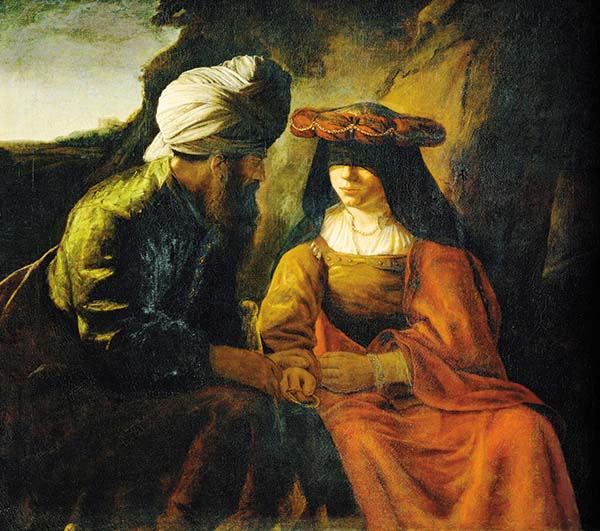
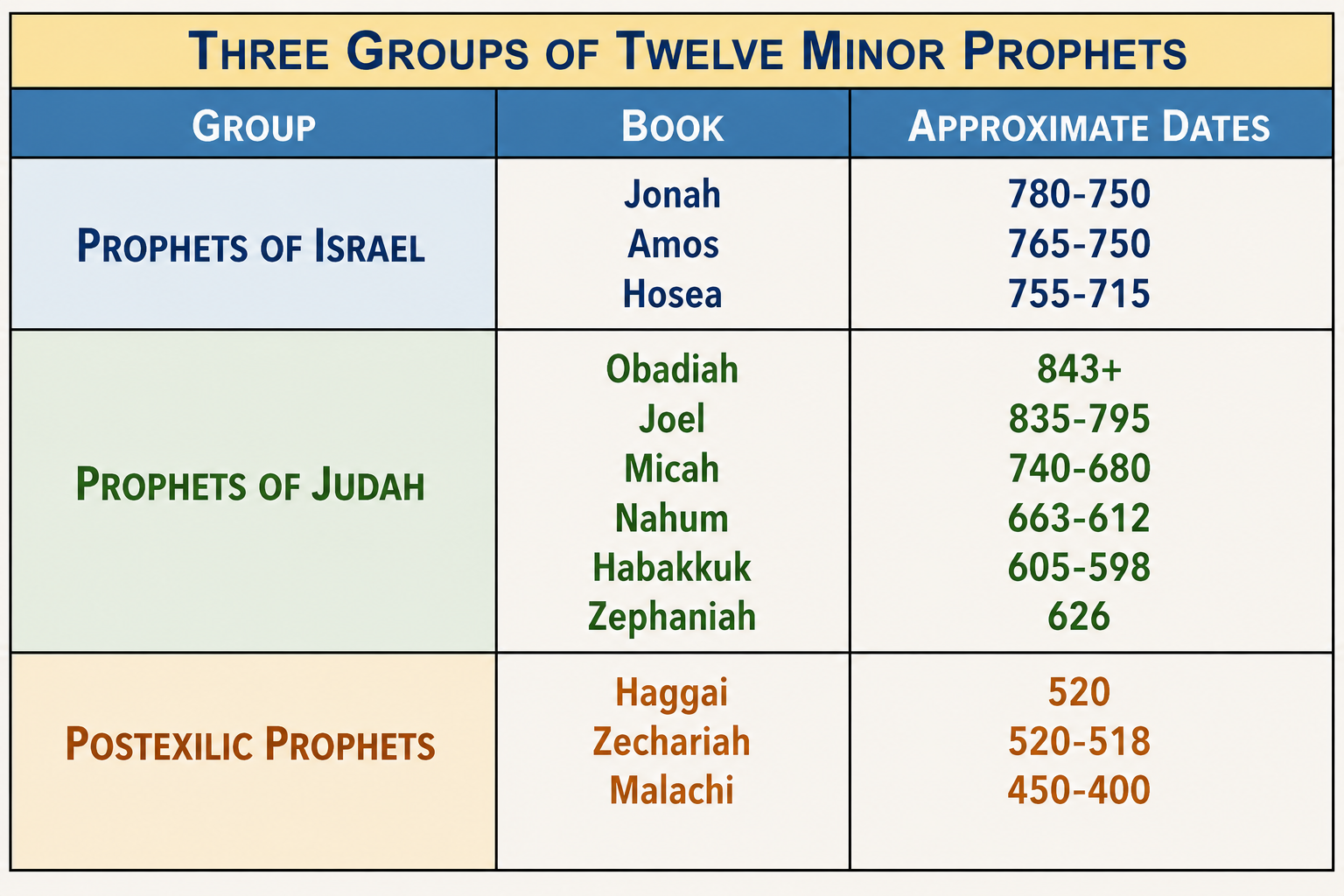
Hosea's Unconditional Love for Gomer
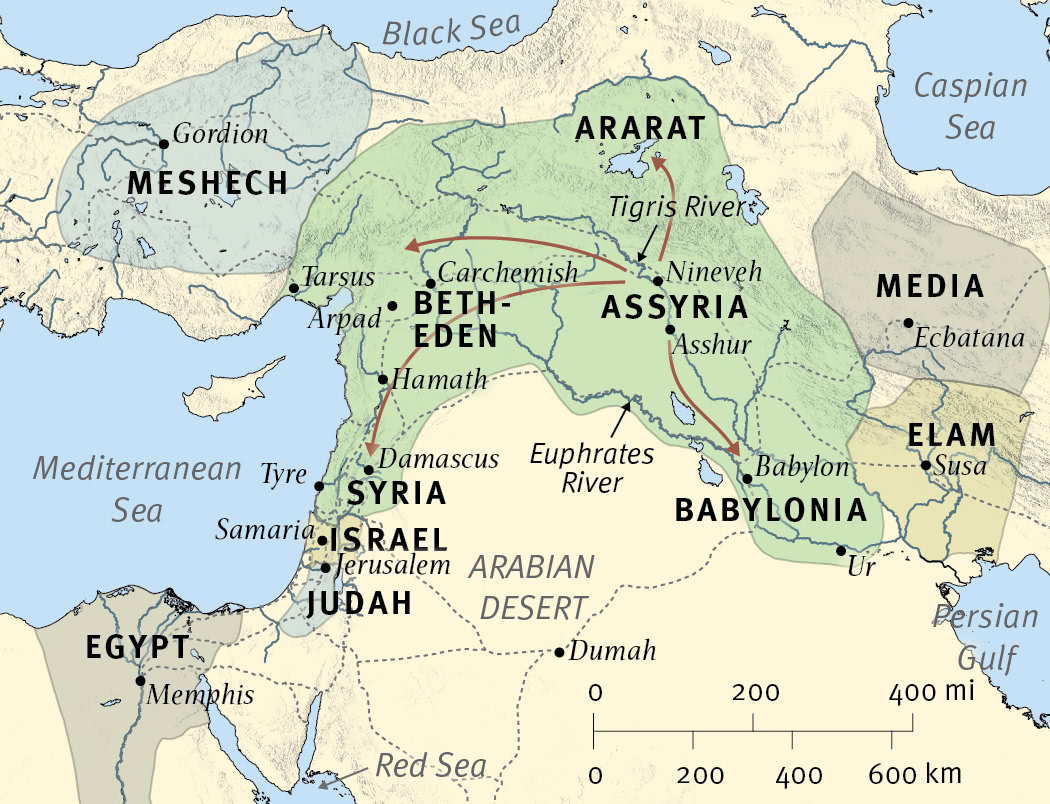
Source: ESV Global Study Bible
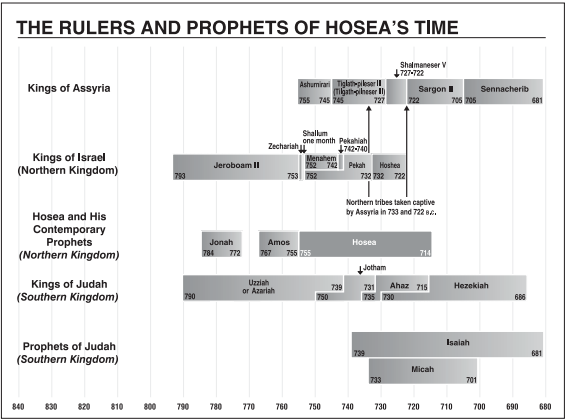
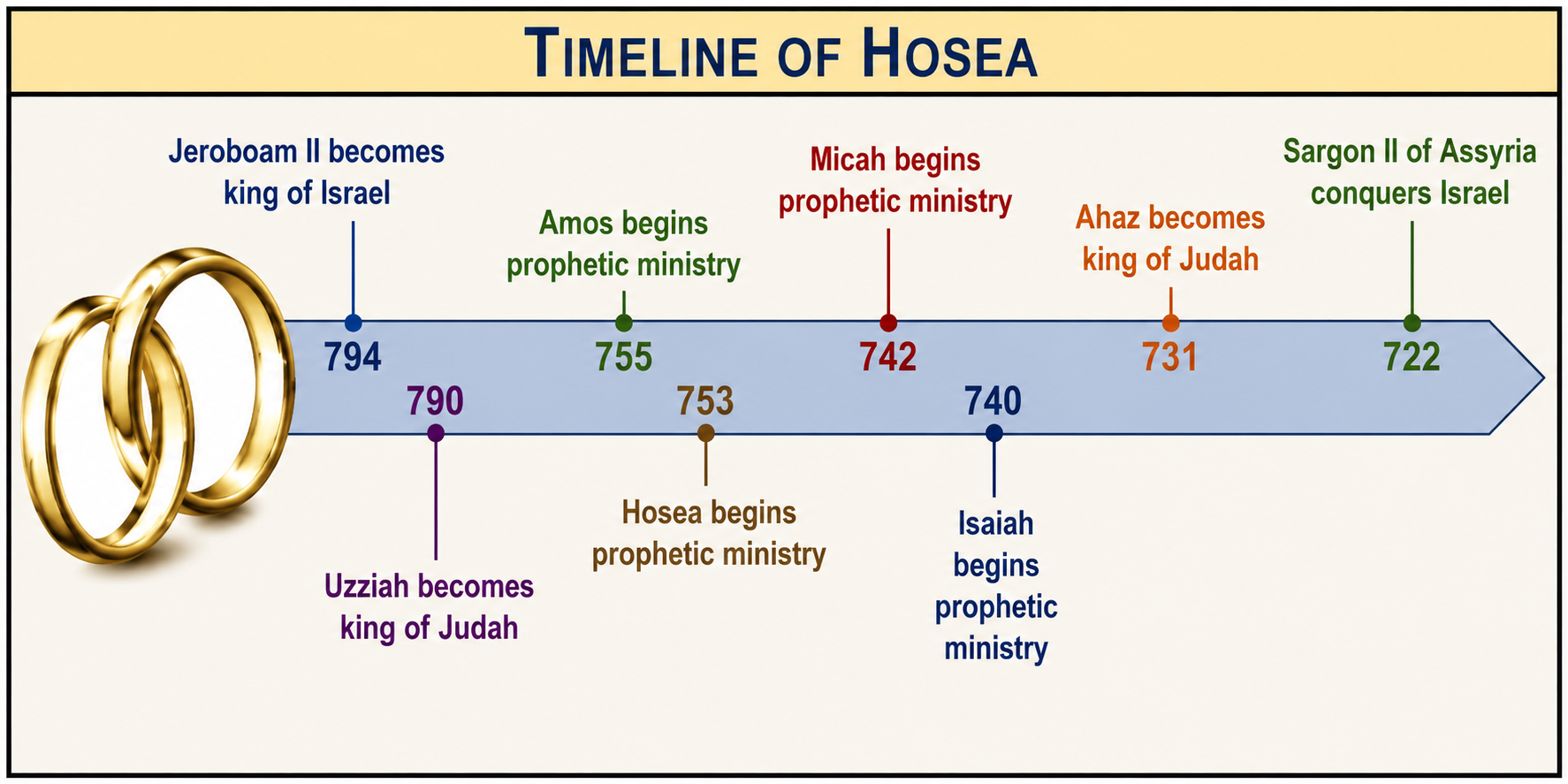
OUTLINE OF HOSEA
I. The Prodigal Wife, Hosea 1:1-3:5
A. Her Unfaithfulness, Hosea 1:1-11
B. Her Punishment, Hosea 2:1-13
C. Her Restoration and Israel's, Hosea 2:14-23
D. Her Redemption, Hosea 3:1-5
II. The Prodigal People, Hosea 4:1-14:9
A. The Message of Judgment, Hosea 4:1-10:15
1. The indictment, Hosea 4:1-19
2. The verdict, Hosea 5:1-15
3. The plea of Israel, Hosea 6:1-3
4. The reply of the Lord, Hosea 6:4-11
5. The crimes of Israel, Hosea 7:1-16
6. The prophecy of judgment, Hosea 8:1-10:15
B. The Message of Restoration, Hosea 11:1-14:9
1. God's love for the prodigal people, Hosea 11:1-11
2. God's chastisement of the prodigal people, Hosea 11:12-13:16
3. God's restoration of the prodigal people, Hosea 14:1-9
Borrow Ryrie Study Bible - page 1292
Hosea 2:1 Say to your brothers, “Ammi,” and to your sisters, “Ruhamah.”
KJV Say ye unto your brethren, Ammi; and to your sisters, Ruhamah.
NET Then you will call your brother, "My People" (Ammi)! You will call your sister, "Pity" (Ruhamah)!
NLT "In that day you will call your brothers Ammi-- 'My people.' And you will call your sisters Ruhamah-- 'The ones I love.'
BGT εἴπατε τῷ ἀδελφῷ ὑμῶν λαός μου καὶ τῇ ἀδελφῇ ὑμῶν Ἠλεημένη
LXE Say to your brother, My people, and to your sister, Pitied.
CSB Call your brothers: My People and your sisters: Compassion.
ESV Say to your brothers, "You are my people," and to your sisters, "You have received mercy."
NIV "Say of your brothers, 'My people,' and of your sisters, 'My loved one.'
YLT 'Say ye to your brethren -- Ammi, And to your sisters -- Ruhamah.
- unto: Ho 1:9-11
- Ammi: That is, My people, Ex 19:5,6 Jer 31:33 32:38 Eze 11:20 36:28 37:27 Zec 13:9
- Ruhamah: That is, Having obtained mercy, Ho 2:23 Ro 11:30,31 2Co 4:1 1Ti 1:13 1Pe 2:10
Related Passages:
Hosea 1:6 Then she conceived again and gave birth to a daughter. And the LORD said to him, “Name her Lo-ruhamah, for I will no longer have compassion on the house of Israel, that I would ever forgive them.
Hosea 1:9 And the LORD said, “Name him Lo-ammi, for you are not My people and I am not your God.”
Hosea 1:10-11 (THESE GO WITH Hosea 2:1) Yet the number of the sons of Israel Will be like the sand of the sea, Which cannot be measured or numbered; And in the place Where it is said to them, “You are not My people,” It will be said to them, “You are the sons of the living God.” 11 And the sons of Judah and the sons of Israel will be gathered together, And they will appoint for themselves one leader, And they will go up from the land, For great will be the day of Jezreel.
Zechariah 12:10 “I will pour out on the house of David and on the inhabitants of Jerusalem, the Spirit of grace and of supplication, so that they will look on Me whom they have pierced; and they will mourn for Him, as one mourns for an only son, and they will weep bitterly over Him like the bitter weeping over a firstborn.
Zechariah 13:9 “And I will bring the third part through the fire, Refine them as silver is refined, And test them as gold is tested. They will call on My name, And I will answer them; I will say, ‘They are My people,’ And they will say, ‘The LORD is my God.’”
Romans 11:25-29 For I do not want you, brethren, to be uninformed of this mystery–so that (PURPOSE CLAUSE) you will not be wise in your own estimation–that a partial hardening has happened to Israel until (CRITICAL TIME PHRASE) the fullness of the Gentiles has come in; 26 and so all Israel (ALL THAT BELEIVE - SEE Zech 13:9) will be saved; just as it is written, “THE DELIVERER (SECOND COMING) WILL COME FROM ZION, HE WILL REMOVE UNGODLINESS FROM JACOB.” 27 “THIS IS MY COVENANT WITH THEM, WHEN I TAKE AWAY THEIR SINS.” 28 From the standpoint of the gospel they (JEWS) are enemies for your sake, but from the standpoint of God’s choice they are beloved for the sake of the fathers; 29 for the gifts and the calling of God are irrevocable.
PROPHECY OF
FUTURE RESTORATION
This is a poor chapter division for Hosea 2:1 belongs with Hosea 1.
Say to your brothers, “Ammi ("My people),” and to your sisters, “Ruhamah ("pitied," "tender mercy," "compassion").” - This command is directed to Israel and should be read as a continuation of Hosea 1:10–11, where God dramatically reverses His earlier words of judgment. He had just stated "the day of Jezreel (see note)," and now elaborates on what makes it great. The significant change is that the prefix "Lo" ("not" or "no") has been removed from the names of Hosea's children. Earlier, God named them Lo-ammi ("Not My People") and Lo-Ruhamah ("No Mercy" or "Not Pitied") as living signs of His judgment upon the Northern Kingdom because of its persistent covenant unfaithfulness (Hos. 1:6, 9). Now, however, because of Yahweh's unwavering covenant faithfulness and His sovereign grace, the negative prefix disappears. Judgment is not God's final word. The names are transformed into Ammi ("My People") and Ruhamah ("Shown Mercy," "Tender Mercy," "Compassion"). The removal of Lo marks a complete reversal of Israel's covenant status. Those who were once disowned are graciously reclaimed; those who had forfeited mercy are once again made the objects of God's compassion.
As Charles Feinberg says "“Great shall be the day of Jezreel” for in that day God will in Christ rout the enemy once for all when Israel’s Messiah stands upon the Mount of Olives to espouse their cause in person. Then will they be Ammi (My People) and Ruhamah (Pitied). Thus all three names have reappeared, but now in blessing. (See The Minor Prophets - Page 2 or borrow)
Lo means no, but because of Yahweh's faithfulness to covenant, removes the negative and accentuates the positive. So now the united divisions of Judah and Israel will one day be known as "My people" who are shown "tender mercy" or "compassion."
This restoration reaches beyond individuals to encompass the reunited people of God. As foretold in Hosea 1:11, the long-divided kingdoms of Judah and Israel will one day be gathered together under one Head, the Messiah. The nation that once stood under the sentence, "You are not My people," will again hear the covenant declaration, "You are My people," and will experience God's abundant mercy and steadfast love forever and ever. Amen. What divine justice had temporarily suspended, divine grace will gloriously restore. at the end of this age (see Zech 12:10, Zech 13:9, Ro 11:25-29) This passage beautifully illustrates that God's discipline is real, but His covenant promises are ultimately fulfilled through His unfailing mercy and faithfulness (cf. Hos. 2:23; Rom. 9:25–26; 1 Pet. 2:10).
Chisholm points out that "Long before Hosea, Moses had predicted such a change in the Lord's attitude (Dt. 30:1-9). After describing the nation's future exile (Dt. 30:1), Moses promised that their repentance would result in a renewal of the Lord's compassion (Dt. 30:2-3, rāham) and a return to the land (Dt. 30:4-9). Long after Hosea, the Apostle Paul also foresaw this time of Israel's restoration (Ro 11:25-32)....The covenant promises to Abraham (of numerous descendants) and David (of eternal kingship) will be fulfilled when the covenant ideal predicted by Moses will be realized. (See Bible Knowledge Commentary: Old Testament - Page 1382)
Bob Utley - "Say" This word is a Qal IMPERATIVE, which figuratively denotes a certain future action of restoration and unification. This verse should go with the preceding salvation oracle (Hosea 1:10-2:1). ▣ Ammi "is a covenant designation for the people of God (e.g. Ex 6:6-7; 19:5-6). This is the reversal of Hosea 1:9 (cf. Hosea 2:23). ▣ Ruhamah This is an expression of the great love, compassion, and mercy of God. This is the reversal of Hosea 1:6 (cf. Hosea 2:23).
Donald Cantrell - Hosea 1; 2; 3; 4; 5; 6, & 7
The book of Hosea is the beginning of the Minor Prophets and Malachi is the concluding book. The prophet Hosea lived during the time of the divided kingdom. He is associated with the kingdom of Israel or the Northern Kingdom. Hosea was a contemporary of Amos, whom also was associated with the Northern Kingdom. The prophet was a voice of warning as the nation was continually backsliding and refusing to go forward.
Point to Ponder
In chapter 1, we find that God tells the prophet to go and choose him a bride, but not just any bride, but a harlot. This must have been stunning and startling to the prophet, but he refuses to disobey the Lord. Let us make sure that we understand the reading before us, that God imposed upon his prophet to go and marry a harlot. We find another story like this taking place 700 years later in the same hill country of Israel. There was a man that was dating a woman that he loved and she became pregnant with a child. The Lord came to him and told him to marry her despite his reservations and repulsions.
I. -The Wedding Invitation of Hosea (Hosea 1)
II. -The Wayward Indiscretion of Gomer (Hosea 2)
III. -The Wonderful Illustration of God (Hosea 3)
IV. -The Woeful Insubordination of Israel (Hosea 4–7)
Point to Ponder
Hosea goes out and falls in love with Gomer, who was a harlot. He marries her, takes her home, they have three children, and then she goes back to her former lifestyle. The three names of those children carry much meaning and implication against the nation of Israel.
Point to Ponder
The first child was named Jezreel and his name meant “God will scatter and God will avenge.” The second child was named Lo-ruhamah, which implied “she never knew a fathers pity.” Thirdly we find Lo-ammi, meaning “not my people.” The names of these three children were personal references to the nation of Israel and their backsliding. God loved his chosen people, yet like Gomer, they kept on going back to their sinful lifestyle.
Brian Bell - Hosea 2
- HARLOTRY! (Hos 2:2-13)
- (Hos 2:7) As Luke presents the prodigal son, so Hosea portrays the prodigal wife!
- Lk.15:17,18 "But when he came to himself, he said, 'How many of my father's hired servants have bread enough and to spare, and I perish with hunger! 'I will arise and go to my father, and will say to him, "Father, I have sinned against heaven and before you,”
- (Hos 2:8,9) Israel accepted God’s gifts but used them to worship idols.
- Q: Do you ever use your God-given resources for things that grieve Him?
- Q: What are the 2 deepest pangs, of this sin? [1] It violates God’s exclusive claim on our love & reverence! [2] It contaminates our loving response to God.
- 1st steps to fix an adulterous situation: Repent to whom you’ve sinned against(God & spouse/marital covenant); 100% cutting off of old relationship(no loose ends/often times a letter that the spouse reads before sending).
- (Hos 2:13) “It’s easy for the church today to prostitute itself to the world and still claim to be faithful to the Lord.” (Warren Wiersbe; pg. 571) (see James 4:4-10)
- (Hos 2:7) As Luke presents the prodigal son, so Hosea portrays the prodigal wife!
- A DOOR OF HOPE! (Hos 2:14-23)
- (Hos 2:14,15) Valley of Achor –
- Only God can give new meaning to old names, & wipe out painful associations w/old places.
- Here the Valley of Achor(valley of trouble), where Achan was stoned (Joshua 7:24-26) will became a door of hope!(a valley of hope)
- (Hos 2:16) Play on words here.
- Call me “ishi”(husband) no longer “baali”(master)
- They were used as synonymous terms. Like in 2 Sam.11:26 “When the wife of Uriah heard that Uriah her husband(ish) was dead, she mourned for her husband(baal).”
- Were not going to use that term anymore in Israel!
- Baal, the chief god of the Canaanites, was considered to be the god of the crops & fertility.
- These “Baal’s had become Israel’s “lovers”!
- (Hos 2:19) Martin Luther called this verse a wedding ring w/6 precious stones! (he also said…)
- “It is the highest grace of God when love continues to flourish in married life. The first love is ardent, is an intoxicating love, so that we are blinded and are drawn to marriage. After we have slept off our intoxication, sincere love remains in the married life of the godly; but the godless are sorry they ever married.” (Martin Luther. "William and Catherine Booth," Christian History, no. 26.)
- Q: What do these 2 chapters reveal to you about how your own sin affects the Lord?
- Q: How can this glimpse into God’s heart affect your thoughts & behavior this week?
- (Hos 2:14,15) Valley of Achor –
Hosea 2:2 “Contend with your mother, contend, For she is not my wife, and I am not her husband; And let her put away her harlotry from her face And her adultery from between her breasts,
KJV Plead with your mother, plead: for she is not my wife, neither am I her husband: let her therefore put away her whoredoms out of her sight, and her adulteries from between her breasts;
NET Plead earnestly with your mother (for she is not my wife, and I am not her husband), so that she might put an end to her adulterous lifestyle, and turn away from her sexually immoral behavior.
NLT "But now bring charges against Israel-- your mother-- for she is no longer my wife, and I am no longer her husband. Tell her to remove the prostitute's makeup from her face and the clothing that exposes her breasts.
BGT κρίθητε πρὸς τὴν μητέρα ὑμῶν κρίθητε ὅτι αὐτὴ οὐ γυνή μου καὶ ἐγὼ οὐκ ἀνὴρ αὐτῆς καὶ ἐξαρῶ τὴν πορνείαν αὐτῆς ἐκ προσώπου μου καὶ τὴν μοιχείαν αὐτῆς ἐκ μέσου μαστῶν αὐτῆς
LXE Plead with your mother, plead: for she is not my wife, and I am not her husband: and I will remove her fornication out of my presence, and her adultery from between her breasts:
CSB Rebuke your mother; rebuke her. For she is not My wife and I am not her husband. Let her remove the promiscuous look from her face and her adultery from between her breasts.
ESV "Plead with your mother, plead-- for she is not my wife, and I am not her husband-- that she put away her whoring from her face, and her adultery from between her breasts;
NIV "Rebuke your mother, rebuke her, for she is not my wife, and I am not her husband. Let her remove the adulterous look from her face and the unfaithfulness from between her breasts.
YLT Plead ye with your mother -- plead, (For she is not My wife, and I am not her husband,) And she turneth her whoredoms from before her, And her adulteries from between her breasts,
NKJ "Bring charges against your mother, bring charges; For she is not My wife, nor am I her Husband! Let her put away her harlotries from her sight, And her adulteries from between her breasts;
NJB To court, take your mother to court! For she is no longer my wife nor am I her husband. She must either remove her whoring ways from her face and her adulteries from between her breasts,
- Plead with: Isa 58:1 Jer 2:2 19:3 Eze 20:4 23:45 Mt 23:37-39 Ac 7:51-53 2Co 5:16
- she: Isa 50:1 Jer 3:6-8
- let: Ho 1:2 Jer 3:1,9,13 Eze 16:20,25 23:43
THE ACCUSATION AND
CALL TO REPENTANCE
Hosea 2:2–13 records the Lord's formal declaration of judgment against Israel because of her persistent covenant unfaithfulness and spiritual adultery. Through the vivid imagery of an unfaithful wife, God exposes the nation's idolatry, ingratitude, and shameless pursuit of false gods. Yet even as He announces the certainty of coming discipline, His purpose is not merely punitive but redemptive. The judgment described in this section is designed to awaken Israel to her sin, bring her to genuine repentance, and ultimately prepare the way for the gracious promises of restoration that follow in Hos 2:14–23.
Contend (riyb) with your mother, contend (riyb) - Yawheh is giving commands to contend to Israel, not to the children of Hosea. Using the marriage analogy introduced in Hosea 1, the Lord now expands the illustration by addressing Hosea's children, who symbolize the covenant people of Israel, the largely apostate Northern Kingdom. Through the children, God calls for a formal indictment against their unfaithful "mother." "Contend with your mother, contend" is courtroom language, summoning the children to testify against Israel because of her persistent spiritual adultery. Thus, the rebuke is directed beyond Gomer to the nation she represents.
John MacArthur - Contend with your mother. Although the language is applicable to Gomer, it depicts a courtroom scene in which the Lord, as the plaintiff, brings charges against the defendant. Individual Israelites, depicted as the children, are commanded to bring charges against their mother, Israel as a nation. The physical immorality of Gomer pictures the spiritual idolatry of Israel. (See The MacArthur Bible Commentary - Page 973)
HCSB on contend - Here is the first command to repent in the book (Hosea 4:15; 6:1; 10:12; 12:6; 14:1-2,9), followed by alternating verses of judgment (Hos 2:3-4,6-7,9-11) and indictment (Hos 2:5,8,12-13). The children, representing the common people of Israel, are urged to rebuke their mother, representing Israel's leadership. So Israel's divorce is not the end of hope and her punishment is not the last word (vv. 3,19-20). (See CSB Study Bible)
ESV Study Bible - CONTEND (PLEA) - The plea for repentance is repeated twice for emphasis. As commonly understood, she is not my wife, and I am not her husband is a repudiation of the marriage bond, which would parallel God’s right to repudiate his covenant bond with Israel. But perhaps it should be read as a threat, rather than an actual divorce. Otherwise, Hosea would have no right to issue the warnings and threats that follow. Isaiah likewise expressed God’s reluctance to turn finally away from his people (Isa. 50:1). The marriage between God and Israel has not ended; the covenant made with Israel contains provision for restoration, and Israel is urged to respond to that provision: that she put away her whoring from her face, and her adultery from between her breasts.
NET Note - Heb “Plead with your mother, plead!” The imperative רִיבוּ (rivu, “plead!”) is repeated twice in this line for emphasis. This rhetorical expression is handled in a woodenly literal sense by most English translations: NASB “Contend … contend”; NAB “Protest … protest!”; NIV “Rebuke … rebuke”; NRSV “Plead … plead”; CEV “Accuse! Accuse your mother!” Your mother - The suffix on the noun אִמְּכֶם (’immékhem, “your mother”) is a plural form (2nd person masculine). The children of Gomer represent the “children” (i.e., people) of Israel; Gomer represents the nation as a whole.
Flanagan - The godly (ED: GOD ALWAYS PRESERVED A GODLY REMNANT) must appeal to the others that there might be a reconciliation and a returning to the Lord. (What the Bible Teaches – Daniel, Hosea, Joel, Amos, Obadiah, Jonah, Micah)
THOUGHT - America is slipping fast into a moral abyss and is in desperate need of the godly remnant to sound the alarm, warn the wicked and pray fervently for revival.
Leon Wood - The verb translated "rebuke" (rib) (CONTEND) means basically "to contend or strive." Here the meaning is to "strive with your mother in rebuke" for her life of sin. The mother is Israel as a nation, and the children are individual Israelites. Thus Israelites were being urged to call for their nation to return to faithful living before God. The repetition of "rebuke" is for emphasis. (See The Expositor's Bible Commentary)
Gill on contend - endeavour to convince her of it; reprove her for it; expostulate with her about it; argue the case with her, and show her the danger of persisting in such an evil".
Trent Butler - God speaks as the prosecuting attorney in a divorce case in which he is also the plaintiff seeking the divorce and the judge administering the sentence. He first calls the children of chapter 1 of Hosea to bring charges against their own mother. The children must give evidence that their mother is no longer behaving as their father's wife. God bases the call on his own testimony that the couple are no longer husband and wife.....God's lawsuit is not that of an angry husband intent on destroying the reputation and future of his wife. It is a desperate maneuver seeking to bring a wayward people back to himself after they have abandoned their relationship with him. (See Holman Old Testament Commentary - Hosea, Joel, Amos - Page 17)
For (term of explanation) she is not my wife, and I am not her husband - "For she is not My wife, and I am not her husband" does not indicate that Yahweh had permanently dissolved His covenant relationship with Israel. Rather, it describes the tragic reality that Israel's idolatry had shattered the intimacy and fellowship that should have characterized her covenant union with the Lord. Just as Gomer had abandoned Hosea for other lovers, Israel had forsaken Yahweh to pursue Baal and other false gods. Although the covenant relationship had been grievously violated by Israel's unfaithfulness, God's purpose was not ultimate divorce but gracious restoration. This distinction is crucial. Divine judgment was necessary because God's holiness could not overlook Israel's spiritual adultery, yet His covenant love remained steadfast. Throughout this chapter the Lord disciplines His wayward people, not to destroy them, but to bring them to repentance and reconciliation (cf. Hos. 2:6–15). The goal of His chastening was to restore the joy and intimacy of the covenant relationship, a restoration that reaches its glorious climax in His promise, "I will betroth you to Me forever" (Hos 2:19–20). Thus, even in the midst of severe rebuke, God's redemptive purpose shines through and shows that His judgment serves as the pathway to repentance, and repentance leads to renewed covenant fellowship.
Chisholm of she is not my wife.... - Some have interpreted this statement as a formal declaration of divorce, which is unlikely in this context. The Lord's ultimate purpose was to heal the relationship, not terminate it (cf. Hos 2:2b, 6-7, 14-23). Thus the statement was probably an acknowledgment that "no reality remained in the relationship" (Derek Kidner, Love to the Loveless, p. 27). The Lord's wife, by her unfaithful behavior, had for all practical purposes severed the relationship with her Husband. Rather than exercising His legal prerogative by having His wayward wife executed (cf. Lev. 20:10; Deut. 22:22), the Lord issued a call for repentance, urging the nation to abandon its adulterous activity (Hosea 2:2b). (See The Bible Knowledge Commentary Minor Prophets)
NET Note - For - The particle כִּי (ki) introduces a parenthetical explanatory clause (however, cf. NCV “because”). The reason that Hosea (representing the LORD) calls upon his children (representing the children of Israel) to plead with Gomer (representing the nation as a whole), rather than pleading directly with her himself, is because Hosea (the LORD) has turned his back on his unfaithful wife (Israel). He no longer has a relationship with her (“for she is not my wife, and I am not her husband”) because she abandoned him for her lovers.
See Israel the Wife of Jehovah
And let her put away her harlotry (zenunim; Lxx - porneia) - NET = "so that she might put an end to her adulterous lifestyle." God is portraying Israel as an unfaithful wife whose spiritual adultery has become open, shameless, and publicly displayed. Put away is jussive mood which is like a command calling for immediate, decisive repentance. God is not merely asking Israel to modify her behavior but to completely abandon her spiritual prostitution. The command implies that genuine repentance requires the removal of both the outward manifestations of sin and the inward affections that produce it.
NET Note - So that (NET = "so that she might put an end to her adulterous lifestyle.") - The dependent volitive sequence of imperative followed by vav + jussive (רִיבוּ, rivu followed by וְתָסֵר, vétaser) creates a purpose clause: “so that she might turn away from” (= “put an end to”); cf. NRSV “that she put away”; KJV “let her therefore put away.” Many English translations begin a new sentence here, presumably to improve the English style (so NAB, NIV, TEV, NLT), but this obscures the connection with the preceding clause.
NET Note on put away - Heb “put away her adulteries from her face.” The plural noun זְנוּנֶיהָ (zénuneha, “adulteries”) is an example of the plural of repeated (or habitual) action: she has had multiple adulterous affairs.
Her harlotry from her face - NET = "and turn away from her sexually immoral behavior." The face is the most visible part of the body. It represents what is openly seen by others. This expression suggests that Israel's spiritual harlotry manifest by idolatry was brazen and shameless. Like an immoral woman who advertises her profession by her decorating her eyes and lips (cf Pr 6:25; Jezebel in 2Ki 9:30), Israel no longer attempted to conceal her idolatry. Her devotion to Baal was publicly displayed without embarrassment. Some commentators also suggest that this may allude to the cosmetics or adornments associated with prostitutes in the ancient Near East (cf. Jer. 4:30; Ezek. 23:40), though the primary emphasis is on the open display of her unfaithfulness. In short spiritually speaking, Israel had ceased to blush over her sin (cf Jer 6:15, 8:12)!
And her adultery from between her breasts - The interpretation of this expression is not easy and it seems most feel it refers to ornaments, amulets, or love tokens worn on the chest. Some think this means she actually exposed herself.
NET Note on from between her breasts - Heb “[put away] her immoral behavior from between her breasts.” Cf. KJV “her adulteries”; NIV “the unfaithfulness.”
Leon Wood - The reference to her "breasts" may imply that she had laid bare her bosom to entice her lovers. So Israel, having turned from her own true God, Yahweh, was guilty of unblushing idolatry and voluptuous service to false gods. (See The Expositor's Bible Commentary)
"Wife" of Jehovah (SEE IN DEPTH DISCUSSION): Marriage is one of many figures used in Scripture to emphasize the relationship of God to men. This illustration is used in both OT and NT to picture COVENANT LOVE, INTIMATE FELLOWSHIP, INCREDIBLE PRIVILEGE but DEFINITE RESPONSIBILITY. In the OT, as in Hos 2:16 - 23, Israel is described as the wife of the LORD, though now disowned because of disobedience. Nevertheless eventually, upon repentance, Israel will be restored. This relationship is not to be confused with that of the Church to Christ (Jn 3:29). In the mystery of the divine Trinity both are true. The NT speaks of the Church as a virgin espoused to one husband (2Co 11:1-2), which could never be said of an adulterous wife restored in grace. Israel is, then, to be the restored and forgiven wife of the LORD; the Church is the virgin wife of the Lamb (Jn 3:29; Rev 19:6-8). The Church is the Lamb's heavenly bride (Rev 19:7).
Bob Utley on contend - This is a legal term Qal IMPERATIVE, used twice in this verse) for a lawsuit (cf. Hosea 4:1-3; 12:2; Jer. 2:5-9; Micah 6:1-8). This verse is an analogy of Hosea's divorce (see SPECIAL TOPIC: CERTIFICATE OF DIVORCE, cf. Deut. 24:1-4) from Gomer. There are similar divorce formulas in Akkadian literature. The significance of Hosea's use of the marriage contract as an analogy of the covenant between YHWH and Israel is seen also in Isa. 50:1; 54:4-8; Jer. 3:1-20; Ezek. 16 and 23; Matt. 9:15; John 3:29; Eph. 5:22-33; Rev. 19:7-9; 21:9; 22:17. Hosea calls on the children to plead with their mother (the Northern Tribes) to stop (lit. "put away," Hiphil JUSSIVE) the activity (e.g. idolatry) that has led to the divorce case. ▣ "with your mother" This verse relates to the formal divorce charges against Israel. Usually national unfaithfulness is attributed to the father's sins, but here and in Isa. 50:1; Ezekiel 16 it is attributed to a wife's unfaithfulness! The covenant is broken because of their repeated unfaithfulness! ▣ "she is not my wife, and I am not her husband" This simple declarative statement, said publically, may have been the official announcement of a divorce in the ancient Near East. However, here the context demands that divorce is only a threat because the husband (YHWH) calls on his wife (Israel) to return lest he is forced to act (cf. Hosea 2:3). ▣ "let her put away" This VERB ( Hiphil JUSSIVE) can mean "turn away from," as in Deut. 7:4. It is used in Amos for YHWH rejecting Israel's worship (cf. Amos 5:23). Hosea uses this VERB often (cf. Hosea 2:2,17; 4:18; 7:14; 9:12). Context is everything! ▣ "her adultery from between her breasts" This may refer to (1) identifying jewelry (cf. Jer. 4:30) (2) marks that cultic prostitutes wore (cf. Hosea 2:13; lit. "holy thing") (3) literally to a male lover positioned over a prostitute (e.g. "from her face"; "between her breasts")
Harlotry (02183) zenunim is a Hebrew noun derived from zānâh (זָנָה) denotes fornication or harlotry, but its significance extends far beyond physical immorality into the realm of covenant theology and spiritual allegiance. At its most basic, the term refers to sexual unfaithfulness that violates the exclusivity of the marriage relationship (Hos. 4:11). In this literal sense, it describes acts that break the one-flesh union established by God, highlighting the betrayal of intimacy, trust, and covenant loyalty. However, the dominant usage in Scripture is figurative, where the word becomes a powerful theological metaphor. It depicts Israel’s breach of her covenant relationship with Yahweh, who is portrayed as her Husband (cf. Jer. 2:2; Isa. 54:5). Thus, “fornication” comes to mean spiritual infidelity—giving to others the devotion, trust, and worship that belong to God alone.
ZENUNIM - 13X/11V most in Hosea - harlotries(5), harlotry(8). Gen. 38:24; 2 Ki. 9:22; Jer. 3:2; Ezek. 23:11; Ezek. 23:29; Hos. 1:2; Hos. 2:2; Hos. 2:4; Hos. 4:12; Hos. 5:4; Nah. 3:4
This spiritual harlotry manifests in several interrelated ways:
Idolatry – The primary sense: Israel “prostitutes” herself by worshiping false gods, often at high places or through images (“stones and stocks,” Jer. 3:9). This is not merely religious error but covenant betrayal, exchanging the living God for lifeless substitutes.
Covenant rebellion – The term also encompasses a broader posture of disobedience and refusal to submit to God (Num. 14:33). It reflects a heart that has turned away, not just in worship but in will.
Moral corruption – Because idolatry reshapes behavior, this “fornication” includes the ethical decay that flows from abandoning God (Hos. 6:10). Spiritual unfaithfulness inevitably produces social and personal sin.
Misplaced trust and alliances – In passages like Ezekiel 23, the imagery includes reliance on foreign nations. Such alliances often involved invoking foreign deities and trusting human power instead of Yahweh. Thus, political compromise becomes another form of spiritual adultery.
Defilement of the land – This sin is not isolated to individuals; it spreads and contaminates the entire community and even the land itself (Jer. 3:2). The imagery conveys pervasive, public, and normalized unfaithfulness.
Hosea 2:2-7 Today in the Word
Our fathers were unfaithful; they did evil in the eyes of the Lord our God and forsook him. 2 Chronicles 29:6
Song of Solomon (or Song of Songs) is unique in the canon of Scripture. The language paints a poetic picture of longing and love leading to a faithful marriage relationship, but for centuries readers have probed the book for an additional meaning. Though this love poem primarily celebrates human love, it also shines as an image of God’s love for His people (cf. Eph. 5:21–33).
The book of Hosea offers a reverse image of that scenario. On the surface, the language of chapter 2 is conveyed in strictly human terms. But in contrast to Song of Solomon’s illustrations of godly love and devotion, the prophet described Gomer’s adultery as an overt depiction of Israel’s unfaithfulness toward God. The chastisement Hosea directed toward Gomer and her children applied equally to the people of Israel and their descendants. Gomer’s children likely belonged to other men, paralleled by the fact that Israel’s children were being trained in their parents’ pagan practices (v. 4).
Gomer had turned to other lovers (and perhaps served as a prostitute in a pagan temple) for food, clothes, and luxuries instead of depending on Hosea to provide (v. 5). He was prepared to punish his wife’s infidelity by exposing her sin (v. 3) and making it difficult for her to repeat her adulterous pursuits (v. 6). On a national scale, God was preparing to punish Israel’s worship of other gods by dethroning her kings and casting the people into
Assyrian captivity.
The motivation behind this punishment was not simply wrath or revenge. The underlying purpose was to cause the offending parties to see the futility of their sin (v. 7). As we will study tomorrow, Hosea was a strong provider for Gomer, just as God offered Israel anything a nation could hope for. From a strictly practical standpoint, unfaithfulness didn’t pay off. The allure of marital adultery and false gods was a mirage. When the penalty for their behavior finally struck, Gomer and Israel would see how foolish their choices had really been.
Apply the Word
Many worldly choices seem appealing but ultimately prove unrewarding. We tend to pursue foolish habits and selfish ambitions even after it’s too late to avoid negative consequences. Believers often buy into the fairy-tale mentality: if you really believe in your dreams, they’ll come true! But Hosea makes it clear that if the desires of our heart don’t line up with the Word of God, they will disappoint us whether or not they materialize. Instead of following your dreams, seek God’s kingdom and see how He provides (Matt. 6:33)!
Larry Richards - “I will expose her lewdness” Hosea 2:2–13.
In vivid poetic images Hosea now exposed the spiritual unfaithfulness of Israel, using the image of an adulterous wife. She is totally self-centered. She pursues lovers (other gods), but when they fail her she simply goes back to her husband, “for then I was better off than now” (v. 7). There is no sense of sin, no shame, no repentance. She simply comes back, as if she were doing her husband a favor by returning briefly before taking off again!
God announced through Hosea that He would force His wife Israel to face reality and to deal with her sins. Every material blessing would be taken away, and she would be stripped of prosperity.
Prosperity still insulates many people from spiritual realities. And it may be a blessing if all our “good things” are taken away. - The 365 day devotional commentary
Hosea 2:3 Or I will strip her naked And expose her as on the day when she was born. I will also make her like a wilderness, Make her like desert land And slay her with thirst.
KJV Lest I strip her naked, and set her as in the day that she was born, and make her as a wilderness, and set her like a dry land, and slay her with thirst.
NET Otherwise, I will strip her naked, and expose her like she was when she was born. I will turn her land into a wilderness and make her country a parched land, so that I might kill her with thirst.
NLT Otherwise, I will strip her as naked as she was on the day she was born. I will leave her to die of thirst, as in a dry and barren wilderness.
BGT ὅπως ἂν ἐκδύσω αὐτὴν γυμνὴν καὶ ἀποκαταστήσω αὐτὴν καθὼς ἡμέρᾳ γενέσεως αὐτῆς καὶ θήσομαι αὐτὴν ὡς ἔρημον καὶ τάξω αὐτὴν ὡς γῆν ἄνυδρον καὶ ἀποκτενῶ αὐτὴν ἐν δίψει
LXE that I may strip her naked, and make her again as she was at the day of her birth: and I will make her desolate, and make her as a dry land, and will kill her with thirst.
CSB Otherwise, I will strip her naked and expose her as she was on the day of her birth. I will make her like a desert and like a parched land, and I will let her die of thirst.
ESV lest I strip her naked and make her as in the day she was born, and make her like a wilderness, and make her like a parched land, and kill her with thirst.
NIV Otherwise I will strip her naked and make her as bare as on the day she was born; I will make her like a desert, turn her into a parched land, and slay her with thirst.
YLT Lest I strip her naked. And have set her up as in the day of her birth, And have made her as a wilderness, And have set her as a dry land, And have put her to death with thirst.
NKJ Lest I strip her naked And expose her, as in the day she was born, And make her like a wilderness, And set her like a dry land, And slay her with thirst.
NJB or I shall strip her and expose her naked as the day she was born; I shall make her as bare as the desert, I shall make her as dry as arid country, and let her die of thirst.
- I strip: Ho 2:10 Isa 47:3 Jer 13:22,26 Eze 16:37-39 23:26-29 Rev 17:16
- was born: Eze 16:4-8,22
- as: Isa 32:13,14 33:9 64:10 Jer 2:31 4:26 12:10 22:6 Eze 19:13 Eze 20:35,36
- a dry: Jer 2:6 17:6 51:43
- and slay: Ex 17:3 Judges 15:18 Am 8:11-13
Related Passages:
Hosea 2:10 “And then I will uncover her lewdness In the sight of her lovers, And no one will rescue her out of My hand.
Jeremiah 13:22 "Because of the magnitude of your wrongdoing Your skirts have been removed And your heels have been exposed."
Ezekiel 16:37 "I will gather all your lovers with whom you took pleasure... and I will expose your nakedness to them."
Nahum 3:5 "I will lift up your skirts over your face, And show the nations your nakedness."
Isaiah 47:3 "Your nakedness will be uncovered, Your shame will also be exposed."
CONSEQUENCES OF NOT
REPENTING
Or I will strip her naked And expose her as on the day when she was born. I will also make her like a wilderness, Make her like desert land And slay her with thirst - God continues the picture of Israel as an unfaithful wife and gives these severe warnings if she fails to repent. The opening word is critical for the Hebrew pen (פֶּן) means lest (Hos 2:3ESV) or otherwise (Hos 2:3CSB, Hos 2:3NLT), and it makes the entire verse conditional. This is not a decree of doom already sealed; it is the alternative outcome should she reject the appeal of Hosea 2:2.
TECHNICAL NOTE - A key phrase in Hosea 2 is "I WILL" signifying what Yahweh would do to His unfaithful wife - Hos. 2:3; Hos. 2:4; Hos. 2:5; Hos. 2:6; Hos. 2:7; Hos. 2:9; Hos. 2:10; Hos. 2:11; Hos. 2:12; Hos. 2:13; Hos. 2:14; Hos. 2:15; Hos. 2:17; POSITIVE "I WILL'S" = Hos. 2:18; Hos. 2:19; Hos. 2:20; Hos. 2:21; Hos. 2:23
John Walton on strip her naked and expose her - Several documents, including wills found in the town of Nuzi, refer to this type of treatment of a wife who abandons her husband to live with another man. It is typically the children who perform this legal act. It is intended to humiliate and perhaps served as an instrument of divorce, though in cases where the husband has already died, it is related to property rights. (See page 752 IVP Bible Background Commentary on OT)
Charles Feinberg - The warning is that she will be deprived of all subsistence and all earthly possessions. All this is brought out under the picture of nakedness (see Eze 16:4), desolation, waste, and death by thirst. Here we have an intimation of the coming captivity to Assyria for the Northern Kingdom, but it is not yet specifically stated. (See The Minor Prophets or borrow)
J M Flanagan - Jehovah threatens to strip her naked, and leave her just as she was in the day of her national birth when He brought her out of Egypt. It is stated by many commentators that this was a punishment often meted out to an unfaithful wife by many an incensed husband. As one expositor writes, "They shaved off her hair, stripped her naked in the presence of her relatives, and in this state drove her from the house of her husband" (Clarke). It was a severe judgment indeed, and this was the threat to Israel nationally if there was no repentance. She would be stripped of wealth and riches, of dignity, of privilege and protection, and left helpless and defiled as she had been at her birth, as described in Ezekiel 16:4-7. (What the Bible Teaches - Daniel, Hosea, Joel, Amos, Obadiah, Jonah, Micah)
Derek Kidner on naked and slay her with thirst - There is poetic justice in the threat to ‘strip her naked’, for it is in one sense a saturation-dose of her own medicine, cheapening her, as in chapter 10, even beyond her own self-cheapening; and in another sense it speaks of stark destitution—as the desert scene of chapter 3b makes plain. (See The Message of Hosea or borrow)
Wycliffe Bible Commentary on naked - This punishment for adultery is attested in Scripture (Ezk 16:38) and in the Nuzi tablets from northern Mesopotamia. The words here apply to Israel, who would become a prey to her enemies when left desolate and naked by her God. (Borrow Wycliffe Bible Commentary )
ESV Study Bible - Public humiliation of an unfaithful wife was not exceptional during this time. Similar language was used to describe retributions for breaking treaties. Some commentators see this “stripping” as the retrieval of everything a husband had provided for his bride (Ex. 21:10–11; cf. Hos. 2:9).
Bob Utley - "Or I will strip her naked" Nakedness is one of the consequences of covenant disobedience in Deut. 28:48 (cf. Jer. 16:39; 23:29). This custom of dismissing a divorced woman publicly and stripping her naked (cf. Ezek. 16:35-42) is found in the cuneiform tablets, both from Hana and Nuzi, dating from around 1500 B.C. It is a symbol of her (1) divorced and going into slavery (2) the fruitlessness of the land (the curses of Deuteronomy 27-29) because of her repeated idolatry. ▣ "I will also make her like a wilderness" The rest of Hosea 2:3 describes one of the covenant curses (cf. Leviticus 26; Deuteronomy 28) which will fall upon Israel. YHWH, not Ba'al, is the source of fertility! One of God's ways to attract the nations to know Him was the promise of abundance. Abraham's descendants' lack of covenant obedience thwarted this from occurring. Therefore, this promised abundance is negated temporally, but reaffirmed eschatalogically (cf. Amos 9:13-15; Joel 3:18).
John Walton - stripped naked and turned out. Several documents, including wills found in the town of Nuzi, refer to this type of treatment of a wife who abandons her husband to live with another man. It is typically the children who perform this legal act. It is intended to humiliate and perhaps served as an instrument of divorce, though in cases where the husband has already died, it is related to property rights. (See page 752 IVP Bible Background Commentary on OT)
Another thought is that captured exiles (which Israel would soon be in 722BC) were often depicted in antiquity as being led away naked (Isa 20:1-6).
NET Note on "so that I might kill her with thirst" (Hos 2:2NET) - Hebrew = "and kill her with thirst." The vav prefixed to the verb (vahamittiha) introduces a purpose/result clause: "in order to make her die of thirst" (purpose) or "and thus make her die of thirst" (result).
Charles Feinberg sums up the warning - Throughout the passage by means of the physical figures employed, the enormity and heinousness of the spiritual defection of Israel from the Lord are more clearly seen. The brazenness of her infidelity is pictured by the words “her whoredoms from her face.” God never glosses over sin. This is a distinctive feature of the Bible that differentiates it from all other books, ancient and modern. It never palliates sin regardless of who is involved in it. Hence, Israel must bear the bitter pain and blight for her spiritual whoredoms and adulteries. The warning is that she will be deprived of all subsistence and all earthly possessions. All this is brought out under the picture of nakedness (see Eze 16:4), desolation, waste, and death by thirst. Here we have an intimation of the coming captivity to Assyria for the Northern Kingdom, but it is not yet specifically stated. (See The Minor Prophets or borrow)
See Imagery of Naked in Dictionary Of Biblical Imagery page 1962
Hosea 2:4 “Also, I will have no compassion on her children, Because they are children of harlotry.
KJV And I will not have mercy upon her children; for they be the children of whoredoms.
NET I will have no pity on her children, because they are children conceived in adultery.
NLT And I will not love her children, for they were conceived in prostitution.
BGT καὶ τὰ τέκνα αὐτῆς οὐ μὴ ἐλεήσω ὅτι τέκνα πορνείας ἐστίν
LXE And I will not have mercy upon her children; for they are children of fornication.
CSB I will have no compassion on her children because they are the children of promiscuity.
ESV Upon her children also I will have no mercy, because they are children of whoredom.
NIV I will not show my love to her children, because they are the children of adultery.
YLT And her sons I do not pity, For sons of whoredoms are they,
NKJ "I will not have mercy on her children, For they are the children of harlotry.
NJB And I shall feel no pity for her children since they are the children of her whorings.
- I will not: Ho 1:6 Isa 27:11 Jer 13:14 16:5 Eze 8:18 9:10 Zec 1:12 Ro 9:18 Ro 11:22 Jas 2:13
- they be: They are all idolaters; and have been consecrated to idols, whose marks they bear.
- children of: Ho 1:2 2Ki 9:22 Isa 57:3 Joh 8:41
Also, I will have no compassion (racham; Lxx - eleeo) on her children, Because they are children of harlotry (zenunim; Lxx - porneia) - Israel was the unfaithful wife and her children were the individuals in Israel who were practicing idolatry (rhymes with harlotry!). Yahweh explains that He would have no compassion or mercy upon the spiritual adulterers. One might say their fate was sealed.
NET Note on children - Heb “her sons.” English versions have long translated this as “children,” however; cf. KJV, ASV, NAB, NASB, NIV, NRSV, NLT. children of adultery - Heb “sons of adulteries”; KJV “children of whoredoms.”....to focus on the immoral character of her children.
Trent Butler on children of harlotry - They are illegitimate children fathered by false gods and raised to love false gods. Thus God will abandon his children who have already abandoned him. (SEE Holman Old Testament Commentary - Hosea, Joel, Amos- Page 18)
Bob Utley - "I will have no compassion" This is the same word (BDB 933) in a verbal form (Piel IMPERFECT) found in Hosea 1:6, which is the name of Gomer's second child. It is used without the negative, in a positive sense in Hosea 2:19,23. ▣ "Because they are children of harlotry" The idolatry of the mother (cf. Hosea 2:5) also characterizes the children (i.e. Israel's population). The wife symbolizes unfaithful national Israel, while the children symbolize individual Israelites (cf. The Jewish Study Bible, p. 1146).
Compassion (have compassion, mercy)(07355) racham from rechem = womb ~ suggesting a connection between the place of the developing child and the strong feelings of love a mother has toward her child) speaks a deep love of one for another rooted in some "natural" bond (cp rechem = womb). Racham manifests itself as an "emotional" response to one's needs. Racham means to feel another's pain so deeply that you are moved to do something about it. Racham means to have compassion, to have mercy, to find mercy. "The word pictures a deep, kindly sympathy and sorrow felt for another who has been struck with affliction or misfortune, accompanied with a desire to relieve the suffering." (Baker) Racham is only used one time of a person saying he loves God (Ps. 18:1). More often racham is used of God saying He will or will not have compassion on people. Ps 103:13 compares God's compassion for those who fear Him to a father's compassion for his children. In Proverbs "He who conceals his transgressions will not prosper, but he who confesses and forsakes [them] will find compassion." (Pr 28:13)
RACHAM - 45V and 5x in HOSEA - Exod. 33:19; Deut. 13:17; Deut. 30:3; 1 Ki. 8:50; 2 Ki. 13:23; 2 Ki. 13:25; 2 Ki. 14:3; Ps. 18:1; Ps. 102:13; Ps. 103:13; Ps. 116:5; Prov. 28:13; Isa. 9:17; Isa. 13:18; Isa. 14:1; Isa. 27:11; Isa. 30:18; Isa. 49:10; Isa. 49:13; Isa. 49:15; Isa. 54:8; Isa. 54:10; Isa. 55:7; Isa. 60:10; Jer. 6:23; Jer. 12:15; Jer. 13:14; Jer. 21:7; Jer. 30:18; Jer. 31:20; Jer. 33:26; Jer. 42:12; Jer. 50:42; Lam. 3:32; Ezek. 39:25; Hos. 1:6; Hos. 1:7; Hos. 2:1; Hos. 2:4; Hos. 2:23; Hos. 14:3; Mic. 7:19; Hab. 3:2; Zech. 1:12; Zech. 10:6
IDOLATRY CONSEQUENCES - Moses solemnly warns Israel, "Beware, lest your hearts be deceived" (Deut. 11:16). The danger was not merely outward idolatry but an inward deception of the heart that would gradually draw them away from wholehearted devotion to Yahweh. Throughout Scripture, the heart is the wellspring of one's thoughts, affections, and decisions; therefore, if the heart is deceived, the life will inevitably follow (cf. Prov. 4:23; Jer. 17:9). The progression of apostasy is carefully traced in this passage. First, the heart is deceived, then the people "turn away" from the Lord (cf. Ex. 32:8; Deut. 9:12; 17:11, 17; Jer. 5:23), then they "serve other gods" (Deut. 7:4, 16; 8:19; 11:16; 13:6, 13; 17:3; 28:14, 36, 64; 29:26; 30:17; 31:20; Josh. 23:16; 24:2, 16; Jer. 11:10; 13:10; 16:11, 13; 22:9; 25:6; 35:15), and finally they "worship" them. This tragic pattern became a recurring characteristic of Israel's history, as the nation repeatedly forsook the living God to pursue the false gods of the surrounding nations.
The consequences of such covenant unfaithfulness were severe. Moses warns that "the anger of the LORD will be kindled against you" (Deut. 11:17; cf. Ex. 4:14; 22:24; 32:10; Num. 11:1, 10; 12:9; 32:10; Deut. 6:15; 7:4; 29:27; Josh. 23:11). God's wrath would be expressed by His covenant discipline: "He will shut up the heavens so that there will be no rain" (cf. Lev. 26:19; Deut. 28:24; 2 Chr. 6:26–28; 7:13). Without rain, "the ground will not yield its fruit," resulting in famine, economic collapse, and national suffering. Ultimately, if the nation persisted in rebellion, they would "perish quickly from the good land" which God had graciously given them (Deut. 4:26; 7:4; 8:19–20; 28:20, 22; 30:18; Josh. 23:13, 16). The very land that was God's covenant gift would become the place from which they would be expelled because of their covenant disobedience.
The Mosaic Covenant therefore presented Israel with a stark and uncompromising choice: obedience would bring life and blessing, while disobedience would bring judgment and death (Lev. 26; Deut. 28; 30:15, 19; Ps. 1). There was no middle ground. God's covenant was either faithfully obeyed or it was violated (cf. Deut. 27:26; Gal. 3:10). Yet Israel's repeated failures—and indeed the failure of all fallen humanity—demonstrated that no one could render the perfect, lifelong obedience the Law demanded (cf. Josh. 24:19; Rom. 3:9–18, 23). This inability exposed the necessity of a New Covenant, one founded not upon man's performance but upon God's grace, mercy, and faithfulness. Through the New Covenant, God promises to forgive sin, give His people a new heart, place His Spirit within them, and enable the obedience that the Mosaic Covenant could command but could never produce (Jer. 31:31–34; Ezek. 36:22–36). This glorious provision is fulfilled through the saving work of Jesus Christ, whose perfect obedience and atoning sacrifice accomplished what fallen sinners never could (Rom. 5:12–21; Gal. 3:10–14).
Hosea 2:5 “For their mother has played the harlot; She who conceived them has acted shamefully. For she said, ‘I will go after my lovers, Who give me my bread and my water, My wool and my flax, my oil and my drink.’
KJV For their mother hath played the harlot: she that conceived them hath done shamefully: for she said, I will go after my lovers, that give me my bread and my water, my wool and my flax, mine oil and my drink.
NET For their mother has committed adultery; she who conceived them has acted shamefully. For she said, "I will seek out my lovers; they are the ones who give me my bread and my water, my wool, my flax, my olive oil, and my wine.
NLT Their mother is a shameless prostitute and became pregnant in a shameful way. She said, 'I'll run after other lovers and sell myself to them for food and water, for clothing of wool and linen, and for olive oil and drinks.'
BGT ὅτι ἐξεπόρνευσεν ἡ μήτηρ αὐτῶν κατῄσχυνεν ἡ τεκοῦσα αὐτά εἶπεν γάρ ἀκολουθήσω ὀπίσω τῶν ἐραστῶν μου τῶν διδόντων μοι τοὺς ἄρτους μου καὶ τὸ ὕδωρ μου καὶ τὰ ἱμάτιά μου καὶ τὰ ὀθόνιά μου καὶ τὸ ἔλαιόν μου καὶ πάντα ὅσα μοι καθήκει
LXE And their mother went a-whoring: she that bore them disgraced them: for she said, I will go after my lovers, that give me my bread and my water, and my garments, and my linen clothes, my oil and my necessaries.
CSB Yes, their mother is promiscuous; she conceived them and acted shamefully. For she thought, "I will go after my lovers, the men who give me my food and water, my wool and flax, my oil and drink."
ESV For their mother has played the whore; she who conceived them has acted shamefully. For she said, 'I will go after my lovers, who give me my bread and my water, my wool and my flax, my oil and my drink.'
NIV Their mother has been unfaithful and has conceived them in disgrace. She said, 'I will go after my lovers, who give me my food and my water, my wool and my linen, my oil and my drink.'
YLT For gone a-whoring hath their mother, Acted shamefully hath their conceiver, For she hath said, I go after my lovers, Those giving my bread and my water, My wool and my flax, my oil and my drink.
NJB Yes, their mother has played the whore, she who conceived them has disgraced herself by saying, 'I shall chase after my lovers; they will assure me my keep, my wool, my flax, my oil and my drinks.'
- their mother: Ho 2:2 3:1 4:5,12-15 Isa 1:21 50:1 Jer 2:20,25 3:1-9 Eze 16:15,16 Eze 16:28-34 23:5-11 Rev 2:20-23 17:1-5
- hath done: Ho 9:10 Ezr 9:6,7 Jer 2:26,27 11:13 Da 9:5-8
- I will: Ho 2:13 8:9 Isa 57:7,8 Jer 3:1-3 Eze 23:16,17,40-44
- give: Ho 2:8,12 Jud 16:23 Jer 44:17,18
- drink: Heb. drinks
Related Passages:
Hosea 8:9 For they have gone up to Assyria, Like a wild donkey all alone; Ephraim has hired lovers.
Jeremiah 22:20; 22 “Go up to Lebanon and cry out, And lift up your voice in Bashan; Cry out also from Abarim, For all your lovers have been crushed. (22:22) “The wind will sweep away all your shepherds, And your lovers will go into captivity; Then you will surely be ashamed and humiliated Because of all your wickedness.
Ezekiel 16:33 “Men give gifts to all harlots, but you give your gifts to all your lovers to bribe them to come to you from every direction for your harlotries.
LOOKING FOR LOVE IN
ALL THE WRONG PLACES
For (term of explanation) - Explaining why Yahweh would not have compassion and why the judgments were so severe in Hosea 2:3-4. This is the explanation of the legal basis for Yahweh's covenant "lawsuit." It also begins Yahweh's goal to restore them by first depriving them of the false gods and the properity they falsely attributed to those gods.
Their mother has played the harlot (zanah; Lxx - ekporneuo); She who conceived them has acted shamefully - Their mother (she) is Israel (as shown by Hosea 2:13) and "them" is the individual Israelites who practiced idolatry. "Has played the harlot" is perfect tense describing a settled, accomplished fact, the ground of the charge.
This is not a case of a passage having two meanings. Hosea's marriage is a prophetic sign-act which is he same category as Ezekiel lying on his side (Ezekiel 4:4-8), Jeremiah's ruined linen belt (Jeremiah 13:1-11), Isaiah walking stripped and barefoot (Isaiah 20:2-4), and Ezekiel's unmourned wife (Ezekiel 24:15-24). In a sign-act, the prophet's real, literal experience is the sermon. There is the sign (Gomer) and the thing signified (Israel), and the prophecy's one intended meaning is the thing signified.
Acted shamefully - she has not merely felt shame but brought shame — on herself, on her children, and on the Name of her Husband. Compare Romans 2:24: "For 'the name of God is blasphemed among the Gentiles because of you.'"
For (term of explanation - explains shameful behavior) she said, ‘I will go after my lovers, Who give me my bread and my water, My wool and my flax, my oil and my drink - NLT = "She said, 'I'll run after other lovers and sell myself to them for food and water...." Note repetition of my (5x)! Israel failed to understand all they had was HIS and had been graciously given to them by HIM (see My in Hos 2:9)! Israel's lovers were the Baals (the name means "husband") and other abominable Canaanite idols. How foolish to ascribe the supply of food, drink, etc to the idols rather than to God the Giver of every good gift! (Jas 1:17)
Charles Feinberg - As an unabashed harlot, Israel has declared her intention of pursuing her “lovers” (the idols of her pagan worship) in order to receive her bread, water (necessities of food), wool, flax (necessities of clothing), oil, and drinks (luxuries). The time of prosperity in Israel, a gracious manifestation of the love of God, was taken by them as a benefit from the worthless gods they were worshiping....No words could bring out more forcefully the insanity of idol worship; such service so befogs and darkens the mind that the beneficences of God are credited to senseless vanities which profit not. (See Ro 1:18-32.) (See The Minor Prophets or borrow)
NET Note on my lovers - This statement alludes to the practice of sexual rites in the Canaanite fertility cult which attempted to secure agricultural fertility from the Canaanite gods (note the following reference to wool, flax, olive oil, and wine).
Bob Utley - Here is an example of Israel assuming that Ba'al and Asherah provided her food, clothing, and luxuries, while all the time it was the covenant God of Sinai, YHWH (cf. Hosea 2:8; the curses of Leviticus 26; Deuteronomy 28; Jer. 14:22). YHWH is a jealous (love word) God (e.g. Exod. 20:5; 34:14; Deut. 6:24; 5:9; 6:15). The descendants of Abraham made YHWH jealous by going after other gods (e.g. Deut. 32:16,21; Ps. 78:58). (JEALOUSY, ZEAL) Later, specifically the Northern Ten Tribes (Israel) made Him jealous (e.g. Hosea 2:8) and also Judah (cf. 1 Kgs. 14:22; Zech. 1:14; 8:2).
John Walton - Hos 2:5, 8. staple products and fertility. Both Hammurabi’s Code and the Middle Assyrian Law Code contain lists of items that a husband must by law supply his wife for her daily maintenance. These include grain, oil, wool and clothing. These staples formed the basis of the economy of the ancient Near East and were the symbols of fertility granted to the people by God (see Jer 31:12). Thus within the marriage metaphor employed by Hosea, the providing of these items represented God’s fulfillment of the covenant agreement. However, Israel’s choice is to take “lovers” (other gods), worship them and give them presents of gold and silver instead of acknowledging Yahweh’s gifts (compare Ezek 16:13-19). Israel credited the fertility gods such as Baal for the provision of these needs.(See page 752 IVP Bible Background Commentary on OT)
Played the harlot (02181) zanah is a verb meaning to fornicate, to prostitute and refers to marital infidelity or unfaithfulness. It was word used elsewhere in the OT to describe prostitution (Lev 21:7, Pr 7:10). Many of the uses of zanah are figurative describing Israel 's (Jehovah's "wife") commission of "spiritual prostitution" by having "intercourse" so to speak with other gods (cp 1 Co 6:16). Indeed, idolatry is looked upon as prostitution (Isa 50:1-3; 54:6, 7, 8; Jer 2:1-3; 3:1ff; Hos 2:1ff; Jas 4:4+; Rev 2:4+). In addition zanah describes Israel’s improper relationships with other nations (Isa. 23:17; Ezek. 23:30; Nah. 3:4). "The thought seems to be of having relations with these nations for the sake of political and monetary benefit, although in the case of Nineveh the added element of alluring, deceitful tactics leading on to oppressive dominance is implied. A third figurative meaning is found in Isa 1:21, where the Israelites’ departure from God’s approved moral standards is called harlotry." (link to TWOT online) CLICK HERE TO SEE THE REMAINDER OF THIS LENGTHY DEFINITION
ZANAH IN HOSEA - Hos. 1:2; Hos. 2:5; Hos. 3:3; Hos. 4:10; Hos. 4:12; Hos. 4:13; Hos. 4:14; Hos. 4:15; Hos. 4:18; Hos. 5:3; Hos. 9:1
J C Philpot - These "lovers" of ours
"I will run after my lovers and sell myself to them for food and drink, for clothing of wool and linen, and for olive oil." Hosea 2:5
Here is the opening up of what we are by nature, what our carnal mind is ever bent upon, what we do or are capable of doing, except as held back by the watchful providence and unceasing grace and goodness of the Lord.
These "lovers" of ours are our old sins and former lusts which still crave for gratification. To these sometimes the carnal mind looks back and says, "Where are my lovers that gave me my food and drink? Where are those former delights that so pleased my vile passions, and so gratified my base desires?"
These lovers, then, are . . . the lust of the flesh, the lust of the eyes, and the pride of life; all which, unless subdued by sovereign grace, still work in our depraved nature, and seek to regain their former sway.
But the Lord, for the most part, mercifully interposes, nor will He usually let His children do what they gladly would do; or be what they gladly would be. He says, "therefore I will block your path with thornbushes; I will wall you in so that your cannot find your way." (Hosea 2:6)
The Lord, in His providence or in His grace, prevents our carnal mind from carrying out its base desires; hedges up our way with thorns—by which we may spiritually understand prickings of conscience, stings of remorse, pangs of penitence—which are so many thorny and briery hedges that fence up the way of transgression, and thus prevent our carnal mind from breaking forth into its old paths, and going after these former lovers to renew its ungodly alliance with them.
A hedge of thorns being set up by the grace of God, our soul is unable to break through this strong fence, because the moment that it seeks to get through it, or over it, every part of it presents a pricking brier or a sharp and strong thorn, which wounds and pierces our conscience.
What infinite mercy, what surpassing grace, are hereby manifested! Were our conscience not made thus tender so as to feel the pricking brier, we can hardly tell what might be the fearful consequence, or into what a miserable abyss of sin and transgression our soul would fall.
But these lacerating briers produce remorse of soul before God; for finding, as the Lord speaks, "that when she runs after her lovers, she won't be able to catch up with them. She will search for them but not find them," there comes a longing in her mind for purer pleasures and holier delights than her adulterous lovers could give her. And thus a change in her feelings is produced, a revolution in her desires. "Then she will say, I will go back to my Husband as at first, for then I was better off than now."
The idea is of an adulterous wife contrasting the innocent enjoyments of her first wedded love—with the state of misery into which she had been betrayed by base seducers.
And thus the soul spiritually contrasts its former enjoyment of the Lord's presence and power—with its present state of darkness and desertion. "Where," she would say, "are my former delights, my first joys, and the sweetness I had in days now passed, in knowing, serving, and worshiping the Lord? Ah! He was a kind and loving husband to me in those days. I will return to Him if He will graciously permit me, for it was better with me when I could walk in the light of His countenance, than since I have been seeking for my lovers, and reaping nothing but guilt, death, and condemnation."
Hosea 2:6 “Therefore, behold, I will hedge up her way with thorns, And I will build a wall against her so that she cannot find her paths.
KJV Therefore, behold, I will hedge up thy way with thorns, and make a wall, that she shall not find her paths.
NET Therefore, I will soon fence her in with thorns; I will wall her in so that she cannot find her way.
NLT "For this reason I will fence her in with thornbushes. I will block her path with a wall to make her lose her way.
BGT διὰ τοῦτο ἰδοὺ ἐγὼ φράσσω τὴν ὁδὸν αὐτῆς ἐν σκόλοψιν καὶ ἀνοικοδομήσω τὰς ὁδοὺς αὐτῆς καὶ τὴν τρίβον αὐτῆς οὐ μὴ εὕρῃ
LXE Therefore, behold, I hedge up her way with thorns, and I will stop the ways, and she shall not find her path.
CSB Therefore, this is what I will do: I will block her way with thorns; I will enclose her with a wall, so that she cannot find her paths.
ESV Therefore I will hedge up her way with thorns, and I will build a wall against her, so that she cannot find her paths.
NIV Therefore I will block her path with thornbushes; I will wall her in so that she cannot find her way.
YLT Therefore, lo, I am hedging up thy way with thorns, And I have made for her a wall, And her paths she doth not find.
NKJ "Therefore, behold, I will hedge up your way with thorns, And wall her in, So that she cannot find her paths.
NJB This is why I shall block her way with thorns, and wall her in to stop her in her tracks;
- I will: Job 3:23 19:8 La 3:7-9 Lu 15:14-16 19:43
- make a wall: Heb. wall a wall
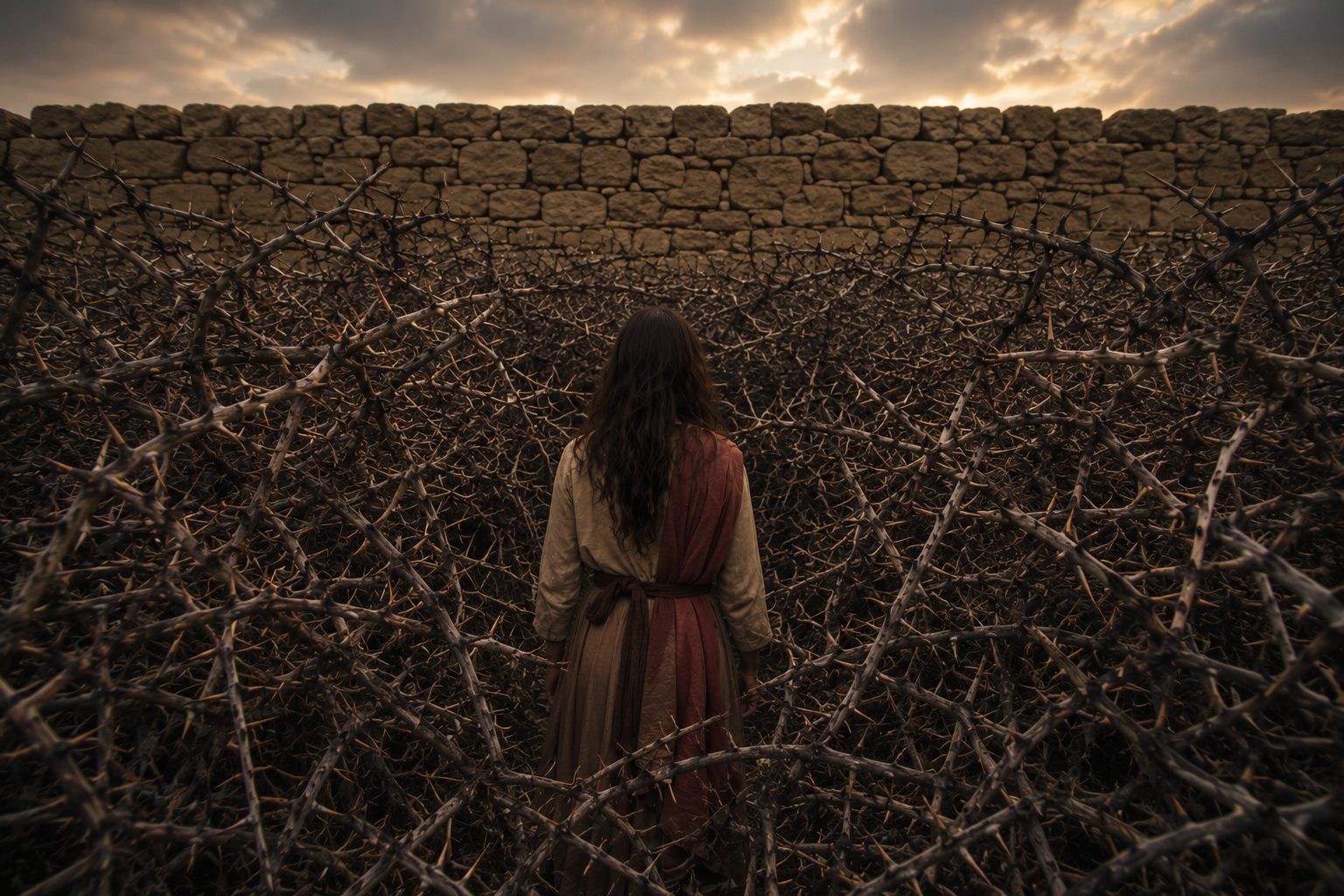
HEDGING ISRAEL REFLECTS
YAHWEH'S MERCY
Therefore - ESV Study Bible - Therefore. This is the first of three “therefores” in this chapter (cf. Hos 2:9, 14). It is spoken in response to the mother’s unbridled lust. The eighth-century prophets (including Hosea) truly believed that Israel’s sins could be forgiven and the nation restored. The jealous Husband of Israel will put a hedge around his wife so that she is prevented from straying (i.e., making pilgrimages to pagan shrines). The intention is redemptive. (See note on THEREFORE)
Behold, I will hedge up (suk/sûkh; Lxx - phrasso) her way with thorns, And I will build a wall against her so that she cannot find her paths - What Yahweh is saying is that He will sovereignly intervene so that Israel will go on and on after their idols (Hos 2:7) but never catching them. God Himself planted the thorn hedge and built the wall assuring Israel's idolatry would be a dead end! Her failure was not due to bad luck but in fact was a refleciton of His covenant lovingkindness and mercy. In other words Yahweh blocked the road to Baal because He intended to restore her, to birng her have back. I like the NJB rendering "wall her in to stop her in her tracks."
THOUGHT - Has this ever happened to you beloved? Have you veered off the highway of holiness onto some sinful bypath and begun to experience our loving Father's hand of discipline blocking your pursuit of that "bypath?" Our danger of course is to still foolish trying to go through the divine hedge or wall in pursuit of your passion. That never ends well!
NET Note on behold - The deictic particle הִנְנִי (hinni, “Behold!”) introduces a future-time reference participle that refers to imminent future action: “I am about to” (TEV “I am going to”).
Hedge (07753) suk/sûkh is used only twice in the Old Testament and means "to hedge in," "to fence about," "to block off," or "to enclose for protection or restraint." Its first occurrence is in Job 1:10, where Satan complains that God had "hedged" Job in on every side, protecting him, his household, and all that he possessed. Satan argued that this divine hedge of protection had made it easy for Job to remain faithful because God had abundantly blessed and safeguarded everything he did. The accuser further implied that if God removed this protective barrier and allowed suffering to enter Job's life, Job would renounce Him (Job 1:11).
the same God who once hedged Job for his protection
now hedges Israel for her restoration.
In Hosea 2:6, however, the imagery is strikingly different. Instead of erecting a hedge to protect His people, God declares that He will hedge in Israel's way with thorns to restrain her. The hedge is no longer one of protection but of loving discipline. By blocking her path to her pagan lovers (the Baals), God frustrates her pursuit of idolatry and prevents her from finding the satisfaction she seeks apart from Him. This thorny barrier is an expression of His covenant love, designed not to destroy Israel but to bring her to repentance, so that she will finally confess, "I will go back to my first husband, for it was better for me then than now" (Hos. 2:7). Thus, the same God who once hedged Job for his protection now hedges Israel for her restoration.
P G Matthew - Therefore I will block her path with thornbushes; I will wall her in so that she cannot find her way. —Hosea 2:6
The book of Hosea tells the story of God’s love—a love that will not let us go; a love that will cure our backsliding; a love that in covenant faithfulness will betroth us to God again in righteousness, justice, faithfulness, and compassion.
Because of God’s great love, his people who are walking in obedience normally enjoy a hedge of protection around them. Even Satan understands that God puts such a hedge in place. Satan said of Job, “Have you not put a hedge around him and his household and everything he has? You have blessed the work of his hands” (Job 1:10). When we love and obey God and come to him when he calls, he promises to be a wall of fire around us. But when we become stubborn and refuse to respond to him, he changes his hedge of protection into a hedge of thorns that will hurt us at every step.
Because of his great love, the Lord God thus becomes the divine blocker when necessary. He builds a hedge of thorns around us to inflict discomfort, and he knows just how much pain is necessary to bring about our restoration. We may try to wiggle out of God’s plan, but we will continue to bump into this thorny hedge. In the process, we become scratched and bruised and experience distress of every kind—spiritual, physical, psychological, social, and economic—until we repent and return to him.
If God has decided from all eternity to save us and make us holy, he will surely bring it to pass. He knows how to do it and he is able to do it. Our all-wise, almighty God will sanctify us in spite of our sin, stubbornness, wandering, and backsliding. Did you say that you no longer want to obey God? If he has chosen you from all eternity, he will do whatever it takes to change your mind and you will come willingly.
Let us not, however, misuse or misunderstand this great truth. God does bring his elect people back to him, but any sin and rebellion in us will necessarily result in regrettable, lifelong consequences. The way of the wicked is hard; what we sow, that we will reap. The way of first-time obedience is the way of wisdom.
God’s Hedge Around Us - W Glyn Evans
The great gospel message is that in Christ Jesus I am free. Thank You, Lord, for this truth. But it is just as true that in Christ Jesus I am bound, hobbled, hedged, and limited. My freedom is really only my freedom to change hobbles and to realize that Satan, my former hobbler, meant only viciousness for me while Christ, my new hobbler, intends only eternal welfare and good for me.
You said about Israel, “I will hedge up her way with thorns, and I will build a wall against her so that she cannot find her paths” (Hosea 2:6). This was the wall of confinement. Whenever we rebel against You and grow surly, as Israel did, a confining hedge will always be placed around us. Despite its confinement, that hedge was an expression of Your love, Lord. It shows the extent to which You will go to protect Your children from sinning and, therefore, from reaping a sad harvest.
Job had a confining hedge also. Satan said, “Hast Thou not made a hedge about him?” (Job 1:10). Thank You for this hedge, Lord. It is a hedge of protection around an obedient child of Yours to keep out the external enemy.
Lord, You build a hedge around every one of Your children. I may, if I will, break through the hedge and run pell-mell after my own selfish desires. But if I do, the consequences will be mine also. If I stay within the hedge, the consequences are Yours.
Thank You for Your hedges, Lord, whether illness, poverty, disappointment, sorrow, alienation, or whatever. I find my freedom when I realize that the hedge is not a confinement of my love for You, or Yours for me. It does not hinder my obedience to You, but contrariwise, makes me free to be abandoned to all the glories of a God-planned life.
“O satisfy us in the morning with Thy lovingkindness, that we may sing for joy and be glad all our days” (Psalm 90:14).
Dictionary of Biblical Imagery - THORN
In two dozen books of the OT and NT, thorn imagery pokes its way into poems, stories, histories and parables. From the romantic “Like a lily among the thorns, So is my darling among the maidens” (Song 2:2 NASB) to the threatening “I will thrash your bodies with the thorns of the wilderness,” (Judg 8:7), Bible writers find varied uses for such imagery, but their references to thorns are always negative.
Some authors use thorn imagery in comparisons: “The way of the sluggard is as a hedge of thorns, But the path of the upright is a highway” (Prov 15:19 NASB); “Instead of the thorn bush the cypress will come up” (Is 55:13 NASB); “Like a thorn which falls into the hand of a drunkard, So is a proverb in the mouth of fools” (Prov 26:9 NASB); and Jesus’ “Grapes are not gathered from thorn bushes, nor figs from thistles” (Mt 7:16 NASB).
Other writers capitalize on thorns’ worthlessness, using them as metaphor for that which needs to be discarded or burned: “Every one of them will be thrust away like thorns” (2 Sam 23:6 NASB); “They were extinguished as a fire of thorns” (Ps 118:12 NASB); Like tangled thorns … they are consumed (Nahum 1:10); and “if it yields thorns … it ends up being burned” (Heb 6:8 NASB).
Some passages accentuate the negative aspects of thorns by associating them with thistles (Gen 3:18), snares (Prov 22:5), nettles (Prov 24:31) and briers (Is 32:13). Other texts reference thorns when mentioning punishment or torture: “As pricks in your eyes and as thorns in your sides” (Num 33:55 NASB); “And the soldiers wove a crown of thorns and put it on [Jesus’] head” (Jn 19:2 NASB); and finally Paul’s “thorn in the flesh” (2 Cor 12:7) to symbolize his personal torment.
It is significant to note that thorns are in some cases associated with the judgment of Israel’s exile. Thus in Isaiah we read that Israel, God’s vineyard, will be overgrown with “briers and thorns” (Is 5:5–6) and “all the land will be briers and thorns” (Is 7:23–25 NRSV; cf. Is 32:13; Ezek 28:24; Hos 9:6; 10:8). Here perhaps is an echo of the condition that befalls Adam when he and Eve are exiled from the Garden (Gen 3:18). When Jesus in his parable speaks of some seed being sown among thorns (Mk 4:18–19 and par.), he may have in mind the continuing condition of Israel being in spiritual exile despite its return to the land.
From Genesis to Jesus, from the prophets to Paul, Bible writers sprinkle thorn imagery throughout Scripture to emphasize their messages of punishment, worthlessness and nonproductivity.
Hosea 2:7 “She will pursue her lovers, but she will not overtake them; And she will seek them, but will not find them. Then she will say, ‘I will go back to my first husband, For it was better for me then than now!’
KJV And she shall follow after her lovers, but she shall not overtake them; and she shall seek them, but shall not find them: then shall she say, I will go and return to my first husband; for then was it better with me than now.
NET Then she will pursue her lovers, but she will not catch them; she will seek them, but she will not find them. Then she will say, "I will go back to my husband, because I was better off then than I am now."
NLT When she runs after her lovers, she won't be able to catch them. She will search for them but not find them. Then she will think, 'I might as well return to my husband, for I was better off with him than I am now.'
BGT καὶ καταδιώξεται τοὺς ἐραστὰς αὐτῆς καὶ οὐ μὴ καταλάβῃ αὐτούς καὶ ζητήσει αὐτοὺς καὶ οὐ μὴ εὕρῃ αὐτούς καὶ ἐρεῖ πορεύσομαι καὶ ἐπιστρέψω πρὸς τὸν ἄνδρα μου τὸν πρότερον ὅτι καλῶς μοι ἦν τότε ἢ νῦν
LXE And she shall follow after her lovers, and shall not overtake them; and she shall seek them, but shall not find them: and she shall say, I will go, and return to my former husband; for it was better with me than now.
CSB She will pursue her lovers but not catch them; she will seek them but not find them. Then she will think, "I will go back to my former husband, for then it was better for me than now."
ESV She shall pursue her lovers but not overtake them, and she shall seek them but shall not find them. Then she shall say, 'I will go and return to my first husband, for it was better for me then than now.'
NIV She will chase after her lovers but not catch them; she will look for them but not find them. Then she will say, 'I will go back to my husband as at first, for then I was better off than now.'
YLT And she hath pursued her lovers, And she doth not overtake them, And hath sought them, and doth not find, And she hath said: I go, and I turn back unto My first husband, For -- better to me then than now.
NKJ She will chase her lovers, But not overtake them; Yes, she will seek them, but not find them. Then she will say,`I will go and return to my first husband, For then it was better for me than now.'
NJB then if she chases her lovers she will not catch them, if she looks for them she will not find them, and then she will say, 'I shall go back to my first husband, I was better off then than I am now;'
- she shall follow: Ho 5:13 2Ch 28:20-22 Isa 30:2,3,16 31:1-3 Jer 2:28,36,37 30:12-15 Eze 20:32 23:22
- I will: Ho 5:15 6:1 14:1 Ps 116:7 Jer 3:22-25 31:18 50:4,5 La 3:40-42 Lu 15:17-20
- first: Jer 2:2 3:1 31:32 Eze 16:18 23:4
- for: Ho 13:6 De 6:10-12 8:17,18 32:13-15 Ne 9:25,26 Jer 14:22 Da 4:17,25,32 5:21
Related Passages:
Habakkuk 2:18-19 “What profit is the idol when its maker has carved it, Or an image, a teacher of falsehood? For its maker trusts in his own handiwork When he fashions speechless idols. 19 “Woe to him who says to a piece of wood, ‘Awake!’ To a mute stone, ‘Arise!’ And that is your teacher? Behold, it is overlaid with gold and silver, And there is no breath at all inside it.
FROM FRUSTRATION
TO RESTORATION
She will pursue her lovers, but she will not overtake them; And she will seek them, but will not find them. Sin never satisifies. There may be passing pleasure (Heb 11:25) but no lasting pleasure! And so neither Gomer nor the people of Israel were able to find satisfaction in their wanton unfaithfulness. Pursue is the most intense verbal stem (Piel - see note) and is paired immediately with clear negation, so that she will pursue hard but she will not overtake. The picture is of maximum expenditure, but zero return! This is Hosea's whole diagnosis of idolatry compressed into one clause: the harder you chase a false god, the emptier your hands. Wow, does this message need to be heard by all of us! Compare Habakkuk 2:18-19 and Jeremiah 2:13 where Yahweh declares "They have forsaken Me, The fountain of living waters, To hew for themselves cisterns, Broken cisterns That can hold no water."
Then - Marks progression in the narrative. The purpose of God's confining of Israel (hedges...wall) was not to destroy them but to restore them. Israel frustrated by the hedge of thorns and wall has a change of heart.
She will say, ‘I will go back to my first husband, For it was better for me then than now! - NJB says "then she will say, 'I shall go back to my first husband, I was better off then than I am now." She will realize that the grass really is not greener on the other side of the fence!
Bob Utley - "pursue. . .eagerly chase after" These are both Piel PERFECTS with waw. In Hosea "the lovers" (cf. Hosea 2:5) refers to Ba'al worship. However, they could also refer to political alliances (cf. Hosea 5:13, see NIDOTTE, vol. 4, pp. 422-426).
Significance of the piel perfect of the verb pursue (radaph) is the ordinary word for "pursue, chase, follow after," used constantly of armies chasing a fleeing enemy (Ge 14:14; Josh 10:19). The Piel is rare with roughly a half-dozen occurrences and the BDB lexicon describes it as pursue ardently. The intensive stem (Piel) heightens the action: not merely going after her lovers, but chasing them hard, doggedly, with hot desire. Several English versions catch this with "chase after" (CSB, NIV) or "runs after" (NLT), and the Message paraphrases it as going on the hunt. The picture is of Yahweh's "wife" Israel continuing to chase after her idols with all her energy, but God sovereignly ensuring that her efforts fail (not find them). Her repeated disappointments are not accidental but are acts of divine mercy. By preventing Israel from finding satisfaction in her idols, God prepares her heart to confess "I will go back to my first husband, for it was better for me then than now." (Hos. 2:7) This illustrates a recurring biblical principle: God often uses frustrated desires as a means of restoring His wandering people to Himself (cf. Ps. 107:10–16; Luke 15:14–20). Hosea 2:7 shows that God's discipline is not merely punitive but redemptive. He blocks Israel's path to sin so that, finding every other refuge empty, she will return to the One she had forsaken.
The same verb pursue (radaph) is used in Proverbs 11:19 "He who is steadfast in righteousness will attain to life, And he who pursues (radaph) evil will bring about his own death." The intensive stem (Piel) in Hebrew often attaches to the chasing of what cannot be caught. Israel's idolatry is not lukewarm but is passionate, energetic, wholehearted but utterly empty and barren.
John Gill describing Israel's pursuit as conducted "with great eagerness and earnestness, as men pursue what they are bent upon".
ESV Study Bible - By the obstruction of thorns and a wall, the wayward wife will not be able to find her lovers, though she diligently seeks them. Left in limbo, without a husband to provide for her needs, she repeats the same words she said in v. 5: I will go. She decides that she should return to her first husband. She acknowledges him as her husband and that there was a time in her marriage when things went well.
Bob Utley - "Then she will say, ‘I will go back to my first husband, For it was better for me then than now'" YHWH's purpose in temporal judgments (cf. Leviticus 26; Deuteronomy 28) was to cause Israel to return to Him. Their prosperity (cf. Hosea 2:21-23) was meant to be a way to attract the attention of the world.
John Walton - Israel’s Baal worship. Agricultural villages, whose produce fed themselves and the urban centers like Jerusalem, dominated the world of ancient Israel. The Mediterranean climate brought rain only during the winter and early spring months (October—April), and a drought meant that their fragile hold on life was severely threatened. It is no wonder, therefore, that the Canaanite storm god Baal was so pervasive a figure in ancient worship as well as in the ancient religious texts from Ugarit and Phoenicia. Rain meant life, fertility, economic prosperity and power for those blessed by it. The task for the Israelite prophets thus became an effort to demonstrate that Yahweh was the provider of fertility, including rainfall, and that Baal was a false god (see Jer 2:8; 23:13). More often than not, however, local villagers chose to combine Yahweh and Baal worship in order to maximize their chances of a good harvest (see Judg 2:11; 6:25-32). Similarly, the kings of Israel, like Ahab, in making diplomatic marriages, accepted the introduction of Baal and Asherah alongside Yahweh in the official worship centers (see 1 Kings 16:31-33). Only after the exile would Baal worship be supplanted by faithful Yahweh-only worship among the Israelites. (See page 752 IVP Bible Background Commentary on OT)
C H Spurgeon - “She will pursue her lovers but not catch them; she will look for them but not find them. Then she will think, ‘I will go back to my former husband, for then it was better for me than now.’ ” What some do, others may do. If one man falls, another may. If one professor turned out to be a hypocrite, so may another. If one minister reels from the pinnacle of honor and is dashed on the rocks beneath, so may another. Age and habit are no security against apostasy. The continual keeping and anointing of the Holy Spirit is essential. Let us watch against the beginnings of backsliding. Let us take care of the little sins; let us watch against coldness of heart. No one backslides all at once. Few people who profess to be saints become outward sinners in one step; it is usually by little and by little. If our love of Christ has grown cold, we need to not stay in that state of danger but pray to the Master to inflame our hearts again. If any of us have in any respect fallen from our first love—if that old enthusiasm that was in us has disappeared—pray God to give it back. If any of us are not bearing such fruit for God as we used to do, we should be suspicious of ourselves. Carnal security may be the heaven of fools, but it is the ruin of believers.
Hosea 2:8 “For she does not know that it was I who gave her the grain, the new wine and the oil, And lavished on her silver and gold, Which they used for Baal.
KJV For she did not know that I gave her corn, and wine, and oil, and multiplied her silver and gold, which they prepared for Baal.
NET Yet until now she has refused to acknowledge that I was the one who gave her the grain, the new wine, and the olive oil; and that it was I who lavished on her the silver and gold– which they used in worshiping Baal!
NLT She doesn't realize it was I who gave her everything she has-- the grain, the new wine, the olive oil; I even gave her silver and gold. But she gave all my gifts to Baal.
BGT καὶ αὐτὴ οὐκ ἔγνω ὅτι ἐγὼ δέδωκα αὐτῇ τὸν σῖτον καὶ τὸν οἶνον καὶ τὸ ἔλαιον καὶ ἀργύριον ἐπλήθυνα αὐτῇ αὐτὴ δὲ ἀργυρᾶ καὶ χρυσᾶ ἐποίησεν τῇ Βααλ
LXE And she knew not that I gave her her corn, and wine, and oil, and multiplied silver to her: but she made silver and gold images for Baal.
CSB She does not recognize that it is I who gave her the grain, the new wine, and the oil. I lavished silver and gold on her, which they used for Baal.
ESV And she did not know that it was I who gave her the grain, the wine, and the oil, and who lavished on her silver and gold, which they used for Baal.
NIV She has not acknowledged that I was the one who gave her the grain, the new wine and oil, who lavished on her the silver and gold-- which they used for Baal.
YLT And she knew not that I had given to her, The corn, and the new wine, and the oil. Yea, silver I did multiply to her, And the gold they prepared for Baal.
NJB she had never realised before that I was the one who was giving her the grain, new wine and oil, giving her more and more silver and gold which they have spent on Baal!
- she: Isa 1:3 Hab 1:16 Ac 17:23-25 Ro 1:28
- her corn: Ho 2:5 10:1 Jud 9:27 Jer 7:18 44:17,18 Eze 16:16-19 Da 5:3,4,23 Lu 15:13 16:1,2
- wine: Heb. new wine, Ho 4:11 Isa 24:7-9
- which they prepared for Baal: or, wherewith they made Baal, Ho 8:4 13:2 Ex 32:2-4 Judges 17:1-5 Isa 46:6
Related Passages:
Deuteronomy 7:13 “He will love you and bless you and multiply you; He will also bless the fruit of your womb and the fruit of your ground, your grain and your new wine and your oil, the increase of your herd and the young of your flock, in the land which He swore to your forefathers to give you.
ISRAEL'S FAILURE TO
ACKNOWLEDGE YAHWEH AS THE GIVER
For she does not know (yada; Lxx - ginosko) that it was I who gave her the grain, the new wine and the oil, And lavished on her silver and gold, Which they used for Baal (ba'al) - NET gives a slightly difference sense = "Yet until now she has refused to acknowledge that I was the one who gave her the grain."
Robert Chisholm - The Canaanite "Legend of Keret" associated Baal's rain with agricultural blessing in the form of grain, bread, wine, and oil (cf. J.C.L. Gibson, Canaanite Myths and Legends. Edinburgh: T. & T. Clark, 1978, p. 98). By looking to Baal for these things Israel broke the first of the Ten Commandments (cf. Ex. 20:3; Deut. 5:7), rejecting one of the main principles of the Mosaic legislation. Moses taught that the Lord provided grain, wine, and oil (Deut. 7:13; 11:14). Each Israelite, when presenting his firstfruits in the harvest festival, was to recite the following words in the presence of the priest, "I bring the firstfruits of the soil that You, O Lord, have given me" (Deut. 26:10). (See The Bible Knowledge Commentary Minor Prophets)
Bob Utley - "For she does not know it was I who gave her" YHWH's heart (emphatic "I") breaks as His bride (a segment of His covenant people) does not recognize His love and provision (cf. Jer. 14:22). Therefore, in Hosea 2:9, YHWH withholds His blessing on crops and herds (cf. Leviticus 26; Deuteronomy 28). ▣ "the grain, the new wine and the oil" These three items represented the basic needs of ANE life (cf. Deut. 7:13; 11:14; Joel 2:19). ▣ "silver and gold" YHWH's blessings of valuable metals (either in the Exodus or through agricultural prosperity) were used to make idols (e.g. Deut. 29:17; Isa. 40:19; 46:5-7; Jer. 10:3-10) and jewelry (cf. Hosea 2:13) in Ba'al's honor! ▣ "used for Baal" "Ba'al" is the main god of Tyrian fertility worship which was introduced into Israel through Jezebel. Ba'al means "master," "husband," "lord" and is the name for the Canaanite storm god (sometimes war god). In the OT his consort is Asherah or Astarte (in Ugaritic myth it is Anat).
John MacArthur on used for Baal (ba'al) - Baal (the Phoenician sun-god) worship, already present during the time of the judges (cf. Jdg 2:17; 3:3; 8:33), became established in Israel when King Ahab married Jezebel, who attempted to obliterate Israelite worship of the true God (cf. 1Ki 19). Offerings to Baal actually came from God’s dowry to Israel (cf. Eze 16:10–14). (See MacArthur Study Bible)
HCSB - The leaders had led the people to trust and seek Baal (6 times in Hosea; 74 times in the OT) rather than Yahweh, the true God. Yahweh had not only created Israel and delivered them from Egyptian bondage but had also blessed them with the necessities of grain... new wine, and oil and even the luxuries of silver and gold. The verb translated recognize (lit "know") is used 16 times in Hosea, more than any of the Minor Prophets (Hos 2:20; 5:4; 6:3; 8:2; 9:7; 11:3; 14:9). The Hebrew verb ba'al can mean "marry, rule over, possess" and is related to the noun "husband, lord, owner" and the name of the Canaanite god "Baal" as well as places such as Baal-peor where he was worshiped (Nu 25:1-3). These various terms occur 229 times in the OT. The name occurs 7 times in Hosea, all but one for the Canaanite god. (See CSB Study Bible)
ESV Study Bible on did not know - In retrospect, she did not know. Israel’s failure to “know” the Lord and his provision, and the Lord’s plan to remedy this, is a key idea in the book (Hos 2:8, 20; 4:1, 6; 5:3, 4; 6:3; 7:9; 8:2; 11:3; 13:4, 5). The prosperity lavished upon Israel was due to the generosity not of Baal but of the Lord. Particularly hurtful is that the prosperity was used in heathen worship, a slap in God’s face. I who gave her continues the dominance of the first-person pronoun “I” in the rest of the chapter.
Know (03045) yada to know, to learn, to perceive, to discern, to experience, to confess, to consider, to know people relationally, to know how, to be skillful, to be made known, to make oneself known, to make to known. Often translated with Greek verb ginosko which speaks of knowing by experience. Some level of personal, experiential, acquaintance with another person is often the use of the verb yada.
YADA IN HOSEA - Hos. 2:8; Hos. 2:20; Hos. 5:3; Hos. 5:4; Hos. 5:9; Hos. 6:3; Hos. 7:9; Hos. 8:2; Hos. 8:4; Hos. 9:7; Hos. 11:3; Hos. 13:4; Hos. 13:5; Hos. 14:9
Baal (01168) ba'al (from baal 01166 = husband, married) Lord,Owner, possessor, husband. Baal was the Canaanite male god of fertility. Canaanite storm-god, the most powerful deity in Canaanite cosmology probably because of his association with fertility. Elijah contended with and exterminated the prophets of Baal (1 Ki 18:18, 19, 21, 22, 25, 26, 40). One of the more incredible mentions of Baal is Jehu's eradication of them from the northern kingdom (see 2 Ki 10:18-28). Before God would use Gideon to deliver His people from the Moabites, He first had him tear down his father's backyard altar to Baal (Jdg 6:25, 28, 30-31). As a result Gideon was named Jerrubball ("Let Baal contend against him" - Jdg 6:32). Under Gideon Israel was set free from Moabite oppression, but apparently they people were not set free from the "seed" of Baal worship in their hearts for "Then it came about, as soon as Gideon was dead, that the sons of Israel again played the harlot (SPIRITUAL ADULTERY!) with the Baals, and made Baal-berith their god" (Jdg 8:33)! Wow! Our hearts are more deceitful than all else and are desperately sick (Jer 17:9)! In 1 Sa 7:4 we see that "Israel removed the Baals and the Ashtaroth and served the LORD alone" but they must have backslide because we see their cry in 1 Sam 12:10! Beware of idols.
BA'AL - 66V - 5X IN HOSEA - Num. 22:41; Jos. 13:17; Jdg. 2:11; Jdg. 2:13; Jdg. 3:7; Jdg. 6:25; Jdg. 6:28; Jdg. 6:30; Jdg. 6:31; Jdg. 6:32; Jdg. 8:33; Jdg. 10:6; Jdg. 10:10; 1 Sam. 7:4; 1 Sam. 12:10; 1 Ki. 16:31; 1 Ki. 16:32; 1 Ki. 18:18; 1 Ki. 18:19; 1 Ki. 18:21; 1 Ki. 18:22; 1 Ki. 18:25; 1 Ki. 18:26; 1 Ki. 18:40; 1 Ki. 19:18; 1 Ki. 22:53; 2 Ki. 3:2; 2 Ki. 10:18; 2 Ki. 10:19; 2 Ki. 10:20; 2 Ki. 10:21; 2 Ki. 10:22; 2 Ki. 10:23; 2 Ki. 10:25; 2 Ki. 10:26; 2 Ki. 10:27; 2 Ki. 10:28; 2 Ki. 11:18; 2 Ki. 17:16; 2 Ki. 21:3; 2 Ki. 23:4; 2 Ki. 23:5; 2 Chr. 17:3; 2 Chr. 23:17; 2 Chr. 24:7; 2 Chr. 28:2; 2 Chr. 33:3; 2 Chr. 34:4; Jer. 2:8; Jer. 2:23; Jer. 7:9; Jer. 9:14; Jer. 11:13; Jer. 11:17; Jer. 12:16; Jer. 19:5; Jer. 23:13; Jer. 23:27; Jer. 32:29; Jer. 32:35; Hos. 2:8; Hos. 2:13; Hos. 2:17; Hos. 11:2; Hos. 13:1; Zeph. 1:4
Hosea 2:8-13 Today in the Word
They … worshiped and served created things rather than the Creator. Romans 1:25
In April 2008, the antiques world was rocked by allegations that John Hobbs, a leading dealer in London, had been selling reproductions as original antiques. Dennis Buggins, who worked as Hobbs’s restorer for over two decades, produced evidence that he had created furniture that Hobbs then sold to antique buyers. For instance, Buggins made one piece valued at $55,000, which Hobbs then listed as an antique commode for $736,000 in his gallery.
People are outraged when they realize an “artist” takes credit for someone else’s work, or when the value of something is knowingly misrepresented. But throughout human history, people have credited the wrong “gods” for works they didn’t do. Continuing the vivid parallel between Gomer’s adultery and Israel’s apostasy, Hosea revealed details of God’s judgment against His people for giving credit where credit was by no means due.
Israel worshiped multiple false gods during their history, but Baal had been an object of their attention since their entry into Canaan (cf. Num. 25:1–3). Baal was reputed to have power over agricultural forces like animals, the land, and crops. Food and textiles produced in an agrarian society would have been considered part of the fruit of Baal’s power. The fulfillment of Hosea’s prophecy would expose Baal as a phony, stripping away the rewards the people had attributed to Baal (v. 9) and putting an end to the celebration carried on under false pretenses (v. 11). Just as Hosea was Gomer’s true provider, God had always been the one and only source of Israel’s sustenance, even though they didn’t recognize and honor Him (v. 8).
Hosea used many metaphors to illustrate Israel’s depravity. He painted word pictures of marriage, farming, baking, weaving, celebrating, and other aspects of life that Israel attributed to false gods. By doing so, he revealed the folly of giving God’s praises to anyone but Him, a truth made more painful when Israel’s livelihood was taken away by their true provider.
Apply the Word
What ancient cultures credited to false gods our society today attributes to science. We live in a world where everything—the weather, our health, our behavior, and even the existence of life itself—is considered a natural product of random scientific processes. But giving credit to science is no less foolish than bowing down to a stick. Science is really just the calculated observation of God’s unwavering power at work all around us. Praise Him, our Creator and Sustainer, for all His wondrous works!
C H Spurgeon - “She does not recognize that it is I who gave her the grain, the new wine, and the fresh oil. I lavished silver and gold on her, which they used for Baal.” It is a sad sin when we take God’s mercies and use them in rebellion against him. Just think of it—the gifts Jehovah gave to these people, they presented in sacrifice to Baal. Some people in comfortable circumstances spend their wealth for sin. They have health and strength, and they use them in the service of their own evil passions. The gifts God has enriched them with become weights to sink them deeper and deeper in the gulf of transgression. God has often brought people down to poverty, to sickness, to death’s door, in order to wean them from their sin. He saw that they were going to hell full handed, and he judged it better that they should go to heaven empty-handed. He knew if they had health, they would misuse it, so he stretched them on the bed of sickness that they might turn to him. God has severe remedies for desperate cases: he will do all that mercy and wisdom can suggest on order to prevent people from being their own destroyers.
Have You a Kiss for Daddy?
After a hard day at the office, a man went home to his wife and three year old daughter. "Have you got a kiss for Daddy?" he asked the tot.
"No" she replied.
"I'm ashamed of you!" he teased. "Your daddy works hard all day to bring home money for you and this is how you behave. Come on now, where's my kiss?"
Looking him right in the eye, she answered, "Where's my money?"
H A Ironside - Note the place that knowledge has in this book—Hosea 2:20; 4:1; 4:6; 5:4; 6:3; 6:6; 8:2; 14:9.
John Newton - Crowned with his goodness
‘For she did not know that I gave her corn, and wine, and oil, and multiplied her silver and gold, which they prepared for Baal.’ Hosea 2:8
The exceeding goodness, patience and bounty of God cannot be rightly conceived unless we compare it with the returns and provocations he meets with from sinful, rebellious man. Observe his carriage to Israel of old. He found them in the waste howling wilderness [Deuteronomy 32:10],239 he guarded them there, and at last placed them in a good land. There he was an enemy to their enemies, and blessed them with abundant increase. But what was their behaviour towards him? Always rebellious and disobedient from their first settlement. In the prophet’s time they were like their fathers. They are here charged with two great evils: insensibility—they knew not he gave them their good things; ingratitude—in abusing his gifts that he afforded them and intended as bonds of gratitude upon their souls; they misemployed to the worst purposes—they prepared them for Baal. But was Israel the only people who acted thus? Rather they were a sample of all mankind. In what respect can it be said we are better than they? I have chosen this as a proper subject for the present season. The Lord has crowned this year with his goodness, removed the threatening appearances which were against us some time ago, and favoured us with seasonable weather for gathering the fruits of the earth. There has been a general satisfaction amongst us that the harvest is happily closed. But against how many does this double charge lie—that they know not, consider not, the hand of God in giving them corn—and that they are disposed and determined to abuse his bounties by consuming them on their lusts?
John Newton - The Lord, the Giver
‘For she did not know that I gave her corn, and wine, and oil, and multiplied her silver and gold, which they prepared for Baal.’ Hosea 2:8
It is the Lord that gives corn. How many plough and sow and reap without lifting up their hearts to him either in prayer or in praise. It is looked on as a thing of course. We think there is some necessary connection between sowing and reaping, but it all depends upon the Word and blessing of God who has appointed our provision to come this way. The clouds would drop down food for us as for Israel if the Lord should command, and without his command the earth could no more yield corn than the water. The dispensation of the weather is in his hand. He causes his sun to shine and sends his rain, and this he manages in such proportion that the end is generally answered. This likewise depends upon his promise, and mercy it was to make such a promise to those who are so unworthy of any good thing (Genesis 8:22). It is dangerous—who can tell how soon he may be provoked to punish? He commandeth the sun and it shineth not. He restraineth the rain. He has hailstorms and lightning at his beck. What havoc these have sometimes made in other places, we have heard. I am almost afraid to say what he can do, lest he should see fit to confirm the word by giving you a mournful proof that his ministers do not speak lightly of them when they warn you of the error of your ways.
Hosea 2:9 “Therefore, I will take back My grain at harvest time And My new wine in its season. I will also take away My wool and My flax Given to cover her nakedness.
KJV Therefore will I return, and take away my corn in the time thereof, and my wine in the season thereof, and will recover my wool and my flax given to cover her nakedness.
NET Therefore, I will take back my grain during the harvest time and my new wine when it ripens; I will take away my wool and my flax which I had provided in order to clothe her.
NLT "But now I will take back the ripened grain and new wine I generously provided each harvest season. I will take away the wool and linen clothing I gave her to cover her nakedness.
BGT διὰ τοῦτο ἐπιστρέψω καὶ κομιοῦμαι τὸν σῖτόν μου καθ᾽ ὥραν αὐτοῦ καὶ τὸν οἶνόν μου ἐν καιρῷ αὐτοῦ καὶ ἀφελοῦμαι τὰ ἱμάτιά μου καὶ τὰ ὀθόνιά μου τοῦ μὴ καλύπτειν τὴν ἀσχημοσύνην αὐτῆς
LXE Therefore I will return, and take away my corn in its season, and my wine in its time; and I will take away my raiment and my linen clothes, so that she shall not cover her nakedness.
CSB Therefore, I will take back My grain in its time and My new wine in its season; I will take away My wool and linen, which were to cover her nakedness.
ESV Therefore I will take back my grain in its time, and my wine in its season, and I will take away my wool and my flax, which were to cover her nakedness.
NIV "Therefore I will take away my grain when it ripens, and my new wine when it is ready. I will take back my wool and my linen, intended to cover her nakedness.
YLT Therefore do I turn back, And I have taken My corn in its season, And My new wine in its appointed time, And I have taken away My wool and My flax, covering her nakedness.
NJB This is why I shall take back my grain when it is due and my new wine, when the season for it comes. I shall withdraw my wool and my flax which were to cover her naked body,
- will I: Da 11:13 Joe 2:14 Mal 1:4 3:18
- take: Ho 2:3 Isa 3:18-26 17:10,11 Eze 16:27,39 23:26 Zep 1:13 Hag 1:6-11 Hag 2:16,17
Related Passages:
Ezekiel 16:36-37 Thus says the Lord GOD, “Because your lewdness was poured out and your nakedness uncovered through your harlotries with your lovers and with all your detestable idols, and because of the blood of your sons which you gave to idols, 37 therefore, behold, I will gather all your lovers with whom you took pleasure, even all those whom you loved and all those whom you hated. So I will gather them against you from every direction and expose your nakedness to them that they may see all your nakedness.
Therefore - Term of conclusion. God's statement that in view of the preceding sins, this is the reason for the withdrawal of blessing. Because she credited Baal with what Yahweh gave ( Hos 2:5) and refused to acknowledge the true Giver (Hos 2:8), He removes the gifts
TECHINICAL NOTE - Therefore (laken) - The transliteration Laken is a compound of the preposition לְ (le, "to, for") plus כֵּן (ken, "thus, so") — literally "for thus," hence "therefore, for this reason." It occurs roughly 200 times in the Old Testament and is heavily concentrated in the prophets. In prophetic literature it functions as a near-technical marker, standing at the hinge between the indictment (the covenant lawsuit charge) and the sentence (the announced judgment). The pattern is consistently seen in the prophets, each of the following prophetic passages beginning with therefore -- Isaiah 5:13 ("Therefore My people go into exile for their lack of knowledge"), Isaiah 5:24, Amos 5:11 ("Therefore because you impose heavy rent on the poor... you have built houses of well-hewn stone, yet you will not live in them"), Micah 3:12 ("Therefore, on account of you Zion will be plowed as a field"). When you encounter a therefore or laken in a prophet, stop and read backward and you will usually discover the ground of the verdict in the preceding lines. (See also ESV 1 note, ESV 2 note, ESV 3 note)
THEREFORE IN HOSEA - Hos. 2:6; Hos. 2:9; Hos. 2:14; Hos. 4:3; Hos. 4:13; Hos. 5:12; Hos. 6:5; Hos. 10:14; Hos. 12:6; Hos. 13:3; Hos. 13:6;
YAHWEH'S PROMISE
TO MAKE ISRAEL DESTITUTE
I (YAHWEH) will take back My (IT WAS HIS TO GIVE) grain at harvest time And My new wine in its season.- KJV = "therefore will I return," If Israel did not return to her husband, the Lord, He would return and take back His blessings. Without grain and wine they could not celebrate their appointed feasts which they had (syncretistically) mixed with Baal celebration.
The people were still outwardly worshiping God (Hos 2:11),
but their hearts were with the idols.
-- Warren Wiersbe
Robert Chisholm - The Mosaic Law made agricultural prosperity dependent on loyalty to the Lord. Obedience to the covenant stipulations would result in the Lord's blessing in the form of plentiful harvests, numerous offspring, and security (cf. Lev. 26:3-13; Deut. 28:1-14). Disobedience would bring drought, pestilence, war, death, and exile (Lev. 26:14-39; Dt. 28:15-68). Thus the announcement in Hosea 2:9 revealed the Lord's intention to implement the covenant curses against Israel. Drought, blight, insect swarms, and invading armies would destroy the land's produce (cf. Deut. 28:51; Joel 1:4-12; Amos 4:6-9; 7:1). (See The Bible Knowledge Commentary Minor Prophets)
I will also take away (natsal) My wool and My flax Given to cover her nakedness (cf Hos 2:3 "strip naked") - So in addition to taking their source of food, Yahweh would take their sources of clothing. Her nakedness would be a public demonstration of her unfaithful behavior.
I will also take away is (natsal) which means "snatch away, strip" and is very ironic here. Why? Because natsal is often means deliverance (Hos 2:10Ex 3:8, "I have come down to deliver them"). Here in Hos 2:9 this verb of deliverance becomes the verb of stripping. And what is stripped is the covering.
Bob Utley - They would not return to YHWH so He returned to them and confiscated His gifts (grain, wine, oil, precious metals), which He had freely and lovingly given to His wife. He took back His gifts because she had mistakenly attributed their origin to Ba'al (cf. Hosea 2:8). ▣ "I will also take away" This term (BDB 664, KB 717, Hiphil PERFECT) is used of snatching away a prey from a predator (e.g. 1 Sam. 17:35; Ps. 50:22; Hosea 2:9; 5:14; Amos 3:12; Micah 5:8; Ezek. 34:10). This same violent term is used again in Hosea 2:10, where it is translated "rescue" (NASB, NRSV). The non-existent gods of Canaan nor Israel's political allies can rescue Israel from YHWH's judgment (cf. Hosea 2:10; 5:14)!
ESV Study Bible - This second therefore is in response to Israel’s blind stubbornness in the face of God’s goodness. Like Hosea, who threatens to strip his adulterous wife of what he has bestowed upon her, the Lord will strip the land completely bare. Wool, flax, and linen were the primary sources for weaving cloth for apparel. Thus, the use of these in pagan feasts will come to an end. Verses 9–10 and what follows complement v. 6 as additional descriptions of the Lord’s discipline. The disciplines work in tandem, and the condition of the land throughout the OT serves as a barometer of Israel’s relationship to the Lord.
Hosea 2:10 “And then I will uncover her lewdness In the sight of her lovers, And no one will rescue her out of My hand.
KJV And now will I discover her lewdness in the sight of her lovers, and none shall deliver her out of mine hand.
NET Soon I will expose her lewd nakedness in front of her lovers, and no one will be able to rescue her from me!
NLT I will strip her naked in public, while all her lovers look on. No one will be able to rescue her from my hands.
BGT καὶ νῦν ἀποκαλύψω τὴν ἀκαθαρσίαν αὐτῆς ἐνώπιον τῶν ἐραστῶν αὐτῆς καὶ οὐδεὶς οὐ μὴ ἐξέληται αὐτὴν ἐκ χειρός μου
LXE And now I will expose her uncleanness before her lovers, and no one shall by any means deliver her out of my hand.
CSB Now I will expose her shame in the sight of her lovers, and no one will rescue her from My hands.
ESV Now I will uncover her lewdness in the sight of her lovers, and no one shall rescue her out of my hand.
NIV So now I will expose her lewdness before the eyes of her lovers; no one will take her out of my hands.
YLT And now do I reveal her dishonour before the eyes of her lovers, And none doth deliver her out of My hand.
NKJ Now I will uncover her lewdness in the sight of her lovers, And no one shall deliver her from My hand.
NJB and then display her infamy before her lovers' eyes- no one will take her from me then!
- cause: Ho 9:1-5 Isa 24:7-11 Jer 7:34 16:9 25:10 Eze 26:13 Na 1:10 Rev 18:22,23
- her feast: 1Ki 12:32 Isa 1:13,14 Am 5:21 8:3,5,9,10
And then I will uncover her lewdness In the sight of her lovers - Yahweh would expose His unfaithful wife for all to see. Her lovers refers to her idols and her alliances with foreign godless nations.
Robert Chisholm on lewdness - "Lewdness" (nab̠lût̠, which occurs only here in the OT) refers to a blatant breach of covenant which disgraces the entire community. A related term (neb̠ālâh) is used of Achan's sin (Josh. 7:15), as well as various prohibited sexual acts, including fornication (Deut. 22:21), incest (2 Sam. 13:12), rape (Judges 19:23; 20:6), and adultery (Jer. 29:23). (See The Bible Knowledge Commentary Minor Prophets)
And no one will rescue (natsal; LXX - exaireo) her out of My hand - There is a "good hand of the LORD' (we should all desire and strive for), but here we have the "bad" (albeit still loving, still seeking restoration) hand of the LORD. Hand symbolizes power and the point is that no entity would be able to deliver what Yahweh held firmly in His grasp!
Bob Utley - Israel's "lovers," neither (1) lifeless idols nor (2) foreign alliances, would be able to help her. lewdness - The meaning of the term is uncertain because the root is uncertain. This form occurs only here in the OT. Scholars have speculated (KB 664) repulsiveness, shamefulness, foolishness
Rescue (deliver) (05337) natsal means primarily to deliver, often by the power of one entity overcoming another. Deliverance from the hand or power (Ge 32:11, Hos 2:10). Deliverance often indicated the power of one entity overcoming the power of another. It was frequently expressed as deliverance from the hand (i.e., power) of another (Gen. 32:11; Hos. 2:10). Thus, idols (1 Sam. 12:21) and mere human might (Ps. 33:16) were belittled as unable to deliver. (1Sa 12:21, Ps 33:16) God was frequently honored as delivering His people, whether from earthly enemies (2Sa 22:1; Jer. 1:8); or from more abstract things like transgressions (Ps. 39:8); and death (Ps. 33:19; 56:13).
NATSAL IN HOSEA - Hos. 2:9; Hos. 2:10; Hos. 5:14
C H Spurgeon - Hos 2:10–11 “Now I will expose her shame in the sight of her lovers, and no one will rescue her from my power. I will put an end to all her celebrations: her feasts, New Moons, and Sabbaths—all her festivals.” When God deals with people, he uses no half measures. If they have been happy in the ways of sin and he intends to save them from their evil courses, he will take away all their joy. They will have none of the merriment in which they indulged. He will give them better happiness by and by, but for the time being, “I will put an end to all her celebrations.”
Hosea 2:11 “I will also put an end to all her gaiety, Her feasts, her new moons, her sabbaths And all her festal assemblies.
KJV I will also cause all her mirth to cease, her feast days, her new moons, and her sabbaths, and all her solemn feasts.
NET I will put an end to all her celebration: her annual religious festivals, monthly new moon celebrations, and weekly Sabbath festivities– all her appointed festivals.
NLT I will put an end to her annual festivals, her new moon celebrations, and her Sabbath days-- all her appointed festivals.
BGT καὶ ἀποστρέψω πάσας τὰς εὐφροσύνας αὐτῆς ἑορτὰς αὐτῆς καὶ τὰς νουμηνίας αὐτῆς καὶ τὰ σάββατα αὐτῆς καὶ πάσας τὰς πανηγύρεις αὐτῆς
LXE And I will take away all her gladness, her feasts, and her festivals at the new moon, and her sabbaths, and all her solemn assemblies.
CSB I will put an end to all her celebrations: her feasts, New Moons, and Sabbaths-- all her festivals.
ESV And I will put an end to all her mirth, her feasts, her new moons, her Sabbaths, and all her appointed feasts.
NIV I will stop all her celebrations: her yearly festivals, her New Moons, her Sabbath days--all her appointed feasts.
YLT And I have caused to cease all her joy, Her festival, her new moon, and her sabbath, Even all her appointed times,
NKJ I will also cause all her mirth to cease, Her feast days, Her New Moons, Her Sabbaths-- All her appointed feasts.
NJB I shall put an end to all her merrymaking, her festivals, her New Moons and her Sabbaths and all her solemn feasts.
- cause: Ho 9:1-5 Isa 24:7-11 Jer 7:34 16:9 25:10 Eze 26:13 Na 1:10 Rev 18:22,23
- her feast: 1Ki 12:32 Isa 1:13,14 Am 5:21 Amos 8:3,5,9,10
ISRAEL'S HYPOCRITICAL,
SYNCRETISTIC WORSHIP
I will also put an end to all her gaiety, Her feasts (Ex 23:14-17), her new moons (Nu. 10:10, 28:11-15), her sabbaths And all her festal assemblies - Yahweh will shut down the very feasts and festivals He Himself had ordained for Israel to enjoy but which Israel had perverted and corrupted with introduction of the abominations of Baalism.
One is reminded of Yahweh's words
“Bring your worthless offerings no longer, Incense is an abomination to Me. New moon and sabbath, the calling of assemblies– I cannot endure iniquity and the solemn assembly. “I hate your new moon festivals and your appointed feasts, They have become a burden to Me; I am weary of bearing them." (Isaiah 1:13-14)
“I hate, I reject your festivals, Nor do I delight in your solemn assemblies. (Amos 5:21)
Bob Utley - Israel's cultic life will cease! Regular, joyful worship occasions, given by God to acknowledge Him, have been so corrupted that He will cause them to cease.(1) annual required feasts (see FEASTS OF ISRAEL), (2) monthly new moons (cf. Amos 8:5; Isa. 66:23) (3) weekly Sabbaths (see SABBATH)
HCSB - In spite of Israel's idolatry, they had continued the hypocrisy of "worship" in Yahweh's name. Outward religious activity can outlive the death of true faith.
John Walton - festival functions and Baal. The syncretistic religious practices of the Israelites are exposed here as they revel (part of the metaphor of Gomer’s unfaithful behavior) in worship of Baal during the harvest and new moon festivals (see the similar list of cultic celebrations in Ezek 45:17). Passover, the Feast of Booths and the Feast of Weeks were the annual celebrations marking the agricultural year (see the comments on Ex 12:19 and 23:15-16 for a description of these festivals). The New Moon festivities seemed to be tied to the sabbaths in the sense that family celebrations occurred (see 1 Sam 20:5), and there was a cessation of work (see Amos 8:5). There was no distinction drawn between the gifts of Yahweh and the supposed gifts of the Canaanite god of fertility and rain, Baal. As a result, the true provider (YAHWEH) of their bounty would now withdraw his largesse so that the Israelites could see their error. (See page 752 IVP Bible Background Commentary on OT)
Hosea 2:12 “I will destroy her vines and fig trees, Of which she said, ‘These are my wages Which my lovers have given me.’ And I will make them a forest, And the beasts of the field will devour them.
KJV And I will destroy her vines and her fig trees, whereof she hath said, These are my rewards that my lovers have given me: and I will make them a forest, and the beasts of the field shall eat them.
NET I will destroy her vines and fig trees, about which she said, "These are my wages for prostitution that my lovers gave to me!" I will turn her cultivated vines and fig trees into an uncultivated thicket, so that wild animals will devour them.
NLT I will destroy her grapevines and fig trees, things she claims her lovers gave her. I will let them grow into tangled thickets, where only wild animals will eat the fruit.
BGT καὶ ἀφανιῶ ἄμπελον αὐτῆς καὶ τὰς συκᾶς αὐτῆς ὅσα εἶπεν μισθώματά μου ταῦτά ἐστιν ἃ ἔδωκάν μοι οἱ ἐρασταί μου καὶ θήσομαι αὐτὰ εἰς μαρτύριον καὶ καταφάγεται αὐτὰ τὰ θηρία τοῦ ἀγροῦ καὶ τὰ πετεινὰ τοῦ οὐρανοῦ καὶ τὰ ἑρπετὰ τῆς γῆς
LXE And I will utterly destroy her vines, and her fig-trees, all things of which she said, These are my hire which my lovers have given me: and I will make them a testimony, and the wild beasts of the field, and the birds of the sky, and the reptiles of the earth shall devour them.
CSB I will devastate her vines and fig trees. She thinks that these are her wages that her lovers have given her. I will turn them into a thicket, and the wild animals will eat them.
ESV And I will lay waste her vines and her fig trees, of which she said, 'These are my wages, which my lovers have given me.' I will make them a forest, and the beasts of the field shall devour them.
NIV I will ruin her vines and her fig trees, which she said were her pay from her lovers; I will make them a thicket, and wild animals will devour them.
YLT And made desolate her vine and her fig-tree, Of which she said, A gift they are to me, That my lovers have given to me, And I have made them for a forest, And consumed them hath a beast of the field.
NKJ "And I will destroy her vines and her fig trees, Of which she has said,`These are my wages that my lovers have given me.' So I will make them a forest, And the beasts of the field shall eat them.
NJB I shall make her vines and fig trees derelict of which she used to say, 'These are the pay my lovers gave me.' I shall turn them into a jungle: wild animals will feed on them.
- These: Ho 2:5 Hos 9:1
- I will: Ps 80:12 Isa 5:5 7:23 29:17 32:13-15 Jer 26:18 Mic 3:12
Related Passages:
Deuteronomy 28:38-42 (PART OF CURSES FOR DISOBEDIENCE TO MOSAIC COVENANT) “You shall bring out much seed to the field but you will gather in little, for the locust will consume it. 39 “You shall plant and cultivate vineyards, but you will neither drink of the wine nor gather the grapes, for the worm will devour them. 40 “You shall have olive trees throughout your territory but you will not anoint yourself with the oil, for your olives will drop off. 41 “You shall have sons and daughters but they will not be yours, for they will go into captivity. 42 “The cricket shall possess all your trees and the produce of your ground.
Hosea 9:1 Do not rejoice, O Israel, with exultation like the nations! For you have played the harlot, forsaking your God. You have loved harlots’ earnings on every threshing floor.
YAHWEH WILL DESTROY HIS GOOD
GIFTS ISRAEL PERVERTED
I will destroy her vines and fig trees - Yahweh repeats the prophecy of destruction first alluded to in Hos 2:5-9.
Of which she said, ‘These are my wages Which my lovers have given me.’ - When you are deceived, you don't even know it. How foolish of Israel to think that God's good gifts were from her abominable lovers!
And I will make them a forest - NLT - "I will let them grow into tangled thickets" which would yield no grapes or figs!
And the beasts of the field will devour them - As the nation was defeated and the population decreased, wild animals increased and would eat either the fruit or the people.
Bob Utley - "I will destroy her vines and her figs" The prophets are very conscious of the Levitical Deuteronomic covenant and many of their prophecies deal with the cursing and blessing sections of Leviticus 26 and Deuteronomy 28. Much of this involves agriculture and livestock. ▣ "Of which she said, ‘These are my wages Which my lovers have given me'" This is metaphorical language related to Israel's worship of the fertility gods of Canaan. Israel attributed the fertility of her land to the worship of these gods (cf. Hosea 2:13, ba'al ‒ male; Asherah, Astarte ‒ female). Since YHWH was Israel's true husband, her association with other gods was labeled as "spiritual" (and in relation to fertility gods, actual) adultery or marital unfaithfulness. David A. Hubbard, Hosea in the (Tyndale Old Testament Commentaries, p. 79) has speculated that there is a word play here between "fig tree" ( e.g. used in fertility worship) and "wages" (cf. Hosea 9:1). ▣ "and I will make them a forest and the beasts of the field will devour them" Those who grow up in desert lands are very fearful of forests. This phrase means that Israel's cultivated lands will return to their natural state. In this environment the animals will increase and attack. This could refer to (1) attack the crops or (2) attack people (cf. Hosea 13:7-8). In context #1 fits best.
ESV Study Bible - These are my wages. Sacrifices presented to the Baals are likened to a fee given to a shrine prostitute (Hos 9:1). Adulterous behavior applies literally to the woman, and figuratively to the nation. It is also clear that the "lovers" are the Baals (Hos 2:13).
John Walton - vine and fig payment from lovers. The Egyptian love songs of Papyrus Harris 500 mention the giving of a jug of sweet mandrake wine as a lover’s present. Such gifts would have been common as an expression of endearment or affection, but the term for pay here is the one used to mean the fee of a prostitute rather than the offering to a lover. This draws the metaphor of Israel/Gomer’s infidelity back into focus. The use of vines and fig trees also strikes at another source of wealth and festivity in ancient Israel. There could be no celebration without these important products that were harvested in August and September. God’s threat to turn the place into a wilderness is similar to that expressed in Isaiah 5:6. (See page 753 IVP Bible Background Commentary on OT)
John Walton - vine and fig payment from lovers. The Egyptian love songs of Papyrus Harris 500 mention the giving of a jug of sweet mandrake wine as a lover’s present. Such gifts would have been common as an expression of endearment or affection, but the term for pay here is the one used to mean the fee of a prostitute rather than the offering to a lover. This draws the metaphor of Israel/Gomer’s infidelity back into focus. The use of vines and fig trees also strikes at another source of wealth and festivity in ancient Israel. There could be no celebration without these important products that were harvested in August and September. God’s threat to turn the place into a wilderness is similar to that expressed in Isaiah 5:6.....punishment by wild animals. The eighth-century Aramaic inscription from Deir’Alla that contains the prophecy of Balaam and the twentieth-century Egyptian Visions of Neferti both describe an abandoned land in which strange and ravenous animals forage for food. Ravaging wild beasts were considered one of the typical scourges that deity would send as punishment. As early as the Gilgamesh Epic in Mesopotamia (c. 2000) the god Ea had reprimanded Enlil for not sending lions to ravage the people rather than using something as dramatic as a flood. The gods used wild beasts along with disease, drought and famine to reduce the human population. A common threat connected to negative omens in the Assyrian period was that lions and wolves would rage through the land. In like manner devastation by wild animals was one of the curses invoked for treaty violation The image here is one of chaos when civilization falls apart. See the comment on Deuteronomy 32:23-25 for another example of God cursing the land and its produce (See page 752 IVP Bible Background Commentary on OT)
Hosea 2:13 “I will punish her for the days of the Baals When she used to offer sacrifices to them And adorn herself with her earrings and jewelry, And follow her lovers, so that she forgot Me,” declares the LORD.
KJV And I will visit upon her the days of Baalim, wherein she burned incense to them, and she decked herself with her earrings and her jewels, and she went after her lovers, and forgat me, saith the LORD.
NET "I will punish her for the festival days when she burned incense to the Baal idols; she adorned herself with earrings and jewelry, and went after her lovers, but she forgot me!" says the LORD.
NLT I will punish her for all those times when she burned incense to her images of Baal, when she put on her earrings and jewels and went out to look for her lovers but forgot all about me," says the LORD.
BGT καὶ ἐκδικήσω ἐπ᾽ αὐτὴν τὰς ἡμέρας τῶν Βααλιμ ἐν αἷς ἐπέθυεν αὐτοῖς καὶ περιετίθετο τὰ ἐνώτια αὐτῆς καὶ τὰ καθόρμια αὐτῆς καὶ ἐπορεύετο ὀπίσω τῶν ἐραστῶν αὐτῆς ἐμοῦ δὲ ἐπελάθετο λέγει κύριος
LXE And I will recompense on her the days of Baalim, wherein she sacrificed to them, and put on her ear-rings, and her necklaces, and went after her lovers, and forgot me, saith the Lord.
CSB And I will punish her for the days of the Baals when she burned incense to them, put on her rings and jewelry, and went after her lovers, but forgot Me.This is the LORD's declaration.
ESV And I will punish her for the feast days of the Baals when she burned offerings to them and adorned herself with her ring and jewelry, and went after her lovers and forgot me, declares the LORD.
NIV I will punish her for the days she burned incense to the Baals; she decked herself with rings and jewelry, and went after her lovers, but me she forgot," declares the LORD.
YLT And I have charged on her the days of the Baalim, To whom she maketh perfume, And putteth on her ring and her ornament, And goeth after her lovers, And Me forgat -- an affirmation of Jehovah.
NKJ I will punish her For the days of the Baals to which she burned incense. She decked herself with her earrings and jewelry, And went after her lovers; But Me she forgot," says the LORD.
NJB I mean to make her pay for the feast-days on which she burnt incense to the Baals, when she tricked herself out in her earrings and necklaces to chase after her lovers, and forget me! -declares Yahweh.
- I will visit: Ho 9:7,9 Ex 32:34 Jer 23:2
- the days: Ho 9:10 13:1 Jud 2:11-13 3:7 10:6 1Ki 16:31,32 18:18-40 2Ki 1:2 2Ki 10:28 21:3
- she burned: Ho 11:2 Jer 7:9 11:13 18:15
- she decked: Eze 23:40-42
- she went: Ho 2:5,7 Jer 2:23-25
- forgat: De 6:12 8:11-14 32:18 Judges 3:7 1Sa 12:9 Job 8:13 Ps 78:11 Ps 106:13,21 Isa 17:10 Jer 2:32 Eze 22:12 23:35

PAYBACK FOR
BAAL WORSHIP
I will punish (paqad) her for the days of the Baals - The whole period of the worship of Baal by Israel. Notice Baals plural. If one idol is good, why not a whole collection!
When she used to offer sacrifices (qatar - to make sacrifices smoke = burned incense) to them -
And adorn herself with her earrings and jewelry - As prostitutes would do.
And follow her lovers (aheb/ahab), so that she forgot (shakach/shakah; LXX - epilanthanomai) Me,” declares the LORD (Jehovah) - Eventually, they willfully choose to no longer acknowledge Yahweh, because they had become so entangled with the ritual and abominations associated with Baal worship. Israel's spiritual decline developed in stages (1) placing the Canaanite gods in a secondary place to the LORD (Yahweh); (2) considering Yahweh as a super-Baal; (3) Canaanizing or Baalizing Yahweh worship so that the people completely forsook Yahweh.
THOUGHT - Is this not the modus operandi of sin. Slow and subtle and seductive. And deceptive (Heb 3:13). Sin doesn't tell you about the eventual outcome. If you are beginning to backslide into some sinful behavior, do not be naive! Sin will continue to drag you deeper and deeper until escape becomes very, very difficult. Early confession and repentance is always the best antidote (Pr 28:13, 1Jn 1:9). See (1) Backsliding // Backsliding Quotes. (2) Beware of Slowly Drifting. (3) Entangled.
The days of the Baals - The whole period of the worship of Baal (the chief Canaanite deity) by Israel.
Robert Chisholm - Moses had repeatedly urged the nation not to forget the Lord's gracious deeds (Deut. 4:9; 8:11) and His demand for exclusive worship (Deut. 4:23; 6:12; 8:19; cf. 2 Kings 17:38). However, in fulfillment of Moses' prediction (cf. Deut. 31:27-29 with Deut. 32:18) Israel throughout her history forgot the Lord and worshiped false gods (cf. Judges 3:7; 1 Sam. 12:9-10; Ps. 78:9-11; Jer. 23:27). (See The Bible Knowledge Commentary Minor Prophets)
Bob Utley - "the days of Baals" These are festivals of sexual orgies and imitation magic (cf. Hosea 4:13-14). The term "Ba'al" is PLURAL, possibly referring to the fact that Ba'al was worshiped at local shrines in every town and village. There is still a scholarly debate whether the sexual aspect of Ba'al worship was characteristic of Canaanite religion or added by Israel! For a good discussion of Canaanite sacrifices, borrow Roland deVaux, Ancient Israel, pp. 438-440. offer sacrifices - The VERB (Hiphil IMPERFECT) means "smoke" so it could refer to incense (cf. Jer. 11:13) or a sacrifice (cf. Jer. 7:9). The same ambiguity occurs in Hosea 11:2. In 1 Kgs. 11:8 this same term (Hiphil PERFECT) is used in conjunction with the VERB "to sacrifice" (BDB 256, KB 261), which seems to denote two separate acts: (1) incense and (2) sacrifice. If so, then this text should refer to incense. ▣ "her earrings and jewelry" Earrings were somehow connected to idolatry (cf. Gen. 35:4; Exod. 32:2). This was a common practice of dressing up for worship. Some assume that the Assyrian word for earrings (or nose ring) means the "holy thing" and that this refers to cultic prostitution. It is used in this sense in Jer. 4:30; Ezek. 23:40-43. This has nothing to do with wearing jewelry today! ▣ "so that she forgot Me" This phrase is emphasized! YHWH is depicted (anthropomorphically) as a spurned, jealous lover (ED: RIGHTEOUS JEALOUSY). Anthropomorphically God's feelings are affected by human choices and actions! The issue is personal relationship, here depicted as a marriage covenant. YHWH wants a fellowship with humans made in His image (ED: AND ULTIMATELY THOSE HE BOUGHT WITH A PRICE - 1Co 6:19-20). This is the goal of creation (ED: AND RE-CREATION OR REDEMPTION. PARADISE REGAINED!).
John Walton - incense to Baal. Given the large number of small incense altars discovered by archaeologists, such as those from Lachish and Tel-Miqne/Ekron, it is apparent that burning incense as an offering to Yahweh or other gods was common in individual homes as well as in official cultic settings (see Is 17:8; Jer 19:13). The Israelites had been commanded to burn incense before Yahweh’s altar (Ex 30:7-8), but that proper form of worship was corrupted when the offering was made to Baal instead. Incense was typically used to accompany petition (See page 752 IVP Bible Background Commentary on OT)
Forgot (07911) shakach/shakah means to forget, ignore, to cease to care, (Niphal) to be forgotten, (Piel) to cause to forget, (Hiphil) to make or cause to forget, (Hithpael) to be forgotten. The verb Shakach/shakah generally denotes not a physical inevitability among humans, but rather a willful choice to ignore something that a person knows he is to do. Exceptions to this are rarely found.
Shakach/shakah "indicates that something has been lost to memory, or a period of time has softened the memory of it....It is an especially important word with respect to God and His people: God never forgets them (Isa. 49:15); they are not to forget their God, His covenant, and His deeds (Deut. 4:9, 23, 31; 6:12; 8:11; 9:7; 25:19; 32:18). But God does not pass over, wink at, or forget the wickedness of His people (Lam. 5:20; Amos 8:7). Those who forget God wither away (Job 8:13), as well as all the nations who forget Him. The helpless must not be left alone (Ps. 10:12). God’s Law must not be forgotten (Ps. 119:61, 83, 93). Wisdom’s teachings are not to be forgotten (Prov. 3:1; 4:5)." (Warren Baker - The Complete Word Study Dictionary: OT)
Hosea 2:14 “Therefore, behold, I will allure her, Bring her into the wilderness And speak kindly to her.
KJV Therefore, behold, I will allure her, and bring her into the wilderness, and speak comfortably unto her.
NET However, in the future I will allure her; I will lead her back into the wilderness, and speak tenderly to her.
NLT "But then I will win her back once again. I will lead her into the desert and speak tenderly to her there.
BGT διὰ τοῦτο ἰδοὺ ἐγὼ πλανῶ αὐτὴν καὶ τάξω αὐτὴν εἰς ἔρημον καὶ λαλήσω ἐπὶ τὴν καρδίαν αὐτῆς
LXE Therefore, behold, I will cause her to err, and will make her as desolate, and will speak comfortably to her.
CSB Therefore, I am going to persuade her, lead her to the wilderness, and speak tenderly to her.
ESV "Therefore, behold, I will allure her, and bring her into the wilderness, and speak tenderly to her.
NIV "Therefore I am now going to allure her; I will lead her into the desert and speak tenderly to her.
YLT Therefore, lo, I am enticing her, And have caused her to go to the wilderness, And I have spoken unto her heart,
NKJ "Therefore, behold, I will allure her, Will bring her into the wilderness, And speak comfort to her.
NJB But look, I am going to seduce her and lead her into the desert and speak to her heart.
- Therefore: Isa 30:18 Jer 16:14
- I will: Song 1:4 Joh 6:44 12:32
- and bring: Ho 2:3 Jer 2:2 Eze 20:10,35,36 Rev 12:6,14
- and speak: Isa 35:3,4 40:1,2 49:13-26 51:3-23 Jer 3:12-24 30:18-22 Jer 31:1-37 32:36-41 33:6-26 Eze 34:22-31 36:8-15 37:11-28 Eze 39:25-29 Am 9:11-15 Mic 7:14-20 Zep 3:9-20 Zec 1:12-17 Zec 8:19-23 Ro 11:26,27
- comfortably: or, friendly, Heb. to her heart, Ge 34:3 Jud 19:3 *marg:
Related Passages:
Ezekiel 20:33-38 “As I live,” declares the Lord GOD, “surely with a mighty hand and with an outstretched arm and with wrath poured out, I shall be king over you. 34 “I will bring you out from the peoples and gather you from the lands where you are scattered, with a mighty hand and with an outstretched arm and with wrath poured out; 35 and I will bring you into the wilderness of the peoples, and there I will enter into judgment with you face to face. 36 “As I entered into judgment with your fathers in the wilderness of the land of Egypt, so I will enter into judgment with you,” declares the Lord GOD. 37 “I will make you pass under the rod, and I will bring you into the bond of the covenant; 38 and I will purge from you the rebels and those who transgress against Me; I will bring them out of the land where they sojourn, but they will not enter the land of Israel. Thus you will know that I am the LORD.
YAHWEH'S GRACIOUS
ABOUT FACE
Therefore, behold, I will allure (pathah) her - Behold is given to get the reader's attention. And O, what a difference a verse makes! Hosea 2:13 "I will punish her". Here "I will allure her." Note the LORD initiates this overture of love to His faithless wife. That's called grace, unmerited favor!
I will allure her (Hos 2:14-20; Hos 3:1-5). Just as Hosea reclaimed his wife, so God will one day reclaim His people, renew His “marriage vows,” and restore His people to blessing (Jer 3:1–20). This will occur in the latter days after Israel has suffered greatly at the hands of the Gentiles. There is hope! (Zech 12:10-14, Zech 13:1-2)
Bring her into the wilderness (midbār; LXX - eremos) - What a contrast of the LORD's warning in Hos 2:3 to "make her like a wilderness"! This wilderness experience may be a precursive reference to the end-time wilderness experience of Israel, when God will both protect her from the Beast and prepare her for the returning Messiah (Rev 12:6-17). See notes on into the wilderness in Revelation 12.
And speak kindly (literally - speak to her heart) to her - NIV, ESV = "speak tenderly" The Hebrew idiom to speak to the heart refers to the gentle, encouraging words as a man speaks to his bride (Ge 34:3, Boaz to Ruth in Ru 2:13)
Robert Chisholm - As Mays states, the boldly anthropomorphic language "is astonishing" especially in light of the Bible's "studied aversion for speaking of God in any sexual terms." He adds, "it is in this daring kind of portrayal that the passion of God becomes visible—a passion that does not hesitate at any condescension or hold back from any act for the sake of the beloved elect" (see Hosea : A Commentary - Page 45). (See The Bible Knowledge Commentary Minor Prophets)
Bob Utley - Hosea 2:14-19 What a radical transition occurs at Hosea 2:14! The God of judgment again becomes the God of faithful love! YHWH is depicted as a faithful husband and passionate lover. What a striking anthropomorphic metaphor for God. God, the Holy One of Israel, the Eternal Creator reveals Himself to humanity in anthropomorphic analogies which focus on human family relationships. These familial relationships help fallen mankind to understand God and His desire to know us and fellowship with us! "I will allure her" This VERB's (Piel PARTICIPLE) meaning is uncertain, but the basic idea is "to persuade" or "entice" with the added connotation of young lovers or patience. It is surely a love word! Also note that the new covenant relationship is characterized by "I will" (cf. Hosea 2:14, 15, 17,18,19 [twice],Hos 2:20,21 [twice],Hos 2:22 [thrice]; also notice Ezek. 36:22-36). ▣ "Bring her into the wilderness" The wilderness could imply (1) a time of separation from Israel's idols (e.g. Hosea 3:3) or (2) the wilderness wandering period of Israel (cf. Hosea 2:15), seen as an intimate encounter with YHWH. Later rabbis said it was Israel's honeymoon period with YHWH (e.g. Hosea 11:1-2; 13:4-5; Deut. 32:10-14; Jer. 2:2-3). ▣ "And speak kindly to her" This VERB (Piel PERFECT with waw) means basically "to speak," but this term has a wide semantical field. In this context it implies "to speak intimately from one's heart to another's heart."
HCSB - The word therefore commonly begins an announcement of judgment following an indictment for sin in the writings of the prophets. It is so used in Hos 2:6 and Hos 2:9 (SEE NOTE). But here, following the indictment in Hos 2:12-13, begins an announcement of salvation. Israel's sin will not only result in judgment, but because of God's covenant promises it will also result in salvation. The Hebrew word midbar can mean "desert" (Hos 2:3) or wilderness. The place of judgment, "the desert," will also be the place of salvation. Speak tenderly is literally "speak to her heart." It occurs elsewhere of Joseph's comforting assurance of favor and forgiveness to his brothers, who had done evil to him (Gen 50:21; cp. Gen 34:3; Jdg 19:3; Isa 40:2). Although Israel had forgotten Yahweh, He would carry her back to the wilderness where He would renew and restore her faith as it had been in her youth (cp. Hos 13:5). (See CSB Study Bible)
ESV Study Bible - Hosea 2:14–23 Covenant Relationship Reestablished. Hosea indicates God’s plan to restore his “marriage” with Israel. With this third therefore (See note on THEREFORE), the reason for the punishments for Israel’s roaming becomes clear—to bring Israel to repentance. The verb allure can have the idea “to entice or seduce” (Jdg. 14:15; 16:5), but here it is paralleled with speak tenderly to her. The Lord will woo his estranged wife away from her lovers with the language of courtship (Ruth 2:13; Isa. 40:2; cf. 2 Sam. 19:7). Bring her into the wilderness depicts the wilderness (see Ex. 19:1–2) as if it were a brighter time in the marriage.
Henry Morris - wilderness. - This may be a precursive reference to the end-time wilderness experience of Israel, when God will both protect her from the Beast and prepare her for the returning Messiah (Revelation 12:6-17).
Allure (06601) pathah means to be simple and can describe persons who are simple, naïve, and overcome by vain things (Job 5:2). Pathah in Hosea 2:14 refers to tender, even seductive, speech. Elsewhere pathah describes a man's seduction of a virgin (Ex. 22:16) and a lover's attempt to entice a man (Samson) into divulging confidential information (Jdg 14:15; 16:5).
PATHAH - 26V IN KJV - Gen. 9:27; Exod. 22:16; Deut. 11:16; Jdg. 14:15; Jdg. 16:5; 2 Sam. 3:25; 1 Ki. 22:20; 1 Ki. 22:21; 1 Ki. 22:22; 2 Chr. 18:19; 2 Chr. 18:20; 2 Chr. 18:21; Job 5:2; Job 31:9; Job 31:27; Ps. 78:36; Prov. 1:10; Prov. 16:29; Prov. 20:19; Prov. 24:28; Prov. 25:15; Jer. 20:7; Jer. 20:10; Ezek. 14:9; Hos. 2:14; Hos. 7:11
24V IN NASB - allure(1), became...enticed(1), deceive(2), deceived(5), entice(9), enticed(1), entices(1), persuaded(1), prevailed(2), seduces(1), silly(1), simple(1). Exod. 22:16; Deut. 11:16; Jdg. 14:15; Jdg. 16:5; 2 Sam. 3:25; 1 Ki. 22:20; 1 Ki. 22:21; 1 Ki. 22:22; 2 Chr. 18:19; 2 Chr. 18:20; 2 Chr. 18:21; Job 5:2; Job 31:9; Job 31:27; Ps. 78:36; Prov. 1:10; Prov. 16:29; Prov. 24:28; Prov. 25:15; Jer. 20:7; Jer. 20:10; Ezek. 14:9; Hos. 2:14; Hos. 7:11
Gilbrant - It appears twice in the OT, once in Prov. 20:19 as a Qal participle referring to a gossip ("He who goes about as a talebearer reveals secrets: therefore meddle not with him that flatters with his lips"), and in Gen. 9:27 as a Hiphil translated "will enlarge," with the idea of "to make spacious" ("God will enlarge Japheth").
In the Qal, pāthāh has two nuances. First, it may mean "to be simple," "to be gullible," as in Hos. 7:11: "Ephraim also is like a silly dove without heart: they call to Egypt, they go to Assyria." The tribe of Ephraim lacked sense or heart, that is, understanding, as they vacillated between trusting in God or going to Egypt or Assyria for help. Second, the verb has the idea of being "deceived" or "enticed," as in Deut. 11:16, "Take heed to yourselves, that your hearts be not deceived, and you turn aside, and serve other gods, and worship them," and in Job 31:27, "And my heart has been secretly enticed."
The Niphal form only appears twice, once in Jer. 20:7, "O Lord, You have deceived me, and I was deceived: You are stronger than I, and have prevailed: I am in derision daily, every one mocks me," and once in Job 31:9, "If my heart has been deceived by a woman."
The Piel conveys compelling persuasion metaphorically in reference to God's judging and saving activity toward Israel. The nation is portrayed as a wife in Hos. 2:14, "Therefore, behold, I will allure her, and bring her into the wilderness, and speak comfortably unto her." God entices Ahab in 1 Ki. 22:20, "And the Lord said, Who will persuade Ahab to go up and fall at Ramoth-gilead?" In Exo. 22:16, pāthāh is used of seducing a virgin, and in Judg. 14:15, Samson's wife is persuaded to entice him into disclosing his riddle.
The Pual appears three times (Prov. 25:15; Jer. 20:10; Ezek. 14:9) with the sense of being vulnerable to persuasion. (Complete Biblical Library)
Louis Goldberg - The verb pātâ appears twenty-seven times, primarily in the Piel and Pual stems. The basic verb idea is "be open, spacious, wide," and might relate to the immature or simple one who is open to all kinds of enticement, not having developed a discriminating judgment as to what is right or wrong. The verb usage is seen in the tactics of Samson's bride-to-be in wrangling the secret of his riddle (although in the end she lost her husband, Judges 14:15-16). Enticement is described in terms of a man seducing a woman (Exodus 22:15). The immature are warned not be enticed by sinners (Proverbs 1:10). Another arresting usage of enticement is what happens when a man refuses to follow God's direction. He is enticed to do wrong to his ultimate hurt, a discipline or judgment for rejecting the Lord (2 Chron. 18:19-21). To deceive carries almost the same idea as to entice. Israel is warned not to be deceived by turning to other gods in the midst of plenty (Deut. 11:16). To be a witness against a neighbor without cause is to deceive with one's lips (Proverbs 24:28). Jeremiah in the depths of despair complained that God had deceived him when his ministry seemed so fruitless. The Lord was gracious with him (as he is with all who serve him), for Jeremiah could not escape the commission (Jeremiah 20:7-9). Even a prophet can be deceived by God when a double-minded people ask guidance. The Word already given (regarding idols) must be obeyed before further light is sought or else it is mockery (Ezekiel 14:9). (See link to the TWOT)
G Campbell Morgan - The valley of Achor for a door of hope. Hosea 2.15
What a wonderful phrase that is, and perhaps more so when we translate Achor, and read: "The valley of troubling for a door of hope." We are now introduced to the tragedy in the life of the prophet. Gomer had proved unfaithful, and that in the worst way, being guilty not of adultery only, but of harlotry. But while his own heart was thus stricken, Hosea was still in communion with God about Israel, and preparing for his ministry to the people, perhaps already exercising it. Into that communion his personal sorrow entered, and Jehovah made it the means of making the prophet understand whatthe infidelity of Israel meant to Him. Thus the prophet's words pass almost at once into the language of Jehovah. The anger of Jehovah is that of wounded love, and His dealings with His people are to be characterized by the severity which grows out of such anger. Through stern discipline, Israel will be restored; that restoration being the purpose of the discipline: "The valley of troubling for a door of hope." It is easy to understand the wonder created in the soul of Hosea by all this. Suffering through the sin of Gomer, he was taught how great the sin of Israel was, as Jehovah interpreted His own suffering by the suffering of His servant. Having dealt with Gomer by cutting her off from himself he agreed with the rightness of the Divine judgment of Israel. But was not this a new revelation to him? Jehovah spoke of such discipline as a "valley of troubling for a door of hope!" How about Gomer? Is that how he had thought of the action which he had rightly taken in regard to her? - Life Applications
Hosea 2:14 Wilderness Communion - Faith's Checkbook - C H Spurgeon
“I will allure her, and bring her into the wilderness,and speak comfortably unto her.”—Hosea 2:14
THE goodness of God sees us allured by sin, and it resolves to try upon us the more powerful allurements of love. Do we not remember when the Lover of our souls first cast a spell upon us and charmed us away from the fascinations of the world? He will do this again and again whenever He sees us likely to be ensnared by evil.
He promises to draw us apart, for there He can best deal with us. This separated place is not to be a paradise, but a wilderness, since in such a place there will be nothing to take off our attention from our God. In the deserts of affliction, the presence of the Lord becomes everything to us, and we prize His company beyond any value which we set upon it when we sat under our own vine and fig tree in the society of our fellows. Solitude and affliction bring more to themselves and to their heavenly Father than any other means.
When thus allured and secluded, the Lord has choice things to say to us for our comfort. He “speaks to our hearts,” as the original has it. Oh that at this we may have this promise explained in our experience! Allured by love, separated by trial, and comforted by the Spirit of truth, may we know the Lord and sing for joy!
Larry Richards - “I will give her back her vineyards” Hosea 2:14–23. Again we see the extent of God’s commitment to His own. Despite Israel’s unfaithfulness, the Lord will one day restore His people. “I will betroth you to Me forever; I will betroth you in righteousness and justice, in love and compassion. I will betroth you in faithfulness, and you will acknowledge the LORD” (vv. 19–20).
If you’ve ever felt too guilty or ashamed to approach God, remember this verse. No matter what you have done in the past, God loves you. His goal is to make you holy, to make you His own. And God will succeed with you, and with His beloved of the Old Testament, Israel. - The 365 day devotional commentary
C H Spurgeon - Hos 2:14 “Therefore, I am going to persuade her, lead her to the wilderness, and speak tenderly to her.” She that went so far astray, God will come and draw her back from the path of sin. He will bring her into a place of grief and sorrow, a wilderness; and then he will come near and speak sweet words of comfort into her ear, for God knows how to speak not only into the ears but into the heart.
Hosea 2:14-23 TODAY IN THE WORD
D. L. Moody once wrote: ""The church is full of people who want one eye for the world and the other for the kingdom of God. Therefore, everything is blurred; one eye is long and the other is short; all is confusion… When the Spirit of God is on us, the world looks very empty; the world has a very small hold on us, and we begin to let go our hold of it and lay hold of things eternal. This is the church's need today.""
Israel in Hosea's day sounds very much like the people D.L. Moody described. The Israelites had at least one eye on the world, if not both eyes.
But Hosea's writings also contain the promise of restoration, much like Moody's expressed desire for the church. This interplay of God's judgment and mercy weaves its way throughout today's text.
Israel, God's adulterous wife, will one day be fully restored. In that day, which we believe is the coming millennial kingdom, God will reverse the pronouncement of judgment and call them His beloved people (Hos. 2:23).
After the judgment of the Assyrian captivity, which Hosea prophesied, God will come to His unfaithful people and woo them back to Himself like a suitor pursuing his first love. And they will respond to His overtures.
We haven't gone very far into the book of Hosea yet. But based on what we already know about Israel's spiritual condition and God's intense displeasure, these verses are a remarkable picture of tenderness and healing. Even though Israel went after other husbands--the false gods of the Canaanites--God would separate her from them and ""speak tenderly to her"" (v. 14).
What is being described here is a renewal of God's covenant with Israel. And these blessings are clearly yet in the future, for God promises total peace in the land and the abundant response of nature to His people's needs.
TODAY ALONG THE WAY
Though sometimes as God's children we are faithless, God remains faithful (2 Tim. 2:13). He is always desiring to draw us to Himself (Copyright Moody Bible Institute. Used by permission. All rights reserved)
Hosea 2:14-15 A door of hope
Only God can give new meaning to old names, & wipe out painful associations w/old places. Here the Valley of Achor (valley of trouble), where Achan was stoned (Joshua 7:24-26) will became a door of hope! (a valley of hope)
Some years ago, Donna Rice's name hit the tabloids in a highly publicized sexual scandal with former Colorado senator Gary Hart. In the aftermath, Hart's bid for the 1988 Democratic nomination was trashed and so was Rice's reputation. Rice disappeared from the public eye, but she's back--passionately committed to God and to "Enough is Enough," a Christian organization fighting to keep pornography out of the hands of minors. - Thankful for the support of her family, friends, and her Christian husband, Jack Hughes, Rice is most thankful for God's work in her life: "God loves us, but he doesn't grant us immunity from the consequences of our choices. However, when we mess up, if we ask his forgiveness, he'll redeem those choices, using our mistakes as a 'door of hope' for other people (Hosea 2:14-15). I have great empathy for victims of sexual abuse and pornography. God has brought purpose to my pain." (Today's Christian Woman. Christian Reader, Vol. 35, no. 2) (Quoted by Brian Bell, Calvary Chapel, Murrieta)
James Smith - SOME “I WILLS,” IN HOSEA 2
1. I will allure. The work of the Spirit, Hosea 2:14.
2. I will give. The gift of the Son, Hosea 2:16.
3. I will betroth. The Word of promise, Hosea 2:19.
4. I will have mercy. All-sufficiency for all times, Hosea 2:23.
Hosea 2:14
The God Of Hosea
READ: Hosea 1:1-3; 2:14-20
I will allure her, will bring her into the wilderness, and speak comfort to her. —Hosea 2:14
At the end of Marc Connelly's play Green Pastures, old Hezdrel says he's not afraid to die because he believes in the God of Hosea. The Lord then speaks to him and asks if he didn't mean to say the God of Moses. Hezdrel says no, and explains that he saw the Lord of Hosea as being full of mercy and not fearsome anymore.
Hezdrel's certainty was based on a true story, played out long ago. It's a tale of unrequited love: Hosea's relentless love for unfaithful Gomer. She turned again and again to other lovers, and her infidelities broke Hosea's heart. But he never stopped loving her.
Gomer descended into a very dark place. I picture her used up, worn out, disease-ridden, laden with sadness, with nothing left—except Hosea's love.
The relationship between Hosea and Gomer was a picture of God's relationship with Israel. Although Israel had been unfaithful, and she was suffering the consequences, the Lord continued to pursue her and speak tenderly to her (2:14).
As Hosea's neighbors watched his story unfold, I imagine someone asking, "What is this irrational love?" And someone replying, "I see! Hosea loves Gomer and God loves me!"
This is the God of Hosea. Embrace His love, and discover that He isn't a fearsome God anymore.—David H. Roper (Reprinted by permission from Our Daily Bread Ministries. Please do not repost the full devotional without their permission.)
Read the book of Hosea and note God's words of love. (Love* in Hosea - Hos. 2:5; Hos. 2:7; Hos. 2:10; Hos. 2:12; Hos. 2:13; Hos. 3:1; Hos. 4:18; Hos. 8:9; Hos. 9:1; Hos. 9:10; Hos. 9:15; Hos. 10:11; Hos. 11:1; Hos. 11:4; Hos. 12:7; Hos. 14:4)
Read the online booklet How Has God Loved Us? - HOW HAS GOD LOVED US? These words come from the pen of a Jewish prophet named Malachi. As the last spokesman of the Old Testament, he raised a troubling question. How can we take comfort in the love of God if we don’t feel loved? What if circumstances seem to say that God is ignoring us, that He has abandoned us to our own pain, and that He is deliberately withholding from us what He could so easily grant? Malachi, a messenger to God’s “chosen people,” assures us that we are not the first to ask such questions. He gives us a chance to see why the love of God is one of the most misunderstood truths of the Bible.
To renew your love for God, review God's love for you.
Hosea 2:15 “Then I will give her her vineyards from there, And the valley of Achor as a door of hope. And she will sing there as in the days of her youth, As in the day when she came up from the land of Egypt.
KJV And I will give her her vineyards from thence, and the valley of Achor for a door of hope: and she shall sing there, as in the days of her youth, and as in the day when she came up out of the land of Egypt.
NET From there I will give back her vineyards to her, and turn the "Valley of Trouble" into an "Opportunity for Hope." There she will sing as she did when she was young, when she came up from the land of Egypt.
NLT I will return her vineyards to her and transform the Valley of Trouble into a gateway of hope. She will give herself to me there, as she did long ago when she was young, when I freed her from her captivity in Egypt.
BGT καὶ δώσω αὐτῇ τὰ κτήματα αὐτῆς ἐκεῖθεν καὶ τὴν κοιλάδα Αχωρ διανοῖξαι σύνεσιν αὐτῆς καὶ ταπεινωθήσεται ἐκεῖ κατὰ τὰς ἡμέρας νηπιότητος αὐτῆς καὶ κατὰ τὰς ἡμέρας ἀναβάσεως αὐτῆς ἐκ γῆς Αἰγύπτου
LXE And I will giver her possessions from thence, and the valley of Achor to open her understanding: and she shall be afflicted there according to the days of her infancy, and according to the days of her coming up out of the land of Egypt.
CSB There I will give her vineyards back to her and make the Valley of Achor into a gateway of hope. There she will respond as she did in the days of her youth, as in the day she came out of the land of Egypt.
ESV And there I will give her her vineyards and make the Valley of Achor a door of hope. And there she shall answer as in the days of her youth, as at the time when she came out of the land of Egypt.
NIV There I will give her back her vineyards, and will make the Valley of Achor a door of hope. There she will sing as in the days of her youth, as in the day she came up out of Egypt.
YLT And given to her her vineyards from thence, And the valley of Achor for an opening of hope, And she hath responded there as in the days of her youth, And as in the day of her coming up out of the land of Egypt.
NJB There I shall give her back her vineyards, and make the Vale of Achor a gateway of hope. There she will respond as when she was young, as on the day when she came up from Egypt.
- I will: Ho 2:12 Lev 26:40-45 De 30:3-5 Ne 1:8,9 Isa 65:21 Jer 32:15 Eze 28:26 Am 9:14
- the valley: Jos 7:26 Isa 65:10
- for: La 3:21 Eze 37:11-14 Zec 9:12 Joh 10:9 Ac 14:27
- she shall sing: Ex 15:1-21 Nu 21:17 Ps 106:12
- as in the days: Ho 11:1 Jer 2:2 Eze 16:8,22,60
Related Passages:
Deuteronomy 30:4-5; 9 “If your outcasts are at the ends of the earth, from there the LORD your God will gather you, and from there He will bring you back. 5 “The LORD your God will bring you into the land (OF ISRAEL) which your fathers possessed, and you shall possess it (GOD'S FAITHFULNESS TO THE ABRAHAMIC COVENANT); and He will prosper you and multiply you more than your fathers. (30:9) “Then the LORD your God will prosper you abundantly in all the work of your hand, in the offspring of your body and in the offspring of your cattle and in the produce of your ground, for the LORD will again rejoice over you for good, just as He rejoiced over your fathers;
Amos 9:13-15 (IN THE MILLENNIUM) “Behold, days are coming,” declares the LORD, “When the plowman will overtake the reaper And the treader of grapes him who sows seed; When the mountains will drip sweet wine And all the hills will be dissolved. 14 “Also I will restore the captivity of My people Israel, And they will rebuild the ruined cities and live in them; They will also plant vineyards and drink their wine, And make gardens and eat their fruit. 15 “I will also plant them on their land, And they will not again be rooted out from their land Which I have given them,” Says the LORD your God.
TROUBLE TURNED
INTO HOPE
Then - When is then? This has to refer to the events which culminate in the 3.5 years of the Great Tribulation, the time of Jacob's distress (Jacob's Trouble) (Jer 30:7), at which time one third (Zech 13:8, 9, cf Zech 12:10) of Israel will be saved by Messiah (the "all Israel" -- all who believe -- in Romans 11:25-27).
I will give her her vineyards from there - Another divine reversal of Hos 2:12 where Yahweh promises "I will destroy her vines and fig trees." Amazing grace once again!
And the valley of Achor (trouble) as a door of hope - Biblical hope is not hope so, but hope sure. The Valley of Achor, where Achan was cursed (Josh. 7:25–26), will become a place for hope. Achor means "trouble" and alludes to the trouble that Achan caused Israel (Jos 7:24-26; see Isa 65:10).
John Walton - Valley of Achor. SW of Jericho, refers to the punishment meted out to Achan following the defeat at Ai (Jos7:25, 26 contrast Isa 65:10). Israel's impending exile will ultimately prove to be a door of hope and blessing. Only through trouble would Israel have hope of restoration. When Achan violated the herem during the capture of Jericho, he and his entire family were stoned to death in what came to be known as the Valley of Achor (Josh 7:25–26). The site is located on Judah’s northern tribal border (Josh 15:7), modern El Buquê’ah. Hosea’s mention of the “Valley of Trouble” is an attempt to demonstrate that if even such an ill-fated place can be transformed, then so can Gomer/Israel’s relationship with Hosea/Yahweh. (See page 752 IVP Bible Background Commentary on OT)
Bob Utley - "the valley of Achor" "Achor" means "troubling." This is the valley where Achan sinned and the Israeli army lost their first battle at Ai (cf. Joshua 7). However, it was the beginning of a time of entering the Promised Land (e.g. "as a door of hope," see footnote in JPSOA) and YHWH asserts that if they will return to Him, He will start all over again with them (a second exodus and honeymoon period, cf. Hosea 11:1-4; 13:4-5).
And she (Israel) will sing there as in the days of her youth, As in the day when she came up from the land of Egypt - This describes the conditions in the Millennium. (See Ex 15:1-21 Nu 21:17 Ps 106:12)
Hosea 2:15 - Valleys - Joshua was defeated at Ai because of the sin of Achan, and it was in the Valley of Achor that Achan was dealt with and the sin of Israel put away. If there is sin in our lives or in the church, we must face the God of the Valley of Achor and remove the cause of the trouble. When we do that, the Valley of Achor becomes "... a place for the herds to lie down in..." (Isaiah 65:10) and a door of hope. (See Hosea 2:15.) It is the way to victory after defeat and the only path to peace. Too many defeated Joshuas who are on their faces today need to get up and face the real problem—Israel hath sinned. There is a time to pray in abject humility but prayer alone will not get us through. The road lies through the Valley of Achor - Vance Havner
Hosea 2:15 F B Meyer Our Daily Homily
Hosea 2:15 The valley of Achor for a door of hope.
We are familiar with the story of the valley of Achor, where Achan the troubler of Israel was stoned to death. We can almost fancy the long stony valley through which again the house of Israel was made to pass. The prophet foresaw the heavy judgments which were about to fall upon the land, as God took back his corn and wine and flax, and laid waste their vines and fig-trees. It seemed as though the nation were again in the valley of trouble; and as the people take their weary way, dropping with fatigue and privation, behold, a door suddenly opens in the stony wall of flint, through which they pass into a land of corn, and wine, and wifely loyalty to their true husband. Thus the traveller piercing the Alps will, within the space of an hour, leave the northern slopes of ice and snow, and emerge upon the fertile plains of Italy.
It is a beautiful similitude, and one that still has its counterpart in spiritual experience. You, too, are in the valley of Achor—brought there in consequence of your sins; your life is overcast; your heart desolate. Ah, how different it is with you now, compared with those fast glad days when you went out after God, in the kindness of your youth, and the love of your espousals! God cannot leave you. He comes and pleads, “Return unto Me; thou art mine.” Will you answer his tender pleading with repentance, faith, and prayer? Will you cry, “Oh that it were with me as in the first days!” Then, immediately, right before you, the door of hope will spring open; and you will pass from winter to summer; from ice to vernal heat. Dare to believe that in your Valley of Achor there is but a door between you and the Divine betrothal—only a step.
C H Spurgeon - Hos 2:15 “There I will give her vineyards back to her and make the Valley of Achor into a gateway of hope. There she will respond as she did in the days of her youth, as in the day she came out of the land of Egypt.” God can give back our early joy, our early love, and yes, our early purity. And he can make us sing as at the beginning. Therefore, we may be of good comfort and come to our Lord—with all our sins—and he will receive us.
Hosea 2:16 “It will come about in that day,” declares the LORD, “That you will call Me Ishi And will no longer call Me Baali.
KJV And it shall be at that day, saith the LORD, that thou shalt call me Ishi; and shalt call me no more Baali.
NET "At that time," declares the LORD, "you will call, 'My husband'; you will never again call me, 'My master.'
NLT When that day comes," says the LORD, "you will call me 'my husband' instead of 'my master.'
BGT καὶ ἔσται ἐν ἐκείνῃ τῇ ἡμέρᾳ λέγει κύριος καλέσει με ὁ ἀνήρ μου καὶ οὐ καλέσει με ἔτι Βααλιμ
LXE And it shall come to pass in that day, saith the Lord, that she shall call me, My husband, and shall no longer call me Baalim.
CSB In that day-- this is the LORD's declaration-- you will call Me, "My husband," and no longer call Me, "My Baal."
ESV "And in that day, declares the LORD, you will call me 'My Husband,' and no longer will you call me 'My Baal.'
NIV "In that day," declares the LORD, "you will call me 'my husband'; you will no longer call me 'my master. '
YLT And it hath come to pass, in that day, An affirmation of Jehovah, Thou dost call Me -- My husband, And dost not call Me any more -- My lord.
NKJ "And it shall be, in that day," Says the LORD, "That you will call Me`My Husband,' And no longer call Me`My Master,'
NJB When that day comes- declares Yahweh- you will call me, 'My husband', no more will you call me, 'My Baal'.
- Ishi: that is, My husband, Ho 2:7 Isa 54:5 Jer 3:14 Joh 3:29 2Co 11:2 Eph 5:25-27 Rev 19:7
- Baali: that is, My lord
It will come about in that day,” - What day? The day when Israel is fully restored to the land promised to Abraham, Isaac and Jacob, which will be consummated in the coming Messianic Reign.
In that day (Bayyom hahu) occurs three times in this section (Hos 2:16, 18, 21) and it is the standard prophetic marker for the eschatological Day of the LORD and the kingdom that follows. This describes the future restoration of national, ethnic Israel, and the surrounding context settles it because Yahweh will cut a covenant with the beasts of the field, the abolition of bow, sword, and war from the land, and Israel lying down in safety (Hos 2:18), and none of these have yet occurred in history. Compare Isaiah 11:6–9 and Isaiah 2:4. Then comes the everlasting betrothal of Israel to Yahweh in righteousness, justice, lovingkindness, compassion, and faithfulness (Hos 2:19–20), and "Then you will know (yada; LXX - epiginosko) the LORD" which supernaturally reverses the tragic "she does not know (yada; LXX - ginosko)" of Hos 2:8. Zechariah refers to this declaring...
"'It will come about in that day,' declares the LORD of hosts, 'that I will cut off the names of the idols from the land, and they will no longer be remembered; and I will also remove the prophets and the unclean spirit from the land.'" (Zech 13:2)
This passage from Zechariah is clearly set in the context of he fountain opened for sin (Zech 13:1) and the return of the King (Zech14:4) which begins His 1000 year Millennial reign.
Declares the LORD, “That you will call Me Ishi - Formerly faithless Israel is now faith and will acknowledge Yahweh as her husband. Formerly she addressed Baal as her husband (Baal can mean "husband" - see 2Sa 11:26 where first "husband" is ish and second is "ba'al"!) but now Israel will address Yahweh as "My Husband" and this will be forever.
Ba'al stresses ownership and mastery
while ish stresses relationship and intimacy.
And will no longer call Me Baali - Baali means "my Baal." Since this word is so similar to the idol Baal, Yahweh will prohibit Israel from calling Him Baali.
Most Israelites were not consciously renouncing Yahweh for a rival deity. They were calling Yahweh Baali, but were syncretistically (so to speak) folding the true and living God into the Canaanite fertility cult and its fetid vocabulary. The names in the historical books confirm this practice. For example, Gideon was also called Jerubbaal (Jdg 6:32); Saul's son Esh-baal (1Chr 8:33) and Jonathan's son Merib-baal (1Chr 8:34). All these bore ba'al in their names in reference to the God of Israel which is why later scribes substituted bosheth ("shame"), yielding Ish-bosheth (2 Samuel 2:8) and Mephibosheth (2 Samuel 9:6). Hosea himself makes the same swap: "But they came to Baal-peor and devoted themselves to shame (bosheth)" (Hosea 9:10).
Elijah had already named the disease: "How long will you hesitate between two opinions? If the LORD is God, follow Him; but if Baal, follow him" (1Ki 18:21). The problem was never simple apostasy. It was syncretism and the cure God announces is so radical that He removes even the shared word Baal, so that no association (or memory) remains. (Hos 2:17)
Bob Utley - "It will come about in that day" This is an eschatological idiom (cf. Hosea 2:17,18,21) for an idealistic future time of YHWH's personal presence (e.g. Messiah and His people's covenant obedience. This phrase, "in that day" or "on that day," is a way for the eighth century prophets to speak of God's visitation (presence), both for judgment and restoration. This pattern is typical of the prophets. God is going to act against sin in time, but He also offers a day of repentance and forgiveness to those who are willing to change their hearts and actions (i.e., receive a new heart, a new mind, and a new spirit, cf. Ezek. 36:22-27)! God's purpose of redemption and restoration will be accomplished! He will have a people who reflect His character. The purpose of creation (fellowship between God and humanity) will be fulfilled! ▣ "Ishi" This means "husband" (e.g. Gen. 2:23; Jer. 31:32). YHWH is often described in family terms (e.g. husband, father, Go'el). This is because He is a personal God and He wants to have an intimate relationship with His people. YHWH as husband also explains the "jealousy" imagery (cf. Exod. 20:5; 34:14; Deut. 4:24; 5:9; 6:15). JEALOUSY, ZEAL ▣ "Baali" This means "my master," "my owner," "my lord," "my husband" (cf. Isa. 54:5). Apparently YHWHism became amalgamated with Ba'alism (Canaanite fertility cult): (1) notice the names of the children of Saul and Jonathan which include the term Ba'al (cf. 1 Chr. 9:40) (2) the Samaritan Ostraca written during the time of Jeroboam II has ten names which were formed from Ba'al and eleven names which were formed from YHWH (cf. Hosea 2:17).
YHWH's loving gifts were attributed to Ba'al (cf. Hosea 2:8). This must stop (cf. Hosea 2:9-13)!
HCSB - 2:16-20 These verses are parallel to verse 2. Although Yahweh declared that Hosea's generation was no longer His wife and He was no longer her husband, a time would come when He would renew the covenant. A converted Israel would again declare Yahweh to be her husband, and He would assure her of His permanent commitment to her as His wife
HCSB - 2:16-17 The phrase the LORD's declaration is repeated in verses 16 and 21 to echo its use in verse 13 and highlight Israel's radical change from Baal's mistress to Yahweh's restored wife. The Hebrew noun ba'al could mean "husband" as well as the name of the Canaanite deity (see note at v. 8; Dt 24:4). Israel's popular religion often merged concepts and practices of Baal worship with Yahweh worship, an idolatrous practice that angered God because it defiled His name (Lv 18:21; 20:3; Ezek 20:39). In the future day of Israel's final conversion, God would remove Israel's promiscuity (v. 2) when He removed any reference to the Baals (the plural indicates that Baal worship occurred at various locations) from her vocabulary (Zech 13:2).
ESV Study Bible - And in that day - Hos 2:15. This is not a reference to a particular time but a description of what the day will be like when God lures Israel back. The act of changing names continues: you will call me “My Husband,” and no longer will you call me “My Baal.” The Israelites had fused the name of the Lord with Baal as though doing so made no difference. In earlier times the Hebrew for “my husband” sounded like “my Baal” (cf. Ex. 21:22; 24:4; 2 Sam. 11:26; Prov. 12:4; 30:23; 31:11, 23, 28), but now Israel must use a different word in order to make clear her exclusive devotion to the Lord, and not to Baal.
Hosea 2:16-17 A Change of Name - Faith's Checkbook - C H Spurgeon
“And it shall be at that day, saith the Lord that thou shalt call me Ishi; and shalt call me no more Baali, for I will take away the names of Baalim out of her mouth, and they shall no more be rememberedby their name.”—Hosea 2:16-17
THAT day has come. We view our God no more as Baal, our tyrant lord and mighty master; for we are not under law, but under grace. We now think of Jehovah, our God, as our Ishi, our beloved husband, our lord in love, our next-of-kin in bonds of sacred relationship. We do not reverence Him less, but we love Him more. We do not serve Him less obediently, but we serve Him for a higher and more endearing reason. We no longer tremble under His lash, but rejoice in His love. The slave is changed into a child, and the task into a pleasure.
Is it so with thee, dear reader? Has grace cast out slavish fear and implanted filial love? How happy are we in such an experience! Now we call the Lord’s Day a delight, and worship is never a weariness. Prayer is now a privilege, and praise is a holiday. To obey is heaven; to give to the cause of God is a banquet. Thus have all things become new. Our mouth is filled with singing, and our heart with music. Blessed be our heavenly Ishi forever and forever.
C H Spurgeon - Hos 2:16 “In that day—this is the LORD’s declaration—you will call me, ‘My husband,’ and no longer call me, ‘My Baal.’ ” They had never called God by that name. They had stood in awe and dread of the Most High, but as to calling God their husband, that they had never done, though he was truly a husband to them. He had lavished on them all the kindness and tenderness a husband renders toward his beloved wife. Yet God’s people had never given him that love that was due in return, and they had never dared to call him by so sweet and endearing a name as “my husband.” But the Lord said they would. Grace has won us when it has won our hearts. When we yield to God not with a mere external obedience but the affection of our hearts, then all is won and all is well.
Hosea 2:17 “For I will remove the names of the Baals from her mouth, So that they will be mentioned by their names no more.
KJV For I will take away the names of Baalim out of her mouth, and they shall no more be remembered by their name.
NET For I will remove the names of the Baal idols from your lips, so that you will never again utter their names!"
NLT O Israel, I will wipe the many names of Baal from your lips, and you will never mention them again.
BGT καὶ ἐξαρῶ τὰ ὀνόματα τῶν Βααλιμ ἐκ στόματος αὐτῆς καὶ οὐ μὴ μνησθῶσιν οὐκέτι τὰ ὀνόματα αὐτῶν
LXE And I will take away the names of Baalim out of her mouth, and their names shall be remembered no more at all.
CSB For I will remove the names of the Baals from her mouth; they will no longer be remembered by their names.
ESV For I will remove the names of the Baals from her mouth, and they shall be remembered by name no more.
NIV I will remove the names of the Baals from her lips; no longer will their names be invoked.
YLT And I have turned aside the names of the lords from her mouth, And they are not remembered any more by their name.
NKJ For I will take from her mouth the names of the Baals, And they shall be remembered by their name no more.
NJB I shall banish the names of the Baals from her lips and their name will be mentioned no more.
- I will: Ex 23:13 Jos 23:7 Ps 16:4 Zec 13:2
- and they: Jer 10:11
Related Passages:
1 Corinthians 10:21 (IDOLS MUST GO ENTIRELY) You cannot drink the cup of the Lord and the cup of demons; you cannot partake of the table of the Lord and the table of demons.
Deuteronomy 12:3 “You shall tear down their altars and smash their sacred pillars and burn their Asherim with fire, and you shall cut down the engraved images of their gods and obliterate their name from that place.
Joshua 24:15 “If it is disagreeable in your sight to serve the LORD, choose for yourselves today whom you will serve: whether the gods which your fathers served which were beyond the River, or the gods of the Amorites in whose land you are living; but as for me and my house, we will serve the LORD.”
Isaiah 2:18 "But the idols will completely vanish."
Jeremiah 24:7 "I will give them a heart to know Me, for I am the LORD; and they will be My people, and I will be their God, for they will return to Me with their whole heart."
Ezekiel 37:23 They will no longer defile themselves with their idols, or with their detestable things, or with any of their transgressions; but I will deliver them from all their dwelling places in which they have sinned, and will cleanse them. And they will be My people, and I will be their God."
Zechariah 13:2 "'It will come about in that day,' declares the LORD of hosts, 'that I will cut off the names of the idols from the land, and they will no longer be remembered; and I will also remove the prophets and the unclean spirit from the land.'"
1 Thessalonians 1:9 "how you turned to God from idols to serve a living and true God."
IDOLS REMOVED FROM
MOUTH AND MIND
For I will remove the names of the Baals from her mouth - Remove means "to cause to depart, take away, put away" and is the standard verb for the removal of idolatry. Jacob commands his household, "Put away (hasiru) the foreign gods which are among you" (Ge 35:2); Hezekiah "removed the high places and broke down the sacred pillars" (2Ki 18:4). But note the shift in subject. There, men remove idols. Here, God does the supernatural removal! And the closest verbal cousin is Ezekiel 11:19 — "And I will remove (hasiroti) the heart of stone from their flesh and give them a heart of flesh." There we see the same verb, same divine Actor, and same new-covenant heart surgery, because that is what must change to remove the names from one's mouth (cf Mt 12:34).
The plural Baals reflects the many localized manifestations of the storm-god such as Baal-peor (Nus 25:3), Baal-berith (Jdg 8:33), Baal-zebub of Ekron (2Ki 1:2), and so on. The plural expresses the various images of Baal, named according to where they were erected. Jdg 2:11 sets the pattern for the whole era recording "Then the sons of Israel did evil in the sight of the LORD and served the Baals."
From her mouth - Note this does not say from her land, not from her hand, but from her mouth. This is the decisive word in the verse because idols can be smashed while the heart still loves them! We recall the attempt by Josiah's reforms which proved this principle (cf 2Ki 23:4–25 with Jer 3:10, "Judah did not return to Me with all her heart, but rather in deception"). As Jesus taught the mouth is the overflow valve of the heart, "For the mouth speaks out of that which fills the heart" (Matthew 12:34). The point is that to cleanse the mouth one must have already cleansed the fountain which is our heart!
THOUGHT - Have you ever had this experience? You have some "idol" in your life and you are so convicted that you "smash" it to get it out of your sight? But sadly you soon discover that while it is out of sight, it is not out of mind (heart)! Idol eradication calls for radical heart surgery to rid the root of the rotten fruit! In 2Cor 7:1 Paul writes "Therefore, having these promises, beloved, let us cleanse ourselves from all defilement of flesh and spirit, perfecting (present tense - not one and done but a lifelong process ~ aka progressive sanctification) holiness in the fear of God." In Ro 8:13 Paul says "if you are living according to the flesh, you must die; but if by the Spirit you are (present tense - continually) putting to death the deeds of the body, you will live." Putting idolatry to death is never a one-time victory but a lifelong battle that requires continual vigilance. We must continually expose and kill sinful desires at their root before they take root in our hearts and bear the bitter fruit of disobedience. Beloved how does your garden grow?
To say it another way God's Spirit does not merely reform behavior but changes affections. Any "repentance" that says "I will not touch the idol" but still savors its name is "Josiah's reform," not "Hosea's promise."
Another thought - Watch your mouth as a diagnostic. Since "the mouth speaks out of that which fills the heart" (Mt12:34) what comes forth from your lips tells you what has a root in your heart.
So that they will be mentioned (zakar) by their names no more - More literally "And they are not remembered (zakar) any more by their name." Rotherham renders it "not be called to mind," which catches the sense that they will not be invoked, not be brought to mind in worship.
Yahweh had repeatedly warned against mentioning the names of the idols...
Exodus 23:13 "Now concerning everything which I have said to you, be on your guard (LXX - phulasso in aorist imperative); and do not mention the name of other gods, nor let them be heard from your mouth."
Joshua 23:7 "so that you will not associate with these nations, these which remain among you, or mention the name of their gods, or make anyone swear by them, or serve them, or bow down to them."
Psalm 16:4 "The sorrows of those who have bartered for another god will be multiplied; I shall not pour out their drink offerings of blood, nor will I take their names upon my lips."
Israel had never kept this warning instruction to not even mention their names. So in Hosea 2:17 God says, in effect: what I commanded and you could not do, I Myself will accomplish in you. The verb remove is first person, indicative, unconditional signifying "I will remove." It is not "if she repents." God will accomplish it supernaturally as He describes in Ezekiel (which in effect is the new covenant even though that terminology is not used)...
Then I will sprinkle clean water on you, and you will be clean; I will cleanse you from all your filthiness and from all your idols. 26 “Moreover, I will give you a new heart and put a new spirit within you; and I will remove the heart of stone from your flesh and give you a heart of flesh. (Ezekiel 36:35-36)
Yahweh makes a similar declaration in Zephaniah where He removes the defiled speech (Hos 2:17) and gives purified speech in its place....
"For then I will give to the peoples purified lips, that all of them may call on the name of the LORD, to serve Him shoulder to shoulder." (Zephaniah 3:9)
C H Spurgeon - Hos 2:17 “For I will remove the names of the Baals from her mouth; they will no longer be remembered by their names.” Oh, the love of God! He does not want us to remember our old ways. I do not like to hear people talk about their old habits except if they do it tenderly, with many tears and many complaints, and tell the story to the praise and glory of divine grace. God takes the old names out of our lips—we forget them; and having done away with them, we bury the dead past and live in newness of life.
Hosea 2:18 “In that day I will also make a covenant for them With the beasts of the field, The birds of the sky And the creeping things of the ground. And I will abolish the bow, the sword and war from the land, And will make them lie down in safety.
KJV And in that day will I make a covenant for them with the beasts of the field, and with the fowls of heaven, and with the creeping things of the ground: and I will break the bow and the sword and the battle out of the earth, and will make them to lie down safely.
NET "At that time I will make a covenant for them with the wild animals, the birds of the air, and the creatures that crawl on the ground. I will abolish the warrior's bow and sword– that is, every weapon of warfare– from the land, and I will allow them to live securely."
NLT On that day I will make a covenant with all the wild animals and the birds of the sky and the animals that scurry along the ground so they will not harm you. I will remove all weapons of war from the land, all swords and bows, so you can live unafraid in peace and safety.
BGT καὶ διαθήσομαι αὐτοῖς ἐν ἐκείνῃ τῇ ἡμέρᾳ διαθήκην μετὰ τῶν θηρίων τοῦ ἀγροῦ καὶ μετὰ τῶν πετεινῶν τοῦ οὐρανοῦ καὶ μετὰ τῶν ἑρπετῶν τῆς γῆς καὶ τόξον καὶ ῥομφαίαν καὶ πόλεμον συντρίψω ἀπὸ τῆς γῆς καὶ κατοικιῶ σε ἐπ᾽ ἐλπίδι
LXE And I will make for them in that day a covenant with the wild beasts of the field, and with the birds of the sky, and with the reptiles of the earth: and I will break the bow and the sword and the battle from off the earth, and will cause thee to dwell safely.
CSB On that day I will make a covenant for them with the wild animals, the birds of the sky, and the creatures that crawl on the ground. I will shatter bow, sword, and weapons of war in the land and will enable the people to rest securely.
ESV And I will make for them a covenant on that day with the beasts of the field, the birds of the heavens, and the creeping things of the ground. And I will abolish the bow, the sword, and war from the land, and I will make you lie down in safety.
NIV In that day I will make a covenant for them with the beasts of the field and the birds of the air and the creatures that move along the ground. Bow and sword and battle I will abolish from the land, so that all may lie down in safety.
YLT And I have made to them a covenant in that day, with the beast of the field, And with the fowl of the heavens, And the creeping thing of the ground, And bow, and sword, and war I break from off the land, And have caused them to lie down confidently.
NKJ In that day I will make a covenant for them With the beasts of the field, With the birds of the air, And with the creeping things of the ground. Bow and sword of battle I will shatter from the earth, To make them lie down safely.
NJB When that day comes I shall make a treaty for them with the wild animals, with the birds of heaven and the creeping things of the earth; I shall break the bow and the sword and warfare, and banish them from the country, and I will let them sleep secure.
- in that day: Isa 2:11,17 26:1 Zec 2:11 14:4,9
- will I: Job 5:23 Ps 91:1-13 Isa 11:6-9 65:25 Eze 34:25
- I will break: Ps 46:9 Isa 2:4 Eze 39:9,10 Mic 4:3 Zec 9:10
- and will: Lev 26:5,6 Ps 23:2 Jer 23:6 30:10 33:16 Eze 34:25 Mic 4:4 Zec 3:10
Related Passages:
Isaiah 11:6-9 And the wolf will dwell with the lamb, And the leopard will lie down with the young goat, And the calf and the young lion and the fatling together; And a little boy will lead them. 7Also the cow and the bear will graze, Their young will lie down together, And the lion will eat straw like the ox. 8The nursing child will play by the hole of the cobra, And the weaned child will put his hand on the viper’s den. 9They will not hurt or destroy in all My holy mountain, For the earth will be full of the knowledge of the LORD As the waters cover the sea.
Isaiah 65:25 “The wolf and the lamb will graze together, and the lion will eat straw like the ox; and dust will be the serpent’s food. They will do no evil or harm in all My holy mountain,” says the LORD.
Ezekiel 34:25 “I will make a covenant of peace with them and eliminate harmful beasts from the land so that they may live securely in the wilderness and sleep in the woods.
Leviticus 26:5-6 (RETURN OF COVENANT BLESSING) Indeed, your threshing will last for you until grape gathering, and grape gathering will last until sowing time. You will thus eat your food to the full and live securely in your land. 6 ‘I shall also grant peace in the land, so that you may lie down with no one making you tremble. I shall also eliminate harmful beasts from the land, and no sword will pass through your land.
PEACE FINALLY
COMES TO ISRAEL
In that day (see note) - Same time period. When Israel is saved and restored in the Millenium.
I will also make a covenant for them With the beasts of the field The birds of the sky And the creeping things of the ground. - Again we have another divine "about face" based on grace! Hos 2:12 described dangerous beasts (cf Lev 26:22), but in the millennial age these beasts will be tamed (Isa. 11:6-9). When Israel is restored, God will also restore the primeval relationships among the animals.
Bob Utley - "In that day" YHWH is promising a future restoration of the Northern Kingdom (cf. Hosea 2:18-23). See note at Hosea 2:16. ▣ "a covenant for them" They already had a binding, eternal covenant (e.g. Gen. 15:18; 17:2, 4, 7, 9, 10, 11, 13, 14, 19, 21; Isa. 24:5; 55:3; 61:8). Why would they need a new one (cf. Jer. 31:31-34; Ezek. 36:22-38)? Because YHWH was finally divorcing His faithless wife (e.g. first covenant broken), the exile was coming, their removal from the Promised Land like the Amorites, cf. Gen. 15:16. This new covenant with the earth and the animals is also seen in Isa. 11:6-9 and Rom. 8:16-25. The Garden of Eden fellowship is restored (cf. Revelation 22). Hosea mentions the word "covenant" (BDB 136) more often than any other eighth or seventh-century minor prophet (cf. Hosea 2:18; 6:7; 8:1).
HCSB - The covenant refers figuratively to the peace God will bring between man and beast (Job 5:23; Isa 11:6-9; Ezek 34:25).
Henry Morris - beasts of the field. When Israel is restored, God will also restore the primeval relationships among the animals (compare Isaiah 11:6-9; 65:25). lie down safely. At the same time, world peace will be enforced by the Prince of Peace (Isaiah 2:2-4; Micah 5:1-5; Isaiah 9:6,7).
Trent Butler: God will restore the peace of original creation. Instruments and conduct of war will disappear, along with the names of Baal. Man and beast can lie down securely with no one to fear. The threat and punishment of Hosea 2:12 will no longer endure. This is God's description of the life he plans for his people. (See Hosea, Joel, Amos, Obadiah, Jonah, Micah - Page 22)
And I will abolish the bow, the sword and war from the land, And will make them lie down in safety - For the first time in the history of Israel, they will be granted peace and safety with no threat of foreign invasions. Again we see a reversal with the defeat of Israel by enemies in Hosea 1:5. At this time, world peace will be enforced by the Prince of Peace (Isa 2:2-4 Mic 5:1-5 Isa 9:6,7). This promise of undisturbed peace is millennial in fulfillment (cf. Isa 2:4 11:6-9 35:9 Eze 34:25-31; Zec 9:10).
David Allen Hubbard: Two specific threats of judgment are reversed here, with all the certainty of a divine covenant. The result is complete security: (1) no danger to person or crop is to be feared from wild animals, foraging birds, or poisonous reptiles (cf. Hos 2:12, which promised such devastation to vineyards; cf. also Amos 5:19); and (2) no military invasion will be tolerated, since the instruments of war – bow, sword and other weapons (so war, Heb. milḥāmâ, must mean here; cf. Hos 1:7; Ps. 76:3; Isa. 3:25; 21:15) – will be broken and removed from Israel’s land. (See Hosea: An Introduction and Commentary - Page 93)
Bob Utley - "I will abolish the bow, the sword and war from the land" Absence of war can only come from God. Fallen mankind has shown a propensity for conflict and aggression. Its absence will mark the day of the new covenant (e.g. Ps. 46:9; Isa. 2:4; Micah 4:3-4; Zech. 9:10). ▣ "And will make them lie down in safety" The "them" is ambiguous. It could refer to (1) Israel (cf. Hosea 2:18a), (2) the animals (Hosea 2:18b-d) and (3) the relationship between humans and animals as in Eden (cf. Gen. 2)
Hosea 2:18 - Faith's Checkbook - C H Spurgeon
In Calm Repose
“I will make them to lie down safely.”—Hosea 2:18
YES, the saints are to have peace. The passage from which this gracious word is taken speaks of peace “with the beasts of the field, and with the fowls of heaven, and with the creeping things of the ground.” This is peace with earthly enemies, with mysterious evils, and with little annoyances! Any of these might keep us from lying down, but none of them shall do so. The Lord will quite destroy those things which threaten His people: “I will break the bow and the sword, and the battle out of the earth.” Peace will be profound indeed when all the instruments of disquiet are broken to pieces.
With this peace will come rest. “So he giveth his beloved sleep.” Fully supplied and divinely quieted, believers lie down in calm repose.
This rest will be a safe one. It is one thing to lie down, but quite another “to lie down safely.” We are brought to the land of promise, the house of the Father, the chamber of love, and the bosom of Christ: surely we may now “lie down safely.” It is safer for a believer to lie down in peace than to sit up and worry.
“He maketh me to lie down in green pastures.” We never rest till the Comforter makes us lie down.
C H Spurgeon - Hos 2:18 “On that day I will make a covenant for them with the wild animals, the birds of the sky, and the creatures that crawl on the ground. I will shatter bow, sword, and weapons of war in the land and will enable the people to rest securely.” They had been much troubled by war. It had killed their children, destroyed their homes, and made them poor and wretched. Now God says he will shatter the bow and the sword and other weapons of war. How often God gives a heavenly calm to us when we are once washed in the blood of Christ and covered with his righteousness. I remember how the storm within my heart was hushed into a deep calm as soon as I had seen my Lord and had yielded my heart to him.
Hosea 2:19 “I will betroth you to Me forever; Yes, I will betroth you to Me in righteousness and in justice, In lovingkindness and in compassion,
KJV And I will betroth thee unto me for ever; yea, I will betroth thee unto me in righteousness, and in judgment, and in lovingkindness, and in mercies.
NET I will commit myself to you forever; I will commit myself to you in righteousness and justice, in steadfast love and tender compassion.
NLT I will make you my wife forever, showing you righteousness and justice, unfailing love and compassion.
BGT καὶ μνηστεύσομαί σε ἐμαυτῷ εἰς τὸν αἰῶνα καὶ μνηστεύσομαί σε ἐμαυτῷ ἐν δικαιοσύνῃ καὶ ἐν κρίματι καὶ ἐν ἐλέει καὶ ἐν οἰκτιρμοῖς
LXE And I will betroth thee to myself for ever; yea, I will betroth thee to myself in righteousness, and in judgment, and in mercy, and in tender compassions;
CSB I will take you to be My wife forever. I will take you to be My wife in righteousness, justice, love, and compassion.
ESV And I will betroth you to me forever. I will betroth you to me in righteousness and in justice, in steadfast love and in mercy.
NIV I will betroth you to me forever; I will betroth you in righteousness and justice, in love and compassion.
YLT And I have betrothed thee to Me to the age, And betrothed thee to Me in righteousness, And in judgment, and kindness, and mercies,
NKJ "I will betroth you to Me forever; Yes, I will betroth you to Me In righteousness and justice, In lovingkindness and mercy;
NJB I shall betroth you to myself for ever, I shall betroth you in uprightness and justice, and faithful love and tenderness.
- And I will: Isa 54:5 62:3-5 Jer 3:14,15 Joh 3:29 Ro 7:4 2Co 11:2 Eph 5:25-27 Rev 19:7-9 21:2,9,10
- for: Isa 54:8-10 Jer 31:31-36 32:38-41 Eze 37:25-28 39:29 Joe 3:20
- in righteousness: Ps 85:10 Isa 45:23-25 54:14 Jer 4:2 Ro 3:25-26 Eph 1:7,8 Eph 5:23-27
Related Passages:
Deuteronomy 24:4 "then her former husband who sent her away is not allowed to take her again to be his wife, since she has been defiled; for that is an abomination before the LORD."
Jeremiah 3:1 "God says, 'If a husband divorces his wife and she goes from him and belongs to another man, will he still return to her? Will not that land be completely polluted? But you are a harlot with many lovers; yet you turn to Me,' declares the LORD."
Isaiah 54:5 "For your husband is your Maker, whose name is the LORD of hosts; and your Redeemer is the Holy One of Israel, who is called the God of all the earth."
Isaiah 61:10 "I will rejoice greatly in the LORD, my soul will exult in my God; for He has clothed me with garments of salvation, He has wrapped me with a robe of righteousness, as a bridegroom decks himself with a garland, and as a bride adorns herself with her jewels."
Isaiah 62:5 "For as a young man marries a virgin, so your sons will marry you; and as the bridegroom rejoices over the bride, so your God will rejoice over you."
Jeremiah 31:3 "The LORD appeared to him from afar, saying, 'I have loved you with an everlasting love; therefore I have drawn you with lovingkindness.'"
Jeremiah 32:40 "I will make an everlasting covenant with them that I will not turn away from them, to do them good; and I will put the fear of Me in their hearts so that they will not turn away from Me."
Ezekiel 16:60 "Nevertheless, I will remember My covenant with you in the days of your youth, and I will establish an everlasting covenant with you."
Hosea 2:23 "I will sow her for Myself in the land. I will also have compassion on her who had not obtained compassion, and I will say to those who were not My people, 'You are My people!' And they will say, 'You are my God!'"
Romans 3:26 "for the demonstration, I say, of His righteousness at the present time, so that He would be just and the justifier of the one who has faith in Jesus."
2 Corinthians 11:2 "For I am jealous for you with a godly jealousy; for I betrothed you to one husband, so that to Christ I might present you as a pure virgin."
Ephesians 5:25–27 "Husbands, love your wives, just as Christ also loved the church and gave Himself up for her, so that He might sanctify her, having cleansed her by the washing of water with the word, that He might present to Himself the church in all her glory, having no spot or wrinkle or any such thing; but that she would be holy and blameless."
Revelation 19:7–8 "Let us rejoice and be glad and give the glory to Him, for the marriage of the Lamb has come and His bride has made herself ready. It was given to her to clothe herself in fine linen, bright and clean; for the fine linen is the righteous acts of the saints."
RESTORATION OF YAHWEH'S
MARRIAGE TO ISRAEL
This is the apex or summit of this chapter. We begin with the adulterous wife is indicted (Hos 2:2–5), disciplined by the first two lakens ("therefores") (Hos 2:6–13), then wooed by the third therefore (Hos 2:14). The idol-names are stripped from her mouth (Hos 2:17), war is abolished (Hos 2:18) and now it is time for the wedding!
I will betroth (aras in Piel stem = intensive) you to Me forever (olam - The old covenant failed. This one will never fail!)- The grace of God is beautifully set forth in this verb "betroth". Yahweh is speaking to Israel, His wife assuring her that He is entering into a marriage that will last forever. Israel the wife of Jehovah (Isa 54:5, Jer 31:32; Hos 2:19). Betroth is a legal term, not a sentimental one. In ancient Israel the selection of the bride was followed by the betrothal, which was similar to modern “engagement” but was far more binding (modern engagements being virtually meaningless) and involved a formal proceeding, undertaken by a friend or legal representative on the part of the bridegroom and by the parents on the part of the bride. Betrothal was in effect a binding covenant sealed by the payment of the bride-price (mohar), after which the woman was regarded as the lawful wife of the man to whom she was betrothed (Dt 28:30; Dt 20:7, Jdg 14:2, 8; 2Sa 3:14, Mt 1:18-21). The betrothal was confirmed by oaths and accompanied with presents to the bride. The act of betrothal was celebrated by a feast, and among modern Jews it is the custom for the bridegroom to place a ring on the bride’s finger. The ring was regarded among the Hebrews as a token of fidelity (Ge 41:42) and of adoption into a family (Lu 15:22). Betrothal could be dissolved only by a legal divorce. Infidelity during that period on the part of the bride might even be punishable by death (Dt 22:23,24). Joseph, however, was a "righteous man" (Mt 1:19), who loved Mary who was pregnant with Jesus and was unwilling to divorce her for supposed "infidelity".
Here is what most readers miss, and it is the whole point. God does not say "I will take her back." Under the Mosaic legislation He could not according to Deuteronomy 24:1-4: "her former husband who sent her away is not allowed to take her again to be his wife, since she has been defiled; for that is an abomination before the LORD." Jeremiah presses exactly this legal problem: "If a husband divorces his wife and she goes from him and belongs to another man, will he still return to her? Will not that land be completely polluted? But you are a harlot with many lovers; yet you turn to Me," declares the LORD (Jeremiah 3:1). So God does something the Law never anticipated. He does not restore the old marriage. He initiates a new betrothal in effect treating the adulteress as though she were an untouched virgin. God so abolishes all memory of the past that He speaks only of the future, as if it were the first espousal of a virgin. The record is not merely forgiven but gone. This is why the New Testament can say of the church, "for I betrothed you to one husband, so that to Christ I might present you as a pure virgin" (2Co 11:2). That language is only possible because of what happens in Hosea 2:19.
Forever (olam - The old covenant failed because the people failed. The new will never fail because God never fails! Jeremiah 32:40 (note the I will's!) says “I will make an everlasting covenant with them that I will not turn away from them, to do them good; and I will put the fear of Me in their hearts so that they will not turn away from Me." Why do they not turn away from Yahweh? Because of the supernatural work of God in their hearts! Grace is truly unmerited favor!
Derek Kidner points out that the word betroth marks "a new beginning, with all the freshness of first love, rather than the weary patching up of differences" (See The Message of Hosea)
This divine Bridegroom knows that His bride has nothing to offer and cannot fulfill her promises. Therefore, unlike the conditional Mosaic Covenant made at Sinai, the bride is not asked to make any vows. Instead, the relationship rests entirely on the Bridegroom's promises. Like the Abrahamic and Davidic Covenants, these promises are unconditional, depending not on Israel's faithfulness but on God's unchanging character. They are filled with the great themes of Scripture—righteousness, justice, lovingkindness, compassion, and faithfulness (Hos. 2:19–20)—qualities that flow from God's very nature. Because His promises rest on who He is, they can never fail. This is one of the most beautiful aspects of Hosea 2:19–20. God does not say, "If you will..." He simply says, "I will..." Three times He declares, "I will betroth you to Me," emphasizing that Israel's future restoration depends entirely on His sovereign grace rather than her ability to keep a covenant. The Bridegroom makes all the vows because He alone guarantees the fulfillment of the covenant.
Yes, I will betroth (aras in Piel stem = intensive) you to Me in righteousness (tsedeq) and in justice (mishpat/mispat), In lovingkindness (hesed) and in compassion (racham) - Lovingkindness (hesed) refers to loyal, steadfast, or faithful love and stresses the idea of a belonging together of those involved in the love relationship. Here it connotes God's faithful love for His unfaithful people.
Righteousness (tsedeq) means essentially conformity to the divine standard. This is the shocking word in God's betrothal to an adulteress. God does not marry her by lowering the bar or averting His eyes. He marries her in righteousness. It was not their own righteousness, which is as rags (Isa 64:6), but God's own justifying righteousness. God finds her in rags, strips them off, and puts on the robe of His own righteousness, and garment of salvation as pictureed in Isaiah 61:10. Romans 3:26 is the mechanism by which this perfect righteousness is imputed. Praise the LORD! Amazing grace once again!
Justice (mishpat/mispat) is the pair for God's moral government as described in Ps 89:14 "Righteousness and justice are the foundation of Your throne" Together they answer the question the whole chapter raises of how can a holy God take back a whore? Not by suspending justice, but by satisfying it! Amazing!
Lovingkindness (hesed) is the great covenant word describing loyal, committed, promise-keeping love. It is the word of Exodus 34:6 and the word Hosea makes central declaring "For I delight in loyalty (hesed) rather than sacrifice" (Hosea 6:6). Hesed is love that has bound itself by oath and does not fluctuate with the beloved's performance.
Compassion (racham from rechem, "womb" refers to visceral, gut-level, maternal-strength tenderness. And this word is doing something specific in Hosea. Gomer's daughter was named Lo-Ruhamah, "she has not obtained compassion" (Hosea 1:6, Ruhamah is from the same root). Now in Hos 2:19 God pledges rachamim (compassions plural), and in Hos 2:23 He makes it explicit: "I will have compassion on her who had not obtained compassion." The name pronounced over Israel in judgment (Lo-Ruhamah) will be reversed in the betrothal!
How can God righteously carry out this incredible betrothal? Hosea does not answer but simply announces the terms and stops. The answer comes at Calvary. God can betroth an adulteress in righteousness and in justice only because the bride-price was paid in blood "being justified (declared righteous) as a gift by His grace through the redemption which is in Christ Jesus; Whom God displayed publicly as a propitiation (satisfactory payment) in His blood through faith...so that He would be just and the Justifier of the one who has faith in Jesus" (Ro 3:24–26). And "you were not redeemed with perishable things like silver or gold... but with precious blood, as of a lamb unblemished and spotless, the blood of Christ" (1 Peter 1:18–19). That is how righteousness (tsedeq) and justice (mishpat/mispat) can stand in the same sentence as the betrothal of a harlot.
Henry Morris - betroth thee unto me. Israel will indeed be restored as the wife of Jehovah. This promise is eternal, not conditional, though its implementation must await the national repentance and acceptance of Messiah when He returns--after His long absence and Israel's long affliction (Hosea 5:5; Matthew 23:37-39).
Bob Utley - "I will betroth you to Me" The VERB (aras) Piel PERFECT with waw is used three times in Hosea 2:19-20. It has the connotation of "to purchase with a price" (e.g. dowry, cf. Dt. 28:30). Here it denotes a gift to the bride (e.g. new covenant characteristics). What God's people could not achieve on their own (covenant obedience) is now provided as a gift from a loving husband! ▣ "forever" This is the only use of olam in Hosea. ▣ "in righteousness" (tsedeq) The root of this term means "a measuring reed." YHWH is the standard by which all things are judged (i.e. Ro 3:23). ▣ "In lovingkindness" (hesed) This refers to YHW's covenant loyalty.
ESV Study Bible - Recovery is described as a renewed betrothal. The betrothal, a marriage agreement, is established by the payment of a bride price to the bride’s father (2 Sam. 3:14), a practice still found in the Arab world. The bride price paid is righteousness, justice, steadfast love, and mercy. These attributes come only from the Lord (Ex. 34:6–7) and are precisely what Israel desperately lacks. This is in harmony with the divine initiative represented by the many “I wills” in Hosea.
John MacArthur - Hos 2:19, 20 I will betroth you. Repeated 3 times, the term emphasizes the intensity of God’s restoring love for the nation. In that day, Israel will no longer be thought of as a prostitute. Israel brings nothing to the marriage; God makes all the promises and provides all the dowry. These verses are recited by every orthodox Jew as he places the phylacteries on his hand and forehead (cf. Dt 11:18). The regeneration/conversion of the nation is much like that of an individual (cf. 2Co 5:16–19). (SEE MacArthur Study Bible)
One point to clarify - The church's bridal union with Christ (2 Corinthians 11:2; Ephesians 5:25–32; Revelation 19:7–8; 21:9) is a distinct and glorious relationship and not a reassignment of this promise. Both Israel and the church have the same Bridegroom, and both are betrothed on the same terms of His righteousness, not theirs.
In summary, Yahweh will not merely take His faithless wife back but He will betroth her afresh, as a virgin, forever, and He Himself will pay the entire bride-price in the form of His own attributes: righteousness and justice to make it legally unassailable, lovingkindness and compassion to make it tender, faithfulness to make it unbreakable and the marriage will be consummated in the one thing she had always lacked, that she will KNOW the LORD.
Betroth (0781) aras means to betroth or be engaged. Pledge in marriage. Gilbrant - In Bible times, betrothal was the first step towards marriage, and the parties involved were considered as husband and wife (Deut. 20:7; 22:23, 25, 27). The betrothed woman was equal with a married woman in certain respects, and she is expressly called a wife in Deut. 22:24. The subject of this verb can be either the man (Deut. 20:7; 28:30), or the woman (Exo. 22:15; Deut. 22:28). This verb is used of the bride-price paid to the father of the bride (2 Sam. 3:14). The betrothal theme is also used figuratively in Hosea 2 to denote God's covenant mercy to Israel (2:19, 20). Although many newer Bible versions translate it as "engaged," betrothal was much more binding than engagements in modern Western cultures. A betrothal, or engagement, could only be broken by a writing of divorcement, even if the marriage had never been consummated (Matt. 1:18-19)." (Complete Biblical Library Hebrew-English Dictionary).
Aras - 11x in 10v - betroth(4), betrothed(1), engaged(6). Exod. 22:16; Deut. 20:7; Deut. 22:23; Deut. 22:25; Deut. 22:27; Deut. 22:28; Deut. 28:30; 2 Sam. 3:14; Hos. 2:19; Hos. 2:20
Lovingkindness (02617) hesed is the idea of faithful love in action and often in the OT refers to God's lovingkindness expressed in His covenant relationship with Israel (His "loyal love" to His "Wife" Israel [cp Hos 2:18, 19, 20, Is 54:5, Je 31:32] = His "loyalty to covenant"). God's hesed His denotes persistent and unconditional tenderness, kindness, and mercy, a relationship in which He seeks after man with love and mercy (cp God immediately seeking man Ge 3:9, who was immediately hiding Ge 3:8 trying to cover their shame Ge 3:7 - contrast God's lovingkindness manifest by spilling blood to provide skins to cover their shame! Ge 3:21). Hesed expresses both God’s loyalty to His covenant and His love for His people along with a faithfulness to keep His promises.
HESED IN HOSEA - Hos. 2:19; Hos. 4:1; Hos. 6:4; Hos. 6:6; Hos. 10:12; Hos. 12:6
Hosea 2:19-20 Faith's Checkbook - C H Spurgeon
An Eternal Pledge
“And I will betroth thee unto me forever; yea, I will betroth thee unto me in righteousness, and in judgment, and in loving kindness, and in mercies. Iwill even betroth thee unto me in faithfulness; andthou shalt know the Lord.”—Hosea 2:19-20
BETROTHMENT unto the Lord! What an honor and joy! My soul, is Jesus indeed thine by His own condescending betrothal? Then, mark, it is forever. He will never break His engagement, much less sue out a divorce against a soul joined to Himself in marriage bonds.
Three times the Lord says, “I will betroth thee.” What words He heaps together to set forth the betrothal! Righteousness comes in to make the covenant legal; none can forbid these lawful banns. Judgment sanctions the alliance with its decree: none can see folly or error in the match. Lovingkindness warrants that this is a love union, for without love betrothal is bondage, and not blessedness. Meanwhile, mercy smiles, and even sings; yea, she multiplies herself into “mercies,” because of the abounding grace of this holy union.
Faithfulness is the registrar and records the marriage, and the Holy Spirit says “Amen” to it, as He promises to teach the betrothal heart all the sacred knowledge needful for its high destiny. What a promise!
Hosea 2:19
Martin Luther called this verse a wedding ring w/6 precious stones!
Luther also said "It is the highest grace of God when love continues to flourish in married life. The first love is ardent, is an intoxicating love, so that we are blinded and are drawn to marriage. After we have slept off our intoxication, sincere love remains in the married life of the godly; but the godless are sorry they ever married" (Martin Luther. "William and Catherine Booth," Christian History, no. 26)
James Smith - THE DIVINE BETROTHAL HOSEA 2:19–23
God did not love Israel because of her loveliness. She had been guilty of spiritual adultery; even her mother had played the harlot (v. 5). “Herein is love, not that we loved God, but that He loved us.” Even “while we were yet sinners, Christ died for us.” Note—
I. The Manner of this Betrothal. Betrothing is always a delicate business, and should be done on just and sacred principles; and so it is with our God.
1. IN RIGHTEOUSNESS. In a manner consistent with His character and our real need. He must be just to be a trustworthy Saviour (Isa. 45:21). This betrothal is in perfect accord with all the holiness of Heaven, and will be faultless through the ages of eternity. But it must also be—
2. IN JUDGMENT. The betrothed is presently guilty, unclean, and deep in debt. How is she to be cleansed from sin and her great debt cancelled? This is the great problem of Divine grace. The wages of her sin is death. Sin and guilt must be judged. Glory and honour be to His Holy Name. Jesus Christ God’s Eternal Son, in seeking to betroth humanity to Himself, took our nature, bore our sins, shed His Blood to cleanse us, and became a propitiation for the whole world (1 John 2:2).
3. IN LOVINGKINDNESS. Yes, in that love that delighted to manifest itself in kindness toward us. This expressive word was used by the Psalmist over twenty times. Is it not marvellous to find it used here in connection with an adultrous nation? Behold the triumph of redeeming love. In righteousness and in judgment, these are the banks of the channel through which the stream of His lovingkindness flow, “that He might show the exceeding riches of His grace, in His kindness towards us, through Jesus Christ. For by grace are ye saved” (Eph. 2:7, 8).
4. IN MERCIES. His mercies, Oh, how manifold! These are the gifts of His love to the betrothed. The apostle calls them “the riches of His grace” freely bestowed. When Rebekah decided to “go with this man,” she doubtless received many mercies by the way. When the prodigal came home the mercies the father bestowed were many. The mercies of God constitute a powerful incentive to yield ourselves unto Him. Paul fully realised this, for in writing to the Romans, he says: “I beseech you by the mercies of God, that ye present your bodies a living sacrifice unto God … your reasonable service” (Rom. 12:1).
5. IN FAITHFULNESS. This proposed union is all in faithfulness on His part. “My covenant will I not break.” Faithful is He that hath promised. “I am the God of Jacob, that changing and doubtful one, but “I change not.” He abideth faithful. What a comforting promise this is, when weakness, failure, and defeat overtake us in our work for Him.
II. The Purpose of this Betrothal. It is in prospect of marriage—Eternal union.
1. That we might KNOW Him. “Thou shalt know the Lord” (v. 20). Know Him sufficiently to love, serve, adore, and praise Him. This means heart knowledge, and His promise still is: “I will give them a heart to know Me” (Jer. 24:7). This new God-given heart is what men need to know God. “This is life eternal to know … Jesus Christ whom He hath sent” (John 17:3).
2. That we might BELONG to Him. “Thou shalt not be for another. So will I also be for thee” (chap. 3:3). This is a searching truth. He is wholehearted for us; we must be wholehearted for Him, or play the harlot with our affections. Christ did not purchase us with His Blood that we might belong to any other. “ONE is your Master, even Christ.” Ye are not your own. Do we desire as sincerely and fully to be His as He desires to be wholly ours?
3. That we might CONFESS Him. “They shall say, Thou art my God” (v. 23). What harmony could there be in a home where the wife was ashamed to say, “Thou art my husband?” There are many who drink greatly at the stream of God’s mercies who never look up and say, “Thou art my God.” There is a present and eternal honour for all who confess Jesus Christ before men (Luke 12:8), for Christ will confess such before the angels of God. Open thy mouth wide for Him and He shall fill it.
4. That we might be CO-WORKERS with Him. The wife is to be the husband’s helpmate. The members of the body are co-workers with the head. We who have been allowed into the family of God, by His merciful and persistent grace, must surely feel our responsibility to seek the furtherance of His kingdom. The cause of God is a family business. Are you in His family? Then are you in His business? “Lord, what wilt Thou have me to do?”
Hosea 2:20 And I will betroth you to Me in faithfulness. Then you will know the LORD.
KJV I will even betroth thee unto me in faithfulness: and thou shalt know the LORD.
NET I will commit myself to you in faithfulness; then you will acknowledge the LORD."
NLT I will be faithful to you and make you mine, and you will finally know me as the LORD.
BGT καὶ μνηστεύσομαί σε ἐμαυτῷ ἐν πίστει καὶ ἐπιγνώσῃ τὸν κύριον
LXE and I will betroth thee to myself in faithfulness: and thou shalt know the Lord.
CSB I will take you to be My wife in faithfulness, and you will know Yahweh.
ESV I will betroth you to me in faithfulness. And you shall know the LORD.
NIV I will betroth you in faithfulness, and you will acknowledge the LORD.
YLT And betrothed thee to Me in faithfulness, And thou hast known Jehovah.
NKJ I will betroth you to Me in faithfulness, And you shall know the LORD.
NJB Yes, I shall betroth you to myself in loyalty and in the knowledge of Yahweh.
- and: Jer 9:24 24:7 31:33,34 Eze 38:23 Mt 11:27 Lu 10:22 Joh 8:55 Joh 17:3 2Co 4:6 Php 3:8 Col 1:10 2Ti 1:12 Heb 8:11 1Jn 4:6 1Jn 5:20
And I will betroth (aras) you to Me in faithfulness (Ps 89:30-34, 33, Isa 49:15,16)(emunah) - Faithfulness means they could trust Yahweh and know that their marriage with Him was eternal secure. Israel's relationship to Him is like a marriage covenant, keeping in mind that the betrothal period was equivalent to marriage (though not yet consummated) and demanded fidelity of the covenant partners. (cf penalty for infidelity - Dt 22:23,24). How much more should we today as the Bride of Christ and indwelt by His Holy Spirit be holy and wholly His [See contrast (Hos 4:1)]
Note this verse marks the threefold use of "I will betroth you to Me." In Hebrew, threefold repetition is the superlative of emphasis and certainty much like "Holy, Holy, Holy" (Isaiah 6:3) and "A ruin, a ruin, a ruin, I will make it" (Ezekiel 21:27). It conveys the intensity of Yahweh's intention toward a bride who had rendered herself totally unworthy of even Yahweh's attention. Note also that every verb from Hos 2:18 to Hos 2:23 is divine and first-person, 'I will make a covenant, I will abolish, I will betroth (×3), I will respond, I will sow, I will have compassion, I will say." The bride does nothing. She contributes nothing. She is not even asked. This is unilateral, so-called monergistic grace, the same grammar as we see in the covenant in Jeremiah 31:31-33 and Ezekiel 36:25–27. In short, the bride brings nothing to this marriage. The Bridegroom supplies every qualification, including the righteousness that makes her fit for Him! This is truly amazing grace!
Then When is "then"? At the Second Coming when the Spirit opens their eyes to see Jesus as their Messiah - Zec 12:10, 13:8, Mt 24:31, Ro 11:25-27
You will know (yada; LXX - epiginosko) the LORD - Yada speaks of intimacy (cf use in Ge 4:1, cf Eze 16:62, Ezek 38:23).This prophetic promise is a reversal of Hos 2:8, echoed later in Hos 4:1 and Hos 4:6. Yada is not information but intimate, experiential, covenantal knowing, describing the consummation of the marital union of Adam and Eve in Genesis 4:1. Its placement here, at the close of a betrothal formula, is deliberate. What Israel lacked in Hos 2:8 the Bridegroom Himself will supply, exactly as promised in Jeremiah 31:34 which declares "They will not teach again, each man his neighbor and each man his brother, saying, 'Know (yada) the LORD,' for they will all know (yada) Me, from the least of them to the greatest of them."
The Babylonian exile permanently cured Judah of gross idolatry in the form of worshiping images, but that was just a preliminary installment so to speak. It did not mark the fulfillment of this promise because Israel after the return still did not "know the LORD" nationally (there was only a remnant of genuine beleivers), the land still knew war (even as it does today in 2026) and the King had not yet come to reign. The passage awaits its literal fulfillment at the coming of the Messiah to set up His earthly kingdom.
Bob Utley - Then you will know the Lord" YHWH wants all humans to know Him not as an object (idol), but in an intimate, personal relationship. This is why the prophet uses the analogy of a marriage contract. The seriousness of sin is seen as a violation of faithful love. YHWH is depicted as a loving and faithful husband, but secondly, as a jealous lover spurned. The term "know" in Hebrew does not focus on cognitive facts, but on relationship (e.g. Gen. 4:1; 19:8; Num. 31:17,35; Jdg. 11:39; 21:11; 1 Sam. 1:19; 1 Kgs. 1:4; Jer. 1:5). YHWH wants a family!
Robert Chisholm - In the future all Israel will "know" the Lord because, as Jeremiah wrote, He will put His "Law in their minds and write it on their hearts" (Jer. 31:33). This is the promise of the New Covenant (Jer. 31:31-34), which corresponds to the new marriage pictured in Hosea 2:19-20. (see Hosea : A Commentary - Page 45). (See The Bible Knowledge Commentary Minor Prophets)
Hosea 2:21 “It will come about in that day that I will respond,” declares the LORD. “I will respond to the heavens, and they will respond to the earth,
KJV And it shall come to pass in that day, I will hear, saith the LORD, I will hear the heavens, and they shall hear the earth;
NET "At that time, I will willingly respond," declares the LORD. "I will respond to the sky, and the sky will respond to the ground;
NLT "In that day, I will answer," says the LORD. "I will answer the sky as it pleads for clouds. And the sky will answer the earth with rain.
BGT καὶ ἔσται ἐν ἐκείνῃ τῇ ἡμέρᾳ λέγει κύριος ἐπακούσομαι τῷ οὐρανῷ καὶ ὁ οὐρανὸς ἐπακούσεται τῇ γῇ
LXE And it shall come to pass in that day, saith the Lord, I will hearken to the heaven, and it shall hearken to the earth;
CSB On that day I will respond-- this is the LORD's declaration. I will respond to the sky, and it will respond to the earth.
ESV "And in that day I will answer, declares the LORD, I will answer the heavens, and they shall answer the earth,
NIV "In that day I will respond," declares the LORD-- "I will respond to the skies, and they will respond to the earth;
YLT And it hath come to pass in that day, I answer -- an affirmation of Jehovah, I answer the heavens, and they answer the earth.
NKJ "It shall come to pass in that day That I will answer," says the LORD; "I will answer the heavens, And they shall answer the earth.
NJB When that day comes, I shall respond -declares Yahweh- I shall respond to the heavens and they will respond to the earth
- declares: Isa 65:24 Zec 8:12 13:9 Mt 6:33 Ro 8:32 1Co 3:21-23
YAHWEH ANSWERS THE
PRAYER OF JEZREEL
It will come about in that day (see note) that I will respond,” declares the LORD - When Messiah returns He will respond and carry out the restoration.
In That Day is an imporatnt marker of time we have noted earlier, a time phrase which governs this entire closing oracle and appears three times in the section Hos 2:16, 18, 21. In context, this day is not describing the modest post-exilic return under Zerubbabel and Ezra. How can we be sure? Well, look at what surrounds it -- a covenant made with the beasts of the field (Hos 2:18; cf. Isaiah 11:6-9), the abolition of bow, sword, and war from the land (aka peace! Hos 2:18; cf. Isaiah 2:4; Micah 4:3), an everlasting betrothal in righteousness and lovingkindness (Hos 2:19-20), universal knowledge of the LORD (Hos 2:20), and agricultural superabundance (Hos 2:21-22). These are Millennial kingdom conditions. Israel's national restoration under her Messiah is in view, not return from Babylonian exile (cf Ro 11:25-27; Zechariah 12:10-13:1).
I will respond to the heavens, and they will respond to the earth - Notice the key verb of this section is respond, (better understood when translated "answer" as discussed below) occurring 5 times in Hos 2:21-22. In effect the the sky, earth, and plants are spoken of as persons who are responding/answering.
At first Hos 2:20-21 might seem difficult to understand. Think of these verses as a cascade, which in effect runs in two directions at once. Now are you really confused? Let's begin at the end with Jezreel where we see the petition rise. Jezreel (the restored people) cries out for bread. Then the grain, wine, and oil cry to the earth for nourishment and the earth cries to the heavens for rain and the heavens cry to Yahweh for the command to give rain. Yahweh answers the heavens, while the heavens answer the earth, the earth answers the grain, wine, and oil and finally they answer Jezreel.
If you are still confused, here is the NRSV translation which helps see this sequence -
On that day I will answer, says the LORD, I will answer the heavens and they shall answer the earth; 22 and the earth shall answer the grain, the wine, and the oil, and they shall answer Jezreel; (Hos 2:21-22nRSV)
The sequence traces Yahweh answering the heavens (granting rain), the heavens answering the earth by letting the rain fall, the earth answering the grain, wine, and oil by nourishing the roots that produce grain (shafts of wheat, barley), wine (vines) and oil (olive trees), and those foods answering the prayer of Jezreel (which means "God sows").
All that to say here is the point that must not be missed. Yahweh's answer is the first link in the cascade, for the verse opens with an absolute, unqualified "I will respond" before any object is named. Before the heavens ask, He has already answered. This is precisely the promise of Isaiah 65:24 spoken in an identical eschatological (prophetic) setting: "It will also come to pass that before they call, I will answer, and while they are still speaking, I will hear."
This section is a reversal the covenant curse of Dt 28:23-24 which declares "The heaven which is over your head shall be bronze, and the earth which is under you, iron." Bronze heavens are heavens that do not answer. Here the heavens answer!
Hosea 2:21-22 are in effect the punchline of the whole chapter. How so? Recall that in Hosea 2:5 Israel said her lovers "give me my bread and my water, my wool and my flax, my oil and my drink." And recall that Baal was the Canaanite storm-god foolishly credited with rain and fertility, so Baal was the one Israel expected to respond or answer when she cried for harvest. Hos 2:8 exposed this foolish delusion declaring "she does not know that it was I who gave her the grain, the new wine, and the oil." And now Hos 2:21-22 traces the entire supply chain of the natural world and show it terminating not in Baal but in Yahweh! Hosea is making it unmistakable that it is Yahweh, not Baal, Who stands behind the rain, the soil, and the food produced.
One further point on respond/answer in Hosea 2:21-22 - Hosea's choice of the verb respond/answer is very likely an echo from Mount Carmel echo. Respond/answer is the Hebrew verb 'Anah which is repeatedly uses in Elijah's confrontation with the false gods in 1 Kings 18 (also taking place in the Northern Kingdom). And so we read
1 Kings 18:24 — "the God who answers by fire, He is God."
1 Kings 18:26 — "But there was no voice and no one answered."
1 Kings 18:29 — "yet there was no voice, no one answered, and no one paid attention."
1 Kings 18:37 — "Answer me, O LORD, answer me, that this people may know that You, O LORD, are God."
As Elijah proved in 1 Kings 18, Baal is a so-called god who cannot answer. Yahweh answers five times over, from heaven to soil to seed to table. The god Israel chased was mute and powerless! The Husband she abandoned is the one whose word runs the weather! Compare also Joel 2:19 which uses the same verb ('anah) and the same triad: "The LORD will answer and say to His people, 'Behold, I am going to send you grain, new wine and oil, and you will be satisfied in full with them.'"
Hosea 2:21-23 These verses are parallel to Hosea 1:3-2:1 in that they refer back to Hosea's three children. As explained above, God will respond to Israel's cries for help and the earth's need for rain. Jezreel in other contexts meant God scatters (bloodshed), but here it means "God sows".
Bob Utley - 2:21-22 The VERB "respond" (BDB 772, KB 851, Qal IMPERFECT) is used five times in just two verses. His response is unsolicited and unconditional (e.g. Joel 2:19). A new day of promised agricultural prosperity (cf. Deuteronomy 27-29), which was conditioned on covenant obedience, is coming, but the covenant conditions have been changed. The fallen human heart and spirit are replaced by a "new heart" and a "new spirit" (cf. Jer. 31:31-34; Ezek. 36:22-38). Righteousness is still the goal! The purpose of original creation was a carefully prepared stage for fellowship with humankind made in God's image (cf. Gen. 1:26-27). That purpose was thwarted in human rebellion (see SPECIAL TOPIC: THE FALL OF MANKIND). The consequences of that rebellion has affected the planet (cf. Rom. 8:18-25). New Covenant salvation in Christ restores the damaged image and allows intimate fellowship with God and obedience. The OT pictures this new age in Edenic (agricultural) terms, but the NT widens this imagery to a "new heaven and a new earth" (cf. Isaiah 55-66; Revelation 21-22). The scope is no longer Palestine, but the planet!
Hosea 2:22 And the earth will respond to the grain, to the new wine and to the oil, And they will respond to Jezreel.
KJV And the earth shall hear the corn, and the wine, and the oil; and they shall hear Jezreel.
NET then the ground will respond to the grain, the new wine, and the olive oil; and they will respond to 'God Plants' (Jezreel)!
NLT Then the earth will answer the thirsty cries of the grain, the grapevines, and the olive trees. And they in turn will answer, 'Jezreel'-- 'God plants!'
BGT καὶ ἡ γῆ ἐπακούσεται τὸν σῖτον καὶ τὸν οἶνον καὶ τὸ ἔλαιον καὶ αὐτὰ ἐπακούσεται τῷ Ιεζραελ
LXE and the earth shall hearken to the corn, and the wine, and the oil; and they shall hearken to Jezrael.
CSB The earth will respond to the grain, the new wine, and the oil, and they will respond to Jezreel.
ESV and the earth shall answer the grain, the wine, and the oil, and they shall answer Jezreel,
NIV and the earth will respond to the grain, the new wine and oil, and they will respond to Jezreel.
YLT And the earth doth answer the corn, And the new wine, and the oil, And they answer Jezreel.
NKJ The earth shall answer With grain, With new wine, And with oil; They shall answer Jezreel.
NJB and the earth will respond to the grain, the new wine and oil, and they will respond to Jezreel.
- and they: Ho 1:4,11
Related Passages:
Amos 9:13 “Behold, days (cf "in that day") are coming,” declares the LORD, “When the plowman will overtake the reaper And the treader of grapes him who sows seed; When the mountains will drip sweet wine And all the hills will be dissolved.
Joel 3:18 And in that day the mountains will drip with sweet wine, And the hills will flow with milk, And all the brooks of Judah will flow with water; And a spring will go out from the house of the LORD To water the valley of Shittim.
Ezekiel 34:26-27 “I will make them and the places around My hill a blessing. And I will cause showers to come down in their season; they will be showers of blessing. 27 “Also the tree of the field will yield its fruit and the earth will yield its increase, and they will be secure on their land. Then (WHEN? in that day) they will know (yada) that I am the LORD, when I have broken the bars of their yoke and have delivered them from the hand of those who enslaved them.
Zechariah 8:12 ‘For there will be peace for the seed (WHEN? in that day): the vine will yield its fruit, the land will yield its produce and the heavens will give their dew; and I will cause the remnant of this people to inherit all these things.
YAHWEH ANSWERS THE
PRAYER OF JEZREEL, Pt 2
And the earth will respond to the grain, to the new wine and to the oil, And they will respond to Jezreel - See the comment in Hos 2:21 as Hos 2:21-22 are intimately related.
There is a striking NT parallel in Paul's picture of a creation waiting for exactly this cascade in Hos 2:21-22 to be restored:
Romans 8:19-22 "For the anxious longing of the creation waits eagerly for the revealing of the sons of God. For the creation was subjected to futility, not willingly, but because of Him who subjected it, in hope that the creation itself also will be set free from its slavery to corruption into the freedom of the glory of the children of God. For we know that the whole creation groans and suffers the pains of childbirth together until now."
Hosea 2:21-22 is the answer to creation's groan. The chain of creation that was broken at Ge 3:17-18 ("Cursed is the ground because of you... Both thorns and thistles it shall grow for you") is re-linked from top to bottom. Note the irony in that it was thorns God used to hedge her in for discipline in Hosea 2:6 and it is the curse of thorns that is finally lifted here. Once again amazing grace indeed!
Hosea 2:23 “I will sow her for Myself in the land. I will also have compassion on her who had not obtained compassion, And I will say to those who were not My people, ‘You are My people!’ And they will say, ‘You are my God!’”
KJV And I will sow her unto me in the earth; and I will have mercy upon her that had not obtained mercy; and I will say to them which were not my people, Thou art my people; and they shall say, Thou art my God.
NET Then I will plant her as my own in the land. I will have pity on 'No Pity' (Lo-Ruhamah). I will say to 'Not My People' (Lo-Ammi), 'You are my people!' And he will say, 'You are my God!'"
NLT At that time I will plant a crop of Israelites and raise them for myself. I will show love to those I called 'Not loved.' And to those I called 'Not my people,' I will say, 'Now you are my people.' And they will reply, 'You are our God!' "
BGT καὶ σπερῶ αὐτὴν ἐμαυτῷ ἐπὶ τῆς γῆς καὶ ἐλεήσω τὴν Οὐκ-ἠλεημένην καὶ ἐρῶ τῷ Οὐ λαῷ μου λαός μου εἶ σύ καὶ αὐτὸς ἐρεῖ κύριος ὁ θεός μου εἶ σύ
LXE And I will sow her to me on the earth; and will love her that was not loved, and will say to that which was not my people, Thou art my people; and they shall say, Thou art the Lord my God.
CSB I will sow her in the land for Myself, and I will have compassion on No Compassion; I will say to Not My People: You are My people, and he will say, "You are My God."
ESV and I will sow her for myself in the land. And I will have mercy on No Mercy, and I will say to Not My People, 'You are my people'; and he shall say, 'You are my God.'"
NIV I will plant her for myself in the land; I will show my love to the one I called 'Not my loved one.' I will say to those called 'Not my people, ' 'You are my people'; and they will say, 'You are my God.' "
YLT And I have sowed her to Me in the land, And I have pitied Lo-Ruhamah, And I have said to Lo-Ammi, My people thou art, and it saith, My God!'
NKJ Then I will sow her for Myself in the earth, And I will have mercy on her who had not obtained mercy; Then I will say to those who were not My people,`You are My people!' And they shall say,`You are my God!'"
NJB I shall sow her in the country to be mine, I shall take pity on Lo-Ruhamah, I shall tell Lo-Ammi, 'You are my people,' and he will say, 'You are my God.'
- I will sow: Ps 72:16 Jer 31:27 Zec 10:9 Ac 8:1-4 Jas 1:1 1Pe 1:1,2
- and I will have: Ho 1:6 Ro 11:30-32 1Pe 2:9,10
- and I will say: Ho 1:10 Zec 2:11 13:9 Ro 9:25,26
- Thou art my God: Ho 8:2 De 26:17-19 Ps 22:27 68:31 118:28 Song 2:16 Isa 44:5 Jer 16:19 32:38 Zec 8:22,23 14:9,16 Mal 1:11 Ro 3:29 15:9-11 1Th 1:9,10 Rev 21:3,4
Related Passages:
Jeremiah 31:27–28 "'Behold, days are coming,' declares the LORD, 'when I will sow the house of Israel and the house of Judah with the seed of man and with the seed of beast. As I have watched over them to pluck up, to break down, to overthrow, to destroy and to bring disaster, so I will watch over them to build and to plant,' declares the LORD."
Amos 9:15 "I will also plant them on their land, and they will not again be rooted out from their land which I have given them," says the LORD your God.
Ezekiel 36:9–11 "For, behold, I am for you, and I will turn to you, and you will be cultivated and sown. I will multiply men on you, all the house of Israel, all of it; and the cities will be inhabited and the waste places will be rebuilt... Then you will know that I am the LORD."
Zechariah 10:9 "When I scatter them among the peoples, they will remember Me in far countries, and they with their children will live and come back."
Isaiah 49:15 — "Can a woman forget her nursing child and have no compassion on the son of her womb? Even these may forget, but I will not forget you."
Romans 11:29 "for the gifts and the calling of God are irrevocable."
THE CLIMAX:
NAMES REVERSED
I will sow (zara) her for Myself in the land. I will also have compassion (racham) on her who had not obtained compassion (racham), And I will say to those who were not My people, ‘You are My people!’ And they will say, ‘You are my God! The chapter that opened with an adulteress stripped and disowned closes with God planting her back in her own soil as His own seed, taking the three names He had pronounced over her in judgment and speaking each one backward, until the woman who had no compassion receives compassion, the people who were not His people are called His people, and for the first time she answers Him bac: "You are my God."
In short, the chapter ends by undoing the names of Hosea's own children, Lo-ruhamah ("no compassion," Hos 1:6) to "I will have compassion on her who had not obtained compassion" and Lo-ammi ("not My people," 1:9) transformed to "You are My people!" And notice the final word of the chapter belongs to her: "You are my God!" The cascade of answering that began in heaven ends in a human confession. God answers the heavens; the people answer God. The covenant formula of Exodus 6:7 and Leviticus 26:12 "I will be your God and you shall be My people" is restored in full.
Hosea refers here to Israel and not to the Gentiles looking forward to the time when Israel will be restored as God’s people and as His beloved. But when Paul quotes them in (Ro 9:25) he applies them to the call of the Gentiles. What right does Paul have to make such a radical change? The answer is that the Holy Spirit who inspired the words in the first place has the right to reinterpret or reapply them later.
Both apostles quote from this verse in Romans 9:25-26 and 1 Peter 2:10: "for you once were not a people, but now you are the people of God; you had not received mercy, but now you have received mercy." Paul applies the Hosea language to the calling of Gentiles by way of principle and analogy. God is the God Who names a non-people His people, while the passage's own referent and its literal, territorial fulfillment ("I will sow her in the land") remains national Israel, which Paul takes up explicitly two chapters later in Romans 11:25-27. The apostolic usage illustrates the principle but does not transfer the promise.
Bob Utley - "I will also have compassion" This is the name Ruhamah, who also was one of Hosea's children (cf. Hosea 1:6). It is mentioned in the context three times, Hosea 2:19 and 23 (twice). Also notice that Lo-Ammi, 1:9, another one of Hosea's children, is mentioned as well in Hosea 2:23. ▣ "You are My people. . .You are my God" This promise is quoted in Rom. 9:25 and 1 Pet. 2:10 as widening to all people, not just Jews (cf. Isa. 11:9). The terms goi (BDB 156) and 'am (BDB 766) are often used in a distinct covenant connotation. The first refers to any nation, people, or community that is separated from or not included with the speaker (e.g. a foreigner, an outsider, a non-covenant person). The second has the connotation of inclusion (e.g. Exod. 33:13). Notice the play on these words in Hosea. (1) Hosea 1:9, Israel not 'am (2) Hosea 1:10, used in Rom. 9:24-26 and 1 Pet. 2:10 as a text which includes Gentiles (goi) within God's covenant people (3) Hosea 2:23, sinful Israel excluded, but now reincluded based on God's mercy, not their obedience or faithfulness, but on God's mercy (cf. repeated use of "I will" in Hosea 2:14-23).
In summary, Hos 2:21-23 teach that in the coming kingdom, God will re-open the entire chain of supply from His throne to Israel's table, and He will do it as the Initiator, even answering before He is asked. The passage is simultaneously
A refutation of Baalism for the rain answers to Yahweh, not to the storm-god Israel prostituted herself to obtain it from.
A reversal of judgment for every withheld blessing of Hos 2:3-13 is restored in kind.
A promise of national restoration when Israel is replanted ("sown") permanently in her own land under the Messiah.
A picture of cosmic redemption as the created order restored to responsive harmony under its Maker.
But the most beautiful picture is relational, not agricultural. God had said of her in Hos 2:8, "she does not know that it was I who gave her the grain." In the kingdom she will know and every loaf of bread on the table will be a link in a chain that runs straight back to a Husband who never stopped answering.
What is fascinating in Hosea 2:21-23 is that very element of this blessing is a point-for-point undoing of the curse pronounced earlier in the very same chapter. Set them side by side:
|
The Judgment |
The Restoration |
|
"Make her like a wilderness, make her like desert land And slay her with thirst" (Hos 2:3) |
The heavens answer the earth with rain |
|
"I will take back My grain... My new wine... My wool and My flax" (Hos 2:9) |
Grain, new wine, and oil answer Jezreel |
|
"I will destroy her vines and fig trees" (Hos 2:12) |
The earth answers the crops |
|
Lo-ruhamah, "no compassion" (Hos 1:6; 2:4) |
"I will have compassion on her who had not obtained compassion" (Hos 2:23) |
|
Lo-ammi, "not My people" (Hos 1:9) |
"You are My people!" (Hos 2:23) |