Amos 1:2
Amos 1:3
Amos 1:4
Amos 1:5
Amos 1:6
Amos 1:7
Amos 1:8
Amos 1:9
Amos 1:10
Amos 1:11
Amos 1:12
Amos 1:13
Amos 1:14
Amos 1:15


Amos 1:1 The words of Amos, who was among the sheepherders from Tekoa, which he envisioned in visions concerning Israel in the days of Uzziah king of Judah, and in the days of Jeroboam son of Joash, king of Israel, two years before the earthquake.
- The words (KJV): Jer 1:1 7:27
- who (KJV): Am 7:14 Ex 3:1 1Ki 19:19 Ps 78:70-72 Mt 4:18 1Co 1:27
- Tekoa (KJV): 2Sa 14:2 2Ch 11:6 20:20 Jer 6:1
- he saw (KJV): Isa 1:1 Mic 1:1
- in the (KJV): 2Ki 14:21 15:1,2, Azariah, 2Ch 26:1-23 Ho 1:1 Mt 1:8,9
- and in (KJV): Am 7:9-11 2Ki 14:23-29
- the earthquake (KJV): Zec 14:5
- Amos Commentaries and Sermons - multiple resources
Related Passages:
Jeremiah 1:1 The words of Jeremiah the son of Hilkiah, of the priests who were in Anathoth in the land of Benjamin,
Romans 15:4 For whatever was written in earlier times was written for our instruction, so that through perseverance and the encouragement of the Scriptures we might have hope.
1 Cor 10:6,11 Now these things happened as examples for us, so that we would not crave evil things as they also craved....(10:11) Now these things happened to them as an example, and they were written for our instruction, upon whom the ends of the ages have come.
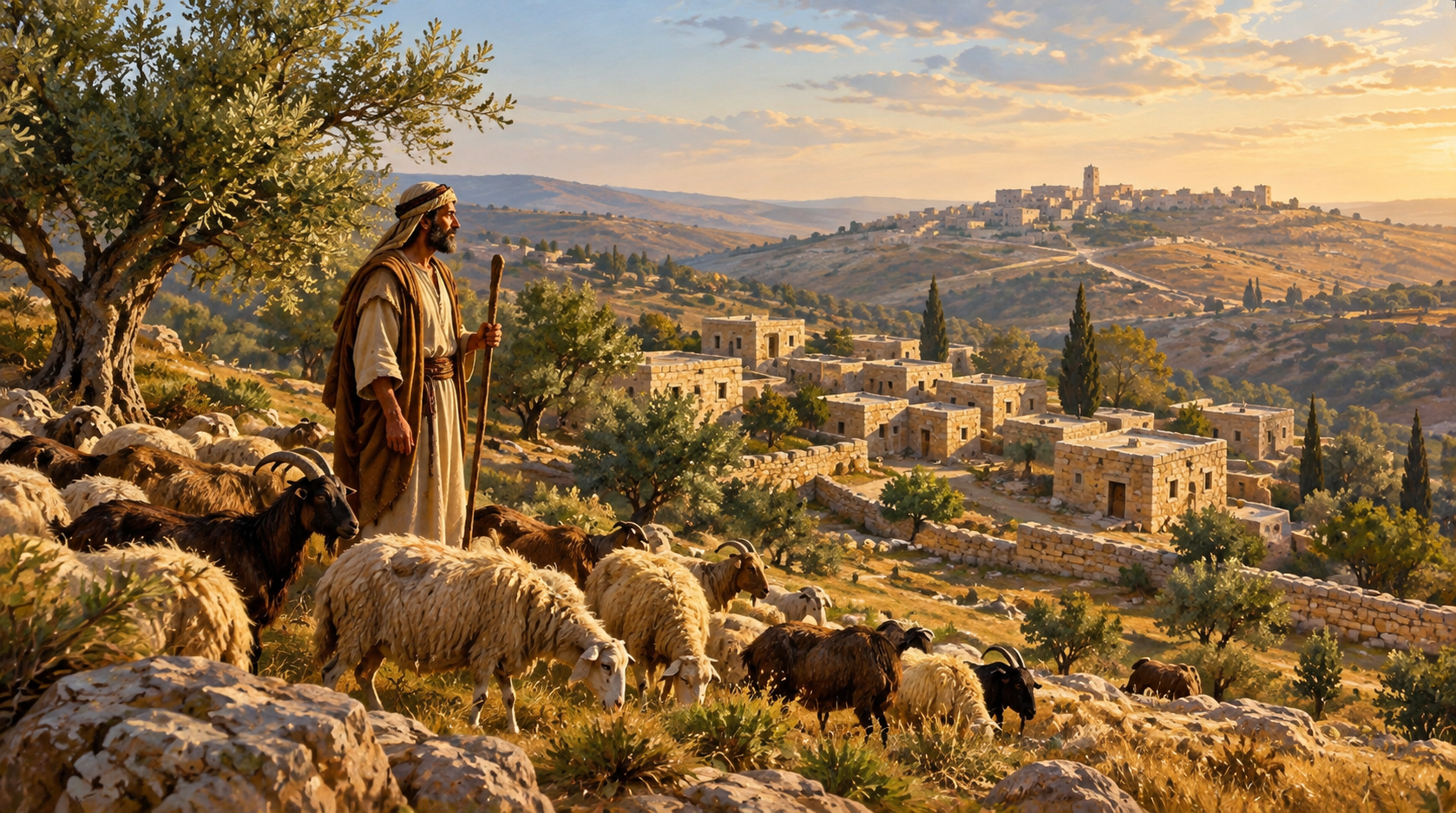
AN ORDINARY SHEPHERD WITH
AN EXTRAORDINARY MESSAGE
The words of Amos, who was among the sheepherders from Tekoa - Amos opens his prophecy by identifying himself, his occupation, his hometown, the recipients of his message, and the historical setting of his ministry. Although he was an ordinary shepherd from the small town of Tekoa, God called him to deliver an extraordinary message of judgment to the prosperous but spiritually corrupt northern kingdom of Israel. His authority did not come from his occupation, education, or social standing, but from the God Who had revealed His Word to him.
The words of Amos - Yes Amos spoke (wrote) these words, but ultimately they were the words of God, for Peter explained "no prophecy was ever made by an act of human will, but men moved by the Holy Spirit spoke from God." (2Pe 1:21). Amos (possibly burden or burden bearer) who would carry and unpack his heavy verbal burden on the Northern Kingdom (aka "Israel"), announcing God's impending judgment.. Amos should be distinguished from Amoz, the father of Isaiah (Isa 1:1).
Who was among the sheepherders from Tekoa - Sheepherders (noqedim) is relatively uncommon. It also appears in 2 Kings 3:4, where Mesha, king of Moab, is described as a sheep breeder who supplied enormous quantities of wool to Israel. Later Amos gives more detail about his occupation in Amos 7:14-15 "Then Amos replied to Amaziah, “I am not a prophet, nor am I the son of a prophet; for I am a herdsman and a grower of sycamore figs. “But the LORD took me from following the flock and the LORD said to me, ‘Go prophesy to My people Israel.’"
Tekoa was a small Judean town situated on high ground about 10 miles south of Jerusalem and approximately 5 miles south of Bethlehem, at the edge of the Judean wilderness as it slopes eastward toward the Dead Sea. It had some prominence in Israel's history: Rehoboam fortified Tekoa as part of Judah's defenses (2Ch 11:6), and Joab later brought the “wise woman” of Tekoa to David (2Sa 14:2). This geographical background is important because Amos was a southerner from Judah whom God sent north to prophesy to the kingdom of Israel. His Judean origin was not lost on Amaziah, the priest of Bethel, who contemptuously told him, “Go, you seer, flee away to the land of Judah” (Amos 7:12). Thus, God called Amos from the relative obscurity of Tekoa in the Southern Kingdom (Judah) and sent him to prophesy to the Northern Kingdom (Israel).
🙏 THOUGHT - Beloved, it behooves all us to note that God does not require an impressive résumé to accomplish His purposes. He requires a servant willing to proclaim His Word. Are you willing? As someone once said, it is not so much your ability but your availability that God desires. Remember that we have been saved by grace through faith and now "we are His workmanship (see poiema), created in Christ Jesus for good (God) works, which God prepared beforehand so that we would walk in them." (Eph 2:10). Are abiding in Christ, so that you might be walking in your works (Jn 15:5)? Beloved, don't miss this short window of opportunity called "life" to store up for yourself treasure in heaven (Mt 6:19,20), for that treasure will endure throughout eternity (Jn 15:16)! How sad it will be to be in heaven and realize the potential treasure that could have been yours for all eternity! Admittedly, that statement is somewhat speculative, but I say it in order to motivate you to redeem the precious time you have been given by our Father. Don't waste your life!
Which he envisioned (chazah) in visions concerning Israel - Which he envisioned indicates Amos' message came through divine revelation (2Pe 1:21). Amos records five visions: locusts (7:1-3), fire (7:4-6), the plumb line (7:7-9), the basket of summer fruit (8:1-3), and the Lord standing beside the altar (9:1-4). Literally the Hebrew is "the words… which he saw" (chazah). Prophets received revelation as seers, and Amaziah's title for Amos, "seer" (chozeh, Amos 7:12), comes from the same root.
In the days of Uzziah king of Judah, and in the days of Jeroboam son of Joash, king of Israel two years before the earthquake - Amos pinpoints the time of his prophecy in the reigns of Uzziah (aka Azariah) (approximately 792–740 BC, including his coregency) and Jeroboam II approximately 793–753 BC, including his coregency - 2Ki 14:21-15:34). Both kingdoms experienced considerable political and economic prosperity during this period. At this time Assyria was temporarily weak. Jeroboam II expanded Israel's borders to their greatest extent since Solomon (2Ki 14:23–29), while Uzziah strengthened Judah militarily and economically (2Ch 26:1–15). The prosperity came with luxury and corruption such as houses of ivory (Jonah 3:15), beds of ivory (Jonah 6:4), exploitation of the poor (Jonah 2:6-7; 4:1; 5:11–12; 6:4–6; 8:4-6), and empty religion at Bethel and Gilgal (Jonah 4:4-5; 5:21-24). So beneath this prosperity, serious spiritual and social problems were developing. Assyria was temporarily weak, and Jeroboam II expanded Israel's borders to their greatest extent since Solomon. That expansion fulfilled a prophecy of Jonah,
🙏 THOUGHT -America, listen up! A prosperous nation can still be spiritually bankrupt. Israel measured its condition by its wealth, military security, territorial strength, and religious activity. God measured it by righteousness, justice, and covenant faithfulness. The nation looked successful from the outside while corruption was spreading within (Amos 2:6–8; 5:11–12; 6:1–6). The warning of Amos therefore reaches beyond ancient Israel as a moral principle -- material prosperity is no reliable measure of spiritual health. A nation may possess impressive wealth, military strength, flourishing institutions, and abundant religious activity while tolerating injustice, immorality, oppression, and indifference toward God. Israel's mistake was not possessing prosperity but mistaking prosperity for divine approval. Their comfortable circumstances gave them a false sense of security when what they desperately needed was repentance. Are you prosperous? Praise God but walk circumspectly. Paul's word is a good warning - "Therefore let him who thinks he stands take heed (present imperative see our need to depend on the Holy Spirit to obey) that he does not fall." (1Co 10:12)
Prosperity may measure the wealth of a nation,
but it does not measure the health of its soul.
Two years before the earthquake - This provides a specific historical marker, an earthquake that was well known to his readers. This event is mentioned again in Zechariah 14:5, centuries later, where the prophet refers to the earthquake during Uzziah's reign. There are no extra-Biblical records that would allow a precise dating, but the mid-eighth century BC is a commonly proposed period.
Envisioned (behold, gaze, look, prophesy, select) (02372) chazah means to gaze at, behold, perceive, select for oneself" — mentally to perceive, usually after time for reflection. Chazah refers to seeing God (Ex. 24:11; Job 19:26, 27; Ps 11:7; Ps 17:15); astrological observations (Isa. 47:13); prophetic vision and insight (Isa. 1:1; Isa. 2:1; Isa. 13:1; Lam. 2:14; Ezek. 12:27; Hab. 1:1; Zech. 10:2).
A helpful distinction is Ra'ah often emphasizes the act of seeing; chazah frequently emphasizes what is perceived, discerned, or apprehended through seeing. Thus chazah can move naturally from physical sight → thoughtful observation → spiritual perception → prophetic vision → beholding God.
God Can Use Us
There are many reasons why God shouldn’t have called you. But don’t worry. You’re in good company.
• Moses stuttered.
• David’s armor didn’t fit.
• John Mark was rejected by Paul.
• Timothy had ulcers.
• Hosea’s wife was a prostitute.
• Amos’ only training was in the school of fig-tree pruning.
• Jacob was a liar.
• David had an affair.
• Solomon was too rich.
• Jesus was too poor.
• Abraham was too old.
• David was too young.
• Peter was afraid of death.
• Lazarus was dead.
• John was self-righteous.
• Naomi was a widow.
• Paul was a murderer.
• So was Moses.
• Jonah ran from God.
• Miriam was a gossip.
• Gideon and Thomas both doubted.
• Jeremiah was depressed and suicidal.
• Elijah was burned out.
• John the Baptist was a loudmouth.
• Martha was a worry-wart.
• Mary was lazy.
• Samson had long hair.
• Noah got drunk.
• Did I mention that Moses had a short fuse?
• So did Peter, Paul—well, lots of folks did.
But God doesn’t require a job interview. He doesn’t hire and fire like most bosses, because He’s more our Dad than our Boss. He doesn’t look at financial gain or loss. He’s not prejudiced or partial, not judging, grudging, sassy, or brassy, not deaf to our cry, not blind to our need.
As much as we try, God’s gifts are free. We could do wonderful things for wonderful people and still not be...Wonderful.
Satan says, “You’re not worthy.”
Jesus says, “So what? I AM.”
Satan looks back and sees our mistakes.
God looks back and sees the cross
The Fourth Dimension, November 1998, p. 5 (From 10,000 Sermon Illustrations)
The Prophet Amos
Amos was not a prophet by profession (7:14).
Amos was not a prophet by parentage (7:14).
Amos was a prophet by providence (7:15).
What better credentials does any man need?
Vance Havner
Illustration - Those of us who constantly and extensively travel on our highway systems know there are some roads that are to be avoided. Consequently, to reduce tension, to save time, or for our vehicle’s sake, we purposefully choose other routes. Likewise, the way of “Spiritual Declension” is a road that we must definitely shun. The Shepherd’s “paths of righteousness” (Psa. 23:3) are always the best paths! Wise are the people who follow in His steps! If, perhaps, we have become sidetracked, may God help us to return to “the old paths, where is the good way, and walk therein” (Jer. 6:16). - Tom Hayes
Matthew Henry -Judgments
The Lord roars from Zion and utters his voice from Jerusalem; the pastures of the shepherds mourn, and the top of Carmel withers.
Amos 1:2
Amos was a herdsman, and engaged in agriculture. But the same divine Spirit influenced Isaiah and Daniel in the court, and Amos in the sheep-folds, giving to each the powers and eloquence needful for them. He assures the twelve tribes of the destruction of the neighboring nations; and as they at that time gave themselves up to wickedness and idolatry, he reproves the Jewish nation with severity; but describes the restoration of the church by the Messiah, extending to the latter days … God employed a shepherd, a herdsman, to reprove and warn the people. Those to whom God gives abilities for his services, ought not to be despised for their origin, or their employment. Judgments are denounced against the neighboring nations, the oppressors of God’s people. The number of transgressions does not here mean that exact number, but many: they had filled the measure of their sins, and were ripe for vengeance. The method in dealing with these nations is, in part, the same, yet in each there is something peculiar. In all ages this bitterness has been shown against the Lord’s people. When the Lord reckons with his enemies, how tremendous are his judgments … Even royal palaces are no defense against the judgments of God, though ever so richly furnished, though ever so strongly fortified. That the enemy shall force his way into the city: God will break the bar of Damascus, and then the gate flies open. Or it may be understood figuratively: all that which is depended upon as the strength and safety of that great city shall fail, and prove insufficient. When God’s judgments come with commission it is in vain to think of turning them out.
Amos . Station in life. Low station is no obstacle to God's favour. St John was the son of a fisherman; recommended to our Saviour neither by refinement of education nor by honourable employment, he was diligently engaged in the labours of an humble occupation when chosen to accompany his Lord. For those, indeed, whom it hath pleased God to place in the higher states of life it is right that they should endeavour to perform the duties of their stations, by a due cultivation of their talents, by the acquirement of suitable accomplishments, and by acting up to the rank in society to which by the good providence of God they are born and designated [Bp Manton]. - Homiletical Commentary
Amos 1:1–2 Today in the Word
To be an “outcast” or “untouchable” in India’s oppressive Hindu caste system is to be cut off from power and to struggle for daily necessities. Recently, these “outcasts,” now more frequently called Dalits, have responded to their plight by building a black granite temple in honor of “Goddess English.” They believe that learning English can be a gateway to economic and educational opportunities they wouldn’t otherwise have. In short, they are putting their faith in English for liberation and social justice. One leader said: “If your child learns English it’s as if he or she has inherited 100 acres of land.”
As we’ll see in the book of Amos, God cares deeply about social justice. But it can’t be found merely by trusting in a language to change your life. It comes from trusting God to change our lives. In this second book in our study of three minor prophets, we find again the themes of justice, judgment, blessing, and worship.
Amos was from the southern kingdom of Judah—his hometown of Tekoa was just south of Jerusalem—but most often his prophecies were directed to the northern kingdom of Israel. His name means “the Lord upholds.” Though he called himself a “shepherd,” he seems to have been more of a rancher or agricultural businessman, with large–scale operations involving sheep and orchards. His knowledge of history and literary skill mark him as an educated person and probably someone of higher socioeconomic status. Given the kings and earthquake referenced in Amos 1:1, his book can be dated around 755 B.C. Although the northern kingdom of Israel would be taken into captivity in 722 B.C., at this point both Israel and Judah were fairly stable and prosperous (see 2 Chronicles 26).
Spiritually, however, things were a disaster, and idolatry, sexual immorality, corruption, and oppression of the poor were common. The people believed their status as God’s “chosen” would protect them no matter what. Thus, Amos’s announcement of judgment would’ve come as a shock and would’ve been a difficult message to accept (Amos 1:2; cf. Joel 3:16). God sent His prophet to expose ugly spiritual realities and spur the people to repent of their sins.
Apply the Word
While God can use circumstances to get our attention, as with the plague of locusts in Joel, it is also true that circumstances can numb our ears to what God wants to say to us. Because things were going well economically and militarily, Israel and Judah did not take their sins against God seriously. In light of this, today might be a good day to pray for the spiritual state of our own communities and countries. We might be economically prosperous, but that does not mean we are holy!
Amos 1:1 F B Meyer Our Daily Homily
Amos 1:1 The words of Amos, who was among the herdmen of Tekos.
God does not hesitate to employ a herdman, if only his heart is pure and devoted to his service. He calls such an one out of the midst of his fellows, designating him for his sacred ministry. And when the fire of God burns within, very common clay becomes luminous and transparent. An ox-goad, a ram’s-horn, a sling of stone, will serve his purpose. It is not what a man has, but what he is, that matters.
As we look through this strong book of ancient prophecy, and notice how it abounds with references and imagery peculiar to a herdsman’s life, we feel that a noble spirit of devotion to God may elevate the meanest employments and dignify the most ordinary subjects. The common incidents of the farm may convey the Divine meaning not less than the sacred scenery of the Temple, which was familiar to Ezekiel. There is nothing which is intrinsically common or unclean. We profane things by a profane spirit. But if we view all things from the Divine standpoint, we shall find that a sacred light will beat through them, like that which transfigured the coarse garments of Christ so as no fuller on earth could whiten them. The glory streamed through from his heart! It is comparatively seldom that God calls one of the upper classes of society to conspicuous usefulness. “Behold your calling, brethren, how that not many wise after the flesh, not many mighty, not many noble, are called; but God chose the weak things,… the base things,… and the things that are despised.” Here and there a noble of great authority, a Zinzendorf, a Shaftesbury: but most often fishermen and publicans; Luther, the miner’s son, Tersteegen the ribbon-weaver, Carey the cobbler.
QUOTES FROM MATTHEW HENRY ON Amos 1:1
“God sometimes chooses the foolish things of the world to confound the wise.”
“Those whom God has endowed with abilities for His service ought not to be despised because of the meanness of their origin or beginnings.”
“Israel was ripened in sin and ripening rapidly for ruin.”
The book of Amos takes its name from the prophet through whom the LORD delivered its message (Amos 1:1). His name, Amos, is commonly associated with the idea of “burden” or “burden-bearer,” an appropriate name for a man called to carry a heavy message of divine judgment to a prosperous but spiritually corrupt nation. He should not be confused with Amoz, the father of Isaiah (Isa 1:1).
THE PROPHET: AN ORDINARY MAN WITH AN EXTRAORDINARY CALL
Amos was an unlikely prophet. He came from Tekoa, a small town in the hill country of Judah about ten miles south of Jerusalem and approximately five miles south of Bethlehem. Tekoa stood on high ground near the edge of the Judean wilderness overlooking the region toward the Dead Sea (2Chr 11:6; 20:20). Thus Amos was a southerner whom God sent north to proclaim His Word to the kingdom of Israel.
Amos was not a professional prophet, nor did he come from a prophetic family. He specifically declared that he was neither a prophet by profession nor “a prophet's son.” Rather, he worked among livestock and tended sycamore figs until the LORD sovereignly interrupted his ordinary occupation and commissioned him to prophesy to Israel (Amos 1:1; 7:14-15). Amos' authority therefore did not come from education, social standing, religious office, or human appointment. He spoke because God called him and God gave him a message.
His rural background is evident throughout his prophecy. Amos writes of lions roaring, shepherds rescuing sheep, birds caught in traps, cattle, plowing, harvests, summer fruit, drought, locusts, and agricultural devastation (Amos 1:2; 3:4-5, 12; 4:7-9; 5:11; 7:1; 8:1-2; 9:13). Yet this shepherd from Tekoa proves to be a powerful communicator, employing vivid imagery, carefully constructed arguments, rhetorical questions, repetition, irony, and dramatic reversals.
God did not call Amos because he was a prophet; Amos became a prophet because God called him.
THE DATE: PROSPERITY BEFORE CATASTROPHE
Amos places his ministry during the reigns of Uzziah king of Judah and Jeroboam II king of Israel, specifically “two years before the earthquake” (Amos 1:1; Zech 14:5). This places his ministry in the middle of the eighth century B.C., probably around 760 B.C. He was therefore a contemporary of Hosea and lived in the general period of Jonah and Isaiah (2Ki 14:25; Hos 1:1; Isa 1:1).
This was one of the most prosperous periods the Northern Kingdom had experienced. Under Jeroboam II, Israel recovered territory previously lost to its enemies and enjoyed increased political stability and economic prosperity (2Ki 14:23-28). Assyrian pressure had temporarily diminished, Israel's borders had expanded, commerce flourished, and the wealthy enjoyed increasingly luxurious lifestyles (Amos 3:15; 6:4-6).
To the casual observer, Israel appeared to be experiencing a golden age. But Amos saw what prosperity concealed. Behind the impressive houses, religious festivals, economic expansion, and national confidence lay idolatry, greed, sexual immorality, corruption, oppression of the poor, perversion of justice, and religious hypocrisy (Amos 2:6-8; 3:10; 4:1; 5:10-13; 6:4-7; 8:4-6). Israel was prosperous outwardly but putrid inwardly. The nation mistook prosperity for God's approval. Amos came to announce that material blessing was no guarantee of spiritual health and that the very nation congratulating itself on its success was approaching divine judgment.
THE RELIGIOUS PROBLEM: WORSHIP WITHOUT GOD
Israel was not irreligious. In fact, the people were intensely religious. They traveled to their sanctuaries, brought sacrifices, offered tithes, celebrated festivals, sang worship songs, and eagerly maintained their religious ceremonies (Amos 4:4-5; 5:21-23). But their worship was fundamentally corrupt. Following the division of the kingdom, Jeroboam I had established rival worship centers at Bethel and Dan, complete with golden calves, unauthorized priests, and a religious calendar of his own devising (1Ki 12:26-33). By Amos' day, Bethel had become an important religious center of the Northern Kingdom and would become a major location of confrontation between Amos and Amaziah the priest (Amos 7:10-17). Thus the opening declaration that “the LORD roars from Zion and from Jerusalem He utters His voice” is highly significant (Amos 1:2). God's authoritative voice did not originate from Israel's man-made sanctuaries at Bethel or Dan. It came from Zion and Jerusalem, the place associated with the LORD's appointed worship. Israel had created its own religious system, but it could not create its own God or manufacture His voice.
ISRAEL'S TWO GREAT SINS: FALSE WORSHIP AND SOCIAL INJUSTICE
Two sins repeatedly dominate Amos' message: Israel had abandoned true worship of God and had abandoned righteous treatment of other people. Their relationship with God was corrupt, and consequently their relationships with one another were corrupt. The wealthy accumulated luxury while exploiting the poor. Merchants manipulated commerce. Judges accepted bribes. The needy were treated as commodities. The powerful enriched themselves at the expense of the helpless (Amos 2:6-7; 4:1; 5:10-12; 8:4-6). Yet these same people continued attending religious services. This explains one of the central messages of Amos: religious activity cannot compensate for unrighteous living. God rejected their festivals, offerings, and songs because their lives contradicted their worship (Amos 5:21-24). True worship must affect the worshiper's conduct. Hands lifted in worship mean little when those same hands oppress one's neighbor.
PRIVILEGE BROUGHT GREATER ACCOUNTABILITY
Israel apparently assumed that its covenant relationship with God guaranteed its security. Amos turns that assumption completely around. God reminds Israel that He alone had chosen them from among the families of the earth and then draws the startling conclusion: their privileged relationship with Him increased rather than decreased their accountability (Amos 3:1-2). Election was not exemption from discipline. Israel's special relationship with God meant that Israel had received greater revelation, greater privilege, and therefore greater responsibility. This principle runs throughout Scripture: Greater light brings greater accountability (Dt 7:6-11; Lk 12:47-48; Ro 2:17-24).
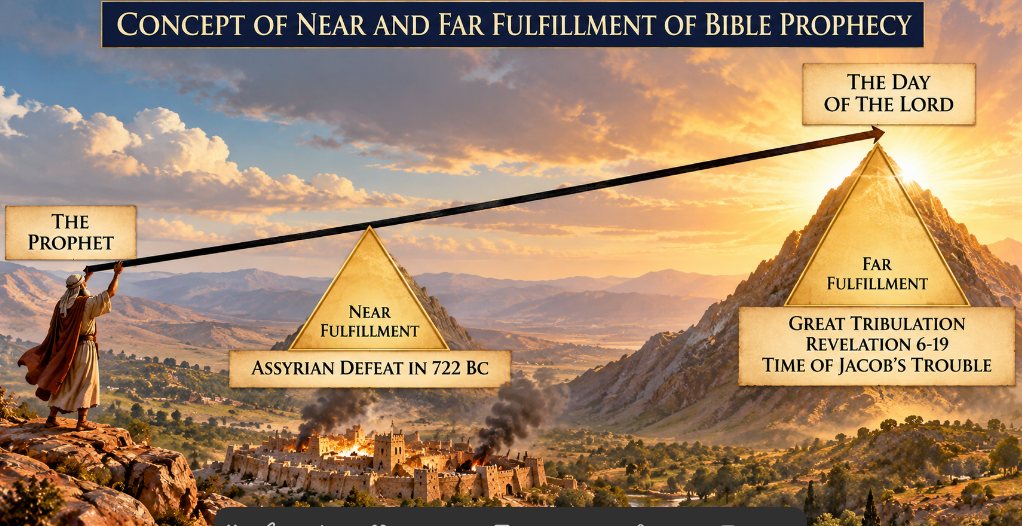
THE DAY OF THE LORD: NOT WHAT ISRAEL EXPECTED
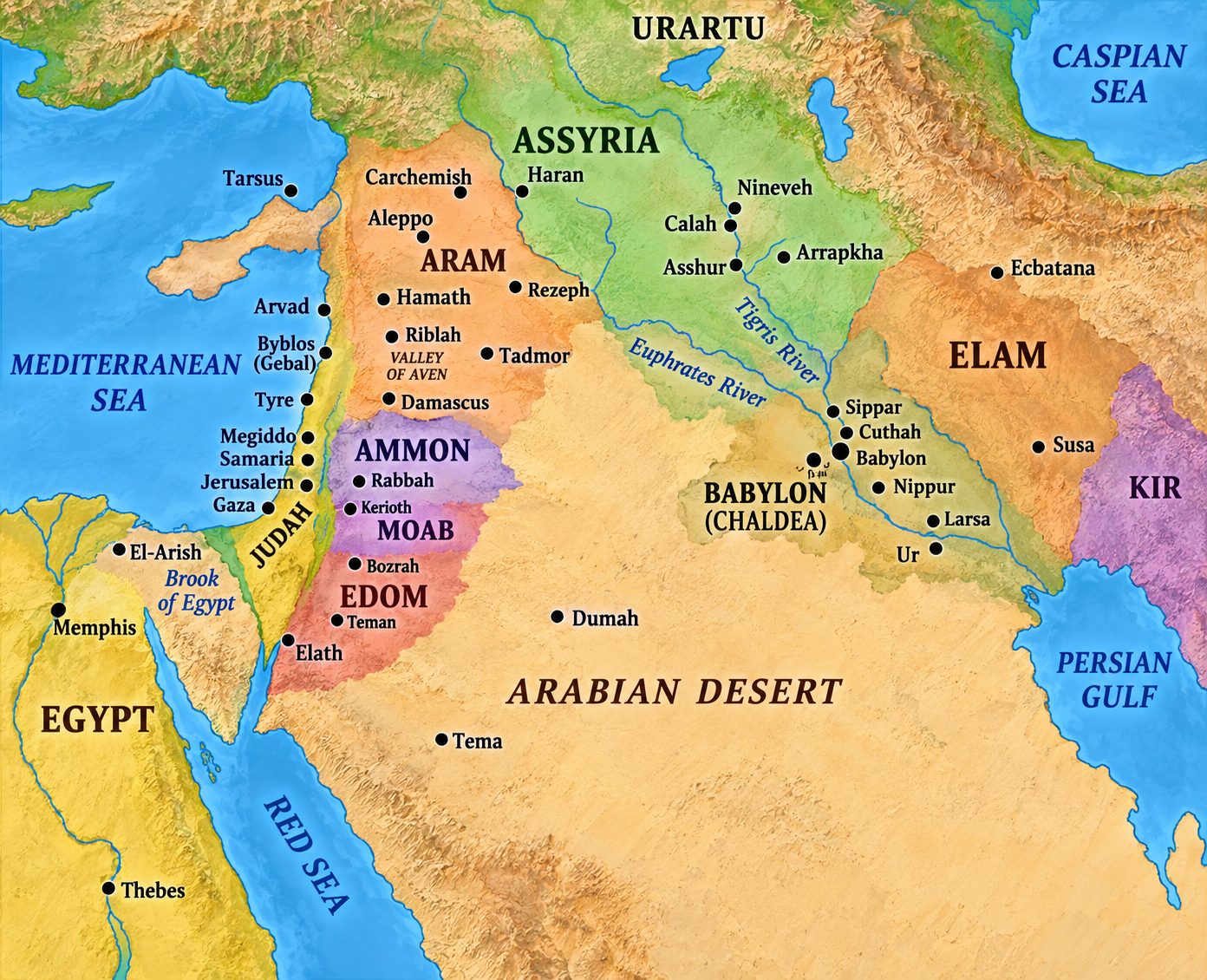
Israel apparently anticipated the Day of the LORD as the time when God would defeat Israel's enemies and vindicate His chosen people. Amos delivers a shocking reversal: the Day they desired would not initially bring them light but darkness (Amos 5:18-20). Before Israel looked forward to God's judgment upon the nations, Israel needed to understand that God would first judge sin among His own people. Amos dramatically develops this truth in the opening chapters. He begins by pronouncing judgment on Israel's surrounding enemies. One can imagine his Israelite audience approving as Damascus, Gaza, Tyre, Edom, Ammon, and Moab come under God's condemnation (Amos 1:3-2:3). Then the circle tightens to Judah (Amos 2:4-5). Finally Amos turns directly toward Israel (Amos 2:6-16). The trap has closed. The nation eager to hear God's judgment pronounced upon everyone else suddenly discovers that it stands in the courtroom of God as the principal defendant.
THE GOD OF AMOS: SOVEREIGN OVER ALL NATIONS
Amos also destroys the idea that Yahweh was merely Israel's national deity. The LORD is Creator, sovereign King, and Judge of all the earth (Amos 4:13; 5:8; 9:5-6). He judges Damascus, Gaza, Tyre, Edom, Ammon, Moab, Judah, and Israel because all nations are accountable to Him (Amos 1:3-2:16). Even more startlingly, God reminds Israel that He had directed movements of other peoples just as surely as He had directed Israel's history (Amos 9:7). Israel belonged uniquely to Him by covenant, but the LORD's sovereignty extended far beyond Israel. Israel's God was not merely Lord of Israel; He was Lord of history.
JUDGMENT IS CERTAIN, BUT JUDGMENT IS NOT GOD'S FINAL WORD
Amos is one of the sternest voices among the prophets. Much of the book announces unavoidable judgment because Israel repeatedly refused God's calls to return to Him (Amos 4:6-12; 5:4-6). Historically, Amos' warnings proved tragically accurate. Within approximately four decades, Samaria fell to Assyria and the Northern Kingdom ceased to exist as an independent nation (2Ki 17:5-23). Yet Amos does not end with destruction. The final verses suddenly open a window of hope. God promises to raise up the fallen booth of David, restore what has been ruined, bring extraordinary blessing, and establish His people securely in their land (Amos 9:11-15). The passage is later cited by James at the Jerusalem Council in connection with God's purpose among the Gentiles (Acts 15:13-18). Thus judgment does not cancel God's covenant purposes. The book that begins with the LORD roaring from Zion ends with the LORD restoring His people.
THE MESSAGE OF AMOS
The message of Amos can be summarized as accountability to a holy and sovereign God. God sees through outward prosperity to the true condition of the heart. Religious ceremonies cannot substitute for obedience. Privilege does not eliminate accountability but increases it. Worship that does not produce righteousness is empty. Prosperity must never be mistaken for divine approval. And no nation or individual can ultimately escape accountability to the sovereign God Who rules history (Amos 3:2; 4:12; 5:14-15, 21-24; 9:7-10). Yet Amos also reminds us that God's judgment is never evidence that His promises have failed. Beyond judgment lies the certainty of God's sovereign purpose and promised restoration (Amos 9:11-15).
KEY THEMES
- God is sovereign over all nations (Amos 1:3-2:16; 9:7).
- Privilege brings responsibility and accountability (Amos 3:1-2).
- Religious activity is worthless when separated from righteous living (Amos 4:4-5; 5:21-24).
- God cares deeply about justice and the treatment of the poor and helpless (Amos 2:6-7; 4:1; 5:11-12; 8:4-6).
- Prosperity is not necessarily evidence of God's approval (Amos 6:1-7).
- The Day of the LORD brings judgment upon unrepentant sinners, including those who presume upon their relationship with God (Amos 5:18-20).
- God preserves His purposes beyond judgment and promises ultimate restoration (Amos 9:11-15).
KEY THOUGHT
Israel's great mistake was assuming that because they belonged to God, they could live as though they did not belong to God.
SUMMARY
Amos was a shepherd from Judah sent to a prosperous Israel to announce that God was not impressed by their prosperity, deceived by their religion, or indifferent to their injustice. The LORD Who roared from Zion would hold His people accountable for their sins, yet beyond judgment He would remain faithful to His covenant purposes.
The book that begins with the LORD roaring from Zion
ends with the LORD restoring His people.
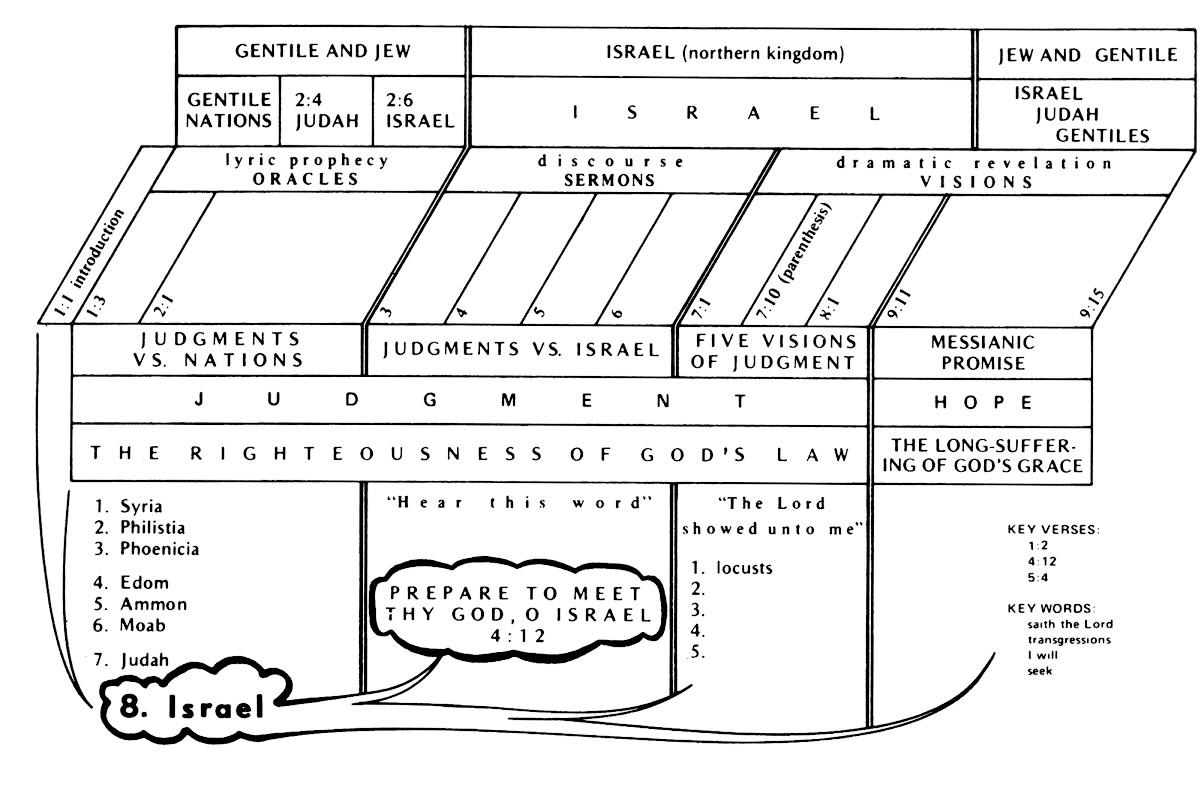
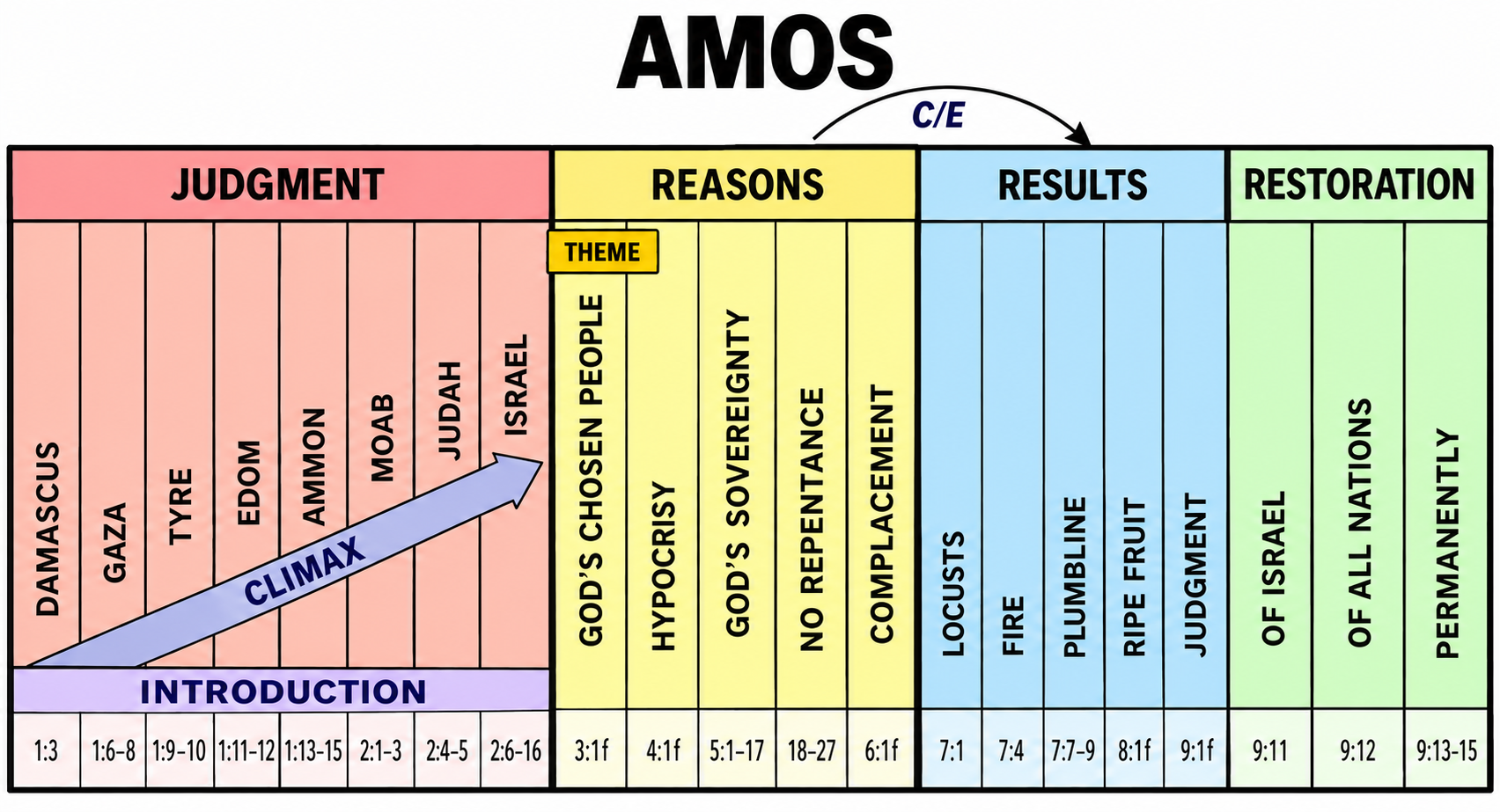
I. Judgments Against the Nations (1:1–2:16)
A. Introduction (1:1, 2)
B. Against Israel’s Enemies (1:3–2:3)
C. Against Judah (2:4, 5)
D. Against Israel (2:6–16)
II. Condemnations Against Israel (3:1–6:14)
A. Sin of Irresponsibility (3:1–15)
B. Sin of Idolatry (4:1–13)
C. Sin of Moral/Ethical Decay (5:1–6:14)
III. Visions of Judgment and Restoration (7:1–9:15)
A. The Lord Will Spare (7:1–6)
1. Vision of locusts (7:1–3)
2. Vision of fire (7:4–6)
B. The Lord Will No Longer Spare (7:7–9:10)
1. Vision of the plumb line (7:7–9)
2. Historical interlude (7:10–17)
3. Vision of the fruit basket (8:1–14)
4. Vision of the altar (9:1–10)
C. The Lord Will Restore (9:11–15)
Amos 1:2 He said, “The LORD roars from Zion And from Jerusalem He utters His voice; And the shepherds’ pasture grounds mourn, And the summit of Carmel dries up.”
- The Lord (KJV): Am 3:7,8 Pr 20:2 Isa 42:13 Jer 25:30 Ho 13:8 Joe 2:11 3:16
- the habitations (KJV): Am 4:7,8 Isa 33:9 Jer 12:4 14:2 Joe 1:9-13,16-18
- Carmel (KJV): 1Sa 25:2 Isa 35:2 Jer 50:19 Na 1:4
- Amos Commentaries and Sermons - multiple resources
Related Passages:
Amos 3:8 A lion has roared! Who will not fear? The Lord GOD has spoken! Who can but prophesy?
Amos 3:12 Thus says the LORD, “Just as the shepherd snatches from the lion’s mouth a couple of legs or a piece of an ear, So will the sons of Israel dwelling in Samaria be snatched away– With the corner of a bed and the cover of a couch!
Amos 5:19 As when a man flees from a lion And a bear meets him, Or goes home, leans his hand against the wall And a snake bites him.
Amos 4:6-9 “But I gave you also cleanness of teeth in all your cities And lack of bread in all your places, Yet you have not returned to Me,” declares the LORD. 7 “Furthermore, I withheld the rain from you While there were still three months until harvest. Then I would send rain on one city And on another city I would not send rain; One part would be rained on, While the part not rained on would dry up. 8 “So two or three cities would stagger to another city to drink water, But would not be satisfied; Yet you have not returned to Me,” declares the LORD. 9 “I smote you with scorching wind and mildew; And the caterpillar was devouring Your many gardens and vineyards, fig trees and olive trees; Yet you have not returned to Me,” declares the LORD.

Mount Carmel
THE EFFECT OF THE
ROARING OF THE LORD
He said, “The LORD (Jehovah) roars - Amos begins his prophetic message with a startling image: the LORD is a roaring lion. Roars (shaag, שָׁאַג) describes the powerful, terrifying roar of a lion (Jdg 14:5; Job 4:10; Ps 22:13; 104:21). A lion's roar is unmistakable. When it is heard, everything nearby takes notice. Likewise, God's voice through Amos is not a whisper of suggestion but a roar of warning. This is not the distant sound of an animal that poses no danger. In prophetic imagery, the roar announces that the Lion is present and judgment is imminent. Before Amos announces judgment, he establishes the source and authority of everything that follows. The roar itself is an act of mercy because God sends His prophet before the judgment arrives. Amos may be speaking, but it is the LORD's "roar" each of the Genile nations, Judah and Israel is hearing. It is interesting that Amos as a shepherd would be familiar with the roar of a lion (they were still present in Israel in his day). The roar of the Lion was God's alarm to a nation sleeping in prosperity. As Amos' prophesied in the following chapters, the people of Israel would wish the words of this old pop hit were true, The Lion Sleeps Tonight! But to Israel's chagrin, the Lion would not sleep in Chapters 1-9!
The roar is frightening, but the warning itself is merciful,
for God roars before judgment falls.
J Vernon McGee on the LORD roars - This is very figurative and eloquent language in many ways. You may recall that Joel also used this expression. It suggests the roar of a lion as it pounces upon its prey. Believe me, this is an arresting way for Amos to begin his message! It speaks of the coming judgment of God upon the nations which were round about. (SEE Thru the Bible Vol. 28: The Prophets Amos)
from Zion and from Jerusalem He utters His voice - Zion and Jerusalem point to the place where the LORD had chosen to dwell and where His Temple stood. This was especially significant for Amos' audience in the Northern Kingdom because Jeroboam I had established rival centers of worship at Bethel and Dan, complete with golden calves and a man-made system of worship (1Ki 12:28-33). Amos makes it clear that the authoritative voice of God does not come from Bethel or Dan, but from Zion and Jerusalem. Israel may have established its own sanctuaries, priests, and religious rituals, but it could not establish its own Source of divine revelation. The LORD Alone determines where and how He is to be worshiped, and it is His voice, not man's religion, that carries ultimate authority (Dt 12:5-14; Ps 50:2-3; Isa 2:3; Mic 4:2). There is also a striking irony for the Northern Kingdom had separated itself politically and religiously from Jerusalem, but it could not separate itself from the voice of the God Who spoke from Jerusalem. Israel had turned away from God's appointed place of worship, but God's Word still pursued Israel into its apostasy. Later Amos will specifically condemn the religious centers of the northern kingdom (Amos 3:14; 4:4; 5:5–6; 7:9).
The LORD roars...He utters His voice - The lion's roar was not just noise but was revelation (His voice)! The important point to note is that the frightening judgments Amos is about to announce are not the angry opinions of a shepherd from Tekoa. They are the authoritative pronouncements of Yahweh Himself. It follows that Amos could therefore stand before powerful kings, wealthy merchants, corrupt judges, and religious leaders without intimidation because the authority of the message did not reside in the messenger. Amos was the human voice, but Yahweh supplied the roar! And just a lion's roar would incite a sense of fear and dread, so too would this Lion's roar (it makes me think of the Lion of the tribe of Judah).
TAKEAWAY - Amos might have been a lowly shepherd but when God has spoken, the messenger need not fear the audience, for the authority rests not in the one who delivers the message but in the One Who roars behind it. Dear pastor, who "roars" from your pulpit?
And the shepherds’ pasture grounds mourn - NLT = Suddenly, the lush pastures of the shepherds dry up." Pasture language would be very familiar to a shepherd. God does not merely announce judgment. His voice has consequences. When pastureland “mourns,” the grass withers, vegetation disappears, and the land takes on the appearance of grief. Indeed, this imagery anticipates drought and agricultural devastation as expressions of divine judgment (Amos 4:6–9). This picture of pasture mourning reminds us that every blessing ultimately depends upon His sustaining hand.
And the summit of Carmel dries up - NLT = "All the grass on Mount Carmel withers and dies." Carmel makes the statement even more dramatic because the Hebrew Karmel is associated with a fruitful or cultivated region. Indeed, Mount Carmel was proverbial for fertility, vegetation, and beauty (Isa 33:9; 35:2; Jer 50:19). The point is that if Carmel dries up, nowhere can presume itself secure. Amos deliberately moves from the ordinary shepherds’ pasture grounds to one of the Israel's most fertile places. God's judgment reaches from the vulnerable pastureland to the lush summit of Carmel. The point is not merely geographical but is theological signifying that even the most fertile place cannot remain fruitful when the LORD roars! Carmel's natural advantages would not be able to protect it when the LORD utters His voice.
No place is so fruitful, flourishing, or favored that it can remain so when the LORD withdraws His blessing—if Carmel can wither, nothing can prosper apart from God.
Before Amos tells us what God will do, he reminds us Who is speaking: the Lion has roared, and the land itself trembles at His voice.
J A Motyer has an interesting observation that the 6 oracles to the Gentiles are linked somewhat as pairs -- The first two condemnations (vs Amos 1:3ff, Amos 1:6ff.) are linked simply by the thought of gross cruelty (Amos 1:3, 6); the second pair (Amos 1:9f., Amos 1:11f.) by unbrotherly action (Amos 1:9, 11); and the third pair (Amos 1:13ff., Amos 2:1ff.) by the contrasting ideas of destroying the future (Amos 1:13) and desecrating the past (Amos 2:1) and by condemnation of what instinctively commands respect, the pregnant mother and the human corpse. (BORROW New Bible Commentary page 794)
Amos 1:2 - "The people of Israel were now at the summit of worldly prosperity, but were rapidly filling up the measure of their sins. The mission of Amos was, therefore, rather to threaten than to console. He rebukes, among other things, the corruption of their manners, which kept pace with their prosperity; he charges the great men with partiality as judges, and violence towards the poor; and he foretells, as a punishment from God, the captivity of the ten tribes in a foreign country..." - The Bible Handbook, Angus and Green
Amos 1:1-8 TODAY IN THE WORD
The LORD roars from Zion and thunders from Jerusalem. - Amos 1:2a
Nineteenth-century Anglican pastor Charles Bridges made this observation concerning the effect that sin has upon the nation: “No nation is so low, as not to sink under it. While in the mightiest people, it is a blot … that no worldly glory can efface.”
We know that God is deeply interested in the righteousness of His people. But what does He expect of unbelievers? The book of Amos provides us with the answer. He shows us that everyone is accountable to God.
The introduction of the book of Amos indicates that the primary focus of the prophet’s ministry was directed toward the Northern Kingdom of Israel (v. 1). The book opens on a note of warning, with the Lord pictured as one who roars like a lion and shakes the earth like thunder (v. 2). As a result, there is widespread devastation from the lowest valleys, where the sheep were pastured, to the mountain heights. All had been blasted by drought. According to Amos, this was far more than a meteorological event. It was an act of divine judgment emanating from Israel’s God.
Yet instead of reproving the people of Israel for their sin, beginning in verse 3, Amos addressed Israel’s Gentile neighbors. Damascus and its ruling dynasty were condemned for using military tactics, which was so brutal that Amos compared it to a threshing sledge with iron teeth (v. 3). Gaza, Israel’s Philistine neighbor to the south, was singled out for selling entire communities of Israelites into slavery to Israel’s long-time enemies, the Edomites (v. 6). In each of these cases the predicted penalty would be a similar fate. The Lord promised to destroy their rulers and “send fire” upon their cities and fortifications (vv. 5, 7–8).
TODAY ALONG THE WAY
If the Lord expected those who did not acknowledge Him as their God to treat their enemies with respect, what must He expect from those of us who know Christ? Jesus gave us the answer when He commanded us to love our enemies and pray for those who persecute us (Matt. 5:44). How have you been treating those you have trouble getting along with? Make a list of these people and use it as a basis for prayer. Pray sincerely for each person listed, and ask God to enable you to treat the difficult people in your life with respect and love. (Copyright Moody Bible Institute. Used by permission. All rights reserved)
QUOTES FROM MATTHEW HENRY ON Amos 1:2
“The lion roars before he tears; God gives warning before he strikes.”
“God's acts of justice are consistent with mercy.”
“As they are warnings, they are really acts of mercy.” (cf Hab 3:2)
SOME MORE BACKGROUND ON LIONS - A lion generally does not roar while stalking prey. It normally approaches prey quietly. Roaring would advertise its position and reduce the chance of a successful hunt.
Lions roar mainly to advertise territory, communicate with other lions, locate members of the pride, and warn rivals or intruders. Roaring is especially common from dusk through the night, when lions are most active. Also, technically lions generally live in savannas, grasslands, and open woodland, rather than jungles.
That distinction is helpful for Amos 1:2. We should probably not interpret “The LORD roars” as “a lion roars immediately before attacking its prey.” Amos's emphasis is the terrifying, authoritative voice of the Lion announcing judgment. Amos 3:8 makes the effect explicit: “A lion has roared! Who will not fear?”
And Amos 3:4 adds another dimension: “Does a lion roar in the forest when he has no prey?” The point is cause and effect. A lion's roar is not meaningless, and neither is God's prophetic warning.
So I would phrase the application:
When the lion roars, everyone within hearing knows that a powerful presence is near. When the LORD roars through His prophet, Israel had better listen.
QUESTION - What is the significance of lions in the Bible? | GotQuestions.org
ANSWER - Lions are legendary for their strength, beauty, and fearlessness. The lion has been called the king of the beasts and the king of the jungle, and, in the Bible, Jesus is called the Lion of Judah (Revelation 5:5). The lion symbolism expands our understanding of baby Jesus in the manger (Luke 2:7) and the suffering Savior on the cross (Isaiah 53:7), revealing Jesus as the conquering King of kings, a roaring lion taking vengeance on His enemies (Revelation 19:16).
Lions are mentioned in several contexts throughout Scripture, sometimes positively to describe God (Hosea 11:10) and sometimes negatively as symbolic of evil and destruction (Proverbs 28:15). Peter compares Satan to a “roaring lion” and warns us to beware of the enemy’s schemes that will destroy us (1 Peter 5:8). A lion’s roar can be heard up to five miles away and is intended to terrify all who hear it. Lions roar to establish their territory and to communicate their power. But a roar can do nothing. It is threatening but powerless unless we give in to fear and allow the lion to overtake us. Our enemy, Satan, roars his threats, doubts, and accusations in an effort to terrify us into giving up so he can defeat us (Ephesians 6:11–16). But even the threat of a roaring lion cannot overcome those who stand firm in the armor of the Lord (Romans 8:37).
Probably the most familiar mention of lions in the Bible is found in the story of the prophet Daniel. This godly man was thrown into a lions’ den for refusing to obey the Persian king’s ban on prayer (Daniel 6:16). A lions’ den was sure destruction for anyone tossed inside. Yet God showed His authority over even the most powerful of beasts by shutting the lions’ mouths. Daniel, rather than come to a gruesome demise, emerged from the den unharmed (Daniel 6:21–22).
Lions are featured in the description of the cherubim surrounding God’s throne. Ezekiel 10:14 says, “Each of the cherubim had four faces: One face was that of a cherub, the second the face of a human being, the third the face of a lion, and the fourth the face of an eagle.” Some assert that the presence of a lion’s face may symbolize the boldness and strength of God’s character. Other scholars suggest the lion’s face represents God’s rule over the wild beasts.
Isaiah 11 describes the coming era when Jesus reigns on earth. Peace and harmony will dominate even the animal kingdom. Isaiah 11:6 paints a picture of this time: “The wolf will live with the lamb, the leopard will lie down with the goat, the calf and the lion and the yearling together; and a little child will lead them.” The image of lions lying peacefully beside baby calves describes a world restored to its original state. Isaiah 65:25 continues this idea: “The wolf and the lamb will feed together, and the lion will eat straw like the ox, but the food of the serpent will be dust” (cf. Genesis 1:30). Ultimate peace has been established when carnivores no longer kill to eat, and, in the millennial kingdom, the king of the beasts is tamed.
The Bible uses hundreds of metaphors and images to describe the indescribable God Almighty. Animals and other forms of nature can help us understand specific aspects of God’s character. Jesus is called the Lamb of God (John 1:36) to illustrate His gentleness and willingness to be the sacrifice for our sins. But He is also called the Lion of the tribe of Judah (Revelation 5:5) to display His absolute authority and power over all creation. A lion may be king of the jungle, but the Lion of Judah is the King of kings.
Amos 1:3 Thus says the LORD, “For three transgressions of Damascus and for four I will not revoke its punishment, Because they threshed Gilead with implements of sharp iron.
KJV Thus saith the LORD; For three transgressions of Damascus, and for four, I will not turn away the punishment thereof; because they have threshed Gilead with threshing instruments of iron:
NET This is what the LORD says: "Because Damascus has committed three crimes– make that four!– I will not revoke my decree of judgment. They ripped through Gilead like threshing sledges with iron teeth.
NLT This is what the LORD says: "The people of Damascus have sinned again and again, and I will not let them go unpunished! They beat down my people in Gilead as grain is threshed with iron sledges.
ESV Thus says the LORD: "For three transgressions of Damascus, and for four, I will not revoke the punishment, because they have threshed Gilead with threshing sledges of iron.
BGT καὶ εἶπεν κύριος ἐπὶ ταῖς τρισὶν ἀσεβείαις Δαμασκοῦ καὶ ἐπὶ ταῖς τέσσαρσιν οὐκ ἀποστραφήσομαι αὐτόν ἀνθ᾽ ὧν ἔπριζον πρίοσιν σιδηροῖς τὰς ἐν γαστρὶ ἐχούσας τῶν ἐν Γαλααδ
LXE And the Lord said, For three sins of Damascus, and for four, I will not turn away from it; because they sawed with iron saws the women with child of the Galaadites.
CSB The LORD says: I will not relent from punishing Damascus for three crimes, even four, because they threshed Gilead with iron sledges.
NIV This is what the LORD says: "For three sins of Damascus, even for four, I will not turn back my wrath. Because she threshed Gilead with sledges having iron teeth,
- For (KJV): Am 1:6,9,11,13 Amos 2:1,4,6 Job 5:19 19:3 Pr 6:16 Ec 11:2
- Damascus (KJV): Isa 7:8 8:4 17:1 Jer 49:23-27 Zec 9:1
- and for four (KJV): or, yea
- for four (KJV): turn away the punishment thereof, or, convert it, or, let it be quiet, and so, Am 1:6,9-2:16
- because (KJV): 1Ki 19:17 2Ki 8:12 10:32,33 13:3,7 Isa 41:15
- Amos Commentaries and Sermons - multiple resources
Related Passages:
2 Kings 13:3-7 (HAZAEL AND BEN HADAD'S CONQUESTS OF GILEAD) So the anger of the LORD was kindled against Israel, and He gave them continually into the hand of Hazael king of Aram, and into the hand of Ben-hadad the son of Hazael. 4Then Jehoahaz entreated the favor of the LORD, and the LORD listened to him; for He saw the oppression of Israel, how the king of Aram oppressed them. 5 The LORD gave Israel a deliverer, so that they escaped from under the hand of the Arameans; and the sons of Israel lived in their tents as formerly. 6Nevertheless they did not turn away from the sins of the house of Jeroboam, with which he made Israel sin, but walked in them; and the Asherah also remained standing in Samaria. 7 For he left to Jehoahaz of the army not more than fifty horsemen and ten chariots and 10,000 footmen, for the king of Aram had destroyed them and made them like the dust at threshing.
Numbers 23:20 “Behold, I have received a command to bless; When He has blessed, then I cannot revoke it.
Isaiah 14:27 “For the LORD of hosts has planned, and who can frustrate it? And as for His stretched-out hand, who can turn it back?”
Isaiah 28:27-28 (THRESHING INSTRUMENTS) For dill is not threshed with a threshing sledge, Nor is the cartwheel driven over cummin; But dill is beaten out with a rod, and cummin with a club. 28Grain for bread is crushed, Indeed, he does not continue to thresh it forever. Because the wheel of his cart and his horses eventually damage it, He does not thresh it longer.
Proverbs 6:16-19 (ILLUSTRATES THE SIX...YES SEVEN NUMERICAL PATTERN) There are six things which the LORD hates, Yes, seven which are an abomination to Him: 17 Haughty eyes, a lying tongue, And hands that shed innocent blood, 18 A heart that devises wicked plans, Feet that run rapidly to evil, 19 A false witness who utters lies, And one who spreads strife among brothers.
Genesis 18:25 (ESTABLISH GOD AS JUDGE OF ALL THE EARTH) “Far be it from You to do such a thing, to slay the righteous with the wicked, so that the righteous and the wicked are treated alike. Far be it from You! Shall not the Judge of all the earth deal justly?”
Habakkuk 3:12 In indignation You marched through the earth; In anger You trampled (threshed) the nations.
DAMASCUS' CRUELTY YAHWEH
COULD NOT IGNORE
Thus says the LORD (Jehovah) - Here is the Authority for Amos' message as he begins a series of judgments against the nations surrounding Israel. What is interesting is that Amos was addressing pagan nations that did not possess Israel's covenant privileges and yet they were not outside God's authority or His moral government. In short, the God of Israel is also the Judge of all the earth. And what follows is the Judge's verdict on these sinful nations. It makes no difference that these pagan nations do not worship Yahweh, for they still are held accountable to Him.
Men may refuse to acknowledge God's authority,
but their refusal does not abolish His authority.
His Word is the Authority behind Amos' message as the shepherd begins a series of judgments against the nations surrounding Israel. What is striking is that Amos addresses pagan nations that possessed none of Israel's covenant privileges, yet they were not outside God's authority or exempt from His moral government. They did not possess the Law of Moses, worship at the Temple, or share Israel's covenant relationship with Yahweh, but they were still accountable to Him for their conduct. The God of Israel is the Judge of all the earth (Ge 18:25; Ps 96:10, 13; Jer 25:15-29; Ro 1:18-20; 2:14-16), so what follows is not Amos' condemnation of Israel's neighbors, but the Judge's verdict upon nations that had violated His moral standards. Their failure to acknowledge or worship Yahweh did not remove them from His jurisdiction. Men may refuse to acknowledge God's authority, but their refusal does not abolish His authority.
For three transgressions (pesha; LXX - asebeia - godlessness) of Damascus and for four - NET = ""Because Damascus has committed three crimes– make that four!" NLT = ""The people of Damascus have sinned again and again," Damascus, represented the Aramean kingdom of Syria. The repeated formula, “For three transgressions...and for four,” will become the solemn refrain of Amos 1–2. God has observed the sins of the nations, kept account of their cruelty, and determined that the time for judgment has arrived. Transgressions is pesha describing a deliberate rebellion that knowingly crosses a boundary established by God (see synonyms "sin" and "iniquity" below) . The nations did not acknowledge Yahweh as their King, but their pesha demonstrated that they were nevertheless accountable to His rule.
The indictments against Damascus, Gaza, Tyre, Edom, Ammon, and Moab are similar in that all involve crimes against humanity
For three...for four is a Hebrew numerical expression in which the second number intensifies the first. Similar numerical patterns occur elsewhere in the Old Testament (Pr 6:16; 30:15–31; Job 5:19). Amos is not saying that Damascus committed exactly or only four sins. The idea is they repeated and accumulated transgressions. We might paraphrase it something like “For transgression after transgression...” or “Because Damascus has sinned repeatedly and has now filled up the measure...” In other words, the fourth transgression represents the point at which the accumulated rebellion has reached its climax.
Think of God's righteous wrath as a cup filling with unrepented sins
until at last it reaches the brim and is poured out in judgment.
In other words, sin may accumulate slowly, but there comes a day when the full cup of God's righteous wrath is poured out. Damascus had filled the cup with transgression after transgression, so now God would pour out the judgment His patience had long withheld.
The important principle to note is that God's judgment is not impulsive. Damascus had not sinned once and immediately been destroyed. Sin had been added to sin, and was accumulating even as God patiently endured it. However divine patience must never be mistaken for divine indifference. God's delay in judgment did not mean God's cancellation of judgment.
...the fourth transgression
puts the matter beyond doubt.
J A Motyer on the three…four style --The numerical idiom, three... four, here and throughout this series of oracles (cf. Ps. 62:11; Pr. 30:15, etc.) basically suggests that three transgressions would have been sufficient for divine judgment to fall, but the fourth transgression puts the matter beyond doubt. It suggests the patience of a God who waits beyond the point where action is merited, who longs for repentance and leaves space for it (Ge 15:16; 2Pe 3:8f), who never acts without evidence (Ge 18:21) but in whose eyes there are the 'fourth sins' which are truly intolerable to him so that, when they are committed he will not turn back his wrath (lit. 'turn it back', cf. Nu. 23:20; Isa. 14:27). (BORROW New Bible Commentary page 794)
NET NOTE on three…four style introduces each of the judgment oracles of chaps. 1-2. Based on the use of a similar formula in wisdom literature (see Prov 30:18-19, 29-31), one expects to find in each case a list of four specific violations. However, only in the eighth oracle (against Israel) does one find the expected fourfold list. Through this adaptation and alteration of the normal pattern the Lord indicates that his focus is Israel (he is too bent on judging Israel to dwell very long on her neighbors) and he emphasizes Israel’s guilt with respect to the other nations. (Israel’s list fills up before the others’ lists do.) See R. B. Chisholm, “For Three Sins…Even for Four: The Numerical Sayings in Amos,” BSac 147 (1990): 188-97.
God's patience with sin should have led to repentance,
not to the presumption that judgment would never come.
I will not revoke (shub/sub - turn) its punishment - NLT = "I will not let them go unpunished!" The Hebrew literally, “I will not turn it back” with "punishment" added by the NAS translators. The object is not explicitly stated in Hebrew, which explains variations among translations. In context, the idea is that God will not turn back the judgment He has determined to bring upon Damascus. The point is sobering for it teaches that there comes a time when accumulated, unrepented sin reaches the point of divine reckoning. WOE! The same God Who had patiently observed Damascus' violence now declares that judgment will no longer be withheld. God's patience with sin should have led to repentance, not to the presumption that judgment would never come. The God Who heard the roar of Damascus' armies also heard the cries of their victims.
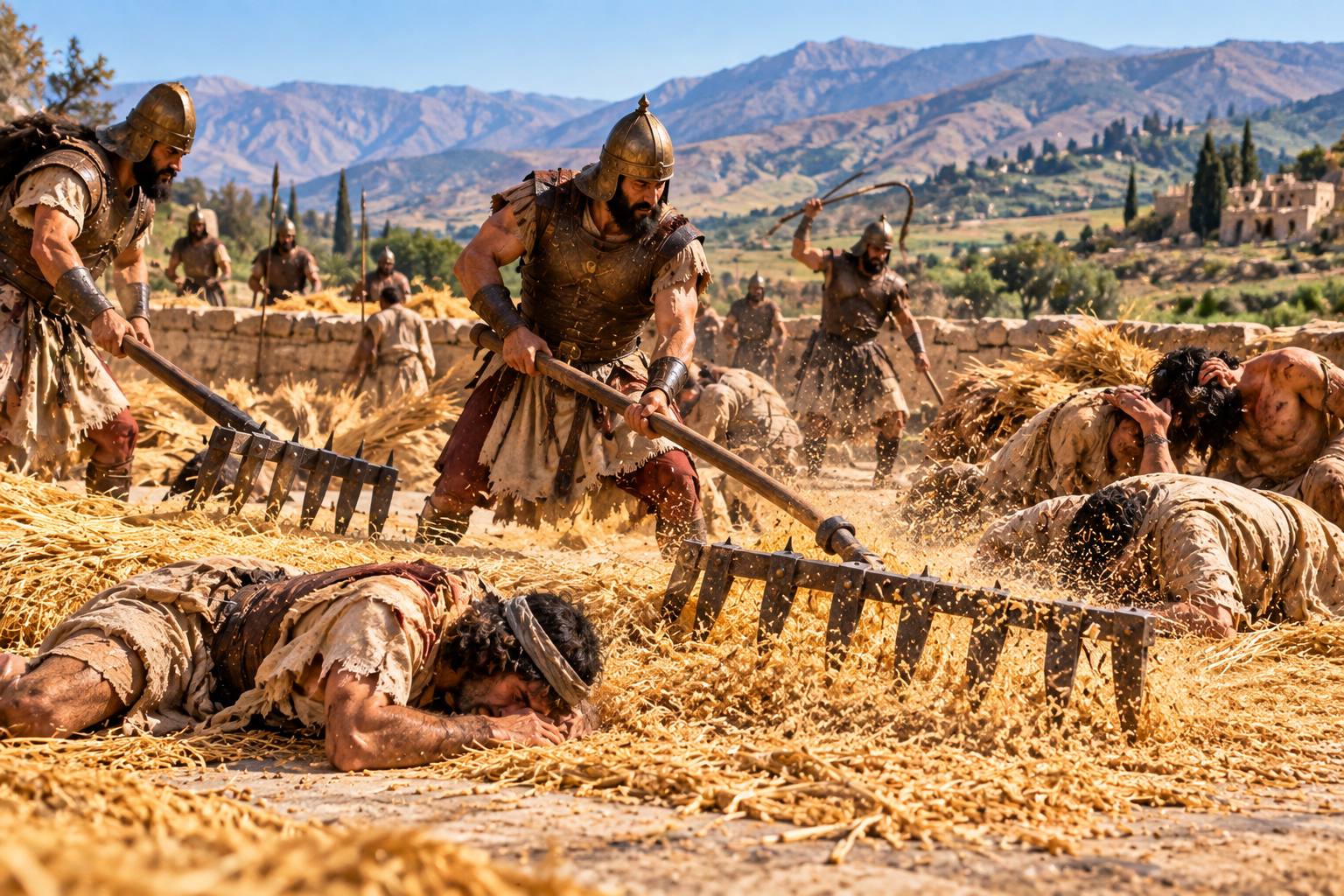
Possible Cruelty Literally Using Threshing Implements in Warfare
Because (term of explanation - explains why they would be punished) they threshed (dush) Gilead with implements of sharp iron - Amos explains why Damascus would be punished and it was because of her cruelty. The territory of Gilead lay east of the Jordan River and was repeatedly exposed to attacks from the Arameans of Damascus. The historical books describe severe warfare between Syria and Israel in this region (2Ki 8:12; 10:32–33; 13:3–7). The shocking word is threshed (dush), for threshing normally described the agricultural process by which grain was separated from the stalk and husk. Grain was spread over a threshing floor, and heavy implements were dragged over it. Now Amos takes that familiar agricultural picture and applies it to human beings. In effect, Damascus had treated the people of Gilead as though they were grain beneath a threshing instrument. We cannot exclude the possibility that threshing instruments were literally used upon captives (as depicted above), but even the figurative language describes exceptionally brutal military oppression. Picture threshing sledges with their sharp pieces of stone or metal embedded in their undersides being dragged across the grain, cutting and crushing the stalks (or possibly human bodies). Either way Amos' imagery is deliberately graphic declaring that the Arameans had treated men and women created in the image of God with unspeakable cruelty.

J A Motyer -- The 'fourth sin' was in this case barbarity in war: sledges having iron teeth (heavy wooden platforms, weighted above and studded with sharp metal underneath) were made for chopping the crop prior to winnowing, but here were used on people, treating them as things, a mere crop for personal profit. (BORROW New Bible Commentary page 794)
Damascus treated people like grain;
God treated their cruelty as transgression.
A related prophecy appears in 2 Kings 8:12, where Elisha weeps because he knows the atrocities Hazael will inflict upon Israel "Hazael said, “Why does my lord weep?” Then he (Elisha) answered, “Because I know the evil that you will do to the sons of Israel: their strongholds you will set on fire, and their young men you will kill with the sword, and their little ones you will dash in pieces, and their women with child you will rip up.”"
This verdict on Damascus establishes an important theme in Amos 1–2 that nations are morally accountable to God for how they treat human beings, even when those nations do not possess the Torah. Israel possessed greater revelation and therefore greater accountability, but the nations possessed sufficient moral knowledge to be accountable for their wickedness. They were accountable because God implanted a moral compass in every human being created in His image...
FOR (term of explanation) all who have sinned without the Law (GENTILES) will also perish without the Law, and all who have sinned under the Law (JEWS) will be judged by the Law; 13 FOR (term of explanation) it is not the hearers of the Law who are just before God, but the doers of the Law will be justified (Jas 1:22, Jas 2:23,24). 14 FOR (term of explanation) when Gentiles who do not have the Law do instinctively the things of the Law, these, not having the Law, are a law to themselves, 15 in that they show the work of the Law written in their hearts, their conscience bearing witness and their thoughts alternately accusing or else defending them, 16 on the day when, according to my gospel, God will judge the secrets of men through Christ Jesus. (Ro 2:12-16)
They did not possess the Torah in their hands,
but they possessed a moral witness in their hearts.
Damascus military leaders might have called its actions warfare, but Yahweh called their actions cruel transgressions.
What men may excuse as the necessities of power,
God may condemn as cruelty.
Transgressions (rebel, rebellion)(06588) pesha' from pasha [06586] = to rebel, transgress) means transgression, rebellion or revolt against authority (rising up in clear defiance of authority), guilt (incurred by transgressing). Transgression is rebellion expressed by crossing a boundary God has established. It is stronger than simply making a mistake. It describes knowingly, willfully violating the authority of the One to Whom obedience is owed.
Think of three similar words in the OT:
- SIN — missing the mark God has established.
- INIQUITY — crookedness or perversity, departing from what is straight.
- TRANSGRESSION — crossing the line in rebellion against God’s authority.
Sin misses God’s mark;
Iniquity twists God’s standard;
Transgression crosses God’s line.
Sin misses the mark, iniquity bends what God made straight, and transgression crosses the line God has drawn.
Imagine God drawing a line in the sand and saying “Do not cross this line.” Transgression looks at the line, recognizes the authority behind it, and steps across anyway. That makes transgression especially personal. God's law is not merely an impersonal rulebook. To transgress is to say, in effect, “God has drawn the line here, but I will cross it anyway.” This fits Amos particularly well. When God repeatedly says, “For three transgressions...and for four” (Amos 1:3,6,9,11,13; 2:1,4,6), He is not describing accidental failures. The nations and then Judah and Israel had repeatedly violated God's moral boundaries. Their sins had become persistent rebellion.
Pesha' is derived from a root describing the breach of relationship between two parties (civil or religious). The idea of this noun is that the individual makes a willful choice to reject God's authority and hence to deviate from the path of godly living. Defection from God's standard. Pesha' is “a stepping aside from the (correct) path." Pesha' speaks of willful sin.
NET NOTE on Amos 1:3 - Traditionally, “transgressions” or “sins.” The word refers to rebellion against authority and is used in the international political realm (see 1 Kgs 12:19; 2 Kgs 1:1; 3:5, 7; 8:22). There is debate over its significance in this context. Some relate the “rebellion” of the foreign nations to God’s mandate to Noah (Gen 9:5-7). This mandate is viewed as a treaty between God and humankind, whereby God holds humans accountable to populate the earth and respect his image as it is revealed in all people. While this option is a possible theological explanation of the message in light of the Old Testament as a whole, nothing in these oracles alludes to that Genesis passage. J. Barton suggests that the prophet is appealing to a common morality shared across the ancient Near East regarding the conduct of war, since all of the oracles can be related to activities and atrocities committed in warfare (Amos’s Oracles against the Nations [SOTSMS], 39-61). The “transgression” then would be a violation of what all cultures would take as fundamental human decency. Some argue that the nations cited in Amos 1-2 had been members of the Davidic empire. Their crime would consist of violating the mutual agreements that all should have exhibited toward one another (cf. M. E. Polley, Amos and the Davidic Empire). This interpretation is connected to the notion that Amos envisions a reconstituted Davidic empire for Israel and the world (9:11-15). Ultimately, we can only speculate what lay behind Amos’ thinking. He does not specify the theological foundation of his universal moral vision, but it is clear that Amos believes that all nations are responsible before the Lord for their cruelty toward other human beings. He also assumes that even those who did not know his God would recognize their inhumane treatment of others as inherently wrong. The translation “crimes” is general enough to communicate that a standard (whether human or divine) has been breached. For a survey of the possible historical events behind each oracle, see S. M. Paul, Amos (Hermeneia).
Pesha is one of the major Old Testament words for sin and describes willful transgression, deliberate disobedience, rebellion, or the violation of an established relationship or authority. It is stronger than the general idea of making a mistake or unintentionally doing wrong. At its heart, pesha is knowing that a boundary or obligation exists and deliberately crossing it. Boice aptly describes it as “crossing a forbidden boundary” in serious rebellion.
The basic idea is rebellion against rightful authority. In political contexts pesha can describe revolt or treason (1Ki 12:19); in interpersonal relationships it can describe violating another person's rights or obligations (Ge 31:36; 50:17; Ex 22:9); and in the spiritual realm it describes rebellion against God and His revealed will (Isa 1:2; Amos 2:4; 5:12). Thus pesha can involve social, political, or religious wrongdoing, but the common element is a deliberate breach of an obligation or recognized authority.
Pesha is more than breaking a rule. Pesha is especially serious because biblical sin is relational as well as legal. It is not merely breaking God's rule but rebelling against the God Who gave the rule. In covenant contexts it therefore carries the idea of “covenant treachery,” a violation of an existing relationship with God. This gives us an important progression: God establishes His authority. Man knows the boundary. And yet man deliberately crosses the boundary! You've never done that before have you beloved!
Pesha is not merely missing God's standard;
it is knowingly rebelling against God's authority.
Pesha' can be a transgression of one individual against another (Ge. 31:36; 50:17; Ex. 22:9) or of one nation against another (Amos 1:3, 6, 9, 11, 13; 2:1) but is used primarily to describe Pesha' denotes a willful, criminal breaking of a covenant (1Ki 12:19; Jer 2:29) In Psalm 103:12 pesha’ is used metonymically for the guilt such actions produce.
Pesha is particularly important in Amos because it is the word translated “transgressions” in the repeated formula: “For three transgressions...and for four...” (Amos 1:3, 6, 9, 11, 13; 2:1, 4, 6). Significantly, Amos first applies pesha to pagan nations. Damascus, Gaza, Tyre, Edom, Ammon, and Moab did not possess Israel's covenant privileges, yet their cruelty, violence, treachery, and mistreatment of others constituted rebellion against God's moral government (Amos 1:3-2:3). TWOT specifically notes that in Amos 1-2 pesha is committed by non-Israelites against other people, whereas elsewhere the term frequently describes Israel's rebellion against God's covenant authority. Pasted markdown This fits beautifully with Amos' opening message: the nations may not recognize Yahweh's authority, but they remain accountable to it. When Amos turns to Judah and Israel, however, pesha becomes even more serious because they possessed God's revealed Word and covenant privileges (Amos 2:4, 6; 3:2; 5:12). Their transgressions were not committed in ignorance but in the face of greater revelation.
Threshed (01758) dush The word's most basic sense is threshing, separating grain from husk. Its first OT occurrence describes this literally (Deuteronomy 25:4, the ox not to be muzzled while treading grain), and it's used the same way in 1 Chronicles 21:20, Isaiah 28:27-28, and Hosea 10:11. Threshing floors were typically elevated locations near a village to catch the wind for winnowing, and different grains required different methods — larger grains were trampled by oxen or dragged with a spiked sledge or cart wheel, while smaller grains like caraway and cummin were beaten with a stick (Isaiah 28:27). After threshing, a winnowing fork tossed the grain into the wind to separate chaff, and a sieve removed remaining dirt (Amos 9:9; Isaiah 30:24, 28). The word is also used once of a man being trampled by a wild animal (Job 39:15).
Figurative usage: violent defeat and judgment Because threshing is inherently a crushing, grinding action, dush frequently becomes a vivid image for military devastation or divine judgment:
- Israel's army under Jehoahaz was beaten down by Aram so severely they were left "like dust at threshing time" (2 Kings 13:7).
- Damascus's cruelty toward Gilead is described as threshing Gilead "with threshing instruments of iron" (Amos 1:3).
- Israel's future victory over her enemies is pictured as threshing the mountains (Isaiah 41:15; Micah 4:13) — Hamlin suggests the mountains here specifically represent sites of pagan worship being crushed.
- Moab's destruction is compared to being trampled like straw in a manure pile (Isaiah 25:10).
- God's wrath against the nations is described using the same threshing imagery (Habakkuk 3:12).
- Gideon uses the verb as a threat against the elders of Succoth (Judges 8:7).
The underlying picture - Across both literal and figurative uses, the core idea is trampling or crushing under force, whether the deliberate, controlled trampling of grain on a threshing floor, or the violent, devastating trampling of an enemy in battle or judgment. The image works because both share the same physical action: something is pressed down and broken apart under weight or force.
Andrew Hill summarizes Amos repetition pattern in the oracles to the Gentiles, Amos 1:3 to Amos 2:3 functioning like a unit:
It is widely noted that each of the oracles of doom is scripted in a stereotyped literary pattern that includes, with slight variations:
- The opening messenger formula: “This is what the Lord says”
- A numerical formula: “The people of ______ have sinned again and again” (lit., “sinned three, even four times”)
- The indictment of specific sins committed by the nations
- The announcement of judgment (introduced by the formula “I will send down fire” in every case except the oracle against Israel)
- An elaboration of the announcement of judgment extending to the people and the rulers (only in Amos 1:5, 8, 15; 2:3)
- A closing formula that includes the name of Yahweh (only in Amos 1:5, 8, 15; 2:3)
This standardized literary form of the oracles of doom serves as one indicator of God’s fairness or consistency in the application of divine justice to human affairs....This standardized literary form of the oracles of doom serves as one indicator of God’s fairness or consistency in the application of divine justice to human affairs.....The indictments against Damascus, Gaza, Tyre, Edom, Ammon, and Moab are similar in that all involve crimes against humanity (Hubbard 1989:128).....
The repetition of the messenger formula (“This is what the Lord says” [1:3], also found in the opening verse of each oracle) serves the dual purpose of emphasizing God as the source of the prophet’s message and legitimizing his sovereign rule over the nations. The repetition of the phrase “I will not let them go unpunished!” after the messenger formula is a sober reminder that God is holy and he will bring just punishment against sinners. (SEE Minor Prophets: Hosea through Malachi - Page 169
John Angell James - Everything we believe as doctrine, everything we do as duty, and everything we observe as worship, must have this authority—“The Master saith it.” All tampering with Scripture as the sole and sufficient rule of faith and practice, and all tampering with conscience as bound by that rule, is a guilty resistance of the authority of Christ, and a perilous thing to our own welfare.
QUESTION - What is the significance of the land of Gilead in the Bible?
ANSWER - Gilead was a fertile, mountainous area east of the Jordan River. The name Gilead means “rocky region” or “hill country.” Solomon refers to goats “descending from Gilead” in Song of Solomon 6:5. To the north of Gilead was Bashan, and to the south were Moab and Ammon.
When the Promised Land was divided among the twelve tribes of Israel, the tribes of Reuben, Gad, and half of Manasseh received territory to the east of the Jordan. Their inheritance was largely comprised of the land of Gilead (Joshua 13:24–31). Gad received “all the towns of Gilead” (verse 25), and, in some passages of Scripture, the terms Gilead and Gad are used interchangeably (see Judges 5:17). The Bible mentions several mountains of Gilead: Abarim, Pisgah, Nebo, and Peor.
Gilead was also the name of a great-grandson of Joseph through Joseph’s son Manasseh. Generations later, the tribe of Manasseh inherited a portion of the land of Gilead. It could very well be that some of the ancestral Gileadites lived in the land of Gilead after the conquest of Canaan.
The land of Gilead features in several incidents in the Old Testament. The city of Ramoth Gilead (meaning “heights of Gilead”) was a city of refuge (Joshua 20:8). The judge Jephthah lived and fought in Gilead, saving the Gileadites and all of Israel from the Ammonites (Judges 11). After King Saul’s death, the people of Gilead supported Ish-Bosheth as the heir to the throne (2 Samuel 2:9), but they later fully supported David. Absalom, David’s son who led a coup against his father, camped in Gilead (2 Samuel 17:24), and it was there that Absalom died (2 Samuel 18:6–15).
Later, Ramoth in Gilead fell into Syrian hands, and King Ahab attempted to retake the city for Israel, but he died in the attempt (1 Kings 22:1–36). King Jehoram later wrested the city from the Syrians, making it a possession of Israel once again. One of Jehoram’s commanders, Jehu, was anointed as king of Israel in Ramoth (2 Kings 9:1–10). Finally, the Assyrian king Tiglath-Pileser invaded Gilead and deported the inhabitants back to Assyria (2 Kings 15:29). But the Lord will never forsake His people, and He has promised to return the Israelites to Gilead some day: “Though I scatter them among the peoples, yet in distant lands they will remember me. They and their children will survive, and they will return. I will . . . gather them from Assyria. I will bring them to Gilead” (Zechariah 10:1–10).
The land of Gilead was known for its balm, a liquid rosin that flowed or dripped from certain trees such as pine, cedar, cypress, or terebinth. Gilead was most noted for the Balsamodendron Gileadense, a rosin-producing tree native to that area. Because of easy access to medicinal ingredients, many physicians made their homes in Gilead. This helps us understand Jeremiah 8:22, which says, “Is there no balm in Gilead? Is there no physician there? Why then is there no healing for the wound of my people?” Jeremiah mourned for the desperate spiritual condition of Israel. They could cure physical ailments with their doctors and their medicines, but they could not cure the deeper disease of idolatry that was destroying them (Jeremiah 8:19; 46:11).
The land of Gilead is a reminder that the Lord provides all good things for our use (Deuteronomy 6:10–11; James 1:17). Yet we often forget Him and take pride in our abundance, making gods out of the gifts. Israel did that repeatedly. Although the land of Gilead provided healing for many ailments, it could not provide the spiritual healing that comes only from obedience to God and His Word.
QUESTION - Why does Amos keep repeating “for three sins . . . even for four”? GOTQUESTIONS.ORG
ANSWER - The phrase “for three sins . . . even for four” is a common phrase in Amos (1:3, 6, 9, 11, 13; 2:1, 4, 6). Used a total of eight times in the book, these words play a special role in the way Amos communicates sin and judgment. “Three sins” represents fullness or completeness; “four” represents an overflow or a sin that is the tipping point for God’s judgment. The word sins or transgressions in Hebrew specifically refers to “rebellions.” The first two chapters of Amos contain eight messages against the nations, including Judah and Israel, condemning them for their rebellion against the Lord.
Interestingly, “for three sins . . . even for four” is not followed by four specific sins. In fact, the typical pattern is to list one or two sins and move on. Therefore, the expression is not meant to imply a specific number of sins but to communicate that there is an excess of sins that have led to God’s judgment.
Each of Amos’s eight messages follows a similar pattern. First, there is the phrase “for three sins . . . even for four.” Second, one or two specific sins are mentioned regarding the nation being addressed. Third, a judgment is given. Amos starts with Israel’s enemies and ends with oracles against Judah and Israel.
Judah (Amos 2:4-5) is accused of three specific sins (rejecting the Law, not keeping its statutes, and lying) and is judged with fire on the nation and Jerusalem. Israel (Amos 2:6-16) is condemned with a complete list of seven sins and receives an extended discussion of its coming judgments.
While God clearly condemned the sins of the surrounding nations, Amos’ message is dominated by judgment against Israel. Yet, even in judgment, there is hope. The conclusion of his prophecy (9:11-15) speaks of a time of future blessing for Israel. The book’s final verse reads, “‘I will plant them on their land, and they shall never again be uprooted out of the land that I have given them,’ says the LORD your God.” Though Israel would be taken from its land (as a result of attacks by Assyria and Babylon), its people would one day return to the land and live in prosperity with their Messiah.
QUESTION - What is the meaning of the symbolism in Amos? - Got Questions
ANSWER - The book of Amos is filled with imagery related to sin and judgment. Included are images of iron teeth (Amos 1:3), murdered pregnant women (Amos 1:13), burning bones (Amos 2:1), destroyed roots (Amos 2:9), and hooks (Amos 4:2). How are we to understand these violent themes?
First, we must understand the context of these descriptions. Amos is pronouncing judgment on Israel’s enemies, and then on Israel itself, for some specific sins. The purpose of prophesying doom was often to call sinners to repent. That’s why God sent Jonah to preach in Nineveh, telling the people God would judge their city in 40 days. The Ninevites repented, and God did not bring about judgment. The Lord had compassion for those who repented.
A brief look at each of the images in Amos more fully explains what they indicate:
- Iron teeth (Amos 1:3): “Iron teeth” were part of a threshing sledge, a farming implement drawn over grain to thresh it and cut the stalks. God pictures Syria’s cruelty toward Gilead (in northeast Israel) as a threshing sledge being run over His people. For their brutality, Syria is promised judgment.
- Murdered pregnant women (Amos 1:13): The Ammonites would be judged for performing atrocities against Israel. 2 Kings 8:12, 15:16 confirm the reality of such horrific acts during war.
- Burning bones (Amos 2:1): The Moabites would be judged for their sin of the disrespectful treatment of an Edomite king’s corpse (2 Kings 3:26-27). In a culture in which a proper burial was of utmost importance, the burning of bones communicated a severe hatred.
- Destroyed roots (Amos 2:9): This is a picture of God’s judgment on the Amorites, as the “fruit above” and the “roots beneath” were destroyed—in other words, the Amorites were completely wiped out. God reminds Israel of the Amorites’ fate in order to call His people back to righteousness and the fear of God.
- Hooks (Amos 4:2): This is part of a prophecy against Israel, warning them that the Assyrians would one day take them captive. Israel would be led away as fish were carried away on hooks. It is believed the “hooks” could be literal, since Assyrians did at times lead captives with ropes attached to rings in the jaws or lips of their enemies.
G Campbell Morgan on Amos 1:3 - Amos was a man of Judah, who was sent by God to prophesy in Israel. ln this book we have the notes of his ministry. No prophet, in the technical sense of the word; nor the son of a prophet, that is he had no training in the schools of the prophets, he nevertheless was a veritable prophet of God. His outlook upon the Divine government was of the widest. He saw God judging, not Judah and Israel only, but all the nations. The first section of the book contains eight oracles concerning the nations, setting forth this fact. Each one of them is introduced by these words,. "For three transgressions ... . yea, for four." The language is patently figurative, rather than mechanical. The truth thus emphasized with reference to all the nations is that of the Divine patience, and justice. Upon all these nations the wrath of God was to fall, but not until their persistence in wickedness was such as to leave no room for any other method of dealing with them. The "three transgressions" represent fulness of iniquity; but when that becomes "four," then the iniquity has passed beyond the bounds of the Divine patience. This is ever the law of Gods dealings with nations. The stroke of His judgment never falls until sin has become so complete that there is no room for the exercise of mercy. When that is so, His judgments inevitably come, and that in the interest of humanity as a whole. A careful reading of these declamations will show that the national sins against which God proceeds, are ever those of wrong done to other nations.
QUOTES FROM MATTHEW HENRY ON Amos 1:3
They have filled up the measure of their iniquities, and are ripe for ruin.
Sin may accumulate quietly, but eventually the measure becomes full.
Repeated sin eventually becomes ripened sin, and ripened sin is ready for judgment.
Amos 1:4 “So I will send fire upon the house of Hazael And it will consume the citadels of Ben-hadad.
- I will (KJV): Am 1:7,10,12,14 2:2,5 Jud 9:19,20,57 Jer 17:27 49:27 Eze 30:8 Eze 39:6 Ho 8:14
- Hazael (KJV): 1Ki 19:15 2Ki 8:7-15
- Benhadad (KJV): 1Ki 20:1-22 2Ki 6:24 13:3,25 2Ch 16:2
- Amos Commentaries and Sermons - multiple resources
Related Passages:
2 Kings 8:7 Then Elisha came to Damascus. Now Ben-hadad king of Aram was sick, and it was told him, saying, “The man of God has come here.”
2 Kings 8:12 (HAZAEL'S EVIL) Hazael said, “Why does my lord weep?” Then he answered, “Because I know the evil that you will do to the sons of Israel: their strongholds you will set on fire, and their young men you will kill with the sword, and their little ones you will dash in pieces, and their women with child you will rip up.”
2 Kings 13:3 So the anger of the LORD was kindled against Israel, and He gave them continually into the hand of Hazael king of Aram, and into the hand of Ben-hadad the son of Hazael.
HAZAEL AND BEN-HADAD
SINGLED OUT FOR FIRE
So - Term of conclusion. In light of the crime in verse 3, Yahweh here announces the consequences. They had "threshed" and now they would "reap" (cf Gal 6:7,8, Hos 8:7).
I will send fire upon the house of Hazael And it will consume ('akal; LXX - katesthio - "eat up" ~ figuratively destroy, esp of fire) the citadels (armon; LXX - themelion = the base on which a building stands) of Ben-hadad - Notice that here the Judge is also the Executioner ("I will send...") How would Yahweh carry this out? Whatever human armies He would ultimately stir up to carry out His judgment, clearly reflect His sovereign hand behind the scenes controlling the historical scenes is in behind.
What men consider impregnable,
God considers combustible.
Fire is a recurring image in Amos' judgments (Seven Times - Amos 1:4, 7, 10, 12, 14; 2:2, 5). While fire can be used for purification, this fire was not for purification! Obviously, this holy fire pictures the holistic destruction of cities, fortifications, palaces, and centers of power that had continued to sin againts Yahweh. There are several reason fire was the instrumemnt God used to punish the nations (6 pagan and Judah)....
First, fire is a biblical symbol and instrument of divine judgment. God’s holiness cannot coexist complacently with persistent evil. We see this dramatically in Sodom and Gomorrah (Ge 19:24), and elsewhere fire accompanies divine judgment (Lev 10:2; Nu 16:35). Thus, every repetition of “I will send fire” sounds like another stroke of the Judge’s gavel.
Second, in Amos the fire is also very concrete. Each oracle commonly says the fire will “consume the citadels” (Amos 1:4, 7, 10, 12, 14, 2:2, 2:5) or fortifications of the nation. In ancient warfare, invading armies regularly burned conquered cities, gates, palaces, and fortifications. Thus God can send the fire through invading armies. The human army may ignite the flames, but Amos looks behind the human instrument to the sovereign God directing history.
Third, fire emphasizes the inescapability and consuming nature of judgment. If you have ever been in a burning building you can readily grasp this picture! Walls, gates, palaces, and citadels represented a nation’s security, wealth, military strength, and pride. Yet one after another God declares that their strongest defenses will become fuel for His judgment. What men considered impregnable could not protect them from God.
Fourth, the sevenfold repetition produces a powerful drumbeat of judgment. Seven is the number of completion, but we should be cautious about insisting that Amos deliberately intended numerical symbolism. Certainly the first 3 reason God used fire are valid explanations, and the effect is certainly one of comprehensive judgment.
What is fascinating as we go through the 7 "fires", we find that the fire circles Israel before the indictment finally lands on Israel. But you might ask why no “fire” formula for Israel? Israel is not escaping judgment. Quite the opposite. Amos devotes far more attention to Israel's sins, and the remainder of much of the book concerns God's judgment upon the northern kingdom. The seven fire announcements prepare for the climactic eighth oracle.
Hazael was one of Syria's most powerful and ruthless kings. He had seized the throne of Damascus and became a persistent enemy of Israel (2Ki 8:7–15; 10:32–33; 12:17–18; 13:3). His treatment of Israel had been foretold in particularly disturbing terms. Notice the phrase house of Hazael which indicates the judgment would extend to his royal dynasty. Hazael himself had died before Amos' ministry, but the consequences of the violence associated with his dynasty remained. Once again we see the "ripple effect" of sin, a basic principle that affects all of us! Yes, Hazael was dead, but the consequences of Hazael's cruelty were not dead.
Ben-hadad was a royal name used by several Aramean kings and in context would naturally point to Hazael successors, particularly his son Ben-hadad III (2Ki 13:3, 24–25). The LORD used Ben-Hadad to bring judgment on rebellious Israel, but He punished Ben-Hadad for his evil, as well. The citadels were fortified palaces or strongholds which stood as symbols of Syria military prowess, security, political authority, wealth, and royal power. And as with most leaders, Damascus trusted in these fortifications but God promised fire “will consume” them. What Damascus considered impregnable, God considered combustible. No wall was high enough, no fortress strong enough, and no dynasty powerful enough to withstand judgment once God had determined that it would fall.
If you were a citizen in the Northern Kingdom, you would likely be rejoicing over these divine judgments against the nations, but in Amos 2 she would soon discover that divine justice is impartial and favors no nation!
2 Kings 8:7–15 records Elisha's encounter with Hazael and predicts his atrocities against Israel. 2 Kings 10:32–33 describes Hazael's conquest of Israelite territory in Gilead. 2 Kings 13:3, 22–25 records the oppression of Israel by Hazael and Ben-hadad. 2 Kings 16:9 records the later Assyrian capture of Damascus. Amos 1:7, 10, 12, 14; 2:2, 5 repeat the imagery of fire consuming the strongholds of the nations.
QUOTES FROM MATTHEW HENRY ON Amos 1:4
“Even royal palaces are no defence against the judgments of God.”
Sin stirs up the fire of His jealousy, and that kindles other fires.
QUESTION - Who was Hazael in the Bible? | GotQuestions.org
ANSWER - Hazael, whose name is translated “God has seen,” was a high-ranking officer in the court of Ben-Hadad II, king of Aram (Syria). Later, Hazael became king of Aram himself, in fulfillment of the word of Elijah, the prophet of Israel. Hazael was an ambitious and ruthless man who ruled over Aram about 46 years.
Hazael is first mentioned in 1 Kings 19:15 when God told Elijah the prophet to “go to the Desert of Damascus. When you get there, anoint Hazael king over Aram.” Elijah obeyed, but Hazael was not made king until years later.
Hazael’s Wickedness
Hazael remained a court official under Ben-Hadad until the time of Elisha, Elijah’s successor as Israel’s prophet. Ben-Hadad was gravely ill. Elisha traveled to Damascus and was met by Hazael, who had brought “forty camel-loads of all the finest wares of Damascus” as a gift from the king (2 Kings 8:9) along with a query from the king about whether he would recover from his illness. Elisha gave Hazael a paradoxical answer: “Go and say to him, ‘You will certainly recover.’ Nevertheless, the Lord has revealed to me that he will in fact die” (2 Kings 8:10).
Elisha, in speaking with Hazael, began to weep (2 Kings 8:11). Hazael asked why the prophet was weeping, and Elisha said, “I know the harm you will do to the Israelites” (2 Kings 8:12). Hazael expressed doubt, citing his lack of authority, and Elisha repeated God’s prophecy that Hazael will be king (verse 13). Hazael returned to Ben-Hadad, and “the next day he took a thick cloth, soaked it in water and spread it over the king’s face, so that he died. Then Hazael succeeded him as king” (2 Kings 8:15). It is likely that Hazael had been planning the murder for some time and that his response to Elisha’s prophecy was feigned surprise. God had seen the treachery in his heart.
Hazael’s Military Might
During his reign as king, Hazael led the Arameans in battle against the combined forces of King Jehoram (Joram) of Israel and King Ahaziah of Judah, whom he attacked at Ramoth-Gilead (2 Kings 9:14). Jehu became king of Israel, and Hazael went on to take more Israelite territory: “Hazael overpowered the Israelites throughout their territory east of the Jordan in all the land of Gilead (the region of Gad, Reuben and Manasseh), from Aroer by the Arnon Gorge through Gilead to Bashan (2 Kings 10:32–33). Israel suffered these losses due to the idolatry of King Jehu; it was the Lord who “began to reduce the size of Israel,” using Hazael as the means (verse 32).
Hazael also seized the city of Gath (2 Kings 12:17) and came against Jerusalem in Judah. There his military campaign ended. “Joash king of Judah took all the sacred objects dedicated by his predecessors—Jehoshaphat, Jehoram and Ahaziah, the kings of Judah—and the gifts he himself had dedicated and all the gold found in the treasuries of the temple of the Lord and of the royal palace, and he sent them to Hazael king of Aram, who then withdrew from Jerusalem” (2 Kings 12:18).
God’s Providence
God used the cruel Hazael to punish the nation of Israel for her wickedness. During the entire reigns of Joab and Jehoahaz of Israel, Hazael and his son oppressed Israel. The reason was the evil that Israel pursued (2 Kings 13:2–3). Hazael’s oppression was so severe that “nothing had been left of the army . . . except fifty horsemen, ten chariots and ten thousand foot soldiers, for the king of Aram had destroyed the rest and made them like the dust at threshing time” (2 Kings 13:7). Eventually, King Jehoahaz sought the Lord’s favor, and “the Lord provided a deliverer for Israel, and they escaped from the power of Aram” (2 Kings 13:5). This prophecy was fulfilled when Jehoash was able to recapture the towns that Hazael had taken from Israel (verse 25).
Elisha’s Prophecy
In the midst of the oppression of Hazael, King Jehoash of Israel went to Elisha the prophet to inquire about what God said about the matter. Elisha, who was on his deathbed, told Jehoash to shoot an arrow out the window to the east. Elisha called it “The Lord’s arrow of victory” and said, “You will completely destroy the Arameans at Aphek” (2 Kings 13:17). Then Elisha told Jehoash to shoot arrows into the ground. The king shot three arrows and then stopped. Elisha was angry with the king’s lack of zeal, saying, “You should have struck the ground five or six times; then you would have defeated Aram and completely destroyed it. But now you will defeat it only three times” (2 Kings 13:19).
Hazael’s Death
In time, God put an end to Hazael’s reign, and he was succeeded by his son, Ben-Hadad III (2 Kings 13:24). God raises up kings and puts them down again (Daniel 2:21; cf. Romans 13:1). He can even use a wicked man like Hazael to orchestrate His plan. And, afterward, Aram was held accountable for their cruelty: “This is what the Lord says: ‘For three sins of Damascus, even for four, I will not relent. Because she threshed Gilead with sledges having iron teeth, I will send fire on the house of Hazael that will consume the fortresses of Ben-Hadad’” (Amos 1:3–4).
Through all the trouble that Israel has suffered, from Aram and other countries, God remains faithful to His covenant with them. As the biblical historian noted, even during the oppression of Hazael, “the Lord was gracious to them and had compassion and showed concern for them because of his covenant with Abraham, Isaac and Jacob. To this day he has been unwilling to destroy them or banish them from his presence” (2 Kings 13:23).
QUESTION - Who was Ben-Hadad in the Bible? | GotQuestions.org
ANSWER - Ben-Hadad seems to have been the title of the reigning king of Aram (Syria). Ben-Hadad means “son of Hadad.” Hadad or Adad was the god of storm and thunder, and, as was common in that epoch of history, kings were seen as sons of the primary god of the region.
In the Bible, Ben-Hadad, the king of Aram, is mentioned in 1 Kings 15:18–22; throughout 1 Kings 20; 2 Kings 6:24; 8:9; 13:24–25; 2 Chronicles 16:2–4; Jeremiah 49:27; and Amos 1:4. Since Ben-Hadad is a title much like Pharaoh or President, the term can refer to different individuals at different times. The context of each passage must be studied to determine just who is involved. Most students of history accept the existence of three Ben-Hadads who ruled in Damascus: Ben-Hadad I, who ruled c. 900–860 BC; his son (or grandson) Ben-Hadad II, who ruled 860–841; and another, unrelated Ben-Hadad, the son of the man who assassinated Ben-Hadad II.
In 1 Kings 15:18, Ben-Hadad is designated as the son of Tabrimmon, the son of Hezion. In this passage, King Asa of Judah makes a treaty with Ben-Hadad to help protect himself against the king of Israel, who was threatening Judah. (This is also recorded in 2 Chronicles 16:2–4.) Ben-Hadad sent soldiers against Israel and King Baasha and conquered a number of towns, bringing some relief to Judah.
In 1 Kings 20, Ben-Hadad once again attacks the northern kingdom of Israel, where Ahab is now the king. It is possible that this is the same Ben-Hadad who attacked in 1 Kings 15, or it could be a son, Ben-Hadad II. It seems that this time Ben-Hadad is attacking on his own without consideration for any treaty with Judah. And this time, although he had 32 kings helping him (1 Kings 20:1), he is defeated by King Ahab and the army of Israel. About three years later, Israel and Syria renew their conflict, leading to Ahab’s final battle and death (1 Kings 22).
In 2 Kings 6–7, about nine years after Ahab’s death, Ben-Hadad II invades Israel and lays siege to Samaria, the capital. The siege went on for so long that the people in the city were starving to death. However, in the middle of the night, the Lord caused the Aramean army to hear sounds of an advancing army. Thinking the king of Israel was receiving help from foreign nations, all of Ben-Hadad’s men fled, leaving everything behind.
In 2 Kings 8, the prophet Elisha travels to Damascus and relays a paradoxical prophecy to Ben-Hadad II, who was ill: “Go and say to him, ‘You will certainly recover.’ Nevertheless, the Lord has revealed to me that he will in fact die” (verse 10). Just as Elisha said, Ben-Hadad began to recover from his illness, but then a man named Hazael murdered Ben-Hadad and took the throne of Aram. In 2 Kings 13, Hazael is succeeded by his son, who is also named Ben-Hadad. This final Ben-Hadad was defeated three times by King Jehoash of Israel, fulfilling another prophecy of Elisha (2 Kings 13:1–25).
In Jeremiah 49:27, the word of the Lord says, “I will set fire to the walls of Damascus; it will consume the fortresses of Ben-Hadad.” At the time of Jeremiah’s prophecy, none of the Ben-Hadads mentioned above would have been alive. The reference may be to the current king of Aram or perhaps to a fortress that had been built by and now bore the name of a former king. In Amos 1:4 we have a similar prophecy: “I will send fire on the house of Hazael that will consume the fortresses of Ben-Hadad.” By this time, the original Ben-Hadad had been killed, and Hazael was king. As above, “the fortress of Ben-Hadad” could simply refer to a fortress of the current king or to a specific fortress that was known by that name.
In summary, Ben-Hadad is the title of the Aramean king, “son of Hadad,” a prominent deity in the region. Several kings of Aram had extensive interaction with the kingdom of Israel and attacked several times. The Lord used Ben-Hadad and the Arameans to bring judgment on rebellious Israel, but He punished Aram for her evil, as well.
Amos 1:5 “I will also break the gate bar of Damascus, And cut off the inhabitant from the valley of Aven, And him who holds the scepter, from Beth-eden; So the people of Aram will go exiled to Kir,” Says the LORD.
KJV I will break also the bar of Damascus, and cut off the inhabitant from the plain of Aven, and him that holdeth the sceptre from the house of Eden: and the people of Syria shall go into captivity unto Kir, saith the LORD.
NET I will break the bar on the gate of Damascus. I will remove the ruler from Wicked Valley, the one who holds the royal scepter from Beth Eden. The people of Aram will be deported to Kir." The LORD has spoken!
NLT I will break down the gates of Damascus and slaughter the people in the valley of Aven. I will destroy the ruler in Beth-eden, and the people of Aram will go as captives to Kir," says the LORD.
ESV I will break the gate-bar of Damascus, and cut off the inhabitants from the Valley of Aven, and him who holds the scepter from Beth-eden; and the people of Syria shall go into exile to Kir," says the LORD.
BGT καὶ συντρίψω μοχλοὺς Δαμασκοῦ καὶ ἐξολεθρεύσω κατοικοῦντας ἐκ πεδίου Ων καὶ κατακόψω φυλὴν ἐξ ἀνδρῶν Χαρραν καὶ αἰχμαλωτευθήσεται λαὸς Συρίας ἐπίκλητος λέγει κύριος
LXE And I will break to pieces the bars of Damascus, and will destroy the inhabitants out of the plain of On, and will cut in pieces a tribe out of the men of Charrhan: and the famous people of Syria shall be led captive, saith the Lord.
CSB I will break down the gates of Damascus. I will cut off the ruler from the Valley of Aven, and the one who wields the scepter from Beth-eden. The people of Aram will be exiled to Kir. The LORD has spoken.
NIV I will break down the gate of Damascus; I will destroy the king who is in the Valley of Aven and the one who holds the scepter in Beth Eden. The people of Aram will go into exile to Kir," says the LORD.
- break (KJV): Isa 43:14 Jer 50:36 51:30 La 2:9 Na 3:13
- the plain of Aven (KJV): or, Bikath-aven, Probably Heliopolis, now Baalbek, situated between Libanus and Antilibanus, 56 miles N. W. of Damascus, according to Antoninus, and celebrated for its temple of the sun.
- the house of Eden (KJV): or, Beth-eden, Probably the village of Eden, in Mount Lebanon, marks the site of this place. It is delightfully situated by the side of a most rich and cultivated valley, contains about 400 or 500 families, and is, according to modern authorities, about 20 miles S. E. of Tripoli, and five miles from the cedars.
- the people (KJV): Am 9:7 2Ki 16:9
- Amos Commentaries and Sermons - multiple resources
Related Passages:
2 Kings 16:9 records the striking fulfillment of Amos' prophecy when the Assyrians captured Damascus and carried its inhabitants into exile to Kir. Amos 9:7 reveals that God had originally brought the Arameans from Kir, demonstrating His sovereignty over their national history. Isaiah 7:8 foretells the eventual breaking of Aram. Isaiah 17:1–3 also announces judgment upon Damascus. 2 Kings 10:32–33 records Hazael's earlier conquest of Israelite territory in Gilead.
2 Kings 16:9 So the king of Assyria listened to him; and the king of Assyria went up against Damascus and captured it, and carried the people of it away into exile to Kir, and put Rezin to death.
Amos 9:7 “Are you not as the sons of Ethiopia to Me, O sons of Israel?” declares the LORD. “Have I not brought up Israel from the land of Egypt, And the Philistines from Caphtor and the Arameans from Kir?
Isaiah 7:8 “For the head of Aram is Damascus and the head of Damascus is Rezin (now within another 65 years Ephraim will be shattered, so that it is no longer a people),
Isaiah 17:1-3 The oracle concerning Damascus. “Behold, Damascus is about to be removed from being a city And will become a fallen ruin. 2 “The cities of Aroer are forsaken; They will be for flocks to lie down in, And there will be no one to frighten them. 3 “The fortified city will disappear from Ephraim, And sovereignty from Damascus And the remnant of Aram; They will be like the glory of the sons of Israel,” Declares the LORD of hosts.
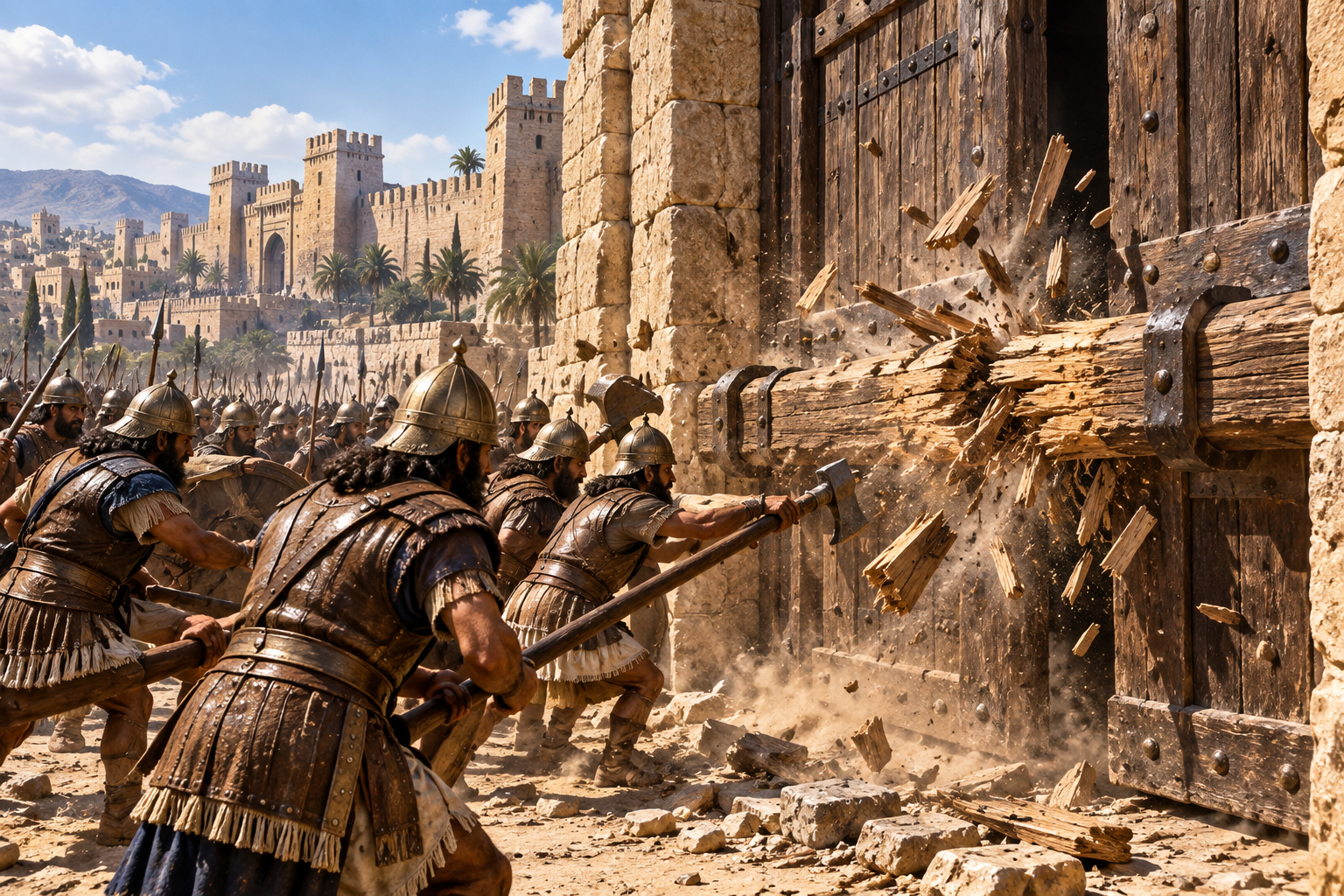
YAHWEH COMPLETES THE
VERDICT AGAINST DAMASCUS
I will also break the gate bar of Damascus - Ancient city gates were crucial points of defense. The doors could be secured by a massive bar extending across them, making the entrance extremely difficult for an attacking army to penetrate. Thus, to break the gate bar means more than damaging a piece of wood or metal but lead to the destruction of the city's defenses and security. Once God breaks the bar, the enemy can enter. The fire (Amos 1:4) would consume what was inside, and God would break what protected it from outside.
And cut off (karath; LXX - exolethreuo - utterly destroy, root out, completely cut off) the inhabitant from the valley of Aven - The precise identification of the valley of Aven is debated. Many associate it with the region of Biqʿat Aven, possibly the fertile Beqaa Valley area between the Lebanon and Anti-Lebanon ranges, while others have proposed a location nearer Damascus.
Valley of Aven (derived from aven = nothingness, vanity, trouble, sorrow, evil, or wickedness) could be a derogatory epithet since the root word aven
means "nothingnes. Therefore some linguists argue that the term was not strictly a formal map name. Instead, the prophet Amos likely used it as a sarcastic, mocking title for the Syrian seat of power to emphasize the spiritual emptiness of their pagan, idoltrous practices. Thus Valley of Aven would sound to the reader like “Valley of Wickedness” or “Valley of Vanity.” Whatever its precise location, the central point is clear, which is the fact that God's judgment would not be confined to the capital city but would extend into important territories under Aramean control.
Cut off (karath; LXX - exolethreuo - utterly destroy) the inhabitant conveys removal or destruction. The populated places that had seemed secure would be emptied.
And him who holds the scepter, from Beth-eden - To hold the scepter is a way of describing the ruler or ruling authority. The scepter was the visible symbol of royal authority. Thus Amos moves from the general population to the leadership. Neither ordinary citizen nor king would escape the coming fire of God's righteous wrath.
Beth-eden means “house of pleasure” or “house of delight.” Its precise identification has also been debated, but it probably refers to a center associated with the Aramean sphere of influence, often connected with Bit-Adini, an Aramean state in northern Syria along the Euphrates. There may again be deliberate irony in the name. The “house of delight” would become a place from which royal authority disappeared. The scepter that symbolized human authority would prove powerless before the sovereignty of God.
So - Term of conclusion. The Arameans' punishment would correspond appropriately to their crimes.
The people of Aram will go exiled to Kir,” Says the LORD (Jehovah) - Kir was apparently associated with the earlier homeland of the Arameans. God had once providentially brought the Arameans from Kir, and now He announces that they will be sent back to Kir. That truth is important for understanding Amos. Yahweh is not merely Israel's tribal deity, but the One Who sovereignly directs the histories and migrations of pagan nations as well as Israel (Amos 9:7). As we often say ALL of HISTORY is "HIS STORY!"
2 Kings records that when Assyria defeated Damascus “The king of Assyria...captured it and carried the people of it away into exile to Kir, and put Rezin to death.” (2Ki 16:9). The correspondence with Amos' prophecy is remarkable. In 732 BC, Tiglath-pileser III of Assyria conquered Damascus, ended the Aramean kingdom's independence, and deported part of its population.
Amos 1:3 and Amos 1:5 are like an inclusio, beginning and ending with thus "says the LORD."
FULFILLMENT OF PROPHECY - reflecting judgment on six nations who had transgressed by their treatment of God's people, Israel.
Damascus (Amos 1:3-5)
The dynasty of King Hazael ended; his son Ben-hadad was defeated; Damascus lost its power (business was done at the city gate, Amos 1:5); and "the house of Eden" (delight, paradise) became a ruin. King Joash defeated Ben-hadad three times (2 Kings 13:25), and finally Damascus fell to Assyria under Tiglath-pileser III in 732 B.c. when they were taken into captivity. (cf. 2 Kings 16:7-9).
QUOTES FROM MATTHEW HENRY ON Amos 1:5
“When God's judgments come with commission it is in vain to think of turning them out.”
Amos 1:6 Thus says the LORD, “For three transgressions of Gaza and for four I will not revoke its punishment, Because they deported an entire population To deliver it up to Edom.
KJV Thus saith the LORD; For three transgressions of Gaza, and for four, I will not turn away the punishment thereof; because they carried away captive the whole captivity, to deliver them up to Edom:
NET This is what the LORD says: "Because Gaza has committed three crimes– make that four!– I will not revoke my decree of judgment. They deported a whole community and sold them to Edom.
NLT This is what the LORD says: "The people of Gaza have sinned again and again, and I will not let them go unpunished! They sent whole villages into exile, selling them as slaves to Edom.
ESV Thus says the LORD: "For three transgressions of Gaza, and for four, I will not revoke the punishment, because they carried into exile a whole people to deliver them up to Edom.
BGT τάδε λέγει κύριος ἐπὶ ταῖς τρισὶν ἀσεβείαις Γάζης καὶ ἐπὶ ταῖς τέσσαρσιν οὐκ ἀποστραφήσομαι αὐτούς ἕνεκεν τοῦ αἰχμαλωτεῦσαι αὐτοὺς αἰχμαλωσίαν τοῦ Σαλωμων τοῦ συγκλεῖσαι εἰς τὴν Ιδουμαίαν
LXE Thus saith the Lord; For three sins of Gaza, and for four, I will not turn away from them; because they took prisoners the captivity of Solomon, to shut them up into Idumea.
CSB The LORD says: I will not relent from punishing Gaza for three crimes, even four, because they exiled a whole community, handing them over to Edom.
NIV This is what the LORD says: "For three sins of Gaza, even for four, I will not turn back my wrath. Because she took captive whole communities and sold them to Edom,
- three (KJV): Am 1:3,9,11
- Gaza (KJV): 1Sa 6:17 2Ch 28:18 Isa 14:29-31 Jer 47:4,5 Eze 25:15,16 Zep 2:4-7 Zec 9:5 Ac 8:26
- carried (KJV): etc. or, carried them away with an entire captivity, 2Ch 21:16,17 28:18 Joe 3:6
- to Edom (KJV): Am 1:9,11 Eze 35:5 Ob 1:11
- Amos Commentaries and Sermons - multiple resources
Related Passages:
Amos 1:9 (describes Tyre's offense of delivering “an entire population” to Edom) "Thus says the LORD, “For three transgressions of Tyre and for four I will not revoke its punishment, Because they delivered up an entire population to Edom And did not remember the covenant of brotherhood. "
Joel 3:4–8 (condemns Tyre, Sidon, and Philistia for selling captives as slaves) “Moreover, what are you to Me, O Tyre, Sidon and all the regions of Philistia? Are you rendering Me a recompense? But if you do recompense Me, swiftly and speedily I will return your recompense on your head. 5 “Since you have taken My silver and My gold, brought My precious treasures to your temples, 6 and sold the sons of Judah and Jerusalem to the Greeks in order to remove them far from their territory, 7 behold, I am going to arouse them from the place where you have sold them, and return your recompense on your head. 8 “Also I will sell your sons and your daughters into the hand of the sons of Judah, and they will sell them to the Sabeans, to a distant nation,” for the LORD has spoken.
Obadiah 1:10–14 (condemns Edom for its hostility toward Judah) “Because of violence to your brother Jacob, You will be covered with shame, And you will be cut off forever. 11 “On the day that you stood aloof, On the day that strangers carried off his wealth, And foreigners entered his gate And cast lots for Jerusalem– You too were as one of them. 12 “Do not gloat over your brother’s day, The day of his misfortune. And do not rejoice over the sons of Judah In the day of their destruction; Yes, do not boast In the day of their distress. 13 “Do not enter the gate of My people In the day of their disaster. Yes, you, do not gloat over their calamity In the day of their disaster. And do not loot their wealth In the day of their disaster. 14 “Do not stand at the fork of the road To cut down their fugitives; And do not imprison their survivors In the day of their distress.
Amos 2:6-7 (brings the same concern for human exploitation directly against Israel) "Thus says the LORD, “For three transgressions of Israel and for four I will not revoke its punishment, Because they sell the righteous for money And the needy for a pair of sandals. 7 “These who pant after the very dust of the earth on the head of the helpless Also turn aside the way of the humble; And a man and his father resort to the same girl In order to profane My holy name.
Amos 8:4–6 (condemns those who exploit the needy and treat people as commodities) "Hear this, you who trample the needy, to do away with the humble of the land, 5 saying, “When will the new moon be over, So that we may sell grain, And the sabbath, that we may open the wheat market, To make the bushel smaller and the shekel bigger, And to cheat with dishonest scales, 6 So as to buy the helpless for money And the needy for a pair of sandals, And that we may sell the refuse of the wheat?” "
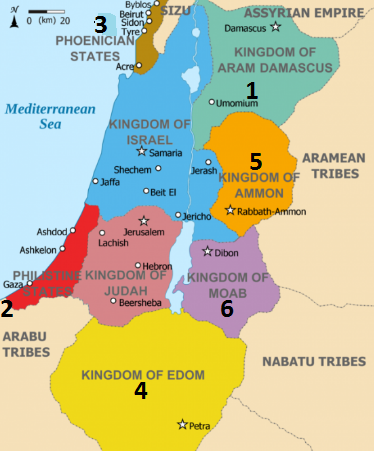
See Gaza, Ashdod, Ashkelon in Red Area
GAZA TO BE PUNISHED FOR
HUMAN TRAFFICKING
Thus says the LORD (Jehovah), “For three transgressions (pesha; LXX - asebeia - godlessness) of Gaza and for four I will not revoke its punishment - See comments on similar verdicts passed on Damascus. Gaza was a Philistine city and did not possess Israel's covenant or law, yet Gaza was still accountable to the LORD. As alluded to earlier, the nations may not acknowledge Yahweh's authority, but they are never outside Yahweh's authority. In short, God's moral government extends beyond Israel's borders. As with Damascus the numerical formula communicates repeated, accumulating transgression, so that sin had been heaped upon sin until the measure is full. God had not overlooked the first transgression, nor had He forgotten the second or third. His patience had simply postponed the reckoning.
Because (term of explanation) Damascus was condemned for brutalizing people. Gaza is condemned for trafficking people. Human beings created in the image of God had been reduced to commodities to be captured, transported, and sold for profit. This reminds me of this evil in the last days of this present age where Rev 18:13 describes cargoes of "slaves and human lives." (Rev 18:12).
They deported an entire population - Amos now turns from Damascus in the northeast to Gaza in the southwest. The crime changes, but the divine Judge does not. The Hebrew idea behind deported is literally that of carrying away captives. This was not merely defeating an enemy army. The Philistines were involved in capturing entire communities and removing their inhabitants. The expression an entire population intensifies the accusation. The Hebrew can convey the idea of a complete captivity, so that men, women, children, families, and communities were swept away. In other words, these captives were not necessarily people who had taken up arms against Gaza. The picture is of populations being seized and transported in what we refer to today as "human trafficking," but in this case human trafficking on a massive scale.
Those who sought to erase others would discover
that God had not overlooked what they had done.
Tragically, Gaza had transformed persons into property, human beings into merchandise, families into human inventory and captives into profit. Damascus treated people like grain to be threshed. Gaza treated people like goods to be traded. God condemned both.
J Vernon McGee - The judgment against the Philistines was for making slaves. They took a certain number of Israelites, and they sold them into slavery to Edom and also to Phoenicia. The Phoenicians were great traders, and they in turn sold them as prisoners of war into slavery. They would send them all over the Mediterranean world. Because of this, God says that He intends to judge Philistia. (SEE Thru the Bible Vol. 28: The Prophets - Amos/Obadiah)
To deliver (sagar = hand over; LXX - sugkleio - enclose as fish in a net) it up to Edom - Here we see Gaza's purpose for their human trafficking. The captives were being handed over to Edom, apparently as part of the regional slave trade. Edom's geographical position gave it access to important trade routes extending toward Arabia and beyond, making it a natural participant or intermediary in such commerce. Once delivered into an international slave network, families could be permanently separated with little possibility of ever returning home.
That may help explain why Amos specifically emphasizes that they were delivered “to Edom.” Gaza was not merely taking captives temporarily but was transferring them into a system that could remove them permanently from their homeland.
QUOTES FROM MATTHEW HENRY ON Amos 1:5
“God will make a full end of those that think to make a full end of His church and people.”
QUESTION - What is the significance of Gaza in the Bible? | GotQuestions.org
ANSWER - Gaza, also called Azzah, is first mentioned in Genesis as one of the border cities of Canaan (Genesis 10:15–19). The city was on the border of Israel and Egypt in the southwest part of Israel near the Mediterranean Sea. Gaza is one of the oldest cities in history. The name Gaza means “strong,” which is a fitting name considering the city’s strongholds and fortifications for protection.
Gaza was a city associated with the Philistines. Originally, the Avvites lived in Gaza, but the Caphtorites displaced them and settled in the city (Deuteronomy 2:23). The Philistines were most likely identical or related to the Caphtorites, who came from Crete. The ancient Philistines had traveled to Canaan from a coastal region (Jeremiah 47:4), so it’s quite possible that they originally came from Crete.
In the time of Joshua, the Israelites conquered the land “from Kadesh Barnea to Gaza and from the whole region of Goshen to Gibeon” (Joshua 10:41). The tribe of Judah inherited Gaza, and they were able to keep the city for a short time before it fell back into the hands of the Philistines (Judges 1:18). By the time of Samson’s judgeship, the Philistines were living in and controlling Gaza (Judges 16:1). When Samson visited Gaza, the people there planned to kill him, but he escaped and carried off the city gates (Judges 16:1–3). After Delilah tricked Samson into divulging the secret of his strength, the Philistines captured him and took him to a prison in Gaza (Judges 16:21). Later, Samson regained his strength from the Lord and pushed down the pillars of Dagon’s temple, destroying the edifice and killing many Philistines in the process (Judges 16:23–30).
The Philistines continued to control Gaza during the time of Samuel (see 1 Samuel 6:17). King Hezekiah won great victories over the Philistines, “as far as Gaza and its territory,” but did not conquer Gaza itself (2 Kings 18:8).
Gaza was a city associated with judgment. Jeremiah, Amos, Zephaniah, and Zechariah all prophesied judgment on Gaza because of the sin of the Philistines. Amos 1:6–7 records God’s judgment on Gaza: “For three transgressions of Gaza, and for four, I will not revoke the punishment, because they carried into exile a whole people to deliver them up to Edom. So I will send a fire upon the wall of Gaza, and it shall devour her strongholds” (ESV). Likewise, Jeremiah, Zephaniah, and Zechariah prophesied of Gaza’s destruction (Jeremiah 25:17–20; Zephaniah 2:4; Zechariah 9:5). King Sargon of Assyria conquered Gaza and probably destroyed it in 720 BC. Later, Alexander the Great destroyed the city again in 332 BC, after a lengthy battle. During the Maccabean period, Jonathan subjugated Gaza to Israel.
Gaza was a city associated with the spread of the gospel. The New Testament mentions Gaza once. An angel told Philip the evangelist to “go south to the road—the desert road—that goes down from Jerusalem to Gaza” (Acts 8:26). On the road to Gaza, Philip shared the gospel with an Ethiopian eunuch and subsequently baptized him (Acts 8:26–39). A city once filled with hostility toward the Lord served as a marking point for an Ethiopian to hear of and trust in the grace of God.
The Bible associates Gaza mainly with the Philistines. God had given the city to Judah, but the Israelites had failed to obey God in driving out the former occupants of Canaan (Numbers 33:51–53). Because of that disobedience, the Philistines and the city of Gaza remained a thorn in Israel’s side for centuries (see Judges 2:3).
Amos 1:7 “So I will send fire upon the wall of Gaza And it will consume her citadels.
- I will (KJV): De 32:35,41-43 Ps 75:7,8 94:1-5 Zep 2:4 Ro 12:19
- a fire (KJV): Am 1:4 2Ki 18:8 2Ch 26:6 Jer 25:18-20 47:1 Zec 9:5-7
- Amos Commentaries and Sermons - multiple resources
Related Passages
Amos 1:4 ( same judgment against Damascus) - “So I will send fire upon the house of Hazael And it will consume the citadels of Ben-hadad.
Amos 1:10, 12, 14; 2:2, 5 continues the recurring fire-and-citadels refrain.
Psalm 127:1-2 (Declares the futility of guarding a city apart from the LORD) - Unless the LORD builds the house, They labor in vain who build it; Unless the LORD guards the city, The watchman keeps awake in vain. 2 It is vain for you to rise up early, To retire late, To eat the bread of painful labors; For He gives to His beloved even in his sleep.
Proverbs 18:10-11 (contrasts the true security with the imagined security) "The name of the LORD is a strong tower; The righteous runs into it and is safe. 11 A rich man’s wealth is his strong city, And like a high wall in his own imagination. "
Zephaniah 2:4–7 (announces judgment upon Gaza and other Philistine cities) "For Gaza will be abandoned And Ashkelon a desolation; Ashdod will be driven out at noon And Ekron will be uprooted. 5 Woe to the inhabitants of the seacoast, The nation of the Cherethites! The word of the LORD is against you, O Canaan, land of the Philistines; And I will destroy you So that there will be no inhabitant. 6 So the seacoast will be pastures, With caves for shepherds and folds for flocks. 7 And the coast will be For the remnant of the house of Judah, They will pasture on it. In the houses of Ashkelon they will lie down at evening; For the LORD their God will care for them And restore their fortune.
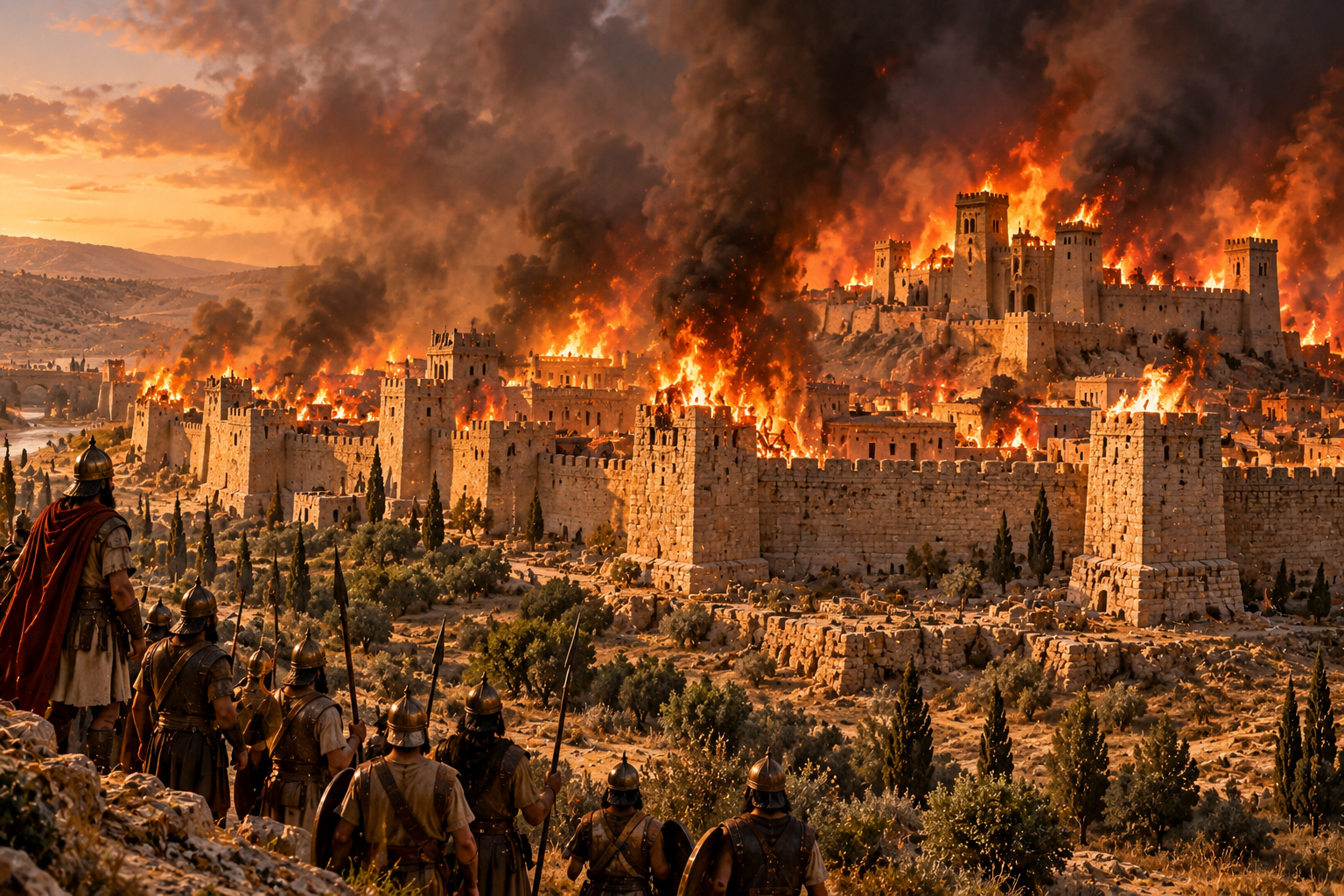
GAZA'S WALLS WILL
NOT SAVE GAZA
So - Term of conclusion connects Gaza’s punishment directly with her sin in verse 6. Because the Philistines had deported entire populations and delivered them to Edom, God now announces His judgment.
I will send fire upon the wall of Gaza And it will consume ('akal - devour, "eat up"; LXX - katesthio - figuratively destroy, esp of fire) her citadels (armon; LXX - themelion = the base on which a building stands) - Once again (cf Amos 1:4) note the emphatic "I" is behind the scenes orchestrating the fires on Gaza's citadels. The point is that Amos views the coming military destruction not merely as the result of international politics but ultimately as an expression of God’s sovereign and providential judgment. The wall was a city’s primary line of defense. Ancient fortified cities depended upon massive walls to protect their inhabitants from invading armies. Behind those walls the people of Gaza could feel secure. But God specifically identifies the very thing in which Gaza might place its confidence. The citadels (armenot) were fortified palaces or strongholds associated with the city’s rulers, military power, and wealth. Thus God’s judgment moves from the outer defenses to the inner strongholds.
There is a significant correspondence between Gaza’s crime and punishment. In Amos 1:6, Gaza had taken advantage of the vulnerability of others. Entire populations had been captured and removed from their homes. Now Gaza itself would become vulnerable. They had broken into the security of others; God would break through their security. They had carried others away from their homes; soon their own homes and strongholds would no longer provide protection. This is another example of a recurring biblical principle: people may eventually reap something corresponding to what they have sown (Gal 6:7).
J A Motyer on the Lord's judgment on Philistia - Gaza fell to Assyria in 734 bc (the other Philistine cities followed: Ashdod, 711 bc; Ashkelon and Ekron in 701 bc). They were involved in the same sin as Damascus, treating people as a commercial crop with Edom acting as their middleman. They were so obsessed with the profit motive that no other consideration mattered—no plea of age or sex, of child for parent or parent for child. The saleable were sold; market forces alone mattered, to the exclusion of humanity. No word could be more timely than this of Amos for our present generation. 'The Sovereign Yahweh', is a term used only here in the list of condemnations, as if to suggest that nothing calls for the omnipotence of God in punitive action like using people merely as commodities. (BORROW New Bible Commentary page 794)
🙏 THOUGHT - There is a profound spiritual lesson in Gaza’s wall. We naturally construct our own forms of security: wealth, possessions, position, influence, relationships, physical strength, institutions, and human resources. These things may have legitimate value, but they become dangerous when they produce a false sense of independence from God. Our greatest security is never found in what surrounds us but in the God Who is in us, over us and surrounding us.
Amos 1:8 “I will also cut off the inhabitant from Ashdod, And him who holds the scepter, from Ashkelon; I will even unleash My power upon Ekron, And the remnant of the Philistines will perish,” Says the Lord GOD.
- I will cut (KJV): Isa 20:1 Jer 47:5 Eze 25:16
- turn (KJV): Ps 81:14 Isa 1:25 Zec 13:7
- and the (KJV): Isa 14:29-31 Jer 47:4,5 Eze 25:16 Zep 2:4-7
- Amos Commentaries and Sermons - multiple resources
Related Passages
Joshua 13:3 names the five principal Philistine cities: Gaza, Ashdod, Ashkelon, Gath, and Ekron.
1 Samuel 6:17 gives the same five-city structure.
Amos 6:2 mentions Gath and may help explain its absence from Amos 1:6–8.
Zephaniah 2:4–7 later pronounces judgment specifically upon Gaza, Ashkelon, Ashdod, and Ekron.
Jeremiah 47:1–7 also announces judgment upon the Philistines.
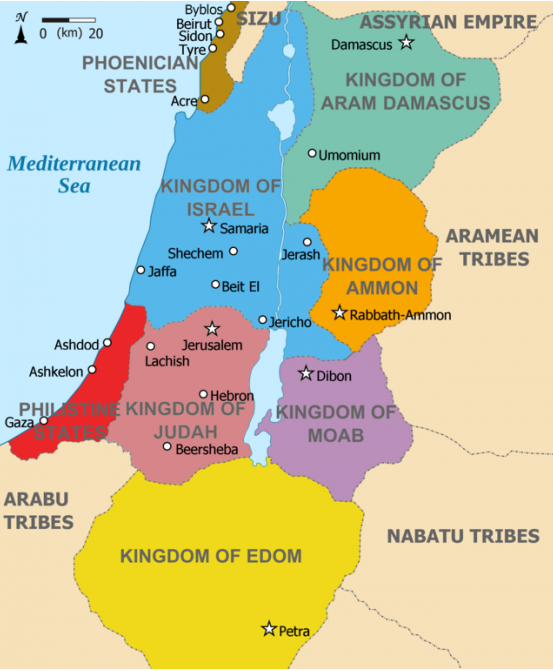
See Gaza, Ashdod, Ashkelon in Red Area
THE END OF
PHILISTINE POWER
Amos now completes the judgment against Philistia begun with Gaza in Amos 1:6–7. bringing judgment upon the Philistine people and their centers of power.
I will also cut off (karath) the inhabitant from Ashdod - Once again note it is Yahweh ("I will") Who brings about the cutting off. Ashdod was one of the five major Philistine city-states (Josh 13:3; 1Sa 6:17). Like Gaza, it was a fortified and strategically important city near the Mediterranean coast. To “cut off” (karath) is strong language and can mean to cut down, eliminate, or destroy. God is declaring that the population upon which Ashdod's continuing strength depended would be removed.
And him who holds the scepter, from Ashkelon - The scepter was the symbol of royal authority. Thus “him who holds the scepter” is a picturesque way of referring to the ruler of Ashkelon. God's judgment therefore reaches both the inhabitant (the general population) and the scepter-holder (the leaders). All are held guilty of crimes against humanity.
I will even unleash My power upon Ekron - Literally it reads “I will turn My hand against Ekron.” The hand of the LORD (see discussion of this topic) is a frequent biblical picture of His active power. Here His hand is turned against Ekron (not shown on map but in the red area of Philistia) in judgment. This is more personal and forceful than simply predicting that Ekron would someday fall. The city would encounter the active opposition of God. Philistia's greatest problem was not that another army was coming against her. It was that God's hand was against her. The same divine hand that can save when extended in mercy can judge when turned against persistent rebellion.
And the remnant of the Philistines will perish,” Says the Lord GOD - Remnant ordinarily refers to those who survive an initial catastrophe. If a city falls, perhaps some escape. If an army is destroyed, perhaps some survive. Human hope naturally attaches itself to the remnant thinking “At least some will remain.” Not so in this judgment as it will be thorough and complete! And there would be no safe Philistine city to which the survivors could flee. Amos does not mention Gath, presumably because it had already falle.
Says the Lord GOD - Here the title is Adonai Yahweh, emphasizing God's sovereign lordship. Philistine rulers may hold their scepters, but above every earthly ruler stands the Lord GOD.
FULFILLMENT OF PROPHECY - reflecting judgment on six nations who had transgressed by their treatment of God's people, Israel.
Gaza (Amos 1:6-8)
Ashkelon was conquered by Tiglath-pileser III in 734 в.c. Some sources say that Gaza was captured at the same time. In 701 B.C., Sennacherib conquered Ashkelon and carried off the king of Ashkelon to Assyria. In later years Ashkelon was overrun by the Scythians, Chaldeans, and Persians. Esarhaddon and Ashurbanipal of Assyria required tribute of Ekron, which continued to exist until the time of the Crusades. Ashdod suffered at the hands of the Assyrians in 711 B.c. and was conquered by Nebuchadnezzar who ruled Babylon from 605-562 в.c. and carried their kings captive to Babylon. It is possible that Gath was not mentioned in Amos because it had been destroyed earlier by Uzziah (2 Chronicles 26:6).
QUESTION - What is the significance of Ashkelon in the Bible? | GotQuestions.org
ANSWER - Ashkelon is a coastal city in the southern part of Israel on the shore of the Mediterranean Sea. It is just north of Gaza and about 36 miles south of modern-day Tel Aviv. In biblical times, Ashkelon was the oldest and largest seaport in ancient Canaan. Over history, it has been ruled by the Egyptians, the Canaanites, the Assyrians, the Greeks, the Philistines, and others. The geographical location of Ashkelon likely led to these various nations and tribes vying to control it, as it would have been a highly desirable seaport for trade and military staging.
Ashkelon - Philistine Rule
The Bible speaks of various battles for the control of Ashkelon. Judges 1:17–18 gives an account of the armies of Judah taking it from the Canaanites: “The men of Judah went with the Simeonites their fellow Israelites and attacked the Canaanites living in Zepeth, and they totally destroyed the city. Therefore it was called Hormah. Judah also took Gaza, Ashkelon and Ekron—each city with its territory.” Throughout Israel’s history, the Philistines were a people group hell-bent on destroying the Israelites, fighting with them at nearly every turn. Joshua mentioned Ashkelon as one of five cities held by Philistine rulers, along with Gaza, Ashdod, Gath, and Ekron (Joshua 13:3; cf. 1 Samuel 6:17).
Samson, in his wrath against the Philistines, “went down to Ashkelon, struck down thirty of their men, stripped them of everything” (Judges 14:19). David includes a reference to Ashkelon in his dirge for Saul and Jonathan: “Tell it not in Gath, proclaim it not in the streets of Ashkelon, lest the daughters of the Philistines be glad, lest the daughters of the uncircumcised rejoice” (2 Samuel 1:20). The contention between the Israelites and the Philistines is a common theme in the Old Testament, with the city of Ashkelon being one of the main theaters of battle.
Ashkelon - Prophecies of Destruction
Various prophets went on to prophesy about the ultimate destruction of Ashkelon. Jeremiah said, “This is what the Lord, the God of Israel, said to me: ‘Take from my hand this cup filled with the wine of my wrath and make all the nations to whom I send you drink it. When they drink it, they will stagger and go mad because of the sword I will send among them’” (Jeremiah 25:15–16). One place made to drink the cup of the Lord’s wrath was Ashkelon (verse 20). Later, Jeremiah wrote, “Ashkelon will be silenced” (Jeremiah 47:5) and that the “sword of the Lord” has been ordered “to attack Ashkelon and the coast” (Jeremiah 47:6–7). The prophet Zechariah, speaking of God’s judgment on Israel’s enemies, said, “Ashkelon will see it and fear” (Zechariah 9.5). Zephaniah stated plainly, “Gaza will be abandoned and Ashkelon left in ruins” (Zephaniah 2:4). Philistine control of Ashkelon was about to come to an end, as foretold by God through His prophets.
Post-Philistine Ashkelon
Ashkelon was conquered by Assyria about 734 BC, and it was under Assyrian rule that the Philistines were finally driven out. The city changed hands many times after that, as Greeks and Maccabees and Romans and Muslims and Crusaders all had their turn. Some think that Herod the Great was born in Ashkelon; the fact is he did build a palace and aqueduct there. After Saladin destroyed Ashkelon in AD 1191, the city lay in ruins for a century. A town was later built by Arabs near the original site of Ashkelon and called Al-Majdal.
After the Arab-Israeli War of 1948—49, the place was formally granted to Israel, who renamed it Ashkelon. This event could be seen as a fulfillment of Zephaniah’s prophecy that Ashkelon would eventually be a peaceful place belonging to Judah:
“The land by the sea will become pastures
having wells for shepherds
and pens for flocks.
That land will belong
to the remnant of the people of Judah;
there they will find pasture.
In the evening they will lie down
in the houses of Ashkelon.
The Lord their God will care for them;
he will restore their fortunes” (Zephaniah 2:6–7).
Amos 1:9 Thus says the LORD, “For three transgressions of Tyre and for four I will not revoke its punishment, Because they delivered up an entire population to Edom And did not remember the covenant of brotherhood.
- Tyrus (KJV): Isa 23:1-18 Jer 47:4 Eze 26:1-28:26 Joe 3:4-8 Zec 9:2-4
- because (KJV): Am 1:6,11
- brotherly covenant (KJV): Heb. covenant of brethren, 2Sa 5:11 1Ki 5:1-11 1Ki 9:11-14 2Ch 2:8-16
- Amos Commentaries and Sermons - multiple resources
Related Passages
1 Kings 5:1 Now Hiram king of Tyre sent his servants to Solomon, when he heard that they had anointed him king in place of his father, for Hiram had always been a friend of David.
1 Kings 5:12 The LORD gave wisdom to Solomon, just as He promised him; and there was peace between Hiram and Solomon, and the two of them made a covenant. (beriyth)
1 Kings 9:13 He said, “What are these cities which you have given me, my brother?” So they were called the land of Cabul to this day.
2 Samuel 5:11 (friendly relationship between Tyre and Israel beginning during David's reign) Then Hiram king of Tyre sent messengers to David with cedar trees and carpenters and stonemasons; and they built a house for David.
Joel 3:4–6 (condemns Tyre, Sidon, and Philistia for selling captives into distant lands) Moreover, what are you to Me, O Tyre, Sidon and all the regions of Philistia? Are you rendering Me a recompense? But if you do recompense Me, swiftly and speedily I will return your recompense on your head. 5“Since you have taken My silver and My gold, brought My precious treasures to your temples, 6and sold the sons of Judah and Jerusalem to the Greeks in order to remove them far from their territory,
Ezekiel 27:13 (describes human lives as part of Tyre's extensive commerce) "“Javan, Tubal and Meshech, they were your traders; with the lives of men and vessels of bronze they paid for your merchandise."
Psalm 55:12–14, 20–21 (poignantly describes pain of betrayal by one with whom there had been close fellowship) "For it is not an enemy who reproaches me, Then I could bear it; Nor is it one who hates me who has exalted himself against me, Then I could hide myself from him. 13 But it is you, a man my equal, My companion and my familiar friend; 14We who had sweet fellowship together Walked in the house of God in the throng. (55:20-21) 20He has put forth his hands against those who were at peace with him; He has violated his covenant. 21 His speech was smoother than butter, But his heart was war; His words were softer than oil, Yet they were drawn swords.
Kingdom of Tyre on the Northwestern Coast
THE SIN OF BETRAYED
BROTHERHOOD
Thus says the LORD (Jehovah), “For three transgressions (pesha; LXX - asebeia - godlessness) of Tyre and for four I will not revoke its punishment - Yahweh now turns His eyes to the north to Tyre, the great Phoenician commercial center on the Mediterranean coast. To reiterate Amos uses the recurring formula for accumulated and repeated rebellion. As discussed above, this is not a mathematical statement limiting Tyre's sins to four but the idea is sin added to sin until the measure of their sins is full.
Because (term of explanation) they delivered up an entire population to Edom - The language closely parallels the charge against Gaza in Amos 1:6. Tyre participated in the trafficking of entire groups of captives, delivering them to Edom, apparently as part of the slave trade. Tyre was famous as a maritime commercial power. Her ships and merchants connected the eastern Mediterranean with distant markets. What makes Amos' accusation so disturbing is that human beings had apparently become another commodity of commerce. Joel later associates Tyre, Sidon, and Philistia with selling people from Judah and Jerusalem to distant peoples (Joel 3:4–6). Once sold into distant markets, families could be separated with little realistic prospect of reunion. Tyre's commercial expertise had been turned into profiting from trafficking human beings created in the image of God.
And did not remember the covenant (beriyth) of brotherhood - In the ancient world, a covenant was the most solemn and binding agreement two parties could enter into. It was so serious that breaking it called for the death of the one who violated its terms. To remember a covenant meant not just intellectually remember but to remember it and act faithfully in accordance with it.
The expression covenant (beriyth) of brotherhood a covenant between parties who regarded one another as brothers, likely referring to the longstanding friendly relationship between Tyre and Israel. There is significant Old Testament background for such a relationship. During David's reign, Hiram king of Tyre sent cedar, carpenters, and craftsmen to build David's house (2Sa 5:11). The relationship grew even stronger under Solomon, when Hiram supplied timber and craftsmen for the temple and Solomon supplied provisions in return (1Ki 5:1-12). Significantly, the text says, "There was peace between Hiram and Solomon, and the two of them made a covenant (beriyth)" (1Ki 5:12). Later, Hiram addressed Solomon as "my brother" (1Ki 9:13).
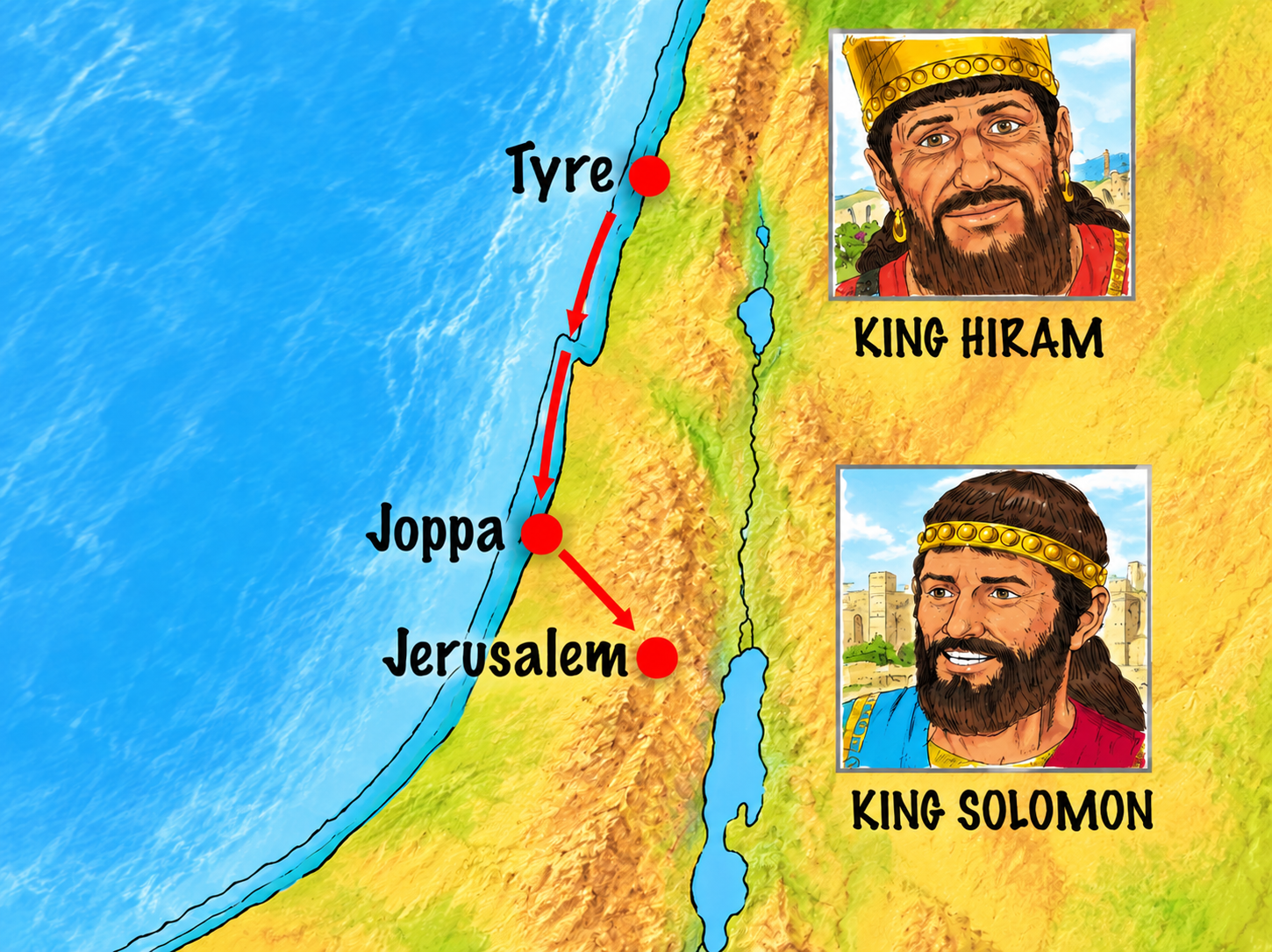
These passages provide a natural background for Amos's expression "the covenant of brotherhood." Whether Amos has this particular treaty directly in view, or a later continuation of the same friendly relationship, cannot be established with certainty, but the historical picture is clear: Tyre and Israel had enjoyed a longstanding covenantal and commercial friendship. That makes Tyre's betrayal all the more treacherous.
....the passing of time does not absolve anyone
from their obligation to keep their word.
J A Motyer on the the covenant of brotherhood - (See above - 1 Ki. 5:1, 12; 9:13 note references to friendship, treaty and brotherliness). Amos is looking back 250 years, but the passing of time does not absolve anyone from their obligation to keep their word (ED: ESPECIALLY IN COVENANTS!). Tyre became tributary to Assyria, surrendered to Nebuchadnezzar (585-573 bc) and fell to Alexander (332 bc). (BORROW New Bible Commentary page 794)
This is what distinguishes Tyre from Gaza. Gaza sold people. Tyre sold people with whom it had a relationship of covenant friendship. Tyre did not merely exploit strangers. It betrayed those toward whom it had recognized obligations.
Ezekiel 27:13 explicitly includes “the lives of men” among merchandise traded with Tyre which provides a chilling commentary on Amos' accusation. Tyre knew the value of merchandise but had forgotten the value of people.
When profit becomes more important than people
and promises, prosperity has become morally corrupt.
Amos 1:9-15
TODAY IN THE WORD
But I tell you who hear me: Love your enemies, do good to those who hate you. - Luke 6:27
During one of his military campaigns, Napoleon’s troops mounted an assault on the Russian city of Smolensk. In an effort to deprive the French general of the pleasure of his imminent victory, the inhabitants abandoned the city and set fire to it. When Napoleon asked his aides what they thought of the sight, one of them replied, “Horrible, sire.” Napoleon snorted in disgust and snapped back, “Remember, gentlemen, as one of the Roman emperors remarked: The corpse of an enemy always smells sweet.”
The prophet Amos disagrees. Today’s passage points out that all is not fair in love and war. One of the chief complaints about Israel’s neighbors in this chapter was that they had treated their enemies inhumanely in warfare. Amos 1:9-15 continue the litany of charges leveled against the pagan nations.
Israel’s Phoenician neighbor Tyre is singled out for trafficking in the spoils of war because they had sold captured slaves to Edom. By engaging in this kind of business Tyre was “disregarding a treaty of brotherhood” (Amos 1:9). This may be a reference to Tyre’s previous business relationship with Judah. The King of Tyre had supplied Solomon with lumber for the temple (1 Kings 5:1–12). Now Tyre enriched itself as a result of Israel’s misfortune.
TODAY ALONG THE WAY
We can sometimes be so intent on achieving our aims that we fail to consider the people that we have used in an effort to attain our goals. Think of a goal that you recently achieved. How did you treat others while you were in pursuit of it? Are there people you should thank or to whom you have not given due credit? Are there some that you owe (Copyright Moody Bible Institute. Used by permission. All rights reserved)
QUOTES FROM MATTHEW HENRY ON Amos 1:9
“It is a great aggravation of enmity and malice when it is the violation of friendship and of a brotherly covenant.” (Betrayal hurts most deeply when hostility comes wearing the memory of friendship.)
Amos 1:10 “So I will send fire upon the wall of Tyre And it will consume her citadels.”
- Am 1:4,7-2:16 Eze 26:12 Zec 9:4
- Amos Commentaries and Sermons - multiple resources
Related Passages
2 Samuel 5:11 (background of friendly relations between Tyre and Israel) "Then Hiram king of Tyre sent messengers to David with cedar trees and carpenters and stonemasons; and they built a house for David." (See also 1 Kings 5:1–12)
Ezekiel 26:1–14 gives an extended prophecy concerning the judgment of Tyre.
Ezekiel 27:1-36 portrays Tyre’s extraordinary commercial wealth and international trading network.
Zechariah 9:3-4 "For Tyre built herself a fortress And piled up silver like dust, And gold like the mire of the streets. 4 Behold, the Lord will dispossess her And cast her wealth into the sea; And she will be consumed with fire. "
See also discussion of FULFILLED BIBLE PROPHECY - DESTRUCTION OF TYRE
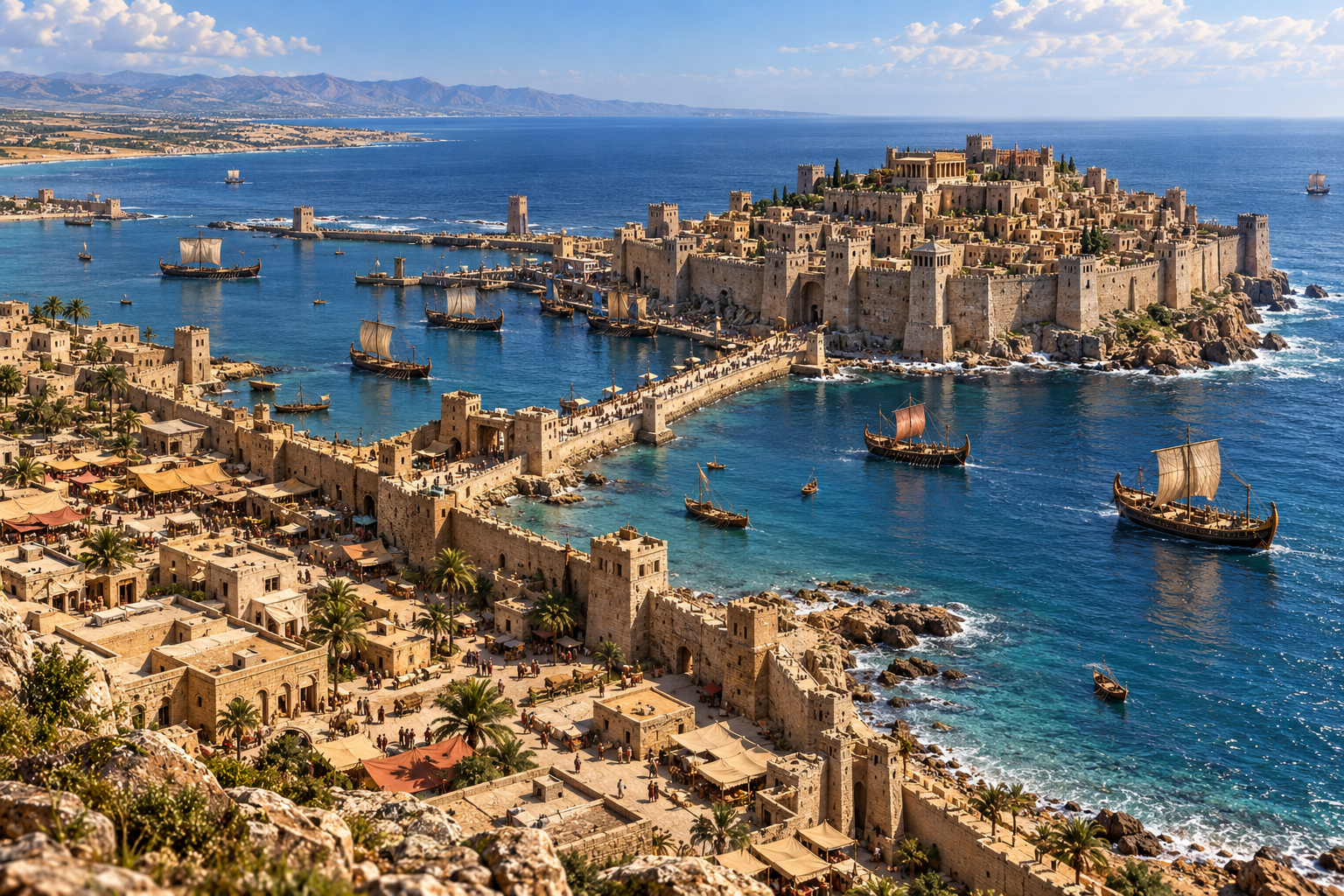
Tyre Mainland and Fortified Island
WHEN PROSPERITY
CANNOT PROTECT
So - Term of conclusion connects the punishment directly with the preceding crime. Tyre had delivered an entire population to Edom and violated the covenant of brotherhood (Amos 1:9). Because Tyre had broken covenant faithfulness for commercial advantage, God would now break the security in which Tyre trusted.
I will send fire upon the wall of Tyre And it will consume ('akal; LXX - katesthio - figuratively destroy, esp of fire) her citadels (armon; LXX - themelion = the base on which a building stands) - This punishment is almost identical to Gaza (Amos 1:7). God Himself sends the fire and it would be on their wall which they falsely relied for security. The result would not be complete consumption of her citadels, her fortified palaces or strongholds within the city. Tyre had enjoyed remarkable prosperity through international commerce. Her ships traveled the Mediterranean, her merchants accumulated wealth, and her fortified position gave her extraordinary security. But none of these could buy a big enough "fire insurance policy!"
Tyre eventually consisted of both a mainland settlement and a heavily fortified island city just offshore. Its geographical position and formidable defenses made it one of the most difficult cities in the ancient Near East to conquer. Its wall therefore represented more than masonry. It symbolized security, military strength, independence, and confidence in human defenses. But Amos announces that the very structure in which Tyre trusted would become the object of divine judgment. Tyre trusted her wall, but God targeted her wall. Guess who won?
🙏 THOUGHT - Beware of where you place your trust! Whatever becomes the object of our confidence apart from God (Pr 3:5,6) can become the very place where God demonstrates its inadequacy.
FULFILLMENT OF PROPHECY - reflecting judgment on six nations who had transgressed by their treatment of God's people, Israel.
Tyre - Tyre became tributary to Assyria, then later surrendered to Nebuchadnezzar (585-573 B.c.), never fully recovering. It fell to Alexander the Great in 332-330 B.c. after he laid siege to it for seven months. Six thousand people were slain outright, 2,000 were crucified, and 30,000 were sold as slaves.
Citadels (0759) Armon (אַרְמוֹן) a masculine noun most commonly translated "palace," "citadel," or "fortress." It denotes a fortified, elevated dwelling, typically the fortified residence of a king or ruling elite, distinguished from ordinary housing by its defensive strength, architectural grandeur, and social prominence. The word sits at the intersection of two related ideas: a place of royal luxury and a place of military security. These aren't separate meanings but two sides of the same reality in the ancient world, where a king's palace and a city's strongest fortification were often one and the same structure. It becomes a symbol of human security, political power, accumulated wealth, social privilege, and pride. These were the structures in which rulers and elites felt secure. They represented the strength of the city and the permanence of the ruling establishment.
CITADEL IN AMOS - One-third of the uses are in Amos and it was as if God was sayinng “The very structures in which you trust will not protect you when I judge.” By Amos 3 the citadels are not merely places of security. They have become storehouses of sin. Amos calls the people of Ashdod and Egypt to look upon Samaria and witness its disorder and oppression (Amos 3:9). Then comes the remarkable accusation “They do not know how to do what is right...these who hoard up violence and devastation in their citadels” (Amos 3:10). That is powerful imagery. Israel's wealthy elite had filled their magnificent residences with possessions obtained through oppression and exploitation. Their citadels were therefore not merely symbols of wealth. They were warehouses containing the evidence of their crimes. And Amos 6:8 takes it even further where God declares: “I loathe the arrogance of Jacob, and detest his citadels” (Amos 6:8). Why would God detest buildings? Because the citadels had come to embody the entire corrupt system behind them: pride, luxury, oppression, exploitation, and false security. God was not condemning architecture. He was condemning what the architecture represented and what had been accumulated inside it. This fits Amos perfectly. Again and again he attacks wealthy people who live comfortably while exploiting the poor (Amos 2:6–7; 4:1; 5:11–12; 6:4–6). Human beings repeatedly put their confidence in things they believe make them untouchable. God repeatedly destroys those very symbols of security.
ARMON - 33X/32V - castle(1), citadel(2), citadels(13), fortified buildings(1), fortified towers(1), palace(3), palaces(9), palatial dwellings(1), towers(2). 1 Ki. 16:18; 2 Ki. 15:25; 2 Chr. 36:19; Ps. 48:3; Ps. 48:13; Ps. 122:7; Prov. 18:19; Isa. 23:13; Isa. 25:2; Isa. 32:14; Isa. 34:13; Jer. 6:5; Jer. 9:21; Jer. 17:27; Jer. 30:18; Jer. 49:27; Lam. 2:5; Lam. 2:7; Ezek. 19:7; Hos. 8:14; Amos 1:4; Amos 1:7; Amos 1:10; Amos 1:12; Amos 1:14; Amos 2:2; Amos 2:5; Amos 3:9; Amos 3:10; Amos 3:11; Amos 6:8; Mic. 5:5
The word likely derives from a root meaning "to be elevated" or "raised up," fitting both the literal elevation of such structures (often built on high ground or given towering height for defensive advantage) and their figurative elevation in status as symbols of power and prestige. E.A. Speiser has proposed a connection to the Assyrian root ramu, meaning "to found a dwelling" or "to dwell," which would tie the word to the broader Semitic vocabulary of establishing a fixed, secure residence.
In the King James Version, ʾarmôn is rendered "palace" in every instance except one: Proverbs 18:19, where it appears as "castle" ("a brother offended is harder to be won than a strong city: and their contentions are like the bars of a castle"). This near-uniform translation choice reflects the word's core association with royal or elite fortified dwellings, though modern versions vary the English rendering (NASB, NKJV often "palace"; NIV sometimes "citadel" or "stronghold," depending on context) to better capture the defensive/military nuance in different passages.
The word occurs 33 times across the Hebrew Bible. Strikingly, 22 of those occurrences, nearly three-quarters, fall within the prophetic literature, and among the prophets, Amos and Jeremiah use it most heavily. Amos alone accounts for 11 occurrences, making ʾarmôn a key word for the book, a recurring drumbeat word that ties together its opening judgment oracles and its later indictments of Israel.
ʾArmôn frequently appears in poetic parallelism with other words describing strength, fortification, or military architecture, which helps sharpen its semantic range:
- "Strength" (oz) — Amos 3:11, where the citadel and the nation's strength are treated as parallel casualties of judgment
- "Siege tower" — Isaiah 23:13, aligning the word with active military architecture used in warfare
- "Rampart" (chel) — Psalm 122:7, where it appears alongside the wall/rampart system of Jerusalem (rendered "citadel" in NIV, "palace" in NASB/NKJV/KJV)
- "Fortification" — Lamentations 2:5 (rendered "palace" in NASB/NKJV/KJV/NIV)
These parallels confirm that ʾarmôn isn't merely decorative or residential vocabulary but carries genuine military-defensive weight. It names the structures a city or nation would point to as the proof of its security.
Beyond its use in prophetic judgment oracles, ʾarmôn appears in historical narrative describing the literal objects of siege warfare, the buildings an invading army would target for capture, plunder, or destruction as the decisive blow against a conquered people:
- 2 Kings 15:25 — part of the account of Pekah's conspiracy and assassination of Pekahiah, which took place within the royal citadel
- 2 Chronicles 36:19 — the Babylonians "burned the house of God, broke down the wall of Jerusalem, burned all its fortified buildings (armon) with fire, and destroyed all its valuable articles" at the fall of Jerusalem
- Isaiah 23:13 — describes the Assyrians turning Babylon's own citadels to ruin
- 1 Kings 16:18 — Zimri, facing certain defeat, burns down the royal citadel over himself rather than be captured
These texts confirm that ʾarmôn was not merely an architectural term but functioned as shorthand for the literal target of conquest, the place where a nation's power was concentrated and where its downfall became visible and final.
Amos deploys ʾarmôn as a structuring device across his opening judgment oracles (chapters 1-2). The recurring formula, "I will send fire upon [nation], and it will consume the citadels of..." appears against:
- Damascus / the house of Hazael (Amos 1:4)
- Gaza (Amos 1:7)
- Tyre (Amos 1:10)
- Edom / Teman-Bozrah (Amos 1:12)
- Ammon / Rabbah (Amos 1:14)
- Moab (Amos 2:2)
- Judah (Amos 2:5)
This deliberate repetition creates a rhythmic, almost liturgical pattern of judgment sweeping through nation after nation, each time targeting the exact structure that nation trusted in most, its fortified seat of royal power. The imagery carries strong holy war overtones: God Himself is depicted as the divine warrior whose fire consumes what human strength has built to resist Him. Nothing fortified by human hands can withstand it.
No Exemption for God's Own People - The theologically crucial turn in Amos's use of the word comes when the same judgment formula is applied not just to Israel's pagan neighbors but to God's own covenant people:
- Jerusalem's citadels will burn (Amos 2:5; cf. Hosea 8:14, where the same fate is pronounced on Israel's fortresses)
- Israel's own citadels are marked for destruction (Amos 3:11): "An adversary will surround the land; he will pull down your strength (oz) from you, and your citadels (armon) will be looted"
- God explicitly says He hates Israel's citadels (Amos 6:8): "I loathe the arrogance of Jacob, And detest his citadels"
The reason given for this hatred is explicit: these citadels were "filled with violence and destruction" (Amos 3:10) rather than justice, storehouses of wealth accumulated through oppression and extortion of the poor (cf. Lamentations 2:5, 7; Jeremiah 17:27, which likewise ties citadel-burning to covenant unfaithfulness).
Theological Significance - The word's usage across Amos builds toward a pointed theological argument: covenant privilege does not exempt Israel from the same fire that consumes pagan strongholds. If anything, Israel's citadels are singled out for God's particular hatred, precisely because they represented wealth and security built on injustice rather than righteousness, a perversion of what covenant blessing was meant to produce. The recurring image of burning citadels thus becomes Amos's central symbol for the false confidence every nation, pagan or covenant, can place in fortified strength, wealth, and human security apparatus. What people build to make themselves untouchable, God can, and in Amos's oracles repeatedly does, reduce to ash.
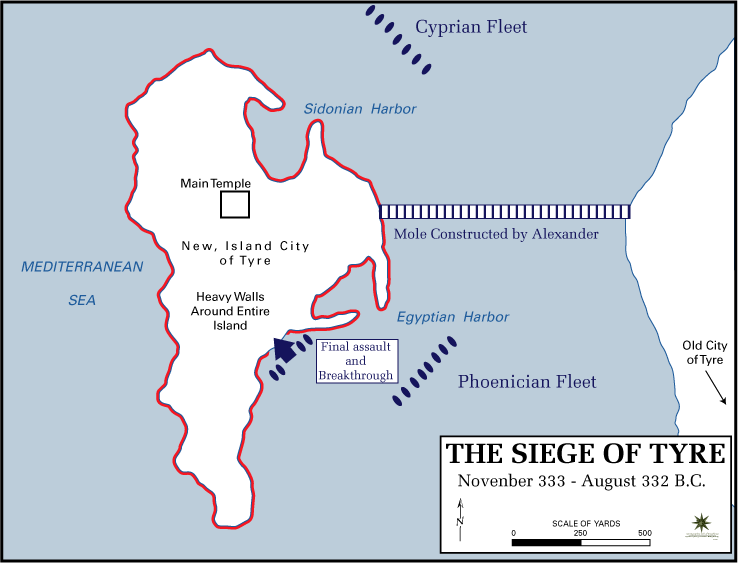
Click to enlarge
Tyre's Remarkable History of Siege - Amos does not tell us in this verse precisely which historical conquest would fulfill his prophecy. Tyre subsequently endured a series of attacks and sieges. The Assyrians campaigned against Phoenician territory. Later, Nebuchadnezzar II of Babylon besieged Tyre for thirteen years, approximately 585–572 BC (cf. Ezek 26:7–14).
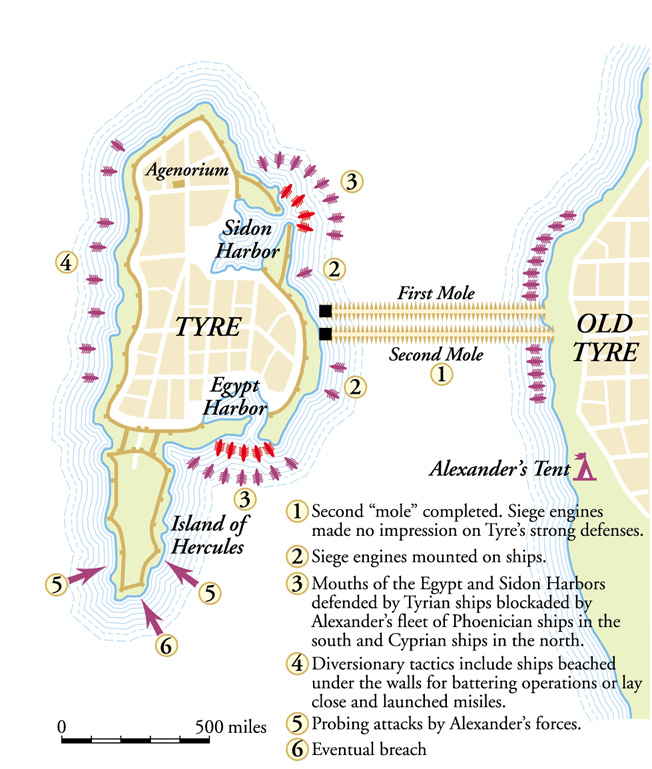
Naval action during Alexander's siege of Tyre
Centuries later, in 332 BC, Alexander the Great famously conquered the island city after constructing a causeway from the mainland. These later events dramatically illustrate the vulnerability of a city that had appeared almost impossible to conquer. We should be careful not to force Amos 1:10 exclusively onto one particular siege when Amos himself does not identify the conquering army. His theological point is more fundamental, which is the fact that Tyre’s celebrated defenses would not ultimately preserve her from the judgment Yahweh had pronounced. See FULFILLED BIBLE PROPHECY - DESTRUCTION OF TYRE
QUESTION - What is the significance of the city of Tyre in the Bible?
ANSWER - Tyre is thought to be one of the oldest cities on the Phoenician coast, established long before the Israelites entered the land of Canaan. Isaiah affirms Tyre’s ancient origins as “from days of old” (Isaiah 23:5–7).
Tyre is situated on the Mediterranean coast directly north of Jerusalem between the mountains of Lebanon and the Mediterranean Sea, about 20 miles south of Sidon and 23 miles north of Acre. Neighboring Sidon is believed to be the oldest Phoenician city, but Tyre’s history is more distinguished. The name Tyre (Tzor in Hebrew) signifies “a rock,” an apt description for the rocky coastal fortress. In ancient times, Tyre flourished as a maritime city and a busy center for commercial trade. The area’s most valuable export was its then world-famous purple dye.
Originally, the ancient city was divided into two parts: an older port city (“Old Tyre”) located on the mainland and a small rocky island about a half-mile off the coast where most of the population resided. The island has been connected to the mainland ever since Alexander the Great built a siege ramp to it in the late fourth century BC. The causeway has widened over the centuries, creating Tyre’s current-day peninsular formation.
The Bible first mentions Tyre in a list of cities that were part of the inheritance of the tribe of Asher (Joshua 19:24–31). Fortified with a wall, Tyre held an exceedingly strong position. It was the only city in the list described as “strong” or “fortified” (verse 29). Joshua was unable to capture Tyre (Joshua 13:3–4), and, evidently, it was never conquered by the Israelites (2 Samuel 24:7).
By the time of King David’s reign, Israel had formed a friendly alliance with Hiram king of Tyre. David used stonemasons and carpenters from Tyre, along with cedars from that region to build his palace (2 Samuel 5:11). Peaceful relations with King Hiram continued into Solomon’s reign, with the construction of the temple in Jerusalem relying heavily on supplies, laborers, and skilled artisans from Tyre (1 Kings 5:1–14; 9:11; 2 Chronicles 2:3).
Israel continued to share close ties with Tyre during King Ahab’s reign. Ahab married the Phoenician princess Jezebel, daughter of Ethbaal, king of Sidon, and their union led to the infiltration of pagan worship and idolatry in Israel (1 Kings 16:31). Both Tyre and Sidon were notorious for their wickedness and idolatry, which resulted in numerous denouncements by Israel’s prophets, who predicted Tyre’s ultimate destruction (Isaiah 23:1; Jeremiah 25:22; Ezekiel 26; 28:1–19; Joel 3:4; Amos 1:9–10; Zechariah 9:2–4).
After the restoration of Jerusalem in Nehemiah’s time, the people of Tyre violated the Sabbath rest by selling their goods in the markets of Jerusalem (Nehemiah 13:16).
In 332 BC, after a seven-month siege, Alexander the Great conquered Tyre, putting an end to Phoenician political control, but the city retained its economic power.
In the New Testament, Jesus mentions Tyre as an example of an unrepentant city (Matthew 11:21–22; Luke 10:13). Jesus also ministered in the district of Tyre and Sidon, healing the demon-possessed daughter of a Canaanite woman (Matthew 15:21–28).
The persecution that arose after Stephen’s death caused the Christians in Jerusalem to scatter. As a result, a church was established in Tyre (Acts 11:19). Paul spent a week there with the disciples on the return voyage of his third missionary journey (Acts 21:2–4).
In 1291, Tyre was completely destroyed by the Saracens, eerily fulfilling Ezekiel’s prophecy:
“They will destroy the walls of Tyre and pull down her towers; I will scrape away her rubble and make her a bare rock. Out in the sea she will become a place to spread fishnets, for I have spoken, declares the Sovereign LORD. She will become plunder for the nations” (Ezekiel 26:4–5).
The island has remained a desolate ruin ever since. GotQuestions.org
Amos 1:11 Thus says the LORD, “For three transgressions of Edom and for four I will not revoke its punishment, Because he pursued his brother with the sword, While he stifled his compassion; His anger also tore continually, And he maintained his fury forever.
KJV Thus saith the LORD; For three transgressions of Edom, and for four, I will not turn away the punishment thereof; because he did pursue his brother with the sword, and did cast off all pity, and his anger did tear perpetually, and he kept his wrath for ever:
NET This is what the LORD says: "Because Edom has committed three crimes– make that four!– I will not revoke my decree of judgment. He chased his brother with a sword; he wiped out his allies. In his anger he tore them apart without stopping to rest; in his fury he relentlessly attacked them.
NLT This is what the LORD says: "The people of Edom have sinned again and again, and I will not let them go unpunished! They chased down their relatives, the Israelites, with swords, showing them no mercy. In their rage, they slashed them continually and were unrelenting in their anger.
ESV Thus says the LORD: "For three transgressions of Edom, and for four, I will not revoke the punishment, because he pursued his brother with the sword and cast off all pity, and his anger tore perpetually, and he kept his wrath forever.
BGT τάδε λέγει κύριος ἐπὶ ταῖς τρισὶν ἀσεβείαις τῆς Ιδουμαίας καὶ ἐπὶ ταῖς τέσσαρσιν οὐκ ἀποστραφήσομαι αὐτούς ἕνεκα τοῦ διῶξαι αὐτοὺς ἐν ῥομφαίᾳ τὸν ἀδελφὸν αὐτοῦ καὶ ἐλυμήνατο μήτραν ἐπὶ γῆς καὶ ἥρπασεν εἰς μαρτύριον φρίκην αὐτοῦ καὶ τὸ ὅρμημα αὐτοῦ ἐφύλαξεν εἰς νεῖκος
LXE Thus saith the Lord; For three sins of Idumea, and for four, I will not turn away from them; because they pursued their brother with the sword, and destroyed the mother upon the earth, and summoned up his anger for a testimony, and kept up his fury to the end.
CSB The LORD says: I will not relent from punishing Edom for three crimes, even four, because he pursued his brother with the sword. He stifled his compassion, his anger tore at them continually, and he harbored his rage incessantly.
NIV This is what the LORD says: "For three sins of Edom, even for four, I will not turn back my wrath. Because he pursued his brother with a sword, stifling all compassion, because his anger raged continually and his fury flamed unchecked,
- Edom (KJV): Isa 21:11,12 34:1-17 63:1-7 Jer 49:7-22 Eze 25:12-14 35:1-15 Ob 1:1-14 Mal 1:4
- because (KJV): Ge 27:40,41 Nu 20:14-21 De 2:4-8 23:7 2Ch 28:17 Ps 83:3-8 Ps 137:7 La 4:21,22 Eze 25:12 35:5,6,11 Joe 3:19 Ob 1:10-14 Mal 1:2
- did cast off all pity (KJV): Heb. corrupted his compassions
- kept (KJV): Ps 85:5 Ec 7:9 Isa 57:16 Mic 7:18 Eph 4:26,27 5:1
- Amos Commentaries and Sermons - multiple resources
Related Passages:
Ephesians 4:26,27; 31,32 BE ANGRY, AND yet DO NOT SIN; do not let the sun go down on your anger, 27 and do not give the devil an opportunity..... 31 Let all bitterness and wrath and anger and clamor and slander be put away from you, along with all malice. 32 Be kind to one another, tender-hearted, forgiving each other, just as God in Christ also has forgiven you.
Genesis 27:41 So Esau bore a grudge against Jacob because of the blessing with which his father had blessed him; and Esau said to himself, “The days of mourning for my father are near; then I will kill my brother Jacob.”
Genesis 33:4 Then Esau ran to meet him and embraced him, and fell on his neck and kissed him, and they wept.
Deuteronomy 23:7 “You shall not detest an Edomite, for he is your brother; you shall not detest an Egyptian, because you were an alien in his land.
Obadiah 1:10-14 “Because of violence to your brother Jacob, You will be covered with shame, And you will be cut off forever. 11 “On the day that you stood aloof, On the day that strangers carried off his wealth, And foreigners entered his gate And cast lots for Jerusalem– You too were as one of them. 12 “Do not gloat over your brother’s day, The day of his misfortune. And do not rejoice over the sons of Judah In the day of their destruction; Yes, do not boast In the day of their distress. 13 “Do not enter the gate of My people In the day of their disaster. Yes, you, do not gloat over their calamity In the day of their disaster. And do not loot their wealth In the day of their disaster. 14 “Do not stand at the fork of the road To cut down their fugitives; And do not imprison their survivors In the day of their distress.
WHEN ANGER
REFUSES TO DIE
Thus says the LORD (Jehovah), “For three transgressions (pesha; LXX - asebeia - godlessness) of Edom and for four I will not revoke its punishment - Amos now turns to Edom, and the indictment becomes intensely personal. Edom's sin was especially grievous because the people Edom pursued were literally their brothers, the descendants of Jacob. Edom descended from Esau, Jacob's brother (Ge 25:23–30; 36:1). What began centuries earlier as conflict between two brothers had hardened into persistent hostility between two nations. This is more than a description of military aggression. It is the anatomy of a grudge that had been allowed to live for generations.
Because he pursued (radaph - pursue to do harm; LXX - dioko - hostile pursuit, persecute) his brother with the sword - NET = "He chased his brother with a sword" The word “brother” is the key to understanding the severity of Edom's offense. As noted above Israel and Edom were related through Jacob and Esau. God Himself had reminded Israel of this relationship “You shall not detest an Edomite, for he is your brother.” (Dt 23:7) Yet Edom behaved not as a brother but as an enemy. The verb pursued (radaph) pictures an active, determined pursuit. Edom did not merely defend itself when attacked. Amos pictures Edom chasing his brother with the sword. The tragedy is captured in the contrast that He was a brother by blood but behaved like an enemy with a sword. Edom's kinship should have restrained his hostility. Instead, the sword replaced brotherly affection.
J A Motyer - Edom's 'fourth transgression' was a ceaseless animosity which pursued (i.e. sought every opportunity to express itself) in those hostile actions in which neighbouring states could easily vent their spleen without ever declaring war. Historically, the bitterness between Esau and Jacob reached back to the original brothers (Ge. 27:41). In Nu. 20:14ff. hostility became open and a pattern for the future was established. Saul found it necessary to go to war (1 Sa. 14:47); David conquered and annexed Edom—the only king to do so (2 Sa. 8:14). Solomon faced rebellion from Edom (1 Ki. 11:14ff., 25) as did Jehoram a century later (2 Ki. 8:20). Fifty years on, Amaziah was fighting Edom (2 Ki. 14:7, 10). The accusation of anger that raged continually is proved, but not justified, before God. It was contrary to nature (brother), a denial of the emotion of compassion (the spontaneous overflow of pity or love; e.g. 1 Ki. 3:26), and constantly maintained at fever pitch (continually... unchecked). Such rage, whatever its origin and supposed justification, is inadmissible. It lives in the heart but it is seen on high. (BORROW New Bible Commentary page 794)
While he stifled (shachath - spoil, to pervert, to corrupt, to wipe out) his compassion (racham) - ESV = "Cast off all pity." Stifled is especially sad because it shows that Edom was not incapable of compassion but that he willfully suppressed it. Compassion is related to Hebrew racham, expressing tender mercy or deep affection. It is associated with the strong emotional bond one naturally feels toward another, especially within a family relationship. Note that the Septuagint has "destroyed the mother upon the earth"! Does that refer to abuse of pregnant women? I cannot say for sure as the Hebrew is quite a bit different. Either way the point is that the Edomites refused to show pity or compassion, presumably to his brothers (descendants of Jacob)!
His anger also tore continually - NET = "In his anger he tore them apart without stopping to rest" Edom did not merely fail to feel compassion; he refused to allow compassion to restrain his anger. Anger had silenced mercy. Tore pictures something ripping or tearing its victim. Edom's anger was not passive resentment hidden quietly in the heart. It had teeth. The word “continually” is crucial. This was not a momentary explosion followed by regret and reconciliation. Edom repeatedly allowed hostility toward his brother to express itself. Edom's anger had become habitual and habitual anger is dangerous because it can eventually become a settled disposition. In other words, Edom no longer merely became angry, but they continully lived angry against Israel.
When we refuse to release anger, we become unlike the God
Who refuses to retain His anger forever.
And he maintained his fury forever - NIV = "his fury flamed unchecked." NET = "in his fury he relentlessly attacked them." This is a truly sad statement because as we have all experienced, we become angry but generally over time it dissipates. The verb maintained indicates Edom actively kept their anger toward Israel alive. They would not let the flame of their anger die out. The grievance was remembered, resentment was cultivated, hostility was transmitted, and fury was continually renewed...forever! Edom held on to the persistent, unrelenting character of their hostility, so that generation after generation continued carrying the grievance. It may have begun as family rivalry but over time it became national hatred.
Bitterness preserved
becomes bitterness intensified.
🙏 THOUGHT - Edom's persistent anger should sound an alarm to all of us beloved. When anger occurs (interpersonal or between families), if left unresolved, it can outlive the event that produced it. Then what happens is a person may remember the resentment more clearly than the original reason for being resentful. And like happened to Edom, anger entertained in one's heart may eventually become anger enthroned on one's heart.
QUESTION - What is the significance of Edom in the Bible? | GotQuestions.org
ANSWER - Edom was an ancient kingdom that is mainly associated with Esau and his descendants in the Bible. Being descendants of Abraham, the Edomites were related to the Israelites. But they did not always act as brothers.
Located on the east side of the Arabah and extending down to the Dead Sea, Edom was first occupied by the Horites, who were later driven out by Esau’s descendants (M. G. Easton, Easton’s Bible Dictionary, New York: Harper & Brothers, 1893, entry for Edom). Numerous verses in the Bible equate the hill country of Seir with Edom, which would “suggest that Seir and Edom comprise an entity that should be viewed as one and the same in terms of their respective geographical locations” (Bruce Crew, “Did Edom’s Territories Extend West of Wadi Arabah?” Bible and Spade 15:1, 2002, p. 4). Interestingly, the name Edom means “red,” which is easily linked with Esau, who sold his birthright for red stew and thereby earned the name Edom (Genesis 25:30). In spite of the connection with Esau, many scholars believe that the kingdom of Edom was associated with red before Esau took control of it because of the red cliffs located in its area (W. Ewing, “Edom; Edomites - ISBE). Bozrah and Petra (or Sela) were notable cities in Edom, with Bozrah being the capital and central city of the kingdom.
The nation of Edom existed before the Israelites left Egypt, and the Lord commanded the Israelites not to attempt to take the land from the Edomites as they passed through, since He had given the land to Esau (Deuteronomy 2:1–5). Moses and the Israelites asked permission to cross through the land of Edom on their journey out of Egypt, but they were refused passage by the Edomite king (Numbers 20:14–21). From this point on in the Bible, Edom is mentioned as Israel’s enemy, and the two nations fought frequently.
Both Saul and David fought against the Edomites, with David conquering them and forcing them into labor (1 Samuel 14:47–48; 2 Samuel 8:13–14). During the reign of Jehoram, Edom rebelled against Judah and set up their own independent king (2 Kings 8:20–22). The Edomites continued to be a problem for the Israelites and even raided Judah after it fell to the Babylonians (Ezekiel 25:12–14). Because of Edom’s sin in raiding Judah and taking delight in Israel’s fall during the Babylonian Captivity, the Lord pronounced judgment on Edom (Jeremiah 49:7–22). God declared that Edom would be a wasteland, occupied only by wild animals (Malachi 1:2–5). This began to come to pass when Edom was pushed out of their land and taken over by the Nabateans (See Craig Blaising, Bible Knowledge Commentary: Old Testament - Page 1576). God justly dealt with the Edomites because of their actions and attitude toward Israel.
The Edomites were proud (Oba 1:3), violent (Oba 1:10),
and apathetic to the destruction of Israel (Oba 1:11), and God promised a reckoning.
The book of Obadiah deals specifically with Edom’s judgment. The Edomites were proud (Obadiah 1:3), violent (Oba 1:10), and apathetic to the destruction of Israel (Oba 1:11), and God promised a reckoning. After the Edomites were driven from their land by the Nabateans, they migrated to the southern part of Israel and became known as Idumeans. Much later in biblical history, Herod the Great, an Idumean, appears on the scene. It was Herod who tried to kill the infant Jesus in Bethlehem—through Herod, the rebellion of Edom continued.
In AD 70, the Idumeans joined the Israelites in their revolt against Rome, and they were wiped out when Jerusalem was destroyed. At that point, the descendants of Esau disappeared from human history, just as God had said. Although once a mighty kingdom among the red cliffs of its land, Edom was destroyed for its sin. It is the restored Israel who will one day possess the land of Edom and the “mountains of Esau” in the millennial kingdom of Christ (Obadiah 1:19–21).
Obadiah Expands the Indictment - The book of Obadiah gives the fullest biblical picture of Edom's hostility toward Judah. When Jerusalem experienced calamity, Edom did not respond like a brother.
Edom stood aloof (Obad 11).
Edom rejoiced over Judah's destruction (Obad 12).
Edom entered the city and seized wealth (Obad 13).
Edom stood at the crossroads to cut down fugitives (Obad 14).
Edom even handed survivors over to their enemies (Obad 14).
The brother had become a predator and this helps understand Amos' language that “He pursued his brother with the sword.”
QUOTES FROM MATTHEW HENRY ON Amos 1:11
The fire of our anger against our brethren kindles the fire of God's anger against us.
Amos 1:11KJV - Cast off pity. Bonaparte carried the town of Jaffa by assault, and many of the garrison were put to the sword. But the greater part fled into mosques, implored mercy from their pursuers, and were granted their lives. But Napoleon expressed resentment at the conduct of the troops, lost all pity, and to relieve himself of the care of his prisoners, ordered nearly 4000 to march on rising ground to be shot. When Bonaparte saw the smoke from volleys of musketry and grape, it is said that he could not contain his joy.
Pity is the virtue of the law,
And none but tyrants use it cruelly.
Amos 1:12 “So I will send fire upon Teman And it will consume the citadels of Bozrah.”
- Teman (KJV): Ge 36:11 Jer 49:7,20 Ob 1:9,10
- Bozrah (KJV): Ge 36:33 Isa 34:6 Jer 49:13,22
- Amos Commentaries and Sermons - multiple resources
Related Passages
Genesis 36:10,11, 15 (Connects Teman with the descendants of Esau) "10 These are the names of Esau’s sons: Eliphaz the son of Esau’s wife Adah, Reuel the son of Esau’s wife Basemath. 11 The sons of Eliphaz were Teman, Omar, Zepho and Gatam and Kenaz.....(36:15) These are the chiefs of the sons of Esau. The sons of Eliphaz, the firstborn of Esau, are chief Teman, chief Omar, chief Zepho, chief Kenaz,
Genesis 36:33 (Mentions Bozrah in connection with an Edomite king) "Then Bela died, and Jobab the son of Zerah of Bozrah became king in his place."
Jeremiah 49:7–22 pronounces extensive judgment upon Edom and specifically mentions both Teman and Bozrah.
Isaiah 34:5-6 (associates Bozrah and Edom with divine judgment) For My sword is satiated in heaven, Behold it shall descend for judgment upon Edom And upon the people whom I have devoted to destruction. 6 The sword of the LORD is filled with blood, It is sated with fat, with the blood of lambs and goats, With the fat of the kidneys of rams. For the LORD has a sacrifice in Bozrah And a great slaughter in the land of Edom.
Obadiah 1:10–14 (explains Edom's violence against his brother Jacob) “Because of violence to your brother Jacob, You will be covered with shame, And you will be cut off forever. 11“On the day that you stood aloof, On the day that strangers carried off his wealth, And foreigners entered his gate And cast lots for Jerusalem– You too were as one of them. 12“Do not gloat over your brother’s day, The day of his misfortune. And do not rejoice over the sons of Judah In the day of their destruction; Yes, do not boast In the day of their distress. 13“Do not enter the gate of My people In the day of their disaster. Yes, you, do not gloat over their calamity In the day of their disaster. And do not loot their wealth In the day of their disaster. 14“Do not stand at the fork of the road To cut down their fugitives; And do not imprison their survivors In the day of their distress.
Ephesians 4:26-27, 31-32 (Spiritual antidote to Edom's enduring anger: put away bitterness, etc) "BE ANGRY, AND yet DO NOT SIN; do not let the sun go down on your anger, 27 and do not give the devil an opportunity.....31 Let all bitterness and wrath and anger and clamor and slander be put away from you, along with all malice. 32 Be kind to one another, tender-hearted, forgiving each other, just as God in Christ also has forgiven you.
THE FIRE FALLS
ON EDOM
So - Term of conclusion states the judgment reached after thinking, reasoning, or finishing an event. Because Edom “pursued his brother with the sword,” suppressed his compassion, allowed his anger to tear continually, and maintained his fury (Amos 1:11), God responds. In other words the So connects the punishment directly with the preceding sin. You could think of it this way, that Verse 11 gives the indictment; verse 12 gives the sentence.
I will - This declaration by Yahweh appears 13 times in Amos 1 and emphasizes divine sovereignty. Human armies may eventually become the instruments by which Edom's cities fall, but Amos directs our attention behind the human agents to the LORD Who judges the nations. Notice how God gives in accord with Edom's sin. The fire of Edom's hatred would eventually encounter the fire of God's judgment.
Send fire upon Teman - Teman was an important Edomite location and could also serve more broadly as a designation for Edom or its southern territory. Teman was associated with Esau's descendants. Genesis identifies Teman as a descendant of Esau through Eliphaz (Ge 36:10–11, 15). Teman became especially associated with wisdom. Jeremiah later asks “Is there no longer any wisdom in Teman?” (Jer 49:7). And one of Job's counselors was Eliphaz the Temanite (Job 2:11). Teman may have been the seat of wisdom, but human wisdom is no match for divine wisdom (James 3:13-18) and cannot devise a defense against divine judgment.
ISBE on TEMAN - The name of a district and town in the land of Edom, named after Teman the grandson of Esau, the son of his firstborn, Eliphaz (Gen 36:11; 1 Ch 1:36). A duke Teman is named among the chiefs or clans of Edom (Gen 36:42; 1 Ch 1:53). He does not however appear first, in the place of the firstborn. Husham of the land of the Temanites was one of the ancient kings of Edom (Gen 36:34; 1 Ch 1:45). From Obad 1:9 we gather that Teman was in the land of Esau (Edom). In Am 1:12 it is named along with Bozrah, the capital of Edom. In Ezek 25:13 desolation is denounced upon Edom: "From Teman even unto Dedan shall they fall by the sword." Dedan being in the South, Teman must be sought in the North Eusebius, Onomasticon knows a district in the Gebalene region called Theman, and also a town with the same name, occupied by a Roman garrison, 15 miles from Petra. Unfortunately no indication of direction is given. No trace of the name has yet been found. It may have been on the road from Elath to Bozrah. The inhabitants of Teman seem to have been famous for their wisdom (Jer 49:7; Obad 1:8 f). Eliphaz the Temanite was chief of the comforters of Job (2:11, etc.). The manner in which the city is mentioned by the prophets, now by itself, and again as standing for Edom, shows how important it must have been in their time.
And it will consume ('akal; LXX - katesthio - figuratively destroy, esp of fire) the citadels (armon; LXX - themelion = the base on which a building stands) of Bozrah - This verse is like a refrain in a divine dirge repeatedly sounding forth "consume the citadels" (Amos 1:4, 7, 10, 12). The repetition is intentional and ominous. Different nations possess different histories, rulers, armies, and fortifications, but none possesses a fortress capable of resisting God.
By naming Teman and Bozrah, Amos may be using prominent Edomite locations to portray judgment sweeping across the nation. The point is comprehensive: Edom's important centers would not escape. The nation that had relentlessly pursued its brother (he pursued his brother...stifled his compassion) would itself be overtaken by judgment.
Edom kept the fire of resentment burning
until it encountered the fire of God's judgment.
This is what makes Amos 1:11–12 particularly tragic. The story ultimately reaches back to two brothers, Jacob and Esau. A family relationship that should have produced compassion instead became a history of hostility. By Amos' day the consequences had reached national proportions. That provides a sobering lesson about unresolved bitterness: What begins in the heart never necessarily remains in the heart. Bitterness affects relationships. Relationships affect families. Families affect succeeding generations. And in the case of Edom and Israel, inherited hostility became part of the relationship between two nations.
🙏 THOUGHT - Oh, the danger of "maintained" bitterness. Edom demonstrates that bitterness is never harmless simply because it is old. In fact, age can make bitterness more dangerous. What might originally have been an emotional wound can become a settled attitude, then an established pattern of behavior, and eventually something passed to another generation. Edom had “maintained his fury forever.” Takeaway - Confess bitterness. Empty your heart of this “acid,” for bitterness does far more damage to the vessel that holds it than to the person on whom we try to pour it. Bitterness is an acid that corrodes its own container before it ever reaches its intended target.
When we harbor bitterness toward another,
we become the first victim of our own resentment.
FULFILLMENT OF PROPHECY - reflecting judgment on six nations who had transgressed by their treatment of God's people, Israel.
Edom - Teman and Bozrah were strong cities that no longer exist. The Edomites lived "in the clefts of the rock" and had their "nest among the stars" (Obadiah 3-4), boasting that their fortresses were impregnable; but the Lord destroyed their nation so thoroughly that nothing is left today except ruins. Edom was subjugated by the Assyrians under Tiglath-pileser III in 732 B.C., and was turned into a desolate wasteland by the fifth century B.c. (Malachi 1:3). It was then overtaken by the Nabateans, an Arabian tribe, around 400-300 B.C., and when the Romans attacked Jerusalem in A.D. 70, they destroyed what was left of the Edomite people, then called Idumeans.
Consume (ate, devour, fed) (00398) 'akal means "to consume (destroy something completely)." It is used of both humans and animals. Sometimes, it is used with the verb "to drink" in connection with the good life. Genesis 26:30 reads "and he made for them a feast and they 'ate' and drank." Judges 9:27 reads "They 'ate' and 'drank' and cursed Abimelech." 1 Kings 4:20 reads "Judah and Israel were many 'eating' and 'drinking' and making merry." In Job 1:4, Job's sons and daughters met regularly "to eat and drink." Generally, the noun is used in the context of to "eat food" (Gen. 3:19). "In the sweat of thy face shalt thou 'eat' bread." The same is true of Gen. 37:25, "They sat down to 'eat' bread." It is used of birds and beasts eating. Genesis 40:17 This verb is often used figuratively with overtones of destroying something or someone. So the sword, fire, and forest are said to "consume" men. The things "consumed" may include such various things as land (Gen. 3:17), fields (Isa. 1:7), offerings (Deut. 18:1), and a bride's purchase price (Gen. 31:15). ʾĀkal might also connote bearing the results of an action (Isa. 3:10).
AKAL - KEY VERB IN AMOS - Amos 1:4; Amos 1:7; Amos 1:10; Amos 1:12; Amos 1:14; Amos 2:2; Amos 2:5; Amos 4:9; Amos 5:6; Amos 6:4; Amos 7:2; Amos 7:4; Amos 7:12; Amos 9:14
USES IN THE OTHER MINOR PROPHETS - Hos. 2:12; Hos. 4:8; Hos. 4:10; Hos. 5:7; Hos. 7:7; Hos. 7:9; Hos. 8:13; Hos. 8:14; Hos. 9:3; Hos. 9:4; Hos. 10:13; Hos. 11:4; Hos. 13:8; Joel 1:4; Joel 1:19; Joel 1:20; Joel 2:3; Joel 2:5; Joel 2:25; Joel 2:26; Amos 1:4; Amos 1:7; Amos 1:10; Amos 1:12; Amos 1:14; Amos 2:2; Amos 2:5; Amos 4:9; Amos 5:6; Amos 6:4; Amos 7:2; Amos 7:4; Amos 7:12; Amos 9:14; Obad. 1:18; Mic. 3:3; Mic. 6:14; Mic. 7:1; Nah. 1:10; Nah. 2:13; Nah. 3:12; Nah. 3:13; Nah. 3:15; Hab. 1:8; Hab. 3:14; Zeph. 1:18; Zeph. 3:8; Hag. 1:6; Zech. 7:6; Zech. 9:4; Zech. 9:15; Zech. 11:1; Zech. 11:9; Zech. 11:16; Zech. 12:6; Mal. 3:11
Amos 1:13 Thus says the LORD, “For three transgressions of the sons of Ammon and for four I will not revoke its punishment, Because they ripped open the pregnant women of Gilead In order to enlarge their borders.
- the children (KJV): De 2:19 Jer 49:1-6 Eze 25:2-7 Zep 2:8
- and for (KJV): De 23:3,4 Jud 10:7-9 11:15-28 1Sa 11:1,2 2Sa 10:1-8 2Ki 24:2 2Ch 20:1,10 Ne 2:19 4:7-23 Ps 83:7
- because (KJV): Ho 13:16
- ripped up the women with child (KJV): or, divided the mountains, enlarge. Isa 5:8 Jer 49:1 Eze 35:10 Hab 2:5,6
- Amos Commentaries and Sermons - multiple resources
Related Passages
Genesis 19:36–38 records the origin of the Ammonites through Lot's son Ben-ammi) "Thus both the daughters of Lot were with child by their father. 37The firstborn bore a son, and called his name Moab; he is the father of the Moabites to this day. 38As for the younger, she also bore a son, and called his name Ben-ammi; he is the father of the sons of Ammon to this day.)
Judges 10:7–9 The anger of the LORD burned against Israel, and He sold them into the hands of the Philistines and into the hands of the sons of Ammon. 8 They afflicted and crushed the sons of Israel that year; for eighteen years they afflicted all the sons of Israel who were beyond the Jordan in Gilead in the land of the Amorites. 9 The sons of Ammon crossed the Jordan to fight also against Judah, Benjamin, and the house of Ephraim, so that Israel was greatly distressed.
Jdg 11:4–33 describes Ammonite aggression against Israel and conflict over territory east of the Jordan.
2 Kings 8:12 Hazael said, “Why does my lord weep?” Then he answered, “Because I know the evil that you will do to the sons of Israel: their strongholds you will set on fire, and their young men you will kill with the sword, and their little ones you will dash in pieces, and their women with child you will rip up.”
Hosea 13:16 (uses similar imagery in announcing the horrors accompanying Samaria's judgment) "Samaria will be held guilty, For she has rebelled against her God. They will fall by the sword, Their little ones will be dashed in pieces, And their pregnant women will be ripped open.'
Jeremiah 49:1–6 later condemns Ammon in connection with territorial possession and announces judgment upon Rabbah.
WHEN AMBITION
BECOMES ATROCITY
Thus says the LORD, “For three transgressions (pesha; LXX - asebeia - godlessness) of the sons of Ammon and for four I will not revoke its punishment - Amos now turns to the sons of Ammon, Israel's neighbors east of the Jordan. The familiar formula is describing accumulated transgression, sin piled upon sin until divine patience gives way to divine judgment.
The sons of Ammon - The Ammonites were actually related to Israel. They descended from Ben-ammi, the son born to Lot through his younger daughter (Ge 19:38). Thus, like Moab and Edom, Ammon was not simply a distant pagan nation but a people with ancestral ties to Israel. Their territory lay primarily east of the Jordan, northeast of Moab, with Rabbah as their principal city (cf. Amos 1:14). Ammon repeatedly came into conflict with Israel over territory east of the Jordan, especially the region of Gilead (Jdg 10:7–9; 11:4–33).
Because (term of explanation) they ripped open the pregnant women of Gilead - The victims were not simply enemy soldiers but pregnant women. This was barbaric warfare stripped of every restraint of human compassion. Similar atrocities are mentioned elsewhere in the Old Testament as examples of the horrific brutality accompanying ancient warfare (2Ki 8:12; 15:16; Hos 13:16). Amos does not soften the description because God does not minimize the evil. These women represented the most vulnerable members of the population, and their unborn children represented Gilead's next generation. The atrocity therefore destroyed both the present population and its future offspring. In short, Ammon did not just conquer, but carried out calculated cruelty against the defenseless. Regarding Gilead, recall that Damascus was condemned “Because they threshed Gilead with implements of sharp iron.” (Amos 1:3) Gilead's geographical position east of the Jordan made it particularly vulnerable to attacks from surrounding nations.
J A Motyer - The Ammonite-Gileadite war is not otherwise known, but it was recorded in heaven. Its motive was acquisition (extend his borders) and in the interests of territorial increase they were ready to destroy human increase (pregnant woman). Once more the material is prized above the human: if there is a single thread uniting Amos' list of 'fourth transgressions' this is it. Here they ministered inhuman savagery to those who, more than any other, merit tenderness—the expectant mother and the unborn child. No amount of national aspiration (maybe even appeals to 'national security') can excuse such behaviour before the automatic wrath of God. (BORROW New Bible Commentary page 794)
In order to (term of purpose) enlarge their borders - These words expose the motive, and perhaps make the atrocity even more disturbing. Not simply because of ancient tribal hatred but because they wanted more land. People, even pregnant women, stood between Ammon and territorial expansion, so those people were brutally eliminated. What Ammon called expansion, God called transgression.
When possessions become more valuable than people,
there is almost no cruelty greed will not justify.
It is worth noting that in this chapter we repeatedly see the sin of treating people as objects and obstacles. Damascus treated people like grain to be crushed. Gaza treated people like merchandise to be sold. Tyre treated brothers like commodities to be traded. Edom treated a brother like an enemy to be pursued. Ammon treated people like obstacles to be removed. In every case, the fundamental moral failure involves devaluing human beings created in the image of God in pursuit of some other goal.
Ammon looked at Gilead and saw territory to possess;
God looked at Gilead and saw people whose blood mattered to Him.
QUESTION - What is the significance of the land of Ammon in the Bible?
ANSWER - The land of Ammon in the Bible boasts a long and complex history with Israel. Ammon was an ancient territory located in the central Transjordan Plateau, northeast of the Dead Sea, between the Arnon and Jabbok rivers (Psalm 83:7). The capital of Ammon was called Rabbah-Ammon (2 Samuel 12:27), which is modern-day Amman, the capital of Jordan. The indigenous people of Ammon were known as the Ammonites, who, according to Scripture, were a Semitic group descended directly from Abraham’s nephew Lot.
Genesis 19:36–38 documents the ancestor of the Ammonites as Ben-Ammi, the son of an incestuous union between Lot and his younger daughter. Ben-Ammi’s half-brother was Moab, who was the child of an incestuous relationship between Lot and his older daughter. Moab was the father of the Moabites.
Deuteronomy 2:20–21 tells us that over time the Ammonites grew powerful enough to drive out the ancient and mighty people known as the Rephaim (although the Ammonites called these giants the Zamzummim) and settle in their place. The Bible establishes that the Ammonites had inhabited the central Transjordanian Plateau long before the Israelites arrived on the scene (Numbers 21:24; Deuteronomy 2:19).
Scripture paints a complicated and often negative relationship between the nation of Ammon and Israel. Deuteronomy 2:19 instructed the people of Israel not to harass the Ammonites or provoke them to war and to respect their territory because of their kinship through Lot. The Lord said to Israel, “I will not give you possession of any land belonging to the Ammonites. I have given it as a possession to the descendants of Lot.” Yet, because of their association with the Moabites and their hiring Balaam to curse Israel, the Ammonites were forbidden to enter the assembly of the Lord (Deuteronomy 23:3–7; Nehemiah 13:1–2). Later, the prophet Amos condemned Ammon as a sinful nation for its violent methods in expanding their borders: “For three sins of Ammon, even for four, I will not relent. Because he ripped open the pregnant women of Gilead in order to extend his borders, I will set fire to the walls of Rabbah that will consume her fortresses amid war cries on the day of battle, amid violent winds on a stormy day. Her king will go into exile, he and his officials together” (Amos 1:13–15).
By the time of the judges, Ammon had strengthened into an aggressive military state and joined forces with the Moabites and Amalekites to take the Transjordanian territory occupied by Israel (Judges 3:12–14). Under the influence of Ammon, Israel abandoned the Lord and fell into pagan worship (Judges 10:6). The Ammonites conquered the territory of Gilead and waged war against Judah, Benjamin, and Ephraim before Jephthah finally drove them back (Judges 10:7—11:33).
Later, during King Saul’s reign, Nahash, the king of Ammon, tried to seize Israel’s Transjordanian territory (1 Samuel 11:1–2) but was defeated (1 Samuel 11:5–11; 12:12; 14:47–48). King David managed to maintain friendly relations with Nahash (2 Samuel 10:2) but encountered renewed hostilities when his son Hanun became king of Ammon. Hanun enlisted military aid from Beth Rehob, Zobah, Maakah, and Tob (2 Samuel 10:6; 1 Chronicles 19:6). David’s army under Abishai and Joab overpowered Ammon, besieged the capital city of Rabbah, and subjected the Ammonites to forced labor (2 Samuel 10:9–14; 11:1; 12:26–31).
King Solomon accepted women from Ammon into his harem (1 Kings 11:1) including Naamah, the mother of his son and successor Rehoboam (1 Kings 14:21, 31; 2 Chronicles 12:13). These foreign women contributed to the pagan worship of Molek, the Ammonite god (1 Kings 11:5), among the Israelites (1 Kings 11:7, 33). During Jehoshaphat’s reign, Ammon joined with Moab and Edom but was unsuccessful in its attack on Judah (2 Chronicles 20:1–30). The three-nation alliance reunited once again against Jehoiakim (2 Kings 24:2).
In general, the prophets cast Ammon in a negative light (Jeremiah 49:1–6; Ezekiel 25:1–5) and continued to connect it with Moab and Edom (Isaiah 11:14; Jeremiah 9:25–26; Daniel 11:41; Zephaniah 2:8–9). Ezra and Nehemiah list Ammonite women among the foreign wives taken by Jews (Ezra 9:1–2; Nehemiah 13:23). The psalmist prays for release from Ammon as well as other enemies (including Moab and Edom) who plot together against God’s people (Psalm 83:5–8).
In nearly every period of Israel’s history, the territory and people of Ammon play a role. Historians place the dissolution of the Ammonite kingdom soon after the Late Iron Age (which ended in approximately 586 BC); however, the Ammonites as a people group lasted until at least the Hellenistic period (roughly 300 BC to AD 300). SEE ALSO Who were the Ammonites? | GotQuestions.org
QUOTES FROM MATTHEW HENRY ON Amos 1:11
One would think it is not possible that any of the human race should be so inhuman.
“See what cruelty covetousness is the cause of.”
Amos 1:14 “So I will kindle a fire on the wall of Rabbah And it will consume her citadels Amid war cries on the day of battle, And a storm on the day of tempest.
KJV But I will kindle a fire in the wall of Rabbah, and it shall devour the palaces thereof, with shouting in the day of battle, with a tempest in the day of the whirlwind:
NET So I will set fire to Rabbah's city wall; fire will consume her fortresses. War cries will be heard on the day of battle; a strong gale will blow on the day of the windstorm.
NLT So I will send down fire on the walls of Rabbah, and all its fortresses will be destroyed. The battle will come upon them with shouts, like a whirlwind in a mighty storm.
ESV So I will kindle a fire in the wall of Rabbah, and it shall devour her strongholds, with shouting on the day of battle, with a tempest in the day of the whirlwind;
BGT καὶ ἀνάψω πῦρ ἐπὶ τὰ τείχη Ραββα καὶ καταφάγεται θεμέλια αὐτῆς μετὰ κραυγῆς ἐν ἡμέρᾳ πολέμου καὶ σεισθήσεται ἐν ἡμέρᾳ συντελείας αὐτῆς
LXE And I will kindle a fire on the walls of Rabbath, and it shall devour her foundations with shouting in the day of war, and she shall be shaken in the days of her destruction:
CSB Therefore, I will set fire to the walls of Rabbah, and it will consume its citadels. There will be shouting on the day of battle and a violent wind on the day of the storm.
NIV I will set fire to the walls of Rabbah that will consume her fortresses amid war cries on the day of battle, amid violent winds on a stormy day.
- Rabbah (KJV): De 3:11 2Sa 12:26 Jer 49:2 Eze 25:5
- with shouting (KJV): Am 2:2 Job 39:25 Isa 9:5
- with a (KJV): Ps 83:15 Isa 30:30 Da 11:40 Zec 7:14
- Amos Commentaries and Sermons - multiple resources
Related Passages
Deuteronomy 3:11 (identifies Rabbah with the Ammonites." "For only Og king of Bashan was left of the remnant of the Rephaim. Behold, his bedstead was an iron bedstead; it is in Rabbah of the sons of Ammon. Its length was nine cubits and its width four cubits by ordinary cubit.) "
2 Samuel 11:1; 12:26–31 describe Israel's earlier war against Rabbah
Jeremiah 49:1–6 later pronounces judgment against Ammon and specifically declares that Rabbah would become desolate.
Ezekiel 25:1–7 also announces judgment upon the Ammonites.
Proverbs 21:30–31 reminds us that no wisdom, understanding, or military preparation can ultimately succeed against the LORD.
WHEN THE STORM
STRIKES RABBAH
So - Another term of conclusion which connects Ammon's punishment directly with the atrocity described in verse 13. Because the Ammonites had ripped open the pregnant women of Gilead in order to enlarge their borders, the LORD now announces that warfare will come to their own capital city, Rabbah. The nation that had brought the terror of war to others would itself experience the terror of battle.
I will (God's sovereign act Amos 1:4, 7, 10, 12) kindle a fire on the wall of Rabbah - Kindle a fire describes setting something ablaze, igniting, or causing it to burn. Again this judgment is not merely as an accident of international politics, but represents the sovererign retribution of Yahweh. Rabbah was the capital of the Ammonites and the principal center of their political and military power and was located at the site of modern Amman, Jordan (Dt 3:11; 2Sa 11:1; 12:26). The wall represented security which would be demolished.
And it will consume ('akal; LXX - katesthio - figuratively destroy, esp of fire) her citadels (armon; LXX - themelion = the base on which a building stands) - As described in the other judgments, the citadels were fortified strongholds representing wealth, political authority, military strength, and national security and would all be consumed.
Amid war cries on the day of battle - War cries refers to the loud battle shout associated with attacking armies. The quiet security of Rabbah would suddenly be shattered by the terrifying sounds of warfare. What goes around, comes around, so now the inhabitants of Rabbah would hear what their victims in Gilead had heard.
And a storm on the day of tempest - ESV = "the day of the whirlwind." Amos intensifies the picture of a violent storm. This could be a literal storm as God clearly uses nature in divine intervention (cf Ps 18:9-14). Alternatively it might suggest the battle would be like a storm, sudden, overwhelming, uncontrollable, and devastating. When a powerful tempest sweeps across the land, men cannot stop it but can only experience its force. The military assault would strike with the violence and irresistible force of a storm. Ammon attempted to increase its security by increasing its territory. But because that expansion was accomplished through horrific cruelty, the very thing intended to make Ammon stronger ultimately became the reason God judged it. They gained territory but lost security.
Ammon had unleashed terror upon others and now
the whirlwind of judgment would sweep over Ammon.
Amos 1:15 “Their king will go into exile, He and his princes together,” says the LORD.
NLT Amos 1:15 And their king (1) and his princes will go into exile together," says the LORD. (1- Hebrew malcam, possibly referring to their god Molech)
- Jer 49:3
- Amos Commentaries and Sermons - multiple resources
Related Passages
Jeremiah 49:1–6 similarly announces judgment against Ammon and describes Rabbah's devastation.
Ezekiel 25:1–7 condemns Ammon and announces that the nation will be handed over to others.
1 Kings 11:5, 33 identifies Milcom as the god of the Ammonites, relevant to the alternative interpretation of malkam.
Proverbs 16:18 (reminds us that pride precedes destruction) "Pride goes before destruction, And a haughty spirit before stumbling."
Daniel 4:17 (emphasizes God's sovereignty over earthly kingdoms) "“This sentence is by the decree of the angelic watchers And the decision is a command of the holy ones, In order that the living may know That the Most High is ruler over the realm of mankind, And bestows it on whom He wishes And sets over it the lowliest of men.”
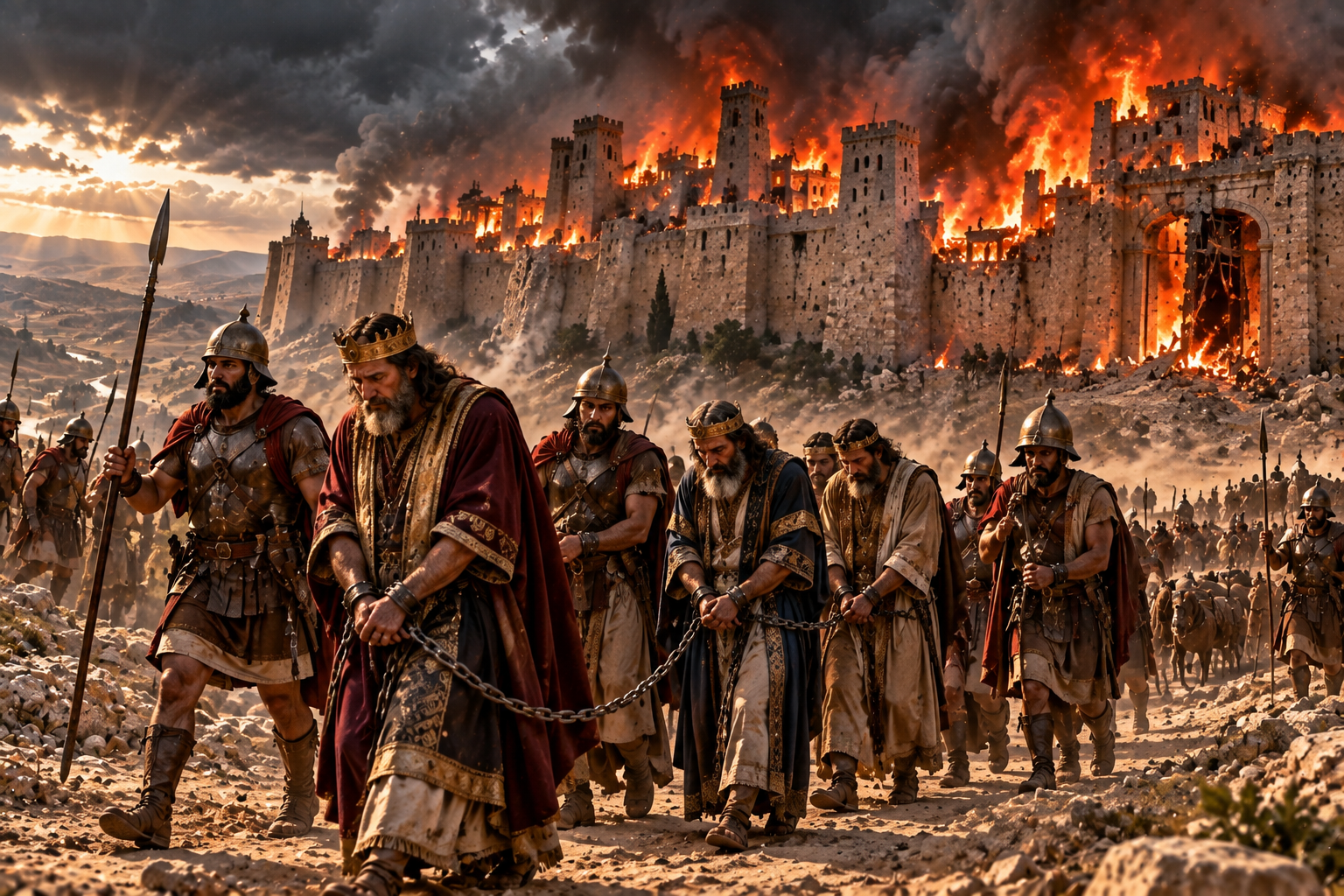
FROM EXPANSION
TO EXILE
Their king will go into exile - Amos concludes the judgment against Ammon by moving from the walls and citadels of Rabbah to the very top of Ammonite society, the king and his princes. Ammon had sought to enlarge its borders (Amos 1:13), but its territorial ambition would end with its own leaders being forcibly removed from those borders. Exile (galah) means to go away or be carried away from one's homeland. In the ancient world, deporting conquered rulers and populations was a common means of breaking political resistance and preventing rebellion.
Note that some interpreters understand the word as a reference to Milcom, the national god of the Ammonites (cf. 1Ki 11:5, 33; 2Ki 23:13; Jer 49:1, 3). This is reflected in some translations and in the marginal notes of others. Both readings fit the context, but the NASB's “their king” makes excellent sense because it is immediately followed by “He and his princes together.”
He and his princes together,” says the LORD (Jehovah) - The princes were the king's officials, nobles, commanders, and governing leaders. They shared in the nation's authority and apparently would share in the king's fate. The words “together” emphasize the completeness of the collapse.
says the LORD (Jehovah) - The oracle began “Thus says the LORD” (Amos 1:13). It now ends “says the LORD.” The entire judgment is enclosed by divine authority.
🙏 THOUGHT - Ammon gained ground but lost everything that made the gain worthwhile. The question is therefore not merely, “What am I gaining?” but also, “What am I becoming, and what might I ultimately lose in order to gain it?”
FULFILLMENT OF PROPHECY - reflecting judgment on six nations who had transgressed by their treatment of God's people, Israel.
Ammon - The Assyrians under Tiglath-pileser III conquered Ammon in 734в.c. Later, Nebuchadnezzar sacked the city of Rabbah and took many citizens captive, opening the way for Arab invaders to occupy the territory of Ammon.