Hosea 12:2
Hosea 12:3
Hosea 12:4
Hosea 12:5
Hosea 12:6
Hosea 12:7
Hosea 12:8
Hosea 12:9
Hosea 12:10
Hosea 12:11
Hosea 12:12
Hosea 12:13
Hosea 12:14
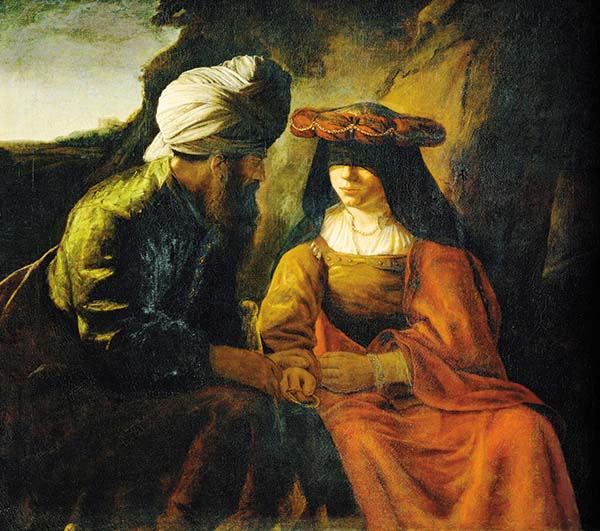
Hosea's Unconditional Love for Gomer
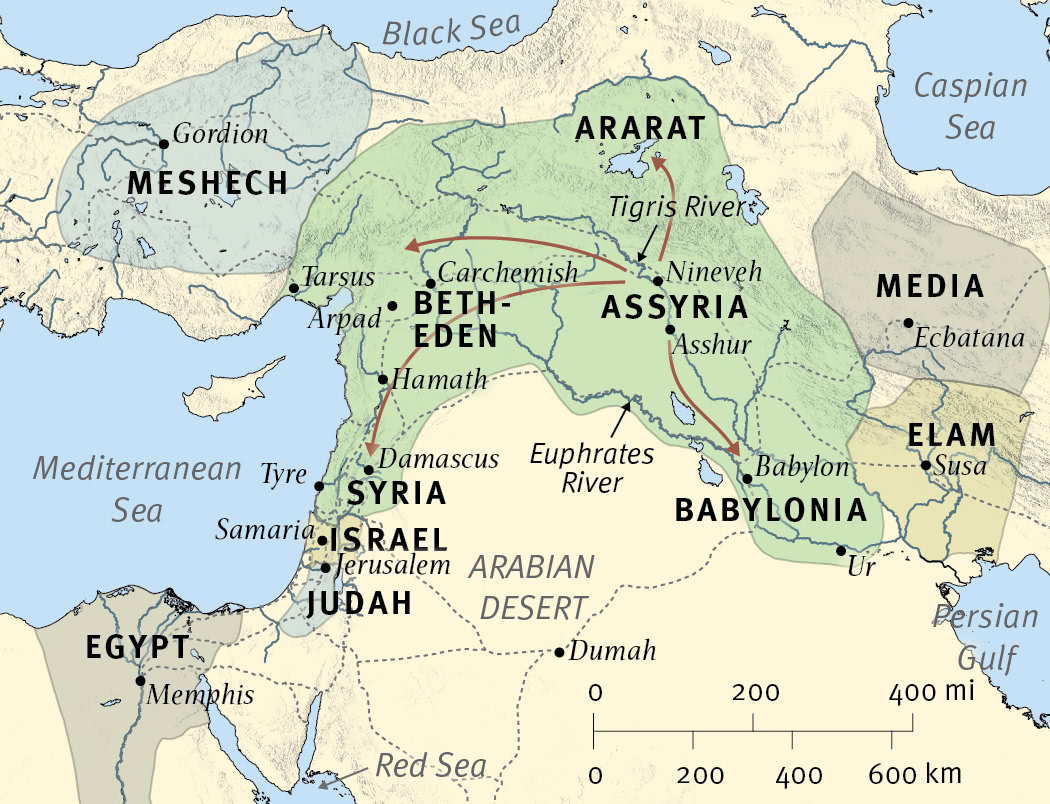
Source: ESV Global Study Bible
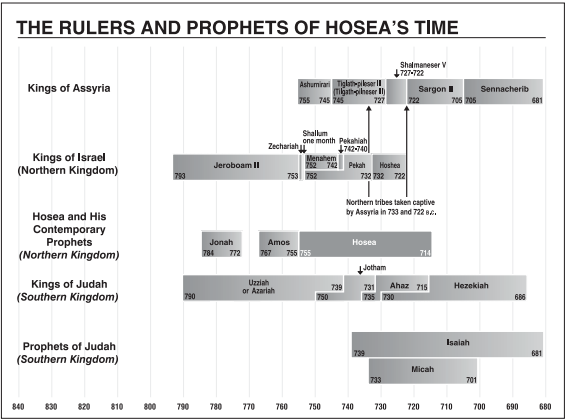
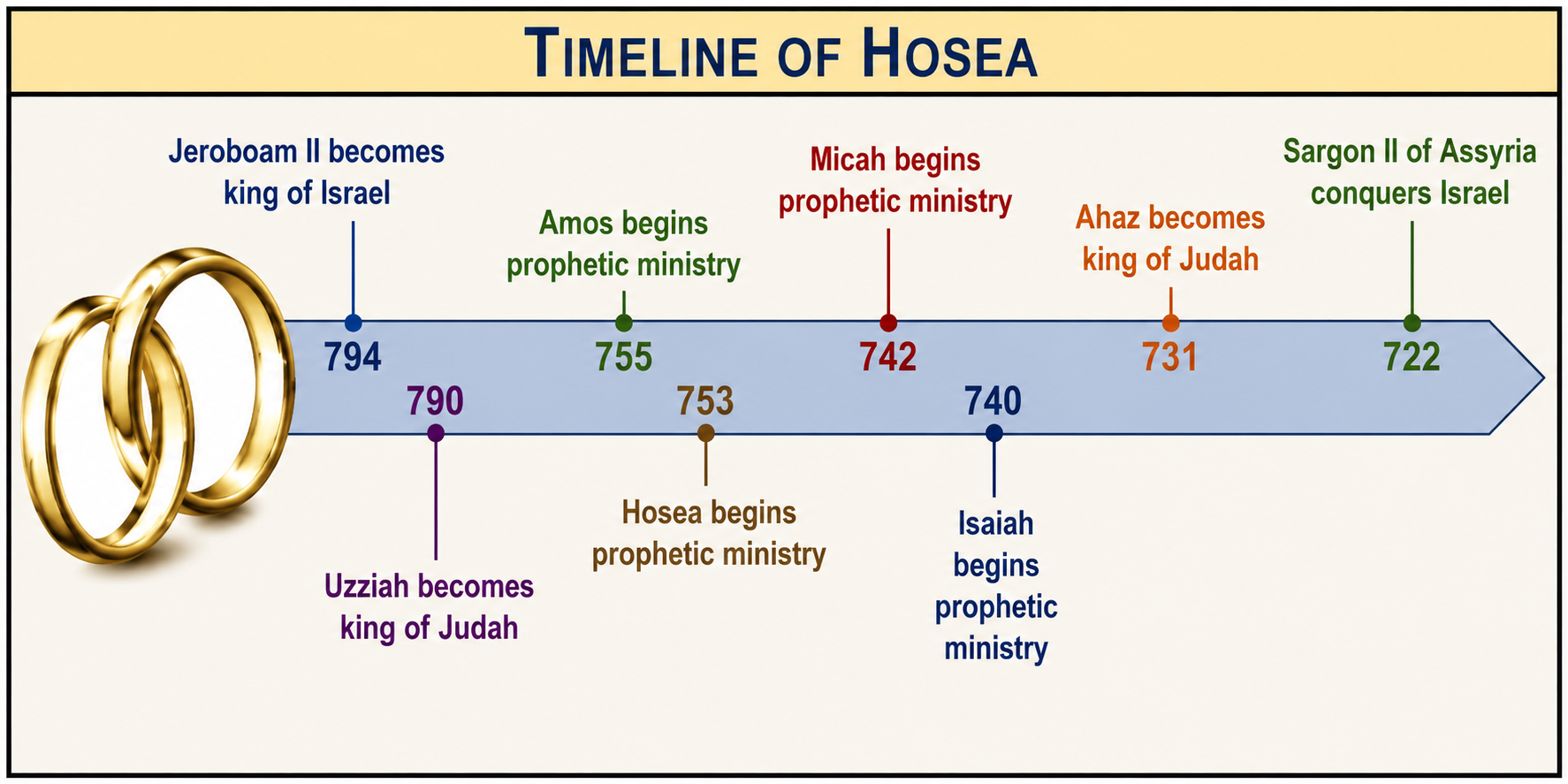
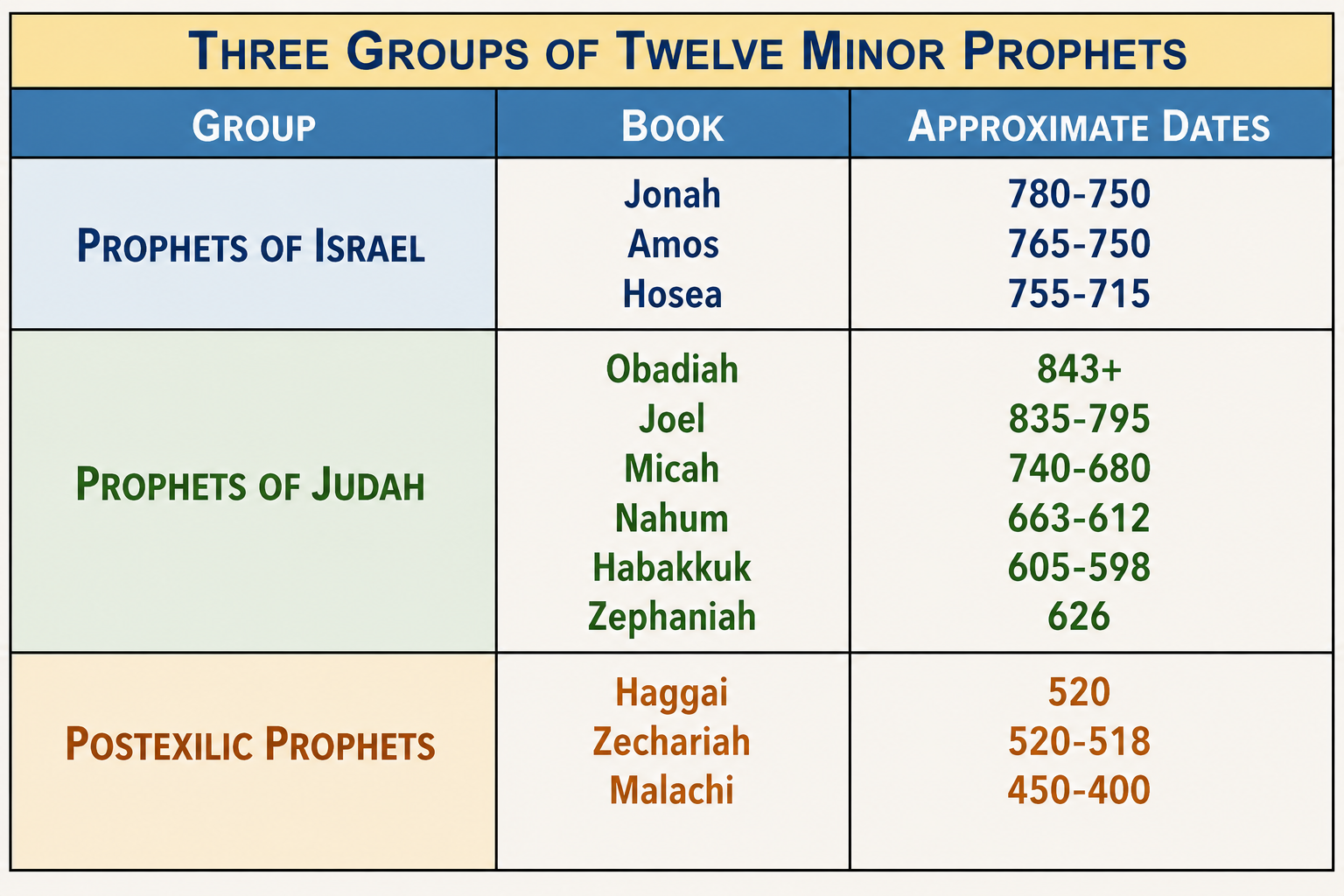
OUTLINE OF HOSEA
I. The Prodigal Wife, Hosea 1:1-3:5
A. Her Unfaithfulness, Hosea 1:1-11
B. Her Punishment, Hosea 2:1-13
C. Her Restoration and Israel's, Hosea 2:14-23
D. Her Redemption, Hosea 3:1-5
II. The Prodigal People, Hosea 4:1-14:9
A. The Message of Judgment, Hosea 4:1-10:15
1. The indictment, Hosea 4:1-19
2. The verdict, Hosea 5:1-15
3. The plea of Israel, Hosea 6:1-3
4. The reply of the Lord, Hosea 6:4-11
5. The crimes of Israel, Hosea 7:1-16
6. The prophecy of judgment, Hosea 8:1-10:15
B. The Message of Restoration, Hosea 11:1-14:9
1. God's love for the prodigal people, Hosea 11:1-11
2. God's chastisement of the prodigal people, Hosea 11:12-13:16
3. God's restoration of the prodigal people, Hosea 14:1-9
Borrow Ryrie Study Bible - page 1292
Hosea 12—Remonstration. “The LORD hath also a controversy with Judah” (v. 2). •Promise of judgment: sin will be punished. •Past is reviewed: what Israel was and should be. •Plea to repent: “Turn thou to thy God” (v. 6). •Provoking of God: “Ephraim provoked him to anger most bitterly” (v. 14). - John Butler
Hosea 12:1 Ephraim feeds on wind, And pursues the east wind continually; He multiplies lies and violence. Moreover, he makes a covenant with Assyria, And oil is carried to Egypt.
KJV Ephraim feedeth on wind, and followeth after the east wind: he daily increaseth lies and desolation; and they do make a covenant with the Assyrians, and oil is carried into Egypt.
NET Ephraim continually feeds on the wind; he chases the east wind all day; he multiplies lies and violence. They make treaties with Assyria, and send olive oil as tribute to Egypt.
NLT The people of Israel feed on the wind; they chase after the east wind all day long. They pile up lies and violence; they are making an alliance with Assyria while sending olive oil to buy support from Egypt.
BGT Hosea 12:2 ὁ δὲ Εφραιμ πονηρὸν πνεῦμα ἐδίωξεν καύσωνα ὅλην τὴν ἡμέραν κενὰ καὶ μάταια ἐπλήθυνεν καὶ διαθήκην μετὰ Ἀσσυρίων διέθετο καὶ ἔλαιον εἰς Αἴγυπτον ἐνεπορεύετο
LXE But Ephraim is an evil spirit, he has chased the east wind all the day: he has multiplied empty and vain things, and made a covenant with the Assyrians, and oil has gone in the way of traffic into Egypt.
CSB Ephraim chases the wind and pursues the east wind. He continually multiplies lies and violence. He makes a covenant with Assyria, and olive oil is carried to Egypt.
ESV Ephraim feeds on the wind and pursues the east wind all day long; they multiply falsehood and violence; they make a covenant with Assyria, and oil is carried to Egypt.
NIV Ephraim feeds on the wind; he pursues the east wind all day and multiplies lies and violence. He makes a treaty with Assyria and sends olive oil to Egypt.
YLT Ephraim is enjoying wind, And is pursuing an east wind, All the day lying and spoiling he multiplieth, And a covenant with Asshur they make, And oil to Egypt is carried.
NKJ "Ephraim feeds on the wind, And pursues the east wind; He daily increases lies and desolation. Also they make a covenant with the Assyrians, And oil is carried to Egypt.
NJB Hosea 12:2 Ephraim feeds himself on wind, all day he chases the wind from the East, he heaps up cheating and violence; they make a treaty with Assyria, at the same time sending oil to Egypt.
NRS Ephraim herds the wind, and pursues the east wind all day long; they multiply falsehood and violence; they make a treaty with Assyria, and oil is carried to Egypt.
RSV Ephraim herds the wind, and pursues the east wind all day long; they multiply falsehood and violence; they make a bargain with Assyria, and oil is carried to Egypt.
NAB Hosea 12:2 Ephraim chases the wind, ever pursuing the gale. His lies and falsehoods are many: he comes to terms with Assyria, and carries oil to Egypt.
GWN The people of Ephraim try to catch the wind and try to chase the east wind all day. They are very violent and destructive. They make treaties with Assyria and take olive oil to Egypt.
BBE Ephraim's food is the wind, and he goes after the east wind: deceit and destruction are increasing day by day; they make an agreement with Assyria, and take oil into Egypt.
- feeds: Ho 8:7 Job 15:2 Jer 22:22
- he daily: Ho 11:12
- and they: Ho 5:13 2Ki 15:19 2Ki 17:4-6 Isa 30:6,7
Related Passages:
Hosea 8:7 For they sow the wind And they reap the whirlwind. The standing grain has no heads; It yields no grain. Should it yield, strangers would swallow it up.
Hosea 5:13 When Ephraim saw his sickness, And Judah his wound, Then Ephraim went to Assyria And sent to King Jareb. But he is unable to heal you, Or to cure you of your wound.
2 Kings 15:19 Pul, king of Assyria, came against the land, and Menahem gave Pul a thousand talents of silver so that his hand might be with him to strengthen the kingdom under his rule.
2 Kings 17:4-6 But the king of Assyria found conspiracy in Hoshea, who had sent messengers to So king of Egypt and had offered no tribute to the king of Assyria, as he had done year by year; so the king of Assyria shut him up and bound him in prison. 5Then the king of Assyria invaded the whole land and went up to Samaria and besieged it three years. 6In the ninth year of Hoshea, the king of Assyria captured Samaria and carried Israel away into exile to Assyria, and settled them in Halah and Habor, on the river of Gozan, and in the cities of the Medes.
ISRAEL PLAYING BOTH ENDS
AGAINST THE MIDDLE
Playing both ends against the middle is an idiom that means
trying to gain an advantage by making two opposing sides in a conflict fight or disagree, so that you benefit from the outcome.
Hosea 11:12 is placed here because it goes the following passages - "Ephraim surrounds Me with lies And the house of Israel with deceit (mirmah USED IN Ge 27:35 - "Your brother came deceitfully"); Judah is also unruly (strays, roams restlessly) against God, Even against the Holy One who is faithful."
This passage prepares us for the introduction of Jacob whose life was characterized by deceit just as was the house of Israel. The apple does not fall very far from the tree. Judah is now brought into the discussion for she too was unfaithful against the faithful God.
Charles Feinberg adds that "At the end of the eleventh chapter, Hosea charged Ephraim with compassing the Lord about with falsehood and deceit. Now the prophet would show that Israel has been as faithless and covenant-breaking with men. (See The Minor Prophets)
Ephraim feeds on wind (ruach) and pursues the east wind continually - Feeds and pursues are both qal active participles which speaks of continual action. Note the Hebrew Bible links Hosea 11:12 with Hosea 12:1. This figurative desciption pictures the Northern Kingdom going to Egypt and Assyria for help, all the while essentially "chasing after the wind!" The Hebrew for feeds (Ra'ah) means to graze or pasture, giving us the picture of livestock out in the field with nothing to graze on. In effect, Ephraim is grazing on air! This is God's assessment of their foreign policy "diet." They could consume it all day and never be fed, for it had no substance. As someone has pithily said Ephraim went shopping for security and came home with weather.
Bob Utley - "wind" "Wind" (BDB 924) is a term in both Greek and Hebrew which emphasizes "emptiness" or "vanity" (e.g. Job 7:7; Eccl. 1:14,17; Isa. 41:29) as well as "spirit," "wind," or "breath." It refers to Israel's attempts to protect herself by foreign alliances (Egypt in 2 Kgs. 17:4).
Michael Eaton - Yahweh is the speaker. He laments the deceitfulness of the entire nation ('Ephraim.... Israel.... Judah'). Both Israel and Judah are pretending to be loyal to God but in fact are deep in idolatry (11:12). (Focus on the Bible Commentary – Hosea)
Reformation Study Bible - wind ... east wind. These images of futility (Job 15:2; Eccl. 1:14) and destruction (13:15; Jer. 18:17) are applied to Israel's alliances with Assyria (Hos 5:13; Hos 7:11; Hos 8:9; Hos 14:3; 2 Kin. 17:3) and Egypt (Hos 7:16 note; 2 Kin. 17:4). Such alliances were not merely poor foreign policy, but expressions of faithlessness against the Lord. Examples of deception included Israel's vacillation between Assyria and Egypt (7:11), and playing off the latter against the former (2 Kin. 17:3, 4).
East (qadim) is the sirocco, the hot desert wind off the Arabian steppe that scorches crops and dries up springs. Hosea uses it that way in Hosea 13:15, where the east wind comes up from the wilderness and dries the fountain, and there it is explicitly the LORD's wind. Assyria lay to the east, so the wind Ephraim pursues blows from the direction the invader will come. Notice how the descriptions escalate. First, the wind gives nothing. Then, the east wind kills you. And tragically Ephraim is not merely eating it, but is chasing it, running after the very thing that will wither him, pursuing his own destroyer.
Note how this passage ties back to Hosea 8:7 where the men of Ephraim "sow the wind and they reap the whirlwind." So in Hosea 8 the harvest would be wind, but here in Hosea 12 they are already eating it (so to speak)!
He multiplies lies and violence - Multiplies (rabah) means to increase or make many indicating this is not a momentary lapse. The lies in context are diplomatic lies, treaties (covenants) Ephraim signs and breaks. Note the disconnect of making a covenant with Assyria while shipping oil to Egypt. Why is that a lie? Ephraim could not be a loyal vassal to two rival empires at once, so promises he made to one would in effect be lies to the other. 2 Kings 17:4 records one of the "lies" writing "But the king of Assyria found conspiracy in Hoshea, who had sent messengers to So king of Egypt and had offered no tribute to the king of Assyria, as he had done year by year; so the king of Assyria shut him up and bound him in prison." Hoshea swore loyalty to Assyria while sending messengers to So king of Egypt, and when the Assyrians discovered his treachery they put him in prison. Recall that Hosea had just spoken about lies in Hosea 11:12 writing "Ephraim surrounds Me (Yahweh) with lies and the house of Israel with deceit." They began by lying to "the Holy One Who is faithful" and now are lying to the pagan rulers.
Bob Utley - He multiplies lies and violence" Israel's lies have been a recurrent theme (cf. Hosea 12:12). See note at Hosea 7:13. The term "multiplies," in the Hiphil form, is used several times in Hosea. (1) lavished (multiplied) silver and gold, Hosea 2:8 (2) multiplied altars for sin, Hosea 8:11 (3) multiplied fortified cities, Hosea 8:14, (4) more (multiplied) altars, Hosea 10:1, (5) multiplied lies and violence, Hosea 12:1, (6) multiplied visions, Hosea 12:10. YHWH's multiple gifts (#1, #6) were matched by Israel's multiplied sins!
Violence (shod) means devastation, destruction, or ruin. This could refer to the violence they commit. Recall bloodshed in Hosea 4:2, murder on the road to Shechem in Hos 6:9, the palace assassinations of Hos 7:7 where all their kings have fallen. On the other hand it could refer to devastation they receive, since shod describes the ruin that comes to someone. In other words, one could interpret this as Ephraim multiplying lies which cause their own destruction.
Moreover, he makes (karath - cuts) a covenant (beriyth) with Assyria, And oil is carried to Egypt (NET = "send olive oil as tribute to Egypt") - Instead of keeping covenant with Yahweh, Israel sought covenant with the very nation that would soon destroy them! Is this not the silly dove of Hosea 7:11, calling to Egypt and flying to Assyria? What a sad plot this weaves for Ephraim as they played the two superpowers against each other, but trusting neither one enough to stop courting the other. Isaiah later says the same thing to Judah reminding them that Egypt is man and not God, their horses are flesh and not spirit (ruach) (Isaiah 31:3), where the word for spirit is the same word ruach used here for wind.
Bob Utley "he makes a covenant" The VERB "makes" is "to cut" (Qal IMPERFECT). Covenants were originally established by cutting an animal into two parts and the covenant parties walking between them (i.e. Gen. 15:17). ▣ "with Assyria" Israel first attempted to resist Assyria, but later tried to make a political alliance with her (i.e. Assyrian annals describe Hoshea's tribute to Tiglath-Pileser III, cf. 2 Kgs. 17:3-6). ▣ "oil is carried to Egypt" Israel sent "oil" (common in Israel, cf. Deut. 8:8, but not in Egypt) to Egypt as a gift to try to lure Egypt into a political alliance against Assyria (cf. 2 Kgs. 17:4).
John Walton - Assyria treaty. Like his predecessor Menahem, Hoshea was initially forced to pay tribute to the Assyrian king Tiglath-Pileser III. The Assyrian Annals even boast that when Hoshea assassinated Pekah to take the throne of Israel that the Assyrian king “placed Hoshea as king over them.” It also notes that Hoshea paid “ten talents of gold [and] a thousand (?) talents of silver” as tribute, probably to confirm his position as king in 732. oil tribute to Egypt. Shortly after Hoshea had accepted the role of Assyrian vassal king in Israel, he then shifted his allegiance by sending a large quantity of olive oil (one of Israel’s major forms of wealth) to Egypt. This would have been a valuable commodity, especially in Egypt where olives were not grown. Playing to both superpowers and their factions, however, would soon draw Assyrian ire and lead in 722 to the invasion of Israel by Shalmaneser V.
Charles Feinberg - Feeding on wind is a vivid description for pursuit of empty and vain things which are without profit. The east wind is the sirocco which comes from the desert east of Palestine, a dry, scorching, devastating wind. The northern tribes were continually resorting to lies, which would ultimately issue in their desolation, in their dealings with both Assyria and Egypt. They were ever playing off one power against the other, the old and yet ever new game of power politics. In order to maintain that illusive state, called “the balance of power” in our day, they made a covenant with Assyria (Hos 5:13; Hos 7:11) and then sought after the help of Egypt as well. (See 2 Ki 17:4; Is 30:6; Is 57:9.) Palestine was famed for its oil (Deut 8:8; Eze 27:17) which it exported to Tyre; now it is sent to Egypt for whatever aid they could render the decaying and declining Israelite kingdom. (See The Minor Prophets)
Matthew Henry - Verses 1-6. Ephraim feeds himself with vain hopes of help from man, when he is at enmity with God. The Jews vainly thought to secure the Egyptians by a present of the produce of their country. Judah is contended with also. God sees the sin of his own people, and will reckon with them for it. They are put in mind of what Jacob did, and what God did for him. When his faith upon the Divine promise prevailed above his fears, then by his strength he had power with God. He is Jehovah, the same that was, and is, and is to come. What was a revelation of God to one, is his memorial to many, to all generations. Then let those who have gone from God, be turned to him. Turn thou to the Lord, by repentance and faith, as thy God. Let those that are converted to him, walk with him in all holy conversation and godliness. Let us wrestle with Him for promised blessings, determined not to give over till we prevail; and let us seek Him in his ordinances.
Deceit (04820) mirmah (from ramah - to beguile, deal treacherously with) means the intentional misleading of someone else through distorting or withholding the truth. Jacob stole Esau’s blessing through deceit (Gen. 27:35; cf. Gen. 34:13). Deceit characterizes those who plan evil (Prov. 12:20; cf. Ps. 36:3; Prov. 12:5, 17; Prov 14:8). David therefore exhorted his children to guard their tongues from evil and their lips from speaking deceit (Ps. 34:13). God also condemns deceit in business: He cannot tolerate dishonest weights (Mic. 6:11), and “a false balance is an abomination to the LORD” (Prov. 11:1).
William White - This participle occurs nearly forty times in the OT with the most frequent usage in Psalms. It initially appears in Genesis 27:35, describing the swindle perpetrated on Esau by Jacob. It is used particularly of treacherous or deceitful speech (Genesis 34:13; Psalm 10:7; Psalm 17:1; Psalm 24:4 et al.). mirmâ is also used of false weighted scales which are said to be "falsifying the scales with deceit" (Amos 8:5). An interesting usage is found in Jeremiah 9:6, "Heaping oppression upon oppression, and deceit upon deceit." The OT makes clear that deceitful speech is one of the most heinous offenses against God. The repetition of the root in Psalms in assurances that the prayer and praise of the righteous is without deceit, reinforces the importance of truth toward the Lord. (Online Theological Wordbook of the Old Testament)
Complete Biblical Library - From rāmāh, "to throw," "to betray," this noun is also found in Old Aramaic, Syriac and Middle Hebrew. It is best defined as "deceit," "treachery." It first occurs in the story of Jacob stealing the birthright from Esau. The text records the words of Isaac to his grief-stricken son. "Your brother came deceitfully and took your blessing" (Gen. 27:35, NIV).
Deceit and fraud are commonly addressed in the Psalms and Proverbs, nearly thirty times. Perhaps the most treacherous device of deceit recorded therein is the tongue. False testimony in legal cases is especially abhorred (Ps. 24:4). Falsehood, slander and devious lies were frequently rebuked for the pain and death they produced. The wicked grew in power and wealth through fraud and deceit.
In the marketplace, one of the greatest instruments of fraud was a "deceitful balance" used by dishonest businessmen. Deceitful men would carry two differing weights in their bags, the lighter to buy with and the heavier to sell with.
This term for deceit is often paired with other words of vice, e.g., "the bloody and deceitful man" (Ps. 5:6); a mouth full of cursing and deceit (Ps. 10:7); "words of... iniquity and deceit" (Ps. 36:3); "the deceitful and unjust man" (Ps. 43:1); "houses with violence and deceit" (Zeph. 1:9).
MIRMAH - 38V - deceit(21), deceitful(6), deceitfully(2), deception(2), deceptive(1), dishonest(1), false(3), treacherous(1), treachery(2). Gen. 27:35; Gen. 34:13; 2 Ki. 9:23; Job 15:35; Job 31:5; Ps. 5:6; Ps. 10:7; Ps. 17:1; Ps. 24:4; Ps. 34:13; Ps. 35:20; Ps. 36:3; Ps. 38:12; Ps. 43:1; Ps. 50:19; Ps. 52:4; Ps. 55:11; Ps. 55:23; Ps. 109:2; Prov. 11:1; Prov. 12:5; Prov. 12:17; Prov. 12:20; Prov. 14:8; Prov. 14:25; Prov. 20:23; Prov. 26:24; Isa. 53:9; Jer. 5:27; Jer. 9:6; Jer. 9:8; Dan. 8:25; Dan. 11:23; Hos. 11:12; Hos. 12:7; Amos 8:5; Mic. 6:11; Zeph. 1:9
Hosea 12:2 The LORD also has a dispute with Judah, And will punish Jacob according to his ways; He will repay him according to his deeds.
KJV The LORD hath also a controversy with Judah, and will punish Jacob according to his ways; according to his doings will he recompense him.
NET The LORD also has a covenant lawsuit against Judah; he will punish Jacob according to his ways and repay him according to his deeds.
NLT Now the LORD is bringing charges against Judah. He is about to punish Jacob for all his deceitful ways, and pay him back for all he has done.
BGT Hosea 12:3 καὶ κρίσις τῷ κυρίῳ πρὸς Ιουδαν τοῦ ἐκδικῆσαι τὸν Ιακωβ κατὰ τὰς ὁδοὺς αὐτοῦ καὶ κατὰ τὰ ἐπιτηδεύματα αὐτοῦ ἀνταποδώσει αὐτῷ
LXE And the Lord has a controversy with Juda, in order to punish Jacob: according to his ways and according to his practices will he recompense him.
CSB The LORD also has a dispute with Judah. He is about to punish Jacob according to his ways; He will repay him based on his actions.
ESV The LORD has an indictment against Judah and will punish Jacob according to his ways; he will repay him according to his deeds.
NIV The LORD has a charge to bring against Judah; he will punish Jacob according to his ways and repay him according to his deeds.
YLT And a controversy hath Jehovah with Judah, To lay a charge on Jacob according to his ways, According to his doings He returneth to him.
NKJ "The LORD also brings a charge against Judah, And will punish Jacob according to his ways; According to his deeds He will recompense him.
NJB Hosea 12:3 Yahweh has a case against Judah, he will punish Jacob as his conduct merits, he will repay him as his deeds deserve.
NRS The LORD has an indictment against Judah, and will punish Jacob according to his ways, and repay him according to his deeds.
RSV The LORD has an indictment against Judah, and will punish Jacob according to his ways, and requite him according to his deeds.
NAB Hosea 12:3 The LORD has a grievance against Israel: he shall punish Jacob for his conduct, for his deeds he shall repay him.
GWN The LORD brings charges against Judah and punishes Jacob because of the way their people act. He will pay them back for what they have done.
BBE The Lord has a cause against Judah, and will give punishment to Jacob for his ways; he will give him the reward of his acts.
- has a dispute: Ho 4:1 Jer 25:31 Mic 6:2
- and will: 2Ki 17:19,20 Isa 8:7-8 Isa 10:6 Jer 3:8-11 Eze 23:11-21 Eze 23:31,32
- punish: Heb. visit upon, Ho 2:13 Hos 8:13 Hos 9:9 Isa 10:12 Isa 24:21
- according to: Isa 3:11 Isa 59:18 Mt 16:27 Ro 2:6 Ga 6:7
Related Passages:
Hosea 4:1 (ADDRESSING NORTHERN KINGDOM) Listen to the word of the LORD, O sons of Israel, For the LORD has a case against the inhabitants of the land, Because there is no faithfulness or kindness Or knowledge of God in the land.
2 Kings 17:19-20 Also Judah did not keep the commandments of the LORD their God, but walked in the customs which Israel had introduced. 20 The LORD rejected all the descendants of Israel and afflicted them and gave them into the hand of plunderers, until He had cast them out of His sight.
Isaiah 10:6 I send it against a godless nation And commission it against the people of My fury To capture booty and to seize plunder, And to trample them down like mud in the streets.
Jeremiah 3:8-11 “And I saw that for all the adulteries of faithless Israel, I had sent her away and given her a writ of divorce, yet her treacherous sister Judah did not fear; but she went and was a harlot also. 9“Because of the lightness of her harlotry, she polluted the land and committed adultery with stones and trees. 10“Yet in spite of all this her treacherous sister Judah did not return to Me with all her heart, but rather in deception,” declares the LORD. 11And the LORD said to me, “Faithless Israel has proved herself more righteous than treacherous Judah.
JUDAH'S TIME FOR
PAYBACK WAS COMING
The LORD also has a dispute (rib/riyb; LXX - krisis - legal process of judgment) with Judah (Southern Kingdom) - NET = "has a covenant lawsuit against Judah." Dispute (rib/riyb) is a courtroom word that speaks of a legal controversy, a formal lawsuit. It is used Hosea 4:1, "the LORD has a case (rib/riyb) against the inhabitants of the land," so here we see a second indictment. God is filing charges now against the Southern Kingdom. Micah 6:2 "summons" the jury declaring "Listen, you mountains, to the indictment (rib/riyb) of the LORD." The clear implication is that Judah should have learned from what was happening in the Northern Kingdom. They failed to realize that the judgment on the north was not to be a "spectator sport" for them to watch!
NET NOTE - The noun רִיב (riv, “dispute”) is used in two contexts: (1) nonlegal contexts: (a) “dispute” between individuals (e.g., Gen 13:7; Isa 58:1; Jer 15:10) or (b) “brawl, quarrel” between people (e.g., Exod 17:7; Deut 25:1); and (2) legal contexts: (a) “lawsuit, legal process” (e.g., Exod 23:3–6; Deut 19:17; Deut 21:5; Ezek 44:24; Ps 35:23), (b) “lawsuit, legal case” (e.g., Deut 1:12; Deut 17:8; Prov 18:17; Prov 25:9), and (c) God’s “lawsuit” on behalf of a person or against his own people (Hos 4:1; Hos 12:3; Mic 6:2; HALOT 1225–26 s.v. רִיב). The term in Hosea refers to a covenant lawsuit in which Yahweh, the suzerain, lodges a legal case against his disobedient vassal, accusing Israel and Judah of breach of covenant which will elicit the covenant curses. Cf. NLT “is bringing a lawsuit.”
Bob Utley "dispute" The term "dispute" (BDB 936) means a legal lawsuit (cf. Hosea 2:2; Hosea 4:14; Deut. 25:1; 2 Sam. 15:2,4; Micah 6:2; Micah 7:9). Judah and Jacob (i.e. Israel) are both guilty (cf. Hosea 4:9b).
Reformation Study Bible - As in 4:1, the Lord acts as plaintiff, judge, and prosecutor in a court scene, bringing a covenant lawsuit against His people. He calls for punishment (v. 2) but also reconciliation (v. 6).
And will punish (paqad; LXX - ekdikeo - exact retribution, inflict penalty for wrong done) Jacob according to his ways; He will repay (shub/sub; LXX - antapodidomi - deserved punishment) him according to his deeds. Although Hosea's primary audience was the Northern Kingdom, Judah would not escape God's scrutiny or judgment. Here he shifts from Judah (2 Tribes) Jacob (12 Tribes) is used not merely of the patriarch himself but, as is frequently the case in Scripture, as a representative name for all his descendants, all 12 tribes, encompassing both the Northern Kingdom (Israel/Ephraim) and the Southern Kingdom (Judah).
Repay (shub/sub; LXX - antapodidomi - deserved punishment) him according to his deeds God would judge His covenant people impartially, repaying them according to their conduct. Judah's deeds would come back on their head! His judgment would be just, reflecting the principle that each person and the nation as a whole would reap the consequences of their deeds (cf. Gal. 6:7-8).
Bob Utley "He will repay him according to his ways" Be not deceived, God is not mocked; for whatsoever a man sows, that shall he reap (cf. Job 34:11,25; Ps. 28:4; Ps 62:12; Prov. 12:14; Prov 24:12; Eccl. 12:14; Jer. 17:10; Jer 32:19; Ezek. 33:20; Matt. 16:27; Matt 25:31-46; Rom. 2:6; Rom 14:12; 1 Cor. 3:8; 2 Cor. 5:10; Gal. 6:7-10; 2 Tim. 4:14; 1 Pet. 1:17; Rev. 2:23; Rev 20:12; Rev 22:12). Notice this "reaping and sowing" is also seen in Hosea 8:7; Hosea 10:12-13.
Hosea 12:3 In the womb he took his brother by the heel, And in his maturity he contended with God.
KJV He took his brother by the heel in the womb, and by his strength he had power with God:
NET In the womb he attacked his brother; in his manly vigor he struggled with God.
NLT Even in the womb, Jacob struggled with his brother; when he became a man, he even fought with God.
BGT Hosea 12:4 ἐν τῇ κοιλίᾳ ἐπτέρνισεν τὸν ἀδελφὸν αὐτοῦ καὶ ἐν κόποις αὐτοῦ ἐνίσχυσεν πρὸς θεὸν
LXE He took his brother by the heel in the womb, and in his labours he had power with God.
CSB In the womb he grasped his brother's heel, and as an adult he wrestled with God.
ESV In the womb he took his brother by the heel, and in his manhood he strove with God.
NIV In the womb he grasped his brother's heel; as a man he struggled with God.
YLT In the womb he took his brother by the heel, And by his strength he was a prince with God,
NKJ He took his brother by the heel in the womb, And in his strength he struggled with God.
NJB Hosea 12:4 In the very womb he overreached his brother, in maturity he wrestled against God.
NRS In the womb he tried to supplant his brother, and in his manhood he strove with God.
RSV In the womb he took his brother by the heel, and in his manhood he strove with God.
NAB Hosea 12:4 In the womb he supplanted his brother, and as a man he contended with God;
GWN Their ancestor Jacob held on to his brother's heel while the two of them were in their mother's womb. When Jacob became a man, he struggled with God.
BBE In the body of his mother he took his brother by the foot, and in his strength he was fighting with God;
- took: Ge 25:26 Ro 9:11
- had: etc. Heb. was a prince, or, behaved himself princely, Ge 32:24-28 Jas 5:16-18
Related Passages:
Genesis 25:22 But the children struggled together within her; and she said, “If it is so, why then am I this way?” So she went to inquire of the LORD.
Genesis 25:26 Afterward his brother came forth with his hand holding on to Esau’s heel, so his name was called Jacob; and Isaac was sixty years old when she gave birth to them.
Genesis 27:36 Then he said, “Is he not rightly named Jacob, for he has supplanted me these two times? He took away my birthright, and behold, now he has taken away my blessing.” And he said, “Have you not reserved a blessing for me?”
LESSON FROM HISTORY
THE LIFE OF JACOB
Robert Chisholm sets the stage for the following section writing "Before further developing the themes of guilt and judgment (cf. Hos 12:9-13:16), Hosea reminded the nation of her need to repent (Hos 12:5-6). In doing so he drew a lesson from the life of Jacob (Hos 12:3-4). (SEE Bible Knowledge Commentary: Old Testament - Page 1404)
In the womb he took his brother by the heel (aqav/aqab; LXX - pternizo - to outwit, go behind the back to deceive, bite the heel in wrestling - used in Ge 27:36) - Immediately from birth we see what kind of person Jacob would be, a "heel grabber," a deceiver which was only a shadow of Jacob's later stealing the birthright from Esau (Ge 27:35-36) Hosea is reminding his readers that just like Jacob had been deceitful, Israel and Judah were deceitful (Hos 11:12).
This passage would serve as a reminder to Israel that Jacob was chosen despite his flawed character (Ge. 25:26). Jacob entered life grasping Esau’s heel, an action that foreshadowed the grasping and deceptive behavior that would characterize much of his life (Ge 27:35). Yet God had chosen Jacob before he had done either good or evil (cf. Ro 9:10–13). Israel therefore owed its existence not to Jacob’s merit but to God’s sovereign grace.
And in his maturity he contended (sarah - strive, struggle, contend, or persist in a struggle - same verb used in Ge 32:28 "striven with God") with God - NET = "in his manly vigor he struggled with God" ESV = "in his manhood he strove with God." Jacob went on being a "heel grabber" and deceiver all his life. While some might take this as an accusation, others see it as a commendation and Hos 12:4 would tend to favor the latter interpretation. This alludes to Jacob's lifelong pattern of grasping, which culminated in a struggle with the Angel of the LORD at Peniel (Ge. 32:24-30). Hosea traces this struggle back to Jacob's earliest days, recalling that even before birth he grasped his twin brother Esau's heel (Ge 25:26), revealing his determined and tenacious nature. The same persistence that characterized Jacob's natural disposition was ultimately transformed into spiritual perseverance as he wrestled with God, sought His blessing, and emerged a changed man with the new name Israel. Jacob's life illustrates how God can redeem natural strength and stubborn determination, transforming them into steadfast faith and dependence upon Him.
THOUGHT - Contending with God is not automatically sin in Scripture. Abraham bargained over Sodom, Moses argued God out of destroying Israel, Job demanded a hearing. What ruins it is contending in order to get your own way rather than His. Jacob's wrestling ended in surrender, which is why he came out with a new name and a bad hip.
Heel (supplanted, deals craftily, restrain)(06117) aqav/aqab from aqeb 06119 = heel) means to grasp at the heel, to supplant, to deceive. Jacob's name is also derived from aqeb.
Contended (08280) sarah/sara means contend, have power, contend with, persist, exert oneself, persevere, persist. The primary sense is to exert oneself. In Genesis, the sarah depicts when Jacob struggled with God and also with persons and prevailed. Used only 3 times and all three uses of sārāh refer to the struggle of Jacob with the Angel of Yahweh at Peniel in the Trans-jordan region - Ge 32:28 ("striven with God"), Hos 12:3 ("contended with God") and Hos 12:4 ("he wrestled with the angel")
NET NOTE - The verb שָׂרָה (sarah) means “to strive, contend” (HALOT 1354 s.v. שׂרה) or “persevere, persist” (BDB 975 s.v. שָׂרָה; see Gen 32:29). Almost all English versions render the verb here in terms of the former: NAB, NASB “contended”; NRSV “strove”; TEV, CEV “fought against.”
J Barton - The verb śārâ limits itself to contexts which discuss the struggle of Jacob as he wrestled with the Angel of Yahweh at Peniel in Transjordan, upon his return from Mesopotamia to Canaan c. 1900 b.c. (Genesis 32:24 [H 25]; Hosea 12:4 [H 5]). The form in the latter passage, wayyāśar, might suggest a root śûr. But since biblical Hebrew includes no word with this meaning, it should probably be repointed to wayyiśer, apocopated from yiśreh (BDB, p. 975), the normal imperfect of śārâ. The importance of śārâ lies in its derived noun, Israel.
The name yiśrāʾēl was bestowed upon Jacob by the Angel of Yahweh (q.v.) himself, after he had wrestled with him all night (Genesis 32:24 [H 25]). Jacob's struggle was spiritual, in prayer (Hosea 12:4 [H 5]), as well as physical. And in it the patriarch "prevailed." Not that Jacob defeated God, but that he finally attained God's covenantal requirement of yielded submission (dramatically signalized by his injured thigh, Genesis 32:25 [26]). And he persisted in refusing to let the Angel go until he had blessed him (Genesis 32:26 [H 27]). The Lord then declared, "Your name shall no longer be Jacob, yaʿăqōb "supplanter" (q.v.), but yiśrāʾēl "Israel"; for you have striven, śārîtā (KJV, for as a prince hast thou power, as if from the root śar "prince") with God and with men and have prevailed" (Genesis 32:28, NASB).
yiśrā’ēl. Israel. Means "he contends with God" (Genesis 32:28 [H 29]; contrast KB, p. 407). The noun yiśrāʾēl appears 2507 times in the OT (plus its adjectival forms, yiśrāʾēlî; and yiśrāʾēlît), first as a name of honor for the patriarch Jacob, then for the nation Israel that descended from his twelve sons, then after 930 b.c. for the kingdom of Ephraim (the ten northern tribes) as opposed to the southern kingdom of Judah, and finally for the southern kingdom after the northern kingdom had fallen.
yiśrāʾēl continued to be used as an alternate name for Jacob after his death (Exodus 6:14; Exodus 32:13). But even as the phrase benê yiśrā’ēl, "sons of Israel," moved from the literal designation of his twelve sons (Genesis 42:5; Exodus 1:1) to the more metaphorical description of his descendants in general (Genesis 32:32 [H 33]; Exodus 1:7), so "Israel" came to mean the Hebrew nation (Exodus 3:18).
It appears in secular history on the Merneptah stele, c. 1230 b.c. As in the case of Jacob, the name emphasizes Israel's covenant-election (Exodus 19:5; Isaiah 41:8; Ezekiel 20:5). Yet many of God's people proved unfaithful (Amos 3:1), an apostasy climaxed in their rejection of Jesus Christ at his first coming (John 1:11); "for they are not all Israel [God's elect] who are descended from Israel" (Romans 9:6, NASB). But Yahweh "will again choose Israel... [Indeed,] strangers will join them and attach themselves to the house of Jacob" (Isaiah 14:1), a prediction fulfilled, some would say, first in the engrafting of gentile believers into the true Israel of Christ's church (Romans 11:17; Galatians 6:16; Phil. 3:3) and in any case at his second coming when the Jews accept him whom they pierced (Zech. 12:10) and all believers will find restoration in the Land of Israel (Isaiah 14:1). (See Theological Wordbook of the Old Testament)
F B Meyer - By his strength he had power with God.
Jacob’s strength lay in his weakness. As long as he seemed strong, and was able to oppose force to force, he failed of the highest blessing; but when the sinew of his thigh shriveled beneath the angel’s touch, and was out of joint; when he was in imminent danger of falling helplessly to the ground—he prevailed, and received the name of Israel the Prince.
The eloquence of tears. — “He wept.” There is no record of these tears in Genesis, but we can well understand that they flowed freely. The entire results of Jacob’s life—wife, children, and fortune—were at stake. With one fell sweep, Esau on the morrow might reduce him to the loneliness with which he had passed over Jordan years before. God is touched by tears. He puts them in his bottle. He hears the voice of our weeping, and interprets it
The power of prayer. — “He made supplication.” “I will not let Thee go unless Thou bless me.” Remember how the Syrophenician mother cast herself at the Savior’s feet, and pleaded for help. The Lord kept her waiting till her prayer had reached a pitch which only delay could have induced, and then turned to her with the assurance that all she had claimed was hers. You may be kept in the attitude of prayer through the long night, but at daybreak you may receive what you sought.
The strength of weakness. — As long as we can stand and hold our own, we fail of our quest. When we are lamed and broken, and unable to do more than cling, we realize God’s hidden stores of blessed help. The sick child elicits most of the mother’s love. The last-born babe drags down to the level of its tiny mouth its strong and brawny father.
Dave Roper - The Breaking
Warm-up: Genesis 32:22–32
. . . as a man he struggled with God. Hosea 12:3
Jacob was born gripping his twin brother’s heel, holding his brother back, trying to get ahead. Therefore he was named Jacob—heeler in Hebrew.
True to his name, Jacob hustled his way through life wheeling and dealing, trying to trip others up to get a head start, knowing God, but not needing him very much. He had his own ways of getting things done. But he met his match when he met the “Man,” the night he wrestled with God.
The wrestling match came after a day of frenzied ambivalence, praying and plotting, trusting God and trying on his own. Years before, Jacob had swindled his brother Esau out of his birthright and inheritance, and now they were
about to meet. That night, in the anxious hours before their meeting, when Jacob was all alone, “a man wrestled with him till daybreak” (Genesis 32:24).
Jacob and the stranger brawled through the night, pounding and punishing each other, rolling in the dust, a fall to one and then the other. When dawn approached and the “Man” saw that Jacob would not surrender, “he touched the socket of Jacob’s hip so that his hip was wrenched as he wrestled” (32:25). Jacob’s antagonist made a move that crippled him.
Jacob, expended, couldn’t go on; he could only clench. “Let me go,” his opponent shouted. But Jacob continued to cling. “ ‘I will not let you go unless you bless me.’ The man asked him, ‘What is your name?’ ‘Jacob,’ he answered. Then the man said, ‘Your name will no longer be Jacob, but Israel [one who prevails with God], because you have struggled with God and with men and have overcome.’ ” (Genesis 32:26–28).
Phantom match or real encounter? Jacob knew. His opponent was God Himself, coming to grips with Jacob’s duplicity, wrestling with him, relentless in His love. He would not give up until Jacob gave in and made God’s will his own.
This clash was the climax of Jacob’s life-long ambivalence, fighting God and yet clinging to Him. And now, utterly defeated, exhausted, at last, Jacob gave up his fight with God and gave in.
Jacob knew who he was—schemer and dreamer—but old Jacob was finished. He could no longer survive except with a vice-like grip on God, clinging to Him and counting on Him. The old “Jacob” was a new man. He was now “Israel”—a man who had struggled with God and prevailed. Defeat and victory had come at the same time. God had grappled with Jacob, thoroughly broken him, and Jacob had won!
“So Jacob called the place Peniel, saying, ‘. . . I saw God face to face, and yet my life was spared.’ The sun rose above him as he passed Peniel, and he was limping because of his hip” (32:30–31). Jacob went on disabled, ever after dragging his leg. But the sun was rising on a new day and on a new life for the man whom God had subdued and saved.
Jacob’s story is ours. We too want God, but not too much. And so we wrestle with Him—relying on Him and yet resisting Him. He then becomes our adversary. Because He is for us He pits His strength against us, bringing us down. Our dreams don’t materialize, our schemes won’t work, our co-workers disappoint us, our ministries fail.
He does not bring such evil upon us—He cannot be the source—but He permits it to come. This is the “Man” who dusts us up and brings us down, breaking our hearts to bring us home.
Well mayest thou then work on indocile hearts;
By small successes, disappointments small;
By nature, weather, failure or sore fall;
By shame, anxiety, bitterness and smarts;
By loneliness, by weary loss of zest.
The rags, the husks, the swine, the hunger quest,
Drive home the wanderer to the Father’s breast.
—George MacDonald
Jacob’s maiming marked him forever. But if you could ask him about his affliction, he would have said that the climax of his life was that terrible night when God finally pinned him to the mat. That was the night Jacob lost and finally won.
Hosea 12:3-6 Today in the Word
The Lord God Almighty, the Lord is his name of renown! Hosea 12:5
Some people have names that just fit. Andrew Parr became a professional golfer. Many Portland residents schedule their dental visits with Dr. Toothaker. The plumbing outfit of Plummer & Leek in Norfolk, England, probably maintains a constant flow of business. And Sally Ride took her apt moniker all the way into space!
In the Bible, people and places were given names that had great significance, and Israel had two of them. Hosea made subtle references to both those names in today’s passage. He cited both instances when the father of the nation was given a name to suit his actions. The first took place at birth. As Jacob’s brother Esau was born, the younger twin reached from the womb to grab Esau’s heel (Gen. 25:26). The name “Jacob” literally means “he grabs the heel” and is a Hebrew expression for deception. It was a sign of what would become an extended struggle with Esau and a metaphor for his propensity for trickery.
The second naming episode in Jacob’s life took place after his wrestling match with the angel of God (Gen. 32:28). Then he received the name Israel, meaning “he struggles with God.” Verse 3 essentially reads, “In the womb, Jacob; as a man, Israel.” Both names suited him and applied equally well to the nation of his descendants who constantly deceived themselves and never stopped contending with God. Hosea alluded to these names to draw attention to Israel’s nature as a nation. Then he contrasted them with the almighty name of God.
What a contrast! Hosea stated God’s name as if he were issuing a call to worship. Indeed, he was exhorting Israel to completely change the way they worshiped by returning to exclusive allegiance to God and adjusting their lives in a manner befitting the holy name of their God. They were to correct the key difference between them and their namesake. When Jacob contended with the Lord through the night and earned the name Israel, his commitment to God became stronger. The nation desperately needed to wrestle with who God really is, relent in humility, and return to a commitment to God alone.
Apply the Word
First John 3:1 tells us about a new name God has given to those who believe in Christ: “How great is the love the Father has lavished on us, that we should be called children of God! And that is what we are!” On one hand, that name is reason for incredible joy and encouragement. What an amazing identity to be God’s child! But bearing that name brings enormous responsibility as well. Our lives—both our actions and our hearts—should reflect the truth of who we are in Christ.
Hosea 12:4 Yes, he wrestled with the angel and prevailed; He wept and sought His favor. He found Him at Bethel And there He spoke with us,
KJV Yea, he had power over the angel, and prevailed: he wept, and made supplication unto him: he found him in Bethel, and there he spake with us;
NET He struggled with an angel and prevailed; he wept and begged for his favor. He found God at Bethel, and there he spoke with him!
NLT Yes, he wrestled with the angel and won. He wept and pleaded for a blessing from him. There at Bethel he met God face to face, and God spoke to him--
BGT Hosea 12:5 καὶ ἐνίσχυσεν μετὰ ἀγγέλου καὶ ἠδυνάσθη ἔκλαυσαν καὶ ἐδεήθησάν μου ἐν τῷ οἴκῳ Ων εὕροσάν με καὶ ἐκεῖ ἐλαλήθη πρὸς αὐτόν
LXE And he prevailed with the angel and was strong: they wept, and intreated me: they found me in the house of On, and there a word was spoken to them.
CSB Jacob struggled with the Angel and prevailed; he wept and sought His favor. He found him at Bethel, and there He spoke with him.
ESV He strove with the angel and prevailed; he wept and sought his favor. He met God at Bethel, and there God spoke with us--
NIV He struggled with the angel and overcame him; he wept and begged for his favor. He found him at Bethel and talked with him there--
YLT Yea, he is a prince unto the Messenger, And he overcometh by weeping, And he maketh supplication to Him, At Bethel He doth find him, And there He doth speak with us,
NKJ Yes, he struggled with the Angel and prevailed; He wept, and sought favor from Him. He found Him in Bethel, And there He spoke to us--
NJB Hosea 12:5 He wrestled with the angel and beat him, he wept and pleaded with him. He met him at Bethel and there God spoke to us-
NRS He strove with the angel and prevailed, he wept and sought his favor; he met him at Bethel, and there he spoke with him.
RSV He strove with the angel and prevailed, he wept and sought his favor. He met God at Bethel, and there God spoke with him --
NAB Hosea 12:5 He contended with the angel and triumphed, entreating him with tears. At Bethel he met God and there he spoke with him:
GWN He struggled with the Messenger and won. Jacob cried and pleaded with him. Jacob found him at Bethel, and he talked with him there.
BBE He had a fight with the angel and overcame him; he made request for grace to him with weeping; he came face to face with him in Beth-el and there his words came to him;
- Angel: Ge 32:29 Ge 48:15 Ex 3:2-5 Isa 63:9 Mal 3:1 Ac 7:30-35
- made: Ge 32:9-12 Heb 5:7
- found: Ge 28:11-19 Ge 35:9
- spake: Ps 66:6 1Th 4:17 Heb 6:13-18
Related Passages:
Hosea 4:15 Though you, Israel, play the harlot, Do not let Judah become guilty; Also do not go to Gilgal, Or go up to Beth-aven (= "house of vanity" - a derogatory name for "Bethel" = "House of God") And take the oath: “As the LORD lives!”
Hosea 5:8 Blow the horn in Gibeah, The trumpet in Ramah. Sound an alarm at Beth-aven: “Behind you, Benjamin!”
Hosea 10:5 The inhabitants of Samaria will fear For the calf of Beth-aven. Indeed, its people will mourn for it, And its idolatrous priests will cry out over it, Over its glory, since it has departed from it.
Genesis 28:10-22 (JACOB'S FIRST VISIT TO BETHEL - SEE TABLE) Then Jacob departed from Beersheba and went toward Haran. 1 He came to a certain place and spent the night there, because the sun had set; and he took one of the stones of the place and put it under his head, and lay down in that place. 12 He had a dream, and behold, a ladder was set on the earth with its top reaching to heaven; and behold, the angels of God were ascending and descending on it. 13 And behold, the LORD stood above it and said, “I am the LORD, the God of your father Abraham and the God of Isaac; the land on which you lie, I will give it to you and to your descendants. 14“Your descendants will also be like the dust of the earth, and you will spread out to the west and to the east and to the north and to the south; and in you and in your descendants shall all the families of the earth be blessed. 15 “Behold, I am with you and will keep you wherever you go, and will bring you back to this land; for I will not leave you until I have done what I have promised you.” 16 Then Jacob awoke from his sleep and said, “Surely the LORD is in this place, and I did not know it.” 17 He was afraid and said, “How awesome is this place! This is none other than the house of God, and this is the gate of heaven.” 18 So Jacob rose early in the morning, and took the stone that he had put under his head and set it up as a pillar and poured oil on its top. 19 He called the name of that place Bethel; however, previously the name of the city had been Luz. 20Then Jacob made a vow, saying, “If God will be with me and will keep me on this journey that I take, and will give me food to eat and garments to wear, 21and I return to my father’s house in safety, then the LORD will be my God. 22“This stone, which I have set up as a pillar, will be God’s house, and of all that You give me I will surely give a tenth to You.”
Genesis 35:1, 6-7 (JACOB'S SECOND VISIT TO BETHEL - GOD GAVE HIM 4 COMMANDS - SEE TABLE) Then God said to Jacob, “Arise, go up to Bethel and live there, and make an altar there to God, who appeared to you when you fled from your brother Esau.”....6 So Jacob came to Luz (that is, Bethel), which is in the land of Canaan, he and all the people who were with him. 7 He built an altar there, and called the place El-bethel, because there God had revealed Himself to him when he fled from his brother.
Genesis 32:24-30 Then Jacob was left alone, and a man wrestled with him until daybreak. 25 When he saw that he had not prevailed against him, he touched the socket of his thigh; so the socket of Jacob’s thigh was dislocated while he wrestled with him. 26 Then he said, “Let me go, for the dawn is breaking.” But he said, “I will not let you go unless you bless me.” 27 So he said to him, “What is your name?” And he said, “Jacob.” 28 He said, “Your name shall no longer be Jacob, but Israel; for you have striven (sarah) with God and with men and have prevailed.” 29 Then Jacob asked him and said, “Please tell me your name.” But he said, “Why is it that you ask my name?” And he blessed him there. 30 So Jacob named the place Peniel, for he said, “I have seen God face to face, yet my life has been preserved.”
Here's the chronological context of Jacob wrestling with the angel...
Jacob fled from Esau → Ge 27:41–45; Ge 28:1–5
↓
Jacob served Laban 20 years → Ge 31:38, 41
↓
Jacob wrestled with God at Peniel → Ge 32:24–30
↓
Jacob and Esau reunited → Ge 33:1–4
JACOB WRESTLES WITH GOD AT PENIEL
SOUGHT HIS FAVOR AT BETHEL
Yes, he wrestled with the angel and prevailed (yakol) From the timeline above note that Jacob and Esau had not seen each other for almost 20 years and Jacob was afraid Esau would kill him (cf what Esau said to himself in Ge 27:41). This "wrestling match" occurs on the eve of his reunion with Esau.
Wrestled with the angel (see With Whom Did Jacob Wrestle?) refers to Jacob's encounter with the Angel of the LORD at Peniel (see above - Ge 32:24-30). The night before their reunion, Jacob wrestled with the angel until daybreak, refusing to let go until he received God's blessing. He prevailed because he clung to God in humble, persevering faith. As a result, God changed his name from Jacob ("heel-catcher," "supplanter") to Israel (God strives), declaring, "for you have striven with God and with men and have prevailed" (Ge 32:28). In Scripture, a name change often signifies a decisive change in identity, status, calling, character, or relationship to God. In short, surely one reason Hosea recalls this event to his readers was to remind them that the patriarch who once relied on his own strength was transformed into a man who learned to depend entirely upon God.
He wept and sought His favor (chanan) - Jacob begged God to deal graciously with him. Hosea recalls Jacob's humble response after wrestling with the Angel of the LORD. The once self-reliant patriarch was broken, weeping and earnestly seeking God's favor rather than relying on his own strength. Genesis 32 does not explicitly mention Jacob's tears. Hosea, under inspiration, gives us that additional detail about the encounter. Jacob was not arrogantly overpowering God. He was weeping and pleading for God's blessing. Compare Jacob's words “I will not let you go unless you bless me.” (Ge 32:26) So prevailed should not be understood as Jacob defeating God physically. God demonstrated His overwhelming power simply by touching Jacob's hip and dislocating it (Gen. 32:25). Jacob “prevailed” by clinging to God in helpless dependence and pleading for His grace. There is a striking progression: He wrestled → God broke his strength → Jacob clung → he wept → he pleaded for grace → God blessed him. That is precisely what makes Hosea's reference so powerful for Israel. Israel was trying to prevail through its own strength, political alliances, and deceit (Hos. 12:1, 7–8). Jacob had learned that true prevailing with God comes through humble dependence upon His grace. Israel needed to imitate their forefather!
Jacob prevailed when he desperately sought God (Ge 32:24–30). Years later at Peniel, Jacob faced the terrifying prospect of meeting Esau and was brought to the end of his own resources. He wrestled with the Angel of the LORD, “wept and sought His favor”, refusing to let go without a blessing (Ge 32:26). In short, Jacob humbled himself and desperately sought God, a message Israel needed to hear and heed. Tragically, the Israel of Hosea’s day was proud, self-reliant, and spiritually indifferent. Israel had inherited Jacob’s tendency to grasp, but not his willingness to grasp hold of God.
He found Him at Bethel ("House of God") And there He spoke with us - First, recall that Jacob had 2 encounters with God at Bethel (see chronology below). Many interpreters think that the encounter Hosea mentions here is the first Bethel listed on the chronology table and is described in Ge 28:10–22. Some feel the wording "He found Him at Bethel" fits better with the first encounter at Bethel, for the second says "Arise, go up to Bethel."
In this first Bethel encounter (Ge 28:10-22) the LORD revealed Himself to Jacob and reaffirmed His covenant promises concerning Jacob and his descendants. Note Hosea says "He spoke with us" not merely “with him,” because God's promises spoken to Jacob extended to the nation that would come from him. Tragically, the very Bethel (derisively called "Beth-aven" in Hosea's day) where God had revealed Himself to Jacob had become in Hosea's day a center of Israel's idolatry (Hos. 4:15; Hos 5:8, Hos 10:5). Israel needed to return not merely to Jacob's Bethel, but to Jacob's God (Hos 12:6)!
In summary, after mentioning Peniel, Hosea appears to look back to Jacob's first encounter at Bethel (Ge 28:10–22; see chronology table). Jacob was fleeing the consequences of his sin and was not seeking God; rather, God graciously took the initiative and revealed Himself to Jacob, reaffirming His covenant promises. Thus Peniel was not the beginning of Jacob's relationship with God. Long before Jacob clung to God at Peniel and pleaded for His favor, God had graciously come to Jacob at Bethel. GRACE CAME BEFORE GRASPING! At his birth Jacob grasped his brother; at Peniel Jacob grasped God; but at Bethel we discover that God had first graciously laid hold of Jacob.
Jacob made a second visit to Bethel (see chronology table) in obedience to God's 4 commands (Ge 35:1), the fourth being to "make an altar there to God" which he did (Ge 35:6,7) God reaffirmed His covenant, reiterated his new name Israel, and repeated the promises of the Abrahamic Covenant (Ge 35:9-15). Even if the second Bethel was not the one Hosea intended, surely the readers would have been familiar with this one and it would have been a painful reminder that the forefather built an altar to God, while the Northern Tribes had perverted it into a place of idol worship.
Even if the second Bethel encounter (see chronology table) was not Hosea's primary reference, his readers surely knew its history. What a painful contrast! Their forefather Jacob had built an altar to the true God at Bethel (Ge 35:7), but his descendants had turned Bethel into a center of idolatrous worship (Hos. 10:5). Jacob worshiped God at Bethel. Israel worshiped idols at Bethel. That contrast sets up Hosea 12:6 beautifully “Therefore, return to your God.” That is really Hosea's point...
Don't merely remember Jacob's history.
Imitate Jacob's return to and dependence upon Jacob's God.
Charles Feinberg - How unlike him (Jacob) were his descendants in the days of the prophet. Whereas Jacob prevailed with God, they were mastered by idols. God found Jacob at Bethel (first, when on the journey to Aram, Gen 28:11-19, and second, on his return, Gen 35:1), but that was the very place which they had turned into a place of idol worship. At Bethel Jacob sought to purge his household of all idolatry (see Gen 35); at the same sanctuary they had set up defiling worship and practices. (The Minor Prophets)
Favor (supplication, pity)(02603) chanan is verb meaning to be gracious toward, to favor, to have mercy on. Generally implies extending "favor" neither expected nor deserved. It is the heartfelt response by someone who has something to give to one who has a need. It reflects the action from a superior to an inferior who has no real claim for gracious treatment. The verb is used in social or secular contexts as well as theological ones. It often has the sense of showing kindness to the poor and needy. First used in Ge 33:5 "The children whom God has graciously given your servant." Chanan may express "generosity," a gift from the heart (Ps 37:21). God especially is Source of undeserved "favor" (Ge 33:11) God is asked repeatedly for such "gracious" acts as only He can do (Nu 6:25; Ge 43:29 Ps 119:29) God's "favor" esp seen in deliverance from one's enemies or evils (Ps 77:9; Am 5:15). God extends His "graciousness" in His own sovereign way and will to whomever He chooses (Ex 33:19). In many ways chanan combines meaning of Greek charis (w general classical Greek sense of "charm" or "graciousness") and NT sense of "undeserved favor" or "mercy." The Septuagint translates with oikteiro = pity or have compassion and with eleeo = show mercy or sympathy. Job begs his friends, "Pity me, pity me" (Job 19:21). The Hithpael stem means "to beseech," as in Gen 42:21 where the brothers recalled how Joseph had pleaded with them. The Syrian captain besought Elijah for his Ide and for the lives of his soldiers (2Kings 1:13). Esther implored the king with tears (Est 8:3; cf. Est 4:8). Amos (Am 5:15) urges his hearers to establish justice that the Lord might be gracious to them. in the final analysis the Lord is sovereign in acting graciously to those whom he selects (Ex 33:19). The verb hanan and its derivatives are components of the names of fifty-one persons (Hannah)
With Whom Did Jacob Wrestle? - Walter Kaiser - page 103 Hard Sayings of the Bible
According to Martin Luther, “Every man holds that this text is one of the most obscure in the Old Testament.” The principal issue is the identity of the man who wrestled with Jacob at the Jabbok ford all night until the dawn of the next day. Was he a mere mortal, or was he an angel? Or, still more startling, was this individual actually a preincarnate form of the Son of God, the second person of the Trinity?
Some have attempted to solve the interpretive problem by making the whole sequence a dream narrative. Josephus understood it as a dream wherein the apparition made use of words and voices (Antiquities 1.20.2). Others have been content to allegorize the story, viewing it as the fight of the soul against the passions and vices hidden within oneself (for example, Philo Legum Allegoriae 3.190). Clement of Alexandria did equate the wrestler with the Logos of John’s Gospel, but he argues that the Logos remained unknown by name to Jacob because Jesus had not yet appeared in the flesh (Paedagogus 1.7.57).
Jewish literature, recognizing that there was an actual fight at the heart of the story, says that the struggle was with the prince or angel of Esau, named Samael, rather than with any theophany, much less a christophany.
Others, like Jerome, have tried to make the episode a portrayal of long and earnest prayer. Such prayer involved meditation on the divine presence, confession of sin and a deep yearning for communication with the divine.
Modern interpreters, chary (Old English - means cautious) of assuming any real contact of mortals with the immortal or supernatural, prefer to identify the story with the types of myth that have gods fighting with heroes. Of course this point of view would devalue the narrative into pure fiction and attribute its source not to revelation, but to literary borrowing from other polytheistic mythologies. Such a solution stands condemned under the weight of its own assertions when lined up against the claims of the biblical text itself.
The best commentary ever written on this passage is to be found in Hosea 12:3–4:
As a man [Jacob] struggled with God. He struggled with the angel and overcame him; he wept and begged for his favor. He found him at Bethel and there [God] talked with us. (my translation)
Hosea 12:4 describes the antagonist, then, as an “angel.” But since Old Testament appearances of God, or theophanies, are routinely described as involving the “angel of the Lord,” it should not surprise us that the Lord of glory took the guise or form of an angel. In fact, that is exactly what God would do later on in his enfleshment, or incarnation. He would take on flesh; in his coming as a babe to Bethlehem, however, he took on human flesh forever.
But what really clinches the argument for this identification is the fact that in verse 3 of Hosea 12, the parallel clause equates this “angel” with God himself. Jacob struggled with an “angel,” yes, but he also “struggled with God.”
What makes this identification difficult to conceive is the fact that the encounter involved wrestling. How is it possible for the second person of the Trinity—for that is the person connected with the “angel of the Lord” so frequently—to grapple in such a physical way with a mortal?
Clearly there is a sort of punning wordplay in this story with Jacob (ya˒aqōḇ), Jabbok (yabbo̱q) and the action of wrestling (yē˒ābēq). These similar-sounding words attract hearers’ and readers’ attention to the linking of the story’s key ideas. The wrestling took place at the threshold of the Promised Land. Ever since Jacob’s flight from his disaffected brother Esau, Jacob had been outside the land God had deeded to him in his promise.
As a result of this wrestling, Jacob was renamed Israel and prepared for his part in fathering the nation that God had promised. In order to preserve Jacob’s memory of this spiritual crisis, God left a permanent mark on his body. God touched Jacob’s thigh and dislocated it; so he limped from that point onward.
Unfortunately, we cannot identify the exact nature of the wrestling. It is clear, however, that it involved more than a battle in the spiritual realm. It left Jacob with a real physical impairment. And although the narrative says only that Jacob wrestled with a “man,” he was told by this individual that he had wrestled “with God” and had “overcome” (Gen 32:28); similarly, Hosea says that Jacob “overcame” an angel (Hos 12:4).
Incidentally, the touch on Jacob’s thigh became the basis in postexilic times for a food taboo in the Jewish community. Jews may not eat the sinew of the nerve along the thigh joint, called the nervus ischiadicus or sciatic nerve.
It thus appears that the “man” or “angel” with whom Jacob wrestled was Jesus himself, in a temporary incarnate form prior to his permanent enfleshment when he would come to earth as a human baby. This is consistent with other places in the Old Testament where the “angel of the Lord” can be identified as the second person of the Trinity.
QUESTION - What is the significance of Peniel in the Bible? | GotQuestions.org
ANSWER - Peniel (also spelled Penuel) means “face of God.” In Genesis 32, Jacob is on his way to meet Esau and is dreading the encounter, thinking that Esau is going to kill him. (Esau had vowed to do just that in Genesis 27:41 because Jacob had cheated him out of receiving his father’s blessing.) Now, over two decades have passed, but Jacob is still fearful when he hears that Esau is coming to meet him with 400 men (Genesis 32:6). Jacob starts sending gifts on ahead of him to meet Esau first in hopes of winning his favor. Now, the night before the meeting seems inevitable and still not knowing Esau’s disposition toward him, Jacob sends his entire caravan of wives, children, flocks, and servants across the stream so that they would have a buffer between them and Esau’s entourage (verse 22). Then Jacob spends the night alone, and there, in a place later known as Peniel, he has a mysterious encounter.
“So Jacob was left alone, and a man wrestled with him till daybreak. When the man saw that he could not overpower him, he touched the socket of Jacob’s hip so that his hip was wrenched as he wrestled with the man. Then the man said, ‘Let me go, for it is daybreak.’ But Jacob replied, ‘I will not let you go unless you bless me.’ The man asked him, ‘What is your name?’ ‘Jacob,’ he answered. Then the man said, ‘Your name will no longer be Jacob, but Israel, because you have struggled with God and with humans and have overcome.’ Jacob said, ‘Please tell me your name.’ But he replied, ‘Why do you ask my name?’ Then he blessed him there. So Jacob called the place Peniel, saying, ‘It is because I saw God face to face, and yet my life was spared’” Genesis 32:24–30).
Jacob wrestles with “a man” at Peniel. Hosea 12:4 identifies the “man” as an angel. Many Christians have understood this person to be God Himself. God had appeared as a man prior to this time (Genesis 18). The Lord may also appear as an angel—“The Angel of the Lord.”
The precise identity of this mysterious assailant at Peniel is not clear, but we have some clues: the man wrenches Jacob’s hip out of joint with just a touch, he has the power to bless Jacob, and Jacob finds it significant that he has seen the face of his opponent and lived. These details lead us to think that Jacob met deity. Jacob thought so, too, naming the place “Peniel,” or “Face of God.”
At some time in the next 500 or so years, Peniel became a city. In Judges 8:8, Peniel is mentioned as a city with no further explanation. The assumption is that the city was built on the same location where Jacob wrestled—which was clearly identified as near the ford of the Jabbok River (Genesis 32:22). We are not told of the history of the city nor how it came to be settled by Israelites after the conquest of Canaan. In Judges 8 Gideon asks for help from the men of Peniel in pursuing the Midianites, but they refuse, whereupon Gideon vows to return and tear down their tower—which indicates that the city was of some size. After Gideon finishes pursuing the Midianites, he returns and tears down the tower of Peniel and kills the men of the town (verse 18).
The city of Peniel is next mentioned in 1 Kings 12 as a city that Jeroboam fortified after the ten northern tribes rebel against Solomon’s son Rehoboam and crown Jeroboam as king.
Finally, Penuel is the name of a man who was descended from Benjamin in the genealogy given in 1 Chronicles 2. Although the name is the same, there is no stated connection between the man’s name and the place name or Jacob’s encounter.
Peniel was tremendously significant in the life of Jacob. It was here that his name was changed to Israel, and it seems to have served as a turning point in his life. However, the other mentions of this location in Scripture are in conjunction with strife within the nation of Israel. This should serve as a reminder that the faith must be passed from one generation to the next. A place of holy encounter to one generation can easily become nothing more than a spot on the map to later generations.
QUESTION - What is the significance of Bethel in the Bible? | GotQuestions.org
ANSWER - wo towns named Bethel appear in the Bible. The Bethel of lesser significance, a village in the Negev, is mentioned as one of the places where David sent spoils to his friends, the elders of Judah (1 Samuel 30:26–27). Another Bethel, a city of foremost importance in the Bible, was located about 11 miles north of Jerusalem near Ai. A major trading center, Bethel stood at a crossroads, with its north-south road passing through the central hill country from Hebron in the south to Shechem in the north, and its main east-west route leading from Jericho to the Mediterranean Sea. Only Jerusalem is mentioned more frequently than Bethel in the Old Testament.
The Hebrew name Bethel means “house of God” and refers to both the city and the site of a major sanctuary that was established there for the northern kingdom of Israel. Bethel sat at the boundary between the tribes of Ephraim and Benjamin and eventually delineated the border between the northern kingdom of Israel and the southern kingdom of Judah. Although Bethel was in the dry hill country, several natural springs supplied water in abundance for its residents.
Bethel is first mentioned in the Bible in connection with Abram, who built an altar to God there: “From there [Abram] went on toward the hills east of Bethel and pitched his tent, with Bethel on the west and Ai on the east. There he built an altar to the LORD and called on the name of the LORD” (Genesis 12:8). After visiting Egypt, Abraham returned to Bethel and offered a sacrifice to God (Genesis 13:3–4).
Originally named Luz (Genesis 28:19; Judges 1:23), the city was renamed Bethel by Jacob after the patriarch experienced a remarkable dream there. While traveling from Beersheba to Haran to escape his brother Esau, Jacob stopped for the night in Luz. As he slept, he dreamed of a stairway or ladder that stretched up from earth to heaven. The angels of God were climbing up and down the ladder as God stood at the top (Genesis 28:10–13). The Lord spoke and revealed Himself to Jacob as the God of his fathers. When Jacob awoke, he declared, “How awesome is this place! This is none other than the house of God; this is the gate of heaven” (Genesis 28:17). Then Jacob set up a sacred pillar, named the place Bethel (verses 18–19), and consecrated the site as a place to worship God (verse 21).
Many years later, Jacob returned to Bethel, built an altar to God there, and called the place El-Bethel, which means “God of Bethel.” Bethel remained one of the main worship centers of Israel. The ark of the covenant was kept at Bethel for a time, and the people often went there to seek God during times of trouble (Judges 20:18–28). The Bible says Deborah, Rebekah’s nurse, was buried under an oak tree near Bethel (Genesis 35:8), and the better-known Deborah, judge of Israel, held court at a site between Ramah and Bethel (Judges 4:5). During the time of the divided kingdoms, King Jeroboam of Israel established two temples for the northern kingdom, one at Bethel and the other at Dan. In these temples, he set up golden calves (1 Kings 12:26–33). God often sent prophets to preach at Bethel (1 Kings 13:1–10). Many of these prophets pronounced judgment and condemnation on Bethel as a center of idolatry (Amos 3:14; Amos 5:5–6; Hosea 10:15).
On Elijah’s last day of ministry on earth, he and Elisha encountered a company of prophets at Bethel. These prophets confirmed Elijah’s soon departure: “Elijah said to Elisha, ‘Stay here; the LORD has sent me to Bethel.’ But Elisha said, ‘As surely as the LORD lives and as you live, I will not leave you.’ So they went down to Bethel. The company of the prophets at Bethel came out to Elisha and asked, ‘Do you know that the LORD is going to take your master from you today?’ ‘Yes, I know,’ Elisha replied, ‘so be quiet’” (2 Kings 2:2–3). Elisha refused to leave Elijah. He was fiercely committed to assuming the older prophet’s mantle and did not want to miss out on the opportunity.
After the northern kingdom of Israel fell to the Assyrians, Bethel remained a home for priests (2 Kings 17:28–41). In the seventh century BC, the high places of Bethel were destroyed by King Josiah of Judah as part of his religious reforms (2 Kings 23:4, 13–19). Eventually, by the time of Ezra, the city of Bethel had been burned down and reduced to a small village (Ezra 2:28). Bethel is not referred to in the New Testament.
Genesis 32:1-8, 22-32 WRESTLING WITH GOD
Without Me you can do nothing.-John 15:5
When the board members of George Muller's orphanage told him it was impossible to raise enough money to keep the operation going, Muller rejoiced. He said their sense of helplessness would make them rely more fully on the Lord. They did, and God met their need.
Complete dependence on God is an absolute necessity if we are to enjoy His blessing and power. But we seldom learn this truth apart from bitter experience.
Take Jacob, for example. For many years he had lived by his own schemes. Even though distressed when he heard that his brother Esau, whom he had wronged, was coming with 400 men, Jacob had a plan. He tried to make sure that if he were attacked, half of his family would survive. It was then that a "Man" (God in human form) wrestled with Jacob. Just before dawn, the Man demonstrated His deity by putting Jacob's hip out of joint by a mere touch. All Jacob could do was cling to the Man, pleading for His blessing (Gen. 32:26; Hos. 12:4). This was a turning point in Jacob's life, for he learned that blessing comes only from the Lord.
We too must realize that the only way to experience God's favor and provision is to depend on Him.- H V Lugt
Once we stop our own devising,
Quit the schemes of our own choosing,
Cease from all our fruitless striving --
God steps in with grace and power!
--DJD
If we depend wholly on God, we will find Him wholly dependable.
Those who lean wholly on God will never find Him unable to hold them.
When God is all we have, we discover He is all we need.
The more we depend on God, the more we discover His dependability.
God never fails those who cast the full weight of their trust upon Him.
Faith rests where God has promised to remain faithful.
Our weakness is never greater than God's strength.
Where our resources end, God's resources remain inexhaustible.
God is most sufficient when we are most insufficient.
The safest place for our weakness is in the hands of God's strength.
We never discover the sufficiency of God while depending on the sufficiency of self.
Self-reliance limits us; God-reliance liberates us.
The end of self-reliance can be the beginning of wholehearted dependence on God.
God sometimes empties our hands so that we will take hold of His.
When we stop grasping for control, we can start grasping the promises of God.
God's faithfulness is greater than our greatest need.
What God calls us to face, He gives us grace to face.
You can trust an unknown future to a God whose faithfulness is known.
Faith does not know what tomorrow holds; it knows Who holds tomorrow.
The God who leads us into the trial will be faithful to lead us through it.
Dependence on God is not weakness; it is weakness connected to infinite strength.
God does not ask us to be sufficient; He asks us to trust the One who is.
When you cannot trace God's hand, you can still trust His heart.
God's promises are stronger than our problems and surer than our circumstances.
Those who entrust everything to God will never discover that they trusted Him too much.
The more helpless we feel, the more opportunity we have to discover God's help.
Jacob prevailed not when he stood strong before God, but when he clung helplessly to God.
God may weaken our strength to strengthen our dependence.
| Approx. stage | Place | Scripture | What happened |
|---|---|---|---|
| 1. Jacob leaves home | Beersheba → Haran | Ge 27:41–28:5 | Jacob flees from Esau after obtaining the blessing through deception. |
| 2. FIRST BETHEL | Bethel | Ge 28:10–22 | Jacob dreams of the ladder reaching heaven. God confirms the Abrahamic covenant, promising land, descendants, blessing, His presence, and Jacob’s eventual return. Jacob names the place Bethel, “house of God.” He did not build an altar there at this time. |
| 3. Years in Haran | Paddan-aram | Ge 29:1–31:55 | Jacob serves Laban, marries Leah and Rachel, has children, and becomes wealthy. He remains there about 20 years (Gen. 31:38, 41). |
| 4. Jacob returns toward Canaan | Gilead/Mahanaim | Ge 31:3; Ge 32:1–2 | God commands Jacob to return. Angels meet him, and Jacob names the place Mahanaim. |
| 5. PENIEL | Peniel/Penuel | Ge 32:22–32 | The night before meeting Esau, Jacob wrestles with the mysterious Man (Hosea identifies Him as the Angel of the LORD) until daybreak. Jacob says, “I have seen God face to face.” He receives a blessing and the new name of Israel. |
| 6. Jacob meets Esau | Near Penuel/Succoth | Ge 33:1–17 | Instead of the violence Jacob fears, Esau receives him peacefully. |
| 7. Shechem | Shechem | Ge 33:18–34:31 | Jacob settles near Shechem and builds an altar, but the episode involving Dinah and her brothers brings disaster. |
| 8. GOD CALLS JACOB BACK TO BETHEL | Shechem → Bethel | Ge 35:1–5 | God commands, “Arise, go up to Bethel and live there, and make an altar there to God, who appeared to you when you fled from your brother Esau.” Jacob responds by commanding his household to put away their foreign gods and purify themselves. |
| 9. SECOND BETHEL | Bethel | Ge 35:6–15 | Jacob builds an altar. God appears again, reaffirms his name Israel, and renews the covenant promises concerning descendants and the land. Jacob again names the place Bethel. |
Hosea 12:5 Even the LORD, the God of hosts, The LORD is His name.
KJV Even the LORD God of hosts; the LORD is his memorial.
NET As for the LORD God Almighty, the LORD is the name by which he is remembered!
NLT the LORD God of Heaven's Armies, the LORD is his name!
BGT Hosea 12:6 ὁ δὲ κύριος ὁ θεὸς ὁ παντοκράτωρ ἔσται μνημόσυνον αὐτοῦ
LXE But the Lord God Almighty shall be his memorial.
CSB Yahweh is the God of Hosts; Yahweh is His name.
ESV the LORD, the God of hosts, the LORD is his memorial name:
NIV the LORD God Almighty, the LORD is his name of renown!
YLT Even Jehovah, God of the Hosts, Jehovah is His memorial.
NKJ That is, the LORD God of hosts. The LORD is His memorable name.
NJB Hosea 12:6 yes, Yahweh, God Sabaoth, Yahweh is his title!
NRS The LORD the God of hosts, the LORD is his name!
RSV the LORD the God of hosts, the LORD is his name:
NAB Hosea 12:6 The LORD, the God of hosts, the LORD is his name!
GWN The LORD is the God of Armies. The LORD is the name by which he is remembered.
BBE Even the Lord, the God of armies; the Lord is his name.
- Even: Ge 28:16 Ge 32:30
- is: Ex 3:15 Ps 135:13 Isa 42:8
Related Passages:
Isaiah 42:8 “I am the LORD, that is My name; I will not give My glory to another, Nor My praise to graven images.
Proverbs 18:10-11 The name of the LORD is a strong tower; The righteous runs into it and is safe. 11 A rich man’s wealth is his strong city, And like a high wall in his own imagination.
Exodus 3:14-15 God said to Moses, “I AM WHO I AM”; and He said, “Thus you shall say to the sons of Israel, ‘I AM has sent me to you.’” 15God, furthermore, said to Moses, “Thus you shall say to the sons of Israel, ‘The LORD, the God of your fathers, the God of Abraham, the God of Isaac, and the God of Jacob, has sent me to you.’ This is My name forever, and this is My memorial-name to all generations.
Exodus 6:2-8 God spoke further to Moses and said to him, “I am the LORD; 3and I appeared to Abraham, Isaac, and Jacob, as God Almighty, but by My name, LORD, I did not make Myself known to them. 4 “I also established My covenant with them, to give them the land of Canaan, the land in which they sojourned. 5 “Furthermore I have heard the groaning of the sons of Israel, because the Egyptians are holding them in bondage, and I have remembered My covenant. 6 “Say, therefore, to the sons of Israel, ‘I am the LORD, and I will bring you out from under the burdens of the Egyptians, and I will deliver you from their bondage. I will also redeem you with an outstretched arm and with great judgments. 7 ‘Then I will take you for My people, and I will be your God; and you shall know that I am the LORD your God, who brought you out from under the burdens of the Egyptians. 8 ‘I will bring you to the land which I swore to give to Abraham, Isaac, and Jacob, and I will give it to you for a possession; I am the LORD.’”
Isaiah 1:24 Therefore the Lord GOD of hosts, The Mighty One of Israel, declares, “Ah, I will be relieved of My adversaries And avenge Myself on My foes.
Jeremiah 11:20 But, O LORD of hosts (Jehovah Sabaoth), Who judges righteously, Who tries the feelings and the heart, Let me see Your vengeance on them, For to You have I committed my cause.
THE NAME OF THE LORD
IS A STRONG TOWER
Even the LORD (Jehovah), the God of hosts (tsaba - armies [as over the angels]; LXX - pantokrator - designation for God as Holding all power and ruling all things - the Almighty, the All-Powerful, the Omnipotent), The LORD (Jehovah) is His name. Hosea 12:5 piles up divine titles which in context serves to emphasize Who Jacob encountered in the preceding passages and Who Israel was now resisting. Yahweh is no local deity and no rival among the Baals. He is Yahweh, the covenant God of Israel, and “the God of hosts,” the sovereign Commander of the armies (hosts) of heaven and earth (cf. 1 Sa 1:3; Ps 24:10; Isa 6:3). His title stresses His omnipotence, His irresistible power and His universal authority.
Bob Utley - "the God of hosts" This verse has three names for the God of Israel who appeared to Jacob at the river (i.e. Gen. 32). (1) YHWH; (2) Eloah of Hosts; (3) YHWH His memorial Name. This is a reference to the God of Hosts, which means (1) the "captain of the armies in heaven"; (2) the "head of the heavenly council" (e.g. 2Sa 5:10); (3) in Babylonian astral worship context it can refer to the stars of heaven, which they saw as supernatural beings who influenced their lives. This is the most common title for Godin the post-exilic books (cf. Amos 3:13; Amos 6:14; and 9:5). ▣ "The Lord is His name" This is literally "His memorial". Names reveal and reflect character traits (e.g. Ps. 135:13). This refers to the name YHWH, which was revealed to Moses in Exod. 3:14. Before this time the patriarchs addressed God as El Shaddai (cf. Exod. 6:2-3).
The LORD (Jehovah) is His Name - NET - "the Name by which He is remembered!" ESV = "the LORD is His memorial Name." This Name points to the divine Name YHWH which was revealed to Moses as the covenant Name of the self-existent, faithful God (Ex 3:14–15; Ex 6:2–8). In context, Hosea is reminding Israel that the God Who met Jacob and wrestled with him at Peniel, and gave him a new name at Bethel is the very same God Who was now calling Jacob’s descendants to return to Him!
Note the powerful contrast:
JACOB encountered Yahweh and clung to Him for blessing.
ISRAEL knew Yahweh’s name yet turned to idols.
Trent Butler suggests that these names are mentioned here because "Israel forgot the power of the God Who fought their battles and created their nation. Israel confused this God with the various gods of their enemies and attributed equal power and influence to those gods. Israel had to remember how their God was remembered and named among them. No other god controlled the earthly and heavenly armies. (See Holman Old Testament Commentary - Hosea, Joel, Amos- Page 92)
Related Resources:
- Jehovah Sabaoth, LORD of hosts
- Jehovah
- Name of the LORD is a Strong Tower: Summary
- Name of the LORD is a Strong Tower: Why Should You Study It?
Hosea 12:6 Therefore, return to your God, Observe kindness and justice, And wait for your God continually.
KJV Therefore turn thou to thy God: keep mercy and judgment, and wait on thy God continually.
NET But you must return to your God, by maintaining love and justice, and by waiting for your God to return to you.
NLT So now, come back to your God. Act with love and justice, and always depend on him.
BGT Hosea 12:7 καὶ σὺ ἐν θεῷ σου ἐπιστρέψεις ἔλεον καὶ κρίμα φυλάσσου καὶ ἔγγιζε πρὸς τὸν θεόν σου διὰ παντός
LXE Thou therefore shalt return to thy God: keep thou mercy and judgment, and draw nigh to thy God continually.
CSB But you must return to your God. Maintain love and justice, and always put your hope in God.
ESV "So you, by the help of your God, return, hold fast to love and justice, and wait continually for your God."
NIV But you must return to your God; maintain love and justice, and wait for your God always.
YLT And thou, through thy God, dost turn, Kindness and judgment keep thou, And wait on thy God continually.
NKJ So you, by the help of your God, return; Observe mercy and justice, And wait on your God continually.
NJB Hosea 12:7 So turn back with God's help, maintain faithful love and loyalty and always put your trust in your God.
NRS But as for you, return to your God, hold fast to love and justice, and wait continually for your God.
RSV "So you, by the help of your God, return, hold fast to love and justice, and wait continually for your God."
NAB Hosea 12:7 You shall return by the help of your God, if you remain loyal and do right and always hope in your God.
GWN Return to your God. Be loyal and fair, and always wait with hope for your God.
BBE So then, come back to your God; keep mercy and right, and be waiting at all times on your God.
- return: Ho 14:1 Pr 1:23 Isa 31:6 Isa 55:6-7 Jer 3:14-22 La 3:39-41 Joel 2:13 Zec 1:3 Ac 2:38 Acts 26:20, Acts 3:19-20
- observe: Ho 4:1 Pr 21:3 Isa 1:16 Isa 58:6 Jer 22:15 Am 5:24 Mic 6:8 Zec 7:9 Zec 8:16 Jas 1:27 Jas 2:13
- wait: Ge 49:18 Ps 27:14 Ps 37:7 Ps 123:2 Ps 130:5-7 Isa 8:17 Isa 30:18 Isa 40:31 La 3:25-26 Hab 2:3 Zep 3:8
Related Passages:
Hosea 14:1 Return, O Israel, to the LORD your God, For you have stumbled because of your iniquity.
Proverbs 1:23 “Turn to my reproof, Behold, I will pour out my spirit on you; I will make my words known to you.
Isaiah 31:6 Return to Him from whom you have deeply defected, O sons of Israel.
Isaiah 55:6-7 Seek the LORD while He may be found; Call upon Him while He is near. 7 Let the wicked forsake his way And the unrighteous man his thoughts; And let him return to the LORD, And He will have compassion on him, And to our God, For He will abundantly pardon.
Joel 2:13 And rend your heart and not your garments.” Now return to the LORD your God, For He is gracious and compassionate, Slow to anger, abounding in lovingkindness And relenting of evil.
Zechariah 1:3 “Therefore say to them, ‘Thus says the LORD of hosts, “Return to Me,” declares the LORD of hosts, “that I may return to you,” says the LORD of hosts.
Lamentations 3:40 Let us examine and probe our ways, And let us return to the LORD.
Hosea 4:1 Listen to the word of the LORD, O sons of Israel, For the LORD has a case against the inhabitants of the land, Because there is no faithfulness or kindness Or knowledge of God in the land.
Acts 3:19-20 “Therefore repent and return, so that your sins may be wiped away, in order that times of refreshing may come from the presence of the Lord; 20 and that He may send Jesus, the Christ appointed for you,
Micah 6:8 He has told you, O man, what is good; And what does the LORD require of you But to do justice, to love kindness, And to walk humbly with your God?
Isaiah 8:17 And I will wait for the LORD who is hiding His face from the house of Jacob; I will even look eagerly for Him.
Isaiah 30:18 Therefore the LORD longs to be gracious to you, And therefore He waits on high to have compassion on you. For the LORD is a God of justice; How blessed are all those who long for Him.
Isaiah 40:31 Yet those who wait for the LORD Will gain new strength; They will mount up with wings like eagles, They will run and not get tired, They will walk and not become weary.
THE FITTING CONCLUSION
RETURN TO ME
Therefore - Term of conclusion. Based on the review of the incredible spiritual journey of Jacob and the grace and power of the God of Jacob, Hosea comes to this inspired conclusion.
Return (shub/sub in JUSSIVE ~ imperative sense) to your God - The ESV changes up the verse slightly "So you, by the help of your God, return." NJB is similar "So turn back with God's help." These translations show that one cannot return to God without God's help. Unless His Spirit energizes us supernaturally giving us the desire and the power (cf Php 2:13NLT), fallen flesh (depending solely on self) will not and cannot naturally turn back to God! Obviously, the individual who is given the desire and the power to return must receive and act upon this provision from the Spirit.
So here we see that in the midst of the threat of wrath and destruction, God remembers mercy! And so in keeping with the true prophetic tradition, Hosea issues a heartfelt call for the nation to return to the LORD in genuine repentance. And in spite of Israel's great unfaithfulness, He is still "their" God! Amazing longsuffering! This appeal reveals that God's judgments are never arbitrary or vindictive. His discipline has a redemptive purpose which is to awaken His people to their sin, bring them to repentance, and restore them to covenant fellowship. Throughout Scripture, God's judgment is often the pathway to mercy for those who humble themselves and return to Him. His ultimate desire is not destruction but repentance, forgiveness, deliverance, and restoration (cf. Isa. 55:6-7; Joel 2:12-13; 2 Pet. 3:9).
Therefore, this call for Israel to “return” (shub) to Yahweh recalls Hosea's own relationship with Gomer. Hosea had been commanded to “Go again, love a woman who is loved by her husband, yet an adulteress” (Hos 3:1). He redeemed her and told her, “You shall stay with me for many days” (Hos 3:3). Gomer's restoration to Hosea became a living picture of Israel's need to return to Yahweh.
The parallel between Hosea/Gomer and Yahweh/Israel is striking:
GOMER → abandoned her husband for other lovers
ISRAEL → abandoned Yahweh for other gods (Hos 2:5, 13)HOSEA → sought and redeemed his unfaithful wife (Hos 3:1–2)
YAHWEH → continues calling His unfaithful people to return (Hos 12:6; Hos 14:1)GOMER → was to remain faithfully with Hosea (Hos 3:3)
ISRAEL → is commanded to “observe kindness and justice, and wait for your God continually” (Hos 12:6)
This makes “return to your God” especially poignant. Israel is not being invited to establish a relationship with a God they have never known. Like Gomer returning to her husband, Israel is being summoned back to the covenant Partner she has betrayed.
And this is precisely the analogy Yahweh Himself established in Hosea 3:1: Hosea was to love the adulterous woman “even as the LORD loves the sons of Israel, though they turn to other gods.”
So Hosea's marriage was not merely an illustration he preached. Hosea had lived the message he was now preaching. When he called Israel to “return to your God,” he knew personally something of the pain of betrayed love and the grace involved in receiving an unfaithful partner back.
Gomer's return to Hosea was a living picture of Israel's needed return to Yahweh.
The God they had betrayed was still calling them home.
Bob Utley - "Return to your God" Here is the call to repentance again ("return," Qal IMPERFECT, but functioning as a JUSSIVE). And again these special terms reappear (cf. Hosea 2:19; Hosea 4:1; Hosea 6:6; Hosea 10:12; Amos 5:24; Micah 6:8). Knowing God must result in lifestyle change that reflects His character! In many ways, this verse is a summary of the book of Hosea.
John MacArthur - He exhorted them to follow their father Jacob's persevering prayerfulness, which brought God's favor on him. As God is unchanging, He would show the same favor to Jacob's posterity as He did to Jacob, if, like him, they sought God. (See MacArthur Study Bible)
Gary Smith: Hosea concludes this paragraph with an application to his listeners: “But you” or “But as for you.” He tries to persuade his audience to “return to your God” as Jacob finally did, to have steadfast covenantal love for the God who made such great promises to Jacob, to follow the just practices outlined in the covenant stipulations in the Torah, and to earnestly wait for God in difficult times (12:6). Hope is possible if God’s people follow his way, but not if they continue to follow the path of their ancestor Jacob. They cannot determine their own destiny through more manipulation and duplicity; they must listen to what God has said and learn from how he dealt with Jacob. (See Hosea, Amos, Micah - Page 173)
Duane Garrett rightly points out that the Northern Kingdom, "The nation of Israel continues to live like Jacob the conniver, the man without grace. Like the old Jacob, they struggle for success and seek security not in God but in wealth. Hosea calls for three things from his people: repentance, justice, and faith."
Charles Feinberg - God extended His grace to the patriarch in that day and would extend it to his progeny in Hosea’s day by virtue of His character revealed in His unchangeable, faith-keeping name, I AM. This is God’s memorial name, that which distinguishes Him from all worthless gods. (See Ps 135:13 and Is 42:8). Therefore, in view of God’s dealings with their great ancestor and the grace extended to him, they are exhorted to turn to the Lord—to keep kindness and justice, including duties to man; and wait for their God, comprising duties to God. The order is the same as that in Micah 6:8. (The Minor Prophets)
Observe (shamar; LXX = phulasso - carefully guard, protect, preserve) kindness (hesed; LXX = eleos - emotion aroused by affliction of another) and justice (mishpat/mispat; LXX = krima) - How does this fit with the call to return? These would be actions ("fruit") of repentance, fruit which validates that their repentance was real. They would not be able to obey these commands regarding kindness, justice or waiting unless they had a genuine supernatural change of heart.
And wait (qavah) for your God continually - BBE "be waiting at all times on your God." NLT = "always depend on Him." Waiting implies hoping and trusting. Most of us won't wait for someone if we don't trust they will show up. God will always show up to those that draw near to Him! Jeremiah echoes this truth in Lam 3:25-26 writing "The LORD is good to those who wait for Him, To the person who seeks Him. It is good that he waits silently For the salvation of the LORD."
NET NOTE - The verb וְקַוֵּה (vqavveh, vav + Piel imperative second person masculine singular from קָוָה, qavah, “to wait for”) means “to hope for, wait for, look eagerly for” (BDB 875 s.v. קָוָה 1; HALOT 1082 s.v. קָוָה 2.b). The Qal meaning refers to a general hope; the Piel meaning refers to hope directed toward an object, or hope inserted within a sequence of expectation and fulfillment. When the Piel is used in reference to a thing, it refers to waiting expectantly for something to occur (e.g., Gen 49:18; Isa 5:2, 4, 7; Isa 59:9, 11; Jer 8:15; Jer 13:16; Jer 14:19; Ps 69:21; Job 3:9; Job 6:19; Job 11:20). When it is used in reference to God, it refers to the people of God waiting expectantly for God to do something or to fulfill his promise (e.g., Ps 25:5, 21; Ps 27:14; Ps 37:34; Ps 40:1 HT [40:1 ET]; 52:11 HT [52:9 ET]; 130:5; Isa 8:17; Isa 25:9; Isa 26:8; Isa 33:2; Isa 51:5; Isa 60:9; Hos 12:7). The personal object can be introduced by the preposition לְ (lamed, “for”; HALOT 1082 s.v. קָוָה 2.a) or אֶל (ʾel, “for”; HALOT 1082 s.v. קָוָה 2.b; e.g., Pss 27:14; 37:34; Isa 51:5; Hos 12:7). The point seems to be that if Israel will repent and practice moral righteousness, she can look to God in confident expectation that he will intervene on her behalf by relenting from judgment and restoring the covenant blessings.
And note that Hosea repeats "your God" which might be paraphrased “Israel, Yahweh is not some foreign deity. He is YOUR God, the God Who chose you, redeemed you, entered into covenant with you, and cared for you throughout your history.” (cf Ex 20:2, Dt 10:12) This flows directly from Hos 12:5: “Even the LORD, the God of hosts, the LORD is His Name.” Hosea 14:1 echoes this call commanding "Return, O Israel, to the LORD your God, For you have stumbled because of your iniquity." It follows that “your God” is both a reminder and an appeal. Hosea is reminding Israel of a relationship they have violated but that Yahweh has not simply forgotten. And here in Hosea 12:6 the first "your God" is a call to return, a call to repentance, while the second "your God" is a call to wait, a call of dependence.
Israel had been turning to Baal, Assyria, Egypt, military strength, and political alliances. Hosea says, in effect, “Stop looking elsewhere. Return to the One Who is already your covenant God, and then wait for Him rather than looking to others for help.” (cf Hos 7:11; Hos 10:13; Isa 30:1–3)
Observe (careful, guard, keep, watch) (08104) shamar means to keep, watch, preserve, to guard, to be careful, to watch over, to watch carefully over, to be on one’s guard. Hedge about as with thorns - the word the Hebrews used for a shepherd’s keeping watch over a flock of sheep. Conveyed the idea of protection as in Ps 121:7-8 (used 3 times!) In the great Aaronic blessing Nu 6:24
The first use of shamar in Ge 2:15 is instructive as Adam was placed in the garden (a perfect environment) and was commanded to "keep" it which in the Septuagint is translated with phulasso (which is used to translate many of the OT uses of shamar) which means to guard like a military sentinel would at his post. Clearly Adam did not do a good job at "keeping" the garden safe from intruders! And because of this failure he was cast out of the garden and angels stationed to "guard (LXX = phulasso) the way to the tree of life" so that he would not eat of it (Ge 3:24). After Cain murdered Abel he answered God "Am I my brother’s keeper?” (Ge 4:9)
Kindness (02617) hesed is the idea of faithful love in action and often in the OT refers to God's lovingkindness expressed in His covenant relationship with Israel (His "loyal love" to His "Wife" Israel [cp Hos 2:18, 19, 20, Is 54:5, Je 31:32] = His "loyalty to covenant"). God's hesed His denotes persistent and unconditional tenderness, kindness, and mercy, a relationship in which He seeks after man with love and mercy (cp God immediately seeking man Ge 3:9, who was immediately hiding Ge 3:8 trying to cover their shame Ge 3:7 - contrast God's lovingkindness manifest by spilling blood to provide skins to cover their shame! Ge 3:21). Hesed expresses both God’s loyalty to His covenant and His love for His people along with a faithfulness to keep His promises.
HESED IN MINOR PROPHETS - Hos. 2:19; Hos. 4:1; Hos. 6:4; Hos. 6:6; Hos. 10:12; Hos. 12:6; Joel 2:13; Jon. 2:8; Jon. 4:2; Mic. 6:8; Mic. 7:18; Mic. 7:20; Zech. 7:9
Justice (04941) mishpat/mispat from shaphat = to judge, govern) is a masculine noun used over 400x in the OT and has general meanings including a judgment, a legal decision, a legal case, a claim, proper, rectitude.
Vine writes that mishpat/mispat "has two main senses; the first deals with the act of sitting as a judge, hearing a case, and rendering a proper verdict. Eccl. 12:14 is one such occurrence. Mishpat can also refer to the “rights” belonging to someone (Ex 23:6). This second sense carries several nuances: the sphere in which things are in proper relationship to one’s claims (Ge 18:19—first occurrence); a judicial verdict (Dt. 17:9); the statement of the case for the accused (Nu 27:5); and an established ordinance (Exod. 21:1). (Vine's Expository Dictionary)
Wait (hope) (06960) qavah from a root meaning twisting or winding a cord) means to wait for, to hope for, to look eagerly for; to lie in wait for; linger for, to expect. The basic idea is to wait for or look for with eager expectation.
Those who wait in true faith are renewed in strength
so that they can continue to serve the Lord while looking for his saving work
TWOT explains that "Waiting with steadfast endurance is a great expression of faith. It means enduring patiently in confident hope that God will decisively act for the salvation of his people (Ge 49:18). Waiting involves the very essence of a person’s being, his soul (nephesh; Ps 130:5). Those who wait in true faith are renewed in strength so that they can continue to serve the Lord while looking for his saving work (Isa 40:31). There will come a time when all that God has promised will be realized and fulfilled (Is 49:23; Ps 37:9 ED: When? In the Millennium). In the meantime the believer survives by means of his integrity and uprightness as he trusts in God’s grace and power (Ps 25:21). His faith is strengthened through his testings, and his character is further developed (Ps 27:14). Israel is encouraged to hold fast to love and justice, i.e. they are to follow the law faithfully and maintain consistently the standards of justice, at the same time preserving an attitude of godly love (Ho 12:6; cf. Ps 37:34; Job 4:6). During times of visitation and judgment, the righteous must exercise great faith (Is 26:8; La 3:19-33). Thus Isaiah confidently asserts, I will wait (chakah) for the LORD, Who is hiding His face from the house of Jacob, and I will hope (put my trust in [Is 8:17NIV]; Lxx = peitho]) in Him (Is 8:17). (Ed: Note the clear association of waiting and hoping/trusting.) When God arrives on the scene with redemptive power, the response of those who have waited will be jubilant joy and great singing (Isa 25:9)
F B Meyer - DO IT FOR LOVE
Act with love and justice,and always depend on him. HOSEA 12:6 NLT
The man who does his business with all his heart is sure to prosper. It is a great thing to love our lifework and to have an aim that kindles us to action whenever we think of it. Those who are happy in their circumstances cannot be sufficiently thankful. But what of those who are bound to a work that they did not choose and do not like, who find their daily toil irksome and distasteful—is there any help for them? Can they possibly learn to do such work from their hearts? Certainly: because of Him who set it and for whom it may be done.
Love performs the most onerous duties with all its heart if they advance the comfort and help of those whom it loves more than itself. A mother or wife performs tasks from which the hired person would shrink. She does them with all her heart, not considering for a moment the disagreeableness and hardness of the demand. So if we look at our lifework as appointed by God, if we can hear the voice of Jesus saying, “Do this for Me,” there is no further thought of hardship or distaste. Remember to do all your lifework for Jesus. Do all in His name and for His glory. Ask Him to fill your heart with submissive, loyal obedience. You will find that when you introduce the personal element of service to Christ into the most ordinary acts, they will glisten like a piece of gold tapestry.
Hosea deliberately recalls three episodes from Jacob’s life, not in chronological order, to show Israel both what they were by nature and what they needed from God.
1. Jacob was chosen despite his flawed character (Hos. 12:3a; Gen. 25:26).
Jacob entered life grasping Esau’s heel, an action that foreshadowed the grasping and deceptive behavior that would characterize much of his life (Gen. 27:35). Yet God had chosen Jacob before he had done either good or evil (cf. Rom. 9:10–13). Israel therefore owed its existence not to Jacob’s merit but to God’s sovereign grace.
2. Jacob prevailed when he desperately sought God (Hos. 12:3b–4b; Gen. 32:24–30).
Years later at Peniel, Jacob faced the terrifying prospect of meeting Esau and was brought to the end of his own resources. He wrestled with God, “wept and sought His favor” (Hos. 12:4), refusing to let go without a blessing (Gen. 32:26). Jacob humbled himself and desperately sought God, while the Israel of Hosea’s day was proud, self-reliant, and spiritually indifferent. Israel had inherited Jacob’s tendency to grasp, but not his willingness to grasp hold of God.
3. Behind Jacob’s seeking was God’s prior grace (Hos. 12:4c–5; Gen. 28:10–22).
Hosea then looks back to Bethel, which preceded Peniel. When Jacob was fleeing the consequences of his sin, he was not seeking God; God sought him. God graciously appeared to Jacob and reaffirmed His covenant promises. Thus Peniel was not the beginning of Jacob’s relationship with God. Before Jacob clung to God at Peniel, God had graciously come to Jacob at Bethel.
Hosea identifies this same God as “the LORD, the God of hosts; the LORD is His name” (Hos. 12:5; cf. Ex. 3:14–15). He is the powerful and gracious covenant God who transformed Jacob and later delivered Jacob’s descendants from Egypt. Therefore Israel’s hope was not in its own strength but in returning to the God who had always dealt with them in grace:
Jacob's birth: a grasping sinner, yet chosen by grace.
Peniel: a desperate sinner grasping God for blessing.
Bethel: the gracious God first reaching down to Jacob.
Application to Israel: “Therefore, return to your God” (Hos. 12:6).
The main point is that Israel had become like Jacob in his deceit and self-reliance. Hosea calls them to become like Jacob at Peniel, humbly seeking the God who had first graciously sought Jacob at Bethel.
Daily Light on the Daily Path - Godly grief produces a repentance that leads to salvation without regret.
Peter remembered the saying of Jesus, “Before the rooster crows, you will deny me three times.” And he went out and wept bitterly.—If we confess our sins, he is faithful and just to forgive us our sins and to cleanse us from all unrighteousness.—The blood of Jesus his Son cleanses us from all sin.
My iniquities have overtaken me, and I cannot see; they are more than the hairs of my head; my heart fails me. Be pleased, O Lord, to deliver me! O Lord, make haste to help me!
“So you, by the help of your God, return, hold fast to love and justice, and wait continually for your God.”
The sacrifices of God are a broken spirit; a broken and contrite heart, O God, you will not despise.—He heals the brokenhearted and binds up their wounds.—He has told you, O man, what is good; and what does the Lord require of you but to do justice, and to love kindness, and to walk humbly with your God?
2 Cor. 7:10; Matt. 26:75; 1 John 1:9; 1 John 1:7; Ps. 40:12–13; Hos. 12:6; Ps. 51:17; Ps. 147:3; Mic. 6:8
Daily Light on the Daily Path - To do righteousness and justice is more acceptable to the Lord than sacrifice.
He has told you, O man, what is good; and what does the Lord require of you but to do justice, and to love kindness, and to walk humbly with your God?—“Has the Lord as great delight in burnt offerings and sacrifices, as in obeying the voice of the Lord? Behold, to obey is better than sacrifice, and to listen than the fat of rams.”—“And to love him with all the heart and with all the understanding and with all the strength, and to love one’s neighbor as oneself, is much more than all whole burnt offerings and sacrifices.”
“So you, by the help of your God, return, hold fast to love and justice, and wait continually for your God.”—Mary . . . sat at the Lord’s feet and listened to his teaching. . . . “One thing is necessary. Mary has chosen the good portion, which will not be taken away from her.”—It is God who works in you, both to will and to work for his good pleasure.
Prov. 21:3; Mic. 6:8; 1 Sam. 15:22; Mark 12:33; Hos. 12:6; Luke 10:39, 42; Phil. 2:13
Waiting on God Continually Hosea 12:6 - Jack Hayford
The call of God, “Wait on thy God continually,” must be accepted and obeyed.… This waiting continually is indeed a necessity. To those who are content with a feeble Christian life, it appears a luxury something beyond what is essential to be a good Christian. But all who are praying the prayers, “Lord! make me as holy as a pardoned sinner can be made! Keep me as near to Thee as it is possible for me to be! Fill me as full of Thy love as Thou art willing to do!” feel at once that it is something that must be had. They feel that there can be no unbroken fellowship with God, no full abiding in Christ, no maintaining victory over sin and readiness for service, without waiting continually on the Lord.…
Waiting on God continually will be met and rewarded by God Himself working continually.… He who by His Spirit teaches you to wait continually, will bring you to experience also how, as the Everlasting One, His work is never–ceasing.… Your waiting continually will then come of itself. Full of trust and joy the holy habit of the soul will be, “On Thee do I wait all the day.” The Holy Spirit will keep you ever waiting. (WOG)
Andrew Murray - WAITING ON GOD: Continually
‘Therefore turn thou to thy God: keep mercy and judgment, and wait on thy God continually.’—HOS. 12:6.
CONTINUITY is one of the essential elements of life. Interrupt it for a single hour in a man, and it is lost, he is dead. Continuity, unbroken and ceaseless, is essential to a healthy Christian life. God wants me to be, and God waits to make me, I want to be, and I wait on Him to make me, every moment, what He expects of me, and what is well-pleasing in His sight If waiting on God be of the essence of true religion, the maintenance of the spirit of entire dependence must be continuous. The call of God, ‘Wait on Thy God continually,’ must be accepted and obeyed. There may be times of special waiting: the disposition and habit of soul must be there unchangeably and uninterruptedly.
This waiting continually is indeed a necessity. To those who are content with a feeble Christian life, it appears a luxury something beyond what is essential to be a good Christian. But all who are praying the prayers, ‘Lord! make me as holy as a pardoned sinner can be made! Keep me as near to Thee as it is possible for me to be! Fill me as full of Thy love as Thou art willing to do!’ feel at once that it is something that must be had. They feel that there can be no unbroken fellowship with God, no full abiding in Christ, no maintaining of victory over sin and readiness for service, without waiting continually on the Lord.
The waiting continually is a possibility Many think that with the duties of life it is out of the question. They cannot be always thinking of it. Even when they wish to, they forget.
They do not understand that it is a matter of the heart, and that what the heart is full of, occupies it, even when the thoughts are otherwise engaged. A father’s heart may be filled continuously with intense love and longing for a sick wife or child at a distance, even though pressing business requires all his thoughts When the heart has learned how entirely powerless it is for one moment to keep itself or bring forth any good, when it has learnt how surely and truly God will keep it, when it has, in despair of itself, accepted God’s promise to do for it the impossible, it learns to rest in God, and in the midst of occupations and temptations it can wait continually.
This waiting is a promise. God’s commands are enablings: gospel precepts are all promises, a revelation of what our God will do for us. When first you begin waiting on God, it is with frequent intermission and frequent failure. But do believe God is watching over you in love and secretly strengthening you in it. There are times when waiting appears just losing time, but it is not so. Waiting, even in darkness, is unconscious advance, because it is God you have to do with, and He is working in you. God who calls you to wait on Him, sees your feeble efforts, and works it in you. Your spiritual life is in no respect your own work: as little as you began it, can you continue it; it is God’s Spirit who has begun the work in you of waiting upon God; He will enable you to wait continually.
Waiting continually will be met and rewarded by God Himself working continually We are coming to the end of our meditations. Would that you and I might learn one lesson: God must, God will work continually. He ever does work continually, but the experience of it is hindered by unbelief. But He who by His Spirit teaches you to wait continually, will bring you to experience also how, as the Everlasting One, His work is never-ceasing. In the love and the life and the work of God there can be no break, no interruption.
Do not limit God in this by your thoughts of what may be expected. Do fix your eyes upon this one truth: in His very nature, God, as the only Giver of life, cannot do otherwise than every moment work in His child. Do not look only at the one side: ‘If I wait continually, God will work continually.’ No, look at the other side. Place God first and say, ‘God works continually, every moment I may wait on Him continually.’ Take time until the vision of your God working continually, without one moment’s intermission, fill your being. Your waiting continually will then come of itself. Full of trust and joy the holy habit of the soul will be, ‘On Thee do I wait all the day.’ The Holy Spirit will keep you ever waiting.
‘My soul, wait thou only upon God!’
Hosea 12:7 A merchant, in whose hands are false balances, He loves to oppress.
KJV He is a merchant, the balances of deceit are in his hand: he loveth to oppress.
NET The businessmen love to cheat; they use dishonest scales.
NLT But no, the people are like crafty merchants selling from dishonest scales-- they love to cheat.
BGT Hosea 12:8 Χανααν ἐν χειρὶ αὐτοῦ ζυγὸς ἀδικίας καταδυναστεύειν ἠγάπησε
LXE As for Chanaan, in his hand is a balance of unrighteousness: he has loved to tyrannize.
CSB A merchant loves to extort with dishonest scales in his hands.
ESV A merchant, in whose hands are false balances, he loves to oppress.
NIV The merchant uses dishonest scales; he loves to defraud.
YLT Canaan! in his hand are balances of deceit! To oppress he hath loved.
NKJ "A cunning Canaanite! Deceitful scales are in his hand; He loves to oppress.
NJB Hosea 12:8 Merchants use fraudulent scales. To defraud is his delight.
NRS A trader, in whose hands are false balances, he loves to oppress.
RSV A trader, in whose hands are false balances, he loves to oppress.
NAB Hosea 12:8 A merchant who holds a false balance, who loves to defraud!
GWN The LORD says, "The merchants use dishonest scales. They love to cheat people.
BBE As for Canaan, the scales of deceit are in his hands; he takes pleasure in twisted ways.
- a merchant: or, Canaan, Eze 16:3 Zec 14:21 Joh 2:16
- the balances: Lev 19:35-36 Pr 11:1 Pr 16:11 Am 8:5-6 Mic 6:10-11 1Ti 6:9,10
Related Passages:
Deuteronomy 24:14 “You shall not oppress (ashaq) a hired servant who is poor and needy, whether he is one of your countrymen or one of your aliens who is in your land in your towns.
Deuteronomy 25:13-16 “You shall not have in your bag differing weights, a large and a small. 14“You shall not have in your house differing measures, a large and a small. 15 “You shall have a full and just weight; you shall have a full and just measure, that your days may be prolonged in the land which the LORD your God gives you. 16 “For everyone who does these things, everyone who acts unjustly is an abomination to the LORD your God.
Leviticus 19:35-36 ‘You shall do no wrong in judgment, in measurement of weight, or capacity. 36‘You shall have just balances, just weights, a just ephah, and a just hin; I am the LORD your God, who brought you out from the land of Egypt.
Proverbs 11:1 A false balance is an abomination to the LORD, But a just weight is His delight.
Amos 8:5-6 5saying, “When will the new moon be over, So that we may sell grain, And the sabbath, that we may open the wheat market, To make the bushel smaller and the shekel bigger, And to cheat with dishonest scales, 6So as to buy the helpless for money And the needy for a pair of sandals, And that we may sell the refuse of the wheat?”
Micah 6:10-11 “Is there yet a man in the wicked house, Along with treasures of wickedness And a short measure that is cursed? 11“Can I justify wicked scales And a bag of deceptive weights? (cf Micah 6:8)
Proverbs 14:31 He who oppresses the poor taunts his Maker, But he who is gracious to the needy honors Him.
Proverbs 22:16 He who oppresses the poor to make more for himself Or who gives to the rich, will only come to poverty.
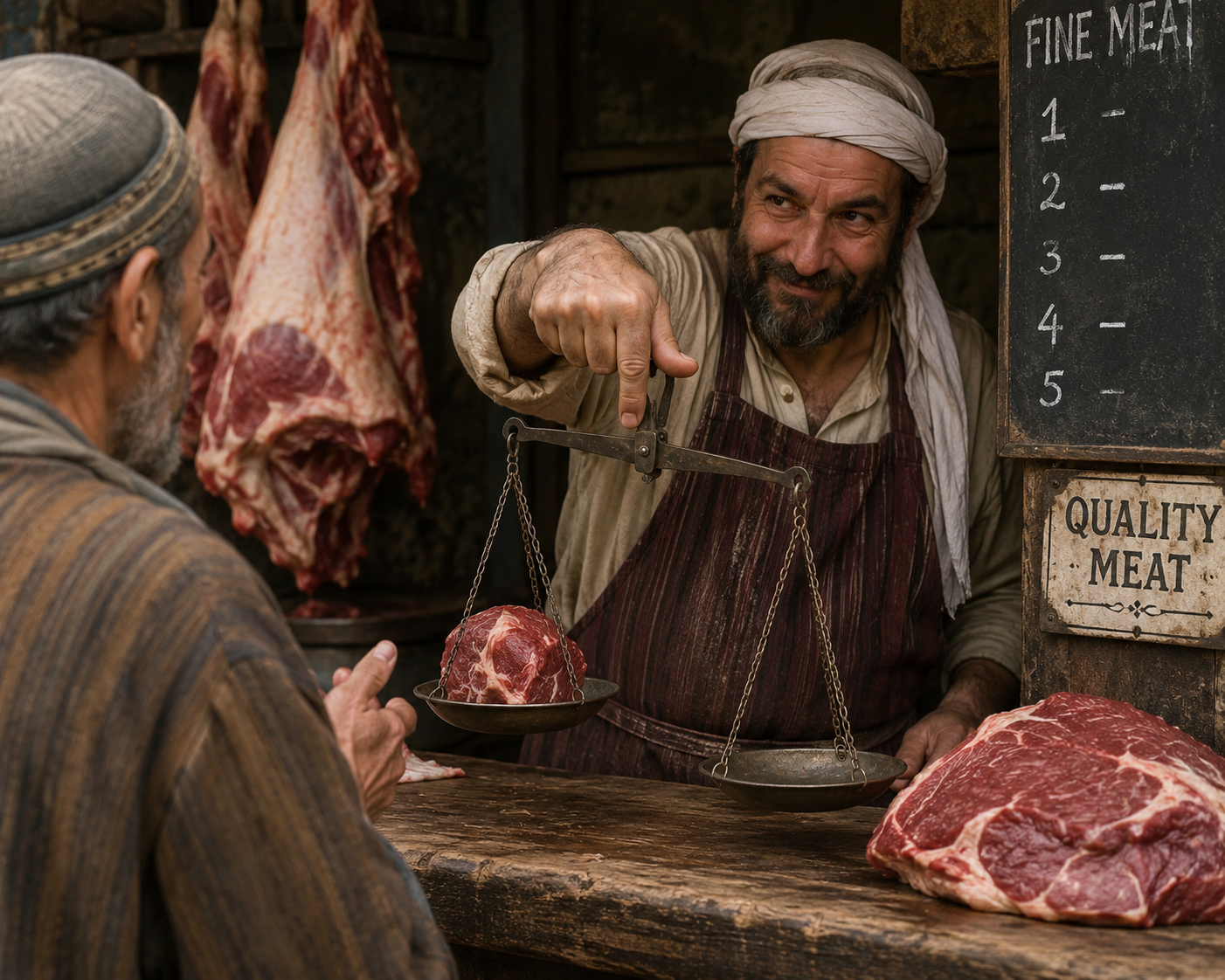
Look at his left thumb
SPIRITUAL
COMPROMISE
A merchant, in whose hands are false (mirmah) balances, He loves (aheb/ahab) to oppress (ashaq; LXX - katadunasteuo - dominate the poor, exploit in present tense = continually) - NKJV - "A cunning Canaanite! Deceitful scales are in his hand" The word translated merchant is literally “Canaanite” (Heb. kenaʿani). Because the Canaanites were widely associated with commerce and trade, the word came to be used for a merchant or trader (cf. Pr 31:24; Isa 23:8; Zech 14:21). But Hosea's choice of this particular word is surely significant. Israel had entered the land of Canaan, but tragically, Canaan had entered into the hearts of the Israelites! Instead of remaining distinct from the corrupt practices of the surrounding peoples, Israel had adopted their values and become characterized by dishonesty, greed, and exploitation. The nation that was called to display God's glory and God's righteousness had become indistinguishable from the godless pagan culture around it, illustrating the tragic consequences of spiritual compromise.
False (mirmah) is the same word used to describe Jacob's stealing Esau’s blessing through deceit (Ge 27:35; cf. Ge 34:13 = like father, like son). Mirmah is also used in Hos 11:12 "Ephraim surrounds Me with lies And the house of Israel with deceit;"
NET NOTE - Heb “the merchant…loves to cheat.” The Hebrew has singular forms (noun and verb) that are used generically to refer to all Israelite merchants and traders in general. The singular noun II כְּנַעַן (knaʿan, “a merchant; a trader”; BDB 488 s.v. II כְּנַעַן) is used in a generic sense to refer to the merchant class of Israel as a whole (e.g., Ezek 16:29; Ezek 17:4; Zeph 1:11). tn Heb “The merchant—in his hand are scales of deceit—loves to cheat.” The present translation rearranges the Hebrew line division to produce a smoother English rendering.
Bob Utley - "A merchant" This is a word play on "Canaanite" (BDB 488 II, cf. Isa. 23:8; Ezek. 16:29; Ezek 17:4). This seems to be sarcasm! The term can mean either an ethnic group or a merchant. Israel was acting like the Canaanites (i.e. "false balances," cf. Prov. 11:1; Prov 20:23; Amos 8:5). These greedy merchants are possibly referred to in Hosea 7:14c.
In whose hands are false balances - Septuagint - "a balance of unrighteousness (adikia)" The picture is of a merchant deliberately manipulating his scales so that the transaction favors himself and cheats his customer (picture the butcher putting his thumb on the scale as he weighs the steak). Yahweh had explicitly forbidden such practices: “You shall do no wrong in judgment, in measurement of weight, or capacity. You shall have just balances, just weights” (Lev 19:35–36; cf. Dt 25:13–16; Pr 11:1; Pr 20:23; Mic 6:10–11). Thus Israel's commercial dishonesty was not simply bad business practice; it was direct disobedience to God's revealed will.
John Walton - dishonest scales. This same charge is made against unscrupulous merchants in Amos 8:5. The word translated “merchant” is the Hebrew word “Canaan,” which at least evokes the idea of Canaanite influence. The indictment seems to be based on the idea that Israel and its economic community have been corrupted by the immoral practices of its neighbors. In an economy that did not have standardized weights and measures, traders were often tempted to cheat by falsifying the balances and measurements, often by using improper weights and false bottoms and other ways to alter the sizes of vessels.
Robert Chisholm - The Old Testament frequently spoke against using scales that were rigged to weigh out less merchandise than the buyer thought he was getting (cf. Lev. 19:36; Deut. 25:13-16; Prov. 11:1; Prov 16:11; Prov 20:10, 23; Amos 8:5; Micah 6:11). (See Bible Knowledge Commentary: Old Testament - Page 1404)
He loves to oppress (ashaq; LXX - katadunasteuo - dominate the poor, exploit in present tense = continually) - NET = "they love to cheat." Even worse, oppression was not something Israel practiced reluctantly or occasionally. They did not just oppress but loved to oppress! Their corrupt business practices revealed corrupt hearts. They had developed an appetite for unjust gain and were willing to exploit others to obtain it (cf. Hos 4:2; Hos 10:13; Hos 12:8; Amos 8:4–6). The hands holding the false balances merely revealed what was already present in their hearts.
Bob Utley - "He loves to oppress" This VERB (ashaq Qal INFINITIVE CONSTRUCT) is used in Deut. 24:14. Oppression of the poor is not allowed among YHWH's people (cf. Prov. 14:31; Prov 22:16; Amos 4:1; Jer. 7:6; Ezek. 22:29; Zech. 7:10). This is the opposite of Hosea 12:6! This word is often used in a negative sense of Israel loving the wrong things (cf. Hosea 4:17-18; Hosea 10:11; Hosea 12:7; Amos 4:4-5; Micah 3:1-2).
The tragedy is profound. Israel had been called to be Yahweh's holy people, displaying His righteousness before the nations (Ex 19:5–6; Dt 4:5–8), but instead they had become virtually indistinguishable from the Canaanites whose land they had inherited.
Israel failed to drive Canaan out of the land (cf Jdg 1:21), and eventually Canaan worked its way into Israel's heart. One is reminded of Paul's caution to New Testament believers...
Do not be bound together (stop this!) with unbelievers; for what partnership have righteousness and lawlessness, or what fellowship has light with darkness? 15 Or what harmony has Christ with Belial, or what has a believer in common with an unbeliever? 16 Or what agreement has the temple of God with idols? For we are the temple of the living God; just as God said, “I WILL DWELL IN THEM AND WALK AMONG THEM; AND I WILL BE THEIR GOD, AND THEY SHALL BE MY PEOPLE. 17 “Therefore, COME OUT FROM THEIR MIDST AND BE SEPARATE,” says the Lord. “AND DO NOT TOUCH WHAT IS UNCLEAN; And I will welcome you. 18 “And I will be a father to you, And you shall be sons and daughters to Me,” Says the Lord Almighty. (2Cor 6:14-18)
🙏 THOUGHT - There is always danger when God's people become so acclimated to the values of the godless culture that the world can no longer see any meaningful difference (cf. Ro 12:2; Jas 4:4). Beware! Spiritual compromise rarely remains merely “spiritual”; sooner or later what captures the heart shows itself in the hands!
Gary Smith: Hosea now analyzes the contemporary economic situation where deceit rules instead of justice. The Israelite merchants are acting like their Canaanite neighbors by using dishonest scales in their business dealings. By rigging two sets of weights for the scale, they can use one that is too heavy or too light. The merchant “defrauds” people by requiring that they put 110 percent of a shekel to balance his heavy weight. Or when the merchant sells, he weighs his product using a light weight so that he gives his customers only 90 percent of what they deserve. This reminds one of Jacob’s attempts to get ahead financially by taking advantage of Esau and Laban (Ge 25:27–34; Ge 30:30–43) as well as his attempt to bribe Esau with his wealth in order to escape responsibility for past mistreatment of his brother (Gen. 32). The people in Hosea’s day continue this tradition. Those in the upper class boast about their illegally gained wealth (Hos. 12:8) and boldly flaunt their affluence with great houses that are richly decorated (cf. Amos 3:15). To make things worse, these same people think they are above the law, claiming that no one can ever make any charges stick against them (Hos. 12:8b). They are trusting in their wealth to protect them, not the legal system or God. Like Mafia generals, they fix any court case so that they will never be held accountable for their deceptive financial dealings. They think they are above both the laws of God and the nation’s legal system. (See Hosea, Amos, Micah - Page 174)
Oppress (extort, defraud) (06231) ashaq means to oppress, to extort, to defraud. The root word is concerned with acts of abuse of power or authority, the burdening, trampling, and crushing of those lower in station (half the uses are in the context of poverty). Ashaq speaks of harshness or roughness and often embodies use of force or violence. Ashaq is used especially of oppression of the disadvantaged members of society causing them to suffer unjust, ill treatment and, in a number of contexts, doing so for monetary gain (1Ch 16:21; Job 10:3; Ps 72:4; Ps 105:14; Ps 119:121, 122; Pr 14:31; Pr 22:16; Pr 28:3; Eccl 4:1; Isa 23:12; Isa 52:4; Jer 7:6; Jer 21:12; Ezek 22:29; Am 4:1; Zec 7:10). The connection between ashaq and divine justice is made clear in Ps 103:6.
False (deceitful, treachery)(04820) mirmah (from ramah - to beguile, deal treacherously with) means the intentional misleading of someone else through distorting or withholding the truth. Jacob stole Esau’s blessing through deceit (Gen. 27:35; cf. Gen. 34:13). Deceit characterizes those who plan evil (Prov. 12:20; cf. Ps. 36:3; Prov. 12:5, 17; Prov 14:8). David therefore exhorted his children to guard their tongues from evil and their lips from speaking deceit (Ps. 34:13). God also condemns deceit in business: He cannot tolerate dishonest weights (Mic. 6:11), and “a false balance is an abomination to the LORD” (Prov. 11:1).
William White - This participle occurs nearly forty times in the OT with the most frequent usage in Psalms. It initially appears in Genesis 27:35, describing the swindle perpetrated on Esau by Jacob. It is used particularly of treacherous or deceitful speech (Genesis 34:13; Psalm 10:7; Psalm 17:1; Psalm 24:4 et al.). mirmâ is also used of false weighted scales which are said to be "falsifying the scales with deceit" (Amos 8:5). An interesting usage is found in Jeremiah 9:6, "Heaping oppression upon oppression, and deceit upon deceit." The OT makes clear that deceitful speech is one of the most heinous offenses against God. The repetition of the root in Psalms in assurances that the prayer and praise of the righteous is without deceit, reinforces the importance of truth toward the Lord. (Online Theological Wordbook of the Old Testament)
MIRMAH - 38V - deceit(21), deceitful(6), deceitfully(2), deception(2), deceptive(1), dishonest(1), false(3), treacherous(1), treachery(2). Gen. 27:35; Gen. 34:13; 2 Ki. 9:23; Job 15:35; Job 31:5; Ps. 5:6; Ps. 10:7; Ps. 17:1; Ps. 24:4; Ps. 34:13; Ps. 35:20; Ps. 36:3; Ps. 38:12; Ps. 43:1; Ps. 50:19; Ps. 52:4; Ps. 55:11; Ps. 55:23; Ps. 109:2; Prov. 11:1; Prov. 12:5; Prov. 12:17; Prov. 12:20; Prov. 14:8; Prov. 14:25; Prov. 20:23; Prov. 26:24; Isa. 53:9; Jer. 5:27; Jer. 9:6; Jer. 9:8; Dan. 8:25; Dan. 11:23; Hos. 11:12; Hos. 12:7; Amos 8:5; Mic. 6:11; Zeph. 1:9
G Campbell Morgan - He is a trafficker, the balances of deceit are in his hand, he loveth to oppress. Hosea 12.7
These are again the words of Jehovah. They are exclamatory, and vibrant with sarcasm. The words "lie is" are supplied by translators, and while giving a smooth and not inaccurate reading, rob the word of some of its force. It would be better rendered as an exclamation, "A trafficker!" As a matter of fact even that is interpretation, rather than translation. The literal rendering would be "Canaan!" Thus Jehovah calls Israel by the name of the peoples which Israel had been called to extirpate by reason of their corruptions. That is satire of the most biting kind. Yet it was true. Read this exclamation in close connection with the immediately preceding word of Jehovah (Hos 11.13-12.1 ; and with those directly following (Hos 12.8); and this will be seen, Israel had sought, and apparently found, material wealth, and claimed that she had done so honestly. This Jehovah denied. She had practised deceit and falsehood, and had sunk to the level of Canaan. These words of Jehovah prove the falseness of that specious saying "Love is blind." Love is never blind. It sees most clearly. Jehovah's love for Israel drew forth the great cry "How shall I give thee up?" But Jehovah was not blind, nor could He permit Himself to be. Love never fails to see sin; and love insists on bringing sin into the light. It will not permit it to find a hiding place; it exposes all its subterfuges. Love calls sin by its right name, and portrays it in all its corruption. And all this because it is Love. That which excuses, condones, palliates sin, is not love. It is folly, and at last complicity with sin.
Hosea 12:7-14 Today in the Word
Search me, O God, and know my heart; test me and know my anxious thoughts. Psalm 139:23
Every October, shortly after the announcement of the Nobel Prize winners, a group at the Massachusetts Institute of Technology hands out the Ig Nobel Prize, a tongue-in-cheek recognition of notorious achievements. In 2002, they awarded the Ig Nobel Prize in economy to “the executives, corporate directors, and auditors” of 28 different companies for “adapting the mathematical concept of imaginary numbers for use in the business world.”
Israel’s accounting was similarly suspect. They claimed to be independently wealthy and sinless, but an audit of their history as a nation revealed a different story. Using dishonest scales, Israel’s claim in verse 8 insinuated that they came into wealth on their own merits. But God was the One who brought them out of Egypt where they were slaves with no home, no king, and no freedom. They were wanderers, not wealthy. Their claim that no sin would be found in them was obviously false. The prophets had long spoken out against Israel’s wickedness.
Was Gilead wicked? Yes! Despite Israel’s claims to the contrary, their sacrifices were not enough to make them holy. Their altars may have had value if their worship was genuine, taking place in God’s holy temple. But because of their rebellion, the stones of their altars were as worthless as stones in a field that got in the way of the plow (v. 11).
God looked back to Jacob to expose the real story. Jacob was a servant, a shepherd, when he was beginning his family—hardly the mark of self-made wealth. And afterward, as his descendants became a nation, they had to be cared for like sheep by the prophets of God. The verb in verse 12 describing Jacob’s care for the sheep is repeated in verse 13 in reference to the prophets’ guidance. Hosea made a clear parallel between Jacob’s humble beginnings and Israel’s propensity to wander.
Israel had the value of things completely out of balance, and they were about to experience the punishment from God in order to even the scales.
Apply the Word
We all perform some type of self-evaluation, a sort of mental report card that gauges how well we think we are living our lives. Some people are unfairly harsh on themselves, and others persist in denial about their glaring shortcomings. Ask the Holy Spirit to search your heart according to His standards, not your own. Be open to His conviction for an honest look at the condition of your life. Allow Him to make the changes that truly need to be made, to free you from the burden of presenting a false exterior.
Hosea 12:8 And Ephraim said, “Surely I have become rich, I have found wealth for myself; In all my labors they will find in me No iniquity, which would be sin.”
KJV And Ephraim said, Yet I am become rich, I have found me out substance: in all my labours they shall find none iniquity in me that were sin.
NET Ephraim boasts, "I am very rich! I have become wealthy! In all that I have done to gain my wealth, no one can accuse me of any offense that is actually sinful."
NLT Israel boasts, "I am rich! I've made a fortune all by myself! No one has caught me cheating! My record is spotless!"
BGT Hosea 12:9 καὶ εἶπεν Εφραιμ πλὴν πεπλούτηκα εὕρηκα ἀναψυχὴν ἐμαυτῷ πάντες οἱ πόνοι αὐτοῦ οὐχ εὑρεθήσονται αὐτῷ δι᾽ ἀδικίας ἃς ἥμαρτεν
LXE And Ephraim said, Nevertheless I am rich, I have found refreshment to myself. None of his labours shall be found available to him, by reason of the sins which he has committed.
CSB But Ephraim says: "How rich I have become; I made it all myself. In all my earnings, no one can find any crime in me that I can be punished for!"
ESV Ephraim has said, "Ah, but I am rich; I have found wealth for myself; in all my labors they cannot find in me iniquity or sin."
NIV Ephraim boasts, "I am very rich; I have become wealthy. With all my wealth they will not find in me any iniquity or sin."
YLT And Ephraim saith: 'Surely I have become rich, I have found wealth for myself, All my labours -- they find not against me iniquity that is sin.'
NKJ And Ephraim said,`Surely I have become rich, I have found wealth for myself; In all my labors They shall find in me no iniquity that is sin.'
NJB Hosea 12:9 'How rich I have become!' says Ephraim, 'I have made a fortune.' But of all his gains he will keep nothing because of the sin of which he is guilty.
NRS Ephraim has said, "Ah, I am rich, I have gained wealth for myself; in all of my gain no offense has been found in me that would be sin."
RSV Ephraim has said, "Ah, but I am rich, I have gained wealth for myself": but all his riches can never offset the guilt he has incurred.
NAB Hosea 12:9 Though Ephraim says, "How rich I have become; I have made a fortune!" All his gain shall not suffice him for the guilt of his sin.
GWN The people of Ephraim say, 'We're rich. We've made a fortune. With all this wealth, no one will find us guilty of any sin.'
BBE And Ephraim said, Now I have got wealth and much property; in all my works no sin may be seen in me.
- Yet: Job 31:24,25 Ps 49:6 Ps 52:7 Ps 62:10 Zec 11:5 Lu 12:19 Lu 16:13 1Ti 6:5,17 Rev 3:17
- I have: De 8:17 Isa 10:13,14 Hab 1:16 Hab 2:5,6
- they: Pr 30:12,20 Jer 2:23,35 Mal 2:17 Mal 3:13 Lu 10:29 Lu 16:15
Related Passages:
Deuteronomy 8:16-18 “In the wilderness He fed you manna which your fathers did not know, that He might humble you and that He might test you, to do good for you in the end. 17 “Otherwise, you may say in your heart, ‘My power and the strength of my hand made me this wealth.’ 18 “But you shall remember the LORD your God, for it is He who is giving you power to make wealth, that He may confirm His covenant which He swore to your fathers, as it is this day.
EPHRAIM'S DECEPTION:
I AM RICH SO ALL IS OKAY
And Ephraim said - It is as if Ephraim is responding Hosea's charge to the charge of dishonest commerce in Hosea 12:7.
“Surely I have become rich, I have found wealth for myself; In all my labors they will find in me No iniquity, which would be sin (note focus - I...I...myself...my...me) - Hosea obviously prophesied during a time of national prosperity. When the financial condition is good, it is difficult for folks to recognize their true moral condition. The "stock market" had reached all time highs (so to speak - are you listening America?), but their "moral market" was at an all time low! Tragically, instead of confessing sin, Ephraim boasts in his prosperity and declares himself innocent! Paradoxically, Ephraim's material success had become evidence, in his own mind, that nothing could possibly be seriously wrong in his heart. That is a great description of self-deception, which is one of the powerful effects of sin (Heb 3:13)!
Bob Utley - Israel thought her dishonestly gained wealth was a sign of covenant blessings (i.e. Lev. 26; Deut. 28), but it was the opposite!
Israel was financially prosperous
but spiritually bankrupt.
Surely I have become rich - Ephraim equated prosperity with divine approval. Wrong! Because business was booming and wealth was accumulating, Israel apparently concluded that all was well between them and Yahweh. Just look at the ethics of the rich in our world today! Material prosperity is never a reliable measure of spiritual health (cf. Dt 8:11–14, 17–18; Ps 73:3–12; Lk 12:16–21; Rev 3:17).
I have found wealth for myself - Notice the emphasis on “I” and “myself.” Ephraim takes credit for what he possesses. There is no acknowledgment that Yahweh was the ultimate source of Israel's prosperity (cf Jas 1:17). This repeats the sin exposed earlier that “She does not know that it was I who gave her the grain, the new wine and the oil, and lavished on her silver and gold” (Hos 2:8).
NET NOTE - Heb “I have found wealth for myself.” The verb מָצַא (matsaʾ, “to find”) is repeated in 12:8 to create a wordplay that is difficult to reproduce in translation. The Israelites have “found” (מָצַא) wealth for themselves (i.e., become wealthy; v. 8a) through dishonest business practices (v. 7). Nevertheless, they claim that no guilt can be “found” (מָצַא) in anything they have done in gaining their wealth (v. 8b).
In all my labors they will find in me no iniquity, which would be sin - NET - "In all I have done to gain wealth, no one can accuse me of any offense that is actually sinful." Here is Ephraim's astonishing self-justification. Israel (i.e. Ephraim) is asserting she will never bear this guilt. Verse 7 has just accused Israel of false balances and oppression, yet Ephraim replies in essence that “You cannot prove that I have done anything wrong.” Prosperity had produced not repentance but self-deception.
NET NOTE - Heb “In all my gains/labors.” The noun יְגִיעַ (ygiʿa) has a twofold range of meaning: (1) “toil, labor” and (2) metonymical result of toil: “product, produce, gain, acquired property” (i.e., wealth gained by labor; BDB 388 s.v.; HALOT 385-86 s.v.). Normally, only one of the categories of meaning is present in any usage; however, it is possible that intentional semantic ambiguity is present in this usage because the context invokes both ideas: action + wealth.
If we link verses 7 and 8 we can see a definite progression - FALSE BALANCES → dishonest practices. LOVE OF OPPRESSION → corrupt heart. “I HAVE BECOME RICH” → pride. “I FOUND WEALTH FOR MYSELF” → self-sufficiency. SPIRITUAL BLINDNESS → “NO INIQUITY...IN ME” → self-righteousness. In effect Ephraim had "mastered" the art of sinning without feeling sinful.
🙏 THOUGHT - Wealth can be spiritually dangerous when God's gifts become evidence of OUR supposed goodness rather than occasions to give gratitude God the Giver of good gifts (Jas 1:17). Success often dulls one's conscience and we fall into the trap of beginning to assume that "Surely I must be doing something right because things are going so well.” The Bible is filled with warnings like "He who trusts in his riches will fall" (Pr 11:28) "A rich man’s wealth is his strong city, And like a high wall in his own imagination." (Pr 18:11 note contrast with Pr 18:10!) "If riches increase, do not set your heart upon them.” (Ps 62:10) “He who loves money will not be satisfied with money.” (Eccl 5:10) Jesus warned about one of the deadliest traps of wealth declaring "the deceitfulness of wealth choke the word, and it becomes unfruitful." (Mt 13:22)
Ephraim reminds me of the church at Laodicea who thought they were rich enough to believe he needed nothing and self-righteous enough to believe they had done nothing wrong
Because you say, “I am rich, and have become wealthy, and have need of nothing,” and you do not know that you are wretched and miserable and poor and blind and naked, (Rev 3:17).
Lloyd Ogilvie: Wealth does have an insulating force. It makes one foolishly think that he can control his environment and destiny, as well as people and groups. Here Ephraim places itself above reproach and any accountability to God in the use of wealth. Wolff translates the Hebrew text, “All my gains bring me no guilt that would be sin.” This is in blatant denial of Hosea’s charge. Their wealth had been gained dishonestly and had not been used to lift the burden of the oppressed. . . A friend of mine who is a wealthy entrepreneur confided, “The power of money is intoxicating. It will get you anything you want from people except real love and will get you into any place except heaven. The more you have, the closer you have to stay to God. The minute you think you’ve got what you have in your own strength, you’ve got an idol; and the day you spend or give or invest without gratefully asking for guidance, you’re on the way to using money to manipulate. And when you think you’re perfect in the way you handle money, trouble is on the way.”
Hosea 12:9 But I have been the LORD your God since the land of Egypt; I will make you live in tents again, As in the days of the appointed festival.
KJV And I that am the LORD thy God from the land of Egypt will yet make thee to dwell in tabernacles, as in the days of the solemn feast.
NET "I am the LORD your God who brought you out of Egypt; I will make you live in tents again as in the days of old.
NLT "But I am the LORD your God, who rescued you from slavery in Egypt. And I will make you live in tents again, as you do each year at the Festival of Shelters.
BGT Hosea 12:10 ἐγὼ δὲ κύριος ὁ θεός σου ἀνήγαγόν σε ἐκ γῆς Αἰγύπτου ἔτι κατοικιῶ σε ἐν σκηναῖς καθὼς ἡμέρᾳ ἑορτῆς
LXE But I the Lord thy God brought thee up out of the land of Egypt: I will yet cause thee to dwell in tabernacles, according to the days of the feast.
CSB I have been Yahweh your God ever since the land of Egypt. I will make you live in tents again, as in the festival days.
ESV I am the LORD your God from the land of Egypt; I will again make you dwell in tents, as in the days of the appointed feast.
NIV "I am the LORD your God, who brought you out of Egypt; I will make you live in tents again, as in the days of your appointed feasts.
YLT And I -- Jehovah thy God from the land of Egypt, Again do I turn thee back into tents, As in the days of the appointed time.
NKJ "But I am the LORD your God, Ever since the land of Egypt; I will again make you dwell in tents, As in the days of the appointed feast.
NJB Hosea 12:10 But I have been Yahweh your God since your days in Egypt and will make you live in tents again as in the days of Meeting.
NRS I am the LORD your God from the land of Egypt; I will make you live in tents again, as in the days of the appointed festival.
RSV I am the LORD your God from the land of Egypt; I will again make you dwell in tents, as in the days of the appointed feast.
NAB Hosea 12:10 I am the LORD, your God, since the land of Egypt; I will again have you live in tents, as in that appointed time.
GWN I am the LORD your God. I brought you out of Egypt. I will make you live in tents again as you did during your appointed festivals.
BBE But I am the Lord your God from the land of Egypt; I will give you tents for your living-places again as in the days of the holy meeting.
- I that: Ho 13:4 Ex 20:2 Lev 19:36 Lev 26:13 Nu 15:41 Ps 81:10 Mic 6:4
- yet: Ge 25:27 2Sa 7:2 Jer 35:7 Heb 11:9-13
- as in: Lev 23:40-43 Ezr 3:4 Ne 8:15-17 Zec 14:16-19 Joh 7:2
BACK TO THE
"WILDERNESS CLASSROOM"
But (term of contrast) - This contrasts Ephraim's self-deception (“I have...I have”) with Yahweh's declaration of truth (“I have been the LORD your God”). Ephraim boasted in what he had done for himself. Yahweh reminds him of what He had done for Israel.
I have been the LORD your God since the land of Egypt; I will make you live in tents again, As in the days of the appointed festival. The LORD reminds Israel that He has been their covenant God ever since He redeemed them from slavery in Egypt. Despite their persistent unfaithfulness, He had remained faithful to His covenant (cf 2Ti 2:13, Lam 3:22-23). Yet because they had forgotten Him, He would cause them to live in tents again, not as a joyful celebration but as a consequence of judgment. Israel's fortified cities would be destroyed, forcing the people into the uncertainty as to how/where they would live in exile. The imagery recalls the Feast of Booths (Tabernacles), when Israel lived in temporary shelters to remember God's faithful provision during the wilderness journey after the Exodus (Lev. 23:42-43). Their coming exile would become another wilderness experience, but this time one of discipline designed to humble them, remind them of their dependence upon the LORD, and ultimately prepare them for restoration. Just as God preserved Israel during the first wilderness sojourn, He would preserve a remnant through this second "wilderness" until His covenant purposes were fulfilled.
NET NOTE - The Lord answers Ephraim’s self-assertion (“I am rich!”) with a self-introduction formula (“I am the Lord your God!”) that introduces judgment oracles and ethical instructions.
The LORD reminds Israel that He has been their covenant God ever since He redeemed them from slavery in Egypt (cf. Ex 20:2; Hos 13:4). Israel may have forgotten Yahweh and credited her prosperity to herself (Hos 12:8), but Yahweh had never ceased to be the God Who redeemed, sustained, and cared for His people. Their unfaithfulness stood in stark contrast to His covenant faithfulness.
I will make you live in tents again - Israel boasted in her wealth and prosperity, but Yahweh would strip away the security in which she trusted. The settled, prosperous life she had taken for granted would give way to the insecurity and deprivation associated with tent dwelling. Their wealth, houses and fortified cities could not protect them from the judgment Yahweh was bringing through Assyria (cf. Hos 10:14; Hos 11:5–6).
Israel had forgotten the lessons of the wilderness,
so God would take them back to the "wilderness classroom."
As in the days of the appointed festival - This most naturally recalls the Feast of Booths (Tabernacles), when Israelites deliberately lived in temporary shelters to remember how Yahweh had caused their fathers to dwell in booths after bringing them out of Egypt (Lev 23:42–43; cf. Dt 16:13–15). But there is a bitter irony. What had been a temporary, joyful annual reminder of their wilderness dependence upon God (cf Neh 8:17) would become their actual experience under divine discipline.
Robert Chisholm - The wilderness experience, which the people commemorated in the Feast of Tabernacles (cf. Lev. 23:33-43), would be realized once more in the Exile. (See Bible Knowledge Commentary: Old Testament - Page 1404)
Robin Routledge: Verse 9 gives Yahweh’s response to Ephraim’s boasting. Everything they have and are has come through him. ‘I am the Lord your God from the land of Egypt’ (nrsv; cf. 13:4) echoes the frequently repeated statement ‘I am the Lord your God, who brought you out of Egypt’ (cf. Exod. 20:2; Lev. 25:38; Deut. 5:6; Ps. 81:10). This emphasizes the distinctive nature of the relationship between God and his people, established through the Sinaitic covenant. It was Yahweh who brought the people into Canaan, and for all their boasting it was he, not they, who enabled them to prosper there. But they do not acknowledge Yahweh, and have instead taken on the characteristics of Canaan. As a result, they will be taken back to a time before the settlement had its adverse effects. The reference to living in tents points particularly to the exodus. The ‘appointed festival’ (nrsv) may be the feast of Tabernacles (cf. 9:5), when the people constructed booths to recall the days in the desert. (Hosea: An Introduction and Commentary - Page 164)
Duane Garrett: Once again Yahweh declares that he will undo the exodus and return Israel to the status of being no longer a nation. Here, however, he speaks of a return to wilderness rather than a return to slavery. In declaring himself to be their Savior-God, the one who came to their aid when they were slaves in Egypt, Yahweh asserts his sovereignty over them. The NIV translation is somewhat misleading at the end of the verse, “as in the days of your appointed feasts.” The word translated “appointed feasts” is actually singular and refers to only one feast, the Feast of Tabernacles or Booths. This was the annual holy week in which Israel memorialized the wilderness wandering by leaving their homes and spending a week in tents or in hastily constructed, temporary lean-to shelters (Lev 23:33–44). Probably a fair number of the people did not relish the idea of having to move outdoors and live like this for one week a year, and Yahweh's point is that the discomfort of the booths would become a permanent condition. They would become, like their ancestors, homeless wanderers. The verse looks ahead to Israel's Diaspora. (See Hosea, Joel: An Exegetical and Theological Exposition)
Israel had become too comfortable, too prosperous, and too self-sufficient to recognize her dependence upon Yahweh. God would therefore remove the things in which she trusted and bring her again into circumstances where her helplessness would become painfully obvious (cf. Dt 8:2–3, 11–18).
🙏 THOUGHT - Sometimes the very blessings God gives can become obstacles when we are tempted to begin trusting the gifts rather than the Giver. God may have to remove our “houses” and allow us to experience the “tent” in order to remind us that our security is never in what we possess, but in the God Who provides what we possess! (Dt 8:17–18; 1 Ti 6:17).
QUESTION - What is the Feast of Tabernacles / Booths / Sukkot? | GotQuestions.org
ANSWER - The Feast of Tabernacles, also known as the Feast of Booths and Sukkot, is the seventh and last feast that the Lord commanded Israel to observe and one of the three feasts that Jews were to observe each year by going to “appear before the Lord your God in the place which He shall choose” (Deuteronomy 16:16). The importance of the Feast of Tabernacles can be seen in how many places it is mentioned in Scripture. In the Bible we see many important events that took place at the time of the Feast of Tabernacles. For one thing, it was at this time that Solomon’s Temple was dedicated to the Lord (1 Kings 8:2).
It was at the Feast of Tabernacles that the Israelites, who had returned to rebuild the temple, gathered to celebrate under the leadership of Joshua and Zerubbabel (Ezra 3). Later, the Jews heard Ezra read the Word of God to them during the Feast of Tabernacles (Nehemiah 8). Ezra’s preaching resulted in a great revival as the Israelites confessed and repented of their sins. It was also during this Feast that Jesus said, “anyone who is thirsty come to me and drink. Whoever believes in me, as Scripture has said, rivers of living water will flow from within them” (John 7:37–38).
The Feast of Tabernacles takes place on the 15th of the Hebrew month Tishri. This was the seventh month on the Hebrew calendar and usually occurs in late September to mid-October. The feast begins five days after the Day of Atonement and at the time the fall harvest had just been completed. It was a time of joyous celebration as the Israelites celebrated God’s continued provision for them in the current harvest and remembered His provision and protection during the 40 years in the wilderness.
As one of the three feasts that all “native born” male Jews were commanded to participate in, the Feast of Tabernacles is mentioned multiple times in Scripture, sometimes called the Feast of the Ingathering, the Feast to the Lord, or the Feast of Booths (Exodus 23:16; Deuteronomy 16:13). As one of the pilgrim feasts (when Jewish males were commanded to go to Jerusalem), it was also the time when they brought their tithes and offerings to the Temple (Deuteronomy 16:16). With the influx of people coming to Jerusalem at that time, we can only imagine what the scene must have been like. Thousands upon thousands of people coming together to remember and celebrate God’s deliverance and His provision, all living in temporary shelters or booths as part of the requirements of the feast. During the eight-day period, so many sacrifices were made that it required all twenty-four divisions of priests to be present to assist in the sacrificial duties.
We find God’s instructions for celebrating the Feast of Tabernacles in Leviticus 23, given at a point in history right after God had delivered Israel from bondage in Egypt. The feast was to be celebrated each year on “the fifteenth day of this seventh month” and was to run for seven days (Leviticus 23:34). Like all feasts, it begins with a “holy convocation” or Sabbath day when the Israelites were to stop working to set aside the day for worshiping God. On each day of the feast they were to offer an “offering made by fire to the Lord” and then after seven days of feasting, again the eighth day was to be “a holy convocation” when they were to cease from work and offer another sacrifice to God (Leviticus 23). Lasting eight days, the Feast of Tabernacles begins and ends with a Sabbath day of rest. During the eight days of the feast, the Israelites would dwell in booths or tabernacles that were made from the branches of trees (Leviticus 23:40–42).
The Feast of Tabernacles, like all the feasts, was instituted by God as a way of reminding Israelites in every generation of their deliverance by God from Egypt. Of course, the feasts are also significant in that they foreshadow the work and actions of the coming Messiah. Much of Jesus’ public ministry took place in conjunction with the Holy Feasts set forth by God.
The three pilgrim feasts where all Jewish males were commanded to “appear before the Lord in the place he chooses” are each very important in regards to the life of Christ and His work of redemption. We know with certainty that the Passover and the Feast of Unleavened Bread are symbolic of Christ’s atoning sacrifice on the cross. Likewise, we know that Pentecost, which marked the beginning of the Feast of Weeks, was the time of Jesus’ bodily ascension. And most scholars would agree that the Feast of Tabernacles is symbolic of Christ’s second coming when He will establish His earthly kingdom.
There are also some who believe that it was likely during the Feast of Tabernacles that Jesus was born. While we celebrate Christ’s birth on December 25, most scholars acknowledge that this tradition was begun in the fourth century AD by the Roman Catholic Church and that the exact day of Jesus’ birth is unknown. Some of the evidence that Jesus might have been born earlier in the year during the Feast of the Tabernacles includes the fact that it would be unlikely for shepherds to still be in the field with their sheep in December, which is in the middle of the winter, but it would have been likely they were in the fields tending sheep at the time of the Feast of Tabernacles. The strong possibility that Jesus was born at the time of the Feast of Tabernacles is also seen in the words John wrote in John 1:14. “And the Word became flesh and dwelt among us, and we beheld His glory, the glory as of the only begotten of the Father, full of grace and truth” (NKJV). The Greek word translated as “dwelt” here is literally the word for “tabernacle”; Jesus “tabernacled“ with us.
Some believe it is very likely that John intentionally used this word to associate the first coming of Christ with the Feast of Tabernacles. Christ came in the flesh to dwell among us for a temporary time when He was born in the manger, and He is coming again to dwell among us as Lord of Lords. While it cannot be established with certainty that Jesus was born during the Feast of Tabernacles, some believe there is a strong possibility the Feast of Tabernacles not only looks forward to His second coming but also reflects back on His first coming.
The Feast of Tabernacles begins and ends with a special Sabbath day of rest. During the days of the feast, all Israelites were to dwell in booths to remind them that God had delivered them out of the land of Egypt, and to look forward to the coming Messiah who would deliver His people from the bondage of sin. This feast, like all of the feasts of Israel, consistently reminded the Jews of God’s provision, protection, and lovingkindness. As we study the feasts today, we should let them remind us of God’s faithfulness and care. Jesus has accomplished so much for us—He is our all in all—and He has promised to come again. We long for the Promised Land (heaven) and to see our Savior face to face. Our hearts long for the time when our redemption will be complete and Jesus Christ once again “tabernacles” among us.
Hosea 12:10 I have also spoken to the prophets, And I gave numerous visions, And through the prophets I gave parables.
KJV I have also spoken by the prophets, and I have multiplied visions, and used similitudes, by the ministry of the prophets.
NET I spoke to the prophets; I myself revealed many visions; I spoke in parables through the prophets."
NLT I sent my prophets to warn you with many visions and parables."
BGT Hosea 12:11 καὶ λαλήσω πρὸς προφήτας καὶ ἐγὼ ὁράσεις ἐπλήθυνα καὶ ἐν χερσὶν προφητῶν ὡμοιώθην
LXE And I will speak to the prophets, and I have multiplied visions, and by the means of the prophets I was represented.
CSB I spoke through the prophets and granted many visions; I gave parables through the prophets.
ESV I spoke to the prophets; it was I who multiplied visions, and through the prophets gave parables.
NIV I spoke to the prophets, gave them many visions and told parables through them."
YLT And I have spoken unto the prophets, And I have multiplied vision, And by the hand of the prophets I use similes.
NKJ I have also spoken by the prophets, And have multiplied visions; I have given symbols through the witness of the prophets."
NJB Hosea 12:11 I will speak through prophets, I will give vision after vision and through the ministry of prophets will speak in parables.
NRS I spoke to the prophets; it was I who multiplied visions, and through the prophets I will bring destruction.
RSV I spoke to the prophets; it was I who multiplied visions, and through the prophets gave parables.
NAB Hosea 12:11 I granted many visions and spoke to the prophets, through whom I set forth examples.
GWN I spoke to the prophets and gave them many visions. I taught lessons through the prophets."
BBE My word came to the ears of the prophets and I gave them visions in great number, and by the mouths of the prophets I made use of comparisons.
- have also: 1Ki 13:1 Ki 14:7-16 17:1 18:21-40 19:10 2Ki 17:13 Ne 9:30 Jer 25:4 Am 7:14
- multiplied: Nu 12:6 Joe 2:28 Ac 2:17 2Co 12:1,7
- used: Ho 1:2-5 Ho 3:1 Isa 5:1-7 Isa 20:2-5 Jer 13:1-14 Jer 19:1,10 Eze 4:1-5:17 Eze 15:1-8 Eze 20:49
Related Passages:
2 Kings 17:13 Yet the LORD warned Israel and Judah through all His prophets and every seer, saying, “Turn from your evil ways and keep My commandments, My statutes according to all the law which I commanded your fathers, and which I sent to you through My servants the prophets.”
Jeremiah 7:25 “Since the day that your fathers came out of the land of Egypt until this day, I have sent you all My servants the prophets, daily rising early and sending them.
Jeremiah 25:4 “And the LORD has sent to you all His servants the prophets again and again, but you have not listened nor inclined your ear to hear,
YAHWEH'S REPEATED WARNINGS
LEAVE ISRAEL NO EXCUSE
I (Yahweh) have also spoken to the prophets, And I gave numerous visions, And through the prophets I gave parables. - One could summarize this verse as much revelation brings much responsibility! Yahweh reminds Israel that He had repeatedly revealed His will to them through His prophets (like Hosea). Their coming judgment could not be blamed on ignorance or insufficient warning. God had not remained silent. He had spoken again and again through His appointed messengers (cf. 2 Ki 17:13; Jer 7:25; Heb 1:1).
God's many warnings demonstrated His mercy.
Israel's rejection demonstrated the depth of their rebellion.
I have also spoken to the prophets - Notice the repeated emphasis on “I.” In verse 9 Yahweh declared, “I have been the LORD your God,” and now He adds, “I have...spoken...I gave...I gave.” Israel had boasted, “I have become rich, I have found wealth for myself” (Hos 12:8), but Yahweh counters their self-centered boasting by reminding them of His attempts to wake them from their spiritual stupor. Note that the prophets did not invent their message but were vessels through which Yahweh spoke (cf. Nu 12:6; Dt 18:18; 2 Pe 1:20–21).
Bob Utley - "I have also spoken" This verse asserts that YHWH has adequately revealed Himself and His will to Israel through the prophets (cf. Hosea 6:5). He did this in visions and parables. He earlier had revealed Himself through His laws (i.e. the writings of Moses, cf. Hosea 4:6; Hosea 8:1,11). The prophets were covenant mediators. They did not bring additional requirements, but turned people's thoughts back to their commitments to the ancient covenants (i.e. Abraham, the Patriarchs, Moses, David). They check the motives as well as the performance of these covenant stipulations. They draw out the current application and significance of the ancient God-given ways.
I gave numerous visions - Numerous emphasizes the repetition of revelation. God did not warn Israel once and then abandon them. He repeatedly sent prophets and repeatedly revealed His truth, which made Israel even more culpable! This recalls the words of our Lord Jesus that "From everyone who has been given much, much will be required.” (Luke 12:48)
And through the prophets I gave parables (damah; LXX - homoioo - make like, portraying one thing or situation for purposes of comparison to another) - Parables translates damah, which has the idea of likening, comparing, portraying, or using figurative representations. God did not communicate only through straightforward declarations. Through His prophets He employed comparisons, metaphors, symbolic actions, and vivid illustrations to impress His truth upon His people. Hosea himself is a striking example because his marriage to Gomer became a living picture of Yahweh's relationship with unfaithful Israel (Hos 1–3). Hosea also repeatedly employed memorable pictures describing Israel was a luxuriant vine (Hos 10:1), a trained heifer (Hos 10:11), a wayward son (Hos 11:1–4), and Yahweh would be like a lion (Hos 11:10). God presented His truth in ways designed to penetrate Israel's hard heart and seared conscience. Israel therefore could never plead, “God did not warn us.”
Bob Utley - This is probably the OT background for Jesus' use of parables. The VERB (Piel IMPERFECT) means "to be like" (i.e. parable on similitude). The context and emphasis is on YHWH's active revelation in the life of Israel, but they would not listen (cf. Isa. 6:9-13). Parables both enlighten the believing and confuse the unbelieving (cf. Mark 4:10-12).
NET NOTE - There is debate whether אֲדַמֶּה (ʾadammeh, Piel imperfect first person common singular) is derived from I דָמָה (damah, “similitude, parable”) or II דָמָה (“oracle of doom”). The lexicons favor the former (BDB 198 s.v. I דָּמָה 1; HALOT 225-26 s.v. I דמה). Most translators favor “parables” (cf. KJV, RSV, NASB, NIV, NJPS), but a few opt for “oracles of doom” (cf. NRSV, TEV, CEV).
Duane Garrett: Yahweh's point is that he has been warning the people, albeit sometimes in a puzzling form, but they are too stubborn and too obtuse to receive the warnings.(See Hosea, Joel: An Exegetical and Theological Exposition)
John Walton - prophets’ parables. One of the ways that the prophet is able to convey God’s message is through the use of analogies or comparative stories. The parable thus can provide a dual meaning, using scenes or images from everyday life and then providing an interpretation of God’s will or judgment. For examples of this, see the comment on Isaiah 5:1–2 and Nathan’s parable of the ewe lamb in the comment on 2 Samuel 12:2–4.
Trent Butler: Israel had no excuse. They could not plead ignorance. God made his point with emphatic repetition. God spoke to the prophets, with the normal prophetic visions as the means of reception and the parables or comparative sayings as the prophetic method of teaching. God had spoken, but Israel refused to acknowledge the prophets as God's inspired speakers. (See Holman Old Testament Commentary - Hosea, Joel, Amos- Page 93
🙏 THOUGHT- This verse presents a sobering principle that repeated exposure to God's Word without obedience does not make us safer. To the contrary it increases our accountability (cf. Mt 11:20–24; Jas 1:22). Israel's problem was not that God had failed to speak, but that they had repeatedly failed to listen. How often we all are like Israel!
Remember that Israel's history in the Old Testament provides us with a vivid picture of the tendencies of our fallen flesh in the New Testament. Despite God's repeated revelation, gracious provision, loving discipline, and abundant blessings, Israel repeatedly wandered from Him, trusted in herself, pursued idols, and resisted His Word. Paul specifically tells us that Israel's experiences “happened as examples for us” and “were written for our instruction” (1 Co 10:6, 11; cf. Ro 15:4). Like Israel, our fallen flesh is prone to self-reliance, unbelief, idolatry, and resistance to God (Ro 7:18; Ro 8:7–8; Gal 5:16–17). WOE! Therefore, when we read Israel's history, we should not merely ask, “How could they do that?” but look in the mirror and ask “Where do I see the same tendency in my own flesh?”
Parables (01819) dāmāh (דָּמָה) - A verb occurring about 30 times in the Old Testament with the basic idea of resemblance or comparison, to be like, resemble, compare, or liken one thing to another. From this fundamental idea it can also mean to use comparisons or parables, and in certain contexts to imagine, consider, intend, or plan. It is frequently used in poetic similes, as when the psalmist is “like” a lonely bird (Ps 102:6–7), man is “like” a mere breath (Ps 144:4), and the lovers in Song of Solomon liken one another to various objects of beauty (Song 1:9; Song 2:9, 17; Song 7:7; Song 8:14). Isaiah uses damah with special theological force to emphasize the incomparability of Yahweh, asking, “To whom then will you liken God?” (Isa 40:18; cf. Isa 40:25; Isa 46:5), while the king of Babylon arrogantly boasts, “I will make myself like the Most High” (Isa 14:14). The idea of comparison naturally extends to forming a mental comparison or conception, and thus to imagining, considering, intending, or planning, as in God's declared intention toward disobedient Israel (Nu 33:56), Saul's plan against the Gibeonites (2 Sa 21:5), and Mordecai's warning to Esther not to “imagine” that her position would enable her to escape (Est 4:13). Of particular significance in Hosea 12:10, damah describes God's method of communicating through His prophets: “through the prophets I gave parables.” Here the sense is that Yahweh used comparisons, likenesses, figurative pictures, illustrations, and symbolic representations to communicate His truth vividly to His people. Thus the central idea running through the various uses of damah is forming a likeness or comparison, whether expressed verbally as a simile or parable, mentally as a thought or plan, or personally in making oneself like another.
DAMAH - 27V - alike(1), compare(3), compared(1), equal(1), gave parables(1), imagine(1), intend(1), intended(2), like(9), liken(3), make myself like(1), plan(1), planned(1), resemble(1), thought(2). Num. 33:56; Jdg. 20:5; 2 Sam. 21:5; Est. 4:13; Ps. 48:9; Ps. 50:21; Ps. 89:6; Ps. 102:6; Ps. 144:4; Song 1:9; Song 2:9; Song 2:17; Song 7:7; Song 8:14; Isa. 1:9; Isa. 10:7; Isa. 14:14; Isa. 14:24; Isa. 40:18; Isa. 40:25; Isa. 46:5; Lam. 2:13; Ezek. 31:2; Ezek. 31:8; Ezek. 31:18; Ezek. 32:2; Hos. 12:10
Victor Hamilton - This verb appears thirty times in Biblical Hebrew and twice in Biblical Aramaic (Daniel 3:25; Daniel 7:5). In the Qal stem the verb is used mostly in reference to man and by man, either in the form of a direct statement (Psalm 144:4; Psalm 102:6 [H 7]; Isaiah 1:9) or in the form of a rhetorical question (Ezekiel 31:2, 18; cf. Ezekiel 31:8, in connection with the Egyptian Pharaoh). A similarly structured question is found in Isaiah 46:5 with God expressing his own incomparability. The verb is also an ideal one for the author of the Song of Solomon where the respective lovers search for appropriate figures of speech to convey their depth of love for each other: Song 2:9, 17; Song 7:8; Song 8:14; Song 1:9 (Piel). In the Piel stem the verb assumes the meaning "to compare, imagine, think, intend." Of special interest here are those references in the latter chapters of Isaiah where the Lord says of himself that there is nothing or nobody to whom he can be compared (Isaiah 40:18, 25; Isaiah 46:5; cf. Psalm 50:21 where God chides the people for attempting to make him in man's image). The corollary of this theme in Isaiah would be something like, "I am the Lord, and besides me there is no savior" (Isaiah 43:11). The point of these verses in Isaiah is not that God says no one is comparable to him in appearance or being, but that no one is comparable to him in ministry and function. (See Theological Wordbook of the Old Testament)
SUMMARY: INTERPRETING PARABLES
Parables are sayings, comparisons, or stories drawn from familiar life that use one level of meaning to illuminate another and drive home spiritual truth. The Hebrew concept behind parabolic teaching could include riddles, proverbs, short sayings, comparisons, and stories. Jesus used parables extensively because their vivid, memorable form was particularly suited to oral teaching.
The most important principle is to interpret a parable in its historical and literary context. Identify the original audience, determine why the parable was spoken, observe any explanation Jesus or the Gospel writer provides, compare parallel Gospel accounts, and express the central truth in a clear statement. Most parables emphasize a central truth, although some contain several significant points corresponding to major characters or elements in the story.
Because parables were originally designed to be heard, they should be read repeatedly with attention to their overall impact. We should resist assigning spiritual significance to every incidental detail. At the same time, we should not insist that every parable has only one point, since Jesus Himself sometimes gave significance to multiple details, as in the Sower and the Wicked Tenants. The controlling principle is always authorial intent rather than the interpreter's imagination.
Parables also have the remarkable ability both to reveal and conceal truth. Jesus connected this with Isaiah 6:9–10. Those with receptive hearts were given understanding, while those who resisted Him could hear the same parable without embracing its truth (Mt 13:9–17). Thus the condition of the hearer's heart affects his response to the truth he hears.
Parables were intended to produce a response, particularly a response to Jesus and the kingdom of God. They were not merely interesting illustrations. They confronted hearers with spiritual realities and called for faith, repentance, obedience, and discipleship.
Finally, parables can teach and illuminate doctrine, but doctrine should never be constructed from imaginative allegorizing of incidental details. Interpretations should be controlled by the parable's context and confirmed by the clear teaching of the rest of Scripture.
KEY PRINCIPLE
Interpret the parable in its context, determine the truth Jesus intended His original hearers to understand, resist making every detail mean something, and then ask what response that truth demands from us today.
C H Spurgeon - Everybody’s sermon
“I have multiplied visions, and used similitudes.” Hosea 12:10
If you have an opportunity to journey into the country during the next three weeks, you will, if your heart is rightly attuned, find a marvellous mass of wisdom couched in a cornfield. Why, I could not attempt for a moment to open the mighty mines of golden treasure which are hidden there. Think, beloved, of the joy of the harvest. How does it tell us of the joy of the redeemed, if we, being saved, shall at last be carried like shocks of corn fully ripe into the granary. Look at the ear of corn when it is fully ripe, and see how it bends toward the earth! It held its head erect before, but in getting ripe how humble does it become! And how does God speak to the sinner, and tell him, that if he would be fit for the great harvest he must drop his head and cry, “Lord have mercy upon me a sinner.” And when we see the weeds spring up amongst wheat, have we not our Master’s parable over again of the tares among the wheat; and are we not reminded of the great day of division, when he shall say to the reaper, “Gather first the tares and bind them in bundles, to burn them, but gather the wheat into my barn.” O yellow field of corn, thou preachest well to me, for thou sayest to me, the minister, “Behold, the fields are ripe already to the harvest. Work thou thyself, and pray thou the Lord of the harvest to send forth more labourers into the harvest.” And it preaches well to thee, thou man of years, it tells thee that the sickle of death is sharp, and that thou must soon fall, but it cheers and comforts thee, for it tells thee that the wheat shall be safely housed, and it bids thee hope that thou shalt be carried to thy Master’s home to be his joy and his delight for ever. Hark, then, to the rustling eloquence of the yellow harvest.
SUMMARY OF SPURGEON'S SERMON - Everybody’s sermon
Delivered by Charles Haddon Spurgeon on July 25, 1858, "Everybody's Sermon
" is
a powerful message based on Hosea 12:10
. In it, the "Prince of Preachers" illustrates how everyday human experiences, vocations, and afflictions act as constant, divine reminders to prompt spiritual reflection and repentance.
Spurgeon focuses on the biblical concept of "similitudes"—that God uses the ordinary occurrences of daily life to teach profound spiritual truths. He breaks down how various professions and life circumstances point directly to the Gospel:
The Clock:
The ticking of a clock reminds the listener that time is slipping away, warning that eternity is approaching and life is fleeting.
Occupations:
Every trade—whether it's a farmer, a jeweler, or a merchant—provides a mirror for the soul. For example, Spurgeon challenges jewelers to compare how they polish physical gems to how they, themselves, respond to the trials and cutting of life.
[1]
Afflictions and Sickness:
Fevers and near-death experiences are physical "similitudes". Just as the body suffers, the soul is sick with sin and desperately needs healing.
Ultimately, Spurgeon asserts that every listener, regardless of their station in life, has a continual sermon preached to their conscience. He concludes the message with a direct, urgent call to faith, stating that the ultimate way of salvation is simply to believe on the Lord Jesus Christ and cast one's soul upon Him.
Hosea 12:11 Is there iniquity in Gilead? Surely they are worthless. In Gilgal they sacrifice bulls, Yes, their altars are like the stone heaps Beside the furrows of the field.
KJV Is there iniquity in Gilead? surely they are vanity: they sacrifice bullocks in Gilgal; yea, their altars are as heaps in the furrows of the fields.
NET Is there idolatry in Gilead? Certainly its inhabitants will come to nothing! Do they sacrifice bulls in Gilgal? Surely their altars will be like stones heaped up on a plowed field!
NLT But the people of Gilead are worthless because of their idol worship. And in Gilgal, too, they sacrifice bulls; their altars are lined up like the heaps of stone along the edges of a plowed field.
BGT Hosea 12:12 εἰ μὴ Γαλααδ ἔστιν ἄρα ψευδεῖς ἦσαν ἐν Γαλγαλ ἄρχοντες θυσιάζοντες καὶ τὰ θυσιαστήρια αὐτῶν ὡς χελῶναι ἐπὶ χέρσον ἀγροῦ
LXE If Galaad exists not, then the chiefs in Galaad when they sacrificed were false, and their altars were as heaps on the ground of the field.
CSB Since Gilead is full of evil, they will certainly come to nothing. They sacrifice bulls in Gilgal; even their altars will be like heaps of rocks on the furrows of a field.
ESV If there is iniquity in Gilead, they shall surely come to nothing: in Gilgal they sacrifice bulls; their altars also are like stone heaps on the furrows of the field.
NIV Is Gilead wicked? Its people are worthless! Do they sacrifice bulls in Gilgal? Their altars will be like piles of stones on a plowed field.
YLT Surely Gilead is iniquity, Only, vanity they have been, In Gilead bullocks they have sacrificed, Also their altars are as heaps, on the furrows of a field.
NKJ Though Gilead has idols-- Surely they are vanity-- Though they sacrifice bulls in Gilgal, Indeed their altars shall be heaps in the furrows of the field.
NJB Hosea 12:12 Is Gilead a sink of iniquity? Yes, they are a worthless lot! At Gilgal they sacrifice to bulls, that is why their altars are like heaps of stones in a ploughed field.
NRS In Gilead there is iniquity, they shall surely come to nothing. In Gilgal they sacrifice bulls, so their altars shall be like stone heaps on the furrows of the field.
RSV If there is iniquity in Gilead they shall surely come to nought; if in Gilgal they sacrifice bulls, their altars also shall be like stone heaps on the furrows of the field.
NAB Hosea 12:12 In Gilead is falsehood, they have come to nought, in Gilgal they sacrifice to bullocks; Their altars are like heaps of stones in the furrows of the field.
GWN The people of Gilead are evil. They are worthless. They sacrifice bulls in Gilgal. But their altars will become like piles of rubble beside a plowed field.
BBE In Gilead there is evil. They are quite without value; in Gilgal they make offerings of oxen; truly their altars are like masses of stones in the hollows of a ploughed field.
- iniquity: Ho 6:8 1Ki 17:1
- surely: Jer 10:8,15 Jon 2:8
- they sacrifice: Ho 4:15 Ho 9:15 Am 4:4 Am 5:5
- their altars: Ho 8:11 Ho 10:1 2Ki 17:9-11 Jer 2:20,28
Related Passages:
Hosea 6:8 Gilead is a city of wrongdoers, Tracked with bloody footprints.
Hosea 4:15 Though you, Israel, play the harlot, Do not let Judah become guilty; Also do not go to Gilgal, Or go up to Beth-aven And take the oath: “As the LORD lives!”
Hosea 9:15 All their evil is at Gilgal; Indeed, I came to hate them there! Because of the wickedness of their deeds I will drive them out of My house! I will love them no more; All their princes are rebels.
GILEAD AND GILGAL
EPITOMIZE THE NATION
Is there iniquity (aven) in Gilead? Surely they are worthless (shav). In Gilgal they sacrifice bulls, Yes, their altars are like the stone heaps Beside the furrows of the field - Hosea continues Yahweh's indictment of Israel by pointing to Gilead and Gilgal, places that had become associated with Israel's sin and idolatrous worship. The people may have considered their sacrifices as evidence of their religious devotion, but Yahweh regarded the whole system as worthless, and He predicts that their impressive altars will soon become nothing more than the stone heaps scattered through a plowed field.
Is there iniquity (aven) in Gilead? - NET = " Is there idolatry in Gilead?" Whether one translates aven iniquity or idolatry, the question is rhetorical and expects an emphatic YES! Gilead, the territory east of the Jordan, had already been singled out by Hosea: “Gilead is a city of wrongdoers, tracked with bloody footprints” (Hos 6:8). Thus Gilead had become notorious for wickedness and violence.
NET NOTE - The noun אָוֶן (aven) has a broad range of meanings that include: (1) “wickedness, sin, injustice” (2) “deception, nothingness,” and (3) “idolatry, idolatrous cult” (HALOT 22 s.v. אָוֶן; BDB 19 s.v. אָוֶן). While any of these meanings would fit the present context, the second-half of the verse refers to cultic sins, suggesting that Hosea is denouncing Gilead for its idolatry (cf. NLT “Gilead is filled with sinners who worship idols”).
Iniquity (aven) conveys the ideas of wickedness, trouble, vanity, or worthlessness. It is the same word Hosea uses in his contemptuous designation Beth-aven (“house of wickedness/worthlessness”) for idolatrous Bethel (Hos 4:15; Hos 5:8; Hos 10:5). NLT renders it "the people of Gilead are worthless because of their idol worship." Since Israel's idols were worthless, their worship was worthless, and those who devoted themselves to the idols were becoming like what they worshiped - worthless (shav)! (cf. Ps 115:4–8; 2 Ki 17:15). They exchanged the gloy of the living God for what amounted to nothing (cf Ro 1:22-23).
The stones at Gilgal that once testified to God's faithfulness
would become heaps of rubble testifying to Israel's faithlessness.
Surely they are worthless (shav) - NET = "Certainly its inhabitants will come to nothing!" Worthless is shav which means emptiness, vanity and anything that is unsubstantial, worthless either materially or morally. Hence, it is a word for idols.
NET NOTE - The noun שָׁוְא (shav, “emptiness, nothing”), which describes the imminent judgment of the people of Gilead, creates a wordplay in Hebrew with the noun אָוֶן (ʾaven, “nothingness” = idolatry). Because Gilead worshiped “nothingness” (idols), it would become “nothing” (i.e., be destroyed).
Gary Smith: As punishment Gilead will be reduced to nothing, a “worthless” thing. Moreover, the stones on the altars at Gilgal will look like unorganized piles of rocks on a plowed field rather than a sacred altar for worship. Both images project a picture of destruction so severe that nothing of value is left. This once proud and prosperous people will end up having nothing and becoming nothing because of their deceptive ways. (See Hosea, Amos, Micah - Page 175)
In Gilgal they sacrifice bulls - Gilgal had once been a place rich with sacred memories. Israel camped there after crossing the Jordan, circumcised the new generation, celebrated Passover, and erected memorial stones commemorating Yahweh's miraculous crossing of the Jordan (Josh 4:19–24; Josh 5:2–12). Tragically, a place associated with remembering Yahweh's faithfulness became a center of Israel's apostasy (cf. Hos 4:15; Hos 9:15; Amos 4:4; Amos 5:5). Note the irony that they were still sacrificing! Israel had not necessarily become irreligious. They were religiously active while spiritually rebellious. Sacrifice without obedience could never compensate for covenant unfaithfulness (Hos 6:6; Mic 6:6–8). The prophet Samuel confronted unfaithful King Saul with the same message...
Samuel said, “Has the LORD as much delight in burnt offerings and sacrifices As in obeying the voice of the LORD? Behold, to obey is better than sacrifice, And to heed than the fat of rams. (1Sa 15:22)
Yes, their altars are like the stone heaps (gallim) beside the furrows of the field - This is a vivid prophecy of judgment. Israel had multiplied altars throughout the land (Hos 8:11; Hos 10:1), but the very altars in which they trusted would be soon be demolished by the Assyrians. God is saying that their carefully constructed sacred sites would soon become indistinguishable from stone heaps along the furrows of cultivated fields.
Bob Utley - "Gilgal. . .the heap of stones (gallim)" This (gallim) is a play on the term "Gilgal," which means "circle of stones". For that matter there may be an intentional word play between "Gilead," "Gilgal," and "stone heaps (gallim)." Because of Israel's rebellion, this sacred site will be turned from a memorial to YHWH into a heap of stones (i.e. pieces of the Ba'al pillars) and a plowed field!
Robert Chisholm adds "The use of this Hebrew word (gallim - piles of stones), which is a play on the name Gilgal facilitated by the repetition of the "g" and "l" sounds, is another example of Hosea's poetic techniques. Gilgal would become gallim (SEE Bible Knowledge Commentary: Old Testament - Page 1404)
John Walton - altars as stone piles on plowed land. The piles of stones haphazardly scattered on the plowed fields could offer a picture of altars that have been knocked down. But since it is in the middle of an indictment, the context might rather lead to the picture of altars as numerous as piles of stones in a plowed field. There is additionally a pay on words here in that the Hebrew word translated “piles” is gallim, sounding similar to elements in both city names.
Sadly, there is a powerful historical irony for Joshua 4:19-24 describes Israel erecting stones at Gilgal as a memorial to Yahweh's faithfulness, became a center of idolatrous worship, as indicated in Amos 4:4. Now Hosea predicts stones at Gilgal that will become a memorial to Israel's faithlessness and Yahweh's judgment. In other words, at JOSHUA'S GILGAL the stones testified to God's mighty deliverance, but at HOSEA'S GILGAL the stones would testify to God's righteous judgment.
Notice also the Hosea 8:17 principle of sowing and reaping so prominent in Hosea. Israel multiplied altars but God would reduce them to rubble. Israel cultivated idolatry but would harvest God's judgment. Altars that once stood proudly would soon be stones scattered beside plowed furrows.
🙏 THOUGHT - Do your religious practices match your relationhip to God? Israel's problem was not a lack of religion but religion disconnected from obedience to God. They continued sacrificing while continuing in sin. Scripture repeatedly warns that outward religious activity can never substitute for a heart surrendered to God (1 Sa 15:22; Isa 1:11–17; Hos 6:6; Mt 15:7–9).
Iniquity (wickedness, false, idol) (0205) aven is a masculine noun meaning nothingness, vanity, trouble, sorrow, evil, or wickedness. Its basic idea is emptiness or worthlessness, and from this sense it develops several related meanings. It can describe empty or futile pursuits (Pr 22:8; Isa 41:29), nothingness leading to destruction (Amos 5:5), and empty or deceitful words (Ps 10:7; Pr 17:4; Zech 10:2). It frequently refers to wickedness, iniquity, or those who practice evil (Nu 23:21; Job 22:15; Ps 14:4; Ps 36:4; Ps 101:8; Isa 58:9; Mic 2:1), and can also denote evil or calamity (Job 5:6; Pr 12:21; Jer 4:15) and sorrow or distress (Dt 26:14; Ps 90:10; Hos 9:4). Significantly, it is used metaphorically of an idol (Isa 66:3), emphasizing the utter worthlessness and futility of worshiping something that is essentially “nothing.” Thus, running through its various uses is the fundamental idea of that which is empty, worthless, futile, or ultimately productive only of trouble and sorrow.
AVEN - 75V - affliction(1), distress(1), evil(4), false(1), harm(1), idol(1), iniquity(37), misfortune(1), mourners'(1), mourning(1), sorrow(1), trouble(2), unrighteous(1), vanity(1), wicked(6), wickedness(15), wrong(1), wrongdoers(1). Num. 23:21; Deut. 26:14; 1 Sam. 15:23; Job 4:8; Job 5:6; Job 11:11; Job 11:14; Job 15:35; Job 21:19; Job 22:15; Job 31:3; Job 34:8; Job 34:22; Job 34:36; Job 36:10; Job 36:21; Ps. 5:5; Ps. 6:8; Ps. 7:14; Ps. 10:7; Ps. 14:4; Ps. 28:3; Ps. 36:3; Ps. 36:4; Ps. 36:12; Ps. 41:6; Ps. 53:4; Ps. 55:3; Ps. 55:10; Ps. 56:7; Ps. 59:2; Ps. 59:5; Ps. 64:2; Ps. 66:18; Ps. 90:10; Ps. 92:7; Ps. 92:9; Ps. 94:4; Ps. 94:16; Ps. 94:23; Ps. 101:8; Ps. 119:133; Ps. 125:5; Ps. 141:4; Ps. 141:9; Prov. 6:12; Prov. 6:18; Prov. 10:29; Prov. 12:21; Prov. 17:4; Prov. 19:28; Prov. 21:15; Prov. 22:8; Prov. 30:20; Isa. 1:13; Isa. 10:1; Isa. 29:20; Isa. 31:2; Isa. 32:6; Isa. 41:29; Isa. 55:7; Isa. 58:9; Isa. 59:4; Isa. 59:6; Isa. 59:7; Isa. 66:3; Jer. 4:14; Jer. 4:15; Ezek. 11:2; Hos. 6:8; Hos. 9:4; Hos. 12:11; Amos 5:5; Mic. 2:1; Hab. 1:3; Hab. 3:7; Zech. 10:2
G Herbert Livingson on aven - Trouble, sorrow, idolatry, wickedness, iniquity, emptiness. (RSV and NEB prefer "evil," and "mischief" over KJV'S favorite, "iniquity.") The primary meaning of the word seems to have two facets: a stress on trouble which moves on to wickedness, and an emphasis on emptiness which moves on to idolatry. The word is used eighty-five times. A noun from an identical root ʾwn II is pronounced ʾôn and means "vigor, wealth" (q.v.).
The root does not occur in verbal forms; normally it functions as a masculine noun, sometimes as an adjective.
One of the basic meanings of ʾāwen is "trouble" which is clearly shown in Genesis 35:18. Just before she died, Rachel named her newborn son, Ben-oni, (son of sorrow). In Deut. 26:14 and Hosea 9:4 ʾāwen designates mourning in association with death. ʾāwen is sometimes in proximity to ʾāmal "toil, labor" (q.v.). In Job 5:6; Psalm 90:10; and Habakkuk 1:3, ʾāwen is parallel to ʾāmāl and emphasizes physical trouble. In Isaiah 10:1; Psalm 7:14 [H 15] (cf. Job 4:8) ʾāmāl is the result of ʾāwen in the sense that sin brings trouble. The relationship between ʾāwen and ʾāmāl is shown further by the tendency of the latter to drift to the connotation of deceitful words as in Psalm 140:10. Also, both words occur with other words for deceit in Job 15:35; Psalm 10:7; Psalm 36:3-4; Psalm 55:11; and Isaiah 59:4. Observe in Job 36:21 that ʾāwen is contrasted with another word for affliction ʾōnî and both here and in Job 34:36 ʾāwen would seem to point to deceptive planning or speaking which leads to sorrow or rebellion.
In this sense of deception, ʾāwen is tied to thoughts and words in Proverbs 17:4; Isaiah 32:6; Ezekiel 11:2; Hosea 12:12 and possibly Hosea 6:8 (see LXX). From this base ʾāwen becomes a label for idolatry in Isaiah 66:3 and the phrase "Beth-aven," probably a name of shame for Bethel (Hosea 5:8; Hosea 10:5, 8; cf. Amos 1:5; Ezekiel 30:17). Also the word describes idols in Isaiah 41:29, and seems to denote non-existence in Amos 5:5.
This trend of meaning in ʾāwen is reinforced by its proximity to standard Hebrew words for deception, fraud, and falseness in Proverbs 6:12, 18; Proverbs 19:28; Proverbs 22:8; Isaiah 29:20; Zech. 10:2. It may be that this strand of meaning comes from a possible early kinship to ʾāyin, which means "nothing."
In by far the greater numbers of instances, the versions prefer to translate ʾāwen as "evil," "iniquity," or "wicked." But an interesting term occurs about twenty times in Job, Psalms, and Prov; it is workers of iniquity (ʾāwen) and may designate men skilled in magic or idolatrous ritual.
Generally, biblical theologians have given little attention to ʾāwen as a contributor to an understanding of sin. Since the word stresses the planning and expression of deception and points to the painful aftermath of sin, it should be noted more. (See Theological Wordbook of the Old Testament)
Worthless (vain, deceitful, empty, false) (07723) shav is a "masculine noun meaning emptiness, vanity, evil, ruin, uselessness, deception, worthless, without result, fraud, deceit. The primary meaning of the word is deceit, lie, or falsehood. God used the word to indicate that He punished Judah in vain. The word is used by the psalmist to state that all activities such as laboring, guarding, rising early, staying up late, and toiling for food were useless without God's assistance (Ps. 127:1, 2). In the Ten Commandments, the word is used to describe what is prohibited (Deut. 5:20). The word is used in Proverbs to indicate that which the author desires to be kept away from him: in this case, falsehood and lies (Prov. 30:8). Idols were declared worthless with the usage of the noun in Jeremiah (Jer. 18:15). These idols were those that led the people of God to forget Him." (Complete Word Study Dictionary – Old Testament) Psalms 119:37 (Ps. 119:37) Turn away my eyes from looking at vanity, And revive me in Your ways. The most familiar use of shāwʾ is in the third commandment, "You shall not take the name of the Lord your God in vain" (Ex 20:7; Dt. 5:11).
Victor Hamilton - That the primary meaning of shāvʾ is "emptiness, vanity" no one can challenge. It designates anything that is unsubstantial, unreal, worthless, either materially or morally. Hence, it is a word for idols (in the same way that hebel "vanity" is also a designation for (worthless) idols, for example). Ps 24:4 may then be rendered, "He who has not lifted up his mind to an 'idol'." Dahood (Psalms, I, AB, p. 151) lists the following passages: Ps 26:4; Psalm 31:6; Psalm 119:37; Isaiah 1:13; Jeremiah 18:15; Job 31:5 with this implication, although some are dubious, the last one and Isaiah 1:13 especially.Not only are idols "deceptions" but so too the words of a false prophet which whitewash and sugarcoat a gloomy situation (Lament. 2:14; Ezekiel 13:6-9, 23). (See Theological Wordbook of the Old Testament)
Hosea 12:12 Now Jacob fled to the land of Aram, And Israel worked for a wife, And for a wife he kept sheep.
KJV And Jacob fled into the country of Syria, and Israel served for a wife, and for a wife he kept sheep.
NET Jacob fled to the country of Aram, then Israel worked to acquire a wife; he tended sheep to pay for her.
NLT Jacob fled to the land of Aram, and there he earned a wife by tending sheep.
BGT Hosea 12:13 καὶ ἀνεχώρησεν Ιακωβ εἰς πεδίον Συρίας καὶ ἐδούλευσεν Ισραηλ ἐν γυναικὶ καὶ ἐν γυναικὶ ἐφυλάξατο
LXE And Jacob retreated into the plain of Syria, and Israel served for a wife, and waited for a wife.
CSB Jacob fled to the land of Aram. Israel worked to earn a wife; he tended flocks for a wife.
ESV Jacob fled to the land of Aram; there Israel served for a wife, and for a wife he guarded sheep.
NIV Jacob fled to the country of Aram; Israel served to get a wife, and to pay for her he tended sheep.
YLT And Jacob doth flee to the country of Aram, And Israel doth serve for a wife, Yea, for a wife he hath kept watch.
NKJ Jacob fled to the country of Syria; Israel served for a spouse, And for a wife he tended sheep.
NJB Hosea 12:13 Jacob fled to the countryside of Aram, Israel slaved to win a wife, to win a wife he looked after sheep.
NRS Jacob fled to the land of Aram, there Israel served for a wife, and for a wife he guarded sheep.
RSV (Jacob fled to the land of Aram, there Israel did service for a wife, and for a wife he herded sheep.)
NAB Hosea 12:13 When Jacob fled to the land of Aram, he served for a wife; for a wife Israel tended sheep.
GWN Jacob fled to the country of Syria. Israel worked to get a wife; he took care of sheep to pay for her.
BBE And Jacob went in flight into the field of Aram, and Israel became a servant for a wife, and for a wife he kept sheep.
- Jacob: Ge 27:43 Ge 28:1-29:35 De 26:5
- Israel: Ge 32:27,28
- served: Ge 29:18-28 Ge 31:41
REMEMBER JACOB'S
HUMBLE BEGINNING
Now Jacob fled to the land of Aram, And Israel worked for a wife, And for a wife he kept sheep Hosea recalls the events of Genesis 27–29, reminding Israel of the humble humble beginnings of their forefather Jacob. After fleeing from Esau, Jacob went to Aram (Paddan-aram), where he arrived with virtually nothing (Ge 27:41–45; Ge 28:2–5; Ge 32:10). Jacob himself later confessed to Yahweh, “With my staff only I crossed this Jordan, and now I have become two companies” (Ge 32:10). Far from being a powerful or wealthy man, Jacob was a servant who endured hardship, toil, and exploitation while trusting God to fulfill His promises. Hosea contrasts Jacob's humble dependence upon the LORD with the pride and self-sufficiency of his descendants, reminding Israel that the nation owed its existence entirely to God's gracious provision rather than to its own strength or accomplishments.
David Guzik - The previous passage brought up the impending exile of Israel, and now Hosea makes a connection between the coming exile of Israel and the “exile” of Jacob when he fled from Esau to his uncle Laban in Syria.
John Walton - Jacob’s flight. Hosea returns to a theme he first used at the beginning of chapter 12, drawing on the traditions about Jacob and using them to parallel the nation of Israel’s coming plight and possible redemption. So, just as the unscrupulous Jacob was forced to flee from Palestine to Haran to escape Esau’s wrath (see the comments on Gen 27–28), now Israel will once again be forced to “live in tents” (Hos 12:19). The new life and family Jacob/Israel finds in Aram, however, led him back to Palestine and served as the origin of the Israelite people.
Israel worked for a wife - Jacob had no wealth with which to provide the customary bride-price, so he offered his labor, agreeing to serve Laban seven years for Rachel (Ge 29:18–20). After Laban deceived him by giving him Leah instead, Jacob served another seven years for Rachel (Ge 29:25–30). Thus the patriarch from whom the nation took its name had once been a poor servant working for another man simply to obtain a wife.
And for a wife he kept (shamar - tended, guarded; LXX - phulasso - guarded, defended) sheep - Jacob became Laban's shepherd, spending years caring for his flocks under difficult conditions (Ge 30:31–36; Ge 31:38–41). He later described enduring heat by day, frost by night, and sleeplessness while tending Laban's animals (Ge 31:40).
Ogilvie quoting Stuart suggests the deeper meaning of the use of shamar. Hosea’s implication is clear: the sheep have strayed from their shepherd’s keeping (cf. Is. 53:6). The person, Israel, kept (šmr) sheep. The nation Israel was kept (šmr) by the prophet Moses who remains their keeper through the covenant he mediated. On the basis of this catchword Hosea builds not a syllogism but a simple reminder: Israel disobeyed the keeper by not keeping the covenant. . . . Inasmuch as šmr is the verb most associated with keeping the commandments/covenant of Yahweh in the Old Testament, occurring scores of times in that sense, the mere mention of šmr as what Moses did for Israel—on the analogy of what Jacob did for sheep—must have been intended as a subtle reminder of Israel’s central task. (See The Preacher's Commentary - Vol. 22: Hosea / Joel / Amos)
Israel had become proud, prosperous, and self-sufficient, but Hosea reminds them: Look where you came from! Their forefather was once a helpless fugitive and hired shepherd. Whatever Jacob eventually possessed came ultimately through Yahweh's gracious preservation and provision (Ge 28:13–15; Ge 31:3, 42; Ge 32:10).
Before Israel boasted in her riches, she needed to remember that her forefather entered Aram with nothing but a staff and survived only because God was with him.
Gary Smith: The purpose of bringing up this history is unclear. Hosea does not seem to condemn Jacob for going to Laban to find a wife and doing the demeaning work of tending sheep, nor does Hosea suggest Jacob should not have married Laban’s daughters. Andersen and Freedman believe Hosea is contrasting Jacob’s enslavement of “keeping/tending” sheep for a wife with the prophet Moses’ “keeping/caring” for the Israelites (Hos. 12:13) when they came up from Egypt to freedom. Garrett finds other parallels between Jacob in Aram and Israel in Egypt: Both were in foreign lands; both worked in slavery for a time; both were delivered by God from enslavement; both had great wealth when they left. The similarity of “keeping/caring/tending” draws the experiences together, but the contrast between Jacob’s experiences and those of Israel in Egypt is greater than the similarities. Through Jacob’s own efforts he managed to survive Esau’s hatred and worked for a wife, but the nation of Israel was freed from working as slaves by God’s grace through Moses. The implication is that Hosea’s audience should not follow the patterns of Jacob (self-effort and deception) but should allow God to care for them and bring them freedom through another prophet (Hosea). Unfortunately, Israel has rejected God’s grace and does not listen to God’s prophets; consequently, they “provoke him to anger” (12:14). Therefore God, the Lord and master of Israel, will hold the nation accountable for its deeds. The verdict is guilty; they will have to pay the penalty for their sins. (See Hosea, Amos, Micah - Page 175)
M. Daniel Carroll R.: The repetition of the verb šmr joins v.12 (“he tended [sheep]”) to v.13 (“he [Yahweh] cared for”). Once again, the view taken of the Jacob reference is determinative. If the patriarch stands as a negative lesson, the “prophet”—most likely Moses—serves to contrast his behavior with Yahweh’s providential provision. My approach, however, likens the dedication of the humbled patriarch to God’s care as instances of grace. Moses was the prophet par excellence (Dt 18:15–19). He was the first of the prophets sent to Israel over these many years (cf. v.10). Now Hosea is another in that line. Will the nation respond to Yahweh through this prophet? Can they be transformed as dramatically as Jacob and receive God’s blessing? (See Daniel–Malachi - Page 293)
Kept (guard, observed, watched) (08104) shamar means to keep, watch, preserve, to guard, to be careful, to watch over, to watch carefully over, to be on one’s guard. Hedge about as with thorns - the word the Hebrews used for a shepherd’s keeping watch over a flock of sheep. Conveyed the idea of protection as in Ps 121:7-8 (used 3 times!) In the great Aaronic blessing Nu 6:24 "The LORD bless you, and keep you." The first use of shamar in Ge 2:15 is instructive as Adam was placed in the garden (a perfect environment) and was commanded to "keep" it which in the Septuagint is translated with phulasso (which is used to translate many of the OT uses of shamar) which means to guard like a military sentinel would at his post. Clearly Adam did not do a good job at "keeping" the garden safe from intruders! And because of this failure he was cast out of the garden and angels stationed to "guard (Lxx = phulasso) the way to the tree of life" so that he would not eat of it (Ge 3:24+). After Cain murdered Abel he answered God "Am I my brother’s keeper?” (Ge 4:9)
SHAMAR IN MINOR PROPHETS - Hos. 4:10; Hos. 12:6; Hos. 12:12; Hos. 12:13; Amos 1:11; Amos 2:4; Jon. 2:8; Mic. 6:16; Mic. 7:5; Zech. 3:7; Zech. 11:11; Mal. 2:7; Mal. 2:9; Mal. 2:15; Mal. 2:16; Mal. 3:7; Mal. 3:14
C H Spurgeon - Morning and Evening - “Israel served for a wife, and for a wife he kept sheep.” —Hosea 12:12
Jacob, while expostulating with Laban, thus describes his own toil, “This twenty years have I been with thee. That which was torn of beasts I brought not unto thee: I bare the loss of it; of my hand didst thou require it, whether stolen by day, or stolen by night. Thus I was; in the day the drought consumed me, and the frost by night; and my sleep departed from mine eyes.” Even more toilsome than this was the life of our Saviour here below. He watched over all his sheep till he gave in as his last account, “Of all those whom thou hast given me I have lost none.” His hair was wet with dew, and his locks with the drops of the night. Sleep departed from his eyes, for all night he was in prayer wrestling for his people. One night Peter must be pleaded for; anon, another claims his tearful intercession. No shepherd sitting beneath the cold skies, looking up to the stars, could ever utter such complaints because of the hardness of his toil as Jesus Christ might have brought, if he had chosen to do so, because of the sternness of his service in order to procure his spouse—
“Cold mountains and the midnight air,
Witnessed the fervour of his prayer;
The desert his temptations knew,
His conflict and his victory too.”
It is sweet to dwell upon the spiritual parallel of Laban having required all the sheep at Jacob’s hand. If they were torn of beasts, Jacob must make it good; if any of them died, he must stand as surety for the whole. Was not the toil of Jesus for his Church the toil of one who was under suretiship obligations to bring every believing one safe to the hand of him who had committed them to his charge? Look upon toiling Jacob, and you see a representation of him of whom we read, “He shall feed his flock like a shepherd.”
Hosea 12:13 But by a prophet the LORD brought Israel from Egypt, And by a prophet he was kept.
KJV And by a prophet the LORD brought Israel out of Egypt, and by a prophet was he preserved.
NET The LORD brought Israel out of Egypt by a prophet, and due to a prophet Israel was preserved alive.
NLT Then by a prophet the LORD brought Jacob's descendants out of Egypt; and by that prophet they were protected.
BGT Hosea 12:14 καὶ ἐν προφήτῃ ἀνήγαγεν κύριος τὸν Ισραηλ ἐξ Αἰγύπτου καὶ ἐν προφήτῃ διεφυλάχθη
LXE And the Lord brought Israel out of the land of Egypt by a prophet, and by a prophet was he preserve.
CSB The LORD brought Israel from Egypt by a prophet, and Israel was tended by a prophet.
ESV By a prophet the LORD brought Israel up from Egypt, and by a prophet he was guarded.
NIV The LORD used a prophet to bring Israel up from Egypt, by a prophet he cared for him.
YLT And by a prophet hath Jehovah brought up Israel out of Egypt, And by a prophet it hath been watched.
NKJ By a prophet the LORD brought Israel out of Egypt, And by a prophet he was preserved.
NJB Hosea 12:14 By a prophet Yahweh brought Israel out of Egypt and by a prophet Israel was preserved.
NRS By a prophet the LORD brought Israel up from Egypt, and by a prophet he was guarded.
RSV By a prophet the LORD brought Israel up from Egypt, and by a prophet he was preserved.
NAB Hosea 12:14 By a prophet the LORD brought Israel out of Egypt, and by a prophet they were protected.
GWN The LORD used a prophet to bring the people of Israel out of Egypt. He used a prophet to take care of them.
BBE And by a prophet the Lord made Israel come up out of Egypt, and by a prophet he was kept safe.
- Ho 13:4,5 Ex 12:50,51 Ex 13:3 1Sa 12:8 Ps 77:20 Isa 63:11,12 Am 2:11,12 Mic 6:4 Ac 3:22,23 Ac 7:35-37
MOSES LED ISRAEL OUT OF
EGYPT AND PROTECTED THEM
But - The “but” marks an important contrast with verse 12. Jacob fled to Aram as a vulnerable fugitive and became a shepherd, but Yahweh later raised up a prophet to deliver Jacob's descendants from slavery. Israel's national existence was not the result of her own strength, wisdom, wealth, or political skill. God initiated the deliverance and God provided the deliverer.
By a prophet (nabiy; LXX - prophetes - one who speaks for God, proclaiming what God wants to make known) the LORD brought Israel from Egypt, And by a prophet he was kept (shamar; LXX - diaphulasso - carefully guarded) Hosea continues his appeal to Israel's history, moving from Jacob the individual (Hos 12:12) to Israel the nation. The prophet is clearly Moses, whom Yahweh used to bring Israel out of Egyptian bondage and then to shepherd and preserve the nation through the wilderness (cf. Ex 3:7–10; Dt 18:15; Dt 34:10–12).
Bob Utley - "by a prophet the Lord brought Israel from Egypt" This must refer to Moses as a prophet (cf. Deut. 18:15; Deut 34:10). The very event of YHWH using Moses to bring Israel out of Egypt is Exod. 14:19-22; Isa. 63:11-14.
Moses was the instrument,
but Yahweh was the Deliverer.
The LORD brought Israel from Egypt - Notice carefully Who receives the credit. Moses was the instrument, but Yahweh was the Deliverer. Scripture repeatedly emphasizes this truth: “The LORD brought us out of Egypt with a mighty hand” (Dt 6:21; cf. Ex 20:2; Dt 4:34–37; Hos 13:4). This directly confronts Ephraim's boast, “I have found wealth for myself” (Hos 12:8). Israel's history testified to precisely the opposite principle, pointing out that they had repeatedly been helpless until Yahweh intervened.
And by a prophet (nabiy; LXX - prophetes) he was kept (shamar; LXX - diaphulasso) - NET = "Israel was preserved alive." Kept is especially interesting because it translates shamar, meaning to keep, guard, watch over, or preserve (shamar also used in Hos 12:12 - Jacob "kept sheep"). Through the prophet Moses, Yahweh shepherded Israel through the dangerous wilderness, providing guidance, instruction, intercession, and protection (cf. Ex 15:22–25; Ex 17:1–7; Ex 32:11–14; Nu 14:13–20). Note the parallel between Jacob and Israel. Jacob kept sheep for a wife while Israel was kept through a prophet. Jacob had once been a keeper of sheep, but Israel herself needed to be kept. The nation that now boasted in its wealth and strength had survived only because Yahweh had shepherded and preserved her. This makes Ephraim's boast in Hosea 12:8 all the more tragic. “I have become rich, I have found wealth for myself” was contradicted by Israel's entire history. Everything they were traced ultimately to Yahweh's grace and provision. Delivering grace was followed by preserving grace.
NET NOTE - he was kept - HEB “was protected”; cf. NASB “was kept.” The verb שָׁמַר (shamar, “to watch, guard, keep, protect”) is repeated in Hos 12:12,13. This repetition creates parallels between Jacob’s sojourn in Aram and Israel’s sojourn in the wilderness. Jacob “tended = kept” (שָׁמַר) sheep in Aram, and Israel was “preserved = kept” (נִשְׁמָר, nishmar) by Moses in the wilderness.
🙏 THOUGHT - God often commands His people to remember precisely because prosperity tempts us to forget our dependence upon Him (Dt 8:11–18). When was the last time you thanked God for the prosperity you have experienced?
Hosea 12:14 Ephraim has provoked to bitter anger; So his Lord will leave his bloodguilt on him And bring back his reproach to him.
KJV Ephraim provoked him to anger most bitterly: therefore shall he leave his blood upon him, and his reproach shall his Lord return unto him.
NET But Ephraim bitterly provoked him to anger; so he will hold him accountable for the blood he has shed, his Lord will repay him for the contempt he has shown.
NLT But the people of Israel have bitterly provoked the LORD, so their Lord will now sentence them to death in payment for their sins.
BGT Hosea 12:15 ἐθύμωσεν Εφραιμ καὶ παρώργισεν καὶ τὸ αἷμα αὐτοῦ ἐπ᾽ αὐτὸν ἐκχυθήσεται καὶ τὸν ὀνειδισμὸν αὐτοῦ ἀνταποδώσει αὐτῷ κύριος
LXE Ephraim was angry and excited, therefore his blood shall be poured out upon him, and the Lord shall recompense to him his reproach.
CSB Ephraim has provoked bitter anger, so his Lord will leave his bloodguilt on him and repay him for his contempt.
ESV Ephraim has given bitter provocation; so his Lord will leave his bloodguilt on him and will repay him for his disgraceful deeds.
NIV But Ephraim has bitterly provoked him to anger; his Lord will leave upon him the guilt of his bloodshed and will repay him for his contempt.
YLT Ephraim hath provoked most bitterly, And his blood on himself he leaveth, And his reproach turn back to him doth his Lord!
NKJ Ephraim provoked Him to anger most bitterly; Therefore his Lord will leave the guilt of his bloodshed upon him, And return his reproach upon him.
NJB Hosea 12:15 Ephraim gave bitter provocation- Yahweh will bring his bloodshed down on him, his Lord will repay him for his insult.
NRS Ephraim has given bitter offense, so his Lord will bring his crimes down on him and pay him back for his insults.
RSV Ephraim has given bitter provocation; so his LORD will leave his bloodguilt upon him, and will turn back upon him his reproaches.
NAB Hosea 12:15 Ephraim has exasperated his lord; therefore he shall cast his blood-guilt upon him and repay him for his outrage.
GWN The people of Ephraim made the LORD bitter. He will hold them guilty of murder. The Lord will pay them back for their insults.
BBE I have been bitterly moved to wrath by Ephraim; so that his blood will be on him, and the Lord will make his shame come back on him.
- provoked: 2Ki 17:7-18 Eze 23:2-10
- most bitterly: Heb. with bitternesses
- therefore: 2Sa 1:16 1Ki 2:33,34 Eze 18:13 Eze 24:7,8 Eze 33:5
DECLARATION OF
DIVINE JUSTICE
Ephraim has provoked (kaas) to bitter anger; So his Lord will leave his bloodguilt on him And bring back his reproach to him - Hosea concludes the chapter with a solemn declaration of divine justice. Despite Yahweh's repeated warnings through the prophets (Hos 12:10), His gracious deliverance through Moses (Hos 12:13), and His continual care throughout Israel's history, Ephraim persisted in idolatry, injustice, and covenant rebellion. Their sin was not committed in ignorance. They had repeatedly and deliberately provoked Yahweh to bitter anger.
Ephraim has provoked to bitter anger - NET = "But Ephraim bitterly provoked him to anger." The idea is that Ephraim had provoked Yahweh most grievously. Israel had received abundant revelation and abundant grace, yet responded with persistent rebellion. Their idolatry was particularly provocative because they exchanged the glory and goodness of the living God for worthless idols (cf. Dt 32:16, 21; Hos 4:17; Hos 8:4–6; Hos 11:2).
NET NOTE on bitter - The noun תַּמְרוּרִים (tamrurim, “bitter things”) functions as an adverbial accusative of manner, modifying the finite verb: “He bitterly provoked Him to anger” (GKC 375 §118.q). The plural form of the noun functions as a plural of intensity: “very bitterly.” For the adverbial function of the accusative, see IBHS 172-73 §10.2.2e.
Trent Butler: The Hebrew text does not have an expressed object, so that the prophet or God himself may be seen as becoming angry. The ambiguity here may be intentional, but obviously God's anger is the central focus. (See Holman Old Testament Commentary - Hosea, Joel, Amos- Page 93)
So his Lord will leave his bloodguilt on him - NET = "so he will hold him accountable for the blood he has shed" “Bloodguilt” points to the guilt incurred through bloodshed and violence (cf. Hos 4:2; Hos 6:8–9). Rather than removing that guilt, Yahweh would allow it to remain upon Ephraim, so that he would bear the consequences of his own sin. The principle recalls Ezekiel's declaration, “His blood will be on his own head” (Ezek 18:13; cf. Lev 20:9; 2 Sa 1:16). Israel could not escape accountability simply because judgment had been delayed.
NET NOTE Heb “He will leave his blood upon him”; cf. NIV11 “will leave on him the guilt of his bloodshed.”
Bob Utley - The nation of Israel is not acting like Israel, but like Jacob and will bear her own sin. The blood guilt may refer to murder or child sacrifice (i.e. to Molech).
God's patience may postpone the consequences of sin,
but it never turns sin into innocence.
What is sown will eventually be reaped.
And bring back his reproach (cherpah; LXX - oneidismos - act of disparagement that results in disgrace) to him - Ephraim's reproach, disgrace, and shame would return upon his own head. The nation that had dishonored Yahweh by its idolatry and wickedness would itself experience humiliation. There is a strong idea of just recompense: what Ephraim had sown would come back upon Ephraim (cf. Hos 8:7; Hos 10:12–13; Pr 26:27; Gal 6:7–8).
Hosea concludes this chapter with a solemn declaration of divine justice. Through persistent idolatry, injustice, and covenant rebellion, Ephraim had deliberately provoked the LORD to righteous anger. Therefore, God would leave his bloodguilt on him, meaning Israel would bear full responsibility for her violent crimes and covenant violations. No longer would her guilt be overlooked or deferred; the consequences of her sin would fall upon her own head. Likewise, God would bring back his reproach to him, repaying Israel with the shame, disgrace, and humiliation that her sinful conduct deserved. The nation that had dishonored God among the nations would itself be dishonored.
J. Andrew Dearman: Verse 14 is a somber conclusion to an intricately developed case against Ephraim/Israel. What is set forth as a transformative possibility in v. 6 simply hangs there in the midst of a didactic lesson that comes to the sad conclusion that Ephraim’s guilt and reproach will come back upon him. (The Book of Hosea)
🙏 THOUGHT - This verse underscores a timeless biblical principle: sin always carries consequences, and unless guilt is removed through God's gracious provision, the sinner must bear its penalty himself (cf. Num. 32:23; Gal. 6:7-8). The glorious contrast for believers is that Christ “bore our sins in His body on the cross” (1 Pe 2:24; cf. Isa 53:5–6; 2 Co 5:21). Ephraim's bloodguilt remained upon him; our guilt was laid upon our Substitute.
Provoked to anger (03707) kāas is a verb meaning to vex, agitate, stir up, provoke the heart to a "heated" condition which results in actions. To be angry, vexed, be incensed, to be in a state of strong displeasure, to provoke to anger. The causative sense of the verb occurs ost often and frequently signifies idolatry provoking God to anger (cf. 1 Kgs. 14:9; Ps. 106:29; Ezek. 8:17). The result of provocation may be expressed as ʾap̱, anger (639) (Deut. 9:18; 2 Kgs. 23:26; Jer. 7:20). In a noncausative sense, the verb means to be angry; people were warned not to become angry hastily (Eccl. 7:9); God says that after He punishes, He will not be angry (Ezek. 16:42). Three times it refers to the people’s anger directed toward righteousness (2 Chr. 16:10; Neh. 4:1[3:33]; Ps. 112:10).
KAAS is frequently used in reference to idols, e.g., Deut. 4:25; Deut 9:18; Deut 31:29; Deut 32:16, 21; Judges 2:12; 1 Kings 14:9, 15).
Reproach (02781) cherpah means scorn, disgrace, contempt (referring to a state of dishonor and low status), shame. It refers to the casting of blame or scorn on someone. Swanson - 1. disgrace, contempt, i.e., the state of dishonor and low status (1Sa 11:2); 2. scorn, insult, taunt, slur, i.e., the act. of speaking words which harm and insult another (Ps 69:10); 3. a reproach, i.e., an object which has low status and dishonor (Ps 79:4)