1 Peter 1:2
1 Peter 1:3
1 Peter 1:4
1 Peter 1:5
1 Peter 1:6
1 Peter 1:7
1 Peter 1:8
1 Peter 1:9
1 Peter 1:10
1 Peter 1:11
1 Peter 1:12
1 Peter 1:13
1 Peter 1:14
1 Peter 1:15
1 Peter 1:16
1 Peter 1:17
1 Peter 1:18
1 Peter 1:19
1 Peter 1:20
1 Peter 1:21
1 Peter 1:22
1 Peter 1:23
1 Peter 1:24
1 Peter 1:25
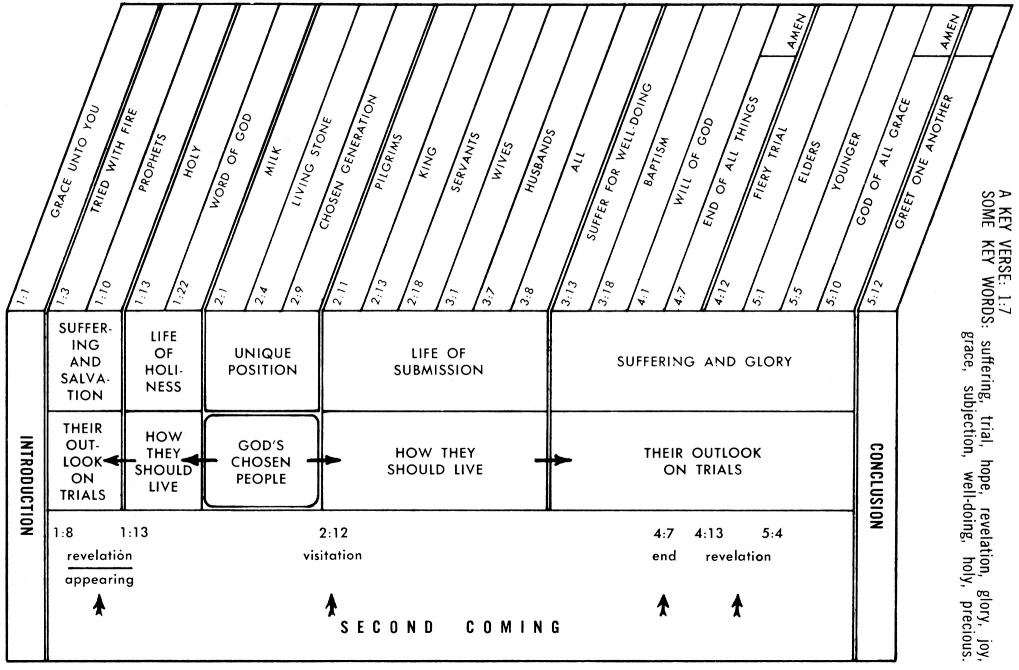
1 Peter: Trials, Holy Living & The Lord's Coming
Click chart to enlarge
Chart from Jensen's Survey of the NT - used by permission
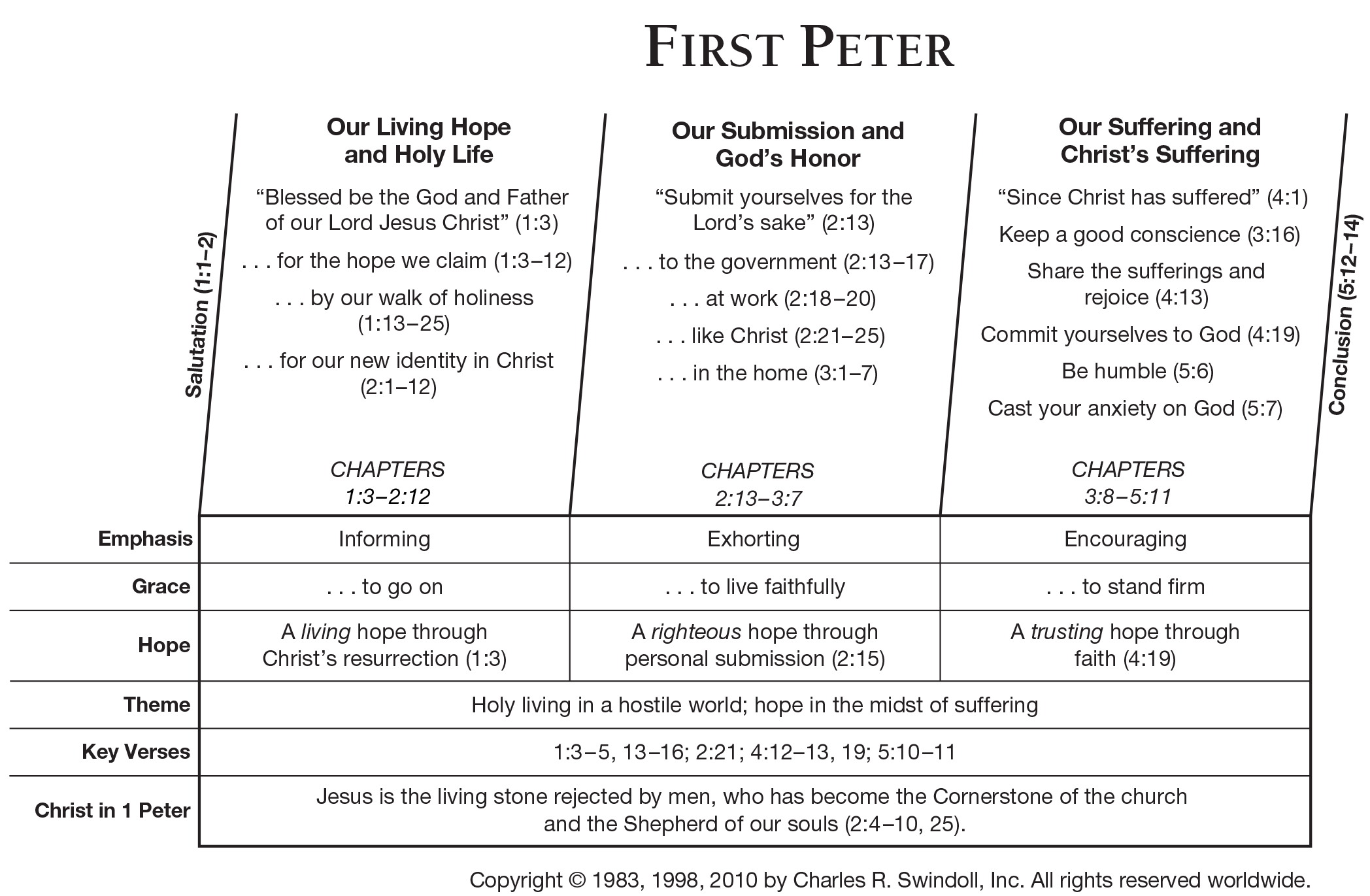
See Another Chart from Charles Swindoll
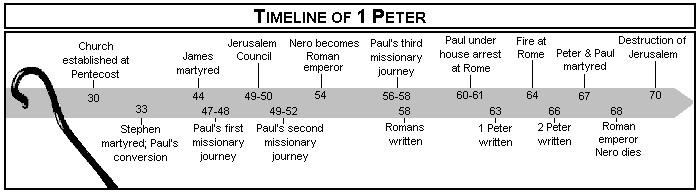
Source: Borrow Ryrie Study Bible
Click to enlarge
PART I: DOCTRINAL FOUNDATION
I. The Opening Salutation (1Pe 1:1-2)
A. The Writer (1Pe 1:1a)
B. The Readers (1Pe 1:1b-2a)
1. True character of the readers (1Pe 1:1b)
2. Geographical location of the readers (1Pe 1:1c)
3. Spiritual supports for the readers (1Pe 1:2a)
C. The Greeting (1Pe 1:2b)
II. The Thanksgiving for Our Salvation (1Pe 1:3-12)
A. The Description of Salvation (1Pe 1:3-5)
1. The author of salvation (1Pe 1:3a-b)
a. His relation to the Savior (1Pe 1:3a)
b. His act of mercy to the saved (1Pe 1:3b)
2. The nature of salvation (1Pe 1:3c-4a)
a. The living hope grounded in Christ's resurrection (1Pe 1:3c)
b. The glorious inheritance awaiting believers (1Pe 1:4a)
3. The certainty of salvation (1Pe 1:4b-5)
a. The safekeeping of the inheritance (1Pe 1:4b)
b. The preservation of the heirs (1Pe 1:5)
B. The Experiences Relating to Salvation (1Pe 1:6-9)
1. The paradoxical nature of the experiences (1Pe 1:6-7)
a. The experience of exultation (1Pe 1:6a)
b. The experience of distress (1Pe 1:66-7)
1. The nature of the distress (1Pe 1:6b)
2. The purpose behind the trials (1Pe 1:7)
a. The testing of faith (1Pe 1:7a)
b. The outcome of the testing (1Pe 1:7b)
2. The sustaining relations of believers (1Pe 1:8-9)
a. Their dual relation to Jesus Christ (1Pe 1:8)
b. Their experiential relation to their salvation (1Pe 1:9)
C. The Magnification of Salvation (1Pe 1:10-12)
1. The magnification through prophetic research (1Pe 1:10-12a)
a. Their intensive search (1Pe 1:10a)
b. Their prophetic function (1Pe 1:10b)
c. Their personal perplexity (1Pe 1:11)
1. The time and circumstances (1Pe 1:11a)
2. The sufferings and the glories (1Pe 1:11b)
d. Their restricted ministry (1Pe 1:12a)
2. The magnification through Christian proclamation (1Pe 1:12b)
3. The magnification through angelic inquiry (1Pe 1:12c)
PART 2: PRACTICAL EXHORTATION
I. Exhortations in View of Our Salvation (1Pe 1:13-2:10)
A. The Life Arising from Salvation (1Pe 1:13-2:3)
1. The Christian life in relation to God (1Pe 1:13-21)
a. A life of steadfast hope (1Pe 1:13)
1. The supports of hope (1Pe 1:13a)
2. The call to hope (1Pe 1:13b)
b. A life of personal holiness (1Pe 1:14-16)
1. The foundation for personal holiness (1Pe 1:14a)
2. The call to personal holiness (1Pe 1:14b-15)
a. The negative demand of holiness (1Pe 1:14b)
b. The positive call to holiness (1Pe 1:15)
3. The justification of the call to holiness (1Pe 1:16)
c. A life of motivated reverence (1Pe 1:17-21)
1. The basis for reverent living (1Pe 1:17a)
2. The call for reverent living (1Pe 1:17b)
3. The knowledge that motivates reverence (1Pe 1:18-21)
a. The means of our redemption (1Pe 1:18-19)
b. The nature of the Redeemer (1Pe 1:20)
c. The characteristics of the redeemed (1Pe 1:21)
2. The Christian life in relation to the brethren (1Pe 1:22-25)
a. The experience of inner purification (1Pe 1:22a)
b. The duty of mutual love (1Pe 1:22b)
c. The foundation in personal regeneration (1Pe 1:23-25)
1. The fact of their regeneration (1Pe 1:23a)
2. The nature of their regeneration (1Pe 1:23b-25a)
3. The evangelization leading to their regeneration (1Pe 1:25b) (D Edmond Hiebert)
1 Peter 1:22 Since you have in obedience to the truth purified (RAP) your souls for a sincere love of the brethren, fervently love (AAM) one another from the heart, (NASB: Lockman)
Greek: Tas psuchas humon egnikotes (RAPMPN) en te hupakoe ten aletheias eis philadelphian anupokriton, ek [katharas kardias allelous agapesate (2PAAM) ektenos,
Analyzed Literal: Having [or, Since you have] purified your souls in obedience to the truth through [the] Spirit in sincere brotherly love [fig., affection for fellow-believers], love one another earnestly from a pure heart [fig., inner self],
Amplified: Since by your obedience to the Truth through the [Holy ] Spirit you have purified your hearts for the sincere affection of the brethren, [see that you] love one another fervently from a pure heart. (Amplified Bible - Lockman)
KJV: Seeing ye have purified your souls in obeying the truth through the Spirit unto unfeigned love of the brethren, see that ye love one another with a pure heart fervently: (Note: Phrase in green present only in the Textus Receptus not Nestle-Aland used for most modern translations).
NLT: Now you can have sincere love for each other as brothers and sisters because you were cleansed from your sins when you accepted the truth of the Good News. So see to it that you really do love each other intensely with all your hearts. (NLT - Tyndale House)
Wuest: Wherefore, having purified your souls by means of your obedience to the truth, resulting in not an assumed but a genuine affection and fondness for the brethren, an affection and fondness that springs from your hearts by reason of the pleasure you take in them; from the heart love each other with an intense reciprocal love that springs from your hearts because of your estimation of the preciousness of the brethren, and which is divinely self-sacrificial in its essence
Young's Literal: Your souls having purified in the obedience of the truth [through the Spirit ] to brotherly love unfeigned, out of a pure heart one another love ye earnestly,
SINCE YOU HAVE IN OBEDIENCE TO THE TRUTH PURIFIED YOUR SOULS: Tas psuchas humon hegnikotes (RAPMPN) en te hupakoe tes aletheias:
- Note: some manuscripts like Greek Textus Receptus -- KJV add "through the Spirit" after "truth
- John 15:3; 17:17,19; Acts 15:9; Romans 6:16,17; 2Thes 2:13; James 4:8
- 1 Peter 3:1; 4:17; Acts 6:7; Romans 1:5; 2:8; Galatians 3:1; 5:7; Hebrews 5:9; 11:8
- 1 Peter 1 Resources - Multiple Sermons and Commentaries
OBEDIENCE TO TRUTH
EVIDENCE OF TRUE BELIEF
Hiebert summarizes this last section - 1Pe 1:22-23 form one sentence, and the imperative "love one another" is its heart. The new life should be lived out in a community setting; it requires relationships of mutual affection among the brethren as the members of God's family. Peter reminded his readers of their experience of inner purification (1Pe 1:22a), emphasized the urgent duty of mutual love (1Pe 1:22b), and explained that regeneration is the basis that enables the Christian to love (1Pe 1:23-25). 1Pe 1:24-25 are an illustrative expansion of the teaching of 1Pe 1:23. (1 Peter Commentary)
Since you have - Peter appeals to the genuineness of his readers' conversions, a radical change they were well aware of. One of the radical changes of this new birth is that it brings is love for our brethren. You do have love for your Christian brethren don't you?
In obedience to the truth - Synonymous with believing the truth. We should not separate belief and obedience for true faith is obeying faith. Those who teach you can believe the truth but not obey the truth have difficulty with passages like this.
John 3:36 He who believes (present tense = as the general direction of their life) in the Son has eternal life; but he who does not obey (apeitheo [word study] - disbelieves willfully and perversely and as a lifestyle = present tense) the Son shall not see life, but the wrath of God abides on him."
Related Resource
- Study of phrase Obedience of faith
What is the evidence of a purified soul in this context? Love for the brethren. Holy living is incomplete if it isn’t accompanied by love. And such love is now possible for born again persons for as Paul explained to the believers in Rome…
the love of God has been poured out (ekcheo [word study] in the perfect tense = speaks of the permanence of this divine outpouring! PTL!) within our hearts through the Holy Spirit Who was given to us. (Ro 5:5)
Peter alluded to obedience in his opening words explaining that his readers were chosen "according to the foreknowledge of God the Father, by the sanctifying work of the Spirit, that you may obey Jesus Christ and be sprinkled with His blood: May grace and peace be yours in fullest measure. (1Pe 1:2)
In Romans, Paul uses the phrase obedience of faith like a pair of "bookends," as it were, enclosing Paul's magnum opus on the Gospel of Jesus Christ…
through whom we have received grace and apostleship to bring about the obedience of faith among all the Gentiles, for His name's sake (Ro 1:5-see discussion here on "obedience of faith")
but now is manifested, and by the Scriptures of the prophets, according to the commandment of the eternal God, has been made known to all the nations, leading to obedience of faith; (Ro 16:26)
Barnes writes that obedience to the truth refers to their "yielding to the requirements of truth, and to its fair influence on their minds, which has been the means of their becoming pure. The truth here referred to is, undoubtedly, that which is revealed in the Gospel--the great system of truth respecting the redemption of the world. (Barnes NT Commentary)
Fronmuller (Lange's Commentary) on phrase in obedience to the truth - By absolute subjection to the truth given in the word of God, by keeping it and causing it to work in the heart. Obedience to the faith and moral obedience are again comprised in one. Truth has a purifying and separating power, removing all obstacles to the exercise of brotherly love, such as selfishness, obstinacy, self-sufficiency, men-pleasing, ambition, flattery, in fact, all manifestations of egotism. Because true believers are the children of God, 1Pe 1:3, 14, 17, they should act as brethren one to another. This is one of the principal commandments of Christ Himself, and consequently one of the main ends of holiness, Mt 22:40; Mk 12:31; Lk 10:28; Jn 13:34, 35; cf. 1Pe 2:17; 1Pe 5:9. But because selfishness, deceit, hypocrisy and flattery are frequently hidden under the cloak of love, the word anupokritos is added. (A Commentary on the Holy Scriptures)
John Piper comments on the critical importance of understanding the phrase obedience of faith asking "How then does our own obedience—“the obedience of faith”—relate to justification? The answer is: Our obedience is not the ground or the basis of our justification. Nor is it any part of the instrument or means by which we are united to Christ who alone is the ground and the basis of our justification. Faith alone unites us to Christ and Christ alone is the ground of our justification. Our obedience is the fruit of that faith. The faith that justifies is the kind of faith that, by the Holy Spirit (Ro 8:13), changes us. If your faith in Christ leaves you unchanged, you don’t have saving faith. Obedience—not perfection, but a new direction of thought and affections and behavior—is the fruit that shows that the faith is alive. James put it this way, “So also faith by itself, if it does not have works, is dead” (James 2:17). Faith alone justifies, but the faith that justifies is never alone. It is always accompanied by “newness of life” (Ro 6:4). Live in the Joy and Assurance of the Gospel - When Paul begins and ends his letter with the goal of “the obedience of faith,” he means for us to live in the joy and the assurance of the first five chapters of Romans, where he shows that we are “justified by faith apart from works of the law” (Ro 3:28). And then out of that faith and peace and assurance and boldness, a new mind and a new man emerge and the fruit of obedience grows. And the reality of justifying faith is made manifest. I pray that you will trust in Christ alone as the ground and basis of your justification before God, present and future, and that this faith prove its life and truth by producing a passion for obedience to God—the obedience of faith. (See further relevant texts: Ro 14:23 (note); Gal 5:6; 1Th 1:3 (note); 2Th 1:11; He 11:4, 7, 8, 17, 24.) (See full sermon Command of God: The Obedience of Faith)
Hiebert - "By obeying the truth" (en tē hupakoē tēs alētheias, more literally, "in connection with the obedience to the truth") explains how their experience of purification became operative. The preposition en may denote either the sphere in which the purification became operative or "by" (NIV) as the means whereby the purification was effected. "The obedience" denotes the needed human response to the hearing of the gospel message. Our obedience is not in itself the instrument or means that procures purification; it designates the needed human response to the message which enables the Spirit to purify. "Obedience" as a compound noun (hupo, "under," and akoē, "the act of hearing") conveys the thought of attentively listening to an authoritative pronouncement and then submitting to it in obedience. The words are "but another and fuller way of expressing their faith." It is an obedience that springs from hearing in faith. Such an obedience to the gospel "brings us, not into a state of bondage, but into one of glorious liberty in which the heart is free and the conscience is pure." (Ibid)
Obedience (5218) (hupakoe [word study] from hupo = under + akouo = hear) literally means to "hear under" which conveys the picture of attentive hearkening, of listening and following instructions, of being in compliance or of listening and submitting to that which is heard. Hupakoe conveys the picture of one listening and following instructions. Submitting to that which is heard involves a change of attitude, forsaking the tendency of the fallen nature to rebel against Divine instructions and commands and seeking God's will, not self will. Someone has said that a "proof" that we are of the elect is not an empty prating about how secure we are once we believed, but rather how sensitive we are to the principle and practice of obedience to Jesus. Vincent notes that hupakoe was a "peculiarly New Testament term unknown in classical Greek."
Here in 1 Peter "obedience to the truth" refers to subjection to the saving will of God revealed in Christ. It is notable that this is the second time Peter describes saving faith as an act of obedience (1Pe 1:2).
In Romans, Paul twice uses the phrase “the obedience of faith.” (Ro 1:5,16:26) We should not try to separate belief and obedience. True faith is obeying faith (He 3:18, 19 where you see unbelief paralleled with disobedient.)
Illustration - A missionary translator was endeavoring to find a word for “obedience” in the native language. This was a virtue seldom practiced among the people into whose language he wanted to translate the New Testament. As he returned home from the village one day, he whistled for his dog and it came running at full speed. An old man, seeing this, said, admiringly in the native tongue, “Your dog is all ear.” Immediately the missionary knew he had his word for obedience. (Encyclopedia of 7700 Illustrations by Paul Lee Tan)
To the truth - In context the truth is the Gospel (cf. 2 Th. 2.10, 12, 13; Jn. 14:6; Eph. 1:13; Col. 1:5; Gal. 5:7).Hiebert says that "The genitive "of the truth" (tēs alētheias) may be interpreted as subjective—the obedience that truth demands and works in the believer, but more probably, the genitive is objective—obedience to the truth as revealed in the gospel. Oberst well observes, "Souls are not purified when one submits to false teaching or deceitful doctrines."
Note that the phrase through the Spirit in the KJV reflects the Textus Receptus manuscript and is not present in Nestle-Aland, so generally they are not considered as in the original Greek text. Of course internal purification ultimately is a supernatural work of the Spirit so the KJV is certainly not theologically incorrect.
Wayne Barber reiterates this important truth emphasizing that believers have a "willingness to obey. That doesn’t mean Christians always obey. But you cannot habitually live disobedient unto God. You may have an area that will trip you up. But at some point you will confess, repent and come back to God. Why? Because Life is inside of you. It is a Person. The divine Seed of Life is in you, and you can’t be left to do what you want to do. God will either take you out of here, or He’ll prune you. He’ll cut you back and cut you back and cut you back until finally He disciplines. He scourges and chastens those whom He loves. He doesn’t let us get away with lawless living. You find a person who claims to know Christ and lives in sin, lives lawlessly as a habitual practice, that person does not know Christ" (see 1Jn 2:10,11, 3:9,10, 5:2).
You… purified - Obviously we do not have the power to produce personal purity, but God it is the Holy Spirit Who purifies our souls when we are saved.
Purified (48) (hagnizo from hagnos = freedom from defilements or impurities; see also word study on related word hagios = holy, saint) in the literal sense refers to ceremonial washings and purifications undertaken to purify oneself from ritual defilement. In the context of this ceremonial purification the idea was withdrawal from the profane (common) and dedication to God, thereby making one ceremonially ready. This sense is seen in the OT uses in the Septuagint (LXX) - see below, where hagnizo was used of the the Nazirites who took upon themselves a temporary or a life-long vow to abstain from wine and all kinds of intoxicating drink, from every defilement and from shaving the head. Luke seems to make allusion to a similar Nazirite-like practice by Paul in Acts 21:24, 26, 24:18.
Hagnizo - 7x in 7v - John 11:55; Acts 21:24, 26; 24:18; Jas 4:8; 1 Pet 1:22; 1 John 3:3. NAS = purified(2), purifies(1), purify(3), purifying(1).
Hagnizo - 25x in Septuagint (LXX)- Ex 19:10; Num 6:3; 8:21; 11:18; 19:12; 31:19, 23; Josh 3:5; 1 Sam 21:5; 1 Chr 15:12, 14; 2 Chr 29:5, 15ff, 34; 30:3, 15, 17f; 31:18; Isa 66:17; Jer 12:3;
The root word hagnos describes what is morally undefiled and when used ceremonially describes that which has been so cleansed that it is fit to be brought into the presence of God and used in His service. James uses this root word hagnos in his list of characteristics of heavenly wisdom (Jas 3:17). Hagnos describes a purity which affects a not only a person’s motives but also their conduct. In short, hagnizo is a verb used in Scripture to describe ceremonial and/or spiritual purification, and addressing both the external and internal aspects of our being. As stated, James is commanding his readers to undertake an internal cleansing.
Three of the NT uses of hagnizo refer not to literal (ritual/ceremonial) purification, but to ethical/moral or internal/heart purification (Jas 4:8-hagnizo, 1Pe 1:22; 1Jn 3:3), where the emphasis is not on external cleansing but on internal cleansing so that one's heart is fully devoted to the Lord and His will and way. The present context of 1Pe 1:22 describes an internal, supernatural cleansing which occurred when they received the living and abiding word and were caused to be born again by God (1Pe 1:3). Peter says a person is purified when he or she obeys the truth (the Word of God, the Gospel) and in context Peter is referring to the initial experience of salvation (justification) by grace through faith.
Hagnizo is in the perfect tense signifying a past act (the moment we believed the Gospel) with ongoing effects (enabled to sacrificially love others). The perfect tense underscores the permanence of the once for all transaction of salvation. The point is that one's salvation cannot be lost. Thus even the verb tense (perfect) supports the eternal security of the believer and counters the teaching that one can lose their salvation (cp Jesus' words of assurance in Jn 10:27, 28, 29 which could not be more plainly stated!)
Hiebert - In the Septuagint, the concept of purification is usually ceremonial. It also has the ceremonial sense in John 11:55, Acts 21:24, 26, and 24:18. But here, as in James 4:8 and 1 John 3:3, the verb denotes moral purification. It looks back to the thought of 1Pe 1:2 and 1Pe 1:15. The term expresses the moral purity demanded in the life and character of those who have been brought into a personal relationship with the holy God (1Pe 1:16; 1 John 3:3)… The perfect active participle, hēgnikotes, "having purified," looks back to a specific past experience that has a present result. The cleansing took place at the time of the readers' regeneration, and so they were in a state of being clean (cf. John 13:10; 15:3; 17:19). The impact of that cleansing "extends beyond mere external separation from heathen worship and habits to the abandonment of false principles and beliefs, and evil desires and passions." That purification is a necessary antecedent to life in the Christian community. The use of the active voice marks the experience of cleansing as a matter that involved the will of the readers. They acted to receive the cleansing by placing themselves under obedience to the Word of God. In Acts 15:9, Peter spoke of God cleansing the heart by faith; here the reference is to the human involvement in cleansing. In both instances the reference is to the purification that initiates the Christian life.(Ibid)
Matthew Henry - To purify the soul supposes some great uncleanness and defilement which had polluted it, and that this defilement is removed. Neither the Levitical purifications under the law, nor the hypocritical purifications of the outward man, can effect this. The word of God is the great instrument of a sinner’s purification. The Gospel is called truth, in opposition to types and shadows, to error and falsehood. This truth is effectual to purify the soul, if it be obeyed, John 17:17. Many hear the truth, but are never purified by it, because they will not submit to it nor obey it… The souls of Christians must be purified before they can so much as love one another unfeigned. There are such lusts and partialities in man’s nature that without divine grace we can neither love God nor one another as we ought to do; there is no charity but out of a pure heart. It is the duty of all Christians sincerely and fervently to love one another. Our affection to one another must be sincere and real, and it must be fervent, constant, and extensive.
Our position (purified) forms the basis for our practice (fervent love). Note that it is God of course Who purifies our souls when we are saved for fallen men and women do not have the power to bring about personal internal moral purity.
FOR A SINCERE LOVE OF THE BRETHREN: eis philadelphian anupokriton:
- 1Pe 2:17; 3:8; 4:8; Jn 13:34,35; 15:17; Ro 12:9,10; 2Cor 6:6; Eph 4:3; 1Thes 4:8,9; 1Ti 1:5; Heb 6:10; 13:1; James 2:15,16; 2Pe 1:7; 1 John 3:11,14-19,23; 4:7,12,20,21; 5:1,2
- 1 Peter 1 Resources - Multiple Sermons and Commentaries
For a sincere love - literally unto or into a sincere love. This is love which is not dishonest or hypocritical. It's not "two faced" which means marked by deliberate deceptiveness, especially by pretending one set of feelings and acting under the influence of another. And so one of the primary goals of our salvation is that we might show sincere love to fellow believers. Adam Clarke paraphrases it "a fraternal affection without hypocrisy."
HOW CAN WE LOVE WITH A SINCERE LOVE? Such a love should be the natural (actually supernatural) outflow of a heart by the living and abiding Word and regenerative effect of the Holy Spirit (See Spirit-Filled Believers Are Like Artesian Wells). Ultimately such a pure supernatural love like God loves is possible only as we rely wholly on the supernatural power the Holy Spirit! Why do we say we must rely on the Spirit? Love is something we "bear" (it "grows") in a heart filled with the Spirit, not something we conger up! Gal 5:22 says "But the fruit of the Spirit is love, joy, peace, patience, kindness, goodness, faithfulness." God has give us the reservoir of love in our hearts. Romans 5:5 says "hope does not disappoint, because the love of God has been poured out within our hearts through the Holy Spirit who was given to us." In Col 1:8 Paul writes Epaphras "also informed us of your love in the Spirit." ("the love for others that the Holy Spirit has given you." = Col 1:8NLT) In Ro 15:30 Paul requests prayer writing "Now I urge you, brethren, by our Lord Jesus Christ and by the love of the Spirit, to strive together with me in your prayers to God for me." (NLT = "because of your love for me, given to you by the Holy Spirit.") And finally Eph 5:25 " Husbands, love (present imperative = habitually, as a lifestyle sacrificially love) your wives, (WHAT'S YOUR PATTERN?) just as Christ also loved the church (HOW DID CHRIST LOVE THE CHURCH?) and gave Himself up for her." Woe! That sounds like death to self! Just try that quality/quantity of love in your own strength/power (your old self)! You can't do it! It is impossible! But it is HIM-possible! What do I mean? Look at the context of Eph 5:25. What do you see a few verses before? Eph 5:18 says "do not get drunk with wine, for that is dissipation, but be filled (present imperative - not a suggestion but a divine "mandate"!) with the Spirit." And guess what the very next word in the Greek text of Eph 5:19 is? It is "speaking"! Does our speech demonstrate our self-less love for our wives? Absolutely. And one way to grieve the Spirit is by our rotten speech (compare Paul's command for wholesome speech in Eph 4:29 and Eph 4:30!) You see, the only way to love our wives well is by loving like Christ and when He lived His life as the God-Man (giving us the perfect pattern to follow) He loved by the power of the Spirit (read Lk 4:14 and Acts 10:38). In summary God-like love will require dependence on God, specifically God the Spirit. Sincere love is supernatural love and necessitates a supernatural Source. For more See discussion of the Need for the Holy Spirit to obey.
Why is demonstration of love so important? John writes that it is one of the supreme marks of the new birth writing that "We know that we have passed out of death into life, because we love the brethren. He who does not love abides in death." (1Jn. 3:14) As Wuest says "The world wears a mask. The love which it shows on the face is only external. That is feigned love. Ours should be unfeigned. If a saint does not have a love which is unfeigned, the trouble is with his adjustment to the Holy Spirit who is the One to provide that saint with that love. The Spirit-filled saint does not have to play the hypocrite in the matter of love, for love shines right out of his eyes. It is on his face, in his actions." A
Ever the lawyer, Tertullian the apologist subscribed to the view that the best defense is a good offense. His treatises To the Gentiles and Apology directly attacked pagan beliefs and practices as superstitious and immoral, and argued that the Christian life as taught in Scripture and practiced in the church was morally superior. He imagined pagans looking at Christians and saying, “Look . . . how they love one another (for they themselves [pagans] hate one another); and how they are ready to die for each other (for they themselves are readier to kill each other).” Convicted? So am I!
And in John's Gospel Jesus explains to His disciples "A new commandment I give to you, that you love one another, even as I have loved you, that you also love one another. By this (By what?) all men will know that you are My disciples, if you have love for one another." (John 13:34, 35).
Sincere (505) (anupokritos from "a" = without + hupokrinomai = to pretend) means unfeigned, without pretense, that is that which is genuine, free from deceit, authentic, undisguised, without pretense or sham and to use the "king's old English" to be "without dissimulation" (KJV) (dissimulate = hide under a false appearance). In classical Greek drama, the hupokrites (actor) wore a face-mask projecting an image but hiding his true identity under (hupo) a mask. Peter is saying that the Christian’s love should not be acting a part or wearing a mask, but should be an authentic expression of warm Christian affection. In a similar way Paul exhorts the believers at Rome to "Let love be without hypocrisy (anupokritos). Abhor what is evil; cling to what is good. (Ro 12:9) Believers are not simply to be "playing the part" but are to exemplify a love which is completely genuine, unhypocritical, without pretense or deceit. A believer's love is to be "the real thing".
Anupokritos is used by the NT writers to modify
- love (Ro 12:9, 2Cor 6:6, 1 Peter 1:22),
- faith (present verse and 1Ti 1:5) and
- wisdom (James 3:17).
Metaphorically and morally, a hupokrites (a hypocrite) is anyone who pretends to be something they are not. It is interesting to note that our English word sincere comes from the Latin sincerus, which means "without wax" which stems from a practice of the early Roman merchants who set their earthen and porcelain jars out for sale. If a crack appeared in one, they would fill it with wax the same color as the jar, so a buyer would not be aware that it was cracked. But astute buyers learned to hold these jars out in the sun, and if the jar was cracked, the wax would melt and the crack would be revealed. So the honest merchants would test their wares this way and mark them sincerus -- "without wax".
Hypocrisy is exceeded in evil only by unbelief. The consummate hypocrite in Scripture, Judas, was also the consummate egoist. He feigned devotion to Jesus to achieve his own selfish purposes. His hypocrisy was unmasked and his self-centeredness was made evident when he betrayed Jesus for the thirty pieces of silver. Peter's exhortation for us to manifest an unfeigned love implies that there can be a feigned "love". Don't be deceived. It is tragic when people try to “manufacture” love, because the product is obviously cheap and artificial. The love that we share with each other, and with a lost world, must be generated by the Spirit of God. It is a constant power in our lives, and not something that we turn on and off like a radio.
John Calvin - nothing is more difficult than to love our neighbors in sincerity. For the love of ourselves rules, which is full of hypocrisy; and besides, every one measures his love, which he shows to others, by his own advantage, and not by the rule of doing good. He adds, fervently; for the more slothful we are by nature, the more ought every one to stimulate himself to fervor and earnestness, and that not only once, but more and more daily.
By nature, all of us are selfish and it therefore took a work of grace to supernaturally give believers the selfless, sacrificial kind of love that God is and that He displays undeserving sinners. Because we “obeyed the truth through the Spirit,” God purified our souls and poured His love into our hearts, Paul recording that "hope does not disappoint, because the love of God has been poured out within our hearts through the Holy Spirit who was given to us. (Ro 5:5).
Love of the brethren (5360) (philadelphia from phílos = beloved, dear, friendly + adelphós = brother) means "fraternal love" or brotherly love (kindness) and was used in secular Greek life to describe mutual love of natural brothers and sisters. And so brotherly love normally referred to the love members of a family held for each other and would not normally be used to describe the love between members of different families. However, in the NT philadelphia is used to describe the supernaturally initiated and energized (cp Php 2:13P love which believers possess for one another. Even though they not naturally related, they were supernaturally related by their common union in Christ and were also recipients of divine family love originating from the Father Who had bestowed His great love on His spiritual children "See (a command) how great a love the Father has bestowed upon us, that we should be called children of God; and such we are. For this reason the world does not know us, because it did not know Him (1John 3:1)
Peter uses philadelphia in his second epistle describing one aspect of their growth in grace exhorting the believers to apply all diligence in their faith "and in your godliness, brotherly kindness, and in your brotherly kindness, love. (2Pe 1:7)
Philadelphia describes a love which calls for an affection for one another like that one expressed between natural family members (Ro 12:10 where devoted or "loving warmly" = philostorgos from philos = beloved, dear + storge = family love, the love of parents and children).
Remember that Christianity forged a radical relationship in Christ wherein believing Greeks and Jews, circumcised and uncircumcised, barbarians, Scythians, slaves and freemen, men and women were now all one in their Lord (cp Gal 3:28, Col 3:11, Ep 4:3). Such a diverse cultural community would have continual need for emphasis on love of the brethren.
As Christians we have become brothers and sisters in the community of faith and Paul refers to them as brothers (sisters is clearly implied) some nineteen times in his first letter to the Thessalonians (and most of these believers had been rank idol worshippers so for a Jew to call them brothers requires a supernatural work). Our love is not just a passive disposition of fondness but manifests itself in overt acts of kindness toward the brethren.
Love for the brethren is an evidence that we truly have been born of God, as John explains in his first epistle…
Beloved, let us love one another, for love is from God; and everyone who loves is born of God and knows God. 8 The one who does not love does not know God, for God is love. 9 By this the love of God was manifested in us, that God has sent His only begotten Son into the world so that we might live through Him. 10 In this is love, not that we loved God, but that He loved us and sent His Son to be the propitiation for our sins. 11 Beloved, if God so loved us, we also ought to love one another. 12 No one has beheld God at any time; if we love one another, God abides in us, and His love is perfected in us. (1Jn 4:7-21).
Now as obedient children (1Pe 1:14) we are no longer to live in the selfish desires of our old nature, for believers are partakers of His divine nature and have a new to love.
William Barclay - The Christ-filled life is the life of brotherly love. It must issue in a love for the brethren which is sincere and hearty and steadfast. The Christian is a man who is reborn, not of mortal, but of immortal seed. That may mean either of two things. It may mean that the remaking of the Christian is due to no human agency but to the agency of God, another way of saying what John said when he spoke of those "who were born, not of blood, nor of the will of man, but of God" (John 1:13). More probably it means that the Christian is remade by the entry into him of the seed of the word; and the picture is that of the Parable of the Sower (Matthew 13:1-9). The quotation which Peter makes is from Isaiah 40:6-8 and the second interpretation fits that better. However we take it, the meaning is that the Christian is remade. Because he is reborn, the life of God is in him. The great characteristic of the life of God is love, and so the Christian must show that divine love for men. The Christian is the man who lives the Christ-filled life, the life that is different, never forgets the infinity of its obligation, and is made beautiful by the love of the God who gave it birth. (Daily Study Bible)
FERVENTLY LOVE ONE ANOTHER FROM THE HEART: ek (katharas) kardias allelous agapesate (2PAAM) ektenos:
- Philippians 1:9; 1Th 3:12; 2Th 1:3; Rev 2:4
- 1 Peter 1 Resources - Multiple Sermons and Commentaries
FERVENT
LOVE
KJV (Textus Receptus) qualifies the NAS from the heart, but adding "love one another with a pure heart fervently."
From the heart (or with a pure heart) - When we entered the New Covenant by grace through faith, we received a new heart and God's Spirit (see Ezekiel 36:26, 27 which is an OT promise of the New Covenant). Now with our new heart, enabled by the Spirit, our motive in loving one another is not to get but to give. The world teaches that if you give to others, you will be able to manipulate them and ultimate fulfill your selfish desires. Love from the (pure) heart never seeks to use others to its advantage.
Because of our new position (purified souls) we are commanded to a new practice (sincere love of the brethren). In other words, our position in Christ forms the basis for our practice in the power of His Spirit (cf Gal 5:22; Gal 5:23). The principle that doctrine determines duty permeates the Scriptures, for as James said…
if anyone is a hearer of the word and not a doer, he is like a man who looks at his natural face in a mirror for once he has looked at himself and gone away, he has immediately forgotten what kind of person he was. (Jas 1:23, 24)
Fervently love one another - Matthew Henry writes that this exhortation "supposes that the Gospel had already had such an effect upon them as to purify their souls while they obeyed it through the Spirit, and that it had produced at least an unfeigned love of the brethren; and thence he argues with them to proceed to a higher degree of affection, to love one another with a pure heart fervently
Leighton - The true reason why there is so little truth of this Christian mutual love amongst those that are called Christians, is, because there is so little of this purifying obedience to the truth, whence it flows; faith unfeigned would beget this love unfeigned: men may exhort to them both, but they require the hand of God to work them in the heart.
Paul's prayer for the saints at Philippi was to manifest and experience an abounding love for one another "And this I pray, that your love may abound still more and more in real knowledge and all discernment, so that you may approve the things that are excellent, in order to be sincere and blameless until the day of Christ (Php 1:9, 10)
Paul gives a similar charge to the saints in Thessalonica who have come out of paganism and idol worship exhorting them "Now as to the love of the brethren, you have no need for anyone to write to you, for you yourselves are taught by God to love one another; for indeed you do practice it toward all the brethren who are in all Macedonia. But we urge you, brethren, to excel still more. (1Th 4:9, 10)
Fervently (1619) (ektenos from ek = out + teíno = to stretch; English = tension, etc) literally pictures one "stretching out" to love others! It pictures "an intense strain" and unceasing activity which normally involving a degree of intensity and/or perseverance. Stretched out and extended to the limit is the idea. Jowett suggests the picture of the tension and energy of a stringed instrument, "as when the string of a violin has been stretched to a tighter pitch that it might yield a little higher note." Cranfield suggests the figure of "the taut muscle of strenuous and sustained effort, as of an athlete."
Ektenos is from the verb ekteino which means to “stretch out the hand.”, thus it means to be stretched out—earnest, resolute, intense. The fundamental idea is earnestness, zealousness -- not doing something lightly and perfunctorily but straining as it were to do it!
Ektenos was an athletic term conveying the meaning of “striving with all of one’s energy” and was used to describe a runner who was moving at maximum output with taut muscles straining and stretching to the limit. This meaning presents the clear picture that love is not something that will just happen, but is something we have to work at like an Olympic athlete who strives to master his area of expertise with all his energy. We must make the choice and be earnest, resolute, even intense in our practice of agape love, always in complete dependence of God's indwelling Spirit and His living and abiding Word.
Fronmuller writes that ektenos "is a very pregnant addition. It denotes stretching out, straining, putting forth strenuous effort, hence (a) by straining and extending every energy, by untiring elasticity, (b) by sustained perseverance, (c) by extending it to such brethren as appear less worthy of love. Weiss: “With lasting, persevering energy, that cannot be tired out by the cumulating guilt of our neighbor,” 1Pe 4:8. The possibility of such a mode of conduct belongs to the state of regeneration, 1Pe 1:23; cf. Mt 18:21, 22. Steiger. “As natural relationship produces natural affection, so spiritual relationship produces spiritual affection.” It is lasting, because emanating from an eternal source of life. (Lange's Commentary)
Peter is saying in essence "Stretch to the limits in your loving others sacrificial and selflessly."
Roger Raymer adds that "This love is to be expressed not shallowly but “deeply” (ektenos, “at full stretch” or “in an all-out manner, with an intense strain”…). (Bible Knowledge Commentary)
Vincent writes that ektenos is a compound work "with the verb teino, to stretch, and (signifies) intense strain; feeling on the rack (an instrument of torture on which a body is stretched)."
Vine - The idea suggested is that of not relaxing in effort, or acting in a right spirit.
In the only other NT use, ektenos describes the church's prayer for Peter in prison
So Peter was kept in the prison, but prayer for him was being made fervently by the church to God. (Acts 12:5) (Note that the Textus Receptus - used to translate the KJV - actually has the closely related word ektenes not ektenos as does the Nestle-Aland which is used for the NAS translation.)
The comparative form of the closely related adjective ektenes (ektenesteron) is used to describe the intensity of our Lord's prayer in Gethsemane
And being in agony He was praying very fervently (ektenesteron); and His sweat became like drops of blood, falling down upon the ground. (Luke 22:44)
Comment: what a picture of the passion of Jesus in prayer!
Note that ektenos is used only here and in some manuscripts (Nestle-Aland) in Acts 12:5. As mentioned above, Acts 12:5 in the Textus Receptus uses the closely related adjective ektenes., which is also used in chapter 4 of first Peter…
Above all, keep fervent (ektenes) in your love for one another, because love covers a multitude of sins. (1Pe 4:8)
MacDonald commenting on fervently love one another - The exhortation to love one another is especially timely for a people undergoing persecution because it is well known that “under conditions of hardship, trivial disagreements take on gigantic proportions.” (Believer's Bible Commentary: Thomas Nelson)
Love (25) (agapao) (Click study of agapao) speaks of an unconditionally, sacrificial love, which is ultimately the love that God demonstrates and even "is" ("God is love" 1Jn 4:8, 16). By nature, in Adam (Ro 5:12), all men are are selfish and therefore only a a miracle of God could give sinners this quality of divine, saintly love. Agape love is neither a not sentimental or emotional type love (philadelphia had an emotional aspect) so often depicted in television, movies and magazines. Instead, agape love demands an act of obedience by the lover for the "lovee" and thus represents a specific volitional choice or act of the lover's will. Agape love desires the recipients highest good whether one they deserve it or not or whether the lover feels like giving it or not. If is not a matter of how one feels. Feelings can be deceiving and can emanate from our fallen flesh nature. Too many marriages are falling apart because one party doesn't feel like they love the other party any longer. That is unbiblical for a believer, for we are commanded to demonstrate a love based on God's truth and we can carry out this command empowered by God's Spirit as we yield to His control in every circumstance that might cause us to not "feel" like loving the other person. Agape love is not conditional but is to be given to one's spouse or any other person, believer or not even if or when it is not received or is not returned! "Impossible" you protest! Indeed, this supernatural love is not humanly possible but only possible because God's Spirit is within us both to give us the "want to" and to give the "power to" carry it out. (Php 2:12; Php 2:13)
Note that in this verse, the verb "love" is not a suggestion but a clear command to be immediately (even urgently) obeyed each time one encounters a person or circumstance that might otherwise tempt us to rely on and respond out of our fallen nature. To grow in grace is to recognize those circumstances (especially "adverse" circumstances) and those people (especially "difficult" people) and then surrendered to and empowered by the Holy Spirit (in other words as you encounter these circumstances or people, you are already walking in the Spirit, being controlled by the Spirit) the giving of agape love is your "supernatural reflex". In other words you act (based on the truth) don't react (based on your feelings)!
The aorist tense and imperative mood commands the believer to carry out this act of love now and do it effectively. The active voice indicates that each believer must decide in his or her mind to carry out this love. It is decision of your will. Imperative mood (a command which conveys the sense of urgency). Now pause a moment and be honest - aren't their some brethren and "sistern" that you would just rather not be around? If we are honest, all of us would answer affirmatively. And so the command to love includes not just your favorite brethren, but all the brethren. The point is that obeying this command cannot be accomplished naturally, but only supernaturally, only by relying on the enabling power of the Holy Spirit. In fact, I would postulate that EVERY command in the New Testament (especially those related to behavior), is a call for us to jettison self-reliance and surrender to the Spirit's empowering presence in order to fulfill the command! E.g., husbands love (it's a command in the present tense, calling for continually manifesting this divine quality of love, agape love to) your wives as Christ loved the Church! Just try to accomplish that in your own strength! That's why Ephesians 5:18 precedes Ephesians 5:25! Be filled, then you love like Christ! There is simply no other way to carry out this or any other of the NT commands in our own frail power!
Wuest adds that agape "speaks of a love which in its classical usage refers to a love called out of one’s heart by the preciousness of the person loved, which usage is carried over into the NT, but which word has an additional content of meaning poured into it by the way it is used in certain contexts such as (John 3:16), where the idea of self-sacrifice for the benefit of the person loved is added to its classical meaning, (1Cor13:4ff) where the constituent elements of its Biblical usage are listed, and (1Jn 4:8), where it is said to refer to the love that God is. Thus, the exhortation is to love one’s brother Christian because he is precious to God, and to love him with a love that is willing to sacrifice one’s self for the benefit of that brother, a love that causes one to be long suffering toward him, a love that makes one treat him kindly, a love that so causes one to rejoice in the welfare of another that there is no room for envy in the heart, a love that is not jealous, a love that keeps one from boasting of one’s self, a love that keeps one from bearing one’s self in a lofty manner, a love that keeps one from acting unbecomingly, a love that keeps one from seeking one’s own rights, a love that keeps one from becoming angry, a love that does not impute evil, a love that does not rejoice in iniquity but in the truth, a love that bears up against all things, believes all things, hopes all things, endures all things. That is the kind of love which God says one Christian should have for another. These Christians to whom Peter was writing already had a fondness and an affection for one another. The feeling of fondness and affection was perfectly proper in itself, but it could degenerate into an attachment for another which would be very selfish. But if these Christians would blend the two kinds of love, saturate the human fondness and affection with the divine love with which they are exhorted to love one another, then that human affection would be transformed and elevated to a heavenly thing. Then the fellowship of saint with saint would be a heavenly fellowship, glorifying to the Lord Jesus, and most blessed in its results to themselves. There is plenty of the phile fondness and affection among the saints, and too little of the agape divine love." (Wuest's Word Studies from the Greek New Testament: Eerdmans)
Love is something we have to work at, just as an Olympic contestant has to work at his particular skills. Christian love is not a feeling; it is a matter of the will. We show love to others when we treat them the same way God loves us (unconditionally, sacrificially). God forgives us, so we forgive others. God is kind to us, so we are kind to others. It is not a matter of feeling but of willing, and this is something we must constantly work at… Jesus must be always increasing in us and our old self always decreasing. How do we love this way? By letting the word of Christ dwell in us richly and by being continually filled with (controlled by) the Holy Spirit of God. The same truth that we trusted and obeyed to become God’s children is our "power source" to nurture and enable us. It is impossible to love the truth and hate the brethren. The Spirit of God produces this agape type love as a beautiful “fruit” in our lives (Gal 5:22; Gal 5:23).
As Vance Havner quipped - Never before has the church had so many degrees yet so little temperature.
We love “with a pure heart” and not with a motive to get but in fact to give. There is a popular teaching that that uses "love" to subtly manipulate others in order to get what one wants. If our love is sincere and from a pure heart, we do not “use people” for our own advantage.
One another - Peter is calling for a reciprocal love, not a one sided love.
Related Resource:
From the heart - Not the head, but the innermost part of one's being, the heart representing the "control center." This love is made possible for the "love of God has poured out within our hearts through the Holy Spirit who was given to us." (Ro 5:5).
Barnes writes that "The phrase "with a pure heart fervently," means
(1.) that it should be genuine love, proceeding from a heart in which there is no guile or hypocrisy; and
(2.) that it should be intense affection, (ektenos) not cold and formal, but ardent and strong. If there is any reason why we should love true Christians at all, there is the same reason why our attachment to them should be intense. (Barnes NT Commentary)
1 Peter 1:23 for you have been born again (RPP) not of seed which is perishable but imperishable, that is, through the living (PAP) and abiding (PAP) word of God. (NASB: Lockman)
Greek: anagegennemenoi (RPPMPN) ouk ek sporas phthartes alla aphthartou dia logou zontos (PAPMSG) Theou kai menontos; (PAPMSG)
Analyzed Literal: having been [or, because you have been] regenerated [or, born again] not from corruptible seed but incorruptible, through [the] word of God [which is] living and remaining into the age [fig., forever].
Amplified: You have been regenerated (born again), not from a mortal [4] origin ([5] seed, sperm), but from one that is immortal by the ever living and lasting Word of God. (Amplified Bible - Lockman)
NLT: For you have been born again. Your new life did not come from your earthly parents because the life they gave you will end in death. But this new life will last forever because it comes from the eternal, living word of God. (NLT - Tyndale House)
Wuest: having been begotten again through the Word of God which lives and abides;
Young's Literal: being begotten again, not out of seed corruptible, but incorruptible, through a word of God -- living and remaining -- to the age;
FOR YOU HAVE BEEN BORN AGAIN: anagegennemenoi (RPPMPN):
- 1 Pe 1:3; John 1:3; John 3:5
- 1 Peter 1 Resources - Multiple Sermons and Commentaries
- See comments on the New Birth in John 3:3
THE FOUNDATION OF
THEIR NEW LOVE
The quality of love Peter is calling for is only possible in one who has been born from above, and Peter goes on to explain how that has transpired.
For - There is actually no "for" in the Greek text, but this addition by the NAS does serve to introduce an explanation of how it is possible to fervently love one another from the heart. Such love is not natural but is supernatural and can only be produced as a fruit by the indwelling Spirit (Gal 5:22, Ro 5:5). Are you filled with (controlled by) the Spirit (Eph 5:18), walking by the Spirit (Gal 5:16)? If so, you are equipped to manifest this divine like love to others.
This truth (born again by the living and abiding word of God) will also form the basis for Peter's exhortations in the next chapter which is begins with therefore (1Pe 2:1)
J Vernon McGee reminds us that "You cannot be saved, you cannot be born again apart from the Word of God. This Book is the miracle that is in the world today. Although I believe this, I never cease to marvel at the letters I receive from folk who tell me that they have been born again and their lives have been transformed from listening to my Bible-teaching radio broadcast. It is wonderful, but I don’t understand how it happens; I only know that it is the result of the Word of God which liveth and abideth for ever. (McGee, J V: Thru the Bible Commentary: Thomas Nelson)
Born again (313) (anagennao from aná = renewal, again, up + gennáo = beget) (Click for more on anagennao) means to be given new birth and describes regeneration, the act of the Holy Spirit imparting to us a new life, making us partakers of the divine nature and thus children of God, a begetting anew. Note that in the context this verse teaches that the supernatural birth was through the instrumentality of the Word of God but then Verse 25 adds that it was the Word that was preached to them. It must be proclaimed to the lost. The perfect tense indicates an event that occurred in the past (at the time of belief) and having continuing effect. Perfect tense also emphasizes the abiding effect of this new birth and new life in Christ which makes possible the love they are called to display.
The idea of a new beginning through a new birth with the infusion of divine life was an idea that was widespread in the ancient world. It was an idea present in the mystery religions and also in Judaism. A proselyte to Judaism for example was regarded as a newborn baby!
Matthew Henry - The word of God is the great means of regeneration, James 1:18. The grace of regeneration is conveyed by the Gospel. This new and second birth is much more desirable and excellent than the first. This the apostle teaches by preferring the incorruptible to the corruptible seed. By the one we become the children of men, by the other the sons and daughters of the Most High. The word of God being compared to seed teaches us that though it is little in appearance, yet it is wonderful in operation, though it lies hid awhile, yet it grows up and produces excellent fruit at last.
Mutiny on the Bounty (Mutiny on the Bounty - Wikipedia) - In 1789, a group of mutineers put their officers on a longboat, took control of the H.M.S. Bounty, and sailed to Tahiti to enjoy a comfortable life. Fearing punishment, some of them, along with several Polynesians, later moved to uninhabited Pitcairn Island and burned the ship so there would be no evidence. Despite the South Pacific paradise-like setting, sexual immorality, jealousy, anger, alcohol, and disease took their toll until there was only one Englishman, ten women, and many children left. The remaining Englishman, Alexander Smith (See John Adams (mutineer) = Alexander Smith), discovered a Bible in the ship's goods, and thankfully, the next-to-last man had taught him to read before he died. Smith studied the Word, decided it held the answer to the community's problems, and initiated Sunday worship and daily prayer times for the remaining people. In 1808, an American ship happening upon the island was surprised to discover a thriving group of 35 English-speaking Christians. The power of Scripture can transform lives! As we learn in today's reading, the Word has an important role to play in spiritual rebirth and sanctification. The reading begins with a moral imperative found throughout the New Testament: “Love one another deeply from the heart.” This should be the natural (Ed: I would suggest "supernatural") result of purity and obedience (1Pe 1:22). This pursuit of holiness and love should in turn spring (supernaturally) from our salvation, which is linked with the message of salvation, the Gospel (1Pe 1:23; James 1:18). Being born again is a spiritual and eternal event (John 3:5-6), and the Bible is a spiritual and eternal revelation. Much more than a “good book,” it is the “living and enduring word of God,” as Isaiah had also proclaimed (1Pe 1:23-25). After being spiritually reborn, we are to “grow up” in our salvation (1Pe 2:2), progressing from spiritual infancy to maturity, as displayed in increasing love and righteousness. Our motive is greater intimacy with God (1Pe 2:3; cf. Ps. 34:8. TODAY ALONG THE WAY - Born again” is a popular phrase, but not everyone knows what it means. Do you? It means that when a person trusts in Jesus for salvation from sin, he or she essentially starts a new life as a new person. But without that trust, the Bible says you are “dead in your sins” (Col. 2:13). There's nothing you can do to save yourself. If you've never trusted in Jesus, let today be the start of your new life! (Today in the Word)
Warren Wiersbe on Born Again - Every great nation in history has become decadent and has finally been conquered by another nation. There is no reason why we should suppose that our nation will be an exception. Some nineteen world civilizations, in the past, have slipped into oblivion. There is no reason why we should think that our present civilization will endure forever. "Change and decay in all around I see," wrote Henry F. Lyte (1793-1847), and if our civilization is not eroded by change and decay it will certainly be swept away and replaced by a new order of things at the coming of Christ, which could happen at any time. Slowly but inevitably, and perhaps sooner than even Christians think, the world is passing away; but the man who does God's will abides forever. Long after this world system, with its vaunted culture, its proud philosophies, its egocentric intellectualism, and its godless materialism, has been forgotten, and long after this planet has been replaced by the new heavens and the new earth, God's faithful servants will remain—sharing the glory of God for all eternity. And this prospect is not limited to Moody, Spurgeon, Luther, or Wesley and their likes—it is open to each and every humble believer. If you are trusting Christ, it is for you. (Pause for Power: A Year in the Word)
NOT OF SEED WHICH IS PERISHABLE BUT IMPERISHABLE: ouk ek sporas phthartes alla aphthartou:
- Malachi 2:3; Romans 1:23; 1Corinthians 15:53,54
- 1John 3:9; 5:18
- See comments on the New Birth in John 3:3
- 1 Peter 1 Resources - Multiple Sermons and Commentaries
Seed (4701) (spora) is the productive unit of a plant representing the fertilized and ripened egg cell of a plant, capable of sprouting to produce a new plant thus enabling the species to perpetuate itself. A seed represents "the fertilized ripened ovule of a flowering plant containing an embryo and capable normally of germination to produce a new plant" (Webster) Hiebert notes that "The word "seed" (sporas), which appears only here in the New Testament, primarily denotes the activity of sowing, and was used figuratively of the act of procreation. It also denoted that which was sown, the seed.
Seed in this verse is identified as God’s Word as in Jesus' parable in Luke 8…
The sower went out to sow his seed; and as he sowed, some fell beside the road; and it was trampled under foot, and the birds of the air ate it up. (Luke 8:5)
Now the parable is this: the seed is the word of God. (Luke 8:11)
Constable - This “seed” shares the character of its Source. It never passes out of fashion nor does it become irrelevant. (Expository Notes)
The Dictionary of Biblical Imagery has an interesting description of seed writing that "A seed is a product and a producer, a small investment with large potential value, an essential detail, a step in a continuum of reproduction. Though one, it becomes many through death. It is a treasury, an allotment, an investment whose yield depends on its environment. Having central importance in agriculture, which is common to all nations from Adam, the seed yields fertile imagery for both OT and NT principles and events. At a physical level, the image of seed is preeminently of the potential for life and generation. (Ryken, L., Wilhoit, J., Longman, T., Duriez, C., Penney, D., & Reid, D. G. Dictionary of Biblical Imagery. Downers Grove, IL: InterVarsity Press)
A flower's seed or a man's seed (sperm) is perishable and the birth they generate is perishable but God's seed is imperishable and so when we are born of His seed He begets unto us His nature and that nature is a forever nature. Thus our new birth is into the sphere of forever… just another reason one needs to know God's Word to help them understand that they cannot be "unborn" (aka, "lose one's salvation") and but that they will live forever because God's everlasting, ever-living seed abides within them.
The apostle John writes that "No one who is born (perfect tense = speaks of permanence of this new birth = you cannot lose your salvation or be "unborn" beloved) of God practices (present tense = continually) sin, because His seed abides (present tense = continually) in him; and he cannot sin (present tense = habitually), because he is born of God." (1Jn 3:9).
Human life is brought into being by means of seed that must obey physical laws of decay and death, but not so with the spiritual life implanted by the Holy Spirit Who uses the Word of God to produce this new life.
John Piper - Peter defines the imperishable seed as "the living and abiding word of God" (or makes the Word the instrument of the seed). So there's the point again. It is not only imperishable, it is living and abiding. That is, it lasts. It will not fail you. If this seed—this Word—has brought you into being by the new birth, you will stay in being. Again the point is hope… The Word of God that he is talking about is the Gospel that has been preached to them—the good news that we have been reading about in this chapter—the ransom of the blood of Christ (1Pe 1:18; 1Pe 1:19) and the resurrection of Christ (1Pe 1:3, 1Pe 1:21), and the keeping power of God (1Pe 1:5), and the inheritance of God. All this good news was preached to them. And the point now in 1Pe 1:25 is that it is not like grass and flowers: it doesn't wither and fall; it abides forever. If this Word is your life, you live forever. The point is hope. (The Seed of the Word and the Fruit of Love)
Seed which is imperishable - Samuel Ridout writes that there are: "three incorruptible things we have in this first chapter—an incorruptible inheritance (1Pe 1:4), an incorruptible redemption (1Pe 1:18; 1Pe 1:19), and an incorruptible word by which we are born (1Pe 1:23). Thus we have a nature which is taintless, fitted for the enjoyment of a taintless inheritance and on the basis of a redemption which never can lose its value. How the stamp of eternal perfection is upon all, and what a fitting companion to these is that “incorruptible” ornament of a meek and quiet spirit (1Pe 3:4). (From "The Numerical Bible")
Perishable (5349)(phthartos from phtheiro = to destroy from phthino = waste) is that which is subject to corruption, rot, withering, decay or decomposition. The basic idea is that which is short lived, or that which has a brief life or significance. Natural life spring from a perishable seed and is subject to decay and destruction. Such life can only give rise to perishable life, which serves to highlight the fact the new life of a believer has a new source, an imperishable one.
Imperishable (862) (aphthartos [word study] from a = negates what follows + phtheiro = to corrupt) describes that which cannot be ruined, that which is not subject to death and decay, that which endures forever.
Peter used aphthartos earlier to describe our spiritual inheritance, explaining we have obtained "an inheritance which is imperishable and undefiled and will not fade away, reserved in heaven for you, who are protected by the power of God through faith for a salvation ready to be revealed in the last time." (1Peter 1:4-5) Absolutely nothing can ruin your eternal inheritance beloved (1Pe 1:4-5).
Paul uses aphthartos in the letter to the "sports crazed" Corinthians writing that "everyone who competes in the games exercises self-control in all things. They then do it to receive a perishable wreath (one that will wither), but we an imperishable (aphthartos - one that cannot wither)." (1Co 9:25) (see notes)
The blessings of heaven that shall be bestowed on the righteous are often represented under the image of a crown, here one that is unfading.
Paul uses to aphthartos describe the believer's transformed, glorified, resurrection body writing
Behold, I tell you a mystery; we shall not all sleep, but we shall all be changed, in a moment, in the twinkling of an eye, at the last trumpet; for the trumpet will sound, and the dead will be raised imperishable (aphthartos - free and immune from decay), and we shall be changed." (1 Cor 15:51)
Not only are all plant, animal and human seeds corruptible, but so is our own human flesh (1Cor 15:53). However, we have been redeemed not with the perishable but with the precious blood of Christ (1Pe 1:18 [note]; 1Pe 1:19 [note]) to an imperishable inheritance (1Pe 1:4 [note]), and imperishable body (1Co 15:53), and an imperishable crown (1Co 9:25), to serve an imperishable King (1Ti 1:17), all revealed and activated through the imperishable eternal, Word of God (1Pe 1:23).
Every stone of earth will crumble, every column will fall, every arch will collapse. Diamonds chip, gold wears away, but this inheritance of ours is a truly “imperishable” commodity and will endure forever.
D L Moody - We hear nowadays so much about “culture.” Culture’s all right when you have something to cultivate. If I should plant a watch, I shouldn’t get any little watches, would I? Why? Because the seed of life is not there. But let me plant some peas or potatoes, and I will get a crop. Don’t let any man or woman rest short of being born of the Spirit of God. Don’t cultivate a dead and corrupt thing, first make sure that you have that divine nature, then cultivate it. (The D. L. Moody Year Book: A Living Daily Message from the Words of D. L. Moody)
Spurgeon draws the following application…
Now observe, to close, wherever this new life comes through the word, it is incorruptible, it lives and abides for ever. To get the good seed out of a true believer's heart and to destroy the new nature in him, is a thing attempted by earth and hell, but never yet achieved. Pluck the sun out of the firmament, and you shall not even then be able to pluck grace out of a regenerate heart. It "liveth and abideth for ever," saith the text; it neither can corrupt of itself nor be corrupted. "It sinneth not, because it is born of God." "I give unto them eternal life, and they shall never perish, neither shall any man pluck them out of my hand." "The water that I shall give him shall be in him a well of water springing up into everlasting life." You have a natural life—that will die, it is of the flesh. You have a spiritual life—of that it is written: "'Whosoever liveth and believeth in me shall never die." You have now within you the noblest and truest immortality: you must live as God liveth, in peace and joy, and happiness.
But oh, remember, dear hearer, if you have not this you "shall not see life." What then—shall you be annihilated? Ah! no, but "the wrath of the Lord is upon you." You shall exist, though you shall not live. Of life you shall know nothing, for that is the gift of God in Christ Jesus; but of an everlasting death, full of torment and anguish, you shall be the wretched heritor—"the wrath of God abideth on him." You shall be cast into "the lake of fire, which is the second death." You shall be one of those whose "worm dieth not, and whose fire is not quenched."
May God, the ever-blessed Spirit, visit you! If he be now striving with you, O quench not his divine flame! Trifle not with any holy thought you have. If this morning you must confess that you are not born again, be humbled by it. Go and seek mercy of the Lord, entreat him to deal graciously with you and save you. Many who have had nothing but moonlight have prized it, and ere long they have had sunlight. Above all, remember what the quickening seed is, and reverence it when you hear it preached, "for this is the word which by the Gospel is preached unto you." Respect it, and receive it. Remember that the quickening seed is all wrapped up in this sentence: "Believe in the Lord Jesus Christ, and thou shalt be saved." "He that believeth and is baptised shall be saved; but he that believeth not shall be damned." (The Withering Work of the Spirit )
THROUGH THE LIVING AND ABIDING WORD OF GOD: dia logou zontos (PAPMSG) theou kai menontos (PAPMSG):
- 1Peter 1:25; Jeremiah 23:28; Matthew 24:35; John 6:63; Hebrews 4:12; James 1:18
- See comments on the New Birth in John 3:3
- 1 Peter 1 Resources - Multiple Sermons and Commentaries
THE LIVING AND ABIDING
WORD OF GOD
Through (dia) - explains the instrument or means by which something is appropriated. Every time you encounter a "through" (used with this meaning or sense), let me encourage you to query the text, asking what is it that is being accomplished and how is it being accomplished? The answer may be straight-forward and thus the question may seem to be too simplistic. The point is that it slows you down and allows you to "chew" on the text, which is another way of saying meditate on the text, a lost art in our high tech, fast paced society. As a result of not pausing to ponder the text and giving the Spirit a chance to illuminate the Scriptures for us, we miss the incomparable blessing promised for those who meditate on God's Word (Ps 1:2-note, Ps 1:3-note, Joshua 1:8-note). In the present context the Word of God is means by which God's Spirit brings about our new birth, miraculously making a sinner into a saint!
Living and abiding Word of God - Matthew Henry writes that "The word of God lives and abides for ever. This word is a living word, or a lively word, Hebrews 4:12-note. It is a means of spiritual life, to begin it and preserve in it, animating and exciting us in our duty, till it brings us to eternal life: and it is abiding; it remains eternally true, and abides in the hearts of the regenerate for ever."
Steven Cole notes that…
Wherever the Bible has gone and the good news about Jesus Christ recorded in the Bible has been preached, whether among a savage tribe or in a sophisticated, educated culture, the miracle of new birth has taken place. People are transformed inwardly by God’s power through His Word, not through human self-improvement.
A skeptic once told Gaylord Kambarami, the General Secretary of the Bible Society of Zimbabwe, “If you give me that New Testament will roll the pages and use them to make cigarettes!” Gaylord replied, “I understand that, but at least promise to read the page of the New Testament before you smoke it.” When the man agreed, Gaylord gave him the New Testament and that was the last he saw of him for 15 years.
Then, while Gaylord was attending a Methodist convention in Zimbabwe, the speaker on the platform suddenly spotted him, pointed him out to the audience and said, “This man doesn’t remember me, but 15 years ago he tried to sell me a New Testament. When I refused to buy it he gave it to me, even though I told him I would use the pages to roll cigarettes. I smoked Matthew and I smoked Mark and I smoked Luke. But when I got to John 3:16, I couldn’t smoke anymore. My life was changed from that moment!” That man is now a full- time evangelist, preaching the Word he once smoked! God uses His Word to bring the new birth! (Read Pastor Cole's entire excellent sermon)
The Spirit of God takes the living Word of God to produce eternal life. It is the truth of the Gospel that saves, for as Jesus taught "It is the Spirit Who gives life; the flesh profits nothing; the words that I have spoken to you are spirit and are life." (John 6:63)
Abraham Lincoln addressed a group of African-Americans who had given him a special presentation Bible in 1864 "In regard to this Great Book, I have but to say, it is the best gift God has given to man. All the good the Savior gave to the world was communicated through this book. But for it we could not know right from wrong. All things most desirable for man's welfare, here and hereafter, are to be found portrayed in it."
So here Peter describes God's Word as a seed which is living and abiding which speaks of its ability to give new life, to grow that life and to sustain that life forever. The Word of God is also described metaphorically in several passages.
James says that God "In the exercise of His will He brought us forth (Born Again, New Birth) by the word of truth, so that we might be, as it were, the first fruits among His creatures. (James 1:18) Note that again we see it is the word of truth, which is the instrument by which God brought about our new birth as "first fruits", and this corresponds nicely with the depiction of the Word of God as a seed.
In this same chapter James describes the Word of God as a mirror "But one who looks intently at the perfect law, the law of liberty, and abides by it, not having become a forgetful hearer but an effectual doer, this man shall be blessed in what he does. (James 1:25)
The writer of Hebrews uses metaphor of a sword which like a doctor's scalpel is able to supernaturally dissect explaining that "For the word of God is living and active and sharper than any two-edged sword, and piercing as far as the division of soul and spirit, of both joints and marrow, and able to judge the thoughts and intentions of the heart. (He 4:12)
In the OT Jeremiah pictures the the power inherent in God's Word recording Jehovah's question - "
Is not My word like fire (See discussion of similes)?" declares the LORD, "and like a hammer which shatters a rock? (Jeremiah 23:29)
The psalmist pictures God's Word as a light to guide us declaring…
Thy word is a lamp to my feet, and a light to my path. (Psalm 119:105 - Spurgeon's Note).
Finally Paul pictures God's Word as the believers offensive weapon in spiritual war…
And take THE HELMET OF SALVATION, and the sword of the Spirit, which is the word of God. (Eph 6:17)
The living and abiding word is also characterized a number of NT passages as the…
- the word of His grace (Acts 14:3)
- the word of the Gospel (Acts 15:7)
- the word of promise (Ro 9:9)
- the word of the Cross (1Cor 1:18)
- the word of reconciliation (2Co 5:19)
- the word of life (Php 2:16 )
- the word of truth (2Cor 6:7, Col 1:5)
- the message of truth (Ep 1:13)
- the word of His power (He 1:3)
- the word of righteousness (He 5:13)
- the word of Christ (Ro 10:17; Col 3:16)
- the word of the Lord (18x in NAS NT- Lk 22:61; Acts 8:25; 11:16; 12:24; 13:48, 49; 15:35, 36; 16:32; 19:10, 20; 1Th 1:8; 4:15; 2Th 3:1; 1Pe 1:25)
the word of God (39x in NAS NT- Mt 15:6; Mk 7:13; Lk 3:2; 5:1; 8:11, 21; 11:28; Jn 10:35; Acts 4:31; 6:2, 7; 8:14; 11:1; 13:5, 7, 44, 46; 17:13; 18:11; Ro 9:6; 1Cor 14:36; 2Cor 2:17; 4:2; Ep 6:17; Php 1:14; Col 1:25; 1Th 2:13; 1Ti 4:5; 2Ti 2:9; Titus 2:5; Heb 4:12; 6:5; 11:3; 13:7; 1Pe 1:23; 2Pe 3:5; 1Jn 2:14; Re 1:2, 9; 6:9; 19:13; 20:4)
Living (alive) (2198)(zao) refers literally to natural physical life (opposite of death, Acts 22:22, 25:24, 28:4, Ro 7:1-3, 1Cor 7:39, of Adam = 1Cor 15:45; 2Cor 4:11 = refers to natural lives of believers; Php 1:22 - "to live on in the [physical] flesh"; 1Th 4:15,17 = believers physically alive at time of Rapture; Heb 2:15; Heb 9:17; James 4:15 = "we shall live" physically if God so wills it!), to come to life after death (Mt 9:18), to recover life after sickness (Jn 4:50). Zao refers to supernatural, spiritual life (cf Jn 11:25, 26), Paul explaining that Christ "lives because of the power of God." (2Cor 13:4) In Rev 16:3 "living thing" refers to the biological life of all the sea animals. In Rev 19:20 the Antichrist and his False Prophet will be "thrown alive into the lake of fire," indicating they will have conscious awareness of their torment (forever and ever).
Abiding (enduring) (3306)(meno) in simple terms means to remain in the same place or position over a period of time. It means to reside, stay, live, lodge, tarry or dwell. Menō describes something that remains where it is, continues in a fixed state, or endures.
The Word of God is enduring and so it is never outdated or obsolete. Fads come and go, but the Word of God abides forever! (Mt 5:18, 24:35)
God's Word of pure, eternal truth
Shall yet unshaken stay,
When all that man has thought or planned,
Like chaff shall pass away.
In a changing world
you can trust God's unchanging Word.
C. H. Spurgeon's exhortation is applicable here - 'It is blessed, to eat into the very soul of the Bible until, at last, you come to talk in Scriptural language, and your spirit is flavored with the words of the Lord, so that your blood is Bibline and the very essence of the Bible flows from you.'
Related resources:
- Authority of God's Word;
- The Power of God's Word - A Simple Inductive Study
- Treasure Chest of Quotes Related to the Word of God
- A. W. Pink's 37 page booklet on Profiting From the Word (or here)
- The Key: Inductive Bible Study
- Application: Meditate on the Bible
- Approach to Interpretation
- God's Word: Hid and Not Hid
- Handle Accurately the Word
- Illumination of the Bible
- Inductive Bible Study
- Inductive Bible Study 1
- Inductive Bible Study Powerpoint
- Inductive Bible Study: Application
- Inductive Bible Study: Interpretation
- Inductive Bible Study: Observation
- Inductive Bible Study: Practice It
- Partaking of His Word
- Rightly Dividing the Word of Truth
- Rightly Dividing the Word of Truth by Spurgeon
- Typology-Study of Types
Spurgeon - Morning and Evening- Peter most earnestly exhorted the scattered saints to love each other "with a pure heart fervently" and he wisely fetched his argument, not from the law, from nature, or from philosophy, but from that high and divine nature which God hath implanted in his people. Just as some judicious tutor of princes might labour to beget and foster in them a kingly spirit and dignified behaviour, finding arguments in their position and descent, so, looking upon God's people as heirs of glory, princes of the blood royal, descendants of the King of kings, earth's truest and oldest aristocracy, Peter saith to them, "See that ye love one another, because of your noble birth, being born of incorruptible seed; because of your pedigree, being descended from God, the Creator of all things; and because of your immortal destiny, for you shall never pass away, though the glory of the flesh shall fade, and even its existence shall cease." It would be well if, in the spirit of humility, we recognized the true dignity of our regenerated nature, and lived up to it. What is a Christian? If you compare him with a king, he adds priestly sanctity to royal dignity. The king's royalty often lieth only in his crown, but with a Christian it is infused into his inmost nature. He is as much above his fellows through his new birth, as a man is above the beast that perisheth. Surely he ought to carry himself, in all his dealings, as one who is not of the multitude, but chosen out of the world, distinguished by sovereign grace, written among "the peculiar people" and who therefore cannot grovel in the dust as others, nor live after the manner of the world's citizens. Let the dignity of your nature, and the brightness of your prospects, O believers in Christ, constrain you to cleave unto holiness, and to avoid the very appearance of evil. (C H Spurgeon, Morning and Evening)
THE POWERFUL WORD - When a team of Christians visited Stavropol, Russia, in 1994 to hand out Bibles, a local citizen said he recalled seeing Bibles in an old warehouse. They had been confiscated in the 1930s when Stalin was sending believers to the gulags. Amazingly, the Bibles were still there. Among those who showed up to load them into trucks was a young agnostic student just wanting to earn a day’s wage. But soon he slipped away from the job to steal a Bible. A team member went looking for him and found him sitting in a corner weeping. Out of the hundreds of Bibles, he had picked up one that bore the handwritten signature of his own grandmother. Persecuted for her faith, she had no doubt prayed often for her family and her city. God used that grandmother’s Bible to convict that young man.
D L Moody quotes Punshon - The word of God, which liveth and abideth forever. The Word abideth.
- The Jew hated it—but it lived on, while the veil was torn away from the shrine which the Shekinah had forsaken, and while Jerusalem itself was destroyed.
- The Greek derided it,—but it has seen his philosophy effete and his Acropolis in ruins.
- The Romans threw it into the flames—but it rose from its ashes, and swooped down upon the falling eagle.
- The reasoner cast it into the furnace, which his own negligence had heated “seven times hotter than its wont,” but it came out without the smell of fire.
- The formalist fastened serpents around it to poison it, but it shook them off and felt no harm.
- The infidel cast it overboard in a tempest of sophistry and sarcasm—but it rode gallantly upon the crest of the proud waters.
- And it is living still—yet heard in the loudest swelling of the storm—it has been speaking all the while—it is speaking now. (AMEN!) (One Thousand and One Thoughts from My Library)
1 Peter 1:24 For "ALL FLESH IS LIKE GRASS & ALL ITS GLORY LIKE THE FLOWER OF GRASS. THE GRASS WITHERS (3SAPI) & THE FLOWER FALLS OFF (AAI) (NASB: Lockman)
Greek: dioti pasa sarx os chortos kai pasa doxa autes os anthos chortou exeranthe (3SAPI) o chortos kai to anthos exepesen;
Analyzed Literal: For "All flesh [is] like grass, and all glory of humanity like [the] flower of grass; the grass withered, and its flower fell off,
Amplified: For all flesh (mankind) is like grass, and all its glory (honor) like [the] flower of grass. The grass withers and the flower drops off, (Amplified Bible - Lockman)
NLT: As the prophet says, "People are like grass that dies away; their beauty fades as quickly as the beauty of wildflowers. The grass withers, and the flowers fall away. (NLT - Tyndale House)
Wuest: for every kind of flesh is as grass, and its every kind of glory is as the flower of grass. The grass withers away, and the flower falls off
Young's Literal: because all flesh is as grass, and all glory of man as flower of grass; wither did the grass, and the flower of it fell away,
FOR ALL FLESH IS LIKE GRASS AND ALL ITS GLORY LIKE THE FLOWER OF GRASS. THE GRASS WITHERS, AND THE FLOWER FALLS OFF : dioti pasa sarx os chortos kai pasa doxa autes os anthos chortou exeranthe (3SAPI) o chortos kai to anthos exepesen (3SAAI):
- 2Ki 19:26; Ps 37:2; 90:5; 92:7; 102:4; 103:15; 129:6; Isa 40:6-8; Jas 1:10,11; 4:14; 1Jn 2:17
- 1 Peter 1 Resources - Multiple Sermons and Commentaries
TRANSITORY NATURE
OF LIVING THINGS
For (hoti) = because, for the reason that, since. It is a conjunction which is used to introduce an explanation (see term of explanation). Here Peter is explaining the enduring quality of the Word by quoting primarily from the Septuagint of Isaiah 40:6-8. He explains that flesh, grass, flower fail and fall, in contrast to the enduring quality of the Word.
Peter now quotes from Isaiah 40:6-8
A voice says, “Call out.” Then he answered, “What shall I call out?” All flesh is grass, and all its loveliness is like the flower of the field. 7 The grass withers, the flower fades, When the breath of the LORD blows upon it; Surely the people are grass. 8 The grass withers, the flower fades, But the word of our God stands forever.
Everett Harrison on Peter's quotation from Isaiah 40 - The chapter is one of the most remarkable in all Scripture for placing God and man in sharp antithesis. Human life, however beautiful in appearance, is fleeting and perishable, but God in His being, word, and purpose, is enduring. Masterman finds the utility of the passage for Peter’s purpose to be along this line. “The design is to bring into contrast the transitoriness of the human forces arrayed against the Gospel and the stability of the Church of Christ.” The Word abides, and so does the life which it engenders. (1 Peter Commentary-Exegetical Studies)
Luke records a dramatic contrast depicting the transience of the flesh and the continuance of the Word "And immediately an angel of the Lord struck him (Herod) because he did not give God the glory (Acts 12:21-22), and he was eaten by worms and died. But (striking term of contrast) the Word of the Lord continued to grow and to be multiplied. (Acts 12:23-24)
Flesh (4561)(sarx) is used 147 times in the NT and to give a simple definition of sarx is somewhat difficult because sarx has many nuances (some Greek lexicons list up to 11 definitions for sarx!). The diligent disciple must carefully observe the context of in order to discern which nuance is intended. The range of meaning extends from the substance flesh (both human and animal), to the human body, to the entire person, and to all humankind. Refer to notes on sarx for the 4 basic definitions of sarx in Strong's Lexicon.
All flesh is a comprehensive term referring to all of humanity (Mt 24:22 where "life" is sarx) or including both the human and animal creation (Ge 6:13). Flesh may outlast grass, but the end of both is the same. Not so for the Word of God!
Someone has said "How frail is human life! A thin texture of living flesh is the only screen between never-dying souls and their eternal condition. The world is only a passage-room to eternity; the world is to us as the wilderness was to Israel, not to rest in but to travel through." On the other hand "This life is all the heaven the worldling has, and all the hell the saint ever sees."
Blaise Pascal - Between us and heaven or hell there is only life, which is the frailest thing in the world.
Thomas Carlyle - One life—a little gleam of time between two eternities.
How short is human life!
The very breath
Which frames my words
accelerates my death.
--Hannah More
James has a similar word on the transient nature of all flesh…
Yet you do not know what your life will be like tomorrow. You are just a vapor that appears for a little while and then vanishes away. (Jas 4:14)
But the brother of humble circumstances is to glory in his high position; and the rich man is to glory in his humiliation, because like flowering grass he will pass away. For the sun rises with a scorching wind and withers the grass; and its flower falls off and the beauty of its appearance is destroyed; so too the rich man in the midst of his pursuits will fade away. (Jas 1:9-11)
Here are a few other passages to ponder regarding the brevity of our life - Job 7:6, 7, Job 9:25, 26 Job 14:1, 2 Ps 37:2 Ps 39:5, 6 Ps 90:4-6, 9-10 Ps 102:3, 11, Ps 103:15,16, Ps 144:4 Isa 38:12-13 Isa 40:6,7 1Pe 1:24, 2Ki19:26. This reality serves to heighten the import of exhortations such as "Redeem the time!"
Related Resource:
Its glory (doxa) - Peter does not deny that the flesh has glory, but unlike God's glory it is transient. His learning, wisdom, wealth, power, dignity, authority, dominion. Man glories in his transient glory, seemingly immune to the truth that it is so short-lived. What a contrast with the man that is born again, for as Daniel says "those who have insight will shine brightly like the brightness of the expanse of heaven, and those who lead the many to righteousness, like the stars forever and ever." (Da 12:3) Jesus affirmed that in eternity future "THE RIGHTEOUS WILL SHINE FORTH AS THE SUN in the kingdom of their Father. He who has ears, let him hear." (Mt 13:43, cp Paul's description of our resurrection bodies - 1Cor 15:40-43!)
Barnes - Our glory is like the flower of the field. Our beauty fades, and our strength disappears, as easily as the beauty and vigor of the flower that grows up in the morning, and that in the evening is cut down, Psalm 90:6 ("In the morning it flourishes and sprouts anew; Toward evening it fades and withers away."). The rose that blossoms on the cheek of youth may wither as soon as any other rose; the brightness of the eye may become dim, as readily as the beauty of a field covered with flowers; the darkness of death may come over the brow of manliness and intelligence, as readily as night settles down on the landscape and our robes of adorning may be laid aside, as soon as beauty fades in a meadow full of flowers before the scythe of the mower. There is not an object of natural beauty on which we pride ourselves that will not decay; and soon all our pride and pomp will be laid low in the tomb. It is sad to look on a beautiful lily, a rose, a magnolia, and to think how soon all that beauty will disappear. It is more sad to look on a rosy cheek, a bright eye, a lovely form, an expressive brow, an open, serene, intelligent countenance, and to think how soon all that beauty and brilliancy will fade away. But amidst these changes which beauty undergoes, and the desolations which disease and death spread over the world, it is cheering to think that all is not so. There is that which does not change, which never loses its beauty. "The word of the Lord" abides. (Notes)
Like grass - Always take a moment to ponder Scripture's use of term of comparison, in this case actually a simile , a comparison marked by introduction with the words as or like. Grass is frail and temporary, even as is human existence. It is interesting to note that the comparative "like" is not in the Hebrew or Greek texts of Isaiah 40:6-8, but has been added by Peter to make his point.
Grass (5528) (chortos) refers to a feeding place for grazing animals and by metonymy as used here by Peter chortos refers to what grows there (grass, hay).
Withers (3583) (xeraino) literally dries out or becomes parched. Hiebert writes "To Peter, who like James (James 1:11) was familiar with the drastic impact of the dry season on the Palestinian flora, the inevitable end of plant life was a standing lesson on the transitoriness of human existence."
Spurgeon - "All flesh is grass." The whole history of man may be seen in the meadow. He springs up green and tender, subject to the frosts of infancy which imperil his young life; he grows, he comes to maturity, he puts on beauty even as the grass is adorned with flowers, and the meads are bedecked with varied hues; but after awhile his strength departs, and his beauty is wrinkled, even as the grass withers, and is followed by. a fresh generation, which withers in its turn. Like ourselves, the grass ripens but to decay. The sons of men come to maturity in due time, and then decline and wither as the green herb. Some of the grass is not left to come to ripeness at all, but the mower's scythe suddenly removes it, even as swift-footed death overtakes the careless children of Adam. (Flashes of Thought)
Flower (438) (anthos) refers to a blossom, and figuratively is a picture of that which does not last. Physical beauty is as short-lived as the flowers of the field, as even the glamorous stars in Hollywood are eventually forced to acknowledge! Plastic surgery can do just so much!
Falls off (1601) (ekpipto from ek = out, from + pipto = fall) literally is to to fall from some point, here picturing withering blossoms falling to the ground, which in turn pictures the idea of perishing forever.
Matthew Henry - Man, in his utmost flourish and glory, is still a withering, fading, dying creature. Take him singly, all flesh is grass. In his entrance into the world, in his life and in his fall, he is similar to grass, Job 14:2 ("Like a flower he comes forth and withers. He also flees like a shadow and does not remain"). Take him in all his glory, even this is as the flower of grass; his wit, beauty, strength, vigor, wealth, honour—these are but as the flower of grass, which soon withers and dies away. The only way to render this perishing creature solid and incorruptible is for him to entertain and receive the word of God; for this remains everlasting truth, and, if received, will preserve him to everlasting life, and abide with him for ever.
C H Spurgeon - “There is nothing truly substantial apart from God, the Everlasting One, who lives and abides forever. Depend upon it, we shall, in a short time, prove the insubstantiality of our own lives! Worms will be scrambling for our flesh and if we have not Christ as our Savior, devils will be fighting for our soul—and we, unable to help ourselves—shall have passed away from all that we once thought real with a groan because it was so false and so deceptive. ‘Verily, every man at his best state is altogether vanity.’”—1896, Sermon #2462
Thomas Gray penned “Elegy Written in a Country Churchyard” at a cemetery near Stoke Poges, a little village not far from Windsor Castle, England. One stanza of that poem describes well what Peter is saying:
The boast of heraldry, the pomp of power,
And all that beauty, all that wealth e’er gave,
Awaits alike the inevitable hour,
The paths of glory lead but to the grave.
Man’s glory simply does not last, but God’s glory is eternal and He has deigned to share that glory with us! Let us live for His glory!
Flowers as beautiful as they be for a moment are destined for destruction. It is therefore foolish to place one's trust in anything temporal. Trust what God says for it alone is enduring, and trustworthy.
Spurgeon in a sermon to his congregation instructed them…
Brethren, look around you. To what shall we compare this immense assembly? As I look upon the many colors, and the varied faces, even if it were not in the text, I am certain that a meadow thickly besprinkled with flowers would rise up before my imagination. Look at the mass of people gathered together, and doth it not remind you of the field in its full summer glory, when the king-cups, daisies, cloves, and grass blooms, are sunning themselves in countless varieties of beauty? Ay, but not only in the poet's eye is there a resemblance, but in the mind of God, and in the experience of man.
All flesh is grass - all that is born of the first birth, if we compare it to grass in poetry, may be compared to it also in fact, from the frailty and shortness of its existence. We passed the meadows but a month ago, and they were moved in verdant billows by the breeze like waves of ocean when they are softly stirred with the evening gale. We looked upon the whole scene, and it was exceeding fair. We passed it yesterday and the mower's scythe had cut asunder beauty from its roots, and there it lay in heaps ready to be gathered when fully dry. The grass is cut down so soon, but if it stood, it would wither, and handfuls of dust would take the place of the green and coloured leaves, for doth not the grass wither and the flowers thereof fall avidly?
Such is mortal life. We are not living, brethren, we are dying. We begin to breathe, and we make the number of our breaths the less. Our pulse is "beating funeral marches to the tomb." The sand runs down from the upper bulb of the glass, and it is emptying fast. Death is written upon every brow.
Man, know that thou art mortal, for thou all art born of woman. Thy first birth gave thee life and death together. Thou dost only breathe awhile to keep thee from the jaws of the grave, when that breath is spent, into the dust of death thou tallest there and then.
Everything, especially during the last few weeks, has taught us the frailty of human life. The senator who guided the affairs of nations and beheld the rise of a free kingdom, lived not to see it fully organized, but expired with many a weighty secret unspoken. The judge who has sentenced many, receives his own sentence at the last. From this earth, since last we met together, master-minds have been taken away, and even the monarch on his throne has owned the monarchy of Death. How many of the masses too have fallen, and have been carried to their long home! There hav e been funerals, some of them funerals of honored men who perished doing their Master's will in saving human life, and alas, there have been unhonoured burials of others who did the will of Satan, and have inherited the flame. There have been deaths abundant on the right hand and on the left, and well have Peter's words been proved—"All flesh is grass, and all the glory thereof is as the flower of the field; the grass withereth, and the flower thereof falleth away." (1 Peter 1:23-25: The New Nature )
Daily light on the daily path - What is your life? For you are a mist that appears for a little time and then vanishes. “My days are swifter than a runner; they flee away; they see no good. They go by like skiffs of reed, like an eagle swooping on the prey.”-You sweep them away as with a flood; they are like a dream, like grass that is renewed in the morning: in the morning it flourishes and is renewed; in the evening it fades and withers.-“Man who is born of a woman is few of days and full of trouble. He comes out like a flower and withers.”And the world is passing away along with its desires, but whoever does the will of God abides forever.-They will perish, but you will remain; they will all wear out like a garment. You will change them like a robe, and they will pass away, but you are the same, and your years have no end.-Jesus Christ is the same yesterday and today and forever. JAMES 4:14. JOB 9:25, 26. PS. 90:5, 6. JOB 14:1, 2. 1 JOHN 2:17. PS. 102:26, 27. HEB. 13:8.
This is what I mean, brothers: the appointed time has grown very short. “Man who is born of a woman is few of days and full of trouble. He comes out like a flower and withers; he flees like a shadow and continues not.”-And the world is passing away along with its desires, but whoever does the will of God abides forever.-For as in Adam all die, so also in Christ shall all be made alive… “Death is swallowed up in victory.”-If we live, we live to the Lord, and if we die, we die to the Lord. So then, whether we live or whether we die, we are the Lord’s.-For to me to live is Christ, and to die is gain. Therefore do not throw away your confidence, which has a great reward. For you have need of endurance, so that when you have done the will of God you may receive what is promised. For, “Yet a little while, and the coming one will come and will not delay.”-The night is far gone; the day is at hand. So then let us cast off the works of darkness and put on the armor of light.-The end of all things is at hand; therefore be self-controlled and sober-minded for the sake of your prayers. 1 COR. 7:29. JOB 14:1, 2. 1 JOHN 2:17. 1 COR. 15:22, 54. ROM. 14:8. PHIL. 1:21. HEB. 10:35-37. ROM. 13:12. 1 PET. 4:7 (Jonathan and Samuel Bagster)
THE EVER CHANGING TAX CODE! - Perhaps not even a single one of our readers has read all the way through the U.S. tax code. This document is about thousands of pages, discouraging enough for even the most avid reader. But there's another challenge awaiting those who attempt to understand this massive piece of government regulation. The tax code is undergoing constant revision--and according to one certified public accountant, the manual for the 1996 tax year alone is more than 700 pages long! America's ever-changing tax code provides a stark contrast to the unchanging, imperishable Word of God. The apostle Peter's reverence for the Word shines through in many places in his epistles. He certainly has the Old Testament in mind here, because it was a completed work in Peter's day and a source of changeless divine truth. But Peter was also keenly aware that the Gospel which he and the other apostles were preaching was the revealed Word of God (1Pe 1:25). He refers to the fact that his "dear brother Paul" was also writing Scripture at that time (2Pet. 3:15). The process by which Peter, Paul and the prophets wrote is called "Inspiration," a term Peter explains in 2Peter 1:19-21. He makes it clear in those verses that the biblical authors wrote not from their own impetus, but as they were ""carried along by the Holy Spirit." The result of this divine overseeing is a Word that "stands firm in the heavens" (Ps. 119:89). The prophet Isaiah contrasted God's eternal Word with the short life span of grass and flowers, which fade and fall rather quickly. Peter quoted Isaiah to remind us that our new birth rests on the unchanging guarantees of God's Word. We will be eternally grateful for that! Imagine what it would be like if the truth we are commanded to obey kept changing with every new fad of culture or religion. TODAY ALONG THE WAY - Need three great reasons to rejoice on this Lord's day? Consider what God has done for believers in Christ. Notice again the last phrase in today's text. Peter reminds his readers that the preaching of the imperishable Word is God's method of transmitting His truth (1 Cor. 1:21).
DIVINE, EVER-LIVING, UNCHANGING - "But the word of the Lord endureth for ever. And this is the word which by the Gospel is preached unto you." (1 Peter 1:25) All human teaching and, indeed, all human beings shall pass away as the grass of the meadow; but we are here assured that the Word of the Lord is of a very different character, for it shall endure forever. We have here a divine Gospel; for what word can endure forever but that which is spoken by the eternal God? We have here an ever-living Gospel, as full of vitality as when it first came from the lips of God; as strong to convince and convert, to regenerate and console, to sustain and sanctify as ever it was in its first days of wonder-working. We have an unchanging Gospel which is not today green grass and tomorrow dry hay but always the abiding truth of the immutable Jehovah. Opinions alter, but truth certified by God can no more change than the God who uttered it. Here, then, we have a Gospel to rejoice in, a word of the Lord upon which we may lean all our weight. "For ever" includes life, death, judgment, and eternity. Glory be to God in Christ Jesus for everlasting consolation. Feed on the word today and all the days of thy life. (Faith's Checkbook, August 30 - C H Spurgeon)
1 Peter 1:25 BUT THE WORD OF THE LORD ABIDES (PAI) FOREVER." And this is (PAI) the word which was preached (APP) to you (NASB: Lockman)
Greek: to de rhema kuriou menei (3SPAI) eis ton aiona. touto de estin (3SPAI) to rhema to euaggelisthen (APPNSN) eis humas
Analyzed Literal: but the word of the LORD remains into the age [fig., forever]." Now this is the word, the Gospel having been proclaimed to you*. [Isaiah 40:6-8]
Amplified: But the Word of the Lord (divine instruction, the Gospel) endures forever. And this Word is the good news which was preached to you. (Amplified Bible - Lockman)
NLT: But the word of the Lord will last forever." And that word is the Good News that was preached to you. (NLT - Tyndale House)
Wuest: but the Word of the Lord abides forever. And this is the Word which in the declaration of the good news was preached to you.
Young's Literal: and the saying of the Lord doth remain -- to the age; and this is the saying that was proclaimed good news to you.
BUT THE WORD OF THE LORD ABIDES FOREVER: to de rhema kuriou menei (3SPAI) eis ton aiona:
- 1Pe 1:23; Ps 102:12,26; 119:89; Isa 40:8; Mt 5:18; Lk 16:17
- 1 Peter 1 Resources - Multiple Sermons and Commentaries
THE PERMANENCY OF
THE WORD OF GOD
But - Always pause to ponder this term of contrast and, in this context, oh, what a wonderful contrast it is! In a world where every thing is constantly changing (stock market, hi tech gadgets, a new wife or husband, etc), God's Word is like a strong fortress we can run into and be safe (cp Pr 18:10, 30:5). Remember that only people and God's Word will endure forever! This begs the question - are you developing the inestimably valuable discipline of memorizing God's eternal Word that you might speak it to others giving grace to those who hear (Eph 4:29)? If not, you are missing out a special blessing. And you are never too old to begin. I am 68 as I write this note and one of my joys is to practice my memory verses while I swim my laps in the neighborhood pool. See Memorizing His Word and Memory Verses by Topic. One simple key to effective memorization is repetition. If I fail to review my verses for any significant period of time, they become fuzzy and forgotten! Review! Review! Review!
The Word of the Lord - Not the word of man, but of God! Men's words fail, but God's Word stands! When the Word of God "speaks," God speaks! This exact phrase Word of the Lord is found 255 times in the NAS and Peter's is interestingly the last use in Scripture (one wonders why? compare the first NT use - Lk 22:61. Interesting).
Gen 15:1, 4; Exod 9:20f; Num 3:16; 15:31; 36:5; Deut 5:5; 34:5; Josh 8:8, 27; 1 Sam 3:7, 21; 15:10, 23, 26; 2 Sam 7:4; 12:9; 22:31; 24:11; 1 Kgs 2:27; 6:11; 12:24; 13:1f, 5, 9, 17f, 20, 26, 32; 14:18; 15:29; 16:1, 7, 12, 34; 17:2, 5, 8, 16, 24; 18:1, 31; 19:9; 20:35; 21:17, 28; 22:5, 19, 38; 2 Kgs 1:17; 3:12; 4:44; 7:1, 16; 9:26, 36; 10:10, 17; 14:25; 15:12; 20:4, 16, 19; 23:16; 24:2; 1 Chr 10:13; 11:3, 10; 12:23; 15:15; 22:8; 2 Chr 11:2; 12:7; 18:4, 18; 30:12; 34:21; 35:6; 36:21f; Ezra 1:1; Ps 18:30; 33:4, 6; 105:19; Isa 1:10; 2:3; 28:13f; 38:4; 39:5, 8; 66:5; Jer 1:2, 4, 11, 13; 2:1, 4, 31; 6:10; 7:2; 8:9; 9:20; 13:2f, 8; 14:1; 16:1; 17:15, 20; 18:5; 19:3; 20:8; 21:11; 22:2, 29; 24:4; 25:3; 27:18; 28:12; 29:20, 30; 31:10; 32:6, 8, 26; 33:1, 19, 23; 34:4, 12; 35:12; 36:27; 37:6; 39:15; 42:7, 15; 43:8; 44:24, 26; 46:1; 47:1; 49:34; Ezek 1:3; 3:16; 6:1, 3; 7:1; 11:14; 12:1, 8, 17, 21, 26; 13:1f; 14:2, 12; 15:1; 16:1, 35; 17:1, 11; 18:1; 20:2, 45, 47; 21:1, 8, 18; 22:1, 17, 23; 23:1; 24:1, 15, 20; 25:1, 3; 26:1; 27:1; 28:1, 11, 20; 29:1, 17; 30:1, 20; 31:1; 32:1, 17; 33:1, 23; 34:1, 7, 9; 35:1; 36:1, 4, 16; 37:4, 15; 38:1; Dan 9:2; Hos 1:1; 4:1; Joel 1:1; Amos 7:16; 8:12; Jonah 1:1; 3:1, 3; Mic 1:1; 4:2; Zeph 1:1; 2:5; Hag 1:1, 3; 2:1, 10, 20; Zech 1:1, 7; 4:6, 8; 6:9; 7:1, 4, 8; 8:1, 18; 9:1; 11:11; 12:1; Mal 1:1; Luke 22:61; Acts 8:25; 11:16; 12:24; 13:44, 48f; 15:35f; 16:32; 19:10, 20; 1 Thess 1:8; 4:15; 2 Thess 3:1; 1 Pet 1:25
Word (4487) (rhema from verb rheo = to speak - to say, speak or utter definite words) refers to the spoken word, especially a word as uttered by a living voice with focus on content. Hiebert notes that "To rhēma is more concrete and denotes that which is spoken—the utterance itself. Logos is more comprehensive and includes the thought as well as its expression. The term rhēma, "utterance" or "message," pointedly designates the message spoken by the mouth of God; it is the divine revelation made known in the Christian gospel (cf. Heb. 1:1-2). The repetition of the term in the next phrase identifies that divine utterance with the gospel proclaimed to the readers."
Rhema is used to refer to "the thing spoken of", an object, a matter, an affair or an event. For example we read in Luke 1:65
And fear came on all those living around them; and all these matters (rhema) were being talked about in all the hill country of Judea.
(Compare to) But Mary treasured up all these things (rhema) pondering them in her heart. (Luke 2:19)
Rhema in the NT can exhibit several nuances of meaning depending on the context --
a prophecy ("that you should remember the words (rhema) spoken beforehand by the holy prophets and the commandment of the Lord and Savior spoken by your apostles." (2Pe 3:2),
a charge against one (Mt 27:14 Jesus "did not answer him with regard to even a single charge" - rhema), a message (Ro 10:8 "But what does it say? "THE WORD - rhema - IS NEAR YOU, IN YOUR MOUTH AND IN YOUR HEART"-- that is, the word - rhema - of faith which we are preaching,"),
a promise (Lk 2:29 "Now Lord, Thou dost let Thy bond-servant depart In peace, according to Thy word" (rhema), Lk 1:38 And Mary said, "Behold, the bondslave of the Lord; be it done to me according to your word. (rhema)" And the angel departed from her.),
a command (Mt 4:4 "Man shall not live on bread alone, but on every word (rhema) that proceeds from the mouth of God"; Luke 5:5 And Simon answered and said, "Master, we worked hard all night and caught nothing, but at Your bidding (rhema) I will let down the nets.")
It is interesting that in 1Peter 1:23, the apostle used logos, but here he used rhema. The most likely explanation is that here Peter is quoting almost verbatim from the Septuagint of Isaiah 40:8 (rather than from the Hebrew) and the Septuagint uses the Greek noun rhema rather than logos.
Laleo is another word translated speak but it refers only to uttering a sound whereas rheo refers to uttering a definite intelligible word. Rhema refers to any sound produced by the voice which has a definite meaning. It focuses upon the content of the communication. For example in Luke we read "And they understood none of these things, and this saying (rhema) was hidden from them, and they did not comprehend the things that were said. (Luke 18:34)
Read the Bible as if God were speaking to you. He is!
The more you read it, the more you love it
The more you love it, the more you read it.
If you're too busy to read the Bible, you're too busy!
Abides forever - If the seed, the Word, abides forever, it follows that the new life of believers is equally eternally enduring. Jesus testified to this truth declaring "Heaven and earth will pass away, but My words will not pass away." (Mt 24:35)
Abides (continues, endures, remains, stays) (3306)(meno) in simple terms means to remain in the same place or position over a period of time. It means to reside, stay, live, lodge, tarry or dwell. Menō describes something that remains where it is, continues in a fixed state, or endures.
Barnes writes that God's Word "is unmoved, fixed, permanent. Amidst all the revolutions on earth, the fading glories of natural objects, and the wasting strength of man, his truth remains unaffected. Its beauty never fades; its power is never enfeebled. The gospel system is as lovely now as it was when it was first revealed to man, and it has as much power to save as it had when first applied to a human heart. We see the grass wither at the coming on of autumn; we see the flower of the field decay; we see man, though confident in his strength, and rejoicing in the rigor of his frame, cut down in an instant; we see cities decline, and kingdoms lose their power: but the word of God is the same now that it was at first, and, amidst all the changes which may ever occur on the earth, that will remain the same.:
The psalmist wrote "Forever, O LORD, Your word is settled in heaven." (Ps 119:89)
Spurgeon comments - After tossing about on a sea of trouble the Psalmist here leaps to shore and stands upon a rock. Jehovah's word is not fickle nor uncertain; it is settled, determined, fixed, sure, immovable. Man's teachings change so often that there is never time for them to be settled; but the Lord's word is from of old the same, and will remain unchanged eternally. Some men are never happier than when they are unsettling everything and everybody; but God's mind is not with them. The power and glory of heaven have confirmed each sentence which the mouth of the Lord has spoken, and so confirmed it that to all eternity it must stand the same, — settled in heaven, where nothing can reach it. In the former section David's soul fainted, but here the good man looks out of self and perceives that the Lord fainteth not, neither is weary, neither is there any failure in his word. The verse takes the form of an ascription of praise: the faithfulness and immutability of God are fit themes for holy song, and when we are tired with gazing upon the shifting scene of this life, the thought of the immutable promise fills our mouth with singing. God's purposes, promises, and precepts are all settled in his own mind, and none of them shall be disturbed. Covenant settlements will not be removed, however unsettled the thoughts of men may become; let us therefore settle it in our minds that we abide in the faith of our Jehovah as long as we have any being.
Spurgeon - Oh, children of God, I know not any subject that ought more thoroughly to lift you out of yourselves than this. Now let the divine nature live in you; come, put down the animal for a moment, put down the mere mental faculty; let the living spark blaze up; come, let the divine element, the newborn nature that God has given to you, let that now speak, and let its voice be praise; let it look up and let it breathe its own atmosphere, the heaven of God, in which it shall shortly rejoice. O God, our Father, help us to walk not after the flesh, but after the Spirit, seeing that we have by thine own self been quickened to an immortal life. (1 Peter 1:23-25: The New Nature )
The Bible is not static, but living and abiding forever. It has confounded its critics for 3,500 years. Voltaire, the French atheist (1778) boasted that within 100 hundred years of his lifetime, Christianity would be swept from earth but only 50 years after his death, his own printing press and house were being used by the Geneva Bible Society to produce Bibles! God does have a sense of humor! In the late 1800's, Robert G. Ingersoll, born and reared in a devoutly Christian household, grew up to be a great orator, who was nicknamed "The Great Agnostic" for his anti-Christian stance. He once said that "In twenty five years the Bible will be a forgotten book." Ingersoll died in 1899 and to many moderns he is for the most part the one who is forgotten! God's Word endures, as it always will! No, Peter says God's Word is not like frail flesh of men like Ingersoll but is "living & abiding."
David Guzik - The word of the LORD certainly has endured. It has survived centuries of manual transcription, of persecution, of ever changing philosophies, of all kinds of critics, of neglect both in the pulpit and in the pew, of doubt and disbelief—and still, the word of the LORD endures forever!
i. In AD 303 the Roman Emperor Diocletian demanded that every copy of the Scriptures in the Roman Empire be burned. He failed, and 25 years later the Roman Emperor Constantine commissioned a scholar named Eusebius to prepare 50 copies of the Bible at government expense.
ii. “A thousand times over, the death knell of the Bible has been sounded, the funeral procession formed, the inscription cut on the tombstone, and committal read. But somehow the corpse never stays put.” (Bernard Ramm, Protestant Christian Evidences)
iii. “God’s Word never dies, God’s Word never changes. There are some who think we ought to get a new Gospel every few years or even every few weeks, but that was not Peter’s notion. He wrote, and he was divinely inspired to write, concerning ‘the Word of God, which liveth and abideth for ever.’ ” (Spurgeon)
iv. Since this eternal, always potentially fruit-bearing seed is in us, we have both the obligation and the ability to have a sincere love of the brethren. Perhaps we could say that if we need more love towards others it begins with having more of the incorruptible seed set in our hearts and allowed to grow. (Enduring Word Commentary)
The Lost Library - The grass withers, … but the word of our God stands forever. —Isaiah 40:8 - My favorite sections of the local library are history and the periodicals. What about you? Imagine if one Saturday morning you showed up at the library, only to find your favorite books reduced to a pile of ashes.
Centuries ago, that is what happened when thousands of books at the Library of Alexandria caught fire. Alexandria was the place to do research in the ancient world. Then on a fateful day in 47 BC, Julius Caesar set fire to his ships in the Alexandrian harbor to prevent them from falling into enemy hands. The fire soon spread to the docks and the naval arsenal, ultimately destroying 400,000 of the library’s precious scrolls. Such a tragedy shows just how perishable written materials can be. This makes the preservation of our Bible such a marvel. The Word of God has survived book-burnings, riots, revolutions, persecutions, and catastrophes. Yet scholars tell us that the manuscripts have been accurately preserved through millennia of copying.
God inspired the writing of Scripture (2 Timothy 3:16) and has promised to preserve it through the centuries (Isaiah 40:8). Next time you open your Bible, take a moment to reflect on how precious it is, and thank God for keeping it safe for you. - Dennis Fisher (Our Daily Bread) (Our Daily Bread, Copyright RBC Ministries, Grand Rapids, MI. — Reprinted by permission. All rights reserved)
Thank You, Lord, for Your precious Word,
And for its message I have heard;
No other book do I revere,
No other counsel hold so dear.
-Hess
Bestsellers come and go,
but the Word of God abides forever.
D L Moody quotes Cumming on the Enduring Quality of the Word of God - The empire of Caesar is gone; the legions of Rome are moldering in the dust; the avalanches that Napoleon hurled upon Europe have melted away; the pride of the Pharaohs is fallen; the Pyramids they raised to be their tombs are sinking every day in the desert sands; Tyre is a rock for bleaching fishermen’s nets; Sidon has scarcely left a wreck behind; but the Word of God still survives. All things that threatened to extinguish it have only aided it; and it proves every day how transient is the noblest monument that man can build, how enduring is the least word that God has spoken. Tradition has dug for it a grave, intolerance has lighted for it many a fagot (bundle of sticks); many a Judas has betrayed it with a kiss; many a Peter has denied it with an oath; many a Demas has forsaken it, but the Word of God still endures. (One Thousand and One Thoughts from My Library)
CHANGE - The English language continues to adapt to our fast moving culture. The evidence is found in the latest edition of the Shorter Oxford English Dictionary. The first new edition of the classic dictionary appeared September 25, 2002, containing 3,500 new entries. The new entries include quotations from authors such as Tom Clancy, Nick Hornby, and J. K. Rowling. Politics is represented with the inclusion of words immortalizing British Prime Minister Tony Blair, such as “Blairism”, “Blairite”, and the ill-fated construction project, the “ Millennium Dome.” Terms from Science fiction such as “Jedi,” “Klingon,’ and “warp drive” can be found in the dictionary now, along with slang words such as “get real,” “asylum seekers,” and “Spin control.” A spokeswoman for the shorter Oxford Dictionary, Claire Turner, says “Generally, a word has to be used five times in five different places over five years, although something like “text messaging” got in quicker because it became so widely used so quickly.” Some words take longer to change. J. K. Rowling’s made-up word for people who are not wizards, “muggle” remains unchanged. The Oxford dictionary still lists the word as an early 20th century American slang term for a marijuana cigarette. —Reuters, Jedi and Klingons Invade Dictionary, September 25, 2002, Submitted by Jim Sandell. When everything else around us is changing at a break-neck speed, it is nice to know there is something that isn’t evolving or changing with the times. Isaiah 40:8 NASB “The grass withers, the flower fades, But the word of our God stands forever.” (Wilson, Jim, Fresh Illustrations)
SPRING BEAUTY - The grass withers, the flower fades, but the Word of our God stands forever. --Isaiah 40:8 - As we strolled through the woods together, my 9-year-old granddaughter taught me something about plants. I had scarcely noticed, until Kelsey pointed it out, that the forest floor was painted light pink with thousands of tiny flowers. "Those are spring beauties," she informed me. She went on to show me dogtooth violets, Dutchman's-breeches, and trillium. After Kelsey called my attention to the wildflowers, I saw them everywhere. What a delicate beauty they brought to the landscape! And what interest and delight a young girl and her grandfather could share! "If we come back in a week or so," I commented, "these flowers will be all gone. They're beautiful, but they last only a short time. We'll have to wait till next year to see them again." Kelsey already knew that. She had studied the seasons in school.
What Kelsey didn't know is what wildflowers teach us about the Bible. The flowers last a few days and are gone, Isaiah told us, but the Word of God lasts forever (Isa 40:8). God's Word never fades, dries up, or blows away. Its treasures are there for us to appreciate each day. Have you taken a walk through God's Word lately? Did you catch the beauty and majesty there? --D C Egner (Our Daily Bread) (Our Daily Bread, Copyright RBC Ministries, Grand Rapids, MI. — Reprinted by permission. All rights reserved)
The books men write are but a fragrance blown
From transient blossoms crushed by human hands;
But high above them all, splendid and alone,
Staunch as a tree, there is a Book that stands.
--Frazee-Bower
The Bible--eternal truth and never-fading beauty.
THE OLD SCROLL - Before the discovery of the Dead Sea Scrolls in 1947, the oldest Hebrew manuscripts dated about A. D. 900. The Dead Sea Scrolls, in startling agreement with the Masoretic text, dated to about 150 B.C. But now archeologists have discovered a pair of tiny silver scrolls that date back to about 600 B.C.! While digging at the site of a fifth-century church in Jerusalem, researchers found a Roman legionnaires' cemetery. Exploring still deeper, they found a small burial cave containing the scrolls. Very carefully, less than a hundredth of an inch at a time, the scrolls were unrolled. On each of them appeared an excerpt from the book of Numbers that included the word Jehovah. And these scrolls date back to the days before the exile to Babylon, earlier than liberal scholars supposed that the Pentateuch had even been written! The Bible has been wonderfully and accurately preserved. Copies of portions of the New Testament, dating to within fifty years of the original manuscripts, have been found, and they coincide with what we have today The Bible can be trusted as the inspired, inerrant Word of God.—D. C. Egner. (Our Daily Bread) (Our Daily Bread, Copyright RBC Ministries, Grand Rapids, MI. — Reprinted by permission. All rights reserved)
The Bible dominates the world and
challenges the centuries!
The Eternal Word of God - The Librarian of Edinburgh University once inquired of Professor Simpson: “How many books shall I reserve in the library for your students?” and he replied: “You may set aside every book that is not more than ten years old.” The majority of men’s writings are out of date in a few years; but the Word of God is perennially new, and abides forever. It has the dew of its youth through the Word of the Ancient of Days. (AMG Bible Illustrations)
The Indestructible Word - Antiochus Epiphanes, perhaps the cruelest tyrant the world has ever known, was furious in his hatred of the Scriptures. He had a search conducted for all the Hebrew manuscripts and had them all burned to ashes. He then issued a proclamation throughout Judea that every Jew who had a copy of the Old Testament should deliver it up to be destroyed or else be executed. But many of the devout preserved their manuscripts at the risk of their lives. Today, Bible publishers print and circulate millions of Bibles in all languages of the earth. It is the Word of God, and lives and abides forever! (AMG Bible Illustrations)
J R Miller Yearbook - November 24. "The Word of the Lord abides forever!" 1 Peter 1:25 Men often make promises to others, on which the others depend—perhaps staking all their interests and happiness on the promise given to them, only to find at last that the promises have been forgotten. But God's least Word is sure and eternal. When a soul takes any divine promise, and builds a fabric of hope upon it, sooner might the stars fall from heaven, than that God should forget his Word or fail to make it good. An English nobleman, walking in the country one day, found a little child in distress. She had broken her pitcher, and her family were poor, and the vessel could not be replaced. The good man put his hand in his pocket to find some money to give the child—but had not a penny. Then he bade her meet him tomorrow at the same place, at the same hour, promising to bring her money to buy a new pitcher. The child ran away very happy, reposing perfect confidence in the stranger's word to her. Tomorrow he was invited to dine with the queen at the very hour of his appointment with the child. But he promptly declined the invitation. He would not fail in his word, even to an unknown child of poverty. She had trusted him, and his promise had made her happy. He would not disappoint her for a thousand dinners with royalty! Will God be less faithful to his Word? No Word he has spoken shall ever be broken!
- THIS BOOK contains the mind of God, the state of man, the way of salvation, the doom of sinners and the happiness of believers.
- Its doctrines are holy, its precepts are binding, its histories are true, and its decisions are immutable.
- Read it to be wise, believe it to be safe and practice it to be holy.
- It contains light to direct you, food to support you and comfort to cheer you.
- It is the traveler's map, the pilgrim's staff, the pilot's compass, the soldier's sword and the Christian's character.
- Here paradise is restored, heaven opened and the gates of hell disclosed.
- Christ is its grand object, our good is its design and the glory of God its end.
- It should fill the memory, rule the heart, and guide the feet.
- Read it slowly, frequently, and prayerfully.
- It is given you in life and will be opened in the judgment and will be remembered forever.
- It involves the highest responsibility, will reward the greatest labour, and will condemn all who trifle with its sacred contents."— Anonymous (found on the flyleaf of an old Bible
AND THIS IS THE WORD (Gospel) WHICH WAS PREACHED TO YOU: touto de estin (3SPAI) to rhema to euaggelisthen (APPNSN) eis humas:
- 1 Peter 1:12; 2:2; Jn 1:1,14; 1Co 1:21, 22, 23, 24; 2:2; 15:1, 2, 3, 4; Eph 2:17; 3:8; Titus 1:3; 2Pe 1:19; 1Jn 1:1,3
- 1 Peter 1 Resources - Multiple Sermons and Commentaries
EVANGELIZATION LEADS TO
REGENERATION
And - This conjunction provides transition. What is the transition? Hiebert says "It marks the transition from the Old Testament picture of God's abiding Word to the thought of its operation in the lives of the readers."
This is the word - Referring to the Gospel
The Word (rhema)- This Word is incorruptible message of the Gospel of our salvation which when preached (cp Ro 10:14-15-note) is used by the Spirit to cause sinners to be supernaturally born again into saints. For in depth discussion of verses that most succinctly define the Gospel see the commentary on 1Co 15:1-6 (Notes = 1Co 15:1; 15:2; 15:3; 15:4; 15:5; 15:6 ; 15:7; 15:8)
Which was preached - Which was "evangelized" or "proclaimed as good as good news." What his readers had heard was the Gospel and their acceptance resulted in their regeneration. Wuest = "And this is the Word which in the declaration of the good news was preached to you."
Preached (2097) (euaggelizo/euangelizo from euággelos = bringing good news from eu = good, well + aggéllo = proclaim, tell) means to announce good news, to declare or bring glad tidings. This word could refer to declaration of any kind of good news, but in the NT it refers especially to the glad tidings of coming kingdom of God and of salvation obtained through the Lamb of God. Thus it means to "evangelize" especially to preach the gospel. It was at the time that the first Christians were “scattered abroad, and went about preaching the Word” after the martyrdom of Stephen (he being one of the seven), that the verb euaggelízo, to publish the good tidings or good news, was used by Luke in Acts 8:4, 12, 25, 35, 40.
Hiebert on the phrase to you - "To you" (eis humas) applied the teaching to the experience of the readers; it implies that the message had entered into their lives as a living force. Michaels remarks that this emphatic application to the readers indicates "everything that God planned from the beginning, everything that he accomplished through the death and resurrection of Jesus Christ, everything still waiting to be revealed, is for the sake of the Christians in Asia Minor who read Peter's words." God's Word has abiding validity for any and every believer.
Matthew Henry - The prophets and apostles preached the same doctrine. This word which Isaiah and others delivered in the Old Testament is the same which the apostles preached in the New.
Comment: Abraham was saved by faith in the Gospel as were all the other true believers in the Old Testament. Cf Galatians 3:8 And the Scripture, foreseeing that God would justify the Gentiles by faith, preached the Gospel beforehand to Abraham, saying, "ALL THE NATIONS SHALL BE BLESSED IN YOU."
Peter is using a figure of speech to illustrate the imperishability of God's Word in contrast to human flesh and man's 'glorious' achievements. This truth should motivate us to read and meditate (Ps 119:97, Ps 1:2, Josh 1:8) on the unchangeable (Proverbs 30:5) living word of God in the midst of a world which is passing away (1Jn 2:17).
Peter quotes Isaiah 40:6-8 where the word is the future message of salvation in the time when God would redeem his people (e.g., Isaiah 52:7, 8).
A voice says, "Call out." Then he answered, "What shall I call out?" All flesh is grass, and all its loveliness is like the flower of the field. 7 The grass withers, the flower fades, When the breath of the LORD blows upon it; Surely the people are grass. 8 The grass withers, the flower fades, But the word of our God stands forever. (Isaiah 40:6, 7, 8)
Isaiah presents a glorious affirmation of the absolute sufficiency and the eternal existence of God's word. Nature will decay, human flesh will grow frail, and circumstances will change, but God's word remains like an everlasting anchor for our souls, an anchor which is both sure and steadfast. God's Word gives absolute promises from the Unchangeable God which certainly will be accomplished in His perfect timing. Human words are fleeting, making their impact for a moment and then dying in the mists of history, but God's Word never dies and thus it manifests eternal authority. We can count on Scripture when all else fails.
As J Vernon McGee says "My friend, we need the preaching and the teaching of the Word of God above everything else. I do not mean to minimize the place of music, the place of methods, and the place of organization, but there is absolutely no substitute for the Word of God today. “The word of the Lord endureth for ever. (Thru the Bible Commentary)
Chuck Swindoll on the seed, the Word of God - The seed is the Word of God, our reliable source of truth, and we all get our instruction from this source. But for that seed to grow and produce fruit in our lives, it must be embraced and applied. There’s nothing automatic about being exposed to the same source of truth. We may all hear the same Sunday morning message, but unless our ears are attentive and our hearts prepared, that seed will be picked up in Satan’s beak and winged right out of our lives. You can sit and listen to truth being delivered, and it can change your life in a moment’s time. Yet someone sitting right next to you, hearing the same insightful information, can go right on living against the will of God. We have a responsibility, not only to hear the truth, but to apply it. Just being exposed to the truth will not change us. You can put me in a room with a dozen beautiful Steinway pianos and leave me there for hours, but I still won’t be able to sit down and play. You could put an accomplished pianist at every one and expose me to hours of exquisite music, but even in that stimulating environment I wouldn’t be able to sit down and play. Bringing beautiful music from those black-and-white keys takes work—commitment, dedication, private lessons, and untold hours of practice. (1 Peter Commentary)
Steven Cole explains that -
Peter quotes from Isaiah 40:6, 7, 8 (from the Septuagint - LXX) to support his point. In the context, Isaiah was writing prophetically to God’s people who had been taken into captivity in Babylon, comforting them that God would fulfill His promises by restoring them to the land. Babylon, outwardly, was one of the most impressive and powerful kingdoms on the face of the earth. The hanging gardens were considered one of the wonders of the ancient world. The walls of Babylon seemed impenetrable. But Isaiah says, “All flesh is like grass and all its glory like the flower of grass. The grass withers and the flower falls off; but the Word of the Lord abides forever.” In other words, don’t be fooled by the outward impressiveness of Babylon. It will fade like a flower, but God’s Word will stand forever! Of course, God’s Word through Isaiah proved true. In case they missed the point, Peter adds, “This is the word which was preached as good news to you.” Thus when you are suffering in an alien world that looks glamorous and seems lasting, don’t be fooled. It will fade and perish; but the new birth you possess through God’s Word will abide forever. This new birth, marked by purity of soul in obedience to the truth, which takes place through God’s imperishable Word, is the basis for the command Peter gives to love one another (1Pe 1:22)
I’ve developed this definition of biblical love:
Biblical love is a self-sacrificing, caring commitment which shows itself in seeking the highest good of the one loved.
Thus it is not a sentimental feeling, like so much modern love, since at its core it is a commitment. It does not mean always being “nice,” since sometimes the commitment to seek a person’s highest good involves confronting them in a way that causes pain. If I have a choice between a doctor who is nice and who gives lots of hugs, and who sends me out the door feeling good; and another doctor who says, “Steve, I’m going to be honest: You’re very sick. The cure will be painful, but it will make you well”; give me the second doctor. He’s the one who really loves me! He’s willing to confront the sickness in my life and he’s committed to helping me get better. Love is always caring, even when it must confront. It is not devoid of feelings of compassion and tenderness. It often involves sacrifice on the part of the one extending it. The highest good for anyone, of course, is that he comes under the lordship of Christ so that his life gives glory to Him.
Peter describes this love here in three ways: First, it is a sincere love. The word means “not hypocritical” (see Ro 12:9; 2Cor. 6:6; 1John 3:18). Biblical love is not affirming and gushy to a person’s face but then disparaging of him when he’s not around. It’s not manipulative, trying to butter a person up for one’s own advantage, while in your heart you despise him. Biblical love doesn’t try to use someone for the “connection” for personal gain. Second, it is a clean love. There is strong manuscript evidence for the reading, “fervently love one another from a clean heart” (1Peter 1:22).
In other words, love is not for impurity, such as sexual favors. Neither should it be a camaraderie because of common sinful pursuits, such as going out drinking or partying together. You cannot love if you harbor unconfessed sin in your heart. It must stem from a clean heart.
Third, it must be a fervent love. This word stems from a verb meaning to stretch out or strain. It implies effort and emotion. It is used of Jesus’ fervent prayer in the Garden of Gethsemane (Luke 22:44) and of the church’s fervent prayer for Peter when he was in prison facing execution (Acts 12:5). It shows that while love is an emotion, it is more than an emotion. It can be commanded and thus involves the will. It involves hard work and effort. It’s not always easy. But it is required as a crucial part of the outworking of our salvation.
Conclusion - I want to conclude by asking two important questions:
First, Have you truly been born again, not just in the American cliche sense, but has God’s Spirit imparted spiritual life to you?
You ask, “How can I know for sure?” There are several tests given in the Bible, but the test which comes from our text (and is developed repeatedly in 1 John) is, “Do you obey God’s truth?” It’s not that you never sin, but is the desire and bent of your life to please the Savior who loved you and gave Himself for you? It will be impossible for you to love others as God wants you to do if you have not been born again. So you must put your trust in Jesus Christ as Savior and Lord as the primary matter.
Second, Are you working at loving as you should?
That may sound like a contradiction, since our culture says that you either have love or you don’t and there’s not much you can do about it. But God’s Word says that if we’ve been born again we must work at having a sincere love, a clean love, and a fervent love, especially toward other Christians. You may need to begin at home or with an extended family member. It may be someone in this church. But if you’ve received the new birth, you’ve got to work at the new love. Christians must love because they have been born again through God’s imperishable Word of truth. (1 Peter 1:22-25 Born Again To Love) (Bolding added)
Ray Pritchard asks…
So how does God teach us to love? By putting us around unlovely people. There is no other way to learn to love. If you only hang around nice, sweet, fun people, you’ll never learn to love. That’s why God has some of you in marriages to some very difficult people. That’s why you’re working around some people you don’t particularly like. You can only learn to love by being around hard-to-love people. And God is the one who arranged it.
I told you a few weeks ago that your marriage isn’t about you or your spouse. And it’s not about your happiness or your sexual fulfillment. Your marriage is about God. The next week I told you that your sexuality is not about you. It’s all about God. Today I’m simply adding the fact that true brotherly love isn’t about you or your friends or your family. It’s not about the people you like or don’t like. It’s all about God. Until you see that and come to believe and rest upon it, you’ll never have the sort of brotherly love that really goes the distance.
And so with God’s help, we will never stop loving, never stop believing, never stop serving, and we will never stop standing for the truth. It’s not about us. It’s all about God. Amen. (1 Peter 1:22-25 Love One Another Deeply)