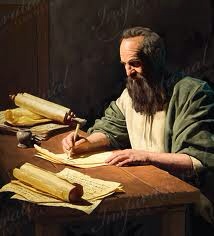

2 CORINTHIANS - PAUL'S MINISTRY IN THE LIGHT OF THE INDESCRIBABLE GIFT
Click chart to enlarge
Charts from Jensen's Survey of the NT - used by permission
Another Chart from Charles Swindoll
A Third Chart
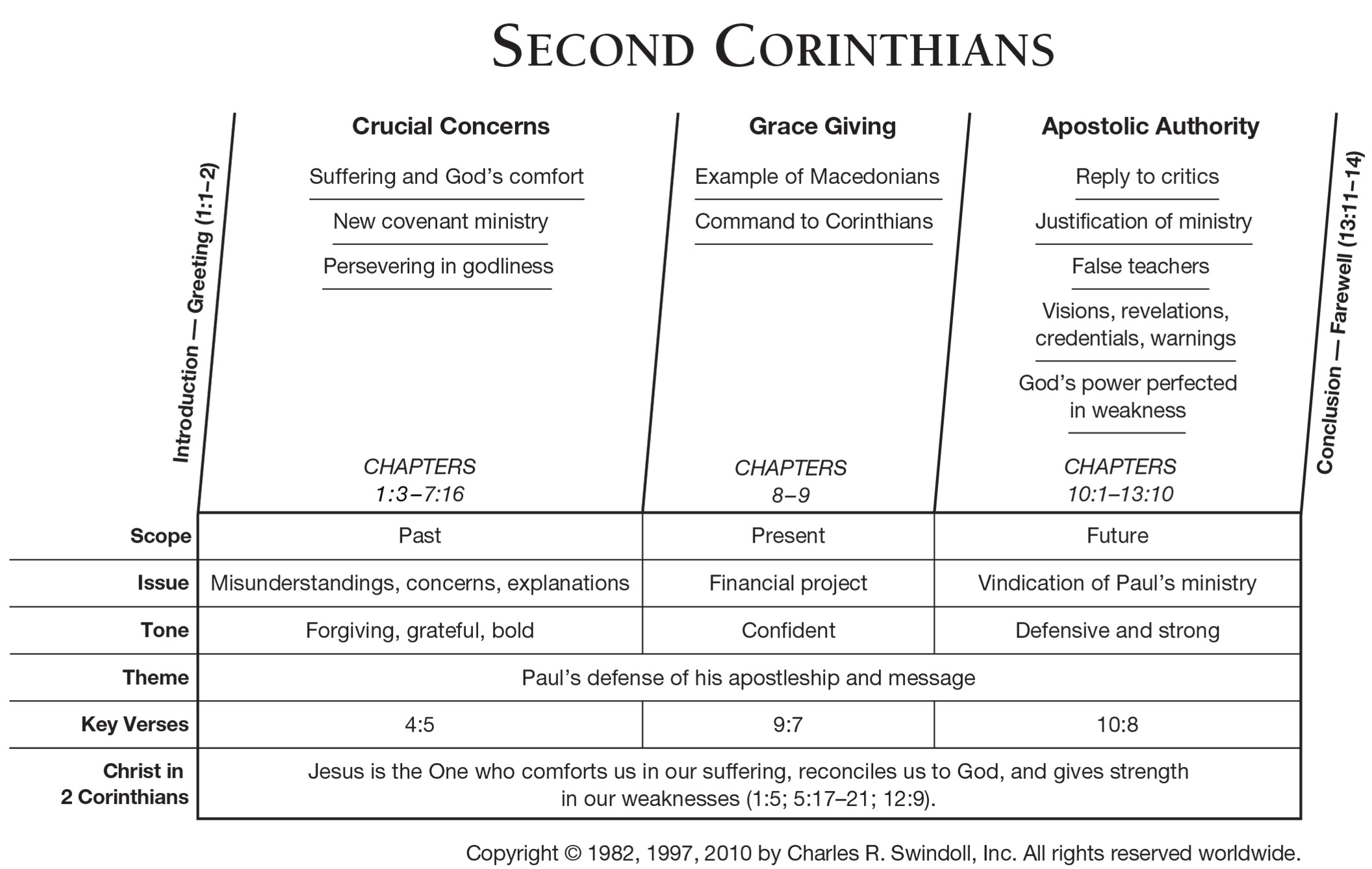
| Overview of Second Corinthians |
||
| 2Co 1:1-7:16 Character of Paul |
2Co 8:1-9:15 Collection for the Saints |
2Co 10:1-12:21 Credentials of Paul |
| Testimonial & Didactic | Practical | Apologetic |
| Past: Misunderstanding & Explanation |
Present: Practical Project |
Future: Anxieties |
| Apostle's Conciliation, Ministry & Exhortations | Apostle's Solicitation for Judean Saints | Apostle's Vindication of Himself |
| Forgiveness, Reconciliation Gratitude |
Confidence | Vindication |
|
Ephesus to Macedonia: |
Macedonia: Preparation for Visit to Corinth |
To Corinth: |
|
2Co 1:1-7:16 |
2Co 8:1-9:15 |
2Co 10:1-12:21 |
|
2Corinthians written ~ 56-57AD - see Chronological Table of Paul's Life and Ministry |
||
|
Adapted & modified from Jensen's Survey of the New Testament (Highly Recommended Resource) & Wilkinson's Talk Thru the Bible |
||
INTRODUCTIONS TO SECOND CORINTHIANS:
- IRVING JENSEN - Introduction and study tips - excellent preliminary resource - scroll to page 1877 (Notes on both 1-2 Cor begin on p 1829)
- JOHN MACARTHUR 2 Corinthians Introduction - same as in the Study Bible
- JAMES VAN DINE 2 Corinthians - Author, Purpose, Outline, Argument
- CHARLES SWINDOLL - 2 Corinthians Overview
- MARK SEIFRID - The Message of Second Corinthians: 2 Corinthians as the Legitimation of the Apostle
- J VERNON MCGEE - 2 Corinthians Introduction
- DAN WALLACE - 2 Corinthians: Introduction, Argument, and Outline
- DAVID MALICK - An Introduction To Second Corinthians
2 Corinthians 12:9 And He has said to me, "My grace is sufficient for you, for My power is perfected in weakness." Most gladly, therefore, I will rather boast about my weaknesses, so that the power of Christ may dwell in me. (NASB: Lockman)
Greek: kai eireken (3SRAI) moi, Arkei (3SPAI) soi e charis mou; e gar dunamis en astheneia teleitai. (3SPPI) hedista oun mallon kauchesomai (1SFMI) en tais astheneiais mou, hina episkenose (3SAAS) ep' eme e dunamis tou Christou.
Amplified: But He said to me, My grace (My favor and loving-kindness and mercy) is enough for you [sufficient against any danger and enables you to bear the trouble manfully]; for My strength and power are made perfect (fulfilled and completed) and show themselves most effective in [your] weakness. Therefore, I will all the more gladly glory in my weaknesses and infirmities, that the strength and power of Christ (the Messiah) may rest (yes, may pitch a tent over and dwell) upon me! (Lockman)
Barclay: And he said to me, "My grace is enough for you, for power is perfected in weakness." So it is with the greatest gladness that I boast in my weaknesses so that the power of Christ may pitch its tent upon me. (Westminster Press)
ESV: But he said to me, "My grace is sufficient for you, for my power is made perfect in weakness." Therefore I will boast all the more gladly of my weaknesses, so that the power of Christ may rest upon me.
KJV: And he said unto me, My grace is sufficient for thee: for my strength is made perfect in weakness. Most gladly therefore will I rather glory in my infirmities, that the power of Christ may rest upon me.
NET: But he said to me, "My grace is enough for you, for my power is made perfect in weakness." So then, I will boast most gladly about my weaknesses, so that the power of Christ may reside in me.
NIV: But he said to me, "My grace is sufficient for you, for my power is made perfect in weakness." Therefore I will boast all the more gladly about my weaknesses, so that Christ's power may rest on me.
NJB: but he has answered me, 'My grace is enough for you: for power is at full stretch in weakness.' It is, then, about my weaknesses that I am happiest of all to boast,
NLT: Each time he said, "My grace is all you need. My power works best in weakness." So now I am glad to boast about my weaknesses, so that the power of Christ can work through me. (NLT - Tyndale House)
Phillips: but his reply has been, "My grace is enough for you: for where there is weakness, my power is shown the more completely." Therefore, I have cheerfully made up my mind to be proud of my weaknesses, because they mean a deeper experience of the power of Christ. (Phillips: Touchstone)
Wuest: And He has said to me, and His declaration still stands, My grace is enough for you, for power is moment by moment coming to its full energy and complete operation in the sphere of weakness. Therefore, most gladly will I the rather boast in my weaknesses in order that the power of the Christ [like the Shekinah Glory in the Holy of Holies of the Tent of Meeting] may take up its residence in me [working within me and giving me help]. (Eerdmans Publishing - used by permission)
Young's Literal: and He said to me, 'Sufficient for thee is My grace, for My power in infirmity is perfected;' most gladly, therefore, will I rather boast in my infirmities, that the power of the Christ may rest on me:
THE EFFICACY
OF PRAYER
Charles Simeon has the following thoughts on Paul's probation (subjection to a period of testing) which prompted prayer which resulted in power...
THERE is scarcely any thing in the Scriptures that more deserves our attention than the remarkable instances of answers to prayer. Throughout the whole Bible, if we see any one betake himself to prayer, we may know beforehand the issue of his conflicts: whatever be his difficulties, if only he go to God, saying, "I have no might in myself, but mine eyes are unto Thee," we may be well assured of his success: his petition invariably brings Omnipotence to his support; and he is made more than conqueror over all his adversaries (Ro 8:37KJV). St. Paul relates a most encouraging instance respecting himself, wherein he found to his unspeakable comfort the efficacy of prayer.
The trial with which he was so oppressed—Highly favored as the Apostle was, he was nevertheless bowed down with a heavy affliction—None, however honoured and beloved of God, can hope to escape trouble. What the particular trial was, with which the Apostle was assaulted, it is impossible to say. The most reasonable conjecture seems to be, that it was something occasioned by his vision, perhaps some distortion of his features, or impediment in his speech, that rendered both his person and his speech contemptible; and of which the false teachers, those "messengers and ministers of Satan," (2Co 11:13, 14, 15) took advantage, to undermine his influence in the Church of God. This to the Apostle, whose heart was wholly bent upon glorifying God (1Co 1:31, 1Co 6:20, 2Co 10:17), and saving the souls of men (cp Ro 11:14, 1Co 9:20, 21, 22, 2Ti 2:10), would be a heavy affliction, like "a thorn in the flesh," festering and causing the acutest pain. But, whatever it was, Satan took occasion from it to distress the mind of the Apostle (cp Ep 6:16) with a far keener anguish than his body could have sustained from the severest blows of men. Nor need we regret that we are ignorant of the precise temptation with which Paul was harassed; since whatever our trials be, we may consider ourselves as in his situation, and obtain relief in the same way that he did.
The reason for which that affliction was sent him, it is of great importance to observe—The Apostle was not yet perfect: and though he had been caught up into the third heaven, he was yet liable to sin: the seeds of pride were yet in his heart (cp Ro 7:18, 19); and they would derive life and vigour even from those very mercies, which, to human appearance, should have had a tendency to destroy them. To counteract this evil of his heart, God sent him a heavy trial. And, if we were more attentive to the ends of God's dispensations towards ourselves, we might always find some good reason for them within our own hearts. Pride is a hateful and accursed evil (Pr 6:16, 17, 18, 8:13, 16:5, 29:23, Isa 2:12, Isa 2:17, Jas 4:6, 1Jn 2:16); and, if suffered to reign within us, will bring us "into the condemnation of the devil" (1Ti 3:16KJV) nor, however severe the remedy may be, should we be averse to endure it, if only it may be instrumental to the extirpating of this deeply-rooted propensity. In this case, though Satan may be the agent that inflicts the stroke, God is the kind Friend that "gives" it: and though Satan intends us nothing but evil, God overrules it for our good (Ge 50:20, Ro 8:28, Ro 8:29). (Simeon, C. 1832-63. Horae Homileticae Vol. 16: 1 and 2 Corinthians. London)
As Spurgeon said
Anything is a blessing which makes us pray...Yes, we may be lax in prayer when all things flow with even current, but we multiply prayers when trials increase. In this way, Paul was kept from being proud. The revelations now seemed forgotten, for the thorn in the flesh was the more prominent thing of the two. Now, he would not speak about visions, and could not for, when his tongue was tempted to move upon that subject, the thorn began to prick his side again. A man does not want to tell pretty stories when his head is aching, or when sharp pains are goading him. Paul was not allowed to dazzle himself with the brightness which God had set before him; his thoughts were turned in another direction, yea, blessedly turned to the mercy-seat, where he could get no evil, but must derive much profit. He continued still to pray, till at last he received for an answer, not the removal of the thorn, but the assurance, "My grace is sufficient for thee." God will always honor our prayers; he will either pay us in silver or in gold; and sometimes it is a golden answer to prayer to deny us our request, and give us the very opposite of what we seek. If you were to tell your child that you would grant him anything he asked for, you would not intend by that that you would give him a poisonous drug, if some one should delude him into the idea that it would be useful to him. You would mean that you would give your child all that was really good for him. God, therefore, knowing that this thorn in the flesh was a sacred medicine to Paul, would not take it away, even though most urgently requested to do so. Well does Ralph Erskine say of prayer -
"I'm heard when answered soon or late,
Yea, heard when I no answer get;
Most kindly answered when refused;
And treated well when harshly used."
So, though refused, Paul was answered; for he got something better than the taking away of the thorn in the flesh; and the result was that the grace given him enabled him to bear the thorn, and lifted him right above it, till he even rejoiced, and gloried to think that he was permitted so to suffer. "Most gladly, therefore, will I rather glory in my infirmities, that the power of Christ may rest upon me." This is a grand thing. Supposing any person here is very poor, and he has prayed the Lord many a time to raise him above want, and at last God has said, "My grace is sufficient for thee," what more can he need? My dear brother, rejoice in poverty, and thank God that you are poor, If the Lord is the better glorified thereby; be grateful for your low estate, and say, "I have the honor to be permitted to glorify God in poverty." Perhaps it may be you are the subject of a painful bodily infirmity, and you have prayed to have it removed; yet the Lord knows that your infirmity is for his glory, and your good. Well, when he says, "My grace is sufficient for thee," accept and bear the trial not only with resignation, but with acquiescence. Wish not to change your estate. Your heavenly Father knows best.
Now lastly, THE PERMANENT RESULT of this preventative upon Paul. For the present you see it kept him from being exalted, by making him pray and by leading him to receive more grace, but permanently, the remedy was very successful, for through the power of the Holy Spirit, it kept him humble always. This thorn in the flesh made him humble in reference to his visions, for he became silent about them. Fourteen long years rolled away, and the apostle never told anybody that he had been caught up into the third heaven. I gather from the way in which he puts it here, that he never mentioned it to a soul. This was singular. Why, if I were caught up into the third heaven, I should tell you of it the first time I had the chance of addressing you; and I warrant that most here would not be long before they would impart to their friends the blessed secret. The thorn in the flesh must have had a powerful effect upon the apostle's mind, when it led him to wrap up his treasure in his bosom, and go through the world, nobody being any the wiser for all that he had seen. He was a humble man indeed.
It is no small matter when God sends a thorn in the flesh and it answers its end, for in some cases it does not. Without the sanctifying power of the Holy Spirit, thorns are productive of evil rather than good. In many people, their thorn in the flesh does not appear to have fulfilled any admirable design at all; it has created another vice, instead of removing a temptation. We have known some whose poverty has made them envious; others whose sickness has rendered them impatient and petulant; and others, again, whose personal infirmity has rendered them perpetually fretful and rebellious against God. O, dear brothers and sisters in Christ Jesus, let us labor against this with all our might, and if God has been pleased to put a fetter (Ed: a chain or bond fastened round the ankle and so a check or restraint) upon us in any shape or way, let us ask him not to allow us to make this the occasion for fresh folly, but, on the contrary, to bear the rod and learn its lessons. Pray that when we are afflicted we may grow in grace and in likeness to our Lord Jesus (2Pe 3:18), and so bring more honor to His name. Does not this teach us all the solemn duty of being content, whatever our lot may be - content without the revelation if we are without the thorn - content with the thorn, if we have the revelation - content without either revelation or thorn, so long as we may but have a humble hope in Jesus Christ our Savior. (2 Corinthians 12:7, 8, 9- The Thorn in the Flesh)
R Kent Hughes draws parallels between the threefold prayers of our Lord Jesus in Gethsemane and of Paul after his rapture to Paradise - In Gethsemane, Christ Jesus pled with his heavenly Father (Mt 26:39, 40, 41, 42, 43, 44, Mk 14:35, 36, 39, 41, Lk 22:41, 42, 43, 44). Here Paul pleads with Christ Jesus risen from the dead. Paul's prayer was a passionate, heart-rending plea like that of Jesus in Gethsemane to his loving Father. And Jesus, like His Father, lovingly answered no to Paul. Thus, we must take this to heart: Whenever Christ says no to our desperate passionate pleadings, the no is freighted with His perfect, compassionate goodness and love. The Lord's answers to our prayers are never negative, except in a superficial sense, because ultimately they are fully positive, bringing God's unending blessing. How good for us it is when our hearts embrace this. (Hughes, R. K. 2 Corinthians: Power in Weakness. Wheaton, Ill.: Crossway Books)
Philip Hughes - Thus the Lord's answers to prayer are never negative, except in a superficial and proximate sense; for essentially and in the ultimate issue they are fully positive, and directed to the eternal blessing of His people...Desperately he (Paul) prayed that he might be delivered from the thorn in his flesh. He was not delivered from that situation; he was made able to accept it; and in that very situation he discovered the strength that was made perfect in his weakness and the grace which was sufficient for all things--and in that strength and grace the situation was not only accepted, but also transformed into glory (2Cor 12:1-10). (Paul's Second Epistle to the Corinthians)
William Barclay has an interesting description of prayer writing that "Prayer is the ability to accept, and in accepting, to transform. It is not meant to bring deliverance from a situation; it is meant to bring the ability to accept it and transform it.
C H Spurgeon - When God does not answer His children according to the letter, He does so according to the Spirit. If you ask for silver, will you be angry if He gives you gold? If you seek bodily health, should you complain if instead He makes your sickness turn to the healing of spiritual maladies? Is it not better to have the cross sanctified than to have the cross removed? Was not the apostle more enriched when God allowed him still to endure the thorn in the flesh, and yet said to him, "My grace is sufficient for thee" (2 Cor. 12:9)
Thomas Manton - Sickness is God's messenger to call us to meet with God.
An unknown saint wrote that...
Sickness, when sanctified (Ed: as boasting in one's weaknesses), teaches us four things: the vanity of the world, the vileness of sin, the helplessness of man and the preciousness of Christ (Ed: Especially the power of His grace).
Matthew Henry - Sometimes Christ sees that we need the sickness for the good of our souls more than the healing for the ease of our bodies.
George Swinnock - Sanctified sickness is far better than unsanctified soundness.
Abraham Wright - I am mended by my sickness, enriched by my poverty, and strengthened by my weakness.
F. Whitfield - God's way of answering His people's prayers is not by removing the pressure, but by increasing their strength to bear it. The pressure is often the fence between the narrow way of life and the broad road to ruin; and if our Heavenly Father were to remove it, it might be at the sacrifice of Heaven. Oh, if God had removed that thorny fence in answer, often to earnest prayers, how many of us would now be castaways! How the song of many a saint now in glory would be hushed! How many a harp would be unstrung! How many a place in the mansions of the redeemed would be unfilled! If God answered all the prayers we put up to Heaven, we should need no other scourge. Blessed it is that we have One who is too loving to grant what we too often so rashly ask.
AND HE HAS SAID TO ME, " (MY) GRACE IS SUFFICIENT FOR YOU": kai eireken (3SRAI) moi, arkei (3SPAI) soi e charis mou:
- 2Co 12:10; 3:5,6; Ex 3:11,12; 4:10, 11, 12, 13, 14, 15; Dt 33:25, 26, 27; Josh 1:9; Isaiah 43:2; Jer 1:6, 7, 9; Mt 10:19,20; Lk 21:15; 1Co 10:13; 15:10; Col 1:28,29; 1Ti 1:14; Heb 4:16
- For you - Psalms 8:2; Is 35:3,4; Is 40:29, 30, Is 40:31; Is 41:13, 14, 16; Da 10:16, 17, 18, 19; Ep 3:16; Php 4:13; Col 1:11; Heb 11:34)
- 2 Corinthians 12 Resources - Multiple Sermons and Commentaries
Jesus response to Paul follows a chiastic pattern (rhetoric reversal of the order of words in the second of two parallel phrases - e.g., he came in triumph and in defeat departs):
A is sufficient
B for you
C my grace
C my power
B in weakness
A is perfected
How wonderful that Jesus' first words in the Greek sentence are "Is sufficient", which places emphasis on our supply of His grace, a truth which gives us encouragement when the battle is raging (And so we see that studying the original languages is neither boring nor pedantic but builds up and profits [note the somewhat "chiastic comment"])
R Kent Hughes rightly says that "This is the summit of the epistle, the lofty peak from which the whole is viewed in true proportion. (Ibid)
John Piper introduces his sermon on this Scripture with these thoughts we all do well to ponder - One of the reasons biblical Christianity has to be so drastically distorted in order to sell it to mass markets is that the market wants power to escape weakness in leisure, but Christianity offers power to endure weakness in love. 2Cor 12:9 just doesn't sell: "Jesus said [in response to Paul's prayer], 'My grace is sufficient for you, for my power is made perfect in weakness." IN weakness? What the market wants is escape from weakness, not power in weakness. But to meet that felt need in the market the message must be distorted—and often is. But by distorting the message to make it more immediately appealing, two things are lost: 1. the truth of the message is lost, and 2. the chance to meet the really deep need that we all have in the midst of adversity is lost. (2 Corinthians 12:1-10 Christ's Power Is Made Perfect in Weakness)
Alan Redpath - "Truly God knows best how to deal with a man like Paul. I would say it very reverently, but when the Lord calls a man into a place of spiritual opportunity, into any place of leadership, be it as a missionary, as a pastor, as an administrator in some sphere of Christian work, whatever it may be, the Lord cannot afford to take any risks with him. There is too much at stake. God wanted to be sure that Paul's usefulness would never be marred and that he would be kept available, usable, and humble...I dare not speculate about the thorn in our life...but I know that behind it there is the ultimate purpose of God doing this very thing. However, I want to show you from this passage that there was not only a purpose in the thorn, but a wonderful provision. "...lest I should be exalted above measure" was the purpose. The provision, "...My grace is sufficient for you," and then the explanation , "for (term of explanation) My strength is made perfect in weakness." Notice that the Lord did not say to him, "My grace will prove to be sufficient," nor "I will give you enough grace to get through." No! But He is saying, in effect, "Paul, as I...allow this thorn to remain, I want you to understand that at each moment now there is ample provision (Ed: ample supernatural power) for your every need, for My grace is sufficient for thee."...How absurd to think that it could ever be any different! As if a little fish could swim in the ocean and fear lest it might drink it dry (Ed: Cf God's infinite power)!"
And He has said to me - First observe what He DID NOT say! He did not say the "thorn" in Paul's flesh would be removed (which is what Paul requested three times - 2Co 12:8). God always answers our prayer -- just not always the way we might want! But "Father knows best" (see short synopsis of this truth)! Second, observe that what the Lord did affirm was that Paul would be given enough grace to enable him to endure the "thorn"! (Cf 1Peter 1:6 with 1Peter 4:12 - where various and manifold are the same Gk word poikilos - God always provides just the right amount of grace to "counter" or balance the weight of the burden or trial He allows!) It is interesting that the Lord's answer here is quite similar to the truths Paul himself had explained to the Corinthians in his first epistle writing...
No temptation (peirasmos [from peirazo = to try in either a good or bad sense] means the putting to the test and then the tests themselves which come in order to discover a person's nature. Peirasmos = trouble that breaks the pattern of peace, comfort, joy, and happiness in one's life) has overtaken you but such as is common to man; and God is faithful (pistos = trustworthy = see God's faithfulness) Who will not (ou = absolutely will not) allow you to be tempted beyond what you are able (dunamai = that which has inherent ability to accomplish some end = to be able, be strong enough), but with the temptation will provide the way of escape also (ekbasis - note "a" way, but "the" specific way - Upshot? Be alert to God's "divine escape hatch"), that you may be able to endure it (NB: Not that you may be able to escape it but to bear up, put up with the "burden"!). (1Co 10:13)
Comment: In the present context, "the way of escape" so to speak is His sufficient grace.
Robert Morgan - If you have a red letter Bible, just thumb through the book of Acts and the letters of Paul, looking for any words that show up in red letters. Those are statements from the lips of Christ Himself, and when you read them you can just imagine Jesus appearing and speaking personally to Paul; and furthermore, think of Jesus speaking personally to you. Those who heard Him when He labored on earth said that no one ever spoke like He did, for He taught with authority and not as the Pharisees or the scribes. That's the way He speaks to you and me, and so this is a personal message from Jesus, in red letters to your heart, and He says, "My grace is sufficient for you." (2 Corinthians 12:9 My Grace is Sufficient)
Said (3004) (lego) is a common verb in the NT (>1000 uses) and simply means to speak or tell. Moulton and Milligan however add the interesting note that lego was commonly used to introduce edicts of emperors and magistrates. How appropriate it is for Paul to use lego in his introduction of the edict from the King of kings and Lord of lords (Re 17:14, Re 19:16)!
Lego is also in the perfect tense which speaks of the finality (and in that sense the absolute authority) of the truth spoken. It's as if these words ring with continual clarity in Paul's heart and mind as an abiding reminder of assurance and comfort to the great apostle. One wonders if he did not recall these words of His Lord every time he felt the "stake" (remember that regardless of what stake was, it seems clear that it was never removed throughout the subsequent 2 decades of Paul's ministry! A continual reminder to Paul of his great need for great power, supernatural power!) Wuest's paraphrase emphasizes the sense conveyed by the perfect tense
"He has said to me,
and His declaration still stands".
The perfect tense describes action completed in the past (at some point in time Jesus spoke [in some manner] these words to Paul) with the effect of those words continuing into the present. Beloved, this is how important even a basic understanding of the Greek tenses are! (See Overview of Greek Verb Tense, Voice, Mood) What our Lord spoke to Paul stands and is not subject to revision, change or addendum like so many of the "laws" in our modern world which preaches situational ethics, a veritable oxymoron in which genuine ethics are jettisoned for the pious platitude that "the ends justify the means!" What a contrast with the immutable, faithful Word of Truth which should prompt us to say "The Lord said it. I believe it. That settles it!" Amen!
Ralph Martin - The use of the perfect tense speaks of something that happened in the past is evident. This suggests a decision that is regarded as final by Paul. But more than that, Paul's choice of the perfect tells us that he still hears the echo of this divine oracle (Word Biblical Commentary: 2 Corinthians. Dallas: Word, Incorporated)
Warren Wiersbe - God did not give Paul any explanations; instead, He gave him a promise: "My grace is sufficient for thee." We do not live on explanations; we live on promises. Our feelings change, but God's promises never change. Promises generate faith, and faith strengthens hope. Paul claimed God's promise and drew on the grace that was offered to him; this turned seeming tragedy into triumph. God did not change the situation by removing the affliction; He changed it by adding a new ingredient: grace. (Wiersbe, W: Bible Exposition Commentary. 1989. Victor)
Remember that shortly after appearing to Paul on the Damascus Road, Christ explained Paul's call and the cost of that call to Ananias telling him to...
Go, for he is a chosen instrument of Mine, to bear My name before the Gentiles and kings and the sons of Israel; for I will show him how much he must suffer for My name's sake. (Acts 9:15, 16)
Marvin Vincent explains that "The force of the perfect tense is to be insisted on. It shows that the affliction was still clinging to Paul, and that there was lying in his mind when he wrote, not only the memory of the incident, but the sense of the still abiding power and value of Christ's grace; so that because the Lord hath said "my grace," etc., Paul can now say, under the continued affliction, wherefore I take pleasure, etc., for Christ's sake; for when I am weak, then am I strong. A more beautiful use of the perfect it would be difficult to find in the New Testament.
Murray Harris - The answer to Paul's prayer did not take the form he had expected. The thorn remained, but so too did his recollection of the divine reply ). This grace of Christ (2Co 13:14) was adequate for Paul, weak as he was, precisely because (gar, "for") divine power finds its full scope and strength only in human weakness—the greater the Christian's acknowledged weakness, the more evident Christ's enabling strength (cf. Eph 3:16; Philippians 4:13). But it is not simply that weakness is a prerequisite for power. Both weakness and power existed simultaneously in Paul's life (note vv. 9b, 10b), as they did in Christ's ministry and death. Indeed, the cross of Christ forms the supreme example of "power-in-weakness." (Expositor's Bible Commentary)
How did Christ speak to Paul? Direct conversation? Vision? etc?
Calvin writes - It is not certain, whether he had this answer by a special revelation, and it is not of great importance. (And besides, it is not greatly requisite to know it) For God answers us, when he strengthens us inwardly by his Spirit, and sustains us by his consolation, so that we do not give up hope and patience. He bids Paul be satisfied with his grace, and, in the mean time, not refuse chastisement. Hence we must bear up under evil of ever so long continuance, because we are admirably well dealt with, when we have the grace of God to be our support. ("And that is enough.") (Commentary on Corinthians)
My grace is sufficient for you - What Paul prayed for was refused, but what he received instead was of far greater value. Paul desired the natural thorn to be removed, but instead was given supernatural grace. Charles Hodge rightly recommended that "These words should be engraven on the palm of every believer's hand". Hodge goes on to explain that grace in this passage is parallel with "the aid of the Holy Spirit" (Amen! I agree). Notice also that there are two personal pronouns my and you, a clear statement by the infinite God that He is also a very close and personal God. When the dark clouds of adversity roll in, we are too often tempted to remember the you and forget the my, much to the detriment of our soul which tends to become downcast as it focuses inward rather than upward (cp the psalmist's problem and then his solution in Ps 42:5). Corrie Ten Boom spoke to this ever present potential "despair detour" when she wrote...
Look at self and be distressed,
Look at others and be depressed,
Look at Jesus and you'll be at rest!
Grace (5485) (charis) is a word which can be somewhat difficult to define but one of the most familiar definitions is "God's unmerited favor." In the present context, grace far from being an abstract entity speaks of the supernatural power available to Paul to enable him to bear up under (1Co 10:13) his "weakness", the trial of a thorn in his flesh.
Grace is God's unmerited help for one undeserving with no thought (or ability) to give recompense. Grace is not some static concept but is a dynamic force, which totally transforms the believer's life beginning with salvation (Acts 15:11; 18:27; Ro 3:24; Ep 1:7; Ep 2:5, Ep 2:8; 2Ti 1:9; Titus 2:11; Titus 3:7), continuing in our sanctification (2Pe 3:18, Titus 2:12 - where grace "instructs" us in our daily walk of godliness) and then all through eternity in our glorification (1Pe 1:13, Ep 2:7). Grace enables the believer suffer/endure without grumbling or complaining, and enables our weakness or suffering to be used for God's glory. When a Christian turns away from living by God's grace, he or she must depend on their own power and this invariably leads to failure and disappointment.
Our God is "the God of all grace" (1Pe 5:10). His throne is a "throne of grace" (He 4:16). His Word is "the word of His grace" (Acts 20:32). And how appropriate that in the very last verse of the Bible John writes "The grace of the Lord Jesus be with all. Amen." (Re 22:21)
Grace is God's supernatural provision for our every need when we need it. God in His grace gives us what we do not deserve, and in His mercy He does not give us what we do deserve.
G.R.A.C.E.
God's Riches At Christ's Expense
Grace is distinct to Christianity for no other world religion has such a supernatural enablement, nor could they because grace is from God and every other world religion is anti-god at its core! The great news of the Gospel is that every believer has "received...grace upon grace" through our Lord Jesus Christ (Jn 1:16), because "grace and truth were realized through" Him (Jn 1:17) and He is "full of grace and truth" (Jn 1:14). And so from the very beginning of the birth of the Church in Acts we see that "abundant grace was upon them all" (the new believers composing the church) (Acts 4:33). In the epistles Paul wrote of the "grace in which we stand" (Ro 5:2). James adds that humility gives every believer access to grace that is greater than sin's power (James 4:6; cp Ro 5:20). Peter described the "manifold [multi-colored - like Joseph's multicolored "dream coat"] grace of God" (1Pe 4:10) which is sufficient for "multicolored" trials (1Pe 1:6). In short, God always provides the sufficient grace for every trial (no exceptions!) Thus it is little wonder that Paul characterized this amazing grace as the "surpassing grace of God in [believers]" (2Co 9:14), and was confident that "God is able (present tense = He continuously has the ability) to make all (pas = all without exception) grace abound to you (referring to believers), that always (pantote from pas = all + tote = then) having all (pas) sufficiency in everything (pas), you may have an abundance for every (pas) good deed" (2Co 9:8 - note the "all" sufficient character of grace all the time to all believers! Praise God.).
God gives enough grace
For each trial we face
Calvin feels that "The term grace, here, does not mean here, as it does elsewhere, the favor of God, but by metonymy, the aid of the Holy Spirit, Who comes to us from the unmerited favor of God; and He ought to be sufficient for the pious, inasmuch as it is a sure and invincible support against their ever giving way. (Commentary on Corinthians)
Charis is used 155x in 147 verses in the NT and 8 times in first Corinthians and 18 times second Corinthians - 1Co 1:3, 4; 3:10; 10:30; 15:10, 57; 16:3, 23; 2Co 1:2, 12, 15; 2:14; 4:15; 6:1; 8:1, 4, 6, 7, 9, 16, 19; 9:8, 14, 15; 12:9; 13:13. In short 17% of the NT uses of charis are in the epistles to the Corinthians.
Hampton Keathley amplifies the meaning of charis writing that Grace is "that which God does for mankind through His Son, which mankind cannot earn, does not deserve, and will never merit". Grace is all that God freely and non-meritoriously does for man and is free to do for man on the basis of Christ's person and work on the cross. Grace, one might say, is the work of God for man and encompasses everything we receive from God. (Grace and Peace)
I would add given the truth that we begin the race of salvation by grace (Ep 2:8, 9), run daily by grace (Titus 2:11, Titus 2:12, 1Co 1:18) and finish by grace (1Pe 1:13), it behooves every Christian "runner" to understand the practical truth that we can run with endurance the race that is set before us only by grace (cp Ro 5:2, 1Pe 5:12).
David E Garland - Paul learns that the stake would not hamper his calling. He can make do with the grace he has already received (1Cor 15:10), and the power of Christ will become more visible as it works through his weakness. {Paul refers to Christ in 1Cor 1:24 as "the power of God."} We learn from the message given to Paul that God's grace is not just the unmerited favor that saves us but a force that also sustains us throughout our lives. The modifier "my" in "my power," is important (Ed: As discussed many modern manuscripts do not have the Greek pronoun "my" but it is clearly implied). Paul is not speaking about power in general, but "the power of Christ" revealed in the crucifixion and resurrection: "For to be sure, he was crucified in weakness, yet he lives by God's power. Likewise, we are weak in Him, yet by God's power we will live with Him to serve you" (2Cor 13:4). Paul has testified to this power in 2Cor 1:8, 9, 10. In Asia he was utterly, unbearably crushed but he was rescued by God's power which raises the dead. The cracked clay vessel, buffeted and battered, is held together by the extraordinary power of God (2Co 4:7; see 2Co 6:7). When this earthly tent is destroyed, Paul exudes confidence that the power of God will raise him up and give him a house, not made with hands, eternal in the heavens (2Co 5:1). The miracle is that this same divine power that accomplishes all that God wills dwells in a frail, persecuted, and abased apostle. (Ed: And this same infinite, supernatural power of Christ dwells in every believer via His Spirit, the Spirit of Jesus - Acts 16:7). (New American Commentary - Volume 29: 2 Corinthians) (Bolding added)
Wiersbe - God does not give us His grace simply that we might "endure" our sufferings. Even unconverted people can manifest great endurance. God's grace should enable us to rise above our circumstances and feelings and cause our afflictions to work for us in accomplishing positive good. God wants to build our character so that we are more like our Saviour. God's grace enabled Paul not only to accept his afflictions, but to glory (boast) in them. His suffering was not a tyrant that controlled him, but a servant that worked for him. (Ibid)
Albert Barnes - A much better answer than it would have been to have removed the calamity; and one that seems to have been entirely satisfactory to Paul. The meaning of the Saviour is, that He would support him; that He would not suffer him to sink exhausted under his trials; that he had nothing to fear. The affliction was not indeed removed; but there was a promise that the favor of Christ would be shown to him constantly, and that he would find His support to be ample. If Paul had this support, he might well bear the trial; and if we have this assurance, as we may have, we may welcome affliction, and rejoice that calamities are brought upon us (cp Ac 5:41, Jas 1:2). It is a sufficient answer to our prayers if we have the solemn promise of the Redeemer that we shall be upheld, and never sink under the burden of our heavy woes.
John Piper - If we feel and look self-sufficient, we will get the glory, not Christ. So Christ chooses the weak things of the world "so that no man should boast before God" (1Cor 1:29). And sometimes he makes seemingly strong people weaker, so that the divine power will be the more evident. (Piper, J.. Future Grace | Desiring God)
Adam Clarke makes an interesting comment that "Grace alone can preserve grace. When we get a particular blessing we need another to preserve it; and without this we shall soon be shorn of our strength, and become as other men. Hence the necessity of continual watchfulness and prayer, and depending on the all-sufficient grace of Christ.
David Guzik - My grace is sufficient: How did God’s grace make the difference? How did it meet Paul’s need at this point?
- Grace could meet Paul’s need because it expresses God’s acceptance and pleasure in us. When we receive His grace, we enjoy our status of favor and approval in God’s eyes. Grace means that God likes us, that He is favorably disposed towards us and that we have His approval and promise of care.
- Grace could meet Paul’s need because it was available all the time. When we sin or fail, it does not put us outside the reach of God’s grace. Since grace is given freely to us in Jesus, it can’t be taken away later because we stumble or fall. When we come to God by faith through the blood of Jesus, His grace is ever ready to meet us and to minister to our insufficiencies.
- Grace could meet Paul’s need because it was the very strength of God. So much of the power of this world is expressed in things that can only bring harm and destruction, but God loves to show His power through His goodness and grace. Sometimes we associate goodness with cowardice or timidity. When we do, we take a worldly perspective about power and strength, and we deny God’s truth about the strength of grace and love. Grace is not weak or wimpy. Instead, it is the power of God to fulfill what we lack.
David Guzik - My grace is sufficient for you: You may emphasize any aspect of this you please.
i. “My grace is sufficient for you.” Grace is the favor and love of God in action. It means He loves us and is pleased by us. Can you hear it from God? “My love is enough for you.” Isn’t it true?
ii. “My grace is sufficient for you.” Whose grace is it? It is the grace of Jesus. Isn’t His love, His favor, enough? What will Jesus fail at? Remember too that Jesus suffered thorns, so He cares and He knows.
iii. “My grace is sufficient for you.” It is right now. Not that it will be some day, but right now, at this moment, His grace is sufficient. You thought something had to change before His grace would be enough. You thought, “His grace was sufficient once, His grace may be sufficient again, but not now, not with what I am going through.” Despite that feeling, God’s word stands. “My grace is sufficient for you.” Spurgeon wrote, “It is easy to believe in grace for the past and the future, but to rest in it for the immediate necessity is true faith. Believer, it is now that grace is sufficient: even at this moment it is enough for thee.”
iv. “My grace is sufficient for you.” Redpath explains this aspect best: “Do you see the humor of the situation? God’s grace: me. His grace sufficient for little me! How absurd to think that it could ever be any different! As if a little fish could swim in the ocean and fear lest it might drink it dry! The grace of our crucified, risen, exalted, triumphant Saviour, the Lord of all glory, is surely sufficient for me! Do you not think it is rather modest of the Lord to say sufficient?”
v. “My grace is sufficient for you.” I’m so glad God didn’t say, “My grace is sufficient for Paul the Apostle.” I might have felt left out. But God made it broad enough. You can be the “you” in for you. God’s grace is sufficient for you! Are you beyond it? Are you so different? Is your thorn worse than Paul’s or worse than many others who have known the triumph of Jesus? Of course not. This sufficient grace is for you.
vi. “This sufficiency is declared without any limiting words, and therefore I understand the passage to mean that the grace of our Lord Jesus is sufficient to uphold thee, sufficient to strengthen thee, sufficient to comfort thee, sufficient to make thy trouble useful to thee, sufficient to enable thee to triumph over it, sufficient to bring thee out of it, sufficient to bring thee out of ten thousand like it, sufficient to bring thee home to heaven … O child of God, I wish it were possible to put into words this all-sufficiency, but it is not. Let me retract my speech: I am glad that it cannot be put into words, for if so it would be finite, but since we never can express it, glory be to God it is inexhaustible, and our demands upon it can never be too great. Here let me press upon you the pleasing duty of taking home the promise personally at this moment, for no believer here need be under any fear, since for him also, at this very instant, the grace of the Lord Jesus is sufficient.” (Spurgeon)
vii. “John Bunyan has the following passage, which exactly expresses what I myself have experienced. He says that he was full of sadness and terror, but suddenly these words broke in upon him with great power, and three times together the words sounded in his ears, “My grace is sufficient for thee; my grace is sufficient for thee; my grace is sufficient for thee.” And “Oh! Bethought,” says he, “that every word was a mighty word unto me; as ‘My,’ and ‘grace,’ and ‘sufficient,’ and ‘for thee’; they were then, and sometimes are still, far bigger than others be.” He who knows, like the bee, how to suck honey from flowers, may well linger over each one of these words and drink in unutterable content.” (Spurgeon)
G C Morgan - There is nothing more hindering to the work of God than the uplifted and proud Christian.”
Alexander Maclaren - “Ministers of the Gospel especially should banish all thoughts of their own cleverness, intellectual ability, culture, sufficiency for their work, and learn that only when they are emptied can they be filled, and only when they know themselves to be nothing are they ready for God to work through them.”
Alan Redpath - “God works through the man who has been wiped clean and turned inside out, his life emptied before the Lord until he is hopelessly weak, that no flesh might glory in His presence.”
NEVER A SHORTAGE
OF GRACE
Sufficient (714) (arkeo) means to be enough, to be sufficient or to be adequate with the implication of leading to satisfaction. In the passive sense arkeo means to be satisfied or contented with something.
Delivering saints from the self-sufficiency driven by our fallen flesh is a major function of the ups and downs of this life (which God allows and sometimes Himself sends), some of which come packaged as "big thorns", but many being manifest as much "smaller thorns" that occur in our everyday experiences I often refer to as divine "pop tests". Each one of these divine "pop tests" is an opportunity to experience the practical truth of God's sufficient grace, and in so doing to grow in grace and the knowledge of our Lord and Savior Christ Jesus (2Pe 3:18).
Some definitions of the English word sufficient and synonyms...
Enough = occurring in such quantity, quality, or scope as to fully meet demands, needs, or expectations. Sufficient to answer a need, demand, supposition, or requirement;
Sufficient = Sufficient is derived from Latin sufficiens = supplying the needs of, from sufficere = to suffice. Enough to meet the needs of any and every situation. Enough to meet a purpose. That which is equal to the end proposed (ponder this with God's desired effect of grace in a believer's life! eg, Ro 8:29). Adequate to needs. Being what is requisite or needed especially without superfluity. Antonyms of sufficient = deficient, inadequate, insufficient, meager, not enough, poor, scant, short, sparse. Ponder the truth that God's grace is never described by any of these words!
The ancillary thought associated with arkeo is that one should be satisfied with that which meets our need, and not desire a superfluity. Here in 2Co 12:9, Jesus is saying in essence "you need nothing more than my grace". As someone has said, when you find that Jesus is all you have left, you discover that Jesus is all you need!
In Classic Greek arkeo had the above meanings but in writings from Homer it had the added meaning of to give protection, to ward off, to have power or to help. In Josephus (Antiquities 9.266) we read "nor did this degree of transgressing suffice them, but they had more wick contrivances than what have been described". Greek philosophers often wrote of self-sufficiency, either to endure trials or sometimes because there were none, but Paul is speaking "Savior-sufficiency"!
It is intriguing that the related word autarkes which means essentially self sufficient was used by the Greek stoics. In 2Corinthians Paul is writing to a church immersed in pagan philosophies, including stoicism, so how fitting to counter man's flawed view of sufficiency with the only source of true sufficiency God's grace. Thus Vincent writes that autarkes (autos = himself + arkeo = to suffice or be sufficient) was...
A stoic word, expressing the favorite doctrine of the sect, that man should be sufficient to himself for all things; able by the power of his own will, to resist the shock of circumstance. Paul (referring to Php 4:11) is self-sufficient through the power of the new self: not he, but Christ in him (3:460-61). (Ed: And I would add His endless supply of necessary grace which empowered him to "resist the shock of circumstance" to parallel Vincent's description of the counterfeit "sufficiency" of the Stoics.)
Here in 2Cor 12:9, arkeo is not in the past or future tense but is in the present tense indicating that the divine gift of grace is continually sufficient - His grace is a very present help in time of trouble (Ps 46:1), like the battery in the commercial, a veritable "Ever Ready", All Sufficient, Supernatural Source of Strength. Though he had suffered fourteen years of a thorn in his side, he had received fourteen years of grace as his supply. Indeed, God gives us a lifetime supply of His grace for our weaknesses. As Robertson puts it "Christ's grace suffices and abides." Notice also that arkeo is at the head of the sentence for added emphasis and thus literally reads "Sufficient for you my grace". This clearly places emphasis on the words sufficient for you. Note also that Christ says His grace IS sufficient for you, which means that we don't have to ask Him to make His grace sufficient. It already IS!
Wuest defines arkeo as "to be possessed of unfailing strength, to suffice, to be enough (as against any danger), hence, "to defend, ward off. (Wuest Word Studies - Eerdman Publishing Company Volume 1, Volume 2, Volume 3 - used by permission)
Vine summarizes arkeo writing that it "primarily signifies "to be sufficient, to be possessed of sufficient strength, to be strong, to be enough for a thing"; hence, "to defend, ward off"; in the middle voice, "to be satisfied, contented with," Luke 3:14, with wages; 1Ti 6:8, with food and raiment; Heb 13:5, with "such things as ye have"; negatively of Diotrephes, in 3Jn 10, "not content therewith." (Vine's Expository Dictionary of Old Testament and New Testament Words)
NIDNTT has this note on the Greek words used to convey the meaning of suffice or satisfy...
The words dealt with here reflect the fact that reality hardly ever tallies with men's expectations, that goals are set but not achieved, or that given conditions are felt to be unacceptable. That which does comply with the norm or does meet men's requirements is described by the adjective hikanos (see word study), either in an ethical sense (worth, worthy, competent) or a material sense (enough, sufficient). However, where the idea is not that of meeting a given standard but of acknowledging its rightness, this is expressed by words of the arkeo group (see study of related word autarkes = self sufficient, Php 4:11). The thought here is of remaining within certain bounds, the latter being either inherent in a given situation, or self-imposed, or seen as God given. There is a close affinity here with words dealt with under humility.
In the moral philosophy of Stoicism the ability to be content (arkeisthai) became the essence of all the virtues. So the Stoic Diogenes Laertius speaks of Socrates as being autarkes kai semnos, contented and devout. To practise the virtue of contentment was to acquiesce wisely in that which suited one's own nature or one's daimon; becoming independent of things, a man relied upon himself or-as others taught-submitted to the lot meted out to him by the gods (Diogenes Laertius, 2, 24; Epictetus, Dissertationes 1, 1, 12 f.). To have no needs was the ideal of Stoicism. (Brown, Colin, Editor. New International Dictionary of NT Theology. 1986. Zondervan)
Richards - The root word arkeo means "to be enough," "to be sufficient." At times the NT shifts the emphasis. It is not simply that something is in sufficient supply. It is that we have an attitude that lets us be satisfied with whatever is available. Paul sums it up in 1 Ti 6:6-8: "Godliness with contentment is great gain. For we brought nothing into the world, and we can take nothing out of it. But if we have food and clothing, we will be content with that." (Richards, L O: Expository Dictionary of Bible Words: Regency)
Arkeo - 8x in the NT - The NAS renders arkeo as content(3), enough(2), satisfied(1), sufficient(2).
Matthew 25:9 "But the prudent answered, saying, 'No, there will not be enough for us and you too; go instead to the dealers and buy some for yourselves.'
Luke 3:14 And some soldiers were questioning him, saying, "And what about us, what shall we do?" And he said to them, "Do not take money from anyone by force, or accuse anyone falsely, and be content (present imperative) with your wages (rations)."
John 6:7 Philip answered Him, "Two hundred denarii worth of bread is not sufficient for them, for everyone to receive a little." (When God provides it's always enough, but it can only be seen and/or received with eyes of faith!)
John 14:8 Philip said to Him, "Lord, show us the Father, and it is enough (enough to assuage their anxiety) for us."
2Corinthians 12:9 And He has said to me, "My grace is sufficient for you, for power is perfected in weakness." Most gladly, therefore, I will rather boast about my weaknesses, that the power of Christ may dwell in me.
1Timothy 6:8 And if we have food and covering, with these we shall be content.
Hebrews 13:5 Let your character be free from the love of money, being content (present tense - used with an imperative sense in context) with what you have; for He Himself has said, "I will never desert you, nor will I ever forsake you,"
Wuest comments that arkeo means...
"to be possessed of unfailing strength, to be strong, to suffice, to be enough," finally, "to be satisfied, contented." The underlying thought is that one should be satisfied with that which meets our need, and not desire a superfluity. (Ibid)
3Jn 1:10 For this reason, if I come, I will call attention to his deeds which he does, unjustly accusing us with wicked words; and not satisfied with this, neither does he himself receive the brethren, and he forbids those who desire to do so, and puts them out of the church.
Arkeo - 7x in the Septuagint (LXX)- Ex 12:4; Nu 11:22; Jos. 17:16; 1Ki. 8:27; 2Chr 6:18; Pr 30:15, 16. Here are some of the OT uses...
Joshua 17:16 And the sons of Joseph said, "The hill country is not enough (arkeo) for us, and all the Canaanites who live in the valley land have chariots of iron, both those who are in Beth-shean and its towns, and those who are in the valley of Jezreel." (cp Jdg 1:27 explains why they had this problem = they failed to fully obey. Partial obedience = disobedience beloved! Contrast Judah's experience - Jdg 1:2, 3, 4)
Comment: When you take your eyes off the Lord and the faithfulness of His Word (cp Peter's experience of taking his eyes off His Sufficient Savior, Mt 14:30), your "hill country" never seems to be enough, for you will begin to focus on the adversaries and adversities (or the waves, like Peter!). Instead, let us focus on His sure promise to give us "every spiritual blessing...in Christ" (Eph 1:3). Let us focus on the promise of His power sufficient to possess what we feel too weak to possess (cp Josh 1:2, 3, noting Joshua's responsibility and God's sufficiency). God had given Israel the land of Canaan as their possession, but they had to possess it which is another way of saying they had to "trust and obey". (see Joshua's last words testifying to God's faithfulness -- Joshua 23:14, 21:45) In short, Jehovah promised Israel they would be able to possess a new and glorious LAND, but to NT believers He promises we will be able to possess a new and glorious LIFE in Christ (cp Gal 2:20). And He gives us sufficient grace to possess this promise!
1Ki 8:27 (2Chr 6:18) "But will God indeed dwell on the earth? Behold, heaven and the highest heaven cannot contain (Lxx = arkeo) Thee, how much less this house which I have built!
Pr 30:15 The leech has two daughters, "Give," "Give." There are three things that will not be satisfied, Four that will not say, "Enough" (Lxx = arkeo)": 16 Sheol, and the barren womb, Earth that is never satisfied with water, And fire that never says, "Enough. (Lxx = arkeo)"
Each day God sends His loving aid
To strengthen you and me;
We need to use today's supply
And let tomorrow be. —Anon.
Wiersbe - If God's grace is sufficient to save us, surely it is sufficient to keep us and strengthen us in our times of suffering.
John MacArthur amplifies Wiersbe's thought observing that "When God declared to Paul in answer to his prayer, "My grace is sufficient for you," He affirmed the total sufficiency of His grace for every need in life—to believe the gospel; to understand and apply the Word to all the issues of life; to overcome sin and temptation; to endure suffering, disappointment, and pain; to obey God; to serve Him effectively; and to worship Him. God's grace was sufficient for the deepest pain Paul (or any other believer) could ever experience...If God's grace was "more than abundant" to save Paul (1Ti 1:14) (2 Corinthians. Chicago: Moody Press) (Bolding added for emphasis)
William Barclay writes that God's grace is "sufficient for physical weariness. It made him able to go on. John Wesley preached 42,000 sermons. He averaged 4,500 miles a year. He rode 60 to 70 miles a day and preached three sermons a day on an average. When he was 83 he wrote in his diary, "I am a wonder to myself. I am never tired, either with preaching, writing, or traveling." That was the work of the all-sufficient grace.
Maclaren comments on grace that is sufficient noting first "How modestly the Master speaks about what He gives 'Sufficient'? Is not there a margin? Is there not more than is wanted? The over plus is 'exceeding abundant,' not only 'above what we ask or think,' but far more than our need. 'Two hundred penny worth of Bread is not sufficient that every one may take a little,' says Sense (cp Jn 6:7KJV). Omnipotence says, 'Bring the few small loaves and fishes unto Me'; and Faith dispensed them amongst the crowd (cp Jn 6:11KJV); and Experience 'gathered up of the fragments that remained' more than there had been when the multiplication began cp Jn 6:12KJV). So the grace utilized increases; the gift grows as it is employed. 'Unto him that hath shall be given.' (Lk 19:26KJV) And the, sufficiency is not a bare adequacy, just covering the extent of the need, with no overlapping margin, but is large beyond expectation, desire, or necessity; so leading onwards to high hopes and a wider opening of the open mouths of our need that the blessing may pour in.
Hodge - To Paul it was sufficient. It gave him perfect peace. It not only made him resigned under his afflictions but enabled him to rejoice in them.
Robert Morgan - In the early days of the English Keswick Bible Conference in the Lakes District of England, one of the most popular Bible teachers was a man named Prebendary Webb-Peploe. When Dr. Webb-Peploe was a young man, one of his dear children died suddenly while the family vacationed at the seaside. Returning from the funeral, the father was wracked with grief, and he went into his study and knelt in prayer, beseeching God to make His grace sufficient. "Lord," he said, "please make your grace sufficient." But he felt no comfort, and he sobbed in dark despair and pain. He tried to read his Bible, but there seemed no message there for him. Then he happened to glance up and see the framing over the fireplace. It was the very text of Scripture about which he had been praying—2Cor 12:9. For the first time he noticed that one word was printed in capital letters, the word IS: My grace IS sufficient for thee." Suddenly the light came on. "Lord, forgive me," he cried. "I have been asking Thee to make Thy grace sufficient for me, and all the time Thou hast been saying to me, 'My grace IS sufficient for thee.' I thank Thee for sufficient grace and I appropriate it now." (2 Corinthians 12:9 My Grace is Sufficient)
Spurgeon comments on God's grace equal to our need writing "Whenever the Lord sets His servants to do extraordinary work He always gives them extraordinary strength; or if He puts them to unusual suffering He gives them unusual patience. When we enter upon war with some petty New Zealand chief, our troops expect to have their charges defrayed, and accordingly we pay them gold by thousands, as their expenses may require; but when an army marches against a grim monarch, in an unknown country, who has insulted the British flag, we pay, as we know to our cost, not by thousands but by millions. And thus if God calls us to common and ordinary trials, He will defray the charges of our warfare by thousands; but if He commands us to an unusual struggle with some tremendous foe, He will discharge the liabilities of our war by millions, according to the riches of His grace which He has abounded to us through Christ Jesus.
"I HAVE TO KNOW"
THE STORY OF THOMAS HAUKER
The story of the Christian martyr Thomas Hauker (England, 1555) illustrates the sufficiency of the grace of God in our hour of need. Thomas Hauker, was a bright, well-favored, good-looking young gentleman, who would not deny his personal relationship with Christ. For this he was sentenced to being burned at the stake. "Thomas", his friend lowered his voice so as not to be heard by the guard. "I have to ask you a favor. I need to know if what the others say about the grace of God is true. Tomorrow, when they burn you at the stake, if the pain is tolerable and your mind is still at peace, lift your hands above your head. Do it right before you die. Thomas I have to know."
Thomas Hauker whispered to his friend, "I will." On the day of execution, the crowd was abuzz with Thomas's promise. As he was chained to the stake, he spoke quietly and with great grace to the men who laid the wood. Then he closed his eyes and the fire was kindled. Thomas continued to preach to those around him, but soon, for the roar of the flames, he could not. The fire burned a long time, but Hauker remained motionless. His skin was burnt to a crisp and his fingers were gone. Everyone watching supposed he was dead. Suddenly, miraculously, Hauker lifted his hands, still on fire, over his head. He reached them up to the living God and then, with great rejoicing, clapped them together three times. The people there broke into shouts of praise and applause. Hauker's friend had his answer. Beloved, does the story of this godly martyr not convict us? How often we wine "I can't take it anymore."
THOUGHT - How often we catch ourselves expressing frustration over the smallest trial. How often we overstate our problems and underestimate God's promise to enable us to bear up under the trial or weakness. When you think you can't take much more, remember Thomas Hauker's example of God's sufficient grace.
Dietrich Bonhoeffer once said "We must form our estimate of men less from their achievements and failures and more from their sufferings."
No pain, no palm;
No thorns, no throne
No gall, no glory
No cross, no crown."
-- William Penn
He is no fool who gives what he cannot keep to gain what he cannot lose. - Jim Elliot
John Piper - What a tragic waste when people turn away from the Calvary road of love and suffering. All the riches of the glory of God in Christ are on that road. All the sweetest fellowship with Jesus is there. All the treasures of assurance. All the ecstasies of joy. All the clearest sightings of eternity. All the noblest camaraderie. All the humblest affections. All the most tender acts of forgiving kindness. All the deepest discoveries of God's Word. All the most earnest prayers. They are all on the Calvary road where Jesus walks with his people. Take up your cross and follow Jesus. On this road, and this road alone, life is Christ and death is gain. Life on every other road is wasted. (Piper, J. Don't Waste Your Life. Wheaton, Ill.: Crossway Books)
FOR (My) POWER IS PERFECTED IN WEAKNESS: e gar dunamis en astheneia teleitai. (3SPPI):
- 2 Corinthians 12 Resources - Multiple Sermons and Commentaries
Jesus loves me this I know
For the Bible tells me so,
Little ones to Him belong,
They are weak but He is strong.
For (gar) is a term of explanation and always begs the question (pause and ponder!) "What is being explained?" Here "for" introduces Paul's explanation of why the grace of Christ is all sufficient. In short, weakness is the condition for the manifestation of our Lord's strength. It is as if the Lord is saying "The weaker you are, the more conspicuous is My strength in delivering and/or sustaining you." Where there is human weakness, divine strength reaches completeness. Indeed, when human strength abounds, the effects of Divine power are often (usually) not seen.
Isaiah records an OT parallel of the saint exchanging his or her weakness for God's strength writing that...
those who wait for the LORD will gain (Hebrew verb conveys idea of exchange) new strength; They will mount up with wings like eagles, They will run and not get tired, They will walk and not become weary. (Isa 40:31-notes)
Power (1411) (dunamis from dunamai = to be able, to have power) refers especially achieving power, the intrinsic power or inherent ability, to carry out some function.
The potential of God's "dynamite" is best realized in the presence of our powerlessness!
F B Meyer said that dunamis "is power. It is His power. It is great power; nothing less would suffice. It is exceeding great power, beyond the furthest cast of thought.
In Colossians 1:29 (in Young's Literal Translation) Paul has an instructive use of "dunamis" explaining that...
for which also I labor (he labored that he might present every man complete in Christ) (labor = kopiao = engage in hard work to the point of exhaustion), striving ("agonizing" - Greek = agonizomai - like Olympic athletes giving their all in intense competition) according to His working (energeo = active work producing effect), that is working (energeo) in me in power (dunamis) (Col 1:29YLT )
Comment: All Paul's toil and hard labor would have been useless apart from God's power (dunamis) in his life. Paul was most himself when he was least dependent on his own resources. So it is for all persons in Christ. We are not to rely on our own power, but that of Christ Whose Spirit works mightily within us. This truth answers the question often asked "How was it possible for one man to accomplish so much?" Day by day, even moment by moment Christ's enabling Spirit was at work within Paul's entire person, bestowing dunamis power to accomplish God's work through him..
John Piper writes that "The test for Paul was: Will you value the magnifying of Christ's power more than a pain-free life? (Piper, J. Life as a vapor: 31 meditations for your faith. Sisters, Or.: Multnomah Publishers)
God loves to glorify His power more by felling an oak with a pansy
than by turning a pansy into an oak.
So meditate on His promises every day.
Spurgeon - Our trials are appointed (1Th 3:3), and there is an appointed portion of grace that will sustain us (2Co 12:9), grace exactly according to the measure of our needs. Our tests are appointed, and there is appointed an extraordinary help to deliver our souls from going into the pit.
Murray Harris - This grace of Christ (2Co 13:14) was adequate for Paul, weak as he was, precisely because (gar, "for") divine power finds its full scope and strength only in human weakness—the greater the Christian's acknowledged weakness, the more evident Christ's enabling strength (cf. Eph 3:16; Philippians 4:13). But it is not simply that weakness is a prerequisite for power. Both weakness and power existed simultaneously in Paul's life (vv. 9b, 10b), as they did in Christ's ministry and death. Indeed, the cross of Christ forms the supreme example of "power-in-weakness." (Expositor's Bible Commentary)
Alfred Plummer - It is easy to forget (God's) Providence in reading history (Ed: better yet "His-story"!), but we do not obtain a more scientific (Ed: systematic, methodical) view by leaving God out of the account. Where it is manifest that man was powerless, God's power become, not more real, but more evident. 2Co 4:7, 13:4, 1Co 1:25, 2:3, 4. (Commentary Online) (Cp Israel's Red Sea deliverance - Ex 14:10, 13, 14, 15, 16, 17, 21, 22, 23, 24, 25, 26, 27, 28)
Calvin - Our weakness may seem, as if it were an obstacle in the way of God's perfecting His strength in us. Paul does not merely deny this, but maintains, on the other hand, that it is only when our weakness becomes apparent, that God's strength is duly perfected. To understand this more distinctly, we must distinguish between God's strength and ours; for the word my is emphatic. "My strength," (Ed: My grace...My power) says the Lord, (meaning that which helps man's need — which raises them up when they have fallen down, and refreshes them when they are faint,) "is perfected in the weakness of men;" that is, it has occasion to exert itself, when the weakness of men becomes manifest; and not only so, but it is more distinctly recognized as it ought to be. (Commentary on Corinthians)
Albert Barnes - That is, the strength which I impart to my people is more commonly and more completely manifested when my people feel that they are weak. It is not imparted to those who feel that they are strong, and who do not realize their need of Divine aid. It is not so completely manifested to those who are vigorous and strong, as to the feeble. It is when we are conscious that we are feeble, and when we feel our need of aid, that the Redeemer manifests his power to uphold, and imparts his purest consolations. Grotius has collected several similar passages from the classic writers, which may serve to illustrate this expression. Thus Pliny, vii. Epis. 26, says, "We are best where we are weak." Seneca says, "Calamity is the occasion of virtue." Quintilian, "All temerity of mind is broken by bodily calamity." Minutius Felix, "Calamity is often the discipline of virtue." There are few Christians who cannot bear witness to the truth of what the Redeemer here says, and who have not experienced the most pure consolations which they have known, and been most sensible of his comforting presence and power, in times of affliction.
In the days of the Judges, we see a clear example of the principle of divine strength in human weakness in the story of "Gideon's army" which began with 22,000 troops, was reduced to 10,000 (Jdg 7:3) and finally ended with only 300 men (Jdg 7:4, 5, 6, 16, 19).
And the LORD said to Gideon, "The people who are with you are too many (22,000) for Me to give Midian into their hands, lest Israel become boastful (contrast Je 9:23, 1Co 1:31), saying, 'My own power has delivered me.' (Jdg 7:2)
Comment: When we as finite created beings begin to think that our power has achieved the victory, we "automatically" seek the glory, forgetting that Jehovah alone is to receive the glory (Ps 115:1, Isa 42:8, cp Lk 17:18, 19 and Acts 12:23).
In Judges 7 we learn that the divestment of natural strength enables the putting on of God's power and a mighty victory!
So when Paul commands us to "be (passive voice = power comes from outside source, i.e., God) strong in the Lord and the strength of His might" (Ep 6:10) how does that verse parallel 2Co 12:9? In short, we are to acknowledge our weakness and invite his power. We must imitate Gideon's army which began with 22,000 to 10,000 to 300 armed only with trumpets and lanterns! This divestment of natural strength enabled Gideon and his small outnumbered band to put on God's power which brought a mighty victory!
John Piper connects Christ's grace, the power we experience in weakness and the Holy Spirit's work writing "that the heart-strengthening power that comes from the Holy Spirit (Ephesians 3:16) is virtually the same as what I mean by future grace. What we have just seen in 2Corinthians 12 is the evidence of this. Christ said, "My grace is sufficient for you." Then he added by way of explanation that "[his] power is perfected in weakness." So Christ's power, acting to sustain and strengthen believers, is also His grace. And since "the Lord is the Spirit" (2Corinthians 3:17), it is not wrong to say that the power of the Spirit is also the working of the Lord's grace. We cannot survive as Christians if we do not find strength to endure affliction. God's answer to this necessity on the narrow road is future grace. And future grace is the power of Christ perfected in our weakness. Make sure you don't miss the point here. The grace for endurance—even glad boasting in weakness—is not primarily looking back to bygone grace. It is looking forward to the next moment's and next month's arrival of the power of Christ to do for us what we absolutely despair of doing ourselves. This is future grace. (Piper, J. Future Grace | Desiring God)
John MacArthur comments that God's grace "was certainly sufficient to strengthen him in any subsequent trial he faced. it was necessary for the fires of affliction to burn away the dross of pride and self-confidence. Paul had lost all ability, humanly speaking, to deal with the situation at Corinth. He had visited there, sent others there, and written the Corinthians letters. But he could not completely fix the situation. He was at the point when he had to trust totally in God's will and power. It is when believers are out of answers, confidence, and strength, with nowhere else to turn but to God that they are in a position to be most effective. No one in the kingdom of God is too weak to experience God's power, but many are too confident in their own strength. Physical suffering, mental anguish, disappointment, unfulfillment, and failure squeeze the impurities out of believers' lives, making them pure (MacArthur, J: 2Corinthians. Chicago: Moody Press) (Bolding added for emphasis)
As someone has well said "When you come to the point in your life where Jesus is all you have, you come to realize that Jesus is all you need!" Even Jesus' OT Name of Jehovah underscores the sufficiency of His grace, for the name Jehovah or Yahweh (YHWH) means in essence "I Am". It is as if Jehovah Jesus said to Paul (and continues to say to believers), "I Am all that you will ever need in this life and the life to come. I Am the only One that will fully and forever satisfy the deepest longings of your soul." Notice that His grace is sufficient for every need, not every "greed"!
And so Paul could write the following great promise with absolute assurance for he himself had been the beneficiary of bountiful grace greater than his need...
And my God shall supply all your needs according to (not out of) His riches in glory in Christ Jesus. (Php 4:19)
Comment: Notice that our needs are supplied not out of God's riches but according to His riches in glory in Christ Jesus. Not a portion of but proportionate to! If I am a billionaire and I give you ten dollars, I have given you out of my riches, a small portion of my wealth. On the other hand if I give you a million dollars, I have given to you "according to" or more in proportion to my riches. God never gives niggardly to His children but according to the riches of His grace!
Perfected (5055) (teleo from telos = goal, an end, a purpose, an aim, a fulfillment, an achievement; See discussion of related words - Mature = teleios; Maturity [perfect] = teleiotes) means to bring to an end as one brings a process, a course, a task or an undertaking to the end. It means to accomplish and complete something, by bringing it to perfection. In this context the idea is that the saint who is in this weak state, the Lord's power comes into more perfect activity. This verb does not convey the idea that one can achieve moral perfection in this life! Rather the idea is that the power of Christ is made complete or fulfilled when the weak person depends on Him. Or stated another way, through the weakness (the thorn) the grace of God operates most effectively in his life. And the same principle applies to the thorns in our life.
Harry Ironside asks "Have you a thorn, some great trial, some infirmity, some distress, something that is just burdening your heart and it seems as though you will break under it? You have prayed and prayed, "O Lord, deliver me from this." It may not be the will of God to deliver you, but He says, "My grace is sufficient for thee: for My strength is made perfect in weakness."... The weaker I am the better opportunity Christ has to manifest Himself in me...May God give each one of us to take that place of subjection to the will of God where we can glory in infirmities." (2 Corinthians 12 - Ironside's Notes)
It is interesting that teleo ("Tetelestai" = It is finished!) is the very word Jesus cried out on the Cross as He gave up His spirit (Jn 19:30). Thus at the point of our Lord's greatest weakness as the God Man (2Co 13:4, cp His Gethsemane experience - Lk 22:43, 44!), God perfected His greatest power, power sufficient to break sin's power to enslave men (Ro 6:11), power sufficient to render inoperative the power of the devil (He 2:14,15), and power that led to His resurrection (Ep 1:19, Ep 1:20, 21) and His victory over the power of death (1Co 15:54, 55, 56).
God does not work through our strength, a truth made evident in King Asa's life when he chose not to rely on Jehovah (Jesus) which resulted in his enemy escaping his hand (2Chr 16:7, 8, 9). Not only did King Asa become angry when confronted with this truth, he became severely ill and yet even in the weakness of his disease he refused to seek Jehovah (for 2 years)! (2Chr 16:10, 11, 12, 13). King Asa had a "thorn" so to speak, but he refused to humble himself as did Paul. It is only when our weakness, personal insufficiency, and utter inability are consciously felt and humbly acknowledged that the power of God and His purpose for our "thorn" will be fulfilled (perfected).
THOUGHT - What is the "thorn" in your side? Are you like Asa resisting the good hand of the Lord? Are you willing to surrender your heart (2Chr 16:9)? It is only then that you can experience the power of His grace. Let us be imitators of Paul (1Co 4:16, 11:1, cp 1Th 1:6, 1Th 2:14), not Asa! Beloved, when we begin to "taste success" in ministry wherever God has placed us, may our hearts tremble with fear that we might fall prey to the deception that we as mere weak branches can do any good thing of eternal value (Jn 15:5).
Alan Redpath emphasizes the importance of this principle asking "Do you really think that the modern preparations for the education of young people for Christian work recognize that principle? God works through the man who has been wiped clean and turned inside out, his life emptied before the Lord until he is hopelessly weak, that no flesh might glory in His presence (1Co 1:26, 27, 28, 1Co 1:29KJV)...The Lord Jesus watches because He allows the pressure to continue in order that, in the severest moment of testing, it may drive you to His wounded side, and teach you that for overwhelming pressure there is adequate grace. Oh, would it not be wonderful if that experience could be yours today! Stop praying for the removal of the thorn and understand the transforming power of the Cross!...Are you a dear child of God for whom sunshine has departed from your life recently? Do you want it back? Life has become so hard and drab, so dry and uninteresting. Ah, but there is nothing lovely about the Cross and the crown of thorns that God gave to the Lord Jesus, and I am sure there is nothing lovely about the thorn that you have either. The Cross seems so cruel and so dreadful. Your trial is all that, I am sure, almost too much to bear. But you notice Paul says, "...there was given to me..." --all the time I have been trying to thrust it away while the Lord Jesus has been handing it back to me, putting it on His hand and saying "Take it, My child, this is from Me." In Ps 106:15 we read a tremendous statement: "...he gave them their request; but sent leanness into their soul." If you keep saying, "Lord, take the thorn away!" and you refuse to submit to the discipline of it, then maybe He will do that very thing and send leanness to your soul. God forbid! (Blessing Out of Buffeting)
Pastor Lloyd Ogilvie wrote about the power in weakness principle "I have learned this repeatedly in my own life. When my strength is depleted, when my rhetoric is unpolished by human talent, when I am weary, the Lord has a much better tool for empathetic, sensitive communication. The barriers are down. When I know I can do nothing by myself, my poverty becomes a channel of His power. More than that, often when I feel I have been least efficient, people have been helped most effectively. It has taken me a long time to learn that the lower my resistances are and the less self-consciousness I have, the more the Word of God comes through. (Drumbeat of Love. Waco, TX: Word, 1976, p. 224)
R Kent Hughes adds that "Weakness is the secret strength of God's most effective servants and the indispensable element of potent preaching. If you are feeling weak and fearful, praise God! Now is the time to speak and not be silent, relying on him to make his power perfect in your weakness (2Co 12:9,10). Then whatever you do, whatever is accomplished for Christ, all the glory will go to God (cp Ps 115:1). (Hughes, R. K. Acts : The Church Afire. Preaching the Word. Page 242. Wheaton, Ill.: Crossway Books)
Listen to (and watch) Steven Curtis Chapman's...
I can do all things
Through Christ who gives me strength,
But sometimes I wonder what He can do through me;
No great success to show, No glory on my own,
Yet in my weakness He is there to let me know . . .
CHORUS
His strength is perfect when our strength is gone;
He'll carry us when we can't carry on.
Raised in His power, the weak become strong;
His strength is perfect, His strength is perfect.
We can only know
The power that He holds
When we truly see how deep our weakness goes;
His strength in us begins
Where ours comes to an end.
He hears our humble cry and proves again . . .
The verb teleo is in the present tense which speaks of continual activity. The passive voice adds the thought that the power is the result of a source (the Lord Jesus of course) external to the subject (Paul) who receives the power. Jesus is saying to Paul "My power is continually being brought to completion." Or as A T Robertson paraphrases it "Power is continually increased as the weakness grows." One sees this same dynamic in Paul's letter to the Philippians written some 5 years after the second epistle to the Corinthians, which would mean that Paul had experienced the thorn in his side for some 19 years (14 years prior to writing 2Corinthians + 5 years at time of Philippians). This time frame helps one understand Paul's similar affirmation of strength perfected in weakness in Philippians 4 where he says...
Not that I speak from want; for I have learned (How? For one thing he had been in the classroom of thorny affliction for 19 years! Including the long list of external and internal difficulties in 2Co 11:23, 24, 25, 26, 27, 28, 29, 30, 31, 32, 33) to be content (present tense = continually; autarkes = self sufficient because he was Savior dependent!) in whatever circumstances I am (including thorny circumstances). I know how to get along with humble means, and I also know how to live in prosperity; in any and every circumstance I have learned the secret of being filled and going hungry, both of having abundance and suffering need. I can do all things through Him who strengthens me (endunamoo [word study] - present tense = continually). (Php 4:11, 12, Php 4:13)
And so in Php 4:13 Paul affirms that Christ continually strengthened him to do all things, which parallels his testimony here in 2Cor 12:9 that Christ's power (His sufficient grace) continually increased as his weakness grew. As Robertson affirms "human weakness opens the way for more of Christ's power and grace."
THOUGHT - What weakness (or weaknesses plural) is the Master Teacher using in your life right now to help you learn the divine secret of His sufficient supply for a supernatural life in the Spirit of His Son?
Maclaren writes that Christ is "laying down the great law of His kingdom in all departments and in all ways, 'My strength is made perfect' — that is, of course, perfect in its manifestation or operations, for it is perfect in itself already.
Calvin comments that "the word perfected has a reference to the perception and apprehension of mankind, because it is not perfected unless it openly shines forth, so as to receive its due praise. For mankind has no taste for it, unless they are first convinced of the need of it, and they quickly lose sight of its value, if they are not constantly exercised with a feeling of their own weakness. (Ed: "Amen or oh my!") Our weakness may seem, as if it were an obstacle in the way of God's perfecting his strength in us. Paul does not merely deny this, but maintains, on the other hand, that it is only when our weakness becomes apparent, that God's strength is duly perfected. (Commentary on Corinthians)
Wiersbe comments that "Strength that knows itself to be strength is actually weakness, but weakness that knows itself to be weakness is actually strength." (Ed: Now try to explain that to a non-believer!)
Weakness (769) (astheneia from a = without + sthénos = strength, bodily vigor) [see word studies on astheneo and asthenes] note the concentration of this word group [astheneia/asthenes/astheneo] is in the Corinthian epistles... probably because of the proud Greek culture) means literally without strength or bodily vigor. Strengthlessness! It is the state of incapacity or limited capacity to do something. Although Paul could be referring to literal physical weakness, the alternative sense could be reference to figurative weakness as in one's spiritual life (e.g., weak flesh, weak conscience, weak religious system or commandment [Gal 4:9, Heb 7:18, 28], etc) and the powerlessness to produce results.
Astheneia - 24x in 23v in the NT - Mt. 8:17; Lk. 5:15; 8:2; 13:11, 12; Jn. 5:5; 11:4; Acts 28:9; Ro 6:19; 8:26; 1Co 2:3; 15:43; 2Co. 11:30; 12:5, 9, 10; 13:4; Ga 4:13; 1Ti 5:23; He 4:15; 5:2; 7:28; 11:34. The NAS renders astheneia as -- ailments(1), diseases(1), illness(1), infirmities(1), sickness(4), sicknesses(2),weak(1), weakness(8), weaknesses(4), what weakness(1).
In his first epistle Paul had alluded to his weaknesses, insults, distresses and persecutions (as if to prepare his readers for the great principle in 2Cor 12:9,10)...
We are fools for Christ's sake, but you are prudent in Christ; we are weak, but you are strong; you are distinguished, but we are without honor. To this present hour we are both hungry and thirsty, and are poorly clothed, and are roughly treated, and are homeless; and we toil, working with our own hands; when we are reviled, we bless; when we are persecuted, we endure; when we are slandered, we try to conciliate; we have become as the scum of the world, the dregs of all things, even until now. (1Co 4:10, 11, 12, 13)
A similar parallel or association is seen between man's weakness and the manifestation of God in these passages...
But we have this treasure in earthen vessels, so that the surpassing greatness of the power will be of God and not from ourselves (see 2Co 4:7NLT)
I was with you in weakness (astheneia) and in fear and in much trembling, and my message and my preaching were not in persuasive words of wisdom, but in demonstration of the Spirit and of power (dunamis), (1 Co 2:3, 4).
Comment: Note that here instead of grace associated with power, the Holy Spirit is associated with power, so even thought the Spirit of Christ is not mentioned here in 2Cor 12:9, He is certainly the divine Agent Who enables us and thus makes us sufficient, cp Acts 1:8, 2Cor 3:5, 6.
Critical and Exegetical Hand-book to the Epistles to the Corinthians (H. Meyer, et al) - "The emphasis lies on dunamis: "Thou hast enough in my grace; for I am not weak and powerless, when there is suffering weakness on the part of the man to whom I am gracious, but exactly under these circumstances are my power and strength brought to perfection, i.e., effective in full measure." Then namely, the divine dunamis of Christ has unhindered scope, not disturbed or limited by any admixture of selfish striving and working. (Online Reference)
Matthew Poole writes that Jesus is saying "My Divine power, in upholding and supporting my people, is never so glorious as when they are under weaknesses in themselves. When they are sensible of the greatest impotency in themselves, then I delight most to exert and put forth my power in them and for them, my power then is most evident and conspicuous, and will be best acknowledged by my people. (Matthew Poole's Commentary on the New Testament)
Hudson Taylor said "God chose me because I was weak enough. He trains somebody to be quiet enough, and little enough, and then uses him.
Vance Havner in his unique way said "The Lord had the strength and I had the weakness, so we teamed up! It was an unbeatable combination
Maclaren rightly remarks that...
God works with broken reeds. If a man imagines himself to be an iron pillar, God can do nothing with or by him. All the self-conceit and confidence have to be taken out of him first. He has to be brought low (Ed: Lowliness is the essence of the meaning of the Greek word for humble) before the Father can use him for His purposes. The lowlands hold the water, and, if only the sluice (opening through which any thing flows) is open, the gravitation of His grace does all the rest and carries the flood into the depths of the lowly heart. His strength loves to work in weakness, only the weakness must be conscious, and the conscious weakness must have passed into conscious dependence. There, then, you get the law for the Church, for the works of Christianity on the widest scale, and in individual lives.
Strength that imagines itself to be such is weakness;
weakness that knows itself to be such is strength.The only true source of Power, both for Christian work (i.e., supernatural work) and in all other respects, is God Himself; and our strength is ours but by derivation from Him. And the only way to secure that derivation is through humble dependence, which we call faith in Jesus Christ. And the only way by which that faith in Jesus Christ can ever be kindled in a man's soul is through the sense of his need and emptiness.
So when we know ourselves weak, we have taken the first step to strength; just as, when we know ourselves sinners, we have taken the first step to righteousness; just as in all regions the recognition of the doleful (sad) fact of our human necessity is the beginning of the joyful confidence in the glad, triumphant fact of the divine fulness. All our hollownesses, if I may so say, are met with His fulness that fits into them. It only needs that a man be aware of that which he is, and then turn himself to Him who is all that he is not, and then into his empty being will flow rejoicing the whole fulness of God. 'My strength is made perfect in weakness.' (2 Corinthians 12:8-9 Strength in Weakness)
Spurgeon in Faith's Checkbook
The Magnitude of Grace - Our weakness should be prized as making room for divine strength. We might never have known the power of grace if we had not felt the weakness of nature. Blessed be the LORD for the thorn in the flesh, and the messenger of Satan, when they drive us to the strength of God. This is a precious word from our LORD's own lip. It has made the writer laugh for joy. God's grace enough for me! I should think it is. Is not the sky enough for the bird and the ocean enough for the fish? The All-Sufficient is sufficient for my largest want. He who is sufficient for earth and heaven is certainly able to meet the case of one poor worm like me. Let us, then, fall back upon our God and His grace. If He does not remove our grief, He will enable us to bear it. His strength shall be poured into us till the worm shall thresh the mountains, and a nothing shall be victor over all the high and mighty ones. It is better for us to have God's strength than our own; for if we were a thousand times as strong as we are, it would amount to nothing in the face of the enemy; and if we could be weaker than we are, which is scarcely possible, yet we could do all things through Christ.
Spurgeon in Morning and Evening..."My grace is sufficient for thee." 2 Corinthians 12:9
If none of God's saints were poor and tried, we should not know half so well the consolations of divine grace. When we find the wanderer who has not where to lay his head, who yet can say, "Still will I trust in the Lord" (cp Job 13:15KJV). When we see the pauper starving on bread and water, who still glories in Jesus; when we see the bereaved widow overwhelmed in affliction, and yet having faith in Christ, oh! what honour it reflects on the gospel. God's grace is illustrated and magnified in the poverty and trials of believers. Saints bear up under every discouragement, believing that all things work together for their good (Ge 50:20, Ro 8:28, Ep 1:11), and that out of apparent evils a real blessing shall ultimately spring-that their God will either work a deliverance for them speedily, or most assuredly support them in the trouble, as long as he is pleased to keep them in it. This patience of the saints proves the power of divine grace. There is a lighthouse out at sea: it is a calm night-I cannot tell whether the edifice is firm; the tempest must rage about it, and then I shall know whether it will stand. So with the Spirit's work: if it were not on many occasions surrounded with tempestuous waters, we should not know that it was true and strong; if the winds did not blow upon it, we should not know how firm and secure it was. The master-works of God are those men who stand in the midst of difficulties, stedfast, unmoveable,-
"Calm mid the bewildering cry,
Confident of victory."
He who would glorify his God must set his account upon meeting with many trials. No man can be illustrious before the Lord unless his conflicts be many. If then, yours be a much-tried path, rejoice in it, because you will the better show forth the all-sufficient grace of God. As for his failing you, never dream of it-hate the thought. The God who has been sufficient until now, should be trusted to the end.
A primary qualification for serving God with any amount of success, and for doing God's work well and triumphantly, is a sense of our own weakness. When God's warrior marches forth to battle, strong in his own might, when he boasts, "I know that I shall conquer, my own right arm and my conquering sword shall get unto me the victory," defeat is not far distant. God will not go forth with that man who marches in his own strength. He who reckoneth on victory thus has reckoned wrongly, for "it is not by might, nor by power, but by my Spirit, saith the Lord of hosts." They who go forth to fight, boasting of their prowess, shall return with their gay banners trailed in the dust, and their armour stained with disgrace. Those who serve God must serve him in his own way, and in his strength, or he will never accept their service. That which man doth, unaided by divine strength, God can never own. The mere fruits of the earth he casteth away; he will only reap that corn, the seed of which was sown from heaven, watered by grace, and ripened by the sun of divine love. God will empty out all that thou hast before he will put his own into thee; he will first clean out thy granaries before he will fill them with the finest of the wheat. The river of God is full of water; but not one drop of it flows from earthly springs. God will have no strength used in his battles but the strength which he himself imparts. Are you mourning over your own weakness? Take courage, for there must be a consciousness of weakness before the Lord will give thee victory. Your emptiness is but the preparation for your being filled, and your casting down is but the making ready for your lifting up.
"When I am weak then am I strong,
Grace is my shield and Christ my song."
An unknown poet has written:
Once I heard a song of sweetness as it cleft the morning air,
Sounding in its blest completeness like a tender, pleading prayer;
And I sought to find the singer whence the wondrous song was born;
Till I found a bird, sore wounded, pinioned by an ugly thorn.
I have seen a soul of sadness while its wings with pain were furled,
Giving hope and cheer and gladness that should bless the weeping world;
Soon I learned a life of sweetness was of pain and sorrow born,
For that stricken soul was singing with its heart against a thorn!'
You are told of One who loves you, of a Savior crucified,
You are told of nails that pinioned, and a spear that pierced His side;
You are told of cruel scourging, of a Savior bearing scorn,
And He died for your salvation with His brow against the thorn.
You are not above the Master! Will you breathe a sweet refrain?
Then His grace will be sufficient when your heart is pierced with pain;
Will you live to bless His loved ones though your life be bruised and torn,
Like a bird that sang so sweetly with its heart against a thorn?
If you have thorns in your life, thank God for the roses of grace that inevitably go with them. -H G Bosch
MOST GLADLY, THEREFORE, I WILL RATHER BOAST ABOUT MY WEAKNESSES: hedista oun mallon kauchesomai (1SFMI) en tais astheneiais mou:
- 2 Co 12:10,15; Mt 5:11,12
- Boast - 2 Co 12:5, 2 Co 11:30
- 2Ki 2:15; Isa 4:5,6; 11:2; Zeph 3:17; Mt 28:18,20; 1Pe 4:13,14
- 2 Corinthians 12 Resources - Multiple Sermons and Commentaries
Therefore (oun) is a term of conclusion which in context introduces the logical (albeit not to the natural man - 1Co 2:14) reaction to the seemingly paradoxical truth (power in weakness) just attested by Jesus to Paul. Therefore because Christ is magnified in my weakness is the idea. And so Paul joyously boasts of his weaknesses, including his thorn as well as his beatings and hardships and sleepless nights and hunger and thirst, etc.
J. Oswald Sanders writes that "The world's philosophy is, "What can't be cured must be endured." But Paul radiantly testifies, "What can't be cured can be enjoyed. I enjoy weakness, sufferings, privations, and difficulties." So wonderful did he prove God's grace to be, that he even welcomed fresh occasions of drawing upon its fullness. "I gladly glory ... I even enjoy"—my thorn." ( A Spiritual Clinic)
Most gladly (2234) (hedeos from hedus/hedys = sweet) is an adverb which literally means sweetly, and figuratively as used in this passage means gladly or joyously. Hedeos thus speaks of the experience of gladness which is based primarily upon the pleasure one derives from the activity (in this case the activity of "boasting" about weaknesses)! There is a sweetness in such boasting, not because the experience "feels good" to our outer man, but because of the divine assurance that it will "yield good" in our inner man (cp 2Co 4:16, 17, 18 - observe from these great passages how a knowledge of the end result, fortifies us to fight the good fight in the midst of the experiencing of afflictions, weaknesses, etc).
Such a sweet, joyous attitude is a reflection of Paul's total surrender/complete submission to His Lord.
Hedeos refers to the sort of friendly indifference with which an audience may listen to this or that speaker (2Co 11:19) and the real pleasure that they may derive from so doing (Mk 6:20; 12:37).
Spicq adds that hedeos was commonly used in secular letters in which "the author (would)... ask his correspondent exactly what he wants, saying that he will do it willingly. In 250 BC: "Write if you need anything from us, for we will do it hēdeōs" (graphe de kai, ean tinos tōn par' hēmin chreian echēs, hoti gar hēdeōs poiēsomen, SB 7648, 8); in the second century ad: "But you also must make clear to me what you want; they will do it hēdeōs." Pleasure is or is not derived from someone's company (SB 4317, 10; 7572, 20; P. Oxy. 298, 33; 1218, 12). The word is also used in formulas of greeting, and takes on the nuances of willingly, gladly (Pap.Lugd.Bat. XVI, 31, 4), pleasantly, with pleasure, as in this epitaph for a black slave: "Learn, stranger, that I am Fortunatus, because I obtained from Fortune that which is pleasant for mortals" (SB 8071, 18; cf. SEG VIII, 464, 22). (Spicq, C., & Ernest, J. D. Theological Lexicon of the New Testament. 2:172-173. Peabody, MA.: Hendrickson. 1994)
The root word hedus/hedys is used to describe wine in the Septuagint (LXX) translation of Esther 1:10 ("the king being merry"), an offering that is acceptable to God (Josephus, Ant. 12.47 "a very great and acceptable gift which I devote to God"), a sweet child (Corpus of Jewish Inscriptions: Jewish Inscriptions from the Third Century B.C. to the Seventh Century A.D. New York, 1975), a person who is pleasant to be with (C.P.Herm. 3, 5), and of "the sweet life."
Hedeos - 3x in 3v in the Septuagint (LXX) and 5x in 5v in the NT - Esther 1:10; Pr 3:24; 9:17; Mk 6:20; 12:37; 2Co11:19; 12:9, 15.
Calvin comments that Paul "adds most gladly, to show that he is influenced by such an eager desire for the grace of Christ, that he refuses nothing for the sake of obtaining it. (Commentary on Corinthians)
Although Jesus used a different verb when He charged the hearers to rejoice and be glad in His "Sermon on the Mount", He nevertheless expressed a truth similar to that in 2Corinthians...
"Blessed (makarios [word study] = fully satisfied independent of the circumstances, similar to Christ's grace which is satisfactory for every weakness!) are you when men cast insults at you, and persecute you, and say all kinds of evil against you falsely, on account of Me. Rejoice, (present imperative = command to make this your grace empowered continual response to insults, etc) and be glad, (present imperative = command for us to continually "jump for joy" in the midst of insults and persecutions! = those willing to become a "fool for Christ's sake" 1Co 4:10) for your reward in heaven is great (This truth should spur us to live this present life with a future focus - 1Pe 1:13, cp Col 3:1, Col 3:2, Col 3:3, 4, 1Jn 3:2,3, Php 3:20, 21) for so they persecuted the prophets who were before you. (Mt 5:11, 12)
Comment: The only way one can continually "jump for joy" when being persecuted for Christ's sake, is (1) to do so supernaturally, infused with Christ's all sufficient grace which empowers such a paradoxical/antithetical response and (2) to truly receive and believe Christ's words regarding our future, great reward (cp 2Cor 4:16, 17, 18). In other words such a person sees by faith not by sight (2Co 5:7), their faith being founded upon the faithful Word of Christ (Ro 10:17) Whose promises are all yea and amen in Himself! (2Co 1:20KJV).
Paul amplifies Jesus' teaching regarding the association of present suffering and future rewards writing...
we suffer with Him in order that we may also be glorified with Him. For I consider that the sufferings of this present time are not worthy (axios [word study] - put temporal suffering on one side of the scale and eternal glory on the other side = simply no comparison!) to be compared with the glory that is to be revealed to us. (Ro 8:17b, Ro 8:18)
Rather (3123) (mallon) is used here as a marker of an alternative to something, giving the sense "instead of". The idea is "rather than ask again for the weakness to be relieved". Notice that Paul illustrates the way to live a powerful, supernatural life, not by being forced to boast, but by making a conscious choice of one's will (volitional = the act of exercising one's will) to boast in his weaknesses. Such "paradoxical" boasting is always our choice beloved. But such boasting is never "pie in the sky" boasting, for it is always grounded on solid foundation of the Word of Truth which never fails, specifically in context the truth that weaknesses are the road to the victorious Christian life. The world does not understand this truth. We apprehend it. And so the world scoffs, that we choose to boast boast! (cp 1Cor 2:13, 14, 15).
And so A T Robertson explains that Paul is saying "Rather than ask any more (thrice already) for the removal of the thorn or splinter most gladly will I glory in my weaknesses. Slowly Paul had learned this supreme lesson, but it will never leave him (Ro 5:2; 2Ti 4:6, 7, 8).
As Piper says "God's purpose over and through Satan's harassment is our humility. Paul was in danger of pride and self-exaltation and God took steps to keep him humble. This is an utterly strange thing in our self-saturated age. God thinks humility is more important than comfort. Humility is more important than freedom from pain. He will give us a mountain top experience in Paradise, and then bring us through anguish of soul lest we think that we have risen above the need for total reliance on his grace. So his purpose is our humility and lowliness and reliance on him (cf. 2Cor 1:9, 4:7)
Boast (glory, KJV) (2744) (kauchaomai akin to aucheo = boast + euchomai = pray to God <> auchen = neck which vain persons are apt to carry in proud manner) means to boast over a privilege or possession. The idea is to take pride in something (in a bad sense - - Ro 2:23, in a good or legitimate sense - Ro 5:2, Ro 5:3; Ro 5:11)
Fallen men have no grounds for boasting in the presence of God (1Co 1:29, Jas 4:16) but instead should boast in God (1Co 1:31, from Je 9:23, 24, cp 2Co 10:17). And so Paul writes...
that no man should boast before God, but by His doing you are in Christ Jesus, who became to us wisdom from God, and righteousness and sanctification, and redemption, that, just as it is written, "LET HIM WHO BOASTS, BOAST (present imperative = command to continually boast) IN THE LORD." (1Co 1:29-31)
Paul however did want the Corinthians to boast in the work of God in and through him (2Co 5:12). Paul himself boasted about the readiness (readiness of mind, eagerness) of the saints at Corinth to contribute to the fiscal needs of the saints at Jerusalem (2Cor 9:2 - his boasting in them here had as its object the calling of the Corinthians back to their original readiness to participate in the offering project.)
Kauchaomai is used frequently by Paul in the letters to the Corinthians {the Greeks had a tendency to boast in their human achievements} - 21 uses in Corinthians out of a total of 37 NT uses - Ro 2:17, 23; 5:2, 3, 11; 1Co. 1:29, 31; 3:21; 4:7; 13:3; 2Co 5:12; 7:14; 9:2; 10:8, 13, 15, 16, 17; 11:12, 16, 18, 30; 12:1, 5, 6, 9; Ga 6:13, 14; Ep 2:9; Php 3:3; Jas 1:9; 4:16.
Calvin has an interesting thought concerning the efficacy of rightly directed boasting writing that "the man that is ashamed of this glorying, shuts the door upon Christ's grace, and, in a manner, puts it away from him. For then do we make room for Christ's grace, when in true humility of mind, we feel and confess our own weakness. The valleys are watered with rain to make them fruitful, while in the mean time, the high summits of the lofty mountains remain dry. Let that man, therefore, become a valley, who is desirous to receive the heavenly rain of God's spiritual grace. (Commentary on Corinthians)
Hughes points out that “The concept, so pernicious in the Church at a later date, of courting martyrdom, of practising asceticism, and even of embracing dirt, disease, and destitution as means to the acquisition of favour before God, is diametrically opposed to the Apostle’s mind and to the whole tenor of the gospel in the New Testament, for it is a concept governing a way of life for one’s own sake, with a view to making oneself righteous and acceptable before God—a concept of works, not faith.”
Earlier in this same epistle Paul had written that we...
have this treasure (the light of the knowledge of the glory of God in the face of Christ 2Co 4:6b) in earthen vessels ("clay pots" = cheap, breakable, replaceable), that the surpassing greatness of the power (dunamis) may be of God and not from ourselves, 8 (Paul gives four instances contrasting the sustaining power of God with the impotence in men without Christ.) we are afflicted in every way, but not crushed; perplexed, but not despairing; 9 persecuted, but not forsaken; struck down, but not destroyed; 10 always carrying about in the body (Paul actually bore physical evidence of his suffering for Jesus and the Gospel) the dying of Jesus (the attacks were not against Paul per se but against Jesus), (and here is the grand purpose of sufferings for Christ's sake) that the life of Jesus also may be manifested (phaneroo - see word study) in our body (earthen vessels) (cp Ro 8:17). (2Co 4:7, 8, 9, 10)
Comment: In other words, the afflictions, perplexing circumstances (and people), persecutions, were allowed by God so that others might see in clay pots the transforming power of the gospel which is not just a "ticket" to heaven or a pass to keep one out of hell, but is a supernatural life, put on display for all to see. Paul, and by way of application, all believers are called to be light-bearers, showing forth the treasure within us.
Hughes writes that "It is precisely the Christian's utter frailty which lays him open to the experience of the all-sufficiency of God's grace, so that he is able even to rejoice because of his weakness (2Co 12:9, 10.)—something that astonishes and baffles the world, which thinks only in terms of human ability." (Paul's Second Epistle to the Corinthians. Eerdman's)
Paul again alludes to the paradoxical principle of the "power of weakness" explaining to the saints at Corinth...
For we rejoice when we ourselves are weak but you are strong; this we also pray for, that you be made complete.
Hodge commenting on most gladly writes that Paul is saying...
most sweetly, with an acquiescence delightful to himself. His sufferings thus became the source of the purest and highest pleasure. I will rather boast about my weaknesses does not mean "I glory in the midst of infirmities", but on account of them. This rejoicing on account of his sufferings or those things which implied his weakness and dependence, was not a fanatical feeling, (but) it had a rational and sufficient basis, viz., that the power of Christ may rest upon me; i.e., dwell in me as in a tent, as the Shekinah dwelt in olden days on the tabernacle. To be made thus the dwelling place of the power of Christ, where He reveals His glory, was a rational ground of rejoicing in those infirmities which were the his present condition and the occasion for the manifestation of Christ's power. Most Christians are satisfied in trying to be resigned under suffering. They think it a great thing if they can bring themselves to submit to be the dwelling-place of Christ's power. To rejoice in their afflictions because thereby Christ is glorified, is more than they aspire to. Paul's experience was far above that standard.
The power of Christ is not only thus manifested in the weakness of His people, but in the means that He employs to achieve his purposes. Believers are in all cases utterly inadequate in themselves and the means disproportionate to the results to be obtained. This treasure is in clay jars so that the excellency of the power may be God's. By the foolishness of preaching he saves those who believe. By twelve illiterate men the church was established and extended over the civilized world. By a few missionaries heathen lands are converted into Christian countries. So in all cases the power of Christ is perfected in weakness. (Hodges entire 2 Corinthians Commentary on one Pdf.)
Maclaren writes that 2Cor 12:9 describes Paul's will ....
entirely harmonized with Christ's. The Apostle begins with instinctive shrinking, he passes onwards to a perception of the purpose of his trial and of the sustaining grace; and he comes now to acquiescence which is not passivity, but glad triumph. He is more than submissive, he gladly glories in his infirmity in order that the power of Christ may 'spread a tabernacle over' him. 'It is good for me that I have been afflicted,' said the old prophet (Ps 119:71). Paul says, in a yet higher note of concord with God's will, 'I am glad that I sorrow. I rejoice in weakness, because it makes it easier for me to cling, and, clinging, I am strong, and conquer evil.' Far better is it that the sting of our sorrow should be taken away, by our having learned what it is for, and having bowed to it, than that it should be taken away by the external removal which we sometimes long for. A grief, a trial, an incapacity, a limitation, a weakness, which we use as a means of deepening our sense of dependence upon Him, is a blessing, and not a sorrow. And if we would only go out into the world trying to interpret its events in the spirit of this great text, we should less frequently wonder and weep over what sometimes seem to us the insoluble mysteries of the sorrows of ourselves and of other men. They are all intended to make it more easy for us to realise our utter hanging upon Him, and so to open our hearts to receive more fully the quickening influences of His omnipotent and self-sufficing grace.
Here; then, is a lesson for those who have to carry some cross and know they must carry it throughout life. It will be wreathed with flowers if you accept it. Here is a lesson for all Christian workers.
Ministers of the Gospel especially should banish all thoughts of their own cleverness, intellectual ability, culture, sufficiency for their work, and learn that only when they are emptied can they be filled, and only when they know themselves to be nothing are they ready for God to work through them.
And here is a lesson for all who stand apart from the grace and power of Jesus Christ as if they needed it not. Whether you know it or not, you are a broken reed; and the only way of your ever being bound up and made strong is that you shall recognize your sinfulness, your necessity, your abject poverty, your utter emptiness, and come to Him who is righteousness, riches, fulness, and say, 'Because I am weak, be Thou my strength.' The secret of all noble, heroic, useful, happy life lies in the paradox, 'When I am weak, then am I strong,' and the secret of all failures, miseries, hopeless losses, lies in its converse, 'When I am strong, then am I weak.'
My weaknesses - Observe that weakness is in the plural, which reflects the truth that most of us have or will experience more than one -- clearly an understatement if we are honest!
As MacArthur says...
Paul's weakness was not self-induced or artificial; it was not a superficial psychological self-esteem game he played with himself. It was real and God-given. He did not love the pain caused by the false apostles, knowing it was satanic in origin. Yet he embraced it as the means by which God released His power through him. (MacArthur, J: 2Corinthians. Chicago: Moody Press)
WHY BOAST IN
WEAKNESSES?
I will rather boast about my weaknesses - Why? Because walking the road of suffering and weakness is the only road that leads to the manifestation and magnification of Christ's glory. The cross always proceeds the crown (cp Mk 8:34, 1Pe 5:10). The Lord more desires our weaknesses than our strengths (Ps 51:17). In fact our strengths (including our "natural" strengths, talents, etc) are more often His archenemy than His "assistant" in our sanctification process, our growth in holiness. On the other hand our weaknesses, do function as God's able "assistants" which He "recruits" to train us so that we might learn to continually draw upon His infinite, omnipotent resources in Christ, a "spiritual exercise" which ultimately brings Him the glory (Ro 11:36, Ps 115:1). Succinctly stated, our extremities are always God's opportunities. Conversely our securities, provide Satan opportunities (e.g., to inflate our pride, and cut the flow of grace, Pr 3:34, Jas 4:6, 1Pe 5:5). God's way is not to take His children out of the trial, but to give them the strength to bear up in the trial.
Guzik - To summarize, instead of using his experience to glorify himself (as the “super apostles” among the Corinthian Christians did), Paul relates how his whole glorious experience humbled him more than ever.
Calvin - “The valleys are watered with rain to make them fruitful while the summits of lofty mountains remain dry. A man must become a valley if he wants to receive the heavenly rain of God’s spiritual grace.”
Spurgeon - From all this I gather, that the worst trial a man may have may be the best possession he has in this world; that the messenger of Satan may be as good to him as his guardian angel; that it may be as well for him to be buffeted of Satan as ever it was to be caressed of the Lord himself; that it may be essential to our soul’s salvation that we should do business not only on deep waters, but on waters that cast up mire and dirt. The worst form of trial may, nevertheless, be our best present portion.”
Alan Redpath -“Could anyone on earth be more meek than the Son of God to be hung on the cross, hung in our place that He might redeem us from our sins? As that point of absolute weakness was met by the mighty power of God as He raised Him from the dead, I wonder if the pressure of the thorn in Paul’s life was a reminder of the power of the cross.”
I CANNOT
but
GOD CAN
The Pulpit Commentary reminds us of...
some high and noble instances of triumph over disease, pain, or disability, in doing philanthropic and Christian work; e.g. Richard Baxter, Robert Hall, Henry Martyn, C. Pattison, F. W. Robertson, etc. Show that, while bodily strength may be consecrated to God's service, it is also true that physical weakness may serve him, and a man's very frailty glorify his Lord.
I. IT BEARS UPON HUMILITY. The grace which is the necessary completion and final adornment of Christian character. The grace which puts on Christian fruitage all the bloom. Humility is won by the pressure of God's hand upon us.
II. IT NOURISHES DEPENDENCE ON GOD. "When I am weak, then am I strong." This is the Christian paradox. Such dependence is not easy; it is one of the things to which experience of failure and frailty alone can bring us. He is fitted for life and for heaven who from his deep heart says, "I cannot, but God can."
III. IT CULTIVATES CHARACTER. We know that physical weakness bears directly and continuously upon temper, disposition, and virtue. Afflictions never test us, never bear upon the whole culture of character, as does continuous pain or frailty. "As the outward man perishes, the inward man is renewed day by day." (2Co 4:16)
IV. IT KEEPS A MAN OPEN TO GOD. By its constant reminder of the need of God. The frail man proves the preciousness of prayer. F. W. Robertson most forcibly says of prayer, "The true value of prayer is not this — to bend the eternal will to ours, but this — to bend our wills to it." Frail, ever-suffering Paul laboured "more abundantly than they all," (1Co 15:10) and astonishing still is the soul-work that can be gotten out of feeble men and women — with God's grace. — R. T. (Pulpit Commentary, The - The Pulpit Commentary)
Alan Carr writes that...
when the Lord allows the thorns to pierce you and when He allows the trials and sufferings of life to buffet you, remember that He has a plan and He is getting glory out of your weakness. You may never know, this side of eternity, just how the Lord used your pain for His glory! You see, God has a plan for all you are going through, or you wouldn't be in it! Someone is watching, or God is working through it some way for His Own glory! Illustration - Fanny Crosby (Ed: Take five minutes and read a summary of her life - note the central role of the Word of God in her life) - Blinded at the age of five by a wrong prescription given by a doctor. But, in her 90 years of darkness she penned some 8,000 gospel hymns. Her pain has brought more glory to God than she could have ever imagined! (Blessings out of Buffettings)
Comment: Let me also encourage you to read the story of the wonderful Christian poet Annie Johnson Flint an invalid whose parents had died and left her with the treatment of her invalid sister! - It was only after a most painstaking study and prayer, and reading of the best writers on this subject that she reached the conclusion that, while God can and does heal in some cases, in others He does not; that He has seen fit to leave some of the most triumphant saints deeply afflicted. Annie became thoroughly convinced that God intended to glorify Himself through her, in her weak, earthen vessel, and like Paul she had three times and more prayed that this might be taken from her, there came to her with real assurance the promise which said, "My grace is sufficient for thee: for my strength is made perfect in weakness." She reached the place where she could also say with Paul, "Most gladly therefore will I rather glory in my infirmities that the power of Christ may rest upon me (2Cor 12:9-note). His power in her weakness enabled her to pen some of the most beautiful Christian poetry ever written...
WHAT GOD HATH PROMISED
God hath not promised skies always blue,
Flower strewn pathways all our lives through;
God hath not promised sun without rain,
Joy without sorrow, peace without pain.
But God hath promised strength for the day,
Rest for the labor, light for the way,
Grace for the trials, help from above,
Unfailing sympathy, undying love.
HE GIVETH MORE GRACE
He giveth more grace when the burdens grow greater,
He sendeth more strength when the labors increase;
To added affliction He addeth His mercy,
To multiplied trials, His multiplied peace.
When we have exhausted our store of endurance,
When our strength has failed ere the day is half done,
When we reach the end of our hoarded resources,
Our Father's full giving is only begun.
His love has no limit, His grace has no measure;
His power no boundary known unto men;
For out of His infinite riches in Jesus
He giveth and giveth and giveth again.
(Read Annie's story exemplifying Spirit enabled — triumphant "Boasting in weakness"!)
Constable - This is one of the most important lessons every ambassador of Jesus Christ must learn. Both natural weakness and supernatural power are constantly at work in us, as they were in Paul and in Jesus. The Cross is the greatest example of divine power working through human weakness. The greater we sense our weakness, the more we will sense God's power (cf. Ep 3:16; Php 4:13). We may not have experienced as high spiritual highs or as low spiritual lows as Paul did, but we, too, are in constant need of being aware of God's supernatural power. Our success does not depend on our natural abilities but on God's power working in and through us. Human weakness can be a profound blessing if it results in our depending more on God and less on self. (2 Corinthians Expository Notes)
George Woods discusses three critical things about Paul's thorn...
(1) One is that the thorn stands for the pain we cannot remove and God will not remove. The thorn stands for the pain we cannot remove, no matter how much we might want to. It's impossible for us to remove it. And God will not remove it. This, of course, raises the whole question of what Paul's thorn was. There are as many ideas as there are biblical commentators on what the thorn was. Anybody who tells you they've got the one sure thing and they know what the thorn was, you've got to know, they don't know what they're talking about. What was the thorn? John Calvin said the thorn in Paul was spiritual temptation. It was the temptation to doubt, to shirk his apostolic duties, and the sting of conscience when temptation won in his life. That was his thorn. Luther said the thorn was the oppression and the persecution he experienced. I would suspect there's a little bit of reading into the text that Calvin's thorn was spiritual temptation and Luther's thorn was oppression and persecution. How easy it is to read our experience into the apostle's.
The Monastics said that Paul's thorn was carnal temptations. That was their thorn. Some have said that his thorn was his physical appearance—he looked so ugly that it was a cross to bear. Others have said he had epilepsy and that was his thorn. And others have said he had headaches. When you get a migraine, it feels like a thorn in your head. Others have said, perhaps with more justification from the biblical text, that it was probably his eyes. He does admit to the Galatians, in chapter 4, that they would have taken out their eyes and given them to him. And he says, at the end of Galatians, "See what large letters I'm writing with my own hand"—eye trouble that maybe caused him headaches. Others have said he got malaria when he was on his first missionary journey. Malaria produces pain. Still others have said the thorn was his wife. That person obviously was not happily married, therefore, they transposed that into Paul. The Scriptures never talk to us about Paul's wife, although there may be a suggestion that he was married.
The thorn actually was not a rosebush thorn but a stake—a sharpened wooden shaft that was used for impalement. If you wanted to impale someone, that was the thorn. Whatever this thorn was, it was in his flesh.
Always, when we use "flesh" in Scripture, it can mean one of two things. Either the body, the flesh. Or the spirit of man that is alien from God—the flesh, like Paul uses it in Romans 7. More likely, the simpler meaning is to be preferred here. The flesh here refers to the physical body.
And he said the thorn was something that buffeted him. The NIV says "tormented" him. But "buffeted" is actually the word. It's the same word in the Greek, which is used to describe Jesus being hit with fists. He was buffeted. So this thing in the flesh, this thorn in the flesh, slapped him around. It was painful. It crippled his enjoyment of life. It frustrated his full efficiency. It may have been humiliating.
He says that behind this thorn is a messenger of Satan, because he recognizes that the immediate work of the enemy is behind all of our afflictions. But behind the immediate work of the enemy is the permissive will of God. He discovered what Job was experiencing.
Since we believe that the Holy Spirit inspired Paul to write Scripture, I think we can have a fair reason to know why the thorn is not defined. And why it will never be defined. All of us who truly serve Christ will, at one time or another in our life, have a thorn. If Paul's thorn gets defined, then we'll say, "He didn't know what I'm going through." But the very fact that the Holy Spirit caused him to leave it undefined, means we can all identify with the text. The thorn may be visible. Or it may be private. The thorn may be physical or it may be psychological. The thorn may be something from which we pray to be released, but have not been.
Paul prayed three times for the removal of the thorn, and no doubt he does this because Jesus in Gethsemane prayed three times for the removal of the cup. He exercised permission. He exercised the right to ask for the thorn to be removed. But it wasn't. And that thorn came to stand for the pain he could not remove and God wouldn't remove.
(2) Which leads us to the second truth about the thorn. That is, when God does not remove the thorn, he gives us a word about the thorn. His word simply is this "My grace is sufficient for you." Or the new English Bible puts it this way, "My grace is all you need."
He didn't know what I'm going through, but the very fact that the Holy Spirit caused him to talk helps persons who are going through difficult things in their life. I find that as we open our hearts to the Word and to prayer, the Lord speaks to us some word. Often what gives us strength to carry us through difficult moments is from the Scripture. Paul had his word from the Lord, "My grace is all you need" (2 Corinthians 12:9). What Paul says is, "All I really need in life is to know everything's ok between God and me. I thought I needed something more than that, but when it comes right down to it, all I need to know is that everything's ok between God and me. That His grace has been given to me. His grace, therefore, is sufficient for physical weariness, for physical pain, for opposition, for slander."
A Sunday School teacher was asked by a child why it was that Jesus came to His disciples three times and said, "Watch and pray," the first two times, but when He came the third time, He said to them, "Sleep on and take your rest." Why didn't He say the same thing all three times? Why did He say the last time, "Sleep on and take your rest"? The teacher was quite baffled at the child's question. Then a little child suddenly said, "I think I know! It was because Jesus had seen the face of His Father and He didn't need their help anymore."
Paul said the Lord spoke to him, "My grace is all you need. My power has its full development in weakness. That's where My power is going to be displayed—in the vulnerable parts of your life. In the parts in which you don't seem to have it together, that's where I'm going to breathe My Spirit and give you energy and ability to face that and come through it successfully."
I realize, when I'm talking to an audience this size, that surely I'm talking to someone who has not gotten what they wanted. Maybe what you wanted was a courtship, but that has been broken off. Maybe you received serious news medically. Maybe you're grieving. Maybe you are going through a divorce or its aftermath. Maybe you have an insensitive spouse or an insensitive child or an insensitive parent. Maybe you're going through an economic reverse. The Lord is saying to you, as you go through that thing, that His grace is sufficient, it's all you need and His full power is going to be developed in your weakness. Peter says, "These have come so that your faith—of greater worth than gold, which perishes even though refined by fire—may be proved genuine and may result in praise, glory and honor when Jesus Christ is revealed" (1Peter 1:7). No one has ever had a defect that cannot be made useful. If God does not remove the thorn, He seeks to give you a word about the thorn.
(3) The third thing about the thorn is our response to the thorn: God's answer can transform our life or deform our life. How we respond determines whether we're going to be transformed or deformed by that experience of pain. Whether it's psychological pain, physical pain, or spiritual pain. The thorn drives us close to God. Paul refused to take a fatalistic attitude about the thorn. He determined to boast more about his weakness. He determined to rise to the challenge and say, "If this is going to be the case, then, rather than face the thorn defeatedly, I will face it defiantly, and I will turn it from a matter of shame to a matter of glory, and say, 'God uses me even with this.'" We do better to exult in our weaknesses rather than in our strength. And to marvel that, when we are weak, He is strong. We have to go on hungering in our life for deep and mystical experiences with God, experiences of spiritual ecstasy. But we need to keep our feet planted in the world of suffering and pain and need, because it is in those times when God is most glorified in our life, and when God is making out of the lumber of our life, not a tavern, but a temple. He is at work in us. (From his sermon "Spiritual Ecstasy and Agony).
Thomas Watson - The Christian though weak, has omnipotence to underprop him.
THE BEATITUDE OF WEAKNESS:
Blessed are the Weak
Excerpts from an article by J. R. Miller (The Blessing of Weakness)...
We are not accustomed to think of weakness—as a condition of blessing. We would say, "Blessed is strength. Blessed are the strong." But Bible beatitudes are usually the reverse of what nature would say. "Blessed are the meek." "Blessed are you when men shall reproach you." The law of the cross lies deep in spiritual life. It is by the crucifying of the flesh—that the spirit grows into beauty. So, "Blessed are the weak—for they shall have God's strength," is a true scriptural beatitude, although its very words are not found in the Bible. Weakness is blessed, because it insures to us more of the sympathy and help of Christ. Weakness ever appeals to a gentle heart...
Weakness is blessed, also, because it saves from spiritual peril. Paul tells us that his "thorn" was given to him to keep him humble. Without it he would have been exalted over much and would have lost his spirituality. We do not know how much of his deep insight into the things of God, and his power in service for his Master, Paul owed to this torturing "thorn." It seemed to hinder him and it caused him incessant suffering—but it detained him in the low valley of humility, made him ever conscious of his own weakness and insufficiency, and thus kept him near to Christ whose home is with the humble.
Spiritual history is full of similar cases. Many of God's noblest servants have carried "thorns" in their flesh all their days—but meanwhile they have had spiritual blessing and enrichment which they never would have had, if their cries for relief had been granted. We do not know what we owe to the sufferings of those who have gone before us. Prosperity has not enriched the world—as adversity has done. The best thoughts, the richest life lessons, the sweetest songs that have come down to us from the past—have not come from lives that have known no privation, no adversity—but are the fruits of pain, of weakness, of trial. Men have cried out for emancipation from the bondage of hardship, of sickness, of infirmity, of self-denying necessity; not knowing that the thing which seemed to be hindering them in their career—was the very making of whatever was noble, beautiful, and blessed in their life...
That is, our "thorn" may either be a blessing to us, or it may do us irreparable harm—which, it depends upon ourselves. If we allow it to fret us; if we chafe, resist, and complain; if we lose faith and lose heart—it will spoil our life. But if we accept it in the faith that in its ugly burden, it has a blessing for us; if we endure it patiently, submissively, unmurmuringly; if we seek grace to keep our heart gentle and true amid all the trial, temptation, and suffering it causes—it will work good, and out of its bitterness will come sweet fruit. The responsibility is ours, and we should so relate ourselves to our "thorn" and to Christ, that growth and good, not harm and marring, shall come to us from it. Such weakness is blessed only if we get the victory over it, through faith in Christ...
There is a blessing in weakness, also, because it nourishes dependence on God. When we are strong, or deem ourselves strong, we are really weak, since then we trust in ourselves and do not seek divine help. But when we are consciously weak, knowing ourselves unequal to our duties and struggles, we are strong, because then we turn to God and get his strength. Too many people think their weakness is a barrier to their usefulness, or make it an excuse for doing little with their life. Instead of this, however, if we give it to Christ, he will transform it into strength. He says his strength is made perfect in weakness; that is, what is lacking in human strength he fills and makes up with divine strength. Paul had learned this when he said he gloried now in his weaknesses, because on account of them the strength of Christ rested upon him, so that, when he was weak, then he was strong—strong with divine strength.
We need only to make sure of one thing—that we do indeed bring our weakness to Christ and lean on him in simple faith. This is the vital link in getting the blessing. Weakness itself is a burden; it is chains upon our limbs. If we try to carry it alone—we shall only fail. But if we lay it on the strong Son of God—and let him carry us and our burden, going on quietly and firmly in the way of duty—He will make our very weakness, a secret source of strength. He will not take the weakness from us—that is not his promise—but he will so fill it with his own power that we shall be strong, more than conquerors, able to do all things through Christ who strengthens us! This is the blessed secret of having our burdening weakness, transformed into strength. The secret can be found only in Christ. And in Him--it can be found by every humble, trusting disciple.
We ought not to allow ourselves to be beaten in living. It is the privilege and duty of every believer in Christ to live victoriously. No man can ever reach noble Christian character, without sore cost in pain and sacrifice. All that is beautiful and worthy in life—must be won in struggle. The crowns are not put upon men's heads through the caprice or favoritism of any king; they are the reward of victorious achievement. We can make life easy, in a way, if we will—by shirking its battles, by refusing to grapple with its antagonisms; but in this way we never can make anything beautiful and worthy of our life. We may keep along shore with our craft, never pushing out into deep waters; but then we shall never discover new worlds, not learn the secret of the sea. We may spare ourselves costly service and great sacrifices, by saving our own life from hardships, risks, and pain—but we shall miss the blessing which can come only through the losing of self. "No cross—no crown" is the law of spiritual attainment.
"He who has never a conflict—has never a victor's palm,
And only the toilers—know the sweetness of rest and calm".Therefore God really honors us, when he sets us in places where we must struggle. He is then giving us an opportunity to win the best honors and the richest blessing. Yet he never makes life so hard for us, in any circumstances, that we cannot live victoriously through the help which he is ready to give.
This lesson applies to temptation. Not one of us can miss being tempted—but we need never fail nor fall in it. Never yet was a child of God in any terrible conflict with the Evil One, in which it was not possible for him to overcome. There is a wonderful word in one of Paul's Epistles, which we should write in letters of gold on our chamber walls: "No temptation has overtaken you except what is common to humanity. God is faithful and He will not allow you to be tempted beyond what you are able, but with the temptation He will also provide a way of escape, so that you are able to endure it." (1Co 10:13)
These are sublime assurances. Not one need ever say, "I cannot endure this temptation, and must yield and fall." This is never true. We need never fail. Christ met the sorest temptations—but he was always victorious; and now this tried and all-conquering Christ is by our side as we meet and endure our temptations, and we cannot fail when he is with us. It is possible, too, for us to so the meet temptations, as to change them into blessings. A conquered sin becomes a new strength in our life. We are stronger because every conquest gives us a new spirit of life; the strength we have defeated becomes now part of our own power.
Victoriousness in speech is among the hardest of life's conquests. The words of James are true to common experience, when he says that the tongue is harder to tame than any kind of beast or birds or creeping things or things in the sea; indeed, that no man can tame it. Yet he does not say that we need not try to tame our tongue. On the other hand he counsels us to be slow to speak and slow to anger. A Christian ought to learn to control his speech. The capacity for harm in angry words, is appalling. No prayer should be oftener on our lips than that in the old psalm, "Set a guard over my mouth, O Lord; keep watch over the door of my lips." (The Blessing of Weakness)
SO THAT THE POWER OF CHRIST MAY DWELL IN ME: hina episkenose (3SAAS) ep' eme e dunamis tou Christou:
- 2 Corinthians 12 Resources - Multiple Sermons and Commentaries
Man's extremity...
God's "opportunity"
God can transform troubles into triumphs!
So that (hina) expresses purpose (whenever you encounter a "so that" P & P [pause and ponder] asking what is the purpose?, How is it effected?, What is the result?, etc) that our weaknesses tap into Christ's power. Ponder His power (e.g., read Heb 11:3 compared with Heb 1:2-3, Col 1:16-18!).
THOUGHT - Beloved, do you truly believe you have access to His power? Answer: You do! So walk out in newness of life from this day hence, walking not by sight but by faith, trusting in Christ's sufficiency to provide you with just the amount of grace you need to make it through each day. He is faithful!
Paul has given us an example to follow (1Cor 11:1 is not a suggestion but a command!). He lived out the truth of how we can (God's Spirit working in us can) make difficulties work FOR US and not AGAINST US! This is not natural and thus seems foolish to the unsaved (1Cor 2:14), but to us it is the words of life, real life, life indeed and in abundance (Jn 6:63, 10:10b). These are words that only the Spirit can teach us (1Cor 2:13), so spend time in His Word and walking out in obedience to what you read (even our obedience being enabled by the Spirit of Christ in us!). Instead of being discouraged, Paul was encouraged by weaknesses. Remember that the derivative sense of discourage is the idea of "without heart." "When Christ is Lord of your life, He can put into your heart the courage you need to face life with its problems and be a victor, not a victim. No matter what the feelings within you or the circumstances around you or the pressures against you, you can be encouraged! And you can encourage others (with the Word of Truth, especially truths like 2Cor 12:9-10)." (Wiersbe)
He giveth more grace when the burdens grow greater,
He sendeth more strength when the labors increase;
To added affliction He addeth His mercy,
To multiplied trials, His multiplied peace.
-Annie Johnson Flint
(Read her story exemplifying Spirit enabled "Boasting in weakness"!)
Power (1411)(dunamis from dunamai = to be able, to have power) refers to intrinsic power or inherent ability, the power or ability to carry out some function, the potential for functioning in some way, the power residing in a thing by virtue of its nature.
Paul's burden became Paul's benefit and this can be true in our life also beloved. Believe it. Walk out in faith, not looking at the burdens but at the "Burden Bearer", Christ Jesus (Heb 12:2)! God knows how much we can bear (1Cor 10:13), and His grace is sufficient for each day. Do you have a heavy burden you think you simply cannot bear? Then believe His Word, for He is faithful to His Word...
Cast your burden upon the LORD, and He will sustain you;
He will never allow the righteous to be shaken.
(Ps 55:22)GOD WILL MAKE A WAY WHEN
THERE SEEMS NO OTHER WAY. AMEN
Feeling tried and burdened to your limit?... — Watch the video in an attitude of prayer & thanksgiving - God Will Make a Way)
Edward Everett Hale (1822-1909), former US Senate chaplain: "Never attempt to bear more than one kind of trouble at once. Some people bear three kinds--all they have had, all they have now, and all they expect to have."
Dunamis is the root from which we derive the English word dynamic, (synonyms = energetic, functioning, live, operative, working) which describes that which is marked by usually continuous and productive activity or change. That which is dynamic is characterized by energy or forces that produce motion, as opposed to that which is static. Another English word dynamite, not referring to "explosive" power, but to intrinsic power, the power that is able to transform our lives from natural to supernatural.
William MacDonald comments on Paul's reminder to Timothy of his access to God's "dunamis" writing that "Unlimited strength is at our disposal. Through the enabling of the Holy Spirit, the believer can serve valiantly, endure patiently, suffer triumphantly, and, if need be, die gloriously...This is the power which God used in our redemption, which He uses in our preservation, and which He will yet use in our glorification. Lewis Sperry Chafer writes: Paul wants to impress the believer with the greatness of the power which is engaged to accomplish for him everything that God has purposed according to His work of election, predestination and sovereign adoption. (MacDonald, W & Farstad, A. Believer's Bible Commentary: Thomas Nelson)
R Kent Hughes reminds us that "The spiritual math is never, "my weakness plus his strength equals my power." Rather, it is, "my weakness plus his strength equals his power." (Preaching the Word)
Through Christ we have the resource of God's own supernatural power, the very same power (dunamis) He used to raise Christ from the dead (cp Ep 1:19, Eph 1:20). It is of utmost importance to understand that God does not provide His power for us to misappropriate for our own purposes. He provides His power to accomplish His purposes through us. When our trust is only in Him, and our desire is only to serve Him, He is both willing and
"able to do exceeding abundantly beyond all that we ask or think, according to the power (dunamis) that works within us" (Ep 3:20).
Although God promises us and provides us with His dunamis power, we must learn wait upon His timing (Acts 1:8) and (as in the present passage) to accept and acknowledge that our weaknesses facilitate God's granting of this power. Note that Jesus Himself had in one sense the same power available to believers today (see Lk 4:1,14,18 ...God anointed Him with the Holy Spirit and with power)
Barclay writes that dunamis "can be used of any kind of extraordinary power. It can be used of the power of growth, of the powers of nature, of the power of a drug, of the power of a man's genius. It always has the meaning of an effective power which does things and which any man can recognize. (2 Corinthians 12 Commentary)
Vance Havner emphasizes the importance of the necessity of a spirit of "power" in ministry writing that "We are seeing much today of service without the spirit. There is an appalling ignorance of the Person and work of the Holy Spirit in our great church bodies. It is not what is done for God that counts, but rather what is done by Him, the work of His Spirit through our yielded wills. Programs, propaganda, pep, personnel, these are not enough. There must be power. God's work must be done by God's people God's way."...He adds "The Quakers got their name from the fact that they trembled under the power of the Spirit. At least their faith shook them! Too many of us today are shaky about what we believe but not shaken by what we believe."...Too many people assemble at God's house who don't really believe in the power of God. Having begun in the Spirit, we live in the flesh....Never has the church had more wire stretched with less power in it. "All is vain unless the Spirit of the Holy One comes down." Sad to say, we seem not even to know that we have not the Spirit in power. If He ceased His work many church members would never know the difference. Like Samson, we wist not that He has departed, but we keep "shaking ourselves" in the prescribed calisthenics...Our righteousnesses are as filthy rags, and only when we see them so and rend our garments can we be clad in His righteousness alone to stand faultless before the Throne. And not only that, but the believer who would live and work in the power of God must rend the garments of self‑sufficiency and tear up the vestments of the flesh if he is to go clothed in the Lord. God will not drop the mantle of His Spirit around the dirty raiment of our own goodness. We must rend our own clothes if we wear the garment of God....Walking in the Spirit is exactly what the name means: not taking a "step" or a "stand" to pose like statues on the rock of a Bible truth, but living day by day in the name of Christ by the power of the Holy Spirit.
THE TRIPLE THREAT...
THE TRIPLE TRIUMPH
Vance Havner adds that in 2Cor 12:1-10...
Paul tells of his trip to the third heaven, then drops from height to depth to tell of his thorn in the flesh. Then he rises to the glorious discovery that God's grace is sufficient for all the days.
1) There is the test of the marvelous when we rise to rare experiences.
2) There is the test of the mysterious when we descend to unexplainable trials, those thorns that God does not remove.
3) There is the test of the monotonous, the day-by-day, perhaps the hardest test of all. In the heights of the marvelous we may be sustained by the thrill and exaltation of it. In the depths of the mysterious we may be driven by desperation to meet God in our extremity. But in the monotonous, the run-of-the-mill experiences, our endurance may be most sorely tried.
4) The peril of the marvelous [is] that we may become boastful.
5) The peril of the mysterious [is] that we may become bewildered.
6) The peril of the monotonous [is] that we may become bored.
Our Lord experienced all three and was tried in all points as we are (He 2:18). His grace is sufficient for all three. The Triple Threat may become in Him a Triple Triumph. (from Truth for Each Day. Fleming He Revell, 1962)
May dwell in me - May tabernacle upon me. May rest upon me. "That the power of Christ may pitch a tent over me." It means that God's power may come down on me and rest in me. In the NT John describes Jesus, Who came down from heaven and tabernacled (skenoo) among His people (John 1:14, cp Re 7:15, Re 21:3). This picture is similar to that which describes God descending from heaven and dwelling in the tabernacle among the people of Israel
Then the cloud covered the tent (Lxx = skene) of meeting, and the glory (Shekinah) of the LORD filled the tabernacle (Lxx = skene). (Ex 40:34).
Comment: Here in 2Corinthians 12:9 Paul employs the same dramatic imagery teaching NT believers that the glorious Christ "pitches His tent" with His people in their weaknesses, not with the "rich and famous and powerful"! As Hughes says "Christ pitches his tent with the weak and the unknown, the suffering shut-in, the anonymous pastor and missionary, the godly, quiet servants in the home and the marketplace." (Ibid)
Dwell (1981) (episkenoo from epi = upon + skenoo = pitch a tent, dwell, spread tabernacle - 5x - Jn 1:14, Re 7:15, Re 12:12, Re 13:6, Re 21:3, skenos = tent - 2Co 5:1, 4 skene = tent, 20x, eg, Mt 17:4, He 8:2, He 9:11, Re 21:3) literally means to fix a tent upon or to reside in a tent. The idea is to abide upon, rest upon, tabernacle upon. It means to use a place for lodging. Polybius uses it to describe troop quartered in houses. Episkenoo - This verb is used only here in the Bible, but the root verb skenoo is used in John 1:14 of Jesus "tabernacling" among men as the God-Man (All 8 uses of skenoo in the Bible = Ge 13:12; Jdg 5:17; 8:11; Jn 1:14; Rev 7:15; 12:12; 13:6; 21:3). Now that He has died, been resurrected and ascended, He is seated at the right hand of His Father on high (Heb 1:3, 12:2) and has given (given by both the Father and the Son - Jn 14:16, 26, 15:26) us the precious gift of His Spirit (the Spirit of Christ - Ro 8:9, the Spirit of Jesus - Acts 16:7, Php 1:16) to "tabernacle" on and in us forever (Jn 14:16b, Ro 8:9, 11, 1Cor 3:16, 6:19, 2Cor 6:16, 2Ti 1:14, James 4:5, of the Body - Eph 2:22)! His gift of the Spirit of Grace (Heb 10:29) is the Agent that transmits as it were His transforming supernatural power in and through us (this is true "channeling" not the counterfeit channeling espoused by the New Age movement!). Liddell-Scott - "to be quartered in a place: metaphorically, to dwell upon". BDAG - "'pitch tents', s. skene - to use a place for lodging, take up quarters, take up one's abode with epi (upon), and acc. of the place where one takes up quarters (Polybius 4, 18, 8 - of troops quartered in houses)"
Wiersbe - The word translated rest means "to spread a tent over." Paul saw his body as a frail tent (2Cor 5:1ff), but the glory of God had come into that tent and transformed it into a holy tabernacle.
A T Robertson says that that episkenoo means "to fix a tent upon, here upon Paul himself by a bold metaphor, as if the Shekinah of the Lord was overshadowing him (cf. Lk 9:34), the power (Dunamis) of the Lord Jesus.
Albert Barnes writes that episkenoo...
properly means to pitch a tent upon; and then to dwell in or upon. Here it is used in the sense of abiding upon; or remaining with. The sense is, that the power which Christ manifested to his people rested with them, or abode with them in their trials, and therefore he would rejoice in afflictions, in order that he might partake of the aid and consolation thus imparted. Learn hence,
(1.) That a Christian never loses anything by suffering and affliction. If he may obtain the favor of Christ by his trials, he is a gainer. The favor of the Redeemer is more than a compensation for all that we endure in His cause.
(2.) The Christian is a gainer by trial. I never knew a Christian that was not ultimately benefited by trials. I never knew one who did not find that he had gained much that was valuable to him in scenes of affliction. I do not know that I have found one who would be willing to exchange the advantages he has gained in affliction for all that the most uninterrupted prosperity and the highest honors that the world could give would impart.
(3.) Learn to bear trials with joy (James 1:2, 1Thes 5:18). They are good for us. They develop some of the most lovely traits of character (James 1:3-4). They injure no one, if they are properly received. And a Christian should rejoice that he may obtain what he does obtain in affliction, cost what it may. It is worth more than it costs; and when we come to die, the things that we shall have most occasion to thank God for will be our afflictions (cf 2Cor 4:17-18). And, oh, if they are the means of raising us to a higher seat in heaven, and placing us nearer the Redeemer there, who will not rejoice in his trials?
Peter encourages his readers who are going through various trials with a similar picture...
If you are reviled for the name of Christ, you are blessed, because the Spirit of glory and of God rests on you. (1Pe 4:14)
Spurgeon writes that...
Your faith will never be weak when you are weak, but when you are strong your faith cannot be strong. To the apostle Paul, Jesus said, "My strength is made perfect in weakness" (2Co 12:9). The only way to increase our faith is through great trouble. We do not grow strong in faith on sunny days; only in stormy weather do we obtain it. Strong faith does not drop from heaven in a gentle dew; generally, it comes in the whirlwind and the storm.
Look at the old oaks. How did they become so deeply rooted? The March winds will tell you. It was not the April showers or the sweet May sunshine that caused the roots to wrap around the rock. It was the rough, blustering, north winds of March shaking the trees.
Life in the barracks does not produce great soldiers. Great soldiers are made amid flying shot and thundering cannons. Nor are good sailors made on calm seas. Good sailors are made on the deep, where the wild wind howls and the thunder rolls like drums. Storms and tempests make tough and hardy sailors. "They see the works of the Lord and His wonders in the deep" (Ps 107:24).
It is that way with the Christians, great faith must have great trials. Bunyan's character would never have been Mr. Great-heart if he had not once been Mr. Great-trouble. Valiant-for-truth would never have defeated the foes if they had not attacked him. So it is with us. We must expect great troubles before we attain great faith.
Warren Wiersbe (Pause for Power) - God does not give us His grace simply that we might "endure" our sufferings. God's grace should enable us to RISE ABOVE our circumstances and feelings and cause our afflictions to work for us in accomplishing positive good. God wants to build our character so that we are more like our Savior.
What benefits did Paul receive because of his suffering? For one thing, he experienced the power of Christ in his life. God transformed Paul's weakness into strength. The word translated rest means "to spread a tent over." Paul saw his body as a frail tent (2Cor 5:1ff), but the glory of God had come into that tent and transformed it into a holy tabernacle.
Something else happened to Paul: he was able to glory in his infirmities. This does not mean that he preferred pain to health, but rather that he knew how to turn his infirmities into assets. What made the difference? The grace of God and the glory of God. He "delighted" in these trials and problems, not because he was psychologically unbalanced and enjoyed pain, but because he was suffering for the sake of Jesus Christ. He was glorifying God by the way he accepted and handled the difficult experiences of life.
"It is a greater thing to pray for pain's conversion than its removal," wrote P.T. Forsyth, and this is true. Paul won the victory, not by substitution, but by transformation. He discovered the sufficiency of the grace of God.
G Campbell Morgan - My grace is sufficient for thee." Upon that great word many a weary head has rested; many wounded hearts have been healed by it; discouraged souls have heard its infinite music and have set their lives to new endeavor until they have become victorious.
That stake in the flesh, that messenger of Satan, is in My grace. It is part of My method. The stake in the flesh is sent. The messenger of Satan is My messenger. That is not something that is against you, but for you. This hard and difficult and trying circumstance is not something outside My providence, My economy, which you must overcome with My help: it is of My purpose, it is My plan. I am high enthroned above all the powers of darkness (Ep 1:20, 21), and to the trusting soul Satan himself is compelled to be a means of My grace. All your suffering is in My economy. I have poised in My own hand the weight of your burden and know it. Everything that is imposed upon you is under My control. "My grace is sufficient for thee." It is enough for you to know that what you are suffering is part of My discipline, evidence of My love. (Bolding and Italics added) (As an aside G. Campbell Morgan's own routine practice was to read a book of the Bible fifty times before he began to pick up another book on the subject or a pen to write in preparation of his sermon. The great secret of G. Campbell Morgan's freshness to his preaching was simply another hour or more in additional preparation of the theme or passage of Scripture that he had already spent many hours of reading and studying. No matter how many times he addressed a passage in the Bible, it was always fresh and new every time. )
F B Meyer - Our Daily Walk GLORYING IN INFIRMITIES! - "My grace is sufficient for thee: for My strength is made perfect in weakness. Most gladly therefore will I rather glory in my infirmities, that the power of Christ may rest upon me."-- 2Co 12:9.
THE APOSTLE seems to have enjoyed wonderful revelations of God. Not once or twice, but often he beheld things that eye hath not seen, and heard words that ear cannot receive, and God felt it was necessary for him to have a make-weight lest he should be exalted beyond measure (2Co 12:7).
What the thorn or stake in the flesh was it is impossible to say with certainty. He may have suffered from some distressing form of ophthalmia. We infer this from the eagerness of the Galatian converts to give him their eyes (Gal 4:13, 14, 15, 16, 17), and from his dependence on an amanuensis. His pain made him very conscious of weakness, and very sensitive of infirmity, and kept him near to the majority of those to whom he ministered, who did not live on the mountain heights, but in the valleys, where demons possess and worry the afflicted. Be willing that your visions of Paradise should be transient, and turn your back on the mountain summit, where the glory shines, as our Lord did, in order to minister to souls in anguish (2Co 12:4; Mt 17:14, 15, 16, 17, 18).
On three separate occasions the Apostle besought the Lord for deliverance from his infirmity, and finally received the assurance that though the thorn could not be removed, yet sufficient grace would be given to enable him to do his life-work, and he was more than content. On the one hand, there was the buffeting of this messenger of Satan; but on the other, there were the gains of meekness, humility, and of greater grace than would have been possible if he had not needed it so sorely--and he gladly accepted an infirmity for which there were such abundant compensations.
Do not sit down baffled by your difficulties and infirmities, but learn from them to claim Christ's abundant grace and strength, that at the end of life you may have done all that was set you to do, and more, because the greatness of your need made you lean more heavily on His infinite resources. "He gives power to the faint; and to them that have no might He increases strength."
PRAYER- Help us, O Lord, to look on the bright side of things; not on the dark cloud, but on Thy rainbow of covenant mercy; not on the stormy waters, but on the face of Jesus; not on what Thou hast taken, or withheld, but on what Thou hast left. Enable us to realise Thine all-sufficiency. AMEN.
C H Spurgeon addressed his students with the following comments on 2Corinthians 12:9 -
Gentlemen, there are many passages of Scripture which you will never understand until some trying or singular experience shall interpret them to you. The other evening I was riding home after a heavy day's work; I was very wearied and sore depressed; and swiftly and suddenly as a lightning flash, that text laid hold on me: My grace is sufficient for thee! On reaching home, I looked it up in the original, and at last it came to me this way: MY grace is sufficient for THEE. 'Why,' I said to myself, 'I should think it is!' and I burst out laughing. It seemed to make unbelief so absurd. It was as though some little fish, being very thirsty, was troubled about drinking the river dry; and Father Thames said: 'Drink away, little fish, my stream is sufficient for thee!' Or as if a little mouse in the granaries of Egypt, after seven years of plenty, feared lest it should die of famine, and Joseph said, 'Cheer up, little mouse, my granaries are sufficient for thee!' Again, I imagined a man away up yonder on the mountain saying to himself, 'I fear I shall exhaust all the oxygen in the atmosphere.' But the earth cries: 'Breathe away, O man, and fill thy lungs; My atmosphere is sufficient for thee!'
Thank God for Your Thorns - We don't often thank God for our trials, heartaches, and difficulties. Although we are willing to praise Him for His goodness, we sometimes fail to realize that even adverse circumstances are blessings in disguise.
Scottish preacher George Matheson had that problem. He realized that he was not as ready to praise God when things went wrong as he was when they went right. However, after he began to lose his eyesight, he changed his thinking. He struggled for some months with this weary burden until he reached the point where he could pray,
"My God, I have never thanked You for my thorn. I have thanked You a thousand times for my roses, but not once for my thorn. I have been looking forward to a world where I shall get compensated for my cross, but I have never thought of my cross as itself a present glory. Teach me the value of my thorn." (Ed: I think George Matheson learned the power of the Cross in this life - take time to slowly ponder and/or sing the words of his hymn recorded below)
When we count our blessings, we should include the weaknesses, the hardships, the burdens, and the trials we face. If we do, we might find that God has used our difficulties more than the "good" things to help us grow spiritually. Why is that? Because it is in those difficult places that we discover the sufficiency of His grace. In our trials, we turn to God. As we depend on Him, we find that His strength is made perfect in our weakness (2Co 12:9). Take a moment and think about the way God has led you. When you praise God for your blessings, do you remember to thank Him for the thorns? P. R. Van Gorder (Our Daily Bread, Copyright RBC Ministries, Grand Rapids, MI. Reprinted by permission. All rights reserved)
Ed: Here are the words from George Matheson's beautiful hymn...
O Love That Wilt Not Let Me Go
O Love that will not let me go,
I rest my weary soul in thee;
I give thee back the life I owe,
That in Thine ocean depths its flow
May richer, fuller be.O light that followest all my way,
I yield my flickering torch to thee;
My heart restores its borrowed ray,
That in thy sunshine's blaze its day
May brighter, fairer be.O Joy that seekest me through pain,
I cannot close my heart to thee;
I trace the rainbow through the rain,
And feel the promise is not vain,
That morn shall tearless be.O Cross that liftest up my head,
I dare not ask to fly from thee;
I lay in dust life's glory dead,
And from the ground there blossoms red
Life that shall endless be.Here is the story behind this beautiful hymn -
"O Love That Will Not Let Me Go" written on the evening of Matheson's sister's marriage. His whole family had went to the wedding and had left him alone. And he writes of something which had happened to him that caused immense mental anguish. There is a story of how years before, he had been engaged until his fiancé learned that he was going blind, and there was nothing the doctors could do, and she told him that she could not go through life with a blind man. He went blind while studying for the ministry, and his sister had been the one who had taken care of him all these years, but now she is gone. He had been a brilliant student, some say that if he hadn't went blind he could have been the leader of the church of Scotland in his day. He had written a learned work on German theology and then wrote "The Growth of The Spirit of Christianity." Louis Benson says this was a brilliant book but with some major mistakes in it. When some critics pointed out the mistakes and charged him with being an inaccurate student he was heartbroken. One of his friends wrote, "When he saw that for the purposes of scholarship his blindness was a fatal hindrance, he withdrew from the field - not without pangs, but finally." So he turned to the pastoral ministry, and the Lord has richly blessed him, finally bringing him to a church where he regularly preached to over 1500 people each week. But he was only able to do this because of the care of his sister and now she was married and gone. Who will care for him, a blind man? Not only that, but his sister's marriage brought fresh reminder of his own heartbreak, over his fiancé's refusal to "go through life with a blind man." It is the midst of this circumstance and intense sadness that the Lord gives him this hymn - written he says in 5 minutes! Looking back over his life, he once wrote that his was "an obstructed life, a circumscribed life… but a life of quenchless hopefulness, a life which has beaten persistently against the cage of circumstance, and which even at the time of abandoned work has said not "Good night" but "Good morning." How could he maintain quenchless hopefulness in the midst of such circumstances and trials? His hymn gives us a clue. "I trace the rainbow in the rain, and feel the promise is not vain" The rainbow image is not for him "If the Lord gives you lemons make lemonade" but a picture of the Lord's commitment! It is a picture of the battle bow that appears when the skies are darkening and threaten to open up and flood the world again in judgment. But then we see that the battle bow is turned not towards us - but toward the Lord Himself! (IGraceMusic.com)
In Matheson's own words...
My hymn was composed in the manse of Innelan [Argyleshire, Scotland] on the evening of the 6th of June, 1882, when I was 40 years of age. I was alone in the manse at that time. It was the night of my sister's marriage, and the rest of the family were staying overnight in Glasgow. Something happened to me, which was known only to myself, and which caused me the most severe mental suffering. The hymn was the fruit of that suffering. It was the quickest bit of work I ever did in my life. I had the impression of having it dictated to me by some inward voice rather than of working it out myself. I am quite sure that the whole work was completed in five minutes, and equally sure that it never received at my hands any retouching or correction. I have no natural gift of rhythm. All the other verses I have ever written are manufactured articles; this came like a dayspring from on high.
J R Miller Devotional - It is comforting to think how fully our lives are in the hands of Christ, not only for protection, but also for spiritual discipline.
The experience of Paul described in this chapter shows this is a striking way. He had a remarkable vision, being caught up to the third heaven. The danger now was that he should be exalted overmuch, because of the privilege he had enjoyed. To prevent this, there was given to him a "thorn in the flesh," to buffet him and to keep him humble.
This "thorn" was a messenger of Satan, and yet was used in his spiritual discipline.
He pleaded to have it taken away, but the request was not granted, because it was necessary to him. Instead of removing the thorn, however, the Lord assured him of the grace needed to enable him to endure. When he saw the meaning of it all and heard the divine promise, he began to rejoice in his weaknesses, since because of these he would have larger measures of the strength of Christ.
J. C. Philpot - Strength Made Perfect in Weakness
"My grace is sufficient for you, for My power is made perfect in your weakness." 2 Corinthians 12:9
Not your strength,
not your wisdom,
not your prayers,
not your experience;
but "My grace"—My free, My matchless grace, independent of all works and efforts, independent of everything in the creature—flowing wholly and solely, fully and freely, out of the bosom of Jesus to . . .
the needy,
the guilty,
the destitute,
the undone.
You who are tried in worldly circumstances, who have to endure the hard lot of poverty—"My grace is sufficient for you."
You who are tempted, day by day, to say or do that which conscience testifies against—"My grace is sufficient for you."
You who are harassed with family troubles and afflictions, and are often drawn aside into peevishness and fretfulness—"My grace is sufficient for you."
Our weakness, helplessness, and inability are the very things which draw forth the power, the strength, and the grace of Jesus!
Believer, your case is never beyond the reach of the words—"My grace is sufficient for you!"
The free, the matchless, sovereign grace of God, is sufficient for all His people—in whatever state, or stage, or trouble, or difficulty they may be in!
---
How mysterious are God's dealings! That such a highly-favored man as Paul should come down from the "third heaven" to the very gates of hell (that is not too strong an expression, for "the messenger of Satan" came from hell), that he should sink in soul-feeling to the very gates of hell, there to be buffeted by "the messenger of Satan;" and all to teach him a lesson that heaven did not teach him--the strength of God made perfect in weakness! Do you not think, that if WE are to learn our weakness, we must learn it in the same way? How did Paul get his religion? And must we not get ours, in our feebler measure, through the same channels, by the same means, and by the same inward teachings?
If we are to learn the secret of Christ's strength, it is not by making daily advances in fleshly holiness, and getting stronger in SELF day by day. It is not by old nature being so mended and improved, as bye and bye to be shaded off into grace, just as the colors in the rainbow are so harmoniously blended that you can scarcely tell where the one ends and the other begins. For this is what is really meant by "progressive sanctification," that the old nature is so gradually softened and blended into grace, that we can scarcely tell where the old man ceases and the new nature commences. Did the Apostle learn Christ's strength in that way? No; but by being buffeted by Satan's messenger, and thus being beaten out of his own strength, he found Christ's strength made perfect in his weakness. (J C Philpot)
---
MY GRACE IS SUFFICIENT: This grace the Lord puts forth in communicating secret supplies of strength. As, then, the grace of the Lord in the season of trial and temptation is found to be sufficient, it gives the soul a firm standing-place, a holy rest—and an all-sustaining prop for weakness to lean upon. And this grace of the Lord is thus given under trial and temptation—it is found to be sufficient—but not more than sufficient—enough but nothing to spare. No child of God will ever have too much grace. He will have enough to supply his need—enough to save and sanctify him—enough to support him under his afflictions—enough to make him live honorably and die happily, but not more than enough. As your days so shall your strength be. Why are you now where and what you are? Who held you up in the trying hour? Who preserved you when your feet were almost gone, when your steps had nearly slipped? What but His grace? (J. C. Philpot. RICHES)
Octavius Winslow Devotional on 2Corinthians 12:9 - In the case of a tried believer, the rest that Jesus gives does not always imply the removal of the burden from where this sense of weariness proceeds. The burden is permitted to remain, and yet rest is experienced. Yes, it would appear from His procedure, that the very existence of the burden were essential to the experience of the rest. He withdraws not the trouble from us, nor us from the trouble; and still the repose we sighed for is given. Wonderful indeed! But how is it explained? That burden takes us to Jesus. It is but the cause of our simply going to Him. But for that sorrow, or that calamity, or that sickness, or that bereavement, we would have stayed away. The pressure compelled us to go. And how does He meet us! Does He open a way of escape from our difficulty, or does He immediately unbind our burden and set us free? No; better than this, He pours strength into our souls, and life into our spirits, and love into our hearts, and so we find rest. Thus are fulfilled in our experience the precious promises, "As your day, so shall your strength be." "My grace is sufficient for you."
The timing of the Lord's promised grace is no small unfolding of His love. Nor less an evidence of His complex person as God-man. How could He so time His supply of strength as to meet the exigency at its very crisis, did not His Deity make Him cognizant of the critical juncture in which His people were placed! And let it be mentioned that this operation is going on in every place and at every moment. And how could He meet that exigency, and speak a word in season to the weary, but as His humanity was touched with the feeling of the infirmity? It is by this process of experience that we are brought into close views of the glory of our incarnate God. When He speaks through the ministry of the word, or by the word itself, to the believer, wearied with conflict and with trial, it has been just at the moment that its sustaining and consoling power was most needed. The eye that neither slumbers nor sleeps was upon you. He knew in what furnace you were placed, and was there to temper the flame when it seemed the severest. He saw your frail bark struggling through the tempest, and He came to your rescue at the height of the storm. How has He proved this in seasons of difficulty and doubt! How often at a crisis, the most critical of your history, the Lord has appeared for you! Your need has been supplied, your doubt has been solved, and your perplexity has been guided; He has delivered your soul from death, your eyes from tears, and your feet from falling. A word by Jesus, spoken in due season, how good is it!
The Blessing Of Burdens
Most gladly I will rather boast in my infirmities, that the power of Christ may rest upon me. — 2 Corinthians 12:9
Today's Scripture: 2 Corinthians 12:1-9
There’s a story about an old grandfather clock that had stood for three generations in the same corner of a room, faithfully ticking off the minutes and hours, day after day. In the clock was a heavy weight that was pulled to the top each night to keep it running.
Then one day the clock was sold, and the new owner noticed the heavy weight. “Too bad,” he said, “that such an old clock should have to bear so great a load.” So he took the weight off the chain. At once the clock stopped ticking.
“Why did you do that?” asked the clock.
“I wanted to lighten your burden,” said the man.
“Please put it back,” said the clock. “That’s what keeps me going!”
Most people are looking for an easy way through life. They think that if they had no burdens they could live pleasantly and triumphantly. They don’t realize that God often keeps us going spiritually by the weights that seem to pull us down. Trials can give our feet spiritual traction. Our burdens not only bring us blessing in this life, but they also are “working for us a far more exceeding and eternal weight of glory” (2 Cor. 4:17).By: Henry G. Bosch (Our Daily Bread, Copyright RBC Ministries, Grand Rapids, MI. — Reprinted by permission. All rights reserved)
One day at a time, and the day is His day:
He has numbered its hours, though they haste or delay,
His grace is sufficient; we walk not alone;
As the day, so the strength that He gives to His own!
—Flint
The heavier the load, the better the traction.
Weaknesses And Strengths
Out of weakness [they] were made strong. — Hebrews 11:34
Today's Scripture: 2 Corinthians 12:1-10
I’m always amused when I watch the loons lift into flight off Piatt Lake in Michigan’s upper peninsula. They half-run, half-flap across the water for hundreds of feet before getting enough speed to lift into the air. I wondered why until I learned that unlike most birds, loons have solid bones. Their added weight makes it difficult for them to get airborne.
I also learned that loons are clumsy on land because their legs are set farther back on their bodies than other birds. Walking is so difficult that many loons simply scoot across land to their nesting places. But these disadvantages—heavy bones, legs set far back—are also tremendous advantages. Because of their weight and leg placement, loons can dive deeper, farther, and faster. This is essential for catching fish and escaping predators.
What we see as disadvantages in our lives can be turned into advantages, and apparent weaknesses can be transformed into strengths. That was true of the apostle Paul, whose “thorn in the flesh” became an opportunity for God’s strength to be seen in his weakness (2 Cor. 12:7-9).
Is a weakness holding you down? Is it shyness or a physical limitation? Ask God to turn it into a strength for His glory. By: David C. Egner (Our Daily Bread, Copyright RBC Ministries, Grand Rapids, MI. — Reprinted by permission. All rights reserved)
Inadequate but mighty—
How strange, yet wholly true!
Weak persons filled with power
The Father's work shall do.
—HGB
Our limited potential accents God's limitless power.