Judges 6:2
Judges 6:3
Judges 6:4
Judges 6:5
Judges 6:6
Judges 6:7
Judges 6:8
Judges 6:9
Judges 6:10
Judges 6:11
Judges 6:12
Judges 6:13
Judges 6:14
Judges 6:15
Judges 6:16
Judges 6:17
Judges 6:18
Judges 6:19
Judges 6:20
Judges 6:21
Judges 6:22
Judges 6:23
Judges 6:24
Judges 6:25
Judges 6:26
Judges 6:27
Judges 6:28
Judges 6:29
Judges 6:30
Judges 6:31
Judges 6:32
Judges 6:33
Judges 6:34
Judges 6:35
Judges 6:36
Judges 6:37
Judges 6:38
Judges 6:39
Judges 6:40
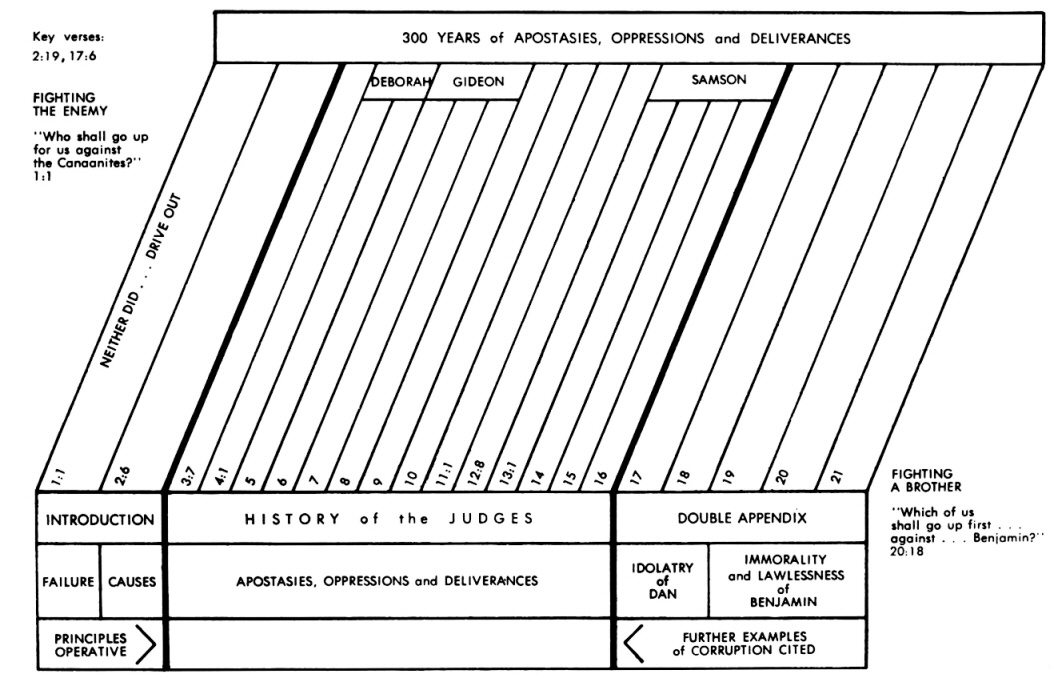
Chart from recommended resource Jensen's Survey of the OT - used by permission
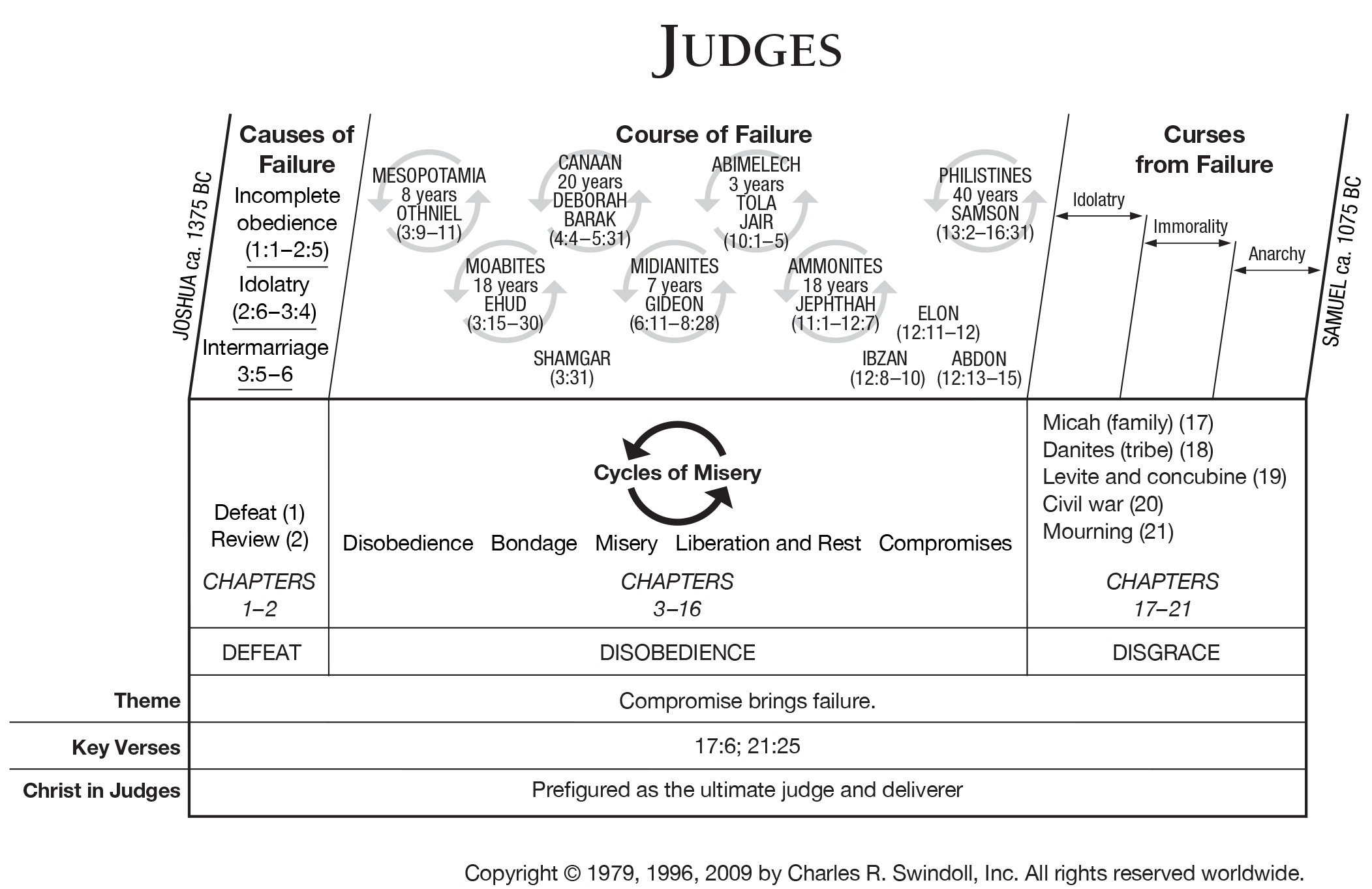
Chart on Judges - Charles Swindoll
|
RECYCLING SIN |
|||||
| Jdg 1:1-3:6 | Jdg 3:7-16:31 | Jdg 17:1-21:25 | |||
| Introduction | History of the Judges | Appendix | |||
| Causes of the Cycles THE REASON |
Curse of the Cycles THE RECORD |
Conditions in the Cycles THE RESULTS |
|||
| Failure to Complete Conquest Jdg 1:1-36 God's Judgment for Failure Jdg 2:1-3:6 |
Curse of the Cycles |
Conditions in the Cycles |
|||
| Living with Canaanites |
War with the Canaanites |
Living Like the Canaanites |
|||
| Religious Laxity |
Political Uncertainty |
Moral Anarchy |
|||
| About 350 Years of Israel's History - Almost 25%! From Compromise to Confusion! |
|||||

Another Timeline of Israel's History
Click to Enlarge
from Jensen's Survey of the OT
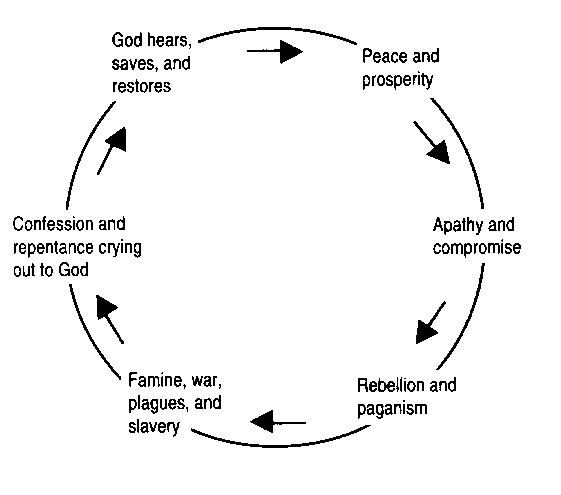
Click to Enlarge
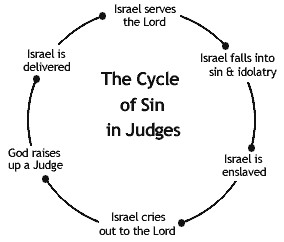
Other ways to describe Israel's cycle…
- Rest > Rebellion > Retribution > Repentance (? if actually genuine) > Restoration
- Sin > Suffering/Servitude > Supplication > Salvation
- Apathy > Apostasy > Affliction > Answered Prayer
- Disobedience > Desperation > Deliverance
- Disobedience > Bondage >Misery > Liberation and Rest > Compromises
FOLLOWING NOTES ARE COMPLETELY REVISED SPRING, 2022
Hannah's Bible Outline
- Gideon (Judges 6:1-8:32)
- Gideon's death (Judges 8:29-32)
- Israel's rest (Judges 8:28)
- Israel's deliverance (Judges 6:7-8:27)
- The promise of deliverance (Judges 6:7-10)
- The summons of the deliverer (Judges 6:11-32)
- The angelic visit (Judges 6:11-18)
- The worship by Gideon (Judges 6:19-24)
- The destruction of the pagan altars (Judges 6:25-32)
- The conflict for deliverance (Judges 6:33-8:27)
- The army gathered (Judges 6:33-35)
- The assurance of victory (Judges 6:36-40)
- The army reduced (Judges 7:1-8)
- The dream of the Midianite (Judges 7:9-14)
- The defeat of the Midianites (Judges 7:15-8:21)
- The strategy (Judges 7:15-18)
- The confusion (Judges 7:19-23)
- The scattering (Judges 7:24-25)
- The jealousy of Ephraim (Judges 8:1-3)
- The search for the Midian kings (Judges 8:4-21)
- The refusal of Succoth and Penuel (Judges 8:4-9)
- The capture of the kings (Judges 8:10-12)
- The punishment of Succoth and Penuel (Judges 8:13-18)
- The death of the Midian kings (Judges 8:19-21)
- Gideon's failure (Judges 8:22-27)
- Israel's servitude (Judges 6:2-6)
- Israel's sin (Judges 6:1)
- Parenthesis: the tyranny of Abimelech (Judges 8:33-16:31)
- Israel's idolatry (Judges 8:33-35)
- Shechem's submission to Abimelech (Judges 9:1-5)
Judges 6:1 Then the sons of Israel did what was evil in the sight of the LORD; and the LORD gave them into the hands of Midian seven years.
- Did evil - Jdg 2:13,14,19,20; Lev 26:14-46; Deut 28:15-68; Neh 9:26, 27, 28, 29; Ps 106:34-42
- Midian - Ge 37:28; Ex 2:15; Nu 10:29; 24:21; 25:1-3; 25:17; 31:2 Ge 25:2; Nu 25:17,18; Hab 3:7
Warren Wiersbe's Outline of Judges 6: Wiersbe prefaces his outline - "before the Lord could use Gideon in His service, He had to deal with four doubts that plagued him and were obstacles to his faith. These doubts can be expressed in four questions." (See Be Available Judges)
- “Does God really care about us?” (Jdg. 6:1–13)
He had chastened them (vv. 1–6).
He had rebuked them (vv. 7–10).
Now He came down to help them (vv. 11–13) - “Does God know what He’s doing?” (Jdg. 6:14–24)
- “Will God take care of me?” (Jdg. 6:25–32)
- “Does God keep His promises?” (Jdg. 6:33–40)
THE BACKGROUND FOR
THE NEXT JUDGE - GIDEON
Then - This is always an important expression of time and generally means "soon afterward" which we should prompt us to pause to ponder, asking "What has happened just before?" (and similar questions) which your Teacher the Spirit will help you answer (you will usually be forced to read the preceding context.) Stated another way, what did we just observe regarding time? (Jdg 5:31+)
The sons of Israel did what was evil in the sight of (literally “in the eyes of”) the LORD (cf Pr 15:3) - For forty years the land was undisturbed (Jdg 5:31+), but forty years was long enough to lead to forgetfulness of the greatness and the holiness of God. And so they forgot Jehovah (Jdg 3:7+) and forgot the Law of God (Hos 4:6+), because forty years is long enough for those who had experienced the victory of Deborah and Barak to have died, giving rise to a new generation (cf the "pathological" pattern in Jdg 2:10+) So why did the sons of Israel do what was evil? They did evil because they were in the midst of the Canaanites who practiced unspeakable evil. And tragically instead of being transformed by God's Word, they were conformed to the Canaanites' world and sensual evils that attracted Israel once again to begin to practice the abominable sexual practices associated with worship of the false idols. In short, Israel once again made a willful choice, a choice to gratify their sinful flesh! This is the sad repeated pattern in Judges (Jdg 2:11+,Jdg 3:12+, Jdg 4:1+, Jdg 6:1+, Jdg 10:6+, 13:1+).
THOUGHT - Is this the repeated pattern in your life or have you once and for all finally laid aside that sin that so easily entangles you that you might be able to run the race God has set out before you to finish (Heb 12:1+)?
CONTEXTUAL NOTE - The phrase did evil is common in is also common in 1 and 2 Kings (24 times) (See all 41 uses - Jdg 2:11; 3:12; 4:1; 10:6; 13:1; 1 Kgs 14:22; 15:26, 34; 16:25, 30; 22:52; 2 Kgs 3:2; 8:18, 27; 13:2, 11; 14:24; 15:9, 18, 24, 28; 17:2, 11; 21:2, 20; 23:32, 37; 24:9, 19; 2 Chr 12:14; 21:6; 22:4; 33:2, 22; 36:5, 9, 12; Neh 9:28; Isa 65:12; 66:4; Jer 52:2), increasing in frequency in second Kings. It is as if the closer they got to judgment, the more evil they became or the more certain the judgment had to be. Just a thought to ponder. Note it is also interesting that this phrase did evil is not found in 1 & 2 Samuel. Could it be that the reason is that the leaders were godly men like Samuel and David? Note also that the evil began with Baalim (plural) but progressed to the point documented in Judges 10:6+!
This same phrase is used to describe the wisest man in the Old Testament, King Solomon, in 1 Kings 11:6 - And Solomon did what was evil in the sight of the LORD, and did not follow the LORD fully, as David his father had done.
In Judges 6 we see that 40 years of rest led to dimming of their memories regarding the greatness of God's deliverance over Sisera's 900 iron chariots. And so the next generation fell right back into the syncretism (or perhaps just overt idol worship) that again threatened to obliterate Israel's distinction as God's treasured possession (Ex 19:5KJV+).
THOUGHT - What is the principle for believer's of all ages? Remember, remember, remember. Remember the times God has delivered you in the past out of (or through) a difficult time. Time has a way of eroding our memory and dimming our vision of the greatness of our God. Just another reason to be in the Word daily reading verses like Judges 6:1. If it happened to them, it can happen to us! (cf 1Cor 10:6,11+). Periods of "rest" in our spiritual lives can lull us into the delusion that we are self sufficient and don't really need God all that much. (Been there, done that!)
And the LORD gave them into the hands of Midian seven years - Gave them into the hands is translated in the Greek Septuagint with the verb paradidomi which means to give one over to the power or authority of another (3x in Romans 1 God giving sinners over to the power of their Sin Nature! Ro 1:24+, Ro 1:26+, Ro 1:28+) The message is that if we play with sin, God may eventually give us over completely to the power or authority of that sin! This is a frightening thought!!! Jehovah repeatedly gave Israel into the hands of their enemies. (cf Jdg 2:14+, Jdg 11:32+, Jdg 13:1+) It is interesting to note that this relatively brief 7 year period of oppression was sandwiched between two 40-year periods of peace (Jdg 5:31+, Jdg 8:28+).
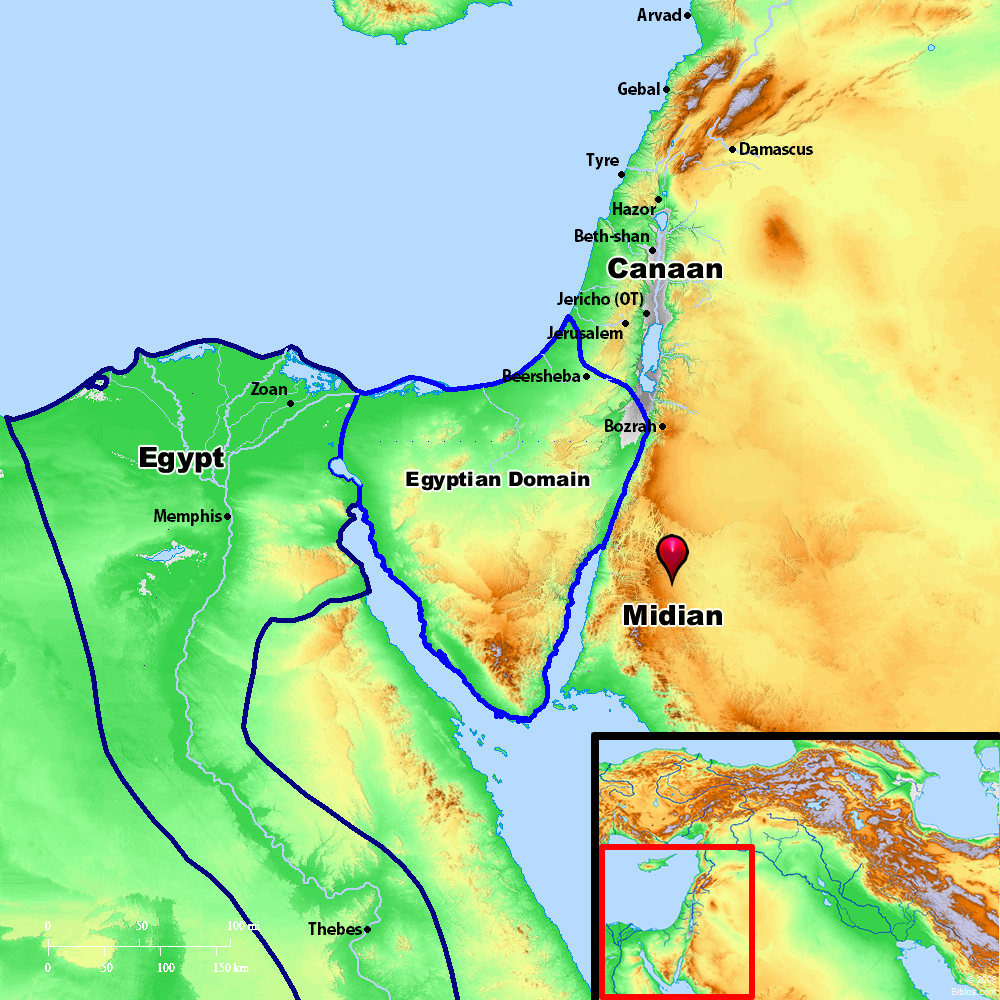
Midian (see map or Wikipedia map) was located just south of Edom (see Edom on this map) and at the north extremity of the Gulf of Aqaba (click this map and scroll down to "Midian" to get a sense of how far the Midianites would have to travel to raid Israel - I estimate it at about 220 miles a journey that was made possible by their innumerable camels). Midianites were semi-nomadic sons of Abraham. Midian was a son of Abraham by his concubine Keturah. (Genesis 25:2). Moses must have learned about surviving in the desert during these years.
Warren Wiersbe observes that "more space is devoted to Gideon in the Book of Judges (100 verses) than to any other judge (96 verses are devoted to the last judge, Samson. The first four judges were godly people; but from the time of Gideon, the leaders began to decay until you get to Samson, the most unspiritual of them all. Because the nation wanted freedom from the enemy without being dedicated to God, they didn’t deserve godly leaders. Sometimes God gives His people exactly what they deserve.); and Gideon is the only judge whose personal struggles with his faith are recorded. Gideon is a great encouragement to people who have a hard time accepting themselves and believing that God can make anything out of them or do anything with them." (See Be Available - Judges: Accepting the Challenge to Confront)
Gary Inrig comments on Jdg 6:1-10 - These verses paint a vivid portrait of the condition of Israel in the time of Gideon. Here we have the fourth go-round of the period of the judges, and, once again, it is the distressing cycle of sin, servitude, supplication, and salvation, followed by more sin and more servitude. God had given the people a wonderful deliverance through Deborah, and for forty years afterwards Israel had known freedom and peace. Then the people took their eyes off the Lord (Ed: SEE DISCUSSION OF "Vertical Vision") and focused their lustful gaze on the idols and evils of Baal worship (Ed: This equates with "horizontal vision!"), and once again God gave them over to the consequence of their sin—bondage and servitude under a foreign nation. Israel’s problems are, once again, the result of God’s judgment. The invaders come because God sends them. This time God used an alliance of desert peoples, led by the Midianites, a Bedouin people from deep in the Arabian Desert. Midian had discovered a devastating new military weapon—the camel! In the twenty-first century with our sophisticated instruments of death and destruction, it seems ludicrous to speak of camels as advanced military technology. They are unsightly, temperamental, slow animals. But in the late second millennium BC, camels gave the Midianites enormous military advantage. Ugly and large enough to strike anyone with fear, their supreme benefit was in giving the Midianites a mobile, long-range, swift attack capability against the Hebrews, who were entirely dependent on foot soldiers. A camel can travel for three or four days with a heavy load on its back and cover about three hundred miles without food or water. Even more recent times have seen the military value of the camel. The American army started an interesting experiment to use camels in the fight against the Native Americans, but the project was shelved when the Civil War broke out. In World War I, Lawrence of Arabia led his Arab warriors on camel back in a series of devastating attacks on more traditional German forces. With their powerful new weapons, the Midianites developed a unique strategy against Israel. Rather than invading and occupying the land, they simply waited until the Israelites had done all the hard work of preparing the soil, planting the crops, and readying the harvest. Then, as Jdg 6:3-5 reveal, they would move in from the desert, cross the Jordan in huge numbers, and overwhelm the land. Their military and numerical superiority left Israel defenseless; so they would seize every bit of food they could find. Like a plague of locusts (Judges 6:5), they would swoop through the land, stripping it bare of grain, vegetables, fruit, and livestock. Finally, their camels loaded with spoil, they would cross back into the desert and live there until the next harvest time. Perhaps they would leave a small force in the land, but the main host came only during the yearly invasion. This pattern of seasonal invasion was repeated for seven years (Judges 6:1), crushing Israelite morale and ravaging their economy. Israel was left in a desperate situation, reduced to hiding food supplies in mountain dens and caves. But nothing could stop Midian. Israel was defeated and helpless, or, as the writer says, they were brought very low (Jdg 6:6), literally “made small” agriculturally, economically, and socially. (Borrow Hearts of Iron, Feet of Clay)
Judges 6:2 And the power of Midian prevailed against Israel. Because of Midian the sons of Israel made for themselves the dens which were in the mountains and the caves and the strongholds.
- power - Leviticus 26:17; Deuteronomy 28:47-48
- made for themselves the dens which were in the mountains and the caves 1Sa 13:6; 14:11; Heb 11:38; Revelation 6:15
Related Passages:
Leviticus 26:17+ ‘I will set My face against you so that you will be struck down before your enemies; and those who hate you will rule over you, and you will flee when no one is pursuing you (GOOD DESCRIPTION OF THE FEAR THAT GRIPPED ISRAEL DURING THIS TIME).
Deuteronomy 28:47-48+ “Because you did not serve the LORD your God with joy and a glad heart, for the abundance of all things; 48 therefore you shall serve your enemies whom the LORD will send against you, in hunger, in thirst, in nakedness, and in the lack of all things; and He will put an iron yoke on your neck until He has destroyed you.
And the power of Midian prevailed ('azaz) against Israel - Power is literally "hand" (yad) which is a figure of speech that is frequently used to signify strength. Prevailed ('azaz) means to be overpowered, oppressed, conquered. The irony is this same verb 'azaz was used to describe Othniel when the Spirit of the LORD came upon him and "he prevailed ('azaz) over Cushan-rishathaim." (Jdg 3:10+).
THOUGHT - O, the dire consequences of willful disobedience! God may you so move in each of our hearts that we do not quench or grieve the Spirit by choosing to practice evil and the spiritual forces of darkness be allowed to prevail over us. Do it for Thy glory and in the Name of Jesus. Amen.
Charles Spurgeon declared a principle we would all do well to hear and heed “The Lord does not permit His children to sin successfully.” God is not a “permissive parent” who allows His children to do as they please, for His ultimate purpose is that they might be “conformed to the image of His Son” (Ro 8:29+). The Father wants to be able to look at each member of His spiritual family and say, “This is My beloved child, in whom I am well pleased” (Mt 3:17; 12:18; 17:5).
Wiersbe - Chastening is evidence of God’s hatred for sin and His love for His people (Heb 12:5-11+). We can’t conceive of a holy God wanting anything less than His very best for His children, and the best He can give us is a holy character like that of Jesus Christ. Obedience to the Lord builds character, but sin destroys character; and God cannot sit idly by and watch His children destroy themselves. Israel had already experienced forty-three years of suffering under the harsh rule of the neighboring nations, but they hadn’t yet learned their lesson and turned away from the heathen idols. Unless our suffering leads to repentance, it accomplishes no lasting good; and unless our repentance is evidence of a holy desire to turn from sin, not just escape from pain, repentance is only remorse. Chastening assures us that we are truly God’s children, that our Father loves us, and that we can’t get away with rebellion.(See The Wiersbe Bible Commentary)
Because of Midian the sons of Israel made for themselves the dens which were in the mountains and the caves and the strongholds. Hiding in dens and caves...what a contrast for the chosen people who God said would "ride on the high places of the earth" (Deut 32:13+)! Note the repetition of places of refuge (dens...mountains...caves...strongholds) which emphasizes the depth of their fearful state. They ran to hide in the rocks instead of hiding in the the Everlasting Rock of ages, the Rock of their salvation. Moses foresaw this when he wrote of Israel "Jeshurun grew fat and kicked– You are grown fat, thick, and sleek– Then he forsook God who made him, And scorned (despised, rejected, fell away from) the Rock of his salvation...you neglected the Rock Who begot you and forgot the God Who gave you birth!" (Dt 32:15, 18+ cf Rock in Dt 32:4+, Dt 32:30, 31, 37+!)
THOUGHT - Beloved, have you disobeyed God and as a result are hiding in a "den" or "cave" because you are experiencing the attacks of the "Midianites"? Then you need to study the life of Gideon, a most unlikely Biblical hero. God's Spirit transformed Gideon's fearful, faltering faith and He can do the same for you beloved. Run to the Rock of your salvation!
Harper's Bible dictionary caves writes that "Natural caves are abundant in Syro-Palestine due to the presence of chalk, limestone, and sandstone formations in the hills and mountains. Because of the soft qualities of these materials, man-made tombs and caves are also abundant. Not only are the caves in this region abundant, but they are frequently massive in size (picture of cave in Israel). One cave complex near Damascus in modern Syria was capable of holding four thousand men, according to Strabo, a Greek geographer who wrote in the late first century B.C. That complex of caves is still visible today. Palestine also had large caves as indicated by the fact that David could conceal four hundred men in the cave of Adullam (1 Sa. 22:1, 2)." (ED: Here is a picture of a cave in the Judean Hills which is about the size of a football field - It could have concealed 400 men!)
Power (03027) yad is feminine noun meaning hand and figuratively meaning strength. In several passages, yād is used in the sense of "power" or "rule": "And David smote Hadarezer king of Zobah unto Hamath, as he went to establish his dominion by the river Euphrates" (1 Chron. 18:3). "To be delivered into one's hands" means to be "given into one's power": "God hath delivered him into mine hand; for he is shut in, by entering into a town that hath gates and bars" (1 Sa 23:7; cf. Pr 18:21).
Prevailed (05810)('azaz) means to be strong, to strengthen, to prevail. It depicts being victorious, prevailing, being victorious in battle (Jdg. 3:10; 6:2; Da 11:12) or in various settings. It describes people triumphing instead of God (Ps. 9:19).
Gilbrant - The verb ʿāzaz can be used of both God and man. When used of man, it usually has the idea of "prevailing" in a war or other struggle (Judg. 3:10; 6:2; Dan. 11:12). It is also used in a prayer that men who rely on their wealth rather than God might not prevail, but that God will rise in defense of his people (Ps. 9:19). The defiant man strengthens himself in his wickedness and his wealth rather than finding it in God (Ps. 52:7). Still, wisdom "strengthens" man more than great human "strength" (Ecc. 7:19).
When used of God, ʿāzaz is usually found in a petition for Him to show his strength, which He inherently possesses (Ps. 89:13), and to show himself strong against the enemies of his people (Ps. 68:28). The strength of God was also demonstrated at the creation when He established the fountains of the deep by restraining them (Prov. 8:28).
The two occurrences of ʿāzaz in the Hiphil stem both speak of having an "impudent" look or "insolent" expression. It is used of the impudent look of the immoral woman (Prov. 7:13) and the hardened face or impudent look of the wicked man (Prov. 21:29). (Complete Biblical Library)
'Azaz - 11x in 11v became fixed(1), brazen(1), displays a bold(1), mighty(1), prevail(2), prevailed(1), prevailed*(1), show yourself strong(1), strengthens(1), strong(1). - Jdg. 3:10; Jdg. 6:2; Ps. 9:19; Ps. 52:7; Ps. 68:28; Ps. 89:13; Prov. 7:13; Prov. 8:28; Prov. 21:29; Eccl. 7:19; Dan. 11:12
Judges 6:3 For it was when Israel had sown, that the Midianites would come up with the Amalekites and the sons of the east and go against them.
- when Israel - Leviticus 26:16; Dt 28:30, 31, 32, 33,51; Job 31:8; Isaiah 65:21,22; Micah 6:15
- Amalekites - Jdg 3:13
- the sons of the east - Jdg 6:33 7:12 8:10 Ge 29:1 1Ki 4:30 Job 1:3
For - A sad term of explanation. Sow seeds of sin and reap rotten consequences of disobedience!
It was when Israel had sown, that the Midianites would come up with the Amalekites and the sons of the east and go against them - You have a garden, and you work hard all spring and summer to make that garden produce abundantly. But every year, just about the time you’re ready to gather in the harvest, your neighbors swoop down (camels can run up to 40 mph in bursts so "swoop" is not an exaggeration) and take your produce away from you by force. This goes on year after year for 7 years, and there’s nothing you can do about it. If you can imagine that scenario, then you’ll have some idea of the suffering the Jews experienced every harvest when the Midianites made their annual raids. For seven years, God allowed the Midianites and their allies to ravage “the land of milk and honey,” leaving the people in the deepest poverty.
WHO WERE THE MIDIANITES (see also Wikipedia)? - Midianites were descended from MIDIAN and were "half-brothers" with the Hebrews as MIDIAN was one of the several children born to Abraham and Keturah, who had been sent away to the east so that Isaac might be Abraham’s uncontested heir (Ge 25:1-6). Joseph was later sold into Egypt by Midianite merchants (Ge 37:23-28). Moses fled to the land of Midian where he lived for 40 yr and where he married Zipporah, a Kenite princess, daughter of Jethro, priest of Midian (Ex 2:15-22). The Midianites provided opposition (aided by Balaam who became a tool in their hands to curse Israel) to the Israelites as they journeyed toward the Promised Land, being found in league with the Moabites (Nu 22-25 - especially Nu 25:1-2+) and the Amorites (Josh 13:21+). Known primarily as prosperous traders, the various groups of Midianites tended to merge with the Ishmaelites (cf. Ge 37:25, 26, 27, 28; Jdg 8:24+). Later, Balaam became a tool in the hands of the Midianites to curse Israel (Nu 22-24). The AMALEKITES occupied the region just S of Judah. So this oppression was not continual occupation (like the preceding one of the Canaanites) but a seasonal invasion at harvest time. (See related discussion - Amalekites = exposition of Exodus 17:8-16)
Sons of the east (9x - Ge 29:1; Jdg. 6:3, 33, 7:12, 8:10; 1Ki 4:30; Isa 11:14; Ezek 25:4,10) - This is a general term for the nomads of the Syrian desert, possibly including some Ammonites and Edomites.
QUESTION - Who were the Midianites?
ANSWER - Abraham had more sons than just Isaac (by Sarah) and Ishmael (by Hagar). He also had six sons by Keturah, his wife after the death of Sarah: Zimran, Jokshan, Medan, Midian, Ishbak, and Shuah (Genesis 25:2). The Midianites were the descendants of Midian and therefore children of Abraham. They settled in “the land of the east” (Genesis 25:6). Most scholars believe the land of Midian was officially on both sides of the Gulf of Aqaba, although the Midianites showed nomadic tendencies later in their history (see Habakkuk 3:7ESV).
When Moses fled the wrath of Pharaoh, he traveled to Midian (Exodus 2:15). There, Moses met and married his wife, Zipporah, and served his father-in-law, Jethro, as a shepherd for forty years. The fact that Jethro was “a priest of Midian” (Exodus 2:16) indicates that the Midianites, at least during Moses’ time, still retained the knowledge of the God of their father Abraham (cf. Jethro’s words and actions in Exodus 18). At the end of Moses’ time in Midian, God appeared to Moses—still in Midian—and commissioned him to lead the Israelites out of slavery (Exodus 3—4).
As the children of Israel traveled through the wilderness, they employed the services of a guide familiar with the desert—Moses’ Midianite brother-in-law, Hobab (Numbers 10:29). However, the relations between the Israelites and the Midianites began to sour when the Midianites joined forces with the Moabites in order to hire Balaam to curse Israel (Numbers 22). Later, when Israel fell into idolatry and sexual sin with the Moabite women (Numbers 25), we find that a prominent Midianite woman was also involved (Numbers 25:6). The Lord then told Moses to wage war against the Midianites: “Treat the Midianites as enemies and kill them. They treated you as enemies when they deceived you in the Peor incident involving their sister Kozbi, the daughter of a Midianite leader” (Numbers 25:17–19). The Israelites did eventually attack the Midianites, meting out divine retribution against their enemies (Numbers 31). Five kings of the Midianites were killed, as was Balaam (Numbers 31:8). This battle was one of the last things Moses accomplished as leader of the Israelites.
During the time of the judges, “the Midianites, Amalekites and other eastern peoples invaded the country” and plundered the land (Judges 6:3). For seven years, “Midian so impoverished the Israelites that they cried out to the Lord for help” (verse 6). God answered their cries and raised up Gideon as a deliverer. With just 300 men, Gideon defeated the armies of the Midianites, although the foe was “thick as locusts. Their camels could no more be counted than the sand on the seashore” (Judges 7:12). Of course, God was involved, and He was the One who granted the victory over the Midianites (verse 22).
Later references to the Midianites include allusions to God’s victory over them (Psalm 83:9; Isaiah 10:26). And, in a prophecy of Israel’s future glory in the Messianic kingdom, Isaiah writes, “Herds of camels will cover your land, / young camels of Midian and Ephah. / And all from Sheba will come, / bearing gold and incense / and proclaiming the praise of the Lord” (Isaiah 60:6).GotQuestions.org
Judges 6:4 So they would camp against them and destroy the produce of the earth as far as Gaza, and leave no sustenance in Israel as well as no sheep, ox, or donkey.
- destroy the produce of the earth Leviticus 26:16; Deuteronomy 28:30,33,51; Micah 6:15
- as far as Gaza Genesis 10:19; 13:10
- leave no sustenance in Israel Pr 28:3; Jer 49:9,10; Obadiah 1:5
ISRAEL RAVAGED
EAST TO WEST
So they would camp against them and destroy (shachath) the produce of the earth as far as Gaza (means "strong"), and leave (sha'ar/sa'ar) no sustenance in Israel as well as no sheep, ox, or donkey. Since Gaza is on the seacoast in SW Israel (see map) this fact shows that these Midianite raiders ravaged virtually the entire land of Israel from east to west.
Related Resource:
Judges 6:5 For they would come up with their livestock and their tents, they would come in like locusts for number, both they and their camels were innumerable; and they came into the land to devastate it.
- tents - Song 1:5; Isaiah 13:20;
- locusts - Jdg 7:12; 8:10; Jer 46:23
- camels - Jdg 8:21; 1Sa 30:17; Isaiah 60:6; Jer 49:29,32
- to devastate it - Psalm 83:4-12
Related Passages:
Judges 7:12+ Now the Midianites and the Amalekites and all the sons of the east were lying in the valley as numerous as locusts; and their camels were without number, as numerous as the sand on the seashore.
Acridium peregrinum




LIKE LOCUSTS
RIDING CAMELS!
For they would come up with their livestock and their tents, they would come in like locusts for number - As explained more below, this is a profound picture of the "pestilence" wrought by the invading Midianites, because locust invasions were greatly feared in the Middle East because of their devastating impact on the land.
Like locusts = SIMILE = figure of speech comparing two unlike things & often introduced by like or as. Contrast with METAPHOR = figure of speech in which a word or phrase literally denoting one kind of object (eg, "food" in Jn 4:34) or idea is used in place of another to suggest a likeness or analogy between them. Desert locusts are phenomenal travelers. They are able to fly for 17 hours at a time and have been known to travel 1500 miles. The sound of their wings is compared to the sound of chariots (Joel 2:5+; Rev 9:9+). A swarm has been known to cover a hundred square miles and to be so dense as to blot out the sun, A truly large swarm may contain ten billion locusts.
Easton's Bible dictionary on Locusts - "The devastations they make in Eastern lands are often very appalling. The invasions of locusts are the heaviest calamites that can befall a country. “Their numbers exceed computation: the and the Arabs knew them as ‘the darkeners of the sun.’ Unable to guide their own flight, though capable of crossing large spaces, they are at the mercy of the wind, which bears them as blind instruments of Providence to Easton's Bible dictionary. the doomed region given over to them for the time. Innumerable as the drops of water or the sands of the seashore, their flight obscures the sun and casts a thick shadow on the earth (Ex. 10:15; Jdg. 6:5; Jdg 7:12-note; Jer. 46:23; Joel 2:10). It seems indeed as if a great aerial mountain, many miles in breadth, were advancing with a slow, unresting progress. Woe to the countries beneath them if the wind fall and let them alight! They descend unnumbered as flakes of snow and hide the ground. It may be ‘like the garden of Eden before them, but behind them is a desolate wilderness. At their approach the people are in anguish; all faces lose their colour’ (Joel 2:6). No walls can stop them; no ditches arrest them; fires kindled in their path are forthwith extinguished by the myriads of their dead, and the countless armies march on (Joel 2:8, 9). If a door or a window be open, they enter and destroy everything of wood in the house. Every terrace, court, and inner chamber is filled with them in a moment. Such an awful visitation swept over Egypt (Ex. 10:1-19), consuming before it every green thing, and stripping the trees, till the land was bared of all signs of vegetation. A strong north-west wind from the Mediterranean swept the locusts into the Red Sea.”
Both they and their camels were innumerable and they came into the land to devastate (shachath) it - Camels were a major factor in their success, being able to travel for 3-4 days, at about 100 mi/day without food or water, carrying heavy loads which made them a formidable long-range military threat. In a sense camels were the Midianite version of Sisera's iron chariots, both providing a military advantage. This is the first reference to an organized raid using camels (cf. Ge 24:10,11). Devastate it or like "locusts" to devour it!
HISTORICAL NOTE - The American army started an interesting experiment to use camels in its fight against the Indians but shelved the project when the Civil War broke out. So here were the Israeli forces, dependent totally on foot soldiers, and in come marauding bands of Midianites on creatures who by their ugly appearance alone would strike terror in the hearts of those who saw them coming.
Joseph Parker applies this text commenting on God's use of natural means to discipline us "God gets at men through various means. The Midianites came out and spoiled the fields of the Israelites. The camels of the Midianites were without number; they entered the land to destroy it. Wheresoever they laid their hand they crushed the hope of Israel. Has God a way into our life, then, through corn and grass? Has He a way to chastise us through the medium of our business? Can He turn a client away and send a customer in another direction, and blind a man whilst he is counting his money? and can He so arrange things that prosperity shall crumble into adversity and a dense darkness shall settle upon the brightness of prosperity? This is God’s way of doing. He gets at men through their skin; He smites them with leprosy that they may learn to pray; He curses their bread that they may cry out about the better life; He drops poison into their water that they may learn that they have committed two evils — they have forsaken Him, the fountain of living water, and have hewn out unto themselves cisterns, broken cisterns, that can hold no water. These things should bring us to study, to reflection, to inquiry. “Why has this adversity come upon me? why do men actually pine and die? Is there not a cause?” (Divine Punishment Through Natural Means)
Judges 6:6 So Israel was brought very low because of Midian, and the sons of Israel cried to the LORD.
- brought very low - Ps 106:43; Jeremiah 5:17; Malachi 1:4;
- cried to the LORD Jdg 3:9,15 Ps 50:15 78:34 106:44 Isa 26:16 Ho 5:15
So Israel was brought very low - They were brought very low, literally means “made small” agriculturally, economically, and socially. See same word "hang down" in Pr 26:7 for picture of this low state. In the Septuagint the verb ptocheuo means literally to lead the life of a beggar, be destitute, poor and helpless, the picture of of one crouching like a beggar because of their poverty. Interesting that ptocheuo (related word ptochos) is used only once in the NT of Jesus' poverty for us (figuratively, of Christ's earthly humility and lowly life)! (2 Cor 8:9+). How sad that Israel was brought so LOW, when God had delivered them from bondage in Egypt and brought them UP (Jdg 6:8).
THOUGHT - What a commentary...our efforts and self will usually end up taking us "DOWN" whereas God's will and work takes us "UP". Lord, open our eyes to see this simple truth. Amen.
because of Midian - literally "the face of" Midian. One gets a picture of the sinful Israel having to stare face to face with the consequences of their sin! Woe!
Israel’s backsliding resulted in poverty and fear or lack of peace exactly what God had predicted in (Lev 26:1-6). God's promises are true, both of blessing & cursing (Heb 4:12+). Those whom Israel had once conquered (Midian defeated in Nu 31 just before Moses died & Joshua led them into the promised land of milk & honey -- instead of enjoying the riches of the physical & spiritual life that God had intended for His children, Israel was reduced as the Septuagint pictures it to lead the life of a beggar - are you living like a beggar even though you are a child of the King, a son of the living God? (Ro 8:16+) were now her masters. When believers turn from the Lord to the flesh, old habits enslave and impoverish us as well and we will be fearful.
And the sons of Israel cried (za'aq; lxx - krazo) to the LORD - This cry does not seem to have been an indication of repentance (but more of remorse) because they apparently were not aware of the moral cause behind the enemy’s oppression until the Lord sent a prophet to point this out (Jdg 6:7-10).
Gary Inrig notes that "the burden became too great and they “cried out to the Lord,” but once again it was a cry that lacked repentance. As we shall see, Baal worship abounded in the land (THOUGHT - In other words they are crying out for relief, and yet unwilling to repent of their idolatry! How do you think God responds to such hypocrisy? Do we ever do this? We cry "Relieve me God" but refuse to release the idols from our grip?). Until now, every time God’s people had called to Him, He had sent a judge, a deliverer, to change their condition. Not this time. God sent a prophet because His people needed repentance more than they needed relief. His message is one of condemnation, not comfort; of judgment, not encouragement. This unnamed prophet is the only prophet to be directly mentioned in the book of Judges, with the exception of Deborah. (Borrow Hearts of Iron, Feet of Clay)
Brought low (01809) (dalal) root connotes lowness as a state or a goal. Used as a metaphor to describe the (Low) state of deprivation which in its extremity issues in a cry to God and thus indicates one in physical and/or mental distress and languishing as in Jdg 6:6. Literally lame legs hanging down (Pr 26:7) or a streams of Egypt will dry up, dwindle or diminish (Isa 19:6).
Gilbrant - The verb dālal, meaning "to be" or "become small, low," occurs eight times in the OT. TDOT identifies at least two dll Semitic roots, distinguishing between, "to be low," "to allow to hang, dangle." Old Testament usage, however, draws no sharp distinctions between these two senses. The term can also mean "to hang" (Job 28:14). The verb also comes to denote "humility" or "lowness," in terms of both individual (Ps. 142:6; 116:6) and national (Judg. 6:6; Ps. 79:8) oppression and its consequences. Job 28:14 depicts miners who sink a shaft: "they hang and swing to and fro far from men." Apparently the description refers to men suspended on ropes within an open vertical shaft. In Psalm 142:6, the psalmist acknowledged that because of those pursuing him, he was "brought very low." Similarly, in Ps. 116:6, the writer "was brought low" only to be saved by a gracious, compassionate God. Individual distress is also evident in the case of Hezekiah who, in his illness, acknowledged that his eyes "were cast down" even though, paradoxically, he looks "to the heights" (Isa. 38:14). Nations likewise experience this oppression, as is the case with Israel in the Judges period. According to Judges 6:6, the nation was "brought very low" at the hands of the Midianites. The Northern Kingdom, referred to as Jacob, would experience the same "lowness" as Aram (Damascus) in suffering a shameful defeat, Yahweh warned in Isa. 17:4. The canals of Egypt will "be brought low" (Isa. 19:6), as even the Nile dries up in the nation's judgment, Isaiah prophesied in the context of Jerusalem's destruction, the people plead for God's forgiveness and compassion, for "we are brought very low" (Ps. 79:8). (Complete Biblical Library)
Uses of dalal - Jdg. 6:6; Job 28:4; Ps. 79:8; Ps. 116:6; Ps. 142:6; Pr 26:7 (KJV), Isa. 17:4; Isa. 19:6; Isa. 38:14
Judges 6:7 Now it came about when the sons of Israel cried to the LORD on account of Midian
SONS OF ISRAEL
CRY OUT TO JEHOVAH
Now it came about when the sons of Israel cried (za'aq) to the LORD on account of Midian - Notice that they are not crying out to God "on account of" their sin and nor are they crying out for God to grant them repentance. And yet does God refuse their request? What does this say about God that applies to all of us? (That's a rhetorical question of course but if you do not see it, read Lam 3:22-23).
Sons of Israel speaks of the nation. Did they meet together to cry out or did they more likely do so from their individual homes? We cannot know with certainty. Notice the word "when"! One gets the picture that Yahweh was patiently waiting to hear their cry for deliverance! The LXX translates za'aq with krazo which can be used of urgent prayer or supplication. Krazo also means to make a vehement outcry, like when one screams, shriek, or utters loud cries, even without words capable of being understood. Did Israel ask "Lord please deliver us?" We cannot state with certain. They may have been like the people on an airliner that suddenly loses power and begins to plunge to the earth, the passengers screaming and crying out, usually voicing the phrase "O God," "Help God," etc, even when they don't necessary believe in Him or have a personal relationship with Him. Israel's "airline" was "crashing" so they began crying out! When the context does not specifically indicate that the cry was accompanied by a confession of sin, it is best not to assume that repentance took place. All we can safely say is that oppressed Israel cried out to the Lord to intervene.
THOUGHT - Affliction makes those cry to God who before would scarcely speak to Him. When you are at the end of yourself cry out for the Deliverer: Even better is to pray incessantly. He will hear you. Say ''I can't Lord but You can!'' Isaiah 57:15 expresses His heart toward the humble and contrite heart. Listen to the chorus "Cry Out."
J Vernon McGee - Here goes Israel again, whining and complaining. But God is gracious and good. A prophet came and told them why they were in their present condition. They cried out to God, and God in mercy sent them another judge.
Gary Inrig - There is a great difference between a cry for help from trouble and a cry of repentance for sin. The Israelites called on God, but they had not dealt with their sin. So when God’s prophet came in Jdg 6:7–10, he began by reminding them of God’s unchanging faithfulness and grace. He had delivered them from Egypt, helped them dispossess the occupants of Canaan, and given them the land. He had also entered into a covenant with them, a covenant with the clearest and simplest of terms: “I am Yahweh your God. You shall not serve the gods of the Amorites in whose land you are dwelling.” God had done all that in His grace for them. Yet, deliberately and defiantly, they had broken their covenant with Him. God does not belabor His point through His prophet. He simply states the obvious: “You have not listened to Me.” (It could equally well be translated, “You have not obeyed Me”). Strangely, there is no pronouncement of judgment or consequences but only a reminder that the Israelites had brought it on themselves. They were what they were and where they were because they had turned away from the living God. We need to hear this. All too often, when Christians experience the consequences of their own sinful or foolish choices, I hear them complain, “How could God let this happen to me? This isn’t fair!” We need to be reminded that the one thing none of us really wants from God is justice. If we were to get what we truly deserve, each one of us would be in terrible trouble! But God did not leave them there, aware of their sin and defeated by it. He was going to deliver them, and His first step was to prepare His deliverer, a very unlikely candidate named Gideon, meaning “hewer” or “hacker” in Hebrew. (Borrow Hearts of Iron, Feet of Clay)
Cried out (02199)(za'aq) means to cry out, to call out for help (especially when in distress), to appeal (even making public sounds of physical and/or emotional anguish - Ex 2:23, 2Chr 20:9, Job 35:9). It is basically a cry of pain, often accompanied by a lament over one's condition and/or by a request for divine help. Za'aq can be summoned in the sense of to be assembled (Jos 8:16; Jdg 6:34, 35; 18:22, 23) Finally, za'aq can mean to issue a proclamation by sending out an official written document with instructions or principles (Jonah 3:7) There are several passages (Psalm 107:13, 19) where za’aq may seem to approach a hint of repentance; yet in each case the emphasis remains on the condition of distress rather than on any expression of repentance.
Za'aq uses in Judges - Jdg. 3:9; Jdg. 3:15; Jdg. 4:10; Jdg. 4:13; Jdg. 6:6; Jdg. 6:7; Jdg. 6:34; Jdg. 6:35; Jdg. 10:10; Jdg. 10:14; Jdg. 12:2; Jdg. 18:22; Jdg. 18:23
Judges 6:8 that the LORD sent a prophet to the sons of Israel, and he said to them, "Thus says the LORD, the God of Israel, 'It was I who brought you up from Egypt, and brought you out from the house of slavery.
- the LORD sent a prophet to the sons of Israel - Jdg 2:1-3; Neh 9:9-12; Ps 136:10-16; Isaiah 63:9-14; Ezek 20:5-32
Related Passages:
Lamentations 2:14 Your prophets have seen for you False and foolish visions; And they have not exposed your iniquity So as to restore you from captivity, But they have seen for you false and misleading oracles.
GOD'S PROPHET RECALLS
YAHWEH'S FAITHFULNESS
In Judges 3:9 when the sons of Israel cried to the LORD, the LORD raised up a deliverer for the sons of Israel to deliver them, but this time He first sends a prophet! This prophet reminds them of God's deliverances and rebukes them for their disobedience, which now has become repetitive!
That the LORD sent a prophet (nabiy) to the sons of Israel, and he said to them - In Jdg 2:1-5 the Angel of the LORD had rebuked Israel, but now God sends a human prophet. Exactly to whom the prophet gives this message is not clear from the context. The only other prophet mentioned in the book besides the Prophetess Deborah. God used prophets in isolated cases before Samuel, the band of prophets Samuel probably founded (1 Sa 10:5), and later such prophets as Elijah, Elisha, and the writing prophets—major and minor. Here the prophet is sent to announce the divine condemnation because of their infidelity (Jdg 6:10). Israel cried to God (probably for a deliverer as in Jdg 3:9), and He sent them a prophet to point out the "why" of their predicament (DISOBEDIENCE) (Jdg 6:10 cf Heb 4:12+, He 4:13+; Lam 2:14).
Ralph Davis comments on God's response to Israel's cry for help writing that "Israel cries for relief, “and Yahweh sent a prophet to the sons of Israel” (Jdg 6:8). That would be like a stranded motorist calling a garage for assistance and the garage sending a philosopher instead of a mechanic. Israel needs deliverance and Yahweh sends a prophet; Israel asks for an act of God’s power and he sends them a proclaimer of his word who rehearses Yahweh’s grace (Jdg 6:8, 9), repeats Yahweh’s demand (v. 10a), and levels Yahweh’s accusation (Jdg 6:10b). Hence Yahweh sends a prophet because Israel needs more than immediate relief; they need to understand why they are oppressed. They must see that “Yahweh gave them into the hand of Midian” (Jdg 6:1) because they had “not listened to [his] voice” (Jdg 6:10b). Surely God’s way with his people has not changed. Do we sometimes marvel at the “inappropriate” answers God gives to our urgent need? Like Israel, we may want escape from our circumstances while God wants us to interpret our circumstances. Sometimes we may need understanding more than relief; sometimes God must give us insight before he dare grant safety. Understanding God’s way of holiness is more important than absence of pain. We may want out of a bind, whereas God wants us to see our idolatry. God means to instruct us, not pacify us. We should not miss the kindness of God in all this. One of the kindest things God does for us is to bring us under the criticism of his word to expose the reasons for our helplessness and misery. He does this by the preaching, counsel, or reading of his word. (Such a Great Salvation - Focus on the Bible)
Thus says the LORD, the God of Israel, 'It was I who brought you up from Egypt, and brought you out from the house of slavery - Recall the words of the generation of Joshua "The people answered (JOSHUA - Josh 24:15+) and said, “Far be it from us that we should forsake the LORD to serve other gods; for the LORD our God is He who brought us and our fathers up out of the land of Egypt, from the house of bondage, and who did these great signs in our sight and preserved us through all the way in which we went and among all the peoples through whose midst we passed." (Josh 24:16-17+) By the time of Judges 6, Israel was so spiritually apathetic and apostate that God needs to send His "mouthpiece," an unnamed prophet to remind them of His deliverance from slavery in Egypt and their disobedience in face of such mercy and grace shown to the nation (Jdg 6:10b)..
There is a great difference between a cry for help from trouble, and a cry of repentance for sin. Israel called on God but they had not dealt with their sin. So God's prophet came in Jdg 6:7-10 and reminded them of God's faithfulness and grace -- how He had delivered them from Egypt and given them the land of Canaan and set forth the terms of His covenant "I am Yahweh your God. You shall not serve the gods of the Amorites." Yet deliberately and defiantly and unfaithfully they had broken their covenant with Him. So the prophet reminded them that they were what they were and where they were because they had turned away from Him. But God did not leave them in this awareness (but they must not have been that aware as they still had Baal altars in the Joash's backyard!) of their sin and their defeat because of it but He raised up an unlikely deliverer named Gideon.
Prophet (05030)(nabiy) conveys the essential idea of an authorized spokesman, of a person authorized to speak for another. He functions in essence as another's mouthpiece (cf same word used of Aaron as Moses' mouthpiece in Ex 7:1+). In the OT a true prophet spoke or proclaimed the message of Yahweh, neither adding to nor taking away from the message. Moses was the greatest prophet of the Old Testament (Dt. 34:10) and only Abraham is called a prophet before Moses (Gen. 20:7). In Nu 11:29+ Moses said "Would that all the LORD's people were prophets, that the LORD would put His Spirit upon them!" Moses predicted Jesus the greatest Prophet in Dt 18:15, 18+.
Gilbrant - Occurring over 300 times in the Hebrew Bible, nāvîʾ is a noun likely derived from the verb, nabu, "to speak," attested only in Akkadian. The noun appears as a participial form, which may imply that a prophet is literally "one who habitually speaks (for the gods or God)." It could also be understood in a passive sense, literally, "one who is called." The word is likely a loanword, although its presence at Mari may indicate a West Semitic origin.
The prophets played an essential role in Israelite society. They were authorized to speak for Yahweh (cf. the role of Aaron, the nāvîʾ for Moses, Exo. 7:1). The prophet spoke both to individuals and to corporate bodies.
Prophets had distinctive call experiences. Those of Moses (Exo. 3:1-12) and Jeremiah (Jer. 1:1-10) are easily contrasted to that of Isaiah (Isa. 6:1-11). The former pair tried to resist the call, to no avail. Isaiah eagerly sought the office, after his objections of unworthiness were answered. Each call was distinct. Each prophet was charged with a duty to speak the words of Yahweh to the targeted audience. These words are designated by the ubiquitous phrase, "Thus Yahweh has said."
Some prophets traveled in prophetic bands, belonging to prophetic guilds ("sons of the prophets"; cf. 2 Ki. 2:3). After anointing Saul to be the first king over Israel, Samuel told him that he would prophesy with a band of prophets coming down from the village high place (1 Sam. 10:5ff). This group prophesied spontaneously, accompanied by music. Saul joined the band, which caused observers to question if he belonged to the guild. Saul accomplished this act of prophecy because "the Spirit of God came upon him" (v. 10). A second example is found in 1 Sam. 19:18ff, as each messenger sent by Saul to capture David was instead overcome by the Spirit and prophesied with the band. Finally, Saul went himself, only to encounter the same fate, "And he stripped off his clothes also, and prophesied before Samuel in like manner, and lay down naked all that day and all that night..." (v. 24).
There were also professionals who were paid for prophetic services. Saul's first encounter with Samuel was to inquire about his father's lost donkeys (1 Sam. 9:5). Baalam was a classic example of a prophet for hire (Num. 22:5f). Naaman of Damascus expected to pay Elisha for his services (2 Ki. 5:1-6). Usually, however, no mention is made of payment.
Further, there were prophets who performed functions within the Temple and religious shrines. Samuel served at the tabernacle at Shiloh. Ezekiel had priestly ties, and concluded his prophecy with the restored Temple as the centerpiece for worship. Postexilic prophets encouraged the people to build the Temple, and then to participate in temple life (including paying tithes; Mal. 3:8).
There were prophets who served kings, called court prophets. Nathan fulfilled this role for David. He had total access to the king, and was called upon by David for consultation as well as mediation with Yahweh. Hananaiah was a false prophet who served as a court prophet (Jer. 28). Amaziah, king of Israel, had some 400 court prophets, though Jehoshaphat did not trust their counsel (1 Ki. 22:5ff).
Further, there were prophets who were not professionals and held no prophetic office. Amos responded to the accusations of the Amaziah the royal priest of the northern sanctuary at Bethel: "I was no prophet, neither was I a prophet's son [i.e., of the prophetic guild]; but I was a herdsman, and a gatherer of sycamore fruit: And the Lord took me as I followed the flock, and the Lord said unto me, Go, prophesy unto my people Israel" (Amos 7:14f).
The written nāvîʾ usually delivered oracles in poetic fashion, heightening the drama of the message. The message of prophets was varied, according to their function in society. A major format of the prophets is concerned with stating Yahweh's rîv (HED #7662), or "lawsuit," against the people. By the eighth century, this was very common; but the main concern of the prophets was to turn the people back to God. Blessing was also found in their oracles if the hearer would heed the words.
There were three common points of conflict. First, the people engaged in idolatry; second, they practiced lack of compassion and overt oppression of the weak; third, they wree not versed in the Law, their guidebook for right living. The more concise lawsuits are found in Isa. 1; 3:13-26; Hos. 4; and Mic. 6:1-8. The point of these oracles is not to condemn, but to offer another chance for repentance: "Wash you, make you clean; put away the evil of your doings from before mine eyes; cease to do evil; Learn to do well; seek judgment, relieve the oppressed, judge the fatherless, plead for the widow" (Isa. 1:16f). Coming judgment was to be expected if the Law were continually violated, in accord with the curses of the Covenant (Deut. 28:15-68; esp. 47ff).
The rîv was an act of grace, giving the offending party another chance to legally right the relationship. Indeed, though judgment was coming, it was chastising, not final. After judgment by the hand of foreign nations, Yahweh declares, "I will establish my covenant with you, and you shall know that I am the Lord... when I am pacified toward you for all that you have done, says the Lord God" (Ezek. 16:62f; cf. Jer. 30-31).
Prophets were revered, and thus were usually tolerated by kings. But the life of the prophet was a precarious one. Ahab wanted to kill Elijah (1 Ki. 18:10), his Phoenician wife, Jezebel, sought to even more (1 Ki. 19:1f), as she had done to many others (1 Ki. 18:13). Jesus told the scribes and Pharisees that they were "the sons of those who murdered the prophets (Matt. 23:31).
Micaiah, the son of Imlah, was allowed access to the court, though Ahaziah states, "I hate him, for he does not prophesy good concerning me, but evil" (1 Ki. 22:8). This assessment drew the criticism of Jehoshaphat, who said, "Let not the king say so." Jeremiah was imprisoned by King Zedekiah, but not executed (37:15-21). Indeed, Zedekiah sought his counsel (37:17ff; 38:15-21). Prophets anointed a number of kings, including Saul (1 Sam. 10:1), David (1 Sam. 16:13) and Jehu (2 Ki. 9:6). Further, prophets proclaimed individuals would usurp thrones, e.g., Jeroboam I (1 Ki. 11:29) and Hazael of Damascus (2 Ki. 8:7ff).There are a number of other activities in which the prophets engaged. The prophets are often depicted as speaking to crowds. Amos 1-4 presupposes a crowd which hears a message of condemnation, beginning with pagan nations and concentricly closing upon the northern kingdom of Israel. Jeremiah's ministry, including public speaking, was evidenced by his temple sermon (ch. 7). Prophets also produced woe oracles and laments, both from heartfelt pain (e.g., Lamentations) and satirical motives (e.g., Ezek. 32). Symbolic actions abound (Ezek. 4; Jer. 32; Isa. 20). Predictive prophecy was performed by some prophets (Isa. 7:7ff). Though prophets rarely performed miracles, Elijah and Elisha performed a number of them. Prophets were intercessors for the people (e.g., Hab. 1-2) and brought the Messianic message to a people whose political existence was precarious. The unconditional covenant with David caused his household to be transformed from a strictly political figure to an eschatological one (e.g., Mal. 3:1ff; cf. Ps. 89:20ff). That day will bring the reconciliation of humans to Yahweh (Mic. 4:1-4). (Complete Biblical Library)
Gen. 20:7; Exod. 7:1; Num. 11:29; Num. 12:6; Deut. 13:1; Deut. 13:3; Deut. 13:5; Deut. 18:15; Deut. 18:18; Deut. 18:20; Deut. 18:22; Deut. 34:10; Jdg. 6:8; 1 Sam. 3:20; 1 Sam. 9:9; 1 Sam. 10:5; 1 Sam. 10:10; 1 Sam. 10:11; 1 Sam. 10:12; 1 Sam. 19:20; 1 Sam. 19:24; 1 Sam. 22:5; 1 Sam. 28:6; 1 Sam. 28:15; 2 Sam. 7:2; 2 Sam. 12:25; 2 Sam. 24:11; 1 Ki. 1:8; 1 Ki. 1:10; 1 Ki. 1:22; 1 Ki. 1:23; 1 Ki. 1:32; 1 Ki. 1:34; 1 Ki. 1:38; 1 Ki. 1:44; 1 Ki. 1:45; 1 Ki. 11:29; 1 Ki. 13:11; 1 Ki. 13:18; 1 Ki. 13:20; 1 Ki. 13:23; 1 Ki. 13:25; 1 Ki. 13:26; 1 Ki. 13:29; 1 Ki. 14:2; 1 Ki. 14:18; 1 Ki. 16:7; 1 Ki. 16:12; 1 Ki. 18:4; 1 Ki. 18:13; 1 Ki. 18:19; 1 Ki. 18:20; 1 Ki. 18:22; 1 Ki. 18:25; 1 Ki. 18:36; 1 Ki. 18:40; 1 Ki. 19:1; 1 Ki. 19:10; 1 Ki. 19:14; 1 Ki. 19:16; 1 Ki. 20:13; 1 Ki. 20:22; 1 Ki. 20:35; 1 Ki. 20:38; 1 Ki. 20:41; 1 Ki. 22:6; 1 Ki. 22:7; 1 Ki. 22:10; 1 Ki. 22:12; 1 Ki. 22:13; 1 Ki. 22:22; 1 Ki. 22:23; 2 Ki. 2:3; 2 Ki. 2:5; 2 Ki. 2:7; 2 Ki. 2:15; 2 Ki. 3:11; 2 Ki. 3:13; 2 Ki. 4:1; 2 Ki. 4:38; 2 Ki. 5:3; 2 Ki. 5:8; 2 Ki. 5:13; 2 Ki. 5:22; 2 Ki. 6:1; 2 Ki. 6:12; 2 Ki. 9:1; 2 Ki. 9:4; 2 Ki. 9:7; 2 Ki. 10:19; 2 Ki. 14:25; 2 Ki. 17:13; 2 Ki. 17:23; 2 Ki. 19:2; 2 Ki. 20:1; 2 Ki. 20:11; 2 Ki. 20:14; 2 Ki. 21:10; 2 Ki. 23:2; 2 Ki. 23:18; 2 Ki. 24:2; 1 Chr. 16:22; 1 Chr. 17:1; 1 Chr. 29:29; 2 Chr. 9:29; 2 Chr. 12:5; 2 Chr. 12:15; 2 Chr. 13:22; 2 Chr. 15:8; 2 Chr. 18:5; 2 Chr. 18:6; 2 Chr. 18:9; 2 Chr. 18:11; 2 Chr. 18:12; 2 Chr. 18:21; 2 Chr. 18:22; 2 Chr. 20:20; 2 Chr. 21:12; 2 Chr. 24:19; 2 Chr. 25:15; 2 Chr. 25:16; 2 Chr. 26:22; 2 Chr. 28:9; 2 Chr. 29:25; 2 Chr. 32:20; 2 Chr. 32:32; 2 Chr. 35:18; 2 Chr. 36:12; 2 Chr. 36:16; Ezr. 9:11; Neh. 6:7; Neh. 6:14; Neh. 9:26; Neh. 9:30; Neh. 9:32; Ps. 74:9; Ps. 105:15; Isa. 3:2; Isa. 9:15; Isa. 28:7; Isa. 29:10; Isa. 37:2; Isa. 38:1; Isa. 39:3; Jer. 1:5; Jer. 2:8; Jer. 2:26; Jer. 2:30; Jer. 4:9; Jer. 5:13; Jer. 5:31; Jer. 6:13; Jer. 7:25; Jer. 8:1; Jer. 8:10; Jer. 13:13; Jer. 14:13; Jer. 14:14; Jer. 14:15; Jer. 14:18; Jer. 18:18; Jer. 20:2; Jer. 23:9; Jer. 23:11; Jer. 23:13; Jer. 23:14; Jer. 23:15; Jer. 23:16; Jer. 23:21; Jer. 23:25; Jer. 23:26; Jer. 23:28; Jer. 23:30; Jer. 23:31; Jer. 23:33; Jer. 23:34; Jer. 23:37; Jer. 25:2; Jer. 25:4; Jer. 26:5; Jer. 26:7; Jer. 26:8; Jer. 26:11; Jer. 26:16; Jer. 27:9; Jer. 27:14; Jer. 27:15; Jer. 27:16; Jer. 27:18; Jer. 28:1; Jer. 28:5; Jer. 28:6; Jer. 28:8; Jer. 28:9; Jer. 28:10; Jer. 28:11; Jer. 28:12; Jer. 28:15; Jer. 28:17; Jer. 29:1; Jer. 29:8; Jer. 29:15; Jer. 29:19; Jer. 29:29; Jer. 32:2; Jer. 32:32; Jer. 34:6; Jer. 35:15; Jer. 36:8; Jer. 36:26; Jer. 37:2; Jer. 37:3; Jer. 37:6; Jer. 37:13; Jer. 37:19; Jer. 38:9; Jer. 38:10; Jer. 38:14; Jer. 42:2; Jer. 42:4; Jer. 43:6; Jer. 44:4; Jer. 45:1; Jer. 46:1; Jer. 46:13; Jer. 47:1; Jer. 49:34; Jer. 50:1; Jer. 51:59; Lam. 2:9; Lam. 2:14; Lam. 2:20; Lam. 4:13; Ezek. 2:5; Ezek. 7:26; Ezek. 13:2; Ezek. 13:3; Ezek. 13:4; Ezek. 13:9; Ezek. 13:16; Ezek. 14:4; Ezek. 14:7; Ezek. 14:9; Ezek. 14:10; Ezek. 22:25; Ezek. 22:28; Ezek. 33:33; Ezek. 38:17; Dan. 9:2; Dan. 9:6; Dan. 9:10; Dan. 9:24; Hos. 4:5; Hos. 6:5; Hos. 9:7; Hos. 9:8; Hos. 12:10; Hos. 12:13; Amos 2:11; Amos 2:12; Amos 3:7; Amos 7:14; Mic. 3:5; Mic. 3:6; Mic. 3:11; Hab. 1:1; Hab. 3:1; Zeph. 3:4; Hag. 1:1; Hag. 1:3; Hag. 1:12; Hag. 2:1; Hag. 2:10; Zech. 1:1; Zech. 1:4; Zech. 1:5; Zech. 1:6; Zech. 1:7; Zech. 7:3; Zech. 7:7; Zech. 7:12; Zech. 8:9; Zech. 13:2; Zech. 13:4; Zech. 13:5; Mal. 4:5
QUESTION - What was a prophet in the Old Testament?
ANSWER - A prophet in the Old Testament was someone who was used by God to communicate His message to the world. Prophets were also called “seers” because they could “see,” spiritually speaking, as God gave them insight (1 Samuel 9:9). The prophets can be divided into the “writing prophets” such as Isaiah, Daniel, Amos, and Malachi; and the “non-writing prophets” such as Ahijah (1 Kings 11:29), Micaiah (2 Chronicles 18:7), and Elisha (1 Kings 19:16). There are also some anonymous prophets in the Old Testament, such as the unnamed prophet in Judges 6:7–10.
The prophets came from a variety of backgrounds, spoke to different audiences, possessed unique styles, and used assorted methods. Most of the Old Testament prophets’ messages concerned the people of Israel; if other nations were mentioned in the oracles, it was usually in connection to those nations’ dealings with Israel. Most prophets of God were men, but the Old Testament also mentions prophetesses such as Miriam (Exodus 15:20, ESV), Deborah (Judges 4:4, ESV), and Huldah (2 Kings 22:14, ESV). All prophets shared some characteristics that made their ministries “prophetic.”
A prophet was called by God to be a prophet. Isaiah and Ezekiel were given visions of God’s glory (Isaiah 6; Ezekiel 1). God told Jeremiah that he had been picked out prior even to his birth: “Before I formed you in the womb I knew you, / before you were born I set you apart; / I appointed you as a prophet to the nations” (Jeremiah 1:5). A common description of the source of the message is that “the word of the Lord came” to the prophet (Jeremiah 1:2; Ezekiel 1:3; Hosea 1:1; Joel 1:1; Jonah 1:1; Micah 1:1; Zephaniah 1:1; Haggai 1:1; Zechariah 1:1). Another description is that the prophet received an “oracle,” that is, a special revelation from God (Isaiah 13:1; Habakkuk 1:1; Numbers 24:16, ESV).
A prophet was required to deliver God’s message accurately. The prophet Micaiah put it well: “As surely as the Lord lives, I can tell [the king] only what the Lord tells me” (1 Kings 22:14). Those who, like Jeremiah, tried to keep silent found they could not (Jeremiah 20:9). Those who, like Jonah, tried to avoid their responsibility were corrected (Jonah 1:3–4). Others, like the unnamed prophet from Judah who directly disobeyed the divine command, lost their lives (1 Kings 13:15–24).
A prophet sometimes had a unique appearance. Elijah was known for wearing “a garment of hair and had a leather belt around his waist” (2 Kings 1:8). Elijah’s mantle that he left for Elisha was also seen as a symbol of the prophetic office (2 Kings 2:13–14). God told Ezekiel to shave his head and beard (Ezekiel 5:1). Other prophets were set apart in other ways: Jeremiah, for example, was told he could not marry (Jeremiah 16:2); Hosea was told to marry a prostitute (Hosea 1:2). All prophets were recognized as those through whom God spoke (even if their message was not welcome).
A prophet often led a hard life. Isaiah was sent to a people “ever hearing, but never understanding” (Isaiah 6:9), and (according to tradition) he was eventually murdered for his efforts. Ezekiel ministered to “a rebellious people” (Ezekiel 12:2). The queen of Israel sought to take Elijah’s life (1 Kings 19:2). Jeremiah was thrown into a cistern, where he “sank down into the mud” (Jeremiah 38:6). Jesus spoke of Jerusalem as those “who kill the prophets and stone those sent” to them (Luke 13:34), and, speaking to the Jewish leaders of his day, Stephen asked this condemning question: “Was there ever a prophet your ancestors did not persecute?” (Acts 7:52).
Often, a prophet in the Old Testament predicted the future. Sometimes, the prophecies concerned events that were soon to happen; for example, Joseph predicted seven years of plenty followed by seven years of famine in Egypt, events that occurred within the next fourteen years (Genesis 41:25–36). Many other prophets foresaw things in the distant future; for example, many of Daniel’s and Zechariah’s prophecies concern the second coming of Christ and other end-times events (Daniel 12:1; Zechariah 12:10).
The Old Testament also mentions false prophets. These were liars who claimed to speak for God but were intent upon deceiving the people or serving their own interests. Ahab had nearly four hundred such false prophets in his employ (1 Kings 22:6, 23). Nehemiah’s work was opposed by several false prophets and one false prophetess (Nehemiah 6:14). The test of a prophet was 100 percent accuracy in what he said (Deuteronomy 18:22). If a prophet’s predictions did not come true, then he could not have been speaking for God, since God never lies (Numbers 23:19).
The role of Old Testament prophet reached its consummation in the person of John the Baptist, who was predicted in Malachi 4:5 (cf. Luke 7:26–27); and in Jesus Christ, who was the Prophet “like Moses” predicted in Deuteronomy 18:15 (cf. Acts 3:22).GotQuestions.org
Related Resources:
- Was Jesus a prophet? | GotQuestions.org
- What is a prophet in the Bible? | GotQuestions.org
- How many prophets are in the Bible? | GotQuestions.org
- Was Nostradamus a true prophet of God? | GotQuestions.org
Judges 6:9 'And I delivered you from the hands of the Egyptians and from the hands of all your oppressors, and dispossessed them before you and gave you their land,
Related Passages:
Psalm 44:2,3 You with Your own hand drove out the nations; Then You planted them; You afflicted the peoples, Then You spread them abroad.For by their own sword they did not possess the land, And their own arm did not save them, But Your right hand and Your arm and the light of Your presence, For You favored them.
REMINDERS OF
PAST DELIVERANCE
And I delivered you from the hands of the Egyptians and from the hands of all your oppressors (lachats)- The purpose of the annual celebration of the Passover was to serve as a memorial to Israel of God's great deliverance. That the prophet had to remind them would strongly support the supposition that Israel was not being obedient to celebrate the Passover (and there is no mention in Judges - last mention was in Joshua's time - Josh 5:10-11+). Delivered...from hands as noted above means setting one free from the power of another, in this case Israel's bondage to Egypt as lowly slaves. God is reminding them of His past mercies. It is so easy to forget His past divine deliverance when we are ensnared by present passing pleasure! It's as if we develop an acute (or chronic as the case may be) case of spiritual amnesia! God warned Israel and He warns us today not to forget (cp Dt 4:9, 23, 31, Dt 6:12, Dt 8:11, 14, 19, Dt 9:7, Dt 26:13) Dt 32:18 says "You neglected the Rock who begot you, And forgot the God who gave you birth."
THOUGHT - Mark it down beloved, neglecting God soon leads to forgetting God! The best antidote is a daily dose of His Holy Word (Lk 4:4+) in your Quiet Time. Is your Quiet Time too quiet? Be careful, because you are only a step away from forgetting the great deliverance of God! You are vulnerable to the fiery missiles of the evil one! (Eph 6:16-note)
And dispossessed them before you and gave you their land - Dispossessed (garash) means separation between and thus describes God driving the pagans from the Promised Land they possessed.
Judges 6:10 and I said to you, "I am the LORD your God; you shall not fear the gods of the Amorites in whose land you live. But you have not obeyed Me.
- I am - Ex 20:2,3
- Not fear - 2 Ki 17:33,35, 36, 37, 38, 39; Jer 10:2
- You have not obeyed Me Jdg 2:2; Pr 5:13; Jer 3:13,25; 9:13; 42:21; 43:4,7; Zeph 3:2; Ro 10:16; Heb 5:9
Related Passage:
2 Chronicles 24:19 Yet He sent prophets to them to bring them back to the LORD; though they testified against them, they would not listen.
GOD'S PROPHET REBUKES
ISRAEL'S FAITHLESSNESS
And I said to you, "I am the LORD your God; you shall not fear the gods of the Amorites in whose land you live - Note that several versions like NIV, NET translate you shall not fear the gods as "you shall not worship the gods." While this is possible the Hebrew verb speaks of reverential awe or respect. To be sure, the effect of fear of a deity, is that one will obey, serve, and worship that deity. The Lord made it clear to Israel that they were to fear Him alone. In essence this might be paraphrased as "you shall have no other gods before Me" (Ex 20:3-5+) The Israelites gave no evidence of genuine repentance, of genuine turning from sin and to the Lord, but in spite of this, their affliction moved God’s compassionate heart. “In all their affliction He was afflicted” (Isa 63:9). “He does not treat us as our sins deserve or repay us according to our iniquities” (Ps 103:10NIV). In Psalm 107:19-20 we read "Then they cried out to the LORD in their trouble; He saved them out of their distresses. He sent His word and healed them, And delivered them from their destructions."
God in His mercy doesn’t give us what we do deserve.
In His grace, He gives us what we don’t deserve.
But you have not obeyed (hearkened to) Me - Obeyed actually translates the Hebrew idiom (shama = hear + qol = voice) "hear my voice" or "listen to my voice". Thus the Hebrew literally reads "not listened to my voice". The picture is comparable to an irate parent asking a stubborn child, "Do you hear me?" The question is not designed to test the child's literal hearing capacity, but rather could be paraphrased: "Do you intend to take my wishes seriously and obey me?" Israel proved to be a "stubborn" child indeed!
Judges 6:11 Then the Angel of the LORD came and sat under the oak that was in Ophrah, which belonged to Joash the Abiezrite as his son Gideon was beating out wheat in the wine press in order to save it from the Midianites.
- Angel - Jdg 6:14-16; 2:1-5; Jdg 5:23; 13:3,18, 19, 20; Genesis 48:16; Joshua 18:23; Isaiah 63:9
- Joash the Abiezrite Jdg 8:2 Jos 17:2

WINNOWING GRAIN
WINNOWING IN
THE WINEPRESS
Then - Marks progression in the narrative. First the human prophet, then the divine (in my opinion) Prophet, an OT Christophany.
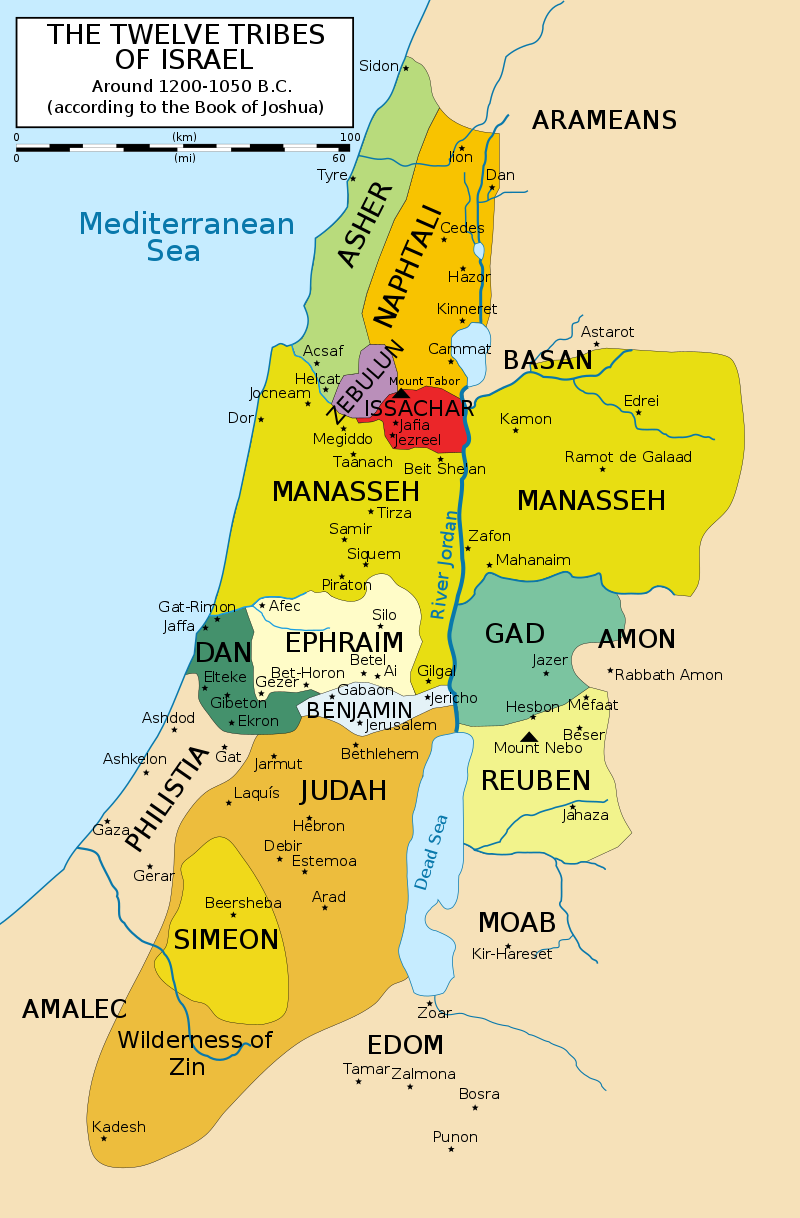
The Angel of the LORD came and sat under the oak that was in Ophrah, which belonged to Joash the Abiezrite ("my father is help") - Ophrah's location not absolutely certain but it was apparently East of the Esdraelon Plain (Greek for Jezreel Valley) the low-lying area separating mountains of Galilee from the mountains of Samaria.
Related Resource:
- Identity of Angel of the LORD
GOD'S MAN
IN MANASSEH
As his son Gideon was beating out wheat in the wine press in order to save it from the Midianites The story of Gideon is introduced not by an affirmation that “God raised up a deliverer named Gideon,” but rather by a narration of how God raised him up. Gideon’s call or commission resulted from a confrontation with the Angel of the Lord (Who is equated with Yahweh in Jdg 6:14, 16, 23, 25, 27) Beating out wheat in the wine press is an act of desperation and fear, lest the Midianites discover and seize even the small amount that could be threshed that way. Gideon was threshing in small quantities in an inconspicuous place, hoping to finish quickly and avoid detection by marauding bands. The usual practice for threshing would be in an open and elevated location (where he would be easily spotted by men on camels!) so that the wind would blow away the chaff. Gideon's location indicated not only the severity of the Midianite threat, but the smallness of the yield and also the smallness of Gideon's courage. Normally one would have cattle tread the grain in a threshing floor.
In sum, Gideon’s act of threshing wheat in a winepress reflected both his fear of discovery by the Midianites and the smallness of his harvest. Normally wheat was threshed (the grain separated from the wheat stalks) in an open area on a threshing floor (cf. 1Chr 21:20-23) by oxen pulling threshing sledges over the stalks.
Why did God choose Gideon? Paul gives us a clue writing...
For consider your calling, brethren, that there were not many wise according to the flesh, not many mighty, not many noble; 27 but God has chosen the foolish things of the world to shame the wise, and God has chosen the weak things of the world to shame the things which are strong, 28 and the base things of the world and the despised God has chosen, the things that are not, so that He may nullify the things that are, 29 so that no man may boast before God. (1 Cor. 1:26-29+)
J Sidlow Baxter writes that "Gideon, the fifth judge of Israel, is rightly counted as one of the outstanding heroes in Israel's early history. Yet we need to realize at the outset that his heroism was not a product of his natural make-up, but the outcome of a transforming spiritual experience. It is this which gives him a living significance to ourselves today." (Explore the Book - online)
As Gary Inrig says "As the eighth harvest season rolled around and with it the threat of the Midianite invasion, if you had taken a poll to discover the most likely deliverer of Israel, one name would never have appeared on your list. There was never a less likely liberator than Gideon, the son of Joash, a man from the tribe of Manasseh and the clan of Abiezer." (Borrow Hearts of Iron, Feet of Clay)
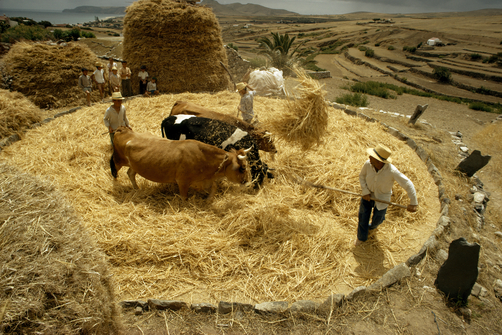
Oxen Threshing Grain
Note the Elevated Location
In Gideon's day the winepress was always put at the foot of the hill because they brought the grapes down from the vineyard. Naturally, they would carry the heavy grapes downhill; they carried them to the lowest place. In contrast, the threshing floor was always put up on the top of the hill, the highest hill that was available, in order to catch the wind which would drive the chaff away. Here we find Gideon, down at the bottom of the hill, threshing. Now that would be the place to take the grapes, but that is no place to take your crop in order to do your threshing. Can you see the frustration of this man? Why doesn’t he go to the hilltop? Well, he is afraid of the Midianites. He does not want them to see that he is threshing wheat. And you can imagine his frustration. There is no air getting to him down there, certainly no wind. So he pitches the grain up into the air. And what happens? Does the chaff blow away? No. It comes down around his neck and gets into his clothes making him very uncomfortable. There he is, trying his best to thresh in a place like that, and all the time rebuking himself for being a coward, afraid to go to the hilltop.
Many of the ancient wine presses remain to the present day. Ordinarily they consisted of two rectangular or circular excavations, hewn (Isa 5:2) in the solid rock to a depth of 2 or 3 feet. Where possible one was always higher than the other and they were connected by a pipe or channel. Their size, of course, varied greatly, but the upper vat was always wider and shallower than the lower and was the press proper, into which the grapes were thrown, to be crushed by the feet of the treaders (Isa 63:1-3, etc.). The juice flowed down through the pipe into the lower vat, from which it was removed into jars (Hag 2:16) or where it was allowed to remain during the first fermentation. Many modifications of this form of the press are found. Where there was no rock close to the surface, the vats were dug in the earth and lined with stonework or cement, covered with pitch. 1915 edition (J. Orr, Ed.).
A large vat for crushing grapes, located not on a hilltop like a threshing floor, but in a valley. Gideon was threshing in small quantities in an inconspicuous place, hoping to finish quickly and avoid detection by marauding bands. (Borrow The Open Bible)
Judges 6:12 And the Angel of the LORD appeared to him and said to him, "The LORD is with you, O valiant warrior."
- the angel - Jdg 13:3; Luke 1:11,28;
- The LORD - Jdg 2:18; Ex 3:12; Josh1:5,9; Ruth 2:4+; Mt 1:23; 28:20; Luke 1:28; Acts 18:9,10
THE ANGEL OF THE
JEHOVAH APPEARS
Wiersbe - Gideon started his career as somewhat of a coward (Jdg. 6), then became a conqueror (Jdg 7:1-8:21), and ended his career as a compromiser (Jdg 8:22-35). But more space is devoted to Gideon in the Book of Judges (100 verses) than to any other judge; and Gideon is the only judge whose personal struggles with his faith are recorded. Gideon is a great encouragement to people who have a hard time accepting themselves and believing that God can make anything out of them or do anything with them. (See Wiersbe Bible Commentary: Old Testament)
And the Angel of the LORD appeared to him and said to him (singular) "The LORD is with you" - Yahweh informs Gideon that he was on his side. While it states He appeared to Gideon, the LORD's true identity is hidden from Gideon in this first interchange.
Davis comments on God's promise "Jehovah is with you" writing that "Basically, God has nothing else or more to offer you. You can go through a lot with that promise. It does not answer your questions about details. It only provides the essential. Nothing about when or how or where or why. Only the what, or, better, the Who. “But I will be with you.” And that is enough." (Such a Great Salvation - Focus on the Bible)
O valiant warrior (gibbor) - This has to make us chuckle, because here is Gideon laying low in a wine press to avoid detection. However the omniscient LORD saw Gideon for what he would become, not for what he was at present. This recalls God coming to a old childless man named Abram and said I will make you a father of many nations. God came to Cephas and said you will be Peter (Rock).
THOUGHT - Our God is an awesome God...while others look at us and see our flaws and failings, God looks at us and sees our possibilities (in Christ). Don't sell yourself short for what God can or will do in and through your life if you are willing to submit to the Refiner's purifying fire and the Master's touch! Remember that God does not save us and use us for what we are but for what by His great mercy and grace we may become.
Valiant warrior frequently had a military connotation. In the present context it appears that these name by the Angel of Jehovah anticipated Gideon 's role as a warrior and was intended to inspire confidence. It is possible that the phrase simply identifies Gideon as a prominent citizen in his town which is how it is used of Boaz.
In short, God recognizes in Gideon something that Gideon does not see himself. God sees our potential. God sees us for what we can become, as He works in our lives. He is in the business of taking "nobodies" and transforming them by His presence in their lives. He begins with us where we are be it in the winepress or on some mundane job, etc. He knows our weaknesses, our faults, our shortcomings but He does not say "If you get those things out of your life, then I'll be able to use you." He takes our inadequacy and transforms it into His adequacy. God has a way of seeing beyond our fears and frailty. God does not save us and use us for what we are but for what by His grace we may become. Amen.
Gideon's story is truly a wonderful example of the truth of [Romans 15:4] = My paraphrase:
"Judges, et. al. was written for our instruction that thru the perseverance & the encouragement of the God of Judges & the lives of the characters of Judges we too might have HOPE in the midst of our trying circumstances." (Real Life Version)
THOUGHT - God sees the potential in you and says to you as He did to Simon, “You are . . . You shall be” (John 1:42). He knows your weaknesses and will accommodate Himself to your needs so that He might develop your faith.
Brensinger applies the truths in this section noting that "Within this wide spectrum of spiritual participants, the opening events of the Gideon narrative speak at least two special words to the weary and fainthearted:
God’s Presence During Difficult Moments - “Help! I’m going round the bend!” a tattered minister cried out to God. “Don’t worry,” came the reply, “I’m coming round there with you!” (Horsman: 91). In much the same way, God responds to both Israel and Gideon during the Midianite crisis. On the national level, the hideous oppression meted out by the Midianites might cause the Israelites to hide in caves, but it fails to scare the Lord away. In answer to Israel’s plea for mercy, God draws near. On a more personal level, the Lord similarly demonstrates his continuing presence to Gideon, his chosen but intimidated vessel of deliverance. Rather than leaving him alone, God steps right up beside Gideon during the most difficult and challenging moments of his life. The Lord, in other words, does not abandon his people when circumstances turn sour, even if the turmoil results from their own doing (Ps 46:1).
God’s Patience During Weaker Moments - In addition to meeting Gideon’s repeated requests, the Lord later offers unsolicited reassurance. In the same way that Job presents sacrifices “just in case” his children have sinned, so too does God provide an encouraging dream “just in case” Gideon’s doubts and fears linger (Job 1:5; Jdg. 7:10, 11, 13, 14). Rather than insisting that Gideon immediately rise to the desired level of commitment, the Lord nurtures him through his moments of weakness. While not condoning evasiveness or prolonged excuse-making, God deals graciously and patiently with all of the Gideons of the world who genuinely need help and reassurance. “God does not require us to have arrived,” writes Sarah Horsman, “only to be moving in the right direction” (41). Apparently, people in need of assistance are more usable in the long run than those who charge out and insistently go to work on their own. (Judges Believers Church Bible Commentary. Page 87)
Gary Inrig "Gideon, at this stage of his life, reminds me of that old story of the man who came to his psychiatrist with a problem. “Doctor, you must help me. Everything’s going wrong. I feel worthless. My friends tell me I have a terrible inferiority complex. Can you help me?” So the psychiatrist told him that he would give him some tests and evaluate them. A week later, the man came back, and the psychiatrist said, “Friend, I have some good news for you and some bad news. The good news is that we have proved you do not have a complex. There is no doubt about that. But the bad news is that you are inferior!” If you had been in Ophrah and met Gideon just before the angel did, you would have found a thoroughly discouraged man. He might have said to you, “You know, I feel completely helpless and hopeless. These Midianites are turning us all into slaves, and there is not a thing we can do about it. The same thing keeps happening over and over again. We’re just stuck.” The only honest response you could have made would have been, “I understand that, Gideon. The reason you feel that way is because you are defeated, discouraged, and helpless.” To realize why Gideon felt that way, we need to understand the bondage of his people." (Borrow Hearts of Iron, Feet of Clay)
Warrior (mighty)(01368) (gibbor) cp related verb gabar = be strong, accomplish, excel, prevail) is from a root which is commonly associated with warfare and has to do with the strength and vitality of the successful warrior. And thus this adjective means powerful, strong, brave, mighty. Warrior. Hero. Mighty man (cp "mighty [gibbor] men of David" - 2Sa 23:8). Vine writes that "In the context of battle, the word is better understood to refer to the category of warriors. The gibbor is the proven warrior (eg "valiant warriors [gibbor]" Josh 1:14)… The Septuagint gives the following translations: dunatos (“powerful; strong; mighty; able ruler”) and ischuros (see studies of related words - ischus and ischuo) (“strong; mighty; powerful”). See discussion of this word group from TWOT - Gibbor Word Group
Gibbor - 4x in Judges - Jdg 5:13, Jdg 5:23, Jdg 6:12, Jdg 11:1
Other uses of "Valiant warrior"
- Josh 1:14, Josh 8:3, Josh 10:7
- Jephthah in Jdg 11:1
- Boaz (man of "great wealth) in Ru 2:1+
- David in 1 Sa 16:18 ("a mighty man of valor, a warrior")
The Lord is with thee, thou mighty man of valour. Judges 6.12
The story of Gideon is one of the most fascinating in this Book. Forty years' rest followed the work of Deborah. Then the people fell again into evil ways, and for seven years suffered the most cruel oppression at the hands of Midian. They were driven to hide in dens and caves and strongholds. From that terrible situation Gideon was raised up to deliver them. These words were addressed to him by the Angel of Jehovah. They reveal the secrets of the strength which gave him the victory presently over Midian; and those secrets were two. First, there was the one supreme fact that Jehovah was with him; but there was also what he was in himself—"a mighty man of valour." Wherein did that valour consist? Apparently he was a simple man living a very ordinary life. The Angel found him about his daily duty, "beating out wheat in the wine-press." He had given no sign of military disposition or ability. We shall discover the answer to the inquiry as we listen to what he said to the Angel. To the heavenly visitor he confessed his double consciousness. This may be stated in two sentences which he uttered: "Did not Jehovah bring us up?" "Jehovah hath cast us off." He was thus revealed as a man conscious of the true relation of the people to Jehovah ; and of the fact that their sufferings were the result of the Divine judgment. It is ever the man who has this double vision of Divine intention and human failure, who is the man of might and valour. With that man the Lord can work. (Morgan, G. C. Life Applications from Every Chapter of the Bible)
Judges 6:13 Then Gideon said to him, "O my lord, if the LORD is with us, why then has all this happened to us? And where are all His miracles which our fathers told us about, saying, 'Did not the LORD bring us up from Egypt?' But now the LORD has abandoned us and given us into the hand of Midian."
- O my lord, if the LORD is with us Ge 25:22 Ex 33:14-16 Nu 14:14,15 Ro 8:31
- why then has all this happened to us: De 29:24 30:17,18 Ps 77:7-9 89:49 Isa 59:1,2 63:15
- where are all His miracles which our fathers told us about: Ps 44:1 78:3,4
- But now the LORD has abandoned us: De 31:17 2Ch 15:2 Ps 27:9 Isa 41:17 Jer 23:33
GIDEON'S FAITHLESS
RESPONSE
Then Gideon said to him, "O my lord ('adon), if the LORD is with us, why then has all this happened to us? How like all of us to question the presence of God because of our present circumstances. But to do so is to doubt the Word of God and that is sin for it is not faith (Ro 14:23). Now it is obvious though that at this point Gideon did not recognize the Holy One Who addressed him but he did use a term of respect similar to Abraham (Ge 19:2 cp Ru 2:13, 1Sa 1:15, etc).
Sidlow Baxter comments that "When first we see Gideon he cuts a pathetic figure of unbelief (6:11-23). He is a furtive, nervous young man secretly threshing wheat in the winepress, to hide it from the marauding Midianites. What pathetic exclamations of unbelief escape his lips when the Lord suddenly appears... He gasps - "Oh, my Lord, if Jehovah be with us why then is all this befallen us? And where be all His miracles which our fathers told us of, saying: Did not Jehovah bring us up out of Egypt? But now Jehovah hath forsaken us ..." A rather dismal reception this! - "Oh! ... if ... why? ... where?... but ..." Verse 14 continues, "And Jehovah looked upon him and said: in this thy might, and thou shalt save Israel from the hand of the Midianites: have not I sent thee?" These were strong and reassuring words, but Gideon can only moan, "Oh, my Lord, wherewith shall I have Israel ...?" The Lord replies still further, "Surely I will be with thee, and thou shalt smite the Midianites as one man." Yet even this only evokes another stammering "if" - "If now I have found grace in Thy sight, then show me a sign." To be sure, in these replies of Gideon we have a fair sample of the vocabulary of unbelief. In his successive exclamations and lamentations we have the skeptical surprise of unbelief, then its uncertainty and its questioning and its complaining and its false humility and its resourcelessness and its persistent dubiety and its seeking for signs. Unconverted Gideon presents a sorry picture of the paralysis which always accompanies unbelief. (See Online Explore the Book)
Warren Wiersbe - "When God called him, he was hiding. When God spoke to him, he raised problems instead of trusting promises. One of his favorite words was if (vv. 13, 17, 36; Mark 9:22–23)." (Borrow With the Word)
The most popular image of the local church today is that of the corporation, with the pastor as the CEO. I wonder how many churches would want a CEO with the credentials of some of the people God used in the Bible? Moses was eighty years old when he began his ministry and he was wanted for murder in Egypt. Jacob was a schemer. Elijah suffered from depression, and so did Jeremiah. Hosea couldn’t keep his marriage together. Amos, a farmer, had no ministerial training. Peter tried to kill a man with his sword. John Mark was a quitter, and Paul couldn’t get along with his associate Barnabas. These traits are not excuses either for leaders to sin or for churches to lower their standards, but they do remind us that God’s ways aren’t always our ways. The man or woman we think least qualified for God’s work may turn out to be a mighty servant of God.
And where are all His miracles which our fathers told us about, saying, 'Did not the LORD bring us up from Egypt?' - Miracles (pala') is a verb meaning to do something wonderful, to do something extraordinary, or difficult. It frequently signifies the wondrous works of God, especially His deliverance and judgments. The verbal root of pala' has the basic meaning be surpassing and conveys the ideas "be extraordinary, beyond one's imagination or expectations" or "be too difficult, beyond one's capability." Gideon most likely was referring to the Exodus and the events connected to it. In the Exodus account pala' refers specifically to the plagues God sent upon Egypt (Ex. 3:20), while Ps. 78:11, 12 associates these wonders with the miracle at the Red Sea.
Gideon's response reflects unbelief as well as ignorance (or forgetfulness) of God and His clear warning in Scripture that if Israel would forsake God...
"Then My anger will be kindled against them in that day, and I will forsake them and hide My face from them, and they shall be consumed, and many evils and troubles shall come upon them; so that they will say in that day, 'Is it not because our God is not among us that these evils have come upon us?' (Dt 31:17+)
Gideon had it backwards! The Lord had not forsaken them as much as they had forsaken the Lord!
But now the LORD has abandoned (natash/natas) us and given us into the hand of Midian - Gideon’s initial response ignored the singular pronoun “you” (Jdg 6:12), for he replied, If the Lord is with us (pl. pronoun). Gideon questioned the divine promise in view of his people’s present circumstances. He correctly concluded, however, that the Lord had put them into the hand of Midian. The point however is that it was not God Who had abandoned His people, but God's people who had turned their backs on Him. It is far easier to blame God for our problems than to recognize and deal with our sins and responsibilities.
God had not abandoned them but they had abandoned God...
Deuteronomy 32:15+ “But Jeshurun grew fat and kicked– You are grown fat, thick, and sleek– Then he forsook (natash/natas) God who made him, And scorned the Rock of his salvation.
John MacArthur - Gideon’s language here indicates a weak theology. The very chastisements of God were proof of His care for and presence with Israel." Indeed how often in the midst of the Refiner's fire do we feel like the Almighty has deserted us, having abandoned us to the fiery furnace of affliction and suffering!!! (cp Heb 12:5, 6+, He 12:10+, He 12:11+). (Borrow The MacArthur Study Bible)
Gary Inrig - The Problem of Discouragement - The first problem is uncovered in verse 13. Notice again the words Gideon used: “If . . . why . . . where . . . but now the Lord has abandoned us.” What we saw pictured in action in verse 11 we now hear spoken in words. Gideon was a discouraged, defeated man. A little girl was listening to her mother as she told her some Bible stories about great biblical champions such as Moses, David, Elijah, and Daniel. As her mother finished and prepared her for sleep, the little girl spoke with the kind of innocent honesty that only a child can muster: “Mommy, you know, God was much more exciting back then.” I think that Gideon felt like that. I know I sometimes do. It is wonderful to hear what God has done for His people in the past. Gideon believed thoroughly in God’s power back then. But where were those miracles now? Where was God today? How could they possibly deal with the Midianites? God had abandoned them. That’s why things were the way they were. Of all of the forms of discouragement, this is the worst. For a believer to feel that God is not interested or to think that God has turned His back is to be reduced to a debilitating despair that crushes all hope from our lives. That is where Gideon was as God began to deal with him. Obviously Gideon had not really come to grips with the situation. It was true that God had abandoned His people and sold them into the hands of the Midianites. But Gideon drew exactly the wrong conclusions from those facts. The problem did not lie with God but with Israel. It was not God who had first abandoned His people but God who had justly responded to His people’s prior abandonment of Him. Gideon is suggesting that God is wrong, because his assumption is that Israel is innocent. It is far easier to blame God for our problems than to face and deal with our sins and responsibilities. At the same time, we need to recognize that Gideon was not suffering from a “defeatist” complex. He and his people really were defeated, but as long as they responded to their defeat with doubt and denial, they would remain enslaved. (Borrow Hearts of Iron, Feet of Clay)
Lord (0113)('adon) is a masculine noun meaning lord or master. The most frequent usage is of a human lord, but it is also used of divinity. Generally, it carries the nuances of authority rather than ownership. When used of humans, it refers to authority over slaves (Ge 24:9; Jdg 19:11); people (1Ki. 22:17); a wife (Ge 18:12; Amos 4:1); or a household (Ge 45:8; Ps 105:21). When used of divinity, it frequently occurs with yehōwāh, signifying His sovereignty (Ex 34:23; Josh 3:13; Isa 1:24). (Complete Word Study Dictionary: Old Testament)
Abandon (forsaken, left)(05203) natash/natas means to forsake or leave alone and carries the basic sense of leave, reject or abandon. Natash is used of the Lord rejecting his people because of their rebellion. When God does so, He withdraws His protective presence and hands them over to their enemies, subjecting them to defeat and humiliation. Natash means to abandon, to forsake, to leave alone. About 50% of the 40 uses convey the idea to forsake, reject leave alone. The idea is to cause a relationship or association to cease until there is the possibility of renewal. Things abandoned or forsaken - Of land that should be "forsaken" in the seventh year (Ex. 23:11), of Israel who abandoned God (Dt. 32:15), of Saul's father who forgot about the donkeys (1 Sa 10:2), of David who left his flock (1 Sa 17:20), of the psalmist who pleaded with God not abandon him (Ps. 27:9), of God abandoning His dwelling place at Shiloh (Ps 78:60), of abandoning a quarrel (Pr 17:14), of a mother's teaching which should not be forsaken (Pr 6:20). Natash means to not permit when Laban was not allowed to kiss his grandchildren good-bye (Ge 31:28).
Ps 94:14 is good news for us who are prone to wander "For the LORD will not abandon His people, Nor will He forsake His inheritance."
Natash rendered abandon(7), abandoned(5), allow(1), cast away(1), ceased(1), drawn(1), fall(1), forego(1), forsake(3), forsaken(2), forsook(1), hangs slack(1), leave(2), left(5), lie fallow(1), neglected(1), spread(6).
Judges 6:14 And the LORD looked at him and said, "Go in this your strength and deliver Israel from the hand of Midian. Have I not sent you?"
LXE And the angel of the Lord turned to him, and said, Go in this thy strength, and thou shalt save Israel out of the hand of Madiam: behold, I have sent thee.
- And the LORD looked at him Jdg 6:11
- Go in this your strength and deliver Israel Jdg 4:6; Joshua 1:5-9; 1Sa 12:11; 1 Chr 14:9,10; Heb 11:32,34)
And the LORD looked at him [turned towards and] Notice that Angel of the LORD is now identified as one in the same as the LORD. And note that that the Messiah turned and fixed Gideon in His gaze. Although did not fully recognize Who it was that looked at him, he must have seen something different as he later seeks to bring an offering.
What we most need is not self-confidence but God-confidence.
Go in this your strength and deliver Israel from the hand of Midian. Have I not sent you? - He is not saying "Gideon, gird yourself up like a man...you can do it." Relying on his own strength made Gideon hide in a winepress. "This is your strength" is the strength that God has given by His promise of His presence (Jdg 6:12, 16, cp Php 4:13+). God's answer to discouragement is NOT positive thinking but rather the promise of His presence. (cp Mt 28:18-20).
Gary Inrig - The Angel is discarding His anonymity and revealing His true identity. As we have already said, this is one of many places in the Old Testament where the Angel of the Lord is revealed to be God Himself appearing in human form. We can go one step further. Since John 1:18 tells us that “No one has seen God at any time; the only begotten God who is in the bosom of the Father, He has explained Him,” we can reasonably conclude that this is Jesus Christ, taking human form for a brief time. The LORD turned and fixed Gideon in His gaze, then spoke some remarkable words: “Go in the strength you have and save Israel out of Midian’s hand. Am I not sending you” (Jdg 6:14)? Gideon’s commission comes directly from the Lord. He is left with no doubt about either his duty or his success. But we need to recognize that when the Lord said, “Go in the strength you have,” He was not saying, “Gideon, you can do it.” Relying on his own strength had reduced Gideon to a clandestine beater of wheat. “The strength you have” is the God-given strength that accompanies both God’s command and His promise (Ed: By analogy we in the NT can only "go" when enabled by the Holy Spirit. Have you come to that place in your Christian life where you realize that apart from abiding in the Vine you can do absolutely nothing of spiritual value! Jesus sent His Spirit that we might abide in Him by being filled with His Spirit. Are you filled today? See Eph 5:18+, see chart comparing Filled with His Spirit/Richly Indwelt with His Word): “The Lord is with you . . . Am I not sending you? . . . I will be with you” (Jdg 6:12, 14, 16). God is calling Gideon to go forward on the basis of the supplied strength that always accompanies His commission (cp 2 Cor 3:5-6+). Gideon could only admit that dependence upon his own strength had brought defeat and discouragement. If we look at our strength, we will always end up in defeat, or perhaps worse, in self-deceiving arrogance. But God’s answer to discouragement is never positive thinking but rather the promise of His presence, His provision, and His power. Quite frankly, when I look at the secular world in which we are living and realize the powerful attacks of anti-Christian forces on biblical truths and values, I feel very much as Gideon did before the Midianites—puny, helpless, and insignificant. Paul was right. Christians do not contend with flesh and blood but against powerful satanic forces (Ephesians 6:12). The only answer I know to that kind of satanic discouragement is to claim the promise of the presence of God and order my life around the truth that God’s Holy Spirit indwells me. I do not, cannot, and need not serve Him in my own strength. (Ed: See the Paradoxical Principle of 100% Dependent and 100% Responsible" 100/100) There is a clear parallel between Judges 6:14 and Matthew 28:18–20+. When the Lord commissioned Gideon, it was with the promise of His strength. When He commissions us, His infinitely greater promise is, “Lo, I am with you always (Ed: How is He with us always? By His Spirit called the Spirit of Christ -Ro 8:9+- or the Spirit of Jesus - Acts 16:7+, Php 1:19+), even to the end of the age.” Hudson Taylor, the great missionary pioneer, once said, “All of God’s great men have been weak men who did great things for God because they reckoned on his being with them; they counted on his faithfulness.” That is the divine solution to discouragement—the truth of the omnipresence and adequacy of God. (Borrow Hearts of Iron, Feet of Clay)
Spurgeon wrote a devotional on this verse entitled "One Look from the Lord" - What a look was that which the Lord gave to Gideon! He looked him out of his discouragements into a holy bravery. If our look to the Lord saves us, what will not His look at us do? Lord, look on me this day, and nerve me for its duties and conflicts. What a word was this which Jehovah spoke to Gideon! “Go.” He must not hesitate. He might have answered, “What, go in all this weakness?” But the Lord put that word out of court by saying, “Go in this thy might.” The Lord had looked might into him, and he had now nothing to do but to use it and save Israel by smiting the Midianites. It may be that the Lord has more to do by me than I ever dreamed of. If He has looked upon me, He has made me strong. Let me by faith exercise the power with which He has entrusted me. He never bids me “idle away my time in this my might.” Far from it. I must “go,” because He strengthens me. What a question is that which the Lord puts to me, even as He put it to Gideon! “Have not I sent thee?” Yes, Lord, thou hast sent me, and I will go in thy strength. At thy command I go; and, going, I am assured that thou wilt conquer by me. (Spurgeon, C. Faith's Checkbook)
- Judges 6:14 And the Lord looked upon him and said, Go in this thy might.
The strength-giving power of a look from the eyes of Christ! Gideon was weak enough. He said, quite naturally, “My family is the poorest in Manasseh, and I am the least in my father’s house” (Judges 6:15, r.v.). But from the moment of that look, accompanied by that summons, he arose in a strength that never afterwards faltered. How truly “God hath chosen the foolish things of the world to confound the wise; and the weak things of the world to confound the things which are mighty.”
It was a look of expectation. — Gideon felt that the angel expected him to save Israel. It is a great matter to excite hope in a man. Tell him that you are anticipating some noble deed from him, and you may light a spark that will set his whole soul aglow. It is of immense importance to stir the timid and retiring with fresh conceptions of the possibilities of their lives.
It was a look of encouragement. — Those gentle, loving eyes said, as though they spoke, “I will be with thee; do not hesitate to look for Me in every hour of need.” Such looks Christ still gives us across the battlefields of life; and if our eyes are fixed upon Him, we shall surely hear Him saying to us, “My grace is sufficient for thee: go in this thy might!”
It was a look of strength-giving might. — It carried help with it. On its beam new spiritual force sped from the speaker to the listener; from captain to cadet. So from the excellent glory one look from Jesus will bring reinforcement. As He looks on us He imparts his strength to us, and says, Go in this thy might. “Be strong in the Lord, and in the power of his might.”
Judges 6:15 And he said to Him, "O Lord, how shall I deliver Israel? Behold, my family is the least in Manasseh, and I am the youngest in my father's house."
- how shall I deliver Israel Ex 18:21-25; 1Sa 9:21; 18:23; Micah 5:2
- the least - Genesis 32:10; Jeremiah 50:45; 1Cor 15:9; Eph 3:8
And he said to Him, "O Lord, how shall I deliver Israel?
This refrain is echoed by other saints...
Exodus 3:11; But Moses said to God, “Who am I, that I should go to Pharaoh, and that I should bring the sons of Israel out of Egypt?” (Ex 4:10) Then Moses said to the LORD, “Please, Lord, I have never been eloquent, neither recently nor in time past, nor since You have spoken to Your servant; for I am slow of speech and slow of tongue.”
Jeremiah 1:6 Then I said, “Alas, Lord GOD! Behold, I do not know how to speak, Because I am a youth.”
Luke 1:34 Mary said to the angel, “How can this be, since I am a virgin?”
Gideon looked to his own ability ("how shall [I] deliver?").
A sense of our own inadequacy for God's Work is not a bad thing. Who among us when called to serve the LORD in any capacity has not like Gideon felt unworthy and unqualified? Charles Haddon Spurgeon at age 19 was called to pastor Park Street Church in London, but was convinced a mistake had been made and that the invitation was intended for another man of the same name. But understanding that his strength came from the LORD, he accepted and eventually became one of modern history's most prolific and influential preachers. God is calling leaders today just as He always has. The question is will those He calls respond to this call in dependence on God Himself for their strength?
God’s commandments are God’s enablements.
Wiersbe - Once God has called and commissioned us, all we have to do is obey Him by faith, and He will do the rest. God cannot lie and God never fails. Faith means obeying God in spite of what we see, how we feel, or what the consequences might be. Our modern “practical” world laughs at faith without realizing that people live by faith all day long. If there was no faith, there would be no living in this world,” wrote humorist John Billings nearly a century ago. “We couldn’t even eat hash with safety.”....Once God has revealed His will to us, we must never question His wisdom or argue with His plans. “Who has known the mind of the Lord? Or who has been His counselor?” (Ro 11:34NIV; Isa 40:13, 1Co 2:16) “Can you search out the deep things of God? Can you find out the limits of the Almighty?” (Job 11:7NKJV)....That being true, who are we to question Him? When you review God’s gracious promises to Gideon, you wonder why this young man wavered in his faith. God promised to be with him. God called him a “mighty man of valor” and promised that he would save Israel from the Midianites and smite them “as one man.” God’s Word is “the word of faith” (Ro10:8), and “faith comes by hearing, and hearing by the Word of God” (Ro10:17). But Gideon didn’t receive that Word and needed assurance beyond the character of Almighty God. (See The Wiersbe Bible Commentary)
A. W. Tozer wrote, “All God’s acts are done in perfect wisdom, first for His own glory, and then for the highest good of the greatest number for the longest time.” (From Knowledge of the Holy)
Behold, my family is the least in Manasseh, and I am the youngest in my father's house." - Gideon seemed to think that God could do nothing because he and his family were nothing. However his family being "Least in Manasseh" may not be completely true as his father Joash seems to have been a fairly important man (he had a huge altar to Baal) and the family was certainly not poor (Gideon had 10 servants! Jdg 6:27).
What we most need is not self-confidence, but God-confidence!
What Gideon does seem to be saying is that he had a overriding sense of his own inadequacy, which is not a bad place to be ("our adequacy is from God" 2Co 3:5, 6+, "when we are weak then we are strong" 2Cor 12:9+, 2Co 12:10+). Inadequate in ourselves, overwhelmingly adequate in and through our God -- that is the lesson of Gideon's life. What we most need is not self-confidence, but God (Christ) -confidence! It is worth noting that most often the choice by God as His "vessel of honor" is one who appears to be the least. Jehovah even had to remind Samuel declaring...
"to Samuel, "Do not look at his appearance or at the height of his stature, because I have rejected him; for God sees not as man sees, for man looks at the outward appearance, but the LORD looks at the heart." (1 Sa 16:7)
Our problem today, friend, is that most of us are too strong for God to use. Most of us are too capable for God to use. You notice that God uses only weak men, don’t you? [1 Co 1:26-29] God wants weak vessels, and that is the only kind he will use. God follows this policy so that no flesh will glory in His presence. God always does that, beloved. The interesting thing is that Nero was on the throne while Paul was being beheaded. At first glance, it looked like Paul had lost and Nero had won. But history had already handed down its decision. Men name their sons Paul and call their dogs Nero. This is quite interesting, is it not? God is choosing the weak things of this world.
Gideon’s negative response to the Lord’s words indicates his lack of faith and spiritual perception. Here was Almighty God telling him that He was with him and would make him a conqueror, and Gideon replied by denying everything God said! God would have to spend time with Gideon turning his question marks into exclamation points. Gideon was living by sight, not by faith, and had he remained that way he would never have been named among the heroes of faith in Heb 11:32
Gary Inrig - But it does seem evident that Gideon was filled with a deep sense of personal inadequacy and insignificance. He had absolutely no confidence that he could do what he was being asked to do. And that is the response of anyone who is not self-deceived when he or she experiences the commissioning call of God, whatever the task. The wonderful thing is that this is exactly where God begins with a person. Time and time again, as we read the Word of God, we see the Lord cutting away a person’s self-confidence to bring her to the place where she admits that she is totally inadequate to do or to be what God desires. In fact, I do not think there is a single major figure in the Word of God whom God did not bring to a deep realization of personal inadequacy. As Paul puts it in 2 Corinthians 3:5, “Not that we are competent in ourselves to claim anything for ourselves.” But that is only half the verse. God never leaves us with a sense of our own inadequacy. Paul ends verse 5 by saying: “But our competence comes from God.” Whenever we admit our inadequacy, God confronts us with the truth of His total adequacy. So in Judges 6:16, He makes a wonderful promise to Gideon: “I will be with you, and you will strike down all the Midianites together.” Inadequate in ourselves, overwhelmingly adequate through our God. The actual expression is, “You will strike all the Midianites as one man,” which seems to mean, “It will be as easy as if you were fighting just one man.” And that is remarkably close to what happened.
I wonder to what extent you have allowed the promise of God’s adequacy to minister to your life. God has committed Himself to be with you and to pour His strength into the places of your weakness. Is this a truth you are claiming? Your weakness does not hinder God. In fact, His pattern is to reveal His power in weakness (2 Corinthians 12:9). What we most need is not self-confidence but God-confidence. (Borrow Hearts of Iron, Feet of Clay)
LEADING The Most Frequently Used Excuses For Not Leading
Some people approached about leading may offer excuses for why they can’t do it. Perhaps you’ve heard some of the following
• “I’m not qualified.” (Ex 3:11)
• “I’m an unknown.” (Jdg 6:15)
• “I can’t speak well.” (Ex 4:10, Jer 1:6a)
• “I’m not credible.” (Ex 4:1)
• “I’m too young.” (Jer 1:6b)
• “I don’t want to.” (Jonah 1:3)
• “I’m too scared.” (Mt 14:30)
• “It’s too risky.” (Esther 4:11)
• “I’m too tired.” (1Ki 19:4)
What is God’s response to these excuses?
“My power is made perfect in weakness” (2Co12:9- note)
“I will be with you” (Josh 1:5b).
Judges 6:16 But the LORD said to him, "Surely I will be with you, and you shall defeat Midian as one man."
- Jdg 6:12; Ex 3:12; Joshua 1:5; Isa 41:10,14, 15, 16; Mt 28:20; Mk 16:20; Acts 11:21
But the LORD said to him, "Surely I will be with you, and you shall defeat Midian as one man The promise is that the Midianites will be defeated as if they were only one man but this Word from the Lord was still not sufficient for Gideon and he wanted a sign, some proof that this summons from God was authoritative. And so we too have been commissioned and charged and encouraged that His presence will be with us in the battle for disciples (Mt 28:20)
As one man: NRSV = "every one of them"; NIV = "all the Midianites together"; TEV = "You will crush the Midianites as easily as if they were only one man." BBE= "you will overcome the Midianites as if they were one man." ICB = "It will seem as if you are fighting only one man"
Judges 6:17 So Gideon said to Him, "If now I have found favor in Thy sight, then show me a sign that it is Thou who speakest with me.
- If now I have found favor in Thy sight Ex 33:13,16
- then show me a sign Jdg 6:36, 37, 38, 39, 40; Ge 15:8-17; Ex 4:1-9; 2Ki 20:8, 9, 10, 11; Ps 86:17; Is 7:11)
So Gideon said to Him, "If now I have found favor in Thy sight, then show me a sign that it is Thou who speakest with me.
Found favor in Thy sight = a Hebrew idiom which means to be an object of another's favorable disposition or action or to be a recipient of another's favor or kindness. The favor shown may be deserved or at least prompted by the object's character or actions as was Boaz's kindness bestowed upon Ruth in return for her kindness to her mother-in-law had prompted him to reach out to Ruth and meet her needs (Ru 2:10, 11, 12-note).
Sign ('ot) usually refers to an event, object, or person that has special significance. It is used most often to describe awe-inspiring events: God’s work to bring the Hebrew people out of Egypt (Ex. 4:8) Gideon asks for a tangible guarantee of the Lord's identity. Such guarantees sometimes, though not always involved a miraculous deed (Ex 4:8, 9; Is 38:7) as in the present case when the Angel miraculously caused Gideon's offering to go up in smoke (Jdg 6:20, 21).
Like Moses (Ex 33), Gideon desired a sign; in both incidents revelation was so rare and wickedness so prevalent that they desired full assurance. God graciously gave it.
Richards - Gideon respectfully asked for a sign—that is, some miraculous evidence that what this stranger was saying was true. This should not be taken as a lack of faith. Deuteronomy 18 indicates that prophets in Israel—those who claimed to speak for God—could and should be tested. A prophet was supposed to make some statement which came true, giving supernatural indication he or she was God’s spokesperson (Deut. 18:21, 22). (The Teacher's Commentary)
Judges 6:18 "Please do not depart from here, until I come back to Thee, and bring out my offering and lay it before Thee." And He said, "I will remain until you return."
- Jdg 13:15; Ge 18:3,5; 19:3
Please do not depart from here, until I come back to Thee, and bring out my offering and lay it before Thee." And He said, "I will remain until you return.":
Offering (minchah) could refer to a freewill offering in Israel’s sacrificial system, or it could refer to tribute offered as a present to a king or other superior (cf. 3:15). It can refer to a gift offered as a sign of goodwill or submission (Gen. 33:10; 43:11, 15, 25, 26) where the gift is presented to appease someone whom the offerer has offended. In the present case we cannot state for certain his motivation, although it certainly is reasonable to see it as an act of worship.
Observe that the large amount of food prepared by Gideon (goat’s meat and broth, and bread made from an ephah or one-half bushel of flour) reflected both his wealth in a destitute time and the typical excessiveness of Near-Eastern hospitality. The Angel of the Lord touched the food offering with the tip of His staff and consumed it by fire, thus providing the sign Gideon had requested.
Judges 6:19 Then Gideon went in and prepared a kid and unleavened bread from an ephah of flour; he put the meat in a basket and the broth in a pot, and brought them out to him under the oak, and presented them.
LXE And Gedeon went in, and prepared a kid of the goats, and an ephah of fine flour unleavened; and he put the flesh in the basket, and poured the broth into the pot, and brought them forth to him under the terebinth tree, and drew nigh.
- Jdg 13:15-19; Ge 18:6-8
Then Gideon went in and prepared a kid and unleavened bread from an ephah of flour - keep in mind that this is a time of general scarcity of food bc of the Midianite raiders. So what Gideon prepares here is essentially a feast, cooking an entire kid and using about 35# of flour to prepare the bread. And it obviously didn't come to fruition instantly like a Big Mac.
he put the meat in a basket and the broth in a pot, and brought them out to him under the oak, and presented them.
Larry Richards - The word for “offering” is used of voluntary gifts presented to God. Gideon’s gift of 40 pounds of flour in time of famine shows Gideon’s request for a sign was an act of faith. He honored his visitor with a very generous offering.
Judges 6:20 And the angel of God said to him, "Take the meat and the unleavened bread and lay them on this rock, and pour out the broth." And he did so.
- lay them Jdg 13:19;
- pour out - 1Ki 18:33,34
And the angel of God said to him, "Take the meat and the unleavened bread and lay them on this rock, and pour out the broth." And he did so.
Judges 6:21 Then the Angel of the LORD put out the end of the staff that was in his hand and touched the meat and the unleavened bread; and fire sprang up from the rock and consumed the meat and the unleavened bread. Then the angel of the LORD vanished from his sight.
- Jdg 13:20; Lev 9:24; 1Ki 18:38; 1Chr 21:26; 2Chr 7:1
Then the Angel of the LORD put out the end of the staff that was in his hand and touched the meat and the unleavened bread; and fire sprang up from the rock and consumed the meat and the unleavened bread. Then the angel of the LORD vanished from his sight.
Judges 6:22 When Gideon saw that he was the angel of the LORD, he said, "Alas, O Lord GOD! For now I have seen the Angel of the LORD face to face."
- When Gideon saw that he was the angel of the LORD- Jdg 13:21
- For now I have seen the Angel of the LORD face to face Jdg 13:22,23; Genesis 16:13; 32:30; Exodus 33:20; Deut 5:5,24,26; Isa 6:5-8; Jn 1:18; 12:41
When Gideon saw that he was the angel of the LORD, he said, "Alas, O Lord GOD! Instantly Gideon was conscious of his sin and guilt and he cried out in fear. But God had not come to judge him but to deliver His people through Gideon.
The sudden appearance of the fire and disappearance of the visitor convinced Gideon that indeed he had seen God and spoken to Him, and this frightened him even more. Since the Jews believed it was fatal for sinful man to look upon God, Gideon was sure he would die. The human heart is indeed deceitful: Gideon asked to see a sign, and after seeing it, he was sure that the God who gave him the sign would now kill him! There is always “joy and peace in believing” (Ro15:13), but unbelief brings fear and worry.
For now I have seen the Angel of the LORD face to face - In the realization of the presence of God, the sensitive sinner is conscious of great guilt. Fire from God further filled Gideon with awe and even the fear of death. When he saw the Lord, he knew the Lord had also seen him in his fallenness. Thus he feared the death that sinners should die before Holy God. But God graciously promised life (v23). For a similar reaction to the presence of God, see Manoah in [Jdg 13:22, 23] (cf. Ezek 1:26-28; Isa 6:1–9; Rev 1:17).
God told Moses,“No one may see Me and live” (Ex. 33:20).
Gideon recognized the angel as a manifestation of God and was afraid. But the Ex. 33 passage means seeing God in His essential glory, not in another form. Richards, L.
Judges 6:23 And the LORD said to him, "Peace to you, do not fear; you shall not die."
- Peace to you, do not fear; you shall not die Genesis 32:30; 43:23; Ps 85:8; Daniel 10:19; John 14:27; 20:19,26; Ro 1:7
And the LORD said to him, "Peace to you, do not fear; you shall not die God had to give Gideon a message of peace to prepare him for fighting a war. Unless we’re at peace with God, we can’t face the enemy with confidence and fight the Lord’s battles.
Sometimes the Lord calms the storm.
Sometimes he lets the storm rage and calms his child.
But God
I know not, but God knows;
Oh, blessed rest from fear!
All my unfolding days
To Him are plain and clear.
Each anxious, puzzled "Why?"
From doubt or dread that grows,
Finds answer in this thought:
I know not, but He knows.
I cannot, but God can;
Oh, balm for all my care!
The burden that I drop
His hand will lift and bear.
Though eagle pinions tire,
I walk where once I ran,
This is my strength to know
I cannot, but He can.
I see not, but God sees;
Oh, all sufficient light!
My dark and hidden way
To Him is always bright.
My strained and peering eyes
May close in restful ease,
And I in peace may sleep;
I see not, but He sees.
-Annie Johnson Flint
Hannah Hurnard, author of Hinds’ Feet on High Places, was once paralyzed by fear. Then she heard a sermon on scarecrows that challenged her to turn her fear into faith. The preacher said, “A wise bird knows that a scarecrow is simply an advertisement. It announces that some very juicy and delicious fruit is to be had for the picking. There are scarecrows in all the best gardens...If I am wise, I too shall treat the scarecrow as though it were an invitation. Every giant in the way which makes me feel like a grasshopper is only a scarecrow beckoning me to God’s richest blessings.” He concluded, “Faith is a bird which loves to perch on scarecrows. All our fears are groundless.”
Black Bart was a professional thief whose very name struck fear as he terrorized the Wells Fargo stage line. From San Francisco to new York, his name became synonymous with the danger of the frontier. Between 1875 and 1883 he robbed 29 different stagecoach crews. Amazingly, Bart did it all without firing a shot. Because a hood hid his face, no victim ever saw his face. He never took a hostage and was never trailed by a sheriff. Instead, Black Bart used fear to paralyze his victims. His sinister presence was enough to overwhelm the toughest stagecoach guard.
Related Resource:
Judges 6:24 Then Gideon built an altar there to the LORD and named it The LORD is Peace. To this day it is still in Ophrah of the Abiezrites.
- Then Gideon built an altar Jdg 21:4; Ge 33:20; Josh 22:10,26-28
Related Passages:
Joshua 17:1-2 - Now this was the lot for the tribe of Manasseh, for he was the firstborn of Joseph. To Machir the firstborn of Manasseh, the father of Gilead, were allotted Gilead and Bashan, because he was a man of war. 2 So the lot was made for the rest of the sons of Manasseh according to their families: for the sons of Abiezer and for the sons of Helek and for the sons of Asriel and for the sons of Shechem and for the sons of Hepher and for the sons of Shemida; these were the male descendants of Manasseh the son of Joseph according to their families.
THE LORD IS
PEACE
Then Gideon built an altar there to the LORD and named it The LORD is Peace (Jehovah Shalom): Jehovah Shalom signifies that the Lord is peaceful, friendly or well-disposed toward Gideon. Gideon is able to confidently name the altar this because the Lord had just said shalom or "peace," to him prior to assuring him that he need not fear and that his life would be spared. The Hebrew word for “peace” (shalom click here) means much more than a cessation of hostilities but carries with it the ideas of well-being, health, and prosperity. Gideon now believed the Lord was able to use him, not because of who he was but because of who God was.
Wherever Abraham journeyed, he built an altar (Ge 12:7, 8; Ge 13:4, 18; Ge 22:9); and Joshua left many monuments of Israel’s march of Conquest through the land. It was customary for the Jews to identify special events and places by putting up monuments, so Gideon built an altar and called it “The Lord is peace.”
Whenever God calls us to a task that we think is beyond us, we must be careful to look to our OMNIPOTENT God (we must know His attributes to experience them in our lives Da 11:32, 2Pet 1:2+) and not to ourselves. “Is anything too hard for the Lord?” God asked Abraham (Ge18:14); and the answer comes, “For with God nothing shall be impossible” (Lk 1:37ASV). Job discovered that God could do everything (Job 42:2), and Jeremiah admitted that there was nothing too hard for God (Jer 32:17). Jesus told His disciples, “With God all things are possible” (Mt 19:26); and Paul testified, “I can do all things through Christ who strengthens me” (Php 4:13+).
Warren Wiersbe concludes that for a man with a worried heart, “The-Lord-Is-Peace” was just what he needed (Jdg 6:24). You can enjoy God’s peace today as you fight the battle (Php 4:4, 5+, Php 4:6+, Php 4:7+, Php 4:8, 9+). (Be Available)
Sidlow Baxter has some interesting thoughts on Gideon's conversion to the true God of Israel - But now look at Gideon's transforming experience. In the first place he became converted. We use the word thoughtfully. By the time that the "Angel of the Lord" had completed his visit to him he had become quite convinced regarding the true God of Israel. Note verse 24, "Then Gideon built an altar there unto the Lord, and called it Jehovah Shalom "There is vital significance about that altar. The altar is ever the place where God and man meet. It is the outward symbol of an inward transaction between the human soul and God. When Gideon built that altar to Jehovah he turned his back on false gods and became a worshipper of the one true God. Moreover he gave that altar a significant name - Jehovah-Shalom, which means, "Jehovah my peace." For the first time in his life this young Hebrew came into a sense of peace. That is always a first product of true conversion. (See Online Explore the Book)
To this day it is still in Ophrah of the Abiezrites - To the day when the inspired writer had recorded these words in Scripture. The Abiezrites were from the tribe of Manasseh and settled on the western side of the Jorday.
Phrase - To this day - 88x in 87v - Gen. 19:37; Gen. 19:38; Gen. 22:14; Gen. 26:33; Gen. 32:32; Gen. 35:20; Gen. 47:26; Gen. 48:15; Num. 22:30; Deut. 2:22; Deut. 3:14; Deut. 29:4; Deut. 34:6; Jos. 4:9; Jos. 5:9; Jos. 6:25; Jos. 7:26; Jos. 8:29; Jos. 9:27; Jos. 16:10; Jos. 22:3; Jos. 22:17; Jos. 23:8; Jos. 23:9; Jdg. 1:21; Jdg. 1:26; Jdg. 6:24; Jdg. 10:4; Jdg. 15:19; Jdg. 18:12; Jdg. 19:30; 1 Sam. 5:5; 1 Sam. 6:18; 1 Sam. 8:8; 1 Sam. 12:2; 1 Sam. 27:6; 1 Sam. 29:3; 1 Sam. 29:6; 1 Sam. 29:8; 1 Sam. 30:25; 2 Sam. 6:8; 2 Sam. 7:6; 2 Sam. 18:18; 1 Ki. 8:8; 1 Ki. 9:13; 1 Ki. 9:21; 1 Ki. 10:12; 1 Ki. 12:19; 2 Ki. 2:22; 2 Ki. 8:22; 2 Ki. 10:27; 2 Ki. 14:7; 2 Ki. 16:6; 2 Ki. 17:34; 2 Ki. 17:41; 2 Ki. 20:17; 2 Ki. 21:15; 1 Chr. 4:41; 1 Chr. 4:43; 1 Chr. 5:26; 1 Chr. 13:11; 1 Chr. 17:5; 2 Chr. 5:9; 2 Chr. 8:8; 2 Chr. 10:19; 2 Chr. 21:10; 2 Chr. 35:25; Ezr. 9:7; Neh. 9:32; Isa. 39:6; Jer. 3:25; Jer. 11:7; Jer. 25:3; Jer. 32:20; Jer. 32:31; Jer. 35:14; Jer. 36:2; Jer. 44:10; Ezek. 20:29; Ezek. 20:31; Matt. 11:23; Matt. 27:8; Matt. 28:15; Acts 2:29; Acts 23:1; Acts 26:22; 2 Co. 3:15
Judges 6:25 Now the same night it came about that the LORD said to him, "Take your father's bull and a second bull seven years old, and pull down the altar of Baal which belongs to your father, and cut down the Asherah that is beside it;
- Take your father's bull Ge 35:2 Job 22:23 Ps 101:2
- pull down the altar of Baal 1Ki 18:21; Mt 6:24; 2 Cor 6:15, 16, 17
- which belongs to your father, Mt 10:37 Ac 4:19 5:29
- cut down the Asherah that is beside it Jdg 3:7 Ex 34:13 De 7:5
GOD TESTS GIDEON:
CUT DOWN THE IDOL
Now the same night it came about that the LORD said to him - What night? The night the LORD had revealed Himself to Gideon after he sacrificed on the altar he had built. Gideon had sought a sign from God but now God seeks a sign from Gideon. Or better, God tests His fledgling judge to strengthen his faith.
Take your father's bull and a second bull seven years old, : to destroy this shrine Gideon is told to employ a bull, the sacred animal of the fertility cult. Before God gives His servants great victories in public, He sometimes prepares them by giving them smaller victories at home. Before David killed the giant Goliath in the sight of two armies, he learned to trust God by killing a lion and a bear in the field where nobody saw it but God (1Sa 17:32–37). When we prove that we’re faithful with a few things, God will trust us with greater things (Mt 25:21).
And pull down the altar of Baal (bāʿal) which belongs to your father - We need to keep the context in mind. These are God's people who were to recite the shema of Dt 6:4-5 proclaiming their love and devotion to one God, Yahweh. And yet now what is Israel doing approximately 222 years after they entered the Promised Land (as estimated by adding up all the prior times of retribution and rest, so obviously only an approximation)? Instead of tearing down pagan altars, they were building altars to no gods! THOUGHT - Beware when you begin to drift away from God, for you may while end up much farther from Him then you ever dreamed possible!
These are the people who have access to the Most High God and they are constructing large altars to a "nothing!" Amazing disgrace indeed!
THOUGHT - Let us all beware beloved -- the Baals and Asherim are both incredibly sensual and seductive to our fallen flesh. No man or woman is immune to the siren calls to seek gratification. O God control us by Thy Spirit that we might tear down and hew to pieces the Baalim and Asherim in our lives (Ro 8:13+). For Thy glory. In the Name of Jesus. Amen.
Warren Wiersbe notes that "It is one thing to meet God in the secrecy of a winepress, but quite another thing to stand up for the Lord in public. That very night God tested Gideon’s dedication by asking him to tear down his father’s idolatrous altar to Baal, and to build an altar to Jehovah. More than this, he was to sacrifice his father’s special bullock (probably reserved for Baal) on the new altar. Christian testimony has to begin at home...God will never use a “secret saint” to win great battles. We must come out in the open and take our stand, regardless of the cost. (Borrow Wiersbe's expository outlines on the Old Testament)
And cut down the Asherah (Asherah) that is beside it - There is an incredible play on words in this verse. Gideon's name means "hacker" or "hewer" and is derived from the root Hebrew verb 'gada (01438) which is translated in this verse "cut down" (or hew down) the Asherah! Get rid of the idols!
Asherah (dictionary - Hebrew = Asherah) signifies the Canaanite fertility goddess believed to be the consort of Baal, thus the worship of Baal and Asherah was often linked together. Asherah most often refers to a carved wooden image of the goddess instead of the proper name. These carved images were frequently associated with high places and fresh trees. The Asherah pole symbolized the fertility supposedly provided by the goddess Asherah, who was viewed as the mother of the gods.
Sidlow Baxter comments - Gideon...became consecrated. He yielded his own will to the will of God. Read Jdg 6:25-27. We only need to think our way back into the circumstances a little, to appreciate what an acute challenge to Gideon's new faith and obedience this test was. The command that he should "throw down the altar of Baal" reminds us at once that Gideon lived in a time of widespread religious apostasy. Israel's. religious leaders were "modernists," and had caused the people to err. To wreck Baal's altar was to run counter to the popular will, and to invite death. But Gideon did it. And how remarkable was the result! Read again Jdg 6:28-32. Gideon's father became converted too! Maybe the old man had secretly sighed for the "good old ways" and had longed for some brave champion of the old-time faith to arise and call his fellow-countrymen back to Jehovah; and now, when his son stood up for the old-time faith Joash was immediately by his side. We may apply this to ourselves. In nine cases out of ten, the reason we have so little influence for Christ among our own kith and kin is that we ourselves are not prepared to go the length of full consecration to the will of God. (See Online Explore the Book)
Related Resources:
- For significance of Idol Worship and Spiritual Adultery see Israel the Wife of Jehovah
- Who was Baal? | GotQuestions.org
- Who was Asherah / Ashtoreth? | GotQuestions.org
- What is an Asherah pole? | GotQuestions.org
- Why was the worship of Baal and Asherah a constant struggle for the Israelites? | GotQuestions.org
Baal (Canaanite god)(01168) bāʿal was a common name given to the god of fertility in Canaan. In the Canaanite city of Ugarit, Baal was especially recognized as the god of fertility. The Old Testament records that Baal was “the god” of the Canaanites. The Israelites worshiped Baal during the time of the judges (Jdg. 6:25–32) and of King Ahab. Elijah stood as the opponent of the Baal priests at Mount Carmel (1 Ki 18:21ff.). Many cities made Baal a local god and honored him with special acts of worship: Baal-peor (Nu 25:5), Baal-berith at Shechem (Jdg. 8:33), Baal-zebub (2 Ki 1:2–16) at Ekron, Baal-zephon (Nu 33:7), and Baalhermon (Jdg. 3:3). Among the prophets, Jeremiah and Hosea mention Baal most frequently.
Baal - 78x in 66v - Num. 22:41; Jos. 13:17; Jdg. 2:11; Jdg. 2:13; Jdg. 3:7; Jdg. 6:25; Jdg. 6:28; Jdg. 6:30; Jdg. 6:31; Jdg. 6:32; Jdg. 8:33; Jdg. 10:6; Jdg. 10:10; 1 Sam. 7:4; 1 Sam. 12:10; 1 Ki. 16:31; 1 Ki. 16:32; 1 Ki. 18:18; 1 Ki. 18:19; 1 Ki. 18:21; 1 Ki. 18:22; 1 Ki. 18:25; 1 Ki. 18:26; 1 Ki. 18:40; 1 Ki. 19:18; 1 Ki. 22:53; 2 Ki. 3:2; 2 Ki. 10:18; 2 Ki. 10:19; 2 Ki. 10:20; 2 Ki. 10:21; 2 Ki. 10:22; 2 Ki. 10:23; 2 Ki. 10:25; 2 Ki. 10:26; 2 Ki. 10:27; 2 Ki. 10:28; 2 Ki. 11:18; 2 Ki. 17:16; 2 Ki. 21:3; 2 Ki. 23:4; 2 Ki. 23:5; 2 Chr. 17:3; 2 Chr. 23:17; 2 Chr. 24:7; 2 Chr. 28:2; 2 Chr. 33:3; 2 Chr. 34:4; Jer. 2:8; Jer. 2:23; Jer. 7:9; Jer. 9:14; Jer. 11:13; Jer. 11:17; Jer. 12:16; Jer. 19:5; Jer. 23:13; Jer. 23:27; Jer. 32:29; Jer. 32:35; Hos. 2:8; Hos. 2:13; Hos. 2:17; Hos. 11:2; Hos. 13:1; Zeph. 1:4
Asherah (Asherim = plural) (0842) Asherah refers to "poles" representing and/or associated with the goddess Asherah - these poles could be cut down and burned (Jdg. 6:25-26). They were made (1Ki 14:15) and set up (1Ki 14:23) after being carved (2Ki 21:7). In many cases, Asherah clearly refers to the deity and not to an image or symbol (Jdg. 3:7, 1Ki. 18:19 and 2 Ki. 23:4). It is in the period of the divided monarchy that the Asherah cult flourished both in Israel and Judah (NOTE THE PREDOMINANCE OF USES IN 1KINGS-2CHRONICLES - 27 of 40 uses = ISRAEL COULD NEVER ERADICATE THIS PERSISTENT SIN! LOOK OUT FOR SENSUAL SEDUCTIVE SEXUAL SINS - THEY WILL TAKE YOU INTO EXILE LIKE THE DIVIDED KINGDOMS!!!), though its existence before is documented by the command in Exodus 34:13, the prohibition of Deut. 16:21, and the incident at the threshold of Gideon's life of service to God, Judges 6:25ff. In Judges 3:7 we read that "The sons of Israel did what was evil in the sight of the LORD, and forgot the LORD their God and served the Baals and the Asheroth."
Asherah - 40x in 40v - Exod. 34:13; Deut. 7:5; Deut. 12:3; Deut. 16:21; Jdg. 3:7; Jdg. 6:25; Jdg. 6:26; Jdg. 6:28; Jdg. 6:30; 1 Ki. 14:15; 1 Ki. 14:23; 1 Ki. 15:13; 1 Ki. 16:33; 1 Ki. 18:19; 2 Ki. 13:6; 2 Ki. 17:10; 2 Ki. 17:16; 2 Ki. 18:4; 2 Ki. 21:3; 2 Ki. 21:7; 2 Ki. 23:4; 2 Ki. 23:6; 2 Ki. 23:7; 2 Ki. 23:14; 2 Ki. 23:15; 2 Chr. 14:3; 2 Chr. 15:16; 2 Chr. 17:6; 2 Chr. 19:3; 2 Chr. 24:18; 2 Chr. 31:1; 2 Chr. 33:3; 2 Chr. 33:19; 2 Chr. 34:3; 2 Chr. 34:4; 2 Chr. 34:7; Isa. 17:8; Isa. 27:9; Jer. 17:2; Mic. 5:14
Related Resource:
- Dictionary of Deities and Demon in the Bible - page 132 on Asherah (borrow this resource for an hour)
- Dictionary of Deities and Demon in the Bible - page 165 on Baal (23 pages) (borrow this resource for an hour)
Judges 6:26 and build an altar to the LORD your God on the top of this stronghold in an orderly manner, and take a second bull and offer a burnt offering with the wood of the Asherah which you shall cut down."
- and build an altar to the LORD your God 2 Samuel 24:18
- in an orderly manner, 1 Corinthians 14:33,40
WORSHIP YAHWEH
ALONE
And build an altar to the LORD your God on the top of this stronghold in an orderly manner - So after Gideon was in effect "commissioned" now his faith is tested. Remember the tests (afflictions, trials, adversities) God either sends or allows in your life are not to destroy you but to strengthen you for the good fight of faith we must all fight until we go home to Jesus.
Stronghold means refuge, place of safety and protection!
Gideon had to first put things right in his own backyard before God would use him to deliver Israel.
THOUGHT - Before God will use you in His holy service, you have to be holy! That is, you need to "cut down" all the idols in your life. Are you being used by God? Do you sense His presence, His blessing and His power on your work for Him? If not, it might be that you have a basic "root" problem with idols in your life and you need to "root" them out. Purge the sin in your "backyard" and then God can use you.
And take a second bull and offer a burnt offering with the wood of the Asherah which you shall cut down - It is interesting that the Midianite oppression had lasted 7 years and the bull to be sacrificed up in smoke to God was 7 years old.
THOUGHT - What's the lesson for us today? As Gary Inrig says below Baal must go before Midian can go. God's altar is not allowed besides Baal's altar. The Lord allows no syncretism (combination of teachings, practices, etc of two different systems, in this case worship of Jehovah and of idols). The two cannot exist (cf Mt 6:24+). There can be no worship acceptable to God until we remove the false altars from our hearts and lives. Syncretistic worship is no worship at all. Finally, the place we must begin is our own backyard. If my commitment to Jesus Christ does not first affect my home and family, it is superficial and hollow.
Gary Inrig - Gideon’s own backyard contained a visible symbol of all that was wrong in the nation of Israel. God had made it very clear: there were to be no rival altars, no idols, no other gods. Yahweh alone is God. But Gideon’s father, Joash, had either built a pagan shrine on his property or allowed it to be built. There was an image of Baal as well as a carved wood pole with enlarged breasts and genitalia to represent the female goddess, Asherah. This was not merely a family altar, intended for the family’s private use. What follows makes it clear that this was the village shrine, with Joash perhaps acting as the supervisor or sponsor of pagan worship in the area. This was probably not just a tiny shrine tucked away in a grove. A Baal altar discovered at Megiddo, not far from Ophrah, was twenty-six-feet square and four-and-a-half-feet high, made of stones cemented by mud. Joash’s altar was probably similar. The fact is that Gideon’s own family and village was Canaanized. That backyard shrine was in direct contradiction of God’s command. His will was clear. Until Gideon put things right in his own backyard, God would not and could not use him to deliver His people. He could not fight for the Lord while retaining a shrine to Baal. The Lord’s instructions are straightforward, and they came that very night. There was to be no delay. Gideon was to take one of his father’s bulls,11 one of the prime age of seven years, and use it to tear down the massive altar (the fact that he needed a bull to help shows that it was of significant size). He was then to chop down the Asherah (remember that Gideon means “hewer” or “hacker”) and, using the idol’s wood, to sacrifice the bull on a brand new altar that he was to build for the Lord on a high rock. Several things are worth noting. The two altars could not coexist, any more than the Lord would accept equal status with Baal. The Lord’s altar must replace the Baal altar. Gideon must reclaim this territory for his God. As well, there is a cost to such obedience. A bull, as opposed to a heifer, was a very valuable animal, and few farmers would own more than one. Besides, as the local Baal shrine-keeper, Joash may have intended to offer it to Baal. But that very bull was to be used to tear down Baal’s altar and then offered to the Lord, the only true God. There may also be a symbolism in its age. After all, it was seven years old, and the oppression under Midian’s seasonal invasion had lasted for seven years. When Gideon offered that animal on the Lord’s altar, the years of oppression would begin to go up in the smoke of obedient service.
There are some profound spiritual implications in Gideon’s assignment.
1. Baal must go before Midian could go. Before Gideon could be the deliverer of Israel, he had to be the destroyer of the false god Baal. It is the same for us. Before we can have victory in our lives over the sins or problems or habits that are defeating, debilitating, or discouraging us, Jesus Christ must be the unquestioned Lord of our lives. There is no victory where there is idolatry or a divided heart. There can be no compromise if we desire to know the Lord at work in our lives. What might be the Baal or the Asherah in your life? It may be any one of a hundred things, many of them good and valuable in themselves, until they take the place that belongs only to the Lord. Whatever it is, it must be chopped down before God will deal with the Midian in your life.
2. God’s altar cannot be built until Baal's altar is destroyed. The Lord will not allow any mixing or syncretism. The Lord’s altar cannot stand alongside Baal’s. The two cannot coexist. There can be no worship acceptable to God until we remove the false altars from our hearts and lives. And syncretistic worship is no worship at all. He alone must be Lord and King.
In our pluralistic, inclusivistic age, syncretism is a constant temptation. The central issue of the gospel is whether the triune God revealed in and through Jesus is Lord and God. In an article in the Wall Street Journal, Lisa Miller introduces us to several increasingly common types of people: a 36-year-old woman who says, “I’m an Episcopalian, but I think of myself as a practicing non-Jew”; a 57-year-old man who describes himself as “a Mennonite hyphen Unitarian-Universalist who practices Zen meditation”; and a 30-year-old woman who says, “I call myself a Christian Buddhist, but sort of tongue in cheek.” Miller then describes St. Gregory of Nyssa Episcopal Church in San Francisco, where the ministers, dressed in African robes, hold a service featuring the worship of Jesus, dancing, and the ringing of Buddhist cymbals in a building containing Eastern Orthodox icons, a Shinto shrine, and a Chinese gong.
Lisa Miller summarizes her research in these words:
If America has always been a melting pot, these days its religious practices have become a spiritual hash. Blending or braiding the beliefs of different spiritual traditions has become so rampant in America that the Dalai Lama has called the country a “spiritual supermarket.” Jews flirt with Hinduism, Catholics study Taoism, and Methodists discuss whether to make the Passover Seder an official part of worship. Rabbi Zalman Schachter-Shalomi, a prominent Jewish scholar, is also a Sufi sheik, and James Ishmael Ford, a Unitarian minister in Arizona, is a Zen sensei, or master. The blending of Judaism with Buddhism has become so commonplace that marketers who sell spiritual books, videotapes, lecture series have a name for it: “JewBu.”
I could multiply examples, but Lisa Miller has put her finger on one of the most significant marks of our postmodern society: a “both-and” mindset. It resents and even rejects “either-or” thinking. It loves to keep its options open. It embraces uncertainty and personal choice and hates the idea of absolute truths. It isn’t popular or polite to call someone to choose. The postmodern mindset refuses to choose; it wants to try to hold together opposites, to combine, to have it both ways. But the Lord will not tolerate such an arrangement, either in Gideon’s day or in ours.
3. The place we must start is in our own backyard. Before Gideon could lead his whole nation to faith in God, he had to deal with the Baal in his family. That is a principle that runs all through Scripture. Begin at home first! If my commitment to the lordship of Jesus Christ does not first affect my home life, it lacks credibility. (Borrow Hearts of Iron, Feet of Clay)
Judges 6:27 Then Gideon took ten men of his servants and did as the LORD had spoken to him; and it came about, because he was too afraid of his father's household and the men of the city to do it by day, that he did it by night.
- and did as the LORD had spoken to him - Deut 4:1; Mt 16:24; Jn 2:5; 15:14; Gal 1:16; 1Th 2:4
- he did it by night Ps 112:5; Jn 3:2
Then Gideon took ten men of his servants and did as the LORD had spoken to him; and it came about,
A pagan altar unearthed at Megiddo not far from Ophrah was 26' square and 4.5' high made with stones cemented by mud. Joash's altar was likely of similar size especially since 2 bulls (and 10 men) were conscripted to carry out the desolation.
because he was too afraid of his father's household and the men of the city to do it by day, that he did it by night - (Related Resource: How to Handle Fear - 4 Part Study)
Warren Wiersbe summarizes Gideon interaction with God commenting that "He was an unlikely candidate for God’s “Hall of Fame” (Heb 11:32+). When God called him, he was hiding. When God spoke to him, he raised problems instead of trusting promises. One of his favorite words was "If" (Jdg 6:13, 17, 36). When Gideon did start to obey God, he worked at night (Jdg 6:27) and had to have repeated reassurance that the Lord was with him. But God saw the potential in Gideon and even called him a “mighty man of valor” (Jdg 6:12). God sees the potential in you and says to you as He did to Simon, “You are...You shall be” (Jn 1:42). He knows your weaknesses and will accommodate Himself to your needs so that He might develop your faith. For a man with a worried heart, “The-Lord-Is-Peace” was just what he needed (Jdg 6:24). You can enjoy God’s peace today as you fight the battle (Php 4:4, 5+, Php 4:6+, Php 4:7+, Php 4:8,9+). (Borrow With the Word)
“Why are you so fearful? How is it that you have no faith?” (Mark 4:40, NKJV)
“Behold, God is my salvation, I will trust and not be afraid” (Isa. 12:2, NKJV).
THOUGHT - After all the encouragements God had given Gideon, his faith should have been strong. BUT...before we judge him, we’d better look at ourselves and see how much we trust the Lord. The point is this that FAITH is not demonstrated by fearlessness but by obedience! (cp 1Co 2:3, 4). So if you obey God and sometimes feel fearful and weak, you are not necessarily expressing disbelief and in fact you are in good company with Gideon and Paul. Very real human fear and wise precaution interplays with trust in an all-sufficient God.
William MacDonald adds that "Some people might fault Gideon for tearing down the altar at night because of fear. But we must not lose sight of the fact that he did obey the Lord. His fear did not stop him from being obedient. All of us have fear, and fear in and of itself is not necessarily wrong. But when it keeps us from obeying the Lord, it has become an obstacle to faith and is sin. (Borrow Believer's Bible Commentary)
Judges 6:28 When the men of the city arose early in the morning, behold, the altar of Baal was torn down, and the Asherah which was beside it was cut down, and the second bull was offered on the altar which had been built.
When the men of the city arose early in the morning Why this detail? Could it be that it was as one Scottish preacher said "The worshipers of Baal never neglected their morning devotions."
Behold (hinneh), the altar of Baal was torn down, and the Asherah which was beside it was cut down, and the second bull was offered on the altar which had been built - This is fascinating because Gideon's actions obey Moses' charge to Israel before they went into the land "But thus you shall do to them: you shall tear down (same verb nathats) their altars, and smash their sacred pillars, and hew down their Asherim, and burn their graven images with fire.." (Dt 7:5+, cf similar charge in Dt 12:3+)
THOUGHT - It’s worth noting that true believers can’t build an altar to the Lord unless first they tear down the altars they’ve built to the false gods they worship. Our God is a jealous God (Ex. 20:5) and will not share His glory or our love with another. Gideon had privately built his own altar to the Lord (Jdg. 6:24), but now he had to take his public stand; and he had to do it without compromise. Before he could declare war on Midian, he had to declare war on Baal.
Torn down (natas) means to tear down or to destroy. The idea is the breaking down of a structure so that it can no longer support its own weight. Most often the word signified the destruction of idolatrous religious structures such as the altars that Israel was commanded to tear down on entering the Promised Land. Gideon had obeyed God's command, but sadly his fellow townspeople had become worshipers of Baal and were ready to kill him for his allegiance to the Lord.
Cut down (karath) means literally to cut something down or off.
Judges 6:29 And they said to one another, "Who did this thing?" And when they searched about and inquired, they said, "Gideon the son of Joash did this thing."
And they said to one another, "Who did this thing?" And when they searched about and inquired, they said, "Gideon the son of Joash did this thing - Even though Gideon's action was carried out at night, the truth still came to the light.
Judges 6:30 Then the men of the city said to Joash, "Bring out your son, that he may die, for he has torn down the altar of Baal, and indeed, he has cut down the Asherah which was beside it."
- Jer 26:11; 50:38; Jn 16:2; Acts 26:9; Phil 3:6
Then the men of the city said to Joash, "Bring out your son, that he may die, So deep was their commitment to idolatry that these men were eager to kill the one who destroyed the altar of Baal. Israel's thinking was "upside down" for according to God’s law, it was the idol-worshipers who should have been slain! (Dt 13:6-9) Gideon was no doubt wondering what would happen to him, but God proved Himself able to handle the situation.
For he has torn down the altar of Baal, and indeed, he has cut down the Asherah which was beside it. This has to be one of the most graphic pictures of apostasy in all of Judges. Here in the name of a corrupt, decadent god who had only reaped defeat and oppression for them, they were ready to kill Gideon.
THOUGHT - How twisted our perspective becomes when we stray from the living God and seek after gods who are really No gods at all!
Judges 6:31 But Joash said to all who stood against him, "Will you contend for Baal, or will you deliver him? Whoever will plead for him shall be put to death by morning. If he is a god, let him contend for himself, because someone has torn down his altar."
- Will you contend for Baal Ex 23:2 Nu 14:6 Eph 5:11
- If he is a god, let him contend for himself Deut 13:5-18; 17:2-7; 1Ki 18:40
- because someone has torn down his altar 1Ki 18:27,29; Ps 115:4-7; Isa 41:23; 46:1,7; Jer 10:5,11; 1Co 8:4
Related Passages:
1 Kings 18:27 It came about at noon, that Elijah mocked them and said, “Call out with a loud voice, for he is a god; either he is occupied or gone aside, or is on a journey, or perhaps he is asleep and needs to be awakened.”
Psalm 115:4-7 Their idols are silver and gold, The work of man’s hands. 5 They have mouths, but they cannot speak; They have eyes, but they cannot see; 6 They have ears, but they cannot hear; They have noses, but they cannot smell; 7 They have hands, but they cannot feel; They have feet, but they cannot walk; They cannot make a sound with their throat.
Isaiah 46:7 (LIVELESS, POWERLESS IDOLS) “They lift it (THE IDOL) upon the shoulder and carry it; They set it in its place and it stands there. It does not move from its place. Though one may cry to it, it cannot answer; It cannot deliver him from his distress.
Jeremiah 10:3-5 For the customs of the peoples are delusion; Because it (IDOLS) is wood cut from the forest, The work of the hands of a craftsman with a cutting tool. 4 “They decorate it with silver and with gold; They fasten it with nails and with hammers So that it will not totter. 5 “Like a scarecrow in a cucumber field are they, And they (THE LIFELESS IDOLS) cannot speak; They must be carried, Because they cannot walk! Do not fear them, For they can do no harm, Nor can they do any good.”
LIFELESS, POWERLESS BAAL
CAN'T DEFEND HIMSELF!
But Joash said to all who stood against him - Joash, Gideon’s father, had every reason to be angry with his son. Gideon had smashed his father’s altar to Baal and replaced it with an altar to Jehovah. He had sacrificed his father’s prize bull to the Lord and had used the sacred Asherah pole for fuel. (Isa 44:13-20.) But God so worked in Joash’s heart that he defended his son Gideon before the town mob and even insulted Baal! “What kind of a god is Baal that he can’t even defend himself?” asked Joash. (Elijah would take a similar approach years later. 1Ki18:27.) “What kind of a god is Baal that he can’t even plead his own cause?” Joash asked. Because of this, the men of the town gave Gideon the nickname “Jerubbaal,” which means “let Baal contend” or “Baal’s antagonist.”
Will you contend (riyb) for Baal, or will you deliver (yasha'; Lxx - sozo = save) him? - NET = "Must you fight Baal's battles? Must you rescue him?" The implication of this question is cannot he plead his own case and provide for his own salvation? Of course not because he is not alive!
NET Note on Whoever takes up his cause will die by morning - This may be a warning to the crowd that Joash intends to defend his son and to kill anyone who tries to execute Gideon. Then again, it may be a sarcastic statement about Baal’s apparent inability to defend his own honor. Anyone who takes up Baal’s cause may end up dead, perhaps by the same hand that pulled down the pagan god’s altar.
Whoever will plead (riyb) for him shall be put to death by morning - NET = "Whoever takes up his cause will die by morning."
TSK Note - The words are very emphatic: "Will ye plead in earnest (tereevoon) for Baal? Will ye really save (tosheeoon) him? If he be God, (Elohim,) let him contend for himself, seeing his altar is thrown down."
Joash's incredible transformation must have been stirred by his youngest son's act of loyal devotion to the most High God. So he defended Gideon in a striking way: "Listen, what you are doing in blasphemy. If Baal really is god, he does not need you to defend him. If he cannot defend himself, he is not worthy of worship. If he is really god, Gideon will be struck dead." It was a basic lesson in Baal theology. So here the one Gideon most feared (Joash) had become his greatest ally. How often it is true that our obedience to the Lord Jesus can do great things in the lives of the most unexpected people. People whose reactions we fear are often the first to respond when they see the reality of our commitment to Jesus Christ.
If he is a god, let him contend (riyb) for himself, because someone has torn down his altar. (same word Judges 8:17) Joash's logic is irrefutable because a god who cannot save himself is not worth worshiping, and indeed is not a god at all!
The words and actions of Gideon's father in calling for Baal to defend himself are reminiscent of a story in the life of John Knox, the great Scottish reformer.
ll was not to go smoothly for Knox, the newly minted preacher. The Protestants in St. Andrews were captured by the French (July, 1547), and Knox spent the next 18 months in terrible conditions as a galley slave for the French navy. To understand his time on the galleys, it suffices to say that men would confess to greater crimes that they committed to suffer the death penalty rather than be sentenced to labour on the ships. Apart from the heavy physical exertion involved in rowing, the prisoners were pressured to renounce Protestantism. To understand Knox’s strength of character, one incident has survived about his time on the galleys. On one occasion, while mass was being celebrated on the galley a statue of the Virgin Mary was handed around for all on board to kiss. Knox refused declaring “Trouble me not; such an idol is accursed!" When this statue was again thrust before Knox’s face to kiss, he knocked the idol overboard declaring "Now, let our lady save herself. She is light enough, let her learn to swim!" Perhaps he was remembering the story of Gideon's father as he made this declaration!
Contend (plead case) (07378)(riyb) means to strive, plead, contend, conduct a lawsuit, make a charge. The range of meanings of the verb rîv, "to conduct a lawsuit," "to dispute," "to strive," "to contend," denote some kind of argument or conflict between people, such as between herdsmen over wells (Ge. 26:20f) or a quarrel that leads to a physical fight (Ex 21:18). Jacob contends with Labin Ge 31:36. Israel quarreled (riyb) with Moses (Ex 17:2, contended Nu 20:3). Israel contended with the Lord (Nu 20:13)! Men of Ephraim contended vigorously with Gideon (Jdg 8:1). Those who contend with the LORD will be shattered (1Sa 2:10). "Plead for the widow" (Isa 1:17) The word means to contend or to strive for some reason in a non-legal setting as well. Riyb is found in both biblical and modern Hebrew. Riyb means to conduct a lawsuit or legal case and all that this involves. And so we see the Lord conduct His case against the leaders of Israel (Isa 3:13). He relents in His case from accusing humankind, knowing how weak they are (Isa. 57:16). David pleaded with the Lord to give him vindication in his case (1Sa 24:15) as did Israel when God contended for them (Mic. 7:9+).
Riyb in Judges - Jdg. 6:31; Jdg. 6:32; Jdg. 8:1; Jdg. 11:25; Jdg. 21:22;
Judges 6:32 Therefore on that day he named him Jerubbaal, that is to say, "Let Baal contend against him," because he had torn down his altar.
- Therefore on that day he named him Jerubbaal, 1Sa 12:11; 2Sa 11:21
- Jer 11:13 Ho 9:10
GIDEON'S NAME CHANGE
REFLECTS CHANGE OF CHARACTER
Therefore on that day he named him Jerubbaal That is to say, "Let Baal contend (riyb) against him," because he had torn down his altar - Jerub-Baal (yerubbaal - see note) combines a verb with the noun Baal and Joash explains the name he has given to his son means "Let Baal contend (riyb) against him." This name is used as Gideon's name in list of judges in (1Sa 12:11). And so Gideon's new name was a constant reminder to all those around him of God's power and Baal's weakness and now every time they saw Gideon, they were reminded of the power of God and the weakness of Baal! God frequently changes names of people when there is a change of character, e.g., Abram to Abraham (See Name change)
Gideon learned a valuable lesson that day: If he obeyed the Lord, even with fear in his heart, the Lord would protect him and receive the glory. Gideon needed to remember this as he mustered his army and prepared to attack the enemy.
THOUGHT - Often the unbelieving world gives demeaning nicknames to faithful servants of God. D. L. Moody was known as “Crazy Moody” when he was building his famous Sunday School in Chicago, but nobody would call him that today; and Charles Spurgeon was frequently lampooned and caricatured in the British press. If we are given nicknames because we honor the name of Jesus, then let’s wear them like medals and keep on glorifying Him!
Uses of Jerubbaal - 13v - Jdg. 6:32; Jdg. 7:1; Jdg. 8:29; Jdg. 8:35; Jdg. 9:1; Jdg. 9:2; Jdg. 9:5; Jdg. 9:16; Jdg. 9:19; Jdg. 9:24; Jdg. 9:28; Jdg. 9:57; 1Sa 12:11
Gary Inrig writes "Baal must go before Midian can go. Before Gideon could be the deliverer of Israel, he had to be the destroyer of the false god Baal. It is the same for us. Before we can have victory in our lives over the sins or problems or habits that are defeating or discouraging us, Jesus Christ must be the unquestioned Lord of our lives. There is no victory where that is idolatry or a divided heart. (cf Ps 86:11) There can be no compromise if we desire to know the Lord at work in our lives. What is the Baal in your life? It may be any one of a hundred things. But whatever it is, it must be chopped down before God will deal with the Midian in your life. (Borrow Hearts of Iron, Feet of Clay)
THOUGHT - Another principle from these passages is that we will not be used by the Lord if we fail to deal with the "Baal's and Asherim" in our life.
QUESTION - Why is Gideon referred to as Jerubbaal?
ANSWER - Gideon earned the title Jerubbaal (or Jerub-Baal) after he destroyed his family’s altar of Baal. “Because Gideon broke down Baal’s altar, they gave him the name Jerub-Baal that day, saying, ‘Let Baal contend with him’” (Judges 6:32). The name Jerubbaal means “Baal will contend” and is a combination of two Hebrew words: the first is riyb or rub, which means literally “to grapple” and holds the figurative meaning “to wrangle” or “to hold a controversy.” The second is the proper noun Baal, the name of the Phoenician god that Gideon picked a fight with.
In Gideon’s day, Israel was rife with idolatry, and the Lord “gave them into the hands of Midianites” for seven years (Judges 6:1). When Israel cried out to God for help (Jdg 6:6), He sent a prophet who reminded the Israelites of God’s past deliverance and God’s commands against honoring false gods (Jdg 6:10). Israel had disobeyed, and Baal and Asherah worship was rampant. It was time for Gideon to become Jerubbaal.
To create His Jerubbaal, God sent the Angel of the Lord to Gideon, the son of Joash the Abiezrite. The angel sat under a tree watching Gideon thresh wheat in the winepress to keep it hidden from the Midianite raiders. The angel said to Gideon, “The Lord is with you, mighty warrior” (Judges 6:12). Gideon’s reply showed a weak faith: “If the Lord is with us, why has all this happened to us? Where are all his wonders that our ancestors told us about when they said, ‘Did not the Lord bring us up out of Egypt?’ But now the Lord has abandoned us and given us into the hand of Midian” (Jdg 6:13). The Lord then commissioned Gideon to “save Israel out of Midian’s hand” (Jdg 6:14). The angel confirmed God’s Word with a miracle (Jdg 6:20–22) and gave Gideon a promise: “I will be with you” (Jdg 6:16).
That night, after his meeting with the Lord, Gideon was ready to transform into Jerubbaal. Following God’s specific instructions (Judges 6:25–26), Gideon and ten of his servants tore down Baal’s altar on his family’s property and cut down the Asherah pole next to it. Gideon then built a proper altar to God, laid the wood of the Asherah image on top, and sacrificed a bull to the Lord. “But because he was afraid of his family and the townspeople, he did it at night” (Judges 6:27).
The next morning, the men of the town discovered that Gideon had torn down the altar to Baal, and they were incensed that someone had disrespected their god. The men came to Joash, Gideon’s father, and said, “Bring out your son. He must die, because he has broken down Baal’s altar and cut down the Asherah pole beside it” (Judges 6:30). Defending his son, Joash replied to the mob, “Are you going to plead Baal’s cause? Are you trying to save him? . . . If Baal really is a god, he can defend himself when someone breaks down his altar” (verse 31). The logic was irrefutable. If Baal was really a god, then Baal could save himself. If Gideon should be punished, then let the god he destroyed punish him personally. After that, Gideon was called Jerubbaal, or “Let Baal contend with him” because Gideon had broken down the altar of Baal (verse 32).
Gideon not only contended with Baal but also with the Midianites. God was true to His promise, and Gideon won a decisive victory over the enemy. Later, Gideon is still being called Jerubbaal (Judges 7:1; 8:29; 9:1). Scripture uses the names Gideon and Jerubbaal interchangeably in those passages. Baal never did exact vengeance upon Jerubbaal; rather, God poured out His blessing on Gideon.GotQuestions.org
Judges 6:33 Then all the Midianites and the Amalekites and the sons of the east assembled themselves; and they crossed over and camped in the valley of Jezreel.
- Then all the Midianites and the Amalekites Ps 3:1; 27:2,3; 118:10-12; Is 8:9,10; Romans 8:35, 36, 37, 38, 39
- the sons of the east assembled themselves Jdg 6:3; 8:10,11; 1Chr 5:19; Job 1:3
- and they crossed over Jdg 7:24; Joshua 3:16
- and camped in the valley of Jezreel. Joshua 17:16; 19:18; 1 Kings 18:45; 21:1
Then - Gideon's passing of the Baal test would be a short-lived success, as now an even "bigger" enemy arrives -- the Midainites in town for their 8th annual "all you can eat" in Israel buffet...which would turn out to be their last! Until we demolish the "Baals" in our life, God will not use us to fight the "Midianites".
all the Midianites and the Amalekites and the sons of the east assembled themselves; and they crossed over and camped in the valley of Jezreel. Trouble often follows triumph...here in the form of the 8th annual invasion of Israel by Midian, et al.
This valley is in the eastern part of the plain of Megiddo ("place of troops"), an historic battleground in the heart of Palestine and probably not far from the Lord's great victory with Deborah, Jael and Barak over Sisera's 900 iron chariots.
The Midianite raiders' success for 7 years w little opposition and great spoils made them now very eager and confident. But it proved that the measure of their iniquity was full and the year of recompense had come; they must now make an end to spoil and must be spoiled, and they are gathered as sheaves to the floor [Micah 4:12, 13] for Gideon to thresh.
Judges 6:34 So the Spirit of the LORD came upon Gideon; and he blew a trumpet, and the Abiezrites were called together to follow him.
- the Spirit Jdg 3:10 13:25 14:19 15:14 1Sa 10:6 11:6 16:14 1Ch 12:18 2Ch 24:20 Ps 51:11 1Co 12:8-11
- came upon: Heb. clothed, Ro 13:14 Ga 3:27
- blew : Jdg 3:27 Nu 10:3
- Abiezerites: Jdg 6:11 8:2 Jos 17:2

Related Passages:
Judges 13:25 And the Spirit of the LORD began to stir him (SAMSON) in Mahaneh-dan, between Zorah and Eshtaol.
1 Samuel 10:6 “Then the Spirit of the LORD will come upon you (SAUL) mightily, and you shall prophesy with them and be changed into another man. (Contrast what happened to Saul after his disobedience - 1 Sa 16:14-16!)
1 Samuel 11:6 Then the Spirit of God came upon Saul mightily when he heard these words, and he became very angry.
1 Chronicles 12:18 Then the Spirit came upon Amasai, who was the chief of the thirty, and he said, “We are yours, O David, And with you, O son of Jesse! Peace, peace to you, And peace to him who helps you; Indeed, your God helps you!” Then David received them and made them captains of the band.
2 Chronicles 24:20 Then the Spirit of God came on Zechariah the son of Jehoiada the priest; and he stood above the people and said to them, “Thus God has said, ‘Why do you transgress the commandments of the LORD and do not prosper? Because you have forsaken the LORD, He has also forsaken you.’”
Psalms 51:11 Do not cast me away from Your presence And do not take Your Holy Spirit from me.
The exact phrase "Spirit of the LORD came upon"
Judges 3:10 The Spirit of the LORD came upon him, and he judged Israel. When he went out to war, the LORD gave Cushan-rishathaim king of Mesopotamia into his hand, so that he prevailed over Cushan-rishathaim.
Judges 6:34 So the Spirit of the LORD came upon Gideon; and he blew a trumpet, and the Abiezrites were called together to follow him.
Judges 11:29 Now the Spirit of the LORD came upon Jephthah, so that he passed through Gilead and Manasseh; then he passed through Mizpah of Gilead, and from Mizpah of Gilead he went on to the sons of Ammon.
Judges 14:6 The Spirit of the LORD came upon him mightily, so that he tore him as one tears a young goat though he had nothing in his hand; but he did not tell his father or mother what he had done.
Judges 14:19 Then the Spirit of the LORD came upon him mightily, and he went down to Ashkelon and killed thirty of them and took their spoil and gave the changes of clothes to those who told the riddle. And his anger burned, and he went up to his father’s house.
Judges 15:14 When he came to Lehi, the Philistines shouted as they met him. And the Spirit of the LORD came upon him mightily so that the ropes that were on his arms were as flax that is burned with fire, and his bonds dropped from his hands.
1 Sam. 16:13; Then Samuel took the horn of oil and anointed him in the midst of his brothers; and the Spirit of the LORD came mightily upon David from that day forward. And Samuel arose and went to Ramah.
2 Chr. 20:14 Then in the midst of the assembly the Spirit of the LORD came upon Jahaziel the son of Zechariah, the son of Benaiah, the son of Jeiel, the son of Mattaniah, the Levite of the sons of Asaph;
THE SPIRIT OF JEHOVAH
CLOTHES GIDEON
So the Spirit of the LORD came upon (labas) Gideon; and he blew a trumpet (shophar), and the Abiezrites were called together to follow him. Here both the Hebrew and Greek state that the Spirit literally "clothed" (Lxx = enduo) Gideon. or "The Spirit of Yahweh dressed or clothed (Himself) with Gideon." The human agent became the outer appearance through which the Spirit worked. [1Chr 12:18; see esp the priest Zechariah's boldness upon being clothed by the Spirit & his subsequent martyrdom in 2Chr 24:20]. The Spirit emboldened Gideon to gather followers for his God-given task. God is always as concerned with followers as with leaders. Each role is necessary and important for God. Whom God calls to His work He will qualify and animate for it.
Study the Spirit of the LORD came - 7 verses - Jdg 3:10; Jdg 6:34; Jdg 11:29; Jdg 14:6; Jdg 14:19; Jdg. 15:14; 1Sa 16:13, 2Chr. 20:14. Cf related phrase Spirit of God came - 7 verses - Nu 24:2; 1Sa 10:10; 1Sa 11:6; 1Sa 19:20; 1Sa 19:23; 2Chr. 15:1; 2Chr. 24:20
"The Spirit of Jehovah clothed Himself with Gideon."
-- Sidlow Baxter
Sidlow Baxter comments "Finally, Gideon became controlled, by which we mean that he became controlled by the Spirit of God. See Jdg 6:34, "The Spirit of the Lord came upon Gideon; and he blew a trumpet, and Abi-ezer was gathered after him." He became at once a leader and a saviour of his people. The people recognized the transforming power of God in him, and flocked to him when he sounded his clarion. The story which follows in the Scripture account tells of Gideon's marvelous victory over Midian, and his freeing of Israel from the alien yoke. What a transformation had now taken place in Gideon! The man who had first been converted and had then become consecrated had now become controlled by the Holy Spirit. That thirty-fourth verse is noteworthy. A near translation would be: "The Spirit of Jehovah clothed Himself with Gideon." Gideon's personality became, so to speak, a garment in which God moved among men. What a sermon, then, is this man to us! Like Abel, "he being dead, yet speaketh." This soul-saving, life-changing, character-transforming experience through which he passed may be known by ourselves - not in its outward accidentals, of course, but in its inward essentials. We may become truly converted to God, truly consecrated to His will, and really controlled by the Holy Spirit. And we may be taken up and used by God as definitely as Gideon was. Converted, consecrated, Spirit-controlled-God grant that it may be true of ourselves! We must get our eyes away from doubt-provoking circumstances, and fix them on the word of God Himself. "Faithful is He that calleth you, who also will do it" (See Online Explore the Book)
A seminary professor used to tell his students "In the morning I often pray, 'Lord, here I am. I want to be Your suit of clothes today. I want You to take me and use me, Lord, just walk around in me today.'"
The Midianites and their allies made their annual invasion about that time as more than 135,000 men (Jdg 8:10; 7:12) moved into the Valley of Jezreel. It was time for Gideon to act, and the Spirit of God gave him the wisdom and power that he needed. (See Jdg 3:10; 11:29; 13:25; 14:6, 19; 15:14.) As we seek to do God’s will, His Word to us is always, “Not by might, nor by power, but by My spirit” (Zec 4:6).
ILLUSTRATION - When a group of British pastors was discussing the advisability of inviting evangelist D. L. Moody to their city for a crusade, one man asked, “Why must it be Moody? Does D. L. Moody have a monopoly on the Holy Spirit?” Quietly one of the other pastors replied, “No, but it’s evident that the Holy Spirit has a monopoly on D. L. Moody.” (See Be Available Judges)
And he blew a trumpet, and the Abiezrites were called together to follow him. A trumpet blown by a man who before would not even crawl out of wine press to thresh his wheat is nothing short of a miracle. Indeed, before the Spirit "clothed" Gideon he was fearful but now seems to be filled with boldness and courage. However go to the next phase of his spiritual progress (Judges 6:36-40). The other "miracle" is that there must have been some men who responded who not long before wanted Gideon's head on a platter! God can turn the hearts even of idolaters and persecutors!
In his sermon (no longer on his website) on Galatians 3:27 John MacArthur uses Gideon as an illustration - There's a really interesting verse, and I've really hunted around in my head for a way to illustrate this. I'm not sure I can ever illustrate it totally because it's such a deep spiritual truth. In Judges 6:34, it says, "But the spirit of the Lord came upon Gideon." What's so significant about that? The word 'came', in the Hebrew, is labas. (ED: Lxx with enduo) What does that mean? It means 'clothed'. It means to be laid around someone like a coat of armor so that he becomes invisible. It says that in preparation for Gideon's battle, the Holy Spirit surrounded him so that he was invisible. That's exactly the same concept you have in Galatians. When you became a Christian, the moment you believed, you became invisible to God, in the sense that you were robed with Jesus Christ, clothed with Him. That's why God can pour out everything on you, because He's pouring it out on Christ. Blessings. This is the great truth of our salvation, beloved, that I am His and He is mine. That's what he said in Galatians 2:20, isn't it? "I am crucified with Christ. I died with him. Nevertheless I live. Yet not I, but Christ lives in me. The life which I now live in the flesh I live by the faith of the son of God." In other words, it's Christ in me and around me, living through me. Listen, in Galatians 3:16, it says this. "The promise was made to Abraham and to his seed was the promise made. He said not, 'And to seeds,'" God didn't make His promise to a whole bunch of people, He made it to one, "As of many, but of one. 'And thy seed,' which is Christ." Listen, all of God's promise to Abraham was for one person, Christ. The only way you'll ever get in on it is to be what? In Christ. You see the point of that? In Christ. If Christ has the love of the Father, so do I. If Christ has full access to the Father, so do I. If Christ has the full blessing, so do I. In fact, some day, I'm going to be just like Him. I will see Him as He is (1 John 3:2+). (From his sermon "Under the Law or in Christ? 4/7/1974 on Galatians 3:23-29 - no longer on the web for some reason - Sermon)
Came upon (clothed, dressed, arrayed, put on clothes)(03487)(labas) literally means "clothed," (cp enduo in Ro 13:14+; Galatians 3:27+) is normally used of garments and in this figurative use pictures the Lord's Spirit enveloping Gideon and energizing him for action. Labash is used in Ge 28:20 to describe a man putting on clothes or in Isaiah 59:17 to describe a warrior putting on a suit of armor. The Holy Spirit wore Gideon the way a man puts on a suit of clothes! It is a vivid way to say that the Holy Spirit took possession of Gideon.
The first OT use of Labash is Ge 3:21 where "The LORD God made garments of skin for Adam and Eve and clothed (labash) them." Many writers picture this as God's grace giving them a garment (implying that blood was spilled to obtain it) and replacing their fig leafs, foreshadowing the day when His Son would spill His precious blood and believers would be clothed with Christ and His righteousness (Gal 3:27+).
Gilbrant on Labash - The verb labash means "to put on," "to wear" or "to clothe." It is well attested in all branches of Semitic. The verb occurs in the OT in three different stems. In the Qal stem, the verb indicates what a person is wearing or what he puts on; in the Pual stem, the verb indicates what a person is wearing; and in the Hiphil stem, the verb indicates what one person puts on another person. In the narrative Books, the verb is used in a literal sense. When reference is made to a person putting on or wearing a particular type of clothing, it is important to the plot of the story. In the Hiphil stem, when someone puts different clothes on a person, it always indicates a change in status for that person. In the poetic and prophetic Books, the verb is often associated with more symbolic ideas.
The following examples illustrate the use of the Qal stem in the narrative Books. Tamar took off the garments of a prostitute and put on the garments of her widowhood (Gen. 38:19). The priests put on one set of clothes to clean the ashes from the brazen altar in the Tabernacle, and they put on a different set of clothes when they took those ashes to a place outside the camp (Lev. 6:10f). Joab told the woman of Tekoa to put on mourning garments (2 Sam. 14:2). These garments acted as a disguise as the woman played out a role in confronting King David. People put on sackcloth and ashes as a sign of mourning (Est. 4:1). In 2 Sam. 13:18, the verb is used in a descriptive sense, explaining how the virgin daughters of the king were generally dressed.
A peculiar phrase occurs three times in the narrative Books. In order to accomplish a particular task, the Spirit of the Lord put on Gideon to call the Israelites to battle (Jdg. 6:34); He put on Amasai to declare support for and the success of David (1 Chr. 12:18), and He put on Zechariah to prophesy (2 Chr. 24:20). In each case, these men are depicted as the clothed with outer covering of the Holy Spirit.
The passive participles of the Qal and Pual stems are used to describe how a person is dressed. First Samuel 17:38 describes the armor Saul put on David in preparation for fighting Goliath, and 1 Kings 22:10 describes the kings as dressed in their robes.
The Hiphil stem presents one person clothing another person in different garments often depicting a change in status for that individual. The Lord clothed Adam and Eve after they ate of the forbidden fruit, indicating that they were no longer in the status of innocence, and their clothing of animal skins underscored the price of sin, namely death (Gen. 3:21). Rebekah clothed Jacob in Esau's clothes, thus pretending to change his identity (Gen. 27:15f). Pharaoh clothed Joseph in fine linen, raising him in status to a ruler in Egypt, likely the post of vizier (Gen. 41:42). Moses clothed Aaron and his sons in the priestly garments, indicating their ritual consecration to the priesthood (Exo. 28:41).
In the prophetic Books, the Qal stem follows the same types of uses as in the narrative Books. A woman dressed in scarlet because she was a harlot (Jer. 4:30). A soldier put on his coat of mail to prepare for battle (Jer. 46:4). Ezekiel saw the angelic messenger who was clothed in linen (Ezek. 9:3). In the millennial temple, the priests will wear one set of garments while they minister in the Holy Place to the Lord, and they will put on a different set of clothes when they minister to the people in the outer court (Ezek. 44:19). People put on sackcloth as a sign of repentance (Jon. 3:5). Prophets put on a hairy mantle (Zech. 13:4), and people put on clothing to keep warm (Hag. 1:6).
In the prophetic and poetic Books, lāvfish is often used in a symbolic context. The Lord put on strength (Isa. 51:9), He put on righteousness like a breastplate to act in judgment (Isa. 59:17), and the Lord is clothed in majesty, strength and honor (Ps. 93:1; 104:1). In reference to humans, the prince of Jerusalem is wrapped in despair in the time of judgment (Ezek. 7:27); the rulers of the nations put on trembling when they saw the fall of Tyre (Ezek. 26:16). The postexilic high priest Joshua was clothed in filthy garments as a symbol of his sin (Zech. 3:5). The psalmist prayed that his enemies might be clothed in shame and dishonor (Ps. 35:26; 109:29). He desired that the priests be clothed with righteousness (Ps. 132:9). Job said that his flesh was clothed with worms, a metaphor for death (Job 7:5). As a sign of God's abundant blessing, the meadows clothe themselves with flocks of sheep (Ps. 65:13).
The Hiphil stem generally has God as the acting agent. The Lord clothes the heavens with blackness as a sign of his power (Isa. 50:3). He clothes his people with the garments of salvation (Isa. 61:10). He clothed Judah with embroidered garments, bringing her into the status of a beautiful queen (Ezek. 16:10). He will clothe the priests of Zion with salvation (Ps. 132:16). Yahweh has clothed people with skin (Job 10:11). The angel of the Lord removed the filthy garments of Joshua the high priest and clothed him in festal robes, depicting the removal of his sin and the impartation of righteousness (Zech. 3:4f).
In Prov. 23:21, drowsiness clothes a man in rags. Idleness does not produce wealth. (Complete Biblical Library Hebrew-English Dictionary)
Labash - 111x in 103v - Usage: apparel(1), array(1), arrayed(3), attired(1), came(3), clothe(11), clothe yourself(3), clothe yourselves(1), clothed(36), dress(1), dressed(5), gave them clothes(1), put(36), put on clothing(1), putting(1), wear(5), worn(1). Gen. 3:21; Gen. 27:15; Gen. 27:16; Gen. 28:20; Gen. 38:19; Gen. 41:42; Exod. 28:41; Exod. 29:5; Exod. 29:8; Exod. 29:30; Exod. 40:13; Exod. 40:14; Lev. 6:10; Lev. 6:11; Lev. 8:7; Lev. 8:13; Lev. 16:4; Lev. 16:23; Lev. 16:24; Lev. 16:32; Lev. 21:10; Num. 20:26; Num. 20:28; Deut. 22:5; Deut. 22:11; Jdg. 6:34; 1 Sam. 17:5; 1 Sam. 17:38; 1 Sam. 28:8; 2 Sam. 1:24; 2 Sam. 13:18; 2 Sam. 14:2; 1 Ki. 22:10; 1 Ki. 22:30; 1 Chr. 12:18; 2 Chr. 5:12; 2 Chr. 6:41; 2 Chr. 18:9; 2 Chr. 18:29; 2 Chr. 24:20; 2 Chr. 28:15; Ezr. 3:10; Est. 4:1; Est. 4:4; Est. 5:1; Est. 6:8; Est. 6:9; Est. 6:11; Job 7:5; Job 8:22; Job 10:11; Job 27:17; Job 29:14; Job 39:19; Job 40:10; Ps. 35:26; Ps. 65:13; Ps. 93:1; Ps. 104:1; Ps. 109:18; Ps. 109:29; Ps. 132:9; Ps. 132:16; Ps. 132:18; Prov. 23:21; Prov. 31:21; Cant. 5:3; Isa. 4:1; Isa. 22:21; Isa. 49:18; Isa. 50:3; Isa. 51:9; Isa. 52:1; Isa. 59:17; Isa. 61:10; Jer. 4:30; Jer. 46:4; Ezek. 7:27; Ezek. 9:2; Ezek. 9:3; Ezek. 9:11; Ezek. 10:2; Ezek. 10:6; Ezek. 10:7; Ezek. 16:10; Ezek. 23:6; Ezek. 23:12; Ezek. 26:16; Ezek. 34:3; Ezek. 38:4; Ezek. 42:14; Ezek. 44:17; Ezek. 44:19; Dan. 10:5; Dan. 12:6; Dan. 12:7; Jon. 3:5; Zeph. 1:8; Hag. 1:6; Zech. 3:3; Zech. 3:4; Zech. 3:5; Zech. 13:4
Trumpet (horn, ram's horn)(07782) shophar/shopar/sopar is masculine noun referring to a trumpet or a ram's horn and is made out of a curved ram's horn. At Mt Sinai the trumpet was the signal that Israel could approach the awesome site (Ex 19:16; 19; 20:18). It was used to signal the year of Jubilee (Lev 25:9). Seven trumpets were to be carried before the Ark of the Covenant as the priests and blown on the seventh day after marching around the city seven times (Josh 6:4, 5, 6, 8, 9, 12, 16, 20). The trumpet was used by Gideon and his men to route the enemy (Jdg 7:8, 16, 18-20, 22). In short, these first three uses of the shophar were all associated with miraculous events! The shophar was sounded to announce a new king in Israel (1 Ki. 1:34, 39, 41; 2 Ki. 9:13). The trumpet was sounded at the celebration of God as King over all the earth (Ps. 47:5). The trumpet sound was used to warn of approaching danger (Hos. 5:8; 8:1), and here in Joel, to warn of the dread Day of the Lord (Joel 2:1, 15).
Shophar in Judges - Jdg. 3:27; Jdg. 6:34; Jdg. 7:8; Jdg. 7:16; Jdg. 7:18; Jdg. 7:19; Jdg. 7:20; Jdg. 7:22
Abiezrites - 7x in 7v in OT - Jos. 17:2; Jdg. 6:34; Jdg. 8:2; 2 Sam. 23:27; 1 Chr. 7:18; 1 Chr. 11:28; 1 Chr. 27:12
ABIEZER - ab-i-e'-zer, a-bi-e'-zer ('abhi`ezer, "father of help," or "my father is help." Iezer, Iezerite (in the King James Version Jeezer, Jeezerite), is Abiezer with the letter beth omitted):
A descendant of Joseph the son of Jacob, and head of one of the families of Manasseh that settled West of the Jordan (Nu 26:30; Josh 17:1-6; 1 Ch 7:14-19). As he was great uncle to Zelophehad's daughters, who brought a case before Moses (Nu 36), he must have been an old man at the time of the conquest. He was the son of Gilead the son of Machir, in the sense of being a more remote descendant, for Machir had sons before the death of Joseph (Gen 50:23). The Machir that possessed Gilead and Bashan because he was "a man of war" was the Manassite family of Machir, with Jair as its great general (Josh 17:1; 13:30,31; Nu 32:39-41; Dt 3:12-15). To Abiezer and other sons of Gilead territory was assigned West of the Jordan.
In later generations the name survived as that of the family to which Gideon belonged, and perhaps also of the region which they occupied (Jdg 6:34; 8:2). They are also called Abiezrites (Jdg 6:11,24; 8:32). The region was West of Shechem, with Ophrah for its principal city.
Judges 6:35 And he sent messengers throughout Manasseh, and they also were called together to follow him; and he sent messengers to Asher, Zebulun, and Naphtali, and they came up to meet them.
- And he sent messengers 2Ch 30:6-12
2Ch 30:10-12 So the couriers passed from city to city through the country of Ephraim and Manasseh, and as far as Zebulun, but they laughed them to scorn and mocked them. 11 Nevertheless some men of Asher, Manasseh and Zebulun humbled themselves and came to Jerusalem. 12 The hand of God was also on Judah to give them one heart to do what the king and the princes commanded by the word of the LORD.
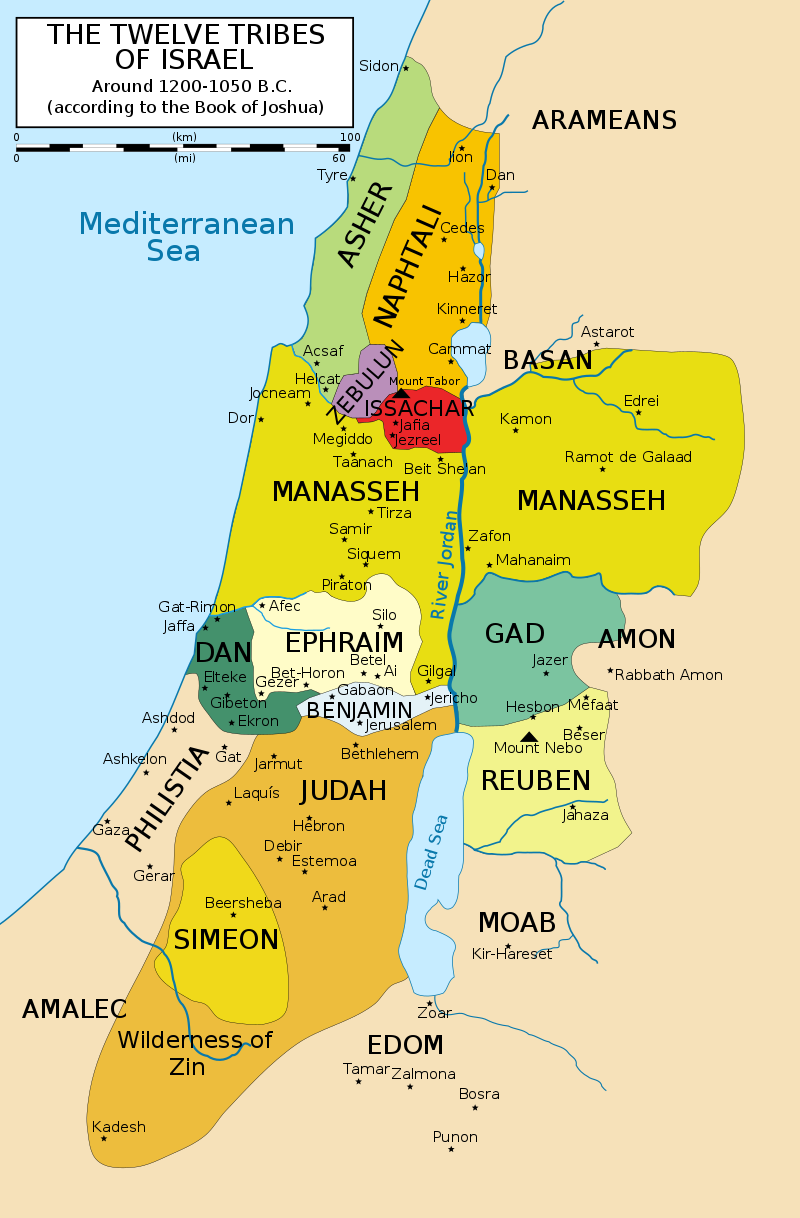
Locations of Manasseh, Asher, Zebulun, Naphtali
GIDEON CALLS
MEN TO WAR
And he sent messengers throughout Manasseh, and they also were called together to follow him; and he sent messengers to Asher, Zebulun, and Naphtali, and they came up to meet them - See map above which shows most of these were neighbors. Why Issachar was not summoned is unclear, especially in light of their reputation as courageous warriors (1Chr 12:32). Why would men from other tribes be willing to follow a man about whom they had no knowledge? One has to believe that this reflects a work of the Spirit of God. In Ezra 1:5 after the 70 year exile we read "Then the heads of fathers' households of Judah and Benjamin and the priests and the Levites arose, even everyone whose spirit God had stirred to go up and rebuild the house of the LORD which is in Jerusalem." (See also passage above) It is notable that even the Asherites who did not join Barak did respond to Gideon's call. And as we learn the response yield an army of 32,000 men (cf Jdg 7:3 but still much smaller than the 135,000 enemy forces - cf Jdg 8:10 - and camels without number - Jdg 7:12). Of course as God would soon teach Gideon (and all Israel), God plus 1 is a majority! And certainly God plus 300 is a route!
Judges 6:36 Then Gideon said to God, "If Thou wilt deliver Israel through me, as Thou hast spoken,
Living Bible Then Gideon said to God, "If you are really going to use me to save Israel as you promised, 37 prove it to me in this way: I'll put some wool on the threshing floor tonight, and if, in the morning, the fleece is wet and the ground is dry, I will know you are going to help me!
- Jdg 6:14,17-20; Exodus 4:1-9; 2 Kings 20:9; Psalms 103:13,14; Matthew 16:1)
GIDEON THE OLD TESTAMENT
"DOUBTING THOMAS!"
Then Gideon said to God, "If Thou wilt deliver Israel through me, as Thou hast spoken - Though me is literally "by My hand" implies that Gideon understood that he was to be the Lord's "glove" so to speak, the Lord's leader of the Israelite forces.
It is worth noting that although the Holy Spirit had come so powerfully upon Gideon, he was still very weak in faith and clearly daunted by the prospect before him. Who would not be? This is a reminder to us that grace does not delete or destroy nature. When God comes into our lives He takes the temperament which He has created and begins to refine and empower it. God wants to maximize our effectiveness and deal with our weaknesses, but it is often His way to keep us conscious of the fact that those weaknesses do exist, so that we depend on Him and not on ourselves. He knows how readily we lean on our own imagined resources and think that we can cope without total dependence on Him.
Sadly because these next 5 verses are not read with careful observation and discernment, they have become a watchword for many to determine God's will for their life "Well, just put out a fleece brother and the Lord will show you what to do." The idea is simple: You say to the Lord that you have 2 options. If You want me to follow plan A, then please do this by Tuesday. Then I will know that it is what you want me to do. If You do not do it, I will follow plan B."
Gideon was not the only one who asked for "signs" that God would complete the work He promised He would carry out. (eg, Moses [Ex 4:1-9] Hezekiah [2Ki 20:9].) And in this example of Gideon's lack of trust in God's sure word, we see the infinite compassion of our Father for He knows our frame, He knows the beginning from the end and He meets us where we are [Ps 103:13,14 - Spurgeon's comment on v13 ; Spurgeon's comment v14] We all exhibit this Gideon-like tendency from time to time, some more than others for our spirits may be willing to believe Him but our flesh is weak.
Gideon's problem was not one of lack of knowledge (v14,16) or a need for more knowledge but of lack of faith & obedience...like the hymn succinctly yet powerful states "trust & obey for there's no other way to be happy in Jesus then to trust & obey." (Play Trust and Obey) Amen to that truth. Let it sink in Lord.
Judges 6:37 behold, I will put a fleece of wool on the threshing floor. If there is dew on the fleece only, and it is dry on all the ground, then I will know that Thou wilt deliver Israel through me, as Thou hast spoken."
- Behold - Dt 32:2; Ps 72:6; Hos 6:3,4; 14:5
- If there is dew on the fleece only Ps 147:19,20; Mt 10:5,6; 15:24
- Judges 6:37: Gideon's Fleece by Alexander Maclaren
- Fleeces and the Will of God by Kay Arthur
Related Passages:
Mark 9:24+ (THIS PRACTICE IS REASONABLE) Immediately the boy’s father cried out and said, “I do believe; help my unbelief.”
FAITHLESS FLEECE
Believers do not need a "faithless fleece" approach to God's will but a "fleeceless faith" approach!
Behold (hinneh) is a word normally used to get someone's attention. In this case Gideon was addressing God Himself.
I will put a fleece of wool on the threshing floor - Note that Gideon was not truly seeking to learn God's will, because that had already been revealed to him (Jdg 6:14,16). So why the fleece test? He put out the fleece in an attempt to strengthen his weak faith. A strong faith would have accepted God's declaration without needing any additional substantiation. Clearly Gideon had some degree of doubt about God’s promise. Gideon's doubts might have included thoughts like: "Does God really want me to lead the army?" "What do I know about warfare?"
THOUGHT - Put out a fleece is often used by Christians to refer to asking God to do something special to verify His will. It is like the woman who wondered if she should fly to another city and when she tentatively made her reservations they told her she would fly on a 747. The next morning she awoke and looked at her digital clock and it said "7:47" so she was convinced God had given her a "fleece-like" answer! Don't fall into this trap or else you may get "fleeced!" Paradoxically, instead of being an act of faith, such a practice is evidence of unbelief. Yes, God condescended to speak to Gideon’s weakness and He did what Gideon requested. By way of application, God may do that for you; but this is not the level on which God wants to meet and interact with you. Immature faith needs signs for reassurance. A mature saint believes God's Word and obeys. Have you ever put out a fleece?
Note that these arguments against "putting out a fleece" do not mean to imply that God is not able to work through circumstances to confirm His revealed will, for indeed He is. We need to be careful that we are not using "circumstances" like Gideon did to test God, especially when we know exactly what God's will is from His Word. Gideon knew what God's will for him was!. I cannot speak for you, but beloved my problem is in obeying what He has told me to do.
If there is dew on the fleece only, and it is dry on all the ground, then I will know that Thou wilt deliver Israel through me, as Thou hast spoken:
See Walter Kaiser's analysis in More Hard Sayings (page 127 - borrow for 1 hour)
Gideon already knew God's will but he sought another sign to confirm it. His "faith" seems to have been eclipsed by fear. Requests for signs are often the product of unbelief (Mt 12:38,39, 1Co 1:22,23, cp Jn 20:25-29, Jn 4:48, Zacharias = Lk 1:18,20+). See Mt 16:1 where the Pharisees query for signs was equated with "testing" Jesus and we are not to test the Lord as we see in Mt 4:7+ and 1Co 10:9+.
In effect, Gideon was actually putting God "in a box", telling God what to do; i.e., what conditions had to be met before he would obey His previous orders. Gideon broke his promise to God after refusing to believe after the first sign and requesting a second. God's response in granting his request does not imply God's approval but only demonstrates His about grace and compassion for the frailty of human nature so that He treats His servants with great patience. Consider Thomas' example and Jesus reply (Jn 20:29). Only 2 things are required to fulfill God's will - listen to His voice as you read His Word and then follow His directions implicitly. Gideon was at last ready to obey. Are you?
It was a (probably "superstitious") practice in the ancient world to seek last-minute confirmation of divine support before a battle was joined (cf. 1Ki 22:6-28) but Gideon had the perfect PROMISES of God (Jdg 6:6:14,16), the awesome revelation of His PRESENCE and the clear evidence of His POWER to deliver and protect against the adversary (Judges 6:26-32), so Gideon's call was a manifestation of his unbelief. And in the final analysis of his "faithlessness" at this juncture of his life we see God place his name first in the prestigious list in He 11:32+! Oh, the depth of the riches of the wisdom & knowledge of God! The entire episode of the fleece provides a study of God's forbearance and longsuffering. (Ro 2:4-note) It is certainly not meant to establish a pattern for others to follow. Gideon felt that he needed a fleece because he did not entirely believe the Word of God! The fact that the Lord complied with Gideon’s request does not sanctify the process. It merely evidences God’s condescending grace toward our persistent doubt.
THOUGHT - Gideon’s fleece unveils a danger, the seriousness of which modern sign-seekers should be aware. While such elements in Christianity hold out the promise of a deeper spirituality through miraculous manifestations, a lack of spiritual maturity is actually being evidenced. Many who fall prey to these deceptive promises find that they become so engrossed in looking for the signs that they become completely diverted from doing what God has called them to do. Spiritual maturity is seen, in its truest sense, when we are able to trust implicitly in the already fully verified witness of the Word spoken by Jehovah. God had said what He would do; it was Gideon’s duty to believe and obey. Beware of seeking for signs of the supernatural rather than seeking the the Supernatural Savior Himself! Our flesh is weak and craves for signs be it the shroud of Turin, the "remnants of Noah's Ark", tales that the Ark of the Covenant is in Ethiopia, etc. We have Jesus' Spirit within us and His perfect word (Ps 19:7+) and thus have all the riches of wisdom and knowledge we need (Col 2:3+).. Let us not be deluded by persuasive arguments (Col 2:4+).
QUESTION - Is it acceptable to “lay out a fleece” before God in prayer? WATCH ACCOMPANYING VIDEO
ANSWER - The concept of “putting out a fleece” comes from the story of Gideon, a leader in Israel, in Judges 6. When God directed him to gather the Israelite troops to defeat the Midianite invaders, Gideon wanted to be sure it was really God’s voice he was hearing and that he understood His directions. He asked God for a sign to prove that this was truly His will. So he put out a piece of wool overnight and asked God to make it wet while keeping the surrounding dirt dry. God graciously did as Gideon asked, and in the morning the fleece was wet enough to produce a bowl of water when it was wrung out.
But Gideon’s faith was so weak that he asked God for another sign—this time to keep another fleece dry while making the surrounding dirt wet. Again, God complied, and Gideon was finally convinced that God meant what He said and that the nation of Israel would have the victory the angel of the Lord had promised in Judges 6:14-16. Putting out the fleeces was the second time Gideon had asked for a sign that God was really talking to him and would do what He said He would.
There are several lessons for us in Gideon’s story. First, God is incredibly gracious and patient with us, especially when our faith is weak. Gideon knew he was treading on dangerous ground and was trying God’s patience by asking for multiple signs. After the first fleece sign, he said, “Do not be angry with me. Let me make one more request” (Judges 6:39). But our God is a merciful, loving and patient God who knows our weaknesses. However, the story of Gideon should be for our instruction and not serve as a model for our own behavior. Jesus said on two occasions that “a wicked and adulterous generation seeks after a sign” (Matthew 12:39; 16:1-4). His point was that the signs He had already given them—His fulfillment of Old Testament prophecy, healings, and miracles—were sufficient for them to respond to the truth, if truth was what they were seeking. Clearly, it was not.
Another lesson of Gideon’s fleeces is that those asking for signs are exhibiting a weak and immature faith that won’t be convinced by the signs anyway! Gideon had received more than enough information without the sign of the fleeces. God had told him he would have victory (Jdg 6:14), and He had responded to a previous request for a sign with a miraculous display of power in fire (Jdg 6:16). Still, Gideon asked for two more signs because of his own insecurity. In the same way, even when God does provide the sign we ask for, it doesn’t give us what we crave because our wavering faith still doubts. That often leads us to ask for multiple signs, none of which give us the assurance we need, because the problem isn’t with God’s power; it’s with our own perception of it.
A problem with following Gideon’s example of fleece-setting is that it does not take into account that our situation and his are really not comparable. As Christians, we have two powerful tools that Gideon lacked.
First, we have the complete Word of God which we know is “God-breathed and is useful for teaching, rebuking, correcting and training in righteousness, so that the man of God may be thoroughly equipped for every good work” (2 Timothy 3:16-17). God has assured us that His Word is all we need to be “thoroughly equipped” for anything and everything in life. We do not need experiential proof (signs, voices, miracles) to verify what He has already told us in His Word.
Our second advantage over Gideon is that every Christian has the Holy Spirit, Who is God Himself, residing in his heart to guide, direct, and encourage. Prior to Pentecost, believers had the Old Testament only and were directed externally by God’s providential hand. Now we have His complete Bible and His indwelling presence in our hearts.
Rather than seeking signs via fleeces, we should be content to know God’s will for us in every situation every day: “Let the word of Christ dwell in you richly” (Colossians 3:16); “Be joyful always; pray continually; give thanks in all circumstances, for this is God’s will for you in Christ Jesus” (1 Thessalonians 5:16-18); “And whatever you do, whether in word or deed, do it all in the name of the Lord Jesus, giving thanks to God the Father through him” (Colossians 3:17). If these things characterize our lives, the decisions we make will be in accordance with God’s will, He will bless us immeasurably with His peace and assurance, and there will be no need to put out fleeces or ask for signs. GotQuestions.org
Knowing God’s Will: Is It Okay to “Put Out the Fleece”? Dan Vander Lugt
Is it okay to “put out the fleece” to know God’s will, like Gideon did in Judges 6:36-40?
Gideon is listed as one of the heroes of the faith ( Hebrews 11:32 ), and he “put out the fleece,” not only once, but twice! However, before we follow Gideon’s example, we should take a closer look at some of the specific circumstances in his case, and then consider what other Scripture passages say about looking for a sign from the Lord.
Considering the dangerous and frightening nature of the angel’s instructions, it is easy to understand Gideon’s weakness of faith and his desire for further confirmation. But, even though we can sympathize with his fears, Gideon himself realized that he was risking God’s anger when he asked for further signs ( Judges 6:39 ). In light of Gideon’s trepidation in the face of such a seemingly impossible task, God graciously granted him the further signs he requested. However, this shouldn’t be taken as an indication that God normally approves of such a method for confirming His will ( James 1:5-8 ).
Scripture elsewhere clearly warns against asking for such signs. The Old Testament law itself prohibited putting God to the test ( Deuteronomy 6:16 ), and this specific principle was confirmed by Jesus when He was tempted by Satan in the wilderness ( Luke 4:12 ). In 1 Corinthians 10:9, the apostle Paul pointed to severe consequences that resulted from such doubt ( Numbers 21:6 ), and Luke describes how the father of John the Baptist was struck mute ( Luke 1:18-20 ) for doubting the message of an angel.
Of course, it is important to define what a person means when they say that they are “putting out the fleece.” If they mean that they are carefully studying their situation for general indications of God’s leading, they are doing what they should. But if they are demanding, like Gideon, that God give them immediate guidance by fulfilling a specific “sign” that they impose on Him, they are putting God to the test in a way that is forbidden.
Like sorcerers and occultists who try to control supernatural forces through spells and incantations, we may think we can control God with such demands. But our heavenly Father has no interest in making His supernatural power accessible to our whims. His goal is for us to know Him personally, in a relationship founded and dependent upon faith ( Proverbs 3:5-8 ).
Related Resources:
A LESSON FROM JOHN WESLEY ON HOW NOT TO DISCERN GOD'S WILL
When John Wesley was 32 yo he was a bachelor missionary in the colony of Georgia. While serving a church in Savannah, he met a young woman named Sophia Hopkey. Wesley fell in love with her, but he belonged to a group of idealistic young men in London called the "Holy Club" and one of their ideals was that members should remain single. So Wesley's dilemma "Was it the will of God for him to marry Sophie or not?"
To determine God's will he and a friend decided to draw from 3 lots on which were written either "Marry", "Think not of it this year" or "Think of it no more." His friend drew for Wesley & selected --"Think of it no more." Wesley was heartbroken but took it to be the will of God. He ended the courtship left America for England and wrote in his journal "Snatched as a brand out of the fire!"
Shortly after returning to England Wesley came to saving faith in the Lord Jesus and began his evangelistic ministry. During his travels he fell in love with another woman but this time tried a different approach to discern the will of God, listing 7 characteristics he desired in a wife, then evaluating the prospective wife by each and concluding "Therefore all my 7 arguments against marriage are totally set aside. Nay, some of them seem to prove that I ought to marry and G.M. is the person."
Unfortunately John's brother Charles got wind and did not agree, so he went posthaste to G. M. and told her "Grace Murray, you have broken my heart!"
Then he fainted at her feet. That shook GM so badly that she hastily married another man. Strike 2 for Wesley in regard to discerning the will of God. Finally, a year and one half later John Wesley did marry a wealthy widow, Mary Vazeille. We don't know his criteria for choosing her but we do know the result. He had a very unhappy marriage and 20 years later she left him, at which time he wrote: "I have not left her; I would not send her away; I will not recall her."
And so much for Wesley's discerning the will of God in regard to whom he was to marry!
Judges 6:38 And it was so. When he arose early the next morning and squeezed the fleece, he drained the dew from the fleece, a bowl full of water.
WET FLEECE:
CONFIRMATION...NOT!
And it was so. When he arose early the next morning and squeezed the fleece, he drained the dew from the fleece, a bowl full of water - This result should have confirmed God's will to Gideon but it did NOT! His faith was still faltering and in need of another fleece test. Keep in mind that he had already asked for a sign (Jdg 6:17), so the fleece farce was in effect asking for 2 more signs!
Judges 6:39 Then Gideon said to God, "Do not let Thine anger burn against me that I may speak once more; please let me make a test once more with the fleece, let it now be dry only on the fleece, and let there be dew on all the ground."
- Do not let Thine anger burn against me Genesis 18:30, 32
- let it now be dry only on the fleece Ps 107:33-35; Isa 35:6-7; 43:19-20; 50:2; Mt 8:12; 21:43; Acts 13:46; 22:21; 28:28; Ro 11:12-22
Related Passage:
Psalm 103:14 For He Himself knows our frame; He is mindful that we are but dust.
"SIGN THREE"
DRY FLEECE TEST
Then Gideon said to God, "Do not let Thine anger burn against me: Literally don't let Your "nose became hot", a most expressive metaphor for anger and one of the more interesting examples of the anthropomorphisms for God.
Do not miss that twice Gideon reminded God of what He had said ("as you have spoken" - Judges 6:36,37), and twice Gideon asked God to reaffirm His promises with a miracle. The fact that God stooped to respond to Gideon’s weakness only proves that He is a gracious God Who understands how we’re made (Ps 103:14+).
Wiersbe Who are we to tell God what conditions He must meet, especially when He has already spoken to us in His Word? “Putting out the fleece” is not only an evidence of our unbelief, but it’s also an evidence of our pride. How so? In effect we are saying something like "God has to do what I tell Him to do before I’ll do what He tells me to do!" (See Wiersbe Bible Commentary)
Matthew Henry "Though he took the boldness to ask another sign, yet he did it with such fear and trembling as showed that the familiarity God had graciously admitted him to did not breed any contempt of God's glory, nor presumption on God's goodness. Abraham had given him an example of this, when God gave him leave to be very free with him" [Ge 18:30, 32]
Wiersbe quotes Joseph Parker - Joseph Parker defends Gideon when he writes, “Men cannot be courageous all at once” (The People’s Bible, vol. 6, 14). But courage comes from faith, and faith doesn’t become strong when we ask God to bless our unbelief by performing miracles. The way to grow in faith and courage is to hear God’s Word, believe His promises, and obey what He tells us to do. God may stoop to our weakness once or twice, but He won’t permit us to live at that juvenile level all our lives. (See Be Available)
Judges 6:40 And God did so that night; for it was dry only on the fleece, and dew was on all the ground.
GOD CONDESCENDS
TO ANSWER GIDEON
And God did so that night; for it was dry only on the fleece, and dew was on all the ground. See how tender God is of true believers though they be weak, and how ready to condescend to their infirmities, that the bruised reed (Isa 42:3, Mt 12:20,21) may not be broken nor the smoking flax quenched. God is the God of slow learners like Gideon and like you and me and we are all thankful for His longsufferings when we refuse to believe His clear Word in our life. Praise God that He is still the God of Exodus 34:6-7+
Then the LORD passed by in front of him and proclaimed, “The LORD, the LORD God, compassionate and gracious, slow to anger, and abounding in lovingkindness and truth; 7 who keeps lovingkindness for thousands, who forgives iniquity, transgression and sin; yet He will by no means leave the guilty unpunished, visiting the iniquity of fathers on the children and on the grandchildren to the third and fourth generations.”
Spurgeon had an interesting application of Judges 6:40 asking. "Who can shut his eyes to the sad fact that in days of revival there are some who are unblessed? I am anxious about you who are like Gideon's fleece—dry when the floor is wet! You remain in a barren spot of ground when all the earth is filled with fertility!
IT is a comfort to know, that, however afflicted and apparently desperate our state may be in this world, there is no just ground for despondency. God can never want instruments for effecting our deliverance; or fail in effecting it, however weak and inadequate those instruments may be.
We can scarcely conceive a more hopeless condition than that to which the nation of Israel was reduced at this time by “the Midianites and Amalekites and the children of the east.” These enemies “came up with their cattle and their tents, and they came as grasshoppers for multitude; for both they and their cattle were without number; and annually, for seven years, they entered into the land to destroy it; whilst the children of Israel hid themselves in dens and caves and strong-holds in the mountains, destitute of any sustenance,” and incapable of resisting their invaders.
But, in this extremity, God was pleased to visit them in mercy, and to raise up for them a deliverer, “even Gideon, whilst he was threshing out some wheat, to hide it from the Midianites.” To satisfy the mind of Gideon, who pleaded his utter incapacity for the office devolved upon him, God gave him a sign: he accepted an offering of a kid, prepared as for food with unleavened cakes, and caused “fire to rise up out of the rock, on which the flesh and cakes were placed, to consume them: and then departed out of his sight.” But still, though further encouraged by the success of his endeavour to destroy idolatry in his father’s house and by the willingness which several of the tribes manifested to enlist under his banners, he yet needed to have his faith strengthened; and for that end, he desired a further sign from the Lord, that so he might be assured that the promise made to him should be fulfilled.
In this circumstance we see displayed before our eyes,
I. The weakness of man—
Gideon could not give full credit to the word of God—
[It had been declared to him by the Lord, “Thou shalt save Israel from the hand of the Midianites: have not I sent thee?” On his expressing a doubt how this could possibly be effected by so weak an instrument as he, God had confirmed his word, as with an oath, “Surely I will be with thee; and thou shalt smite the Midianites as one man.” To remove all doubt from his mind, a sign had been given him, similar to that which had been given at the consecration of Aaron to the priestly office. Yet still he wanted fresh signs, to convince him that God would indeed fulfil his word; and even prescribed to God the signs that should be given, desiring that a fleece might be wet with dew, whilst all was dry around; and again, that the fleece might be dry, whilst on all around it the dew should rest.]
Do we not see in this the weakness of all mankind?
[Abraham repeatedly resorted to a base subterfuge in denying his wife, because he could not trust in God for his protection from Pharaoh, and Abimelech. Sarah, too, though commended for her faith, could not believe that, at her advanced period of life, she should bear to Abraham a son. When Moses was commissioned to bring Israel out of Egypt, no less than three successive signs were given to him, for the conviction of his own mind, and of the minds of those to whom he was sent: his rod was turned into a serpent, and restored from a living serpent to a rod again; his hand was rendered both leprous, and whole again; and the water which he poured out was converted into blood. David also, under circumstances of great trial, found doubts arise in his mind; but confessed, upon reflection, “This is mine infirmity.” And who amongst us has not, on many occasions, “staggered at the promises through unbelief?” The disciples themselves, when a storm arose, were fearful that they should perish, notwithstanding their Lord and Master was embarked with them in the vessel: and the intrepid Peter’s heart began to fail him, when walking on the sea, because the wind became more boisterous than when he first descended from the ship. So, in seasons of trial, we have found it exceeding difficult to place such confidence in God, as to dismiss all fear, and commit our cause to him without any anxiety about the issue of it. We can know but little of the workings of our own hearts, if we have not discovered, that “there is in us an evil heart of unbelief,” and that to place perfect confidence in God is the highest of all attainments. To say under such accumulated trials as Job sustained, “Though he slay me, yet will I trust in him,” is little short of absolute perfection.]
But this weakness of Gideon was the means of displaying,
II. The condescension of God—
God, instead of being offended with his servant, acceded to his request—
[A fellow-creature, who had given such solemn promises, would have been quite indignant at finding his veracity called in question. How offensive was the request, “If thou wilt save Israel by mine hand, and do as thou hast said, behold, I will put a fleece of wool in the floor; and if the dew be on the fleece only, and it be dry upon all the earth beside, then shall I know that thou wilt save Israel by mine hand, as thou hast said.” Nor did even this suffice: no: he must “prove” God a second time by reversing this request, before he can believe “that God will do as he has said.” Yet, astonishing to behold! God, instead of being offended with him, gives him the satisfaction he desires, and accommodates himself to the wishes of his yet doubting servant.
A similar instance of condescension we behold in Jesus towards his unbelieving disciple. All the disciples had seen our Lord, except Thomas; and all bare the most decided testimony to his resurrection. But Thomas would not believe: no: the testimony of all his brethren was of no avail: he would not even believe his own eyes, if he should see his Lord: he would not believe, unless he should put his fingers into the print of the nails made in the hands and feet of his Lord, and thrust his hand into the side that had been pierced by the spear. How justly might he have been left to the perverseness of his own mind, and to all the bitter consequences of his unbelief! But no: the Saviour appears to him also, and gives him the very evidence he desired.]
And the same condescension may we also expect—
[It is true, we are not authorized to specify the terms on which we will credit the divine testimony, or to expect any visible signs in confirmation of God’s word: yet are we not a whit less assured of his condescension and grace, than Gideon and Thomas were. We shall find, in his very covenant which he has made with us, the very same condescension to our weakness, and the very same desire to satisfy our minds: for “he has confirmed his covenant with an oath, that by two immutable things, in which it was impossible for God to lie, we might have the stronger consolation.” And, if we look at the promises, we shall find that they are made in a way purposely to counteract and sustain the weakness of our minds. Mark the repetitions: “Fear thou not; for I am with thee: be not dismayed; for I am thy God: I will strengthen thee; yea, I will help thee; yea, I will uphold thee with the right hand of my righteousness.” “Fear not, thou worm Jacob: thou shalt thresh the mountains.” Mark his answers to the objections arising in our minds: “Shall the prey be taken from the mighty, or the lawful captive delivered? Yes; thus saith the Lord: The captives of the mighty shall be taken away, and the prey of the terrible shall be delivered: for I will contend with him that contendeth with thee, and I will save thy children.” We see, then, that at this day God is the same as in the days of old; and that still, as formerly, “he will not break the bruised reed, nor quench the smoking flax, till he bring forth judgment unto victory.”]
In all this, however, we discern,
III. The efficacy of prayer—
It was prayer that prevailed in the instance before us—
[Gideon, with much humility and tenderness of spirit, besought the Lord; even as the Prophet Isaiah afterwards did in behalf of Hezekiah. God promised to Hezekiah that his disorder should be healed, and that he should “on the third day go up to the house of the Lord.” A sign was then offered to him, and a choice was given him in relation to it: and he, thinking it a much harder thing for the shadow on the sun-dial to go back, than to advance, ten degrees, fixed upon that which he conceived to be the more difficult: and “the Prophet Isaiah,” who in God’s name had offered him the sign, “cried unto the Lord; and he brought the shadow ten degrees backward, by which it had gone down in the dial of Ahaz.”]
To us, also, will God vouchsafe his mercies, in answer to our prayers—
[We are told that “the effectual fervent prayer of a righteous man availeth much.” And in this respect Elijah is held forth to us as an example: for he, “though a man subject to like passions as we are, prayed earnestly that it might not rain: and it rained not on the earth by the space of three years and six months. And he prayed again, and the heaven gave rain; and the earth brought forth her fruit.” Thus also shall it be with us, under circumstances of peculiar trial. I mean not to say, that we shall have any miraculous answers to our prayers; for the age of miracles is past: but I must say, that, even in relation to temporal matters, our prayers shall not go forth in vain; and, in reference to spiritual mercies, they shall descend almost in visible answers on our souls. Let us suppose the whole neighbourhood where we dwell, to be in a state of barrenness, so far as it respects the blessings of salvation: if a man cry earnestly to God, the dew of his blessing shall descend upon him in the richest abundance; (a whole bowl-full shall, if I may so speak, be wrung out from his contracted fleece:) on the other hand, if God’s judgments are poured forth on all around him, a merciful exemption shall be given to him; even as it is said, “A thousand shall fall beside thee, and ten thousand at thy right hand; but it shall not come nigh thee.” No man can conceive to what an extent God will magnify his condescension and grace towards an humble suppliant, till he has himself besought the Lord, and obtained an answer of peace unto his soul. “We may ask what we will, and it shall be done unto us.”]
What now shall I further say to you? This only would I add—
Let your faith in God’s blessed word be firm and uniform—
[Think not of difficulties: “There is nothing too hard for the Lord.” Were your enemies as numerous as the Midianites, and you had nothing wherewith to combat them but a pitcher and a lamp, they should all fall before you. Only be strong in faith: and you shall find, that “all things are possible to him that believeth.”]
Judges 6:1-10 Midianite oppression. -- Israel's sin brought suffering, and this time from an almost despicable quarter; because Midian had been severely punished, and almost annihilated when Israel passed through their land (Nu 31:7). The invaders seem to have possessed themselves of all the valleys, where there would be pasturage for their flocks, etc., forcing the Israelites up into the hills. Their sorrows again drove them to their knees, and they cried to the Lord. Alas! That God has so often to drive men to Himself.
Often enough have the hosts of Midianites visited us, and left us very low, leaving no green thing in cornfield or vineyard. It is then that the Lord's voice (Judges 6:8, 9, 10) is heard, reminding us that we have fallen, not by any failure on His part, but by our own iniquity. I brought out; I delivered; I drove them out; I said, but YE have not hearkened to my voice. The path of obedience is the only safe and prosperous one.
Judges 6:11-24 The commission to Gideon was given by an angel, who was evidently the Angel-Jehovah (Judges 6:14).
God sends angels of deliverance as well as prophets of remonstrance, and they come to the men who hide in the winepress, and are least in their own eyes, and meditate on the past mighty works of the Lord. See what a look of the Lord can do; it carries with it might and salvation (Judges 6:14). God always goes with those whom He sends, and though our foes be as swarms of locusts, they perish as one man, when smitten by the sword of the Lord and of Gideon. When faith is weak, God nurtures it by sign of wonder and by fire, tenderly providing materials on which faith can build; and the peace of God is breathed into the heart. What a sweet title! Jehovah-shalom! The Lord is our Peace. He sends Peace and He is Peace, like the calm of evening settling down upon the heart. When we have seen God face to face, we have no reason to fear man.
Judges 6:25-32 The destruction of idols must precede all successful and victorious work. Before we can be delivered from Midian, there must be an honest dealing with the idolatry of evil in the inner life. The altar of Baal must be thrown down, and replaced by the altar of God, and there must be the burnt-offering of entire surrender to His claims. We are first tested in the less before being called to the greater. It was because Gideon dared to obey God, as far as concerned his home and village, that the Spirit of the Lord "clothed itself with" him for wider service (Judges 6:34, R.V., marg.).
Judges 6:36-40 God's condescension to allay his fears. -- We must not be always looking for signs. God generally guides us by our sanctified judgment. Yet there are indications sometimes afforded to those who walk close with Him (Acts 16:6, 7, , 9, 10). (F. B. Meyer. CHOICE NOTES ON JOSHUA THROUGH 2 KINGS)