
Psalm 119:9,11
See Memory Verses by Topic - Precept Austin
Before Jesus left for Calvary, He encouraged His fearful disciples with these words -
But the Helper, the Holy Spirit, whom the Father will send in My name, He will teach you all things, and bring to your remembrance all that I said to you." (Jn 14:26)
While this passage is one that uniquely applied to the disciples, it is applicable in principle to all believers. Indeed, the principle in John 14:26 begs the question "How can the Spirit bring to mind Scriptures that we have not previously stored in our mind?"
As John Butler says "The principle for believers is that the Holy Spirit helps us to remember Scripture and spiritual lessons. When a verse pops into the mind when teaching, preaching, studying or pondering a decision of some sort—it is not your memory that is bringing that text to your mind, but it is the prompting of the Holy Spirit that is doing it. However, for the Holy Spirit to prompt your memory, you must have previously stored the Scripture in your memory. The Holy Spirit is like the recall button on a calculator—if you do not put anything in memory in the calculator, the recall button will not bring up any information." (Analytical Bible Expositor: John)
Beloved, let me encourage you to have a healthy spiritual diet and to daily "eat" His Word as if your very (spiritual) life depended on it, because it does! (Mt 4:4, Job 23:12, Jer 15:16, Ps 119:109, etc).
God's instructions to Joshua preparatory to entering the promised land to fight the good fight of faith in order to possess his promised possessions remains a proven "formula for spiritual success" for saints today who like Joshua have been set apart that we might become experiential possessors of our positional possession of every spiritual blessing in the heavenly places in Christ Jesus
This book of the law shall not depart from your mouth, but you shall meditate on it day and night, so that you may be careful to do according to all that is written in it; for then you will make your way prosperous, and then you will have success. (Joshua 1:8)
The best thing.
In the best place.
With the best of results.
David, a man after God's own heart writes...
The law of his God is in his heart. His steps do not slip (Psalm 37:31)
Spurgeon comments: "The best thing in the best place, producing the best results. Well might the man's talk be so admirable when his heart was so well stored. To love holiness, to have the motives and desires sanctified, to be in one's inmost nature obedient to the Lord -- this is the surest method of making the whole run of our life efficient for its great ends, and even for securing the details of it, our steps from any serious mistake. To keep the even tenor of one's way, in such times as these, is given only to those whose hearts are sound towards God, who can, as in the text, call God their God. Policy slips and trips, it twists and tacks, and after all is worsted in the long run, but sincerity plods on its plain pathway and reaches the goal."
John Trapp commenting on the phrase "The law of his God is in his heart" in Ps 37:31 adds: "He hath a Bible in his head, and another in his heart; he hath a good treasure within, and there hence bringeth good things."
How sweet are Thy words to my taste, sweeter than honey to my mouth (Psalm 119:103, cp Ps 19:10)!
Spurgeon comments: He had not only heard the words of God, but fed upon them: they affected his palate as well as his ear. God's words are many and varied, and the whole of them make up what we call "the word": David (Ed: The author of Ps 119 is not known for certain although many think it was David) loved them each one, individually, and the whole of them as a whole; he tasted an indescribable sweetness in them. He expresses the fact of their sweetness, but as he cannot express the degree of their sweetness he cries, "How sweet!" Being God's words they were divinely sweet to God's servant; he who put the sweetness into them had prepared the taste of his servant to discern and enjoy it. David makes no distinction between promises and precepts, doctrines and threatenings; they are all included in God's words, and all are precious in his esteem. Oh for a deep love to all that the Lord has revealed, whatever form it may take. (Amen!)
Yea, sweeter than honey to my mouth. When he did not only eat but also speak the Word (Ed: Which is one of the advantages of memorizing it!), by instructing others, he felt an increased delight in it. The sweetest of all temporal things fall short of the infinite deliciousness of the eternal word. When the psalmist fed on it he found it sweet; but when he bore witness of it, it became sweeter still. How wise it will be on our part to keep the word on our palate (Ed: How better than by treasuring it in our heart! cp Mt 12:34, Lk 6:45) by meditation and on our tongue by confession. It must be sweet to our taste when we think of it, or it will not be Sweet to our mouth when we talk of it.
They (God's Words = Ps 19:7, 8, 9) are more desirable than gold, yes, than much fine gold; Sweeter also than honey and the drippings of the honeycomb. (Psalm 19:10)
Spurgeon Comments: More to be desired are they than fine gold, yea, than much fine gold. Bible truth is enriching to the soul in the highest degree; the metaphor is one which gathers force as it is brought out; -- gold -- fine gold -- much fine gold; it is good, better, best, and therefore it is not only to be desired with a miser's avidity, but with more than that. As spiritual treasure is more noble than mere material wealth, so should it be desired and sought after with greater eagerness. Men speak of solid gold, but what is so solid as solid truth? For love of gold pleasure is forsworn, ease renounced, and life endangered; shall we not be ready to do as much for love of truth?
Sweeter also than honey and the honeycomb. Trapp says, "Old people are all for profit, the young for pleasure; here's gold for the one, yea, the finest gold in great quantity; here's honey for the other, yea, live honey dropping from the comb." The pleasures arising from a right understanding of the divine testimonies are of the most delightful order; earthly enjoyments are utterly contemptible, if compared with them. The sweetest joys, yea, the sweetest of the sweetest falls to his portion who has God's truth to be his heritage....The inexpressible delights of meditation on Scripture.
Thomas Watson comments: Love the word written. Ps 119:97 (read Spurgeon's note, especially his comments on "Meditation"). "Oh, how love I thy law!" "Lord," said Augustine, "let the holy Scriptures be my chaste delight." Chrysostom compares the Scripture to a garden, every truth is a fragrant flower, which we should wear, not on our bosom, but in our heart. David counted the word "sweeter than honey and the honeycomb." There is that in Scripture which may breed delight. It shows us the way to riches: Dt 28:5 Pr 3:10; to long life: Ps 34:12; to a kingdom: He 12:28. Well, then, may we count those the sweetest hours which are spent in reading the holy Scriptures; well may we say with the prophet (Je 15:16), "Thy words were found and I ate them, and Thy words became for me a joy and the delight of my heart, for I have been called by Thy name, O LORD God of hosts."
Aldous Huxley (who was interested in the supernatural but was not a believer) made a statement that relates to Scripture memorization when he declared that "Each man's memory is his private literature." (Interesting thought!)
Isaac Watts - Without memory the soul of man would be a poor, destitute, naked being, with an everlasting blank spread over it, except the fleeting ideas of the present moment.
William Evans - It has been said that "all other abilities of the mind borrow from memory their beauty and perfection." In a very real sense it is true that all other faculties of the soul are useless without memory. Of what profit is all our wisdom, our reading, our study if we are unable to preserve the knowledge we have acquired? Of what benefit to us are all the intellectual attainments of our lives if they are lost as soon as they are obtained? Memory makes rich the mind by preserving all the results of our study and learning...Memory is the treasurer of the mind. (How to Memorize)
Here is a link to Scripture Typer, a Bible Memorization program (it appears to be free) for you phone, Ipad, Kindle, Android or computer. My son says this is the best memorization tool he has ever used (he tends to be excited!). I have not used it but after watching the video it does look like a powerful tool.
Rob Morgan - Think of (Bible memorization) as a shopping spree for the mind, a chance to collect and store up treasures you’ll enjoy for years (Ed: I would add for eternity!, cp 1Ti 4:7-8- note, Isa 40:8, Mt 24:35). Restoring the art of Scripture memory is crucial for us, our churches, and children. It’s vital for mental and emotional health and for spiritual well-being. Though it’s as easy as repeating words aloud, it’s as powerful as acorns dropping into furrows in the forest. It makes the Bible portable; you can take it with you everywhere without packing it in purse or briefcase. It makes Scripture accessible day and night. It allows God’s Word to sink into your brain and permeate your subconscious and even your unconscious thoughts (Ed: Illustration - think of a tea bag dipped in a cup of hot water - the more it is dipped, the greater the permeation of the water by the flavor of the tea. God's Word is the "flavor" and our heart is the cup!). It gives you a word to say to anyone, in season and out of season. It fills your heart and home with the best thoughts ever recorded. It saturates the personality, satiates the soul, and stockpiles the mind. It changes the atmosphere of every family and alters the weather forecast of every day. It takes one minute a day, or five or ten—whatever you can devote to it. It can be done in your bath, your bed, at your desk, or in an airplane (you can’t say all that about too many things). It can be done on the go, in traffic jams, while shaving, at sunup, or before bedtime. It can be done alone, with another person, or in groups. It’s an amazingly versatile habit but also a vital one, profitable whether we’re in the nursery or in the nursing home. (Borrow - 100 Bible verses everyone should know by heart Highly Recommended)
Free resources -
C H Spurgeon tells a story which illustrates the importance of "internalizing" the Word of God...
Now what is a diamond? Suppose it is one worth two hundred thousand pounds — and some of those I have mentioned are said to be worth more than that — yet it is nothing but a little solidified gas. This diamond may fitly represent the whole world, with all its pomp’s, and vanities, and pleasures, and glories. Puff! it’s gone into thin air; death turns; it all to gas. Set your affections on those things which time cannot destroy, which eternity cannot impair.
There is a very beautiful story connected with the “Sancy” or “De Sancy” diamond, which is said to be worth about eighty thousand pounds. It is a comparatively small stone; and if I were stupid enough to wear such ornaments, I could wear it on my finger, if set in a ring. This stone was sent on one occasion by the Baron de Sancy, to whom it belonged, to his king, who was in ‘want of cash, and had proposed getting a loan of 40,000 pounds. The diamond was to be the security; in fact, to put it plainly, it was “to be left at the pawnbroker’s.” The Baron gave the stone to a trusty servant to take to the king. The servant disappeared, and people suspected that he had gone off with the diamond; but his master declared that he knew his servant too well to believe such a thing possible.
After some time the servant’s body was found, a little way from the road: he had been murdered and robbed. The Baron commanded that his clothes should be carefully searched for the missing diamond; but it could not be. found. He then ordered that he should be cut open, and the diamond was found in his body. He had swallowed the gem, which he had been unable in any other way to conceal from the robbers.
We should carry the truth of God within ourselves, in our hearts; so that if we were dissected, there would be found the truth of God in our innermost being. You remember that the Psalmist said, “Thy word have I hid in mine heart, that I might not sin against Thee.” (Ps 119:11) (What the Stones Say)
Do you have difficulty memorizing Scripture? You are not alone. The most common reasons I hear for not memorizing Scripture are "Bible verses are for the children" or "I don't have a good memory" or "I'm too old to memorize" and probably the most honest "It's too much work and to tell you the truth I'm just too lazy!" But considering the advantages of memorization and meditation gleaned from just the two verses quoted above should be reason enough to motivate every believer to seriously consider (or re-consider) Scripture memorization as an integral part of disciplining (gymnazo - what does this sound like? what does it say about "spiritual discipline? Will it be a "no brainer"? Obviously not.) ourselves
"for the purpose of godliness" which "is profitable for all things, since it holds promise for the present life and also for the life to come. (1Ti 4:7, 8-notes).
As an aside note that Paul is not giving Timothy [or us] a suggestion but is commanding [Present imperative] that spiritual discipline be an integral component of one's lifestyle, one's daily delight! Be careful! Don't fall into the subtle trap of legalism! Memorizing God's Word is to be our our delight, not our dread, not our drudgery! All of God's commandments come pre-packaged with all necessary components because His commandment always includes His enablement. The only way redeemed but still fallen men and women can keep the command continually (which is what the present tense calls for) is by continual yielding to and dependence on the Holy Spirit! The Holy Spirit is God's provision of enablement for every commandment! May our Father grant each of us to continually walk in the freedom and power that found only in the Spirit of Jesus our Lord and Savior. Amen
If we truly believed what Paul wrote his young protégée Timothy, I think we would take the approach of the suffering saint Job who declared...
I have not departed from the command of His lips; I have treasured (tsaphan = same Hebrew word found in Psalm 119:11 - "I have treasured [tsaphan] Thy Word...") the words of His mouth more than my necessary food. (Job 23:12)
Two verses earlier Job had made the incredible (considering what transpired in his life in Job1 and Job 2!) declaration...
But He knows the way I take. When He has tried (bachan/bahan = Investigation to determine essential qualities of object - for an informative study see the 9 uses in Ps 7:9; 11:4-5; 17:3; 26:2; 66:10; 81:7; 95:9; 139:23 - note 3 synonyms in Ps 26:2, the first "examine" = bachan/bahan) me, I shall come forth as gold. (Job 23:10)
Here's the question -- Do you see any relationship between Job 23:10 and Job 23:12? Specifically, do these verses suggest some insight into how Job was able to persevere ("You have heard of the "endurance of Job" James 5:11) in the face of incredible sufferings and afflictions? I think you see the point -- the value of Scripture memorization in surviving in a cannot be overemphasized!
I hear so many serious believers say "I ought to begin memorizing Scripture" only to find out weeks or months later they never followed through. Let me encourage you. Today is the best day in your life to begin the adventure of "eating" God's Word in Scripture memorization. You will never regret your decision to launch out into the "great adventure" that lays ahead.
For additional motivation, read through some of the articles in the next section and then in the following section consider one of the established programs to begin your journey. If you would rather not use a computerized program, I would recommend the Navigator's Topical Memory System - TMS (see also Scripture Memory Secrets) because it won't overwhelm you and yet is still solid food which if you practice it, will train (gumnazo) your senses...to discern (diakrisis) good and evil. (He 5:14).
The Bible is the language of heaven, and will not pass away (Mt 24:35), so let us enter into this spiritual discipline with delight, great joy and a sense of expectation, not out of a sense of guilt, legalism or onerous duty. We are not our own but are children and "bond-servants (doulos) of the Most High God" (In the OT the Name is El Elyon - Sovereign Over All) (Acts 16:17), who should be motivated by the love of Christ (2Cor 5:14) to have as our earnest "ambition, whether at home or absent, to be pleasing to Him" (2Cor 5:9) As with any "spiritual discipline" there is always the subtle danger of becoming pharisaical or prideful and we are ever in danger of failing prey to a subtle form of legalism.
JOHN PIPER'S TESTIMONY
RE: MEMORIZING THE WORD
At the beginning of 2009, John Piper challenged his congregation to memorize Scripture in his sermon entitled If My Words Abide in You...(John Piper began this sermon by reciting Psalm 1, Psalm 16, Psalm 103, Romans 5:1–8, Romans 8, Matthew 6:25–34, and 1 Corinthians 13.) The point of reciting these Scriptures is to motivate you by way of example to memorize Scripture in 2009. This message is a mingling of my testimony of the value of memorizing Scripture with Jesus’ testimony in the Gospel of John. My Testimony My testimony can be summed up in eight short sentences.
- Memorizing Scripture makes meditation possible at times when I can’t be reading the Bible, and meditation is the pathway of deeper understanding.
- Memorizing Scripture strengthens my faith because faith comes by hearing and hearing by the word of Christ, and that happens when I am hearing the word in my head.
- Memorizing Scripture shapes the way I view the world by conforming my mind to God’s viewpoint.
- Memorizing Scripture makes God’s word more readily accessible for overcoming temptation to sin, because God’s warnings and promises are the way we conquer the deceitful promises of sin.
- Memorizing Scripture guards my mind by making it easier to detect error—and the world is filled with error, since the god of this world is a liar.
- Memorizing Scripture enables me to hit the devil in the face with a force he cannot resist, and so protect myself and my family from his assaults.
- Memorizing Scripture provides the strongest and sweetest words for ministering to others in need.
- Memorizing Scripture provides the matrix for fellowship with Jesus because he talks to me through his word, and I talk to him in prayer.
That’s my testimony. I hope it will motivate you to make your own discoveries. But what matters most is the testimony of Jesus. So focus for a few minutes with me on a phrase in John 15:7. (If you need some motivation to begin the discipline under grace of memorizing God's Word take 45 minutes and listen to If My Words Abide in You.
Pastor Ray Stedman has a great discussion of the danger believers face in this area of legalism. His transcript is very good but if you have time I would recommend listening to his message as it adds inflections, etc, not possible in a written document. (Legalism - transcript)
The practice of Jesus Himself is ample testimony to the value of Scripture memorization. Jesus said Thus saith the Lord or God said or It is written or Have you not read that it was said 92 times! Clearly our Lord Jesus Christ, fully God and fully Man, left an example (hupogrammos) for (us) to follow in His steps (1Pe 2:21). As Paul commanded the saints at Ephesus we should be imitators (mimetes) of God, as beloved children (Ep 5:1)
Many years ago the village priest in Kalonovaka, Russia, took a special liking to a pug-nosed lad who recited his Scriptures with proper piety. By offering various inducements, the priest managed to teach the boy the four Gospels, which he recited nonstop in church one day. Sixty years later he still liked to recite Scriptures, but in a context that would have horrified the old priest. The prize pupil who memorized so much of the Bible was Nikita Khrushchev, former premier of the Soviet Union! John W. Alexander, former president of InterVarsity Christian Fellowship, gives us this warning:
"There is little merit inherent in the mere process of memorizing Scripture. One could memorize voluminous portions and be an atheist. Satan memorized enough to use it to tempt Jesus...Memorizing is helpful when we yearn for Scripture to energize our whole lives....What makes the difference between superficial and beneficial Scripture memorization? I believe it is prayerful meditation. Memorization in itself may sharpen our intellectual capacities, but that's about all. Memorization with a view to meditation helps us think straight in a crooked world. (excepted from Memorizing God's Word)
Dr. Howard Hendricks has made the statement (and I paraphrase) that if it were his decision, every student graduating from Dallas Theological Seminary would be required to learn 1000 verses word perfect before they received their degree. May his tribe increase!
Well known Bible teacher Dr. Chuck Swindoll has written:
"I know of no other single practice in the Christian life more rewarding, practically speaking, than memorizing Scripture...No other single exercise pays greater spiritual dividends! Your prayer life will be strengthened. Your witnessing will be sharper and much more effective. Your attitudes and outlook will begin to change. Your mind will become alert and observant. Your confidence and assurance will be enhanced. Your faith will be solidified."
Chuck Swindoll goes on to add "Here are seven things I have found helpful: (Ed: Don't forget to ask the Spirit to enable this process!)
- Choose a time when your mind is free from outside distractions...perhaps soon after getting up in the morning.
- Learn the reference by repeating it every time you say the verse(s). Numbers are more difficult to remember than words.
- Read each verse through several times--both ini a whisper and aloud. Hearing yourself say the words helps cement them into your mind.
- Break the passage into natural phrases. Learn the reference and then the first phrase. Then repeat the reference and first phrase as you go to the second phrase. Continue adding phrases one by one.
- Learn a little bit perfectly rather than a great deal poorly. Do not go on to the next verse until you can say the previous one(s) perfectly, without a glance at your Bible.
- Review the verse(s) immediately after you have gone through this process. Twenty to thirty minutes later, repeat what you've memorized. Before the day has ended, firmly fix the verse(s) in your mind by going over it fifteen to twenty times. (You can do this as you drive or do your job. (ED: I will never forget memorizing Proverbs 4:23 while I was swimming laps - I still remember the day and the place and that has been 30 years ago!)
- Use the verse(s) orally as soon as possible. After all, the purpose of Scripture memory is a practical one, not a pedantic one. Us the verse in conversation, in correspondence, in teaching, in counseling, in everyday opportunities. Relate what you've learned to your daily situation. You'll be thrilled with the results. (ED: I can affirm Swindoll's words and would add use the passages in your prayers to your Heavenly Father -- He loves to hear His children speak His Word to Him!) (Borrow to read Swindoll's entire chapter in Growing Strong in the Seasons of Life)
Considering such indisputable benefits to one's spiritual health, one has to wonder why there is not more emphasis on Scripture memory and meditation in the average American church. Could it be that it is still true that
When anyone hears the word of the kingdom and does not understand it, the evil one comes and snatches away what has been sown in his heart? (Mt 13:19)
But (Jesus introduces a dramatic contrast) the seed in the good soil, these are the ones who have heard the word in an honest (kalos) and good (agathos) heart (kardia), and hold it fast, and bear fruit (karpophoreo in the present tense = they have the blessing of being continually "spiritually fertile and fruitful" bearing fruit that will last throughout eternity - Jn 15:16NIV, Jn 15:5, 8) - Do miss this "once in a lifetime offer too good to refuse"! You only go around once! cp James 4:14, Jas 1:10, 11, 1Pe 1:24, Job 7:7, Ps 103:15) with perseverance (hupomone). (Lk 8:15).
So brothers and sisters let us persevere with great delight in this discipline of Scriptural memorization for one day we will discover the glorious truth that this was one of the most fruitful investments of our time that we could have ever made in this life.
INVEST IN A "STOCK"
THAT WILL NEVER DECLINE
AND WILL PAY DIVIDENDS FOR ETERNITY!
In my own practice of memorizing God's Word, I have found that one of the most critical aspects (other than a constant dependence on prayer that God might graciously grant me a heart hunger to eat His Word) is frequent and systematic review of verses. I use a "multi-pronged attack" including: Typing or writing out scripture on small cards that I keep in my pocket for those times I'm stuck in elevators, long winded meetings or long lines at the super market. I also dictate the current verses I am focusing on into a mini recorder (Ipods work too) which is great for redeeming those times I get caught in traffic jams on the freeway and allows you to have several cassettes of your "favorite" verses. Most of these recording devices allow easy playback so that you can keep your eye on the road while driving. I also keep a small pocket sized Bible close at hand (car, briefcase, etc) to allow quick review of verses in context and I highlight those verses I have already memorized.
The Bible on tape/CD/Mp3 is another great modality, especially if you have a long commute time. CD versions are advantageous because they can be quickly "rewound' to the beginning of a chapter to facilitate repetition. REMEMBER that NONE of these ideas or the resources below are of any value in memorizing the Word of God if you have not first sought the God of the Word. Otherwise all of these "tools" can be misused and potentially produce pride, pedantry and a Pharisaical attitude as alluded to earlier. The foundational keynote of "humility" is sounded by James who reminds us after
putting aside (apotithemi) all filthiness (rhuparia) and all that remains (perisseia) of wickedness (kakia), in HUMILITY (prautes KJV = "meekness" - with a meek disposition, a gentleness of spirit) receive (dechomai) the word (logos) implanted (emphutos), which is able (dunamai) to save (sozo) your souls (Jas 1:21, cp the attitude of a little child in Mt 18:3,4)
As someone has well said sin will keep you from the Bible or the Bible will keep you from sin. Bibles that are "falling apart" usually belong to people who are not.
THE MEMORIZED "WORD OF LIFE"
IS THERE WHEN YOU NEED IT!
Beloved, you never know when you might need to recall the memorized Word. Darlene Diebler Rose was a missionary who was captured by the Japanese in WWII and spent four years in a prison camp. Below is her testimony to the power of God's memorized Word, which truly became to her the "Word of Life!"
As a child and young person, I had had a driving compulsion to memorize the written Word (Ed: One cannot help but believe this was the All Seeing God's gracious providence, His Spirit giving her the desire and power to "eat" His Word, for God knew WWII was coming!). In the cell I was grateful now for those days in Vacation Bible School, when I had memorized many single verses, complete chapters, and Psalms, as well as whole books of the Bible (Ed: Are you as convicted as I am?). In the years that followed, I reviewed the Scriptures often (Ed: This is the key - review, review, review!). The Lord fed me with the Living Bread that had been stored against the day when fresh supply was cut off by the loss of my Bible. He brought daily comfort and encouragement—yes, and joy (Ed: Cp 1Thes 1:6) —to my heart through the knowledge of the Word. . . . I had never needed the Scriptures more than in these months on death row, but since so much of His Word was there in my heart, it was not the punishment the Kempeitai had anticipated when they took my Bible. (Evidence Not Seen- A Woman's Miraculous Faith in the Jungles of World War II- Darlene Deibler Rose)
A CONTEXTUAL
CAUTION
One note of caution - Be careful when memorizing single verses that you do not "wrench" them out of their context, lest you give the passage a meaning (and an interpretation) God never intended. Always examine the context surrounding the verse you are memorizing or even better memorize larger sections of Scripture, including chapters or even entire books.
As Billy Graham once said...
I am convinced that one of the greatest things we can do is to memorize Scripture.
When was the last time you memorized a passage of Scripture? God's Word has a cleansing effect. You must (no excuses please - I include myself here!) get into the Word so that it can get into you and can then become effective in your life, as the Spirit uses it ("the washing with water through the word" - Ep 5:26) to renew your mind and transform your thinking (Ro 12:2) so that you are enabled more and more to discern the will of God (Eph 4:14; He 5:14). The Word daily imbibed and diligently obeyed is one of the best protectors and preventatives against the polluting power of this present evil age (Gal 1:4), an age which is in the process of passing away as are even it's evil desires (1Jn 2:17).
William Evans (1910) writes...
A few suggestions will be helpful here.
1. Memorize the location of the verse together with the verse. You will find it just as easy to say, "John 1:29, Behold the Lamb of God, which taketh away the sin of the world," as you would if you merely said, "Behold the Lamb of God," etc., omitting to state the reference.
2. Learn it. Don't get a faint, indefinite idea. If you want to remember any text in after years, let it make a deep, clear and vivid impression on your mind the moment you learn it.
3. Read the verse over, say twenty times; close your Bible and see if you can repeat it correctly, then to be sure, read it again. Once writing the verse is worth a dozen repetitions of it by mouth.
4. Review. This is the secret of memorizing. Review every day, every week, every mouth, and every year.
5. Practice. Use the passages of Scripture. Seek occasions for talking to persons who have difficulties.
See also William Evans' book "How to Memorize"
First, a few testimonies:
I have it third hand, that Dr. Howard Hendricks of Dallas Seminary once made the statement (and I paraphrase) that if it were his decision, every student graduating from Dallas Theological Seminary would be required to learn one thousand verses word perfect before they graduated.
Chuck Swindoll wrote,
I know of no other single practice in the Christian life more rewarding, practically speaking, than memorizing Scripture. . . . No other single exercise pays greater spiritual dividends! Your prayer life will be strengthened. Your witnessing will be sharper and much more effective. Your attitudes and outlook will begin to change. Your mind will become alert and observant. Your confidence and assurance will be enhanced. Your faith will be solidified” (Growing Strong in the Seasons of Life [Grand Rapids: Zondervan, 1994], p. 61).
One of the reasons Martin Luther came to his great discovery in the Bible of justification by faith alone was that in his early years in the Augustinian monastery he was influenced to love Scripture by Johann Staupitz. Luther devoured the Bible in a day when people earned doctorates in theology without even reading the Bible. Luther said that his fellow professor, Andreas Karlstadt, did not even own a Bible when he earned his doctor of theology degree, nor did he until many years later (Bucher, Richard. "Martin Luther's Love for the Bible"). Luther knew so much of the Bible from memory that when the Lord opened his eyes to see the truth of justification in Ro 1:17, he said, "Thereupon I ran through the Scriptures from memory,” in order to confirm what he had found.
So here are a few reasons why so many have viewed Scripture memorization as so essential to the Christian life.
1. Conformity to Christ
Paul wrote that
we all, . . . beholding the glory of the Lord, are being transformed into the same image from one degree of glory to another” (2Cor 3:18)
If we would be changed into Christ likeness we must steadily see him. This happens in the word.
The Lord revealed himself to Samuel at Shiloh by the word of the Lord” (1Sa 3:21).
Bible memorization has the effect of making our gaze on Jesus steadier and clearer.
2. Daily Triumph over Sin
How can a young man keep his way pure? By guarding it according to your word. . . . I have stored up your word in my heart, that I might not sin against you (Psalm 119:9, Ps 119:11).
Paul said that we must
by the Spirit . . . put to death the [sinful] deeds of the body” (Ro 8:13).
The one piece of armor used to kill is the “sword of the Spirit” which is the word of God (Ep 6:17). As sin lures the body into sinful action, we call to mind a Christ-revealing word of Scripture and slay the temptation with the superior worth and beauty of Christ over what sin offers.
Remember however as John Blanchard has warned...
There is more to Christian growth than knowing what the Bible says; nobody is ever nourished by memorizing menus.
3. Daily Triumph over Satan
When Jesus was tempted by Satan in the wilderness he recited Scripture from memory and put Satan to flight (Mt 4:1-11).
4. Comfort and Counsel for People You Love
The times when people need you to give them comfort and counsel do not always coincide with the times you have your Bible handy. Not only that, the very word of God spoken spontaneously from your heart has unusual power. Pr 25:11 says, "A word fitly spoken is like apples of gold in a setting of silver." That is a beautiful way of saying, When the heart full of God’s love can draw on the mind full of God’s word, timely blessings flow from the mouth.
5. Communicating the Gospel to Unbelievers
Opportunities to share the gospel come when we do not have the Bible in hand. Actual verses of the Bible have their own penetrating power. And when they come from our heart, as well as from the Book, the witness is given that they are precious enough to learn. We should all be able to sum up the gospel under four main headings (1) God’s holiness/law/glory; (2) man’s sin/rebellion/disobedience; (3) Christ’s death for sinners; (4) the free gift of life by faith. Learn a verse or two relating to each of these, and be ready in season and out of season to share them.
6. Communion with God in the Enjoyment of His Person and Ways
The way we commune with (that is, fellowship with) God is by meditating on his attributes and expressing to him our thanks and admiration and love, and seeking his help to live a life that reflects the value of these attributes. Therefore, storing texts in our minds about God helps us relate to him as he really is. For example, imagine being able to call this to mind through the day:
The Lord is merciful and gracious, slow to anger and abounding in steadfast love. He will not always chide, nor will He keep His anger forever. He does not deal with us according to our sins, nor repay us according to our iniquities. For as high as the heavens are above the earth, so great is His steadfast love toward those who fear Him; as far as the east is from the west, so far does He remove our transgressions from us. As a father shows compassion to his children, so the LORD shows compassion to those who fear Him. For He knows our frame; He remembers that we are dust. (Ps 103:8, 9, 10, 11, 12, 13, 14-notes)
I used the word “enjoyment” intentionally when I said, “communion with God in the enjoyment of his person and ways.” Most of us are emotionally crippled—all of us, really. We do not experience God in the fullness of our emotional potential. How will that change? One way is to memorize the emotional expressions of the Bible and speak them to the Lord and to each other until they become part of who we are. For example, in Psalm 103:1, we say,
Bless the Lord, O my soul, and all that is within me, bless His holy name!
That is not a natural expression for many people. But if we memorize this and other emotional expressions from the Bible, and say them often, asking the Lord to make the emotion real in our hearts, we can actually grow into that emotion and expression. It will become part of who we are. We will be less emotionally crippled and more able to render proper praise and thanks to God.
There are other reasons for memorizing Scripture. I hope you find them in the actual practice.
Listen to John Piper discuss his approach to memorizing Scripture. Two of the keys? Pray for discipline and set aside time. How do you memorize Scripture?
Simon Kistemaker on his comments on Jude 1:17 makes a statement that relates to Bible memorization...
In the days of the apostles, the believers relied on memory for the singing of psalms and hymns in their worship services. They learned by heart numerous messianic passages from the Old Testament and retained the message of the gospel they had heard from the apostles. They were forced to develop their retentive memories because they had only limited access to the written books of Scripture kept in local churches. In our day we have become accustomed to relying on the written word and therefore fail to exercise our memories. We claim that as long as we are able to refer to something in print, we have no need to memorize it. Our minds, then, are like erasable boards; we retain facts for immediate use but soon replace them with new information.
This mind-set also prevails when we worship God on the Lord’s day. Routinely we enter the sanctuary each Sunday morning to hear the pastor preach, yet our minds will retain his message for only a few days. As statistics show, during a given Sunday we retain only 30 percent of the sermon the pastor preaches that day. This percentage dwindles to less than 5 percent by the last day of that same week.
In the Old and New Testaments, however, we are told to treasure God’s Word. The psalmist rejoices in that Word and confides to God, “I have hidden your word in my heart that I might not sin against you” (Ps. 119:11). And Jesus exhorts the churches in Thyatira and Philadelphia with these words: “Only hold on to what you have until I come” (Rev. 2:25; with variation, Rev 3:11). (Exposition of the Epistles of Peter and the Epistle of Jude)
From Valley Bible Church (Why Memorize)
Why we should memorize Scripture
A. It helps us
1. It renews our mind (Romans 12:2)
2. Purifies our heart (Psalm 119:9; Hebrews 4:12)
3. It helps us resisting temptation (Psalm 119:11; Matthew 4:1-11)
4. It helps us to know God (Psalm 119:10)
5. It provides guidance (Ephesians 5:17)
6. It aids us in worshipping God (John 4:24; cf. John 17:17)
7. We are commanded to meditate on God's Word (Joshua 1:8)
8. It helps our prayer life (John 15:7)
9. It helps our study of the Bible (2 Timothy 2:15)
10. It can protect us against wrong doctrine (Ephesians 4:14)
B. It helps others
1. It helps us to evangelize unbelievers (ex. Acts 2:14-36)
2. It helps us to teach believers (Psalm 119:24)
Why we don't memorize Scripture
Excuse: "I have a poor memory."
Excuse: "I don't have time."
Excuse: "I am too old."
Excuse: "I have tried before and failed."
Excuse: "Why bother now that I have my new computer program."
Excuse: "Memorizing Scripture will make me spiritually proud."
The real reason is that we choose not to.
Bible memory verses often taken out of context
A verse out of context is a pretext. We all have probably used Bible verses to say things that are simply not meant by the biblical author. We should understand what the Bible says and not divorce words from their context. Bible verses are often taken out of context when we have heard others use a verse in a certain way and believe that understanding to be correct. Then every time we read the verse in the Bible we impart to the verse what we think the meaning is, rather than reading it for what it says. This is a problem even if our misunderstanding does not lead us into doctrinal error. We still miss the true meaning of the verse that is misused. Furthermore, it begins to warp the context for other verses
Romans 8:28 - "And we know that God causes all things to work together for good to those who love God, to those who are called according to His purpose." The common understanding - God works everything out for our good. The correct understanding -God works all things together for good as long as the condition is met: We must love God and be called according to His purpose. This certainly does not apply to everyone. Loving God and being called according to His purpose are two sides of the same coin. If this is true for us then this promise applies to us.
Revelation 3:20 - "Behold, I stand at the door and knock; if anyone hears My voice and opens the door, I will come in to him, and will dine with him, and he with Me." The common understanding - Christ is standing at the door of every person's heart. Each person has the opportunity to receive Him into their life and enjoy salvation which brings true fellowship with Jesus Christ. The correct understanding - Christ is addressing the church of Laodicea, through a messenger. This is not a verse directed at individual unsaved people that we may encounter in our evangelistic endeavors. It is to a church whose members were professing believers but were in fact spiritually dead. The church is called to repent and become zealous for God. (Read the entire excellent 8 page paper - Why Memorize - from Valley Bible Church, Lancaster, CA)
Rick Warren answers the question - Why Should You Memorize Scripture?
“Whoever looks intently into the perfect law … and continues in it — not forgetting what they have heard, but doing it — they will be blessed in what they do.” (James 1:25NIV)
If you’re serious about being spiritually strong and mature, the greatest habit you can develop is memorizing Scripture. In fact, the Bible says in James 1:25 that it’s one of four habits that leads to a blessed life: “Whoever looks intently into the perfect law … and continues in it — not forgetting what they have heard, but doing it — they will be blessed in what they do” (NIV).
- Read your Bible. “Whoever looks intently …”
- Review the Bible. “… continues in it …”
- Remember the Bible. “… not forgetting what they have heard …”
- Respond to the Bible. “ … but doing it …”
You don’t want to be a spiritual baby anymore. It’s time to grow up and live the blessed life you’re meant to live. Hiding God’s Word in your heart is an important way to start.
You may not think you have a good memory, but you remember what’s important to you. You remember the phone numbers and dates that you care about. I’ve heard people say they can’t memorize anything, but they can quote songs from the 1960s and rattle off the statistics of their favorite baseball players.
Memory is a skill you can learn. It’s a muscle you can strengthen. In fact, memorizing Scripture will cause your brain to have a stronger memory in other areas. I guarantee it. Study after study has shown this.
Why is it important to memorize Scripture?
- You’ll always have God’s Word with you. When you’re tempted, you don’t have a Bible open or by your side. When you’re witnessing to someone who doesn’t know Jesus, is under stress, needs comfort, or is in a crisis, there’s usually not a Bible around. You need God’s Word in your mind so you can remember it and review it right when you need it.
- You can meditate on Scripture wherever you go. You can’t review God’s Word unless you remember it. If you’ve memorized Scripture, you can think about it when you get into bed at night or as you drive to an appointment. You can think about the Bible because you’ve memorized it. That’s called meditation. The only promise of prosperity and success that God gives us in the Bible says that meditating on his Word is the key (Joshua 1:8).
Start memorizing Scripture today. Pick a verse a week. In a year, you’ll have memorized 52 verses. In two years, you’ll have memorized more than 100 verses.
Talk It Over
- What changes do you need to make so that you are regularly reading and studying the Bible?
- You already know the ways you learn and memorize best. What tools, tactics, or people can help you memorize Scripture?
- How do you respond when God brings Scripture to mind in certain situations? How should you respond?
Here's a challenge for you - Consider memorizing an entire book or store with a Psalm like Psalm 1 or Psalm 19, or if you are really adventurous, consider Paul's doctrinally rich and practically applicable epistle to the Ephesians. If you're up for the challenge and the blessing you will receive, below is a link to an 11 page Pdf document by Dr Andrew Davis, which will guide you through memorization of an entire book of the Bible. Dr Davis writes...
Memorization is not the same as meditation, but it is almost impossible for someone to memorize a passage of Scripture without somewhat deepening his/her understanding of those verses. Plus, once the passage is memorized, a lifetime of reflection is now available through ongoing review… while driving on long trips, while walking on beaches, while conversing with friends, memorized verses can flow from you and cause a deepening of understanding...
When Judgment Day comes, we will regret the waste of a single moment not used for the glory of Christ. We will, however, not regret one moment we spent diligently studying God’s Word and hiding it in our heart. We will only wish we’d spent more moments doing this. (An Approach to the Extended Memorization of Scripture free online)
Here is the Table of Contents of Dr Davis' book
Scripture Memorization Commanded
The Benefits of Scripture Memorization
Overcoming Excuses for Not Memorizing
Memorizing Books Is Better Than Memorizing Individual Verses
Making the Commitment Before God
Choosing Your First Book
Surveying the Terrain
Daily Procedures
Long-Term Retention and/or Moving On to Other Books
Memorizing Long Books & Memorizing Faster
May you be strengthened with power through His Spirit in the inner man, that He might give you the will (desire) and the working out (enablement) to accomplish such a rewarding objective...
"THIS BOOK contains the mind of God, the state of man, the way of salvation, the doom of sinners and the happiness of believers.
Its doctrines are holy, its precepts are binding, its histories are true, and its decisions are immutable.
Read it to be wise, believe it to be safe and practice it to be holy.
It contains light to direct you, food to support you and comfort to cheer you.
It is the traveler's map, the pilgrim's staff, the pilot's compass, the soldier's sword and the Christian's character.
Here paradise is restored, heaven opened and the gates of hell disclosed.
Christ is its grand object, our good is its design and the glory of God its end.
It should fill the memory, rule the heart, and guide the feet. (Ed: Note the order!)
Read it slowly, frequently, and prayerfully.
It is given you in life and will be opened in the judgment and will be remembered forever.
It involves the highest responsibility, will reward the greatest labour, and will condemn all who trifle with its sacred contents." — Anonymous - found on the flyleaf of an old Bible
In a comment on Psalm 119:11, the Preacher's Commentary reaffirms the importance of Scripture memory...
As a new Christian I was encouraged to memorize Scripture. Introduced to the Topical Memory System of the Navigators, I amassed several score of verses on salvation, prayer, the Christian life, etc. Often during my high school lunch hour I would slip away to a quiet place for review. This investment was for a lifetime. Again and again in preaching and counseling, these verses have come back to me. How grateful I am that as a young believer I was introduced to hiding God’s Word in my heart. (Briscoe, D. S., & Ogilvie, L. J. The Preacher's Commentary Series. Thomas Nelson)
Job 23:10-12 - But He knows the way I take; When He has tried me, I shall come forth as gold. My foot has held fast to His path; I have kept His way and not turned aside. I have not departed from the command of His lips; I have treasured the words of His mouth more than my necessary food. (Job 23:10, 11, 12-See in depth discussion of Job 23:10; 11;12)
Treasured (Hebrew tsaphan 06845) means to hide or to keep secret and is used of concealing something of great value, e.g., baby Moses (Ex 2:2), the Israelite spies (by Rahab in Josh. 2:4). Figuratively as in Psalm 119:11 and here in Job tsaphan refers of keeping something hidden in one's heart.
My "amplified" paraphrase of the Septuagint (LXX) translation of Job 23:12 gives some additional insight from the Greek text. The English translation of the Greek reads...
Neither (ou me = double negative in the Greek ou = absolute negation and me relative no. Job is saying in essence "absolutely no way") do I neglect, overlook or transgress from His precepts, but I have hidden (active voice = personal choice to do this...sounds like he has memorized God's Word!) His uttered or spoken words in my bosom (the bosom is the place of honor and close fellowship).
" I have not departed
from the command of His lips "
This the very instruction given to Joshua 1:8, although at the moment Job declared this fact, he was far from experiencing success and making his way prosperous (at least from mankind's perspective) as promised to those who do not let the word depart from their lips. Clearly as we read his story, Job is a man who is suffering more than any of us will ever understand, and yet in the face of such affliction he affirms that he ''shall come forth as gold''. How did he know he would come forth as gold, a question which emphasizes the importance of examining the context to accurately answer this question. Job instead of being like "gold" was more like a man whose soul cleaved to the dust (cp Ps 119:25). And yet as Job 23:12 states, he knew God's Word and even more importantly he had experienced intimacy with God through His Word. He trusted His Father's refining hand. How else could he have said ""He knows the way I take. When He has tried me, I shall come forth as gold" and not have been a hypocrite?
A New Testament way of saying one has not departed from the command is to abide in the Word (John 8:31 - Note the incredible benefits Jn 8:32, 36! Note: "make...free" = eleutheroo), to let the Word of Christ richly dwell within
Let the word of Christ richly dwell (enoikeo in the present imperative = command to make this our habitual practice, our "lifestyle" - This is not speaking of attaining perfection but of pursuing a direction) within you (IN YOUR INNERMOST BEING!), with all wisdom teaching (present tense = continually, habitually) and admonishing (present tense = continually, habitually) one another with psalms and hymns and spiritual songs (cp Ep 5:19, 20), singing (present tense = continually, habitually) with thankfulness in your hearts to God. (Col 3:16)
Comment:
- Paul does not give a suggestion but a command to make this your lifestyle!
- In order to obey Paul's command you will need to jettison self-reliance and rely wholly on the Holy Spirit Who will give you the desire (the "want to" because our flesh DOES NOT "want to" memorize) and the power to carry out this discipline (see Php 2:13NLT).
- Let...Dwell is a verb that means to be at home, to be in one's personal residence. So what? Well, the "what" is that you have to make a choice to "make room" for God's Holy Word! And frankly it is foolish to not "move some furniture" around in your "heart, God's home," to make room for something that is (a) living and energetic and (b) will not pass away! (Read Jesus' words )
- The effects (or "fruit") of Paul's command in Colossians 3:16 closely parallels the effects of Ephesians 5:18, Ep 5:19, 20, indicating how vital it is for believers to let the Word richly dwell within and how better to do that than by memorizing it so that we might meditate on it! In a word if you want to be continually filled with (controlled by) the Holy Spirit, then seek to fill you heart with the Holy Word! In so doing you will establish the proper "atmosphere" so that the Spirit can effectively control you, as you learn (and choose) to surrender your will (step by step, moment by moment, test by test, etc) to His Holy Spirit and His Holy Word! In short, Bible memorization while not automatically assuring you will experience continual control by the Spirit, is certainly instrumental in that desirable spiritual dynamic. Dearly beloved of the Father, may He grant you the desire and power to eat the Word, obey the Word, and live out the Word in the power of the Holy Spirit and all for His glory in Name of the Son. Amen (Mt 5:16, Jn 15:8, Ps 115:1)
RELATIONSHIP OF BEING FILLED...
|
|
| THE HOLY SPIRIT |
THE HOLY WORD |
| Ephesians 5:18, 19, 20 | Colossians 3:16, 17 |
| Be filled with (present imperative) |
Let...dwell within (present imperative) |
| The Spirit (of Christ) |
The Word Of Christ |
| Speaking to One Another |
Teaching and Admonishing One Another |
| In Psalms and Hymns and Spiritual Songs |
With Psalms and Hymns and Spiritual Songs |
| Singing and making melody with your heart to the Lord |
Singing with thankfulness in your hearts to God |
| Always giving thanks | Giving Thanks |
It is interesting and surprising that the NRSV and RSV don't have the last phrase in Job 23:12 -- more than my necessary food (reason is not clear but it could be that these versions more closely follow Septuagint - LXX and/or Latin Vulgate). For example, the RSV reads
I have not departed from the commandment of his lips; I have treasured in my bosom the words of his mouth.
The KJV, NKJV, NIV, ASV, ESV, Amplified, HCSB, ICB, NET all have "more than my necessary food" (or similar phraseology).
Job was not perfect but He had a perfect God Who was behind the scenes keeping His hand on the "thermostat" of affliction and suffering so that his choice servant would be refined rather than burned. Some people go into the furnace of affliction, and it burns them, whereas others go in, and the experience purifies them. What makes the difference? Their attitude toward the Word of God, the God of the Word and His will for their life. If we are continually, daily taking in the "bread" (every Word that proceeds from the mouth of God) and humbling ourselves in submission to His will (revealed predominantly in His Word) which is good and acceptable and perfect, the furnace experience, painful as it may be at the moment, will refine us and make us better. (1Pe 1:6, 7-see notes 1Pe 1:6; 7) But if we resist God’s will and fail to feed on His truth, the furnace experience has the potential to burn us and make us bitter (cp Naomi's trying circumstances in Ruth 1:1ff which led to her declaration in Ru 1:20, 21-notes - Note that for a time Naomi had her focus more on her problems {which in fairness to Naomi were many and were severe!} than on her Deliverer. But the providential intervention of Jehovah soon changed Naomi's perspective - see Ru 2:20, Ru 4:14, 15, 16).
Lord, Be Thy Word My Rule
In it may I rejoice;
Thy glory be my aim;
Thy holy will my choice.
Thy promises my hope;
Thy providence my guard;
Thine arm my strong support;
Thyself my great Reward.
--C. Wordsworth
Would you cook a meal for yourself even if you didn’t feel like cooking? You probably would reasoning something like this -- “Yes, food is necessary, and I know I need to eat or I will become anemic, weak and tired.” How do we answer the same question when it comes to spiritual food, the Living Word of God? Did you skip your time in His Word today or maybe even all week long? If your answer is, “Yes, I was too tired, too busy, too down, etc, etc...to study God’s Word,” then consider Job, remembering the exhortation of the writer of Hebrews to fellow Hebrews who in the face of their great conflict of suffering exhorted ...
we desire that each one of you show the same diligence so as to realize the full assurance of hope until the end, that you may not be sluggish, but imitators of those who through faith and patience inherit the promises. (He 6:11, 12 )
James adding that...
You have heard of the endurance of Job and have seen the outcome of the Lord's dealings, that the Lord is full of compassion and is merciful. (James 5:11)
You may be saying "Well, at least I read a devotional each day Our Daily Bread (one of the best devotionals available in my opinion) every morning before I go to work." If so you might be intrigued by the caveat written by Our Daily Bread's founder Dr. M R DeHaan....
Hold everything! Wait a minute! Have you read the Scripture for today? It's only eight short verses, and it will take you only 45 seconds. No, don't lay this booklet down and mumble to me, "I'm in a hurry and you're delaying me." I see you're eating breakfast this morning even though you're late. You take time to feed your body, but you were going to starve your soul. Take 45 seconds and read Psalm 119:33-40. If you don't read the rest of this devotional, that's okay--as long as you read the Bible. These articles in Our Daily Bread are not designed to be a substitute for the Bible; they are meant to stimulate your desire to read more of the Bible. If reading this booklet has caused you to neglect the Word of God, please throw this booklet in the wastebasket!"
Job said, "I have treasured the words of His mouth more than my necessary food" (Job 23:12).
Jesus taught, "Man shall not live by bread alone, but by every word that proceeds from the mouth of God" (Mt. 4:4).
Yes, you may have had a rough day yesterday and you're way behind. But why should you be surprised that it was such a bad day if you started it without God's Word? Don't make the same mistake today. Take time to read." (Dr M R DeHaan -- founder of the ministry) (Bolding added) (Our Daily Bread, Copyright RBC Ministries, Grand Rapids, MI. Reprinted by permission. All rights reserved)
Steven Cole on why we should memorize the Psalms - The Psalms were often on Jesus’ lips. He cited from Psalm 118 to identify Himself as the stone that the builders rejected, which became the chief cornerstone (Ps 118:22, Mk 12:10, Lk 20:17, Acts 4:11 = Note that Peter had it memorized!, 1Pe 2:4-8). Jesus quoted from Psalm 110:1 to confound the Pharisees, showing that He was both David’s son and David’s Lord (Mt 22:42-46 Mk 12:35-37, Acts 2:34-35). On the cross, He cited Psalm 22:1, “My God, My God, why have You forsaken Me?” (Mark 15:34). His last words (Lk 23:46) were from Psalm 31:5, “Father, into Your hands I commit My spirit.” After His resurrection, He taught the disciples from the Law of Moses, the Prophets, and the Psalms to tell of Himself (Luke 24:44). So Jesus knew and used the Psalms. Many whole psalms as well as individual verses are worth the effort of memorizing. If you struggle with depression, memorize verses on joy and praise. If you struggle with anxiety, memorize verses on peace, freedom from fear, and trusting God. Jot them on 3 x 5 cards and read them often until you know them. Many of the psalms are now coupled with modern tunes. Singing them and listening to them often is also a good way to memorize them. If you have a musical bent, work at putting some of the psalms to music.
Jon Courson - Psalm 119 is the longest chapter in the Bible. Nineteenth-century English literary critic and economist John Ruskin was required by his mother to memorize one of the psalms every week. When he came to Psalm 119, he said he resented having to memorize it because it seemed to say the same thing over and over again. That is, that the Word of God is great. But when he got older, he said it was not dreadful but dynamic to learn this psalm because it stirred his mind and called him daily to study the Word.
Adrian Rogers - Not only should you master the Word of God, dear friend, but you also need to memorize the Word of God—I mean memorize it. Suppose that somebody comes and takes away all of Bibles: Could we, with what we have in our minds, here in this auditorium, put the Bible back together again just out of our memories? "Say, I know this passage." "Well, I know that one, and let's write us out a new Bible, because we've hidden God's Word in our hearts." Suppose that you get marooned? Suppose that you get put in prison? Suppose that you are stripped from a Bible? How much of God's Word have you hidden in your heart? How much of God's Word have you memorized? You say, "Well, I can't memorize things, Pastor." Let me ask you a question: If you got $1,000 per verse, do you think you could memorize some? It's a matter of motivation, isn't it? It's a matter of motivation. Memorize the Word of God. (Describing meditation on the Word Rogers says ) The idea is this: that the Bible ought to be like a tune that you can't get out of your mind. Ever have a tune like that? Just keep humming it all day long? That's the Word of God. It is there. It is in your mind. It is in your heart. And, incidentally, that's one of the reasons for learning to sing the Scripture—so that the music and the words get in there and they stay there, and so you meditate day and night in the Word of God. Have any of you ever driven a car with a stick shift? Some of you kids don't, but when you get your first car, you have to think: This is first, second, and so forth, and you go through those gears. But, if you've driven it long enough, then you get to where you never even think about it. You push in the clutch and so forth. That's second nature, isn't it? Because, it is so much a part of you that you just do those things by second nature. When you are learning how to drive, you think about everything, but after awhile, you just turn the turn signal and this thing and that thing—it's all second nature. Friend, you get the Word of God in you that way and you begin to live a second- nature life. What I mean by that is that God's Word is just in your life, and you do those things almost automatically, without even thinking about them, because the Word of God has so permeated your life that you live on that principle.
Adrian Rogers - One of the greatest weapons against pornography is hiding God's Word in your heart. That is, memorization. That's the way to have a pure mind. You see, when you memorize Scripture, Scripture is the mind of God. Scripture is the Word of God. When you have Scripture in your heart and mind, you're thinking God's thoughts after Him. Casual thoughts, casual reading of the Bible is like a bee just flitting over the surface of a flower. Memorization is like the bee going down into the heart of the flower and gathering the nectar. Meditation is like him taking it back to the hive and making honey out of it. What we need to do is gather the Word of God so we can meditate on the Word of God. You see, God gave you a memory. Memory is a wonderful thing. Oliver Wendell Holmes said about the memory, "Memory is a crazy witch. She treasures bits of rags and straw and throws her jewels out the window." I imagine that most of you can remember the first dirty story you ever heard as a child—the first impure thing written upon your mind. Memory is there. So many people remember what they ought not to remember and forget what they ought to remember. What Scripture memory does is this: it helps you to remember what you ought to remember and to forget what you ought to forget. The mind is a marvelous thing. The best computer on earth is an idiot compared to the human mind. A mind can think about itself thinking. It's an incredible thing. And you can hide God's Word in your heart. "Thy word—thy word—have I hid in my heart that I might not sin against thee." Imagine a little box, a beautiful little box. Women like little boxes. Joyce likes them. I buy her little boxes now and then. I bought her a little heart for Valentine's Day. Wasn't that sweet? And they like little boxes. I want you to imagine a little box made of gold, platinum, silver, encrusted with gems and diamonds with a beautifully crafted hinge and latch. And you see that little box. You think what an incredible box that is and you open it up and look inside it's got gem clips and toothpicks, gum wrappers and rubber bands in that little box. The mind is like that, such an incredible instrument. And what do people put in their minds? Just junk—just junk.
Avery Willis - The same God who gives you strength to follow Him at all costs can also give you the ability to memorize and practice His Word. Pearl Collinsgrove became a Christian at age seventy-nine. She began studying MasterLife after she heard some of her friends talk about experiencing life in Christ. Because Pearl had only a third-grade education and was blind, some church members thought she would not be able to participate in the MasterLife group. Nevertheless, one member recorded all the materials on tape for Pearl. She quickly memorized all the Scripture-memory verses and many more. Furthermore, as a former entertainer, Pearl began singing her memorized Scripture verses as she played the guitar. Civic clubs around town invited her to speak and sing. When she spoke, she showed a life-size cross made for her by a group member, and sang a song based on the Scripture verse that related to the center and then each point of the Disciple's Cross. She said, "My feet are planted in God's Word; my hands are lifted up to heaven in worship and prayer; one hand reaches out to my Christian brothers and sisters in fellowship; and the other hand reaches out to the lost world that we need to tell about Jesus." Word spread about Pearl's testimony, and to rousing applause she sang John 15:5 at a major meeting of forty-five thousand Christians in Dallas, Texas. Neither age, blindness, nor lack of education could deter this fervent woman from holding firm to the Word of God! (Masterlife: Developing a Rich Personal Relationship with the Master)
Jerry Bridges - Christ’s use of specific Scriptures to thwart Satan’s temptations should be instructive to us (Lk 4:1-11). He brought particular passages from the Old Testament to bear on the particular temptations He faced. So I encourage you to memorize Scriptures that deal with the particular temptations to which you are especially vulnerable....Then ask the Holy Spirit to bring these passages to your mind at times of temptation.
James Montgomery Boice - I stress living by the Bible, because that is what these opening verses emphasize. The blessedness they speak of is for those who “walk” according to God’s Law and “keep” his statutes. In other words, from the beginning we are to understand that this keeping of the law is a practical matter, a way of life and not merely a course of academic study. On the other hand, it is also clear that we cannot live by the Bible unless we know it well. As the first psalm says, it must be our “meditat[ion] day and night” (Ps. 1:2). May I suggest that if we are to meditate on the Bible day and night, we must have at least some if it committed to memory, which is what Christians in past ages of the church did. When I preached the sermon that is printed in this volume as the chapter on Psalm 117 (“The Shortest Psalm”), I suggested that because it is such a short psalm it might easily be memorized, which would be a good thing to do. Afterward at least one person said he intended to do it. What if I told you that in past days it was not uncommon for people to memorize Psalm 119:1-176? John Ruskin was not a minister or even a theologian. He lived in the nineteenth century and was a British writer who specialized in works of art criticism. He had been raised by a Calvinistic mother who was unsparing both of herself and others and who, in his youth, had made him memorize large portions of the Bible. He memorized Psalms 23, 32, 90, 91, 103, 112, 119, and 139, to give just some examples. Later in his life Ruskin wrote of Psalm 119, “It is strange that of all the pieces of the Bible which my mother taught me, that which cost me most to learn, and which was, to my childish mind, chiefly repulsive—the 119th Psalm—has now become of all the most precious to me in its overflowing and glorious passion of love for the Law of God.” William Wilberforce, the British statesman who was largely responsible for the abolition of the slave trade throughout the empire, wrote in his diary in the year 1819, “Walked today from Hyde Park Corner, repeating the 119th Psalm in great comfort.” Does it seem strange that busy Wilberforce should know this psalm by heart? Henry Martyn, pioneer missionary to India, memorized Psalm 119 as an adult in 1804. He had an extremely arduous life, but he confessed that it was the Bible alone that gave him strength to keep going. He died of exhaustion in 1812. David Livingstone, pioneer missionary to Africa, won a Bible from his Sunday school teacher by repeating Psalm 119 by heart—when he was only nine years old. Each of these persons achieved a great deal for God. Who is to say that it was not their personal, word-for-word knowledge of the Bible that enabled them not only to live a godly life but also to accomplish what they did?
Robert Morgan - We can’t memorize everything, and there’s no reason to learn useless information. We must be intentional about what we memorize. In her book Total Recall, Joan Minninger says, “Scientists estimate that we remember only 1 out of every 100 pieces (of information) we receive. If we remembered everything, they say, we would be ‘paralyzed by information overload.’ A good memory must be selective.” As intentional memorizers, let’s select key Scriptures and deliberately inscribe them on the walls of our brains.....If we read and study a verse in its context, we can more easily memorize a verse and its reference.....In developing lifelong habits of Scripture memory, most people find pleasure in memorizing passages rather than individual verses. When we memorize a passage like 1 Thessalonians 5:16-18, we’re learning a longer block of Scripture, but the progression from verse to verse is logical, easy to absorb, and simpler to remember. As we memorize subsequent verses, we automatically review earlier ones. And we learn the Bible contextually. Learning a verse in its context enables us to interpret and apply it more accurately. Consider expanding your memory work in this chapter. 1Thes 5:12-24 provides a baker’s dozen of great verses that are among the most psychologically powerful in the epistles.
Recommended Resources from Robert J Morgan
- Borrow - 100 Bible verses everyone should know by heart - If you need some motivation to Memorize read some of the 316 reviews of his book by real folks like you and me!
- 100 Bible Verses Everyone Should Know by Heart - Small Group Leader's Guide free online
- Listen to Robert J Morgan's 18:43 video comments on memorizing Scripture
- See my listing (many of his 100 verses are on this page) - Memory Verses by Topic
Warren Wiersbe on sowing the right seed - Sow to the Holy Spirit of God (Gal. 6:6-8; 5:16-23). How do we do this? We take the things of the Spirit and put them into our hearts. When we memorize and meditate on the Word of God (Ps. 119:11), we cultivate a spiritual harvest. The heart is like a garden, so we must weed it. That's repentance. Take time to be holy, to pray, to meditate on the Word and to plant the seed in your heart. You are sowing today in all you do; be sure you sow the right seed.
Here is one of the most poignant and convicting illustrations of treasuring the Word I have ever read...
The first requirement for keeping that TREASURE is to recognize that it is a TREASURE. A beautiful and touching story is told of a young French girl who had been born blind. After she learned to read by touch, a friend gave her a Braille copy of Mark’s gospel. She read it so much that her fingers became calloused and insensitive. In an effort to regain her feeling, she cut the skin from the ends of her fingers. Tragically, however, her calluses were replaced by permanent and even more insensitive scars. She sobbingly gave the book a goodbye kiss, saying,
“FAREWELL, FAREWELL, SWEET WORD OF MY HEAVENLY FATHER.”
In doing so, she discovered that her lips were even more sensitive than her fingers had been, and she spent the rest of her life reading her great treasure with her lips. Would that every Christian had such an appetite for the Word of God!
J H Jowett - THE LAW IN THE HEART “I will put My laws into their hearts.”—He 10:16, 17, 18, 19, 20, 21, 22.
EVERYTHING depends on where we carry the law of the Lord. If it only rests in the memory, any vagrant care may snatch it away. The business of the day may wipe it out as a sponge erases a record from a slate. A thought is never secure until it has passed from the mind into the heart, and has become a desire, an aspiration, a passion. When the law of God is taken into the heart, it is no longer something merely remembered: it is something loved. Now things that are loved have a strong defense. They are in the “keep” of the castle, in the innermost custody of the stronghold. The strength of the heart is wrapped about them, and no passing vagrant can carry them away.
And this is where the good Lord is willing to put His laws. He is wishful to put them among our loves. And the wonderful thing is this: when laws are put among loves they change their form, and His statutes become our songs. Laws that are loved are no longer dreadful policemen, but compassionate friends. “O! how I love Thy law!” (Ps 119:97) That man did not live in a prison, he lived in a garden, and God’s will was unto him as gracious flowers and fruits. And so shall it be unto all of us when we love the law of the Lord.
Robert J Morgan - 20,000 Verses
Vast portions of the Bible were written to be memorized, evidenced by the number of psalms that are based on Hebrew acrostics, such as Psalm 119 or Psalm 145. Bible translator William Tyndale suggested the book of Romans as prime memory material:
I think it meet that every Christian man know it by rote and without the book. Scripture memory stocks the mind with material for endless meditation, which, in turn, accelerates the transformation process. It keeps the heart from sin, and helps instill in us the mind of Christ.
In his book Your Inner You, pastor Leslie Flynn tells of his conversion to Christ during an evangelistic campaign led by Dr. Oscar Lowry, author of the book Scripture Memorizing for Successful Soul-Winning. Lowry admits that he entered Christian service as a young man with an undisciplined mind. Thinking he could not memorize Scripture, he filled the flyleaf of his Bible with references useful for counseling and evangelism, but it proved awkward to stop his conversations long enough to track down the right verse. Finally he determined to succeed at Scripture memory.
“If I can memorize one verse, I can memorize one more,” he said, “and ten more, and even one hundred.”
He rose early the next morning and chose what seemed to him a difficult passage, Romans 10:9–10. He paced the room, saying to himself, “I will do this thing.” He struggled with this passage for half an hour, but finally succeeded in memorizing it completely. The next morning, he reviewed and reinforced those verses in his memory, then added a new one. He kept reviewing his chosen passages and adding new ones until it dawned on him one day that he could repeat one hundred verses without looking in his Bible.
By the end of his life, he had learned over 20,000 verses, and he could locate each by chapter and verse without his Bible. No wonder his Christian life was full of joy, his mind full of wisdom, and his evangelistic efforts full of success. (From This Verse)
God's Treasure Chest - READ: Psalm 119:9-16
I have rejoiced in the way of Your testimonies, as much as in all riches. —Psalm 119:14
Most of us wouldn't ignore a dollar lying on the ground. We would gladly pick it up and put it in our pocket. Yet we often ignore the Bible, a treasure chest overflowing with God's precious promises. David, the likely author of Psalm 119, recorded the rich blessings he experienced as he studied God's Word and stored it in the pocket of his heart. No wonder British pastor Charles H. Spurgeon referred to it as "David's pocket book."
David not only rejoiced in God's Word, but he also used it as a personal safeguard against sin. He said to God, "Your Word I have hidden in my heart, that I might not sin against You" (Ps 119:11). But David did more than memorize it. He saturated his heart with its truth, using these methods: He meditated on God's precepts, contemplated His ways, and delighted himself in the Lord's teachings (Ps 119:15,Ps 119:16). Therefore he could say, "I will not forget Your Word" (Ps 119:16), for we don't easily forget what we treasure in our hearts.
When you read Our Daily Bread, take time to read the Scripture verses. The Bible, God's treasure chest, is the basis for all these articles. Use them to help you hunt for precious gems in God's Word. Like David, hide them in your heart so that you'll remember them and rejoice. —Joanie Yoder (Our Daily Bread, Copyright RBC Ministries, Grand Rapids, MI. Reprinted by permission. All rights reserved)
My Bible to me is a treasure house,
Where I can always find
Whatever I need from day to day
For heart and soul and mind. —Anon.Rich treasures of God's truth
can be discovered in His Word.
The Navigator
Years ago, a dorm buddy helped me grow in Christian maturity with Bible studies published by the Navigators, an organization started in 1943 by Dawson Trotman. Since then, Navigator material has been of endless enrichment to me.
The Navigators was started by Dawson Trotman who, as a high school student, had been class valedictorian and student body president. But his personal life was plagued by drinking, gambling, and questionable friends. One night he was arrested drunk at an amusement park. “Son, do you like this kind of life?” asked the officer. “Sir,” Trotman replied, “I hate it.” Two days later he attended a local church that encouraged Scripture memory. While memorizing verses, Dawson found himself praying, “Oh God, whatever it means to receive Jesus, I want to do it right now.”
He was soon leading others to Christ, but doing little follow-through with his converts. One day he picked up a hitchhiker who swore a blue streak. Dawson recalled having picked up the same man a year before and having led him to Christ. Or so he thought.
Now there appeared no evidence of the man’s conversion.
Dawson was deeply troubled, for it seemed Philippians 1:6 didn’t work. Putting a cardboard under the verse, he actually started to cut the verse out of his Bible with a razor. But, hesitating, he decided to study the passage instead. As he did so, he realized he had been taking the verse out of context. He noticed Paul’s ongoing concern for his Philippian converts, how he prayed for them in Phil 1:3–4, how he held them in his heart in Phil 1:7, how he longed for them with the affection of Christ in Phil 1:8. With new insight, Dawson began focusing his efforts on follow-up and personal discipleship.
In 1933, he began teaching sailor Les Spencer the principles of Christian growth, spending hours with him in Bible study, memorization, and prayer. Soon Spencer was winning and teaching others on his ship until eventually 125 men of the U.S.S. West Virginia were growing in Christ and sharing their faith.
The Navigator ministry had begun. (From This Verse - Robert Morgan)
VERSES 'R' US
Memorization of Scripture is one of the most critical elements of spiritual living.
If a person memorized only two verses of Scripture a week, at the end of a year he would know over a hundred. Doing that for ten years would result in knowing more than a thousand verses by heart. How many people who have been Christians for ten years know that many verses?
Memorizing God's word is critical to our spiritual growth, but the excuses for not doing it are myriad: "I don't have enough time," "I'm not smart enough," "I used to but don't feel I need to anymore." Sometimes Christians memorize Scripture for the wrong reasons, such as to get an award, to please someone (pastor, family member, a person they admire) who said they should, or to be able to win arguments.
Why should we memorize God's Word? The Bible itself makes it clear that we need to have God's Word in our hearts; in fact, God specifically commands that we do it. So we should memorize out of simple obedience. By obeying we make it possible to have freedom, victory, and the fruit of the Spirit. This obedience is not out of a sense of duty or fear of punishment but because our God is good, wise, and loving
The benefits of memorizing God's Word are many. (1) It makes it possible for you to meditate on Scripture wherever you are. (2) Letting God's Word "dwell in you richly" is the key to "walking in the Spirit." (3) Through your memorizing of Scripture the Spirit can lead you, teach you, and remind you of the truth in every situation, applying the Word to particular problems you face. (4) It enables you to know and understand God intimately. The Scriptures are His very thoughts. (5) It allows you to comprehend how the various parts of the Bible fit together in perfect unity. (6) The more you memorize the greater mental capacity God will give you--for learning His Word and other things as well.
"You don't have to be a genius. But it does take discipline. You just have to decide that you'll do it."
"Verses 'R' us: Reasons why Scripture memory isn't just for kids" by Mark Littleton. Discipleship Journal, Mar/Apr 1991 [#62]. Pages 48-51.
Godly Exercise - READ: 1 Timothy 4:6-16 Exercise (discipline) (present imperative = command to make this the habit of our life) yourself toward godliness. (1Ti 4:7, 8).
Fitness advocate Jhannie Tolbert says you don't need a treadmill or specialized equipment to get a great physical workout at home. Tolbert uses a toolbox for stepping exercises, lifts soup cans to work his shoulder muscles, and employs other common household items in his daily training. He says you can stay fit at home using a low-tech approach. Other trainers agree and encourage people to use jump ropes, chairs, brooms, and even bags of groceries in conditioning routines. They see exercise as a matter of will, not wealth.
The same principle holds true with spiritual fitness. While Bible dictionaries, commentaries, and other books are helpful, we can begin spiritual training with nothing more than the Bible and the guidance of the Holy Spirit. Paul urged his protégé Timothy: "Exercise yourself toward godliness. For bodily exercise profits a little, but godliness is profitable for all things, having promise of the life that now is and of that which is to come" (1Ti 4:7, 8).
It requires no money to study a Bible passage or memorize a verse. We don't need special equipment or materials to pray for a friend, give thanks to God, or sing His praise. We just need to begin where we are, with what we have, right now.—David C. McCasland (Our Daily Bread, Copyright RBC Ministries, Grand Rapids, MI. Reprinted by permission. All rights reserved)
Just as the body will grow strong
With exercise each day,
So too, we grow more like our Lord
By living life His way. —D. De Haan
Godly exercise is the key to godly character
Brain Games - READ: Romans 12:1-8 -
Do not be conformed (Stop letting this happen is the idea of the present imperative + a negative) to this world, but (contrast) be transformed (present imperative = continually, which calls for continual intake of "healthy" brain food = God's bread of life Mt 4:4, Word of truth = Jas 1:18) by the renewing of your mind. Ro 12:2 (note)
A saying among scientists who study the human brain is “Use it before you lose it.” We have the power to help keep our brain fit and working well. Dr. Lawrence Katz, a neurologist at Duke University, urges people to perform daily mental exercises such as brushing your teeth with the non-dominant hand or taking a new route to work to help stimulate the brain and keep it healthy. The goal is to replace unthinking routine with fresh awareness and new focus.
There’s a lesson here for us as followers of Jesus Christ. Even the most valuable spiritual disciplines of Bible reading and prayer can become so habitual that our minds are not fully engaged.
To avoid slipping into a spiritual rut, why not add Scripture memory to your daily devotional time? It’s a mental effort designed to produce spiritual change. The psalmist wrote, “Your Word I have hidden in my heart, that I might not sin against You” (Psalm 119:11). Paul said, “Do not be conformed to this world, but be transformed by the renewing of your mind, that you may prove what is that good and acceptable and perfect will of God” (Ro 12:2).
It’s more than a brain game to memorize and meditate on the powerful Word of God. —David C. McCasland (Our Daily Bread, Copyright RBC Ministries, Grand Rapids, MI. Reprinted by permission. All rights reserved)
We must read Scripture every day
And meditate on what God said
To fight temptation from the world
And live a life that’s Spirit-led. —Sper
Let God’s Word fill your memory, rule your heart, and guide your feet.
Each verse of Scripture committed to memory
becomes an arrow of defense against Satan.
- I. G. Lewis
Condensed LIfe Story by Lorne Sanny
In the early 1950s, Billy Graham, then a young, up and coming evangelist, pleaded with Dawson Trotman to help him follow up on the thousands who were committing their lives to Christ at his crusades. Dawson assigned key men to help Graham develop materials and train workers. Daws and Graham became close friends in the process, and Graham preached at Daws' funeral in 1956. From The Navigators archives
I. In Psalm 119:9-11 we are commended to hide the Word of God in our hearts.
A. The average Christian has not been obedient in this area.
B. Obedience is better than sacrifice.
2. There are 273 commandments of Jesus in the New Testament relating to Christian behavior.
3. Obedience is the great one.
4. The greatest commandment is love. (Deuteronomy 6:5)
5. The greatest commandment in Deuteronomy 6:5 is tacked on with the secret of how to keep the greatest commandment in Deuteronomy 6:6-7.
6. The one that keeps his commandments has them. (John 14:21)
7. It is a command to be obedient - it is more than good, it is God’s will. (Proverbs 7:1-3)
II. The memory system.
A. The necessity of preparation.
1. Like a robber who says “stick ‘em up” without pulling out a gun, Christians often speak without preparation.
2. First generation Navigator representatives were expected to memorize three verses a week, and retain all that they memorized by consistent review.
B. Anyone can learn to memorize scripture.
1. Use rules of association.
2. Carry your verse pack with you wherever you go.
3. For the average person, memorization requires going through it forty-nine times. You do not memorize with the intention of forgetting the verses the next day.
C. It is easy to get sidetracked.
1. It is hard for flesh and blood to work. It is hard for the brain to think.
2. Scripture memory is work.
D. The value of Scripture memory.
1. Saved through Scripture memory – personal testimony of Dawson Trotman.
2. When we fail to get the Scripture in our hearts, we fail to have the power to get it into others.
3. Your victory will help another.
a. There is nothing wrong with being down, but we are responsible for getting up.
4. You teach new Christians basic principles.
a. Do not give new Christians all of it—there is something in human nature that wants more of something no matter what it is, so let them receive it in parts.
Application questions.
1. How is Scripture memory related to obedience? Explain.
2. How is Scripture memory related to evangelism? Give examples.
3. What is some of the advice that the speaker gave to help memorize Scripture? Where are you at with Scripture memory? Set some goals for this. How do you plan to accomplish these goals? Be specific
The Bible verses are divided into topical categories to aid ready recall. If you successfully memorize these Scriptures, you will have a firm foundation which will guide and strengthen your daily walk in Christ. Everyone has to begin somewhere and this collection of Scriptures is an excellent starting point. I still remember this group of verses I treasured in my heart some 25 years ago and I use them frequently (teaching, praying, witnessing, meditating, etc). Let me encourage you to
(1) Begin slowly (but be sure to BEGIN!), perhaps choosing a verse with which you are familiar
(2) Write the verse on a card (include the Topic Heading) to carry with you.
(3) As you add verses be sure you regularly review older verses.
(4) Use a more literal translation (ESV, NAS, KJV, NKJV, NET). The NIV would be fine but avoid memorizing paraphrased translations.
(5) Read the verse in context and make sure you understand what it means (consult a conservative commentary after you have prayerfully sought the meaning of the passage).
(6) Using the tool below you can select the version you prefer. Then you can recite your verse and check your accuracy (seek to be word perfect!) for each verse. You can click the passage to read the context.
(7) Passages marked with (N or +) identify in depth notes related to that verse.
Foundation Stones
|
||
| Christ Your Life | Galatians 2:20 (N) | Colossians 3:4 (N) |
| Christ Your Lord | John 14:21 | Romans 12:1, 2 (N) (N) |
| Christ the Word | Colossians 3:16 (N) | Romans 10:17 (N) |
| Christ your Mediator | Hebrews 7:25 (N) | 1John 5:14, 15 |
| Christ your Motivation | Hebrews 10:23, 24, 25 (N) | 1John 3:2, 3 (N) (N) |
| Christ your Message | Matthew 4:19, 20 | Romans 1:16 (N) |
|
The Sufficiency of |
||
| Effectiveness of the Word | Hebrews 4:12, 13 (N) (N) | 1Thessalonians 2:13 (N) |
| Adequacy of the Word | 2Timothy 3:16, 17 (N) | 1Peter 2:1,2 (N) (N) |
| Meditation on the Word | Psalm 1:1, 2, 3 (N) (N) (N) | Joshua 1:8 (N) |
| Necessity of the Word | Matthew 4:4 | Job 23:12 (N) |
| Blessing of the Word | Jeremiah 15:16 | Ezra 7:9b, Ezra 7:10 (N) |
| Protection of the Word | Proverbs 30:5 | Proverbs 18:10 (N) |
| Power of the Word | Acts 20:32 | Psalm 19:7, 8, 9, 10, 11 (N) (N) |
| Pray the Word | 1Thessalonians 5:17, 18 (N) (N) | 2Thessalonians 3:5 |
| Pray the Word (2) | Ephesians 1:17, 18, 19 (N) (N) | Colossians 1:9, 10, 11, 12 (N) (N) (N) |
| Pray the Psalms | Psalm 119:38 (N) | Psalm 119:133 (N) |
Testify Solemnly of the
|
||
| The Problem | Romans 3:10, 18 (N) (N) | Ephesians 2:1, 2, 3 (N) (N) |
| The Penalty | Romans 6:23 (N) | Hebrews 9:27 (N) |
| The Payment | 2Corinthians 5:21 | Romans 5:8 (N) |
| The Provision | Ephesians 2:8, 9 (N) | Titus 2:14 (N) |
| The Profession | Ro 10:9, 10 (N) | John 1:11, 12, 13 |
| The Permanence | 1 John 5:13 | John 5:24 |
| The Protection | 1 Peter 1:4, 5 (N) (N) | Jude 1:24,25 |
| The Protection (2) | Romans 8:1 (N) | Romans 8:38, 39 (N) |
Partake of God's Precious and
|
||
| Be Filled With and Walk by God's Spirit |
Ephesians 5:18 (N) | Galatians 5:16 (N) |
| Wait on God's Sufficient, Strengthening Grace |
Isaiah 40:31 (N) | 2 Corinthians 12:9, 10 (N) (N) |
| Work Out What God Works In |
Philippians 2:12, 13 (N) (N) | Ezekiel 36:27 |
| Remember God's Faithfulness |
Lamentations 3:21, 22, 23 | Philippians 1:6 (N) |
| Rest in the Peace with and of God |
Romans 5:1 (N) | Philippians 4:6, 7 (N) (N) |
| Acknowledge God's Plentiful Provision |
2 Peter 1:3 (N) | Philippians 4:11, 12, 13 (N) (N) |
| Count on God's Succor and Support |
1 Corinthians 10:13 (N) | Hebrews 2:18 (N) |
Be Imitators
|
||
| Seek the Savior Continually |
Philippians 3:13, 14 (N) (N) | Matthew 6:33, 34 (N) |
| Deny Self Daily |
Mark 8:34, 35, 36 | John 12:24 |
| Deny the World Boast in the Cross |
1John 2:15, 16, 17 (N) | Galatians 6:14 (N) |
| Consider Yourself Dead to Sin and to the Law |
Romans 6:11 (N) | Romans 7:6 (N) |
| Depend on Christ and His Spirit |
John 15:5, 8 | John 6:63 |
| Deny Your "Adequacy" Depend on Christ's Adequacy |
2Corinthians 3:5,6 | John 3:30 |
| Keep Growing in Christ |
1Peter 2:1, 2 (N) (N) | 2Peter 3:18 (N) |
| Serve One Another As Christ Served Us |
Mark 10:45 | Galatians 6:2 |
| Store Up Treasure in Heaven |
Matthew 6:19, 20, 21 (N) | Luke 6:38 |
| Be Witnessing Disciple Makers |
Matthew 28:18, 19, 20 | Acts 1:8 |
Be Holy
|
||
| Exercise Your Faith | Hebrews 11:6 (N) | Proverbs 3:5, 6 |
| Be Motivated to be Holy | 2Corinthians 7:1 (N) | 1Peter 1:14, 15, 16, 17 (N) (N) (N) |
| Keep a Future Focus | Colossians 3:1, 2 (N) (N) | Titus 2:11, 12, 13 (N) (N) (N) |
| Keep a Future Focus (2) | 2Corinthians 5:9, 10 | Psalm 90:12 (N) |
| Love God and One Another | Mark 12:29, 30, 31 | John 14:15 |
| Humble Yourself | James 4:6 (N) | Philippians 2:3, 4 (N) |
| Forgiveness Motivated | Psalm 103:12 (N) | Colossians 3:13 (N) |
| Forgiveness Commanded | Matthew 6:12, 14,15 (N) (N) | Mark 11:25 |
| Unforgiveness Punished | Matthew 18:34, 35 | Ephesians 4:26, 27 (N) |
| Forgiveness Practiced | Ephesians 4:30, 31, 32 (N) (N) | Ro 12:14, 17, 18, 19, 20, 21 (N) (N) (N) |
| Keep Yourself Pure | 1Cor 6:18, 19, 20 (N) | 1 Peter 2:11 (N) |
| Keep Yourself Pure (2) | 1Thessalonians 4:3 (N) | Psalm 139:23, 24 (N) (N) |
| Keep Yourself Pure (3) | Psalm 101:3 (N) | 2Timothy 2:21, 22 (N) (N) |
| Keep Yourself Pure (4) | 1Thessalonians 5:21, 22 (N) | Romans 6:12, 13, 14 (N) |
| Guard Your Tongue | Ephesians 4:29 (N) | Psalm 141:3 (N) |
| Do Not Lie | Colossians 3:9 (N) | Ephesians 4:25 (N) |
| Surrender and Let Christ Live Through You |
Ephesians 2:10 (N) | Matthew 5:13, 16 (N) (N) |
Remember that memorization is a first step to meditation.
You cannot chew what you have placed in your mouth!
- Scripture Memory Secrets Simple synopsis of "how to's" which should jump start anyone's Scripture memorization program. Based on the legendary Navigator's "The Topical Memory System". See my "homemade" version of verses by topics. If you finish these verses and are still "hungry" for His word go to the next item...
- Scripture Release is the Navigator's Topical Memory System (TMS) set to music. This is the original "soul music" to feed your deepest needs. For those who have had past challenges in memorization, this is a way to get started. Twenty-four verse/songs as performed by artists like Lisa Bevill and Kim Hill. All songs and helps are FREE downloads (Download page).
- Topical Memory System - Audio Review - Includes commentary by LeRoy Eims - CHECK OUT THIS RESOURCE! This list includes 60 essential verses and has an accompanying Mp3 (or Pdf) that give a short discussion of the passage you are memorizing. Click here for the 66 page Pdf which is a transcript of all 60 Mp3's
- Encouraging Bible Memorization in the Home & the Church (Pdf) - Highly recommended article which has a veritable plethora of ideas about how to make Bible memorization exciting for your children (and you as the parents/teachers) at home and at church.
- Why Memorize - from Valley Bible Church, Lancaster, CA
- An Approach to the Extended Memorization of Scripture (free online) - Dr Andrew Davis (Listen to a short audio Written on Your Heart)
Keep The Goal In View -- Don't study the Bible to be able to quote it; study it to obey it.
Bible scholar William Barclay tells of his walks through the meadow with his bull terrier Rusty. Whenever his dog came to a shallow creek, he jumped in and started removing stones, one by one, dropping them haphazardly on the shore. This pointless activity would go on for hours.
Barclay says that Rusty's strange behavior reminds him of some self-proclaimed experts on the Bible. They expend enormous energy and countless hours trying to interpret obscure passages, but all their effort does nothing to edify themselves or others.
Through the years I have received long letters from people like that. Some show me how to know exactly who the Antichrist will be. Others claim to have found the key to certain Bible mysteries by studying the meaning of names in the lists of genealogies.
Apparently there were some teachers in Ephesus who were trying to impress the believers by weaving myths and fables into their interpretation of the Bible. But what they taught did nothing to promote godliness. It was therefore as pointless as Rusty's stone removal project.
Paul said to Timothy, "Exercise yourself toward godliness." That's the most important goal to keep in view as we study the Bible. —Herbert Vander Lugt (Our Daily Bread, Copyright RBC Ministries, Grand Rapids, MI. Reprinted by permission. All rights reserved)
Oh, grant us grace, Almighty Lord!
To read and mark Thy holy Word,
Its truths with meekness to receive,
And by its holy precepts live. —Boddome
Exceeding great and precious promises A few thoughts from Spurgeon on meditation (from his devotional on 2Pe 1:4)
If you would know experimentally the preciousness of the promises, and enjoy them in your own heart, meditate much upon them. There are promises which are like grapes in the wine-press; if you will tread them the juice will flow. Thinking over the hallowed words will often be the prelude to their fulfilment. While you are musing upon them, the boon which you are seeking will insensibly come to you. Many a Christian who has thirsted for the promise has found the favour which it ensured gently distilling into his soul even while he has been considering the divine record; and he has rejoiced that ever he was led to lay the promise near his heart. But besides meditating upon the promises, seek in thy soul to receive them as being the very words of God. Speak to thy soul thus, "If I were dealing with a man's promise, I should carefully consider the ability and the character of the man who had covenanted with me. So with the promise of God; my eye must not be so much fixed upon the greatness of the mercy-that may stagger me; as upon the greatness of the promiser-that will cheer me. My soul, it is God, even thy God, God that cannot lie, who speaks to thee. This word of his which thou art now considering is as true as his own existence. He is a God unchangeable. He has not altered the thing which has gone out of his mouth, nor called back one single consolatory sentence. Nor doth he lack any power; it is the God that made the heavens and the earth who has spoken thus. Nor can he fail in wisdom as to the time when he will bestow the favours, for he knoweth when it is best to give and when better to withhold. Therefore, seeing that it is the word of a God so true, so immutable, so powerful, so wise, I will and must believe the promise." If we thus meditate upon the promises, and consider the Promiser, we shall experience their sweetness, and obtain their fulfilment.
Biblical Meditation is an excellent discussion on what Scripture teaches about meditation. Regarding the question of what meditation means Hampton Keathley writes...
The first question we must consider concerns the meaning of meditation and what meditation involves. This is particularly important to the Christian because of the great and growing emphasis on meditation in eastern religions. Transcendental meditation, as it is often called, is not biblical meditation. It is dangerous and actually opens up one’s mind for Satanic attack as it is found in New Age thinking. My purpose here is to deal only with the meaning and blessing of biblical meditation and to point out that eastern forms of meditation and biblical meditation are miles apart... Meditation means “the act of focusing one’s thoughts: to ponder, think on, muse.” Meditation consists of reflective thinking or contemplation, usually on a specific subject to discern its meaning or significance or a plan of action. (Click full article)
See also related topics on Biblical Meditation
Real Motivation! Pr 2:10, 11 - If your life depended on knowing the Bible, how long would you last? You must read this one for your "spiritual" live, particularly life that is abundant does depend on intake of the Word of Truth.
"Toward the close of World War II, Allied forces were mopping up against remaining Nazi resistance. One particular unit was assigned a crucial mission in Berlin. Each soldier had to memorize a map detailing all of Berlin's important military sites -- and they had to do it in a single night! In just a few hours, each soldier in the unit had committed the map to memory. The mission was a success. Several years later, the Army conducted an experiment to see if that original feat could be duplicated. They offered a similar unit an extra week's furlough--an attractive incentive--if they could carry out a comparable mission without a hitch. But the second unit could not match the success of the first. What made the difference? The lives of the men were not at stake. Surviving in battle was a greater motivation than a week's vacation.
Christians are engaged in spiritual warfare (Ep 6:10, 11, 12, 13, 14,15, 16, 17, 18-Ep 6:10-18 - related resource = notes beginning at Ephesians 6:10; Wayne Barber's series on Spiritual Warfare). Our road map, our plan of strategy against Satan's military strongholds, is the Bible. The more we read it, the more of it we memorize, and the more thoroughly we know it, the more effective we will be for God. We must approach God's Word as if our lives depended on it--because they do. That's real motivation!" written by H W Robinson (Our Daily Bread, Copyright RBC Ministries, Grand Rapids, MI. Reprinted by permission. All rights reserved)
Thy Word is like an armory,
Where soldiers may repair,
And find, for life's long battle-day,
All needful weapons there.
--Hodder
Illustration of the Incredible Impact of One Bible in Poland during WWII
Noted Bible teacher E. Schuyler English told of Michael Billester, a Bible distributor who visited a small hamlet in Poland shortly before World War II. Billester gave a Bible to a villager, who was converted by reading it. The new believer then passed the Book on to others. The cycle of conversions (Note the intrinsic, inherent power of the Word to bear spiritual fruit! cp Col 1:5, 6, 7, Acts 6:7, 11:1, 12:24, 17:13, 19:20, 1Th 2:13, Ro 1:16. So what's the point? Give out the Word!) and sharing continued until 200 people had become believers through that one Bible. When Billester returned in 1940, this group of Christians met together for a worship service in which he was to preach the Word. He normally asked for testimonies, but this time he suggested that several in the audience recite verses of Scripture. One man stood and said, "Perhaps we have misunderstood. Did you mean verses or chapters?" These villagers had not memorized a few select verses of the Bible but whole chapters and books. Thirteen people knew Matthew, Luke, and half of Genesis. Another person had committed to memory the Psalms. That single copy of the Bible given by Billester had done its work. Transformed lives bore witness to the power of the Word. (from Sermon Illustrations)
The Old Violin
I love Thy commandments more than gold, yes, more than fine gold! Psalm 119:127 (See Spurgeon's note)
London music student Richard Steel prized the old violin that had once been his grandfather's. One day Richard tried to help a bus driver who couldn't get close to the curb because of a barrier. Putting aside his old violin, he removed the obstacle. But then the driver, unable to see the books and the violin, drove over them.
The crushed books could be replaced. And the old violin, though valued for sentimental reasons, could be replaced too -- or could it?
As Richard examined his splintered instrument, inside he found the signature of Stradivarius, the greatest of all violin makers. The old violin was a priceless and irreplaceable masterpiece. The Sotheby auction firm estimated that it had been worth more than $700,000.
Many families pass treasured Bibles from one generation to the next as spiritual heirlooms. But these treasures are often treated as mere antiques while their pages go unread and their promises remain unclaimed. The message of salvation goes unheeded. Its true value is never realized.
The Bible is more than just a record of long-ago events and ancient wisdom. It is the Book that bears God's signature. It is His message of truth and grace to us. Let's not neglect it. Let's read it, believe it, and obey it.-- Vernon C. Grounds (Our Daily Bread, Copyright RBC Ministries, Grand Rapids, MI. Reprinted by permission. All rights reserved)
Thy Word is like a deep, deep mine,
And jewels rich and rare
Are hidden in its mighty depths
For every searcher there.-- Hodder
Many people store the Bible on the shelf
instead of in their heart.
Food For the Year January 1, 1997. READ: Jeremiah 15:15, 16, 17, 18, 19, 20, 21
Your words were found, and I ate them, and Your word was to me the joy and rejoicing of my heart. --Jeremiah 15:16
It's a good thing I grew up liking black-eyed peas, because my mother served them every New Year's Day. She didn't think this tradition would bring good luck, as some people believe, but the practice persisted at our house.
Many Americans welcome the new year with cabbage, herring, honey, sardines, or salt. The Japanese eat long noodles. The Greeks bake a special bread. In Spain, the custom is to eat 12 individual grapes in the seconds leading up to the new year. Anthropologists say that eating certain foods to change one's fortune dates back to ancient Babylonia.
The prophet Jeremiah wasn't looking for good luck. As God's spokesman during a difficult time in Israel's history, he suffered rejection and persecution. Yet God's Word produced deep joy in his heart. In a vivid statement, he said to God, "Your words were found, and I ate them, and Your word was to me the joy and rejoicing of my heart" (Jer. 15:16).
Eating black-eyed peas won't influence the year ahead of me one bit. But if I'll make God's Word a part of my life each day through reading, study, and memorization, that will make a difference. The Bible is food for thought and nourishment for the new year. —David C. McCasland (Our Daily Bread, Copyright RBC Ministries, Grand Rapids, MI. Reprinted by permission. All rights reserved)
Then let me love my Bible more
And take a fresh delight
By day to read these wonders o'er
And meditate by night. --Watts
The Bible is bread for daily use,
not cake for special occasions.
Don't Be a Parakeet - memorization is not to inform you but to transform you...Our Daily Bread has the following devotional that speaks to this point...April 11, 1998, 1Corinthians 2:6-16
No one knows the things of God except the Spirit of God. --1Corinthians 2:11
On several occasions I visited a retired pastor who had a pet parakeet named Gibby Gibson. It would say, "Gibby Gibson is the prettiest bird in all the world." Or it would repeat, "Dr. Gibson is a preacher--a Baptist preacher." But, of course, the bird didn't understand one word it was saying.
Herein lies a lesson. Too many Christians go through the habitual motions of worship and Bible reading without the slightest idea of the meaning of what they are doing. They seem to think there is some secret charm or mystical benefit in just going through it.
The issue is not how much of the Bible you read, but how well you read it. I have heard many people boast about how many times they have read through the Bible, but their conversation revealed a tragic ignorance of the Word of God. Better to read one verse prayerfully, seeking the guidance of your "Paraclete" (translated as "Comforter" or "Helper" in John 14:16), the Holy Spirit, than to rattle off a whole book from memory like a parakeet. The important question is, "Do you understand what you are reading?" (Acts 8:30).
When you read the Bible, ask the Holy Spirit, your "Paraclete," to guide you. Don't be a parakeet. —M. R. De Haan (Our Daily Bread, Copyright RBC Ministries, Grand Rapids, MI. Reprinted by permission. All rights reserved)
Ever-present, truest Friend,
Ever near Thine aid to lend;
Guide us as we search the Word,
Make it both our shield and sword. --Anon.
It's better to live one verse of the Bible
than to recite an entire chapter.
No Fast Food in the Bible: Meditation is like "chewing the cud" Read the following devotional that addresses this point...November 5, 2005, READ: Psalm 119:9-24 - see notes
I will meditate on Your precepts, and contemplate Your ways. —Psalm 119:15 (See Spurgeon's note)
I love the sight of cows lying in the field, chewing their cud. But what is cud? And why do they spend so much time chewing it?
Cows first fill their stomachs with grass and other food. Then they settle down for a good long chew. They bring the food back up from their stomachs and rework what they've already eaten, assimilating its goodness and transforming it into rich creamy milk. Time-consuming? Yes. A waste of time? Not if they want to give good milk.
The phrase "chewing the cud" is used to describe the process of meditation. The writer of Psalm 119 obviously did a lot of mental chewing as he read God's Word. No fast food for him! If we follow his example of careful and prayerful Scripture reading, we will:
- Be strengthened against sin (Psalm 119:11) (note)
- Find delight in learning more about God (Psalm 119:15, 16) (note v15-16)
- Discover wonderful spiritual truths (Psalm 119:18) (note)
- Find wise counsel for daily living (Psalm 119:24) (note)
Meditation is more than reading the Bible and believing it. It's applying Scripture to everyday life.
God's Word is not meant to be fast food. Take time for a good long chew. —Joanie Yoder (Our Daily Bread, Copyright RBC Ministries, Grand Rapids, MI. Reprinted by permission. All rights reserved)
Break Thou the bread of life, dear Lord, to me,
As Thou didst break the loaves beside the sea;
Beyond the sacred page I seek Thee, Lord;
My spirit pants for Thee, O living Word. —Lathbury
To be a healthy Christian,
don't treat the Bible as snack food
Ps 119:11 When the Bible becomes a part of you, you'll be less likely to come apart.
C H Spurgeon commenting on Psalm 119:11 wrote...
Thy word have I hid in mine heart. His heart would be kept by the word because he kept the word in his heart. All that he had of the word written, and all that had been revealed to him by the voice of God, -- all, without exception, he had stored away in his affections, as a treasure to be preserved in a casket, or as a choice seed to be buried in a fruitful soil: what soil more fruitful than a renewed heart, wholly seeking the Lord? The word was God's own, and therefore precious to God's servant. He did not wear a text on his heart as a charm, but he hid it in his heart as a rule. He laid it up in the place of love and life, and it filled the chamber with sweetness and light. We must in this imitate David, copying his heart work as well as his outward character. First, we must mind that what we believe is truly God's word; that being done, we must hide or treasure it each man for himself; and we must see that this is done, not as a mere feat of the memory, but as the joyful act of the affections. (Spurgeon on Ps 119:11)
Hiding God's Word in our hearts
Will strengthen our spirit within,
Giving the help that we need
To turn from temptation and sin
-Sper
Meditation in Nave's Topical Bible
- American Church Dictionary Meditation
- Charles Buck Dictionary Meditation
- Holman Bible Dictionary Meditation
- King James Dictionary Meditation
- Webster Dictionary Meditation
- International Standard Bible Encyclopedia
- Meditation
- Torrey's Character of a Renewed Heart
- Renew Your Mind See notes on Romans 12:2
Spurgeon - Meditation To Be Practiced - Those who would be in health do not sit still in their houses to breathe such air as may come to them, but they walk abroad and seek out rural and elevated spots that they may inhale the invigorating breezes; and thus those godly souls who would be in a vigorous spiritual state, do not merely think upon such holy doctrines as may come into their minds in the ordinary course of thought, but they give time to meditation, they walk abroad in the fields of truth, and endeavor to climb the heights of gospel promises. It is said that Enoch walked with God: here is not an idle but an active communion. The road to bodily health is said to be a footpath, and the way to spiritual health is to exercise one's self in holy contemplation.
Meditate on the Word of the Lord Day and Night (Psalm 1) by John Piper who explains that meditation on the Word is difficult if one does not first memorize it and that "the depth and solidity and certainty of your walk with God and your communion with God will rise and fall with whether God's own written Word is the warp and woof of the fabric of your fellowship." (Recommendation: Read the entire sermon)
An Advanced Scripture Memory Program - from Bible.org
Ongoing Meditation Ps 119:97, 98, 99, 100, 101, 102, 103, 104 (notes) - Reading the Bible without meditating on it is like eating without chewing.
Quiet Time: Seven Minutes with God: A good place to begin if your quiet time has become too "quiet" or your schedule has become too busy for time with God (a place we all have been from time to time). (See also The Morning Hour by Andrew Murray)
A primer on Meditation This brief article describes how to meditate on God's Holy Word, a spiritual discipline seldom practiced but one that yields truly life changing dividends. Below is an excerpt...
Meditation is simply thought prolonged and directed to a single object. Your mystic chambers where thoughts abide are the secret workshop of an unseen Sculptor chiseling living forms for a deathless future. Personality and influence are modeled here. Hence, the biblical injunction: 'Keep thy heart with all diligence, for out of it are the issues of life' (A. T. Pierson).
Meditation is chewing. It is like the graphic picture of a cow and her process of mastication -- bringing up previously digested food for renewed grinding and preparation for assimilation.
Meditation is pondering and reviewing various thoughts by mulling them over in the mind and heart. It is the processing of mental food. We might call it "thought digestion." "Chewing" upon a thought, deliberately and thoroughly, provides provides a vital link between theory and action. What metabolism is to the physical body of the cow, meditation is to your mental and spiritual life.
Meditation is analyzing. It is the art of taking a good, long look at a given object as the craftsman does his dazzling jewel -- polishing the diamond to reflect all its light and beauty. Meditation on a portion of the Holy Bible is like gazing at a prism of many facets, turning the stone from angle to angle in the bright sunlight. Steady and constant reflection reveals unlimited beauties from the Scriptures which will never otherwise be seen.
Open Thou mine eyes, that I may behold wondrous things out of Thy law (Ps119:18).
Meditation is action. Someone has described it: "Making words into thoughts and thoughts into actions." It is mental planning ahead with definite action in mind for accomplishing a job. Andrew Murray describes it: "Holding the Word of God in your heart until it has affected every phase of your life... this is meditation." (bolding and colors added) Click full article
The Wheel: Basics of the Christ-Centered Spirit-Filled Life: audio of 12 foundational verses in 3 translations plus a 3-4 audio discussion of each verse to aid your understanding, application and retention. This could be a good place to begin your journey if you've never memorized Scripture before. Try the sample link on the verse I quoted the day I testified to the world in water baptism that Jesus Christ is Lord to the glory of God. 2 Corinthians 5:17. Click for comparison of the various Bible translations from most literal to most paraphrased, and do not use the latter as your major source for memory verses
Topical Memory System: This is the "old standby" which launched my Scripture memorization program many years ago. I cannot begin to count the times the Spirit of God has brought these "first memory verses" back to mind in teaching, witnessing and "everyday life" situations. If you've never memorized Scripture I personally think this simple but solid system is the best way to begin. After this 30-week Navigators course, you'll not only have 60 key verses memorized, you'll also know how to meditate on Scripture and apply it to your life. The set includes a how-to booklet, a pocket sized "verse carrier", and 60 verses on business sized cards with your choice of NIV, KJV, NASB or NKJV. You will find these 60 verses will by the Spirit and the grace in which we stand together give you the potential to gain...
(1) Freedom from Anxiety: Memorizing and meditating on God's Word will help you overcome worry. You can experience God's perfect peace by having His promises written on your heart.
(2) Victory over Sin: God's Word hidden in your heart is the sword of the Spirit, available for battle at any time against sin and Satan.
(3) Confidence in Witnessing: One of the five series of verses in the Topical Memory System will give you a workable plan for sharing the gospel with others.
(4) Spiritual Fitness: Scripture memory will help you keep spiritually fit. You will experience immediate benefits and become better equipped to meet future needs and opportunities
The Scripture Memory Connection is packed with information dedicated to Scripture memorization
Memlok is a computer based system that connects pictures with specific verses and automatically sets up a review schedule which addresses one of the chief pitfalls of most attempts to memorize Scripture (click sample below to enlarge). Note that the 550 verses are available in NIV, KJV, NASB, NKJV and 48 Topics. "See Memlok's list of 44 Scripture tips to aid memorization.
Fourth and fifth graders were tested on what they remembered about a story (with and without pictures). A day later, those with a picture did 59% better, and a week later 86% better. - Education Communication and Technology Journal. See endorsements.

Click to enlarge
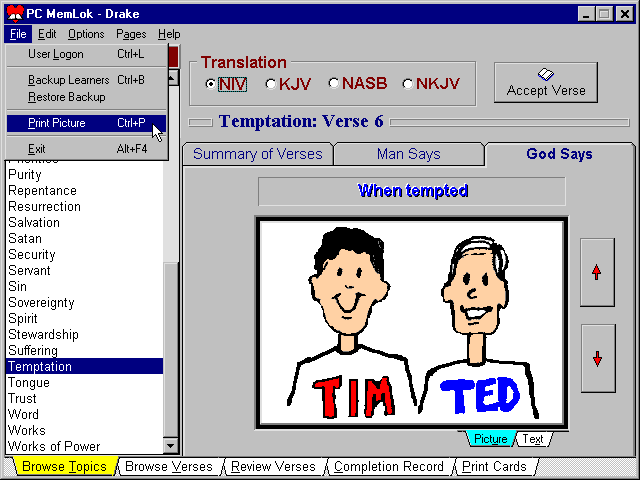
Fighter Verse Memorization System: From DesiringGod.org, John Piper's website. They explain that...
The Fighter Verses memory system was devised to help believers persevere in the fight of faith by arming them with God's Word. Designed for school-age children through adults, this system allows individuals, group, or entire churches to memorize and review at their own pace. Bethlehem Baptist uses this as a church-wide memory system with hundreds of adults and children committed to memorize one passage per week throughout the year. The pack includes more than 500 verses, a handbook, a review verse sleeve, and a binder for storage. We invite you to join us in becoming armed with the Word of God!
Charles Haddon Spurgeon comments on "He hath said" in (Heb 13:5) with some words to encourage saints to memorize God's word so that "the word of Christ (would) richly dwell within" (Col 3:16)
Spurgeon writes:
"If we can only grasp these words by faith, we have an all-conquering weapon in our hand. What doubt will not be slain by this two-edged sword? What fear is there which shall not fall smitten with a deadly wound before this arrow from the bow of God's covenant? Will not the distresses of life and the pangs of death; will not the corruptions within, and the snares without; will not the trials from above, and the temptations from beneath, all seem but light afflictions, when we can hide ourselves beneath the bulwark of "He hath said"? Yes; whether for delight in our quietude, or for strength in our conflict, "He hath said" must be our daily resort.
And this may teach us the extreme value of searching the Scriptures. There may be a promise in the Word which would exactly fit your case, but you may not know of it, and therefore you miss its comfort. You are like prisoners in a dungeon, and there may be one key in the bunch which would unlock the door, and you might be free; but if you will not look for it, you may remain a prisoner still, though liberty is so near at hand. There may be a potent medicine in the great pharmacopoeia of Scripture, and you may yet continue sick unless you will examine and search the Scriptures to discover what "He hath said."
Should you not, besides reading the Bible, store your memories richly with the promises of God? You can recollect the sayings of great men; you treasure up the verses of renowned poets; ought you not to be profound in your knowledge of the words of God, so that you may be able to quote them readily when you would solve a difficulty, or overthrow a doubt? Since "He hath said" is the source of all wisdom, and the fountain of all comfort, let it dwell in you richly, as "A well of water, springing up unto everlasting life." So shall you grow healthy, strong, and happy in the divine life."
Spurgeon comments on Ps 119:9
"Let each person, young or old, who desires to be holy have a holy watchfulness in his heart, and keep the Holy Bible before his open eye. There he will find every turn of the road marked down, every slough and miry place pointed out, with the way to go through unsoiled; and there, too, he will find light for his darkness, comfort for his weariness, and company for his loneliness, so that by its help he will reach the benediction of the first verse of the psalm, which suggested the psalmist’s inquiry, and awakened his desires." (see Spurgeon's note)
James Montgomery Boice wrote that...
if we really want the Bible to become a part of us so that by this means the mind of Christ, which is expressed in the Bible, becomes our mind at least in part, then we must memorize important sections of Scripture. Our educational system does little to stress memorization today, but those who were educated a generation ago will testify that what they memorized then, whether simple verses or more complex passages from Shakespeare or other distinguished writers, have remained with them and have thereby become a part of who they are. As Christians we need to allow the Word of God to become a part of us. To have that happen we must memorize it.
Pat Williams, the general manager of the Orlando Magic, is a very busy man. He is always under pressure. Nevertheless, he spends twenty minutes a day in uninterrupted Bible study and in addition to that spends whatever time is necessary to memorize one verse of the Bible every day. He has memorized a verse a day for years, and he testifies that this is the single most important factor in his spiritual growth (Boice, J. M. Psalms: Grand Rapids, Mich.)
In his book "What Matters Most: Four Absolute Necessities in Following Christ" Pastor Tony Evans emphasizes memorization writing that...
Another way to read the Word is to memorize it. The psalmist said in Psalm 119:11,
“Thy word I have treasured in my heart.”
There’s no greater exercise than to memorize Scripture. If you have never done it before, start with a verse a week. At the end of a year, you’ll have fifty-two verses in your memory bank.
The purpose of memorizing Scripture is not so you can win a contest or a prize. God’s concern is that you have the Word in your heart so that you have it ready to use in any situation.
Why is that important? Because the Word of God is “the sword of the Spirit” (Ephesians 6:17). It’s the Word that the Holy Spirit uses to help you when tough times come. But if you don’t have the Word in your heart and mind, the Holy Spirit has no sword to pull out and wield.
The best example of the value of knowing Scripture is Jesus in the wilderness being tempted by the devil (Matthew 4:1, 2, 3, 4, 5, 6, 7, 8, 9, 10, 11). Jesus answered Satan each time, “It is written.” Jesus didn’t open a copy of the Old Testament and show Satan the verse. He simply responded out of what was in His heart.
I can’t tell you how many times God has brought His Word to my mind to show me which way I should go. That’s what the Holy Spirit does. He illumines our minds with the Word so that we can see what we ought to do. But we must first be diligent to put the Word into our minds.
In Proverbs 22:17, 18, we read this advice:
“Incline your ear and hear the words of the wise, and apply your mind to my knowledge; for it will be pleasant if you keep them within you, that they may be ready on your lips.”
The Word cannot come to your lips and go out of your mouth until it is first “within you,” in your mind.
Then the writer says,
“I have taught you today.… Have I not written to you excellent things of counsels and knowledge?” (Proverbs 22:19,20).
He is saying, “I wrote what you need, but you have to keep it within you.” If you will cooperate with the Spirit by working to memorize Scripture, He can put in your mind what needs to come out of your mouth when you face hard circumstances and difficulties.
You may be saying, “Tony, you don’t know me. I’m not good at memorizing things.” If you can remember your name, address, telephone number, and the names and phone numbers of a few friends, you can memorize Scripture.
For most of us, the real deal is that we don’t feel like doing Bible memory. Suppose you were offered ten thousand dollars for every verse you memorize. You would become the Bible memory champion of the world. That ten thousand dollars would give you brain cells you never knew you had before. Why? The reward would be worth the effort.
The prophet Ezekiel said that when God told him to eat the scroll containing His word to Israel, it was as sweet as honey in Ezekiel’s mouth (Ezek 3:1-15-notes). It was good to the taste. It was worth the effort. You only know whether something’s worth the effort when you put in the effort to find out.
When you see the Word of God become alive in your life, when you see it bubble forth from your heart, and when you see God honor His Word, then the issue of whether you’re good at Bible memory will disappear. When you find that you can send the devil packing with the Word the way Jesus did, you’ll know it is worth the effort to hide God’s Word in your heart.
Many of us have been telling the devil, “Go away, leave me alone.” But he doesn’t go anywhere, because it’s not our word he is afraid of. He’s only afraid of God’s Word. Many Christians don’t know that Satan can’t hang with the Word. Why can’t he? Because it is the power of God (Ro 1:16).
When Satan hears the Word, he hears the voice of God. And he can’t handle that voice. Jesus quoted three verses to Satan, and he was gone. Three strikes and he’s out.
Try using the Word on the devil when he tries to destroy your life, and you will see the power of the Word when applied in the life of a believer. You need to read the Word; that is, study it diligently and memorize it. (Evans, A. T. (1997). What Matters Most : Four Absolute Necessities in Following Christ. Chicago: Moody Press)
CAUTION
MEMORIZATION
WITHOUT GENUINE
RECEPTION AND APPLICATION
IS DECEPTION!
ILLUSTRATION - While studying in the Holy Lands, a seminary professor of mine met a man who claimed to have memorized the Old Testament--in Hebrew! Needless to say, the astonished professor asked for a demonstration. A few days late they sat together in the man's home. "Where shall we begin?" asked the man. "Psalm 1," replied my professor, who was an avid student of the psalms. Beginning with Psalm 1:1, the man began to recite from memory, while my professor followed along in his Hebrew Bible. For two hours the man continued word for word without a mistake as the professor sat in stunned silence. When the demonstration was over, my professor discovered something even more astonishing about the man--he was an atheist! Here was someone who knew the Scriptures better than most Christians ever will, and yet he didn't even believe in God. (Jack Kuhatschek, BORROW Taking The Guesswork Out of Applying The Bible, IVP, 1991, p. 16.) And of course the devil has memorized Scripture (which he used on Jesus in the wilderness temptation) but it has no impact on him!
John Stephen commenting on Ps 119:11
There laid up in the heart the word has effect. When young men only read the letter of the Book, the word of promise and instruction is deprived of much of its power. Neither will the laying of it up in the mere memory avail. The word must be known and prized, and laid up in the heart; it must occupy the affection as well as the understanding; the whole mind requires to be impregnated with the word of God. Revealed things require to be seen. Then the word of God in the heart -- the threatenings, the promises, the excellencies of God's word -- and God himself realized, the young man would be inwardly fortified; the understanding enlightened, conscience quickened -- he would not sin against his God.
William Cowper comments on Ps 119:11:
There is great difference between Christians and worldlings. The worldling hath his treasures in jewels without him; the Christian hath them within. Neither indeed is there any receptacle wherein to receive and keep the word of consolation but the heart only. If thou have it in thy mouth only, it shall be taken from thee; if thou have it in thy book only, Thou shalt miss it when thou hast most to do with it; but if thou lay it up in thy heart, as Mary did the words of the angel, no enemy shall ever be able to take it from thee, and thou shalt find it's comfortable treasure in time of thy need. Among many excellent virtues of the word of God, this is one: that if we keep it in our heart, it keeps us from sin, which is against God and against ourselves. We may mark it by experience, that the word is first stolen either out of the mind of man, and the remembrance of it is away; or at least out of the affection of man; so that the reverence of it is gone, before a man can be drawn to the committing of a sin. So long as Eve kept by faith the word of the Lord, she resisted Satan; but from the time she doubted of that, which God made most certain by his word, at once she was snared. --
Frances Ridley Havergal, 1836-1879 commenting on Ps 119:11: "In proportion as the word of the King is present in the heart, "there is power" against sin (Eccl 8:4, cf Ps 37:31). Let us use this means of absolute power more, and more life and more holiness will be ours."
CAUTION: Yes, she is correct, but it is not "passive power!" In other words we are not simply to memorize and then take no action! We need to store it in our heart (Ps 119:9-11), but we also need to wield it in our hand (Eph 6:17)! It is not a matter of "Let go and Let God," but more like "Let God and let's go!"
Moses exhortation to Israel just prior to going in to possess their possessions is a timeless exhortation for all God's children to hear and heed:
"For IT ('the words of this law') is not an idle (empty, vain, useless) WORD for you; indeed IT is your LIFE. (read that last phrase again) and by this WORD you will prolong your days in the land, which you are about to cross the Jordan to possess." (Dt 32:47).
THOUGHT - Do you really believe the Word is your life? If so are you "eating" it as if your life depended on it? (because it does! - see Jesus' words Mt 4:4, Lk 4:4, cf how a babe in Christ is sanctified in 1 Peter 2:2 and Jn 17:17).
Make more of an effort to read Scripture and memorize important passages. As you saturate your mind with Scripture, you will find your responses are based more on God's truth rather than your emotions. -- John MacArthur
Memorize the Psalms. Many whole psalms as well as portions are worth the effort of memorizing. If you struggle with depression, memorize verses on joy and praise. If you struggle with anxiety, memorize verses on peace, freedom from fear, and trusting God. Jot them on 3 x 5 cards and read them often until you know them. -- Steven Cole, Flagstaff Christian Fellowship
If we are serious about this (meditating on Scripture), we will find the time to meditate. And we will have some sort of regular reading program. Perhaps we’ll read through the Bible in a year. Or perhaps we’ll use one of the many Bible study guides that are available. And certainly we will try to memorize Scripture. This has become something of a lost art today. In an earlier generation, it was commonplace for Christians to emphasize Scripture memory. Today we have more or less relegated that practice to the Awana program. That’s a pity because when we hide the Word of God in our hearts, we are protected from sin and given strength to obey God. I know that many people, men especially, like to say, “I just can’t memorize. I’m too busy. My brain’s too fried. I can barely remember my phone number.” Women seem to do better at this, but we men have a thousand excuses. The truth is, we lack motivation. Suppose that Bill Gates came into the sanctuary with a 50-gallon drum filled with crisp, clean $100 bills. And suppose he offered $100 for each verse anyone memorized by next Sunday. That would change things, wouldn’t it? I’m sure we’ve got men who would figure out a way to memorize 100 verses by next Sunday because they need the money. But God’s Word is more precious than gold or silver. If we delight in the Word, we will find a way to read it, to meditate on it, and even to memorize it. -- Ray Pritchard
Last week I issued a challenge for some brave souls to memorize Psalm 119 this year. That’s a big task because it’s the longest chapter in the Bible. During the week I heard from two people who told me they planned to do it. Both are women, which didn’t surprise me because most of us men just can’t face a challenge like that. “I just can’t do it,” we say. Well, you won’t know whether you can or not until you put down the remote control and pick up your Bible. Then I heard from another woman and later I learned about a group of three men who are meeting each week to memorize Psalm 119. This morning one woman gave me a card and had me check her out on the first three verses.
The most touching message came from one of our teenagers. Here is part of her e-mail to me:
Hello Pastor Ray, I just wanted to let you know that your challenge for people to memorize all of Psalm 119 really spoke to my heart and I have been doing so since last week. When you said that memorizing this would bring people closer to the Lord, I had no idea how much truth was in that statement. Since memorizing is not one of my strong points I have had to rely on the Lord from the start of taking on this challenge. I can honestly say that I have never been so close to the Lord, or have had Him on my mind more than I have this past week. I’m sure many others have thanked you for giving that challenge by now, but from the bottom of my heart, thank you! The Lord is amazing, and it is amazing how far I am in my memorizing journey. I’m three times as far as I am supposed to be at this point. Now that is a miracle! You have kindled my steady flame of passion for the Lord, to a blaze! God Bless!
That young lady has discovered a wonderful secret for spiritual growth. If she stays on course, God is going to do great things in her life this year. -- Pastor Ray Pritchard (See his related sermon How Sweet Are Your Words Learning to Love the Word of God - January 2002)
Begin to Memorize Scripture - This has been the place where my own life has grown in the last few months. When Mark Bubeck was here for the spiritual warfare conference, he challenged us all to begin memorizing Scripture. You may remember that he began his message on Psalm 91 by quoting the entire Psalm from memory—slowly, with deep emotion, bringing out the meaning of every word. I felt deeply challenged by his example and determined then and there that I would begin memorizing Scripture.
I started with Psalm 91. My plan was simple. I photocopied the Psalm and carried it with me on the four-mile walk I take three or four times a week. I found out that if I concentrated, I could easily memorize six to eight verses on the back side of my walk, and sometimes quite a bit more than that. It took me about a week or so to get Psalm 91 down cold. Then I went on to Psalm 90. That took another week. From there I went back to Psalm 1, which I had memorized in the King James Version years ago. Then Psalm 2 and Psalm 3. When I spoke at Camp Nathanael at the end of June, I memorized most of Psalm 73. Then a week or so after that I picked up Psalm 20. I’ve been working on Psalm 34 for the last few days. That makes eight Psalms in a little over two months.
I’m not trying to memorize all the Psalms (although that’s certainly a worthy goal), but I’ve found that the Psalms introduce me to God in a way I’ve never known him before. Besides that, if you read enough of the Psalms, you discover the whole gamut of human emotions—anger, sorrow, fear, despair, frustration, joy, excitement, exultation, and profound worship.
More than once I have found myself waking up in the night bothered by some problem or gripped by some nameless fear. In those moments, as I begin to quote “He who dwells in the shelter of the Most High will rest in the shadow of the Almighty” (Psalm 91:1), I discover that God’s Word soothes my soul, chases away my fears, and brings my problems down to their proper size.
I recommend serious Scripture memory to everyone. As you begin to hide God’s Word in your heart, it will slowly but surely “change your mind.” -- Pastor Ray Pritchard (Think On These Things )
- Simple Study on the Power of God's Word
- A Primer on the Lost Art of Biblical Meditation
- Memorizing God's Word - Why? How? Resource links...
- How to Perform A Greek Word Study on the Web
- Greek Tense, Voice, Mood Reference Guide
- Greek Word Studies - in depth
- Bible Interpretation - Bob Smith - 146 page book.
- Interpretation - Supernaturalistic, Naturalistic, Existentialistic, Dogmatic
- Introduction to Inductive Bible Study
- Observation - What does it say?
- Interpretation - What does it mean?
- Application - How do I respond?
- Bible Versions - How literal is your translation?
- Bible Commentaries - some comments and caveats
- Seven Minutes with God - jumpstart your quiet time if it's too "quiet"!
As you start to memorize a verse—
- Read in your Bible the context of the verse. (Ed: In fact you may find context is so important in this verse that you want to memorize some of the surrounding verses. E.g., a disciple of mine was memorizing Hebrews 12:2 with several other men and we discussed that he should go ahead and memorize Hebrews 12:1 as that verse naturally flows into verse 2.)
- Try to gain a clear understanding of what the verse actually means. You may want to read it in other Bible translations or paraphrases to get a better grasp of the meaning. (Ed: A paraphrase that can be very helpful is the New Living Translation, but I do not recommend memorizing in that version since it is not literal. )
- Read the verse several times thoughtfully, aloud or in a whisper. This will help you grasp the verse as a whole. Each time you read it, say the reference, then the verse, then the reference again.
- Discuss the verse with God in prayer, and continue to seek his help for success in Scripture memory.
While you are memorizing a verse—
- Say the verse aloud as much as possible.
- Learn the reference first.
- After learning the reference, learn the first phrase of the verse. Once you have learned the reference and first phrase and have repeated them correctly several times, add more phrases one by one.
- Think about how the verse applies to you and your daily circumstances.
- Always include the reference as part of the verse as you learn and review it. Repeat the reference both before and after the verse.
After you can quote the verse correctly—
- You'll find it helpful to write out the verse. This deepens the impression in your mind. (Ed: I like to write it out on a small index card which I can carry around to review. I will sometimes highlight or color code words in the passage I want to emphasize.).
- Review the verse immediately after learning it, and repeat it frequently in the next few days. This is crucial for fixing the verse firmly in mind, because of how quickly we tend to forget something we've recently learned.
- REVIEW! REVIEW! REVIEW! Repetition is the best way to engrave the verses on your memory.
How to review memory verses with someone else
- Follow this procedure: If the memory verses are written on cards, one person holds the other person's verse cards and reads the reference of the first card. (If the verses aren't written out, just use the Bible.) The other person then repeats the reference and goes on to quote the entire verse, with the reference again at the end. Then go on to other verses in the same way.
- First review the memory verses you know best.
- Quote your verses clearly and not too rapidly so you can be easily understood.
- Make it your goal to repeat each verse word-perfectly.
- While the other person is quoting his verses, be helpful and encouraging. Do all you can to ensure his success.
- When the other person makes a mistake, signal this to him by shaking
- Once the other person has realized his mistake, have him repeat the entire verse word-perfectly before going on.
Memorizing and reviewing Scripture with one or more friends will provide mutual encouragement, as well as opportunities to discuss difficulties in memorization. You will also be helped by having someone with whom to share how God is using the verses in your life.
Two essentials in Scripture memory
Two rules form the foundation for a successful Scripture memory program:
(1) Consistently memorize new verses each week.
(2) Follow a daily program of reviewing the verses you have already memorized.
If memorizing Scripture becomes too routine
Don't get discouraged if your Scripture memory work begins to seem too routine. The process of recording Scripture on your mind and heart does have a mechanical aspect. It requires certain methods and a great deal of perseverance. But as long as the process of imprinting God's word on your heart is moving forward, these Scriptures will be continually available for life-giving work.
ED: And remember, these are truly GOD'S VERY OWN WORDS, words which He has spoken and we have the privilege of storing His precious ETERNAL words which will never pass away [Mt 24:35] in our hearts. You will find that since they are unlike anything else ever written -- greatest Shakespeare play, greatest novel, greatest poem, etc -- they are truly life giving because they are LIVING AND ACTIVE [Heb 4:12] and because they are your LIFE [Dt 32:47]! See Memory Verses by Topic
There are helpful things you can do, however, if your Scripture memory program begins to seem lifeless. Try spending more time going over your verses in prayer and meditation. Also begin using the verses in your conversations or in letters. New freshness can come through sharing the Scriptures with others.
Keep in mind that memorizing and meditating on the Scriptures is a practical way of making them available to the Holy Spirit to use in your life. (ED: And He will use them to grow you in Christlikeness - 2Cor 3:18).