Colossians 3:2
Colossians 3:3
Colossians 3:4
Colossians 3:5
Colossians 3:6
Colossians 3:7
Colossians 3:8
Colossians 3:9
Colossians 3:10
Colossians 3:11
Colossians 3:12
Colossians 3:13
Colossians 3:14
Colossians 3:15
Colossians 3:16
Colossians 3:17
Colossians 3:18
Colossians 3:19
Colossians 3:20
Colossians 3:21
Colossians 3:22
Colossians 3:23
Colossians 3:24
Colossians 3:25

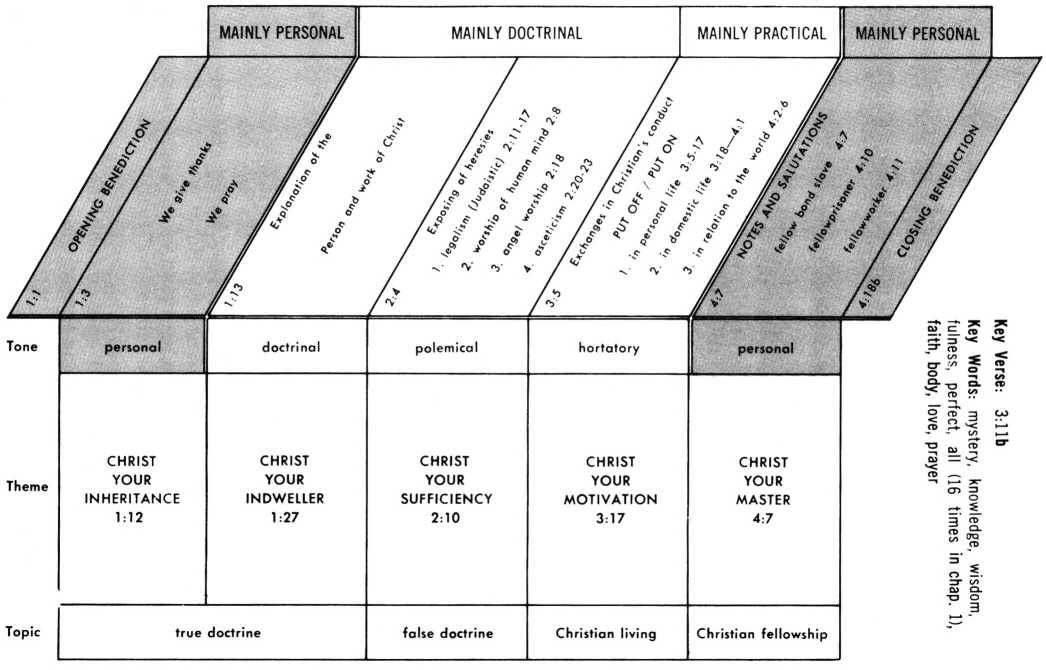
CHRIST IS ALL IN ALL
Click chart to enlarge
Charts from Jensen's Survey of the NT - used by permission
Colossians Overview - Click Chart on right side
| Christ Preeminent in All Things Supreme Lord - Sufficient Savior |
|||
| Colossians 1 | Colossians 2 | Colossians 3 | Colossians 4 |
| Supremacy of Christ |
Submission to Christ |
||
| Doctrinal and Corrective |
Practical and Reassuring |
||
| What Christ Did For Us |
What Christ Does Through Us |
||
| Christ Our Lord |
Christ Our Life |
Christ our Love |
|
| Christ the Head of the Body |
Christ the Lord of the Universe |
Christ the Head of the Home |
|
| Instruction | Warnings | Exhortations | Reminders |
| Reconciliation | Creation | Submission | Conversation |
| His Person and Word |
His Peace and Presence |
||
Colossians 3:12 So, as those who have been chosen of God, holy and beloved (RPPMPN) put on (2PAPM) a heart of compassion, kindness, humility, gentleness and patience; (NASB: Lockman)
Greek: Endusasthe ( 2PAPM ) oun os eklektoi tou theou, hagioi kai egapemenoi, (RPPMPN) splagchna (splanchna) (bowels) oiktirmou (of mercy) chrestoteta, tapeinophrosunen, prauteta, makrothumian
Amplified: Clothe yourselves therefore, as God's own chosen ones (His own picked representatives), [who are] purified and holy and well-beloved [by God Himself, by putting on behavior marked by] tenderhearted pity and mercy, kind feeling, a lowly opinion of yourselves, gentle ways, [and] patience [which is tireless and long-suffering, and has the power to endure whatever comes, with good temper]. (Amplified Bible - Lockman)
NET: Therefore, as the elect of God, holy and dearly loved, clothe yourselves with a heart of mercy, kindness, humility, gentleness, and patience, (NET Bible)
Phillips: As, therefore, God's picked representatives of the new humanity, purified and beloved of God himself, be merciful in action, kindly in heart, humble in mind. Accept life, and be most patient and tolerant with one another, (Phillips: Touchstone)
Wuest: Put on therefore as your spiritual apparel, as chosen-out ones of God, saints and beloved ones, a heart of compassion, kindness, humility, considerateness, longsuffering,
Young's Literal: Put on, therefore, as choice ones of God, holy and beloved, bowels of mercies, kindness, humble-mindedness, meekness, long-suffering,
AND SO (therefore) AS THOSE WHO HAVE BEEN CHOSEN OF GOD: Endusasthe oun os eklektoi tou theou:
- Isa 42:1; 45:4; 65:9,22; Mt 24:22,24,31; Mk 13:20,22,27; Lk 18:7; Ro 8:29, 30, 31, 32, 33; 9:11; 11:5, 6, 7; 2Ti 2:10; Titus 1:1; 1Pe 1:2; 2Pe 1:10; 2Jn 1:13; Rev 17:14
- Colossians 3 Resources - Multiple Sermons and Commentaries
And so (see discussion of terms of conclusion) - The Greek preposition oun can also be translated therefore. Paul is basing the following exhortation upon the fact that we are "chosen, holy, and beloved". Like Father like son. Children should manifest a family resemblance. Therefore based on your new position in Christ (chosen, holy, beloved) let this truth transform your thinking and motivate your "talking" and your "walking".
CHOSEN OF GOD
GOD'S ELECT
Chosen (1588) (eklektos from verb eklego [word study] which in middle voice [eklegomai] means select or pick out for one's self which is derived from ek = out + lego = call) means literally the "called out ones" or "chosen out ones". The idea of eklektos is the ones who have been chosen for one's self, selected out of a larger number.
ELECTION
A DIFFICULT
DOCTRINE
In Ephesians Paul writes…
just as He (God the Father) chose us in Him (Christ) before the foundation of the world, that we should be holy and blameless before Him. (Eph 1:4)
In regard to election as related to salvation, Wuest comments that
This election does not imply the rejection of the rest (those not chosen out), but is the outcome of the love of God lavished upon those chosen-out. (Wuest's Word Studies from the Greek New Testament: Studies in the Vocabulary of the Greek New Testament)
Webster's definition of elect is not bad --
to pick out; to select from among two or more, that which is preferred… in theology, to designate, choose or select as an object of (divine) mercy or favor.
Someone else has written that
Election is God's eternal choice of persons unto everlasting life -- not because of foreseen merit in them, but of His mere mercy in Christ - in consequence of which choice they are called, justified, and glorified.
Election is a “sacred secret” that belongs to God’s children. It is not a doctrine that we believers explain to the unsaved. This miracle of divine election did not depend on anything that we are or that we have done; for God chose us in Christ “before the foundation of the world” (Ep1:4). If God saved a sinner on the basis of merit or works, nobody would be saved. It is all done through God’s grace that it might all bring glory to God. Paul's point here is that if God has chosen them as members of His new creation, they should obey the command to conduct themselves accordingly. These are the attributes of Jesus and as His disciples we should "walk in His steps" (possible only in His power).
S Lewis Johnson writes "The oun (“therefore”) of verse twelve makes the connection with the preceding. A new character demands new characteristics! But the appeal is not only based on the preceding; it is also based on the following words which describe the love of God which led to His sovereign election and free forgiveness of the Colossians. Paul never gets very far away from these soul-stirring truths. There is a genuine logic in the necessity of Christian commitment. If we owe all to Him, He should have all of us. But there is something more moving than logic; it is love. Principal Baillie summed it up in this way, “A true Christian is a man who never for a moment forgets what God has done for him in Christ, and whose whole comportment and whole activity have their root in the sentiment of gratitude.” Paul was in thorough agreement. The following virtues he inculcates have their root in the grace of election and forgiveness, rooted and grounded in a love that has no end." (Bibliotheca Sacra, 1964) (Bolding added)
Related Resources on Election:
- See more detailed notes on "Election A Difficult Doctrine"
- For more notes on this difficult doctrine of election see notes on the following verses - type in "election" and search the page for the specific notes Ro 8:29; Ro 8:33; Ro 11:2; Ro 11:5; 11:6; 11:7; 11:28; Ep 1:4; Ep 1:5; Col 3:12; 2Ti 2:10; Titus 1:1
- See notes on related doctrines of "calling" & choosing" - Notes on 2 Peter
- 1 Peter 1:1-2 Divine Election
- Election - Torrey's Topic
- Chosen of God - Read this Puritan prayer that speaks of election
- What is conditional election?
- Unconditional election - is it biblical?
HOLY AND BELOVED: hagioi kai êgapêmenoi:
- Ro 8:29; Ep 1:4; 1Th 1:3, 4, 5, 6; 2Th 2:13,14
- Colossians 3 Resources - Multiple Sermons and Commentaries
Compare Paul's earlier description of those were once "alienated and hostile in mind, engaged in evil deeds" (Col 1:21), who have been reconciled at the Cross and are as a result now…
Holy and blameless (Col 1:22, Eph 1:4)
Holy (40) (hagios) describes sinners who have supernaturally been set apart and separated from the profane, common, unholy world. Saints are in a sense now distinctive "trophies" of God's amazing mercy and grace. It follows that saints are to live differently than the world which is passing away. We are not to run after the crowd and follow its fashions and value systems (cp Ro 12:2, 1Jn 2:15, 1Jn 2:16, 1Jn 2:17, Jas 4:4). We are expected to be different because we are different. We share a different kind of life, an eternal life, the life of Christ in us our hope (assurance) of (future) glory (set free forever and completely from the profane, unholy things of this evil world system). And all God's people cry "Hallelujah! Amen!"
In sum the idea is consecration, which in turn as John Eadie says
necessarily produces holiness in one's life. This is an appeal to their character, and not simply to their position in the visible church. (Eph. 1:1) (Colossians 3 Commentary)
Beloved (25) (agapao see related study of noun agape) is a verb which means to love unconditionally and sacrificially as God Himself loves sinful men (John 3:16) and the way He loves the Son (John 3:35, 15:9, 17:23, 24). Note that agapao is a verb and by its verbal nature calls for action. This quality of love is not an emotion but is an action initiated by a volitional choice, and so for example God's love will sometimes be manifest to us in discipline when we wander from His path of righteous living…
FOR THOSE WHOM THE LORD LOVES (agapao) HE DISCIPLINES, AND HE SCOURGES EVERY SON WHOM HE RECEIVES. (He 12:6)
The glorious epithet beloved signifies that believers are objects of God's special love, dear to His heart. See Jer 31:3; Ezek 16:8; Ro 1:7; Eph 2:4,5; 2Ti 1:9; Titus 3:4, Titus 3:5, 6; 1Jn 4:19.
Notice that beloved is agapao which is in the perfect tense which signifies past completed action with present ongoing result or effect. It speaks of the permanence and enduring quality of God's love for you dear believer. His love is not like a geometric sine wave curve, up and down, up and down, but is steady and stable for we are in Christ Jesus, His beloved Son! And nothing can remove us from our position. This should be the Christian's "shouting ground"!
Election is not a cold, fatalistic doctrine. On the contrary, it is based in God’s incomprehensible love for His elect. This is the Greek word for God’s love, the love shown at Calvary, a love that denies self for the benefit of the object loved. The perfect tense is used to show the far reaching and the abiding character of that love. The saints are those who have been loved by God with the present result that they are the objects of His love. When an unbeliever sins, he is a creature breaking the laws of the holy Creator and Judge. But when a Christian sins, he is a child of God breaking the loving heart of his Father (cp Israel's effect on God in Ezek 6:9!). Love is the strongest motivating power in the world. As the believer grows in his love for God, he will grow in his desire to obey Him and walk in the newness of life that he has in Christ. There is no more powerful motivating force in our lives than to remember that we are loved by God. He loves us deeply. Why should God love us the way he does? To be such people as we are and still be loved by him is one of the amazing wonders of all time. We are never to forget this. It is our basis for action.
Eadie writes that beloved speaks of…
His eternal and sovereign love did elect them, and now, that election having taken effect, He has special complacency in them. Their assumption of these graces would certify to themselves their election, would be a happy development of their consecration, as well as a proof of its genuineness, and would also endear them yet more to Him, who in love had predestinated them to the adoption of children. These thoughts formed a convincing appeal to them, and could not but induce them to feel and act as the apostle recommends. And so they are enjoined to put on (a list of graces). (Colossians 3 Commentary)
Remember that the "indicatives" (mood of reality, those things which are true, in this case true of believers) always precedes the "imperatives" (God's charge or commands). Our "peculiar" character calls for a "strange" conduct (strange to the world - because it is supernatural and the world tries to suppress the truth about God!). In short, then the basis for the following "laundry list" of put on's is
Therefore, as God's chosen people, holy and dearly loved.
We did not make ourselves holy. We did not elect ourselves into the kingdom of God. This truth then functions in a sense as a "motivational speaker"! It should cause us out of Paternal love (2Co 5:14) not a sense of legalism and not out of a shaking fear but a reverential awe (1Pe 1:17) to respond in loving, Spirit enabled obedience to please our Father by doing His good and acceptable and perfect will (Ro 12:2).
Jesus said once to his disciples,
You have not chosen me but I chose you and appointed you that you should bear much fruit. (Jn 15:16)
Yes, we needed to make a decision for Christ, but most of us came to understand that we would never have made that decision had we not been drawn to him and chosen of him. It is His choice of us that enabled us to choose Him! No, I cannot comprehend this grand truth, but neither will I seek to destroy it or discard it just because it is beyond my ability to "reason out". God said it and that settles it, whether I believe or not, and whether I can understand it or not!
It is important to note also that when the apostle calls Christians "God's chosen people" (literally "God's elect"), he does not mean that the church has replaced Israel (see study Israel of God).
Israel is also "God's chosen people," but on a different level and for a different purpose. The promises to Israel are material: they deal with a land and a kingdom on the earth. We believe that the dreams of the prophets, so beautifully expressed by Isaiah, Amos, Hosea and others, will be fulfilled in a coming day, which Paul describes in Romans 11. God yet has a future for his earthly people. They are still his chosen people. But the church is chosen for a different purpose. Our promises are spiritual. We are
blessed with all spiritual blessings in the heavenly places in Christ. (see note Ephesians 1:3)
The church, therefore, has to do with heaven, not earth. We deal with the invisible realms of reality and not the visible kingdoms around. So, to clarify, this phrase does not mean that the church has become the "new Israel." That term is never found in Scripture. It is an unbiblical concept.
The new clothing for the new man is a striking contrast with what was put off. God chose believers out of the mainstream of mankind and drew them to Himself. They are different from the world and should "wear different (spiritual) clothes"! When believers fail to act differently from the world, they violate one of the purposes of their calling, which Jesus taught in the Sermon on the Mount..
Let your light shine (aorist imperative - Do this now. It is urgent. It is a command and is not optional!) before men in such a way (this qualifier is critically important!) that they may see your good works, and glorify (give a proper opinion of) your Father who is in heaven. (Matthew 5:16) (Does your behavior give those who observe it a proper opinion of your Father Who is in heaven. You may be the only "Bible" some unbeliever ever "reads". How does your "Bible" read?)
Because we have trusted Christ, we have been set apart from the world unto the Lord. We are not our own but now (and forever) belong completely (all of us, all the time, not just on Sunday!) to Him (1Cor 6:19-20). Just as the marriage ceremony sets apart a man and a woman for each other exclusively, so salvation sets the believer apart exclusively for our soon coming Bridegroom, the Lord Jesus Christ. Would it not be a horrible thing, at the end of a wedding, to see the groom run off with the maid of honor? It is just as horrible to contemplate the Christian living for the world and the flesh.
You adulteresses, do you not know that friendship with the world is hostility toward God? Therefore whoever wishes to be a friend of the world makes himself an enemy of God. (James 4:4)
Do not love (present imperative with a negative = Stop doing this!) the world, nor the things in the world. If anyone loves the world, the love of the Father is not in him. For all that is in the world, the lust of the flesh and the lust of the eyes and the boastful pride of life, is not from the Father, but is from the world. And the world is passing away, and also its lusts, but the one who does the will of God abides forever. (1 John 2:15-17)
PUT ON (THEREFORE) : Endusasthe (2PAMM) oun:
- See List of 78 Put offs and Put ons
- Colossians 3 Resources - Multiple Sermons and Commentaries
Put on (1746) (enduo) means to put on as a garment and in the middle voice (as in this verse) means to clothe oneself. The aorist imperative calls for immediate, even urgent, effective action. All believers (plural) are to do this now! See discussion of the Need for the Holy Spirit to obey NT commands (or "How to Keep All 1642 Commandments in the New Testament!")
In other words…
Don't put off putting on!
What Paul is doing not is explains and applies the figure of "the new man" who should demonstrate he is a new man by his "the new garment." His new garment is not literal clothes of course, but instead is literal conduct, supernatural conduct that gives evidence he is a new man in Christ with a new desire and power (cp Php 2:13).
Acceptance of doctrine about Christ must lead to a decisive modification in duty. Creed should be followed by conduct. Christian doctrine and Christian duty go together. Pilots, soldiers, and athletes must dress the part, and so, too, the Christian believer. If the old man has been put off and the new man put on, the moral apparel of the old man must be laid aside and new apparel donned. Clothes do not make the man, but a man is often reflected in his clothes, and Paul would have the new man reflected in new moral attire after the image of Him that created him.
The idea of putting on is to envelope yourself with the following character traits, which in their essence reflect reach their epitome in our Lord Jesus Christ. So wrap these traits around yourself. Become so immersed in Christ, so focused on Him, that you resemble Him in your thoughts, words and deeds (this is essentially a description of the lifelong process of sanctification). Don't worry, God will give us plenty of opportunities to practice conforming to the image of His Son (Ro 8:29).
Thayer, commenting on the use of this verb in Col 3:10 (put on the new man), defines it as follows:
to become so possessed of the mind of Christ as in thought, feeling, and action to resemble Him and, as it were, reproduce the life He lived.
Spurgeon writes that…
This is what you have got to wear, even on the outside—to put it on; not to have a latent kindness in your heart and a degree of humbleness deep down in your soul if you could get at it; but you are to put it on. It is to be the very dress you wear. These are the sacred vestments of your daily priesthood. Put them on.
A HEART OF COMPASSION: splagchna oiktirmou:
- Isa 63:15; Jer 31:20; Lk 1:78; Php 1:8; 2:1; 1Jn 3:17
- Colossians 3 Resources - Multiple Sermons and Commentaries
The heart of compassion - "The bowels of mercies" (Col 3:13KJV - note both words are plural - not just one act of mercy and we're through for the day!) speak of a tender sensitivity to others. Who could be like that? Jesus! And where is He? He is in us, so we can (potentially) express compassion from our new heart indwelt by the Spirit of the Living Christ, as we learn day by day, moment by moment to surrender our will to the sweet will of the Spirit, Who then supernaturally bears the fragrant Christ-like "fruits" in this list.
Heart (not kardia) (4698) (splagchnon or splanchna) originally referred to the upper abdominal viscera especially the intestines, which the ancients regarded as the seat of affections and emotions, such as anger and love. This word is always in the plural in the NT. The phrase "I feel it in the pit of my stomach" is a modern parallel. And we all know how that feels! So splagchnon refers to that deep, internal caring comparable to the modern expressions of deep feeling such as “broken-hearted” or “gut-wrenching”.
KJV translates splagchnon 9 times as "bowels" as a reference to the emotions because of the way our emotions can affect how our intestinal organs feel. This translation may sound strange to modern ears but in fact even we use words that would sound strange to the ancients. For example we have the word "melancholy" which is literally "black bile"!
Zodhiates says that…
In Classic Greek writers, it is chiefly spoken of the upper viscera of animals, as the heart, lungs, and liver which were eaten during or after the sacrifice… Figuratively, the inward parts indicating the breast or heart as the seat of emotions and passions. In the NT, of the gentler emotions as compassion, tender affection indicating the mind, soul, the inner man (2Co 6:12, Philemon 1:7, 20; 1Jn 3:17; Sept.: Pr 12:10 (cf. Ge 43:30; 1Kgs. 3:26) (Zodhiates, S. The Complete Word Study Dictionary: New Testament. AMG)
Compassion (3628)(oiktirmos from oikteiro = to have compassion {only Ro 9:15 } in turn from oiktos = compassion or pity which in turn is said to be derived from the interjection oi = "Oh!") denotes the inward feeling of compassion which abides in one's "heart". This trait manifests itself in the display of concern over or compassion with the misfortune of others. Compassion (English word from Latin com = with + pati = to bear, suffer = literally to "bear with" or "to suffer with") is a sympathetic consciousness of other's distress together with a desire to alleviate it and in the case of God, with the ability to in fact do so! The meaning of oiktirmos is like splagchnon, related primarily the viscera, which were thought to be the seat of compassion. The word came to signify manifestations of pity and refers to the pity that is aroused by the sight of another's suffering. Lightfoot says
By splagchnon is signified the abode of tender feelings, by oiktirmos the manifestation of these in compassionate yearnings and actions
The Baker Encyclopedia of the Bible has an interesting note on compassion explaining that…
In the OT, compassion describes one aspect of God’s covenantal relationship with his people (Ed: In the examples of the use of oiktirmos in the Septuagint [see below] compassion is frequently found with "lovingkindness" or hesed [checed] a word integrally associated with the manifestation of God's covenantal love - see related resource Covenant - Why Study It?) One of the Hebrew words translated compassion is derived from a root word meaning “womb,” thus comparing God’s love with maternal love. God’s compassion, however, went beyond simply feeling the emotion; it was always demonstrated by definite acts that testified to his covenant with Israel. In spite of Israel’s rebellions God still had compassion on his people (2Ki 13:23; 2 Chr 36:15; Ps 78:38), as well as on all his creation (Ps 145:9). When Israel was chastised, the nation often feared that God had permanently withdrawn his favor (Ps 77:9; Is 27:11; 63:15; Jer 13:14; 21:7; Ho 13:14). Yet God’s compassion would revive, and he would restore his people (Dt 30:3; Ps 135:14; Is 14:1; 49:13; 54:7, 8; Jer 12:15; 30:18; Micah 7:19; Zec 12:10), especially when they returned to him and cried out for deliverance (1 Ki 8:50; Ps 79:8). (Elwell, W. A., & Beitzel, B. J. Baker Encyclopedia of the Bible. Grand Rapids, Michigan: Baker Book House)
Oiktirmos is the reaction of pity (a feeling of sorrow, sympathy and compassion caused by the sufferings of others) which one shows for the suffering or ills of others (as in the first use in the Septuagint (LXX) 2Sa 24:14 = Then David said to Gad, "I am in great distress. Let us now fall into the hand of the LORD for His mercies [oiktirmos] are great, but do not let me fall into the hand of man.")
Larry Richards explains that…
Oiktirmos is a pitying exclamation torn from the heart at the sight of another's suffering… God compassionately and truly cares about what happens to us (Ro 12:1; 2Co 1:3). We are to imitate our heavenly Father (Lk 6:36) and let his kind of caring bind believers to each other in unity (Php 2:1;Colossians 3:12)… God calls us to have compassion on others. That call is more than an appeal for us to feel with and for the needy. It is a call to care enough to become involved and to help by taking some action that will set others' lives on a fresh, new course. (Richards, L O: Expository Dictionary of Bible Words: Regency)
Oiktirmos is that quality in God that moves Him to deliver man from his state of sin and misery and therefore underlies His saving activity in Christ. Oiktirmos as used here and in 2Corinthians 1:3 characterizes God’s actions and feelings toward fallen humanity. Our great hope (certainty) is in fact the provision of the unchanging mercy and boundless grace of our Father. Those who are holy and beloved of God show themselves to be most "like God" (godly) when they demonstrate Spirit enabled compassion.
Ray Stedman describes "compassion" in picturesque terms
Compassion is what we would call a "heart of pity." It is a sense of sympathy, of empathy with someone. When you come to the breakfast table, come with compassion: compassion for that strange looking creature, her hair up in curlers, shuffling around the kitchen in old slippers. Come with compassion for that gruff, stubble-faced fellow, isolated behind his morning newspaper, ignoring everybody; or those children who are trying to get everything together before they go to school. Approach life with compassion; that is what Paul is saying. Put it on when you get up in the morning. You are a new man, or new woman; therefore, live that way! (Read Dr Stedman's full sermon Put on the New)
KINDNESS: chrêstotêta:
- Colossians 3 Resources - Multiple Sermons and Commentaries
Kindness (5544) (Chrestotes) is expressed in attitude and deed. It is the friendly and helpful spirit which seeks to meet the needs of others through kind deeds. See related OT term Hesed: Lovingkindness-Definition of Hesed
Spurgeon - Be ready to feel for others; be very considerate of their needs. Look at others as if they were your kith and kin; if you and they are in Christ, they are indeed your kin, so put on kinned-ness, or “kindness,’
Ray Stedman writes that "Kindness is action that reveals compassion, action that arises out of a sense of sympathy. It can take many different forms---a smile, a kind word, a pat on the shoulder, an invitation to lunch, an offer of help. We are to put on compassion and kindness as we start our day and throughout the day. Many centuries ago, a certain young man from a rural setting went to live in a large city and fell in with the wrong crowd He lived a wild and dissolute life, becoming involved in many hurtful things which almost destroyed him But he heard a preacher one day and though he did not particularly appreciate his preaching, he was struck by the man He went to hear him again, and soon that preacher was able to lead him to Christ. That young man has become famous as the great St Augustine. This is what Augustine wrote of Ambrose, pastor of the cathedral in Milan: "I began to love him, not at first as a teacher of the truth, which I despaired of finding in the church, but as a fellow creature who was kind to me " What an open door kindness can he!" (Read Dr Stedman's full sermon Put on the New)
One of the most beautiful pictures of human kindness in the Bible is King David’s treatment of the crippled prince, Mephibosheth (see study) (2Sa 9:1, 13-expositional and devotional commentary). David’s desire was to show “the kindness of God” to King Saul’s family because of his own love for Saul’s son, Jonathan. The young man chosen was Mephibosheth, Jonathan’s son, a poor cripple. If David had acted according to justice, he would have condemned Mephibosheth, for the man belonged to a condemned family. But David acted on the basis of love and grace.
F W Faber writes…
We must first ask ourselves what kindness is. Words, which we are using constantly soon cease to have much distinct meaning in our minds. They become symbols and figures rather than words, and we content ourselves with the general impression they make upon us. Now let us be a little particular about kindness, and describe it as accurately as we can. Kindness is the overflowing of self upon others. We put others in the place of self. We treat them as we would wish to be treated ourselves. We change places with them. For the time self is another, and others are self. Our self love takes the shape of complacence in unselfishness.
We cannot speak of the virtues without thinking of God. What would the overflow of self upon others be in Him the Ever-blessed and Eternal? It was the act of creation. Creation was divine kindness. From it as from a fountain, flow the possibilities, the powers, the blessings of all created kindness. This is an honourable genealogy for kindness. Then, again, kindness is the coming to the rescue of others, when they need it and it is in our power to supply what they need; and this is the work of the Attributes of God towards His creatures. His omnipotence is for ever making up our deficiency of power. His justice is continually correcting our erroneous judgments. His mercy is always consoling our fellow-creatures under our hardheartedness. His truth is perpetually hindering the consequences of our falsehood. His omniscience makes our ignorance succeed as if it were knowledge. His perfections are incessantly coming to the rescue of our imperfections. This is the definition of Providence; and kindness is our imitation of this divine action. (Colossians 3:12 Overflowing Kindness F. W. Faber)
HUMILITY: tapeinophrosunên:
- Torrey's Topic "humility"
- Discussion of Humility
- Colossians 3 Resources - Multiple Sermons and Commentaries
Put on...humility - Do not attempt to obey this command in your own strength. "Self" will never put on humility! Only as we rely on the Spirit can we truly put on humility.
Contrast false humility in Col 2:18, Col 2:23
Humility (5012) (tapeinophrosune from tapeinos = low lying, then low or humble + phren = to think) literally means to think or judge with lowliness and thus speaks of humiliation of mind, lowliness of mind, lowly thinking, the quality of unpretentious behavior, a humble attitude, modesty (modesty = unassuming in the estimation of one’s abilities) or without arrogance. The word indicates the esteeming one's self as small or recognizing one’s insufficiency but at the same time recognizing the powerful sufficiency of God! Vine writes that tapeinophrosune "indicates, not a merely moral quality, but the subjection of self under the authority of, and in response to, the love of the Lord Jesus, and the power of the Holy Spirit to conform the believer to the character of Christ. In contrast to the world’s idea of being “poor-spirited” (in Classical Greek tapeinos commonly carried that imputation), the Lord commends “the poor in spirit” (Mt 5:3).Tapeinophrosune - 7x in 7v - Acts 20:19; Eph 4:2; Phil 2:3; Col 2:18, 23; 3:12; 1 Pet 5:5. NAS = humility(4), humility of mind(1), self-abasement(2).
John MacArthur explains that " In secular Greek literature, the adjective tapeinos (“lowly”) was used exclusively in a derisive way, most commonly of a slave. It described what was considered base, common, unfit, and having little value. Thus, it is not surprising that the noun tapeinophrosune has not been found in any extra-biblical Greek literature before the second century. It seems, therefore, to have originated in the New Testament, where, along with its synonyms, it always has a positive connotation. Humility of mind is the opposite of pride, the sin that has always separated fallen men from God, making them, in effect, their own gods. Humility is also a dominant virtue in the Old Testament. “When pride comes, then comes dishonor,” warns Solomon, “but with the humble is wisdom” (Pr 11:2). Later he declares, “It is better to be humble in spirit with the lowly than to divide the spoil with the proud” (16:19). (MacArthur, J. Philippians. Chicago: Moody Press)
Spurgeon - Do not try to be a big man. He who thinks himself big has not yet learnt the true spirit of Christianity. Especially towards those who are sorrowful and sad, be pitiful, be kind, be humble.
John Wesley made the instructive observation that "neither the Romans nor the Greeks had a word for humility.
The very concept was so foreign and abhorrent to their way of thinking that they had no term to describe it. When, during the first several centuries of Christianity, pagan writers borrowed the term tapeinophrosune, they always used it derogatorily—frequently of Christians—because to them humility was a pitiable weakness.
Humility is not thinking less of ourselves but is really not thinking of ourselves at all.
Barclay writes that "Basil was to describe it as “the gem casket of all the virtues”; but before Christianity humility was not counted as a virtue at all. The ancient world looked on humility as a thing to be despised… In classical Greek there is no word for humility which has not some tinge of servility; but Christian humility is not a cringing thing. It is based on two things. First, on the divine side, it is based on the awareness of the creatureliness of humanity. God is the Creator, man the creature, and in the presence of the Creator the creature cannot feel anything else but humility. Second, on the human side, it is based on the belief that all men are the sons of God; and there is no room for arrogance when we are living among men and women who are all of royal lineage. (Barclay, W: The Daily Study Bible Series, Rev. ed. Philadelphia: The Westminster Press)
Humility as discussed below always had a negative connotation in classical Greek. Christianity elevated this term to the supreme virtue, in fact providing the ultimate antidote for self-love that poisons all relationships.
Edwards observes that "True humility is not putting ourselves down but rather lifting up others. If we concentrate on lifting up others, putting down ourselves will take care of itself. As we go through life exalting Christ and others, then genuine humility will be inevitable. If we exalt ourselves then God will take care of our humiliation for He promises to humble the proud. It is much less painful to do it the first way.
Tapeinophrosune is used in good sense here as Php 2:3 = not think of yourself very highly. Really not to even think of yourself at all! In me, in my flesh, there dwelleth no good thing… only Christ in me, the hope of glory. Paul had already used this same Greek word 2x negatively but now uses it of one supernaturally empowered to exhibit this trait. Note: these are all relationship words whereas the former list reflected selfishness and wrong attitudes toward people.
The truest test of one's spirituality is the relationships that we have (See note Colossians 3:18ff).
Think humbly of yourselves. We are not to consider ourselves in any way as superior to others. A modern proverb puts it well, we are to remember that "all of us are made in the same mold, only some are moldier than others!" Paul advocates genuine humility, in contrast to the false humility of the false teachers (cf. Col 2:18; Col 2:23). Humility characterized Jesus (Mt 11:29), and it is the most cherished Christian virtue (Eph 4:2; Php 2:3; 1Pe 5:5). The pagan world of Paul’s day did not admire humility. Instead, they admired pride and domination.
GENTLENESS: prautêta
- Colossians 3 Resources - Multiple Sermons and Commentaries
Gentleness (4240) (prautes [word study]) describes the quality of not being overly impressed by a sense of one’s self-importance. Prautes is a quality of gentle friendliness - gentleness, meekness (as strength that accommodates to another's weakness), consideration, restrained patience, patient trust in the midst of difficult circumstances.
Prautes describes "a wild horse that's been tamed"; a person tamed by the grace of God and His indwelling ongoing ministry of His Spirit in sanctifying me, in progressively setting me apart from this evil world and to Himself for His holy purposes, for His glory alone!
Prautes - 11x in 11v - 1 Cor 4:21; 2 Cor 10:1; Gal 5:23; 6:1; Eph 4:2; Col 3:12; 2 Tim 2:25; Titus 3:2; Jas 1:21; 3:13; 1 Pet 3:16. NAS = consideration(1), gentleness(8), humility(1), meekness(1).
Spurgeon writes that…
If others try to provoke you, do not be provoked by them; but be gentle and meek.
In Greek literature prautes was sometimes used of a feigned, hypocritical concern for others that is motivated by self-interest. But in the New Testament it is always used of genuine consideration for others.
Prautes "denotes the humble and gentle attitude which expresses itself, in particular, in a patient submissiveness to offense, free from malice and desire for revenge… controlled strength, the ability to bear reproaches and slights without bitterness and resentment; the ability to provide a soothing influence on someone who is in a state of anger, bitterness and resentment against life… the word indicates an obedient submissiveness to God and His will, with unwavering faith and enduring patience displaying itself in a gentle attitude and kind acts toward others, and this often in the face of opposition. It is the restrained and obedient powers of the personality brought into subjection and submission to God’s will by the Holy Spirit (Gal 5:23)… the opposite of arrogance… the word stands in contrast to the term orge (wrath, anger as a state of mind)… It denotes the humble and gentle attitude which expresses itself, in particular, in a patient submissiveness to offense, a freedom from malice and desire for revenge… mildness, patient trust in the midst of difficult circumstances." (2Co 10:1) (Compiled from the Rogers, C L - originally by Fritz Rienecker: New Linguistic and Exegetical Key to the Greek New Testament. Zondervan. 1998)
Prautes was used in secular Greek writings to describe a soothing wind, a healing medicine, and a colt that had been broken. In each instance, there is power for a wind can become a storm, too much medicine can kill and a horse can break loose. Thus prautes describes power under control.
Prautes is an interesting word. Aristotle defined it as the correct mean between being too angry and being never angry at all. It is the quality of the man whose anger is so controlled that he is always angry at the right time and never at the wrong time. It describes the man who is never angry at any personal wrong he may receive, but who is capable of righteous anger when he sees others wronged.
PATIENCE: makrothumian:
- Colossians 3 Resources - Multiple Sermons and Commentaries

"A Long Fuse!"
Patience (3115) (makrothumia from makros = long, distant, far off, large + thumos = temper, passion, emotion or thumoomai = to be furious or burn with intense anger) is literally long-temper (as opposed to "short tempered), a long holding out of the mind before it gives room to action or passion ("a long fuse!"). It describes a state of emotional calm or quietness in the face of provocation, misfortune or unfavorable circumstances.
Makrothumia is the capacity to be wronged and not retaliate. It is the ability to hold one's feeling in restraint or bear up under the oversights and wrongs afflicted by others without retaliating. It is manifest by the quality of forbearance under provocation. It is used of God's patience toward sinful men (see note Romans 2:4) and of the attitude which Christians are to display.
Patience is the spirit which never gives up for it endures to the end even in times of adversity, exhibiting self-restraint such that it does not hastily retaliate a wrong.
Spurgeon exhorts us to "Continue to put up with others, remembering the Lord’s longsuffering with you."
Vine says makrothumia is the opposite of anger. It follows that a lack of patience often leads to wrath or revenge.
Makrothumia is often used in the OT to translate the Hebrew phrase ('erekh 'appayim) which is literally “long of nose” (or “breathing”), for as most of can attest, anger (especially intense or "seething" anger) is often indicated by rapid breathing through (flaring) nostrils. This Hebrew phrase is translated in the the Septuagint translation with the Greek word makrothumia (and the cognates makrothumos, makrothumeo) and is also included in the catalog of God's attributes. We should all be eternally grateful for this phrase that occurs 14 times in the OT -- a God "slow to anger" (Click for the 14 occurrences).
Makrothumia is also used 14 times in the NT - Rom 2:4; 9:22; 2 Cor 6:6; Gal 5:22; Eph 4:2; Col 1:11; 3:12; 1 Tim 1:16; 2 Tim 3:10; 4:2; Heb 6:12; Jas 5:10; 1 Pet 3:20; 2 Pet 3:15 Translated patience in NASB and longsuffering in KJV.
Romans 2:4 Or do you think lightly of the riches of His kindness and forbearance and patience, not knowing that the kindness of God leads you to repentance?
Romans 9:22 (note) What if God, although willing to demonstrate His wrath and to make His power known, endured with much patience vessels of wrath prepared for destruction?
2 Corinthians 6:6 in purity, in knowledge, in patience, in kindness, in the Holy Spirit, in genuine love,
Galatians 5:22 (note) But the fruit of the Spirit is love, joy, peace, patience, kindness, goodness, faithfulness,
Ephesians 4:2 (note) with all humility and gentleness, with patience, showing forbearance to one another in love,
Colossians 1:11 (note) strengthened with all power, according to His glorious might, for the attaining of all steadfastness (hupomone) and patience (makrothumia); joyously
Colossians 3:12 And so, as those who have been chosen of God, holy and beloved, put on a heart of compassion, kindness, humility, gentleness and patience;
1 Timothy 1:16 And yet for this reason I found mercy, in order that in me as the foremost, Jesus Christ might demonstrate His perfect patience, as an example for those who would believe in Him for eternal life.
2 Timothy 3:10 (note) But you (Timothy) followed my teaching (excellent "definition" of a disciple), conduct, purpose, faith, patience (makrothumia), love, perseverance (hupomone),
2 Timothy 4:2 (note) preach the word; be ready in season and out of season; reprove, rebuke, exhort, with great patience and instruction.
Hebrews 6:12 (note) that you (Hebrew believers) may not be sluggish, but imitators of those who through faith and patience inherit the promises.
James 5:10 As an example, brethren, of suffering and patience, take the prophets who spoke in the name of the Lord.
1 Peter 3:20 (note) who once were disobedient, when the patience of God kept waiting in the days of Noah, during the construction of the ark, in which a few, that is, eight persons, were brought safely through the water.
2 Peter 3:15 (note) and regard the patience of our Lord to be salvation; just as also our beloved brother Paul, according to the wisdom given him, wrote to you
There are 3 uses of makrothumia in the Septuagint (LXX) (Pr 25:15; Isa. 57:15; Jer. 15:15)
J Vernon McGee writes that makrothumia…
means “long-burning”—it burns a long time. We shouldn’t have a short fuse with our friends and Christian brethren. We shouldn’t make snap judgments. (McGee, J V: Thru the Bible Commentary: Thomas Nelson)
Evans writes that makrothumia…
could be translated “large emotions,” signifying wells of endurance that will not dry up, no matter how much is drawn from them. The Christian with this patience will have refreshing water to sustain continual effectiveness even in the face of unrelenting pressures. Those with such patience and faith are those who receive or “inherit the promises.” (Briscoe, D. S., & Ogilvie, L. J. The Preacher's Commentary Series, New Testament. 2003; Thomas Nelson)
Calvin said makrothumia refers to that quality of mind that disposes us
to take everything in good part and not to be easily offended.
Larry Richards writes that…
The NT contains many exhortations to be patient. But just what is patience? The Greek word group (makrothumeo/makrothumia) focuses our attention on restraint: that capacity for self-control despite circumstances that might arouse the passions or cause agitation… This is not so much a trait as a way of life. We keep on loving or forgiving despite provocation, as illustrated in Jesus' pointed stories in Mt 18." (Richards, L O: Expository Dictionary of Bible Words: Regency)
William Barclay has a lengthy discussion explaining that makrothumia…
as the Greeks used it, usually meant patience with people. It is the ability not to lose patience when people are foolish, not to grow irritable when they seem unteachable. It is the ability to accept the folly, the perversity, the blindness, the ingratitude of men and still to remain gracious, and still to toil on…
This word has two main directions of meaning.
(a) It describes the spirit which will never give in and which, because it endures to the end, will reap the reward. Its meaning can best be seen from the fact that a Jewish writer used it to describe what he called “the Roman persistency which would never make peace under defeat.” In their great days the Romans were unconquerable; they might lose a battle, they might even lose a campaign, but they could not conceive of losing a war. In the greatest disaster it never occurred to them to admit defeat. Christian patience is the spirit which never admits defeat, which will not be broken by any misfortune or suffering, by any disappointment or discouragement, but which persists to the end.
(b) But makrothumia has an even more characteristic meaning than that. It is the characteristic Greek word for patience with men.
Chrysostom defined it as the spirit which has the power to take revenge but never does so.
Lightfoot defined it as the spirit which refuses to retaliate.
To take a very imperfect analogy—it is often possible to see a puppy and a very large dog together. The puppy yaps at the big dog, worries him, bites him, and all the time the big dog, who could annihilate the puppy with one snap of his teeth, bears the puppy’s impertinence with a forbearing dignity.
Makrothumia is the spirit which bears insult and injury without bitterness and without complaint. It is the spirit which can suffer unpleasant people with graciousness and fools without irritation. It is the spirit which bears the sheer foolishness of men without irritation. It is the spirit which can suffer unpleasant people with graciousness and fools without complaint."
The most illuminating thing about it is that it is commonly used in the New Testament of the attitude of God towards men (Ro 2:4; Ro 9:22; 1Ti 1:16; 1Pe 3:20). If God had been a man, he would have wiped out this world long ago; but he has that patience which bears with all our sinning and will not cast us off. In our dealings with our fellow men we must reproduce this loving, forbearing, forgiving, patient attitude of God towards ourselves. Paul asks the impenitent sinner if he despises the patience of God (Ro 2:4). Paul speaks of the perfect patience of Jesus to him (1Ti 1:16). Peter speaks of God’s patience waiting in the days of Noah (1Pe 3:20). He says that the forbearance of our Lord is our salvation (2Pe 3:15). If God had been a man, he would long since in sheer irritation have wiped the world out for its disobedience. The Christian must have the patience towards his fellow men which God has shown to him."
From Barclay's comments on Col 3:12 (some duplication) There is patience (makrothumia, This is the spirit which never loses its patience with its fellow-men. Their foolishness and their unteachability never drive it to cynicism or despair; their insults and their ill-treatment never drive it to bitterness or wrath. Human patience is a reflection of the divine patience which bears with all our sinning and never casts us off. (Colossians 3)
From Barclay's comments on Colossians 1:11 (some duplication) - Fortitude and patience are two great Greek words which often keep company. Fortitude is hupomone and patience is makrothumia. There is a distinction between these two words. It would not be true to say that Greek always rigidly observes this distinction, but it is there when the words occur together. Hupomone is translated patience in the King James Version. But it does not mean patience in the sense of simply bowing the head and letting the tide of events flow over one. It means not only the ability to bear things, but the ability, in bearing them, to turn them into glory. It is a conquering patience. Hupomone is the ability to deal triumphantly with anything that life can do to us. Makrothumia is usually translated long-suffering in the King James Version. Its basic meaning is patience with people. It is the quality of mind and heart which enables a man so to bear with people that their unpleasantness and maliciousness and cruelty will never drive him to bitterness, that their unteachableness will never drive him to despair, that their folly will never drive him to irritation, and that their unloveliness will never alter his love. Makrothumia is the spirit which never loses patience with, belief in, and hope for men. So Paul prays for hupomone, the fortitude which no situation can defeat, and makrothumia, the patience which no person can defeat. (Daily Study Bible Colossians 1 Comments)
William Barclay adds that makrothumia "is characteristically a word which expresses patience with people . Chrysostom defined it as the characteristic of the man who has it in his power to avenge himself and deliberately does not use it. Paul is, in effect, saying to the Jews: “Do not think that the fact that God does not punish you is a sign that He cannot punish you. The fact that His punishment does not immediately follow sin is not a proof of His powerlessness; it is a proof of His patience. You owe your lives to the patience of God....almost everyone has “a vague and undefined hope of impunity,” a kind of feeling that “this cannot happen to me.” The Jews went further than that; “they openly claimed exemption from the judgment of God.” They traded on his mercy, and there are many who to this day seek to do the same (ref).....Makrothumia; this is a great word. The writer of First Maccabees (1 Maccabees 8:4) says that it was by makrothumia that the Romans became masters of the world, and by that he means the Roman persistence which would never make peace with an enemy even in defeat, a kind of conquering patience. Generally speaking the word is not used of patience in regard to things or events but in regard to people. Chrysostom said that it is the grace of the man who could revenge himself and does not, the man who is slow to wrath. The most illuminating thing about it is that it is commonly used in the New Testament of the attitude of God towards men (Romans 2:4; Romans 9:22; 1 Timothy 1:16; 1 Peter 3:20). If God had been a man, he would have wiped out this world long ago; but he has that patience which bears with all our sinning and will not cast us off. In our dealings with our fellow men we must reproduce this loving, forbearing, forgiving, patient attitude of God towards ourselves. (The Daily Study Bible)....
As applied to God makrothumia means to put fury far off while suffering wrong or injustice.
The Christian is to count the longsuffering of God toward evil and injustice not as slackness, but as evidence of His grace toward evildoers in granting them time for repentance and salvation (2Pe 3:9). As His children, Christians are to allow the Holy Spirit to manifest this family characteristic in them as well (Ro 12:19, 20, 21).
One of the most humbling examples of God's makrothumia is found in Romans where Paul asks those who thought they were "okay" because of their "religiosity"…
"do you think lightly of (present tense = continuous or habitual activity = do you think down on or underestimate the true value of these riches - often conveys connotation of disregarding or even despising) the riches of His kindness (see study of chrestotes) and forbearance (anoche - to hold back” as of judgment - sometimes designated a truce, which involves cessation of hostilities between warring parties but God’s forbearance with mankind is a kind of temporary divine truce He has graciously proclaimed) and patience (makrothumia - was sometimes used of a powerful ruler who voluntarily withheld vengeance on an enemy or punishment of a criminal), not knowing that the kindness of God leads you to repentance?" (Ro 2:4)
Boles writes that makrothumia…
"refers to what we might call “staying power,” to endure hard events and obnoxious people. While the word was not frequently used in classical literature, it has a rich history in the LXX. “A man’s wisdom gives him patience” (Pr 19:11), with which he can calm a quarrel (Pr15:18) or persuade a ruler (Pr 25:15). More importantly, patience makes a man like God, who is “righteous and strong and long-tempered” (Ps 7:12, LXX). One of the great truths about God is that he is “slow to anger” (makrothumos), repeated by Moses Ex 34:6, David Ps 103:8, Joel 2:13, Jonah 4:2, Nahum 1:3, and Nehemiah 9:17… Patience is the even temper that comes from a big heart. It is not the “grit your teeth” kind of angry endurance; it is loving tolerance in spite of people’s weakness and failure. Love is patient (1Cor 13:4) and so must Christians be (Ep 4:2)… the same divine quality that allows God to be patient with sinners (2Pe 3:9) enables the Christian to endure the exasperating behavior of others. Perhaps the best way for us to “lengthen” the fuse on our tempers is to remember how much God has had to overlook and forgive in our own lives." (Boles, K. L. Galatians & Ephesians. The College Press NIV commentary Joplin, Mo.: College Press)
Makrothumia is patience in face of injustice and unpleasant circumstances without complaint or irritation. The short-tempered person speaks and acts impulsively and lacks self-control. When a person is longsuffering, he can put up with provoking people or circumstances without retaliating. It is good to be able to get angry, for this is a sign of holy character. But it is wrong to get angry quickly at the wrong things and for the wrong reasons. It is the attitude which endures another's exasperating conduct without flying off the handle. It is a negative term. It is holding back, restraining yourself from becoming upset or speaking sharply or shrilly to somebody be they your mate, your child, or whoever… despite their conduct you find difficult and exasperating.
Makrothumia always has to do with our reaction not to circumstances but to people that God allows (or sends) into our life! Because of the new nature you can be longsuffering with those with whom you otherwise could not be. What was heretofore IMPOSSIBLE is now ''HIM POSSIBLE''! Hallelujah! Remember though it is a product of prayer (Col 1:11)
After studying this definition you must wonder how can anyone manifest genuine makrothumia? The answer is they cannot, but God can. Paul explains that…
the fruit (click discussion of karpos) of the Spirit is love, joy, peace, patience (makrothumia - patiently putting up with people who continually irritate us. The Holy Spirit’s work in us increases our endurance), kindness, goodness, faithfulness" (Gal 5:22)
George writes that makrothumia…
"… is the ability to put up with other people even when that is not an easy thing to do. Patience in this sense, of course, is preeminently a characteristic of God, who is “long-suffering” with his rebellious creatures. He is the loving Lord who in the face of obstinate infidelity and repeated rejection still says of his people, “How can I give you up, Ephraim? How can I hand you over, Israel?” (Hos 11:8). Paul’s point is clear: if God has been so long-suffering with us, should we not display this same grace in our relationships with one another? This quality should characterize the life of every believer, but it has a special relevance for those who are called to teach and preach the Word of God. As Paul instructed Timothy, “Preach (aorist imperative) the Word; be prepared in season and out of season; correct, rebuke and encourage—with great patience and careful instruction” (2Ti 4:2)." (George, T. The New American Commentary. Page 402. Nashville: Broadman & Holman Publishers.
Longsuffering characterizes all labor that has love for its motive…
Love is patient (verb form = makrothumeo), love is kind, and is not jealous; love does not brag and is not arrogant (1Cor 13:4)
Vine writes that…
If forbearance denotes delay in executing judgment, long-suffering denotes the particular disposition which delays it." (Vine, W. Collected writings of W. E. Vine. Nashville: Thomas Nelson )
Let Christ’s teaching live in your hearts, making you rich in the true wisdom. Teach and help one another along the right road with your psalms and hymns and Christian songs, singing God’s praises with joyful hearts. And whatever work you may have to do, do everything in the Name of the Lord Jesus, thanking God the Father through Him.
Dress For Success - In 1975, John Molloy wrote a book called Dress For Success, which became the fashion guidebook for many people trying to climb the corporate ladder. Molloy's advice centered on a basic premise--always dress like your boss.
Every day, for work, school, or recreation, we all have to decide what to wear. And even in the dress-down 90s, people strive for the right look.
But we must also make choices about another wardrobe--our attitudes and actions. If we claim to be followers of Christ, our spiritual apparel is of far greater significance than our physical clothing.
Take a look at God's dress code for us. As His chosen people, we are to clothe ourselves with "kindness, humility, meekness, longsuffering" (Col 3:12). We are to demonstrate patience and forgiveness (Col 3:13). And above all, we must "put on love, which is the bond of perfection" (Col 3:14).
Do I begin each day by acknowledging Christ as the Person in charge, the One for whom I work? Do I take time to clothe myself with attitudes that please Him? Am I wearing what people are most longing to see--compassion, kindness, humility, gentleness, patience, and love? If so, I'll be dressed for success in God's service. --D C McCasland (Our Daily Bread, Copyright RBC Ministries, Grand Rapids, MI. Reprinted by permission. All rights reserved)
O to be like Him, tender and kind,
Gentle in spirit, lowly in mind;
More like Jesus, day after day,
Filled with His Spirit, now and alway.
--Ellsworth
Kindness is Christianity
with its working clothes on.
IS MY UNIFORM ON? - Ken Robinson, who is now a pastor, at one time served as a police officer. He said people treated him differently when he was in uniform than when he was off duty and wearing plain clothes. Something about the badge and "blues" gained him instant respect and authority.
He was often addressed as "Sir." When he told people something, they believed him. And when he gave an order, they were quick to obey. Robinson concluded, "I guess the clothes made the difference. And in
uniform, I acted with more confidence."
In Colossians 3, the apostle Paul told followers of Christ to put on a new uniform. First he described the clothes we are to "put off" (Col 3:8, 9). Then he told us what kind of uniform we are to "put on" (Col 3:12, 13, 14). In place of anger, wrath, slander, dirty language, and lies, we are to put on mercy, kindness, humility, gentleness, patience, forgiveness, and love.
Most people respond positively to someone with these virtues. Their respect grows, They talk and act differently toward such a person. They listen to his words, acknowledge his authority, and are drawn to the God he represents.
What you wear makes a big difference. So ask yourself this question: Do I have my spiritual uniform on? (Our Daily Bread, Copyright RBC Ministries, Grand Rapids, MI. Reprinted by permission. All rights reserved)
Lord, may I live that all may see
The love of Christ revealed in me,
And help me flee all sin and shame
Lest others scoff at Your dear name.
--D J De Haan
Can people tell that Christ is in you
before you tell them?
ON WEARING WHITE - When I was growing up, wearing white in the US after Labor Day was a serious fashion blunder. So even though I love white clothes, every year I dutifully start putting them away at the end of August.
Late one year, while following a Bible-reading schedule, I came to Ecclesiastes 9:8, which states, "Let your garments always be white." I smiled, imagining for a moment that the author was giving permission to wear white all year. But Solomon was not talking about fashion. He was instructing us to find joy in everything we do and to express it in ways that show faith in God even at times when life doesn't seem to make sense.
One way we can do this is to observe the "fashion advice" of the apostle Paul. First-century Christians in Colossae had become confused. They were overly concerned with man-made rules, so Paul reminded them of the holy laws of God and gave them these instructions: "Put on tender mercies, kindness, humility, meekness, longsuffering" (Colossians 3:12).
These are the commands of an infinite God, not the rules of finite humans. So if we put on these "clothes" every day, we'll never be out of season. —Julie Ackerman Link (Our Daily Bread, Copyright RBC Ministries, Grand Rapids, MI. Reprinted by permission. All rights reserved)
Help us, O Lord, to live our lives
So people clearly see
Reflections of Your loving heart,
Your kindness, purity.
—Sper
Christlikeness is always in season.
THE alarm goes off. It's morning already. You lie in bed, thinking. You ask yourself the same question you ask every morning,
"What shall I wear today?"
You brush away the mental cobwebs and think through the day. There's nothing really important—just the routine. You listen to the clock radio for the weather report. Then you decide: the comfortable blue outfit with red accents.
What we wear is important. We all want to dress appropriately and look our best. Besides, when we believe that we look good, we go through the day with more energy and confidence.
The Lord Jesus cares about what we wear, too, but His concern is our spiritual apparel. Colossians 3 lists some of the virtues with which we should clothe ourselves every morning: compassion, kindness, humility, gentleness, and patience. When we are wearing these, we will deal properly with situations that arise, our friendships will be strengthened, and we will have the satisfaction that comes from knowing that we are pleasing the Lord.
When our days are characterized by trouble, anger, hurt, or bad feelings, it's time to invest in a new wardrobe.—D C Egner (Our Daily Bread, Copyright RBC Ministries, Grand Rapids, MI. Reprinted by permission. All rights reserved)
A CHRISTIAN LIFESTYLE - He was a remarkable person. Author of 150 books, Toyohiko Kagawa was a teacher, a poet, a philosopher, a scientist, and an evangelist. He wrote on various subjects ranging from scientific studies to theological issues. During World War II, he was imprisoned for his pacifistic views. But he never ceased to love and serve God. Often he repeated these 3 prayers:
"Father, forgive."
"God, let me live to serve."
"O God, make me like Christ."
Those brief petitions reveal the spiritual dynamics of a truly Christian lifestyle. That third prayer cannot be realized unless we take seriously the other two. Jesus said that He "did not come to be served, but to serve" (Mt 18:21, 22). He became the supreme example of His own teaching when on the cross He prayed for His executioners, "Father, forgive them, for they do not know what they do" (Lk 23:34).
Only to the extent that we serve and forgive
can we become like Jesus.
And that will require God's enabling grace. How He longs to hear us pray. "Father, forgive," "God, let me live to serve," and "O God, make me like Christ." These are essential to a Christian lifestyle. ---V C Grounds (Our Daily Bread, Copyright RBC Ministries, Grand Rapids, MI. Reprinted by permission. All rights reserved)
Forgiving when we suffer wrong,
And serving others in the throng--
Yes, this is what God's grace can do
When Christ's own likeness we pursue.
--DJD
A Christian lifestyle is Christ living His life through you.
F B Meyer writes the following devotional in Our Daily Walk - THE HEART of true religion is to believe that Christ is literally within us. We must not simply look to Him as our Mediator, Advocate, and Example, but as being possessed by Him. He is our Life, the living Fountain rising up in the well of our personality. The Apostle Paul was never weary of re-affirming this great fact of his experience, and it would be well if each of us could say every day, before starting forth on our daily duty: "Christ is in me; let me make room for Him to dwell."
We must say No to self, that the life of Christ may become manifest in and through us, and our standing become a reality in daily experience and conduct. When evil suggestions come to us, we must remember that we have entered a world where such things have no place. We are no longer in the realm of the god of this world, but have passed into the realm of the Risen Christ. Let those who are tempted believe this, and assert it in the face of the tempter, counting upon the Holy Spirit to make their reckoning a living experience.
In Eph 6:13, 14, 15, 16, 17 is described the armour of the Christian soul; in Col 3:12, 13, 14 the habit or dress which he wears beneath his coat of mail. We must be careful to be properly dressed each day. If we lose our temper over trifles, or yield to uncharitable speech, it shows that we have omitted to put on the girdle of love; if we yield to pride, avarice, envy and jealousy, we must not simply endeavour to put off these evils, but take from the wardrobe the opposite graces. It is not enough to avoid doing wrong. Our Master demands that we should always do and be what is right. When we fail in some sudden demand, it is because we have omitted to put on some trait of Christ, which was intended to be the complement of our need. Let us therefore day by day say: "Lord Jesus, wrap Thyself around me, that I may go forth, adequately attired to meet life's demands." In Christ for standing; Christ in us, for life; we with him, for safety.
PRAYER - Set my heart on fire with the love of Thee, and then to do Thy will, and to obey Thy commandments, will not be grievous to me. For to him that loveth, nothing is difficult, nothing is impossible; because love is stronger than death. AMEN.
Colossians 3:13 bearing with (PMPMPN) one another and forgiving (PMPMPN) each other whoever * has (3SPAS) a complaint against anyone; just as the Lord forgave you, so also should you. (NASB: Lockman)
Greek - anechomenoi (PMPMPN) allelon kai charizomenoi (PMPMPN) heautois ean tis pros tina eche (3SPAS) momphen; kathos kai o kurios echarisato (3SAMI) humin houtos kai humeis
Amplified: Be gentle and forbearing with one another and, if one has a difference (a grievance or complaint) against another, readily pardoning each other; even as the Lord has [freely] forgiven you, so must you also [forgive]. (Amplified Bible - Lockman)
NET: bearing with one another and forgiving one another, if someone happens to have a complaint against anyone else. Just as the Lord has forgiven you, so you also forgive others. (NET Bible)
Phillips: Accept life, and be most patient and tolerant with one another, always ready to forgive if you have a difference with anyone. Forgive as freely as the Lord has forgiven you (Phillips: Touchstone)
Wuest: bearing with one another and forgiving one another if anyone has a matter of complaint against anyone. Even as and in the degree that the Lord forgave you, in the same manner also you forgive.
Young's Literal: forbearing one another, and forgiving each other, if any one with any one may have a quarrel, as also the Christ did forgive you -- so also ye;
BEARING WITH ONE ANOTHER: anechomenoi (PMPMPN) allelon:
- Ro 15:1,2; 2Cor 6:6; Gal 6:2; Eph 4:2,32
- Colossians 3 Resources - Multiple Sermons and Commentaries
Bearing with (430) (anechomai [word study] related to the noun anoche = In classical Greek anoche is used of a holding back or stopping of hostilities = a truce) make allowance for each other's faults or simply stated put up with each other! Anechomai means to be patient with, in sense of enduring possible difficulty. Anechomai means to endure, to hold out in spite of persecution, threats, injury, indifference, or complaints and not retaliate.”
Anechomai - 15x in 14v - Matt 17:17; Mark 9:19; Luke 9:41; Acts 18:14; 1 Cor 4:12; 2 Cor 11:1, 4, 19f; Eph 4:2; Col 3:13; 2 Thess 1:4; 2 Tim 4:3; Heb 13:22. NAS = bear(3), bearing(2), endure(3), put(4), showing tolerance(1), tolerate(2).
Anechomai characterized Paul, who wrote to the Corinthians,
"we toil, working with our own hands; when we are reviled, we bless; when we are persecuted (followed or pressed hard after, pursued with earnestness and diligence, in this case with repeated acts of enmity), we endure (anechomai)" (1Corinthians 4:12).
The present tense calls for this to be our continual practice, our way of life as saints. Middle voice means that we initiate the action and participate in the effects or results.
Paul instructed the saints at Ephesus that anechomai was an important aspect of preserving Christian unity writing…
"I, therefore, the prisoner of the Lord, entreat you to walk in a manner worthy of the calling with which you have been called, with all humility and gentleness (see discussion of prautes), with patience (see discussion of makrothumia), showing forbearance (anechomai - and how are they to do this?) to one another in love, being diligent to preserve the unity of the Spirit in the bond of peace." (Ep 4:1, 2)
The only way a believer can carry out this action (especially with the proper inner attitude) is by His grace, Christ life in us and through us, as we yield our rights to His Lordship and His Spirit is given full control (equating with being continually filled with the Spirit).
The two participles “bearing with” and “forgiving” express the means by which the action of the finite verb “cloth yourselves” is to be carried out.
The picture is of "holding yourselves back from one another" = Putting up with one another with implication from other uses in NT (Jesus said in 3 synoptic Gospels "How long shall I put up with you." Mt 17:17) that there is something in the relationship that might disturb harmony.
One another suggests that we each are apt to be trying to others in one way or another.
Spurgeon writes…
Hear this, beloved, I pray you; especially those of you who have hot tempers, and have fallen out with one another. “Let not the sun go down upon your wrath.” Remember how much Christ has forgiven you, and show a forbearing and forgiving spirit to others.
FORGIVING EACH OTHER: kai charizomenoi (PMPMPN) heautois:
- Mt 5:44; 6:12,14,15; 18:21, 22, 23, 24, 25, 26, 27, 28, 29, 30, 31, 32, 33, 34, 35; Mk 11:25; Lk 6:35, 36, 37; 11:4; 17:3,4; Lk 23:34; Jas 2:13
- Colossians 3 Resources - Multiple Sermons and Commentaries
UNFORGIVENESS
THE NUMBER ONE
PROBLEM!
Byron Paulus Executive Director of the revival oriented Life Action Ministry writes that…
After reaching out to more than four million believers in 6,000 churches during the past four decades, our team of revivalists would unanimously concur that the number one problem they encounter is unforgiveness. Bitterness is rampant. Forgiveness is not. And in church after church, as Life Action proclaims the truth about bitterness and forgiveness, we hear powerful testimonies of God setting captives free. The road to forgiveness in my life was grounded in the biblical example modeled by Joseph—a man who had every reason for bitterness and hate, yet who emerged from years of rejection and hopelessness as a forgiver, full of grace, still honoring the Lord. For me, true forgiveness has meant daily choosing between two options, two responses in my soul.
Forgiving ("given as an act of grace") (5483) (charizomai [word study] from charis= grace) means literally to give freely and unconditionally or to bestow as a gift of grace and then to remit a debt, and hence to forgive. The verb charizomai means "to show kindness or favor." The concept came to include both the gracious action and agreeable human qualities. Again the present tense calls for this to be our continual practice, our way of life as saints. The Middle voice means that we are to initiate the action of forgiving others and to participate in the effects or results of forgiveness.
Charizomai is used of God Who in grace freely bestows on believing sinners the gift of salvation. In keeping with its derivation from charis (grace), charizomai means to forgive freely, graciously, not grudgingly, granting to another as a favor.
Charizomai and aphiemi (aphesis) are the two primary words used in the NT for forgiveness, referring either to vertical forgiveness (God and man) or horizontal forgiveness (man to man). Here is Dr. Donald Holdridge's interesting summation of the NT Greek words that (in context) convey the idea of forgiveness (in his assessment of the Biblical teaching on "self forgiveness")…
The frequency of the Greek words used for “forgiveness” is as follows: apoluo occurs 66x in NT: 1x - Vertical Forgiveness (V), 2x - Horizontal Forgiveness (H). aphesis occurs 17x in NT: 15x - V. aphiemi occurs 143x in NT: 35x - V, 12x - H. paresis occurs 1x in NT: 1x - V. charizomai occurs 23x in NT: 3x - V, 8x - H. The totals are 55x - V and 22x - H…
Since Christian counselors are using the terminology of self-forgiveness in their ministries, one would think that there must be some biblical support for doing so. Yet when all the Greek words used in the New Testament for forgiveness are examined in their contexts, there are no passages where this terminology occurs or is even inferred. When Hebrew words are translated “forgive” or “pardon,” in the Old Testament, they never refer to self-forgiveness. There are only two major kinds of forgiveness in the Scriptures. The most common one is vertical forgiveness, which comes from God to man. The second kind is horizontal forgiveness, which comes from one human being to another. The Bible is silent when it comes to a person forgiving himself…
(His conclusion regarding whether "self forgiveness" is Biblical) Conclusion - The next time an individual says, “I just can’t forgive myself,” the first thought that should come to mind is, “That’s right, you can’t!” Then patiently and lovingly instruct him from the word of God so that his focus is on the only One Who can. A proper view of God’s forgiveness sensitively taught from the word of God is what a person needs to bridge the gap between knowing he is forgiven and feeling he is forgiven. The facts should precede and supersede the feelings. Self-forgiveness is not biblical terminology. It should not be used in biblical counseling. When someone cannot forgive himself, he is not accepting the forgiveness of God. When God has forgiven, one must accept it and move on, serving Him and others as he goes. ("Is Self Forgiveness Biblical Forgiveness? Journal of Ministry and Theology Volume 5. Number 1. Page 89, Spring, 2001)
The highly respected Christian counselor Jay Adams adds these comments regarding "forgiving one's self"…
Frequently, these days, one hears words like,
“I know that God has forgiven me, and Bill has forgiven me, but I just can’t seem to forgive myself.”
How does a Christian counselor handle that problem? First, he points out that the words represent a psychologizing rather than a biblical construct of the situation. Yes, there is something more to be done, but it is not a matter of more forgiveness. Nowhere does the Bible command us to forgive ourselves. That simply isn’t the real difficulty. The actual problem lies elsewhere; there is a dynamic at work that must be understood and properly dealt with, and not masked by such unscriptural notions. (from Adams, J. E. A Theology of Christian Counseling: More than Redemption. Grand Rapids, MI: Ministry Resource Library. 1986, 1979)
… Jesus told us to love our neighbors as ourselves, implying that we already do pretty well in that regard and need instead to start working on loving our neighbor with some of the same devotion and concern that we already show ourselves. There is never, in all of the Word of God, a statement to the effect that men have a low self-image, that they must learn to love themselves, or that they must learn to forgive themselves. On the contrary, it is assumed that we do this without the slightest difficulty.
So the Bible aims all its commands at turning our concern from self to God and others. It is not simply a matter of the Bible not using the jargon of the self-image teachers, as Packer thinks, but rather, a matter of the entire Bible knowing nothing of self-love, self-forgiveness concepts, and a doctrine of man that depicts him thinking so lowly of himself. It is not enough to assert that the Scriptures teach that man has a low self-image problem and, therefore, command him to think more highly of himself and learn to forgive himself. If we are told that not to do so is sin, biblical warrant for that fact must be clearly demonstrated. Otherwise, we have theologians, psychologists, and other writers placing new burdens on men’s backs that they need not bear.
“But what is the problem then? Surely there are people who will tell you that they are having a hard time forgiving themselves. Haven’t you ever had counselees who have said as much?”
Certainly, but their speech was filled with the lingo of the psychologists and others who propagate such things. I tell them, “You will never solve your problem by misunderstanding it as a problem of self-forgiveness.” “What do you tell them to do, then?”…
… Lack of ability to forgive self is not the problem. The problem is that people who talk this way recognize something more needs to be done. Forgiveness is just the beginning; it clears away the guilt. They also recognize that they are still the same persons who did the wrong—that though they are forgiven, they have not changed. Without being able to articulate it, and using instead the jargon they have heard all around them, they are crying out for the change that will assure them they will never do anything like it again. When, as a counselor, I help them to deal with the problems in their lives that led to the wrong, in such a way that they have adopted a more biblical lifestyle, I then ask, “Are you still having trouble forgiving yourself?” Invariably, they say no. (Adams, J. E. From Forgiven to Forgiving OR Available on Computer - Logos)
Charizomai also can convey the sense of to cancel a debt as in Luke 7 where Jesus tells the following story…
A certain moneylender had two debtors: one owed five hundred denarii (one denarius ~ one day's wage for labor - so 500 = almost 2 years' wages!), and the other fifty. "When they were unable to repay, he graciously forgave (charizomai) them both. Which of them therefore will love him more?" Simon answered and said, "I suppose the one whom he forgave (charizomai) more." And He said to him," You have judged correctly." (Lk 7:41, 42, 43)
Comment: So in this passages charizomai means to release a person from obligation of repaying what is owed and so to cancel a debt or forgive a debt, as well as to pardon or remit a penalty associated with failure to pay the debt (cp "Debtors' prison"). Now ponder the thought in Lk 11:4 that sins are equated with debts . And so when we forgive each other, we are releasing them from their obligation to "repay" us the "sin debt" they owe us. How can believer's do this? Only one way… by grace and because of grace, the very essence of the verb charizomai. We who are debtors to so great a bestowal of grace for our "debts" we owed God, should not be hesitant to "cancel the sin debt" that others owe us. They have wronged us in word or deed, but enabled by the Spirit (Php 2:13) and grace (2Ti 2:1, 2Co 12:9, 2Co 12:10), we make the choice, empowered by grace, to forgive (charizomai) their "debt"! We will forgive to the extent we appreciate how much we have been forgiven. The best incentive to forgiveness is to remember how much God has already forgiven you. Think of how many sins he has covered for you. Your willingness to forgive is in direct proportion to your remembrance of how much you have been forgiven.
How much did God forgive? Paul addresses that in Romans 8…
He who did not spare His own Son, but delivered Him over for (on our behalf = substitution) us all, how will He not also with Him freely give (charizomai) us all things? (Ro 8:32)
Comment: God delivered His own Son as our Substitute that we might freely receive and now motivated by at least an inkling of the greatness of His gift how can we as beneficiaries of such great grace not also freely give to others the gracious gift of forgiveness? Will you take a moment dear reader and do a mental/moral inventory? Is that anyone right now that you are harboring a grudge against? Experiencing bitterness? Anyone you are resenting as you read this line? Anyone who owes you a debt (spiritually speaking) that you need to graciously forgive? Just to make sure the "slate is clean" would you consider praying Ps 139:23, Ps 139:24 just to "double check" your heart? Forgiveness is not an optional part of the Christian life. It is a necessary part of what it means to be a Christian. If we are going to follow Jesus, we must forgive. We have no other choice. And we must forgive as God has forgiven us—freely, completely, graciously, totally. The miracle we have received is a miracle we pass on to others. Genuine gracious forgiveness is the "key" that will set the captives free, and you, dearly beloved, are the captive (!) if you are in any way bound by unforgiveness, resentment or bitterness! Forgiveness is the Bible way and the only way to truly handle your anger and bitterness. So beloved, don't put it off another day, choose forgiveness over the soul destroying alternatives of bitterness, resentment, anger, grudges, etc. You won't regret your decision.
It is good for believers to recall that forgiving our sin debt is exactly what Jesus did for each of us when He paid the price in full on Calvary (Jn 19:30). Paul records…
And when you were dead in your transgressions and the uncircumcision of your flesh (still unregenerate, unbelieving, not born again - its good to be reminded of our dismal, abysmal state that we might be motivated by such a great deliverance), He made you alive together with Him, having forgiven (charizomai - the aorist tense marks this a definite past completed historical event = The Cross!) us all (think "seven times seventy" type of forgiveness! See below) our transgressions, having canceled out (exaleipho [word study] = to wipe off the "white board" completely, obliterating all the evidence and the guilt of our wrongdoing! See use in Septuagint of Isa 43:25!) the certificate of debt consisting of decrees against us and which was hostile to us (the decrees of the Law not only convicted us but condemned us); and He has taken it out of the way (reminiscent of the "scapegoat" in Lev 16:21, 22 which bore the sins of Israel into the wilderness), having nailed it to the cross (cp Jn 19:30 - Jesus' words on the Cross "It is finished" = "Paid in full" [Devotional] = tetelestai = the very word that would be written across a debt once it was paid. We had a "sin debt" we owed God and could never repay. Our Kinsman Redeemer paid for a debt He did not owe - Amazing Love how can it be!). (Col 2:13, 14)
Charizomai also includes the ideas of favor and goodwill and therefore, if we forgive “just as” God in Christ forgave us, we will "do it with a smile on our face" or perhaps better with a "smile" in our heart!
Idea of releasing from a debt one who cannot pay (Exactly what Jesus did for us! How can we do less? (Col 2:13, 14-see note Col 2:13, 14) And now He even gives us the transforming power (His grace and His Spirit), to do that which heretofore we could not do. We should be the most grateful of all people on this earth. Hallelujah! We have been enabled to forgive those who trespass against us!
The present tense makes it clear that our forgiveness is to be unceasing, as Jesus taught His disciples in Matthew 18…
Then Peter came and said to Him, "Lord, how often shall my brother sin against me and I forgive him? Up to seven times?" Jesus said to him, "I do not say to you, up to seven times, but up to seventy times seven. (Mt 18:21, 22 - Read the entire parable Mt 18:23, 24, 25, 26, 27, 28, 29, 30, 31, 32, 33, 34 - then read discussion of Jesus' concluding remarks below - click here)
Comment: The rabbis taught that forgiving up to three times was sufficient and thus Peter considered he was being "more than generous" by describing forgiveness of up to seven times. Jesus' reply of seventy times seven does not indicate 490 times but is hyperbole to make the point that forgiveness is to be as often as it is needed! There is no limit on the forgiveness we are to show others because there has been no limit on the forgiveness God has shown us!
Seven times seventy -- I.e., not 490 but "Unlimited Forgiveness", only possible supernaturally! Does this descriptions apply to the way you forgive others? We need to be very careful not to nurse for a mole hill of a grudge can grow into a smoldering volcano of bitterness. Most of us are not going to be wronged 490 times by the same person, but we may think about the wrong that was done to us that many times! We may see or hear reminders and every time we do, we must choose between bitterness/resentment/anger and forgiveness, between clinging to the hurt (the injury by their words and/or deeds) or conversely letting it go, canceling the debt they owe us. Forgiveness is not a one-time act (Click MK 11:25 below noting that forgive is present imperative calling for to exhibit forgiveness as a lifestyle, as a manifestation of their new supernatural life in Christ, empowered by His Spirit) where we can say, "Well, that takes care of that"! Instead, forgiveness is to be the believer's "new garment" lifestyle, so that practically we are forgiving our offenders (debtors, Mt 6:12, Mt 6:14, 15) every time they come to mind, 490 times (or more) if necessary! Remember that forgiveness is at the very heart and core of the New Covenant (cf Jesus' first words on the Cross Lk 23:34, His last words on the Cross, Jn 19:30 [It is finished = Paid in Full = "The debt is paid in full!”] and finally His words inaugurating the New Covenant in Mt 26:28 where "forgiveness" is aphiemi or as Mt 26:28KJV says "remission") which probably explains why God is so serious about believers living a forgiving lifestyle lest they incur the torment associated with unforgiveness. And remember also that forgiving is not based on how we feel (in fact we probably will not "feel" like forgiving), but is based on a volitional choice or definitive act of our will. When a believer says something like "I can't forgive" what they are really saying is "I won't forgive" because God never commands us to do something (Mk 11:25) for which He does not also provide the enablement. To re-emphasize, we cannot forgive like God commands us to forgive ("70x7") by relying on our natural abilities, our willpower, our coping mechanisms, etc but we can only forgive (supernaturally) as we yield to the will and the work of the Spirit (Php 2:12, Php 2:13 = He gives us not just the power but also gives us the "want to" because my old self [flesh] says "I don't want to"!) In the book of Acts we encounter Stephen a man full of (controlled by) the Spirit (Acts 6:3, 5) who was supernaturally enabled by the indwelling Spirit (Acts 7:55) to utter incredible words even as stones were pounding down on his head -- "Lord, do not hold this sin against them!" (Acts 7:60) And what was the result of Stephen's supernaturally energized declaration to cancel his murderers' "debts"? Saul (Acts 7:58, 8:1), who would later become Paul, witnessed the incredible (supernatural) behavior of Stephen as he was being martyred. While we not likely to be martyred (we may "feel" like we are being martyred when we are being assaulted by the slings and arrows of words and actions of others, even those closest to us!), nevertheless as we are enabled by the Spirit to graciously (think "grace fortified forgiveness", bestowal of unmerited favor) forgive others in painful, difficult situations where we could justifiably (using the world's justice scales) extract revenge (our "ounce of flesh" so to speak), there may well be a "Saul" standing by, observing the "miracle" of forgiveness in and through us to our perpetrators! Our mission during our short stay on earth is always to give a proper opinion of (to glorify = doxazo) our Father Who is in heaven and our granting to another person forgiveness which they do not deserve, such an act serving as the very platform via which the Father receives the greatest glory! (Mt 5:16). Pastor Bill McLeod discusses the critical which forgiveness plays in personal revival, and specifically recalls the story of two Christian men who had at one time sang duets in church but who had not spoken for 10 years. Forgiveness proved to be the key that unlocked the prison door and set these two captive brothers free! (Watch and listen to Pastor McLeod's description The Canadian Revival - Part 2) These are the truths about forgiveness, on which we must meditate, and in which we must dwell that we might fulfill the condition and the reward of Jesus' promise…
If you abide (dwell, tarry, continue, remain) in in My word, then you are truly disciples of Mine and you shall know the truth, and the truth shall make you free (eleutheroo = Freedom is not the right to do as you wish, but the power to do as you ought! Forgiveness is the key that opens the prison door and sets the captive free, cf Jesus' proclamation in Lk 4:18 where "release" = aphiemi)… Truly, truly (Amen, Amen) I say to you, everyone who commits (present tense = as the dominant habit of their life) sin is the slave of sin (Slavery = bondage, lack of freedom, unyielding unforgiveness will cause one to be given over to bondage, cf Mt 18:25)… If therefore the Son shall make you free (eleutheroo), you shall be free (eleutheroo) indeed. (Jn 8:31, 32, 34, 36)
Forgiving one another is the logical result of all that Paul has written so far in this section. It is not enough that the Christian just bear ("bearing with one another") or endure grief and provocation, and refuse to retaliate (Ro 12:17), but he is even called to forgive the provocateurs! When we put on the “new man” all the rules of engagement change. Grudges must be jettisoned. Revenge must be resisted. We leave the judging to God (Ro 12:19, cp Jesus action in 1Pe 2:23). When am I the least likely to be "forgiving"? When I am walking in the flesh (Gal 5:22). So a manifestation of one who is "walking in the Spirit" is one who forgives when by all rights (the world's way) he could justifiably seek revenge and vindication of wrong committed against him. How are you doing as the new man beloved? Are you wearing this new garment that has as one of its major constituents, the "fabric" of forgiveness?
Paul gave a similar instruction to the saints at Ephesus writing…
And be (present imperative = command to continually become = conveys the idea they had to abandon one mental condition and make their way, beginning there and then, into its opposite state which is described as) kind (benevolent, gracious as opposed to harsh, hard, bitter, sharp) to one another, tender-hearted, forgiving (charizomai [from charis = unmerited favor!] - present tense = as your lifestyle = "seventy times seven" [Mt 18:21,22]; middle voice = you yourself initiate the act of graciously forgiving and you participate in the benefit from the results = freedom from bitterness and bondage of unforgiveness) each other, just as (How? according as, in the degree that) God in Christ also has forgiven you." (Ep 4:32-see notes on forgiveness attached to this verse - there is some duplication in the notes)
Vine writes that…
In addition to the tendency to irritate one another we may do positive harm, which requires forgiveness. There is a change of pronoun here from allelon, one another, to heautois, yourselves, which suggests the oneness of the community, as if this forgiving spirit benefits the whole.
Rienecker adds that…
The reflexive pronoun (heautou) instead of the reciprocal pronoun here may suggest the performance of an act faintly resembling that of Christ, namely, of each one toward all, yea even to themselves included, Christians being members one of another
John MacArthur…
the text uses a reflexive pronoun, so it literally reads, “forgiving yourselves.” The church as a whole is to be a gracious, mutually forgiving fellowship. By including the phrase just as the Lord forgave you, so also should you Paul makes Christ the model of forgiveness. Because He has forgiven us, so also must we forgive others. (MacArthur, J. Colossians. Chicago: Moody Press)
A little humor - The following was on the Donelson View Baptist Church sign…
Forgive Your Enemies -
It Messes with their Heads
WHOEVER HAS A COMPLAINT AGAINST ANYONE: ean tis pros tina echêi (3SPAS) momphen:
- Colossians 3 Resources - Multiple Sermons and Commentaries
Pr 19:11 A man's discretion makes him slow to anger, and it is his glory to overlook a transgression (Ed: Sounds a lot like forgiveness doesn't it?).
The Greek construction (ean tis = 3rd class condition) expresses a possibility and says in essence that you may or may not have a complaint against someone. This phrase might be translated:
"if anyone is habitually holding on to a complaint or quarrel "
Complaint (3437) (momphe) is used only here in NT and refers to a cause for grievance, complaint, reproach or blame. KJV translates it as "quarrel". The verb memphomai from which momphe derives means to find fault with someone, to be dissatisfied with someone, and refers most commonly to errors of omission. The noun momphe is regarded as a debt which needs to be remitted. Momphe refers to times when someone is at fault because of sin, error, or debt.
To use modern parlance, one might say that Spirit/grace enabled forgiveness does not demand it's pound of flesh!
JUST AS THE LORD FORGAVE YOU SO ALSO SHOULD YOU: kathos kai o kurios echarisato (3SAMI) humin houtos kai humeis:
- Lk 5:20, 21, 22, 23, 24; 7:48, 49, 50; 2Cor 2:10; Ep 4:32; Eph 5:2; 1Pe 2:21
- Colossians 3 Resources - Multiple Sermons and Commentaries
THE MEASURE (STANDARD)
OF OUR FORGIVENESS
Just as (kathos) means according as, just as, in proportion as, in the degree that. Now "insert" those definitions into the passage and re-read it. For example "In proportion to how much the Lord has forgiven me, I should forgive in like manner!"
Lord (2962) (kurios) means lord, master, owner or the one who has absolute ownership power. Jesus is referred to some ten times as Savior and some seven hundred times as Lord! He is supreme in authority. The Septuagint (LXX) translates translate Jehovah (always in all caps in the NASB in the OT = "LORD") with the word kurios some 7000 times.
Martin Luther gives the concept of Lord an interesting perspective noting that…
The life of Christianity consists of possessive pronouns. It is one thing to say, "Christ is a Saviour"; it is quite another thing to say, "He is my Saviour and my Lord." The devil can say the first; the true Christian alone can say the second.
Spurgeon exhorts us to forgive as we have been forgiven by God…
Just as readily, just as freely, just as heartily, just as completely.
THOUGHT - To put it another way, based Paul's teaching, what offense against you is "too great" to forgive? Or the corollary question "Would God ask us to do something that He did not enable us to do beloved?"
Forgave (5483) (charizomai from charis = grace, undeserved favor) bestowed forgiveness as a gift out of the marvelous, infinite riches of His grace. He gave help to those who did not deserve and could never earn it. He canceled our humanly un-payable sin debt! So here Paul is saying that believers now are to forgive others because God forgave us. Not only that but that we are to forgive others to the degree that He forgave us which is full and unconditional!
OT PICTURES OF
THE DEPTH OF DIVINE
FORGIVENESS
We as New Covenant benefactors of so great a salvation (He 2:3) need to solemnly, seriously meditate upon the beautiful Old Testament pictures of the breadth and length and height and depth of God's forgiveness…
Ps 103:12 As far as the east is from the west, (Note: Not "north from south" for that would be finite. East from West pictures infinite forgiveness!) so far has He removed our transgressions from us (cp Ps 103:3).
Spurgeon (note): O glorious verse, no word even upon the inspired page can excel it! Sin is removed from us by a miracle of love! What a load to move, and yet is it removed so far that the distance is incalculable. Fly as far as the wing of imagination can bear you, and if you journey through space eastward, you are further from the west at every beat of your wing. If sin be removed so far, then we may be sure that the scent, the trace, the very memory of it must be entirely gone. If this be the distance of its removal, there is no shade of fear of its ever being brought back again; even Satan himself could not achieve such a task. Our sins are gone, Jesus has borne them away (cp the "shadow" in Lev 16:21,22!). Far as the place of sunrise is removed from yonder west, where the sun sinks when his day's journey is done, so far were our sins carried by our "Scapegoat" nineteen centuries ago (cp 1Pe 2:24, 25), and now if they be sought for, they shall not be found, yea, they shall not be, saith the Lord.
Come, my soul, awaken thyself thoroughly and glorify the Lord for this richest of blessings. Hallelujah. The Lord alone could remove sin at all, and He has done it in a godlike fashion, making a final sweep of all our transgressions.
Spurgeon on Ps 103:3: Who forgives all (How many?) my iniquities. Here David begins his list of blessings received, which he rehearses as themes and arguments for praise. He selects a few of the choicest pearls from the casket of divine love, threads them on the string of memory, and hangs them about the neck of gratitude. Pardoned sin is, in our experience, one of the choicest boons of grace, one of the earliest gifts of mercy, -- in fact, the needful preparation for enjoying all that follows it. Till iniquity is forgiven, healing, redemption, and satisfaction are unknown blessings. Forgiveness is first in the order of our spiritual experience, and in some respects first in value. The pardon granted is a present one -- forgiveth; it is continual, for he still forgiveth; it is divine, for God gives it; it is far reaching, for it removes all our sins; it takes in omissions as well as commissions, for both these are in-equities; and it is most effectual, for it is as real as the healing, and the rest of the mercies with which it is placed. (note) (See also Henry Law's discussion of Forgiveness in Psalm 103:3)
AS FAR AS EAST IS FROM THE WEST - There is an interesting story about Elizabeth I, England's most famous queen. She had a special favorite among her noble courtiers, the Earl of Essex. One day Elizabeth gave him her ring as an indicator of her affection and promised him that if ever he were accused of a crime, he had only to send that ring to her, and she would at once grant him audience so that he might himself plead his case before her. The day came when he needed that ring, for he was accused of conspiracy and high treason. He was executed, for the ring Elizabeth had given him was never presented to her, so she allowed her favorite to die. The years passed. Then one day the Countess of Nottingham, a relative but certainly no friend of the earl, lay dying herself. She sent a message to Elizabeth asking the queen to come to her. She had a confession which must be made if she were to die in peace. Elizabeth duly arrived at the deathbed and the countess produced the ring the queen had once given to Essex, her favorite. It seems that Essex had given the ring to the countess with the urgent request that it be taken straight to Elizabeth, but the Countess had betrayed his trust. Now, in her last moments, she entreated Elizabeth's forgiveness. At the sight of the ring Elizabeth was livid with rage. She seized the dying countess in her bed and shook her until her teeth rattled.
"God may forgive you," she screamed, "God may forgive you, madam, but I never shall."
Thank God for His grace! He holds no grudges, harbors no resentments. There is no sin he will not forgive in this glorious age of grace in which we live, if only we will ask Him in repentance and remorse. (Phillips, John: Exploring the Bible Series: Exploring Psalms, Volume 2: An Expository Commentary)
Isa 38:17 Lo, for my own welfare I had great bitterness; It is Thou who hast kept my soul from the pit of nothingness, for Thou hast cast all my sins behind Thy back.
Isaiah 43:25 "I, even I, am the one Who wipes out (Heb = machah = strokes, rubs, erases, abolishes, blots out, destroys, wipes out. 1st use = Ge 6:7; LXX = exaleipho [see word study]) your transgressions (Why?) for My own sake (What else characterizes the Father's forgiveness?); and I will not remember (The omniscient God is speaking!) your sins. (Read Henry Law's exposition of this passage)
Isa 44:22 I have wiped out (erased, abolished, blotted out) your transgressions like a thick cloud, and your sins like a heavy mist. Return to Me, for I have redeemed you."
Micah 7:19 He will again have compassion on us; He will tread our iniquities under foot. Yes, Thou wilt cast all their sins Into the depths of the sea. [and put a "No Fishing Allowed" sign!]).
Briefly here is one other great OT shadow pointing to the forgiveness (aphesis [word study]) of sins through His blood of the New Covenant (Mt 26:28, Mk 14:24, Lk 22:20).
In Leviticus 25 Moses records the description of the year of Jubilee…
You are also to count off seven Sabbaths of years for yourself, seven times seven years, so that you have the time of the seven Sabbaths of years, namely, forty-nine years. You shall then sound a ram's horn abroad on the tenth day of the seventh month (Tishri ~ Sept); on the Day of Atonement (Lv 16:30, 1, 2, 3, 4, 5, 6-34) you shall sound a horn all through your land.' You shall thus consecrate (Heb = qadash [06942] = set apart from common or profane for specific use) the fiftieth year and proclaim a release (Heb = deror [01865] = emancipation, freedom, liberty; LXX = aphesis = a letting go or sending away = forgiveness. See discussion below of partial fulfillment by Jesus in Lk 4:18, quoting from Isa 61:1) through the land to all its inhabitants. It shall be a jubilee (Heb = yobel = a ram's horn [03104]) for you, and each of you shall return to his own property (Land), and each of you shall return to his family (Life). (Lv 25:8, 9, 10)
Comment: In the Septuagint (LXX) the Greek translation for Jubilee is the year of release (distinct from the "year of release" at the end of every 7 years - the Sabbatical year - Dt 15:9KJV, Dt 31:10KJV) where "release" is the noun aphesis which means a release of one from an obligation (such as a debt), from bondage or from imprisonment as a result of the canceling of the debt. The Greek designation year of release is very apropos for when the ram's horn sounded throughout the land of Israel, the inception of the year of Jubilee was proclaimed, all work ceased, the land was restored to its original owners and all Israelite slaves were set free. One can just imagine the celebration and joy in Israel that accompanied the year of release (and remember this day is but a foretaste of an even more glorious day yet coming!)
Colossians 2:16, 17 clearly speaks of these OT shadows (such as Jubilee) as having their fulfillment in the substance of Christ (Play Michael Card's great song "Jubilee" - Hallelujah!). Indeed, the jubilant "year of release" mentioned 19x in the OT (Lv 25:10, 11, 12, 13, 15, 28, 30, 31, 33, 40, 50, 52, 54; 27:17, 18, 21, 23, 24; Nu 36:4) is but a faint shadow of the glorious time which will be fulfilled at the return of Christ. When Adam sinned, man lost the "title deed" to the earth (cp He 2:8) and man's "murderer" Satan (Jn 8:44) became the temporary owner (cp Lk 4:6, 1Jn 5:19). But analogous to the OT Blood Avenger (Nu 35:19, 20, 21, 22, 23, 24, 25, 26, 27), Jesus as our Blood Avenger and Kinsman Redeemer will exact vengeance on Satan (cp Ro 12:19). The Lamb Who died is worthy to take the scroll (the "title deed" to the earth) from His Father (Re 5:4, Re 5:5, Re 5:6, Re 5:7). And as He opens the scroll and breaks the seals (Re 6:1), He is opening the "title deed" to the earth and in so doing Jesus sets in motion the tumultuous time described in the Revelation which culminates in His return to earth to take up His throne as King of kings (Re 19:11, Re 19:16). Then our redemption is complete as we receive our glorified bodies (Ro 8:23) and rule and reign with Christ on the earth (Re 5:10; Re 20:6). Undoubtedly the OT Jews would be excited when the Jubilee year came but their joy was but a faint picture of the full and final year of release when our Kinsman Redeemer returns to take His rightful place. In that soon coming year of Jubilee
The kingdom of the world has become the kingdom of our Lord, and of His Christ; and He will reign forever and ever. (Re 11:15)
Many commentators see a partial fulfillment of the Jubilee, the "year of release" in Messiah's first advent when as recorded in Lk 4:18, 19, Jesus opened the scroll in the synagogue and read from Isaiah 61:1 (Lk 4:18) and the first half of Isaiah 61:2 (Lk 4:19). In Lk 4:18 when He read "He has sent Me to proclaim release to the captives", it should come as no surprise that the Greek word for "release" is aphesis, the very word the Septuagint uses to describe the OT year of Jubilee! Indeed, Jesus had come to "proclaim the favorable year of the Lord" (Lk 4:19), the "year of release", and in part fulfilled this proclamation when He completed the Father's work of redemption through His blood, throwing wide open the gates of forgiveness for all who would enter by grace through faith. However, the final fulfillment of the Jubilee awaits the return of the King at the end of the Seventieth Week of Daniel, when He defeats the Antichrist (Re 19:20), Satan bound for 1000 years (Re 20:2, Re 20:3, Re 20:7) during which He rules and reigns, and then casts the devil into the Lake of fire prepared for him (Mt 25:41, Re 20:10) where he will be tormented forever and ever. Glory. Hallelujah. Maranatha! (See Kinsman Redeemer and the Seven Sealed Scroll for more detailed discussion) (See related devotional of Erev Yom Kippur)
And as wonderful as these Old Testament pictures are, they are but pale shadows (Col 2:17, Heb 10:1) of the eternal redemption (Heb 9:12) and forgiveness (Heb 10:18) which Jesus accomplished (cp Jn 4:34, 17:4) for us on the Cross. Christ's forgiveness on the Cross (Mt 26:28) should be the unfathomable, eternal truth which serves to motivate us as His bondservants to freely grant forgiveness to those who have injured us in word or deed (cp Paul's response to "insults", 2Co 12:10). Beloved of God, meditate deeply on the Cross if you are caught in the miry clay of unforgiveness and bitterness! Unforgiveness is like taking poison and waiting for the offending party to die! If anyone ever had reason to be "justifiably" unforgiving, it was our Lord on the Cross. And yet what were His very first words but "Father forgive them" (Lk 23:34), "leaving you an example (hupogrammos) to follow in His steps… while being reviled, He did not revile in return; while suffering, He uttered no threats, but kept entrusting Himself to Him Who judges righteously."(1Pe 2:21, 23)
Has anyone hurt you as terribly as He was hurt on that awful day? Ponder (meditate on) Golgotha and ask the Spirit of the Living God to transform your heart (cp 2Co 3:18) and renew your mind (Ep 4:23 - present tense = continually be renewed) to think like Christ (as a believer you now possess the mind of Christ - 1Co 2:16). Remember that there is no "revenge" so complete as forgiveness.
The Spirit of Christ provides the power to accomplish forgiveness. We can't forgive in the "natural" power of the old flesh but must like a branch clinging to the Vine (Jn 15:5) be continually relying on and dependent upon His Spirit bearing this supernatural fruit in us, so that Christ's forgiveness flows through us to those who are guilty of injuring us and are indebted to us. When are we the least likely to be "forgiving"? When we are walking according to or under the influence of the flesh, grieving or resisting the Holy Spirit (the Spirit is clearly mentioned in the context of the charge to be forgiving [Eph 4:30]). Indeed, a picture of a saint who is filled with (Eph 5:18) and walking "by the Spirit" (Gal 5:16, Ga 5:17; Ga 5:25) is one who forgives when by all rights (the world's way) they could justifiably seek revenge and vindication of wrong committed against them.
How important is Paul's
charge that saints forgive?
Jesus considered forgiveness to be very important as it is the only element of the Lord's Prayer (the "Disciple's Prayer") which He expounded upon…
And forgive (aphiemi in the aorist imperative = a command!) us our debts (comparing to Lk 11:4 teaches that debts = sins and those who sin against us are indebted to us), as we also have forgiven our debtors… For if you forgive men for their transgressions, your heavenly Father (this indicates this prayer is only for believers, for His children are the only ones who can legitimately call God "Father", cp Jn 1:11, 12, 13, 1Jn 3:1, 1Jn 3:2) will also forgive (aphiemi) you. But if you do not forgive (aphiemi) men, then your Father will not forgive (aphiemi) your transgressions. (Mt 6:12, Mt 6:14, 15)
Comment: Jesus uses a different verb for forgive (aphiemi) than Paul uses (charizomai) in this passage and the parallel instruction in Ephesians 4:32 (note). Aphiemi is derived from apo (away from) + hiemi (to send, cast or hurl) which paints a vivid word picture of forgiveness as that which sends away and was used in secular Greek with the meaning of canceling a debt. Those who sin against us in word or deed in a sense owe us a debt, and we are called to be like our heavenly Father and forgive or send away that debt (unconditionally and completely - no "strings attached", no "asterisks", no "caveats", but forgiving just as we have been forgiven!)
Forgiveness in its essence is a decision made on the inside to refuse to live in the past. It’s a conscious choice to release others from their sins against you so that you can be set free. It doesn’t deny the pain or change the past, but it does break the cycle of bitterness that binds you to the wounds of yesterday. Forgiveness allows you to let go and move on.
The longer you withhold forgiveness, the more difficult it will be to forgive and thus it is not surprising that the Lord Jesus emphasizes a sense of urgency in carrying out forgiveness…
If therefore you are presenting your offering at the altar, and there remember that your brother has something against you, leave (aorist imperative = a command to do this immediately, even implying urgency! Do this now. It's that important!) your offering (think of any act of worship in church - singing, communion, etc) there before the altar, and go your way (present imperative) first be reconciled (aorist imperative = It's urgent so do this immediately, even with a sense of urgency! Note that it is likely that reconciliation could include either asking or giving forgiveness for the Greek word diallasso means to be restored to harmony with another) to your brother, and then come and present (present imperative) your offering. (Mt 5:23,24)
In a parallel passage Mark records these words of Jesus…
Therefore I say to you, all things for which you pray and ask, believe that you have received them, and they shall be granted you. And whenever you stand praying, forgive (aphiemi - present imperative - is a command to make this one's constant practice.), if you have anything against anyone; so that your Father also who is in heaven may forgive (aphiemi) you your transgressions. (Mark 11:24, 25)
What is Jesus saying? Why is unhesitating forgiveness so vital? Is Jesus saying that we can lose our salvation? Salvation is not the issue, but fellowship with the Father is at stake! Ray Pritchard summarizes the consequences of an unforgiving spirit (and this list is far from complete)…
1. Our fellowship with the Father is blocked or disrupted.
2. The Holy Spirit is grieved. (see Eph 4:30, Ep 4:31, 32)
3. Our prayers will be hindered and will not be answered. (Ps 66:18)
4. God leaves us alone to face the problems of life in our own power (and He may add a few more "problems").
Then summoning him, his lord said to him, 'You wicked slave, I forgave (aphiemi) you all that debt because you entreated me. 'Should you not also have had mercy on your fellow slave, even as I had mercy on you?' (So what is having mercy equated with? Clearly showing forgiveness of the debt. cp Mt 5:7, Jas 2:13) And his lord, moved with anger, handed him over to the torturers (basanistes - the jailers - see comment) until (Don't miss this "time phrase" - the idea is that it could be minutes, hours, months, years or even a lifetime - how many of us know someone who has gone their entire life imprisoned in a jail cell of their own choosing because of their unwillingness to forgive as God in Christ has forgiven us, Ep 4:32?!) he should repay all that was owed him. "So (therefore, consequently) shall My heavenly Father also do to you (remember he is addressing Peter and the other disciples - "you" is plural in the Greek, and by way of application includes all believers of all ages!), if each of you does not forgive (aphiemi) his brother from your heart (What does this mean? See comment below)." (Mt 18:32, 33, 34, 35)
Comment: First of all these words are directed to believers (Jesus is answering Peter's questions, Mt 18:21 - Why "believers"? "seventy times seven" [Mt 18:22] is not naturally possible but only supernaturally possible [i.e., only possible for believers all of whom are indwelt by Spirit Who alone can enable such supernatural power] and Jesus also introduces the parable with the words "the kingdom of heaven may be compared" implying again that this parable explains principles important for kingdom living which would again relate especially to believers [Mt 18:23]). The fate of the unforgiving slave was to be given over to the "torturers" (basanistes - the jailers - Unforgiveness puts one in "prison"!) which is derived from the verb basanizo (see in depth word study of this interesting Greek verb), which means to afflict with pain, to harass, to vex, to torment, all "sequelae" that are seen in believers who choose to cling to the "venom" of an unforgiving spirit! Unforgiving Christians are like the boat described in Mt 14:24 (where basanizo = battered ) or like the servant in Mt 8:6 who was lying "tormented" (basanizo) in his paralysis (think of the believer who is "paralyzed" [in a manner, spiritually "paralyzed"] by his or her tenaciously held, unyielding, unforgiving spirit!). What a tragic picture of the effect of unforgiveness! Note also that Jesus calls not simply for mouthing forgiveness but for words and actions that come from one's heart, the center of one's being (our "control center" if you will). Superficial forgiveness is specious (having a false look of genuineness) forgiveness and is really no forgiveness at all! Don't deceive yourself by thinking otherwise.
Ray Pritchard says it this way…
The tormentors will come and take you away and torture you. What tormentors? The hidden tormentors of anger and bitterness that eat your insides out, the tormentors of frustration and malice that give you ulcers and high blood pressure and migraine headaches and lower back pain, the tormentors that make you lie awake at night on your bed stewing over every rotten thing that happens to you. The tormentors of an unforgiving heart who stalk your trail day and night, who never leave your side, who suck every bit of joy form your life. Why? BECAUSE YOU WILL NOT FORGIVE FORM THE HEART. It is happening to you just as Jesus said because you refuse to forgive. You see, we are like the unforgiving servant. We stand before Almighty God with our sins piled up like a mountain. The mountain is so tall we can’t get over it, so deep we can’t get under it, so wide we can’t go around it. That’s everyone of us. Our sins are like a $25 million dollar debt we could never pay in our lifetime or in a thousand lifetimes. We come as debtors to God, come with empty hands and say, “I cannot pay.” And God who is rich in mercy says, “I forgive all your sins. My Son has paid the debt. You owe me nothing.” Then we rise from the pew, leave the communion table, walk outside the church humming “Every Day With Jesus is Sweeter Than the Day Before.” And before we get to our car we see a man who has done us wrong and we want to grasp him by the throat and say, “Pay me right now!!!” No wonder we are so tormented. No wonder we are so angry and bitter. No wonder we have problems. No wonder our friendships don’t last. No wonder we can’t get along. We have never learned the secret of unlimited forgiveness. Verily, the hidden tormentors have done their work. If you would like the theme of my sermon in one sentence, here it is: THE WAY TO BECOME GREAT IN THE KINGDOM OF GOD IS TO BECOME A GREAT FORGIVER. (Seventy Times Seven: How to Handle Anger and Bitterness - Dr. Ray Pritchard)
Even secular research has documented that unforgiveness is associated with higher rates of stress related disorders, cardiovascular disease, depression and higher divorce rates just to mention a few of the findings.
5. The devil potentially gains a foothold through our unwillingness to forgive (specifically as manifest by anger we refuse to relinquish). (Ep 4:27, context = Ep 4:26)
6. We force God to become our enemy.
7. We lose the blessing of God on our life.
8. We waste time (and emotional energy) nursing a wounded spirit.
9. We become enslaved to the people you hate. (The opposite of obeying - Jn 8:31, 32)
10. We become like those we refuse to forgive.
In short, Jesus is warning that the manner in which we as believers forgive others is the manner in which we are asking God to forgive us! Pritchard notes that…
Augustine called this text (Mt 6:12) “a terrible petition.” He pointed out that if you pray these words while harboring an unforgiving spirit, you are actually asking God not to forgive you. Ponder that for a moment. If you pray “Forgive us our debts as we forgive our debtors” while refusing to forgive those who have wronged you, this prayer which is meant to be a blessing becomes a self-inflicted curse. In that case you are really saying, “O God, since I have not forgiven my brother, please do not forgive me.” That is why Charles Haddon Spurgeon, the great English preacher, said that if you pray the Lord’s Prayer with an unforgiving spirit, you have virtually signed your own “death-warrant.”…
When we pray, “Forgive us our debts as we forgive our debtors,” we are asking God to forgive our sins according to the same standard we have used in forgiving the sins of others. There are 11 words in the text, but only one of them is important for our purposes. It’s the little word “as.” Everything hangs on the meaning of that word. “As” is the conjunction that joins the first half of the petition with the second half. When Jesus says “as,” he is setting up a comparison between the way we forgive and the way God forgives us. This text says that we set the standard and then God follows the standard. We establish the pattern and then God follows that pattern in the way He deals with us. When you pray this prayer you are really saying, “O God, deal with me as I deal with other people. Deal with me as I have dealt with others.” We are virtually saying, “O God, I’ve got a neighbor and I did some favors for my neighbor and my neighbor is ungrateful to me for all I have done. I am angry with my neighbor and I will not forgive him for his ingratitude. Now deal with me as I have dealt with my neighbor.” It’s as if we’re praying, “O God, that man hurt me. I am so angry I can’t wait to get even. Deal with me as I have dealt with him.” We set the standard and God follows our lead. Unless you forgive you will not be forgiven. To refuse to forgive someone else and then to ask God for forgiveness is a kind of spiritual schizophrenia. You are asking God to give you what you are unwilling to give to someone else. The fifth petition of the Lord’s Prayer tells us you cannot have it both ways. Do you want to be forgiven? You must forgive others. (Matthew 6:12 Forgiveness and the Lord’s Prayer )
C. S. Lewis
Everyone says forgiveness is a lovely idea until they have something to forgive.
Nancy DeMoss who is also associated with Life Action Ministries writes that…
There are essentially two ways of responding to life's hurts and unfair experiences. The first and natural response is to become a debt collector. We set out to make the offender pay for what he has done. This is the pathway of resentment and retaliation—getting even, exacting payment for what they did. But the problem is that being a debt collector does more than keep our offender in debtors' prison; it puts us in prison. But there is another way. As an alternative to being debt collectors-the pathway of resentment and retaliation—God calls us to the pure, powerful choice of forgiveness—and to pursue, wherever possible, the pathway of restoration and reconciliation. Actually, this is not presented in Scripture as an option. (Click Mk 11:25 above noting that forgive is present imperative) ) (Will You Choose to Forgive)
Forgiveness includes these elements…
1) We do not bring up to the person whom we have forgiven the thing we forgave. We are not to constantly harass them with reminders of the evil things they did. Some marriages stumble greatly at this point because the partners not only get hysterical, they also get historical! They go back over the past, ready to trot it out and rehash it. That shows that the past has never truly been forgiven. How terrible it would be if God forgave that way… if we constantly had to face reminders from Him of our evil deeds! Remember also that canceling the debt and "letting the offender off of your hook" (in your eyes) does not mean they are off of God’s hook. Forgiveness involves transferring the prisoner over to the One who is able and responsible to mete out justice. It relieves us of the burden and responsibility to hold them in prison ourselves (a prison which really holds us!)
2) We do not tell others about the matter that is forgiven. We do not gossip about it to others. As discussed elsewhere on this page, it is not that we actually erase the hurt from memory but that we choose not to dwell on it. Empowered by the Spirit, we choose not to allow the painful thoughts to invade our mind and awaken feelings of resentment (cp "taking every thought captive" = 2Co 10:5). We need to continually remember how graciously God has set aside our own failures and how we did nothing to deserve God's forgiveness, so that we won't find ourselves saying things like "They don't deserve to be forgiven."
3) We do not remind ourselves of what has been forgiven! Even in our private thoughts we should not allow the offense to come up and color our attitude toward the one we have forgiven. If it does come up, we must choose (Spirit enabled, freely by grace) to put it away again (even seven times seventy if necessary).
Have You
Truly Forgiven?
Here are some questions to allow you to do a "self assessment" of your heart (remembering that sin is deceitful and you may not even be aware of the "seeds" of unforgiveness that lay latent in your heart). Think about those instances where you have been injured by the words or deeds of another and as you do, assess your heart with the following queries…
(1) When you think of that person are you still angry, bitter or resentful?
(2) Do you have a subtle desire to see that person "pay" for what they did to you?
(3) Do you have a secret desire for revenge, which says something like "I wouldn’t mind if some "hurt" happened to the person who hurt me"?
(4) Do you find myself telling others how the other person hurt you?
Perhaps you find none of those questions relate. Then consider applying God's searchlight to your heart by praying Ps 139:23, 24.
Forgiving does not mean whitewashing the past, but it does mean refusing to live there. Forgiveness breaks the awful chain of bitterness and the insidious desire for revenge. As costly as it is to forgive, there is only one consolation—unforgiveness costs far more. Forgiveness means that we have cancelled the debt and released the offender from their debt. It means we have "wiped the slate" clean and show this to be the case by not repeatedly bringing up the offense. Or if we think that we can never forgive a particular deep hurt ("You don't understand what they did to me!" True, we don't, but God does!) then we need to take some time to meditate on the truth of the depth of God's forgiveness in our life as believers (See above. Ponder especially Jesus' first and last words on the Cross. First = Luke 23:34. Last = Jn 19:30 where Jesus declared our otherwise unpayable sin debt was "Paid in Full" as He fully canceled out our "Certificate of Debt".) Let Calvary's love motivate you to choose the supernatural, grace strewn path of forgiveness (cp Lk 7:41, 42, 43). Remember that the main component of the word "forgive" is the verb "give"! A gift is not something the offending party earns or deserves. Freely we have been given, and freely we should give. We owed God a debt we could never pay. God paid a debt He did not owe. May we choose to let others see His forgiveness to us, through us.
John Eadie comments that…
Christians are to forgive one another because Christ has forgiven them, for His example has all the force of a formal command. They are also to forgive one another as He has forgiven them—fully and freely, at once and for ever; not pardoning seven times, but demurring to the seventy times seven; not insulting him who has injured them by the rigid exaction of a humiliating apology, or stinging him by a sharp and unexpected allusion to his fault; not harboring antipathy, but forgetting as well as forgiving; not indulging a secret feeling of offence, and waiting for a moment of quiet retaliation; but expelling every grudge from their hearts by an honest and thorough reconciliation. (Colossians 3 Commentary)
RELATED RESOURCES: There is some duplication.
- Click for multiple illustrations and quotes related to forgiveness - scroll down the page
- Click for more illustrations and quotes on forgiveness
When missionaries in northern Alaska were translating the Bible into the language of the Eskimos, they discovered there was no word in that language for forgiveness. After much patient listening, however, they discovered a word that means, “not being able to think about it anymore.” That word was used throughout the translation to represent forgiveness, because God’s promise to repentant sinners is, “I will forgive their iniquity, and their sin I will remember no more” (Jer 31:34).
><> ><> ><>
Forbearance! Forgiveness! (in Col 3:13) Here is the grave of all of our squabbles. In the home, at work, on the playing field, and in the church we are called upon to exhibit the spirit of the Lord Jesus. In one of his sermons, D. L. Moody used to picture the Lord's saying to Peter, "Go, hunt up the man who put the crown of thorns on My head and tell him that I love him. Tell him that he can have a crown in my kingdom, one without a thorn. Find the man who spat in my face and preach the gospel to him. Tell him that I forgive him and that I died to save him. Find the man who thrust the spear into my side and tell him that there is a quicker way to my heart." That is how the Lord Jesus has forgiven us. Now it is our turn. We are to forgive others and make an end of our quarrels. The Greek word occurs only here and means "grievances." (Phillips, John: Exploring Colossians: An Expository Commentary)
><> ><> ><>
Illustration - The Forgiveness Flower - One day when Stan Mooneyham was walking along a trail in East Africa with some friends, he became aware of a delightful odor that filled the air. He looked up in the trees and around at the bushes in an effort to discover where it was coming from. Then his friends told him to look down at the small blue flower growing along the path. Each time they crushed the tiny blossoms under their feet, more of its sweet perfume was released into the air. Then his friends said, "We call it the forgiveness flower." This forgiveness flower does not wait until we ask forgiveness for crushing it. It does not release its fragrance in measured doses or hold us to a reciprocal arrangement. It does not ask for an apology; it merely lives up to its name and forgives-freely, fully, richly. What a touching example of outrageous forgiveness!
><> ><> ><>
FREELY FORGIVE - If anyone has a complaint against another; even as Christ forgave you, so you also must do. —Studies by a number of psychologists show that it is not great riches that make people happy, but friends and forgiveness. Commenting on these findings in a USA Today article, Marilyn Elias says, "The happiest people surround themselves with family and friends, don't care about keeping up with the Joneses next door, lose themselves in daily activities, and most important, forgive easily."
University of Michigan psychologist Christopher Peterson says that the ability to forgive others is the trait most strongly linked to happiness. He calls it "the queen of all virtues, and probably the hardest to come by."
An unforgiving spirit is often the last emotional fortress we yield to the power of God. Even as Christians, we may cling to anger and bitterness, feeling that those who have wronged us should suffer for their offenses. But when we realize how much God has forgiven us, we are compelled to extend mercy to others. The Bible urges us to "put on tender mercies, kindness, humility, meekness, longsuffering; … even as Christ forgave you, so you also must do" (Colossians 3:12, 13).
Forgiveness is God's command to us and is part of a life of love, peace, thankfulness, and praise (Col 3:14, 15, 16). Freely we have been forgiven; let us freely forgive.—David C. McCasland (Our Daily Bread, Copyright RBC Ministries, Grand Rapids, MI. Reprinted by permission. All rights reserved)
Lord, help me be kind and forgiving—
Your loving forgiveness You've shown
To me for the sins I've committed;
Lord, grant me a love like Your own. —Anon.
When it seems you can't forgive,
remember how much you've been forgiven.
><>><>><>
EREV YOM KIPPUR - In Judaism, the holiest day of the year is Yom Kippur, the day of atonement. On that day, the nation seeks God’s forgiveness for sins both personal and national.
What is interesting, however, is the day before Yom Kippur, known as Erev Yom Kippur. It represents a person’s last opportunity to seek forgiveness from other people before Yom Kippur begins. This is important because, in Jewish thought, you must seek forgiveness from other people before you can seek the forgiveness of God.
Today, we are called to do the same. Jesus pointed out that in order to worship Him with all our heart, we first need to resolve matters with others. In Matthew 5:23-24, He said, “If you bring your gift to the altar, and there remember that your brother has something against you, leave your gift there before the altar, and go your way. First be reconciled to your brother, and then come and offer your gift.”
Even in a matter so basic as our giving, the ability to truly worship God is hindered by the reality of relationships broken by our wrong actions, attitudes, and words.
So that our worship can be pleasing and acceptable to God, let us make every effort to be reconciled to one another—today. (Our Daily Bread, Copyright RBC Ministries, Grand Rapids, MI. Reprinted by permission. All rights reserved)
Have you hurt a friend or brother?
Go at once and make things right;
From your heart say, “Please forgive me.”
How these words bring God delight! —D. De Haan
An offense against your neighbor
is a fence between you and God.
BURYING
THE HATCHET
Old Joe was dying. For years he had been at odds with Bill, formerly one of his best friends. Wanting to straighten things out, he sent word for Bill to come and see him. When Bill arrived, Joe told him that he was afraid to go into eternity with such a bad feeling between them. Then, very reluctantly and with great effort, Joe apologized for things he had said and done. He also assured Bill that he forgave him for his offenses. Everything seemed fine until Bill turned to go. As he walked out of the room, Joe called out after him, "But, remember, if I get better, this doesn't count!"
We may smile at this story. Yet what a clear picture this gives of the way we sometimes treat one another. The forgiveness we profess is often superficial (Ed: Not from the heart, Mt 18:35, Ezek 36:26, 27). It may be prompted by fear, or to gain some selfish advantage, or to clear our conscience--not out of genuine love for God (Ed: cf Lk 7:41, 42, 43, 44, 45, 46, 47) and the one who has wronged us. Yes, we may say we forgive, but when the least little friction arises, we are quick to resurrect past grievances (Ed: cf the importance of recalling to mind the breadth and length and height and depth of our Father's forgiveness - Ps 103:12, Isa 38:17, 44:22 [see also Is 44:22NIV], Mic 7:19). In short, we like to "bury the hatchet" with the handle sticking out. That way we can easily pick it up again and use it to our advantage. How different is the forgiveness Jesus talked about! (Mt 18:21, 22, cf Lk 17:3, 4).
If our sinless Lord is willing to forgive us--with all our faults--how can we withhold pardon from those who have sinned against us? True Christlike forgiveness buries the hatchet completely.
Those who say they will forgive but can't forget,
simply bury the hatchet but leave the handle out for immediate use.
--D. L. Moody
Every man should have a fair-sized cemetery
in which to bury the faults of his friends.
--Henry Ward Beecher
Christ the Lord our debt has paid—
All our sins on Him were laid;
We like Him should try to live,
Always ready to forgive! —Bosch
To resent and remember brings strife;
To forgive and forget brings peace.
For Further Thought - What happens to your fellowship with God when you hold a grudge? (Mt 6:15). Can you think of someone you need to forgive? If not would you be willing to pray David's heart searching plea in Ps 139:23, 24? Forgiveness (releasing the "debt" the other party owes you) will "cost" you -- you will have to deny self (Mk 8:34), to deny "your rights" (Php 2:4), something that you can only do after you have presented your body (everything - spirit, soul, mind, emotions, will, etc) to God as a holy sacrifice, for then His Spirit will enable you by grace to freely forgive for the glory of your Father in heaven.
Garth Brooks has a song which speaks of the unforgiving heart…
We bury the hatchet
But leave the handle stickin' out
We're always diggin' up things
We should forget about
When it comes to forgettin'
Baby, there ain't no doubt
We bury the hatchet
But leave the handle sticking out
-Garth Brooks, "We Bury The Hatchet"
on the Album: Ropin The Wind
One great obstacle of stumbling is non-forgiveness. The hatchet might seem to be buried, but people continue to grab hold of the handle when they want to use it against another. Jesus said if a brother repents, forgive him-that is, bury the hatchet and its handle. How many times, you might ask? As often as the brother repents, we are to forgive (Lk 17:3, 4- where "forgive" = aphiemi [word study] meaning release him, cancel his debt, let it go!). Don't grab hold of "buried hatchet handles", for they will become stumbling blocks as you seek to walk along the pathway of forgiveness (as your lifestyle).
FORGIVE AND FORGET?
It is important to understand what the statement "forgive and forget" means lest you end up with more torment than you began with! Pastor Ray Pritchard explains it this way…
Forgiveness does not mean we somehow wipe out of our mind the record of what happened. Forgiveness means we choose not to remember it. That is, there is a big difference between remembering something and dwelling on it (Ed: Read that sentence again.). Indeed, we can all remember (if we try hard enough) things in the past that have hurt us deeply. Forgiveness means we choose not to dwell on those things. It also means we choose not to hold a grudge against someone who has wronged us.
So in that sense, to forgive means to choose to forget. And in precisely that sense, if we choose to dwell upon the hurts of the past and if we choose to let the past dominate the present so that all of our relationships are negatively colored by what has happened in the past, then we have not forgiven in a biblical sense.
That, of course, raises another question. Isn’t it a common experience for Christians to be troubled by angry thoughts even after forgiving someone? The answer is yes.
In one of her writings, Corrie Ten Boom tells of some Christian friends who wronged her in a public and malicious way. For many days, she was bitter and angry until she forgave them. But in the night she would wake up thinking about what they had done and get angry all over again. It seemed the memory would not go away.
Help came in the form of a Lutheran pastor to whom she confessed her frustration after two sleepless weeks. He told her, “Corrie, up in the church tower is a bell which is rung by pulling on a rope. When the sexton pulls the rope, the bell peals out ding-dong, ding-dong. What happens if he doesn’t pull the rope again? Slowly the sound fades away. Forgiveness is like that. When we forgive someone, we take our hand off the rope. But if we’ve been tugging at our grievances for a long time, we mustn’t be surprised if the old angry thoughts keep coming for awhile. They’re just the ding-dongs of the old bell slowing down.” (Ed comment: This is a good illustration but the gradual silencing of the "ding dong" of a specific hurt or offense is not to be viewed as a matter of "mind over matter". Forgiveness is not some mental gymnastic trick that eventually silences the "ding dong". Instead, as we are filled with, walking by and enabled by the Holy Spirit, every time the "ding dong" sounds, we exercise the gracious choice not to dwell on the injury, and over time the Spirit renews our mind, so that the "sound" of the offense grows ever fainter.)
So it’s not surprising if after forgiveness, for a while the memories keep coming back. If you refuse to dwell on them, slowly they will fade away. Why? When you forgive, you let go of the rope and the force is gone out of your anger. (Seventy Times Seven: How to Handle Anger and Bitterness - Dr. Ray Pritchard)
><>><>><>
Are You Good At Forgiving? - Is it possible to measure a Christian's spiritual maturity? Certainly we cannot judge it by the length or even the content of one's prayers. Too much public praying is done for its effect on the "listeners" instead of the "Listener." (Amen!) Even the generosity of one's giving is not an infallible test of spirituality, for it too may be for personal recognition or easing of a guilty conscience.
Perhaps the surest test
is the ability to forgive.
Is it hard to forgive a person who has offended us? When we look to Jesus as our example, how are we doing? The more we become like Him, the easier it will be to forgive others. When we think of how much He has forgiven us, we should be willing in turn to forgive others as God in Christ has forgiven us (Ephesians 4:32).
British pastor and evangelist John Wesley (1703-1791) was traveling with General James Oglethorpe, who was angry with one of his subordinates. The man came to the general and humbly asked for forgiveness, but he was gruffly told,
"I never forgive!"
Wesley looked the general in the eye and said,
"Then I hope, sir, that you never sin."
Would you want God to forgive you in the same way you forgive others? Think about it. —M. R. De Haan (Our Daily Bread, Copyright RBC Ministries, Grand Rapids, MI. Reprinted by permission. All rights reserved)
I found a little remedy
To ease the life we live
And make each day a happier one:
It is the word "forgive"
—Anon.
When it seems you can't forgive, remember how much you've been forgiven.
><>><>><>
WHEN FORGIVENESS SEEMS IMPOSSIBLE - Corrie ten Boom, author of The Hiding Place, was taken captive and spent time in the Nazi concentration camp at Ravensbruck during World War II. While in prison, Corrie saw incredible abuse, so inhumane that it drove the prisoners to incredible depths, including intentionally allowing lice to breed on their bodies because the more lice they had, the less likely it would be that the guards would molest them! And most tragic of all Corrie even witnessed the death of her own dear sister at Ravensbruck.
After the war, God sent Corrie ten Boom on a mission of mercy through the war-torn cities to encourage residents to choose forgiveness over bitterness. She would motivate her audiences by sharing some of the atrocities she had experienced, implying that if she could forgive such horrors, so could her listeners. One night speaking, she immediately recognized the man who came walking down the aisle as a particularly cruel guards in one of the concentration camps. A flood of painful memories came over Corrie in an instant. The man did not recognize as he approached and said (not a direct quote)…
Fraulein, that was a fine message. How good it is to know that all of our sins are at the bottom of the sea (Micah 7:19). You don't know me, but I was a guard in one of those camps. After the war, God saved me. I know God has forgiven the cruel tings I did there. I wish I could go back and undo those years. I can't, but I've just been prompted by God to come tonight and ask you, would you please forgive me?
Then he extended his hand to her. Can you imagine the horrible thoughts and memories that raced through Corrie's mind as she recognized his face and then even worse, heard his incredible plea for forgiveness? How could she? Corrie said her arms froze at her side and she was literally unable to move. The flashbacks in her mind replaying the atrocities, the death of her sister, the abuse, yet she knew that the Lord wanted her to forgive the guard. All she could do was cry inwardly
Jesus help me. I can lift my hand, but You will have to do the rest.
And then God's Spirit said to her,
Corrie, what have you been telling everyone else to do? As an act of your will, will you choose to forgive?
Corrie went on to explain that almost mechanically she raised her hand to take the former Nazi guard's hand, doing so as an act of faith and obedience, not out of love. However even as she did, she began to experience God's amazing, life transforming grace…
I forgive you, brother! With all my heart.
Corrie later wrote
For a long moment we grasped each other's hands, the former guard and the former prisoner. I had never know God's love so intensely, as I did then. But even then, I realized it was not my love. I had tried, and did not have the power. It was the power of the Holy Spirit.
She later reported that at that moment…
It was like a dam broke loose—all the bitterness and resentment—and God set me free.
Indeed Jesus said that if we abide in His Word, we would know the truth and that the truth would set us free. (Jn 8:31, 32) But "abiding" (continuing) in His Word is not simply hearing His Word or even just knowing His Word, but most critically includes obeying His Word. When we know the truth about what God says about forgiveness and make the conscious choice (impelled and empowered by His Spirit and His amazing grace sufficient for our every weakness, 2Co 12:9, 2Co 12:10), we will be set free by the Son and when He frees us we are free indeed. Remember that this freedom is not the right to do as you would, but the power to obey as you ought. (Jn 8:31, 32, 33, 34, 35, 36)
Later Corrie said…
You never so touch the ocean of God's love as when you forgive and love your enemies.
><>><>><>
THORNS AND FORGIVENESS - In one of his sermons, D. L. Moody used to picture the Lord's saying to Peter,
Go, hunt up the man who put the crown of thorns on My head and tell him that I love him. Tell him that he can have a crown in my kingdom, one without a thorn. Find the man who spat in my face and preach the gospel to him. Tell him that I forgive him and that I died to save him. Find the man who thrust the spear into my side and tell him that there is a quicker way to my heart.
That is how the Lord Jesus has forgiven us. Now it is our turn. We are to forgive others and make an end of our quarrels. (Dr John Phillips: Exploring Colossians & Philemon: An Expository Commentary)
><>><>><>
J. C. Ryle - No prayers can be heard which do not come from a forgiving heart (cf Ps 66:18, Mk 11:25).
><>><>><>
Ramon Narvaez (1868), Spanish politician and patriot, on being exhorted by a priest to forgive his enemies, replied: "I have no enemies. I have shot them all." (Hebert Lockyer. Last Words of Saints & Sinners)
><>><>><>
James Nisbet, came to Glasgow to attend the funeral of a martyr. He was recognized by his own cousin and taken prisoner. (One can see how the bitter persecuting spirit broke all the bonds of nature itself and had no respect for the nearest blood relations.) Refusing to renounce the Covenant and thus recognize the king's authority, he was found guilty of treason. He was offered his life upon the condition that he acknowledge the king's supremacy over the Church. As might be expected of a brave Covenanter, he refused. Harshly treated in prison, he died at the gallows. His remarkable last testimony reveals how utterly regardless he was of his doom. Before the usual "Fare-ells" the martyrs gave, we have this final gem of Nisbet before he died…
I can freely and heartily forgive all men what they have done to me as I desire to be forgiven of my Father which is in Heaven; but what they had done against a holy God and His image in me, that is not mine to forgive them, but I leave that to Him to dispose on as He sees fit, and as He may most glorify Himself. (Ibid)
><>><>><>
Make A Peace - It was a dramatic story of forgiveness. In December of 2000, on the Battleship Missouri Memorial, a dozen American survivors of the attack on Pearl Harbor embraced three of the Japanese pilots who had flown attacking planes. The reconciliation ceremony had been arranged by the American-Japan Friendship Committee.
That moving scene is only a dim reflection of what God's grace does for us. Although we are sinful, we can be brought into a relationship with God through simple faith in Jesus. Because He died on the cross in our place, God blots out the record of our sins and makes us right with Him.
The Lord in His amazing love has not only forgiven us but has also given to us "the ministry of reconciliation" (2Corinthians 5:18). We have the honor of sharing the good news with others so that they too can be at peace with God. And when we are right with God, we are also to do what we can to live at peace with everyone (Romans 12:18).
Have you accepted God's offer of forgiveness in Christ? Are you telling others about His love? And are you an agent of God's grace in your relationships? Start today—make peace.— Vernon C. Grounds
God has a purpose and plan for your life
When from your sin He has given release;
You're an ambassador for Jesus Christ—
Go and tell others of His perfect peace. —HessWhen we experience peace with God,
we can share His peace with others.
><>><>><>
The Cycle Of Forgiveness - Perhaps you've seen the Vietnam War picture of Kim Phuc, a 9-year-old girl running naked in terror from her village, hoping to escape the horror of napalm that was burning her skin. The day was June 8, 1972. The pilot of the South Vietnamese plane was carrying out orders to bomb enemy troop positions in the village of Trang Bang.
Twenty-four years later, Kim Phuc was invited to Washington in 1996 to speak at the Vietnam Veterans Memorial and to place a wreath of flowers to honor the US troops who had given their lives during the war. Kim had said previously that if she could talk to the pilot who dropped the napalm on her, she would forgive him. The person who introduced Kim stated, "An innocent victim of war, she holds no anger at the United States. She feels no anger at the government of Vietnam. She feels no anger at the man who dropped the napalm on her."
How could she forgive those who were responsible for causing her so much pain, for scarring her for life? Kim had become a Christian. She understood forgiveness--how to give it and how to receive it (Col. 3:13). She had been forgiven by Jesus for her own sin, and she was allowing the cycle of forgiveness to continue. How about us? — Dave Branon
Jesus came our debt to pay,
Saved our soul in grace one day;
So in love we all should live,
Ready always to forgive. --Bosch
When it seems you can't forgive,
remember how much you've been forgiven.
Related Resources: Forgive/Forgiveness
- Exposition of "Forgiveness" in Ephesians 4:32
- Exposition of "Forgiveness" in Colossians 3:13
- Exposition of "Forgiveness" in Matthew 6:12 and Matthew 6:14-15.
- Illustrations and quotes on forgiveness
NT words for forgive/forgiveness:
- Forgiveness (859) aphesis
- Forgive (send away from, cancel the debt, release, let go) (863) aphiemi
- Forgive (grant, freely give, bestow) (5483) charizomai
Excellent 5 Part Sermon Series on Forgiveness by Dr Ray Pritchard: following messages are also in his book - The Healing Power of Forgiveness (see reviews by readers)
- 1) Forgiveness Healing the Hurt We Never Deserved
- 2) Forgiveness and the Lord's Prayer
- 3) Judge Not!
- 4) Is Total Forgiveness Realistic
- 5) The Final Step-Blessing Your Enemies
Other Resources on Forgiveness
- Father, Forgive Them by Dr. Ray Pritchard
- Forgiving the Unforgivable by Dr. Ray Pritchard
- How Can I Learn to Forgive? by Dr. Ray Pritchard
- Unless You Forgive by Dr. Ray Pritchard
- Forgiving the Unforgivable article by Dr. Ray Pritchard
- Forgiveness of Injuries (Mt 18:21-22) by John Angell James
- Forgiveness of Sins by Henry Law - 17 Chapter Treatise!
A Classic Sermon.
Forbearing one another— Colossians 3:13
Three Necessary Virtues
If a man is to live with any joy and fullness and to find what a noble abode this world may prove, there are three virtues which he must steadily pursue. The first is faith in God, for without faith existence will always be a tangled skein; the second is courage, for every life has its hills and we face them poorly if our heart is faint; and the third is forbearance—forbearing one another. It is on forbearance then that I desire to dwell, and I propose to gather up what I wish to say in this way. First, I shall touch on some of the evils of the unforbearing spirit. Second, I shall indicate the character of true forbearance. Then I shall suggest some thoughts to make us more forbearing.
An Unforbearing Spirit Makes Life a Disappointment
First, then, some of the evils of the unforbearing spirit; and one of the first of them to arrest me is that it makes life a constant disappointment. I have often wondered that there is no trace of disappointment in the life of our Lord Jesus Christ. You may call Him a despised man if you will, but you could never call Him a disappointed man. He came to His own and His own received Him not; they laughed Him to scorn and then they crucified Him; yet when He entered the glory and saw His Father's face, do you think He said, "Father, it has been a tragic disappointment"? For all its sorrow, life was not that to Christ: it was full and fresh and dew-touched to the close, and one of the sources of that unfailing freshness was our Savior's knowledge of the secret of forbearance. Jesus expected great things from humanity. Jesus never expected the impossible. I like to think that He who made the heavens was ready when the hour came to make allowances. Depend upon it that if we expect the impossible, we are doomed to the disappointment which is worse than death. There is only one highway to the world's true comradeship—it is the road of forbearing one another.
It Hurts Those We Love the Most
Another evil of the unforbearing spirit is this, that it presses hardest on life's tenderest relationships. It becomes powerful for evil in that very region where ties are most delicate and life most sweet. There are some worms that are content to gnaw green leaves and to spend their lives on the branches of the tree. But there are others that are never satisfied with leaves, they must eat their way into the red heart of the rose. That is the curse of the unforbearing spirit—it gnaws at the very heart of the rose of life. It is comparatively easy to be forbearing with those whom we rarely meet and whom we hardly know. We are all tolerant of those who lightly touch us. But it is with those whom we meet and among whom we mingle dally, who share the same home with us, who live with us and love us—it is with those that it is often hardest to forbear, and it is on those that the sorrow of unforbearance falls. There are ministers who can speak well of every congregation except the one which they have been called to serve. There are husbands who are gentle to everybody's faults with the exception of the faults of their own wives. And it is just because unforbearance has a greater scope in proportion as life's ties grow tenderer and dearer, that the Gospel of love insists so urgently on the duty of forbearing one another.
It Reacts with Certainty upon the Man Himself
But there is another evil of the unforbearing temper—it reacts with certainty upon the man himself. For with what judgment we judge we shall be judged, and with what measure we mete it shall be measured unto us. If we are intolerant, we become intolerable. If we never make allowances for anybody, God knows the scant allowance that we get. Just think of the Pharisees a moment. Their crowning vice was that they were unforbearing. There was not a little that was good in many Pharisees, but they were harsh and censorious and exacting—need I remind you of the vials of stern judgment that were poured on the Pharisees by Jesus Christ? Let that suffice for the evils of unforbearance. It makes life one constant disappointment. It presses hardest on life's tenderest ties. It reacts inevitably on the man himself.
True Forbearance Begins in a Man's Thought
In the second place I wish to indicate the character of true forbearance, and it is urgently important that we should pay heed to this. For the devil has got his counterfeit of every grace, and a counterfeit grace is sometimes worse than sin.
The first thing that I would say about it is that tree forbearance begins in a man's thought. It is a good thing to be forbearing in our acts, a great thing to be so in our speech, yet I question if we have begun to practice rightly this preeminently Christian virtue till we are habitually forbearing in our thought. "Master," said the disciples, "shall we call down fire on these villages? They would not receive us: shall we clear them away like Sodom?" And it was not quite for their words that Christ rebuked them—ye know not what spirit ye are of. Ah! if our bitter and unforbearing words flashed into utterance without any thought, they would not wound so nor would they leave these scars that the kindnesses of weeks cannot efface. It is because they so often betray the unforbearing thoughts that have been harbored in secret and cherished in the dark that the bite of them is like a serpent's fang. We talk of a hasty word, but a hasty word might mean little if it were only the out-flash of a hasty thought. What a hasty word often implies is this: that in secret we have been putting the worst construction upon things; then comes the moment of temper when the tongue is loosened, and we never meant to utter what we thought, but it escapes us—-only a hasty word—yet the bitter thoughts of a fortnight may be in it. True forbearance begins in a man's thought.
It Is Independent of Our Moods
Again, true forbearance is independent of our moods. It does not vary with our varying temper. It is a mock forbearance that comes and goes with every variation in the day. There are times when it is very easy to be forbearing. When things have gone well with us, when we are feeling strong, or when some great happiness has touched our hearts—it is not difficult to be forbearing then. When we are in a good humor with ourselves, we can be in a good humor with everybody. But true forbearance is not a passing gleam nor is it the child of a happy mood or temper; it does not depend on the state of man's health or on whether or not he has had a good day at business. It is a virtue to be loyally practiced for Christ's sake whatever our mood or disappointment be. I should not have wondered much if Christ had been forbearing when He rode in triumph into Jerusalem. Amid the cries of Hosanna and the strewing of the palm branches it might have been easy to have congenial views. But when His face was marred more than any man's, when they were looking on Him whom they had pierced, when the nails were torture and when the cross was agony, was it not supremely hard to be forbearing then? Yet it was then that the Redeemer prayed, "Father, forgive them, for they know not what they do." Forbearance must not vanish when we suffer.
It Helps to Better Things
There is one other mark on which I would insist and it is this, that true forbearance helps to better things. It is like the sunshine which brings the summer nearer; it is part of that gentleness which makes men great. There is a certain lenient indulgence that is the very antipodes of this great virtue. There is a soft and easy way of smiling at all sin that may send a man to the devil double-speed. Such leniency is the leniency of Antichrist. Christian forbearance never makes light of sin; it never oils the wheels of Satan's chariot; it can be stem, it whets its glittering sword; if a man is a scoundrel it can tell him so. But it never despairs, never passes final judgments, sees possibilities, touches the chord of brotherhood until a man feels that someone believes in him, and sometimes it is heaven to feel that. One day they dragged a poor woman before Christ, and the Jews would have stoned her, for she was taken in sin. But Jesus said "Neither do I condemn thee; go, and sin no more," and I am certain she never so sinned again. Peter was saved by the forbearance of Christ Jesus—"and the Lord turned, and looked upon Peter." Thomas was saved by the forbearance of Christ Jesus—"reach hither thine hand, thou doubter, let Me not scold thee." The forbearance of Christ was a great moral power, and all Christian forbearance must share the same prerogative.
Forbear Others because You Know So Little about Them
Then lastly let me suggest some thoughts that may help to make us more forbearing.
First think how little we know of one another. We know far too little to be censorious or harsh. One secret of the perfect gentleness of Christ is His perfect knowledge of everyone He met. I suppose that most of us have known some man whom for years, perhaps, we used to judge unkindly. We never liked him and our thoughts of him were bitter. Then one day we learned the story of his life, and we found that long ago when the heavens were blue above him, there had fallen on his life some crushing blow; and we say "Ah! if we had only known that story, we should never have judged the man as we have done." It is well to remember how ignorant we are when we are tempted to be unforbearing. There may have been something in the upbringing that would explain a score of things if we but knew it. There may have been elements that made the temptation awful, yet how we jested and sneered when someone fell! Forbearing one another—because of life's complexity; because we cannot see, because we do not know; because only God can tell the million threads that are woven into the tapestry of being. Our very dearest are such strangers to us that it is always wisest to forbear.
We Need Others to Forbear Us
Next think how greatly we ourselves need forbearance. Even if we do not give it, we all want it. I suppose we all irritate and alienate other people a thousand times more often than we ever dream of. If other people are doing so to us, it is but reasonable to think we are doing so to them. Never a sun sets but a man feels how easily he might have been misjudged that day. Never a morning breaks but a man knows that he will make demands on the forbearance of the world. If we need forbearance, then let us give forbearance. If we need to be kindly judged, then let us judge so. Let us forbear one another because of our own great need.
How God Is Forbearing Us
Lastly think how God has forborne us. The forbearance of God is a perpetual wonder. He has been willing that men should taunt Him with being idle, and He has been willing that men should say He did not care rather than that He should seem an unforbearing God. Is there no secret passage in your life which being trumpeted abroad would have almost ruined you? God in His mercy has never blown that trumpet blast, and His long-suffering has been your salvation. Then we are such poor scholars in His school; we are so backward and so soon turned aside; we make so little progress in His teaching and are so keen about everything save Him—surely there is no forbearance in the world like the forbearance of our heavenly Father. It is a great example: shall we not copy it? Days will be golden and silenced birds will sing when we revive the grace of forbearing one another.
Colossians 3:14 Beyond all these things put on love, which is (3SPAI) the perfect bond of unity. (NASB: Lockman)
Greek: epi pasin de (but) toutois ten agapen, o estin (3SPAI) sundesmos tes teleiotetos.
Amplified: And above all these [put on] love and enfold yourselves with the bond of perfectness [which binds everything together completely in ideal harmony]. (Amplified Bible - Lockman)
NET: And to all these virtues add love, which is the perfect bond. (NET Bible)
Phillips: And, above everything else, be truly loving, for love is the golden chain of all the virtues. (Phillips: Touchstone)
Wuest: And upon all these, put on divine and self-sacrificial love which is a binding factor of completeness.
BEYOND ALL THESE THINGS: epi pâsin de toutois:
- Colossians 3 Resources - Multiple Sermons and Commentaries
Beyond all these things - Literally "upon all these things" (same phrase in Lk 16:26) as if love was the "capstone" of this moral edifice, overarching all other Biblical standards of moral/ethical behavior. The idea is that what follows is the chief or best
Beyond (epi) which which latter could better be translated here, “upon” as this word better conveys Paul's figure of putting on as a garment all the qualities above. Now, put upon all of those the overcoat of love! Wrap them all about with the bond of love. Love ties everything together like a belt or a girdle.
Agape (see also below) is that quality of acceptance of others because you are a new person yourself. You are no longer the old person you once were. You have put that aside. Treat the past as though you were dead to it, and be now what God has made you to be in the power of His Spirit and for the sake of His Name.
[PUT ON] LOVE WHICH IS THE PERFECT BOND OF UNITY: tên agapên ho estin (3SPAI) sundesmos tês teleiotêtos:
- Col 2:2; Jn13:34; 15:12; Ro 13:8; 1Co 13:1-13; Eph 5:2; 1Th 4:9; 1Ti 1:5; 1Pe 4:8; 2Pe 1:7; 1Jn 3:23; 4:21
- Colossians 3 Resources - Multiple Sermons and Commentaries
Spurgeon comments that this…
is the great foundation of every godly fruit. We are in such a hurry, in such dreadful haste, so selfish, so discontented, so impetuous, and the major part of our sins spring from that condition of mind. But if we were godly, restful, peaceful, how many sins we should avoid! “Let the peace of God rule in your hearts.”
The perfect bond, the girdle that goes round, and keeps every other garment of virtue in its place.
Put on - These words are added by the translators as they continue the metaphor of the putting on of a garment. Love is the outer garment, which has a binding effect upon the others, keeping them in their places. The qualities mentioned in v12 need to be exercised in the spirit of love if they are to fulfill all their possibilities.
Put on love but not a "put on" type of love if you know what I mean. Not hypocritical but genuine, from your new heart, birthed and fed by the Spirit, working its way out in real and tangible evidence which emulates the love that God Himself demonstrates (even to sinners).
Love (26) (agape) (Click for in depth word study of agape) is the mark of the true servant of Jesus Christ, and paradoxically it is in the restriction of that chain alone that one can find the true freedom to rise to the heights for which he or she was created. Beloved, there is no higher place on earth than at the pierced feet of Conquering Love.
John MacArthur comments that…
Love is the most important moral quality in the believer’s life, for it is the very glue that produces unity in the church. Believers will never enjoy mutual fellowship through compassion, kindness, humility, gentleness, or patience; they will not bear with each other or forgive each other unless they love one another. (MacArthur, J. Colossians. Chicago: Moody Press)
Vines writes…
Love is the power which holds together all the other virtues. There does not seem to be sufficient reason for regarding it now as a girdle, though the idea is possible. The phrase the bond of perfectness is best understood as meaning that love, in its binding power, gives perfectness, or completeness, to the other virtues in combination. For lacking love they certainly would not be perfect. (Vine, W. Collected writings of W. E. Vine. Nashville: Thomas Nelson )
Believers will never enjoy mutual fellowship through compassion, kindness, humility, gentleness, or patience; they will not bear with each other or forgive each other unless they love one another. To try to practice the virtues of Paul has listed above apart from love is legalism. They must flow from love, which in turn is a fruit of the Spirit-filled life (Gal. 5:22). Nothing is acceptable to God if not motivated by love (1Cor 13:1, 2, 3). Love is the beauty of the believer, dispelling the ugly sins of the flesh that destroy unity. All of this is to say that when the above "virtues" are practiced without the accompaniment of divine love, they are like a sounding brass and a tinkling cymbal. Love is the bond which unites all the graces into completeness and symmetry.
Perfect (5047) (teleiotes from teleios = perfect, one who reaches a goal in turn from télos = goal, purpose) describes the state of completeness, perfection, complete maturity, full grown or in good working order. Teleiotes was used to describe one who reaches a goal so as to win the prize.
Eadie…
Perfection consists of many graces, each in its own place and relations, each in its own circle and sphere—but they are held together by love. Did they exist singly, or in separate clusters, perfection would not be enjoyed; were they fragmentary, and not coalescent, symmetry of character would be lost. For love is the product of the other graces, the fruit of their ripe development, so that in their perfect state they should throw around them this preserving cincture. Love itself is, at the same time, the highest element of this perfection, and forms the nearest resemblance to Him of whom it is said—“God is love.” It creates perfection, but here it is specially represented as a bond which sustains it. No grace is complete without it. Without it, knowledge is but a selfish acquisition, purity an attempted personal gain, and zeal a defective struggle; uninspired by it, faith is but an abortive and monopolizing grasp, and hope an exclusive anticipation. Sin is essentially selfishness in a variety of forms, and not till such selfishness be fully put down, can the semblance of perfection be enjoyed. Love to God and to every one that bears His image, as the fulfilment of the law, imparting fervour and breadth to every grace, giving odour to the blossom, and being itself the fruit, is the bond of perfectness. A heart replete with this love maintains all its spiritual acquirements in health and vigour. Bound up in this zone, every Christian excellence fills its own place, and keeps it, and the whole character is sound, does not distort itself by excess, nor enfeeble itself by defect. [Eph. 4:15, 5:2.] Love is thus regarded here, not as a congeries of graces, which make up perfection—as Bengel says— amor complectitur virtutum universitatem. It is more its office than itself which the apostle regards. It is not looked upon here as containing perfection within itself, but as so uniting the other graces that it gives them perfection and keeps them in it. Meyer shrewdly says, that if love, as a bundle, contained all the other graces in it already, how could the apostle bid them assume love in addition to them?— (Colossians 3 Commentary)
Bond of unity (4886) (sundesmos is from sundéo = join or bind together) describes that which binds together as a tendon or ligament of the bones, and figuratively of a uniting principle. Phillips aptly phrases it as "golden chain of all the virtues" and Wuest as "a binding factor of completeness".
This phrase ironically conveys the idea of a prison chain or bond which is described as leading to Christian maturity. The love produced by Christ constrains, restricts, or forces Christians to love and serve one another.
Thayer comments on this expression
“that in which all the virtues are so bound together that perfection is the result, and not one of them is wanting to that perfection.”
Lightfoot defines
“the bond of perfection, i.e., the power which unites and holds together all those graces and virtues which together make up perfection.”
Vincent commenting on the "Bond of perfectness" writes that…
“Love embraces and knits together all the virtues. Teleiotes, perfectness is a collective idea, a result of combination, to which bond is appropriate. Compare Plato: “But two things cannot be held together without a third; they must have some bond of union. And the fairest bond is that which most completely fuses and is fused into the things which are bound” (“Timaeus,” 31)." (Vincent, M. R. Word studies in the New Testament. Vol. 3, Page 1-505)