Ephesians 4:2
Ephesians 4:3
Ephesians 4:4
Ephesians 4:5
Ephesians 4:6
Ephesians 4:7
Ephesians 4:8
Ephesians 4:9
Ephesians 4:10
Ephesians 4:11
Ephesians 4:12
Ephesians 4:13
Ephesians 4:14
Ephesians 4:15
Ephesians 4:16
Ephesians 4:17
Ephesians 4:18
Ephesians 4:19
Ephesians 4:20
Ephesians 4:21
Ephesians 4:22
Ephesians 4:23
Ephesians 4:24
Ephesians 4:25
Ephesians 4:26
Ephesians 4:27
Ephesians 4:28
Ephesians 4:29
Ephesians 4:30
Ephesians 4:31
Ephesians 4:32

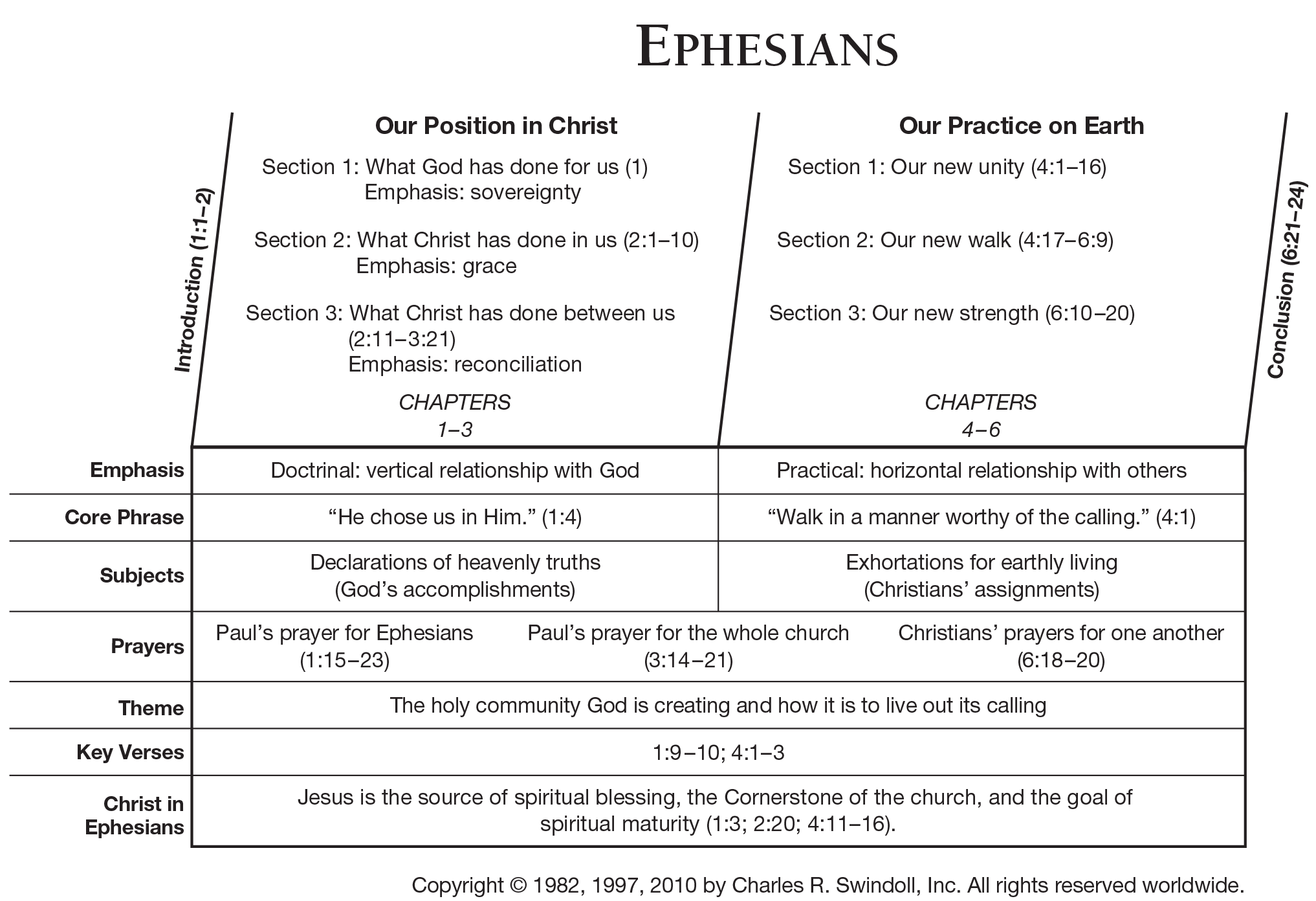
EPHESIANS - CHRIST AND THE CHURCH
Click chart to enlarge
Charts from Jensen's Survey of the NT - used by permission
Click chart by Charles Swindoll -Note "EMPHASIS" --
Ephesians 1-3 = Doctrinal: vertical relationship with God
Ephesians 4-6 = Practical: horizontal relationship with others
Ephesians 4:20 But you did not learn Christ in this way, (NASB: Lockman)
Greek: humeis de ouch houtos emathete (2PAAI) ton Christon,
BGT ὑμεῖς δὲ οὐχ οὕτως ἐμάθετε τὸν Χριστόν,
Amplified: But you did not so learn Christ! (Amplified Bible - Lockman)
NKJV: But you have not so learned Christ,
KJV But ye have not so learned Christ;
ESV But that is not the way you learned Christ!--
NET But you did not learn about Christ like this,
NIV You, however, did not come to know Christ that way.
NLT (revised) But that isn't what you learned about Christ.
NLT: But that isn't what you were taught when you learned about Christ. (NLT - Tyndale House)
Phillips: But you have learned nothing like that from Christ, (Phillips: Touchstone)
Weymouth: But these are not the lessons which you have learned from Christ
Wuest: But as for you, not in this manner did you learn the Christ, (Eerdmans Publishing - used by permission)
Young's Literal: and ye did not so learn the Christ,
BUT YOU DID NOT LEARN CHRIST IN THIS WAY: humeis de ouch houtos emathete (2PAAI) ton Christon:
- But you did not learn Christ in this way, Lk 24:47; Jn 6:45; Ro 6:1-2; 2Co 5:14-15; Titus 2:11-14; 1Jn 2:27
- Ephesians 4 Resources - Multiple Sermons and Commentaries
- Ephesians 4:20-24 The Changed Life - Steven Cole
- Ephesians 4:17-32 Solving Conflicts - Steven Cole
- Ephesians 4:17-27 - Wayne Barber
- Ephesians 4:20-24: A Brand New Way of Life - 2 - Wayne Barber
- Ephesians 4:19-24: Off w the Old, On w the New-2 - John MacArthur
- Ephesians 4:17-5:14 Study Guide (see dropdown menu) - John MacArthur
Related Passages:
Romans 6:1-2 What shall we say then? Are we to continue in sin so that grace may increase? 2 May it never be! How shall we who died to sin still live in it?
Matthew 11:29 (CHRIST'S INVITATION TO LEARN FROM HIM = INVITATION TO BE SAVED) “Take (aorist imperative see our need to depend on the Holy Spirit to obey) My yoke upon you and learn (manthano in aorist imperative) from Me, for I am gentle and humble in heart, and YOU WILL FIND REST FOR YOUR SOULS.
YOUR DRAMATIC
CHANGE OF DIRECTION
Paul has vividly portrayed the nature and practice of the "old man" or the "old self" (in Adam) in Ephesians 4:17-19, and will now proceed to present the glorious position and God honoring practice that should characterize the new man or the new self (in Christ).
MacArthur introduces Ephesians 4:20-24 - The new walk in Christ is the exact opposite of the old walk of the flesh. Whereas the old is self-centered and futile, the new is Christ-centered and purposeful. Whereas the old is ignorant of God’s truth, the new knows and understands it. Whereas the old is morally and spiritually calloused and shameless, the new is sensitive to sin of every sort. Whereas the old is depraved in its thinking, the new is renewed. (See The MacArthur New Testament Commentary)
But you did not learn (manthano) Christ in this way - NLT = "But that isn't what you were taught when you learned about Christ." But (de) draws a clear contrast with the old self just described in Eph 4:17-19. Always pause and ponder this term of contrast asking "What is the change of direction?" The pronoun you refers to "you, the saved Gentiles" and is the first word in the Greek text presenting a sharp (emphatic) contrast with the pagan lifestyle of the Gentiles who were yet unconverted. The negative for not (ou) (ou) speaks of absolute negation. In contrast to the insensitive, passion-dominated pagans who lived to satisfy their lower nature, this was not how the Gentile converts in Ephesus came to know Christ for themselves. One implication of Paul's statement in Ep 4:17 (walk no longer) is that some of his readers had drifted back into their old unregenerate ways. Paul is trying to correct their defective thinking (note all of the words that relate to "thinking" - learn, heard, taught in next verse) which would lead to potentially destructive behavior. So he begins by reminding them of how they had been delivered from the ethical sewer in which they had once wallowed.
When or how did they learn (manthano) Christ? The aorist tense marks a specific time which would equate with the time of their conversion and so the learn Christ simply is another way of describing when they were saved. Christ, the Messiah, of Whom these Gentiles formerly had no knowledge of ("separate from Christ" - Ep 2:12) was the very essence of the content of the preaching and the instruction they had received at conversion. They did not learn to follow Christ by the natural mental processes that lead to the moral degradation he had just described in the unsaved Gentiles. They learned to follow Him as His disciples from the Gospel. Christ teaches men to renounce sin and vice and to cultivate holiness and virtue.
Hoehner - The inceptive aorist points to the time of conversion. Gentiles and Jews who had previously opposed God, heard Christ preached and received him. This then is the beginning point of their “learning Christ.” Believers continually “learn” Christ who is alive and seated at the right hand of God in the heavenlies (Eph 1:20; 2:6). The new person’s ordered life is not concerned with learning the law but rather hearing about and thus “learning” the living Christ and ordering his or her life to please him.
Vincent adds that "The phrase learn Christ occurs nowhere else. Christ does not stand for the doctrine of Christ; but Christ is the subject of His own message. (Ephesians 4 Word Studies)
John MacArthur rightly sounds the alarm writing that "The ways of God and the ways of the world are not compatible. The idea, promoted by some who claim to be evangelicals, that a Christian does not have to give up anything or change anything when he becomes a Christian is nothing less than diabolical. That notion, under the pretense of elevating God’s grace and of protecting the gospel from works righteousness, will do nothing but send many people confidently down the broad way that Jesus said leads to destruction (Mt 7:13). (See The MacArthur New Testament Commentary)
Paul was always "Christocentric" for example writing to the saints at Corinth that "indeed Jews ask for signs, and Greeks search for wisdom; but we preach Christ crucified, to Jews a stumbling block, and to Gentiles foolishness, but to those who are the called, both Jews and Greeks, Christ the power of God and the wisdom of God. (1Co 1:22-24). And again he wrote "I determined to know nothing among you except Jesus Christ, and Him crucified." (1Cor 2:2)
Peter O'Brien explains learn Christ - "The first formulation, ‘you did not learn Christ that way’, is without parallel. The phrase ‘to learn a person’ appears nowhere else in the Greek Bible, and to date it has not been traced in any prebiblical Greek document. In Colossians, the same verb is used of the readers having ‘learned’ the ‘grace of God’ from Epaphras, who had given them systematic instruction in the gospel (Col. 1:7). Here in Ephesians Christ himself is the content of the teaching which the readers learned. Just as he is the subject of the apostolic preaching and teaching (1 Cor. 1:23; 15:12; 2 Cor. 1:19; 4:5; 11:4; Phil. 1:15; cf. Acts 5:42), so he is the one whom the hearers ‘learn’ and ‘receive’. This formulation signifies that when the readers accepted Christ as Lord, they not only welcomed Him into their lives but also received traditional instruction about Him. Colossians 2:6 and 7 (the nearest parallel to our expression) makes a similar point: ‘just as you received Christ Jesus as Lord’ refers not simply to the Colossians’ personal commitment to Christ (though this notion is obviously included); the statement also points to their having received him as their tradition (the verb appears in this semi-technical sense). Learning Christ means welcoming Him as a living person and being shaped by His teaching. This involves submitting to His rule of righteousness and responding to His summons to standards and values completely different from what they have known. (See The Letter to the Ephesians )
John Stott on learn Christ - To ‘learn Christ’ is to grasp the new creation which he has made possible, and the entirely new life which results from it. It is nothing less than putting off our old humanity like a rotten garment and putting on like clean clothing the new humanity recreated in God’s image. (Ibid)
J R Miller...Ye have not so learned Christ. - Ephesians 4:20 - Christians are not to live as other people do. Something far better is expected of them. They have come out from the world, and they are to show the world an example of heavenly life. They are no longer to "walk as the Gentiles also walk." Those who have learned Christ should put away all the evil things of their former life, and be renewed in the spirit of their mind. They should put away falsehood and speak truth with their neighbors. If they get angry they should be sure not to hold hate in their hearts overnight. "Let not the sun go down upon your wrath." If they had ever stolen, they should steal no more, but should earn by honest labor whatever they get. They should keep special watch over their speech, never speaking any corrupt words. They should utter only words that will do good, imparting grace, making people happier and better. They should be careful never to do anything to grieve the Holy Spirit. They should keep their hearts free from all bitter thoughts and should be kind to everybody.
Learn (3129) (manthano) means to gain knowledge or skill by instruction. It conveys a basic meaning of directing one’s mind to something and producing an external effect. Depending on the context, the learning can be through instruction, through inquiry (ascertain, discover, find out), through practice or experience (come to know, come to realize) or as achieving comprehension (understand). The idea is to genuinely understand and accept a teaching accept it as true and to apply it in one’s life.
Manthano - 25x in 24v - educated(1), find out(1), learn(12), learned(9), learning(1), receive instruction(1). Matt. 9:13; 11:29; 24:32; Mk. 13:28; Jn. 6:45; 7:15; Acts 23:27; Rom. 16:17; 1 Co. 4:6; 14:31, 35; Gal. 3:2; Eph. 4:20; Phil. 4:9, 11; Col. 1:7; 1 Tim. 2:11; 5:4, 13; 2 Tim. 3:7, 14; Tit. 3:14; Heb. 5:8; Rev. 14:3
TDNT adds that manthano is derived "From the basic sense “to direct one’s mind to something,” manthano comes to be used for (1) “to accustom oneself to something,” (2) “to experience,” (3) “to learn to know,” (4) “to understand,” (5) “to learn under instruction,” and (6) “to receive direction from a deity by oracle.” In the phrase tí mathon (7) it means “why?” (often with an ironical note). The use consistently implies an intellectual process that always has external effects and involves a conscious or unconscious intellectual initiative. Hence other terms may elucidate it but cannot replace it. (Kittel, G., Friedrich, G., & Bromiley, G. W. Theological Dictionary of the New Testament. Eerdmans)
Christ (5547) (Christos from chrio = to anoint, rub with oil, consecrate to an office) is the Anointed One, the Messiah, Christos being the Greek equivalent of the transliterated Hebrew word Messiah. As a Jew learned the Torah, now the Christian learns Christ!
Ephesians 4:21 if indeed you have heard Him and have been taught in Him, just as truth is in Jesus, (NASB: Lockman)
Greek: ei ge auton ekousate (2PAAI) kai en auto edidachthete, (2PAPI) kathos estin (3SPAI) aletheia en to Iesou,
BGT εἴ γε αὐτὸν ἠκούσατε καὶ ἐν αὐτῷ ἐδιδάχθητε, καθώς ἐστιν ἀλήθεια ἐν τῷ Ἰησοῦ,
Amplified: Assuming that you have really heard Him and been taught by Him, as [all] Truth is in Jesus [embodied and personified in Him], (Amplified Bible - Lockman)
ESV assuming that you have heard about him and were taught in him, as the truth is in Jesus,
NET if indeed you heard about him and were taught in him, just as the truth is in Jesus.
NIV Surely you heard of him and were taught in him in accordance with the truth that is in Jesus.
NKJV: if indeed you have heard Him and have been taught by Him, as the truth is in Jesus:
KJV If so be that ye have heard him, and have been taught by him, as the truth is in Jesus:
NLT (revised) Since you have heard about Jesus and have learned the truth that comes from him,
NLT: Since you have heard all about him and have learned the truth that is in Jesus, (NLT - Tyndale House)
Phillips: if you have really heard his voice and understood the truth that he has taught you. (Phillips: Touchstone)
Wuest: since, indeed, as is the case, you heard and in Him were taught just as truth is in Jesus, (Eerdmans Publishing - used by permission)
Young's Literal: if at least you have heard His voice and in Him have been taught—and this is true Christian teaching—
IF INDEED YOU HAVE HEARD HIM AND HAVE BEEN TAUGHT IN HIM: ei ge auton ekousate (2PAAI) kai en auto edidachthete, (2PAPI):
- if indeed you have heard Him Matthew 17:5; Luke 10:16; John 10:27; Acts 3:22,23; Hebrews 3:7,8
- Ephesians 4 Resources - Multiple Sermons and Commentaries
- Ephesians 4:20-24 The Changed Life - Steven Cole
- Ephesians 4:17-32 Solving Conflicts - Steven Cole
- Ephesians 4:17-27 - Wayne Barber
- Ephesians 4:20-24: A Brand New Way of Life - 2 - Wayne Barber
- Ephesians 4:19-24: Off w the Old, On w the New-2 - John MacArthur
- Ephesians 4:17-5:14 Study Guide (see dropdown menu) - John MacArthur
Related Passages:
Ephesians 1:13 In Him, you also, after listening (akouo - same verb in Ep 4:21) to the message of truth, the gospel of your salvation–having also believed, you were sealed in Him with the Holy Spirit of promise,
GROWING
IN CHRIST
if indeed you have heard Him and have been taught (didasko) in Him - This verse helps understand more fully what was involved in "learn Christ." If indeed can be translated "seeing that" or "since" and when used with the indicative this conditional clause is viewed as fulfilled (NIV = "surely"). In other words, what follows is not in any doubt but is taken for granted. Heard means they heard with attention, with the ear of their mind or effectually so as to respond appropriately to what had been taught. How had they heard Him for He was at the right hand of His Father in Heaven? This has to be through the Christocentric preaching and teaching of Spirit filled preachers and teachers (remember Paul had been in Ephesus 3 years so it is possible some of his readers had heard Him through Paul). In fact Stott (pg 103) says that "when sound biblical moral instruction is being given, it may be said that Christ is teaching about Christ!"
In Him speaks of the Gentiles' union with Christ ("fellowship with Him") (See discussions on in Christ and in Christ Jesus and in Christ) Taught in Him does not mean "taught by Him," in Person, but as explained above it means taught by those who preached and taught the truth about Christ (see "the message of truth" = Eph 1:13). Another sense of "in Him" is to see this as the teaching that was taught was taught was in the sphere (the "atmosphere") of Christ (sense of locative of sphere) the object and sphere of their learning. While heard Him could suggest their initial reception of Christ at salvation, the phrase taught in Him would suggest continuing edification about Christ.
Peter O'Brien says it this way "In the proclamation of the Gospel they had first learned about Christ (cf. Eph 1:13), and that preaching was reinforced in the systematic instruction they were given, through those especially equipped by the ascended Lord Jesus (Eph 4:11; cf. Eph 2:20; 3:5)." (See The Letter to the Ephesians)
Salmond comments "The point, therefore, is this—‘if, as I take it to be the fact, it was He, the Christ, that was the subject and the sum of the preaching which you heard then.’” (Ephesians 4 Commentary)
Earlier Paul had written 'In Him (Christ), you also, after listening (akouo - hearing) to the message of truth, the gospel of your salvation-- having also believed, you were sealed in Him with the Holy Spirit of promise (Ep 1:13)
McGee writes that "If anyone is not listening to Jesus, then Jesus must not be his Savior. The Lord Jesus is the Shepherd and His sheep hear His voice. If you haven’t heard His voice, then you are not one of His sheep. What will change the Gentiles from their old nature? What are they to do? They are to listen to Christ. They are to hear Him. They are to be taught by Him. Those who are not His sheep will not hear Him. (Ephesians - Thru the Bible Audio)
S Lewis Johnson has a practical note on you have heard Him - When Paul says “heard Him” he means heard those sermons and messages and perhaps read letters from the Apostles about him, but in reading about Him, the Holy Spirit was so vital and active in teaching them that they actually were hearing Him, just as you today. (ED: NO AUDIBLE VOICES OF COURSE AND NO NEW REVELATION!) You may sit down in your study and begin to read the Bible, and the Holy Spirit, as He teaches you the Word of God, it’s really Christ teaching you through the Spirit, and you may actually have the sense of the Lord Jesus Christ’s presence as your teacher right there with you. That’s why you come to know Him. You can be with Him on the boat in the Sea of Galilee in the storm. You can be with Him as He taught the multitudes. You can be with Him as He talked to Peter or as He talked to John. You can be with Him on the Mount of Transfiguration. You can be with Him, and thus, hear Him, so he says. If so be that ye have heard Him and have been taught by Him, as the truth is in Jesus." (Sermon)
Have been taught (1321) (didasko from dáo= know or teach) means to provide instruction in a formal or informal setting. Didasko refers to imparting positive truth. It is the responsibility of every believer (Col 3:16), and is part of the Great Commission (Mt 28:20). It is especially the responsibility of church leaders. “An overseer, then, must be… able to teach” (1Ti 3:2). Heresy flourishes where sound Christian teaching lags. The idea is to hold discourse with others in order to instruct them by word of mouth (tutor, direct, advise, put in mind). In the NT almost without exception didasko refers to the teaching of groups.
Didasko means to teach a student in such a way that the will of the student becomes conformed to the teaching taught. So the teacher teaches in such a way that as the student is taught, he now changes his mind saying in essence ''I won't do it this way, but I will do it this way because I've learned this doctrine or this teaching.'' Doctrine determines direction of our behavior, conformed to world or to God? Teaching that Scripture finds significant is not that which provides information alone but also the teaching that creates disciples who live in responsive obedience to God's will.
Didasko - 97x in 91v in NAS - instructed(2), preaches(1), taught(13), teach(33), teaches(5), teaching(43) Matt. 4:23; 5:2, 19; 7:29; 9:35; 11:1; 13:54; 15:9; 21:23; 22:16; 26:55; 28:15, 20; Mk. 1:21f; 2:13; 4:1f; 6:2, 6, 30, 34; 7:7; 8:31; 9:31; 10:1; 11:17; 12:14, 35; 14:49; Lk. 4:15, 31; 5:3, 17; 6:6; 11:1; 12:12; 13:10, 22, 26; 19:47; 20:1, 21; 21:37; 23:5; Jn. 6:59; 7:14, 28, 35; 8:2, 20, 28; 9:34; 14:26; 18:20; Acts 1:1; 4:2, 18; 5:21, 25, 28, 42; 11:26; 15:1, 35; 18:11, 25; 20:20; 21:21, 28; 28:31; Rom. 2:21; 12:7; 1 Co. 4:17; 11:14; Gal. 1:12; Eph. 4:21; Col. 1:28; 2:7; 3:16; 2 Thess. 2:15; 1 Tim. 2:12; 4:11; 6:2; 2 Tim. 2:2; Tit. 1:11; Heb. 5:12; 8:11; 1 Jn. 2:27; Rev. 2:14, 20
JUST AS TRUTH IS IN JESUS: kathos estin (3SPAI) aletheia en to Iesou:
- just as truth is in Jesus Eph 1:13; Ps 45:4; Ps 85:10,11; Jn 1:17; 14:6,17; 2Co 1:20; 11:10; 1Jn 5:10, 11,12,20
- Ephesians 4 Resources - Multiple Sermons and Commentaries
- Ephesians 4:20-24 The Changed Life - Steven Cole
- Ephesians 4:17-32 Solving Conflicts - Steven Cole
- Ephesians 4:17-27 - Wayne Barber
- Ephesians 4:20-24: A Brand New Way of Life - 2 - Wayne Barber
- Ephesians 4:19-24: Off w the Old, On w the New-2 - John MacArthur
- Ephesians 4:17-5:14 Study Guide (see dropdown menu) - John MacArthur
Ephesians 1:13 In Him, you also, after listening to the message of truth, the gospel of your salvation–having also believed, you were sealed in Him with the Holy Spirit of promise,
John 1:17 For the Law was given through Moses; grace and truth were realized through Jesus Christ.
John 14:6 Jesus *said to him, “I am the way, and the truth, and the life; no one comes to the Father but through Me.
1 John 5:20 (NOTE JOHN MENTIONS "TRUE" THREE TIMES!) And we know that the Son of God has come, and has given us understanding so that we may know Him who is true (alethinos) and we are in Him who is true (alethinos), in His Son Jesus Christ. This is the true (alethinos) God and eternal life.
JESUS FULL OF
GRACE AND TRUTH
Just as the truth (aletheia) is in Jesus - Amplified has "Truth is in Jesus [embodied and personified in Him]," Truth is the property of being in accord with fact or reality as defined by God. Whatever God says is Truth. Truth is a Person, Jesus (see related passages above)
Blaikie remarks that "All truth acquires a different hue and a different character when there is a personal relation to Jesus. Truth apart from the Person of Christ has little power. (Ephesians 4 Commentary)
Vincent comments that "Just as corresponds with not so. Ye did not in such a manner learn Christ if ye were taught in such a manner as is truth, etc. Render, as Rev., as truth is in Jesus. Schaff paraphrases: ‘If you were taught so that what you received is true as embodied in the personal Saviour.’ ‘Taught in the lines of eternal fact and spiritual reality which meet in Him’ (Moule). Jesus is used rather than Christ; the historical rather than the official name. The life of Christianity consists in believing fellowship with the historic Jesus, Who is the Christ of prophecy.” (Ephesians 4 Word Studies)
MacDonald makes an excellent point on why Paul would use the specific name of Jesus in this context writing that "The Name Jesus takes us back to His life on earth, since that is His name in Incarnation. In that spotless life which He lived as a Man in this world, we see the very antithesis of the walk of the Gentiles which Paul has just described." (Believer's Bible Commentary)
One other thought is that the Cerinthian Gnostics did distinguish between the man Jesus and the aeon Christ. So it may be signicant that Paul identifies Him as Christ in Ep 4:20 and as Jesus in Ep 4:21 At any rate he flatly affirms that there is "truth in Jesus" which is in direct opposition to the heathen manner of life
O'Brien has another thought on the use of the Name Jesus - "A second unusual feature is the use of the name ‘Jesus’, the only occasion in Ephesians where it occurs by itself (though cf. ‘Lord Jesus’ in Eph 1:15). The change from the title ‘Christ’ seems to be deliberate, not because the name ‘Jesus’ was aimed at Gnostic teaching with its division between the heavenly Christ and the earthly Jesus, but in order to stress that the historical Jesus is himself the embodiment of the truth. The apostle reminds his readers that the instruction they had received in the gospel tradition was indeed ‘the truth as it is in Jesus’." (See The Letter to the Ephesians)
Truth (225) (aletheia from a = without + lêthô = that which is hidden or concealed, the combination meaning out in open) is the the unconcealed reality lying at the basis of and agreeing with an appearance; the manifested, the veritable essence of matter.
TDNT explains the origin of this word this way "Etymologically aletheia means “nonconcealment.” It thus denotes what is seen, indicated, expressed, or disclosed, i.e., a thing as it really is, not as it is concealed or falsified. aletheia is “the real state of affairs,” e.g., the truth in law, or real events in history, or true being in philosophy... aletheia is “that which has certainty and force”... aletheia is “that on which one can rely”...aletheia is “the state of affairs as disclosed”... aletheia is “truth of statement” used with speaking (Lk. 4:25) or teaching (Mk. 12:14).... aletheia is “true teaching or faith” (2Cor. 13:8; 4:2; Ga 5:7; 1Pe 1:22) (Kittel, G., Friedrich, G., & Bromiley, G. W. Theological Dictionary of the New Testament. Eerdmans)
Truth is the correspondence between a reality and a declaration which professes to set it forth. To say it another way, words are true when they correspond with objective reality. Persons and things are true when they correspond with their profession. Hence a truth is a declaration which has corresponding reality, or a reality which is correctly set forth. Since God is Himself the great reality, that which correctly sets forth His nature is pre-eminently the Truth.
Jesus (2424) (Iesous) is transliterated from the Hebrew Yeshua which means Jehovah is help or Jehovah is Salvation. Jesus corresponds to the OT name Jehoshua is contracted to Joshua.
Ephesians 4:22 that, in reference to your former manner of life, you lay aside the old self, which is being corrupted in accordance with the lusts of deceit, (NASB: Lockman)
Greek: apothesthai (AMN) humas kata ten proteran anastrophen ton palaion anthropon ton phtheiromenon (PPPMSA) kata tas epithumias tes apates,
BGT ἀποθέσθαι ὑμᾶς κατὰ τὴν προτέραν ἀναστροφὴν τὸν παλαιὸν ἄνθρωπον τὸν φθειρόμενον κατὰ τὰς ἐπιθυμίας τῆς ἀπάτης,
Amplified: Strip yourselves of your former nature [put off and discard your old unrenewed self] which characterized your previous manner of life and becomes corrupt through lusts and desires that spring from delusion; (Amplified Bible - Lockman)
ESV to put off your old self, which belongs to your former manner of life and is corrupt through deceitful desires,
NET: You were taught with reference to your former way of life to lay aside the old man who is being corrupted in accordance with deceitful desires,
NIV: You were taught, with regard to your former way of life, to put off your old self, which is being corrupted by its deceitful desires;
KJV That ye put off concerning the former conversation the old man, which is corrupt according to the deceitful lusts;
NKJV: that you put off, concerning your former conduct, the old man which grows corrupt according to the deceitful lusts,
NLT: throw off your old evil nature and your former way of life, which is rotten through and through, full of lust and deception. (NLT - Tyndale House)
NLT (revised) throw off your old sinful nature and your former way of life, which is corrupted by lust and deception.
Phillips: No, what you learned was to fling off the dirty clothes of the old way of living, which were rotted through and through with lust's illusions, (Phillips: Touchstone)
Wuest: that you have put off once for all with reference to your former manner of life the old self who is being corrupted according to the passionate desires of deceit; (Eerdmans Publishing - used by permission)
Young's Literal: to put away, in regard to your former mode of life, your original evil nature which is doomed to perish as befits its misleading impulses,
THAT, IN REFERENCE TO YOUR FORMER MANNER OF LIFE: kata ten proteran anastrophen:
- that, in reference to your former manner of life,Eph 4:17; 2:3; Gal 1:13; Col 3:7; 1Pe 1:18; 4:3; 2Pe 2:7
- Ephesians 4 Resources - Multiple Sermons and Commentaries
- Ephesians 4:20-24 The Changed Life - Steven Cole
- Ephesians 4:17-32 Solving Conflicts - Steven Cole
- Ephesians 4:17-27 - Wayne Barber
- Ephesians 4:20-24: A Brand New Way of Life - 2 - Wayne Barber
- Ephesians 4:19-24: Off w the Old, On w the New-2 - John MacArthur
- Ephesians 4:17-5:14 Study Guide (see dropdown menu) - John MacArthur
THE OLD LIFE
IN ADAM
That, in reference to your former (proteros) manner of life - This former manner dominated by the old "master" Sin, has been vividly described in Eph 4:17-19 (cf Eph 2:1-3). They were like rotten fish swimming in a fetid moral cesspool!
Paxson writes that their former manner of life was "a life in sin lived according to the debased standard of the trinity of evil (Ed note: world, flesh, devil). Their former manner of life was the unregenerate, unclean, unholy life of the sinner under the domination of "the old man." (The Wealth, Walk and Warfare of the Christian)
In chapter 2 Paul had repeatedly reminded them of their former desperate spiritual condition writing...
And you were dead in your trespasses and sins, 2 in which you formerly walked according to the course of this world, according to the prince of the power of the air, of the spirit that is now working in the sons of disobedience. 3 Among them we too all formerly lived in the lusts of our flesh, indulging the desires of the flesh and of the mind, and were by nature children of wrath, even as the rest (See notes Ephesians 2:1; 2:2; 2:3)
Therefore remember, that formerly you, the Gentiles in the flesh, who are called "Uncircumcision" by the so-called "Circumcision," which is performed in the flesh by human hands--12 remember that you were at that time separate from Christ, excluded from the commonwealth of Israel, and strangers to the covenants of promise, having no hope and without God in the world.13 But now in Christ Jesus you who formerly were far off have been brought near by the blood of Christ. (See notes Ephesians 2:11; 2:12; 2:13)
Former (4387) (proteros from pró = forth, before) means prior, previous, of an earlier time, all pertaining to a point of time earlier in a sequence. Proteros refers to a period of time preceding another period of time.
Proteros - 11x in 11v in the NAS -Jn. 6:62; 7:50; 9:8; 2 Co. 1:15; Gal. 4:13; Eph. 4:22; 1 Tim. 1:13; Heb. 4:6; 7:27; 10:32; 1 Pet. 1:14 and rendered in the NAS as before(2), first(2), first time(1), former(3), formerly(2), previously(1).
Manner of life (391) (anastrophe from aná = again, back + strépho = turn - idea is turning back in forth in a place equates with living there) means one's way of life or conduct, with focus on overt daily behavior. Thayer adds that the root verb (anastrepho) means “to conduct or behave one’s self, to walk,” the latter meaning not referring here to the physical act of walking but to the act of determining our course of conduct and the carrying out of that determined course of action. Anastrophe means in biblical use has the moral and spiritual aspect of one’s manner of life is in view.
Anastrophe - 13x in 13v in the NAS - Gal. 1:13; Eph. 4:22; 1 Tim. 4:12; Heb. 13:7; Jas. 3:13; 1 Pet. 1:15, 18; 2:12; 3:1f, 16; 2 Pet. 2:7; 3:11 and is rendered in the NAS as behavior(6), conduct(4), manner of life(2), way of life(1).
Vincent comments that "The process of development in the meaning of the word is interesting. 1. A turning upside down. 2. A turning about or wheeling. 3. Turning about in a place, going back and forth there about one’s business; and so, 4, one’s mode of life or conduct. (Ephesians 4 Word Studies)
YOU LAY ASIDE THE OLD SELF: apothesthai (AMN)...ton palaion anthropon ton:
- you lay aside the old self, Eph 4:25; 1Sa 1:14; Job 22:23; Ezek 18:30-32; Col 2:11; 3:8,9; Heb 12:1; Jas 1:21; 1Pe 2:1,2
- the old self Romans 6:6; Colossians 3:9-10
- Ephesians 4 Resources - Multiple Sermons and Commentaries
- Ephesians 4:20-24 The Changed Life - Steven Cole
- Ephesians 4:17-32 Solving Conflicts - Steven Cole
- Ephesians 4:17-27 - Wayne Barber
- Ephesians 4:20-24: A Brand New Way of Life - 2 - Wayne Barber
- Ephesians 4:19-24: Off w the Old, On w the New-2 - John MacArthur
- Ephesians 4:17-5:14 Study Guide (see dropdown menu) - John MacArthur
Related Passages:
Romans 6:6 knowing this, that our old self (palaios anthropos - literally old man) was crucified with Him, in order that our body of sin might be done away with, so that we would no longer be slaves to sin;
Colossians 3:9-10 Do not lie to one another, since you laid aside the old (palaios) self (anthropos - Old Man) with its evil practices, 10 and have put on the new self who is being renewed to a true knowledge according to the image of the One who created him–
1Co 15:22 For as in Adam all die, so also in Christ all will be made alive.
PUTTING OFF
THE OLD
You lay aside (apotithemi) the old (palaios) self (anthropos - Old Man) - Without being too technical, the verb lay aside can be translated one of two ways, (1) either indicating a completed past action (this would be our position in Christ) or (2) an action the believer is to carry out (almost giving it the sense of an imperative). This distinction is even seen in the way the various Bible translations render the Greek text. (See NET technical note below).
For example, the following rendering translates the Greek as if it were a fact, a past completed action, in effect their new position in Christ...
Wuest: that you have put off once for all with reference to your former manner of life the old self who is being corrupted according to the passionate desires of deceit; (Eerdmans Publishing - used by permission)
In contrast, the following versions render lay aside (put off, throw off, strip) as an action the believer is to carry out and some of the versions even convey the force of this as a command (although it is not a command in the Greek)...
Amplified: Strip yourselves of your former nature [put off and discard your old unrenewed self] which characterized your previous manner of life and becomes corrupt through lusts and desires that spring from delusion;
KJV: That ye put off concerning the former conversation the old man, which is corrupt according to the deceitful lusts;
NASB: that, in reference to your former manner of life, you lay aside the old self, which is being corrupted in accordance with the lusts of deceit,
NLT: throw off your old evil nature and your former way of life, which is rotten through and through, full of lust and deception.
RSV Put off your old nature which belongs to your former manner of life and is corrupt through deceitful lusts,
John MacArthur favors the interpretation not as an action to carry out but a position they possess in Christ - "It is important to note that Paul is not here exhorting believers to do these things. These three infinitives describe the saving truth in Jesus and are not imperatives directed to Christians. They are done at the point of conversion, and are mentioned here only as a reminder of the reality of that experience....Paul’s terms here are basically a description of repentance from sin and submission to God, so often taught as elements of regeneration (see Isa. 55:6–7; Matt. 19:16–22; Acts 2:38–40; 20:21; 1Th 1:9; et al.). In contrast to the unregenerate person who continually resists and rejects God and lives in the sphere of dominating sin (the former manner of life), the Christian has heard the call to lay aside the old self. The verb means to strip off, as in the case of old filthy clothes. The tense (aorist middle) indicates a once-and-forever action done by the believer at salvation. (See The MacArthur New Testament Commentary)
S Lewis Johnson on lay aside - The Apostle, in my opinion, is probably speaking in indirect discourse, and therefore we should render this in the light of the parallel in Colossians 3:9-10 “Do not lie to one another, since you laid aside (aorist) the old self with its evil practices, 10 and have put on (aorist) the new self who is being renewed (present tense) to a true knowledge according to the image of the One who created him” The truth in Jesus is that we believers have put off the old man.....So, we have put off the old man, and so, naturally, all those things that are the products, ethically, of the old man are to be put off.(Sermon) (COMMENT - Note what Dr Johnson says in the last sentence -- "We have put off..." and then he adds "are to be put off." In other words the first statement refers to our position and the next statement is a call to practice our position.)
After studying this passage and multiple commentators, there seems to be a sense in which both interpretations/translations are correct, the former (positional truth) emphasizing the bestowal of God's sovereign grace in salvation (we have put off the old once and for all, we are no longer in Adam, but we are now in Christ) and the latter (practical truth) emphasizing man's responsibility to walk in the light (and power) of the grace and the Spirit bestowed. Let me state it another way -- we can now "lay aside" the filth of the flesh because we have "laid aside the old" and "put on the new" when we were born again (as it says in Col 3:9-10). The laying aside at the new birth simply begins a lifelong process of daily laying aside the old and putting on the new.
In other words the Old Man has already been crucified with Christ (Ro 6:6). That is a historical fact and a truth for believers to continually reckon as true (because it is true) (cp Ro 6:11). Now, based upon the truth that the Old Man has been crucified, Paul says make it your experience of putting off this Old Man. (cf Ro 6:12-13) "Put off" in your daily walk what has already been put off when you died with Christ.
Here is how Steven Cole explains it "Paul’s phrase is literally, “the old man.” He identifies this as being “in reference to your former manner of life.” So the old man refers to all that we were before we were saved, when we were ruled by the evil desires and practices (see Ep 4:19; Eph 2:3). Paul uses the same phrase in Ro 6:6, where he says, "our old self (old man) was crucified with Him, in order that our body of sin might be done away with (ED: not annihilated but rendering the power of sin ineffective - it can no longer "order" us to do this or that sinful act, i.e., we are no longer enslaved to Sin! See katargeo), so that we would no longer be slaves to sin." Romans 6 is really a longer exposition of what Paul says more succinctly here in Ephesians 4. In Romans 6:6 (and in Col. 3:9), Paul refers to the putting off of the old man as an accomplished fact. (ED: WHICH IS WHAT MACARTHUR STATED ABOVE) When Christ died on the cross, we died with Him positionally. When He was raised from the dead, we were raised up with Him. We are to reckon these facts to be true in our daily practice, so that we will not yield to Sin (Ro 6:11). Because in those passages Paul clearly states this putting off of the old life as a done deal, some argue that it is not something that we have to go on doing now. They contend that it was a once and for all matter that happened at the cross. But, although we died with Christ, in other places Paul commands us to put to death our members that are on the earth (Ro 8:13; Col. 3:5, literal translation, ED: COMPARE PAUL'S COMMANDS IN Ro 6:12-13 FOLLOWING HIS DESCRIPTION OF THEIR NEW "POSITION" IN CHRIST IN Ro 6:1-11). Why do we need to put to death our members if we already died? My understanding is that we must daily apply experientially the facts that are true of us positionally. So, yes, at the moment we got saved, we put off the dirty clothes of the old life (ED: MACARTHUR). But, every day we must reckon (ED: Ro 6:11 CALLS FOR A CONTINUAL RECKONING ["CONSIDER"] OF THE TRUTH OF Ro 6:1-10) that this is so by putting off everything associated with the old life and putting on the new life in Christ. Lloyd-Jones (ibid. p. 123) uses a helpful illustration. When Abraham Lincoln freed the slaves, they were officially free from their many years of servitude, but some of them went on living as if they were still slaves. The President’s proclamation gave them legal standing as free citizens. It was a done deal—they were no longer slaves. But, out of habit and way of thinking, (ED: WHICH IS WHY PAUL'S EXHORTATION IN Eph 4:23 IS SO IMPORTANT! = CALLING FOR A CONTINUAL RENEWING OF OUR MIND - SEE MACARTHUR'S NOTE ON Eph 4:23) many of these poor people still lived like slaves. So, they needed to live in accordance with the new facts. When they were tempted to think like a slave, they needed to say, “No, the truth is I am now a free man!” They needed to appropriate that truth into their daily experience. (ED: cf Jn 8:36, cf TRUTH IS IN JESUS - Eph 4:21) (Ephesians 4:20-24 The Changed Life)
J Vernon McGee agrees with Cole writing that "We are to put off the old man and put on the new man in the same manner that we change our clothes. It is like putting off an old and unclean garment and then putting on a garment that is new and clean. The putting off the old man and putting on the new man cannot be done by self-effort, nor can it be done by striving to imitate Christ’s conduct. It has been done for the believing sinner by the death of Christ. We are like babes who cannot dress themselves. I have learned with my little grandson that a child doesn’t do very well when he tries to dress himself. As Christians we never reach the place where we can do that, and we don’t need to try. It already has been done for us. We are told in the Epistle to the Romans that the old man has already been crucified in the death of Christ. “Knowing this, that our old man is crucified with him, that the body of sin might be destroyed, that henceforth we should not serve sin” (Ro 6:6). In view of the truth that the old man has already been crucified with Christ, we are to put it off in the power of the Holy Spirit. (ED: cf Ro 8:13)(Thru the Bible Commentary: Thomas Nelson)
ILLUSTRATION - MacArthur reminds us "You can tell a lot about people in our society by the way they dress. From baseball players to bus drivers, from postal carriers to policemen, people wear the uniform of their profession. Who we are determines what we wear, and failing to “dress the part” can sometimes have embarrassing consequences. Many years ago a very wealthy man in a Southern California town was found wandering around the local country club wearing shabby clothes. He was promptly seized by security guards and charged with vagrancy—even though he owned the country club. He had failed to dress consistent with who he was...Christians must dress themselves spiritually in accordance with their new identity. They have died with Christ and risen to new life. Salvation thus produces a two-sided obligation for believers. Negatively, they must throw off the garment of the old, sinful lifestyle, as Paul pointed out in Col 3:5-9a. Positively, they must put on the lifestyle of the new man." (See Colossians and Philemon Commentary)
Paxson writes that on Ephesians 4:22 and Ephesians 4:24 - This twofold clear, crisp exhortation marks the meeting-point between God's part and ours in our sanctification. It is the crossroads between God's sovereign work through grace and man's cooperative action through faith. It is an exhortation to practical holiness in every phase of one's daily life. Paul takes us immediately to the very source of life in each sphere and shows us two things. The character of life is due to its source and the character determines the conduct. Life in the old sphere is tracked to its source, "the old man," and the conduct is corrupt because the character is such. Life in the new sphere is traced to its source, "the new man," and the conduct is righteous and holy because the character is so. (The Wealth, Walk and Warfare of the Christian)
Alan Carr explains it this way - The believer has received a change of life that results in a change in his walk. We are called upon to "put off", once for all, the ways of the old man who is just growing worse day by day. (Note: The words "is corrupt" are present tense and speak of a corpse that lies rotting in the sun. Each day brings with it more evidence that the corpse is dead!) We are called upon to "put on", once for all, the new man, who had been created in righteousness and holiness. When the new believer comes to faith in Jesus, he learns a new way of life, Ep 4:19, Ep 4:20! He has experienced a change of heart that results in a profound change of mind, Ep 4:23! God puts a new desire within His children that makes them want to live differently than they used to live! The bottom line is this: the maturing believer looks different, acts different, walks different and thinks different than he did before! (Eph 4:11-32 The Marks of a Maturing Christian)
John Piper - The old self that loves to boast and exult and rejoice in other things died. By faith we are united to Christ. His death becomes the death of our self-exalting life. We are raised with Him to newness of life (Ro 6:6). What lives is a new creature (2Co 5:17) whose single passion is to exalt Christ and His Cross. To put it another way, when you put your trust in Christ, your bondage to the world and its overpowering lure is broken. You are a corpse to the world, and the world is a corpse to you (cf Gal 6:14). Or to put it positively, according to Gal 6:15, you are a "new (kainos) creation." The old "you" is dead. A new "you" is alive. And the new you is the you of faith. And what faith does is boast not in the world, but in Christ, especially Christ crucified. This is how you become so cross-centered that you say with Paul, "I will not boast, except in the cross of our Lord Jesus Christ." (Gal 6:14) The world is no longer our treasure. It's not the source of our life or our satisfaction or our joy. Christ is. (Don't Waste Your Life - John Piper) (Download Pdf)
Paul Little - Someone has said, "Christ puts a new man in the suit—not just a new suit on the man." When a person is changed by Christ, his clothing (his attitudes) will change as well. God has made full provision, through the sacrifice of Christ, for us to escape judgment and have a new life. (Know What You Believe: Connecting Faith and Truth)
Wayne Barber has a lengthy note on lay aside or put off the old self/man...
Paul goes on to show them the positive side. He starts telling them how they ought to live. How then should we live if we are not to live like the unregenerate Gentiles? We have to live in the world where they live. How do we distill this down in practical terms that we can understand?
First, Paul tells us in Ephesians 4:20-24 that living as a believer is much like putting on a brand new set of clothes. A set of clothes is what people see. Paul is saying something profound to us. He is saying, "Folks, you don’t have to wear old clothes. As a matter of fact, you are not supposed to wear the old clothes that you used to wear." You see, wearing your clothes, putting on the garment, has to do with a way you live. It is a lifestyle. He is saying, "In Jesus Christ you have a brand new set of clothes and you are going to have to learn how to wear them."
He uses two phrases. One is in Ephesians 4:22: lay aside (apotithemi) which has to do with taking something off. Then he says in Eph 4:24 put on (enduo) which also has to do with clothes. One you take off, and one you put on. It is dressing and undressing. How are you supposed to live as a believer? You are supposed to be dressed the right way. Let me show you. First of all, let me show you in Acts 7:58 how that word "lay aside" has to do with taking something off. In Acts 7:58 Luke writes "And when they had driven him out of the city [speaking of Stephen, the martyr], they began stoning him, and the witnesses laid aside (apotithemi) their robes at the feet of a young man named Saul."
So you have a picture of somebody taking something off. That word (apotithemi) is used several times. In Ro 13:12 we get an even clearer picture of what Paul is saying in Ephesians. Paul uses the word and the phrase. We begin to realize that when you put off this garment, this old man as we are going to see later, it has to do not so much with just the old man itself, but the way he used to live. It is a lifestyle. Romans 13:12 says, "The night is almost gone, and the day is at hand. Let us therefore lay aside (apotithemi in aorist tense) the deeds of darkness and put on the armor of light."
Paul uses apotithemi again in Colossians. It gives us a little clearer picture. Colossians 3:8 says, "But now you also, put them all aside (apotithemi aorist tense): anger, wrath, malice, slander, and abusive speech from your mouth." Notice that everything Paul mentions has to do with relationships. When we are rightly related to Christ, when we are letting Jesus be Jesus in our life, when we are being strengthened in the inner man by the spirit of God, we are putting on the garment of a brand new lifestyle. The first place it is going to show up is in relationships. When you have divided relationships all you have is somebody wearing the wrong garment. That is all there is to it. Somebody is not at peace with somebody else. We are to be at peace with all men, to wear the right garment.
Look in Hebrews 12:1 "Therefore, since we have so great a cloud of witnesses surrounding us, let us also lay aside (apotithemi) every encumbrance, and the sin which so easily entangles us, and let us run with endurance the race that is set before us." Take it off like a garment. Get it out of your life. Lay it aside.
Peter uses it in 1Pe 2:1 "Therefore, putting aside (apotithemi in aorist tense) all malice and all guile and hypocrisy and envy and all slander." Peter said, "Get these garments off of you. You don’t live that way anymore. Put that off. That is the old. Now you are to wear the new." So the word "laying aside" means to take off something like you take off a garment.
Let’s look at the next word. Ephesians 4 says: "and put on (enduo in aorist tense) the new self, which in the likeness of God has been created in righteousness and holiness of the truth." You can immediately see the fabric of this new garment. It is created in righteousness and holiness of the truth. There is something contrasting to the old way I used to live and the new way I am supposed to live.
Acts 12:21 reads, :And on an appointed day Herod, having put on (enduo in aorist tense) his royal apparel, took his seat on the rostrum and began delivering an address to them.
Paul takes that word and uses it in an analogy of how we are to live as if we are putting on a garment, for others to look at, for others to see. In Ephesians 4, it is a garment. In chapter 6 it is armor. It is the same thing. When you put on Christ, He is your garment. When you put on Christ, He is your armor against anything the devil ever puts in your life. In Ephesians 6:11 he says, "Put on (enduo in aorist imperative see our need to depend on the Holy Spirit to obey) the full armor of God, that you may be able to stand firm against the schemes of the devil." Ephesians 6:14 says, "Stand firm therefore, having girded your loins with truth, and having put on (enduo in aorist tense) the breastplate of righteousness."
Now this is interesting. I am to put on. Every day I get up and put on. Every moment I move, put on. But wait a minute. When did I get the garment? Look in Colossians 3:9-11. We are going to find that we have already put it on. That is interesting. He says "put it on" in Ephesians while Colossians says, "Wait a minute, you have already put it on." Colossians 3:9-10 says, "Do not lie to one another, since you laid aside (apekduomai) the old self with its evil practices, and have put on (enduo) the new self." Put on is in the aorist tense, middle voice. Aorist means there has been a time, a certain time when you have put it on. But it also middle voice: you chose to do it. You understood what you were doing when you put on the new man.
I can hear some of you thinking, "Wait a minute. God chose us." It has nothing to do with that argument. That is not what Paul is saying. Paul is saying in essence "You understood what you were doing when you bowed before Jesus Christ. You may not have had much understanding then, but you understood that the old garment was a product of a sinful nature and that you, being in Adam, could not save yourself. You understood that, because repentance is taking a garment off and turning and putting a garment on."
We did that at salvation. We put the garment on at salvation. We turned around, sick of the old and put on the new. "Now, I don’t understand. If I have already put it on, how come I have to put it on?"
When we put it on, we put it on inwardly (ED: REGENERATION). Now we have to wear it outwardly. Folks, it is the same thing Paul is saying in Philippians when he says work out your salvation. In other words, get what is on the inside on the outside (Php 2:12; Php 2:13NLT). Put it on. Aorist is also punctiliar: put it on, put it on, put it on. But it is a conscious choice in doing it.
I want to show you the very thread of that new garment. Paul does something in Ephesians 4:20. He does not link us to a creed or to a code. He links us to a person and shows us that the very thread of the garment we are to wear is the Lord Jesus Himself. It is putting on Christ. It is letting Jesus be Jesus in your life. Eph 4:20 says, "But you did not learn Christ in this way."
You didn’t learn a creed or a code. We are not tied to a set of rules. We are tied to a Person. As we put Him on, then everything He has commanded us to do strengthens us in the inner man with an ability to do and to be beyond what we have ever been or we have ever done. It is Christ in us. That is all it is. It is the same thing as being filled with the Spirit. It is the same thing as walking in the light. The Bible doesn’t say seven different things. It says one thing several different times. We are to surrender, and when we do, we are taking off something and putting on something. Not only will it be real to us on the inside, but it will be real to others on the outside.
Can I ask you a question? What garment do you have on? Have you put the old back on? You know, some people enjoy the rags of the old. It is kind of like Lazarus when he came out of the grave. They said, "Unbind him, and let him go." (John 11:44)
In other words "Loose him and set him free. Take those grave clothes off of him." He can’t walk. He can’t witness. He can’t worship. Everything about him is all bound up. But you know, some people like to take some of those rags and stick them in their pockets and say, "You know, I kind of like some of that old stuff. I’d rather wear this garment than the garment of Christ in my life. I don’t want to bow. I kind of enjoy my self-pity. I kind of enjoy my bitterness. I kind of enjoy my lust. I don’t want to bow. I enjoy being covetous. I enjoy dividing people. I would rather wear the old."
The Scripture says, "No, you put on the new. You have no option. Wear that garment you got when you received Christ."
Remember, you understood at that time what was causing you all the pain. Don’t go back to what caused you all the pain.
Well, the second thing I want you to see is before I can put on the new, as he says in Eph 4:24, I have to put off the old. I want to talk about that old garment. In Eph 4:22 it says, "that, in reference to your former manner of life."
The word for manner of life is anastrophe which means everything you do, think, and say. He says, "you lay aside the old self, which is being corrupted in accordance with the lusts of the deceit."
Remember, that word "accordance with" is not "out of." It is "in accordance with." You mean as evil as the flesh can be, it is being corrupted? That old man is getting worse and worse and worse." That is what I see that it saying.
Let’s walk through it. The old self as translated in the New American Standard is literally "old man ." The word literally is new man and old man, not old self and new self. This man of old, who you used to be, who was in Adam (1Co 15:22), needs to be taken off because now you have been placed into Christ. Take that old man off. But I tell you what, if you are not sick of the old man yet, you will be when I finish this verse.
Let me show you what I get out of that verse. Paul is trying to show you how rotten the old man is. It is the picture of something that is very putrid and is in the process of rotting. The idea of this word is of a dead corpse or cadaver that is now rotting and decaying and stinks and it is getting worse all the time. If you want to go back and put the old garment on, help yourself. But I want to tell you, when you do, you are going to smell up relationships. There is going to be an odor about you that is going to be putrid and rotten. Hebrews says don’t ever let a root of bitterness develop among you because when it comes up, it is going to defile men.
If you take a barrel of apples and throw a rotten one in it, you’ve got exactly the picture right here. People who won’t put on the new garment are the people who are causing all the rot in the body of Christ. This is pretty heavy stuff. You know the Holy Spirit inspired this. The Holy Spirit doesn’t mince any words, does He? He just tells you what the old life is like. Folks, we have been saved out of that. Thank God we have been saved out of it. Don’t think for a second that there is anything there for you when you go back and put on that old garment.
Paul uses the term "old man" three times. In Romans 6, in Colossians 3 and in Ephesians 4. I want you to go back to Romans 6 and see if I can explain it. Just like the new man, I have put him on. Now I have to put him on. I have to choose to put him on. It is my responsibility. I have put him on, positionally. Experientially, I choose to do it every day. The same is true about the putting on of the old man.
Romans 6:6 says, "knowing this, that our old man [or self as it is translated] was crucified with Him, that our body of sin might be done away with that we should no longer be slaves to sin."
In God’s reckoning, the old man died with Christ on the cross. In that death, God put an end to the old creation in Adam and now replaces it with a new creation in Christ. It depends on which side of the cross that you are on. If you have been taken out of Adam, you have been put into Christ. The old man is dead. He is powerless in the believer’s life. However, it’s mark is left on us in the lust of our flesh.
So even though it has been put off,we must now choose to put it off.
The way we do it is by choosing against what our flesh wants and choosing what the Lord God desires in our hearts (cp Gal 5:17, ED: FIRST WALK IN THE SPIRIT [Gal 5:16] AND THEN YOU CAN TOSS THE DIRTY CLOTHES!). This choosing is analogous to the idea of putting on and putting of. We have put on and now we need to put off. It has been put off, but now we need to put it off in our life.
So therefore, we reckon ourselves to be dead to sin (Ro 6:11). Do you realize that you don’t have to lust, men? You don’t have to be in bondage to immorality (ED: cf Col 3:5, in a very real sense a "putting off" of the Old Man). You don’t have continue to yield to the sin of immorality (ED: ADD THE TRUTH OF Ro 8:13). You are a new person in Christ (2Cor 5:17). Sin has been rendered powerless ("INEFFECTIVE") in your life (Ro 6:6). The only reason it (Sin) has any power over you at all is because you choose to let it do so. You don’t have to covet (ED: BECAUSE OF THE SPIRIT'S ENABLING POWER - SEE Php 2:13NLT). You don’t have to throw rocks at your house every time you go home because you want a bigger one. You don’t have to live that way any more. You can be content wherever you are. You don’t have to live under bondage anymore. If you are bitter and it is ruining relationships around you and other people know about it, you don’t have to live that way (cp Ep 4:31). You have been set free (cp Jn 8:36), redeemed by the blood of the Lamb (1Pe 1:18,19). You are no longer to be held hostage to sin anymore. It doesn’t have to rule over you (Ro 6:12, 13).
My exhortation to you is to wear the right garment. When you go to a restaurant the waitress who walks over to you may be deceived and blind in sin, as described in Titus 3:3. You don’t know her spiritual state, but perhaps you sense that there is no life in this person. Remember you used to be that way. But now that you have come out of it, God sends us back into the world to put on a brand new garment to demonstrate to them that there is another way to live if they know Christ, the Christ that you know. (Ephesians 4:20-24: A Brand New Way of Life - 2)
Paxson on lay aside the old man - God always takes the initiative in salvation. Before He asks or expects man to act, He has acted. The work of Christ in salvation is a completely finished work. So in regard to "the old man" God has already done His part, which is plainly recorded in Scripture as an accomplished historical fact. Ro 6:6 "Knowing this, that our old man was crucified with him, that the body of sin might be done away, that so we should no longer be in bondage to sin." By the sovereign act of God that "old man" was crucified with Christ. In God's reckoning he died on the Cross as truly as Christ died. In that death God put an end to the old creation in Adam that He might replace it by the new creation in Christ (2Co 5:17). He put "the old man" out of employment, as it were, by depriving him of his dominion over the believer in Christ. In God's reckoning the crucifixion of "the old man" was a final, once-for-all act. From that moment God sees him only on the Cross. In God's purpose all the old, filthy, sin-infected garments in which "the old man" was clad went into the discard also as utterly unbefitting the life of the new sphere into which the believer was translated. Can you conceive of Mr. Bosshardt, when delivered out of 560 days of captivity by bandits in China, refusing to lay aside the filthy, vermin-infested garments he had been compelled to wear? Would not his deepest desire be to be rid of everything that in the slightest degree pertained to that experience, now past through God's grace and goodness? What God has made true for us positionally, He longs to make real in us experimentally (experientially). This requires our intelligent, wholehearted co-operation in willing consent and in active choice as the imperative "that ye put off" clearly shows (Ed note: Some take it to have the force of an imperative, but the Greek is strictly speaking not the imperative mood.). There is a part for us to play if the crucifixion as historical fact is to be made an experimental reality in our lives. Therefore we should know what our responsibility is, and then fulfill it. (ED: ENABLED BY THE HOLY SPIRIT!) (The Wealth, Walk and Warfare of the Christian)
In a parallel teaching Paul does use the imperative mood to command believers to "work out (present imperative see our need to depend on the Holy Spirit to obey) their salvation" (which would include "putting off" the old garments of sin). However believers are enabled to carry out this supernatural activity only because God's Spirit is now in the believer given us both the desire to carry out this divine activity and the power to do so. (see Php 2:12, Php 2:13NLT; cp God's promised power in the New Covenant in Ezekiel 36:27)
Spurgeon...Have you never read," That which is born of the flesh is flesh" (Jn 3:6)? Before long the flesh will perish, and from it you will reap corruption (Gal 6:8). Only "that which is born of the Spirit is spirit" (Jn 3:6); the joy is that the spirit will live, and of it you will reap life everlasting. Whether you are a professor of religion or not, I beseech you, ask yourself— Have I felt the power of the Spirit of God? Is the life that is within you the result of the fermentation of your own natural desires? Or is it a new element, infused, imparted, implanted from above? Is your spiritual life a heavenly creation? Have you been created anew in Christ Jesus? Have you been born again by divine power? Ordinary religion is nature gilded over with a thin layer of what is thought to be grace. Sinners have polished themselves up, and brushed off the worst of the rust and the filth, and they think their old nature is as good as new. This touching-up and repairing of the old man is all very well; but it falls, short of what is needed. You may wash the face and hands of Ishmael as much as you please, but you cannot make him into Isaac. You may improve nature, and the more you do so the better for certain temporary purposes; but you cannot raise it into grace. There is a distinction at the very fountain-head between the stream which rises in the bog of fallen humanity, and the river which proceeds from the throne of God. (According to Promise: or, The Lord's Method of Dealing with His Chosen People)
NET Bible Technical Note on Ephesians 4:22 - An alternative rendering for the infinitives in Ep 4:22–24 (“to lay aside … to be renewed … to put on”) is “that you have laid aside … that you are being renewed … that you have put on.” The three infinitives of Ep 4:22 (ἀποθέσθαι, apothesthai), Ep 4:23 (ἀνανεοῦσθαι, ananeousthai), and Ep 4:24 (ἐνδύσασθαι, endusasthai), form part of an indirect discourse clause; they constitute the teaching given to the believers addressed in the letter. The problem in translation is that one cannot be absolutely certain whether they go back to indicatives in the original statement (i.e., “you have put off”) or imperatives (i.e., “put off!”). Every other occurrence of an aorist infinitive in indirect discourse in the NT goes back to an imperative, but in all of these examples the indirect discourse is introduced by a verb that implies a command. The verb διδάσκω (didaskō) in the corpus Paulinum may be used to relate the indicatives of the faith as well as the imperatives. This (NET Bible) translation implies that the infinitives go back to imperatives, though the alternate view that they refer back to indicatives is also a plausible interpretation. For further discussion, see ExSyn 605.
Lay aside (659) (apotithemi from apo = away from, marker of dissociation, implying a rupture from a former association, separation, departure, cessation, any separation of one thing from another by which the union or fellowship of the two is destroyed + tithemi = put, place) means literally to put or take something away from its normal location and put it out of the way. It was used literally of runners who participated in the Olympic games who cast off their clothes and running nearly completely naked in the stadium.
Figuratively the idea of apotithemi is to cease doing what you were previously accustomed to doing. Stop doing it. "Throw" it off like you would filthy, foul smelling clothes! Be done with it! Peter uses it in this sense in 1Pe 2:1 exhorting his readers "Therefore (SINCE YOU ARE BORN AGAIN), putting aside "Therefore, putting aside (apotithemi -- aorist tense calls for a definite action) all malice and all deceit and hypocrisy and envy and all slander" (1Pe 2:1+) These sins will blunt the desire for the pure milk (1Pe 2:2). Apotithemi is the word Luke used in its literal sense of the Jewish leaders in Jerusalem who "began stoning (Stephen), and the witnesses laid aside (apotithemi) their robes at the feet of a young man named Saul. " (Acts 7:58). They laid aside their outer garments so they could more freely do their wicked work. The Christian lays aside the following attitudes and actions, so he can be free to do the righteous work of the Lord.
Apotithemi - 9x in 9v in the NAS - Matt. 14:3; Acts 7:58; Rom. 13:12; Eph. 4:22, 25; Col. 3:8; Heb. 12:1; Jas. 1:21; 1 Pet. 2:1 and is rendered in the NAS as laid aside(1), lay aside(3), laying aside(1), put(1), put aside(1), putting aside(2).
See Chart of 78 Put off's and Put on's
Old (3820) (palaios) mans old (as in ancient) and describes that which is no longer new or which is worn by use or which is worse for wear. Palaios pertains to that which has been in existence for a long time. It also refers to that which is obsolete or inferior because of being old. Trench says palaios is "old in the sense that it is more or less worn out."
Wuest - It describes something that is worn out, useless, fit to be put on the scrap pile, to be discarded...archaios, means “old in point of time,” palaios, means “old in point of use.”...The expression “the old man” therefore refers to the unsaved person dominated by the totally depraved nature. (Word Studies from the Greek New Testament: Eerdmans)
Paul used palaios in a similar context in Colossians commanding the saints
"Do not lie (present imperative with a negative see our need to depend on the Holy Spirit to obey) to one another (cf Ep 4:25), since you laid aside (apekduomai - aorist tense) the old self with its evil practices, 10 and have put on the new self who is being renewed (present tense - continually, passive voice - divine passive = the Spirit of Truth renews our mind [Ep 4:23, cf Ro 12:2] as we take in the Word of Truth) to a true knowledge according to the image of the One who created him (Col 3:9; Col 3:10)
Vincent writes that palaios "carries the sense of worn out by time, injury, sorrow, or other causes. Thus the old garment (Mt 9:16) is palaion. So the old wine-skins (Mt 9:17). The old men of a living generation compared with the young of the same generation are palaioi. In palaios the simple conception of time dominates." (Ephesians 4 Word Studies)
Palaios - 19x in 15v in the NAS - Mt. 9:16 = "old garment"; Mt. 9:17 - "old wineskins" ; Mt. 13:52; Mk. 2:21; Mk. 2:22; Lk. 5:36; Lk. 5:37; Lk. 5:39; Ro. 6:6 - "old self"; 1Co. 5:7 - "old leaven"; 1Co. 5:8 - "old leaven"; 2Co. 3:14 - "old covenant"; Eph. 4:22; Col. 3:9; 1Jn. 2:7 and is always rendered "old".
Self (444) (anthropos) means man and refers to humanity in general.
The Old Man (synonymous with Old Self) is all that one was before conversion and all that he was as a child of Adam (all unregenerate men are referred to as being in Adam [cp 1Co 15:22, 45, Ro 5:12, Ro 5:17, Ro 5:18, 19] - all mankind is either in Adam or in Christ, but not in both). The Old Self is the old me that was rebellious against God, and refused to submit to God's law, and which was blind to God's glory, and finally was unbelieving toward His promises. The Old Self is the unregenerate person that was in Adam and was spiritually dead. The Old Self is continually being corrupted in accordance with the lusts of deceit (Ep 4:22). The corruption occurs as a result of giving in to deceitful, evil cravings which are pleasant and promising in anticipation but hideous and disappointing in actuality!
Old Man (Old Self) identifies the unsaved person dominated by the totally depraved nature inherited from Adam, and is that person who is "under sin" (Ro 3:9), is not "righteous" (Ro 3:10), is "helpless" (to save himself) (Ro 5:6), is a inveterate "sinner" (Ro 5:8) and an intractable "enemy" of God (Ro 5:10). And this is the old self believers once were apart from Christ.
John Piper says that the old man describes every unregenerate person as "rebellious against God and insubordinate to God's law and blind to God's glory and unbelieving toward His promises."
Henry Morris commenting on Ro 6:6 says "The term "old man" is used also by Paul in Ephesians 4:22 and Colossians 3:9, referring to the old, unregenerate nature and its sinful ways."
Wuest - the old man here (commenting on Ro 6:6) refers to that person the believer was before he was saved, totally depraved, unregenerate, lacking the life of God... the entire idea is, “knowing this, that our old man, that person we were before we were saved, was crucified with Him, in order that our physical body which at that time was dominated by the sinful nature, might be rendered inoperative in that respect, namely, that of being controlled by the sinful nature, in order that no longer are we rendering a slave’s habitual obedience to the sinful nature.” The words “that henceforth we should not serve sin” imply an obligation on our part. There is such, but Paul is not discussing that in this chapter. He argues that point in Ro 12:1, Ro 12:2. Here the fact is stated, that this disengagement of the believer from the evil nature has been brought about by God with the result that the believer no longer renders a slave’s obedience to the evil nature habitually as he did before God saved him. (Treasures from the Greek New Testament: p.91) The expression, “our old man,” refers therefore to the old unrenewed self, that person which we were before salvation did its work in our being, a human being dominated entirely by the Adamic nature, having a heart darkened by sin, totally depraved in its entire being. It is the person when looked at from this side of salvation that is antiquated, out of date, belonging to a world of has-been. (Wuest Word Studies - Eerdman Publishing Company Volume 1, Volume 2, Volume 3 - used by permission)
ISBE has this entry for old man - OLD MAN - (palaios, "old," "ancient"): A term thrice used by Paul (Ro 6:6; Eph 4:22; Col 3:9) to signify the unrenewed man, the natural man in the corruption of sin, i.e. sinful human nature before conversion and regeneration. It is theologically synonymous with "flesh" (Ro 8:3, 4, 5, 6, 7, 8, 9) (Ed: Not everyone agrees with this statement - see Guy King below; See Old Man in Ro 6:6), which stands, not for bodily organism, but, for the whole nature of man (body and soul) turned away from God and devoted to self and earthly things. The old man is "in the flesh"; the new man "in the Spirit." In the former "the works of the flesh" (Gal 5:19, 20, 21) are manifest; in the latter "the fruit of the Spirit" (Gal 5:22,23). One is "corrupt according to the deceitful lusts"; the other "created in righteousness and true holiness" (Eph 4:22, 23, 24 the King James Version).
Guy King in his commentary on Colossians disagrees with the ISBE - "Ye have put off the old man," (Col 3:9). This is not the old nature. Paul's name for that is "the flesh," the entail of Adam's fall, which is in every child of Adam, down through the human race, and which remains with us till the end of our days here below.
Melick notes that "The definition of the old self and the new self is crucial to a proper understanding of Christian experience. Sometimes interpreters understand them as synonymous with an old nature and a new nature. Actually, there is little in Scripture about the “natures” of a Christian person, though there are many descriptions about the Christian’s new actions, desires, and values. To equate the terms old self/new self with natures goes beyond acceptable evidence. The terms are never used psychologically at all. They are historical. The old self and new self are never described as coexisting in anyone. One replaces the other. Finally, the old self is never a proper description of a believer. A believer is a totally new person. (Melick, R. R. Vol. 32: Philippians, Colossians, Philemon The New American Commentary. Nashville: Broadman & Holman Publishers)
Ruth Paxson in her devotional commentary on Ephesians writes that the Old Self or Old Man "includes the whole manner of life in the old sphere. This term is used only three times in Scripture,—in Ro 6:6; Col 3:9; and Ep 4:22...It is all that a man is by nature, so is called "the natural man" (1Co 2:14). (Paxson, Ruth: The Wealth, the Walk and the Warfare of the Christian. 1939. Revell)
Using the garment or robe analogy, the Old Self is all I was in Adam's clothes. Paul explains that
as in Adam (in "Adam's clothes") all die (Ed: Including the old man or old self), so also in Christ (in "Christ's New Covenant attire") all shall be made alive (1Cor 15:22).
Stated another way, if the Old Man or Old Self is not dead, conversion has not occurred. When we entered the New Covenant with Christ by grace through faith, our Old Self was crucified with Christ (Ro 6:6), so that our body of sin (does not mean that the physical body is itself sinful but that our body can be the instrument which the power of Sin uses to carry out its deeds of darkness) was rendered inoperative (deprived of its force, influence and power over us, but not annihilated, not yet at least - that wonderful promise awaits our glorification!).
The Preacher's Outline & Sermon Bible – the "old man" refers to what a man is before he accepts Christ. It is the very nature of man, the natural, corruptible seed which is passed on from generation to generation and leads to death. It is what is called the nature of Adam.
Middletown Bible has a lucid explanation of the old self (man) writing that this section...
introduces a key fact that needs to be believed! What is the "old man" (Ro 6:6; Ep 4:22; Col. 3:9) and what is the "new man" (Col 3:10; Ep 4:24)? The old man refers to all that I am and all that I have in Adam; (Ed: Now as a believer...) the new man refers to all that I am and all that I have in Christ. The old man is my old life in Adam; the new man is my new life in Christ. The one refers to the SELF LIFE; the other to the CHRIST LIFE. The one has to do with FALLEN MAN; the other has to do with REDEEMED or REGENERATED MAN. The old man is the old self; the new man is the new self, the new creature in Christ (2Co 5:17). The old man is characterized by that fallen sinful nature received from Adam; the new man is characterized by that divine holy nature received from God at the time of the new birth (cp 2Pe 1:4). The old man is born of the flesh; the new man is born of God. The old man came about by natural birth; the new man came about by the new birth. The old man is "CORRUPT according to the deceitful lusts" (Eph. 4:22; and compare Ro 7:24); the new man is "after God (according to God, patterned after God, a reflection of God, etc.) . . . created in righteousness and true holiness" (Eph. 4:24). The new man is a new thing which did not previously exist but which was created (Eph. 4:24; 2Co 5:17). Five years before you were saved the new man did not exist at all, but the old man did!
The old man is not [simply] the old nature (Ed: I think he refers here to the flesh), though it involves the old nature; the old man is characterized as having a nature that is opposed to God, and this nature stamps its character on the activities of the old man (Roy Heubner).
The old man is described by his works (his deeds) in Ephesians 4:25, 26, 27, 28, 29, 30, 31: He is a wicked liar (Ep 4:25), he has a rotten temper (Ep 4:26), he is a evil thief (Ep 4:28), he has a corrupt mouth with garbage flowing out of it (Ep 4:29) and he is characterized by bitterness, wrath, anger, clamor, evil speaking and an unforgiving spirit (Ep 4:31,32).
In contrast the new man speaks truth (Ep 4:25), gets angry in the right way at the right things (Ep 4:26), works hard and knows how to give (Ep 4:28), speaks that which is good and that which edifies (Ep 4:29), is characterized by kindness, tenderheartedness and a forgiving spirit. The new man is a reflection of God, the One who created Him!
It is important to know that the old man is immutable! He will never change! He is ever and always CORRUPT! The old man will never improve himself...The old man will never reform. He is incorrigible! He is utterly depraved and will always be so. When a person is saved the old man is not changed and the old man is not transformed. How then does (did) God deal with the old man? God does not change the old man. God does not transform the old man. What did God do with your old self (man)? What did God do with all that you are and all that you have in Adam? Romans 6:6 answers this: "OUR OLD MAN WAS (past tense) CRUCIFIED WITH HIM." God condemned the old man, judged him and poured out His wrath on Him when the blessed Saviour died on the cross. My old man was crucified! (Source - Romans Chapter 6)
Gregg Herrick addresses the question of the identity of the old man (old self) and its relationship to the fallen flesh which some observers hold to be identical. Herrick concludes that the old man "should not be viewed as a synonym for fallen human “flesh” (cf. Ro 7:18; sarx). When reading the Scriptures, Christians should not view it as pointing directly to some immaterial aspect of man as a sinful human being. Thus, “sinful nature” is also a misleading translation (of Ro 6:6). Again, the “old man” refers to fallen people in community “in Adam.” (Ed: All that we were in Adam before we believed and God took us out of "in Adam" and transferred us to our new position - "in Christ") (See Herrick's full discussion of “Old Man” and “New Man” in Paul)
H A Ironside writes that the old man is "all that I was as a man in the flesh, the "man of old," the unsaved man with all his habits and desires. That man was crucified with Christ. When Jesus died I (as a man after the flesh) died too. I was seen by God on that cross with His blessed Son."
Wayne Barber asks "What does "the old self " mean? It’s the old man...Who is the old man? Everything I was in Adam, that’s the old man. It’s what I used to be. The term for old is not the word in the Greek from which we derive the English word "archaic". Here old is the Greek word from which we derive the word "worn out" —a worn out, useless, old man. He is not good for anything...It’s never been useful for anything. It’s everything you were and I were in Adam...Some people confuse the old man with the flesh. (Ed: Not the physical flesh but the fallen flesh that expresses an "anti-god" energy)...We are talking about the old man. That is the person you and I were in Adam that has now died when Christ died. Why was it necessary for the old man to die? Romans 6:6 says "our old self was crucified with Him, that our body of sin might be done away with." The word "that" in the Greek is hina. It means "in order that." It means "A" comes before "B". "A" has got to happen before "B" can happen. We had to die. The old man had to die before I could become a new creature in Christ (2Co 5:17). (Sermon Notes on Romans 6:6-11)
John Stott writes that "our old self denotes not our lower self (Ed: i.e., that the old self or old man is not identical with the flesh) but our former self, ‘the man we once were’ (NEB), ‘our old humanity’ (REB), the person we used to be in Adam. So what was crucified with Christ was not a part of us called our old nature, but the whole of us as we were in our pre-conversion state. This should be clear because the phrase our old self was crucified (Ro 6:6) is equivalent to we died to sin (Ro 6:2).
F Godet - The expression: our old man, denotes human nature such as it has been made by the sin of him in whom originally it was wholly concentrated, fallen Adam reappearing in every human ego that comes into the world under the sway of the preponderance of self-love, which was determined by the primitive transgression (Ro 5:12). This corrupted nature bears the name of old only from the viewpoint of the believer who already possesses a renewed nature.—This old man has been crucified so far as the believer is concerned in the very person of Christ crucified. The apostle does not say that He has been killed. He may exist still, but like one crucified, whose activity is paralyzed. Up to the solemn hour of believing, Sin puts on the behavior of triumphant independence, or presents itself to us as an excusable weakness. The instant we contemplate it in Christ crucified, we see it as a malefactor condemned and capitally punished by the justice of God; and its sentence of death pronounced in our conscience is the same to it within us as the cross was to Christ—not an immediate death certainly, but the reduction of it to powerlessness.—The purpose of this moral execution, included in the very fact of faith, is the destruction of the body of sin. (Romans Commentary - Online) (Bolding added)
John MacArthur has some clarifying thoughts on an area that can be easily misunderstood and which can have negative consequences if misunderstood - "The dualistic view that a Christian has two natures uses unbiblical terminology and can lead to perception that is extremely destructive of holy living. Some who hold such views go to the perverted extreme of the Gnostics in Paul’s day, claiming that because the evil self cannot be controlled or changed and because it is going to be destroyed in the future anyway, it does not much matter what you let it do. It is only “spiritual” things, such as your thoughts and intentions, that are of significance. It is not surprising that in congregations where such a philosophy reigns, immoral conduct among the membership as well as the leadership is common and church discipline is usually nonexistent. In a somewhat parallel passage in Colossians, Paul clearly states that a believer’s putting off the old self is a fair accompli, something that has already and irreversibly been accomplished. Do not lie to one another, since you laid aside the old self with its evil practices, and have put on the new self who is being renewed to a true knowledge according to the image of the One who created him (Col 3:9, 10). It was not that every Colossian believer was fully mature and had managed to gain complete mastery over the residual old self. Paul was saying rather that every believer, at any level of maturity, can claim that his old self already has been laid aside “with its evil practices.” (Ed: when we were justified by faith). In exactly the same way, his new self in Christ is already “being renewed” into conformity with the very image of the God who has recreated him (Ed: process of sanctification). (MacArthur, J: Romans 1-8. Chicago: Moody Press) (ED: For completeness it needs to be stated that not everyone agrees with MacArthur's view - see John MacArthur's One Nature Position )
MacArthur again reiterating the danger of a dualistic view writes that Paul is not describing a...
a dualistic, schizophrenic Christian. The old man—the unregenerate person that was “in Adam” (cf. 1Co 15:22 ; Ro 5:14,15)—is dead. We are to “lay aside” that crucified, dead, and corrupt old self (Ep 4:22), and “put on the new self, which in the likeness of God has been created in righteousness and holiness of the truth” (Ep 4:24). It is true of every genuine believer that our old self is dead.
Those who belong to Christ Jesus have crucified the flesh with its passions and desires (Ga 5:24).
If the old self isn’t dead, conversion hasn’t occurred. Paul reminded the Colossians that they had already
laid aside the old self with its evil practices, and...put on the new self who is being renewed to a true knowledge according to the image of the One who created him (Col. 3:9, Col 3:10).
Christians sin because of the vestiges of sinful flesh, not because they have the same old active sinful nature. Certainly we sin, but when we sin it is contrary to our nature, not because we have two dispositions—one sinful and one not. (MacArthur, J. The Gospel According to the Apostles: The role of Works in the Life of Faith. Dallas: Word Pub., c1993. Nashville, TN: Word Pub)
Scripture does not support the dualistic view. Romans 6:6 clearly says that our old self was crucified with Christ. The person we were before we trusted Christ is no more. The tyranny of Sin is nullified. Our nature is changed, transformed. We are new creations, not merely the same old creatures with a new side to our personalities (2Co 5:17). We have a new heart—not an added one, but a whole different one. This, after all, is the promise of the New Covenant: “I will give you a new (LXX = kainos) heart and put a new (LXX = kainos) spirit within you; and I will remove the heart of stone from your flesh and give you a heart of flesh” (Ezek 36:26, emphasis added). This new heart has a conscience. It can take charge. You can count on it. Reckon it to be so (Ro 6:11). Consider it accomplished. (MacArthur, J., F., Jr. The Vanishing Conscience. Dallas: Word Pub)
H C G Moule explains that the old man - In Romans 6:6 is a thing which "was crucified with Christ." It may be explained as "the old state," the state of the unregenerate son of Adam, guilty under the sentence of the eternal law, and morally the slave of sin. To "take off" the old man is to quit that position, stepping, in Christ, into the position of acceptance and of spiritual power and liberty. The old man is thus not identical with the flesh, which is an abiding element (Gal 5:16, Gal 5:17) in the regenerate, though it need never be the ruling element. (Epistles to the Colossians and to Philemon)
John Calvin - The old man denotes — whatever we bring from our mother’s womb, and whatever we are by nature....(In Romans he adds...)what he means is the whole nature which we bring from the womb, and which is so in capable of the kingdom of God, that it must so far die as we are renewed to real life.
Roy Gingrich notes that "the believer at his conversion positionally put off the old man and his deeds. Now in his daily life, he should make true in his experience what is true in his position. (Gingrich, R. E. The Book of Colossians. Memphis, TN.: Riverside Printing)
Hodge explains that in the phrase old self, "The word self is used because it is no one disposition, tendency, or faculty that is changed, but the man himself — the radical principle of his being, the self....It is plain from this whole presentation of his teaching that regeneration is not merely a change of actions or of the feelings as distinct from the understanding, but a change of the whole person (cp New Man). Another thing is also plain: that such a radical change of nature cannot fail to show itself in a holy life. This is what Paul insists on here. To the believer who knows that the old self is crucified with Christ, the objection that free justification leads to licentiousness is contradictory and absurd. The old self is said to be crucified, not because the destruction of the principle of Sin is a slow and painful process, but because Christ’s death, the death with which we were identified, was by crucifixion, and because it is from Him, as crucified, that the death of Sin in us comes. (Ephesians 4 Commentary)
Ruth Bryan - "that you put off, concerning your former conduct, the old man which is corrupt according to its deceitful lusts" (Ephesians 4:22) I plainly see that neither my old man nor my new man can be mended. The one is too bad--the other too good. There is no patching or painting the old man to advantage; it will still be "corrupt, according to its deceitful lusts." The new man needs neither patching nor painting, for it is "created in righteousness and true holiness." (Eph 4:24) What is "born of the flesh is flesh"--and will act after its nature. What is "born of the Spirit is spirit"--and will aspire to its source! (Feb 26 Entry)
Martyn Lloyd-Jones exhorts believers based upon the truth about the old man "Do not go on living as if you were still that old man, because that old man has died. Do not go on living as if he was still there."
IF THE OLD MAN IS DEAD
WHY DO I STILL COMMIT SINS?
Indeed, you may be a bit confused and be asking the excellent question...
If my "Old Self" was crucified and is really dead, why do I still have this lingering, persistent propensity to commit sins?
The answer is that all believers still possess what Scripture refers to as the flesh (Click in depth analysis of flesh) and the flesh is unredeemed. The term flesh (here not referring to the physical body) describes what remains of the Old Self” or Old Man after a person is saved or redeemed. Some commentators state the Old Man and the flesh are synonymous whereas disagree with this statement. In either event the flesh is that part of our unredeemed humanness (for lack of a better way to phrase it) which is still present in every believer and will remain with the believer until glorification (Ro 8:23). At glorification believers will finally be free from the presence of sin as well as the pleasure of sin and will no longer possess the "flesh". Until the wonderful future day of glorification, every believer possesses or "consists of" a redeemed self living with an unredeemed humanness ("flesh"), and that creates conflict. Stated another way, the flesh is that part of a believer that functions apart from and against the Spirit (see Chart contrasting in the flesh vs in the Spirit). Paul . Flesh stands against the work of the Spirit in the believer’s new heart. The unsaved person often regrets the sinful things he does because of guilt and/or painful consequences, but he has no spiritual warfare going on within him, because he has only a fleshly nature and is devoid of the Spirit. The sinful things he does, though often disappointing and disgusting to him, are nevertheless consistent with his basic nature (his "Old Self") as an enemy of God and a child of God's wrath. The "Old Self" or "Old Man" therefore has no real internal conflict beyond whatever conscience may remain in his sinful state (Ro 2:14,15). In the poem Maud, one of Tennyson’s characters yearns,
“Ah for a new man to arise in me,
That the man I am may cease to be!”
The Christian can say that a New Self (see below) has already arisen in him, but like Tennyson's character, he also must confess that the sinful part his Old Self (i.e., the "flesh") has not yet ceased to be.
To review (as this subject can be somewhat confusing), we need to draw a clear distinction between the Old Man (Old Self) and what some refer to as the "old nature" or what I have chosen to refer to as the flesh. (not in its physical meaning but its moral/ethical meaning). The flesh refers to our sinful human nature which all mankind possesses (whether believer or non-believer) and which will persist in believers as long as they live in these physical, mortal bodies. As William Newell reminds us...
The flesh, which is sin entrenched in the body, is unchangeably evil, and will war against us till Christ comes. Only the Holy Spirit has power over ‘the flesh’ (Romans 8.1).
As Douglas Moo so wisely reminds us "What we were ‘in Adam’ is no more; but, until heaven, the temptation to live in Adam always remains."
Regarding Moo's comment perhaps "live in Adam" might better be phrased as to "live like I used to live when I was in Adam" because as believers are have been eternally removed from our previous position in Adam. That transfer transpired when our Old Man [all that we were in Adam] was crucified with Christ (Ro 6:6). This co-crucifixion is a historical reality for all who have expressed faith in Christ Jesus (cp Ep 2:8, 9, Ro 10:9, 10). Yes, as believers we still commit sins similar to those we committed when we were in Adam. Why? Not because we are still partially an "Old Man" but because we have what theologians refer to as the flesh nature, that rebellious nature which is intractably opposed to God and by "default" seeks to continually gratify self. Usually slightly different terminology (flesh...Spirit) Paul alludes to the battle that believers continually face in Galatians 5:17)
John Piper in A Godward Life offers 13 tactical steps in our daily battle against sin, and the first two involve the old man, Piper exhorting us to...
1. Take heart from the truth that the old sinful you is decisively already dead (Ro 6:6; Colossians 3:3; Galatians 5:24). By faith we are united to Christ so that His death was our death (Ro 6:5; 2Corinthians 5:14). This means three things: (a) The mortal blow to our “old man” has been struck; (b) the old self will not succeed in domination now; and (c) his final obliteration is certain.
2. Consciously reckon the old man dead; that is, believe the truth of Scripture about the old man’s death in Christ and seek to live in that freedom (Romans 6:11). Living out the reality that you are is the proof that you are (Ed: Read that again!). One clear illustration of becoming what you are is found in 1Cor 5:7:
Clean out the old leaven that you may be a new lump, as you really are unleavened.
It sounds strange, but salvation is a strange and wonderful thing: Clean out the old leaven of sin, because it is really already cleaned out. If you try to play logic games with this reality and say, “I don’t need to fight sin because it is already cleaned out,” you will prove only that you are not among the number who are cleansed. (Ed: Woe! See 2Co 13:5). (A Godward Life)
C H Spurgeon in his book According to Promise alludes to the old man noting that "Ordinary religion is nature gilded over with a thin layer of what is thought to be grace. Sinners have polished themselves up and brushed off the worst of the rust and the filth, and they think their old nature is as good as new. This touching–up and repairing of the old man is all very well, but it falls short of what is needed. You may wash the face and hands of Ishmael as much as you please, but you cannot make him into Isaac. You may improve nature, and the more you do so the better for certain temporary purposes, but you cannot raise it into grace. There is a distinction at the very fountain–head between the stream which rises in the bog of fallen humanity (Ed: Old Man who espouses an external religiosity) and the river which proceeds from the throne of God (Ed: New Man).
Grant Richison writes that...
Our old man was our unregenerate disposition. The divine nature then is a new orientation to God. A massive change toward God occurred in us when we became Christians. We do not get the divine nature through reformation of the old nature. It is not something that grows or develops by a process. Rather, God imparts this new nature instantaneously and supernaturally to us the moment we become Christians. Therefore, only regenerate people possess this nature (Ed: i.e., New Man = In Christ). It is God’s orientation planted within us (Ed: cp "partakers of the divine nature" in 2Pe 1:4). It is far more than inherent morality.
(Ed Note: Although he does not clearly distinguish it, Richison then discusses another entity, the old sinful nature, often referred to as the flesh, that unredeemed "anti-God" tendency that is in every "Old Man" [unregenerate man] and is still present also in every "New Man" [regenerate man]) There also remains an old capacity (to commit sin) in every believer after we accept Christ. That old nature (Ed: flesh) is what produces sin in our lives. It is a disposition toward sin and it also has an area of "strength" that produces human good apart from God (Ed: Notice carefully that "human good" is a bit misleading for it seems to imply that humans in and of themselves are capable of doing "good works" - the truth [as offensive as it is to some] is that apart from our union with the Vine, even redeemed men and women can do ABSOLUTELY nothing that is good in the sight of God or that has eternal value, etc, see Jn 15:5, 16). (2 Peter 1:4f)
John MacArthur has an interesting note on the difference between the "Old Self" and the "New Self" writing that "The Old Man, the Old Self, is the unregenerate person. He is not part righteous and part sinful, but totally sinful and without the slightest potential within himself for becoming righteous and pleasing to God. The New Man (New Self), on the other hand, is the regenerate person. He is made pleasing to God through Jesus Christ and his new nature is entirely godly and righteous. He is not yet perfected or glorified, but he is already spiritually alive and holiness is at work in him. The new man will continue to grow in that holiness, no matter how slowly or falteringly, because, by its very nature, life grows. Dr. Donald Grey Barnhouse wrote, “Holiness starts where justification finishes, and if holiness does not start, we have the right to suspect that justification never started either” (Romans, vol. 3 [Grand Rapids: Eerdmans, 1961], 2:12).There is therefore simply no such thing as justification without sanctification. There is no such thing as divine life without divine living. The truly saved person lives a new and godly life in a new and godly realm (Ed: in Christ). He now and forever lives in God’s realm of grace and righteousness and can never again live in Satan’s realm of self and sin (Ed: See the immutable transaction [a transfer] that occurs at the moment of salvation - Col 1:13, cp Acts 26:18). As the natural, sinful, unregenerate man cannot restrain the manifestation of what he is, neither can the regenerate man" (MacArthur, J: Romans 1-8. Moody)
In other words MacArthur says in essence that if we truly have Christ and His Spirit within us (as occurred at the moment of our justification by grace through faith, cp Ro 3:26, Ro 3:28, Ro 4:5, Ro 8:9), then our life will henceforth manifest a general change of direction toward holiness, godliness, etc in our thoughts, words and deeds (which equates with the lifelong process of sanctification). Note that this is change of "direction" in behavior is present in every believer, but "direction" does not equate with perfection. In other words, believers will still commit sins, and sadly occasionally even fall into "seasons" of sinful behavior, but if they are genuine believers such ungodly behavior greatly grieves them and is not their lifestyle or habitual practice.
F B Meyer has the following notes on "the Old Man" -- The old man is the aggregate of habits and methods of life, which marked us before conversion. The phrase describes the impression which we produced as men and women upon our fellows (Ed: Before we were born again). What we were wont to be, and say, and do. That form of character and life which was ours before the great change operated through faith in Jesus. It is called the old man, as if there were but one, because the habits and tastes, the thoughts and acts of men, before conversion, have much in common. There is not much to choose between them. It is one evil nature; one likeness to fallen Adam; one type of evil, though its forms are slightly modified in different temperaments and by special circumstances. It is under the control of deceitful lusts. In other words, it is shaped by the passionate desires which have their origin in the strong natural tendencies of our being (Ed: Here Meyer seems to be describing the fallen human nature which is also referred to as flesh and is not identical to the Old Man.). These (desires = epithumia) were given us by God to be the motive-forces of our nature, but not to rule. For when once they are permitted to usurp this position, corruption ensues, and the nature rots piecemeal before their insidious action --as the body of the leper beneath the living death that eats away his flesh. Ah, deceitful lusts! promising liberty, and happiness, and joy, but resembling the Syren sisters (Ed: In Classic Mythology, one of three sea nymphs or, according to some writers, of two, said to frequent an island near the coast of Italy, and to sing with such sweetness that they lured mariners to destruction. Something which is insidious and deceptive. An enticing, dangerous woman), whose upper form was fair, but whose lower extremities were foul; whilst whose sweet songs allured the unwary mariner only to ruin. We must not defer this "putting off." The tense (aorist tense) indicates the sudden resolve of the will, inspired and empowered by the Holy Spirit to be no longer under the dominion of these terrible passions. Once and for ever let us divest ourselves of them; as the beggar his rags, or as Lazarus the cerements of death. (Ephesians 4:22 - Old Man, New Man)
John Piper - Our old self was crucified, in order that our body of sin might be done away with!” (Ro 6:6) When Christ died, we died in Him if we are united to Him by faith. And we died with Him so that we might demonstrate this death by putting to death the sinful deeds of the body (Ed: "by the Spirit" = Ro 8:13). Because we already have the victory (Ed: Christ won the Victory over the world, the flesh, the devil and death on the Cross) we can succeed in our violence against sin! He breaks the power of cancelled sin. We can only kill the sin that has already been killed when we were killed in Christ. This is Christianity, not moral self improvement. (Read the full sermon How to Kill Sin, Part 2)
Related resource:
WHICH IS BEING CORRUPTED IN ACCORDANCE WITH THE LUSTS OF DECEIT: phtheiromenon (PPPMSA) kata tas epithumias tes apates:
- which is being corrupted in accordance with the lusts of deceit, Pr 11:18; Jer 49:16; Obadiah 1:3; Ro 7:11; Titus 3:3; Heb 3:13; Jas 1:26; 2Pe 2:13
- Ephesians 4 Resources - Multiple Sermons and Commentaries
- Ephesians 4:20-24 The Changed Life - Steven Cole
- Ephesians 4:17-32 Solving Conflicts - Steven Cole
- Ephesians 4:17-27 - Wayne Barber
- Ephesians 4:20-24: A Brand New Way of Life - 2 - Wayne Barber
- Ephesians 4:19-24: Off w the Old, On w the New-2 - John MacArthur
- Ephesians 4:17-5:14 Study Guide (see dropdown menu) - John MacArthur
Related Passages:
Galatians 6:8 For the one who sows to his own flesh will from the flesh reap corruption, but the one who sows to the Spirit will from the Spirit reap eternal life.
NOT EVOLUTION
BUT "DEVOLUTION"
Which is being corrupted (phtheiro in present tense) in accordance with the lusts (epithumia) of deceit (apate) Unregenerate mankind is a "work in progress," but unfortunately that "work" is not continually getting better (aka "self-improvement") but is actually devolving, getting worse! It is in the process of decaying and deteriorating, eating away at all aspects of one's life until all things (including interpersonal relationships) become nothing but decayed matter. What a sad lot of men and women without Christ as their life (cf Col 3:4).
Paul is saying that the whole character which represented the former self was not only corrupt but was continually growing more and more corrupt (present tense and passive voice = external power the fallen flesh producing corruption). The old man is decaying day by day, like a decomposing corpse. Every trait of the old self's behavior is putrid and like rotting waste, stinking and ripe for being disposed of and forgotten!
Deceit is personified here as the source of strength as the lusts are not deceitful in themselves. This process of corruption is dominated or controlled by the passionate desires of deceit (personified). The lusts are excited by deceit, i.e. by deceitful influences seducing one to commit sins. Lusts are deceitful because they promise joy to but fails to provide it. These lusts promise passing pleasure (He 11:25) and joy, but in fact actually steal the believer's Spirit borne joy. As you have undoubtedly heard, kill sin, lest it be killing you (and it will kill our joy in the Lord!)
(Lusts) come as ministers of pleasure, they end as destructive tyrants
-- William Blaikie
Be careful beloved! "The person you used to be" will ruin you through desires that deceive you. That old self becomes worse and worse because people are fooled by the evil things they want to do.
William Blaikie on being corrupted - Which is rotting according to the lusts of deceit. The present participle, (being corrupted), indicates continuance or progress in corruption. Sin is a disintegrating dissolving thing, causing putridity, and in all cases, when unchecked, tending towards it. Deceit is personified; it is an agent of evil, sending out lusts which seem harmless but are really ruinous — their real character is concealed; they come as ministers of pleasure, they end as destructive tyrants. Lust of power, lust of money, lust of pleasure, have all this character; they are the offspring of deceit, and always to be shunned.
John Phillips - The old man has deceitful desires that produce corruption in him just as putrefaction produces corruption in a corpse. There is nothing attractive about a decaying carcass; it fills us with horror and disgust. Its corruption is most offensive. Nobody would want to share life with a corpse. No wonder Paul urged us to put off the old decaying man. The fact that we need any urging at all shows how deceitful the old nature is. We still feel some fatal attraction, even though the desires of the Adamic nature lead to the grave’s corruption, vileness, and horror. (See Exploring Ephesians & Philippians: An Expository Commentary)
Paxson on "being corrupted" - The old man is utterly defiled and defiling in character, and waxes more and more degenerate in conduct even unto the point of depravity, as in the case of "the other Gentiles." "The old man" can do nothing but sin, for all his desires (Ep 4:22), as well as his deeds (Col 3:9), are sinful. He is unchangeable and incurable because he doesn't want to be changed. He is also irretrievably incorrigible, for his attitude to God is one of habitual disobedience (Ep 2:2), hardened into fixed enmity (Ro 8:7). "The old man," therefore, is the whole old creation in Adam. It is the sinner with only a sinful nature which contaminates everything from the centre to the circumference of his life. (The Wealth, Walk and Warfare of the Christian)
Vincent writes that the authorized version rendering ("which is corrupt") "misses the force of the participle. The verb is passive voice which is being corrupted (present tense), and marks the progressive condition of corruption which characterizes “the old man.” Rev., correctly, waxeth corrupt. (Ephesians 4 Word Studies)
As O'Brien says "The readers’ former way of life, which has earlier been characterized as ‘the desires of the flesh’ (Eph 2:3), was earmarked for demolition. It is foolish to let it play any role in their lives. Let them instead live out the implications of that dramatic change which has taken place in them." (The Letter to the Ephesians)
Being corrupted (5351) (phtheiro from phthío or phthíno = waste, decay, wither, pine away) means to cause harm to in a physical manner or in outward circumstances. To shrivel, to wither, to spoil. It means to ruin or destroy something with the implication of causing something to be corrupt and cease to exist. To destroy by corrupting. To pine or waste away. To corrupt in the sense of degeneration.
Webster says that corrupt (from cor- ‘altogether’ + rumpere ‘to break’) implies loss of soundness, purity, or integrity, while defile implies befouling of what could or should have been kept clean and pure or held sacred and commonly suggests violation or desecration. Wither means to become dry and sapless, to shrivel as if from loss of bodily moisture, to lose vitality, force or freshness. Phtheiro is the root word from which we get our word diphtheria, an acute febrile contagious disease marked by the formation of a false membrane especially in the throat and caused by a bacterium (Corynebacterium diphtheriae) that produces a toxin causing inflammation of the heart and nervous system.
Figuratively phtheiro as used by Paul in Eph 4:22 it means to ruin, to corrupt or to cause deterioration of a man's inner life (as by erroneous teaching or immorality). Phtheiro and related derivatives are often used of moral corruption (cf Ge 6:11). The image is powerful. It reeks of decay, as inner death and ruin gain a grip on individual and society, promising not progress but a continual rotting away.
Classic Greek used phtheiro to describe buildings which crumbled with age and a derivative kataphtheiro to described economic ruin. "Phtheireste" was used as a curse to mean "be damned" or "go to the devil". Often in contracts it is laid down that the nurse engaged should not “spoil” her milk. Many papyri refer to animals that have fallen. The word group can refer to loss of food, of fruits destroyed by grasshoppers.
NIDNTT writes that...In classical Gk. from the time of Homer onwards, and also in Philo and the Test. XII, phtheiro means to ruin, corrupt, destroy, kill. The term has various shades of meaning: to corrupt morally (Aristotle, Eth.Nic., 1103b), to bring down the state of laws (Plato, Laws 958c), to bribe (Dem., Orationes 18, 247), to seduce a woman (Dem., Orationes, 45, 79), to defile a virgin (Lucian, Cataplus sive Tyrannus 26). In the passive voice it means to go to ruin, perish, be corrupted, destroyed; and in the middle voice to destroy oneself (Thuc., 3, 113, 5). Derived from the word are phthora, destruction, corruption (Plato, Timaeus, 23c), and diaphthora, destruction (Polybius, 1, 48, 3, 8), murder (Euripides, Ion, 617), which is later used in the sense of corruption, disorder. Later words are aphtharsia, indestructibility, immortality (not before Epicurus, according to Diog. Laert., 10, 123), and aphthartos, incorruptible (Aristotle, De longitudine et brevitate vitae, 4, 466a 1; cf. also Wis. 12:1; Philo, Sacr., 95). Diaphtheiro can mean, in combination with other terms, to frustrate attempts to help (Thuc., 3, 113, 5), to change one’s mind (Aesch., Agamemnon, 932)...It is interesting that in the NT this group of words occurs nowhere in the gospels except for Lk. 12:33 (of moths destroying -- diaphtheiro --clothes). (Brown, Colin, Editor. New International Dictionary of NT Theology. 1986. Zondervan)
TDNT adds that "phtheiro means “to destroy,” middle and passive “to perish.” It is often used for “to kill” (“to be killed”), but may also mean “to languish” (e.g., in prison). Economic ruin may also be in view. In curses the meaning may be “be damned” or more weakly “be off.” Another sense is “to spoil” (e.g., milk). The loss of food or of animals may sometimes be denoted. (Kittel, G., Friedrich, G., & Bromiley, G. W. Theological Dictionary of the New Testament. Eerdmans)
Paul's point is this corruption brings about the result that they are being brought into a worse state. Note also that this corruption is a process that goes on, a condition that progresses! The unsaved person is thus subject to a continuous process of corruption which grows worse as time goes on. Be careful beloved! "The person you used to be" will ruin you through desires that deceive you. That old self becomes worse and worse because people are fooled by the evil things they want to do.
Phtheiro is used 8 times in the NT and 21 times in the Septuagint (LXX). Here are a few instructive representative uses in the Septuagint...
Genesis 6:11 Now the earth was corrupt (phtheiro is the first word in the sentence emphasizing the state of the earth because of the effect of sin -- "Corrupt was the earth") in the sight of God, and the earth was filled with violence.
Daniel 2:44 "And in the days of those kings the God of heaven will set up a kingdom which will never be destroyed, (never be corrupted!!!) and that kingdom will not be left for another people; it will crush and put an end to all these kingdoms, but it will itself endure forever.
Daniel 7:14 "And to Him was given dominion, Glory and a kingdom, That all the peoples, nations, and men of every language Might serve Him. His dominion is an everlasting dominion Which will not pass away; And His kingdom is one Which will not be destroyed, (never be corrupted) .
Here are the 8 NT uses of phtheiro...
1 Corinthians 3:17 If any man destroys the temple of God, God will destroy him, for the temple of God is holy, and that is what you are. (Comment: In the opinion of the Jews the temple was corrupted, or `destroyed', when anyone defiled or in the slightest degree damaged anything in it, or if its guardians neglected their duties. In the ancient world destroying a temple was a capital offense. The church is holy in that God has set it aside to glorify Himself even though it is not always as holy in its conduct as it is in its calling)
1 Corinthians 15:33 Do not be deceived: "Bad company corrupts good morals."
2 Corinthians 7:2 Make room for us in your hearts; we wronged no one, we corrupted no one, we took advantage of no one.
2 Corinthians 11:3 But I am afraid, lest as the serpent deceived Eve by his craftiness, your minds should be led astray (phtheiro = corrupted) from the simplicity and purity of devotion to Christ.
Ephesians 4:22 that, in reference to your former manner of life, you lay aside the old self, which is being corrupted in accordance with the lusts of deceit,
2 Peter 2:12 But these, like unreasoning animals, born as creatures of instinct to be captured and killed, reviling where they have no knowledge, will in the destruction of those creatures also be destroyed,
Jude 1:10 But these men revile the things which they do not understand; and the things which they know by instinct, like unreasoning animals, by these things they are destroyed.
Revelation 19:2 because His judgments are true and righteous; for He has judged the great harlot who was corrupting (imperfect tense = corrupting it over and over) the earth with her immorality, and He has avenged the blood of His bond-servants on her."
Lusts (1939) (epithumia from epi = at, toward {the preposition "epi-" in the compound is directive conveying the picture of "having one’s passion toward" + thumos = passion) (Click word study on epithumia) is a neutral term denoting the presence of strong desires or impulses, longings or passionate craving (whether good or evil is determined by context) directed toward an object.
W. E. Vine summarizes epithumia as follows: epithumia denotes "strong desire" of any kind, the various kinds being frequently specified by some adjective (see below). The word is used of a good desire only in Lu 22:15; Phil 1:23 [note]; 1Thes 2:17 [note]. Everywhere else it has a bad sense. In Ro 6:12 [note] the injunction against letting sin reign in our mortal body to obey the "lust" thereof, refers to those evil desires which are ready to express themselves in bodily activity. They are equally the "lusts" of the flesh, Ro 13:14 [note]; Gal 5:16 [], Gal 5:24 []; Eph 2:3 [note]; 2Pe 2:18 [note]; 1Jn 2:16, a phrase which describes the emotions of the soul, the natural tendency towards things evil. Such "lusts" are not necessarily base and immoral, they may be refined in character, but are evil if inconsistent with the will of God. Other descriptions besides those already mentioned are: "of the mind," Ephesians 2:3 [note]; "evil (desire)," Colossians 3:5 [note]; "the passion of," 1Thessalonians 4:5 [note], RV; "foolish and hurtful," 1Ti 6:9; "youthful," 2Ti 2:22 [note]; "divers," 2Ti 3:6 [note]; Titus 3:3 [note]; "their own," 2Ti 4:3 [note]; 2Pe 3:3 [note]; Jude 1:16; "worldly," Titus 2:12 []; "his own," Jas 1:14 []; "your former," 1P 1:14 [note], RV; "fleshly," 1Pe 2:11 [note]; "of men," 1Pe 4:2 [note]; "of defilement," 2Pe 2:10 [note]; "of the eyes," 1Jn 2:16; of the world ("thereof"), 1Jn 2:17; "their own ungodly," Jude 1:18. In Re 18:14 [note] "(the fruits) which thy soul lusted after" is, lit., "of thy soul's lust." (Vine's Complete Expository Dictionary)
Deceit (539) (apate from apatao = cheat, delude, deceive, beguile) describes that which gives a false impression, whether by appearance, statement or influence. It speaks of ethical enticement. It is spoken of anything which is seducing (a leading astray by persuasion or false promises) Apate describes that which causes someone to have misleading or erroneous views concerning the truth.
Enticement (Concise Oxford English Dictionary says it derives from Old French enticier, prob. from a base meaning ‘set on fire’) - is that which to attracts and leads astray artfully or adroitly or by arousing hope or desire.
Deception - is that which deliberately causes (someone) to believe something that is not true.
It describes that which seduces someone such as riches (Mt 13:22, Mk 4:19) or sin, which can harden by its trickery (He 3:13). Apate refers to deception of pleasure that involves one in sin (deceitful pleasure, evil fun, dissipation) as in (2Pe 2:13)
Richards notes that "Deception sometimes comes from within, as our desires impel us to deceive. But more often in the NT, deceit is error urged by external evil powers or by those locked into the world's way of thinking. (Richards, L O: Expository Dictionary of Bible Words: Regency)
Paul's point is that lusts possessed of deceit are seductive and give a false impression in that they promise joy, satisfaction and fulfillment (cf the "passing pleasures of sin" Heb 11:24) but they fail to produce. Apate therefore describes the deceitful propensities which seduce to sin and lead to disappointment. Sure the initial result may be temporary "satisfaction" but the damage is corruption (defiling, withering, ultimately destruction) of one's soul. Do not be deceived!
Here are the 7 uses of apate (none in the LXX)...
Matthew 13:22 "And the one on whom seed was sown among the thorns, this is the man who hears the word, and the worry of the world, and the deceitfulness of riches choke the word, and it becomes unfruitful.
Mark 4:19 and the worries of the world, and the deceitfulness of riches, and the desires for other things enter in and choke the word, and it becomes unfruitful.
Ephesians 4:22 that, in reference to your former manner of life, you lay aside the old self, which is being corrupted in accordance with the lusts of deceit,
Colossians 2:8 (see note) See to it that no one takes you captive through philosophy and empty deception, according to the tradition of men, according to the elementary principles of the world, rather than according to Christ.
2 Thessalonians 2:10 and with all the deception of wickedness for those who perish, because they did not receive the love of the truth so as to be saved.
Hebrews 3:13 (see note) But encourage one another day after day, as long as it is still called "Today," lest any one of you be hardened by the deceitfulness of sin.
The recipients are warned against being hardened by a trick which their sin may play upon them. Mark is down that sin is always a deceitful thing, in that it promises to do that which it cannot do. Sin is always a lie. Any man who sins, who does the forbidden thing or who takes the forbidden thing, does so because he thinks that he will be happier for doing or taking that thing. Sin deceives him into thinking so. But the plain fact of experience is that an act or a possession which is the result of sin never brought happiness to any man. Long ago, Epicurus, with his strictly utilitarian morality, pointed out that sin can never bring happiness, because, apart from anything else, it leaves a man with the constant fear of being found out! Good logic from an unregenerate Gentile!)
Related Discussion: The Deceitfulness of Sin
2 Peter 2:13 (see note) suffering wrong as the wages of doing wrong. They count it a pleasure to revel in the daytime. They are stains and blemishes, reveling in their deceptions, as they carouse with you,
ILLUSTRATION - THE SPIRAL OF SIN - Sin first enslaves, then compounds, then deceives, then destroys. Often, by the time a person realizes what his or her sin has done, he is too far off course to turn back. In St. Louis there is a railroad switchyard. One particular switch begins with just the thinnest piece of steel to direct a train away from one main track to another. If you were to follow those two tracks, however, you would find that one ends in San Francisco, the other in New York. “Sin is like that. Just a small deviation from God’s standards can place us far afield from our intended destination.”
Spiritual Reupholstering - When we moved into our home 5 years ago, we discovered that the former owner had left us six dining room chairs. They were covered with fabric of beautiful African art—tasteful zebra stripes. We appreciated the unexpected gifts and used them frequently when entertaining guests.
When we recently moved again, those chairs needed a makeover to match our new decor. So I called an upholsterer and asked, "Shouldn't we just put the new material over the existing fabric?" He responded, "No, you'll ruin the shape of the chair if you just put new material over the old."
The work of God in our lives is similar. He's not interested in merely changing our spiritual appearance. Instead, He intends to replace our character with what is called "the new man," made in the image of Christ (Ephesians 4:24). The flesh has a tendency to perform religious activity, but this is not the work of the Holy Spirit. He will completely transform us on the inside.
But the process is a partnership (Philippians 2:12, 13). As we daily lay aside our old behaviors and replace them with godly ones, the God of grace works in us through the power of the Holy Spirit. (Our Daily Bread, Copyright RBC Ministries, Grand Rapids, MI. Reprinted by permission. All rights reserved)
God wants to reupholster us. — Dennis Fisher
Dear Lord, You've given new life to me—
A great and full salvation;
And may the life that others see
Display the transformation. —HessWhen you receive Christ,
God's work in you has just begun.
Dragon Skin - In the fifth Chronicle of Narnia, The Voyage of the Dawn Treader, Edmund, Lucy, and their spoiled cousin Eustace are summoned to help on a quest in the Eastern Sea. Along the way, Eustace is tempted by enchanted treasure and turned into a dragon. The desperate dragon accepts the help of the great lion Aslan, king of Narnia. But Eustace can only be freed by allowing Aslan’s claws to painfully tear off the dragon’s flesh. Grateful for his deliverance, Eustace chooses to become a better boy.
Receiving God’s gift of salvation through Christ is a one-time event, but to become like Him often requires suffering and struggle. It involves putting off old sinful habits and replacing them with new godly ones. Paul wrote, “Put off, concerning your former conduct, the old man which grows corrupt . . . [and] put on the new man which was created according to God, in true righteousness and holiness” (Eph. 4:22, 23, 24).
What is troubling you today? God may be using the kind rebuke of a friend or a painful trial to prompt you to get rid of a sinful habit and to replace it with godly character (Ro 8:29; 1 Peter 4:1, 2).
The process of becoming like Christ is sometimes painful, but it’s always worth it.— Dennis Fisher
To be like Jesus is our goal,
Though it doesn’t happen fast;
We trust the Spirit as our Guide
Till we’re glorified at last. —Branon
The conversion of a soul is the miracle of a moment;
the growth of a saint is the work of a lifetime.
Pastor Steven Cole
Ephesians 4:20-24 The Changed Life
When it comes to the subject of changing our lives, we all feel the same as we feel about going to heaven: We’re all for it, but we’d rather not go through what you have to go through to get there! The idea of change sounds good, but when it gets right down to it, we think, “You mean I actually have to live differently? No way!”
But the Christian life is fundamentally a changed life. If you claim to believe in Christ, but are living just as you did before you believed in Him, you need to examine whether you truly believe in Him. Becoming a Christian requires turning from your sin to God (repentance; see metanoia word study). But repentance is not a one-time event. It defines the lifestyle of a believer. God changes us radically at the moment of salvation by imparting new life to us, but this is followed by a life-time of changing into the image of Jesus Christ (2Cor. 3:18).
In Ephesians 4:17, 18, 19, Paul paints a grim portrait of how unbelievers live. While not all unbelievers are as bad as they possibly could be, they all live
“in the futility of their mind, being darkened in their understanding, excluded from the life of God because of the ignorance that is in them, because of the hardness of their heart” (Ep 4:17, 18).
That bleak picture describes each of us before we met Jesus Christ.
But now (Ep 4:20) Paul draws a sharp contrast: “But you did not learn Christ in this way.” He gives us a brief sketch of the changed life that every believer should be experiencing. He’s saying:
The changed life stems from the transformation that God works in us through the gospel as we put off the old life, are renewed in our minds, and put on the new life in Christ.
First, Paul shows the changes that God works in us through the gospel (Ep 4:20,21) and then he shows us how the process of changes works in our ongoing experience (Ep 4:22, 23, 24).
1. The changed life begins by coming to know Christ personally (Ep 4:20, 21).
Paul describes the changed life in four ways:
A. The changed life begins when you learn Christ.
To “learn Christ” is an unusual phrase that occurs no where else. Paul does not say, “you did not learn about Christ,” but rather, “you did not learn Christ in this way.” This way refers to the way of unbelievers that he has just described.
What does he mean, to “learn Christ”? He is saying that to become a Christian is a matter of coming to know Christ personally. Yes, you must know something about who He is, as revealed in Scripture. The entire Bible testifies to the truth of who Jesus is, that He is the Christ (Messiah, God’s anointed One), the Son of God. He is the eternal God in human flesh. You must also know something about the significance of what He did when He died on the cross as the substitute for sinners. He satisfied God’s wrath toward our sin, so that we are free from condemnation when we trust in Christ to save us.
But it is possible to know all of these facts and more and yet not to know Jesus Christ personally. In John 17:3, Jesus prayed, “This is eternal life, that they may know You, the only true God, and Jesus Christ whom You have sent.” The Christian life begins when you receive eternal life from God through faith in Jesus Christ. At that moment, you come to know Him personally. Yes, that initial encounter with Christ is only the beginning of an eternal relationship with Him. But, if you have not entered into that personal relationship with Christ, you are not a Christian in the true sense of the word. You may be a theologian or a Bible scholar. But you are only like a historian who knows much about the President, but who has never met him or spent any time with him personally. The changed life begins when you learn Christ.
B. The changed life begins when you hear Christ.
“If indeed” does not express any doubt, but rather affirmation. Paul is saying,
“I know that you have heard Him.”
Probably none of the Asian believers had heard Jesus in Palestine when He was on earth. None of them had had a personal encounter with the risen Christ, as Paul did on the Damascus Road. Rather, Paul means that when he and others had preached the gospel, these people had heard it as God speaking to them. God opened their deaf ears so that they didn’t just listen to words, but they heard Jesus Christ calling them to Himself. They heard so as to obey His call to faith and repentance.
In John 8:43, Jesus asks the Jews that were challenging Him,
“Why do you not understand what I am saying? It is because you cannot hear My word.”
He goes on to identify the root problem, that they were of their father, the devil. Satan had deafened their ears so that they could not hear Christ’s words of eternal life in order to believe and be saved. The changed life begins when God opens your ears to hear Jesus Christ in the gospel and respond with obedient faith.
C. The changed life begins when you are taught in Christ.
The proper translation is not, taught by Him (KJV), but rather, taught in Him. The phrase “in Christ” sums up Paul’s view of what it means to be a Christian. As we saw in chapter 1, the saints are “faithful in Christ Jesus” (Ep 1:1). We have received every spiritual blessing “in Christ” (Ep 1:3). God chose us “in Him” before the foundation of the world (Ep 1:4). “In Him we have redemption through His blood, the forgiveness of our trespasses” (Ep 1:7). He made known to us the mystery of His will, which He purposed “in Him” (Ep 1:9). “In Him” we have obtained an inheritance (Ep 1:10, 11). “In Him” we have been sealed with the Holy Spirit of promise (Ep 1:13). God’s surpassing power towards us was revealed “in Christ” when He raised Him from the dead (Ep 1:20). These are just the references to being “in Christ” in chapter 1! The blessings that are ours because we are “in Christ” keep piling up!
So, to be “taught in Him,” means to be taught from the standpoint of this new relationship with Christ that entails this new position in Christ. Before, you stood outside, not understanding the things of God. But now, because of God’s mercy and kindness toward you in Christ, you are “in Him” for time and eternity. To be taught in Him is a lifelong process that begins at the moment of salvation, but never ends. Since Christ is the center of all of Scripture, to be taught in Him is to grow to know the glory of Christ in His person, His offices, and His work on our behalf. Someday when we see Him as He is, we will be instantly changed to be like Him (1John 3:2). Meanwhile, we must engage in the process of being taught in Him.
D. The changed life begins when you know the truth that is in Jesus.
The phrase, “just as truth is in Jesus,” qualifies the preceding comments about learning Christ, hearing Him, and being taught in Him. The reason that Christ is the focus of instruction is that He is the embodiment of truth (John 14:6). The truth of salvation is only in Jesus Christ. In Him, we learn the truth about who we are, the truth about sin and righteousness, and the truth about God’s purpose for why we are on this earth. We learn the truth about how to love God and how to love one another. We learn the truth about the coming judgment, and about heaven and hell. All of the truth that we need for life and godliness centers in the person of Jesus Christ.
Note that Paul here makes a deliberate shift in how he refers to Christ. In Ep 4:20, he talks about learning Christ, but here he says that the truth is in Jesus. This is the only time in Ephesians that he uses the name Jesus by itself. Why did Paul not say, “just as the truth is in Christ”? The change seems to be more than stylistic. The name “Jesus” focuses on the historical person who was born of the virgin Mary, who worked as a carpenter, and who walked around Israel teaching and healing the sick. He was crucified, raised bodily from the dead, seen by many of His disciples after the resurrection, and ascended bodily into heaven. All of these historic facts lie behind the name, “Jesus.”
But, why does Paul want us to think of the truth that is in Jesus? Martyn Lloyd-Jones (Darkness and Light [Baker], p. 100) explains,
the Christian is not saved by a philosophy of redemption; he is saved by that historic Person, Jesus of Nazareth, Son of God!
Some of the false cults talk about “the cosmic Christ,” or the “Christ principle within us all.” But that is just metaphysical mumbo jumbo!
As Lloyd-Jones points out (ibid.), all of the world’s major religions are built around teachings and ideas. But, in sharp contrast, the truth of the gospel is rooted in history. The Christian message is the proclamation of certain facts that happened in history in the person of Jesus. If the gospel accounts are fictional stories, then there is no salvation in Jesus! If the historic person of Jesus did not die on the cross and rise bodily from the dead, as testified by many reliable eyewitnesses, then you are still in your sins (1Co 15:17). Everything in the Christian faith rests on the truth being in the historical person of Jesus, crucified and risen from the dead!
So Paul’s point (in Ep 4:20, 21) is that the changed life stems from the transformation that God works in us through the gospel. When we meet Jesus Christ personally through faith, we are changed people! But, how does the process continue? Paul goes on (Ep 4:22, 23, 24) to explain these changes with three infinitives (in Greek): “lay aside”; “be renewed”; and, “put on.”
There are different opinions about how these infinitives function. In my opinion, the best view is that the infinitives explain the changes that took place when we trusted in Christ, but they also have the force of ongoing commands. At the moment we trusted Christ, we did in fact lay aside the old life and put on the new life, much as a baptismal candidate took off his old clothes and put on a new, white robe for his baptism. We began the process of inner renewal. But, day by day we must continue to put off the dirty old life and put on the new life in Christ, as we are renewed in the spirit of our mind. In other words, we must live daily in light of the truth of what God says we now are. We are new creatures in Christ (2Co 5:17). Live each day in light of that truth by decisively putting off the old life, being renewed in your mind, and putting on the new life. Let’s look at each of these.
2. The changed life requires putting off the old man (Ep 4:22).
Paul’s phrase is literally, “the old man.” He identifies this as being “in reference to your former manner of life.” So the old man refers to all that we were before we were saved, when we were ruled by the evil desires and practices (see Ep 4:19; Eph 2:3). Paul uses the same phrase in Romans 6:6, where he says,
our old self (old man) was crucified with Him, in order that our body of sin might be done away with (Ed: not annihilated but rendered powerless - see katargeo), so that we would no longer be slaves to sin.
Romans 6 is really a longer exposition of what Paul says more succinctly here.
In Romans 6:6 (and in Col. 3:9), Paul refers to the putting off of the old man as an accomplished fact. When Christ died on the cross, we died with Him positionally. When He was raised from the dead, we were raised up with Him. We are to reckon these facts to be true in our daily practice, so that we will not yield to Sin (Ro 6:11). Because in those passages Paul clearly states this putting off of the old life as a done deal, some argue that it is not something that we have to go on doing now. They contend that it was a once and for all matter that happened at the cross. But, although we died with Christ, in other places Paul commands us to put to death our members that are on the earth (Ro 8:13; Col. 3:5, literal translation). Why do we need to put to death our members if we already died? My understanding is that we must daily apply experientially the facts that are true of us positionally. So, yes, at the moment we got saved, we put off the dirty clothes of the old life. But, every day we must reckon that this is so by putting off everything associated with the old life and putting on the new life in Christ.
Lloyd-Jones (ibid. p. 123) uses a helpful illustration. When Abraham Lincoln freed the slaves, they were officially free from their many years of servitude, but some of them went on living as if they were still slaves. The President’s proclamation gave them legal standing as free citizens. It was a done deal—they were no longer slaves. But, out of habit and way of thinking, many of these poor people still lived like slaves. So, they needed to live in accordance with the new facts. When they were tempted to think like a slave, they needed to say, “No, the truth is I am now a free man!” They needed to appropriate that truth into their daily experience.
Even so, our old life involved a process of being corrupted by the lusts of deceit. Sin deceives us into thinking that it will give us freedom and fulfillment, but it’s a lie (He 3:13note - see topic = deceitfulness of sin). Sin only defiles, enslaves (Jn 8:34, 2Pe 2:19, Pr 5:22), and ultimately destroys the person who is deceived by it (cp Jas 1:15, Ro 6:23). When Christ saved us, He liberated us from bondage to Sin (Ro 6:7, Ro 6:19, Ro 6:22, Acts 13:39, 2Co 3:17, Ga 2:4, Jas 1:25). We died to Sin by virtue of His death on the cross (Ro 6:2, Ro 6:11). We were raised to new life in Him (Ep 2:6, Col 2:12, Col 3:1, Ro 6:4, cp Ro 7:4, Ro 8:11). Now, we must daily put off the dirty clothes of sin and put on the new clothes of righteousness and holiness in Him (Ep 4:24), because He freed us. There is still in us a strong tug toward the old life, but we do not have to yield to it (Ro 6:12, 13). The changed life involves putting off the old man.
3. The changed life requires being renewed in the spirit of your mind (Ep 4:23).
“Be renewed” is a present passive infinitive, which means that it is an ongoing process that God performs in us as we cooperate with Him (see Phil. 2:12, Php 2:13). The renewing takes place “in the spirit of your mind.” God does the renewing as we obey Him by saturating our minds with His transforming Word of truth (cp Col 3:16, 2Co 3:18). So God’s Spirit performs the work of renewal in us, but we are responsible to use the means of renewal, namely, His Word, which renews our hearts and thoughts as we submit to it.
Why does Paul here refer to the spirit of your mind? Why not just, be renewed in your mind (as in Ro 12:2)? Some interpret “spirit” as the Holy Spirit, but the phrase, “of your mind” doesn’t fit with this. The Spirit isn’t a part of our minds. Others take it as the human spirit, but Paul does not use “spirit” in that way anywhere else in Ephesians. Some think that “spirit” is in apposition to “mind,” so that it means, “the spirit, which is your mind.” But, why would he say it that way? Others take it to mean, “the attitude or disposition of your mind.” Some say that it simply refers to your inner being.
Perhaps the best view is that it refers to the principle that regulates or controls the mind. In this sense, “the spirit of the world” (1Co 2:12) is the principle that controls the world, or makes it what it is (Ephesians 4 Commentary). Thus, the spirit of the mind is not just mental ability, “but the power that controls and directs the abilities” (Lloyd-Jones, p. 156). Paul means that our entire way of thinking and what controls our thinking needs renewal. We need to think in line with God’s thoughts, as revealed in His Word.
This means that true biblical change must not bypass the mind. Sometimes, evangelists use emotional stories or music or a dramatic setting and then appeal to people to make a decision for Jesus. But they have bypassed the mind. Such decisions, made on the basis of emotions, will not last. God reasons with us through the truths of His Word. The doctrines of Scripture make sense, because they are God’s truth. When the Spirit of God opens a person’s mind to the truths revealed in the Word, the truth will result in changed emotions and changed wills. Any change that bypasses the spirit of the mind will not last.
So, the changed life begins by coming to know Christ personally. It requires putting off the old life of corruption and deceit, and being renewed in the spirit of our minds. Finally,
4. The changed life requires putting on the new man (Eph 4:24).
Again, I believe that the sense is that we did put on this new man once and for all at the point of conversion, but we must continue putting on this new man every day by making true in our experience what is actually true of us positionally. In other words, we must live by applying the truth of the new man in every situation that we face. Paul will make this very specific in Ep 4:25-6:9. When you face the temptation to lie (the old man’s way of acting), instead you speak the truth (Ep 4:25), because you are a new person in Christ. Instead of stealing, you work and give (Ep 4:28). Etc.
Note several things about this new man.
First, while Paul is applying it individually here, it also has a corporate aspect. He used the phrase, “new man,” in Ep 2:15 to describe the church as the new creation of Jew and Gentile in Christ. Whereas the old man lived for self, the new man considers others ahead of self. Whereas the old man was full of racial prejudice and pride, the new man erases those distinctions and views others in the body equally as brothers in Christ. This corporate aspect of the new man implies that if you are not involved with a local church, where you are being built together with other believers, then you do not understand a major part of the new way in which you are supposed to live.
Second, God is the Creator of this new man. As we saw in Ephesians 2:10,
we are His workmanship (poiema - word study), created in Christ Jesus for good works, which God prepared beforehand so that we would walk in them.
This shows that the changed life of the believer is not something that we must conjure up by our own will power. God created us anew in Him. But, at the same time, we must walk in the good works that He has prepared for us.
Third, God is the pattern of this new man. It has been created (literally) “according to God,” or, as the NASB interprets it (in line with Col 3:10), “in the likeness of God.” Specifically, Paul mentions righteousness and holiness of the truth. Righteousness and holiness are aspects of God’s character in Psalm 144:17 and Deut 32:4. See, also, Luke 1:75; 1Th 2:10; Titus 1:8) These qualities are essentially synonymous, but righteousness refers to living according to God’s standards, whereas holiness has the nuance of essential purity. Both qualities are the result of the truth, namely, the truth as it is in Jesus. In other words, the truth of sound doctrine results in holy living.
Conclusion
We don’t all have dramatic conversion, as the apostle Paul did. Many of us that were raised in Christian homes may not know exactly when we came to faith in Christ. But no matter what our experience of conversion, we ought to know that God has changed our hearts. Formerly, we did not know Christ, but now we do, however imperfectly. Formerly, even if we maintained an outward veneer of virtue, we lived for self. Now, we live for Christ, to know Him and serve Him. Formerly, we were being corrupted by the evil desires of sin that deceived us into thinking that they would bring fulfillment. Now, we are new creatures in Christ, living for righteousness and holiness, which come from the truth that is in Jesus.
While it is a lifelong process of renewal, you should be able to see the distinct difference between the old person that you were and the new person that you now are in Christ. You should be able to relate to the old Black preacher who said,
“I ain’t what I want to be and I ain’t what I’m gonna be, but praise God, I ain’t what I used to be!”
Application Questions
If a person did not have a dramatic conversion, how can he know that he was truly born again? Cite biblical support.
If the “old man” is dead and removed at salvation, why do we still have such an intense struggle against sin?
What are some practical ways to be renewed in the spirit of your mind? Be specific.
How do lusts deceive us? How can we avoid this deception? (Bolding and references added)