Ephesians 4:2
Ephesians 4:3
Ephesians 4:4
Ephesians 4:5
Ephesians 4:6
Ephesians 4:7
Ephesians 4:8
Ephesians 4:9
Ephesians 4:10
Ephesians 4:11
Ephesians 4:12
Ephesians 4:13
Ephesians 4:14
Ephesians 4:15
Ephesians 4:16
Ephesians 4:17
Ephesians 4:18
Ephesians 4:19
Ephesians 4:20
Ephesians 4:21
Ephesians 4:22
Ephesians 4:23
Ephesians 4:24
Ephesians 4:25
Ephesians 4:26
Ephesians 4:27
Ephesians 4:28
Ephesians 4:29
Ephesians 4:30
Ephesians 4:31
Ephesians 4:32

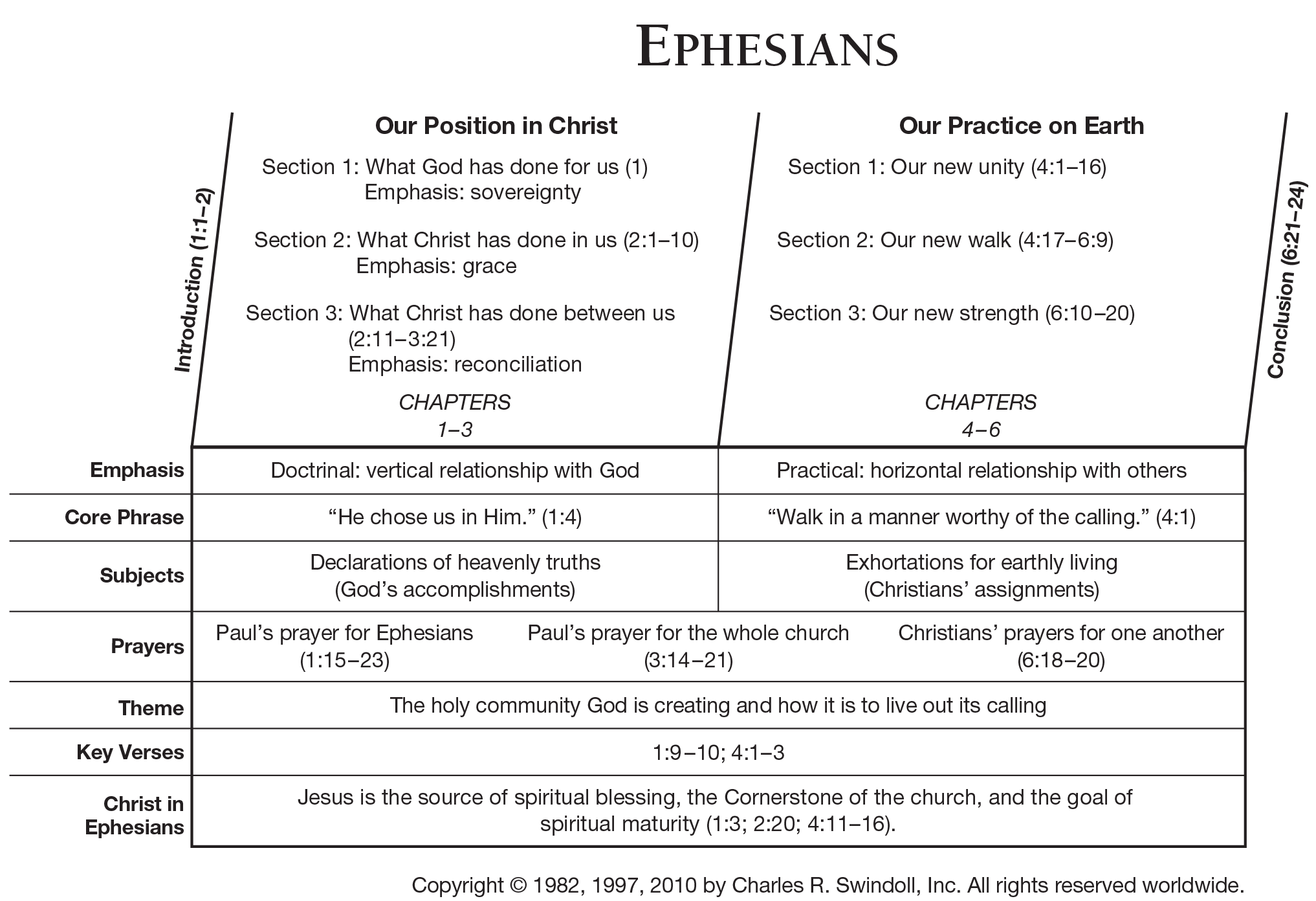
EPHESIANS - CHRIST AND THE CHURCH
Click chart to enlarge
Charts from Jensen's Survey of the NT - used by permission
Click chart by Charles Swindoll -Note "EMPHASIS" --
Ephesians 1-3 = Doctrinal: vertical relationship with God
Ephesians 4-6 = Practical: horizontal relationship with others
Ephesians 4:4 There is one body and one Spirit, just as also you were called in one hope of your calling; (NASB: Lockman)
Greek: en soma kai en pneuma, kathos kai eklethete (2SPAI) en mia elpidi tes kleseos humon
BGT Ἓν σῶμα καὶ ἓν πνεῦμα, καθὼς καὶ ἐκλήθητε ἐν μιᾷ ἐλπίδι τῆς κλήσεως ὑμῶν·
Amplified: [There is] one body and one Spirit—just as there is also one hope [that belongs] to the calling you received— (Amplified Bible - Lockman)
NLT: We are all one body, we have the same Spirit, and we have all been called to the same glorious future. (NLT - Tyndale House)
NLT (revised) For there is one body and one Spirit, just as you have been called to one glorious hope for the future.
Phillips: You all belong to one body, of which there is one Spirit, just as you all experienced one calling to one hope. (Phillips: Touchstone)
Wuest: There is one Body and one Spirit, even as also you were called in one hope of your calling,
Young's Literal: There is but one body and but one Spirit, as also when you were called you had one and the same hope held out to you.
KJV There is one body, and one Spirit, even as ye are called in one hope of your calling;
ESV There is one body and one Spirit-- just as you were called to the one hope that belongs to your call--
NET There is one body and one Spirit, just as you too were called to the one hope of your calling,
NIV There is one body and one Spirit--just as you were called to one hope when you were called--
CSB There is one body and one Spirit-- just as you were called to one hope at your calling--
NKJ There is one body and one Spirit, just as you were called in one hope of your calling;
NRS There is one body and one Spirit, just as you were called to the one hope of your calling,
NAB one body and one Spirit, as you were also called to the one hope of your call;
NJB There is one Body, one Spirit, just as one hope is the goal of your calling by God.
GWN There is one body and one Spirit. In the same way you were called to share one hope.
BBE There is one body and one Spirit, even as you have been marked out by God in the one hope of his purpose for you;
[THERE IS] ONE BODY AND ONE SPIRIT: en soma kai en pneuma:
- There is one body Eph 2:16; 5:30; Romans 12:4,5; 1Corinthians 10:17; 12:12,13,20; Colossians 3:15
- and one Spirit, Eph 2:18,22; Mt 28:19; 1Co 12:4-11; 2Co 11:4
- Ephesians 4 Resources - Multiple Sermons and Commentaries
- Ephesians 4:4-6 The Basis for Christian Unity - Steven Cole
- Ephesians 4:3-6: Preserving the Unity of the Spirit -1 - Wayne Barber
- Ephesians 4:2-6: The Lowly Walk-6- John MacArthur
There is one body and one Spirit, just as also you were called in one hope of your calling;
Although Paul is calling for unity, it is important to note that he is not speaking of unity at any price in which the fundamental truths of the gospel are jettisoned. If we are to preserve the unity of the Spirit in the bond of peace we need to know and hold to the truths unite us as a body. Then instead of focusing on the differences ("majoring on the minors" so to speak), we can concentrate on the positive doctrinal truths which form the foundation of Christian unity. And so Paul proceeds to list seven elements that unite believers in the one body of Christ. When we are tempted to break unity, we need to remember these unifying truths.
To dwell above with saints we love,
O that will be glory
But to dwell below with saints we know,
Well, that's another story.
Hodge - Having urged the duty of preserving unity, the apostle proceeds to state both its nature and grounds. It is a unity which arises from the fact — there is and can be but one body, one Spirit, one hope, one Lord, one faith, one baptism, and one God. (Ephesians 4 Commentary)
Eadie sums it up writing "All these elements of oneness enumerated in verses 4, 5, and 6, are really inducements for Christians to be forward to preserve the unity of the Spirit in the bond of peace. It is plainly of the one holy catholic church that the apostle has been speaking (Ephesians 4 Commentary)
There is - these words are added by the translators. Literally it reads "one body and one Spirit..."
One - the repetition brings out the emphasis on unity.
Spurgeon - If there were two lords, you might be divided into two parties; if there were two faiths, you might split up into two sections; if there were two baptisms, you might be right in having two denominations; if there were two fathers, there might be two families; if there were two indwelling spirits, there would be, and there must be, two sorts of people; but, in the true Church of Jesus Christ, there is “one God and Father of all, who is above all, and through all, and in you all.”
One (1520) (heis) describes that which is united as one in contrast to that which is divided or consisting of separate parts. Beginning with the first believers at Pentecost in Acts 2 and continuing through to the last believers preceding the Rapture of the Church, there is only one body of true believers, with no class, racial, cultural, national or language differences.
One body - The church is one. Every sincere Christian is a brother or sister in that church, and has an equal right with all others to its privileges. Being one by the design of the Saviour, they should be one in feeling. Every Christian, no matter what their "rank", should be ready to hail every other Christian as a fellow-heir of heaven.
Barclay - There is one body. Christ is the head and the Church is the body. No brain can work through a body which is split into fragments. Unless there is a coordinated oneness in the body, the designs of the head are frustrated. The oneness of the Church is essential for the work of Christ. That does not need to be a mechanical oneness of administration and of human organization; but it does need to be a oneness founded on a common love of Christ and of every part for the other. ( William Barclay's Daily Study Bible)
Hodge - This is not an exhortation, but a declaration. The meaning is not, Let us be united in one body, or in soul and body; but, as the context requires, it is a simple declaration. There is, one body, viz. one mystical body of Christ. All believers are in Christ; they are all his members; they constitute not many, much less conflicting bodies, but one. "We, being many, are one body in Christ, and every one members one of another." Romans 12:5; 1Corinthians 10:17; 1Corinthians 12:27. In Ephesians 1:23, the church is said "to be his body, the fullness of him that filleth all in all." As all true believers are members of this body, and as all are not included in any one external organization, it is obvious that the one body of which the apostle speaks, is not one outward visible society, but a spiritual body of which Christ is the head and all the renewed are members. The relation, therefore, in which believers stand to each other, is that which subsists between the several members of the human body. A want of sympathy is evidence of want of membership. (Ephesians 4 Commentary)
Regarding the metaphor of one body Boice comments that "Comparing the church to a body is particularly appropriate in this passage, however, for a body is something that works together, even though it is composed of many diverse parts. Moreover, its unity is organic. That is, it is achieved not by joining a number of diverse parts or pieces in the way one would make a machine, but by growth. The church is not a diesel engine or a watch or an airplane. It is a body. It grows by the multiplication of cells. (Boice, J. M.: Ephesians: An Expositional Commentary)
Body (4983) (soma) describes an organized whole made up of parts and members. Here Paul describes the invisible Church, the mystical body of Christ.
Ephesians 1:22 And He put all things in subjection under His feet, and gave Him as head over all things to the church, 1:23 which is His body, the fulness of Him who fills all in all.
Ephesians 2:14 For He Himself is our peace, who made both groups into one, and broke down the barrier of the dividing wall, 2:15 by abolishing in His flesh the enmity, which is the Law of commandments contained in ordinances, that in Himself He might make the two into one new man, thus establishing peace, 2:16 and might reconcile them both in one body to God through the cross, by it having put to death the enmity.
Ephesians 3:6 the Gentiles are fellow heirs and fellow members of the body, and fellow partakers of the promise in Christ Jesus through the gospel
John Eadie explains one body writing that "There are not two rival communities. The body with its many members, and complex array of organs of very different position, functions, and honor, is yet one. The church, no matter where it is situated, or in what age of the world it exists—no matter of what race, blood, or colour are its members, or how various the tongues in which its services are presented—is one, and remains so, unaffected by distance or time, or physical, intellectual, and social distinctions. And as in the body there is only one spirit, one living principle—no double consciousness, no dualism of intelligence, motive, and action—so the one Spirit of God dwells in the one church, and there are therefore neither rivalry of administration nor conflicting claims. And whatever the gifts and graces conferred, whatever variety of aspect they may assume, all possess a delicate self-adaptation to times and circumstances, for they are all from the “one Spirit,” having oneness of origin, design, and result. (Ephesians 4 Commentary)
Ruth Paxson writes...
Having charged us with the sacred responsibility of keeping the unity of the Spirit, the Lord now tells how to do it. The Sevenfold Unity to be Kept - Ep 4:4-6. "There is one body, and one Spirit, ... one hope of your calling; One Lord, one faith, one baptism; One God and Father of all who is above all, and through all, and in you all."
The Lord Jesus prayed for visible oneness in the Church before the world (Jn 17:20). Ephesians 4:4-6 interprets for us the meaning of His prayer. Our Lord never asked for a man-made union of organized churches into a grand federation, but He prayed for a Spirit-made, Christ centered, God-controlled unity in the living organism, the Body of Christ.
One Spirit -- One Lord -- One God
It was to be oneness of fellowship through oneness of faith; an inward unity expressing itself in outward harmony.
One Body - Note that it does not say "one Church." Were that so then each of the three great divisions into which Christendom is divided would claim that distinction. It is even conceivable that some denomination or sect, of which there are hundreds, would make this unique claim. Neither does it say there is one federation of all organized churches forming, as it were, a "Christianized world trust."
"There is one body," which Ephesians teaches is eternal in calling, heavenly in conception, divine in creation, and supernatural in constitution. The living members of this Body have been called out of every kindred, tongue, people and nation. They differ in nationality, color, language, education, training, ability, temperament, and outlook. Through the human blood running in their veins they have inherited dislikes, prejudices and animosities that separate them as far as the east is from the west. But through the blood of the Saviour and the baptism of the Spirit they are united to Christ as living members of His Body.
Eph 5:30+. "For we are members of his body, of his flesh and of his bones." Being organically united with Christ, the Head, each member is then made one with every other member of the Body. The oneness is so complete that we are literally a part of the life of each other. United to the Head there is one mind, one heart, one spirit. (The Wealth, Walk and Warfare of the Christian. Page 89-90).
One Spirit (4151) (pneuma) in this context most observers agree refers to the Holy Spirit. The same Spirit has awakened all; enlightened all; convicted all; converted all.
See related study homothumadon/homothymadon which means One accord (3661) as this word distinctively characterizes the early church in the Acts of the Spirit. (Acts 1:14; 2:46; 4:24; 5:12, etc)
Stedman - That brings us to the next element, one Spirit. Here is the great, eternal, invisible Person who is the power behind the Christian church. The strength of the church never comes from its numbers. This is the mistaken concept that many Christians have today. They think we only influence society and bear impact upon the world as we can gather together enough Christians and thus swing enough votes to sway our legislatures. That is not where the power of the church lies, and it never has. The prophet Zechariah was once confronted with a great mountain which God said would become a plain. When Zechariah began to look around to see how this could happen, where the power would come from, what instruments would be provided to level that mountain and make it into a plain, the word of the Lord came to him, saying, "Not by might, nor by power, but by my Spirit, says the Lord of hosts," (Zechariah 4:6b RSV). It is the Spirit that is the true power of the church, and there is only one Spirit. He is the same everywhere no matter where the church exists -- in every place and in every age. That is why the truth remains unchangeable, the passing of time does not change it. That is why the church is not dependent on many or few, or on the wisdom of its membership. It depends on one thing, the one Spirit. (The Cry for Unity - Ephesians 4-1-6)
Hodge - This again does not mean one heart. It is not an exhortation to unanimity of feeling, or a declaration that such unanimity exists. Quasi diceret, nos penitus corpore et anima, non ex parte duntaxat, debere esse unitos. The context and the analogy of Scripture, as a comparison of parallel passages would evince, prove that by spirit is meant the Holy Spirit. As there is one body, so there is one Spirit, which is the life of that body and dwells in all its members. "By one Spirit," says the apostle, "are we all baptized into one body, whether we be Jews or Gentiles, whether we be bond or free; and have all been made to drink into one Spirit." 1 Corinthians 12:13. Of all believers, he says, "The Spirit of God dwelleth in you." 1 Corinthians 3:16; 1 Corinthians 6:19; Romans 8:9, Romans 8:11. There is no doctrine of Scripture more plainly revealed than that the Spirit of God dwells in all believers, and that his presence is the ultimate ground of their unity as the body of Christ. As the human body is one because pervaded by one soul; so the body of Christ is one because it is pervaded by one and the same Spirit, who dwelling in all is a common principle of life. All sins against unity, are, therefore, sins against the Holy Spirit (Ed: But this is NOT the unpardonable sin!). They dissever that which he binds together. Our relation to Christ as members of his body; and our relation to the Holy Spirit Who is our life (Jn 6:63), demands of us that we love our brethren and live at peace with them. (Ephesians 4 Commentary - Hodge's Commentary on Romans, Ephesians and First Corinthians) (Bolding added)
Every believer possesses the Holy Spirit, Paul explaining that "For by one Spirit we were all baptized into one body, whether Jews or Greeks, whether slaves or free, and we were all made to drink of one Spirit. (1Cor 12:13)
Every believer is indwelt individually by the Spirit "Or do you not know that your body is a temple of the Holy Spirit who is in you, whom you have from God, and that you are not your own? (1Cor 6:19)
Comment: Paul draws a sharp contrast which he readers would have readily discerned...the contrast is with the temple of Aphrodite in Corinth where the priestesses were prostitutes!
Similarly the corporate body is indwelt by the Spirit "Do you not know that you are a temple of God, and that the Spirit of God dwells in you? (1Cor 3:16)
Comment: Here the local church is viewed as a temple of God inhabited by the Spirit.
Paxson - On the day of Pentecost the Holy Spirit descended to form the Body of Christ. The hundred and twenty individual persons in the upper room were fitly joined together into one Body through the Spirit's baptism. This same Spirit took up His abode in the Church and in each Christian, and by His indwelling and inworking He maintains a visible, vital unity in the Body of Christ. "Every impulse of the Spirit is toward unity. He cannot suicidally lead against Himself." (The Wealth, Walk and Warfare of the Christian. Page 90).
JUST AS ALSO YOU WERE CALLED IN ONE HOPE OF YOUR CALLING: kathos kai eklethete (2SPAI) en mia elpidi tes kleseos humon:
- Eph 4:1; Ep1:18-note; Jeremiah 14:8 - "Thou Hope of Israel..."; Jer 17:7 - "Blessed is the man that trusteth in the LORD, and whose hope the LORD is."; Acts 15:11; Colossians 1:5-note - "because of the hope laid up for you in heaven, of which you previously heard in the word of truth, the gospel,"; 2Th 2:16 - "Now may our Lord Jesus Christ Himself and God our Father, who has loved us and given us eternal comfort and good hope by grace"; 1Ti 1:1; Titus 1:2 (note) - "in the hope of eternal life, which God, who cannot lie, promised long ages ago"; Titus 2:13-note (note on the "blessed hope"); Titus 3:7(note) - "that being justified by His grace we might be made heirs according to the hope of eternal life."; He 6:18, 19 (notes) - "18 in order that by two unchangeable things, in which it is impossible for God to lie, we may have strong encouragement, we who have fled for refuge in laying hold of the hope set before us. 19 This hope we have as an anchor of the soul, a hope both sure and steadfast and one which enters within the veil"; 1Pe 1:3-note 1Pe 1:4-note; 1Pe 1:13-note ; 1Jn 3:3
- Ephesians 4 Resources - Multiple Sermons and Commentaries
- Ephesians 4:4-6 The Basis for Christian Unity - Steven Cole
- Ephesians 4:3-6: Preserving the Unity of the Spirit -1 - Wayne Barber
- Ephesians 4:2-6: The Lowly Walk-6- John MacArthur
Just as (2531) (kathos) introduces illustrative proof of the statement just made.
Called (2564) (kaleo) means to speak to another in order to bring them nearer, either physically or in a personal relationship. The Gentile believers were supernaturally called into the kingdom of God and its requisite duties, privileges, and bliss in this world and the world to come.
One hope of your calling - This would include all the saints will experience at the Return of the Lord Jesus and forever thereafter - to be with Christ, to be like Christ, to be joint heirs with Christ, to be free of the presence and pleasure of sin.
Barnes - Christians have the same hope, and they should therefore be one. They are looking forward to the same heaven; they hope for the same happiness beyond the grave. It is not as on earth among the people of the world, where there is a variety of hopes--where one hopes for pleasure, and another for honour, and another for gain; but there is the prospect of the same inexhaustible joy. This hope is fitted to promote union. There is no rivalry--for there is enough for all. Hope on earth does not always produce union and harmony. Two men hope to obtain the same office; two students hope to obtain the same honour in college; two rivals hope to obtain the same hand in marriage--and the consequence is jealousy, contention, and strife. The reason is, that but one can obtain the object. Not so with the crown of life--with the rewards of heaven. All may obtain that crown; all may share those rewards. How can Christians contend in an angry manner with each other, when the hope of dwelling in the same heaven swells their bosoms and animates their hearts? (Albert Barnes. Barnes NT Commentary)
Hope (1680) (elpis) in Scripture is not the world's definition of "I hope so", with a few rare exceptions (e.g., Acts 27:20.) Hope is defined as a desire for some future good with the expectation of obtaining it. Hope is confident expectancy. Hope is the looking forward to something with some reason for confidence respecting fulfillment.
Earlier Paul had prayed for enlightenment, that the saints would know (beyond a shadow of a doubt type of knowledge - When the Holy Spirit opens the eyes of the heart, one will be able to see all these great truths) what their possessions were, specifically praying...
that the eyes of your heart may be enlightened, so that you will know what is the hope of His calling, what are the riches of the glory of His inheritance in the saints (Eph 1:18+)
Paul reminded the Gentile believers that now in Christ they were "called in one hope of your calling". The fact that Paul qualifies this "hope" as "one hope" emphasizes that there is the same ultimate, glorious reality for all of the church, whether Jew or Gentile! Paul wants to make certain that both Jewish and Gentile believers fully understand that there is no differentiation between Christians. One of God's great attributes is Impartiality. This expectation of seeing Jesus, our "Blessed Hope" [see below] and being like Him is entertained equally by both groups. All members of the true church are called to the one destiny of being taken out of this world, being like Christ [1 John 3:2], and sharing His glory forever. )
Eadie - The hope is one for it has one object, and that is glory; one foundation, and that is Christ. Their call had brought them into the possession of this hope. (Ephesians 4 Commentary)
Peter encouraged the suffering saints reminding them that they had a steadfast hope, writing
Blessed be the God and Father of our Lord Jesus Christ, who according to His great mercy has caused us to be born again to a living hope (the link between our present and our future - living because of the resurrection of Christ Who ultimately is our "Hope" as Paul states in 1Timothy 1:1 "Christ Jesus, our hope") through the resurrection of Jesus Christ from the dead (Comment: Our "living hope" guarantees our inheritance - see notes 1 Peter 1:4- , our protection until the revelation of our the final aspect of our salvation - glorification - when Christ returns "in the last time") (See note 1 Peter 1:3)
"Therefore (on the basis of the salvation and the "living hope" believers presently possess) gird your minds for action, keep sober in spirit, fix your hope (elpizo - verb form of elpis - this is a command to do this now, do it effectively - aorist imperative) completely on the grace to be brought to you at the revelation of Jesus Christ." (See note 1 Peter 1:13)
In 1Timothy 1:1 we read "Paul, an apostle of Christ Jesus according to the commandment of God our Savior, and of Christ Jesus, our Hope
Paul states that our hope is not a plan, not a program, not even a promise, but ultimately is a Person, the Lord Jesus Christ. One of the most significant aspects of this "hope" is the absolute certainty that He is returning to take us home where we will spend eternity with Him in complete perfection, free from sin and shame and sadness! And so our Lord promised His disciples "If I go and prepare a place for you, I will come again, and receive you to Myself; that where I am, there you may be also." (John 14:3)
The hope of our calling is the absolute certainty of our heavenly destiny and includes all that awaits the saints at the return of the Lord Jesus and is what Paul referred to by the phrase the "Blessed hope" writing in Titus that...
the grace of God has appeared (reference to Christ's incarnation), bringing salvation to all men, instructing (child rearing) us to deny ungodliness and worldly desires and to live sensibly, righteously and godly in the present age, looking for the blessed hope (which is the appearing) and the appearing of the glory of our great God and Savior, Christ Jesus; Who gave Himself for us, that He might redeem us from every lawless deed and purify for Himself a people for His own possession, zealous for good deeds. (See notes Titus 2:11; 2:12; 2:13; 2:14)
In another passage that speaks of a hope which should have a unifying effect on all believers, no matter what their denomination, we read...
Beloved, now we are children of God (we are all in God's family, one body, the church), and it has not appeared as yet what we shall be. We know that, when He appears (not if He appears, but when = certainty which is the essence of the meaning of the word hope), we shall be like Him, (this describes the future and final aspect of our redemption, of which the Spirit now serves as a pledge, see note Ephesians 1:14) because we shall see Him just as He is. And everyone who has this hope fixed on Him purifies himself, just as He is pure. (1John 3:2-3)
Hope as the world typically defines it is a desire for some future occurrence of which one is not assured of attaining. The ancient world did not generally regard hope as a virtue, but merely as a temporary illusion. Historians tell us that a great cloud of hopelessness covered the ancient world. Philosophies were empty. Traditions were disappearing. Religions derived man's warped imagination were powerless to help men face either life or death. People longed to pierce the veil and get some message of hope from the other side, a message ultimately found only in the Cross of Christ.
Believers also have the hope of perfect unity in the future Paul explaining that Jew and Gentile in one body now was
with a view to an administration suitable to the fulness of the times, that is, the summing up of all things in Christ, things in the heavens and things upon the earth. (See notes Ephesians 1:10) (Comment: When God heads up everything in Christ, one glorious result will be to bring everything into perfect harmony and the church into perfect unity! What a blessed hope we have as believers!)
Paxson adds that...
The hope of the saint is to be with and to be like his Lord. While he praises God for the progressive sanctification which goes on day by day on earth, every truly earnest Christian longs for that day when the partial will give way to the perfect and redemption will be consummated in glorification. The one hope that in these days unifies the Lord's own as perhaps no other is the blessed hope of His soon return to take them unto Himself. (Ibid, Page 90-91)
Calling (2821) (klesis from kaléo = to call) (Click for more in depth discussion of calling - klesis) (Click for analysis of related word kletos, and a discussion of who are "the called") means a call and was used for an invitation to a banquet. In the NT the metaphorical meaning is that of an invitation by God to come into His Kingdom with all the privileges of a Kingdom citizen...and with all the responsibilities of such a citizen! It's an invitation to come to something special. In the New Testament it's a special invitation from God to man to accept the benefits of His salvation.
What is involved in the calling of the Christian? Your calling involves everything that God has done, is doing, and wants to do one day regarding your salvation. Paul is simply saying, "I just told you about your calling. I just told you about what God has done for you. Now I want you to understand it deeply, deeply in your heart. It involves not only the joy of being blessed with every spiritual blessing. It involves not only the joy of being chosen by Christ before the foundation of the world. It involves being redeemed by His blood. It involves being adopted as His Son. It involves being sealed in Him with His Spirit, but it also involves the hope of His returning, and everything that is to come after He returns for His church." That is the full payment of which we have the earnest right now."
In the present context calling (klesis) refers to those who have been summoned by God (the following phrases are meant to be read as one long sentence which gives a Biblical statement regarding calling)...
"according to His purpose" (Ro 8:28-note) to salvation (Ro 8:30-note),
"saints by calling" (1Cor 1:2),
"both Jews and Greeks" (1Cor 1:24),
having been called "with a holy" (2Ti 1:9-note),
"heavenly calling" (Heb 3:1-note)
"out of darkness into His marvelous light" (1Pe 2:9-note)
"by grace" (Gal 1:6)
"not from among Jews only, but also from among Gentiles" (Ro 9:24-note)
through the "gospel" that we "may gain the glory of our Lord Jesus Christ" (2Th 2:14)
and be brought "into fellowship with His Son, Jesus Christ our Lord" (1Cor 1:9)
and return in triumph "with Him" at the end of this age (Re 17:14-note).
God's great doctrine of our calling should cause all the "called of Jesus Christ" to exclaim "Glory!" ...and to earnestly desire to walk worthy of the calling to which they have been called, motivated by the "hope of His calling".
The hope of His calling points to the certain eternal destiny and future glory of the saints. Click for additional discussion on some of the aspects of the hope of this calling. See related in depth study of the Believer's Blessed Hope.
The better we truly know the "hope of His calling", the more we will be motivated to "walk in a manner worthy of the calling to which you have been called".
It is truth too magnificent for words to describe which is why even God’s own revelation requires illumination of His Spirit in order for believers to begin to understand the magnitude of the blessings of salvation that exist for saints.
Jon Courson writes that...
Throughout Scripture, the word “hope” always refers to that which is coming, to that which is ahead. I’m convinced the single greatest problem carnal Christians have is that they don’t know the hope of His calling. They don’t know the reality of heaven. Consequently, they constantly strive for material things and are continually caught up in carnal pursuits. They’re depressed and discouraged because they don’t see the big picture of eternity. (Courson, J. Jon Courson's Application Commentary. Nashville, TN: Thomas Nelson)
Louw Nida defines klesis as an
"urgent invitation to someone to accept responsibilities for a particular task, implying a new relationship to the one who does the calling; the station in life or social role which one has." Vines defines klesis as "a calling, is always used in NT of that calling the origin, nature and destiny of which are heavenly (the idea of invitation being implied); it is used esp of God's invitation to man to accept the benefits of salvation." (Louw, J. P., & Nida, E. A. Greek-English Lexicon of the New Testament: Based on Semantic Domains. United Bible societies)
Paul does not want these believers to be like Chief Crowfoot. As the story goes Crowfoot, the chief of the Blackfoot nation in southern Alberta, gave the Canadian Pacific Railway permission to lay track from Medicine Hat to Calgary, he was given in exchange a lifetime railroad pass. Reportedly, Crowfoot put the pass in a leather pouch and wore it around his neck for the rest of his life—but he never once availed himself of the rights and privileges it spelled out. What a tragedy when believers do the same thing with the riches they possess in Christ, failing to really possess their possessions!
Andrew Murray in Living to Please God (Chapter 12 - Working Together in Christ)...
In the last chapter, our subject was maintaining the unity of the Spirit in our relationships with fellow-Christians. Here our subject is the Spirit of unity. The Holy Spirit is the source and the power in which believers, as members of one Body in Christ Jesus, are to minister to each other to build up the Body of Christ.
The knowledge of what the Body of Christ means, the insight into its glory and its purpose, and the fulfilling of the place and ministry to which God has called us in the Body, have a deep connection with spiritual life. To receive the Spirit and the love of Christ means death to every vestige of selfishness. We must surrender our life and love entirely to Christ and His Body. The welfare of every member becomes the supreme object of our desire. Let us try to realize what this Body is in which the blessed Spirit of God seeks to manifest Himself.
Masterpiece Under Construction
We know what a masterpiece of divine workmanship a human body is. Made of dust, it is the instrument through which spiritual life can unfold and express itself. Our human bodies are a parable of the Body of believers with Christ as the Head. God "gave him (Christ) to be the head over all things to the church, Which is his body, the fullness of him that filleth all in all" (Ephesians 1:22, 23-note). The Body is to contain and exhibit the divine fullness as it dwells in Christ. "All the building fitly framed together groweth unto an holy temple in the Lord: In whom ye also are builded together for an habitation of God through the Spirit" (Ephesians 2:21, 22-note).
We are reminded that "Christ also loved the church, and gave himself for it .... That he might present it to himself a glorious church, not having spot, or wrinkle, or any such thing" (Ephesians 5:25, 26, 27-note).
An intimate union exists between our body and its head. The power of the head to move and use every member and the readiness of every member to yield itself to assist its fellow-members is only a shadow of that mysterious power which links every believer to Christ. This power places the believer at the disposal of his fellow-believers.
The Body of Christ is the highest revelation of the glory of God. He manifested His power to make a creature of the dust, who had fallen under the power of sin and Satan, become the partaker of the holiness of the blessed Son. The Holy Spirit presides over this work today as He encourages each believer to carry out the eternal purpose--that they all should be one, even as the Father is one with the Son. When the Church yields herself to His divine working, the power of the Holy Spirit can be expected to work unhindered in the Church and in the individual members.
United In Ministry
When He ascended on high, Christ gave His Church the gifts of apostles, prophets, evangelists, pastors, and teachers, "for the perfecting of the saints, for the work of the ministry, for the edifying of the body of Christ" (Ep 4:12-note). The apostles and prophets and pastors are not called to build up the Body of Christ. Their work is the perfecting of the saints for the ministry of building up. Every saint is to be trained to take part in building up the Body of Christ. Just as every member of your body helps to build the whole, every believer should know his place and work in the Body of Christ in caring for every other member.
Each one of us needs the other. Each one is to feel linked to the whole Body in the love of the Spirit. A Christian should not only avoid doing anything that is selfish or unloving, but actively yield himself to the Spirit to be the instructor and the comforter of all who are weak.
Then it follows--"Till we all come in the unity of the faith...unto a perfect man, unto the measure of the stature of the fullness of Christ" (Ephesians 4:13-note). Nothing less than maturity is to be the aim of each believer, not only for himself, but for all around him. Then the Body may experience the fullness of Him who fills all in all. We can "grow up into him in all things, which is the head, even Christ: From whom the whole body fitly joined together...according to the effectual working in the measure of every part, maketh increase of the body unto the edifying of itself in love" (Ephesians 4:15, 16-note).
The significance of all this in our spiritual life is clear. As long as our prayers only aim at our own perfection and happiness, they defeat themselves. Selfishness prevents the answer. Only in the union with the whole Body will each member be healthy and strong. Building up the Body of Christ in love is vital to our spiritual health.
Let intercession, "with all prayers and supplication in the Spirit...for all saints" (Ep 6:18-note), be the proof that the Spirit of unity dwells and prays in us. Let us love the brethren fervently with a pure heart. In our home life, in prayer meetings, and in all our fellowship with God's children, let our love watch over and encourage them. Always remember that we and they are indispensable to each other.
Let the Spirit of unity inspire our secret devotions. Grace will be given to live in unceasing devotion to Christ to build up His glorious Body in love.
Andrew Murray in his book the Spirit of Christ (Chapter on THE UNITY OF THE SPIRIT Eph. 4:1-4, 1 Cor. 12:4, 11, 13) writes...
WE know how, in the first three chapters of the Ephesians, Paul had set forth the glory of Christ Jesus as the Head of the Church, and the glory of God's grace in the Church as the Body of Christ, indwelt by the Holy Spirit, growing up into an habitation of God through the Spirit, and destined to be filled with all the fulness of God. Having thus lifted the believer to his true place in the heavenlies, with his life hid in Christ, he comes with him down to his life in the earthlies, and, in the second half of the Epistle, teaches how he is to walk worthy of his calling. And the very first lesson he has to give in regard to this life and walk on earth (Eph. 4:1-4) rests on the foundation-truth that the Holy Spirit has united him not only to Christ in heaven, but to Christ's body on earth. The Spirit dwells not only in Christ in heaven and in the believer on earth, but very specially in Christ's body, with all its members; and the full, healthy action of the Spirit can only be found where the right relation exists between the individual and the whole body, as far as he knows or comes into contact with it. His first care in his holy walk must be, therefore, to give diligence that the unity of the Spirit be maintained intact. Where this unity of the one Spirit and one body is fully acknowledged, the cardinal virtue of the Christian life will be lowliness and meekness (Eph. 4:2-3), in which each would forget and give up self for others; amid all differences and shortcomings, all would forbear one another in love. So the new commandment would be kept, and the Spirit of Christ, the Spirit of Love sacrificing itself wholly for others, would have free scope to do His blessed work.
The need of such teaching the first Epistle to the Corinthians remarkably illustrates. In that Church there were abundant operations of the workings of the Holy Spirit. The gifts of the Spirit were strikingly manifested, but the graces of the Spirit were remarkably absent. They understood not how there are diversities of gifts, but the same Spirit; how, amid all difference, one and the same Spirit divides to each severally as He will; how all had been baptized in one Spirit into one body, and all made to drink of one Spirit. They knew not the more excellent way, and that the chief of all the gifts of the Spirit is the Love that seeketh not its own, and only finds its life and its happiness in others.
To each believer who would fully yield himself to the leading of the Spirit, as well as to the Church as a whole, in its longings for the experience in power of all that the indwelling of the Spirit implies, the unity of the Spirit is a truth fraught with rich spiritual blessing. In previous writings I have more than once made use of the expression of Pastor Stockmaier: 'Have a deep reverence for the work of the Holy Spirit within thee.' That injunction needs as its complement a second one: Have a deep reverence for the work of the Holy Spirit in thy brother. This is no easy thing: even Christians, in other respects advanced, often fail here. The cause is not difficult to discover. In our books on education we are taught that the faculty of Discrimination, the observing of differences, is one of the earliest to be developed in children. The power of Combination, or the observing of the harmony that exists amid apparent diversity, is a higher one, and comes later; as the power of Classification, in its highest action, it is only found in true genius. The lesson finds most striking exemplification in the Christian life and Church. it needs but little grace to know where we differ from, other Christians or churches, to contend for our views, or to judge their errors in doctrine or conduct. But this indeed is grace, where, amid conduct that tries or grieves us, or teaching that appears to us unscriptural or hurtful, we always give the unity of the Spirit the first place, and have faith in the power of love to maintain the living union amid outward separation.
Keep the unity of the Spirit: such is God's command to every believer. it is the New Commandment, to love one another, in a new shape, tracing the love to the Spirit in which it has its life. If you would obey the command, note carefully that it is the unity of the Spirit. There is a unity of creed or custom, of church or choice, in which the bond is more of the flesh than of the Spirit. Would you keep the unity of the Spirit, remember the following things.
Seek to know that in thyself in which the unity is to find its power of attachment and of victory. There is much in thee that is of self and of the flesh, and that can take part in a unity that is of this earth, but that will greatly hinder the unity of the Spirit. Confess that it is in no power or love of thine own that thou canst love; all that is of thyself is selfish, and reaches not to the true unity of the Spirit. Be very humble in the thought that it is only what is of God in thee that can ever unite with what appears displeasing to thyself. Be very joyful in the thought that there is indeed that in thee which can conquer self, and love even what seems unloving.
Study also to know and prize highly that in thy brother with which thou art to be united. As in thyself, so there is in him, but a little beginning, a hidden seed of the Divine life, surrounded by much that is yet °carnal, and often is very trying and displeasing. it needs a heart very humble in the knowledge of how unworthy thou thyself art, and very loving in the readiness to excuse thy brother, for so did Jesus in the last night: ' the spirit indeed is willing, but the flesh is weak,'--to look persistently at what there is in the brother of the image and Spirit of the Father. Estimate him not by what he is in himself, but by what he is in Christ, and as thou feelest how the same life and Spirit, which thou owest to free grace, is in him too, the unity of the Spirit will triumph over the difference and dislike of the flesh. The Spirit in thee, acknowledging and meeting the Spirit in thy brother, will bind thee in the unity of a life that is from above.
Keep this unity of the Spirit in the active exercise of fellowship. The bond between the members of my body is most living and real, maintained by the circulation of the blood and the life it carries. 'In one Spirit we were all baptized into one body.' ' There is one body and one Spirit.' The inner union of life must find expression and be strengthened in the manifested communion of love. Cultivate intercourse not only with those who are of one way of thinking and worshipping with thyself, lest the unity be more in the flesh than the Spirit. Study in all thy thoughts and judgments of other believers to exercise the love that thinketh no evil. Never say an unkind word of a child of God, as little as of others. Love every believer, not for the sake of what in him is in sympathy with thee or pleasing to thee, but for the sake of the Spirit of the Father which there is in him. Give thyself expressly and of set purpose to love and labour for God's children within thy reach, who through ignorance, or feebleness, or waywardness, know not that they have the Spirit, or are grieving Him. The work of the Spirit is to build up an habitation for God; yield thyself to the Spirit in thee to do the work. Recognise thy dependence upon the fellowship of the Spirit in thy brother, and his dependence upon thee, and seek thy growth and his in the unity of love.
Take thy part in the united intercession that rises up to God for the unity of His Church. Take up and continue the intercession of the Great High Priest for all who believe, 'that they may be one.' The Church is one in the life of Christ and the love of the Spirit. it is, alas! not one in the manifested unity of the Spirit. Hence the need of the command: Keep the unity. Plead with God for the mighty workings of His Spirit in all lands and churches and circles of believers. When the tide is low, each little pool along the shore with its inhabitants is separated from the other by a rocky barrier. As the tide rises, the barriers are flooded over, and all meet in one great ocean. So it will be with the Church of Christ. As the Spirit of God comes, according to the promise, as floods upon the dry ground,' each will know the power in himself and in others, and self disappear as the Spirit is known and honoured.
And how is this wondrous change to be brought about, and the time hastened that the prayer be fulfilled, ' that they all may be one, that the world may know that Thou hast sent me, and hast loved them as Thou hast loved me'? Let each of us begin with himself. Resolve even now, beloved child of God, that this shall be the one mark of your life, the proof of your sonship, the having and knowing the Indwelling Spirit. If you are to unite, not with what pleases you, or is in harmony with your way of thinking and acting, but with what the Spirit in you sees and seeks in others, you must have given yourself entirely up to His way of thinking and acting. And if you are to do this, He must have the mastery of your whole being. You need to abide in the living and never-ceasing consciousness that He dwelleth within you. You need to pray unceasingly that the Father may grant you, according to the riches of His glory, to be strengthened with might by His Spirit in the inner man. it is in the faith of the Triune God, the Father giving the Spirit in the name of the Son, and the Spirit dwelling within you; it is in this faith brought into adoring exercise at the footstool of God's throne; it is in direct contact and fellowship with the Father and the Son, that the Spirit will take full possession, and pervade your entire being. The fuller His indwelling and the mightier His working is, the more truly spiritual your being becomes, the more will self sink away, and the Spirit of Christ use you in building up and binding together believers into an habitation of God,, Christ's Spirit will be in you the holy anointing, the oil of consecration, to set you apart and fit you to be, as Christ was, a messenger of the Father's love. In the humility and gentleness of daily life, in the kindliness and forbearance of love amid all the differences and difficulties in the Church, in the warm-hearted sympathy and self-sacrifice that goes out to find and help all who need help, the Spirit in you will prove that He belongs to all the members of the body as much as to you, and that through you His love reaches out to all around to teach and to bless.
Blessed Lord Jesus! in Thy last night on earth Thy one prayer for Thy disciples was, ' Holy Father, keep them, that they may be one.' Thy one desire was to see them a united flock, all gathered and kept together in the One Almighty Hand of Love. Lord Jesus! now Thou art on the Throne, we come to Thee with the same plea: Oh, keep us, that we may be one! pray for us, Thou Great High Priest, that we may be made perfect in one, that the world may know that the Father hath loved us, as He loved Thee.
Blessed Lord! we thank Thee for the tokens that Thou art wakening in Thy Church the desire for the manifestation to the world of the unity of Thy people. Grant, we pray Thee, to this end the mighty workings of Thy Holy Spirit. May every believer know the Spirit that is in him, and that is in his brother, and in all lowliness and love keep the unity of the Spirit with those with whom he comes into contact. May all the leaders and guides of Thy Church be enlightened, from above, that the unity of the Spirit may be more to them than all human bonds of union in creed or church order. May all who have put on the Lord Jesus above all things put on love, the bond of perfectness.
Lord Jesus! we do beseech Thee, draw Thy people in united prayer to the footstool of Thy Throne of Glory, whence Thou givest Thy Spirit to reveal Thy presence to each as present in all. Oh, fill us with Thy Spirit, and we shall be one! one Spirit and one Body. Amen.
1. The health of every member, and even every particle, of my body depends upon the health of the surrounding portion. Either the healing power of the sound part must expel what is unhealthy, or this will communicate its disease. I am more dependent upon my brother than I know. He is more dependent on me than I know. The Spirit I have is the Spirit of Christ dwelling in my brother too: all I receive is meant for him too. To keep the unity of the Spirit in active exercise, to live in loving fellowship with believers around me, is life in the Spirit.
2. "That they may be made perfect in one," They approach perfection as they approach unity. Perfection is impossible in a state of separation. My life is not wholly given to me, but a part of it is given to my brother, to be available to me when I abide in him.'--BOWEN.
3. It has taken thee time and prayer and faith to know the Spirit of God within thee; it will take time and prayer and faith, and much love, to know fully the Spirit of God in thy brother.
4. 'It is only in the unity of the body that the Spirit of God can fully and mightily display His power, either in the Church or to the world. God speaks to companies of men as He never speaks to solitary watchers or students; there is a fuller tone, an intenser fervour, in Pentecostal revelations than in personal communion, and, as we ourselves know, there is a keener joy in sympathy than can be realized even in the devoutest solitude.' --'The Paraclete,' p. 252.
Ephesians 4:5 one Lord, one faith, one baptism, (NASB: Lockman)
Greek: eis kurios, mia pistis, en baptisma
BGT εἷς κύριος, μία πίστις, ἓν βάπτισμα,
Amplified: [There is] one Lord, one faith, one baptism, (Amplified Bible - Lockman)
NLT: There is only one Lord, one faith, one baptism, (NLT - Tyndale House)
NLT (revised) There is one Lord, one faith, one baptism,
Phillips: There is one Lord, one faith, one baptism, (Phillips: Touchstone)
Wuest: one Lord, one Faith, one placing into [the Body of Christ by the Holy Spirit],
Young's Literal: There is but one Lord, one faith, one baptism,
KJV One Lord, one faith, one baptism,
ESV one Lord, one faith, one baptism,
NET one Lord, one faith, one baptism,
NIV one Lord, one faith, one baptism;
CSB one Lord, one faith, one baptism,
NKJ one Lord, one faith, one baptism;
NRS one Lord, one faith, one baptism,
NAB one Lord, one faith, one baptism;
NJB There is one Lord, one faith, one baptism,
GWN There is one Lord, one faith, one baptism,
BBE One Lord, one faith, one baptism,
ONE LORD: eis kurios:
- one Lord Acts 2:36; 10:36; Romans 14:8,9; 1Corinthians 1:2,13; 8:6; 12:5; Philippians 2:11; 3:8
one Lord, one faith, one baptism,
One Lord - Paul's point is that there ought to be unity among believers, because they all have one Lord. There is not a different Lord for the Jew and another for the Greek! He has the right to rule over one as much as over another.
Bishop Westcott wrote that
External visible unity is not required for the invisible unity of the church.
Westcott's point was that church will certainly differ in their opinions on many things, but these are the "non-essentials" (from a spiritual standpoint). On the other hand, the church is to be united on the foundational truth that there is one Lord, Jesus Christ, Who is Lord of all. When the church walks in the light of this truth, they will gladly surrender to the necessity of living for Him as their one Lord! As their hearts beat together in spiritual oneness, their fellowship of soul puts their common focus upon one Lord. When the world sees such great unity, it is impacted by the great grace flowing from and through such a diverse group of believers who compose one body, the church!
Barnes explains the power to promote unity in the recognition of one Lord writing
There is no better way of promoting unity among Christians than by reminding them that they have the same Saviour. And when jealousies and heart-burnings arise; or when they are disposed to contend about trifles; when they magnify un important matters until they are in danger of rending the church asunder, let them feel that they have one Lord and Saviour, and they will lay aside their contentions, and be one again. Let two men, who have never seen each other before, meet in a distant land, and feel that they have the same Redeemer, and their hearts will mingle into one. They are not aliens, but friends. A cord of sympathy is struck more tender than that which binds them to country or home; and though of different nations, complexions, or habits, they will feel that they are one. Why should contentions ever arise between those who have the same Redeemer? (Albert Barnes. Barnes NT Commentary)
One (1520) (heis) describes that which is united as one in contrast to that which is divided or consisting of separate parts.
Lord (2962) (kurios) describes one who has sovereign, uncontested power and absolute authority, the one who has absolute ownership. It is the one who is in charge by virtue of possession (owner).
There are over 6,000 uses of kurios in the Septuagint (LXX), the Greek version of the Old Testament, most being used to translate YHWH the Hebrew word for Jehovah. In the New Testament there are 717 references to kurios. Of the New Testament references to kurios, 275 occur in the writings of Paul. Luke used kurios 210 times in his Gospel and in Acts.
In the earliest Greek kurios meant "to have power or authority." Later it came to describe one who is in control. As classical Greek developed, it became a title for men of importance. Since the gods of ancient Greece were neither creators nor lords of their fate, pagan deities were not called "lord" until much later.
By the time of Christ, kings had come to be called "lord." This was true of the Roman Emperor Caligula (A.D. 37-41). It was also true of Candace, the fabled queen of upper Egypt (see Acts 8:27). So too Herod the Great, Herod Agrippa I, and Herod Agrippa II were called "lord."
Kurios is used to describe human relationships. Jesus described the relationship of slaves to their lords (Mt 10:24; 25:19). The Apostle Paul told slaves to obey their masters or lords as a sign of the slaves' faith in Christ (See notes Ephesians 6:5, 6:9; Colossians 3:22). The same relationship is discussed in Galatians 4:1.
Kurios in the present verse obviously refers to Christ. He is exalted because He is Lord (see note Philippians 2:11). Salvation is based on a confession of Christ as Lord (see notes Romans 10:9; 10:10). When Thomas saw the risen Jesus, he called Him both Lord and God (John 20:28).The Apostle Paul insisted that no one could call Jesus "Lord" unless the Holy Spirit gave that insight (1Cor. 12:3). This identity of Jesus Christ with the Spirit is most clearly seen in 2 Cor 3:17-18. The Apostle Paul often greeted the church in the name of the Lord (see notes Romans 1:7; 1Cor 1:3; 2Cor 1:3; Philippians 1:2). The source of strength to live the Christian life is "in the Lord," a concept seen most frequently in the Book of Philippians (Php 2:1, 19, 3:1, 9, 14, 4:4, 19- See notes Ph 2:1, 19; 3:1, 9, 3:14; 4:4, 19).
Paxson explains that...
"one Lord" is the centre of this sevenfold unity. It must be so. Everything centres in and around the Lord Jesus Christ. The eternal purpose of the Father and the mighty power of the Spirit are directed toward making the Lord a living reality within the Church and the Christian.
Note also that the central figure of Ephesians is not "the Jesus of history," but the Lord Jesus Christ. In the opening verses of the epistle we are shown how we are redeemed through His blood, but having crossed the threshold of salvation we are quickly led right into the throne room where the whole stage of the epistle is set. We are brought into the presence of the risen, ascended, exalted Lord upon whom throughout Ephesians our eyes are fixed and held.
It is "one Lord" and a solitary One who is in a class and on a plane all by Himself, as far above all other men and even angels as the heavens are above the earth. He is "Lord of lords, the Lord God Almighty." Note also that this "One Lord" is Head of the Church, which automatically excludes any other temporal head of the visible Body of Christ. To no man has the Lord ever delegated the headship over the Church. His headship, on the contrary, is mediated directly by the Holy Spirit whom the ascended Lord appointed. (Ibid. Page 91)
Augustine made a powerful statement regarding Jesus as Lord writing that - Jesus Christ will be Lord of all or He will not be Lord at all. (Comment: There is no halfway house in the lordship of Christ.)
Vance Havner makes a similar declaration - "I came to Christ as a country boy. I did not understand all about the plan of salvation. One does not have to understand it; one has only to stand on it.... One thing I did understand even as a lad: I understood that I was under new management. I belonged to Christ and He was Lord."
Puritan Thomas Brooks commenting on Christ as kurios wrote - Though Christ's coat was once divided, He will never suffer His crown to be divided.
As Peter explained to the Jews in Jerusalem in his first sermon on the day of Pentecost...
"Therefore let all the house of Israel know for certain that God has made Him both Lord and Christ (Messiah)-- this Jesus Whom you crucified." (Acts 2:36)
(Peter gave a similar message to the Gentile Cornelius declaring) "The word which He sent to the sons of Israel, preaching peace through Jesus Christ (He is Lord of all) (Acts 10:36)
Paul emphasized Jesus is Lord writing...
But what does it say? "THE WORD IS NEAR YOU, IN YOUR MOUTH AND IN YOUR HEART"-- that is, the word of faith which we are preaching, 9 that if you confess with your mouth Jesus as Lord, and believe in your heart that God raised Him from the dead, you shall be saved; 10 for with the heart man believes, resulting in righteousness, and with the mouth he confesses, resulting in salvation. 11 For the Scripture says, "WHOEVER BELIEVES IN HIM WILL NOT BE DISAPPOINTED." 12 For there is no distinction between Jew and Greek; for the same Lord is Lord of all, abounding in riches for all who call upon Him; 13 for "WHOEVER WILL CALL UPON THE NAME OF THE LORD WILL BE SAVED." (See notes Romans 10:8; 10:9; 10:10; 10:11; 10:12; 10:13)
for if we live, we live for the Lord, or if we die, we die for the Lord; therefore whether we live or die, we are the Lord's. For to this end Christ died and lived again, that He might be Lord both of the dead and of the living. (See notes Romans 14:8; 14:9)
yet for us there is but one God, the Father, from whom are all things, and we exist for Him; and one Lord, Jesus Christ, by whom are all things, and we exist through Him. (1 Corinthians 1:13)
(One day future) every tongue should confess that Jesus Christ is Lord, to the glory of God the Father. (See note Philippians 2:11)
ONE FAITH: mia pistis:
- one faith Eph 4:13; Ro 3:30; 2 Co 11:4; Gal 1:6,7; 5:6; Titus 1:1,4; Hebrews 13:7; James 2:18; 2Peter 1:1; Jude 1:3,20
- Ephesians 4 Resources - Multiple Sermons and Commentaries
- Ephesians 4:4-6 The Basis for Christian Unity - Steven Cole
- Ephesians 4:3-6: Preserving the Unity of the Spirit -1 - Wayne Barber
- Ephesians 4:2-6: The Lowly Walk-6- John MacArthur
One faith - There are two ways of interpreting one faith or same belief, either (objectively) as faith in the same doctrines (see related study of "the faith") or (subjectively) by faith of the same nature in each member of the body. While various commentators favor one over the other (but not with convincing Scriptural arguments), it seems reasonable to interpret one faith as including both ideas. In other words, believers should be zealous to preserve the unity because they hold to the same essential doctrines of salvation and also because they have the same personal belief in their Redeemer which brought them into His Kingdom and by which they daily walk (by faith not sight).
Stedman - Now we come to the next, one faith. This is a little more difficult, but I am persuaded that it is not faith in general, i.e., the ability to believe, because all men have this. There are those who say, "I can't believe," but that is not true, of course. All men can believe, it is that they will not believe. But this is not what Paul is talking about here. He has in view that which is believed, i.e., the body of truth that has been revealed. There is only one body of truth revealed, one faith. It is what Jude speaks of in his letter, "contend for the faith which was once for all delivered to the saints" (Jude 3 RSV), i.e., the whole set of revealed facts about Jesus Christ. (The Cry for Unity - Ephesians 4-1-6 - RayStedman.org)
Lloyd-Jones in his magnum opus on Ephesians after a lengthy discussion of the two possible interpretations of one faith concludes "that it refers to the very essence of the Gospel (see related study of "the faith"), that which the Apostles were specifically called to preach in their work of evangelism. It is indeed the great message of the Gospel concerning salvation, or justification by faith only. I suggest that the only possible and satisfactory exposition of this term ‘one faith’ is to say that the Apostle is referring to justifying faith; and that this is not only the ‘one faith’ but also the only faith. (Lloyd-Jones, D. M. Exposition of Ephesians in 8 Vol. Baker Book)
Boice agrees with Lloyd-Jones writing that "Faith can be used objectively or subjectively. Subjectively it means our experience of faith; there is no salvation apart from faith. Objectively it means the content of faith or what we believe, the gospel. I think the latter is what Paul is getting at. He is saying that because we have one Lord we also have one faith. That is, we do not believe diverse doctrines where the core of the gospel is concerned. We believe that God Almighty sent his Son, the Lord Jesus Christ, to become like us and die for our salvation. And it is through faith in his work, not in anything that we have done or can do, but in his work of dying for us that we are saved. That one gospel joins Christian people across all barriers of time, nationality, race, sex, and anything else we can imagine. If we have one faith, then we ought to be able to stand shoulder to shoulder before the world and give united testimony to God’s saving work in Jesus Christ. (Boice, J. M.: Ephesians: An Expositional Commentary)
Regarding one faith, John MacArthur writes that "Paul is not referring here to the act of faith by which a person is saved or the continuing faith that produces right living, but rather the body of doctrine revealed in the New Testament. In true Christianity there is only one faith, “the faith which was once for all delivered to the saints” and for which we are to contend (Jude 3). Our one faith is the content of the revealed Word of God. Lack of faithful and careful study of His Word, unexamined tradition, worldly influences, carnal inclinations, and many other things fragment doctrine into many varying and even contradictory forms. God’s Word contains many truths, but its individual truths are but harmonious facets of His one truth, which is our one faith. (MacArthur, J: Ephesians. Chicago: Moody Press)
Warren Wiersbe - There is one settled body of truth deposited by Christ in His church, and this is “the faith.” Jude calls it “the faith which was once delivered unto the saints” (Jude 3). The early Christians recognized a body of basic doctrine that they taught, guarded, and committed to others (2 Tim. 2:2). Christians may differ in some matters of interpretation and church practice; but all true Christians agree on “the faith”—and to depart from “the faith” is to bring about disunity within the body of Christ. (Wiersbe, W: Bible Exposition Commentary. 1989. Victor)
Paxson explains that "The apostle Paul writes both of "the faith" and of "faith" (Galatians 1:23; 3:26). "The faith" is the divine standard of truth as revealed in the New Testament which embodies the Christian doctrine once for all delivered unto the saints (Jude 1:3) as essential to salvation, and which is the very foundation of unity in the Body of Christ. The faith is, no doubt, what Paul means here. "Faith" is the way of access unto God through an act of believing in the Lord Jesus Christ, who is the heart of "the faith." The faith gives us a Person in whom to believe. Faith accepts the gift and receives the Person. (Ibid. Page 91)
Faith (4102) (pistis) (Click word study on pistis) means trust or belief and is the conviction of the truth of anything. There is a divergence of opinion on the meaning on faith.
McGee - “One faith” refers to the body of truth called the apostles’ doctrine (see Acts 2:42). When this is denied, there are divisions. There must be substance to form an adhesion of believers. This substance is correct doctrine. (McGee, J V: Thru the Bible Commentary: Thomas Nelson)
Others (but this seems to be a minority interpretation), such as Dr Hoehner of Dallas Theological Seminary feel that "One faith speaks, most likely, not of objective faith, that is, the body of truth believed by Christians (as in Acts 6:7; 1Ti 3:9; 4:1, 6; Jude 1:3) but subjective faith which is exercised by all Christians in Christ their Lord (cf. Col. 2:7). (Walvoord, J. F., Zuck, R. B., et al: The Bible Knowledge Commentary. 1985. Victor).
ONE BAPTISM: en baptisma:
- one baptism Mt 28:19; Ro 6:3,4; 1Co 12:13; Gal 3:26, 27, 28; Heb 6:6; 1Pe 3:21
- Ephesians 4 Resources - Multiple Sermons and Commentaries
- Ephesians 4:4-6 The Basis for Christian Unity - Steven Cole
- Ephesians 4:3-6: Preserving the Unity of the Spirit -1 - Wayne Barber
- Ephesians 4:2-6: The Lowly Walk-6- John MacArthur
One Baptism - There are two main interpretations in evangelical writings, one favoring "water" baptism (the rite of baptism after one becomes a believer) and the other favoring "spiritual" baptism. We can be sure that what Paul is not espousing is so called "baptismal regeneration", the false teaching that the physical act of baptism is the means of salvation. Similarly, he is not saying favoring one mode of physical baptism (immersion or other means), for that teaching has hardly promoted preservation of the unity of the Spirit!
I like the way Dr Wiersbe handles one baptism writing that "As far as the one body is concerned, there is one baptism—the baptism of the Spirit. But as far as local bodies of believers are concerned, there are two baptisms: the baptism of the Spirit, and water baptism. (Bible Exposition Commentary)
Johnson has an interesting comment - "Does he mean water baptism, or does he mean the baptism of the Holy Spirit? Now, if he meant one water baptism, one might ask the question, “Well, why didn’t he say anything about the Lord’s Supper? Why didn’t he say there is one baptism and one bread?” The context has to do with supernatural things. Immaterial things. So, my being as dogmatic as I customarily am, I think this is more likely to be baptism of the Holy Spirit: the one activity of the Holy Spirit that has brought us into unity with one another and with our Lord. I don’t like to de-emphasize water baptism. That’s very important. Every believer who believes in Christ ought to be baptized in water. There’s a Methodist preacher who commented that John Bunyan was a great and strict baptist but he got Christian to the holy city without once baptizing him. That’s true. Baptism does not save. But baptism is to be the experience of the believing Christian. (Unity of the Body)
Lloyd-Jones - We must not say that baptism in any shape or form is vital and essential to salvation, and that a man cannot be saved unless he is baptized. This, for the good and sufficient reason that there have undoubtedly been excellent Christians among the Quakers, the early Quakers in particular, and members of the Salvation Army today, and others. Take the case of the thief dying on the cross by the side of our Lord. Surely no-one doubts his salvation, his conversion, his regeneration; yet he was not baptized. There have been others who have come to see the truth on their death-beds and have never been baptized. Baptism is not essential to salvation; so the Apostle cannot have been emphasizing the rite in and of itself...Baptism and the Communion of the Lord’s Supper should be observed; they are the two, and the only two, sacraments which we recognize, because they are the only two which are taught in the Scriptures. But it is more important that we should realize that these are simply outward representations of an inner and unseen spiritual grace. The meaning is the vital element. I am prepared to argue, therefore, that the only conceivable meaning which this term can carry must be in the realm of this spiritual representation which is signified by the outward rite of baptism, whatever form or manner or mode you may choose to employ. It is not the mode of baptism that matters, it is the thing signified that matters. This is so because this interpretation alone is consistent with the principle of unity about which the Apostle is writing, and is concerned to emphasize.... The act of baptism does not achieve anything in and of itself; but it does represent and signify something, and it is this which brings out the element of unity... This is a picture of that which is true of all who are in Christ. Baptism therefore represents and signifies our being put into the realm and into the sphere and into the influence of the Lord Jesus Christ. (Lloyd-Jones, D. M. Exposition of Ephesians in 8 Vol. Baker Book) (Bolding added)
Ray Stedman writes that regarding one baptism "there is much apparent disunity. The Baptists say, "Ah, this is water baptism, baptism by immersion only." (The latest sign to appear in Baptist churches now says, "Put a tither in your tank!") The Presbyterians say, "No, you're all wet, sprinkling is the only way." There are other groups that say babies ought to be baptized, while others say, "No, it is only for adults." There seems to be such disunity on this question of baptism. But the amazing thing is, despite this difference over the symbol (and, after all, water baptism, in whatever form, is recognizably and demonstrably a symbol for something else), there is one baptism everywhere agreed upon by the church. It is the baptism of the Spirit, the real baptism of which water baptism is always a symbol. That baptism is linked here to Jesus Christ because it is baptism into his body. As we read in First Corinthians 12, "For by one Spirit we were all baptized into one body" {1 Cor 12:13}, the body of Christ. Or, as Romans 6 puts it, we were "baptized into his death," {Ro 6:3}. We have been made one with him, united with him in all the value of his death and his resurrection. Now that is the one baptism of the church and it is everywhere confessed. (Ephesians 4:1-6: Cry For Unity)
Paxson - Accepting the whole standard of divine truth in "the faith" which centres in the "one Lord," one is united to Christ and to all other Christians through the sovereign work of the Holy Spirit, which Scripture designates as the baptism with the Spirit. Of all the manifold ministries of the divine Spirit for the believer, this baptism, which joins him to the Lord and opens the fountain of His fullness to him, is the most fundamental and essential. Surely then the "one baptism" is that with the Holy Spirit. It is an inward process wrought by God alone. But this inward union should be manifested by an outward symbol, for this community life in the Body of Christ should be acknowledged publicly. Hence the baptism by the Spirit is followed by water baptism. (Ibid. Page 91-92) (The Wealth, Walk and Warfare of the Christian)
Baptism (908) (baptisma from bapto = dip as in dye to color - see study of verb baptizo) is the result of the act of dipping, plunging, immersing, washing. something or someone. The suffix -ma indicates the result of dipping or sinking or baptizing while baptismos is the act of baptizing.
Summary adapted from BDAG - (1) Ceremonious use of water for purpose of renewing or establishing a relationship with God. (2) An extraordinary experience akin to an initiatory purification rite - a plunge, a baptism. Metaphor of martyrdom ( Mk 10:38f; Lk 12:50; Mt 20:22f).
In the context of Paul's emphasis on the mystery of the Church which has been revealed, baptism refers to the baptism of the Spirit which placed each individual believer into Christ, each one in turn together forming the body of Christ, the Church.
Some of the NT uses are metaphorical and speak of being overwhelmed by catastrophe (Luke 12:50)
Louw-Nida...According to the Didache (early second century) different forms of baptism were practiced in the early church, but with evident preference given to immersion.
The verb baptizo pictures the introduction or placing of a person into a new environment or into union with something else so as to alter its condition or its relationship to its previous environment or condition.
In The Apostolic Fathers (Ignatius to Polycarp 6.2) we read...
Let your baptism (baptisma) serve as a shield, faith as a helmet, love as a spear, endurance as armor.
Baptisma- 19x in 19v in NAS - all rendered baptism...there are no uses in the Old Testament Septuagint...
Matthew 3:7 But when he saw many of the Pharisees and Sadducees coming for baptism, he said to them, "You brood of vipers, who warned you to flee from the wrath to come?
Louw-Nida Comment - The baptism practiced by John the Baptist would seem to reflect far more the Jewish pattern of ritual washing than the type of baptism employed by Christians, which constituted a symbol of initiation into the Christian community on the basis of belief in and loyalty to Jesus Christ as Lord and Savior.
Matthew 21:25 "The baptism of John was from what source, from heaven or from men?" And they began reasoning among themselves, saying, "If we say, 'From heaven,' He will say to us, 'Then why did you not believe him?'
Comment: Note the phrase either as here "the baptism of John" or in next verse "baptism of repentance."
Mark 1:4 John the Baptist appeared in the wilderness preaching a baptism of repentance for the forgiveness of sins.
Comment: Here we see the employment of water in a "ceremony designed to symbolize purification and initiation on the basis of repentance" (Louw-Nida)
Vincent: A baptism the characteristic of which was repentance; which involved an obligation to repent.
Wuest: Baptism has three usages in the New Testament, (1) a ceremonial one, where the saved person is baptized as a testimony of his salvation, such as I Corinthians 1:14, 16, and we would call that water baptism; then, (2) a mechanical one, where a person or thing is introduced or placed into a new environment or into union with something else so as to alter its condition or its relationship to its previous environment or condition, such as 1Corinthians 12:13; Romans 6:3, which we would call Spirit baptism, and (3) a metaphorical use such as Matthew 20:22, 23.
The general and common use of the word was that of placing a thing into a new environment, into something else. The word means literally, “to place into.” Since the ritual of water baptism involved that action, the Greek word meaning “to place into,” came to signify also what we mean by the act of administering the rite of water baptism. Thus, John came to be called, “The one who baptizes,” or in short, “The Baptist.”...
Baptism from the Old Testament into the New. The ceremonial washings of the Levitical ordinances were in the Septuagint referred to by the word louō This Greek word is found in Acts 22:16 in connection with the word baptizō in the expression “Be baptized and wash away thy sins.” In Mark 7:4, Luke 11:38, and Hebrews 9:10, the ceremonial washings referred to were designated as baptizō, and the word translated “wash.” The word baptizō was thus not unknown to the Jews. It represented or was symbolic of the cleansing from sin which followed the offering of an expiatory sacrifice. But with the coming of John, a radical change took place. While the ceremonial washings of Leviticus were performed by the person himself, with one exception, and that was where Moses in installing Aaron and his sons, himself washed them (Lev. 8:6), John baptized his converts. We must be careful to note that the baptism of which we are now speaking, is not Christian baptism, but a baptism connected with Israel and its acceptance of its Messiah.
One needs to be careful as to the exact import of this baptism. John’s words as given in the A.V. of Matthew 3:11, “I indeed baptize you with water unto repentance,” make the rite the cause of repentance in the heart of the individual who is baptized. This is due to an unfortunate translation of eis which has various uses. A comparison of this passage with Matthew 12:41 where the same preposition eis is translated “at,” namely, “the men of Nineveh repented at, (because of) the preaching of Jonah,” makes it clear that John said, “Repent, and be baptized because of the remission of sins.” The same holds true of Peter’s words in Acts 2:38, where the same preposition is used. This is confirmed by the context in Matthew (Mt 3:7–9) where John refuses to baptize the Pharisees and Sadducees because they did not show evidence of repentance. This is also shown to be the correct interpretation and translation of eis here, by the testimony of Josephus who declared that John taught the Jews that the rite of baptism would not wash away sins, but was for those who had already had their souls purified beforehand. Thus, we have here the import of water baptism. Submission to this rite is the testimony of the person to the fact that he has been saved.
Mark 10:38 But Jesus said to them, "You do not know what you are asking. Are you able to drink the cup that I drink, or to be baptized with the baptism with which I am baptized?" 39 They said to Him, "We are able." And Jesus said to them, "The cup that I drink you shall drink; and you shall be baptized with the baptism with which I am baptized.
Comment: This baptism is figurative refers to being overwhelmed by a difficult experience or ordeal, specifically Jesus' death and sufferings which are are compared to "a raging flood of sorrow."
Vine: Of the overwhelming afflictions and judgments to which the Lord voluntarily submitted on the Cross, e.g., Luke 12:50; of the sufferings His followers would experience, not of a vicarious character, but in fellowship with the sufferings of their Master (Mk 10:39).
Mark 11:30 "Was the baptism of John from heaven, or from men? Answer Me."
Luke 3:3 And he came into all the district around the Jordan, preaching a baptism of repentance for the forgiveness of sins
Comment: As in Mark 1:4 above the word "for" is the Greek preposition eis which conveys the idea of "a baptism-with-repentance to receive forgiveness of sins" (BDAG). Vincent adds that eis (translated "of" here in Luke 1:33) in this context means "unto, denoting the destination of the rite."
Luke 7:29 When all the people and the tax collectors heard this, they acknowledged God's justice, having been baptized with the baptism of John.
Luke 12:50 "But I have a baptism to undergo, and how distressed I am until it is accomplished!
Luke 20:4 "Was the baptism of John from heaven or from men?"
Acts 1:22 beginning with the baptism of John until the day that He was taken up from us-- one of these must become a witness with us of His resurrection."
Acts 10:37 (Peter in speaking of the salvation of Gentiles) you yourselves know the thing which took place throughout all Judea, starting from Galilee, after the baptism which John proclaimed.
Comment: When the Holy Spirit "fell upon" the Gentiles they began "speaking with tongues" as in Acts 2 when the Spirit came on the Jewish believers (Acts 10:44, 45, 46). The Spirit's coming on Jews and Gentiles was a picture of 1Cor 12:13, in which Paul teaches now (after the "transitional" period of Acts), all believers are baptized "by one Spirit" and "into one body" (the Church) and "were all made to drink of one Spirit."
Acts 13:24 after John had proclaimed before His coming a baptism of repentance to all the people of Israel.
A T Robertson: Baptism marked by, characterized by (genitive case, case of kind or species) repentance (change of mind and life). The very phrase used of John’s preaching in Mark 1:4=Luke 3:3. It is clear therefore that Paul understood John’s ministry and message as did Peter (Acts 2:38; 10:37).
Acts 18:25 This man had been instructed in the way of the Lord; and being fervent in spirit, he was speaking and teaching accurately the things concerning Jesus, being acquainted only with the baptism of John;
Comment: Note the distinction from the baptism of in the Name of Jesus (see comment on verse below).
A T Robertson: It was a baptism of repentance (marked by repentance) as Paul said (Acts 13:24; 19:4), as Peter said (Acts 2:38) and as the Gospels tell (Mark 1:4, etc.). That is to say, Apollos knew only what the Baptist knew when he died, but John had preached the coming of the Messiah, had baptized him, had identified him as the Son of God, had proclaimed the baptism of the Holy Spirit, but had not seen the Cross, the Resurrection of Jesus, nor the great Day of Pentecost.
Acts 19:3 And he said, "Into what then were you baptized?" And they said, "Into John's baptism." 4 Paul said, "John baptized with the baptism of repentance, telling the people to believe in Him who was coming after him, that is, in Jesus."
Comment: The "baptism of John" is the same as the baptism of Jesus or the baptism in the name of Jesus (Acts 19:5) or or the Father, the Son and the Holy Spirit (Mt 28:19).
A T Robertson: Last mention of John the Baptist in the NT. “Here, at last, he wholly gives place to Christ” (Bengel). They had been dipped in other words, but they had not grasped the significance of the ordinance. "Baptism of repentance" describing the baptism as marked by (case of species or genus), not as conveying, repentance just as in Mark 1:4 and that was the work of the Holy Spirit. But John preached also the baptism of the Holy Spirit which the Messiah was to bring (Mark 1:7f.=Matt. 3:11f.=Luke 3:16). If they did not know of the Holy Spirit, they had missed the point of John’s baptism.
Romans 6:4-note Therefore we have been buried with Him through baptism into death, so that as Christ was raised from the dead through the glory of the Father, so we too might walk in newness of life.
Comment: Some see this as the rite of baptism and thus interpret it as a literal baptism. However in context (there is no water and he has just stated "baptized into Christ Jesus" and "His death" which clearly is not a literal baptism but a figure of speech) it seems more reasonable to interpret it as a metaphor of the believer's identification with the death, burial and resurrection of Christ.
A T Robertson: The picture in baptism points two ways, backwards to Christ’s death and burial and to our death to sin (verse 1), forwards to Christ’s resurrection from the dead and to our new life pledged by the coming out of the watery grave to walk on the other side of the baptismal grave (F. B. Meyer). There is the further picture of our own resurrection from the grave. It is a tragedy that Paul’s majestic picture here has been so blurred by controversy that some refuse to see it. It should be said also that a symbol is not the reality, but the picture of the reality.
Kenneth Wuest: Baptism pictures “the introduction or placing of a person or thing into a new environment or into union with something else so as to alter its condition or its relationship to its previous environment or condition.” And that is its usage in Romans 6. It refers to the act of God introducing a believing sinner into vital union with Jesus Christ, in order that that believer might have the power of his sinful nature broken and the divine nature implanted through his identification with Christ in His death, burial, and resurrection, thus altering the condition and relationship of that sinner with regard to his previous state and environment, bringing him into a new environment, the kingdom of God. God placed us in Christ when He died so that we might share His death and thus come into the benefits of that identification with Him, namely, be separated from the evil nature as part of the salvation He gives us when we believe. We were placed in a new environment, Christ. The old one was the First Adam in whom as our federal head we were made sinners and came under condemnation. In our new environment in Christ we have righteousness and life. Our condition is changed from that of a sinner to that of a saint. But we were not only placed in Christ by God the Holy Spirit in order that we might share his death and thus be separated from the evil nature, but we were placed in Him in order that we might share His resurrection and thus have divine life imparted to us.
Ephesians 4:5-note one Lord, one faith, one baptism,
Comment: While some see this baptism as the literal act (the result of having been baptized), Wuest sees this as a metaphorical description asking "Why should the A.V. and commentators transliterate the word, interpreting the Greek word as referring to the rite of water baptism when the entire context is supernatural, even to the faith exercised by the believer in appropriating salvation? The words translated are “one placing into.” That is, in response to our act of faith, we were placed by the Holy Spirit into the Body of which Christ is the Head. This is one of the unities vitally related to our salvation, and upon which Paul bases his plea for unity in the Church. There was and is one common placing into the Body of Christ."
1 Peter 3:21-note Corresponding to that, baptism now saves you-- not the removal of dirt from the flesh, but an appeal to God for a good conscience-- through the resurrection of Jesus Christ,
Wuest: Peter is careful to inform his readers that he is not teaching baptismal regeneration, namely, that a person who submits to baptism is thereby regenerated, for he says, “not the putting away of the filth of the flesh.” Baptism, Peter explains, does not wash away the filth of the flesh, either in a literal sense as a bath for the body, nor in a metaphorical sense as a cleansing for the soul. No ceremonies really affect the conscience. But he defines what he means by salvation, in the words “the answer of a good conscience toward God,” and he explains how this is accomplished, namely “by the resurrection of Jesus Christ” in that the believing sinner is identified with Him in that resurrection.
McGee explains that "“One baptism” has reference to the baptism of the Holy Spirit, which is real baptism. Ritual baptism is by water. Water baptism is a symbol of the real baptism of the Holy Spirit by which believers are actually made one. (McGee, J V: Thru the Bible Commentary: Thomas Nelson)
Boice observes that "It is interesting that Paul should include baptism in his list of unities because opinions about baptism have certainly divided churches. Do you sprinkle? Presbyterians think this is the preferred way. Do you immerse? Baptists think immersion is the only way. What about children—do you baptize them? Paul is not concerned here with modes of baptism, but with what baptism signifies, namely, identification with Christ. That is the unifying thing. Have you been baptized into Christ? I do not care how you were baptized. I do not care whether it was in a baptistery or a stream, whether it was with a little bit of water or in a lot of water. Have you been publicly identified with Jesus Christ? That is the issue. And if that is the issue, then before the world we are identified together with Jesus Christ and must stand together for Him. (Boice, J. M.: Ephesians: An Expositional Commentary) (Bolding added)
Although there is no "water" in this verse a number of commentaries feel that water baptism is the primary meaning in this passage (e.g., even Boice seems to hold this meaning although he does emphasize our identity with Christ in the last sentence-see preceding comment). Certainly water baptism serves as a beautiful picture of spiritual (Spirit) baptism.
On the other hand Paul spoke a number of times about "waterless" baptism...
Or do you not know that all of us who have been baptized into Christ Jesus (not into water but into Christ and His death) have been baptized into His death? Therefore we have been buried with (one of those verbs beginning with sun- as Paul frequently uses in Ephesians - click here) Him through baptism into death, in order that (purpose clause) as Christ was raised from the dead through the glory of the Father, so we too might walk in newness (new in quality, brand new) of life. (See notes Romans 6:3; 6:4)
For by one Spirit we were all (all believers without exception) baptized (aorist tense = past action) into one body (the body of Christ), whether Jews or Greeks, whether slaves or free, and we were all (all believers without exception have the Spirit) made to drink of one Spirit (A reference to the Spirit's living and dwelling within us as in John 7:37-39). (1Cor 12:13)
For you are all sons of God through faith in Christ Jesus. 27 For all of you who were baptized into Christ (not into water - this is a spiritual - Spirit-baptism bringing believers into identification and living union with Christ) have clothed yourselves with Christ. 28 There is neither Jew nor Greek, there is neither slave nor free man, there is neither male nor female; for you are all one in Christ Jesus. 29 And if you belong to Christ, then you are Abraham's offspring, heirs according to promise. (Galatians 3:26-29)
and in Him (Christ) you have been made complete, and He is the head over all rule and authority; and in Him you were also circumcised with a circumcision made without hands, in the removal of the body of the flesh by the circumcision of Christ; having been buried with Him in baptism, in which you were also raised up with Him through faith in the working of God, who raised Him from the dead. (See notes Colossians 2:10; 2:11; 2:12)
James Montgomery Boice explains baptizo writing that "The clearest example that shows the meaning of baptizo is a text from the Greek poet and physician Nicander, who lived about 200 B.C. It is a recipe for making pickles and is helpful because it uses both words. Nicander says that in order to make a pickle, the vegetable should first be 'dipped' (bapto) into boiling water and then 'baptised' (baptizo ) in the vinegar solution. Both verbs concern the immersing of vegetables in a solution. But the first is temporary. The second, the act of baptizing the vegetable, produces a permanent change. When used in the New Testament, this word more often refers to our union and identification with Christ than to our water baptism... mere intellectual assent is not enough. There must be a union with Him, a real change, like the vegetable to the pickle!"
Ephesians 4:6 one God and Father of all who [is] over all and through all and in all. (NASB: Lockman)
Greek: eis theos kai pater panton, o epi panton kai dia panton kai en pasin.
BGT εἷς θεὸς καὶ πατὴρ πάντων, ὁ ἐπὶ πάντων καὶ διὰ πάντων καὶ ἐν πᾶσιν.
Amplified: One God and Father of [us] all, Who is above all [Sovereign over all], pervading all and [living] in [us] all. (Amplified Bible - Lockman)
NLT: and there is only one God and Father, who is over us all and in us all and living through us all. (NLT - Tyndale House)
NLT (revised) and one God and Father, who is over all and in all and living through all.
Phillips: one God, one Father of us all, who is the one over all, the one working through all and the one living in all. (Phillips: Touchstone)
Wuest: one God and Father of all, the One above all and through all and in all.
Young's Literal: and one God and Father of all, who rules over all, acts through all, and dwells in all.
KJV One God and Father of all, who is above all, and through all, and in you all.
ESV one God and Father of all, who is over all and through all and in all.
NET one God and Father of all, who is over all and through all and in all.
NIV one God and Father of all, who is over all and through all and in all.
CSB one God and Father of all, who is above all and through all and in all.
NKJ one God and Father of all, who is above all, and through all, and in you all.
NRS one God and Father of all, who is above all and through all and in all.
NAB one God and Father of all, who is over all and through all and in all.
NJB and one God and Father of all, over all, through all and within all.
GWN one God and Father of all, who is over everything, through everything, and in everything.
BBE One God and Father of all, who is over all, and through all, and in all.
ONE GOD AND FATHER OF ALL: eis theos kai pater panton:
- one God and Father of all Eph 6:23; Numbers 16:22; Isaiah 63:16; Malachi 2:10; Matthew 6:9; John 20:17; 1Co 8:6; 12:6; Gal 3:26-28; 4:3, 4, 5, 6, 7; 1Jn 3:1, 2, 3
one God and Father of all Who is over all and through all and in all. - God has a family which is entered into by faith in Christ. The children of the same family having the same father and are devoted to him will be united among themselves. So too in the spiritual family. God shows no partiality in His family, for He is the Father of all, both Jew and Greek, etc, and acknowledgement of this truth should aid preservation of family unity. Paul repeatedly emphasizes God as Father (Ep 1:3, 17, 2:18, 3:14, 5:20-See notes on Ep 1:3, 1:17; 2:18; 3:14; 5:20).
Note another reference to the three Persons of the Godhead in these opening verses. God is a Trinity in Unity
Also note Paul's repetition of "all" (four times), each time referring to all believers not all mankind!
John Stott - “There can be only one Christian family, only one Christian faith, hope and baptism, and only one Christian body, because there is only one God, Father, Son, and Holy Spirit. You can no more multiply churches than you can multiply Gods. Is there only one God? Then he has only one church. Is the unity of God inviolable? Then so is the unity of the church. … It is no more possible to split the church than it is possible to split the Godhead.” (John R. W. Stott, God’s New Society: The Message of Ephesians. Downers Grove, Ill.: InterVarsity, 1979)
Eadie - Christians serve one God, are not distracted by a multiplicity of divinities, and need not fear the revenge of one while they are doing homage to his rival. Oneness of spirit ought to characterize their worship. (Ephesians 4 Commentary)
Hodge - As the church is one because pervaded by one Spirit, and because it is owned and governed by one Lord, so it is one because it has one God and Father; one glorious Being to whom it sustains the twofold relation of creature and child. This God is not merely over us, as afar off, but through all and in us all, i.e. pervading and filling all with his sustaining and life-giving presence. There are many passages to which the doctrine of the Trinity gives a sacred rhythm, though the doctrine itself is not directly asserted. It is so here. There is one Spirit, one Lord, one God and Father. The unity of the church is founded on this doctrine. It is one because there is to us one God and Father, one Lord, one Spirit. It is a truly mystical union; not a mere union of opinion, of interest, or of feeling; but something supernatural arising from a common principle of life. This life is not the natural life which belongs to us as creatures; nor intellectual, which belongs to us as rational beings; but it is spiritual life, called elsewhere the life of God in the soul. And as this life is common, on the one hand, to Christ and all his members — and on the other, to Christ and God, this union of the church is not only with Christ, but with the Triune God. Therefore in Scripture it is said that the Spirit dwells in believers, that Christ dwells in them, and that God dwells in them. And, therefore, also our Lord prays for his people, "That they all may be one; as thou, Father, art in me, and I in thee, that they also may be one in us." John 17:21. (Ephesians 4 Commentary - Hodge's Commentary on Romans, Ephesians and First Corinthians)
Regarding entrance into the Father's family, John records that Jesus...
came to His own (Jews), and those who were His own did not receive Him. But as many as received Him, to them He gave the right to become children of God, even to those who believe in His name, who were born not of blood, nor of the will of the flesh, nor of the will of man, but of God. (John 1:11-13)
Earlier in this letter Paul had explained to the Gentiles the glorious truth that they who were far off and without God in the world...
are no longer strangers and aliens, but...are fellow citizens with the saints, and are of God's household (God's family) (see note Ephesians 2:19)
God is not the Father of unbelievers as John makes clear writing...
By this the children of God and the children of the devil are obvious: anyone who does not practice righteousness is not of God, nor the one who does not love his brother. (1John 3:10)
One (1520) (heis) describes that which is united as one in contrast to that which is divided or consisting of separate parts.
God (2316)(theos) in the Biblical context refers to the supreme being described in the OT and amplified in the NT in Jesus, the Son of God.
Father (3962) (pater) is the genitor (a begetter), by whom another is begotten. Pater as here is used of our heavenly Father. He imparts life, from physical birth to the gift of eternal life through the second birth (regeneration, being born again). Through ongoing sanctification, the believer more and more resembles their heavenly Father.
WHO [IS] OVER ALL: o epi panton:
- Who is over all and through all and in all. Eph 1:21; Ge 14:19; 1Chr 29:11,12; Ps 95:3; Isa 40:11-17,21, 22, 23; Jer 10:10, 11, 12, 13; Da 4:34,35; 5:18-23; Mt 6:13; Ro 11:36; Rev 4:8, 9, 10, 11
- Ephesians 4 Resources - Multiple Sermons and Commentaries
- Ephesians 4:4-6 The Basis for Christian Unity - Steven Cole
- Ephesians 4:3-6: Preserving the Unity of the Spirit -1 - Wayne Barber
- Ephesians 4:2-6: The Lowly Walk-6- John MacArthur
GOD'S SUPREME
SOVEREIGNTY
Who is over all - God the Father is the Supreme, Sovereign of the universe. To use a theological term, God is transcendent (see note). He is not dependent on anything or anyone. His is the supreme and only Potentate, exercising undivided jurisdiction, “doing according to his will in the armies of heaven,” etc
Over (1909) (epi) means upon. The implication is that God is over all His people.
Eadie - The great God is high over all, robed in unsurpassable glory. There is, and can be, no superior—no co-ordinate sovereignty. The universe, no less than the church, lies beneath, and far beneath, His throne, and the jurisdiction of that throne, “high and lifted up,” is paramount and unchallenged. (Ephesians 4 Commentary)
The oneness of God is emphasized repeatedly in the Scriptures...
Deut 6:4 "Hear, O Israel! The LORD is our God, the LORD is one! (Comment: This verse is the famous Shema which is derived from the Hebrew verb for "to hear and which represents even to this present day Judaism's basic confession of faith. According to rabbinic law, the Shema was to be recited morning and night. It is worth noting that this confession does not preclude the later revelation of the Trinity, for the word God -- Elohim -- is a plural word, and the word "one" is also used of the union of Adam and Eve Gen. 2:24 to describe two persons in one flesh.)
Deut 32:39 'See now that I, I am He, and there is no god besides Me; It is I who put to death and give life. I have wounded, and it is I who heal; And there is no one who can deliver from My hand. (Comment: This declaration of the incomparability of God from the "Song of Moses" - v44 - is in the context of God's warnings of judgment on His people. His goal was not to annihilate them but to bring them to the point of recognizing that there was no god but Jehovah. In verses 37-38 He declared the worthlessness of false gods in contrast to His sovereignty over all of human existence with freedom to act as He chooses).
Isaiah 43:10 "You are My witnesses," declares the LORD (Jehovah), "And My servant whom I have chosen, in order that you may know and believe Me, and understand that I am He. Before Me there was no God formed, And there will be none after Me. (Comment: Israel was to have been God's witness to tell others that the Lord alone is God and that only the Lord can forgive sin and restore lives. The false cult Jehovah's Witnesses believes that God gave them this name "My witnesses" in this verse.)
Isaiah 45:5 (Jehovah is addressing King Cyrus - Isa 45:1) "I am the LORD, and there is no other. Besides Me there is no God. I will gird you (Cyrus), though you have not known Me (see Ezra 1:2) 6 that (purpose of God's girding Cyrus) men may know from the rising to the setting of the sun (everywhere on earth!) that there is no one besides Me. I am the LORD, and there is no other.
Mark 12:29 (Jesus explaining the greatest commandment answered) "The foremost is, 'HEAR, O ISRAEL! THE LORD OUR GOD IS ONE LORD"
John 5:44 (Jesus speaking to Jews who were seeking to kill Him asked) "How can you believe, when you receive glory from one another, and you do not seek the glory that is from the one and only God?
Ro 3:29 Or is God the God of Jews only? Is He not the God of Gentiles also? Yes, of Gentiles also, 30 since indeed God who will justify the circumcised by faith and the uncircumcised through faith is one. (See notes Romans 3:29; 3:30)
1Cor 8:6 yet for us there is but one God, the Father, from Whom are all things, and we exist for Him; and one Lord, Jesus Christ, by Whom are all things, and we exist through Him.
In His high priestly prayer, Jesus implored His Father that His disciples would manifest this oneness praying...
"I do not ask in behalf of these alone, but for those also who believe in Me through their word (ALL BELIEVERS OF ALL TIME); 21 that they may all be one; even as Thou, Father, art in Me, and I in Thee, that they also may be in Us; that (PURPOSE OF ONENESS OF BELIEVERS) the world may believe that Thou didst send Me. 22 "And the glory which Thou hast given Me I have given to them; that they may be one, just as We are one; 23 I in them, and Thou in Me, that they may be perfected in unity, that the world may know that Thou didst send Me, and didst love them, even as Thou didst love Me. (John 17:20-23)
All (3956) (pas) means all without exception
God is superior to and has power and authority over all persons and things in the universe.
Paxson summarizes this final unifying doctrine writing...
One body -- one God." The apostle begins with the visible circumference, the Body, scattered throughout the world, and ends with the invisible centre, God, the generating source of everything.
"One God" -- who is absolute Sovereign, working after the good pleasure and counsel of His own will (Eph 1:5,11) to carry out His eternal purpose in Christ for the Church.
"One Father" -- of us whom He has "chosen" and "predestinated unto the adoption of children by Jesus Christ" to be His habitation on earth.
|
|
"above all" -- Sovereign Purpose |
|
One God and Father |
"through all" -- Pervasive Power |
|
|
"in you all" -- Indwelling Presence |
AND THROUGH ALL AND IN ALL: kai dia panton kai en pasin:
- and through all and in all Eph 2:22; 3:17; John 14:23; 17:26; 2Co 6:16; 1Jn 3:24; 4:12, 13, 14, 15
- Ephesians 4 Resources - Multiple Sermons and Commentaries
- Ephesians 4:4-6 The Basis for Christian Unity - Steven Cole
- Ephesians 4:3-6: Preserving the Unity of the Spirit -1 - Wayne Barber
- Ephesians 4:2-6: The Lowly Walk-6- John MacArthur
GOD'S PERVASIVE
POWER
And through all and in all - this speaks of His pervading action. Through (1223) (dia) has several meanings but in this context is a marker of instrumentality or circumstance whereby something is accomplished or effected. In other words the sovereign, omnipotent God is able to use everything to accomplish His intended purposes. As Paul wrote earlier in this letter God "works all things after the counsel of His will." (Ep 1:11+) God is in this universe in which you and I live and He is moving it according to His plan and purpose and this assures us as His children that our individual lives have meaning and purpose. Our ultimate purpose of course is to glorify our Father Who is in heaven (Mt 5:16+). In all in the context of this letter emphasizes the unity of the church, referring to the fact that God indwells all believers, and thus describes a close and abiding influence.
Blaikie writes that through all means that God is "pervading the whole universe, sustaining and ruling it, not dwelling apart from his works, but pervading them, not, however, in any pantheistical sense, but as a personal God, whose essence is separate from his works. (Ephesians 4 Commentary - The Pulpit Commentary)
Eadie - Though He is “over all,” yet He lives not in remote splendor and indifference, for He is “through all;” His influence being everywhere felt in its upholding energies. (Ephesians 4 Commentary)
Eadie writes that "The pronoun would modify the universality predicated in the two preceding clauses. He is “in all,” dwelling in them, filling them with the light and love of His gracious presence. The idea conveyed by dia (through) is more external and general in its nature—acting through or sustaining; while that expressed by en (in) is intimate and special union and inhabitation. Very different is such a conception from either ancient or modern pantheism. (Ephesians 4 Commentary)
The one God rules over all, works through all, and dwells in all. As Paul has already taught, both Jewish and Gentile believers "are being built together into a dwelling of God in the Spirit."(Eph 2:22-+)
In sum, God reigns "over" (epi) all in his transcendent sovereignty. He works "through" (dia) all in his creative activity. He dwells "in" (en) all by reason of his immanent pervasiveness.
One (1520)(heis) One, the first cardinal numeral. (2) Emphatically, in contrast to more than one only one, single (Mk 12.6). (3) Equivalent to tis = someone, certain one, anyone ( Mt 19.16); eis hekastos = each one, every one, every single one (Ep 4:16)
Gingrich - numeral one Mt 5:41; 19:5; Mk 8:14; Ac 21:7; Ro 5:12; 12:5. For emphasis one and the same Lk 12:52; Ro 3:30; 1 Cor 12:11; only one, (a) single Mt 23:15; Mk 12:6; 10:21; Ro 3:10; 1 Ti 3:2 of one who is married only once; alone Mk 2:7 . Equivalent to the indefinite tis = someone, anyone Mt 18:24; Lk 24:18; a certain (one) Mk 14:47; Jn 11:49; equivalent to the indefinite article a, an Mt 8:19; Mk 12:42; Rev 8:13. Equivalent to protos = first Mt 28:1; 1Co 16:2; Titus 3:10. (the) one…the other Mt 20:21; Jn 20:12 ; Gal 4:22. eis ton ena = one another 1 Th 5:11. one by one 1 Cor 14:31. one after the other (the second eis is an undeclined nominative) Mk 14:19; Jn 8:9. [heno-, combining form, as in henotheism
Gilbrant - Classical Greek Heis (masculine; mia, feminine; hen, neuter) is an extraordinarily diverse term throughout antiquity. Basically it denotes “one,” the number. From that point it moves to assume various shades of meaning depending upon context and grammatical construction. It can mean “alone”; it can emphasize the “oneness” of something or someone; it can also be joined with a negative for emphasis (Matthew 27:14; Luke 11:26). The term joins with the relative pronoun tis (4948) for a more specific effect; hence, “a certain someone.” However, it may simply mean “someone, anyone” when tis does not appear (Mark 14:51 [some manuscripts]; Luke 22:50). The sense of a numerical “one” is absent in the New Testament. Classical literature, papyri, and other Hellenistic writings all attest to these usages; hence, they are only secondarily important for understanding the New Testament uses which merely follow these already grammatically established principles.
Heis commonly means the uniqueness of something; i.e., the single or only one of its kind. In that respect the “oneness” or “uniqueness” of God is a vital tenet of the Biblical faith—both Old and New Testaments. God “alone” is one. The shema of Israel reflects the centrality of this distinction in the religion of Israel: “Hear, O Israel: The Lord our God is one Lord” (Deuteronomy 6:4; cf. Mark 12:29ff.). There is no other beside Him (Mark 12:32).
The Biblical religion allows for no other God but Yahweh. God’s desire to bring all men to the knowledge of the truth is grounded in His status as the only God. Paul writes in 1 Timothy 2:5, “For there is one God” (heis gar theos). He continues that there is “one mediator between God and men” (heis kai mesitēs theou kai anthrōpōn), “the man Christ Jesus” (anthrōpos Christos Iēsous). No other is God except the one, the one God the Father, the one Lord Jesus Christ through whom all things came into existence (1 Corinthians 8:4,6; Ephesians 4:5,6).
Christ is unique in His role as Second Adam (1 Corinthians 15:22,45ff.). Just as sin and death entered the world through a single man (henos anthrōpou), in the same way, but even more effectively, a single Man, Jesus Christ (tou henos Iēsou Christou), was the bearer of God’s grace (Romans 5:12,14, but see verses 12-20). He is the pivot of all history (Romans 5:14). The one died on behalf of many (2 Corinthians 5:14; cf. John 11:50ff.). The death of one for many brings unity to the many: “For ye are all one in Christ Jesus” (pantes gar humeis heis este en Christō Iēsou; Galatians 3:28). Christ is head over all His church (Ephesians 1:22; Colossians 1:18) which is one.
The unity of the Church through the one Spirit is fundamental to the message of the gospel. “There is one body, and one Spirit” (Hen sōma kai hen pneuma, Ephesians 4:4; cf. 2:18; 4:15,16). Unity becomes the basis for behavior as well as the criterion for the exercise of spiritual gifts (1 Corinthians 12-14), even though unity is expressed in diversity. (Complete Biblical Library - Incredible Resource)
Matt. 2:1; Matt. 2:8; Matt. 2:11; Matt. 2:12; Matt. 2:13; Matt. 2:14; Matt. 2:20; Matt. 2:21; Matt. 2:22; Matt. 2:23; Matt. 3:10; Matt. 3:11; Matt. 3:12; Matt. 4:1; Matt. 4:5; Matt. 4:8; Matt. 4:12; Matt. 4:13; Matt. 4:18; Matt. 4:24; Matt. 5:1; Matt. 5:13; Matt. 5:18; Matt. 5:19; Matt. 5:20; Matt. 5:22; Matt. 5:25; Matt. 5:29; Matt. 5:30; Matt. 5:35; Matt. 5:36; Matt. 5:39; Matt. 5:41; Matt. 6:6; Matt. 6:13; Matt. 6:24; Matt. 6:26; Matt. 6:27; Matt. 6:29; Matt. 6:30; Matt. 6:34; Matt. 7:13; Matt. 7:14; Matt. 7:19; Matt. 7:21; Matt. 8:4; Matt. 8:5; Matt. 8:12; Matt. 8:14; Matt. 8:18; Matt. 8:19; Matt. 8:23; Matt. 8:28; Matt. 8:31; Matt. 8:32; Matt. 8:33; Matt. 8:34; Matt. 9:1; Matt. 9:6; Matt. 9:7; Matt. 9:17; Matt. 9:18; Matt. 9:23; Matt. 9:26; Matt. 9:28; Matt. 9:38; Matt. 10:5; Matt. 10:9; Matt. 10:10; Matt. 10:11; Matt. 10:12; Matt. 10:17; Matt. 10:18; Matt. 10:21; Matt. 10:22; Matt. 10:23; Matt. 10:27; Matt. 10:29; Matt. 10:41; Matt. 10:42; Matt. 11:7; Matt. 12:4; Matt. 12:9; Matt. 12:11; Matt. 12:18; Matt. 12:20; Matt. 12:29; Matt. 12:41; Matt. 12:44; Matt. 13:2; Matt. 13:22; Matt. 13:30; Matt. 13:33; Matt. 13:36; Matt. 13:42; Matt. 13:46; Matt. 13:47; Matt. 13:48; Matt. 13:50; Matt. 13:54; Matt. 14:13; Matt. 14:15; Matt. 14:19; Matt. 14:22; Matt. 14:23; Matt. 14:31; Matt. 14:32; Matt. 14:34; Matt. 14:35; Matt. 15:11; Matt. 15:14; Matt. 15:17; Matt. 15:21; Matt. 15:24; Matt. 15:29; Matt. 15:39; Matt. 16:5; Matt. 16:13; Matt. 16:14; Matt. 16:21; Matt. 17:1; Matt. 17:4; Matt. 17:15; Matt. 17:22; Matt. 17:24; Matt. 17:25; Matt. 17:27; Matt. 18:3; Matt. 18:5; Matt. 18:6; Matt. 18:8; Matt. 18:9; Matt. 18:10; Matt. 18:12; Matt. 18:14; Matt. 18:15; Matt. 18:16; Matt. 18:20; Matt. 18:21; Matt. 18:24; Matt. 18:28; Matt. 18:30; Matt. 19:1; Matt. 19:5; Matt. 19:6; Matt. 19:16; Matt. 19:17; Matt. 19:23; Matt. 19:24; Matt. 20:1; Matt. 20:2; Matt. 20:4; Matt. 20:7; Matt. 20:12; Matt. 20:13; Matt. 20:17; Matt. 20:18; Matt. 20:19; Matt. 20:21; Matt. 21:1; Matt. 21:2; Matt. 21:10; Matt. 21:12; Matt. 21:17; Matt. 21:18; Matt. 21:19; Matt. 21:21; Matt. 21:23; Matt. 21:24; Matt. 21:31; Matt. 21:42; Matt. 21:46; Matt. 22:3; Matt. 22:4; Matt. 22:5; Matt. 22:9; Matt. 22:10; Matt. 22:13; Matt. 22:16; Matt. 22:35; Matt. 23:8; Matt. 23:9; Matt. 23:10; Matt. 23:15; Matt. 23:34; Matt. 24:9; Matt. 24:13; Matt. 24:14; Matt. 24:16; Matt. 24:38; Matt. 24:40; Matt. 24:41; Matt. 25:1; Matt. 25:6; Matt. 25:10; Matt. 25:15; Matt. 25:18; Matt. 25:21; Matt. 25:23; Matt. 25:24; Matt. 25:30; Matt. 25:40; Matt. 25:41; Matt. 25:45; Matt. 25:46; Matt. 26:2; Matt. 26:3; Matt. 26:8; Matt. 26:10; Matt. 26:13; Matt. 26:14; Matt. 26:18; Matt. 26:21; Matt. 26:22; Matt. 26:28; Matt. 26:30; Matt. 26:32; Matt. 26:36; Matt. 26:40; Matt. 26:41; Matt. 26:45; Matt. 26:47; Matt. 26:51; Matt. 26:52; Matt. 26:67; Matt. 26:69; Matt. 26:71; Matt. 27:5; Matt. 27:6; Matt. 27:7; Matt. 27:10; Matt. 27:14; Matt. 27:15; Matt. 27:27; Matt. 27:30; Matt. 27:31; Matt. 27:33; Matt. 27:38; Matt. 27:48; Matt. 27:51; Matt. 27:53; Matt. 28:1; Matt. 28:7; Matt. 28:10; Matt. 28:11; Matt. 28:16; Matt. 28:19; Mk. 1:4; Mk. 1:9; Mk. 1:10; Mk. 1:12; Mk. 1:14; Mk. 1:21; Mk. 1:28; Mk. 1:29; Mk. 1:35; Mk. 1:38; Mk. 1:39; Mk. 1:44; Mk. 1:45; Mk. 2:1; Mk. 2:7; Mk. 2:11; Mk. 2:22; Mk. 2:26; Mk. 3:1; Mk. 3:3; Mk. 3:13; Mk. 3:20; Mk. 3:27; Mk. 3:29; Mk. 4:1; Mk. 4:7; Mk. 4:8; Mk. 4:15; Mk. 4:18; Mk. 4:20; Mk. 4:22; Mk. 4:35; Mk. 4:37; Mk. 5:1; Mk. 5:12; Mk. 5:13; Mk. 5:14; Mk. 5:18; Mk. 5:19; Mk. 5:21; Mk. 5:22; Mk. 5:26; Mk. 5:34; Mk. 5:38; Mk. 6:1; Mk. 6:8; Mk. 6:10; Mk. 6:11; Mk. 6:15; Mk. 6:31; Mk. 6:32; Mk. 6:36; Mk. 6:41; Mk. 6:45; Mk. 6:46; Mk. 6:51; Mk. 6:53; Mk. 6:56; Mk. 7:15; Mk. 7:17; Mk. 7:18; Mk. 7:19; Mk. 7:24; Mk. 7:30; Mk. 7:31; Mk. 7:33; Mk. 7:34; Mk. 8:3; Mk. 8:10; Mk. 8:13; Mk. 8:14; Mk. 8:19; Mk. 8:20; Mk. 8:22; Mk. 8:23; Mk. 8:26; Mk. 8:27; Mk. 8:28; Mk. 9:2; Mk. 9:5; Mk. 9:17; Mk. 9:22; Mk. 9:25; Mk. 9:28; Mk. 9:31; Mk. 9:33; Mk. 9:37; Mk. 9:42; Mk. 9:43; Mk. 9:45; Mk. 9:47; Mk. 10:1; Mk. 10:8; Mk. 10:10; Mk. 10:15; Mk. 10:17; Mk. 10:18; Mk. 10:21; Mk. 10:23; Mk. 10:24; Mk. 10:25; Mk. 10:32; Mk. 10:33; Mk. 10:37; Mk. 10:46; Mk. 11:1; Mk. 11:2; Mk. 11:8; Mk. 11:11; Mk. 11:14; Mk. 11:15; Mk. 11:23; Mk. 11:27; Mk. 11:29; Mk. 12:6; Mk. 12:10; Mk. 12:14; Mk. 12:28; Mk. 12:29; Mk. 12:32; Mk. 12:41; Mk. 12:42; Mk. 12:43; Mk. 13:1; Mk. 13:3; Mk. 13:9; Mk. 13:10; Mk. 13:12; Mk. 13:13; Mk. 13:14; Mk. 13:16; Mk. 14:4; Mk. 14:8; Mk. 14:9; Mk. 14:10; Mk. 14:13; Mk. 14:16; Mk. 14:18; Mk. 14:19; Mk. 14:20; Mk. 14:26; Mk. 14:28; Mk. 14:32; Mk. 14:37; Mk. 14:38; Mk. 14:41; Mk. 14:43; Mk. 14:47; Mk. 14:54; Mk. 14:55; Mk. 14:60; Mk. 14:66; Mk. 14:68; Mk. 15:6; Mk. 15:27; Mk. 15:34; Mk. 15:38; Mk. 15:41; Mk. 16:2; Mk. 16:5; Mk. 16:7; Mk. 16:12; Mk. 16:15; Mk. 16:19; Lk. 1:9; Lk. 1:20; Lk. 1:23; Lk. 1:26; Lk. 1:33; Lk. 1:39; Lk. 1:40; Lk. 1:44; Lk. 1:50; Lk. 1:55; Lk. 1:56; Lk. 1:79; Lk. 2:3; Lk. 2:4; Lk. 2:15; Lk. 2:22; Lk. 2:27; Lk. 2:28; Lk. 2:32; Lk. 2:34; Lk. 2:39; Lk. 2:41; Lk. 2:45; Lk. 2:51; Lk. 3:3; Lk. 3:5; Lk. 3:9; Lk. 3:17; Lk. 4:9; Lk. 4:14; Lk. 4:16; Lk. 4:23; Lk. 4:26; Lk. 4:31; Lk. 4:35; Lk. 4:37; Lk. 4:38; Lk. 4:40; Lk. 4:42; Lk. 4:44; Lk. 5:3; Lk. 5:4; Lk. 5:12; Lk. 5:14; Lk. 5:17; Lk. 5:19; Lk. 5:24; Lk. 5:25; Lk. 5:32; Lk. 5:37; Lk. 5:38; Lk. 6:4; Lk. 6:6; Lk. 6:8; Lk. 6:12; Lk. 6:20; Lk. 6:38; Lk. 6:39; Lk. 7:1; Lk. 7:10; Lk. 7:11; Lk. 7:24; Lk. 7:30; Lk. 7:36; Lk. 7:41; Lk. 7:44; Lk. 7:50; Lk. 8:8; Lk. 8:14; Lk. 8:17; Lk. 8:22; Lk. 8:23; Lk. 8:26; Lk. 8:29; Lk. 8:30; Lk. 8:31; Lk. 8:32; Lk. 8:33; Lk. 8:34; Lk. 8:37; Lk. 8:39; Lk. 8:41; Lk. 8:48; Lk. 8:51; Lk. 9:3; Lk. 9:4; Lk. 9:5; Lk. 9:10; Lk. 9:12; Lk. 9:13; Lk. 9:16; Lk. 9:28; Lk. 9:33; Lk. 9:34; Lk. 9:44; Lk. 9:51; Lk. 9:52; Lk. 9:53; Lk. 9:56; Lk. 9:61; Lk. 9:62; Lk. 10:1; Lk. 10:2; Lk. 10:5; Lk. 10:7; Lk. 10:8; Lk. 10:10; Lk. 10:11; Lk. 10:30; Lk. 10:34; Lk. 10:36; Lk. 10:38; Lk. 10:42; Lk. 11:4; Lk. 11:7; Lk. 11:24; Lk. 11:32; Lk. 11:33; Lk. 11:46; Lk. 11:49; Lk. 12:5; Lk. 12:6; Lk. 12:10; Lk. 12:19; Lk. 12:21; Lk. 12:27; Lk. 12:28; Lk. 12:52; Lk. 12:58; Lk. 13:9; Lk. 13:10; Lk. 13:11; Lk. 13:19; Lk. 13:21; Lk. 13:22; Lk. 14:1; Lk. 14:5; Lk. 14:8; Lk. 14:10; Lk. 14:18; Lk. 14:21; Lk. 14:23; Lk. 14:28; Lk. 14:31; Lk. 14:35; Lk. 15:4; Lk. 15:6; Lk. 15:7; Lk. 15:8; Lk. 15:10; Lk. 15:13; Lk. 15:15; Lk. 15:17; Lk. 15:18; Lk. 15:19; Lk. 15:21; Lk. 15:22; Lk. 15:26; Lk. 16:4; Lk. 16:5; Lk. 16:8; Lk. 16:9; Lk. 16:13; Lk. 16:16; Lk. 16:17; Lk. 16:22; Lk. 16:27; Lk. 16:28; Lk. 17:2; Lk. 17:4; Lk. 17:11; Lk. 17:12; Lk. 17:15; Lk. 17:22; Lk. 17:24; Lk. 17:27; Lk. 17:31; Lk. 17:34; Lk. 17:35; Lk. 18:5; Lk. 18:10; Lk. 18:13; Lk. 18:14; Lk. 18:17; Lk. 18:19; Lk. 18:22; Lk. 18:24; Lk. 18:25; Lk. 18:31; Lk. 18:35; Lk. 19:4; Lk. 19:12; Lk. 19:28; Lk. 19:29; Lk. 19:30; Lk. 19:45; Lk. 20:1; Lk. 20:17; Lk. 21:1; Lk. 21:4; Lk. 21:12; Lk. 21:13; Lk. 21:21; Lk. 21:24; Lk. 21:37; Lk. 22:3; Lk. 22:10; Lk. 22:17; Lk. 22:19; Lk. 22:33; Lk. 22:39; Lk. 22:40; Lk. 22:46; Lk. 22:47; Lk. 22:50; Lk. 22:54; Lk. 22:59; Lk. 22:65; Lk. 22:66; Lk. 23:25; Lk. 23:39; Lk. 23:42; Lk. 23:46; Lk. 24:1; Lk. 24:5; Lk. 24:7; Lk. 24:13; Lk. 24:18; Lk. 24:20; Lk. 24:26; Lk. 24:28; Lk. 24:33; Lk. 24:47; Lk. 24:51; Lk. 24:52; Jn. 1:3; Jn. 1:7; Jn. 1:9; Jn. 1:11; Jn. 1:12; Jn. 1:18; Jn. 1:40; Jn. 1:43; Jn. 2:2; Jn. 2:11; Jn. 2:12; Jn. 2:13; Jn. 2:23; Jn. 3:4; Jn. 3:5; Jn. 3:13; Jn. 3:16; Jn. 3:17; Jn. 3:18; Jn. 3:19; Jn. 3:22; Jn. 3:24; Jn. 3:27; Jn. 3:36; Jn. 4:3; Jn. 4:5; Jn. 4:8; Jn. 4:14; Jn. 4:28; Jn. 4:36; Jn. 4:38; Jn. 4:39; Jn. 4:43; Jn. 4:45; Jn. 4:46; Jn. 4:47; Jn. 4:54; Jn. 5:1; Jn. 5:7; Jn. 5:24; Jn. 5:29; Jn. 5:45; Jn. 6:3; Jn. 6:8; Jn. 6:9; Jn. 6:14; Jn. 6:15; Jn. 6:17; Jn. 6:21; Jn. 6:22; Jn. 6:24; Jn. 6:27; Jn. 6:29; Jn. 6:35; Jn. 6:40; Jn. 6:51; Jn. 6:58; Jn. 6:66; Jn. 6:70; Jn. 6:71; Jn. 7:3; Jn. 7:5; Jn. 7:8; Jn. 7:10; Jn. 7:14; Jn. 7:21; Jn. 7:31; Jn. 7:35; Jn. 7:38; Jn. 7:39; Jn. 7:48; Jn. 7:50; Jn. 7:53; Jn. 8:1; Jn. 8:2; Jn. 8:6; Jn. 8:8; Jn. 8:9; Jn. 8:26; Jn. 8:30; Jn. 8:35; Jn. 8:41; Jn. 8:51; Jn. 8:52; Jn. 9:7; Jn. 9:11; Jn. 9:25; Jn. 9:35; Jn. 9:36; Jn. 9:39; Jn. 10:1; Jn. 10:16; Jn. 10:28; Jn. 10:30; Jn. 10:36; Jn. 10:40; Jn. 10:42; Jn. 11:7; Jn. 11:25; Jn. 11:26; Jn. 11:27; Jn. 11:30; Jn. 11:31; Jn. 11:38; Jn. 11:45; Jn. 11:48; Jn. 11:49; Jn. 11:50; Jn. 11:52; Jn. 11:54; Jn. 11:55; Jn. 11:56; Jn. 12:1; Jn. 12:2; Jn. 12:4; Jn. 12:7; Jn. 12:11; Jn. 12:12; Jn. 12:13; Jn. 12:24; Jn. 12:25; Jn. 12:27; Jn. 12:34; Jn. 12:36; Jn. 12:37; Jn. 12:42; Jn. 12:44; Jn. 12:46; Jn. 13:1; Jn. 13:2; Jn. 13:3; Jn. 13:5; Jn. 13:8; Jn. 13:21; Jn. 13:22; Jn. 13:23; Jn. 13:27; Jn. 13:29; Jn. 14:1; Jn. 14:12; Jn. 14:16; Jn. 15:6; Jn. 15:21; Jn. 16:9; Jn. 16:20; Jn. 16:21; Jn. 16:28; Jn. 16:32; Jn. 17:1; Jn. 17:11; Jn. 17:18; Jn. 17:20; Jn. 17:21; Jn. 17:22; Jn. 17:23; Jn. 18:1; Jn. 18:6; Jn. 18:11; Jn. 18:14; Jn. 18:15; Jn. 18:22; Jn. 18:26; Jn. 18:28; Jn. 18:33; Jn. 18:37; Jn. 18:39; Jn. 19:9; Jn. 19:13; Jn. 19:17; Jn. 19:27; Jn. 19:34; Jn. 19:37; Jn. 20:1; Jn. 20:3; Jn. 20:4; Jn. 20:6; Jn. 20:7; Jn. 20:8; Jn. 20:11; Jn. 20:12; Jn. 20:14; Jn. 20:19; Jn. 20:24; Jn. 20:25; Jn. 20:26; Jn. 20:27; Jn. 21:3; Jn. 21:4; Jn. 21:6; Jn. 21:7; Jn. 21:9; Jn. 21:11; Jn. 21:23; Jn. 21:25; Acts 1:10; Acts 1:11; Acts 1:12; Acts 1:13; Acts 1:22; Acts 1:24; Acts 1:25; Acts 2:3; Acts 2:5; Acts 2:6; Acts 2:20; Acts 2:22; Acts 2:25; Acts 2:27; Acts 2:31; Acts 2:34; Acts 2:38; Acts 2:39; Acts 3:1; Acts 3:2; Acts 3:3; Acts 3:4; Acts 3:8; Acts 3:19; Acts 4:3; Acts 4:11; Acts 4:17; Acts 4:30; Acts 4:32; Acts 5:15; Acts 5:21; Acts 5:36; Acts 6:11; Acts 6:12; Acts 6:15; Acts 7:3; Acts 7:4; Acts 7:5; Acts 7:9; Acts 7:12; Acts 7:15; Acts 7:16; Acts 7:19; Acts 7:21; Acts 7:26; Acts 7:34; Acts 7:39; Acts 7:53; Acts 7:55; Acts 8:3; Acts 8:5; Acts 8:16; Acts 8:20; Acts 8:23; Acts 8:25; Acts 8:26; Acts 8:27; Acts 8:38; Acts 8:40; Acts 9:1; Acts 9:2; Acts 9:6; Acts 9:8; Acts 9:17; Acts 9:21; Acts 9:26; Acts 9:28; Acts 9:30; Acts 9:39; Acts 10:4; Acts 10:5; Acts 10:8; Acts 10:16; Acts 10:22; Acts 10:24; Acts 10:32; Acts 10:43; Acts 11:2; Acts 11:6; Acts 11:8; Acts 11:10; Acts 11:12; Acts 11:13; Acts 11:18; Acts 11:20; Acts 11:22; Acts 11:25; Acts 11:26; Acts 11:27; Acts 11:28; Acts 11:29; Acts 12:4; Acts 12:10; Acts 12:17; Acts 12:19; Acts 12:25; Acts 13:2; Acts 13:4; Acts 13:9; Acts 13:13; Acts 13:14; Acts 13:22; Acts 13:29; Acts 13:31; Acts 13:34; Acts 13:42; Acts 13:46; Acts 13:47; Acts 13:48; Acts 13:51; Acts 14:1; Acts 14:6; Acts 14:14; Acts 14:20; Acts 14:21; Acts 14:22; Acts 14:23; Acts 14:24; Acts 14:25; Acts 14:26; Acts 15:2; Acts 15:4; Acts 15:22; Acts 15:30; Acts 15:38; Acts 15:39; Acts 16:1; Acts 16:7; Acts 16:8; Acts 16:9; Acts 16:10; Acts 16:11; Acts 16:12; Acts 16:15; Acts 16:16; Acts 16:19; Acts 16:23; Acts 16:24; Acts 16:34; Acts 16:37; Acts 17:1; Acts 17:5; Acts 17:10; Acts 17:20; Acts 17:21; Acts 17:26; Acts 17:27; Acts 18:1; Acts 18:6; Acts 18:7; Acts 18:18; Acts 18:19; Acts 18:22; Acts 18:24; Acts 18:27; Acts 19:1; Acts 19:3; Acts 19:4; Acts 19:5; Acts 19:8; Acts 19:21; Acts 19:22; Acts 19:27; Acts 19:29; Acts 19:30; Acts 19:31; Acts 19:34; Acts 20:1; Acts 20:2; Acts 20:3; Acts 20:6; Acts 20:7; Acts 20:14; Acts 20:15; Acts 20:16; Acts 20:17; Acts 20:18; Acts 20:21; Acts 20:22; Acts 20:29; Acts 20:31; Acts 20:38; Acts 21:1; Acts 21:2; Acts 21:3; Acts 21:4; Acts 21:6; Acts 21:7; Acts 21:8; Acts 21:11; Acts 21:12; Acts 21:13; Acts 21:15; Acts 21:17; Acts 21:19; Acts 21:26; Acts 21:28; Acts 21:29; Acts 21:34; Acts 21:37; Acts 21:38; Acts 22:4; Acts 22:5; Acts 22:7; Acts 22:10; Acts 22:11; Acts 22:13; Acts 22:17; Acts 22:21; Acts 22:23; Acts 22:24; Acts 22:30; Acts 23:6; Acts 23:10; Acts 23:11; Acts 23:15; Acts 23:16; Acts 23:17; Acts 23:20; Acts 23:28; Acts 23:30; Acts 23:31; Acts 23:32; Acts 23:33; Acts 24:11; Acts 24:15; Acts 24:17; Acts 24:21; Acts 24:24; Acts 25:1; Acts 25:3; Acts 25:4; Acts 25:6; Acts 25:8; Acts 25:9; Acts 25:13; Acts 25:15; Acts 25:20; Acts 25:21; Acts 25:23; Acts 26:6; Acts 26:7; Acts 26:11; Acts 26:12; Acts 26:14; Acts 26:16; Acts 26:17; Acts 26:18; Acts 26:24; Acts 27:1; Acts 27:2; Acts 27:3; Acts 27:5; Acts 27:6; Acts 27:8; Acts 27:12; Acts 27:17; Acts 27:26; Acts 27:30; Acts 27:38; Acts 27:39; Acts 27:40; Acts 27:41; Acts 28:5; Acts 28:6; Acts 28:12; Acts 28:13; Acts 28:14; Acts 28:15; Acts 28:16; Acts 28:17; Acts 28:23; Acts 28:25; Rom. 1:1; Rom. 1:5; Rom. 1:11; Rom. 1:16; Rom. 1:17; Rom. 1:20; Rom. 1:24; Rom. 1:25; Rom. 1:26; Rom. 1:27; Rom. 1:28; Rom. 2:4; Rom. 2:26; Rom. 3:7; Rom. 3:10; Rom. 3:12; Rom. 3:22; Rom. 3:25; Rom. 3:26; Rom. 3:30; Rom. 4:3; Rom. 4:5; Rom. 4:9; Rom. 4:11; Rom. 4:16; Rom. 4:18; Rom. 4:20; Rom. 4:22; Rom. 5:2; Rom. 5:8; Rom. 5:12; Rom. 5:15; Rom. 5:16; Rom. 5:17; Rom. 5:18; Rom. 5:19; Rom. 5:21; Rom. 6:3; Rom. 6:4; Rom. 6:12; Rom. 6:16; Rom. 6:17; Rom. 6:19; Rom. 6:22; Rom. 7:4; Rom. 7:5; Rom. 7:10; Rom. 8:7; Rom. 8:15; Rom. 8:18; Rom. 8:21; Rom. 8:28; Rom. 8:29; Rom. 9:5; Rom. 9:8; Rom. 9:10; Rom. 9:17; Rom. 9:21; Rom. 9:22; Rom. 9:23; Rom. 9:31; Rom. 10:1; Rom. 10:4; Rom. 10:6; Rom. 10:7; Rom. 10:10; Rom. 10:12; Rom. 10:14; Rom. 10:18; Rom. 11:9; Rom. 11:11; Rom. 11:24; Rom. 11:32; Rom. 11:36; Rom. 12:2; Rom. 12:3; Rom. 12:4; Rom. 12:5; Rom. 12:10; Rom. 12:16; Rom. 13:4; Rom. 13:6; Rom. 13:14; Rom. 14:1; Rom. 14:9; Rom. 14:19; Rom. 15:2; Rom. 15:4; Rom. 15:6; Rom. 15:7; Rom. 15:8; Rom. 15:13; Rom. 15:16; Rom. 15:18; Rom. 15:24; Rom. 15:25; Rom. 15:26; Rom. 15:28; Rom. 15:31; Rom. 16:5; Rom. 16:6; Rom. 16:19; Rom. 16:26; Rom. 16:27; 1 Co. 1:9; 1 Co. 1:13; 1 Co. 1:15; 1 Co. 2:7; 1 Co. 3:8; 1 Co. 4:3; 1 Co. 4:6; 1 Co. 5:5; 1 Co. 6:16; 1 Co. 6:17; 1 Co. 6:18; 1 Co. 8:4; 1 Co. 8:6; 1 Co. 8:10; 1 Co. 8:12; 1 Co. 8:13; 1 Co. 9:18; 1 Co. 9:24; 1 Co. 10:2; 1 Co. 10:6; 1 Co. 10:8; 1 Co. 10:11; 1 Co. 10:17; 1 Co. 10:31; 1 Co. 11:5; 1 Co. 11:17; 1 Co. 11:22; 1 Co. 11:24; 1 Co. 11:25; 1 Co. 11:33; 1 Co. 11:34; 1 Co. 12:9; 1 Co. 12:11; 1 Co. 12:12; 1 Co. 12:13; 1 Co. 12:14; 1 Co. 12:18; 1 Co. 12:19; 1 Co. 12:20; 1 Co. 12:26; 1 Co. 14:8; 1 Co. 14:9; 1 Co. 14:22; 1 Co. 14:27; 1 Co. 14:31; 1 Co. 14:36; 1 Co. 15:10; 1 Co. 15:45; 1 Co. 15:54; 1 Co. 16:1; 1 Co. 16:2; 1 Co. 16:3; 1 Co. 16:15; 2 Co. 1:4; 2 Co. 1:5; 2 Co. 1:10; 2 Co. 1:11; 2 Co. 1:16; 2 Co. 1:21; 2 Co. 1:23; 2 Co. 2:4; 2 Co. 2:8; 2 Co. 2:9; 2 Co. 2:12; 2 Co. 2:13; 2 Co. 2:16; 2 Co. 3:7; 2 Co. 3:13; 2 Co. 3:18; 2 Co. 4:4; 2 Co. 4:11; 2 Co. 4:15; 2 Co. 4:17; 2 Co. 5:5; 2 Co. 5:14; 2 Co. 6:1; 2 Co. 6:18; 2 Co. 7:3; 2 Co. 7:5; 2 Co. 7:9; 2 Co. 7:10; 2 Co. 7:15; 2 Co. 8:2; 2 Co. 8:4; 2 Co. 8:6; 2 Co. 8:14; 2 Co. 8:22; 2 Co. 8:23; 2 Co. 8:24; 2 Co. 9:1; 2 Co. 9:5; 2 Co. 9:8; 2 Co. 9:9; 2 Co. 9:10; 2 Co. 9:11; 2 Co. 9:13; 2 Co. 10:1; 2 Co. 10:5; 2 Co. 10:8; 2 Co. 10:13; 2 Co. 10:14; 2 Co. 10:15; 2 Co. 10:16; 2 Co. 11:2; 2 Co. 11:3; 2 Co. 11:6; 2 Co. 11:10; 2 Co. 11:13; 2 Co. 11:14; 2 Co. 11:20; 2 Co. 11:24; 2 Co. 11:31; 2 Co. 12:1; 2 Co. 12:4; 2 Co. 12:6; 2 Co. 13:2; 2 Co. 13:3; 2 Co. 13:4; 2 Co. 13:10; Gal. 1:5; Gal. 1:6; Gal. 1:17; Gal. 1:18; Gal. 1:21; Gal. 2:1; Gal. 2:2; Gal. 2:8; Gal. 2:9; Gal. 2:11; Gal. 2:16; Gal. 3:6; Gal. 3:14; Gal. 3:16; Gal. 3:17; Gal. 3:20; Gal. 3:23; Gal. 3:24; Gal. 3:27; Gal. 3:28; Gal. 4:6; Gal. 4:11; Gal. 4:22; Gal. 4:24; Gal. 5:10; Gal. 5:13; Gal. 5:14; Gal. 6:4; Gal. 6:8; Eph. 1:5; Eph. 1:6; Eph. 1:8; Eph. 1:10; Eph. 1:12; Eph. 1:14; Eph. 1:15; Eph. 1:18; Eph. 1:19; Eph. 2:14; Eph. 2:15; Eph. 2:16; Eph. 2:18; Eph. 2:21; Eph. 2:22; Eph. 3:2; Eph. 3:16; Eph. 3:19; Eph. 3:21; Eph. 4:4; Eph. 4:5; Eph. 4:6; Eph. 4:7; Eph. 4:8; Eph. 4:9; Eph. 4:12; Eph. 4:13; Eph. 4:15; Eph. 4:16; Eph. 4:19; Eph. 4:30; Eph. 4:32; Eph. 5:2; Eph. 5:31; Eph. 5:32; Eph. 5:33; Eph. 6:18; Eph. 6:22; Phil. 1:5; Phil. 1:10; Phil. 1:11; Phil. 1:12; Phil. 1:16; Phil. 1:19; Phil. 1:23; Phil. 1:25; Phil. 1:27; Phil. 1:29; Phil. 2:2; Phil. 2:11; Phil. 2:16; Phil. 2:22; Phil. 3:11; Phil. 3:13; Phil. 3:14; Phil. 3:16; Phil. 4:15; Phil. 4:16; Phil. 4:17; Phil. 4:20; Col. 1:4; Col. 1:6; Col. 1:10; Col. 1:11; Col. 1:12; Col. 1:13; Col. 1:16; Col. 1:20; Col. 1:25; Col. 1:29; Col. 2:2; Col. 2:5; Col. 2:22; Col. 3:9; Col. 3:10; Col. 3:15; Col. 4:6; Col. 4:8; Col. 4:11; 1 Thess. 1:5; 1 Thess. 2:9; 1 Thess. 2:11; 1 Thess. 2:12; 1 Thess. 2:16; 1 Thess. 3:2; 1 Thess. 3:3; 1 Thess. 3:5; 1 Thess. 3:10; 1 Thess. 3:12; 1 Thess. 3:13; 1 Thess. 4:8; 1 Thess. 4:9; 1 Thess. 4:10; 1 Thess. 4:15; 1 Thess. 4:17; 1 Thess. 5:9; 1 Thess. 5:11; 1 Thess. 5:15; 1 Thess. 5:18; 2 Thess. 1:3; 2 Thess. 1:5; 2 Thess. 1:11; 2 Thess. 2:2; 2 Thess. 2:4; 2 Thess. 2:6; 2 Thess. 2:10; 2 Thess. 2:11; 2 Thess. 2:13; 2 Thess. 2:14; 2 Thess. 3:5; 2 Thess. 3:9; 1 Tim. 1:3; 1 Tim. 1:6; 1 Tim. 1:12; 1 Tim. 1:15; 1 Tim. 1:16; 1 Tim. 1:17; 1 Tim. 2:4; 1 Tim. 2:5; 1 Tim. 2:7; 1 Tim. 3:2; 1 Tim. 3:6; 1 Tim. 3:7; 1 Tim. 3:12; 1 Tim. 4:3; 1 Tim. 4:10; 1 Tim. 5:9; 1 Tim. 5:24; 1 Tim. 6:7; 1 Tim. 6:9; 1 Tim. 6:12; 1 Tim. 6:17; 1 Tim. 6:19; 2 Tim. 1:11; 2 Tim. 1:12; 2 Tim. 2:20; 2 Tim. 2:21; 2 Tim. 2:25; 2 Tim. 2:26; 2 Tim. 3:6; 2 Tim. 3:7; 2 Tim. 3:15; 2 Tim. 4:10; 2 Tim. 4:11; 2 Tim. 4:12; 2 Tim. 4:18; Tit. 1:6; Tit. 3:10; Tit. 3:12; Tit. 3:14; Phlm. 1:5; Phlm. 1:6; Heb. 1:5; Heb. 1:6; Heb. 1:8; Heb. 1:14; Heb. 2:3; Heb. 2:10; Heb. 2:11; Heb. 2:17; Heb. 3:5; Heb. 3:11; Heb. 3:18; Heb. 4:1; Heb. 4:3; Heb. 4:5; Heb. 4:6; Heb. 4:10; Heb. 4:11; Heb. 4:16; Heb. 5:6; Heb. 6:6; Heb. 6:8; Heb. 6:10; Heb. 6:16; Heb. 6:19; Heb. 6:20; Heb. 7:3; Heb. 7:14; Heb. 7:17; Heb. 7:21; Heb. 7:24; Heb. 7:25; Heb. 7:28; Heb. 8:3; Heb. 8:10; Heb. 9:6; Heb. 9:7; Heb. 9:9; Heb. 9:12; Heb. 9:14; Heb. 9:15; Heb. 9:24; Heb. 9:25; Heb. 9:26; Heb. 9:28; Heb. 10:1; Heb. 10:5; Heb. 10:12; Heb. 10:14; Heb. 10:19; Heb. 10:24; Heb. 10:31; Heb. 10:39; Heb. 11:3; Heb. 11:7; Heb. 11:8; Heb. 11:9; Heb. 11:11; Heb. 11:12; Heb. 11:26; Heb. 12:2; Heb. 12:3; Heb. 12:7; Heb. 12:10; Heb. 12:16; Heb. 13:8; Heb. 13:11; Heb. 13:21; Jas. 1:18; Jas. 1:19; Jas. 1:25; Jas. 2:2; Jas. 2:6; Jas. 2:10; Jas. 2:19; Jas. 2:23; Jas. 3:3; Jas. 4:9; Jas. 4:12; Jas. 4:13; Jas. 5:3; Jas. 5:4; 1 Pet. 1:2; 1 Pet. 1:3; 1 Pet. 1:4; 1 Pet. 1:5; 1 Pet. 1:7; 1 Pet. 1:8; 1 Pet. 1:10; 1 Pet. 1:11; 1 Pet. 1:12; 1 Pet. 1:21; 1 Pet. 1:22; 1 Pet. 1:25; 1 Pet. 2:2; 1 Pet. 2:5; 1 Pet. 2:7; 1 Pet. 2:8; 1 Pet. 2:9; 1 Pet. 2:14; 1 Pet. 2:21; 1 Pet. 3:5; 1 Pet. 3:7; 1 Pet. 3:9; 1 Pet. 3:12; 1 Pet. 3:20; 1 Pet. 3:21; 1 Pet. 3:22; 1 Pet. 4:2; 1 Pet. 4:4; 1 Pet. 4:6; 1 Pet. 4:7; 1 Pet. 4:8; 1 Pet. 4:9; 1 Pet. 4:10; 1 Pet. 4:11; 1 Pet. 5:10; 1 Pet. 5:11; 1 Pet. 5:12; 2 Pet. 1:8; 2 Pet. 1:11; 2 Pet. 1:17; 2 Pet. 2:4; 2 Pet. 2:9; 2 Pet. 2:12; 2 Pet. 2:22; 2 Pet. 3:7; 2 Pet. 3:8; 2 Pet. 3:9; 2 Pet. 3:18; 1 Jn. 2:17; 1 Jn. 3:8; 1 Jn. 3:14; 1 Jn. 4:1; 1 Jn. 4:9; 1 Jn. 5:8; 1 Jn. 5:10; 1 Jn. 5:13; 2 Jn. 1:2; 2 Jn. 1:7; 2 Jn. 1:10; 3 Jn. 1:5; Jude 1:4; Jude 1:6; Jude 1:13; Jude 1:21; Jude 1:25; Rev. 1:6; Rev. 1:11; Rev. 1:18; Rev. 2:10; Rev. 2:22; Rev. 4:8; Rev. 4:9; Rev. 4:10; Rev. 5:5; Rev. 5:6; Rev. 5:13; Rev. 6:1; Rev. 6:13; Rev. 6:15; Rev. 7:12; Rev. 7:13; Rev. 8:5; Rev. 8:7; Rev. 8:8; Rev. 8:11; Rev. 8:13; Rev. 9:1; Rev. 9:3; Rev. 9:7; Rev. 9:9; Rev. 9:12; Rev. 9:13; Rev. 9:15; Rev. 10:5; Rev. 10:6; Rev. 11:6; Rev. 11:9; Rev. 11:12; Rev. 11:15; Rev. 12:4; Rev. 12:6; Rev. 12:9; Rev. 12:13; Rev. 12:14; Rev. 13:3; Rev. 13:6; Rev. 13:10; Rev. 13:13; Rev. 14:11; Rev. 14:19; Rev. 15:7; Rev. 15:8; Rev. 16:1; Rev. 16:2; Rev. 16:3; Rev. 16:4; Rev. 16:14; Rev. 16:16; Rev. 16:19; Rev. 17:1; Rev. 17:3; Rev. 17:8; Rev. 17:10; Rev. 17:11; Rev. 17:12; Rev. 17:13; Rev. 17:17; Rev. 18:8; Rev. 18:10; Rev. 18:17; Rev. 18:19; Rev. 18:21; Rev. 19:3; Rev. 19:9; Rev. 19:17; Rev. 19:20; Rev. 20:3; Rev. 20:8; Rev. 20:10; Rev. 20:14; Rev. 20:15; Rev. 21:9; Rev. 21:21; Rev. 21:24; Rev. 21:26; Rev. 21:27; Rev. 22:2; Rev. 22:5; Rev. 22:14