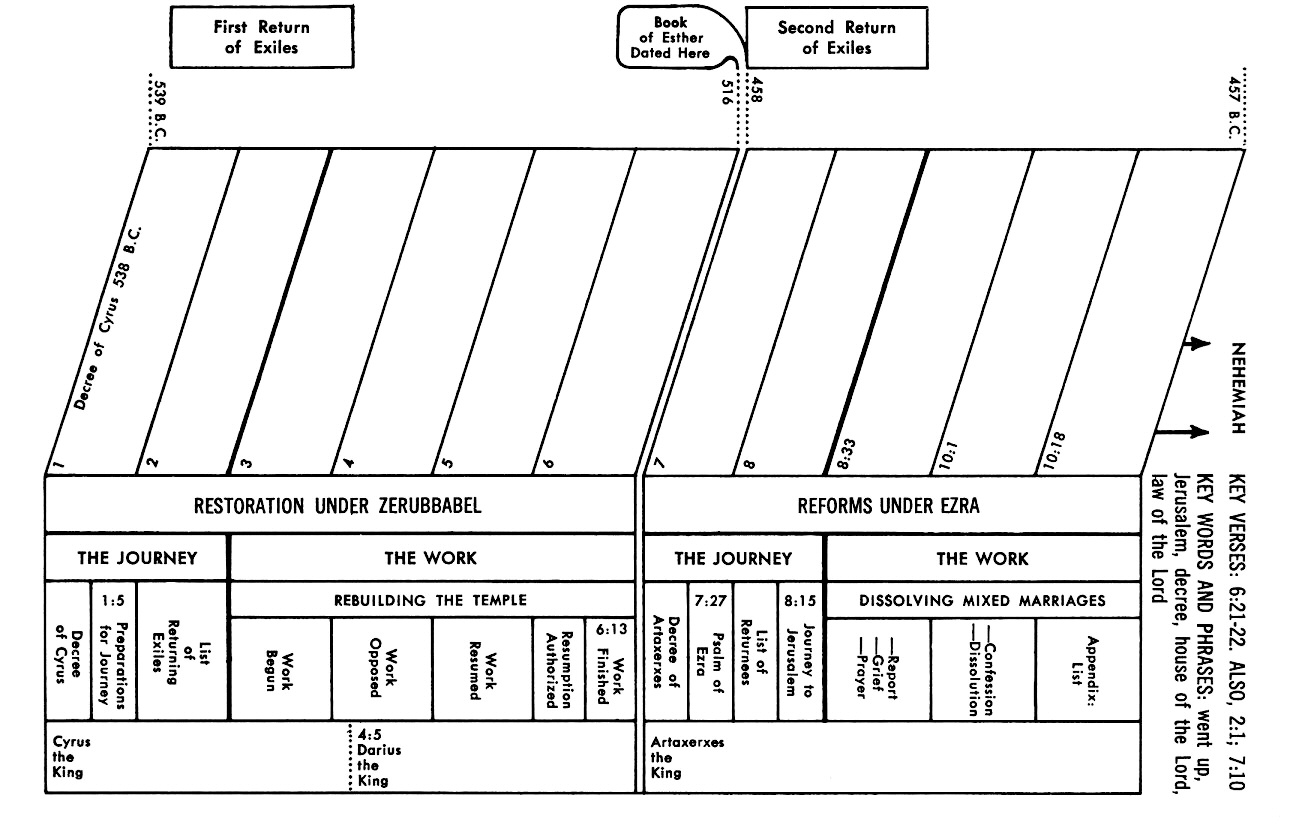
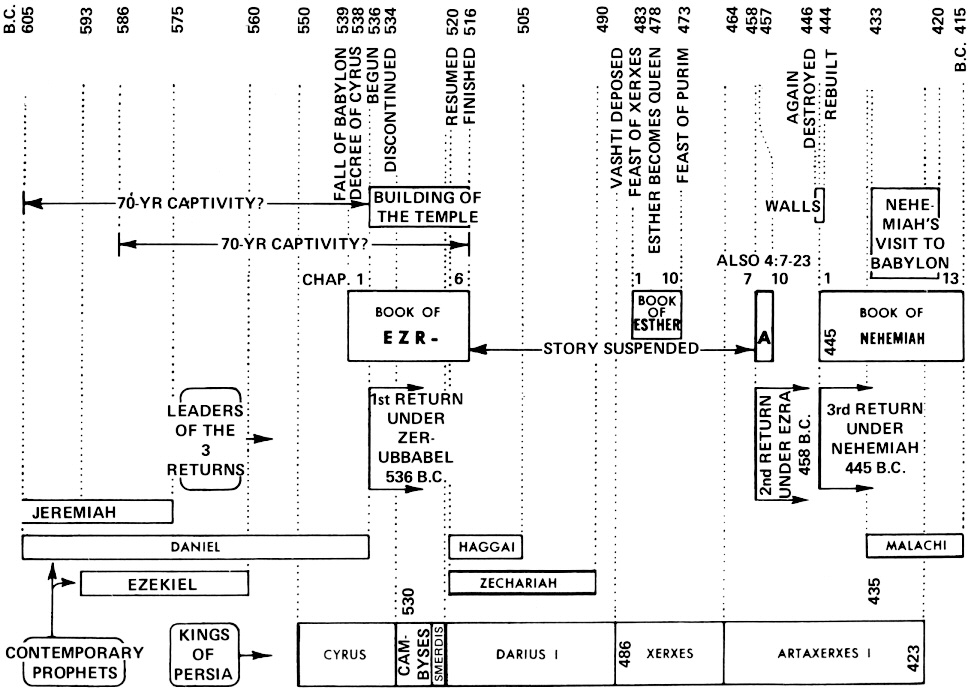
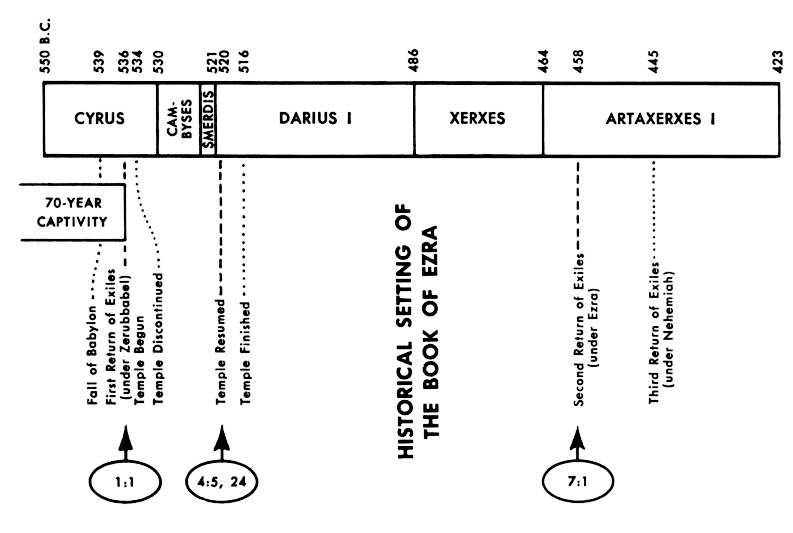
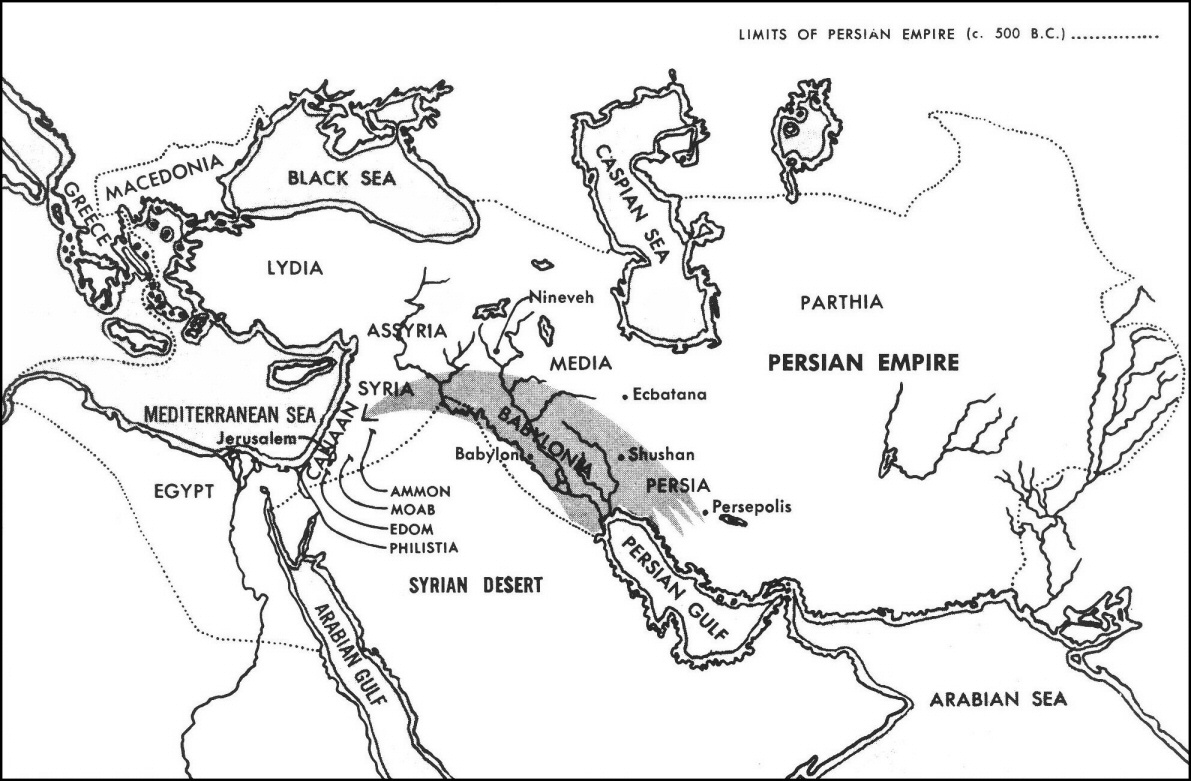
Click charts to enlarge
Charts from Jensen's Survey of the NT - used by permission
Introduction and Chart of Ezra - Swindoll
| CHRONOLOGICAL RELATIONSHIP OF EZRA-NEHEMIAH-ESTHER |
||||
| 538-515BC | 483-473BC | 457BC |
13 Year Gap |
444-425BC |
| Ezra 1-6 | Book of Esther | Ezra 7-10 | Book of Nehemiah | |
| First Return of Jews from Babylonian Exile |
58 Year Gap |
Second Return of Jews from Babylonian Exile |
Third Return of Jews from Babylonian Exile |
|
| EZRA: RESTORATION AND REFORM |
|||
| Restoration of the Temple Under Zerubbabel |
Reform of the People Under Ezra |
||
| First Return To Jerusalem Ezra 1:1-Ezra 2:70 |
Construction of The Temple Ezra 3:1-Ezra 6:22 |
Second Return to Jerusalem Ezra 7:1-8:36 |
Restoration of the People Ezra 9:1-Ezra 10:44 |
| First Return of 49, 897 |
Second Return of 1754 |
||
| 22 Years (538-516BC) |
1 Year (458-457BC) |
||
| Key Passages: Ezra 1:3, Ezra 2:2, Ezra 6:21, 22, Ezra 7:10 Key Words: Went up (Ezra 1:11, 7:1, 6, 7, 8:1), Jerusalem (48x), Decree (17x), House of the LORD (Ezra 1:3, 5, 7, 2:68, 3:8, 11, 7:27, 8:29), Law (...of the LORD, ...of Moses, ...of God) (Ezra 3:2, 7:6, 10, 12, 14, 21, 26, 10:3) |
|||
Ezra 7:10 For Ezra had set his heart to study the law of the LORD and to practice it, and to teach His statutes and ordinances in Israel. (NASB: Lockman) (Read context 7:1-10 )
Greek (Septuagint): hoti Esdras edoken (AAI) (active voice = Ezra made a volitional choice in his heart to seek the law, etc) en kardia autou zetesai (AAN) ton nomon kai poiein (PAN) kai didaskein (PAN) en Israel prostagmata kai krimata
My rendering of Greek: Because (for) Ezra had made a personal choice, a choice of his will to give (devote) his heart to seek after the law and to continually practice (present tense) it and to continually teach (present tense) it in Israel (both) the ordinances and the decrees.
Amplified: For Ezra had prepared and set his heart to seek the Law of the Lord [to inquire for it and of it, to require and yearn for it], and to do and teach in Israel its statutes and its ordinances. (Amplified Bible - Lockman)
ASV: For Ezra had set his heart to seek the law of Jehovah, and to do it, and to teach in Israel statutes and ordinances.
KJV: For Ezra had prepared his heart to seek the law of the LORD, and to do it, and to teach in Israel statutes and judgments.
NLT: This was because Ezra had determined to study and obey the law of the LORD and to teach those laws and regulations to the people of Israel. (NLT - Tyndale House)
Young's Literal: For Ezra had set his heart to study the law of the LORD, and to practice it, and to teach His statutes and ordinances in Israel.
FOR EZRA HAD SET HIS HEART:
- 1Samuel 7:3; 1Chronicles 29:18; 2Chronicles 12:14; 19:3; Job 11:13; Ps 10:17; 57:7
William Orr calls Ezra 7:10 the "key verse" for he sees this as the key to Ezra's character. (Reference) Indeed, is this not the key to every godly man and woman's character, to have our heart set on taking in the Word of the Lord and thereby be enabled to hear the voice of the Lord?
Exposition of the "Ezra 7:10 Principle" - herein lies the "secret" of Spirit empowered, Word centered, Christ exalting, God glorifying preaching and "abundant life" living (John 10:10).
The "setting" of our heart - At the outset of this exposition, it strikes me that Ezra's heart was like a compass, ever pointing to God through the supernatural working of His Spirit and His living and active word. And it was in this supernatural context of a Word saturated, God centered heart, that Ezra, a man of the Book and the God of the Book was compelled (even impelled) to return to his beloved city of Jerusalem. May we as believers on this side of the Cross find ourselves so similarly saturated with God's love letter that it grips our heart like it did Ezra's, so that we are compelled (even impelled) to live progressively more and more with a Colossians 3:1, 2, 3, 4/Romans 12:1, 2 mindset ("heart set") (see notes on Col 3:1; 3:2; 3:3; 3:4; Ro 12:1; 12:2) and the things of this present world grow strangely dim in the light of His glory and grace. Amen. (Turn Your Eyes Upon Jesus - Violin and Video; Cyberhymnal - "And Step by Step You will lead me and I will follow you all of my days") And notice also that God is not some distant Divine Being to Ezra but is "up close and personal" for He is referred to as "his God" in Ezra 7:6, 7:9 and "my God" in Ezra 7:28 (cf Ezra 9:5, 6). Is He your God? Do you have a personal relationship with the Holy One of Israel? Is He your Father (Jn 1:12-13, Mk 14:36, Ro 8:15, Gal 4:6).
O soul, are you weary and troubled?
No light in the darkness you see?
There’s a light for a look at the Savior,
And life more abundant and free!Refrain
Turn your eyes upon Jesus,
Look full in His wonderful face,
And the things of earth will grow strangely dim,
In the light of His glory and grace.Through death into life everlasting
He passed, and we follow Him there;
Over us sin no more hath dominion—
For more than conquerors we are!Refrain
His Word shall not fail you—He promised;
Believe Him, and all will be well:
Then go to a world that is dying,
His perfect salvation to tell!Refrain
Historical Context - Ezra, Nehemiah and Esther are the last three books in the historical section of the Old Testament (Joshua-Nehemiah). These three books tell us what happened to the Jewish people after the 70 Year Babylonian Captivity and give details of the three stages of the return of the Jews (538, 458, 445 BC) to their beloved city Jerusalem. In is interesting to note that there were also three stages of exile to Babylon - 603, 597 and 586 BC!
|
THE 3 RETURNS OF THE JEWS TO JERUSALEM |
||||
| # | DATE | SCRIPTURE | LEADER | RULER |
| 1 | 538 BC | Ezra 1-6 Temple Rebuilt |
Zerubbabel Joshua |
Cyrus |
|
58 Years = Time Lapse Between Ezra 6 & 7 |
||||
| 2 | 458 BC | Ezra 7-10 | Ezra | Artaxerxes |
|
Ezra Serves as Priest in Jerusalem for the Intervening 13 Years |
||||
| 3 | 445 BC | Nehemiah 1-13 Wall Rebuilt |
Nehemiah | Artaxerxes |
Relationship of the books of Ezra to Nehemiah and Esther - The book of Ezra is a very interesting book because it is actually two books, Ezra 1-6 comprising "book one" and Ezra 7-10 comprising "book two". Between Ezra 6 and 7 there is a time gap of about 58 years! And guess what? During this 58 year time gap all of the events in the book of Esther took place! Then Ezra 10 is immediately succeeded by the events in the book of Nehemiah. So compressed into these last 3 historical books of the Old Testament canon, are four fascinating stories dealing with God's sovereign, providential dealings with His chosen people after 70 year period of punishment as captives in Babylon. In Psalm 137, the psalmist gives us some insight into how the exiled Jews felt about this time of exile. As you read these words filled with pathos, ponder the pain and the pull of homesickness for the city of God that must have gripped godly leaders like Zerubbabel, Ezra and Nehemiah…
Psalm 137:1 By the rivers of Babylon, there we sat down and wept, when we remembered Zion. 2 Upon the willows in the midst of it We hung our harps. 3 For there our captors demanded of us songs, And our tormentors mirth, saying, "Sing us one of the songs of Zion." 4 How can we sing the LORD's song In a foreign land? 5 If I forget you, O Jerusalem, may my right hand forget her skill. 6 May my tongue cleave to the roof of my mouth, If I do not remember you, if I do not exalt Jerusalem above my chief joy.
Comment: These sad words give us some insight into the emotions that must have filled and motivated the hearts of men like Ezra and Nehemiah to resolve to leave their comfortable conditions in Persia and return to their blessed city of David. Dear NT believer, let the Spirit birthed yearnings for our heavenly Zion and our glorious King, motivate and inspire and compel us to press on toward the goal for the prize of the upward call of God in Christ Jesus (see Phil 3:14), not becoming comfortable with this present world which is passing away and even its lusts (cp 1John 2:15, 16, 17).
Dear Father in heaven, according to Your great lovingkindness please grant that your redeemed sons and daughters might have hearts like Ezra and Nehemiah such that we would continually contemplate and yearn for Mount Zion and the city of the living God, the heavenly Jerusalem (Heb 12:22-note), and that this longing and passion might by Your grace cause us to order our steps ever upward during our short sojourn as aliens and strangers (1 Pe 2:11-note) in this present evil age. For Thy glory. Amen.
The Persian Kings during the time of Ezra, Nehemiah and Esther -
1. CYRUS THE GREAT (550-530 B.C.).
This is the king that Isaiah had long ago promised would come and deliver the children of Israel (Isaiah 44:28; 45:1, 2, 3, 4, 5). He conquered the Babylonians and then allowed the Jews to return to their homeland and to rebuild their temple (Ezra chapter 1). Daniel was still alive when Cyrus was king (Daniel 1:21; 10:1).
2. CAMBYSES (530-522 B.C.)
3. SMERDIS (he ruled less than a year)
4. DARIUS THE GREAT (522-486 B.C.)
Darius made a decree that the work of the temple should be continued without any hindrance (Ezra chapter 6). It was during his reign that the temple was completed (Ezra chapter 6).
Note: Don’t confuse this king with Darius the Mede who is mentioned in the book of Daniel (see Daniel 5:31; 6:1). Darius the Mede was the governor of Babylon under Cyrus the Great.
5. AHASUERUS or XERXES (486-464 B.C.)
This is the king that we read about in the book of Esther. Esther became his queen. He is also mentioned in Ezra 4:6.
6. ARTAXERXES I (464-423 B.C.)
At first this king sent a decree ordering the Jews to stop rebuilding the city and the walls (see Ezra 4:6-23). Later, however, he allowed his cupbearer, Nehemiah, to return to Jerusalem to rebuild the city walls (Nehemiah chapters 1-2). This is also the same king who had earlier allowed Ezra to return (Ezra 7-8).
These were all great kings, but as we read the books of Ezra, Nehemiah and Esther, we learn that there is a much greater KING in heaven who is in control of all things! (adapted from Middletown Bible synopsis)
For Ezra:
A STRATEGIC
TERM OF EXPLANATION
For Ezra - see dictionary discussion for background on Ezra.
Don't read too fast or you will miss the little conjunction "for." For is a strategic term of explanation (and there are over 7000 "for's" in Scripture, and some 1330 "because's" which is also a term of explanation) and if the context indicates, as it does in this passage, that the "for" is a term of explanation, pause and ask yourself what is the Spirit seeking to explain? Consider the "5P's" - Pause to Ponder the Passage then Practice it in the Power of the Spirit.
The New Living Translation although a paraphrase strongly emphasizes the linkage between this passage and the preceding passages writing that…
This was because Ezra had determined to study and obey the law of the LORD and to teach those laws and regulations to the people of Israel.
The natural question is "What is this?" (NLT) or "What does for explain?" To answer we need to observe the previous passages (context) where we find the powerful truth that the good hand of the LORD was upon Ezra..
For (term of explanation - this will force you to the previous passage to see what is being explained) on the first of the first month he began to go up from Babylon; and on the first of the fifth month he came to Jerusalem, because (another term of explanation) the good hand of his God was upon him. (Ezra 7:9)
Comment: Notice that by observing the context of the "for" in Ezra 7:10, we discover two additional terms of explanation in Ezra 7:9 which we can examine and interrogate. Do you see how this simple maneuver serves like a "hinge on a door" to allow you to open the door (so to speak) and see more fully into the riches of these passages? This is a discipline (pausing to ponder the terms of explanation) which will always bear fruit and in some cases as in this passage, fruit that is abundant! Let this simple discipline change the way you do your morning devotionals as you meet on your knees with Your Father. You will be richly rewarded and your fellowship with the Father will be sweet!
The Septuagint rendering (For Esdras had determined in his heart to seek the law, and to do and teach the ordinances and judgments in Israel.) is almost identical to the Hebrew rendering. The Septuagint renders the Hebrew word for "good" (tob) with the Greek adjective agathos which describes that which is "good" in its character or constitution and beneficial, useful or profitable in its effect. Agathos describes that which has the proper characteristics for performing the expected function in a fully satisfactory way. What better way to think of the "hand of Jehovah"! Always sufficient for the need of the moment. Let us always be alert to the good hand of the Lord in our life that we might give Him thanks and praise.
The metaphor of being in someone's hand (or having their hand on someone) was common in the OT and spoke of being in the power of that person or entity. In the present context, the picture is one of God's power (His "good hand") being upon Ezra the scribe, not to defeat him but to give him the victory. This same phrase (hand of his God) is repeated several times in Ezra and gives us a clue to the "secret" behind his strong leadership, his influence with kings and his soul stirring preaching. Notice the same phrase earlier in this chapter…
Ezra 7:6 This Ezra went up from Babylon, and he was a scribe skilled in the law of Moses, which the LORD God of Israel had given; and the king granted him all he requested because the hand of the LORD his God was upon him.
Comment: Why did this pagan king grant Ezra his request? The Scripture clearly states "because the hand of the LORD his God was upon him."
Here are the other occurrences of the phrase the good hand of the LORD in the book of Ezra…
Ezra 7:27 Blessed be the LORD (the result of God's hand being upon him granting him favor was to break out in a chorus of praise and thanksgiving, giving glory to the only One Who should receive glory! As we experience His blessing and hand upon us, may we also imitate Ezra's response!), the God of our fathers, who has put such a thing as this in the king's heart, to adorn the house of the LORD which is in Jerusalem, 28 and has extended lovingkindness to me before the king and his counselors and before all the king's mighty princes. Thus I was strengthened according to the hand of the LORD my God upon me, and I gathered leading men from Israel to go up with me.
Comment: This passage makes it clear that it was God Who put such a thing into this pagan king’s heart to allow Ezra and his fellow Jews to return and beautify the house of the Lord in Jerusalem. As noted above (Ezra 7:6) Ezra still had to go and ask for this favor (man's responsibility), even though God had placed it in the king's heart (God's sovereignty). To go before such a powerful monarch and ask for such extravagant provisions for his people who were in captivity and whom the king easily could have exterminated took courage. Where did Ezra derive that courage? Read verse 28 again, which clearly states the source of Ezra’s strength! There is an interesting principle here that God's blesses but some of his blessings entail men fulfilling their responsibility, the very principle Paul explains in the New Testament (see notes Philippians 2:12; 13)
Ezra 8:18 And according to the good hand of our God upon us they brought us a man of insight of the sons of Mahli, the son of Levi, the son of Israel, namely Sherebiah, and his sons and brothers, 18 men;
Ezra 8:22 For I was ashamed to request from the king troops and horsemen to protect us from the enemy on the way, because we had said to the king, "The hand of our God is favorably disposed to all those who seek Him (exactly what Ezra had purposed in his heart in Ezra 7:10), but His power and His anger are against all those who forsake Him." 23 So we fasted and sought our God concerning this matter, and He listened to our entreaty.
Comment: This passage adds another facet to the Ezra 710 principle (set heart, study, do, teach) by emphasizing the role of prayer and fasting. This is not surprising because intake of the pure Word into a godly heart will stimulate Word centered, God exalting prayer.
Ezra 8:31 Then we journeyed from the river Ahava on the twelfth of the first month to go to Jerusalem; and the hand of our God was over us, and He delivered us from the hand of the enemy and the ambushes by the way.
|
Summary of Effect of |
|
| Ezra 7:6 | Provision |
| Ezra 7:27, 28 | Power |
| Ezra 8:22,23 | Protection |
Fear of the LORD and
The Good Hand of Jehovah
Here is another passage that teaches a similar truth using a different anthropomorphism (eye instead of hand)…
Behold, the eye of the LORD (cp "hand of the LORD") is on those who fear Him, on those who hope for His lovingkindness, to deliver their soul from death, and to keep them alive in famine (blessed = fully satisfied independent of the circumstances). (Psalm 33:18, 19)
Comment: Deliverance from evil does not come by military power, manpower, or horsepower but spiritual power. And so we see that the Psalmist amplifies the Ezra 710 principle (set heart, study, do, teach, prayer and fasting in Ezra 8:22, 23) with an individual's volitional choice to fear (reverentially awe) Jehovah. (cp Ps 128:1, 2)
Nehemiah and
The Good Hand of Jehovah
Here are the other 2 uses of the phrase "hand of Jehovah" or variation thereof in the life of Nehemiah, another OT saint whom God used mightily to accomplish His work on earth…
Nehemiah 2:7 And I (Nehemiah) said to the king (see ISBE article on King Artaxerxes), "If it please the king, let letters be given me for the governors of the provinces beyond the River, that they may allow me to pass through until I come to Judah, 2:8 and a letter to Asaph the keeper of the king's forest, that he may give me timber to make beams for the gates of the fortress which is by the temple, for the wall of the city, and for the house to which I will go." And the king granted them to me because the good hand of my God was on me.
Nehemiah 2:18 And I told them (the Jews who would help build the wall) how the hand of my God had been favorable to me (literally "the hand of my God that is good upon me"), and also about the king's words which he had spoken to me. Then they said, "Let us arise and build." So they put their hands to the good work.
MISSING THE BLESSING
OF THE GOOD HAND OF THE LORD
This principle regarding the good hand of the LORD is seen in the prophets words to King Asa (who sadly ignored them to his detriment)…
2 Chronicles 16:9 For the eyes of the LORD move to and fro throughout the earth that He may strongly support (cp "good hand of Jehovah") those whose heart is completely His. You have acted foolishly in this. Indeed, from now on you will surely have wars.
Comment: Note that this verse also begins with for indicating that the writer is explaining something previously stated, in context explaining why the LORD had delivered Asa's (and Israel's) enemies into his hand or power. Notice how King Asa serves as an example (cp 1Cor 10:6, 11) of one who clearly experienced the the good hand of the LORD upon him as king over Judah giving him victories over his adversaries (read 2Chronicles 15:1, 2, 3, 4, 5, 6, 7, 8, 9, 10, 11, 12, 13, 14, 15, 16, 17, 18, 19 and 2Chr 16:1ff for the historical context). Don't miss how Asa's "success" (cp "good hand of the LORD") was integrally associated with his hearing (and welcoming) the word of Jehovah through the prophet Azariah (cp Ezra's setting his heart to study and practice the Law of the LORD) in 2Chronicles 15. Then contrast the time of blessing ("good hand upon") of Jehovah in 2Chronicles 15:15, with the consequences of refusing to receive and practice the Word of God delivered to King Asa through Hanani the seer in 2Chronicles 16:1, 2, 3, 4, 5, 6, 7, 8. The upshot - you can experience the good hand of the LORD for a season and you can lose it by failing to continue to let the word of Christ dwell in you richly! (see Col 3:16) If any may thinks he stands, he had better take heed lest he fall. God is opposed to ("stiff arms"!) the proud (cp "the heavy hand of Jehovah") but gives grace to the humble ("the good hand").
Lot, a righteous man (clearly a true believer - see 2Pe 2:6; 2Pe 2:7; 2Pe 2:8; 2Pe 2:9) is another sad example of a man who missed the blessing of the good hand of the LORD. In Genesis 13 the growth of the flocks of Abram and Lot led to strife and the need for them to separate. Abram gave Lot "first choice", a choice which resulted in Lot's missing the "good hand of the LORD". Note the progression in the following passages…
Genesis 13:10 And Lot lifted up his eyes and saw all the valley of the Jordan, that it was well watered everywhere—this was before the LORD destroyed Sodom and Gomorrah—like the garden of the LORD, like the land of Egypt as you go to Zoar. 11 So Lot chose for himself all the valley of the Jordan; and Lot journeyed eastward. Thus they separated from each other. 12 Abram settled in the land of Canaan, while Lot settled in the cities of the valley, and moved his tents as far as Sodom. 13 Now the men of Sodom were wicked exceedingly and sinners against the LORD.
Lot looked, chose, and settled ("became comfortable" rather than living as an alien and stranger - see 1Pe 1:1; 1 Peter 2:11) and missed the good hand of the LORD. In Genesis 19:16 we see that Lot was so settled in Sodom that the hand of God's angels had to yank he and his whole family out of that moral cesspool! Let us remember Lot's example, lest our looking and choosing in this fleeting life cause us to miss the good hand of the Lord on our life, our family, our ministry! Or as Jesus commanded his listeners in (Luke 17:32) "Remember (present imperative = keep on remembering. Why? Because our tendency is to drift, to forget!) Lot's wife" because she lingered and looked back (Ge 19:26) and paid for her disobedience with her life.
May God grant us each grace and mercy so that we as godly men and leaders of our churches and families will not forget these tragic OT examples of men who missed the blessing of the good hand of the LORD! Amen
EZRA
A MAN OF ONE BOOK
God's good hand was clearly associated with the provision, power and protection in Ezra's ministry. And as we see seen the root of divine blessing was that Ezra was a "man of the book" (scratch him anywhere and he "bled Bible"), a man like Apollos who was mighty in the Scriptures (Acts 18:24). Ezra is a worthy model for any preacher who desires to be used mightily by the Lord.
The Pulpit Commentary comments on the good hand of the LORD upon Ezra writing that…
His (Ezra's) soul felt the quickening touch of the Divine finger, and it kindled with a sacred glow of piety and zeal. He was moved of God to attempt great things, and helped of God to achieve them. His life flowed on like a fertilizing river (Ed: cp Ps 1:2), and did so because “all his springs were in God” (Ps 87:7). Our character may contain much that is excellent, and our lives include much that is honourable, but except the “hand of the Lord our God be upon us,” renewing our heart and blessing our life, we shall not be or do that which is pleasing to him or useful to our fellows (Ed: Cp Jesus' words in John 15:5). (The Pulpit Commentary: Ezra. H. D. M. Spence-Jones, Ed.)
><>><>><>
(1) Ezra “sought the law of the Lord.” No study more remunerative—more ennobling—more pleasing to God.
(2) He sought it in earnest. “prepared his heart,” viz., by raising it above impure prejudices; by seeking the light of the great Inspirer in prayer.
(3) He reduced it to practice. He prepared his heart “to do it.” Glorious example. His life was therefore righteous, and his influence consequently great—viz., (a) With God. (b) With the king. (c) With the people.
(4) And “he taught it to Israel.” He taught Israel the “statutes,” viz., precepts and “judgments,” viz., sanctions (1 Kings 6:12; Ezek. 11:12). What a degenerate succession from the noble Ezra were the scribes of our Lord’s day! Let us emulate his qualities.—J. A. M. (The Pulpit Commentary: Ezra. H. D. M. Spence-Jones, Ed.)
><>><>><>
Ezra: his character and work. The study of human character and of human life is not only an essential part of human knowledge, but of spiritual culture. Biography is a means of grace. We do well to follow in thought the lines along which the noblest of our race have moved: we are thereby attracted toward them, and grow up toward their spiritual stature. We may learn from the life and character of Ezra by considering—
I. What we know he was and did.
He was—
1. A priest, claiming descent, as we see, from Aaron (Ezra 7:5); and we doubt not that he discharged, faithfully and conscientiously, the duties of the priesthood. He was, moreover, what came to be called—
2. A scribe (Ezra 7:6), i.e., (1) a student, (2) an interpreter, and (3) a copyist of the law. Ezra “prepared his heart to seek the law of the Lord, and to do it, and to teach,” etc. (Ezra 7:10).
These three functions of the scribe include the three most important duties a man can undertake: viz.,
(1) his duty of himself, in studying the will of God as revealed in his word, that he may have it in his own heart; and,
(2) his duty to his own generation, in teaching his fellows what he has learned: in interpreting, in “giving the sense” (Neh. 8:8), in “teaching statutes and judgments” (Ezra 7:10), i. e. in declaring and enforcing the great truths which God had revealed, especially those which affected the duty and the prospects of the Jewish people; and
(3) his duty to his race, in copying, and thus multiplying and preserving intact the word and the very words of God. Ezra “gave his heart” to this (Ezra 7:10), and the result was that he did it with conspicuous and commanding ability (Neh. 8). He was a “ready scribe” (Ezra 7:6).
3. Administrator and reformer. He conducted the party whom he headed to Jerusalem in peace and safety (Ezra 7:8); there he established himself as leader of the people, and set about the work of reforming abuses with a vigorous hand. His ardour led to a serviceable organisation and reform. He seems also to have been, as few strong-willed men are, a co-operator with others. He acted with Nehemiah, the governor, and it may well have been difficult to define strictly their respective offices.
4. Man of influence with his fellows. There was that about him, due to the elevation and disinterestedness of his character as well as to the vigour and robustness of his mind, which gave him strange influence with the king, so that he gave him leave to lead out a large return party, and also entrusted him with large powers in the commission. Men who, like Ezra, earnestly seek the will of God and do what they know to be right (Ezra 7:10), and lay themselves out for “doing good and communicating” (Heb. 13:16), are likely to have power with men.
5. Man through whom God wrought. “The hand of the Lord his God was upon him” (Ezra 7:6, 9, etc.). His soul felt the quickening touch of the Divine finger, and it kindled with a sacred glow of piety and zeal. He was moved of God to attempt great things, and helped of God to achieve them. His life flowed on like a fertilizing river (Ed: cp the man of Ps 1:2), and did so because “all his springs were in God” (Ps 87:7). Our character may contain much that is excellent, and our lives include much that is honourable, but except the hand of the Lord our God be upon us, renewing our heart and blessing our life, we shall not be or do that which is pleasing to him or useful to our fellows.
II. Generally received tradition respecting Ezra.
It is commonly believed among the Jews that he instituted the Great Synagogue, that he settled the canon of Scripture, that he himself wrote the books of the Chronicles, Ezra, Nehemiah, and (perhaps) Esther, and that he established the system of synagogue worship. This last arose about his time, and, if indeed due to him, is a work which laid his countrymen, and indeed us all (for had not the forms of the synagogue something, if not much, to do with the forms of the early Church?), under a heavy debt of gratitude. Ezra was a holy and zealous man, with a strong mind and a firm will, exercising a commanding influence on his contemporaries, making the word of God the basis and mainspring of his action, seeking and striving for the purity of the people of God. Some things he did we know. Others we know not of. We may not be so great and distinguished as he was. It may not be in our power to render such signal services as he did, or to leave behind us such a reputation as he has left. Yet in the essentials of his character and work we may be like him. We also may—
(1) Be devout students of God’s will as revealed in his word—“preparing our heart to seek the law of the Lord, and to do it.”
(2) Open our hearts to receive heavenly influences; gain by humility, docility, and prayer” the hand of the Lord our God upon us,” so that he will dwell in us and work through us.
(3) Make known the will of God to others, teaching in some sphere, higher or humbler, the word of God and the truth of Jesus Christ.
(4) Co-operate cheerfully with others, yielding our preferences to theirs, being “of the same mind in the Lord” with those who are our fellow-labourers in the field of Christian work. And if we do this as did Ezra, we shall, like him,
(5) do that which men will mark and praise, but much more that they will not record; much, however, that will not be unwritten in some book of God, and that will “in no wise lose its reward.”—C. (The Pulpit Commentary: Ezra. H. D. M. Spence-Jones, Ed.)
To reiterate, God’s sovereign hand of blessing and empowerment was on Ezra because he was a "Word saturated man" one who "marinated" himself in the pure milk of the Word and then lived out what the Spirit taught him in his studies.
As Horatio Bonar once advised…
We must study the Bible more. We must not only lay it up within us, but transfuse it through the whole texture of the soul.
Thus it was not so much that Ezra had gone through the Book so many times, but more that the Book had coursed through his heart and soul to the point that his will was in synch with will of God which is always most clearly revealed in the Word of God. Ezra was "in touch" with the Father's heart, through His Word and the teaching ministry of His Spirit, and as a result had as his heart's desire to see God glorified in his life (cp notes on same principle in the NT - letting your light shine Matthew 5:16)
Pastor Steven Cole introduces his message on Ezra 7:1-28 The Life that God Blesses with the following words…
Over thirty years ago, I read a sermon that has impacted my life as much or more than any of the thousands of sermons that I have read. It is titled, “Expecting the Lord’s Blessing,” by the late Chinese evangelist Watchman Nee (in Twelve Baskets Full [Hong Kong Church Book Room], 2:48-64). That sermon, based on the Lord’s feeding of the 5,000, has affected the entire direction and motivation of my personal life and my ministry. Nee hammers home a simple but profound truth: “Everything in our service for the Lord is dependent on His blessing” (p. 48). He observes that in the feeding of the 5,000, the supply in hand was totally inadequate to meet the demand, and yet the demand was met. He says, “The meeting of need is not dependent on the supply in hand, but on the blessing of the Lord resting on the supply” (ibid.). That leads Nee to ask a question that I want you to ponder seriously: “Do we really prize the Lord’s blessing?” (p. 49). Do you really want and seek God’s blessing on your personal life, your family, your service for the Lord, and on His church?
We all know the right answer to that question. Few would be so brazen as to say, “No, I don’t want God’s blessing. I’d rather try to make my own blessings apart from God!” But I don’t want you to give a knee-jerk “yes” answer just because it is the obviously correct answer. I want you to think about the implications of the question before you answer.
There are a number of men in Scripture whom God blessed: Abraham, Jacob, Joseph, and David are prominent examples. But Ezra is also a man whom God blessed, even though he is not so well known as those other men are. We first meet him in chapter 7 of the book that bears his name. There is a 57-58 year gap between the events in chapters 6 and 7. The temple had been rebuilt under the ministries of Zerubbabel and Jeshua, aided by the preaching of the prophets Haggai and Zechariah. The exiles that had returned to Israel during that first wave were either dead or very old by now. They had settled into the land and, as we will see, in many cases had begun to blend together with the pagans of the land. The walls of Jerusalem had not been rebuilt, leaving the city vulnerable to attack. God raised up Ezra and Nehemiah to bring spiritual reform to His people.
Both men were born in Babylon and had close connections with King Artaxerxes. No doubt they both enjoyed comfortable living conditions there. But both men were burdened with the low spiritual state of the exiles that had returned to the land. Both men were willing to give up their comfortable situations in Babylon and endure the hardship and hassles to bring reform to God’s people. But how could they accomplish this overwhelming task? The answer occurs in a phrase that first occurs three times in our chapter, and then five times in the rest of Ezra and Nehemiah: God’s hand was on these men (Ezra 7:6, 9, 28; 8:18, 22, 31; Neh 2:8, 18). God’s hand is another way of saying God’s blessing. God blessed these two men and their labors for Him. If we want His blessing or hand to rest on us, we would do well to study their lives. We could add more factors, but limiting ourselves to Ezra 7, we learn that…
To have God’s hand of blessing on us, we must study and obey His Word, with a view to teaching others and glorifying God for everything.
That theme is stated in Ezra 7:10, which explains why “the good hand of his God was upon him” (7:9): “For Ezra had set his heart to study the law of the Lord, and to practice it, and to teach His statutes and ordinances in Israel.” The connection between Ezra and God’s Word is repeated no less than eight times (Ezra 7:6, 10, 11, 12, 14, 21, 25, 26)! There is a definite correlation between our commitment to know and obey God’s Word and His hand of blessing being upon us. (The Life that God Blesses - if you are not familiar with Pastor Cole's teaching ministry, you might read some of his excellent expositional sermons which function much like commentaries)
Here are just a few additional passages on which to meditate regarding the hand of the Lord...
Ex 13:3 Moses said to the people, “Remember this day in which you went out from Egypt, from the house of slavery; for by a powerful hand the LORD brought you out from this place. And nothing leavened shall be eaten.
Ex 13:9 “And it shall serve as a sign to you on your hand, and as a reminder on your forehead, that the law of the LORD may be in your mouth; for with a powerful hand the LORD brought you out of Egypt.
Ex 13:14 “And it shall be when your son asks you in time to come, saying, ‘What is this?’ then you shall say to him, ‘With a powerful hand the LORD brought us out of Egypt, from the house of slavery.
Ex 13:16 “So it shall serve as a sign on your hand and as phylacteries on your forehead, for with a powerful hand the LORD brought us out of Egypt.”
Ex 15:6 “Your right hand, O LORD, is majestic in power, Your right hand, O LORD, shatters the enemy.
Ex 15:12 “You stretched out Your right hand, The earth swallowed them.
1 Chr 4:10 ("Prayer of Jabez") - Now Jabez called on the God of Israel, saying, “Oh that You would bless me indeed and enlarge my border, and that Your hand might be with me, and that You would keep me from harm that it may not pain me!” And God granted him what he requested.
Acts 11:21 And the hand of the Lord was with them, and a large number who believed turned to the Lord.
1 Peter 5:6 Therefore humble yourselves under the mighty hand of God, that He may exalt you at the proper time,
Had set his heart (not his head but his heart!)
Had prepared (kuwn) his heart. (see below)
Set (03559) (kuwn) means to set up, to make firm, to establish, to prepare. The primary action of this verb is to cause to stand in an upright position, and thus kuwn can also mean fixed or steadfast. This same verb is used to describe God establishing the heavens (Pr 3:19).
The picture of kuwn in the present context is that of preparing one's heart, in this case to seek, to study, to receive the Word of Truth. Compare a similar use of kuwn in the case of Solomon's successor to the throne Rehoboam of whom the chronicler records…
And he did evil because he did not set (Kuwn - "prepared not" = KJV) his heart to seek the Lord. (2Chr 12:14)
Kuwn is used one other time in Ezra chapter 3, and this literal use provides an illustration of the figurative use in the present passage…
Ezra 3:3 So they set up (kuwn) the altar on its foundation, for they were terrified because of the peoples of the lands; and they offered burnt offerings on it to the LORD, burnt offerings morning and evening.
One could also read the text of Ezra 7:10 as stating that Ezra had ”Set his heart firmly" which gives the idea that Ezra was inwardly determined or resolutely steadfast. He was determined and this determination was directed toward studying, obeying, and teaching God’s Law to others—Mark it down! This pattern while not a "formula", is to be sure an inviolable order for a Spirit empowered ministry! You cannot teach with power until you yourself have practiced (obeyed) what you have studied. Do be otherwise deluded (cp James 1:22).
We as NT believers, like the OT believer Ezra, must continually set (because the flesh, the world and the devil continually tempt us to "veer off course") our hearts to seek, do, and teach the Word of God, for no one accidentally becomes a faithful student of God's Word. We must each make a daily deliberate decision of our will (continual choosing) to lay aside lesser things and/or things that hinder us (see Hebrews 12:1) in order to seek the best.
J I Packer emphasizes the critical need for each of us to prepare our hearts before we seek God in His Word noting that…
One of the many divine qualities of the Bible is this: that it does not yield its secrets to the irreverent and censorious.
Spurgeon issues a similar caveat declaring that…
God sends every bird its food, but He does not throw it into the nest.
One is reminded of Solomon's wise advice concerning godly wisdom, noting that…
If you seek her as silver, and search for her as for hidden treasures then you will discern the fear of the LORD, and discover the knowledge of God.
DANIEL'S SECRET OF SUCCESS
Daniel was without question one of the greatest of the Old Testament saints (cp Ezekiel 14:14) and was one who able to live godly in a radically ungodly, idolatrous culture (sound familiar?).
What was Daniel's secret? Daniel 1 explains that Daniel's secret was the same as Ezra's in that it has to do with the choices one makes in one's heart. In Daniel chapter 1 we read the key (in my opinion) to his long godly life in which he repeatedly experienced the good hand of the LORD upon all of his endeavors…
But Daniel made up his mind that he would not defile himself with the king's choice food or with the wine which he drank; so he sought permission from the commander of the officials that he might not defile himself.
Note that Daniel 1:8 begins with "but Daniel" which begs the question of what is being contrasted? The previous section gives the context…
Then the king ordered Ashpenaz, the chief of his officials, to bring in some of the sons of Israel, including some of the royal family and of the nobles, 4 youths in whom was no defect, who were good-looking, showing intelligence in every branch of wisdom, endowed with understanding, and discerning knowledge, and who had ability for serving in the king's court; and he ordered him to teach them the literature and language of the Chaldeans. 5 And the king appointed for them a daily ration from the king's choice food and from the wine which he drank, and appointed that they should be educated three years, at the end of which they were to enter the king's personal service. 6 Now among them from the sons of Judah were Daniel, Hananiah, Mishael and Azariah. 7 Then the commander of the officials assigned new names to them; and to Daniel he assigned the name Belteshazzar, to Hananiah Shadrach, to Mishael Meshach, and to Azariah Abed-nego (Daniel 1:3-7)
RELATED RESOURCE:
So we see that Daniel made a choice that could have cost him his life. The phrase "made up his mind" is more literally "placed it upon his heart", where the heart reflects the "control tower" so to speak of one's life. The Septuagint (Greek translation of the Hebrew text) translated into English reads…
And Daniel himself (reflexive = he initiated the action and participated in the results) placed it upon his heart that he would absolutely not (double negative in the BGT [TH], the strongest way to express negation in Greek) be polluted (defiled) in the king's banquet…
Isn't life really nothing but a series of (sometimes hard) "heart choices"? Perhaps what you are considering is not sinful, but is it God's best? Is it something that will allow you to redeem the time knowing how precious are these few years we have on earth in light of our eternity in God's presence? May God give each of us the grace that Daniel possessed to assess our "life options" and choose to lay on our heart those options which are the most God glorifying. In Jesus' Name. Amen.
In summary, to set one’s heart is to “direct his heart constantly towards”.
WHAT IS THE DIRECTION OF YOUR HEART?
PONDER WHERE IT WILL TAKE YOU IN THE FOLLOWING PASSAGES…
Scripture has a number of passages that use the identical phrase (same verb and noun in Hebrew) of directing one's heart…
Then Samuel spoke to all the house of Israel, saying, "If you return to the LORD with all your heart, remove the foreign gods and the Ashtaroth from among you and direct your hearts to the LORD and serve Him alone; and He will deliver you from the hand (paraphrase = "from the power") of the Philistines." (1Samuel 7:3,4) (What is the promise?… Man's responsibility? Note the verbs - return… remove… direct… deliver)
(David's prayer for Israel and his son Solomon) O LORD, the God of Abraham, Isaac, and Israel (he is making his appeal based on the Abrahamic Covenant), our fathers, preserve this forever in the intentions of the heart of Thy people, and direct their heart to Thee (see 2 Chr 20:3 below) and give to my son Solomon a perfect heart to keep Thy commandments, Thy testimonies, and Thy statutes, and to do them all, and to build the temple, for which I have made provision." (1 Chronicles 29:18,19)
And he (King Rehoboam) did evil because he did not set his heart (Hebrew word here is not lebab but related noun leb - 03820) to seek the LORD. (2 Chronicles 12:14) (Why did he do evil? What do we have to do before we can truly "seek God"? Dear God, deliver us from this subtle trap in our own lives - let it be not our way, but Thine. Amen)
(Jehu the prophet speaking and denouncing the king) But there is some good in you (King Jehoshaphat), for you have removed the Asheroth from the land and you have set your heart to seek God." 4 So Jehoshaphat lived in Jerusalem and went out again among the people from Beersheba to the hill country of Ephraim and brought them back to the LORD, the God of their fathers. (2Chronicles 19:3, 4)
The high places, however, were not removed; the people had not yet directed their hearts to the God of their fathers. (2Chronicles 20:33)
Comment: 2 Chronicles 17:6 says King Jehoshaphat removed the high places and Asherim from Judah, but this verse indicates that apparently the people of Israel had otherwise resisted Jehoshaphat's decree.
(Speaking of the generation to come, Asaph says they should be taught to remember and obey God) And not be like their fathers, a stubborn and rebellious generation, a generation that did not prepare its heart, and whose spirit was not faithful to God. (Psalm 78:8)
Comment: Note how unfaithfulness to God parallels not preparing one's heart!
Spurgeon adds… "They had no decision for righteousness and truth. In them there was no preparedness, or willingness of heart, to entertain the Saviour; neither judgments, nor mercies could bind their affections to their God; they were fickle as the winds, and changeful as the waves." (Ref)
Here are some other excellent cross references related to setting one's heart. If you have time study them in context to see implications of preparing one's heart --
2Chronicles 11:16, 30:19, Job 11:13, Psalms 10:17, 57:7, 62:10, 78:8, 37, 108:1, 112:7,8, 1Corinthians 15:58, 16:13.
Ezra's heart was undoubtedly prepared to receive the Word implanted by confession of his sins for it is impossible to study the Scriptures profitably with an impure mind.
Therefore putting aside (decisively casting off sins as one would a filthy, odoriferous garment!) all filthiness (Greek rhuparia from rhupos = wax in one's ear!) and all that remains of wickedness, in humility receive (accept deliberately and readily, receive kindly, as one would put out a welcome mat for guests!) the word implanted, which is able to save your souls. (see James 1:21)
Comment: While this "salvation" could refer to our initial salvation (justified or declared righteous by faith), it could also refer to our daily salvation (progressive sanctification) of which all believers stand in continual need.
Therefore, putting aside (casting these off like a "dirty, filthy" garment) all malice and all guile and hypocrisy and envy and all slander (note the "all's" - 1Jn 1:9 says when we confess God cleanses us from all unrighteousness!), like newborn babes, long for the pure milk of the word, that by it you may grow in respect to salvation (See 1Pe 2:1; 1Pe 2:2-2:2)
Sin will keep you from the Bible or
The Bible will keep you from sin.
The phrase set his heart conveys the idea of being firmly committed to a particular course of action with unwavering steadfastness. The verb signifies being “established, prepared, fixed” in a determined pursuit. The same root word is used to portray God’s establishment of the heavens (Pr 3:19; 8:27). Thus the expression carries the idea of a determined purpose and unwavering resolution to act in a prescribed way to bring something to pass.
To paraphrase this verse in modern terms Ezra's heart…
was zeroed in on the primary goal of studying God’s Word.
The Bible…
The more you read it, the more you love it;
The more you love it, the more you read it.
In Psalm 1 guarding ourselves from wickedness (not walking, standing or sitting) precedes delighting in the Word which leads to meditating on the Word. (See exposition of Psalm 1:1; Ps 1:2; Ps 1:3) And the more we meditate on it, tasting and seeing that the Lord is good, the more we delight in it, etc.
Heart (03824) (lebab) (Lxx = kardia - see word study) refers not only to his intellect per se only but in Hebrew speaks of that which rules one's very being, the very center of human life -- the seat of affections, emotions, desires. The heart, in which Ezra purposed to study the Scriptures connotes “the totality of man’s inner or immaterial nature”
Ezra, or anyone who would follow his example, would direct the core of their being constantly toward the task of studying and pouring over the Scriptures. But to say that this function was Ezra's “ministry” would be missing emphasis of Ezra 7:10. More to the point, one might say that the study of the Scriptures was his life—his all-consuming passion. Little else commanded his attention like the task that God had set before him. Ezra gave his best effort to study, practice, and teach God’s law, each activity being observed completely and in order. At this point, we must each do personal inventory and ask - Do I truly give God my best efforts in this area? If we "stop" up the fountain, the source of life in His living and active word, we short circuit the Spirit's power in our life and ministry. Being "anemic" ourselves, we have little power and passion to pass on to those we are called to disciple.
I remember reading about John MacArthur's interview (my details may not be completely accurate) to take the lead pastor position at Grace Community Church. As I recall the story, he said that he would take the position on the condition (what I would call an "Ezra 7:10" condition) that the church would guarantee that he had 30 hours of uninterrupted study time during the week in which he could read and meditate on the Word so that he would have truth from God to bring to the congregation on Sunday. Let me ask you… Has the good hand of the LORD been upon Dr John MacArthur's ministry? I think the evidence speaks for itself. I love the heading on his website -
"Unleashing God's truth one verse at a time".
A similar story could surely be told about another well known American pastor, Dr John Piper, a mighty expositor of God's Word, one who has diligently practiced the Ezra 7:10 principle and as a result has clearly experienced the good hand of the LORD on his ministry. May Dr MacArthur's and Dr Piper's tribe increase!
In summary, both Dr MacArthur and Dr Piper have "bought in" (in my opinion) to the "Ezra 7:10" principle of church growth, feeding their sheep pure milk (see 1Pe 2:2) and solid food (see Hebrews 5:14) and thereby growing their flocks mightily in the grace and knowledge of our Lord and Savior Jesus Christ. Glory to God in the highest!
With such God glorifying results promised to those who practice the "Ezra 7:10 principle", why do we see so few "Ezras" in the pulpits across America today? I do not know the answer but I feel that part of that answer is that many don't truly believe Luke 1:37 which the ASV renders as…
No word from God shall be void of power.
In this Luke passage, the Greek word for "no" is the strongest word for no that Luke could have used -- absolutely no Word of God is impotent! Do we really believe this is true? Do we really believe that diligent study, practice and teaching of the eternal, inherently powerful word will unleash the power of God's hand upon us, upon our ministry and upon those we pastor? If this is your desire, perhaps you need to reorder priorities if you are the lead pastor or teacher. Perhaps you need to go to the elders and request a block of absolutely, immutably uninterrupted time during the week in order to begin to apply the "Ezra 7:10 principle". If you should be one of those who does make this decision, your church will never be the same as it begins to experience the reality of the supernatural reality of the good hand of the LORD upon it's various ministries.
Revive your shepherds, O LORD,
According to Thy word. Amen.
(based on Ps 119:25)
Now, let us return to the study of our passage and reiterate that the Hebrew word for heart represents the center or middle of something, and can indeed refer to the physical heart, organ which pumps blood to supplies life for the entire body. Of the some 850 uses of heart (lebab) in the Old Testament, the most common meaning is figurative and signifies a person’s inner being including one's mind, emotions, will, etc. Thus the heart denotes the intellect, by which one thinks, analyzes, compares, and understands a matter (1Kings 3:12; 2Kings 5:26; 2Chr 9:23; Pr 11:12; 16:23), the emotions, or the deepest innermost feelings of a person (Pr 17:22, 25:20); and the volition, the seat of the will where choices are made (Nu 16:28; Judges. 9:3; 2Chr 12:14). When Ezra set his heart to study the Word, the study of Scripture absolutely consumed his life. And even as a healthy physical heart is vital to one's overall physical health, so too the spiritual condition of our heart affects the vitality of our entire being. Little wonder that Scripture is replete with encouragements and admonitions that relate to our spiritual heart, one of my favorites being…
Proverbs 4:23 Watch (Hebrew verb here is a command - it is "imperative" that we continually stand guard on the watchtower; the Greek Lxx uses tereo [see word study] also in the present imperative = this command which speaks of our continual need to keep our eye upon the citadel of our heart, guarding over it in order to protect it from the variegated noxious agents which the world, the flesh and/or the devil would seek to attack us with) over your heart with all diligence (Solomon uses a word related to that which describes a prison guard keeping watch over a prisoner in a cell), (why?) for from it flow the springs of life (Life is the ability to exercise all one's vital power to the fullest; death is the opposite - Jesus said from our "innermost being shall flow rivers of living water" speaking of the Spirit Who gives life, cp John 7:38, 39, 6:63. A short, but pithy paraphrase would be "Keep your "river" from being polluted!").
The New Living paraphrase accurately conveys the thrust of this Proverbs 4:23 "Above all else, guard your heart, for it affects everything you do."
Just as the physical heart must be in good shape for our body to be healthy, so too must our spiritual heart be in good condition for optimum functioning in the spiritual realm. When the Spirit of God measures the ''worth'' of a man's life He puts the measuring tape around his heart, not around his head. Be a man after God's Own heart (cp the heart of David, Acts 13:22, not a perfect man but one who offered God a "broken and a contrite heart", Ps 51:17 - "A heart crushed is a fragrant heart. Men contemn those who are contemptible in their own eyes, but the Lord seeth not as man seeth. He despises what men esteem, and values that which they despise. Never yet has God spurned a lowly, weeping penitent, and never will he while God is love, and while Jesus is called the man who receiveth sinners. Bullocks and rams he desires not, but contrite hearts he seeks after; yea, but one of them is better to him than all the varied offerings of the old Jewish sanctuary." Spurgeon's Note).
Matthew Henry commenting on Proverbs 4:23 wrote that "We must keep a watchful eye and a strict hand upon all the motions of our inward man… God, who gave us these souls, gave us a strict charge with them. We must set a strict guard, accordingly, upon all the avenues of the soul; keep our hearts from doing hurt and getting hurt, from being defiled by sin and disturbed by trouble; keep out bad thoughts; keep up good thoughts; keep the affections upon right objects and in due bounds.
If we would "keep" our hearts "with all diligence", we wouldn't be careless, for example, about what gets into our hearts through the "eye-gate". We'd "censor" our own television viewing out of a greater concern to "watch" our own heart. And we'd even be willing to get rid of our television if it's affecting us negatively. We would rid our homes of any visual images or literature that incline us toward sexual immorality or sin of any kind. We'd not only guard what might come in; but also what might come out. We would keep our own attitudes in check, so that the words that come out of our mouths aren't reflective of evil in our heart. We'll be like David, when he prayed (Psalm 141:3 - Spurgeon's Note).
O child of God, guard well your eyes
From anything that stains the heart;
Forsake those things that soil the mind--
Your Father wants you set apart. --Fasick
If you effectively protect your car from theft, your home from burglary, your property from damage, your financial interests from failure, and your body from personal illness and injury, and even our borders from terrorist attacks - and yet fail in protecting this one, all-important thing as the Bible warns us - that singular failure will effect all other areas of life.
The heart of man is the worst part of his being before his conversion, and the best afterwards. It is the fountain of all his actions. The eye of God is always fixed on the heart. And believers should be carefully watchful of their hearts. Christianity is a religion of the heart. It is not a system of moral conduct. It is the life of Christ in a man's soul. Salvation is the work of God in a man's heart. The conviction of sin, repentance, faith, and, worship are all works of the heart. The kingdom of God is not in meat and drink, things of the body; but in righteousness, peace, and joy in the Holy Spirit. These are things of the heart. There is no responsibility placed upon the shoulders of a believer of greater importance than the keeping and proper government of his heart in all conditions, by faith in Christ the Lord. If we truly learn to guard our hearts, this practice will bring the beauty of holiness into our lives, and sweeten our spirits with the grace of heaven. (see here for more detail on "the heart")
John Flavel wisely observed that "The greatest difficulty in conversion is to win the heart to God; and the greatest difficulty after conversion is to keep the heart with God."
John Bunyan, author of Pilgrim's Progress, like Ezra was consumed with the study of God’s Word. C H Spurgeon read Bunyan’s Pilgrim’s Progress every year on one occasion remarking that "He had studied our Authorized Version… till his whole being was saturated with Scripture; and through his writings… he … [makes] us feel and say ‘Why, this man is living Bible! Prick him anywhere; and you will find that his blood is Bibline, the very essence of the Bible flows from him. He cannot speak without quoting a text, for his soul is full of the Word of God.’
Ralph Davies - Note the initial ki (for, because) in the Hebrew text. It explains why the good hand of his God was upon him (Ezra 7:9). God prospered the venture because of Ezra's purpose. This then is a warning against sloth and carelessness, and a sloppy view of grace. The subject comes before the verb in the Hebrew text, so there is some stress on "Ezra." On "setting the heart," the Hiphil of kun plus leb, see Psalm 78:8; 2 Chronicles 12:14 20:33(all negative); and 1 Samuel 7:3; 2 Chronicles 19:3; 30:19. The language of verse 10 speaks of a ministry that is focused in its objective (set his heart) and intense in its labor (to seek). It is both anchored and vigorous, not content with a little ministerial piddling. Note that Ezra purposes a total ministry: seek, do, teach; the cognitive, the experiential, and the didactic. Note that there are both academic and existential qualifications before teaching. The process, ever repeated, is: concentration (seek), consistency (do), communication (teach). (Ezra-Nehemiah, part 6)
><>><>><>
If a Christian is careless in Bible reading,
He will care less about Christian living.
TO STUDY THE LAW OF THE LORD:
- Ezra 7:6; Ps 1:2; Ps 19:7; 119:45,96, 87, 98, 99, 100)
See Related Topics:
KJV = seek, a word which conveys the idea of searching for what is lost (cp "paradise lost"), in context describing man's quest for God and what can only be obtained from Him. Seeking necessitates diligent effort in order to obtain. In regard to the Scripture the goals are to obtain the truth about God and the truth about man and then walk in light of that truth as Ezra did.
I'm not sure if R A Torrey's percentages are correct but there is still some convicting truth in his assessment that…
Ninety-nine Christians in every hundred are merely playing at Bible study; and therefore ninety-nine Christians in every hundred are merely weaklings when they might be giants.
J. I. Packer is surely correct when says that…
If I were the devil, one of my first aims would be to stop folk from digging into the Bible.
Alan Redpath (past pastor at Moody Bible Church) once advised believers to "wreck" their Bible every 10 years! Do you use your Bible every day until it eventually falls apart?
Give me the insight, Lord,
As I read Your Word today,
So I will truly understand
Your message and Your way.
—Monroe
Francis Bacon - Let no man think or maintain that a man can search too far or be too well studied in the book of God's word or in the book of God's works. (Amen!)
Christian author Jerry Bridges writes that "As we search the Scriptures, we must allow them to search us, to sit in judgement upon our character and conduct.
A W Pink speaking of the work of Bible Study wrote that "No verse of Scripture yields its meaning to lazy people."
Bob Smith in his practical book Basics of Bible Interpretation writes that…
God wants everyone to be able to understand the Bible, for its message is essentially how we can have and enjoy the greatest kind of life, free from the futility of pointlessness, free from the limitations of our human, earthly thought patterns, free from the fear of death and dying. Not everyone understands it this way. In fact, many are so convinced they can't understand the Bible that they never give it a second look. It's strange how we will study most any other subject with diligence only to have the acquired knowledge perish with us. But the words of the Bible are words of life!
Search the Scripture's precious store
As a miner digs for ore;
Search, and you will surely find
Treasures to enrich your mind.
–Anonymous
Study (01875) (darash) means to seek with care, to inquire, to pursue or to search, each of these verbs giving us a good picture of how Ezra approached the law of the LORD.
Darash is used to describe Moses when he went "to inquire (Lxx = ekzeteo) of God" (Ex 18:15). David said "I sought (Lxx = ekzeteo) the LORD, and He answered me, and delivered me from all my fears." (Ps 34:4) In Deuteronomy 12 darash presents a striking contrast between seeking Jehovah (Dt 12:5) or inquiring after the gods of the land (Dt 12:30) which would result in Israel becoming ensnared and enslaved even asking 'How do these nations serve their gods?" (Dt 12:30) What you seek after will be what you serve. Seek Jehovah that you might be bound to Him as your Master!
Darash is also used of divine vengeance on those who take a life and so we see that God will diligently seek restitution of a life for a life Moses (uses darash 3x and Lxx translates each with the verb ekzeteo - where it carries the sense of "to look for in expectation of fixing blame" [BDAG] or charging someone with a charge as in Lk 11:50-51) recording "“And surely I will require your lifeblood; from every beast I will require it. And from every man, from every man’s brother I will require the life of man." (Ge 9:5)
The Septuagint (LXX) uses the verb zeteo (see Mt 6:33) which conveys the idea of attempting to learn something by careful investigation or searching (cf Pr 2:1-5).
In David's initial encounter with Bathsheba we find an interesting use of darash that helps give us a sense of what it means to "study" something "So David sent and inquired (darash) about the woman (Woe! Not good David!). And one said, "Is this not Bathsheba, the daughter of Eliam, the wife of Uriah the Hittite?" (2Sa 11:3) Perhaps if David had been actively seeking or inquiring of the Word of the LORD (performing "preventive maintenance"), it is doubtful he would have been inquiring about Bathsheba. In fact one of the clear instructions for kings was to write out a copy of the law and "read it all the days of his life, that he may learn to fear the LORD his God, by carefully observing all the words of this law and these statutes." In sum, if David had sought the LORD in His Word, he would have had a healthy fear of the LORD, which is a strong motivator to turn away from evil (cp Job 1:1, Pr 14:27 Ne 5:15 Job 28:28 Ps 34:11-14 2Co 7:1)!
Darash for example this word was used when Moses “searched carefully” to find out what happened to the sin offering (Lev 10:16) or when David “inquired” to find out who Bathsheba was (2Samuel 11:3). Ezra studied the Word by carefully searching it (compare the Bereans in Acts 17:11-notes), investigating its truths, probing its parts, surveying its whole (see observation), striving to understand its meaning (see Interpretation), being concerned to grasp its message, leaving no stone unturned. Ezra was not content to skim the surface and gain a superficial knowledge of the text.
Baker on darash - Figuratively, it may refer to seeking out or inquiring about lovers (Jer. 30:14) or to care for Zion (Jer. 30:17). It denotes inquiring about persons (2Sam. 11:3) or their welfare (souls)(Ps. 142:4). It indicates the Lord's care for His land (Deut. 11:12). It carries the general sense of seeking out property, such as a lost ox or cattle (Deut. 22:2), or examining a matter (Deut. 13:14; Judg. 6:29; 1 Ki. 22:7) or event. It takes on the meaning of requiring or demanding someone's blood in a moral or legal sense (Gen. 9:5; 2 Chr. 24:22; Ps. 10:13) but also of seeking good itself (Amos 5:14).Its most important theological meaning involves studying or inquiring into the Law of the Lord (Ezra 7:10) or inquiring of God (Gen. 25:22; Ex. 18:15; Deut. 12:5; 1 Ki. 22:5; 2 Ki. 3:11). God's people seek after their God (Deut. 4:29; Hos. 10:12; Amos 5:4). Seeking the Lord will be greatly rewarded (Ps. 34:10[11]). Seeking heathen gods or persons who deal with the dead is to be avoided (1 Sam. 28:7; Isa. 8:19; Ezek. 14:10). The works of God, however, are to be examined and studied (Ps. 111:2). (Complete Word Study Dictionary – Old Testament)
Darash - 152 verses (see verses below) NAS translates darash as = ask(1), avenge(1), calls(1), care(1), cares(3), comes the reckoning(1), consult(2), consulted by them at all(1), demand(1), inquire(33), inquired(5), inquirer(1), investigate(3), investigated(1), looks(2), making inquiry(1), questioned(1), require(7), required(1), requires(1), resort(3), search(6), searched(1), searched carefully(1), searches(2), seek(53), seek after(1), seeking(2), seeks(3), sought(18), studied(1), study(1), surely require(1).
German theologian Johann Bengel (1687-1752) aptly described Ezra (and his kind) as "like a maker of a well who brings no water to his source but allows the water he finds there to flow freely without stoppage, diversion, or defilement."
In his studies of the Scriptures, Ezra undoubtedly followed Thomas Watson's exhortation to "Leave not off reading the Bible till you find your hearts warmed. Let it not only inform you but inflame you."
Regarding the pastor's (and all believers') need to focus on the pure milk of the Word, Puritan Richard Baxter explained how this truth finally dawned on him writing that "Till at last, being by my sickness cast far from home, where I had no book but my Bible, I set to study the truth from thence, and so, by the blessing of God, discovered more in one week than I had done before in seventeen years’ reading, hearing, and wrangling."
The Complete Biblical Library Hebrew-English Dictionary -
Dārash occurs over one hundred fifty times and generally means "to seek" or "to inquire." In Lev. 10:16 the meaning is more intensive. Paired with a modifier, the term describes how Moses seeks to find out in detail what happened to the sin offering, and in 2 Sam. 11:3 when David sought to find out who Bathsheba was. It also occurs in Jer. 29:7 when the exiles are told to seek the peace and prosperity of the city in which they have been exiled. It is used negatively in Deut. 23:6. Moses told the people to seek a treaty with the Ammonites or Moabites. Israel was told to seek carefully the place God would choose for sacrifices (Deut. 12:5) and justice (Isa. 1:17). In the end, Jerusalem, the place no one seeks (Jer. 30:17), will be the place "sought out" (Isa. 62:12).
An important theological theme can be demonstrated around the idea of "seeking," "consulting" or "inquiring" of God. In Gen. 25:22, Rebekah inquired of the Lord; in Exo. 18:15, Moses told Jethro that the people came to him to seek God's will; in 1 Ki. 22:8, Ahab told Jehoshaphat that they may inquire of the Lord through Micaiah. There are also times when the people "inquired" of something else. In 1 Chr. 13:3, David told the people they needed to bring back the Ark of the Lord, because they did not inquire of it in the past. In 1 Ki. 22:5, Jehoshaphat tells Ahab to inquire of the word of the Lord. In Isa. 34:16, instruction is given to inquire of the book of the Lord.
The idea of seeking heathen gods and prophets is also developed with this word in Ezek. 14:10 which says punishment will come to those who seek false prophets. In 1 Sam. 28:7, Saul desired to inquire of a medium. In 1 Chr. 10:13, one of the reasons for Saul's death is attributed to his seeking counsel of a medium.
The idea of "seeking" God is also developed through the use of dārash (Deut. 4:29). In fact, the chronicler evaluated the history of Israel in terms of their seeking God (1 Chr. 22:19; 28:9; 2 Chr. 31:21) or idols (2 Chr. 25:15). Isaiah reported Israel's refusal to seek God in spite of divine chastening (Isa. 9:13). Israel was instructed to seek the Lord (Isa. 55:6; Jer. 29:13; Hos. 10:12), but it is the Gentiles who would seek out the messianic King (Isa. 11:10). The people of Israel are reproved for "seeking" Him while continuing in their sins (Isa. 58:2), but are promised blessings if they genuinely seek him (Isa. 65:10).
A person may also seek God through prayer and worship. In Deut. 4:29, the people were told that they would find God if they sought Him with all their heart. In Hos. 10:12 the prophet stated that it was time to seek the Lord. Amos 5:4, 6 says that those who seek the Lord shall live.
Theologically, dārash is also used of divine vengeance on those who take a life. God will seek restitution of a life for a life (Gen. 9:5; 2 Chr. 24:22, 24). The verb is also used in more common ways. In Deut. 22:2, it refers to "looking for" sheep. The Lord "looks for" his sheep (Ezek. 34:6, 8, 11). The Lord searches out men's hearts (1 Chr. 28:9). Various matters may be inquired about: a miraculous sign (2 Chr. 32:31) and sin (Job 10:6).
John Piper wisely warns all who proclaim God's Word that…
We must beware of the temptation to replace the study of Scripture with the reading of good books about the Scripture. If you want to know if a man has studied well, don’t ask him to show you his library. Ask him to show you his personal notebooks where he has recorded his own authentic insights into the Word of God.
We make a great mistake when we think that study consists mainly in reading (as commonly understood)—even reading the Bible. Many think they have studied well when they have spent the morning reading through some worthy book of divinity. And thus the measure of our study becomes the number of books that we have read.
But my own conviction is that fruitful study is primarily thinking not reading. My guess is that reading, which was meant to become a stimulus and guide to independent thinking, usually becomes a substitute for it. The evidence for this is how many books we read and how little we write down. Fresh thinking must always be put down on paper to get it clear and preserve it for use. Much reading and little thinking makes for a second-hand pastor. And it is not easy to preach and teach second-hand truths with power.
The ministry of the Word is a ministry of study. And the ministry of study should be devoted primarily to the Bible. And the study of the Bible should consist very much in thinking and writing about what it says.
In another writing Piper says…
If we are going to feed our people, we must ever advance in our grasp of Biblical truth. We must be like Jonathan Edwards who resolved in his college days, and kept the resolution all his life,
Resolved: To study the Scriptures so steadily, constantly, and frequently, as that I may find, and plainly perceive, myself to grow in the knowledge of the same. (The seventy resolutions of the young Edwards are found in Sereno Dwight, Memoirs of Jonathan Edwards, in The Works of Jonathan Edwards, vol. 1 Edinburgh: The Banner of Truth Trust, 1974, xx–xxi. This is resolution 28 from page xxi.)
(Piper, J. Brothers, we are not professionals : A plea to pastors for radical ministry)
The Law of the LORD -
The Law of Jehovah (see study of this great Name of God).
The Law (08451) (torah) means basically "teaching" and in simple terms represent God's instructions to His people regarding how they should live, especially how they should live in covenant with a holy God. The torah was to saturate one's total way of life, permeating every decision, every thought, etc. The torah was given to make known the way men should walk or conduct their lives.
Ezra's "Bible" would have been the first five books (the Pentateuch) and the Book of Joshua, which was in existence in his day.
God, motivated by love, reveals to man basic insights into how to live with each other and how to approach God. Through the law God shows His interest in all aspects of man's life which is to be lived under His direction and care. The Law of God stands parallel to Word of the Lord to signify that law is the revelation of God's will. In this capacity the Law became the nation of Israel's wisdom and understanding so that the pagans would marvel at the quality of Israel's distinctive life style (cp Deut 4:6).
The psalmist's attitude toward the Law in Psalm 119:97 surely reflected Ezra's heart attitude…
O how I love Thy law!
It is my meditation all the day.
He loves so much that he must express his love, and in making the attempt he perceives that it is inexpressible. We obey the law out of love, and even when it chides us for disobedience we love it none the less. It is my meditation all the day. He meditated on God’s Word because he loved it, and then loved it the more because he meditated in it. In his worldly business he still kept his mind saturated with the law of the Lord. Familiarity with the Word of God breeds affection, and affection seeks yet greater familiarity. When thy law and my meditation are together all the day, the day grows holy, devout, and happy, and the heart lives with God. ( <> Quiet Musing by Spurgeon)
Amy Carmichael gives us a good caution for our day when more Christian books are being published then at any other time in the history of the world…
Never let good books take the place of the Bible. Drink from the Well, not from the streams that flow from the Well. (Amen and amen!)
Martin Luther wrote that…
When I was young, I read the Bible over and over and over again, and was so perfectly acquainted with it, that I could, in an instant, have pointed to any verse that might have been mentioned.
Luther also wrote
For a number of years I have now annually read through the Bible twice. If the Bible were a large, mighty tree and all its words were little branches, I have tapped at all the branches, eager to know what was there and what it had to offer.
Luther is reported to have said concerning his own study of the Scriptures that…
I study my Bible as I gather apples. First, I shake the whole tree that the ripest might fall. Then I shake each limb, and when I have shaken each limb, I shake each branch and every twig. Then I look under every leaf. I shake the Bible as a whole, like shaking the whole tree. Then I shake every limb—study book after book. Then I shake every branch, giving attention to the chapters when they do not break the sense. Then I shake every twig, or a careful study of the paragraphs and sentences and words and their meanings. (Ed: Sounds like he practiced the discipline of inductive Bible study).
John Piper writes,
At the heart of every pastor’s work is bookwork. Call it reading, meditation, reflection, cogitation, study, exegesis, or whatever you will—a large and central part of our work is to wrestle God’s meaning from a book, and then to proclaim it in the power of the Holy Spirit.
><>><>><>
The best thing to do with the Bible is to know it in the head, stow it in the heart, sow it in the world, and show it in the life.
AND TO PRACTICE IT:
- Deuteronomy 16:12; Matthew 5:19; Matthew 7:24; John 13:17; Rev 22:14
- cp 1Timothy 4:12, 1Timothy 4:16; Titus 2:7
In John Jesus emphasizes the importance of applying truth received and the result of such application…
If you know these things, you are blessed if you do them. (John 7:24)
In Matthew Jesus again emphasizes the importance of obedient application declaring that…
everyone who hears these words of Mine, and acts upon them, may be compared to a wise man, who built his house upon the rock. (see note Matthew 7:24)
James wrote of the deception of hearing but not doing and the blessing of seeing and doing…
Prove (present imperative = command to make this your habitual practice - when you hear truth obey it without delay for delay is disobedience) yourselves doers (poietes - performers but like those who are actors for that would define a hypocrite) of the word, and not merely hearers (Greek word = hose who sat passively in an audience and listened to a singer or speaker - like one who audits a college class, but which they are not required to do outside study, etc and are not held accountable for what they hear) who delude (fascinating word - paralogizomai from para = beside + logizomai = reason - means to reason besides oneself - and so to betray oneself by false reasoning) themselves. (see note James 1:22)
But (note the striking contrast - for context read v23-24) one who looks intently at the perfect law, the law of liberty (Liberty is not the right to do as you please, but the power [grace] to do as you should!), and abides by it, not having become a forgetful hearer but an effectual doer (poietes - same word as v22 - a genuine performer of the Word), this man shall be blessed (fully satisfied independent of the circumstances) in what he does (which was the testimony of Ezra). (see note James 1:25)
See related topic:
Study the Bible to be wise
Believe it to be safe
Practise it to be holy
1 Ti 4:16 Pay close attention (present imperative = command to continually paying attention!) to yourself and to your teaching; persevere (present imperative = command to continually paying attention!) in these things; for as you do this you will insure salvation both for yourself and for those who hear you.
Apply yourself to the Scriptures
and
The Scriptures to yourself.
Will H. Houghton espoused the Ezra 7:10 approach, encouraging each of us to…
Lay hold on the Bible until the Bible lays hold on (us).
Practice - The Hebrew word for “practice” carries the idea of expending energy in the pursuit of something. Live it out. Let the "rubber meet the road". Put shoe leather to the Scriptural truth taken into your heart. Unhesitatingly obey the truth learned. And remember that like a compass, the Bible always points you in the right direction.
We see this pattern of studying leading to practice in other passages, for example in the Pentateuch (of which Ezra was well versed) Moses said…
Assemble the people, the men and the women and children and the alien who is in your town, in order that they may hear and learn and fear the LORD your God, and be careful to observe all the words of this law. (Deut 31:12) In other words…
Hear the word
Learn the word
Fear the LORD
Practice the Word
In the well known passage in Joshua God instructs His young servant leader…
This book of the law shall not depart from your mouth, but you shall meditate on it day and night (STUDY), so that you may be careful to do according to all that is written in it (PRACTICE); for then you will make your way prosperous, and then you will have success (EXPERIENCE THE GOOD HAND OF THE LORD!). (Joshua 1:8)
Bible study for Ezra was not merely an intellectual discipline (cp the Pharisee in Jesus' day) but had the goals of life change and discipleship. If our Bible study only makes us smarter sinners, then we are studying for the wrong reason. Our motive should always be to study in such a way that we are transformed from glory to glory, progressively being conformed to the image of our Savior.
Practice it… A good leader is one who… Knows the way, Goes the way, and Shows the way. Knowing without doing is arrogance not obedience.
A good pattern for ministry -- learn it, live it, and let it out.
How interesting to hear the "wisdom" of one of the secular world's esteemed "scribes", George Bernard Shaw, who once said…
He who can, does. He who cannot teaches.
Shaw clearly did not know about the life of the esteemed Jewish scribe Ezra and why he had experienced the good hand of God!
In his article in Master's Seminary Journal (volume 2), Richard Mayhue adds that…
When each phase of Ezra’s example is kept completely and ordered correctly, following his threefold commitment will prevent many expositional shortcomings: “Study is saved from unreality, conduct from uncertainty, and teaching from insincerity and shallowness.” [Quoted from Derek Kidner, Ezra and Nehemiah (Downers Grove, IL: InterVarsity, 1979) 62]
Lawson writes that…
Ezra mastered the Word, but more importantly the Word mastered him. And so his careful study led to a holy life. His personal integrity became the platform from which he carried out his public teaching ministry. What Ezra learned in the Scriptures, he lived out in his daily life. (The Pattern of Biblical Preaching BSac 158:632 Oct 01 p. 461)
Of great significance is the fact that Ezra’s reading and exposition was used by God to catalyze a revival. Why? Well, one reason surely was because the good hand of the LORD was upon him!
Ezra obeyed the Word with the same “heart” devotion with which he studied it. In striking contrast were the scribes in Jesus’ day who sought to follow the Law from the head but not from the heart. With full heads but empty hearts, they attempted to teach the Word, but Jesus saw their hearts and declared
This people honors Me with their lips, but their heart is far away from Me (Mt 15:8).
Ezra, however, was a scribe who wholeheartedly kept the Word, not with mere external ritual or empty routine like the scribes and Pharisees, but from his heart.
Moody rightly said that…
God did not give us the Scriptures to increase our knowledge but to change our lives
Tozer was even more blunt declaring that…
Theological truth is useless until it is obeyed. The purpose behind all doctrine is to secure moral action.
Thomas Adams had a picturesque description writing that…
True obedience has no lead at its heels.
Thomas Brooks wrote
No man obeys God truly who does not endeavor to obey God fully.
Lorne Sanny rightly said that…
Luke summarizes his Gospel this way: "In my former book, Theophilus, I wrote about all that Jesus began to do and to teach" (Acts 1:1, emphasis mine). Jesus' deeds matched His words and His words matched His deeds. Often His teaching was merely the explanation of a deed. Doing preceded teaching.
When the apostles returned from a ministry trip, they reported "all they had done and taught" (Mark 6:30, emphasis mine).
We who speak and teach must be careful. We are asked to speak on a topic, but that topic has not been part of our doing. So we gather Bible verses and quotes from books, and our message becomes book-born, not life-born.
Ezra prepared his heart "to seek the Law of the Lord, and to do it, and to teach" (Ezra 7:10, NKJV). To go straight from the study to the platform without the theme having gone through our lives is perilous—for us and for the audience.
E. Stanley Jones wrote concerning teaching that is divorced from doing:
The Word doesn't take shoes and walk, it takes wings and flies, over their heads. It is transcendental, but not transforming. It is geared into ideas, but not into life. Hence those interested in living pass it by.
Paul's response on the Damascus road was not, "What shall I preach on, Lord?" but rather, "What shall I do, Lord?" The doing would then authenticate his preaching.
All good teaching and preaching is essentially testimony—not of what we've done for God, but of what God has done for us when we've obeyed Him. To preach only what you practice limits the range, but it does increase the power (see note 1Thessalonians 1:5). (Discipleship Journal) (Bolding added)
Lawson sums up Ezra's obedience writing that "The one who brings the Word must bow first before the Word and fully keep it. Selective obedience is no obedience. Partial obedience is nothing more than disguised disobedience. To be compelling in the pulpit, preachers must be complete in obedience. The Pattern of Biblical Preaching BSac 158:632 Oct 01 p. 461)
I. THE NEED FOR THE HAND OF GOD ON OUR LIVES.
A. Favor with God brings favor with man. Ezra 7:6.
1. Life moves on two planes, vertical and horizontal.
a. The vertical is the axis upon which our lives revolve, thus more important.
b. If the center of my life is out of kilter the circumference is bound to be erratic.
c. So many today think their greatest problem is human relations.
1. It is divine relations.
d. We try to balance our lives from the outside in.
e. My relation with God must have top priority.
1. "Seek ye first."
B. The good hand of God brings us to our desired goals. Ezra 7:9
1. Man has two basic goals: satisfaction and joy.
a. Someone says, "I'm seeking success."
b. If you attain it you will be disappointed, it will not bring you what you thought it would.
1. You thought it would bring satisfaction.
2. Neither can be attained apart from God.
a. You can find happiness, elation. (Just scored winning touchdown.
b. Solomon's vain pursuit for satisfaction.
C. God's hand means strength. Ezra 7:28.
1. In many trials it was only His hand that sustained me.
a. My strength and resources were gone.
2. Joseph's bow abode in strength.
3. Have you ever been in a place of distress and fear? You wonder, "What can I do?" Then suddenly feel the presence of God.
a. The tension and strain leaves and a beautiful peace and confidence comes.
Il. HOW TO EXPERIENCE THE HAND OF GOD ON YOUR LIFE.
A. The Lord is with you if you'll be with Him, and if you seek Him.
1. We must come to God and ask Him.
a. God comes to you only by invitation.
b. He will not intrude uninvited
B. Ezra prepared his heart to seek the law of the Lord Ezra 7:10.
1. Our hearts are prepared through quiet times of study.
a. The Word of God prepares my heart for the work of God.
2. Quiet times of prayer prepare me for the work of God has for me to do.
C. Take time out for your busy lives to cultivate and develop your relationship with God.
1. Quiet time while you wait on Him will be the best spent time of the whole day.
Warning: Bible study can be habit-forming. Putting the principles into practice can cause loss of anxiety, decreased appetite for lying, cheating, stealing, hating and "symptoms" of growing sensations of love, peace, joy, compassion.
Mom's Translation - Four pastors were discussing the merits of the various translations of the Bible. One liked a particular version best because of its simple, beautiful English. Another preferred a more scholarly edition because it was closer to the original Hebrew and Greek. Still another liked a contemporary version because of its up-to-date vocabulary.
The fourth minister was silent for a moment, then said, "I like my mother's translation best." Surprised, the other three men said they didn't know his mother had translated the Bible. "Yes," he replied. "She translated it into life, and it was the most convincing translation I ever saw."
Instead of discussing translation preferences, this pastor reminded them that the most important focus should be learning God's Word and doing it. That was the top priority of Ezra's life. As a scribe, he studied the Law, obeyed it, and taught it to the Israelites (Ezra 7:10). For example, God commanded His people not to intermarry with neighboring nations who served pagan gods (Ezra 9:1-2). Ezra confessed the nation's sin to God (Ezra 9:10-12) and corrected the people, who then repented (Ezra 10:10-12).
Let's follow Ezra's example by seeking the Word of God and translating it into life. —Anne Cetas (Our Daily Bread, Copyright RBC Ministries, Grand Rapids, MI. Reprinted by permission. All rights reserved)
When we take time to read God's Word,
Our heart is filled with pleasure;
So let's relate the truth we've heard-
With others share the treasure. -HessThe best commentary on the Bible
is a person who puts it into practice.
Howard Hendricks had it right when he said that "The Bible was not written to satisfy your curiosity, but to make you conform to Christ’s image. Not to make you a smarter sinner, but to make you like the Savior. Not to fill your head with a collection of biblical facts, but to transform your life. (Living by the Book)
Hendricks went on to add that "Dusty Bibles lead to dirty lives. In fact, you are either in the Word and the Word is conforming you to the image of Jesus Christ, or you are in the world and the world is squeezing you into its mold. (ibid)
The Bible gives us all we need
To live our lives for God each day;
But it won't help if we don't read
And follow what its pages say
-Sper
C H Spurgeon - Backsliders begin with dusty Bibles and end with filthy garments.
AND TO TEACH HIS STATUTES AND ORDINANCES IN ISRAEL:
- Ezra 7:25; Deut 33:10; 2Chr 17:8,9; 30:22; Neh 8:1-9; Malachi 2:7; Acts 1:1; 1 Ti 3:2; 2 Ti 4:2; Titus 2:1,15
TEACHING WHAT YOU
HAVE PRACTICED
And to teach - The order is critical. Heart set, study, practice, then teach. If you don’t have a man who is living out the Word, then you don’t have a man who can teach the Word. You cannot (and should not) teach what you are not living. That is utter hypocrisy. That is what the Pharisees did and we see the divine disfavor they received! May Ezra's tribe increase!
James was correct and we do well to heed this warning...
Let not many of you become teachers, my brethren, knowing that as such we will incur a stricter judgment. (James 3:1)
Teach (instruct) (03925) (lamad) means "to learn, study, and teach," as well as "to be taught and to be learned." Lamad conveys the idea of learning and teaching in the sense of educating and training. The first use of lamad in the OT is in Dt 4:1 which emphasizes its importance (because Israel was being given instructions prior to entering the promised land). Biblical teaching seeks to guide people to follow the will of God, not by offering mere human opinions or suggestions but by bringing “the authoritative declaration of the Word of God. Most of the uses of lamad are in the book of Deuteronomy and the Psalms. The Lxx translates lamad in this Dt 4:1, 10, 14, 5:31, 6:1, 11:19, et al with didasko (see discussion below). Learning is intimately linked to reverential fear of the LORD which is the beginning of knowledge and wisdom (Pr 1:7, 9:10) (cf the repeated phrase "learn to fear" = Deut. 4:10; 14:23; 17:19; 31:12, 13, cp Ps 34:11). Lamad can be used for training animals (Hos 10:11) where it refers metaphorically to Ephraim “a trained (lāmad) heifer.”
Hayford's Bible Handbook on lamad - To instruct, train; prod, goad; teach; to cause someone to learn. The origin of the verb may be traced to the goading of cattle. Similarly, teaching and learning are attained through a great variety of goading, by memorable events, techniques, or lessons.
International Standard Bible Encyclopedia entry on "Teach" - לָמַד, lāmadh, “to beat”: A very common word for “to teach”; it may have meant “to beat with a rod,” “to chastise,” and may have originally referred to the striking and goading of beasts by which they were curbed and trained. By a noble evolution the term came to describe the process of disciplining and training men in war, religion and life (Isa 2:3; Hos 10:11; Mic 4:2). As teaching is both a condition and an accompaniment of disciplining, the word often means simply “to teach,” “to inform” (2 Ch 17:7; Ps 71:17; Prov 5:13). The glory of teaching was its harmony with the will of God, its source in God’s authority, and its purpose to secure spiritual obedience (Dt 4:5, 14; 31:12, 13).
Israel was repeatedly warned against learning the abominable practices of the Canaanites (THESE VERSES HAVE A GOOD APPLICATION FOR MODERN BELIEVERS!)
Deuteronomy 18:9 “When you enter the land which the LORD your God gives you, you shall not learn to imitate the detestable things of those nations.
Psalms 106:35 But they mingled with the nations And learned their practices,
Jeremiah 10:2 Thus says the LORD, “Do not learn the way of the nations, And do not be terrified by the signs of the heavens Although the nations are terrified by them;
It is instructive to study Psalm 119, the most concentrated use of lamad in the OT, where every verse deals in some way with the Word of God. In Psalm 119 we encounter the writer repeatedly crying out in prayer for God to teach him the Word (Ps 119:12, 26, 64, 66, 68, 108, 124, 135, 171, cp David Ps 25:4, 5). Beloved, we should daily do no less! And keep in mind that the writer of Psalm 119 clearly knew the Word and yet the cry of his heart was more teaching of the Word! Faith comes by hearing and hearing by the Word (Ro 10:17). In natural revelation we can know about God, but in special revelation (Word) we can truly come to know God. Even now, let us all pause and cry out "LORD, teach us by Thy Spirit, Thy Word that we may know Thee more intimately. Amen" W Graham Scroggie adds this note - "The Psalmist is resolved to learn, and he repeatedly calls upon the LORD to teach him. This word occurs 9 times (Ps 119:12, 26, 33, 64, 66, 68, 108, 124, 135);taught, twice (Ps 119:102, 171); and teachers, once (Ps 119:99). Two Hebrew words are used: yard, to point out, as if by aiming the finger, to inform, to instruct (Ps 119:33, 102); and lāmad, meaning to goad, the rod being an Oriental incentive; this is the word used in all instances except in verses 33, 102. To learn is generally difficult, especially to learn obedience. Lāmad, is interesting for the fact that it implies suffering; it means to goad and so to teach, the rod being an Oriental incentive, and so, in Jdg. 8:16KJV, we read that Gideon taught (yada) the men of Succoth with thorns. See Ps 51:13 ("Then I will teach transgressors Your ways")"
Our response to God when we learn His righteous judgments should be to give thanks with uprightness of heart (Ps 119:7) In Ps 119:71 we see that one of the advantages of afflictions in our life is that we come to learn God's statutes. Humility is one of the prerequisites for God to teach us His Word (cp James 1:21).
There is an interesting use in Isaiah 26:9 where we see that "when the earth experiences Your judgments The inhabitants of the world learn righteousness." So here we see that "God’s punishing hand benefits sinners in leading them to repentance." (MacArthur) In Is 2:4 we see the nations will never again "learn war" ("train for war" in Mic 4:3) (in the Millennium).
Gilbrant points out that "Lāmad connotes the totality of skills and insight needed for life. At its core is the realization that God is the Teacher of humanity. He is the source and focus of all learning. No one has "taught" the Lord or served as his counselor (Isa. 40:14). Expressed here in the Piel imperfect, it stresses this truth as both continuing and timeless.
The word lamad is so foundational that one of its derivatives, talmîd (teacher in 1 Chr 25:8) is the source of Talmud (which means instruction or learning), the Hebrew name for the commentaries written by the ancient rabbis on the Torah (Law). Allen Ross adds a related note on lamad writing that "One derived noun talmid is a “disciple,” and talmud is “instruction” (especially concerning holy Scripture). So Talmud is the comprehensive term for the teachings of the Mishnah and the Aramaic discussions attached to each of them."
NAS - Usage: accept(1), expert(1), instruct(1), instructors(1), learn(15), learned(5), really learn(1), skillful(1), taught(15), teach(30), teachers(1), teaches(3), teaching(1), teaching and again(1), train(1), trained(2), trains(3), untrained*(1).
Walter Kaiser on lamad
As one of the twelve words for teaching in the OT, lāmad has the idea of training as well as educating. The training aspect can be seen in the derived term for "oxgoad," malmēd. In Hosea 10:11 Ephraim is taught like a heifer by a yoke and goad. The Ugaritic lmd means "learn/teach" and lamādu means "learn" in Akkadian. The principle use of this verb is illustrated in Psalm 119. Here is repeated the refrain, "Teach me thy statutes" or "thy judgments" (Psalm 119:12, 26, 64, 66, 68, 108, 124, 135, 171). At the request of king Jehoshaphat, a group of men went out and taught the book of the Law in the cities of Judah (2 Chr 17:7, 9).
While Greek uses two different words for "to learn" (manthano) and "to teach" (didasko), each having its own content, goal, and methods, Hebrew uses the same root for both words because all learning and teaching is ultimately to be found in the fear of the Lord (Deut. 4:10; 14:23; 17:19; 31:12, 13). To learn this is to come to terms with the will and law of God.
In other instances, men are trained in ways of war (1 Chr. 5:18) sometimes by the use of song (Ps 60: English heading ["For the choir director; according to >Shushan Eduth. A Mikhtam of David, to teach;"]; Judges 3:2; Song 3:8). Micah envisions a time when men will no longer learn warfare (Micah 4:3; Isaiah 2:4). No one, however, has taught the Lord or acted as his counselor (Isaiah 40:14). Rather, anyone who knows anything has learned it from Him, the Source of all truth.
talmîd. Scholar. Only one OT passage, 1 Chr 25:8, uses this word. There "the small and the great, the teacher and the scholar" are included in the selection of the twenty-four divisions of priests. In rabbinical times, the teacher of the law was called the talmîd Rabbi and his pupils were known as talmîdîm, i.e. apprentices. Yet in another sense, all Israel were talmîdîm, apprenticed to the torah of God. The Jewish Talmud gets its name from this root. (Theological Wordbook of the Old Testament)
Gilbrant on lamad -
The primary meaning of this verb is "to learn." In the Piel (intensive) stem, the verb means "to teach." It occurs over eighty times in the Hebrew Bible, and has cognates attested in Ugaritic, Akkadian, Ethiopic and Tigre, with nominal derivatives in Middle Hebrew, Christian Palestinian Aramaic and Syriac.
Instruction was primarily the function of the father. It was supplemented further by example, family ritual and the religious activities related to the Temple. Most learning and teaching was religious in nature and intent. "Hear O Israel... the decrees and the laws... learn them" (Deut. 5:1, NIV). The Torah (which means "instruction") was the basis. At Sinai, it was presented as the basis for life, "that they may learn to serve me as long as they live in the land" (Deut. 4:10, NIV). There was also a palace school, used to train scribes for government and temple functions. There is some evidence for schools existing in some towns as well (e.g., practice tablets have been discovered in Akkadian and Hebrew at a number of locales).
Learning involved not merely knowledge per se, but learning how to live. Teaching was not merely the transferring of information from teacher to student, but also the instilling of discipline. The psalmist wrote, "Since my youth O God, you have taught me" (Ps. 71:17, NIV).
It is assumed that some percentage of the population was literate in that the Law's precepts were to be written upon the doorposts of the houses (Deut. 6:9). Literacy was not universal among the people of Judah and Israel, but the literacy rate was much higher than in many other societies.
Under the revival led by Jehoshaphat, the priests and Levites were enlisted to teach the Law to the people (2 Chr. 17:7-9). These efforts were aided further by the schools of the prophets, such as the one begun earlier by Samuel at Ramah (1 Sa 19:19-24). The prophet's ministry to the people afforded positive, but more often negative, reinforcement to the teaching, "Do not learn the way of the nations" (Jer. 10:2). Specialized training existed within the society for soldiers (1 Chr. 5:18) and musicians ("trained in music," 1 Chr. 25:7). Synagogues developed as a place of instruction during the (Babylonian) captivity, arising out of the need to retain the national identity. (Complete Biblical Library Hebrew-English Dictionary)
Brown-Driver-Briggs Hebrew and English Lexicon.
לָמַד verb exercise in, learn
Qal Pf. 3 masculine singular ל׳ Isa 26:10; 1 s. לָמַדְתִּי Pr 30:3 + 3 t. Pf.; Imperfect 3 masculine singular יִלְמַד Dt 17:19; 1 s. אֶלְמְדָה Psalm 119:73; 3 pl. יִלְמְדוּן Dt 4:10 + 12 t. Imperfect; Imperative לִמְדוּ Isa 1:17; Infinitive absolute לָמֹד Je 12:16; construct sf. לָמְדִי Psalm 119:7; Pt. pass construct לְמוּדֵי 1Ch 5:8;—learn something, with accusative Dt 5:1 Psalm 119:7; 119:71; 119:73 106:35 Pr 30:3 Isa 2:4 26:9; 26:10 29:24 Je 12:16; 12:16 Mi 4:3; with אֶל Je 10:2; with Infinitive Dt 18:9 Isa 1:17 Ezek 19:3; 19:6; לְיִרְאָה Dt 4:10 14:23 17:19 31:13; וְיָרְֽאוּ Dt 31:12; לְמוּדֵי מִלְחָמָה trained to war 1Ch 5:18.
Piel. Pf. 3 ms, לִמַּד Ec 12:9; 2 m. sf. לִמַּדְתָּנִי Psalm 71:17 + 7 t. Pf.; Imperfect יְלַמֵּד Psalm 25:9; יְלַמֶּד־ Jb 21:22; 2 masculine singular sf. תְּלַמְּדֶנּוּ Psalm 94:12; 1 s. אֲלַמְּדָה Psalm 51:15; 3 mpl. יְלַמֵּד֑וּן Dt 4:10 + 12 t. Imperfect; Imperative sf. לַמְּדֵנִי Psalm 25:4 + 12 t. Imperative; Infinitive לַמֵּד Je 32:33 + 9 t.; Pt. מְלַמֵּד Dt 4:1 + 7 t. Pt.;—teach, absolute 2Ch 17:7; 17:9; 17:9 Psalm 60:1; teach some one something, with double accusative Dt 4:5; 4:14 5:28 11:19 31:19; 31:22 Judg 3:2 2Sa 1:18 (?), Psalm 25:4; 25:9 34:12 51:15 94:10 119:12; 119:26; 119:64; 119:66; 19:68; 119:108; 119:124; 119:135; 119:171 132:12 Ec 12:9 Isa 40:14 Je 2:33 9:13; 9:19 13:21 Dn 1:4; with accusative of person Dt 4:10 Psalm 25:5 71:17 Ct 8:2 Isa 48:17 Je 31:34 32:33; 32:33 Ezr 7:10; accusative of thing Jb 21:22; accusative of person ל rei 2Sa 22:35 = Psalm 18:35, Psalm 144:1; accusative of thing ל pers. Jb 21:22; accusative of person מִן rei Psalm 94:12; accusative of person בְּ rei Isa 40:14; accusative of person infinitive rei Dt 4:1 6:1 20:8 Psalm 143:10 Je 9:4 12:16; מְלַמְּדַי my teachers Psalm 119:99 Pr 5:13.
Pual. Pf. 3 masculine singular לֻמָּ֑ד Je 31:18; Pt. pl. construct מְלֻמְּדֵי 1Ch 25:7 Ct 3:8; f. מְלֻמָּדָה Isa 29:13 Ho 10:11;—trained, as soldiers Ct 3:8; singers 1Ch 25:7; a bullock to the yoke Ho 10:11; taught, of a human command Isa 29:13.
Lamad - 80 verses
Deuteronomy 4:1 "Now, O Israel, listen to the statutes and the judgments which I am teaching you to perform, so that you may live and go in and take possession of the land which the LORD, the God of your fathers, is giving you.
Deuteronomy 4:5 "See, I have taught you statutes and judgments just as the LORD my God commanded me, that you should do thus in the land where you are entering to possess it.
Deuteronomy 4:10 "Remember the day you stood before the LORD your God at Horeb, when the LORD said to me, 'Assemble the people to Me, that I may let them hear My words so they may learn to fear Me all the days they live on the earth, and that they may teach their children.'
Deuteronomy 4:14 "The LORD commanded me at that time to teach you statutes and judgments, that you might perform them in the land where you are going over to possess it.
Deuteronomy 5:1 Then Moses summoned all Israel and said to them: "Hear, O Israel, the statutes and the ordinances which I am speaking today in your hearing, that you may learn them and observe them carefully.
Deuteronomy 5:31 'But as for you, stand here by Me, that I may speak to you all the commandments and the statutes and the judgments which you shall teach them, that they may observe them in the land which I give them to possess.'
Deuteronomy 6:1 "Now this is the commandment, the statutes and the judgments which the LORD your God has commanded me to teach you, that you might do them in the land where you are going over to possess it,
Deuteronomy 11:19 "You shall teach them to your sons, talking of them when you sit in your house and when you walk along the road and when you lie down and when you rise up.
Deuteronomy 14:23 "You shall eat in the presence of the LORD your God, at the place where He chooses to establish His name, the tithe of your grain, your new wine, your oil, and the firstborn of your herd and your flock, so that you may learn to fear the LORD your God always.
Deuteronomy 17:19 "It shall be with him and he shall read it all the days of his life, that he may learn to fear the LORD his God, by carefully observing all the words of this law and these statutes,
Deuteronomy 18:9 "When you enter the land which the LORD your God gives you, you shall not learn to imitate the detestable things of those nations.
Deuteronomy 20:18 so that they may not teach you to do according to all their detestable things which they have done for their gods, so that you would sin against the LORD your God.
Deuteronomy 31:12 "Assemble the people, the men and the women and children and the alien who is in your town, so that they may hear and learn and fear the LORD your God, and be careful to observe all the words of this law.
Deuteronomy 31:13 "Their children, who have not known, will hear and learn to fear the LORD your God, as long as you live on the land which you are about to cross the Jordan to possess."
Deuteronomy 31:19 "Now therefore, write this song for yourselves, and teach it to the sons of Israel; put it on their lips, so that this song may be a witness for Me against the sons of Israel.
Deuteronomy 31:22 So Moses wrote this song the same day, and taught it to the sons of Israel.
Judges 3:2 only in order that the generations of the sons of Israel might be taught war, those who had not experienced it formerly).
2 Samuel 1:18 and he told them to teach the sons of Judah the song of the bow; behold, it is written in the book of Jashar.
2 Samuel 22:35 "He trains my hands for battle, So that my arms can bend a bow of bronze.
1 Chronicles 5:18 The sons of Reuben and the Gadites and the half-tribe of Manasseh, consisting of valiant men, men who bore shield and sword and shot with bow and were skillful in battle, were 44,760, who went to war.
1 Chronicles 25:7 Their number who were trained in singing to the LORD, with their relatives, all who were skillful, was 288.Comment - Disciple' is the Eng. form of Lat. discipulus, which is derived from discere, to learn, and so means 'learner', 'scholar', 'pupil', and, sometimes, 'apprentice' (cf. German Lehrling). The exactly corresponding Gk. word is mathetes, also derived from the verb meaning `to learn'. Also exactly corresponding is the Heb. talmid, from lamad, to learn ; this is used in the OT only once, I Chron. 25.8 (EVV scholar), of the pupils in the music school of the Temple—an indication that 'learning' includes practice as well as theory. In the Eng. OT the word disciple also occurs only once, as the translation of another noun derived from the same verb, Isa. 8.16. This is a passage of special importance; the prophet, recognizing that his message had been rejected by his people, determined to entrust it to a band of followers who would not only preserve it, but make it effective in days to come. The likeness between Isaiah's disciples and those of Jesus is plain. In later Jewish usage the word 'disciples' (talmidim) was used especially of the pupils of the rabbis, the students and teachers of the law; talmud, learning, meant first this particular branch of learning, and then one of the great compilations in which were recorded the discussions and conclusions of the rabbis (the Talmud). But the word is also applied in a wider sense to those who accepted and practised the teaching of the rabbis, one of whose aims was to `raise up many disciples'. The Talmud itself mentions the disciples (talmidim) of Jesus, but since it says that there were five of them it is clear that here the word has its narrower meaning. (A Theological Wordbook of the Bible - Richardson)
2 Chronicles 17:7 Then in the third year of his reign he sent his officials, Ben-hail, Obadiah, Zechariah, Nethanel and Micaiah, to teach in the cities of Judah;
2 Chronicles 17:9 They taught in Judah, having the book of the law of the LORD with them; and they went throughout all the cities of Judah and taught among the people.
Ezra 7:10 For Ezra had set his heart to study the law of the LORD and to practice it, and to teach His statutes and ordinances in Israel.
Job 21:22 "Can anyone teach God knowledge, In that He judges those on high?
Psalm 18:34 He trains my hands for battle, So that my arms can bend a bow of bronze.
Psalm 25:4 Make me know Your ways, O LORD; Teach me Your paths.
Psalm 25:5 Lead me in Your truth and teach me, For You are the God of my salvation; For You I wait all the day.
Psalm 25:9 He leads the humble in justice, And He teaches the humble His way.
Psalm 34:11 Come, you children, listen to me; I will teach you the fear of the LORD.
Psalm 51:13 Then I will teach transgressors Your ways, And sinners will be converted to You.
Psalm 71:17 O God, You have taught me from my youth, And I still declare Your wondrous deeds.
Psalm 94:10 He who chastens the nations, will He not rebuke, Even He who teaches man knowledge?
Psalm 94:12 Blessed is the man whom You chasten, O LORD, And whom You teach out of Your law;
Psalm 106:35 But they mingled with the nations And learned their practices,
Psalm 119:7 I shall give thanks to You with uprightness of heart, When I learn Your righteous judgments.
Psalm 119:12 Blessed are You, O LORD; Teach me Your statutes.
Psalm 119:26 I have told of my ways, and You have answered me; Teach me Your statutes.
Psalm 119:64 The earth is full of Your lovingkindness, O LORD; Teach me Your statutes. Teth.
Psalm 119:66 Teach me good discernment and knowledge, For I believe in Your commandments.
Psalm 119:68 You are good and do good; Teach me Your statutes.
Psalm 119:71 It is good for me that I was afflicted, That I may learn Your statutes.
Psalm 119:73 Your hands made me and fashioned me; Give me understanding, that I may learn Your commandments.
Psalm 119:99 I have more insight than all my teachers, For Your testimonies are my meditation.
Psalm 119:108 O accept the freewill offerings of my mouth, O LORD, And teach me Your ordinances.
Psalm 119:124 Deal with Your servant according to Your lovingkindness And teach me Your statutes.
Psalm 119:135 Make Your face shine upon Your servant, And teach me Your statutes.
Psalm 119:171 Let my lips utter praise, For You teach me Your statutes.
Psalm 132:12 "If your sons will keep My covenant And My testimony which I will teach them, Their sons also shall sit upon your throne forever."
Psalm 143:10 Teach me to do Your will, For You are my God; Let Your good Spirit lead me on level ground.
Psalm 144:1 A Psalm of David. Blessed be the LORD, my rock, Who trains my hands for war, And my fingers for battle;
Proverbs 5:13 "I have not listened to the voice of my teachers, Nor inclined my ear to my instructors!
Proverbs 30:3 Neither have I learned wisdom, Nor do I have the knowledge of the Holy One.
Ecclesiastes 12:9 In addition to being a wise man, the Preacher also taught the people knowledge; and he pondered, searched out and arranged many proverbs.
Song of Solomon 3:8 "All of them are wielders of the sword, Expert in war; Each man has his sword at his side, Guarding against the terrors of the night.
Song of Solomon 8:2 "I would lead you and bring you Into the house of my mother, who used to instruct me; I would give you spiced wine to drink from the juice of my pomegranates.
Isaiah 1:17 Learn to do good; Seek justice, Reprove the ruthless, Defend the orphan, Plead for the widow.
Isaiah 2:4 And He will judge between the nations, And will render decisions for many peoples; And they will hammer their swords into plowshares and their spears into pruning hooks. Nation will not lift up sword against nation, And never again will they learn war.
Isaiah 26:9 At night my soul longs for You, Indeed, my spirit within me seeks You diligently; For when the earth experiences Your judgments The inhabitants of the world learn righteousness.
Isaiah 26:10 Though the wicked is shown favor, He does not learn righteousness; He deals unjustly in the land of uprightness, And does not perceive the majesty of the LORD.
Isaiah 29:13 Then the Lord said, "Because this people draw near with their words And honor Me with their lip service, But they remove their hearts far from Me, And their reverence for Me consists of tradition learned by rote,
Isaiah 29:24 "Those who err in mind will know the truth, And those who criticize will accept instruction.
Isaiah 40:14 With whom did He consult and who gave Him understanding? And who taught Him in the path of justice and taught Him knowledge And informed Him of the way of understanding?
Isaiah 48:17 Thus says the LORD, your Redeemer, the Holy One of Israel, "I am the LORD your God, who teaches you to profit, Who leads you in the way you should go.
Jeremiah 2:33 "How well you prepare your way To seek love! Therefore even the wicked women You have taught your ways.
Jeremiah 9:5 "Everyone deceives his neighbor And does not speak the truth, They have taught their tongue to speak lies; They weary themselves committing iniquity.
Jeremiah 9:14 but have walked after the stubbornness of their heart and after the Baals, as their fathers taught them,"
Jeremiah 9:20 Now hear the word of the LORD, O you women, And let your ear receive the word of His mouth; Teach your daughters wailing, And everyone her neighbor a dirge.
Jeremiah 10:2 Thus says the LORD, "Do not learn the way of the nations, And do not be terrified by the signs of the heavens Although the nations are terrified by them;
Jeremiah 12:16 "Then if they will really learn the ways of My people, to swear by My name, 'As the LORD lives,' even as they taught My people to swear by Baal, they will be built up in the midst of My people.
Jeremiah 13:21 "What will you say when He appoints over you-- And you yourself had taught them-- Former companions to be head over you? Will not pangs take hold of you Like a woman in childbirth?
Jeremiah 31:18 "I have surely heard Ephraim grieving, 'You have chastised me, and I was chastised, Like an untrained calf; Bring me back that I may be restored, For You are the LORD my God.
Jeremiah 31:34 "They will not teach again, each man his neighbor and each man his brother, saying, 'Know the LORD,' for they will all know Me, from the least of them to the greatest of them," declares the LORD, "for I will forgive their iniquity, and their sin I will remember no more."
Jeremiah 32:33 "They have turned their back to Me and not their face; though I taught them, teaching again and again, they would not listen and receive instruction.
Ezekiel 19:3 'When she brought up one of her cubs, He became a lion, And he learned to tear his prey; He devoured men.
Ezekiel 19:6 'And he walked about among the lions; He became a young lion, He learned to tear his prey; He devoured men.
Daniel 1:4 youths in whom was no defect, who were good-looking, showing intelligence in every branch of wisdom, endowed with understanding and discerning knowledge, and who had ability for serving in the king's court; and he ordered him to teach them the literature and language of the Chaldeans.
Hosea 10:11 Ephraim is a trained heifer that loves to thresh, But I will come over her fair neck with a yoke; I will harness Ephraim, Judah will plow, Jacob will harrow for himself.
Micah 4:3 And He will judge between many peoples And render decisions for mighty, distant nations. Then they will hammer their swords into plowshares And their spears into pruning hooks; Nation will not lift up sword against nation, And never again will they train for war.
Jesus' parting command to His disciples and by way of application to believers today still rings true in regard to the importance of teaching what you learn to others…
Go therefore and make (aorist imperative = this is the only command in His commission) disciples (learners) of all the nations, baptizing them in the name of the Father and the Son and the Holy Spirit, teaching them to observe all that I commanded you; and lo, I am with you always, even to the end of the age. (Mt 28:16-18)
The Septuagint (LXX) translates the Hebrew verb for teach with didasko (from dáo= know or teach) which means to provide instruction in a formal or informal setting. The present tense pictures Biblical teaching as a continual, even lifelong process. Continually teaching the saints is especially the responsibility of church leaders for as Paul wrote “An overseer, then, must be…able to teach” (1Timothy 3:2). Why must we continually teach sound, Biblical doctrine? Simply put, heresy flourishes when sound doctrine fades! The idea of didasko is to hold discourse with others in order to instruct them by word of mouth (tutor, direct, advise, put in mind). In the NT almost without exception didasko refers to the teaching of groups. Didasko means to teach a student in such a way that the will of the student becomes conformed to the teaching taught (which is why it is vital to make sure the Word of God is rightly divided). The teacher teaches in such a way that as the student is taught, he or she now changes their mind saying in essence ''I won't do it this way, but I will do it this way because I've learned this Biblical doctrine or this Biblical truth.'' Doctrine determines the direction of our behavior -- we need to ask ourselves are we being conformed to the world or transformed and conformed into the image of the Son of God?
Pastor Steven Cole (Read entire sermon) rightly observes that…
not everyone is gifted to teach in a public setting. But whatever you have gleaned from God’s Word and incorporated into your daily life ought to be passed on to others whom God puts in your circle of influence. If you teach others what you know in your head but do not practice in your life, you become like the scribes and Pharisees of Jesus’ day—hypocrites. This does not mean that you must be perfect before you teach God’s Word, but it does call for the integrity of admitting your shortcomings and the honest effort to apply it to yourself.
One of the occupational hazards of preaching God’s Word each week is that I can easily fall into the trap of studying the Word so that I can tell everyone else how they should live, but not applying it to myself.
I often think of what John Calvin said,
It would be better for the preacher to break his neck going into the pulpit than for him not to be the first to follow God (cited by J. I. Packer, in a sermon in Anaheim, California, 3/5/86).
Or, as Charles Spurgeon put it,
If any man’s life at home is unworthy, he should go several miles away before he stands up to preach, and then, when he stands up, he should say nothing. (The Soul Winner [Eerdmans], p. 174).
Stott suggests that in Ezra 7:10 teaching means…
to open the inspired text with such faithfulness and sensitivity that God’s voice is heard and His people obey Him.
Many preachers bear more resemblance to entertainers than expositors, stand-up comics rather than knee-shaking servants. God-fearing, Scripture-reverencing men remain the need of the hour in pulpits today.
As A T Robertson once quipped…
One proof of the inspiration of the Bible is that it has withstood so much poor preaching.
John Knox, the great Scottish Reformer said
I have never once feared the devil, but I tremble every time I enter the pulpit.
Where are the men like Knox, who tremble when they open the Word of God? God is ever looking for such men, declaring in Isaiah…
For My hand made all these things, thus all these things came into being," declares the LORD. "But to this one I will look, to him who is humble and contrite of spirit, and who trembles at My word." (Isaiah 66:2, cp Isa 66:5)
In later chapters Ezra writes…
Then everyone who trembled at the words of the God of Israel on account of the unfaithfulness of the exiles gathered to me, and I sat appalled until the evening offering. (Ezra 9:4)
So now let us make a covenant with our God to put away all the wives and their children, according to the counsel of my lord and of those who tremble at the commandment of our God; and let it be done according to the law. (Ezra 10:3)
Statues (02706) and ordinances (04941) - The scribes in the early years at the time of Ezra and before were so devoted to not putting an error in the Scriptures that they would copy the Scriptures with such fastidiousness it is beyond belief. Some scribes would write one letter, take a bath, change their clothes, get a new pen, write another letter, take a bath, change their clothes, get a pen, write another letter. They didn't get a lot done but what they got done was correct. There was a tremendous fastidiousness to the completion of the inerrant text and its preservation.
This comprehensive threefold designation—the Law of the Lord, statutes, and ordinances—indicates that he studied all facets of God’s Word. Tradition says he was the founder of the Great Synagogue where the Old Testament canon was first recognized. A number of scholars feel Ezra is the author of Psalm 119 which deals with the Word of God in virtually all 176 verses.
In Nehemiah we see an example of Ezra teaching the Word…
And Ezra opened the book in the sight of all the people for he was standing above all the people; and when he opened it, all the people stood up (sign of reverence and humility). Then Ezra blessed the LORD the great God. And all the people answered, "Amen, Amen!" while lifting up their hands (A symbol of receiving God's blessing); then they bowed low and worshiped the LORD with their faces to the ground (in reverence, awe, and adoration). Also Jeshua, Bani, Sherebiah, Jamin, Akkub, Shabbethai, Hodiah, Maaseiah, Kelita, Azariah, Jozabad, Hanan, Pelaiah, and the Levites, explained the law to the people while the people remained in their place. And they read from the book, from the law of God, translating to give the sense so that they understood the reading. (Nehemiah 8:5-8)
When one considers the role of Ezra (and those like him in our modern church), to be sure, every person is important to God and God’s work; but, as Dr. Lee Roberson said "Everything rises and falls with leadership."
McConville has written - The model teacher in Ezra is a doer. And the doer can be no mere demonstrator. He must be what he would have his disciples be. (Ed: "Doer" not in the sense of "busyness" but in the sense of practicing what he preaches.)
Every preacher should follow Ezra’s example and be committed to the study of the Scriptures in a way that is consuming, careful, and comprehensive. Pastors must guard their hearts against the seemingly endless, mounting pressures placed on them to sacrifice the study of the Word of God upon the "altar" of their growing list of "priorities." The day the preacher ceases to diligently study God’s Word, whether he realizes it or not, is the day he begins losing spiritual passion and power in his preaching.
Shrinking study time in the Scriptures will result in Shrinking power in the pulpit!
Billy Graham was asked, "If you had to live your life over again, what would you do differently? His answer might surprise you - "One of my great regrets is that I have not studied enough, I wish I had studied more and preached less. People have pressured me into speaking to groups when I should have been studying and preparing."
Donald Grey Barnhouse said that if he knew the Lord was coming in three years, he would spend two of them studying and one preaching!
The modern church desperately needs more men like John Wesley, the Spirit anointed eighteenth-century preacher who was so passionate for the Word of God (Brethren, could this have anything to do with His "Spirit anointing"?) that he once crying out…
O give me that Book!
At any price, give me the book of God.
This excerpt is from Ezra According to the Gospel - Ezra 7:10
This verse is one of the Bible’s best summaries of what it means to be a faithful servant of God’s Word. It is a wonderful verse for pastors, for seminary students, for theology professors—really, it is a wonderful verse for everyone. I know this from experience because I embraced this verse early in my time at seminary. I wrote it out on a note card and tucked it into the little Bible I carried in my briefcase. From time to time I would pull it out and meditate on it or pray over it. Over time, God used it to shape my understanding of what it meant to be a student and a teacher, a husband and a pastor. By the power of the Holy Spirit, he can use it to shape your life and ministry, too. The logic of this verse is impeccable. There were three things that Ezra was committed to doing, and he had them in the proper order, like “A-B-C” or “1-2-3.” In fact, Ezra had them in the only order that makes any sense: he had his heart set on studying, doing, and teaching the Word of God. This was his heart commitment, the direction of his life, the settled intention of his soul.
3.1. Studying God’s Word -
Start with studying. Before we can do what God wants us to do, or teach anyone else what God wants them to do, we need to know what God wants us to do, and that means studying God’s Word. Ezra had committed himself to doing that. We do not know his study habits, but we know that he was skilled in the Law of Moses. His “delight was in the law of the Lord, and on his law he meditated day and night” (Ps 1:2). Since he was raised in a family of priests, he had studied the Scriptures from his earliest childhood. He undoubtedly spent hours each day reading the Bible, pondering its meaning, and discussing its implications with other students and scholars. In those days, a scribe of Ezra’s stature would have committed large portions of Scripture to memory. The unrelenting ambition of his life was to know the Word of God.
After seminary I spent several months as an intern with William Still, the great Scottish minister who served in downtown Aberdeen. When I met him, Mr. Still was continuing the weekly preaching ministry he had exercised in the same pulpit for more than fifty years. Every day I would go and meet with him in his home to talk about pastoral ministry and the Christian life. One of the most amazing things about Mr. Still was his voracious appetite for learning something new from the Word of God. Here was a man who was well into his eighties, yet he had a boyish enthusiasm for any fresh insight into biblical truth. “We’re always learning, Philip,” he would say to me, “we’re always learning.” That is the kind of Bible scholar that Ezra was and that I hope to become: someone who is keen to learn God’s Word all the way through life.
3.2. Living by God’s Word -
But Ezra did not stop there. He did not want merely to learn the Bible; he wanted to live it. So the Scripture says that he set his heart to do the law that he had studied. This meant loving the Lord his God with all his strength and loving his neighbor as himself. It meant keeping the Ten Commandments. It meant following all the regulations for priestly holiness and public worship. It meant doing everything he could to live by God’s law. Ezra understood that the only true theology is applied theology. I am reminded of the parishioner who met the preacher at the door after the service and said, “Pastor, that was a wonderful sermon.” To which the pastor replied, “Well, that remains to be seen, doesn’t it?” This was Ezra’s approach exactly. What good is it to study the Bible, unless we also live by it?
3.3. Teaching God’s Word -
Then there was a third step: teaching God’s statutes and rules in Israel. Ezra would have taken issue with the famous advertising slogan: Just Do It! “No,” Ezra, would have said, “I can’t just do it. If I want to learn how to do it, I have to study it first, and then if it’s worth doing, I will be compelled to teach other people how to do it, too.” His slogan went more like this: “Don’t just do it! Study it, do it, teach it.”
Notice as well the scope of Ezra’s vision for ministry. He wanted to teach God’s law “in Israel.” He wanted to reach his entire nation with the Word of God. He saw that he had a responsibility to the wider spiritual community. It was his calling and privilege to spend long periods of time studying God’s Word. But this was not for his benefit alone; it was for the edification of the people of God. Eventually God granted Ezra his heart’s desire. When he read the Book of the Law to all the people in Jerusalem, he was teaching God’s statutes and rules in Israel—the Bible teacher for the kingdom.
But all of that came later. Ezra did not begin as a teacher; he became one. Sometimes people feel called to a teaching ministry, and they get right into teaching before they have done the hard work of really mastering the Bible. Then all they have to offer is their own spiritual experience; they cannot share the deepest riches of God’s Word. Or sometimes—and this is especially tempting for seminary students and pastors—they go right from studying to teaching without having the Word of God really transform their lives. It goes from the mind to the mouth without ever passing through the heart.
All of this is easy to apply. Like Ezra, you are called to be a student of God’s Word. We are all called to study God’s Word, and to do it, and as we have the opportunity, to teach it to others. This means spending time reading the Bible every day—not in an academic way, but in a devotional way, nurturing our love relationship with Jesus Christ. It means meditating on Scripture and memorizing it. It means devoting the very best of our powers to learning what God has said in his Word.
It also means paying special attention to new areas of personal obedience. We want to do more than study the Bible; we want to live by it. So what is God saying to you today that you need put into practice in your daily life? What will he say to you tomorrow and the day after that? Do not be content with what you have already attained, but strive to grow in godliness. Experience the fresh power of the Word of God.
Then once you start living the truth, then and only then can you be trusted to teach it to others. But bear in mind that this is the goal of all your studies. You do not study God’s Word for your own benefit, but for the sake of others. The knowledge you gain is a sacred trust that God has given you in order that you might give it away. So set your heart to study the Word of God, and to do it, and to teach it to wherever God calls you. (Read the full article in Themelios - Ezra According to the Gospel - Ezra 7:10)
Tony Bell writes that…
Greatness in the Kingdom of God can start nowhere else than with a deep commitment to the Word of God. Several times throughout the book of Ezra the writer points out that "the good hand of his God was on him." The reason? "For Ezra had devoted himself to the study and observance of the Law of the LORD, and to teaching its decrees and laws in Israel" (Ezra 7:10). Even King Artaxerxes, ruler of the vast empire where Ezra lived, recognized the source of Ezra's strength and greatness. In a letter to Ezra (Ezra 7:11–26), he instructed him "to inquire about Judah and Jerusalem with regard to the Law of your God, which is in your hand" (Ezra 7:14). He addressed Ezra in the same letter as "a teacher of the Law of the God of heaven" (Ezra 7:21), and he credited Ezra with "the wisdom of your God" (Ezra 7:25). The source of Ezra's greatness lay in his love for the Scriptures, his absolute commitment to them, and his passion for teaching them.
But what does it mean to be devoted to the Word of God? It means that the Bible becomes the standard for our lives. The norms of the Scriptures are the norms that we live by, and we dedicate ourselves to finding out what those norms are. We commit ourselves to study the Bible and to fellowship with like-minded people. We look for people who can help us and teach us how to incorporate the Scriptures into our lives. We learn its principles and memorize its words. We pray over it and dialogue with its Author. Like Jeremiah, we "devour" its words. And like Ezra, who "set his heart to teach its decrees and laws in Israel," we seek to transmit to others the importance and the authority of the Scriptures, both by our lives and by our words. (Discipleship Journal) (Bolding added).
The Bible…
Read it through
Work it out
Pass it on!
Because of its relevance to the Ezra 7:10 principle, below is the entire sermon The Ministry of the Word by Dr John Piper
I want us to ponder for a few minutes the significance of the ministry of the Word.
The Significance of the Ministry of the Word
In Acts 6:1-6 the Greek-speaking Jewish widows were being overlooked in the daily distribution of food. This pressing need clamored for the apostles’ attention. But the twelve said, “It is not right that we should give up preaching the word of God to serve tables.” So they appointed seven men to take care of this need, and the apostles said, “We will devote ourselves to prayer and to the ministry of the word.”
So from the very earliest time in the church it was understood that the ministry of the Word required so much time and effort that those called to this ministry should be freed from other demands.
Paul says in 1 Timothy 5:17–18, “Let the elders who rule well be considered worthy of double honor, especially those who labor in preaching and teaching; for the scripture says, ‘You shall not muzzle an ox when it is treading out the grain,’ and ‘The laborer deserves his wages.’ ” In other words the church should value the ministry of the Word so highly that it is willing to pay elders who devote their life to it.
This is an ongoing office in the church, not a temporary function of the apostles. When Christ ascended into heaven, it says in Ephesians 4:11 (see note)
his gifts were that some should be pastor-teachers.
This is an office distinct from the rest of the people in the church, because it says that the pastor-teachers are to equip the saints for the work of the ministry.
So we can conclude that the New Testament prescribes for the church that there be some people set apart for the ministry of the Word, and that these elders or pastor-teachers devote their main life-efforts to this ministry and be supported by the church.
Steve Roy has been called to this ministry, and we are now setting him apart for it. We do well to ponder just what this ministry is. Perhaps we will come to value it more highly and pray for it more fervently. And perhaps some among us will feel the call of God this very night into the ministry of the Word.
What the Ministry of the Word Is
I only have time to mention four things:
1. The ministry of the Word is a ministry of study.
2. The ministry of the Word is a ministry of prayer.
3. The ministry of the Word is a ministry of suffering.
4. The ministry of the Word is a ministry of joy.
1. The ministry of the Word is a ministry of study.
The life of the church hangs on the word of God (Matthew 4:4). And that inspired word has come to us in the form of a book written in Greek and Hebrew. None of us comes into the world able to read, let alone read Greek and Hebrew. These things must be learned. And they must be learned by study.
And even when they are learned, they only become fruitful when used like mining tools to dig out the gold and silver of Scripture. And the only way to dig is to study. The good hand of the Lord was upon Ezra, the Scripture says, because he
had set his heart to study the law of the Lord, and to do it, and to teach his statutes and ordinances in Israel (Ezra 7:9-10).
And Paul tells Timothy to be zealous to present himself to God as a workman who does not need to be ashamed because he rightly handles the word of truth (see note 2 Timothy 2:15).
Books About the Bible and the Bible
And let it be emphasized that with all the good and bad books on theology the ministry of study should always remain primarily a study of the Bible, and that in the original languages. Philip Lindsay, a professor at Princeton in the last century used to say, “One of the best preparations for death is a thorough knowledge of the Greek grammar.” Which is simply a very pointed way of saying that pastor-teachers should do their duty and that intellectual labor in the New Testament is rewarded with real life and death truth.
Richard Baxter wrote something that could save many young pastors years of regret in misdirected study. He said,
Till at last, being by my sickness cast far from home, where I had no book but my Bible, I set to study the truth from thence, and so, by the blessing of God, discovered more in one week than I had done before in seventeen years’ reading, hearing, and wrangling
We must beware of the temptation to replace the study of Scripture with the reading of good books about the Scripture. If you want to know if a man has studied well, don’t ask him to show you his library. Ask him to show you his personal notebooks where he has recorded his own authentic insights into the Word of God.
Reading and Thinking
We make a great mistake when we think that study consists mainly in reading (as commonly understood)—even reading the Bible. Many think they have studied well when they have spent the morning reading through some worthy book of divinity. And thus the measure of our study becomes the number of books that we have read.
But my own conviction is that fruitful study is primarily thinking not reading. My guess is that reading, which was meant to become a stimulus and guide to independent thinking, usually becomes a substitute for it. The evidence for this is how many books we read and how little we write down. Fresh thinking must always be put down on paper to get it clear and preserve it for use. Much reading and little thinking makes for a second-hand pastor. And it is not easy to preach and teach second-hand truths with power.
The ministry of the Word is a ministry of study. And the ministry of study should be devoted primarily to the Bible. And the study of the Bible should consist very much in thinking and writing about what it says.
Relevancy and the Power of Scripture
Nor should such a student of Scripture fret about the cry for relevancy. The faithful study and teaching of God’s Word will do more to change the world than anyone imagines. J.C. Ryle wrote,
To the influence of the Bible we owe nearly every humane and charitable institution in existence. The sick, the poor, the aged, the orphan, the lunatic, the idiot, the blind, were seldom or never thought of before the Bible leavened the world. You may search in vain for any record of institutions for their aid in the histories of Athens or of Rome. Alas, many sneer at the Bible, and say the world would get on well enough without it, who little think how great are their own obligations to the Bible.
2. The ministry of the Word is a ministry of prayer.
Benjamin Warfield, a great evangelical theologian who died in 1921, wrote in 1911 about the kind of criticism that comes to those who believe in much study. Someone said to him that ten minutes on your knees will give you a truer, deeper, more operative knowledge of God than ten hours over your books.
“What,” he replied, “more than ten hours over your books on your knees?”
Recruiting officers do not dispute whether it is better for soldiers to have a right leg or a left leg: soldiers should have both legs.
Study and Prayer
The minister of the Word must not choose between study and prayer. Study without prayer is the work of pride. Prayer without study is presumption. This is what the Proverbs teach:
If you cry out for insight and raise your voice for understanding (that’s prayer), and if you seek it like silver and search for it as for hidden treasures (that’s study), then you will understand the fear of the Lord and find the knowledge of God (Proverbs 2:3-5)
Prayer humbles the heart and gives it the tone of Christ and makes it ready and open and sensitive to the truth of Scripture. But it is study that brings in the truth and fills the heart with joy and power.
Meeting the Almighty God
The ministry of the Word is a ministry of prayer because in prayer the minister meets God and has real living dealings with the Almighty so that his preaching and teaching have the aroma of God about them. The ministry of the Word must be a ministry of earnestness and intensity, and where are these to be found if not in our private meetings with God where you learn to know if you are real or just playing games?
One great Baptist pastor, Hezekiah Harvey, put it like this in 1879
Moral earnestness can never be assumed; it is the attribute only of a soul profoundly feeling the power and reality of divine truth. The man, therefore, who would speak God’s word with the pungency and fervor of a Bunyan, a Baxter, a Flavel, or a Payson must, like them, be constant and fervent in prayer. The springs of spiritual life opened in the closet will pour forth never-failing streams of life in the pulpit.
Without much prayer all the study in the world will leave us shallow and lean. Without prayer there creeps in what Richard Cecil called the
low, managing, contriving, maneuvering temper of mind among us.
E. M. Bounds is right when he says,
What the Church needs today is not more machinery or more novel methods, but men whom the Holy Ghost can use— men of prayer, men mighty in prayer. The Holy Ghost does not flow through methods, but through men. He does not come on machinery, but on men. He does not anoint plans, but men—men of prayer.
3. The ministry of the Word is a ministry of suffering.
The Bible is God’s artillery in the war against sin and Satan. And when you get recruited for the artillery, you can count on being wounded.
Listen to Paul’s second letter to Timothy.
2 Timothy 1:8 (note) “Do not be ashamed then of testifying to our Lord, nor of me his prisoner, but take your share of suffering for the gospel in the power of God.”
2 Timothy 1:11 (note) “For this gospel I was appointed a preacher and apostle and teacher, and therefore I suffer as I do.”
2 Timothy 2:3 (note) “Take your share of suffering as a good soldier of Christ Jesus.”
Soldiers in the War Effort
It belongs to soldiers to suffer for the war effort. No soldier in conflict expects things to be easy or comfortable. When God calls us into the ministry of the Word, he recruits us into front-line artillery action. It is not a safe place to be.
But strangely enough it is the place Paul wants to be. He said in Philippians that he counted everything as loss that he might
know Christ and the power of his resurrection, and might share his sufferings becoming like him in his death. (see note Philippians 3:10)
Paul attained a powerful authenticity in carrying Christ’s word because he chose to walk in Christ’s way. He said at the end of Galatians,
Henceforth let no man trouble me, for I bear on my body the marks of Jesus.
When you have been wounded in the service of the Word of Christ and have not gone AWOL or hated your enemy, there comes a new certainty and depth and power.
Therefore every minister of the Word should say with the apostle Paul,
I do not account my life of any value nor as precious to myself, if only I may accomplish my course and the ministry which I received from the Lord Jesus.
4. The ministry of the Word is a ministry of joy.
I sometimes think of the dozens of vocational options that lie open before me. I could go to a professional referral service and take a battery of tests to check my aptitude and then enter some management training course. Or I could go back to school and try medicine where I started, or perhaps law where my freshman aptitude tests said I was supposed to go.
Or could I? Not any more than I choose to dislike Pamela Rowe’s Mississippi Mud Cake. I am a Christian Hedonist. I am enslaved to the joy of the ministry of the Word.
I say with Paul,
But even if I am being poured out as a drink offering upon the sacrifice and service of your faith, I rejoice and share my joy with you all. (see note Philippians 2:17)
Paul reminded the pastor-teachers of Ephesus that in the ministry of the Word it is always more blessed to give than to receive. And to the Thessalonians he wrote,
For what is our hope or joy or crown of boasting before our Lord Jesus at his coming? Is it not you? For you are our glory and joy. (see note 1Thessalonians 2:19)
There is no better way to spend a brief life on this little earth than to spend it in the ministry of the Word.
• Because here what you study is the endless terrain of the infinite glory of God.
• The one you pray to is the majestic Sovereign whose hand no one can stay.
• What you suffer is for the highest Cause in the universe.
• And what you enjoy is the very delight of God in his Son and in those he died to save. (The Ministry of the Word)
Teach (1321) (didasko from dáo= know or teach; English = didactic; see study of related noun didaskalia and the adjective didaktikos) means to provide instruction or information in a formal or informal setting.
In the 97 NT uses of didasko the meaning is virtually always to teach or instruct, although the purpose and content of the teaching must be determined from the context.
Didasko means to teach a student in such a way that the will of the student becomes conformed to the teaching taught. So the teacher teaches in such a way that as the student is taught, he/she now changes his/her mind saying in essence ''I won't do it this way, but I will do it this way because I've learned this doctrine or this teaching.'' Doctrine determines direction of our behavior--conformed to world or to God? (cf Ro 12:1) Teaching that Scripture finds significant is not that which gives information alone but which produces (Spirit enabled) transformation (2 Cor 3:18), making disciples (learners) who seek to live supernaturally (enabled by the Spirit - Eph 5:18) in loving obedience to the will of our Father Who art in Heaven.
John MacArthur writes that didasko "refers to the passing on of information-often, but not necessarily, in a formal setting. It focused on content, with the purpose of discovering the truth-contrary to the forums so popular among Greeks, where discussion and the bantering about of various ideas and opinions was the primary concern (see Acts 17:21). Synagogue teaching, as illustrated by that of Jesus, was basically expository. Scripture was read and explained section by section, often verse by verse. (MacArthur, J: Matthew 1-7 Chicago: Moody Press)
In another source MacArthur writes that didasko (and related words)
In all the various forms, the root meaning carries with it the idea of systematic teaching or systematic training. It is the word that is used to refer to a choir director who trains a choir over a long period of rehearsals until they are able to perform. The gift of prophecy could be a one-time proclamation of Christ, but the gift of teaching is a systematic training problem to take a person from one point to another. What is the curriculum for the teacher? The Bible, the Word of God. The gift is to teach systematically the truth of God.
It can be used with men—one on one, one on two, one on three, one on five thousand. It can be used with women—one on one, one on two, one on three, one on five thousand. It can be used by a lady in a little group of children. It can be used by a mother to a son. It can be used by a husband to his wife. It can be used in any conceivable way that the Spirit of God desires. It is the ability to pass on truth in a systematic progression so that someone receives it, implements it, and a change of behavior takes place. In fact, it is a gift that belongs to a lot more of us than we realize. (MacArthur, J. Spiritual Gifts. Includes index. Chicago: Moody Press)
In Scripture to teach means to pass on the truth about the Word of God, the God of the Word and the faith of the saints, with the goal of influencing the understanding and stimulating obedience to the truth taught and resultant Spirit energized transformation and Christ-likeness. The essence of a disciple in fact is that he or she is a learner. The teacher teaches and the disciple hears and processes what is heard so that this truth affects his or her innermost being. Ultimately the purpose of didasko is to shape the will of the one taught.
To teach means to cause to know, to help one to learn, to impart knowledge or skill, or to carry out the activity of instructing by precept or by practice.
To teach is distinguished from to preach, the latter emphasizing the proclamation of the gospel to the non-Christian world. Teaching of sound doctrine is vital to stability of one's faith and spiritual growth and stability of one's faith, this vital role being clearly validated by our Lord Jesus Christ who was called Rabbi or Teacher more than any other name -- in fact the some 45 of the 58 NT uses of the Greek word for teacher (didaskalos) are used of Jesus (most of these referring to public teaching). In addition 47 of 97 occurrences of didasko are used in the Gospels to describe the activity of Jesus.
Teaching was also a primary activity of the leaders of the early church. (see passages below from Acts)
Rengstorf notes that didasko…
Common from Homer, this word denotes teaching and learning in the wide sense of imparting theoretical and practical knowledge with the highest possible development of the pupil as the goal. There is little religious use, and the term has a strong intellectual and authoritative bearing. Thus it can also mean “to demonstrate.” When used in connection with choral training, it comes almost to have the sense “to perform.”…
A novel feature in the Gospels is the absence of the intellectual emphasis which is common everywhere else among Greek writers (classical, postclassical, Hellenistic, and even Jewish Hellenistic), and which develops in rabbinic exegesis in an effort to check the disintegrating force of Hellenism, so that in some circles studying the law can be ranked higher than doing it. In this respect Jesus with his total claim represents what is perhaps a truer fulfilment of the OT concept. (Kittel, G., Friedrich, G., & Bromiley, G. W. Theological Dictionary of the New Testament. Eerdmans)
NIDNTT writes that didasko…
comes from di-dak-sko (root dek-, to accept, extend the hand to). The reduplicated stem and inchoative suffix convey the idea of repeatedly extending the hand for acceptance; the word therefore suggests the idea of causing someone to accept something. It occurs frequently in Greek from Homer onwards, and in the active voice means to teach, inform, instruct, demonstrate, prescribe; in the passive to be instructed, be taught; in the middle to learn for oneself, to think out, to master. In the active the word occurs chiefly with the accusative of the person (to teach someone) or with the accusative of the thing (to teach something), but also with the dative.
It is clear that the word is used typically for the relationship between teacher and pupil, instructor and apprentice. What is taught may be knowledge, opinions or facts, but also artistic and technical skills, all of which are to be systematically and thoroughly acquired by the learner as a result of the repeated activity of both teacher and pupil.
Herodotus also uses didasko to describe the work of the chorus-master (1, 23; 6, 21). The word is rarely found, however, to describe an activity of the gods. The aim of all teaching is to communicate knowledge and skill with a view to developing the pupil’s abilities… (Brown, Colin, Editor. New International Dictionary of NT Theology. 1986. Zondervan)
William Arthur Ward wrote that…
The mediocre teacher tells. The good teacher explains. The superior teacher demonstrates. The real teacher inspires.
John Milton (1608-74) summarized the importance of teaching when he wrote
The end of all learning is to know God, and out of that knowledge to love and imitate Him.
Spurgeon
What gracious lessons some of us have learned at sick beds. We went to teach the Scriptures; we came away blushing that we knew so little of them. In our converse with poor saints we are taught the way of God more perfectly for ourselves and get a deeper insight into divine truth.
You must serve God with a single eye to the glory of God. If you attend a prayer-meeting, or teach a class, or preach a sermon, you must not do it with a view to your own selves in any way, or it cannot be accepted.
We must teach more by our example than by our advice, or else we shall be poor pleaders for the right.
Here are the 78 uses of didasko in the non-apocryphal Septuagint (LXX)
Deut 4:1, 10, 14; 5:31; 6:1; 11:19; 20:18; 31:19, 22; 32:44; Jdg. 3:2; 2 Sam. 1:18; 22:35; 1Chr. 5:18; 25:7; 2Chr. 17:7, 9; Ezra 7:10; Neh. 8:8; Job 6:24; 8:10; 10:2; 13:23; 21:22; 22:2; 32:8; 33:4, 33; 36:2; 37:19; 42:4; Psalms 18:34, 35; 25:4, 5, 9; 34:11; 51:13; 71:17; 94:10, 12; 119:12, 26, 64, 66, 68, 99, 108, 124, 135, 171; 132:12; 143:10; 144:1; Prov. 1:23; 4:4, 11; 5:13; 6:13; 22:21; 30:3; Eccl. 12:9; Song 3:8; Isa. 9:15; 29:13; 55:12; Jeremiah 9:14, 20; 12:16; 13:21; 31:18, 34; 32:33; Ezek. 44:23; Dan. 1:4; 11:4; 12:4; Hos. 10:11
The TDNT comments on the OT uses of didasko writing that…
While various kinds of instruction can be meant (cf. 2 Sa 22:35; Dt. 31:19), God’s will is the special object, with a volitional as well as an intellectual reference. God himself, the head of a house, or the righteous may do the teaching. As distinct from secular usage, where the aim is to develop talents, the OT relates teaching to the totality of the person. (Kittel, G., Friedrich, G., & Bromiley, G. W. Theological Dictionary of the New Testament. Eerdmans)
Observe the frequent use of didasko in Psalm 119 every verse of this Psalm dealing with the some aspect of God's Word -- although it cannot be proven, it is fascinating that many think Ezra wrote Psalm 119). Notice how the psalmists use the imperative mood (Red = commands) in their prayers - they recognized their dependence of God's teaching and held nothing back in asking Him to teach them! May we as believers today go so boldly before His throne, pleading with ("commanding"!) Him to teach us His ways!
Psalm 25:4 Make me know Thy ways, O LORD; Teach me Thy paths. 5 Lead me in Thy truth and teach (Hebrew = lamad; Lxx = didasko) me, For Thou art the God of my salvation; For Thee I wait all the day… 9 He leads the humble in justice, And He teaches the humble His way.
Psalm 119:66 Teach (Hebrew = lamad; Lxx = didasko) me good discernment and knowledge, for I believe in Thy commandments.
Psalm 143:10 Teach (Hebrew = lamad; Lxx = didasko) me to do Thy will, For Thou art my God; Let Thy good Spirit lead me on level ground.
Psalm 144:1 A Psalm of David. Blessed be the LORD, my rock, Who trains (Hebrew = lamad; Lxx = didasko) my hands for war, and my fingers for battle;
Proverbs 1:23 "Turn to my reproof, Behold, I will pour out my spirit on you; I will make my words known (Lxx = didasko) to you.
Isaiah 29:13 (modified from Young's Literal) And the Lord saith: Because drawn near has this people, with its mouth, and with its lips they have honoured Me, and its heart it has put far off from Me, and their fear of Me is (consists of) a precept of men taught (Hebrew = lamad; Lxx = didasko)!
Jeremiah 31:34 "And they shall not teach (Hebrew = lamad; Lxx = didasko) again, each man his neighbor and each man his brother, saying, 'Know the LORD,' for they shall all know Me, from the least of them to the greatest of them," declares the LORD, "for I will forgive their iniquity, and their sin I will remember no more."
Jeremiah 32:33 "And they have turned their back to Me, and not their face; though I taught (Hebrew = lamad; Lxx = didasko) them, teaching (Hebrew = lamad; Lxx = didasko) again and again, they would not listen and receive instruction.
Ezekiel 44:23 "Moreover, they shall teach (Hebrew = yarah; Lxx = didasko) My people the difference between the holy and the profane, and cause them to discern between the unclean and the clean.
Here are the 97 uses of didasko in the 91 NT verses…
Matthew 4:23 And Jesus was going about in all Galilee, teaching (present tense = continually, His habitual practice, He taught as a lifestyle) in their synagogues, and proclaiming the gospel of the kingdom, and healing every kind of disease and every kind of sickness among the people.
Comment: Observe how Jesus coupled teaching with proclamation of the Good News and how these activities took precedence over "signs and wonders". The modern church needs to be careful not to deviate from our Lord's pattern. Note that Whereas didasko relates to explaining a message, whereas proclaiming (kerusso) relates simply to announcing it.
Matthew 5:2 (note) (Note Jesus is seated taking the normal posture of the Rabbis while teaching) And opening His mouth He began to teach them, saying (the "Beatitudes")
Matthew 5:19 (note) "Whoever then annuls one of the least of these commandments, and so teaches others, shall be called least in the kingdom of heaven; but whoever keeps and teaches them, he shall be called great in the kingdom of heaven.
Matthew 7:29 (note) for He was teaching them as one having authority, and not as their scribes.
Matthew 9:35 And Jesus was going about all the cities and the villages, teaching in their synagogues, and proclaiming the gospel of the kingdom, and healing every kind of disease and every kind of sickness.
Comment: Observe again as in Mt 4:23 Jesus' pattern.
Matthew 11:1 And it came about that when Jesus had finished giving instructions to His twelve disciples, He departed from there to teach and preach in their cities.
Comment: Observe again as in Mt 4:23 Jesus' pattern - "teach and preach".
Matthew 13:54 And coming to His home town He began teaching them in their synagogue, so that they became astonished, and said, "Where did this man get this wisdom, and these miraculous powers?
Matthew 15:9 'But in vain do they worship Me, teaching as doctrines the precepts of men.'"
Matthew 21:23 And when He had come into the temple, the chief priests and the elders of the people came to Him as He was teaching, and said, "By what authority are You doing these things, and who gave You this authority?"
Matthew 22:16 And they sent their disciples to Him, along with the Herodians, saying, "Teacher, we know that You are truthful and teach the way of God in truth, and defer to no one; for You are not partial to any.
Matthew 26:55 At that time Jesus said to the multitudes, "Have you come out with swords and clubs to arrest Me as against a robber? Every day I used to sit in the temple teaching and you did not seize Me.
Comment: Observe it is not His signs and wonders He emphasizes but His teaching.
Matthew 28:15 And they took the money and did as they had been instructed; and this story was widely spread among the Jews, and is to this day.
Matthew 28:20 teaching them to observe all that I commanded you; and lo, I am with you always, even to the end of the age."
Comment: Context = Matthew 28:19 "Go therefore and make disciples (aorist imperative = Do this now! Do it effectively! This is the urgent need!) of all the nations, baptizing them in the name of the Father and the Son and the Holy Spirit."
Observe it is not Jesus' signs and wonders which He emphasizes but teaching, and how teaching and obeying the teaching (cp to the "Ezra 710" principle which result in the good hand of the Lord upon his ministry) is His pattern for making disciples!
Mark 1:21 And they went into Capernaum; and immediately on the Sabbath He entered the synagogue and began to teach.
Mark 1:22 And they were amazed at His teaching; for He was teaching (present tense = continuously) them as one having authority, and not as the scribes.
Mark 2:13 And He went out again by the seashore; and all the multitude were coming to Him, and He was teaching them.
Mark 4:1 And He began to teach again by the sea. And such a very great multitude gathered to Him that He got into a boat in the sea and sat down; and the whole multitude was by the sea on the land.
Mark 4:2 And He was teaching them many things in parables, and was saying to them in His teaching,
Mark 6:2 And when the Sabbath had come, He began to teach in the synagogue; and the many listeners were astonished, saying, "Where did this man get these things, and what is this wisdom given to Him, and such miracles as these performed by His hands?
Mark 6:6 And He wondered at their unbelief. And He was going around the villages teaching.
Mark 6:30 And the apostles gathered together with Jesus; and they reported to Him all that they had done and taught.
Mark 6:34 And when He went ashore, He saw a great multitude, and He felt compassion for them because they were like sheep without a shepherd; and He began to teach them many things.
Mark 7:7 'But in vain do they worship Me, Teaching as doctrines the precepts of men.'
Mark 8:31 And He began to teach them that the Son of Man must suffer many things and be rejected by the elders and the chief priests and the scribes, and be killed, and after three days rise again.
Mark 9:31 For He was teaching His disciples and telling them, "The Son of Man is to be delivered into the hands of men, and they will kill Him; and when He has been killed, He will rise three days later."
Mark 10:1 And rising up, He went from there to the region of Judea, and beyond the Jordan; and crowds gathered around Him again, and, according to His custom, He once more began to teach them.
Mark 11:17 And He began to teach and say to them, "Is it not written, 'My house shall be called a house of prayer for all the nations '? But you have made it a robbers' den."
Mark 12:14 And they came and said to Him, "Teacher, we know that You are truthful, and defer to no one; for You are not partial to any, but teach the way of God in truth. Is it lawful to pay a poll-tax to Caesar, or not?
Mark 12:35 And Jesus answering began to say, as He taught in the temple, "How is it that the scribes say that the Christ is the son of David?
Mark 14:49 "Every day I was with you in the temple teaching, and you did not seize Me; but this has happened that the Scriptures might be fulfilled."
Luke 4:15 And He began teaching in their synagogues and was praised by all.
Comment: Jesus' teaching is in accord with that of a typical teacher of the first century. In this section of Luke, taking place in Nazareth, Jesus reads Scripture, seated himself, and then expounded the passage.
Luke 4:31 And He came down to Capernaum, a city of Galilee. And He was teaching them on the Sabbath;
Luke 5:3 And He got into one of the boats, which was Simon's, and asked him to put out a little way from the land. And He sat down and began teaching the multitudes from the boat.
Luke 5:17 And it came about one day that He was teaching; and there were some Pharisees and teachers of the law sitting there, who had come from every village of Galilee and Judea and from Jerusalem; and the power of the Lord was present for Him to perform healing.
Luke 6:6 And it came about on another Sabbath, that He entered the synagogue and was teaching; and there was a man there whose right hand was withered.
Luke 11:1 And it came about that while He was praying in a certain place, after He had finished, one of His disciples said to Him, "Lord, teach (aorist imperative = Do this now! This is the urgent need!) us to pray just as John also taught his disciples."
Luke 12:12 for the Holy Spirit will teach you in that very hour what you ought to say."
Luke 13:10 And He was teaching in one of the synagogues on the Sabbath.
Luke 13:22 And He was passing through from one city and village to another, teaching, and proceeding on His way to Jerusalem.
Luke 13:26 "Then you will begin to say, 'We ate and drank in Your presence, and You taught in our streets';
Luke 19:47 And He was teaching daily in the temple; but the chief priests and the scribes and the leading men among the people were trying to destroy Him,
Luke 20:1 And it came about on one of the days while He was teaching the people in the temple and preaching the gospel, that the chief priests and the scribes with the elders confronted Him,
Luke 20:21 And they questioned Him, saying, "Teacher, we know that You speak and teach correctly, and You are not partial to any, but teach the way of God in truth.
Luke 21:37 Now during the day He was teaching in the temple, but at evening He would go out and spend the night on the mount that is called Olivet.
Luke 23:5 But they kept on insisting, saying, "He stirs up the people, teaching all over Judea, starting from Galilee, even as far as this place."
John 6:59 These things He said in the synagogue, as He taught in Capernaum.
John 7:14 But when it was now the midst of the feast Jesus went up into the temple, and began to teach.
John 7:28 Jesus therefore cried out in the temple, teaching and saying, "You both know Me and know where I am from; and I have not come of Myself, but He who sent Me is true, whom you do not know.
John 7:35 The Jews therefore said to one another, "Where does this man intend to go that we shall not find Him? He is not intending to go to the Dispersion among the Greeks, and teach the Greeks, is He?
John 8:2 And early in the morning He came again into the temple, and all the people were coming to Him; and He sat down and began to teach them.
John 8:20 These words He spoke in the treasury, as He taught in the temple; and no one seized Him, because His hour had not yet come.
John 8:28 Jesus therefore said, "When you lift up the Son of Man, then you will know that I am He, and I do nothing on My own initiative, but I speak these things as the Father taught Me.
John 9:34 They answered and said to him, "You were born entirely in sins, and are you teaching us?" And they put him out.
John 14:26 "But the Helper, the Holy Spirit, whom the Father will send in My name, He will teach you all things, and bring to your remembrance all that I said to you.
John 18:20 Jesus answered him, "I have spoken openly to the world; I always taught in synagogues, and in the temple, where all the Jews come together; and I spoke nothing in secret.
Acts 1:1 The first account I composed, Theophilus, about all that Jesus began to do and teach,
Acts 4:2 being greatly disturbed because they were teaching the people and proclaiming in Jesus the resurrection from the dead.
Acts 4:18 And when they had summoned them, they commanded them not to speak or teach at all in the name of Jesus.
Acts 5:21 And upon hearing this, they entered into the temple about daybreak, and began to teach. Now when the high priest and his associates had come, they called the Council together, even all the Senate of the sons of Israel, and sent orders to the prison house for them to be brought.
Acts 5:25 But someone came and reported to them, "Behold, the men whom you put in prison are standing in the temple and teaching the people!"
Acts 5:28 saying, "We gave you strict orders not to continue teaching in this name, and behold, you have filled Jerusalem with your teaching, and intend to bring this man's blood upon us."
Acts 5:42 And every day, in the temple and from house to house, they kept right on teaching and preaching Jesus as the Christ.
Acts 11:26 and when he had found him, he brought him to Antioch. And it came about that for an entire year they met with the church, and taught considerable numbers; and the disciples were first called Christians in Antioch.
Acts 15:1 And some men came down from Judea and began teaching the brethren, "Unless you are circumcised according to the custom of Moses, you cannot be saved."
Acts 15:35 But Paul and Barnabas stayed in Antioch, teaching and preaching, with many others also, the word of the Lord.
Acts 18:11 And he settled there a year and six months, teaching the word of God among them.
Acts 15:25 This man had been instructed in the way of the Lord; and being fervent in spirit, he was speaking and teaching accurately the things concerning Jesus, being acquainted only with the baptism of John;
Acts 20:20 how I did not shrink from declaring to you anything that was profitable, and teaching you publicly and from house to house,
Acts 21:21 and they have been told about you, that you are teaching all the Jews who are among the Gentiles to forsake Moses, telling them not to circumcise their children nor to walk according to the customs.
Acts 21:28 (Young's Literal) crying out, 'Men, Israelites, help! this is the man who, against the people, and the law, and this place, all everywhere is teaching; and further, also, Greeks he brought into the temple, and hath defiled this holy place;'
Acts 28:31 preaching the kingdom of God, and teaching concerning the Lord Jesus Christ with all openness, unhindered.
Romans 2:21 (note) you, therefore, who teach another, do you not teach yourself? You who preach that one should not steal, do you steal?
Romans 12:7 (note) if service, in his serving; or he who teaches, in his teaching;
1 Corinthians 4:17 For this reason I have sent to you Timothy, who is my beloved and faithful child in the Lord, and he will remind you of my ways which are in Christ, just as I teach everywhere in every church.
1 Corinthians 11:14 Does not even nature itself teach you that if a man has long hair, it is a dishonor to him,
Galatians 1:12 For I neither received it from man, nor was I taught it, but I received it through a revelation of Jesus Christ.
Comment: Note that Paul's teacher was the risen Lord Jesus Christ! Can you imagine the rapt attention of Paul when His Lord taught!
Ephesians 4:21 (note) if indeed you have heard Him and have been taught in Him, just as truth is in Jesus,
Colossians 1:28 (note) And we proclaim Him, admonishing every man and teaching every man with all wisdom, that we may present every man complete in Christ.
Colossians 2:7 (note) having been firmly rooted and now being built up in Him and established in your faith, just as you were instructed, and overflowing with gratitude.
Colossians 3:16 (note) Let the word of Christ richly dwell within you, with all wisdom teaching and admonishing one another with psalms and hymns and spiritual songs, singing with thankfulness in your hearts to God.
2 Thessalonians 2:15 So then, brethren, stand firm and hold to the traditions which you were taught, whether by word of mouth or by letter from us.
1 Timothy 2:12 But I do not allow a woman to teach or exercise authority over a man, but to remain quiet.
1 Timothy 4:11 Prescribe and teach (present imperative) these things.
1 Timothy 6:2 And let those who have believers as their masters not be disrespectful to them because they are brethren, but let them serve them all the more, because those who partake of the benefit are believers and beloved. Teach (present imperative) and preach these principles.
2 Timothy 2:2 (note) And the things which you have heard from me in the presence of many witnesses, these entrust to faithful men, who will be able to teach others also.
Titus 1:11 (note) who must be silenced because they are upsetting whole families, teaching things they should not teach, for the sake of sordid gain.
Hebrews 5:12 (note) For though by this time you ought to be teachers, you have need again for someone to teach you the elementary principles of the oracles of God, and you have come to need milk and not solid food.
Hebrews 8:11 (note) "And they shall not teach everyone his fellow citizen, And everyone his brother, saying, 'Know the LORD,' For all shall know Me, From the least to the greatest of them.
1 John 2:27 And as for you, the anointing which you received from Him abides in you, and you have no need for anyone to teach you; but as His anointing teaches you about all things, and is true and is not a lie, and just as it has taught you, you abide in Him.
Revelation 2:14 (note) 'But I have a few things against you, because you have there some who hold the teaching of Balaam, who kept teaching Balak to put a stumbling block before the sons of Israel, to eat things sacrificed to idols, and to commit acts of immorality.
Revelation 2:20 (note) 'But I have this against you, that you tolerate the woman Jezebel, who calls herself a prophetess, and she teaches and leads My bond-servants astray, so that they commit acts of immorality and eat things sacrificed to idols.
We prepare our heart. God extends His hand! Prosperity in this life is due to the good hand of the Lord. Here is the basic result of good hand of the Lord
Pr 3:6 In all your ways acknowledge Him, and He will make your paths straight.
Hand of God on David when he failed to confess - Ps 32:3 When I kept silent about my sin, my body wasted away Through my groaning all day long. 4 For day and night Thy hand was heavy upon me; My vitality was drained away as with the fever heat of summer. Selah. 5 I acknowledged my sin to Thee, And my iniquity I did not hide; I said, "I will confess my transgressions to the LORD"; And Thou didst forgive the guilt of my sin. Selah.
(Isa 66:14) Then you shall see this, and your heart shall be glad, And your bones shall flourish like the new grass; And the hand of the LORD shall be made known to His servants, But He shall be indignant toward His enemies.
Exodus 9:3 behold, the hand of the LORD will come with a very severe pestilence on your livestock which are in the field, on the horses, on the donkeys, on the camels, on the herds, and on the flocks.
Deuteronomy 2:15 "Moreover the hand of the LORD was against them, to destroy them from within the camp until they all perished.
Joshua 4:24 that all the peoples of the earth may know that the hand of the LORD is mighty, so that you may fear the LORD your God forever."
Joshua 22:31 And Phinehas the son of Eleazar the priest said to the sons of Reuben and to the sons of Gad and to the sons of Manasseh, "Today we know that the LORD is in our midst, because you have not committed this unfaithful act against the LORD; now you have delivered the sons of Israel from the hand of the LORD."
Judges 2:15 Wherever they went, the hand of the LORD was against them for evil, as the LORD had spoken and as the LORD had sworn to them, so that they were severely distressed.
Ruth 1:13 would you therefore wait until they were grown? Would you therefore refrain from marrying? No, my daughters; for it is harder for me than for you, for the hand of the LORD has gone forth against me."
1 Samuel 5:6 Now the hand of the LORD was heavy on the Ashdodites, and He ravaged them and smote them with tumors, both Ashdod and its territories.
9 After they had brought it around, the hand of the LORD was against the city with very great confusion; and He smote the men of the city, both young and old, so that tumors broke out on them.
1 Samuel 7:13 So the Philistines were subdued and they did not come anymore within the border of Israel. And the hand of the LORD was against the Philistines all the days of Samuel.
1 Samuel 12:15 "If you will not listen to the voice of the LORD, but rebel against the command of the LORD, then the hand of the LORD will be against you, as it was against your fathers.
2 Samuel 24:14 Then David said to Gad, "I am in great distress. Let us now fall into the hand of the LORD for His mercies are great, but do not let me fall into the hand of man."
Homilist - FAITH IN THE UNSEEN WORLD. David felt that if desolation and death overtook him he would be safe if, when leaving this life, he fell “into the hand of the Lord.” With home in view, pilgrimage will be cheered, the heart will be calmed and comforted. With the eternal God for our refuge and the eternal arms underneath us, “forward” may be our fearless watchword. Into the infinite, unfailing “hand of the Lord” let us commit ourselves. (Homilist.)
1 Kings 18:46 Then the hand of the LORD was on Elijah, and he girded up his loins and outran Ahab to Jezreel.
2 Kings 3:15 "But now bring me a minstrel." And it came about, when the minstrel played, that the hand of the LORD came upon him (Elisha).
1 Chronicles 21:13 David said to Gad, "I am in great distress; please let me fall into the hand of the LORD, for His mercies are very great. But do not let me fall into the hand of man."
Ezra 7:6 This Ezra went up from Babylon, and he was a scribe skilled in the law of Moses, which the LORD God of Israel had given; and the king granted him all he requested because the hand of the LORD his God was upon him.
It was no small work that the good Ezra had undertaken. To lead a great expedition across the inhospitable desert; to convoy the sacred vessels and a large treasure of gold and silver; to set-magistrates and judges over all that great district beyond the river— this was no slight task, and he needed strength. But in the simple language of his heart the good hand of his God was upon him, and that was sufficient to nerve and strengthen him.
Ezra 7:9 For on the first of the first month he began to go up from Babylon; and on the first of the fifth month he came to Jerusalem, because the good hand of his God was upon him. 10 For Ezra had set his heart to study the law of the LORD, and to practice it, and to teach His statutes and ordinances in Israel.
Cole - To have God’s hand of blessing on us, we must study and obey His Word, with a view to teaching others and glorifying God for everything. That theme is stated in Ezra 7:10, which explains why “the good hand of his God was upon him” (Ezra 7:9): “For Ezra had set his heart to study the law of the Lord, and to practice it, and to teach His statutes and ordinances in Israel.” The connection between Ezra and God’s Word is repeated no less than eight times (Ezra 7:6, 10, 11, 12, 14, 21, 25, 26)! There is a definite correlation between our commitment to know and obey God’s Word and His hand of blessing being upon us.
Ezra 7:28 and has extended lovingkindness to me before the king and his counselors and before all the king's mighty princes. Thus I was strengthened according to the hand of the LORD my God upon me, and I gathered leading men from Israel to go up with me.
Context - Ezra 7:27 Blessed be the LORD, the God of our fathers, who has put such a thing as this in the king’s heart, to adorn the house of the LORD which is in Jerusalem,
Would that we might also be quick to discern the movement of the Most High. Would that we might see the good hand of God as He works for us. Ezra acknowledged that God strengthened him. He said, "I was strengthened as the hand of the Lord my God was upon me." Did not the Lord Jesus say, "All power is given unto Me, * * Go"? Is not the hand of God upon us? Are we not able to do all things through Him who strengtheneth us? Power belongeth unto God, and when we are panoplied with God, we have all power, according to the working of His mighty power. Think you that the apostle Paul wrought in his own strength. Far be it. He said concerning himself: "I was with you in weakness, and in fear, and in much trembling * * but in demonstration of the Spirit and power." "Power belongeth unto God." (Ps 62:11) Let us then go forward strengthened in the strength of His might.
Ps 62:11 Once God has spoken; Twice I have heard this: That power belongs to God; (Ps 68:34 Ascribe strength to God) (Ps 29:1 (A Psalm of David.) Ascribe to the LORD, O sons of the mighty, Ascribe to the LORD glory and strength.) (Ps 96:6 Splendor and majesty are before Him, Strength and beauty are in His sanctuary.7 Ascribe to the LORD, O families of the peoples, Ascribe to the LORD glory and strength.) (1Chr 16:28 Ascribe to the LORD, O families of the peoples, Ascribe to the LORD glory and strength.29 Ascribe to the LORD the glory due His name; Bring an offering, and come before Him; Worship the LORD in holy array.
Ezra 8:18 And according to the good hand of our God upon us they brought us a man of insight of the sons of Mahli, the son of Levi, the son of Israel, namely Sherebiah, and his sons and brothers, 18 men;
Steven Cole - We see Ezra’s humble trust in God in his thankful acknowledgement that these men joined the group because of “the good hand of our God upon us.” He recognized that God had to put it on the hearts of His people to be willing to serve, even in the tasks that were not so flashy.
Ezra 8:22 For I was ashamed to request from the king troops and horsemen to protect us from the enemy on the way, because we had said to the king, "The hand of our God is favorably disposed to all those who seek Him, but His power and His anger are against all those who forsake Him."
Ezra 8:31 Then we journeyed from the river Ahava on the twelfth of the first month to go to Jerusalem; and the hand of our God was over us, and He delivered us from the hand of the enemy and the ambushes by the way.
Neh 2:8 and a letter to Asaph the keeper of the king's forest, that he may give me timber to make beams for the gates of the fortress which is by the temple, for the wall of the city, and for the house to which I will go." And the king granted them to me because the good hand of my God was on me. (cp Pr 21:1)
Steven Cole - “So I prayed to the God of heaven. And I said to the king… ” It had to be a silent, instantaneous cry of “Help, Lord!” Or, “Lord, give me wisdom now!” This quick sentence prayer rested on four months of extended praying. It shows that Nehemiah depended on the Lord in every situation. As Neh 2:8 shows, Nehemiah didn’t attribute the king’s favorable response to good luck. Rather, “the king granted them to me because the good hand of my God was on me.” As Proverbs 21:1 states, “The king’s heart is like channels of water in the hand of the Lord. He turns it wherever He wishes.” Or, as Hudson Taylor said, “It is possible to move men through God by prayer alone” (cited by Charles Swindoll, Hand Me Another Brick [Thomas Nelson Publishers], p. 43). One reason God makes us wait on Him is to teach us to depend on Him in prayer. If He immediately granted everything we ask for, we’d grab the goodies and forget God. But when we wait on God in prayer, we learn to seek God Himself and to depend upon Him in ways that we never would learn any other way. And, when the answer finally comes, we realize that it is because of one reason: “the good hand of our God was upon us.” Thus we give Him all the glory He deserves.
Neh 2:18 And I told them how the hand of my God had been favorable to me, and also about the king's words which he had spoken to me. Then they said, "Let us arise and build." So they put their hands to the good work.
Job 12:9 "Who among all these does not know That the hand of the LORD has done this
Psalm 75:8 For a cup is in the hand of the LORD, and the wine foams; It is well mixed, and He pours out of this; Surely all the wicked of the earth must drain and drink down its dregs.
Psalm 118:15 The sound of joyful shouting and salvation is in the tents of the righteous; The right hand of the LORD does valiantly.
16 The right hand of the LORD is exalted; The right hand of the LORD does valiantly.
John Phillips - The theme of the rejoicing is given: "The right hand of the LORD doeth valiantly. The right hand of the LORD is exalted: the right hand of the LORDdoeth valiantly." Look at that right hand of His. It is a pierced hand, engaged now in a priestly work, raised at God's right hand in answer to all the accusations of the evil one against the people of God. Satan cannot get anywhere near the throne with his venomous charges because that hand is upraised to silence every word he utters.
Biblical Illustrator - The right hand of the Lord” represents His power in its loftiest manifestation, its sovereignty, its resistlessness, its omnipotence.
Proverbs 21:1 The king's heart is like channels of water in the hand of the LORD; He turns it wherever He wishes.
Isaiah 19:16 In that day the Egyptians will become like women, and they will tremble and be in dread because of the waving of the hand of the LORD of hosts, which He is going to wave over them.
Isaiah 25:10 For the hand of the LORD will rest on this mountain, And Moab will be trodden down in his place As straw is trodden down in the water of a manure pile.
Isaiah 41:20 That they may see and recognize, And consider and gain insight as well, That the hand of the LORD has done this, And the Holy One of Israel has created it.
Isaiah 62:3 You will also be a crown of beauty in the hand of the LORD, And a royal diadem in the hand of your God.
Isaiah 66:14 Then you will see this, and your heart will be glad, And your bones will flourish like the new grass; And the hand of the LORD will be made known to His servants, But He will be indignant toward His enemies.
Jeremiah 51:7 Babylon has been a golden cup in the hand of the LORD, Intoxicating all the earth. The nations have drunk of her wine; Therefore the nations are going mad.
Ezekiel 1:3 the word of the LORD came expressly to Ezekiel the priest, son of Buzi, in the land of the Chaldeans by the river Chebar; and there the hand of the LORD came upon him.)
Ezekiel 3:14 So the Spirit lifted me up and took me away; and I went embittered in the rage of my spirit, and the hand of the LORD was strong on me.
22 ¶ The hand of the LORD was on me there, and He said to me, "Get up, go out to the plain, and there I will speak to you."
Ezekiel 8:1 ¶ It came about in the sixth year, on the fifth day of the sixth month, as I was sitting in my house with the elders of Judah sitting before me, that the hand of the Lord GOD fell on me there.
Elmer Towns refers to "the Hand of the Lord (God)" as one of the magnificent names of the Holy Spirit. (Ezek 8:1, Job 12:9, Isa 41:20 referring to creation - That the hand of the LORD has done this, And the Holy One of Israel has created it. )
Ezekiel 33:22 Now the hand of the LORD had been upon me in the evening, before the refugees came. And He opened my mouth at the time they came to me in the morning; so my mouth was opened and I was no longer speechless.
Ezekiel 37:1 ¶ The hand of the LORD was upon me, and He brought me out by the Spirit of the LORD and set me down in the middle of the valley; and it was full of bones.
Ezekiel 40:1 ¶ In the twenty-fifth year of our exile, at the beginning of the year, on the tenth of the month, in the fourteenth year after the city was taken, on that same day the hand of the LORD was upon me and He brought me there.
Luke 1:66 All who heard them kept them in mind, saying, "What then will this child turn out to be?" For the hand of the Lord was certainly with him.
Acts 11:21 And the hand of the Lord was with them, and a large number who believed turned to the Lord.
Ivor Powell - Every person became aware that supernatural power worked through the visitors, but Luke expressed his convictions with the words, "The hand of the Lord was with them" (v. 21). Daily, large audiences listened to the gospel, and additional converts embraced the faith. They "turned unto the Lord;" that is, they renounced their former deeds and, forsaking idolatry, followed Christ. That was Christianity at its best. People whose profession of faith is not followed by a transformation of life style are shallow, unconvincing, and dangerous.
Acts 13:11 "Now, behold, the hand of the Lord is upon you, and you will be blind and not see the sun for a time." And immediately a mist and a darkness fell upon him, and he went about seeking those who would lead him by the hand.
(Job 12:9) “Who among all these does not know That the hand of the LORD has done this, (Job 12:10) In whose hand is the life of every living thing, And the breath of all mankind?
The hand of the Lord - Nothing can be disposed of without the good pleasure and providence of God, who hath the life and breath of all creatures, men as well as others, in His hand.
I. The present hand of God upon everything. 1. This is one of the doctrines which men believe, but are constantly forgetting. 2. This is a fact of universal force. 3. A truth worthy of perpetual remembrance. Child of God, see where thou art. Thou art completely in the hand of God. Thou art absolutely and entirely, and in every respect, placed at the will and disposal of Him who is thy God. Art thou grieved because of this? Does this doctrine trouble thee? Let your conversation be as becometh this doctrine. Speak of what thou wilt do, and of what will happen, always in respect to the fact that man proposes, but God disposes. To the sinner we say, Man, you are in the hand of God. (C. H. Spurgeon.)
A significant number of texts refer to the “hand of God” in various contexts. Basically, this concept refers to divine power and authority. For example, in regard to his people, Yahweh is said to “lift up his hand” against them as punishment for their rebellion against him (cf. Eze. 44:12). Sometimes “the hand of the Lord” was against them (e.g., Ex 16:3; Lev. 26:25; Jdg 2:15; Ru 1:13; Isa. 5:25; Eze. 20:15). The covenant curse is in view in Ex 16:3; Lev. 26:25. In a related sense, Yahweh is said to deliver his people “into the hands of … (their enemies)” as a punishment for their sin. This is particularly true at the time of the judges (cf. Jdg 2:14; 3:8 ff.); and the exile of both Israel and Judah (cf. Hos. 2:10; Ps 106:41; Jer. 20: 4 ff.; 32:25 ff.; Eze. 11: 9; 39:23; Ezra 9: 7). The “hand of Yahweh” is also stretched out against the enemies of his people in judgment — for example, the Canaanites (cf. Dt 2:15; Jos. 7: 7; Jdg 1: 4); the Philistines (cf. 1Sa. 5: 6 ff.; Eze. 25:16); Egypt (cf. Ex 3:20; 7:4 ff.; Isa. 11:15); and enemies in general (cf. Isa. 9:12, 17; Mic. 5: 9). “The hand of the Lord” is also referred to in regard to the prophetic endowment of the Spirit of God in preparation for the prophet to receive the divine word. This specific usage, however, is restricted to the prophet Ezekiel (cf. Eze. 1: 3; 3:14; 8:14; 37:1; 40:1). Other general references to the “hand of God/Yahweh” include his bringing Israel out of captivity “with a mighty hand” (Eze. 20:34); David pleading with God to “stay his hand of judgment” (2Sa. 24:16); and God’s “good hand of mercy” (Ezra 8:18ff.; Neh. 2:18). See also Ex 15:17; Ec 2:24. God’s “hands” are also indicated in contexts referring to divine creativity (e.g., Job 10: 8; Ps 119:73; Pr 31:31; Ec 2:11; Isa. 19:25; 64:8); as well as divine protection (e.g., Job 12:10; Ps 10:14; 73:23; Ec 9: 1;Jer. 31:32). Note especially the cry of the psalmist in Ps 31:5 Into Thy hand I commit my spirit;, anticipating the climax of Jesus’ death on the cross: “Into your hands, I commit my spirit.” Still in the context of divine initiative, there are a number of references to Yahweh delivering his people “out of the hands of (their enemies)” — for example, Egypt (cf. Ex 13: 3; Dt 1:27; Jdg 6: 9); Philistia (cf. 1Sa. 7:13, 14); and enemies in general (cf. 1Sa. 12:11; Eze. 13:23). See also Ps 18: 1; 31:15; 71:4.
Ken Hemphill - God is the owner, man is the manager, and therefore man's labor is from the hand of God.
Touched by the Master's Hand
"Now the hand of the Lord was upon me in the evening." Ezekiel 33:22
Sometimes as the day wears on there is a gloomness about our souls for we feel the chastening of the Lord. We should rejoice in such chastening for it is only His own loved ones which He chastens. Oh if only chastening brings my Lord I rejoice, I kiss the rod because of the One whose hand holds it and uses it.
But let us remember the hand of the Lord is upon us more often in mercy than in judgment. Judgment is His strange work.
Mercifulness is His daily occupation. His hand upon us—to encourage.
How encouraging is the touch of His hand! Just to know He's there, my Saviour who died for me that is the greatest encouragement I could have. But what is He there for?
A very present help in trouble. His encouragement is more than a match for all my discouragement.
O Lord let me feel your hand of encouragement this day.
His hand upon us—to enable.
What a mess we make of ourselves and our service. We have not learned that without Him we can do nothing. When we come to the end and like the prodigal reach ourselves (remember he came to himself) then His blessed hand touches us with the grace of enablement and we cry out joyfully, "I can do all things through Christ who strengtheneth me."
With that touch all things are within our capability.
His hand upon us—to entertain.
Entertainment is not a sole gift of the world as the devil would like us to believe. Christ right royally entertains his friends with the touch of the Master's hand. The feast that hand spreads, the wine that hand presents, the pleasures that hand creates produces an entertainment this old world never dreamt of.
Where His hand is at work there is fullness of joy unspeakable, and right there at His right hand there are pleasures for ever more.
Lord touch me this day with Thy Hand.
The Dry Bones Sermon
Ezekiel 37:1-10 (part one)
To do the work of God we require:
I. Divine Ordination
"The hand of the Lord was upon me" verse 1
The one thing essential is the hand of the Lord upon the preacher.
Elijah attended no school of the prophets but the hand of the Lord was upon him.
Elisha graduated neither from Bethel School of the prophets nor Jericho School of the prophets but the hand of the Lord was upon him. John the Baptist's only university was the wilderness but the hand of the Lord was upon him.
II. Divine Separation
"and carried me out" verse 1
We must be separated in order to do God's work in God's way. We must take the Separatist Position. Affiliation, incorporation, federation with ecumenicals must cease. That separation must be total—full—without exceptions.
III. Divine Motivation
"in the Spirit of the Lord" verse 1
We need to be motivated only by God's Spirit. The hand of the Lord puts us under the direction of the Spirit of God and makes us captive to the Word of God.
The Spirit of God never leads us contrary to His own Word. Holy men of God spake as they were moved by the Spirit of God.
IV. Divine Humiliation
"set me down in the midst of the valley which was full of bones" verse 1
Down amongst that which bore the curse and made the prophet ceremoniously unclean.
We must sit where they sit but still hate the garments spotted by the flesh.
Falling Into the Hand of the Lord
"And David said unto Gad, I am in a great strait; let us fall now into the hand of the Lord: for his mercies are great: and let me not fall into the hand of man." 2 Samuel 24:14
Trouble of Our Own Making
"I am in a great strait"
Many of our troubles are of our own making. Much of our food is of our own baking. When we choose the path of disobedience we reap the harvest of punishment. So it was with David. So it is with us.
Treatment of Our Own Choosing
"Let us fall now into the hand of God"
How would we be treated? We should always choose to fell into God's hand. In the greatest of troubles we are better to let go and let God. Falling into God's hands is always a soft fall.
Testimony of Our Own Experiencing
"for His mercies are great"
How vast and immeasurable are the mercies of God! They reach beyond our vision and soar beyond our calculations. To throw ourselves on God's mercies is always the softest of beds. Always make this right choice.
Ezra 7:6 the hand of the Lord. A variation of the striking clause, "the hand of the Lord his God upon him," occurs six times in Ezra (Ezra 7:6, 9, 28; 8:18, 22, 31) and twice in Nehemiah (Nehemiah 2:8, 18). Both writers emphasize that their own remarkable accomplishments were by the protecting and enabling grace of God.
Genesis 9:5 "Surely I will require your lifeblood; from every beast I will require it. And from every man, from every man's brother I will require the life of man.
Genesis 25:22 But the children struggled together within her; and she said, "If it is so, why then am I this way?" So she went to inquire of the LORD.
Genesis 42:22 Reuben answered them, saying, "Did I not tell you, 'Do not sin against the boy'; and you would not listen? Now comes the reckoning for his blood."
Exodus 18:15 Moses said to his father-in-law, "Because the people come to me to inquire of God.
Leviticus 10:16 But Moses searched carefully for the goat of the sin offering, and behold, it had been burned up! So he was angry with Aaron's surviving sons Eleazar and Ithamar, saying,
Deuteronomy 4:29 "But from there you will seek the LORD your God, and you will find Him if you search for Him with all your heart and all your soul.
Deuteronomy 11:12 a land for which the LORD your God cares; the eyes of the LORD your God are always on it, from the beginning even to the end of the year.
Deuteronomy 12:5 "But you shall seek the LORD at the place which the LORD your God will choose from all your tribes, to establish His name there for His dwelling, and there you shall come.
30 beware that you are not ensnared to follow them, after they are destroyed before you, and that you do not inquire after their gods, saying, 'How do these nations serve their gods, that I also may do likewise?'
Deuteronomy 13:14 then you shall investigate and search out and inquire thoroughly. If it is true and the matter established that this abomination has been done among you,
Deuteronomy 17:4 and if it is told you and you have heard of it, then you shall inquire thoroughly. Behold, if it is true and the thing certain that this detestable thing has been done in Israel,
Deuteronomy 17:9 "So you shall come to the Levitical priest or the judge who is in office in those days, and you shall inquire of them and they will declare to you the verdict in the case.
Deuteronomy 18:11 or one who casts a spell, or a medium, or a spiritist, or one who calls up the dead.
Deuteronomy 18:19 'It shall come about that whoever will not listen to My words which he shall speak in My name, I Myself will require it of him.
Deuteronomy 19:18 "The judges shall investigate thoroughly, and if the witness is a false witness and he has accused his brother falsely,
Deuteronomy 22:2 "If your countryman is not near you, or if you do not know him, then you shall bring it home to your house, and it shall remain with you until your countryman looks for it; then you shall restore it to him.
Deuteronomy 23:6 "You shall never seek their peace or their prosperity all your days.
Deuteronomy 23:21 "When you make a vow to the LORD your God, you shall not delay to pay it, for it would be sin in you, and the LORD your God will surely require it of you.
Judges 6:29 They said to one another, "Who did this thing?" And when they searched about and inquired, they said, "Gideon the son of Joash did this thing."
1 Samuel 9:9 (Formerly in Israel, when a man went to inquire of God, he used to say, "Come, and let us go to the seer"; for he who is called a prophet now was formerly called a seer.)
1 Samuel 28:7 Then Saul said to his servants, "Seek for me a woman who is a medium, that I may go to her and inquire of her." And his servants said to him, "Behold, there is a woman who is a medium at En-dor."
2 Samuel 11:3 So David sent and inquired about the woman. And one said, "Is this not Bathsheba, the daughter of Eliam, the wife of Uriah the Hittite?"
1 Kings 14:5 Now the LORD had said to Ahijah, "Behold, the wife of Jeroboam is coming to inquire of you concerning her son, for he is sick. You shall say thus and thus to her, for it will be when she arrives that she will pretend to be another woman."
1 Kings 22:5 Moreover, Jehoshaphat said to the king of Israel, "Please inquire first for the word of the LORD."
7 But Jehoshaphat said, "Is there not yet a prophet of the LORD here that we may inquire of him?"
8 The king of Israel said to Jehoshaphat, "There is yet one man by whom we may inquire of the LORD, but I hate him, because he does not prophesy good concerning me, but evil. He is Micaiah son of Imlah." But Jehoshaphat said, "Let not the king say so."
2 Kings 1:2 And Ahaziah fell through the lattice in his upper chamber which was in Samaria, and became ill. So he sent messengers and said to them, "Go, inquire of Baal-zebub, the god of Ekron, whether I will recover from this sickness."
3 But the angel of the LORD said to Elijah the Tishbite, "Arise, go up to meet the messengers of the king of Samaria and say to them, 'Is it because there is no God in Israel that you are going to inquire of Baal-zebub, the god of Ekron?'
6 They said to him, "A man came up to meet us and said to us, 'Go, return to the king who sent you and say to him, "Thus says the LORD, 'Is it because there is no God in Israel that you are sending to inquire of Baal-zebub, the god of Ekron? Therefore you shall not come down from the bed where you have gone up, but shall surely die.'"'"
16 Then he said to him, "Thus says the LORD, 'Because you have sent messengers to inquire of Baal-zebub, the god of Ekron-- is it because there is no God in Israel to inquire of His word?-- therefore you shall not come down from the bed where you have gone up, but shall surely die.'"
2 Kings 3:11 But Jehoshaphat said, "Is there not a prophet of the LORD here, that we may inquire of the LORD by him?" And one of the king of Israel's servants answered and said, "Elisha the son of Shaphat is here, who used to pour water on the hands of Elijah."
2 Kings 8:8 The king said to Hazael, "Take a gift in your hand and go to meet the man of God, and inquire of the LORD by him, saying, 'Will I recover from this sickness?'"
2 Kings 22:13 "Go, inquire of the LORD for me and the people and all Judah concerning the words of this book that has been found, for great is the wrath of the LORD that burns against us, because our fathers have not listened to the words of this book, to do according to all that is written concerning us."
18 "But to the king of Judah who sent you to inquire of the LORD thus shall you say to him, 'Thus says the LORD God of Israel, "Regarding the words which you have heard,
1 Chronicles 10:13 ¶ So Saul died for his trespass which he committed against the LORD, because of the word of the LORD which he did not keep; and also because he asked counsel of a medium, making inquiry of it,
14 and did not inquire of the LORD. Therefore He killed him and turned the kingdom to David the son of Jesse.
1 Chronicles 13:3 and let us bring back the ark of our God to us, for we did not seek it in the days of Saul."
1 Chronicles 15:13 "Because you did not carry it at the first, the LORD our God made an outburst on us, for we did not seek Him according to the ordinance."
1 Chronicles 16:11 Seek the LORD and His strength; Seek His face continually.
1 Chronicles 21:30 But David could not go before it to inquire of God, for he was terrified by the sword of the angel of the LORD.
1 Chronicles 22:19 "Now set your heart and your soul to seek the LORD your God; arise, therefore, and build the sanctuary of the LORD God, so that you may bring the ark of the covenant of the LORD and the holy vessels of God into the house that is to be built for the name of the LORD."
1 Chronicles 26:31 As for the Hebronites, Jerijah the chief (these Hebronites were investigated according to their genealogies and fathers' households, in the fortieth year of David's reign, and men of outstanding capability were found among them at Jazer of Gilead)
1 Chronicles 28:8 "So now, in the sight of all Israel, the assembly of the LORD, and in the hearing of our God, observe and seek after all the commandments of the LORD your God so that you may possess the good land and bequeath it to your sons after you forever.
9 ¶ "As for you, my son Solomon, know the God of your father, and serve Him with a whole heart and a willing mind; for the LORD searches all hearts, and understands every intent of the thoughts. If you seek Him, He will let you find Him; but if you forsake Him, He will reject you forever.
2 Chronicles 1:5 Now the bronze altar, which Bezalel the son of Uri, the son of Hur, had made, was there before the tabernacle of the LORD, and Solomon and the assembly sought it out.
2 Chronicles 12:14 He did evil because he did not set his heart to seek the LORD.
2 Chronicles 14:4 and commanded Judah to seek the LORD God of their fathers and to observe the law and the commandment.
7 For he said to Judah, "Let us build these cities and surround them with walls and towers, gates and bars. The land is still ours because we have sought the LORD our God; we have sought Him, and He has given us rest on every side." So they built and prospered.
2 Chronicles 15:2 and he went out to meet Asa and said to him, "Listen to me, Asa, and all Judah and Benjamin: the LORD is with you when you are with Him. And if you seek Him, He will let you find Him; but if you forsake Him, He will forsake you.
12 They entered into the covenant to seek the LORD God of their fathers with all their heart and soul;
13 and whoever would not seek the LORD God of Israel should be put to death, whether small or great, man or woman.
2 Chronicles 16:12 In the thirty-ninth year of his reign Asa became diseased in his feet. His disease was severe, yet even in his disease he did not seek the LORD, but the physicians.
2 Chronicles 17:3 The LORD was with Jehoshaphat because he followed the example of his father David's earlier days and did not seek the Baals,
4 but sought the God of his father, followed His commandments, and did not act as Israel did.
2 Chronicles 18:4 ¶ Moreover, Jehoshaphat said to the king of Israel, "Please inquire first for the word of the LORD."
6 But Jehoshaphat said, "Is there not yet a prophet of the LORD here that we may inquire of him?"
7 The king of Israel said to Jehoshaphat, "There is yet one man by whom we may inquire of the LORD, but I hate him, for he never prophesies good concerning me but always evil. He is Micaiah, son of Imla." But Jehoshaphat said, "Let not the king say so."
2 Chronicles 19:3 "But there is some good in you, for you have removed the Asheroth from the land and you have set your heart to seek God."
2 Chronicles 20:3 Jehoshaphat was afraid and turned his attention to seek the LORD, and proclaimed a fast throughout all Judah.
2 Chronicles 22:9 He also sought Ahaziah, and they caught him while he was hiding in Samaria; they brought him to Jehu, put him to death and buried him. For they said, "He is the son of Jehoshaphat, who sought the LORD with all his heart." So there was no one of the house of Ahaziah to retain the power of the kingdom.
2 Chronicles 24:6 So the king summoned Jehoiada the chief priest and said to him, "Why have you not required the Levites to bring in from Judah and from Jerusalem the levy fixed by Moses the servant of the LORD on the congregation of Israel for the tent of the testimony?"
22 Thus Joash the king did not remember the kindness which his father Jehoiada had shown him, but he murdered his son. And as he died he said, "May the LORD see and avenge!"
2 Chronicles 25:15 Then the anger of the LORD burned against Amaziah, and He sent him a prophet who said to him, "Why have you sought the gods of the people who have not delivered their own people from your hand?"
20 ¶ But Amaziah would not listen, for it was from God, that He might deliver them into the hand of Joash because they had sought the gods of Edom.
2 Chronicles 26:5 He continued to seek God in the days of Zechariah, who had understanding through the vision of God; and as long as he sought the LORD, God prospered him.
2 Chronicles 30:19 everyone who prepares his heart to seek God, the LORD God of his fathers, though not according to the purification rules of the sanctuary."
2 Chronicles 31:9 Then Hezekiah questioned the priests and the Levites concerning the heaps.
21 Every work which he began in the service of the house of God in law and in commandment, seeking his God, he did with all his heart and prospered.
2 Chronicles 32:31 Even in the matter of the envoys of the rulers of Babylon, who sent to him to inquire of the wonder that had happened in the land, God left him alone only to test him, that He might know all that was in his heart.
2 Chronicles 34:3 For in the eighth year of his reign while he was still a youth, he began to seek the God of his father David; and in the twelfth year he began to purge Judah and Jerusalem of the high places, the Asherim, the carved images and the molten images.
21 "Go, inquire of the LORD for me and for those who are left in Israel and in Judah, concerning the words of the book which has been found; for great is the wrath of the LORD which is poured out on us because our fathers have not observed the word of the LORD, to do according to all that is written in this book."
26 "But to the king of Judah who sent you to inquire of the LORD, thus you will say to him, 'Thus says the LORD God of Israel regarding the words which you have heard,
Ezra 4:2 they approached Zerubbabel and the heads of fathers' households, and said to them, "Let us build with you, for we, like you, seek your God; and we have been sacrificing to Him since the days of Esarhaddon king of Assyria, who brought us up here."
Ezra 6:21 The sons of Israel who returned from exile and all those who had separated themselves from the impurity of the nations of the land to join them, to seek the LORD God of Israel, ate the Passover.
Ezra 7:10 For Ezra had set his heart to study the law of the LORD and to practice it, and to teach His statutes and ordinances in Israel.
Ezra 9:12 'So now do not give your daughters to their sons nor take their daughters to your sons, and never seek their peace or their prosperity, that you may be strong and eat the good things of the land and leave it as an inheritance to your sons forever.'
Ezra 10:16 ¶ But the exiles did so. And Ezra the priest selected men who were heads of fathers' households for each of their father's households, all of them by name. So they convened on the first day of the tenth month to investigate the matter.
Esther 10:3 For Mordecai the Jew was second only to King Ahasuerus, and great among the Jews and in favor with his many kinsmen, one who sought the good of his people and one who spoke for the welfare of his whole nation.
Job 3:4 "May that day be darkness; Let not God above care for it, Nor light shine on it.
Job 5:8 "But as for me, I would seek God, And I would place my cause before God;
Job 10:6 That You should seek for my guilt And search after my sin?
Job 39:8 "He explores the mountains for his pasture And searches after every green thing.
Psalm 9:10 And those who know Your name will put their trust in You, For You, O LORD, have not forsaken those who seek You.
12 For He who requires blood remembers them; He does not forget the cry of the afflicted.
Psalm 10:4 The wicked, in the haughtiness of his countenance, does not seek Him. All his thoughts are, "There is no God."
13 Why has the wicked spurned God? He has said to himself, "You will not require it."
15 Break the arm of the wicked and the evildoer, Seek out his wickedness until You find none.
Psalm 14:2 The LORD has looked down from heaven upon the sons of men To see if there are any who understand, Who seek after God.
Psalm 22:26 The afflicted will eat and be satisfied; Those who seek Him will praise the LORD. Let your heart live forever!
Psalm 24:6 This is the generation of those who seek Him, Who seek Your face-- even Jacob. Selah.
Psalm 34:4 I sought the LORD, and He answered me, And delivered me from all my fears.
10 The young lions do lack and suffer hunger; But they who seek the LORD shall not be in want of any good thing.
Psalm 38:12 Those who seek my life lay snares for me; And those who seek to injure me have threatened destruction, And they devise treachery all day long.
Psalm 53:2 God has looked down from heaven upon the sons of men To see if there is anyone who understands, Who seeks after God.
Psalm 69:32 The humble have seen it and are glad; You who seek God, let your heart revive.
Psalm 77:2 In the day of my trouble I sought the Lord; In the night my hand was stretched out without weariness; My soul refused to be comforted.
Psalm 78:34 When He killed them, then they sought Him, And returned and searched diligently for God;
Psalm 105:4 Seek the LORD and His strength; Seek His face continually.
Psalm 109:10 Let his children wander about and beg; And let them seek sustenance far from their ruined homes.
Psalm 111:2 Great are the works of the LORD; They are studied by all who delight in them.
Psalm 119:2 How blessed are those who observe His testimonies, Who seek Him with all their heart.
10 With all my heart I have sought You; Do not let me wander from Your commandments.
45 And I will walk at liberty, For I seek Your precepts.
94 I am Yours, save me; For I have sought Your precepts.
155 Salvation is far from the wicked, For they do not seek Your statutes.
Psalm 142:4 Look to the right and see; For there is no one who regards me; There is no escape for me; No one cares for my soul.
Proverbs 11:27 He who diligently seeks good seeks favor, But he who seeks evil, evil will come to him.
Proverbs 31:13 She looks for wool and flax And works with her hands in delight.
Ecclesiastes 1:13 And I set my mind to seek and explore by wisdom concerning all that has been done under heaven. It is a grievous task which God has given to the sons of men to be afflicted with.
Isaiah 1:17 Learn to do good; Seek justice, Reprove the ruthless, Defend the orphan, Plead for the widow.
Isaiah 8:19 When they say to you, "Consult the mediums and the spiritists who whisper and mutter," should not a people consult their God? Should they consult the dead on behalf of the living?
Isaiah 9:13 Yet the people do not turn back to Him who struck them, Nor do they seek the LORD of hosts.
Isaiah 11:10 ¶ Then in that day The nations will resort to the root of Jesse, Who will stand as a signal for the peoples; And His resting place will be glorious.
Isaiah 16:5 A throne will even be established in lovingkindness, And a judge will sit on it in faithfulness in the tent of David; Moreover, he will seek justice And be prompt in righteousness.
Isaiah 19:3 "Then the spirit of the Egyptians will be demoralized within them; And I will confound their strategy, So that they will resort to idols and ghosts of the dead And to mediums and spiritists.
Isaiah 31:1 ¶ Woe to those who go down to Egypt for help And rely on horses, And trust in chariots because they are many And in horsemen because they are very strong, But they do not look to the Holy One of Israel, nor seek the LORD!
Isaiah 34:16 Seek from the book of the LORD, and read: Not one of these will be missing; None will lack its mate. For His mouth has commanded, And His Spirit has gathered them.
Isaiah 55:6 Seek the LORD while He may be found; Call upon Him while He is near.
Isaiah 58:2 "Yet they seek Me day by day and delight to know My ways, As a nation that has done righteousness And has not forsaken the ordinance of their God. They ask Me for just decisions, They delight in the nearness of God.
Isaiah 62:12 And they will call them, "The holy people, The redeemed of the LORD"; And you will be called, "Sought out, a city not forsaken."
Isaiah 65:1 ¶ "I permitted Myself to be sought by those who did not ask for Me; I permitted Myself to be found by those who did not seek Me. I said, 'Here am I, here am I,' To a nation which did not call on My name.
10 "Sharon will be a pasture land for flocks, And the valley of Achor a resting place for herds, For My people who seek Me.
Jeremiah 8:2 "They will spread them out to the sun, the moon and to all the host of heaven, which they have loved and which they have served, and which they have gone after and which they have sought, and which they have worshiped. They will not be gathered or buried; they will be as dung on the face of the ground.
Jeremiah 10:21 For the shepherds have become stupid And have not sought the LORD; Therefore they have not prospered, And all their flock is scattered.
Jeremiah 21:2 "Please inquire of the LORD on our behalf, for Nebuchadnezzar king of Babylon is warring against us; perhaps the LORD will deal with us according to all His wonderful acts, so that the enemy will withdraw from us."
Jeremiah 29:7 'Seek the welfare of the city where I have sent you into exile, and pray to the LORD on its behalf; for in its welfare you will have welfare.'
13 'You will seek Me and find Me when you search for Me with all your heart.
Jeremiah 30:14 'All your lovers have forgotten you, They do not seek you; For I have wounded you with the wound of an enemy, With the punishment of a cruel one, Because your iniquity is great And your sins are numerous.
17 'For I will restore you to health And I will heal you of your wounds,' declares the LORD, 'Because they have called you an outcast, saying: "It is Zion; no one cares for her."'
Jeremiah 37:7 "Thus says the LORD God of Israel, 'Thus you are to say to the king of Judah, who sent you to Me to inquire of Me: "Behold, Pharaoh's army which has come out for your assistance is going to return to its own land of Egypt.
Jeremiah 38:4 Then the officials said to the king, "Now let this man be put to death, inasmuch as he is discouraging the men of war who are left in this city and all the people, by speaking such words to them; for this man is not seeking the well-being of this people but rather their harm."
Lamentations 3:25 The LORD is good to those who wait for Him, To the person who seeks Him.
Ezekiel 14:3 "Son of man, these men have set up their idols in their hearts and have put right before their faces the stumbling block of their iniquity. Should I be consulted by them at all?
7 "For anyone of the house of Israel or of the immigrants who stay in Israel who separates himself from Me, sets up his idols in his heart, puts right before his face the stumbling block of his iniquity, and then comes to the prophet to inquire of Me for himself, I the LORD will be brought to answer him in My own person.
10 "They will bear the punishment of their iniquity; as the iniquity of the inquirer is, so the iniquity of the prophet will be,
Ezekiel 20:1 ¶ Now in the seventh year, in the fifth month, on the tenth of the month, certain of the elders of Israel came to inquire of the LORD, and sat before me.
3 "Son of man, speak to the elders of Israel and say to them, 'Thus says the Lord GOD, "Do you come to inquire of Me? As I live," declares the Lord GOD, "I will not be inquired of by you."'
31 "When you offer your gifts, when you cause your sons to pass through the fire, you are defiling yourselves with all your idols to this day. And shall I be inquired of by you, O house of Israel? As I live," declares the Lord GOD, "I will not be inquired of by you.
40 ¶ "For on My holy mountain, on the high mountain of Israel," declares the Lord GOD, "there the whole house of Israel, all of them, will serve Me in the land; there I will accept them and there I will seek your contributions and the choicest of your gifts, with all your holy things.
Ezekiel 33:6 'But if the watchman sees the sword coming and does not blow the trumpet and the people are not warned, and a sword comes and takes a person from them, he is taken away in his iniquity; but his blood I will require from the watchman's hand.'
Ezekiel 34:6 "My flock wandered through all the mountains and on every high hill; My flock was scattered over all the surface of the earth, and there was no one to search or seek for them."'"
8 "As I live," declares the Lord GOD, "surely because My flock has become a prey, My flock has even become food for all the beasts of the field for lack of a shepherd, and My shepherds did not search for My flock, but rather the shepherds fed themselves and did not feed My flock;
10 'Thus says the Lord GOD, "Behold, I am against the shepherds, and I will demand My sheep from them and make them cease from feeding sheep. So the shepherds will not feed themselves anymore, but I will deliver My flock from their mouth, so that they will not be food for them."'"
11 ¶ For thus says the Lord GOD, "Behold, I Myself will search for My sheep and seek them out.
Ezekiel 36:37 ¶ 'Thus says the Lord GOD, "This also I will let the house of Israel ask Me to do for them: I will increase their men like a flock.
Hosea 10:12 Sow with a view to righteousness, Reap in accordance with kindness; Break up your fallow ground, For it is time to seek the LORD Until He comes to rain righteousness on you.
Amos 5:4 For thus says the LORD to the house of Israel, "Seek Me that you may live.
5 "But do not resort to Bethel And do not come to Gilgal, Nor cross over to Beersheba; For Gilgal will certainly go into captivity And Bethel will come to trouble.
6 "Seek the LORD that you may live, Or He will break forth like a fire, O house of Joseph, And it will consume with none to quench it for Bethel,
14 Seek good and not evil, that you may live; And thus may the LORD God of hosts be with you, Just as you have said!
Micah 6:8 He has told you, O man, what is good; And what does the LORD require of you But to do justice, to love kindness, And to walk humbly with your God?
Zephaniah 1:6 And those who have turned back from following the LORD, And those who have not sought the LORD or inquired of Him."